October 29, 2009
Slings & Arrows
Slings & Arrows
1. Show up
2. Pay attention
3. Tell the truth
4. Don't be attached to the outcome
Ay, there's the rub. And how do you not be attached to the outcome when you have a Board of Directors, an American movie star flying in to Canada to play Hamlet, an enormous budget, internships, and corporate sponsorship? What happens then?
The character of Geoffrey Tenant (played by the gorgeous on-the-verge-of-blurpy hunk Paul Gross) is the one who really straddles this divide.
If I'm making this sound ponderous or serious, I am totally doing a disservice to the thing. It is laugh-out-loud funny. And antic. And yet totally serious all at the same time. Just like the theatre. It may seem nuts to someone who isn't in the theatre, that people would literally be screaming at each other about the nuances of iambic pentameter, or throwing a fit because the director has placed her with her back to the audience during her biggest moment - but when you're in the thick of it, it's not nuts at all. Or - it IS, and it is ALSO serious. Slings & Arrows gets this like nobody's business. Art is big business at the New Burbage Festival, and yet when you get right down to it: if the work itself isn't good, then the New Burbage Festival wouldn't be what it is. So the work must be paramount. And yet ... will anyone pay big money to go see a post-modern rendering of Romeo and Juliet? Or a Brecht play? What about the subscriber base? Should they do a musical, just to satisfy the commercial concerns?
The New Burbage Festival has a core company of actors, it is an ensemble, these people have been working together for years. They know each other's quirks, they are annoyed by each other, yet they back each other up when it's curtain time. It's like a family. A cantankerous eccentric family. They all go way way back. Everyone holds grudges for YEARS. Nobody is particularly likable, and yet they are all totally lovable. I love these people. I love them so much.
MINOR SPOILER HERE:
Oliver Welles is the long-suffering artistic director who SPOLER dies in the first episode. And yet he pops up throughout the rest of the series, a wandering ghost in the theatre, with unfinished business - professionally (he has always been haunted by Macbeth, obsessed by it for decades, and yet had never done a production of it that really satisfied him) and personally (the ruptured relationship he has with the lead actress of the company and Geoffrey Tenant, who had once been the star actor of the company).

Oliver Welles is played by the marvelously sour Stephen Ouimette, a man who had once been at the forefront of the exciting theatre movement in Canada, doing groundbreaking productions of Shakespeare that people still talk about 10, 12 years later. He is now depressed, skating on his reputation, phoning it in, directing a production of Midsummer Night's Dream in an almost somnambulist state of crankiness and apathy. In one of the first scenes in the first episode, they're having a tech rehearsal, and you can tell that this is a very over-produced show, that the play itself is lost in the special effects. A platform is rolled onstage with fake sheep on it for one of the pastoral scenes. Oliver turns and shouts up at the lighting booth where the stage manager (a terrifically funny performance by Catherine Fitch) is suffering through her light cues - and says, "MARIA. Where are the bleats?" (Meaning: sound cue of bleating of the sheep). Maria says back, confused, "Oh, so you DO want the bleats?" Oliver, completely annoyed, shouts back, "Of COURSE I want the bleats. Without the bleats, there's no IRONY, Maria. Everybody knows that." And put a fork in Sheila, I'm done. I was hooked from that moment forward. Only in that context would any of it make sense, and even then, it's totally ridiculous. The bleating sheep add IRONY? What??
One of the best parts of the series is that the backstage relationships are totally engrossing, yes. We get clashes between director and actors, stage manager and actors, the business manager and the artistic director ... but we ALSO get a nice detailed look at rehearsal processes, and we also see a seriousness about the work itself that, when all is said and done, is what it's all about.
Each season (and there are three) span the rehearsal process of one particular show. The first season is Hamlet, the second season is Macbeth and the final season is King Lear. So we get to see the process from start to finish. Is the actor cast as Macbeth really right for the part? What the hell are they going to do about the AWFUL actress cast as Ophelia? And etc. It's just a joy, and I would say to any teacher at a high school level, trying to teach any of these plays, popping in Slings and Arrows to show the kids some of these rehearsal scenes would be invaluable. Not only is it amazing to watch how the series really lets the thing unfold, we get to see performances of Hamlet, or Macbeth, actually EMERGE - wonderful! - but it's also a damn fine lesson in script analysis. It makes you think about the Bard. It makes you think about him twice. I know Shakespeare pretty well, but Slings & Arrows, like any good piece of art, made me realize how much I DIDN'T know.
Beautiful stuff.
Not to mention the acting of the leads.

Martha Burns (Paul Gross' wife in real life, lucky lady) plays Ellen, the lead actress at the New Burbage Festival, a bit of a diva, difficult, prickly, yet a fantastic actress with a huge fanbase. She's a leading lady. She's been there for years. When we first meet her, she is pushing 40, and rather unpleasant about it. She takes young lovers. As in barely-legal lovers, bartenders and delivery boys. (One of the snotty members of the ensemble whispers to his colleague, "She's trying to screw the years off.") She is ambitious, and yet also - you get the sense that maybe she's gotten a bit too comfortable in her position at New Burbage. She's used to the way things are normally done. She's a control freak. She doesn't like to not know what she's doing. Events begin to unfold where she loses control, and it actually turns out to be a great thing for her development as an actress (and that's what it's all about for artists, never forget that) - but she resists it all the way. She is a great character. Unpleasant, unfriendly, yet professional, serious about her work, and has a damn right to her spot on that stage. We can see the proof in her performances, when we get glimpses of them throughout the series.

Paul Gross plays Geoffrey Tenant, who, when the series first opens, is seen opening a new theatre in an abandoned garage in a seedy side of town. It takes a while to get the full scope of the story (and Slings & Arrows takes its time. We don't realize what the real rupture was until the last episode of the first season.) but apparently, once upon a time, many years ago, Geoffrey Tenant was the hot new star at the New Burbage Festival, dear friends with Oliver Welles, and boyfriend to Ellen, the lead actress. But then, something happened to him during a performance of Hamlet (he was playing Hamlet, Ellen playing Ophelia), he went blank, and couldn't go on with the play. He jumped into Ophelia's open grave onstage and refused to come out. He was finally carted off to a mental institution, where he spent some time, and since then, he has disappeared. He has no contact anymore with Oliver, or with Ellen. You get the sense from these early scenes with him at his new theatre, that he is a true visionary, and also rather insane. He is passionate about Shakespeare, and disgusted with how commercial New Burbage has become. He wants to provide an alternative. Something real, not so slick. But, through a series of unfortunate events, Geoffrey is drawn back to New Burbage (actually dragged back), where he finds himself offered the position of Interim Artistic Director. He immediately starts stirring shit up, he doesn't play the corporate game, he has total contempt for everyone there - and although the Board of Directors is frustrated, the actors are jazzed. Conflict arises. Not to mention the bitterness that remains between him and Ellen. It's great rich stuff. Paul Gross plays Geoffrey as an annoying often very funny big KID. He has no impulse control. He says whatever he wants. He's out of control, and holding onto sanity with his pinky finger. But in the rehearsal room, when he's working with the actors, and with Shakespeare, he shines. He knows who he is there. Marvelous performance.

Mark McKinney (one of the creators of the series) plays Richard Smith-Jones, the executive director of the New Burbage Festival. The money guy. First of all, can we please just take a moment to appreciate the ridiculous humor of his hyphenated last name. Smith Jones?? McKinney is such a fine actor, this is a truly comedic and wonderful performance. I could see William H. Macy in this part. It requires that level of depth and commitment, that fearlessness when it comes to looking ridiculous, and also the ability to make the audience's heart break for you, even though you are playing a despicable (in many ways) guy. He doesn't understand actors or artists, he is concerned with the bottom line, he is intimidated by Geoffrey Tenant, and yet he MUST deal with him and get him under control, if the season is going to move forward. McKinney is the perfect blend of serious corncob-up-the-ass tightwad, and also goofy dude who is always in panic-mode. He's brilliant. Not to mention the fact that this whole thing came partly from his brain.

The marvelous Susan Coyne, one of the leading ladies of Canada, (as well as one of the creators of Slings and Arrows), plays Anna, the by-the-book on-top-of-EVERYTHING administrative director of the festival. She manages EVERYONE. She runs around, in a tightly controlled run, wearing bright little suits, she loves the actors, she has total sympathy for them even though she doesn't understand what the hell they are doing in their "process", and her whole life is keeping New Burbage running smoothly. She's got a tough job. She is one of the only people in this entire world who seems to have no ego. She's not a wuss, she's a tough cookie, but she isn't driven by selfish reasons. She runs around like a chicken with her head cut off, dealing with press releases, and sending car services to pick up the movie star flying in to play Hamlet, and keeping everyone happy, making sure everyone feels their concerns are heard. Susan Coyne is a fantastic actress and Anna, who could have been a humorless finger-wagger, is anything but that. She's all heart. She also has moments that are as funny as anything that happens in the entire damn series. I love her.
Each season has different guest stars, since the New Burbage Theatre Festival, along with its core ensemble, hires out.

In the first season, the luminous Rachel McAdams (I would swear that this girl blushes on cue, like Duse did), gives one of her nicest performances, as Kate, an apprentice at the theatre. Being an apprentice at a theatre like this means you are paid diddly-squat, you understudy lead roles (but you'll never get to play them), and you play third maid to the left. You probably are also involved in the theatre's outreach programs (all such theatres have them: teaching acting workshops at schools, or whatever). You get Equity points, and you have the possibility of, you know, working there again. If you're lucky. Kate saw the New Burbage production of Hamlet (starring Geoffrey Tenant, before he went batshit crazy) when she was 12 and it changed her life. She knew she had to work there someday. She plays a fairy in Midsummer Night's Dream, and then she is the understudy for Ophelia (who is a terrible, hopeless actress). But Kate is a team-player, just so excited to be there, she isn't a climber, she really submits to the process. This is the biggest moment of her life. McAdams is marvelous here. She's playing your basic ingenue, but she manages to infuse Kate with some real pain, some anxiety and insecurity, and yet when the time comes for her to "show up" on stage, she can do it. You get the sense that this young actress will go far.

Thrown into this mix is a big-wig action star in Hollywood, who is coming to "play Hamlet", even though he has no stage experience, and zero Shakespeare experience. He is a hot young actor in Hollywood and he thinks that "playing Hamlet" would give him some legitimacy "in the States". Or, no, the way he puts it is: "My agent thinks it will give me some legitimacy in the States." You can imagine how this might go over with the ensemble members at the New Burbage, who have devoted their lives to the place ... it's not a waystation for them, or a stepping-stone, it is their LIVES. Jack Crew is his name. Of course it is. He strolls into the rehearsal process, ready to learn and do a good job, of course, but you can feel the low expectations of him. Luke Kirby plays this role, and this kid is terrific. I actually think that the role of Jack Crew is the most challenging in the first season, because if he just comes off as a dick, none of it would work. He has to have the ability to show his insecurity, and then underneath that, his sheer TERROR at having to stand up on a STAGE and say "To be or not to be". But he's a movie star. He has 10 projects in the pipeline. He has that glow around him, of success. But he's not a dick. He becomes the person you are rooting for the most in this thing. Rehearsals go by, and he avoids doing "the text", he improvises around the text, telling people "it's a Method thing. The words have to be my own before I can own them." There is some validity to this process, but eventually, at the end of the day, you have to say the words Shakespeare wrote. Will Jack be able to make that leap of faith? It's thrilling to watch his struggle. Again, he has the trappings of stardom. The sunglasses, the hoodie, the leather bracelet, the stack of movie scripts on his dresser ... But that doesn't necessarily mean he is a soulless dick. A lesser show, a show with more of a CHIP on its shoulder, would have made Jack suffer more, to show him that what they were doing was REAL art and he was just a sellout, not a real actor. But Slings & Arrows isn't interested in making that kind of judgment. Even though he does big action movies with almost no dialogue, he is in the same damn field that they are. THEY may resent him, because there are obviously many brilliant young classically trained actors who WON'T be playing Hamlet, because HE will be ... but that's the biz. They all understand that. Having Jack Crew play the part will also pack in the audience. BUT. BUT. What about JACK'S experience of this whole thing? What is HE going through? Slings & Arrows really delves into that with him, and it's one of the most moving parts of the entire first season. It doesn't PRETEND to reconcile art and commerce. They are not to be reconciled, because both exist, regardless of the other. Jack is rich and a star. But when he's up on that stage, with no camera on him, no cut-aways, no close-ups, he must rely on something that is inside him, that was probably there in the beginning: the desire to play make-believe. He needs to call upon something ELSE. And that will ALWAYS be the case. I just love that the creators of Slings & Arrows took him seriously (even though there are many ridiculous and funny scenes of him "improvising" Shakespeare scenes, as all of the other actors glance at each other in a worried manner, like: "Uhm ... was that my cue? Because I can't tell ..."), and let HIM have a growth-spurt too.
Good work.
I'll be writing more about Slings & Arrows, but this is the opening salvo. If you HAVEN'T seen it, then all I can say is: do yourself a favor. You will not be sorry.
October 28, 2009
Blanche Dubois and the Code
Wonderful post from Jose about Blanche's monologue about her husband ("he was a boy") in Streetcar, and how it had to be made much less explicit (meaning: not explicit at all) in the film version, due to the Production Code. You would never know, in the film version, just from the words, that her husband was gay. You have to read between the lines, whereas in the play script, it is completely clear what was going on.
When the movie was made, the League of Decency and their strict Production Code reigned over Hollywood with a firm, prudish hand. The notion of homosexuality being mentioned in film was unthinkable (how could you talk about something that didn't"exist" back then?), this left the filmmakers and cast with a void that needed to be filled. Blanche's monologue is one of the most crucial moments in the plot and Kazan was already having trouble with other elements featured in the play which included shameless lust, domestic violence, nymphomania and rape.Therefore Kazan had to work his way around a controversial twist that revealed key traits in the lead character without alienating audiences who had to at least try to understand her. What he does then is turn the monologue into an atmospheric confession where Blanche reveals how she "killed" her husband.
Observations follow about how Kazan handles this limitation (and not just Kazan, but Leigh herself) - wonderful stuff. Please watch in the clip how Leigh puts the stress on "unendurably" - like the word itself is hot and she has to force herself to say it. She's so good here.
Must-read
Tom Stempel, a regular contributor at House Next Door (he does the "Understanding Screenwriting" series), has been teaching a class in the History of Documentaries for years. Here, he breaks down how he teaches the course. Must-read. I would love to take that course with him.
October 27, 2009
Baby Ballerinas
That's what they called them, the three young Russian ballerinas who starred in the Ballets Russes de Monte Carlo in the 1930s. Tamara Toumanova, Irina Baronova, and Tatiana Riabouchinska. They were 13, 14 years old, on the run from the Russian Revolution with their parents, living in exile in Paris, gravitating towards other Russian emigres, and studying with the grand ballet teachers who had set up schools in Paris - these teachers who had performed in Tsarist Russia in the good old days before the Revolution. These three young girls are of the many profiled in the wonderful and moving documentary Ballets Russes, and the three of them are still alive, still perky and gorgeous, well into their 80s, all of them, all of them running studios, still taking classes every day ... but back then in the 20s and 30s, they were tiny little pre-pubescent girls, so young that when the ballet company went on tour, their Russian mothers had to come along. Children. Children. But artists. Dedicated, serious, and it was so wonderful to hear them reminiscing about what it was that made each one different. "She had a friskiness to her, she was very fresh ..." "She was very dramatic ..." "She was the best technician" - all of them talking about EACH OTHER ... so incredible, to see the details of their memories, as well as their understanding of the different gifts of each one. I loved them all.
Baby Ballerinas of Ballets Russes. Here they are. 13 years old.

Hangman and Guinness at Ear Inn
A wonderful post about one of my favorite joints in New York: Ear Inn. It's one of the oldest taverns in New York (and some say it is THE oldest). Beautiful details to the story included in that post, it's a real American tale, involving immigrants, brothels, sailors, war, as well as a canny way to get around a city ordinance regarding neon signs on historic landmarks. I love that sign. The Ear Inn sign, and the story behind it, which pretty much everyone knows here.
I had one of the best dates of my life at The Ear Inn. A first date, no less. It was freezing cold that night, there was a fire going in the fireplace, Irish musicians were playing in the corner, we drank Guinness, and the tablecloths were paper that you could draw on, so we played Hangman. That's pretty much all I remember, it was a million years ago, but for whatever reason it was one of those nights that GLOWS. Haven't thought about it in a long time.
One of the reasons I love that New York Daily Photo blog is not just because the photos are great, and help me really appreciate the everyday beauty and grime and interest of the city where I live and operate. But it's because sometimes he'll post something, and I happen to have a memory attached to it, something long-forgotten or buried, and at the sight of the photo, up it will come for me to reclaim.
Happy birthday, Sylvia Plath
"Death opened, like a black tree, blackly."
Today is Sylvia Plath's birthday.

That's a sketch she did of her own hands. She found drawing very relaxing. She would lose herself in it, and spent most of her honeymoon in Spain (a place she found almost unbearably upsetting - Ted Hughes, her husband, wrote a poem many years later called "You Hated Spain") - anyway, she spent most of her honeymoon huddled over a sketch pad. She drew the streets, the fruit baskets, the fishing boats. Was there pleasure in it for her? I don't know. I think it was a way to unhinge her brain for a moment, lose herself in the moment - where all she could do, all she was able to do, was just copy what she saw. She didn't have to find the right word, or struggle with the poetry muse ... she just had to sit down and copy what she saw. Ted Hughes wrote a poem, too, about her drawing.
In honor of the birthday of this eventually astonishing poet (she didn't start out that way, although she was certainly precocious - but NONE of her early work could prepare you for what her work became in the last 2 years of her life - it's like another PERSON came out of her ....) - I have dug up some wonderful old photographs of her. She was a chameleon. She was an all-American girl. She was a bleached blonde beach-blanket-bingo girl. She was an intense prodigy. She was a depressive who had survived a suicide attempt her junior year in college. She was the woman who married the big brash English outdoorsman, and suddenly found herself fishing, and hunting, and tromping through the woods in galoshes. Who was she? I have no idea. But you can take a look at all the photographs and see how startling are the transformations.
This is not just about the passage of time, and someone looking different as they grew older ... this really seems to be about a shedding of selves (like she writes in Lady Lazarus, in one of my favorite lines: "my selves dissolving, old whores petticoats") -
I look at the picture of the bodacious blonde at the beach:

This was from her summer of recovery from her suicide attempt in college. She spent months in an institution - and then went back to Smith to finish out her education. When summer came - she bleached her hair. Her mother - the controlling prudish Aurelia Plath - and yes, there's enough information out there on this woman for me to feel completely comfortable labeling her as that - was shocked. She pretended to be supportive - but deep down, she wanted a conventional daughter. Well, sorry, Aurelia, ain't never gonna happen. I have had people take offense at my characterization of Aurelia, random drive-by types, and I am not surprised, basically because Sylvia Plath is a DIVIDER, I have found. There are different CAMPS - the "She was a terrible woman" camp, the "Ted Hughes was an evil man" camp, the "Oh, poor Sylvia" camp, and the "Oh, poor Aurelia" camp. I am sure there are more camps out there. It doesn't matter. I have never felt the need to come down, for good, in one of those camps, because, frankly, I'm in it for the poetry.
My experience of Plath has changed over the years, and I have found myself drifting in and out of different "camps", as my own experience of life has gone on. It's hard not to see Ted Hughes' agony, once you've lived a little bit, once you've been in relationships yourself. But that's neither here nor there. Sylvia the woman is, yes, interesting. I've read every word ever written about her, and I can say that with complete confidence. BUT, without the poetry, who cares? To toss out the POETRY because you think Sylvia Plath was a crazy beeyotch is stupid. Plenty of crazy disturbed unpleasant people have made art that will live through the ages. I don't need to "approve" of someone's character, in order to say "I like their art" - and this is an argument I have had many times on my site. But sometimes, with Plath, it's really hard to actually talk about the WORK, because of the background noise surrounding her. Her defenders are sometimes the worst! Because THEY don't want to talk about the poetry either! It's a cult of personality, plain and simple. I find that fascinating. Very few poets have such a hold on people, and much of it has to do with her suicide, and also the posthumous publication of the "Ariel" poems that she had been writing in the months previous. I don't think Plath's death makes the Ariel poems better than they are. Oh, no. These are incredible shattering poems, breathless in their artistry and scope, and would have made a mark regardless. But the suicide definitely added to their power ("the woman who wrote these is now dead!!"), and now it becomes hard to see them as poems at all (for some people, I mean). It's like an extended suicide note. But no. There is so much more there.
Sylvia tormented herself trying to be conventional (many of her problems arose from what she felt was expected from her - as a daughter, as a wife, as a woman, in general) - and bleaching her hair was part of a necessary rebellion. Also, she started having sex. Left and right. No more good 1950s girl. That "be a good girl" thing had nearly killed her. Her doctor at the time encouraged this rebellion, and taught her about birth control, so she could at least have sex safely. This was a revelation to Sylvia. Any type of artist will always be on the fringe of polite society. If an artist tries desperately to fit in to some mainstream - if an artist really worries about what an uptight person thinks of how he or she lives ... then that artist just won't survive. The strict rules on women at that time were fetters around Sylvia's wrists. NOT CARING what people thought of her - was one of the biggest breakthroughs in her life. NOT CARING if people whispered, "She's a slut."
And they did. Especially when she got to England on her Fulbright. Tapping into her REBEL, into her "I just don't care" persona ... was really important - but ultimately, it didn't matter at all. Because once she got married and once she had kids - these old conventional "roles" started constricting her again (she writes about it extensively in her poems) ... It seemed that there was an incompatability: between the poetess and the woman. Could she be a wife and ALSO a poet? What were the expectations of her? It did not help matters (although she might have thought it would) that she married not just another poet - but one of the most important up-and-coming poets in England - a man who eventually (years later) would be Poet Laureate. Like - Ted Hughes was a big deal. And he was on his way to becoming a big deal when Sylvia met him. How can two poets tryiing to make their names - live together? Was Sylvia expected to be a good 1950s wife? Ted Hughes insists (and he has also written extensively about it) that he did not expect that at all. When he first met Sylvia at a party - they both were drunk - and they basically found themselves in an empty room - making out ferociously. Sylvia bit his cheek so hard she drew blood. They were married 4 months later. THIS was their beginning. There was no nice good-girl 1950s courtship. They didn't go out for sodas and a drive-in. No. They were bohemians, for God's sake. They were poets. People like that don't live by society's rules, nor should they. (Especially if the rules are stupid.) But Ted, in some of his later poems, has described how baffled and hurt he was - after their marriage - when Sylvia suddenly got writer's block. She had writer's block for an agonizing year, year and a half - directly after their wedding. Hmmmm, coincidence? I think not. It seems apparent that Sylvia was so terrified of doing BETTER than her husband that ... everything shut down. She then tried to be the perfect housewife - and ... Ted, again, was hurt and confused by this. Where is that wild poetess? Where is my crazy American girl who shouts out lines of Chaucer to the cows? Why is she in the kitchen, tears running down her face, trying to bake pies? I mean ... what has happened??
Then I look at the picture of her with her two kids (taken a month or so before she committed suicide) -

Actually, I believe her mother took that photograph during her fateful visit to her daughter. Sylvia was living in England - and her husband Ted Hughes had just left her for another woman. Comparing that photograph to the blonde bikini one - it;s hard to believe it's the same person. Perhaps there's something similar in the smile - there's something phony in both smiles, to my eye. Anyway, I find it fascinating - perusing the photos of Sylvia Plath.
Not nearly as fascinating as her poems themselves which have never lost their power - no matter how times I have read them.
I have gone through a bunch of Plath phases - and I am sure I will go through more. I continue to re-visit her work, every couple of years ... and re-read all those 1960-1963 poems again - sometimes in order - sometimes muddling it up - and every single time, even though I always have different responses, and sometimes one poem suddenly seems THE BEST when a couple years before it was another poem that was obviously HER BEST - but anyway, every single time I read those poems from her last 3 years, they take my breath away. They're no picnic - they are bleak, unforgiving, relentless- especially if you read them chronologically. If you read them chronologically - you can feel herself get manic - in October of 62 - and she starts cranking out 2, 3, sometimes 4 poems a day. These were not pot-boilers, folks. These poems are now taught in colleges courses. These are the poems that would make her name. "Daddy", "Lady Lazarus", "Fever 103", the beekeeping poems - these are great American poems. She wasn't just scribbling out insane manic fantasies - these are highly intricate, passionate poems with detailed complicated structures. Obviously manic - when you see how many she was putting out a day ... and then there is a brief falling away for a month - December ... she was still writing, but obviously it was the calm before the storm.
Then January and February 1963 came along - and I believe it was the coldest winter London had ever had - and her pipes froze - and she had no help, and two young babies - and things started getting worse and worse in her mind. And her art kicked in yet again - with ferocity and power. She would write these poems at 4 in the morning - her only time to herself. So you can feel the wheels start cranking again - in January, February - she wrote some of her best poems then. They are more frightening, however, than the October poems. She is staring at death, she is beginning to embrace the idea of death ... Death is always a factor in Plath's poems, but it takes on a new form in those last couple of poems. It is no longer just a fantasy, death is no longer a dream-lover in the night ... she is now making plans. The rage of October (which gave us such poems as Daddy, and Poppies in October, and the entire bee-keeping sequence) is now gone. And you can feel a chilling resolve creep into her work. She is getting ready to go.
I have interspersed the photos of Plath I found with some of my favorite of her poems.
In honor of her birthday, here's one that she actually wrote about her upcoming birthday - in 1962. She wrote this poem, now one of her most well-known, on Sept. 30 1962 ... right before the blast of creativity and rage that would fuel her through that painful next month. Sylvia always had a fatalistic thing with birthdays:
A Birthday Present
What is this, behind this veil, is it ugly, is it beautiful?
It is shimmering, has it breasts, has it edges?
I am sure it is unique, I am sure it is what I want.
When I am quiet at my cooking I feel it looking, I feel it thinking
'Is this the one I am too appear for,
Is this the elect one, the one with black eye-pits and a scar?
Measuring the flour, cutting off the surplus,
Adhering to rules, to rules, to rules.
Is this the one for the annunciation?
My god, what a laugh!'
But it shimmers, it does not stop, and I think it wants me.
I would not mind if it were bones, or a pearl button.
I do not want much of a present, anyway, this year.
After all I am alive only by accident.
I would have killed myself gladly that time any possible way.
Now there are these veils, shimmering like curtains,
The diaphanous satins of a January window
White as babies' bedding and glittering with dead breath. O ivory!
It must be a tusk there, a ghost column.
Can you not see I do not mind what it is.
Can you not give it to me?
Do not be ashamed--I do not mind if it is small.
Do not be mean, I am ready for enormity.
Let us sit down to it, one on either side, admiring the gleam,
The glaze, the mirrory variety of it.
Let us eat our last supper at it, like a hospital plate.
I know why you will not give it to me,
You are terrified
The world will go up in a shriek, and your head with it,
Bossed, brazen, an antique shield,
A marvel to your great-grandchildren.
Do not be afraid, it is not so.
I will only take it and go aside quietly.
You will not even hear me opening it, no paper crackle,
No falling ribbons, no scream at the end.
I do not think you credit me with this discretion.
If you only knew how the veils were killing my days.
To you they are only transparencies, clear air.
But my god, the clouds are like cotton.
Armies of them. They are carbon monoxide.
Sweetly, sweetly I breathe in,
Filling my veins with invisibles, with the million
Probable motes that tick the years off my life.
You are silver-suited for the occasion. O adding machine-----
Is it impossible for you to let something go and have it go whole?
Must you stamp each piece purple,
Must you kill what you can?
There is one thing I want today, and only you can give it to me.
It stands at my window, big as the sky.
It breathes from my sheets, the cold dead center
Where split lives congeal and stiffen to history.
Let it not come by the mail, finger by finger.
Let it not come by word of mouth, I should be sixty
By the time the whole of it was delivered, and to numb to use it.
Only let down the veil, the veil, the veil.
If it were death
I would admire the deep gravity of it, its timeless eyes.
I would know you were serious.
There would be a nobility then, there would be a birthday.
And the knife not carve, but enter
Pure and clean as the cry of a baby,
And the universe slide from my side.

That's a picture of Sylvia from 1953 - right before her first suicide attempt. She was living with her mother - and her mother made her take shorthand classes and typing classes (again: there is something evil about that. That very same attitude is why Barbra Streisand has always had such long nails. People laugh at those nails, or make fun of Babs for them ... but I see them, and I love them. Because to her - those nails meant freedom. Her mother was pretty much totally negative about Barbra's actual goals - she wanted to have a normal daughter - so she signed her up for typing classes. In rebellion, Babs grew her nails to extraordinary length so that even if she wanted to learn how to type - she couldn't. The nails got in the way. So when I see those nails now - on a 60 something year old woman - I smile. It's a reminder.) There is a story here - of the mother who truly DOESN'T love her daughter. She doesn't. Otherwise - she would love her for who she actually IS, not who she wants her to be. Aurelia Plath never got that. Sylvia, at the end of her life, was starting to come to terms with that. She writes, quite blatantly, in her journal, "I can never live near my mother again." And her mother comes to visit in Oct. 1962 - right after Ted has moved out - to be with Assia Wevill - the woman he was having an affair with - and Sylvia was absolutely tormented by having her mother see her in such a weak moment. To her, it was unforgivable. She wrote her poem "Medusa" about that experience - which is, you know, shocking in its hatred, and anger. But again: poets who live by society's rules and play well with others are usually not poets to be reckoned with. Sylvia coming to terms with her rage was part of her finding her voice.
"The Moon and the Yew Tree" was written in 1961 - and is considered a breakthrough - by those who have studied Plath's work. In it - she finds some of that cold clear eerie imagery - that she will write about until the very end. She looks out her window and sees a moon, a church, and a black yew tree. It is a beautiful image - and yet ... in the poem ... it becomes a harbinger. Of death, doom.
And personally - I think the first line of this poem is one of her best lines ever.
The moon and the yew tree
This is the light of the mind, cold and planetary
The trees of the mind are black. The light is blue.
The grasses unload their griefs on my feet as if I were God
Prickling my ankles and murmuring of their humility
Fumy, spiritous mists inhabit this place.
Separated from my house by a row of headstones.
I simply cannot see where there is to get to.
The moon is no door. It is a face in its own right,
White as a knuckle and terribly upset.
It drags the sea after it like a dark crime; it is quiet
With the O-gape of complete despair. I live here.
Twice on Sunday, the bells startle the sky ----
Eight great tongues affirming the Resurrection
At the end, they soberly bong out their names.
The yew tree points up, it has a Gothic shape.
The eyes lift after it and find the moon.
The moon is my mother. She is not sweet like Mary.
Her blue garments unloose small bats and owls.
How I would like to believe in tenderness ----
The face of the effigy, gentled by candles,
Bending, on me in particular, its mild eyes.
I have fallen a long way. Clouds are flowering
Blue and mystical over the face of the stars
Inside the church, the saints will all be blue,
Floating on their delicate feet over the cold pews,
Their hands and faces stiff with holiness.
The moon sees nothing of this. She is bald and wild.
And the message of the yew tree is blackness -- blackness and silence
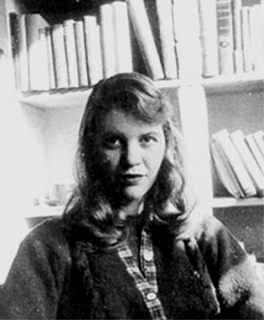
Little Fugue
The yew's black fingers wag:
Cold clouds go over.
So the deaf and dumb
Signal the blind, and are ignored.
I like black statements.
The featurelessness of that cloud, now!
White as an eye all over!
The eye of the blind pianist
At my table on the ship.
He felt for his food.
His fingers had the noses of weasels.
I couldn't stop looking.
He could hear Beethoven:
Black yew, white cloud,
The horrific complications.
Finger-traps--a tumult of keys.
Empty and silly as plates,
So the blind smile.
I envy big noises,
The yew hedge of the Grosse Fuge.
Deafness is something else.
Such a dark funnel, my father!
I see your voice
Black and leafy, as in my childhood.
A yew hedge of orders,
Gothic and barbarous, pure German.
Dead men cry from it.
I am guilty of nothing.
The yew my Christ, then.
Is it not as tortured?
And you, during the Great War
In the California delicatessen
Lopping off the sausages!
They colour my sleep,
Red, mottled, like cut necks.
There was a silence!
Great silence of another order.
I was seven, I knew nothing.
The world occurred.
You had one leg, and a Prussian mind.
Now similar clouds
Are spreading their vacuous sheets.
Do you say nothing?
I am lame in the memory.
I remember a blue eye,
A briefcase of tangerines.
This was a man, then!
Death opened, like a black tree, blackly.
I survive the while,
Arranging my morning.
These are my fingers, this my baby.
The clouds are a marriage of dress, of that pallor.
The Bee Meeting (this is one of the poems in her famous "bee sequence" - which she cranked out at 1 or 2 a day, during October of 1962.)
Who are these people at the bridge to meet me? They are the villagers ---
The rector, the midwife, the sexton, the agent for bees.
In my sleeveless summery dress I have no protection,
And they are all gloved and covered, why did nobody tell me?
They are smiling and taking out veils tacked to ancient hats.
I am nude as a chicken neck, does nobody love me?
Yes, here is the secretary of bees with her white shop smock,
Buttoning the cuffs at my wrists and the slit from my neck to my knees.
Now I am milkweed silk, the bees will not notice.
They will not smell my fear, my fear, my fear.
Which is the rector now, is it that man in black?
Which is the midwife, is that her blue coat?
Everybody is nodding a square black head, they are knights in visors,
Breastplates of cheesecloth knotted under the armpits.
Their smiles and their voces are changing. I am led through a beanfield.
Strips of tinfoil winking like people,
Feather dusters fanning their hands in a sea of bean flowers,
Creamy bean flowers with black eyes and leaves like bored hearts.
Is it blood clots the tendrils are dragging up that string?
No, no, it is scarlet flowers that will one day be edible.
Now they are giving me a fashionable white straw Italian hat
And a black veil that molds to my face, they are making me one of them.
They are leading me to the shorn grove, the circle of hives.
Is it the hawthorn that smells so sick?
The barren body of hawthon, etherizing its children.
Is it some operation that is taking place?
It is the surgeon my neighbors are waiting for,
This apparition in a green helmet,
Shining gloves and white suit.
Is it the butcher, the grocer, the postman, someone I know?
I cannot run, I am rooted, and the gorse hurts me
With its yellow purses, its spiky armory.
I could not run without having to run forever.
The white hive is snug as a virgin,
Sealing off her brood cells, her honey, and quietly humming.
Smoke rolls and scarves in the grove.
The mind of the hive thinks this is the end of everything.
Here they come, the outriders, on their hysterical elastics.
If I stand very still, they will think I am cow-parsley,
A gullible head untouched by their animosity,
Not even nodding, a personage in a hedgerow.
The villagers open the chambers, they are hunting the queen.
Is she hiding, is she eating honey? She is very clever.
She is old, old, old, she must live another year, and she knows it.
While in their fingerjoint cells the new virgins
Dream of a duel they will win inevitably,
A curtain of wax dividing them from the bride flight,
The upflight of the murderess into a heaven that loves her.
The villagers are moving the virgins, there will be no killing.
The old queen does not show herself, is she so ungrateful?
I am exhausted, I am exhausted ---
Pillar of white in a blackout of knives.
I am the magician's girl who does not flinch.
The villagers are untying their disguises, they are shaking hands.
Whose is that long white box in the grove, what have they accomplished, why am I cold.
Fever 103 (another Oct. 1962 poem)
Pure? What does it mean?
The tongues of hell
Are dull, dull as the triple
Tongues of dull, fat Cerebus
Who wheezes at the gate. Incapable
Of licking clean
The aguey tendon, the sin, the sin.
The tinder cries.
The indelible smell
Of a snuffed candle!
Love, love, the low smokes roll
From me like Isadora's scarves, I'm in a fright
One scarf will catch and anchor in the wheel.
Such yellow sullen smokes
Make their own element. They will not rise,
But trundle round the globe
Choking the aged and the meek,
The weak
Hothouse baby in its crib,
The ghastly orchid
Hanging its hanging garden in the air,
Devilish leopard!
Radiation turned it white
And killed it in an hour.
Greasing the bodies of adulterers
Like Hiroshima ash and eating in.
The sin. The sin.
Darling, all night
I have been flickering, off, on, off, on.
The sheets grow heavy as a lecher's kiss.
Three days. Three nights.
Lemon water, chicken
Water, water make me retch.
I am too pure for you or anyone.
Your body
Hurts me as the world hurts God. I am a lantern ---
My head a moon
Of Japanese paper, my gold beaten skin
Infinitely delicate and infinitely expensive.
Does not my heat astound you. And my light.
All by myself I am a huge camellia
Glowing and coming and going, flush on flush.
I think I am going up,
I think I may rise ---
The beads of hot metal fly, and I, love, I
Am a pure acetylene
Virgin
Attended by roses,
By kisses, by cherubim,
By whatever these pink things mean.
Not you, nor him.
Not him, nor him
(My selves dissolving, old whore petticoats) ---
To Paradise.

The Couriers (written in Nov. 1962)
The word of a snail on the plate of a leaf?
It is not mine. Do not accept it.
Acetic acid in a sealed tin?
Do not accept it. It is not genuine.
A ring of gold with the sun in it?
Lies. Lies and a grief.
Frost on a leaf, the immaculate
Cauldron, talking and crackling
All to itself on the top of each
Of nine black Alps.
A disturbance in mirrors,
The sea shattering its grey one -
Love, love, my season.

I think the following poem is the saddest she ever wrote. Now who can ever say what is in the mind of another - and it is always a dangerous thing to read too much into these poems (at least in a biographical way). They are, after all, art. But I believe that one of the reasons she killed herself is to spare her children a mother whose face was "a ceiling without a star". Not that that excuses her actions. But she wrote this poem in January of 1963, 2 weeks before she put her head in the oven. I find this poem nearly unreadable in its sadness. Yet - wonderful writing as well.
Child
Your clear eye is the one absolutely beautiful thing.
I want to fill it with color and ducks,
The zoo of the new
Whose names you meditate ---
April snowdrop, Indian pipe,
Little
Stalk without wrinkle,
Pool in which images
Should be grand and classical
Not this troublous
Wringing of hands, this dark
Ceiling without a star.
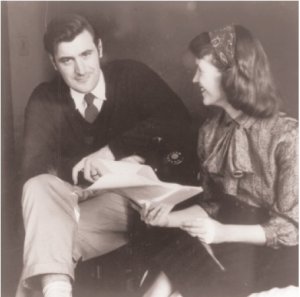
Sylvia Plath and Ted Hughes - newlyweds. Happier days. What a gorgeous couple they were.
And this is the last poem that Sylvia Plath completed. It's chilling, yes, but standing alone - as a poem - I think there's a lot to talk about here, a lot of stuff - not just biographical.
And I'm sorry - but the line "her blacks crackle and drag" is ... I mean, it's just fantastic genius-level imagery with major staying power, that's all. "Her blacks crackle and drag." (And yes ... let me just throw a shout-out to Paul Westerberg - who has also recognized the genius imagery in that line.) It's scary. "Crackle"? "Drag?" All kinds of very frightening images come to mind in those two simple words ... and the internal rhyme of "blacks" and "crackle" make it seem even more eerie. I'm not a literary critic but I will NEVER be done reading this last poem. She completed it on February 4, 1963. She killed herself on February 11.
Edge
The woman is perfected.
Her dead
Body wears the smile of accomplishment,
The illusion of a Greek necessity
Flows in the scrolls of her toga,
Her bare
Feet seem to be saying:
We have come so far, it is over.
Each dead child coiled, a white serpent,
One at each little
Pitcher of milk, now empty.
She has folded
Them back into her body as petals
Of a rose close when the garden
Stiffens and odors bleed
From the sweet, deep throats of the night flower.
The moon has nothing to be sad about,
Staring from her hood of bone.
She is used to this sort of thing.
Her blacks crackle and drag.
Let us not do a disservice to this great artist and see her only in terms of her self-inflicted end. Let us look at her art, please. Let us focus on that. If we can remove the context of her life from the poems; what is left? What do we see? What about those words, huh? What about her WORK?
Other posts I have written about Plath:
The so-called villainy of Ted Hughes
October 26, 2009
For JustJack and Rude1:
Two Renaissance men indeed.
The pertinent clip comes at the 4:15 mark. Thanks for the reminder, and thanks for reading and commenting.
October 25, 2009
Today in history: October 25, 1415 - "we few, we happy few"
Today is the feast day of Saints Crispin and Crispinian, cobblers by trade, not to mention fierce warriors of their faith. Commemorated, unforgettably, by Shakespeare, in Henry V. Crispinian here becomes "Crispian", probably to honor the demands of iambic pentameter.
Without further ado, Henry V, Act IV, scene iii:
If we are mark'd to die, we are enow
To do our country loss; and if to live,
The fewer men, the greater share of honour.
God's will! I pray thee, wish not one man more.
By Jove, I am not covetous for gold,
Nor care I who doth feed upon my cost;
It yearns me not if men my garments wear;
Such outward things dwell not in my desires:
But if it be a sin to covet honour,
I am the most offending soul alive.
No, faith, my coz, wish not a man from England:
God's peace! I would not lose so great an honour
As one man more, methinks, would share from me
For the best hope I have. O, do not wish one more!
Rather proclaim it, Westmoreland, through my host,
That he which hath no stomach to this fight,
Let him depart; his passport shall be made
And crowns for convoy put into his purse:
We would not die in that man's company
That fears his fellowship to die with us.
This day is called the Feast of Crispian:
He that outlives this day, and comes safe home,
Will stand a-tiptoe when the day is named,
And rouse him at the name of Crispian.
He that shall see this day and live t'old age,
Will yearly on the vigil feast his neighbours,
And say "To-morrow is Saint Crispian":
Then will he strip his sleeve and show his scars
And say "These wounds I had on Crispin's day."
Old men forget: yet all shall be forgot,
But he'll remember with advantages
What feats he did that day. Then shall our names,
Familiar in his mouth as household words
Harry the King, Bedford and Exeter,
Warwick and Talbot, Salisbury and Gloucester,
Be in their flowing cups freshly remembered.
This story shall the good man teach his son;
And Crispin Crispian shall ne'er go by,
From this day to the ending of the world,
But we in it shall be remembered;
We few, we happy few, we band of brothers;
For he today that sheds his blood with me
Shall be my brother; be he ne'er so vile,
This day shall gentle his condition:
And gentlemen in England now abed
Shall think themselves accursed they were not here,
And hold their manhoods cheap whiles any speaks
That fought with us upon Saint Crispin's day.
-- Henry V (Act IV, scene iii)
Two film versions of this magnificent speech below. The music in the Kenneth Branagh version is brilliant, I think. The speech is so good you don't really need to add too much to it ... but in that case, the music works.
One thing: watch how he builds it. You keep thinking it can't get more intense ... and yet it does.
And another thing, in the Olivier version - I remember vividly my acting teacher in college talking about how Olivier did this speech, especially his last vocal moment, when he says 'day' and catapults his voice up and up and up the scale - it is odd, totally artificial, and yet also completely fearless and specific. It's actory-y, an actor utilizing his magnificent vocal instrument. But then when you think that here, in the play, the King is also a bit of an actor, and needs to make a speech in a manner that will inspire his followers. It takes a bit of speechifying to get the job done. Olivier knew this. In this moment, the King IS an actor.
Nobody could pull off a vocal stunt like that except Olivier.
October 23, 2009
Post-mortem
This has been a week of processing, decompressing, contemplating, re-living, and thinking ... about the reading, how it went (it went great), and also what I need to do next. This is why it was important to have multiple people look at it, and give feedback. What do you get? What needs to be jacked up? Are you getting what I WANT you to get? I have very definite ideas about the arc and feel of the thing. Is that coming across? It's hard, I know, in a simple reading of a script - but that's the thing: you should feel the arc already, full production or no. Blocking and sets and costumes and lights will not make up for what is not there in the first place. Who do you think Jack is? (my male character?) And what do you get from Neve? (my female character). I have my own preconceived notions, obviously - these two were created by me - but to just sit back and hear what my friends and family GOT from it, who THEY see these characters as - was wonderful, and I have spent most of the week pretty much just shutting up and listening, taking in what everyone had to say. I haven't started work again - I am taking the week off, to just let things percolate - but I have taken notes on what I remember from the night, as well as compiling the list of comments in my head from people who were there. This was not about "oh look what I have created" although I am definitely proud of what I have done and there were many truly gratifying moments for me. Hearing the entire place burst into laughter, as one, at some of the funny lines, for example. This is an example of how exhilaration can also go hand in hand with calmness. As in: I heard everyone GUFFAW at one of the lines (one in particular), and felt a burst of electricity shiver through my body, thrilling with ego and excitement that I HAD MADE THEM MAKE THAT SOUND (well, and David and Jen as well, let's not forget) - but this electricity was immediately followed by a deep sense of calmness, where I nodded to myself in the back, like, "Yup. I can check that off the list. That works." I had been nervous that it wouldn't be funny. The piece is pretty bleak, frankly, and it ends on a horrible note by design. But along the way there is much to laugh at, and both Jack and Neve are meant to be funny people, who enjoy being funny FOR each other. That came across. It was a huge relief to me. Huge. I would say that that was my main worry going in. Will people get that this is funny? They did. And it worked in the way I designed it to work. Serious mixed with funny - an ebb and flow. Sudden curves where a conversation takes another tone. Like, oh, we're laughing, but oh God, now she's pissed. Is that for real? Also, you think someone is ONE way (Neve is rather snippy and difficult - this is true), but then you see another side of her (she knows how to laugh at herself, she likes to tease) - and you have to factor that in to your assessment of the person. I could feel that working in the script. I was very very happy about that, because it's a subtle thing, it could be lost. There is more I could do in this arena, definitely.
When the piece ended, Ben (stage directions reader) said, "Blackout. The end" as planned. The whole joint was quiet, nobody knew what to do, so I said from the back, "That's the end."
People started clapping but it was so funny because everyone was saying to me afterwards, "What happens next??" As I said in the beginning, this is a work-in-progress, and I didn't have the entire piece read at the reading - just the two crucial scenes. It COULD end where it does, but I think there is more to come afterwards. But I felt it was a very good sign that everyone was invested enough to want to know what the hell comes next.
Too funny - my dear friend Jackie, sitting at a table up front with my other dear friends Brooke, Liz, and Rachel, was in tears. I said something like, "I have many things planned for Neve ..." and Jackie said, hopefully, yet also in an emotional panic, "Happy things?" Hahahaha Uhm, no. I don't think so.
A beautiful thing happened after the reading. People were clapping, I went up to hug the actors, take a bow - it was a big moment for me - and my friend Brooke, sitting at a nearby table, wearing elbow-length blue gloves, said, "Can we have a Q and A, Sheila??"
I would never have initiated such a thing myself. I thought we all might just retire to the bar in the other room, and maybe talk about it there in an informal way. But Brooke, in her sensitivity, took the moment, and felt that people wanted to talk about things - I don't know, it was really really good - I am so glad she did that. So I went up and stage, and we had a kind of group discussion about the play, and people asked questions, and gave their responses - and it was good for me to verbalize both what I had been working on, and also what I felt needed to be worked on still. It was just perfect. It's one of those things, again, where if a GROWNUP had been in charge, they might have said, "We'll do the reading, and then have a Q and A with the author" - but it just wasn't something I would have planned myself. It ended up being fantastic, fantastic for me and fantastic for everyone who was there.
Brooke headed up the first question, "How did this project start?" (I love Brooke, God, we have been friends for so long) - and once I started talking, I was fine. I know how to talk about my work. I may get all nervous about making an introductory "welcome to my reading" speech, but you ask me questions about what I was "working on", and I can blab until the cows come home.
This was the start of the post-mortem process for me, and I remember every single thing that everyone said. This is not about stockpiling compliments, although that is nice as well. We need to know that we have done well, sometimes, that we have succeeded at least in what we set out to do, before we can move forward. That was the #1 reason I set up the reading. Now I can move forward. I can tweak and edit, and I will - but the EVENT is clear. The ESSENCE is clear. I didn't get one comment that was so out of left-field that it made me think I hadn't done what I set out to do. So that's good for me. Good to hear, and to know. I don't have MAJOR work to do on the characters. I have things I can draw out more clearly, and elements I can either punch up or tamp down - but it seems everyone got these people as they were intended to be gotten. Phew.
I also loved, frankly, seeing my friends talk to EACH OTHER about this.
This will only be really clear if you have read or heard the script, but suffice it to say, they are referencing a specific moment, and it just makes me laugh every time I think about it.
Brooke: Sheila, where does the play take place?
Me: I actually haven't decided.
Liz: I assumed Chicago.
Me: I'm not sure about that. I know Jack has moved away - but Neve has remained.
Jackie: (chiming in) Wherever they live, it will have to sustain cantaloupes.
And the way Jackie said it, clutching her handkerchief ("Happy things??" she asked me hopefully), tears in her eyes, but still making her point that wherever Neve lives, the soil needs to sustain cantaloupes.
I love my friends. It was also awesome to hear them making connections or making sense of things that I hadn't even thought of. THIS is the gold of the post-mortem period.
Brooke said to me later, "I was quite surprised and interested to see Neve doing yoga."
I hadn't even thought of it. I had just wanted to give her a solitary activity that WASN'T reading. I wanted her to be consumed with her activity, and not stop what she is doing when Jack comes in the room. So I chose yoga. It was pretty much on that level of decision.
But Brooke was very interested in that element. "I know that some people use yoga to relax, to decompress - and that tells me that maybe Neve KNOWS she is a stress-ball, KNOWS that she needs it - I really liked that."
I really liked that she had taken something that was unconscious on my part and made it into a character thing. A NEED, as opposed to just a bit of stage business.
There were many many comments like that, and it was great to just sit back and absorb it all. There's more for me to think about, and I'll still be writing about it, but for now ... let the post-mortem continue.
October 22, 2009
I think I need a grown-up. Where's the grown-up?
Monday night, at around quarter of 8, the audience started arriving. You know, groups of friends from all different parts of my life. It was overwhelming, like a This Is Your Life episode. Door opens. Oh my God, it's Jackie?? Door opens. Argh, here comes Pat, Michele and Jacki. Door opens. BROOKE. LIZ. Door opens. Dan came? Yay! Rachel!! Allison! Brenda! Jess! Barbara!! And etc. Ad nauseum. I am so grateful to everyone who showed up. It was a nice substantial crowd, which I think was important. It wasn't 6 or 7 people, it was more like 20 - and that really made it feel different, as in: the script really needs to sink or swim here. No pressure or anything like that. Jimmy, the owner of the place, walked me through the space beforehand, showing me the light dimmers and all that. We had lights on the stage, and the "house" (a small room, with little tables and chairs and benches along the side) was in darkness. People could order a drink at the bar out in the main area, and then come in and sit at a little table. So it was nice and cozy. Informal.
People all arrived at around the same time, so we were ready to get started at around 8:15, just like I had pictured in my cray-cray little head.
David and Jen, the actors, were sitting up on the stage, looking through their scripts. Ben, the actor reading stage directions, was also up onstage. The lights were on them, the house was in darkness. I stood in the back.
I knew I had wanted to make some sort of introductory speech. You know: tell people to shut their cell phones off, first of all. But also to say a few words about the project, introduce the actors, thank everyone for coming. And then step to the back of the room, and let Ben start the thing with the opening stage directions.
But I had a moment that makes me laugh now in remembrance. I stood in the back, so I was looking at the backs of everyone's heads in the audience. All my friends and family. Chatting, with drinks on the table. David and Jen sat in the light onstage, serious, flipping through their scripts. Ben sat in his chair, waiting quietly.
And I had this moment of thinking:
Okay, I need a GROWNUP now to take charge of this situation. I need the ADULT to go up there and make the speech. I certainly can't do it! I'm only 11 years old right now! Where is the grown-up?? Can I get an ADULT to go up there and say a few words?
I've been in a ton of readings as an actress. I've been David or Jen more times than I can speak. You sit up there, gearing up your forces, dealing with nerves, relaxing quietly, getting ready to work and show the script. You are not "in charge" - at least not at that point. Once the reading starts, it's ALL you, you are the ONLY one in charge, but in the moments beforehand, you have no tasks but to quietly get ready to work. Then the director or the writer comes up, says a few gracious words ... and you are then handed the torch.
So standing back there, I felt a sudden bolt of panic, because I didn't know where the GROWNUP was who could do that ... and then I realized: Oh right. It's me.
I'M the grownup here.
No getting around it. No hiding from it. There is no reason for any of this to be occurring if it weren't for me. It is a very strange sensation - and wholly new to me. It's strange to be at my advanced age and have what can be classified as a NEW experience. I'm thrilled about it.
But in that moment in the back, I had a tug of resistance, my spirit calling out to some OTHER grownup to take charge. It can't be me who has to go up there and speak, can it?
I took a deep breath and walked forward.
Yup. It's me. This is my job. I can do it. I know what to do. No one to look to but myself.
And then, another new sensation, I made my introductory speech, ended with, "Thanks for coming, I hope you enjoy it ..." and then .... stepped back into the darkness, the back of the room. Leaving the stage to the actors.
Take it away.
October 21, 2009
October 20, 2009
Morning in my new apartment
Last night was my reading, and I'm not going to write about it yet, still processing all of it, it was an incredible night for me. My mother and my aunt Katy stayed over with me last night, and it is just so nice to have a nice place where I can have people stay that I still can't even believe it's happened. Oh! I actually have ROOM for more than two people in my apartment! People can, you know, SLEEP OVER. Yes, I had forgotten to buy cream for their coffee (not everyone likes their coffee black as coal) so I had to sneak out at 6:30 in the beautiful morning to get some cream. But still: it was so so nice to know they were there, to know they were comfortable, and ... to know that Hope was stalking around wondering: Who are these two ladies and what are these bags doing about lying around and how does it involve ME? I made a pot of coffee (I wake up at the crack of doom), and sat on my bed, drinking coffee, and looking over the script. Even though I had promised myself to put it down for at LEAST a week after the reading. Give it time to breathe in my head. My mother came in and joined me in my room, sat on the bed with me, had coffee, we were both in our pajamas, and we just talked and talked about the night. And other things too. She and Katy had spent the day at the Guggenheim seeing the Kandinsky exhibit and then went down to The Strand. A full and good day. It wasn't even 7:30 in the morning yet, but it was SO nice to sit and talk with my mother. It felt real homey. I have always had cozy apartments, and places where I try to make it nice ... but this place, with its light and airiness, and also its comforting vibe, beautiful high ceilings, walls lined with books ... it doesn't just feel HOMEY, it feels like a HOME. And having my aunt Katy and my mother there, in their slippers and pjs, pouring cups of coffee, and saying to me, out of the blue, "Oh, and another thing about your script ..." felt like a total blessing.
The whole night was a blessing.
Wow.
October 19, 2009
Scary dolls are coming to get you. They are on the march.
Patrick Hughes details his trip to a creepy antique store. I think it was when Patrick started throwing in quotes from TS Eliot, etc., that I began to lose it. If you haven't read Patrick's stuff, you're missing out. People literally sit around all year, twiddling their thumbs, waiting for his photo-essays about annual visits to Ren Faires, and also his family's legendary holiday parties. I started laughing so hard reading one of his essays about a camping trip he took that I needed to get up and take a walk, to calm myself down.
So funny. I really needed that laugh! Here's the link. The images are very disturbing, and don't miss his increasingly panicked commentary.
Today in history: October 19, 1781

The surrender at Yorktown, which ended the American Revolutionary War.
Day before:
General Lord Charles Cornwallis to General George Washington, October 18, 1781
I agree to open a treaty of capitulation upon the basis of the garrisons of York and Gloucester, including seamen, being prisoners of war, without annexing the condition of their being sent to Europe; but I expect to receive a compensation in the articles of capitulation for the surrender of Gloucester in its present state of defence.I shall, in particular, desire, that the Bonetta sloop of war may be left entirely at my disposal, from the hour that the capitulation is signed, to receive an aid-de-camp to carry my dispatches to Sir Henry Clinton. Such soldiers as I may think proper to send as passengers in her, to be manned with fifty men of her own crew, and to be permitted to sail without examination, when my dispatches are ready: engaging, on my part, that the ship shall be brought back and delivered to you, if she escapes the dangers of the sea, that the crew and soldiers shall be accounted for in future exchanges, that she shall carry off no officer without your consent, nor public property of any kind; and I shall likewise desire, that the traders and inhabitants may preserve their property, and that no person may be punished or molested for having joined the British troops.
If you choose to proceed to negociation on these grounds, I shall appoint two field officers of my army to meet two officers from you, at any time and place that you think proper, to digest the articles of capitulation.
(Check out the full correspondence in the days leading up to the 19th)
Cornwallis had realized that aid would not come in time - and after two days of bombardment - he sent a drummer out into view, who apparently beat the rhythm of: "STOP! LET'S TALK!!!" A British officer high in rank came forward, was blindfolded and taken to George Washington (who was on his last legs himself).
The surrender document had already been drawn up, with Washington dictating the terms. Oh - here are the Articles of Capitulation.
Over 7,000 soldiers surrendered at Yorktown. The war was over.

The story is that as the defeated army marched away, the song "The World Turned Upside Down" was played. I did a quick Google search and there are lots of defensive people out there who feel the need to shout out into the wilds of the Internet, "There is NO evidence that 'The World Turned Upside Down' was played at that moment ..." Ha. I love freaks who take sides in meaningless historical debates like this. I adore them. We are all geeks cut from the same cloth. But still. It's a good story, I think. There are a couple of versions of said song (which has, by itself, a long interesting history). Here is one of the versions:
If buttercups buzz'd after the bee,
If boats were on land, churches on sea,
If ponies rode men and if grass ate the cows,
And cats should be chased into holes by the mouse,
If the mamas sold their babies
To the gypsies for half a crown;
If summer were spring and the other way round,
Then all the world would be upside down.
Dr. James Thacher, who served in the Continental Army, is one of our eyewitnesses of the capitulation, and he published his version of events a couple of years later, the relevant passage being:
"At about twelve o'clock, the combined army was arranged and drawn up in two lines extending more than a mile in length. The Americans were drawn up in a line on the right side of the road, and the French occupied the left. At the head of the former, the great American commander [George Washington], mounted on his noble courser, took his station, attended by his aides. At the head of the latter was posted the excellent Count Rochambeau and his suite. The French troops, in complete uniform, displayed a martial and noble appearance; their bands of music, of which the timbrel formed a part, is a delightful novelty, and produced while marching to the ground a most enchanting effect.The Americans, though not all in uniform, nor their dress so neat, yet exhibited an erect, soldierly air, and every countenance beamed with satisfaction and joy. The concourse of spectators from the country was prodigious, in point of numbers was probably equal to the military, but universal silence and order prevailed.
It was about two o'clock when the captive army advanced through the line formed for their reception. Every eye was prepared to gaze on Lord Cornwallis, the object of peculiar interest and solicitude; but he disappointed our anxious expectations; pretending indisposition, he made General O'Hara his substitute as the leader of his army. This officer was followed by the conquered troops in a slow and solemn step, with shouldered arms, colors cased and drums beating a British march. Having arrived at the head of the line, General O'Hara, elegantly mounted, advanced to his excellency the commander-in-chief, taking off his hat, and apologized for the non-appearance of Earl Cornwallis. With his usual dignity and politeness, his excellency pointed to Major-General Lincoln for directions, by whom the British army was conducted into a spacious field, where it was intended they should ground their arms.
The royal troops, while marching through the line formed by the allied army, exhibited a decent and neat appearance, as respects arms and clothing, for their commander opened his store and directed every soldier to be furnished with a new suit complete, prior to the capitulation. But in their line of march we remarked a disorderly and unsoldierly conduct, their step was irregular, and their ranks frequently broken.
But it was in the field, when they came to the last act of the drama, that the spirit and pride of the British soldier was put to the severest test: here their mortification could not be concealed. Some of the platoon officers appeared to be exceedingly chagrined when giving the word "ground arms," and I am a witness that they performed this duty in a very unofficer-like manner; and that many of the soldiers manifested a sullen temper, throwing their arms on the pile with violence, as if determined to render them useless. This irregularity, however, was checked by the authority of General Lincoln. After having grounded their arms and divested themselves of their accoutrements, the captive troops were conducted back to Yorktown and guarded by our troops till they could be removed to the place of their destination."
One of my favorite sites, Boston 1775, describes the blame-game that ensued, following the capitulation, between the British generals.
I have put a strategic military map from 1781 below the fold. On it you can see the positions of the British Army commanded by Cornwallis - you can see the American and French forces commanded by Washington - and check out the French fleet comin' down the pike - under Count de Grasse!! The last-minute cavalry charge!
And here is a story - (perhaps it's apocryphal, or an out-and-out fabrication - but I love it nonetheless and I will continue to do my part to spread word of this story far and wide) of Benjamin Franklin's response to the news of the surrender. He was, of course, in Paris at the time, setting the world on fire with his homespun wisdom, bacchanalian propensities, chess-playing abilities, fur-lined hats, and his dazzling ways with the ladies. The vision he presented to the world of what liberty, American-style, looked like. An international celebrity.
Word came to France of the decisive American victory, and the complete surrender to George Washington in Yorktown. Franklin attended a diplomatic dinner shortly thereafter - and, of course, everyone was discussing the British defeat.
The French foreign minister stood, and toasted Louis XVI: "To his Majesty, Louis the Sixteenth, who, like the moon, fills the earth with a soft, benevolent glow."
The British ambassador rose and said, "To George the Third, who, like the sun at noonday, spreads his light and illumines the world."
Franklin rose and countered, "I cannot give you the sun or the moon, but I give you George Washington, General of the armies of the United States, who, like Joshua of old, commanded both the sun and the moon to stand still, and both obeyed."
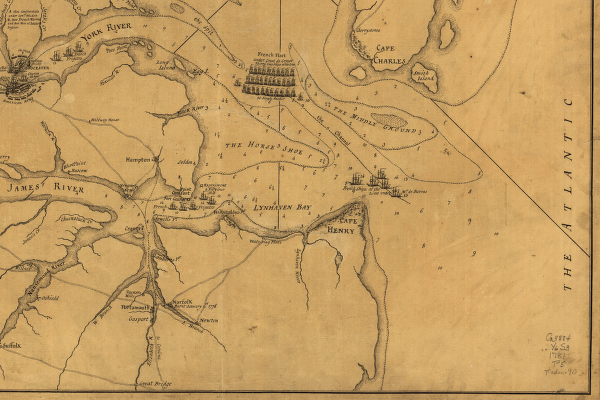
Map found here in this awesome collection - I could get lost in there forever.
October 18, 2009
Happy belated birthday, Monty

Kim Morgan reminds me that yesterday was the birthday of Montgomery Clift. Her essay is not to be missed. But I could say that about every one of her posts.
Kim writes:
Clift’s eyes held secrets, and not merely the secrets we know about after discovering his real life. There’s more to Clift than hiding homosexuality, there’s pain and romance and passion and hopelessness mixed with bursts of happiness that will never grow towards contentment. For a man so beautiful, his inherent existential angst almost seems perverse. But it also draws us to him -- we want to help Monty Clift, and I have a feeling, no matter what that man did, I would forgive him anything, even if he’d surely become one of the most unreliable presences in your life. In movies, he’s the man who’d promise to do anything for sad-eyed sister Marilyn in The Misfits, but, in the end, he probably wouldn’t stay. Though I love their chemistry in that picture, and their bond feels real and strong (and apparently, off screen, they understood one another), you know his cowboy was too damaged, too self destructive to take care of anybody but himself.
I am haunted by him, as most of us who love him are. He is unsettling. His beauty is disturbing, and it makes me wish he had done more Tennessee Williams, because there is something corrupt behind that beauty, something that brings with it a whiff of death. Because beauty like that is something people want to cling to, be close to, but when it goes, what then? So many of Williams' male characters have that stud-on-his-way-out decay, and he just got more and more clear about that the longer he wrote. Chance Wayne in Sweet Bird of Youth is this type of man (excerpt here), an early version of it. Later, Williams became more explicit in his feelings about such a person; for example, in the wonderful The Milk Train Doesn't Stop Here Anymore (excerpt here.) Young Clift would have been incredible in the role of Christopher Flanders (even the name gives a chill, with its evocation of "Flanders Fields", and the famous poem written with the same title. Death. Poppies blooming over the death fields.) Christopher Flanders shows up on that Mediterranean mountaintop, and he is the harbinger of death. He has made a career out of showing up at such moments, and comforting rich lonely women, as they make the transition towards death. It is a bad bad sign if Flanders knocks on your door. The original NY Times review described the character as:
a handsome, pallid young [man] with a dead heart
Clift was born to play such parts. His beauty was an uneasy thing. Perhaps it was uneasy because he had so much to hide. He did not inhabit his own skin comfortably. He twitched, he gleamed, he thought deeply ... we don't expect men with such spectacular beauty to behave the way he did. His most unselfconscious performance was in his debut, Howard Hawks' Red River, with John Wayne. To go back and watch him there is to witness someone who is BORN to be an actor. It's unlike any other part he played, although the damaged wild mama's boy cowboy he played in The Misfits is sort of an inversion of it. It's amazing to think that at the time of Red River, he wasn't an equestrian, he had no experience with ranch life, or riding ... but you would never know that. Clift understood his job there, immersed himself in preparation, so by the time he stalked onto the screen, facing off with John Wayne, boy was ready.
That part was not ABOUT his beauty. It was something casual, he just happened to look like that. But then in something like A Place in the Sun, and his luscious unsettling pairing with Elizabeth Taylor, his beauty takes center stage. Shelley Winters, his whining put-upon girlfriend, could never climb the ladder with him, because she didn't look right. He is a conniving ruthless person in that film, and his beauty is the smokescreen that hides his true nature. An ugly man would never have gotten away with any of that. This is a disturbing truth, and many don't want to face it. It seems unfair. It IS unfair. Clift WORKS with his beauty in that film, without preening or mugging. The reason it works so well on those who meet him in Place in the Sun is that none of it SEEMS deliberate. His beauty is a web, entangling anyone who meets him.
This is why I say Clift would have been so good in Williams' plays. He did play the psychiatrist in Suddenly Last Summer, but he was very ill at that point, he needed the work. Clift's essence is so right for Williams' more decadent works, with beautiful young men strolling through the play, leaving wreckage and death behind them. Very uneasy stuff.
Beauty like that goes hand in hand with mortality. Very few authors have been able to capture that sort of dichotomy, especially when it comes to male beauty. Thomas Mann did with Death in Venice. Oscar Wilde did, with Dorian Gray. Patricia Highsmith, perhaps, captured it best in The Talented Mr. Ripley, with the character of Dickey. Dickey is so attractive, so appealing, that he must die, and Ripley wants to step into his identity. Clift, even as a young man, had that torment beneath him, the knowledge that beauty is not all there is, but if the beauty left him, what would he do without it? It did not sit well with him. The fact that he did, indeed, "lose" his beauty (although I think that's not entirely the case) had to have felt, to him, like his worst nightmare, coming to fruition. Not to mention the fact that an actor's face is his most precious commodity, and Clift always had a malleable sensitive face. To lose the muscle-movement in one side of your face? To lose the ability to show what is going on in your heart in your eye? What would he do without his face?
The thought of Clift has always made me sad, as thankful as I am for his wonderful performances in Red River, Place in the Sun, The Misfits, Judgment at Nuremberg and others. It was, all in all, a short career, and he died a relatively young man. He raced to the bottom.
Here is my essay on Patricia Bosworth's marvelous biography of him, a must-read for movie fans.
In honor of Montgomery Clift's birthday, I am re-posting below the big compilation of quotes I put together for the Clift Blog-a-Thon a couple of years ago.
He really was one of a kind.
John Huston:
He was mysterious. He always held something back.
Montgomery Clift:
One must know a bad performance to know a good one. You can't be middle-of-the-road about it, just as you can't be middle-of-the-road about life. I mean, you can't say about Hitler, I can take him or leave him. Well, I can't be middle-of-the-road about a performance, especially my own. I feel that if I can vomit at seeing a bad performance, I'm ahead of the game.
Excerpt from Peter Bogdonavich's Who the Hell's In it:
Clift had been a kind of unacknowledged leader. His performances in Howard Hawks' Red River (his first movie, though Fred Zinneman's The Search was released earlier), in William Wyler's The Heiress, in George Stevens' A Place in the Sun, heralded a new acting style. It came to be known, inaccurately, as the Method. After Clift came Brando, and after Brando, James Dean. Clift was the purest, the least mannered of these actors, perhaps the most sensitive, certainly the most poetic. He was also remarkably beautiful. Over eight years he acted in eight films, became a teenage heartthrob as well as a popular star with older audiences. He was nominated for Best Actor Oscars three times in six years and should have won each time. He gave at least four performances - in Red River, in A Place in the Sun, in I Confess and in Zinnemann's From Here to Eternity - that remain among the finest anyone has given in the movies.
Howard Hawks:
He worked -- he really worked hard.
Excerpt from Peter Bogdonavich's Who the Hell's In it:
Here it was about eight years after Clift had acted in it, and I Confess was on the screen; I was standing in the back of the theater watching. About halfway through, I saw Clift come up the aisle, slumped over, weaving a little. At the back, he lit a cigarette and turned to look at the screen again. I came up and said I worked there. He was polite. I said I liked the picture and asked if he did.The huge image on the screen at that moment of his pre-accident beauty must have seemed to mock him. He turned away and looked at me sadly. "It's ... hard, you know." He said it slowly, hesitantly, a little slurred. "It's very ... hard," he said. I nodded. He looked back at the screen.
A few steps away was a "request book" [Dan] Talbot had set up for his patrons. It was a large lined ledger in which audiences were encouraged (by sign and trailer) to write down what movies they would like to see. I told Clift about the book and said I wanted to show him something. He followed me over, puffing his cigarette absently. I leafed through the book quickly and found the page on which I had noticed a couple days before that someone had scrawled in large red letters: "ANYTHING WITH MONTGOMERY CLIFT!"
The actor stared down at the page for several moments. 'That's very ... nice," he said, and continued to look down. "That's ... very nice," he said again, and I realized he was crying. He put his arm around me unsteadily and thanked me for showing it to him. Then he turned and walked back down the aisle to his seat.
When the picture was over, he and Mrs. [Walter] Huston came out of the theater. I was standing outside. He waved to me gently and they got back into the Rolls-Royce and it was driven away. He made only two films more before he died five years later at the age of forty-six - a lost poet from Omaha, Nebraska, the most romantic and touching actor of his generation.

Excerpt from Kazan: The Master Director Discusses His Films, by Jeff Young
Why did you cast Montgomery Clift [in "Wild River"]?He wasn't my choice. I wish I had been able to cast someone more masculine, someone stronger would have been better. It's hard to cast an intellectual. I would have preferred Brando, but then I always prefer Brando. He was unavailable, so I kept postponing the picture and postponing it, tryiing to find somebody I liked. I liked Montgomery Clift personally, but he was in very bad shape. He had had an auto accidnet going down the hill from Liz Taylor's house. He was banged up. His face was almost a different face. He was also very shaky and on liquor and drugs, just quivering with doubt. It was a tough, tough thing to deal with. He was also unmasculine, which hurt the love story. I think I could have done better, but I didn't know with whom. I still don't know.
Brooks Clift [Monty's brother]:
Psychologically we couldn't seem to take the memories [of our childhood] so we forgot. But at the same time we were obsessed with our childhood. We'd refer to it among ourselves, but only among ourselves. Part of each of us desperately wanted to remember our past and when we couldn't it was frustrating. It caused us to weep, when we were drunk enough, when some minor detail from our past was released. Monty once said the smell of boot polish reminded him of winter when he was a boy. He would get hysterical over the smell of boot polish.
Patricia Collinge, actress, starring in Dame Nature on Broadway with Clift in 1938:
He'd invent bits of business or character details that were sometimes offbeat or strange. I'm still reminded of Camus's phrase 'create dangerously' when I think of Monty's acting, because he was starting to make unorthodox acting choices even then.There is one long speech in the play when Monty as Andre tries to explain to his father how his loneliness and unhappiness had forced him to seek affection from an equally lonely girl.
Monty's performance was heart-rending. It was so quiet and sincere that it seemed almost untheatrical, except underneath the controlled tone was an absolutely compelling sense of torment.
Friend Bill Le Massena:
Monty had this glorious instinctive talent bursting out of him and Mr. Lunt recognized it and helped him focus and cultivate it. He kept asking Monty questions about his part - specific questions - he helped him develop an inner life for the character by using elements of himself. Like Lunt, Monty was a natural actor, a born mimic. He never needed or wanted to hide bhind a fake mustache or accent. He used his inner self.

Nancy Walker, on Monty's love of music and singing:
He could never carry a tune, but, my God, did he believe in the lyrics!
Montgomery Clift on Alfred Lunt, his mentor and acting inspiration:
Alfred taught me how to select. Acting is an accumulation of subtle details. And the details of Alfred Lunt's performances were like the observations of a great novelist - like Samuel Butler or Marcel Proust.
Ned Smith on seeing Clift in a revival of Our Town in 1944:
It was the first time I realized Monty was such a special actor. He had a moment at the end of the play where he jumps over a series of imaginary rain puddles - it was quite extraordinary the way he did it.
Herman Shumlin, directed Monty in Lillian Hellmann's The Searching Wind:
Monty belonged on the stage. There are certain actors who walk out in front of an audience and they belong there. You believed him the instant he spoke a line.
Tennessee Williams [who saw Monty onstage in Mexican Mural and said it was one of the most remarkable performances he had ever seen:
Monty loved being in awe of people. He seemed to look on all the arts - dance, music, and theater - as if they were great mysteries. I never knew him well because I wasn't sexually attracted to him but I know one thing - his major impulse was to be an artist. Monty disliked me because I was so open about being gay and he wasn't.

Montgomery Clift:
I watched myself in Red River and I knew I was going to be famous, so I decided I would get drunk anonymously one last time.
Excerpt from Patricia Bosworth's Montgomery Clift:
The essential Clift character tended to be a loner, outside the mainstream, isolated - intense but always struggling against conformity, and within that framework Monty's range was extraordinary; his characters were by turn extroverted, withdrawn, articulate, or monosyllabic, assertive, passive.He was a great believer in the psychological gesture, the physical manifestation of an emotion. It could be expressed in a look - how he stares into Shelley Winters' face before he kills her in A Place in the Sun, the sidelong glance of astonishment and desire when he sees Elizabeth Taylor for the first time in Place, the way he phones his mother in The Misfits, as if he's just been slugged; in his greatest performances Monty personified, rather than impersonated, character.

Photographer Richard Avedon on seeing him in The Search:
The minute Monty came on the screen I cried because he was so realistic and honest and I was deeply touched. He seems to be creating a new kind of acting - almost documentary in approach. It has the style of reportage.
Excerpt from Patricia Bosworth's Montgomery Clift:
When Kevin [McCarthy] was rehearsing Romeo for CBS' "Omnibus" and he was having trouble with the death scene, "I asked Monty to help me and we worked one entire night in our living room with Gussie playing the dead Juliet, Monty playing Romeo. He was agonizingly brilliant," Kevin says. "He seemed totally assured in his conception of the character. His Romeo was impetuous, romantic, fumbling with words as he expressed his love for Juliet. He also brought a physicality, an athleticism to the role. His entire body seemed part of the work. And then there was this power - this originality behind the concept. He played young love so intensely, so truthfully."They rehearsed till five in the morning: after Gussie staggered off to bed Monty went over the scene for the last time using a pillow as Juliet. "I remember he covered it with passionate kisses, then rocked it back and forth in his arms like a baby."
Note given to Monty by a handwriting analyst who had taken a look at a page in one of Monty's notebook and seen his writing:
"You're the most disturbed man I've ever seen - you'll die young."
Hollywood press agent who knew Clift in the late 40s:
Right off he was labeled an outsider. The minute you refuse to play the game in Hollywood exactly as they want it, and that means totally giving up your body and your soul and your guts to becoming a STAR, you become an outsider. The minute you have integrity - which is what Monty had - you are an outsider. The minute you refuse to sell yourself as a commodity, a product, the agent and producers and directors who literally feed off talent call you an outsider, and it is much harder to survive. Hollywood couldn't have cared less that Monty preferred to live in New York and disapproved of the pap about himself in fan magazines. To survive being a star in Hollywood like Humphrey Bogart or Gary Cooper, you have to be sensitive and ruthless, humble and arrogant. Monty was sensitive. Period.
Monty to Elizabeth Taylor after finishing a scene in Place in the Sun - he had gotten so into it that he was drenched in sweat:
That's the worst part about acting. Your body doesn't know you're acting. It sweats and makes adrenalin just as though your emotions were real.
Richard Burton:
Monty, like Garbo and Brando, had the extraordinary facility of giving you a sense of danger. You were never quite sure whether he would blow his lines or explode.

Monty's friend Ned Smith:
He talked about meeting Laurence Olivier, whom he was very impressed with - he thought he was absolutely wonderful. He talked about Marlene Dietrich, and he was very specific about her comeback in Las Begas, which he'd gone to, and the dress she had on - all the spangles which seemed stuck to her body - and he did an imitation, he mimed the dress. He talked about how Dietrich and Ernest Hemingway had come over to the brownstone and how Hemingway was a transcendent bore, he seemed so self-important. He talked about Vivien Leigh and how hard she was on Laurence Olivier: 'She is very neurotic and very nervous, and she holds her teacup like this,' and he imitated Vivien Leigh and the gesture was totally effeminate and it distressed me greatly. He talked no more about doing many things in his life - broadening his life - he talked only about 'I have my work to do and this and that.' He took singing lessons; he went to the gym; he had to go to the dentist's. He talked about the movie African Queen and he said, 'I can't stand the way Katharine Hepburn plays the part.' He said, 'When she pours gin overboard she doesn't do it right.' I said, 'What do you mean? I thought that was a terrific scene, one of the greatest scenes I've ever seen in a movie,' and he answered, 'Terrible job.' He spoke a lot about From Here to Eternity and Frank Sinatra, who he thought would be great for the part of Maggio ... I wanted to tell him about my experiences - I had been to Spain and lived there and learned the language and had been turned upside down by the experience. But, well, there were things about Monty now that I'd been sensing about him that made me uneasy ... Still it was so pleasant knowing him, and I felt I could help him ... That's not the right way to put it. I felt I was still very much part of his life ...
Francois Truffaut:
Monty was truly remarkable. Throughout the picture [I Confess], his attitude as well as his expression is consistent. He has an air of dignity at all times. It's only through his eyes that we see his bewilderment at all the things that are happening to him.

Clift on Prewitt, the character he played in From Here to Eternity:
Prew is a limited guy with an unlimited spirit, an inarticulate man, never a 'word' man ... Good dialogue simply isn't enough to explain all the infinite gradations of a character. It's behavior - it's what's going on behind the lines.

Fred Zinnemann, director of From Here to Eternity:
Monty was so intense about being Prewitt he raised the level of the other actors. He cared so much they started caring.
Burt Lancaster:
He approached the script like a scientist. I've never seen anyone so meticulous.
Jack Larson on how Clift would cut his lines, slashing his script up - so that he would have less and less to say in each scene (all the greats did that - Bogart, Wayne, Grant ... They didn't hoard their lines, they CUT them, knowing that it was better, in films, to say less - to let your face and your behavior tell the scene):
He worked out all sorts of broken speeches for himself. In that long scene with Donna Reed [in From Here to Eternity], where he explains why he can no longer box, he must have worked over a single speech for at least twenty-four hours straight Finally he came up with the sentence, 'And then I hit him - and he couldn't see any more.' He said that he couldn't use the word blind because it didn't mean anything to him, but the word 'see' did.
James Jones, author of From Here to Eternity and drinking buddy of Clift:
I told him [Clift] I felt cut off from a lot of experience being a writer, working by myself so much,a nd he said actors were cut off too. 'Except you writers don't need to hear the sond of applause,' he said. I said, 'What the hell are you talking?' and he stares at me with those funny blazing eyes of his and then he starts laughing that crazy-sounding laugh.Monty had a special kind of pain, a pain he could not release. He had a tragedy hanging over his head like a big black comic-strip cloud. It was so distinct you could almost see it. I never heard him talk about himself personally.
Fred Zinnemann:
His drinking was more deadly than Spencer Tracy's. Drunk or sober, Spencer knew who he was, but when Monty drank he seemed to lose his identity and melt before your eyes.
Excerpt from Patricia Bosworth's Montgomery Clift:
The day Monty played that death scene [in From Here to Eternity] a lot of people on the set cried. He played it as if he knew the murder of Fatso had been to no avail - that he had to die. It was inevitable. "How he evoked that feeling I don't know," said James Jones, who watched the scene being shot, "but he ran into his death like someone running into a gigantic tidal wave. His face was gaunt - tense, chalk white - he looked as if he'd had the guts pulled out of him, then he rolls over on the grass and Zinnemann calls cut! And someone says, "Prew's dead," in a hushed voice.
Karl Malden on why Monty's performances were often undervalued:
Because he always becomes part of the warp and woof of a script. So much so that his artistry wasn't always appreciated. If you watch him in From Here to Eternity, he completely immerses himself in the character and situation of Prewitt, so much so that he actually sinnks into the flesh of the story.
Andrew Sarris, film critic:
You could place Yul Brynner but you couldn't place Clift. On screen Montgomery Clift was a chameleon - furtive. In every movie he seemed to be looking for himself.
Friend Jack Larson:
It didn't matter what sex you were. If Monty really liked you - man or woman you ultimately went to bed with him. If he liked you, he couldn't keep his hands off you - touching - caressing - hugging - he was very physical and very, very affectionate. And of course he was always passing out with you and then you were undressing him and putting him to bed and finally you were ending up in bed with him too.
Bill Gunn:
I've never known anyone who liked being in front of a camera as much as Monty. He was the same way in front of a mirror - never ashamed; he enjoyed looking at his reflection. He was like a woman in this regard. He could stare for minutes on end at his image unselfconscious - totally relaxed.
Montgomery Clift:
James Dean's death had a profound effect on me. The instant I heard about it, I vomited. I don't know why.

Montgomery Clift called Elizabeth Taylor (his best friend, his soulmate) "Bessie Mae":
You know how it is when you love somebody terribly but you can't describe why? That's how I love Bessie Mae.
Excerpt from Patricia Bosworth's Montgomery Clift:
Monty was so concerned with the weaknesses in the Raintree script he harried [director Edward] Dmytryk with suggestions and changes he'd stayed up half the night thinking up. A burly man with cold eyes and an abrupt manner, Dmytryk had his own problems. He had made forty-seven movies, among them Crossfire and Caine Mutiny, but he was a former member of the Hollywood Ten who had gone to jail, then recanted to save his career."Monty and I met as often as possible for drinks or lunch. I agreed to listen to his suggestions. He was obviously a great actor - very inventive. But I sometimes felt he worried things to death, little things."
He recalled his preparation for a "flash" scene - a scene lasting no more than a second or two on the screen - the scene called for Monty to enter the room and see his baby for the first time. Monty practiced opening and closing the door countless times; he tried it abruptly, tentatively, fearfully, joyfully, excitedly, all to find the one entrance which would convey exactly the emotion he wanted.
Adele Morales Mailer:
At parties, most of the time he was drunk. Most of us were too. He was a good kisser--I can tell you that. Certainly, he was interested in women. He may have been bi. God, he was tortured. He was driven. You felt an underlying sadness. Even without knowing anything about him. Some people you know without knowing anything about them.
Donna Reed:
"I had never worked with any actor like him; to watch him was incredible and memorable. He had a talent and a side to our profession I had never seen before, just superb."

Excerpt from Patricia Bosworth's Montgomery Clift. Kevin McCarthy on the tragic car accident that ruined Clift's face and almost killed him. They had all been at a party at Liz Taylor's, up on a hill. Then it was time to go. Kevin got in his car, Monty got in his car - behind Kevin's - and they took off down the drive.
Suddenly I looked in my rearview mirror and I saw that Monty's car was coming much too close to my car. I got the idea he was going to play one of his practical jokes - he was going to give my car a little nudge. He never did bump my car, but I had the feeling he might, so I put my foot on the gas and went a little faster. Monty's car seemed to be almost on top of me. I wondered if he was having a blackout. I got frightened and spurted ahead so he wouldn't bump me. We both made the first turn but the next one was treacherous. We were careening now, swerving, and screeching through the darkness. Behind me I saw Monty's carlights weave from one side of the road to the other and then I heard a terrible crash.A cloud of dust appeared in my rearview mirror. I stopped and ran back. Monty's car was crumpled like an accordion against a telephone pole. The motor was running like hell. I could smell gas. I managed to reach in the window and turn off the ignition, but it was so dark I couldn't see inside the car. I didn't know where Monty was. He seemed to have disappeared.
I ran and drove my car back and shone the headlights into Monty's car. Then I saw him curled under the dahsboard. He'd been pushed there by the force of the crash. His face was torn away - a bloody pulp. I thought he was dead.
I drove back to Elizabeth's shaking like a leaf and pounded on the door. "There's been a terrible accident!" I yelled, "I don't know whether Monty's dead or alive - get an ambulance quick!" Mike Wilding and I both tried to keep Elizabeth from coming down to the car with us but she fought us off like a tiger. "No! No! I'm going to Monty!" she screamed, and she raced down the hill.
She was like Mother Courage. Monty's car was so crushed you couldn't open the front door, so Liz got through the back door and crawled over the seat. Then she crouched down and cradled Monty's head in her lap. He gave a little moan. Then he started to choke. He pantomimed weakly to his neck. Some of his teeth had been knocked out and his two front teeth were lodged in his throat. I'll never forget what Liz did. She stuck her fingers down his throat and she pulled those teeth. Otherwise he would have choked to death.
Jack Larson:
When I first saw him [after the accident], I almost went into shock but I think I hid it because he said, "I don't look too different, do I, mon vieux?" I think he was teasing me. He wanted the truth him and I assured him no, no you don't. Of course, he looked completely different. His mouth was twisted. A nerve had been severed in his left cheek so that the left side of his face was practically immobile - frozen. His nose, that perfect nose!, was bent - crooked - out of shape. He looked stuffed, that's the only way I can put it - the only feature that remained the same were his eyes - they were still brilliant and glittering and they stared right through you, but they were now brim full of pain.

Excerpt from Patricia Bosworth's Montgomery Clift - from 1956 - Clift has had his accident, and now barely leaves the house. Black drapes over the windows. He has gone into hiding for months.
Just before he left Hollywood to go back to New York in late November, a man drove up to the house and informed Monty that "Marlon Brando want to talk to you seriously and in private about something. Are you agreeable?" Monty said sure, tell him to come on over, and the man drove off.No more than ten minutes later another car drove up and out stepped Marlon Brando. Dressed in work clothes, he was scowling as he approached the house. He'd had his eyebrows shaved off for the role he was then filming: Sakini in Teahouse of the August Moon.
Monty came out to meet him; then the two men went into the house and conferred in the living room for about an hour.
[Jack] Larson, since he was going to drive Monty into the doctor's later that afternoon, waited by the pool. From his vantage point he could see the actors pacing about the living room, then sitting down opposite each other at a table in the foyer. An hour later Brando strode out, got into his car, and disappeared down the hill.
Larson didn't ask questions, but later, on the way to the doctor's, Monty told him what had been said. Apparently Brando had been hearing all sorts of stories about Monty destroying himself with pills and booze. Brando wanted to communicate something: Monty must stop this shit. He must take care of himself not only for himself but for Marlon Brando.
"Then he got into this rap about competition - the healthy competition that should exist between actorrs - that existed, say, between a Laurence Olivier and a John Gielgud, between a Richard Burton, then, and a Paul Scofield. These men challenge each other, he said. Now, didn't Monty know the only actor in America who interested Brando was Monty? Didn't he realize they had always challenged each other, maddened each other, intrigued each other, ever since they started their careers? Brando said the year he'd been nominated for Streetcar Monty had been nominated for Place in the Sun. 'I went to Place in the Sun hoping you wouldn't be as good as you were supposed to be, but you were even better, and I thought, hell, Monty should get that award.' And Monty answered, 'I thought the same thing! I saw you in Streetcar praying you'd be lousy - and at the end I thought Marlon deserves the Oscar.' Brando said, 'In a way, I hate you. I've always hated you because I want to be better than you, but you're better than me - you're my touchstone, my challenge, and I want you and I to go on challenging each other ... and I thought you would until you started this foolishness ...'"
Monty seemed surprised Brando would take the trouble to come over and talk. He seemed quite moved. 'I don't think either Marlon or I are imitators, which is why I guess we respect each other. Maybe because we both have delusions of grandeur."
Monty, on his role in The Young Lions:
With all the accoutrements and mannerisms I'm trying for the essence of something. Acting is an accumulation of subtleties - like shaking the ash from a cigarette when a character is supposed to be completely absorbed in a conversation.
Excerpt from Patricia Bosworth's Montgomery Clift
During filming [of The Young Lions], Monty became friendly with Dean Martin and did everything he could to help the singer in his first dramatic role, just as he had with Sinatra in Eternity. They would run lines together; when he saw Martin was nervous he would break him up. During a party sequence he hid under a pianno on the set and tickled Martin's leg until he had a laughing fit. Inn the evenings, they would go off and have drinking contests. Martin nicknamed him "Spider" because of the extravagant gestures he used when he talked.
Nancy Walker (one of his dearest and staunchest friends):
Monty and I never played roles with each other, or let's say, hardly ever - and we didnt' wear masks. Speaking of masks, I used to tell Monty if you hadn't been in the car crash you'd just be another aging pretty face. I liked his face better after the accident: his strength shone through ...People wouldn't let him be strong. He'd been raised to believe he was weak. I used to get so mad at his secretary. We'd be going out to dinner, and she'd say, 'Now you be sure Monty eats,' and I'd snap, 'Isn't that what you're supposed to do when you go out to dinner?' and she'd cluck, 'But poor Monty is so frail - cha-cha-cha,' and I'd say, 'You are crazy. Monty is as strong as an ox.' He had arms like iron - hands like a musician ... whenever I got bugged, I'd phone him and I'd say, 'I need you. I don't care whether you need me, I need you,' and he'd cry, 'Nanny, what is it? Tell me!; He needed to be needed.
Monty on Noah, the part he played in The Young Lions:
Noah was the best performance of my life. I couldn't have given more of myself. I'll never be able to do it again. Never.
Bill Kellin, actor:
But as anguished as Monty was, and I sometimes felt there was an actual physical presence hovering in the room that he was terrified of - when he acted a scene it was sculpted forever. There was a solidness about the work - a rocklike quality. There was nothing casual about his acting. If he had genius it was that he revealed himself so totally as an actor - he stripped himself naked. He hid his real life - nobody was as mysterious or remote as Monty except I guess to a few friends. But in his acting he revealed himself as powerfully as a scream.

Excerpt from Method Actors by Steve Vineberg:
The love scenes in A Place in the Sun are justly famous. When Angela wanders into the pool room and discovers George, retreating from a party where he knows no one and feels out of place, he relaxes his face and accepts the stronger force of her extraordinary beuaty like a happily defeated warrior. She's affected too - by his inability to keep his feelings concealed. (George makes immediate erotic contact with both the women characters in the film: the factory drudge, Alice, played by Shelley Winters, whom he has an affair with and gets pregnant, and the socialite, Angela, who enters his life after he's already become involved with Alice.) Love shatters George. He confesses hisl ove to Angela as if he were confessing murder, running on fast, feverishly, in a desperate, choked voice, his smile pulled in one direction by rapture and in another by agony ... For Clft, sexual conflict is always bound up with spiritual conflict. The realm of the spirit was the arena where the actors of Clift's generation fought their most feverish battles; following in John Garfield's footsteps but moving beyond him, they also deined themselves by a brooding, unresolvable sexuality. Clift inhabits both these areas simulatneously, heralding the arrival of a new breed of actor.

Excerpt from Patricia Bosworth's Montgomery Clift - on his small wrenching part in Judgment at Nuremberg:
He got two weeks at the Bel Air Hotel plus two first-class plane tickets for himself and Giles. Before leaving for the Coast that April he packed his little photograph of Kafka and he told Nancy Walker he was going to get a "very bad haircut". "Monty believed the poor slob he was playing would get a special haircut before testifying against war criminals."He spent the first day rehearsing with Spencer Tracy at Revue Studios in Hollywood. They rehearsed on a complete replica of the Nuremberg courtroom, built on rollers so the cameras could move in at any angle. Monty's scene, which ran seven minutes, was to be done mostly in close-up. He was worried about remembering his lines.
When time came to shoot the sequence he panicked - and he fluffed in take after take. Finally Tracy ambled over and said, "Fuck the lines - just play to me." Kramer recalled, "Spencer was the greatest reactor in the business. Monty did play to him, and the words poured out of his mouth - the results were shattering."
He spoke in a whisper, full of terror and unhealed suffering; his eyes were like those of a ten-year-old child. He recited his entire story to Tracy very simply, only rising to hysteria when he held out a photograph of his mother who'd been murdered in a concentration camp.
As soon as the highly charged scene was over, Tracy ran from the judges' bench, threw his arms around him, and praised him in glowing terms for his powerful, sensitive playing; he was nominated for an Academy Award for best supporting actor for his performance.

Alfred Hitchcock:
Montgomery Clift always looked as though he had the angel of death walking along beside him.

Frank Taylor:
Monty and Marilyn [Monroe] were psychic twins. They were on the same wavelength. They recognized disaster in each other's faces and giggled about it.

And after all of this, I think I will end with a quote from Mr. Clift himself.
Here is a snippet from an interview Montgomery Clift gave during the filming of The Misfits (more here) - this is an excerpt from The Making of the misfits by James Goode, a journalist who was there as they filmed the movie:
"I wish I were more thin-skinned. The problem is to remain sensitive to all kinds of things wihtout letting them pull you down. Now, take this - the fact that someone drops a book of matches at a time when he most wants not to seem ill at ease. To a normal person that is not a terribly moving talent, but to an actor in films, such a thing maybe perhaps changes the whole relationship to the girl that dropped the matches. The only line I know of that's wrong in Shakespeare is 'Holding a mirror up to nature.' You hold the magnifying glass up to nature. As an actor you just enlarge it enough so that your audience can identify with a situation. If it were a mirror we would have no art. Essence is a wonderful word. Miller has written the essence of Roslyn. You'd be bored to death if it were a mirror. Take the line in the script, 'Who did this to me? The ambulance did it.' Magnifying the essential things that liberate the imagination and enable one to identify - when one has those qualities, they are fabulous gifts. Take a pause, for example. That I call a magnification. I wouldn't call it a mirror. The magnifying glass has been misused totally, but in this picture it has been put to the use of capturing what possibly is flitting in and out of someone's mind and one person's relationship to another and another, and that's what's fascinating."
October 17, 2009
My Right Foot
I wrote this years ago. Much has changed, and much here is no longer true. But the truth of the moment I wrote it remains. It's been on my mind due to the script I've written, and recent experiences I've had. The script touches some of these issues. Thought I would share it again.
My Right Foot
I was in a huge amphitheatre. There were rows of seats going up, up, up, on a huge incline. The place was packed, and I was there by myself. I was so excited that I could barely keep myself in my seat. I was there to see him. He didn't know that I was there, and that made it even more exciting. It would be an ambush of love. I was sitting at the edge of one of the seat sections, with a railing in front of me. Directly below me was a walkway, going down underneath the seats, like you have in baseball stadiums. And suddenly, he appeared on that walkway, coming from within the stadium, and there he was....
I couldn't restrain myself. I stood up, leaned over the railing, and shouted his name, ecstatically. He turned, looked up, and saw me. His face! When he saw mine! There was this warmth there, this beautiful warmth ... he was excited to see me, of course, and also very surprised that I was there, how did I get there? Where had I come from? But more than all of that - was warmth. We couldn't get to each other, because of the railing, and the far drop down to the walkway ... but he walked directly below me, and reached up, up, up - he had to be way up on his tiptoes, and he's a very tall man ... and grabbed hold of my right foot, the closest thing he could grab ... the only thing he could reach. And he just held on to my right foot, squeezing it, as though it were my hand ... and I was leaning over the balcony, reaching down to him, but my arms couldn't reach. It didn't matter.
I woke up from the dream, and it was dark in my room, and I was overwhelmed by a sensation of deep well-being, a feeling of "It's okay. Everything's okay." I could still feel, like a phantom, his hand grasping my right foot. The dream was so real, and so un-dreamlike, that I wondered if he had also dreamt the same thing, across the miles. It didn't feel like a dream. It felt like a visit. But I had no way of asking him, no way of contacting him.
It had been a year since I had seen him, since we said good-bye on my porch, under the wind chimes. I remember that there was a wet spot on his blue T-shirt from my tears. The last thing he said to me was, and I remember him holding onto my arms, firmly: "Now listen to me, Sheila - I want you to listen closely. There are going to be times when you feel lonely and alone out there. But when that happens, I want you to stop, wherever you are, on the sidewalk, whereever - and just know that I am out here, and I love you. I'm serious - promise me that if you ever feel alone, you'll take a second and think of me, and just know that I will probably be thinking of you, and I am loving you. You're loved, Sheila. You are loved."
He wouldn't let me get away with not promising. He shook me, gently, "Promise me!" Wind chimes ... I promised.
At the time of the right-foot dream, I lived halfway across the country from him. I didn't know his phone number or his address. Life goes on. Life moves on. I had been more in love with him than I have ever been with anybody else (before or since), but in the end: none of that matters: life does indeed go on.
The "holding my foot" dream felt like a message from him. We had always communicated in strange ESP-ish ways. Not a lot ever needed to be said. We didn't do a lot of talking. Or - scratch that - that's ALL we did was talk, but not about 'what's going on', or 'our feelings'. We talked about movies and books and food and music and what we did that week, we groped each other in dark hallways, and we told each other funny stories, and we made each other mix tapes. So when the whole thing ended, I wondered at times: what the hell was that? Did it add up to anything? What can I point to to say: "Yes. This happened."? But communication doesn't always have to be conventional, and you don't have to communicate in the way the books tell you to. Well, unless you read Jane Eyre, which ends with a clear reaching across of the space-time continuum, one soul to another.
I'm not big on soulmates (I've gone on about that ad nauseum here, here, and here.) I once was into the concept, but I no longer am. However, the connection between me and him did give me pause. The message was always clear, between us. It was just love. That's all. Your basic garden-variety love. No reinventing the wheel here. We just flat out loved each other. We never spoke of it, because it was like the blue sky, or like a solid object you can take a picture of. It just WAS. I don't want to paint an incorrect picture. The man was at a crossroads. Do I go THIS way with her? Or THIS way with her? He didn't choose the way with me. It burned like a hot poker, but the love part of it was never in question. Which made it worse, but whatever, let's move on.
So to me, the vivid feeling of his hand on my right foot was a message across the space-time continuum from him: "Hey ... I'm still out here ... I remember you ... I remember ..." It was him keeping his end of the promise from under the wind chimes. He was still out there, and he loved me.
I wrote out the dream to him in a letter, and put it away, adding it to the small pile. I didn't have his address, but occasionally I would write him a letter - in the same way I would write in my journal. If I saw something that reminded me of him, or if I read a book that he had once told me, "OH YOU HAVE TO READ IT" then I would write him a letter telling him I had finally read it, and all of my responses to it. Just because a thing ends doesn't mean that you lose the desire to communicate with that person. In a way, it was great that I didn't have his address or his phone number. If I did, it might have been much harder to move on. Although, let's be honest, it was hard enough. It took me years to get over that man. As it was, I needed to just keep putting one foot in front of the other, and this thing that I had with him became more and more subconscious, more and more like a river flowing beneath the earth, something I could rely on, something I could tap into, but nothing that really existed in the clear light of day. The whole thing started feeling like a dream.
And then, I saw him again. For real. Not in a dream. I was back in Chicago, and I went to see him. Unannounced. It didn't occur to me that I was acting out my dream or anything like that. Much of my behavior surrounding him was not all that conscious (part of the problem). I was impulsive, I did what I wanted, and usually it was later that things made sense. I had gotten word that he was getting married. To the other girl at the crossroads. I had no way of letting him know I would be at his show that night, but that was okay. Through a series of coincidental circumstances, we ended up having two hours to talk before his show. This was unprecedented. He had been milling about before his show, there were a ton of people there, and I stood in the back, watching him from afar, with an enormous jackass smile on my face. I watched him mingle, I watched him circulate ... and all the time, he had no idea that Sheila was in the house! It was just a matter of time before he saw me ... Now, he didn't "see" me, in any conventional way (of course not). At least I didn't notice him see me, and I had my eagle eyes fastened on him like a laser beam ... I saw him mingling. He's a star, everyone wants a piece of him, so I saw him trying to move through the crowd, and one person would stop him, or then another person would stop him to talk ... It was always impossible for him to get from Point A to Point B. I hung back, just watching ... I knew it wouldn't be right for me to be just one of that crowd, trying to intercept him as he moved across the room. That was never my role in his life.
I'm about to sound very new-agey (or ... shall I say ... MORE new-agey, since I already spoke about the two of us communicating over the space-time continuum - sheesh, shut up, Sheila) - but at some point, during his stop-start crossing of the room, I knew that he had seen me. We didn't make eye contact, he didn't glimpse me through the throngs, or at least I didn't see him glimpse me ... that's not how I knew I had been spotted. I knew because his entire energy changed, and I could feel it from across the space. There was a sudden urgency, a purpose, his essence became electrified, and I watched him get rid of the intercepters with dispatch - I could see him saying, urgently, "Can't talk right now ... hang on ... can't talk ..." His whole body language changed, and I knew, watching all this: "Okay. He's seen me. He's trying to get to me."
And I was right. Because suddenly, there he was - charging at me - literally - hands stretched out to me, his face intense and excited, "What are you doing here????" I grabbed his hands. I jumped up and down, like a little kid, saying, "I'm here to surprise you!" He burst out laughing, and said, still holding onto my hands, "Well, it worked - I am very surprised!" We didn't hug. In the entire time I've known him, we've probably hugged three times. It's not our thing. Too hot. Can't be casual. We would stand side by side awkwardly, basically scuffing our feet, and then 10 minutes later be in some huge clutch. No in-between, none of this HUGGING business. What's the point of that? But he gripped my hands, and I jumped up and down, and that was our way of saying "Hi!!"
He then said, "Let's get the hell out of here - " and yanked at my hand. He led me through the crowd, completely ignoring all the people who wanted a piece of him. Saying to them, "Not now ... not now ... not now ..." We made a beeline for the exit.
Because of circumstances beyond his control, he had a free two hours before his show - a scheduling snafu which was annoying for him, but ended up working so much to our favor. It was a godsend. We stood outside for two hours, and blabbed our heads off. Again: we didn't talk about our feelings, we didn't speak of that raging underwater river flowing beneath us ... No. We didn't talk about his upcoming nuptials, although that was there between us, too. My knowledge of it, his awareness that I probably knew. We talked about books we had read, movies we had seen, we talked about actors we liked, we talked about nothing. I loved that. I loved talking about nothing with him ... It felt almost over-indulgent. I thought that I would get maybe 15 minutes of face-time, because he had a show to do ... and I wasn't there to try to buttonhole him into some big conversation. I was basically there to say hi, lay eyes on his face, and watch his show, something I had always loved to do. But there we were, with 2 hours to hang out. Yap yap yap yap yap yap yap yap ...
I hadn't seen him since the dark-spot-on-T-shirt-wind-chimes night. But so much had happened since then. It had been almost a year. Our lives were already completely different. But the underwater river was still there.
At the end of the night, after his show, we went outside again, to say goodbye. There was, suddenly, so much to say, and no time to say it. It was another big goodbye. The final goodbye. This was it. And I had the small pile of letters I had been writing to him, in my bag, just in case I felt like giving them to him. I felt kind of stupid about it, and I wasn't completely sold on the idea ... because it seemed kind of pathetic. They weren't love letters. I couldn't write a love letter if I tried. They were chatty book reviews, and ranting and raving about funny things that had happened to me. And I told him about the dream where he touched my right foot. But I didn't go on about the space-time continuum in the letter. Just said, "Had a funny dream about you!" Still and all, I wondered if he would judge me, or if he would get cold and distant, like: wow, you're really pathetic, you've been writing me letters and not sending them ... damn girl, get a life.
How little I knew him, even then.
We stood outside, awkward now, not touching, not speaking. We just stood there. And then I took the leap. "I've been writing you letters this whole past year, but I didn't know where to send them."
There was a long silence. He didn't look at me. He was looking down at his feet. I scanned his face worriedly. What was his expression? There didn't seem to be much there. I read all kinds of things into it ... I thought that maybe he was thinking to himself, "That is so sad, Sheila is so pathetic ..." I waited for his response, anxious.
Then he said, still looking down, "Do you have them with you?"
I felt a jolt, a small explosion of warmth in my stomach, he wants them, he wants them ... and I said, "Yeah. I have them."
I took out the small packet and gave it to him. He looked down at it, again with not too much going on on his face. He said, calmly, still looking down at the packet, "Thanks." He was never a big show-his-emotions type guy. He didn't need to be. I pretty much always got the message.
I kept it cool, and light. "No problem. I just ... you know, there's stuff I felt like telling you sometimes. Not big serious stuff - just movies I'd seen. Stuff like that. So there it all is."
There was a tornado watch that night, and the winds buffeted us around, and we said goodbye.
A year passed. I never heard from him, nor did I expect to. We never kept in touch anyway.
I didn't write him any more letters. That need was somehow over. I had a lot else going on in my life, busy busy busy.
Then, I was back in Chicago during a week-break I had. I stayed with Mitchell. It was March, and it was absolutely freezing. I met up with old friends, I hung out with Mitchell, we took some absolutely hilarious pictures down by the ice-drenched lake shore ... all in all, a marvelous vacation.
And again, I went to see him. Unannounced. It's become a tradition. It still is. hahahaha But the craziest part of this, the weirdest part ... was that while I was in Chicago, he was not playing a show in any of his normal Chicago venues. But even though he wasn't playing at any Chicago club, he WAS playing a show at a tiny Christian college in Wisconsin (which is hysterically ironic - if you knew this guy's antipathy towards organized religion). Years before, my dear friend Ann and I took a small road-trip there once, to see him play, again - without telling him beforehand that we would be doing so. And it was absolutely riotous. We sat in the student union, drinking Cokes (no alcohol on premises, if I recall) - waiting for him to show up, and laughing so hard at our own behavior that tears streamed down our faces. We would be completely out of context for him there. There was absolutely ZERO reason for the two of us to be hanging out in a student union at a Christian college 70 miles from Chicago. We saw him come in the door, and we hid behind our menus, literally shaking with laughter. He saw us, and the expression on his face makes me laugh even today. He got this blank "You guys are completely nuts" look on his face, and we laughed even harder. So I had already been there, and knew the way. More than anything, I thought it would just be a hysterical GOOF for me to randomly show up at a Christian college, in the middle of nowhere, when I was supposed to be halfway across the country. It would be too good a goof to pass up.
So I borrowed a friend's car and drove off into the frigid night. Laughing out loud, on occasion, at my own behavior. But I knew that in our little lexicon - it all would make sense. He wouldn't catch sight of me in the student union in the Christian college and feel a bolt of alarm like: "Oh my God, she's stalking me." No. Having contact with a person once every three years is not stalking. He would immediately get the humor.
It wasn't too long a drive, and eventually - I pulled onto the campus, which was deserted. There was an enormous church at the entrance, with stained glass windows lit from within, gleaming the colors out into the night. I forgot where the union was, so I pulled over to ask some students - they pointed me in the right direction. I parked the car. I laughed out loud randomly. I made my way to the student union, and remembered it, suddenly, from that trip I had taken there with Ann Marie. Ah yes, I remember this now ... I remember this lobby ... this public area ... When I walked into the union, I heard him immediately. The show had already begun, in the restaurant/pub area down a flight of stairs, and his voice floated up to me, eerily, as I walked through the deserted student union. A poignant weird moment ... hearing him before I saw him, in that out-of-the-way place. I descended the stairs, again almost bursting out laughing at my own lunacy.
The place was in darkness, except for the spotlight on him, and it was packed. Like always. He always packs it in. He couldn't see me, obviously - the audience was in darkness to him. I felt, suddenly, like a wraith, a ghost, coming back from the dead. I truly felt like I couldn't be seen. By anyone. I took a place at the bar and ordered a soda.
I had a blast, watching him perform. I had even more of a blast because he had no idea I was in the house. The best. goof. ever.
Now, there was one weird moment during the show ... which I will do my best to describe - but I already know it will be a challenge. I'll just stick with the facts, and see where that gets me.
He has a song where one of the bits has to do with going through the alphabet. Not ABCD, not like that - but words that start with each letter. But the bit also is: the word has to start with the SOUND of the letter that starts the word. For example: "apple" would not do, because the "a" sound of "apple" does not match the sound of the letter "A" itself. But "A-frame" would be perfect. Or "Amos" ("Andy" would, in comparison, not work). For "b" - "Brendan Fraser" would not work. But "Bea Arthur" would be perfect. Get the game? Oh, and if the SOUND was the same as the letter, even if it didn't begin with that specific letter, that would be okay too. For example: Sea Monkeys would be perfect for the letter "C". Elle Macpherson would be perfect for the letter "L". [I never said the guy was high-brow. That was why I loved him. The goofiness, the open goofiness.] So he goes through the entire alphabet this way.
He makes it seem spontaneous - as though he's thinking up each one on the spot, but the truth of the matter is: the whole thing is planned. But still: it's funny and stupid and pointless.
So. I was perched on my bar stool at the Christian College and I was completely out of context to everyone there, and therefore I was invisible. I am speaking literally. He was up on stage performing. The crowd around me knew all his lyrics, they screamed out requests, they laughed, they shouted, they clapped ... In a weird way, I got the feeling that time had stood still. It had been a year since I saw that man ... our paths had WAY diverged ... but there I was, tapping into that underground river again ... A strange feeling. Comforting. Kind of melancholy too, but mostly comforting. There is something eternal about senses of humor. If you click with someone on a humor level - it is next to impossible to change that. He and I always - always - laughed at the same things. From our first conversation. We clicked on every level possible, but what was the most lasting? What is the one that I know will never change? The sense of humor level. So I sat in the back, invisible, loving first of all: the joke of my being there, knowing he would get the joke. And loving all the jokes he was making on stage.
So he began the alphabet song, which is one of his crowd pleasers. Everyone knows all the words. Then he got to the listing part of the song, and he launches into it.
"The A Team [blah blah blah] ... Bea Arthur [blah blah blah] ... Sea of Tranquility [blah blah blah] ... Dee Snider [blah blah blah] Email [blah blah blah] ..."
Then he came to "F", and there was a split-second pause. We're talking split-second. A milli-second. Tiny. If memory serves, I believe he normally used "Ephraim Zimbalist Jr." for "F". (hahahahahahaha So stupid!!) But there was a pause - and I knew he had, rarely for him, forgotten what "F" was. In that split-second (and of course - if I hadn't done what I did, he would have come up with something in the next moment, he's brilliant, but I couldn't contain myself), the impulse to 'save' him was like a moral imperative, and in that millisecond of a pause, I shouted out from my invisible spot in the back: "F. MURRAY ABRAHAM!" There was an enormous burst of laughter - from the crowd, and from him - and he went right back into the song, laughing, shouting, with gusto: "F. Murray Abraham!!!" I wondered if he had recognized my voice. It didn't look like he did. He didn't stop, and squint out into the darkness or anything like that. He just took my helping hand in that split-second of indecision that he had ... not knowing that it was MY helping hand he had taken. So amazing. But apparently, his sound guy - a good friend of mine - had completely recognized my voice - as out of context as it was - and he told me later that he immediately stood up, from his corner by the soundboard, scanning the crowd for me. Like: That couldn't have been HER voice ... could it????
And in the following moments, as the song went on, as he kept plowing through the alphabet (ones I can remember: G-spot, H&R Block, Aye carumba, J Crew, KY Jelly, Elle Macpherson, Emma Thompson, Enya, Peewee Herman, R2D2, SS Minnow, T Rex, U2, VH1, WWF, X files, YMCA, Xena Warrior ...) - I got the strangest sensation. Again, I'll try to just stick with the facts, even though it's hard in this bizarre story of dreams with right feet and letters written in a vacuum and wind chimes and communication through body language and invisible signals ...
But as the song went on, I had an out-of-body experience. I started floating above the events, it felt either like he was zooming towards me at warp speed, OR we were zooming away from each other at warp speed, OR I was shooting across the universe at him at warp speed, OR we were on different planes of existence and suddenly we were hurtling through a worm hole towards each other (like in Contact) ... I almost had to hold on to the bar to keep from flying through the air. I got this sensation of rushing air, of movement.
I had no business being there. I was out of context even for myself. He had no idea I was there. The last time I saw him, or spoke with him, or communicated with him, had been a year before when I gave him the letters. No contact. None. But - and here's where the rushing warp speed sensation came in - the connection remained strong as ever. Just like he had promised under the wind chimes. At times it was hard to remember that, because we were so far away from each other, and we didn't keep in touch. Where does a relationship exist? On paper? In phone calls? Sure. But it also exists on an invisible level, and doesn't need outward signs to validate its life. And in that moment - when I shouted out "F Murray Abraham", of all things, in the student union of a Christian college on the frigid shores of Lake Michigan - when he took that suggestion and ran with it - not knowing it was from me - I really GOT that we were connected. Forever. Whether or not anyone could ever point to it and say: "There it is. There is the relationship." Neither of us could point to it either. But there ... there it was.
I could have left right then - without him even knowing it was me who shouted out that suggestion - and I would have still known that our connection was forever. It didn't need to be acknowledged, validated, made outward or visible. HE didn't even need to know I was there. I WAS there. If he pauses for a millisecond, if he (so unlike him) suddenly forgets the next line, I am THERE. To throw him a lifeline. That was what had just happened. And the same was true in my life. I could be walking down the sidewalk, 1500 miles away, and yet ... if I just stopped for a second and thought about him ... he would be with me. And I'm not just talking about me thinking about him. I'm speaking quite literally: If I thought about him - there he would be - right there by my side. And so I never was alone. He had spoken the truth, those years before.
I had never really gotten that, not on a gut level, until the weird warp-speed moment during his alphabet song.
After the show, the lights came up, amidst general mayhem. I hung back, watching him again, from afar, talking to people in the crowd. I waited for the right moment, which - I had no idea what it would be beforehand - because I had never been in such a situation before. Where exactly was I again?? I just knew I would know the right moment when it presented itself. I saw the sound guy, staring at me from across the room, laughing out loud and pointing at me. I laughed back, and waved. Then came the moment: the crowd had dispersed a tiny bit, leaving an opening - so I approached. He saw me and stopped dead. So did I. We both started laughing, because, honestly, what else are you gonna do. And then, no word of a lie, he did the only thing which could possibly have been deemed appropriate at that moment: he riverdanced across the room to me. Let me make something clear: the man cannot riverdance. It was only his idea of a riverdance. Keep in mind, he is about 10 feet tall. So his riverdance is one of the funniest stupidest most endearing thing I have ever seen in my life. He jammed his arms down, kept his body poker straight, and riverdanced through the wormhole at warp speed. I laughed so hard tears streamed down my face.
Laughing, shouting at each other, as though we were in a high wind. Funny thing: even though crowds of his fans had been milling about waiting to talk to him, when they saw him RIVERDANCE towards the strange redhead in the leather jacket (who had, up until that point, been invisible) - and then start shouting questions at her ... they all began to disperse, silently. Realizing: Uhm, we kind of don't want to interrupt THAT.
"What the HELL are you doing here?" (this, shouted at a Christian college. God bless America.)
"Oh you know. I was just in the neighborhood."
Bursts of laughter.
"You are nuts."
"Yeah, I'm takin' some classes here."
"Why aren't you in New York? You are so INSANE!"
"Hahahahahahaha"
Then he pounced, realizing something: "Was that you who shouted F Murray Abraham?"
"Yes! That was me!"
"It's so weird - for a second after you shouted it, I thought to myself, 'Was that ...' and then thought: 'Nooooo, it couldn't be.'"
"It was me!"
More guffaws of laughter. How weird the whole thing was. Best. Goof. Ever.
There were things we didn't mention. Things were still unmentionable. But we started talking about what we love to talk about: books we've read, movies we've seen ... We didn't bring up the packet of letters. He didn't mention reading them, or his response to them. He didn't need to. Plenty of stuff goes beyond words, and we are okay with leaving it at that.
It was enough to just be there. It was enough to have twenty minutes catching up with him. We were floating above the tick-tock of the clock, lost in conversation, voracious, in the moment.
He went to walk me back to my car. The college is on the shores of Lake Michigan, so the wind was icy and intense. As we walked through the deserted campus, we both laughed occasionally, like: Uhm ... where the hell are we?
He kept reiterating, "You are so nuts. It is so funny to see you here."
"I'm pretty pleased with myself, I have to say. Sitting in the back, with all those college students around me ... it was hilarious."
We got into my car, I was going to drive him back to the student union. But we sat there for a minute, and I turned on the heat so we could shake off the icy wind. I felt like we were the only two people on the planet. The whole thing had a very unreal quality to it ... and I wouldn't have been surprised if I had woken up from the whole thing, to find that it had been a dream.
Like the dream where I showed up at the amphitheatre unannounced ... and he looked at me across the space with warmth and excitement.
It was exactly like that, only it was real.
We didn't really talk in the car. We sat there, warming ourselves, and occasionally (of course) starting to laugh.
Then I drove him back, and before he got out ... we sat in silence, not looking at each other, not doing anything ... it was like we were trembling on a tightrope wire. Equilibrium. Silence. What to say, really, you know? Nothing to say. Nothing needed to be said.
But a gesture was called for. A gesture is always called for - it's just a matter of finding the right gesture. It was always difficult for us to find the right gesture. That's why we don't hug. A hug was never the right gesture for us.
And in the next moment, he silently found the right gesture.
He was in the passenger seat, and suddenly he leaned over, reaching down, and he grabbed onto my right foot, and held it tight. He didn't let go.
At first, I had no idea what he was doing. I had forgotten the dream. I had also forgotten that the story of my dream was in that little packet of letters I had given to him a year before.
But he remembered.
I said to him, glancing down at his face which was nearly in my lap because he was reaching down to get my foot: "Uhm ... what are you doing?"
He grinned, still holding on. "Your right foot."
Then I remembered.
Some moments are not meant to be described in words.
Yes. Across the space, his hand is on my right foot. He cannot reach my hands ... we're too far away from each other... he cannot reach my body ... we're too far away from each other now ... but he can reach my right foot. That is how we are connected, unconventional as it might be, unconventional as it always has been for us ... Across the space, his hand is on my right foot. It's there right now.
Acting Notebook
More of the notes I took in grad school. (Here is more.) Same year, same cast of characters: Doug Moston, teacher of Classics, great great class. Sam Schacht, the brilliant vulgar man who ran the PD Unit, a dreadfully long workshop every Friday, meant to develop projects - ("PD" stands for Playwriting/Directors Unit). Then there were also the seminars we went to, with luminaries from the acting world. Shirley Maclaine, Lauren Bacall, and Eli Wallach and Anne Jackson are featured here - the notes I took from those seminars. Some of this stuff still makes me laugh out loud today. Then there were the pieces I was rehearsing for - William Saroyan's "Hello Out There" (excerpt here), and two new plays - "Gertrude Down" and "German Lullaby" - both of which ended up coming to fruition, not just in the grad school atmosphere, but afterwards (photos here and here). I was involved in full productions of both of those. But here, in the notebooks, they are in very early developmental stages, the scripts still being worked on, the casts not nailed down yet. Oh yes, and there was also a random marriage proposal in the middle of this. I said "yes" to the proposal. He then took it back. hahahahaha It was a crazy time.
I am so glad I kept these notebooks. Some of it is still useful, just in terms of understanding acting and writing - the things I "got" from my great teachers. But a lot of it is just JOKES, and I was reading through this this morning and laughing out loud all over again.
9/4/97 Doug Moston - Classics
"That's where your juvenile delinquents were manufactured." - Doug Moston on Hell's Kitchen
the power of words -
Don't give a word more power than it can handle
Not every word has the same weight
PD Unit
"It's like you've been thru some sort of horrific marriage." - Sam
"A half-hour where you stink is no great shakes." - Sam
Go back and look at Brando's private moment in Last Tango in Paris
Sam is a born teacher. It is his calling.
Hello Out There - we just got a big ol' green light - move forward with the project
Sam: "I wanted people to be ready to bring in work today---"
Barbara: "Oh, for cryin' out loud."
This room is so dreadful. The lighting. The air conditioning noise. That wavy thing above us. What the FUCK is that?
9/7 German Lullaby rehearsal
Death is present here. Eroticism. Codependent.
Sim: caretaker?
Truth or Dare game
Beginning of scene: so happy to see her! Don't play the subtext. Deny what is going on. It is not happening.
9/9 Classics
"He was known as Midtown Murray." - Doug on his father running the most famous actor's poker game
"I want the work." - Harvey Keitel on why he had invested in Lee's classes
antithetical thought - play the opposites off of each other.
Iambic pentameter - the character acknowledges his own cleverness with that rhythm - and double entendre
No extra words
9/9 PD Unit
Cowboy Mouth - Chaos.
"That's a Greek word." - Sam
Alexander Haig: "I'm in charge here!"
"We could do a merchandising tie-in." - Sam
"We have 2 striving artists yearning to be free." - Sam
Classics
Macbeth monologue:
dead for breath - assonance. It sounds - perhaps the Messenger is out of breath? It has a panting sound to it. "here" "Thane" "had" "breathe" had" "than" ...
Announcing the arrival of the King that night - some urgency perhaps.
Thane - soft vowels, short words
The sense is in the iambic pentameter. Do not invent more. Go to the verse already there.
*To be or not to be
That is the question.*
9/11 Classics
"I'll give you a hint. Boats." - Doug Moston trying to make the class say "Spanish Armada" - After the Armada, Britain ruled the waves - people started investing in boats - strong upperclass emerges - the theatre begins (the Burbidges - John and Richard) - 1576 - The Theatre - built by John Burbidge - round
9/11 PD Unit
Arcadia - Tom Stoppard -
actors: Matt and Barbara
Sam: "The grapes don't solve the problem."
Sam: "Not everything is Hat Full of Rain."
Barefoot in the Park - actors: Elena, Michael
Sam: "It's like trying to revive a 2nd rate dead horse."
I need to re-read Brendan Behan's The Hostage and Moonchildren by Michael Weller
Home Free - actors: Wade and Kara
We see Lawrence in a room alone, tapping the wall with the end of a coat hanger to get the attn. of his "audience" - Claypone and Edna are his students for the moment. Kara's character, at this point, know that she is going to die.
"This play is like 2 panic attacks meeting each other." - Sam
2 scared people trying to find comfort.
"Hoffman's won Oscars playing morons and bums." - Sam
Somehow I think that if actors are bored watching something ... what is the good of doing this? Like Sam said: Recognize when you are bored. It's not that you are being rude to your fellow students by being inattentive. Boredom is a sign that something is not working. It is a valid response.
"The Ski Lift Named Denial." - Jen on doing Streetcar in Vermont
9/16 Classics
"So the idea is - she's not there. She's in between those sticks." - Doug
Lady Anne: Set down, set down your honorable load
"I am not a necrophiliac," said Tom in dead earnest.
Learn enough about Shakespearia so that you look like a native citizen, not a tourist.
Shakespeare controls the traffic onstage with the language. As Doug says, he lets the actors know - "Stop. This broad's makin' a speech."
If it's heightened language - then you choose to speak in heightened language. Heightened state of emotion.
Simple and complex language.
Simple? Keep it simple
Complex? What verbal conceits make it complicated?
Lady Macbeth: The raven himself is hoarse.
Give me the daggers
9/16 PD Unit
Buried Child - actors: Tom, Nina
"Anything can be good. If it's good." - Sam
To extract a scene: it needs to have its own internal arc. Make sense on its own
Am I Blue - by Beth Henley - actors: Michael, Kara, Cheryl
The writing of this play is lousy. Lifeless. You'd have to invent the subtext. With plays like Streetcar or Death of a Salesman - the subtext is IN the lines.
"If there's any poetic dimension to this, it escapes me." - Sam
"She's not a waif physically. She's a waif emotionally." - Sam - on This Property is Condemned)
Breathless - movie - long scenes, jump cuts
The thing that gives it its stature is the legends. When you stand back, you see the universal. It is in the fragments that you ahve the uniqueness.
"Then why these scenes in this specific order?"
Sam: "I have no idea."
St. Joan - actors: Tom, Kelly
"Yeah, fuck you, Rich!" - Sam
"Tom, you fuck-head, listen to me!" - Sam
"Do whatever you want to do. Just don't have a rod up your ass and think you're playing Shaw." - Sam
"Cast well, and then shut up." - Gene, to the directors
"All the plans that you think you've made may be just delusions on your part." - Sam
9/17 German Lullaby rehearsal
The monologue: Did I really kill the cat? Who's the predator in the relationship? Play the ambivalences in the piece. There's a time bomb in this house.
9/18 Classics
Lady Macbeth - "infirm of purpose" - complex way of saying you're weak. Heightened state. Shakespeare puts that texture into the text.
12th Night: "This is Illyria, Lady." Beautiful.
Suit the action to the word and the word to the action.
As You Like It
seem ... semen?
If you think it's bawdy, it's bawdy. If you don't think it's bawdy - it's only because you haven't worked it out yet.
9/18 PD Unit
A Loss of Roses - by William Inge - actors: Barbara, Tom
Warren Beatty made his stage debut in this
"I know I've been manipulating you, but I think I've been helpful to you." - Sam to Barbara
Barbara: "You have."
Snow Angel - Elena, Michael
It's one thing to act material - it's another thing to embody material.
"It looks like your soul is adrift in the wrong play." - Sam to Michael
Gertrude Down
Kevin: "What's it about?"
Matt: "It's about a door."
"You talk a little bit like a French art critic." - Sam to Rich
9/18 Hello Out There rehearsal
Looking at myself in the mirror.
His heart is larger than life.
Remember that feeling of: This encounter is going to change my life.
In a world of stick figures, he is a Michelangelo.
9/20 Ludlow Fair rehearsal
Moment before - work on that.
What do I want from her?
What would I be doing if this scene weren't happening?
Really work the flu
9/22 Shirley Maclaine
"We all came out of the same cave."
On dancing: "I loved the regimentation. I loved the freedom."
"I learned how to negotiate movement under duress."
"I was the only virgin on that train."
George Abbott under the pool with her on his shoulders - "to prove how virile he was"
Hitchcock in the audience when she went on for Carol Haney: "You see why I believe in destiny."
The Trouble with Harry - directed by Hitchcock
He said to her: "Before you say that line - dog's feet." (Meaning: Pause. "Paws.")
Some Came Running
Frank Sinatra: "Let the kid die, and she'll get the nomination." And that's what happened.
"That's why men don't like to marry actresses!"
She loves sex. It oozes off of her.
On the Rat Pack: "I cleaned the crackers out of their beds."
The Apartment - directed by Billy Wilder
On Wilder: "He had this magnificent yardstick of a brain."
That last scene was done in one take.
On Wilder: "He would watch us run a scene, and he would say, 'That's very good. Now do it again, and take out 13 seconds.'"
Faster is always better.
"It's all about listening, isn't it?"
Sweet Charity -
On Cy Coleman: "He thought with his fingers."
The Turning Point
On Anne Bancroft: "Annie wanted to always be in character."
Terms of Endearment
"So this brings in my other life. Are we ready to go there?"
On Jack Nicholson: "He makes you a constant surprise to yourself."
On moonlight, and writing: "feminine energy of remembrance"
Steel Magnolias
"collective feminine energy"
Postcards
On Meryl Streep: "This woman is truly channeling."
9/23 Classics
"You mean ... Hamlet gets in the elevator ... but he won't go down?" - Leslie
"I think that you have to establish with your robot ..." - Leslie
Do what the character does. Remember Occam's Razor.
"Friends, Romans, Countrymen
Lend me your ears" - rhetoric - he is building his argument through the verse
9/23 PD Unit
There are more things in heaven and earth,
Horatio, than are dreamt of in your philosophy.
Cloud Tectonics - by Jose Rivera
"This was a bore." - Sam
"You look like you have parentheses around you at all times." - Sam to Cheryl
Sam: "Blackout. Slow fade."
Sam: "Renee Taylor, in reality, is larger than life."
9/23
Michael Gilio on my answering machine yesterday:
"Will you marry me. Let's get married, Sheila. Call me back with your answer."
Las Vegas. New Year's. 1997. Let's do it, Gilio, let's get this thing done.
9/25 Classics
"The King comes here tonight." - simple
Use the verbal conceits. Play them all. Iambic pentameter, assonance, alliteration.
Clues in the writing help you to be able to play it.
"Berlady". (By Our Lady) - character from the country, this is a regionalism - it means that the Capulets are nouveau riche - it means that Juliet has to marry Paris. Status. Materialism.
The Apothecary in Romeo and Juliet - count the "I" sounds.
9/28 Hello Out There rehearsal
Passion - as well as loneliness
The fire in the play
Good and evil
prairie out the windows
Isolation
Urgency, stakes
9/30 Classics
"I always get cast as the eunuch or the fool." - John
Sections of Hamlet are very close to passages in the Geneva Bible
Verbal conceits: express passion thru language
figures of rhetoric - Antony's speech
euphemism: "My father passed away" as opposed to "My father died"
stychomythia: rapid-fire dialogue overlapping - alternating liunes
onomotopeia
metaphor
Prose: less precision - but it still can be heightened
Verse: precise - the writer is directing you, telling you where to breathe/pause - tells you what to stress
Don't give up who you are when you get into this - but do give it up momentarily in order to break the code
Use the punctuation. Pay attention. This is where Shakespeare is directing you.
"Double, bubble, toil and trouble." - troche - not iambic
Colon: you can drop your voice - do it in a way that still holds the audience's attention - or a shift of gears. You are still traveling in the same direction, you're just shifting gears.
9/30 PD Unit
Barbara, dressed in green, lying spreadeagled on the floor, trying to relax. Sam said, "You look like a human pool table, Barbara."
10/6 Eli Wallach and Anne Jackson
Anne on her first moment "acting" as a little girl: "I said this poem, I got a laugh, and it was ecstasy - and after, I hid in the cellar."
Her Shirley Temple imitation
Studied with Herbert Berghoff at New School 1944 - he got her a scholarship at the Neighborhood Playhouse
"I have an affinity for the Italians. This is an Italian shirt, actually." - Eli
"We were the only Jews in a sea of Italians." - Eli
"Acting means to ACT." - Anne
Eli - onstage in his first big part - with katherine Cornell: "I cut 14 of her lines." Strasberg's main advice to Eli was: "Wait for your cue!"
Anne hated improvisatiion
"In acting, take nothing for granted. You don't know what's going to happen." - Lee Strasberg
"And for the next 7 years, we did nothing but Tennessee Williams." - Eli
On The Misfits - Eli and Clark Gable fooling around - John Huston: "For Christ's sake, would you guys cut it out?"
Anne: "Please. Let's go on. I'm going to say something profound."
"It's a Method, not the Method." - Anne
Eli, arriving in England: "It's so green here."
Laurence Olivier: "Naturally. It's been raining for the past 300 years."
Marlon Brando in Stella's class: "Chickens don't know about atom bombs."
On The Rose Tattoo - directed by Elia Kazan
Elia experimenting with fantasy (Camino Real)
Written for Anna Magnani - Maureen Stapleton auditioned 6 times
Eli turned down From Here to Eternity for Camino Real
On Camino Real
Kazan: "Go on and make friends." He would pit actors against each other.
Anne's break was with This Property is Condemned
Summer and Smoke - directed by Margo Jones
"It was like music."
"Not a hit in those days meant it ran for 6 months." - Eli
Eli talked about Tennessee's laugh. "Make voyages. Attempt them."
O Men, O Women - Anne had a 20 minute monologue
"The more I cried, the more the audience laughed."
Middle of the Night
Edward Robinson - She went to stand up, he put his hand on her shoulder, shook his head
Josh Logan: "Don't ever get attention with a pause."
Anne on pros and cons of working with Eli: "The pros are obvious. You share the same taxi."
Sir John Gielgud said to Anne, about being onstage with Olivier: "Larry is a terrible giggler." (Anne has a problem with laughing on stage)
Anne on marriage: "We drank Manhattans and we have no memory of our wedding night."
Baby Doll - this was Eli's greatest experience.
The Magnificent Seven - 2 gold teeth
Eli: "I've played a lot of Mexican bandits since then. I wonder why."
Steve McQueen shaking the cartridge - taking attention from Yul Brynner. Eli said, "McQueen was very clever."
The Misfits:
Anne: "Marilyn Monroe was a man's friend. She wasn't a woman's friend."
Eli on Clark Gable: "Clark never had a mother in a movie."
Anne on Clark and Marilyn in The Misfits: "The movie was disturbing to our fantasies of these people."
Monty's first scene in the phone booth: one take
Anne, on going to painful places as an actor: "And we go there with delight!"
Eli took a class with Martha Graham. She shouted at him: "Would you for God's sake walk as though you carry the seed?"
Clifford Odets said, "I always start a play in the middle of a fight."
Eli on working with Milo O'Shea - Eli wasn't nervous about the play until Milo whispered in his ear, right before the curtain went up: "Thank God you've got the first line."
Eli on marriage: "Marriage is not for sissies."
Anne looked at him at one point and said, "This relationship isn't going to last."
Coppola to Eli, on Godfather III: "You are an old old OLD friend of the Corleone family."
Eli: "If I'm such an old old OLD friend of the Corleone family ........ then why wasn't I in the other Godfather movies?"
10/8 German Lullaby rehearsal
This is the death of our relationship. It just takes us a while to realize that.
Eroticism in the air.
The intimacy is in the silences, the gestures.
Who is leaving who here?
I am yours. You are mine.
Who is she to me?
I can be on a precipice. I live on the edge.
The night gives us permission to exaggerate.
*I lose myself in her lush dramatic personality. This is where our sex life goes. I fight for my identity.
It's 3 a.m. She's been gone all day.
10/9 Classics
Characters pursue their objectives verbally
"I'll buy that parentheses and I'll raise you a mid-line ending." - Doug
The conspiracy scene in Julius Caesar - all the "s' sounds ... makes it sound like incessant whispering
Gear changes in thought need to be audible
Suit the action to the word and the word to the action.
Sarah Siddons' Lady Macbeth
10/9 PD Unit
We read German Lullaby - Sam said to Lesley afterwards: "Lesley, you should be very proud of yourself for what you have created."
Wade gave me a backrub.
Sam discussed subtext - for him a play needs subtext - that "subterranean tide pulling us forward."
Sam on PD issues: "The main issue is the bored actors."
Sam to me and Jen: So how are you 2 Irish broads doing?
Me: We were just sitting here appreciating you.
Sam: Oh - really? (he got all excited - stretching his arms)
Me: Yeah. You're not afraid of anything, are you?
Sam: No. (He went right there with me)
Me: I can tell. Have you worked really hard to get that?
Sam: Yes.
God, I love him. That no bullshit honesty. He's so there
10/14 Classics
Romeo and Juliet - Eileen and Rebecca
scene between Juliet and the nurse
Line 1339: Juliet: "I would thou hadst ..." play up the "I" sound
Don't forget the given circumstances
The Nurse: aching bones. Sexual innuendo. Maybe it goes over Juliet's head, but it's for the audience and for herself
"Is it good or bad" - antithetical
"Go thy ways, wench" - perhaps to herself
"Where is your mother" - make sure no one hears
Macbeth - Steven, JM
"Hark, peace" - the owl scares the shit out of her - to the audience? Try to get their sympathy - which is a real task
Shakespeare puts the actor in the position of the character
10/14 PD Unit
Sam to the directors: "Actors at their best are fantastic creatures. If you give them the correct stimuli - character, circumstance, objective - and then Get Out of the Way - they can work miracles."
I want to work on Arthur Miller's Some Kind of Love Story
10/15 German Lullaby rehearsal
I love her for all her big-hearted dramatic qualities - i don't have any of that - and the very thing I love about her will become our point of dissension
alarm bells: she hasn't been eating. She also has never disappeared like this before.
The character has never thought all that much about being German
"She was a Jew!" - this is a surprise when it comes out. I have the capacity to say that? We love each other - this is why it is so disturbing.
I always knew she was Jewish - it was never a big deal
The past is haunting our relationship
The collective guilt of the Germans
Rain is the 3rd character in this play. It is in this room with us. And then when it stops, it's like the silence is loud.
What else is wrong in this relationship?
10/16 Classics
Negotiate each moment. Don't act like you've already made choices. Discover the choices.
If you follow the language correctly - it will create an attitude within you that is the character. It's a direct line to the playwright's head.
This stuff can take you over like a mask if you let it.
Augment the performance with performer's instincts - but don't start there
Caesura: rhetorical pause. Provides audience a chance to catch up. Named for Caesar. He was dyslexic probably and paused a lot.
10/16 PD Unit
Speed the Plow - out of context this scene is hard to follow. The relationship is not clear.
"Relaxation should not be a spectacle." - Sam
10/18 Hello Out There rehearsal
p. 19: establishing myself to him
"Since last night" - testing waters? See if I can tell him what happened last night between us.
Moment before - remember: he has just called me Katey.
"Well, yeah, except me." I am trying to segue here into my more personal stuff.
Mike: "If I'm her knight in shining armor, then she is my angel."
I know that feeling with a man.
p. 23 clear and heightened sense of danger. Urgency growing.
Premonition at the end. "I want to tell you something." I would die for him. I would kill for him.
10/19 German Lullaby rehearsal
watch Night Porter again - the eroticism. Pain = pleasure. That is our relationship.
The moment with the clip-on earrings: seduction, uncertainty
Monocle on a ribbon, maybe. Subtly militaristic outfit perhaps.
10/20 LAUREN BACALL
"I have spent half my life quaking with nerves."
"My childhood was not thrilling."
On her father: "He was a negative factor."
She would read Grimm's Fairy Tales with a flashlight under a blanket
On her high school: "I went to school with five thousand girls."
On Juliet's death scene: "It's supposed to be sad. It's not supposed to be pathetic."
"I would cut school and go see Bette Davis movies in the theatre. I'd sit there and cry and smoke."
She stalked Bette Davis.
Graduated high school at 15.
Went to the American Academy of Dramatic Arts - with Kirk Douglas. "I learned how to fall down stairs. I learned how to walk with a book on my head."
On animal exercises: "Yes. We did animal exercises. Never used it in my life."
"I was an usherette."
"George Kaufman was my friend till the end of his life."
Diana Vreeland put her on the cover of Harper's Bazaar. Howard Hawks saw it. "Howard Hawks said to me: You would be good in a movie with either Cary Grant or Humphrey Bogart and I thought: 'Cary Grant!!'"
On To Have and Have Not - "Hawks wanted me to be not tough - but insolent."
On The Big Sleep: "I love that movie because nobody knew what it was about, including us." Who pushed the dude off the pier? "Howard called Raymond Chandler who wrote the book and he didn't know. But it worked."
On Dark Passage: "Bogie was the camera in that movie."
On the Rat Pack: "In he'd come - ring a ding ding - and he'd go right to the bar." - Bacall talking about Frank Sinatra. "Frank loved married couples."
"And I walked into this party and the Hope Diamond was there."
On Key Largo and John Huston:
"If the boom boy had a suggestion, John would listen."
"Huston was also called The Monster. For good reason."
On Young Man With a Horn:
"I had a giant crush on Kirk Douglas."
The African Queen - Katharine Hepburn carrying the full-length mirror in a raft down the river
On Designing Women - this movie was filmed while Bogie was dying at home. "He wanted me to do it. Bogie wanted me to work so that I could come home and have something to talk about."
"Gregory Peck was not bad to look at, you may have noticed."
"Bogie was a last century guy. He lived by the 10 Commandments. I had a great time with him. Some people never have that."
"The 3 people I knew who had such strength of character were Bogie, Katharine Hepburn and my mother."
On The Shootist - filmed while John Wayne was dying: "He never spoke of it."
Lauren to John Wayne: "It's a beautiful day, isn't it?"
John Wayne: "Every day you wake up, it's a beautiful day."
On her book: "Writing By Myself was very cathartic. And yes, I wrote every word."
On Barbra Streisand and Mirror Has 2 Faces: "I worship talent. Just being in her presence was terrific. She was terrific."
10/21 Classics
Julius Caesar: Portia: says "ungentle" twice - implying that he is normally gentle with her.
Objective: and then add a Why - see if the objective can't go to another level - personalize the choices.
Stella Adler: "Your talent is in your choices."
"The interest in custard pies is seeing them hit people."
"Our consciousness stands guard at what might be revealed."
Doug on DeNiro: "Robert DeNiro doesn't get to be different anymore."
10/22 PD Unit
Me to Wade: "I went to the Book Fair ..."
Wade burst into laughter.
Wade: "I love you, Sheila."
Me: "Oh, Wade. I love you too."
Sam, at one point: "Who do I have to fuck to get out of here is what I want to know."
Sam: "I'm just trying to keep my spirits up."
Liz on SRO hotels: "You could be killing people in there and no one would care."
Wade: "Where is this?"
Kara: "Are we still not allowed to be naked in school?"
Sam: "All this love of Jesus is just as obsessive as any other form of narcissism."
Sam: "You know who originated this part? It was Geraldine Page."
Kara: "I bet she sucked!"
10/23 Classics
Doug to Eileen: "Eileen, you're brilliant. Now I'm going to ask you not to be."
Measure for Measure - the 1st speech of Duke - the punctuation gives him the sound of a gov't official -
10/23 PD Unit
Sam: "Fences is a masterpiece of structure."
"Do you have the time?"
"What am I, fuckin' Swiss?"
10/28 Classics
Julius Caesar - Heaven - elision, almost always one syllable - heav'n
Doug was Harold Clurman's assistant
"Amanda, you need to watch out for the Nice Girl Police." - Doug
It's not about the answers. It's about the questions.
Make the end of the last thought the beginning of the next thought
10/28 PD Unit
"Speaking of surly and disrespectful, where is Kara?" - Sam
Quote from Gingerbread Lady: "My apartment is on a sublet from Mary Todd Lincoln."
Sam: "If you do a high-class piece that lays an egg, no one will think: 'Boy, that's a high-class broad.'"
Sam: "I wouldn't care if you had them do it on pogo sticks."
Sam to D.: "To whatever degree you can get it up, try to create some authentic misery."
Sam: "Method acting the stereotype is eyeballing your partner, mumbling, breaking up your sentences in illogical ways. You can be 100% full of shit and be a Method actor."
Kazan said to Geraldine Page when directing Sweet Bird of Youth - she was afraid of the audience, terrified - He told her that the more frightened she was as an actress, the more she should attack the audience. It's one of her greatest performances.
Sam: "I studied with Strasberg for 21 years and I never felt that gave me the license to be an asshole."
Michael: "So where'd you get your license then?"
10/30 Classics
Lesley: "Let's go from 'Where is your mother' - so you can have your moment where you get horrified."
Doug: "Your acting is like a little fake tree. Oh, look how real that looks!"
11/4 Classics
Preconceptions get in the way of your talent expressing itself.
Take the car out of drive, put it in neutral, and see the shape of the land.
October 16, 2009
"I find it harder and harder every day to live up to my blue china."
So said Oscar Wilde, whose birthday it is today.

His mother, Jane Speranza Francesca Wilde (aka Lady Wilde, aka "Speranza") was an incredible woman, in the canon of Irish literary history certainly, not to mention its politics and social upheaval. My father knew a lot about Speranza, of course. She was a poet, a radical, a political firebrand, in many ways. In 1864, a new edition of her poems came out, and she dedicated it to her two sons:
Dedicated to my sons Willie and Oscar Wilde'I made them indeed
Speak plain the word country. I taught them, no doubt,
That country's a thing one should die for at need'
That gives you a taste of the feeling of the household Wilde grew up in. He was certainly his mother's son. His father was a fascinating man, a physician who specialized in the eye and ear, to this day there are procedures referred to as "Wilde's incision", for example, or "Wilde's cone of light", dating back to the mid-1860s, when William Wilde was practicing in Ireland. He was an extraordinary man. He was also a writer, and published books on all kinds of things - one of his main interests was the archeology in Ireland, and he published a catalog of antiquities from one particular archeological site, and the book now sits in the National Museum of Ireland. He also published books on folklore, legends, wives' tales - all of the things that his patients told him, their own received history and "cures" for their ills.
Oscar Wilde's parents were, frankly, powerhouses.
Speranza was "inflammatory", the word comes up all the time, a true patriot, willing to say what needed to be said about the English situation in Ireland.
Wilde grew up in a household of artists and politicians and surgeons and revolutionaries. It had to have been heady stuff for the small sensitive brilliant boy.
He went to Oxford, starting in the year he was 20 years old. Oxford was his beginning. The beginning, certainly, of his notoreity (he said the "blue china" line while at Oxford, and it caused quite a stir). He consciously lost his Irish accent, and while, yes, much of what he did at Oxford was about the appearance of things (he wore formal wear, he was obsessed with decorating his room, he had an "outfit" for everything) - Wilde never did anything by a whim. He was testing the boundaries, he was interested in aesthetics - and what that might have to do not only with art but also character, how a man lived. Not to mention his studies. Wilde distinguished himself at Oxford. He encountered many of the writers and philosophers that would make the deepest imprint on him, and leave him forever changed. One of the things I love about Wilde is how suggestible he was. I suppose that doesn't sound like a compliment, but I mean "suggestible" as: openness, receptivity. He took everything on, tried it out for a bit, and then was willing to put it aside if it didn't work for him. Or, if he realized, "That worked for me when I was 20, but now that I am older, it doesn't have the same impact." He really wrestled with his influences. He argued with them in his papers at Oxford, he took them on, examined the implications, and tried to see what he could take from it for his own work (which was still in its infant stage at that point). Pater, Swinburne - these were major influences. Walt Whitman, of course, but he really wrestled with that one. Many of his influences were highly controversial at the time, the New Romantics, the aesthetes, not seen as particularly Christian, as a matter of fact, they were seen as pretty demonic, living only for pleasure. Wilde, while obviously a funny man who liked hanging out with friends, and was always the life of the party, was not really a decadent aesthete (as many of his 'buddies" were - a pox on their houses, they were so quick to drop him like a hot potato when he got into trouble - he actually LIVED it and was willing to take the fall - they were just posers - I'm still mad at all those guys, and I know it's ridiculous, it has nothing to do with me, but whatever; I read biographies of Wilde and tears fill my eyes when I imagine how he was abandoned at the end, by people who were life-long friends). Anyway, my point is: Wilde was not "decadent". He enjoyed art and beauty and the surface of things, but he was too hard a worker, too intelligent and rigorous with his work ethic, to be a true decadent. That is why HE had to take the fall. Who cares if some nobody poet-wannabe gets convicted of sodomy? Nobody cares about that. But Oscar Wilde? That'll stick it to 'em.
Wilde, granted, was extremely careless at the end, and he allowed into his life the Marquess of Queensberry (who, I'm sorry, I know this is a cliche - but I read about this gentleman, and what happened to all of his sons, not to mention his own awful personality - and I can't help but think: Dude? Look. You're totally gay, mkay? Just admit it. Nobody is THAT angry without having some tendencies. You're gay, Marquess. Totally gay. AND you have raised sons who are gay, and this you cannot stand, this was your greatest failure: NOT because you are disappointed for your sons that they are "different" - but because YOUR homosexuality will now be revealed - it will be seen as a reflection of YOU and this you could not abide, because you've got something to hide. Uhm, am I actually bitch-slapping the Marquess of Queensberry on my blog? 100 plus years after the fact? Well, yes, I am. It felt good.) Wilde, in love with the Marquess' son, could not perceive the danger, could not understand what exactly he was inviting in to his life. When we're in love, we obviously aren't always careful. But you read the slow clang of events in Wilde's life, and you can feel the increasing danger at that point, you can feel how much they are going to 'get' him - and does the punishment fit the crime? Awful. Just awful. Wilde bears some responsibility for that, of course, he was not just a victim - but my God, what a punishment for being careless. He lost his freedom, his heart was broken - and I believe he died of that broken heart. Lord Douglas (the Marquess' son, and Oscar Wilde's great love) was no great shakes himself, and basically saw a way to "stick it to dear old Dad", through his notorious famous lover Oscar.
Reading the timeline of events, I just want to take Oscar aside and tell him to get the hell out of dodge for a while, escape - it WON'T be worth it.
But alas, it happened.
Wilde wrote about his passage to prison:
On November 13th 1895 I was brought down here from London. From two o'clock till half-past two on that day I had to stand on the centre platform of Clapham Junction in convict dress and handcuffed, for the world to look at ... When people saw me they laughed. Each train as it came up swelled the audience. Nothing could exceed their amusement. That was of course before they knew who I was. As soon as they had been informed, they laughed still more. For half an hour I stood there in the grey November rain surrounded by a jeering mob. For a year after that was done to me I wept every day at the same hour and for the same space of time.
In the 1895 trial, Charles Gill, the prosecutor, asked Wilde about the "love that dare not speak its name", a quote which came from a poem by Lord Douglas. Wilde, a broken man already by this point, answered:
The 'Love that dare not speak its name' in this century is such a great affection of an elder for a young man as there was between David and Jonathan, such as Plato made the very basis of his philosophy, and such as you find in the sonnets of Michaelangelo and Shakespeare. It is that deep, spiritual affection that is as pure as it is perfect. It dictates and pervades great works of art like those of Shakespeare and Michaelangelo, and those two letters of mine, such as they are. It is in this century misunderstood, so much misunderstood that it may described as the 'Love that dare not speak its name,' and on account of it I am placed where I am now. It is beautiful, it is fine, it is the noblest form of affection. There is nothing unnatural about it. It is intellectual, and it repeatedly exists between an elder and a younger man, when the elder man has intellect, and the younger man has all the joy, hope and glamour of life before him. That it should be so the world does not understand. The world mocks at it and sometimes puts one in the pillory for it.
Max Beerbohm, an old friend of Wilde's (fascinating man himself, a writer, drama critic, and caricaturist) was there that day and wrote to a friend afterwards:
Oscar has been quite superb. His speech about the Love that dares not tell his name was simply wonderful and carried the whole court right away, quite a tremendous burst of applause. Here was this man, who had been for a month in prison, and loaded with insults and crushed and buffeted, perfectly self-possessed, dominating the Old Bailey with his fine presence and musical voice. He has never had so great a triumph, I am sure, as when the gallery burst into applause - I am sure it affected the jury.
It did not.

Caricature of Oscar Wilde, by Max Beerbohm
On today, Oscar Wilde's birthday, a man who has given me so much pleasure, has made me laugh until my stomach hurts, I didn't mean to write about all his pain and suffering, but I found I couldn't help it. His suffering was acute, it had an air of sacrificial lamb about it. It was excessive. He did not last long once he was released from prison. He had lost everything. Most of his friends, his entire library, his social standing, his health. He moved to a small village in France, had a couple of visitors now and then, reconnected with Lord Douglas, but by that point, Wilde was on his way out. Life had broken him. He converted to Catholicism on his death-bed, something he had been tormented by for years. His father had not let him convert, back then, Catholicism was way beyond the pale, but Wilde never got over yearning for it. His yearnings were often aesthetic (naturally), there was something in the ceremony itself that struck deep chords within him (I can relate), but whatever it was, and it's not for me to say, a local Catholic priest was found in the middle of the night, and baptized Oscar Wilde on his death bed.
There's so much more to say about this man - I haven't even touched on his plays!! Those epigrams! His genius - it is quite unsettling what he does, and it is easy to understand why the powers-that-be found him disturbing. His epigrams are NOT just clever. That is the greatest misunderstanding about Wilde. His epigrams have, as their goal, to up-end the status quo. You think you're going one way, it feels good and right that you are going THIS way, and then the second half of the epigram up-ends your expectations. Leaves you in a state of chaos. Wilde required his audience to be "suggestible" as well. To not just dismiss something out of hand, but to take it on, try it on for size, see what you think about it. Hopefully you're laughing, throughout, as well, that's the beauty of Wilde, he is not a scold - and many people did laugh - but, sadly, many people did not. Who was this Irish fairy, wearing velvet suits with flowers in his buttonhole, who was he and who was HE to tell us the status quo needed to not just be up-ended, but laughed at in the process? He's got a nerve.
Yes, he did.
Thank God.
Some quotes from (and about) Wilde below.
And happy birthday, to Oscar Fingal O'Flahertie Wills Wilde.
Mankind has been continually entering the prisons of Puritanism, Philistinism, Sensualism, Fanaticism, and turning the key on his own spirit: But after a time there is an enormous desire for higher freedom - for self-preservation.
_____________
The mind of a thoroughly well-informed man is a dreadful thing. It is like a bric-a-brac shop, all monsters and dust, with everything priced above its proper value.
_____________
To win back my youth ... there is nothing I wouldn't do - except take exercise, get up early, or be a useful member of the community.
_____________
Miss Morris is the greatest actress I ever saw, if it be fair to form an opinion of her from her rendition of this one role. We have no such powerfully intense actress in England. She is a great artist, in my sense of the word, because all she does, all she says, in the manner of the doing and the saying, constantly evoke the imagination to supplement it. That is what I mean by art.
_____________
To disagree with three-fourths of the British public on all points is one of the first elements of sanity.
_____________
from a letter Wilde wrote to Walt Whitman:
Tennyson's rank is too well fixed and we love him too much. But he has not allowed himself to be a part of the living world and of the great currents of interest and action. He is of priceless value and yet he lives apart from his time. He lives in a dream of the unreal. We, on the other hand, move in the very heart of today.
_____________
Wilde on Walt Whitman:
He is the grandest man I have ever seen, the simplest, most natural, and strongest character I have ever met in my life. I regard him as one of those wonderful, large, entire men who might have lived in any age and is not peculiar to any people. Strong, true, and perfectly sane: the closest approach to the Greek we have yet had in modern times.
_____________
To be either a Puritan, a prig or a preacher is a bad thing. To be all three at once reminds me of the worst excesses of the French Revolution.
_____________
The most graceful thing I ever beheld was a miner in a Colorado silver mine driving a new shaft with a hammer; at any moment he might have been transformed into marble or bronze and become noble in art forever.
_____________
Praise makes me humble. But when I am abused I know I have touched the stars.
_____________
1883, letter of Oscar Wilde to Marie Prescott:
All the great men of France were cuckolds. Haven't you observed this? All! In every period. By their wives or their mistresses. Villon, Moliere, Louis XIV, Napoleon, Victor Hugo, Musset, Balzac, kings, generals, poets! Those I mention, a thousand more that I could name, were all cuckolds. Do you know what that means? I will tell you. Great men, in France, have loved women too much. Women don't like that. They take advantage of this weakness. In England, great men love nothing, neither art, nor wealth, nor glory ... nor women. It's an advantage, you can be sure.
_____________
1883, letter of Oscar Wilde to Marie Prescott:
Now, one of the facts of physiology is the desire of any very intensified emotion to be relieved by some emotion that is its opposite. Nature's example of dramatic effect is the laughter of hysteria or the tears of joy. So I cannot cut my comedy lines. Besides, the essence of good dialogue is interruption.
_____________
1885, letter of Oscar Wilde to Marillier
There is an unknown land full of strange flowers and subtle perfumes, a land of which it is joy of all joys to dream, a land where all things are perfect and poisonous.
_____________
1885, letter of Oscar Wilde to James Whistler
Be warned in time, James; and remain, as I do, incomprehensible: to be great is to be misunderstood.
_____________
To be at one with the elements seems to be Mr. Swinburne's aim. He seeks to speak with the breath of wind and wave ... He is the first lyric poet who has tried to make an absolute surrender of his personality, and he has succeeded. We have the song, but we never know the singer ... Out of the thunder and splendour of words, he himself says nothing. We have often heard man's interpretation of Nature; now we know Nature's interpretation of man, and she has curiously little to say. Force and Freedom form her vague message. She deafens us with her clangours.
_____________
As for George Meredith, who could hope to reproduce him? His style is chaos illumined by brilliant flashes of lightning. As a writer he has mastered everything, except language; as a novelist he can do everything, except tell a story.
_____________
The amount of pleasure one gets out of dialect is a matter entirely of temperament. To say "mither" instead of "mother" seems to many the acme of romance. There are others who are not quite so ready to believe in the pathos of provincialism.
_____________
We Irish are too poetical to be poets; we are a nation of brilliant failures, but we are the greatest talkers since the Greeks.
_____________
letter of Oscar Wilde to W.B. Maxwell
You mustn't take a story that I told you of a man and a picture. No, absolutely, I want that for myself. I fully mean to write it, and I should be terribly upset if I were forestalled.
_____________
Anyone can sympathise with the sufferings of a friend, but it requires a very fine nature - it requires, in fact, the nature of a true Individualist to sympathise with a friend's success.
_____________
Man is least himself when he talks in his own person. Give him a mask and he will tell you the truth.
_____________
Mallarme is a poet, a true poet. But I prefer him when he writes in French, because in that language he is incomprehensible, while in English, unfortunately, he is not. Incomprehensibility is a gift, not everyone has it.
_____________
1891 letter from Stephen Mallarme to James Whistler
No O.W. ---! just like him! He pushes ingratitude to the point of indecency, then? -- And all the old chestnuts -- he dares offer them in Paris like new ones! -- the tales of the sunflower -- his walks with the lily -- his knee breeches -- his rose-colored stiff shirts -- and all that! -- And then 'Art' here -- 'Art' there -- It's really obscene -- and will come to a bad end -- As we shall see -- and you will tell me how it happens --
_____________
I detest nature where man has not intervened with his artifice.
_____________
1891 letter of Oscar Wilde to Edmond de Goncourt
One can adore a language without speaking it well, as one can love a woman without understanding her. French by sympathy, I am Irish by race, and the English have condemned me to speak the language of Shakespeare.
_____________
I have equally recognised that humility is for the hypocrite, modesty for the incompetent.
_____________
1891, letter of Andre Gide to Paul Valery
Forgive my being silent: after Wilde I only exist a little.
_____________
"Know thyself!" was written over the portal of the ancient world ... the message of Christ to man was simply, "Be thyself."
_____________
I can see they are servants by their perfect manners.
_____________
For do you know, all my life I have been looking for twelve men who didn't believe in me .... and so far I have only found eleven.
October 14, 2009
"Don't even TRY, CHiPs!!!"
Any time I get too big for my britches, or start to take myself too seriously, my friend Mitchell is wont to say, quietly, " 'Don't even try'..."
'Don't even try' is a quote - or part of a quote - a quote from one of my more absurd moments, a quote from perhaps my most ridiculous moment, and Mitchell throws it in my face when he thinks I need it. I often need it.
Here's the scoop (and this is a re-post of something very old on my site, something that has, beautifully, become a catch-phrase among people who weren't even there, so I thought I would put it up again, for my new readers, so you can be in on the joke. The joke that is me):
I was in college. All of us were at a party at "Sue and Seann's". Sue and Seann were a couple, their names blended together into one word: SueandSeann - and they had a house "down the line" (on the beach, that is) and we would convene there for raucous hilarious cast parties.
At one of these parties someone turned on the TV and CHiPs was on.
CHiPs was a show I watched obsessively as a young kid. I loved John, not Ponch. Ponch's pearly whites alienated me. John seemed like a guy you could actually talk to. Their jodhpurs were too tight and that made me uneasy, but in general, I could overlook that, and enjoy the program. I was embarrassed for them that they HAD to ride side by side on the freeway, it seemed a bit codependent, but despite that minor annoyance, I was a fan.
So at this party in college, where I am sure some underage drinking was going on, we all sat around, watching this re-run of CHiPs, re-living our respective childhoods, laughing hysterically at the show (and ourselves). It was a blast. There were about 6 of us doing this.
Now. Here is where it gets blurry. Not because I was drunk, but because the memory shames me and I keep trying to block it out.
I would be successful in blocking this event out, if Mitchell (and Antonio - the boyfriend in question) didn't keep reminding me of it.
I was sitting next to Antonio, who was my boyfriend at the time.
During our CHiPs rap session, I remembered one of the old episodes of CHiPs (it was not the one we were watching) and I started to describe it to the group. Mainly to my boyfriend, because he was a captive audience (one of the best audiences I've ever had), but my other friends were looking on.
I began to tell the episode I remembered start to finish. I hadn't seen it in eons, of course, but it made an impression. Not a GOOD impression, like that one episode of Eight is Enough that changed my life - but an impression of CONTEMPT.
Perhaps you might remember it:
Ponch fell in love. He loved, lost, grieved, and recovered - all in a one-hour episode. The woman he fell in love with was Beverly Sasson, a dark-haired toothy beauty. Ponch's love-personality was unbelieably cheesy. It made me embarrassed for him. Even as a child, I didn't go for cheese. There were a couple of montages, sadly - imagine: two montages in an hour-long program - of the two of them walking on the beach, eating ice cream ... (to show time passing, love growing). There was even an embarrassing shot of the two of them on a carousel, laughing at how quickly their love was growing over this montage.
Were there issues in their relationship? I cannot remember. All I know is - Ponch loved this woman. I think Ponch wanted to marry her, and he bought her a ring. He was getting all ready to propose - when tragedy struck.
Beverly Sasson was crossing a street and she was hit, and killed, by a drunk-driver.
Ponch is devastated. Erik Estrada is given some closeup screen-time where his eyes fill up with horrified tears - all to please the Tiger Beat audience members (of which I was one, even though I loved John. I loved John because I have always had a soft spot for the underdog ... It didn't seem fair to me, my 10 year old self, that Ponch got all the female attention just because of those damn teeth.)
The episode ends with Ponch standing on the sunset beach, the very beach where they had walked together, during their multiple montages, staring out at the waves, letting his lost love go. He throws the engagement ring into the surf.
You know, somehow, that Ponch will never love again. You are supposed to care about this.
The screen goes black.
Now all of this is relatively un-insulting stuff, if a bit lame. I didn't have contempt for any of this when I was a youngun watching it, although the laughing-sunset-lit romance was not my style. Because, yeah, as a 10 year old girl, I had a style. I did, though. But anyway, I had no beef with any of this.
(Please imagine me telling this whole story to a group of my drunken or hungover friends, age 19, 20).
My problem with the episode came after the screen went to black.
Because THEN - white words on the black screen:
"Every year 5 kajillion people are killed by drunk drivers. Please don't drink and drive."
Okay.
So there's a lot going on here. Let me try to get my thoughts together.
Even as a 10 year old, I had HUGE scorn for that ending. Especially the white words on the black screen. I remember thinking, yes, I remember it clearly, "But ... the entire SHOW wasn't about drunk drivers ... "
I may have only been a kid but I recognized a shameless manipulative ploy when I saw one.
It seemed to me (although I wouldn't have put it in these words as a kid) that the producers of CHiPs had a confused approach to this relatively simple episode: they wanted to have a gushy romantic story, featuring Ponch, to please the ladies in their audience. That's fine. That's what television is made up of. But then they also wanted to do an "issue" show, to show that they are actually a serious series.
If the show had begun with Beverly being hit by a drunk driver, and then the rest of the hour spent with Ponch trying to get justice for her, or trying to punish the drunk driver - THEN those white words on the black screen would have made sense.
But as it was - it seemed like just a cynical ploy, a plot-point - a RUSE to make CHiPs seem like an important show.
I had HUGE scorn for that, as a 10 year old. I saw right through their stupid little game.
Okay, so there's the back-story. Fast-forward to Sue and Seann's. I was telling this whole thing to my boyfriend, who was listening patiently, I am sure on some level enjoying me, enjoying how seriously I took this.
"And so then, there's this whole stupid montage where they fall in love ... God, he was just so cheesy ... and THEN ... he buys her a ring ... and he's all excited ... but you just know it's not gonna work out well, because there's only 10 minutes left in the show ...."
Then I described the ending, and the white letters on the blank screen.
I was caustic in my indictment: "They wanted to suddenly turn themselves into a serious issues show where they tackle stuff like drunk driving - but it was so stupid because she was killed in the last 10 minutes of the show - That's not a whole SHOW devoted to an issue - They turned her death into some stupid plot-point, a MESSAGE, and then tried to SPIN it as some big important issue!!"
As I spoke like this to my poor boyfriend, my rage at CHiPs grew. It was an organic phenomenon. I hadn't realized how ANGRY I was about that episode until I started to talk about it.
And here is what happened next:
I was leaning right into my boyfriend's face, all worked up into a rampage, and I was yelling (yes, I was yelling) right into Antonio's face:
"Don't even TRY, CHiPs, don't even TRY!!!" (Then, a caustic aside, though speaking right to the producers:) "CHiPs ...." (Back to the yelling:) "Don't even TRY, CHIPS!"
I said it multiple times. I was yelling, "Don't even try, CHiPs" at my boyfriend. Repeatedly.
As though HE had been responsible for that episode.
At some point during this, he started laughing at me. He had been enduring my assault - and when he realized that somehow I had turned him into the producers of CHIPS - and that I was seriously yelling at him - he LOST it.
Mitchell, who had been watching me slowly get worked up for the previous 5 minutes, stood off to the side, stunned - and then he started laughing at me too.
I was so ANGRY that "Chips" even "TRIED" to be a serious show. Like: do not even TRY, Chips!! You're CHIPS. Accept that you are CHIPS. DO NOT EVEN TRY.
"Don't even try, CHiPs" is still a common phrase between Mitchell and myself.
Recently I said something to Mitchell like, "I mean, yeah, I'm a serious woman, I'm cerebral - but that's not all there is to it! I have other sides too."
Mitchell interjected, "Don't even try, CHiPs."
Put me right in my place, I tell ya.
It wasn't CHiPs that made me angry. It was CHiPs even TRYING that put me over the edge.
October 13, 2009
“So I cartooned. It was the only safe place for a complete fabricator to go.”
So says Berkeley Breathed, creator of Bloom County, in this marvelous profile of him in New York Magazine. Highly recommended reading.
Bloom County Complete Library Volume 1
I didn't know much about Breathed, although I was a huge Bloom County fan. Great profile.
On Preacher Harry Powell
Kim Morgan has written a gorgeous essay about one of my favorite movies (and performances).
October 12, 2009
Names
I'm still slogging through Public Enemies: America's Greatest Crime Wave and the Birth of the FBI, 1933-34
All three of Griffin's partners, a St. Louis racketeer named Al O'Brien, a Kansas City nightclub owner named Nugent LaPlumma, and a skinny drug addict named Michael LaCapra, known as "Jimmy Needles," had disappeared.
Nugent LaPlumma? Jimmy Needles?
Poetry.
What happened was ....
 Years ago, I saw the film What Happened Was..., starring Tom Noonan and Karen Sillas. Tom Noonan also wrote and directed it. A critically acclaimed film at the time (it won the Grand Jury Prize at Sundance - Noonan winning for his screenplay, as well as his acting - and it also won a couple of Independent Spirit Awards - she won for acting, and he won, again, for his screenplay) it has since disappeared completely from off the map. It is no longer out on VHS, if you want to buy it you have to buy a used copy (which I have done), and it is certainly not on DVD. This is a shame. It's a wonderful haunting film that has stayed with me for years - strange little details stayed in my mind, although I couldn't remember what they signified:
-- the broken pieces of her china cat in the fish bowl
-- the little red room in her apartment with the doll house and the duck lamp
-- her behavior during the opening scene when she is waiting for him to show up (microwaving the dinner, drinking wine, running around)
-- his monologue at the end, that killer closeup
-- the blueness of her walls, contrasting with her bright red dress
-- the story she reads him
-- the sort of Rear Window aspect of the production design, the views into all of the other apartments
-- that freaky section when he looks at the doll house and thinks he sees little figures moving around in there - brilliant
And then how everything on this "first date" goes so far south that you don't believe either of these characters will ever fully recover. It's not the DATE that is so bad, although it's pretty damn bad, it's that THEY are broken people, with only fragments, shards of themselves left to give.
It's brutal. Claustrophobic. Occasionally funny, in a rather awful way, with stellar performances by the two leads. It is a pleasure to watch both of them work. This is not kitchen-sink realism. This is not cautious "realistic" work. They are characters, first and foremost, with some theatricality to them, some underlying issues and subtext, and all of that stuff which is so often left out of films such as this one. The poster for the film, while understandable from a marketing perspective, completely misrepresents the dark stifling relentless journey you are about to go on. You think you are watching one thing (an awkward first date), and you are, you are correct on that score, but then by the end, you realize you have been watching quite another kind of event. Something much deeper, the two characters straddling the abyss of their own lives.
When I first saw the film, I felt GUTTED like a freakin' FLOUNDER.
I haven't seen it in years, due to how hard it is to find. Also, I haven't had a television, so I have been strictly relegated to watching movies on my laptop. When I finally set up my entertainment system, I was happy because I am now able to watch movies that, for whatever boneheaded reason, have not made the transfer to DVD yet. Sounder, for example. It's been a joy. I haven't seen some of these in years.
So last week, I bought a used VHS copy of What Happened Was ..., and I watched it last night, which, perhaps, was not a good idea. I couldn't sleep afterwards. And I woke up this morning in a bit of a funk, so I decided to write it out. I remember how disturbing I found the film when I saw it 10, 12 years ago, but I was younger then. The issues in the film cut way closer to the bone now. Interesting, and just indicative of its power: that it could seem almost like a different movie to me, when I saw it at two different stages of my life. That's powerful stuff. Not all movies can transfer like that, but this one does. If anything, it was MORE disturbing now.
I will write a more in-depth review of it, I want to add it to my Under-rated Movies Series, but for now, I just want to reiterate that the film has a haunting inexplicable power. It works ON you, rather than working just in and of itself. It sneaks up on you. I spend an hour, watching their awkward attempts at conversation, watching how much she drinks, watching how skillfully and invisibly the actors reveal the characters they are playing. The film is a sucker-punch. 3/4s of the way through, she reads him one of the stories she writes in her free time. It is called What Happened Was .... She is drunk by this point. This is the turning point for him. His veneer cracks. Irrevocably. As he listens to the story (which is horrifying, brutal), you can see beads of sweat start to appear on his face, he is in ruthless close-up, I start to wish the camera would pull back, just to give him (and me) a break. This is when he glances at the doll house and, awfully, sees little figures walking around in the windows. What Happened Was... changes, forever, in that creepy terrifying moment. We realize what we are seeing. We realize what the EVENT actually is. And by that point, just like with him, it is too late for us to escape. His claustrophobia is ours.
The character Noonan plays is a Harvard grad, who works as a paralegal at a law firm, and has done so for 15 years. He has contempt for all of the lawyers, and partners, and it is his contempt (expressed in a kind of laughing way, which makes him seem superior to everyone) that gets him through the day. It's a good act. It's fun to feel smarter than everyone else around you. Or, in his case, it's not that it's fun, it's that it's the only way he feels he can grasp onto anything at ALL.
When she reads her horrifying story, in a kind of child's blunt sing-song, he can no longer keep up his act. He can no longer play superior. He certainly can't play superior to this woman. He thought he had her pegged. He did not. This is a devastating realization for him, and I would warrant a guess that this moment, in her red-glowing room, being read to her, is the most real moment he has had in not only years, but perhaps ever.
I was so thrilled, flipping through my giant book Defining Moments in Movies: The Greatest Films, Stars, Scenes and Events that Made Movie Magic
Michael Sicinski, who wrote the blurb for What Happened Was (the book is made up of a bunch of different contributors, Matt Zoller Seitz being one of them), writes:
Jackie informs Michael that she is a published author and offers to read him some of her work. He is naturally hesitant, since if her fiction is embarrassing it will increase his discomfort exponentially. Instead, Jackie reveals herself to be a somewhat naive but bracingly honest children's-book-author/performance artist, turning out the lights and delivering a tale of incest, abuse, and eventual escape. Like a female Charles Bukowski (imagine!) or some demon spawn of Sam Fuller and Judy Blume, Jackie has crafted a steely-eyed tale of innocence despoiled. (The ambiguity as to just how autobiographical it is only adds to the frisson, and Michael's dumbstruck awe.) Although the scene is followed by a disclosure that, in another context, could belittle Jackie, Michael - and the audience - instead respond with protective tenderness.
What Happened Was is not interested in letting anyone off the hook. It is a portrayal of Eleanor Rigbys, and all the lonely people out there, and while Noonan tries to maintain a distant stance of laughing at the foibles of humanity, he is unable to keep it up in the face of Jackie's blunt truth. And Jackie, Jackie ... what a character Sillas has created. You can literally feel her loneliness buzzing along the surface of her skin. It emanates a sickly aura. And yet, she still tries to put on the game face. She is beautiful, if a bit flat and serious in the eyes. She's on a date. She works with this guy, and she has had a crush on him for months. But this is not a woman who is able to be casual anymore. She once was, she makes reference to how crazy she used to be, and you can feel how much work it has been for her to tamp down that craziness. But you can't tamp down the longing for connection. The hurt sensation that life has passed you by. That somehow ... you have missed out on all of the human natural things that everyone else seems to get to participate in. Dating, love, sex, romance, marriage, a personal life ... why does everyone else get to have these things, and not her? Sillas doesn't allow any of this to become self-pitying, and she also holds her cards close to her chest. None of it comes out until the end, when the masks are ripped off, and neither of them can hide anymore. Her feeling about her life is one of anger, yes, but also she's more confused, and hurt, like a little girl. "Why not me? Why isn't any of this FOR me?" She doesn't know where she went wrong, but it is obvious that she has.
This has resonance for me on all kinds of terrible levels, but it's also one of the things I'm working on in that script of mine. It is the main element I am looking to capture. I watched What Happened Was ... last night and realized just how much that film had influenced me. It stuck with me. I saw it, and it has never really left me. It's strangely ominous. It was prophetic, actually.
It's a really fine piece of art, and I wish it was available to be seen. I probably shouldn't have just casually popped it in last night, I should know better by now, but it certainly made me think deep and hard about my script, and what I am trying to do there - and gearing up for this week of rehearsals, that is a good good place to be.
More on What Happened Was later, but for now, a snippet of the script, when things start to spiral down on the date. It's uncanny how much this reflects, uhm, recent experiences, let's say that. On both sides of the table.
Michael: I feel terrible now.
Jackie: Yeah, well, dates are weird sometimes.
Michael: This was a date?
Jackie: You know, you'd like everyone to think you don't know what's going on, but you know what's going on. You know very well that I liked you a lot and that this was a date.
Michael: See, if I had known that you felt that way --
Jackie: Don't tell me that you wouldn't have come.
Michael; If I have done anything to mislead you --
Jackie: No, you haven't done anything. You know, I liked you, and I'm sorry I liked you.
Michael: I'm very flattered that you feel that way about me.
Jackie: Flattered? Are you fucking kidding me? I mean, if you don't want to get involved, that's fine, that's your choice, but don't tell me that this never happened, that I got this all wrong, that I made this up. Don't tell me that I made this up!
Michael: Why don't you just let me try to explain --
Jackie: Just get out.
Michael: Well, if you'd let me try to explain --
Jackie: Just get the fuck out of here.
Long silence. She goes and starts washing the dishes like a maniac.
Michael: Uhm ...
Long silence.
Michael: I don't do this. I said I don't do this kind of thing anymore. I didn't quit law school. I had to leave. I was almost done and then I started to ... I couldn't get out of bed in the morning, and everyone's voices got louder and louder, and I felt smaller and smaller. I felt like I was falling all the time. I carry this briefcase everywhere, writing notes all the time. And I get home, and I put the briefcase on the hall table and I never open it. See, I don't write. I haven't written anything in years. And I don't have a publisher. You know what I do all the time ? I watch TV. I get home and I get my dinner and I sit in front of the TV set and I tell myself it's okay to watch for a little while, I'm lonely, I'll write after dinner and then after dinner I get the TV Guide and I check and see if something's on, and I'll watch one program, like a good one, like a science special or something, but then I'll watch whatever's on. Even if I've seen it before. Because it fills this void in me. Because nobody ever told me what to do. And so I watch all night hoping it tells me what to do. You know, I don't talk about anything I haven't seen on TV. I didn't read about birds or microwaves ... See, it's like something broke in me a long time ago. And I don't know what it was, and it's too hard for me to keep trying. There's a lot of things I want to do with my life. And I'm so far behind now. I'm never gonna catch up. I just wish someone could tell me what to do. That I should sit down, I should eat something, and afterwards, afterwards they'll answer my questions, and tell me how to do stuff, and if I screw up it's okay cause that's what people do, screwing up is a good thing, it's good, and then they'll tell me to go to bed and go to sleep, it'll be okay tomorrow, we'll do something else, we'll have fun. I'm sorry.
Long silence. She stares at him.
Jackie: You know, I lie in bed at night and I'm staring up at the ceiling, and it's like, the only thing that's gotten me through lately is the thought that I'd see you at work. At first I thought oh, I just liked you, because you were so much fun making jokes at those guys' expense, and them not knowing it ... and then you'd smile and you'd look at me, and I'd understand.I don't know what happened. It's like, at one point guys just stopped asking me out, you know? I don't know if it was cause of my age or because maybe I gave off this serious vibe. It was probably that. It's funny, you know? You finally grow up, you finally figure out who the hell you are, and just when you got something interesting to give, they're not interested anymore. So I probably knew you wouldn't come through for me, you know? I should have known when the smartest nicest funniest guy, who's a paralegal, who does the Xeroxing in the office, I should have known that you are where you are because you want to be there. Because we all are where we are because we want to be there, right?
October 11, 2009
Nothing - nothing - nothing is the same.
Goosebumps. Transcendent. Barbra Streisand, 1968, "A Happening in Central Park", singing "He Touched Me".
Update: It was a complete coincidence that I happened to post this on National Coming Out Day. I had forgotten. Mitchell reminded me, by saying (in response to this gorgeous performance), "If this doesn't ease the coming out process, nothing ever will!" So, to all of my out gay friends, bless you, and thank you for being in my life, in all of your glory and warmth and support.
In celebration, let's all glory in Barbra. She's at the height of her powers here.
The end of the road: Camino Real
My piece for the Provincetown Tennessee Williams Theatre Festival on Camino Real (one of my favorites of Williams' play) is now online. It's short, just two paragraphs, but it was a thrill when David Kaplan, the curator and artistic director of the esteemed festival, approached me to write something for their catalog. Here's a longer piece I wrote about the play on my own site, which is why I attracted the attention of Kaplan.
Great mad women in cinema
To be continued.
Some of these women probably would not qualify for a diagnosis from the psychiatric profession. And perhaps their madness is actually a heightened level of sanity, as is often the case. Nevertheless, they are mad.
Wonderfully mad.


"Hamlet is a tragedy where there is a part left open"
Excerpt from W.H. Auden's lecture on Hamlet, February 12, 1947, at the New School for Social Research in NYC:
If a work is quite perfect, it arouses less controversy and there is less to say about it. Curiously, everyone tries to identify with Hamlet, even actresses - and in fact Sarah Bernhardt did play Hamlet, and I am glad to say she broke her leg doing it. One says that one is like a character, but one does not say, "This is me." One says, "I am more like Claudius, perhaps, than I am like Laertes," o "I would rather be Benedick than Orsino." But when a reader or spectator is inclined to say, "This is me," it becomes slightly suspicious. It is suspicious when all sorts of actors say, "This is a part I would like to do," not "This is a part I have a talent to do." I would question whether anyone has succeeded in playing Hamlet without appearing ridiculous. Hamlet is a tragedy where there is a part left open, as a part is left open for an improvisational actor in farce. But here the part is left open for a tragedian.Shakespeare took a great deal of time over this play. With a writer of Shakespeare's certainty of execution, a delay of this kind is a sign of some dissatisfaction. He has not got the thing he wants. T.S. Eliot has called the play "an artistic failure". Hamlet, the one inactive character, is not well integrated into the play and not adequately motivated, though the active characters are excellent. Polonious is a pseudo-practical dispenser of advice, who is a kind of voyeur where the sex life of his children is concerned. Laertes likes to be a dashing man-of-the-world who visits all houses - but don't you touch my sister! And he is jealous of Hamlet's intellect. Rosencrantz and Guildenstern are yes men. Gertrude is portrayed as a woman who likes to be loved, who likes to have romance in her life. And Horatio is not too bright, though he has read a lot and can repeat it.
The plays of the period in which Shakespeare wrote Hamlet have great richness, but one is not sure that at this point he even wants to be a dramatist. Hamlet offers strong evidence of this indecision, becaue it indicates what Shakespeare might have done if he had had an absolutely free hand: he might well have confined himself to dramatic monologues. The soliloquies in Hamlet as well as other plays of this period are detachable both from the character and the plays. In earlier as well as later works they are more integrated. The "To be or not to be" soliloquy in Hamlet (III.i.56-90) is a clear example of a speech that can be separated from both the character and the play, as are the speeches of Ulysses on time in Troilus and Cressida (III.iii.145-80), the King on honor in All's Well That Ends Well (II.iii.124-48), and the Duke on death in Measure for Measure (III.i.5-41).
Shakespeare, at this time, is interested in various technical problems. The first is the relation between prose and verse in the plays. In the early plays, the low or comic characters - Shylock as well as Launcelot Gobbo in The Merchant of Venice, for example - speak prose. An intellectual character like Falstaff speaks prose, in contrast to a passionate character like Hotspur, who speaks verse. In As You Like It, contrary to tradition, both the hero and heroine speak prose. In Twelfth Night, Viola speaks verse at court and prose to herself, and the characters in the play who are false or have no sense of humor speak verse. Those who are wiser and have some self-knowledge speak prose. In the tragedies Shakespeare develops an extremely fertile prose style for the tragic characters. Hamlet speaks both verse and prose. He speaks verse to himself, in his soliloquies, and in speeches of violent passion to others, as in the scene with his mother. He otherwise usually speaks prose to other people. There is a highly developed relation to prose and poetry in all the plays of this period. In the last plays Shakespeare exploits verse more exclusively, and tends to use prose when he is bored, or when he needs to fill in the gaps. In Antony and Cleopatra, the boring characters use prose, the rounded characters, verse.
Shakespeare is also developing a more flexible verse. He started off with the end-stopped Marlovian and lyric lines that were suitable to high passion. In Hamlet he experiments with the caesura, the stop in the middle of the line, to develop a middle voice, a voice neither passionate nor prosaic. Hamlet also shows a development in Shakespeare's use of the double adjective. From such a phrase as "sweet and honey'd sentences" in Henry V (I.i.50), which is tautological, he moves to pairs of adjectives in Hamlet that combine the abstract and the concrete: Laertes' "And keep you in the rear of your affection / Out of the shot and danger of desire" (I.iii.34-35), for example, Horatio's "These are but wild and whirling words, my lord" (I.v.133), and Hamlet's "Led by a delicate and tender prince" (IV.iv.48). George Ryland's book, Words and Poetry, is very good on Shakespeare's language and style.
In this period, also, Shakespeare appears to be tired of writing comedy, which he could do almost too well - he was probably bored because of his facility in the genre. Comedy is limited in the violence of language and emotion it can present, although Shakespeare can include a remarkable amount of both in his comedies. But though he wants to get away from comedy, he doesn't want to go back to the crude rhetoric of King John and Richard III or to the lyric and romantic rhetoric of Romeo and Juliet and Richard II. He doesn't want a childish character, who doesn't know what is going on, like Romeo and Richard II, nor a crude character like Brutus, who is a puppet in a plot of historical significance, where the incidents are more important than the characters. Finally, he doesn't want a character of fat humour that the situation must be constructed to reveal. And having done Falstaff, he doesn't want to go back to the crude character.
Shakespeare's very success as a dramatic poet may have led him to a kind of dissatisfaction with his life that is reflected in Hamlet. A dramatic poet is the kind of person who can imagine what anyone can feel, and he begins to wonder, "What am I?" "What do I feel?" "Can I feel?" Artists are inclined to suffer not from too much emotion but rather from too little. This business of being a mirror - you begin to question the reality of the mirror itself.
Shakespeare develops Hamlet from a number of earlier characters who are in differing ways proto-Hamlets. Richard II is a child, full of self-pity, who acts theatrically but who is not, like Hamlet, conscious of acting. Falstaff is like Hamlet, an intellectual character and the work of an artist who is becoming aware of his full powers, but he is not conscious of himself in the way Hamlet is. When Falstaff does become conscious of himself, he dies, almost suicidally. Brutus anticipates Hamlet by being, in a sense, his opposite. Hamlet is destroyed by his imagination. Brutus is destroyed by repressing his imagination, like the Stoic he is. He tries to exclude possibility. The nearest to Hamlet is Jaques, who remains unexplained and can take no part in the action.
October 10, 2009
I had to have been nuts
to schedule the reading of my script on October 19th, smack in the middle of playoffs season. I wasn't thinking. I just knew I didn't want to wait until November. I have scheduled a couple of rehearsals this week. There are only three of us (me, and the two actors) but ALL of our teams are involved in the playoffs, so along with juggling our busy schedules of work and teaching and children to make time for four hours of rehearsal this week, we also have to factor in Major League Baseball and THEIR needs. They're so DEMANDING, sheesh.
I emailed the actors today and said something like, "So ... maybe Friday night and Sunday afternoon?"
Jen emailed back and said, "The only consideration is baseball."
Truer words.
I had to have been nuts. Oh well. Commitment requires sacrifice, right?
a most unusual conversation
Chocolates
by Lewis Simpson
Once some people were visiting Chekhov.
While they made remarks about his genius
the Master fidgeted. Finally
he said, "Do you like chocolates?"
They were astonished, and silent.
He repeated the question,
whereupon one lady plucked up her courage
and murmured shyly, "Yes."
"Tell me," he said, leaning forward,
light glinting from his spectacles,
"what kind? The light, sweet chocolate
or the dark, bitter kind?"
The conversation became general
They spoke of cherry centers,
of almonds and Brazil nuts.
Losing their inhibitions
they interrupted one another.
For people may not know what they think
about politics in the Balkans,
or the vexed question of men and women,
but everyone has a definite opinion
about the flavor of shredded coconut.
Finally someone spoke of chocolates filled with liqueur,
and everyone, even the author of Uncle Vanya,
was at a loss for words.
As they were leaving he stood by the door
and took their hands.
In the coach returning to Petersburg
they agreed that it had been a most
unusual conversation.
"We're grown-ups; we know better, but we're afraid." - Maurice Sendak

Fantastic three-way interview with 81-year-old Maurice Sendak, Dave Eggers and Spike Jonze. Must-read!
What do you say to parents who think the Wild Things film may be too scary?
Sendak: I would tell them to go to hell. That's a question I will not tolerate.
That made me laugh out loud. I loved Sendak's story about who the "wild things" really are, where he got the inspiration (brilliant - all good art is personal). I also loved this bit. Because he's right. The soup needs to be hot, not warm. The fight had to be fought. He felt strongly about it, and he was right to feel strongly about it. But I love so much to get "backstage glimpses" of fights like these.
Sendak: I remember I was having fights with my editor about this book [Where the Wild Things Are].
What were the fights about?
Sendak: Well, I'll just give you a silly example. The entire staff at the publishing house were keen on my changing the word "hot" to "warm" on the last page. Because "hot" meant "burn."
Jonze: The soup was "still hot."
Sendak: It was going to burn the kid. I couldn't believe it. But it turned into a real world war, just that word, and I won.
How did you win?
Sendak: Just going at it. Just trying to convey how dopey "warm" sounded. Unemotional. Undramatic. Everything about that book is "hot."
Brilliant.
There will always be those (even those apparently in our corner) who want us to lower the stakes for ourselves. Who want us to soft-pedal certain things. Sometimes these people mean well, sometimes they do not. People, in general, are not comfortable being around things that will "burn" them. They mistakenly project that onto others ("children will be afraid of that which is hot ...") - not realizing that it is THEY who are uncomfortable with it. They don't ask the question, what am I reacting to here? Who exactly am I protecting? There is the curse of being "too much", too intense, too sensitive, and there will always be those who have a problem with that (even fellow artists). But you have to just stick to your guns, and keep moving, keep doing what you want to do, trusting that the audience will find you. That they will "get it". And of course Sendak was vindicated by the decades-long smash success of Where the Wild Things Are, with children around the world knowing it by heart, and somehow NOT being scarred for life imagining a bowl of hot soup and how it might burn them.
But I just love Sendak's comment:
"Everything about that book is 'hot'."
Definitely go read the whole thing. It's a goldmine. Love the discussion of kids movies, bringing up Truffaut's 400 Blows, and great conversation about Wizard of Oz too.
Nice way to start the day.
October 9, 2009
Acting Notebook
A transcription of the notes I kept during one of my semesters in grad school. There were multi-pronged projects going on - and I kept myself organized by labeling them in the notebook. I had the dreaded "PD Unit", which met for HOURS every Friday - it was the Playwriting/Directors unit, where projects were developed. And of course the actors had to be present as well. Collaboration. My PD Unit was run by my mentor, Sam Schacht, one of the dearest men to ever walk the face of the earth. He was vulgar, blunt, and brilliant. And occasionally transcendent. I was also taking a Shakespeare class, labeled as "Classics", taught by a wonderful man (rest his soul) named Doug Moston. I have written about him before. I was also in rehearsal for multiple projects - one of them was called Gertrude Down, a new play which had come out of the PD Unit. I was also in rehearsal for another new play called German Lullaby. The last project I was in was Arthur Miller's After the Fall, which ended up being my thesis project. I was also attending the twice-weekly sessions at the Actors Studio, crouched in my chair in the dark balcony, watching and learning and soaking it in. So days were spent racing around, talking in different accents, proclaiming things out in verse, and then sitting for HOURS in the PD Unit as some piece struggled to come to life. Much of this is chicken-scratch, and much may be incomprehensible, but I am so glad I kept these notebooks. I can feel the creativity at work here. Being in the zone. Also, some of the comments make me laugh out loud to this day. Nothing like being in a room full of actors, directors, and playwrights to up the comedy factor tenfold. These people were FUNNY. Things often tend to get funny when the stakes are very high, as they were for all of us. Work is work, it is important, but the process itself can often descend into absurdity. These notebooks show that mix. The deep questions being asked, the demands being made, and then the complete LUNACY of spending 100% of your time with creative people who are all working their asses off.
Follow along if you can.
PD Unit
Hello Out There - Sam: "2 damaged people find a moment of magic."
11/6 Classics
Rent: Rob Roy - study Tim Roth. His manners. Negotiating status.
11/11 Classics
"hidden direction" in Shakespeare's verse
Hamlet's speech to the players: Live by it.
What is your intention?
To get onto the stage, dear boy. - Sir John Gielgud
"instinctive apprehension of situations" - on Elizabethan actors
1st scene in Merchant - "Ham it up a bit"
"Theatre is nature highly organized." - Ben Kingsley
11/11 PD Unit
"The PD ... boring or otherwise ..." - Sam
"While she's making all this $ on a soap opera, she can do her creepy parts off-Broadway." - Sam
"Don't try to pull yourself together. Fall apart." - Sam to K.
"I feel like a two-bit whore. Next!" - Sam
11/13 Classics
My monologue: don't lie! Keep it simple. Let it go. Plow right through the list - don't linger. Get it out.
Beware of parallel choices, in terms of preparation.
Doug on Ernie Martin: "He ran Actors Studio West with so much love" -
Stimulus - response
Method: create the stimulus - not the response. Pavlov's Dogs, etc.
Doug on inner thought processes of actors: "I'm not a good actor ... I can't create ... my mom and dad will withhold love ..."
Create a situation where you do what the character does.
Doug: "I don't think Polonius ever speaks in prose. He was born speaking in verse. He probably cried in verse."
Doug, on engraving of William Shakespeare: "I mean, this guy looks like a dork."
"We made out inappropriately ... and then he had a moment ..." - Leslie, on Ophelia's speech about Hamlet attacking her
11/13 German Lullaby rehearsal
How long has Polly been gone?
How overdue is she?
It's 3 a.m.
Something's wrong and I know it.
Anxiety.
Smoking?
11/18 Classics
We speak in sound bytes and subtext.
Doug: "Get into a state where you release all of who you are so that control is not an issue."
Doug: "That's the risk. That's the job."
Doug: "Do everything you're scared to do. Go crazy!"
Over-acting is doing more than you feel.
Doug, on failed love: "You may be able to deal with it better, but you don't get over it. You have a hole in your heart forever."
11/18 PD Unit
After the Fall - just relax. Speak. Don't do more than you feel. Be open.
11/20 Classics
"Shakespeare scares you? Why should you teach yourself to run from these things?" - Doug
Incorporate rhetoric into truthful behavior.
If you get the thoughts right, you'll start doing what the character does.
Balanchine's favorite dancers were the ones who spun into walls. Not so careful, not so aware of where they were.
Robin Williams/Jim Carrey - fearless. Moment to moment. Literally second to second expressing what is in their heads.
"Gentle! God! You can call me anything but don't call me gentle!" - John describing a fellow spear-carrier's improvisation during a production of Julius Caesar - they all called him the "Gentle God guy"
11/25 Classics
Doug: "So how was that for you?"
Eileen: "I had fun ... for a change."
!! Always make the choice that the character is as smart as you or smarter. You may be playing an idiot - but he is negotiating life to the best of his facilities.
Every character has a hidden agenda or secret. Meryl Street in Bridges of Madison County - her secret was she never loved her husband. Make the secret as a conscious choice - and then let it do its work. Use this in As You Like It. I love him. I'm a woman.
"I just gotta get thru the scene." - Al Pacino
"What's it about?" - Doug to Amanda, on her book called Trusting God
"It's about herb gardens." - Amanda
11/25 Macbeth
Try the speech like a telegram - look for only the operative words
What are the most important words to get across the message
11/25 PD Unit
"I don't think it's self-indulgent unless it's self-indulgent." - Sam on crying in stage
Loss. Immediate sensory responses?
WTC bombing.
"Tom?"
"Never mind."
K. says that everything is a "double-edged sword". Let's count how many times he says "double-edged sword" in the next 3 hours.
"If she's peeing loudly, that's a beer-drinkin' woman." - Tom
Eileen: "I know that women are bad lays, too."
"Are you a spy from Juilliard?" - Sam to Brenda
Sam: "The 'chink in the armor' is not a racial slur ..."
Lesley began throwing paper airplanes at Christine. Everyone is falling apart.
Acting in film:
Think loud.
Talk low.
Sam: "Every scene is Fight or Fuck. Make a choice. Do you want to fight the person you're in the scene with? Or do you want to fuck them? Fight or fuck. Choose."
"You were doing some oddly inappropriate emotional work ..." - Sam to Tom
"in the hallowed halls of ivy ..." - Sam
12/2 PD Unit
"I'm totally confused from an organizational point of view." - Sam
"Totally uninhibited. No apologies. Go." - Sam
Liz: "Every woman in this room has gotten their period --"
Sam: "I don't want that kind of talk here."
12/4 Classics
Tell the truth.
If you're awkward, give it to the audience with no more or no less than what you feel.
Parenthetical: think of it as an aside
Doug: "Sometimes physicalizing it dissipates the impulse to express it in complex long sentences."
John: "Should I talk about all of my fears before I start?"
Heaven stands in for God (somtimes) - check the edited editions to see what the consensus was
Let the verse direct you
Words at end of lines (with no punctuation): to be punched, accented, but keep going. The operative words at end of line
Mary had a little lamb whose
fleece was white as snow ...
12/4 PD Unit
"Do you want to speak, Richard, or are you just breathing?" - Sam
Brenda told Sam that she is a soprano. Sam said, "I don't care what you call yourself, your high notes stink."
"Life is short. Keep moving." - Sam
Brenda: "Should I use my body?"
Sam: "If you don't use it, I will."
Sam on Method acting: "I'm flopping around honestly in my moments."
Sam: "The punchline is 'The cocksuckers are throwing paper clips' - so you can work your way backwards from there."
I am so sick at heart today for some reason. I hurt all over. My heart hurts. I want to get out of here
12/9 Classics
"It came and went ... but it kept going." - Leslie
Cover yourself with the choices you made.
Everything is useful.
Leslie and Amanda - Juliet and the Nurse
obstacles in the scene. "Peter, stay at gate."
"Where is your mother?"
"saying goodbye" - Leslie
Tom "To be or not to be"
musical notes.
1st line: The actor knows his action from the 1st line, 11 beats
Question (capitalized): That is the Quest-ion. Search.
Whether 'tis - contractions are rhetorical figures of speech
Tom: "I'm like racin' ahead on this shit."
Tom: "So should I take it back to the same tired part of the thing?"
Doug: Sublimate means to take your pain, and to make it sublime.
"The demon is smiling because it's being exposed." - Doug to G.
12/9 PD Unit
If you really go after your objective, that takes care of the pacing.
"If you 2 ever decide to start a theatre company ... count me in." - Sam
"Go out, say the line, and get the hell off." - Sam
"They need you to go Ping when it comes up." - Sam on playing the triangle in a huge orchestra
Have you read about Jack Nicholson on the Terms of Endearment set?
"If Alaska is germane to your piece ..." - Leslie
12/9 Macbeth
Gene: "Don't take anything for granted when you're fucking with witches."
12/11 Classics
Taming of the Shrew - Doug told me after I stole his heart. Hugged me after class. "And you ... you stole my heart."
12/11 PD Unit
"I hate it when I don't get jokes." - Elena
There's something weird going on today.
Cosmology. Meryl Streep in House of Spirits
Sam: "Trust yourself. Don't be conservative. Go out on a limb."
Kara: "There's something almost superior to people who are spiritually intact."
Sam: "It's always a mistake for an actor to fight his own instrument. It is like a violin saying, 'I wish I was a piano.'"
"Get Strasberg out of your ass and think about somebody else for a second!" - Sam
"You can't be like - 'I'm not ready for the moment to end' ..." - Sam on being in Les Miz
12/12 Gertrude Down rehearsal
warehouse
outskirts of huge metropolis
Blade Runner
Morning After
Glengarry Glen Ross
Reservoir Dogs
Gertrude: knowledge.
How do you get to Gertrude? The little piece of paper from Gertrude means you're set
Vix: like Michael Madsen. Cool She is the only character who speaks correctly, with proper grammar.
The allegiance of thieves
Territory. Struggle for power
Aggression - get what you want
Lenny's a loose cannon
Chain of command:
Gertrude
|
Her crew
______________________
|
Vix
|
Beadie
|
Huff
|
Lenny
|
Dimples
Vix: am I gay?
"I took an oath" ??
Huff deliverws the plans
Margharitte: who is she?
12/16 PD Unit
"Is that that long-lost play by Chekhov?" - Sam
"I'm a little afraid of my boss." - Barbara
Hamlet to the players: Do not saw the air.
12/16 Gertrude Down
Margheritte: did she used to be one of us? Are we missing someone?
I want to break the patterns of my life.
The library: do we normally meet in the library? Leaving messages in books, periodicals? Is Gertrude a librarian?
Whatever my relationship is with Margheritte (lovers?) - it determines how I see Beadie
After the Fall: Notes
Center of attention
Light seems to come from her
She glows
She laughs in the center of her circle of light and love
She looks like an ordinary girl - became American dream girl - she had to dream herself up
Champagne, silver coloring
She feels the image - lives it. I become my own fantasy
Restless and alive
The Misfits: across breakfast table from Clark Gable. She looks at him and says, "You really like me, don't you?"
Walks like a cat in a new house
She is possessable - men sense it
a wild spirit -
like meringue - alabaster -
Innocent. "Here was a girl you'd think would be super aware of guys coming onto her - and she went right past that into another space - far more childlike and interesting."
Modest
I'd rather be a symbol for SEX than some of the other things people are symbols for
Orphan.
Sex is not a dirty word to her - it is others who make it dirty. By itself, it is the purest thing in the world.
She was able to walk into a crowded room and spot anyone who had spent time in orphanages. "Do you like me?" in the eyes - an appeal out of bottomless loneliness
PD Unit
I love how Sam interrupts scenes.
Sam: "So I saw that you had such ecstatic oneness with the part that you were barely in the room with us."
Sam: "The scene lays a royal egg. And I'm thinking: This is not what Stanislavski had in mind."
After the Fall: Notes
Her footprints on a beach are a straight line - this throws pelvis in motion.
Only understands literal truth. Nuance and irony are lost on her.
Raped
Sense of humor collapses when painful images come up
Ludicrously provocative in how she dresses.
ee cummings poem: laughs in thoroughly unaffected way at "it's spring!" - lame balloon man - naive wonder
Surrounded by darkness
She senses she is doomed
She never had the right to her own sadness
No faith
Sees all men as boys with needs for her to fulfill - she just stands aside observing herself
Frigid sexually. No orgasms.
Men = their need
She is incapable of condemning other people
Has no common sense
She knows that men only want happy girls.
She likes old men. Aged men evoke in her an intense awareness of her own power - it turns to pity, love - this is security
Yawning terror
unrelenting uncertainty
can't rest or sleep - addicted to pills, bourbon
adores children and old people - everybody else is dangerous and have to be disarmed by her sexuality
Given power over others by mysterious common consent - no one knows why
quick to laugh
she demands a hero
crazy nobility
uncanny instinct for threat - no reserves to withstand it
Botticelli's Venus
doesn't believe in her own innocence
cursed by her mother
Remember how she listens in Bus Stop
After the Fall: Notes
Quentin's quest for connection to his own life
Tenuousness of human connection
Suddenly - after being loved - you can be thrown into the street - abolished
Play is in the form of a confession
Maggie: seeming truth-bearer
Quentin: constricted, mind-bound - looks to her for the revival of his life
Miller searching for a form that would unearth the dynamics of denial
Unstated question in Camus' book: not how to live with a bad conscience - but how to find out why one went to another's rescue - only to help in his defeat by collaborating in obscuring reality
Camus' The Fall:
about trouble with women - but this is overshadowed by the male narrator's concentration on ethics
How can one ever judge another person once one has committed the act of indifference to a stranger's call for help?
The play: stream of consciousness, abrupt disappearances, verges on montage
Survivor Guilt
After the Fall: Fact Sheet
I work at the switchboard of a law firm in NY
They don't allow dogs where I live. Is it a hotel? SRO?
I don't have a refrigerator
Just bought a phonograph - paying in installments - I only have one record (what record is it?)
"They laugh. I'm a joke to them." They/Them: Men
"I had about 10 or 20 records in Washington but my friend got sick and I had to leave." What does that mean? Washington? What's that about?
Judge Cruise - dying - I tried to say goodbye - Family offered me $1000 - Alexander the chauffeur drove me out to his grave
I left Judge a couple times, but he didn't want me to leave
Used to demonstrate hair preparations in department stores
Sent to conventions - supposed to entertain businessmen - (call girl)
I sleep in the park when it's hot in my room
Quentin: "She's quite stupid, silly kid. She said some ridiculous things. But she wasn't defending anything, or accusing - she was just there, like a tree or a cat."
Quentin: "It would have been easy to make love to her."
Never graduated high school
I like poetry
In the top 3 as a singer
Being courted by a prince - met him at El Morocco
"went up" to see my father - where's up?
My father left when I was 18 months - said I wasn't his
Christening a submarine in Groton shipyard - public appearances
I go to an analyst
Mother used to get dressed in the closet (modest() and smoke in there. She was very moral. She tried to kill me once with a pillow on my face cause I would turn out bad because of her
Masseurs say I have a good back
I disguise myself when I go out
My fake name: Miss None. Like nothing. "I can never remember a fake name, so I just have to think of nothing and that's me."
Sex: "I was with a lot of men, but I never got anything for it. It was like charity, see. My analyst said I gave to those in need. Whereas, I'm not an institution ..."
"She was chewed and spat out by a long line of grinning men."
"You seem to think you owe people whatever they demand."
The worst thing I ever did: I slept with 2 men on the same day. I am haunted by this.
Cream puffs, birthday dress, apples
Tried to die long before I met Quentin
"I been killed by a lot of people. Some couldn't hardly spell."
Who is Frank?
Transition Idea:
2nd scene: Bathrobe lying on mattress
Flowers
Drink/glasses - one drink already poured
I walk out of first scene
"Little Girl Blue" plays
I am in the new set - lights dim - I want to be a sort of silhouette
Take off shoes - unbutton dress - take off dress - take off bra - put on robe - tie robe - drink from drink already poured - sit on bed - Quentin enters
White terricloth robe with hotel insignia - too big - it's important that my pajamas be too big - obviously belonging to a man
Need: 50s bra. Half-slip. Or maybe full slip? Like Maggie in Cat on a Hot Tin Roof?
Notes from Mitchell:
Trust Sheila's innocence. Don't try to show her innocence. Trust that it is already there. She is you already. She's you without your edge.
1/7/98 After the Fall
Is Quentin different? What about him is different? What is Quentin? Not who?
Why did mom get dressed in the closet? Shame, rigid, repressed - or ashamed of smoking?
Where is my mother now?
Refrigerator references: I have no refrigerator in the first scene, and 2 freezers in the second scene
What is the relationship with my agent? I'm obviously sleeping with him. Or blowjobs in return for professional protection and career management.
Focus on Quentin. Full focus. Do not get distracted by my own stuff. Eyes always on him. Soak him up
Her line of logic - like a child.
Dog - refrigerator.
It makes perfect sense to me
Page 5: "Why, they going to fire me now?"
Open book. "How could I keep a dog?" (Come on, you know my life!)
Who is Judge Cruze?
"NOW" - in the moment impulsive
Conscious afterwards (Scuse me about my hair ...)
2nd scene: What is frightening me?
I call Quentin - not expecting him to answer - it is midnight. I ask him Can you come over? Why?
The mother story: what is the logic of it? She is "absorbed in her own connections" - what is that about?
Does Maggie know she is smart?
"You're like a god" - what do I mean by this?
My entire life has happened because of him - why?
"You're very moral" he says to me. No one has ever said that to me before.
What do I want from him in this scene?
"They laughed" - it is a stab in the chest (Betty the Loon) - where is my self-esteem?
She is not philosophical about herself.
"I hate the taste" - what do I love about the effect of alcohol? Be specific. Why do I bring it up? How much have I had before this? Is it a martini?
What would other men in this situation do to me? How would they behave as opposed to Q?
Am I testing him at all?
I respect him for not making a pass at me - but do I feel rejected too?
What role dow sex play in my life? What do I get out of it?
1/9/98 After the Fall
1st scene: What usually happens in this sort of situation - talking to strange men? It's not happening her. This surprises me. Who is this man?
--Dirt from Judge's grave - why?
--What is the relationship with Alexander? Give him a blowjob so that he will take me to the grave
-- Why did I leave the judge a couple of times?
2nd scene: Try to use sex to make my panic go away
Panic attack
Need for physical contact - it makes the bad stuff go away - sex is the only remedy
Drunkenness - don't forget she's drunk
p. 9: "What did you mean - it gave you a satisfaction?"
-- where does that come from?
-- It's a clear shift in thought - a gear shift
p. 11 "I don't know anybody like that" - cover up disappointment - he won't be staying with me. I did call someone, asshole! I called you!
Would you open the closet door? Everything stripped away.
Do I normally spend my time with men ignoring my fears so I can alleviate theirs?
It's okay for you to be a man with me, Quentin
2nd scene: If this scene didn't happen, what would I be doing?
My agent is in Jamaica - am I in his house? Who usually deals with my loneliness and depression and where are they now? Why don't I call my analyst? Is he in California? Or is Quentin the last person I called? What would have happened if he didn't answer?
1st scene: What am I doing in the park? Does it have to do with Judge Cruze's family?
Dirt: Have I been carrying it around with me for a while? Did I just come back from the grave?
1/12/98 Gertrude Down
Don't look for approval from anyone
Bank heist
-- Beadie is in the middle of telling the story
You have to have arrogance to survive in this world
Down the rope - close to Gertrude - Knowledge - Power
Vix: Narcissist. Self-involved. It's all about me.
I'm late to the meeting. Why am I late?
We are all operating on different levels of knowlege - Secrets - Everything has meaning
Don't get distracted. Be like a lion staring at an unaware zebra.
1/13/98 Actors Studio Session
Estelle Parsons moderating
1st scene: director Pete Masterson
Tom and Kelly
Okay, what is happening in this scene? Is this an improv? What is the objective?
Acting on your impuluses only is not acting. Remember John Strasberg. I'm just seeing impulse going on.
Relationship?
Her gum?
Pete: letting the actors explore the scene. This is beginning work.
God, you really just have to be so honest up there. Don't pull your punches - don't defend - talk about your choices
How do you effectively say what you worked on.
Arthur Penn's here too.
How to talk about your work without just talking about the plot, or explaining the script.
Estelle: "You talk about him, you talk about the play ... what about you?"
*What did you work on today?*
Just answer the ?
I feel like she judges the character. I feel like she thinks the character is stupid.
Estelle: "A lot of the work was very general."
Harvey Keitel is moderating on Jan. 27
2nd scene - improv
He belches. "What the fuck is that supposed to mean?" Belch. "You motherfucker."
"You're a fuckin' fruitcake, you know that?"
"Whatsa matter, guru?"
"You don't know, Mr. Skirt Man, what I'm gonna do to you."
"Let's see what it does to me. Don't impose. And I really succeeded in that."
"I did not trust my own quiet. I didn't trust that I didn't want to speak."
Arthur Penn: "That was so intensely joyful to watch. I could have stayed here for days. I could have had sandwiches brought in."
I am in love with him!!
Now that is an actor.
"My character has a problem."
"Well, I've been known to make weak chocies."
"Well, when you put it that way ......" Laughter. "Always nice talking wtih you, Arthur."
If you try to avoid cliches ... you go into Cliche-Land.
1/14/98 After the Fall: Notes
I've always wanted people to see me, the real person
You know why I make fun of myself? So I'll do it before they do. That way it's not so bad, doesn't hurt so much. It's either commit suicide or laugh.
Gemini
hold nothing back.
"She personalized the whole world."
Monroe freaked out once about eating a chicken - started weeping: "It had a mother." Intense identification with animals.
No shame
She could be so subverient and helpless and yet she wound up dominating everyone
Her life was like a war zone.
She was parasitic. Take take take take. Demand. Live off the juice of others.
She's a good liar.
Life is balck and white - all or nothing - life is intense. She never forgets, and never forgives.
Obsessed with finding Freudian theories for everything.
countless abortions
rapes
no self-consciousness about her body
not a material girl
* What would happen if she allowed herself to be strong? Could anyone tolerate it?
2nd scene: "I have to initiate relationships. With men it's hands off. They don't know what the hell to do with me. After they get me, they don't know what to do either."
She has the psychology of a loving woman who has been treated like a whore her whole life
Help Help Help
I feel life coming closer
When all I want is to die
I saw a star slide down the sky,
blinding the North as it went by,
too burning and too quick to hold,
too lovely to be bought or sold,
good only to make wishes on
and then forever to be gone.
1/18/98 Gertrude Down
Gautier wardrobe, maybe?
Men's suits tailored for women
Elastica
1/20/98 Classics
"Rules are designed to minimize thinking." - Doug
Concentration is a barometer. It's God's way of telling you you didn't make a strong enough choice.
Don't apply yourself to the task if it's not working. Change the task.
After the Fall: Mitchell's notes
"See what happens if you do one rehearsal just as Sheila."
"This is a woman who hasn't learned not to play the subtext."
-- dresses too sexy for office
-- lays it too much on the line
"You open yourself up for attack if you play the subtext."
Think about me, and my role at Lounge Ax with P.: that line I was afraid to cross of being perceived as a joke, a bimbo, a whore. Paranoid about how I was perceived. Am I a joke? What are people saying about P. and me? I have to be in control of that - of how I am perceived - so make a joke out of myself before others can. The point is is that I am in on the joke.
"Men are at the mercy of her sexuality - and so is she."
1/20/98 PD Unit
"And if you're a talented prick, who needs you?" - Sam
You aren't only emotionally connected in naturalism
Lee Strasberg: "Your trump card is always the disaster that's befalling you in the moment."
Hilary Mantel wins the Booker
Earlier this year, I read Joan Acocella's essay about writer Hilary Mantel in her wonderful compilation of essays Twenty-eight Artists and Two Saints
As I mentioned, one of the profiles in the book is Hilary Mantel, who just won the Booker Prize for fiction, for her Tudor-era novel Wolf Hall
Acocella writes of Mantel:
Mantel has experimented with her gift; her books jump from genre to genre. After Mother's Day and an even blacker sequel, Vacant Possession (1986), she wrote a political thriller about Saudi Arabia. Eight Months on Ghazza Street (1988), which announced, if her previous books had not, her grievance over the status of women. The next novel was Fludd (1989), a theological mystery story. Here the Devil appears in person - he is handsome, has money, and is terrific in bed. Later, there was a coming-of-age novel, An Experiment in Love (1995), and, on its heels, something wildly different, The Giant, O'Brien (1998), which, like A Place of Greater Safety, is set in the late eighteenth century, and concerns a freakishly tall Irishman who, starving at home (this was during the clearances), goes to London to make money by exhibiting himself as a curiosity. The book is biting in its politics and extravagant in its style. (The giant, a professional storyteller, often speaks in the language of Celtic romance.) In 2003, Mantel published her memoir, which, for all its useful information, I admire less than her other books, because it alone seems to complain. In her novels, Mantel is unflinching, and I like her that way.
I don't know about you, but that paragraph makes me very VERY interested in Mantel.
And so, congratulations to a writer I am only familiar with through Acocella, for winning the Booker. Mantel has not had an easy life. She has poured that difficulty into her books, which are the opposite of confessional (one of the reasons why I think I might like her stuff). When Mantel was a child, she saw the Devil standing by her back fence.
It has no edges, no mass, no dimension, no shape except the formless; it moves. I beg it, stay away, stay away. Within the space of a thought it is inside me, and has set up a sick resonance within my bones and in all the cavities of my body.
Strange, to feel a connection with a writer I have never read. Here is a really enjoyable interview with her, about winning the Booker. I just really like her, as a person. She says
“It’s a very odd thing because you prepare for failure, so two of you go to the Booker dinner – the one who is going to win and the one who is going to lose. And I’m not quite sure if I’ve shaken off my double yet. I’m still living in two realities. It really is a big thing. I would never try to be cool about it. You know it is going to change your career.”
I love that.
And the last quote from her in the article, about the sequel to Wolf Hall she is working on, brought tears to my eyes:
People have been saying, 'Hurry up’. One lady expressed a wish that the sequel would come along soon and put 'PS I am 94’. It made me feel very responsible. I hope she’ll read it by 96.
"PS I am 94."
I am grateful to Joan Acocella for introducing me to Hilary Mantel, even just as a person, and I look forward to all the catchup work I have to do.
October 7, 2009
Some fragments
-- Great game last night. I am not emotionally prepared for October baseball, but whatevs, it doesn't matter. It's here.
-- I miss Lucy. Hopefully I will get to see her real soon!
-- Speaking of October baseball, Miss Lucy had her first trip to Fenway last week.
-- I've been reading a book about Melvyn Pervis and John Dillinger for, oh, 4 months now. Actually, it's about that whole crime wave at that time, and it's quite good, and engaging, and all that, I just am moving slow as molasses. I have not finished a book since before my crack-up in June/July. I keep putting perfectly good books down, unfinished, and I am determined - even if it takes me all year (which it looks like it might) to just finish the damn thing. I just read the Little Bohemia Lodge section. Baby Face Nelson was a wackjob. I have hundreds of pages to go. I read about 4 paragraphs a day. That's my speed these days.
-- Gearing up for the reading of my script. Setting up a couple of rehearsals, all that jazz. I REFUSE to touch that stupid script until after the reading. Although I know I won't keep that promise.
-- Trying to get back into movie-watching as well. Slowly but surely.
-- My siblings all sent emails today that made me laugh out loud. I love them all.
-- Hope brushed too close to a candle last weekend and set herself on fire. It only singed her fur, not her skin - she didn't even realize that she had basically erupted into flames. I leapt on her and SLAPPED the flames out, terrifying her completely ("why has that lady gone completely crazy?") - and our relationship has yet to recover. She is none the worse for wear, and I pick her up and cuddle her, saying, in a loving tone, "Hope, you were on fire this weekend!" as though it is now a fond memory we share. She purrs like a maniac.
-- Today is so windy that the streets of New York have become a neverending series of slapstick comedy sketches. Women's skirts blow up over their heads. People's papers are whipped out of their own hands. I was walking on 16th street and I saw a paper plate rolling at what seemed to be the speed of freakin' light, WHIPPING by me, headed towards the East side. I saw one elegant man, in a suit and tie, struggling into the wind, and finally give up. He began to walk in slow-motion, like a mime, briefcase in hand, and went all slo-mo, causing general hilarity among the passersby.
-- I was nervous about moving to an apartment building directly across from an elementary school. I'm a morning person. Would my mornings be disturbed by the cacophony of the arriving schoolkids and school busses? For some reason, no. The busses don't pull up on my street, first of all, and the main entrance is not on my street either. But at 8:29 SHARP every morning, I hear some little pipsqueak (a different one every morning) first say The Pledge of Allegiance (in the very particular "I have no idea what I am saying and I take breaths in odd places because I have no idea what I am saying" cadences of school children everywhere) - and then lead the class in song, singing "God Bless America". Again, with the small pipsqueak voice, sometimes with a strong Spanish accent, screaming "white with foam" at the top of his lungs at 8:29 in the morning ... God bless America indeed. I have really grown to look forward to the ritual. "Oh, it's a girl's turn today!" I will think to myself, as the voice floats at me across the street. "Oops, he doesn't know how to say 'indivisible'," I think, as I go get more coffee. It's hysterical. A blessing, actually. Not a big fan of the Pledge myself, never have been, but boy I love hearing little mouse-voices shrieking it out every morning. Oh, and some mornings they sing the National Anthem. I am trying to figure out their schedule. If they alternate days? Not sure if I can discern the pattern yet. But again: starting my day with hearing a small child who was probably born in the DR, blasting out "Star Spangled Banner" at the top of his lungs into a microphone, is pretty awesome. I should record it.
-- Rest in peace, Irving Penn. Big obit here. I have always had a strange attraction to his stuff - especially the portraits where he puts famous people in corners (The Spencer Tracy one is my favorite). Slideshow of his work here.
October 5, 2009
October 4, 2009
Coming up: Pixar Week
House Next Door will be hosting a giant series this coming week, focusing on all things Pixar. I've written an essay for it, and it looks like it's going to be a great week. Critic Todd VanDerWerff was the editor of the series, and here is his opening essay to start the week. Make sure you stop by House Next Door throughout the week to check out all the interesting pieces. I'm looking forward to it.
October 3, 2009
"If we play 'em ten times, they might win nine. But not this game. Not tonight."
A little boy imitates Herb Brooks' pre-game speech to the 1980 Olympics hockey team. I can't stop watching it.
October 2, 2009
Rebecca West on Elinor Wylie
Here is my post on haunting poet and novelist Elinor Wylie.
I am still unable to read any one thing for a long stretch of time. It is rather disturbing, and I keep NOT finishing books. I have NOT finished about 20 books this year, and it is so unlike me. But then nothing is normal now. At the moment, among other things, I am picking my way through the Selected Letters of Rebecca West. She is one of my intellectual and creative idols, and an email exchange I recently had with The Siren involved Rebecca West - I love coincidences like that. Today, I came across a lengthy letter West wrote to author Nancy Potter, who was working on a biography of Elinor Wylie. West and Wylie had been friends, and Potter had some questions for West about it. Here is her response.
One of the things I love about the letters of famous figures, is how they talk about one another. I have an entire "commonplace book" filled with quotes of "writers on writing". Robert Louis Stevenson talking about Cervantes, e.e. cummings talking about Shakespeare - I find these insights into the creative process (from those in the same field) immensely rewarding to read.
Here, West is not talking so much about Wylie the artist - but I do find it a very wonderfully drawn portrait of another human being. The quote below about Wylie's "egotism" reminds me of that awesome Bette Davis quote: "I was thought to be 'stuck up'. I wasn't. I was just sure of myself. This is and always has been an unforgivable quality to the unsure." Preach it. Do not let the envious comments of the unsure throw you off YOUR game.
2 November 1953
To: Nancy Potter
Dear Miss Potter,
So far as I know I have no letters from Elinor Wylie. We had a steady friendship, which was renewed every time we met at exactly the point where it had been when we had last met, and we rarely wrote except to confirm a date or give a friend's address. My files are in great disorder, owing to the war and to post-war irregularities, and I can't be sure. But I really don't think I can have anything that would interest you.
During her last trip to England she made no comment to me that indicated that she was specially annoyed with anything but the fact that she had fallen downstairs, or that she was frustrated with anything but the fact that she could not get about as much as usual. You are on very sound ground when you say that "she often appeared to be playing frantically with life to make each year count." I don't really believe, however, that people are right when they lay stress on this as an indication of a neurosis. I am sure that her conduct was largely dictated by her appallingly high blood-pressure. She must, for years and years, have been feeling quite dreadfully ill, and was racing to get away from her own discomfort.
I know she was an egotist. But so are most people who achieve a great deal, or rather who push their achievement above a certain level. It often seemed to me that when other people called her egotistical when she was being honest - she was exceptionally beautiful, she was exceptionally gifted, and it would have been stupid of her not to have known this. Her self-knowledge was expressed often in febrile terms, but really she had enough blood-pressure to make this understandable. It seems to me that it would be dangerous to consider Elinor Wylie without taking into account the extraordinary spitefulness of the age in which she lived. Looking back at it, the world seems to me to have been overfull of people who spent their lives saying, "We went to the Smith's party last night - it was just terrible," or "Have you met Freda Jones, we met her last night - she is just terrible," with a screech on the terrible that I recognized during the war in the wail of the air-raid sirens. The gentler and more civilised the Smiths or Freda Brown might be the more the screech. Elinor Wylie was the chosen victim of the screechers. I daresay she often behaved tiresomely. But twice it happened to me that I was at a party with Elinor where she was gay and funny and brilliant, and that a few nights later I went to a cocktail party where people who had not been at that party described the ludicrous remarks Elinor had made at it and what a nuisance she had been.
She had an enormous sense of duty. It hurt her tremendously that she had failed in her duties as a step-mother; and of course she had failed, she was as unsuited to be a step-mother as any romantic character would be. She seemed to me to be often arrogant in her judgment of other people, but arrogant only in the sense that she dismissed people for lacking certain qualities before she had looked round to see if they had any other qualities; when those other qualities hit her in the eye she was just and humble. Once she met a friend of mine at my room in the old Majestic and spoke of her afterwards with candid contempt, wondering why I cared for this woman. I arranged for them to meet again, under better circumstances, as the woman adored Elinor's work and wanted to ask her permission to do something with one of her poems; and she got on to her character this time, and rang me up and admitted her error very handsomely (Not because she knew the woman wanted to do something with one of her poems - the woman hadn't then mentioned it). And though she was arrogant I don't remember her ever being spiteful. I should have been very much surprised indeed if she had ever repeated to me a story about anybody which was even slanted, and I could not have believed it if anybody had ever accused Elinor of inventing a story against anybody, though that was the vice of the time. As you know, she had a very uneasy relationship (this is an example of British understatement) with Kathleen Norris. She always spoke of her, even in her most confidential moments, with reserve, with a well-bred blankness.
You know, of course, the incident that touched off the explosion in her early life, when she left her first husband and her child. I haven't any reason to disbelieve it, but I have no authority but Elinor's own statement, which however she repeated to me several times. She always repeated it in the same form, though many other items in the context in which this story was embedded varied considerably. Apparently, after her father died, it was discovered that he had been in love with a woman who was not his wife, over a period of many years. Elinor described the scene of this discovery with deep feeling, and always expected me to take it for granted that when you found that your father had been in love with someone not your mother, why, of course, you left your own husband, you just had to, you were so upset. The thing came up as strong and clear as a Racine play. Quite beyond argument. It was something she could no more help than her blood-pressure.
The wonderful thing about Elinor, which none of you who did not know her will ever realise, was her astonishing beauty; which was as significant, as much of a bridge beyond the real and the imaginary world, as the beauty of Rosamund Lehmann. I don't suppose she had anything to give that had a higher value than that, it was sublime; and to me it appeared not at all a sexual beauty, it made not a heterosexual or homosexual appeal, it made an imaginative appeal. About her relationships - I don't know enough about them. But I fancy you would find that the people who knew her best liked her best, that her apparent victims would always speak of her with tenderness and affection.
I hear people speaking and writing of her in a patronising spirit. I must own that I found it delightful to know her, and thought and think that she did me considerable honour by wanting to know me.
I hope you have a happy time with your study, and I wish you could have received a letter from me saying, "Yes, indeed, I have a correspondence with Elinor Wylie rather larger in bulk than the Holmes-Laski letters." But, alas, I have always had too many family ties to get on with my writing or my letter-writing as I would have wished.
Yours sincerely,
Craigslist Missed Connections
Like my friend Patrick says:
Reading Craiglist's Missed Connections is probably one of the most voyeuristic things you can do on the web without buying a subscription. If you say you've never looked at them and hoped there was one for you I think you're probably lying.
There have been times when I have considered placing my own Missed Connection notice, just to see what would happen, if the random object of my affection (a stranger on the subway, some nice dude who helped me pick up my dropped papers, whatever) would read it and contact me. Never done it though.
Patrick points to a really cool project that I am basically in love with: Brooklyn-based artist Sophie Blackall has taken some of the Craigslist Missed Connections and turned them into art. Go check it out - they're amazing! Here's just one example of what she is creating:

The cumulative effect of looking at all of these (and yes, like Patrick said, some are really creepy) is kind of amazing. It makes the human race seem, well, friendly, and like one of our universal needs is to connect, and sometimes you randomly meet a stranger, or you even SEE them across a crowded room, and you want to know more. You can't forget that person. So you reach out, on Craigs List:
"Blue dress on the M train ..."
"If not for your noisy tambourine ..."
"I bought you that milkshake ..."
People looking for each other, wandering the urban canyons, looking to connect.
Please go check Blackall's art out - it's really great stuff.
October 1, 2009
Carrie Fisher: "Wishful Drinking"

Last night I went to see Carrie Fisher's one-woman show Wishful Drinking at Studio 54. (Side note: Ingrid Bergman's daughter was there. Pia Lindstrom. Spitting image. And I heard her laughing at one point, and thought: Holy crap, that's Ingrid's laugh.) I've been a fan of Fisher's writing for a long long time, and if you haven't listened to her commentary track on the DVD of Postcards from the Edge, all I can say is, you are missing out. She's smart, hilarious, acerbic, and when she nails a phrase, there is sometimes a moment of stunned recognition in an audience, like: wow. Let me just SIT in that for a minute. There were many moments like that in last night's show, which was wonderful. I would find myself laughing uproariously, and then she would say something that yes, would be funny - because she just has a knack for putting things in a humorous way - but the underlying truth would be so searing that you could FEEL its impact in the audience. So we were laughing, but we were also nodding to ourselves thinking, "How true that is ..."
"Resentment," she said, "is like feeding yourself poison, and waiting for the other person to die."
There wasn't a self-indulgent moment in the whole night, and that's really saying something, when you consider the story she has to tell: addiction, mental illness, rehabs, not to mention her absolutely insane upbringing. She can see it all as funny. Not because it IS funny, but because she lived through it. And some things you just can't make up.
For example, she was diagnosed with manic-depression. A couple years later, someone told her that her picture was in the Journal of Abnormal Psychology, used to illustrate bipolar. She was baffled by this. What? What picture of me is in there? Me in therapy? She eventually tracked down the journal, and saw the picture. There was a big screen at the back of the stage, where pictures were projected throughout the night, and suddenly there it was: On one side, an official-looking page of text: BIPOLAR blah blah blah ... and on the opposite side? A sulky picture of her AS PRINCESS LEIA. Insane. She was a middle-aged woman when she got her diagnosis, and Princess Leia's image was the one they chose. Hysterical. So bizarre. Like - who has a life like that?
She is also a Pez Dispenser, which became a running gag throughout the night.
"So not only am I a Pez Dispenser, but I am also used as an illustration in the Journal of Abnormal Psychology."
I think my favorite part of the night was when she was trying to explain the insanity of her parents' marriage and what went down back then. Her daughter, who is 17 years old, had a little flirtation with a boy who was somehow related to Mike Todd (Elizabeth Taylor's husband who died in a plane crash). Now, if you are up to date in Hollywood lore, then you know that Eddie Fisher (Carrie's father) went to "comfort" Elizabeth Taylor in her time of grieving, and he left his wife (Debbie Reynolds) within the week to be with Elizabeth.
Carrie said, "He RACED to her side to comfort her. And then he comforted her from THE FRONT."
Carrie's daughter came to her and said, confused, "Now ... help me understand ... am I related to this boy I have a crush on?"
So began Carrie's lecture to us on "Hollywood Inbreeding 101" (those words were projected onto the back screen). Down from the wings above came an enormous flow-chart, covered in familiar faces, with lines drawn from one face to the other. She got a big pointer, and then walked us through the whole thing. It was a masterpiece of self-deprecating and honest humor. There was audience participation, because there was so much repetition in the story (infidelity, divorce, remarriage - often to the same person - divorce again) - that Carrie would ask a specific audience member in the first row (her name was "Judith") to finish her sentences. "So then the clouds came in, and Judith, what happened next?" Judith called out from her seat, "They got divorced." Carrie went on, "But then they ran into each other again, they felt nostalgic, and then what happened, Judith?" Judith called out, "They got remarried."
The Hollywood Inbreeding lecture was my favorite part of the show. I could have watched her walking around with that pointer for an hour more.
Her words about the insanity of Star Wars were awesome, and the best part is is that George Lucas came to see the show in San Francisco. She tells the well-known story about how she was doing a costume fitting, and she went to show George the white dress that Leia wears. He looked her over and said, "You can't wear a bra." Carrie asked, "Why, George?" He said, "Because there's no underwear in space." Carrie was laughing, saying, "And he said it with such certainty - like he had BEEN in space, and he KNEW." So George Lucas comes backstage after seeing the show, and the first thing he said was, "You know why there is no underwear in space?" (Not "good job, Carrie", not "great show") She said, "Why, George?" He said, "Because of zero gravity, you could be strangled by your own bra."
Makes perfect sense.
Fisher was told she needed to lose 10 pounds when she got the role of Leia. "Please realize," she said to us, "that I weighed 105 pounds at that point - and 90 of it was IN MY FACE. So what do you do when someone has a wide face? Naturally you give them a hairdo that MAKES IT EVEN WIDER."
The set for her show was like a comfy cozy living room, with big overstuffed chairs, and cans of soda that she would sip on throughout the night. She would curl up in the chair, as though she was in her own house. She also was basically wearing her pajamas. Silk men's pajamas and a long bathrobe, which I just loved, because it took the edge off. It made it all seem perfectly normal, that she would be telling us intimate details of her life - because why wouldn't she? She was in her pajamas.
Her sensibility is inherently comic. That was probably her saving grace. She knows her demons very well, and she has given them room to breathe and express themselves. She doesn't seem bitter, although her humor can be quite sharp.
What I am left with, ultimately, is the impression that I just spent 2 hours in the presence of a really nice woman, someone I am glad I got to know. Just a little bit.
And this may be strange to say, since I don't know the woman, and have no stake in her life whatsoever.
But watching her up there, stalking around with her pointer, cracking jokes about her crazy parents, and making an entire packed Broadway audience roar with laughter - I felt really proud of her. I thought: Good for you. Good for you.


(Pia Lindstrom. Yes. I am a member of the paparazzi)


