February 28, 2010
"I talked with the other programmers at the time (many of whom were utterly cracked themselves, including one avowed Libertarian who enjoyed sending emails in Latin)..."
God, I love this guy. Only he can make the launching of an in-house software program and the ups and downs thereof into high comedy.
Speaking of Bong Joon-Ho...
as I just was, take a look at this: Edmund Mullins has a very nice post up on Black Book about Bong Joon-Ho, and also some thoughts on Bong's latest release. This is all because of a retrospective that BAM is now hosting, looking over Bong Joon-Ho's career, certainly one of the most successful in South Korean film history.
I spent all of last week at BAM, blizzard or no blizzard, going to press screenings for BAM's upcoming Rotterdam Film Festival (look for my round-up on House Next Door in the next couple of days. I saw 14 movies in 4 days - good times!) - but looks like (along with their March Montgomery Clift film fest), I'll be trekking out to BAM to take a look at some of Bong Joon-Ho's other work (only one day left), plus his latest - Mother - which sounds phenomenal. (Incredible trailer included in Mullins's piece.)
February 27, 2010
About a Boy (2002); Dir. Chris and Paul Weitz

Early in About a Boy, 38-year-old Will, a confirmed (and happy about it) bachelor, visits his friends, who have a new baby. They expect him to Ooh and Aah, but he holds the little thing with a look of horror and disgust on his face. They take the baby from him and he surreptitiously wipes his hand on the sofa pillow. The couple, basking in the smug glow of parenthood and monogamy, asks Will if he would like to be "Imogenes godfather", believing that he will swoon at the honor. His response: "You must be joking." They look crestfallen and Will says, "I couldn't possibly think of a worse godfather for Imogene. You know me. I'll drop her at her christening. I'll forget her birthdays until her 18th, when I'll take her out and get her drunk and possibly, let's face it, you know, try and shag her. I mean, seriously, it's a very, very bad choice." This depraved monologue goes over like a lead balloon, and the wife says to him, baffled, "No, I know. I just thought you had hidden depths, Will." And Will, played by Hugh Grant, in his best performance, says - in a way that only Hugh Grant could say it: "No, no. You've always had that wrong. I really am this shallow."

About a Boy, based on Nick Hornby's second novel, is a perfect movie. Not a great movie, but a perfect movie. Many great films aren't perfect (as Pauline Kael always pointed out), and the "perfect" movies, the ones that work time and time again, that never ever miss their mark, are truly rare. Opinions may differ on what makes a movie perfect but my definition is as follows:
1. The tone is consistent and yet not boring or cliche
2. Every scene propels the story forward
3. Every scene has a perfect beginning/middle/end - no meandering, nothing extraneous
4. The characters are interesting and watchable, and whatever the journey is, the viewer can invest
5. The story has some element of surprise - which does not lessen the enjoyment of the viewer seeing it a second time
6. A soundtrack that ADDS, rather than DOMINATES. No songs that tell you how to feel. But songs that help create a mood.
7. The filmmakers and the screenwriter have a strong point of view that is clear to the viewer
8. No loose ends. Tie them up, without any clunky beyond-belief plot twists, so that the viewer is left with a satisfied feeling at the end
Now many great movies do not have these elements. They don't need to. They are up to something different. John Cassavetes' Opening Night, one of my favorite movies of all time, doesn't meet any of my criteria for a "perfect" movie, and it doesn't need to. The movie would be poorer for it if it tried to. Reds is one of the greatest pictures ever made in my mind but it also doesn't play the game in the way I described above. God help us if those scenes in Reds didn't meander a bit, if they didn't start, stop, leave you wanting more, if they didn't come AT you, expecting you to do some catching up. That is why the movie is so gripping.
But for what it is, About a Boy doesn't hit one off-key note. This is not on the same level as a "guilty pleasure", where a stupid movie for whatever reason works some magic. I have those in my mind as well (phone call for Center Stage), but there is nothing to "forgive" here, nothing to overlook. It is complete, a perfect representation of a world, and an emotional journey of a bunch of characters. Notting Hill comes close to perfection, except the soundtrack is bossy and way too obvious, the songs coming in to tell you what you already know, insisting you feel a certain way. Therefore, it is not perfect in my mind. About a Boy is a gem, and I have seen it multiple times and it continues to strike me as perfect. The same moments make me guffaw every time, the same moments pull me out of the humor of it and show me the dark underbelly of what is really going on. The movie's directors (Paul and Chris Weitz, of American Pie fame) have total confidence in what they are doing. They know exactly what to choose, why to choose it, where to put the camera, and how to lead us by the hand through the story. They also cast the film perfectly. The fact that the Weitz brothers came to fame with American Pie (a movie I didn't care for) makes the feeling of About a Boy even more extraordinary. If you go into it expecting the raunch-factor or the juvenile-humor factor, you will be totally surprised to find none of that here, although the movie is very very funny. It's also surprising because this movie feels very British. The British-isms stand without explanation for us Americans ("Are you taking the piss?" barks a frightening punk-rock girl named Ellie to Marcus, who is madly in love with her), and it lives in its own locale comfortably.
The source material is edited in a way that serves the film. There is a dual narration. One is by Will, the aforementioned bachelor, who declares that John Donne was full of crap, because man IS an island, and he, Will, is "bloody Ibiza." Will lives off the royalties of his father, who was a one-hit wonder, having penned the Christmas classic, "Santa's Super-Sleigh". Will lives in a slick pad, with lots of toys about. He's very into his gadgets. The espresso maker. He manages his time, moving from high-end hair salons, to the billiard hall ("exercise", he tells us), he takes long baths drinking beer, and surfs the Internet. He is, as he tells us, completely content. He is not interested in entanglements. He is obviously a bastard in relationships, and there's a very funny compilation of break-up moments, with different women talking right to the camera at him, in various states of disarray. "You selfish bastard ..." "I cannot believe I have wasted all this time with you ..." He's used to being the bad guy in relationships, he just can't help it. He wants easy sex, he wants a good-looking babe, but he doesn't want any complications. He's not 22 anymore, so women who are his contemporaries are, for the most part, not interested in casual no-strings situations. It's called growing up. But Will feels no compunction to grow up, and the movie is right to not judge him for this, although it does show his immaturity in very humorous ways. But Will has some good rejoinders to those who call him "selfish". His friend with the baby says, "You only care about yourself," and he replies, "Well ... yes. There's only me, though. I only have myself to look after." If you have no desire for what everyone else has, if you don't want the same things, then why should you feel pressure? To settle down, domesticate yourself? If that's truly not what you want? Will doesn't even have a career he has to bother about. He does nothing. All day long. There's a very funny moment where he sits in the chair at the hair salon, getting his head massaged, and he states in his voiceover, "To be honest, I don't actually think I would have time to have a job."

The other narrator is a painfully geeky kid named Marcus (played beautifully by Nicholas Hoult), who lives with his clinically depressed mother Fiona (an amazing performance by Toni Collette). There is no father in the picture, and when you finally do meet the father, at a Christmas lunch at the house, you think that it's probably a good thing that this guy isn't in Marcus' life in any meaningful way. Regardless, life is not easy in the household. Marcus is picked on at school. His hair is obviously cut by his mother, in a terrible bowl cut, and his clothes are atrocious. Big sweaters with knitted rainbows on the back, and things like that. Fiona is a "music therapist" who works with sick people, and as the film goes on you wonder if such an unbalanced person should be spending so much time trying to help others, while she obviously needs so much help herself. Marcus has no friends. He is a serious dreamy little guy, who, unfortunately, has a bad habit of breaking out into song, without knowing that he's doing it. He sits in class one day, staring out the window, lost in thought, lost to the world, and, unconsciously, he starts to sing ... in the middle of the lecture. "Rainy days and Mondays always get me down ..." Naturally, this does not endear him to his classmates, who torture him on a daily basis, throwing things at him, chasing him down the stairs, and basically making his life a living hell. Marcus lies on his bed, fully clothed, at home, staring up at the ceiling. In the mornings, he sits at the table, watching as his mother pours his cereal, tears streaming down her face. He doesn't know what to do. He loves his mother. He can't tell her how bad things are for him, he has to protect her from all of that. She loves him to death but she is clueless as to what is going on. For instance, Fiona gives him a tamborine for Christmas and tells him maybe he wants to "get a pop group together, make some friends". Does she have any idea what adolescence is like? Her sense of reality stopped in 1971.

About a Boy, though, does not make her into a caricature (this is what I mean when I say that their casting is superb). Her character could have become a vicious parody of a certain type of self-righteous vegan Birkenstock-wearing woman, who only eats a cereal that is called "Ancient Grains", who doesn't allow her son to eat McDonalds, who is crunchy-granola to the extreme. It could have been hostile. It is not. The film does poke fun at her (Will's voiceover when he goes out to lunch with her and Marcus, "The woman was clearly insane and was wearing some sort of Yeti costume", a line that makes me howl every time), but it does so without sacrificing her humanity
In fact, I think it's one of the most accurate depictions of clinical depression that I've ever seen. There is one shot of her, in the morning, weeping in the kitchen, for no reason, and she reaches up to get a bowl off the shelf, but she struggles, it doesn't come out into her hand easily. This undoes her. She lets go of the bowl, and stands at the counter, sobbing, completely defeated. This is what it is like. To more hearty and well-balanced types, it may seem ridiculous, and she just needs to pull herself up by her organic-wool boot-straps ... but clinical depression doesn't work that way. Toni Collette gets that, and the Weitz brothers were so so smart in casting her. Everyone is human here. No one is a caricature. No one is used as the butt of a joke. And Toni Collette turns in what is a very VERY funny performance, at the same time that it is heartwrenching. Not an easy task. A very difficult balancing act. The movie has perfect pitch. If that character weren't handled so sensitively and so well, the film would not have worked. Yes, the two leads - Grant and Hoult - are crucial. But she is the key, the catalyst to all of the action: why Marcus is the way he is, why Marcus reaches out to Will, why Will recoils - she is the connecting thread, and she HAS to be clear and you must empathize with her (even though you want to shake her at times and shove a Chicken McNugget down her throat). Collette nails it.

Through a set of circumstances, Will comes to a realization: "single mums" are the women he needs to be targeting. Especially if they've been "messed around a bit" by the father/husband who abandoned them. Women like that are so grateful! They are also begging for it, the sex is passionate, and then, inevitably, they decide to break it off with him. "I'm not ready to jump into anything serious ..." "I've just got out of my marriage - I really need to take it slow ..." "I feel so bad, because you're such a good guy..." With a "single mum" Will always gets to be the good guy! What a refreshing change! It's not a perfect situation, however. There is a very funny sequence showing his dating of one "single mum", and unfortunately, she can't ever sleep over at his pad, because of the kid, so he is forced to sleep over at her place, but she doesn't "have cable" so he has to watch whatever's on with her. He sits on the couch, she's curled up next to him, and from the television you hear a voice weeping, in perfect Lifetime Television pathos: "We're told he only has one month to live! How ... how ... how can I bear it??" Hugh Grant's horrified face, as he stares at this dreck, is one of the comedic high points of the movie.
In lieu of his new discovery, of the gold mine that is the single mum demographic, he basically crashes a support group, held in the basement of a church, where single parents get together to share and support. The group is called SPAT, as in Single Parents Alone Together. Serious solemn women sit in a circle, and one by one, they share their horror stories. The Weitz brothers move the camera slowly around, as one, after the other, say something like, "Mine left me because he said I got too fat." "Mine took off with his secretary. Such a cliche." One woman has on a T shirt that has "LORENA BOBBITT FOR PRESIDENT" emblazoned across the front. Will, naturally, is the only man there. He confesses to us in voiceover that after ten minutes of listening to these stories he was "ready to cut his own penis off". Will is there under false pretenses. He makes up a son, a 2 year old named "Ned". The women of SPAT are shocked that the WOMAN left HIM. They have so many questions. "Does she ever see Ned?" "How does he handle not seeing his Mum?" Will hadn't quite thought through his cover story, so he bumbles along as best as he can, trying to be grief-struck, and yet also a proud dad. The women buy it, hook line and sinker. The Weitz brothers are so funny and specific in their observations. They show the members of SPAT doing trust falls together and they end each meeting standing in a circle, holding hands, and chanting, "SINGLE PARENTS ALONE TOGETHER, SINGLE PARENTS ALONE TOGETHER, ALL FOR ONE AND ONE FOR ALL." This is very subtle sophisticated humor. It hits me right in the sweet spot. Will informs us that by the end of the meeting he had lined up his first date with a cute blonde single mum named Suzie.

And this is how geeky bowl-cut Marcus comes into his life. Fiona attends SPAT meetings as well, and on Will's first date with Suzie (they are going to a SPAT picnic in the park), Suzie brings Marcus along because "his mum is a bit off-color, she needs a bit of rest today". Will, who, after all, is supposed to be a Dad, and supposed to be completely understanding of how kids mess up your plans, can barely contain his annoyance that this solemn weird little nerd is tagging along on his date.
The cliche here, of a kid somehow softening a curmudgeonly character, is so overdone as to be tiresome. But in About a Boy, the Weitz brothers down-play the sentimentality (there is no sentimentality, basically), and play UP the weirdness and quirks of their characters. You never feel like you are watching a worn-out storyline, but something fresh and original. Will does not become cuddly, and Marcus does not become cool. They maintain their essential characteristics, but the journey of the film is twofold: Will has declared repeatedly that man IS an island, and that is how he wants it. He sets his boundaries and keeps them, even at the expense of other people's feelings. Marcus, struggling to handle his mother's suicidal depression, realizes that he can't do it alone, he needs "backup". "Two aren't enough. You need at least three," he tells us. Marcus searches for "backup", and hones in on Will, the most unlikely father figure you are ever going to meet. In the face of the Marcus onslaught, Will tries to maintain his "island" stance, but slowly, it becomes difficult, as he gets involved, against his will.
These are prickly people, all of them. Their humor is blunt and sharp, they maintain their defenses, and break down the barriers only with a huge fight. All of this works in the film's favor. It is not misty-eyed about any of its themes. It knows that life is tough, man. Connecting with people is tough, especially if you are damaged, as everyone here is, with the notable exception of Rachel, played by Rachel Weisz, in a lovely understated performance. Rachel is another "single mum" Will is interested in ... yet unlike any woman before or since, she gets under his skin ... in a way that is unexpected for him, and disorienting. I like that the film doesn't make her perfect. Her house is a mess, for example, in direct contrast to Will's antiseptic immaculate pad, and when Will first comes over, she is hurriedly cleaning up some wine glasses from her coffee table, and putting them on a crowded countertop. She can't put them in the sink because there are some dirty pots already in the sink. This is subtle stuff, not dwelled on, but it says a lot about her. It's nice, it adds depth. Her son is terrifying and damaged, and she deals with it the best she can. She's an artist. Weisz isn't given much to do, but she uses her time in that role very wisely. You can see that she is a woman of substance, and for the first time in Will's life, he wishes he was more interesting, that he actually had something to bring to the table. "Every time she said something interesting, which was all the time, I wanted to kiss her," Will confesses to us. Will interested in something? Wanting to LISTEN to a woman? What is happening?

With a fantastic pointed script by Peter Hedges (and the Weitzes), with multiple laugh-out-loud funny moments (Fiona sobs to Will, "Will, am I bad mother?" and Will replies, "No. You're not a bad mother. You're just a barking lunatic.") the film keeps all of these characters in suspension, their lives intersected by chance, and how it will play out you just don't know, but you know that they're all transforming. It's not easy, everyone goes down kicking and screaming. This is a crucial time for all of them. They don't always behave well. They don't accept love easily, or with grace. They think they're beyond it. They think that those things like community - "backup" - is not for them, either because they have chosen to be single and unattached (Will), or because the damage done is so beyond the pale that they have been shoved outside the human family (Marcus, Fiona).
Respecting its characters to the utmost, letting them be whoever the hell they already are, respecting both the traumas of youth (and its humorous side) and the emptiness of the approach of middle age when things aren't "set" yet, understanding completely what it means to feel "outside", and with the best work Hugh Grant has ever done (watch the anger there in the blowup scene with Marcus, the anger that's hiding the pain at his own inadequacies, the pain when he admits that he "is a blank" - this is damn good acting from him) About a Boy is one of my favorite films of the last decade.

Today in history: February 27, 1807

"Believe me, every man has his secret sorrows,
which the world knows not; and oftimes
we call a man cold, when he is only sad."
-- Henry Wadsworth Longfellow
Beautiful.
Henry Wadsworth Longfellow was born on this day, in 1807, in Portland, Maine.
He was the first poet to take on American themes and dialects and making it the focal point of his work. He really is our first "local" poet. He was also the first American poet to be laid to rest in Poet's Corner at Westminster Abbey alongside chaps like, you know, Chaucer (an idol of Longfellow's). Longfellow was huge in his day. And his poems still carry a lot of sentimental feeling for Americans - he is still read. His reputation during his life, however, cannot be overstated. He was a celebrity. His poems were EVENTS. His first major work was "Evangeline", published in 1847, a long epic poem about the deportation of the French-speaking inhabitants (the Acadians) of Nova Scotia. It was a smash hit, and actually, for some time, created its own tourist trade. What poet today could ever generate such a response?

"Evangeline" came about because of a small dinner party held in Longfellow's rented rooms in Cambridge, Massachusetts. Friend Nathaniel Hawthorne was there. A minister, also at the gathering, told a story of a young couple separated on their wedding day by the deportation of the people from Nova Scotia, and how the bride spent the rest of her life, wandering, looking for her lost husband. The minister thought that Hawthorne might be interested in turning it into a story. He wasn't. But Longfellow was. With a sense of propriety (after all, Hawthorne was asked first), he asked for Hawthorne's blessing to turn it into a poem. It took him years to complete it. He researched exhaustively what had happened to the Acadians. Most of them, actually, ended up in New Orleans, and they are very much responsible for the particular brand of culture still found there today. There was much that had already been forgotten about the Acadians, and Longfellow was totally immersed in the subject. "Evangeline" is not a history lesson, however. It is a story, a fictionalized version of events, which struck a huge chord in the populace. There is still a Memorial Site in New Orleans today (the Longfellow-Evangeline Historic Site), but after the publication of the poem, all kinds of sites sprung up - trails, trees, anything at all that was mentioned in the poem ... Readers were captivated by this mournful tale of wandering and exile, and went on pilgrimages to the places mentioned.
So came the autumn, and passed, and the winter, -- yet Gabriel came not;
Blossomed the opening spring and the notes of the robin and bluebird
Sounded sweet upon the wold and in wood, yet Gabriel came not.
I personally find Evangeline as a heroine to be a bit of a drip. It is the cliched stereotype of a long-suffering patient goodly woman - which is just not inherently dramatic. Not to mention a sentimentalized version of womanhood that I cannot get behind, since its purpose is expressly to limit. Longfellow may not have been aware of that, it was the ideal of Womanhood at the time, and it was obviously a slamdunk among readers, male and female. But to me, it really dates itself. Dickens had similar cliches of women in his books - his young heroines are particuarly awful and boring - but he more than makes up for it with all of the other characters surrounding these goody-two-shoes drips. Only Dickens' female leads are not complex. This was, again, the style of the day - encapsulated in "Evangeline", but when you realize that just across the way from Longfellow, Emily Dickinson was dashing off her frightening sharp poems - a woman in all the colors of humanity possible - not at all the simpering long-suffering heroine so beloved at that time - you can see that these men were missing the boat, to some degree. It is a failure of imagination. Again, we all are people of our own time, as much as we may try to rise above. We don't have that cultural problem with "Paul Revere's Ride", a Longfellow poem that doesn't deal with love, or inter-relationships - and so can be a bit more free and easy with itself and its topic.
Longfellow was a star. His poems are still well-known: Hiawatha, The Courtship of Miles Standish, Paul Revere's Ride. He was a poet, yes, but he was also a myth-maker. A person who was actually creating a community through his work. Memory is very important. Memory is key to a nation's survival. A nation that lives in forgetfulness (thank you, Milan Kundera), either willfully or carelessly, is going to have problems. America was such a new nation, it didn't have, say, the relationship that the Persians did to their country, one of the oldest civilizations on earth (and a place where poetry is very important, as containers for cultural memory) - but Longfellow (and then Whitman) was very important in creating these works, that told the story of America to itself, in rollicking exciting verse ... something that all could participate in. A myth-maker, a storyteller, I mean the opening line of Paul Revere's Ride basically calls the people to come in close to listen: "Listen my children and you will hear ..." It's almost like a game of telephone. Listen to my story. Pass it on. Tell them to pass it on. These are not history lessons. These are myths, legends, pass it on. Most of his stuff comes off much better when read out loud. The rhythm is not separate from the content. The rhythm is essential. His reputation as a poet has not quite lived past his own day, but he was huge - HUGE - in his own time.
He traveled far, for a man of his time, and there's a great story of him basically bunking with Charles Dickens on a visit to England in 1842. There is a similarity between the two writers (I mean, besides what I mentioned earlier - their tendency to have drippy cliches as their female romantic leads), something almost theatrical. Understanding their audience better than most writers. Longfellow was so American, Dickens so British - and Dickens was pretty befuddled by the "New World" - he had recently visited it. Longfellow was a celebrity, yes, and, like Ben Franklin back in the day, was representative of the entire nation.
A happy man, with a happy home life, many children, he suffered a horrible tragedy later in life which makes me shiver just to think of it. His second wife was sealing a letter with hot wax, and her dress caught fire from the candle. She went up in flames. Longfellow tried to save her, and received severe burns himself. She died. Longfellow never quite recovered. He never stopped writing, but he was forever changed.

Longfellow's writing room
Due to my family's connection with the Boston area, and the fact that my father used to read "Paul Revere's Ride" out loud to us as kids, it's my favorite of his (his other stuff can seem quaint and sentimental to me now - it just doesn't have the same cultural resonance). It should be read out loud. If you read it to yourself, the hoof-beat rhythm of the verse will be lost to you.

The poem has the blood-beat in it, the pulse racing, the adrenaline surges - appropriate to the story being told. It's one of my favorites and I know long stretches of it by heart.
Paul Revere's Ride
Listen my children and you shall hear
Of the midnight ride of Paul Revere,
On the eighteenth of April, in Seventy-five;
Hardly a man is now alive
Who remembers that famous day and year.
He said to his friend, "If the British march
By land or sea from the town to-night,
Hang a lantern aloft in the belfry arch
Of the North Church tower as a signal light,--
One if by land, and two if by sea;
And I on the opposite shore will be,
Ready to ride and spread the alarm
Through every Middlesex village and farm,
For the country folk to be up and to arm."
Then he said "Good-night!" and with muffled oar
Silently rowed to the Charlestown shore,
Just as the moon rose over the bay,
Where swinging wide at her moorings lay
The Somerset, British man-of-war;
A phantom ship, with each mast and spar
Across the moon like a prison bar,
And a huge black hulk, that was magnified
By its own reflection in the tide.
Meanwhile, his friend through alley and street
Wanders and watches, with eager ears,
Till in the silence around him he hears
The muster of men at the barrack door,
The sound of arms, and the tramp of feet,
And the measured tread of the grenadiers,
Marching down to their boats on the shore.
Then he climbed the tower of the Old North Church,
By the wooden stairs, with stealthy tread,
To the belfry chamber overhead,
And startled the pigeons from their perch
On the sombre rafters, that round him made
Masses and moving shapes of shade,--
By the trembling ladder, steep and tall,
To the highest window in the wall,
Where he paused to listen and look down
A moment on the roofs of the town
And the moonlight flowing over all.
Beneath, in the churchyard, lay the dead,
In their night encampment on the hill,
Wrapped in silence so deep and still
That he could hear, like a sentinel's tread,
The watchful night-wind, as it went
Creeping along from tent to tent,
And seeming to whisper, "All is well!"
A moment only he feels the spell
Of the place and the hour, and the secret dread
Of the lonely belfry and the dead;
For suddenly all his thoughts are bent
On a shadowy something far away,
Where the river widens to meet the bay,--
A line of black that bends and floats
On the rising tide like a bridge of boats.
Meanwhile, impatient to mount and ride,
Booted and spurred, with a heavy stride
On the opposite shore walked Paul Revere.
Now he patted his horse's side,
Now he gazed at the landscape far and near,
Then, impetuous, stamped the earth,
And turned and tightened his saddle girth;
But mostly he watched with eager search
The belfry tower of the Old North Church,
As it rose above the graves on the hill,
Lonely and spectral and sombre and still.
And lo! as he looks, on the belfry's height
A glimmer, and then a gleam of light!
He springs to the saddle, the bridle he turns,
But lingers and gazes, till full on his sight
A second lamp in the belfry burns.
A hurry of hoofs in a village street,
A shape in the moonlight, a bulk in the dark,
And beneath, from the pebbles, in passing, a spark
Struck out by a steed flying fearless and fleet;
That was all! And yet, through the gloom and the light,
The fate of a nation was riding that night;
And the spark struck out by that steed, in his flight,
Kindled the land into flame with its heat.
He has left the village and mounted the steep,
And beneath him, tranquil and broad and deep,
Is the Mystic, meeting the ocean tides;
And under the alders that skirt its edge,
Now soft on the sand, now loud on the ledge,
Is heard the tramp of his steed as he rides.
It was twelve by the village clock
When he crossed the bridge into Medford town.
He heard the crowing of the cock,
And the barking of the farmer's dog,
And felt the damp of the river fog,
That rises after the sun goes down.
It was one by the village clock,
When he galloped into Lexington.
He saw the gilded weathercock
Swim in the moonlight as he passed,
And the meeting-house windows, black and bare,
Gaze at him with a spectral glare,
As if they already stood aghast
At the bloody work they would look upon.
It was two by the village clock,
When he came to the bridge in Concord town.
He heard the bleating of the flock,
And the twitter of birds among the trees,
And felt the breath of the morning breeze
Blowing over the meadow brown.
And one was safe and asleep in his bed
Who at the bridge would be first to fall,
Who that day would be lying dead,
Pierced by a British musket ball.
You know the rest. In the books you have read
How the British Regulars fired and fled,---
How the farmers gave them ball for ball,
From behind each fence and farmyard wall,
Chasing the redcoats down the lane,
Then crossing the fields to emerge again
Under the trees at the turn of the road,
And only pausing to fire and load.
So through the night rode Paul Revere;
And so through the night went his cry of alarm
To every Middlesex village and farm,---
A cry of defiance, and not of fear,
A voice in the darkness, a knock at the door,
And a word that shall echo for evermore!
For, borne on the night-wind of the Past,
Through all our history, to the last,
In the hour of darkness and peril and need,
The people will waken and listen to hear
The hurrying hoof-beats of that steed,
And the midnight message of Paul Revere.
"borne on the night-winds of the Past" - Goosebumps. It flat out gives me goosebumps. And I also wonder if F. Scott Fitzgerald was consciously referencing it in his heartbreaker of a last line in The Great Gatsby: "So we beat on, boats against the current, borne back ceaselessly into the past." Fitzgerald, knowing that he was the voice of a certain time, voice of his generation, it would not surprise me if he did consciously reference Longfellow there, at the very end of that quintessentially American story. Of course, in his context, the past takes on very different connotations, even with the nostalgia. There's an emptiness at the heart of it, an emptiness that did Gatsby in, with his constant looking-back, looking-back. Longfellow looked to the past for inspiration, for the wellspring of storytelling magic - he was almost like a reporter in that respect, digging through the past for a story that could hit, could speak to his time. Paul Revere's Ride, for example, was first published in 1860, and Longfellow, seeing the Civil War approach, wanted to prepare the populace, call them to arms (even though he was a pacifist), and remind them where they all had come from. This is propaganda at a very high level.
The surrounding context of the political atmosphere is now forgotten, for the most part, at least in conjunction with "Paul Revere's Ride", which is now basically seen as a history lesson of what happened on that 18th of April, '75. More than a history lesson, though, it's a story. A story that must be passed on in order to survive. As Joan Didion so famously wrote, "We tell ourselves stories in order to live".
Longfellow knew that better than anyone.
Here are some quotes about and also by Henry Wadsworth Longfellow.
"He seems to combine the assured rhetoric of the Tennyson of the Idylls, with the exuberance of Browning on one hand and of the Borders balladeers on the other. It's a heady mix: popular and folk poetry tailored for the wide-eyed bourgeoisie." -- Michael Schmidt, Lives of the Poets

"Her writings are a capital picture of real life, with all the little wheels and machinery laid bare like a patent clock. But she explains and fills out too much." -- Henry Wadsworth Longfellow on Jane Austen
"Henry Wadsworth Longfellow, on the other hand, could sing. He could tell stories about America. Maybe his forms were imported, but they were tempered and transformed by his fantastic world. He provides an alternative to the gothic even as he shares in some of its preposterous attitudes and posturings." -- Michael Schmidt, Lives of the Poets
"His poems never lose their witchery for me. There are undoubtedly many greater poets than Longfellow -- many stronger, grander, deeper; but he is full of sweetness and tenderness and grace." -- L.M. Montgomery, journal entry
"For Europeans, American poetry was Longfellow." -- Michael Schmidt, Lives of the Poets
"As was his poetic practice, once Longfellow had briefed himself on the factual background, he used his material with a very free hand. He was a bard, not a historian; what mattered was the basic human truth of his story, not its particulars." -- Charles Calhoun, author of Longfellow: A Rediscovered Life
"Only [Wallace] Stevens in later American poetry is musical in the ways that Longfellow at his best can be." -- Michael Schmidt
"And now I long to try a loftier strain, the sublimer Song whose broken melodies have for so many years breathed through my soul in the better hours of life, and which I trust and believe will ere long unite themselves into a symphony not all unworthy the sublime theme, but furnishing 'some equivalent expression for the trouble and wrath of life, for its sorrow and its mystery.'" -- Henry Wadsworth Longfellow
"He suffered excessive popularity; he has now suffered three quarters of a century of critical neglect." -- Michael Schmidt
"A gentle man, with sentiments stronger than his passions, and ambition continuing his genius, highly cultivated, not strongly intellectual but truly aesthetic, with a fondness for melancholy and a nostalgia for the past - that is one view of Longfellow. Yet - and this is what makes him interesting and made him successful - also a writer of incredible literary energy, pursuing the best in craftsmanship, a mind intensely sensitive, not so much to life as to the feelings about life which we call literature. Also, again, the best representative of young America seeking Old World culture, one of the most articulate romancers of our past and of all pasts which seemed to him romantic. No Shakespeare, no Dante, no Emerson in height, no Walt Whitman in prophetic intuition, nevertheless, he did enough in being Longfellow definitely to enrich his times and our literature." -- Henry Seidel Canby, editor of the 1947 "Favorite Poems of Henry Wadsworth Longfellow"

February 26, 2010
Behavior/brand shifts, of a feminine nature
I have lived on this planet a long time. I have created habits. Many of them are habits acquired when I was a teenager. For example, I have been writing with the same pen since I was 12 years old. It is nothing fancy, a certain kind of Paper Mate, which sadly is no longer sold in stores - so I buy them in bulk off the Paper Mate website. If it ain't broke, and etc. Exeunt pursued by bear. My father loved the same pen, and would give me boxes of them every time I came home. But those are all gone now, so I have had to resort to other measures. Everything I have ever written has been written with the same Paper Mate blue pen. I will not change. I am actually superstitious about it. I just like the feel of the pen, its flow. I am VERY picky about pens. If there is any "scratch" to it, to its progression along the page, I cannot work with it.
So my habits are set in stone in many ways.
This includes brand-loyalty, something that I suppose I never gave much real thought to, until I became aware of it.
Drano Max-Gel. I won't buy anything else. I live in a building that was built in 1904. The drains are not what they should be. Drano Max-Gel. I should have a float in a parade for this particular product. If you were a salesman trying to sell me something else, you had better make a damn good case.
Grape Nuts. I have been eating Grape Nuts on an almost a daily basis since I was a freakin' tween. I see no need to change or branch out. Grape Nuts is my BRAND dammit, and I am so happy that they exist.
In recent years, I have joined Melaleuca - which has significantly changed my cleaning-regime and the products I use. I am now CRANKY when I run out of their laundry detergent. Their laundry detergent is the only one I feel comfortable buying, for my own environmental reasons, not to mention the SCENT. All it is is "fresh scent", that's the label, and I can't explain why the scent is so pleasing to me, but I am hooked. I will stay a member of Melaleuca just to buy their detergent, until the end of time, if necessary, because of what my clean laundry smells like. I dated a guy who was a raging mess of a man, who could barely manage his own money, could barely wash the ONE FORK that he owned - but he always smelled soooo good. This was a man who lived in white T shirts (pack of Marlboro reds rolled up in the sleeve) and blue jeans. I would literally put my nose up against his chest and inhale the smell of his laundry, which he tolerated with bemused crankiness. "What the hell is going on," he would say. "What is your detergent??" I demanded. He judged me. Openly. "I have no idea. I don't care." "Please. You have to tell me. I love how you smell." He would then wrestle me to the ground. Which was, let's be honest, the point in the first place. Clean laundry that brings about that response is my goal - and in Melaleuca's "fresh scent" laundry I have found it.
Paper Mate. I believe I have covered that.
I know I've done a post about "products" before. These are just a couple that I am totally loyal to. Like, the company HAS me. Without me even really knowing it. I don't comparison shop, I don't do any of that. I buy what I have been buying since I have been living on my own.
Recently, as in the last two months "recently", I have experienced two shifts, which I think are quite startling, due to the fact that I have been doing the same thing since basically the Second Continental Congress. But hey, if it works, it works, and if I sound obnoxious about my new discoveries it is because new converts are ALWAYS obnoxious.
Here are my two shifts. One has to do with a way of doing things (not a product), and the other has to do with a complete 100% shift in brand-loyalty.
1. Since I first started wearing makeup, I have always used an eyeliner pencil. I buy a black eyeliner (I like the drama of black), and swoop it on my upper eyelid, sometimes smudging it along the lower eyelid. I suppose it worked for me. It must have, because I did it for decades, basically. My eyes are not particularly nice. They are small. They need a lot of help. My mouth is nice. I say that because it's a fact. It is the sort of mouth that can "take" a lot of color. It can take almost-black lipstick. It can take anything. Thin lips can't. Or you have to be very artful with it. My mouth is the kind where you slap on some lipgloss and you suddenly look glamorous. You don't have to DO anything else. I don't worry about my mouth, is what I'm trying to say. It's like my skin. One of my good features. But my eyes are not like that. My eyelashes are stubby and short, my left eye is, how you Americans say, slightly WONK, and to make my eyes "pop" is a challenge. I experiment with different colors, etc., and an eyelash-curler is an essential prop. I wish my eyes were bigger, but whatevs, we are as God made us. When I was in college, I had a gorgeous roommate my sophomore year, a good friend, who hailed from Puerto Rico. (You can see a bit of her essential character here.) She was naturally beautiful, unlike myself, like movie-star beautiful, and her style was much different than mine. Sometimes when we went to parties together, I would let her make me up, but it was always a stressful situation, because she did things so differently. First off, she used LIQUID eyeliner. Which just was so new to me, I didn't think my Irish face could "take" it. She would overrule my objections and swoop on some thick liquid eyeliner - and I have to admit the results were often really awesome. But I would never have done it myself. I liked my smudgy eyeliner pencil (although now I realize, late in the day, that I only liked it because it was familiar). I got very nice responses every time my roommate had made me up, but I still shied away from liquid eyeliner on my own. When I was last in Chicago, last December, I believe, we (as in: me, Mitchell and Rachel) went to go see our friend Eric, who is a makeup artist at the Nars counter at Barney's. (Correction: He used to work at Smasbox, and due to his influence I only buy Smashbox products for my makeup -another brand-loyalty thing). We were on our way to see Up in the Air, right around the corner, and wanted to say Hi. In the 25 minutes we had free, he spruced me and Rachel up nice-nice. I told him the issue I had with my eyes. "They're so small, and the left eye is WONK, not sure if you've noticed ... help me out." He plopped me down in the chair (he is so so talented, by the way), and worked on my eyes. I could not believe the result. I trust him completely, so I let him do whatever he wanted. And here was the trick, the thing I do now regularly. He had a little makeup brush - not a fat one, like for blush or powder - but a small specific brush - He wet it in his mouth (* please see correction from Eric in ye olde comments, very important), and then dipped it into black-powder eyeshadow, mixing it around, so that it became a black liquid. This then became my "liquid eyeliner". So he was able to PAINT the line on the upper eyelid, rather than just smudge it on inexactly, as I have been doing since high school. It wasn't a bottle of black ink, like my Puerto Rican gorgeous roommate had, but he essentially was using the powder of the eyeshadow, mixed with the dampness of the brush, to create the same effect. Using the brush, he was able to basically paint down almost into the inner-cusp of the upper eyelid. So it wasn't a line resting ABOVE the lashes, it melded into the lash-line itself, and that - THAT - is the effect that makes eyes POP. Otherwise, your eyes get buried in the makeup that SURROUNDS them. He carefully painted along my upper lid, getting so close to my actual eyeball that I thought he was painting IT - but what ends up happening is is that this effect also creates the illusion that your eyelashes are thick and lustrous. It elongates the eyelashes, without ever touching the eyelashes at all. Then of course you put on lengthening mascara, and then you curl said eyelashes, and BOOM - it looks like you have big movie-star eyes. I will always be grateful to Eric for showing me this trick, but I gotta give a shout-out to that long-ago roommate as well, for trying to make me see the possibility in what I thought was a terrifying product known as LUQUID EYELINER.
I'm a true convert. Never going back. Ever. Liquid, liquid, all the way.
2. This one is pretty huge. I can't even believe I am saying this. I have been using Tampax brand tampons since the dawn of my menstruation. Well, that's not quite true. I started with pads. I actually was afraid of tampons for quite some time, due to a fear that they would somehow take my virginity from me without my consent. I know. It is as though I was growing up in 1952. I remember my mother saying to me, when I was in college, "Uhm, tampons are fine ... you'll be fine ..." hahaha I still resisted. HOWEVER. My friend Brooke, in college, showed me how to insert them (she wasn't in the room with me - just basically told me how to do it) - and yes, I was a late-bloomer, but once I tried tampons - the thought of using pads, as my primary product, was unthinkable. I have been a loyal Tampax user for decades. And happy as well. No complaints. Zero. I maybe have some worries about all those cardboard applicators, piling up somewhere, but in terms of personal comfort: I would never dream of switching. They DOMINATE the industry, anyway. Except for o.b. Now. I remember my friend Kate, years ago, when we were doing a show together, mentioning o.b. and saying, "Basically, if you are comfortable with feeling yourself up regularly, you won't have a problem with o.b." I had never tried them, didn't want to try them, I knew my brand ... but knowing what o.b. was I thought her comment was very funny. Years pass. YEARS. I'm a Tampax-using person. I have nothing AGAINST o.b. It's just I'm loyal to one brand. Like I said, if you think your pen is better than the Paper Mate one that I love, that is awesome for you - but if you want to convince ME, then you had better make a damn fine case for it. And don't just tell me it's better. Show me. I have to experience the superiority of the product in no uncertain terms, because, as I mentioned, I have been on this planet a long time. I'm not a newbie, discovering my likes and dislikes. I've been around, peeps. I like Drano Max-Gel, and am loyal to Drano Max-Gel, because it has proven to me it works best. You know. I'm no dummy. BUT. I'm out on Block Island. This is last month. I had brought a box of tampons, there were maybe 5 or 6 left in the box. Period comes. I need more. It's so unbelievably expensive out there, that I asked my sister Jean, when she came out that weekend with Pat and Lucy, to bring some tampons with her. STAT. Out she comes, happily, with a box of o.b. (We have an old joke about o.b. ,dating from our riotous trip to Ireland to visit Siobhan about 10 years ago. We both had our periods on that trip, and that was my first extended experience with o.b. The entire trip we were murmuring "o.b." to one another, at various abbeys and monasteries, which basically meant, "You have an o.b. on you? I need one." However, for whatever reason, that experience wasn't enough to convert me. When I went to the store, would I ever buy THAT brand instead of Tampax? Never). Anyway, here Jean comes, on the ferry, bearing Lucy in her stroller, and a package of o.b. in her purse. was determined not to buy the tampons at the grocery which were 10 bucks fo 30 tampons (outrageous), so I went through an entire cycle only using o.b.
I will not go into the details. I have to leave some to myself. But let's say, Kate's comment was quite prescient and makes me laugh, now that I have experienced the glory of o.b. for real. You have to get close if you use o.b., there's no applicator to help you keep your distance - but that's no barrier for me, thank goodness.
I'll just say this: Unless I am stranded in Chad and the only thing available is Tampax, I will use o.b. from this day forward. No comparison. Zeal of new convert. Exeunt pursued by bear.
TOTAL shift in brand loyalty, surprising even to myself. I'm not adventurous when it comes to brands. I buy what I like. I stick with it.
But as of January 2010, Tampax, you've lost a customer. For good! Never going back!
Tumblr fun
I really like the format of Tumblr. It really appeals to my OCD tendencies. The side of the compulsive collector. The side of me that is afraid of losing things. I find it therapeutic. People who love random quotes should definitely go check it out. At the bottom of each page, you can click on Older Entries to go back in time. Quotes are something I basically collect - which is why I called it "Commonplace Book", in imitation of Thomas Jefferson and all those other dudes of the 18th century. It becomes, strangely, a reference library. Yes, I have the books from whence the quotes came - but pulling out a quote from a book and putting it elsewhere, for easy reference ... again, if you're vaguely OCD you will understand the pleasure in that. Tumblr is perfect for such tendencies.
"My goodness, these are very deep questions you’re asking me. Why don’t you ask me what my favorite color is, or my favorite pop group?"
Wonderful thoughtful interview with John Banville about his new book The Infinities
I love his writing (the Banville books, as well as the Benjamin Black books), and I love the connections I have with him and my father - he was probably my father's favorite living author - and I love that Banville seems to see his art as something that is, well, fun. Even though if you read something like his Booker-award winning novel The Sea
I also feel that his pseudonym Benjamin Black, the writer who writes Dublin noir-style crime stories, has set him free, although I don't think he sees his Banville books as drudgery. It's almost like a great tragic actor deciding to do Importance of Being Earnest in summer stock, before going back to play Macbeth in Stratford the following fall. It's all the same actor, same commitment, but there is a certain feeling of release that seems to come when you don't feel the need to rip your guts out. It's a BREAK, a necessary palate cleanser. Banville talks about this quite openly. A new Benjamin Black is coming out and Banville says about it:
I have a new novel coming out shortly under Benjamin Black’s name. It’s a completely different discipline. I like doing it, it’s an inglorious craftwork that I enjoy immensely. And yes, I’ll keep doing it. It’s an adventure I’ve embarked on, and whether I’m making a mistake or otherwise, I don’t know.
If you go back and read all of the MOUNTAINS of press that Christine Falls
You can feel how much FUN he has with this crazy gift he has been given, this writing gift.
For example:
What kills art is solemnity. Art is always serious but never, never solemn. Good art recognizes, as I say, our peculiar predicament in the world, that we’re suspended in this extraordinary place, we don’t know what it’s for or why we’re here. We know vaguely, but there is no answer to it. It’s simply that by just some chance of evolution we evolved beyond the animals, we got consciousness of death, which goes back to the beginning of our conversation, gives all life its flavor. This is peculiar to us, so far as we know. Who knows, the animals may know that they’re dying but it doesn’t shape their lives in the way that consciousness of death shapes ours. But art, as I say, has to be light, it has to be frivolous, and it has to be superficial in the best sense of these words. Nietzsche says upon the surface, that’s where the real depth is, and I think that’s true. I never speculate, I never psychologize, I just present, so far as I can, the evidence—this is what one sees, this is how the world looks, this is how it tastes and smells. In other words, I don’t know how to answer your question.
hahahaha
I do love that: Art is serious but never solemn.
You get that from his books.
Banville has been very eloquent on Joyce. He is an Irish writer, after all. You're gonna be asked about Joyce. Banville is probably the most successful and renowned Irish writer today (although it is, as usual, a crowded field), and yet his philosophy (although he does not call it that) is similar to that of Joyce's. Joyce famously said about Ulysses, "on my honour as a gentleman, there is not one serious word in it." I believe him, as I have said before. A book can be serious without taking itself seriously and without being serious in and of itself. I enjoy things that are not top-heavy, tipping over with their meaning. It's one of the reasons why I loved Then We Came to the End
So there is something fun about Banville's approach to his work that I find very liberating, and fun to read about.
There’s no message. I constantly say one of my absolute mottos is from Kafka, where he says the artist is the man who has nothing to say. I have nothing to say. I have no opinions about anything. I don’t care about physical, moral, social issues of the day. I just want to recreate the sense of what life feels like, what it tastes like, what it smells like. That’s what art should do. I feel it should be absolutely gloriously useless.
Obviously, when you read something like The Sea, or his earlier books - the one on Kepler
Portrait of the Artist is one of the angriest books in the English language, but it is Joyce's stance as an artist that seems to change the way I perceive it. His desire was not to stick it to the British through literature. Many people did that, and while they may have made a splash in their day, their books would not stand the test of time. Joyce's desire was to capture, in language, what life feels like. He could only write about what he knows (he is the classic example of that - I don't think you always have to "write what you know" - that's balderdash - but Joyce ONLY wrote from personal experience - he didn't create characters, or create plots, nothing writerly whatsoever). Joyce wrote what life feels like. And that included things like listening to sermons and thinking about hell and masturbating and overhearing conversations about Parnell, and all of these highly explosive topics. But if you've read the book, then you know that it is not a polemic, a pamphlet, and the meaning is hidden, if there is one.
Once I got that Joyce didn't care about meaning, I was able to click into his stuff with the greatest of ease.
I love Banville's thoughts on that. Love it to death, as I work hard on my own writing, sitting and staring at the blank page.
I also love the section in the interview about naming characters and how important it is to find the right name. For him, once he gets the names, all else follows.
Ah, what can I say, love this man so much, and the interview is a good one. The interviewer had done her homework, and gave him some very thought-provoking questions (which Banville commented on a couple of times). She got some really great responses.
Groucho Marx to Peter Lorre
(speaking of James Joyce...):
October 5, 1961Dear Peter:
It was very thoughtful of you to send me a book explaining James Joyce's "Ulysses". All I need now is another book explaining this study by Stuart Gilbert who, if memory serves, painted the celebrated picture of George Washington which hangs in the Metropolitan Museum. I realize that there is some two hundred years' difference in their ages, but any man who can explain Joyce must be very old and very wise.
You disappeared rather mysteriously the other night, but I attribute this to your life of crime in the movies.
Best to you both.
Regards,
Groucho
"This may sound odd, but I have found Ulysses to be my easiest translation thus far! The most demanding and yet the easiest."
A FASCINATING interview with Finnish translator Leevi Lehto on translating James Joyce's Ulysses into Finnish. A couple of translations had already been done in Finland, the main one done by Pennti Saarikoski in 1964, but Lehto found them unsatisfactory for various reasons (which he goes into in the interview). My favorite comment from him about the Saarikoski translation revealed him to me as a kindred spirit, and made me want to send this to my father so badly.
Saarikoski’s translation is also clearly influenced by certain basic aesthetics of Finnish modernist prose, and its particular concept of realism. The leading theoretician of Finnish modernism, Tuomas Anhava (1927–2001), was one of the cursory readers of Saarikoski’s translation, and, as I like to say, the result is what Joyce’s Ulysses might have become if Joyce had let Ezra Pound have his way with it.
Hahahaha. Dad would love that. So, Mr. Lehto decided to give it a go himself. He explains a moment he had translating the Sirens episode, just as an experiment:
Having worked as a professional translator for 15 years, I was naturally intrigued by the translation aspects. It was also around that time that, as a poet, I was becoming increasingly fascinated in the sound and phonetics of language (today one of the areas of poetry identified with me is sound poetry): therefore the ‘Sirens’ episode, balancing – as it does – on the boundary between language and music, became the focal point of my study of the translation. After reaching Molly’s final “yes” I put down my Saarikoski, located my Joyce, and sat down to translate the ‘Sirens’. After about ten pages I showed it to my wife. “It’s a new text altogether,” said she, having read her Saarikoski years ago, and added: “Why don’t you translate the whole book?” I remember how strange the notion seemed to me at the time. I was rather thinking that my translating days were behind me, and that it was (finally) time for me to concentrate on doing “something of my own”. The idea stuck, however, and by the next New Year I found myself making finishing touches on the ‘Sirens’. In January and February of 2003 I made first drafts of episodes 1-3 and sent all the four episodes to Gaudeamus publishing house to be looked over by Tuomas Seppä. Tuomas sent them to Professor Hannu K. Riikonen, who gave his support to the enterprise. The process of a new translation of Ulysses had begun.
The Sirens episode is all sound (naturally. Why? Because it's the SIRENS EPISODE, got it? What do Sirens do? They call to sailors, with their voices, causing them to crash. Therefore, the Sirens episode is all sound, sound upon sound - Joyce trying to capture what it sounds like in a crowded bar with chattering waitresses and conversing patrons.) Here's the excerpt I posted a while back - and it seems, basically, untranslateable, right? Because it's barely in English, right? Leevi Lehto went at it another way, and his conversation about this and other episodes (I was particularly interested in his story of translating the 'Circe' episode - and also the Oxen of the Sun episode) is deep and fascinating stuff. It reminds me of Seamus Heaney deciding to start off his translation of Beowulf with the conversational word, "So." I remember my dad talking about that, how exciting he found it. In the NY Times on March 29, 2000, there was an interview with Heaney. Here is what he had to say about that "So" (and, by the way, his recording of the translation is not to be missed!):
A breakthrough came with his discovery of the verb "thole" in the text. Anglo-Saxon for suffering, it was a word that he had heard in his childhood in Northern Ireland. That offered him a bridge between cultures and centuries. Searching for an equivalent oral tradition, he remembered his father's cousin Peter Scullion, a man who had "a large voice and a very stately method of speech." As Mr. Heaney said, "That's how I got started on 'Beowulf', with those voices from my country past."The first problem was the first word, hwaet in Old English, which had been translated as lo, hark, behold, attend and listen. By choosing the more conversational "so", Mr. Heaney called for attention and plunged the reader into the middle of the story.
I wonder if I had read a version in high school that started with "so", as opposed to "hark", I might have responded better to Beowulf. Translation can be KEY. There is always something lost in the transfer. I am fluent enough in French to at least be able to read it, and Moliere reads so different in the original than in translation. Moliere translations can be clunky, due to the rhyming couplet nature of so many of his plays, which rollick along in French, but sometimes feel amateurish in English. Same with Little Prince. Perhaps the most famous line in Le Petit Prince is: "Here is my secret: Only with the heart can one see rightly. What is essential is invisible to the eye." Now that is quite nice. The meaning is nice, but it sounds nice too. I couldn't improve upon it. But here it is in French: Voici mon secret. Il est tres simple : on ne voit bien qu'avec le coeur. L'essentiel est invisible pour les yeux. I know enough of French to know that the translation is not exact - it can't be. Two different languages.
I remember my French teacher in high school saying once, when a student asked him, "So 'c'est' is 'It is' ... right?" and he replied, "No. It is 'c'est'." He wanted us to get away from English entirely and stop trying to find the correlation in our own language. Only then will you become actually fluent. You won't be translating it all in your head before you open your mouth.
Now that I'm older, and feel pretty comfortable with my ability to handle difficult language, I actually prefer the Constance Garnett translations of Russian literature, even though she is a bit out of favor now, and new translations are out, with more of a modern feel to the language. For Tolstoy and Dostoevsky, I prefer the more stately formal translations of Garnett, having tried the other ones, and not liking them. Contrarily, the new Paul Schmidt translation of Chekhov's plays (I wrote a little bit about it here) are fantastic, and I prefer them so much more to the translations I grew up with. Maybe it's different with plays. Chekhov's works are emotional and personal, and the standard translations I read (and performed) in college and beyond were really difficult to get your mouth around. They FELT foreign. Paul Schmidt's translations breathe and pulse with life. Constance Garnett's translation of Sonya's big confession to Yelena in Act 3 (and this is a scene done in acting classes across the land - and this was the translation most often used):
No, when a woman is ugly they always say she has beautiful hair or eyes. I have loved him now for six years, I have loved him more than one loves one’s mother. I seem to hear him beside me every moment of the day. I feel the pressure of his hand on mine. If I look up, I seem to see him coming, and as you see, I run to you to talk of him. He is here every day now, but he never looks at me, he does not notice my presence. It is agony. I have absolutely no hope, no, no hope. Oh, my God! Give me strength to endure. I prayed all last night. I often go up to him and speak to him and look into his eyes. My pride is gone. I am not mistress of myself. Yesterday I told Uncle Vanya I couldn’t control myself, and all the servants know it. Every one knows that I love him.
Heartbreaking. Heartbreaking even in its rather overblown formality of language. This is how Chekhov writes. It would be a mistake to lessen the impact of that language - you need that "Oh my God" in there, for example. But take a look at Paul Schmidt's translation of the same monologue. It feels more speak-able, to this English-speaking woman:
That's what people always say to an ugly woman; they say: "Oh, you have beautiful eyes. Oh, you have beautiful hair." I've been in love with him for six years now; I love him more than my own mother. All I can hear is the sound of his voice, feel the touch of his hands. I keep watching the door, I always think it's him coming. And now look, I keep coming to you so I can talk about him. He's here every day now, but he never looks at me, he doesn't even see me ... It hurts so much! And it's all so hopeless, it's completely hopeless! Oh, my God, I don't know where I'll get the strength ... I lie in bed all night long, just praying ... And I have no shame anymore - I hang around talking to him, I keep looking him right in the eyes... I just can't help myself anymore! Yesterday I told Uncle Vanya I was in love with him ... And the servants know, they all know.
Bravo, Mr. Schmidt.
I couldn't even begin to translate a work of literature from one to another language, and writing about this right now makes me a bit lonely, because this is the kind of stuff I want to talk about with my father, who loved this stuff as well. He was particularly interested in an essay I found by Jim Di, who translated Ulysses into Chinese (I posted it here.) Marvelous stuff. "The woman word." Translation cannot be a one-to-one correspondence because languages don't work that way. If you want to get across the feel of Molly Bloom's monologue, and how it feels to us in English, to a Chinese audience, then you have to think deeply about the language, and find appropriate correspondences. Interviews with translators help me to think more deeply about works such as Ulysses - they grapple with the text in a way I never could, because their purposes are different.
Joyce's language is its own thing. He was a linguist. He loved puns. He loved making connections, with sound and the look of words. This works in English, but it wouldn't in, say, Finnish, because the base is different. So Leevi Lehto, especially in the Oxen of the Sun episode, really wrestled with this.
The Oxen of the Sun episode (basically, the "maternity ward" episode) is difficult for English readers - especially those of modern-day audiences who, as a whole, are not as well read as the regular readers back in Joyce's day. In the Oxen of the Sun episode, a baby is being born (the literal "story" of the episode). Joyce writes the chapter in a way that it takes you through the entire history of the English language - the English language being "born". I write about that here. If you don't know the references (and Joyce doesn't give them to you, you just have to recognize them on your own), then you will be baffled. As I said, that chapter is one of the ones where I can actually sense how unqualified I am to "get" it. No matter. I struggle on through it.
However, Mr. Lehto comes up against a big problem with translating this episode. Listen to what he has to say. The question is: In episode 14, ‘Oxen of the Sun’, you have decided to translate the ‘embryonic development’ of English prose by going through the history of Finnish prose style instead of, for example, alluding to those English writers Joyce parodies. Why is this? Lehto answers:
Interesting question! This decision is an example of how there is no one single correct way to convey the how-aspect of translation (cf. 2.3. above). In the ’Oxen of the Sun’ my technique is, so to say, categorical domestication, whereas in other parts of the novel I categorically refuse to domesticate – for the most part I don’t translate Irish/Dubliner idioms into their Finnish/Helsinkiner correspondents, because I consider Joyce has meant his idioms to be foreign to an average English reader. (My rule of thumb has been to abstain from domesticating if Gifford & Seidman consider it necessary to add an explanation to their English readers.) In the ’Oxen of the Sun’, in my view, Joyce’s aim is slightly different: Instead of alienation he is striving for, shall we say, maximum recognition: the exact way they wrote in such and such time at a given part of the British Empire (presuming a reader with maximum of education and imagination, as Joyce always happily and shamelessly presumes). In this exact way aspect Joyce is not, in fact, content with imitation – ’Oxen of the Sun’ has more direct quotation and plagiarism than pastiche and parody. One proof of this is that Joyce’s “parodies” stop at the point of history, in which copyright laws become a factor (on this, cf. Paul Saint-Amour’s excellent book The Copywrights: Intellectual Property and the Literary Imagination, Cornell University Press 2003). Again, I aimed to “do what Joyce did”: where he had his manuals of English prose style, I had Paavo Pulkkinen’s book on the development of modern Finnish language (Suomalaisen Kirjallisuuden Seura, 1972), with its excellent text appendices.
Amazing, and I am sure will be controversial to some, but to me Lehto's tactic here is a way of bringing the text alive in another context, a Finnish context. I love love his thoughts on it. I am not sure that Joyce would agree that all good literature is local (I am thinking of Thomas Hardy's praise and dedication to "provincialism" in literature) - and although he didn't live in Ireland at all after a certain point, it certainly was the wellspring of his creativity, and his rage. It is a local concern. He is a writer in exile from his home. Like Ulysses, his journey is always about going home. So Lehto sees the universal concern in that (it is something anyone from any culture anywhere can relate to), and works on the idioms and symbols and clues from a Finnish context. I was just so fascinated to hear his thought process on it.
There is more good stuff in the interview (read the whole thing here) - and I have to admit, I feel a strange connection with Joyce and Finland - because, for some reason, my post on Finnegans Wake is linked on the Finnish Wikipedia page for that book. I am strangely proud of that. So go Finland with your Joycean adventures!! And thanks for including me, in some sideways kind of way.
February 25, 2010
Intimidation
Before I went to Block Island I was given some advice by a very wise man:
1. Don't drink. He told me, "I did a winter-beach-writing thing too and you lose track of time, so I'd pour myself a scotch at 3 p.m., it's dark out after all, and then would wake up foggy the next day. So don't drink."
2. Don't bring any books by authors you admire or want to emulate. Leave those at home.
I was fascinated by this and obeyed him faithfully on both counts (well, except for the notorious Bloody Mary day). The books I brought to Block Island were things that had been on my shelf for eons, waiting for me to pick up, waiting for me to want to read again, and none of them were by the authors that make me ache with envy. The Rockefeller bio was safe. Evelyn Waugh was safe. Even if I wanted to write like him, I flat out couldn't. The "interview-length books" with Roman Polanski and Andrei Tarkovsky were safe. And my poetry book was safe. When I was packing up my books for the trip, I hesitated over Annie Proulx's latest short story collection. I've been dying to read it, but the pull to write like her, to capture her totally original stylings, is too strong. I left her behind.
It was awesome advice. My reading out there was for pleasure only, an escape, not to mention building up my reading-muscles again. As I turned the pages, I thought to myself, "Look at me! Reading again!"
But the voices I encountered didn't clamor through my head, begging me to imitate them, to try to be like them.
William Carlos Williams has said that he could not read T.S. Eliot because the influence on him was too strong, and if he spent any time with Eliot whatsoever, he would have no voice left to speak of. The pull to imitate was so strong. Hart Crane said the same thing about Eliot, in letter after letter. Here's just one example:
I have been facing him [T.S. Eliot] for four years - and while I haven’t discovered a weak spot yet in his armour, - I flatter myself a little lately that I have discovered a safe tangent to strike which, if I can possibly explain the position, - goes through him toward a different goal. You see it is such a fearful temptation to imitate him that at times I have been almost distracted… In his own realm Eliot presents us with an absolute impasse, yet oddly enough, he can be utilized to lead us to, intelligently point to, other positions and ‘pastures new’. Having absorbed him enough, we can trust ourselves as never before, in the air or on the sea.
Certain writers act as a magnet. The only way to deal with them is to resist the pull. Every contemporary Irish writer has SOME opinion of James Joyce, good, bad, or indifferent, it doesn't matter. Joyce is the magnet, and you must resist. Resist the impulse to imitate, naturally, but also, there are certain writers who can make you lose confidence in yourself.
It's different for each writer. Annie Proulx, Joan Didion, Michael Chabon and Lorrie Moore make me lose confidence in myself (and these are just the contemporary ones). I also have Lorrie Moore's long-awaited new book on the shelf, but since I am working so hard on my own writing right now, I think I need to stay away from her for a bit. Know your influences, certainly, and acknowledge them, but it is also important to have the self-knowledge to wrestle with those demons/angels (as Hart Crane so obviously did).
Or, and just to carry on the chain, Tennessee Williams was so influenced by Hart Crane (and others, but Hart Crane mainly) that he had to eventually separate himself, openly, and you can see, in play after play, he either starts with an epigraph from Crane, or outright dedicates it to Crane. A way to say: "This over there is YOU. I acknowledge your power, and I acknowledge your influence. So I dedicate to YOU to keep you in your proper place. NOT in my prose itself."
All of this is to say, Maud Newton has a great piece up about intimidation, how certain writers (again, it's different for everyone) have the power to SILENCE you. To make you zip it. Forever.
To carry on the chain yet again, T.S. Eliot was so haunted by James Joyce and Ulysses that he never quite recovered his balance. His "Waste Land" was published in 1922, same year as Ulysses, and while I don't think Joyce ever gave T.S. Eliot a second thought (Joyce didn't feel he had any rivals), Eliot kept circling back ... and back ... and back ... to Joyce, in his writings. What WAS it Joyce had done? You can feel the unbalancing effect it had on so many writers at that time. It takes a strong ego to feel like whatever you are working on has value, even if it is not THAT.
Great quote from Joan Didion about the writer who silences her. I'm with Maud. Hard to imagine the great Didion being silenced by anyone, but it's nice to know it happens to everyone.
Johnny Guitar: a live text conversation between Mitchell and myself

The wonderful Bill has some capsule reviews here, and one of the films is Johnny Guitar. (Gotta love in the poster above how the headline is "Joan's Greatest Triumph". No last name necessary, then or now. Makes me think of Meryl Streep's tired rejoinder to her mother Shirley MacLaine's suggestion that she should count her blessings because she "could have had Joan Crawford or Lana Turner for a mother". Meryl says, exhausted, "Joan? Lana? These are the options?") I first watched Johnny Guitar, believe it or not, during my isolated sojourn on Block Island last month, and Mitchell and I texted our way through it. Mitchell loves this movie, knows every shot, every line, every color palette, and was so excited to experience it with me. I have a record of our conversation, and here, in its unedited glory, it is. There is some overlap (if you text regularly, then you know how that happens). Naturally, after the movie finished, I had to call him right away so we could talk in person. A feverishly fun conversation followed. He is encyclopedic on this film and Nicholas Ray, in general. If you've seen it, then you know the weirdness of it. The passive artistic men, and the fierce (and ferocious) women, all the gender roles are effed up here. It's a gorgeous LOOKING film, and Francois Truffaut, in his essay on it wrote:
Johnny Guitar is a phony Western, but not an "intellectual" one. It is dreamed, a fairy tale, a hallucinatory Western. It was only a step from the dream to Freud, which our Anglo-Saxon colleagues took up when they began talking about "psychoanalytic Westerns". But the qualities of Ray's film are something different, not very visible perhaps to those who have never looked through a camera's viewer...Johnny Guitar was "made" rather hastily, out of very long scenes that were cut up into ten segments. The editing is jerky, but what interests us is something else: for example, an extraordinarily beautiful placement of individuals in a certain setting. (The members of the patrol at Vienna's, for example, arrange themselves in the V of migratory birds.) There are two films in Johnny Guitar: Ray's recurring theme - the relationships among the two men and two women, the violence and bitterness - and an extravagant catch-all done in Joseph von Sternberg style, a style which is absolutely foreign to Ray's work, but which in this case is no less interesting. For instance, we watch Joan Crawford, in a white dress, playing the piano in a cavernous saloon, with a candlestick and a pistol beside her. Johnny Guitar is the Beauty and the Beast of Westerns, a Western dream. The cowboys vanish and die with the grace of ballerinas. The bold violent color (by Trucolor) contributes to the sense of strangeness; the hues are vivid, sometimes very beautiful, always unexpected.The public on the Champs-Elysees wasn't mistaken to snicker at Johnny Guitar. In five years they'll be crowding into the Cinema d'Essai to applaud it.
Here we go:
Mitchell: Johnny Guitar is on tcm...have u seen it?
Me: Haven't seen it and I can't wait!
Mitchell: Camp. Retro. Psychological classic.
Me: Thrilling.
The movie begins. We continue to text one another throughout.
Me: Omg her outfit.
Mitchell: The colors of the film r great.
Me: I'm so used to seeing her in black and white.
Mitchell: The lesbian villain has arrived. Not subtle. Ray was subversive.
Me: Yes quite blatant. I love the wind in the background
Mitchell: He created a whole Lez icon... lipstick. And a gun.
Me: And a butch haircut
Mitchell: "if I don't kill u fearst."
Me: Wow. Johnny Guitar's speaking voice is seeexy
Me: Hahaha fearst
Me: The lesbian is upset
Mitchell: She said tramp like wishful thinking
Me: Exactly. You wish you could be a tramp!
Mitchell: Like she is so sexually repressed. She is rageful
Me: Joan is scary gorgeous
Mitchell: Look at her brows
Me: love her acting
Mitchell: Me too. She means business
Me: I guess I didn't know her eyes were so blue
Mitchell: She was blue eyed and freckled
Me: Is that Ernest Borgnine?
Mitchell: Yup
Me: Her tie is killing me.

Mitchell: It's so hyper realism. All archtypes turned on their head. With poetic dialogue and saturated color. Gender studies heaven
Me: Turkey lost his virginity to Vienna, I'm thinkin
Mitchell: Nice call
Mitchell: Wait until Joan wears all white
Me: How old is Joan here?
Mitchell: 49
Me: Wow
Mitchell: Hot
Me: Smokin
Me: I love how Joan just said that line "Enough".
Mitchell: I want Lez back. All angry and moist
Me: She's angry BECAUSE she's moist. What a betrayal of the body
Mitchell: Exactly. Also the cowboy rivals for Joan are a dancer and a musician. Not exactly butch. The women are butcher
Me: Right, lots of anxiety about gender
Mitchell: Can't be accidental. Not with Ray's issues
Me: Oh totally
Me: Oh, Turkey.
Mitchell: Lol
Me: Jesus, Johnny Guitar is hot
Me: Beautiful colors
Mitchell: Bad dreams

Mitchell: Truffaut and Almadovar worship this film
Me: The colors remind me of Almadovar
Mitchell: So true. I think he even refers to it in Women on the Verge
Mitchell: Turkey needs a spanking
Me: He "makes her feel like a woman and that frightens her". What a line!
Me: Emma, you need to chillax
Mitchell: Put ur cock away lesbian!
Me: Rude!!
Mitchell: I think they pass Turkey around when there ain't no women folk
Me: Oh definitely Turkey is their bitch boy
Mitchell: Blue and orange colors
Me: White dress!
Mitchell: So girly all of a sudden
Me: Joan at the piano?? Brill!

Mitchell: Perfect
Mitchell: Black and white ladies
Me: But the short hair is a dead giveaway
Me: She's just such a damn good actress
Me: Poor Turkey
Mitchell: Sweet boy
Me: Emma's a cunt
Mitchell: Big time. She did the devil's voice in The Exorcist

Me: Really??
Mitchell: Yup
Me: Every shot is a mini work of art
Mitchell: It's style as substance. Ya know?
Me: Yes, style as substance. So many directors now cannot manage that
Mitchell: Btw. Turkey tied up with pretty red lips is such fetish porn. I fucking love this movie
Mitchell: Tom Ford does in A Single Man ... and Tim Burton. But it's rare.
Me: Rare yes. Michael Mann does it too.
Mitchell: Yes
Me: Look at Joan swimming!
Mitchell: Lol. Like my aunt Dottie
Me: Ha! You know, Joan was a huge star obviously, but I sense very little vanity in her actual acting
Mitchell: She liked working
Me: You can really sense that
Mitchell: She and Mercedes hated each other
Me: Really?
Mitchell: Yeah. Joan was threatened by her ... acted aloof.
Me: In a cage match I'd bet on Joan
Mitchell: She'll fight dirty
Me: This is a fascinating movie. Ur right ... subversive.
Mitchell: Here we go. Showdown.
Me: !!
Mitchell: The women are having the showdown in 1954
Mitchell: Great Peggy Lee song
Movie over. Ring, ring ....
Memories of Murder (2003); Dir.: Bong Joon-Ho

It is 1986, in the backwater Gyunggi Province of South Korea, and a woman has been found murdered in a drainage ditch on the edge of a field. A detective (played by the fantastic Song Kang-Ho) peers into the ditch, staring at the corpse, as though he is trying to see, in the evidence, what had happened here. This, we learn later, is his thing. He believes that just by looking into someone's eyes, he can see guilt or innocence. He has complete faith in this ability of his, which is one of the reasons why the investigation is a blunderbuss of the highest order from the get-go. Who was this woman? Who killed her? A couple of days later, another woman shows up dead, also in a field, and there are similarities between the two murders: how her hands were tied behind her back, how her panties were put over her head. Both women were raped. It appears that they may be looking at a serial killer.
Based on a true story, Memories of Murder examines the chase for what is believed to be South Korea's first serial killer. Because South Koreans would know the outcome of the story (in a similar way to Americans who would know the outcome of the Zodiac Killer case, even before going into David Fincher's movie), director Bong Joon-Ho finds the tension in the investigation itself, the dead-ends, false starts, and the following of ridiculous leads.
Memories of Murder is one of the greatest (and, at times, funniest) police procedurals of all time.

Song Kang-Ho as Detective Park Doo-Man
Similar to Zodiac, where so much of the tension came from a modern day's audience thinking, "Jeez, if they only had cell phones ...", Memories of Murder takes place in what already seems a long-ago time, when DNA analysis was in its infancy, and when homicide detectives sat at their desks, laboriously tapping out reports on old typewriters, and in the middle of a stakeout you are on your own, because you can't text your partner across the field what you are seeing.
Park Doo-Man is the detective we saw in the first scene, and he's a rough type, willing to bend the rules to get a confession, to close the case. He's the biggest fish in that small pond. His partner Cho Yong-koo (played beautifully by Kim Rwe-ha) is a thug along the lines of Bud White in L.A. Confidential, the guy called in to rough up a recalcitrant witness (that's putting it mildly), if the detectives are not getting the answer they want. Immediately, we can sense that these two are in over their heads. They follow local rumors, regardless of the evidence, and hone in on a mentally disabled boy, who seemed to know a lot about the murders, and actually was obsessed with one of the girls who was murdered. There is no physical evidence that he was involved, and it is debatable immediately whether this child-man could have pulled off such an intricate killing, but the detectives believe they have their man, and go after him relentlessly. Under torture, the boy confesses.

Meanwhile, a big-wig detective from Seoul is sent down to help out with the case. This is Detective Seo Tae-Yoon (played by Kim Sang-Kyung, in a magnificent performance - it is hard to pick a favorite, since everyone is good here, but he is particularly good), a city boy, who has different ideas about how to investigate a murder case. Here we are in the realm of thriller-cliche: the rivalry between detectives, the newbie coming in to show the old guard how it's done, and all of the attendant hostility and conflict that can result (speaking of L.A. Confidential ...) However, the cliche doesn't play itself out in the expected way (ie: the big-wig city boy learning that there is some validity to the rural way of doing things), although there are some reversals as the story moves on in its brutal relentless way. Detective Seo Tae-Yoon isn't a desk-detective, he isn't "soft". He may be from the city, but he's not a "city slicker". He knows his job, and is baffled and angered at the way he sees the detectives railroading witnesses and manufacturing evidence.

Kim Sang-Kyung, as Detective Seo Tae-Yoon
He has a keen mind. While his colleagues are throwing out ideas at random, he examines the evidence. He stares at photographs late into the night. You can see the wheels turning, turning. (Dude is hot too. Just sayin'.) He is quiet, he keeps it to himself, but in a key scene, when the detectives sit around talking, someone says, "Are there any connections between the murdered girls?" Park Doo-Man throws out, "They were both single." And his thug sidekick adds, "And they were both beautiful." Yeah, not really helpful there, boys, although thanks for sharing. Seo sits off to the side, deep in thought, and then says, "They were both murdered on rainy nights." Everyone stops and looks over at him. He adds, "And both girls were wearing red dresses."
This may not be enough to jump-start the investigation (although it is), but it's certainly more useful than "Both those broads were hot and available!"
Bong Joon-Ho has created a masterpiece of tone and pace here. Scenes of buffoonery are mixed with gripping scenes of police work, and there are some truly terrifying sequences. There is a sense of doom in the picture, intensified by Bong's use of landscape: dark wet fields at night, the grasses slowly waving, the massive factory where a crucial chase scene takes place, and the twining narrow streets of the small village, where the cops race and double back and careen around corners, just missing their target every time. Much has been made of Bong's additional layer to the film, the sense of threat that was in South Korea at that time, when civil defense drills were the order of the day, in preparation for an attack from the North. Protesters crowd outside the police station, shouting slogans against torture and coercion, school girls do Red Cross drills, giggling, carting one another about in stretchers, but the casual sense of impending danger, a populace struggling to organize itself, filters down into the workings of the police department. 1986 was a crucial year for South Korea, their first democratic elections would be held the following year, after a military coup and increasing autocratic rule. In Memories of Murder, word gets out that "the President" will be driving in a convoy through the village, so the populace lines the street, throwing firecrackers into the road, a scene of chaos and potential riot. The tanks drive by, a militaristic show of might, burning fires up along the sides of the street, and in the throngs, the detectives push their way through, focused not on the larger political forces at work in their country, but on trying, desperately, to get a break in the case.

The scenes in the station house are worthy of Howard Hawks, and the opening sequence reminded me of the start of His Girl Friday, with its jangle of cacaphony and chaos, the humorous joshing of one another, and an overwhelming and jocular atmosphere of male camaraderie, with detectives clacking away at typewriters, on telephones, ordering out for food, everyone talking at once. It is an atmosphere where any theory will do, regardless of logic. The murderer leaves no hair behind on his victims. So he has no pubic hair? Maybe he is a Buddhist monk, known for shaving "down there"? This has all the earmarks of a wild goose chase, based on nothing but a random guess. They wonder if they should investigate a local Buddhist monastery.
Meanwhile, the bodies keep piling up. The town is in a state of fear. Nobody goes out at night anymore.
In an eerie autopsy scene, with the detectives crowded around yet another dead body, the coroner discovers that the victim has nine pieces of a peach inserted into her vagina. They all stand there, looking at each other. The case changes in that moment. Or at least the energy between the men, who, up until this point, have been rivals.
Park says to Seo, afterwards, obviously shaken, "Have you ever seen anything like this in Seoul?"
Since he has spent the entire movie trying to prove that he is just as good as any city detective, this is a chilling moment of uncertainty, an admission of helplessness.
But Seo's reply is even more chilling: "Never."

The mix of investigative techniques is the crux of the picture, with the detectives battling it out, losing focus on what they are actually trying to do: catch a killer. But slowly, as the killer continues to kill, in a perfect way, leaving no trace of himself behind, the rivalry begins to dissolve. Everyone has become obsessed. It is thrilling to watch. Homicide detectives, knowing that they have been duped, that they are failing in their essential job ... that story has rarely been told so effectively. In a way, the movie is one of anguish.
A female detective comes up with a crucial bit of information. On every night a murder took place, a local radio station has played a certain song, from a request on postcard, a song called "Sad Letter". The postcard reads: "Please play this song on the next rainy night." The female detective races to the radio station to see if she can get the postcard for handwriting analysis. Turns out, the postcard had been put in the trash, which had already been carted away. Detective Seo goes to the local landfill, and there is a great shot of him standing on a mountain of garbage, looking around him, helplessly. He is so driven that it wouldn't surprise you at all if you saw him start to dig through the mountain for that one tiny postcard.
In thrillers, it is often easy to forget that the victims were once alive, that they have been robbed of something precious and beautiful. Memories of Murder, even with the Keystone Cops sequences, and the mostly-male cast, never loses sight of that fact, and it is one of the reasons why the film has such power. The murdered bodies are shown in unblinking clarity, but there is not that sense of titillation which is often there in thrillers, when naked dead (usually female) bodies are filmed in such a manner that they almost look sexy, capitalizing on the voyeuristic impulse in audiences. I understand why this is the case, and yet I do get tired of it. Memories of Murder captures, in no uncertain terms, the horror of this kind of death, and how the homicide detectives almost enter into the victims' world, trying to see what happened through their eyes, an empathetic and compassionate viewpoint. It is important for cops to keep their distance, naturally. But here, the lines are blurred. The newness of it (this is not a jaded police department, used to investigating this kind of case - the horror of it takes them by surprise as well), the surgical efficiency of the murders, is in direct contrast to the sense you get that ... these people were once alive, they were loved, they are not just bodies, they were people. Thrillers, in their desire to, well, "thrill", often forget that element. This one does not.
The dread the detective-team feels on rainy days is palpable. Bong is innovative in how he portrays this collective obsession. A woman is out hanging laundry, and one drop of rain falls, another. She puts her hand out. By this point in the film, rain has become what it needs to be: a warning bell, a symbol of death, and Bong makes you feel she will be murdered at any moment, but instead, she just hurriedly starts to take her laundry off the line. The tension is unbearable. On one of these rainy nights, the disconsolate team of detectives sit in the station house, stymied, unsure of what to do next, when suddenly, on the radio they hear the DJ say, "By request, here is 'Sad Letter'", and they all leap up and race out into the rainy night, hoping against hope that they can avert what they know will happen.
But they fail, and it does happen. Again.
Memories of Murder is a must-see. It is a great thriller, and a compelling portrait of obsession and drive. It does not have easy answers, and it is important to remember that this is a notorious case in South Korea and all of the elements (the rainy night connection, the pieces of peach) would be well-known to that audience. I will not provide any more spoilers because part of the pleasure of this movie (and it is, indeed, a deep deep pleasure) is in watching the story unfold.
I was left devastated at the end. For me, the key was in Seo's character, a bachelor (unlike Park, who has a nice cozy home life), his singular and tormented obsession growing, until he no longer knows where the case begins and where he ends. Never has it been so clear the helplessness homicide detectives must feel when, despite the hard work, the heart and soul put into it, despite the burning desire for capture, they cannot get their man.

February 23, 2010
My interview with actress Zoë Daelman Chlanda

Recently, I sat down with acclaimed indie horror actress Zoë Daelman Chlanda and we talked about acting, her process, her place in the independent horror genre, and her latest film - the horror short Contact directed by Jeremiah Kipp.
Check out my interview with Chlanda at House Next Door.

Chlanda as Koreen in "Contact"
February 22, 2010
Today in history, February 22, 1892

Edna St. Vincent Millay was born in Rockland, Maine.
Edna St. Vincent Millay was one of those rarest of creatures: a poet who was a celebrity in her day. The first woman to win the Pulitzer Prize for poetry, there was obviously something about her that packed audiences into halls to hear her read. People describe how she read her own poems - and it sounds like theatre. She understood that she had a persona, and she used it, creating it consciously. She was not in tune with the tenor of the times, the modernist onslaught of other poets at that time, who were ripping themselves away from the influences of the 19th century. You read Millay's stuff and you can't believe she was writing at the same time as Eliot, Yeats, et al. You would believe she was a contemporary of Charlotte Bronte. Her "form" was the sonnet, deceptively simple (until you try to write one), and she was one of the most popular writers of the day. I love her stuff.
I read a biography of Edna St. Vincent Millay (Savage Beauty: The Life of Edna St. Vincent Millay
This is my favorite of her sonnets.
Time does not bring relief; you all have lied
Who told me time would ease me of my pain!
I miss him in the weeping of the rain;
I want him at the shrinking of the tide;
The old snows melt from every mountain-side,
And last year's leaves are smoke in every lane;
But last year's bitter loving must remain
Heaped on my heart, and my old thoughts abide.
There are a hundred places where I fear
To go, -- so with his memory they brim.
And entering with relief some quiet place
Where never fell his foot or shone his face
I say, "There is no memory of him here!"
And so stand stricken, so remembering him.
The sonnet nails that particular sensation. I touched on the lie that is "Time heals all" in this post, as well, linked to in my Auden tribute below.
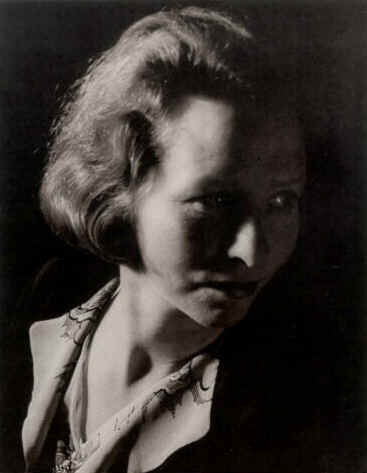
I love her sonnet, too, to Elinor Wylie, a person who also fascinates me (see my post on her here).
To Elinor Wylie
(In answer to a question about her)
Oh, she was beautiful in every part! --
The auburn hair that bound the subtle brain;
The lovely mouth cut clear by wit and pain,
Uttering oaths and nonsense, uttering art
In casual speech and curving at the smart
On startled ears of excellence too plain
For early morning! -- Obit. Death from strain;
The soaring mind outstripped the tethered heart.
Yet here was one who had no need to die
To be remembered. Every word she said,
The lively malice of the hazel eye
Scanning the thumb-nail close -- oh, dazzling dead,
How like a comet through the darkening sky
You raced! ... would your return were heralded.
When you read the details of her life, her aching lovelorn poems seem even more poignant. Not because she was a particularly poignant personality - as a matter of fact, it is the opposite. That's what, to me, is amazing. If you only read her poetry (and she's perfect for when you are lovelorn or nostalgic - the sonnets read like letters to the beloved) you would think she was the most sentimental person on the planet, with one great love she yearned for all her days. The fact that she was a bit of a ruthless harlot makes her romantic "persona" even more interesting, more deliberate, more an act of CONJURING than reflection of personal truth. Kudos. Her talent obviously expressed herself in the old forms, at that time in disfavor - rhyming couplets and rigid sonnets - but the amount of feeling she was able to get into each line, each verse, is incredible to me.
Millay's reputation is a solid one, although she no longer stands as a giant of 20th century poetry, as she did at the time when she was alive. Yet her lyrical romantic sonnets are still poems that people adore, even love ... and many of the greater more important poets don't have that. It's not good or bad, just a fact. She still can express the vagaries of love to our generation, in a more jaded time, with a high-flung cry of pain or ecstasy, that just works. It still sounds true.
Sonnet xxviii
I pray if you love me, bear my joy
A little while, or let me weep your tears;
I, too, have seen the quavering Fate destroy
Your destiny's bright spinning -- the dull shears
Meeting not neatly, chewing at the thread, --
Nor can you well be less aware how fine
How staunch as wire, and how unwarranted
Endures the golden fortune that is mine.
I pray you for this day at least, my dear,
Fare by my side, that journey in the sun;
Else must I turn me from the blossoming year
And walk in grief the way that you have gone.
Let us go forth together to the spring:
Love must be this, if it be anything.
Here are some quotes/anecdotes about Millay:
"In October 1934, Edna Millay read at Yale. A young graduate student, Richard Sewell, who forty years later would become the biographer of Emily Dickinson, never forgot the impression she made that night. Walking to the center of Woolsey Hall, wrapped in a long black velvet cloak, her bright hair shining, she "stood before us," he remembered, "like a daffodil." Looking at her wrist, she told the audience that the poems she was about to read were from her new book, Wine From These Grapes, "which is coming off the press just about now." That night she read with the zeal of a young Jeremiah, her words burning the air as she closed her reading with a sonnet from 'The Epitaph for the Race of Man'. Tickets for her readings were wildly sought whether she was in Oklahoma City or Chicago, where the hall seating 1,600 was sold out and even with standees an extra hall had to be taken for the overflow of another 800 who listened to her over amplifiers." -- Nancy Milford, "Savage Beauty"
"For instance, they had shades at their window and nothing else. I don't think they cared much. Well, once they stenciled apple blossoms, painted that pattern down the sides of the window. Or, for instance, they had a couple of plum trees in their backyard, and they never waited for the plums to ripen, but would pick them green, put them in vinegar, and call them 'mock olives.' Well, no one else did that sort of thing in Camden, don't you see?" -- Lena Dunbar, neighbor of the Millay family
"The poem seems to us to be phenomenal." -- Edward J. Wheeler, editor of "Current Literature", on Edna's poem 'The Land of Romance' - written when she was 14
"We have named the little one Edna Vincent Millay. Don't you think that is pretty? ... the Vincent is for the 'St. Vincent' Hospital, the one that cared so well for our darling brother. Nell woudl have called it 'Vincent' if it had been a boy." -- Cora Millay on the birth of her first daughter, on George Washington's birthday
"-- oh, this was life! It was more than life, -- it was art. I might pretend to myself [at home] as much and as long as I liked, -- until the deep-vibrant note I had discovered in my voice ... out-Hedda-ed Nazimova -- yet was my native village unthrilled and unconvinced; I was asked to serve ice-cream at church socials, and the grocer-boy called me by name ..." -- Edna St. Vincent Millay on her first job as an actress in a traveling stock company
"Boys don't like me anyway because I won't let them kiss me. It's just like this: let boys kiss you and they'll like you but you won't ... But I'd be almost willing to be engaged if I thought it would keep me from being lonesome ... if I was engaged I would be going to the play tonight instead of sitting humped up on the steps in a drizzle that keeps my pencil point sticky. I'd be going out paddling tomorrow instead of practicing the Beethoven Funeral March Sonata. And I'd like to have something to do besides write in an old book. I'd like to have something happen to give me a jolt, something that would rattle my teeth and shake my hairpins out." -- Edna St. Vincent Millay, in her journal, 1911
"The most astonishingly beautiful and original poem in The Lyric Year, the poem most arresting in its vision, the poem most like a wonderful Pre-Raphael painting, is surely Renascence by Miss Edna St. Vincent Millay. To me it almost unthinkable that a girl of twenty could conceive such a work and execute it with such vigor and tenderness ... And it is with no small pride that I give it my first vote for the prizes." -- Ferdinand Earle, 1912

Sonnet xv
Only until this cigarette is ended,
A little moment at the end of all,
While on the floor the quiet ashes fall,
And in the firelight to a lance extended,
Bizarrely with the jazzing music blended,
The broken shadow dances on the wall,
I will permit my memory to recall
The vision of you, by all my dreams attended.
And then adieu, -- farewell! -- the dream is done.
Yours is a face of which I can forget
The colour and the features, every one,
The words not ever, and the smiles not yet;
But in your day this moment is the sun
Upon a hill, after the sun has set.
Today in history, February 22, 1732
George Washington, first President of the United States, was born.

(All quotes from George Washington's letters below I got from my copy of the Library of America's compilation of his writings
Thomas Jefferson on George Washington:
The moderation and virtue of a single character probably prevented this Revolution from being closed, as most others have been, by a subversion of that liberty it was intended to establish.
In May, 1754, Washington wrote a letter home to his brother, after his first experience of battle in the French and Indian War:
I heard Bullets whistle and believe me there was something charming in the Sound.
In November, 1754, George Washington wrote:
My inclinations are strongly bent to arms.
GEORGE WASHINGTON, in a letter written to a friend in 1774
Does it not appear as clear as the sun in its meridian brightness that there is a regular, systematic plan to fix the right and practice of taxation upon us? Ought we not, then, to put our virtue and fortitude to the severest tests?
One of the things I love about Washington is that his progression to Revolutionary was gradual, and began with practical matters, like being taxed, and having his autonomy as a farmer taken away from him (the British regulated where he could buy parts, taxing him to death, etc.) His was not a high-flung "all men are created equal" mindset, like Thomas Jefferson's ... He began with the unfairness and humiliation of his status as someone who is being occupied and bossed around. It took all kinds to make that revolution. If we had just had Thomas Jefferson, we would have been in trouble. But we needed Thomas Jefferson to put the ideals into words, for the ages. But it was the mixture of personalities and mindsets that made it a success. Very important. John Adams countered Jefferson. Hamilton countered Washington and Jefferson. Ben Franklin gave it a glitter and notoriety. Madison was the brainiac lawyer. John Jay, Samuel Adams ... all with their area of expertise, their interests and passions. Thank God we had a good mix.
But Washington was the giant. A man who walked away from power even when it was offered to him? Had such a man ever lived before? George III didn't think so.
In 1755, Washington wrote a complaining letter to his friend Robert Dinwiddie:
We cannot conceive that because we are Americans, we shou'd therefore be deprived of the Benefits Common to British Subjects.
In 1758, Washington wrote a couple of letters to Sally Fairfax, a woman he was in love with - his first love - someone he never really recovered from (letters to her at the end of his life suggest that):
'Tis true, I profess myself a Votary to Love - I acknowledge that a Lady is in the Case - and further I confess that this Lady is known to you. - Yes Madam, as well as she is to one, who is too sensible of her Charms to deny the Power, whose Influence he feels and must ever Submit to. I feel the force of her amiable beauties in the recollection of a thousand tender passages that I coud wish to obliterate, till I am bid to revive them. - but experience alas! Sadly reminds me how Impossible this is. - and evinces an opinion which I have long entertained, that there is a Destiny, which has the Sovereign Controul of our Actions - not to be resisted by the Strongest efforts of Human Nature.The World has no business to know the object of my Love, declard in this manner to you - you when I want to conceal it - One thing, above all things in this World I wish to know, and only one person of your Acquaintance can solve me that, or guess my meaning. - but adieu to this, till happier times, if I shall ever see them ...
Excerpt from Joseph Ellis's His Excellency: George Washington
All of which is to suggest that Washington did not need to read books by radical Whig writers or receive an education in political theory from George Mason in order to regard the British military occupation of Massachusetts in 1774 as the latest installment in a long-standing pattern. His own ideological origins did not derive primarily from books but from his own experience with what he had come to regard as the imperiousness of the British Empire. Mason probably helped him to develop a more expansive vocabulary to express his thoughts and feelings, but the thoughts, and even more so the feelings, had been brewing inside him for more than twenty years. At the psychological nub of it all lay an utter loathing for any form of dependency, a sense of his own significance, and a deep distrust of any authority beyond his direct control.
Martha Washington wrote a letter to a relative on the eve of her husband's departure to the Convention in 1774:
I foresee consequences; dark days and darker nights; domestic happiness suspended; social enjoyments abandoned; property of every kind put in jeopardy by war, perhaps; neighbors and friends at variance, and eternal separations on earth possible. But what are all these evils when compared with the fate of which the Port Bill may be only a threat? My mind is made up; my heart is in the cause. George is right; he is always right. God has promised to protect the righteous, and I will trust him.

PATRICK HENRY, on his return home from the first Continental Congress in 1774 was asked whom he thought was the foremost man in the group:
"Colonel Washington is unquestionably the greatest man on that floor."
Abigail Adams first met Washington in 1774, and wrote to her husband:
You had prepared me to entertain a favorable opinion of him, but I thought the half was not told me. Dignity with ease and complacency, the gentleman and the soldier look agreeably blended in him. Modesty marks every line and feature of his face.
When George Washington was elected (unanimously) by the First Continental Congress to be Commander in Chief (this was in June, 1775) - here was the brief acceptance he made:
"Lest some unlucky event should happen unfavorable to my reputation, I beg it may be remembered by every gentleman in the room, that I this day declare, with the utmost sincerity, I do not think myself equal to the command."
In a 1775 letter to his brother-in-law, Burwell Bassett:
I am now Imbarked on a tempestuous Ocean from whence, perhaps, no friendly harbour is to be found ... It is an honour I wished to avoid ... I can answer but for three things, a firm belief of the justice of our Cause - close attention to the prosecution of it - and the strictest Integrity - If these cannot supply the places of Ability & Experience, the cause will suffer & more than probably my character along with it, as reputation derives its principal support from success.
GEORGE WASHINGTON, writing to Martha on June 18, 1775, following his nomination as commander in chief
My Dearest: I now sit down to write to you on a subject which fills me with inexpressible concern, and this concern is greatly aggravated and increased when I reflect upon the uneasiness I know it will give you. It has been determined in Congress that the whole army raised for the defence of the American cause shall be put under my care, and that it is necessary for me to proceed immediately to Boston to take upon me the command of it.You may believe me, my dear Patsy, when I assure you, in the most solemn manner, that, so far from seeking this appointment, I have used every endeavour in my power to avoid it, not only from my unwillingness to part with you and the family, but from a consciousness of its being a trust too great for my capacity, and that I should enjoy more real happiness in one month with you at home than I have the most distant prospect of finding abroad, if my stay were to be seven times seven years.
But as it has been a kind of destiny that has thrown me upon this service, I shall hope that my undertaking is designed to answer some good purpose.
George Washington describes here what a general expects in his aides:
The variegated and important duties of the aids of a commander in chief or the commander of a separate army require experienced officers, men of judgment and men of business, ready pens to execute them properly and with dispatch. A great deal more is required of them than attending him at a parade or delivering verbal orders here and there, or copying a written one. They ought, if I may be allowed to use the expression, to possess the Soul of the General, and from a single idea given to them, to convey his meaning in the clearest and fullest manner.
GEORGE WASHINGTON, letter to Joseph Reed, early December, 1775, after a disappointing recruiting drive
I have oftentimes thought how much happier I should have been if, instead of accepting the command under such circumstances, I had taken my musket on my shoulder and entered the ranks; or, if I could have justified the measure to posterity and my own conscience, had retired to the back country and lived in a wigwam. If I shall be able to rise superior to these and many other difficulties which might be enumerated, I shall most religiously believe that the finger of Providence is in it to blind the eyes of our enemies, for surely if we get well through this month it must be for want of their knowing the disadvantages which we labor under.
On August 1, 1777, Washington invited the newly arrived Marquis de Lafayette to witness a review of the troops. The American troops marched by, ragged, disheveled, shabby. Here is what the two men were reported to say to one another:
Washington: We are rather embarrassed to show ourselves to an officer who has just left the army of France.
Lafayette: I am here, sir, to learn and not to teach.

GEORGE WASHINGTON, on the self-sacrifice of his soldiers during the hard winter of 1777:
To see men without clothes to cover their nakedness, without blankets to lay on, without shoes, by which their marches might be traced by the blood from their feet, and almost as often without provisions as with; marching through frost and snow, and at Christmas taking up their winter quarters within a day's march of the enemy, without a house or hut to cover them till they could be built, and submitting to it without a murmur, is a mark of patience and obedience which in my opinion can scarce be paralleled.
In 1779, George Washington wrote:
Men are very apt to run into extremes; hatred to England may carry some into excessive Confidence in France ...; I am heartily disposed to entertain the most favourable sentiments of our new ally and to cherish them in others to a reasonable degree; but it is a maxim founded on the universal experience of mankind, that no nation is to be trusted farther than it is bound by its interest; and no prudent statesman or politician will venture to depart from it.
GEORGE WASHINGTON, letter of May 31, 1780, describing one of the things he was learning through the war - his frustration with Congress was constant, sometimes titanic rage (when he gets mad, boy, look out), other times just a nagging persistent annoyance.
Certain I am unless Congress speak in a more decisive tone, unless they are invested with powers by the several States competent to the great purposes of the war, or assume them as a matter of right, and they and the States respectively act with more energy than they hitherto have done, that our cause is lost. One State will comply with a requisition of Congress, another neglects to do it; a third executes it by halves; and all differ either in the manner, the matter, or so much in point of time, that we are always working up hill; and, while such a system as the present one or rather want of one prevails, we shall ever be unable to apply our strength or resources to any advantage.
Excerpt from Joseph Ellis's His Excellency: George Washington
One incident near the end of the war provides a clue to the transformation in his character wrought by the intense experience of serving so long as the singular embodiment of commitment to the cause. In 1781, Lund Washington reported that a British warship had anchored in the Potomac near Mount Vernon, presumably with orders to ravage Washington's estate. When the British captain offered assurances that he harbored no hostile intentions, Lund sent out a boatload of provisions to express his gratitude for the captain's admirable restraint. When Washington learned of this incident he berated Lund: "It would have been a less painful circumstance to me, to have heard, that in consequence of your non-compliance with their request, they had burnt my House, and laid the Plantation to ruins."
And here is a story - (perhaps it's a rumor - but I love it nonetheless) of Benjamin Franklin's response to the news of the surrender at Yorktown on October 19, 1781. He was, of course, in Paris at the time, setting the world on fire with his homespun wisdom, bacchanalian propensities, chess-playing abilities - and the vision he presented to the world of what liberty, American-style, looked like. An international celebrity.
Word came to France of the decisive American victory, and the complete surrender to George Washington in Yorktown. Franklin attended a diplomatic dinner shortly thereafter - and, of course, everyone was discussing the British defeat.
The French foreign minister stood, and toasted Louis XVI: "To his Majesty, Louis the Sixteenth, who, like the moon, fills the earth with a soft, benevolent glow."
The British ambassador rose and said, "To George the Third, who, like the sun at noonday, spreads his light and illumines the world."
Franklin rose and countered, "I cannot give you the sun or the moon, but I give you George Washington, General of the armies of the United States, who, like Joshua of old, commanded both the sun and the moon to stand still, and both obeyed."
Excerpt from Joseph Ellis's His Excellency: George Washington
After Yorktown, moreover, new life was breathed into these old fears, since Washington's insistence on maintaining the Continental army at full strength during a time when the majority of the citizenry believed, correctly it turned out, that the war was over only intensified fears that he intended to become the American Cromwell ... Such loose talk triggered the fear that the infant American republic was about to be murdered in its infancy by the same kind of military dictatorship that had destroyed the Roman and English republics in their formative phases. And since these were the only two significant efforts to establish republican governments in recorded history, the pattern did not bode well.Washington was fully aware of this pattern, and therefore recognized the need to make explicit statements of his intention to defy it. In May 1782 a young officer at the Newburgh encampment, Lewis Nicola, put in writing what many officers were whispering behind the scenes: that the Continental Congress's erratic conduct of the war had exposed the weakness of all republics and the certain disaster that would befall postwar America unless Washington declared himself king ... Washington responded with a stern lecture to "banish these thoughts from your Mind," and denounced the scheme as "big with the greatest mischiefs that can befall my Country." When word of Washington's response leaked out to the world, no less an expert on the subject than George III was heard to say that, if Washington resisted the monarchical mantle and retired, as he always said he would, he would be "the greatest man in the world".
While George III's judgment as a student of history has never met the highest standards, his opinion on this matter merits our attention, for it underlines the truly exceptional character of Washington's refusal to regard himself as the indispensable steward of the American Revolution. Oliver Cromwell had not surrendered power after the English Revolution. Napoleon, Lenin, Mao, and Castro did not step aside to leave their respective revolutionary settlements to others in subsequent centuries. We need to linger over this moment to ask what was different about Washington, or what was different about the political conditions created by the American Revolution, that allowed him to resist temptations that other revolutionary leaders before and since found irresistible.

GEORGE WASHINGTON, letter of (unwelcome) advice sent to governors of the 13 states, 1783, as the army began to disband.
Americans are now sole lords and proprietors of a vast tract of continent comprehending all the various soils and climates of the world and abounding with all the necessaries and conveniences of life - Heaven has crowned all other blessings, by giving a fairer opportunity for political happiness, than any other nation has been favored with - This is the time of their political probation; this is the moment when the eyes of the whole world are turned upon them; this is the moment to establish or ruin their national character forever; this is the favorable moment to give such a tone to our federal government as will enable it to answer the ends of its institution; or this may be the ill-fated moment for relaxing the powers of the Union, annihilating the cement of the Confederation and exposing us to become the sport of European politics, which may play one state against another, to prevent their growing importance and to serve their own interested purposes. For, according to the system of policy the states shall adopt at this moment, they will stand or fall; and by their confirmation or lapse it is yet to be decided whether the Revolution must ultimately be considered a blessing or a curse - a blessing or a curse, not to the present age alone, for with our fate will the destiny of unborn millions be involved.[He states that there are 4 requirements for the new America]
First. An indissoluble union of the states under one federal head. Secondly. A sacred regard to public justice (that is, the payment of debts). Thirdly. The adoption of a proper peace establishment (that is, an army and a navy). Fourthly. The prevalence of that pacific and friendly disposition among the people of the Union, which will influence them to forget their local prejudices and policies; to make those mutual concessions, which are requisite to the general prosperity; and, in some instances, to sacrifice their individual advantages to the interest of the community. These are the pillars on which the glorious future of our independency and national character must be supported.
Then there was the Newburgh Conspiracy, in March 1783, when a group of congressmen aligned with officers in the army threatened a military coup for various reasons. The new federal government was barely formed, there was no constitution yet - and the states were vying for powerful positions. It's important to remember just how tenuous all of this was at the time. It wasn't a smooth clear path full of Revolutionary-Era virtue and certainty, although there are bozos who claim that it was like that. They need to read their history books. Washington heard of the plot, and decided to address it headon. Now. One of the things I love about this story is that Washington - while he obviously said time and time again that he was uncomfortable with being a "symbol" (and I believe him) - he also realized that it was pointless to fight against it, and when he needed to USE that symbolic stature to get something done that he wanted, he had no problem with playing that card. This is a highly theatrical moment, described vividly by every person who was there, who left an account, and they all say the same thing. There wasn't a dry eye in the house. Perhaps it's my theatrical background, but I cannot believe that Washington was unaware of the effect he wanted to have, and that he did not USE that gesture described so vividly in a conscious manner. There is a way, you know, to be FALSE and TRUE at the same time. Any actor can tell you that. You are playing make-believe, you are pretending to be someone else - so that's the FALSE part - but your reactions and gestures all come from a very TRUE place, and many an actor will tell you that they feel MORE true when they are acting than when they are just out and about as a regular civilian. So that's my interpretation of Washington's big gesture here. It was certainly planned, and so that is FALSE ... but it was also organic and came from a true place. It was chosen for the EFFECT it would have. Washington was a celebrity. He knew that. He hated it. But he used it when convenient. Anyway, I'm going on and on but this is just one of my favorite moments of his life - I love its theatricality - and I also just wish I had been there. But so many people described the moment that I do feel like I can live it vicariously. Like Patrick Henry's "give me liberty or give me death" speech, where people record his gestures, his pantomime, the tenor of his voice. I have imagined myself there.
So Washington gets wind of this dangerous conspiracy, to basically take over, and undermine Washington's authority - not to mention the authority of the baby federal government.
Excerpt from Joseph Ellis's His Excellency: George Washington
For obvious reasons, the secret conversations within the officers' corps never found their way into the historical record, making all efforts to recover the shifting factions in the plot educated guesses at best. We can be sure that the crisis came to a head on March 11, when the dissident officers scheduled a meeting to coordinate their strategy. Washington countermanded the order for a meeting, saying only he could issue such an order, then scheduled a session for all officers on March 16.He spent the preceding day drafting, in his own hand, the most impressive speech he ever wrote. Beyond the verbal felicities and classic cadences, the speech established a direct link between his own honor and reputation and the abiding goals of the American Revolution. His central message was that any attempted coup by the army was simultaneously a repudiation of the principles for which they had all been fighting and an assault on his own integrity. Whereas Cromwell and later Napoleon made themselves synonymous with the revolution in order to justify the assumption of dictatorial power, Washington made himself synonymous with the American Revolution in order to declare that it was incompatible with dictatorial power.
On March 16, 1783, George Washington made the following speech to his group of officers:
Gentlemen: By an anonymous summons, an attempt has been made to convene you together; how inconsistent with the rules of propriety, how unmilitary, and how subversive of all order and discipline, let the good sense of the army decide...Thus much, gentlemen, I have thought it incumbent on me to observe to you, to show upon what principles I opposed the irregular and hasty meeting which was proposed to have been held on Tuesday last - and not because I wanted a disposition to give you every opportunity consistent with your own honor, and the dignity of the army, to make known your grievances. If my conduct heretofore has not evinced to you that I have been a faithful friend to the army, my declaration of it at this time would be equally unavailing and improper. But as I was among the first who embarked in the cause of our common country. As I have never left your side one moment, but when called from you on public duty. As I have been the constant companion and witness of your distresses, and not among the last to feel and acknowledge your merits. As I have ever considered my own military reputation as inseparably connected with that of the army. As my heart has ever expanded with joy, when I have heard its praises, and my indignation has arisen, when the mouth of detraction has been opened against it, it can scarcely be supposed, at this late stage of the war, that I am indifferent to its interests.
But how are they to be promoted? The way is plain, says the anonymous addresser. If war continues, remove into the unsettled country, there establish yourselves, and leave an ungrateful country to defend itself. But who are they to defend? Our wives, our children, our farms, and other property which we leave behind us. Or, in this state of hostile separation, are we to take the two first (the latter cannot be removed) to perish in a wilderness, with hunger, cold, and nakedness? If peace takes place, never sheathe your swords, says he, until you have obtained full and ample justice; this dreadful alternative, of either deserting our country in the extremest hour of her distress or turning our arms against it (which is the apparent object, unless Congress can be compelled into instant compliance), has something so shocking in it that humanity revolts at the idea. My God! What can this writer have in view, by recommending such measures? Can he be a friend to the army? Can he be a friend to this country? Rather, is he not an insidious foe? Some emissary, perhaps, from New York, plotting the ruin of both, by sowing the seeds of discord and separation between the civil and military powers of the continent? And what a compliment does he pay to our understandings when he recommends measures in either alternative, impracticable in their nature?
I cannot, in justice to my own belief, and what I have great reason to conceive is the intention of Congress, conclude this address, without giving it as my decided opinion, that that honorable body entertain exalted sentiments of the services of the army; and, from a full conviction of its merits and sufferings, will do it complete justice. That their endeavors to discover and establish funds for this purpose have been unwearied, and will not cease till they have succeeded, I have not a doubt. But, like all other large bodies, where there is a variety of different interests to reconcile, their deliberations are slow. Why, then, should we distrust them? And, in consequence of that distrust, adopt measures which may cast a shade over that glory which has been so justly acquired; and tarnish the reputation of an army which is celebrated through all Europe, for its fortitude and patriotism? And for what is this done? To bring the object we seek nearer? No! most certainly, in my opinion, it will cast it at a greater distance.
For myself (and I take no merit in giving the assurance, being induced to it from principles of gratitude, veracity, and justice), a grateful sense of the confidence you have ever placed in me, a recollection of the cheerful assistance and prompt obedience I have experienced from you, under every vicissitude of fortune, and the sincere affection I feel for an army I have so long had the honor to command will oblige me to declare, in this public and solemn manner, that, in the attainment of complete justice for all your toils and dangers, and in the gratification of every wish, so far as may be done consistently with the great duty I owe my country and those powers we are bound to respect, you may freely command my services to the utmost of my abilities.
While I give you these assurances, and pledge myself in the most unequivocal manner to exert whatever ability I am possessed of in your favor, let me entreat you, gentlemen, on your part, not to take any measures which, viewed in the calm light of reason, will lessen the dignity and sully the glory you have hitherto maintained; let me request you to rely on the plighted faith of your country, and place a full confidence in the purity of the intentions of Congress; that, previous to your dissolution as an army, they will cause all your accounts to be fairly liquidated, as directed in their resolutions, which were published to you two days ago, and that they will adopt the most effectual measures in their power to render ample justice to you, for your faithful and meritorious services. And let me conjure you, in the name of our common country, as you value your own sacred honor, as you respect the rights of humanity, and as you regard the military and national character of America, to express your utmost horror and detestation of the man who wishes, under any specious pretenses, to overturn the liberties of our country, and who wickedly attempts to open the floodgates of civil discord and deluge our rising empire in blood.
By thus determining and thus acting, you will pursue the plain and direct road to the attainment of your wishes. You will defeat the insidious designs of our enemies, who are compelled to resort from open force to secret artifice. You will give one more distinguished proof of unexampled patriotism and patient virtue, rising superior to the pressure of the most complicated sufferings. And you will, by the dignity of your conduct, afford occasion for posterity to say, when speaking of the glorious example you have exhibited to mankind, "Had this day been wanting, the world had never seen the last stage of perfection to which human nature is capable of attaining."
I hope you made it through that whole thing. It is rather extraordinary. BUT the most extraordinary thing is the "improvised" moment that came directly BEFORE he made that speech. It was the GESTURE that ended the coup, not his words. Or perhaps a mixture of both. But never ever underestimate the power of gesture.
Here is Joseph Ellis again on the moment in question:
Washington has just entered the New Building at Newburgh, a large auditorium recently built by the troops and also called The Temple. About 500 officers are present in the audience. Horatio Gates is chairing the meeting, a rich irony since Gates is most probably complicitous in the plot to stage a military coup that Washington has come to quash. Everything has been scripted and orchestrated beforehand. Washington's aides fan out into the audience to prompt applause for the general's most crucial lines. Washington walks slowly to the podium and reaches inside his jacket to pull out his prepared remarks. Then he pauses - the gesture is almost certainly planned - and pulls from his waistcoat a pair of spectacles recently sent to him by David Rittenhouse, the Philadelphia scientist. No one has ever seen Washington wear spectacles before on public occasions. He looks out to his assembled officers while adjusting the new glasses and says: "Gentlemen, you will permit me to put on my spectacles, for I have not only grown gray, but almost blind in the service of my country." Several officers began to sob. The speech itself is anti-climactic. All thoughts of a military coup die at that moment.
On November 25, 1783: George Washington "took back" New York.
The peace treaty had been signed a year before, France had pledged support and recognition of the new United States, but the redcoats remained in New York, waiting for their written orders from London. George Washington vowed that he would not go home, he would not break up his army, until every last redcoat had left.
Nov. 25 was that momentous day - the day the American troops marched back into town, after the departure of the British.
The exhausted army marched the long way downtown, through what was now a war-ravaged New York City. People lined the streets, throwing laurels in front of Washington's horse, screaming, crying ... a huge display of emotion and reverence that made the typically humble Washington feel uncomfortable.
A woman in the crowd that day wrote the following in her diary:
We had been accustomed for a long time to military display in all the finish and finery of [British] garrison life. The troops just leaving us were as if equipped for a show and with their scarlet uniforms and burnished arms made a brilliant display. The troops that marched in, on the contrary, were ill-clad and weather-beaten and made a forlorn appearance. But then, they were our troops and as I looked at them and thought upon all they had done and suffered for us, my heart and my eyes were full.
GEORGE WASHINGTON'S MOTHER to Lafayette, 1784:
"I am not surprised at what George has done, for he was always a good boy."
George Washington wrote the following on the eve of his inauguration in 1789:
It is said that every man has his portion of ambition. I may have mine, I suppose, as well as the rest, but if I know my own heart, my ambition would not lead me into public life; my only ambition is to do my duty in this world as well as I am capable of performing it, and to merit the good opinion of all good men.
 Washington's first inaugural address
David McCullough describes, in his book on John Adams
On the day of his inauguration, Thursday, April 30 1789, Washington rode to Federal Hall in a canary-yellow carriage pulled by six white horses and followed by a long column of New York militia in full dress. The air was sharp, the sun shone brightly, and with all work stopped in the city, the crowds along his route were the largest ever seen. It was as if all New York had turned out and more besides. "Many persons in the crowd," reported the Gazette of the United States "were heard to say they should now die contented - nothing being wanted to complete their happiness - but the sight of the savior of his country."In the Senate Chamber were gathered the members of both houses of Congress, the Vice President, and sundry officials and diplomatic agents, all of whom rose when Washington made his entrance, looking solemn and stately. His hair powdered, he wore a dress sword, white silk stockings, shoes with silver buckles, and a suit of the same brown Hartford broadcloth that Adams, too, was wearing for the occasion. They might have been dressed as twins, except that Washington's metal buttons had eagles on them.
It was Adams who formally welcomed the General and escorted him to the dais. For an awkward moment Adams appeared to be in some difficulty, as though he had forgotten what he was supposed to say. then, addressing Washington, he declared that the Senate and House of Representatives were ready to attend him for the oath of office as required by the Constitution. Washington said he was ready. Adams bowed and led the way to the outer balcony, in full view of the throng in the streets. People were cheering and waving from below, and from windows and rooftops as far as the eye could see. Washington bowed once, then a second time.
Fourteen years earlier, it had been Adams who called on the Continental Congress to make the tall Virginian commander-in-chief of the army. Now he stood at Washington's side as Washington, his right hand on the Bible, repeated the oath of office as read by Chancellor Robert R. Livingston of New York, who had also been a member of the Continental Congress.
In a low voice Washington solemnly swore to execute the office of the President of the United States and, to the best of his ability, to "preserve, protect, and defend the Constitution of the United States." Then, as not specified in the Constitution, he added, "So help me God", and kissed the Bible, thereby establishing his own first presidential tradition.
"It is done," Livingston said, and, turning to the crowd, cried out, "Long live George Washington, President of the United States."
George Washington said:
Men may speculate as they will, they may talk of patriotism; they may draw a few examples from current story - but whoever builds upon it as a sufficient basis for conducting a long and bloody war will find themselves deceived in the end - For a long time it may of itself push men to action, to bear much, to encounter difficulties, but it will not endure unassisted by Interest.
On August 17, 1790, George Washington visited Newport Rhode Island - and visited the Jewish congregation of the Touro Synagogue (which still stands - gorgeous building. We went on a field trip there in grade school). The congregation presented an address to George Washington, welcoming him to Newport, and to their synagogue. A couple of days later George Washington wrote an eloquent response. Both the address as well as Washington's response were printed in all of the "national" newspapers at the time.
August 21st, 1790
To the Hebrew Congregation in Newport Rhode Island.Gentleman.
While I receive, with much satisfaction, your Address replete with expressions of affection and esteem; I rejoice in the opportunity of assuring you, that I shall always retain a grateful remembrance of the cordial welcome I experienced in my visit to Newport, from all classes of Citizens.
The reflection on the days of difficulty and danger which are past is rendered the more sweet, from a consciousness that they are succeeded by days of uncommon prosperity and security. If we have wisdom to make the best use of the advantages with which we are now favored, we cannot fail, under the just administration of a good Government, to become a great and happy people.
The Citizens of the United States of America have a right to applaud themselves for having given to mankind examples of an enlarged and liberal policy: a policy worthy of imitation.
All possess alike liberty of conscience and immunities of citizenship. It is now no more that toleration is spoken of, as if it was by the indulgence of one class of people, that another enjoyed the exercise of their inherent natural rights. For happily the Government of the United States, which gives to bigotry no sanction, to persecution no assistance, requires only that they who live under its protection should demean themselves as good citizens, in giving it on all occasions their effectual support.
It would be inconsistent with the frankness of my character not to avow that I am pleased with your favorable opinion of my Administration, and fervent wishes for my felicity. May the children of the Stock of Abraham, who dwell in this land, continue to merit and enjoy the good will of the other Inhabitants; while every one shall sit in safety under his own vine and figtree, and there shall be none to make him afraid. May the father of all mercies scatter light and not darkness in our paths, and make us all in our several vocations useful here, and in his own due time and way everlastingly happy.
G. Washington
He expresses there my own issues with the concept of "tolerance", with his "It is now no more that toleration is spoken of, as if it was by the indulgence of one class of people, that another enjoyed the exercise of their inherent natural rights." Mitchell and I have bitched about that very thing before, only in not so beautiful language. Don't condescend to TOLERATE me. Don't "indulge" me, from your height of belonging, because that means that it is only by YOUR grace that I am tolerated. I don't care if you TOLERATE me or not, it makes no difference to me your opinion of my character and my lifestyle. I am protected by the laws of the land, and as long as I abide by those laws, then it doesn't matter in the slightest what you think of me. Good for you, George, for putting that into words. The Jewish people, as long as they were good citizens, had nothing to fear. It was not up to one group of people to decide to 'tolerate' them or not. They were citizens of the land, and therefore protected.
This is why John Adams said he wanted the new nation to be a nation "of laws, not men." Because men are fickle and subject to emotion and temptation. They may "tolerate" you one day and hate you the next. As long as we are a nation "of laws, not men" ... then that will not matter. Yes, there will be growth pains, as we saw in the suffragette movement, the civil rights movement, and as we continue to see in the gay / lesbian / transgender movement. Nothing is perfect. Thank God. Perfection means stasis, a perfect way to describe a totalitarian top-down state. We are not that. We are ruled by "laws, not men", so the Jewish synagogue in Newport was protected by the law, regardless of the anti-Semitism they may have faced around them.
Now I will wait for someone to pipe up "but Washington had slaves!"
Yes. He had slaves. You know why? Because he was a man of HIS time, not our own. It was a grave sin on the society at the time, and many - including Washington - were tormented by the contradiction. It was so interwoven with their own prosperity that many could not see a way out of it. But to discount everything he said because he happened to live THEN not NOW, and was therefore subject to the prejudices of his time, is ridiculous. It's also a shame. Because if you take that view - then you cut yourself off from the wisdom of the ages.

From Joseph Ellis' book Founding Brothers: The Revolutionary Generation
First, it is crucial to recognize that Washington's extraordinary reputation rested less on his prudent exercise of power than on his dramatic flair at surrendering it. He was, in fact, a veritable virtuoso of exits. Almost everyone regarded his retirement of 1796 as a repeat performance of his resignation as commander of the Continental Army in 1783. Back then, faced with a restive and unpaid remnant of the victorious army quartered in Newburgh, New York, he had suddenly appeared at a meeting of officers who were contemplating insurrection; the murky plot involved marching on the Congress and then seizing a tract of land for themselves in the West, all presumably with Washington as their leader.He summarily rejected their offer to become the American Caesar and denounced the entire scheme as treason to the cause for which they had fought. Then, in a melodramatic gesture that immediately became famous, he pulled a pair of glasses out of his pocket: "Gentlemen, you will permit me to put on my spectacles," he declared rhetorically, "for I have not only grown gray but almost blind in service to my country." Upon learning that Washington intended to reject the mantle of emperor, no less an authority than George III allegedly observed, "If he does that, he will be the greatest man in the world." True to his word, on December 22, 1783, Washington surrendered his commission to the Congress, then meeting in Annapolis: "Having now finished the work assigned me," he announced, "I now retire from the great theatre of action." In so doing, he became the supreme example of the leader who could be trusted with power because he was so ready to give it up.
Excerpt from Joseph Ellis's His Excellency: George Washington
The last days were spent hosting dinners and dances in his honor. The ceremonials culminated with the [John] Adams inauguration, where, somewhat to Adams's irritation, more attention was paid to the outgoing than incoming president. Adams reported to Abigail that he thought he heard Washington murmuring under his breath at the end of the ceremony: "Ay! I am fairly out and you are fairly in! See which of us will be the happiest." But the story is probably apocryphal. Washington's diary entry for the day was typically flat and unrevealing: "Much such a day as yesterday in all respects. Mercury at 41." The public man was already receding into the proverbial mists. The private man could not wait to get those new dentures and place himself beneath those vines and fig trees.
Washington said, at one point, to the doctor, during his final illness in 1799:
"Doctor, I die hard, but I am not afraid to go."
 Washington on his death bed
George Washington's last words:
"I feel myself going. I thank you for your attentions; but I pray you to take no more trouble about me. Let me go off quietly. I cannot last long."
Henry Lee said, in eulogy:
First in war, first in peace, and first in the hearts of his countrymen.
Mark Twain wrote in 1871:
I have a higher and greater standard of principle [than George Washington]. Washington could not lie. I can lie but I won't.
Gouverneur Morris said, upon the death of George Washington:
It is a question, previous to the first meeting, what course shall be pursued. Men of decided temper, who, devoted to the public, overlooked prudential considerations, thought a form of government should be framed entirely new. But cautious men, with whom popularity was an object, deemed it fit to consult and comply with the wishes of the people. AMERICANS! -- let the opinion then delivered by the greatest and best of men, be ever present to your remembrance. He was collected within himself. His countenance had more than usual solemnity -- His eye was fixed, and seemed to look into futurity. 'It is (said he)too probable that no plan we propose will be adopted. Perhaps another dreadful conflict is to be sustained. If to please the people, we offer what we ourselves disapprove, how can we afterwards defend our work? Let us raise a standard to which the wise and the honest can repair. The event is in the hand of God.'--this was the patriot voice of WASHINGTON; and this the constant tenor of his conduct.
My father said, in regards to Washington being our first President:
"We were so lucky."
And below, a video in praise of "George Washington's awesome-ness": Did you know he weighed "a fucking ton"? Well, he did.
On that note, happy birthday, Mr. Washington!
February 21, 2010
Today in history, February 21, 1907
W.H. Auden was born in York, England.
Two pieces of advice for writers from Mr. Auden:
To keep his errors down to a minimum, the internal Censor to whom a poet submits his work in progress should be a Censorate. It should include, for instance, a sensitive only child, a practical housewife, a logician, a monk, an irreverent buffoon and even, perhaps, hated by all the others and returning their dislike, a brutal foul-mouthed drill sergeant who considers all poetry rubbish.
Then there is:
Never write from your head; write from your cock.
While that second piece may not, in an anatomical way, apply to me, I still take it as very good advice.

There are only two other poets I can think of who take up as much brain-space for me as Auden, in terms of reference-points, who help me figure out how to say things, and those are Yeats and Shakespeare. I'll be in some situation and suddenly I'll remember Auden's words "let the healing fountains start ..." (which is from his poem, coincidentally, on Yeats) Or I'll be troubled and remind myself that I need to try to love my crooked neighbor with my crooked heart. I know I'm crooked. We all are. But we must love anyway. Or try to. I find Auden himself to be a "healing fountain". There is something transcendent about his work for me. It lifts me up into my better self, a place where it is possible to be good, and loving, and forgiving.
Auden wasn't an idiotic optimist, however, and he did a lot of revising of his work over the years - he was a compulsive reviser - so a lot of his stuff has multiple dates on it. It wasn't just language he revised, it was thought and philosophy. If he outgrew a certain view, he would go back and tinker with the poems that expressed said view. One of the most fascinating examples of his revisions shows that he was willing to go back and revise something, a philosophical statement, that he no longer felt was true. He couldn't let it stand. In his chilling poem "September 1, 1939", written about Germany's invasion of Poland, there is a line "We must love one another or die". An extraordinary sentiment, especially at that brutal terrifying time.
September 1, 2939
I sit in one of the dives
On Fifty-second Street
Uncertain and afraid
As the clever hopes expire
Of a low dishonest decade:
Waves of anger and fear
Circulate over the bright
And darkened lands of the earth,
Obsessing our private lives;
The unmentionable odour of death
Offends the September night.
Accurate scholarship can
Unearth the whole offence
From Luther until now
That has driven a culture mad,
Find what occurred at Linz,
What huge imago made
A psychopathic god:
I and the public know
What all schoolchildren learn,
Those to whom evil is done
Do evil in return.
Exiled Thucydides knew
All that a speech can say
About Democracy,
And what dictators do,
The elderly rubbish they talk
To an apathetic grave;
Analysed all in his book,
The enlightenment driven away,
The habit-forming pain,
Mismanagement and grief:
We must suffer them all again.
Into this neutral air
Where blind skyscrapers use
Their full height to proclaim
The strength of Collective Man,
Each language pours its vain
Competitive excuse:
But who can live for long
In an euphoric dream;
Out of the mirror they stare,
Imperialism's face
And the international wrong.
Faces along the bar
Cling to their average day:
The lights must never go out,
The music must always play,
All the conventions conspire
To make this fort assume
The furniture of home;
Lest we should see where we are,
Lost in a haunted wood,
Children afraid of the night
Who have never been happy or good.
The windiest militant trash
Important Persons shout
Is not so crude as our wish:
What mad Nijinsky wrote
About Diaghilev
Is true of the normal heart;
For the error bred in the bone
Of each woman and each man
Craves what it cannot have,
Not universal love
But to be loved alone.
From the conservative dark
Into the ethical life
The dense commuters come,
Repeating their morning vow;
'I will be true to the wife,
I'll concentrate more on my work,'
And helpless governors wake
To resume their compulsory game:
Who can release them now,
Who can reach the dead,
Who can speak for the dumb?
All I have is a voice
To undo the folded lie,
The romantic lie in the brain
Of the sensual man-in-the-street
And the lie of Authority
Whose buildings grope the sky:
There is no such thing as the State
And no one exists alone;
Hunger allows no choice
To the citizen or the police;
We must love one another or die.
Defenseless under the night
Our world in stupor lies;
Yet, dotted everywhere,
Ironic points of light
Flash out wherever the Just
Exchange their messages:
May I, composed like them
Of Eros and of dust,
Beleaguered by the same
Negation and despair,
Show an affirming flame.
The poem was published, and Auden immediately saw all sorts of problems with it, having to do with its rhetoric and tone, but it all encapsulated for him in that line. He said he read its published version and:
...said to myself: 'That's a damned lie! We must die anyway.' So, in the next edition, I altered it to 'We must love one another and die.' This didn't seem to do either, so I cut the stanza. Still no good. The whole poem, I realized, was infected with an incurable dishonesty—and must be scrapped.
He didn't include it in his own canon (more on that line below), he was that ruthless in his own work. The work felt dishonest to him. He didn't like how it was being used. And that one chilling substitution - of "or" to "and" - didn't help. You can see the entire tenor of the times in his revision, can't you? You could write an entire book on the difference between the two statements, and how "and" changes everything. Regardless, the poem survived - and it is included in his Collected Work, and over the space of time it has regained currency, especially in times of war and fear and hatred. It speaks to those universal experiences.
Then, of course, he has written two lines which - as difficult as they are - are words I actually try to live by. "If equal affection cannot be / Let the more loving one be me." This is a phrase that comes up in my head, what, once, twice a day? It is complicated now, by my insistence on reciprocity, and I wonder if I have lived by his words too much? But that's the thing with such words: you kind of can't do them half way. You can't say, "Oh, wow, what a nice sentiment" and then not try to live by them. At least I haven't been able to. They sound a gong in the depths of me ... that this is the way it SHOULD be. That this is how I SHOULD try to live. I stand by that. I rarely throw out the baby with the bathwater. I try to integrate, and much of Auden's work - with its complex messaging (his religion, his sexuality, his politics - and how those things grew and morphed) - is all about integration. It is why it is so precious to me, why he comes up for me again and again. I feel like he is MINE. In terms of that poem "The More Loving One" (which I would recite to myself, in bed, in the weeks following September 11th, along with the Hail Mary - my two talismans against fear, and the choking smoke billowing up from lower Manhattan) I have a hard time picking a favorite anything - but if I had to choose to re-read only one poem for the rest of my life, it would be "The More Loving One".
The More Loving One
Looking up at the stars, I know quite well
That, for all they care, I can go to hell,
But on earth indifference is the least
We have to dread from man or beast.
How should we like it were stars to burn
With a passion for us we could not return?
If equal affection cannot be,
Let the more loving one be me.
Admirer as I think I am
Of stars that do not give a damn,
I cannot, now I see them, say
I missed one terribly all day.
Were all stars to disappear or die,
I should learn to look at an empty sky
And feel its total dark sublime,
Though this might take me a little time.
I can honestly say that that poem has helped me in living my life. Even when (or especially when) I take issue with this or that line. It is the "taking issue with" that makes it a great poem. Find the "total dark sublime", Auden? Are you out of your mind? NO. I REFUSE. But then comes the great and painful last line of admission: "Though this might take me a little time." If it weren't for that last line, Auden would be just another sentimental optimist. Make lemonade out of lemons! some do-gooder nonentity shouts at someone who has just experienced a catastrophe. My response to that is usually, "Sure - I'll do my best - but can you GIVE ME A MINUTE? Can you just admit that this won't happen IMMEDIATELY?" Auden knows this. That last line admits the pain and beauty of human experience, even in tragedy. It is a miracle. That we can keep going on, even though there are no more stars left in the sky. It is awful. It is what we do. We have no choice. But don't ask me to call it "sublime" immediately. Give me "a little time", thanks.
I need to leave Shakespeare out of this discussion (although probably Auden would want him included
What can I say. Auden is in my brain. When I find myself in times of trouble Mother Mary comes to me, and so does Auden.
If I look back, I believe that I first encountered Auden (at least, my first MEMORY of it) was in my "Humanities" class, senior year in high school. Or it might have been my junior year? It was a great class, I got a lot out of it, and I remember we analyzed an Auden poem ("Musée des Beaux Arts"), alongside the Breughel painting it was based on - The Fall of Icarus.

Musée des Beaux Arts
About suffering they were never wrong,
The Old Masters; how well, they understood
Its human position; how it takes place
While someone else is eating or opening a window or just walking dully along;
How, when the aged are reverently, passionately waiting
For the miraculous birth, there always must be
Children who did not specially want it to happen, skating
On a pond at the edge of the wood:
They never forgot
That even the dreadful martyrdom must run its course
Anyhow in a corner, some untidy spot
Where the dogs go on with their doggy life and the torturer's horse
Scratches its innocent behind on a tree.
In Breughel's Icarus, for instance: how everything turns away
Quite leisurely from the disaster; the ploughman may
Have heard the splash, the forsaken cry,
But for him it was not an important failure; the sun shone
As it had to on the white legs disappearing into the green
Water; and the expensive delicate ship that must have seen
Something amazing, a boy falling out of the sky,
had somewhere to get to and sailed calmly on.
See the little up-ended legs in the water over to the right? I remember, in my vaguely OCD way at the time, loving making that connection - reading the poem, looking at the painting, going back to the poem - trying to see every single thing that this Auden chap saw in the poem. Of course there's way more to the poem than that (the first line that spills over into the second line? Perfection) - and its observations about the meaningless of human suffering, and our indifference to one another (something that Auden comes back to again and again in his poems.)
It was later, when I was an adult, that I went back to Auden's work to re-discover it, on my own terms.
The wonderful Clive James said about Auden (and this is really interesting):
The need to find an expression for his homosexuality was the first technical obstacle to check the torrential course of Auden's unprecedented facility. A born master of directness was obliged straightaway to find a language for indirection, thus becoming immediately involved with the drama that was to continue for the rest of his life - a drama in which the living presence of technique is the antagonist.
There is sometimes an almost unbearable tension in Auden's best poems. It seems to be that he is expressing everything, but you ache to hear more, you wonder what else this amazing voice has to say. Like most great artists, what he withholds is almost just as interesting as what he reveals.
Michael Schmidt wrote, "He overshadows the poets of his generation." In the same way that Shakespeare overshadows the other playwrights and poets of his current day. You have to kind of get Auden out of the way to see what else was going on in the literary world And there was a lot going on!!
Auden straddles the 20th century as a sort of bridge. He read The Waste Land and suddenly realized what he wanted to do, what poetry COULD do. It helped him enormously, it gave him courage to let go of old-fashioned forms. Yet at the same time, his great and well-known love for Thomas Hardy suggests that he was also a traditionalist. He went back, back to the 19th century, for his inspiration as well (although I am probably generalizing).
He understands terror and despair. He lived in "interesting times", and was responsive to them in his work. Many poets were undone by WWI and WWII. The horror took away their voices. Auden was just the opposite.
Edward Mendelson, who edited the selected works of Auden
"Then, in June 1933, Auden experienced what he later called a 'Vision of Agape'. He was sitting on a lawn with three colleagues from the school where he was teaching, when, he wrote, 'quite suddenly and unexpectedly, something happened. I felt myself invaded by a power which, though I consented to it, was irresistible and certainly not mine. For the first time in my life I knew exactly - because, thanks to the power, I was doing it - what it meant to love one's neighbor as oneself.' Before this, his poems had only been able to celebrate moments of impersonal erotic intensity, which he called 'love'. Now, in the poem 'Out on the lawn I lie in bed,' prompted by his vision, he had praise for everything around him."
A Summer Night
A Summer Night
Out on the lawn I lie in bed,
Vega conspicuous overhead
In the windless nights of June,
As congregated leaves complete
Their day's activity; my feet
Point to the rising moon.
Lucky, this point in time and space
Is chosen as my working-place,
Where the sexy airs of summer,
The bathing hours and the bare arms,
The leisured drives through a land of farms
Are good to a newcomer.
Equal with colleagues in a ring
I sit on each calm evening
Enchanted as the flowers
The opening light draws out of hiding
With all its gradual dove-like pleading,
Its logic and its powers:
That later we, though parted then,
May still recall these evenings when
Fear gave his watch no look;
The lion griefs loped from the shade
And on our knees their muzzles laid,
And Death put down his book.
Now north and south and east and west
Those I love lie down to rest;
The moon looks on them all,
The healers and the brilliant talkers,
The eccentrics and the silent walkers,
The dumpy and the tall.
She climbs the European sky,
Churches and power stations lie
Alike among earth's fixtures:
Into the galleries she peers
And blankly as a butcher stares
Upon the marvelous pictures.
To gravity attentive, she
Can notice nothing here, though we
Whom hunger does not move,
From gardens where we feel secure
Look up and with a sigh endure
The tyrannies of love:
And, gentle, do not care to know,
Where Poland draws her eastern bow,
What violence is done,
Nor ask what doubtful act allows
Our freedom in this English house,
Our picnics in the sun.
Soon, soon, through the dykes of our content
The crumpling flood will force a rent
And, taller than a tree,
Hold sudden death before our eyes
Whose river dreams long hid the size
And vigours of the sea.
But when the waters make retreat
And through the black mud first the wheat
In shy green stalks appears,
When stranded monsters gasping lie,
And sounds of riveting terrify
Their whorled unsubtle ears,
May these delights we dread to lose,
This privacy, need no excuse
But to that strength belong,
As through a child's rash happy cries
The drowned parental voices rise
In unlamenting song.
After discharges of alarm
All unpredicted let them calm
The pulse of nervous nations,
Forgive the murderer in the glass,
Tough in their patience to surpass
The tigress her swift motions.
I think of this poem as the "vision of agape" poem, even though that is not its title. There are too many good lines to even count. "Lion griefs"? I don't even know what that MEANS, but I certainly like to think about it, and picture it, and I wish I could write like that. "When stranded monsters gasping lie ..." Marvelous, scary. Whatever he might think of Yeats, Yeats' "slouching beast" is in that line. This poem was the first moment Auden felt he really "broke through" in his work, and you can feel the difference in his poems forever afterwards. Before "vision of agape" he was one type of poet, after "vision of agape" he was another. He had been able to see the universal.
My mother saw Auden read at her college, (or maybe it was at the nearby Yale?) when she was a student. His readings were always packed, the most prized ticket in town. 20 years before that, he gave a famous series of lectures on Shakespeare at the New School for Social Research (where I went to grad school), and created a frenzy. These were not tape recorded (if memory serves), but a guy who was there took copious notes, basically writing down, in shorthand, everything Auden said. Those notes were compiled into a book, which I will forever be grateful for. Anyone interested in Shakespeare really MUST read Auden's lectures - they dig deep into the language of the plays, and the dramaturgy, not to mention plot-points and analysis - and is indispensable reading.
Here is a fascinating excerpt from W.H. Auden's lecture on Hamlet, February 12, 1947, at the New School for Social Research in NYC - I read this, and it just sends reverberations ricocheting through my head. He gets at something essential here, I believe, that indefinable "IT" which lies at the heart of Hamlet. You can see why people spend their entire lives and careers studying only that one play. If you read it aloud, start to finish, no cuts, it is almost four hours long. It is Shakespeare's longest play. But what, ultimately, is it saying? It cannot be pinned down, it shifts - depending on how YOU look at it (similar to the particle/wave thing in quantum physics). If you want to see it one way, then it IS that way. If you want to see it another way, then lo and behold, the play cooperates. A shape-shifter. Anyway, here's Auden:
If a work is quite perfect, it arouses less controversy and there is less to say about it. Curiously, everyone tries to identify with Hamlet, even actresses - and in fact Sarah Bernhardt did play Hamlet, and I am glad to say she broke her leg doing it. One says that one is like a character, but one does not say, "This is me." One says, "I am more like Claudius, perhaps, than I am like Laertes," o "I would rather be Benedick than Orsino." But when a reader or spectator is inclined to say, "This is me," it becomes slightly suspicious. It is suspicious when all sorts of actors say, "This is a part I would like to do," not "This is a part I have a talent to do." I would question whether anyone has succeeded in playing Hamlet without appearing ridiculous. Hamlet is a tragedy where there is a part left open, as a part is left open for an improvisational actor in farce. But here the part is left open for a tragedian.Shakespeare took a great deal of time over this play. With a writer of Shakespeare's certainty of execution, a delay of this kind is a sign of some dissatisfaction. He has not got the thing he wants. T.S. Eliot has called the play "an artistic failure". Hamlet, the one inactive character, is not well integrated into the play and not adequately motivated, though the active characters are excellent. Polonious is a pseudo-practical dispenser of advice, who is a kind of voyeur where the sex life of his children is concerned. Laertes likes to be a dashing man-of-the-world who visits all houses - but don't you touch my sister! And he is jealous of Hamlet's intellect. Rosencrantz and Guildenstern are yes men. Gertrude is portrayed as a woman who likes to be loved, who likes to have romance in her life. And Horatio is not too bright, though he has read a lot and can repeat it.
The plays of the period in which Shakespeare wrote Hamlet have great richness, but one is not sure that at this point he even wants to be a dramatist. Hamlet offers strong evidence of this indecision, becaue it indicates what Shakespeare might have done if he had had an absolutely free hand: he might well have confined himself to dramatic monologues. The soliloquies in Hamlet as well as other plays of this period are detachable both from the character and the plays. In earlier as well as later works they are more integrated. The "To be or not to be" soliloquy in Hamlet (III.i.56-90) is a clear example of a speech that can be separated from both the character and the play, as are the speeches of Ulysses on time in Troilus and Cressida (III.iii.145-80), the King on honor in All's Well That Ends Well (II.iii.124-48), and the Duke on death in Measure for Measure (III.i.5-41).
Shakespeare, at this time, is interested in various technical problems. The first is the relation between prose and verse in the plays. In the early plays, the low or comic characters - Shylock as well as Launcelot Gobbo in The Merchant of Venice, for example - speak prose. An intellectual character like Falstaff speaks prose, in contrast to a passionate character like Hotspur, who speaks verse. In As You Like It, contrary to tradition, both the hero and heroine speak prose. In Twelfth Night, Viola speaks verse at court and prose to herself, and the characters in the play who are false or have no sense of humor speak verse. Those who are wiser and have some self-knowledge speak prose. In the tragedies Shakespeare develops an extremely fertile prose style for the tragic characters. Hamlet speaks both verse and prose. He speaks verse to himself, in his soliloquies, and in speeches of violent passion to others, as in the scene with his mother. He otherwise usually speaks prose to other people. There is a highly developed relation to prose and poetry in all the plays of this period. In the last plays Shakespeare exploits verse more exclusively, and tends to use prose when he is bored, or when he needs to fill in the gaps. In Antony and Cleopatra, the boring characters use prose, the rounded characters, verse.
Shakespeare is also developing a more flexible verse. He started off with the end-stopped Marlovian and lyric lines that were suitable to high passion. In Hamlet he experiments with the caesura, the stop in the middle of the line, to develop a middle voice, a voice neither passionate nor prosaic. Hamlet also shows a development in Shakespeare's use of the double adjective. From such a phrase as "sweet and honey'd sentences" in Henry V (I.i.50), which is tautological, he moves to pairs of adjectives in Hamlet that combine the abstract and the concrete: Laertes' "And keep you in the rear of your affection / Out of the shot and danger of desire" (I.iii.34-35), for example, Horatio's "These are but wild and whirling words, my lord" (I.v.133), and Hamlet's "Led by a delicate and tender prince" (IV.iv.48). George Ryland's book, Words and Poetry, is very good on Shakespeare's language and style.
In this period, also, Shakespeare appears to be tired of writing comedy, which he could do almost too well - he was probably bored because of his facility in the genre. Comedy is limited in the violence of language and emotion it can present, although Shakespeare can include a remarkable amount of both in his comedies. But though he wants to get away from comedy, he doesn't want to go back to the crude rhetoric of King John and Richard III or to the lyric and romantic rhetoric of Romeo and Juliet and Richard II. He doesn't want a childish character, who doesn't know what is going on, like Romeo and Richard II, nor a crude character like Brutus, who is a puppet in a plot of historical significance, where the incidents are more important than the characters. Finally, he doesn't want a character of fat humour that the situation must be constructed to reveal. And having done Falstaff, he doesn't want to go back to the crude character.
Shakespeare's very success as a dramatic poet may have led him to a kind of dissatisfaction with his life that is reflected in Hamlet. A dramatic poet is the kind of person who can imagine what anyone can feel, and he begins to wonder, "What am I?" "What do I feel?" "Can I feel?" Artists are inclined to suffer not from too much emotion but rather from too little. This business of being a mirror - you begin to question the reality of the mirror itself.
Shakespeare develops Hamlet from a number of earlier characters who are in differing ways proto-Hamlets. Richard II is a child, full of self-pity, who acts theatrically but who is not, like Hamlet, conscious of acting. Falstaff is like Hamlet, an intellectual character and the work of an artist who is becoming aware of his full powers, but he is not conscious of himself in the way Hamlet is. When Falstaff does become conscious of himself, he dies, almost suicidally. Brutus anticipates Hamlet by being, in a sense, his opposite. Hamlet is destroyed by his imagination. Brutus is destroyed by repressing his imagination, like the Stoic he is. He tries to exclude possibility. The nearest to Hamlet is Jaques, who remains unexplained and can take no part in the action.
I don't know about you, but I want to keep reading such thoughts forever. The whole book is like that. Because they are lectures, transcripts, basically - there's an off-the-cuff conversational tone to the language, which brings Auden to life in a new way for me.
Here are some quotes by and about W.H. Auden. There are many poets that I admire. There are also many poets I don't so much like, but one or two of their poems strike a chord. But there are very few poets I actually love. Auden is one of them.
"The subject of his poetry is the struggle, but the struggle seen, as it were, by someone who whilst living in one camp, sympathises with the other; a struggle in fact which while existing externally is also taking place within the mind of the poet himself, who remains a bourgeois." - Edgell Rickword, "Auden and Politics"
"I think of Mr. Auden's poetry as a hygiene, a knowledge and practice, based on a brilliantly prejudiced analysis of contemporary disorders, relating to the preservation and promotion of health, a sanitary science and a flusher of melancholia. I sometimes think of his poetry as a great war, admire intensely the mature, religious, and logical fighter, and deprecate the boy bushranger." -- Dylan Thomas
"One Sunday afternoon in March 1922, a friend suggested that I should [write poetry]: the thought had never occurred to me." -- WH Auden
"For more than a year I read no one else." -- WH Auden - on Thomas Hardy
"Another celebrated Auden line -- 'We must love one another or die' -- was annexed without his permission and used in Lyndon Johnson's notorious attack ad on Barry Goldwater in 1964, showing a little girl counting petals as she mutates into a thermonuclear countdown. The hideous scene closes with Auden's words. He was so furious at this that he removed the poem from his canon. He was prone to excise things that had been exploited or distorted, which is why '1 September 1939' -- the poem from which the line is taken -- can still be hard to get hold of. The same is alas true of 'Spain 1937' and of his verse obituary for W.B. Yeats in 1939 -- three utterly magnificent works in the space of three years." -- Christopher Hitchens, "The Essential Auden", Los Angeles Times
"[Thomas Hardy had a] hawk's vision, [a] way of looking at life from a very great height..." -- WH Auden
Spain
Yesterday all the past. The language of size
Spreading to China along the trade-routes; the diffusion
Of the counting-frame and the cromlech;
Yesterday the shadow-reckoning in the sunny climates.
Yesterday the assessment of insurance by cards,
The divination of water; yesterday the invention
Of cartwheels and clocks, the taming of
Horses. Yesterday the bustling world of the navigators.
Yesterday the abolition of fairies and giants,
the fortress like a motionless eagle eyeing the valley,
the chapel built in the forest;
Yesterday the carving of angels and alarming gargoyles;
The trial of heretics among the columns of stone;
Yesterday the theological feuds in the taverns
And the miraculous cure at the fountain;
Yesterday the Sabbath of witches; but to-day the struggle
Yesterday the installation of dynamos and turbines,
The construction of railways in the colonial desert;
Yesterday the classic lecture
On the origin of Mankind. But to-day the struggle.
Yesterday the belief in the absolute value of Greek,
The fall of the curtain upon the death of a hero;
Yesterday the prayer to the sunset
And the adoration of madmen. but to-day the struggle.
As the poet whispers, startled among the pines,
Or where the loose waterfall sings compact, or upright
On the crag by the leaning tower:
"O my vision. O send me the luck of the sailor."
And the investigator peers through his instruments
At the inhuman provinces, the virile bacillus
Or enormous Jupiter finished:
"But the lives of my friends. I inquire. I inquire."
And the poor in their fireless lodgings, dropping the sheets
Of the evening paper: "Our day is our loss. O show us
History the operator, the
Organiser. Time the refreshing river."
And the nations combine each cry, invoking the life
That shapes the individual belly and orders
The private nocturnal terror:
"Did you not found the city state of the sponge,
"Raise the vast military empires of the shark
And the tiger, establish the robin's plucky canton?
Intervene. O descend as a dove or
A furious papa or a mild engineer, but descend."
And the life, if it answers at all, replied from the heart
And the eyes and the lungs, from the shops and squares of the city
"O no, I am not the mover;
Not to-day; not to you. To you, I'm the
"Yes-man, the bar-companion, the easily-duped;
I am whatever you do. I am your vow to be
Good, your humorous story.
I am your business voice. I am your marriage.
"What's your proposal? To build the just city? I will.
I agree. Or is it the suicide pact, the romantic
Death? Very well, I accept, for
I am your choice, your decision. Yes, I am Spain."
Many have heard it on remote peninsulas,
On sleepy plains, in the aberrant fishermen's islands
Or the corrupt heart of the city.
Have heard and migrated like gulls or the seeds of a flower.
They clung like burrs to the long expresses that lurch
Through the unjust lands, through the night, through the alpine tunnel;
They floated over the oceans;
They walked the passes. All presented their lives.
On that arid square, that fragment nipped off from hot
Africa, soldered so crudely to inventive Europe;
On that tableland scored by rivers,
Our thoughts have bodies; the menacing shapes of our fever
Are precise and alive. For the fears which made us respond
To the medicine ad, and the brochure of winter cruises
Have become invading battalions;
And our faces, the institute-face, the chain-store, the ruin
Are projecting their greed as the firing squad and the bomb.
Madrid is the heart. Our moments of tenderness blossom
As the ambulance and the sandbag;
Our hours of friendship into a people's army.
To-morrow, perhaps the future. The research on fatigue
And the movements of packers; the gradual exploring of all the
Octaves of radiation;
To-morrow the enlarging of consciousness by diet and breathing.
To-morrow the rediscovery of romantic love,
the photographing of ravens; all the fun under
Liberty's masterful shadow;
To-morrow the hour of the pageant-master and the musician,
The beautiful roar of the chorus under the dome;
To-morrow the exchanging of tips on the breeding of terriers,
The eager election of chairmen
By the sudden forest of hands. But to-day the struggle.
To-morrow for the young the poets exploding like bombs,
The walks by the lake, the weeks of perfect communion;
To-morrow the bicycle races
Through the suburbs on summer evenings. But to-day the struggle.
To-day the deliberate increase in the chances of death,
The consious acceptance of guilt in the necessary murder;
To-day the expending of powers
On the flat ephemeral pamphlet and the boring meeting.
To-day the makeshift consolations: the shared cigarette,
The cards in the candlelit barn, and the scraping concert,
The masculine jokes; to-day the
Fumbled and unsatisfactory embrace before hurting.
The stars are dead. The animals will not look.
We are left alone with our day, and the time is short, and
History to the defeated
May say Alas but cannot help nor pardon.
Fascinating excerpt from Christopher Hitchens's book Why Orwell Matters
I first struck across [Orwell's] writing at about the same period that I encountered the poetry of W.H. Auden, and it has subsequenty grieved me that the quarrel between the two men makes it impossible to esteem them as allies, or as co-authors of equivalent moral clarity. This is Orwell's fault: his attack on Auden is one of the few thuggish episodes in his prose, and is also related to his unexamined and philistine prejudice against homosexuality. But this depressing episode has its redeeming sequel, as I shall try to show. In May 1937 - the very worst month in the battle between the Spanish Republic and the deadly metastasis of Stalin's regime within Spanish institutions - Auden published a long and beautiful poem entitled, simplly, 'Spain'. The publication was not without its propaganda dimension; the poem first appeared as a shilling pamphlet with proceeds going to a Popular Front-organization 'medical aid' charity. However, in form and content the verses summon the idea of Spain itself ('that arid square, that fragment nipped off from hot / Africa, soldered so crudely to inventive Europe')' the place it then held in the hearts and minds of thinking people ('Our thoughts have bodies; the menacing shapes of our fever / Are precise and alive'); and finally the agony experienced by those non-violent intellectuals who had decided to abandon neutrality and suppressing misgiving, endorse the use of force in self-defence:To-day the deliberate increase in the chances of death,It is hard to imagine it being put better: the fascist poets had exulted in violence and cruelty and domineering rhetoric, celebrating death and denigrating the intellect, while their opponents gathered resolve reluctantly yet with mounting determination. This was not at all Orwell's reading of the poem. In two articles, one of them written for The Adelphi in 1938 and another more celebrated under the title 'Inside the Whale', he took venomous aim at the above stanza in particular. It was, he sneered:
The conscious acceptance of guilt in the necessary murder;
To-day the expending of powers
On the flat ephemeral pamphlet and the boring meeting.a sort of tabloid picture of a day in the life of a 'good party man'. In the morning a couple of political murders, a ten-minutes' interlude to stifle 'bourgeois' remorse, and then a hurried luncheon and a busy afternoon and evening chalking walls and distributing leaflets. All very edifying. But notice the phrase 'necessary murder'. It could only be written by a person to whom murder is at most a word. Personally I would not speak so lightly of murder ... The Hitlers and Stalins find murder necessary, but ... they don't speak of it as murder; it is 'liquidation', 'elimination' or some other soothing phrase. Mr. Auden's brand of amoralism is only possible if you are the kind of person who is always somewhere else when the trigger is pulled.The laden sarcasm here is as gross as the cheapness of the argument. Who can possibly have thought that terms (not phrases) like 'liquidation' or 'elimination' were 'soothing'? By giving the word 'murder' its rightful name, Auden was precisely declining to use the sort of euphemism that Orwell elsewhere found so despicable. His 'brand of amoralism' consisted in a sincere attempt to overcome essentially pacifist scruples, and to be candid about the consequences.We do not know for certain how much Orwell's excoriation weighed with Auden, but in 1939 he revised 'Spain' to delete all allusions to such moral dilemmas, and by the 1950s he had made sure that the poem, together with some others of the period, could not be anthologized under his name. This is in several ways a great pity: it suggests the mentality of an auto-da-fe and it also tears from its proper context a haunting phrase which still resounds in literary memory. The phrase is 'History to the defeated', and it occurs at the close of the poem, where Auden says: 'We are left alone with our day, and the time is short, and / History to the defeated / May say alas but cannot help or pardon.' He developed a special horror for this formulation, writing later that: 'To say this is to equate goodness with success. It would have been bad enough if I had ever held this wicked doctrine, but that I should have stated it simply because it sounded to me rhetorically effective is quite inexcusable.' Perhaps he was being too harsh on himself; few if any readers have interpreted the lines as a ruthless Hegelian equation of history (or 'History') with victory. Rather, the lines acquire their power from a somewhat remorseful recognition of necessity.
Or so Orwell may have come to believe. In concluding a review of a book by General Wavell in the critical month of December 1940, he wrote, of the preceding First World War:
The thick-necked cavalry generals remained at the top, but the lower-middle classes and the colonies came to the rescue. The thing is happening again, and probably on a much larger scale, but it is happening with desperate slowness and
History to the defeated
May say Alas! But cannot alter or pardon.
He quoted from memory as he often did, but seemed to approve the sentiment as rousing people to see that here was a way which could not be lost... Even when writing 'Inside the Whale' several years earlier, he had apologized to Auden for having described him previously as ' "a sort of gutless Kipling". As criticism this was quite unworthy, indeed it was merely a spiteful remark ... ' And, in preparing to take aim at 'Spain', he had taken care to observe that 'this poem is one of the few decent things that have been written about the Spanish war.' "
"He was very lazy. He hated polishing and making corrections. If I didn't like a poem, he threw it away and wrote another. If I liked one line, he would keep it and work it into a new poem. In this way whole poems were constructed which were simply anthologies of my favourite lines, entirely regardless of grammar or sense. This is the simple explanation of much of Auden's celebrated obscurity." -- friend Christopher Isherwood
"The poet who writes "free" verse is like Robinson Crusoe on his desert island: he must do all his cooking, laundry and darning for himself. In a few exceptional cases, this manly independence produces something original and impressive, but more often the result is squalor - dirty sheets on the unmade bed and empty bottles on the unswept floor." - W.H. Auden
"Auden: great poet or great representative poet? A poet or a 'classic of our prose'? He overhsadows the poets of his generation. He is Chaucer to the Gower of Betjeman and the Langland of MacNeice." -- Michael Schmidt
"In the [unpublished] poem, he [Auden] saw the blood trail which had dripped from Grendel after his arm and shoulder had been ripped off by Beowulf. The blood shone, was phosphorescen on the grass ... It was as if Auden ... had given imaginative place and 'reality' to something exploited for the Examination Schools, yet rooted in English origins." -- Geoffrey Grigson on what he called Auden's "Englishness"
"A pet has to woo, not only his own Muse but also Dame Philology, and, for the beginner, the latter is more important. As a rule, the sign that a beginner has a genuine original talent is that he is more interested in playing with words than in saying something original; his attitude is that of the old lady, quoted by E.M. Forster - 'How can I know what I think till I see what I say?' It is only later, when he has wooed and won Dame Philology, that he can give his entire devotion to his Muse." -- W.H. Auden
"Long before the parable poetry of postwar Europe, Auden arrived at a mode that was stricken with premonitions of an awful thing and was adequate to give expression to those premonitions by strictly poetic means. But this unified sensibility fissured when Auden was inevitably driven to extend himself beyond the transmission of intuited knowledge, beyond poetic indirection and implication, and began spelling out those intuitions in a more explicit, analytic and morally ratified rhetoric. In writing a poem like 'Spain', no matter how breathtaking its condensation of vistas or how decent its purpose, or a poem like 'A Summer Night,' no matter how Mozartian its verbal equivalent of agape, Auden broke with his solitude and his oddity. His responsibility towards the human family became intensely and commendably strong and the magnificently sane, meditative, judicial poems of the 1940s, 1950s and 1960s were the result. We might say that this bonus, which includes such an early masterpiece as 'Letter to Lord Byron' and such a later one as 'In Praise of Limestone,' represents an answer to the question posed in 'Orpheus'. That answer inclines to say that 'song' hopes most of all for 'the knowledge of life' and inclines away from the 'bewildered' quotient in the proferred alternative 'to be bewildered and happy'. To put it another way. Auden finally preferred life to be concentrated into something 'rich' rather than something 'strange', a preference which is understandable if we consider poetry's constant impulse to be all Prospero, harnessed to the rational project of settling mankind into a cosmic security. Yet the doom and omen which characterized the 'strange' poetry of the early 1950s, its bewildered and unsettling visions, brought native English poetry as near as it has ever been to the imaginative verge of the dreadful and offered an example of how insular experience and the universal shock suffered by mankind in the twentieth century could be sounded forth in the English language." -- Seamus Heaney, "Sounding Auden"
February 20, 2010
Virginia Woolf on Ellen Terry
When Ellen Terry was onstage, observed Virginia Woolf, "all the other actors were put out, as electric lights are put out."
This is a blessing and a curse. Star power. Charisma. You either have it or you don't.
In 1907, great English actress Ellen Terry (who was approaching her 50th year onstage) appeared in George Bernard Shaw's satirical Captain Brassbound's Conversion. Shaw wrote the part of Lady Cicely Waynflete for her, and he styled the male character, Captain Brassbound, against beloved English actor Henry Irving, who had just died the past year (and who had worked with Ellen for decades). Ellen Terry, in her 50s now, struggling with her eyesight, and the fact that there were basically no parts written for women of her age in the theatre, was moving into a new phase of her life. It was not easy. For decades, she had worked in Henry Irving's Lyceum Theatre, a place that gave her steady work and (for the most part) good roles, not to mention the fact that Henry Irving was her dear friend. Now she felt a bit adrift. Shaw thought she was the best thing since sliced bread - and had been kind of insinuating to her through their correspondence that limiting herself just to Lyceum productions was not good. Henry Irving resisted the modern drama. He stayed away from Wilde, Ibsen, Shaw - and there are parts in all of those playwrights' plays that Ellen could have soared in. Now with Irving gone, Shaw saw his chance.
The play ran for 12 weeks in 1906. Ellen knew she was too old for the part. She knew something was "off". She also had a hard time remembering her lines, and would sometimes go blank.
Regardless, the show went on. Now this is interesting. Terry stumbled badly in the beginning of the run. Virginia Woolf saw the show one night. She was a giant fan of Terry. Woolf recorded her observations:
[When Ellen Terry spoke] it was as if someone drew a bow over a ripe, richly seasoned 'cello; it grated, it glowed, it grumbled. Then she stoped speaking. She put on her glasses. She gazed intently at the back of the settee. She had forgotten her part. But did it matter?
To a fan like Woolf, it might not have mattered, but Terry was crushed. Had she lost her touch? It was an odd sensation for her, to not know how to BE onstage anymore. She dashed off apologetic letters to Shaw about it, frantic that she had ruined his play. Shaw wrote her back and says something rather extraordinary (and rare) for a playwright:
Behave as if you were more precious than many plays, which is the truth.
He's telling her that the play is NOT the thing - it is what YOU bring to it that is so special. He had a way of relaxing her and also stimulating her that was quite unique in her long career. His words relaxed her. Apparently, she stopped worrying about the lines so much, and didn't "blank" out if she forgot them. She just improvised along as the character, because she knew the character (there's that confidence thing again - she remembered what she DID know) - she knew how to keep the play alive, with the lines or no. Bernard Shaw approved and wrote in a letter to a friend:
[She is] magnificent ... She simply lives through Lady Cicely's adventures and says whatever comes into her head, which by the way is now much better than what I wrote.
I love this anecdote because it shows, yet again, that Ellen Terry had a process that, like every process, needed to grow and change as she grew and changed. One size does not fit all. This is true of different people and how one thing will work for one, and not work for another, but it is also true of the same person at different points in her life. "Why did this work for me without me even thinking about it when I was 22??" Well, maybe because you were 22, and you are 52 now. But instead of staying stuck in that stuck place (or just resting on her laurels and retiring) - Terry kept at it. In front of an audience. She figured out her way during the run of the play. Obviously she could do that because she was a giant star, but it is still so heartening to me to see her still working, still willing to fail.
I will let Virginia Woolf have the final word (all of these excerpts come from Michael Holroy'd's book on Ellen Terry and Henry Irving, A Strange Eventful History: The Dramatic Lives of Ellen Terry, Henry Irving, and Their Remarkable Families
Virginia Woolf on Ellen Terry:
Shakespeare could not fit her, not Ibsen; nor Shaw. But there is, after all, a greater dramatist than Shakespeare, Ibsen, or Shaw. There is Nature ... now and again Nature creates a new part, an original part. The actors who act that part always defy our attempts to name them ... And thus while other actors are remembered because they were Hamlet, Phedre, or Cleopatra, Ellen Terry is remembered because she was Ellen Terry.


February 18, 2010
"Please fire me. My boss just came into my cube and asked me how my internship is going. I’m not an intern and never was one for this company."
Dying to be fired? Don't want to quit? Just submit your reasons here to Please Fire Me. Whatever your reason, scroll through all the entries (I have been guffawing with laughter), and you will realize you are not alone. It's stuff like this, the universality of it, that made Joshua Ferris's And Then We Came To the End such a powerful (and hilarious) book.
"Please fire me. The new sales guy will not stopping leaning in through my office door and air guitaring Led Zeppelin, his favorite all time band."
"Please fire me. At customer service training, the HR woman leading the session responded to a comment about playing to one’s strengths with, 'Well it’s like that old saying: ‘Onto…thyself…whatever.’"
"Please fire me. Our HR girl overheard me describing the plot of The Road to a co-worker. You know, the book about survivors of nuclear Armageddon who are being chased across a deserted America by anarchist cannibals. She asked, 'Was that based on a true story?'"
Don't Quit. Just Press Submit.
February 17, 2010
"Ash Wednesday", by T.S. Eliot
I
Because I do not hope to turn again
Because I do not hope
Because I do not hope to turn
Desiring this man's gift and that man's scope
I no longer strive to strive towards such things
(Why should the agèd eagle stretch its wings?)
Why should I mourn
The vanished power of the usual reign?
Because I do not hope to know
The infirm glory of the positive hour
Because I do not think
Because I know I shall not know
The one veritable transitory power
Because I cannot drink
There, where trees flower, and springs flow, for there is
nothing again
Because I know that time is always time
And place is always and only place
And what is actual is actual only for one time
And only for one place
I rejoice that things are as they are and
I renounce the blessèd face
And renounce the voice
Because I cannot hope to turn again
Consequently I rejoice, having to construct something
Upon which to rejoice
And pray to God to have mercy upon us
And pray that I may forget
These matters that with myself I too much discuss
Too much explain
Because I do not hope to turn again
Let these words answer
For what is done, not to be done again
May the judgement not be too heavy upon us
Because these wings are no longer wings to fly
But merely vans to beat the air
The air which is now thoroughly small and dry
Smaller and dryer than the will
Teach us to care and not to care Teach us to sit still.
Pray for us sinners now and at the hour of our death
Pray for us now and at the hour of our death.
II
Lady, three white leopards sat under a juniper-tree
In the cool of the day, having fed to sateity
On my legs my heart my liver and that which had been
contained
In the hollow round of my skull. And God said
Shall these bones live? shall these
Bones live? And that which had been contained
In the bones (which were already dry) said chirping:
Because of the goodness of this Lady
And because of her loveliness, and because
She honours the Virgin in meditation,
We shine with brightness. And I who am here dissembled
Proffer my deeds to oblivion, and my love
To the posterity of the desert and the fruit of the gourd.
It is this which recovers
My guts the strings of my eyes and the indigestible portions
Which the leopards reject. The Lady is withdrawn
In a white gown, to contemplation, in a white gown.
Let the whiteness of bones atone to forgetfulness.
There is no life in them. As I am forgotten
And would be forgotten, so I would forget
Thus devoted, concentrated in purpose. And God said
Prophesy to the wind, to the wind only for only
The wind will listen. And the bones sang chirping
With the burden of the grasshopper, saying
Lady of silences
Calm and distressed
Torn and most whole
Rose of memory
Rose of forgetfulness
Exhausted and life-giving
Worried reposeful
The single Rose
Is now the Garden
Where all loves end
Terminate torment
Of love unsatisfied
The greater torment
Of love satisfied
End of the endless
Journey to no end
Conclusion of all that
Is inconclusible
Speech without word and
Word of no speech
Grace to the Mother
For the Garden
Where all love ends.
Under a juniper-tree the bones sang, scattered and shining
We are glad to be scattered, we did little good to each
other,
Under a tree in the cool of day, with the blessing of sand,
Forgetting themselves and each other, united
In the quiet of the desert. This is the land which ye
Shall divide by lot. And neither division nor unity
Matters. This is the land. We have our inheritance.
III
At the first turning of the second stair
I turned and saw below
The same shape twisted on the banister
Under the vapour in the fetid air
Struggling with the devil of the stairs who wears
The deceitul face of hope and of despair.
At the second turning of the second stair
I left them twisting, turning below;
There were no more faces and the stair was dark,
Damp, jagged, like an old man's mouth drivelling, beyond
repair,
Or the toothed gullet of an agèd shark.
At the first turning of the third stair
Was a slotted window bellied like the figs's fruit
And beyond the hawthorn blossom and a pasture scene
The broadbacked figure drest in blue and green
Enchanted the maytime with an antique flute.
Blown hair is sweet, brown hair over the mouth blown,
Lilac and brown hair;
Distraction, music of the flute, stops and steps of the mind
over the third stair,
Fading, fading; strength beyond hope and despair
Climbing the third stair.
Lord, I am not worthy
Lord, I am not worthy
but speak the word only.
IV
Who walked between the violet and the violet
Whe walked between
The various ranks of varied green
Going in white and blue, in Mary's colour,
Talking of trivial things
In ignorance and knowledge of eternal dolour
Who moved among the others as they walked,
Who then made strong the fountains and made fresh the springs
Made cool the dry rock and made firm the sand
In blue of larkspur, blue of Mary's colour,
Sovegna vos
Here are the years that walk between, bearing
Away the fiddles and the flutes, restoring
One who moves in the time between sleep and waking, wearing
White light folded, sheathing about her, folded.
The new years walk, restoring
Through a bright cloud of tears, the years, restoring
With a new verse the ancient rhyme. Redeem
The time. Redeem
The unread vision in the higher dream
While jewelled unicorns draw by the gilded hearse.
The silent sister veiled in white and blue
Between the yews, behind the garden god,
Whose flute is breathless, bent her head and signed but spoke
no word
But the fountain sprang up and the bird sang down
Redeem the time, redeem the dream
The token of the word unheard, unspoken
Till the wind shake a thousand whispers from the yew
And after this our exile
V
If the lost word is lost, if the spent word is spent
If the unheard, unspoken
Word is unspoken, unheard;
Still is the unspoken word, the Word unheard,
The Word without a word, the Word within
The world and for the world;
And the light shone in darkness and
Against the Word the unstilled world still whirled
About the centre of the silent Word.
O my people, what have I done unto thee.
Where shall the word be found, where will the word
Resound? Not here, there is not enough silence
Not on the sea or on the islands, not
On the mainland, in the desert or the rain land,
For those who walk in darkness
Both in the day time and in the night time
The right time and the right place are not here
No place of grace for those who avoid the face
No time to rejoice for those who walk among noise and deny
the voice
Will the veiled sister pray for
Those who walk in darkness, who chose thee and oppose thee,
Those who are torn on the horn between season and season,
time and time, between
Hour and hour, word and word, power and power, those who wait
In darkness? Will the veiled sister pray
For children at the gate
Who will not go away and cannot pray:
Pray for those who chose and oppose
O my people, what have I done unto thee.
Will the veiled sister between the slender
Yew trees pray for those who offend her
And are terrified and cannot surrender
And affirm before the world and deny between the rocks
In the last desert before the last blue rocks
The desert in the garden the garden in the desert
Of drouth, spitting from the mouth the withered apple-seed.
O my people.
VI
Although I do not hope to turn again
Although I do not hope
Although I do not hope to turn
Wavering between the profit and the loss
In this brief transit where the dreams cross
The dreamcrossed twilight between birth and dying
(Bless me father) though I do not wish to wish these things
From the wide window towards the granite shore
The white sails still fly seaward, seaward flying
Unbroken wings
And the lost heart stiffens and rejoices
In the lost lilac and the lost sea voices
And the weak spirit quickens to rebel
For the bent golden-rod and the lost sea smell
Quickens to recover
The cry of quail and the whirling plover
And the blind eye creates
The empty forms between the ivory gates
And smell renews the salt savour of the sandy earth
This is the time of tension between dying and birth
The place of solitude where three dreams cross
Between blue rocks
But when the voices shaken from the yew-tree drift away
Let the other yew be shaken and reply.
Blessèd sister, holy mother, spirit of the fountain, spirit
of the garden,
Suffer us not to mock ourselves with falsehood
Teach us to care and not to care
Teach us to sit still
Even among these rocks,
Our peace in His will
And even among these rocks
Sister, mother
And spirit of the river, spirit of the sea,
Suffer me not to be separated
And let my cry come unto Thee.
Interpreting Lady M: Sarah Siddons/Ellen Terry

Ellen Terry, 16 years old
I am finally reading Michael Holroyd's A Strange Eventful History: The Dramatic Lives of Ellen Terry, Henry Irving, and Their Remarkable Families
I never felt so strongly as now that language was given to me to conceal rather than to reveal - I have no words at all to say what is in my heart.
When Terry's memoir came out, Virginia Woolf, a big fan, wrote in her diary about it:
... a bundle of loose leaves upon each of which she has dashed off a sketch ... Some very important features are left out. There was a self she did not know.
But the strength of her memoir, why it is so fantastic, is her memories of rehearsal processes, for all of her plays, and how she created this or that role, and why Irving's Hamlet was so good, what it was he DID as an actor that was so amazing. She has a great eye. But the more shocking elements of her life (her failed marriage as a teenager to the painter GF Watts, who made her famous, her living in sin with Edward Godwin which put her beyond the pale of respectable society - but frankly she had had enough of marriage with that Watts fellow, the two children she had with Godwin - one of whom grew up to be the famous Gordon Craig - and etc.) are left out of her memoir, or she hints at them, but does not reveal. That is her prerogative, but it sure is interesting to get a fuller picture of this famous woman, not only as an artist but as a human being. Michael Holroyd wrote a giant (three-volume, I believe) biography of George Bernard Shaw, which took up most of his life. Shaw was friends with Terry and they had a voluminous fascinating correspondence. A Strange Eventful History is that interesting and rare thing: a group biography.

Henry Irving, as Shylock
Henry Irving, dedicated somewhat gloomy actor (or "actor-manager" as was the term back then, because that was really the way to make your mark - you had to have your own theatre), is someone I knew nothing about, besides what Terry said about him, and besides what all of the people (people like Oscar Wilde, Henry James, Shaw, many others) who saw him act thought of his performances. There is a tragedy to his personality. He had nothing but theatre. It probably saved his life, but there is a lot of wreckage there because of it: a failed marriage, a contentious relationship with his two sons (who despised him and yet who also needed him desperately), and who knows what was going on in his relationship with Terry.
Holroyd makes the leap that they were lovers, and while there was certainly speculation at the time that that was true (they traveled together, he would visit her house and "sleep over", all those things) - the evidence is pretty slim. The fact that Ellen Terry, in letters and her memoir, rhapsodizes over his beauty does not necessarily mean that she was in love with him. There is such a thing as artistic appreciation. I could write a paragraph about my dear friend David, and how much I love him, his face, his eyes, the way he smiles, that may make you think I am in love with him, but we are dear friends, and to me his personality is one of the best I know, and I have no problem appreciating him aesthetically. The fact that people were suspicious that Terry and Irving were having an affair is not necessarily proof. Gossip happens. You can't give too much credence to it. I am not saying I DON'T believe they had an affair (although it wouldn't really be an affair - she, by that point, was a widow, and he was separated from his wife) - but I don't think Holroyd proves his case as much as HE seems to think he does.
Additionally, please, biographers: an actor is separate from his work, that is part of the appeal of acting. The fact that Irving wanted to play "Mephistopheles" in Goethe's Faust may have had NOTHING to do with any biographical element of his life - purging a demon, or trying to deal with the loss of his sons, whatever. Irving knew good theatre, and knew a good part for him when he saw one. Much of acting is about ESCAPING, and I see this kind of thing in theatrical biographies time and time again, and I just don't think it's appropriate to speculate like that. It makes you look like the outsider that you are. ACTORS understand how it works. You should take them at their word. If you look at the scope of someone's work, and see certain themes, well, that certainly is interesting ... but it doesn't necessarily follow that the themes are in place because the actor's mother didn't love him enough. This sort of analysis seems to diminish the actor's talent. I can certainly look at some of Montgomery Clift's roles, for example, and see there the SPLIT that I believe was in Clift's personality - the abyss between one side of himself and the other. He was gay at a time when you really couldn't be gay. He didn't want to be gay. He was truly tortured by it (unlike Tennessee Williams or Truman Capote, his contemporaries, who lived "out" lives and yes, paid prices for it, but they lived "out" anyway). Clift couldn't. His sex life was tormented and anonymous and he hated himself afterwards. All of these things are certainly present in his work, because he's an actor - he uses EVERYTHING - you can see that split in A Place in the Sun, in The Misfits, in The Heiress, From Here to Eternity. But to say that this was all just a biographical PURGING, as opposed to an organic outgrowth of his natural tendencies and talent ... is a misunderstanding of how acting itself works. Much of it is on an unconscious level. You don't say, "I'd like to work out my feelings about my mother in this particular role." That may be a byproduct, you may be surprised at the things you discover in the process, but it just doesn't work like that.
Holroyd makes that mistake quite a bit, it's one of my pet peeves, but his research more than makes up for it. He gets, as much as possible, first-person accounts of the performances, people who were THERE, so that THEY can tell us how Irving affected them, or Terry. One of the things I really liked to learn was Terry's growth as an actress. She was a star, remember. She was seen as emblematic of their particular age. This was a good and bad thing. It could limit her. She realized her own limits when she played Lady Macbeth, a totally different part for her. Terry was known for her grace and charm, which apparently came naturally to her, flowing out of her in undulating waves that captivated her audiences.
Bram Stoker (friend and assistant to Henry Irving at the time) said that Terry "moved through the world of the theatre, like embodied sunshine." She was not a great tragedienne, like Mrs. Sarah Siddons, star of Drury Lane Theatre in the 18th century, whose Lady Macbeth was apparently off-the-charts, and still being talked about in Terry's time, even though no one alive at that time could have seen it. It was one of THOSE performances, and Siddons haunted Terry. Here is Sarah Siddons as Lady Macbeth:

Interesting to compare and contrast that with Terry as Lady Macbeth:

If I could play interpreter for a second, although one is a painting and one is a posed still photograph, what I see as the differences here are: Siddons's Lady Macbeth is an iconic vision of tragedy and doom. It is horrifying, in its own way. Terry's Lady Macbeth adds a level of femininity and grace to it, which is horrifying in ITS own way, considering Lady Macbeth's actions. It's perverse.
There are contemporary reports from Siddons's production of Macbeth that audience members literally fainted at Sarah Siddons' show of intensity. There is a great anecdote, one I treasure, of how Sarah Siddons, to get into the mood for the sleepwalking scene (because, remember, Lady Macbeth is barely onstage in that whole play - you have a LOT of downtime with Lady M!) she would go out into the alley behind the theatre, in costume, and chop wood. It got her into the proper frenzy so that she could go on and say "out damn'd spot" and have it be believable. Isn't that marvelous? You do what you have to do.
But Terry was not known for her tragic roles. She was known for her warmth and loving quality, something far more appropriate to comedies. I loved this comment from Terry. It came from her after her triumphant performance as Beatrice in Much Ado About Nothing (which pre-dates her Lady M):
It is only in comedy that people seem to know what I am driving at!
God, I love that. She really did understand her own gifts. She was not universally beloved - Henry James had a problem with her acting (but then, that may have been envy speaking, since he was dying to write plays himself, and felt left out of that world). But still, his cranky comments on her still give a really nice glimpse of what exactly it was that she was about. He wrote:
[Terry] is greatly the fashion at present, and she belongs to a period which takes a strong interest in aesthetic furniture, archaeological attire, and blue china.
Ouch. Henry James' assessment, which is a criticism, is actually the very thing that Oscar Wilde found so enchanting (remember the comment that made him notorious at Oxford, before he was famous for his writing: "I am finding it harder and harder to live up to my blue china.") I am sure Henry James was digging at both Terry and Wilde in his comment.
Elizabeth Robins, an American actress at the time, said that Ellen Terry had "the proportions of a goddess and the airy lightness of a child."
Now perhaps you can see why Terry playing Lady Macbeth might have been a challenge for her. Lady M having the "airy lightness of a child"? Really? Terry herself saying that it is "only in comedy" that people seemed to know what she was "driving at"? How will that type of talent handle the demands of Lady Macbeth's voracious ambition and eventual madness?
Holroyd's book (and why it is so good) does not short-change the artistic journey of these people, which, for me, is the real interest in it. Lady Macbeth was going to be a new thing for Terry. Holroyd doesn't pontificate on his own about why - he goes into Terry's process, how she worked on it, etc., and it is really interesting stuff. Her Lady Macbeth ended up being one of her greatest triumphs. Not beloved by all - because Terry seemed to take a different "spin" on it than what was expected. I love all of this information because it seems to show the flexibility of Shakespeare's work, first of all, purists be damned, and also it shows Ellen Terry's self-knowledge. Her understanding of her own strengths as an actress. She could not out-Siddons Siddons, and she knew it. So what would be her "way in"? Fascinating questions.
Terry, in her memoir, writes of Irving as Macbeth:
When I think of his "Macbeth", I remember him most distinctly in the last act after the battle when he looked like a great famished wolf, weak with the weakness of a giant exhausted, spent as one whose exertions have been ten times as great as those of commoner men of rougher fiber and coarser strength."Of all men else I have avoided thee."Once more he suggested, as only he could suggest, the power of Fate. Destiny seemed to hang over him, and he knew that there was no hope, no mercy.
As they began rehearsals for Macbeth, Henry Irving wrote Terry an extraordinary note, which really illuminates their special artistic relationship and symbiosis:
To-night, if possible, the last act. I want to get these great multitudinous scenes over and then we can attack our scenes ... Your sensitiveness is so acute that you must suffer sometimes. You are not like anybody else - see things with such lightning quickness and unerring instinct that dull fools like myself grow irritable and impatient sometimes. I feel confused when I'm thinking of one thing, and disturbed by another. That's all. But I do feel very sorry afterwards when I don't seem to heed what I so much value ... I think things are going well, considering the time we've been at it, but I see so much that is wanting that it seems almost impossible to get through properly. 'To-night commence, Mattias. If you sleep, you are lost!'
After the play opened, Terry wrote in her diary:
It ('Macbeth') is a most tremendous success, and the last three days' advance booking has been greater than ever was known, even at the Lyceum. Yes, it is a success, and I am a success, which amazes me, for never did I think I should be let down so easily. Some people hate me in it; some, Henry among them, think it my best part, and the critics differ, and discuss it hotlly, which in itself is my best success of all! Those who don't like me in it are those who don't want, and don't like to read it fresh from Shakespeare, and who hold by the 'fiend' reading of the character ... One of the best things ever written on the subject, I think, is the essay of J. Comyns Carr. That is as hotly discussed as the new 'Lady Mac' - all the best people agreeing with it. Oh, dear! It is an exciting time!
A "new 'Lady Mac', huh? Intriguing. It takes courage to "re-interpret" such a well-known character. It doesn't always succeed. There have been a couple of instances recently where a performance has made an indelible impression, something that helps people to re-think, in general, the WAY a certain part should be played. There was the Doll's House a couple years back, with Janet McTeer's Nora, a performance people are still talking about. I don't want to say it was a re-thinking, which implies that other interpretations are wrong. It went at it from a different angle, let's say - it went deeper as well. Scholars can opine and theorize but very often it is the ACTOR (or the director) who can break new ground with such well-known plays.
All of this talk about Macbeth reminds me of the second season of Slings & Arrows, the Canadian TV show I have raved about before. Each season shows the New Burbage Theatre Festival rehearsing a different Shakespeare play, and season 2 is Macbeth. They have hired an actor who has played the part three times before, a big stage star, who is cocky and assured that he knows more about Macbeth than anyone, and he becomes, very quickly, un-direct-able. He will not stray from his own interpretation, which worked so well for him in the past. The director wants him to go another way, and the clashes they have in rehearsal are fascinating - a great lesson in script analysis, first of all - and secondly, a great lesson in the importance of interpretation. The thing about Shakespeare's work that is so exceptional, I would say, is how adaptable it is. How flexible it is. Change the focus of your lens, and hierarchies of new meaning come into focus. Change the focus again, and you still get clarity, brilliant clarity, but you have new hierarchies. It is not "relative", it won't take ANYTHING (as I've said before, productions that try to turn Taming of the Shew into a feminist manifesto and Merchant of Venice into a play about ANTI-Semitism always have a rough time - you have to muck with the text too much. You have to basically de-nature Shylock. You can't get away from the Shylock-ness of Shylock. Good luck trying - many a brilliant theatre director has tried - but I haven't seen it done successfully yet.) So it isn't that there are no limits to the interpretations, it is that it shifts, subtly, depending on the lens through which you look. Do you want your "version" of the play to be about forgivness and mercy? Or do you want it to be about the ravages of war? The dissolution of personality that comes along with power? It's all there. Focus in on any one of those things and the play will play along, so to speak.
In the 2nd season of Slings & Arrows, Geoffrey (the director) wants to focus on the fallibility of Macbeth, the humanity of him. They key to much of this is in the scenes with his wife, Macbeth's private relationship, where we can see what is going on behind closed doors. The text supports that interpretation. The scenes between them pulse with sexual feeling and anxiety. Talk of nipples and sucking and sex and all of that. It is not an out-of-left-field interpretation. So Geoffrey wants his Macbeth to be a man, driven to heights of murder and carnage, through an anxiety about his sexual potency with his wife. Again, this is supportable in the text. Much of their scenes together is Lady Macbeth pushing him to go further, go further. It is SHE who is the engine. She builds him up, with one hand (so to speak), telling him how much he deserves because he is great and powerful, etc. etc. - and emasculates him with the other, basically saying to him, "Are you a man or what??" A potent combination, lethal in this case. Geoffrey's actor playing Macbeth has always been in productions where Macbeth basically is a psychopath, a criminal personality, whose bloodlust and ambition knows no bounds. There IS no moral compass. This is also supportable in the text (I think Macbeth, along with Crime and Punishment is one of the great descriptions in the canon of what it actually feels like to have no moral compass. You get INSIDE it, rather than stay outside of it - which then implicates you, the reader/audience member. Raskolnikov is not without sympathetic qualities. Neither is Macbeth. Admitting that is one of the truly unbalancing things about that play). You could make a great case for either interpretation, but the actor's job is to fulfill the director's interpretation - so there is a huge ongoing clash between actor and director in Season2 of Slings & Arrows. The actor (Henry Breedlove) insists that Macbeth is a criminal psychopath, with no morality whatsoever, (and the actor manages to suggest that there is some fear there, some resistance based on a reluctance to reveal certai sides of himself) - so to "slow things down", so to speak, in the first scene between them, as Geoffrey wants, and to have Lady Macbeth undress her husband and wash the blood of battle off of his body - was unthinkable to Mr. Breedlove. He basically refuses to do it. It's too human. HIS Macbeth would never allow it.
Interestingly enough, that is just how the scene was played in Patrick Stewart's Macbeth that I saw at BAM a couple years back.

Lady M did not undress her husband, but she did fawn all over him, kissing him, caressing him, putting her hand between his legs - not only to relax him, but to also dominate him. It was made even more disturbing because of the age difference between the two actors (Stewart is, in all honesty, too old for Macbeth) - but they made it work: it looked a bit like an older guy with his libido not what it used to be, trying to keep up with his hot young wife. And it made a lot of sense. That one of the reasons he follows through on her commands, is not just for his own lust for power, but his own anxiety about losing her and not seeming like a man to her. He is very very worried about that.
Lady Macbeth says it right out, in her soliloquy after reading his letter to her:
Yet do I fear thy nature,
It is too full o' th' milk of human kindness
To catch the nearest way.
She understands her power over him, calling out to him in her mind:
Hie thee hither,
That I may pour my spirits in thine ear,
And chastise with the valor of my tongue
All that impedes thee from the golden round,
Which fate and metaphysical aid doth seem
To have thee crown'd withal.
She sees his weakness. To her, "milk of human kindness" is weak. She's a tough customer. After making their plans to kill Duncan (she pushing him on), comes the psychologically devastating Act I, scene vii, where you can see what she "does" to this guy, her husband. Not that he is a victim, he falls prey to his ambition as well - but it goes back to the PAIR theory of criminal psychology. Would Macbeth have done this on his own? I think if Shakespeare had wanted to make that point, he would have made Lady Macbeth more of a worried nonentity, like the other wives of his other tragic heroes. The wives who cajole, plead, try to hold their husband back, keep him safe. Shakespeare is up to something different here. Also, knowing his obsession with twins (it shows up in almost every play), I have to believe it is deliberate: the "twinning" of Macbeth and Lady M. The sense that only together would they be able to accomplish murder. Alone, they are helpless, together they are deadly. Anyway, back to Act I, sc. vii, which is upsetting reading - on multiple levels. (I touched on this in my review of Don't Deliver Us From Evil, referencing the Macbeths in the opening.) Directly before this, Macbeth has his waffling "if it were done, when tis done, then twere well it were done quickly" soliloquy, where you can feel him basically getting up the guts. A remnant of conscience. Lady M. bursts in on his reverie, interrupting him. The end of the soliloquy ends with a dash, which tells you the kind of symbiosis and interconnection Shakespeare wanted to create here. Lady M won't even let her husband finish his damn soliloquy properly.
Lady M. He has almost supp'd. Why have you
left the chamber?
Macbeth: Hath he ask'd for me?
Lady M: Know you not he has?
Macbeth: We will proceed no further in this business:
He hath honor'd me of late, and I have bought
Golden opinions from all sorts of people,
Which would be worn now in their newest gloss,
Not cast aside so soon.
[Uh-oh. Lady M is not gonna like this.]
Lady M: Was the hope drunk
Wherein you dress'd yourself Hath it slept since?
And wakes it now to look so green and pale
At what it did so freely? From this time
Such I account thy love. Art thou afeard
To be the same in thine own act and valor
As thou art in desire? Wouldst thou have that
Which thou esteem'st the ornament of life
And live a coward in thine own esteem.
Letting "I dare not" wait upon "I would,"
Like the poor cat i' th' adage?
[Ouch. She certainly knows how to push his buttons. "You coward." Potent stuff, which is certainly supported by Macbeth's next line:]
Macbeth: Prithee peace!
I dare do all that may become a man
Who dares do more is none.
[His humanity is hanging by a thread here. He could definitely hold onto it if she would just stop badgering him! Prithee, peace! This is blood to a vampire. Now comes one of Lady Macbeth's most revealing and awful speeches - look at its power. It still amazes me.]
Lady M: What beast was't then
That made you break this enterprise to me?
When you durst do it, then you were a man;
And to be more than what you were, you would
Be so much more the man. Nor time, nor place,
Did then adhere, and yet you would make both:
They have made themselves, and that their fitness now
Does unmake you. I have given suck, and know
How tender 'tis to love the babe that milks me;
I would, while it was smiling in my face,
Have pluck'd my nipple from his boneless gums,
And dash'd the brains out, had I so sworn as you
Have done to this.
[Holy shit. There are many levels here. She is making the analogy of nursing a baby to nursing her husband - which is disturbing, on a sexual level. She is revealing that she once had a child, she gave birth, she has "given suck", but the babe obviously is no longer with them. Equating her husband with the now-dead baby is manipulation of the highest order. It also goes along with her famous cry early in the play: "Unsex me here." She begs the "spirits that tend on mortal thoughts" to "unsex me here, And fill me from the crown to the toe topful of direst cruelty." Now, now, this is interesting. Lady Macbeth needs spiritual HELP to be "unsexed", ie: lose her humanity - even she can't do it alone, and she also knows that she must be "unsexed" in order to then be filled with "direst cruelty". All of this, though, is a private moment with herself. Her husband is not let in on that struggle. To him, she shows a passionate commitment, unwavering, inhuman to the extreme. Heady stuff.]
Macbeth: If we should fail?
Lady M: We fail?
But screw your courage to the sticking place,
And we'll not fail.
After her big pumping-up speech about how the murder of Duncan is going to go ("don't worry, dear, I've thought of everything, leave it all to me"), Macbeth explains, in a line that makes me wince for him:
Macbeth: Bring forth men-children only!
For thy undaunted mettle should compose
Nothing but males.
I don't know if Lady Macbeth can no longer have children, or what the deal is, but that's an intense line, especially following her loving and then awful image of nursing a baby and then plucking her "nipple from his boneless gums" ... This is an intense relationship here, suffocting, a bell jar of mirroring images and symbols. They are intertwining, they are becoming one. It is awful - no wonder why people have such a bad response to this play. Psychodrama, man.
I guess if Macbeth were "just" a psychopath, a kind of Scottish Ted Bundy or Scottish Idi Amin (the "last King of Scotland" indeed), it might be easier to deal with him, explain him away. This is the struggle that goes down in Slings & Arrows, a struggle that encapsulates the centuries of struggle that usually go into doing this particular play "effectively". It's tough. It's one of Shakespeare's bloodiest. There is no moral. Or, what's the moral: Don't let a psychopath ruin your country? It is nihilistic in a way that the other tragedies are not, with their piercing moments of mercy, revelation, and awareness of all that is lost (Lear's "never, never, never, never", and Hamlet's "the rest is silence" being primary examples of their tragic understanding of how THEY AND THEY ALONE are responsible.) But with Macbeth, he chops his way to the top, he is haunted by the leering Ghost of Banquo, he loses his marbles, and finally loses his own head, and nobody feels bad about it, because he's already murdered anyone who would give a shite, and they have a new King now, "long live the King of Scotland".
It is effed up, and I love it dearly.
Ellen Terry was fearful about approaching Lady Macbeth, in the same way that actors today are probably fearful about approaching Stanley Kowalski, due to the inevitable comparison. As I mentioned, Sarah Siddons made such a deep impact with her Lady Macbeth, and the "press" about it (William Hazlitt, I adore him, called her "tragedy personified") was so extensive that Terry knew she had to find her own way, her own interpretation. Even though that performance was a century in the past, the cultural impact of it was remembered. It became "the way" to play Lady Macbeth. So where did Ellen Terry start? She went back and researched Sarah Siddons, to try to see where that actress was coming from. Not to imitate, but to get an inkling of the approach. Smart, smart. Ellen Terry was a childlike soul (the word comes up again and again), and stagehands tell of seeing her, a woman in her 40s, climb up a rope backstage into the wings, and then slide down, laughing hysterically. This was who she was. How could she translate THAT (that which came naturally to her) into Lady M? She couldn't do it any other way.
Holyroyd describes her approach in his book:
'Lady Macbeth interests me beyond expression,' Ellen told Stephen Coleridge, '-- how much I fear will she will be beyond my expression!' Of what use would her celebrated charm, her gift for pathos, her natural vivacity, be in depicting the 'fiendlike queen'?...But what persuaded Irving to put on Macbeth, and gave Ellen guidance as to how she might find a new interpretation of her character, was an article, published on 12 August 1843, in the Westminster Review, which revealed Mrs. Siddons's private thoughts about the play.
That essay, by Sarah Siddons, entitled "Remarks on the Character of Lady Macbeth", is a fascinating detailed analysis of the play and Lady M's part in it. I have a copy of it in the indispensable book Actors on Acting: The Theories, Techniques, and Practices of the World's Great Actors, Told in Thir Own Words
Siddons starts with:
In this astonishing creature one sees a woman in whose bosom the passion of ambition has almost obliterated all the characteristics of human nature; in whose composition are associated all the subjugating powers of intellect and all the charms and graces of personal beauty. You will probably not agree with me as to the character of that beauty; yet, perhaps, this difference of opinion will be entirely attributable to the difficulty of your imagination disengaging itself from that idea of the person of her representative which you have been so long accustomed to contemplate.
I can almost feel Ellen Terry's jolt of "a-ha, now THIS is something I understand" in reading that. Ellen Terry was rather vain. Or, let's say it another way: as an actress, she understood that one of the weapons in her arsenal was her beauty. It was an undeniable fact, and it served her well, and she was grateful for it. She knew it was important. To accept that Lady Macbeth was "beautiful", and not just a scheming murderer - that both could be true - must have given Terry a sense of the possibilities, and given her confidence, that yes, I can do this. I can use what I already HAVE.
Siddons goes on:
According to my notion, it is of that character which I believe is generally allowed to be most captivating to the other sex, - fair, feminine, nay, perhaps, even fragile -Fair as the forms that, wove in Fancy's loom,
Float in light visions round the poet's head.Such a combination only, respectable in energy and strength of mind, and captivating in feminine loveliness, could have composed a charm of such potency as to fascinate the mind of a hero so dauntless, a character so amiable, so honorable as Macbeth, to seduce him to brave all the dangers of the present and all the terrors of a future world ...
THIS is why I don't even need to have seen Siddons's Lady M to know that she was probably a hell of an actress. That is specific, and not only specific but PLAY-able. You cannot play an abstract, or an ideal. What is the character DO-ing?
Here is Siddons on the terrifying sleepwalking scene:
Behold her now, with wasted form, with wan and haggard countenance, her starry eyes glazed with the ever-burning fever of remorse, and on their lids the shadows of death. Her ever-restless spirit wanders in troubled dreams about her dismal apartment; and whether waking or asleep, the smell of innocent blood incessantly haunts her imagination...During this appalling scene, which, to my sense, is the most so of them all, the wretched creature, in imagination, acts over again the accumulated horrors of her whole conduct. These dreadful images, accompanied with the agitations they have induced, have obviously accelerated her untimely end; for in a few moments the tidings of her death are brought to her unhappy husband. It is conjectured that she died by her own hand. Too certain it is, that she dies, and makes no sign. I have now to account you for the weakness which I have, a few lines back, ascribed to Macbeth; and I am not quite without hope that the following observations will bear me out in this opinion. Please to observe, that he (I think pusillanimously, when I compare his conduct to her forebearance) has been continually pouring out his miseries to his wife. His heart has therefore been eased, from time to time, by unloading its weight of woe; while she, on the contrary, has perseveringly endured in silence the uttermost anguish of a wounded spirit.
Wow. Yes. Yes. The text supports this. "Unsex me here" is a private moment, her husband never ever gets wind of that struggle.
Siddons goes on:
Her feminine nature, her delicate structure, it is too evident, are soon overwhelmed by the enormous pressure of her crimes. yet it will be granted, that she gives proofs of a naturally higher toned mind than that of Macbeth. The different physical powers of the two sexes are finely delineated, in the different effects which their mutual crimes produce. Her frailer frame, and keener feelings, have now sunk under the struggle - his robust and less sensitive constitution has not only resisted it, but bears him on to deeper wickedness, and to experience the fatal fecundity of crime.
That twin thing again. The two parts made whole, in a terrifying way. A mirror image. One could not exist without the other.
Ellen Terry read Sarah Siddons's word and got fired up. She found her own backbone. She knew what to DO now. Here is Holroyd's description of that process:
What surprised Ellen as she read this essay was the revelation that Sarah Siddons had apparently seen Lady Macbeth as a 'fair, feminine, nay, perhaps, even fraile' woman ... This was very different from the virago she had portrayed onstage where Lady Macbeth's motivations appeared to spring from a hive of evil seething within her that destroyed her initially virtuous husband. In the theatre, Mrs. Siddons's Macbeth had been the tragedy of power used as a substitute for love - she overwhelmed Macbeth's intermittent sense of the emptiness behind his ambitions. But on the page Mrs. Siddons had written of Macbeth as a tragedy that evolved from a flaw in human nature.Why, then, Ellen asked herself, did Mrs Siddons 'write down one set of ideas upon the subject and carry out a totally different plan'? The answer must have been that she was a prisoner of her own solemn talent, an actress who, in Leigh Hunt's words, could 'overpower, astonish, afflict, but ... [whose] majestic presence and commanding features seemed to disregard love, as a trifle to which they cannot descend'. Ellen Terry possessed little of the stately genius of Sarah Siddons that had made her Joshua Reynolds's 'the Tragic Muse', but she had in a unique degree that 'trifle' of love and the potent web of charm that Sarah Siddons identified as being Lady Macbeth's essential qualities. Who would not murder for her husband? Ellen could understand such a question and perhaps achieve something that had eluded the legendary Sarah Siddons. Her Lady Macbeth 'pricks the sides' of her husband so that he will better attain his wonderful aspiration. She feels a joy in his presence and subdues everything to his dreams. Irving's acting version, which replaced the original twenty-nine scenes with nineteen, omitted Lady Macduff, leaving Lady Macbeth a more isolated figure like Macbeth himself. The two of them stand alone - and eventually stand apart from each other. Irving's Macbeth was 'a poet with his brain and a villain with his heart' who clothes his crimes in romantic glamour. His wife is deluded by this glamour until she sits 'wondering and frightened' as Ellen recorded, realising that Macbeth has 'no need of his wife now'.
Again, wow. That is a deeply thoughtful analysis. To ask "why" they do what they do is not excuse-making. It is essential for theatrical truth. This is not akin to "I ate Twinkies as a kid, and that's why I shot up my school". This is looking at something that has daunted scholars for centuries (why? why do they do what they do?) and making a stab at understanding. These are not superhuman beings sprung from the evil warlord Xenu's secret galaxy. They are human beings. Human beings do terrible things. Human beings sometimes do terrible things and have no remorse. Remorse in Macbeth is even more terrifying because it seems to work on a completely subliminal level. Lady Macbeth experiences remorse only when she is sleepwalking, and sees blood on her hands. And Macbeth sees the ghost of Banquo at the dinner, and flips out, not knowing what is real and what is imagined. He is too far beyond the pale now to ask questions. There is indeed a point of no return.
Now Holroyd gets into the nuts and bolts of Ellen's process (and this is why the book is so good - it doesn't skimp on the MAGIC of the actor's process. That's what I want to know, and he does not disappoint). How does Ellen then take the revelation from Sarah Siddons's words and make it her own?
Never before had Ellen prepared for a role so comprehensively... Ellen filled two of the copies [of the play] with her copious notes, trawling through the text for illustrations of Lady Macbeth's feminine nature and its effect on her husband. 'I must try to do this: 2 years ago I could not even have tried,' she scribbled next to one of her speeches. In a letter to the playwright Alfred Calmour she wrote: 'I have been absorbed by Lady Mac... she is most feminine ... I mean to try at a true likeness, as it is within my means.' On the flyleaves of one copy of the play, she described Lady Macbeth as being 'full of womanliness' and 'capable of affection, adding: 'she loves her husband... and is half the time afraid whilst urging Macbeth not to be afraid as she loves a man. Women love men.'
There's that possibly emasculating idea that is certainly in the play and Lady M's speeches, how she preys on Macbeth's nervousness that he is not enough of a man. Not just to be a king, but enough of a man for HER. Classic. Good stuff Ellen.
[Irving] had cut the text by approximately 20 per cent. 'The murder of Baquo, I have cut out as the scene is superfluous,' he informed the designer Keeley Halswelle. But one important cut from the 1875 production he restored: the speech of the wounded sergeant in Act I, scene ii, which tells of Macbeth's extraordinary valour in vattle - a valour which forms a juxtaposition to his moral cowardice. As Elen observed in one of her annotations to the play, he was 'a man of great physical courage frightened at a mouse.' What this helped to define was the nature of Lady Macbeth's love for him not simply an admiration for his exploits in the field, but a sense of what he lacked and she could make good.
Fascinating. Ellen Terry here was not a young actress. She was in her 40s. She had been acting since she was 5, 6 years old. She knew who she was, she knew HOW to work, and here she was, faced with a challenge. Instead of trying to be what she was not (a scheming malicious evil woman), she instead saw Lady Macbeth as an aspect of her personality, the one she could understand: the loving wife of a husband who was not quite good enough for her, and if she just pushes him, he will be as glorious as he deserves to be, and she will reflect in that glow. Ellen Terry knew, in her bones, how to play that.
I love the following anecdote about Henry Irving trying to tell the composer of the score what he wanted. Thank you to whomever took note of that moment, because it is a perfect example of what collaboration means, and also how artists, when they are in a groove with one another, tend to understand the unspoken. Good artists, anyway. Kazan talks about how he never had to "tell" Brando anything. He'd start to say something, Brando would nod curtly, having filled in the rest, and would sometimes walk away, to let it percolate, to then just DO it. Irving telling the composer what he wanted, and the composer "getting" it is a beautiful example of this.
Macbeth opened at the end of 1888. The sonorous and supernatural music had been composed by Arthur Sullivan, who took his cue from Irving's various hummings and gestures. 'A drum, a drum, Macbeth will come,' Irving had suggested, adding that a trumpet too might be useful - anything of a stirring sort. Sullivan got the orchestra to play him what he had written. 'Will that do?' he asked. Irving insisted that it was 'very fine' - but absolutely useless. Sullivan then asked for further hints, and Irving began swaying his body sideways, beating the air and making inchoate vowel sounds. 'I think I understand,' Sullivan said and turned back to his score. Presently the orchestra struck up some passages again and Irving cried out: 'Splendid! Splendid! That's all I could have wished for.' Sullivan completed his score in three days, working through the last night.
Tears!!
Henry Irving and his Lyceum Theatre was known for its overwhelming scenery, its realism (when they did Faust, for example, Ellen and Henry had traveled to Germany to research the area and get ideas for the scenery - same thing here, Ellen and Henry had gone to Scotland to get ideas) went all out here for Macbeth.
The sumptuous scenery, lit by flashes of moonlight that appeared to penetrate the thickest of castle walls, represented the awful depths in which Macbeth was shrouded: wide, desolate Scottish heaths, gloomy court interiors, a mysterious withches' cavern lit by uncanny radiance, and then the vast battlefield over which, to roars off thunder, Irving manoeuvered his army of actors.He was fond of magnifying the sense of apprehension by 'leaving the stage in utter darkness,' the American actor Arnold Daly observed. Sometimes he would light a set with 'a solitary lamp or dull fire which may be in a room; while he has directed from the prompt place or the flies, a closely focussed calcium ... so that you can only see a lot of spectral figures without expression moving about the scene - and one ghostly face shining out of the darkness.'
Dear Arnold Daly, thank you for writing down your impressions. I truly feel like I can SEE it now.
Macbeth was his most somber production - the sets so extensively gloomy that hen an outdoor scene was played in bright daylight there was a shout of relief from the audience.
Where is my time machine. I resent its absence.
Holroyd describes the sense of anticipation growing in the audience to see this particular production. Ellen Terry was a star, let's not forget. So was Henry Irving. They had toured America. They had brought their productions around England, Ireland. Macbeth was THE ticket of the season.
Speculation and excitement had been rising in the weeks before the opening night and queues outside the theatre began forming at seven o'clock in the morning.
I think of myself, sleeping in the dirt, LITERALLY, in Central Park, to get a ticket to The Segull, directed by Mike Nichols, starring Meryl Streep and Kevin Klin (and Philip Seymour Hoffman, Natalie Portman, Christopher Walken, Marcia Gay Harden, you get the picture?) Tickets were free. You had to get in line. No other way. I had no strings to pull. So I got in line, slept in Central Park for the night, curled up in the dirt (staring around me at the tent-city that had cropped up with other ticket-buyers, people with Hibachis and camp chairs ... amazing). I HAD to see the show. Londoners in 1888 felt the same way about the Lyceum's Macbeth.
The reviews were actually mixed, but it had an impact on audiences that seemed to just grow over time (in a similar way to Sarah Siddons's Lady Macbeth). It's also similar to the fact that the original review of Streetcar Named Desire on Broadway did not call out Marlon Brando for special recognition. He was listed in with the rest of the cast as all being very good, and Jessica Tandy was really the one who was written about most extensively. Over time, the impact of that performance just grew, exponentially, but it was not immediately apparent - not even to Brando - what had happened and what it "meant" to the culture at large.
Holroyd writes:
Irving's ironic, semi-humourous speeches were peculiarly strong and, in recollection, Ellen Terry's interpretation of her role more memorable than it promised to be - the audience, as if hypnotised by her disordered figure, the haggard face, the straggling hair, had collectively seemed to hold its breath during the sleepwalking scene. It was not tragic acting but a masterpiece of pathos. 'There is more of pity than of terror in her end,' Ellen wrote. '... She dies of remorse.'
Perhaps this is debatable, but that's the best thing about it. It's HERS. However, there were those who did not like the new interpretation. Where was the evil? Where was the schemer they had all come to expect?
It occurs to me that all of this is reminiscent of my feeling when I saw Natasha Richardson (may she rest in peace) play Sally Bowles at the Roundabout production of Cabaret. I described that in full here, in my memorial piece for Richardson. Are certain roles NOT up for interpretation? Or is it just that the person who originally played it made such an impression that we cannot even imagine it done another way? Richardson literally wiped out the indelible impression made by Liza Minelli in Fosse's film. This isn't to say it was better. It was not. It was completely new, and fresh. She re-interpreted it. That took balls. That's the kind of thing I am talking about here. Richardson did not convince everyone, but she sure convinced me. She EARNED that. Best live performance I have ever seen.
Holroyd talks about some of the skepticism at the time about the new spin on Macbeth:
But was Macbeth really 'an Empire builder led astray by listening to bad advice from a parcel of witches who had lured him from his regimental duty'? Henry Labouchere could not resist poking fun at Ellen's soft-natured damsel who 'roars as gently as any sucking dove'. Nevertheless, he acknowledged that 'such a magnificent show as the new Macbeth has never been seen before.'
Ellen wrote a letter to her daughter about some of the controversy surrounding her "interpretation" and concluded:
Meanwhile, I shall not budge an inch in the reading of it, for that I know is right. Oh, it's fun, but it's precious hard work for I by no means make her a 'gentle lovable woman' as some of 'em say ... She was nothing of the sort, although she was not a fiend, and did love her husband.
I believe her.
Holroyd writes:
This love [that Lady M had for her husband] was the ingredient Irving had been seeking to give his production its originality. 'The great fact about Miss Terry's Lady Macbeth is its sex,' wrote a critic in the Star. 'It is redolent, pungent with the odeur de femme. Look how she rushes into her husband's arms, clinging, kissing, coaxing, and even her taunts, when his resolution begins to wane, are sugared with a loving smile.'
It's even more sinister, if you think about it in that way. Kind of brilliant, actually, and daring. At the time, no other actress could have pulled it off but Ellen Terry. She inspired the next generation of actresses to be bold and yet thoughtful in their approaches to these classic roles. A couple of people who saw the performance when they were young credit it, and it alone, with making them want to go into the theatre. One young woman decided, almost on the spot, that she wanted to be an actress after watching Terry's Lady M, and did go on to some success with it in America. It had that kind of power.
Since this was, after all, 1888, we have no record of the performance, no film, no recording. We have the responses of audience members who wrote things down. We do have a lot of information, we just can't see it, or feel it, for ourselves.
John Singer Sargent wanted to paint her as Lady Macbeth, in the costume she wore. Terry was very very into her costumes. She knew what she wanted, and felt, often, that without a good costume, that flattered her, or if the colors were wrong, she couldn't play the part. The dress she wore for Lady Macbeth was designed by Alice Comyns- Carr, a bold almost pagan design, beautifully executed. Sargent wanted to paint her in that dress. Ellen Terry hesitated. This was before she knew that the play was a smash hit (it ran for 150 performances to sold-out houses the entire time). Sargent had seen her (maybe on opening night or a preview) and immediately knew he had to paint her in that dress. She was cautious, however, about having some glorious painting done of her in a role that might end up being a FLOP for her. However, once she realized it was a success, she said to Sargent, Go for it, and yes, you can paint me in my Lady M. dress.
The dress is described thus, by Alice Comyns Carr in her memoir:
[Mrs. Nettleship] bought the fine yarn for me in Bohemia - a twist of soft green silk and blue tinsel ... When the straight thirteenth-century dress with sweeping-sleeves was finished it hung beautifully, but we did not think that it was brilliant enough, so it was sewn all over with the real green beetle-wings, and a narrowborder in Celtic designs, worked out in rubies and diamonds, hemmed all the edges. To this was added a cloak of shot velvet in heather tones, upon which great griffons were embroidered with flame-colored tinsel ... [and] two long plaits twisted with gold hung to her knees.
To get her portrait painted by Sargent, Ellen would get dressed in this get-up at her house and travel by carriage, in that get-up, to Sargent's house. Oscar Wilde, who adored her as an actress, wrote two sonnets for her, saw her go by once in her Lady M dress on her way to Sargent's and wrote:
The street that on a wet and dreary morning has vouchsafed the vision of Lady Macbeth in full regalia magnificently seated in a four-wheeler can never again be as other streets: it must always be full of wonderful possibilities.
Sargent went back and forth about how he wanted to portray her, and finally decided to isolate her - have her body cut out the background entirely.
His portrait is the 19th century equivalent of being photographed by Herb Ritts or Annie Liebowitz. This is a star-making portrait, and caused a huge controversy by Victorian art critics who found it distasteful. The Saturday Review called it 'the best hated picture of the year'.
To my eye, looking at it over the span of a century-plus - I think it captures some of what Ellen Terry was going for in her interpretation of that part, and how vibrantly she succeeded. Yes, the pose is exquisite, and the colors just play up the disturbing quality of it all ... but for me, it's the look that Sargent was able to capture in her eyes.
Puts an ice-cube right down my spine, I can tell you that.

February 16, 2010
Shakespeare makes people crazy, example 1
This exchange just gets more and more delightful as it goes on. Max Beerbohm (look him up if you don't know who he is) writes a letter to the editor in regards to a recent edition of Shakespeare's Sonnets. A Shakespeare expert, Mr. Thomas Tyler replies, sending his own letter to the editor, in regards to Beerbohm's letter, and Max Beerbohm replies again. It is masterful. So so witty. It's the last sentence of Beerbohm's last letter that is the "button" of the comedy. The "ching" to the other two letters "ba-dum". The details. The fervent urgency in Tyler's letter. Yet also the overwhelming formality and respect they give to one another (rather than today's perhaps more honest yet incivil and humorless name-calling that passes for "debate" on political sites. Its worst sin, in my mind, is that it represents terrible writing, not to mention cloudy blinkered thinking. If the thought is limited, so too is the language - and vice versa). The letters below show what it means to be passionate about one's scholarly topic, in a fearless nerdy way. It is also indicative of the near-psychosis this Shakespeare chap can engender. Conscience does make cowards of us all? I would say that Shakespeare does make manic nerds of us all. The exchange also goes to show you that Google and Wikipedia may be awesome and they are, but people who have needed to find shit out through history will do so, come hell or high water.
Enjoy. This is rollicking awesome stuff. To say more would be to give away the joke of it.
[Max Beerbohm to the Editor of the Pall Mall Gazette]:
5 May 1898
48 Upper Berkeley Street
Shakespeare's Sonnets
Dear Sir,
Your reviewer complains that in Mr. George Wyndham's edition of the sonnets there is no note upon that much-debated line:
Time doth transfix the flourish set on youth.
Various editors have sought to elucidate this line in various ways, but so far as I know, none has hit upon the following explanation, which seems to me to be the only one that is quite plausible. In all ancient books of heraldry one finds that the chief escutcheons bear on either side certain wing-like appendages, which are technically called "flourishes". Each of these appendages signified "a noble Place or Poste under the Crowne". The tenure of a Royal seal or charter, for example, or admission to the Privy Council, entitled a nobleman to add one of these flourishes to his arms. But if for any misdemeanour he forfeited his privilege the heralds caused a line to be drawn through his flourish, which was thenceforth described by them as a "flourish transfix". Thus in Hort's Compleat Booke of Antient Heraldrie and the Devices, published in 1653, one finds that the arms of the Earl of Forde had as many as nine flourishes, two of which were crossed--one "transfix in the yeare 1540 for Rebellion". All flourishes were abolished by Charles II, soon after the Restoration, when it was found that many noblemen had contrived to embellish their arms with flourishes to which they had no right.
I am your obedient servant,
Max Beerbohm
[Thomas Tyler to the Editor of the Pall Mall Gazette]
May 1898
5 Thornhill Square, N
Shakespeare's Sonnets
Sir, A letter signed "Max Beerbohm" in the Pall Mall Gazette for May 7 has come under my notice. The letter mentions a line in Shakespeare's sixtieth sonnet which certainly presents some difficulty:
Time doth transfix the flourish set on youth
According to Mr Beerbohm the line contains a metaphor borrowed from heraldic usage. "Flourishes" were appendages to coats-of-arms indicating honours attained. Misconduct might be punished by a line "transfixing" the flourish. An alleged case in point is that of "the Earl of Forde", for information concerning which we are referred to "Hort's Compleat Booke of Antient Heraldrie and the Devices, published in 1653". Mr Beerbohm's suggestion would have been not without value if verification had been possible. Unfortunately this is not the case. No such work as that mentioned is to be found in the British Museum catalogue, or in that of the Bodleian or of the Huth Library, or in Moule's Bibliotheca Heraldica, or in other well-known lists. Dr Furnivall, who has taken a good deal of trouble in the matter, wrote to a friend of his, a distinguished member of the Heralds' College; but this gentleman knew nothing of "the Earl of Forde", and did not believe in "transfixed flourishes". I do not like to come to the conclusion that Mr Beerbohm's letter was a practical joke; but if so, it can scarcely be regarded as other than very objectionable. Appearing in a journal so well known and so influential as the Pall Mall Gazette, it may, as Dr. Furnivall points out, crop up again fifty years hence; and even now it may lead astray German or American students, who are unable to consult the great libraries of this country.
I am, Sir, your obedient servant
Thomas Tyler
[Max Beerbohm to the Editor of the Pall Mall Gazette]
30 May 1898
48 Upper Berkeley Street
Shakespeare's Sonnets
Dear Sir, I am sorry that serious men have been taking me seriously as a commentator on Shakespeare, and I hasten to admit that my theory of the heraldic metaphor was but an essay in fantastic erudition, or, as Mr Tyler rather crudely conjectures, "a practical joke". To Dr Furnivall I have already confessed, receiving a genial absolution. To the others I apologise also. But have I really wasted anyone's time? The true scholar loves research for its own sake. The exhilaration is in the chase itself rather than in the "kill". That is a metaphor drawn from fox-hunting. It can be verified in the Badminton Library.
I am your obedient servant
Max Beerbohm
-from Letters of Max Beerbohm, 1892-1956 / edited by Rupert Hart-Davis

At the tattoo parlor yesterday
Here are some things I learned:
-- The ribs are the most painful place to get a tattoo
-- It's important for a tattoo artist/body modification specialist to have at least some knowledge of what to do when someone passes out - it is irresponsible to not recognize the signs, because it does happen. There are no laws saying they MUST have this knowledge or pass a CPR course, but the body modification guy thought that was a travesty.
-- Solomon, the tattoo artist, will not tattoo things on people's hands and feet - because, at least in a cold city like New York, where people have to wear shoes and gloves in the winter, the tattoo doesn't heal properly and doesn't last. "Maybe if I was in Florida I would do it, but up here? No way."
-- If you are tattooing someone who is facing away from you, one of the things to look out for is if the Vaseline placed on the skin being tattooed starts to drip down ... that is a sign that the skin is getting clammy, which is a harbinger of someone fainting. The person may not be able to tell you, "I'm feeling woozy" but their body knows, and a good tattoo artist keeps an eye out for that sign.
-- One of the tattoo artists did not get a valid ID until he was 41 years old.
-- The body modification guy doesn't do "webbing", where you pierce the web of skin underneath the tongue. He himself has webbing, but he won't do it on others, due to the risk factor. A girl came in asking for it and he turned her down. "Believe me, I want to take your money, but if you do some research about some of the possible side effects, you will not want this done. It can affect your taste buds forever. You could lose part of your tongue. It's not worth it for me to do it, and it's not worth it for you either." Then she revealed that she was 17 years old (she was very cute, she just couldn't lie, you could see), and he said, "In that case, I definitely won't consider it. You're a minor."
-- John, the tattoo artist who only recently got an ID, was kind of a scary-looking guy at first, covered in tattooes. Then he put on these little bifocals to look at the computer screen, and we were just in love with him. We talked with him a lot. He rhapsodized to us about his dog, a teacup chihuahua, and told us hilarious stories about the kind of dog people EXPECT him to have, a Doberman, a rottweiler, just because of what he looks like, and then when they see this teeny thing trotting along beside him, they burst out laughing. John is married. He loves his wife. He also rehabilitates dogs who have been abused. Totally traumatized dogs who have been shot, beaten, kicked - he takes them in, and rehabilitates them to the point that they are loving and trustful pets. I love John. Hands as rough as sandpaper.
-- I asked Solomon if they get a lot of wasted drunk people coming in, wanting a tattoo on impulse. He said on the weekends that is a big problem, and they turn a lot of people away.
-- The body modification guy is also a DJ, a very successful one, and he has a baby son.
-- The body modification guy was mopping the floor repeatedly. The sidewalks were wet that day, snow melting, so people tramped across the tile leaving marks. It was a losing battle for him, but he couldn't help himself. He said to us, "I am definitely OCD. Snowy days drive me batshit because the floor gets so messy." He then regaled us with a story about his messy roommate and how it drives him insane.
-- I told the body modification guy (I wish I could remember his name) that when I was a teenager, I saw someone walk by me on the streets of Dublin, and the dude had a zipper implanted in his cheek. It blew my MIND. He nodded, understandingly. "I can do that," he said.
-- Unlike a lot of places, this place is rigorous in checking IDs. John said, and he kind of lowered his voice at one particular word, a gentlemanly way of respecting us as strangers, and as to the topic itself, "You really have to be careful. You can pierce someone's ears, nose, or lip - anything above the neck - and if they're underage, it's okay. But anything below the waist, like nipples or genitalia - if they're underage, that would be considered statutory rape. We take that very seriously."
-- I asked the body modification guy about his tattooes, if he designed any himself. He said No, he has a special artist he works with, who creates whatever he wants. They really were beautiful. He showed us the first tattoo he ever got, which embarrasses him now. Three stars on his calf - one yellow, one blue, one red - very rudimentary, almost like a mobile over a baby's crib. This guy is tough-looking, his body modified as you would expect, and when we saw that crayola-colored burst of stars on his calf that would appeal to any tween, we all started to laugh, him included. I don't even know the guy but in the time I conversed with him (over about a 3 hour period) I definitely got to know him enough that a primarily-colored STARBURST is not really fitting with his personality. He showed it to us, laughing, rolling his eyes at how lame the tattoo was. Ah, youth!!
A new look at Emily Dickinson
I am extremely curious about this new biography of Emily Dickinson (Lives Like Loaded Guns: Emily Dickinson and Her Family's Feuds
The legend and myth of Emily Dickinson persists - it is one of the most perfect of literary legends, second only, perhaps to Shakespeare - because the biographical details are so slim. Well, not slim, in terms of Dickinson - but there is, indeed, a "smoking gun" there somewhere, which is one of the reasons why the seemingly dashed-off poems are so frightening when read in bulk. I tried to read a bunch of them, in succession, while on Block Island, and had to put it down. I can only deal with her in small doses. She is so dazzling. But it's almost like you can feel the presence of something else there, THE thing (it's like reading Shakespeare's sonnets, which can send any reader into a tailspin - it's all there, but what ISN'T there, what the hell is this guy saying??) Dickinson's poems satisfy, and yet deny satisfaction. There has GOT to be a secret there. Some motivating factor. Dickinson was tight-lipped about it, although she hints at things in letters. In a letter to Thomas Wentworth Higgins, from April 25, 1862, she writes:
I had a terror - since September - I could tell to none - and so I sing, as the Boy does by the Burying Ground - because I am afraid -
Glimpses, if you squint hard enough, what do you see?? In the same letter, she writes:
-- had no education when a Little Girl, I had a friend, who taught me Immortality - but venturing too near, himself - he never returned.
This stuff is awesome, this stuff is maddening.
It has never been satisfactorily explained what the hell happened to this woman. It has also never been successfully proven that any of that really MATTERS, in terms of the importance of the work. I happen to think (unlike some others) that biography CAN be important, in the shaping of an artist's work - although it is not THE most important thing. Or, to put another way, if it is true that Dickinson was an epileptic, it certainly doesn't explain her genius, it does not provide the wellspring of her talent - it's not the END of the conversation, is what I am trying to say, it is the beginning. The work, and its scope and mystery, remains. (I am reading a book on Shakespeare's plays right now, and "biographies" of Shakespeare are ... well. I mean, what the hell is the point. Just admit you are SPECULATING, please, because the data MAY support your thesis that Shakespeare was gay/straight/Catholic/what-have-you - but it also very well may support the opposing thesis. You can't really KNOW.) Additionally, focusing on biography, as a way of EXPLAINING the great and mysterious scope of Shakespeare's work, has a way of diminishing the work somehow. I get it, believe me, I get it. But if Shakespeare was, actually, a secret Catholic, it doesn't EXPLAIN the unsurpassable achievement of King Lear. It certainly would put Shakespeare's strange (at least compared to his contemporaries) attitude towards religion in a new light, it would provide a key that would unlock one other aspect of the secret code, and all that. It still wouldn't EXPLAIN Shakespeare himself.
Mysteries of this kind are fascinating and can keep my mind occupied for hours on end. It is one of the reasons why Possession
"You know, if you read the collected letters of any writer - if you read her biography - you will always get a sense that there's something missing, something biographers don't have access to, the real thing, the crucial thing, the thing that really mattered to the poet herself. There are always letters that were destroyed. The letters, usually."
In another example from that book, scholar Beatrice Nest describes her "baffling" feeling as she studied the diary of Ellen Ash (wife of famous Tennysonian poet Randolph Henry Ash). Nest has made Ellen Ash her life's work, she knows that diary better than anyone. Here she says:
"When I started on it, I thought, what a nice dull woman. And then I got the sense of things flittering and flickering behind all that solid - oh, I think of it as panelling. And then I got to think - I was being led on - to imagine the flittering flickering things - and that really it was all just as stolid and dull as anything. I thought I was making it all up, that she could have said something interesting - how shall I put it - intriguing - once in a while - but she absolutely wasn't going to. It could be an occupational hazard of editing a dull journal, couldn't it? Imagining that the author was deliberately baffling me?"
Of course, you recall in that book that Ellen Ash's secret is something she took to her grave, leaving no record of it. We see her, in the century past, burning letters, and knowing her diary would be read by posterity, she kept it simple, with no mention of the secret. The secret that is the key to so much. Yet, even with deliberate withholding, a close-reading of the work tells you that something is there, behind the dull domestic prose. What is missing? What is she withholding, and is she doing it deliberately? You come to realize that yes, Ellen Ash was not just the boring housewife of a famous poet who kept a dull journal full of recipes and mentions of canning peaches. She had her own story to tell, invisible through the mist of time, and it was her goal in life to deliberately withhold that information from future generations. I believe Emily did this as well, and I believe in her case she withholds not because she was shy and insecure and so terribly wounded. I believe she withheld because she wished to dominate, something akin to Holly Hunter's character in The Piano. That character had an ego the size the of the Siberian Steppe. I believe Dickinson did, too. Yet she refuses to elaborate, which, naturally, is her prerogative, and makes her all the more interesting. Dickinson's poems are the opposite of ladylike. They are bleak, stark, terrifying, and breathless in their cadences. She seems at the same time to be totally in control of herself, and yet totally out of control. She uses the form of the poem (the short lines, the dashes) as a container in which to pour her own substance. It's a mysterious process. I just thank God we have the poems, and that somebody had the foresight to save them!
Consider Byatt's description of how scholar Roland Michell feels after discovering the draft of a letter by Randolph Ash to fellow poet, Christabel LaMotte:
He could not identify the Fairy Topic, either, and this gave him a not uncommon sensation of his own huge ignorance, a grey mist, in which floated or could be discerned odd glimpses of solid objects, odd bits of glitter of domes or shadows of roofs in the gloom.
What would happen if a secret cache of letters was discovered that "explained" Emily Dickinson? Or at least explained what her secret heartache was, the one she refers to in a couple of letters, and why she decided to live in her room for decades on end? That would be a phenomenal discovery and would have to put her entire body of work into a new light. Not necessarily the RIGHT light, it is all, after all, just interpretation - but it sure would be fascinating. You can see why people devote their entire lives to such things. You can see why people have, quite literally, gone mad in their pursuit of Shakespeare the Man. There is something about the focus on biography that can serve as a distancing technique, and I suppose that that might be, in some unconscious way, deliberate. The work as a whole is so powerful, and it can make you feel so inadequate just trying to take it all in - it's like trying to look at an entire galaxy and understand what you are looking at, so all of the focus on biographical details can be a way of trying to contain Shakespeare. Keep him manageable. Genius is awesome, but it can make everyone feel inadequate, so if you can find something tangible to explain it, it makes everyone feel better about themselves and their lesser accomplishments. "He had syphilis - THAT'S why his late work was so brilliant!" The smoking gun theory lets us off the hook in some way. Shakespeare was a genius not because he had a direct line to the poetry of the spheres sent down from heaven, not because he had an uncanny and unprecedented freedom with language and what it could do, not because he could operate on multiple dizzying levels of meaning at the same time consistently - but because he had a corn on his foot that never healed, or some such nonsense. This is what the Shakespeare book I am devouring right now is all about (it is called The Shakespeare Wars: Clashing Scholars, Public Fiascoes, Palace Coups
As I said, I do think biography is important. I want to speculate about it ALL. But there is a certain freedom in recognizing that you cannot really know. As Stephen Booth, the preeminent scholar of Shakespeare's sonnets wrote:
Shakespeare was almost certainly homosexual, bisexual, or heterosexual. The Sonnets provide no evidence on that matter.
Booth is so good because of his full (and rare) acceptance of not "either/or" ambiguity - but "both/and" ambiguity - something that is very difficult to grasp, especially for scholars who devote their lives wanting to KNOW.
I mean, please. If Shakespeare's secret diary was suddenly uncovered, and it was authenticated beyond a shadow of a doubt, and we could hear his voice, directly, telling us about his love life, his rehearsal processes, his thoughts before creating Hamlet, I probably would actually weep tears of joy and excitement and pre-order it in a frenzy. I would actually take a moment to thank God that I had lived long enough to see this day. I'm not even kidding.
It doesn't mean I can't enjoy Hamlet or The Tempest WITHOUT knowing these things. Of course not.
It's not either/or, people. It is both/and.
I have strayed far from my topic, mainly because the "Shakespeare Wars" is much on my mind right now. Fantastic book, I'll be writing more about it when I finish it.
It was all brought on by that fantastic review of the new biography of Emily Dickinson - the book sounds revisionist, yes (in a similar manner, I suppose, to Ron Chernow's biographies of Alexander Hamilton and John Rockefeller. There is an accepted narrative and interpretation about these people, which is regurgitated in different ways through the decades. He's in favor, he's out. Chernow tries to go deeper, tries to get at something universal - tries to embrace "both/and", as opposed to the more partisan "either/or", which will probably date a book pretty quick, even if it makes a big splash originally.) but unlike a lot of revisionist books, it also sounds well-researched and exhaustive. The author has dug up transcripts of trials involving land disputes, for example, which adds to her theory about some of the more unsavory aspects of Dickinson's family.
None of this, obviously, touches the poetry itself, which has stood on its own for over a century now. The mystery of her adds to the consciousness that one is in the presence of something great, something original, something that actually cannot be explained.
If Emily Dickinson were an epileptic (and sounds like the author makes a pretty good case for it), it is a fascinating aspect of her, and her confinement, that needs to be taken seriously - not only for its biographical interest, but how it can impact how we LOOK at the poetry, the filter we choose for it.
She still scares the Bejeezus out of me.
First editions
I ate up this interview with Matthew Haley, a books and manuscript specialist, greedily, with a spoon! None of this is news to me. I grew up with a book collector father. He was highly knowledgeable, an expert in his chosen area of books, and I remember him opening a certain rare book to the copyright page, and showing me, in the random codes there (the descending numbers you see, for example), what that meant, and why it meant that this particular book was special. It's fascinating stuff to me. Does a signed copy mean it is worth more? Not necessarily. What's the difference between a first edition and a first printing? How does one put value on a book? What makes it valuable? Haley knows his stuff.
Here's Haley on inscriptions (one of my favorite topics), and how they can affect the value of a book:
Similarly, nearly all first editions are worth more if they’re signed, but this is probably less true of modern books. A lot of authors today do lengthy signing tours and appearances and that sort of thing, so the number of signed copies is not especially small.Other authors are much less inclined to sign anything, so obviously their signatures are more sought after. Famously, Harper Lee, who wrote “To Kill a Mockingbird,” didn’t sign very much. The value of a signature may vary, but I can’t think of any situation in which an author’s signature has caused a book to be worth less.
Inscriptions can help or hurt the value of a first edition. I would say that “To Ben, Ray Bradbury” would perhaps be very slightly less desirable than just “Ray Bradbury.” But “To my dear friend Ben” is a little bit of an improvement, and “To my dear friend Ben, who inspired me to write this book” is much better!
Fascinating details on first editions of Harry Potter, and how J.K. Rowling's name was first listed as "Joanne Rowling", later adjusted, so that editions are considered more valuable. A really interesting section on Oscar Wilde, and why his plays are so sought after (when plays, in general, are not valuable, as objects). Having just read Oscar's Books, by Thomas Wright), I felt a familiarity with that topic: Wilde loved limited editions, numbered copies, so they are very rare, not to mention the fact that his books were always beautiful. He worked hard on the content, naturally, but he felt that the form (the colors, the typeset, the cover) was equally as important. He sent a note to an American publisher of one of his books:
The type seems crisp and clean. I suppose it is as black as one can get? Perhaps a shade thicker would be well.
In the same vein, he wrote another letter to an American publisher, which shows you, again, his attention to detail, and how much the details mattered to him. Even more than typos, it sometimes seems.
Why, oh! why did you not keep to my large margin - I assure you that there are subtle scientific relations between margin and style, and my stories read quite differently in your edition.
He was very sensitive to aesthetics - and for that reason, his books are often mini works of art, just in terms of the binding, the artwork, and the look and feel of it.
I was fascinated by Haley's comment on dust jackets. Again, this is well-trod ground for me, growing up with the father I had. Dust jackets, and the presence of them, can exponentially up the value of a book, in extraordinary ways. Haley gives a startling example:
That’s one thing we haven’t addressed, the value of dust jackets, which is huge. It makes a massive difference. In a recent sale here at Bonham’s, we had two copies of “The Great Gatsby,” one with a dust jacket which we sold for $180,000 and one without which we sold for $3,000. That tells you how much value is in the dust jacket.In the early days, dust jackets were literally “dust jackets,” kept on books in bookstores to keep them from getting dusty. Originally dust jackets were just typography on dull-colored paper. When people took a book home, the jackets were often discarded.
From the 1920s on, as publishing houses started employing designers and artists to produce decorative dust jackets, they used the jacket to market their books. Some people began to embrace the idea of keeping dust jackets on their books, but old habits die hard, so many people continued to dispose of their books’ dust jackets. That’s one reason why they are so rare.
The Great Gatsby, first edition, is one of those Holy Grail books in book collecting, and the fact that a copy with the dust jacket went for literally a hundred thousand dollars plus more than a copy without the dust jacket is a perfect illustration of the situation.
Definitely go read the whole thing.
Failure: An Appreciation
A beautiful essay on failure by Rebecca Brown.
I really needed to hear this today, it's uncanny. She's a wonderful writer.
February 14, 2010
He gave me a dozen roses. I gave him my eyeball.
To longtime readers, this story will be familiar. I know it's one of MY funniest stories (as in: what were you THINKING, Sheila??), and it's a nice antidote to Valentine's Day (not that we need an antidote, I'm just saying it's a pretty funny story, told from the perspective - ie: me - who sometimes has a problem being romantic. I love LOVE, don't get me wrong, and all of its trappings. When I love you, I mean business. But romance? I tend to crack up instead. Here is a particularly egregious example.)
AN EYEBALL AND A DOZEN ROSES
I was living in Chicago, having a grand old time. There were a couple of men buzzing around me. One of them, who was so sweet, so nice, a guy I had seen perform numerous times, approached me at a party and, after chatting me up for a while in a very humorous and effortless way, asked me out to dinner.
I said Sure, I would go out to dinner with him. I already knew he was very talented and very funny (having seen him on stage. Henry Kissinger was wrong. Power is not the ultimate aphrodisiac. Talent is. Or, I would say, more specifically, for me: Comedy is the ultimate aphrodisiac. Make me laugh? I'm yours.)
As I have said before, I'm not a real date-r, I haven't been on too many "let me pick you up and we'll go have dinner" kind of dates. I kind of cut to the chase, for better or worse. But this guy was very traditional, and so - like a true gentleman - he set up this entire date (picked the spot, picked the after-dinner spot, etc.)
It turned out being one of the best dates I have ever been on before IN MY LIFE. Not because there were amazing sparks between us (there weren't, at least not romantic ones) - but because of where he took me to dinner, and the people we met there, and what we ended up doing. We went to dinner at a great old-school Greek restaurant, where the coffee they gave you at the end of the meal was so thick that your spoon could stand up in it. The food was amazing. We stayed there for hours, and then, after 11 or so, the music started. There was a round dance floor in the middle of the tables (it was like a nightclub you see in 1940s movies, although falling apart), and people started dancing. These people were all Greek. They weren't doing the Macarena. They all danced in a circle, holding hands, shouting and whooping. To give you a more specific image, it involved a bunch of 70 year old Greek women, caked with makeup, dancing around in a circle, holding hands, gesturing majesterially out to us to join their dance, as their 70 year old Greek husbands, or lovers, stood on the outskirts, throwing money up into the air. 78 year old Greek women picked up 20 dollar bills and plastered them onto their sweaty necks and sweaty 78 year old cleavage. Everyone was laughing, and dancing, and whooping it up, and everyone except for us was over 70 years of age. It was 3 a.m., and he and I joined the geriatric Greek dance, as money swirled through the air. We scuffed through the bills on the floor.
But that's a tangent, and not the story I want to tell which is the story of the Eyeball and the Dozen Roses.
During the great date at the late-night Greek place - for some UNFATHOMABLE reason - I told him that my eye doctor had taken a picture of the back of my eyeball. (Great date banter, Sheila. Way to go.)
He: "Your grey eyes look so lovely. I could drown in their sparkley depths."
Me: "Oh yeah? I should show you a picture of the BACK of my eyeball, pal."
I have no idea how the subject came up - but anyway, he (bless him) seemed completely fascinated by the idea of having a picture taken of the back of his eyeball. (Or maybe he was just being polite. Politeness was in this man's veins. He did gentlemanly things instinctually. Holding out the chair, holding out my coat, holding open the door ...) The photo was very weird and I was kind of obsessed with it - a big red ball, basically - a circle of red. It looked like a close-up photo of the red storm circling Jupiter in the cold depths of space. That was my eyeball, apparently. I didn't have a howling Mr. Bill face inside my body, but it was close.
During the date at the Greek place - he already set up the next date. "Okay, so Valentine's Day is next week. And I know we don't know each other at all or anything, but I think it would be fun to have a date on Valentine's Day. Whaddya say?"
I said, as I Zorba-the-Greek'ed my way through the carpet of money, plastering 20 dollar bills on my sweaty arms, "That sounds like fun!!"
So.
A date on Valentine's Day. I'm not big on Valentine's Day - not being a romantic type (as this story will OBVIOUSLY prove) - and also: it just seems like a hell of a lot of pressure. But he and I had such an unbelievably fabulous time on that first date, I thought: It's cool. It's cool. We'll have a good time again.
And then I came up with what I considered to be an inspired idea.
Instead of getting him a nice Hallmark-y little Valentine's Day card, I put the photo of the back of my eyeball into a little red envelope, with his name on it. On the margins of the photo I wrote, "Happy Valentine's Day."
I know it is insane.
I cannot defend it.
I am just reporting the facts of the case, which are: I put a photograph of the back of my eyeball into an envelope to give to a guy on Valentine's Day.
I went over to his apartment. We were going out to dinner or something like that. He greeted me at the door, so nice, so sweet. He let me into the apartment - he got me a drink. We didn't really know each other at all, but we had had (hands down) the best date EVER. One for the books. We were kind of proud of ourselves for that.
He went into the kitchen, and came back out, holding a dozen red roses for me. For Valentine's Day.
He got me a dozen red roses.
I gave him a picture of my eyeball.
Let me say it again, just so we all are clear:
He got me a dozen red roses.
I gave him a picture of my eyeball.
The second I saw the roses (and I don't know why I didn't anticipate that he would do such a thing! He was such an old-fashioned gentlemanly kind of guy - I should have expected it - but I have never received a dozen red roses in my life - I never expect that kind of behavior) - Anyway, the second I saw the red roses coming at me, I remembered the little red envelope in my purse, and I could feel my face getting all hot with mortification. My face was as beet-red as the back of my own eyeball.
Oh my God. I am such an asshole. I have given him a photograph of the back of my eyeball. What the hell was going through my mind at the time that made me think that was appropriate??? My head was literally burning with embarrassment and shame about my eyeball.
I could no longer bear the agony.
I said, "Okay, so this is completely embarrassing, seeing as you gave me a beautiful bouquet of roses ... but here's what I got you."
He opened it up - looked at the Polaroid - and then he BURST into laughter. (Thank God.)
Throughout the night he kept making jokes, pretending he was describing his Valentine's date to friends who didn't know me:
"Hey, man, did you go out on Valentine's Day?"
"Oh yeah, dude, I went out with this sweet girl I just met."
"Really? What does she look like?"
Long long pause.
"Oh .... she looks like a circle."
Or - when someone would ask him, "What did your date look like?", he would take out the photograph of the back of my eyeball and, smiling proudly, give it to them.
He ended up being very kind about the whole thing, turning it into a huge joke - which I appreciated.
But that is the mortifying story of a man who gave me a dozen roses, while I only gave him my eyeball.
A Coda:
He and I ended up going on something like 4 dates, stretched out over an 8 week period. Obviously there wasn't a sense of urgency to it all. We weren't hot for each other, we weren't burning to see each other. I didn't mind. We were in the same place with it. Occasionally we would go to a movie, or out to dinner, whatever - but nothing ever really happened beyond that. There were no games, no weirdness, nothing like that. It just was what it was. I would forget for weeks at a time that he even existed, and then he would call and invite me to do something. I was dating other people, I'm sure he was too. Whatever. No biggie.
So the whole thing ended when I called him up, after another 3 week "break", and asked him to go to a movie, or something like that.
He sounded very hesitant. I could tell immediately something was up.
I said, "What's up?"
He said, "Well ... I guess I'm thinking that we should slow down."
I sat there, on the other end, filled with utter blankness. I thought nothing, I felt nothing - I was completely blank. There was nothing to say, but obviously I was required to respond. In some way. But I had lost my verbal capacity for a moment.
4 dates in 8 weeks? Slow down?
And what finally came out of my mouth, was: "I literally do not know how much slower I can go."
This was greeted by a deafening silence.
And then what came out of my mouth was: "If I go any slower, I think I will stop."
An even louder silence from the other end.
I wasn't being bitchy. I'm not bitchy with men I like. But I am, God help me, truthful, and the entropy was already swirling me into its vortex and I could not, conceivably, in any biochemical quantum-mechanics-based universe, go any slower than I was already going, without stopping outright. So I said so.
Needless to say, we stopped.
And to this day, amongst my group of friends, "If I go any slower, I think I'll stop" is a favorite phrase. It really works well in a multitude of situations.
I ran into him a couple of years ago at a party in Chicago, and we had a hilarious conversation about our dating. I said, "To this day, that date at the Greek place is the best date I've ever gone on." He said the same was true for him as well.
But I didn't ask him if he had kept the picture of my eyeball. That would have been too embarrassing.
The Spitball Valentine
The other night I was looking through an old box of letters, and at the bottom I came across a grungy crumpled-up piece of construction paper. I didn't know what it was, so I uncrumpled it to take a look. When I saw the message, written to me by an 11-year-old boy, years and years ago (Jimmy Carter was president when it was written), I almost could feel the curved nature of space. Looking at his penciled words, I felt not like this was a "memory" or anything that was stored somewhere in my brain as a well-known narrative. I was propelled back in time. I was not here. I was back there.
It was a Valentine, written to me in the sixth grade by a boy I loved.
I was passionately in love with a boy named Andrew Wright. My love for him had begun to blossom tentatively in the fifth grade, but the sensation that exploded in sixth grade was real love, no more kid’s stuff, and I could sense the difference like night and day. I didn’t love Andrew Wright because he was cute, or because he had a nice way about him and was really funny and would crack jokes in Sunday School, or because he thought I was a good person to have on his baseball team. I loved him because he was the epitome of all that was good and right in the world.
I am older now, and I understand more about life, and I have had disappointments and heartache, but the ability to love someone unconditionally and completely, to see in that person evidence of the possibility of kindness and goodness, has not been battered out of me yet. I hope. It is a naive part of me, perhaps, but I persist in believing it is the best part, all evidence to the contrary.
We grew up in the same neighborhood, and had been hanging around since we were little kids. We went to the same church and had made our first communions together. We were on the same school bus, we would play tag or baseball in the summer twilights or the two of us would take turns re-enacting Carlton Fisk's famous homer from 1975, as our mothers called us impatiently in to dinner, we would sneak into the backyard of the house diagonally across the street from mine and pick the raspberries that grew there, running away at the slightest movement from within the house.
It was all very unrequited. We were eleven years old. Half of the fun was just being in love with someone. Nothing ever had to be done about it.
That winter, Andrew and I spent all of our time after school, and on weekends, skating on the frozen pond in the woods near our houses. He would steal my hat, and I would chase him to get it back. We would wrestle for it, sometimes rolling around on the ice, I would get it back, and then he would chase me. It was a private thing we did. We didn’t reference it when we were in school. We didn't say to each other, "Let's keep this a secret.” I guess when you're a kid you understand these things. We had become very close, in an unspoken way, in an outdoor way. Our true milieu was on the ice, the grey wintry woods around us, chasing each other on skates, laughing, bantering, freezing cold, and the bare trees towering above.
In February of that year, sixth grade, there was a big Valentine's Day ceremony in our class. In grade school, the custom was to buy Valentine's Day cards in bulk, the ones with cartoons and silly rubber-stamp sentiments (2 good 2 be 4 forgotten). Each kid was called up by name, all the cards passed out, with everyone hovering over their pile, pre-pubescent misers, reading the messages, fluttering with sixth grade romantic feelings and alarming hormone surges. Of course, once I settled down with my pile, I started searching for Andrew’s card immediately, trying to play it cool in case anyone looked over at me, womanly wiles already kicking in. You know, no biggie, whatever, just lookin’ at my Valentines, not looking for one in particular, heck no!
By the time I got to the bottom of the pile, my heart had turned to something very small and very tight. He hadn’t given me a card. There was no card from Andrew Wright in my pile. How could that be? How could he ... how could he have not written me a card? After all that we had shared? After the frozen pond?
It was my first taste of that particular brand of dread, something that I perceive now as adult in nature. As in: My feelings are not reciprocated. How could that be? What will I do now?
It was an entirely new sensation, startling to me in its relentless awfulness.
I thought I might have to get up and leave the classroom, which was abuzz with conversation and laughter and gossip, everybody wandering from desk to desk. I had a pile of cards in front of me, but not one from the boy I loved. I needed to get away and just be really really sad for a minute, maybe even cry, away from my classmates. Nobody must see my grief. Andrew must never ever know how much I had hoped for a Valentine from him.
But then, suddenly, Andrew Wright, on his way somewhere else, walked by my desk and, without stopping or saying a word, dropped what looked like a tiny spitball in front of me. He kept going, didn't look back. Nobody looking on would have perceived what had happened. It was a sly gesture, meant to appear invisible, a camouflage.
Disbelieving, I opened up the spitball.
It was not a store-bought card. It was not a rubber-stamp Hallmark that he had signed his name to. It was not generic. It was not, in short, like the card I had given to him. Even then, the intensity of my emotions was such that I felt the need to hide it, to protect people from it, even the boy I loved. It would be "too much", right?
What he dropped on my desk was a tiny piece of white construction paper that he had clearly ripped off the corner of a larger sheet, and he had written his own message on it in smudgy #2 pencil:
Dear Sheila –
You're a good kid and a good story writer.
Andrew
I read the card now, decades later, grown-up, separated from that youthful love by an entire lifetime, and fresh tears spring to my eyes.
Even though I was a little kid, I knew what had just happened:
-- He couldn't have just given me a cutesy Hallmark Valentine. It wouldn't have been right. In his young boy’s heart, he knew we were closer than that.
-- He needed to express how he felt about me privately. It would have been a disaster if other kids in the class had seen that message. Our frozen-pond twilights were in that card.
-- In the note, he didn't talk about how cute I was, or how he liked my freckles, or any other "part" of me. He talked about my qualities and my talents, and how he liked those. We are on the cusp of hormone surges here, still little kids, but with adolescence breathing down our necks. In the years to come, much of the attraction of another human being would be pheromonal, and chemistry-driven, based on the overwhelming desire to roll around on a couch in a clutchy-grabby way with that person. All awesome stuff, but Andrew's note pre-dates those desires. He probably wouldn't have written such a note a mere year later, when we were in 7th grade. But here? He likes me because I am a "good kid", and he likes me because I am a "good story writer." I did not realize at the time what a gift that would be, to have someone perceive ME, in that way. Or, let's say, I didn't realize how much I would yearn for such a note in years to come. Yes, I want someone to want to kiss me and all that, but I also want them to like me for how "good" I am, and my TALENTS.
-- A generic flirty note would not have been right either, he knew that, so he made the bold move to go personal. He addressed me. Directly.
The note from Andrew, written before I needed a bra or knew about things like cramps or heartbreak, written during the bleak tail-end of the 1970s, is the most romantic I have ever received.
February 13, 2010
February 12, 2010
The ferry ride back
It was a sunny cold day. There were way more passengers on the boat during my ferry ride back to the mainland, and certainly more cars, maybe 10, 15 cars, which made the whole "back your car up onto the ferry" MUCH more stressful, since you had to line up perfectly, going in reverse, following the directions of the ferry workers. There was a moment, I have to be honest, when I almost caved, and asked for help (the ferry guys are great, they would totally back your car up for you if you can't manage it) - but I gutted it out, and did what I had to do, lining myself up in the precise geometrically-determined-mathematically-required-algebraically-requested formation. Left Hope there to her despair, and went upstairs. Got a cup of coffee, you know, the usual. The ferry was packed. It was hard for me to find a seat, actually.
I decided to NOT sit for the journey back, and wander around the ship. There is a top deck, which in the summer is PACKED with tourists, it's a great view. And then there are open passageways around the rest of the boat, where you can stand and look out at the ocean, the mainland approaching, etc. It's really cold out there, this time of year, because of the frigid wind. That ferry goes fast, man. It's not a leisurely ride. It GOES, so the wind was a blast of frozen air.
It sure was beautiful there, up on that top deck. I was (naturally) the only person up there. And it was a bit freaky at times, I let my mind go off into horrible scenarios - If I get blown overboard while I'm up here, who the hell will know? There really is nothing to stop you from just leaping overboard, should you want to do that. But the views were amazing - and now that I had spent a month out on Block Island, and knew the island, I could see "my" spots from that top deck - the little dip on the cliff in the north-east corner, where Mum and I found that little spot we liked - the North Light, naturally - all of those places that I had come to know and love - so it was very cool to look at them from high up on a boat that is racing away from the island.
Busy day on the ferry.

Good to know.

Teenage Island girl, on the ferry, with her laptop.

The channel marker. Up close and personal. Quite a change from its lonely brave stance on the storm day, right? Compare and contrast:
Channel marker up close, as the ferry goes by it.

Channel marker on the day of the big storm.

Out on one of the semi-open passageways during the journey.

Cute little girl, occupying herself with activities, while her mother lay on her back on the booth seat, and tried to catch a nap.

The cliffs. Mum and I walked along the top of those cliffs.

The North Light. Bye bye beautiful North Light!!

On the top deck of the boat, looking towards the stern.

What it looks like from up there.

The ferry ride out
When I took the ferry out to Block Island, Rhode Island was in the middle of a crazy snowstorm. The wind was fierce. I wondered if the ferry would be canceled (they were reporting that the winds would get to 60 mph around Cape Cod). It's a hearty boat, but with winds like that, and waves like that, it was conceivable that they would say "no ferry today". My sister Jean, when she taught out there, was stranded on the mainland for a night with all of her fellow teachers, who had come back for the weekend, and then - act of God - couldn't get back and had to all crash at my parents' house. The Islanders are used to such situations. I drove down to the ferry dock, and it was bleak and so cold, but there the ferry was, waiting to be loaded up. I drove my car on (you have to BACK onto the ferry, which is, conceivably, a nervewracking experience - backing up that ramp, with cars in front of you and behind you - and you have to line up your car, going backwards, just as they tell you to ... etc. But I did fine. No biggie.) I left my car (and Hope) in the lower level and went up to the upper level, which is enclosed. They have TVs on, there are booths, and a little food counter is there as well, where you can get coffee, bagels, cereal, hell, you can get a scotch and soda if that's your pleasure. I got a cup of coffee, sat at one of the booths, and vibrated with excitement about my upcoming journey. I had thought the ferry would be packed, since everyone would be returning from Christmas and New Year's, etc., but it wasn't. There were only about 15 passengers on the boat. It was 11 in the morning. The day outside was bleak.
The ride was rough, the ocean swirling around us. You could see literal HOLES in the ocean, in between waves, and the whole landscape seemed alive to me. Crashing converging forces, rising, falling, and the boat just plows through it all, climbing up the waves, crashing down, with towers of spray at the front of the boat. It was awesome.
The ferry ride is 55 minutes long. When I saw, through the driving snow, that we were approaching the harbor, I went back down to the lower level to sit in my car and wait. It's an interesting perspective down there. The reason they have you back onto the boat, is that when it pulls up against the dock (on either side), it leads with the stern side. The back of the ferry is flat, a platform, and so when you arrive at your destination, because the cars have BACKED on, you are ready to just drive off the ramp and go, in a forward direction. So you sit in your car down there (there were only two of us that day, me and a big truck), and you watch the boat maneuver itself up to the dock, and then you wait for the signal from the ferry worker, who waves to you that now it's time.
I had zero idea where I was going, I just knew I had to drive off the ferry and take a right onto the main road and ... I'd see the real estate office there ... somewhere.
Snow drove through the air. The main drag of the island looked deserted and beautiful. It was an auspicious beginning to my wintry sabbatical.
Inside the ferry.

Two ferry workers out on the bow of the ship, during our journey. It had to be bitter bitter bitter out there.

Two other ferry passengers, a mother and son, sitting up ahead of me.

The ocean out my window.

There was a father holding a baby. The baby was laughing - the best gurgly laughing sound - for the entire trip.

Sitting in my car, down below, as we approach the dock on the Block Island side.

February 11, 2010
Titan: The Life of John D. Rockefeller, Sr., by Ron Chernow

In his introduction to his massive Titan: The Life of John D. Rockefeller, Sr.
How could one write about a man with such a fetish of secrecy? In the existing literature, he came across as a gifted automaton at best, a malevolent machine at worst. I couldn't tell whether he was a hollow man, deadened by the pursuit of money, or someone of great depth and force but with eerie self-control... Like many moguls of the Gilded Age, Rockefeller was either glorified by partisan biographers, who could see no wrong, or vilified by vitriolic critics, who could see no right. This one-sidedness has been especially harmful in the case of Rockefeller, who was such an implausible blend of sin and sanctity. I have tried to operate in the large space between polemics and apologetics, motivated by the belief that Rockefeller's life was of a piece and that the pious, Bible-thumping Rockefeller wasn's simly a cunning facade for the corporate pirate. The religious and acquisitive sides of his nature were intimately related. For this reason, I have stressed his evangelical Baptism as the passkey that unlocks many mysteries of his life.
In this, as in so much else in this great accomplishment, Chernow is successful. I knew very little about Rockefeller the man. I know something about his legacy, but I wasn't aware of the extent of it. I worked at 30 Rock, but I didn't know the full story behind it (and that was more his son's doing than his). I was unaware that the University of Chicago really came into being because of Rockefeller. His philanthropies are vast, all-encompassing, he appears to be everywhere, once you start to look into it, and that was a part of him I did not know about. The book was a revelation in many ways. Chernow is, naturally, a writer I love, his stupendous biography of Alexander Hamilton will be the benchmark through which all biographies of Hamilton now must filter themselves. It is too big to be ignored. Hamilton was long overdue for another look-see, after centuries of demonization, and I suppose there are some similarities there with Rockefeller, a similar case. Chernow does not burden his book with a partisan outlook, which would lessen its impact. If you are the partisan, and you are convinced that Hamilton was some kind of devil, then of course you will be dismayed to read that Chernow does not share your view. But his writing does not come off as defensive, it comes off as persuasive. He just has, flat out, thought about it in a deeper way. I am thinking now of Willard Sterne Randall's biography of Thomas Jefferson (he also wrote one on Hamilton). Randall didn't just believe that Jefferson did not have sex with Sally Hemings, he is determined to "rescue" Jefferson from all charges that he did, and the book really suffers from it, because it starts to feel like Randall is afraid of something, that there is something he does not want to face. He is a partisan. He has an opinion. It seems important to him that ONE thing be true over ANOTHER thing. So no matter what your opinion is, it becomes clear that Randall has a blind spot.
I like the biographer who can deal with all sides of his subject's personality. Good, bad, ugly, none of it needs to be defended, just do your best to describe and contextualize. The good thing about Chernow's book on Hamilton was its willingness to see Hamilton's "bad" side, the side that was already torching up his own life, that self-destructive streak that Hamilton had. He flourished when he was aware of his enemies. Chernow does not try to explain this away, or defend it, as though it's a playground brawl. But he does provide a deeper and more thorough context of Hamilton's background and influences, so that these actions may come into a clearer light. It's magnificent. It's a book that makes you think, because the author himself has thought so deeply, so widely, and he is not afraid of what he might find.
Chernow takes this approach again with John D. I learned a lot reading it, not just about Rockefeller, but about the time in which he lived, the economy, the religious revivals, the post Civil War speculative economic craziness, not to mention the rapacious form capitalism took at that time. Chernow, as he mentioned, takes Rockefeller's Baptist upbringing as the key, the "Rosebud", to John D. Rockefeller. Those hostile to religion in any form will balk at some of Chernow's conclusions, I suppose, and there will be those who cannot look past many of Rockefeller's sneaky (and, frankly, unethical) actions - and will only see his religious fervor as a hypocritical stance (pious with one hand, greedy with anotehr). Chernow, ever the philosopher, does not see it as two separate things. He dovetails them. There is a through-line here, a "key" to a personality. Chernow makes the point that most tycoons of that day, whatever their humble backgrounds, usually "upgraded" to an Anglican Church when they made their wealth, because those churches were for the rich. It was a status symbol to belong to them. Religious feeling was not as important as status, and this was true for most of them. Not so Rockefeller. He grew up a poor backwoods Baptist, and he kept going to the same Baptist church for 50 years, sometimes bankrolling their entire payroll for a year, or two, so that they could keep going. A jaundiced view of this would also be appropriate, but you would have to make as good a case for your side as Chernow does for his. He analyzes much of the preaching being done at that time in the Baptist church, and how there was no shame, inherently, in wealth. But the point of wealth was to give most of it away. If you hold onto it, you will be judged, you will be in a state of sin. Rockefeller, as his millions grew, couldn't give his money away fast enough, and it's fascinating, just fascinating, to watch the development of his philanthropies, and how they started out as one thing, ie: promoting his pet causes (spread the Baptist religion, education for blacks, the temperance movement) and ended up another: widespread non-denominational humanist causes, such as medical research, the creation of libraries, etc.
Chernow does not (as many biographers before him) see all of this "do-good" activitity as evidence of Rockefeller's guilty conscience for some of his business practicies. It is all of a piece with his Baptist upbringing. If you have wealth, give it away.
Chernow writes:
Though generally reserved, Rockefeller developed convivial habits in church that lingered for life, and it bothered him when people marched off right after the Sunday service. "There ought to be something that makes the church homelike," he insisted. "Friends should be glad to see each other and to greet strangers." Even in later years, when huge swarms of people congregated at the church door to glimpse the world's richest man, he would still clasp people's hands and bask in the glow of familial warmth. The handshake acquired symbolic meaning for him, for it was "the friendly hand extended to the man who doesn't know that he is wanted [that] brings many a one into the church. This early feeling about handshaking has stayed with me. All my life, I have enjoyed this thing that says: 'I am your friend.'"
Rockefeller was not ostentatious with his wealth, like so many of his contemporaries. I grew up in Rhode Island. Take a stroll down mansion row in Newport sometime, and take a gander at the "summer cottages" of the Gilded Age, places that practically dwarf Versailles (I had my prom at one of those monstrosities!), to get a look at how these people lived. Rockefeller was not one of them. He tended to buy property and then just move into the house that was already on it, sometimes not even buying new furniture, just taking the house "as is". Very strange and interesting.
Chernow is obviously adept at making economic realities of different times comprehensible to a lay reader like myself. Hamilton's creation of the first national bank is complicated stuff. I get it, though. Chernow's writing remains elegant, clear, and concise. These are not books for economists or experts. They are books written for you or me, and without dumbing-down all of the dizzyingly complicated forces that created the wealth that Rockefeller acquired, Chernow leaves no stone unturned.
The story of Rockefeller's father, a virtual con-man, one of those guys who drove around the wild countryside selling "elixirs" that would cure everything from gas to cancer, a polygamist as well, was fascinating! It goes a long way to explain Rockefeller's lifelong stance as a staunch family man, transparent in his love for his wife. He never sold his father down the river, and did quite a bit of retroactive storytelling, I am sure there was a lot of shame there as well, but much of his early years - the prodigy at the office, the meticulous keeping of personal accounts (which he passed on to his children), the careful choosing of an appropriate wife (pious, gentle, faithful) was certainly a reaction to the crazy-making atmosphere he grew up in, with a long-suffering mother and an absent philandering father. Fascinating stuff.
The story of Standard Oil, and how it came about, is of course well-known, but I knew none of it. I did not know that it was in refineries that Rockefeller made his fortune, and, through a perfect storm of current events, the domination of the railroads that really sealed the deal, in terms of his monopoly. These are well-trod-over events, but the book does not feel like a rehashing. It is an honest look at the free-for-all of the time, and how even very early on Rockefeller made enemies, by buying up companies to freeze the rivalry, to make his empire complete. This obviously eventually caught up with Rockefeller, in the great anti-trust cases of the early 20th century, but by that point Rockefeller's wealth was so diversified, so expansive, that nothing could touch it. Not really.
Chernow is also an insightful psychologist. He looks at the evidence, and makes up his own mind. His only preconceived notion about Rockefeller was that he was a "sphinx", as mentioned. He didn't come into the project with a bias either way. He doesn't take the stance that Rockefeller was misunderstood, and all good, or that he was as bad as everyone said he was. There is hostility towards capitalism itself that can feed into books such as this one, but Chernow, with his lifelong focus on economics (along with this one and the Hamilton masterpiece, he has written books on the "house of Morgan" and the Warburgs) doesn't look at wealth, and the acquisition of it, as something inherently suspicious. The Rockefeller book is stronger for it. He doesn't shy away from the controversies in which Rockefeller was embroiled (the key one being the "railroad rebates" situation, which would haunt Rockefeller the rest of his days), and I was amazed, as I read this massive book, that I was able to keep all of it straight in my head. This is to Chernow's credit. If I can be made to understand the "railroad rebates" situation, then Chernow has done his job.
A fascinating portrait of an American legend, surrounded by controversy and mystery. He was not a forthcoming man, he did not give interviews, he was completely blindsided by the "muckraking" journalism of the early 20th century, and his response was always to maintain his silence. He did not realize that the world had changed, and that transparency would eventually be required of CEOs, as much as possible. He did not understand the growth of a certain kind of business journalist, who expected to be kept informed on business decisions, and would leave no stone unturned trying to find out the truth. Rockefeller kept his "neither confirm nor deny" stance far past the point where it was healthy or good for his business. He was an old man by that point. Keeping his counsel had always worked before, when he dominated his corner of the world. But times changed. The silent sphinx who was literally never seen (was there a secret exit from his house in New York? Why was he never seen going to work? Journalists tormented themselves trying to just "see" the guy) had to accept the fact that in this new environment ... he could no longer play the sphinx. It would be his downfall.
I loved all of the characters who intersected with Rockefeller, not to mention his family, his children, their children. Chernow brings them to life. Nelson, of course, and John Jr. (a really fascinating guy, and I am in LOVE with his wife - Abby Aldrich - a Rhode Islander) - but even more so, all of Rockefeller's various business associates and partners - Frederick Gates, for example, in charge of dealing with Rockefeller's charities. But that is just one example.
A huge life, with many different aspects, and while the book is 700 pages long, I could not put it down. As with all good biographies, it is not just about its main subject. It is about the world that created that particular subject. It is a sweeping and detailed examination of post Civil War America, of the importance of double-entry bookkeeping, of the discovery of oil in Western Pennsylvania, of the various speculative booms and how from the start Rockefeller set up his business to be a LONG term venture, not a short term, the development of the mid-West (I always associate Rockefeller with New York City, since his name is so prominent here, but that was just my ignorance - he started in the mid-West, and always considered that his true home), the burgeoning technology of the time, in terms of railroads, oil drills, refineries (not to mention the invention of the automobile, which changed everything), and the economic realities of depressions, recessions, booms, and falls. It does not shy away from some of the horrible consequences of Rockefeller's actions (the Ludlow Massacre in Colorado being the main one), and it becomes clear that John Sr., in passing the torch to John Jr., had, in many ways, assured that the Rockefeller name would grow and change with the times. John Sr. was incapable of handling the Ludlow situation with the same grace (albeit hard-won) that John Jr. did. It was a terrible situation, a war, really, but the torch had been passed. John Jr. felt the weight of that. In many ways, he wanted to be an imitation of his father, but he didn't have the constitution for it. He had a lot to prove. He had an uphill battle.
In the final chapters of the book, when Rockefeller is now a doddering old man (he was determined to live until he was 100), his progeny take over, and their impact on the legacy of Rockefeller cannot be counted. One small example: Rockefeller, a strict Baptist, was never into art collecting, as so many of his contemporaries were. It seemed a decadent and worldly pursuit. However, his son, John D. Jr., carrying on the business, also had a passion for art (he bought a priceless collection of Japanese jade he fell in love with, and wrote an apologetic letter to his father about it, knowing his father would not approve) - and he was a great patron of the arts. BUT, John Jr. was contemptuous of modern art, completely disgusted by the whole thing. On the flipside, his wife, Abby, loved modern art, and it was a bone of contention between them. Reading about their arguments, I want to tell John Jr. to please chillax, but one of the fascinating byproducts of this argument is described here by Chernow. This was all news to me, which is embarrassing, since I live here, this is my home, I should know this stuff. But I am glad I know it now!
Chernow writes:
The greatest friction between Junior and Abby arose over the subject of modern art, which exposed fundamental differences in their personalities. Junior seemed to be unnerved by the outlaw, bohemian side of modern art, its free experimentation with form and content. While he was stubbornly mired in the past, as if escaping the strife associated with his father's career and the Ludlow Massacre, Abby embraced change and responded to the freedom and spontanaeity of the new European art. She was enamored of German Expressionist paintings, with their bold colors, grotesque themes, and nightmarish sensuality. When she began to collect such works, Junior found them raw and harshly unappealing... For once heedless of her husband's wishes, Abby joined with Lillie P. Bliss and Mary Sullivan in 1929 to found the Museum of Modern Art (MoMA), which provided an outlet for the talents of many wealthy New York women. It was a brave act at a time when most Americans still sneered at such artistic innovation. At first, the museum rented gallery space in the Heckscher Building before moving to a West Fifty-third Street house owned by the Rockefellers. Even as the museum grew in popularity, Junior kept up his deprecating tone. "I showed Papa the pictures and the gallery today," Abby wrote to Nelson, "and he thinks that they are terrible beyond words, so I am somewhat depressed tonight." Filling the breach left by his father, Nelson was named chairman of the museum's Junior Advisory Committee in 1930 - he was only twenty-two and still in his last semester at Dartmouth - and ended up as its president.Notwithstanding his hatred of modern art, Junior became the museum's chief benefactor, donating a total of six million dollars in endowment grants and land. So considerable was the Rockefeller largesse behind MoMA that one historian has written that "since the beginning" it has "been a Rockefeller responsibility, a protectorate, one might almost say."
This is what wealth can do, if you're the kind of person who wants to give it away. You can create something like MoMA because YOU have a PERSONAL interest in the new-fangled modern art. I was fascinated by that aspect of the Rockefeller legacy.
Titan is a grand accomplishment. I am so glad I read it.
February 10, 2010
Ice on the sea
In Rhode Island, it is an extremely rare occurrence. I personally have never seen it, and I grew up in that state. While I was out on Block Island, one day the temperature plummeted. It was always cold when I was out there, frost on the grass and all that, and that's normal, but one day it got scary cold, which reminded me of that terrifying winter in Chicago when I got frost bite and I realized, for the first time, what WINTER really meant. I had gone out on the "scary" cold day, not realizing what I was getting myself into, and went down to Crescent Beach and only lasted about 5 minutes, realizing that the cold (plus the wind) was on another level entirely. You just couldn't be outside, basically. I fled back to the warmth of my house, and then, still not getting the picture, drove up to the airport at sunset to see the planes on the airfield, and again ... was reminded: You need to effing be inside, lady.
That night, the wind rocked my house. I lay in bed, hearing the shutters rattle. Sometimes I said outloud, "Wow."
The next day, there wasn't any more wind, but it was still damn cold - but to me, it felt like normal cold. Not scary cold. It's like going to the beach and seeing big waves, and you think they're really big, but then you see REALLY big waves, and you realize that "big wave" can't even really apply to what you saw earlier. It's a whole different animal. (Patrick O'Brien captures this amazingly in his Master and Commander books - the difference between weather and WEATHER.)
Anyway. I went to the library, like I did a couple times a week, to check my email, and everyone there was talking about the ice.
The ice on the ocean.
Ice on the ocean? After being an Ocean State girl my whole life, I have never seen ice floating up against the shore. I've seen it on Lake Michigan, but that's different. It was doubly weird because of that thing I had read earlier in The Block Island Times about the winter of 1917-18, when the ocean froze around the island. The OPEN ocean. Unheard of in Rhode Island!!
Now this was not as extreme. The open ocean remained clear, but ice had coated the shore and stretched out far enough that it was at the over-your-head point of the water. I stood on the jetty by the harbor, and I could see the little grey waves lapping up against the ice - it made a clear line. Incredible. Snow had collected on the ice, this wasn't some thin flimsy covering, and chunks of ice floated around. The jetty's outer arms were coated in ice, it was totally ice-bound, a band of white that started on the rocks and stretched out over the water.
Again, I have seen this kind of thing on Lake Michigan repeatedly, but never on the ocean in Rhode Island. The Islanders are used to weather. Nothing really fazes them. But everybody was talking about THIS. "Did you see the ice?" "Jesus, there's ice on the ocean, did you see it?"
Yes, I did.


The end that is the North Light
I wrote about my first exhilarating visit to the North Light, which is at the very northern tip of Block Island. Block Island is shaped almost like a tear drop, a bit of a wonky-shaped tear drop, and at the very top, the land comes to a point which curves off to the east just slightly and dissolves directly into the ocean.

There is no cliff drop-off, there is no "beach". It is a strip of rocky pebbly land that gradually submerges itself into the ocean. You could walk into the ocean from there and just keep on walking until you are over your head. It is very disorienting in a way, being out on that pebbly spit of land, stretching out and over to the right from the North Light - because it does look like (feel like) it is an ocean liner (say, oh, Titanic), going down into the ocean, and when it is submerged it will leave nary a trace of itself. It's a very strange place. There is no danger of a huge wave coming and sweeping you into the deep, because it's all so gradual, but that's what's so disorienting about it. You are on firm land, and suddenly you have waves lapping at you from either side - because the water on the west is trying to leap over the spit of land to get to the other side, and the same is true for the water on the east. It's gorgeous. Sitting on that pebbly spit of land is usually a huge flock of seagulls who give you weird looks when you trek out there. It's a long walk from the parking lot. The North Light is not accessible by car. It was under construction while I was there, and I saw the pickup trucks driving on the beach to get to it. It is not like the Southeast Lighthouse, which is right off a road, where you can pull over and walk a couple hundred yards to the lighthouse. At the North Light, the road (Corn Neck Road) ends. Just flat out ends. There is a parking lot right there. On one side is the ocean, and you can see the mainland from there. On the other side of the parking lot is Sachem Pond. There is a sweeping curve of beach, sweeping off and over to the right, and at nearly the end of that point is the North Light, surrounded by dunes, and then water on both sides. To get to it you have to walk down a half mile of sometimes rough beach. Then, you can walk past the lighthouse and out onto the point itself. Once you get out to the point, you are surrounded by water on both sides. It's like walking the plank, only the plank diminishes itself to a point at the end, and the space on which you walk becomes narrower and narrower. Up at the end of the "point", the currents from both sides converge, and in my many visits to the North Light, I saw this area in many different "moods". Sometimes it was a gentle lapping of one current against another, but more often than not, there was turbulence, a great meeting of two divergent forces. On a windy day when the surf was high, these converging currents would explode against one another in mountains of surf that looked like mid-ocean geysers, if you were standing in the parking lot looking out at it. Because from that vantage point, you can no longer see ANY land. It is just a line of white caps, jutting out into the sea.
The whole place is just gorgeous, and because of its inaccessibility I usually had it to myself.
Here is a series of pictures I took from my first walk out to the North Light, on a brutally freezing morning.
The North Light viewed across the frozen Sachem Pond.

Sweep of beach leading out to the North Light. I am taking this standing in the tiny parking lot, which gives you an idea of how the road just STOPS.

Again, the length of the beach, with the North Light in the distance. It's morning, so the shadows are really long.

On the beach, approaching the North Light, which is protected by dunes covered in snow.

I climbed up to the top of said dunes to get a clearer picture. It was so freezing. The roar of the ocean surrounding me filled the air.

A couple hundred feet further out on the point is a tower with a light at the top of it, I imagine because there is quite a bit of land going out AFTER the North Light, so you need a marker closer to the actual end of the land.

After you pass that tower, you are in no-mans land of seagulls, seals, and waves. No more evidence of mankind. Here is what the slight curve of that dwindling point looks like, and you can see the turbulence at the end, which can always be seen from a long ways away.

Closer to the tip/end of the island.

The pebbly spit of land has a small hump to it, so you can peek over it and see the waves crashing on the other side.

And now, photo by photo, I will take you to the very end. Of the land. There was one point where I started to feel like the masthead on a ship, facing out, seeing no land in front of me, just ocean cleaving to me. Vertigo. Awesome.


Time to head back now. Getting a bit freaked out. But I couldn't stop looking back at where I had been.


Turning around, at the very tip of the land, I can see my way back to the North Light, along the pebbly spit that is the end of the world.

Somewhere in time
Pretty much everything is closed on Block Island during the winter. In the summer, the place explodes with inns and bars and shops and sandwich places, but in the winter, all of that is scaled back. The grocery store is open. The gas station is open, but only for a couple of hours a day. The "Block Island Depot" is open (another sort of general store). The library is open. There's one restaurant/bar that is open (maybe two). But nothing on the main drag is open, and you never see anyone around, which makes for some very good exploring.
The Spring House is a fantastic old hotel high on a hill overlooking the ocean. It is a massive white house, with a red roof, and a big wraparound porch that at times feels like it plunges off into the blank air. In the summer, the Spring Hotel is a hub of activity, and there is an outside bar on the porch, where you can buy expensive cocktails and hang out in a setting that is more beautiful than you can even imagine. The porch has a bright red painted floor, and there's a ceiling which is painted a light sky blue. It's very beautiful. It's gorgeous in the summer, with soft lights and cocktails and the high view of the ocean stretching out before you. It takes on a different character in the off-season, and seems almost haunted. Not by last summer, but by the summer of 1910, perhaps. I was on the red-floored porch and peeked in one of the windows that was not boarded up, and saw an old-school main room, with thick rugs, and old-time chairs and lamps, nothing slick or sleek or modern. It reminds me of those Gone Away Lake books I loved so much as a kid. A lost fragment of a Victorian or Edwardian past, with no reminders that an entire century has gone by. (Factor in that I still have Winter's Tale on the brain.)
Of course the Spring House is closed for the winter, and I had a great time wandering around the deserted grounds on one misty quiet afternoon. There were moments where I could not tell what decade (or even what century) it was.


I look at this and I feel despair
Not of myself. But of Hope, who is in her crate in the back seat.
This is my car in the bowels of the Block Island ferry, getting ready for our journey back to the mainland. They do not allow people (unless you are Christopher Walken) to sit in their cars during the hour-long boat ride. You have to go up into the ferry proper. So I had to leave her there. She crouched in her cage, like a little Cornish hen, with big alarmed miserable eyes, and endured her fate with no complaint.
The ferry ride out to Block Island was rough, the boat climbing the waves and plunging down into the holes in between. It was gloriously fun but it had to be a shrieking horror for Hope, who had no idea what her life had come to. The ferry ride back to the mainland was a breeze, no big waves, nothing, but still: it's LOUD down there with the cars, much louder than up above.
So I look at this benign picture and I feel despair.


February 9, 2010
Beware of Pity, by Stefan Zweig

I have Joan Acocella to thank for me even hearing of this great book. Her essay, "Quicksand", on Stefan Zweig, was included in the compilation of her work that I read last year, Twenty-eight Artists and Two Saints
Stefan Zweig is a familiar name to me, mainly because of his intersections with Joyce. He is one of those writers who was famous during his lifetime (he had to hide from his fans in Austria, he was that big there), but I knew nothing about the man until I read Acocella's essay (which was actually the foreword of the latest edition of Beware of Pity
In 1941 Zweig and Lotte emigrated to Brazil, where they (and Zweig's income) would be safe from harm. Zweig also thought that in multiethnic Brazil he would find a happy, supranational society like that of the Austro-Hungary of his imagination. At first he seemed to adjust fairly well. He and Lotte settled in Petropolis, in the mountains outside Rio. He started a biography of Montaigne. He acquired a little dog, who, he wrote to Friderike, had won second prize in a beauty contest. He and the dog took walks every day, and he gazed at the fabulous vistas. But they were not his vistas; those were in Europe, being overrun by killers. On the night of February 23, 1942, he wrote a note of thanks to the people of Brazil and a salute to his friends: "May it be granted them yet to see the dawn before the long night! I, all too impatient, go on before." Then he and Lotte took an overdose of barbiturates. The next morning, they were found dead, in their bed, holding hands.
Whether or not the Austro-Hungarian Empire really was what Zweig thought it was is, in the end, irrelevant. It was the fantasy for him, the safe zone, the place of his childhood, his identity. Having that disappear, and having something so monstrous rise all around him directly following, was shattering.
He was a journalist and essayist, primarily, and Beware of Pity is a remarkable foray into fiction. Published in 1938, it takes place in a couple of years leading up the assassination of the Archduke in Sarajevo. Zweig knows that he is now writing about a world that has disappeared forever (some may say "thank GOD", but that was not Zweig's view). The downfall of Empire is in it, although it is never explicitly mentioned. If you want a portrait, sleepy and full of meaningless ritual propping up an edifice that is already crumbling, of the Austro-Hungarian Empire right before its fall, Beware of Pity would be an amazing place to start. Although it is, essentially, a domestic tale, a kind of effed-up twisted drawing-room romance of horror (Jane Austen on crystal meth), surrounding it is the world at large, the military maneuvers and gleaming by-rote ritual that seems to give an order and continuity to a crazy world. Zweig knows what is coming, and so do we, which is what gives the book such a creepy pallor.
Beware of Pity has a framing device, which distances us from the immediacy of the narration (part of Zweig's brilliance here). The narrator in the first chapter informs us straightaway:
The following story was related to me almost entirely in the form in which I here present it.
This narrator tells us of how he met a certain Anton Hofmiller at a restaurant in Vienna in the year 1937. The narrator (unnamed) writes:
Future historians of our epoch will one day record that in the year 1937 almost every conversation in every country of this distracted Europe of ours was dominated by speculation as to the probability or improbability of a new world war. Wherever people met, this theme exercised an irresistible fascination, and one sometimes had a feeling that it was not the people themselves who were working off their fears in conjectures and hopes, but, so to speak, the very air, the storm-laden atmosphere of the times, which, charged with latent suspense, was endeavouring to unburden itself in speech.
Our narrator learns that this man Hofmiller "won the Order of Maria Theresa in the war". Hofmiller and the narrator end up walking home from the restaurant together, and Hofmiller ends up confiding in the narrator that he does not see himself as a hero, he is incapable of accepting that he is heroic in any way, because of one specific experience he had in his life. Hofmiller asks the narrator:
I wouldn't mind telling you the whole story straight here and now... Have you time? And it wouldn't bore you, would it?
The narrator accepts, and then informs us:
... we paced up and down the now deserted streets far into the night. I have only made a few changes in his narrative ... changing the names of people and places. But in no instance have I added anything essential of my own invention, and it is not I but the man who lived the story who now narrates it.
The next chapter begins in the voice of Hofmiller, as he "related" this tale, years after the fact. This is a 19th century device, certainly (although one also thinks of the framing devices that Shakespeare sometimes used, reminding the audience that what they were seeing was a play within a play), and it seems to highlight Zweig's passion for journalism (which would require one to interview people and relate their tale back to a reader), but it is the topic of Hofmiller's tale that belongs firmly in the 20th century, and makes Beware of Pity one of the most important books of its time (and ours). It is shocking that it is not more well-known, but Zweig's reputation has suffered since his death, and he has fallen into obscurity (which is almost total, here in the United States. He is much more well-known in Europe, where you can read his stuff in the original, and not wait for translations). Joan Acocella has done us all a great service of bringing this author to the forefront. Beware of Pity has some clunky plot elements, but it is not its plot. It is a psychological masterpiece, unlike anything else I have ever read.
Hofmiller's story begins with a desultory description of his life in a small garrison town.
In November, 1913, the year when my story opens, some order or other must have passed from one department to another, for before you could say Jack Robinson our squadron was transferred from Jaroslau to another small garrison town on the Hungarian frontier. It is of no importance whether I call the little town by its right name or not, for two buttons on a uniform could not more closely resemble each other than does one Austrian provincial garrison town another. In one as in the other the same military establishments: barracks, a riding-school, a parade-ground, an officers' mess, and in addition three hotels, two cafes, a patisserie, a wine-bar, a dingy music-hall with faded soubrettes who, as a side-line, most obligingly divide their attentions between the regular officers and the volunteers. Everywhere soldiering entails the same busily empty monotony; hour after hour is mapped out in accordance with inflexible, antediluvian regulations, and even one's leisure does not seem to offer much in the way of variety. In the officers' mess the same faces, the same conversation; at the cafe the same games of cards and billiards. Sometimes one is amazed that the good God should trouble to give the six or seven hundred roofs of a little town of this sort the background of a different sky and a different countryside.
He grew up in the military, went to military school, has never been outside of his regiment. He is invited to a party at a local rich man's house, which is a welcome break from routine. The Kekesfalva home is a giant monstrosity standing on acres and acres of land, with a turret at the top (which ends up factoring horribly in the story), where all can be seen for miles around should you stand up there. Hofmiller, a naive youth, having grown up in the cloister of the all-male military world, is in awe of the grand house, and quite disoriented at the fact that there are women present. He is especially aware of Ilona, Kekesfalva's beautiful niece, and trembles when he is close to her. There is such softness and suppleness in the female body, he doesn't know how to handle it. The evening moves on, and he relaxes a bit, and then realizes, with horror (he is a very correct young fellow, never wanting to commit a breach of etiquette), that he never asked Edith, Kekesfalva's teenage daughter, to dance. It seems to him like a horribly rude thing, so he immediately goes to rectify this. She is sitting on the edge of the room, and he walks over to her, bows, and asks her to dance. The response he gets is horrific:
So I bowed again, my spurs jingling softly as I said: 'May I have this dance, gnädiges fräulein'What now happened was appalling. The bowed head and shoulders jerked backwards, as though to avoid a blow; the blood came rushing to the pale cheeks; the lips, parted the moment before, were pressed sharply together, and only the eyes stared fixedly at me with an expression of horror such as I had never before encountered in my whole life. The next moment a shudder passed through the whole convulsed body. With both hands she levered, heaved herself up by the table so that the bowl on it rocked and rattled; and as she did so some hard object, either of wood or metal, fell clattering to the ground from her chair. She continued to hold on with both hands to the swaying table, her body, light as a child's, still shaking all over; yet she did not run away, she clung more desperately than ever to the heavy table-top. And again and again that quivering, that trembling, ran through her frame, from the contorted, clutching hands to the roots of her hair. And suddenly there burst forth a storm of sobbing, wild, elemental, like a stifled scream.
Good grief, lady, if you don't want to dance with the guy, why don't you just say so?
Turns out, that, unbeknownst to poor Hofmiller, young Edith Kekesalva is crippled, with braces on her legs, and so by asking her to dance, he has committed an unpardonable gaffe. When he realizes his error, he is horrified. Horrified first of all that he has been so clumsy and idiotic, but later, the feeling of remorse is overwhelming, he cannot bear the thought that he, unknowingly, hurt somebody. He tries to rectify it the following day by sending Edith flowers.
Strange things start to stir in Hofmiller's heart in the days following the party at the Kekesalva's. He gallops his horse with his regiment, and suddenly becomes aware of the turret at the big house, and knowing that Edith sometimes goes up there to look around, feels suddenly, strangely guilty, at the fact that he is healthy, when she is not. How dare HE gallop by her house? How dare he hurt her even further?
Hofmiller is invited to come visit Edith, and he leaps at the chance. He can make it up to her.
Zweig is brilliant in the ways he makes Edith an annoying and querulous character, at times pathetic, at times aggressive. It plays on the reader's preconceptions about "invalids", and how invalids should be grateful and retiring. They should not "use" their illness as an excuse, they should not try to guilt us into things. But naturally, they do. Edith seems sweet and young, a true victim, but slowly, through Hofmiller's interactions with her, her other sides are seen. Tantrums, the way she artfully guilts people into doing her bidding, but all with tears in her eyes, so that she sits behind a cloud of plausible deniability. She says things like, "Don't you think I wish I could walk? Do you think I enjoy this?"
By the end of the book, the perverted truth is that Edith gets off on her invalid status, she needs it, otherwise she couldn't be the dominant force in the room. She wouldn't know what to do with herself if she were healthy. But all of this is presented in a sneakily creepy fashion, with Hofmiller getting more and more tied to this girl, and this household, through his own sense of pity for Edith. The title should give us a clue as to what Zweig thinks about pity.
Acocella writes:
In Beware of Pity, what feels true are the scenes in which we are shown the futility of pity. This is a horrible lesson; it is also what makes the book radical and modern.
Hofmiller has become a man (he believes), a man with a soul and a moral compass, for the first time in his life, because the pity he feels for Edith has brought him out of himself. It is a glorious sensation, debasing at times, but even the debasing provides a kind of swandive into deep feeling for others. He believes that the pity he feels is its own reward, and the fact that he can help Edith bear up under her illness, and give her some moments of forgetfulness through playing chess with her, making her laugh, he feels that that will be a good deed. He does not see the trap he has set for himself. He does not understand that Edith is not what she presents herself to be.
Slowly, she emerges as one of the most grotesque characters I can ever remember encountering. She plays on Hofmiller. She is smarter than everyone else. She knows she "has" them, because their pity enslaves them. She knows how to keep people on her side. She throws a tantrum, and then writes Hofmiller a pleading letter, begging him to understand how hard it is for her. Hofmiller is putty in her hands. He is not in love with her. He does not realize that he is playing with fire. He is too in love with his own ongoing experience of pity for another human being. He must get his fix. Zweig writes about his journey with an urgency that is in direct contrast to the complacent sleepy army boy in the first chapter. Gratitude is a drug. He feels that he has transformed the Kekeslava household. This is not delusional on his part. The family overwhelms him with gratitude, with how much he is "helping" poor Edith bear her horrible illness.
Slowly, inevitably, it starts to become smothering. Expectations are involved. Pity comes with a promise. If Hofmiller doesn't show up at their house at the appointed time, they send a messenger looking for him. The whole household gets involved. The chauffeur, the maid ... When Hofmiller arrives, his favorite cigarettes are laid out for him. He is an honored guest.
What he cannot see, at first, is how much HE is getting out of it. He feels selfless, for the first time, but he is actually doing all of this for selfish reasons, because of what it gives HIM. Zweig's view is deeply cynical, and puts all kinds of things like charity and do-gooders into sharp relief, making you see it in a potentially new and disturbing way. It is a relentless book, brutal, with events racing horribly to a disastrous conclusion. Hofmiller becomes insufferable. He feels that he holds the whole world, in its pain and misery, in his heart. He, alone, has feelings for others.
Hofmiller says:
All of a sudden, too, I found I could no longer stand the ribald jokes in the officers' mess at the expense of clumsy or awkward comrades; ever since I had realized in the person of the weak, defenceless Edith the torture of helplessness, I was revolted by any act of brutality and moved to pity by any form of helplessness. Countless trifling things that had hitherto escaped my attention I now noticed, ever since chance had squeezed into my eyes those first hot drops of sympathy; little, simple things, but each of them with the power to move and stir me deeply. It struck me, for instance, that the woman at the tobacconist's shop where I always bought my cigarettes held the coins that I handed to her remarkably close to the thick lenses of her spectacles, and I was immediately troubled by a suspicion that she might be suffering from cataract. The next day, I thought, I would ask her about it very tactfully and perhaps ask Goldbaum, our regimental doctor, to be so kind as to examine her. Or it occurred to me that the volunteers had of late been pointedly cutting that little red-haired chap K., and I remembered having seen in the newspaper (how could he help it, the poor lad?) that his uncle had been sent to prison for embezzlement; I made a point of sitting by him in the mess and entered into a lengthy conversation, immediately perceiving from his look of gratitude that he knew I was doing it simply to show the others how unsporting and caddish their behaviour was. Or I would put in a word for one of my troop whom the Colonel had ordered four hours' fatigue duty.Again and again, day after day, I found fresh opportunities for indulging, trying out, this passion that had suddenly possessed me. And I said to myself: from now on, help anyone and everyone so far as in you lies. Cease to be apathetic, indifferent! Exalt yourself by devoting yourself to others, enrich yourself by making everyone's destiny your own, by enduring and understanding every facet of human suffering through your pity. And my heart, astonished at its own workings, quivered with gratitude towards the sick girl whom I had unwittingly hurt and who, through her suffering, had taught me the creative magic of pity.
The decay of Empire is in that passage. The downfall of certainty, which is why Zweig must be considered a modernist, although much of his perception is involved with looking back, longingly.
Edith's doctor, a Dr. Condor, arrives to examine his patient, and begins to perceive, almost immediately, that things are different, now that Hofmiller is in her life. He, however, sees it differently than the rest of the family, who think of it as a godsend. Edith seems so much better, doesn't she? Isn't it wonderful to hear her laugh, to see her look forward to things? Condor is a man whose own sense of compassion is so deep that he married a patient of his, a blind woman whom he had promised to regain her sight. When he failed, he could not live with it, and so married her instead. Yet, despite this, he sees the danger, where Hofmiller sees none. He offers Hofmiller this warning, in a private talk:
'[Pity] is a confoundedly two-edged business. Anyone who doesn't know how to deal with it should keep his hands, and, above all, his heat, off it. It is only at first that pity, like morphia, is a solace to the invalid, a remedy, a drug, but unless you know the correct dosage and when to stop, it becomes a virulent poison. The first few injections do good, they soothe, they deaden the pain. But the devil of it is that the organism, the body, just like the soul, has an uncanny capacity for adaptation. Just as the nervous system cries out for more and more morphia, so do the emotions cry out for more and more pity, in the end more than one can give. Inevitably there comes a moment when one has to say, "No", and then one must not mind the other person's hating one more for this ultimate refusal than if one had never helped him at all. Yes, my dear Lieutenant, one has got to keep one's pity properly in check, or it does far more harm than any amount of indifference - we doctors know that, and so do judges and myrmidons of the lawn and pawnbrokers; if they were all to give way to their pity, this world of ours would stand still - a dangerous thing, pity, a dangerous thing! You can see for yourself what your weakness has done ... You take on yourself a confounded amount of responsibility when you make a fool of another person with your pity. An adult person must consider, before getting himself mixed up in such a thing, how far he's prepared to go - there must be no fooling about with other people's feelings ... Pity - that's all right! But there are two kinds of pity. One, the weak and sentimental kind, which is really no more than the heart's impatience to be rid as quickly as possible of the painful emotion aroused by the sight of another's unhappiness, that pity which is not compassion, but only an instinctive desire to fortify one's own soul against the sufferings of another; and the other, the only kind that counts, the unsentimental but creative kind, which knows what it is about and is determined to hold out, in patience and forbearance, to the very limit of its strength and even beyond. It is only when goes on to the end, to the extreme, bitter end, only when one has an inexhaustible fund of patience, that one can help one's fellows. Only when one is prepared to sacrifice oneself in doing so - and then only!'
Hofmiller resists this message.
Most people resist this message. I myself resisted when I first read it. I realized, as I read on, that my resistance (as so often happens) came from recognition. An awful recognition of self in those words. I could not deny it. I know that feelings. Like I said, gratitude is a drug. Drugs disorient. It is hard to understand what is happening when one is under the sway of pity and gratitude. Reading this book dovetailed in a startling way with my thoughts on generosity and reciprocity, which I have written about at length. Generosity without expectation of reciprocity is nothing but an empty gesture, hoping that you will be filled by the gratitude of others. This is why you see so many perpetually cranky people who work in the social services industry. Not all of them, let us not forget, but many of them. Generosity without expectation of reciprocity creates martyrs. Long-suffering "look how much I do for others" kind of people. The kind of people who are cranky, always, because people are not grateful ENOUGH. "Don't they see how much I do for them??"
Beware of Pity is allll about that.
Acocella writes:
That analysis of compassion is one of the book's foremost contributions, but any psychoanalyst could have done it. What only Zweig could have created are the scenes between Hofmiller and Edith: the concrete, subtle, and hair-raising enactments of ambivalence, hers as she vacillates between appealing to his pity and asking for his love, his as he is torn between solicitude and recoil. Late in the novel, during one of his visits, she finds his attentions insufficient. She starts to have one of her first, and to allay it, he places his hand on her arm ... [She] moves his hand to her heart and begins caressing it:There was no avidity in this fervent stroking, only serene, awe-struck bliss at being allowed at last to take fleeting possession of some part of my body ... I enjoyed the rippling of her fingers over my skin, the tingling of my nerves - I let it happen, powerless, defenceless, yet subconsciously ashamed at the thought of being loved so infinitely, while for my part feeling nothing but shy confusion, an embarrassed thrill.The image of Hofmiller standing there awkwardly as Edith fondles his captured hand, the sheer, no-exit suffocation of the situation: the great psychologists of love (Stendahl, Flaubert, Tolstoy, Turgenev) never went further than this. The scene combines their moral knowledge with a kind of neurotic, subdermal excitement reminiscent of Schnitzler, a friend of Zweig's and another legatee of Freud. Nothing in the book is more striking than its sustained, morbid tension: the nervous laughter, the drumming fingers, the moments of happiness that convert in an instant to fury and grief, with the cutlery suddenly thrown onto the plates. Like Hofmiller, the reader is dragged down, by the neck.
Indeed.
Neuroses have never been so clearly put out, so undefended, so selfish and self-involved, so damn blind that the cataclysm cannot be seen approaching.
One of the chilling results of the book is that Edith, a housebound tormented teenage girl, someone we should sympathize with, becomes, with the haunting "tap-tap-tap" of her cane coming down the hall (slowly we begin to dread hearing that sound), a ghoul out of a fairy tale. We want to tell Hofmiller, "Run for your life. Get out. So you hurt her feelings by asking her to dance. You apologized. That's it. You owe her NOTHING else." My heart grew colder and colder towards this woman as I read. I grew more and more impatient with her, until I actively despised her, and wanted to smack her across her entitled little whiny face.
The book brings out the ugly. It is like the skin has finally broken, the poison allowed to come to the surface. Considering the fact that Zweig wrote this in Vienna, in 1937-38, it is not difficult to see the metaphor at work here. The awfulness of it, the fever, the buildup, the tension ... Edith, a living girl in a garrison town, only comes alive when she knows she dominates others, through the powerful emotion of their pity.
Zweig acts like a scientist here, placing the human race, and this one aspect of it (its supposedly healing and good capacity for compassion and empath) under a microscope. He does not like what he sees.
Brilliant book. Brutal.
Today in history, February 9, 1980

Feb. 9, 1980
3 days before the opening of the Olympic games in Lake Placid.
Madison Square Garden. A fundraising exhibition game between the US and the USSR hockey teams.

The US team had been training like gangbusters, learning the more fluid interchangeable-position Soviet style. Herb Brooks was determined to at least put up a good fight, and the only way that could happen would be if the US was willing to change, change their style, and try to "throw [the Soviets'] game right back in their faces". It was a long-shot that the US and USSR would even get to play one another at Lake Placid. A lot of games had to take place, with the US winning all of them, in order to even reach the Soviets. But make no mistake: the Soviets were the ones to beat.
So this game at Madison Square Garden, on February 9, 1980 - 30 years ago today - was very important. It wasn't important as a game in and of itself, it was just an exhibition match ... but psychologically, it was going to be very important. How would the young US kids fare against the towering amateur-in-name-only Soviet players? Could they send a message? Could they broadcast their intentions? Could they let the world know they would be worthy competitors?
Recently, the Soviet team had beaten the NHL on American ice, winning the challenge cup, a huge humiliation for the United States.

The Russians were a hockey dynasty, who had dominated the sport for almost 30 years at that point. The last time the Americans had won the gold at the Olympics for hockey was in 1960.
So although it was a long shot that the Americans would "go the distance", they certainly had had enough of being humiliated, and on February 9, 1980 were eager to stand toe-to-toe with the Soviet giants, and show the world what they had been training for, that they could be "contendahs".
To those of you who don't know the story:
The USSR beat the US at Madison Square Garden, on February 9, 1980 - 10 to 3.
It was a crushing defeat, psychologically and physically. The US had been playing their upcoming Olympic competitors through Europe in the previous months, in exhibition matches - and had been faring pretty respectably. But meeting up with the USSR was the real test. They were the ones to beat.
All illusions of even moderate success were wiped away on February 9, 1980.
Of course we all know what happened on February 22, 1980 ... less than 2 weeks later. Unbelievable. But it is important to remember that that victory was not at all a done deal. Not even close. It was unthinkable - especially after the 10-3 game at Madison Square Garden.
COMPILATION OF QUOTES ABOUT THE FEB. 9 GAME AT MADISON SQUARE GARDEN:

Vladislav Tretiak, brilliant goalie of the Soviet team, writes about this game in his autobiography
Our National Team arrived in the States a week before the lighting of the Olympic Flame. There was a sparring match between the USA and USSR teams. The score, 10-3, speaks for itself. The Americans showed us only a symbolic resistance; the forces were completely unequal. Our opponents looked up to us, not hiding their respect. For them, we were the team that had beaten the best North American professionals, and not just once! Every one of them dreamed of becoming a professional player.I remember their goalkeeper, [Jim] Craig, trying to catch my eye all the time. Whenever he succeeded, he would smile and nod politely. The Americans didn’t even think about winning then. The only question was how many of our pucks they would let in. They were very upset at letting in ten; nevertheless, they had a higher opinion of themselves.
Who could have known that this victory would play such a bad joke on us? It would have been better for us had we not won that exhibition game at all.

"They were the Red Menace. They wore the CCCP across their chests. They were very very intimidating." - Dave Silk, US forward

"You had heard about them. You had known about how good they were. You had known about their successes. And now you were going to play them. And that night it was 'Welcome to the real world, boys.'" - Mike Eruzione, US team captain

“We got crushed. And we thought – these guys are in another world.” – Dave Silk, US forward

“They just kicked us around that rink. The goals they scored –you could have filmed them they were so beautiful.” – Jack O’Callahan, US defenseman

"We were playing the Soviets right in Madison Square Garden - I knew I had to tweak Jimmy [Craig] again. And he was playing well, but it was a mind thing with him. I said, 'Jimmy, I fucked up.' I said, 'I played you too long. Not your fault. My fault. I see these elements in your game. You're playing tired. My fault, Jimmy.' He says, 'What?' I said, 'I gotta play Janaszak here half the game. I want to give him some work because - I just see some flaws now. And I'm kicking myself, Jimmy. I played you too long.' And he said, 'It's my job, I'll show you, you dirty blah blah blah ...' So halfway through that game, I yanked him. I yanked him right there in front of 18,000 people. And he was livid. This was my last tweak with this guy. I knew what I had. Solid goalkeeper ... Right after we won [in Lake Placid], he came right to me, with his finger in my face, saying, 'I showed you, didn't I. I showed you, didn't I.' I said, 'Yep. You sure did, Jimmy. You did a helluva job, kid.' " -- Herb Brooks, coach for the US team

“We were about ready to stand up and applaud them. We had never seen anything like that before. Guys were saying, ‘Did you see that goal? Did you see his move?’ We were spectators.” – Mark Johnson, US forward

“I looked up at the scoreboard. It said 10 to 3. It might as well have said 20 to nothing. 10-3 made it sound closer than it was. It was no contest.” – Al Michaels, sportscaster

“There couldn’t have been a greater low point, given the preparation and the work we had put in. It was very demoralizing.” – Jack O’Callahan, US defenseman
FEBRUARY 9, 1980:


A MERE 13 DAYS LATER, FEBRUARY 22, 1980:


“Anybody who left Madison Square Garden that day thought to themselves: ‘The Soviets will win every game in the Olympics, take home the gold medal, and never be challenged.' And the US? All you knew is that when it came time to face the big bear, they had no chance.” – Al Michaels
Today in history, February 9, 1923

Shakespeare said pretty well everything and what he left out, James Joyce, with a judge from meself, put in. -- Brendan Behan
Brendan Behan, Irish playwright and terrorist, was born on this day, in Dublin, in 1923. He led a life of poverty, violence, controversy, and seemingly aimless wandering. He spent time in jail as a teenager, for being part of a plot to blow up a bridge (he had the bombs in his bag). Then he was involved in the attempted murder of two detectives, and was sentenced to 14 years in prison. While in prison, he (like so many other convicts) spent that enforced solitude writing. He wrote memoirs, confessions, poetry. He was still only 23 years old. His IRA activities ceased after that time, although he remained connected and friendly with most of its members (naturally - his whole family was involved). While in prison, he learned the Irish language. He drank like a fish. He had trouble getting published in Ireland (so he was in a grand continuum of other Irish writers who faced similar censorship issues). Behan was raised in a staunchly Republican family. His father was involved in the Easter uprising. Behan was Catholic (of course) - but not by name only. He was a true believer.
In the 1950s, he left Ireland (again, in a grand continuum of Irish writers who feel they must leave in order to be an artist) and moved to Paris. He wanted to be free, to write, to publish, to live life the way he wanted to live it.
I have a total irreverence for anything connected with society except that which makes the roads safer, the beer stronger, the food cheaper, and the old men and old women warmer in the winter and happier in the summer.
When we were in Ireland as a family, my dad took us to the writer's museum in Dublin. It's like going to the Vatican of artists. Nobody is more dominant in the written word than Irish writers. Who knows why that is, it doesn't even matter why. The museum is great. Even as a kid I appreciated it, especially because I grew up being surrounded by these old Irish authors, on my dad's bookshelves. I hadn't READ any of the books, but people like Flann O'Brien and Brendan Behan and Francis Stewart and WB Yeats were a part of the warp and weft of our family. We had a big picture of Brendan Behan in our living room - actually, we still do: it was a drawing of Behan's big bloated meaty face - and it was all done in one line, with the pen never lifting from the page. You can see it on the wall over the television in this photo here. I still remember our visit to the museum and seeing Behan's battered typewriter under glass (you can see images of it on the museum's link). I didn't even know who he was, as a writer - I just knew his books were all over our house, and I just knew that he was on our living room wall. So he was omnipresent. And even as a young teenager, I was into "objects", the same way I am now. Like seeing Alexander Hamilton's DESK at the New York Historical Society and literally having to walk away from the display because I didn't trust myself to not reach out and touch the damn thing. Behan's typewriter is one of the few things I remember from that trip to the museum. I think perhaps it is because I had a battered typewriter of my own - given to me on my 10th birthday - and it lasted me pretty much until I went to college. Old-fashioned, where I had to buy ink ribbons on spools, and where certain letters came out quirky, no matter what you did. I loved my typewriter, and I wish I still had it. Even just as a curio. Behan's typewriter looked kind of like mine, which was strange to me ... I was a teenager living in the early 1980s ... Behan seemed like a man from ancient Rome to me, yet his typewriter was like mine!
"I am a drinker with writing problems."
His cynicism about the Irish and Ireland borders on the psychotic at times (but if you know the Irish, you know that cynicism about themselves appears to be built in to the national character - part of why they are so charming and so much fun. They ARE serious, but they don't take themSELVES seriously.)
If it was raining soup, the Irish would go out with forks.
But he also said:
It's not that the Irish are cynical. It's rather that they have a wonderful lack of respect for everything and everybody.
In my opinion it is his cynicsm that makes his work so exciting to read. It palpitates on the page. His feelings and judgments tremble before you. He lives in his words. He is unforgiving. Yet also so so funny. A typically Irish combination. If you just have the unforgiving attitude, you'll be a rather humorless writer, a propagandist. But Behan was a riot.
Never throw stones at your mother,
You'll be sorry for it when she's dead,
Never throw stones at your mother,
Throw bricks at your father instead.
-- Brendan Behan, "The Hostage", 1958
It doesn't surprise me at all that he and Jackie Gleason were best friends. Of course they were. They both had the same dead-eyed response to absurdity, the same intolerance for stupidity and silliness, the same potential for explosive rage and explosive tragedy, and also the same huge humor.

They had become friends because of a notorious drunken appearance by Behan on a television talk show, where Gleason was also a guest. Behan was wasted, it was shocking to many - but Gleason saw a kindred spirit.
So happy birthday, to a wonderful Irish writer, a man I grew up with, a character in my childhood lexicon. He was not outside our family at all, he was inner circle, like Flann OBrien (one of his friends) and Yeats and Joyce and Synge. Behan was on our wall. He was one of us. As an adult, I finally read all of his plays and realized what the fuss was all about.
1954's The Quare Fellow, about his time in prison, ran for a short time in Dublin, and was a modest hit. The prison language is meaty, funny, and shows Behan's gift for satire. There's a Pinter-esque quality in some of it (strange as that may sound if you are familiar with Pinter) - in that a lot of times the events that happen OFFstage take on far more importance than what is happening ON. So that adds to the audience's feeling of imbalance, or wanting to peek around corners to get the whole story. "The Quare Fellow" is never seen in the play, although he is referenced constantly. Now enters Joan Littlefield and her Theatre Workshop into the picture. We really can thank her for the fact that Brendan Behan is so famous today. I am not sure that fame was a done deal for someone like Behan - in the same way that it was for someone like Joyce, who seems destined to be a singular star. Behan was more on the fringe, more of a scrabbler. But Littlefield, a theatre director and producer, took The Quare Fellow over to England where it was a smashing success. Eventually the play moved to Broadway, bringing Behan worldwide fame.
My dad wrote me a note about The Hostage (another one of Behan's plays):
Dearest: I saw the play done once in the 70s: it seemed like John Cleese [or some other Python] had adapted Frank O'Connor's Guests of the Nation for the stage. I believe that it owes most of its success to the director [Joan Littlefield?]. love, dad
My father's comment reflects the general consensus that seems to be out there: that it was Joan Littlefield who took Behan's work, wrestled it into a theatrical form, produced it so that its strengths could shine through, hiding its weaknesses - and that any collaboration that Behan had afterwards suffers in comparison. Behan owed much to Littlefield. Perhaps that is why they had such a testy relationship, notoriously difficult.

The Hostage
Interestingly enough, my copy of the book, given to me by my father, was an early edition, 1959, and in the biographical sketch on the back it says: "Brendan Behan, the son of a house painter, left school at thirteen, and three years later served his first prison term for political reasons. As an IRA terrorist he has spent eight years of his life in various jails ..." The use of the word 'terrorist' really stood out for me. So often now, regardless of whether the person is actually a terrorist or not, the word is surrounded by little quotation marks. Or it's just not used at all. They're "insurgents", they're "rebels", they're "militants", "freedom fighters", etc. That little bio of Behan is quite a time-traveler, from an earlier decade when people weren't so hesitant to call a spade a spade.
Yeah, he was a terrorist. He blew shit up. He went to jail.
He also was a writer.
I appreciate the clarity and openness of that biographical sketch, and miss that kind of forthrightness (without the huge chip on its shoulder, too) today.
The Hostage was an enormous theatrical success in London, Paris, and New York. I love the play. It's laugh-out-loud funny at times, but also angry, pointedly political, sad ... with certain Keystone Cops slapstick elements. In my opinion, it should be played like a bat out of hell. You should only "pause" when Behan tells you to pause. Other than that, let it fly, keep the speed up, ba-dum-ching! Otherwise, the thing could be in danger of taking itself seriously. The points made are awesome and difficult and prickly - still relevant today ... but points such as those must not be underlined for the audience. God, I wish every director - for stage, TV, and film - would LEARN NOT TO UNDERLINE (with music, dialogue, closeups, repetitive language in the script to make sure we all "get it") what is already obvious.
Behan's work exists in a fiery world of high stakes, humor, and denial. If you pause, if you slow it down, its power unravels.
The Hostage takes place in a brothel in Dublin which is owned by a former IRA commander. The cast of characters is a motley array of whores and night-owls and other fringe-dwellers. It's a fast-moving theatrical work, very Irish - full of wise cracks, and jokes. It seems that NOTHING is taken seriously. But that's so very Irish. When the play opens, we eventually learn that the following day an 18 year old IRA member is to be hanged. He was accused of killing an Ulster policeman. This is on everybody's minds. Lots of talk and chatter about the IRA, and 1916, and martyrdom, and Ireland ... A young Cockney soldier, Leslie Williams, is held hostage in the brothel, in the hopes that somehow this might stave off the execution ... When the IRA member is hanged the following day, the British police eventually attack the brothel, and Leslie ends up getting killed by gunfire.
The Hostage was Behan's last major success.
Critic Kenneth Tynan said:
While other writers horde words like misers, Behan sends them out on a spree, ribald, flushed, and spoiling for a fight.
Here is an excerpt from The Hostage - a play that is well worth looking into if you are not familiar with it. Don't forget, despite the IRA themes and the title: this is a comedy.
Notice in the excerpt below that a "pause" is written into the script. And, hysterically, the Officer shouts "SILENCE!" after the pause. If you're in a production that is floppy, in terms of cue pickups, with pauses left and right, people stopping to think, or ponder - then that moment would be lost, the timing would not be right, you need to be able to "hear" the joke that Behan has written into the thing. It needs to be rat-a-tat dialogue all along, no pauses between lines, so then that sudden "Pause" will really have an effect ... and the fact that the Officer shouts "Silence" after the ONE pause in the script so far - is hysterical, and says worlds about that character. (This, too, is very Pinter-esque. In terms of "Pinter's pauses" - follow them like you would a musical score. Do not add more. Do not subtract any. Just DO WHAT HE SAYS ... and almost by default, the script will take on an ominous almost unbearably tense feeling. Example here of what a Pinter script looks like. Those "silences" are deliberate, written into the thing by Pinter. This is not always the case with such "directorial" additions to a script - sometimes they are added from production notes, and are not BY the playwright. But in Pinter's case, he wrote those "silences" in. They are much a part of the dialogue as the things actually spoken. It's not up to the actor to muck with that stuff, to decide when to pause - at least not with Pinter. With Pinter, you do what he says. Believe me, it will help.)
So happy birthday to Brendan Behan.
You make me think, basically, of my whole damn life. You were given to me, by my father, like so much else. It was through osmosis, rather than anything more deliberate.
Wherever I look, you are there.
EXCERPT FROM The Hostage
OFFICER: Now your rent books, please, or a list of the tenants.
PAT. I can give you that easy. There's Bobo, Ropeen, Colette, the Mouse, Pigseye, Mulleady, Princess Grace, Rio Rita, Meg, the new girl, and myself.
OFFICER. [PAT fetches his notebook] I'll tell you the truth, if it was my doings there'd be no such thing as us coming here. I'd have nothing to do with the place, and the bad reputation it has all over the city.
PAT. Isn't it good enough for your prisoner?
OFFICER. It's not good enough for the Irish Republican Army.
PAT. Isn't it now?
OFFICER. Patrick Pearse said "To serve a cause which is splendid and holy, men must themselves be splendid and holy."
PAT. Are you splendid, or just holy? Haven't I seen you somewhere before? It couldn't be you that was after coming here one Saturday night ...
OFFICER. It could not.
PAT. It could have been your brother, for he was the spitting image of you.
OFFICER. If any of us were caught here now or at any time, it's shamed before the world we'd be. Still, I see their reasons for choosing it too.
PAT. The place is so hot, it's cold.
OFFICERE. The police wouldn't believe we'd touch it.
PAT. If we're all caught here, it's not the opinion of the world or the police will be upsetting us, but the opinion of the Military Court. But then I suppose it's all the same to you; you'll be a hero, will you not?
OFFICER. I hope that I could never betray my trust.
PAT. Ah yes, of course, you've not yet been in Mountjoy or the Curragh glasshouse.
OFFICER. I have not.
PAT. That's easily seen in you.
OFFICER. I assure you, my friend, I'm not afraid of Redcaps.
PAT. Take it from me, they're not the worst [to audience] though they're bastards anywhere and everywhere. No, your real trouble when you go to prison as a patriot, do you know what it will be?
OFFICER. The loss of liberty.
PAT. No, the other Irish patriots, in along with you. Which branch of the IRA are you in?
OFFICER. There is only one branch of the Irish Republican Army.
PAT. I was in the IRA in 1916, and in 1925 H.Q. sent me from Dublin to the County Kerry because the agricultural labourers were after taking over five thousand acres of an estate from Lord Trales. They had it all divided very nice and fair among themselves, and were ploughing and planting in great style. G.H.Q. gave orders that they were to get off the land, that the social question would be settled when we got the thirty-county Republic. The Kerrymen said they weren't greedy like. They didn't want the whole thirty-two counties to begin with, and their five thousand acres would do them for a start.
OFFICER. Those men were wrong on the social question.
PAT. Faith and I don't think it was questions they were interested in, at all, but answers. Anyway I agreed with them, and stopped there for six months training the local unit to take on the IRA, the Free State Army, aye, or the British Navy if it had come to it.
OFFICER. That was mutiny.
PAT. I know. When I came back to Dublin, I was court-martialled in my absence and sentenced to death in my absence, so I said they could shoot me in my absence.
Pause.
OFFICER. Silence!
PAT. Sir!
OFFICER. i was sent here to do certain business. I would like to conclude that business.
PAT. Let us proceed, shall we, sir? When may we expect the prisoner?
OFFICER. Today.
PAT. What time?
OFFICER. Between nine and twelve.
PAT. Where is he now?
OFFICER. We haven't got him yet.
PAT. You haven't got a prisoner? Are you going down to Woolworths to buy one then?
OFFICER. I have no business telling you any more than has already been communicated to you.
PAT. Sure, I know that.
OFFICER. The arrangements are made for his reception. I will be here.
PAT. Well, the usual terms, rent in advance, please.
OFFICER. Is it looking for money you are?
PAT. What else? We're not a charity. Rent in advance.
OFFICER. I might have known what to expect. I know your reputation.
PAT. How did you hear of our little convent?
OFFICER. I do social work for the St. Vincent de Paul Society.
PAT. I always thought they were all ex-policement. In the old days we wouldn't go near them.
OFFICER. In the old days there were Communists in the IRA.
PAT. There were, faith, and plenty of them. What of it?
OFFICER. The man that is most loyal to his faith is the one that will prove most loyal to the cause.
PAT. Have you your initials mixed up? Is it the FBI or the IRA that you are in?
OFFICER. If I didn't know that you were out in 1916 I'd think you were highly suspect.
PAT. Sir?
OFFICER. Well, at least you can't be an informer.
PAT. Ah, you're a shocking decent person. Could you give me a testimonial I could use in my election address if I wanted to get into the coroporation? The rent, please!
February 8, 2010
Winter's Tale, by Mark Helprin

Mark Helprin's Winter's Tale
Helprin writes in sometimes a lush prose about New York City, making it seem like a Never-Never-Land of beauty and possibility. His writing reminds me so much of Walt Whitman's, with its sweeping observations about things like crowds, and sunrise, and bridges. Walt Whitman's "Crossing Brooklyn Ferry" has to be an enormous influence on Helprin, with not only its everyday images of commuters on the ferry, staring at the city, but also its vision of time and the future, Walt Whitman squinting into the space-time continuum for those who will follow him.
Closer yet I approach you,
What thought you have of me now, I had as much of you - I laid in my stores in advance,
I consider’d long and seriously of you before you were born.
Starting this book was a daunting experience. First of all, it is almost 800 pages long. Second of all, it comes so highly recommended by my friends Ted and Mitchell (and everyone who has read it also says stuff like, "It's one of my favorite books of all time") that it's intimidating to leap in. Thirdly, I have owned it for YEARS, so it's one of those "perpetually unread" books on my shelves that end up kind of haunting me, looking at me like, "So. You ever gonna deal with me or what?" And fourthly: I haven't read a novel since 2008. Fiction has been really challenging for me. Reading itself has been challenging for me, since my nervous breakdown last year. But fiction has seemed self-indulgent (for the first time in my life). It held no appeal. Well, thankfully, that is all over now. I'm back. Sheila's back!!
My taste in literature has always been towards the books that challenge. I've written about "beach reads" before, and how it is assumed that people want to read "easy" books on the beach, and while that may be true for the general population (it must be!), it is not true for me (and for many other people I know). When I have time (as I did in January on the Island), I gravitate towards the big, the difficult. Only the difficult truly engages me in a type of forgetfulness and fantasy that I look for in fiction. Winter's Tale is not challenging in the same way that, oh, Ulysses is, but it is challenging in the way that War and Peace is. It's big. It's comprehensive. It's deeply thoughtful. You cannot skim it. It demands things OF you. YOU must succumb to IT. There are probably a hundred main characters, and you leap around, from one to the other, and slowly, as each page turns, you start to feel the tapestry of the book, the interconnections, and it's one of the most exhilirating reads I have had in a long time, for that reason. It's rare that a book gives me actual goosebumps. This one did. It's similar to the last page of The Shipping News, which slayed me and left me in a puddle on the ground the first time I read it. I resisted even reading it, because I didn't want the book to end, and it's one of those moments in literature which is rare nowadays, when the style is much more ironic, with writers resisting the grand gesture. The scope of the book expanded, the scope of its emotional impact, Proulx did not let me off the hook, she forced me to go there. She forced me to realize what it was I had REALLY been reading, in that quirky weird story of Newfoundland and wind and misfits and miscreants. She forced me to see the theme. She was brave enough to state her theme, and to do so in the last page of the book? Balls. True balls.
Quoyle experienced moments in all colors, uttered brilliancies, paid attention to the rich sound of waves counting stones, he laughed and wept, noticed sunsets, heard music in rain, said I do. A row of shining hubcabs on sticks appeared in the front yard of the Burkes' house. A wedding present from the bride's father.For if Jack Buggit could escape from the pickle jar, if a bird with a broken neck could fly away, what else might be possible? Water may be older than light, diamonds crack in hot goat's blood, mountaintops give off cold fire, forests appear in mid-ocean, it may happen that a crab is caught with the shadow of a hand on its back, that the wind be imprisoned in a bit of knotted string. And it may be that love sometimes occurs without pain or misery.
That's an ending that you need to earn. Annie Proulx does.
Helprin does as well.
In the beginning chapters in the book, he tosses all of the balls into the air. It takes almost 800 pages for all of them to land. What ends up happening, as a reader, is that you get sucked in, here, there, you get captivated by the scenes you are presented with, and from time to time, you remember: "Oh yes. This is in reference to the gold carriers from chapter 3." "Oh yes. This is about the horse again." "Oh yes. Now we go back to the Penn family." Helprin doesn't miss a beat. There is no episode that drags, no character that jars. I was thinking a bit of Don Delillo's failed masterpiece Underworld, and how he must have been thinking (on some subconscious level perhaps) of Winter's Tale, and that that was the kind of story he wanted to tell. Multiple characters and times, huge span, and, underlying it, a deeply thought-out rumination on America, New York, and the time in which we live. There are times when Delillo is deeply successful, but overall the book did not work for me. The opening sequence, the baseball game, is as good as it gets, in terms of writing, and the book never quite lives up to that opening, which was a disappointment to me (I love Don Delillo). I believe he was going for the same effect as Helprin, and Delillo is an incredible writer, which just goes to show you how difficult the task Helprin set before him, and how 100% successful he is on every count. It is not self-indulgent, it does not overly complicate things, it does not go off on tangents: each episode dovetails back into the whole, and although the whirling white cloud wall may not be mentioned for pages at a time, you always feel its smothering presence. You never stop wondering about it. What is it?? And what might be out there, in the world, that is working on me, without me even realizing it? Don't we all have a whirling cloud wall, to some degree? Helprin makes the bold move of having it be an actual physical phemonenon, not some collective unconscious fantasy, but the real deal. There IS a cloud wall around Manhattan. There always has been. Sometimes it recedes, sometimes it surges forth (usually around the turn of centuries and millennia, apparently), but it is always there. Why?
What are we, as a culture, not paying attention to?
Winter's Tale examines those questions. To Mark Helprin, the universe is a place of wonder and pain, where things make sense. Not in a neat tied-up kind of way, but in Vaclav Havel's sense of it, when he said:
Hope is definitely not the same thing as optimism. It is not the conviction that something will turn out well, but the certainty that something makes sense, regardless of how it turns out.
It is a redemptive view, but difficult. Everything happens for a reason, or so the idiots say, but what is the reason? Could it be bigger than anything we had ever imagined? Helprin believes that nothing goes away. In a classical sense, his is a conservative viewpoint (strip the current-day meaning of that word, if possible, although that means basically going back to Edmund Burke to get what I mean when I say that word). Things may be destroyed, and that is a shame, but nothing goes away. The fact that two forgotten people at the end of the 19th century met and fell in love is not nothing, even if nobody remembers them at the end of the 20th century. Such an emotion, such an experience, is like matter, which cannot be destroyed. It affects us today. Love cannot be destroyed. It exists, in between the molecules, in the atmosphere, adding to the collective experience of the human race. THIS is what Mark Helprin is about. In the same way that certain landscapes hold the memory of what happened there, wars, battles, fires, even if there is no record of the cataclysm, the human race holds the memory of all who have managed to love, connect, grow, live well, transcend, even in the midst of the worst horrors. It is not nothing. In Mark Helprin's world, these things, events, past history, don't just live in a metaphorical way, as in "she will live on forever in our hearts" - no, it is much more literal than that. They ACTUALLY live.
He takes as his canvas New York City, and one of the greatest gifts of the book is that it has made me see where I live in a new way. Now I am one of those people who loves history, and is always looking for evidence of the city that once was here, and now is no longer. I even remember some of it, because the changes have been so drastic in the last 20 years. I love the ghost-signs on the sides of old buildings, the old-fashioned signage which is quickly disappearing from the landscape, the beauty of the buildings built a century ago, and how our gleaming skyscrapers may be awe-inspiring, but they can't hold a candle to those old buildings, in their ornate glamour and poetry. There is a world running alongside the current world, even in New York where things are torn down and built up repeatedly, where you can get glimpses, where it is not just as though you are looking through a glass at another era, but where the other era seems to swim up from the depths towards you, and stands side by side with the modern world. Sorta like Kate & Leopold, if you will. Winter's Tale takes place in a space where such things are possible.
Like I mentioned, Helprin's vision of the world (at least in this book) is, ultimately, redemptive, but not without a price. The book was written in 1983, so the "1999" section was about the, at that time, near-future. It's not a futuristic book, it doesn't read that way, and much of the world in 1999 resembles the world in 1899, although the "towers" are mentioned (not by name). There are a couple of interesting moments when you realize, wow, 1983 ... For example: in one of the sections about the major newspaper rivalry going on in Manhattan, one of the papers is described as having offices in all of these major countries, including "The Soviet Union". Who could have predicted that a mere six years after Winter's Tale was written there would be no "Soviet Union" anymore? Additionally, the 1999 in Winter's Tale is curiously devoid of computers, although one is mentioned, except that it is more of a giant government-owned information database, and you have to drive to Connecticut to access it, and it costs millions of dollars to operate it. None of this anachronizes the book, however, because it all does seem to take place in a sort of time-out-of-time, or, more accurately, a river of time, where you dip into one era, dip into another, and it's not so important to recognize your own time, or what Helprin "got right" or "didn't", because that's not where the power of the book lies.
One of the best parts of Winter's Tale is that it gave me "scenes" unlike anything I have ever seen in any book, in life, in theatre, movies. So specific, so fantastical, that they could only have come from the expansive imagination of one man. Here are some of the things I have never seen before, but now I have, thanks to the magic of Mark Helprin's pen:
-- a white whirling cloud wall around Manhattan, with waves breaking against it
-- Peter Lake sleeping in a little compartment above the Grand Central Station green ceiling of stars
-- Meeting of thieves in the underground water tunnels of New York City
-- A white stallion galloping through a vaudeville burlesque theatre
-- Handmade human-catapult contraption made to vault two people over a raging river in Yellowstone
-- Train frozen in the snow
-- Drift of snow spanning the Hudson River, 1000 feet high. People have to climb up and over the drift, like an ice-climber on Everest, just to get through. On the top of the wall, New York can be seen in the distance
-- The Hudson River frozen over completely, with thousands, hundreds of thousands, of tents pitched across the ice
-- The Short Tails Gang, terrifying, murderous, all on ice skates, chasing Peter Lake, down the frozen Hudson River
-- Legions of consumptive people, all sleeping on their rooftops, trying to freeze the disease out of their lungs
These are just a few examples. Each section of the book had some indelible image to implant in my brain forevermore. I will never forget the "Lake of the Coheeries", the frozen (in terms of it being winter, and in terms of it being frozen in time) town north of New York. I will never forget the raucous "oyster bar", populated by thieves and prostitutes, in an underground cavern somewhere beneath the streets of Manhattan. I will never forget the image of the "machine display" in Madison Square Garden, the pistons and gears and mechanical motions that catapulted Peter Lake into the knowledge that he was a mechanic. I will never forget the stone bathtub at the Penn mansion where Peter Lake and Beverly would embrace and swim, before the fever overtook her and she was done for the night. I am forever grateful to Mark Helprin for showing me these things from his beautiful dreamspace, because now they are mine. Forever.
They are not nothing. Nothing goes away. Even things of the mind, the imagination, the dream, are important information to have as we try to navigate our way through the world.
There is more to say. The prophetic nature of the book, in terms of September 11th, has not really been addressed, and I don't remember it being mentioned in the wake of that awful day, at least not in the same way that E.B. White's essay was, repeatedly, with its dread-making phrases of vision and prophesy:
The city, for the first time, in its long history, is destructible. A single flight of planes no bigger than a wedge of geese can quickly end this island of fantasy, burn the towers, crumble the bridges, turn the underground passages into lethal chambers, cremate the millions. The intimation of mortality is part of New York now: in the sound of jets overhead, in the black headlines of the latest edition.
E.B. White wrote those chilling words in 1948.
In the wake of September 11th, I heard them quoted again and again. He was right. He was right. Mark Helprin was right, too, in more ways than one (he got the destruction wrong by one year - he put it in 2000, not 2001), but I didn't see his book bandied about in the same way as E.B. White's essay. For whatever reason, his deeply beautiful and haunting poem to New York City escaped resurrrection.
But it remains indestructible.
As the city does. Which appears to me to be one of Helprin's messages. Burn it down, go ahead. You will not destroy what is here. You can destroy the buildings but ultimately New York, like all cities, is an idea before it is a place, and ideas, like matter, cannot be destroyed. As a New Yorker, as someone who loves this place, his book brought me to tears of love, which is a very strange thing, and a very beautiful thing. It is not every day that a writer comes along who reminds you to love your home. To look around and value not just what it is, but what it has been, what it started out as, and what it will always be.
Manhattan, a high narrow kingdom as hopeful as any that ever was, burst upon him full force, a great and imperfect steel-tressed palace of a hundred million chambers, many-tiered gardens, pools, passages, and ramparts above its rivers. Built upon an island from which bridges stretched to other islands and to the mainland, the palace of a thousand tall towers was undefended. It took in nearly all who wished to enter, being so much larger than anything else that it could not ever be conquered but only visited by force. Newcomers, invaders, and the inhabitants themselves were so confused by its multiplicity, variety, vanity, size, brutality, and grace, that they lost sight of what it was. It was, for some, one simple structure, busily divided, lovely and pleasing, an extraordinary hive of the imagination, the greatest house ever built.
A masterpiece of the 20th century.
February 7, 2010
Tumblr?
I like the layout, and like the fragmentary nature of it, although I am not sure if I'm doing it right. Blog will still go on naturally, but I do like having a little bin to put quotes and pics, it creates a nice collage.
Today in history: February 7, 1867
It's the birthday of a beloved American author - Laura Ingalls Wilder. She was born on February 7, 1867.

Her books are so much a part of my childhood that they don't even feel like books to me. I was 7, 8, 9 when I read them, and I can barely say I read them. I LIVED them. And the fact that at the same time that I was LIVING these books - a wonderful television series based on these books came on helped me immerse myself in that bygone age even further. Despite its bizarre and explosive ending, the series captured some of the simplicity and beauty in those books. Laura, Mary, Nellie Olson - all of these people were just woven into my childhood. We used them as reference points as kids. Whispering to each other about a classmate: "She's such a Nellie Olson". Even now, that particular description would work for me, in terms of telling me everything I needed to know about a person.
Here's a wonderful image of the kind of pioneer cabin that the Ingalls family probably lived in:
Not only do her books work as great stories in and of themselves, but they portray the pioneer experience in such an immediate and first-hand way that it came to life for future generations. There I was, frolicking in the dirt of my backyard in Rhode Island, but because I had read those books I knew about the great plains, and covered wagons, and how medicine was ... er ... different back then ... and what it was like to have NO money so that one Christmas they each got a cookie, and a shiny penny and a peppermint candy for presents. And the girls were THRILLED about these presents, which seemed insane to me, but the way the book was written I went into THEIR world, rather than expecting them to reflect mine. Laura Ingalls Wilder described that one blizzardy Christmas so well, and the beauty of those simple hand-made gifts - that I, as a child, really learned something about the world. I remember thinking, (I must have been 8 years old): "They only got a candy-cane and a cookie? And a PENNY??? But ... how could they have been happy with that????" But the WAY she wrote it made it clear that the entire thing was magical and exciting ... as the snow pounded against the log cabin windows. And so then I realized: "Wait. This is Christmas. This is their Christmas. They were happy. They were happy." And I learned a wee lesson about ... oh ... materialism, and gratitude, and stuff like that. I learned that my world was not the only world. That my time was not the only time. Worlds of imagination opened up in my head.
Their lives were SO different from mine - and yet human beings themselves don't change, and I found so much to relate to in those books. Getting into trouble, learning tough lessons about life, dealing with snotty school girls, the excitement of setting out on a journey with your family ... these were all things I fully recognized from my own life.
Laura Ingalls Wilder was encouraged by her daughter (who was also a writer) to write down stories of her childhood. To get a glimpse of just how intense that relationship was, check out this fascinating New Yorker article about Rose Wilder. Quite a family psychodrama there, and it seems far far removed from the fresh windy air and wide open spaces that make up the landscape and world of the Little House books. By the time, Laura Ingalls Wilder started publishing, the entire world she described had pretty much disappeared. In one person's lifetime. Her first book Little House in the Big Woods was published in 1930. Lindbergh had flown across the ocean. There were railroads criss-crossing the country. Autmobiles. Telephones. Laura Ingalls Wilder straddled an enormous generational divide. Her books are the bridge.
My favorite of the books were By the Shores of Silver Lake and also The Long Winter. I believe The Long Winter is her best book.
I'll close with an excerpt from Little House in the Big Woods that brings a lump to my throat, and kind of captures the simple home-spun magic in these books:
When the fiddle had stopped singing Laura called out softly, "What are days of auld lang syne, Pa?""They are the days of a long time ago, Laura," Pa said. "Go to sleep, now."
But Laura lay awake a little while, listening to Pa's fiddle softly playing and to the lonely sound of the wind in the Big Woods.
She was glad that the cosy house, and Pa and Ma and the firelight and the music, were now. They could not be forgotten, she thought, because now is now. It can never be a long time ago.
Happy birthday to an American treasure. And thank you for making me see, as a young child, that things like log cabins and Pa and Ma and firelight "could not be forgotten" ... thank you for making that "long time ago" come to life for me, a young East Coast girl at the tail-end of the 20th century.
February 6, 2010
Movie Marathon
While I had tons of time to read, and walk, and have visitors, and write, and dream, I also had an orgy of movie-watching out on the Island. I brought some movies with me, but for the most part, I kept my TV on TCM the entire time and went wild, seeing whatever was on.
Some I took notes on, others I didn't. Here is the list of total movies seen in the month of January, with notes when applicable. Oh, and my "mirror" notes are part of that damn post I've been percolating over for literally years: men looking at themselves in the mirror in film. Basically, my theory is now bust (that men looking at themselves in the mirror in every other movie began in the 70s mostly)- I love that my original theory is now bust - it puts the post (in my head) in a whole new and exciting direction. And it actually ends up proving my original point.
Darjeeling Limited
Period of Adjustment
Two Weeks in Another Town
All Fall Down
Young Lovers
The Informer - NY Film Critics Best Picture of the Year, 1935
-- shot in one month
-- "nauseating, beastly" - Catholic Legion of Decency (focused on the scenes in the brothel) - "an insult to Celtic women"
Play Girl
-- effed-up pre-Code
Life Begins
-- maternity ward
"What's it for?"
"I'm not supposed to tell you but the doctor wouldn't order it if you didn't need it"
Heroes For Sale - Richard Barthelmess
-- great!
She Had to Say Yes
Key to the City
-- Clark Gable, Loretta Young
The Scarlet Empress
-- awesome
Finishing School
Registered Nurse
Heaven Knows, Mr. Allison
Fear Strikes Out
-- Red Sox!! Jimmy Pearsall
-- great, moving, ahead of its time, portrayal of mental illness
-- Karl Malden, Anthony Perkins
Tender Mercies
Two Girls and a Sailor
The Great Debaters
The Double Life of Veronique
A Place in the Sun
Play Girl
-- Kay Francis
Searching for Bobby Fischer
The Feminine Touch
-- Drunk man on phone to operator: "Hello? Yes, I'd like Sydney Australia ... No one in particular, just Sydney, Australia."
Comrade X
-- Love!!
-- "co-pilot, co-co pilot and co-co-co pilot." "Stop stuttering."
-- "Comrade, I am obeying you blindly."
Night Must Fall
-- Mirror moment!!
Rage in Heaven
-- Robert Montgomery, George Sanders, Ingrid Bergman
-- great
A Woman's Face
-- fave of mine
Cast a Dark Shadow
-- Dirk Bogarde
Sounder
The Band Wagon
The Fountainhead
The Subject Was Roses
In a Lonely Place
Funny People
Rain
-- Joan Crawford
-- holy crap
The Whole Town's Talking
-- Edward G. Robinson
-- Mirror moment!!
The Long Night
-- Mirror!!
5th Avenue Girl
-- adore this movie
The Wedding Night
-- sad. Touching
Philadelphia Story
-- CK Dexter Haven is a deceptively simple part. It's actually quite difficult to get it right - without coming off as awful or condescending. Grant nails it.
Johnny Guitar
-- brill
The Adventures of Mark Twain
Love, Lombard-style
And Sheila-style as well.
Found this poster in a bin on Bleecker Street and promptly purchased it. It now hangs in my room, a glorious reminder of the upheaval of love (before breakfast and otherwise). I am in love with it.

I've only had a black eye once. It happened the first time I ventured into a mosh pit. Boom. Clocked right in the eye. Not quite the same thing.
UPDATE: Tim Lucas made a really great comment about this poster on my FB page: He said it reminded him of a Gibson Girl, the period look of the poster - only she is a "Gibson Girl, defiled and defiant." Nice!!
Block Island collage 2
More scattered images of my time on the island. I haven't quite acclimated yet, but last night was very windy (we were supposed to get a blizzard - no sign of it yet) and the sound of the wind was very comforting, made me think of the island.
The house on the hill behind my house. This is before the sun came up.

This was the coldest day. So cold it really wasn't smart to be outside. So cold that the ocean froze the following day. It was so windy that here is the sand on the beach, racing towards me like phantoms of some icy planet.

Crazy beautiful surf.
Bicycles on the roof.

On my porch, sunrise.

Out at the airport, sunset.

One of the many books I read while out there.

Old boat outside the Block Island Historical Society. There is a story behind this boat, but I do not know it. Islanders? Can you tell the story?
Sunrise shadows on my wall

The North Light, after sunset

Waves

Out at the very tip of the island - the water raced by, cutting me off from Siobhan and Ben. The beginning of the end.

Ferry coming into the harbor at sunset

Moon over Block Island

My morning hangout, regardless of the weather

Ballerina in a window

Reeds over Sachem Pond

Converging currents exploding over the tip of Block Island, the end of the land

Low tide on Crescent Beach

Ice melting on Sachem Pond (North Light on the other side)

Crashing waves. Not QUITE at French Lieutenant's Woman level, but beautiful nonetheless

Today in history: February 6, 1564
Playwright, poet, prodigy, agent in Her Majesty's secret service: the incomparable Christopher Marlowe was born on this day.

(this 1585 portrait is widely thought to be of Marlowe)
I love Christopher Marlowe. He died so young. It was a turbulent time, for England certainly, but for the theatrical world, in particular. Marlowe was accused of putting atheistic ideas into his plays, and was on the verge of being arrested, when he was killed. There was also the little matter of Shakespeare to deal with. Those two were contemporaries. How did they inform and perhaps copy one another? Evidence shows that it was Shakespeare who did most of the copying, which is no surprise, since his plots and stories were always taken from other sources, with one or two notable exceptions. Scholars have studied this literary symbiosis for years, and it's all juicy awesome stuff. The answer seems less interesting than the inquiry itself. Shakespeare is rather dim, in terms of what we know about his life. There's very little evidence left behind. (Besides the plays, I mean.) But Marlowe emerges with more clarity - there's just more that is known about his actual life. The revelation that he was, indeed, a spy, adds definite luster to an already fascinating young man. And then that he would die, in a sword-scuffle over who was going to pick up the check ... there's a lot here to keep conspiracy theorists happy for centuries. It certainly drives the scholarship forward.
But his plays! His language! His influence is so vast as to be nearly invisible now. There are times when people quote Marlowe without realizing that it is he whom they are quoting. For example:
This is from Doctor Faustus - a famous excerpt:.
The Face that Launched a Thousand Ships
Was this the face that launched a thousand ships?
And burnt the topless towers of Ilium?
Sweet Helen, make me immortal with a kiss:
Her lips suck forth my soul, see where it flies:
And all is dross that is not Helena:
I will be Paris, and for love of thee,
Instead of Troy shall Wertenberg be sack'd,
And I will combat with weak Menelaus,
And wear thy colours on my plumed crest:
Yea I will wound Achillis in the heel,
And then return to Helen for a kiss.
O thou art fairer than the evening air,
Clad in the beauty of a thousand stars,
Brighter art thou than flaming Jupiter,
When he appear'd to hapless Semele,
More lovely than the monarch of the sky
In wanton Arethusa's azur'd arms,
And none but thou shalt be my paramour.
SOME QUOTES ON MARLOWE:
"No leaf he wrote on but was like a burning glass to set on fire all his readers." -- Thomas Nashe, a friend of Marlowe's
"His father lacked cash, always a grave trouble for the family. The chief cause of this lay not in John's imprudence, but in the fact that payments to shoemakers were often made by either bond or book, which meant that a cobbler often waited for cash while his tanning needs made matters worse. Still, if cash and credit's mysteries intrigued Christopher, his father's shop did not. In a juvenile play - which may be his apprentice work if it dates from about 1580 - the script refers, somewhat condescendingly, to Kent and cobblers. Certainly, throughout his writing career, Marlowe avoided his father's trade, and in this he was unlike the poet of Stratford. Whereas Shakespeare, as the son of a Midlands glover and processor of leather, readily alludes to a glover's implements or to animal skins, Marlowe, in his known work, never uses words such as shoe, shoemaker, sew, or sole (as for a shoe), but distances himself from his father's concerns. At various times, when he refers to leather, or boots, or even when he uses the word sell, the allusions are oddly repulsive:
Covetousness: begotten of an old Churl in a leather bag (Doctor Faustus (1616)
wormeaten leathern targets (His version of Lucan's Pharsalia)
As if he had meant to clean my Boots with his lips (The Jew of Malta)
our boots which lie foul upon our hands (Doctor Faustus, (1604)
You will not sell it [a sacred crown], would you? (Tamburlaine, Part One)
"Such lines may suggest hatred not of the cobbler but of his work, and we can be sure that he never envied John Marlowe's slavery." -- Park Honan, Christopher Marlowe: Poet & Spy

"The place and the value of Christopher Marlowe as a leader among English poets it would be almost impossible for historical criticism to over-estimate. To none of them all, perhaps, have so many of the greatest among them been so deeply and so directly indebted. Nor was ever any great writer's influence upon his fellows more utterly and unmixedly an influence for good. He first, and he alone, guided Shakespeare into the right way of work; his music, in which there is no echo of any man's before him, found its own echo in the more prolonged but hardly more exalted harmony of Milton's. He is the greatest discoverer, the most daring and inspired pioneer, in all our poetic literature. Before him there was neither genuine blank verse nor a genuine tragedy in our language. After his arrival the way was prepared, the paths were made straight, for Shakespeare. " -- Algernon Charles Swinburne
"Christopher Marlowe's life was short, sharp and irresistible. His fame rests not only on six violently glittering plays written in his 20s but also on the tantalizing story that may be considered his masterpiece, for Marlowe inhabited his time like a player strutting upon an invisible stage. His life was his most remarkable piece of theater. Everyone imitated Marlowe. His first play, Tamburlaine, was staged when he was 23, and its success can most readily be gauged by its imitators. As David Riggs notes in his new biography, The World of Christopher Marlowe, within the next couple of years three new plays were staged that were more or less direct copies of Marlowe's original, while Shakespeare wrote his early Henry VI plays under the influence of Marlowe's style. A decade later, as the church authorities burned copies of Marlowe's semipornographic love poems in the streets, Shakespeare again returned to imitating his predecessor in As You Like It. Marlowe's contemporaries regarded him with a mixture of awe and fear." -- Daniel Swift in "The Nation"
"In common with the greatest - Marlowe, Webster, Tourner, and Shakespeare - they had a quality of sensuous thought, or of thinking through the senses, or of the senses thinking, of which the exact formular remains to be defined." -- T.S. Eliot on the Elizabethan-Jacobean poets
"What an example for our distracted poetry, which so often now strikes at the absolute and achieves the commonplace! These poets [George Chapman and Christopher Marlowe] lived life from the ground upwards." -- Edgell Rickword, 1924
"The unity of tone and purpose in Doctor Faustus is not unrelieved by change of manner and variety of incident. The comic scenes, written evidently with as little of labour as of relish, are for the most part scarcely more than transcripts, thrown into the form of dialogue, from a popular prose History of Dr Faustus, and therefore should be set down as little to the discredit as to the credit of the poet. Few masterpieces of any age in any language can stand beside this tragic poem - it has hardly the structure of a play - for the qualities of terror and splendour, for intensity of purpose and sublimity of note. In the vision of Helen, for example, the intense perception of loveliness gives actual sublimity to the sweetness and radiance of mere beauty in the passionate and spontaneous selection of words the most choice and perfect; and in like manner the sublimity of simplicity in Marlowe's conception and expression of the agonies endured by Faustus under the immediate imminence of his doom gives the highest note of beauty, the quality of absolute fitness and propriety, to the sheer straightforwardness of speech in which his agonizing horror finds vent ever more and more terrible from the first to the last equally beautiful and fearful verse of that tremendous monologue which has no parallel in all the range of tragedy." -- Algernon Charles Swinburne
"His narrator [in Hero and Leander] is abrupt, devil-may-care, often unreliable, but brilliant enough to be worth listening to, even though he might be asking us to buy him another drink. One thinks of Chaucer's Canterbury-bound raconteurs, but a much closer parallel exists in works such as T.S. Eliot's 'The Love Song of J. Alfred Prufrock', or again in monologues by Frost, Lowell, or Tony Harrison. In other words, Marlowe foreshadows the method of the dramatic and psychological monologue. What the narrator says is slanted, but one is encouraged to see through the aberrant report to the real state of psyches, and beyond that to symbols of the human condition. The poem takes a giant step ahead in form, and the form itself partly arises from Marlowe's need to conceal his feelings; he never permits himself, here or elsewhere, a direct viewpoint of his own. He uses hyperbolic images to distance sexual love, but then explores what might be his, or anyone's initial experience of it. If the action is cruel, its shame and pain are offset by fumbling tenderness. Nor can we blame the tale-teller for being perverse of inconsistent. Typically, the narrator digresses in an anecdote about Mercury, loses the story's thread or its relation to the love-story, and so becomes irrelevant, only to enthral in all that he says. His voice has so strong a movement that nothing impedes it, and the poem's beauty begins to look inevitable, though no more consciously planned than nature's forms may be. Nothing is overtly patterned in Hero except for the stepping stones of its couplet rhymes. One result is that it becomes a laboratory of the imagination, even a discourse about writing, and a work so free of correctness that it exhibits at every turn the primacy of creativity itself. Marlowe's major poem has been admired for centuries, though never more avidly than by the Victorians. It's 'riot of passion and of delight in the beauty of colour and form,' wrote George Saintsbury, 'has never been approached by any writer'. For Havelock Ellis, the poem was 'the brightest flower of the English Renaissance,' and Swinburne, with Hero and Leander doubtless in mind, called its poet 'alone the true Apollo of our dawn.' Such praise had been foreshadowed in lines which Sir Francis Verney sent to Robert Cecil, then earl of Salisbury, only a few years after Hero was published. Verney hails Marlowe as 'the splendour of our worthless time', as if no other Renaissance poet could touch him." -- Park Honan - on Marlowe's poem "Hero and Leander" in Christopher Marlowe: Poet & Spy
"He took his BA in 1584, his MA three years later, by which time he had probably completed Tamburlaine. He was the first of the university wits to employ blank verse. It's generally thought that most if not all of his small surviving body of nondramatic verse - Hero and Leander, 'The Passionate Shepherd', and the Ovid and Lucan translations - were written in his university years, the fruit of youth and relative leisure. The six years that elapsed between his taking his MA and his shadowy death - possibly as a result of drink, or low political intrigue, or a romantic entanglement with a rough character 'fitter to be a pimp, than an ingenious amoretto', or perhaps a tussle over the bill ('le recknynge') - at the hand of Ingram Frisar in a Deptford tavern on 30 May 1593 were busy ones. He wrote plays, was attacked for atheism, was associated (if it existed) with Raleigh's 'School of Night,' and lodged with Thomas Kyd (author of The Spanish Tragedy), who later brought charges of blasphemy against him. These he had to answer before the Privy Council in 1593, the very council that secretly employed him to spy on English Catholics on the Continent. He achieved much in a short life." -- Michael Schmidt, Lives of the Poets

"If one takes The Jew of Malta not as a tragedy, or as a 'tragedy of blood,' but as a farce, the concluding act becomes intelligible; and if we attend with a careful ear to the versification, we find that Marlowe develops a tone to suit this farce, and even perhaps that this tone is his most powerful and mature tone." -- T.S. Eliot
"He was no timorous servile flatterer of the commonwealth wherein he lived. His tongue and his invention were foreborn; what they thought, they would confidently utter. Princes he spared not, that in the least point transgressed." -- Thomas Nashe
"In Marlowe's superb verse there is very little to indicate that the writer had ever encountered any human beings." -- James Branch Cabell
"Marlowe painted gigantic ambitions, desires for impossible things, longings for a beauty beyond earthly conception, and sovereigns destroyed by the very powers which had raised them to their thrones. Tamburlaine, Faust, Barabbas are the personifications of arrogance, ambition and greed. There is sometimes a touch of the extravagant or bombastic, or even of the puerile in his plays, for he had no sense of humor; nor had he the ability to portray a woman. He wrote no drama on the subject of love. Furthermore, his world is not altogether our world, but a remote field of the imagination." -- Martha Fletcher Bellinger, 1927
"Marlowe's Doctor Faustus, like Goethe's Faust, finds himself before the specter of Helen (the idea that Helen of Troy was a ghost or apparition is already present in the ancients) and says to her, 'Sweet Helen, make me immortal with a kiss.' And then, 'O thou art fairer than the evening air clad in the beauty of a thousand stars.' He does not say 'evening sky,' but 'evening air.' All of Copernican space is present in that word air, the infinite space that was one of the revelations of the Renaissance, the space in which we still believe, despite Einstein, that space that came to supplant the Ptolomaic system which presides over Dante's triple comedy." -- Jorge Luis Borges
"And so it befell, in that affray, that the said Ingram, in the defence of his life, with the dagger aforesaid of the value of twelve pence, gave the said Christopher a mortal wound above his right eye." -- Coroner's inquest, 1593
I'm armed with more than complete steel,
The justice of my quarrel.
Christopher Marlowe, Lust's Dominion. Act iii. Sc. 4.
"He came to London to seek his fortune . . . a boy in years, a man in genius, a god in ambition. Who knows to what heights he might have risen but for his untimely end?" -- Swinburne
One of Marlowe's plays was Tamburlaine, the brutal story of one of the many conquerors of Central Asia (known as Timur, Tamerland, Timurlane, etc.). One of those who galloped in, sacked everything, and then, strangely, built things back up again. Coliin Thubron, in his wonderful The Lost Heart of Asia describes the conundrum of Timur (conqueror, artisan, WTF?):
Tamerlane, the Earth-Shaker, was the last, and perhaps most awesome, of these world predators. Born in 1336 fifty miles south of Samarkand, he was the son of a petty chief in a settled Mongol clan. He acquired th ename "Timur-i-Leng" or "Timur the Lame" after arrows maimed his right leg and arm, and passed as Tamerlane into the fearful imagination of the Weset. By his early thirties, after years of fighting over the splintered heritage of Genghiz Khan, he had become lord of Mavarannah, the "land Beyond the River", with his capital at Samarkand, and had turned his cold eyes to the conquest of the world.From the accounts that are left of him, he emerges not only as the culmination of his pitiless forerunners, but as the distant ancestor of the art-loving Moghals of India. Over the terrified servants and awed ambassadors at his court, his eyes seemed to burn without brilliance, and never winced with either humour or sadness. But a passion for practical truth fed his unlettered intelligence. He planned his campaigns in scrupulous detail, and unlike Genghiz Khan he led them in person. He clothed his every move with the sanctions of the Islamic faith, but astrology and omens, shamanism and public prayers, were all invoked to serve his needs. An angel, it was rumoured, told him men's hidden thoughts. Yet he assaulted Moslems as violently as he did Christians and Hindus. Perhaps he confused himself with God.
No flicker of compassion marred his progress. His butchery surpassed that of any before him. The towers and pyramids of skulls he left behind -- ninety thousand in the ruins of Baghdad alone -- were calculated warnings. After overrunning Persia and despoiling the Caucasus, he hacked back the remnants of the Golden Horde to Moscow, then launched a precipitate attack on India, winching his horses over the snowbound ravines of the Hindu Kush, where 20,000 Mongols froze to death. On the Ganges plain before Delhi, the Indian sultan's squadrons of mailed elephants, their tusks lashed with poisoned blades, sent a momentary tremor through the Mongol ranks; but the great beasts were routed, and the city and all its inhabitants levelled with the earth. A year later the Mongols were wending back over the mountains, leading 10,000 pack-mules sagging with gold and jewels. They left behind a land which would not recover for a century, and five million Indian dead.
Now Tamerland turned his attention west again. Baghdad, Aleppo, Damascus fell. In 1402, on the field of Ankara, at the summit of his pwoer, he decimated the army of the Ottoman sultan Beyazid, and inadvertently delayed the fall of Constantinople by another half century.
Between these monotonous acts of devastation, the conqueror returned to the Samarkand he cherished. At his direction a procession of captured scholars, theologians, musicans and craftsmen arrived in the capital with their books and tools and families -- so many that they were forced to inhabit caves and orchards in the suburbs. Under their hands the mud city bloomed into faience life. Architects, painters and calligraphers from Persia; Syrian silk-weavers, armourers and glass-blowers; Indian jewellers and workers in stucco and metal; gunsmiths and artillery engineers from asia Minor: all labored to raise titanic mosques and academies, arsenals, libraries, vaulted and fountained bazaars, even an observatory and a menagerie. The captured elephants lugged into place the marble of Tabriz and the Caucausus, while rival emirs -- sometimes Tamerlane himself -- drove on the work with the parvenu impatience of shepherd-princes. The whole city, it seems, was to be an act of imperial power. Villages were built around it named Cairo, Baghdad, Shiraz or Damascus (a ghostly Paris survives) in token of their insignificance. It was the "Mirror of the World," and the premier city of Asia.
Tamerlane himself confounds simple assessment. He kept a private art collection, whose exquisitely illuminated manuscripts he loved but could not read. His speech, it seems, was puritan in its decorum. He was an ingenious and addicted chess-player, who elaborated the game by doubling its pieces -- with two giraffes, two war-engines, a vizier and others -- over a board of 110 squares. A craving for knowledge plunged him into hard, questing debates with scholars and scientists, whom he took with him even on campaign, and his quick grasp and powerful memory gave him a working knowledge of history, medicine, mathematics, and astronomy.
Yet at heart he was a nomad. He moved between summer and winter pastures with his whole court and horde. Even at Samarkand he usually pavilioned in the outskirts, or in one of the sixteen gardens he spread round the city: watered parks with ringing names. Each garden was different. In one stood a porcelain Chinese palace; another glowed with the saga of his reign in lifelike frescoes, all long vanished; yet another was so vast that when a workman lost his horse there it grazed unfound for six months.
Marlowe, age 22, how is that possible??, took on this historical figure as his launching-off point. Marlowe wouldn't know how to "start small" if he tried.
Excerpt from Tamburlaine
Enter Tamburlaine, Techelles, Theridamas, Usumcasane, Zenocrate, Anippe, two Moores drawing Bajazeth in a cage, and Zabina following him.
TAMBURLAINE
Bring out my footstool.
[They take BAJAZETH out of the cage.]
BAJAZETH
Ye holy priests of heavenly Mahomet,
That, sacrificing, slice and cut your flesh,
Staining his altars with your purple blood,
Make heaven to frown, and every fixed star
To suck up poison from the moorish fens,
And pour it in this glorious tyrant's throat!
TAMBURLAINE
The chiefest god, first mover of that sphere
Enchas'd with thousands ever-shining lamps,
Will sooner burn the glorious frame of heaven
Than it should so conspire my overthrow.
But, villain, thou that wishest this to me,
Fall prostrate on the low disdainful earth,
And be the footstool of great Tamburlaine,
That I may rise into my royal throne.
BAJAZETH
First shalt thou rip my bowels with thy sword,
And sacrifice my heart to death and hell,
Before I yield to such a slavery.
TAMBURLAINE
Base villain, vassal, slave to Tamburlaine,
Unworthy to embrace or touch the ground
That bears the honour of my royal weight;
Stoop, villain, stoop! stoop; for so he bids
That may command thee piecemeal to be torn,
Or scatter'd like the lofty cedar-trees
Struck with the voice of thundering Jupiter.
BAJAZETH
Then, as I look down to the damned fiends,
Fiends, look on me! and thou, dread god of hell,
With ebon sceptre strike this hateful earth,
And make it swallow both of us at once!
[TAMBURLAINE gets up on him into his chair.]
TAMBURLAINE
Now clear the triple region of the air,
And let the Majesty of Heaven behold
Their scourge and terror tread on emperors.
Smile, stars that reign'd at my nativity,
And dim the brightness of your neighbour lamps;
Disdain to borrow light of Cynthia!
For I, the chiefest lamp of all the earth,
First rising in the east with mild aspect,
But fixed now in the meridian line,
Will send up fire to your turning spheres,
And cause the sun to borrow light of you.
My sword struck fire from his coat of steel,
Even in Bithynia, when I took this Turk;
As when a fiery exhalation,
Wrapt in the bowels of a freezing cloud,
Fighting for passage, make[s] the welkin crack,
And casts a flash of lightning to the earth:
But, ere I march to wealthy Persia,
Or leave Damascus and th' Egyptian fields,
As was the fame of Clymene's brain-sick son
That almost brent the axle-tree of heaven,
So shall our swords, our lances, and our shot
Fill all the air with fiery meteors;
Then, when the sky shall wax as red as blood,
It shall be said I made it red myself,
To make me think of naught but blood and war.
February 5, 2010

February 4, 2010
Block Island collage 1.
A smattering of images from my time out on that beautiful island. Part one.
Sunrise on Crescent Beach

One of my favorite vistas on the island. It always looked different.

I love barnacles.

Misty day, green roofs, ocean.

Enormous decaying jetty being submerged by giant waves.

Jean, Pat, and Lucy, walking on Crescent Beach.

Stormy crazy day. Ocean, with marker on side - showing where one of the original settlers (a Dodge, of course) had his house.

Crescent Beach again. Long slow gentle waves.

Nature is red in tooth and claw

Corn Neck Road, like something out of Wyeth - only the ocean is right beyond those telephone poles.

I'm so scared. Someone hold me.

Much of what I saw reminded me of The Shipping News

My snow-covered porch furniture

A shell in the morning light

The den in my house with the hideous leather couch. I spent most of my time in this room.

In memory
Path through the dunes
The weather on this particular afternoon was incredible. Bright sun on one side of the sky, thick black clouds on the other. It brought things out in clear and startling relief - like the statue erected here at the rotary, in 1896, by the Women's Christian Temperance Union. She is known as "Rebecca".

More of that crazy day. Black clouds beyond, the ferry gleaming like a white wedding cake in the sun.

Snowy abandoned rowboat

Wave crashing against the jetty

The mythical North Light, my favorite spot on the island

The huge National Hotel (where Jean and Pat had their honeymoon) catching the last rays of sunset.

My porch steps

More of The Shipping News

Frozen snowy Sachem Pond, with the North Light gleaming on the other side.
Early-morning Sheila shadow, on the beach by the North Light

Morning visit to the Southeast Lighthouse, there was this old furniture sitting out on the lawn. I do not know why, and it was only out on the lawn for one day. The lighthouse is closed to the public now. There was never anyone around and I always had the place completely to myself. But it sure looked pretty in the morning sun.

The ferry arriving at night.

All the ponds had frozen, and Mum and I saw these guys ice-boating out on one of the ponds. Turns out one of them was Claire's boyfriend.

Part of the "New Harbor".

Mum and I took a hike along the cliffs on the east side of the island. The views were dizzying. You can't really tell the perspective here, but that ocean visible is hundreds of feet down. Mum is on the very corner of the island.

Abandoned boat, Corn Neck Road stretching off in the distance

The famous hairpin curve. How those huge tanker trucks get around that corner is one of life's great mysteries. I've seen them do it, and it amazes me. Ocean to the front.

The Southeast Lighthouse on a frigid freezing night, snow in the air, a cloud bank moving in, the light flashing in the tower.

The Southeast Lighthouse tower on that same night.

Gatsby? Is that you??

Pat on Cooneymas Beach, my favorite beach, by far, on the island. You could see Montauk from there on a clear day.

Bloody Marys, Michael Jackson, rocks in the tub, and a random object from the cellar
During my second week on Block Island, the ferry brought me some visitors: Mitchell, Luisa and Meghan. Mitchell was in Rhode Island for 5 days and so they took the ferry out and spent the day with me. They arrived in the morning and left at sunset. It was one of those days that catapulted us out of normal time. Normal time didn't seem to exist. The day lasted forever. We barely ate, although we kept talking about eating. There were pastries brought from Providence (a big joke - "who's got the pastries?" "are you in charge of the pastry box?"), and I basically had a box of Triscuits. The thought that we could "grab some lunch", as though there were a sandwich shop open, was foolhardy, since NOTHING is open out there. I had stuff to make sandwiches, I had salad stuff, I even had some chicken - but we just never got around to eating. We were too busy drinking highly complicated Bloody Marys, cavorting all over the house, sitting out on the porch and talking, blasting music and dancing around, and bickering constantly. "SHEILA. SHEILA. SHEILA. SHEILA." shouted Luisa at me, to get my attention when I was talking to Mitchell. Finally I was like (on the verge of hysterics) - "Luisa ... what? That is not socially acceptable behavior ..." We all lost it. We decided to make Bloody Marys, so we stopped off at the grocery store after I picked them up at the ferry. Luisa decided to just have whiskey, so the image of Luisa, walking out of the grocery store, with a bottle of whiskey in a bag, and it wasn't even noon yet, was just awesome. Mitchell, thinking about Bloody Marys, said, "Oh, you know what would be good? Pickle spears." I replied, "Please don't get sexual with me. It makes me really uncomfortable."
Once back at my little abode, Mitchell, Meghan and I set about making Bloody Marys, which involved celery salt on plates, pickle juice, horseradish, tobasco ... it took a half an hour to make the drinks. Luisa who had poured herself a whiskey and sat down in the den called out to us, "I don't what YOU guys are doing, but I'M having my drink."
We sat around in my front room (with the rolltop desk) - a place I hadn't really spent any time in, but it was nice: my visitors warmed it up for me. There was so much laughter that I am surprised the house did not actually elevate up into the air with it. Luisa was describing her girlfriend's tub and how it "has rocks in it" - which freaked me out and I couldn't let it go. What Luisa actually meant was that it is a stone tub, with laid-out rocks beneath the surface, almost like a patio floor, but beneath the tile. But perhaps due to my Bloody Mary, I kept picturing pebbles in the tub, and I kept interrupting Luisa's story, like a halfwit. "She has ROCKS in her tub??" "Well, no, not like - it's like inlaid rocks beneath the --" "ROCKS? DO THEY HURT YOUR FEET?" Luisa kept trying, "No, it's more like it's underneath the --" I screamed at her, nervous and insecure, "Should I have rocks in my tub???" Like: is that a thing now? Is it a trend I need to be aware of?? The conversation, needless to say, had to stop, because I couldn't seem to understand what was happening, and Luisa was laughing too hard to go on.
The following morning, I woke up, getting used to the quiet and solitude once again, and I went into the upstairs bathroom to wash my face. I hadn't been in there the night before. As I walked in, something caught my eye, and I looked into the tub and there, lined up in a very scary Blair Witch kind of way, were three beach rocks. Placed there at some point during the day before by Luisa. The image of her doing this secretly, and then not telling anyone, leaving it there to be discovered by me, is so so funny to me.
Luisa loves cellars and wanted to go check out my cellar. I was afraid of the cellar. It looked like a place where you would be hacked to pieces by an intruder and never seen again. I was also afraid of the spiders. Luisa found a mop and stomped down into the cellar, whiskey in hand, to check out the cellar, and clear away cobwebs. Meanwhile, Mitchell, Meghan and I were dancing around to Michael Jackson in the kitchen. Luisa eventually returned, announcing, "Cobwebs are gone." She was holding something behind her back. "Guess what I found," she said. I stepped back, fearfully. And when she brought out what she had found ... it took us all a minute to even understand what it was that we were seeing. We were stunned.
I will not describe it, because the visual is best. The object appears in the montage below, and it will be immediately obvious what it is. The object became our mascot. We placed it everywhere, taking pictures of it, laughing so hard tears streamed down our cheeks. We placed it on the bulkhead in the backyard so that it could stare at the psychedelic sunset. We were giddy. No doubt. Giddy with laughter and happiness.
We didn't even care that we didn't eat. Their ferry home was at 5:30, and at around 4:45, exhausted from all the housebound fun we were having (I had all these plans to take them to the Southeast Lighthouse, which never came to fruition because we were having too much fun taking pictures of each other and wearing goofy sunglasses) - someone said, "Did we even eat?"
No, we did not.
But it didn't matter at all. The whole day was a feast for the soul.
Meghan and Luisa coming off the ferry.

Mitchell with his Bloody Mary.

Meghan and Luisa, in my front room - the awesome chairs.

Luisa with her drinks. It is 12:15 p.m.

Meghan

The sunglasses portion of our day has begun.

The sunglasses portion of the day continues. Meghan said, when she saw this picture, "I think I can see my pancreas!"

Luisa getting ready to go conquer the cellar

Dancing around in my kitchen

"Man in the Mirror" blasting at full volume

Mitchell and Luisa. They have been friends since high school.

The psychedelic sunset that night. Meghan looked up at it and said, "Really?? I mean ... really?"

Carnage on the counter.

And now. Here is what Luisa found in the cellar.

You can see why we could not get enough of him. We put him EVERYWHERE. Here are Luisa and Meghan, struggling to not fall over from laughing, placing him on the bulkhead in back, facing the sunset.

Hippie Man enjoys the view.

So stupid. So so funny.
The next morning, I walked into my bathroom to see Luisa's handiwork, left for me to discover.

Think where man's glory most begins and ends
And say my glory was I had such friends.
Mrs. Robinson, Northern Ireland style
An absolutely fascinating account of the brou-haha surrounding Iris Robinson, wife of Peter Robinson, First Minister of the Northern Ireland Assembly. A recent BBC documentary about the scandal has got everybody talking. The piece is by Anne Enright, recent winner of The Booker Prize for The Gathering
I also am in love with Anne Enright as an interview subject. She certainly gives good interview. Her thoughts on Ireland, and Irish writing, and Joyce, and John McGahern, and the whole canon of them (mostly male) is fascinating. I always prick up my ears when I see an interview with her, I know it's going to be good stuff. She's a bit wild. A bit un-pin-down-able. Very funny, too, which you would never know from the mostly humorless The Gathering.
And her account here of Iris Robinson, a 60 year old politicians' wife, who has had an affair with a 19-year-old boy, which involved a siphoning off of funds from the Castelereagh Borough Council to give to him, and now her hospitalization, her psychiatric issues (long-standing), and the whole crazy terrain of Northern Irish politics is amazing - I couldn't stop reading it. Here's a brief excerpt that certainly shows the Anne Enright tang and tartness, but you should really read the whole thing:
In a statement made before the documentary aired, Iris said that ‘severe bouts of depression’ altered her mood and personality. ‘During this period of serious mental illness, I lost control of my life and did the worst thing that I have ever done.’ Her mental state is a matter of some political significance. ‘She is presently receiving treatment from a psychiatrist,’ her husband said at a post-revelation press conference and ‘the solicitor was unable to take instruction from her because of her illness.’ He seems to imply that Iris is in some quasi-legal sense insane.Being mad in Northern Ireland is different from being mad in any other place. The Robinsons come from a community in which people talk to God and He talks right back to them. ‘I have forgiven her,’ said Peter Robinson. ‘More important, I know that she has sought and received God’s forgiveness.’ These communications from God can be fairly abstract, they can be politically convenient, they seldom involve what the rest of the world call auditory hallucinations, but there is no doubt that the sense of conviction they carry can be overwhelming.
There is also a particular flavour to Northern Irish paranoia. A system of spies, counterspies and informers was in place in the province from the 1970s; British intelligence listened, watched, misinformed. They checked sheets for sperm or explosives with the help of the Four Square Laundry van. Annoyed at long-standing rumours that her husband beat her, Iris has said that ‘this malicious lie was started by the [British] government in an attempt to blacken Peter’s name when he was protesting at the Anglo-Irish Agreement. It took root because I was in hospital 17 times during that period with gynaecological problems.’ This is a lot to unpack. It may all even be true. Slightly more strange is her claim that Peter’s steak was laced with rat poison when they ate in a restaurant on the outskirts of Belfast which had ‘a very nationalist staff’. But then, who’s to say? The loyalist community could trust neither their Catholic neighbours nor the British government to whose queen they professed such shouting, undying and possibly unwanted loyalty.
It is interesting in this context to look at the DUP’s obsession with sodomy, not the activity perhaps so much as the word; one that is to be said out loud, without fear; one that should be repeated, shouted, written down for all to see. Paisley was always a great man for naming and shaming. ‘I denounce you as the Antichrist,’ he shouted, in the European Parliament, at Pope John Paul II. ‘Harlot’ was also a favourite, but this was rarely applied to an actual woman, being reserved for the Church of Rome. The same applied to ‘whore’, as in, ‘of Babylon’. The purity, in this uncracked patriarchy, of their own women, was a given; what they had to guard against were the sins of men. In 1977 Paisley added to the gaiety of several nations when he was shown on the news walking around with a placard that said ‘Save Ulster from Sodomy’. His campaign was a response to the liberalising laws of Westminster, which were threatening to leave this entrenched culture behind. Sodomy, in 1977, symbolised everything. Betrayal. Isolation. The future.
Iris Robinson may not have been in full health when she made her peculiar statements about homosexuality, but if they are evidence that she was unwell, then so are the other members of her party. The radio interview which lost her the sympathy, not just of the wider world, but also, crucially, of Selwyn Black, happened on 6 June 2008. By midsummer, she and Kirk McCambley were lovers. Whatever was happening to her in those weeks, it wasn’t that grey old beast, depression. Indeed, looking at the way she led her life, you might conclude that Iris was more often up than down.
February 3, 2010
Happy birthday, Norman Rockwell
"Some people have been kind enough to call me a fine artist. I've always called myself an illustrator. I'm not sure what the difference is. All I know is that whatever type of work I do, I try to give it my very best. Art has been my life."-- Norman Rockwell
Since I was a kid, I had a thing for Norman Rockwell. (Norman Rockwell and Maxfield Parrish were two artists who transported me, which gives you some idea of my split personality.) I had a HUGE book of all of Rockwell's paintings when I was little and sadly, I have no idea where it is now. But I used to just spend hours and hours flipping through it ... There was something about his paintings that ... not just called to me ... but opened up worlds in my head. Little newsreel movies started playing, I could hear the voices, the clatter of spoons on the counter, the jukebox playing, the radio playing ... These were not just paintings, they were worlds to step into. Three-dimensional worlds. As hypnotic as a really good movie, where you literally forget that time is passing, and you forget where you are.
I related to his people, I felt that the artist related to me personally - and not just that, not just a comfortable reflection of my own world - but he made me think. He opened my eyes. He made me SEE things in a certain way. He was not painting MY time, a childhood in the bedraggled 1970s. He was painting an earlier time. But I saw the same things. Crushes on boys at school. Parents annoyed with you. Having fun in snow drifts. Additionally, by showing me that earlier time, I learned. I learned about milk bottles being left at the door, and about jalopy cars, and about little kids going barefoot at the fishing hole. More serious, in that one painting of the little black girl going to school for the first day in an integrated school, a little girl I related to, with her neat school outfit, and her brand spanking new school supplies - he showed me a wider world, and he did it in such a way without being too didactic. He just showed moments. A sweet little girl in a white dress being escorted to school by giant suited men, with tomatoes smeared on the wall. I somehow understood, age 7, 8, that those tomatoes had been thrown at her. I felt very very solemn staring at that picture, of a little girl my own age, who had gone through something I couldn't even imagine. But he helped me to imagine it.
"The commonplaces of America are to me the richest subjects in art. Boys batting flies on vacant lots; little girls playing jacks on the front steps; old men plodding home at twilight-all thse things arouse feeling in me."-- Norman Rockwell

"No man with a conscience can just bat out illustrations. He's got to put all his talent and feeling into them!"-- Norman Rockwell

(That's called "The Marriage License". For some reason, even as a youngun, this painting just CALLED to me. I loved her yellow heels, and how she was up on tiptoe. I loved the husband-to-be's protective arm around her. I loved the dark mahogany background ... To me, it just told an entire story. Look at the clerk's face. He's seen it all. I loved it.)
"Dignity is not a good expression - not for my pictures anyway."-- Norman Rockwell
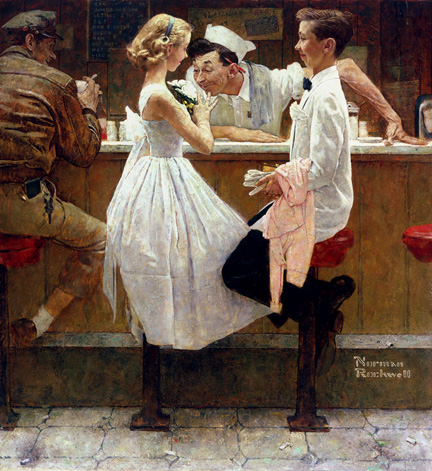
"Some folks think I painted Lincoln from life, but I haven't been around that long. Not quite."-- Norman Rockwell
I loved loved LOVED his two "Day in the Life" paintings. Day in the Life of a little boy and a little girl. I was totally INTO them, kept going back to them.

"Commonplaces never become tiresome. It is we who become tired when we cease to be curious and appreciative."-- Norman Rockwell
For some reason, the painting below always killed me - even as a young girl. There was just something about it. The details, the specifics, the father's hands, his posture, that TRUCK ...

Then there is this I mentioned before - with the chilly title: "The Problem We All Live With".
We see the tomatoes that have been thrown, the horrible word on the wall - but the violence has just passed. We don't see her in the moment of the splattering tomatoes - we see her walking through calmly, moments afterwards. The little girl in the white dress - floating like an angel through the ugliness of the world that hates her. Indeed, such bigotry is a "problem we all live with" still.
And lastly - this has to be my favorite Norman Rockwell of all time. Each person tells a story, the shy girl in the alley, waiting to be noticed, the little brother literally flying down the stairs, but it's the mother who kills me every time. Her fierce ferocious transcendent joy at the sight of her son again.
Here it is: "Homecoming G.I."

Arthur C. Danto said, of the 40 years of Saturday Evening Post covers painted by Norman Rockwell:
"The Rockwell [magazine] cover was more a part of the American reality than a record of it."
Happy birthday - to an American treasure!!
For a great post on Rockwell's career as an illustrator - please go here (one of my favorite blogs ever)!!
Rockwell had a way of portraying common people, in uncommon moments. Some of the moments were not earth-shattering (getting ready to go to the prom - although that is certainly earth-shattering to the teens in question), and others more so. His "four freedoms" series is a perfect example of how he chose to portray each of these freedoms - not by going abstract, or too big, but by capturing the essence of it, in a way that deeply resonates for those of us who love these things too.

The faces! Just look at all of those faces.
Winter in New York, 1900
Still pouring my way through Winter's Tale
Helprin writes:
Even in September, cold winds arrived from Canada and shut people in by their fires, making them think of the city of old. Winter, it was said, was the season in which time was superconductive - the season when a brittle world might shatter in the face of astonishing events, later to reform in a new body as solid and smooth as young transparent ice.

February 2, 2010
The Block Island Cemetery
I love cemeteries, and I love old cemeteries in particular. The one on Block Island is very special. It's on a hillside facing the sea, and it is completely representative of the community that has been out there for centuries. The same names dominate. Ball. Littlefield. Mott. Dodge. Champlin. I went there a bunch of times so these photos obviously came from different days. When I went there with Siobhan and Ben, Siobhan found the little "Westcott" plot, with Pat's ancestors buried there. Lots of engraved anchors and ships. Lots of vessels lost at sea. This is the ocean life. Every stone seems to have a story. It takes a bit to get accustomed to all the graves of babies. There was one family plot where there were 5 children, 4 of whom died as babies, and the 5th only lived til 24. I stared as hard as I could at the moss-eaten stones of the two parents, who both far outlived all of their children, trying to see into the past, and feel what they must have felt. Their lives seemed to be right at my fingertips, I felt very close to them, or to something. It was overwhelming. The saddest stone I saw was a tiny white rounded one, half sunk into the earth, and all it said on it was: "Infant Child". Either the name of the baby has been submerged in the dirt, or it died before it could be named. Sweet little thing. It's a beautiful place, perched on a high hill, with an amazing windy view of hills and ocean, with the ancestors of the families living there now, all buried there. In creepier moments it reminded me of Edgar Lee Masters' Spoon River Anthology, and, even more bleak, Our Town, because nobody wants the afterlife to be like the ones depicted in both works of literature. There were times, on cloudy days, in a Spoon River mood, when all of the "He rests in Jesus" epitaphs seemed more like wishful thinking and a staving off of anxiety. What griefs lie here, what regrets, and unforgiven feuds? What things left unsaid? What pain? Having the space to think about these things, which is really the beginning of storytelling, of narratives, imagining your way into the lives of others, is one of the reasons I love cemeteries so much. But it really is a peaceful place, with families all buried together, facing seaward.


Dear Cara:
You are the most intense shark-lover that I know. Imagine my delight when I walked into my little house on Block Island and one of the first things I saw was this (below the jump). I thought of you immediately. I even considered stealing the thing for you, but my morality intervened.

Today in history: February 2 (1882, and 1922)
Two things happened on today in history:
February 2, 1882: James Joyce was born in Rathgar.
February 2, 1922: Joyce's Ulysses

James Joyce had already written a collection of short stories (Dubliners


It took James Joyce seven years to write Ulysses. Later, he would joke, when faced with criticism that the book was just too damn big - "I spent seven years writing it. People could at least spend seven years reading it."
His next book was Finnegans Wake (excerpt here) and that took him seventeen years to write.
Boy marched to the beat of his own drummer.
The history of the publication of Ulysses is a book in and of itself.
James Joyce had fled Ireland, leaving a wake of debt and scandal behind him, back in 1904. Joyce got a job teaching English at a Berlitz school in first Zurich (that didn't work out), and then Trieste. He convinced his new-found love, Nora Barnacle, a wild girl from Galway, to run away with him. He had known her for only a couple of months. They had met on June 16, 1904 - the day that he would choose to set the entirety of Ulysses on, the ultimate tribute to the significance she had in his life. Without her, he would not have been a man. James and Nora lived in Trieste for 10 years, having children (two of them), not getting married just to spite tradition - although they referred to one another as "husband" and "wife" (the two would eventually marry in the 1930s) ... and living below the poverty line. Meanwhile, Joyce was working on Dubliners, which was quite a struggle. He could not find anyone willing to publish it. Dubliners was eventually published in 1914. He had already been working on it for years. Portrait of the Artist As a Young Man was published (in serial form) in 1914 and finally brought out as a book in 1916. It had been serialized in the highly influential The Egoist. Around this time, James Joyce was taken under the wing of Ezra Pound (what a shock. Pound was everywhere).
James Joyce had been interested in the plight of the Jews for a long time. Especially as a man living in perpetual exile, country-less, yet always looking "homeward". He felt that there was an affinity between the Jews and the Irish, and he thought it was something to explore. He had considered writing a story along these lines for Dubliners but it didn't end up happening. However, the idea percolated. It ended up being one of the main ideas in the book Ulysses, based, of course, on Homer's epic, but Joyce, with his obsessive tendencies, was the kind of man who saw connections everywhere. Exile, journey, what does "home" mean, where is it? These were questions of great relevance to the Jews, but also to himself, who felt he could never live in Ireland again (and he never did). Leopold Bloom, the protagonist of Ulysses is a Jew, living in Ireland. Stephen Dedalus (Joyce's alter ego, the "star" of Portrait of the Artist as well) is one of the aimless men Ireland is so fond of creating, a man looking for a father figure, a guide. Through their mutual wanderings through the city of Dublin, on June 16, 1904, they eventually cross paths. It is not that a kindred spirit is revealed, not really. They do not connect, or heal, or grow, or become empowered. None of those pat concepts are at work in Ulysses. It is more that it is a meeting of the minds. A realization of the connection between them, but also that such connection is transitory. At the end of the book they go their separate ways.
Joyce wrote:
Ulysses is the epic of two races (Israel - Ireland) and at the same time the cycle of the human body as well as a little story of a day (life). The character of Ulysses always fascinated me ever since boyhood. I started writing it as a short story for Dubliners fifteen years ago but gave it up. For seven years I have been working at this book-- blast it!
What was such a big deal about Ulysses? A book where nothing, let's be honest, really happens?
Much of the brou-haha (at least in the literary set) was about the writing itself, a deepening and broadening of the landscape he had explored in Portrait: what is existence really like? What is it like to live, moment to moment?
James Joyce wrote once:
Why all this fuss and bother about the mystery of the unconscious? What about the mystery of the conscious? What do they know about that?
Joyce did not delve into the psychologies of his characters so much, although we get to know Leopold Bloom and Stephen Dedalus better than we even know our best friends through reading Ulysses. Joyce goes behind closed doors. He goes inside the body. Circulation, digestion, sex drive, the splitting of cells ... all of that is going on in his writing, because the book - as well as being an homage to Homer's Odyssey - as well as being set up in a complicated structure, mirroring Homer's work - as well as having colors associated with each episode, and a different writing style for each episode ... it is also, chapter by chapter, a dissection of the human body. One chapter (the Cyclops chapter, naturally) is the "eye" chapter. But instead of going for obvious symbolism, working in things about vision and color and landscape - Joyce hides his meaning completely, and instead makes the entire chapter into a first-person diatribe, and the person telling the story says, over and over as he relates the tale he needs to tell, "says I." The overall effect is that when you look at the page, all you can see is the letter "I". Says I, says I, says I. So if you are looking for eyes there in the obvious places, you will not find it. But it's in the language and the LOOK of it, one of the pieces of writing that is immediately identifiable just by looking at it. My father taught me that. And how brilliant is it to have the "eye" chapter not involve eyes, or vision, openly - but to have the meaning of the symbolism in the language to such a degree that you can recognize it at a glance. From, of course, your eyes. Joyce involves the reader in his game like no other writer. One chapter is the stomach chapter. One chapter is the sex organs chapter. And etc. None of this is explicit. There is no guide. You have to know what you're looking for. You have to get into HIS mode when reading the book, and let your OWN mode go. This is why many people were (and are) annoyed by Joyce. But geniuses have always annoyed people. As William Blake famously wrote:
The eagle never lost so much time as when he submitted to learn of the crow.
Crows don't like it when you point that out. But eagles, in general, shouldn't worry about what crows think of them. They need to just keep being eagles.
James Joyce probably wouldn't have thought of it like that. His defenders (like myself) say stuff like that all the time, but Joyce (perhaps disingenuously) really didn't see what the big deal was. He wrote what he wrote because it amused and fascinated him. He wrote only what he could write. He wasn't going for an effect, he wasn't trying to be clever. Or actually, maybe he was. Ulysses is one of the most "clever" books ever written. It's a game, a romp, a puzzle, something to be decoded. That's the fun of it. He loved puns and language and hidden connections. He realized that he was ahead of his time, he really did, but he wasn't trying to be so, as many of his literary contemporaries were. There was a great shift going on, in general, in the world at that time, and it affected all genres of art. Painters. Architects. Dance was going through a revolution. The past being shuffled off, or at least an attempt being made to, to quote Ezra Pound, "make it new". How much of our language is really ours, and how much of it is inherited? Joyce, as an Irishman, found this to be a personal and volatile issue, something he shared with Yeats. But across the board, artists were looking to each other, to push one another on, to not look BACK, to not try to imitate Tennyson, which had been the style for a generation or so, but to find new forms to express the new world in which they lived.
This was the generation that grew up with horse-and-carriage, and when they died, airplanes were flying across the ocean. The change in psychology was astronomical. Everyone struggled with it in different ways. Yeats, T.S. Eliot, Ezra Pound, Mina Loy, William Carlos Williams ... World War I (or The Great War) was a shattering experience, leaving Europe in ruins. The struggle of the artist: how can anything I do ever comment on the actual experience around me? There is a great anxiety in the work of the modernists, a fracturing of the CERTAIN. There was no certainty anymore. Einstein's theory was published. The Russian Revolution exploded forth. The work of Freud and Jung made people look differently at themselves, at their motivations and dreams and personalities. Painters went more and more abstract, breaking apart that which is known and understood, into colors, shapes, incoherence. James Joyce was a part of all of this, mostly by osmosis. Ezra Pound said, when he first read the work of William Carlos Williams, that he had "become modern all on his own." Perhaps a shock to Pound, who was so at the center of things at that time, pushing writers forward, helping TS Eliot to piece together "The Waste Land", promoting people, bullying editors into publishing new work, etc. William Carlos Williams did not live in Paris and never did. He was a doctor. And yet, the change ... was in the atmosphere. He became modern "all on his own". There were those (like Amy Lowell) who felt they had to be at the center of things, so they moved to Paris, separating themselves from any hint of bourgeois existence. It worked well for many of these people. But it wasn't necessary. James Joyce did live in Paris, but he had been doing his thing from the isolated Trieste for decades. That decade - 1910 - 1920 - saw a massive shift on every level of life, the world surging into a new era, bloody, technological, Freudian, and writers struggled with forms to describe it, react to it. There is nothing comparable today, when technology is so much a part of our lives that we take it for granted. Not so then.
"The Waste Land" was published in 1922 as well. "The Waste Land" and Ulysses coming out the same year? Evidence enough of the upheaval, anxiety and change rupturing the modern world.
Joyce wrote Ulysses not to make a big splash, not to stick it to the censors, not to show lesser writers how it's REALLY done (although all of these things were results) ... he wrote it because he liked it. He found it funny. Engaging. He wrote that way because he couldn't write any other way.
He said (and this may be perhaps my favorite Joyce quote, and it is something to keep in mind should you pick up Ulysses for the first time - it's a clue in HOW to read it):
The pity is that the public will demand and find a moral in my book, or worse they may take it in some serious way, and on the honour of a gentleman, there is not one single serious word in it.
I believe him. Certainly there were serious ideas in the book, it's a revolution, really ... but looked at in another light, in Joyce's light, there is "not one single serious word in it". It's a joke, a maze, a puzzle, an examination of ridiculous coincidences and connections. What does it "mean"? That's the stupidest question of all with which to concern yourself. It means nothing.
Samuel Beckett's wonderful quote in regards to Finnegans Wake is also applicable to Ulysses:
You cannot complain that this stuff is not written in English. It is not written at all. It is not to be read. It is to be looked at and listened to. His writing is not about something. It is that something itself.
And THAT is why Joyce is such a big deal. THAT is why the book went off like a bomb throughout the literary world. THAT is why people like T.S. Eliot, no slouch himself, said, "I wish, for my own sake, that I had not read it." James Joyce lived in a world of giants. Hemingway, Proust, Virginia Woolf, Pound, Fitzgerald, Gertrude Stein, T.S. Eliot ... the modernists. He was part of his time, but he went so much further than any of his contemporaries that many of them never quite recovered from the Ulysses juggernaut. The comments of other writers about Ulysses are absolutely marvelous, because they all recognized what has come. They all realized what had happened. The 20th century had arrived. They had all been working towards it, trying to wrestle the 19th century out of existence, bringing new forms to light. And it's not that any of these people failed. But Ulysses was the "star". Ulysses was the death-knell.
T.S. Eliot put it perfectly when he said that Ulysses "killed the 19th century".
James Joyce hadn't set out to "kill the 19th century", but his sensibility - contrarian, sensitive, angry, loving - led him to a form that couldn't help but do so.
Quiet little Trieste ended up being a major crossroads in WWI, changing hands, and Joyce and his family moved to Paris.
Now let me talk about the actual publication of the book.
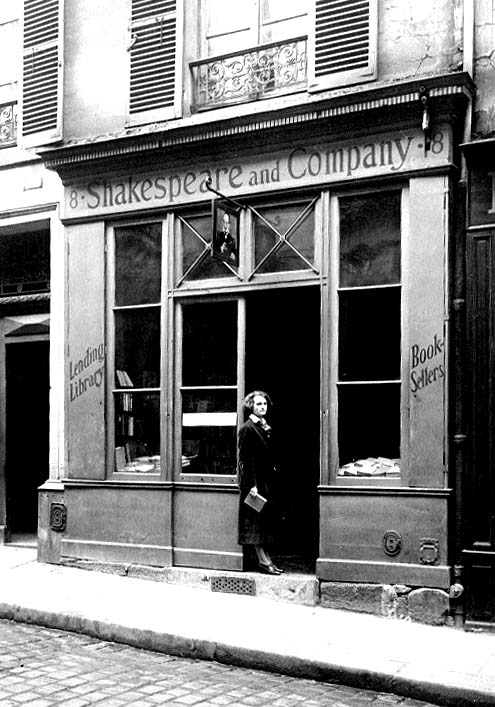
Into our story now steps Sylvia Beach. Born in Maryland, as an adult she became a major force in the literary ex-pat community in Paris. She served in World War I with the Red Cross in Serbia, and after the war settled in Paris, where she opened up a bookshop - the enormously influential Shakespeare & Co.. Shakespeare & Co. became the hub-bub, the vortex of them all. Oh, for a time machine, to go hang out at that place in the 1920s, where Hemingway would stop by, Fitzgerald would browse, Joyce would sneak in and out, Gertrude Stein would bitch and moan (haha) ... and Pound would negotiate with all of them, trying to help them all out and promote his favorites ... they ALL were there.
Here is a cartoon of Joyce sitting at a table with all of his friends in Paris (try to find Joyce - isn't that hysterical?? He doesn't even have a body! That was how he was seen - just a big floating brain with enormous glasses!).

Who was the cartoonist?
F. Scott Fitzgerald.
In this vibrant world of literary rivals and giants struggling for the stage, Sylvia Beach played an important role. She had good taste, first of all, she liked the "good" ones, and didn't waste her time with the crows. She also had courage (as we shall see).
When Beach met James Joyce, he had already written Ulysses, and it was a finished manuscript by that point (or as finished as any Joycean manuscript ever would be) - but essentially unpublishable, due to its being deemed "obscene". You have to get into the mindset of the censors, as unpleasant an experience as that is. What on earth is "obscene" about Ulysses? Ultimately, the book expresses love. You cannot deny it, you cannot escape from it. It is love. Leopold Bloom, throughout his long long day, is only thinking about his wife Molly, and how much he loves her, and how afraid he is that she is being unfaithful. There is only one woman for him. In the same way that there was only one woman for Joyce. Love, it is love that drags us home after our long journey. Only love. But Joyce did not shy away from the more unsavory aspects of life (and let's remember his comment about the "mystery of the conscious" - that's so so important: he did not, as Proust did, or Woolf did, or some of the other modern writers - delve into psychology and the workings of the subconscious. He did not look at motivations and childhood repression. As I mentioned, Freud changed everything, for good and ill. A revolution in the understanding of the workings of humanity. Whether or not you agree with Freud, and whether or not you think Freud is over-rated is irrelevant. I am talking about the time and place from which Joyce wrote.) But Joyce, unlike Proust, did not explore how memory works, and how the senses trigger thoughts and feelings and entire narratives from our lives ... He was much more prosaic. Blunt. He presented man in the most honest manner possible. Leopold Bloom takes a dump, for example. He sits on the toilet after breakfast, and thinks about things, worrying about things, as he goes to the bathroom. Now, this is one of the most human of experiences. Anyone who says they haven't sat on the toilet, pondering their day, and what they are worried about, is lying. But to put that in a book?? What are you, cracked?
There are those who feel that while such things may be 'real', they have no place in literature. Now we're getting into the realm of the censors, who wanted to control what could be shown. It's the same as people nowadays who seem to feel that saying "TMI" is the be-all and end-all of human interaction. You complain that you stubbed your toe that morning, and certain people will say, "TMI!" Never mind if you're struggling with grief, loss, having a personal struggle, some people just shun intimacy in any way, shape or form. (And then they wonder why they are miserable ...) I despise the "TMI" trend. I despise it in its surface form and I despise what it represents. There is a reason for it, as there is a reason for all trends. It is a reaction. A reaction, perhaps, to our world of reality television, and tell-all books, where everyone seems to feel that talking about themselves and their issues is a holy and sacred act. So I get it. But reactions tend to be too extreme and I resist extremes. Besides, "TMI" is nothing new. There have always been those who really DON'T want to know you, who really DON'T want the truth when they ask "How are you?" It's just that now that we have "TMI" to say. It's a constant refrain from certain corners.. Sure, there's such a thing as "over-sharing", but I'm not really talking about that. I am talking about something far more insidious. Something that is not in any way, shape or form new - it's been going on forever, as long as human beings have been in contact with one another. There is a shying away from real experience of one another. Of course. Because if you allow yourself to experience what it is like for another person, then that might mean you might have compassion for them, or empathy, or you might have a sense of recognition, an awareness of the universal: "Yes, I do that, too!" Many people do not want to be shaken out of their selves like that. I include myself, by the way, although you will never ever catch me saying "TMI"! I am all ABOUT "TMI"! But the first response for many, to some demand for connection, or understanding, is to batton down the hatches, draw the line in the sand, and say, "Nope. Nope. That's YOU, that's not ME."
People like that, powerful though they may be in certain sections of society, will always be on the wrong side of history. Progress, forward motion, always has, at its core, an examination of motivation, of meaning, of, to quote Mike Nichols, "what is this REALLY like?" (He says that when he sits down to film any scene, of any event, that is his first question: "what is this REALLY like?" Infidelity, drug addiction, love triangles - all of these things are nothing new. How can one presume to say anything new about them? You really can't. All you can do, if you are an artist, is try to understand "what it is REALLY like" and try to portray that.) If you are so busy crowing "TMI" at every revelation of character and story around you, you will never move forward. You will be stuck, like a fly drowned in amber.
Joyce cuts right to the core of that very human experience. He will not let the reader off the hook. If you insist on insisting, "That's YOU, not ME", then Ulysses will be a terribly confronting book. Joyce, above all else, was a humanist, although his cynicism and rage were titanic. That's what The Dead (excerpt here), with its final revelation of connection and love in the last four paragraphs, is all about. I have said it before: Without The Dead, The Dubliners would be merely a bitchy gossipy excavation of a modern-day city. Yes, with some good writing and memorable scenes, but it would be, essentially, a cynical book, and cynical books usually do not outlast their own time. With The Dead, in the last four paragraphs, Joyce rises up. If you only read the other stories, you might presume that Joyce despised his fellow man. His eye is excruciatingly honest. He is brutal. Who would ever have suspected that in the last story of the collection, Joyce would pull such a hat-trick, and say, essentially, "You think you know me. You do not. You think all I feel is anger. I do not. My anger comes from grief and loss. And right now, all I feel is love." If you read the book from beginning to end, The Dead, no matter that you know its coming, always comes as a surprise. Nothing in the book before that story prepares you for it. Gabriel realizes, as he watches his wife sleep, that he loves her, and yet that he has never really known her. And in that realization, his consciousness rises up and up, until he is looking down on the snowy landscape, on all of Ireland ... and he, for the first time, feels connected to life, because of his experience of heartbreak. He feels connected not just to all mankind, but also to all of the "shades", all of those people who have gone before.
The irony of all of this is that Joyce was one of the most isolated of beings, although not melancholy or a downer or any of that. He wasn't a tortured artist. He was not bohemian in the slightest. It's just that he was rather old-fashioned, believe it or not, a family man, who had dinner every night with Nora and his kids and that was that. There is no scandal about Joyce. He didn't sleep with every woman in Paris. He didn't experiment with free love. Yes, he lived in sin for 30 years before tying the knot, but he was faithful to Nora. He wasn't a big socializer. He was a big drinker, but everyone was then. He wasn't dancing in fountains like F. Scott Fitzgerald was, and cheering as his wife did a jig on the table. He was rather conventional, rather bourgeois.
Additionally, there is a tremendous self-consciousness in his books (which I mentioned earlier). He can ONLY write from his own life. He was not an "inventor". He did not make up characters, and devise complicated plots. He did not write one standard novel. It was all self self self self self. I truly believe that you MUST be a genius in order to only focus on self. (Oscar Wilde said something similar, after reading his friend Andre Gide's novel, which I haven't read, but which Wilde was not impressed with. He said, "In order to be an Egotist, one must first have an Ego." Ouch. This is similar to Blake's comment mentioned earlier. Crows trying to be eagles always give themselves away. Only a genius can only focus on Self, and get away with it.) The memoir-trend in publishing today proves that, in my mind. There are very few good ones out there, very few stories worth telling ... the thing that elevates one memoir over another is, of course, the writing style ... If you're not a good writer then nobody cares that your mama locked you in a closet and your papa couldn't put down the whiskey. Angela's Ashes was such a phenomenal success because of McCourt's writing. You write that same story without McCourt's voice and you'd want to vomit. I know that there are folks in Limerick, especially, who already want to vomit when reading McCourt's book - but that just goes to show you that you can never please everybody.
Ulysses picked up where Portrait left off. As Portrait comes to a close, the traditional narrative voice breaks down, leaving us only with Stephen Dedalus' journal entries. There is no more voice outside the "I". Joyce has abandoned the traditional narrator. Dedalus will now take over. We are inside experience, as opposed to looking on. In the third episode in Ulysses Stephen Dedalus takes a walk on the beach. We learned in the first chapter that he had broken his glasses. This fact is mentioned only once in the entire 800 page book, but we are meant to remember it. In the third chapter, during his walk on the beach, sans glasses ... the experiences come at him through a vague impression of colors and sounds. If you somehow missed that he has no glasses, and this episode is told from the perspective of someone who can't see, then you might not know what the hell is going on. At one point:
The dog's bark ran towards him, stopped, ran back again.
As someone who needs her glasses, I can say that that image is just just right. When I have been stranded without glasses, it is as though sounds "run towards" me ... It is not the DOG running at Dedalus, it is its BARK. Sound before vision.
Perhaps now it seems obvious, or perhaps now it seems like everyone tries to write in this subjective manner. But that's only because Joyce did it first.
All of this made Ulysses a tough sell to publishers, not even counting the bowel movements, and penises, and the evening in "Nighttown" (Dublin's red-light district) and Molly Bloom's long 40 page run-on sentence that closes the book, full of farts and menstruation and masturbation. But also, please, let us not forget, that it is some of the most beautiful writing in the English language ... and her image of embracing her husband as they lie among the rhododendrons is some of the most romantic language of all time:
the sun shines for you he said the day we were lying among the rhododendrons on Howth head in the grey tweed suit and his straw hat the day I got him to propose to me yes first I gave him the bit of seedcake out of my mouth and it was leapyear like now yes 16 years ago my God after that long kiss I near lost my breath yes he said I was a flower of the mountain yes so we are flowers all a womans body yes that was one true thing he said in his life and the sun shines for you today yes that was why I liked him because I saw he understood or felt what a woman is and I knew I could always get round him and I gave him all the pleasure I could leading him on till he asked me to say yes and I wouldnt answer first only looked out over the sea and the sky I was thinking of so many things he didnt know of Mulvey and Mr Stanhope and Hester and father and old captain Groves and the sailors playing all birds fly and I say stoop and washing up dishes they called it on the pier and the sentry in front of the governors house with the thing round his white helmet poor devil half roasted and the Spanish girls laughing in their shawls and their tall combs and the auctions in the morning the Greeks and the jews and the Arabs and the devil knows who else from all the ends of Europe and Duke street and the fowl market all clucking outside Larby Sharons and the poor donkeys slipping half asleep and the vague fellows in the cloaks asleep in the shade on the steps and the big wheels of the carts of the bulls and the old castle thousands of years old yes and those handsome Moors all in white and turbans like kings asking you to sit down in their little bit of a shop and Ronda with the old windows of the posadas glancing eyes a lattice hid for her lover to kiss the iron and the wineshops half open at night and the castanets and the night we missed the boat at Algeciras the watchman going about serene with his lamp and O that awful deepdown torrent O and the sea the sea crimson sometimes like fire and the glorious sunsets and the figtrees in the Alameda gardens yes and all the queer little streets and pink and blue and yellow houses and the rosegardens and the jessamine and geraniums and cactuses and Gibraltar as a girl where I was a Flower of the mountain yes when I put the rose in my hair like the Andalusian girls used or shall I wear a red yes and how he kissed me under the Moorish wall and I thought well as well him as another and then I asked him with my eyes to ask again yes and then he asked me would I yes to say yes my mountain flower and first I put my arms around him yes and drew him down to me so he could feel my breasts all perfume yes and his heart was going like mad and yes I said yes I will Yes.
Brings me to tears every time.
And ... it's everywhere in my life. Even ...

Ahem.
The book was a bomb waiting to go off. No one would touch it. Pound had arranged for some excerpts to be published and that was the start of it. Writers, in general, were itching to get their paws on the book ... what the hell is that crazy Joyce working on now?? ... people felt competitive, nervous ... he helped them up their own game ... but in terms of the business side of things, the controversy had started before the book had even been published.
But Sylvia Beach - who had never published a book before - took a risk and said that Shakespeare & Co. would put out the book. She would publish it herself. She knew what she was doing, and she knew what the repercussions could be. It was an act of courage. Perhaps she went into it recklessly, thinking that giving a space for genius would be its own reward - perhaps she went into it knowing the eventual fallout that would crash down upon her head - But whatever her interior process, she published it. On February 2, 1922.
I was on the platform, my heart going like the locomotive, as the train from Dijon came slowly to a standstill and I saw the conductor getting off, holding a parcel and looking around for someone -- me. In a few minutes, I was ringing the doorbell at the Joyces' and handing them Copy No. 1 of Ulysses. It was February 2, 1922. -- Sylvia Beach
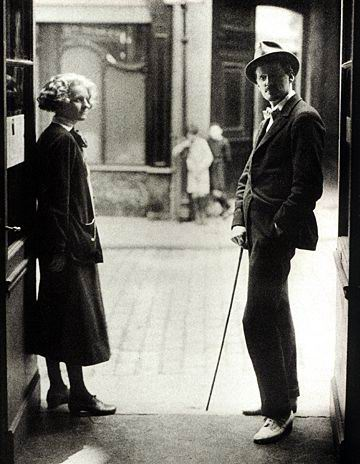
And the shit hit the fan.
Nora Tully describes it thus:
The response to Ulysses was immediate and extreme. Writer and literary critic Malcolm Cowley described it using the metaphor of a stone dropped into water: there was a moment of silence, the stone was dropped, "then all the frogs who inhabited the pool began to talk at once".
Once it was published, the obscenity controversies heated up, the book was banned everywhere - Ireland, America - everybody was talking about it, but who had actually read it? The first edition was only 1000 copies! You couldn't get the book anywhere. Additionally, you could be arrested for trying to smuggle it into certain countries - so there were a couple of years where the only place on the planet that you could get a copy of Ulysses was at Beach's bookshop in Paris. And so the orders flew in from folks around the world. People who were book readers, other writers, people who were collectors, people who sensed the historic moment and just wanted a copy.
Here is a copy of Peggy Guggenheim's urgent order-form, sent to Sylvia Beach:

Imagine you are dying to read the book. Imagine you can't get it anywhere. Imagine that it is illegal to smuggle it back into the United States. Imagine the frenzy. You can see it in Guggeinheim's writing, can't you?
Harriet Shaw Weaver, who had supported Joyce financially for years (at Pound's insistence) also arranged for another edition to be published by The Egoist press. She also arranged for them to be shipped to the United States, but they were seized by the customs officials. In 1923, John Rodker, through The Egoist again, arranged for a small printing of the book, but these were burned by English customs officials. In 1924, Shakespeare & Co., a small outfit really, and not set up to handle the demand, brought out another small printing.
Extraordinary.

Eventually, as the controversy died down, Joyce ended up going with another publisher, which really left Beach bereft financially. She already had suffered as a consequence of taking the risk to publish Ulysses. She was hounded by the police, by the censors ... so although Joyce really did need to move on, to a publisher who could handle his stardom, Beach was the first. Beach was the pioneer. Amazing woman.
Meanwhile, the comments from people who had actually read it were pouring in. This went on for years. You could read it in Europe, but America had declared it obscene, and would not allow it to arrive on its shores.
Finally, on August 7, 1934, over 10 years after its first publication by little Sylvia Beach and her little Shakespeare & Co. - a far-seeing and open-minded US Court of Appeals judge, Judge John Woolsey, declared that Ulysses was NOT obscene and could be admitted into the United States.
Here's what the first American edition of that book looked like:
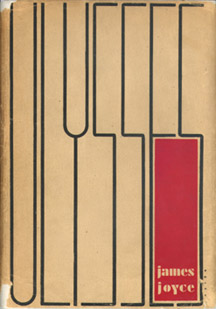
Morris L. Ernst, counsel for Random House - who successfully defended the book against obscenity charges in 1933-34 - wrote in his foreward to the 1934 edition:
It would be difficult to underestimate the importance of Judge Woolsey's decision. For decades the censors have fought to emasculate literature. They have tried to set up the sensibilities of the prudery-ridden as a criterion for society, have sought to reduce the reading matter of adults to the level of adolescents and subnormal persons, and have nurtured evasions and sanctimonies.
Here is Judge Woolsey's decision in its entirety - it's a masterpiece of its kind. Not only is it an important legal decision, but it ends up being an acutely sensitive analysis of the book itself.
United States Discrict Court, Southern District of New York, Opinion A. 110-59
December 6, 1933
On cross motions for a decree in a libel of confiscation, supplemented by a stipulation -- hereinafter described -- brought by the United States against the book "Ulysses" by James Joyce, under Section 305 of the Tariff Act of 1930, Title 19 United States Code, Section 1305, on the ground that the book is obscene within the meaning of that Section, and, hence, is not importable into the United States, but is subject to seizure, forfeiture and confiscation and destruction.
United States Attorney -- by Samuel C. Coleman, Esq., and Nicholas Atlas, Esq., of counsel -- for the United States, in support of motion for a decree of forfeiture, and in opposition to motion for a decree dismissing the libel.
Messrs. Greenbaum, Wolff and Ernst, -- by Morris L. Ernst, Esq., and Alexander Lindey, Esq., of counsel -- attorneys for claimant Random House, Inc., in support of motion for a decree dismissing the libel, and in opposition to a motion for a decree of forfeiture.
WOOLSEY, J:
The motion for a decree dismissing the libel herein is granted, and, consequently, of course, the Government's motion for a decree of forfeiture and destruction is denied.
Accordingly a decree dismissing the libel without costs may be entered herein.
1. The practice followed in this case is in accordance with the suggestion made by me in the case of United States v. One Book Entitled "Contraception", 51 F. (2d) 525, and is as follows:
After issue was joined by the filing of the claimant's answer to the libel for forfeiture against "Ulysses", a stipulation was made between the United States Attorney's office and the attorneys for the claimant providing:
1. That the book "Ulysses" should be deemed to have been annexed to and to have become part of the libel just as if it had been incorporated in its entirety therein.
2. That the parties waived their right to a trial by jury.
3. That each party agreed to move for decree in its favor.
4. That on such cross motions the Court might decide all the questions of law and fact involved and render a general finding thereon.
5. That on the decision of such motions the decree of the Court might be entered as if it were a decree after trial.
It seems to me that a procedure of this kind is highly appropriate in libels for the confiscation of books such as this. It is an especially advantageous procedure in the instant case because on account of the length of "Ulysses" and the difficulty of reading it, a jury trial would have been an extremely unsatisfactory, if not an almost impossible, method of dealing with it.
2. I have read "Ulysses" once in its entirety and I have read those passages of which the Government particularly complains several times. In fact, for many weeks, my spare time has been devoted to the consideration of the decision which my duty would require me to make in this matter.
"Ulysses" is not an easy book to read or to understand. But there has been much written about it, and in order properly to approach the consideration of it it is advisable to read a number of other books which have now become its satellites. The study of "Ulysses" is, therefore, a heavy task.
3. The reputation of "Ulysses" in the literary world, however, warranted my taking such time as was necessary to enable me to satisfy myself as to the intent with which the book was written, for, of course, in any case where a book is claimed to be obscene it must first be determined, whether the intent with which it was written was what is called, according to the usual phrase, pornographic, -- that is, written for the purpose of exploiting obscenity.
If the conclusion is that the book is pornographic that is the end of the inquiry and forfeiture must follow.
But in "Ulysses", in spite of its unusual frankness, I do not detect anywhere the leer of the sensualist. I hold, therefore, that it is not pornographic.
4. In writing "Ulysses", Joyce sought to make a serious experiment in a new, if not wholly novel, literary genre. He takes persons of the lower middle class living in Dublin in 1904 and seeks not only to describe what they did on a certain day early in June of that year as they went about the City bent on their usual occupations, but also to tell what many of them thought about the while.
Joyce has attempted -- it seems to me, with astonishing success -- to show how the screen of consciousness with its ever-shifting kaleidoscopic impressions carries, as it were on a plastic palimpsest, not only what is in the focus of each man's observation of the actual things about him, but also in a penumbral zone residua of past impressions, some recent and some drawn up by association from the domain of the subconscious. He shows how each of these impressions affects the life and behavior of the character which he is describing.
What he seeks to get is not unlike the result of a double or, if that is possible, a multiple exposure on a cinema film which would give a clear foreground with a background visible but somewhat blurred and out of focus in varying degrees.
To convey by words an effect which obviously lends itself more appropriately to a graphic technique, accounts, it seems to me, for much of the obscurity which meets a reader of "Ulysses". And it also explains another aspect of the book, which I have further to consider, namely, Joyce's sincerity and his honest effort to show exactly how the minds of his characters operate.
If Joyce did not attempt to be honest in developing the technique which he has adopted in "Ulysses" the result would be psychologically misleading and thus unfaithful to his chosen technique. Such an attitude would be artistically inexcusable.
It is because Joyce has been loyal to his technique and has not funked its necessary implications, but has honestly attempted to tell fully what his characters think about, that he has been the subject of so many attacks and that his purpose has been so often misunderstood and misrepresented. For his attempt sincerely and honestly to realize his objective has required him incidentally to use certain words which are generally considered dirty words and has led at times to what many think is a too poignant preoccupation with sex in the thoughts of his characters.
The words which are criticized as dirty are old Saxon words known to almost all men and, I venture, to many women, and are such words as would be naturally and habitually used, I believe by the types of folk whose life, physical and mental, Joyce is seeking to describe. In respect of the recurrent emergence of the theme of sex in the minds of his characters, it must always be remembered that his locale was Celtic and his season Spring.
Whether or not one enjoys such a technique as Joyce uses is a matter of taste on which disagreement or argument is futile, but to subject that technique to the standards of some other technique seems to me to be little short of absurd.
Accordingly, I hold that "Ulysses" is a sincere and honest book and I think that the criticisms of it are entirely disposed of by its rationale.
5. Furthermore, "Ulysses" is an amazing tour de force when one considers the success which has been in the main achieved with such a difficult objective as Joyce set for himself. As I have stated, "Ulysses" is not an easy book to read. It is brilliant and dull, intelligible and obscure by turns. In many places it seems to me to be disgusting, but although it contains, as I have mentioned above, many words usually considered dirty, I have not found anything that I consider to be dirt for dirt's sake. Each word of the book contributes like a bit of mosaic to the detail of the picture which Joyce is seeking to construct for his readers.
If one does not wish to associate with such folk as Joyce describes, that is one's own choice. In order to avoid indirect contact with them one may not wish to read "Ulysses"; that is quite understandable. But when such a real artist in words, as Joyce undoubtedly is, seeks to draw a true picture of the lower middle class in a European city, ought it to be impossible for the American public legally to see that picture?
To answer this question it is not sufficient merely to find, as I have found above, that Joyce did not write "Ulysses" with what is commonly called pornographic intent, I must endeavor to apply a more objective standard to his book in order to determine its effect in the result, irrespective of the intent with which it was written.
6. The statute under which the libel is filed only denounces, in so far as we are here concerned, the importation into the United States from any foreign country of "any obscene book". Section 305 of the Tariff Act of 1930, Title 19 United States Code, Section 1305. It does not marshal against books the spectrum of condemnatory adjectives found, commonly, in laws dealing with matters of this kind. I am, therefore, only required to determine whether "Ulysses" is obscene within the legal definition of that word.
The meaning of the word "obscene" as legally defined by the Courts is: tending to stir the sex impulses or to lead to sexually impure and lustful thoughts. Dunlop v. United States, 165 U.S. 486, 501; United States v. One Book Entitled "Contraception", 51 F. (2d) 525, 528; and compare Dysart v. United States, 272 U.S. 655, 657; Swearingen v. United States 151 U.S. 446, 450; United States v. Dennett, 39 F. (2d) 564, 568 (C.C.A. 2); People v. Wendling, 258 N.Y. 451, 453.
Whether a particular book would tend to excite such impulses and thoughts must be tested by the Court's opinion as to its effect on a person with average sex instincts -- what the French would call l'homme moyen sensuel -- who plays, in this branch of legal inquiry, the same role of hypothetical reagent as does the "reasonable man" in the law of torts and "the man learned in the art" on questions of invention in patent law.
The risk involved in the use of such a reagent arises from the inherent tendency of the trier of facts, however fair he may intend to be, to make his reagent too much subservient to his own idiosyncrasies. Here, I have attempted to avoid this, if possible, and to make my reagent herein more objective than he might otherwise be, by adopting the following course:
After I had made my decision in regard to the aspect of "Ulysses", now under consideration, I checked my impressions with two friends of mine who in my opinion answered to the above stated requirement for my reagent.
These literary assessors -- as I might properly describe them -- were called on separately, and neither knew that I was consulting the other. They are men whose opinion on literature and on life I value most highly. They had both read "Ulysses", and, of course, were wholly unconnected with this cause.
Without letting either of my assessors know what my decision was, I gave to each of them the legal definition of obscene and asked each whether in his opinion "Ulysses" was obscene within that definition.
I was interested to find that they both agreed with my opinion: that reading "Ulysses" in its entirety, as a book must be read on such a test as this, did not tend to excite sexual impulses or lustful thoughts but that its net effect on them was only that of a somewhat tragic and very powerful commentary on the inner lives of men and women.
It is only with the normal person that the law is concerned. Such a test as I have described, therefore, is the only proper test of obscenity in the case of a book like "Ulysses" which is a sincere and serious attempt to devise a new literary method for the observation and description of mankind.
I am quite aware that owing to some of its scenes "Ulysses" is a rather strong draught to ask some sensitive, though normal, persons to take. But my considered opinion, after long reflection, is that whilst in many places the effect of "Ulysses" on the reader undoubtedly is somewhat emetic, nowhere does it tend to be an aphrodisiac.
"Ulysses" may, therefore, be admitted into the United States.
JOHN M. WOOLSEY
United States District Judge
The comments of other great writers, Joyce's contemporaries, on this book are of great interest to me. The responses run the gamut from disgust, elation, despair, awe, humility ... He made other writers feel like putting down their pens. He enraged those who felt that THEY deserved HIS accolades (phone call for Gertrude Stein, Gertrude Stein, phone call) ... but whatever the response, the only emotion you will NOT find is indifference.
Joyce had made his mark.
Yeats (an early champion of Joyce) had this as his first response on reading Ulysses: "A mad book!"
Then later, as he let the book percolate, Yeats corrected himself: "I have made a terrible mistake. It is a work perhaps of genius. I now perceive its coherence ... It is an entirely new thing -- neither what the eye sees nor the ear hears, but what the rambling mind thinks and imagines from moment to moment. He has certainly surpassed in intensity any novelist of our time."
Hart Crane said: "I feel like shouting EUREKA! Easily the epic of the age."
George Bernard Shaw was disturbed by Ulysses, he took it personally, he did not like what it revealed - about man, about Irish men, about the life of Ireland, but he grappled with the implications in an honest way: "If a man holds up a mirror to your nature and shows you that it needs washing -- not whitewashing -- it is no use breaking the mirror. Go for soap and water."
T.S. Eliot was especially devastated by the book, and his comments on it are numerous. Examples: "How could anyone write again after achieving the immense prodigy of the last chapter?"
T.S. Eliot again: "I hold Ulysses to be the most important expression which the present age has found; it is a book to which we are all indebted, and from which none of us can escape."
Edmund Wilson wrote of it:
The more we read Ulysses, the more we are convinced of its psychological truth, and the more we are amazed at Joyce's genius in mastering and in presenting, not through analysis or generalization, but by the complete recreation of life in the process of being lived, the relations of human beings to their environment and to each other; the nature of their perception of what goes on about them and of what goes on within themselves; and the interdependence of their intellectual, their physical, their professional and their emotional lives. To have traced all these interdependences, to have given each of these elements its value, yet never to have lost sight of the moral through preoccuptation with the physical, nor to have forgotten the general in the particular; to have exhibited ordinary humanity without either satirizing it or sentimentalizing it - this would already have been sufficiently remarkable; but to have subdued all this material to the uses of a supremely finished and disciplined work of art is a feat which has hardly been equalled in the literature of our time.
Wilson also wrote:
Yet for all its appalling longeurs, Ulysses is a work of high genius. Its importance seems to me to lie, not so much in its opening new doors to knowledge -- unless in setting an example to Anglo-Saxon writers of putting down everything without compunction -- or in inventing new literary forms -- Joyce's formula is really, as I have indicated, nearly seventy-five years old -- as in its once more setting the standard of the novel so high that it need not be ashamed to take its place beside poetry and drama. Ulysses has the effect at once of making everything else look brassy."
Carl Jung read the book and wrote Joyce a rather extraordinary letter:
Dear Sir, Your Ulysses has presented the world such an upsetting psychological problem, that repeatedly I have been called in as a supposed authority on psychological matters.Ulysses proved to be an exceedingly hard nut and it has forced my mind not only to most unusual efforts, but also to rather extravagant peregrinations (speaking from the standpoint of a scientist). Your book as a whole has given me no end of trouble and I was brooding over it for about three years until I succeeded to put myself into it. But I must tell you that I'm profoundly grateful to yourself as well as to your gigantic opus, because I learned a great deal from it. I shall probably never be quite sure whether I did enjoy it, because it meant too much grinding of nerves and of grey matter. I also don't know whether you will enjoy what I have written about Ulysses because I couldn't help telling the world how much I was bored, how I grumbled, how I cursed and how I admired. The 40 pages of non stop run at the end is a string of veritable psychological peaches. I suppose the devil's grandmother knows so much about the real psychology of a woman, I didn't.
Well I just try to recommend my little essay to you, as an amusing attempt of a perfect stranger that went astray in the labyrinth of your Ulysses and happened to get out of it again by sheer good luck. At all events you may gather from my article what Ulysses has done to a supposedly balanced psychologist.
With the expression of my deepest appreciation, I remain, dear Sir,
Yours faithfully,
C.G. Jung
Joyce was very proud of this letter and would read it out loud to guests in his house. Nora would snort at the end, "Jimmy knows nothin' about women!"
Katherine Mansfield wrote in a letter about having Joyce over to meet her and her usband:
"Joyce was rather ... difficile. I had no idea until then of his view of Ulysses -- no idea how closely it was modelled on the Greek story, how absolutely necessary it was to know the one through and through to be able to discuss the other. I've read the Odyssey and am more or less familiar with it but Murry [Mansfield's husband] and Joyce simply sailed out of my depth. I felt almost stupefied. It's absolutely impossible that other people should understand Ulysses as Joyce understands it. It's almost revolting to hear him discuss its difficulties. It contains code words that must be picked up in each paragraph and so on. The Question and Answer part can be read astronomically or from the geologic standpoint or -- oh, I don't know!"
The most humorous part of this is that Joyce said, after meeting Katherine and her husband:
"Mrs. Murry understood the book better than her husband."
Hilarious.
George Moore, another Irish writer, wrote:
"Ulysses is hopeless; it is absurd to imagine that any good end can be served by trying to record every single thought and sensation of any human being. That's not art, it's like trying to copy the London Directory."
Hemingway wrote in a letter to Sherwood Anderson:
"Joyce has a most goddamn wonderful book. It'll probably reach you in time. Meantime the report is that he and all his family are starving but you can find the whole celtic crew of them every night in Michaud's where Binney and I can only afford to go about once a week...The damned Irish, they have to moan about something or other..."
Gertrude Stein wrote:
"Joyce is good. He is a good writer. People like him because he is incomprehensible and anybody can understand him. But who came first, Gertrude Stein or James Joyce? Do not forget that my first great book, Three Lives, was published in 1908. That was long before Ulysses. But Joyce has done something. His influence, however, is local. Like Synge, another Irish writer, he has had his day."
Joyce heard what Stein wrote, thought about it, and said, "I hate intellectual women."
George Bernard Shaw again:
"I have read several fragments of Ulysses ... It is a revolting record of a disgusting phase of civilization; but it is a truthful one; and I should like to put a cordon round Dublin; round up every male person in it between the ages of 15 and 30; force them to read it; and ask them whether on reflection they could see anything amusing in all that foul mouthed foul minded derision and obscenity...It is, however, some consolation to find that at last somebody has felt deeply enough about it to face the horror of writing it all down and using his literary genius to force people to face it. In Ireland they try to make a cat cleanly by rubbing its nose in its own filth. Mr. Joyce has tried the same treatment on the human subject."
Ezra Pound said:
"Joyce -- pleasing; after the first shell of cantankerous Irishman, I got the impression that the real man is the author of Chamber Music, the sensitive. The rest is the genius; the registration of realities on the temperament, the delicate temperament of the early poems. A concentration and absorption passing Yeats' -- Yeats has never taken on anything requiring the condensation of Ulysses."
Yeats wrote:
"It is an entirely new thing -- neither what they eye sees nor the ear hears, but what the rambling mind thinks and imagines from moment to moment. He has certainly surpassed in intensity any novelist of our time."
William Carlos Williams wrote (echoing what many of Joyce's contemporaries felt):
"Joyce is too near for me to want to do less than he did in Ulysses, in looseness of spirit, and honesty of heart -- at least."
E.M. Forster wrote:
"Perhaps the most interesting literary experiment of our day."
Dr. Joseph Collins reviewed "Ulysses" in The New York Times and wrote:
Ulysses will immortalize its author with the same certainty that Gargantua and Pantagruel immortalized Rabelais and The Brothers Karamazov Dostoevsky ... It comes nearer to being the perfect revelation of a personality than any book in existence.
Hart Crane, who had totally lost his head about the book, wrote:
"The sharp beauty and sensitivity of the thing! The matchless details! His book is steeped in the Elizabethans, his early love, and Latin Church, and some Greek ... It is my opinion that some fanatic will kill Joyce sometime soon for the wonderful things said in Ulysses."
Ford Madox Ford wrote:
"For myself then, the pleasure -- the very great pleasure -- that I get from going through the sentences of Mr. Joyce is that given me simply by the cadence of his prose, and I fancy that the greatest and highest enjoyment that can be got from any writing is simply that given by the cadence of the prose."
William Faulkner wrote:
You should approach Joyce's Ulysses as the illiterate Baptist preacher approaches the Old Testament: with faith.
Vladimir Nabokov wrote:
Ulysses, of course, is a divine work of art and will live on despite the academic nonentities who turn it into a collection of symbols or Greek myths. I once gave a student a C-minus, or perhaps a D-plus, just for applying to its chapters the titles borrowed from Homer while not even noticing the comings and goings of the man in the brown mackintosh. He didn't even know who the man in the brown mackintosh was. Oh, yes, let people compare me to Joyce by all means, but my English is pat ball to Joyce's champion game.

That's a drawing by Guy Davenport, entitled "Joyce Writing a Sentence".
My father gave me his treasured and rare copy of Ulysses - part of the 1924 printing of Shakespeare & Co. The book is falling apart. The pages are thin and rustly, and little bits of them drop off if you pick it up. It is enclosed in a box, to protect it - which has on the spine: ULYSSES - PARIS, 1924.
Every page has something of interest on it. There is a sticker on the first page - stamped with the personal imprint of the couple who had bought the book (my father, naturally, knew everything about them). The copyright page is amazing. First of all, it lists all of the controversial editions that had gone before ... 500 copies burned, etc. And to see the legendary "Shakespeare & Co.", in print, signing its name, so to speak, to the book, bravely putting it out again, knowing what will happen to their small operation ... It's just something that makes me feel humble, awed, and proud that I am aware that such people existed.
My copy of the book is not one that I will take out and read. It is too fragile.
But it is now my most prized possession, and I do take it out sometimes, to flip through the pages, looking for my favorite parts (the conversation about Shakespeare in the library is my favorite section), and reveling in the feel of the pages, their soft fragility, the print on the page showing its indent. Ulysses is so wrapped up in my father (I read it for the first time and basically called him every other day to get tips - "what the hell is going on HERE?") that it cannot be separated out. Each page resonates with some tidbit from my father, some explication, or biographical detail of all of the names that show up in Joyce's book.
I took some photos of this gift from my father. They are below.
The last photo has a framed picture of my dad in the background, standing by Yeats' grave. That was not deliberate. I did not consciously place the framed photo in the frame. It's just that everywhere in my apartment that you look you will see evidence of my heritage, my family, my inheritance. My father taught us well. Here is my brother's post on Ulysses, which gives me goosebumps. We are, apparently, a family of Joycean T-shirts, as evidenced by my T-shirt above. And here is Exhibit B from my brother:

Happy birthday to Jimmy Joyce and to his masterpiece. The 19th century was certainly ready to be killed, and there were legions of artists who hacked away at it, but it took a nearly-blind perpetually-broke Irishman-in-exile, with his wife and two kids in tow, to finish the job.


February 1, 2010
Thrashing white
I arrived on Block Island in the middle of a pretty bitter snowstorm. Snow that actually collects is rare on Block Island and this was a heavy enough storm that we had white ground out there for a couple of days before it melted. At the end of my time out there, the last three days, the temperature dropped suddenly and the wind picked up, making being outside pretty unbearable. The weather itself was gorgeous, but it seriously was too cold to do anything. I am sure that the moisture that is always present in island wind added to the situation. Those were the days when my house shook all night, being throttled by the wind. That temperature drop led to the ocean freezing, so it had to be drastic. Even the islanders were shocked by what had happened.
But right at the mid-point of my time, there was a random storm that lasted one day only, and it was all about the wind. There was some rain too, but the wind was so strong that some of my actions on that day (walking out onto the jetty, for example, with towers of spray rising up around me from the pounding ocean) are a bit questionable. But I didn't care. It was an exhilarating storm, and it put the ocean into a total frenzy. I have never seen it like that, and I've seen some pretty bad weather in my day. The ocean, at times, appeared to be entirely white. This was not about white-capped breakers rolling into the shore, one after the other. There was no time between waves, they just kept crashing, and thrashing and pounding into one another, as far as the eye could see. The roar was so loud that you could feel it in your DNA. I went to Crescent Beach and climbed over the dunes to get a closer look, and the wind was so strong that first of all, the air was full of sand. I hadn't counted on the sand. I worried about my camera, but I should also have been worrying about my eyes. I had to bend my body into an almost perpendicular shape just to deal with the wind. And once I reached the crest of the dunes, the wind was so strong that I couldn't do anything but squat down to try to get some protection. It was nuts. And awesome. I talked to myself (and the storm) the whole thing. I was very articulate. I was exclaiming things like, "Holy SHIITE MUSLIMS." and "JESUS MARY AND JOSEPH.: The view from the top of the dunes gave me a long frightening view of what was going on on Crescent Beach, the big wide sweep of sand, filled with tourists in the summer. A perfect beach. But on that day, there was no more beach. The ocean had poured into the gap, and pounded right up against the dunes, directly below where I was standing. The waves, as they gathered strength and height (they had to be 15 foot waves), showed a sickly green color, streaked with white foam, the power gathering within as it curled over into thunderous surf. There was no consecutive rhythm to what I was seeing, as you often feel on the beach, even on wild days. The surf may be huge, but there is some rhyme to what you are seeing. Wave after wave after wave. This was war. It was so beautiful that I felt like I dissolved into the sand, the roaring air, I couldn't get enough. The jetties of the Old Harbor were far over to the right, with the harbor in between the long arms of rock. Even the harbor was rough on that day, although it was nothing compared to what was going on right beyond the protection. I could see the mountains of spray jetting up into the air, from the waves smashing against the far jetty. Sometimes the entire long jetty appeared to have a flowing white veil, the waves were that long and that consistent, it took over the entire jetty (unlike normally, when you get a little froth of spray at this end, then a couple minutes, then another froth of spray at the other end). The channel marker at the end of the jetty took on magical faery-lands-forlorn properties, standing up brave and true in the teeth of the storm.
People talk about safe harbors in a metaphorical way. But on that day, I could see its reality. I couldn't calm down for the rest of the day. I came to my senses and realized that the dune I was standing on was being eaten away by the ocean and I really should get away from that ocean. It was beautiful, yes, but human beings have no business trying to cozy up to such a sea. Keep your distance, say a prayer for the sailors and fishermen, and go the hell home.


Dear Mother Nature,
No need to be a showoff. I get it. Okay?? I GET IT.
Love,
Sheila

(This is Sachem Pond, at the north tip of the island, right behind the windy wild North Lighthouse. It was frozen solid most of the time I was there. It had just snowed the day before, so that dim white expanse at the bottom of the photo is the ice-frozen snow-covered pond.)
"combing the white hair of the waves blown back"
Member my post about plagiarism? Here is what the waves looked like on that windy wild day, and tell me if it's not the absolute perfect image for what was going on!!

"Ships at a distance have every man's wish on board." - Zora Neale Hurston
The ferry arriving on a quiet grey day. The schedule was different each day - on some days there was only one ferry, and that does something to how one thinks about time, and plans. Your thoughts circle the ferry. In the summer, when tourists flock to Block Island, there are ferries almost every hour, which is INSANE. When I had visitors come out, I found myself standing on the pier, staring out to sea for the first vision of it on the horizon. A bolt of excitement would come. Like I said: being ruled by a ferry does something to your internal clock-mechanism. It certainly slows it down somewhat. You are on "island time". But at ferry arrivals, the dock and parking lot would become a hive of activity. I would see more cars driving around than I saw on a daily basis. People standing around me, staring out to sea with me, waiting for their loved ones (and their groceries).
