May 30, 2010
"The deadbolt notes"
A wonderful tribute post to Law and Order, finally closing up its 20th and final season.
One of the things about the show, filmed in New York City, is that it kept actors working. Amazing talented stage actors who perhaps otherwise could not have kept afloat financially ... Law and Order had a huge amazing pool to pick from, and in many ways (similar to soap operas), the omnipresent nature of Law and Order in this town meant that off-Broadway could flourish, it helped actors fund themselves, and the projects they really wanted to do. This is a professional town. It is an expensive town. There are people here who are the best in the business, and yet perhaps nobody has every heard their name. No matter. It's the work that is important. Law and Order kept actors working, helped keep them in their unions, pay their dues, and - most important - it created a structure that, inadvertently (or, perhaps, "vertently"), kept off-Broadway alive. Soap opera actors make a ton of money. Many of them are stage-trained. They are in New York City for a reason. A couple of guest spots on a soap means they can go off to Williamstown Theatre Festival in the summer and do Cherry Orchard. Law and Order, a superior show, obviously, that has spawned a million spin-offs (it's a structure that just works), knew that it had the best of the best to pull from. Everyone I know has been on that show at least once.
It will be missed for many reasons, but for the New York actor, that sense that an operation was out there looking for them, and specifically, is what will be missed the most.
Here's a post I wrote about S. Epatha Merkerson.
My tribute piece to Jerry Orbach.
May 29, 2010
I miss you already, Mr. Hopper

On this sad day, now is the time to go watch Matt Zoller Seit'z recent video essay about Dennis Hopper. Seitz wrote in his introduction:
"Contrary to what we'd all come to believe, Dennis Hopper is not immortal. Let's appreciate him now."
Yes, let's. The video is long. Take the time. Dennis Hopper deserves it.
May 28, 2010
Shanghai Gesture (1941); Dir. Joseph von Sternberg
A very strange movie, corrupt and bleak and fantastical, with a glacial pace, and phenomenal crowd scenes in a giant Shanghai casino (with the awesome Marcel Dalio again playing a croupier, as he did in Casablanca), Shanghai Gesture features Ona Munson (a dead ringer for Marlene Dietrich here, von Sternberg's muse, and most familiar to modern-day audiences because of her role as Belle in Gone With the Wind) as "Mother Gin Sling", a Shanghai casino-owner, and goddess of the Chinese underworld. I adore her performance beyond measure, but more than that, I cannot get enough of her costumes and hair pieces. It's distracting at first, but then I got used to it; It's a deadly serious movie, with a big secret revealed at the end to rival the one in Chinatown, and the pace only adds to the feeling that all of this is serious business. However, there would still be moments when she was having big dramatic monologues (At one point, she spits, with great bitterness and pride, "I .... am Mother GIN SLING". Of course you are, Ona) and suddenly I would remember the damn get-up she was wearing and burst out laughing, and then have to rewind to catch the missed dialogue. Hazel Rogers was the wig-maker for the picture, and I can only imagine her glee in getting assigned to this project, where she could let herself go hog-wild. Victor Mature, Walter Huston, Gene Tierney, also star, and the chorus girl named Dixie is played by Phyllis Brooks, an adorable wise-cracking blonde I want to write more about ... but for now, I will leave you with ...
The hair-pieces of MOTHER. GIN SLING.


May 27, 2010
Balm in Gilead
Someone keeps searching for the term "balms and gilead" in my Search box. I don't know what they are finding, but it seems they are coming up empty, since the searching for that term continues - and I figure I should correct this person, so hopefully he/she can find what he/she is looking for. Now it could be that this person is searching for a Bible verse, ie: "Is there no balm in Gilead? is there no physician there?" but I imagine that this person is looking for Lanford Wilson's play Balm in Gilead (not "balms and gilead"), and here is a post I wrote about that groundbreaking play, more influential than I think it is given credit for, for helping to create that overlapping montage effect of dialogue so prevalent now.
Strangely enough, I just had a conversation a couple weeks ago about Balm in Gilead with friend Alex (who has directed the play), and Jeff Perry, who appeared in the Steppenwolf production of said groundbreaking play in 1980, directed by John Malkovich (which was eventually moved to New York). Perry played Franny. We were talking about how to create a sense of conversation, realistically and convincingly onstage. Especially when there are many cast members, and there has to be the illusion of a crowd scene, where we dip in and out of many different conversations (one of the biggest challenges of Balm in Gilead, not just for the audience, but for the actors. How to pick up your cues, how to listen while you are pretending to silently talk to someone else - how the entire cast in such a play has to become one big organic entity. Not easy.)
So I hope that helps you, in whatever you are searching for.
"John Williams is the maaaaaan."
For all you Star Wars fans out there, and all of you fans of the composer John Williams (I'm looking at you, Cashel!!) - please, I beg you, go visit the John Williams Blog-a-Thon happening right now. Some amazing thoughtful and detailed posts from some of my favorite film writers out there.
And thank you to Sharon, for posting the clip (below the jump) on Twitter.
An a capella compilation, in 4 part harmony, of some of the most recognizable John Williams themes - with hilarious lyrics added. "Kiss your brother, kiss your brother, kiss your brother, who's your daddy, who's your daddy ..."
The Books: "The Norton Anthology of Modern and Contemporary Poetry" - A.R. Ammons
 Next book on my poetry shelf:
The Norton Anthology of Modern and Contemporary Poetry
I've moved on from the "Modern" volume, and am now in the "Contemporary" volume. The two volumes are organized by birth-date of poet.
A.R. Ammons (Archie Randolph Ammons) was born in 1926 in North Carolina. He died in 2001. He's an interesting case because he had a wide life outside of poetry, and yet, come the 70s and 80s, he started winning all of the plum prizes for poetry - National Book Award in 1973, Bollingen Prize in 1975, National Book Critics' Circle Award in 1982, and then another National Book Award in 1993. He received a MacArthur Fellowship (the "genius grant"), one of the first, and he also got the Tanning Prize in 1998. It's interesting to look at those dates. This was a man born in 1926, who got a B.S. in 1949 (he was very scientifically inclined - I think the two poles: science and art - were always in him - his poems reflect that), fought in WWII, and then held down various jobs that had nothing to do with poetry. He was an elementary school principal. He worked in a glass-making firm. Yet all alongside of this ... is poetry.

I think his wide interests give his poems a spark. They are not academic. They breathe with all of his interests and passions. They seem casual, at first. His voice is chatty, informal. But by the end of the poem, you have been on a journey and a half. He is always moving towards something: a revelation, an acceptance, an epiphany. Apparently, he composed his poems on the typewriter - he was very conscious of how the type looked on the page, how the lines lined up, all that. For one poem, he typed it on an unfolding roll of tape from an adding machine. He wanted to force the poem he was writing to adapt itself to the paper it was being written on. An experiment. If you don't have as much space, to let lines flow out to the right margin, how do you express yourself? Using terminology from science - biology, chemistry, geology - gives his poems a grounded feel. I like his stuff very much. I don't know that much about him, and certainly haven't read all of his poems, but I like the MIND behind the work. I like how he puts phrases together. Some of his poems are quite short. And some are huge, epic almost.
The Anthology states in the introduction to Ammons's section:
Ammons writes poetry of motion, process, movement. In "Tombstones", he states "the things of earth are not objects" but "pools of energy cooled into place." The natural world is continuously cooling, radiating, shrinking, mutating, decaying, and reassembling, never in stasis. This vision finds its organic analogue in the loose formal shape and colloquial manner of his poems. Like the mind and like the world, the poem must move and twist and flow. It would be a mistake to try to halt this motion by punctuating its language with end-stopped lines or periods, by impeding it with abstract organization or syntactic closure. Ammons lets his syntax course forward through colons and commas, his enjambed lines, ideas, images, and clauses tumbling over one another. Because "there is no finality of vision," as he says in "Corsons Inlet", the poet should "make no form of / formlessness," "no forcing of image, plan, / or thought: / no propaganda, no humbling of reality to precept." In his voluble longer poems and sequences, Ammons wants "to fasten into order enlarging grasps of disorder, widening / scope."
His long emotional poem "Easter Morning" is a perfect example of what they describe. But it's also a perfect example of what I mentioned earlier: the journey of the poem itself. Ammons is going somewhere, and he doesn't tip his hand right away. He lets the poem itself unfold - it feels like an organic process. I find this poem very moving. Profound.
Easter Morning
I have a life that did not become,
that turned aside and stopped,
astonished:
I hold it in me like a pregnancy or
as on my lap a child
not to grow old but dwell on
it is to his grave I most
frequently return and return
to ask what is wrong, what was
wrong, to see it all by
the light of a different necessity
but the grave will not heal
and the child,
stirring, must share my grave
with me, an old man having
gotten by on what was left
when I go back to my home country in these
fresh far-away days, its convenient to visit
everybody, aunts and uncles, those who used to say,
look how hes shooting up, and the
trinket aunts who always had a little
something in their pocketbooks, cinnamon bark
or a penny or nickel, and uncles who
were the rumored fathers of cousins
who whispered of them as of great, if
troubled, presences, and school
teachers, just about everybody older
(and some younger) collected in one place
waiting, particularly, but not for
me, mother and father there, too, and others
close, close as burrowing
under skin, all in the graveyard
assembled, done for, the world they
used to wield, have trouble and joy
in, gone
the child in me that could not become
was not ready for others to go,
to go on into change, blessings and
horrors, but stands there by the road
where the mishap occurred, crying out for
help, come and fix this or we
cant get by, but the great ones who
were to return, they could not or did
not hear and went on in a flurry and
now, I say in the graveyard, here
lies the flurry, now it cant come
back with help or helpful asides, now
we all buy the bitter
incompletions, pick up the knots of
horror, silently raving, and go on
crashing into empty ends not
completions, not rondures the fullness
has come into and spent itself from
I stand on the stump
of a child, whether myself
or my little brother who died, and
yell as far as I can, I cannot leave this place, for
for me it is the dearest and the worst,
it is life nearest to life which is
life lost: it is my place where
I must stand and fail,
calling attention with tears
to the branches not lofting
boughs into space, to the barren
air that holds the world that was my world
though the incompletions
(& completions) burn out
standing in the flash high-burn
momentary structure of ash, still it
is a picture-book, letter-perfect
Easter morning: I have been for a
walk: the wind is tranquil: the brook
works without flashing in an abundant
tranquility: the birds are lively with
voice: I saw something I had
never seen before: two great birds,
maybe eagles, blackwinged, whitenecked
and headed, came from the south oaring
the great wings steadily; they went
directly over me, high up, and kept on
due north: but then one bird,
the one behind, veered a little to the
left and the other bird kept on seeming
not to notice for a minute: the first
began to circle as if looking for
something, coasting, resting its wings
on the down side of some of the circles:
the other bird came back and they both
circled, looking perhaps for a draft;
they turned a few more times, possibly
risingat least, clearly resting
then flew on falling into distance till
they broke across the local bush and
trees: it was a sight of bountiful
majesty and integrity: the having
patterns and routes, breaking
from them to explore other patterns or
better ways to routes, and then the
return: a dance sacred as the sap in
the trees, permanent in its descriptions
as the ripples round the brooks
ripplestone: fresh as this particular
flood of burn breaking across us now
from the sun.
May 26, 2010
John Ford to John Wayne
As told by John Wayne to Peter Bogdanovich:
There's one thing [Ford] always told me. He said, "A lot of scenes are corny, Duke. Play 'em. Play 'em to the hilt. If it's East Lynne, play it! Don't avoid 'em, don't be self-conscious about 'em. Play 'em."
Happy birthday, John Wayne!

From Who the Hell's in It: Conversations with Hollywood's Legendary Actors
His performances in these pictures [Rio Grande, The Quiet Man, The Searchers, The Wings of Eagles, Man Who Shot Liberty Valance] rate with the finest examples of movie acting, and his value to each film is immeasurable; yet none of them was recognized at the time as anything much more than "and John Wayne does his usual solid job," if that -- more often he was panned. The Academy nominated him only twice; first for Allan Dwan's excellent Sands of Iwo Jima, an effective and archetypal John Wayne Marine picture of non-Ford/Hawks dimension. Yet I remember that Wayne's sudden death from a sniper at the end of Sands was the first real shock -- and one of the most lastingly potent -- I ever had at the movies. The reason why this worked so powerfully for me at age ten, as well as for millions of all ages, was because of Wayne's even then accepted indestrucability. In fact, Sands of Iwo Jima was the second of only five films in which Wayne dies. Still, it wasn't until twenty years later, when he put on an eye patch, played drunk, and essentially parodied himself in True Grit, that anyone thought he was acting, and so with this over-the-top performance Duke Wayne got his second nomination and finally won his Oscar.The particular quality in a star that makes audiences instantly suspend their disbelief -- something men like Wayne or Jimmy Stewart or Henry Fonda naturally bring with them when they enter a scene -- is an achievement which normally goes so unnoticed that most people don't even think of it as acting at all. To a lot of people, acting means fake accents and false noses, and a lot of emoting ... John Wayne was at his best precisely when he was simply being what came to be called "John Wayne".
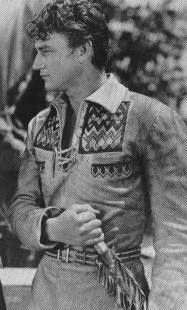
David Thomson, from his lengthy entry on Wayne in his The New Biographical Dictionary of Film: Expanded and Updated
As a child he moved West and, after a football scholarship at the University of Southern California, Tom Mix got him a job at Fox. There he met John Ford and worked as a set decorator on Mother Machree (28). Gradually he edged into acting, by the storybook means of being a bystander. His first big part was in The Big Trail (30, Raoul Walsh). Walsh had seen him carrying a big armchair above his head - carrying it witih flair and flourish.
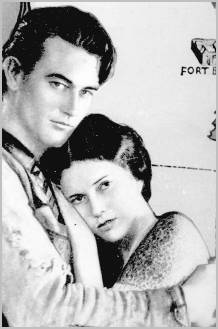
Stanley Crouch on The Searchers:
When Wayne, as Ethan, comes upon the black smoke and the orange flame of the burning house left by the Comanches, his face is one of absolute terror, panic, and rage. At the top of a hill, Wayne flings out his right arm to free his rifle from the long, colorful buckskin sleeve in which it has been sheathed. The force of that flung arm is one of the most explosive gestures in all of cinema, and also among the most impotent: No one down there is alive, and Ethan knows it. He is, at that moment, like the man in Bruegel's The Triumph of Death who so impressed Hemingway because his choice was to draw a sword when faced with the irreversible horror of encroaching doom.
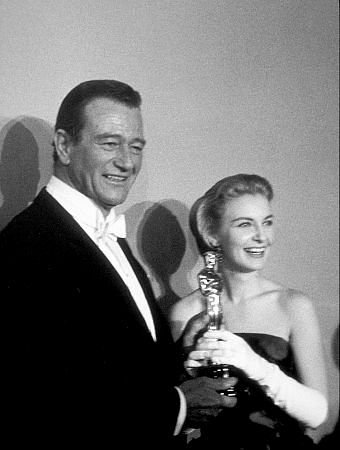
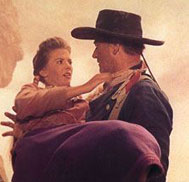
Natalie Wood on that moment in The Searchers when he picks her up - a moment that still, to me, this day, having seen it 20 or so times, takes my breath away.
John Wayne was a giant to me, and when he picked me up in that scene near the end of the picture, he was able to lift me as though I were a doll. It was pretty frightening because he had this look of hatred and I thought that he could easily crush me. But then there would be an almost indefinable gentleness that would come over him as he cradled me and said, 'Let's go home.' Everyone had always told me, 'John Wayne's no actor. He always plays the same part.' I can tell you, Mr. Wayne was a very fine actor. He said to me, 'When I pick you up, I may seem a little rough, but I'll be as gentle as I can be.' I said, 'You must pick me up without worrying about that or you might not give the performance you need to portray.' He smiled and said, 'Well, little lady, you're a real professional, that's for sure.'

David Thomson:
Throughout the 1930s Wayne was a star of matinee Westerns, sometimes a singing cowboy, working his way round most of the smaller studios and making something like a hundred films. By 1939 he was with Republic when John Ford asked him to be the Ringo Kid in Stagecoach. The success of that film lifted Wayne from regular work to stardom. Republic pulled themselves together for a major vehicle for him - Dark Command (40, Walsh) - and Ford called on him again to play a seaman in The Long Voyage Home (40).
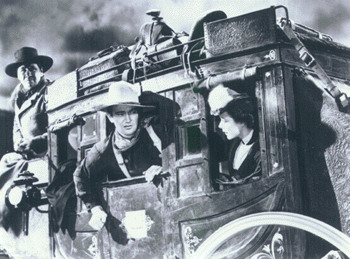
John Wayne started out as a prop guy. He was a college student, and he picked up extra cash doing props for movies and occasional extra work. This was how he met John Ford. He almost got fired from a couple of Ford's films for various snafus. It took Ford a while to start "using" Wayne. It wasn't immediately apparent that this gangly raw kid had movie-star potential.
From Who the Hell's In it, by Peter Bogdonavich:
There's a moment in Rio Bravo -- which features, I think, Wayne's most genuinely endearing performance -- when he walks down the street of the jail/sheriff's office toward some men riding up to meet him. Hawks frames the shot from behind -- Wayne striding slowly, casually away from camera in his slightly rocking, graceful way -- and the image lingers a while to let us enjoy this classic, familiar figure, unmistakable from any angle, Americ'as twentieth-century Hercules moving across a world of illusion he had more than conquered.
 Mark Rydell, director of "The Cowboys", and his star, John Wayne
Mark Rydell was about 30 years old when he directed (and produced) The Cowboys. It was 1972. John Wayne had been making pictures since the 20s. He had been a star for decades. Not just a star, but an icon. Rydell was a Jewish kid from the Bronx who had directed a couple of episodes of Gunsmoke and, I think, 2 feature films. What would the experience be like? Would John Wayne run all over him? How on earth would he direct John Wayne? There are a couple of great stories about the filming of this marvelous movie (and I also love Rydell's image of John Wayne sitting, on break, trying to eat his lunch, while all the kids who were in the movie climbed over him "as though he was a monkeybar ..." They loved and trusted him that much.)
Here's one of Mark Rydell's many moving memories of what it was like to direct John Wayne in The Cowboys. This is an anecdote about the filming of the beginning of the cattle drive - obviously a complicated shot, with horses and herds of cattle and camera equipment, and extras and cowboys and stunt doubles ... not to mention John Wayne.

Here's Mark Rydell on what happened on that day.
And we had 1500 head of cattle. And there's an interesting story of the first angry moment that I had with John Wayne. I was sitting up on the head of a crane. We had 9 cameras, and we were shooting this scene which had to do with starting the cattle drive. And in the background of this 1500 head of cattle, we had all the families of the kids, and all the kids are in position getting ready to start this cattle drive, and being said goodbye to by their parents. And John Wayne was seated on his horse about 50 feet in front of me and I was facing all these cattle on the top of the crane, and the scene begins with him riding over to Roscoe Lee Browne who was sitting on the top of this six-up that he had to drive, and the dialogue, if I remember correctly, is he says, "Are you ready, Mr. Nightlinger?" and he says, "Ready when you are", or something like that. And you know, you don't start 1500 head of cattle by saying, "Go". What happens is, you have to push the cattle in the rear and they move and they push the cattle in front and sometimes it takes 5 minutes for them to be going. So I didn't roll the cameras because I didn't want to waste film until the cattle were moving. There was an enormous amount of cattle. This was really a remarkable production achievement, with Wayne riding past hundreds and hundreds of heads of cattle, all which had to be handled. It was quite a complicated procedure that required a lot of attention. So Wayne decided it was time to go - so he rode up - I hadn't even started rolling the cameras yet - so he rode up to Roscoe and said, "Are you ready, Mr. Nightlinger?" Well, of course, I hadn't even rolled the cameras yet. So I lost my temper. I stood up on the crane and said, "Don't you ever do that. Go back to your spot. I'll tell you when we're going to roll our cameras, I'll tell you when 'Action' is!" and as I was talking to him, I was thinking: what a stupid thing for me to do, to yell at John Wayne, in front of all these kids and all these people, it was humiliating. And I was really sorry, but I had stuck my neck out - and I was right, by the way. And he knew I was right. He went back to his place, did the scene, got in his car - it was the end of the day - and drove into town. All of the crew came over to me one by one to shake my hand, as if to say goodbye, because they thought I would be fired for having contested John Wayne in any way whatsoever. And the Ravetch's were there, and they were horrified, and I got in the car with them to drive back to our production office in Santa Fe, and I was just mortified with guilt for having done this! And they kept saying, "Why did you do that?" And I kept saying, 'I just lost my temper!" And we got back to the production office and there were four calls from John Wayne. And I thought, this is it. I'm fired. I'll be on my way back to Los Angeles in a moment and one of John Wayne's former directors will be down here to take over the picture. So I finally got up my courage and I called him. And he said, "Mark, let's have dinner." And I thought, 'Okay, there's the kiss of death." So we met, and, by the way, there was nothing more remarkable than the experience of going to dinner in Santa Fe with John Wayne, who was 6'5" and an icon. He walked into the restaurant and the place gasped! We sat down for dinner and I am waiting for the axe to fall, for him to say, 'Son, you're a nice guy, but I think we're going to be better off with a better director." You know, I was waiting for that horrifying moment! Which never came, by the way. And he proceeded to tell me that I treated him the way John Ford treated him. I had yelled at him, and he was very impressed that I had the courage to tell him off. He knew that I was right, and he was wrong. Even though it was something I certainly never should have done, he was impressed that I had the courage to do it. And he called me "Sir" from that day forward, and for the rest of the 102 days we shot this picture. And that's the kind of guy he was.

Maureen O'Hara in her autobiography 'Tis Herself: A Memoir
There is only one fitting way to end our discussion of The Quiet Man, and that's with a whisper. No matter what part of the world I'm in, the question I am always asked is: "What did you whisper into John Wayne's ear at the end of The Quiet Man?" It was John Ford's idea: it was the ending he wanted. I was told by Mr. Ford exactly what I was to say. At first I refused. I said, "No. I can't. I can't say that to Duke." But Mr. Ford wanted a very shocked reaction from Duke, and he said, "I'm telling you, you are to say it." I had no choice, and so I agreed, but with a catch: "I'll say it on one condition - that it is never ever repeated or revealed to anyone." So we made a deal. After the scene was over, we told Duke about our agreement and three of us made a pact. There are those who claim that they were told and know what I said. They don't and are lying. John Ford took it to his grave - so did Duke - and the answer will die with me. Curiosity about the whisper has become a great part of the Quiet Man legend. I have no doubt that as long as the film endures, so will the speculation. The Quiet Man meant so much to John Ford, John Wayne, and myself. I know it was their favorite picture too. It bonded us as artists and friends in a way that happens but once in a career. That little piece of The Quiet Man belongs to just us, and so I hope you'll understand as I answer:I'll never tell.

One of my favorite reaction shots from him is Wayne's body language when O'Hara whispers whatever it is she whispers to him. You can feel him go from 0 to 1000 in one second, and it is all he can do to wait until they get back to their house and into their bed. It's subtle evocative and totally clear physical acting. Last moment of the movie, I'm sure fans will remember it.
David Thomson:
Even at that stage [the late 30s, early 40s], Wayne had this virtue denied to Ford's "stock company": he did not ham. Universal put him opposite Dietrich in Seven Sinners (40, Tay Garnett) and Republic lowered its sights to more Westerns. For the next few years he made fodder at his home studio and more adventurous work outside, much of which only exposed his monotonous fierceness: Reap the Wild Wind (42, Cecil B. De Mille); The Spoilers (42, Ray Enright); Flying Tigers (42, David Miller); with Joan Crawford in Jules Dassin's crazy Reunion in France (42); and The Fighting Seabees (44, Edward Ludwig). In 1945, he was in Back to Bataan (Edward Dmytryk), Flame of the Barbary Coast (Joseph Kane), and was overshadowed by Robert Montgomery in They Were Expendable (Ford). He was bizarrely paired with Claudette Colbert in a comedy, Without Reservations (46, Mervyn Le Roy), but Rebublic still pushed straight Westerns at him.
More from the transcript of the interview John Wayne gave with Peter Bogdonavich - I wish all action stars looked at their jobs in this way. We'd get some better movies.
Any time there was a chance for a reaction -- which is the most important thing in a motion picture -- he [John Ford] always took reactions of me, so I'd be a part of every scene. Because I had a great deal of time in the picture when other people were talking, and all my stuff was just reactions. They become very important throughout a picture, they build your part. They always say I'm in action movies, but it's in reaction pictures that they remember me -- pictures that are full of reactions, but have a background of action.
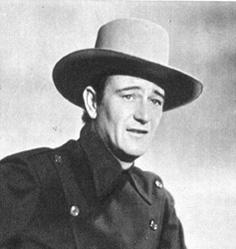
Katharine Hepburn on John Wayne in her autobiography Me : Stories of My Life
From head to toe he is all of a piece. Big head. Wide blue eyes. Sandy hair. Rugged skin - lined by living and fun and character. Not by just rotting away. A nose not too big, not too small. Good teeth. A face alive with humor. Good humor I should say, and a sharp wit. Dangerous when roused. His shoulders are broad - very. His chest massive - very. When I leaned against him (which I did as often as possible, I must confess - I am reduced to such innocent pleasures), thrilling. It was like leaning against a great tree. His hands are big. Mine, which are big too, seemed to disappear. Good legs. No seat. A real man's body.And the base of this incredible creation. A pair of small sensitive feet. Carrying his huge frame as though it were a feather. Light of tread. Springy. Dancing. Pretty feet.
Very observing. Very aware. Listens. Concentrates. Witty slant. Ready to laugh. To be laughed at. To answer. To stick his neck out. Funny. Outrageous. Spoiled. Self-indulgent. Tough. Full of charm. Knows it. Uses it. Disregards it. With an alarming accuracy. Not much gets past him.
He was always on time. Always knew the scene. Always full of notions about what should be done. Tough on a director who had not done his homework. Considerate to his fellow actors. Very impatient with anyone who was inefficient. And did not bother to cover it up.

David Thomson:
Then came two films that radically enlarged his image: Fort Apache (48, Ford), in which he played a cavalry captain, and Red River (48, Howard Hawks). Not least of his achievements as a guide to players is the way Hawks was the first to see the slit-eyed obdurate side to Wayne's character. Tom Dunson is a fine character study: a man made hard by an early mistake and by the emphasis on achievement with which he tried to conceal that mistake. With Ford again, Wayne was one of Three Godfathers (48), a truly awful movie. But in 1949, he was Captain Nathan Brittles at the point of retirement in She Wore a Yellow Ribbon (Ford), and in 1950 the trilogy was completed withthe leisurely Rio Grande (Ford). Asked to be older, a husband and a father, Wayne became human and touching.
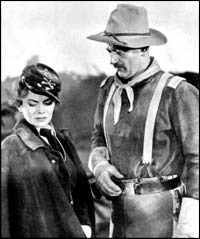
More from Katharine Hepburn:
Life has dealt Wayne some severe blows. He can take them. He has shown it. He doesn't lack self-discipline. He dares to walk by himself. Run. Dance. Skip. Walk. Crawl through life. He has done it all. Don't pity me, please.And with all this he has a most gentle and respectful gratitude toward people who he feels have contributed very firmly to his success. His admirers. He is meticulous in answering fan mail. Realistic in allowing the press to come to the set. Uncomplicated in his reaction to praise and admiration. Delighted to be the recipient of this or that award - reward. A simple man. None of that complicated Self-Self-Self which seems to torment myself and others who shall be nameless when they are confronted with the Prize for good performance. I often wonder whether we behave so ungraciously because we really think that we should have been given a prize for every performance. And are therefore sort of sore to begin with. Well, as I began - he is a simple and decent man. Considerate to the people who rush him in a sort of wild enthusiasm. Simple in his enjoyment of his own success. Like Bogie. He really appreciates the praise heaped upon him. A wonderful childlike, naive open spirit.

From Who The Hell's In It, by Peter Bogdonavich:
In a lifetime of almost thirty years as a top-ten box-office attraction (plus twenty before that as a not unpopular star actor), Wayne's accumulated persona had even before his death attained such mythic proportions that by then the most myopic of viewers and reviewers had finally noted it. He brought to each new movie (good or bad) a powerful resonance from the past -- his own and ours -- which filled the world with reverberations above and beyond its own perhaps undistinguished qualities. That was the true measure of a great movie star of the golden age.
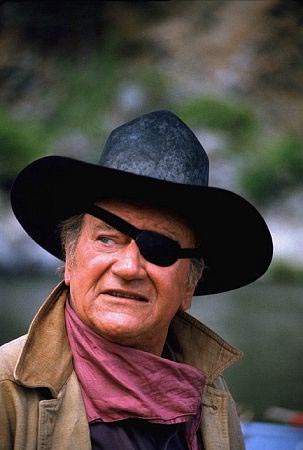
David Thomson:
Next, however, came The Searchers (56, Ford), one of his finest films - once more a study of an unapproachable stubborn man, finally excluded from the family reunion as a romantic but lonely figure facing the landscape. He coasted with The Wings of Eagles (57, Ford), Legend of the Lost (57, Hathaway), and The Barbarian and the Geisha (58, John Huston), before making Rio Bravo (59, Hawks). Once more, Hawks enlarged Wayne by concentrating on an alcoholic Dean Martin and having Wayne watch him "like a friend". It worked - as did the application of Angie Dickinson's talkative emotional crises to Wayne's solidity - so that Rio Bravo is not just Wayne's most humane picture but the one that makes him most comic.
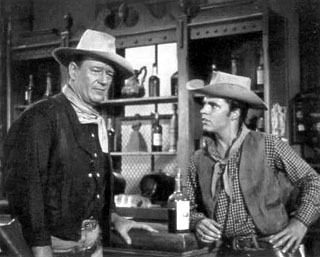
David Thomson:
His death moved nearly everyone, as had his brave walk down the Academy staircase, two months before death, to give the best picture Oscar to ... The Deer Hunter (that'll be the day, indeed.)He made too many pictures, of course; but only because for so long he was a guarantee of profit.

Wayne and Bogdanovich again:
One of the most memorable moments of any picture I've seen you in is a silent moment in The Searchers. After you see what's been done to the white women, there's a close-up of you, camera moves in --I turn back. Terrific shot. Helluva shot. And everybody can put their own thoughts to it. You're not forced to think one way or the other.
Your gestures in pictures are often daring -- large -- and show the kind of freedom and lack of inhibition you have. Did you get that from Ford, or did you always have that?
No, I think that's the first lesson you learn in a high school play -- that if you're going to make a gesture, make it.
To be honest: that has to be some of the best acting advice I've ever heard.
"If you're going to make a gesture, make it."
So much of bad phony acting is when people make gestures half-heartedly, or they PRETEND to make gestures .... hoping the audience won't pick up on the fact that they're not REALLY making the gesture ...
but audiences always know the difference between phony and real. They just do.

David Thomson:
But what a star, what a presence, and what a wealth of reserve he brought to that bold presence. (So you wonder if he couldn't have played comedy.)Nor has he dated. All one can say is that he filled the screen role of a necessarily difficult man as naturally as most actors wore clothes. There was an age when people could be stars without undue grandeur or self-mockery. Whether Wayne is looking at the land that may make a great ranch, or turning in a doorway to survey his true home, the desert, every gesture was authentic and a prized disclosure. He moved the way singers sing, with huge confidence and daring. You have to imagine how it all began in the way Raoul Walsh saw him carrying that armchair - as if it was a young girl in a red robe being lifted up in mercy and wonder.
John Wayne told Peter Bogdanovich:
A funny thing happened with Ford after The Big Trail. He was a strange character, you know. After I did that picture, I came back, and he was making Up the River. I went over and said, "Hi, coach." Nothing. I thought he didn't hear me. So I figured, Oh, well, he didn't even see me. The next time I saw him I went, "Hi, coach, hi." And again I didn't get anything. So the next time I just went right up in front of him and went, "Hi, coach." And he turned and talked to somebody else. I thought, That's that -- he won't speak to me. I don't know how the hell I can communicate.About two years later, I was in Catalina with Ward, having a belt, and Barbara [Ford], his daughter -- she was a little girl then -- she ran in and said, 'Daddy wants to see you." I said, "Whoa, wait a minute, Barbara, you got the wrong boy -- must be Ward." She said, "No, it's you, Duke." So I said, "Yeah, honey, run along, you know this is a bar." So his wife, Mary Ford, came to the door and she said, "Duke, come here. Jack is expecting you out there." I said, "All right." So I went out to the Araner, his boat, and I go aboard -- I remember Jim Tully was there and four or five guys -- and Jack was in the middle of a goddamn story, and he looked up at me and said, "Hi, Duke, sit down." And to this goddamn day I don't know why he didn't speak to me for two years.

Excerpt from Michael Caine's awesome book Acting in Film: An Actor's Take on Movie Making
I noticed that American actors always try to cut down their dialogue. They say, "I'm not going to say all this. You say that line." At first I couldn't figure out why; I came from theatre, where you covetously count your lines. But it's a smart approach for an actor to give up lines in the movies because while you wind up talking about them, they wind up listening and reacting. It's no accident that Rambo hardly speaks. Sylvester Stallone is not a fool.I remember when I first went to America, right after I made Alfie. I met John Wayne in the lobby of the Beverly Hills Hotel. He'd just got out of a helicopter, he was dressed as Hondo and he came over and introduced himself to me.
I said: "I do know who you are, Mr. Wayne."
He said, "You just come over?"
"Yeah."
He said, "Let me give you a piece of advice: talk low, talk slow, and don't say much."

Katharine Hepburn again:
As an actor, he has an extraordinary gift. A unique naturalness. Developed by movie actors who just happen to become actors. Gary Cooper had it. An unselfconsciousness. An ability to think and feel. Seeming to woo the camera. A very subtle capacity to think and express and caress the camera - the audience. With no apparent effort. A secret between them ... Wayne has a wonderful gift of natural speed. Of arrested motion. Of going suddenly off on a new tack. Try something totally unrehearsed with him. He takes the ball and runs and throws with a freedom and wit and gaiety which is great fun. As powerful as is his personality, so too is his acting capacity powerful. He is a very very good actor in the most highbrow sense of the word. You don't catch him at it.

From Who The Hell's In it, by Peter Bogdonavich:
To me, Duke had always seemed slightly out of breath, as though he hadn't yet caught up on the last twenty years, not to mention the last twenty minutes. Both [John] Ford and [Howard] Hawks truly loved him, of course, and even knowing him a little, as I did, it was pretty difficult not to like him. All this, and a lot more, obviously communicated itself to the public -- still the top American star more than seventy years since his beginning. His visual legacy has defined him as the archetypal man of the American West -- bold, innocent, profane, idealistic, wrongheaded, good-hearted, single-minded, quick to action, not given to pretension, essentially alone, ready for any adventure -- no matter how grand or daring; larger, finally, than life or death.
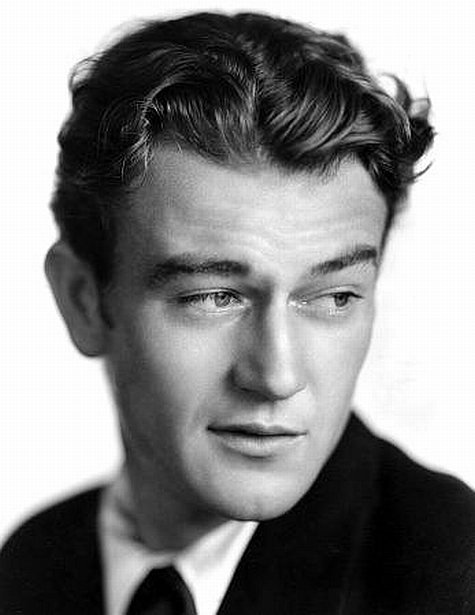
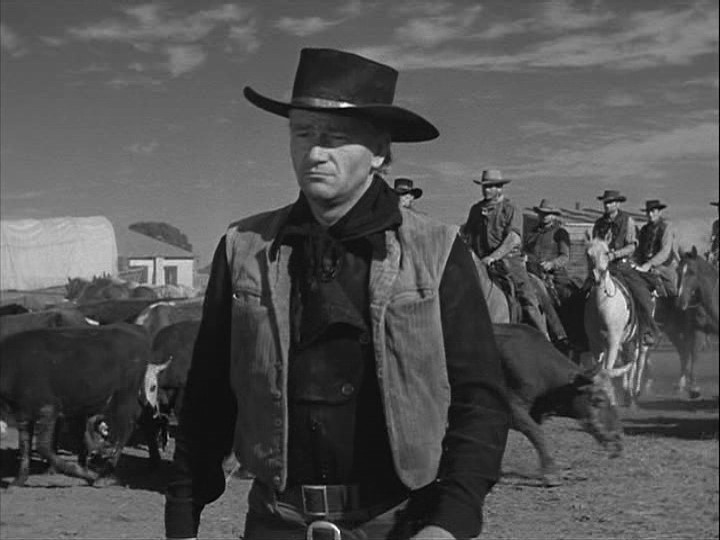
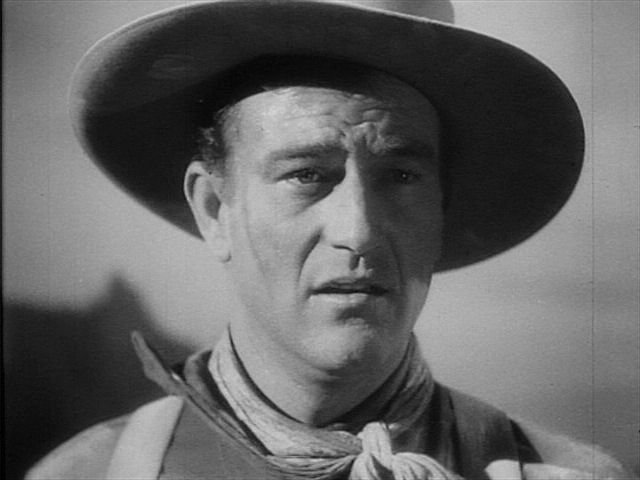
Such a handsome man.
I love how, in that first famous entrance in Stagecoach, Ford moves in quickly to his face, and there's a slight moment where Wayne is out of focus. I love how Ford kept that. It gives it an immediacy, a sense of reality ... that moment of blurriness.
A powerful actor, one I never get tired of studying: his walk, his line readings, his eyes, his reactions ... He's subtle, he's physical, he's funny, he's smart in his choices. And then, of course, there's the magic.
Movie magic.
You know it when you see it.
Wayne had it in spades.
May 25, 2010
"But what about the OFFER?"
One of the best books about making movies is Steven Bach's Final Cut : Art, Money, and Ego in the Making of Heaven's Gate, the Film That Sank United Artists
David [Field] read [Stan Kamen] UA's terms for the picture, essentially what Kamen had asked, including preapproval of Christopher Walken, contingent on his deal's fitting the budget, raised that figure to [Lehman] Katz's still-leery $7.8 million, and aside from an excited slip of the tongue that offered [Kris] Kristofferson 10 percent of the gross instead of 10 percent of the profits - a slip that Kamen caught and graciously corrected - the deal was accepted. David and I made triumphant eye contact. We were now running production at United Artists with Danny [Rissner]'s blessing and Andy [Albeck]'s and Transamerica's, and our first official act, a fairly routine one at that, had been to make the deal that would destroy the company.
Hindsight's 20/20 and all that, but Bach is very honest about the signs he missed, the red flags no one heeded, and how many executives were actually just paying attention to the wrong things. This happens all the time in business. Everyone can see perfectly, after the fact, where things went wrong - but that's not an interesting or helpful perspective, at least not in terms of a book such as this one. Bach doesn't come off perfectly - and it's one of the reasons why the book is so effective. If he wrote it with an axe to grind, if he shoveled all the blame onto Field or Albeck or Cimino, or someone else ... the book would read as petty. The book would be an obvious ploy for sympathy, a biased self-righteous account of one of the biggest corporate disasters in Hollywood history (if not the biggest. Heaven's Gate is in the history books for all time.)
One of the best insider accounts of moviemaking that exists.
I also love Julia Salamon's The Devil's Candy: The Anatomy of a Hollywood Fiasco
While I never agree with the flat-out contempt many ordinary people have for artists and artistic executives (I hear envy masquerading as moral outrage half of the time with these people) who happen to be fortunate enough to make some money, what is fascinating about Final Cut is its step-by-step look at how decisions are made. Some of the decisions are cynical, some are idealistic. Some SEEM idealistic and then turn out to be cynical. Sometimes you strike it rich. Sometimes you come up empty. Decisions are made all day every day in Hollywood, and very few are of such import that they bring down a Hollywood institution like United Artists. What happened?
Final Cut is about just that. I've read it about 3 times, I think. If you want to know "how things work", this is the book to read.
Here's an excerpt from the start of the book. All of these characters worked for UA, and all of them would be casualties of Heaven's Gate (not to mention the re-shuffling of UA at parent company Transamerica's insistence - the book is a masterpiece of corporate culture at work). Here is a conference about a property that had come their way, one of those intellectual/artistic/practical debates that go on all the time, but here take on enormous import because of all that came after. Christpher Mankiewicz (son of Joseph Mankiewicz, and part of Hollywood royalty) worked in the West Coast division of UA, Daniel Rissner (head of production at UA, and soon to be forced to resign), Steven Bach (who would step into Rissner's shoes following his departure, sharing the post with David Field, a situation that was treacherous from the get-go), and Andy Albeck (president of United Artists, but new to the post, and not from an artistic background, which was a blessing and a curse here).
Here, they discuss the third book by an author whose first book was a smash, and the movie made from the book an even bigger smash, changing the Hollywood game entirely ... so they are considering the third book as a possible property. It becomes easy to guess who they are talking about. My favorite comeback is one by Mankiewicz, and it'll be pretty obvious which one I mean.
Michael Cimino has not yet entered the picture at the time of this conference. This is merely set-up of some of the main characters, and how deals are made (or not made), and UA's desire to seem like a heavy-hitting player in the new landscape of 1970s American cinema.
Great book.
"Fellas, this book is a piece of shit!"Chris Mankiewicz's considerable bulk rolled behind the statement, imploring the rest of us to agree. He flung his palms outward toward the room, as if the evidence were smeared there to observe. After a moment he dropped one hand into the pile of sweet rolls on the coffee table before him, piled high with danish and dirty coffee cups.
"Everybody knows that, Chris," Rissner sighed. "It's not about whether it's a piece of shit or it's not a piece of shit. It's about whether we want to make a goddamn deal."
"On this unmitigated, irredeemable piece of shit?"
Rissner borrowed matches from someone, lit a cigarette, pointedly ignoring the redundancy. "What's the minimum bid we could make, you think?" he said to the room in general. "A million? A million five?" His voice seemed casual, but his manner suggested constraint as he bent and rebent the borrowed book of matches. He looked up at the circle seated in mismatched chairs around the glass and chrome coffee table in his Culver City office. There was the chairman of the board, down from San Francisco for the morning, looking on with a kibitzer's curiosity, his expression acknowledging nothing more than respectful interest; the president of the company, his mouth a tight line, owllike eyes swiveling from one face to another behind his huge spectacles, glinting in the early-morning sunlight like windshields; there were the heads of domestic and ancillary distribution, ignoring Mankiewicz's outburst and Rissner's question by burrowing into their synopses of the book in question, readers' reports they were supposed to have read the previous night or on the plane from New York but clearly hadn't. There was Mankiewicz, exasperated beyond belief that his opinion was having no apparent effect on anyone else; there was David Field, looking thoughtful and tactful; and I - I was confused. Who cared what the distribution guys thought? I wondered. Why? When? What did they know?
I knew, so I answered Rissner. "My guess is that the least they'll listen to is a million five and a gross percentage, and that won't make a deal. If we're not prepared to go that high, we shouldn't make an offer at all because the agent will decide he's been insulted and our relationship with the agency is weak enough as it is. This is the first major submission from them in months, right?"
"Right," Rissner nodded.
"The first major submission because they're trying to hype what even they know is a piece of illiterate shit!"
"Chris, please."
Albeck looked simultaneously alarmed and annoyed. Why didn't Mankiewicz shut up? He had clearly been given more than a cue by his superior. Or could the book really be all that bad? He asked the question of Rissner.
"Andy, the guy's last two books were huge best sellers. The movie of the first one became one of the top-grossing pictures of all time. The movie of the second one, which was only routine, did forty million dollars. It's not about quality; it's about money and track record."
"Don't talk to me about track record," retorted Mankiewicz. "My old man won four Academy Awards in two years and then went out and made The Honey Pot. I know all about track record."
Rissner ignored this and turned to me for an opinion. "How would I know?" I waffled. "I turned down the first book. I thought who in Nebraska knows from sharks?"
"But what about the offer?"
"Well," I said, grateful for a money discussion to get me off the hook of commenting on a book I didn't like any more than Mankiewicz did, "if you want to make an offer" -- I couched it in Rissner's direction with the second-person pronoun -- "it should be as preemptive as possible. Otherwise, we look like pikers. What's he want - an auction, what?"
"One offer, all terms, sealed bids. He's submitted the book five places--"
"He says," Mankiewicz now seemed to be talking to himself since no one else was apparently listening, except maybe Harvey, but it was hard to tell.
Rissner ignored him again. "--five places, expects five bids by the close of business today, and top bid takes it. So the offer has to be the best and farthest we're willing to go. If we go."
Andy looked up, puzzled and impatient. "Are we obligated to make an offer?"
"No," said Rissner, anticipating resistance.
He was rescued by the musings of domestic distribution. "Forty million?"
"Domestic or worldwide?" asked ancillary.
"Domestic, I think."
Albeck shot sharply: "That was because of big boobies in wet T-shirts. Does this book have boobies?"
Jim Harvey's placidity seemed suddenly jarred, by the subject matter or Andy's terminology one couldn't tell.
"It has boobies and rapes and S and M, and not one word of it has any resemblance to human behavior as we know it!" Mankiewicz chimed in.
Rissner looked bored. "Yes, Andy. It has boobies. Wet ones."
While Andy mulled this over, frowning, I asked where else the book had been submitted.
"You have to assume to the producers of the first picture and the second picture, if only as courtesy submissions. They would be buying for Universal or Columbia. Then there's us, probably Fox and ... maybe Paramount. Or Warner's."
"Danny, you're close to Warner's," said Andy. "Can you ask them what they think?"
"Why would I do that?" said Rissner, appalled. "What difference would it make? Who cares if they like it or hate it? The point is, what do we do? Do we make an offer or not, and if we do, what's the goddamn offer?"
"I got it," said Albeck, chastened, gloomy, but instructed.
We voted. Andy agreed; Harvey said nothing.
An offer was framed, approved, and made, as Mankiewicz fumed in uncharacteristic silence. The offer came to slightly more than $2 million for the movie rights, based on a floor price which escalated with performance of the book on best seller lists, in book clubs, and so on; a gross percentage of box-office receipts was added to make the offer unbeatable.
It was beaten.
The producers of the movie made from the author's first book secured the rights for something closer, it was believed, to $2.5 million. Losing the book was almost a relief. We had demonstrated we had the money, were willing to spend it, and it hadn't cost a penny.
Two and a half years later, when the movie based on the book was released and landing with a critical and financial thud, I had lunch with Mankiewicz, who had been long gone from UA.
"I told you it was a piece of shit." He laughed without a trace of a sneer.
"That was never the point, Chris," I said.
"It should have been." He smiled.
Jafar Panahi's release: "A moral victory"
Geoffrey Cheshire, expert in Iranian cinema, writes a great piece about the release of Jafar Panahi.
It just so happens that Panahi's imprisonment coincided with the Cannes Film Festival (although there may be more than coincidence at work here). If the regime in Iran was hoping to send a hard-edged message to the international film community about their willingness to imprison one of their country's biggest stars, it certainly backfired. What with Abbas Kiarostami's already high profile (he, who was Panahi's mentor and collaborator on Panahi's first international success), and Kiarostami's closeness with Juliette Binoche (she who was featured on the Cannes 2010 poster), not to mention his own film, Certified Copy, premiering at Cannes, and starring, among other actresses, Binoche - Panahi's imprisonment was bound to take center stage at the Festival. Panahi had been invited to sit on the Jury, and when he could not attend, a chair was left open for him, throughout the proceedings with his name on it, a potent and constant reminder of what was going on in Iran. Panahi's presence haunted Cannes. Kiarostami made statements. Binoche made statements. Everyone made statements. Binoche won Best Actress at Cannes for her role in Kiarostami's film, and held up a sign saying "JAFAR PANAHI" when she won, stating that she hoped he would be able to attend next year.
This is one of those instances when the "klieg-light" response to injustice, especially towards a fellow artist, has paid off in spades. Panahi's imprisonment back in March received publicity, yes, but having the entire worldwide artistic community come into one place, at one time, during the Cannes Film Festival, helped galvanize and solidify the voices of protest. An unintended consequence of the Iranian regime's timing.
There is much we still don't know, and much that will still be revealed. Being released on bail obviously means that there is some expectation that there will be a trial, but that is far from a done deal. As always, I wonder about the conversations in the halls of power in Tehran over the last month or so. Their public comments have been impenetrable and yet also defensive (as in: we in the West have initiated a "propaganda" campaign against Iran, and somehow it is our fault, like we have somehow misunderstood the situation, and etc.) All typical stuff, not surprising in the slightest. That's how they have been playing the game for decades.
As I mentioned in, I think, my first post on Panahi's imprisonment, injustice of this kind requires secrecy, which no longer exists in our global world of international communication. So there's THAT, first of all, and the Iranian regime has tried to stem the tide of information, but they can't. If you follow any Iranian Twitter feeds (as I do), then you know that these people are screaming, on a minute-to-minute basis, about what is going on. They use pseudonyms and block their locations, and do all of this at great personal risk. And then there is the international community, all gathered in one place, at Cannes, and there wasn't one important piece published about Cannes during the festival that did not somehow mention Panahi. This stuff is really important. The drumbeats soon become deafening. The Panahi conversation became dominant, which is what anyone focusing on injustice anywhere hopes for.
Panahi's decision to go on hunger strike, and then make sure it became public knowledge by getting the word out to people who could spread the word further, was a gamble that should be recognized. He was (is) willing to die for the cause of freedom and artistic integrity. The Iranian regime did not call his "bluff". Not this time, anyway. They caved.
Their attempts to save face in the last two days are laughable, but also understandable, from a political standpoint. Whatever, Mr. Panahi is out of jail now, and hopefully recuperating at home with his wife and family.
The fight will go on. To quote Jamsheed Akrami, film professor in New Jersey, quoted in the article by Geoffrey Cheshire, this is "a moral victory", but triumphalism will not do here, when the situation is still so serious for so many others who are not celebrities.
But Panahi is a symbol. And symbols are important. They are not everything. Only totalitarian governments and fascist-minded people think symbols are everything. But Panahi's release is an important concession of moral ground (ground I don't believe Iran held in the first place, but I'm trying to see it from their perspective). This was a huge and public concession. The regime blinked.
And so, as always, we have to see what will happen next.
First photo of Jafar Panahi after release from prison.
Panahi's first message on his Facebook page came this morning, about an hour ago:
I'm freed and beside my family and I believe more and more that : Cinema is Cinema.
Welcome home.
May 24, 2010
Jafar Panahi to be released on bail
I'm so happy to hear this.
More here. Apparently he is going to be released today.
Picturing Dorian Gray

A riveting analysis of representations of Oscar Wilde's Dorian Gray through the years, from illustrated versions of the book, to the recent Marvel edition. Aubrey Beardsley freaks me out. Always has, always will.
It appears that it will be a nine-part essay, and there are only five parts so far. Looking forward to the rest.
Here's a piece I wrote on Oscar Wilde, after completing the Richard Ellmann biography. Some people go through Wildean phases. Mine, so far, has lasted decades. It comes and goes in waves, but it's always there.
Go read the whole piece (it can be a bit confusing to find the next "part" of each essay, but it's all there, one through five.)
Lydia Marks: Creating the look of Sex and the City 2:
Lydia Marks, married to my cousin Liam, mother to adorable Cormac, and awesome person, is quoted and featured in this article about creating the sets for the next Sex and the City movie. Lydia's career as a set decorator and production designer is diverse - ranging from Jim Jarmusch's Broken Flowers to Devil Wears Prada. She worked on the first Sex and the City movie as well. Her war-stories about her career are awesome - how these teams put all of this together, and how insane it can be - so it's really nice to see her get some recognition.
Congrats, Lydia!
May 23, 2010
The Circle (2000); Director: Jafar Panahi
This is a re-post of a review I wrote a couple years ago. I post it today again to show my support of Mr. Jafar Panahi, currently in prison and on hunger strike in Tehran.

Jafar Panahi's 2000 film The Circle is a shattering piece of work portraying the restrictions on the lives of women in Iran. It won Best Picture at the Venice Film Festival that year. Panahi's most recent project was 2006's Offside, a comedic film about a group of tomboys in Tehran dressing up as boys and trying to get into a soccer game (my review here). In Offside, Panahi treats the restrictions (women not being allowed to go into a soccer stadium) with humor, pointing out how unbelievably absurd it all is, even laughable. The tone of Offside is light, frantic, and hilarious. Sometimes the best resistance to a stupid rule is to laugh at it. It may not change the rule, but it certainly takes the edge off.
In The Circle, that hilarious atmosphere is gone. Panahi pulls no punches, from the first devastating scene to the last devastating image. But, in true Panahi fashion, the issues are not presented in a maudlin manner. They don't need to be. The tendency to be "maudlin" is for the privileged, those who have space and freedom to feel self-pity. In Iran, there is no need for such indulgences. Panahi launches us into the chaotic loud streets of Tehran, using handheld cameras, which circle the participants in the drama (there are very few hard edges in the film, very few angles, something to take note of when you're watching it: look for all of the circles and curves in the camera movements and set-ups). It appears that the film crew is just grabbing shots, filming their actors in the midst of a real-life busy street, and indeed, as always, Panahi uses mostly non-professional actors for most of the roles. Panahi is not interested in detailed character analysis, he says as much himself. He is more interested in "types". Characters are drawn in bold primary color strokes, and we can recognize them within moments: the crybaby, the bitter one, the sassy one ... Panahi casts based on looks alone, a bold and courageous move, because often people who look right can't act for shit.
Panahi has great confidence in himself as a director. He does exhaustive casting sessions, casting a wide net, and he also has been known to just approach a woman he sees in the park, who has the perfect look - and asks if she would be willing to do a screen test. (This was how he found the wonderful Nargess Mamizadeh, one of the main characters in The Circle. She's the one in the poster. She's not an actress - at least not professionally, but her looks - her scrunched-up beautiful face, with thick eyebrows, was just what he was looking for for that character). She has a black eye throughout the entire film, and it is never explained. It gives an unspoken backstory to the character, and makes us wonder from the get-go: Where did she get that? What is she running from?) Panahi only used two professional actors in The Circle, the rest were people he found who had the right "look". It's quite amazing, because everyone is great in the film. There are no weak links. There isn't a huge gap between the non-professionals and the professionals. Granted, Panahi is not looking for big cathartic scenes or delicate character development - something that is best in the hands of professionals. He's going for the message, and for the hyper-realistic atmosphere. And also, the pace. As with most Panahi films, the pace is breakneck.
The women of The Circle tear their way through the streets of Tehran, hurtling up against obstacles, hiding in alleys, crouching behind cars: the sense of being hunted is palpable. The women are right to be afraid.

There is not just one narrative in The Circle, we get many. Sometimes they intersect: we're following one group, and then suddenly another woman walks by and we find ourselves following her, and she takes up the storyline. Panahi's points are clear: this is not just about one individual woman. It's about Women(TM) and the circle of restrictions that make up all of their lives.
The film opens starkly. The screen is black, credits rolling. Throughout, we hear the sounds of a woman in labor. She's screaming and grunting and howling, and the nurse and doctor say encouraging things. In the last moment of the credits, there's a pause, and we then hear what we have been waiting to hear: the indignant yowls of a newborn baby.
Next thing we see is a blinding white wall, with the back of a woman's head standing there, she's draped in the full black chador. You can hear the screaming newborns behind the wall. There's a tiny slot in the door that can be opened by the nurses and our chador-ed figure knocks on the slot. A nurse's head peeks out. The black chador asks for the status of Solmaz's baby. The nurse says, "It's an adorable little girl!" Black chador has no response. Says again, "A girl?" Nurse says, "Yes!" and closes the slot. Black chador doesn't move. She stands there, still, a domed black figure.

She knocks on the window again. A different nurse opens it. "Yes?" Black chador says, "I'm here for Solmaz ... I know she had her baby but I don't know what kind ... could you check?"
A chill went through me at that moment. If you ask enough times eventually you'll get a different answer? Suddenly a girl will become a boy if you ask a different nurse?Apparently the ultrasound said it would be a boy, and everyone had heaved a sigh of relief in the family. Phew! A boy!! (I won't go into how despicable I find that attitude, in any culture.) But now, with the baby being a girl, it is valid grounds for divorce, the in-laws will be furious, the black chadored lady is the woman's mother, and for her, there is no joy at being a grandmother.
In one simple moment, Panahi indicts his entire culture. De-valuing women is a national concern.
As Panahi's film goes on, fast and furious, with girls in chadors running through bus stations, yearning for a smoke, huddled in doorways peeking out, hiding, terrified, trapped, you begin to see another side to the "Oh no, it's a girl" phenomenon. It is quite subversive, and really comes to fruition in the heartbreaking story of the single mother planning to abandon her 3-year-old daughter on the streets of Tehran. She says she hopes that her daughter will be adopted by a rich family who might take her away from Iran: "How can she have a future here? What is there for her in this life?" The woman had tried to abandon her child 3 times before getting up the guts. It rips her heart out. Watching her scenes made me go back in my mind to that first scene, with the open dismay at the baby being a girl. The critique is circular, as well as the structure of the film. With the world welcoming your birth with disappointment, what chance does a girl have? A baby absorbs love. Why wouldn't a baby absorb that other unwelcoming attitude as well? We may be horrified and pissed at the attitude, but by the time we get to the woman abandoning her daughter, we have to admit: we see her point.

The Circle is not a soap opera-ish litany of complaints, and the fact that I even have to make that clear is just evidence of how privileged I am. 5 or 6 women skulk through the streets of Tehran. They are unconnected (or so we think). It becomes clear that all of them have one thing in common: they have spent time in prison. The repercussions of such a stain on your life are long-lasting (in this country and in others!) Only in the world of The Circle, you can't be sure that these women didn't do hard time for, you know, hitchhiking, or letting their scarves fall off their heads, or driving in a car with a man who is not a relative. These aren't people who've murdered someone.
A couple of them have just got out. A couple of them broke out of prison with a larger group and are now on the run. One was in prison, but she is now a nurse, and married to a Pakistani man who has no idea of her past, and he can never know. He doesn't know why she won't go to Pakistan to visit his family, but she knows she will be stopped at the border.

These are women who are on their own, even when they are married, and the restrictions of their society makes it nearly impossible for them to survive and be self-sufficient. They need to travel with IDs at all times. They cannot travel alone. They cannot board a bus without a male companion who is also a relative. They cannot check into a hotel by themselves. It is outrageous. The Circle is titanically angry. The pace of the film is frantic. Nobody has time to reflect, or cry tears for themselves. Things are urgent. The police are everywhere.
One of the women comes home once she gets out of prison and it is clear that her brother means to do her harm because of the shame she has brought upon her family. She flees. But where can she go? She has no money. She can't check into a hotel. She can't jump on a bus and move to another town. To make matters worse, she is pregnant, and not married. She wants to have an abortion. This is presented with no euphemism, no judgment. Her lover was executed. What is this now-homeless woman supposed to do? Her family members are just as dangerous as the authorities. She has nowhere to turn. The baby must be gotten rid of.

One woman spent 2 years in prison and when she got out found that her husband had taken a second wife. She is grateful to the second wife, because the second wife took care of her kids while she was inside, and we meet the second wife, and she seems like a nice woman. But the betrayal is clear. NOWHERE is safe.

Meanwhile, it appears that everyone in Tehran is getting married on that particular day (Panahi's ironic sense of humor coming into play). Cars decorated with flowers and streamers meander by, in a long happy parade, we see a nervous groom spilling water on his nice shirt, we get a brief glimpse of a veiled bride in the back seat.

What is there in marriage that can offer sanctuary? This question is not asked overtly in the film, but it doesn't need to be asked. All we need to see is the procession of blushing veiled brides in the backseats of cars, viewed by women on the sidelines who have nowhere to turn. Even when they are married. Marriage is no protection.
One of the things that Panahi is so good at, (and I noticed this in Offisde as well), is that on an individual level - person to person - things aren't so bad all the time. Man and woman can greet one another without all of those restrictions between them. The sales guy in the shop in the bus station, who helps Nargessa with her purchase, teasing her about her boyfriend, and doesn't she know what size he is? The bantering is good-natured, easy, friendly. In Offside we had the characters of the guys hired to guard the girls, and we watch as the girls slowly break down the guards' authority, and finally the guys just succumb to the fact that this is a stupid rule, and we're all soccer fans, and Iran just won, hooray!! The girls did not cower in fear at the sight of the males. They basically thumbed their noses at them. Even the spectre of the morality police and their scary van doesn't dim the girls' spirits. Or if it does, it is just because now they can't hear what's happening in the game in the stadium.
So tyranny - and a "regime" - can never so atomize a population that human beings cannot connect. The regime may try, and boy, they do - and perhaps in extreme cases like North Korea, the totalitarian atmosphere has gone down into a cellular level, hard to know, but Panahi, in his subtle way, shows how the restrictions are not just bad for women, but bad for men, too. Because aren't we all just human beings? And aren't women our sisters, mothers, wives, sweethearts? Don't we, as men, love some women? How can we let them be treated like this? Women aren't a scary "other" - not face to face. They're just people we either like, want sexually, love, or are indifferent to. But the regime cannot let this freedom of thought stand, and so morality itself is policed. And of course morality means (in Iran, and elsewhere, like here and everywhere): "How Women Behave". That's it. That's all morality is when you get right down to it. If women would just act like LADIES, and keep their LEGS CLOSED, and did what they were TOLD, so that no man would ever EVER be confronted with his own animal instincts and have to actually negotiate them, and NAVIGATE them responsibly, as opposed to denying them outright, we wouldn't have such problems in our society! Because sex is at the heart of the morality issue, women are the focal point. It's been true since Eve took the fall. The "morality" of women is a national concern in Iran. Women can't be allowed to drive in cars with men they aren't related to. What would happen next? Open anarchy!
But like I said, Panahi is not a black and white kind of guy. He messes with our assumptions and preconceived notions. In this wonderful interview with Panahi (highly recommended), Stephen Teo writes:
Like the best Iranian directors who have won acclaim on the world stage, Panahi evokes humanitarianism in an unsentimental, realistic fashion, without necessarily overriding political and social messages. In essence, this has come to define the particular aesthetic of Iranian cinema. So powerful is this sensibility that we seem to have no other mode of looking at Iranian cinema other than to equate it with a universal concept of humanitarianism.
When a woman's hair tumbling out of her headscarf becomes a national problem, it concerns all of us. And so while the men in The Circle are few and far between, they also are omnipresent. The women are either running from men who want to trap them and punish them, or mourning men who have also been persecuted by the regime. The circle continues.
The evolution of the film's journey is clear. We begin with a black and white image: black chador against white wall. Quiet and still. No movement. But soon we are out on the streets, and then we have nothing but movement, for most of the film. People running and waiting anxiously and hiding and whispering and hugging. At the end of the film, we meet a girl who has been arrested for prostitution (probably), although it is made to sound like she was just hitchhiking. We have never seen her before. She's a brand-new character. She's been hauled out of the car and is made to wait for the morality van to show up. She's kind of a hottie, truth be told, with sassy red lipstick. She calls the cop "honey", in a contemptuous way.

The van arrives, and she takes a seat. She goes to light a cigarette and she is told there is no smoking in the van. The issue of smoking is an ongoing theme throughout the film. Everyone wants to smoke, but nobody can, for this or that reason, and she, at the very end, is the only one who actually gets to the point where she can light up. I saw an interview with Panahi and he was laughing, saying, "In the West, of course, smoking is seen as dangerous - but here, in this film, smoking is seen as the ultimate freedom." The one other prisoner in the van is a man, and he cajoles the guards to let him smoke. They cave, say "Sure". All the men light up. The girl glances around her (oh, so it's okay that they smoke, and it's not okay that I smoke?), and with a "Fuck this" expression, she lights up. For the rest of the drive, the camera is on her. The men all talk to each other, bantering, laughing, whatever, it's unimportant the topic or subject matter. She has a flowered headscarf on, her face is impassive, she stares out the window, and smokes. It's a long scene. It struck me, as I watched it this last time, how quiet and still the film got at the very end. As still as the scene that started it off. She's a statue in profile. Her situation is frozen. Stasis.
What will be next?
Panahi says in that interview:
Coming back to your first question: why is Iranian film so beautiful? When you want to say something like this and then you add an artistic form to it, you can see the circle in everything. Now our girl has become an idealistic person and thinks that she can reach for what she wants, so we open up a wide angle and we see the world through her eyes, wider, we carry the camera with the hand and we are moving just like her. When we get to the other person, the camera lens closes, the light becomes darker and it becomes slower. Then we reach the last person, there's no other movement; it's just still. If there's any movement, it's in the background. This way, the form and whatever you are saying becomes one: a circle both in the form and in the content.
An important film. Banned in Iran (naturally), but "it" got out. The Circle got out and found its audience worldwide. Because of bootleg DVDs and illegal satellite dishes, everyone in Iran has seen The Circle. In reference to one of Panahi's other films, Offside, there were protests outside of soccer stadiums last year, with women holding up signs saying "WE DON'T WANT TO BE OFFSIDE", demanding that they be allowed into the game.
Obviously the authorities are right, in their warped world view, to ban Panahi's films. The films are subversive, in the truest and best sense of the word. Movies like this have the potential to change the world. "How far that little candle throws his beams! So shines a good deed in a naughty world."
So perhaps The Circle is like a message in a bottle. A time-traveler. A flashlight in the darkness (a little candle throwing his beams far!), saying to future generations who hopefully will not have the same struggles, "Here is how we lived back then. Here is how it was for us." Panahi bears witness. He bears witness.

"To put that scenario in its proper context, compare the regime's blackout of Mr. Panahi's films in Iran to the klieg-lit response of the outside film world:"
An overview of the Jafar Panahi situation, a very nice opinion piece (and I'm not just saying that because the writer linked to me.)
The Books: "The Norton Anthology of Modern and Contemporary Poetry" - James Dickey
Next book on my poetry shelf:
The Norton Anthology of Modern and Contemporary Poetry
I've moved on from the "Modern" volume, and am now in the "Contemporary" volume. The two volumes are organized by birth-date of poet.
James Dickey is probably most known for his novel Deliverance


Who knows. Dickey tapped into a certain brand of horror in such a way that it left an indelible mark. The horror of men being rendered helpless. I should say: certain KINDS of men. The kind of guy that, on the face of it, nobody would mess with. You look at Burt Reynolds, you're not gonna mess with him. Burt Reynolds does not walk through the world with an ingrained sense of what it means to be victimized. He just doesn't. So to see him and his friends put into such a position ...
You still see people shiver when they even reference the TITLE of that movie.

But Dickey was primarily a poet. I know that's well-known to poetry fans, but not sure if those Deliverance buffs out there are aware of that. Born in a suburb of Atlanta, he went to college a bit, but when WWII broke out, he enlisted in the army air corps. Dickey told some tall tales about the combat he saw in WWII, most of it apparently untrue, or at least WIDELY exaggerated - and when he came back to America he enrolled at Vanderbilt University, which was a hot-bed of southern-poetry, in terms of the faculty it drew, and the program itself. This was Dickey's full immersion into the vibrant southern poetry scene. He got his Masters from Vanderbilt, and then taught poetry at various universities throughout the south, Florida, South Carolina, and others. He trained radio operators during the Korean War. He wrote Deliverance in 1970. It was his first novel.
Dickey said in 1970:
As Longinus points out, there's a razor's edge between sublimity and absurdity. And that's the edge I try to walk. Sometimes both sides are ludicrous! ... But I don't think you can get to sublimity without courting the ridiculous.
I find James Dickey's poems to be immediate, and almost urgent. Yet there isn't a word in them that feels slapdash. They are obviously well-thought-out, well-constructed, yet behind them is a feeling of life, and breath, and truth. He's not afraid to look at something without blinking, and dig deep into it, to get to the heart of whatever experience it is. The poem I'm linking to today is something that I know, in my bones, having experienced a moment identical to the one described - identical - but the experience is still so fresh and raw that I can barely think about it without falling apart. I'm tearing up as I type this. I am not placing a value judgment on emotion. Dickey may have written what he wrote years after the fact, when the dust was able to settle - this is often the case with writers (as I know, also from first-hand experience). Perhaps it is just too soon for me to write about such a moment.
But here Dickey does it.
In writing so truthfully about a moment in his own life, he gives voice to MY experience. And I read it with a dawning realization that ... I am not alone, that someone knows how I felt, exactly, it seems such a strange moment to put into words, hard to pin down, yet Dickey does it - my thought process is basically: "wow - look how PERFECTLY he describes such a moment ..."
A lot of his poems have that, actually.
If all you know of Dickey is Deliverance, then all I can say is, do yourself a favor and check out some of his poems. His is an important regional voice, certainly, and Southerners have much to be proud of in their poetic and literary tradition, but I count him as an important American voice, period.
The Hospital Window
I have just come down from my father.
Higher and higher he lies
Above me in a blue light
Shed by a tinted window.
I drop through six white floors
And then step out onto pavement.
Still feeling my father ascend,
I start to cross the firm street,
My shoulder blades shining with all
The glass the huge building can raise.
Now I must turn round and face it,
And know his one pane from the others.
Each window possesses the sun
As though it burned there on a wick.
I wave, like a man catching fire.
All the deep-dyed windowpanes flash,
And, behind them, all the white rooms
They turn to the color of Heaven.
Ceremoniously, gravely, and weakly,
Dozens of pale hands are waving
Back, from inside their flames.
Yet one pure pane among these
Is the bright, erased blankness of nothing.
I know that my father is there,
In the shape of his death still living.
The traffic increases around me
Like a madness called down on my head.
The horns blast at me like shotguns,
And drivers lean out, driven crazy—
But now my propped-up father
Lifts his arm out of stillness at last.
The light from the window strikes me
And I turn as blue as a soul,
As the moment when I was born.
I am not afraid for my father—
Look! He is grinning; he is not
Afraid for my life, either,
As the wild engines stand at my knees
Shredding their gears and roaring,
And I hold each car in its place
For miles, inciting its horn
To blow down the walls of the world
That the dying may float without fear
In the bold blue gaze of my father.
Slowly I move to the sidewalk
With my pin-tingling hand half dead
At the end of my bloodless arm.
I carry it off in amazement,
High, still higher, still waving,
My recognized face fully mortal,
Yet not; not at all, in the pale,
Drained, otherworldly, stricken,
Created hue of stained glass.
I have just come down from my father.
May 22, 2010
It's so funny when William Powell lies

In Libeled Lady, William Powell plays Bill Chandler, a guy hired (or, actually, RE-hired) by newspaper editor Warren Haggerty (played by Spencer Tracy) to basically set up heiress Connie Allenbury (played by Myrna Loy) for a big fall, so that they can derail her libel suit against the newspaper. It is Chandler's job, during a cross-Atlantic cruise, to ingratiate himself with the Allenbury's, make Connie trust him, and hopefully fall in love with him so that he can then ... but the plot is far too Byzantine and ridiculous to describe, and if you haven't seen it, you really must, and Jean Harlow is involved, and she's awesome, and what are you waiting for, but the point is:
Chandler (Powell) knows that in order to get to Connie he has to butter up her father first (played by the reliably awesome Walter Connolly). So he does a bit of research and finds out that Mr. Allenbury is a passionate trout-angler. Angling is his main love in life. Chandler crash-studies angling in his stateroom on the ship, and then pulls out all of the trivia and lingo when he meets Allenbury, and keeps trying to draw the conversation to fish. Powell blurts out, randomly, a propos of nothing: "MY favorite sport is fishing."
Uhm, nobody asked you, bub. The confused glances given to him by Loy and Connolly make the situation even funnier.
It is so much fun to watch William Powell lie. And make things up. I could watch it all day. It borders on the absurd (borders?), and as he gets deeper into his lies (his character knows NOTHING about fishing), the more he continues to insist that he knows what he is talking about.
Naturally, this gets him into all sorts of trouble, the kind of "actor's nightmare" well-known to creative people everywhere: the nightmare of suddenly being onstage, in the middle of a production, and you are the lead, and you have never had a rehearsal, do not know the lines, the blocking, you know NOTHING.
In Libeled Lady, this is what happens to William Powell.
Because once you tell an ardent fisherman, "I live to angle. As a matter of fact, I have fished for trout at Lake Taupo" (and you say this because you KNOW it will impress, even though you are not sure why, but the book you read seemed to think it was important, and you know that that will mean your angling listener will take you seriously) - you can't go back. You can't then soft-pedal it and say, "Oops, my bad, I don't really love fishing", or ... "You must have misunderstood me. I actually have never held a fishing pole in my life."
And that is where William Powell is so funny: when he is in a situation where there is finally no return (I just watched Love Crazy - my review here - and that movie is all about the point-of-no-return, poor guy). Powell is so funny when the screws are tightening and when he, a dignified gentleman, or someone who wants to be thought of that way, is put in the position of looking like a fool.
For example, the clip below. Mr. Allenbury, thrilled to finally meet someone who is as passionate a fisherman as he is, invites Mr. Chandler to come on a fishing outing. The book Powell is reading? "Trout Fishing For Beginners."
Binoche and Kiarostami
Great interview from Cannes with Iranian director Abbas Kiarostami about his latest film, Certified Copy, starring, among others, Juliette Binoche.
I loved this part:
My next film is going to be a road movie too. In my film “Ten on 10,” I explain why I have these driving scenes. I feel good in a car. And the car is one of the locations where you feel the least the presence of a camera. Spielberg’s “Duel” is one of the most memorable films for me — it may remind of Hitchcock but I like it even more than Hitchcock’s films. If you locked me in a car with a camera, and maybe an actor too, I wouldn’t protest. I would promise not to come out of the car. So who knows — if I go back to Iran and get into trouble that’s what I can suggest to them: Don’t put me in a cell, put me in a car.
Kiarostami is still based in Iran, although he knows his films never stand a chance on passing the censors there. He has been a huge vocal supporter of Jafar Panahi, calling for Iran to release him.
Update on that front: Panahi is still on hunger strike, but apparently he was allowed to see his wife on Thursday, and there is going to be a bail hearing today. Things are actually looking up. I cannot imagine that the international attention his imprisonment has received is not a factor. Still a frightening situation, but there are glimmers of hope right now for Mr. Panahi - at least getting released on bail. More information here.
Another update: Not too much new information here, except for the opening paragraphs:
Tehran's prosecutor general has asked the Islamic revolutionary court to reconsider the continued detention of the celebrated Iranian film-maker, Jafar Panahi, raising hopes that he may quickly be freed.A high-profile international campaign calling for Panahi's release has drawn the support of leading figures in the arts and politics. According to some reports a bail hearing could take place as early as this weekend and could free Panahi until his trial.
We're all watching.
And thank you, Bruce, for reminding me of another imprisoned Iranian filmmaker Mohammad Nourizad, who was imprisoned last December, and was sentenced in April to over 3 years of prison and 50 lashes, for writing critical letters to the new government. Because the new government is so unbelievably sensitive that they can't bear critiques. Oh boo-hoo mullahs. Nourizad was beaten so badly that his eyes were injured, perhaps permanently. He is also on hunger strike, with others, including Panahi.
Panahi is the symbol. The international star.
The one whose chair was left empty for him at Cannes.
But there are others. Many many others. Let us hold out hope for them as well.
May 21, 2010
"Michael!"
I've posted this before, but I love it so much here it is again. Bobby Darin singing "Michael Row the Boat Ashore" on the Judy Garland TV show, with some crazy abstract "Poor Judd is Dead" set, dramatic lighting, and Darin's unbelievable intensity (look at his hands, his jaw, his fists) - sex, sex, sex, is what he exudes (the clap at the 1:18 mark? It's so angry, and yet so held-back, he makes "Halleluia" sound almost like a "fuck you"). Watch how he commands the back-up singers to start, ("sing"), and then the next gesture, a wiping-out gesture, quickly, telling them to stop, - how specific, how tightly coiled he is, it's a crazy neurotic performance if you really examine it (and believe me, I have) - and it's all the more powerful because it seems so ... strangely personal. The ferocity of his last moment - the flailing arm, the final scream "MICHAEL". Television just doesn't look this anymore. There's a rawness to it. A stripping away of all that is extraneous so that the performer himself can shine. Bobby Darin just owns it here.
The Books: "The Norton Anthology of Modern and Contemporary Poetry" - Philip Larkin
Next book on my poetry shelf:
The Norton Anthology of Modern and Contemporary Poetry
I've moved on from the "Modern" volume, and am now in the "Contemporary" volume.
As I've said, with some exceptions, I'm more of a "modern" fan than a "contemporary" fan - and a lot of this particular volume doesn't interest me. I'm pulling out the poets I am familiar with, and that I feel I have something to say about. Maybe not something original, but at least SOME response. That is what these "daily book excerpts" have always been about for me. Not only do they force me to write every day, on a topic that maybe I didn't feel like writing about (the funnest part of the exercise), but they force me to think about something that perhaps I had never thought about before.
Michael Schmidt, in Lives of the Poets
[Philip Larkin] certainly did as much as Housman to turn back the clock of English poetry; like Housman, he is the modern poet most often quoted - in church, in Parliament, in the classroom - by folk who latch onto a phrase or a stanza, without bothering to understand what the poem as a whole might mean. His was the characteristic voice of the 1950s and 1960s, regarded by some as the most significant English poet of the postwar.I like Philip Larkin a lot. But what do I actually think about him? That's the fun of my "book excerpt" project (which has been going on for 5 years now (with a couple breaks here and there). 5 years, with one excerpt a day. This tells you the daunting size of my library.

Once you tune in to poetry news, and poetry blogs, one of the names that comes up most often is Philip Larkin. His fans are numerous, his influence wide. I don't think I read him in college, no memory of it - but in the late 90s, I joined a daily poetry newsletter (that I am still on), and that was how I encountered Philip Larkin. The editor of the newsletter (Ernie Hilbert - I reviewed his own book of poetry here) introduced me to Larkin by posting his poems in the newsletter with regularity. Larkin was born in 1922, and he was part of what is known as "The Movement", a group of Oxford University undergraduates (along with Donald Davie, Thom Gunn, and a couple other guys who are now all literary giants) - who defined themselves against excess in language and sentiment - basically saying, "We are against Dylan Thomas". They were in an odd in-between generation, these guys. The giants of the modernists - Eliot and Pound - were right behind them - and the confessionals were right ahead of them - These guys did not like the abstractions of the modernists, the sort of reference-heavy language of Eliot and Pound. Although highly educated themselves, the Movement poets didn't want their poetry to be abstract, or only for the elite.
Larkin himself said:
What I do feel a bit rebellious about is that poetry seems to have got into the hands of a critical industry which is concerned with culture in the abstract, and this I do rather lay at the door of Eliot and Pound ... first of all you have to be terribly educated, you have to read everything to know these things, and secondly you've got somehow to work them in to show that you are working them in. But to me, the whole of the ancient world, the whole of classical and biblical mythology means very little, and I think that using them today not only fills poems full of dead spots but dodges the writer's duty to be original.
"the whole of classical and biblical mythology means very little" ... A very radical statement of purpose, putting him in line with folks like Hardy - another poet who was original, in a way that still stands out today. Larkin had the same religious doubts and cynicism (although he seems more nostalgic than Hardy does. Hardy slams the door shut on faith forever, the second he loses his belief. Larkin still yearns for belief, even when he can no longer believe. His poem called "Church Going" - look it up if you are not familiar with it - is an ache of pain and longing. I love it. You wouldn't catch Hardy writing something like that.)
Regardless. It was Hardy who set Larkin free from the influences of the giant modernists (and this was true of a lot of people who found the modernists too artificial, even their contemporaries). Larkin said.
"After [Hardy], Yeats came to seem so artificial - all that crap about masks and Crazy Jane and all the rest. It all rang so completely unreal."
To give you an idea of Larkin's sensibility, and his love for speaking plainly and saying what you mean: he was also a music critic, and he attacked avant-garde jazz repeatedly, feeling the "abstraction" of the modernist poets in those improvisations, and he truly felt that such experiments threatened the cohesion of civilization. Larkin wasn't kidding around. He may have been extreme, most of the Movement poets were, but he was sincere in that extremity. It wasn't a pose. Also, the poetry that came out of this extremity, pulsing with nostalgia and pain - pain that his cynicism has now left him an exile from the world of warmth and love and companionship - are just masterful, and he's the kind of poet that people fall in love with. The anthology editors say it best:
The reverse of grandiose or straining, Larkin's poetry is so evidently integral with its author, and so witty and deft, that it speaks with singular authority and aplomb.
I find his stuff very powerful. I relate to it. (But I love Yeats and Eliot, too. Room for all of them. I enjoy their in-fighting, their self-described identity crises ... it helps to clarify the artform. But I am not an acolyte of this or that movement. Yeats and Auden are probably my favorite poets of all time, which means Larkin would think I'm an idiot. I'm okay with that! I love him too!) I have similar conservative outlooks at times (meaning: a respect for tradition and history - "conservative" in the Burkean sense of the word, not the current nit-wit sense of the word), but I also have issues and caveats with my own viewpoint - as Larkin did with his. It helps keep me honest, certainly, and helps keep me on the side of ART, as opposed to ideological rigidity, thank Christ. That struggle/push-pull is in Larkin's poetry, is in the language. I love him for that.
His nostalgia is tempered with cynicism. With doubt. That's the best kind of nostalgia. Nothing more boring (and also more potentially dangerous) than unexamined uncynical nostalgia, especially when it's politically driven. Look out. Look out for those who yearn for the "good old days". Those people are just mourning their own loss of privilege. The "good old days" didn't exist, at least not as these folks imagine it, and those days were certainly not "good" for vast vast swathes of the population, not to mention the entire globe - so I am always wary of such people, even when I meet them in person. It's not so much politically that I disagree with them, although that is the case as well. It's that I find them vaguely stupid to actually believe that there was some time, in history, when things were BETTER than they are now. Selective memories. Willfully blinkered. Ahistorical.
Michael Schmidt, in Lives of the Poets
He does not idealize the past. He does not see it, in Hardy's terms, as unrealized, either. It is simply unrealizable. Not Wordsworth's infant trailing clouds of glory behind whom gates of the prison-house close; not Brownings' "Never the time and the place / And the loved one all together" or even Hardy's "Everything glowed with a gleam; / But we were looking away." There was no cloud-trailing infant, no all together, no glow. Yet from these poets Larkin took crucial bearings. Death is his abiding muse, not love or even lust, with its temporary solaces.
Larkin's got that mix I really respond to - and he never leaves out the love. His is a passionate poetry, plain-spoken, heartfelt, honest - but without the stream-of-conscious nature of the confessional poets. His poems are highly structured. Larkin died in 1985. In 1984, Larkin was offered the poet laureate post in England - which is hilarious to imagine, knowing his work. Larkin writing some commemorative ode to a monarch? Funny. But Larkin, true to form, turned down the post. He died shortly thereafter.
I'll end with yet another quote from Michael Schmidt, my awesome go-to guy for context, if I feel I need it. He writes:
Why is a poet of such unoptimistic temperament so popular? Perhaps most of all because of the insidiousness of his verse, the way that after one or two readings it lodges in memory. It has, with its characteristic details, its spoken tones, its formal assurance, the sound of truth, and a poet who speaks bleak truths is probably more valuable than one who gives us airy and empty consolations. The candor of Larkin is different in kind from the candor of Lowell and Plath, not more English, precisely, but more democratic. His truths (if they are true) carry at least the consolation of clarity, unfuzzed by darkly autobiographical resentment.
I love his poems "Faith Healing", "Church Going", "The Whitsun Weddings", "Talking in Bed", "Here" - but today I will post his poem "High Windows", because it seems to me to capture what I've been trying to say here. The danger of nostalgia is that it can reject the "new", as inherently bad. (I have always thought that people who have an overwhelmingly unexamined nostalgic outlook are basically saying, "It was just better to be young" - but they can't say that, so they say, "Things were so much better when I was young" - a subtle but important difference.) But here, in "High Windows", written in the late 60s, and then published again in 1974, shows Larkin - an older man by now - looking at the changes, changes that socially conservative folks may label a decline in values but Larkin declares "paradise". Go, Larkin. And that last stanza ... that's the Larkin touch.
High Windows
When I see a couple of kids
And guess he’s fucking her and she’s
Taking pills or wearing a diaphragm,
I know this is paradise
Everyone old has dreamed of all their lives—
Bonds and gestures pushed to one side
Like an outdated combine harvester,
And everyone young going down the long slide
To happiness, endlessly. I wonder if
Anyone looked at me, forty years back,
And thought, That’ll be the life;
No God any more, or sweating in the dark
About hell and that, or having to hide
What you think of the priest. He
And his lot will all go down the long slide
Like free bloody birds. And immediately
Rather than words comes the thought of high windows:
The sun-comprehending glass,
And beyond it, the deep blue air, that shows
Nothing, and is nowhere, and is endless.
May 20, 2010
"Are you describing a current custom?" - reader response to Shirley Jackson's "The Lottery"
Thanks so much to Maud Newton for linking to this wonderful piece by Ruth Franklin on Shirley Jackson, a writer I have long loved and been totally creeped out by. She was anthologized because of "The Lottery", of course, which is how I first read her - in high school. That short story stayed with me, even down to the inadvertent and automatic memorization of the horrible last line (I was always memorizing last lines, I still do it, I can't help it):
"It isn't fair, it isn't right," Mrs. Hutchinson screamed, and then they were upon her.
In the TNR article, the reaction to "The Lottery" is described, which certainly validates its weird homespun almost journalistic power:
Soon after it was published, letters began to pour into the post office in the rural Vermont town where she was then living—more than three hundred of them, the most The New Yorker had ever seen for a work of fiction. Some of the letter-writers informed her that they were cancelling their subscriptions. Others wrote to express their puzzlement or to demand an explanation. But many, assuming that the story was based on fact, wanted to know where lotteries like the one Jackson described were held. “Are you describing a current custom?” asked a reader from Pennsylvania. “I have read of some queer cults in my time,” wrote a reader from Los Angeles, “but this one bothers me.”The reactions of these first readers are oddly apt, for they point to the deep domestic undercurrent beneath all Jackson’s fiction.
Yes. Yes. Something I think not often discussed with Jackson, because of the more supernatural elements of some of her work is her view of domesticity, and the danger of claustrophobia. Nobody writes about this the way Jackson does. She is a master. This is no Michael Cunningham in The Hours (a tepid Jackson imitator, in my opinion), or Sam Mendes's condescending conviction that the suburbs are the root of all soul-dead evil, a viewpoint which actually led him to totally mis-interpret Richard Yates's harrowing book Revolutionary Road
I read Jackson's We Have Always Lived in the Castle
My friend Ted reviewed it on his site, saying:
It is such a remarkable and elemental story I scarcely want to breathe a word about it to you so that I don't ruin your experience of it. This is at once a cozy little story, simply written, a tale of desperate love, and a horror story.
Ruth Franklin writes in the TNR piece:
Interspersed among the fiction, the new collection includes also a few of the sketches that Jackson drew from her life and originally published in—of all places—Good Housekeeping. In one of these, “The Third Baby’s the Easiest,” a clerk asks Jackson, who is checking into the hospital to deliver her third child, what her occupation is. “Writer,” Jackson answers. “Housewife,” the clerk supplies. “Writer,” Jackson repeats. “I’ll just put down housewife,” the clerk tells her.
Yeah, you do that, clerk. If it makes you feel better about yourself, and helps you understand the world you live in, which can be sooo scary and unpredictable, with pesky pregnant women insisting they are "writers", what is this world coming to? Narrow little minds will always be revealed, in the end, as narrow little minds. Jackson was a terrific revealer, and she did it with creepy quiet grace, letting the event speak for itself, always.
Go read the whole piece, and definitely check out Shirley Jackson's stuff, if you haven't already.
"Where's his damn box set?" - Kim Morgan on John Garfield

A recap of the Arthur Lyons Film Noir festival in Palm Springs by Kim Morgan, with a special focus on John Garfield. He's long been a favorite of mine. Due to my obsession with all things Actors Studio starting from when I was 13 years old, he came on my radar long before he might have otherwise, because of his association with the Group Theatre in the 30s, started by Lee Strasberg, Cheryl Crawford and Harold Clurman, and his sort of shadow-box-dance with Marlon Brando for roles in Streetcar and On the Waterfront (which was actually written for Garfield). He was known as Julie Garfinkel back then. The internalized anti-Semitism of the day brought about the name change, but to his good friends - and he had many (despite the horrible way he ended) he was always known as "Julie" or "Jules-y".
John Garfield's daughter Julie was at the Film Noir fest, and Kim Morgan got to interview her about her father:
The picture I presented was one of his greatest films, and his last movie before he passed away -- He Ran All the Way (1951). A movie made by many victims of the blacklist, including director John Berry and co-writers Hugo Butler and Dalton Trumbo (who was jailed as one of the "Hollywood Ten"), the story of a criminal on the lam, a desperate man, a man in a panic who takes a family hostage only to be tortured by his conscious and the cold hands of fate, held extra resonance. There was the power of the film itself, the history and real life tragedy of its star, and then Julie sitting next to me. She had never seen her father's final film on the big screen, and experiencing her taking in daddy so beautifully shot by James Wong Howe, and his tough, vulnerable, wounded, complicated performance was especially moving.
I did not know that John Garfield, at one point in his life, sold diaphragms door to door. Can you imagine? That guy in the picture above selling birth control at your door?
A giant star in his day, who died way too young, his death hurried upon him by the stress and harassment he was receiving from the HUAC, his funeral in 1952 was a mob scene of fans. But now? What has happened?
Go read Kim's piece. It's an emotional tribute to an actor rather forgotten nowadays.
I wrote about John Garfield's screen debut in Michael Curtiz's Four Daughters (1938) here.
A great American movie star.
May 19, 2010
The Psychopaths of Charles Willeford's Shark-Infested Custard
Thanks to the editor at Spinetingler Magazine for excerpting my piece on Charles Willeford's creepy novel. Spinetingler is a vibrant magazine devoted to crime novels, and I'm pleased to be included.
"Finally, I swear upon what I believe in, the cinema: I will not cease my hunger strike until my wishes are satisfied." - Jafar Panahi

Iranian director Jafar Panahi, who was invited to be on the jury at Cannes, is obviously not present, due to his imprisonment. A chair has been left open for him at Cannes, a clear statement of solidarity and support of the absent director. Abbas Kiarostami made a powerful statement in support of Panahi while at Cannes (to add to the open letter he wrote to the officials in Iran following Panahi's imprisonment). There has been little to no word of Panahi for two months. On May 3, some of the biggest names in Hollywood signed a petition calling on Iran to free Panahi. Iranian opposition leader Mir Hossein Musavi went to visit Panahi's family (photos here), part of a push from opposition leaders to show solidarity with those imprisoned in the roundup.
And then yesterday came the horrible news that Panahi has gone on hunger strike.
He released a statement to Abbas Baktiari, director of Pouya Cultural Center, and it has been posted on the Facebook group Free Jafar Panahi. I am devastated by this news.
Declaration of Jafar Panahi
I hereby declare that I have been subject to ill treatment in Evin prison.
On Saturday May 15, 2010, prison guards suddenly entered our cell, n° 56. They took us away, my cell mates and I, made us strip and kept us in the cold for an hour and a half.
Sunday morning, they brought me to the interrogation room and accused me of having filmed the interior of my cell, which is completely untrue. Then they threatened to imprison my entire family at Evin and to mistreat my daughter in an unsafe prison in the city of Rejayi Shahr.
I have eaten and drunk nothing since Sunday morning, and I declare that if my wishes are not respected, I will continue to abstain from drinking and eating. I do not want to be a rat in a laboratory, victim of their sick games, threatened and psychologically tortured.
My wishes are :
- The possibility to contact and see my family, and the complete assurance that they are safe.
- The right to retain and communicate with an attorney, after 77 days of imprisonment.
- Unconditional liberty until the day of my judgment and the final verdict
- Finally, I swear upon what I believe in, the cinema : I will not cease my hunger strike until my wishes are satisfied.
My final wish is that my remains be returned to my family, so that they may bury me in the place they choose.
No One Knows About Persian Cats (2009); Dir: Bahman Ghobadi

Plucky kids in American movies have always rebelled against authority, whether they just want to dance, dammit, or put on a show ("My dad's got a barn!"), or love whoever they want to love. It's a rite of passage, made manifest in film after film. Who knows if we feel it is expected of us because once upon a time we saw Rebel Without a Cause, or if it's something ingrained in the hormonally surged time of adolescence. I know I was influenced by the films I saw. Either they validated my angst, they said, "I know how it is, I know how it is", or they showed me a better way, a way up and out of the muck and mire. Some of those films now seem rather silly to me, self-involved, but I still maintain affection for them because I saw them at that important time in my life when I needed an outside eye.
Rebellion in Iran necessarily takes on giant political consequences, even personal rebellion, as recent events have shown, and even something as innocent as first love is seen as a deep threat to the State (here's my review of The Girl in the Sneakers, an Iranian film that shows just such a situation), and a citizen's personal life is everyone's business. The new wave of Iranian filmmakers have a willingness to put their careers and sometimes their lives on the line to tell the stories they want to tell. These directors know that the chance of their films actually being seen in Iran are nil, and yet they press on regardless. Their reputations are giant worldwide, and yet, due to the regime's suppression of their work and their ability to work at all (not to mention canceling their visas and passports so they cannot attend festivals), they live under conditions that are fascistic and dangerous.
Bahman Ghobadi is a Kurdish director, engaged to Roxana Saberi, the American journalist who was arrested last year on espionage charges, causing worldwide protests (and tepid responses of outrage from so-called enlightened governments). Saberi is listed as a co-writer on Ghobadi's latest film, the wonderful No One Knows About Persian Cats, which received Un Certain Regard's Special Jury prize at the 2009 Cannes Film Festival. There was a terrible irony in the timing: Saberi was imprisoned at the time, and the widely disputed Iranian elections of 2009 followed, bringing into sharp highlights all of the issues touched on in Ghobadi's film. Saberi was released in May of 2009, and now, a year later, No One Knows About Persian Cats has opened in America.
Ghobadi's film Half Moon (my review here) examined questions of Kurdish identity, as seen through the filter of music. Music is very important to Ghobadi, that is obvious, and in Half Moon, with its road trip-slash-requiem story of an old Kurdish singer trying to get back into Iraqi Kurdistan for one last concert, the music weaves through and around the film. It bonds people together. It is the voice of the exile. In No One Knows About Persian Cats, Ghobadi stays in Tehran, going underground (literally, at times), to explore the music scene in Iran. There is a story here, of two young singer-songwriters, Negar Shaghaghi and Ashkan Koshanejad (their real names), who have just been released from prison. Their crime? They play music. Music without the stamp of approval from the Islamic Ministry of Culture. They have booked a gig in London, but now they need to figure out a way to leave Iran, which requires passports, visas, not easy in normal circumstances, but nearly impossible for those who have criminal records. They are hooked up with Nader (played with humor and ferocity by Hamed Behdad), a sort of manager, a guy who can get things done for you, who knows everyone, who constantly says things like, "Don't worry, I'll take care of it ... I'll handle it." He knows everyone in the music scene, and Ashkan and Negar are looking for a couple of musicians to fill out their band, so Nader starts taking them around on his motorcycle (the two of them piled on behind Nader) to visit different musicians.

He also tries to get them passports in a hurry. Nader is a guy with a finger in every pie. He makes his living selling bootleg CDs, and he, with his constant stream of enthusiastic chatter, is a born salesman. But he lives on the edge of the law. Any one of his various exploits could get him thrown into prison. But he maneuvers his way through the system in a wily manner, keeping a sense of humor, and groveling and begging the authorities if necessary (there is one terrific scene that shows just this thing). He, like many Iranians, has kept his soul, his spirit, intact by not internalizing the oppression of the regime. It hasn't "gotten" him. He plays by the rules, it's easier that way, but he is duplicitous, like most populations in totalitarian regimes. You do what you need to do to get by, but when the regime has turned its back, you do whatever the hell you want.
Ashkan and Negar may (or may not) be a couple. There is an easy intimacy between them that suggests romance, the two of them standing on the city rooftop, staring at the smog-glamorous sunset, and at one point, Ashkan moves closer to her, bending his head towards hers, and they rest there, in silent silhouette. They hang out, tooling around the city in her car (she drives), talking and arguing about music, what they are going to do, how they want to give one last show in Tehran ("I would love it if my parents could come," Negar says) before they leave for London. They both know that when they leave Iran, it will be for good. The situation has become unbearable for musicians.

The "underground" music scene in Tehran is often just that: The camera follows Ashkan, Negar and Nader as they descend narrow stairways into this or that basement, where someone has set up an illegal recording studio, or where musicians hang out and jam, soundproofing everything so the authorities won't hear from the street. There is an almost ritualistic feeling to these repetitive sections of handheld descents (and ascents, sometimes - musicians also hide out up on the roofs, creating soundproof sheds where they can rehearse): Music driven underground, you have to know where to seek it out, it is not allowed to flourish in the light of day.
Ghobadi's use of nonprofessional actors, with everyone basically playing themselves (he appears in the film as well, in the music studio in the beginning), makes the film feel like a documentary at times, a whirlwind tour of Tehran's hidden music scene, but the overriding sense of oppression (and the humor with which everyone treats it, everyone's been in jail for playing music, everyone sort of just accepts the situation with a shrug, then they close the door and start banging on the drums, regardless of the terrible consequences should they be caught) is always on the periphery, and there are times when I felt outraged. There is one scene where Ashkan and Negar are driving, and Ashkan is holding his dog. They are pulled over by the cops who demand to know why they have a dog. (Dogs are seen as unclean animals in Islam.) Negar is a fighter, and argues with the cops, "the dog has been vaccinated, he's fine" - but, in a horrifying moment, the cops reach in and yank the dog out of the window, and we are left with Negar's scream of "No" as she leaps out of the car. Cut to the next scene. The dog is never mentioned again. The film is not overtly political (although, as with most films in Iran, everything is political on some level), and it doesn't use a heavy hand, but that one scene tells you how random, how awful, life can be on the streets.

The bands Nader introduces the two leads to show the diversity of the music scene and also how creative artists have to be to just do their thing in Iran. A heavy metal band (I loved these guys) rehearse in a cow shed out in the middle of the country. The cows don't seem too happy about it, and the farm workers are all in cahoots with the band, piling bales of hay around the cow shed to blot out the sound. A rock band has constructed a metal shed on the rooftop of their building, and they have to wait for the neighbor to leave before rehearsing because the neighbor always calls the cops. The band mates, wearing CBGB T shirts and Joy Division T shirts, peer over the edge of the building, keeping an eye out for the telltale neighbor. A Persian rap band rehearse and film a music video on a construction site, in the open air, four stories up. They do not want to go to Europe, like Ashkan and Negar, because, as the lead rapper tells Nader, "We rap for Persia. We rap for Tehran. This is where we need to be." There is an added complication that any band with a female singer that gets a permit to play a show has to have female backup singers, or more females on stage. It is against the law for one woman to be on stage with a bunch of men. So, basically, No Doubt would be illegal in Iran. Ashkan and Negar go to a private house where two sisters are giving a concert, the small audience sitting in the dark, the women banging on the large translucent traditional drums (shown to such powerful effect in the scene of "exiled singers" in Half Moon).
There's a lot of music in No One Knows About Persian Cats, obviously, and each band plays a song for Ashkan, Negar and Nader, with Ghobadi providing what amounts to music videos for each song, with gorgeous caught footage from around Tehran, glimpses, fragments, beautifully realized: a little girl skipping down the sidewalk, two veiled women sitting on a bench eating ice cream and laughing, an old man glancing directly at the camera, people rushing in and out of subways, a montage, ongoing, of the faces of Iran, the populace just going about their lives, the haves and have-nots, with some startlingly beautiful images, things that show Ghobadi's piercing and specific vision. I mentioned in my review for Half Moon that sometimes, sometimes, a director actually gives you a vision of something you have never seen before. So many images in films, while beautiful, are just copycats of either something else, or depictions of something we have all seen a million times: sunsets, rainfall, a dark grey beach, whatever: beauty, yes, but not original. Half Moon was full of things I literally had never seen before. A strange journey through a borderland, filmed beautifully, but with some shots that caught the breath in my chest. He has an amazing eye. For landscapes, yes, he makes Tehran look like a vibrant strange place, but also for faces. Ghobadi captured most of this footage on the fly, with a digital camera, and it's haunting, beautiful, a counterpoint to the music, whether it be rock, rap, heavy metal, or traditional Persian. The full tapestry of artistic expression, going on below ground, as the world walks around above, trying to live their lives.

Ashkan and Negar, a singing duo in real life, are sweet and unselfconscious in their acting roles. You root for them. I wasn't wacky about their music, but that seems immaterial in the world being depicted in Persian Cats. Artists should be allowed to make art. Period. Most of the bands say things like, "We make sure our lyrics are in line with today's social codes - we don't want to offend anyone - we just want to make music." The two leads plan on giving their last show in Tehran (they still don't have passports, but Nader assures him everything will work out fine), in a basement in a private house. They get the word out on the streets. They decorate the room, pulling Persian rugs across the stage floor, and Negar buys 200 small candles to pass out to the crowd. It looks like any underground rock club in any city in the world. I was rooting for these kids. The odds are stacked against them. They work hard at what they do, they argue over lyrics, they discuss their music, and, inadvertently, without even making too fine a point of it, they seem totally innocent. Ghobadi is a master at that kind of subtle portrayal. They are not rebels without a cause, they have a cause, but the kids themselves seem like good kids, with a love for music, and a yearning to just play shows, wherever they can, however it comes about. They are innocent. They are doing nothing wrong.
But the regime, as it shows itself repeatedly, doesn't agree. And, if you think like a mullah, who can blame them. Music is powerful. People gathering together to listen to music is a powerful event. If you let that happen, then where will it stop?
The screws begin to tighten. Nader is arrested for selling bootleg CDs. He pleads his case in a beautiful scene (my favorite in the film), with Ashkan peering through the slightly open door at the police station. The old man who makes passports is also arrested. Another door closes. Interspersed with music, the film works slowly, it meanders, it is not a scream of pain or outrage, not outwardly, and that is part of its power.
Ghobadi has a great eye for detail. Nader lives in a tiny flat, and keeps parrots and finches as pets. The main parrot is named Monica Bellucci. Two finches are named Rhett and Scarlett. He loves them all to death. He speaks in English, occasionally, and everyone makes fun of him for this, but he scoffs at them. "What's wrong with speaking in English? Listen to this!" (then in English) "I see no problem. There is no problem." (back to Farsi) "What is wrong with that?" There's a scene where Negar lies in bed, reading, and jotting things down in her journal. At one point, we see what book she is reading. Metamorphosis, by Franz Kafka. A beautiful example of the soft subtle hand Ghobadi uses when telling this story. A man wakes up transformed into an insect. His destiny is out of his control. It is terrifying. He has transformed into something monstrous, against his will. Ashkan and Negar, who just want to play music, who just want to put on a show, in a barn, a shed, anywhere, who are willing to leave their homeland - for good - in order to pursue music - are faced with a similar nightmarish future. What will they be transformed into if they stay? None of this is said explicitly. We just see the book, Ghobadi making sure we know what it is, and the film moves on.

A couple of years ago, I read this article about a girl group in Saudi Arabia, and was blown away by these young women, trying to do their thing in an unbelievably oppressive atmosphere. Read that article and watch the stereotypes disappear. Their parents support them, although they fear the regime arresting their daughters. The girls, with piercings in lips, ears, noses, are just like any other group of young women who want to be cool, who want to participate in the culture of trends, who just want to make music. Here they are, in a country where they are not allowed to play in public, not allowed to play in public, and that hasn't stopped them. In a global world, with things like MySpace and iTunes, word has gotten out about these girls, and in their own way, they are participating. I wish them the best.
I showed that article to my brother, a huge music fan, and a songwriter himself.
His response? "Right now, those girls are the greatest rock band in the world."
The word "brave" is used so often to describe films that it has become almost meaningless. But here, with No One Knows About Persian Cats, "brave" actually means what it says it means. The act of filming this movie was brave. Every musician who appears in the film is brave. They understand the consequences. They make their art anyway. Watching it yesterday, I thought of my brother's comment, and his words floated through my mind like an echo:
"Right now, at this moment in time, these bands are the greatest bands in the world."

May 18, 2010
"Jesus Christ! That's Henry Fonda!"
A great post from one of my new favorite blogs (I spent a good two hours the other day scrolling through the damn thing - it's RICH) about Henry Fonda, typecasting, and Sergio Leone's casting of Fonda as the heavy in Once Upon a Time in the West. There are two clips included: one of Fonda's entrance in that film (a great entrance, with a flashy "look at me, Ma" camera move) and the second a clip of Fonda talking about that entrance on a 1975 talk show. I suggest watching the second clip first, of Fonda describing the entrance, and then go back to watch the entrance itself. Notice Fonda's technical memory of each shot, each POV in that opening sequence. That's a pro.
And of course. Leone was right. You'll see what I mean after you watch the clip of Fonda on the talk show.
Great stuff.
Go read the whole thing. And scroll through that incredible site. He's got a great eye.
"He's the man standing up there beside Errol Flynn." - Amanda McBroom

Amanda McBroom
I said recently on Twitter (I know, so ridiculous, like that has any validity whatsoever - however, apparently it's all going into the Library of Congress, so at least my name will live on forever in some capacity) that the best byproduct so far of Ridley Scott's self-serious and "historically accurate" Robin Hood is that Errol Flynn is all over the place right now, and I'm in heaven about it. He's always had the props, obviously, but it's nice to see him get the props once again, in almost every single review, from folks who miss the jaunty careless air he brought to a role that is, honestly, just an excuse for some swashbuckling and some fun. Shouldn't it all be a bit more fun? (Thanks, Mr. Ebert. I agree.)
I grew up on Errol Flynn movies, and when the Dean Stockwell obsession took over my life in 2007, I loved going back to re-watch Kim, a movie I had seen on a fuzzy black-and-white television in our family den when I was about 10 years old. Stockwell tells stories of how Flynn treated him and what that experience was like, and it's pretty cool.
All of this is to say:
Cabaret singer Amanda McBroom is the daughter of David Bruce, an actor who worked with Errol Flynn multiple times, a man with a long career (there's a wonderful tribute to him here). McBroom is also a songwriter (she wrote, you know, that little-known song called "The Rose", made famous by another performer), and she wrote a song about her father called "Errol Flynn" that came up on my iPod shuffle today and, as always, I had to skip right over it, because it's far too emotional for me to listen to when I'm out and about doing errands. I cannot listen to it with any distance. It dissolves me. Repeatedly.
I won't even speak any further about it. Some things are beyond words, and it's better to just point to the source, and say: "There. Look at that." It is a song that has even more poignancy to me now than it did when I first heard it.
It's a tribute to her father, yes, but it's also a tribute to artists. To the loneliness of the pursuit, and to the inherent dignity in a job well done, even in B-movies, even with your name far far below the star's name. David Bruce was just such an actor.
Below the jump is a clip of Amanda McBroom performing "Errol Flynn". It's controlled, elegant, with abysses of emotion below the surface. And listen to those lyrics.
The Shark-Infested Custard, by Charles Willeford

Jump suits, as leisure wear, have been around for several years, but it's only been the last couple of years that men have worn them on the street, or away from home or the beach. There's a reason. They are comfortable, and great to lounge around in - until you get a good profile look at yourself in the mirror. If you have any gut at all - even two inches more than you should have - a jump suit, which is basically a pair of fancied up coveralls, makes you look like you've got a pot-gut. I've got a short-sleeved blue terrycloth jump suit I wear around the pool once in a while but I would never wear it away from the apartment house. When I was on the force and weighed about 175, I could have worn it around town, but since I've been doing desk work at National, I've picked up more than twenty pounds. My waistline has gone from a 32 to a 36, and the jump suit makes me look like I've got a paunch. It's the way they are made.
That paragraph comes early on in the novel The Shark-Infested Custard
It's chilling.
The Shark-Infested Custard tells the stories of four guys living in Miami. They have become friends because they all live in the same singles-only apartment complex. Proximity is their only bond. The book switches narration between the four guys, and because the book starts off with Larry, it sets the tone. Larry is an ex-cop. He now works security. He seems pretty normal, but the jump suit paragraph is the giveaway that something's not quite right with this guy. Hank is a representative for a drug company, selling pharmaceuticals to local doctors, and he's so good at what he does that he works very little to keep himself going. He is a ladies' man of a particularly brutal kind, and all of the other guys look up to him. He can find tail anywhere. Eddie is an airline pilot, and he is dating a widow, who maybe is not as young as he would like her to be. But he gets something out of the relationship. She is so devoted to him, always there for him. Maybe he does want out, maybe he can find something better, but he's not exactly searching. Then there is Don, a Catholic who is having problems in his marriage, and has moved out. He is a silverware salesman, he has a 10 year old daughter (and he seems to have no feelings about her whatsoever, except that he doesn't want his wife to "win" and get custody of her), and he can't get a divorce, because of his religious convictions. These mismatched gentleman hang out together, play pool, have cocktails, and their banter is so alienating that I could barely pay attention to it. I am biased against such men, with good reason. If you meet one in real life, your best bet is to just be kind, pleasant, smile and nod, and then walk away, soul and spirit intact. Such men have a scent, and women would do well to learn to recognize that scent and stay far far away from such individuals. It's not that they are in a state of arrested development, that's not it at all. It's not that they are boorish or openly violent. It's much worse than that. It's that they are narcissists, and other people don't actually seem quite real to them. They have gotten away with this for a long time, because they have developed very convincing acts of being "normal", but make no mistake: they are not.
I was first alerted to Charles Willeford's books in the comments section to this post, on psychopaths and morality, and ordered The Shark-Infested Custard immediately.
By switching points-of-view, Willeford keeps the reader guessing and on edge. I was afraid of Larry almost instantly because of his jump suit monologue. It's one of those things that an FBI profiler would have picked up on immediately, or a homicide detective, alert to the vagaries of psychology, and what is normal and what is not. Larry doesn't seem like a bad guy, not at all. He's just a bit flat, in his response to things, but I justified that FOR him, in my head, at first: "That's probably because he was a cop ... he's seen a lot ... he can't afford to get all worked up." This was merely a defense mechanism on my part. (I love that Willeford is able to create characters that I, as a reader, feel I must defend myself against. That's pretty powerful and rare.) So I tried to make excuses for Larry at first. Someone like Larry actually counts on responses like that one of mine. He counts on people to make excuses for him, it is a perfect smokescreen for the lackings in his emotional makeup. But again, and here is Willeford's strength: None of this is spelled out. First-person narration tosses you into someone else's point of view, relentlessly. You have to figure it out as you go.
The second section of the book, much longer, is from Hank's point of view. Now I had gotten to know Hank from the first section, seen him through Larry's eyes, and I found him to be rather scary and amoral. He picks up a girl who is clearly only about 13 years old at the drivein, merely to win a bet he had with the other guys. He seems to have no qualms about this illegal and despicable behavior. "So? She's a girl. I just picked her up. Pay up." He has no moral code, clearly. This is, at least, what I got about him from Larry's point of view. Like I mentioned, though, that "jump suit paragraph" was scarier than any of Hank's actual actions, and was a clue that if these guys were sociopaths of some kind, Larry was off-the-charts, Larry was the one who was beyond the pale. He didn't have to do anything wrong or bad to clue me in. Hank you could actually work with. Maybe. But Larry? If you ever meet a Larry? It would be best to just turn around and walk away, without looking back.
Hank's section of the book does not pick up where we left off with Larry. It takes an entirely different direction, and obviously takes place some time after the events of the first section, and Hank doesn't mention those events at all. He instead tells the story of his encounter with a woman named Jannaire, and how obsessed he was with her, and how it turns out she was married (at least she seems to be) and her husband is now trying to kill Hank. So. I kept WAITING, through the second section, for Hank to at least acknowledge the horrifying events described by Larry in the FIRST section, with the 13 year old girl, and the man in the jump suit, and all the rest ... but Hank doesn't bring it up at all.
Here, here, is where we can tell we are in the presence of a great writer. Charles Willeford very carefully crafts this multi-voiced crime novel so that the reader is placed in a constant state of imbalance and un-ease. It was a truly de-stabilizing experience. The lack of judgment (mentioned in the comment by Bruce, who recommended the book) is one of the key reasons why the book is so effective. By the end, I felt like I was in a belljar of amoral reality. No one spoke up and said, "This is wrong", or "God, we're douchebags, aren't we" and why would they? That wasn't true for them. They were all behaving according to their own codes. The one man in the group who has some semblance of normal human emotions such as regret, empathy, guilt - is clearly the worst off. You don't envy him. You don't think, "If only they could all be like him." When one operates in a world where the norms are skewed, then it is nearly impossible to keep your own compass pointing where you want it to point. This is one of the reasons why how you choose your friends, the boundaries you set with people, your understanding of what you can tolerate, and what you cannot, is so important. You have to know what you are letting into your life. Don, the only one of the group who seems to have normal responses to things, loses his bearings because of the company he keeps. Well, shame on Don. Part of being a grownup is knowing when to protect yourself from the corruption of others.
Hank says, in regards to Larry:
Larry had a literal mind, and although I knew him well enough by now to know that he would and did take many things literally, it was a characteristic that one never gets used to completely. His interpretation of movies, for example, was maddening. He was unable to grasp an abstract conception. When we discussed Last Tango in Paris, he claimed that the reason Brando's wife had purchased identical dressing gowns for her husband and her lover was because she got them on sale. This absurd, practical interpretation of the identical dressing gowns makes Larry seem almost feminine in his reasoning, but there was nothing effeminate about him. He was tough, or as the Cubans in Miami say, un hombre duro - a hard man.
This one paragraph made me realize how unreliable a narrator Larry was, at least in regards to himself, and suddenly the chilling jump suit paragraph made total sense.
I also wouldn't have pegged Hank as someone even capable of such a sensitive and perceptive analysis, but that just exacerbated my feeling that Larry was another kind of animal entirely, an "other", a true sociopath, walking out among the living.
Willeford's gift is in switching voices and narrative styles as the book goes on, and The Shark-Infested Custard starts with such a terrible event, something that would ruin the lives of anyone even semi-normal, and the mere fact that 200 pages go on without anyone ever mentioning it again tells you the creepy realm we are in here. But karma's a bitch, isn't it, and eventually "that night" does come up again, and the veil of agreed-upon silence is shattered, with terrible consequences. Reading the book, however, I didn't know that "that night" would come up again, and so I succumbed to their creepy view of the world, where something "like that" can happen, and make almost no dent on how you live your life, how you see yourself, how you consider your soul and spirit. There is no searching of conscience, no questioning: "If I am capable of that, then what does that mean about me ..."
Larry, Hank, Eddie and Don end up seeming like visions from out of a nightmare, the kind of guys you warn your daughters about, certainly, but also the kinds of men that you want to always be on guard for. Because they are out there. And when they look at you, they do not see you. They see a mirror. If it is a flattering reflection, they like you and flatter you back. (This is why such men can be addictive, because they throw themselves into that type of intimacy - but only if they are receiving a flattering reflection - Your job is to be their flattering mirror. Nothing else.) But if you do not play by their rules, and if you return to them an unflattering reflection, if you resolutely cannot be someone else's gleaming mirror of flattery, due to temperament or lack of interest, then look out. Such individuals can be brutal when they are forced to realize that their projected self hasn't "snowed" everyone. Look out. Run for cover.
As Robert Hare, one of the top researchers on psychopaths, explains in his groundbreaking book on the subject, Without Conscience: The Disturbing World of the Psychopaths Among Us
Psychopaths are generally well satisfied with themselves and with their inner landscape, bleak as it may seem to outside observers. They see nothing wrong with themselves, experience little personal distress, and find their behavior rational, rewarding, and satisfying; they never look back with regret or forward with concern. They perceive themselves as superior beings in a hostile, dog-eat-dog world in which others are competitors for power and resources. Psychopaths feel it is legitimate to manipulate and deceive others in order to obtain their "rights," and their social interactions are planned to outmaneuver the malevolence they see in others.
The Shark-Infested Custard is 260 pages long, a streamlined book, no fat on it whatsoever, but the experience is harrowing, relentless, with no "hey wait a minute, guys, let's take a step back" voice anywhere in sight. These guys would laugh at such a voice. They wouldn't even get it. You know that such people exist on the planet. Maybe you've met one or two of them. I know I have. But to spend so much time with them here, in their airless belljar, where they do not question their own actions, because why would they? - where they don't seem to have any experience of other people as being "real", is like something out of a nightmare.
I was thrilled when the book ended, when I could put it down, and remind myself, thankfully, that I have a moral compass, that I believe in empathy, that I have good friends who can keep me on track if I lose my way.
Willeford is a master unbalancer.
May 14, 2010
The Books: "The Norton Anthology of Modern and Contemporary Poetry" - Gwendolyn Brooks
Next book on my poetry shelf:
The Norton Anthology of Modern and Contemporary Poetry
I've moved on from the "Modern" volume, and am now in the "Contemporary" volume.
I think I first encountered Gwendolyn Brooks's stuff in Humanities in high school (her most famous is, perhaps, "We Real Cool") - but once I branched out and read her other stuff, I fell in love with her. Having lived in Chicago myself, Gwendolyn Brooks is a big big deal there - but I suppose she's a big deal anywhere. Born in 1917, she died in 2000 - so the woman saw a lot. She was the descendant of a runaway slave, and her parents instilled in her a ferocity in terms of getting an education. She started writing poetry very early on, and was publishing stuff regularly as a teenager. She clearly meant business. She had gone to both white and black high schools, giving her an entryway into the white world, which, in turn, gave her a very interesting perspective on the racial divide in Chicago. Her father encouraged her, wanting her to push on in her dream to be a writer.

The Harlem Renaissance poets were very important to her, as well as to her parents. In the Anthology, the editors write, of Brooks's influences:
Brooks learned the hard discipline of compression from two sources. The modernists famously demanded that superfluities be eliminated, that every word be made to count (le mot juste), and this seems to have been the guiding principle of the Chicago poetry workshop she attended in the early 1940s, in which she read T.S. Eliot, Ezra Pound and E.E. Cummings. Brooks also learned this lesson from the spare, hard, stripped-down idiom of the blues, which Langston Hughes urged her to study. Like the authors of the blues, she uses insistent rhymes and terse simplicity, and she can be at once understated and robust. Despite Brooks's reputation for directness, her poetry, like the blues and other African American oral traditions, evinces a sly and ironic indirection.
Brooks often wrote in vernacular. Her world was the inner city. Although she was upwardly mobile (her parents made sure of that - her father building her bookshelves and a desk from the get-go, like: "This is where you are going to spend most of your time"), she saw what was going on. She didn't remain detached from it, not exactly - there's a poem she wrote called "The Boy Died In My Alley" which shows exactly Gwendolyn Brooks's strength and individual voice. She observes. But not from afar. She is a neighbor. The boy died in my alley ...
Brooks climbed to the greatest heights a poet can climb to, being appointed poetry consultant to the Library of Congress in 1985 (the first black woman to be so honored), and Chicago is full of streets dedicated to her, and there's a junior high school named after her in Harvey, Illinois.
Her work is subtle. The poems work ON you. She does not insist on your involvement. But that's one of the reasons why I find myself so involved. She had an epiphany later in life. In the late 1960s, she went to a black writer's conference and by this point she was in her 50s, a published poet, an established voice. But she met and talked with the younger poets coming up, many of them black nationalists, far more politicized and angry, and while she said she found it "uncomfortable", she also felt that she "woke up".
"Until 1967, my own blackness did not confront me with a shrill spelling of itself."
Brooks could not turn back. She organized a poetry workshop for young black kids, and invited the members of a neighborhood gang to join. The gang was called the Blackstone Rangers (she wrote a lengthy poem about them). She became involved in her community, and worked with young people, hoping to inspire them, and raise them up, as her parents had done for her.
"We Real Cool" may be her most famous, and I love her short stark poem for Emmett Till, but "The Bean Eaters" is my favorite of hers, so I will post that one today. Like I mentioned - Brooks rarely goes for the big gestures, the obvious sucker-punch. But still, I find this to be a powerful and strangely moving poem. The editors at the Norton Anthology compare her to Edgar Lee Masters (my excerpt of him here), and I love that. It may not be obvious on the face of it, but she wrote of one community, in all of their voices, sticking to what she knew, and her poems - like the one below - have this way of cracking open an entire life in a couple of short lines, just like Masters did in Spoon River Anthology.
The Bean Eaters
They eat beans mostly, this old yellow pair.
Dinner is a casual affair.
Plain chipware on a plain and creaking wood,
Tin flatware.
Two who are Mostly Good.
Two who have lived their day,
But keep on putting on their clothes
And putting things away.
And remembering . . .
Remembering, with twinklings and twinges,
As they lean over the beans in their rented back room that
is full of beads and receipts and dolls and cloths,
tobacco crumbs, vases and fringes.
The complete Metropolis (1927); Dir: Fritz Lang

The philosophical thrust of Fritz Lang's 1927 Metropolis has all the earmarks of a frenzied moment of "enlightenment" that one gets while under the influence of a hallucinogenic: it seems so PROFOUND in the moment, yet once the drug wears off, you may find yourself thinking, "God, it was so brilliant ... why can't I remember the whole of it? Something about ... the heart needing to be the mediator ... If only I could share the message I received, the entire world would be different!" It's that damn Man from Porlock again. Why can't he leave the inspired alone?
That being said, Metropolis, with its portrayal of a dystopian mechanized future, is a masterpiece, terrifying and brutal, with set pieces that boggle the mind, and massive crowd scenes that pulse with energy and chaos. Part of the fun of the movie is wondering: "How on earth did Lang pull this off??" Fritz Lang told Peter Bogdanovich:
I first came to America briefly in 1924 and it made a great impression on me. The first evening, when we arrived, we were still enemy aliens, so we couldn't leave the ship. It was docked somewhere on the West Side of New York. I looked into the streets - the glaring lights and the tall buildings - and there I conceived Metropolis.
This is probably a bit of a white lie, or at least an exaggeration, and Lang probably already had the idea (if not the script) for Metropolis at that time, although, hey, he knows a better story when he makes one up.

Adolf Hitler loved Metropolis, and methinks he might have missed the point that Lang was making: that this was a BAD image of the future, this is NOT where we want to go. Kind of like my friend Beth, who was telling me about a guy she knew, and how he "felt validated by Archie Bunker - like, he doesn't understand irony." Leni Reifenstahl's stunningly beautiful-looking and creepy Triumph of the Will, from 1935, showing the events of the 1934 Nuremberg Rally, owes much to Metropolis, with its scenes of athletic events in giant stadiums, a glorification of the body (as in the human body, as well as the body politic), and its message that strength and youth and "togetherness" were the only things valued by Germany at that time. There is a scene in Metropolis that takes place in an intimidating giant stadium, with high unbroken walls surrounding the track and field area, walls that seem to touch the sky, walls topped by giant statues hearkening back to the ancient times, bodies contorted into beautiful alienating poses of athletic prowess. This is an actual set. The camera sits far back, so that the athletes running the race are dwarfed by their surroundings. This type of energy is par for the course in totalitarian and fascist architecture, which is designed to tell the populace: "The State is bigger than you are. Submit."
The science fiction aspect of Metropolis is so imitated now as to hardly be detectable at all. The "doubling" of Maria, the creation of a perfect human who is an arm of the State, calls to mind the replicants in Blade Runner, the endless "dormitory" of sleeping humans in The Matrix, and the terrifying face-swap in John Woo's Face/Off. But again, the imitations run far and wide. The laboratory where "Maria" is created, with its cold clinical spaces, and buzzing neon, influenced the entire 20th century's cinematic representations of the future. In Fritz Lang's M, the terror is of the more human variety, with Peter Lorre's child-killer on the loose, but there, the city too takes on terrifying aspects, with looming shadows and yawning alleyways, German Expressionism at its high point.

Metropolis tells the story of two cities that exist parallel to one another, with zero crossover. The people in the shining city above ground, centered around the magnificent Tower of Babel, are completely unaware of the "worker's city" below ground, a land of slums and giant machines, the apparatus that keeps the city above working. Joh Federson (played by Alfred Abel) is the leader of the city aboveground, and he operates in a world high above the streets, his penthouses and giant offices staring out at the tops of the skyscrapers, with dirigibles and airplanes flying by, and giant causeways going between buildings, lined with moving cars. He has a vested interest in the status quo. His son, Freder, played with maniacal passion by Gustav Fröhlich, lives a life of ease and leisure time, running races at the stadium, and cavorting with naked girls in The Eternal Garden. Yet one fateful day, he gets a glimpse of Maria (played with startling power by Brigitte Helm), a schoolteacher from the worker's city, who brings a group of children aboveground to look around. These people have never seen the sky, felt the air.

They have no business being up there, it is a security breach of the highest order, and they are shuffled back belowground, but not before Freder gets a glimpse of Maria, and literally swoons with love-at-first-sight. He must find her. He descends into the worker's city below.

There he finds an astonishing world of machines as big as buildings, where men stand and work, all of them cogs in the giant wheel of production. There is an incredible shot (and I am so glad I saw this on the big screen yesterday - my first time with this particular film) of a wall of work stations (seen in first clip below jump), many-tiered, with men in black placed strategically all along it, and they are doing a synchronized dance of lever-pulling - to the left, to the right, back to the center, pulling all the way over to the right, back to the center, to the left - Each one is doing something different (some go to the right first, others to the left), yet the overall effect is one of dizzying synchronization. There are no individuals in this world. And yet, if one man steps away from his post for even a second, everything starts to fall apart, with drastic and apocalyptic consequences.
Turns out, Maria is a voice of the downtrodden. She gathers her followers in a decaying corner of the maze, and preaches of man's dignity, and of the hope that someone, The One, will come and save them one day, redeem them.
But Rudolf Klein-Rogge, who plays Rotwang, the evil inventor of the underworld, has other plans. Maria has influence. She has a following. And so Metropolis becomes a despairing chase, as Rotwang pursues her through the worker's city, hoping to experiment on her, and create the Robot of his dreams, someone who looks just like Maria, but who can influence her followers to evil, as opposed to good.
The plot is pretty standard, but I am saying that from my 21st century perspective, with things like Avatar and Blade Runner to look at, clear and open nods to the huge influence that was Metropolis. What is incredible here is not just how prescient Lang was, about the way things were going in Germany at that time, mechanization run riot (true of the wider world as well, but far more sinister in Germany), but also in the sheer scope of the movie, the hugeness of the scenes and set-pieces, the management of thousands (what look like thousands, anyway - apparently Lang used up to 30,000 people in some of the crowd scenes) of extras, and the creation of a futuristic world just close enough to our own to creep us out for all time. It is a cautionary tale. There is obviously no CGI here. What was created was either miniatures, or matte paintings used as backdrops, and they are obviously artificial, but that just adds to the power of what we are seeing. Of course the world looks a bit "off". It IS a bit "off". The buildings seem cold and empty, certainly not places where individuals actually live, with family pictures on the wall, and dirty dishes in the sink. The buildings ARE their surface, there to intimidate, impress, and dazzle. The "transformation" of Maria into her robot (or should I say avatar) is beautifully done, (see clip below), and devastating when you realize that it is too late, that Maria has been co-opted by the State. It is not just her I am sad for, it is the followers who huddled around her in the shadows, gaining hope and comfort from her words.
It's a stunning accomplishment and the fantastical scenes just pile on, one after the other after the other, with not one moment where the tension lets up, where the action sags.

The worker's city is flooded, when the reservoirs burst, and Maria climbs up on a statue in the middle of the slum buildings, and starts to bang on the gong, to alert the populace. Water starts to creep up through the sidewalks, at first a trickle, then a flood, and children come running from all directions, and try to clamber up onto the statue with Maria, their wet dirty hands grasping up at her. The scene goes on far longer than you would expert, there is no catharsis, no let-up, no deus ex machina, and slowly, we see the buildings collapse from water damage, the floods rising up so that the children are basically swimming, holding onto one another in an extended awful life-raft. It is an incredible sequence. What we are seeing is really happening. There are no tricks here. These actors and extras are really going through all of this. The coordination it took must have been insane. But there are so many more. Freder, looking for Maria, finds himself trapped in the Inventor's solitary house, a brilliantly conceived space, where doors have no knobs, and once they close, there is no way out - an Alice in Wonderland nod, as Freder looks around a room, with 5 or 6 closed doors, and desperately tries to bash his way through one, then another, then another. There is a frightening moment when the machine overheats and actually becomes a gaping-mawed monster, swallowing bald and naked anonymous men into its depths.

The acting is great, with powerful representations of the pantomime style at that time, Brigitte Helm committing to her gyrations of fear and passion in a crazy angular way that makes it seem she is made of rubber. As she is pursued by the wild-eyed inventor, she crouches in the shadows, cringing from his torch-light, with glimmering huge eyes, and a slanted back with angular arms, a true "portrait" of terror, recognizable to anyone of any culture anywhere. She's a master at that kind of gesturally-based acting and response. Her role is a double role: Maria and the Robot, and there is a scene where she, looking just like the gentle prophet from before, is now writhing about onstage, naked from the waistup, with glimmering stars over her breasts, as panting animalistic men crush in closer and closer, and it's a devastating commentary on the power wielded by sex, first of all, but also how dehumanized the world in Metropolis is, how vulnerable any individual is to corruption. The corruption of Maria is imposed from the outside, but it is no less important, or worthy of examination.

This is powerful stuff, highly prophetic of the cataclysm approaching Europe yet again in the late 1920s, something that Lang obviously sensed and internalized.
Fritz Lang's original version was butchered by the studios at the time, and there is still lost footage, even in this "complete" version. It is hard to know if it will ever be found. In the "complete Metropolis", the still-missing scenes are described briefly by title-cards with a different font (at first I was afraid I wouldn't notice the font-change, but no worries: it is completely obvious by that time in the viewing) - and the existence of said scenes is guessed at because of, along with other things, a novelization of the movie that came out around that time. The quality of the found footage is not nearly as pristine as the rest of the film, and the aspect ratio is different from the rest, but no matter: it is good to have it all back together now.
Metropolis is a work for the ages. I am pretty deadened to CGI now (was never a big fan in the first place, the effects often come off as cold, or lifeless) - and seeing Metropolis, and what Lang was able to create, is nothing short of breathtaking. The "heart is the mediator" theme is left to reverb, strangely, and perhaps we are meant to feel hopeful. I, however, do not. I have been shown too much horror in the film, I have seen children climbing up stairwells screaming in fear, I have seen men shuffle through a tunnel deadened and de-individuated, I have seen the dehumanization gleaming in the eyes of those who want to shatter civilization and humanism. It is all well and good to say that yes, we need the head, and yes, we need the hands but we need the heart as well, and we will be lost as a civilization if we do not find a place for the Heart. As mediator. However, Fritz Lang, a pessimistic man, and not surprising when you think of what he had seen and experienced, doesn't seem to hold out too much hope that the Heart can make any difference whatsoever.

New Yorkers: Metropolis runs at the Film Forum until May 20th. Information here.
May 12, 2010
Today in history: May 12, 1812

Edward Lear (the so-called "father of nonsense") was born today in 1812 in London.
I could recite from memory a lot of his stuff when I was pretty close to this age here. The Golden Book of Poetry was so read in our family that the cover faded to almost nothing, the binding fell apart ... and I can still, in my mind's eye, see all of the illustrations - and where they were placed on the page. And most of the poem's, when I read them now, I hear them in my father's gravelly voice. (The photo at the top of this post is me, "candidly" posing with the Golden Book of Poetry.) "The Owl and the Pussy-cat" is still a favorite. Look how the verse just rocks and sings. It's perfect.
The Owl and the Pussy-cat - by Edward Lear
I
The Owl and the Pussy-cat went to sea
In a beautiful pea green boat,
They took some honey, and plenty of money,
Wrapped up in a five pound note.
The Owl looked up to the stars above,
And sang to a small guitar,
'O lovely Pussy! O Pussy my love,
What a beautiful Pussy you are,
You are,
You are!
What a beautiful Pussy you are!'
II
Pussy said to the Owl, 'You elegant fowl!
How charmingly sweet you sing!
O let us be married! too long we have tarried:
But what shall we do for a ring?'
They sailed away, for a year and a day,
To the land where the Bong-tree grows
And there in a wood a Piggy-wig stood
With a ring at the end of his nose,
His nose,
His nose,
With a ring at the end of his nose.
III
'Dear pig, are you willing to sell for one shilling
Your ring?' Said the Piggy, 'I will.'
So they took it away, and were married next day
By the Turkey who lives on the hill.
They dined on mince, and slices of quince,
Which they ate with a runcible spoon;
And hand in hand, on the edge of the sand,
They danced by the light of the moon,
The moon,
The moon,
They danced by the light of the moon.

Michael Schmidt, in his book Lives of the Poets
"strays into the musical zones that Longfellow mapped with his self-propelling meters."

Was Edward Lear the inventor of the term "snail mail" in this whimsical letter to Evelyn Baring? The letter itself reads, along the twists of the snail shell:
Feb. 19. 1864 Dear Baring Please give the enclosed noat to Sir Henry - (which I had just written:-& say that I shall have great pleasure in coming on Sunday. I have sent your 2 vols of Hood to Wade Brown. Many thanks for lending them to me - which they have delighted me eggstreamly Yours sincerely
William Pitt:
"Don't tell me of a man's being able to talk sense; every one can talk sense. Can he talk nonsense?"
Carolyn Wells:
In regard to his verses, Lear asserted that "nonsense, pure and absolute," was his aim throughout; and remarked, further, that to have been the means of administering innocent mirth to thousands was surely a just excuse for satisfaction. He pursued his aim with scrupulous consistency, and his absurd conceits are fantastic and ridiculous, but never cheaply or vulgarly funny.
George Orwell, "Funny But Not Vulgar":
However, there are subtler methods of debunking than throwing custard pies. There is also the humour of pure fantasy, which assaults man's notion of himself as not only a dignified but a rational being. Lewis Carroll's humour consists essentially in making fun of logic, and Edward Lear's in a sort of poltergeist interference with common sense. When the Red Queen remarks, "I've seen hills compared with which you'd call that one a valley", she is in her way attacking the bases of society as violently as Swift or Voltaire. Comic verse, as in Lear's poem "The Courtship of the Yonghy-Bonghy-Bò", often depends on building up a fantastic universe which is just similar enough to the real universe to rob it of its dignity. But more often it depends on anticlimax -- that is, on starting out with a high-flown language and then suddenly coming down with a bump.
From Michael Sala, Lear's Nonsense:
Edward Lear, a skillful illustrator of science books (botany, zoology), started his literary career by chance. As a matter of fact, "most of Lear's limericks were not written with publication in mind, but rather as gifts for specific children" (Rieder 1998: 50). He was persuaded toward their publication by the enthusiastic reaction of his young audience.There was an old person of Rimini Who said, "Gracious! Goodness! O Gimini! When they said, "Please be still!" she ran down a hill And was never once heard of at Rimini.There was an old person of Sestri
Who sat himself down in the vestry,
When they said "You are wrong!" - he merely said "Bong!"
That repulsive old person of Sestri.This is a typical example of Lear's limericks, and a perfect example of what is intended by nonsense, that is to say, "language lifted out of context, language turning on itself [a] language made hermetic, opaque" (Stewars 1979: 3), language that "resists contextualization, so that it refers to 'nothing' instead of to the word's commonsense designation [and] refusing to work as conventional communication " (Rieder 1998: 49). In other words, what happened to the old person of Rimini? What is wrong with the person of Sestri? It is impossible to answer, because, despite the perfectly grammatical use of the words, they don't tell much. They are just bizarrely arranged so as to sound appealing. If there is a shadow of a story, usually it is nothing more than that: only a shadow of a story (without causes or consequences). In Lear's limericks, words introduce "a number of possibilities, including dangerous and violent ones, and at the same time disconnect those possibilities from the real world, that is, from what goes on after the game is over" (Rieder 1996: 49).
Edward Lear, in a letter to a little girl he knew:
My dear child, I'm sure we shall be allowed to laugh in Heaven!
Vivien Noakes:
In the limericks [. . .] to an extent difficult for us now to imagine, Lear offered children the liberation of unaffected high spirits [. . .]. Here are grown-ups doing silly things, the kind of things grown-ups never do [. . .]. for all their incongruity, there is in the limericks a truth which is lacking in the improving literature of the time. In an age when children were loaded with shame, Lear attempted to free them from it.
Susan Chitty on Lear's ballads:
Like the limericks, they celebrate the outsider. Their principal characters are socially unacceptable.
Sir Edward Strachey:
Mr. Lear was delighted when I showed to him that this couple [the Owl and the Pussy-cat] were reviving the old law of Solon, that the Athenian bride and bridegroom eat a quince together at their wedding.
More information on Edward Lear here.
May 11, 2010
Born today: May 11, 1963
Natasha Richardson, who died way too young in a ski accident last year, was born today, in London. Daughter of Vanessa Redgrave and Tony Richardson, niece to the recently passed Lynn Redgrave, Natasha forged her own path (not an easy thing to do in such an illustrious family), making interesting choices for film roles, not star-making, perhaps, but interesting. I always liked her, although I didn't quite consider her a giant talent. That is, until I saw her performance as Sally Bowles in the Roundabout Theatre's revival of Cabaret - which launched her into my sparsely populated pantheon of "Great Stage Actresses".

I have seen a couple of live performances that cut me open like a machete, leaving me a puddle on the sidewalk, but seriously, I could count them on one hand. Transcendence is rare. You can see someone skilled, and sharp, and nailing the moments that need to be nailed. You expect that from professionals. But sometimes, rarely, rarely, you see a performance that launches itself up above the fray, and appears to be telling you something, about life, humanity, our ability to love, our capacity for suffering ... It reaches a hand out, grasping, through the darkness, and finds yours, sitting in the seats of the theatre. It burns. It is a performance that is so itself, and so of the moment, that you literally cannot imagine anyone else in the role, and your very spirit BALKS at the notion. Natasha Richardson, in Cabaret, gave one of those performances, and it was, to date, the most unforgettable theatrical experience I have ever had, and showed, without a shadow of a doubt, that theatre was her true home, because cinema could not contain her, could not explain her, could not put her into a proper context where we could see her bring THAT to the table. The movies hadn't even begun to explore the depths and agony that this actress was capable of.
In all my life, I have never seen such a performance.
Happy birthday to Ms. Richardson. Your death is a true loss, not just to your family, although their pain must be excruciating, but to us, as audience members. I say that as someone who still believes, much evidence to the contrary, in the possibility of transcendent live theatre, as rare as it is, and I say that as someone who saw you in Cabaret, and will never forget it as long as I live.
I wrote about her performance of Sally Bowles on House Next Door, as a tribute, a couple of days after she passed away, and thought I would link to it again today.
The second Youtube link in that post on HND, of her singing "Cabaret", doesn't work - so I have included it below the jump.
Madame X
A detailed analysis of an Enoch Bolles illustration (from a blog I love - devoted to the work of Enoch Bolles).
Gaze at those lovely hands. You've heard me go on and on about how Bolles loved drawing hands and used them to intensify compositions and as semiotic elements that serve both as signs and symbols. See how elongated her left hand is and how the mere fingertips of the right hand are exposed. The standard middle fingers touching pose has never been used more effectively. In this cover Bolles also featured what he considered was the most charged aspect of the female figure, and one that you likely would never have guessed...it's the shoulder. I learned this from a single quote buried in a letter Bolles wrote over 70 years ago and after reading it I could never look at Bolles girl quite the same way ever again. In this case the shoulder not only serves as the central compositional element in this painting but as with the hand, is noticeably elongated along with her upper arm. It's also worth pointing out that her choice of drink lends a whole different aspect to the painting compared to something like a flute of champagne or even a beer stein. Bolles completed a couple other covers where the girl was holding a soda shop drink and I have to wonder if it was some sort of inside story or symbolic meaning that is lost to a modern audience or perhaps just one of his more innocent visual puns.
Go read the whole thing, and it's a real pleasure to just scroll through that blog. I love Enoch Bolles' stuff.
May 10, 2010
RIP Lena Horne

American legend Lena Horne has passed away at the age of 92. Big generous awesome NY Times obituary here.
The Siren remembers Lena Horne here.
Jackie has a very nice post with a good overview of Horne's career.
Nathaniel R. at Film Experience has a beautiful tribute up.
A comprehensive compilation of tribute links and obituaries at The Auteurs.
A strange thing: Last night, before going to bed, Mitchell and I found ourselves talking about Lena Horne. We had been watching a show about the "freedom songs" of the Civil Rights movement, and somehow we started talking about Lena Horne. Mitchell read the biography of Horne last year, Stormy Weather: The Life of Lena Horne
As with so many of the coolest performers of the 20th century, my first encounter with Lena Horne was when I was a child, watching Sesame Street, and she did duets with the Muppets, and she had a big Afro, and reminded me a little bit of my mother (not that my mother had an Afro, but there was something Mum-like about Horne's classiness and style). I also remember watching Sesame Street, and Lena Horne was singing, and I had to have been about 6 or 7 years old, and I remember my mother watching it with me, and she said, when Lena appeared, "I love her." It made an impression on me. I had no idea who Lena Horne was, but my mother loved her, so, the way children often make associations, that might be also why I associated her with my mother for so long. Of course, as an adult, I encountered Lena Horne through her films and recordings.
Last night, Mitchell and I lay in bed, talking about her, and her struggles and difficulties, her groundbreaking contract with MGM, her gigs playing at nightclubs where she wouldn't be allowed to attend as an audience member, being black, how Bogart stood up for her when she moved to his neighborhood, her whole long interesting career: the social/cultural/political upheaval of the century writ large in her career and life.
A tough cookie.
Mitchell and I fell asleep after our long conversation about Lena Horne, and then woke up this morning to the news that she had passed away. We sat in silence, thinking about her, and thinking about our long conversation only a few hours before.
"Mitchell," I said, "It feels like we gave her a sendoff last night."
And that's how I like to think about it. She passed on AS we were passionately talking about her. Her audience remained loyal, with her to the end.
Rest in peace, Ms. Horne.
May 9, 2010
Metropolis: "complete" as it will ever be

Cinephiles can get batty over "lost" footage. Legends just grow in the telling. Erich von Stroheim's Greed, based on the novel McTeague by Frank Norris, apparently ran for forty reels in its original version. Where did that footage go? Would it have improved the film as it stood, to run for 8 or 9 hours? Most probably not. Very few movies need to be 9 hours long. However: how awesome it would be to "find" that footage. People have spent their lives pursuing the original version of The Magnificent Ambersons, instead of the still-wonderful studio-butchered version we all have seen. But where did Welles's original cut go? There was a fascinating article in Vanity Fair by David Kamp about the "magnificent obsession" that the "lost" Magnificent Ambersons has become.
Fritz Lang's Metropolis has a similar (although not quite as dramatic) story. When we have seen Metropolis, as unforgettable as so much of it is, as visually startling, all that, what we have seen is a cobbled-together version, with titles in place of the lost footage, to explain the gaps. The lost footage has been found (not all of it, but most of it), and this week the "complete" Metropolis opens at the Film Forum here in New York City.
My friend Keith Uhlich has a piece in Time Out New York about the "treasure hunt" for the lost footage of Metropolis and how it all went down.
May 8, 2010
"He's just too damned enjoyable." - Quentin Tarantino on Howard Hawks
Reading David Thomson's really interesting and entertaining (and, at times, self-indulgent) book (rumination, really) about Hollywood, The Whole Equation: A History of Hollywood

Here's an excerpt about Howard Hawks:
You can argue that [Fritz] Lang never appreciated the golden nature of his Hollywood, just as he never grasped (or was impressed by) the nature of America. But Howard Hawks is his obverse: a man insouciant about where he worked, yet equally confident that in any factory or range he would recreate his world and vision. Hawks made many films touched by darkness, yet taken as a whole his work is more than golden. It is a paradise. This is not just because of the optimistic, fantasizing vision of men and women; it's because Hawks sees movies as a garden of delights, a playground, a way of holding back mortality even. Hawks was a man who rode in his own aura of success and happiness, as much as Lang was forever cornered by darkness and dismay. He was also a natural businessman and a lifelong winner. As Quentin Tarantino put it, "He's just too damned enjoyable."After the great success of his flying picture The Dawn Patrol (1930), Hawks made a directing deal with First National for $25,000 a picture (the results were The Criminal Code, on loan, The Crowd Roards, and Tiger Shark). His rate jumped up when Goldwyn gave him $60,000 to do Barbary Coast, which turned out to be one of his duller efforts. By the late thirties, he had a new contract with RKO for $130,000 a year.
Part of that deal was the undying Bringing Up Baby, where the blithe sublimity of the picture makes a pretty contrast with its financial turmoil. With Cary Grant hired in for $75,000 and Katharine Hepburn at $72,500 (plus 5 percent of the gross from $600,000 - $750,000 and 7.5 percent after that - a lady, but a careerist, too), the picture was budgeted at just over $767,000. After all, it was a small comedy to be filmed entirely on sound stages. But Hawks fell in love with its rare madness and fussed no end to get the dream just right. RKO did not stop him. There were overages for the stars (they ended up taking $120,000 each) and the picture finally went over $1 million.
But it did disappointing business from the start. Hawks guessed that it was because there was no one normal in the film (though the leopard is like most leopards you meet). Today that is regarded as the brilliance of the film. Still, it did only $715,000 domestically, with another $390,000 from foreign. The studio lost money (after the marketing costs), and it was a principal reason why Katharine Hepburn was labeled "box-office poison".
As a result, Only Angels Have Wings and His Girl Friday (both at Columbia) were done a touch more modestly. They are masterpieces of the factory system, in which there is a kind of exultant, enclosed bliss to the pictures, as if to say how blessed we are to be shut up in this kind of factory. The newsroom in Friday, the South American airfield in Angels are both cloud-cuckoo island settings (patently fabricated) for Hawks's dream of how he wanted the world to be. But they are also containers of some of the best, subtlest talk and interaction ever put on the American screen.

Here's a post I wrote about the opening sequence in Only Angels Have Wings.
Ah, Chicago
Here for a couple of days to see Crazy Town, directed by Mitchell Fain (good good friend) - a cabaret starring friends Meghan Murphy and Jordan Simonson.
Approaching Lake Michigan. The edge of the known world.

May 6, 2010
' “I’m going to be a while,” I shouted, with the warmth of a Tundra December, “I’ve got myself quite a group here ahead of you, Sir.” I actually wanted to discourage the man from staying. Pretty lousy, right?"
A not-to-be-missed post from one of my favorite bloggers out there.
If you know the blog, you know that it is a well-written funny and insightful site about the trials/travails/joys of being a bartender in New York. And sometimes, sometimes, reflecting the rarity of such occurrences in life, he comes up with a post like that one. Piercing. Beautiful.
In an interesting way, the story he shares dovetails nicely with Make Way For Tomorrow, the movie I just saw and wrote about.
But that's all I'm gonna say. Just go read his post.
Happy birthday, Orson Welles

Much of the Welles story is difficult to put together because he himself was such a teller of tall tales. You know, he went to Morocco when he was 16 years old and the stories he told of his time there, hanging out with a sheik in a freakin' tent and chillin' with the Arabs smoking a hookah pipe in the mountains, stuff like that, have just grown in the telling. Then there are times, like Welles's sojourn in Ireland as a teenager (which really is an amazing story) when he basically strolled into an audition at the up-and-coming Gate Theatre (which had set itself as a rival to the dominant Abbey) and got a part. Welles made it seem, in his letters home, and then later in his life, that he was given a lead INSTANTLY. That's not quite how it went, but he did, indeed, take the Ireland theatre world by storm as a teenager. He was the toast of Dublin at age 17. This cannot be disputed. The truth is crazy enough without embellishment.
But for Welles, truth was never as interesting as fantasy, and he is at his best when he can project himself into his own fantasies. Isn't that what Citizen Kane was all about, and War of the Worlds? If you build it, he will come. "Here is my fantasy/nightmare/dream. I request that you participate in it, willingly or no." Welles was an old-fashioned showman, a purveyor of tricks, and then (in the case of War of the Worlds) acting baffled and "aw, shucks, sorry I freaked you all out" when he was found out. It was brilliant.
Then there is the famous Cradle Will Rock experience (which John Houseman describes so wonderfully in his own memoirs), the voodoo Macbeth done in Harlem with all black actors in the 1930s (which Welles directed at age 22), the Mercury Theatre, the War of the Worlds broadcast, the precedent-breaking deal with RKO which led to Citizen Kane ... and then, of course, the craziness of the newspaper war Hearst launched against Welles and RKO because of Citizen Kane, virtually killing the film. Not to mention the following events, the tragedy of the botched Magnificent Ambersons, Welles's insane time in Rio during World War II, and etc. etc.
Simon Callow's two-volume biography (and there will, apparently, be a third volume, and I'm waiting for it like a lunatic) is fantastic (if, perhaps, a bit TOO detailed, and I can't believe I'm saying that, but Callow is so obsessed with his subject that he devotes 10 pages to analyzing a paper Welles wrote as a schoolboy. I appreciate obsession, don't get me wrong, and God forbid if I ever wrote a book about Dean Stockwell or Mickey Rourke or Gena Rowlands - because I find literally everything about these people interesting. Give me a grocery list scribbled by them, and I'd include it in the book. So I sympathize with Callow). Regardless, one of the spectacular things about Callow's biography is this level of detail, yes, but also the theatrical background from which Callow comes. He doesn't just list events. He talks about them in their artistic context. People who don't know about Welles may just think of "War of the Worlds" or "Citizen Kane" when they hear his name. But there is so much more. Callow analyzes Welles's production values, his script adaptations, Callow is unafraid to criticize Welles, and he does it as a fellow actor/director. I love that aspect of the books. Why was Welles' voodoo Macbeth so groundbreaking? And Callow doesn't just stay on the surface of that incredible event (black actors, mostly non-professional, the Great Depression, Harlem location), but Callow looks at Welles's adaptation, what he chose to cut, how he rearranged things, and whether or not, in Callow's estimation, it was successful. Welles saw Shakespeare not as a great man to be revered and feared - but as a guy who wrote awesome plays that could certainly stand to be mucked up with a bit. Callow then uses said adaptation to make theories about where Welles was at that time. What interested him? Let us look at what he chose to cut, and speculate on why he felt that had to go?

David Thomson, in his gigantic Biographical Dictionary of Film, has an enormous entry on Welles, and he closes it with:
In his last years, Welles did more commercials, he narrated documentaries, he attempted to launch fresh projects and to complete old ones. He appeared in It Happened One Christmas (77, Doald Wyre), The Muppet Movie (79, James Frawley), and Butterfly (81, Matt Cimber). But none of those matched his provocative role as the wise man in the back row of the theatre in his friend Henry Jaglom's Someone To Love (87). In short, he presided over the special chaos of his life as it closed, apparently seeking help and friends, yet secretly sealed against trespass. His unfinished films are now seeing the light of day - even pieces of It's All True. But so little about the life and work of Welles is all or anywhere near true. He inhaled legend - and changed our air. It is the greatest career in films, the most tragic, and the one with most warnings for the rest of us.
Welles was clearly a prodigy of some kind, albeit a messy one. As a young boy, he was already on his way, and he was lucky enough (or persistent enough) to find mentors who could push him further and further along. He was doing summer stock as a teenager, appearing in Shakespeare, and he was also a student at an elite boy's school which had a stellar drama department. Welles remained connected with that school all his life. He did not forget his influences, and he did not forget where he came from (although he also would speak of things in retrospect and always put HIMSELF at the center of everything. It reminds me a bit of how Howard Hawks talked. Every great idea in Hollywood, every unpredictable yet ultimately successful casting decision was originally Hawks' idea, according to Hawks. It's kind of endearing. It makes it hell on a biographer, but still: these men were storytellers and artists. If you're looking for literal truth, I don't know why you would look for it in show business and the people who practice it!)
Welles went to Ireland as a teenager, as I mentioned - and became highly involved in the Gate Theatre, which still exists, run by a fascinating guy named Micheál MacLíammóir. Look him up. Guy has as much interest as Orson Welles, and just as intense a reinvention of self. Welles was one of the most self-regarding of all artists, it was about the power of his personality - it always was - and how his voice (no surprise that Welles made his real mark in radio) could bring his personality (and others) to life. MacLíammóir's stories of Welles' first audition for them ("There's an American teenager in the lobby ... he says he wants to audition ... what should I tell him?") are laugh-out-loud funny. MacLíammóir in one of his autobiographies (he wrote several, and rightly so - what a life!!) describes being told about the American teenager in the lobby who was saying he was a lead actor at the Guild Theatre in America (none of it true) and that he wanted an audition. MacLíammóir says sure, send the kid in. In walks Orson Welles. MacLíammóir describes what happened next:
'Is this all the light you can give me?' he said in a voice like a regretful oboe. We hadn't given him any at all yet, so that was settled, and he began. It was an astonishing performance, wrong from beginning to end but with all the qualities of fine acting tearing their way through a chaos of inexperience. His diction was practically perfect, his personality, in spite of his fantastic circus antics, was real and varied; his sense of passion, of evil, of drunkenness, of tyranny, of a sort of demoniac authority was arresting; a preposterous energy pulsated through everything he did. One wanted to bellow with laughter, yet the laughter died on one's lips. One wanted to say, 'Now, now, really, you know,' but something stopped the words from coming. And that was because he was real to himself, because it was something more to him than a show, more than the mere inflated exhibitionism one might have suspected from his previous talk, something much more.
Isn't that absolutely gorgeous? "He was real to himself ..."
Here is a photo I found that I love from 1950 - of Eartha Kitt, MacLíammóir, and Welles. The two stayed friends their whole lives. And it wasn't an easy friendship - I suppose it never was with Welles - but they remained colleagues and collaborators til the end.
Welles' journey in the 30s, with the Federal Theatre Project, is well known. He hooked up with another young ambitious guy, John Houseman, and they began to put together projects, the first of which was what is now known as "the voodoo Macbeth" - a Macbeth put on entirely with black actors, mostly non-professional, at a big theatre in Harlem. Welles set the Macbeth in Haiti, with a stage full of crazy voodoo goddesses in headdresses, massive crowd scenes, drum beats - Welles was always about creating an impression, rightly or no. You can see clips of the voodoo Macbeth on Youtube, I think - and I've seen clips of it in the documentary I have about Welles at home. It may be a lot of sound and fury, signifying nothing - all style, no substance - hard to say - but it was a giant hit and it put Welles on the map. White people were flocking to Harlem to see the production. Black people came out in droves. It electrified the New York theatre world. If I could have a time machine to go back and see certain productions, Welles's "voodoo Macbeth" is in my top 5. (If you must know, Laurette Taylor as Amanda Wingfield in Chicago in 1945 is # 1).
Welles' notoriety grew with the shutting down of The Cradle Will Rock (go read Houseman's memoir for an account - that was the excerpt I posted of his book) - and eventually he and Houseman decided to strike out on their own and form the Mercury Theatre. The Mercury put on stage productions - Doctor Faustus and others - they got a deal for a weekly radio show where they would read classic literature, all adapted by Welles (did the man ever sleep?) - and of course, eventually, the "War of the Worlds" craziness came out of that - which then led to Welles being famous not just in New York but around the world. Hollywood took notice and pretty much air-lifted the entire Mercury Theatre company (Joseph Cotten, Agnes Moorehead, Everett Sloane, and all the rest) to do basically whatever the hell Orson Welles wanted. And what he wanted to do was a fictionalized life of William Randolph Hearst. The envy in Hollywood was intense. Who is this Orson Welles character and why was he given such a deal, while I slog along in my ridiculous contract having to do whatever the studio says?? There was never a lot of good will towards Welles.
Citizen Kane which, naturally, got its props eventually - was barely seen at the time, because William Randolph Hearst sparked a war against the studios, saying that he would instruct every one of his papers to BURY the movie, or ignore it completely ... if it were to go forward. Nobody wanted to alienate William Randolph Hearst. Citizen Kane was given a premiere, but that was pretty much it. It would be decades before anyone could see it again.
And so Welles made enemies from the get-go, and in a funny way, his career never really recovered its luster - although he would make some pretty damn fine movies (The Magnificent Ambersons comes to mind - although that film was so butchered by the studio that Welles, 40 years later, still couldn't talk about it without welling up with tears. I love that movie, but it is truly a tragedy what was done to it - and, seen in the light of retrospect, you can see the viciousness of the studio heads, sticking it to their young prodigy who had already caused so much trouble ... There is something personal in their attack on Welles. Well, you know how mediocrity hates genius! They set out to destroy him. Welles never really recovered emotionally from what was done to him with Magnificent Ambersons.)

That's a sketch Welles did, around age 13, of a young William Shakespeare.
In 1937, the Mercury Theatre put up a now-famous (and famous almost instantly) modern-dress production of Julius Caesar. Again, where the hell is my time machine? It was a terribly uneasy time in the world at large. The cataclysm was already happening elsewhere in Europe, and the mood was very very tense. Welles decided to set Julius Caesar in fascist Italy. This was not necessarily a new or an original idea, many companies had been doing putting classic works in a fascist European setting - however, many of these were out of New York, and so word would not have reached Welles about them. It appears to have been original to Welles, or perhaps just an expression of the universal mood at the time. Welles' gift was never, by the way, in being original. It was in being able to take the dream that was in his own head and create it out in the world in whatever production he was involved in. He was never strictly an innovator, although much of cinematography as we now know it imitates what was done in Citizen Kane, with the deep-focus, and the shot angles. But much of that was Gregg Toland's contribution, not Welles's. Welles's contribution was in believing in the sheer size of the project, and making it happen. He was a showman of the old school, a PT Barnum, a now-you-see-it-now-you-don't genius. He played tricks. There's a reason why this guy was obsessed with magic for his entire life, and even put together a magic show in Hollywood with an all-star cast, including his future wife Rita Hayworth. Welles had no reverence for Shakespeare. No, he had something better: he had love and passion. Shakespeare was just a fellow showman, as far as Welles was concerned, another practical man of the theatre. Welles chopped scenes up, deleted characters, he rearranged the order if it suited him - pulling things forward when normally they happened at the end, whatever ... You can tell that he would be a movie director, which is more of a non-linear medium (or can be, with its potential for flashback, or dreams, etc.) With Julius Caesar, Welles kept the stage huge and black with billowing black curtains. Most of the characters wore the black military uniforms of Mussolini's jackbooted thugs, and there was an intense air of uneasiness and violence around the production. People were blown away by it. It seemed to speak directly to their time, directly to what was going on in Europe. It took New York by storm. Voodoo Macbeth had been earlier that year - so to then come out so quickly with this Caesar so soon after, so different from the Macbeth, and Welles was only 23 ' years old. Unbelievable. Unprecedented. The voodoo Macbeth was all about the spectacle. It was all about crowd scenes, and traffic control, and creating an impression of madness, noise and chaos. The Caesar was about giant empty cold spaces, and human beings dwarfed by the surrounding atmosphere, the black of their costumes blending into the black of the drapes so that their white faces shone out, in a tiny frightening way, as though they had pin-spots on them at all times. Such a different conception, look, feel ... from what he had done only 8 or 9 months previous.
Here is a series of images from Welles' Caesar, including some of his sketches for the costumes, setting, and lights (he did everything ... the whole production was in his head). I also included a Hirschfeld cartoon of the time.


Callow devotes an entire chapter to Caesar, going into detail Welles' own thought process, his adaptation, the casting of the roles, the rehearsals. It's a 40 page chapter. This is not a book for those who just want the author to get on with it already. To Callow, there is nothing to "get on with". It is the journey. Let us now look at the fascinating composition Welles wrote when he was 10, and see what it might reveal about his concerns. Let us devote an entire chapter to his burgeoning interest in magic and what that signifies. Let us try to piece together his trip to Ireland through letters and diaries and interviews and let us do it over the course of 30 pages. He skips over nothing. Actually, if he skips over anything, it is Welles's personal life - which is actually a lovely change! Welles's personal life was always on the backseat to his career, so it takes a backseat in the book. Good.
Callow leaves no stone unturned. He is able to speak about the craft of acting openly, without shame or embarrassment (lots of biographers do not know how to talk about acting - even when their subject was an actor, the writer gets baffled when they try to describe what the subject was doing you can tell they are out of their league). Simon Callow takes acting seriously, sure, but he also knows the buffoonery and fun of a rehearsal process and how ridiculous it can be. He knows how to talk about all of it. He takes his obsession to the most logical conclusion (three volumes), and there isn't one page that isn't interesting or illuminating.
Get cracking on volume III, Callow. I demand it.
In honor of Orson Welles, one of our most complex and tragic cinematic figures, here is Callow's writing on Julius Caesar, from 1937. And a big montage of young Orson from his New York days, into the Citizen Kane days below the jump.
Happy birthday, Orson!
EXCERPT FROM Orson Welles: Volume 1: The Road to Xanadu
By 1937, though he didn't go so far as to propose changing the title, he had come to the conclusion that Brutus was very much the central figure of the play. The Mercury, the weekly bulletin that was in effect Welles's mouthpiece, stated: 'As those familiar with the play are aware, Julius Caesar is really about Brutus.' Welles himself added: 'Brutus is the classical picture of the eternal, ineffectual, fumbling liberal; the reformer who wants to do something about things but doesn't know how and gets it in the neck at the end. He's dead right all the time, and dead at the final curtain. He's Shakespeare's favourite hero - the fellow who thinks the times are out of joint but who is really out of joint with his time. He's the bourgeois intellectual who, under a modern dictatorship, would be the first to be put up against and wall and shot.'
He had concluded that the play was 'about' the anguish of the liberal in an age of dictators. This emphasis meant that a great deal of the political complexity of the play was sacrificed in order to focus on one man's dilemma. The version Welles fashioned by no means fulfilled Houseman's claim for the production that 'the stress will be on the social implications inherent in the history of Caesar and on the atmosphere of personal greed, fear and hysteria that surrounds a dictatorial regime' or indeed Welles's own claim at the same time that 'it's a timeless tragedy about Caesarism and the collapse of democracy under Caesarism.' Lepidus was axed entirely; Octavius and Antony downgraded, and the mob, so graphically individualised by Shakespeare, relegated to a largely choric function - in the text, that is.
Its function in the staging was heightened, streamlined; but it became a many-headed hydra, losing the dynamics of individuals in a crowd. 'Here we have true fan psychology,' he told The New York Times. 'This is the same mob that tears the buttons off the coat of Robert Taylor. It's the same mob, too, that hangs and burns negroes in the South, the same mob that maltreats the Jews in Germany. It's the Nazi mob anywhere.' Significantly Welles's version starts, not with the scene analysed by a million schoolchildren ('Hence! Home, you idle creatures, get you home!') but with Caesar silencing the crowd. 'Bid every noise be still!' We are in the presence of the Great from the start; there is no context. Rome is its leaders; a distinctly bourgeois reading of history.
Whatever the interpretation, the result was nothing if not effective; a great deal of the Mercury version, in fact, was devised for no other reason than to generate theatrical excitement. The text gives every appearance of having been shaped to accommodate the production, rather than the other way round. His adaptation is exactly comparable to those reviled eighteenth-century adaptors, Garrick and Cibber, his purposes exactly the same as theirs: to exploit the possibilities of their stage-craft and to fit the play to the temper of the times. 'In drastically cutting the last twenty minutes of the play,' wrote Hank Senber in The Mercury, 'Welles was working to clarify the personal aspects of the tragedy and to liberate the play from such concessions to Elizabethan tastes as drums, alarums and mock battles on stage.' And of course, those things did look and sound ridiculous when the warriors in question were wearing long black leather overcoats and jackboots. Welles certainly wasn't going to lose the stunning effectiveness of the uniforms because some of the play didn't fit. Cut it! The lurid theatricality of the regimes of Mussolini and Hitler was an essential element in choosing the context for the play, and the physical look of the production was absolutely clear in Welles's mind from the beginning. There seems, however, to have been some conceptual confusion. If the play - or at any rate the production - is a critique of Caesarism, what does Antony represent? He, surely, is the demagogue, not Caesar; he's Hitler, he's Mussolini. Is Caesar then Hindenburg? Somewhat defensively, Welles told The Mercury: 'I produced the play in modern dress to sharpen contemporary interest rather than to point up or stunt up present-day detail. I'm trying to let Shakespeare's lines do the job of making the play applicable to the tensions of our time.' It was a general feeling of contemporaneity that he was after; not a blow-by-blow parallel.
His absolute certainty about the physical realisation of the concept made his collaborators' work quite cut and dried. Jeanne Rosenthal wrote: 'Welles dictated very clearly and exactly the kind of look he wanted the production to have, a very simple look, based on the Nazi rallies at Nuremberg. The patterns implied in the Nuremberg "festivals" were in terms of platforms, which were the basis of the scenery, and light which went up or down. The uplight was really taken from the effect the Nazis achieved.' (And which Houseman had used before in Panic.) Welles described his concept of the physical production in The Director in the Theatre Today the following year: 'I wanted to present Julius Caesar against a texture of brick, not of stone, and I wanted a color of red that had certain vibrations of blue. In front of this red brick wall I wanted levels and places to act: that was my conception of the production.' Welles's visual confidence is rare among directors. His own skills as a graphic artist, coupled with his experience in designing and building for the Todd Troupers and the Gate Theatre, made him a daunting prospect for a designer. Young Sam Leve, fresh from triumphs with the Federal Theatre Project and the Yiddish Art Theatre, in his own words 'oozing imagination', found that Welles was uninterested in his suggestions. In order to get them even considered, he had to convey them to Houseman, who might, if he liked them, pass them on, a 'humiliating process' for the young designer, in his own words. However, when Welles asked him for sketches, from the hundreds Leve would produce, on Leve's admission he would unerringly choose the best, dismissing the less good ones: 'Sam, you can do better than that.' The two men were exactly the same age, but as usual Welles immediately and automatically assumed command.
'At the Mercury,' wrote Jean Rosenthal, 'nobody else had any identity for him at all. You were production material. If he liked you, the association could be pleasant. If not, it was injurious. As a director, he approached other talents as he did his gargantuan meals - with a voracious appetite. Your contributions to his feast he either spat out or set aside untouched, or he ate them up, assimilated them, with a gusto which was extraordinarily flattering.' And fun: 'the initial stages of anything with Orson were immensely entertaining, which carried everything along ... he never counted the cost of anything to himself or to anyone else.' Rosenthal, who became one of the crucial figures in the development of American theatre lighting before her early death in the sixties, was keenly aware of the growth of the power of directors, and identified Welles as one of the first to dominate every single aspect of a production. Rosenthal avoided confrontation with Welles, but he never doubted her strength, demanding much of her within a framework of respect. Her final judgment, though, on her work with him is a chilling one: 'I do not think Orson made the utmost use of his collaborators' talent, although he often inspired their achievements. He did make the utmost use of his talents at the beginning, but perhaps his lack of respect for others accounts in some measure for the ultimate dissipation of his multiple talents.'
For the time being, the actors were not complaining. Few of them would have been aware of his psychological baggage. What they saw was a man with very determined ideas putting them into practice with a disarming combination of ruthless drilling and amiable anecdotalising, plus a good deal of horseplay. Exuberant, in some ways still a very young man, almost a boy, he dictated the pace and regularity of work according to his personal mood. 'When he felt like rehearsing, we rehearsed. When he felt like sleeping, we didn't rehearse. If he felt like rehearsing from 11.00 at night to 6.00 in the morning, damn stage hands' overtime, full speed ahead,' according to his then stage manager Howard Teichmann. 'He was a brilliant, inventive, imaginative director ... in a class all by himself. He would sit generally at a table in the centre aisle behind the table, and he would have a microphone on the table. And he would whisper his directions into the microphone. This table also served as his dining table. When he was hungry, he would send people out and they would bring in the steaks and the french fries and the ice cream and pots of coffee a foot and a half high, which he would consume with great relish. And when he was tired, he would say, "All right, children." Now mind you, he was younger than most of the people but we were his children.'
'There was no doubt in anyone's mind that Orson was the big star,' said Teichmann. 'He was a year or two older than I am, and he was slim, with a big head and round cheeks and very boyish. And "boy genius" was a term if he didn't create, he didn't fight it off ... You had to be a certain kind of personality to work with Orson. You either had to worship him or you had to meet him on an equal level, or you had to crumble. And a great many people, you know, would end up with ulcers and he was a great one for giving them. He loved everybody, but, boy, he was tough. "Who me, tough? I'm a pussycat." You know, that was his thing ... he played people off against each other.' His manner was calculated to be humorously high-handed, shouting out admonitions - 'shame on you!' a favourite - if the actor's work wasn't to his liking. He was not averse to having a whipping boy: young William Alland, later famous as the producer of The Creature of the Black Lagoon, and known to movie buffs as the shadowy reporter in Citizen Kane, had, when the Mercury was being set up, more or less thrown himself at Welles's feet, and that's more or less where he stayed, as actor, stage manager, gofer and pimp. Welles would roar his name o ut, abusing and cajoling him. It was good-humoured, but only just: a throw away from bullying. If you weren't on the receiving end, it could be fun; to Peg Lloyd it was cheap: 'he seemed a prep school boy with the cheap humour that preppies have. A genius preppy, that's what he was: the ringleader of the bullies on the corner.'
Rehearsals for Julius Caesar took place, initially, not in the theatre (the stage was still being reconstructed) but in an abandoned movie studio in Fort Lee, New Jersey, 'the place where the movie industry began' in the words of Elliot Reid. Under a couple of worklights, while the incessant rain dripped into strategically placed buckets and the plaster tumbled from the roof, Welles arranged his cast on the platforms which Sam Leve had found in an old Shubert warehouse, and which were the essential element of the set that he and Welles had devised. There were four platforms: the first fourteen foot deep (the downstage playing area), the second a narrow high step, the third an eight foot deep plateau, the last a narrower platform rising to a total height of six and a half foot above stage level; there were two flagpoles on either side of the stage. Within this framework, Welles laboured to create the images that he had in his mind. Despite the great informality with which he worked, the stories and the atmosphere of wild, almost boyish fun that he engendered, he was always straining towards a specific and precise visual notion, what Norman Lloyd (playing Cinna the poet) described as 'the shot'. 'Every scene had to have a production idea. Is it a shot? Is there something interesting in it?' He improvised the physical action, constantly altering the moves to achieve the desired shape; the scene wasn't worked out in advance, in the Reinhardt manner, every eyebrow, every sniffle planned. But the effect was much the same: there was no discussion of character or motivation, simply a dedication to discovering what Brecht had called the 'gestus', or gesture, of the scene.
Debate over his methods constantly raged amongst the company, though rarely to his face. Moody, sardonic Coulouris (who during breaks from rehearsal would throw tennis balls against the wall, muttering 'Be a singer, be a singer! Don't be an actor! Acting's horrible') openly challenged Welles, but he became, Jaques-like, a sort of licensed melancholic within the group. For the most part the actors worked happily at the service of Welles's invention. Nor was he intent simply on imposing his ideas on them. Norman Lloyd reports Welles as saying, 'I may not be able to direct actors very well, but once an actor gives me something, I know how to stage it.' Lloyd himself fretted over the absence of any sort of methodology, feeling that the essence or the truth of the scene was sometimes sacrificed to effect; he was none the less delighted by the opportunities Welles's staging afforded him. Welles's instinctive sense of how to release an actor and a scene in physical movement was the equal of his English contemporary, Tryone Guthrie, with whom he shared a revulsion for dealing with the inner life of the character, or indeed, the actor. 'Your problem!' Guthrie would briskly tell his actors as they wrestled with difficulties of this kind; the phrase could just as easily have come from Welles.
The concomitant of this external, linear approach was that if the scene was effective, it succeeded; if it wasn't, it was nothing. Welles struggled for weeks with scenes which resisted his best efforts; this process continued up to the very opening. One such was the scene in which Cinna the poet is killed by the mob. There was from the start a disagreement between actor an director over interpretation, Welles seeing the poet as a version of Marchbanks, all long hair and floppy ties, Lloyd, playing the part, seeing him rather as the sort of man who wrote letters to The New York Times, a prototypical liberal, brilliantly able to see both sides of the situation, congenitally incapable of deciding between them; Archibald MacLeish, in fact. Lloyd hoped to achieve, as he says, an 'essence'. 'I thought you could say "this is what it is to not take a position." ' Welles quickly gave in over the characterisation, because he was obsessed - 'consumed' is the word Lloyd uses - by an idea of how to stage the scene, a musical, choreographic conception of how to show a mob destroying an innocent man. First of all he needed more lines than Shakespeare had provided, so, after experimenting with improvisation, he drafted in a few from Coriolanus; then he enlisted Marc Blitzstein to orchestrate the voices using a beating drum to indicate the rhythm. Welles rehearsed 'this goddam chanting and boom boom boom' for over three weeks. Sometimes Blitzstein took over; neither of them spent any time on the characters or the acting as such.
As for Welles's own performance, it was a low priority. A stage manager stood in for him throughout rehearsals. The result was that by the time of the dress rehearsal, he had barely acted with his fellow players (which can scarcely have helped them in creating their own performances); nor, never having run the scenes himself, was he very clear about where he should actually be standing. No one knew where he would be coming from or where he would be going to and he was frequently shrouded in darkness. To add to the uncertainty, he was very shaky on his lines, having scarcely uttered them during rehearsals. Throughout his career, on film and on stage, he was never entirely in command of his texts. He was not a quick study and rarely had the time or the inclination to ensure that the words were so securely lodged in his memory that they would spring spontaneously to his lips at the appropriate moment. Fortunately, he had considerable powers of iambic improvisation, and could sonorously if meaninglessly coast along for minutes at a time until a familiar line would, to the relief of the actor who was waiting for his cue, emerge. Since he had not rehearsed the part of Brutus, he had of course no opportunity to explore the character, to experiment with his approach, or to open himself to anyone else's view of his work. He had decided at some earlier time who Brutus was - who his Brutus was - and simply slotted it in to the production. Brutus, he said on several occasions, was above all intelligent (the character description for Marcus Brutus in Everybody's Shakespeare reads: 'he is a fine patrician type, his face sensitive and intellectual'). It was Welles's belief that he had a special gift for playing 'thinking people': not, as he expressed it in an interview with Peter Bogdanovich, 'that they're thinking about what they're saying, but that they think outside of the scene ... there are very few actors who can make you believe they think ... that's the kind of part I can play.'
Happy the actor who knows his own gift. He has at least a chance, given a moderate amount of luck and a shrewd choice of work, of playing straight down the centre of the character to create a vivid and clear image of a particular human being. If he is struggling against type, to express things not in his personal experience or make-up, then he will almost certainly miss the core of the character, however interestingly he may embellish its surface. Though Welles was unquestionably intelligent, the most striking feature of his acting persona is not intelligence but power; he described himself, quite accurately, as 'he who plays the king'. Curiously enough, his portrayals of 'thinking people' often lack intellectual conviction: what he demonstrates is thoughtfulness. Partly this stems from a lack of structure in his own thinking; mostly it derives from the simple technical fact of not having completely mastered the text, and thus the thought. Welles, instead of actually thinking, acts it. It would seem that what really drew Welles to the role of Brutus was not so much his cerebral nature, but rather his nobility: this dark, wild, immature, titanically possessed young man wanted to present himself as the very soul of dignity and responsibility. His method of doing so was - according to his own formula - simply to suppress the ignoble parts of himself. Easy.
This cavalier attitude to his own performance is partly explicable by absorption in other responsibilities; but there is a strong suggestion that he became involved in his other responsibilities in order not to have to immerse himself in his own performance. He didn't want to evolve his performance; he didn't want to talk about it, or think about it. In Lehman Engel's acute words: 'His own performances happened suddenly for good or ill. They were or were not at the very outset.' In none of his utterances on the subject of acting does Welles ever speak of the work that goes into a performance. The assumption is that you can either play the part or you can't; if you can, then that's it: you play it. It is a complex matter: he seemed to want to be acclaimed for his acting, but not to have to work on it. He expected to be acknowledged as a major actor, while insisting that acting wasn't a terribly important thing anyway.

The Books: "The Norton Anthology of Modern and Contemporary Poetry" - Dylan Thomas
Next book on my poetry shelf:
The Norton Anthology of Modern and Contemporary Poetry
I've moved on from the "Modern" volume, and am now in the "Contemporary" volume. I find that there just aren't as many poets in the Contemporary volume that I either 1. like or 2. even have heard of. To me, much of the volume shows the fracturing of the confidence of much of poetry in the 20th century. Much of it, to me, reads as nothing better than navel-gazing. It lacks the transcendence and universality of the moderns, which is funny because the modernists were seen as (are still seen as) difficult, challenging, "not clear", all that. I agree with those assessments, but I find them to be assets, rather than negatives. A lot of the contemporary poetry (and let's not even discuss the poetry that now appears in The New Yorker, which - I have to admit - I don't even read anymore, it's so boring and surfacey - purely descriptive, with nothing to SAY) feels TOO personal for me to really care about it. There are exceptions, but more often than not, I find myself bored with the identity politics, the "I am from THIS minority, and that is why my work is important" vibe of so much of it. "I am a one-legged deaf gay Inuit, and therefore my work is relevant." No, it's not. If you're not a good writer, I don't care if you have one leg or two, I ain't reading your stuff. As a poetry lover, I am always on the lookout for new voices that I respond to. Much of it, however, is not anthologized - you'd have to come across it elsewhere.
Dylan Thomas wrote in the introductory note to his Collected Poems in 1952:
These poems, with all their crudities, doubts and confusions, are written for the love of Man and in praise of God, and I'd be a damn fool if they weren't.
Famous during his lifetime (for his drunken shenanigans as well as his poetry), I know many people who count him as their favorite poet of all time. He has written some poems that are 20th century giants, poems that are woven into the culture. How often is "rage against the dying of the light" referenced? It's a perfect quote, from a perfect poem - rigorous and intellectual, a villanelle, for God's sake - and more than that, that poem has what so much of the contemporary poetry doesn't, in my opinion: philosophy. Thomas was one of those poets who seems to have a philosophy of life, not just a good observatory eye - You need MORE than just a good eye to be a poet who leaves an indelible mark. Robert Frost had a good eye, but the overwhelming sense of his poetry, when read as a whole, is of a man grappling with big issues, issues bigger than himself. I don't want to paint with too wide a brush. These are personal poets. I love personal poetry. But Thomas has a facility with language, as well as overriding themes that he worked out in poem after poem - not to mention the sense that there is man behind it all really THINKING about poetry, which sets him apart.

Thomas wrote in a letter to a friend:
I make one image - though 'make' is not the word; I let, perhaps, an image be 'made' emotionally in me and then apply to it what intellect and critical forces I possess - let it breed another, let that image contradict the first, make, of the third image bred out of the two together, a fourth contradictory image, and let them all, within my imposed formal limits, conflict. Each image holds within it the seed of its own destruction, and my dialectical method, as I understand it, is a constant building up and breaking down of the images that come out of the central seed, which is itself destructive and constructive at the same time ... Out of the inevitable conflict of images - ... the womb of war - I try to make that momentary peace which is a poem.
Seamus Heaney, in an essay he wrote about "Do Not Go Gentle Into That Good Night" writes of Thomas's ways of utilizing paradoxes and multiple meanings:
This is a son comforting a father; yet it is also, conceivably, the child poet in Thomas himself comforting the old ham he had become; the neophyte in him addressing the legend; the green fuse addressing the burnt-out case. The reflexiveness of the form is the right correlative for the reflexiveness of the feeling. As the poem proceeds, exhortation becomes self-lamentation; the son's instruction to the disappointed father to curse and bless him collapses the distance between the sad height of age and physical decay in the parent and the equally sad eminence of poetic reputation and failing powers of the child. 'Do Not Go Gentle' is a lament for the maker in Thomas himself as well as an adieu to his proud and distant schoolteacher father. The shade of the young man who once repressed a fear that he was not a poet, just a freak user of words, pleads for help and reassurance from the older, sadder literary lion he has become, the one who apparently has the world at his feet.
Thomas was unlike many of his contemporaries, and there were many poets who basically launched themselves in opposition to him, and his religious mysticism and high-flung language. He was not well-respected, although prolific and diverse. He wrote scripts and radio plays, he was famous, he did long tours of the United States, notorious for Thomas being drunk most of the time, and yet he was brilliant as a showman. It must have been something else to hear him read his stuff (and other people's stuff) live.
The term that Seamus Heaney uses "a freak user of words" is a direct quote from Dylan Thomas, speaking of himself, and in that, I can feel some sadness, a sadness that he is not as good as he might be. He had no desires other than to be a writer. He grew up in Swansea, Wales - his father was a schoolteacher, and encouraged Thomas to go on to university, but Thomas was in a rush, and started trying to make his living as a writer right away. He burned brightly while he was here among the living. Controversial (other poets wondered if there was anything there BEYOND a "freaky" facility with words), Thomas drank himself to death. Legend has it that he was at the White Horse Tavern, here in New York (he was here for rehearsals of his beautiful play Under Milk Wood), and he was in bad bad shape. He was staying at the Chelsea Hotel, and he returned there from the White Horse Tavern, and stated, "I've had 18 straight whiskies. I think that's the record". Apparently, those were his last words. There is a plaque on the wall at the White Horse Tavern for Dylan Thomas, kind of a depressing thought if you consider the state he was in while there.
Michael Schmidt, in his Lives of the Poets
Thomas weaves spells. He engages language, rather than expresience. When the spell releases us, nothing is clarified. There is a kind of authority to the word magic of the early poems; in the famous and popular late poems, the magic is all show. If they have a secret, it is the one we all share, partly erotic, partly elegiac. The later poems arise out of personality. There are exceptions. "Poem in October", with its brilliant details, works like "Refusal to Mourn" and "Do Not Go Gentle" against the tragic grain. In "A Winter's Tale" Thomas's rhythmic achievement is at its most subtle. The later work is rhetoric of a high order.
That's what I get from Thomas, and one of the reasons why I love him. I love Under Milk Wood, too, a beautiful haunting play so packed with gorgeous rich language that it's a little bit overwhelming. He was one of the poets we had to learn in high school, a couple of the famous ones, and so - like most of the stuff I had to learn back then - the poems seem a part of my emotional/intellectual landscape - kinda like Keats's "Ode on a Grecian Urn", and other huge poems we had to learn.
Turns out, Dylan Thomas had already been introduced to me, through one of the most harrowing books I read as a kid, which takes a quote from a Thomas poem as its title: Robert Cormier's After the First Death
So that's the poem I will post today.
A Refusal to Mourn the Death, by Fire, of a Child in London
Never until the mankind making
Bird beast and flower
Fathering and all humbling darkness
Tells with silence the last light breaking
And the still hour
Is come of the sea tumbling in harness
And I must enter again the round
Zion of the water bead
And the synagogue of the ear of corn
Shall I let pray the shadow of a sound
Or sow my salt seed
In the least valley of sackcloth to mourn
The majesty and burning of the child's death.
I shall not murder
The mankind of her going with a grave truth
Nor blaspheme down the stations of the breath
With any further
Elegy of innocence and youth.
Deep with the first dead lies London's daughter,
Robed in the long friends,
The grains beyond age, the dark veins of her mother,
Secret by the unmourning water
Of the riding Thames.
After the first death, there is no other.
May 5, 2010
Make Way for Tomorrow (1937); Director: Leo McCarey

Peter Bogdanovich, during one of his many conversations with Orson Welles, asked Welles if he had ever seen a little-known film that was a flop in its original release, Make Way For Tomorrow, directed by Leo McCarey. And Welles exploded, "My God, that is the saddest movie I have ever seen."
Having just seen Make Way For Tomorrow, which was just released on DVD with much fanfare by Criterion, (it was a film that was never even released on video so it has earned that moniker "forgotten film"), I can say that Orson Welles's assessment is my own. This brutal film about the elderly pulls no punches, and watching it, I started to feel a dawning sense of awe and respect, that it was really going to go there, it had the courage of its convictions. And up until the very final shot, it does not waver. A lesser film would have at least have the wonderful Beulah Bondi smile a bit, in nostalgia and remembrance, to let us off the hook. But Make Way For Tomorrow stays true to its theme, and does not betray itself. It is a devastating picture. One that puts many other "tragedies" to shame.
Leo McCarey, that master of relationships (he was the one who put Laurel and Hardy together),got the idea to do a film about the elderly. Bogdanovich interviewed him as well and asked him how it came about. McCarey replied:
I had just lost my father and we were real good friends; I admired him so much ... My wife suggested we get out of town till I get over this, so we went to Palm Springs. I remembered a fellow who ran a gambling joint on the outskirts of Palm Springs, and I decided I'd go out there to visit him. And there I saw a most attractive girl; I tried to start a conversation with her, and she snubbed me. Now, my wife had given me this very good Cosmopolitan story to read: it was about old folks, and because I'd just lost my father, my wife had said to read it. It was by a gal called Viña Delmar, and I called the studio and told them I'd like an appointment with her for an interview; they called back and said she's in Palm Springs. And I said, "Well, run her down in Palm Springs - that's where I am." So another exchange of phone calls and they said she'd be over to my hotel at such and such a time. The desk announced that "Miss Delmar is here" to see me, and you can imagine both our surprise when it turned out to be the girl I'd tried to get to know at the gambling place.
McCarey told Bogdanovich:
I prefer Make Way For Tomorrow to The Awful Truth - and I got a lot of telegrams saying I'd won [Best Director] for the lesser of the two films. It was the saddest story I ever shot; at the same time very funny. It's difficult for me to talk about, but I think it was very beautiful.
John Ford said it was one of his favorite pictures of all time. Jean Renoir was a huge fan. And yet for over 70 years, unless you got to catch it a local art-house that was doing a McCarey festival, you could not see this film. Now you can. All I can say is: Run. Don't walk. Rent it. Immediately.
But be prepared.
Be prepared.
Films about old age are not popular. Never have been. They weren't popular in 1937, and they aren't popular now. I have never before seen a film that tackles the problem of "what to do" with the elderly in such a forthright unblinkered manner as Make Way For Tomorrow. It does so with no sentimentality. The characters are all drawn with specificity and humanity. In the Criterion DVD, there is an interview with Peter Bogdanovich about the film, and he makes the point that while not everyone behaves well here, nobody is judged. You may not sympathize with them, but you understand. Every character, down to the maid, is a human being, with wants, needs, fears. The script is superb. Choices are made in life that seem temporary at the time, a stop-gap, which then becomes The Point of No Return. But rarely do the people involved realize it at the time. Denial is powerful. So is optimism. "It'll all work out ... Things will work out as we planned ... Our future is going to be what we imagined ..." Well, that is not always the case. We all know this in our bones, because we have lived it in one way or another, but it takes a courageous film to actually point that fact out, without softening the blow.
Make Way For Tomorrow starts with a family gathering at a beautiful snow-covered house. Parents Barkley and Lucy Cooper (played, respectively, by Victor Moore and Beulah Bondi) have summoned four of their five adult children (the fifth lives far away in California) to break the bad news. The bank is taking back their house because they are unable to make the payments. They had hoped that something would come through, a miracle, but now they only have a couple of days before they have to move out. It is (without a line of dialogue) clear that Barkley and Lucy have not involved their children in their problems not just because they don't want to worry them and bother them, but that they also sense that perhaps their children will not be reliable in such a crisis. How McCarey and his actors suggest this, with cuts from face to face as they take in the news, is nothing short of amazing. The children are not painted as villainous or awful. McCarey does not take the easy route. Each one is living their own life, and has problems, problems that make it seem unthinkable that they could take in their aged parents for a bit. One is married to a grumpy unemployed man who does not get on well with his in-laws. One (played by Thomas Mitchell) has a high school age daughter, and is finding it hard to make ends meet, so his wife (the wonderful Fay Bainter) has to teach bridge classes for extra cash. No one is rich. No one has a spare room. After a tense family discussion, it is decided that just for a while, "Pa" will go live with his married daughter Cora, and "Ma" will go live with her son George and his family in Manhattan.
Ma and Pa accept this situation reluctantly. One of the most powerful elements of this amazing picture is how the love between this elderly couple is made potently clear, without the word "love" ever being said. I think it's said once, near the end, but the moment is rushed through, as though they cannot bear to even give voice to it, because by giving voice to it they must then face what they are losing. Ma and Pa are not portrayed as dear sweet elderly people, cliched and sentimentalized, but as human beings, with experience and wisdom, with flaws and foibles, who find themselves in a terrible situation. They haven't spent a night apart in their 50 years of marriage.
But tough times require tough choices, so Pa goes to live with his cranky bossy daughter, and Ma goes to live with George and his wife. The scenes of adjustment are both funny and awful. McCarey, obviously no slouch in the comedy department, finds just the right specific moments to show how tough it is. It's a tragic situation, but life goes on, and people manage, sometimes awkwardly, but they manage. Ma is a social woman, and likes to talk to people, but here, in the claustrophobic apartment, having to share a room with her running-wild 17-year-old granddaughter, she finds herself shunned. Her help is not welcome. She tries to help by sending her son's shirts to a cleaners around the corner, only to find that that means he won't have a shirt for an event that night, and also to find that George's wife resents the "help". George's wife says, "I take care of my husband just fine." She is not portrayed as an evil callous woman; it is the same issues that wives had had with mothers-in-law since the institution of marriage was invented. Is there room for two Ladies of the house? George is caught in the middle. Thomas Mitchell is (no surprise) wonderful in showing this problematic and painful situation. There are other issues. Their teenage daughter Rhoda no longer feels comfortable bringing her friends to the house, since her grandmother insists on hanging out with them and dominating the conversation, so she starts sneaking out at night. This leads her to trouble. She starts seeing a 35-year-old man (and we learn later, from a buried line of dialogue that you might miss if you weren't listening carefully, that he is married), and this would never have happened if she had still felt comfortable hanging out at her own house, bringing her friends there, so that her parents could chaperone.
These scenes are all played with a minimum of cliche. Ma is not perfect. She can be passive-aggressive ("No, that's all right, you go out and have a good time, I don't mind being alone"), but the woman is disoriented. She doesn't even know what end is up. She has a hard time getting her husband on the phone, and when she does get to talk to him, people are always around. There is one particularly terrible (and beautiful) scene when her husband calls during a night when George's wife is hosting her bridge class at the apartment. The living room is filled with card tables, and well-dressed couples, and Ma has already made a bit of a spectacle of herself, by rocking in her rocking chair in the corner, unaware that the loud squeaks made by the chair are distracting the players. This scene could have been played so wrongly. Either by demonizing those who give her odd looks, or simplifying her character, as the aged so often are simplified - to someone childlike and sweet. No. She just doesn't want to sit alone in her room, by herself, when there is a roomful of people just outside. She doesn't join in the game, but she wants to be amongst the people. What is wrong with that? One of the things not discussed often about the elderly is the loneliness: the loneliness of not having peers around, of having no one else "remember", of wanting to be a part of the larger world still, but feeling increasingly that nobody really wants you around.
Last year at Christmas, we went, en masse, to go visit my grandmother who has Alzheimer's and now lives with the Sisters of Charity at one of their Retirement Centers, with many others who have Alzheimer's, retired nuns and others, those too old to take care of themselves anymore. My mother goes to visit often, and so do her siblings who live in the area, but I hadn't been before. It took a while to find the right place for my grandmother, once it became clear that she could no longer live on her own. Nursing homes can be depressing. They are depressing when they are not well run, obviously, but they are depressing when they ARE well run, as in: you can feel that it is a money-making enterprise. It's off-putting. But when they are bleak with a hospital-setting, and people just sit in wheelchairs all day, zoning out - it's just heartwrenching, and yet it's not a popular issue, definitely not something that sets the world on fire to "do something" about how we treat our elderly citizens. I believe that part of it is because they represent what we fear. We are all going there, God willing, we are all going to be that old, and while that should engender compassion and sympathy, often the opposite is the case. We shun what we fear. "No, no, I can't deal with that, I can't deal with people who are 90 years old, it makes me uncomfortable, no no no no." This is a very human response, in our society as we know it today. The Sisters of Charity have created a wonderful peaceful and joyous community (no surprise there, if you know their history), and the staff were just fantastic. It was an incredibly moving experience. I love my grandmother. She has had Alzheimer's for 10 years now. I haven't had a conversation with her, not like we used to, in 10 years. But she is still alive. She is human, she is loved dearly, she is still the same person, and she deserves to be peaceful and happy. We owe it to her. We owe it to ourselves. Our entire family went, cousins and aunts- my aunt Katy played the piano, my tattoo-covered cousin Owen, in a Santa hat and a Red Sox sweatshirt, did an impromptu dance as his wife Kelly laughed so hard tears streamed down her face, and we all sang old songs that we grew up on, "When Irish Eyes are Smiling" and "In the Good Old Summertime", and one by one, staff members would roll in women in wheelchairs to join in the fun. This wasn't just for my grandmother. It was PEOPLE. VISITING THEM. Laughter and songs and little kids running around. This was not a depressed atmosphere, with harassed irritable staff feeling "put out" that they had to do some work. No, this was an impromptu party. One of the most beautiful things was that Jean and Pat brought Lucy with them, in her pretty little Christmas dress. Lucy was 7 months old at the time (is it possible she is going to be a year old in just a couple of weeks??). The women there were in love with her, reaching out for her to touch her. Lucy, innocent and guileless, reached out to touch them back. Lucy had no judgment, no fear. She took them in as fellow people, the way babies do, because she doesn't know better yet, and good for her. She wasn't afraid of their wrinkled hands reaching out for her, their gleeful and happy faces staring at her. She was curious about them. Open to them. In that moment, Lucy helped ME to see how to BE. Because I'm human. And I am afraid of growing old. And I wonder how I will bear it. And I wonder what will happen to me. And because I have those fears, I cringe from being too close to that which I fear. In earlier times in our society, the elderly were not shunted off to homes. They lived in the houses of their children, they were taken care of, but also, that meant that they were incorporated in the human family still. It was an inter-generational world, and it was understood that "that is what you do". You take care of your parents. Leo McCarey starts the film with a quote from the Bible: "Honor thy father and thy mother." It's really that simple. But we're all human. We don't always behave as we should. I got an amazing photograph that day of four generations of women in my family: my grandmother, my mother, Jean and Lucy.
Make Way For Tomorrow, made in 1937, shows what has become par-for-the-course even more today: the dispersal of the original family. One sister is never even seen. She lives in California. People are spread out. They go off. They make their own lives. And as long as Ma and Pa were all set in the snow-covered house where they raised their family, life maintained its equilibrium. But once things start going badly, there is no original family unit left to handle the problem. Dispersal becomes the only option.
There is an amazing scene which shows (for me) Leo McCarey's specific gift. During the aforementioned bridge-class scene, Pa calls for Ma, and she goes to the telephone, with a crowd of people sitting in the living room behind her. Ma, unused to the phone, shouts to be heard, a humorous moment, Beulah Bondi bellowing in the phone. But it's mixed with an uncomfortable energy, due to the public nature of the phone conversation, and how she is obviously disturbing the bridge class by shouting into the phone one foot away. McCarey, not really a stylish director, his shots don't call attention to themselves, not really, chooses which shots to use with surgical efficiency. For the most part, the camera stays on Beulah Bondi during her phone call. The bridge class tries to continue playing in the background but slowly, as the conversation goes on, you can feel all activity cease, and you can feel all of them start to listen. One woman in particular, in the foreground, behind Bondi, stares over at Ma during the phone call, with an expression on her face that I am still trying to explain and understand. Sympathy, yes. Her heart is breaking for this frumpy woman who, so far, has been kind of a pain in the ass, in terms of interrupting the bridge night. But here, listening to her shout to her husband to make sure he wears a warm scarf, to tell him "Oh, I miss you too, Pa", the woman gets a stillness to her, a stillness of listening and identification, and slowly, the entire room changes. There are one or two cutaways during the phone call, where you can see Thomas Mitchell staring over at his mother, and you can see people in the background either look away (due to being uncomfortable, or to being moved to their very core) or stare at Ma, as if fixated. It is a phenomenal scene, beautifully acted and rendered, and it puts the audience through the wringer, without demanding "GO THROUGH THE WRINGER." It does not manipulate. It shows.
That is why it is a brutal film. If I felt manipulated at even one moment of the proceedings, I would have gotten angry. It is such a powerful experience that it requires purity and clarity to work. Purity of motive, I mean. The story is the thing here, not the manipulation of emotions. McCarey focuses on story and character (as does Ms. Delmar, in her writing), and the film works on a level that I promise you have rarely seen. There are successful films about the elderly, but you can count them on one hand. Make Way for Tomorrow is at the top of the heap.
I loved how it embraced disobedience as a good thing, a thing we all should be able to enjoy and choose, as adults with free will. Being "obedient" is fine when you are a child, and your parents are training you how to behave. Then it makes sense. But a 70 year old man and woman, having to be "obedient", because it is expected that old people have no real needs, and should just be happy with the scraps that they get, and also: there is a huge forgetting in place here, forgetting that old people may have decaying bodies, but with all of that mileage, is experience, stories, things to share, pass on. We don't ever move beyond needing human companionship, even the most prickly of us. I speak from experience. You don't reach a point in your journey through life and suddenly say to yourself, "Well, that's it. I'm 75 years old now. I honestly shouldn't expect to have any more happiness."
Bogdanovich, in the interview on the DVD, tells a funny story about interviewing movie-pioneer Allan Dwan. When Bogdanovich interviewed Dwan, he was 92 years old, and Boganovich asked him what it was like to be 92. Dwan replied (and I have heard this from so many other people, friends and family members who are elderly), "I feel the same way I felt when I was 32, it's just that sometimes I walk by a mirror and I think, 'Who is that OLD GUY?'"
Leo McCarey understood that inside, inside, we remain the same. Our needs are the same. Love, companionship, humor, a little bit of fun, and also, that we get to live our lives as we see fit. Tough times require tough choices, as I said, and Make Way For Tomorrow is all about tough choices, and therefore it is a wrenching experience, unlike any other film I have ever seen. I felt helpless, I wanted to intervene. I wanted some rich donor to come along and wave a magic wand and say, "Here's money for a deposit on an apartment - let the old couple live together - I hereby declare it to be so." But life doesn't work like that. Not always. It does in movies sometimes, but rarely in real life.
I haven't even talked about the acting. It's beside the point, almost. I forgot I was watching actors. I was eavesdropping on a family crisis. I forgot that Victor Moore and Beaulah Bondi were both a good 20 years younger than the characters they were playing. It didn't even cross my mind. Every actor here, from the little kid buying gum in the store, to the Jewish immigrant merchant who befriends Pa, to the black maid who works for George and his wife, is completely believable, and three-dimensional. To single out one person would be to unravel the whole. This is a family. This is how this family operates. There are no "good" people, no "bad" people. Just people trying to survive, trying to do what is best for them, which of course then conflicts with the needs of someone else. Just like life. Here, the acting is just like life.
I will not discuss what happens in the final half-hour of the film. Not because there are any spoilers or anything like that, but because part of the miracle of Make Way For Tomorrow is watching it unfold for the first time. I will say this: Never, ever, has disobedience seemed like such a clarion call for the dignity of human beings, to choose their own destinies, to choose how they want to spend their time, and never before have I seen a simple act of disobedience seem like such a (the cliche totally applies) shining moment of triumph of the human spirit. It knocked the breath out of my chest.
I am so grateful to Criterion for finally, FINALLY, bringing this important film out on DVD, so that everyone can see it. Make Way For Tomorrow is (or at least, until recently, has been) a forgotten masterpiece. I do not use that term lightly. It is a masterpiece. Thankfully, it is "forgotten" no more.

May 4, 2010
Memo from David O. Selznick: in re "Tender Is the Night"
Selznick, in his later years, became obsessed with F. Scott Fitzgerald's Tender Is the Night. He wrote:
It is one of the great regrets of my career that I did not make Tender Is the Night. With Ivan Moffat I prepared what I thought, and still think, was a really outstanding script. Unfortunately, I sold the package, including Miss [Jennifer] Jones [Selznick's second wife] to Twentieth. I was supposed to have approvals of casting, and they were obliged not to change the script without my approval; but they ignored my advice, and, in my opinion, ruined the film.
In 1958, Selznick engaged French novelist Romain Gary to prepare an adaptation of Tender Is the Night. Here is a really interesting memo in Memo from David O. Selznick
June 2, 1958 To: Mr. Romain GaryDear Romain:
... I should like urgently to recommend that you see an extraordinary film I viewed the other night - The Goddess. It has many things wrong with it, particularly from a standpoint of wide popularity. But it has many things in it that are brilliant too, and [Paddy] Chayefsky has again proved that he is one of the most original and gifted modern dramatists.
In particular, I should like you to see his portrayal of the origins of the impossible and volatile creature who is the "heroine" - an idol of the world who is completely impossible, and cannot be wife, mother, or human being, and who is completely worthless to be anything but a movie star. It is a ruthless but brilliant and amazing portrait; it is savage, but it rings true in the destruction of other people by this woman; and, most apropos of this point, it is heartbreaking in its early revelation of what caused this woman to be as she is. There is a sequence in which the lonely child can find no one to tell that she has been promoted at school, finally winding up telling it to her kitten, that gives completely all that we need to know as to the origins of this monstrous woman. We are dealing in different materials, but certainly we must have something at least as good ...
I always felt that Daphne du Maurier must have been greatly influenced by Tender Is the Night - for if you know Rebecca, it dealt in retrospect with "the most glamorous couple in Europe," Max de Winter and his wife Rebecca, who were the envy of the whole world. This is what was true of Nicole and Dick. It is true of many couples that you and I know - brilliantly talented, beautiful to look at, the envy of the world - but with something rotten underneath that only they knew, precisely as is true of Dick and Nicole. Or perhaps I should say that there are a few intimates who know that there is something wrong underneath ...
Tender Is the Night is a very difficult assignment. Able writers have come a cropper on it. It would be just too miraculous that you could lick it in a week or two weeks, or even in more time than this. I am sure that you can lick it faster than any writer I know, but I hope that you have the patience to prove its every relationship, to preserve every Fitzgerald value ...
Warmest regards.
DOS
The Books: "The Norton Anthology of Modern and Contemporary Poetry" - Elizabeth Bishop
Next book on my poetry shelf: I've moved on from the "Modern" volume, and am now in the "Contemporary" volume. Elizabeth Bishop is the first poet in the Contemporary Anthology.
The Norton Anthology of Modern and Contemporary Poetry
Elizabeth Bishop is one of my favorite poets, and she actually didn't write all that many poems throughout her life (not compared to other poets who lived as long as she did). She was meticulous, picking and choosing every word she wrote with the utmost care (it is similar to Joan Didion, who literally agonizes over punctuation, and works on one sentence for weeks at a time). This, naturally, slows her down, in terms of output. But the poems of Bishop: wow. If you have not encountered them, all I can say is: do yourself a favor. She was not hugely famous during her lifetime, but since her death her reputation has skyrocketed. She is very much in vogue now, and I am so happy to see that.

She had a harrowing childhood. She was independently wealthy. She traveled the world. She was best friends with Robert Lowell; they had a kinship that can only be described as intimate. A symbiotic artistic marriage. She lived all over the place, and finally settled down in Key West.
"It took me an hour or so to get back to my own metre."
Elizabeth Bishop wrote that to Robert Lowell, after reading one of his poems. I am most interested in how the work affected each other. Lowell was much more famous in his own day than Elizabeth Bishop was, although now, as I said, I am SO pleased to see that she is having a bit of a renaissance. Lowell's stuff, confessional, shocking at the time, doesn't hold up as well, ironically enough, as Bishop's, which can seem more descriptive, more distant, until you really read them, and get inside the poems.
Bishop and Lowell kept up a correspondence for the 30 years of their friendship, and while some have already been published (in a collection of Bishop's letters

They never married. Lowell had many lovers, and a wife. Bishop stayed with one woman for many many years (sadly, this woman committed suicide - yet another plot-point in the tragic story that was Bishop's life, she was surrounded by mental illness from a very young age). But theirs was a soulmate kind of connection. Lowell did ask her to marry him, and her cooler head prevailed. It seems, though, that they were each other's "perfect reader". Every writer needs one. Not a critic, not a gushing fan ... but someone who is able to really hear not just the words, but the intent. Who can speak to the theme, the greater picture. Last summer I read one of my pieces out loud to Rachel and Mitchell - it was one I had been struggling with. As we settled in for my reading, Rachel said, "What do you want us to be listening for?" Now THAT is a good reader. It helped me to focus my own intentions and goals - and it helped me to think about the piece in a larger way, so that I could work on that LARGER element, not just the language or the progression of events.
Bishop and Lowell were two very different poets - it is hard to imagine their rapport. She was solitary, with a tiny literate following. She wrote about fish houses and the beach and small observational moments. He upended his psychology, pouring passion and unrequited feeling into his poems. They worked FOR one another, over decades.
William Logan writes, in the NY Times piece:
Their admiration even made them light fingered — they borrowed ideas or images the way a neighbor might steal a cup of sugar. Lowell was especially tempted by this lure of the forbidden, using one of Bishop’s dreams in a heartbreaking poem about their might-have-been affair, or rewriting in verse one of her short stories. They were literary friends in all the usual ways, providing practical advice (the forever dithery and procrastinating Bishop proved surprisingly pragmatic), trading blurbs, logrolling as shamelessly as pork-bellied senators (Lowell was adept at dropping the quiet word on her behalf). There was a refined lack of jealousy between them — that particular vice never found purchase, though in letters to friends they could afford the occasional peevish remark about each other. The only time Bishop took exception to Lowell’s poems was when, in “The Dolphin” (1973), he incorporated angry letters from his ex-wife Elizabeth Hardwick — “Art just isn’t worth that much,” Bishop exclaimed. She flinched when poets revealed in their poems too much of themselves, once claiming that she wished she “could start writing poetry all over again on another planet.”These poets, in short, inspired each other. Lowell always seems to be stuffing her newest poem into his billfold, so he can take it out later like a hundred-dollar bill. Bishop saw immediately how strange and even shocking “Life Studies” (1959) was (its confessional style caused as violent an earthquake in American poetry as “The Waste Land”); but he noticed something more subtle, that she rarely repeated herself. Each time she wrote, it was as if she were reinventing what she did with words, while he tended to repeat his forms until he had driven them into the ground, or driven everyone crazy with them. Bishop was loyal enough to admire, or pretend to, even Lowell’s mediocre poems.
If Lowell and Bishop often seem to love no poems more than each other’s, as critics perhaps they were right. A hundred years from now, they may prove the 20th century’s Whitman and Dickinson, an odd couple whose poems look quizzically at each other, half in understanding, half in consternation, each poet the counter-psyche of the other. Their poems are as different as gravy from groundhogs, their letters so alike — so delightfully in concord — the reader at times can’t guess the author without glancing at the salutation.
For a long time she was known as a "poet's poet", but I think her appeal is much broader than that (although her works may not be as well-known as those with more populist appeal). In my opinion, she's up there with Robert Frost. She's in the same continuum. Her work has that grandeur, and also that homeliness. She writes about "small" things - the look of waves, a moose in the darkness, fishing rods, in the same way that Frost writes about "small" things - an axe, a snowfall, an apple. Yet nobody could ever say that these are trivial poets, or "surface" poets. They plumb the depths of the human condition itself, not by focusing on their experiences with electric shock therapy, or their family psychodramas (and some of the confessional poets are terrific, my faves, this is not an either/or proposition), but by excavating the meaning and grace and import in things, objects, nature. Bishop's poem 'One Art' stands out as different from the others, in voice, theme, and context. It is directly personal. In it, she speaks in an "I" voice, rare for her. You can feel the influence of her soulmate Robert Lowell in "One Art", even though the expression, the poem itself, is all hers. People who know about poetry love Elizabeth Bishop - and rightly so - but her work is not inaccessible, you don't need Cliff Notes to "get" it. At the same time, she is as deep as the ocean.
Marianne Moore was also a huge influence and early champion of Bishop's stuff. Moore wrote in re: Bishop:
Some authors do not muse within themselves; they 'think' - like the vegetable-shredder which cuts into the life of a thing. Miss Bishop is not one of these frettingly intensive machines. Yet the rational considering quality in her work is its strength - assisted by unwordiness, uncontorted intentionalness, the flicker of impudence, the natural unforced ending.
Moore said that Bishop was "spectacular in being unspectacular."
It takes great restraint to NOT go for the big effects, if said effects are not right, not essential to the poem itself.
Michael Schmidt, in his Lives of the Poets
Few poets of the century are as candid as Elizabeth Bishop. We know more about her from her poems, despite her reticence, her refusal to confess or provide circumstantial detail, than we do of Plath or Lowell or Sexton, who dramatize and partialize themselves. Bishop asks us to focus not on her but with her. Her disclosures are tactful: we can recognize them if we wish. Her reticence is "polite". Given her vulnerability, she could have "gone to the edge", as A. Alvarez likes poets to do, praising Plath and Lowell for their extremity. Instead she follows where William Cowper led, using language not to go to the edge but to find her way back from it; using poetry - in an eighteenth-century spirit - as a normative instrument. Even in her harshest poems, such an art is affirmative.
It's a toss-up as to what is her best-known poem. There are two that seem to consistently make it into the anthologies "At the Fishhouses" and "One Art". If you read these poems one after the other it is very difficult to not be in awe of her versatility with language. The voice used in each is so completely specific, and perfect to the subject matter.
I love "At the Fishhouses" (I suggest reading it out loud to get the full effect). Maybe I love it because it is familiar to me, as an East Coast girl who grew up 10 minutes from the vast heaving Atlantic. The fishing industry is a part of the landscape of my childhood, and there's something about it that Bishop captures - and it's in the images, yes - but ... more than that ... it's in the language. Bishop is truly a master. She makes it look so easy that it is hard to remember just how good she is.
But in my opinion - it is "The Moose" that is her greatest poem. Somehow I had missed it, I was not familiar with it (it's not as commonly anthologized, first of all) and for whatever reason, a couple years back Dad brought it to my attention. I think it was re-published in The New Yorker, and he sent me a note saying, "Have you read "The Moose"? You have to read it."
So I sat down and read it. Its greatness speaks for itself. It also is a connection with my father, so I love it especially.
Poet Randall Jarrell said a great thing about Bishop:
All her poems have written underneath, I have seen it."
Yes.
THE MOOSE
From narrow provinces
of fish and bread and tea,
home of the long tides
where the bay leaves the sea
twice a day and takes
the herrings long rides,
where if the river
enters or retreats
in a wall of brown foam
depends on if it meets
the bay coming in,
the bay not at home;
where, silted red,
sometimes the sun sets
facing a red sea,
and others, veins the flats'
lavender, rich mud
in burning rivulets;
on red, gravelly roads,
down rows of sugar maples,
past clapboard farmhouses
and neat, clapboard churches,
bleached, ridged as clamshells,
past twin silver birches,
through late afternoon
a bus journeys west,
the windshield flashing pink,
pink glancing off of metal,
brushing the dented flank
of blue, beat-up enamel;
down hollows, up rises,
and waits, patient, while
a lone traveller gives
kisses and embraces
to seven relatives
and a collie supervises.
Goodbye to the elms,
to the farm, to the dog.
The bus starts. The light
grows richer; the fog,
shifting, salty, thin,
comes closing in.
Its cold, round crystals
form and slide and settle
in the white hens' feathers,
in gray glazed cabbages,
on the cabbage roses
and lupins like apostles;
the sweet peas cling
to their wet white string
on the whitewashed fences;
bumblebees creep
inside the foxgloves,
and evening commences.
One stop at Bass River.
Then the Economies
Lower, Middle, Upper;
Five Islands, Five Houses,
where a woman shakes a tablecloth
out after supper.
A pale flickering. Gone.
The Tantramar marshes
and the smell of salt hay.
An iron bridge trembles
and a loose plank rattles
but doesn't give way.
On the left, a red light
swims through the dark:
a ship's port lantern.
Two rubber boots show,
illuminated, solemn.
A dog gives one bark.
A woman climbs in
with two market bags,
brisk, freckled, elderly.
"A grand night. Yes, sir,
all the way to Boston."
She regards us amicably.
Moonlight as we enter
the New Brunswick woods,
hairy, scratchy, splintery;
moonlight and mist
caught in them like lamb's wool
on bushes in a pasture.
The passengers lie back.
Snores. Some long sighs.
A dreamy divagation
begins in the night,
a gentle, auditory,
slow hallucination. . . .
In the creakings and noises,
an old conversation
--not concerning us,
but recognizable, somewhere,
back in the bus:
Grandparents' voices
uninterruptedly
talking, in Eternity:
names being mentioned,
things cleared up finally;
what he said, what she said,
who got pensioned;
deaths, deaths and sicknesses;
the year he remarried;
the year (something) happened.
She died in childbirth.
That was the son lost
when the schooner foundered.
He took to drink. Yes.
She went to the bad.
When Amos began to pray
even in the store and
finally the family had
to put him away.
"Yes . . ." that peculiar
affirmative. "Yes . . ."
A sharp, indrawn breath,
half groan, half acceptance,
that means "Life's like that.
We know it (also death)."
Talking the way they talked
in the old featherbed,
peacefully, on and on,
dim lamplight in the hall,
down in the kitchen, the dog
tucked in her shawl.
Now, it's all right now
even to fall asleep
just as on all those nights.
--Suddenly the bus driver
stops with a jolt,
turns off his lights.
A moose has come out of
the impenetrable wood
and stands there, looms, rather,
in the middle of the road.
It approaches; it sniffs at
the bus's hot hood.
Towering, antlerless,
high as a church,
homely as a house
(or, safe as houses).
A man's voice assures us
"Perfectly harmless. . . ."
Some of the passengers
exclaim in whispers,
childishly, softly,
"Sure are big creatures."
"It's awful plain."
"Look! It's a she!"
Taking her time,
she looks the bus over,
grand, otherworldly.
Why, why do we feel
(we all feel) this sweet
sensation of joy?
"Curious creatures,"
says our quiet driver,
rolling his r's.
"Look at that, would you."
Then he shifts gears.
For a moment longer,
by craning backward,
the moose can be seen
on the moonlit macadam;
then there's a dim
smell of moose, an acrid
smell of gasoline.
"I can’t ditch Lynn Redgrave. Someone would surely take away my SAG card."
My good friend Alex recounts the story of 3 days when she worked with Lynn Redgrave. A great tribute to a wonderful actress.

True Crime
One of my favorite genres is True Crime, and I loved to read this compilation on Daily Beast of the Best True Crime books.
I have read all of those, and in the case of In Cold Blood


An interesting case is the case of Fatal Vision

Here are some of my reviews of true crime books. I love compilations like the ones at The Daily Beast, because they spark discussion and memories.
May 3, 2010
Psychopaths and morality: Jeremy Renner and Sissy Spacek
Fascinating article called Psychopaths and Rational Morality: The Frontal Cortex, with an even better conversation going on in the comments. Go read the whole thing, it's very interesting.


It is one of my obsessions: psychopaths, antisocial personalities, whatever name you want to call them, and has been obsessing me for years. I suppose it dovetails with my obsession with cults, brainwashing, and any kind of pressurized groupthink. The function of the brain, perhaps, and what it means when something appears to be "missing" or "altered".
I've been working on something (in my head so far) about Jeremy Renner, based not just on his performance in The Hurt Locker, but also in Dahmer (my review here), Neo Ned (my review here), and North Country - a terrible movie, but he's wonderful in it.
The character Renner plays in 28 Weeks Later has some similarities to these, although it takes on a heroic feel here - but the underlying emotional apparatus is very similar to the rest of his roles. It has to do with his facility at playing what I would call "antisocial" men. But his take on it is quite subtle, quite intuitive, and I would be interested to hear him speak of it more - but perhaps it's something you don't really want to talk about. If it ain't broke, don't try to fix it. The Hurt Locker is the culminating moment of his examination (in some pretty poor films) of these types of men, and it's interesting because in that film it shows that there is a place in the world for such individuals, where their talents - and their lack of empathy - are actually essential to their jobs. Most psychopaths are in prison, but there are "successful" psychopaths (I knew one once, and I am pretty sure I recently met another one - dodged a bullet there!) - people who are able to operate without turning into criminals. The character of Sgt. James in Hurt Locker is the classic example of a man who cannot "fit in" to the normal world, and he seems, frankly, baffled by his personal relationships, when he thinks about them at all. His wife, his son ... He does not lack feeling, far from it, it's just that his feelings don't get in the way of him being who he needs to be. It's not that he WON'T negotiate, it is that he is unable to. The now-famous moment in the grocery store at the end of the film is a perfect representation of that.

But I will save all of that for the post I want to write about Renner, and the characters he plays - because I feel he occupies a very individual position, not just now, but for all time. I am hard pressed to come up with a comparison - although I have found one. Again, I'll save that for the post proper, whenever I write it.
That article I linked to above, an examination of morality, emotion, logic, and psychopaths, is exactly the type of thing I have been thinking about, when I have been thinking about Jeremy Renner. However: even without neuroscientists adding to our knowledge of brain function, these individuals are known and recognized, and have been since the beginning of time.
I recently read Without Conscience: The Disturbing World of the Psychopaths Among Us
It's a really good book, with many fascinating case studies (of "successful" psychopaths - meaning those who have never broken the law, a rare breed - because they fly under the radar, and yet they still destroy lives - and then the more garden-variety "unsuccessful" versions, filling up the prison population) - and Hare resists "diagnosing" people that he doesn't know. People come to him all the time with "is so and so a psychopath", and he can't say, without having studied the individual himself. Hannibal Lecter comes up a lot, as the modern-day version of what people think a "psychopath" is. He cautions against that limited interpretation, because you may miss what is going on right in front of you, because the person doesn't SEEM like a "psycho". One of the defining characteristics of a psychopath is "charm". It may be glib or superficial, but it can certainly work upon you, if you do not pick up on the other signals. Many of them are highly skilled in diffusing suspicion. Their emotions are shallow, they do not understand things such as love or empathy. Hare quotes psychologists J.H. Johns and H.C. Quay, who wrote famously that psychopaths "know the words but not the music".
Truman Capote in In Cold Blood
Many people who routinely work with people who score high on Hare's psychopath checklist report feeling a strange skin-crawling sensation when in the presence of these people. I have no statistics to back this up, but I would warrant a guess that that skin-crawling feeling (reported by multiple people, remember) has some evolutionary purpose. Something deep and survival-based. The feeling Rikki-Tikki-Tavi got when he made eye contact with the cobra, perhaps. Get away from this creature. Either kill it, or RUN.
Gavin de Becker talks about the "gift of fear". Fear like that tells us when something is wrong. Listen. It is a gift from millions of years of evolution. Take that, Kirk Cameron.
One of the best fictional portraits of a psychopath in the history of literature is Steinbeck's Cathy (even just the name gives me the creeps) in East of Eden. I was surprised that Hare did not reference it in his book, since he does use multiple examples from literature and film. Steinbeck, in his Biblical allegory, is certainly making a connection between psychopaths and the Devil. Cathy has the Devil in her. She is cool, calculated, gorgeous (the perfect smokescreen), and a liar. She lies indiscriminately (one of the defining characteristics of a psychopath). They lie so often that those listening to them, operating from their own assumptions of sanity, and how normal people behave, sometimes get caught up in it. We are not used to dealing with such creatures (thank God). They have a tendency to fool everyone: parole officers, prison officials, social workers ... They are masters of deception. And yet, often, people cannot put their finger on what is "off", what is wrong. Steinbeck in East of Eden writes:
Cathy was chewing a piece of meat, chewing with her front teeth. Samuel had never seen anyone chew that way before. And when she swallowed, her little tongue flicked around her lips. Samuel's mind repeated, "Something - something - can't find what it is. Something's wrong," and the silence hung on the table.
This is a textbook response to people like this, according to Hare: Something's "off". But what? What exactly is "wrong"? You can't point right at it, but you know it's there. A skin-crawling sensation the only indication that perhaps you are in the presence of something quite different from your garden-variety human being.
Steinbeck doesn't mince words. Here is how he introduces Cathy:
I believe there are monsters born in the world to human parents. Some you can see, misshapen and horrible, with huge heads or tiny bodies; some are born with no arms, no legs, some with three arms, some with tails or mouths in odd places. They are accidents and no one's fault, as used to be thought. Once they were considered the visible punishment for concealed sins.And just as there are physical monsters, can there not be mental or psychic monsters born? The face and body may be perfect, but if a twisted gene or a malformed egg can produce physical monsters, may not the same process produce a malformed soul?
Monsters are variations from the accepted normal to a greater or a less degree. As a child may be born without an arm, so one may be born without kindness or the potential of conscience. A man who loses his arms in an accident has a great struggle to adjust himself to the lack, but one born without arms suffers only from people who find him strange. Having never had arms, he cannot miss them. Sometimes when we are little we imagine how it would be to have wings, but there is no reason to suppose it is the same feeling birds have. No, to a monster the norm must seem monstrous, since everyone is normal to himself. To the inner monster it must be even more obscure, since he has no visible thing to compare with others. To a man born without conscience, a soul-stricken man must seem ridiculous. To a criminal, honesty is foolish. You must not forget that a monster is only a variation, and that to a monster the norm is monstrous.
It is my belief that Cathy Ames was born with the tendencies, or lack of them, which drove and forced her all of her life. Some balance wheel was misweighed, some gear out of ratio. She was not like other people, never was from birth. And just as a cripple may learn to utilize his lack so that he becomes more effective in a limited field than the uncrippled, so did Cathy, using her difference, make a painful and bewildering stir in her world.
There was a time when a girl like Cathy would have been called possessed by the devil. She would have been exorcised to cast out the evil spirit, and if after many trials that did not work, she would have been burned as a witch for the good of the community. The one thing that may not be forgiven a witch is her ability to distress people, to make them restless and uneasy and even envious.
As though nature concealed a trap, Cathy had from the first a face of innocence. Her hair was gold and lovely; wide-set hazel eyes with upper lids that drooped made her look mysteriously sleepy. Her nose was delicate and thin, and her cheekbones high and wide, sweeping down to a small chin so that her face was heart-shaped. Her mouth was well shaped and well lipped but abnormally small -- what used to be called a rosebud. Her ears were very little, without lobes, and they pressed so close to her head that even with her hair combed up they made no silhouette. They were thin flaps sealed against her head.
Cathy always had a child's figure even after she was grown, slender, delicate arms and hands -- tiny hands. Her breasts never developed much. Before her puberty the nipples turned inward. Her mother had to manipulate them out when they became painful in Cathy's tenth year. Her body was a boy's body, narrow-hipped, straight-legged, but her ankles were thin and straight without being slender. Her feet were small and round and stubby, with fat insteps almost like little hoofs. She was a pretty child and she became a pretty woman. Her voice was huskily soft, and it could be so sweet as to be irresistible. But there must have been some steel cord in her throat, for Cathy's voice could cut like a file when she wished.
Even as a child she had some quality that made people look at her, then look away, then look back at her, troubled at something foreign. Something looked out of her eyes, and was never there when one looked again. She moved quietly and talked little, but she could enter no room without causing everyone to turn toward her.
She made people uneasy but not so that they wanted to go away from her. Men and women wanted to inspect her, to be close to her, to try and find what caused the disturbance she distributed so subtly. And since this had always been so, Cathy did not find it strange.
Cathy was different from other children in many ways, but one thing in particular set her apart. Most children abhor difference. They want to look, talk, dress, and act exactly like all of the others. If the style of dress is an absurdity, it is pain and sorrow to a child not to wear that absurdity. If necklaces of pork chops were accepted, it would be a sad child who could not wear pork chops. And this slavishness to the group normally extends into every game, every practice, social or otherwise. It is a protective coloration children utilize for their safety.
Cathy had none of this. She never conformed in dress or conduct. She wore whatever she wanted to. The result was that quite often other children imitated her.
As she grew older the group, the herd, which is any collection of children, began to sense what adults felt, that there was something foreign about Cathy. After a while only one person at a time associated with her. Groups of boys and girls avoided her as though she carried a nameless danger.
Cathy was a liar, but she did not lie the way most children do. Hers was no daydream lying, when the thing imagined is told and, to make it seem more real, told as real. That is just ordinary deviation from external reality. I think the difference between a lie and a story is that a story utilizes the trappings and appearance of truth for the interest of the listener as well as of the teller. A story has in it neither gain nor loss. But a lie is a device for profit or escape. I suppose if that definition is strictly held to, then a writer of stories is a liar -- if he is financially fortunate.
Cathy's lies were never innocent. Their purpose was to escape punishment, or work, or responsibility, and they were used for profit. Most liars are tripped up either because they forget what they have told or because the lie is suddenly faced with an incontrovertible truth. But Cathy did not forget her lies, and she developed the most effective method of lying. She stayed close enough to the truth so that one could never be sure. She knew two other methods also -- either to interlard her lies with truth or to tell a truth as though it were a lie. If one is accused of a lie and it turns out to be the truth, there is a backlog that will last a long time and protect a number of untruths.
Since Cathy was an only child her mother had no close contrast in the family. She thought all children were like her own. And since all parents are worriers she was convinced that all her friends had the same problems.
Cathy's father was not so sure. He operated a small tannery in a town in Massachusetts, which made a comfortable, careful living if he worked very hard. Mr. Ames came in contact with other children away from his home and he felt that Cathy was not like other children. It was a matter more felt than known. He was uneasy about his daughter but he could not have said why.
Nearly everyone in the world has appetites and impulses, trigger emotions, islands of selfishness, lusts just beneath the surface. And most people either hold such things in check or indulge them secretly. Cathy knew not only these impulses in others but how to use them for her own gain.
It is quite possible that she did not believe in any other tendencies in humans, for while she was preternaturally alert in some directions she was completely blind in others.
Now we come to something else, that I have written about before, but which is appropriate enough here to reference again:

Roger Ebert writes in his review of Terrence Malick's great film Badlands:
She claimed she was kidnapped and forced to go along with Starkweather. When they first were captured, he asked the deputies to leave her alone: "She didn't do nothing." Later, at his trial, he claimed she was the most trigger-happy person he ever knew, and was responsible for some of the killings. It is a case that is still not closed, although "Badlands" sees her as a child of vast simplicity who went along at first because she was flattered that he liked her: "I wasn't popular at school on account of having no personality and not being pretty."
Badlands is narrated by Holly, but we don't get much information from her voiceover. Her voice is flat. Tired-out. There is no introspection in her. She appears to be passively reacting to events. The accepted "narrative" of these two spree-killers is that Kit (played by Martin Sheen) was the loose cannon, and she was just along for the ride because she loved him. She had more sympathy, maybe because she was a woman, and maybe because it seemed she was victimized, she got roped into something she wanted no part of. This is how that pairing is often portrayed. Are they in the grand tradition of criminal pairings (like I talked about here)? Or are they something totally different? Kit is painted as the truly bad guy (albeit damaged and blunted by life), but what about her? What is it like to be her? How does she react to things? What is HER damage?
Sissy Spacek (and Malick) work subversively here, leaving most of the script uneloquent on her reasoning, which makes her a pretty frightening character. I WANT to see her as "kidnapped", almost, but that's not the case. She participates, even in her ultimate passivity. Doing nothing is also participation, when you are on a killing spree. But her motives remain mysterious. You don't see evidence of a grand passion (the way you do in Arthur Penn's Bonnie and Clyde, or even Oliver Stone's Natural Born Killers - where it is obviously the alchemy of the two personalities that jumpstarts them) - you don't see her operating under any kind of NORMAL or recognizable motivation: love, yearning for a home, a partner - even flat-out boredom - none of those things seem to occur to this freckled flat-eyed teenager. In a way, it is Sissy Spacek's most creepy performance.
In the middle of Without Conscience, which is basically a self-help book (How to Know If You are Dealing with a Psychopath, and How to Get the Hell Away From Them), Hare analyses the character of Holly in Badlands, from his perspective as a psychologist who has worked mainly in prisons. As he mentioned, he is not in the business of long-distance psychoanalyzing, but here, he shares a theory he has about the murderous duo portrayed in Badlands, and I found it startling and unusual. Something that isn't really in the preferred "narrative" of that particular film, which, as I mentioned, usually sees Kit as the leader, and Holly as the passive follower. Normally, I don't like film analysis such as this - which is trying to prove a specific point (that has nothing to do with the art of film-making). For example, a cultural conservative saying, "Such and such is a good movie because it presents core values that I agree with, and here's why ..." It's shallow and uninteresting, and more like an undergraduate thesis paper than actual film analysis. It is interested in things other than movies. But here, at least in Hare's thoughts on Badlands, I make an exception, because he takes the film at its word, first of all - and appears to be judging it as a work of art, not a case study. He sees its effectiveness, and also perceives an opportunity to illuminate the character of the elusive "psychopath", by talking about the film. He does it in such a manner that it really got my attention.
It's a way of looking at the characters of Kit and Holly (but especially Holly) that I have not seen spoken of before, in reviews of Badlands.
Check it out:
Terrence Malick's movie Badlands, loosely based on the killing career of Charles Starkweather and his girlfriend, Caril Ann Fugate, is a chilling film fantasy with a coldly realistic core. The fantasy resides in the character of Kit Carruthers, whose irresistible charm and slick patter is absolutely consistent with the psychopathic profile but whose attachment to his girlfriend Holly runs too deep and strong to ring true. One might be tempted to dismiss this movie as the typical Hollywood romance of the psychopath with a heart of gold, but look again. Behind Kit sits Holly, strictly along for the ride. It takes a second viewing for the real case history to pop into the foreground: If Kit is the moviemaker's conception of a psychopath, Holly is the real thing, a true "other" brilliantly portrayed by Sissy Spacek as a talking mask.Two aspects of Holly's character exemplify and dramatize important aspects of the psychopathic personality. One is her emotional impoverishment and the clear sense she conveys of simply going through the motions of feeling deeply. One clue is the sometimes outrageous inappropriateness of her behavior. After Kit guns down her father before her eyes for objecting to his presence in Holly'w life, the fifteen-year-old youngster slaps Kit's face. Later she flops into a chair and complains of a headache; later still she flees with Kit on a cross-country killing spree after he sets fire to her house to conceal her father's body.
In another example, with several more murders to his name now, Kit lazily separates a terrified couple from their car at gunpoint and directs them out into an empty field. Casually, Holly falls into step with the frightened woman. "Hi," she says, in her flat, childish voice. "What will happen?" asks the woman, desperate for some understanding of what's going on. "Oh," answers Holly, "Kit says he feels like he just might explode. I feel like that myself sometimes. Don't you?" The scene ends with Kit locking the two in a root cellar in the middle of the field. Just about to walk away, he suddenly shoots into the cellar door. "Think I got 'em?" he asks, as if swatting at flies in the dark.
Perhaps the film's most subtle evidence of psychopathy comes through in Holly's narration of the film, delivered in a monotone and embellished with phrases drawn straight from the glossies telling young girls what they should feel. Holly speaks of the love she and Kit share, but the actress manages somehow to convey the notion that Holly has no experiential knowledge of the feelings she reports. If there was ever an example of "knowing the words but not the music," Spacek's character is it, giving viewers a firsthand experience of the odd sensation, the unnamable distrust and skin-crawling feeling, that many - lay people and professionals alike - report after their interactions with psychopaths.
There is a great great compliment to Spacek there, in the simple phrase: "the actress manages somehow to convey ..."
It is the "somehow" that contains the compliment. The great mystery of great acting. "Somehow". Who knows HOW she does it. It doesn't even matter how.
I think that is a fine analysis of the creepiness (and also deeply insightful nature) of Spacek's work in that film.
Back to the original reason for writing this post: Great article (and comments discussion) about psychopaths and morality.
Today in history: May 3, 1469

Niccolò Machiavelli was born in Florence, Italy.
We first had to read The Prince
Every time I read the book, it seems like there's something new there. Or it even seems like there are new sections altogether. I think: "Wait a sec ... did I ever actually read this section??" My relationship with the book is ongoing, it's one of those books that changes along with you.
It was difficult to choose an excerpt, because there was so much to choose from. I really like the section on armies. I love all the political and military history stuff ... but I'm gonna post, now, an excerpt from the famous chapter: "On Cruelty and Clemency, and Whether It Is Better to be Loved or Feared".
The edition that I have starts with an awesome introduction about the history of people's responses to this book. How "Macchiavellian" became a certain type of descriptive term pretty much in his lifetime. How the work is misunderstood, essentially. (He's similar to Orwell, in that way. Christopher Hitchens, in Why Orwell Matters
He was a political insider with a cushy government job, until the Medicis took power. Machiavelli was imprisoned, tortured, and then exiled. During his exile, he wrote The Prince, hopefully as a way to get in the good graces of the Medicis. A gift, a presentation: "Here is all that I know about politics. You shouldn't exile me. I can help you. I can be of service to you." Here is a bit from a letter he wrote to a friend:
I am living in the country since my disgrace. I get up at dawn and go to the little wood where I see what work has been done ... [Then comes a long section where he discusses sitting outside, on a hill, reading Dante, Petrarch, Tibullus, Ovid. Then he goes to spend the afternoon at the inn, with the miller, the butcher, a cook, some bricklayers ...] [Spent the afternoon] with these boors playing cards or dice; we quarrel over farthings. When evening comes I return to the house and go into my study. Before I enter I take off my rough mud-stained country dress. I put on my royal and curial robes and thus fittingly attired I enter into the assembly of men of old times. Welcomed by them I feed upon that food which is my true nourishment, and which has made me what I am. I dare to talk with them, and ask them the reason for their actions. Of their kindness they answer me. I no longer fear poverty or death. From these notes I have composed a little work, The Prince.
I find that totally extraordinary. What a description. My favorite part is how he needed to change into his old court robes, even though he was now exiled from the court, in order to get to work in his study. A sense of humility, awe, and respect ... when sitting down to contemplate Dante or Ovid. Sitting there in your mud-stained trousers would be the ultimate insult, and in order to "dare to talk with them", he had to be appropriately dressed. I love that.
Tycho Brahe, apparently, used to put on his court robes every time he looked through a telescope.
One must approach one's work with awe and respect.
I think that's really cool.
The Prince didn't win over the Medicis, and Machiavelli remained an outsider for the rest of his life. But the document stands, as one of the greatest books of political philosophy ever written. If all you remember of it is having to read it in high school, I suggest picking it up again. It's a quick read, a slim volume, but it still packs a punch today!
Here's an excerpt from The Prince
From this arises the question whether it is better to be loved more than feared, or feared more than loved. The reply is, that one ought to be both feared and loved, but as it is difficult for the two to go together, it is much safer to be feared than loved, if one of the two has to be wanting. For it may be said of men in general that they are ungrateful, voluble, dissemblers, anxious to avoid danger, and covetous of gain; as long as you benefit them, they are entirely yours; they offer you their blood, their goods, their life, and their children, as I have before said, when the necessity is remote; but when it approaches, they revolt. And the prince who has relied solely on their words, without making other preparations, is ruined; for the friendship which is gained by purchase and not through grandeur and nobility of spirit is bought but not secured, and at a pinch is not to be expended in your service. And men have less scruple in offending one who makes himself loved than one who makes himself feared; for love is held by a chain of obligation, which, men being selfish, is broken whenever it serves their purpose; but fear is maintained by a dread of punishment which never fails.Still, a prince should make himself feared in such a way that if he does not gain love, he at any rate avoids hatred; for fear and the absence of hatred may go well together, and will be always attained by one who abstains from interfering with the property of his citizens and his subjects or with their women. And when he is obliged to take the life of any one, let him do so when there is a proper justification and manifest reason for it; but above all he must abstain from taking the property of others, for men forget more easily the death of their father than the loss of their patrimony. [I guess Marx and Lenin didn't read their Machiavelli, huh?] Then also pretexts for seizing property are never wanting, and one who begins to live by rapine will always find some reason for taking the goods of others, whereas causes for taking life are rarer and more fleeting.
But when the prince is with his army and has a large number of soldiers under his control, then it is extremely necessary that he should not mind being thought cruel; for without this reputation he could not keep his army united or disposed to any duty. Among the noteworthy actions of Hannibal is numbered this, that although he had an enormous army, composed of men of all nations and fighting in foreign countries, there never arose any dissension either among them or against the prince, either in good fortune or in bad. This could not be due to anything but his inhuman cruelty, which together with his infinite other virtues, made him always venerated and terrible in the sight of his soldiers, and without it his other virtues would not have sufficed to produce that effect. Thoughtless writers admire on the one hand his actions, and on the other blame the principal cause of them.
And that it is true that his other virtues would not have sufficed may be seen from the case of Scipio (famous not only in regard to his own times, but all times of which memory remains), whose armies rebelled against him in Spain, which arose from nothing but his excessive kindness, which allowed more licence to the soldiers than was consonant with military discipline. He was reproached with this in the senate by Fabius Maximus, who called him a corrupter of the Roman militia. Locri having been destroyed by one of Scipio's officers was not revenged by him, nor was the insolence of that officer punished, simply by reason of his easy nature; so much so, that some one wishing to excuse him in the senate, said that there were many men who knew rather how not to err, than how to correct the errors of others. This disposition would in time have tarnished the fame and glory of Scipio had he persevered in it under the empire, but living under the rule of the senate this harmful quality was not only concealed but became a glory to him.
I conclude, therefore, with regard to being feared and loved, that men love at their own free will, but fear at the will of the prince, and that a wise prince must rely on what is in ihis power and not on what is in the power of others, and he must only contrive to avoid incurring hatred, as has been explained.
Happy birthday, Machiavelli!
The Books: "The Norton Anthology of Modern and Contemporary Poetry" - Louis MacNeice
Next book on my poetry shelf:
The Norton Anthology of Modern and Contemporary Poetry
Born in Belfast in 1907, Louis MacNeice went to public school, and then attended Oxford. When you read reviews of MacNeice's stuff from other poets, it's wildly divergent in its opinions. Some are annoyed, some are enthusiastic - there does not seem to be a consensus. He was a brilliant scholar of the classics, and did many translations - his background was public-school all the way, and Oxford really set him free. He then went on to work for the BBC, producing radio plays that he often wrote. In fact, this job would end up being the cause of his death. He was producing a radio play and recording it in a damp cave (for proper sound effects, I suppose? Not sure why). He caught pneumonia and died.

Louis MacNeice had many stages as a poet. He experimented. His experiments did not always go over well. People didn't like him, misunderstood him, whatever - and I have a feeling that MacNeice died thinking he still had a lot more to do, that he was only at the middle of his career, so much more development of his art to come ... So what he probably thought were his "middle" poems are now his "last" poems. There is a bit of the journalist in MacNeice, and an unwillingness to "take sides". This separates him from his generation in a huge way.
Michael Schmidt, in his Lives of the Poets
Temperamentally he was engaged by facts rather than programs; solving orthodoxies made no sense to him. Auden moved across the political spectrum, but MacNeice stayed politically "between," not passionately, like George Orwell, but quizzically. "Between" is a favorite word and stance in the early poems, different from Auden's connective "between". In MacNeice it signifies suspension: "In a between world, a world of amber" one poem begins. In "Epitaph for Liberal Poets" it is clear that he is not even able to conform to liberal humanism. He acknowledges the approach of the "tight-lipped technocratic Conquistadors"; his stance is Mark Antony's, lamenting in acceptance the inevitable triumph of Caesar, hoping the poems will survive to thaw out in another age.
His generation - and his contemporaries - particularly Auden, Stephen Spender and C. Day Lewis - (poets he loved and wrote about a lot, and knew personally) - had to deal with the giants of the generation immediately preceding it. Imitate? Influence? Define yourself against them? How do you deal with a Yeats? Or an Eliot? The next generation all had different answers to these questions, and everyone struggled in a different way. But the struggle is apparent in all of them. MacNeice wrote, on this score:
Yeats proposed to turn his back on desire and hatred; Eliot sat back and watched other peoples' emotions with ennui and an ironical self-pity ... The whole poetry, on the other hand, of Auden, Spender, and Day-Lewis implies that they have desires and hatreds of their own and, further, that they think some things ought to be desired and others hated ... My own prejudice ... is in favour of poets whose worlds are not too esoteric. I would have a poet able-bodied, fond of talking, a reader of the newspapers, capable of pity and laughter, informed in economics, appreciative of women, involved in personal relationships, actively interested in politics, susceptible to physical impressions.
MacNeice lived most of his life in London. He supported Home Rule for Ireland. I don't think he ever thought of moving back there. But he never felt truly English, and I think that separateness he felt was exciting for him. He loved living in London. But he was very proud of his Irish roots. The "between" state of the exile. And his poems feel very Irish to me. He takes on Irish subjects, and speaks of Ireland repeatedly. It was a source of inspiration. But he was a realist, too. There was no Golden Age for MacNeice - no glorious time in the past when everything was awesome. I suppose nobody knows this better than classical scholars who spend years studying the ancients. Same shit going on as going on now. His nostalgia was tempered by realistic expectations - it makes for an interesting mix.
Here's one of his poems I love. It doesn't transcend (in my opinion) the particulars ... you can feel the journalistic drive here, just the facts, ma'am, and so maybe it isn't a great poem - but I do love it, and the world he describes, which comes to life.
Carrickfergus
I was born in Belfast between the mountain and the gantries
To the hooting of lost sirens and the clang of trams:
Thence to Smoky Carrick in County Antrim
Where the bottle-neck harbour collects the mud which jams
The little boats beneath the Norman castle,
The pier shining with lumps of crystal salt;
The Scotch Quarter was a line of residential houses
But the Irish Quarter was a slum for the blind and halt.
The brook ran yellow from the factory stinking of chlorine,
The yarn-milled called its funeral cry at noon;
Our lights looked over the Lough to the lights of Bangor
Under the peacock aura of a drowning moon.
The Norman walled this town against the country
To stop his ears to the yelping of his slave
And built a church in the form of a cross but denoting
The List of Christ on the cross, in the angle of the nave.
I was the rector's son, born to the Anglican order,
Banned for ever from the candles of the Irish poor;
The Chichesters knelt in marble at the end of a transept
With ruffs about their necks, their portion sure.
The war came and a huge camp of soldiers
Grew from the ground in sight of our house with long
Dummies hanging from gibbets for bayonet practice
And the sentry's challenge echoing all day long.
I went to school in Dorset, the world of parents
Contracted into a puppet world of sons
Far from the mill girls, the smell of porter, the salt mines
And the soldiers with their guns.
May 2, 2010
"What's this gal's name again? Oh yeah, Emily Dickinson."
Bill Murray reads to the construction workers working on the Poet's House here in Manhattan. Not to be missed. Fantastic. I am proud of my city. I didn't think it was possible for me to love Bill Murray more than I already do, but turns out I was wrong.
Lost works of Sir Noel Coward
My good friend Kate appeared in a long-running show recently in Chicago called Oh, Coward, which got glorious reviews (that's just one of them). A three-person cabaret night, devoted to the works of Noel Coward. It felt like she was in that show forever. When I went to visit Chicago late last fall, it was up and running and it just closed.
What do you do when you are in what is, perhaps, the longest run of a show ever known to man?
First of all: you bond with your cast mates in a manner unprecedented.
Two: You make a video like the one below. "Lost works of Sir Noel Coward".
I have no idea how any one of them kept a straight face for even one second.
"Well .... look at them ..."
They are all ASSHOLES, and I mean that in the best sense of the word. I love when Kate reaches out and sort of rubs her fellow actor's shoulder, in support of the deadpan BULLSHIT he just put out. Like, "Yes, yes, lovely, well done."
Santa Monica scenes
Spent as much time as I could on the beach. Then I would go hang out with Cashel after he got out of school. I sat on a bench on the pier, with my iced coffee, writing, working on my script, and reading the David O. Selznick book. I went on the roller coaster at the Santa Monica Pier. Cashel had told me it was "lame" and that it was so mild that "you could carry on a casual conversation during the ride", and he was certainly right on that score, but the setting is so spectacular. Strange coincidence: I had lunch at a little fish-and-chips shack on the pier, and the waitress was from Rhode Island. Too weird. We went to the same college. All we talked about was the respective water damage our families had suffered in the recent flooding.


The Queen Mary at nightfall
I couldn't see shiite muslims in this light, so I am so pleased how this shot came out.
Alex was directing a show with the wonderful Jeff Perry for the MFA program at Cal State, and their theatre (or one of their theatres) is on the Queen Mary, docked at the harbor, and now a hotel and museum and spectacular in every way. I got to sit in on the tech rehearsal, which was so fun (bringing up so many memories of my college days), and got to see Alex and Jeff in action. It was great.
Great setting too.

Scott Caan's Two Wrongs: a "delightful production"
A really nice review of Scott Caan's Two Wrongs :
And this one is a lollapalooza, a hearty laugh-out-loud, feel-good comedy that will engage you throughout, just as it does the audience full of attractive 20 and 30-somethings that packs the house each weekend.
Well. Since I was in the audience twice over the past week, I consider that a compliment. Cause yeah, it's all about me.
Congrats, Two Wrongs team!
Los Angelenos, still time to see it! Call (323) 960-1057 for tix!
Master class with Liv Ullmann

I've got Liv Ullmann on the brain after watching the HBO "Master Class" show, where she coached 5 young actors in the Mitch-Blanche date scene in Streetcar Named Desire (which she was, at that time, directing, with Cate Blanchett - I couldn't get tickets to the damn thing at BAM, and believe me, I tried - I hate to miss EVENTS like that). The Master Class was so moving on so many levels. It made me think about being young, hopeful, ambitious, full of desire to do well ... and also the people who offered helping hands along the way. Ullmann has thought deeply about Streetcar, and there were snippets of the rehearsal process with Blanchett, including an incredibly moving moment where she is speaking to Blanchett about the "waltz" (from Streetcar), and Ullmann said, "The waltz is here." She reached out and touched Blanchett's heart. "The waltz is here." It is not something heard, or something from the outside - it is here.
Some of the young actors "got" it, others didn't (one in particular - a girl whose interpretation of the Mitch-Blanche scene is that Blanche wants to "get with" Mitch. What play did SHE read?) Alex and I had to pause it a bunch of times to discuss it. Alex said, "I do not understand why so many actresses, when playing Tennessee Williams, equate fragility and damage with weakness." The resistance in the young actress to being "weak" kept her from even being able to read the play correctly. However, after a couple of notes from Ullmann, the young actress really did give it her best shot - but it was a struggle for her. She was a hot young girl, probably unused to having to play anything other than "winners". But still: watching the work process, the rehearsals, all of the different actors playing the same scene ... and Ullmann's notes, and script analysis - fantastic stuff, look for it if you haven't seen it yet.
I will never be reconciled to the fact that I couldn't get in to see the Ullmann/Blanchett Streetcar, but it sure was a treat to watch her hold that master class with these eager sweet young actors. I loved watching them work. Take chances. Go out shopping for rehearsal clothes that they thought said "Mitch", "Blanche". Beautiful. And then, in a couple of moments, as a couple of them did that scene, you could feel ... trembling on the edge of the sparse rehearsal room, the raw unvarnished setting ... you could feel ... the play. IT was in the room. A couple of them actually approached to getting the play, and there were some cut-aways to Ullmann's face watching these scenes, and the smile - the smile on her face - My God, she has a light-switch inside of her. Is there anyone more luminous?
David Thomson writes of Ingmar Bergman's Persona in his book "Have You Seen . . . ?"
It could not be simpler. A great actress, Elisabeth Vogler (Liv Ullmann), was playing in the last performance of Electra. In the second act, she stopped. She would not take a prompt or a cue. It lasted a minute. Then she went on again, as if nothing had happened. She laughed afterward - she said she had this terrible fit of laughter in her. She had supper as usual with her husband. But next morning she was speechless. "This state has now lasted for three months." Tests reveal nothing in the way of a health problem or a hysterical reaction. These are the notes given to Nurse Alma (Bibi Andersson) as she prepares to meet Elisabeth Vogler. This is the start of Ingmar Bergman's Persona.The nurse is amiable, decent, professional - I daresay she takes some pride in having common sense, a practical nature, a basic belief in people being healed. I mean, a nurse has got to believe that, just as an actress has got to hope that there are people out there who will be reached by the messages she believes she is sending. Anyway, the nurse cannot stand the silence. So she begins to talk and the film settles into a rhythm we know - from being at the movies: one person talks and the other listens - and the listener becomes more powerful, for the more the talking person talks, the more surely plea and desperation creep in. And Alma the sensible is a mess - why do you think nurses wear starched white clothes, with a watch clipped to their lapel, if they aren't in terror of disorder?
But Alma has become an actress, too. It may be that in her jumbled life she has never talked so much to anyone, never performed, and never had the chance to find that level of self-expression. And thus Alma comes to the discovery that actresses know, and which sometimes tempts them into silence: that they are being used by the listeners, that they have become fantasy creatures, imaginary figures, personalities to play with. It could not be simpler: It is black-and-white, a little over 80 minutes, a film that might have been made over a long holiday weekend for next to nothing. And it is about vampirism and the power of one personality over another; it is about acting and being; it is about performance and silence. And it is what we had for films once upon a time. It is beside the point to say that Ullmann and Andersson are good in the picture. Rather, they are an event of primary importance: No one should be allowed to act professionally without seeing Persona. Of course, in life one cannot impose those rules. All I know is that with students - not just of film, but of every subject - I have shown Persona and had the conversation that followed go on and on until natural darkness overtook us. It could not be more complicated, or less lucid. It is as if Elisabeth Vogler fell silent in Electra because of her own memory of the film. We are in performance: It is a religious condition.
The waltz is here.
On the corner of Santa Monica Pier
The wind was ferocious. Accidentally drop a scrap of paper and it would end up in Pasadena in 3.2 seconds.

The Books: "The Norton Anthology of Modern and Contemporary Poetry" - Patrick Kavanagh
Next book on my poetry shelf:
The Norton Anthology of Modern and Contemporary Poetry
Patrick Kavanagh, great and titanically angry Irish poet, was born in 1904, and while the Celtic Renaissance was still going on as he came of age, he thought it was all a bunch of balderdash. That is not a direct quote. He was much more profane about it. He grew up poor and Catholic, and so had a huge scorn for the Anglo-Irish tradition (of which Yeats was the biggest star), which he felt was, despite all the Gaelic frippery, English in sensibility. What did those rich Protestants know about what it meant to be Irish? His first major poem, an epic, really, was called "The Great Hunger", about the famine in 1847 - and it's a giant work. He later disavowed it (he was big on that - he didn't really stand by his own work, he would look back on stuff in later years and say, "Wow, that sucked.") But it remains a very influential poem, and many Irish poets of today (Seamus Heaney being the main one), consider Kavanagh to be their greatest influence. Kavanagh was brutal in his critiques, which got him into trouble with the Irish censors. He did not mince words. He went after the British, yes, but he went after the Catholic church, and the vested interest it had in keeping the populace submissive and sex-phobic. James Joyce covered this territory as well. Is there any reason for a perfectly fit man to go through his life a virgin, as Patrick Maguire, the lead character in "The Great Hunger" does? What on earth is the good in that? Kavanagh raged against the prudish restrictions of his society, and tackled the famine on all its fronts. The helplessness of the people was terrible, but much of the helplessness was self-chosen. They had been GROOMED by their culture and their priests to be submissive. This is something Kavanagh could not forgive.
With lines like:
He was suspicious in his youth as a rat near strange bread,
When girls laughed; when they screamed he knew that meant
The cry of fillies in season. He could not walk
The easy road to his destiny. He dreamt
The innocence of young brambles to hooked treachery.
O the grip, O the grip of irregular fields! No man escapes.
It could not be that back of the hills love was free
And ditches straight.
No monster hand lifted up children and put down apes
As here.
you can feel the power of "The Great Hunger", why he ruffled feathers.
Kavanagh is a major major voice in 20th century Irish literature.

Michael Schmidt, in his Lives of the Poets
The rich measured achievement of his early poems is betrayed by the prolixity and unbridled anger of his later satires. Beginning with rural poems about real peasants (he was a countryman), Kavanagh left this world for Dublin, rejected much of his early verse and prose, and in indignation and self-pity marked his exclusion from a world that at once attracted and repelled him. A heavy drinker, he concedes that his excesses marred his later career. And yet at the end of it, he produced some of his best work.
A man with a typically Irish tragic outlook, Kavanagh also felt (and this is also truly Irish) that "comedy is the abundance of life". He consigned himself to oblivion, often with middle finger in the air towards the world that rejected him (he felt).
"My purpose in life was to have no purpose," he said in 1964.
He felt that the poet's vocation should be to: "name and name and name the obscure places, people, or events" - and that he did. He was furious that Yeats had the place that he did, that Yeats appointed himself the arbiter of that which was Irish poetry. He wanted to carve out another space.
Schmidt writes:
His is an easier poetry to get hold of, more conventional in its forms and in what it expects of readers than [Austin] Clarke's verse. [my excerpt of Clarke's stuff here.] It is not surprising that from Kavanagh stems much of the popular Irish poetry of recent decades. But not necessarily from The Great Hunger, which is inimitable, an invention, like a sturdy plough at the edge of an abandoned field.
While much of his stuff is the epitome of rage, political, social, sexual, and otherwise, thought I would anthologize a poem that cuts me to my very core. It shows the depth of feeling that Kavanagh is capable of, how personal his work always is. The poem is killer, just a warning.
In Memory of My Mother
I do not think of you lying in the wet clay
Of a Monaghan graveyard; I see
You walking down a lane among the poplars
On your way to the station, or happily
Going to second Mass on a summer Sunday -
You meet me and you say:
'Don't forget to see about the cattle - '
Among your earthiest words the angels stray.
And I think of you walking along a headland
Of green oats in June,
So full of repose, so rich with life -
And I see us meeting at the end of a town
On a fair day by accident, after
The bargains are all made and we can walk
Together through the shops and stalls and markets
Free in the oriental streets of thought.
O you are not lying in the wet clay,
For it is a harvest evening now and we
Are piling up the ricks against the moonlight
And you smile up at us - eternally.
Monty Python
Cashel and I had a lot of fun this week watching various Monty Python episodes on Netflix, rolling around with laughter. The "Semaphore version of Wuthering Heights" was one of our favorites. And last night, we said good night to one another "in semaphore", gyrating our arms at one another from across the room. It's the joke that never dies. As I drove off this morning, Cashel was saying goodbye to me "in semaphore". Beneath the lines of palm trees.