April 8, 2009
Just because ...
... at no point is it NOT right to take a moment to appreciate your dead boyfriend.

Hi, honey? How have you been? Lookin' good there! As always.
(For the newcomers: that is the bust of Alexander Hamilton, on Boulevard East, in Weehawken. I took that photo.)
May 4, 2008
This is why I am insane
Today, on my run along Boulevard East, I saw a huge tour bus with the words QUEBEC on it stop by the bust of Alexander Hamilton - and people poured out of it - to stare at the plaque, and the bust, and take pictures, and pose smiling, etc.
It is wonderful that he is remembered. That the estimated spot of his death is on the list of "things to see" for a bunch of Canadians.
But what did I feel as I ran towards them, "Every Sperm Is Sacred" pounding in my ears?
I felt jealous.
Proprietary.
I thought (openly, to myself): "Get away from him. He's MINE. WhatEVER your tour guide is saying can't even scratch the surface of MY feelings about him. Every sperm is sacred. GET. AWAY. from him, Frenchies."
I actually felt this.
Next time I see such a congregation around him, I think I will bust in on them, and start to rant about how he's MINE, and everyone should GET AWAY ... just to see what would happen. It might be amusing, non?
I prefer to "visit" him when no one else is around, so that I can have his undivided attention and I don't have to share.


Photos by moi
January 11, 2008
Happy birthday to my dead boyfriend - Alexander Hamilton

Photo by me, that's near my house
On this day, in 1755, Alexander Hamilton was born in the British West Indies. Happy birthday to one of the most compelling (to me anyway) founding fathers that we have. He was illegitimate (or - as John Adams called him: "the bastard brat of a Scotch pedlar")- his illegitimacy was a stain on his birth he strove to wipe away for the rest of his short life.
Hamilton:
Take mankind in general, they are vicious - their passions may be operated upon. Take mankind as they are, and what are they governed by? Their passions. There may be in every government a few choice spirits, who may act from more worthy motives [but] one great error is that we suppose mankind more honest than they are. Our prevailing passions are ambition and interest. Wise government should avail itself of those passions, to make them subservient to the public good.
Hamilton's also the one who said, at the end of his 6-hour long speech at the Constitutional Convention: "Decision is true wisdom." This is part of the reason why he is one of the most important members of that founding generation - but it is also the reason that people found him terrifying. Abigail Adams warned her husband, "That man is another Bonaparte."
There is a contradictory dynamic within him that I find so compelling.
Hamilton would be number 1 on my geeky historical freebie list, as well as on my: "People From The Past I would Like To Have At My Perfect Dinner Party" list.
Also. He's a bit hot.

Rowr.
Here's a skit I wrote, imagining our first fateful meeting. I do not know if you could be geekier than I am.
Here's a big post I wrote a while back about one of my pet obsessions: the election of 1800. Some awesome information there about this man. Nobody was neutral about him. He was a polarizing kind of guy.
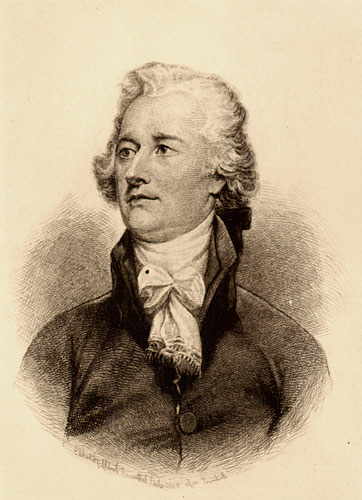
A couple years ago, the New York Historical Society had a massive Alexander Hamilton exhibit and Bill McCabe and I went - it was so so terrific. It was one of those events in New York when I was so excited to see all of it that I actually felt a bit nervous. You know what really got me? His DESK. I love actual objects ... the stuff historical figures actually touched, used ... He sat at that desk ...Here's a re-cap of our trip to the museum. Bill said something funny like, "I think this might be the first time I've gone to an exhibit like this where I'm with someone who knows MORE than I do about the topic." Hahahaha. History geeks - unite!!

The following is a letter the 17-year-old Alexander Hamilton wrote to his father, describing the hurricane that hit St. Croix on August 31, 1772 - one of the worst in the recorded history of the island. A couple of days later, Hamilton showed a copy of this letter to Reverend Knox (a very important person in the story of Alexander Hamilton - a real father figure to the boy.) Knox was so impressed with the prose that he arranged to have it published in the "Gazette". The letter was so well-received that Knox set the wheels in motion to send Hamilton to the colonies, so that he could get a college-level education. This move changed Hamilton's life. Here is the letter. It's riveting:
It began at dusk, at North, and raged very violently 'till ten o'clock. Then ensued a sudden and unexpected interval, which lasted about an hour. Meanwhile the wind was shifting 'round to the southwest ... it returned with redoubled fury and continued so 'till near three o'clock in the morning. Good God! What horror and destruction. It's impossible for me to describe or you to form any idea of it. It seemed as if a total dissolution of nature was taking place. The roaring of the sea and wind, fiery meteors flying about it in the air, the prodigious glare of almost perpetual lightning, the crash of the falling houses, and the ear-piercing shrieks of the distressed were sufficient to strike astonishment into angels.A great part of the buildings throughout the island are leveled to the ground, almost all the rest very much shattered, several persons killed and numbers utterly ruined, whole families running about the streets unknowing where to find a place of shelter; the sick exposed to the keenness of the water and air without a bed to lie upon or a dry covering to their bodies; and our harbors entirely bare. In a word, misery, in all its hideous shapes, spread over the whole face of the country ...
As to my reflections and feelings on this frightful and melancholy ocassion ...
Where now, oh! vile worm, is all thy boasted fortitude and resolution? What is become of thine arrogance and self-sufficiency? Why dost thou tremble and stand aghast? How humble, how helpless, how contemptible you now appear. And for why? The jarring of elements -- the discord of clouds? Oh! impotent presumptuous fool! Death comes rushing on in triumph, veiled in a mantle of tenfold darkness ... On his right hand sits destruction, hurling the winds and belching forth flames: calamity on his left threatening famine, disease and distress of all kinds. And oh! thou wretch, look still a little further. See the gulf of eternal misery open. There mayest thou shortly plunge -- the just reward of thy vileness. Alas! whither canst thou fly? Where hide thyself?
Uhm ... I look at my Diary Friday entries - written when I was 17 ... and ... er ... I hide my head in shame.

This is from a letter Alexander Hamilton wrote in 1780.
No wise statesman will reject the good from an apprehension of the ill. The truth is, in human affairs, there is no good, pure and unmixed. Every advantage has two sides, and wisdom consists in availing ourselves of the good and guarding as much as possible against the bad...A national debt, if it is not excessive, will be to us a national blessing. It will be powerful cement of our union. It will also create a necessity for keeping up taxation to such a degree which, without being oppressive, will be a spur to industry.
"A national debt, if it is not excessive, will be to us a national blessing." Ah. They are just words. But they went over like a BOMB exploding through the colonies. WHAT IS HE SAYING? WHAT IS HE TALKING ABOUT? IS HE THE DEVIL?
Alexander Hamilton made a six hour speech at the Constitutional Convention ... People scrawled down notes of it, because he spoke without notes (except when he laid out his plan for the Government), so whatever we have of that speech is from those notes. How I wish I had been in that room. It was a rousing call to a strong central government, a rousing call for the states to give up their power and their identities - to submerge themselves into America. This obviously did not go over well in some quarters. Another delegate to the Congress described Hamilton as "praised by everybody but supported by none". Anyway, here are some excerpts from his 6-hour speech in Philadlelphia, 1787.
All the passion we see, of avarice, ambition, interest, which govern most individuals and all public bodies, fall into the current of the states and do not flow into the stream of the general national government ... How then are all these evils to be avoided? Only by such a complete sovereignty in the general government as will turn all the strong principles and passions to its side.
In the context of the time, it is not surprising at all that people hated Hamilton, and thought he spoke treasonously. They had just thrown OFF the yoke of a monarch who had "complete sovereignty" ... and now Hamilton wanted to put the yoke on again?? This was heresy to this brand new nation.
More:
In every community where industry is encouraged, there will be a division of it into the few and the many. Hence, separate interests will arise. There will be debtors and creditors. Give all power to the many, they will oppress the few. Give all power to the few, they will oppress the many. Both, therefore, ought to have power, that each may defend itself against the other.
Hamilton read aloud from his notes - and what HE proposed as the set-up for the national government is basically what we have to this day (except for the "executive for life" thing.)
I think he went way too far out with some of his ideas - but that was his role, historically. I see him in that context. You always need someone like that - someone to be imaginative, bold, to push the boundaries OUT. He, as an immigrant, was not attached to any one state, in his loyalty. He stands out, because of this. His ideas were bold and new and there was literally no pause between thought and action with this guy (and that's why he got into so much trouble.) But great men usually have such a fatal flaw in their makeup. If they didn't have that, they wouldn't be great at all.
It reminds me of that great EM Forster quote: "Don't start with proportion. Only prigs do that." I believe in my heart that Hamilton was the most far-seeing of all of our founding fathers. He saw the world we live in now. I don't know how he did, but he did. They all still lived in an agrarian society, where land was power and prestige. Jefferson couldn't really imagine any other kind of world. Hamilton did and could imagine it. He saw ahead to the industrial revolution. He knew our society's set-up would change drastically ... and he wanted the economy to be flexible enough to deal with those changes. Most of the commentary at the time from his contemporaries (all brilliant men in their own right) is all along the lines of: "Alexander Hamilton is frightening." "Hamilton is dangerous and must be stopped." Etc.
I think he was way ahead of his time, almost as though he had dropped in from the future - and people like that always meet resistance.

Here is the ringing first paragraph of Federalist 1, written by Alexander Hamilton, published on October 27, 1787, in the "New York Independent Journal" - the first of 85 essays (written by Alexander Hamilton mostly, but James Madison wrote Federalist 10 - maybe the most famous of all of them, and John Jay contributed 5 essays). The purpose of this onslaught was to put the case for the Constitution before the New York public for its review. Here is the first paragraph of the first essay:
After a full experience of the insufficiency of the existing federal government, you are invited to deliberate upon a new Constitution for the United States of America. The subject speaks its own importance, comprehending in its consequences nothing less than the existence of the UNION, the safety and welfare of the parts of which it is composed, the fate of an empire in many respects the most interesting in the world.
Uhm, yeah. That prose would have gotten MY attention - as I scanned the "For Sale" ads for ladies hats and buggy whips surrounding it.
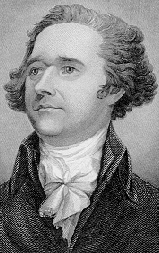
Alexander Hamilton, as Secretary of Treasury, put forth a monumental report to Congress calling for a national bank (this is something he had been pondering for years). He wanted it to be run by private citizens, and not the government. The bank had the power to issue paper money - the federal government should not have that power. Hamilton opposed the government running the printing presses to produce money. He wanted it to be separate, entirely. A quote from his report:
The wisdom of the government will be shown in never trusting itself with the use of so seducing and dangerous and expedient.
Brilliant.
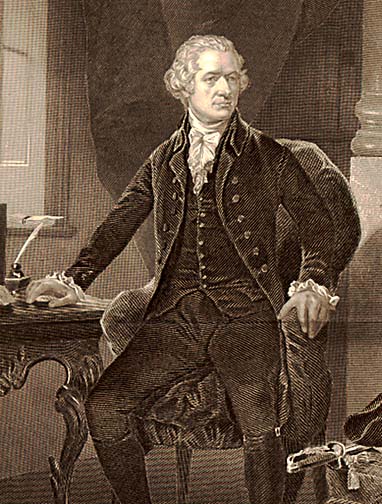
The following anecdote (and quote) is pretty much why people were terrified of Alexander Hamilton, and felt that he should be stopped. To give you the proper context: he was answering criticism from his former Federalist Paper collaborator James Madison that this proposed Bank of America was un-constitutional. Hamilton had asked for a federal charter for the bank, Madison said there was nothing in the Constitution saying that the government should fund corporations. Hamilton pointed out that the last article of the Constitution - the one about Congress being able to make "all laws which shall be necessary and proper" - He said that that article was sufficient evidence that a charter would be constitutional.
BUT - the way Hamilton summed it all up was not calculated to assuage his enemies who feared his lust for power. He wrote:
Wherever the end is required, the means are authorized.
Gotcha, Machiavelli. Thanks for sharing. Then he went on:
If the end be clearly comprehended within any of the specified powers, and if the measure have an obvious relation to that end, and is not forbidden by any particular provision of the Constitution, it may safely be deemed to come within the compass of the national authority.
Fascinating - the story of the turbulent national debate about Hamilton's financial plan for the country is amazing. I've read about it from all sides: Hamilton's side, of course - but then John Adams' analysis of it, his letters to his wife, Jefferson's side of it, Washington's side of it ... - If you don't know all the ins and outs of this debate, I highly recommend you go back and check it out, read a biography of Hamilton, read his financial essays ... Truly an incredible time in our nation's history.
And about that duel. Hamilton had I guess what you could call a death-wish. I don't know if I want to diagnose him - but the thought of a "glorious" death permeates his personal letters. There are times when he is so cynical about his fellow man (due, probably, to his horrific upbringing) that he wants to end it all. Much of what happened to him came out of this death-wish ... there are times when he behaves in an absolutely incomprehensible manner - as though he WANTS to go down. As though, with all of his brilliance and intellectual power - he knew he would have a short life. He was involved in a sex scandal. He behaved with reckless abandon. He wrote a paper on John Adams, when Adams was president - which basically said that Adams was mentally incompetent, and not fit for office. It is a blistering attack, and so wrongheaded that you gasp at Hamilton's self-destructiveness. It was the death knell for his career. His makeup was such that he followed his impulses - and when he was on? BOY, was he on. Nobody has ever been so on in their lives! But when he messed up? He messed up big. His battle with Burr was fierce and long-standing. Honor was a huge deal to Hamilton. Maybe because of his illegitimacy, his sorry-ass beginnings ... he was very very sensitive to any slight. He felt disrespected by Washington - there is one famous incident where Hamilton kept Washington waiting for 5 minutes, because he had to talk to somebody else - and Washington was very angry and publicly told Hamilton so. Hamilton was so insulted by this (and obviously, his resentment had been growing - he wanted to see ACTION in the war, not just sit and be a clerk, and write 150 letters a day) that he asked to be released from his duties immediately. It was a total breach for him. He could not be insulted. If you insulted him by throwing a tiny arrow his way, he would respond with 25 cannon balls. He was, uhm, touchy. He had the presence of mind though, at least early in his career, to know that Washington (and what he stood for) was very important to America, and the union - so he wanted to keep his personal feelings out of it ... He was very concerned, when he left Washington's employ, that the real reasons be kept private (he mentions this in a couple of letters). Washington's image as a universally beloved leader was more important than Hamilton airing his grievances against the man. Later in life, though, Hamilton was unable to hold his personal feelings back, in such situations ... and more often than not, he would make his feelings public. This was not a casual thing for him. Honor, and his integrity, and his character - his very NAME - was something to be defended to the death. It HAD to be that way.
On July 10, 1804, Alexander Hamilton wrote the following letter to his wife Eliza:
My beloved Eliza Mrs. Mitchel is the person in the world to whom as a friend I am under the greatest Obligations. I have not hitherto done my duty to her. But resolved to repair my omission as much as possible, I have encouraged her to come to this Country and intend, if it shall be in my power to render the Evening of her days comfortable. But if it shall please God to put this out of my power and to inable you hereafter to be of service to her, I entreat you to do it and to treat her with the tenderness of a Sister.This is my second letter.
The Scruples of a Christian have determined me to expose my own life to any extent rather than subject my self to the guilt of taking the life of another. This must increase my hazards & redoubles my pangs for you. But you had rather I should die innocent than live guilty. Heaven can preserve me and I humbly hope will but in the contrary event I charge you to remember that you are a Christian. God's Will be done. The will of a merciful God must be good.
Once more Adieu My Darling darling Wife
AH
Tuesday Evening 10 oClock
Joseph Ellis, in his wonderful book Founding Brothers, opens the book with the story of the duel between Hamilton and Aaron Burr on the riverside plain of Weehawken. (You know, down the street from where I live. Life is beautiful. There's an Alexander Hamilton Park right down the street from me. Love that.) Ellis approaches the duel with a forensic eye - there is still a mystery at the heart of what happened on that day.

Joseph Ellis closes his chapter on The Duel with these words:
Oliver Wendell Holmes once observed that "a great man represents a strategic point in the campaign of history, and part of his greatness consists of his being there." Both Burr and Hamilton thought of themselves as great men who happened to come of age at one of those strategic points in the campaign of history called the American revolutionary era. By the summer of 1804, history had pretty much passed them by. Burr had alienated Jefferson and the triumphant Republican party by his disloyalty as a vice president and had lost by a landslide in his bid to become a Federalist governor of New York. Hamilton had not held national office for nine years and the Federalist cause he had championed was well on its way to oblivion. Even in his home state of New York, the Federalists were, as John Quincy Adams put it, "a minority, and of that minority, only a minority were admirers and partisans of Mr. Hamilton." Neither man had much of a political future.But by being there beneath the plains of Weehawken for their interview, they managed to make a dramatic final statement about the time of their time. Honor mattered because character mattered. And character mattered because the fate of the American experiment with republican government still required virtuous leaders to survive. Eventually, the United States might develop into a nation of laws and established institutions capable of surviving corrupt or incompetent public officials. But it was not there yet. It still required honorable and virtuous leaders to endure. Both Burr and Hamilton came to the interview because they wished to be regarded as part of such company.

And finally, here is an excerpt from Ron Chernow's magesterial biography of Alexander Hamilton:
Few figures in American history aroused such visceral love or loathing as Alexander Hamilton. To this day, he seems trapped in a crude historical cartoon that pits "Jeffersonian democracy" against "Hamiltonian aristocracy." For Jefferson and his followers, wedded to their vision of an agrarian Eden, Hamilton was the American Mephistopheles, the proponent of such devilish contrivances as banks, factories, and stock exchanges. They demonized him as a slavish pawn of the British Crown, a closet monarchist, a Machiavellian intriguer, a would-be Caesar. Noah Webster contended that Hamilton's "ambition, pride, and overbearing temper" had destined him "to be the evil genius of this country." Hamilton's powerful vision of American nationalism, with states subordinate to a strong central government and led by a vigorous executive branch, aroused fears of a reversion to royal British ways. His seeming solicitude for the rich caused critics to portray him as a snobbish tool of plutocrats who was contemptuous of the masses. For another group of naysayers, Hamilton's unswerving faith in a professional military converted him into a potential despot. "From the first to the last words he wrote," concluded historian Henry Adams, "I read always the same Napoleonic kind of adventuredom." Even some Hamilton admirers have been unsettled by a faint tincture of something foreign in this West Indian transplant; Woodrow Wilson grudgingly praised Hamilton as "a very great man, ut not a great American." Yet many distinguished commentators have echoed Eliza Hamilton's lament that justice has not been done to her Hamilton/ He has tended to lack the glittering multivolumed biographies that have burnished the fame of other founders. The British statesman Lord Bryce singled out Hamilton as the one founding father who had not received his due from posterity. In The American Commonwealth, he observed, "One cannot note the disappearance of this brilliant figure, to Europeans the most interesting in the early history of the Republic, without the remark that his countrymen seem to have never, either in his lifetime or afterwards, duly recognized is splendid gifts." During the robust era of Progressive Republicanism, marked by brawny nationalism and energetic government, Theodore Roosevelt took up the cudgels and declared Hamilton "the most brilliant American statesman who ever lived, possessing the loftiest and keenest intellect of his time." His White House successor, William Howard Taft, likewise embracedf Hamilton as "our greatest constructive statesman." In all probability, Alexander Hamilton is the foremost political figure in American history who never attained the presidency, yet he probably had a much deeper and more lasting impact than many who did.Hamilton was the supreme double threat among the founding fathers, at once thinker and doer, sparkling theoretician and masterful executive. He and James Madison were the prime movers behind the summoning of the Constitutional Convention and the chief authors of that classic gloss on the national charter, The Federalist, which Hamilton supervised. As the first treasury secretary and principal architect of the new government, Hamilton took constitutional principles and infused them with expansive life, turning abstractions into institutional realities. He had a pragmatic mind that minted comprehensive programs. In contriving the smoothly running machinery of a modern nation-state - including a budget system, a funded debt, a tax system, a central bank, a customs service, and a coast guard - and justifying them in some of America's most influential state papers, he set a high-water mark for administrative competence that has never been equaled. If Jefferson provided the essential poetry of American political discourse, Hamilton established the prose of American statecraft. No other founder articulated such a clear and prescient vision of America's future political, military, and economic strength or crafted such ingenious mechanisms to bind the nationa together.
Hamilton's crowded years as treasury secretary scarcely exhaust the epic story of his short life, which was stuffed with high drama. From his illegitimate birth on Nevis to his bloody downfall in Weehawken, Hamilton's life was so tumultuous that only an audacious novelist could have dreamed it up. He embodied an enduring archetype: the obscure immigrant who comes to America, re-creates himself, and succeeds despite a lack of proper birth and breeding. The saga of his metamorphosis from an anguished clerk on St. Croix to the reigning presence in George Washington's cabinet offers both a gripping personal story and a panoramic view of the formative years of the republic. Except for Washington, nobody stood closer to the center of American politics from 1776 to 1800 or cropped up at more turning points. More than anyone else, the omnipresent Hamilton galvanized, inspired, and scandalized the newborn nation, serving as the flash point for pent-up conflicts of class, geography, race, religion, and ideology. His contemporaries often seemed defined by how they reacted to the political gauntlets that he threw down repeatedly with such defiant panache.
Hamilton was an exuberant genius who performed at a fiendish pace and must have produced the maximum number of words that a human being can scratch out in forty-nine years. If promiscuous with his political opinions, however, he was famously reticent about his private life, especially his squalid Caribbean boyhood. No other founder had to grapple with such shame and misery, and his early years have remained wrapped in more mystery than those of any other major American statesman. While not scanting his vibrant intellectual life, I have tried to gather anecdotal material that will bring this cerebral man to life as both a public and a private figure. Charming and impetuous, romantic and witty, dashing and headstrong, Hamilton offers the biographer an irresistible psychological study. For all his superlative mental gifts, he was afflicted with a touchy ego that made him querulous and fatally combative. He never outgrew the stigma of his illegitimacy, and his exquisite tact often gave way to egregious failures of judgment that left even his keenest admirers aghast. If capable of numerous close friendships, he also entered into titanic feuds with Jefferson, Madison, Adams, Monroe, and Burr.
The magnitude of Hamilton's feats as treasury secretary has overshadowed many other facets of his life: clerk, college student, youthful poet, essayist, artillery captain, wartime adjutant to Washington, battlefield hero, congressman, abolitionist, Bank of New York founder, state assemblyman, member of the Constitutional Convention and New York Ratifying Convention, orator, lawyer, polemicist, educator, patron saint of the New York Evening Post, foreign-policy theorist, and major general in the army. Boldly uncompromising, he served as catalyst for the emergence of the first political parties and as the intellectual fountainhead for one of them, the Federalists. He was a pivotal force in four consecutive presidential elections and defined much of America's political agenda during the Washington and Adams administrations, leaving copious commentary on virtually every salient issue of the day.
A complex man - to be studied, discussed, fought about, celebrated ... He is still relevant.

December 31, 2007

December 28, 2007
"And why can we not have an American bank?"
Excerpt from an enormous letter written by Alexander Hamilton to James Duane in the midst of the Revolutionary War. Hamilton is 25 years old, and years away from becoming Secretary of the Treasury. Years away from his formation-of-the-bank extravaganza. Yet he is already (of course) pondering the issues, grappling with the inefficiency of the current system. He wrote this letter in 1780 - 7 years before the Constitutional Convention - long before the convention was even thought of ... the Articles of Confederation were the law of the land ... but here in this letter Hamilton is already sensing that things need to change. The letter is incredible. It's quoted at length in various Hamilton biographies - but it sure is worth it to go and read the whole thing. When you think of the circumstances under which the letter was written - Hamilton, camped out in the middle of a war, working his ass off for Washington, handling all of Washington's correspondence as well - not to mention courting Elizabeth Schuyler - it is even more amazing. The intellectual energy of the man. Surely he had more than 24 hours in a day. And this letter to Duane (which went through many drafts) was written on the same day as a bunch of other letters ... this was not the ONLY thing he wrote that day. It's over 6000 words. Extraordinary. Oh, and the last 2 times I have posted on Founding Fathers, I have gotten snotty condescending responses from the usual suspects. Please. If you want to discuss this stuff, be civil, for God's sake. And also: give me some credit. I read. Don't assume I haven't read the books you have, and that's why my opinion is different than yours. I probably have read the books you have. I'm a serious student of this stuff. I don't understand the condescension. I've been at this blogging thing for years now, and I still have a couple regulars who pat-pat me on the head and treat me like a dimwit. I know. Poor boys. It's so upsetting that Sheila dares to have an opinion, and dares to speak like she knows what she's talking about. What is this world coming to. I may come to a different conclusion than you, based on my own reading and study. But does that mean I'm stupid and that's why you talk to me in such an insulting way? What kind of isolated world do you live in if that is your response to a different opinion? Just adjust your tone, boys. Or I won't play with you at all. Sorry for the rant. I do try to keep such tangents out of my writing, since I know that the writing suffers. You see other bloggers all the time engaging with their critics through whatever they write. You know, the people who start every sentence with: "I know that there are those who disagree ..." or "I don't care what you bozos think, but ..." It's a trap I have fallen into myself. I used to write about Joyce with a defensive manner - because I had had so many rude people be whiny bitches when I would post about him. But over the past year, I stopped that. And I am happy with the result. Because I am not writing for the critics. Some people are - and that's cool for them ... but I'm not. It's not that kind of blog. More and more, I am getting the audience I WANT ... but it just so happens that I've had snotty condescension happen when I've posted about Founding Fathers - not across the board, just enough to make me go: Oh for Christ's sake, why do you use that tone with me? It's not like I'm a raving idiot lunatic. I write about their ideas. I post excerpts. I read books. I know the sources, I read them all. Engage with me on that level, or don't engage at all!
Here's just one excerpt of the mammoth letter:
And why can we not have an American bank? Are our monied men less enlightened to their own interest or less enterprising in the pursuit? I believe the fault is in our government which does not exert itself to engage them in such a scheme. It is true, the individuals in America are not very rich, but this would not prevent their instituting a bank; it would only prevent its being done with such ample funds as in other countries. Have they not sufficient confidence in the government and in the issue of the cause? Let the Government endeavour to inspire that confidence, by adopting the measures I have recommended or others equivalent to them. Let it exert itself to procure a solid confederation, to establish a good plan of executive administration, to form a permanent military force, to obtain at all events a foreign loan. If these things were in a train of vigorous execution, it would give a new spring to our affairs; government would recover its respectability and individuals would renounce their diffidence.The object I should propose to myself in the first instance from a bank would be an auxiliary mode of supplies; for which purpose contracts should be made between Government and the bank on terms liberal and advantageous to the latter. Everything should be done in the first instance to encourage the bank; after it gets well established it will take care of itself and government may make the best terms it can for itself....
A bank of this kind even in its commencement would answer the most valuable purposes to government and to the proprietors; in its progress the advantages will exceed calculation. It will promote commerce by furnishing a more extensive medium which we greatly want in our circumstances. I mean a more extensive valuable medium. We have an enormous nominal one at this time; but it is only a name.
In the present unsettled state of things in this country, we can hardly draw inferences from what has happened in others, otherwise I should be certain of the success of this scheme; but I think it has enough in its favour to be worthy of trial.
I have only skimmed the surface of the different subjects I have introduced. Should the plans recommended come into contemplation in earnest and you desire my further thoughts, I will endeavour to give them more form and particularity. I am persuaded a solid confederation a permanent army a reasonable prospect of subsisting it would give us treble consideration in Europe and produce a peace this winter.
If a Convention is called the minds of all the states and the people ought to be prepared to receive its determinations by sensible and popular writings, which should conform to the views of Congress. There are epochs in human affairs, when novelty even is useful. If a general opinion prevails that the old way is bad, whether true or false, and this obstructs or relaxes the operation of the public service, a change is necessary if it be but for the sake of change. This is exactly the case now. 'Tis an universal sentiment that our present system is a bad one, and that things do not go right on this account. The measure of a Convention would revive the hopes of the people and give a new direction to their passions, which may be improved in carrying points of substantial utility. The Eastern states have already pointed out this mode to Congress; they ought to take the hint and anticipate the others.
A phenom, this dude. "I have only skimmed the surface..." Ha! I grapple with his ideas myself, going this way, that - seeing his points, recoiling from others ... There's something about all of "these guys" that demand engagement. Just ENGAGE. Read their words and engage with them. See what comes up. See what you gravitate towards, and what you back off from. And also see how two things, two seemingly contradictory things, can be going on at the same time. That's why the primary sources of all of "these guys" - in the middle of a conflict - are so invaluable. It's a fight that goes on and on. The disagreement is built into the system. It's not perfect. But what it does do is ensure that the dialogue will continue. And I love these documents for that.
December 16, 2007
The wind is blowing
something fierce. I made a pot of coffee. And I've been up for a couple of hours - sitting in bed - with books spread out around me:
-- Chernow's biography of Alexander Hamilton
-- Willard Sterne Randall's biography of Alexander Hamilton
-- my Library of America copy of The Federalist Papers
-- my Library of America copy of Hamilton's writings
-- my Library of America copy of Washington's writings
I read and cross-reference. Every sentence leads to a tangent. I track down original sources. I read the entire thing as opposed to an excerpt in the books. For example, when Hamilton was a teenager - he wrote a letter to his (deadbeat) father describing a devastating hurricane that had hit the West Indies. His father happened to show it to the Reverend Hugh Knox (one of Hamilton's first elderly-gentlemen mentors) - who was so impressed with the writing, and the power of description - that he sent it to the Royal Danish Gazette - the local paper - where it was printed (excerpt here). It caused a sensation - who wrote it? Who is that boy? Etc. Hamilton's family was already relatively notorious in that small world - due to his illegitimacy, and the mounting personal tragedies ... but with his letter about the hurricane, Hamilton became "famous" in another way. For his power of writing, and his precocious ability with his pen. It got him quite a bit of attention - men in power who wanted to help this young brilliant boy with no prospects - and it was that letter that launched the series of events that would get Hamilton out of the West Indies and up to New York, to get a college education. Anyway, it's a famous letter. Most books about Hamilton publish excerpts of it only, to give you a taste for it (they always include the "Oh! vile worm!" section because it is so frantic and so overblown. He is so angry at God, it seems - the world is a dreadful dark and random place. Is this a teenage boy who wrote this??) The good thing about the Library of America collections (of which I have many - most of the important ones anyway) is you get to read the whole thing, not just an excerpt. So I've been going back and forth, as my whim takes me ... reading the whole hurricane letter, or the whole of his famous letter to his friend Edward Stevens which ends with "In short I wish there was a War", etc. I'm lovin' my primary source library on this windy freezing morning.
July 11, 2007
On July 10, 1804
Alexander Hamilton wrote the following letter to this wife:
My beloved ElizaMrs. Mitchel is the person in the world to whom as a friend I am under the greatest Obligations. I have not hitherto done my duty to her. But resolved to repair my omission as much as possible, I have encouraged her to come to this Country and intend, if it shall be in my power to render the Evening of her days comfortable. But if it shall please God to put this out of my power and to inable you hereafter to be of service to her, I entreat you to do it and to treat her with the tenderness of a Sister.
This is my second letter.
The Scruples of a Christian have determined me to expose my own life to any extent rather than subject my self to the guilt of taking the life of another. This must increase my hazards & redoubles my pangs for you. But you had rather I should die innocent than live guilty. Heaven can preserve me and I humbly hope will but in the contrary event I charge you to remember that you are a Christian. God's Will be done. The will of a merciful God must be good.
Once more Adieu My Darling darling Wife
AH
Tuesday Evening 10 oClock
Early the next morning, July 11, 1804, my soon-to-be-dead boyfriend rowed across the Hudson with his second and a doctor. He rowed to the cliffs in Weehawken, a well-used dueling ground, to meet Aaron Burr. The shots were fired - and it is apparent, from comments he made later, that Hamilton knew he would die from them. He said to the doctor later, "This is a mortal wound, Doctor."
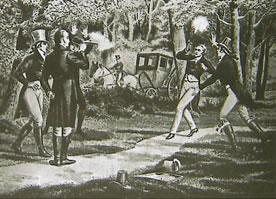
Excerpt from Willard Sterne Randall's Alexander Hamilton:
Alexander Hamilton lasted thirty-one hours after Aaron Burr shot him. When they finally got him into a bed on the second floor of Bayard's house on Chambers Street, he was nearly comatose. The doctor undressed him and administered a large dose of a strong anodyne, a painkiller. During the first day, Hosack gave Hamilton more than an ounce of opoium and cider potion, called laudanum, washing it down with watered wine. But, Hosack noted, "his sufferings during the whole day were almost intolerable." The ball had lodged inside his second lumbar disk, which had shattered, paralyzing his legs. His stomach was slowly filling with blood from severed blood vessels in his liver. Hosack "had not the shadow of a hope of his recovery," but he called in surgeons from French men-of-war anchored in the harbor who "had much experience in gunshot wounds." They agreed that Hamilton's condition was hopeless.During the night of July 11, the sedated Hamilton "had some imperfect sleep". He knew he had little time left to live: he asked Bayard to summon the Reverend Benjamin Moore, Episcopal bishop of New York and president of Columbia College, where Hamilton had once been a scholarship boy. In recent months, Hamilton had prayed Episcopal Matins and Vespers with his family at home. He had not attended any church since the Revolution. When the bishop arrived, he refused Hamilton Holy Communion after he learened that Hamilton not only had never been baptized an Episcopalian, but had been wounded in a duel, something Moore considered a mortal sin. Instead, the bishop gave Hamilton a lecture on the meaning of communion and left him to take some "time for serious reflection". Hamilton, clearheaded and determined now, asked the Bayards to send for the Reverend John M. Mason, pastor of the Presbyterian church and son of th eman who had once sponsored him for a place at a Presbyterian academy when he had arrived in New York, an orphan from the West Indies. Hamilton as a boy had undergone a strong Presbyterian conversion experience - although, as a bastard, he had not been allowed to receive Presbyterian communion. But this Reverend Mason informed Hamilton that he could only receive communion in church, at the altar, during a regular Sunday ceremony. Hamilton pleaded for Bayard to go once more to Bishop Moore and try to persuade him.
It was noontime on the twelfth, more than twenty-four hours after the duel, before Elizabeth Hamilton arrived with their seven children. No one had told her the truth. Hamilton, she believed, was suffering only from stomach cramps: he'd had digestive disorders recently. Now she learned everything. She became frantic. Hamilton had been semiconscious, his eyes closed. He opened them, saw his children. His own grief at seeing his daughter Angelica, half mad since her brother's death in a duel over his father's politics, swept over him. He closed his eyes again, only saying to his wife, "Remember, Eliza, you are a Christian." It was as if he had banished her. She left with the children, sobbing hysterically.
When Bishop Moore called again, he lectured Hamilton once more on his own "delicate" situation. He wanted to help "a fellow mortal in distress," but he must "unequivocally condemn" dueling. Hamilton agreed with him "with sorrow and contrition", Moore reported. If Hamilton survived, would he vow never to duel again and use his influence to oppose the "barbaric custom"? It was a promise Hamilton found easy to make. Would he live "in love and charity with all men"? He answered yes, he bore "no ill will" to Aaron Burr. "I forgive all that happened." He received communion "with great devotion," Moore recorded, and "his heart afterwards appeared to be perfectly at rest."
But Hamilton was now writhing in agony. He could not hear the commotion downstairs when a note arrived from Aaron Burr, asking about his condition, and worrying about a rumor that Hamilton had never intended to fire at him. When Bishop More returned the morning of the twelfth, he stayed at Hamilton's bedside - across the bed from another grief-stricken visitor, Hamilton's sister-in-law, Angelica Schuyler Church. She did not speak, nor did Hamilton. Over the years, they had been lovers. For nearly thirty years, Angelica Church had loved Hamilton more than her own dour, money-grubbing husband. Church, an expert duelist, had fled England after believing he had killed a man, changed his identity, grown rich selling supplies during the Revolution, and then returned to take a seat in Parliament. He often had left Angelica alone in their Manhattan mansion near Hamilton's town house while Elizabeth Schuyler stayed in the country with the children. John Church's pistols had finally ended the affair. Hamilton and Angelica could say nothing now. There was nothing more to say.
On July 12, 1804, shortly after noon, with his mistress and his bishop at his bedside, Alexander Hamilton died "without a groan". He was forty-nine.
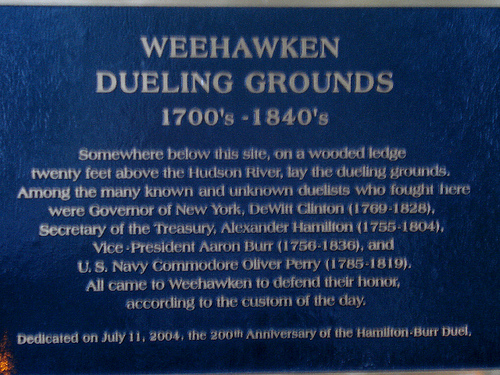
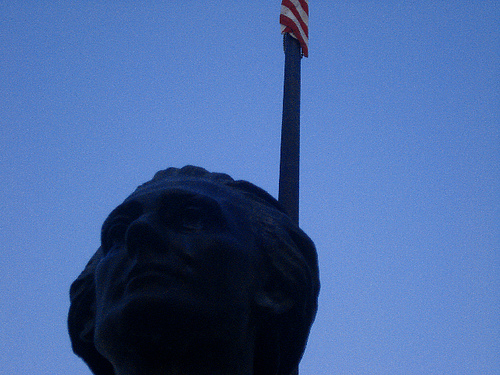
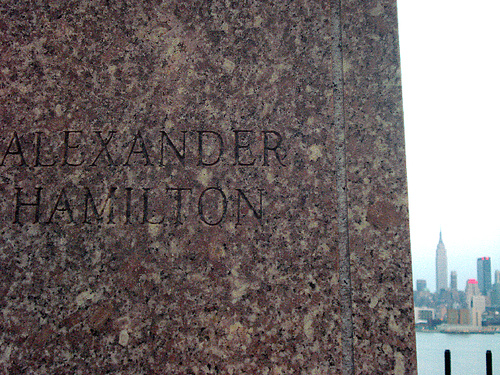
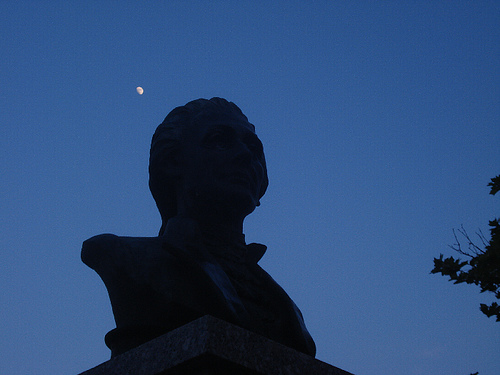
The old dueling grounds are near my house - and I took some pictures of the monument that is now there. It was erected on July 11, 2004 - the 200th anniversary of the Hamilton-Burr duel.
Here are the pictures.
Some of my Hamilton posts below
Excerpt from Chernow's towering biography of the man
Letter to Lafayette 1789: "I dread the vehement character of your people"
1780: "A national debt ... will be to us a national blessing."
January 23, 2007
Gouverneur Morris: "We the people ..."
I love the many anecdotes about this man - he seems quite likable, and yet also intimidating (the intellect, the fearlessness). Just came across a quote in a book I'm reading and it made me laugh. Morris, despite his wooden leg (or who knows, maybe because of it) was quite a womanizer. The ladies loooooooved him. And he looooooved the ladies. He was kind of a party hound, in an 18th century kind of way. He's the one who took Hamilton's dare: "Go over there and pat Washington on the back and say, 'How's it goin', dude?'" Or something like that, hahaha, something very familiar. Morris, gamely, took the dare. Went over and cuffed Washington on the arm, saying some genial friendly like thing - and Washington froze him with a frigid stare. Morris never got over the humiliation of the moment. He and Washington were good friends, though - so I think maybe that made Morris' social agony in that moment even worse.
But anyway - back to the quote I found that I liked. Many of Morris' fellow revolutionaries were a bit chagrined by the open-ness of his womanizing ... a gentleman should be more discreet ... and John Jay wrote the following in a letter:
"Gouverneur's leg has been a tax on my heart. I am almost tempted to wish he had lost something else."
hee hee
Morris is a guy I think I would have liked.
December 28, 2006
Love him or hate him

Excerpt from Ron Chernow's magesterial biography of Alexander Hamilton:
Few figures in American history aroused such visceral love or loathing as Alexander Hamilton/ To this day, he seems trapped in a crude historical cartoon that pits "Jeffersonian democracy" against "Hamiltonian aristocracy." For Jefferson and his followers, wedded to their vision of an agrarian Eden, Hamilton was the American Mephistopheles, the proponent of such devilish contrivances as banks, factories, and stock exchanges. They demonized him as a slavish pawn of the British Crown, a closet monarchist, a Machiavellian intriguer, a would-be Caesar. Noah Webster contended that Hamilton's "ambition, pride, and overbearing temper" had destined him "to be the evil genius of this country." Hamilton's powerful vision of American nationalism, with states subordinate to a strong central government and led by a vigorous executive branch, aroused fears of a reversion to royal British ways. His seeming solicitude for the rich caused critics to portray him as a snobbish tool of plutocrats who was contemptuous of the masses. For another group of naysayers, Hamilton's unswerving faith in a professional military converted him into a potential despot. "From the first to the last words he wrote," concluded historian Henry Adams, "I read always the same Napoleonic kind of adventuredom." Even some Hamilton admirers have been unsettled by a faint tincture of something foreign in this West Indian transplant; Woodrow Wilson grudgingly praised Hamilton as "a very great man, ut not a great American."Yet many distinguished commentators have echoed Eliza Hamilton's lament that justice has not been done to her Hamilton/ He has tended to lack the glittering multivolumed biographies that have burnished the fame of other founders. The British statesman Lord Bryce singled out Hamilton as the one founding father who had not received his due from posterity. In The American Commonwealth, he observed, "One cannot note the disappearance of this brilliant figure, to Europeans the most interesting in the early history of the Republic, without the remark that his countrymen seem to have never, either in his lifetime or afterwards, duly recognized is splendid gifts." During the robust era of Progressive Republicanism, marked by brawny nationalism and energetic government, Theodore Roosevelt took up the cudgels and declared Hamilton "the most brilliant American statesman who ever lived, possessing the loftiest and keenest intellect of his time." His White House successor, William Howard Taft, likewise embracedf Hamilton as "our greatest constructive statesman." In all probability, Alexander Hamilton is the foremost political figure in American history who never attained the presidency, yet he probably had a much deeper and more lasting impact than many who did.
Hamilton was the supreme double threat among the founding fathers, at once thinker and doer, sparkling theoretician and masterful executive. He and James Madison were the prime movers behind the summoning of the Constitutional Convention and the chief authors of that classic gloss on the national charter, The Federalist, which Hamilton supervised. As the first treasury secretary and principal architect of the new government, Hamilton took constitutional principles and infused them with expansive life, turning abstractions into institutional realities. He had a pragmatic mind that minted comprehensive programs. In contriving the smoothly running machinery of a modern nation-state - including a budget system, a funded debt, a tax system, a central bank, a customs service, and a coast guard - and justifying them in some of America's most influential state papers, he set a high-water mark for administrative competence that has never been equaled. If Jefferson provided the essential poetry of American political discourse, Hamilton established the prose of American statecraft. No other founder articulated such a clear and prescient vision of America's future political, military, and economic strength or crafted such ingenious mechanisms to bind the nationa together.
Hamilton's crowded years as treasury secretary scarcely exhaust the epic story of his short life, which was stuffed with high drama. From his illegitimate birth on Nevis to his bloody downfall in Weehawken, Hamilton's life was so tumultuous that only an audacious novelist could have dreamed it up. He embodied an enduring archetype: the obscure immigrant who comes to America, re-creates himself, and succeeds despite a lack of proper birth and breeding. The saga of his metamorphosis from an anguished clerk on St. Croix to the reigning presence in George Washington's cabinet offers both a gripping personal story and a panoramic view of the formative years of the republic. Except for Washington, nobody stood closer to the center of American politics from 1776 to 1800 or cropped up at more turning points. More than anyone else, the omnipresent Hamilton galvanized, inspired, and scandalized the newborn nation, serving as the flash point for pent-up conflicts of class, geography, race, religion, and ideology. His contemporaries often seemed defined by how they reacted to the political gauntlets that he threw down repeatedly with such defiant panache.
Hamilton was an exuberant genius who performed at a fiendish pace and must have produced the maximum number of words that a human being can scratch out in forty-nine years. If promiscuous with his political opinions, however, he was famously reticent about his private life, especially his squalid Caribbean boyhood. No other founder had to grapple with such shame and misery, and his early years have remained wrapped in more mystery than those of any other major American statesman. While not scanting his vibrant intellectual life, I have tried to gather anecdotal material that will bring this cerebral man to life as both a public and a private figure. Charming and impetuous, romantic and witty, dashing and headstrong, Hamilton offers the biographer an irresistible psychological study. For all his superlative mental gifts, he was afflicted with a touchy ego that made him querulous and fatally combative. He never outgrew the stigma of his illegitimacy, and his exquisite tact often gave way to egregious failures of judgment that left even his keenest admirers aghast. If capable of numerous close friendships, he also entered into titanic feuds with Jefferson, Madison, Adams, Monroe, and Burr.
The magnitude of Hamilton's feats as treasury secretary has overshadowed many other facets of his life: clerk, college student, youthful poet, essayist, artillery captain, wartime adjutant to Washington, battlefield hero, congressman, abolitionist, Bank of New York founder, state assemblyman, member of the Constitutional Convention and New York Ratifying Convention, orator, lawyer, polemicist, educator, patron saint of the New York Evening Post, foreign-policy theorist, and major general in the army. Boldly uncompromising, he served as catalyst for the emergence of the first political parties and as the intellectual fountainhead for one of them, the Federalists. He was a pivotal force in four consecutive presidential elections and defined much of America's political agenda during the Washington and Adams administrations, leaving copious commentary on virtually every salient issue of the day.
September 26, 2006
Competing obsessions
-- My Dino book just arrived.
-- I have my Alexander Hamilton lecture tonight.
I am truly torn. Hamilton's gonna win, cause he pre-dates Dino - also, I bought tickets ... but still ... I had feared this would happen. I had feared that Dino would come on the same day, causing my psyche to go into a tailspin of competing interests.

September 19, 2006
Alexander Hamilton
Sept. 26: 6:30 pm
New-York Historical Society
170 Central Park West
New York, NY 10024
(77th St.)
The Many Faces of Alexander Hamilton (pertinent excerpt from that description - for me anyway: "Three Hamilton scholars discuss his legacy, and consider why history has denied him the central place he occupied in his own time." I feel like standing and cheering. I will have to hold myself back while listening to these dudes lecture. Can you imagine? Me shouting out as though I'm at a gospel mass.
Lecture dude: "So Alexander Hamilton's experiences as a shipping clerk ---"
Sheila, shouting out: "AMEN."
Lecture dude: "He was extremely efficien---"
Sheila, shouting:"SPEAK THE TRUTH, BROTHER."
Etc.)
Seriously I just received my newsletter from the NYHS and my heart leapt up into my throat when I saw what was coming.
I bought tickets immediately.
I cannot wait.
July 30, 2006
This is for Bill's amusement
Scene: A smoke-filled tavern in New York, 1787. Sheila, in modern-day dress, enters. Her pupils are dilated from excitement. She strolls through, looking around. Powdered wigs. Tin mugs, with foam dripping down the side. Candles sputtering black smoke. Men. Mostly men. Then - she sees him. Standing in conversation in the back. She recognizes him immediately. She recognizes his ruddy face, his bright eyes. He has a glitter to him that the other men do not have. She has read about that glitter. And there it is. Right in front of her. It is unmistakeable. The books did not lie. Shyly, she approaches. He turns, and sees her. Those eyes. Holy shit. It's HIM. She makes her move. Once she starts talking, she cannot stop. It is mortifying, and yet she cannot help herself.
Sheila: Oh, Mr. Hamilton. I have waited so long for this moment. You don't know me - I'm from the future. I'm an American - and - well - everything that you're working on right now - everything you're fighting for, and fighting about - well, I just want you to know that i am living in the country that you planned, that you dreamt up. You saw so far ahead - and I'm telling you - so much of what you imagined has come to pass. Uhm ... well ... I just wanted you to know that I so admire you, even though you were kind of insane, and - I just wondered how you did it. How did you write so much? How did you just KNOW certain things? Where does that kind of intelligence come from? Jefferson's gonna get all the glory - at least intellectually - I really should warn you about that - is John Adams here? Because he should be warned as well - I know that's gonna piss him off - but anyway - even though Jefferson's the golden boy, in terms of posterity - you should just know that I think you're the bomb. I really do. Even though Abigail Adams despised you. I have so many questions to ask you. I have so much I want to say. Sorry to bother you ...I am sure you're really busy right now - it's 1787 after all - but do you have, like, 5 or 10 minutes to give me? I MUST interview you - I have a list of questions.
There is a long pause. Hamilton stares at Sheila. He then leans forward, and awkwardly, kind of stumbles a bit. Sheila smells the liquor on his breath. He holds out his mug.
Hamilton: (slurring words) You've got killer knockers.
Sheila: Uhm - woah. Mr. Hamilton - uh ...
Hamilton: (throwing his arm around her) Bitch, you're hot.
Sheila: But ... but ... The Federalist Papers ...
Hamilton: Federalist Shmederalist. Let's knock boots.
Sheila: I ... I've come such a long way ... is Madison here? Maybe I can talk to him?
Hamilton: Madison's a fucking bore. Let's PARTY!
Sheila: Okay - but - I only have limited time to ask you what ----
Hamilton: Are your boobs real?
July 11, 2006
Today in history: July 11, 1804
Today in history my dead boyfriend was shot and killed. Well - he was alive obviously, on July 10. But then he was killed in a duel on July 11 ... and so now he is dead. He was killed only a couple of miles from where I live now.
Old posts of mine below with a ton of great quotes from him.
He's my favorite. Of course he was. He's my dead boyfriend. When I get home tonight, I'll stop by his statue on the cliff near my house and pay my respects.

"An active and scheming mind ..."
"A total dissolution of nature"
"I dread the vehement character of your people"
"You are invited to deliberate upon a new Constitution for the United States of America"
"Take mankind in general, they are vicious"
"a division ... into the few and the many"
May 10, 2006
The Books: "Alexander Hamilton : A Life" (Willard Sterne Randall)
And here is my next excerpt of the day from my library.
 Next book in my American history section is Alexander Hamilton : A Life by Willard Sterne Randall. Now that the Chernow biography of Hamilton has come out - there's probably no need to read this one (unless you're a junkie like me). Everything you could ever want to know about Hamilton is in the Chernow ... but I have a fondness for this book, as well as a fondness for Willard Sterne Randall's writing - I've read three of his biographies - one of Washington, one of Jefferson, and this one - and I really do like his style. Sadly, he seemed to have a vested interest in proving that Jefferson DIDN'T have an affair with Sally Hemings - and so he is definitely on the wrong side of history - It's kind of painful to read his Jefferson book for that reason. Like, I read it, thinking: What are you so afraid of, buddy? Why is it so horrifying to contemplate that he DID sleep with her? How you can be so SURE that he never did sleep with her? I mean - how can you stand here in the 1990s and be so CERTAIN of what happened in the private life of a man over 200 years ago - where do you get that arrogance? Why are you so intent on telling me there is "no evidence to support" blah blah blah. I know most writers of biographies have agendas - but I prefer them to be a little bit more artfully hidden.
So skip his book on Jefferson - but read his one on Hamilton. He doesn't have the same weird need to PROTECT Hamilton like he did with Jefferson - and the book is better for it.
One of the great things about Randall's writing (I've noticed it in all three of his books) is his reliance on primary documents - He quotes extensively from letters, diary entries, newspaper articles, speeches - His books are filled with block quotes - and I am ALL ABOUT the block quotes.
Now - nobody wrote more than Alexander Hamilton. I mean, from a very early age the boy was a wunderkind. I'll be studying Alexander Hamilton until I shuffle off this mortal coil. He, to me, is the dark horse of that group. Completely independent, out of nowhere, brilliant to the point of being intimidating (to his contemporaries and to me), prophetic, fearless, hated, complex ... I LOVE reading about this guy. He excites me.
During the Constitutional Congress in 1787 - he stood up at one point and talked for SIX HOURS STRAIGHT. Oh man, what I would not give to have been there that day. He had notes (as a matter of fact, I SAW those notes when I went to the Hamilton exhibit at the New York Historical Society - little scratchings on a page) - but he didn't look down at them. He knew what he had to say. And he said it - for six hours. It was a breathtaking accomplishment - even in that room filled with men who are still known for their own breathtaking accomplishments.
So here's an excerpt describing his six-hour marathon. And thank goodness that James Madison took extensive notes of the entire proceedings - recording every word everyone said, like an autistic lunatic. Thanks, Jimmy!
One of my favorite Hamiltonian quotes is below. It didn't come from his six-hour speech but a couple days later - during the arguments following his plan - It's the last blockquote in the excerpt. Words to live by, man, words to live by.
From Alexander Hamilton : A Life by Willard Sterne Randall.
Two days into an intense three-day debate on the New Jersey Plan, Hamilton asked President Washington if he could have the floor. It was early in the session of June 18 when the tall, thin, angular-faced New Yorker in elegant black and white stood and began a six-hour speech. Carefully prepared notes lay beside him, but he did not have to consult them. Madison, deeply impressed, recorded the scene:
Mr. Hamilton [said that he] had been hitherto silent on the business before the Convention, partly from respect to others whose superior abilities, age, and experience rendered him unwilling to bring forward ideas dissimilar to theirs and partly from his delicate situation with respect to his own state.
Madison was wrong about Hamilton's silence. He had already made two key motions. But, as it would later turn out, Madison was dead right about Hamilton's delicate situation in the New York delegation, where he was sure to be outvoted - and in bloc voting that meant nullified - by the pro-Clinton delegates. But that also meant he had nothing to lose. While Hamilton declared that he could not possibly accede to the views of his fellow New Yorkers, he said that the crisis "which now marked our affairs was too serious to permit any scruples whatever to prevail over the duty imposed on every man to contribute his efforts for the public safety and happiness."
Hamilton felt he was "obliged therefore to declare himself unfriendly" to both the Virginia and the New Jersey plans. He was "particularly opposed" to Paterson's small-state plan. No amendment of the Confederation that left the states sovereign "could possibly answer." Yet he was "much discouraged" by the "amazing" number of delegates who expected the "desired blessings" by merely substituting a federal national government for a loose-knit confederation of sovereign states. He agreed with Randolph of Virginia that "we owe it to our country to do in this emergency whatever we should deem essential to its happiness." To do anything less, jsut because it was "not clearly within our pwoers, would be to sacrifice the means to the end."
To Hamilton, all the defects lay with the states. Massachusetts was feeling the lack of a "certain portion of military force that is absolutely necessary":
All the passions we see, of avarice, ambition, interest, which govern most individuals and all public bodies, fall into the current of the states and do not flow into the stream of the general [national] government ... How then are all these evils to be avoided? Only by such a complete sovereignty in the general government as will turn all the strong principles and passions [to] its side.
Hamilton argued that Paterson's plan provided no remedy. Small states like New Jersey and North Carolina, "not being commercial states and [only] contributing to the wealth of the commercial ones," could never meet proportional tax quotas as Randolph of Virginia had proposed. "They will and must fail in their duty, their example will be followed, and the Union itself will be dissolved." What, then, was to be done? The expense of a national government over so great an extent of land would be "formidable" unless the cost of state government diminished. He did not mean to shock public opinion but he favored "extinguishing" the state governments: "they are not necessary for any of the great purposes of commerce, revenue or agriculture." What would work better would be "district tribunals: corporations for local purposes." The "only difficulty of a serious nature" which he foresaw was in drawing public officials from the edges to the center of the national community. "Moderate wages" would only "be a bait to little demagogues." Hamilton's views "almost led him to despair," Madison noted, "that a republican government could be established over so great an extent." In his private opinion, Madison wrote of Hamilton, "he had no scruple in declaring, supported as he was by so many of the wise and good, that the British government was the best in the world." He dared to say this because, he said, he had seen a profound shift in public opinion as the members of Congress who were the most tenacious republicans were as loud as anyone in declaiming against "the vices of democracy." He agreed with Necker, the French finance minister, who viewed the British Parliament as "the only government in the world 'which unites public strength with individual security.'"
Many in his audience reeling at such heresy in a Revolutionary council, Hamilton raced on:
In every community where industry is encouraged, there will be a division of it into the few and the many. Hence, separate interests will arise. There will be debtors and creditors. Give all power to the many, they will oppress the few. Give all power to the few, they will oppress the many. Both, therefore, ought to have power, that each may defend itself against the other.
Hamilton submitted "a sketch of his plan" to the Committee of the Whole, warning that "the people" outside the convention's walls would not adopt either the Virginia or the New Jersey plans. Hamilton said he saw the Union dissolving. "He seees evils in the states which must soon cure the people of their fondness for democracies," reported Madison.
Hamilton then read aloud his own plan of government. He proposed a two-house Supreme Legislative Power "in two distinct bodies of men": an elected assembly, elected by free men, serving three-year terms, and a lifetime senate, like the English House of Lords but not hereditary, serving "during good behavior." The senators would be chosen by electors chosen by the people, would form "a permanent barrier against every pernicious innovation." Judges also would be elected by the people and serve during good behavior. The supreme executive would be a governor chosen in the same fashion, for life, but only during good behavior: could there be "a good government without a good executive"? This "governor" -- Hamilton did not use the word "president" -- would be able to veto "all laws about to be passed" and would be in charge of executing the laws. He would be "the commander in chief of the land and naval forces and of the militia." He would have "with the advice and approbation of the Senate" the power of making all treaties. He would appoint the heads of the departments of finance, war, and foreign affairs. He would nominate all ambassadors subject to Senate approval, and he would "have the power of pardoning all offenses but treason," which would require the assent of Congress.
In one brilliant, six-hour, standup oration that left the convention stunned, Alexander Hamilton, with only the exception of term limits and the rules and qualifications of voters, laid out what would become the basic framework of the United States government. Off and on for the next few days, he rose to defend portions of his plan. Hamilton's plan coincided with the Virginia Plan on the major premise that there should be three branches of a national government, legislative, executive, and judiciary. On June 19, when the revised Virginia Plan came out of committee, he rose to elaborate on where his plan differed. His suggestion that the states should be abolished had drawn sharp criticism overnight. By "abolish", he meant their authority must be lessened. It should be "indefinite," but they should be left as "subordinate jurisdictions," as Persia within the Roman Empire. That same day, he rose again to contest a part of the Virginia Plan written by Luther Martin of Maryland that said the thirteen states were "in a state of nature," the old argument of philosopher John Locke. But Hamilton found James Wilson of Pennsylvania's resolution more palatable: the states had won their independence from Great Britain not individually but collectively. He did not fear combinations of states. The large states, Virginia and Massachusetts, were separated by too great distance.
Once again, on June 21, he rose to challenge Charles Cotesworth Pinckney of South Carolina, who wanted Congress to be elected by the state legislation. Without direct election by the people, Congress would be "engrafted" to state governments that could dwindle and die. The same day, he remained adamant on the term of representatives to the lower house. Three years in office was better than a shorter term because too frequent elections made the "people listless to them." He argued against letting state governments pay national salaries: "Those who pay are masters of those who are paid." And he argued vigorously against the holding of more than one public office:
Take mankind in general, they are vicious - their passions may be operated upon. Take mankind as they are, and what are they governed by? Their passions. There may be in every government a few choice spirits, who may act from more worthy motives [but] one great error is that we suppose mankind more honest than they are. Our prevailing passions are ambition and interest. Wise government should avail itself of those passions, to make them subservient to the public good.
And then, sure that no one at the convention would follow his advice, he went home.
April 18, 2006
The Books: "Founding Brothers" (Joseph Ellis)
And here is my next excerpt of the day from my library.
 Next book in my American history section is the marvelous Founding Brothers: The Revolutionary Generation , by Joseph Ellis.
7 guys: Hamilton, Aaron Burr, Jefferson, Adams, Washington, Madison, Franklin
6 episodes:
-- The duel between Hamilton and Burr
-- George Washington's Farewell Address
-- The Adams administration
-- The heated debate about where to place the capital
-- Benjamin Franklin trying to force Congress to deal with the issue of slavery and James Madison's resistance to that
-- The correspondence between John Adams and Thomas Jefferson
Ellis is one of my favorite popular historians out there. I've read all of his stuff by now. Wonderful writer, but why I really like him is that I like how he THINKS. I like to hear what he thinks about things. He comes at things from a different angle. Unlike so many other historians or biographers, he seems quite comfortable with contradiction, mystery, and with saying, as an author: "We can't really know what Jefferson was thinking here ..." He tries to guess, but we KNOW he's guessing, and it's a pleasure to listen to his speculations.
His biography of Jefferson is not-to-be-missed as well, although I like all of his stuff.
With this book, Founding Brothers he hit the big leagues. As in NY Times bestseller list, etc. Small wonder.
I love it!! I've already read it twice. Here's an excerpt from the chapter on Washington's farewell address (props to Alexander Hamilton) - and why it continuees to be studied, picked apart, interpreted and re-interpreted.
From Founding Brothers: The Revolutionary Generation , by Joseph Ellis.
The disarming simplicity of the statement, combined with its quasi-Delphic character, has made the Farewell Address a perennial candidate for historical commentary. Throughout the nineteenth and most of the twentieth centuries, the bulk of attention focused on the foreign policy section, advocates of American isolationism citing it as the classic statement of their cause, others arguing that strict isolation was never Washington's intention, or that America's emergence as a world power has rendered Washington's wisdom irrelevant. More recently, the early section of the Farewell Address has been rediscovered, its plea for a politics of consensus serving as a warning against single-issue political movements, or against the separation of American into racial, ethnic, of gender-based constituencies. Like the classic it has become, the Farewell Address has demonstrated the capacity to assume different shapes in different eras, to change color, if you will, in varying shades of light.
Although Washington's own eyes never changed color and were set very much on the future, he had no way of knowing (much less influencing) the multiple meanings that future generations would discover in his words. The beginning of all true wisdom concerning the Farewell Address is that Washington's core insights were firmly grounded in the lessons he had learned as America's premier military and civilian leader during the revolutionary era. Unless one believes that ideas are like migratory birds that can fly unchanged from one century to the next, the only way to grasp the authentic meaning of his message is to recover the context out of which it emerged. Washington was not claiming to offer novel prescriptions based on his original reading of philosophical treatises or books; quite the opposite, he was reminding his countrymen of the venerable principles he had acquired from personal experience, principles so obvious and elemental that they were at risk of being overlooked by his contemporaries; and so thoroughly grounded in the American Revolution that they are virtually invisible to a more distant posterity.
First, it is crucial to recognize that Washington's extraordinary reputation rested less on his prudent exercise of power than on his dramatic flair at surrendering it. He was, in fact, a veritable virtuoso of exits. Almost everyone regarded his retirement of 1796 as a repeat performance of his resignation as commander of the Continental Army in 1783. Back then, faced with a restive and unpaid remnant of the victorious army quartered in Newburgh, New York, he had suddenly appeared at a meeting of officers who were contemplating insurrection; the murky plot involved marching on the Congress and then seizing a tract of land for themselves in the West, all presumably with Washington as their leader.
He summarily rejected their offer to become the American Caesar and denounced the entire scheme as treason to the cause for which they had fought. Then, in a melodramatic gesture that immediately became famous, he pulled a pair of glasses out of his pocket: "Gentlemen, you will permit me to put on my spectacles," he declared rhetorically, "for I have not only grown gray but almost blind in service to my country." Upon learning that Washington intended to reject the mantle of emperor, no less an authority than George III allegedly observed, "If he does that, he will be the greatest man in the world." True to his word, on December 22, 1783, Washington surrendered his commission to the Congress, then meeting in Annapolis: "Having now finished the work assigned me," he announced, "I now retire from the great theatre of action." In so doing, he became the supreme example of the leader who could be trusted with power because he was so ready to give it up.
March 26, 2006
Geek moments
-- I cannot even describe how happy it makes me that on my daily run I pass the spot (sort of) where the duel between Alexander Hamilton and Aaron Burr took place. There's a big bust of my dead boyfriend and a plaque memorializing the duel. Of course I'm not happy he had such an untimely end ... but ... GOD. EVERY. STINKIN. TIME. I run by there I have a moment of ... dammit, I am so happy I live where I live. How perfect is that? I live surrounded by the ghosts of Alexander Hamilton. I am a geek, and this thrills me.
-- The other night when David came over we were talking about a project his daughter was working on for school. It had to do with Paul Revere's famous etching of the Boston Massacre. David was helping her with her homework - and I guess she didn't have her school book with her - where the copy of the etching was reproduced. David was fascinated by the whole story - the Boston Massacre, and the story of the etching, etc. - and David said something like, "I haven't seen the etching, though". I calmly got up off my bed, walked to Bookshelf #6, pulled out David McCullough's biography of John Adams - I just knew it would be in there, because John Adams defended the British soldiers in the eventual trial ... I flipped to the pictures, and voila. There it was. Handed the book over to David - who GREEDILY looked at it, and read the caption. I am a massive geek, and also: I am so my father's daughter. This is the advantage of having a huge library, of keeping your books around you at all times. I loved that moment. To be able to behave as a reference librarian for a friend of mine who was interested in a certain topic.
June 13, 2005
The Books: "The Federalist Papers" (Alexander Hamilton, James Madison, John Jay)
Next in my Daily Book Excerpt:
 Next book in my politics/philosophy section is:
The Federalist Papers (Penguin Classics)
Written in a period of months from 1787 to 1788 - spearheaded by Alexander Hamilton (otherwise known as "Sheila's dead boyfriend") - the 85 essays that appeared in 4 of the 5 newspapers in New York were created in order to convince the people of the state of New York why they should agree to the ratification of the Constitution. The Constitutional Congress concluded in the early fall of 1787, with all of the delegates returning to their respective states to begin the ratification process. What ended up being known as "The Federalist Papers" were a blitzkrieg of pro-Constitution propaganda. We are so lucky to have them. If you want to understand the Constitution? Read the Federalist Papers. They set out to explain to the reluctant public (who were, in general, horrified at this idea of an "energetic" national government) why a Constitution was necessary, and the whys and wherefores of each part of it. It's an extraordinary work - hugely important - and really explains the inner workings of the grand experiment called the United States. Hamilton did the lion's share of the work (no surprise there - the man was unbelievable. Was he a mortal man or some freak of nature? His productivity was astonishing). Madison wrote, what is perhaps, the most well-known of the papers - Federalist # 10 (I babbled about it here, on the morning of election day), where he warns against faction and the creating of political parties (although he didn't use that word). Fascinating that Madison later, with the turbulent election of 1800, become a genius at party politics. No matter. His Federalist #10 should be required reading. I want to stand over certain politicians in Washington and feed it to them manually. (Now that's an image.)
Each essay appeared under the name "Publius". The depth and breadth of the essays are amazing, considering the speed in which they were written, and the frequency in which they appeared. Frankly, the entire series takes my breath away.
Hamilton is an interesting case. Born illegitimate (in the immortal words of one of his many enemies, John Adams: "the bastard brat of a Scotch peddler"), in the Caribbean - he came to the United States at the age of 15 to further his education. Because he was not affiliated with any one State, his concerns were different than the other delegates at the Constitution, his outlook completely original. He believed in AMERICA, not in a particular State. His loyalty was to the Union, from the beginning. I think his perspective allowed him to see farther ahead than anybody else. Truly. He predicted the industrial revolution, far before anyone else did, for example. It would no longer be land that would make someone wealthy, it would be money itself. You wonder how he did it - but I really think it had something to do with his foreign birth, his hard-scrabble beginnings, and the fact that he came to America as an outsider.
The excerpt for today is from Federalist # 15, one of a couple of essays in the series where Hamilton takes on the old Articles of Confederation that Congress, with its new Constitution, was looking to get rid of. He predicts that the Articles will not be strong enough to handle the problems of the nation in the future. The States must consolidate.
"they have not suffered a blind veneration for antiquity, for custom, or for names"
"If their works betray imperfections, we wonder at the fewness of them."
Incredible.
EXCERPT FROM The Federalist Papers (Penguin Classics)
As almost every State will be one side or the other, be a frontier, and will thus find in a regard to its safety, an inducement to make some sacrifices for the sake of the general protection; so the States which lie at the greatest distance from the heart of the union, and which of course may partake least of the ordinary circulation of its benefits, will be at the same time immediately contiguous to foreign nations, and will consequently stand on particular occasions, in greatest need of its strength and resources. It may be inconvenient for Georgia or the States forming our western or north eastern borders to send their representatives to the seat of government, but they would find it more so to struggle alone against an invading enemy, or even to support alone the whole expence of those precautions, which may be dictated by the neighborhood of continual danger. If they should derive less benefit therefore from the union in some respects, than the less distant States, they will derive greater benefit from it in other respects, and thus the proper equilibrium will be maintained throughout.
I submit to you my fellow citizens, these considerations, in full confidence that the good sense which has so often marked your decisions, will allow them their due weight and effect; and that you will never suffer difficulties, however formidable in appearance or however fashionable the error on which they may be founded, to drive you into the gloomy and perilous scene into which the advocates for disunion would conduct you. Hearken not to the unnatural voice which tells you that the people of America, knit together as they are by so many chords of affection, can no longer live together as members of the same family; can no longer continue the mutual guardians of their mutual happiness; can no longer be fellow citizens of one great respectable and flourishing empire. Hearken not to the voice which petulantly tells you that the form of government recommended for your adoption is a novelty in the political world; that it has never yet had a place in the theories of the wildest projectors; that it rashly attempts what it is impossible to accomplish.
No my countrymen, shut your ears against this unhallowed language. Shut your hearts against the poison which it conveys; the kindred blood which flows in the veins of American citizens, the mingled blood which they have shed in defence of their sacred rights, consecrate the union, and excite horror at the idea of their becoming aliens, rivals, enemies. And if novelties are to be shunned, believe me the most alarming of all novelties, the most wild of all projects, the most rash of all attempts, is that of rending us in pieces, in order to preserve our liberties and promote our happiness. But why is the experiment of an extended republic to be rejected merely because it may comprise what is new? Is it not the glory of the people of America, that whilst they have paid a decent regard to the opinions of former times and other nations, they have not suffered a blind veneration for antiquity, for custom, or for names, to overrule the suggestions of their own good sense, the knowledge of their own situation, and the lessons of their own experience? To this manly spirit, posterity will be indebted for the possession, and the world for the example of the numerous innovations displayed on the American theatre, in favor of private rights and public happiness.
Had no important step been taken by the leaders of the revolution for which a precedent could not be discovered, no government established of which an exact model did not present itself, the people of the United States might, at this moment, have been numbered among the melancholy victims of misguided councils, must at best have been labouring under the weight of some of those forms which have crushed the liberties of the rest of mankind. Happily for America, happily we trust for the whole human race, they pursued a new and more noble course. They accomplished a revolution which has no parallel in the annals of human society: They reared the fabrics of governments which have no model on the face of the globe. They formed the design of a great confederacy, which it is incumbent on their successors to improve and perpetuate. If their works betray imperfections, we wonder at the fewness of them. If they erred most in the structure of the union; this was the work most difficult to be executed; this is the work which has been new modelled by the act of your Convention, and it is that act on which you are now to deliberate and to decide.
PUBLIUS.
June 9, 2005
Aaron Burr: "An active and scheming mind ..."
An interesting character study of Aaron Burr - from Adams vs. Jefferson: The Tumultuous Election of 1800 (Pivotal Moments in American History)
Of the candidates in 1800, Burr is the most difficult to understand, in part because he revealed so little of himself, but in large measure because most of the surviving assessments by his contemporaries were colored by his controversial behavior during and after this election. What seems clear is that Burr was a striking figure, at first blush quite likely the most dazzling and captivating of the four candidates. He was only average height -- he stood five foot six, about an inch below the median height of native-born Americans -- and his body was small, even wispy. Many thought him handsome, and indeed in the Gilbert Stuart portrait, for which he sat when in his mid-thirties, he bears a resemblance to a middle-aged Henry Fonda, a Hollywood leading man. Ten years later, in 1802, the artist John Vanderlyn captured the same qualities, depicting a subject who radiated a pleasant and attractive countenance beneath long thick gray-black hair that was receding dangerously. In both portraits, and according to numerous observers, Burr's features were dominated by great, expressive hazel eyes and an air of earnest urbanity. Many were struck, too, by his gentlemanly bearing -- some thought it an aristocratic manner -- as well as by his self-assurance and, above all, an unconcealed pride in his superior intellect. Some thought him graceful, most found him to be friendly and agreeable, and all regarded him as a delightful conversationalist. Burr brought to public life better-than-average oratorical skills, a talent honed in countless courtrooms where he gradually jettisoned the pistonlike delivery and overbearing habits of his youth, substituting instead a "slow, circumspect manner that convinced listeners that careful deliberation and reasoned reflection underlay his every word. Yet for all his compelling qualities, aspects of his demeanor caused him harm. For instance, when Burr came to Virginia in 1796 to court support, some who met him not only discerned an active and scheming mind but concluded that he was not passionately committed to any political principle. Winning laurels and holding power, they suspected, were his only real objectives. They were not alone in this judgment. Throughout his career, many detected in him a frenetic ambition, an insatiable, indomitable craving for more wealth, material possessions, power, and acclaim -- more of everything, a gluttonous avidity that they assumed drove him relentlessly.
May 25, 2005
Today in History: "how thirteen independent states could share a government of tripartite powers"
May 25, 1787 ... the Constitutional Convention (although that would only be its name later ... at the time it was called the "Federal Convention") got underway. Most of the delegates had arrived, by that time, from their far-flung states, and May 25th was the first day that they convened in Independence Hall.
At the time, nobody (except perhaps James Madison, Alexander Hamilton, and George Washington) was thinking about creating a constitution, or even considering "consolidating". The thought of "consolidation" was horrifying to most, and the thought of an "energetic national government" was even worse. No. No energetic government. The colonies had had quite enough of being bossed around and wanted to be left alone. However, the original Articles of Confederation were seen by most as inadequate for the present circumstances, so the Convention was called to revise the Articles of Confederation. But Washington, Madison, Hamilton - and a couple of other far-seeing gentlemen - saw the need for an even greater revolution, an even more daring task.
One thing to add into this pot, one important piece of context is Shays Rebellion. The Convention began in May, 1787, and Shays Rebellion had raged from the fall of 1786 into the early spring of 1787. So it was still fresh in the memories of all present. Shays Rebellion had left Washington deeply angered, and shaken. He knew that civilization was a fragile construct, easily destroyed. That was the spectre before Washington's eyes, in terms of Shays Rebellion, and any other future uprising. He was convinced that the Articles of Confederation would not be sufficient to cope. There needed to be a federal government.
Man, it's so hard to get just how controversial and outrageous those words were seen in the context of the time. But Washington was not alone. Hamilton, Madison ... also were in favor of strengthening the central government. The violence of Shays Rebellion was the spark which caused the first rift between Thomas Jefferson and Abigail Adams - good friends up until then. Abigail, in London at the time, was enraged at the Rebellion and she wanted it to be crushed, mercilessly. How dare these people threaten all they had fought for? How DARE they? She wrote a passionate letter to Jefferson about it, expressing her rage, and his response to her contained the now-famous line: "I like a little rebellion now and then. It is like a storm in the atmosphere." She quickly withdrew from his friendship, fearful that his view of government would lead the newly free colonies into complete and utter anarchy.
Anyway - the memory of Shays Rebellion was fresh, and vivid to the men who gathered in the Pennsylvania State House, on May 25th, 1787. Most of them knew they were part of a grand experiment, but many of them didn't know just how much grander and bolder it was about to get. Die-hard patriots, men who had signed the Declaration of Independence, balked at the new idea of this "Constitution", and a consolidated government - with one man at the head of it. One man?? Hadn't they all seen what one man could do?
Regardless: today is the day that the Convention began.
I'll let the marvelous Catherine Drinker-Bowen set the scene (this is from Miracle At Philadelphia
MAY 25TH, 1787
On the twenty-fifth of May, when a quorum was obtained, Washington was unanimously elected president of the Convention and escorted to the chair. From his desk on the raised dais he made a little speech of acceptance, depreciating his ability to give satisfaction in a scene so novel. "When seated," wrote a member, "he declared that as he never had been in such a situation he felt himself embarrassed, that he hoped his errors, as they would be unintended, would be excused. He lamented his want of qualifications."...In the front row near the desk, James Madison sat bowed over his tablet, writing steadily. His eyes were blue, his face ruddy; he did not have the scholar's pallor. His figure was well-knit and muscular and he carried his clothes with style. Though he usually wore black, he has also been described as handsomely dressed in blue and buff, with ruffles at breast and wrist. Already he was growing bald and brushed his hair down to hide it; he wore a queue and powder. He walked with the quick bouncing step that sometimes characterizes men of remarkable energy.
As a reporter Madison was indefatigable, his notes comprehensive, set down without comment or aside. One marvels that he was able at the same time to take so large a part in the debates. It is true that in old age Madison made some emendations in the record to accord with various disparate notes which later came to light; he has been severely criticized for it. Other members took notes at the Convention: Hamilton, Yates and Lansing of New York, McHenry of Maryland, Paterson of New Jersey, Rufus King of Massachusetts, William Pierce of Georgia, George Mason of Virginia. But most of these memoranda were brief, incomplete; had it not been for Madison we should possess very scanty records of the Convention. His labors, he said later, nearly killed him. "I chose a seat," he afterward wrote, "in front of the presiding member, with the other members on my right and left hand. In this favorable position for hearing all that passed, I noted in terms legible and in abbreviations and marks intelligble to myself what was read from the Chair or spoken by the members; and losing not a moment unnecessarily between the adjournment and reassembling of the Convention I was enabled to write out my daily notes during the session or within a few finishing days after its close in the extent and form preserved in my own hand on my files ... I was not absent a single day, nor more than a casual fraction of an hour in any day, so that I could not have lost a single speech, unless a very short one."
It was, actually, a tour de force, not to be published -- and scarcely seen -- until thirty years after the Convention. "Do you know," wrote Jefferson to John Adams from Monticello in 1815, "that there exists in manuscript the ablest work of this kind ever yet executed, of the debates of the constitutional convention of Philadelphia ...? The whole of everything said and done there was taken down by Mr. Madison, with a labor and exactness beyond comprehension." ...
"The State of Georgia, by the grace of God, free, Sovereign and Independent" ... On Friday morning, May twenty-fifth, as soon as Washington had finished his little speech of acceptance from the chair, Major Jackson rose to read aloud the credentials -- so carefully worked over at home -- of the nine states present. It was noticeable that the smallest states spoke out with the loudest voice. Georgia, referred to as "small and trifling" because of her sparse population, announced herself to the Convention with a proud resounding orchestration which left little doubt of her position ... "Sovereign and Independent."
Certain members of the Convention were already heartily sick of the word sovereign. The monster, sovereignty, Washington had called it. The General knew well from what sanction Georgia derived the word. "Each state," the Articles of Confederation had said, "retains its sovereignty, freedom and independence." Without such a clause the Confederacy never would have been achieved ...
Before the Declaration of Independence, no colony had pretensions to independent sovereignty, nor were the states mentioned by name in the body of that document. Yet from the moment peace had been signed, states flaunted their sovereignty as an excuse to do as they pleased. "Thirteen sovereignties," Washington had written, "pulling against each other, and all tugging at the foederal head, will soon bring ruin on the whole."
A General of the Army is not expected to possess so direct and merciless a political eye. Already on May 25, 1787, it looked as if the Federal Convention were to have its fill of sovereignty. The reading aloud of these state credentials was a matter for strict attention; here were signs portent of which way the states were leaning. Madison and Hamilton thought they already knew. Madison had canvassed exhaustively; both men were personally acquainted with many delegates, some of whom had themselves drafted these documents and no doubt would stand by what they had written. Delaware, for instance, whose credentials forbade her deputies to change Article V of the Confederation, giving to each state one vote in Congress and one vote only. Proportional representation was no part of Delaware's scheme. Should the old rule be altered to voting by population, the small states would be blanketed out. Delaware had come prepared to oppose it.
Small states against large, the planting interests of the South against the mercantile money of the North, the regulation of the Western Territory -- these were immediate problems. Not every delegate brought to Philadelphia a comprehension of how thirteen independent states could share a government of tripartite powers: legislative, judicial, executive. James Wilson of Philadelphia understood it and so did Wythe of Virginia. Wilson and Wythe were scholars like Madison. Not only had they acted a part in government bu tthey had thought, red, pondered on the subject; they knew the theory behind the practice. "I am both a citizen of Pennsylvania and of the United States," Wilson told the Convention.
Time would pass before members realized how far the plans of such men as Madison and Hamilton reached, and what the Constitution promised to be. It would be misleading to name thus early the Constitution's "enemies", or to set down this name or that as "against" the Constitution. Five delegates in the end would refuse to sign -- Elbridge Gerry of Massachusetts, Yates and Lansing of New York, George Mason and Edmund Randolph of Virginia -- all men of decided views and each with a different reason for his action. More vociferous than any of these would be Luther Martin of Maryland, who, though out of town on private business at the moment of signing, later declared that had he been present he would have given the document his "solemn negative," even had he "stood single and alone".
Martin did not arrive at the Convention until nearly a month after it met; for the moment, members were spared his boisterous and interminable harangues. On this first Saturday of a quorum the Convention faced a twofold problem: the theoretic question of what kind of government best suited America -- a democracy, a limited monarchy, a republic? -- and the practical problem of creating such a government with all its untried component parts. It was good to review, by way of the state credentials, the aims of the Convention as declared by twelve legislatures. Major Jackson's voice droned on:
"To take into consideration the state of the union ... as to trade and other important objects ... to render the Foederal Government entirely adeuqate to the actual situation ..." When Jackson ceased there was time only to name a committee to prepare standing rules and orders, and to appoint a doorkeeper and messenger. The meeting adjourned for the weekend.
And so endeth May 25th, 1787.
Four months later:
The Scene at the Signing of the Constitution, oil painting (reproduction) by Howard Chandler Christy, 1940

May 12, 2005
Miracle.
I'm still reading Miracle at Philadelphia. It's like CANDY to me and I don't want it to end.
Catherine Drinker Bowen writes with an unabashed sense of import and admiration - and yet she also gets us down into the muck and everyday-ness of the Convention. These men are not gods, or statues. They were real men, separated from their families, burdened by financial problems, tormented by the heat ... and yet there they were, day after day, hashing out this new Constitution. Drinker Bowen takes us into Independence Hall, and certainly takes us through the arguments pro and con step by step. We get to know who is for, who is against ... we hear about this person's speech on that day, and so-and-so's rebuttal speech the next day - it's that specific (and we get to hear about Hamilton's now-famous 6 hour long speech) ... but she also tells us the more mundane stuff. And it's THAT stuff that really makes the book special: where they ate for dinner, the heat wave Philadelphia had that summer, what the 4th of July celebrations were like ... You really feel like you were THERE.
I am well acquainted with the main characters. Ahem. Of COURSE. But there are a host of other characters I am not as close to, shall we say, and so it's really fun getting to know them too. Charles Pinckney. Luther Martin. What a blowhard he was. Too funny ... a couple of other gentlemen at the convention mentioned his way-too-long speeches in their notes from the time. There seemed to be a unanimous agreement about it: Luther Martin talked too much. So he's kind of new to me. George Mason. James Wilson.
In all the other books I've read, these guys of course are mentioned - but they're peripheral. In a book about Thomas Jefferson, who's gonna dwell on Luther Martin? But this book is the biography of an EVENT, not just one individual. So all the characters are important. Everyone who attended the Convention was important. We owe them ALL an enormous debt. Even chatty-Kathy Luther Martin.
Catherine Drinker Bowen has a novelist's eye. She tells us the physical characteristics of each man (put together from first-hand reports), she gives us a few sensory details about each one (this one wore velvet suits, this one had one leg, this one didn't wear a wig) ... and they become characters - like in a book. But not in a folksy unreal kind of way. It's just that she makes you feel like you are THERE in Independence Hall. I've said it before, but that would be the #1 place/time I would go if I had a time machine. I am loving the book.
April 22, 2005
It never ceases to amaze me ...
the kindness and generosity, in general, of human beings. Sure, people can be selfish shits, so can I ... but the evidence of goodness in people, for me, has a longer-lasting impact, makes more of an impression. This is obviously not true for the cynics of the world. As a matter of fact, it's the opposite that would be true: Goodness, to them, seems flimsy and unsubstantial. It is the bad-ness that makes the impression.
Well, for me ... I am stunned by the kindness of people. And I am stunned by the generosity.
I am thinking about this right now because I just received a gift in the mail from my Amazon list ... sent to me by this gentleman right here, a gentleman who has, to put it mildly, a lot going on right now. But he took the time to look at my list, and send me 2 things I had asked for ... because he likes to read my site every day and forget a little bit about his troubles. This, for me, is the greatest compliment.
I have tears in my eyes right now. Big Dan: fighting against his own body that is trying to destroy him - and yet still: he writes every day on his blog - thank God! It's such a gift to read it. It is always a reminder that we should not take this life for granted. But now ... with the gifts arrived ... from this man I do not know, this man I have never met ...
Honestly, I'm all choked up right now. It's generosity like a blinding light.
So. What did he buy me?? Well, this is VERY exciting. I'm all a-twitter about it.
1. The new biography of Alexander Hamilton by Ron Chernow. It's massive. It's a beaaauuuuutiful book, too - hardcover. And inside are all these glossy pages filled with stunning portraits of all the main characters in Hamilton's life, including one of George Washington, leaning with his elbow against a cannon - a really casual open pose, very very unlike his later stiff self. I love the illustrations. Can't seem to get enough of Alexander Hamilton, no matter how much I try to segue out into other interests. He is endlessly fascinating. I am very VERY excited to start this book.
2. Staying with that theme, Dan sent me a second book: Adams Vs. Jefferson: The Tumultuous Election of 1800 . I've written quite a bit before about this election - it's one of my passions from that period. To my mind, it is after THAT election that we truly became a nation. A nation unlike any other nation on earth. There was no coup, no overthrow ... and these were two brand-new political parties who not only hated each other, but truly believed that the ruin of the nation would come if the other side was elected. (Huh. Sound familiar?) It's an amazing story - the story of that election, and I've read it, of course, in the biographies of Adams and Jefferson - the ugliness of that campaign (which makes our polarization look like child's play - These people were apocalyptically mean about their opponents). I started a book called Jefferson's 2nd Revolution, and did a couple of posts on it - but I'm going to be frank: The woman cannot write. I was forcing myself to get through it because of the story told, but she cannot write. If you see that book in a bookstore and feel like picking it up, remember my words: She is a bad writer. I stopped reading the book, and now another book has arrived - from Pastor Dan. It is a gorgeous book as well, and I'm reaallly excited to dig into it.
Thank you!!! I love my two new books! They have proudly taken their spots in Bookshelf # 6.
April 15, 2005
The Federal Convention
Nobody went into the "Constitutional Convention" calling it the "Constitutional Convention". For the most part (except for maybe Madison, Hamilton, and Washington who pretty much wanted to create a strong "energetic" national government from the getgo) they were all there to battle over the deficiencies of the Articles of Confederation. They were all big on "sovereignty" - that word comes up a lot. Each state being "sovereign" - blah blah. A strong government was a dirty word (small wonder - look at the system they had all just fought to escape). Here is a really interesting excerpt from Miracle at Philadelphia about what made the Convention in 1787 different from the Convention in 1776 when they decided to declare their independence. I mean, the difference is obvious in the externals, but Catherine Drinker-Bowen (the author) describes a philosophical differnce:
Characteristically, the Convention never stayed long upon theory. Its business was not to defend "freedom" or to vindicate a revolution. That had been done long ago, in July of 1776 and later, when colony after colony created its state constitution, flinging out its particular preamble of political and religious freedom. The Convention of 1787 would debate the rights of states, not the rights of man in general. The records show nothing grandly declaratory or defiant, as in the French constituent assembly of 1789. America had passed that phase; had anyone challenged members, they would have said such declarations are already cemented with their blood. In 1787 the states sat not to justify the term United States but to institute a working government for those United States. One finds no quotations from Rousseau, John Locke, Burlamaqui or the French philosophes, and if Montesquieu is invoked it is deffend the practical organization of a tripartite government. When the Federal Convention discussed political power, governmental authority, they discussed it in terms of what was likely to happen to Delaware or Pennsylvania , New Jersey or Georgia.Most members of the Philadelphia Convention, in short, were old hands, politicians to the bone. That some of them happened also to be men of vision, educated in law and the science of government, did not distract them from the matters impending. There was a minimum of oratory or showing off. Each time a member seemed about to soar into the empyrean of social theory -- the eighteenth century called it "reason" -- somebody brought him round, and shortly. "Experience must be our only guide," said John Dickinson of Delaware. "Reason may mislead us."
The practical matter of how the national legislature should be elected was to take up half the summer. Roger Sherman of Connecticut, on May thirty-first, declared the people "should have as little to do as may be about the government. They want information and are constantly liable to be misled." Elbridge Gerry, man of business affairs and money, agreed. "The evils we experience," he said, "flow from the excess of democrazy. The people do not want virtue, but are the dupes of pretended patriots." There is small doubt that Gerry's mind turned as he said it to Captain Shays and his band of debt-ridden farmers, breaking up the meetings of county law courts and demanding "reforms" in the legislature. That the farmers had been badly treated did not enter into Gerry's philosophy. To this Boston merchant a mob was a mob. And were men of this stamp to be permitted authority in government?
Elbridge Gerry, friend of Samuel Adams, was one of the"old patriots"; he had signed the Declaration of Independence. Yet to the members of the Federal Convention the word democracy carried another meaning than it does today. Democrazy signified anarchy; demos was not the people but the mob. When Paterson of New Jersey said "the democratic spirit beats high," it was meant in derogation, not in praise. Again and again we meet these phrases: if aristocracy was "baleful" and "baneful," unchecked democracy was equally to be shunned. Edmund Randolph desired, he said, "to restrain the fury of democracy," and spoke also of "the democratic licentiousness of the State legislatures."
Gerry went on with his speech. "I am still republican," he said. "But I have been taught by experience the danger of the levelling spirit."
Drinker-Bowen's comment that there was "little oratory or showing off" reminds me of one of my favorite quotes from John Adams. He wrote home to his wife, Abigail, during the first Continental Congress, in 1774, and here is what he had to say:
This assembly is like no other that ever existed. Every man in it is a great man -- an orator, a critic, a statesman, and therefore every man upon every question must show his oratory, his criticism, his political abilities. The consequence of this is that business is drawn and spun out to immeasurable length. I believe if it was moved and seconded that we should come to a resolution that three and two make five, we should be entertained with logic and rhetoric, law, history, politics, and mathematics concerning the subject for two whole days, and then we should pass the resolution unanimously in the affirmative.
ha ha ha
February 20, 2005
1781: the required end
The following quote is pretty much why people were terrified of Alexander Hamilton. To give you the proper context: he was answering criticism from his former Federalist Paper collaborator James Madison that this proposed Bank of America was un-constitutional. Hamilton had asked for a federal charter for the bank, Madison said there was nothing in the Constitution saying that the government should fund corporations. Hamilton pointed out that the last article of the Constitution - the one about Congress being able to make "all laws which shall be necessary and proper" - He said that that article was sufficient evidence that a charter would be constitutional.
BUT - the way Hamilton summed it all up was not calculated to assuage his enemies who feared his lust for power. He wrote:
Wherever the end is required, the means are authorized.
Okay, Machiavelli - whatever you say. Hamilton went on:
If the end be clearly comprehended within any of the specified powers, and if the measure have an obvious relation to that end, and is not forbidden by any particular provision of the Constitution, it may safely be deemed to come within the compass of the national authority.
One interpretation here, and it's my own: Hamilton ended up being right about a lot of things (although his autocratic STYLE didn't make him many friends) - and one of the things I think he was right about was that he was really the first one to challenge the Constitution that he helped create and defend. He was the first one to refuse to look at it as a rigid set-in-stone document, to be obeyed. No. It was to be USED, challenged. It was not dead. It was to be a LIVING document.
I suppose there are those out there who think I have just committed heresy myself. Strict constructionists, and all that. Whatever. Room for all of us in this big country here.
1790: "never trusting itself"
Alexander Hamilton, as Secretary of Treasury, put forth a monumental report to Congress calling for a national bank. He wanted it to be run by private citizens, and not the government. The bank had the power to issue paper money - not the federal government. Hamilton opposed the government running the printing presses to produce money. He wanted it to be separate, entirely. A quote from his report:
The wisdom of the government will be shown in never trusting itself with the use of so seducing and dangerous and expedient.
1789: "I dread the vehement character of your people"
Alexander Hamilton, of course, was appointed the first Secretary of the Treasury, under George Washington. In October, 1789, he wrote to his old friend and Revolutionary War colleague Lafayette - to tell him the news, but also to find out more news about what was happening in Paris. Paris was in complete chaos in 1789, of course. Lafayette, by that point, was trying to unite all the different factions. He failed, eventually. Hamilton and Lafayette exchanged many letters, Hamilton sharing with Lafayette the bad feeling he got about the French Revolution already. It was a psychic thing, really - he just had this feeling that it was all going to go bad. Lafayette, in the thick of it, couldn't understand that. He was certain that the revolution in his country was going to go the way of the revolution in America. Hamilton wrote to Lafayette:
You will ask why this foreboding of ill when all the appearances have been so much in your favor. I will tell you: I dread disagreements among those who are now united ... about the nature of your constitution. I dread the vehement character of your people, whom I fear you may find it easier to bring out than to keep within proper bounds after you have put them in motion. I dread the interested refractoriness of your nobles, who cannot be gratified and who may be unwilling to submit to the requisite sacrifices.
Prophetic, indeed.
1787: Federalist 1: "you are invited to deliberate upon a new Constitution for the United States of America"
Here is the ringing first paragraph of Federalist 1, written by Alexander Hamilton, published on October 27, 1787, in the "New York Independent Journal" - the first of 85 essays (written by Alexander Hamilton mostly, but James Madison wrote Federalst 10 - maybe the most famous of all of them, and John Jay contributed 5). The purpose of this onslaught was to put the case for the Constitution before the public for its review. Here is the first paragraph of the first essay:
After a full experience of the insufficiency of the existing federal government, you are invited to deliberate upon a new Constitution for the United States of America. The subject speaks its own importance, comprehending in its consequences nothing less than the existence of the UNION, the safety and welfare of the parts of which it is composed, the fate of an empire in many respects the most interesting in the world.
Yup.
That prose would have gotten MY attention - as I scanned the "For Sale" ads surrounding it.
1787: "Take mankind in general, they are vicious"
Another excerpt from a speech Alexander Hamilton made at the Constitutional Convention in 1787. Here he argues against allowing people to hold more than one public office at a time.
Take mankind in general, they are vicious -- their passions may be operated upon. Take mankind as they are, and what are they governed by? Their passions. There may be in every government a few choice spirits, who may act from more worthy motives but one great error is that we suppose mankind more honest than they are. Our prevailing passions are ambition and interest. Wise government should avail itself of those passions, to make them subservient to the public good.
1787: "a division ... into the few and the many"
Alexander Hamilton made a SIX HOUR speech at the Constitutional Convention ... People scrawled down notes of it, because he spoke without notes (except when he laid out his plan for the Government), so whatever we have of that speech is from those notes. How I wish I had been in that room. It was a rousing call to a strong central government, a rousing call for the states to give up their power and their identities - to submerge themselves into America. This obviously did not go over well in some quarters. Another delegate to the Congress described Hamilton as "praised by everybody but supported by none". Anyway, here are some excerpts from his 6-hour speech in Philadlelphia, 1787.
All the passion we see, of avarice, ambition, interest, which govern most individuals and all public bodies, fall into the current of the states and do not flow into the stream of the general national government ... How then are all these evils to be avoided? Only by such a complete sovereignty in the general government as will turn all the strong principles and passions to its side.
In the context of the time, it is not surprising at all that people hated Hamilton, and thought he spoke treasonously. They had just thrown OFF the yoke of a monarch who had "complete sovereignty" ... and now Hamilton wanted to put the yoke on again?? This was heresy to this brand new nation.
More:
In every community where industry is encouraged, there will be a division of it into the few and the many. Hence, separate interests will arise. There will be debtors and creditors. Give all power to the many, they will oppress the few. Give all power to the few, they will oppress the many. Both, therefore, ought to have power, that each may defend itself against the other.
Hamilton read aloud from his notes - what HE proposed as the set-up for the national government. It is basically what he have to this day (except for the "executive for life" thing.)
1782: "The sensations of a tender father"
Alexander Hamilton's first child - Philip - was born in 1782. He wrote the following to a friend. (Now remember, Hamilton was a "bastard brat". An orphan, essentially. He had never had a home-life. Ever. This whole fatherhood thing was new to him. He loved it.) When Philip was killed in a duel, years later, Hamilton never really recovered from the loss.
The sensations of a tender father can only be conceived by those who have experienced them. You cannot imagine how entirely domestic I am growing. I lose all taste for the pursuits of ambition. I sigh for nothing but the company of my wife and baby.
1780: "A national debt ... will be to us a national blessing."
This is from a letter Alexander Hamilton wrote in 1780.
No wise statesman will reject the good from an apprehension of the ill. The truth is, in human affairs, there is no good, pure and unmixed. Every advantage has two sides, and wisdom consists in availing ourselves of the good and guarding as much as possible against the bad...A national debt, if it is not excessive, will be to us a national blessing. It will be powerful cement of our union. It will also create a necessity for keeping up taxation to such a degree which, without being oppressive, will be a spur to industry.
1779: "a brilliant exit"
Another famous quote from Hamilton, eerie in light of how he died. This is from a letter to his good friend John Laurens:
I am disgusted with everything in this world but yourself and very few more honest fellows and I have no other wish than, as soon as possible, to make a brilliant exit.
1775: "every man ought to be supposed a knave"
A quote from Hamilton's 1775 pamphlet "The Farmer Refuted":
In contriving any system of government and fixing the several checks and contracts of the constitution, every man ought to be supposed a knave and to have no other end in all his actions but private interest. By this interest, we must govern him.
Once again I am struck by the cynical nature of our Founding Fathers. All of them (except for perhaps Jefferson, who believed in the perfectability of man) ... they knew men operated only out of self-interest. Checks and balances were then needed ... every power checked by another power on the opposite side. Men cannot be trusted with power. EVER. These guys KNEW that, instinctively. Amazing.
1781: "it's a dog's life when two dissonant tempers meet"
Five weeks after Alexander Hamilton married Betsy Schuyler, Betsy wrote to her younger sister Margarita telling her how wonderful marriage was, and told her she should get married right away so that she could be truly happy ... Alexander added the following note as a postscript:
Because your sister has the talent of growing more amiable every day, or because I am afanatic in love, or both -- or if you prefer another interpretation, because I have address enough to be a good dissembler, she fancies herself the happiest woman in the world, and would need persuade all her friends to embark with her in the matrimonial voyage. But I pray you do not let her advice have so much influence as to make you matrimony-mad. 'Tis a very good thing when their stars unite two people who are fit for each other, who have souls capable of relishing the fruits of friendship.But it's a dog's life when two dissonant tempers meet, and 'tis ten to one but this is the case. Be cautious in the choice. Get a man of sense, not ugly enough to be pointed at -- with some good nature -- a few grains of feeling -- a little taste -- a little imagination -- and above all a good deal of decision to keep you in order. If you can find one with all these qualities willing to marry you, marry him as soon as you please. I must tell you in confidence that I think I have been very fortunate.
Quote from Alexander Hamilton:
"A man of real merit is never seen in so favorable a light as through the medium of adversity."
1780: "For god's sake My Dear Betsy"
A letter from Hamilton to "Betsy", his fiance - soon to be wife. It was 1780, the war was still going on. Betsy never wrote to him often enough, in his worldview. He peppered her with letters, she was noticeably lackadaisacal in responding. It drove him nuts, as this excerpt will show:
For god's sake My Dear Betsy try to write me oftender and give me the picture of your heart in all its varieties of light and shade. Tell me whether it feels the same for me or did when we were together, or whether what seemed to be love was nothing more than a generous sympathy. The possibility of this frequently torments me.
Her non-responsive letter-writing-ness (or whatever) continued to be an issue for him His letters are often signed with such things as: "Impatiently, My Dearest", etc.
1779: "get me a wife in Carolina"
In the following letter to his good friend John Laurens in South Carolina, Hamilton describes what he wants in a wife. heh heh Amusing how men often make fun of women for having reaaaaallly specific lists of what they want in a mate ... and somehow they believe they don't have requirements?? None? You love to laugh, but you wouldn't mind having a humorless woman? Come on now. Admit it. You've got a couple of requirements too. Granted, Hamilton is kind of joking here, Laurens was a very good friend ... but still. Read this list!! I find it very amusing. He was picky. On the positive side: he found a woman who pretty much fit the bill exactly. So yee-haw for having some requirements!
Also - fascinating how Hamilton's son scratched out one line of this revealing letter. It wouldn't take a brain surgeon to figure out what Hamilton had originally written.
I empower and command you to get me a wife in Carolina ... Take her description: she must be young, handsome (I lay most stress upon a good shape); sensible (a little learning will do); well bred, chaste and tender (I am an enthusiast in my notions of fidelity and fondness); of some good nature; a great deal of generosity (she must neither love money nor scolding for I dislike equally a termagant and an economist.)In politics, I am indifferent what side she may be of: I think I have arguments that will safely convert her to mine. As to religion, a moderate stock will satisfy me. She must believe in god and hate a saint. But as to fortune, the larger stock of that, the better. You know my temper and circumstances and will therefore pay special attention to this article of the treaty. Though I run no risk of going to Purgatory for my avarice, yet as money is an essential ingredient of happiness in this world, as I have not much of my own and as I am very little calculated to get more, it must needs be that my wife bring at least a sufficiency to administer to her own extravagancies.
If you should not readily meet with a lady that you think answers my description, you can only advertise in the public papers and doubtless you will hear of many competitors for most of the qualifications required who will glad to become candidates for such a prize as I am. To excite them, it will be necessary for you to give an account of the lover -- his size, make, quality of mind and body, achievements, expectations, fortune, etc. In drawing my picture, you will no doubt be civil to your friend. Mind you do justice to the length of my nose and don't forget that I xxxxxxxxxxxxxx [That's the scratched-out part. "Don't forget that I ..." Fill in the blanks, people. Seems obvious to me!]
After reviewing what I have written, I am ready to ask myself what could have put it into my head to hazard this jeu de follie. Do I want a wife? No -- I have plagues enough without desiring to add to the number that greatest of all. And if I were silly enough to do it, I should care how I employ a proxy.
You will be pleased to recollect in your negotiations that I have no invincible antipathy to the maidenly beauties and that I am willing to take the trouble of them upon myself.
I'm sure Hamilton is right. Virgins ("maidenly beauties") can be a lot of "trouble". But it is nice to know that Hamilton didn't mind taking on that "trouble" himself.
I just love that letter. You get the sense of their open amusing intimate friendship. Hamilton was devastated when Laurens was killed a couple years later (I think he was crushed by his horse falling on him?? not sure.)
But I love Hamilton's "she must believe in god and hate a saint". I feel that way myself. I also love his openness about needing a rich woman. He was no dummy. He found her. Good for him.
1779: "give them their freedom with their muskets"
Hamilton was strongly in favor of arming the slaves against the British. As you probably know, Hamilton was very much against slavery, and many of his comments about prejudice are ahead of his time. For example, he was saying in the mid-1770s: Perhaps it is not that the black population is not as smart, or not able to handle freedom -- Perhaps that is just what happens to a man when you do not allow him freedom or education. If you free blacks and educate them, then there is no reason that they should not succeed. Etc. This is all self-evident to us now, obviously, but back then? Not so much. Anyway, here is an excerpt from a letter Hamilton wrote to John Jay in 1779, recommending that they arm the slaves against the British.
I have not the least doubt that the Negroes will make very excellent soldiers with proper management. I frequently hear it objected to the scheme of embodying Negroes that they are too stupid to make soldiers. This is so far from appearing to me a valid objection that I think their want of cultivation (for their natural facilities are probably as good as ours) joined to that habit of subordination which they acquire from a life of servitude, will make them sooner become soldiers than our white inhabitants. Let officers be men of sense and sentiment and the nearer the soldiers approach to machines, the better.The contempt we have been taught to entertain for the blacks makes us fancy many things that are founded neither in reason nor experience. An unwillingness to part with property of so valuable a kind will furnish a thousand arguments to show the impracticability or pernicious tendency of a scheme which requires such a sacrifice. But if we do not make use of the slaves in this way, the enemy probably will. The best way to counteract the temptations they will hold out will be to offer them ourselves. An essential part of the plan is to give them their freedom with their muskets. This will secure their fidelity, animate their courage, and, I believe, will have a good influence upon those who remain [enslaved] by opening a door to their emancipation. This cirucumstance, I confess, has no small weight in inducing me to wish the success of the project, for the dictates of humanity and true policy equally interest me in favor of this unfortunate class of men.
So much to discuss there. So much revealed. He feels bad for them. He recognizes their natural abilities. And yet - he will not give up his practical concerns - if we don't arm the slaves, the British certainly will. Kind of Schindler-esque, if you know what I mean. But his compassion for "this unfortunate class of men" was not just opportunistic, as his behavior later in his life shows.
1778 - "I abhor such Neroian maxims"
More on Hamilton's war on Congress. This is from yet another letter he fired off to Governor Clinton - who was a strong anti-Federalist. Funny. Hamilton took his arguments straight to the enemy. Again, he's only 23 years old here, but he's in the thick of the Revolutionary War, and aware that there are some huge problems with how Congress deals with things.
Whatever refined politicians may think, it is of great consequence to preserve a national character ... To violate its faith whenever it is the least inconvenient to keep it [will] unquestionably have an ill-effect upon foreign negotiations and tend to bring Government at home into contempt.I would ask whether, in a republican state and a republican army, such a cruel policy as that of exposing those men who [were] foremost in defense of their country to the miseries of hopeless captivity can succeed? For my own part, I have so much of the milk of humanity in me that I abhor such Neroian maxims, and I look up on the old proverb, that honesty is the best policy, to be so generally true that I can never expect any good from any systemative deviation from it.
1778 - "I know not how we shall keep the army together"
Hamilton's war against Congress lasted pretty much his entire life. It began during the Revolutionary War, and he fired off letter after letter to officials and politicians, criticizing Congress' mishandling of the Army. He wrote a letter (one of many) to George Clinton about Congress (excerpt quoted below - Hamilton is only 23 years old here) - This letter launched his war. It was always a war to him. A war of words.
Folly, caprice, a want of foresight, comprehension and dignity characterize the general tenor of their actions. Of this, I dare say, you are sensible, though you have not, perhaps, so many opportunities of knowing it as I have. Their conduct with respect to the army especially is feeble, indecisive and improvident. We are reduced to a more terrible situation than you can conceive ...At this very day there are complaints from the whole line of three or four days without provisions. Desertions have been immense and strong features of mutiny begin to show themselves ... If effectual measures are not speedily adopted, I know not how we shall keep the army together. I omit saying anything of the want of clothing.
American once had a representation [in Congress] that would do honor to any age or nation. The present falling off is very alarming and dangerous. What is the cause? How is it to be remedied? The great men who composed our first council -- are they dead, have they deserted the cause, or what has become of them? Very few are dead and still fewer have deserted the cause ... They are either in the field or in the offices of the respective states. The only remedy is to return them to the place where their presence is infinitely more important.
A strong chord struck here - a harbinger of things to come: The states needed to give back their power and submit to a strong central government. The states needed to stop thinking of themselves as Virginians, Rhode Islanders, what-have-you. They needed to start thinking of themselves as Americans.
"possess the Soul of the General"
George Washington here describes what a good general expects in his aides, and in his staff. Alexander Hamilton had an uncanny ability to anticipate Washington's needs, to get into his world so to speak, to know what was needed before Washington said it was needed ... and also, eventually, to BE Washington in terms of letter-writing. An amazing relationship. But anyway, here's how Washington describes it:
The variegated and important duties of the aids of a commander in chief or the commander of a separate army require experienced officers, men of judgment and men of business, ready pens to execute them properly and with dispatch. A great deal more is required of them than attending him at a parade or delivering verbal orders here and there, or copying a written one. They ought, if I may be allowed to use the expression, to possess the Soul of the General, and from a single idea given to them, to convey his meaning in the clearest and fullest manner.
Hamilton could do all of this to an almost frightening level.
1774 - "without the consent and approbation of the people"
Hamilton's pamphlet "The Farmer Refuted" - written when he was 20 years old - a student at King's College (a loyalist college) - and yet getting swept away by revolutionary politics. He was surrounded by redcoats, surrounded by pro-British students ... and yet slowly he became convinced that the rebellious colonies were in the right. He wrote pamphlets under pseudonyms - "The Farmer Refuted" made a sensation. In it, he borrows from Locke's 2nd Treatise (as all "those guys" did). He was far ahead of many of the other Founding Fathers, in terms of becoming radicalized. The guys in Massachusetts were obviously radical, and ready for war ... many of the other colonies were more reticent. Hamilton foresaw the tumultuous year of 1776, and his prose reflects that.
In the former state [freedom], a man is governed by the laws to which he has given his consent, either in person or by his representative: in the latter [slavery], he is governed by the will of another. In the one case, his life and property are his own; in the other, they depend upon the pleasure of a master ... The foundation of the English consitution rests upon this principle, that no laws have any validity or binding force without the consent and approbation of the people, given in the persons of their representatives, periodically elected by themselves.
1774 - Hamilton's sunbeam
The following is from Hamiton's 1774 pamphlet "The Farmer Refuted" - his first piece of Revolutionary writing. The most famous lines from that pamphlet are:
The sacred rights of mankind are not to be rummaged for among old parchments ... They are written, as with a sunbeam, in the whole volume of human nature by the hand of Divinity itself.
1771 - "Be fond, she'll kiss, et cetera --"
Hamilton, "stuck" in a clerking job in nowheresville-St. Croix, was 16 years old, and although he had a lot of responsibility as a shipping clerk, (a LOT of responsibility, he basically ran the joint) - he wanted to get things moving for himself. He wanted attention. He started to submit some of his poems to the "Gazette". He (as he did throughout his life) lied about his age, saying he was 17. When he was a kid he always said he was older, and when he was a man he always lopped a few years off his age (to make it seem like he was even MORE of a prodigy). Anyway, he sent these randy erotic poems to the newspaper, and they were published under the name "A.H." Both of the poems will show that the kid was wise beyond his years, on multiple levels. The poems made a sensation. Hamilton loved being "notorious".
Here's the first one:
In yonder mead my love I found
Beside a murm'ring brook reclin'd:
Her pretty lambkins dancing 'round
Secure in harmless bliss.
I bade the waters gently glide
And vainly hushed the heedless wind,
Then, softly kneeling by her side
I stole a silent kiss.
And here's the second one, even more explicit and sexy.
Coelia's an artful little slut;
Be fond, she'll kiss, et cetera -- but
She must have all her will;
For, do but rub her 'gainst the grain
Behold a storm, blow winds and rain,
Go bid the waves be still.
Very good erotic advice, AH, very good.
1770 - "I'm no philosopher, you see"
Letter from Alexander Hamilton to his best friend Edward Stevens - Hamilton was still back on St. Croix, and "Ned" had traveled to NYC to start a premed course at King's College (now Columbia). Hamilton was 14 years old when he wrote this letter to his friend.
I'm confident, Ned, that though my yough excludes me from any hopes of immediate preferment, nor do I desire it, but I mean to prepare the way for my futurity. I'm no philosopher, you see, and may be justly said to build castles in the air. My folly makes me ashamed and [I] beg you'll conceal it yet, Neddy, we have seen such schemes successful when the projector is constant. I shall conclude by saying, I wish there was a war.
"A total dissolution of nature"
This is a letter the 17-year-old Alexander Hamilton wrote to his father, describing the hurricane that hit St. Croix on August 31, 1772 - one of the worst in the recorded history of the island. A couple of days later, Hamilton showed a copy of this letter to Reverend Knox (a very very important person in the story of Alexander Hamilton - a real father figure to the boy.) Knox was so impressed with the prose that he arranged to have it published in the "Gazette". The letter was so well-received that Knox set the wheels in motion to send Hamilton to the colonies, so that he could get a college-level education. This move changed Hamilton's life. However, here's the letter itself:
It began at dusk, at North, and raged very violently 'till ten o'clock. Then ensued a sudden and unexpected interval, which lasted about an hour. Meanwhile the wind was shifting 'round to the southwest ... it returned with redoubled fury and continued so 'till near three o'clock in the morning. Good God! What horror and destruction. It's impossible for me to describe or you to form any idea of it. It seemed as if a total dissolution of nature was taking place. The roaring of the sea and wind, fiery meteors flying about it in the air, the prodigious glare of almost perpetual lightning, the crash of the falling houses, and the ear-piercing shrieks of the distressed were sufficient to strike astonishment into angels.
A great part of the buildings throughout the island are leveled to the ground, almost all the rest very much shattered, several persons killed and numbers utterly ruined, whole families running about the streets unknowing where to find a place of shelter; the sick exposed to the keenness of the water and air without a bed to lie upon or a dry covering to their bodies; and our harbors entirely bare. In a word, misery, in all its hideous shapes, spread over the whole face of the country ...
As to my reflections and feelings on this frightful and melancholy ocassion ...
Where now, oh! vile worm, is all thy boasted fortitude and resolution? What is become of thine arrogance and self-sufficiency? Why dost thou tremble and stand aghast? How humble, how helpless, how contemptible you now appear. And for why? The jarring of elements -- the discord of clouds? Oh! impotent presumptuous fool! Death comes rushing on in triumph, veiled in a mantle of tenfold darkness ... On his right hand sits destruction, hurling the winds and belching forth flames: calamity on his left threatening famine, disease and distress of all kinds. And oh! thou wretch, look still a little further. See the gulf of eternal misery open. There mayest thou shortly plunge -- the just reward of thy vileness. Alas! whither canst thou fly? Where hide thyself?
February 19, 2005
I spent the afternoon with my boyfriend
Yeah, you know ... my boyfriend.

The guy I referred to, on this blog, as "my historical freebie". I should be put into Geek Jail for that comment.
But anyway!
He was hanging out ALL OVER the New York Historical Society.
I don't know what it is about Hamilton. He scares me at times - I can see why people hated and feared some of his ideas, at other times I am blown away by how far ahead he could see, at other times I honestly don't know what drove this man. Ambition? Hunger for power? What? If I might get a bit new-agey froo-froo here, it seems as though he knew he would die young. He crammed in enough living (and enough WRITING, Jesus) for three lifetimes. The speed and facility of his pen never ceases to amaze me.
Bill and I met on the front steps of the New York Historical Society (I was half an hour late due to NO UPTOWN TRAINS ... grrrrr). Across the street, we could see Christo's orange-flagged creation. Now I will not put the cart before the horse. My pretentious review will come later ... but still, let me just say this: It is really something to see them in person. To everyone all pissed off and grumpy about it, I have no idea what bug is up your ass. I laughed out loud when I saw the Gates. They seem so whimsical, and also - well, it's just that THERE ARE SO MANY of them. I guess I didn't really realize how enormous the project is until I SAW it. I took a cab from 59th Street to 77th Street - and the Gates covered the park for that entire time. Over hills and dales, up and down .. it's kind of extraordinary.
But I will get to them later.
NOW. I need to talk about my bad-boy Revolutionary boyfriend.
It was so terrific to go see the exhibit with Bill, another history buff (we laughed at one point about something, there was a pause, and then Bill murmured, "We are such geeks.") Heh. Exactly. I could not go to see that exhibit with someone who didn't "get it". It just wouldn't be satisfying. Bill and I walked around, in our geeky splendour, talking about Hamilton, discussing everything (the Navy, the various feuds, the battle of Yorktown, the Passaic Falls) ... We even answered a question a random elderly woman had, as she hovered over one of the exhibit pieces. I don't know why she asked us if he had ever gone to prison for financial crimes (basically insider trading) ... but there she was, asking us. We gave a detailed geeky answer.
The exhibit itself is beautifully done, I thought. The walls are painted a deep dark blue, and all of the lights are very low. Many of the glass cases contain scraps of writing - stuff which is already faded - so there is a very hushed feeling to the whole thing. Which I appreciate.
There are rounded-out niches in the walls - with gleaming marble busts - of Hamilton, one of Jefferson, a couple other founding gents. There are quotations (from Hamilton, from others about Hamilton) painted on the walls - they're everywhere. Some were long, verbose - some were short, like Hamilton writing, "I wish there was a war." There's one long corridor with the "Timeline". You wander along it, following his life - there are little artifacts and woodcuts and stuff on the wall - old maps of New York (Bill and I were amazed by that ... only Battery Park populated, the rest just farmland), Hamilton's Order of the Cincinnati medal, a small miniature of Hamilton when he must have been 12 or 13 ... the letter he wrote to his father describing the Hurricane that hit the islands - this letter pretty much launched him. Or at least got him to America. He wrote a descriptive letter describing the devastation of the hurricane, he was a teenager when he wrote it - 15 years old or something like that - (it is an incredible piece of writing - you feel like you experience the hurricane yourself when you read it) - and somehow someone else read it, and said, "This boy needs to go to college. You need to send him to the colonies to get an education." And that, of course, is what ended up happening.
There is a room filled with portraits. I was in HEAVEN. DO YOU HEAR ME SCREAMING AT YOU?? HEAVEN!
Trumbull, Peale, all the great portrait guys ... we've got Washington, and Martha, and John Jay, and that Duane guy, and Madison, and an incredible one of Thomas Jefferson that I don't think I had seen before. It's of Jefferson as an older man - and it has the breath of life in it. I don't know how else to describe it. It is obviously a painting, but it has the feel of flesh and blood. You can feel him thinking. There were also portraits that I recognized - the one on the cover of David McCullough's John Adams biography, for example. These portraits, lit very subtly, cover the dark blue walls, all the old faces, the familiar faces clamoring for our attention.
But my favorite room was a long quiet blue room (well, it was quiet for a while, then the MOBS showed up). One whole wall was glassed-in, and there were set-up exhibits in each one, from different sections of Hamilton's life. His time as the "bastard brat of a Scotch pedlar" - There were examples of his notekeeping when he worked as a clerk, there were models of ships ... Then on to America. We saw a REALLY COOL musket. I wanted to touch it. Bill, of course, explained to me the different parts of the gun, and how the bayonet-part had been put on the wrong way (only because the glassed-in area was not tall enough to fit the entire gun if the bayonet was attached). Cannon balls. Also, examples of the paper money. There was the printed version of the Declaration of Independence. And also a printed version of George Washington's Farewell Address (ghost-written by Hamilton, of course). There was a ton of other stuff. Bill and I moved along, reading all the little descriptions, stopping to discuss, peering in at things ...
They had the pages of the newspaper with Federalist # 1 printed. So - it's like your regular old op-ed column, surrounded by Want Ads, For Sale notices (some notices for slaves for sale, as well as horses and property) ... and there in the middle of all of that, a 2 column piece written by some mysterious personage named Publius.
I am so feckin' into the Federalist Papers that I felt like I might have a nervous breakdown seeing the actual newspaper where it first appeared. I have a problem at museums too. I want to TOUCH things. I wanted to feel that newspaper in my hands. Obviously they knew I was coming, because they hid it behind glass.
There were other things in free-standing glass cases throughout that long dark blue room ... Bill and I moved from one to the other to the other. There was a bound copy of the Federalist Papers. There were his hand-written notes to his blistering piece "on the character of John Adams", or whatever it was called. There were also his hand-written notes for his confession of adultery, right after the financial scandal (he was basically blackmailed by Maria Reynolds). There were his notes for the immediate confession when he came clean. There was a printed version of the Constitution. A lot of other things, too - literally SCRAPS of paper, with his familiar slanted flourish-y handwriting.
His handwriting was as bold and ostentatious as his personality.
I have left the best thing in that room for last.
It was the first thing you saw when you walked in.
His writing desk.
It was behind a rope, but there was no glass surrounding it, and my fingers literally itched. Bill and I both laughed at how much we wanted to reach out and touch that desk. The second I saw it, I was covered in goosebumps. I know that sounds goofy, but whatever, I'm a goof. It was a gleaming wooden desk, with all those little pigeon holes, and drawers, and it could be folded back up into itself. And there he sat, firing out pamphlet after pamphlet, article after article ... he wrote the Federalist Papers at that desk. It was Publius' desk. Oh God. It was a beautiful piece of furniture. I love to see the real thing. The actual thing. I read so much about these guys that they feel familiar to me, but to see their actual writing - in their actual books - and stuff like that - it's so satisfying, and exciting.
But the desire to reach out and touch the desk was too strong. Bill and I basically had to walk away. We didn't trust ourselves.
Oh, and there's a show done, at intervals, too, at the theatre in the Historical Society. The place was standing room only. I felt my heart puff up with pride, looking around at the crowds, everyone there, piling in ... Like: people still give a shit. Our history has not been forgotten.
After the show (a 2-person thing, using only the words of all the main characters involved), I admitted to Bill that I "feared that it would be cheesy" - but heaven and saints be praised the show wasn't cheesy at ALL. If I have any New Yorkers reading this, and are thinking of going in the next week, I highly recommend you attend the "show". It is well well worth it. Not a BIT of cheese to be found.
The play is performed by a man and a woman. There are screens behind them, where other images are projected, and other people ... but there are only two live performers. He plays Alexander Hamilton, and she plays three different roles (Hamilton's mother, Hamilton's wife, and the extortionist floozy Maria Reynolds). The actress playing the part wore the same gown and wig throughout - but when she played Hamilton's wife, she rolled the sleeves down - and when she played Reynolds, she had a fan. (The subtlety of these transformations was lost on a sweet little old man who sat in front of us. After the show, as Bill and I made our way out, we heard the woman he was with, a tiny old woman, say, "No, she changed roles." ha ha He didn't get the fan/sleeve thing ... So he must have been BAFFLED when the person who WAS Alexander Hamilton's mother suddenly was in a wild passionate embrace with her own son!!! But still, even with "she changed roles", he didn't get it. Bill and I were making our way out, and we KEPT hearing this little old-lady voice saying, repeating, "No ... no ... she changed roles!")
But Bill and I really liked the show - it's about 40 minutes long, and it's all taken from writing that is "out there", it exists, it's from the archive, a matter of public record, it's not some playwright's "interpretation" or anything like that. It's from Hamilton's letters, his writings, and also the writings of Jefferson, Madison, John Adams, George Washington ... I liked that.
The "bastard brat of a Scotch pedlar" quote made an appearance. Good old John Adams. Too bad he never said what he thought, huh? He was so shy with his opinions, so reticent.
I LOVED it. I loved the way they did it - it was subtle, it was humble, it wasn't bull-shit bad British accent posturing cheese-ball flunkie-actor acting that is 2 steps away from a Renaissance Fair. It was good substantial stuff. I was really into it.
And then it ended. On the Weehawken plain. Shooting up into the air, while Burr shot straight ahead.
I feel like I've just been feasting on a huge meal or something like that. It was most definitely a feast. Well worth it, well worth it indeed.
February 18, 2005
The bastard brat of a Scotch pedlar ...
Well, the "bastard brat" is only going to be at the New York Historical Society for a week longer, so McCabe and I are going tomorrow.
Let me preen my own feathers: I took the quiz on that website I linked to, and got EVERYTHING right. Not ONE question did I get wrong. And I didn't even have to ponder it, or muse over the answers ... I was in the "zone", man. I was in the quiz zone!
Not to brag or anything, but whatever, let me brag. I got 100 on my "bastard brat of a Scotch pedlar" quiz.
The exhibition may not be all that, I've heard mixed things, but I mean, come on - I've GOT to go!! I'm a lunatic about these people! Also, I live basically right down the road from where the duel took place - and you know me. I love "those guys".
So me and McCabe ... we will venture forth tomorrow. To check it out.
September 23, 2004
For you electoral college fanatics:
Here's an excerpt from the latest book I'm reading, Susan Dunn's Jefferson's Second Revolution: The Election Crisis of 1800 and the Triumph of Republicanism.
To orient you, this excerpt is from the beginning of the book, where Dunn sets up her story. Thomas Jefferson is surreptitiously running for president from the privacy of Monticello, pretending he's not campaigning at all, getting all of his news from Madison... basically pretending that his eyes were lifted towards loftier philosophical goals, and he would not get mucked up in politics.
Remember, in those early days, it was seen to be very VERY bad form to WANT to hold the highest office in the land. Campaigning meant that you obviously admitted you wanted to have a ton of power, which people feared, and campaigning also meant that you, in your heart of hearts, didn't think you were really up to the job and had to spend a lot of time convincing people. (Heh heh. I sure wish THAT attitude would return into vogue. There is nothing more disgusting to me than a career politician telling me why I should vote for him, why his vision is better than the other guy's.)
Not that Thomas Jefferson didn't feel all those things. He is, to my taste, one of the most infinitely fascinating and contradictory men this country has ever produced. We will NEVER get to the bottom of this man.
John Adams, by contrast, was an open book. He left behind journals, personal letters that could fill a library ... He ranted, raved, whined, he was completely open with Abigail about his inner thoughts and insecurities, and so he shared all of that stuff with her. By sharing himself with her, we get to know him. We get to see his concerns, his humanity, his fears, his yearning to be with her again.
Thomas Jefferson had no such confidante. It was not in his nature, perhaps? I don't know. The journals he kept were basically financial records, and farming and gardening records: "Sweet peas bloomed today. Bought a harpsichord." (With money he didn't have! But that didn't matter - he would meticuously write down the price in his records) There was no introspection in his language, no hint of an inner life ...
There's a VERY funny story about John Adams and Thomas Jefferson taking a country-trip through England, during their sojourn there ... John Adams wrote in his journal eloquently and emotionally about wanting to kiss the door-stone of Shakespeare's house, he tells Abigail he wishes she had been there, he raves about the unbelievable beauty of the country, the gardens, and how he hopes that America can someday achieve such cultivation. Thomas Jefferson's journals are all: "Paid 2 pence for wine. Found an inn. Paid 3 pounds for a room. Went to the stables. Good horses. Book shop. Bought 49,000 books." Whatever. Blunt, financial, boring.
Side by side, these accounts are HILARIOUS. There is no mention in Jefferson's journal about John Adams, their conversations, their enjoyable evenings in the inn, what they talked about ...
And yet, when Thomas Jefferson decided to put pen to paper for a purpose - literally nobody could touch him. Perhaps it was that his gift for the English language, and for expressing deep and inspirational ideas (and rage - don't forget that rage in the Declaration of Independence) only manifested when it was in the cause of an ACTION, as opposed to a moment of reflection.
By that I mean: Thomas Jefferson was the typical example of a man who used his pen as a sword.
John Adams used his pen to work through his problems, his feelings, his grievances ... he used his pen to ward off loneliness, to feel close to Abigail ... You read those letters now, and you can FEEL the presence of John Adams, sitting beside you, in all his complexity and warmth.
So Thomas Jefferson sat on his mountaintop, pretending to not campaign, pretending to be unaware that an election was going on ... but this was, in essence, a pose.
And now on to the excerpt:
...Federalists were not as enchanted by the Virginian's [Thomas Jefferson] courtly manners, pensive eyes, and gentle lilting voice. His intellectual stature and distinguished public service -- author of the Declaration of Independence, member of the Virginia House of Burgesses at the age of 26, wartime governor of Virginia, delegate to the Continental Congress, minister to France, secretary of state under George Washington, vice president under John Adams -- left them unimpressed. Perhaps in the little republic of St. Marino Jefferson's political "experiments" could be tolerated, observed Charles Carroll of Carrollton, but in America the Virginian's "fantastic tricks" would most assuredly dissolve the Union.Carroll and his patrician Federalist friends not only wanted to remain at the help, from which they had so ably steered the country toward stability and prosperity, but they believed that they were entitled to remain there. Clinging to the myth of the virtue of the elite few, they were convinced that only they possessed a deep commitment to public service and an unerring sense of the common good. How could the nation survive and flourish without them, "the wise & good," asked Alexander Hamilton, one of the Federalist leaders. "Obedience and submission to the powers that be," a Pennsylvania congressman declared, "is the duty of all." In private, the Federalist governor of New York, John Jay, was just as blunt. Conflating power and property, he candidly confided to a friend that "those who own the country ought to participate in the government of it."
Oddly, the pedigreed, patrician Jefferson was one of those "owners" of the country -- wealthier and from a more distinguished family than Federalists like Adams and the self-made Hamilton. And yet Jefferson sought to challenge their hold on power -- their "strident exclusivism," in the words of historians Stanley Elkins and Eric McKitrick -- and even challenge the legacy of the great George Washington. The father of the country and his closest disciples, Federalists believed, had created and bequeathed to America an orderly society and well-functioning institutions. "Our government is as free as it is capable of being -- the country as happy as a government can make it," they crowed. "What more do you want? Will you grasp at a shadow, and lose the substance?"
What principles guided Jefferson and his so-called Republicans? The Jeffersonian brand of republicanism, Federalists scoffed, simply meant "an essential want of integrity, and an unprincipled pursuit of whatever promotes the interests, or gratifies the passions of the individuals." In short, Republicans were motivated only by base "self-interest" whereas Federalists were proud to be anti-individualists, committed to the notion of the common good of all...
Surely in a democracy in which the people were sovereign, the Republicans, though political outsiders, had the right to criticize and oppose those who governed. And yet, some Federalists proposed that "a few BOLD STROKES" be used to silence all opposition to government. But Republicans refused to be silent. They offered voters a forceful platform and an aggressive agenda for change. They blasted John Jay's recent one-sided treaty with Great Britain in which the English had made no concessions to American claims. They attacked Adams and the other Federalists for passing the repressive Sedition Act in 1798, designed to smother opposition to the Federalist regime. They denounced the standing federal army, warning that it could be used to quash domestic dissent. They condemned the dispatching of federal troops in 1799 to crush a tax revolt -- Fries's Rebellion -- in Pennsylvania.
Republicans pounded home their message: a simple government, low taxes, state militias instead of a standing army, repeal of the Sedition Act, and free schools. In the South and the burgeoning West, they attracted voters by offering security for slavery, access to new unsettled lands, and markets for their agricultural products. In New England, their democratic message appealed to voters with aspirations of upward mobility.
Most of all, Republicans criticized the Federalist "monocrats" for upholding the rights of the few and ignoring the rights of the many, for catering to the social and financial elite, for disdaining the people and democracy itself. Even Federalist Governeur Morris, the former minister to France and now the junior senator from New York, conceded that his Federalist colleagues had given Republicans reason to believe that they wished to establish a monarchy. [Remember Abigail's warning to her husband John, in re: Hamilton: "That man could be a Bonaparte.] The Republican's affinity for inclusion contrasted sharply with Federalist elitism.
The election, declared Massachusetts Republican Elbridge Gerry, was a battle between the people and a party "utterly devoted to a monarchical system."
If you think the country is polarized NOW, you oughta go back and look at some of the rhetoric from the election of 1800. It was sheer apocalyptic language. 1776 and the long years of war following was a living memory for everyone ... The union was fragile, fractious, exhausted. At any moment the grand experiment could crumble. There was a deep suspicion and hatred of "parties" and "factions" (I know how they feel) - and yet, inevitably, two sides emerged - the Federalists and the Republicans - with two different philosophies, plans of action. And each side was utterly convinced that THEY were holding the true legacy of the American Revolution.
Not only that but each side demonized the other to the point of absurdity.
There is, as well, that old question: what is the more important event, in terms of the creation of this country and its spirt: The Declaration of Independence or the creation of the Constitution? The country was split in its opinion on this question.
There were those who believed (and Jefferson was one of them) - that a state of perpetual revolution was good for the nation. Nothing should be set in stone. All authority was to be distrusted - ALWAYS. He even wanted laws to not be continuous - to be up for review from administration to administration. John Adams thought he was wacked - there had to be SOME continuous culture in this country, you couldn't just re-write the laws every 4 years. But Jefferson felt that revolution "cleared the air". People feared him for this reason. Abigail Adams feared him for this reason. He seemed blood-thirsty (in his lofty Monticello way), too eager for violence, he thought the revolution in France was great. It took him a while to perceive that things had taken a chilling and horrific turn in France, because he was so against monarchies, he was so against kings and queens of any kind.
I really have no conclusions here. It's a topic I'm hugely interested in, obviously. Something I enjoy pondering.
February 20, 2004
Another Hamiltonian quote
This came from his 1790 proposal (he was Secretary of the Treasury) to create a Bank of the United States.
There's a lot of financial jargon I have a hard time understanding - but this one sentence stood out for me - clear, startling:
The wisdom of the government will be shown in never trusting itself.
I read that, and had to put the book down for a second, to think about it. Amazing.
February 19, 2004
"Our prevailing passions are ambition and interest"
I am tearing through the biography of Alexander Hamilton at breakneck speed.
At this point, Hamilton has teamed up with Jay and Madison, after the Constitutional wrangling in Philadelphia, a divisive and vicious process - and the three of them have decided to publish a series of newspaper articles, which, of course, will later be known as "The Federalist Papers".
Hamilton's blowing my mind. As he went about to study to become a lawyer in New York, he realized that all of the laws were not written down, there was no handbook, no law book to pass out, in regards to New York State law. And so, of course, Hamilton wrote the book.
It's that kind of single-minded focus, and determination that all of these guys had in common - even though each one of them had a different take on the "how should we move forward" question.
Oh - so this book doesn't exist. But this book NEEDS to exist. So, clearly, I must write it.
It was Hamilton who said, during his 6 hour long speech at the end of the Constitutional Convention, "Decision is true wisdom."
It's that very view that can make him rather terrifying, at times.
But still. I could not be more facinated by him.
Hamilton said:
Take mankind in general, they are vicious - their passions may be operated upon. Take mankind as they are, and what are they governed by? Their passions. There may be in every government a few choice spirits, who may act from more worthy motives [but] one great error is that we suppose mankind more honest than they are. Our prevailing passions are ambition and interest. Wise government should avail itself of those passions, to make them subservient to the public good.
February 16, 2004
George Washington's farewell speech
An excerpt from George Washington's farewell speech (which actually, it was later discovered, was written by Alexander Hamilton):
The name of AMERICAN, which belongs to you in your national capacity, must always exalt the just pride of patriotism more than any appellation derived from local discriminations.
February 14, 2004
My Valentine is Alexander Hamilton
The Hudson has been frozen for weeks, heaving chunks of ice pushing up against Chelsea piers. The sky is an unremitting white, a pale white. That blank white winter sky. We've had "white sky days" for a month now. Today - there seems to be something else happening - a quickening, a letting-go - the Hudson gleamed blue at the bottom of the cliff at the end of my street - with almost geometrical shapes of ice - now floating separately. Breaking up. The air is cold. But not bitter. If that makes sense. And the sky is blue.
I am going into rehearsal next week for a play. I have a lot of work to do.
I also have just been given a script for yet another project - haven't read it yet - but so far it looks like an amazing opportunity. If the script SUCKS, I'll have to re-think my position on that. So I'll read it tonight. Can't wait to get my itchy little fingers all over it!
In addition to that - I have my writing schedule I have to keep up - as well as tearing my way through a biography of Alexander Hamilton. Which I absolutely love. Dammit, I love all those guys, all those Revolution guys. I've loved them since I was a little kid, and I saw the musical "1776". Of course, I knew all the names - from school and stuff - and from the bicentennial celebrations - but when I saw that musical, they all became real to me. I have also been blessed with a father who is a nut on the American Revolution. We, as children, were told the story of the Boston Tea Party, as though it were a fairy tale, a bedtime story - and it became alive for us. My mom loves Thomas Jefferson - that is her fascination - and my dad is a big John Adams fan.
A nice balance.
Alexander Hamilton rocks. I am filled with awe towards this man - this illegitimate poor kid from the West Indies, a prodigy, a brilliant manipulator - an ambitious articulate youth - incredible. I have a little bit of a crush on him.
Sometimes that happens. I get crushes on historical figures.
And today is Valentine's Day. I saw a couple of men rushing by me on the sidewalk, clutching bouquets, on their way somewhere else - their faces tight and flat with obligation and ... something else. Terror.
I'm happy to be heading home with my script to read - a movie rented (The Winslow Boy, an old favorite) - and my book on Mr. Hamilton. It should be a good night.