March 29, 2010
The monumental project

My sister Jean teaches English and writing in middle school. Every year, the class goes on a trip to Washington D.C., which is a huge ordeal, involving chaperones, and crowd-control, and dealing with little kids who basically have never been out of Rhode Island and don't know how to cross a street at a crosswalk. Jean has been doing this trip for years, so she pretty much has it down to a science now. Prepping the kids, all that stuff.
One of her assignments that she gives them is to write their first real research paper. They can use one online source, but other than that, they have to find stuff in books. They have to do proper footnotes and attribution. She walks them through it, giving suggestions ("If you find an appropriate quote, you could lead off the paper with it ..."). The research paper has to be on one of the national monuments, and she assigns them out to the kids. She has learned, through experience, that Arlington is a very difficult topic - its history being what it is - so she always gives that to a kid who she thinks is up to the challenge. Or, she'll have them do it in pairs.
She was telling me all about this project the last time I was home, and the best thing about the project is this:
These kids spend a couple of weeks researching their monument. They get to know it. In a way, through this process, they get to feel like they "own" it - as indeed they do. So then, when they all go to D.C., the kids have this incredibly excited and personal response to their specific monument. They get to see in person what they had described in writing.
The papers had all just come in that week when I was home, so she was telling me about some of the best ones, and telling me about the kids who really "got" the project. Some don't - there are lots of levels of ability in her class.
She told me about how she coached the kids. This is, after all, their first research paper. Up until now, they have only had to write one or two paragraphs on something they have read, giving their opinion. This is different. I remember when things started getting serious in middle school (we called it junior high), when you could feel high school looming ahead of you, and you really had to get your study preparation techniques together.
She broke the paper down for them, to give them an idea of structure for the research paper. Start with a quote that sums up the whole thing. Give an overview of the monument, what it is, where it is.
Next paragraph: Talk about the man (or event) that the monument stands for. Who was George Washington? What is the Library of Congress? What is the history of the Supreme Court?
Next paragraph: Talk about the creation of the monument. When was it decided upon? How long did it take to build?
Last paragraph: Jean calls this the "national significance" paragraph. What does it stand for, what does it mean, why is it (the monument and the man) important? Now these are pre-teens. They perhaps are only used to gushing about the boy they have a crush on, or gushing about Miley Cyrus. Jean says to them, "Make this last paragraph a Hallmark Card to America. Go really really gushy - I want to feel like singing the National Anthem when I finish reading the last paragraph."
With kids of this age, if you tell them to go "too far", most of the time they will then approximate the tone you want. They aren't used to going over-the-top. You want to cover your ass. You can't wear your heart on your sleeve. Middle school is brutal! So Jean gives them permission to go "really really gushy".
When I was last home, some of the papers had already come in, and Jean was raving about them, how well the kids had done, how great they had worked. I wanted to hear everything. Who were the kids who knocked it out of the park? What were they like? She gave me two of them to read: the kid who had been assigned Arlington National Cemetery and the kid who had been assigned the Library of Congress. Like I mentioned, the Arlington kid is one of the smartest kids in her class, so she knew he could handle the complicated beginnings of Arlington, and the girl who had been assigned Library of Congress is a huge reader, and a real smarty-pants.
I know this sounds so goofy but I read their papers (all typewritten, of course), and found myself literally choking back tears. Their little footnotes: they all went to Wikipedia first, but then you could see their credit to encyclopedias and other books in the library. They ALL started with a quote - great tip, Jean - I still think it's powerful and interesting to start a paper with a quote, a good launching-point. And the kids had somehow figured out the perfect quote to choose. The quotes were relevant. Good job.
I seriously was so moved reading these papers. The girl who wrote the Library of Congress paper went all out. Her description of the creation of the Library of Congress is well-known to me, and she got all the particulars right. She also went hog-wild with numerical descriptions. "There are 2,567,901 volumes in the Library of Congress and every 5 minutes 287 more titles are added." (I made those numbers up, but that gives you an idea). I also loved (as in: I was a weepy mess) her explanation about the Gutenberg Bibles included in the Library of Congress (a tween who even knows what that is? Bestill my heart) - and she helpfully explains: "They are made of vellum (calf-skin)." The parenthetical kills me. I don't mean to sound condescending. I am saying that it truly kills me.
Her "Hallmark Card" paragraph was a masterpiece, an emotional prose-poem to the beauty of reading, and having all books available to all, for the present generations, and forever more.
Kudos.
The Arlington kid didn't get quite as gushy (he's a boy, so he kept a lid on it - as Jean knew he would) - but he handled all of the steps of the creation of that land perfectly, and his Hallmark Card paragraph spoke movingly about "remembering the men and women who have fought for our country...."
I have tears in my eyes. This is the best project I have ever heard of.
Just imagine this young girl and this young boy - now getting to SEE the Library of Congress and the Cemetery - and how amazing that will be for them.
Jean told me over the phone that another paper had come in, this one about the Jefferson Memorial. As Alexander Hamilton is my "dead boyfriend", Jefferson is Jean's "dead boyfriend" - which she informed the class - she calls him her "Revolutionary boyfriend", and they all just thought it was the funniest thing they had ever heard. "Mrs. W has a Revolutionary boyfriend - tee hee!" So she tried to impress on the girl assigned Thomas Jefferson: "He's a tough one. A tough one to write about and to nail down." She assured her that she could handle it.
Jean sent me the paper a couple of days ago and said to me, "Check out the final paragraph!"
The "Hallmark Card" paragraph.
Obviously I cannot post it here on the Internet, since this is a child's school assignment, but Jean and I were both just CRYING reading it - with laughter and also emotion. This kid WENT for it. "Okay, you want a Hallmark Card to Thomas Jefferson? Fine. Here it is." The final paragraph just reiterated over and over what a great man Jefferson was - but here's the best part: the girl explained why she thought that way. She wasn't being blindly obedient to her teacher - she knew: Okay. So let me think about this a bit, and try to figure out WHY there is a monument for him.
She just poured on the syrup, and gushed about him - he was seriously, according to this sweet young tween, the greatest man who had ever lived because of this, this and this. This girl took the coaching and ran with it.
A nice antidote to the whole Texas Textbook nonsense, I might add. Jean and I were just crying with laughter and emotion.
The language of the papers is naturally 12-year-old language, but they did really excellent jobs, all of them, and they are all now heading down to Washington D.C., as we speak, to spend a week there, seeing all of these monuments, and I'm just excited for all of them. I can't wait to get an update from Jean this weekend when I go home for Good Friday.
December 7, 2009
Today in history: December 7, 1941


Here is a cool fact about my home state, little Rhode Island:
There is only one newspaper in the United States that comes out on Sunday afternoon, (as opposed to Sunday morning) and that is the local paper for Westerly, (a small town in Rhode Island), called The Westerly Sun.
Because The Westerly Sun comes out at the odd time of 3 pm on Sunday - it was the only newspaper in the entire country to report the bombing of Pearl Harbor, on Sunday, Dec. 7, 1941 - on the day it actually happened. If you look at that NY Times front page, the date, naturally, is December 8, since it didn't go to the presses until the afternoon of December 7.
The Westerly Sun is a teeny little local newspaper ... and it was the FIRST and ONLY one on that day of days.
I am picturing that tiny clapboard newspaper office in Westerly, off route 1 ... a place I have driven by many times ... a newspaper with a miniscule circulation. It is a Sunday morning and the staff of the newspaper, who normally report on school committee meetings and water board issues and the local police beat are all there, on the forefront, putting the front page together on that historic awful day. Incredible.
On December 8, 1941, President Franklin Delano Roosevelt made what is now known as one of his most famous speeches (in a lifetime of famous speeches). Interesting factoid: The speech originally read "a date which will live in world history", but Roosevelt crossed that out and put in "infamy" instead. Similar to the editing out of the word "property" in the Declaration of Independence, so that the statement then became not "life, liberty and property" but "life, liberty and the pursuit of happiness", the crossing-out of the words "world history" and changing it to "infamy" elevated the speech from the present catastrophic moment, and catapulted up into universality, something that could live forever. It is propaganda, sure, like most great speeches are. What has been done to us yesterday will always live on "in infamy". History, and posterity, is not in question, so it doesn't even need to be mentioned: history will always see this day as "infamous". Roosevelt's notes are preserved in the National Archives:

The speech, as it was read:
Yesterday, December 7, 1941 - a date which will live in infamy - the United States of America was suddenly and deliberately attacked by naval and air forces of the Empire of Japan.The United States was at peace with that nation and, at the solicitation of Japan, was still in conversation with its Government and its Emperor looking toward the maintenance of peace in the Pacific. Indeed, one hour after Japanese air squadrons had commenced bombing in Oahu, the Japanese Ambassador to the United States and his colleague delivered to the Secretary of State a formal reply to a recent American message. While this reply stated that it seemed useless to continue the existing diplomatic negotiations, it contained no threat or hint of war or armed attack.
It will be recorded that the distance of Hawaii from Japan makes it obvious that the attack was deliberately planned many days or even weeks ago. During the intervening time the Japanese Government has deliberately sought to deceive the United States by false statements and expressions of hope for continued peace.
The attack yesterday on the Hawaiian Islands has caused severe damage to American naval and military forces. Very many American lives have been lost. In addition American ships have been reported torpedoed on the high seas between San Francisco and Honolulu.
Yesterday the Japanese Government also launched an attack against Malaya. Last night Japanese forces attacked Hong Kong. Last night Japanese forces attacked Guam. Last night Japanese forces attacked the Philippine Islands. Last night the Japanese attacked Wake Island. This morning the Japanese attacked Midway Island.
Japan has, therefore, undertaken a surprise offensive extending throughout the Pacific area. The facts of yesterday speak for themselves. The people of the United States have already formed their opinions and well understand the implications to the very life and safety of our nation.
As Commander-in-Chief of the Army and Navy, I have directed that all measures be taken for our defense.
Always will we remember the character of the onslaught against us. No matter how long it may take us to overcome this premeditated invasion, the American people in their righteous might will win through to absolute victory.
I believe I interpret the will of the Congress and of the people when I assert that we will not only defend ourselves to the uttermost but will make very certain that this form of treachery shall never endanger us again.
Hostilities exist. There is no blinking at the fact that our people, our territory and our interests are in grave danger.
With confidence in our armed forces - with the unbounded determination of our people - we will gain the inevitable triumph - so help us God.
I ask that the Congress declare that since the unprovoked and dastardly attack by Japan on Sunday, December seventh, a state of war has existed between the United States and the Japanese Empire.
30 minutes after Roosevelt finished his speech, Congress declared war on Japan.
Below the jump, a chilling telegram:
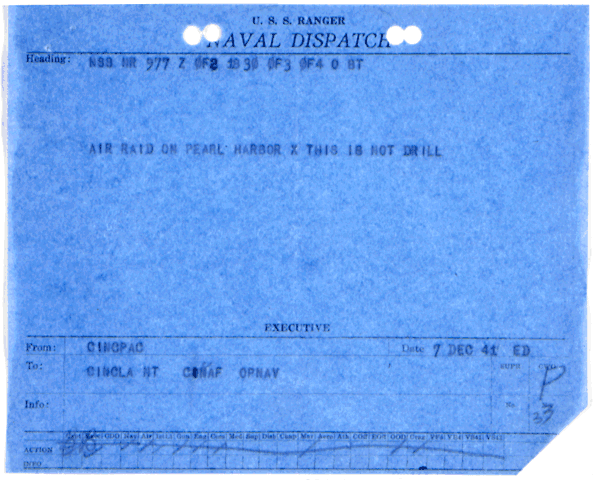
October 19, 2009
Today in history: October 19, 1781

The surrender at Yorktown, which ended the American Revolutionary War.
Day before:
General Lord Charles Cornwallis to General George Washington, October 18, 1781
I agree to open a treaty of capitulation upon the basis of the garrisons of York and Gloucester, including seamen, being prisoners of war, without annexing the condition of their being sent to Europe; but I expect to receive a compensation in the articles of capitulation for the surrender of Gloucester in its present state of defence.I shall, in particular, desire, that the Bonetta sloop of war may be left entirely at my disposal, from the hour that the capitulation is signed, to receive an aid-de-camp to carry my dispatches to Sir Henry Clinton. Such soldiers as I may think proper to send as passengers in her, to be manned with fifty men of her own crew, and to be permitted to sail without examination, when my dispatches are ready: engaging, on my part, that the ship shall be brought back and delivered to you, if she escapes the dangers of the sea, that the crew and soldiers shall be accounted for in future exchanges, that she shall carry off no officer without your consent, nor public property of any kind; and I shall likewise desire, that the traders and inhabitants may preserve their property, and that no person may be punished or molested for having joined the British troops.
If you choose to proceed to negociation on these grounds, I shall appoint two field officers of my army to meet two officers from you, at any time and place that you think proper, to digest the articles of capitulation.
(Check out the full correspondence in the days leading up to the 19th)
Cornwallis had realized that aid would not come in time - and after two days of bombardment - he sent a drummer out into view, who apparently beat the rhythm of: "STOP! LET'S TALK!!!" A British officer high in rank came forward, was blindfolded and taken to George Washington (who was on his last legs himself).
The surrender document had already been drawn up, with Washington dictating the terms. Oh - here are the Articles of Capitulation.
Over 7,000 soldiers surrendered at Yorktown. The war was over.

The story is that as the defeated army marched away, the song "The World Turned Upside Down" was played. I did a quick Google search and there are lots of defensive people out there who feel the need to shout out into the wilds of the Internet, "There is NO evidence that 'The World Turned Upside Down' was played at that moment ..." Ha. I love freaks who take sides in meaningless historical debates like this. I adore them. We are all geeks cut from the same cloth. But still. It's a good story, I think. There are a couple of versions of said song (which has, by itself, a long interesting history). Here is one of the versions:
If buttercups buzz'd after the bee,
If boats were on land, churches on sea,
If ponies rode men and if grass ate the cows,
And cats should be chased into holes by the mouse,
If the mamas sold their babies
To the gypsies for half a crown;
If summer were spring and the other way round,
Then all the world would be upside down.
Dr. James Thacher, who served in the Continental Army, is one of our eyewitnesses of the capitulation, and he published his version of events a couple of years later, the relevant passage being:
"At about twelve o'clock, the combined army was arranged and drawn up in two lines extending more than a mile in length. The Americans were drawn up in a line on the right side of the road, and the French occupied the left. At the head of the former, the great American commander [George Washington], mounted on his noble courser, took his station, attended by his aides. At the head of the latter was posted the excellent Count Rochambeau and his suite. The French troops, in complete uniform, displayed a martial and noble appearance; their bands of music, of which the timbrel formed a part, is a delightful novelty, and produced while marching to the ground a most enchanting effect.The Americans, though not all in uniform, nor their dress so neat, yet exhibited an erect, soldierly air, and every countenance beamed with satisfaction and joy. The concourse of spectators from the country was prodigious, in point of numbers was probably equal to the military, but universal silence and order prevailed.
It was about two o'clock when the captive army advanced through the line formed for their reception. Every eye was prepared to gaze on Lord Cornwallis, the object of peculiar interest and solicitude; but he disappointed our anxious expectations; pretending indisposition, he made General O'Hara his substitute as the leader of his army. This officer was followed by the conquered troops in a slow and solemn step, with shouldered arms, colors cased and drums beating a British march. Having arrived at the head of the line, General O'Hara, elegantly mounted, advanced to his excellency the commander-in-chief, taking off his hat, and apologized for the non-appearance of Earl Cornwallis. With his usual dignity and politeness, his excellency pointed to Major-General Lincoln for directions, by whom the British army was conducted into a spacious field, where it was intended they should ground their arms.
The royal troops, while marching through the line formed by the allied army, exhibited a decent and neat appearance, as respects arms and clothing, for their commander opened his store and directed every soldier to be furnished with a new suit complete, prior to the capitulation. But in their line of march we remarked a disorderly and unsoldierly conduct, their step was irregular, and their ranks frequently broken.
But it was in the field, when they came to the last act of the drama, that the spirit and pride of the British soldier was put to the severest test: here their mortification could not be concealed. Some of the platoon officers appeared to be exceedingly chagrined when giving the word "ground arms," and I am a witness that they performed this duty in a very unofficer-like manner; and that many of the soldiers manifested a sullen temper, throwing their arms on the pile with violence, as if determined to render them useless. This irregularity, however, was checked by the authority of General Lincoln. After having grounded their arms and divested themselves of their accoutrements, the captive troops were conducted back to Yorktown and guarded by our troops till they could be removed to the place of their destination."
One of my favorite sites, Boston 1775, describes the blame-game that ensued, following the capitulation, between the British generals.
I have put a strategic military map from 1781 below the fold. On it you can see the positions of the British Army commanded by Cornwallis - you can see the American and French forces commanded by Washington - and check out the French fleet comin' down the pike - under Count de Grasse!! The last-minute cavalry charge!
And here is a story - (perhaps it's apocryphal, or an out-and-out fabrication - but I love it nonetheless and I will continue to do my part to spread word of this story far and wide) of Benjamin Franklin's response to the news of the surrender. He was, of course, in Paris at the time, setting the world on fire with his homespun wisdom, bacchanalian propensities, chess-playing abilities, fur-lined hats, and his dazzling ways with the ladies. The vision he presented to the world of what liberty, American-style, looked like. An international celebrity.
Word came to France of the decisive American victory, and the complete surrender to George Washington in Yorktown. Franklin attended a diplomatic dinner shortly thereafter - and, of course, everyone was discussing the British defeat.
The French foreign minister stood, and toasted Louis XVI: "To his Majesty, Louis the Sixteenth, who, like the moon, fills the earth with a soft, benevolent glow."
The British ambassador rose and said, "To George the Third, who, like the sun at noonday, spreads his light and illumines the world."
Franklin rose and countered, "I cannot give you the sun or the moon, but I give you George Washington, General of the armies of the United States, who, like Joshua of old, commanded both the sun and the moon to stand still, and both obeyed."
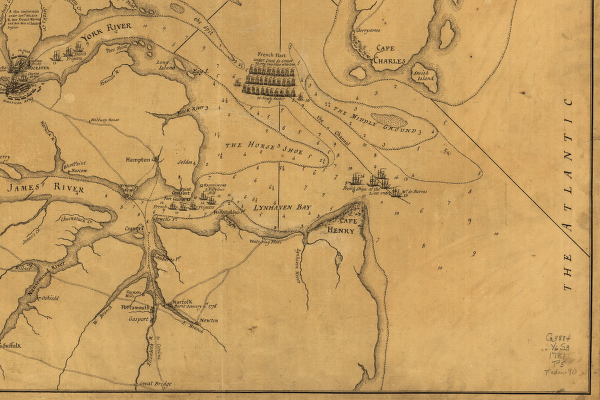
Map found here in this awesome collection - I could get lost in there forever.
September 30, 2009
Speaking of baseball
Stadium Traffic
by Daniel Donaghy
You're on your way home
when a thousand cars
pour onto Broad Street:
the ball game's over.
No one's going anywhere soon.
It's mid-July: eighty and humid.
You smell like all the crappies in the Delaware,
wear the ache of dock crates in your back.
Your buddy lost two fingers tonight
to a jigsaw: boss said go home early,
stay late tomorrow night.
These people don't appreciate
what they have: time to go to ball games.
You get out among blaring horns
and hustlers hawking T-shirts,
walk the yellow lines like a tight rope,
arms out for balance,
all the way to the corner and back.
Broad Street still as a parking lot,
wound tight as a fist.
You pop the trunk, fish a beer
from your cooler, and pound it.
Back in your car, the radio's
recapping the game:
your team pulled one out
they would have blown last year.
You've blown the last year working
nights while your lady works days.
Night work means bad lighting,
and you've had enough close calls.
You've had enough overtime.
You've had enough.
Something has to give.
Somewhere in the distance a dog
is barking, a husband is coming home.
March 31, 2009

March 24, 2009
Outside Taos
After basically infiltrating Dean Stockwell's life with my good friend Stevie, we headed back to Albuquerque, through an extraordinary landscape.
Here's just one glimpse.

January 29, 2009

January 27, 2009
Scanning Tuesday
Here I am, in some huge red rock canyon in Utah - I've been living in my van for two months at this point, so please forgive my ridiculous outfit - and I remember we were sitting there, and bats were swooping over our head. The sky was black with bats. It was totally and unbelievably awesome.

January 23, 2009
Scanning Friday
I can't remember exactly where this is - but it was either Wisconsin, Minnesota or North Dakota. The storm skies were INCREDIBLE, but there was no rain yet - just an ominous quiet, like the wind had been snuffed out by a giant hand. You could feel the HUGEness approaching. I found myself wandering through a deserted lumber yard, with massive trunks lying in piles two stories high - I know I took a ton of pictures, but this is the only one I can find.
It was a haunting day. Beautiful and eerie. Eventually the storm broke, but it took forever. The whole day sort of trembled in that pre-storm tension, with clouds growing thicker and blacker, and the trees going still and quiet in the windless anticipation.

January 22, 2009
Scanning Thursday
This is a really cool photo. I took it at Theodore Roosevelt National Park - a glorious muddy Middle Earth kind of landscape. And at first glance, that's all the photo is: a sweeping panorama of what that place looks like. But if you look closer - you can see a small figure - standing on a ledge, in the middle of all of that glorious muddy wasteland. That's my boyfriend at the time. It was raining that day, so we were wearing huge billowing ponchos, and the poncho is kind of billowing around him, like a cape,
It looks like it could be a still from The Dark Knight, a lonely superhero contemplating the problems of the earth, all by himself.


January 21, 2009

January 20, 2009
Scanning Tuesday
I guess it is only fitting that I have reached my panoramic tour of the United States on this day of major American activity. We went north at first, up through New York to Niagara - then through Canada, down to Chicago, the back up north, heading northwest - and then down through all the huge gorgeous Western states - then thru the Southwest and out thru Nevada to California.
Here I am, on a pouring rainy day, when we did a 10 mile hike through Theodore Roosevelt National Park in South Dakota. That day was all about mud.
I do remember coming into a muddy canyon with all kinds of weird sand-castle drips here and there - and we heard this strange mournful lowing sound - unlike anything I had ever heard before - and a blazing white cow had somehow trapped herself on a little ledge in one of the canyons. Lord knows how she got herself there, but once perched on that ledge she could not get off of it - and she was NOT happy about it.
Weird what you remember. I still think about that cow from time to time and wonder what happened to her.

Scanning Tuesday
I took this photo maybe 3 years ago at the Tile Memorial to 9/11 here in New York, and just came across it and thought I would post it today. I think it's kinda perfect.

Scanning Tuesday
My boyfriend and I went to Arches National Park and took some great shots. The photo of the arch is NOT the one that collapsed last year, although we saw that one, too - but the one in the photo below certainly looks like it could go any minute!
It's a John Ford kind of landscape.


Scanning Tuesday
Utah. Red rocks.
Flash floods can fill these canyons up at a moment's notice, so you have to be wary. We loved the canyons. We camped out in the middle of nowhere, a landscape that looks like he planet Mars. We went mountain biking in Moab on slick red rock similar to this, and it was terrifying and FUN.

January 19, 2009
Scanning Monday
This crazy-good photo I took of the sunset off of Key West. I can't take any credit for this one - the sunset (and either the Nina, Pinta or the Santa Maria) did all the work for me.

January 18, 2009
Scanning Sunday
At the top of Niagara Falls on a chilly September dusk. Pretty spectacular. Pretty LOUD.


January 16, 2009
Scanning Friday
My boyfriend and I saw this as we drove through the Black Hills of South Dakota at dusk. We always regretted that we didn't stop in for a drink or a sandwich, but we were nervous about finding our campsite in those hills once we lost the light of day.
Seeing something like that in the middle of nowhere reminds me of the funny story Frank McCourt tells in 'Tis, his followup to Angela's Ashes. He is just off the boat, Irish, a young man in New York City ... and he wanders the streets ... looking for shamrocks. Of course they are everywhere, because Irish pubs are everywhere ... but any time he saw a shamrock, he knew he could enter and feel welcome. I do not have that immigrant experience but it's in my blood somehow, because even though I'm not into that whole kitschy Irish shamrock thing (I never wear green on St. Patrick's Day - my father drummed that rule into our collective skulls) - I do have an emotional response to it. It's welcoming. I know what it means.
I still love this picture. Glad we captured it. What a random joint. And NOTHING was around it. Just hills and trees and winding treacherous roads. I'd love to try and find it again. (And please. Don't ruin the magic by Googling and giving me the address or informing me that it has been demolished or that there's a Starbucks now, or whatever the case may be. That would ruin it. Only exception: If you actually live in the Black Hills and can tell me a personal story about that place, I would LOVE to hear it!)
But I think it would be best to just trip over it again ... randomly ... find it again, as if by accident, and you can bet that this time, whatever the hour of day, I would not pass on by. I would pull up my car, and stop in to have a cup of coffee and chat up the locals.
In any case, I like to imagine it is still there.

January 11, 2009


January 1, 2009
Today in history: January 1, 1892

The Irish potato famine of 1847, with its millions of people pouring into America in a neverending stream, had been the first sign that the country would need some sort of system to register these people, make sure they weren't bringing in diseases, whatever. Immigrants had always come to America, but it was usually in more of a trickle - rather than a flood, like in "black '47".
And so today in history, January 1, 1892, Ellis Island officially opened for business as the primary immigration-registration center for entry into the United States.
The first immigrant of millions to pass through on this day in history was a 14-year-old Irish girl from County Cork named Annie Moore. Three large ships waited to land on that day, and eventually 700 immigrants entered the country on January 1 alone.
Annie Moore was given a 10 dollar gold piece, and welcomed to America.
From American Notes: Travels in America, 1750-1920, a memory from an immigrant, 1914:
"At seven o'clock our boat lifted anchor and we glided up the still waters of the harbour. The whole prow was a black mass of passengers staring at the ferry-boats, the distant factories, and sky-scrapers. Every point of vantage was seized, and some scores of emigrants were clinging to the rigging. At length we came into sight of the green-grey statue of Liberty, far away and diminutive at first, but later on, a celestial figure in a blaze of sunlight. An American waved a starry flag in greeting, and some emigrants were disposed to cheer, some shed silent tears. Many, however, did not know what the statue was. I heard one Russian telling another that it was the tombstone of Columbus.We carried our luggage out at eight, and in a pushing crowd prepared to disembark…. At a quarter to ten we steamed for Ellis Island. We were then marched to another ferry-boat, and expected to be transported somewhere else, but this second vessel was simply a floating waiting-room. We were crushed and almost suffocated upon it. A hot sun beat upon its wooden roof; the windows in the sides were fixed; we could not move an inch from the places where we were awkwardly standing, for the boxes and baskets were so thick about our feet; babies kept crying sadly, and irritated emigrants swore at the sound of them. All were thinking--"Shall I get through?"
The "tombstone of Columbus"! Ha!!
To those of you who ever visit New York - I highly recommend taking a trip over to Ellis Island. It's strangely emotional - you just can feel the ghosts of the millions of people who passed through. They are all still there. The museum does a great job of displaying information, there's a film to watch, tours to take - it is well worth it.
Here's an image of the Inspection Room - where each immigrant would be screened by doctors for any signs of illness, physical ailments, disease. This was also where their documents would be checked and double-checked. If they were healthy, and if their papers were correct - they would then be allowed to enter the United States.

And so today, let's take a second to remember Annie Moore, the 14 year old Irish girl, the first name on the long long rolls of immigrant records at Ellis Island. There's a statue of Annie Moore at Ellis Island - a bronze statue - which was unveiled by Ireland's president Mary Robinson in 1993.

Here's some more information about Annie Moore. My favorite excerpt from that piece comes at the end:
So what's really important about Annie Moore is not so much that she was born in Ireland, but that she came to America. Someone had to be the first immigrant to land at Ellis Island and as fate would have it she was the one. It might just as easily been someone named Rebecca Schimkowitz or Maria Parmasano. In somewhat the same spirit of commemorating an Unknown Soldier as a symbol of patriotic sacrifice, the story and statues of Annie Moore are intended to remind people of this and future generations of the courageous journey made by countless millions of nameless, faceless immigrants who set out to make a new life for themselves in a strange and distant place called America.
Some images below, including the Inspection Certificate from January 1, 1892, showing Annie Moore's name (the last image below the jump).
Happy birthday, Ellis Island.


October 19, 2008
Today in history: October 19, 1781
The surrender at Yorktown, which ended the American Revolutionary War.
Day before:
General Lord Charles Cornwallis to General George Washington, October 18, 1781
I agree to open a treaty of capitulation upon the basis of the garrisons of York and Gloucester, including seamen, being prisoners of war, without annexing the condition of their being sent to Europe; but I expect to receive a compensation in the articles of capitulation for the surrender of Gloucester in its present state of defence.I shall, in particular, desire, that the Bonetta sloop of war may be left entirely at my disposal, from the hour that the capitulation is signed, to receive an aid-de-camp to carry my dispatches to Sir Henry Clinton. Such soldiers as I may think proper to send as passengers in her, to be manned with fifty men of her own crew, and to be permitted to sail without examination, when my dispatches are ready: engaging, on my part, that the ship shall be brought back and delivered to you, if she escapes the dangers of the sea, that the crew and soldiers shall be accounted for in future exchanges, that she shall carry off no officer without your consent, nor public property of any kind; and I shall likewise desire, that the traders and inhabitants may preserve their property, and that no person may be punished or molested for having joined the British troops.
If you choose to proceed to negociation on these grounds, I shall appoint two field officers of my army to meet two officers from you, at any time and place that you think proper, to digest the articles of capitulation.
(Check out the full correspondence in the days leading up to the 19th)
Cornwallis had realized that aid would not come in time - and after two days of bombardment - he sent a drummer out into view, who apparently beat the rhythm of: "STOP! LET'S TALK!!!" A British officer high in rank came forward, was blindfolded and taken to George Washington (who was on his last legs himself).
The surrender document had already been drawn up, with Washington dictating the terms. Oh - here are the Articles of Capitulation.
Over 7,000 soldiers surrendered at Yorktown. The war was over.
The story is that as the defeated army marched away, the song "The World Turned Upside Down" was played. I did a quick Google search and there are lots of defensive people out there who feel the need to shout out into the wilds of the Internet, "There is NO evidence that 'The World Turned Upside Down' was played at that moment ..." Ha. I love freaks who take sides in meaningless historical debates like this. I adore them. We are all geeks cut from the same cloth. But still. It's a good story, I think. There are a couple of versions of said song (which has, by itself, a long interesting history). Here is one of the versions:
If buttercups buzz'd after the bee,
If boats were on land, churches on sea,
If ponies rode men and if grass ate the cows,
And cats should be chased into holes by the mouse,
If the mamas sold their babies
To the gypsies for half a crown;
If summer were spring and the other way round,
Then all the world would be upside down.
Dr. James Thacher, who served in the Continental Army, is one of our eyewitnesses of the capitulation, and he published his version of events a couple of years later, the relevant passage being:
"At about twelve o'clock, the combined army was arranged and drawn up in two lines extending more than a mile in length. The Americans were drawn up in a line on the right side of the road, and the French occupied the left. At the head of the former, the great American commander [George Washington], mounted on his noble courser, took his station, attended by his aides. At the head of the latter was posted the excellent Count Rochambeau and his suite. The French troops, in complete uniform, displayed a martial and noble appearance; their bands of music, of which the timbrel formed a part, is a delightful novelty, and produced while marching to the ground a most enchanting effect.The Americans, though not all in uniform, nor their dress so neat, yet exhibited an erect, soldierly air, and every countenance beamed with satisfaction and joy. The concourse of spectators from the country was prodigious, in point of numbers was probably equal to the military, but universal silence and order prevailed.
It was about two o'clock when the captive army advanced through the line formed for their reception. Every eye was prepared to gaze on Lord Cornwallis, the object of peculiar interest and solicitude; but he disappointed our anxious expectations; pretending indisposition, he made General O'Hara his substitute as the leader of his army. This officer was followed by the conquered troops in a slow and solemn step, with shouldered arms, colors cased and drums beating a British march. Having arrived at the head of the line, General O'Hara, elegantly mounted, advanced to his excellency the commander-in-chief, taking off his hat, and apologized for the non-appearance of Earl Cornwallis. With his usual dignity and politeness, his excellency pointed to Major-General Lincoln for directions, by whom the British army was conducted into a spacious field, where it was intended they should ground their arms.
The royal troops, while marching through the line formed by the allied army, exhibited a decent and neat appearance, as respects arms and clothing, for their commander opened his store and directed every soldier to be furnished with a new suit complete, prior to the capitulation. But in their line of march we remarked a disorderly and unsoldierly conduct, their step was irregular, and their ranks frequently broken.
But it was in the field, when they came to the last act of the drama, that the spirit and pride of the British soldier was put to the severest test: here their mortification could not be concealed. Some of the platoon officers appeared to be exceedingly chagrined when giving the word "ground arms," and I am a witness that they performed this duty in a very unofficer-like manner; and that many of the soldiers manifested a sullen temper, throwing their arms on the pile with violence, as if determined to render them useless. This irregularity, however, was checked by the authority of General Lincoln. After having grounded their arms and divested themselves of their accoutrements, the captive troops were conducted back to Yorktown and guarded by our troops till they could be removed to the place of their destination."
One of my favorite sites, Boston 1775, describes the blame-game that ensued, following the capitulation, between the British generals.
I have put a strategic military map from 1781 below the fold. On it you can see the positions of the British Army commanded by Cornwallis - you can see the American and French forces commanded by Washington - and check out the French fleet comin' down the pike - under Count de Grasse!! The last-minute cavalry charge!
And here is a story - (perhaps it's apocryphal, or an out-and-out fabrication - but I love it nonetheless and I will continue to do my part to spread word of this story far and wide) of Benjamin Franklin's response to the news of the surrender. He was, of course, in Paris at the time, setting the world on fire with his homespun wisdom, bacchanalian propensities, chess-playing abilities, fur-lined hats, and his dazzling ways with the ladies. The vision he presented to the world of what liberty, American-style, looked like. An international celebrity.
Word came to France of the decisive American victory, and the complete surrender to George Washington in Yorktown. Franklin attended a diplomatic dinner shortly thereafter - and, of course, everyone was discussing the British defeat.
The French foreign minister stood, and toasted Louis XVI: "To his Majesty, Louis the Sixteenth, who, like the moon, fills the earth with a soft, benevolent glow."
The British ambassador rose and said, "To George the Third, who, like the sun at noonday, spreads his light and illumines the world."
Franklin rose and countered, "I cannot give you the sun or the moon, but I give you George Washington, General of the armies of the United States, who, like Joshua of old, commanded both the sun and the moon to stand still, and both obeyed."
Map found here in this awesome collection - I could get lost in there forever.
September 7, 2008
Judy Garland: "Battle Hymn of the Republic"
Judy fans will know immediately what clip I have posted below - will know the year, the circumstances ... Mitchell was the one who first showed me this clip, years ago, and he actually made me watch it once with the sound down, just so he could show me how eloquent and simple she was in her gestures and singing expression ... There are moments when (if you watch it with the sound down) - you could almost believe that she was just speaking. Hard to imagine any of the young singers who contort their faces to get the sound out today being so quiet and simple and at ease with their own instrument.
The clip speaks for itself.
It's one of the most moving things I have ever seen, and I can only imagine what it was like to be there live. Garland was one of those rare singers who could fill up with emotion as she sang - without the throat constricting. It's remarkable, and I would imagine it was a mix of a gift of flexible and strong vocal cords - as well as an act of will. She will get the song out.
Here ... her sense of will ... takes on an almost life-or-death intensity which makes it difficult to watch at times. She is struggling against so much - her own emotion, the free-floating emotion that had to be present in the audience at that time, and the larger national sense of grief and loss ... But she keeps going.
It will not change the world. She is not a statesman. She is not a Nobel Peace winner. She is not a diplomat, an ambassador, a senator, or poet laureate. She is a singer. So in such a moment ... there is only one thing she can possibly contribute. A song.
Thank God it was on live television so that we can still watch it now.
I am in awe. I am also struck by how awkward she is, physically, and how much that works for her. Her gestures are sharp, choppy - she randomly hugs herself - flings her arm in the air ... and none of it feels planned. It's almost scary (but I know I am only saying that because we know how overly managed most singers are today ... they have TEAMS of people to make sure they never look awkward and to hide those "flaws" that actually might make them brilliant and original). Garland is not doing anything here - except living that song - and pouring her emotion into her voice and letting it out. The gestures were all from her heart - completely her own - and give the performance a ragged realism which still, after so many times watching it, has the potential to shock me.
(Alex has some more thoughts here.)
July 4, 2008
July 4, 1826
It was the 50th anniversary of July 4, 1776. Both John Adams and Thomas Jefferson had been invited to attend huge celebrations in honor of the anniversary, but due to illness - both had sent their regrets and also best wishes, saying they would not be able to come. Thomas Jefferson's letter to the mayor of Washington, declining the invitation, ended as follows:
May it be to the world, what I believe it will be (to some parts sooner, to others later, but finally to all) the signal of arousing men to burst the chains under which monkish ignorance and superstition and persuaded them to bind themselves, and to assume the blessings and security of self-government ... All eyes are opened or opening to the rights of man. The general spread of the light of science has already laid open to every view the palpable truth, that the mass of mankind has not been born with saddles on their backs, nor a favored few, booted and spurred, ready to ride them legitimately by the grace of God. These are the grounds of hope for others; for ourselves, let the annual return of this day forever refresh our recollections of these rights, and an undiminished devotion to them.
Adams was too ill to put pen to paper. The light was going out. For both of them.


These two men, two of the main architects of the American Revolution, long estranged due to political differences, (and Jefferson referring, in public, to "political heresies" among some of his colleagues - a clear dig at Adams - and a clear sign of Jefferson's belief in some political orthodoxy, which was the breaking point for the overly sensitive Adams) had finally reconciled. The reconciliation had been engineered by Benjamin Rush, who thought it a shame that these two great patriots, once dear friends, would go to their graves without making up. Benjamin Rush had a dream that Adams and Jefferson became friends again (I wonder if he really had that dream? Or if it was just a fabrication in order to move things along). Rush wrote to Adams,
"And now, my dear friend, permit me again to suggest to you to receive the olive branch which has thus been offered to you by the hand of a man who still loves you. Fellow laborers in erecting the great fabric of American independence! ... embrace - embrace each other!"
Adams and Jefferson began to correspond ... and it lasted over a period of 12-years ... a correspondence that has to be read to be believed
When they finally began corresponding again, Rush (who had also been writing to Jefferson, urging him to make peace) wrote to Adams, and you can feel his excitement in his words:
I rejoice in the correspondence which has taken place between you and your old friend Mr. Jefferson. I consider you and him as the North and South Poles of the American Revolution. Some talked, some wrote, and some fought to promote and establish it but you and Mr. Jefferson thought for us all.
And then ... on the same day in 1826 ... which happened to be July 4 ... which happened to be the 50th anniversary of the Declaration of Independence ... John Adams and Thomas Jefferson both died. Within hours of each other.
David McCullough writes in his biography of John Adams:
That John Adams and Thomas Jefferson had died on the same day, and that it was, of all days, the Fourth of July, could not be seen as a mere coincidence: it was a "visible and palpable" manifestation of "Divine favor," wrote John Quincy Adams in his diary that night, expressing what was felt and would be said again and again everywhere the news spread.
John Adams' last words were either "Jefferson ... still lives." or "Jefferson ... survives."
I will never get tired of thinking about that, wondering, contemplating, shaking my head. I think I know what it means, and WHY Adams said it, and then I realize - No, I have no idea - and I prefer it that way. I prefer the mystery of it, the question, the subtlety - I prefer to just think about it, and wonder about it . I love it.
Amazingly, though, Jefferson actually had died a couple of hours earlier. Which makes this an even more amazing story. Like ... twins who live on opposite sides of the planet, and one twin knows when the other twin scrapes his knee. There are things that cannot be sufficiently explained. There are more things in heaven and earth, Horatio, than are dreamt of in your philosophy.
Thomas Jefferson's last words are in dispute - but there are enough similarities to suggest that something along these lines occurred. (I love the discrepancy, by the way - I love it because it just adds to the mystery.) According to Robley Dunglison, the attending physician, Jefferson dozed through the day on July 3rd, and woke up in the early evening, saying as he awoke, "Is it the Fourth?" (A lump in my throat ...) Dunglison said to him that it soon would be. Nicholas Trist, married to Jefferson's granddaughter, remembers it this way: Jefferson woke and said, "This is the Fourth?" Trist remembers pretending not to hear the question, because he didn't want to tell Jefferson that it was still only the 3rd of July. But Jefferson asked again, "This is the Fourth?" Trist caved, and nodded - and he felt very bad about his lie. Virginia Randolph, his granddaughter, remembers it differently. She remembers him waking and saying, clearly, "This is the Fourth." No question. A statement. Jefferson faded out after that, and the next day, the Fourth, he called out for help at one point - and someone remembers him saying, at one point, "No, doctor. Nothing more." But it is his question/statement about what the date was that has passed down through the years as Jefferson's final words. In the end, it doesn't really matter, of course, although the story itself is one I treasure, in all its different details.
Did he wait? When he found out it was still just the Third, did he wait? To die on the Fourth? I wouldn't put it past him, he always loved symmetry.
Yes, Mr. Jefferson. It is the fourth. And thank you. Thank you both. Thank you for thinking for us all.
Happy 4th of July, everybody!
July 3, 2008
Today in History: July 3, 1776
John Adams, in a July 3, 1776 letter to Abigail, after the signing of the Declaration of Independence on July 2 in Philadelphia:
The Delay of this Declaration to this Time, has many great Advantages attending it. The Hopes of Reconciliation, which were fondly entertained by Multitudes of honest and well meaning tho weak and mistaken People, have been gradually and at last totally extinguished. Time has been given for the whole People, maturely to consider the great Question of Independence and to ripen their Judgments, dissipate their Fears, and allure their Hopes, by discussing it in News Papers and Pamphletts, by debating it, in Assemblies, Conventions, Committees of Safety and Inspection, in town and County Meetings, as well as in private Conversations, so that the whole People in every Colony of the 13, have now adopted it, as their own Act. This will cement the Union, and avoid those Heats, and perhaps Convulsions which might have been occasioned, by such a Declaration Six Months ago.But the Day is past. The Second Day of July 1776, will be the most memorable Epocha, in the History of America. I am apt to believe that it will be celebrated, by succeeding Generations, as the great anniversary Festival. It ought to be commemorated, as the Day of Deliverance by solemn Acts of Devotion to God Almighty. It ought to be solemnized with Pomp and Parade, with Shews, Games, Sports, Guns, Bells, Bonfire and Illuminations from one End of this Continent to the other from this Time forward forever more.
You will think me transported with Enthusiasm, but I am not. I am well aware of the Toil, and Blood, and Treasure that it will cost Us to maintain this Declaration, and support and defend these States. Yet, through all the Gloom, I can see the Rays of ravishing Light and Glory. I can see that the End is more than worth all the Means, and that Posterity will triumph in that Day's Transaction, even though We should not rue it, which I trust in God We shall not.
The Second Day of July 1776, will be the most memorable Epocha, in the History of America.
He was off by just 2 days.
May 25, 2008
Today In History: May 25, 1787 "how thirteen independent states could share a government of tripartite powers"
May 25, 1787: the Constitutional Convention (although that would only be its name later; at the time it was called the "Federal Convention") got underway. Most of the delegates had arrived, by that time, from their far-flung states, and May 25th was the first day that they convened in Independence Hall.
At the time, nobody (except James Madison, Alexander Hamilton, and George Washington) was thinking about creating a constitution, or even considering "consolidating". The thought of "consolidation" was horrifying to most, and the thought of an "energetic national government" was even worse. No. No energetic government. The colonies had had quite enough of all of that "energy". However, the original Articles of Confederation were seen by most as inadequate for the present circumstances, so the Convention was called to revise the Articles of Confederation - that was what most of them were there for, just to make revisions. But Washington, Madison, Hamilton - and a couple of other far-seeing gentlemen - saw the need for an even greater revolution, an even more daring task.
One thing to add into this pot, one important piece of context is Shays Rebellion. The Convention began in May, 1787, and Shays Rebellion had raged from the fall of 1786 into the early spring of 1787. So it was still fresh in the memories of all present. Shays Rebellion had left George Washington deeply shaken and angered. He knew that civilization was a fragile construct, easily destroyed. That was the spectre before Washington's eyes, in terms of Shays Rebellion, and any other future uprising. He was convinced that the Articles of Confederation would not be sufficient to cope. There needed to be a federal government.
In the context of the time, this was hugely controversial. But Washington was not alone. Hamilton and Madison were also in favor of strengthening the central government. The violence of Shays Rebellion was the spark which caused the first rift between Thomas Jefferson and Abigail Adams - good friends up until then. Abigail, in London at the time, was enraged at the Rebellion and she wanted it to be crushed, mercilessly. How dare these people threaten all they had fought for? How DARE they? She wrote a passionate letter to Jefferson about it, expressing her rage, and his response to her contained the now-famous line: "I like a little rebellion now and then. It is like a storm in the atmosphere." She quickly withdrew from his friendship, fearful that his view of government would lead the newly free colonies into complete and utter anarchy.
The memory of Shays Rebellion was fresh, and vivid to the men who gathered in the Pennsylvania State House, on May 25th, 1787. Most of them knew they were part of a grand experiment, but many of them didn't know just how much grander and bolder it was about to get. Die-hard patriots, men who had signed the Declaration of Independence, balked at the new idea of this "Constitution", and a consolidated government - with one man at the head of it. One man?? Hadn't they all seen what one man could do?
Regardless: today is the day that the Convention began.
I'll let the marvelous Catherine Drinker-Bowen set the scene (this is from her Miracle At Philadelphia: The Story of the Constitutional Convention May - September 1787
MAY 25TH, 1787
On the twenty-fifth of May, when a quorum was obtained, Washington was unanimously elected president of the Convention and escorted to the chair. From his desk on the raised dais he made a little speech of acceptance, depreciating his ability to give satisfaction in a scene so novel. "When seated," wrote a member, "he declared that as he never had been in such a situation he felt himself embarrassed, that he hoped his errors, as they would be unintended, would be excused. He lamented his want of qualifications."...In the front row near the desk, James Madison sat bowed over his tablet, writing steadily. His eyes were blue, his face ruddy; he did not have the scholar's pallor. His figure was well-knit and muscular and he carried his clothes with style. Though he usually wore black, he has also been described as handsomely dressed in blue and buff, with ruffles at breast and wrist. Already he was growing bald and brushed his hair down to hide it; he wore a queue and powder. He walked with the quick bouncing step that sometimes characterizes men of remarkable energy.
As a reporter Madison was indefatigable, his notes comprehensive, set down without comment or aside. One marvels that he was able at the same time to take so large a part in the debates. It is true that in old age Madison made some emendations in the record to accord with various disparate notes which later came to light; he has been severely criticized for it. Other members took notes at the Convention: Hamilton, Yates and Lansing of New York, McHenry of Maryland, Paterson of New Jersey, Rufus King of Massachusetts, William Pierce of Georgia, George Mason of Virginia. But most of these memoranda were brief, incomplete; had it not been for Madison we should possess very scanty records of the Convention. His labors, he said later, nearly killed him. "I chose a seat," he afterward wrote, "in front of the presiding member, with the other members on my right and left hand. In this favorable position for hearing all that passed, I noted in terms legible and in abbreviations and marks intelligble to myself what was read from the Chair or spoken by the members; and losing not a moment unnecessarily between the adjournment and reassembling of the Convention I was enabled to write out my daily notes during the session or within a few finishing days after its close in the extent and form preserved in my own hand on my files ... I was not absent a single day, nor more than a casual fraction of an hour in any day, so that I could not have lost a single speech, unless a very short one."
It was, actually, a tour de force, not to be published -- and scarcely seen -- until thirty years after the Convention. "Do you know," wrote Jefferson to John Adams from Monticello in 1815, "that there exists in manuscript the ablest work of this kind ever yet executed, of the debates of the constitutional convention of Philadelphia ...? The whole of everything said and done there was taken down by Mr. Madison, with a labor and exactness beyond comprehension." ...
"The State of Georgia, by the grace of God, free, Sovereign and Independent" ... On Friday morning, May twenty-fifth, as soon as Washington had finished his little speech of acceptance from the chair, Major Jackson rose to read aloud the credentials -- so carefully worked over at home -- of the nine states present. It was noticeable that the smallest states spoke out with the loudest voice. Georgia, referred to as "small and trifling" because of her sparse population, announced herself to the Convention with a proud resounding orchestration which left little doubt of her position ... "Sovereign and Independent."
Certain members of the Convention were already heartily sick of the word sovereign. The monster, sovereignty, Washington had called it. The General knew well from what sanction Georgia derived the word. "Each state," the Articles of Confederation had said, "retains its sovereignty, freedom and independence." Without such a clause the Confederacy never would have been achieved ...
Before the Declaration of Independence, no colony had pretensions to independent sovereignty, nor were the states mentioned by name in the body of that document. Yet from the moment peace had been signed, states flaunted their sovereignty as an excuse to do as they pleased. "Thirteen sovereignties," Washington had written, "pulling against each other, and all tugging at the foederal head, will soon bring ruin on the whole."
A General of the Army is not expected to possess so direct and merciless a political eye. Already on May 25, 1787, it looked as if the Federal Convention were to have its fill of sovereignty. The reading aloud of these state credentials was a matter for strict attention; here were signs portent of which way the states were leaning. Madison and Hamilton thought they already knew. Madison had canvassed exhaustively; both men were personally acquainted with many delegates, some of whom had themselves drafted these documents and no doubt would stand by what they had written. Delaware, for instance, whose credentials forbade her deputies to change Article V of the Confederation, giving to each state one vote in Congress and one vote only. Proportional representation was no part of Delaware's scheme. Should the old rule be altered to voting by population, the small states would be blanketed out. Delaware had come prepared to oppose it.
Small states against large, the planting interests of the South against the mercantile money of the North, the regulation of the Western Territory -- these were immediate problems. Not every delegate brought to Philadelphia a comprehension of how thirteen independent states could share a government of tripartite powers: legislative, judicial, executive. James Wilson of Philadelphia understood it and so did Wythe of Virginia. Wilson and Wythe were scholars like Madison. Not only had they acted a part in government bu tthey had thought, red, pondered on the subject; they knew the theory behind the practice. "I am both a citizen of Pennsylvania and of the United States," Wilson told the Convention.
Time would pass before members realized how far the plans of such men as Madison and Hamilton reached, and what the Constitution promised to be. It would be misleading to name thus early the Constitution's "enemies", or to set down this name or that as "against" the Constitution. Five delegates in the end would refuse to sign -- Elbridge Gerry of Massachusetts, Yates and Lansing of New York, George Mason and Edmund Randolph of Virginia -- all men of decided views and each with a different reason for his action. More vociferous than any of these would be Luther Martin of Maryland, who, though out of town on private business at the moment of signing, later declared that had he been present he would have given the document his "solemn negative," even had he "stood single and alone".
Martin did not arrive at the Convention until nearly a month after it met; for the moment, members were spared his boisterous and interminable harangues. On this first Saturday of a quorum the Convention faced a twofold problem: the theoretic question of what kind of government best suited America -- a democracy, a limited monarchy, a republic? -- and the practical problem of creating such a government with all its untried component parts. It was good to review, by way of the state credentials, the aims of the Convention as declared by twelve legislatures. Major Jackson's voice droned on:
"To take into consideration the state of the union ... as to trade and other important objects ... to render the Foederal Government entirely adeuqate to the actual situation ..." When Jackson ceased there was time only to name a committee to prepare standing rules and orders, and to appoint a doorkeeper and messenger. The meeting adjourned for the weekend.
And so endeth May 25th, 1787.
Four months later:
The Scene at the Signing of the Constitution, oil painting (reproduction) by Howard Chandler Christy, 1940

April 18, 2008
On the eighteenth of April, in Seventy-five; Hardly a man is now alive Who remembers that famous day and year.
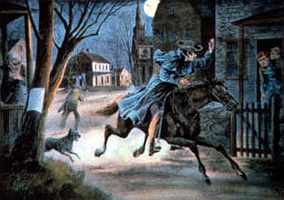
On the night of April 18, into April 19, in 1775, Paul Revere made his famous ride.
The spring of 1775 was a tense time. Prominent Bostonians were under constant threat of arrest from the British, and many of them - to avoid this - moved their families to outlying communities. However, two of the main patriotic leaders (Benjamin Church and Joseph Warren) stayed in Boston. Paul Revere did as well, and kept a close eye on British movements through that spring. Revere was trusted as a messenger, he knew everybody.
In mid-April, Revere started to notice some ominous signs: mainly that the British ships were taken out of the water, to be worked on, repaired. He could sense that something was coming. He felt the British were preparing for some kind of attack.
Revere went to Concord on April 16 (most of the weaponry was stored there) and warned the leaders of that community that the British were preparing something, they were up to something, and if they were going to strike, they would most definitely try to seize the weapons stash in Concord. So the people of Concord went to work, hiding their store of weapons in barns, cellars, swamps, etc. (Like I mentioned: Paul Revere was trusted. He knew everybody. If you're interested, read the excerpt I posted of Malcolm Gladwell's fascinating analysis of Paul Revere - and Gladwell's comparison with the far less successful messenger on that very same night - William Dawes.)
So. April 16. Revere returned to Boston from Concord, and met with other revolutionary leaders, and that is when they came up with the "one if by land, two if by sea" warning system. Revere knew they needed a way to have some advance warning about which route the British were going to take when they finally did attack.
By land? Or by sea?
So, Revere set up the system: Signal lanterns would be placed in the belfry of Old North Church (the steeple can be seen across the Charles River). If two lanterns were hung, then the British would be crossing the Charles by boat. If one lantern was hung, then the British would choose to attack using a land route.
"One if by land, two if by sea."
The plan was put in place just in time. On April 18, in the early evening, a stable boy came to Paul Revere, telling him that he had overheard some British soldiers discussing the upcoming attack, and that it was planned for early the next morning. The stable boy knew who to bring this information to, and that was Paul Revere. (Again, check out Gladwell's analysis of Paul Revere's personality. Really interesting.)
Revere, on receiving this urgent piece of information, knew he had to get the warning out (and that he especially had to warn John Hancock and Samuel Adams who, at that time, were hiding out in Lexington).
So off he went on his now legendary ride (here's a cool map of the route he took). Revere took the water route out of Boston, rowed across the Charles, and galloped through the communities north of Boston sounding the alarm. (Medford, Charlestown, Lexington, Concord.) Because of Paul Revere, the British had completely lost the element of surprise. When they came to attack, they found the rebellious colonists waiting for them everywhere, ambushing them left and right, from behind stone walls, hiding behind trees ...
An interesting tidbit (this is why I love this time in American history - yeah, the events themselves are really cool ... but it's details like the following one that really have me hooked, like a crack addict):
In his hurry to depart, Revere forgot to bring along pieces of cloth to wrap the oars of his boat. The purpose of the cloth would be to muffle the sound of the oars cutting through the water. The Somerset (the British man-of-war) was at anchor, right there in the harbor. Paul Revere had to row right by them, and so any sound at all would have alerted the crew, and if Revere was busted, the whole jig would be up. Revere was in a bit of a pickle ... standing by his boat, trying to figure out how he could improvise ... could he take off his stockings? Tie them around the end of the oars?
One of the boatmen involved in helping Revere make this crossing came to the rescue. He ran to his girlfriend's house and asked her for her petticoat. One can only imagine her startled response to the nighttime demand at her door from her beau: "Please, dear. It's 10 pm, and I need you to take off your petticoat, give it to me, and don't ask me ANY questions about it!!" But apparently, this girl, whoever she was, complied - took off her petticoat, handed it over, and Revere used it to wrap up the ends of his oars.
I love that woman, whoever she is.
So. In honor of this great moment in American history -here is Henry Wadsworth Longfellow's celebrated poem "Paul Revere's Ride". And below that, I am posting an old essay I wrote about babysitting Cashel - which is relevant to this date in history. A couple years ago, I read the Cashel piece on a radio program, which was a pretty cool experience - and reading over the piece today makes me nostalgic for when Cashel was so little!!
But back to the poem: I know large swaths of it by heart ... I grew up hearing it. I'm an East Coast girl, most of my family is from Boston. So all of these places in the poem are places I had been to many times as a child, and not just a tourist ... but just because we lived near them. That piece of history felt very real to me. The poem is thrilling to me - because of the story it tells, of course, but also because of its rollicking perfect rhythm, you can feel the suspense, you can feel the urgency, the whole thing ends up sounding like the clatter of horses hooves galloping through the night. It's meant to be read out loud. Try it for yourself!! The last stanza is beyond compare. "For borne on the night-wind of the Past ..." I mean, come ON!!
April 18, 1775. A great day in American history. "The fate of a nation was riding that night." One of my personal favorite stories of the American revolution.
Paul Revere's Ride
- by Henry Wadsworth LongfellowListen my children and you shall hear
Of the midnight ride of Paul Revere,
On the eighteenth of April, in Seventy-five;
Hardly a man is now alive
Who remembers that famous day and year.
He said to his friend, "If the British march
By land or sea from the town to-night,
Hang a lantern aloft in the belfry arch
Of the North Church tower as a signal light,--
One if by land, and two if by sea;
And I on the opposite shore will be,
Ready to ride and spread the alarm
Through every Middlesex village and farm,
For the country folk to be up and to arm."
Then he said "Good-night!" and with muffled oar
Silently rowed to the Charlestown shore,
Just as the moon rose over the bay,
Where swinging wide at her moorings lay
The Somerset, British man-of-war;
A phantom ship, with each mast and spar
Across the moon like a prison bar,
And a huge black hulk, that was magnified
By its own reflection in the tide.
Meanwhile, his friend through alley and street
Wanders and watches, with eager ears,
Till in the silence around him he hears
The muster of men at the barrack door,
The sound of arms, and the tramp of feet,
And the measured tread of the grenadiers,
Marching down to their boats on the shore.
Then he climbed the tower of the Old North Church,
By the wooden stairs, with stealthy tread,
To the belfry chamber overhead,
And startled the pigeons from their perch
On the sombre rafters, that round him made
Masses and moving shapes of shade,--
By the trembling ladder, steep and tall,
To the highest window in the wall,
Where he paused to listen and look down
A moment on the roofs of the town
And the moonlight flowing over all.
Beneath, in the churchyard, lay the dead,
In their night encampment on the hill,
Wrapped in silence so deep and still
That he could hear, like a sentinel's tread,
The watchful night-wind, as it went
Creeping along from tent to tent,
And seeming to whisper, "All is well!"
A moment only he feels the spell
Of the place and the hour, and the secret dread
Of the lonely belfry and the dead;
For suddenly all his thoughts are bent
On a shadowy something far away,
Where the river widens to meet the bay,--
A line of black that bends and floats
On the rising tide like a bridge of boats.
Meanwhile, impatient to mount and ride,
Booted and spurred, with a heavy stride
On the opposite shore walked Paul Revere.
Now he patted his horse's side,
Now he gazed at the landscape far and near,
Then, impetuous, stamped the earth,
And turned and tightened his saddle girth;
But mostly he watched with eager search
The belfry tower of the Old North Church,
As it rose above the graves on the hill,
Lonely and spectral and sombre and still.
And lo! as he looks, on the belfry's height
A glimmer, and then a gleam of light!
He springs to the saddle, the bridle he turns,
But lingers and gazes, till full on his sight
A second lamp in the belfry burns.
A hurry of hoofs in a village street,
A shape in the moonlight, a bulk in the dark,
And beneath, from the pebbles, in passing, a spark
Struck out by a steed flying fearless and fleet;
That was all! And yet, through the gloom and the light,
The fate of a nation was riding that night;
And the spark struck out by that steed, in his flight,
Kindled the land into flame with its heat.
He has left the village and mounted the steep,
And beneath him, tranquil and broad and deep,
Is the Mystic, meeting the ocean tides;
And under the alders that skirt its edge,
Now soft on the sand, now loud on the ledge,
Is heard the tramp of his steed as he rides.
It was twelve by the village clock
When he crossed the bridge into Medford town.
He heard the crowing of the cock,
And the barking of the farmer's dog,
And felt the damp of the river fog,
That rises after the sun goes down.
It was one by the village clock,
When he galloped into Lexington.
He saw the gilded weathercock
Swim in the moonlight as he passed,
And the meeting-house windows, black and bare,
Gaze at him with a spectral glare,
As if they already stood aghast
At the bloody work they would look upon.
It was two by the village clock,
When he came to the bridge in Concord town.
He heard the bleating of the flock,
And the twitter of birds among the trees,
And felt the breath of the morning breeze
Blowing over the meadow brown.
And one was safe and asleep in his bed
Who at the bridge would be first to fall,
Who that day would be lying dead,
Pierced by a British musket ball.
You know the rest. In the books you have read
How the British Regulars fired and fled,---
How the farmers gave them ball for ball,
From behind each fence and farmyard wall,
Chasing the redcoats down the lane,
Then crossing the fields to emerge again
Under the trees at the turn of the road,
And only pausing to fire and load.
So through the night rode Paul Revere;
And so through the night went his cry of alarm
To every Middlesex village and farm,---
A cry of defiance, and not of fear,
A voice in the darkness, a knock at the door,
And a word that shall echo for evermore!
For, borne on the night-wind of the Past,
Through all our history, to the last,
In the hour of darkness and peril and need,
The people will waken and listen to hear
The hurrying hoof-beats of that steed,
And the midnight message of Paul Revere.
Paul Revere himself wrote of that time:
In the Fall of 1774 and Winter of 1775 I was one of upwards of thirty, cheifly mechanics, who formed our selves in to a Committee for the purpose of watching the Movements of the British Soldiers, and gaining every intelegence of the movements of the Tories.We held our meetings at the Green-Dragon Tavern. We were so carefull that our meetings should be kept Secret; that every time we met, every person swore upon the Bible, that they would not discover any of our transactions, But to Messrs. HANCOCK, ADAMS, Doctors WARREN, CHURCH, and one or two more.
About November, when things began to grow Serious, a Gentleman who had Conections with the Tory party, but was a Whig at heart, acquainted me, that our meetings were discovered, and mentioned the identical words that were spoken among us the Night before. . . . We removed to another place, which we thought was more secure: but here we found that all our transactions were communicated to Governor Gage. (This came to me through the then Secretary Flucker; He told it to the Gentleman mentioned above). It was then a common opinion, that there was a Traytor in the provincial Congress, and that Gage was posessed of all their Secrets. (Church was a member of that Congress for Boston.) In the Winter, towards the Spring, we frequently took Turns, two and two, to Watch the Soldiers, By patroling the Streets all night. The Saturday Night preceding the 19th of April, about 12 oClock at Night, the Boats belonging to the Transports were all launched, and carried under the Sterns of the Men of War. (They had been previously hauld up and repaired). We likewise found that the Grenadiers and light Infantry were all taken off duty.
From these movements, we expected something serious was [to] be transacted. On Tuesday evening, the 18th, it was observed, that a number of Soldiers were marching towards the bottom of the Common. About 10 o'Clock, Dr. Warren Sent in great haste for me, and beged that I would imediately Set off for Lexington, where Messrs. Hancock and Adams were, and acquaint them of the Movement, and that it was thought they were the objets. When I got to Dr. Warren's house, I found he had sent an express by land to Lexington—a Mr. Wm. Daws. The Sunday before, by desire of Dr. Warren, I had been to Lexington, to Mess. Hancock and Adams, who were at the Rev. Mr. Clark's. I returned at Night thro Charlestown; there I agreed with a Col. Conant, and some other Gentlemen, that if the British went out by Water, we would shew two Lanthorns in the North Church Steeple; and if by Land, one, as a Signal; for we were aprehensive it would be dificult to Cross the Charles River, or git over Boston neck. I left Dr. Warrens, called upon a friend, and desired him to make the Signals. I then went Home, took my Boots and Surtout, and went to the North part of the Town, Where I had kept a Boat; two friends rowed me across Charles River, a little to the eastward where the Somerset Man of War lay. It was then young flood, the Ship was winding, and the moon was Rising. They landed me on Charlestown side. When I got into Town, I met Col. Conant, and several others; they said they had seen our signals. I told them what was Acting, and went to git me a Horse; I got a Horse of Deacon Larkin. While the Horse was preparing, Richard Devens, Esq. who was one of the Committee of Safty, came to me, and told me, that he came down the Road from Lexington, after Sundown, that evening; that He met ten British Officers, all well mounted, and armed, going up the Road.
I set off upon a very good Horse; it was then about 11 o'Clock, and very pleasant. After I had passed Charlestown Neck, and got nearly opposite where Mark was hung in chains, I saw two men on Horse back, under a Tree. When I got near them, I discovered they were British officer. One tryed to git a head of Me, and the other to take me. I turned my Horse very quick, and Galloped towards Charlestown neck, and then pushed for the Medford Road. The one who chased me, endeavoring to Cut me off, got into a Clay pond, near where the new Tavern is now built. I got clear of him, and went thro Medford, over the Bridge, and up to Menotomy. In Medford, I awaked the Captain of the Minute men; and after that, I alarmed almost every House, till I got to Lexington. I found Messrs. Hancock and Adams at the Rev. Mr. Clark's; I told them my errand, and inquired for Mr. Daws; they said he had not been there; I related the story of the two officers, and supposed that He must have been stopped, as he ought to have been there before me. After I had been there about half an Hour, Mr. Daws came; we refreshid our selves, and set off for Concord, to secure the Stores, &c. there. We were overtaken by a young Docter Prescot, whom we found to be a high Son of Liberty. I told them of the ten officers that Mr. Devens mett, and that it was probable we might be stoped before we got to Concord; for I supposed that after Night, they divided them selves, and that two of them had fixed themselves in such passages as were most likely to stop any intelegence going to Concord. I likewise mentioned, that we had better allarm all the Inhabitents till we got to Concord; the young Doctor much approved of it, and said, he would stop with either of us, for the people between that and Concord knew him, and would give the more credit to what we said. We had got nearly half way. Mr Daws and the Doctor stoped to allarm the people of a House: I was about one hundred Rod a head, when I saw two men, in nearly the same situation as those officer were, near Charlestown. I called for the Doctor and Daws to come up;—in an Instant I was surrounded by four;—they had placed themselves in a Straight Road, that inclined each way; they had taken down a pair of Barrs on the North side of the Road, and two of them were under a tree in the pasture. The Docter being foremost, he came up; and we tryed to git past them; but they being armed with pistols and swords, they forced us in to the pasture;—the Docter jumped his Horse over a low Stone wall, and got to Concord. I observed a Wood at a Small distance, and made for that. When I got there, out Started Six officers, on Horse back, and orderd me to dismount;—one of them, who appeared to have the command, examined me, where I came from, and what my Name Was? I told him. He asked me if I was an express? I answered in the afirmative. He demanded what time I left Boston? I told him; and aded, that their troops had catched aground in passing the River, and that There would be five hundred Americans there in a short time, for I had alarmed the Country all the way up. He imediately rode towards those who stoppd us, when all five of them came down upon a full gallop; one of them, whom I afterwards found to be Major Mitchel, of the 5th Regiment, Clapped his pistol to my head, called me by name, and told me he was going to ask me some questions, and if I did not give him true answers, he would blow my brains out. He then asked me similar questions to those above. He then orderd me to mount my Horse, after searching me for arms. He then orderd them to advance, and to lead me in front. When we got to the Road, they turned down towards Lexington. When we had got about one Mile, the Major Rode up to the officer that was leading me, and told him to give me to the Sergeant. As soon as he took me, the Major orderd him, if I attempted to run, or any body insulted them, to blow my brains out. We rode till we got near Lexington Meeting-house, when the Militia fired a Voley of Guns, which appeared to alarm them very much. The Major inquired of me how far it was to Cambridge, and if there were any other Road? After some consultation, the Major Rode up to the Sargent, and asked if his Horse was tired? He answered him, he was--(He was a Sargent of Grenadiers, and had a small Horse)—then, said He, take that man's Horse. I dismounted, and the Sargent mounted my Horse, when they all rode towards Lexington Meeting-House. I went across the Burying-ground, and some pastures, and came to the Revd. Mr. Clark's House, where I found Messrs. Hancok and Adams. I told them of my treatment, and they concluded to go from that House to wards Woburn. I went with them, and a Mr. Lowell, who was a Clerk to Mr. Hancock. When we got to the House where they intended to stop, Mr. Lowell and my self returned to Mr. Clark's, to find what was going on. When we got there, an elderly man came in; he said he had just come from the Tavern, that a Man had come from Boston, who said there were no British troops coming. Mr. Lowell and my self went towards the Tavern, when we met a Man on a full gallop, who told us the Troops were coming up the Rocks. We afterwards met another, who said they were close by. Mr. Lowell asked me to go to the Tavern with him, to git a Trunk of papers belonging to Mr. Hancock. We went up Chamber; and while we were giting the Trunk, we saw the British very near, upon a full March. We hurried to wards Mr. Clark's House. In our way, we passed through the Militia. There were about 50. When we had got about 100 Yards from the meeting-House the British Troops appeard on both Sides of the Meeting-House. In their Front was an Officer on Horse back. They made a Short Halt; when I saw, and heard, a Gun fired, which appeared to be a Pistol. Then I could distinguish two Guns, and then a Continual roar of Musquetry; When we made off with the Trunk.
As I have mentioned Dr. Church, perhaps it might not be disagreeable to mention some Matters of my own knowledge, respecting Him. He appeared to be a high son of Liberty. He frequented all the places where they met, Was incouraged by all the leaders of the Sons of Liberty, and it appeared he was respected by them, though I knew that Dr. Warren had not the greatest affection for him. He was esteemed a very capable writer, especially in verese; and as the Whig party needed every Strenght, they feared, as well as courted Him. Though it was known, that some of the Liberty Songs, which We composed, were parodized by him, in favor of the British, yet none dare charge him with it. I was a constant and critical observer of him, and I must say, that I never thought Him a man of Principle; and I doubted much in my own mind, wether He was a real Whig. I knew that He kept company with a Capt. Price, a half-pay British officer, and that He frequently dined with him, and Robinson, one of the Commissioners. I know that one of his intimate aquaintances asked him why he was so often with Robinson and Price? His answer was, that He kept Company with them on purpose to find out their plans. The day after the Battle of Lexington, I met him in Cambridge, when He shew me some blood on his stocking, which he said spirted on him from a Man who was killed near him, as he was urging the Militia on. I well remember, that I argued with my self, if a Man will risque his life in a Cause, he must be a Friend to that cause; and I never suspected him after, till He was charged with being a Traytor.
The full letter can be read here.
ONE IF BY LAND
We colored for a while. As we waited for the pizza to arrive. Cashel commanded me to draw a house. So I did. Cashel was basically the architect and the interior designer. Telling me what he wanted to see.
"Put a playroom in the attic."
"But Auntie Sheila -- where are the stairs??"
I drew the bathroom, and the mere sight of the toilet caused Cashel to dissolve into mirth. Yes. Toilets are hilarious.
I drew a spiral staircase which blew Cashel away. "That's so COOL." Then I drew the living room. I said, "I think there needs to be a picture on the wall. Or a portrait. Whose picture should be on the wall, you think?"
Cashel said bluntly, "Einstein."
Okay, then. Einstein. So I drew this little cartoon of Einstein, with the crazy hair coming up, and Cashel said seriously, with all of his knowledge, "That really looks like Einstein."
We ate our pizza together, talking about stuff. Star Wars, Ben Franklin. Cashel informed me, "Ben Franklin discovered lightning."
Cashel is a wealth of information. Randomly, he told my parents that Vincent Van Gogh never sold a painting while he was alive, but that after he died, he became famous.
I read him a story. It was from the book of "Disney stories" which I had given him for his birthday. He loves it. He pulled it out of the bookshelf, and I said, "Oh! I gave that to you!" Cashel said, a little bit annoyed, "I know that."
He had me read the story of the little mouse who hung out with Ben Franklin, and basically (in the world of Disney) was the inspiration for all of Ben Franklin's famous moments. Cashel would shoot questions at me. "Why is Ben Franklin's hair white?" "Well ... he's old now. But also, in those days, men wore powdered wigs." Cashel's little serious face, listening, sponging this all up. Probably the next day he informed his friends that men in the olden days wore powdered wigs. He's that kind of listener, that kind of learner.
Then he put on his Obi Wan Kenobi costume which Grandma Peggy made him for Christmas. A long hooded brown cloak ... and he hooked his light saber into his waist, and galloped off down the hall. A mini Jedi knight.
I had him pick out three stories to read before bedtime. He sat beside me, curled up into me, looking at the pictures as I read to him. The last one we read was Longfellow's poem "Paul Revere's Ride". This poem was a favorite of ours, when we were kids. My dad would read it to us, and even now, when I read the words, I hear them in my father's voice. A magical poem. The way my dad read it to us (along with Longfellow's help) made us SEE it. The clock tower, the moon, the darkness ... the sense of anticipation, of secrecy, of urgency. It was thrilling. So I love that this is being passed on to Cashel! I've never read the poem outloud before, so I had one of those strange moments of the space-time continuum bending, me stepping into my father's shoes, Cashel 5 years old beside me, feeling the ghost of my own 5 year old self listening.
I also remember how Brendan and I used to chime in gleefully: "ONE IF BY LAND, TWO IF BY SEA!" And Cashel did the same thing. I paused before that moment in the poem, glanced down at him, and he screamed out, "ONE IF BY LAND, TWO IF BY SEA!"
There was also a subtlety of understanding in Cashel. For example, I read this part:
And lo! as he looks, on the belfry's height
A glimmer, and then a gleam of light!
He springs to the saddle, the bridle he turns,
But lingers and gazes, till full on his sight
A second lamp in the belfry burns.
And Cashel exclaimed, in a sort of "Uh-oh" tone, "They're comin' by sea!!" Now the words don't actually SAY that, but he remembered the "one if by land two if by sea" signal, and puts it all together. That's my boy!
I remembered the first lines from memory:
Listen my children and you shall hear
Of the midnight ride of Paul Revere,
On the eighteenth of April, in Seventy-five;
Hardly a man is now alive
Who remembers that famous day and year.
Again, those are just words on the page. But to me, they are filled with the echoes of my father's voice.
Cashel and I, as we went through the poem, had to stop many times for discussions.
There was one illustration of all the minute-men, hiding behind the stone walls, with a troop of Redcoats marching along, walking straight into the ambush. Cashel pointed at it, and stated firmly, "That's the civil war."
"Nope. Nope. That is actually a picture from the American Revolutionary War."
Cashel pondered this. Taking it in. Then: "The minute-men were in the civil war." But less certain. Glancing up at me for explanation.
"Nope. The minute-men were soldiers in the American Revolution. Do you know why they called them that?"
"Why?"
"Cause they were farmers, and regular people ... but they could be ready to go into battle in a minute."
Again, a long silence. Cashel filed this away for safekeeping. He forgets nothing.
"So ... Auntie Sheila ... what is the difference between the Revolutionary War and the Civil War?"
Woah. Okay. This will be a test. How to describe all of that in 5-year-old language. I mean, frankly, Cashel is not like a five-year-old at all. But still. Everything must be boiled down into its simplest components.
"Well. America used to be a part of England, and the American Revolutionary War was when America decided that it wanted to be free ... and Americans basically told the Brits to go home." Uh-oh. Brits? This is an inflammatory term. I corrected myself. "America told Great Britain that it wanted to be its own country. And the Civil War ... " Hmmm. How to begin ... what to say ... I know it was about more than slavery, but I decided to only focus on that one aspect. Economic theory and regional cultural differences would be too abstract. "In those days, Cashel, black people were slaves. And it was very very wrong. Can you understand that?"
He nodded. His little serious face.
"And the people in the South wanted to keep their slaves, and the people in the North said to the people in the South that they had to give up their slaves. And they ended up going to war. And eventually all the slaves were free."
Cashel accepted this explanation silently. Then he pointed back to the Paul Revere poem. "Read." he commanded.
March 5, 2008
Today in history, March 5, 1770
The Boston Massacre. Probably should say "massacre" - with quotation marks - since "massacre" was a bit of a stretch - and used more for propaganda purposes. Same as Paul Revere's famous engraving - which is pretty much how we, modern-day folks, see the Boston Massacre. It's his image - kind of brilliant (below the fold) that sticks in our mind ... the smoke from the guns, advancing redcoats, and the poor victimized colonists ... who did NOTHING to provoke such a massacre. Naturally, the truth was a little bit more complex. The rebellious crowd had gathered after an altercation between one of them and a British soldier. The British soldiers brandished their weapons, but did not shoot. The crowd were throwing things at the British soldiers - mainly snowballs, and ice. Taunting them, etc. When the whole thing ended - 5 colonists lay dead.
The tale of this massacre spread throughout the land - naturally, it was in the colonists interests to keep the outrage alive, to pump it up, to fan the flames of resentment towards the British standing army in their midst.
One of the most important things about the Boston massacre is John Adams' part in the aftermath of it. He, a lawyer in the area, defended the British soldiers. Nobody could accuse him of harboring sympathies for the British crown - although, of course, that was what he was accused of. And whatever he may have thought about the soldiers, he did think they deserved a defense. And whatever this new entity would be ... whatever this new nation would be, if they ever freed themselves from the British yoke - Adams was committed to the idea that it would be a nation "of laws, not men".
Laws above men. It is the principle of the thing. (It reminds me of the great story of Alexander Hamilton lambasting the unruly crowds clamoring to attack the pro-British president of King's College. He was just a student at that time, and although he was on his way to being a full-time revolutionary - any mob like that terrified and angered him. He stood on the steps of the college and made a fiery speech about liberty that people talked about later - it was remembered. Pretty amazing.) The detachment of these gentlemen. Principled detachment.
Below the fold find Paul Revere's stirring engraving - propaganda, basically - very successful propaganda. Love it.

January 1, 2008
Today In History: Jan. 1, 1892
Ellis Island opened for business. The first immigrant of millions to pass through was a 15 year old Irish girl from County Cork named Annie Moore. Three large ships waited to land on that day, and eventually 700 immigrants entered the country on that first day. Annie Moore was given a 10 dollar gold piece, and welcomed to America.

I found that animated image on The History Channel - Kinda gives me chills - imagining that this is the view my ancestors got, as they came over from Ireland.
To those of you who ever visit New York - I highly recommend taking a trip over to Ellis Island. It's strangely emotional - you just can feel the ghosts of the millions of people who passed through. They are all still there. Here's an image of the Inspection Room - where each immigrant would be screened by doctors for any signs of illness, physical ailments, disease. This was also where their documents would be checked and double-checked. If they were healthy, and if their papers were correct - they would then be allowed to enter the United States.
And so today, let's take a second to remember Annie Moore, the 15 year old Irish girl, the first name on the long long rolls of immigrant records at Ellis Island. There's a statue of Annie Moore at Ellis Island - a bronze statue - which was unveiled by Ireland's president Mary Robinson in 1993.
Here's some more information about Annie Moore. My favorite excerpt from that piece comes at the end:
So what;s really important about Annie Moore is not so much that she was born in Ireland, but that she came to America. Someone had to be the first immigrant to land at Ellis Island and as fate would have it she was the one. It might just as easily been someone named Rebecca Schimkowitz or Maria Parmasano. In somewhat the same spirit of commemorating an Unknown Soldier as a symbol of patriotic sacrifice, the story and statues of Annie Moore are intended to remind people of this and future generations of the courageous journey made by countless millions of nameless, faceless immigrants who set out to make a new life for themselves in a strange and distant place called America.
December 31, 2007


2007 Year in Pictures
Revolutionar War-era soldier browsing through 9/11 exhibit, NY Historical Society


December 16, 2007
Today In History: Dec. 16, 1773

On November 28, 1773, the Dartmouth sailed into port in Boston. It was full of tea. There had already been trouble in Philadelphia when the tea ship had tried to unload its cargo. A ship had been blown away from the port in New York by a storm. A confrontation was imminent.
Late November, early December, 1773, broadsides distributed throughout Boston:
Friends! Brethren! Countrymen! The worst of plagues, the detested TEA ... is now arrived in this harbor. The hour of destruction, or manly opposition to the machinations of tyranny, stares you in the face. Every friend to his country, to himself and posterity ... is now called upon ... to make a united and successful resistance to this last, worst, and most destructive measure of administration.
Samuel Adams spearheaded the campaign to fire up the populace, sending out broadsides - the Sons of Liberty posted armed guards around the wharf, to make sure that that tea was not unloaded.
Abigail Adams wrote to Mercy Warren on December 5:
The Tea that bainfull weed is arrived. Great and I hope effectual opposition has been made to the landing of it. The proceedings of our Citizens have been united spirited and firm. The flame is kindled and like lightning it catches from Soul to Soul. I tremble when I think what must be the direfull consequences. And in this Town must the Scene of action lay, my Heart beats at every Whistle I hear, and I dare not openly express half my fears.
On December 16, 1773 a town meeting was called at the Old South Meeting House - the meeting was run by Samuel Adams. The three tea ships sat in the harbor, full of cargo - not allowed to unload, not allowed to leave. A message was sent to Thomas Hutchinson, Lieutenant Governor of Massachusetts - who had continuously refused the ships to leave the harbor until they had unloaded, or until the duties were paid. The meeting raged on about "that bainfull weed" in the harbor. A messenger returned with word from Hutchinson: Clearance for the tea ships is refused. Catherine Drinker-Bowen writes in her wonderful book John Adams and the American Revolution what happened next:
Sam Adams read the message, then addressed the people briefly: "This meeting can do nothing more to save the country," he said. The words were a signal to the crowd outside. Instantly a warwhoop was heard, and the general shout, "To the docks!" Several hundred men, most of them disguised by prearrangement in Indian paint and feathers, headed north for Griffin's wharf, boarded the three ships and dumped three hundred and forty-two chests of tea into the Harbor.Not a life was lost, not a man hurt, no drop of blood was shed. In the moonlight a vast crowd assembled on the dock, watched almost in silence while the "Mohawks" did their work. The stillness was extraordinary; the crash of hatchets could plainly be heard across the line of water, and occasional perspiring grunts as men tipped the heavy boxes over the bulwarks. Admiral Montagu's two frigates lay in the outer Harbor, but the tide was on the ebb and they did not try to approach. None of the "Mohawks" kept so much as a fistful of tea to himself; one or two who tried it were quickly and summarily dissuaded. When morning came, tea marked the edge of high tide on beaches as far south as Nantasket ... One Mohawk, it was true, found his shoes full of tea when he got home; he put a little of it in a jar as a souvenir.
John Adams wrote in his diary on December 17, 1773:
Last Night 3 cargoes of Bohea Tea were emptied into the Sea. This Morning a Man of War sails. This is the most magnificent Movement of all. There is a Dignity, a Majesty, a Sublimity, in this last Effort of the Patriots, that I greatly admire. The People should never rise, without doing something to be remembered - something notable and striking. This Destruction of the Tea is so bold, so daring, so firm, intrepid, and inflexible, and it must have important Consequences, and so lasting, that I can't but consider it as an Epocha in History... Many persons wish that as many dead carcasses were floating in the harbor, as there are chests of tea. What measures will the ministry take? Will they punish us? How? By quartering troops upon us? by annulling our charter? by laying on more duties? by restraining our trade? By sacrifice of individuals? or how?
Alexander Hamilton (John Adams's future nemesis) had just begun school at King's College in New York (a British bastion of power). The Boston Tea Party galvanized him (according to reports from his friends). He was already becoming political - and although opposed to mob rule, in principle (he had a dread of riots and anarchy) - thought that the tea party was a splendid gesture. Robert Troup, Hamilton's good friend in college, later remembered, "The first political piece which [Hamilton] wrote was on the destruction of the tea at Boston in which he aimed to show that the destruction was both necessary and politic."
Almost a year to the day after the Tea Party itself, Hamilton published his first major political work - on December 15, 1774 - A Full Vindication of the Measures of Congress - a blistering and brilliant response to the grumblings about the "traitors" who had met in Philadelphia that fall. Hamilton is still a teenager here, not even 20 years old yet. He referenced the Tea Party in this 35 page attack:
But some people try to make you believe, we are disputing about the foolish trifle of three pence duty upon tea. They may as well tell you, that black is white. Surely you can judge for yourselves. Is a dispute, whether the Parliament of Great-Britain shall make what laws, and impose what taxes they please upon us, or not; I say, is this a dispute about three pence duty upon tea? The man that affirms it, deserves to be laughed at.It is true, we are denying to pay the duty upon tea; but it is not for the value of the thing itself. It is because we cannot submit to that, without acknowledging the principle upon which it is founded, and that principle is a right to tax us in all cases whatsoever. ...
But being ruined by taxes is not the worst you have to fear. What security would you have for your lives? How can any of you be sure you would have the free enjoyment of your religion long? would you put your religion in the power of any set of men living? Remember civil and religious liberty always go together, if the foundation of the one be sapped, the other will fall of course.
Call to mind one of our sister colonies, Boston. Reflect upon the situation of Canada, and then tell me whether you are inclined to place any confidence in the justice and humanity of the parliament. The port of Boston is blocked up, and an army planted in the town. An act has been passed to alter its charter, to prohibit its assemblies, to license the murder of its inhabitants, and to convey them from their own country to Great Britain, and to be tried for their lives. What was all this for? Just because a small number of people, provoked by an open and dangerous attack upon their liberties, destroyed a parcel of Tea belonging to the East India Company. It was not public but private property they destroyed. It was not the act of the whole province, but the act of a part of the citizens; instead of trying to discover the perpetrators, and commencing a legal prosecution against them; the parliament of Great Britain interfered in an unprecedented manner, and inflicted a punishment upon a whole province, "untried, unheard, unconvicted of any crime." This may be justice, but it looks so much like cruelty, that a man of a humane heart would be more apt to call it by the latter, than the former name.
Not bad for a college student. He signed it "A Friend to America". It made a huge sensation when it was published in the New York Evening Post. I'm proud of my dead boyfriend.
On December 31, 1773, Samuel Adams wrote to a friend, in regards to the "tea party" and how it affected the citizenry:
You cannot imagine the height of joy that sparkles in the eyes and animates the [faces] as well as the hearts of all [Bostonians].
Admiral John Montagu of the British Navy called out to the "Mohawks" as they did their damage: "Well, boys, you've had a fine, pleasant evening for your Indian caper. But mind, he who dances must pay the fiddler." One of the Mohawks shouted back, "Oh, never mind, Admiral. Just come out here, if you please, and we'll settle the bill in two minutes!"
Following the tea party, a broadside was widely released - containing a song/poem written about the tea party. It is speculated (in the biography I have of Sam Adams) that he had a hand in writing it. Sounds like his high-energy blazing style.
TEA, DESTROYED BY INDIANS
YE GLORIOUS SONS OF FREEDOM, brave and bold,
That has flood forth ---- fair LIBERTY to hold;
Though you were INDIANS, come from distant shores,
Like MEN you acted --- not like savage Moors.
CHORUS
Our LIBERTY, and LIFE is now invaded,
And FREEDOM's brightest CHARMS are darkly shaded:
But we will STAND --- and think it noble mirth,
To DART the man that dare oppress the Earth.
Bostonian's SONS keep up your Courage good,
Or Dye, like Martyrs, in fair Free-born Blood.
How grand the Scene! --- (No Tyrant shall oppose)
The TEA is sunk in spite of all our foes.
A NOBLE SIGHT -- to see th' accursed TEA
Mingled with MUD -- and ever for to be;
For KING and PRINCE shall know that we are FREE.
Bostonian's SONS keep up your Courage good,
Or Dye, like Martyrs, in fair Free-born Blood.
Must we be still --- and live on Blood-bought Ground,
And not oppose the Tyrants cursed found?
We Scorn the thought -- our views are well refin'd
We Scorn those slavish shackles of the Mind,
"We've Souls that were not made to be confin'd."
Bostonian's SONS keep up your Courage good,
Or Dye, like Martyrs, in fair Free-born Blood.
Could our Fore-fathers rise from their cold Graves,
And view their Land, with all their Children SLAVES;
What would they say! how would their Spirits rend,
And, Thunder-strucken, to their Graves descend.
Bostonian's SONS keep up your Courage good,
Or Dye, like Martyrs, in fair Free-born Blood.
Let us with hearts of steel now stand the task.
Throw off all darksome ways, nor wear a Mask.
Oh! may our noble Zeal support our frame,
And brand all Tyrants with eternal SHAME.
Bostonian's SONS keep up your Courage good,
And sink all Tyrants in their GUILTY BLOOD.
On December 31, 1773, the Boston Gazette printed a message for the New Year from Samuel Adams:
To all Nations under Heaven, know ye, that the PEOPLE of the AMERICAN WORLD are Millions strong - countless Legions compose their ARMY OF FREEMEN ... AMERICA now stands with the Scale of JUSTICE in one Hand, and the Sword of VENGEANCE in the other ... Let the Britons fear to do any more so wickedly as they have done, for the HERCULEAN ARM of this NEW WORLD is lifted up - and Woe be to them on whom it falls! -- At the Beat of the Drum, she can call five Hundred thousand of her SONS to ARMS ... Therefore, ye that are wise, make Peace with her, take Shelter under her Wings, that ye may shine by the Reflection of her Glory.May the NEW YEAR shine propitious on the NEW WORLD - and VIRTUE and LIBERTY reign here without a Foe, until rolling Years shall measure Time no more.
Boston 1775 has lots of great content about the Boston Tea Party.
References:
Benson Bobrick, Angel in the Whirlwind
John & Abigail Adams, The Book of Abigail and John
Dennis Fradin, Samuel Adams: The Father of American Independence
Catherine Drinker-Bowen, John Adams and the American Revolution
Ron Chernow, Alexander Hamilton
Alexander Hamilton, Library of America: Hamilton: Writings
November 25, 2007
As promised
The redcoat-ed Revolutionary War-era soldier perusing the 9/11 exhibit at the New York Historical Society.

November 1, 2007
Today in History: Nov. 1, 1897
The Library of Congress (in its own separate building for the first time) opened its doors. Construction on the joint had been going on for nigh on 20 years ... an immense project. Up until that point - the collection had been housed in the Capitol Building, in the main reading room. I'm sure most of us know the story of how the Library of Congress came to be. In the war of 1812, the British invaded Washington and burned shit up. (I remember that funny moment a couple years ago when Tony Blair visited the Capitol Building - and somebody said, "And there is the fireplace where you burned up all our books" - or something like that - making it sound like it had happened yesterday - and Tony Blair, without missing a beat, said, "My apologies.") There were 3,000 volumes in the library - all gone. So Jefferson - who was now Mr. Retired Philospher King on the mountaintop - sold his unbelievable book collection (the book collection that had him in perpetual debt up to his ears - there were almost 7,000 books in his own personal collection) to the United States government, to begin building up a national library again.
Of course, that original collection from Jefferson is now housed in the rare book room. Image of part of it here:

I am drooling.
Check this image out. Pretty amazing. That photograph is from 1888 - and it's the excavation of the site where the Library of Congress would eventually stand.
Marvelous.
As a librarian's daughter - such historical events have a very special resonance.
October 19, 2007
Today in history: October 19, 1781
The surrender at Yorktown, which ended the American Revolutionary War ...
Day before:
General Lord Charles Cornwallis to General George Washington, October 18, 1781
I agree to open a treaty of capitulation upon the basis of the garrisons of York and Gloucester, including seamen, being prisoners of war, without annexing the condition of their being sent to Europe; but I expect to receive a compensation in the articles of capitulation for the surrender of Gloucester in its present state of defence.I shall, in particular, desire, that the Bonetta sloop of war may be left entirely at my disposal, from the hour that the capitulation is signed, to receive an aid-de-camp to carry my dispatches to Sir Henry Clinton. Such soldiers as I may think proper to send as passengers in her, to be manned with fifty men of her own crew, and to be permitted to sail without examination, when my dispatches are ready: engaging, on my part, that the ship shall be brought back and delivered to you, if she escapes the dangers of the sea, that the crew and soldiers shall be accounted for in future exchanges, that she shall carry off no officer without your consent, nor public property of any kind; and I shall likewise desire, that the traders and inhabitants may preserve their property, and that no person may be punished or molested for having joined the British troops.
If you choose to proceed to negociation on these grounds, I shall appoint two field officers of my army to meet two officers from you, at any time and place that you think proper, to digest the articles of capitulation.
(Check out the full correspondence in the days leading up to the 19th)
Cornwallis had realized that aid would not come in time - and after two days of bombardment - he sent a drummer out into view, who apparently beat the rhythm of: "STOP! LET'S TALK!!!" A British officer high in rank came forward - was blindfolded and taken to George Washington (who was pretty much on his last legs himself).
The surrender document had already been drawn up, with Washington dictating the terms. Oh - here are the Articles of Capitulation.
Over 7,000 soldiers surrendered at Yorktown. The war was over.
Oh - and the story is that as the defeated army marched away, the song "The World Turned Upside Down" was played. I did a quick Google search and there are lots of defensive people out there who feel the need to shout out into the wilds of the Internet, "There is NO evidence that 'The World Turned Upside Down' was played at that moment ..." Ha. I love freaks who take sides in meaningless historical debates like this. I adore them. We are all geeks cut from the same cloth. But still. It's a good story, I think. Here are the lyrics to that song, which was popular at the time. (Eyewitness account here: "The Americans, though not all in uniform, nor their dress so neat, yet exhibited an erect, soldierly air, and every countenance beamed with satisfaction and joy. The concourse of spectators from the country was prodigious, in point of numbers was probably equal to the military, but universal silence and order prevailed.")
Check out this military map from 1781. (I put it below the fold so that I could make it as big as I wanted.) On it you can see the positions of the British Army commanded by Cornwallis - you can see the American and French forces commanded by Washington - and tada - check out the French fleet comin' down the pike - under Count de Grasse!! The last-minute cavalry charge!
And here is a story - (perhaps it's a rumor - but I love it nonetheless) of Benjamin Franklin's response to the news of the surrender. He was, of course, in Paris at the time, setting the world on fire with his homespun wisdom, bacchanalian propensities, chess-playing abilities - and the vision he presented to the world of what liberty, American-style, looked like. An international celebrity.
Word came to France of the decisive American victory, and the complete surrender to George Washington in Yorktown. Franklin attended a diplomatic dinner shortly thereafter - and, of course, everyone was discussing the British defeat.
The French foreign minister stood, and toasted Louis XVI: "To his Majesty, Louis the Sixteenth, who, like the moon, fills the earth with a soft, benevolent glow."
The British ambassador rose and said, "To George the Third, who, like the sun at noonday, spreads his light and illumines the world."
Franklin rose and countered, "I cannot give you the sun or the moon, but I give you George Washington, General of the armies of the United States, who, like Joshua of old, commanded both the sun and the moon to stand still, and both obeyed."
Map found here in this awesome collection - I could get lost in there forever.
September 13, 2007
Happy birthday to:
... the Star Spangled Banner!

by Percy Moran
There's Francis Scott Key ... catching a glimpse ... seeing that "our flag was still there" ... on September 13, 1814.
I love this, too - here is one of the original broadsides of the lyrics - which was called "The Defense of Fort McHenry" at the time.

I can't help but think of Eddie Izzard's very funny bit about the singing of the national anthem - and that if you can't remember the lyrics - just be firm, use "big mouths", and keep "confirming and denying" with your hand gestures. hahaha
And yes, like wikipedia mentions, it is one of the more difficult songs to sing - and most anthems are notoriously EASY to sing, because - duh - they are for the MASSES, not for opera singers. But Star Spangled Banner starts low and goes way up high - and it takes a really good singer to pull it off (uhm, Whitney Houston?? Before she became a rickety crack ho? Her live version, for me, is the best. See video clip below. Phenomenal.)
So happy birthday, dear national anthem.

O say, can you see, by the dawn's early light,
What so proudly we hailed at the twilight's last gleaming?
Whose broad stripes and bright stars, through the perilous fight,
O'er the ramparts we watched, were so gallantly streaming!
And the rockets' red glare, the bombs bursting in air,
Gave proof through the night that our flag was still there:
O say, does that star-spangled banner yet wave
O'er the land of the free and the home of the brave?
On the shore, dimly seen thro' the mist of the deep,
Where the foe's haughty host in dread silence reposes,
What is that which the breeze, o'er the towering steep.
As it fitfully blows, half conceals, half discloses?
Now it catches the gleam of the morning's first beam,
In full glory reflected, now shines on the stream
'Tis the star-spangled banner. Oh! long may it wave
O'er the land of the free and the home of the brave!
And where is that band who so vauntingly swore
That the havoc of war and the battle's confusion
A home and a country should leave us no more?
Their blood has washed out their foul footstep's pollution.
No refuge could save the hireling and slave
From the terror of flight, or the gloom of the grave,
And the star-spangled banner in triumph doth wave
O'er the land of the free and the home of the brave.
Oh! thus be it ever, when freemen shall stand
Between their loved homes and the war's desolation,
Blest with vict'ry and peace, may the Heav'n - rescued land
Praise the Pow'r that hath made and preserved us a nation.
Then conquer we must, for our cause is just,
And this be our motto--"In God is our trust."
And the star-spangled banner in triumph shall wave
O'er the land of the free and the home of the brave.
May 27, 2007
MEMORIAL WAY
This is something I wanted to post last year - but it took some planning ahead and it also took, er, a camera. All along Boulevard East (a winding road on the cliffs opposite Manhattan) is a memorial park - it goes from Weehawken to West New York. It is so beautiful. I wanted to move along from south to north and take pictures of every memorial I came across. They aren't just for wars, as you will see below ... but I've included them all. This is what I did last night (before I went home and tried on my blue sparkley false eyelashes). The south end of Boulevard East marks the estimated spot above where they estimate the dueling grounds were where my dead boyfriend lost his life. When I run along Boulevard East, I pass this spot. There's a bust of Hamilton there ... so that's where I start. And I just moved north - snapping shots of each thing I saw.
Some of these get kind of artsy. I was experimenting. Also, it was dusk - perfect lighting - until I reached the end ... when lighting my "subjects" became quite challenging. I did my best.
I had an interaction with a little boy by a huge bell - a memorial for the Weehawken Fire Department, erected in 1907. I heard a little mouse-voice announce behind me, "That's the Liberty Bell!" I turned and saw him. A pipsqueak of about 7 years old, with brown skin, thick black hair, and a little scooter he was pushing along. He was with his mom. He kept talking, "Actually, I don't think that's the Liberty Bell." I loved how he was taking himself thru his thought process. I also loved his deductive reasoning. Age 7. He said confidently, "The Liberty Bell is in Washington D.C." Oh it is, bub? Really? He kept babbling, his mother being busy with her smaller baby, "I really don't think that's the Liberty Bell." I felt he was waiting for some confirmation so I stepped in. Little did he know who he was dealing with. You wanna talk about the Liberty Bell? The chick in the white skirt and the hi-top sneakers is JUST the girl you want. I said, "No, that's not the Liberty Bell." He said, 'What is it?" I said, "It was put up for the firemen in Weehawken way at the beginning of the LAST century." (This child was obviously born in THIS century. He's a 21st century kid.) He said, "Why?" "Oh, you know. To thank them for their help in the town and stuff like that." "I knew it wasn't the Liberty Bell." "You are totally right. The Liberty Bell is in Philadelphia." He was thrown off by this, but silently. He adjusted his brain's information. Okay. It's not in DC. It's in Philly. Got it. He reminded me of Cashel. He then asked, "Why are there all these things up?" Meaning - the red white and blue bunting everywhere. I said, "It's for Memorial Day on Monday. You probably don't have school, right? It's a holiday." "Oh." Then they were off ... meandering away thru the dusk ... little black-haired boy babbling on and on to his mother. It was a perfect and very human little exchange.
So - in honor of Memorial Day - of all the American veterans, past and present, of all of those who have lost their lives in service for this country, and in honor of all of those in harm's way in the present-day ... here's my wee tribute. And my deepest gratitude.
First: the view from Boulevard East. Dusk.
Midtown.

Downtown. DAMmit.

ALEXANDER HAMILTON MEMORIAL


ALEXANDER HAMILTON MEMORIAL PARK
People were out in droves. Escaping the heat.


THE "LIBERTY BELL" OF THE WEEHAWKEN FIRE DEPARTMENT


MEMORIAL TO THE KOREAN AND VIETNAM WAR

WORLD WAR I MEMORIAL


WORLD WAR II MEMORIAL


SKYLINE BREAK


Repetitive, perhaps, but I never EVER get tired of the view.
JOSE MARTI MEMORIAL
I would have had no idea who Jose Marti was if Val from Babalu Blog hadn't asked me to participate in his BlogCuba celebration years ago. He asked bloggers to write something about Cuba. I know nothing about Cuba, except the political stuff that everybody knows. I like Cuban food. I felt like I would be an asshole if I wrote about a Cuban restaurant I liked, so I emailed Val - "I don't know what to write about!" He basically set me free, saying - whatever you want! A movie you like, an author you like, whatever! I decided to write about Cuban poetry. I know nothing about Cuban poetry. But I educated myself. And, naturally, I discovered Jose Marti immediately. What a gift! Here's the piece I wrote for Val - I don't just focus on Marti - there are other poets - but Marti is basically the father of Cuban poetry. So I felt like an insider when I came across this memorial. I live in a heavily Cuban area ... as will become obvious. I thought of Val, as I stood there in the darkness, looking at Marti's face, with the Manhattan skyline in the background.


MEMORIAL TO CUBAN PATRIOTS


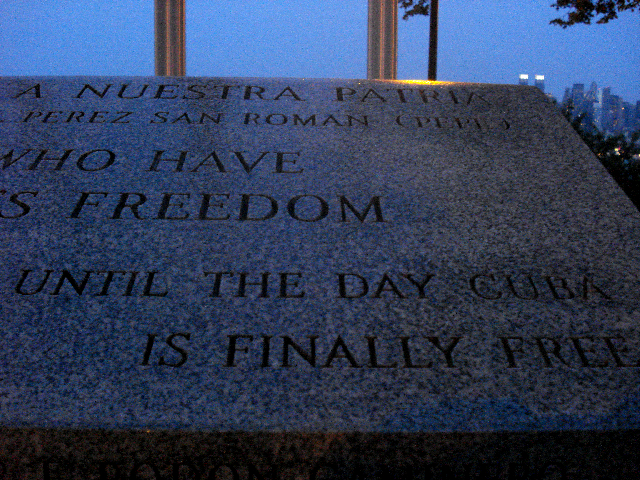
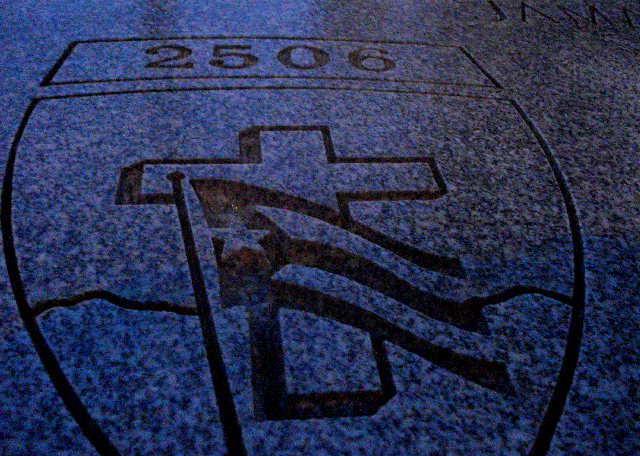
WEST NEW YORK VETERANS MEMORIAL PARK

WAR MEMORIAL
This was erected in 1935. Notice that at that time WWI was just called "World War". WWII was gathering, approaching ... but at the time of the memorial's birth, it was just "the Great War". Sad. It's kind of an ugly memorial in the light of day - but seen in the dusk it takes on a mythical aspect. It's funereal, like a mausoleum ... with plaques all over it - of all of the wars ... and the names of everybody from West New York who lost their lives in "the Great War" (not enough space for everybody else from all the other wars). Sad - this memorial made me sad. Perhaps because of the year it was put up. Retrospect can kill ya.




MEMORIAL TO TWO CUBAN DUDES


SKYLINE BREAK

AMERICAN VETERANS MEMORIAL

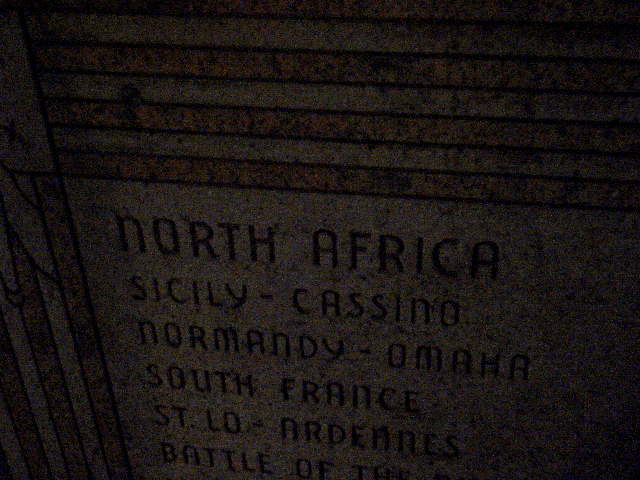

THE COMMUNITY ...
Boys ... playing basketball in the dying of the light ...

Girls playing a game of baseball on the tennis courts

COMMEMORATING THE SIGNING OF THE CONSITUTION
Plaque erected in 1937.

STATUE HONORING CHRISTOPHER COLUMBUS
I really struggled with the light here. I could not get a good shot of the Roman frieze-esque plaque ... it's a ship, struggling in the waves. Anyway, here's what I got.


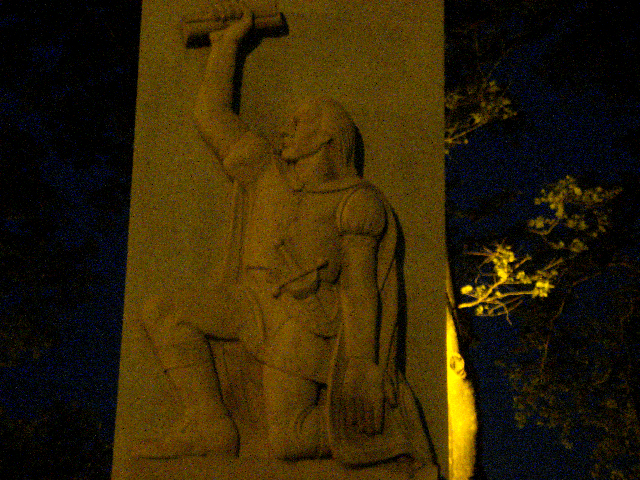

SKYLINE BREAK

Okay. It's totally night now.
ANOTHER PLAQUE HONORING THE 150TH ANNIVERSARY OF THE UNITED STATES CONSTITUTION
(The trees planted now tower around the plaque. Sniff.)

SEPT. 11, 2001 MEMORIAL


The memorial day parade
I have another photo essay planned - that I actually wanted to do last year - but never got around to it (uhm, mainly cause I didn't have a camera). I took all the photos I need last night for this photo-essay idea (before the visit from the firemen, naturally) ... but I need to go thru them, and organize them. In the meantime: here (and below the fold) are the photos I took of the Memorial Day parade in Hoboken. (Warning: I took a million photos. This camera has created a monster. Me.)

Please assume that every caption for every photo should be: "I love these people."
The veterans. The high school bands. The cops. The firemen. The ROTC clubs. The Boy Scouts and Girl Scouts. And everybody knows everybody in Hoboken - so there's a lot of waving, and joviality.
I love parades.

And here they all come!! (Oh, and it was sunset time. So that light glowing on the buildings in the background is not an exaggeration or a Photo Shop trick. It was that magical hour when everything blazes up into utter clarity, shadows take on stark and vivid outlines, and the bricks glow like gold. I was glad that some of that was captured)
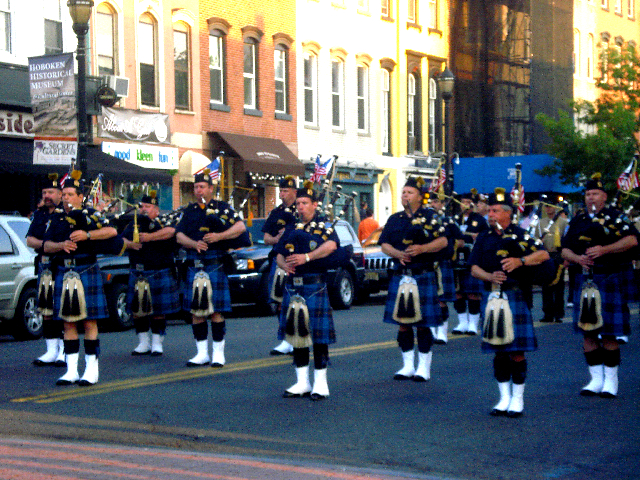
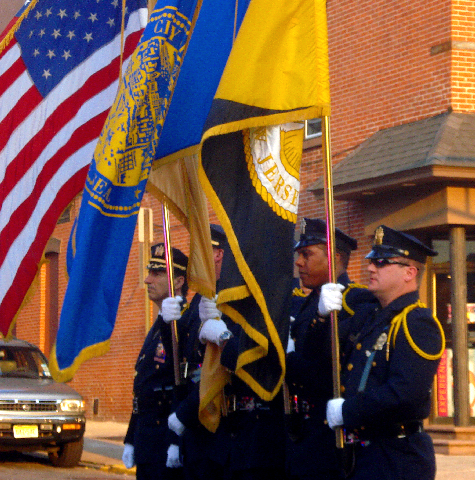









And there they all go ....
I hope you all have a wonderful Memorial Day.
March 5, 2007
Today in history: March 5, 1770
The Boston Massacre. Probably should say "massacre" - with quotation marks - since "massacre" was a bit of a stretch - and used more for propaganda purposes. Same as Paul Revere's famous engraving - which is pretty much how we, modern-day folks, see the Boston Massacre. It's his image - kind of brilliant (below the fold) that sticks in our mind ... the smoke from the guns, advancing redcoats, and the poor victimized colonists ... who did NOTHING to provoke such a massacre. Naturally, the truth was a little bit more complex. The rebellious crowd had gathered after an altercation between one of them and a British soldier. The British soldiers brandished their weapons, but did not shoot. The crowd were throwing things at the British soldiers - mainly snowballs, and ice. Taunting them, etc. When the whole thing ended - 5 colonists lay dead.
The tale of this massacre spread throughout the land - naturally, it was in the colonists interests to keep the outrage alive, to pump it up, to fan the flames of resentment towards the British standing army in their midst.
One of the most important things about the Boston massacre is John Adams' part in the aftermath of it. He, a lawyer in the area, defended the British soldiers. Nobody could accuse him of harboring sympathies for the British crown - although, of course, that was what he was accused of. And whatever he may have thought about the soldiers, he did think they deserved a defense. And whatever this new entity would be ... whatever this new nation would be, if they ever freed themselves from the British yoke - Adams was committed to the idea that it would be a nation "of laws, not men".
Laws above men. Everyone deserves a defense. It is the principle of the thing. (It reminds me of the great story of Alexander Hamilton lambasting the unruly crowds clamoring to attack the pro-British president of King's College. He was just a student at that time, and although he was on his way to being a full-time revolutionary - any mob like that terrified and angered him. He stood on the steps of the college and made a fiery speech about liberty that people talked about later - it was remembered. Pretty amazing.) The detachment of these gentlemen. Principled detachment.
A mob will not be allowed to decide the fate of this nation.
Anyway ... below the fold find Paul Revere's stirring engraving. Love it.
March 4, 2007
Today in history: March 4, 1789
The US Constitution went into effect - and it was also chosen as the Inauguration Day for incoming presidents, which it was until the 20th century. George Washington's first inaugural was actually on April 30, for various reasons - but his second inaugural was on March 4, 1793. His second inaugural address was the shortest address ever given:
Fellow Citizens:I am again called upon by the voice of my country to execute the functions of its Chief Magistrate. When the occasion proper for it shall arrive, I shall endeavor to express the high sense I entertain of this distinguished honor, and of the confidence which has been reposed in me by the people of united America.
Previous to the execution of any official act of the President the Constitution requires an oath of office. This oath I am now about to take, and in your presence: That if it shall be found during my administration of the Government I have in any instance violated willingly or knowingly the injunctions thereof, I may (besides incurring constitutional punishment) be subject to the upbraidings of all who are now witnesses of the present solemn ceremony.
On March 4, 1797 was the inauguration of John Adams. I love Adams' memory (of course, subjective and emotional) about what he imagined George Washington was thinking as he handed over the reins. Here's the transcription of Adam's inaugural address - which, in typical Adams fashion (love that man) is kind of chatty - - always highly intelligent - and to me, I can almost hear his voice saying it. It is at times self-serving and self-important (he basically lists his resume - which - can you blame him? Following George Washington was a thankless task - and Adams pretty much knew it going in. So he kind of lists what he has done in service for his country - whereas Washington would never have had to state his case like that.)
Employed in the service of my country abroad during the whole course of these transactions, I first saw the Constitution of the United States in a foreign country. Irritated by no literary altercation, animated by no public debate, heated by no party animosity, I read it with great satisfaction, as the result of good heads prompted by good hearts, as an experiment better adapted to the genius, character, situation, and relations of this nation and country than any which had ever been proposed or suggested.
His prose has a living quality for me in a way Washington's prose, with all its formality and brevity, never does. I always feel Adams, the real man, behind the words.
Thomas Jefferson was inaugurated on March 4, 1801 - after the first really nasty presidential campaign in our nation's history. (David McCullough describes that day in his biography of John Adams.) And to the folks who bemoan how politics nowadays are so nasty, and so personal - I suggest you learn your history. People said crap about each other back then that makes our modern blowhards look like grade school tantrum-throwers. Seriously. Jefferson meant business. Fascinating - it's one of my favorite parts of the story of our nation's birth - the story of that presidential election. I can't get enough of it. As ugly as it all was. But that's one of the reasons I love it. We are not a utopia. This American experiment was not meant, unlike other ideological constructs, to be perfect. Anyone who yearns for perfection, anyway, is either a candidate for cult membership or a dictator-in-training. It was always going to be messy, it was always going to involve compromise - but then, in the end - it was also going to involve peaceful handovers of power (ideally). Which if you look at historical precedent - almost never happened. Ever, in any civilization. In the entire story of the human race. So the fact of the election of 1801 ... and the fact that although the enemies were destroyed, pretty much ... they were not lined up against the wall and shot for being traitors, and the fight went on. The fight for power went on, and it's been going on ever since. So Utopian folks, the "wah wah, everyone was so much nicer in the past, they had better manners" - seriously need to read some books. Read the broadsides. We are mild now compared to the character assassination and vitriol that went on back then. Maybe their manners were more formal, but you think power politics have changed since then? If anything, we are nicer now. And also - to the folks who have pinwheeling-eyeballs fantasizing about some ideologically pure Utopia in the future - with no political disagreement, and permanent destruction of your opponents - you can count me already as one of your fiercest enemies. If your greatest idea of heaven on earth is 100% agreement then yo, count me out, fascists. You can strive for a perfect neat little world all by yourself, and guaranteed: you will fail. You might succeed for a little while - but rigidity like that never lasts. Again: read your history. And so - having said all that - to me, 1801 is the key to so much of who we are. The mess, the hatred, the defeat, the sucking up, the compromise, the fallout, the struggle for power - and, in the end, acceptance. 4 more years. Re-group, go in again. And Jefferson's inaugural address - with its measured phrases of unity and union ("We are all Republicans, we are all Federalists." Oh really? Tell that to my dead boyfriend.) is a masterpiece of diplomacy, and hidden agendas. He had just destroyed his political enemies - he said he abhorred "factionalism" and yet when it came down to it - he played it dirtier than anybody. He writes "every difference of opinion is not a difference of principle" ... and yet he referred to some of Adam's views (in a letter not meant to be read publicly) "political heresies" - a phrase which caused the years-long riff between these two old friends and colleagues. Political "heresies". Jefferson's writing is untouchable. Seriously. He's the best. It's so smooth, so elegant.
On March 4, 1829 Andrew Jackson was inaugurated - and, notoriously, invited the entire public to join the festivities at the White House. Apparently things got way out of hand - people were wasted - tramping through the house - furniture was ruined - things were stolen - and Jackson had to flee from the building through a window to escape the masses. haha
Here's his address and also a painting of the "public" on that day in 1829.

Oh - and then of course - there is the sad (and yet I can't help it, I laugh) story of William Henry Harrison's inaugural - on March 4, 1841. (William Henry Harrison and his oh-so-brief tenure as President will always remind me of Jackie's son - explanation here.) What happened that day is notorious. His speech was five billion years long - there was a freezing icy storm that day - he stood outside, said his speech -which took him 2 hours - maybe more - and then caught pneumonia and died a month later. Not to disrespect the dead and I know that Elements of Style wasn't even written then - but I think Harrison could definitely have benefited from Strunk and White's most important rule for writers: "Omit needless words."
Abraham Lincoln was inaugurated (for the first time) on March 4, 1861. His first inaugural is (in my humble opinion) a masterpiece. Within the first two sentences, you MUST read to the end - his prose is that simple and that heartfelt and compelling. And look at how he gets right to the point. I find it hard to imagine how the ending of this speech could be improved upon. It brings tears to my eyes:
My countrymen, one and all, think calmly and well upon this whole subject. Nothing valuable can be lost by taking time. If there be an object to hurry any of you in hot haste to a step which you would never take deliberately, that object will be frustrated by taking time; but no good object can be frustrated by it. Such of you as are now dissatisfied still have the old Constitution unimpaired, and, on the sensitive point, the laws of your own framing under it; while the new Administration will have no immediate power, if it would, to change either. If it were admitted that you who are dissatisfied hold the right side in the dispute, there still is no single good reason for precipitate action. Intelligence, patriotism, Christianity, and a firm reliance on Him who has never yet forsaken this favored land are still competent to adjust in the best way all our present difficulty.In your hands, my dissatisfied fellow-countrymen, and not in mine, is the momentous issue of civil war. The Government will not assail you. You can have no conflict without being yourselves the aggressors. You have no oath registered in heaven to destroy the Government, while I shall have the most solemn one to "preserve, protect, and defend it."
I am loath to close. We are not enemies, but friends. We must not be enemies. Though passion may have strained it must not break our bonds of affection. The mystic chords of memory, stretching from every battlefield and patriot grave to every living heart and hearthstone all over this broad land, will yet swell the chorus of the Union, when again touched, as surely they will be, by the better angels of our nature.
"I am loath to close." "The mystic chords of memory." Now that is rhetorical style. Goose bumps.
Here's a photo of his first inauguration:

March 4, 1865 was Lincoln's second inauguration as President.
The text of Lincoln's second inaugural:
Fellow-Countrymen:At this second appearing to take the oath of the Presidential office there is less occasion for an extended address than there was at the first. Then a statement somewhat in detail of a course to be pursued seemed fitting and proper. Now, at the expiration of four years, during which public declarations have been constantly called forth on every point and phase of the great contest which still absorbs the attention and engrosses the energies of the nation, little that is new could be presented. The progress of our arms, upon which all else chiefly depends, is as well known to the public as to myself, and it is, I trust, reasonably satisfactory and encouraging to all. With high hope for the future, no prediction in regard to it is ventured.
On the occasion corresponding to this four years ago all thoughts were anxiously directed to an impending civil war. All dreaded it, all sought to avert it. While the inaugural address was being delivered from this place, devoted altogether to saving the Union without war, urgent agents were in the city seeking to destroy it without war—seeking to dissolve the Union and divide effects by negotiation. Both parties deprecated war, but one of them would make war rather than let the nation survive, and the other would accept war rather than let it perish, and the war came.
One-eighth of the whole population were colored slaves, not distributed generally over the Union, but localized in the southern part of it. These slaves constituted a peculiar and powerful interest. All knew that this interest was somehow the cause of the war. To strengthen, perpetuate, and extend this interest was the object for which the insurgents would rend the Union even by war, while the Government claimed no right to do more than to restrict the territorial enlargement of it. Neither party expected for the war the magnitude or the duration which it has already attained. Neither anticipated that the cause of the conflict might cease with or even before the conflict itself should cease. Each looked for an easier triumph, and a result less fundamental and astounding. Both read the same Bible and pray to the same God, and each invokes His aid against the other. It may seem strange that any men should dare to ask a just God's assistance in wringing their bread from the sweat of other men's faces, but let us judge not, that we be not judged. The prayers of both could not be answered. That of neither has been answered fully. The Almighty has His own purposes. "Woe unto the world because of offenses; for it must needs be that offenses come, but woe to that man by whom the offense cometh." If we shall suppose that American slavery is one of those offenses which, in the providence of God, must needs come, but which, having continued through His appointed time, He now wills to remove, and that He gives to both North and South this terrible war as the woe due to those by whom the offense came, shall we discern therein any departure from those divine attributes which the believers in a living God always ascribe to Him? Fondly do we hope, fervently do we pray, that this mighty scourge of war may speedily pass away. Yet, if God wills that it continue until all the wealth piled by the bondsman's two hundred and fifty years of unrequited toil shall be sunk, and until every drop of blood drawn with the lash shall be paid by another drawn with the sword, as was said three thousand years ago, so still it must be said "the judgments of the Lord are true and righteous altogether."
With malice toward none, with charity for all, with firmness in the right as God gives us to see the right, let us strive on to finish the work we are in, to bind up the nation's wounds, to care for him who shall have borne the battle and for his widow and his orphan, to do all which may achieve and cherish a just and lasting peace among ourselves and with all nations.
Many people who were there that day describe a sense of impending doom over the event.

Lincoln was assassinated on April 14, 1865, 42 days later. Andrew Johnson would be sworn into office on April 15, 1865.
The last president to be inaugurated on March 4 was Franklin Delano Roosevelt on March 4, 1933. Here is his first inaugural address. Despite his polio legs and disability - he walked up the staircase to the podium, and stood - to give his address, and kept standing, for the swearing-in.

January 18, 2007
Basketball
Found this on the Library of Congress website.
I can't stop looking at this photograph.
It reminds me of Luvvy and the Girls (a book I adored when I was a kid).

Girl's Basketball Team Milton High School North Dakota 1909 (John McCarthy is presumed to be the photographer)
I am especially struck by the background (obviously a backdrop), but my eyes are drawn to its curlicued ornate-ness, and its rampant velvet-tasseled domesticity.
November 1, 2006
Today in History: Nov. 1, 1897
The Library of Congress (in its own separate building for the first time) opened its doors. Construction on the joint had been going on for nigh on 20 years ... an immense project. Up until that point - the collection had been housed in the Capitol Building, in the main reading room. I'm sure most of us know the story of how the Library of Congress came to be. In the war of 1812, the British invaded Washington and burned shit up. (I remember that funny moment recently when Tony Blair visited the Capitol Building - and somebody said, "And there is the fireplace where you burned up all our books" - or something like that - and Tony Blair, without missing a beat, said, "My apologies.") There were 3,000 volumes in the library - all gone. So Jefferson - who was now Mr. Retired Philospher King on the mountaintop - sold [corrected from "donated"] his unbelievable book collection (the book collection that had him in perpetual debt up to his ears - there were almost 7,000 books in his own personal collection) to the United States government, to begin building up a national library again. sniff, sniff.
Of course, that original collection from Jefferson is now housed in the rare book room (which goldurnit I have to go see). Image of part of it here:
I am drooling.
Check this image out. Pretty amazing. That photograph is from 1888 - and it's the excavation of the site where the Library of Congress would eventually stand.
Marvelous.
As a librarian's daughter - such historical events have a very special resonance.
September 13, 2006
Happy birthday to ...
... the Star Spangled Banner!
by Percy Moran
There's Francis Scott Key ... catching a glimpse ... seeing that "our flag was still there" ...
I love this, too - here is one of the original broadsides of the lyrics - which was called "The Defense of Fort McHenry" at the time.
I can't help but think of Eddie Izzard's very funny bit about the singing of the national anthem - and that if you can't remember the lyrics - just be firm, use "big mouths", and keep "confirming and denying" with your hand gestures. hahaha
UPDATE Thanks to Doug, in the comments section, I must link to this - a speech Isaac Asimov made about the national anthem. Seriously: do not miss it. I've been a weepy raw nerve for 2 days now so the fact that it made me cry is no surprise - but regardless: POWERFUL stuff. Read it!!!
And yes, like wikipedia mentions, it is one of the more difficult songs to sing - and most anthems are notoriously EASY to sing, because - duh - they are for the MASSES, not for opera singers. But Star Spangled Banner starts low and goes way up high - and it takes a really good singer to pull it off (uhm, Whitney Houston?? Before she became a rickety crack ho? Her live version, for me, is the best.)
So happy birthday, dear national anthem.
O say, can you see, by the dawn's early light, What so proudly we hailed at the twilight's last gleaming? Whose broad stripes and bright stars, through the perilous fight, O'er the ramparts we watched, were so gallantly streaming! And the rockets' red glare, the bombs bursting in air, Gave proof through the night that our flag was still there: O say, does that star-spangled banner yet wave O'er the land of the free and the home of the brave?
On the shore, dimly seen thro' the mist of the deep,
Where the foe's haughty host in dread silence reposes,
What is that which the breeze, o'er the towering steep.
As it fitfully blows, half conceals, half discloses?
Now it catches the gleam of the morning's first beam,
In full glory reflected, now shines on the stream
'Tis the star-spangled banner. Oh! long may it wave
O'er the land of the free and the home of the brave!
And where is that band who so vauntingly swore
That the havoc of war and the battle's confusion
A home and a country should leave us no more?
Their blood has washed out their foul footstep's pollution.
No refuge could save the hireling and slave
From the terror of flight, or the gloom of the grave,
And the star-spangled banner in triumph doth wave
O'er the land of the free and the home of the brave.
Oh! thus be it ever, when freemen shall stand
Between their loved homes and the war's desolation,
Blest with vict'ry and peace, may the Heav'n - rescued land
Praise the Pow'r that hath made and preserved us a nation.
Then conquer we must, for our cause is just,
And this be our motto--"In God is our trust."
And the star-spangled banner in triumph shall wave
O'er the land of the free and the home of the brave.
September 5, 2006
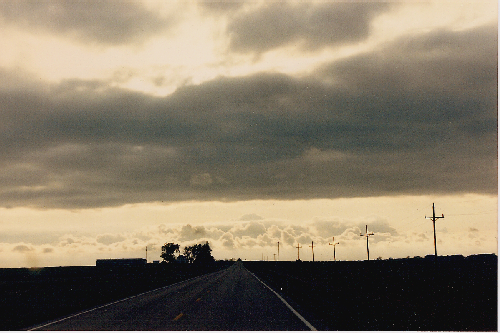
August 14, 2006
In honor of Ernest Thayer ...
whose birthday it is today, here's the only long-lasting thing he wrote. And - duh - if you're gonna write one thing, you might as well write a classic. It's a poem the O'Malleys know huge sections of by heart. I adore it. It's perfect. You can't get any more perfect than that last stanza.
It was published in The San Francisco Examiner on June 3, 1888.
CASEY AT THE BAT
The outlook wasn't brilliant for the Mudville nine that day,
The score stood four to two, with but one inning more to play.
And then when Cooney died at first, and Barrows did the same,
A pall-like silence fell upon the patrons of the game.
A straggling few got up to go in deep despair. The rest
Clung to that hope which springs eternal in the human breast;
They thought if only Casey could but get a whack at that--
We'd put up even money now with Casey at the bat.
But Flynn preceded Casey, as did also Jimmy Blake,
And the former was a lulu and the latter was a cake;
So upon that stricken multitude grim melancholy sat,
For there seemed but little chance of Casey's getting to the bat.
But Flynn let drive a single, to the wonderment of all,
And Blake, the much despised, tore the cover off the ball;
And when the dust had lifted, and the men saw what had occurred,
There was Johnnie safe at second and Flynn a-hugging third.
Then from 5,000 throats and more there rose a lusty yell;
It rumbled through the valley, it rattled in the dell;
It knocked upon the mountain and recoiled upon the flat,
For Casey, mighty Casey, was advancing to the bat.
There was ease in Casey's manner as he stepped into his place;
There was pride in Casey's bearing and a smile on Casey's face.
And when, responding to the cheers, he lightly doffed his hat,
No stranger in the crowd could doubt 'twas Casey at the bat.
Ten thousand eyes were on him as he rubbed his hands with dirt;
Five thousand tongues applauded when he wiped them on his shirt.
Then while the writhing pitcher ground the ball into his hip,
Defiance gleamed in Casey's eye, a sneer curled Casey's lip.
And now the leather-covered sphere came hurtling through the air,
And Casey stood a-watching it in haughty grandeur there.
Close by the sturdy batsman the ball unheeded sped--
"That ain't my style," said Casey. "Strike one," the umpire said.
From the benches black with people, there went up a muffled roar,
Like the beating of the storm-waves on a stern and distant shore.
"Kill him! Kill the umpire!" shouted some one on the stand;
And it's likely they'd have killed him had not Casey raised his hand.
With a smile of Christian charity great Casey's visage shone;
He stilled the rising tumult; he bade the game go on;
He signaled to the pitcher, and once more the spheroid flew;
But Casey still ignored it, and the umpire said, "Strike two."
"Fraud!" cried the maddened thousands, and echo answered fraud;
But one scornful look from Casey and the audience was awed.
They saw his face grow stern and cold, they saw his muscles strain,
And they knew that Casey wouldn't let that ball go by again.
The sneer is gone from Casey's lip, his teeth are clenched in hate;
He pounds with cruel violence his bat upon the plate.
And now the pitcher holds the ball, and now he lets it go,
And now the air is shattered by the force of Casey's blow.
Oh, somewhere in this favored land the sun is shining bright;
The band is playing somewhere, and somewhere hearts are light,
And somewhere men are laughing, and somewhere children shout;
But there is no joy in Mudville-- mighty Casey has struck out.
July 4, 2006
Happy 4th of July!
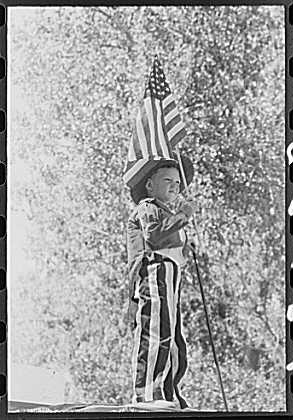
Boy on Float
Fourth of July Parade.
Vale, Oregon
Russell Lee, photographer, 1941.
(found that on the Library of Congress website - isn't it so great?)
Today in History: July 4, 1826
It was the 50th anniversary of July 4, 1776. Both John Adams and Thomas Jefferson had been invited to attend huge celebrations in honor of the anniversary, but due to illness - both had sent their regrets and also best wishes, saying they would not be able to come.
These two men, two of the main architects of the American Revolution, long estranged due to political differences, (and Jefferson referring, in public, to "political heresies" among some of his colleagues - a clear dig at Adams - and a clear sign that Jefferson believed in some sort of orthodoxy - this was the breaking point for Adams) had finally reconciled (engineered by Benjamin Rush, who thought it a shame that these two great patriots, once dear friends, would go their graves without making up). Benjamin Rush had a dream that Adams and Jefferson became friends again, and began to correspond - sharing their thoughts, reminiscences, philosophies with one another ... and this correspondence would be a great gift to posterity. Rush, the sly devil, told John Adams about this dream. Hoping it would spark something ... an opening pathway between these two great men. It did. Then followed a 12-year correspondence between the two aging statesmen ... a correspondence that has to be read to be believed. And Rush's dream was prophetic. What an amazing gift to posterity those letters are.
And then ... on the same day ... which happened to be July 4 ... which happened to be the 50th anniversary of the Declaration of Independence ... John Adams and Thomas Jefferson both died. Within hours of each other.
I don't even know what more to say about that.
It makes me understand why so many of these men felt that they had been chosen by "Providence". That there was some divine structure to their actions.
John Adams' last words were either "Jefferson ... still lives." or "Jefferson ... survives." I mean... ex-SQUEEZE me???
Amazingly, though, Jefferson actually had died a couple of hours earlier.
Thomas Jefferson's last words were: "Is it the fourth?" He actually said those words on the 3rd ... yet the fact that that was where his mind went ... it just leaves me awe-struck.
Yes, Mr. Jefferson. It is the fourth. And thank you. Thank you both.
Happy 4th of July, everybody!
July 3, 2006
Today in History: July 3, 1776
John Adams wrote to Abigail on July 3, 1776 after the signing of the Declaration of Independence on July 2:
The Delay of this Declaration to this Time, has many great Advantages attending it. – The Hopes of Reconciliation, which were fondly entertained by Multitudes of honest and well meaning tho weak and mistaken People, have been gradually and at last totally extinguished. – Time has been given for the whole People, maturely to consider the great Question of Independence and to ripen their Judgments, dissipate their Fears, and allure their Hopes, by discussing it in News Papers and Pamphletts, by debating it, in Assemblies, Conventions, Committees of Safety and Inspection, in town and County Meetings, as well as in private Conversations, so that the whole People in every Colony of the 13, have now adopted it, as their own Act. – This will cement the Union, and avoid those Heats, and perhaps Convulsions which might have been occasioned, by such a Declaration Six Months ago. But the Day is past. The Second Day of July 1776, will be the most memorable Epocha, in the History of America. – I am apt to believe that it will be celebrated, by succeeding Generations, as the great anniversary Festival. It ought to be commemorated, as the Day of Deliverance by solemn Acts of Devotion to God Almighty. It ought to be solemnized with Pomp and Parade, with Shews, Games, Sports, Guns, Bells, Bonfire and Illuminations from one End of this Continent to the other from this Time forward forever more. You will think me transported with Enthusiasm, but I am not. I am well aware of the Toil, and Blood, and Treasure that it will cost Us to maintain this Declaration, and support and defend these States. Yet, through all the Gloom, I can see the Rays of ravishing Light and Glory. I can see that the End is more than worth all the Means, and that Posterity will triumph in that Day's Transaction, even though We should not rue it, which I trust in God We shall not.
Adams was just 2 days off in his prediction.
June 26, 2006
Happy birthday ...
... to the Atlantic City boardwalk.
The first section of it was opened to the public on this day in 1870.
Here are two bathing beauties - this photo was taken at Atlantic City - in the late 1800s. I just love the insouciance of these girls. Even though they are wearing BLACK FROM HEAD TO TOE ... look at their jaunty little legs kicking up in the air.
You go, girls. Don't let anyone keep you from the ocean on a hot day.

They're Gibson girls in the flesh!
Happy birthday, boardwalk!
April 30, 2006
Today in history: April 30, 1789
On April 30, 1789, George Washington was sworn in as the first President of the United States.
George Washington wrote the following on the eve of his inauguration:
It is said that every man has his portion of ambition. I may have mine, I suppose, as well as the rest, but if I know my own heart, my ambition would not lead me into public life; my only ambition is to do my duty in this world as well as I am capable of performing it, and to merit the good opinion of all good men.
We are so lucky, so very lucky, to have had this man in our "canon". There's as always, so much to say. One of the thing that strikes me about him is that he never wanted to seem like he was jostling for power or position. George Washington had many wonderful qualities and abilities - but it was this distaste for public life that I believe made him truly great. He went out of his way to let everyone know how unworthy he felt, how he hoped their trust in him was warranted, that he was eager to finally go home and live the life of a private man... But on this day in history, April 30, there was to be no private man anymore. His people had chosen him, and while Mount Vernon continued to call to him, he knew he must accept.
David McCullough describes, in his book on John Adams, inauguration day:
On the day of his inauguration, Thursday, April 30 1789, Washington rode to Federal Hall in a canary-yellow carriage pulled by six white horses and followed by a long column of New York militia in full dress. The air was sharp, the sun shone brightly, and with all work stopped in the city, the crowds along his route were the largest ever seen. It was as if all New York had turned out and more besides. "Many persons in the crowd," reported the Gazette of the United States "were heard to say they should now die contented � nothing being wanted to complete their happiness � but the sight of the savior of his country."In the Senate Chamber were gathered the members of both houses of Congress, the Vice President, and sundry officials and diplomatic agents, all of whom rose when Washington made his entrance, looking solemn and stately. His hair powdered, he wore a dress sword, white silk stockings, shoes with silver buckles, and a suit of the same brown Hartford broadcloth that Adams, too, was wearing for the occasion. They might have been dressed as twins, except that Washington's metal buttons had eagles on them.
It was Adams who formally welcomed the General and escorted him to the dais. For an awkward moment Adams appeared to be in some difficulty, as though he had forgotten what he was supposed to say. then, addressing Washington, he declared that the Senate and House of Representatives were ready to attend him for the oath of office as required by the Constitution. Washington said he was ready. Adams bowed and led the way to the outer balcony, in full view of the throng in the streets. People were cheering and waving from below, and from windows and rooftops as far as the eye could see. Washington bowed once, then a second time.
Fourteen years earlier, it had been Adams who called on the Continental Congress to make the tall Virginian commander-in-chief of the army. Now he stood at Washington's side as Washington, his right hand on the Bible, repeated the oath of office as read by Chancellor Robert R. Livingston of New York, who had also been a member of the Continental Congress.
In a low voice Washington solemnly swore to execute the office of the President of the United States and, to the best of his ability, to "preserve, protect, and defend the Constitution of the United States." Then, as not specified in the Constitution, he added, "So help me God", and kissed the Bible, thereby establishing his own first presidential tradition.
"It is done," Livingston said, and, turning to the crowd, cried out, "Long live George Washington, President of the United States."
The following is George Washington's first inaugural address. What I sense in these words is what I sense in so many of the original documents of that time, written by the main players: they were embarking on a grand and hopeful experiment. They were entering uncharted waters. And they all seem determined (each in their different ways, with their different views) to make the most of the opportunity, to seize the day. No decision was unimportant, everything had meaning ... and what I also sense in this inaugural address is that Washington knew that he wasn't only talking to the people present, but he was also talking to us. The future generations. They all knew that they were being watched, carefully, by those who would come after.
The only thing required of a President on his inauguration day, in those early early days, was that he take the oath of Office. Washington, in composing an address, to the people who put their faith in him, set the precedent. Every president since then has followed his example.
George Washington's first inaugural address:
Fellow-Citizens of the Senate and of the House of Representatives:Among the vicissitudes incident to life no event could have filled me with greater anxieties than that of which the notification was transmitted by your order, and received on the 14th day of the present month. On the one hand, I was summoned by my Country, whose voice I can never hear but with veneration and love, from a retreat which I had chosen with the fondest predilection, and, in my flattering hopes, with an immutable decision, as the asylum of my declining years--a retreat which was rendered every day more necessary as well as more dear to me by the addition of habit to inclination, and of frequent interruptions in my health to the gradual waste committed on it by time. On the other hand, the magnitude and difficulty of the trust to which the voice of my country called me, being sufficient to awaken in the wisest and most experienced of her citizens a distrustful scrutiny into his qualifications, could not but overwhelm with despondence one who (inheriting inferior endowments from nature and unpracticed in the duties of civil administration) ought to be peculiarly conscious of his own deficiencies. In this conflict of emotions all I dare aver is that it has been my faithful study to collect my duty from a just appreciation of every circumstance by which it might be affected. All I dare hope is that if, in executing this task, I have been too much swayed by a grateful remembrance of former instances, or by an affectionate sensibility to this transcendent proof of the confidence of my fellow-citizens, and have thence too little consulted my incapacity as well as disinclination for the weighty and untried cares before me, my error will be palliated by the motives which mislead me, and its consequences be judged by my country with some share of the partiality in which they originated.
Such being the impressions under which I have, in obedience to the public summons, repaired to the present station, it would be peculiarly improper to omit in this first official act my fervent supplications to that Almighty Being who rules over the universe, who presides in the councils of nations, and whose providential aids can supply every human defect, that His benediction may consecrate to the liberties and happiness of the people of the United States a Government instituted by themselves for these essential purposes, and may enable every instrument employed in its administration to execute with success the functions allotted to his charge. In tendering this homage to the Great Author of every public and private good, I assure myself that it expresses your sentiments not less than my own, nor those of my fellow- citizens at large less than either. No people can be bound to acknowledge and adore the Invisible Hand which conducts the affairs of men more than those of the United States. Every step by which they have advanced to the character of an independent nation seems to have been distinguished by some token of providential agency; and in the important revolution just accomplished in the system of their united government the tranquil deliberations and voluntary consent of so many distinct communities from which the event has resulted can not be compared with the means by which most governments have been established without some return of pious gratitude, along with an humble anticipation of the future blessings which the past seem to presage. These reflections, arising out of the present crisis, have forced themselves too strongly on my mind to be suppressed. You will join with me, I trust, in thinking that there are none under the influence of which the proceedings of a new and free government can more auspiciously commence.
By the article establishing the executive department it is made the duty of the President "to recommend to your consideration such measures as he shall judge necessary and expedient." The circumstances under which I now meet you will acquit me from entering into that subject further than to refer to the great constitutional charter under which you are assembled, and which, in defining your powers, designates the objects to which your attention is to be given. It will be more consistent with those circumstances, and far more congenial with the feelings which actuate me, to substitute, in place of a recommendation of particular measures, the tribute that is due to the talents, the rectitude, and the patriotism which adorn the characters selected to devise and adopt them. In these honorable qualifications I behold the surest pledges that as on one side no local prejudices or attachments, no separate views nor party animosities, will misdirect the comprehensive and equal eye which ought to watch over this great assemblage of communities and interests, so, on another, that the foundation of our national policy will be laid in the pure and immutable principles of private morality, and the preeminence of free government be exemplified by all the attributes which can win the affections of its citizens and command the respect of the world. I dwell on this prospect with every satisfaction which an ardent love for my country can inspire, since there is no truth more thoroughly established than that there exists in the economy and course of nature an indissoluble union between virtue and happiness; between duty and advantage; between the genuine maxims of an honest and magnanimous policy and the solid rewards of public prosperity and felicity; since we ought to be no less persuaded that the propitious smiles of Heaven can never be expected on a nation that disregards the eternal rules of order and right which Heaven itself has ordained; and since the preservation of the sacred fire of liberty and the destiny of the republican model of government are justly considered, perhaps, as deeply, as finally, staked on the experiment entrusted to the hands of the American people.
Besides the ordinary objects submitted to your care, it will remain with your judgment to decide how far an exercise of the occasional power delegated by the fifth article of the Constitution is rendered expedient at the present juncture by the nature of objections which have been urged against the system, or by the degree of inquietude which has given birth to them. Instead of undertaking particular recommendations on this subject, in which I could be guided by no lights derived from official opportunities, I shall again give way to my entire confidence in your discernment and pursuit of the public good; for I assure myself that whilst you carefully avoid every alteration which might endanger the benefits of an united and effective government, or which ought to await the future lessons of experience, a reverence for the characteristic rights of freemen and a regard for the public harmony will sufficiently influence your deliberations on the question how far the former can be impregnably fortified or the latter be safely and advantageously promoted.
To the foregoing observations I have one to add, which will be most properly addressed to the House of Representatives. It concerns myself, and will therefore be as brief as possible. When I was first honored with a call into the service of my country, then on the eve of an arduous struggle for its liberties, the light in which I contemplated my duty required that I should renounce every pecuniary compensation. From this resolution I have in no instance departed; and being still under the impressions which produced it, I must decline as inapplicable to myself any share in the personal emoluments which may be indispensably included in a permanent provision for the executive department, and must accordingly pray that the pecuniary estimates for the station in which I am placed may during my continuance in it be limited to such actual expenditures as the public good may be thought to require.
Having thus imparted to you my sentiments as they have been awakened by the occasion which brings us together, I shall take my present leave; but not without resorting once more to the benign Parent of the Human Race in humble supplication that, since He has been pleased to favor the American people with opportunities for deliberating in perfect tranquillity, and dispositions for deciding with unparalleled unanimity on a form of government for the security of their union and the advancement of their happiness, so His divine blessing may be equally conspicuous in the enlarged views, the temperate consultations, and the wise measures on which the success of this Government must depend.
William Maclay, a senator from Pennsylvania, kept a daily journal - highly detailed, and rather cynical, about the Senate sessions of the first Congress. He describes the first inauguration in vivid detail:
30th April, Thursday.--This is a great, important day. Goddess of etiquette, assist me while I describe it. The Senate stood adjourned to half after eleven o'clock. About ten dressed in my best clothes; went for Mr. Morris' lodgings, but met his son, who told me that his father would not be in town until Saturday. Turned into the Hall. The crowd already great. The Senate met. The Vice-President rose in the most solemn manner. This son of Adam seemed impressed with deeper gravity, yet what shall I think of him? He often, in the midst of his most important airs--I believe when tie is at loss for expressions (and this he often is, wrapped up, I suppose, in the contemplation of his own importance)-- suffers an unmeaning kind of vacant laugh to escape him. This was the case to-day, and really to me bore the air of ridiculing the farce he was acting. "Gentlemen, I wish for the direction of the Senate. The President will, I suppose, addressthe Congress. How shall I behave? How shall we receive it? Shall it be standing or sitting?"Here followed a considerable deal of talk from him which I could make nothing of. Mr. Lee began with the House of Commons (as is usual with him), then the House of Lords, then the King, and then back again. The result of his information was, that the Lords sat and the Commons stood on the delivery of the King's speech. Mr. Izard got up and told how often he had been in the Houses of Parliament. He said a great deal of what he had seen there. [He] made, however, this sagacious discovery, that the Commons stood because they had no. seats to sit on, being arrived at the bar of the House of Lords. It was discovered after some time that the King sat, too, and had his robes and crown on.
Mr. Adams got up again and said he had been very often indeed at the Parliament on those occasions, but there always was such a crowd, and ladies along, that for his part he could not say how it was. Mr. Carrol got up to declare that he thought it of no consequence how it was in Great Britain; they were no rule to us, etc. But all at once the Secretary, who had been out, whispered to the Chair that the Clerk from the Representatives was at the door with a communication. Gentlemen of the Senate, how shall he be received? A silly kind of resolution of the committee on that business had been laid on the table some days ago. The amount of it was that each House should communicate to the other what and how they chose; it concluded, however, something in this way: That everything should be done with all the propriety that was proper. The question was, Shall this be adopted, that we may know how to receive the Clerk? It was objected [that] this will throw no light on the subject; it will leave you where you are. Mr. Lee brought the House of Commons before us again. He reprobated the rule; declared that the Clerk should not come within the bar of file House; that the proper mode was for the Sergeant-at-Arms, with the mace on his shoulder, to meet the Clerk at the door and receive his communication; we are not, however, provided for this ceremonious way of doing business, having neither mace nor sergeant nor Masters in Chancery, who carry down bills from the English Lords.
Mr. Izard got up and labored unintelligibly to show the great distinction between a communication and a delivery of a thing, but he was not minded. Mr. Elsworth showed plainly enough that if the Clerk was not permitted to deliver the communication, the Speaker might as well send it inclosed. Repeated accounts came [that] the Speaker and Representatives were at the door. Confusion ensued; the members left their seats. Mr. Read rose and called the attention of the Senate to the neglect that had been shown Mr. Thompson, late Secretary. Mr. Lee rose to answer him, but I could not hear one word he said. The Speaker was introduced, followed by the Representatives. Here we sat an hour and ten minutes before the President arrived--this delay was owing to Lee, Izard, and Dalton, who had stayed with us while the Speaker came in, instead of going to attend the President. The President advanced between the Senate and Representatives, bowing to each. He was placed in the chair by the Vice-President; the Senate with their president on the right, the Speaker and the Representatives on his left. The Vice-President rose and addressed a short sentence to him. The import of it was that he should now take the oath of office as President. He seemed to have forgot half what he was to say, for he made a dead pause and stood for some time, to appearance, in a vacant mood. He finished with a formal bow, and the President was conducted out of the middle window into the gallery, and the oath was administered by the Chancellor. Notice that the business done was communicated to the crowd by proclamation, etc., who gave three cheers, and repeated it on the President's bowing to them.
As the company returned into the Senate chamber, the President took the chair and the Senators and Representatives their seats. He rose, and all arose also and addressed them. This great man was agitated and embarrassed more than ever he was by the leveled cannon or pointed musket. He trembled, and several times could scarce make out to read, though it must be supposed he had often read it before. He put part of the fingers of his left hand into the side of what I think the tailors call the fall of the breeches, changing the paper into his left hand. After some time he then did the same with some of the fingers of his right hand. When he came to the words all the world, he made a flourish with his right hand, which left rather an ungainly impression. I sincerely, for my part, wished all set ceremony in the hands of the dancing-masters, and that this first of men had read off his address in the plainest manner, without ever taking his eyes from the paper, for I felt hurt that he was not first in everything. He was dressed in deep brown, with metal buttons, with an eagle on them, white stockings, a bag, and sword.
From the hall there was a grand procession to Saint Paul's Church, where prayers were said by the Bishop. The procession was well conducted and without accident, as far as I have heard. The militia were all under arms, lined the street near the church, made a good figure, and behaved well.
The Senate returned to their chamber after service, formed, and took up the address. Our Vice-President called it his most gracious speech. I can not approve of this. A committee was appointed on it--Johnson, Carrol, Patterson. Adjourned. In the evening there were grand fireworks. The Spanish Ambassador's house was adorned with transparent paintings; the French Minister's house was illuminated, and had some transparent pieces; the Hall was grandly illuminated, and after all this the people went to bed.
I have such a deep fondness for John Adams, with all his airs and self-importance and vanity. I just love the guy, what can I say. He's so feckin' human.
The description of Washington's awkwardness makes me want to cry:
He rose, and all arose also and addressed them. This great man was agitated and embarrassed more than ever he was by the leveled cannon or pointed musket. He trembled, and several times could scarce make out to read, though it must be supposed he had often read it before. He put part of the fingers of his left hand into the side of what I think the tailors call the fall of the breeches, changing the paper into his left hand. After some time he then did the same with some of the fingers of his right hand. When he came to the words all the world, he made a flourish with his right hand, which left rather an ungainly impression. I sincerely, for my part, wished all set ceremony in the hands of the dancing-masters, and that this first of men had read off his address in the plainest manner, without ever taking his eyes from the paper, for I felt hurt that he was not first in everything. He was dressed in deep brown, with metal buttons, with an eagle on them, white stockings, a bag, and sword.
God. Good God. But what really moves me is that after the address, they all walked in procession, led by George Washington, to St. Paul's Church, for a service.
St. Paul's Church. (Read that article ... it's a well-known story, of course, but it always bears repeating.) St. Paul's has always had meaning for us here in New York, because of its long history, but now ... it has more meaning than ever. I can't even think about St. Paul's without feeling tears come to my eyes. So to think ... that that special church, that church that became symbolic (not just to us here, but to people all over the country) of hope, or survival, of healing ... would be the place where George Washington prayed for guidance after being sworn in as the first President... I mean, honestly. I don't even know what else to say about it.
April 30, 1789 ... the day this new nation embarked on its unknown and exciting course, with George Washington at the helm.
Here is an image of the first page of this inaugural address, in Washington's own hand.
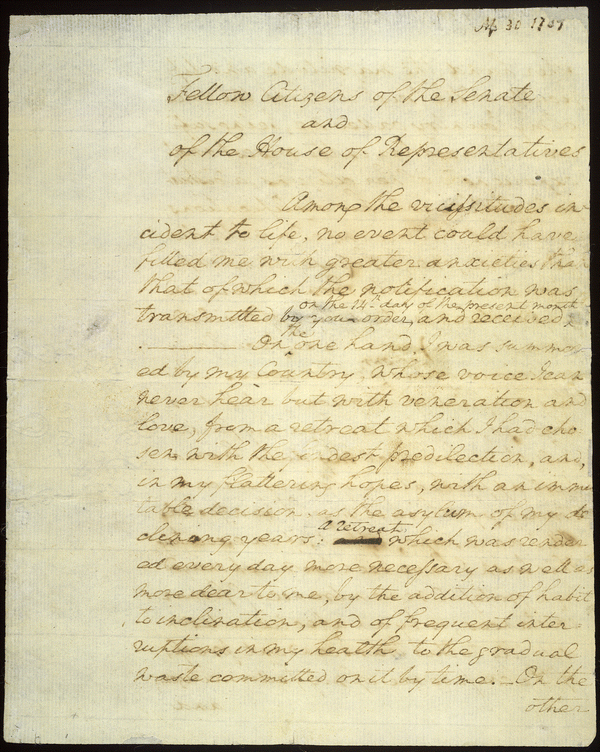
April 21, 2006
The Books: "A History of the American People" (Paul Johnson)
And here is my next excerpt of the day from my library.
 Next book in my American history section is the massive A History of the American People , by Paul Johnson. Massive in scope and really well-written - I totally recommend this book. There are swaths of American history I'm not clear on ... and Paul Johnson attempts to cover it all: industries rising, the birth of American literature, the religious renaissance that swept the nation in the 1800s ... but then, of course, we go through each President ... and each administration, the events that shaped our nation, domestic and foreign. Johnson's English, an outsider, but I think that makes him even more qualified to write about some of this stuff, because he's not trying to stick it to a political party he despises, he's not trying to right a historical wrong, he doesn't write with a massive CHIP on his shoulder, which is unbelievably refreshing. He certainly has opinions - he's LOADED with opinions ... but it's still an outsider's analysis of how our nation morphed into what it is today. Johnson loves America. He is certainly not uncritical of a lot of it - but whatever, we're a huge nation - anyone who is completely uncritical of America in a kneejerk way is a moron.
Johnson writes at the end of his introduction: "I have not bowed to current academic nostrums about nomenclature or accepted the fly-blown philacteries of Political Correctness. So I do not acknowledge the existence of hyphenated Americans, or Native Americans, or any other qualified kind. They are all Americans to me: black, white, red, brown, yellow, thrown together by fate in that swirling maelstrom of history which has produced the most remarkable people the world has ever seen. I love them and salute them, and this is their story."
He's a marvelous writer. This book is enormous and rather daunting - but I can't recommend it highly enough.
It was hard to figure out what to choose as an excerpt - there's so much awesome information here - but I decided to go with an excerpt from his section called "Monster Cities: Chicago and New York". I loved this section especially because Chicago and New York are both so dear to me ... I loved reading about their development.
From A History of the American People , by Paul Johnson.
New York, by contrast, was circumferenced by water and chose to have its park, on a giant scale, in the middle. New York was still second in size to Philadelphia at the time of the 1810 census, with 91,874 to 96,373 people, and the plan for its development laid down the following year provided only minimum public spaces (its original Parade Ground between 23rd and 34th Streets had been long since greedily built over). But when the fashions for laying out big public parks within cities was brought from London and Paris soon after, New York still had plenty of undeveloped land in central Manhattan, and the city fathers were able to set aside an enormous area. The landscape architect F.L. Olmsted (1822-1903), from Hartford, Connecticut, that nursery of genius, together with the Londoner Calvert Vaux (1824-95), designed Central Park as an extraordinary multi-class complex of carriage drives, walks, lakes for fishing, boating, and skating, and boulder-strewn wilderness woods.
By the time the Park was in working order the City was fast growing up around it. Population was then 813,000. Forty years later, thanks largely to immigration, it was nearly 3,500,000 and still growing at breakneck speed. The rise of high buildings meant that the immense flat space of Central Park was increasingly surrounded by a periphery of stone and masonry achieving spectacular effects of precisely the rus in urbe appeal which had been the aim of the earliest town planners, like John Nash of London. No other city in the world can produce these skylines. First came four or five-story structures, developed out of British precedent for shops, factories, and warehouses, the leading spirits being two brilliant iron-founders of the 1850s, Daniel Badger and James Bogardus. From this emerged cage-constructions, whose interiors were self-supporting metal frameworks reinforced by independent masonry walls. Next was skeleton-type construction, in which even the external walls hung off the metal frame. The Equitable Building of 1868-70 is often regarded as the first New York skyscraper: it had a frontage only five bays wide but it rose to 142 feet in eight stories and was serviced by two elevators. (Its replacement, the Equitable Building of 1913-15, was an entire block, reached forty stories and 542 feet, and had forty-eight elevators making 50,000 trips a day, giving some idea of the leap from large to gigantic in New York City in these four decades.
Evidently the New York skyline was beginning to assume its characteristic form, and to promote deep thoughts in visitors, as early as 1876, when T.H. Huxley, the leading promoter of scientific ideas in Europe, made his first visit. His verdict was: "Ah, that is interesting. In the Old World, the first things you see as you approach a great city are steeples; here you see, first, centers of intelligence." Huxley was in a sense right: the skyscraper represented the application of science at its frontiers and imaginative intelligence in the art of building in precisely the way a great Renaissance architect like Michelangelo would have instantly appreciated. But the men who devoted huge creative intelligence and engineering and mathematical skills to making New York a "scientific city" did not share Huxley's atheism. Rather the contrary. A characteristic American religiosity tended to enter even the field of the high-rise and the structurally gigantic. John Roebling (1806-99), the German-trained immigrant who designed the Brooklyn Bridge (it was completed by his son Washington in 1883), then the longest suspension bridge in the world, said it was "proof positive that our mind is one with the Great Universal Mind."
New York differed from Chicago in key respects. Though less innovative, it was richer in the sense that it was the source of the capital for Chicago as well as itself, and most major firms with immortal longings, who wished to commemorate themselves with the tallest, largest, most expensive skyscraper, had their headquarters in New York. So ultimately New York skyscrapers were not only taller but more decorative. The ten-story Western Union headquarters was put up in 1873-5, followed quickly by the eleven-story Tribune building, then the sixteen-story World Building in 1889-90 and the twenty-story Manhattan Life Insurance giant of 1893. New York soon surpassed Chicago in height, with ten stories or more added every decade, and it indulged in fantastic and often beautiful accretions of domes, columns, and spires. Most New York skyscrapers were permanent advertisements for their companies. Thus the Singer Building of 1902 paid for its construction by one year's extra sales in Asia alone. Equally, New York's vast insurance industry dictated the construction, regardless of cost, of headquarters buildings which vaunted strength, size, and durability (rather like banks). In the first decade of the 20th century, the Metropolitan Life had insurance in force totaling over $2.2 billion, so it built and occupied, 1909-10, an immense temple in the sky which was 700 feet high, the world's tallest for a time. Another example was the spectacular Woolworth Building of 1911, which for long represented the skyscraper. Frank Winfield Woolworth (1852-1919), who established his first five-and-ten-cent store in 1879 and by 1911 had over 1,000 worldwide, told the contractor who put up his building that though it could never make a proper return on capital it had an enormous hidden profit as a gigantic signboard.
By 1903 office rents were four times higher in Manhattan than in central Chicago and that was one reason buildings were taller. High rents also determined the cluster of skyscrapers within easy reach of the Stock Exchange: by 1910 they could be as high as $24,750 a square foot in Wall Street but only $800 in South Street a few blocks away. Then in 1916 came the New York Set-Back ordinance: so long as your architect worked out the set-backs correctly, you could go to any height you liked. Grandeur and display raised the height well above the economic optimum and by 1930 it was averaging sixty-three stories in the best area around Grand Central, with the Chrysler Building (1929-30) pushing up to seventy-seven stories, the extra being the advertising element. The sensation of the 1920s, indeed, was the development of the Grand Central area as an alternative to Wall Street, and New York skyscrapers are still to this day grouped around these two foci.
But we are getting ahead of our story, and above it too, for beneath the towering New York high-rises were the clustering tenements, themselves also multistory, of the burgeoning metropolis of the 1870s, 1880s, and 1890s. New York had begun as a Dutch city, then had expanded as a mainly English city, then in the 19th century had broadened into a multiethnic city, much favored by Germans and, above all, by the Irish. Then came the turn of the Italians, the Greeks, and the Jews from Eastern Europe. The outbreak of savage state pogroms in Russia from 1881 had dramatic consequences for New York. In the following ten years Jews were arriving in the city at the rate of 9,000 a year. In the 1890s it jumped to an average of 37,000 a year and in the twelve years 1903-14 it averaged 76,000 a year. In 1886 the Grench people commemorated the centenary of American Independence by having their sculptor Frederic Auguste Bartholdi fashion a gigantic copper statue of Liberty, which was placed on a 154-foot pedestal on Bedloe's Island in New York Harbor, the whole rising to 305 feet, making it the highest statue in the world. A local Jewish relief worker, Emma Lazarus (1849-87), whose talent had been spotted by Emerson, grasped, perhaps better than anyone else in America at that time, the true significance of the open-door policy to the persecuted poor of Europe. So she wrote a noble sonnet, "The New Colossus," celebrating the erection of the statue, in which the Goddess of Liberty herself speaks to the Old World:
Give me your tired, your poor,
Your huddled masses yearning to breathe free,
The wretched refuse of your teeming shore.
Send these, the homeless, the tempest-toss'd to me.
I lift my lamp beside the golden door.
The refugees and the huddled masses crowded not just into Manhattan as a whole but in particular into the Lower East Side, one and a half square miles bounded by the Bowery, Third Avenue, Catherine Street, 14th Street, and the East River. In 1894 the density of Manhattan reached 142.2 people an acre, as opposed to 126.9 in Paris and 100.8 in Berlin. They were much higher than the Chicago tenements, perhaps safer -- fire escapes had been made obligatory in 1867 -- and far more crowded. The most infested were the Dumbell Tenements, which get their name from a shape determined by the 1879 regulartion which imposed airshafts. They were five to eight stories high, 25 feet wide, 100 feet deep, and with fourteen rooms, only one of which got natural light, on each floor. Over half a million Jews were crowded into the Lower Easy Side, and the heart of New York Jewry was the Tenth Ward, where, in 1893, 74,401 people lived in 1,196 tenements spread over six blocks. Five years later the population density in Tenth Ward was 747 persons per acre or 478,080 per square mile. By comparison, the modern density of Calcutta is only 101,010 per square mile (1961-3). The New York buildings had more stories of course; even so, the Tenth Ward was probably the most crowded habitation, in the 1890s, in the whole of human history. By 1900 there were 42,700 tenements in Manhattan, housing 1,585,000 people.
So here were luxury skyscrapers surrounded by slums, an image of rich-and-poor America. And the poor were, in a sense, sweated labor, most of them in the 'needle trades'. By 1888 no less than 234 out of 241 New York clothing firms were Jewish. By 1913 clothing was New York's biggest industry, with 16,552 factories, nearly all Jewish, employing 312,245 people. But the apparent rich-poor dichotomy concealed a huge engine of upward mobility. The whole engine of America was upwardly mobile, but New York, for the penniless immigrant, was the very cathedral of ascent.
April 20, 2006
The Books: "April 1865: The Month That Saved America" (Jay Winik)
And here is my next excerpt of the day from my library.
 Next book in my American history section is April 1865: The Month That Saved America , by Jay Winik
I loved this book. Fun. I couldn't put it down. What a freakin' month it was.
Here's an excerpt about the aftermath of Lincoln's assassination. Some incredible images here. The image of the farmers kneeling in their fields just ... gets me right in the throat.
From April 1865: The Month That Saved America , by Jay Winik
In New York, on 550 Broadway, precisely at 7:22 a.m. on April 15, the clock at Tiffany % Co., held aloft by a huge wooden Atlas, had come to a halt. This was no doubt fitting, for, as was well known, Charles Lewis Tiffany greatly esteemed Lincoln.
Across town, in Brooklyn, Walt Whitman was at home when he heard the news. His mother prepared their breakfast, as usual, but it was left untouched and unnoticed, as were the rest of the day's meals. He sipped a half cup of coffee, and after pushing his plate of food away, he scoured every newspaper, silently passing them back and forth with his mother. Then he crossed over to Manhattan and, to darkening skies and driving rain, trudged up Broadway, past shuttered stores hung with black. "Lincoln's death," he wrote in his notebook, " -- black, black, black -- as you look toward the sky -- long broad black, like great serpents."
Four days later, farther north, in Concord, Massachusetts, all business and labor was suspended between eleven and two o'clock, as the townspeople moodily gathered in the local Unitarian church. Music was played and selections from the Scriptures and prayers were read. Then Ralph Waldo Emerson gave a somber address: "Rarely was [a] man so fitted to events," he said of Lincoln, about whom he had often had severe reservations. "Only Washington can compare with him in the future."
To the south, it would take a full seven days for Mary Chestnut to receive the news of the assassination, which arrived for her husband on April 22 in a sealed envelope, by secret dispatch. She opened it. "It is simply maddening, all this," she wrote. A friend of hers saw it differently: "See if they don't take vengeance on us," she warned, "now that we are ruined and cannot repel them any longer." Another friend quipped defiantly: "I call that a warning to tyrants!"
By then, though, Lincoln had been eulogized, his funeral had been held, and his remains had begun the long j ourney home to Springfield. On Wednesday, April 19, Lincoln's casket spent its final hours lying in state in the East Room of the White House. Outside, the sun beamed, and a gentle breeze caressed the sky. Inside, black was everywhere: on the chandeliers, on the ornate gilt frames of the mirrors, in the adjoining rooms, even on the steps. The East Room itself was hushed, dim, somber. Lincoln's coffin rested on a flower-covered catafalque, a bed of roses at his feet. Even in death, his gangly frame filled the open casket: his head rested on a white pillow, a queer smile fixed on his lips. At eleven that morning, the services began.
Six hundred people crowded into the room. All of official Washington was here: President Johnson and his cabinet, Senator Sumner and his congressional colleagues. Justice Chase and the Supreme Court, generals and the diplomatic corps, Lincoln's personal cavalry and bodyguards, his personal aides and his sons, Robert and Tad, standing at the foot of the coffin, grief-stricken. At the other end, General Grant sat, alone, his numbed gaze fixed on a cross of lilies, a black mourning crepe wound around his arm. In full view, he wept, later maintaining that this was the saddest day of his life. For his part, President Johnson stood erect and qujet, facing the middle, his hands crossed on his breast. Four ministers spoke and delivered their prayers. Then the casket was closed.
With machinelike efficiency, twelve veteran corps sergeants lifted the coffin, carrying it out into the funeral car, into the sunlit day, into the dirge of bells tolling and bands playing for the dead. In slow time, the funeral procession started up Pennsylvania Avenue. With a detachment of black troops in the lead, it moved, in careful, measured, rhythmic steps. Lincoln's empty boots sat eerily in the stirrups of his riderless horse, which followed behind, as though ready to join his master in the afterlife, while columns of mourners trudged to the steady, muffled roll of drums. Arms reversed, battalions and regiments were next. Soon the lines curved and swelled, like the great blue sky, with wounded soldiers, torn and bandaged men, marching along. Behind them came a cortege of black citizens, stretching from curb to curb in neatly ordered lines of forty -- 4,000 of them all told, in dark coats and shiny white gloves, clasping hands and quiet, as they strode along. In their wake, heavy artillery rumbled.
When the procession reached the Capitol, the sergeants gently lifted Lincoln into the rotunda, where he lay in state on another catafalque. All the oil paintings and bright white statues were covered, except for the figure of George Washington, on which a simple black sash was tied. During that day, and the next, thousands of people filed through, to get one last glimpse and pay their last respects. Noah Brooks recorded: "Like black atoms moving over a sheet of gray, the slow moving mourners ... crept silently in two dark lines across the pavement of the rotunda ..."
The next day, April 21, a nine-car funeral train bore Lincoln from the capital. It would make a journey of fourteen days and 1,662 miles, back to Illinois, retracing the route that a freshly elected United States president had taken to Washington four years earlier.
The train crept forward, to ringing bells and through the soft, spring landscape. All along the route, people gathered, watching in stunned silence as the train rolled by under the velvety sky. In Philadelphia, Lincoln's coffin was placed in Independence Hall, where a double line of mourners stretched three miles deep. Among them was former President Buchanan, just one day shy of his seventieth birthday; ignoring his advancing age, he had driven his buggy all the way from Lancaster, Pennsylvania, to see the fallen president. In New York City, the procession continued for four hours. Eighty-five thousand mourners accompanied the funeral hearse through the streets beneath a thicket of signs. "Mankind has lost a friend and we a President," one sign said. Another read: "In sorrowing tears the nation's grief is spent." A tearful Walt Whitman would never forget this moment: from that time on, every spring, with its lilacs blooming and the season blossoming, would remind him of the coffin passing in the street. Six-year-old Theodore Roosevelt was there, too, leaning out of the second-floor window, watching the spectacle from his grandfather's twon house on Broadway. In Albany, Lincoln rested in the statehouse, and people came all through the night to lay their eyes on his open coffin. Two presidents, one former and one future, would rush to Buffalo to join the long lines of mourners: Millard Fillmore and Grover Cleveland. Then the train steamed west, past farmers kneeling in their planting fields, to Cleveland, where a special outdoor pavilion was set up -- for no outdoor public building was large enough to accommodate the expected crowds -- through which 10,000 mourners passed each hour, braving a cold, steady rain. In all, 150,000 came. Indianapolis followed, on the night run. It was lit up by bonfires, with attentive crowds standing in the rain, mute and still, as the train slowly glided by like a ghost. In Chicago, the hearse was shepherded by thirty-six young women, dressed in white, representing each state in the restored Union. There, too, were Lincoln's fellow Illinoisians, silent columns of heartbroken colleagues and friends marching lockstep by his side in one subdued, final tribute.
April 19, 2006
The Books: "1812 : The War That Forged a Nation" (Walter R. Borneman)
And here is my next excerpt of the day from my library.
 Next book in my American history section is 1812 : The War That Forged a Nation , by Walter R. Borneman.
It's just not a well-written book. Sorry, Borneman. It's just not. The author actually uses the word "Hey" a lot in the text. Like: "Hey, the British were impressing American soldiers ... what choice did the Americans have?" Hey? HEY???? But I have some bad books on my shelves - and this book excerpt thing isn't about me editorially choosing my "favorites" ... So here it is. 1812.
Here's an excerpt detailing the battle between the USS Constitution and the HMS Guerriere on August 19, 1812. Yawn.
From 1812 : The War That Forged a Nation , by Walter R. Borneman.
Leaving Boston harbor, Hull steered the Constitution northeast along the coasts of Nova Scotia and Newfoundland and took up station off Cape Race in the Gulf of St. Lawrence -- the route of Canada's lifeline to Great Britian. Constitution captured and sank two British merchantmen there and then turned south toward Bermuda. She soon chased down a brig that turned out to be the American privateer Decatur, of fourteen guns. Her captain reported to Hull that he had outrun a British frigate the day before. This was good news to Hull. Now he knew that there was a British warship in the vicinity and that he had just run down a vessel that had proven faster the day before.
About two o'clock on the afternoon of August 19, 1812, the Constitution's lookouts raised cries of "Sail ho" and pointed to a sail bearing east-southeast. Pulses quickened. Having the wind, the Constitution gave chase and quickly closed to within three miles. Both ships beat to general quarters, but Hull was still uncertain about the identity of his quarry. It soon proved to be the frigate Guerriere, and her captain was about to get his wish for a chance at revenge. Supposedly Captain Dacres was quoted as boasting, "There is the Yankee frigate: in forty-five minutes she is certainly ours: take her in fifteen and I promise you four months' pay!"
As Constitution closed with GFuerriere from its windward side, an overeager Dacres ordered his crew to fire broadside after broadside at the approaching vessel. By and large, Hull held his fire, much to the consternation of Lieutenant Morris, who asked three times for permission to do so. British cannonballs struck the Constitution, but did little damage. After one particularly well-aimed British broadside bounced harmlessly off Constitution's hull, a crew member is reported to have exclaimed, "Hurrah, her sides are made of iron," or words to that effect. No matter. A legend was born, and "Old Ironsides" she became.
Finally, with the two ships but twenty-five yards apart, Hull ordered his first broadside of double-shot -- both a canonball and a canister of grape -- from his starboard guns. The effect on the Guerriere at such close range was dreadful, and the cheers of the British seamen quickly quieted into moans of pain. Constitution fired again and again, and then crossed Guerriere's bow and brought her port guns to bear in equally devastating fashion. Hull, who was rather short and stocky, became so animated that he split the seat clean out of his breeches, an event that did as much for the morale of his crew as the obvious damage being inflicted on Guerriere. When another broadside raked Guerriere and toppled her mizzenmast, Hull ignored his breeches and shouted above the roar, "Huzza, my boys! We've made a brig of her."
The fallen mizzenmast acted as a huge rudder and had the effect of slowing Guerriere and swinging her to starboard despite the efforts of her helmsman. Constitution surged ahead and attempted to cross her bow again, but this time Hull cut the maneuver too close and the Guerriere's bowsprit became entangled in the rigging of the Constitution's mizzenmast. The Constitution poured yet another broadside into the starboard bow of the Guerriere while the Guerriere's own bow guns landed shots that set fire to Captain Hull's cabin. Trumpets sounded on both ships to summon boarding parties, while marine marksmen in the rigging of both ships added deadly small-arms fire to the melee. Aboard Constitution, Lieutenant Morris fell critically wounded as he prepared to lead a boarding party.
Then Guerriere's foremast fell with a splintering crash that took most of her mainmast with it. The ship shuddered and lost most of its forward momentum. Constitution continued under sail and broke loose from the grip of Guerriere's bowsprit. With Guerriere almost dead in the water, Constitution drew apart and prepared to rake her fore and aft with still more broadsides. Suddenly the British frigate fired a shot to leeward -- in the opposite direction of the Constitution. With no flags left to strike, Captain Dacres, who himself had been wounded, was signaling his surrender.
Captain Hull sent Lieutenant George C. Read aboard Guerriere to ascertain the situation. Stepping across decks slippery with blood, young Read confronted Dacres amid the carnage of his quarterdeck and inquired, "Captain Hull presents his compliments, sir, and wishes to know if you have struck your flag?" To this, Dacres is said to have replied, "Well, I don't know. Our mizzen mast is gone, our fore and main masts are gone -- I think on the whole you might say we have struck our flag."
Dacres was escorted aboard Constitution to confront Hull, who refused Dacres's tender of his sword, supposedly saying that he could not take the sword of one who had defended his ship so gallantly. Then Hull asked if there was anything on the Guerriere that Dacres wished to have brought aboard. "Yes," Dacres replied, "my mother's Bible." Hull ordered it retrieved.
Constitution had sustained losses of seven killed and seven wounded to British losses of fifteen killed and seventy-eight wounded -- the latter number due in no small measure to Captain Hull's use of grapeshot at close range. Hull hoped to tow the Guerriere into port as a prize, but by dawn the next morning there was four feet of water in her hold. By midafternoon Hull recalled his prize crew and ordered her blown up. In transferring the crew of Guerriere to the Constitution, Hull found that there were ten impressed Americans aboard -- a graphic example of one of the war's causes. Dacres clearly knew of it because he had graciously permitted the Americans to go belowdecks rather than fight against their countrymen.
April 18, 2006
Today in history: April 18-19, 1775
On the night of April 18, into April 19, in 1775, Paul Revere made his famous ride.
The spring of 1775 was a tense time. Prominent Bostonians were under constant threat of arrest from the British, and many of them - to avoid this - moved their families to outlying communities. However, two of the main patriotic leaders (Benjamin Church and Joseph Warren) stayed in Boston. Paul Revere did as well, and kept a close eye on British movements through that spring. Revere was trusted as a messenger, he knew everybody, he was just one of those guys.
In mid-April, Revere started to notice some ominous signs: mainly that the British ships were taken out of the water, to be worked on, repaired. He could sense that something was coming. He felt the British were preparing for some kind of attack.
Revere went to Concord on April 16 (most of the weaponry was stored there) and warned the leaders of that community that the British were preparing something, they were up to something, and if they were going to strike, they would most definitely try to seize the weapons stash in Concord. So the people of Concord went to work, hiding their store of weapons in barns, cellars, swamps, etc. (Like I mentioned: Paul Revere was trusted. He knew everybody. If you're interested, read the excerpt I posted of Malcolm Gladwell's fascinating analysis of Paul Revere - and Gladwell's comparison with the far less successful messenger on that very same night - William Dawes.)
So. April 16. Revere returned to Boston from Concord, and met with other revolutionary leaders, and that is when they came up with the "one if by land, two if by sea" warning system. Revere knew they needed a way to have some advance warning about which route the British were going to take when they finally did attack.
By land? Or by sea?
So, Revere set up the system: Signal lanterns would be placed in the belfry of Old North Church (the steeple can be seen across the Charles River). If two lanterns were hung, then the British would be crossing the Charles by boat. If one lantern was hung, then the British would choose to attack using a land route.
"One if by land, two if by sea."
This plan was put in place just in time. On April 18, in the early evening, a stable boy came to Paul Revere, telling him that he had overheard some British soldiers discussing the upcoming attack, and that it was planned for early the next morning. The stable boy knew who to bring this information to, and that was Paul Revere. (Again, check out Gladwell's analysis of Paul Revere's personality. Really interesting.)
Revere, on receiving this urgent piece of information, knew he had to get the warning out (and that he especially had to warn John Hancock and Samuel Adams who, at that time, were hiding out in Lexington).
The signal was given: two lanterns.
So off he went onto his now legendary ride. Revere took the water route out of Boston, rowed across the Charles, and galloped through the communities north of Boston sounding the alarm. (Medford, Charlestown, Lexington, Concord.) Because of Paul Revere, the British had completely lost the element of surprise. When they came to attack, they found the rebellious colonists waiting for them everywhere, ambushing them left and right, from behind stone walls, hiding behind trees ...
An interesting tidbit (this is why I love this time in American history - yeah, the events themselves are really cool ... but it's details like the following one that really have me hooked, like a crack addict):
In his hurry to depart, Revere forgot to bring along pieces of cloth to wrap the oars of his boat. The purpose of this was to muffle the sound of them cutting through the water. The Somerset (the British man-of-war) was at anchor, right there in the harbor. Paul Revere had to row right by them, and so any sound at all would have alerted the crew, and if Revere was busted, the whole jig would be up. Revere was in a bit of a pickle ... standing by his boat, trying to figure out how he could improvise ... could he take off his stockings? Tie them around the end of the oars?
One of the boatmen involved in helping Revere make this crossing came to the rescue. He ran to his girlfriend's house and asked her for her petticoat. hahaha One can only imagine her startled response to the nighttime demand at her door: "Please, dear. It's 10 pm, and I need you to take off your petticoat, give it to me, and don't ask me ANY questions about it!!" But apparently, this girl, whoever she was, complied - took off her petticoat, gave it up, and Revere used that to wrap up the ends of his oars.
I love that woman, whoever she is.
So. In honor of the great Paul Revere, I have a couple other things to post. One is, my conversation with Cashel about the American Revolution. I read that piece on the radio in 2003. I love it. It's one of my favorite conversations I've ever had with him.
And lastly, please find Henry Wadsworth Longfellow's celebrated poem "Paul Revere's Ride". I know large swaths of it by heart ... To me, it's a thrilling poem. Because of the story it tells, but also because of its rollicking rhythm, you can feel the suspense, you can feel the urgency. It's meant to be read out loud. Try it for yourself - it's so much funner that way. You can feel the beat of the horse hooves in the poem. The last stanza is beyond compare. "For borne on the night-wind of the Past ..." I mean, come ON!!
April 18, 1775. A great day in American history. One of my personal favorite "stories" of the American revolution.
Paul Revere's Ride
- by Henry Wadsworth LongfellowListen my children and you shall hear
Of the midnight ride of Paul Revere,
On the eighteenth of April, in Seventy-five;
Hardly a man is now alive
Who remembers that famous day and year.
He said to his friend, "If the British march
By land or sea from the town to-night,
Hang a lantern aloft in the belfry arch
Of the North Church tower as a signal light,--
One if by land, and two if by sea;
And I on the opposite shore will be,
Ready to ride and spread the alarm
Through every Middlesex village and farm,
For the country folk to be up and to arm."
Then he said "Good-night!" and with muffled oar
Silently rowed to the Charlestown shore,
Just as the moon rose over the bay,
Where swinging wide at her moorings lay
The Somerset, British man-of-war;
A phantom ship, with each mast and spar
Across the moon like a prison bar,
And a huge black hulk, that was magnified
By its own reflection in the tide.
Meanwhile, his friend through alley and street
Wanders and watches, with eager ears,
Till in the silence around him he hears
The muster of men at the barrack door,
The sound of arms, and the tramp of feet,
And the measured tread of the grenadiers,
Marching down to their boats on the shore.
Then he climbed the tower of the Old North Church,
By the wooden stairs, with stealthy tread,
To the belfry chamber overhead,
And startled the pigeons from their perch
On the sombre rafters, that round him made
Masses and moving shapes of shade,--
By the trembling ladder, steep and tall,
To the highest window in the wall,
Where he paused to listen and look down
A moment on the roofs of the town
And the moonlight flowing over all.
Beneath, in the churchyard, lay the dead,
In their night encampment on the hill,
Wrapped in silence so deep and still
That he could hear, like a sentinel's tread,
The watchful night-wind, as it went
Creeping along from tent to tent,
And seeming to whisper, "All is well!"
A moment only he feels the spell
Of the place and the hour, and the secret dread
Of the lonely belfry and the dead;
For suddenly all his thoughts are bent
On a shadowy something far away,
Where the river widens to meet the bay,--
A line of black that bends and floats
On the rising tide like a bridge of boats.
Meanwhile, impatient to mount and ride,
Booted and spurred, with a heavy stride
On the opposite shore walked Paul Revere.
Now he patted his horse's side,
Now he gazed at the landscape far and near,
Then, impetuous, stamped the earth,
And turned and tightened his saddle girth;
But mostly he watched with eager search
The belfry tower of the Old North Church,
As it rose above the graves on the hill,
Lonely and spectral and sombre and still.
And lo! as he looks, on the belfry's height
A glimmer, and then a gleam of light!
He springs to the saddle, the bridle he turns,
But lingers and gazes, till full on his sight
A second lamp in the belfry burns.
A hurry of hoofs in a village street,
A shape in the moonlight, a bulk in the dark,
And beneath, from the pebbles, in passing, a spark
Struck out by a steed flying fearless and fleet;
That was all! And yet, through the gloom and the light,
The fate of a nation was riding that night;
And the spark struck out by that steed, in his flight,
Kindled the land into flame with its heat.
He has left the village and mounted the steep,
And beneath him, tranquil and broad and deep,
Is the Mystic, meeting the ocean tides;
And under the alders that skirt its edge,
Now soft on the sand, now loud on the ledge,
Is heard the tramp of his steed as he rides.
It was twelve by the village clock
When he crossed the bridge into Medford town.
He heard the crowing of the cock,
And the barking of the farmer's dog,
And felt the damp of the river fog,
That rises after the sun goes down.
It was one by the village clock,
When he galloped into Lexington.
He saw the gilded weathercock
Swim in the moonlight as he passed,
And the meeting-house windows, black and bare,
Gaze at him with a spectral glare,
As if they already stood aghast
At the bloody work they would look upon.
It was two by the village clock,
When he came to the bridge in Concord town.
He heard the bleating of the flock,
And the twitter of birds among the trees,
And felt the breath of the morning breeze
Blowing over the meadow brown.
And one was safe and asleep in his bed
Who at the bridge would be first to fall,
Who that day would be lying dead,
Pierced by a British musket ball.
You know the rest. In the books you have read
How the British Regulars fired and fled,---
How the farmers gave them ball for ball,
>From behind each fence and farmyard wall,
Chasing the redcoats down the lane,
Then crossing the fields to emerge again
Under the trees at the turn of the road,
And only pausing to fire and load.
So through the night rode Paul Revere;
And so through the night went his cry of alarm
To every Middlesex village and farm,---
A cry of defiance, and not of fear,
A voice in the darkness, a knock at the door,
And a word that shall echo for evermore!
For, borne on the night-wind of the Past,
Through all our history, to the last,
In the hour of darkness and peril and need,
The people will waken and listen to hear
The hurrying hoof-beats of that steed,
And the midnight message of Paul Revere.
April 17, 2006
The Books: "Miracle At Philadelphia" (Catherine Drinker Bowen)
And here is my next excerpt of the day from my library.
 Next book in my American history section is the classic, and one of my all-time favorites: Miracle At Philadelphia : The Story of the Constitutional Convention May - September 1787 , by Catherine Drinker Bowen. She's such a good writer that you feel like you were there. She paints brief vivid portraits of all of the participants - many of them have famous names, of course - but there's something about her writing that makes the thing pop off the page. The image of Ben Franklin, with his gout, being carried in a chair by 4 servants to Independence Hall, etc. I mean, obviously, this is one of my favorite times in history - and this book really captures the spirit of why. These guys were BRAINIACS, first of all ... but what really blows me away is how they were just human beings, they couldn't see into the future, but they TRIED ... they tried to set up the constitution in a way to leave enough vagueness, enough ambiguity - that it would continue to be relevant as time went on. It's, frankly, amazing what they were able to accomplish.
This book is fantastic. If you're an American history buff, and you haven't read it -then go out right now and buy it. If you're gonna write about the Constitutional Convention, then this is the book to beat.
Here is an excerpt, describing the arrival of the delegates for the start of the convention.
From Miracle At Philadelphia : The Story of the Constitutional Convention May - September 1787 , by Catherine Drinker Bowen.
On the twenty-fifth of May, when a quorum was obtained, Washington was unanimously elected president of the Convention and escorted to the chair. From his desk on the raised dais he made a little speech of acceptance, depreciating his ability to give satisfaction in a scene so novel. "When seated," wrote a member, "he declared that as he never had been in such a situation he felt himself embarrassed, that he hoped his errors, as they would be unintended, would be excused. He lamented his want of qualifications."...
In the front row near the desk, James Madison sat bowed over his tablet, writing steadily. His eyes were blue, his face ruddy; he did not have the scholar's pallor. His figure was well-knit and muscular and he carried his clothes with style. Though he usually wore black, he has also been described as handsomely dressed in blue and buff, with ruffles at breast and wrist. Already he was growing bald and brushed his hair down to hide it; he wore a queue and powder. He walked with the quick bouncing step that sometimes characterizes men of remarkable energy.
As a reporter Madison was indefatigable, his notes comprehensive, set down without comment or aside. One marvels that he was able at the same time to take so large a part in the debates. It is true that in old age Madison made some emendations in the record to accord with various disparate notes which later came to light; he has been severely criticized for it. Other members took notes at the Convention: Hamilton, Yates and Lansing of New York, McHenry of Maryland, Paterson of New Jersey, Rufus King of Massachusetts, William Pierce of Georgia, George Mason of Virginia. But most of these memoranda were brief, incomplete; had it not been for Madison we should possess very scanty records of the Convention. His labors, he said later, nearly killed him. "I chose a seat," he afterward wrote, "in front of the presiding member, with the other members on my right and left hand. In this favorable position for hearing all that passed, I noted in terms legible and in abbreviations and marks intelligble to myself what was read from the Chair or spoken by the members; and losing not a moment unnecessarily between the adjournment and reassembling of the Convention I was enabled to write out my daily notes during the session or within a few finishing days after its close in the extent and form preserved in my own hand on my files ... I was not absent a single day, nor more than a casual fraction of an hour in any day, so that I could not have lost a single speech, unless a very short one."
It was, actually, a tour de force, not to be published -- and scarcely seen -- until thirty years after the Convention. "Do you know," wrote Jefferson to John Adams from Monticello in 1815, "that there exists in manuscript the ablest work of this kind ever yet executed, of the debates of the constitutional convention of Philadelphia ...? The whole of everything said and done there was taken down by Mr. Madison, with a labor and exactness beyond comprehension." ...
"The State of Georgia, by the grace of God, free, Sovereign and Independent" ... On Friday morning, May twenty-fifth, as soon as Washington had finished his little speech of acceptance from the chair, Major Jackson rose to read aloud the credentials -- so carefully worked over at home -- of the nine states present. It was noticeable that the smallest states spoke out with the loudest voice. Georgia, referred to as "small and trifling" because of her sparse population, announced herself to the Convention with a proud resounding orchestration which left little doubt of her position ... "Sovereign and Independent."
Certain members of the Convention were already heartily sick of the word sovereign. The monster, sovereignty, Washington had called it. The General knew well from what sanction Georgia derived the word. "Each state," the Articles of Confederation had said, "retains its sovereignty, freedom and independence." Without such a clause the Confederacy never would have been achieved ...
Before the Declaration of Independence, no colony had pretensions to independent sovereignty, nor were the states mentioned by name in the body of that document. Yet from the moment peace had been signed, states flaunted their sovereignty as an excuse to do as they pleased. "Thirteen sovereignties," Washington had written, "pulling against each other, and all tugging at the foederal head, will soon bring ruin on the whole."
A General of the Army is not expected to possess so direct and merciless a political eye. Already on May 25, 1787, it looked as if the Federal Convention were to have its fill of sovereignty. The reading aloud of these state credentials was a matter for strict attention; here were signs portent of which way the states were leaning. Madison and Hamilton thought they already knew. Madison had canvassed exhaustively; both men were personally acquainted with many delegates, some of whom had themselves drafted these documents and no doubt would stand by what they had written. Delaware, for instance, whose credentials forbade her deputies to change Article V of the Confederation, giving to each state one vote in Congress and one vote only. Proportional representation was no part of Delaware's scheme. Should the old rule be altered to voting by population, the small states would be blanketed out. Delaware had come prepared to oppose it.
Small states against large, the planting interests of the South against the mercantile money of the North, the regulation of the Western Territory -- these were immediate problems. Not every delegate brought to Philadelphia a comprehension of how thirteen independent states could share a government of tripartite powers: legislative, judicial, executive. James Wilson of Philadelphia understood it and so did Wythe of Virginia. Wilson and Wythe were scholars like Madison. Not only had they acted a part in government bu tthey had thought, red, pondered on the subject; they knew the theory behind the practice. "I am both a citizen of Pennsylvania and of the United States," Wilson told the Convention.
Time would pass before members realized how far the plans of such men as Madison and Hamilton reached, and what the Constitution promised to be. It would be misleading to name thus early the Constitution's "enemies", or to set down this name or that as "against" the Constitution. Five delegates in the end would refuse to sign -- Elbridge Gerry of Massachusetts, Yates and Lansing of New York, George Mason and Edmund Randolph of Virginia -- all men of decided views and each with a different reason for his action. More vociferous than any of these would be Luther Martin of Maryland, who, though out of town on private business at the moment of signing, later declared that had he been present he would have given the document his "solemn negative," even had he "stood single and alone".
Martin did not arrive at the Convention until nearly a month after it met; for the moment, members were spared his boisterous and interminable harangues. On this first Saturday of a quorum the Convention faced a twofold problem: the theoretic question of what kind of government best suited America -- a democracy, a limited monarchy, a republic? -- and the practical problem of creating such a government with all its untried component parts. It was good to review, by way of the state credentials, the aims of the Convention as declared by twelve legislatures. Major Jackson's voice droned on:
"To take into consideration the state of the union ... as to trade and other important objects ... to render the Foederal Government entirely adeuqate to the actual situation ..." When Jackson ceased there was time only to name a committee to prepare standing rules and orders, and to appoint a doorkeeper and messenger. The meeting adjourned for the weekend.
April 15, 2006
The Books: "Angel in the Whirlwind : The Triumph of the American Revolution" (Benson Bobrick)
And here is my next excerpt of the day from my library.
Okay, now I'm all nervous and excited. I'm now ready to begin my American history section. I get nervous about this stuff because I am SO into it that I fear I won't be able to express myself properly. Or - I get so excited that all I want to do is scream. So I get nervous. I'm such a moron.
 First book in this section is Angel in the Whirlwind : The Triumph of the American Revolution, by Benson Bobrick. I really like this book. You know why? He comes right out in his introduction saying: "A great many books have been written on the American Revolution and quite a few of them are good. I have not written mine to try to supersede them, or out of some general dissatisfaction with the canon, but -- hearkening to the voice of my own ancestral heritage -- to retell the story in my own way." He had ancestors who died on both sides of the war. So - it's a story he likes, and he decided to write a book about it. There is nothing new here - but what I really like about it is his enthusiasm for the subject. He's not a scholar. He just loves the story, and that comes through in his writing. Fans of this period in history would really enjoy this book. He's no Catherine Drinker-Bowen, but then again - who is?
I also like (as always) how many primary documents he includes. That's the stuff that I really like - because no matter how good a present-day narrator is - the men (and women) who were actually THERE told the story best - in their letters, and speeches, and pamphlets, etc. Bobrick peppers his entire narrative with first-person descriptions of this or that event. The book moves at a breakneck pace, and it's a blast. Again - nothing new, but really enjoyable.
I'm going to post an excerpt about one of my favorite "characters" in this story: Friedrich Wilhelm von Steuben. In 1778, Steuben - a Prussian, a veteran of many wars, a guy who served under Frederick the Great - arrived at Valley Forge - he was there to help whip the ragtag Continentals into an army that could win. Steuben just fascinates me. He passed himself off as a baron. He wasn't a baron. He passed himself off as a "lieutenant general" - but he had never gotten that high up in the ranks. But hey - he was a "baron" who was also a "lieutenant general", and that's final! Washington was impressed with his abilities, and brought him onto the team. Ben Franklin - who had met Steuben in Paris, and who agreed with the French attitude that the American army needed an overhaul - needed organization - was the one who sent him to America, writing a letter of introduction to Washington for Steuben
Here's an excerpt: (the whole anecdote about the petticoats is hysterical)
EXCERPT FROM Angel in the Whirlwind : The Triumph of the American Revolution, by Benson Bobrick.
On September 26, Steuben set sail for America in a warship that masqueraded as a commercial transport belonging to Beaumarchais's Rodrique Hortalez & Co. with the pretended destination of Martinique. The crossing took two months, which allowed Steuben plenthy of time to occupy himself with mathematical calculations (according to his predilection), take target practice, and acquaint himself with the words of the Abbe Raynal. When his ship finally docked at Portsmouth, New Hampshire, on December 1, he was effusively welcomed by the local American commander, inspected the harbor fortifications, and dispatched a letter to Washington at Valley Forge. Briefed in advance about the political sensitivity of foreign appointments, he wrote, "My greatest ambition is to deserve the title of a citizen of America by fighting for the cause of liberty. But if the distinguished ranks in which I have served in Europe should be an obstacle, I had rather serve under your Excellecy as a volunteer than to be a student of discontent to such deserving officers as have already distinguished themselves amongst you."
From Portsmouth, he proceeded to Boston, where he was the guest of John Hancock, and then on to York, Pennsylvania, to see what Congress would do.
The journey was not without adventure. Near the Connecticut border, when his weary party sought refuge from a furious snowstorm, a Tory innkeeper refused to put him up. "I have no beds, bread, meat, drink, milk, nor eggs for you," he adamantly told them, which they could see was untrue. But repeated remonstrations did no good. "Bring me my pistols!" cried Steuben in German, and suddenly the innkeeper found a pistol at his chest. Accommodations were promptly furnished; their table lavishly spread. The following morning, after an abundant breakfast, the party resumed its journey, not forgetting to pay the innkeeper liberally with the Continental money he despised.
In Pennsylvania, where the Pennsylvania Dutch (Deutsch) community was large, he was everywhere received with both hospitality and pride. Many members of the community had portraits of Frederick the Great on their walls, and in one establishment at Manheim he almost collapsed from laughter at an engraving showing a Prussian knocking down a Frenchman, with the caption, "Ein Franzmann zum Preuszen wie eine Mucke" ("To a Prussian a Frenchman is like a goat.")
Steuben made a favorable impression at York. Congress accepted his services, and he set out for Valley Forge. Washington met him on the outskirts of his encampment, and the very next day the troops were mustered for his review. "Never before or since, have I had such an impression of the ancient fabled God of War," wrote a young private long afterward, "as when I looked on the baron: he seemed to me a perfect personification of Mars. The trappings of his horse, the enormous holster of his pistols, his large size, and his strikingly martial aspect, all seemed to favor the idea."
Steuben soon discovered that in the Continental Army as it existed there was little internal administration in the conventional sense. Although the number of men in a regiment or a company, for example, had been fixed by Congress, each was made up of men who had enlisted for different terms. Thus, with the uncharted comings and goings of personnel, at any given moment, a company might have more men in it than a regiment and a regiment than a brigade. "The words company, regiment, brigade and division were so vague," he wrote, "that they did not convey any idea upon which to form a calculation, either of the particular corps or of the army in general ... I have seen a regiment consisting of thirty men, and a company of one corporal ... No captain kept a book." Leaves of absence and even dismissals were not always recorded, and many still on the regimental books had long since ceased to be part of the army. Army property -- muskets, bayonets, clothing, and so on -- was scattered everywhere, and at the end of each campaign, five thousand to eight thousand new muskets were carried off by men whose terms of enlistment had expired. There was no uniform code or system of regulations, and as for drill, "each colonel had a system of his own."
Under Steuben, all that changed. Records were scrupulously kept, and at rigorous monthly inspections, every man not present had to be accounted for, as well as every piece of equipment -- every musket, flint, and cartridge box. Steuben's own methods of discipline were unfamiliar and at first met resistance: "My good republicans wanted everything in the English style; our great and good allies everything according to the French mode. When I presented a plate of sauerkraut dressed in the Prussian style, they all wanted to throw it out of the window. Nevertheless, by the force of proving by Goddams that my cookery was the best, I overcame their prejudices."
Americans were not accustomed to blind obedience, and Steuben recognized and respected this. The genius of the nation, he wrote, "is not in the least to be compared with that of the Prussians, Austrians or French. You say to your soldier, 'Do this,' and he doeth it, but here I am obliged to say, 'This is the reason why you ought to do that': and then he does it."
Steuben's genius was his ability to unite Prussian virtues to those of the American mind. He brought uniformity and order to Continental training, drilled the troops repeatedly in different formations, and taught them how to deploy quickly from column into line, fire scything voleys, and deliver and receive bayonet attacks. He also insisted that all Continental officers drill their own soldiers instead of assigning the task to a soldier of lesser rank, both to encourage greater professionalism and to promote a closer bond between the officers and men. Until his advent, troops had drilled from at least three separate manuals, so that when they brigaded together, disarray ensued.
Steuben's new military manual, or "The Blue Book", simplified and shrewdly adapted standard procedures to the particular requirements of training patriot troops. In European armies at the time, a man who had been drilled for three months was still considered a raw recruit; Steuben knew he could not always count on more than a couple of months in which to turn his American recruits into soldiers. He worked on the manual during the winter of 1779, and it was accepted by Congress on March 29, 1779, ad published as Regulations for the Order and Discipline of the Troops of the United States, Part I. It remained the official manual of the U.S. Army until the War of 1812.
Steuben's training brought together the best of traditional military thinking and American technique. He took into account the skirmishing style colonials had developed for themselves (in loose bodies rather than in close formations), organized sharpshooters into light infantry companies with their own special discipline and drill (an American innovation afterward adopted by all European armies), taught the Continentals how to use the bayonet, and had them aim their muskets like rifles, which improved their accuracy to a considerable degree. As occasion warranted, the light companies could also be detached from their "parent" regiments, brigaded together in a separate corps, and used as shock troops or advance guards for the main army.
As an example to the other officers, Steuben also created a model company which he drilled himself. "To see a gentleman dignified with a lieutenant general's commission from the great Prussian monarch," wrote one American colonel, "condescend with a grace peculiar to himself to take under his direction a squad of ten or twelve men in the capacity of a drill sergeant, commanded the admiration of both officers and men."
Steuben had begun his task with almost no knowledge of English, and his young secretary and translator, Pierre Duponceau, remembered that "when some movement or maneuver was not performed toi his mind he began to swear in German, then in French, and then in both languages together. When he had exhausted his artillery of foreign oaths, he would call to his aides, 'My dear [Captain Benjamin] Walker and my dear Duponceau, come and swear for me in English. These fellows won't do what I bid them.' A good-natured smile then went through the ranks and at last the maneuver or the movement was properly performed."
(Steuben's English steadily improved to the point where he was capable of a happy pun. Despite his parade-ground vituperations he had an elegant social manner, and on one occasion, on being presented to a beautiful Miss Sheaf, he said, "Ah, madam, I have always been cautioned to avoid mischief, but I never knew till today how dangerous she was.")
Not all his military exercises went as planned. One morning a mock battle was staged between two full divisions. Duponceau was sent to reconnoiter, with orders to return immediately when the enemy was in sight. About a quarter of a mile from camp, he saw a blur of red which he mistook for a body of British soldiers. He raced back with the news that the enemy really was marching on the camp. Steuben's division marched out smartly on the road Duponceau indicated and, drawing near to where the British had supposedly been seen, prepared to charge, when the red blur was discovered to be "some red petticoats hanging on a fence to dry." Duponceau's error naturally excited hilarity, to his own "utter confusion and dismay," and summoned into Washington's presence, he expected a reprimand. Instead, Washington passed aroud a bowl of punch to the officers present and invited Duponceau to share in the good cheer.
On March 24, Steuben put on a demonstration involving Washington's whole army. All the brigades turned out, "each regiment on its own parade," and after he took them through all the formations of their drill, he conducted maneuvers with ten and twelve battalions "with as much precision as the evolution of a single company." A new spirit had entered the army. Its encampment became more orderly, and parades, maneuvers, and reviews exhibited a harmony of movement that gave thousands of soldiers the appearance of acting as a single body under the control of a single will. On March 28, Washington officially appointed Steuben inspector general of the army "till the pleasure of Congress shall be known ... The Importance of establishing an uniform system of useful maneuvers, and regularity of discipline, must be obvious." On May 5, Congress ratified the appointment and gave Steuben the rank of major general in the American army.
April 14, 2006
Today in History: April 14, 1865
From Jay Winik's book April 1865: The Month That Saved America :
But in the chill, early morning of Good Friday, April 14, Lincoln wakes refreshed, around 7 a.m., and in a good mood. It is a rare occurrence, and he takes it as a good omen. Last night there were no nightmares, no haunting visages, no frantic worries about ending the war and negotiating the foundering shoals of Reconstruction. True, there has been a dream, but this time it is a heartening one, in fact, the one that has come to him before on the cusp of other major military battles. He had it on the verge of Antietam and Gettysburg, and also Vicksburg and Fort Fisher, all-important Union victories. In it, he is on a phantom ship, a "single, indescribable vessel" that moves with "great rapidity" through the water, racing toward a "vast" and "indefinite shore". To Lincoln, rising on this day, it signals good news. He feels that it augurs Joe Johnston's surrender in North Carolina, thereby removing the most powerful Confederate army remaining in the field, and making another large-scale rebel assault almost impossible. It speaks of peace to come. And it fills him with a visible blast of optimism.Before breakfast, he lights the fireplace in his office. By the time he has finished his morning meal -- dining cozily with Mary and then joined by his son Robert -- and makes his way to an 11 a.m. meeting with Grant and the cabinet, he is in "great spirits", appearing more "cheerful and happy" than many of his secretaries had ever seen him. It is infectious; Mary Lincoln will even note that these last few days have been "the happiest of her life". And Lincoln is determined that the mood will not abate.
Today, Good Friday, will certainly not be spent in morbid contemplation or prayer at the New York Avenue Presbyterian Church listening to Reverend Phineas D. Gurley, or simply more fussing and fretting over the war. Today, he wants something that will make him laugh. So this evening he plans to take Mary to see the eccentric English comedy Our American Cousin. It stars the famous English actress Miss Laura Keene, in her very last performance. He and Mary intend to go with General Grant and his wife, and the papers will officially announce their plans.
The comedy is playing at the Tenth Street theater, between E and F streets. At Ford's.

Abraham Lincoln was shot by John Wilkes Booth, while sitting in the presidential box at Ford's Theatre - at 10 pm on April 14, 1865. Lincoln died the next morning. A couple of days later, the War Department issued wanted posters for the arrest of Booth. There's an image of one of those posters below that I found online.
Here is a timeline of these events.

March 23, 2006
Today in history: March 23, 1775
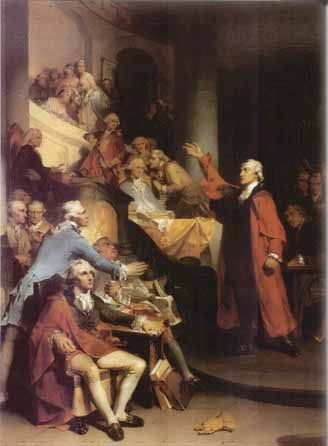
Patrick Henry made his famous "give me liberty or give me death" speech at St. John’s Church in Richmond, Virginia. The speech changed people's lives, ignited them.
Benson Bobrick writes in his book Angel in the Whirlwind (this is about a speech Henry made a decade earlier) - You get the sense in the following excerpt of Henry's power as a public speaker - the consciousness with where he chose to PAUSE ... and then how he concluded his thought, as the cries of "treason" rose around him - genius:
On May 29, 1765, Patrick Henry rose in the Virginia House of Burgesses to introduce a series of momentous resolutions which he had hastily drafted on a blank leaf of an old law book…Henry accompanied these resolutions with a fiery speech given the next day in which he concluded, "Caesar had his Brutus, Charles the First his Cromwell and George the Third"—amid cries of "Treason" that arose from all sides of the room – "and George the Third," he continued artfully, "may profit by their example. If this be treason, make the most of it!"Thomas Jefferson, then a student at the College of William and Mary, was standing in the doorway and heard Henry speak. "I well remember the cry of treason," Jefferson wrote afterward, "the pause of Mr. Henry at the name of George III, and the presence of mind with which he closed his sentence, and baffled the charge vociferated."…To Jefferson it seemed as if Henry "spoke as Homer wrote".
Paul Johnson, in his wonderful book, History of the American People, writes of the "Give me liberty or give me death" speech:
A common American political consciousness was taking shape, and delegates began to speak with a distinctive national voice. At the end of it, Patrick Henry marked this change in his customary dramatic manner: 'The distinctions between Virginians and New Englanders are no more. I am not a Virginian but an American.' Not everyone agreed with him, as yet, and the Continental Congress, as it called itself, voted by colonies rather than as individual Americans. But this body, essentially based on Franklin's earlier proposals, perpetuated its existence by agreeing to meet again in May 1775. Before that could happen, on February 5, 1775, parliament in London declared Massachusetts, identified as the most unruly and contumacious of the colonies, to be in a state of rebellion, thus authorizing the lawful authorities to use what force they thought fit. The fighting had begun. Hence when the Virginia burgesses met in convention to instruct their delegates to the Second Continental Congress, Henry saw his chance to bring home to all the revolutionary drama of the moment.Henry was a born ham actor, in a great age of acting - the Age of Garrick. The British parliament was full of actors, notably [William] Pitt himself ('He acted even when he was dying') and the young [Edmund] Burke, who was not above drawing a dagger, and hurling it on the ground to make a point. But Henry excelled them all. He proposed to the burgesses that Virginia should raise a militia and be ready to do battle. What was Virginia waiting for? Massachusetts was fighting. 'Our brethren are already in the field. Why stand we her idle? What is it that gentlemen wish? What would they have?'
Then Henry got to his knees, in the posture of a manacled slave, intoning in a low but rising voice: 'Is life so dear, our peace so sweet, as to be purchased at the price of chains and slavery? Forbid it, Almighty God!' He then bent to the earth with his hands still crossed, for a few seconds, and suddenly sprang to his feet, shouting, 'Give me liberty!' and flung wide his arms, paused, lowered his arms, clenched his right hand as if holding a dagger at his breast, and said in sepulchral tones: 'Or give me death!' He then beat his breast, with his hand holding the imaginary dagger.
There was silence, broken by a man listening at the open window, who shouted: "Let me be buried on this spot!'
Henry had made his point.
It's interesting - there's a great description of acting: "Acting is like a sculpture carved in snow." Obviously, that phrase came from the time of stage acting. Movies now can capture the "sculpture" before it melts. But that quote always makes me think of Patrick Henry. Nobody alive today can ever see his oratorical skills. There are no video tapes, tape recordings. We just have to take the word of those who were THERE. So while no "record" exists, and his speeches were, indeed, "carved in snow" ... a whiff of the power of them comes down to us regardless.
Click below to read, in full, Patrick Henry's speech that he made on this day in 1775:
Patrick Henry's Speech, St. John's Church, Richmond, Virginia, March 23, 1775
No man, Mr. President, thinks more highly than I do of the patriotism, as well as abilities, of the very worthy gentlemen who have just addressed the House. But different men often see the same subject in different lights; and, therefore, I hope it will not be thought disrespectful to those gentlemen if, entertaining as I do opinions of a character very opposite to theirs, I shall speak forth my sentiments freely and without reserve. This is no time for ceremony. The question before the House is one of awful moment to this country. For my own part, I consider it as nothing less than a question of freedom or slavery; and in proportion to the magnitude of the subject ought to be the freedom of the debate. It is only in this way that we can hope to arrive at truth, and fulfill the great responsibility which we hold to God and our country. Should I keep back my opinions at such a time, through fear of giving offense, I should consider myself as guilty of treason towards my country, and of an act of disloyalty toward the Majesty of Heaven, which I revere above all earthly kings.
Mr. President, it is natural to man to indulge in the illusions of hope. We are apt to shut our eyes against a painful truth, and listen to the song of that siren till she transforms us into beasts. Is this the part of wise men, engaged in a great and arduous struggle for liberty? Are we disposed to be of the number of those who, having eyes, see not, and, having ears, hear not, the things which so nearly concern their temporal salvation? For my part, whatever anguish of spirit it may cost, I am willing to know the whole truth; to know the worst, and to provide for it.
I have but one lamp by which my feet are guided, and that is the lamp of experience. I know of no way of judging of the future but by the past. And judging by the past, I wish to know what there has been in the conduct of the British ministry for the last ten years to justify those hopes with which gentlemen have been pleased to solace themselves and the House. Is it that insidious smile with which our petition has been lately received? Trust it not, sir; it will prove a snare to your feet. Suffer not yourselves to be betrayed with a kiss. Ask yourselves how this gracious reception of our petition comports with those warlike preparations which cover our waters and darken our land. Are fleets and armies necessary to a work of love and reconciliation? Have we shown ourselves so unwilling to be reconciled that force must be called in to win back our love? Let us not deceive ourselves, sir. These are the implements of war and subjugation; the last arguments to which kings resort. I ask gentlemen, sir, what means this martial array, if its purpose be not to force us to submission? Can gentlemen assign any other possible motive for it? Has Great Britain any enemy, in this quarter of the world, to call for all this accumulation of navies and armies? No, sir, she has none. They are meant for us: they can be meant for no other. They are sent over to bind and rivet upon us those chains which the British ministry have been so long forging. And what have we to oppose to them? Shall we try argument? Sir, we have been trying that for the last ten years. Have we anything new to offer upon the subject? Nothing. We have held the subject up in every light of which it is capable; but it has been all in vain. Shall we resort to entreaty and humble supplication? What terms shall we find which have not been already exhausted? Let us not, I beseech you, sir, deceive ourselves. Sir, we have done everything that could be done to avert the storm which is now coming on. We have petitioned; we have remonstrated; we have supplicated; we have prostrated ourselves before the throne, and have implored its interposition to arrest the tyrannical hands of the ministry and Parliament. Our petitions have been slighted; our remonstrances have produced additional violence and insult; our supplications have been disregarded; and we have been spurned, with contempt, from the foot of the throne! In vain, after these things, may we indulge the fond hope of peace and reconciliation. There is no longer any room for hope. If we wish to be free-- if we mean to preserve inviolate those inestimable privileges for which we have been so long contending--if we mean not basely to abandon the noble struggle in which we have been so long engaged, and which we have pledged ourselves never to abandon until the glorious object of our contest shall be obtained--we must fight! I repeat it, sir, we must fight! An appeal to arms and to the God of hosts is all that is left us!
They tell us, sir, that we are weak; unable to cope with so formidable an adversary. But when shall we be stronger? Will it be the next week, or the next year? Will it be when we are totally disarmed, and when a British guard shall be stationed in every house? Shall we gather strength by irresolution and inaction? Shall we acquire the means of effectual resistance by lying supinely on our backs and hugging the delusive phantom of hope, until our enemies shall have bound us hand and foot? Sir, we are not weak if we make a proper use of those means which the God of nature hath placed in our power. The millions of people, armed in the holy cause of liberty, and in such a country as that which we possess, are invincible by any force which our enemy can send against us. Besides, sir, we shall not fight our battles alone. There is a just God who presides over the destinies of nations, and who will raise up friends to fight our battles for us. The battle, sir, is not to the strong alone; it is to the vigilant, the active, the brave. Besides, sir, we have no election. If we were base enough to desire it, it is now too late to retire from the contest. There is no retreat but in submission and slavery! Our chains are forged! Their clanking may be heard on the plains of Boston! The war is inevitable--and let it come! I repeat it, sir, let it come.
It is in vain, sir, to extenuate the matter. Gentlemen may cry, Peace, Peace-- but there is no peace. The war is actually begun! The next gale that sweeps from the north will bring to our ears the clash of resounding arms! Our brethren are already in the field! Why stand we here idle? What is it that gentlemen wish? What would they have? Is life so dear, or peace so sweet, as to be purchased at the price of chains and slavery? Forbid it, Almighty God! I know not what course others may take; but as for me, give me liberty or give me death!
February 22, 2006
The Books: "An Empire Wilderness : Travels into America's Future" (Robert Kaplan)
And here is my next excerpt of the day from my library.
My history bookshelf. Onward.
 Next book on this shelf is called An Empire Wilderness : Travels into America's Future by Robert Kaplan.
Kaplan travels through America - this book was published in 1998 - He starts at Fort Leavenworth - goes up to Omaha - then over to St. Louis - and down to Little Rock and then Vicksburg - back up - then he traveled down through the Southwest and into Mexico - and back up - traveling into the Northwest - Bozeman, Spokane, Seattle ... and then down the California coast to Tijuana. He's interested in borders. Of course. This would probably be a different book if it had been published post-September 11 - but it is still extremely relevant. Kaplan is trying to get at some important truths, and truths that a lot of people just do not want to look at. The blurb on the back of the book describes Kaplan thus: "Never nostalgic or falsely optimistic, bracingly unafraid of change and its consequences ..." That's my main response to Kaplan. If the only constant in this world is that nothing stays the same ... then how is America changing? If you know nothing stays the same, then the question is: what form will America take in 20 years? 100 years? How are these forces of change at work right now? A lot of people respond to these questions by putting their hands over their ears, and shouting, "LALALALALA". Or they have some kneejerk response - but it's all so silly. If you know anything about history then you know what empires rise and empires fall. We refuse to admit that at our peril. Kaplan kind of just wanders around - oh, and again: he travels by bus - his observations about class in this country are fascinating - and only when you travel by bus do you truly experience the reality of our class structure (uhm - having taken the bus many times, I can only shout how true this is!!) - and talks to people - he wants to see what the culture is like in Omaha, St. Louis, Little Rock, Seattle ... He tries to see his own country as though he is an outside observer.
The following excerpt is one of my favorite sections of the book. He writes about the Great Plains.
From An Empire Wilderness : Travels into America's Future by Robert Kaplan.
The central United States is divided into two geographical zones: the Great Plains in the west and the prairie in the east. Though both are more or less flat, the Great Plains -- extending south from eastern Montana and western North Dakota to eastern New Mexico and western Texas -- are the drier of the two regions and are distinguished by short grasses, while the more populous prairie to the east (surrounding Omaha, St. Louis, and Fort Leavenworth) is tall-grass country. The Great Plains are the "West"; the prairie, the "Midwest".
Like the sea, the Great Plains are exposed to the strongest, steadiest winds in America. (The average wind velocity in the Texas and Oklahoma panhandles is twelve to fourteen miles per hour. The only higher average velocities in the lower 48 states are off the coast of Washington State). Also like the sea, the Great Plains are subject to moods, depending on the time of year and the degree of cloud cover. "The plain has moods like the sea," wrote the early twentieth century poet Hamlin Garland in Prairie Songs. In winter, under a leaden sky, this sea of wilted buffalo grass evokes the desolation of a lifeless planet; yet in the summer sunshine the brilliant yellow-green iridescence of the cereal fields seems almost manically happy. If you study the Great Plains long enough, you will see great distinctions in color and terrain. The expanse of buffalo grass, for instance, achieves a luxurious autumn texture if dotted with yucca cactus and Kentucky bluestem, as in western Oklahoma. The Great Plains are not truly flat. Flatness, here, soon becomes relative. After driving for several days in western Oklahoma, for example, I began to notice choppy seas composed of the tiniest of hills, as well as slight rises and declivities in the landscape, like the movements of the wind on a lake. The very extent of these plains made the world seem beyond remote. For two decades I have been a foreign correspondent, yet in the Great Plains I lost interest in the foreign news I could hear on the BBC shortwave service. Such was the effect of this landscape: a veritable dry-land ocean in midcontinent where even the East and West Coasts of the United States, to say nothing of Europe or Asia, seem far away even as they grow closer. Isolationism is not an American character failing; it is an adaptation to terrain.
The Great Plains, even more so than the tall-grass prairie to the east, are America's isolated center, where social and cultural tremors emanating inland from the two coasts -- upheavals both good and bad -- either peter out or arrive years later in diluted form. Whereas the East Coast attracted blacks from the Deep South, as well as Italians, Jews, and others from southern and eastern Europe; and whereas the West Coast drew Asians; the Southwest, Mexicans; and the prairie of Illinois, Iowa, and the eastern halves of the Dakotas, German and Scandinavian immigrants, the Great Plains, until recently, have been home to mainly Anglo-Saxon stock. It is the Great Plains, again, even more than the prairie, that provide the nation with its perception of immense, inviolable space. Much of the Midwest prairie has now become urban and suburban, but in the Great Plains rural life has held out longer.
Most of all, the Great Plains -- the heart of the "Great American Desert" until underground aquifers were discovered and exploited in the 20th century -- constitute the nation's unalterable geographical fact. Walter Prescott Webb, in his classic 1931 study, The Great Plains, argues impressively that the geography of the plains, more than Lincoln or even the Civil War itself, defeated slavery.
The small farms, free labor, and industry of the North and the slave plantations of the South were in place following the War of 1812. The question then became which system could expand faster into the West, for it was western settlement that ignited the Civil War: the North and the South might have existed side by side, however uneasily, had there been no new territory to settle one way or the other. Though much of the West was opened to slavery, the South, Webb explains, could not occupy the Great Plains because its economic system of water-intensive cotton agriculture based on slavery was circumscribed by climate and water resources. In the West, aridity stopped the slave economy in its tracks just as cold weather did in the North. Vast, waterless desert spaces required individual initiative, rather than forced, uncreative labor for development. When the Great Plains prevented the South from dominating the Union, the South seceded rather than acquiesce. And since a weak, divided American continent would have been easily dominated by the European powers, Lincoln knew that war was necessary: that an expanding, industrialized economy of scale required a landscape of scale.
Geography, as I would continue to learn -- particularly when I go to the Pacific Northwest -- will be as crucial to our future as it has been in our past.
February 14, 2006
slalom thoughts
Ted Ligety - doin' his slalom thing. Commentator said a really interesting thing:
"He doesn't get nervous. He has ice water in his veins. Those gates are coming at him every 6/10ths of a second - and to him it looks like they're coming in slow motion."
Amazing. I've heard that about certain athletes, how their perception skews, and clears during competition - I've heard it in terms of hand-eye stuff as well. A fast ball to most of us would seem ... impossible to hit. A blur of white. But certain players ... can just see it coming ... as though that 98 mph fastball is moving in slo-mo.
February 13, 2006
Again with the half-pipe love
-- I love the half-pipe girls. They FLY through the air. The commentators were getting on my nerves a bit - saying, "They are almost as good as the boys! They are almost in the class of the boys! Look at the height! It's almost what the boys got!" Guys? SHUT UP. No, I'm serious. SHUT. THE. FUCK. UP. Let them have their accomplishment on their own without your pissant little gender commentary. One guy said, watching Kelly Clark literally fly thru the air: "I'd like to do an air like that!" Yeah, well, you can't. She's an Olympian. What - cause she's a girl (ikky!!!) you think you should be able to do it? Or ... "Oooh, look at what that GIRL did ... now I want to do it!" How bout it's an incredible jump all on its own and you cut the shit? How 'bout that?
-- Hannah Teter - gold medalist. Again, the reporter comes up to her after she wins the gold: "How do you feel, Hannah?" Out comes the ski-bum accent, the truly American voice, "Oh my God, it's just awesome ... " "I know your family is so supportive..." "They are totally stoked ... and to have them here in the stands ... they've got a banner with them and everyone from my town signed it ... you know ... Belmont!! ... and ... it's all just totally cool." You know Belmont is watching back home and high-fiving everyone in sight. She said his name on the Olympics! I just love the energy of the half-pipers. They crack me up. AWESOME athletes. And the girls are incredible. ALL ON THEIR OWN. THANK YOU VERY MUCH, JAGOFFS.
-- The Chevrolet Olympic moments can be very annoying, and saccharine, and silly. Yes. But tonight - during the pairs competition (which is still going on) - they did an "Olympic moment" about Yao Bin, the coach for the Chinese team. They did a little retrospective on his journey - NONE of which I knew. He represented his country in ... help me ... 1984, I believe - it's in that link - A while back. At a world championship, people literally laughed as the two of them skated. There were many falls, they were clumsy, they didn't know what they were doing. Because of communism, and censorship - Chinese ice skating developed in a vacuum. There wasn't the interchange with other cultures - there wasn't the freedom of travel ... so people in China who wanted to be figure skaters were on their own - probably getting bootlegged copies of ice skating magazines and bootlegged video tapes of world championships, etc. They made their own costumes, trying to imitate what they had seen in the West. Etc. They had no idea where the sport actually WAS in its development - which is what Bin discovered when he and his partner made such a horrible showing. So he, obviously, put his nose to the grindstone - and has completely revolutionized Chinese ice skating. In a matter of 15, 20 years - they have caught up with the rest of the world. (Actually, I don't think that's quite true. They do a lot of tricky moves and complicated jumps - but there's just something about those Russians, man. They just look better on the ice ... it's grace, and ... technique that is so much a part of them that it's the air they breathe - the Chinese skaters don't have that yet. They do a lot of flashy huge jumps, etc. - but they're more like the young jumpy adolescents, overeager, and willing to try anything. The Russian skaters look like adults, confident of their power, their learning, and what they are going to do) But STILL: China is now a true competitor in this event. And it is mostly due to this one man. He is the coach of the three Chinese pairs competing tonight ... You see this man smiling, and whispering instructions and encouragement, and you just love him. I love stories like this. Journeys of ambition, lessons hard won ... He could have had his Olympic experience - horrible - and then skulked off into the shadows. He did not. He made it his MISSION to get Chinese skaters to a competitive level. And he has SO done that. I found that this "Chevrolet Olympic moment" was a great bit of background - gave me a necessary bit of context to understand what was going on here in the competition.
-- Dear Dick Button: Please reconcile yourself to the new scoring system so that Peggy Fleming doesn't have to keep correcting you. Mkay? Thanks.
January 4, 2006
Explain America
Please go to the comments section of this post where Sal asks the question:
You have to explain America to someone from not here, but you can only use ten movies to do it. Which ten do you choose?(Now, these do not have to be history movies, they can illustrate something unique about American values or character or “the American experience”.)
How fun is that?? Go and see people's choices - and go add your own.
I'll put mine here:
1. Casablanca
2. Field of Dreams
3. Running on Empty
4. His Girl Friday
5. Citizen Kane
6. Bonnie and Clyde
7. Taxi Driver
8. It’s a wonderful life
9. Woman of the year
10. Election
But then I had to re-think it - and I have to say that I think Apollo 13 should be on my list - so sadly I have bumped off Running on Empty although I think that film illuminates an extremely important part of the American psyche. EXTREMELY. (Not to mention it being in my perpetual top 5 films of all time - along with Empire Strikes Back, Fearless, and Only Angels Have Wings. Other films come and go off my Favorite Films list - but those always stay at the tippity-top.)
As you can see, I chose films that show the positive side (Field of Dreams) - and also the dark side (Taxi Driver). Because you cannot understand America without understanding both elements.
Such a great question - and I LOVE people's choices so far. So go add your choices to the list.
I love that someone put Groundhog Day on their list!
January 1, 2006
Today in history: Jan. 1 1892
Ellis Island opened for business. The first immigrant of millions to pass through was a 15 year old Irish girl from County Cork named Annie Moore. Three large ships waited to land on that day, and eventually 700 immigrants entered the country on that first day. Annie Moore was given a 10 dollar gold piece, and welcomed to America.
I found this animated image on The History Channel - a view of Ellis Island from the boats, as they approached. Kinda gives me chills - imagining that this is the view my ancestors got, as they came over from Ireland. This is what they saw.
To those of you who ever visit New York - I highly recommend taking a trip over to Ellis Island. It's strangely emotional - you just can feel the ghosts of the millions of people who passed through. They are all still there. Here's an image of the Inspection Room - where each immigrant would be screened by doctors for any signs of illness, physical ailments, disease. This was also where their documents would be checked and double-checked. If they were healthy, and if their papers were correct - they would then be allowed to enter the United States.
And so today, let's take a second to remember Annie Moore, the 15 year old Irish girl, the first name on the long long rolls of immigrant records at Ellis Island. There's a statue of Annie Moore at Ellis Island - a bronze statue - which was unveiled by Ireland's president Mary Robinson in 1993.
Here's some more information about Annie Moore. My favorite excerpt from that piece comes at the end:
So what’s really important about Annie Moore is not so much that she was born in Ireland, but that she came to America. Someone had to be the first immigrant to land at Ellis Island and as fate would have it she was the one. It might just as easily been someone named Rebecca Schimkowitz or Maria Parmasano. In somewhat the same spirit of commemorating an Unknown Soldier as a symbol of patriotic sacrifice, the story and statues of Annie Moore are intended to remind people of this and future generations of the courageous journey made by countless millions of nameless, faceless immigrants who set out to make a new life for themselves in a strange and distant place called America.
December 9, 2005
"Someone's gonna beat those guys"
Herb Brooks is being initiated into the Olympics Hall of Fame.
There's something about Herb Brooks that always gotten me right in the throat (uhm - reminiscent of his shouting at the Czech player, on national television, during the Olympics: "I'll bury that goddamn stick in your throat!")
If you ever get a chance, check out the HBO documentary about the 1980 Olympic hocky team called (of course) Do You Believe in Miracles? Incredible interviews with him, you just so get the feeling that he was a fearless (and fearsome) leader. It is truly inspirational what he did. I NEVER get over it. I remember the 1980 Olympics - I'm not a big hockey fan - but even I got swept up in the moment.
There's a moment in the HBO documentary, during an interview with the real Brooks, when you get a glimpse of the power of this man as a coach. It's very subtle, but the hairs rise up on my arms at the same moment, every time I see it.
It's the kind of influence any great teacher has. Not only is WHAT they are saying meaningful and inspirational - but it is HOW they say it. It somehow makes you feel like ... you can DO it. You can go out and slay Goliath.
Brooks was describing the US team's nervewracking arrival at Lake Placid. Brooks had felt for years that the Russian team was too cocky, they were OVER-confident. The US team was terrified and intimidated by the Soviet team, especially since they had just been crushed by them at Madison Square Garden 3 days before. Brooks started to chip away at the mystique with his team - making fun of the looks of the players (all of whom were hockey GODS), giving them all silly nicknames ... "Look at these guys - they just want to have a nice vacation - they want to buy new blue jeans - they aren't serious about hockey - and look at that guy's NOSE - he looks like a chicken!" etc.
Anyway, Brooks is describing this - and he says, "I kept saying to the team - whetting their appetite - 'Someone's gonna beat those guys. I don't like how they're playing. They think they're better than they are.' I made fun of the Russian players - to relax my team, to help them build up their confidence - but also - to remind them ... Someone's gonna beat those guys."
I suppose you have to hear how he says it, to get the power of it. But it is clear, in that moment, in how he keeps repeating, like a mantra, "Someone's gonna beat those guys" - that Herb Brooks is a motivational and inspirational man. Because what is beneath that "someone"? The call to action to HIS team: "Someone's gonna beat those guys" also means: "You all can beat these guys!"
One of the sportscasters interviewed for the documentary said, "For a few hours - a magical coach convinced a magical group of kids - that they could do something ... that they really, actually, couldn't do."
This was the power of Herb Brooks. I'm all verklempt.
I know Herb Brooks really means a lot to the people of Minnesota - for many reasons other than the 1980 Olympic win - but for me, he will always be that tense-eyed intense man in the plaid pants on the sidelines, WILLING that group of college kids to beat the Russians.
Truly incredible. After I first watched the HBO documentary I wrote a blubbery piece about it on the blog - Here it is:
I had such a catharsis last night, watching the HBO documentary Do You Believe In Miracles? It is the story of the U.S. Olympic hockey team, winning the gold in 1980.
I don't know exactly what doors it opens up in me ... All I know is I was a blubbery MESS, and I still am one today. Perhaps it is the story of bucking the odds so unexpectedly that gets me. Or the fact that those kids came from nowhere, nowhere, and beat the greatest hockey team in the world. No one expected that of them.
I think, though, it is merely the specific human moments represented in this well-done documentary that slay my heart. The moments are emblazoned in my brain.
--The Iranian hostage, being released from captivity, was shown a videotape by the State Department of everything that happened in America during his absence. The hostage said that the best part of the videotape, for him, was watching the hockey game, and watching all the people in the stands losing their minds. He said, "I was in deep captivity for over a year. Being held hostage shows you the ultimate depravity of humanity. But then ... watching that hockey game ... I saw the complete opposite. I saw all of these Americans going crazy over a hockey game. I just wish that I had been there."
--The one shot of Jim Craig, the goalie, draped in an American flag, right after they won the gold, skating along, looking up into the stands, searching with his eyes, saying, "Where's my father? Where's my father?"
--Pretty much every single shot of coach Herb Brooks' face. What a face! He rode those kids HARD, he made them a team. There was rivalry between the Minnesota kids and the New England kids - they hated each other. Herb Brooks said, "I wanted to blur the boundaries of this country. I wanted them to know that the USA on the front of their jerseys really meant something." He also knew that they HAD to win. And they did. After that "miracle game", they still had one more game to win before they could take home the gold. They had to beat Finland. Herb Brooks came into the locker room beforehand, and said, "If you lose this game, you will take it to your fucking grave." Then he turned and walked almost all the way out, before turning around and saying again, "To your fucking grave."
--One of the Russian players described watching the American team flipping out when they won, rolling around on the ice, crying, screaming, cavorting - complete mayhem. He said, "We were so used to winning. We watched how emotional they were … and we had forgotten that. I was almost jealous of their emotions."
Emotions like this:
Jack O'Callahan straddling Mike Ramsey in the foreground - screaming to high-heaven - his big wide-open mouth - with one front tooth missing - Gorgeous. Just gorgeous. Mike Ramsey said, in an interview in the documentary, and he almost couldn't finish the sentence ... "I'll take that ... I'll take that picture ... to my grave with me."
A tribute to Herb Brooks. All of them.
November 4, 2005
Election Day
Nov. 4 1845 was the first uniform election day in this country. Congressional legislation had been passed the year before - which made the elections of electors in each state simultaneous.
I love the photo below. It's not from 1845, obviously, but it is a big moment in terms of the election history in this country ...
Three suffragettes casting votes in 1917: Love the hats. LOVE the hats.

November 3, 2005
Happy Birthday, Walker Evans
Biography of Walker Evans here.
Below you will find a bunch of his photographs - interspersed with one of my favorite paragraphs from his collaboration with the brilliant James Agee: Let Us Now Praise Famous Men. Some of the photographs do come from his work with Agee - others are his urban photographs (which actually, I prefer - some of them strike me as living Edward Hoppers).
Enjoy!
From James Agee and Walker Evans: Let Us Now Praise Famous Men
Each is drawn else where toward another: once more a man and a woman, in a loneliness they are not liable at that time to notice, are tightened together upon a bed: and another family has begun:
Moreover, these flexions are taking place everywhere, like a simultaneous motion of all the waves of the water of the world: and these are the classic patterns, and this is the weaving, of human living: of whose fabric each individual is a part: and of all parts of this fabric let this be borne in mind:
Each is intimately connected with the bottom and extremest reach of time:
Each is composed of substances identical with the substances of all that surrounds him, both the common objects of his disregard, and the hot centers of stars.
All that each person is, and experiences, and shall never experience, in body and in mind, all these things are differing expressions of himself and of one root, and are identical:
not one of these things nor one of these persons is ever quite to be duplicated, nor replaced, nor has it ever quite had precedent: but each is a new and incommunicably tender life, wounded in every breath, and almost as hardly killed as easily wounded: sustaining, for a while, without defense, the enormous assaults of the universe.
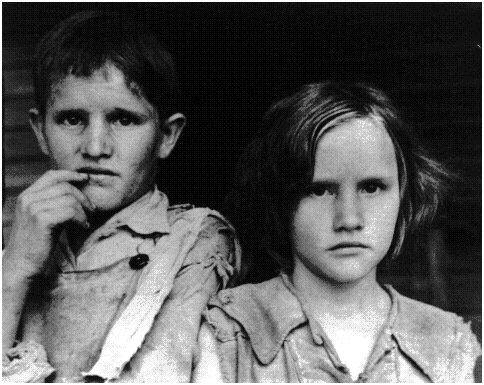
November 2, 2005
Today in History: November 2, 1889
North Dakota and South Dakota were admitted to the United States as the 39th and 40th States.
Happy ... er ... birthday, Dakotas!!!
I drove across the country with my boyfriend years ago. We went to many many states. We saw many beautiful things. We went through mountains and plains and prairies. But the states that touched us the most - the states that, frankly, blew us away ... were the Dakotas.
Weird, but I don't remember the two of us even SPEAKING to one another as we moved our way through the Dakotas. I know we did. But there was something about the landscapes there that struck us dumb. With wonder? Awe? Yes. But something else. Perhaps an awareness of our own smallness. We LOVED the Dakotas.
My memories there are rich, sensoral, and just snippets:
-- Heavy grey clouds pressing in from horizon to horizon ... watching the lightning occuring miles and miles away ...
-- The wet highway stretching out before us to the vanishing point
-- An isolated gas station surrounded by dun-brown fields as far as the eye could see - the neon sign of the gas station gleaming through the rain - desolation - but poetry
-- Rich fields of sunflowers on either side of the highway. The late afternoon light falling across the bobbing yellow heads of the flowers ... the rich dark-brown soil
-- The two small white-headed children we saw sitting on top of a fence - in the middle of nowhere - no grown-ups in sight - and in the paddock (also in the middle of nowhere) were about 10 grazing buffalo. The buffalo being watched over by these small gleaming tow-headed children. Odd. My boyfriend and I talked to them for a while. In blunt simple language.
Something about the landscape in the Dakotas made language seem unnecessary.
And here's an old post I wrote about one of my favorite memories of all time. It's from an experience we had in one of the Dakotas. It says it all. Hovering over this piece is an enormous silence. The silence of the surrounding land, the enormous sky ... It didn't press in on us, it wasn't suffocating ... but it wasn't exactly liberating either. The landscape and the sky FORCED us to be contemplative. FORCED us to BE with ourselves. The silence persisted. Filling it up with silly chit-chat would have been useless because the silence was too big.
My love for the Dakotas is piercing and sensoral - and I was only there for 5 days.
Dakota post below:
Standing on a high windy plain with my first boyfriend as a thunderstorm gathered on the horizon and the light got low, and sickly-green, and so charged with potential you nearly wanted to scream. Waiting for the release. We had been hiking for hours, watching as the day changed, as the sky got more ominous. There had been a massive wind, whipping the tall grass on its side, nearly carrying me away with it. We got some incredible pictures of the approaching storm (we had no business being up on the high plains watching forks of lightning jag their way towards us, but whatever, it was gorgeous) ... but the pictures cannot convey the feeling in the air itself . The hairs on my arm rose up, to meet the electricity in the molecules.
There were no people out there but us. (For obvious reasons. We were idiots.) Just a huge sky, changing on a moment to moment basis, getting fuller and fuller, lower and lower, and GREEN - not black, not purple ... but GREEN ... the sound of the wind in the grass ... the feeling that we were about to get caught out in something pretty enormous and spectacular.
And then, I'll never forget it:
For a brief whooshing moment, everything went still. The wind stopped. As though a giant hand had turned off the wind machine. Hush. A sudden alarming hush fell over the land. My boyfriend and I both stopped, feeling the change. We paused ... holding our breath ...
We were having the time of our lives. We were watching the storm unfold as though it was the best movie we had ever seen. We kept looking at each other, wordlessly, like: hoooly shiiiiit ...
Silence covered the plains (this was the real calm before the storm, turns out - when everything came to a sudden sharp stop ... took a breath ... and then the heavens opened up) ... and in that silence, we heard a sound. Something that, to be honest, I've only heard in movies.
The thundering sound of horses hooves ... galloping horses ... the galloping sound of MANY horses ...
It has got to be one of the most exciting sounds I've ever heard in my life. Even though I've only heard that sound in movies, when it came to my ears, there was a rush of familiarity, and love, and knowing: Yes. That is that sound. I know that sound. Something in my DNA knows that sound intimately. It was thrilling.
We were on the edge of a large dip in the land, a bit off the trail, and the sound came from far below. We walked over to the edge, in the middle of the eerie stillness, all the grass suddenly straight, still, motionless, and looked out over the dip in the land. And there we saw them - we had only heard about them and heard that it was rare to get a glimpse of them - but there they were - a herd of wild horses, racing along the bottom of the plain in a massive herd. There were about 20 of them, galloping like mad things, freaking out because of the storm ... their manes and tails flying, their hooves churning up the dirt ... neighing and whinnying in alarm, bucking and kicking and running ...
I have never seen anything so beautiful, so moving, so unbelievable in my life.
They were fierce, savage, a bit scary, almost mythical. I've seen wild horses like that in my dreams. My fantasies.
We got no pictures, obviously. We couldn't have captured it. We didn't need to capture it.
I love horses anyway, but ... to see wild horses ... and not to see them grazing on a hill ... but to see them AS wild, to see them running ... Oh my God. Like Marlowe said: "the wondrous architecture of the world..."
Boyfriend said to me after we gaped at their frenzy far down the plain for a while, "We should get the hell back to the van. They know something we don't."
And we RAN off the plains, as quickly as we could, as the wind started picking up again, alarmingly, this time cold - a whoosh of cold ... and we made it back to the van before the gods unleashed the torrents upon us in a thunderous crash. Hell broke loose. Massive wind/rain/electrical storm on the high plains.
But I am glad we took the risk. To see those horses. Those spectacular wild horses.
November 1, 2005
Average American
Am I average? Let's see. I got this from Kathy who got it from the Llama Butcher Boys. Fun stuff.
Here's the meme. An average American apparently does all of the following things. See if you are average.
-- Eats peanut butter at least once a week - No. I do not do that.
-- Prefers smooth peanut butter over chunky - No. I do not prefer smooth over chunky. I actually will not eat smooth peanut butter (the texture grosses me out - it's not the taste) - when I DO eat peanut butter, I get the "super chunk" brand. So it's basically like eating granola with a tiny bit of peanut butter sticking it all together.
-- Can name all Three Stooges - Of course! Oh, and go read Steve-O's response to this question at Llama Butchers - because he's RIGHT!
-- Lives within a 20-minute drive of a Wal-Mart - I am SURE this is true. But I don't know where the nearest Wal-Mart is to my house. Since I don't - ahem - have a car - it would be useless information anyway.
-- Eats at McDonald’s at least once a year. No. I do not eat at McDonalds. Maybe "once every 5 years" would be more appropriate.
-- Takes a shower for approximately 10.4 minutes a day. Yes. This is true. I sometimes take 2 showers a day. New York is nasty gross, ya gotta clean that shit off when you come home.
-- Never sings in the shower. WHAT?? The average American never sings in the shower??? What is the problem with you people? Singing in the shower is so damn fun, and so relaxing, that I honestly couldn't start my day without it. Also, it's well known that EVERYBODY sounds like Celine Dion or Bono in the shower. It's a FACT. Your voice sounds AWESOME. This morning I gave an exTREMELY moving version of "Bill" from Show Boat. It brought the house down. You shoulda been there.
-- Lives in a house, not an apartment or condominium. Again, no. I live in an apartment.
-- Has a home valued between $100,000 and $300,000. I'm sorry, I don't speak that language.
-- Has fired a gun. No, I have not fired a gun. Doesn't mean I don't want to - I actually do.
-- Is between 5 feet and 6 feet tall- I believe I am 5'5.
-- Weighs 135 to 205 pounds. Yes.
-- Is between the ages of 18 and 53 Yes.
-- Believes gambling is an acceptable entertainment option. I have mixed feelings about gambling. Not that I don't want OTHER people to gamble if they enjoy it, whatever - go for it - but I don't get the appeal of it AT ALL. I so much don't get the appeal that I have never even bought a lottery ticket. That's how strongly I feel about it. DIDN'T YOU PEOPLE READ "1984"???? But again, if that's how you want to spend your leisure time ... have at it. Same thing with hunting animals for sport. I will NEVER hunt animals for sport. NEVER. I went to Vegas once, and it was a spectacle, and I'm glad I saw it, but seriously - I found the whole thing so depressing that I had a little bit of a bleak "what is life all about" episode in our hotel room afterwards. Maybe I was a gambling addict in a former life. I know that most people who sit around at slot machines are not millionaires - so my lack of funds is not an explanation. I just care about other things, and want to spend the money that I actually HAVE, not theoretical money I will magically get in the future. Also: DIDN'T YOU PEOPLE READ "1984"?????
A small update: I guess I differentiate between things like buying lottery tickets and sitting in front of a slot machine with playing games like poker and blackjack - which actually require some skill. I still don't like to gamble away my money - but I can GET why people like to play poker. But the other kind of gambling? Baffling to me.
-- Grew up within 50 miles of current home. No. This is not true for me.
October 28, 2005
Today in history: October 28, 1886
The Statue of Liberty was unveiled to the public.
A description of that day from Writers Almanac:
The day of the dedication was cold and rainy, but huge crowds came out for the celebration anyway. The hotels were full throughout New York City, and many of the tourists who arrived for the occasion were French. The sculptor Frédéric-Auguste Bartholdi was alone in the statue's crown, waiting for the signal to drop the veil. A boy down below was supposed to wave a white handkerchief at the end of the big speech. The boy accidentally waved his handkerchief before the speech was over and Bartholdi let the curtain drop, revealing the huge copper lady. A salvo of gunshots rang out from all the ships in the harbor. The speaker, who had been boring everybody, just sat down.
Happy birthday, O Lady of the Harbor!
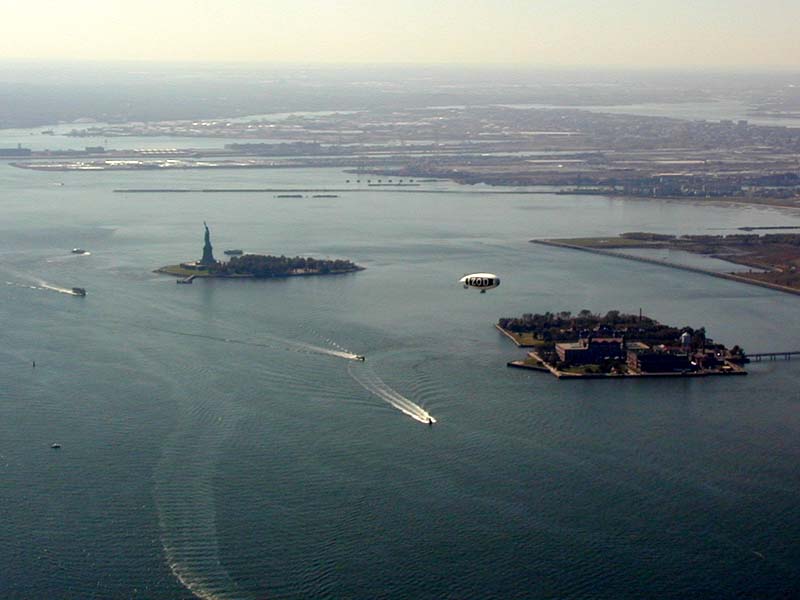
[picture taken from the observation deck of the World Trade Center]
September 4, 2005
No words
I keep seeing this photo everywhere. I just have no words to describe my response to it.
Tanisha Blevin, 5, holds the hand of Nita LeGarde, 105, as they leave the Convention Center in New Orleans.
Look at Ms. LeGarde's purse. Also look at the little boys in the background, being rolled along by giant men with guns. And Tanisha's protective attitude towards Ms. LeGarde. I wonder if they met in the Convention Center or if they knew each other beforehand. I just ... have no words. Tanisha. You are obviously a good good good little soul.
Update:
The photograph reminded me (so often do we search for comparisons, in order to deal with our experiences) of the Norman Rockwell painting The Problem we all Live With - which has to do with the start of desegregating schools:

The authority figures tower up out of the picture. The child is surrounded by filth - literal and figurative. But she remains pure.
God bless them all.
July 20, 2005
Today in history - July 20, 1969
Man walked on the moon for the first time.
I've been reading the original articles right now (here's what was on the front page of The New York Times on July 21, 1969 - !!! Read the article. You can so get the sense of awe and momentous import.)
Here's an incredible photo of their approach to the landing spot, taken from the lunar module:

And here is the telecast of Neil Armstrong's descent:
From The New York Times article:
His first step on the moon came at 10:56:20 P.M., as a television camera outside the craft transmitted his every move to an awed and excited audience of hundreds of millions of people on earth.

On this day. This momentous day!! What a moment!

I was 2 years old. Sadly, I have no memory of this. Anyone who remembers this moment in their lives - please share in the comments. I'd love to hear.
July 4, 2005
July 4, 1826
The 50th anniversary of July 4, 1776.
John Adams and Thomas Jefferson, two of the main architects of the American Revolution, long estranged due to political differences, (and Jefferson referring, in public, to "political heresies" - meaning that he felt there was some orthodoxy and Adams was a heretic) had finally reconciled (engineered by Benjamin Rush, who thought it a shame that these two great patriots, once dear friends, would go their graves without making up). Then followed a 12-year correspondence between the two aging statesmen ... a correspondence that has to be read to be believed.
And then ... on the same day ... which happened to be July 4 ... which happened to be the 50th anniversary of the Declaration of Independence ... they both died. Within hours of each other.
I don't even know what more to say about that.
John Adams' last words were "Jefferson ... still lives." (Dammit, that just kills me.) Amazingly, though, is that Jefferson actually had died a couple of hours earlier.
Thomas Jefferson's last words (and this always just chokes me up - I'm choked up right now): "Is it the fourth?"
Yes, Mr. Jefferson. It is the fourth. And thank you. Thank you both.
Declaration - "Perpetual itching without benefit of scratching to the enemies of America."
From Benson Bobrick's Angel in the Whirlwind: The Triumph of the American Revolution
On the morning of July 4, Jefferson rose before dawn, and at six a.m. calmly noted that the temperature was 68 degrees Farenheit. The wind was southeast and the mercury soon climbed to 76. He soaked his feet in a basin of cold water (as was his morning habit), took some tea and biscuits, and proceeded to Independence Hall. By midafternoon, the collective editing of the declaration (accelerated by a plague of horseflies which had swarmed out of the stables nearby) had come to its happy end. It was voted on and adopted (New York alone abstaining), whereupon Joseph Hewes of North Carolina, who had repeatedly voted against it, "started suddenly upright, and lifting up both his Hands to Heaven as if he had been in a trance, cry'd out, 'It is done! and I will abide by it.'" An old bellman at nearby Christ's Church, waiting for the signal from a boy stationed at the State House door, suddenly heard the lad clap his hands and shout, "Ring! Ring!"
Those who afterward lined up to sign the document (on August 22) had reason to be uneasy. They knew the peril and penalty of treason and were signing, as it were, with halters about their necks. John Hancock, as president of Congress, wrote his name first. "We must be unanimous," he reportedly declared. "There must be no pulling different ways, we must all hang together." "Yes," replied Franklin, 'we must indeed all hang together, or most assuredly we shall all hang separately." Behind them stood Benjamin Harrison, a large, heavy man, who nervously picked up the theme. To the diminutive Eldridge Gerry, he said, "I shall have a great advantage over you, Mr. Gerry, when we are all hung for what we are now doing. From the size and weight of my body I shall die in a few minutes, but from the lightness of your body, you will dance in the air an hour or two before you are dead."Yet there was also an overriding and mystical feeling of providential cover to the boldness of their act. As John Page, a Virginia statesman, put it rather beautifully to Jefferson two weeks after the declaration was adopted, "God preserve the United States. We know the Race is not to the swift nor the Battle to the Strong. Do you not think an Angel rides in the Whirlwind and directs this Storm?"
Congress had copies of the declaration sent to every state Assembly and convention, to the various committees of safety, and to the commanding officers of the Continental Army to proclaim before their troops.
John Adams, writing to Abigail, was moved to prophecy by the transcendent spirit of the hour: "You will think me transported with enthusiasm, but I am not. I am well aware of the toil, and blood, and treausre that it will cost us to maintain the Declaration, and support and defend these States. Yet, through all the gloom, I can see the rays of ravishing light and glory. I can see that the end is more than worth all the means, and that posterity will triumph in that day's transaction, even though we should rue it, which I trust in God we shall not."
It seemed to him, moreover, that it was just as well consideration of the declaration (by which he meant Lee's resolutions) had taken as long as it had:
Time has been given for the whole people maturely to consider the great question of independence, and to ripen their judgment, dissipate their fears, and allure their hopes, by discussing it in newspapers and pamphlets, by debating it in assemblies, conventions, committees of safety and inspection, in town and county meetings, as well as in private conversations, so that the whole people, in every colony of the thirteen, have now adopted it as their own act. This will cement the union, and avoid those heats, and perhaps convulsions, which might have been occasioned by such a Declaration six months ago.With his usual prescience, he predicted the day would be "celebrated by succeeding generations as the great anniversary festival" and "solemnized with pomp and parade, with shows, games, sports, guns, bells, bonfires, and illuminations, from one end of this continent to the other, from this time forward forevermore." (The practice, of course, has been to celebrate the Fourth of July, the day on which the form of the Declaration of Independence was agreed to, rather than the second, when Lee's resolutions were adopted and which Adams actually had in mind.)
Celebrations followed in city, town, village, and country hamlet, with bell ringing, parades, bonfires,and illuminations throughout the land. In New York, after the colonial assembly "at the risque of our lives and fortunes" gave its assent on July 9, Washington had the army brigades drawn up at six PM to hear "the United Colonies of America" declared "Free and Independent States". After the text was read, he saw fit to add, "The General hopes that this important event will serve as a fresh incentive to every officer and solider to act with fidelity and courage, as knowing that now the peace and safety of his country depend, under God, solely on the success of our arms; and that he is now in the service of a state possessed of sufficient power to reward his merit, and to advance him to the highest honors of a free country."
That evening New Yorkers toppled the lead equestrian statue of King George III (errected after repeal of the Stamp Act) from its pedestal on Bowling Green. Eventually, its metal would be melted down and molded into 42,000 cartridges for patriot guns. Citizens in Baltimore, Savannah, and elsewhere likewise burned or buried the king in effigy and tore from their hinges all signs bearing the royal arms. In Worcester, Massachusetts, thirsty patriots repaired to a local tavern and offered toasts to the prosperity of the United States and a dozen other things, including "Perpetual itching without benefit of scratching to the enemies of America." That Sunday, Bishop Willaim White, the patriot rector of Christ's Church in Philadelphia, omitted the usual prayers offered for the king, and one year later, as a sign that God's imprimatur was now stamped upon the radical sermons he preached, a bolt of lightning struck and shattered the Royal Crown of England affixed to the top of the spire.
In just over two years, a new nation had been born.
Declaration - "within the Jeffersonian utopia such choices do not need to be made"
More from Joseph Ellis' book on Thomas Jefferson: American Sphinx: The Character of Thomas Jefferson
The vision he projected in the natural rights section of the Declaration, then, represented yet another formulation of the Jeffersonian imagination. The specific form of the vision undoubtedly drew upon language Locke had used to desscribe the putative conditions of society before governments were established. But the urge to embrace such an ideal society came from deep inside Jefferson himself. It was the vision of a young man projecting his personal cravings for a world in which all behavior was voluntary and therefore all coercion unnecessary, where independence and equality never collided, where the sources of all authority were invisible because they had already been internalized. Efforts on the part of scholars to determine whether Jefferson's prescriptive society was fundamentally individualistic or communal can never reach closure, because within the Jeffersonian utopia such choices do not need to be made. They reconcile themselves naturally.Though indebted to Locke, Jefferson's political vision was more radical than liberal, driven as it was by a youthful romanticism unwilling to negotiate its high standards with an imperfect world. One of the reasons why European commentators on American politics have found American expectations so excessive and American political thinking in general so beguilingly innocent is that Jefferson provided a sanction for youthful hopes and illusions, planted squarely in what turned out to be the founding document of the American republic. The American dream, then, is just that, the Jeffersonian dream writ large.
Declaration - "it does not explain Jefferson's much-debated deletion of 'property' "
More from Joseph Ellis' book on Thomas Jefferson: American Sphinx: The Character of Thomas Jefferson
The most famous section of the Declaration, which has become the most quoted statement of human rights in recorded history as well as the most eloquent justification of revolution on behalf of them, went through the Continental Congress without comment and with only one very minor change. These are, in all probability, the best known fifty-eight words in American history: "We hold these truths to be self evident; that all men are created equal; that they are endowed by their Creator with certain [inherent and] inalienable Rights; that among these are life, liberty & the pursuit of happiness; that to secure these rights, governments are instituted among men, deriving their just powers from the consent of the governed." This is the seminal statement of the American Crered, the closest approximation to political poetry ever produced in American culture. In the nineteenth century Abraham Lincoln, who also knew how to change history with words, articulated with characteristic eloquence the quasi-religious view of Jefferson as the original American oracle: "All honor to Jefferson -- to the man who, in the concrete pressure of a struggle for national independence by a single people, had the coolness, forecaste, and capacity to introduce into a merely revolutionary document, an abstract truth, and so to embalm it there, that today and in all coming days, it shall be a rebuke and a stumbling block to the very harbingers of reappearing tyranny and oppression." The entire history of liberal reform in American can be written as a process of discovery, within Jefferson's words, of a spiritually sanctioned mandate for ending slavery, providing the rights of citizenship to blacks and women, justifying welfare programs for the poor and exanding individual freedoms.
No serious student of either Jefferson or the Declaration of Independence has ever claimed that he foresaw all or even most of the ideological consequences of what he wrote. But the effort to explain what was in his head has spawned almost as many interpretations as the words themselves have generated political movements. Jefferson himself was accused of plagiarism by enemies or jealous friends on so many occasions throughout his career that he developed a standard reply. "Neither aiming at originality of principle or sentiment, nor yet copied from any particular and previous writing," he explained, he drew his ideas from "the harmonizing sentiments of the day, whether expressed in letters, printed essays or in the elementary books of public right, as Aristotle, Cicero, Locke, Sidney, etc."This is an ingeniously double-edged explanation, for it simultaneously disavows any claims to originality and yet insists that he depended upon no specific texts or sources. The image it conjures up is that of a medium, sitting alone at the writing desk and making himself into an instrument for the accumulated wisdom and "harmonizing sentiments" of the ages. It is only a short step from this image to Lincoln's vision of Jefferson as oracle or prophet, receiving the message from the gods and sending it on to us and then to the ages. Given the creedal character of the natural rights section of the Declaration, several generations of American interpreters have felt the irresistible image to bathe the scene in speckled light and cloudy mist, thereby implying that efforts to dispel the veil of mystery represent some vague combination of sacrilege and treason.
Any serious attempt to pierce through this veil must begin by recovering the specific conditions inside that room on Market and Seventh streets in June 1776. Even if we take Jefferson at his word, that he did not copy sections of the Declaration from any particular books, he almost surely had with him copies of his own previous writings, to include Summary View, Causes and Necessities and his three drafts of the Virginia constitution. This is not to accuse him of plagiarism, unless one wishes to argue that an author can plagiarize himself. It is to say that virtually all the ideas found in the Declaration and much of the specific language, especially the grievances against George III, had already found expression in those earlier writings.
Recall the context. The Congress is being overwhelmed with military reports of imminent American defeat in New York and Canada. The full Congress is in session six days a week, and committees are meeting throughout the evenings. The obvious practical course for Jefferson to take was to rework his previous drafts on the same general theme. While it seems almost sacrilegious to suggest that the creative process that produced the Dedclaration was a cut-and-paste job, it strains credulity and common sense to the breaking point to believe that Jefferson did not have these items at his elbow and draw liberally from them when drafting the Declaration.
His obvious preoccupation with the ongoing events at the Virginia convention, which was drafting the Virginia constitution at just this time, is also crucial to remember. Throughout late May and early June couriers moved back and forth between Williamsburg and Philadelphia, carrying Jefferson's drafts for a new constitution to the convention and reports on the debate there to the Continental Congress. On June 12 the Virginians unanimously adopted a preamble drafted by George Mason that contained these words: "All men are created equally free and independent and have certain inherent and natural rights ..., among which are the enjoyment of life and liberty, with the means of acquiring and possessing property, and pursuing and obtaining happiness and safety." The Pennsylvania Gazette published Mason's words the same day they were adopted in Williamsburg. Since Jefferson's version of the same thought was drafted sometime that following week, and since we know that he regarded the unfolding events in Virginia as more significant than what was occurring in Philadelphia and that he was being kept abreast by courier, it also strains credulity to deny the influence of Mason's language on his own.
While that explains the felicitous phrase "pursuit of happiness", which Mason himself could have picked up from several English and American sources, it does not explain Jefferson's much-debated deletion of "property", the conventional third right memorialized in Locke's Second Treatise on Government. He made that choice on his own. He was probably aware that Mason's language had generated spirited opposition from a segment of the planter class in Virginia who worried that it implied a repudiation of slavery; they insisted on an amendment that excluded slaves by adding the qualifying clause "when they enter into a state of society." All this suggests that Jefferson was probably aware of the contradictions between his own version of the natural rights philosophy and the institution of slavery. By dropping any reference to "property" he blurred that contradiction. This helps answer the intriguing question of why no debate over the issue occurred in the Continental Congress, as it did in the Virginia convention. Perhaps the debate over the slave trade provision also served that purpose.
Declaration - "An elegant, if decidedly one-sided, version of recent Anglo-American history"
From Joseph Ellis' book on Thomas Jefferson: American Sphinx: The Character of Thomas Jefferson
This excerpt discusses the three revisions made by Congress (things to be deleted) that bothered Jefferson most.
Most of the debate in the Congress and most of the revisions of Jefferson's draft of the Declaration focused on the long bill of indictment against George III, the section that modern readers care about least. When Jefferson much later insisted that he was not striving for "originality of principle or sentiment" but was seeking only to provide an "expression of the American mind", he was probably referring to this section, which was intended to sum up the past twelve years of colonial opposition to British policy in language designed to make the king responsible for all the trouble. Jefferson had been practicing this list of grievances for more than two years, first in Summary View, then in Causes and Necessities and then in his drafts of the Virginia constitution. "I expected you had ... exhausted the Subject of Complaint against Geo. 3d. and was at a loss to discover what the Congress would do for one to their Declaration of Independence without copying," wrote Edmund Pendleton when he first saw the official version, "but find that you have acquitted yourselves very well on that score."As an elegant, if decidedly one-sided, version of recent Anglo-American history, this section of the Declaration has certainly stood the test of time, providing students of the American Revolution with a concise summary of the constitutional crisis from the colonists' perspective at the propitious moment. As a reflection of Jefferson's thinking, however, it is missing three distinctive and distinctively Jeffersonian perspectives on the conflict. When Jefferson wrote back to friends in Virginia, complaining that critics in the Congress had, as one friend put it, "mangled ... the Manuscript", these were the three major revisions he most regretted.
First, as we noticed earlier, the Congress deleted the long passage blaming George III for waging "cruel war against human nature itself" by establishing slavery in North America; Jefferson also accused the king of blocking colonial efforts to end the slave trade, then "exciting those very people to rise in arms against us ... by murdering the people on whom he has also obtruded them." Several complicated and even tortured ideas are struggling for supremacy here. One can surmise that the members of Congress decided to delete it out of sheer bewilderment, since the passage mixes together an implicit moral condemnation of slavery with an explicit condemnation of the British monarch for both starting it and trying to end it.In his own notes on the debate in Congress Jefferson claimed that the opposition was wholly political. Several southern delegations, especially those of South Carolina and Georgia, opposied any restraint on the importation of slaves, he reported, adding that their "Northern brethren also I believe felt a little tender under those censures; for tho' their people have very few slaves themselves, yet they had been pretty considerable carriers of them to others." Jefferson's clear implication is that he was trying to take a principled stand against both slavery and the slave trade but that a majority of delegates were unprepared to go along with him.
The truth was much messier. With regard to the trade, Jefferson knew from his experience in the House of Burgesses that many established slaveowners in the Tidewater region favored an end of imports because their own plantations were already well stocked and new arrivals only reduced the value of their own slave populations. Ending the trade in Virginia, in short, was not at all synonymous with ending slavery. With regard to slavery itself, Jefferson's formulation made great polemic sense but historical and intellectual nonsense. It absolved slaveowners like himself from any responsibility or complicity in the establishment of an institution that was clearly at odds with the values on which the newly independent American was based. Slavery was another one of those vestiges of feudalism foisted upon the liberty-loving colonists by the evil heir to the Norman Conquest. This was complete fiction, of course, but also completely in accord with Jefferson's urge to preserve the purity of his moral dichotomies and his romantic view of America's uncontaminated origins. Slavery was the serpent in the garden sent there by a satanic king. But the moral message conveyed by this depiction was not emancipation so much as commiseration. Since the colonists had nothing to do with establishing slavery -- they were the unfortunate victims of English barbarism -- they could not be blamed for its continuance. This was less a clarion call to end slavery than an invitation to wash one's hands of the matter.
Second, jefferson tried once again, as he had tried before in Causes and Necessities, to insert his favorite theory of expatriation, claiming that the first settlers came over at their own expense and initiative "unassisted by the wealth or the strength of Great Britian." His obsessive insistence on this theme derived from his devotion to the Saxon myth, which allowed for the neat separation of Whiggish colonists and feudal or absolute English ministers. The tangled history of imperial relations did not fit very well into these political categories, but Jefferson found it much easier to revise the history (i.e., claiming there had never been any colonial recognition of royal or parliamentary authority) than give up his moral dichotomies. Once again his colleagues in the Continental Congress found his argument excessive.
Third, the last excision came toward the very end of Jefferson's draft. It was a rousingly emotional passage with decidedly sentimental overtones that condemned "our British brethren" for sending over "not only souldiers of our common blood, but Scotch & foreign mercenaries to invade and destroy us." It went on: "These facts have given the last stab to agonizing affection, and manly spirit bids us to renounce forever these unfeeling brethren. We must endeavor to forget our former love for them, and to hold them as we hold the rest of mankind, enemies in war, in peace friends; but a communication of grandeur & of freedom it seems is below their dignity. Be it so, since they will have it. The road to happiness & to glory is open to us too. We will tread it apart from them ..." This was a remarkable piece of rhetoric that Jefferson apparently regarded as one of his better creations. Even at the end of his life he was bitter about its deletion. "The pusillanimous idea that we had friends in England worth keeping terms with, still haunted the minds of many," he recalled, and therefore "those passages which conveyed censures on the people of England were struck out, lest they should give them offence."
What strikes the modern reader is not the timidity of the Continental Congress for excising the passage so much as the melodramatic sentimentalism of Jefferson in composing it. As with the expatriation theory, Jefferson was anxious to depict the separation of teh colonies from the British Empire as a decision forced upon the colonists, who are passive victims rather than active agents of revolution. But here the broken bonds are more affective than political. A relationship based on love and trust has been violated, and the betrayed partner, the colonists, is bravely moving forward in life, wounded by the rejection but ready to face alone a glorious future that might otherwise have been shared together. This is a highly idealized and starkly sentimental rendering of how and why emotional separations happen, a projection onto the imperial crisis of the romantic innocence Jefferson had displayed in his adolescent encounters with young women, an all-or-nothing-at-all mentality that the other delegates found inappropriate for a state paper purporting to convey more sense than sensibility.
Declaration - "On July 4 the Congress approved its revised version"
From Joseph Ellis' book on Thomas Jefferson: American Sphinx: The Character of Thomas Jefferson
Jefferson wrote the Declaration of Independence in a matter of a few days -- Adams later remembered it took him only "a day or two" -- and then showed the draft to Adams and Franklin, later recalling that "they were the two members of whose judgments and amendments I wished most to have the benefit." They suggested a few minor revisions (i.e., replacing "sacred & undeniable truths" with "self-evident truths"); then the committee placed the document before the Continental Congress on June 28. After Lee's resoltuion was debated and passed (July 1 - 2), the Congress took up the wording of the Declaration; it made several major changes and excised about one-quarter of the text. During the debate Jefferson sat silently and sullenly, regarding each proposed revision as another defacement. Franklin sat next to him and tried to soothe his obvious pain with the story of a sign painter commissioned by a hatter, who kept requesting more concise language for his sign until nothing was left on the sign but a picture of a hat. On July 4 the Congress approved its revised version and the Declaration of Independence was sent to the printer for publication.
Declaration - "Jefferson guards the American Creed at this inspirational level"
Excerpt from Joseph Ellis' marvelous Founding Brothers: The Revolutionary Generation
Before editorial changes were made by the Continental Congress, Jefferson's early draft made it even clearer that his intention was to express a spiritual vision: ' We hold these truths to be sacred & undeniable; that all men are created equal & independent, that from that equal creation they derive rights inherent & unalienable, among which are the preservation of life, & liberty, & the pursuit of happiness." These are the core articles of faith in the American Creed. Jefferson's authorship of these words is the core of his seductive appeal across the ages, his central claim, on posterity's affection. What, then, do they mean? How do they make magic?
Merely to ask the question is to risk being accused of some combination of treason and sacrilege, since self-evident truths are not meant to be analyzed; that is what being self-evident is all about. But when these words are stripped of the patriotic haze, read straightaway and literally, two monumental claims are being made here. The explicit claim is that the individual is the sovereign unit in society; his natural state is freedom from and equality with all other individuals; this is the natural order of things. The implicit claim is that all restrictions on this natural order are immoral transgressions, violations of what God intended; individuals liberated from such restrictions will interact with their fellows in a harmonious scheme requiring no external discipline and producing maximum human happiness.This is a wildly idealistic message, the kind of good news simply too good to be true. It is, truth be told, a recipe for anarchy. Any national government that seriously attempted to operate in accord with these principles would be committing suicide. But, of course, the words were not intended to serve as an operational political blueprint. Jefferson was not a profound political thinker. He was, however, an utterly brilliant political rhetorician and visionary. The genius of his vision is to propose that our deepest yearnings for personal freedom are in fact attainable. The genius of his rhetoric is to articulate irreconcilable human urges at a sufficiently abstract level to mask their mutual exclusiveness. Jefferson guards the American Creed at this inspirational level, which is inherently immune to scholarly skepticism and a place where ordinary Americans can congregate to speak the magic words together. The Jeffersonian magic works because we permit it to function at a rarefied region where real-life choices do not have to be made.
Declaration - "it was Franklin, or Jefferson himself, who made the small but inspired change in the second paragraph."
Excerpt from David McCullough's John Adams
[Jefferson] worked rapidly [on writing the Declaration of Independence] and, to judge by surviving drafts, with a sure command of his material. He had none of his books with him, nor needed any, he later claimed. It was not his objective to be original, he would explain, only "to place before mankind the common sense of the subject."
"Neither aiming at originality of principle or sentiment, nor yet copied from any particular and previous writing, it was intended to be an expression of the American mind, and to give to that expression the proper tone and spirit called for by the occasion."He borrowed readily from his own previous writing, particularly from a recent draft for a new Virginia constitution, but also from a declaration of rights for Virginia, which appeared in the Pennsylvania Evening Post on June 12. it had been drawn up by George Mason, who wrote that "all men are born equally free and independent, and have certain inherent natural rights � among which are enjoyment of life and liberty." And there was a pamphlet written by the Pennsylvania delegate James Wilson, published in Philadelphia in 1774, that declared, "All men are, by nature equal and free: no one has a right to any authority over another without his consent: all lawful government is founded on the consent of those who are subject to it."
But then Mason, Wilson, and John Adams, no less than Jefferson, were, as they all appreciated, drawing on long familiarity with the seminal works of the English and Scottish writers John Locke, David Hume, Francis Hutcheson, and Henry St. John Bolinbroke, or such English poets as Defoe ("When kings the sword of justice first lay down,/They are no kings, though they possess the crown. / Titles are shadows, crowns are empty things, / The good of subjects is the end of kings"). Or, for that matter, Cicero ("The people's good is the highest law.")
Adams, in his earlier notes for an oration at Braintree, had written, "Nature throws us all into the world equal and alike � The only maxim of a free government ought to be to trust no man to endanger public liberty."�
What made Jefferson's work surpassing was the grace and eloquence of expression. Jefferson had done superbly and in minimum time.
"I was delighted with its high tone and flights of oratory with which it abounded [Adams would recall], especially that concerning Negro slavery, which, though I knew his southern brethren would never suffer to pass in Congress, I certainly would never oppose. There were other expressions which I would not have inserted, if I had drawn it up, particularly that which called the King tyrant � I thought the expression too passionate; and too much like scolding, for so grave and solemn a document; but as Franklin and Sherman were to inspect it afterwards, I thought it would not become me to strike it out. I consented to report it, and do not now remember that I made or suggested a single alteration."
A number of alterations were made, however, when Jefferson reviewed it with the committee, and several were by Adams. Possibly it was Franklin, or Jefferson himself, who made the small but inspired change in the second paragraph. Where, in the initial draft, certain "truths" were described as "sacred and undeniable", a simpler stronger "self-evident" was substituted.
We hold these truths to be self-evident, that all men are created equal�
It was to be the eloquent lines of the second paragraph of the Declaration that would stand down the years, affecting the human spirit as neither Jefferson nor anyone could have foreseen. And however much was owed to the writing of others, as Jefferson acknowledged, or to such editorial refinements as those contributed by Franklin or Adams, they were, when all was said and done, his lines. It was Jefferson who had written them for all time:
We hold these truths to be self-evident, that all men are created equal, that they are endowed by their Creator with certain unalienable rights, that among these are life, liberty, and the pursuit of happiness. That to secure these rights, governments are instituted among men, deriving their just powers from the consent of the governed.
Declaration - "It is hard to think of any way in which the first two paragraphs can be improved"
From Paul Johnson's superb book A History of the American People
Jefferson produced a superb draft, for which his 1774 pamphlet was a useful preparation. All kinds of philosophical and political influences went into it. They were all well-read men and Jefferson, despite his comparative youth, was the best read of all, and he made full use of the countless hours he had spent pouring over books of history, political theory, and government.The Declaration is a powerful and wonderfully concise summary of the best Whig thought over several generations. Most of all, it has an electrifying beginning. It is hard to think of any way in which the first two paragraphs can be improved:
WHEN in the Course of human Events, it becomes necessary for one People to dissolve the Political Bands which have connected them with another, and to assume among the Powers of the Earth, the separate and equal Station to which the Laws of Nature and of Nature's God entitle them, a decent Respect to the Opinions of Mankind requires that they should declare the causes which impel them to the Separation.WE hold these Truths to be self-evident, that all Men are created equal, that they are endowed by their Creator with certain unalienable Rights, that among these are Life, Liberty and the Pursuit of Happiness -- That to secure these Rights, Governments are instituted among Men, deriving their just Powers from the Consent of the Governed, that whenever any Form of Government becomes destructive of these Ends, it is the Right of the People to alter or to abolish it, and to institute new Government, laying its Foundation on such Principles, and organizing its Powers in such Form, as to them shall seem most likely to effect their Safety and Happiness.
The first [paragraph], with its elegiac note of sadness at dissolving the union with Britain and its wish to show "a decent respect to the opinions of mankind" by giving its reasons; the second, with its riveting first sentence, the kernel of the whole: "We hold these truths to be self-evident, that all men are created equal, that they are endowed by their Creator with certain inalienable rights, that among these are life, liberty and the pursuit of happiness." After that sentence, the reader, any reader � even George III � is compelled to read on.
The Committee found it necessary to make few changes in Jefferson's draft. Franklin, the practical man, toned down Jefferson's grandiloquence � thus truths, from being "sacred and undeniable" became "self-evident", a masterly improvement. But in general the four others were delighted with Jefferson's work, as well they might be.
Congress was a different matter because at the heart of America's claim to liberty there was a black hole. What of the slaves? How could Congress say that "all men are created equal" when there were 600,000 blacks scattered through the colonies, and concentrated in some of them in huge numbers, who were by law treated as chattels and enjoyed no rights at all? Jefferson and the other members of the Committee tried to up-end this argument � rather dishonestly, one is bound to say � by blaming American slavery on the British and King George.
The original draft charged that the King had "waged a cruel war against human nature" by attacking a "distant people" and "captivating and carrying them into slavery in another hemisphere". But when the draft went before the full Congress, on June 28, the Southern delegates were not having this. Those from South Carolina, in particular, were not prepared to accept any admission that slavery was wrong and especially the acknowledgment that it violated the "most sacred rights of life and liberty". If the Declaration said that, then the logical consequence was to free all the slaves forthwith. So the slavery passage was removed, the first of many compromises over the issue during the next eighty years, until it was finally resolved inn an ocean of tears and blood. However, the word "equality" remained in the text, and the fact that it did so was, as it were, a constitutional guarantee that, eventually, the glaring anomaly behind the Declaration would be rectified.
The Congress debated the draft for three days. Paradoxically, delegates spent little time going over the fundamental principles it enshrined, because the bulk of the Declaration presented the specific and detailed case against Britain, and more particularly against the King. The Revolutionaries were determined to scrap the pretense that they distinguished between evil ministers and a king who "could do no wrong", and renounce their allegiance to the crown once and for all. So they fussed over the indictment of the King, to them the core of the document, and left its constitutional and ideological framework, apart from the slavery point, largely intact.
This was just as well. If Congress had chosen to argue over Jefferson's sweeping assumptions and propositions, and resolve their differences with verbal compromises, the magic wrought by his pen would surely have been exorcized, and the world would have been poorer in consequence.
As it was the text was approved on July 2, and on July 4 all the colonies formally adopted what was called, to give it its correct title, "The Unanimous Declaration of the Thirteen United States of America". At the time, and often since, Tom Paine was credited with its authorship, which did not help to endear it to the British, where he was (and still is) regarded with abhorrence. In fact he had nothing to do with it directly, but the term "United States" is certainly his.
On July 8 it was read publicly in the State House Yard and the Liberty Bell rung. The royal coat of arms was torn down and burned. On August 2 it was engrossed on parchment and signed by all the delegates. Whereupon (according to John Hancock) Franklin remarked: "Well, Gentlemen, we must now hang together, or we shall most assuredly hang separately."
Happy birthday America

"Well, Gentlemen, we must now hang together, or we shall most assuredly hang separately." -- Benjamin Franklin, upon signing the Declaration of Independence - (according to John Hancock)
The Declaration of Independence of the Thirteen Colonies
In CONGRESS, July 4, 1776
The unanimous Declaration of the thirteen united States of America,
When in the Course of human events, it becomes necessary for one people to dissolve the political bands which have connected them with another, and to assume among the powers of the earth, the separate and equal station to which the Laws of Nature and of Nature's God entitle them, a decent respect to the opinions of mankind requires that they should declare the causes which impel them to the separation.
We hold these truths to be self-evident, that all men are created equal, that they are endowed by their Creator with certain unalienable Rights, that among these are Life, Liberty and the pursuit of Happiness. --That to secure these rights, Governments are instituted among Men, deriving their just powers from the consent of the governed, --That whenever any Form of Government becomes destructive of these ends, it is the Right of the People to alter or to abolish it, and to institute new Government, laying its foundation on such principles and organizing its powers in such form, as to them shall seem most likely to effect their Safety and Happiness. Prudence, indeed, will dictate that Governments long established should not be changed for light and transient causes; and accordingly all experience hath shewn, that mankind are more disposed to suffer, while evils are sufferable, than to right themselves by abolishing the forms to which they are accustomed. But when a long train of abuses and usurpations, pursuing invariably the same Object evinces a design to reduce them under absolute Despotism, it is their right, it is their duty, to throw off such Government, and to provide new Guards for their future security. —Such has been the patient sufferance of these Colonies; and such is now the necessity which constrains them to alter their former Systems of Government. The history of the present King of Great Britain [George III] is a history of repeated injuries and usurpations, all having in direct object the establishment of an absolute Tyranny over these States. To prove this, let Facts be submitted to a candid world.
He has refused his Assent to Laws, the most wholesome and necessary for the public good.
He has forbidden his Governors to pass Laws of immediate and pressing importance, unless suspended in their operation till his Assent should be obtained; and when so suspended, he has utterly neglected to attend to them.
He has refused to pass other Laws for the accommodation of large districts of people, unless those people would relinquish the right of Representation in the Legislature, a right inestimable to them and formidable to tyrants only.
He has called together legislative bodies at places unusual, uncomfortable, and distant from the depository of their public Records, for the sole purpose of fatiguing them into compliance with his measures.
He has dissolved Representative Houses repeatedly, for opposing with manly firmness his invasions on the rights of the people.
He has refused for a long time, after such dissolutions, to cause others to be elected; whereby the Legislative powers, incapable of Annihilation, have returned to the People at large for their exercise; the State remaining in the mean time exposed to all the dangers of invasion from without, and convulsions within.
He has endeavoured to prevent the population of these States; for that purpose obstructing the Laws for Naturalization of Foreigners; refusing to pass others to encourage their migrations hither, and raising the conditions of new Appropriations of Lands.
He has obstructed the Administration of Justice, by refusing his Assent to Laws for establishing Judiciary powers.
He has made Judges dependent on his Will alone, for the tenure of their offices, and the amount and payment of their salaries.
He has erected a multitude of New Offices, and sent hither swarms of Officers to harass our people, and eat out their substance.
He has kept among us, in times of peace, Standing Armies without the consent of our legislatures.
He has affected to render the Military independent of and superior to the Civil power.
He has combined with others to subject us to a jurisdiction foreign to our constitution and unacknowledged by our laws; giving his Assent to their Acts of pretended Legislation:
For Quartering large bodies of armed troops among us:
For protecting them, by a mock Trial, from punishment for any Murders which they should commit on the Inhabitants of these States:
For cutting off our Trade with all parts of the world:
For imposing Taxes on us without our Consent:
For depriving us, in many cases, of the benefits of Trial by Jury:
For transporting us beyond Seas to be tried for pretended offences:
For abolishing the free System of English Laws in a neighbouring Province, establishing therein an Arbitrary government, and enlarging its Boundaries so as to render it at once an example and fit instrument for introducing the same absolute rule into these Colonies:
For taking away our Charters, abolishing our most valuable Laws, and altering fundamentally the Forms of our Governments:
For suspending our own Legislatures, and declaring themselves invested with power to legislate for us in all cases whatsoever.
He has abdicated Government here, by declaring us out of his Protection and waging War against us.
He has plundered our seas, ravaged our Coasts, burnt our towns, and destroyed the lives of our people.
He is at this time transporting large Armies of foreign Mercenaries to compleat the works of death, desolation and tyranny, already begun with circumstances of Cruelty and perfidy scarcely paralleled in the most barbarous ages, and totally unworthy the Head of a civilized nation.
He has constrained our fellow Citizens taken Captive on the high Seas to bear Arms against their Country, to become the executioners of their friends and Brethren, or to fall themselves by their Hands.
He has excited domestic insurrections amongst us, and has endeavoured to bring on the inhabitants of our frontiers, the merciless Indian Savages, whose known rule of warfare, is an undistinguished destruction of all ages, sexes and conditions.
In every stage of these Oppressions We have Petitioned for Redress in the most humble terms: Our repeated Petitions have been answered only by repeated injury. A Prince whose character is thus marked by every act which may define a Tyrant, is unfit to be the ruler of a free people.
Nor have We been wanting in attentions to our British brethren. We have warned them from time to time of attempts by their legislature to extend an unwarrantable jurisdiction over us. We have reminded them of the circumstances of our emigration and settlement here. We have appealed to their native justice and magnanimity, and we have conjured them by the ties of our common kindred to disavow these usurpations, which, would inevitably interrupt our connections and correspondence. They too have been deaf to the voice of justice and of consanguinity. We must, therefore, acquiesce in the necessity, which denounces our Separation, and hold them, as we hold the rest of mankind, Enemies in War, in Peace Friends.
We, therefore, the Representatives of the united States of America, in General Congress, Assembled, appealing to the Supreme Judge of the world for the rectitude of our intentions, do, in the Name, and by the Authority of the good People of these Colonies, solemnly publish and declare, That these United Colonies are, and of Right ought to be Free and Independent States; that they are Absolved from all Allegiance to the British Crown, and that all political connection between them and the State of Great Britain, is and ought to be totally dissolved; and that as Free and Independent States, they have full Power to levy War, conclude Peace, contract Alliances, establish Commerce, and to do all other Acts and Things which Independent States may of right do. And for the support of this Declaration, with a firm reliance on the protection of divine Providence, we mutually pledge to each other our Lives, our Fortunes and our sacred Honor.
John Hancock
Josiah Bartlett
William Whipple
Matthew Thornton
Samual Adams
John Adams
Robert Treat Paine
Elbridge Gerry
Stephen Hopkins
William Ellery
Roger Sherman
Samuel Huntington
William Williams
Oliver Wolcott
William Floyd
Philip Livingston
Francis Lewis
Lewis Morris
Richard Stockton
John Witherspoon
Francis Hopkinson
John Hart
Abraham Clark
Robert Morris
Benjamin Rush
Benjamin Franklin
John Morton
George Clymer
James Smith
George Taylor
James Wilson
George Ross
Caesar Rodney
George Read
Thomas McKean
Samuel Chase
William Paca
Thomas Stone
Charles Carroll of Carrollton
George Wythe
Richard Henry Lee
Thomas Jefferson
Benjamin Harrison
Thomas Nelson, Jr.
Francis Lightfoot Lee
Carter Braxton
William Hooper
Joseph Hewes
John Penn
Edward Rutledge
Thomas Heyward, Jr.
Thomas Lynch, Jr.
Arthur Middleton
Button Gwinnett
Lyman Hall
George Walton
June 13, 2005
The Books: "The Federalist Papers" (Alexander Hamilton, James Madison, John Jay)
Next in my Daily Book Excerpt:
 Next book in my politics/philosophy section is:
The Federalist Papers (Penguin Classics)
Written in a period of months from 1787 to 1788 - spearheaded by Alexander Hamilton (otherwise known as "Sheila's dead boyfriend") - the 85 essays that appeared in 4 of the 5 newspapers in New York were created in order to convince the people of the state of New York why they should agree to the ratification of the Constitution. The Constitutional Congress concluded in the early fall of 1787, with all of the delegates returning to their respective states to begin the ratification process. What ended up being known as "The Federalist Papers" were a blitzkrieg of pro-Constitution propaganda. We are so lucky to have them. If you want to understand the Constitution? Read the Federalist Papers. They set out to explain to the reluctant public (who were, in general, horrified at this idea of an "energetic" national government) why a Constitution was necessary, and the whys and wherefores of each part of it. It's an extraordinary work - hugely important - and really explains the inner workings of the grand experiment called the United States. Hamilton did the lion's share of the work (no surprise there - the man was unbelievable. Was he a mortal man or some freak of nature? His productivity was astonishing). Madison wrote, what is perhaps, the most well-known of the papers - Federalist # 10 (I babbled about it here, on the morning of election day), where he warns against faction and the creating of political parties (although he didn't use that word). Fascinating that Madison later, with the turbulent election of 1800, become a genius at party politics. No matter. His Federalist #10 should be required reading. I want to stand over certain politicians in Washington and feed it to them manually. (Now that's an image.)
Each essay appeared under the name "Publius". The depth and breadth of the essays are amazing, considering the speed in which they were written, and the frequency in which they appeared. Frankly, the entire series takes my breath away.
Hamilton is an interesting case. Born illegitimate (in the immortal words of one of his many enemies, John Adams: "the bastard brat of a Scotch peddler"), in the Caribbean - he came to the United States at the age of 15 to further his education. Because he was not affiliated with any one State, his concerns were different than the other delegates at the Constitution, his outlook completely original. He believed in AMERICA, not in a particular State. His loyalty was to the Union, from the beginning. I think his perspective allowed him to see farther ahead than anybody else. Truly. He predicted the industrial revolution, far before anyone else did, for example. It would no longer be land that would make someone wealthy, it would be money itself. You wonder how he did it - but I really think it had something to do with his foreign birth, his hard-scrabble beginnings, and the fact that he came to America as an outsider.
The excerpt for today is from Federalist # 15, one of a couple of essays in the series where Hamilton takes on the old Articles of Confederation that Congress, with its new Constitution, was looking to get rid of. He predicts that the Articles will not be strong enough to handle the problems of the nation in the future. The States must consolidate.
"they have not suffered a blind veneration for antiquity, for custom, or for names"
"If their works betray imperfections, we wonder at the fewness of them."
Incredible.
EXCERPT FROM The Federalist Papers (Penguin Classics)
As almost every State will be one side or the other, be a frontier, and will thus find in a regard to its safety, an inducement to make some sacrifices for the sake of the general protection; so the States which lie at the greatest distance from the heart of the union, and which of course may partake least of the ordinary circulation of its benefits, will be at the same time immediately contiguous to foreign nations, and will consequently stand on particular occasions, in greatest need of its strength and resources. It may be inconvenient for Georgia or the States forming our western or north eastern borders to send their representatives to the seat of government, but they would find it more so to struggle alone against an invading enemy, or even to support alone the whole expence of those precautions, which may be dictated by the neighborhood of continual danger. If they should derive less benefit therefore from the union in some respects, than the less distant States, they will derive greater benefit from it in other respects, and thus the proper equilibrium will be maintained throughout.
I submit to you my fellow citizens, these considerations, in full confidence that the good sense which has so often marked your decisions, will allow them their due weight and effect; and that you will never suffer difficulties, however formidable in appearance or however fashionable the error on which they may be founded, to drive you into the gloomy and perilous scene into which the advocates for disunion would conduct you. Hearken not to the unnatural voice which tells you that the people of America, knit together as they are by so many chords of affection, can no longer live together as members of the same family; can no longer continue the mutual guardians of their mutual happiness; can no longer be fellow citizens of one great respectable and flourishing empire. Hearken not to the voice which petulantly tells you that the form of government recommended for your adoption is a novelty in the political world; that it has never yet had a place in the theories of the wildest projectors; that it rashly attempts what it is impossible to accomplish.
No my countrymen, shut your ears against this unhallowed language. Shut your hearts against the poison which it conveys; the kindred blood which flows in the veins of American citizens, the mingled blood which they have shed in defence of their sacred rights, consecrate the union, and excite horror at the idea of their becoming aliens, rivals, enemies. And if novelties are to be shunned, believe me the most alarming of all novelties, the most wild of all projects, the most rash of all attempts, is that of rending us in pieces, in order to preserve our liberties and promote our happiness. But why is the experiment of an extended republic to be rejected merely because it may comprise what is new? Is it not the glory of the people of America, that whilst they have paid a decent regard to the opinions of former times and other nations, they have not suffered a blind veneration for antiquity, for custom, or for names, to overrule the suggestions of their own good sense, the knowledge of their own situation, and the lessons of their own experience? To this manly spirit, posterity will be indebted for the possession, and the world for the example of the numerous innovations displayed on the American theatre, in favor of private rights and public happiness.
Had no important step been taken by the leaders of the revolution for which a precedent could not be discovered, no government established of which an exact model did not present itself, the people of the United States might, at this moment, have been numbered among the melancholy victims of misguided councils, must at best have been labouring under the weight of some of those forms which have crushed the liberties of the rest of mankind. Happily for America, happily we trust for the whole human race, they pursued a new and more noble course. They accomplished a revolution which has no parallel in the annals of human society: They reared the fabrics of governments which have no model on the face of the globe. They formed the design of a great confederacy, which it is incumbent on their successors to improve and perpetuate. If their works betray imperfections, we wonder at the fewness of them. If they erred most in the structure of the union; this was the work most difficult to be executed; this is the work which has been new modelled by the act of your Convention, and it is that act on which you are now to deliberate and to decide.
PUBLIUS.
June 1, 2005
Antoine de Saint Exupery's Letter
Thanks to Photon Courier, I came across this page about WWII pilots, which led me to Antoine de Saint Exupéry's "Letter to an American".
You don't want to miss this one.
"Letter to an American", by Antoine de Saint Exupery
I left the United States in 1943 in order to rejoin my fellow flyers of "Flight to Arras". I traveled on board an American convoy. This convoy of thirty ships was carrying fifty thousand of your soldiers from the United States to North Africa. When, on waking, I went up on deck, I found myself surrounded by this city on the move. The thirty ships carved their way powerfully through the water. But I felt something else besides a sense of power. This convoy conveyed to me the joy of a crusade.
Friends in America, I would like to do you complete justice. Perhaps, someday, more or less serious disputes will arise between us. Every nation is selfish and every nation considers its selfishness sacred. Perhaps your feeling of power may, someday, lead you to seize advantages for yourselves that we consider unjust to us. Perhaps, sometime in the future, more or less violent disputes may occur between us. If it is true that wars are won by believers, it is also true that peace treaties are sometimes signed by businessmen. If therefore, at some future date, I were to inwardly reproach those American businessmen, I could never forget the high-minded war aims of your country. I shall always bear witness in the same way to your fundamental qualities. American mothers did not give their sons for the pursuit of material aims. Nor did these boys accept the idea of risking their lives for such material aims. I know - and will later tell my countrymen - that it was a spiritual crusade that led you into the war.
I have two specific proofs of this among others. Here is the first.
During this crossing in convoy, mingling as I did with your soldiers, I was inevitably a witness to the war propaganda they were fed. Any propaganda is by definition amoral, and in other to achieve its aim it makes use of any sentiment, whether noble, vulgar, or base. If the American soldiers had been sent to war merely in order to protect American interests, their propaganda would have insisted heavily on your oil wells, your rubber plantations, your threatened commercial markets. But such subjects were hardly mentioned. If war propaganda stressed other things, it was because your soldiers wanted to hear about other things. And what were they told to justify the sacrifice of their lives in their own eyes? They were told of the hostages hanged in Poland, the hostages shot in France. They were told of a new form of slavery that threatened to stifle part of humanity. Propaganda spoke to them not about themselves, but about others. They were made to feel solidarity with all humanity. The fifty thousand soldiers of this convoy were going to war, not for the citizens of the United States, but for man, for human respect, for man's freedom and greatness. The nobility of your countrymen dictated the same nobility where propaganda was concerned. If someday your peace-treaty technicians should, for material and political reasons, injure something of France, they would be betraying your true face. How could I forget the great cause for which the American people fought?
This faith in your country was strengthened in Tunis, where I flew war missions with one of your units in July 1943. One evening, a twenty-year-old American pilot invited me and my friends to dinner. He was tormented by a moral problem that seemed very important to him. But he was shy and couldn't make up his mind to confide his secret torment to us. We had to ply him with drink before he finally explained, blushing: "This morning I completed my twenty-fifth war mission. It was over Trieste. For an instant I was engaged with several Messerschmitt 109s. I'll do it again tomorrow and I may be shot down. You know why you are fighting. You have to save your country. But I have nothing to do with your problems in Europe. Our interests lie in the Pacific. And so if I accept the risk of being buried here, it is, I believe, in order to help you get back your country. Every man has a right to be free in his own country. But if and my compatriots help you to regain your country, will you help us in turn in the Pacific?"
We felt like hugging our young comrade! In the hour of danger, he needed reassurance for his faith in the solidarity of all humanity. I know that war is indivisible, and that a mission over Trieste indirectly serves American interests in the Pacific, but our comrade was unaware of these complications. And the next day he would accept the risks of war in order to restore our country to us. How could I forget such a testimony? How could I not be touched, even now, by the memory of this?
Friends in America, you see it seems that something new is emerging on our planet. It is true that technical progress in modern times has linked men together like a complex nervous system. The means of travel are numerous and communication is instantaneous - We are joined together materially like the cells of a single body, but this body has as yet no soul. This organism is not yet aware of its unity as a whole. The hand does not yet know that it is one with the eye . And yet it is this awareness of future unity which vaguely tormented this twenty-year-old pilot and which was already at work in him.
For the first time in the history of the world, your young men are dying in a war that - despite all its horrors - is for them an experience of love. Do not betray them. Let them dictate their peace when the time comes! Let that peace reassemble them! This war is honorable; may their spiritual faith make peace as honorable.
I am happy among my french and american comrades. After my first missions in the P-38s Lightnings, they discovered my age. 43 years! What a scandal! Your American rules are inhuman. At 43 years of age one does not fly a fast plane like the Lightnings. The long white beards might get entangled with the controls and cause accidents. I was therefore unemployed for a few months.
But how can one think about France unless one takes some of the risks? There they are suffering, fighting for survival-dying. How can one judge those - even the worst among them - who suffer bodily there, while one is oneself sitting comfortably in some propaganda office here? And how can one love the best among them? To love is to participate, to share. In the end, by virtue of a miraculous and generous decision by General Eaker. My white beard fell off and I was allowed back into my Lightning.
I rejoin Gavoille (French pilot), of "Flight to Arras", who is in charge of our Squadron in your reconnaissance Group. I also met up again with Hochedé, also of "Flight to Arras", whom I had earlier called a Saint of WAR and who was then killed in war, in a Lightning. I rejoin all those of whom I had said that under the jackboot of the invader they were not defeated, but were merely seed buried in a silent earth. After the long winter of the Armistice, the seed sprouted. My squadron once again blossomed in the daylight like a tree. I once again experience the joy of those high-altitude missions that are like deep-sea diving. One plunges into forbidden territory equipped with barbaric instruments, surrounded by a multitude of dials. Above one's own country, one breathes oxygen produced in America. New York Air in a French sky. Isn't that amazing? One flies in that light monster of a Lightning, in which one has the impression not of moving in space but of being present simultaneously everywhere on a whole continent. One brings back photographs that are analyzed by stereoscope like growing organism under a microscope. Those analyzing your photographic material do the work of a bacteriologist. They seek on the surface of the body (France) the traces of the virus that is destroying it. The enemy forts, depots, convoys show up under the lens like minuscule bacilli. One can die of them.
And the poignant meditation while flying over France, so near and yet so far away! One is separated from her by centuries. All tenderness, all memories, all reasons for living are spread out 35,000 feet below, illuminated by sunlight, and nevertheless more inaccessible than any Egyptian treasures locked away in the glass cases of a museum.
Antoine de Saint Exupéry.
May 30, 2005
For Memorial Day ... "we happy few"
This day is called the feast of Crispian:
He that outlives this day, and comes safe home,
Will stand a tip-toe when the day is named,
And rouse him at the name of Crispian.
He that shall live this day, and see old age,
Will yearly on the vigil feast his neighbours,
And say 'To-morrow is Saint Crispian:'
Then will he strip his sleeve and show his scars.
And say 'These wounds I had on Crispin's day.'
Old men forget: yet all shall be forgot,
But he'll remember with advantages
What feats he did that day: then shall our names.
Familiar in his mouth as household words
Harry the king, Bedford and Exeter,
Warwick and Talbot, Salisbury and Gloucester,
Be in their flowing cups freshly remember'd.
This story shall the good man teach his son;
And Crispin Crispian shall ne'er go by,
From this day to the ending of the world,
But we in it shall be remember'd;
We few, we happy few, we band of brothers;
For he to-day that sheds his blood with me
Shall be my brother; be he ne'er so vile,
This day shall gentle his condition:
And gentlemen in England now a-bed
Shall think themselves accursed they were not here,
And hold their manhoods cheap whiles any speaks
That fought with us upon Saint Crispin's day.
-- Henry V, Act IV, sc. iii, by William Shakespeare
A couple more Memorial Day posts:
A thank you.
103 year old WWI Vet celebrating Memorial Day
And here is a beautiful post on learning to remember better.
May 25, 2005
Today in History: "how thirteen independent states could share a government of tripartite powers"
May 25, 1787 ... the Constitutional Convention (although that would only be its name later ... at the time it was called the "Federal Convention") got underway. Most of the delegates had arrived, by that time, from their far-flung states, and May 25th was the first day that they convened in Independence Hall.
At the time, nobody (except perhaps James Madison, Alexander Hamilton, and George Washington) was thinking about creating a constitution, or even considering "consolidating". The thought of "consolidation" was horrifying to most, and the thought of an "energetic national government" was even worse. No. No energetic government. The colonies had had quite enough of being bossed around and wanted to be left alone. However, the original Articles of Confederation were seen by most as inadequate for the present circumstances, so the Convention was called to revise the Articles of Confederation. But Washington, Madison, Hamilton - and a couple of other far-seeing gentlemen - saw the need for an even greater revolution, an even more daring task.
One thing to add into this pot, one important piece of context is Shays Rebellion. The Convention began in May, 1787, and Shays Rebellion had raged from the fall of 1786 into the early spring of 1787. So it was still fresh in the memories of all present. Shays Rebellion had left Washington deeply angered, and shaken. He knew that civilization was a fragile construct, easily destroyed. That was the spectre before Washington's eyes, in terms of Shays Rebellion, and any other future uprising. He was convinced that the Articles of Confederation would not be sufficient to cope. There needed to be a federal government.
Man, it's so hard to get just how controversial and outrageous those words were seen in the context of the time. But Washington was not alone. Hamilton, Madison ... also were in favor of strengthening the central government. The violence of Shays Rebellion was the spark which caused the first rift between Thomas Jefferson and Abigail Adams - good friends up until then. Abigail, in London at the time, was enraged at the Rebellion and she wanted it to be crushed, mercilessly. How dare these people threaten all they had fought for? How DARE they? She wrote a passionate letter to Jefferson about it, expressing her rage, and his response to her contained the now-famous line: "I like a little rebellion now and then. It is like a storm in the atmosphere." She quickly withdrew from his friendship, fearful that his view of government would lead the newly free colonies into complete and utter anarchy.
Anyway - the memory of Shays Rebellion was fresh, and vivid to the men who gathered in the Pennsylvania State House, on May 25th, 1787. Most of them knew they were part of a grand experiment, but many of them didn't know just how much grander and bolder it was about to get. Die-hard patriots, men who had signed the Declaration of Independence, balked at the new idea of this "Constitution", and a consolidated government - with one man at the head of it. One man?? Hadn't they all seen what one man could do?
Regardless: today is the day that the Convention began.
I'll let the marvelous Catherine Drinker-Bowen set the scene (this is from Miracle At Philadelphia
MAY 25TH, 1787
On the twenty-fifth of May, when a quorum was obtained, Washington was unanimously elected president of the Convention and escorted to the chair. From his desk on the raised dais he made a little speech of acceptance, depreciating his ability to give satisfaction in a scene so novel. "When seated," wrote a member, "he declared that as he never had been in such a situation he felt himself embarrassed, that he hoped his errors, as they would be unintended, would be excused. He lamented his want of qualifications."...In the front row near the desk, James Madison sat bowed over his tablet, writing steadily. His eyes were blue, his face ruddy; he did not have the scholar's pallor. His figure was well-knit and muscular and he carried his clothes with style. Though he usually wore black, he has also been described as handsomely dressed in blue and buff, with ruffles at breast and wrist. Already he was growing bald and brushed his hair down to hide it; he wore a queue and powder. He walked with the quick bouncing step that sometimes characterizes men of remarkable energy.
As a reporter Madison was indefatigable, his notes comprehensive, set down without comment or aside. One marvels that he was able at the same time to take so large a part in the debates. It is true that in old age Madison made some emendations in the record to accord with various disparate notes which later came to light; he has been severely criticized for it. Other members took notes at the Convention: Hamilton, Yates and Lansing of New York, McHenry of Maryland, Paterson of New Jersey, Rufus King of Massachusetts, William Pierce of Georgia, George Mason of Virginia. But most of these memoranda were brief, incomplete; had it not been for Madison we should possess very scanty records of the Convention. His labors, he said later, nearly killed him. "I chose a seat," he afterward wrote, "in front of the presiding member, with the other members on my right and left hand. In this favorable position for hearing all that passed, I noted in terms legible and in abbreviations and marks intelligble to myself what was read from the Chair or spoken by the members; and losing not a moment unnecessarily between the adjournment and reassembling of the Convention I was enabled to write out my daily notes during the session or within a few finishing days after its close in the extent and form preserved in my own hand on my files ... I was not absent a single day, nor more than a casual fraction of an hour in any day, so that I could not have lost a single speech, unless a very short one."
It was, actually, a tour de force, not to be published -- and scarcely seen -- until thirty years after the Convention. "Do you know," wrote Jefferson to John Adams from Monticello in 1815, "that there exists in manuscript the ablest work of this kind ever yet executed, of the debates of the constitutional convention of Philadelphia ...? The whole of everything said and done there was taken down by Mr. Madison, with a labor and exactness beyond comprehension." ...
"The State of Georgia, by the grace of God, free, Sovereign and Independent" ... On Friday morning, May twenty-fifth, as soon as Washington had finished his little speech of acceptance from the chair, Major Jackson rose to read aloud the credentials -- so carefully worked over at home -- of the nine states present. It was noticeable that the smallest states spoke out with the loudest voice. Georgia, referred to as "small and trifling" because of her sparse population, announced herself to the Convention with a proud resounding orchestration which left little doubt of her position ... "Sovereign and Independent."
Certain members of the Convention were already heartily sick of the word sovereign. The monster, sovereignty, Washington had called it. The General knew well from what sanction Georgia derived the word. "Each state," the Articles of Confederation had said, "retains its sovereignty, freedom and independence." Without such a clause the Confederacy never would have been achieved ...
Before the Declaration of Independence, no colony had pretensions to independent sovereignty, nor were the states mentioned by name in the body of that document. Yet from the moment peace had been signed, states flaunted their sovereignty as an excuse to do as they pleased. "Thirteen sovereignties," Washington had written, "pulling against each other, and all tugging at the foederal head, will soon bring ruin on the whole."
A General of the Army is not expected to possess so direct and merciless a political eye. Already on May 25, 1787, it looked as if the Federal Convention were to have its fill of sovereignty. The reading aloud of these state credentials was a matter for strict attention; here were signs portent of which way the states were leaning. Madison and Hamilton thought they already knew. Madison had canvassed exhaustively; both men were personally acquainted with many delegates, some of whom had themselves drafted these documents and no doubt would stand by what they had written. Delaware, for instance, whose credentials forbade her deputies to change Article V of the Confederation, giving to each state one vote in Congress and one vote only. Proportional representation was no part of Delaware's scheme. Should the old rule be altered to voting by population, the small states would be blanketed out. Delaware had come prepared to oppose it.
Small states against large, the planting interests of the South against the mercantile money of the North, the regulation of the Western Territory -- these were immediate problems. Not every delegate brought to Philadelphia a comprehension of how thirteen independent states could share a government of tripartite powers: legislative, judicial, executive. James Wilson of Philadelphia understood it and so did Wythe of Virginia. Wilson and Wythe were scholars like Madison. Not only had they acted a part in government bu tthey had thought, red, pondered on the subject; they knew the theory behind the practice. "I am both a citizen of Pennsylvania and of the United States," Wilson told the Convention.
Time would pass before members realized how far the plans of such men as Madison and Hamilton reached, and what the Constitution promised to be. It would be misleading to name thus early the Constitution's "enemies", or to set down this name or that as "against" the Constitution. Five delegates in the end would refuse to sign -- Elbridge Gerry of Massachusetts, Yates and Lansing of New York, George Mason and Edmund Randolph of Virginia -- all men of decided views and each with a different reason for his action. More vociferous than any of these would be Luther Martin of Maryland, who, though out of town on private business at the moment of signing, later declared that had he been present he would have given the document his "solemn negative," even had he "stood single and alone".
Martin did not arrive at the Convention until nearly a month after it met; for the moment, members were spared his boisterous and interminable harangues. On this first Saturday of a quorum the Convention faced a twofold problem: the theoretic question of what kind of government best suited America -- a democracy, a limited monarchy, a republic? -- and the practical problem of creating such a government with all its untried component parts. It was good to review, by way of the state credentials, the aims of the Convention as declared by twelve legislatures. Major Jackson's voice droned on:
"To take into consideration the state of the union ... as to trade and other important objects ... to render the Foederal Government entirely adeuqate to the actual situation ..." When Jackson ceased there was time only to name a committee to prepare standing rules and orders, and to appoint a doorkeeper and messenger. The meeting adjourned for the weekend.
And so endeth May 25th, 1787.
Four months later:
The Scene at the Signing of the Constitution, oil painting (reproduction) by Howard Chandler Christy, 1940
February 22, 2005
"DO YOU BELIEVE IN MIRACLES???? YES!!!"
25 years ago today, the US Olympic hockey team beat the "unbeatable" Russian hockey team at Lake Placid. heh heh LOOK at this photo. Jack O'Callahan, straddling his team-mate (I forget which one - No wait. I remember. It was Mike Ramsey) ... the absolute MAYHEM behind them ... It's a gorgeous thing, ain't it?
Here's the Sports Illustrated article about the "miracle on ice" (thanks to Ken for linking to it.)
Like most of us who were alive at that time, and at all aware of ANYTHING, I have vivid memories of the 1980 Winter Olympics, and of these college kids who came along and slayed the Russian dragon. I was particularly into the whole thing because of the whole Boston factor on the team. My family's from Boston. There was a regional component to our triumph, as well as a national component.
However, it is only in retrospect that I realize just how HUGE the whole thing actually was. I didn't really get the context of it while it was happening - the Cold War context, and also the hockey context - just how huge a dynasty the Russians had, in terms of how they played the game, how they dominated international hockey, etc.
I must say to EVERYONE out there who has televisions (speaking as a chick who has no TV) ... if HBO is playing their documentary "Do You Believe in Miracles" in commemoration of this anniversary - PLEASE see it.
I can't explain why the documentary rocks my world to such a degree, but it does. It GETS the big-ness of the event. It GETS the magnitude. I've seen it 50 times (since I taped it, when I DID have a television).
I remember having a discussion here on this blog about the greatest moment in sports history. The general consensus was that the miracle on ice HAD to be # 1. There were no other contenders, really.
I've posted a bunch of stuff on the miracle on ice, if you're interested.
The greatest moments in sports history
Anyway, to those of you out there who have vivid memories of that Olympics ... and what it meant ... please please share them in the comments.
September 17, 2004
Gladys, you're all right
Just now:
Standing in line at the post office. Very very long line.
A woman asked me if I knew what time it was. I told her. She started talking to me.
Normally, in New York, when someone gets all chatty with you, it is because they are lost, desperately lonely, or mentally ill.
This was not how it was with Gladys (I found out her name at the end). As the conversation flowed (and it did, man, it just flowed) I thought: This could, conceivably, go on forever. And that wouldn't be too bad a thing. It was a GREAT conversation. Very very deep.
Gladys. I may never see her again. But I won't forget her.
She was very petite, and Latin-looking. Obviously bi-lingual, she had a bit of an accent. A beautiful face. Smooth tan skin. She had her black hair slicked across the top of her head, and then it popped out into a curly ponytail in the back. She was young, she almost looked like a teenager. She obviously was from a rough background. Do not ask me how I know, but I just know. You can tell these things.
It's fresh in my mind, so let me just re-create the conversation, as it occurred:
Gladys: "Excuse me, do you have the time?"
Me: "It's blah blah blah."
Gladys: "Oh, thank you. I'm on a break." Pause. "I go to school across the street."
"Oh ... in my building, I think? There's some kind of school on the 2nd floor."
"Actually, that's the administrative offices. The school itself is on the 3rd."
"What kind of school is it?"
"They train people to be medical assistants. That's one of their programs, anyway."
"Is that what you're doing?"
"Yes. They also have other programs ... They train people to be private detectives, they teach people to run laboratories, stuff like that."
"Private detectives ... really? And so ... how long is the program?"
"My program is 9 months long. I have 3 months to go."
"Once you're done, do they place you?"
"Well, then we can apply for internships, and if they like you at the internships, they might hire you. Or - the school will help you get a job. But I don't really want the school to do it for me. I'd rather do the research on jobs on my own, and the kind of internships that would interest me - so that - if they do offer me a job, I would actually want to work there. Know what I mean?"
"Sure. Sounds like a really good program. Do you like it?"
"It's all right. I mean, I think that the program should really reach out more to people like me - people with lower incomes, or no income - They should do outreach, stuff like that, because that's the people who are really looking to make changes in their lives, people who want to ... I guess progress is the word I want. You know? I want to progress. I started out on the bottom, but I want to better myself, and make a better life for myself. This program is perfect for people like me. But they don't advertise, they don't do outreach programs up in the Bronx, where I live, and they really should. People who already have good jobs, and who have money, aren't gonna want to take this program. But whatever."
I joked. "Maybe you should move into the administrative offices. Whip their business into shape."
She laughed. Sharp as a whip, this Gladys. We are standing in the post office, and this perfect stranger is telling me about how she wants to "better herself".
Gladys went on. "I mean, I'm 24 years old. I have a 6 year old son. So obviously, I've made some mistakes in my life. I did some things too soon. And a lot of my friends are the same way, you know? Don't get me wrong, when I was 22, 23, I spent a lot of time looking at myself in the mirror, feeling sorry for myself. 'I can't believe I'm 22 and I'm such a loser!' Stuff like that. But then I realized - wait a minute. Yeah, I've made mistakes..."
"Who hasn't?"
"Exactly! Who hasn't! And you can sit around dwelling on it, or you can pick yourself up, and try to make something out of your life. That's what I am trying to do. It's hard, though, because a lot of the girls in my program are really young - and ... I mean, they come into classes like this--" (Gladys then did a perfect imitation of young hip-hop tough-girl posing) "They snap their gum, they don't talk right, and they're just ..."
"They sound immature."
"Yeah! They're totally immature! They think that stuff should just be given to them, you know what I mean? And, sorry, but they're totally ignorant. Like - I mean ... with everything going on in the world right now ... and not even just the world ... just in our city ... how can you not take stuff seriously? How can you not get that we don't have a lot of time on this earth, and you need to work hard?"
"I so hear what you're saying." (In case you haven't guessed, I DEEPLY loved this girl by this point, and wanted her to keep talking forever.)
She went on. "I try to tell that to my friends. I tell them that we are not our mistakes. Mistakes are things that happen, choices we made ... and we can either moan about it, or we can stand up again."
I said, "And you have a 6 year old son. That's wonderful."
"I don't know about that! I'm exhausted all the time."
"Well, I'm a lot older than you, and I don't have kids."
She burst out laughing. "You're lucky!"
"I see what you mean - it's a grass is always greener thing - but I'm telling you, that biological clock is a real thing!"
"Did you not want to have kids, or...?"
"Guess I just haven't met the right guy yet. I do want kids."
She laughed again. "I don't want anymore."
"But see? That's great! You are DONE! When you're in your 30s, and 40s - you won't have little kids running around, you'll have more freedom. But if I have a kid now, I'm gonna be schlepping them around well into my 50s."
She said, "It's weird - having a kid. It's really scary. Especially now." (I was getting the sense that Gladys was not - to use Rebecca West's term for females only interested in their private concerns - an "idiot". She was well-informed. She continued to reference "especially now", "in a world like ours," "these days" ...)
I said, "I can't even imagine."
She said, "I mean, my God, when that thing happened in Russia ... I just ... my son's school started the next day and I was terrified to take him."
"Oh, God."
"And my friends were all like, 'Oh, it could never happen here!'"
She and I then spoke in unison. Loudly. As though speaking to her group of idiot friends: "YOU HAVE NO IDEA!!"
Gladys said, "How could they think that? Especially now ... especially in this city ... how could they not think that something like that could happen?"
We were now approaching the end of the line.
I said to her, "You know, I have a feeling you're going to do really well in your life."
She can't see it now. Of course she can't. She's in the middle of it! She's just trying to survive right now.
She rolled her eyes, sighed, said something like, "I gotta do SOMETHING, you know?"
I said, "You're gonna do fine. I can tell."
The next service window was called. I held out my hand to her. "I'm Sheila."
She shook my hand. "I'm Gladys."
"Nice to meet you."
"You too, Sheila."
And that was that.
But damn. I really feel like I just met someone completely SUBSTANTIAL. "We are not our mistakes." 24 year old girl.
Talking to her was the random gift of the day.
September 2, 2004
Billy Wilder - America
On arriving in America
I first saw America from the Aquitania. We were delayed half a day, we were up in the harbor. It was a snowing winter night. I stayed with my brother in his little house on Long Island. In the morning when I got up, I looked out the window. It was still snowing. And there was a big, black, stretch Cadillac. Out comes a young boy with a stack of newspapers and he deposited one on the front doorstep. The weather was bad, and the newspaper boy's family was driving him in that big car. But to me, I thought, "What kind of country is this?" Newspapers delivered by Cadillac! It was stunning! I liked it. I loved it.
August 26, 2004
Wide open spaces
Michael Totten's got some breathtaking pictures up right now. God, just go over there and keep scrolling. It's been years since I drove across the country ... it's been years since I've seen a sky that big.
When my boyfriend and I drove cross country (in our soon-to-be-doomed Westfalia) - I was particularly blown away by North Dakota. North Dakota filled me with an exhilaration that I can only describe as spiritual. It was a transcendent landscape. I'm a New England girl, a sea-level kind of girl. Only at the ocean can we see all the way to the horizon. Everywhere else you've got wooded hills, and forested streets, winding up and down ... It's beautiful, but you do not get the perspective. North Dakota was a blasted-open landscape, big land, big sky, and I felt very very small and also very very huge - all at the same time. I loved that state - I'd love to go back.
July 19, 2004
Nov. 25 1783
On November 25, 1783, George Washington and his honor guard (1000 officers) "took back" Manhattan, after the long years of war (when New York City was basically a British garrison). The peace treaty had been signed a year before, France had pledged support and recognition of the new United States, but the redcoats remained in New York, waiting for their written orders from London. George Washington vowed that he would not go home, he would not break up his army, until every last redcoat had left. He didn't want any pockets of the enemy left anywhere, where they could still stir up trouble.
Nov. 25 was that momentous day - the day the American troops marched back into town, after the departure of the British.
The exhausted army marched the long way downtown, through what was now a war-ravaged New York City. People lined the streets, crowding in, throwing laurels in front of Washington's horse, screaming, crying ... a huge display of emotion and reverence that made the typically humble Washington feel uncomfortable. Washington had been in a state of constant war for YEARS by this point. He was handling mutinies, starving soldiers, naked soldiers, unpaid soldiers - on a daily basis ... he had endured unbelievable hardships, just trying to keep the army together. An amazing task, when you think about it in retrospect. Just amazing.
And his absolute certainty that the military had no place in politics. He believed in the separation of the army from the political maneuverings of the Continental Congress ... Amazing. His prescience in this regard. Way before the term "Bonapartism" would even enter the language (of course, because Bonaparte was in the future) - Washington completely understood the dangers of letting the military too close to the government.
Anyway, in the great biography of George Washington I have (by Willard Sterne Randall) I came across this very moving excerpt from a diary of a Manhattan woman, who was in the crowds, watching the parade, that November day.
Here is what she wrote:
We had been accustomed for a long time to military display in all the finish and finery of [British] garrison life. The troops just leaving us were as if equipped for a show and with their scarlet uniforms and burnished arms made a brilliant display. The troops that marched in, on the contrary, were ill-clad and weather-beaten and made a forlorn appearance. But then, they were our troops and as I looked at them and thought upon all they had done and suffered for us, my heart and my eyes were full.
I just find that so MOVING
July 5, 2004
Happy 4th everyone
It's pouring rain here. And while I have a second free, I thought I'd point to two long-ish excerpts I posted last year - having to do with the writing of the Declaration of Independence.
Paul Johnson's book History of the American People (which I can't recommend highly enough!!) spends a lot of time not just on the events of 1776 - but on the philosophical legacy which was already in existence - and would end up being the foundation of the Declaration of Independence. Thomas Jefferson wasn't re-inventing the wheel. There is very little that is original in the Declaration of Independence. All of the concepts had already been articulated by others. He borrowed heavily - mixing it together - a bit from this source, a bit from that ... But it was his particular genius with the written word that lifted it up from a mere statement of revolutionary and political purpose into a treatise on the inherent dignity of mankind.
But I can't explain it as well as Paul Johnson does.
So here are the excerpts. Enjoy.
And happy birthday, America.
July 1, 2004
7 guys, 6 episodes
I am reading a very good book right now which I wanted to recommend. Actually, I think one of you recommended it to me a while back - forgive me that I don't remember who!
It's called Founding Brothers: The Revolutionary Generation, by Joseph J. Ellis. Ellis has taken it upon himself to delve into some of the personalities of that "Revolutionary Generation" - but not in an obnoxious post-modern kind of way. I've read a lot about the Founding Fathers, and I guess you could say I'm kind of a traditionalist. I don't want to read a biography of George Washington that focuses mainly on his penchant to lick his wife's toes, or make some huge Freudian thing about Benjamin's Franklin childhood, or dwell on Alexander Hamilton's sexual weirdness. You get my drift.
I mean - I want to have all of that information, but I don't want to read books that make a fetish of such details. Big difference.
I prefer to just read about what they did, to read excerpts from their letters, to hear about their influences (in terms of historical events, books, philosophers) - and leave the modern interpretations out of it.
Founding Brothers looks at 7 of these men (Alexander Hamilton, Aaron Burr, Thomas Jefferson, Benjamin Franklin, George Washington, John Adams, and James Madison) and it looks at the issues facing the young nation in the context of the time. We know how it all turned out. We have the gift of perspective. These men knew they were making history, but there was no certainty that it would turn out the way it did. The stakes were high, and no one could see what tomorrow looks like. Which is why their fights are so famous, so wrought with tension - because at any moment this great "experiment" could crumble around them. Now some of their language may sound hyperbolic, but seen in the context of the 1780s and 1790s - it makes complete sense.
Ellis chooses six specific episodes as his filter to look at this generation and their challenges.
-- The duel between Hamilton and Burr
-- George Washington's Farewell Address
-- The relationship between John and Abigail Adams
-- The heated debate about where to place the capital
-- Benjamin Franklin trying to force Congress to deal with the issue of slavery and James Madison's resistance to that
-- The correspondence between John Adams and Thomas Jefferson
I love the format. These are all stories I know very well. I could sit around the campfire and tell some of these episodes myself. But the context Ellis provides is quite interesting at points, his interpretation of events is very compelling (especially Alexander Hamilton's personality and his fiscal plan - which, frankly, I find hard to grasp in any way other than in its BROADEST terms). I most like that Ellis is completely uninterested in putting a modern-day spin on events. He wants to see what it was like for them.
When he doesn't know something, he doesn't assume. He has what I would call an exciting and engaging writing style. He makes you feel, in a way, like you are there in that room, listening to the pro and con arguments about slavery ... etc.
Very good read.
June 6, 2004
In memory of the "few, the happy few" - June 6, 1944
This day is called the feast of Crispian:
He that outlives this day, and comes safe home,
Will stand a tip-toe when the day is named,
And rouse him at the name of Crispian.
He that shall live this day, and see old age,
Will yearly on the vigil feast his neighbours,
And say 'To-morrow is Saint Crispian:'
Then will he strip his sleeve and show his scars.
And say 'These wounds I had on Crispin's day.'
Old men forget: yet all shall be forgot,
But he'll remember with advantages
What feats he did that day: then shall our names.
Familiar in his mouth as household words
Harry the king, Bedford and Exeter,
Warwick and Talbot, Salisbury and Gloucester,
Be in their flowing cups freshly remember'd.
This story shall the good man teach his son;
And Crispin Crispian shall ne'er go by,
From this day to the ending of the world,
But we in it shall be remember'd;
We few, we happy few, we band of brothers;
For he to-day that sheds his blood with me
Shall be my brother; be he ne'er so vile,
This day shall gentle his condition:
And gentlemen in England now a-bed
Shall think themselves accursed they were not here,
And hold their manhoods cheap whiles any speaks
That fought with us upon Saint Crispin's day.
-- Henry V, Act IV, sc. iii, by William Shakespeare
May 31, 2004
"Ingratitude is an ugly failing"
"And so many of the blessings and advantages we have, so many of the reasons why our civilization, our culture, has flourished aren't understood; they're not appreciated. And if you don't have any appreciation of what people went through to get, to achieve, to build what you are benefiting from, then these things don't mean very much to you. You just think, well, that's the way it is. That's our birthright. That just happened. [But] it didn't just happen. And at what price? What grief? What disappointment? What suffering went on? I mean this. I think that to be ignorant or indifferent to history isn't just to be uneducated or stupid. It's to be rude, ungrateful. And ingratitude is an ugly failing in human beings."
--David McCullough
April 19, 2004
Hardly a man is now alive Who remembers that famous day and year
Today is the anniversary of the beginning of the American Revolution - which also means it is the anniversary of "the midnight ride of Paul Revere". (Thanks Cold Fury.) Revere started on his ride on the 18th, and rode through until the 19th.
In honor of these extraordinary events, I give to you, Henry Longfellow's wonderful poem: Paul Revere's Ride.
Paul Revere's Ride
Listen my children and you shall hear Of the midnight ride of Paul Revere, On the eighteenth of April, in Seventy-five; Hardly a man is now alive Who remembers that famous day and year. He said to his friend, "If the British march By land or sea from the town to-night, Hang a lantern aloft in the belfry arch Of the North Church tower as a signal light,-- One if by land, and two if by sea; And I on the opposite shore will be, Ready to ride and spread the alarm Through every Middlesex village and farm, For the country folk to be up and to arm."Then he said "Good-night!" and with muffled oar
Silently rowed to the Charlestown shore,
Just as the moon rose over the bay,
Where swinging wide at her moorings lay
The Somerset, British man-of-war;
A phantom ship, with each mast and spar
Across the moon like a prison bar,
And a huge black hulk, that was magnified
By its own reflection in the tide.
Meanwhile, his friend through alley and street
Wanders and watches, with eager ears,
Till in the silence around him he hears
The muster of men at the barrack door,
The sound of arms, and the tramp of feet,
And the measured tread of the grenadiers,
Marching down to their boats on the shore.
Then he climbed the tower of the Old North Church,
By the wooden stairs, with stealthy tread,
To the belfry chamber overhead,
And startled the pigeons from their perch
On the sombre rafters, that round him made
Masses and moving shapes of shade,--
By the trembling ladder, steep and tall,
To the highest window in the wall,
Where he paused to listen and look down
A moment on the roofs of the town
And the moonlight flowing over all.
Beneath, in the churchyard, lay the dead,
In their night encampment on the hill,
Wrapped in silence so deep and still
That he could hear, like a sentinel's tread,
The watchful night-wind, as it went
Creeping along from tent to tent,
And seeming to whisper, "All is well!"
A moment only he feels the spell
Of the place and the hour, and the secret dread
Of the lonely belfry and the dead;
For suddenly all his thoughts are bent
On a shadowy something far away,
Where the river widens to meet the bay,--
A line of black that bends and floats
On the rising tide like a bridge of boats.
Meanwhile, impatient to mount and ride,
Booted and spurred, with a heavy stride
On the opposite shore walked Paul Revere.
Now he patted his horse's side,
Now he gazed at the landscape far and near,
Then, impetuous, stamped the earth,
And turned and tightened his saddle girth;
But mostly he watched with eager search
The belfry tower of the Old North Church,
As it rose above the graves on the hill,
Lonely and spectral and sombre and still.
And lo! as he looks, on the belfry's height
A glimmer, and then a gleam of light!
He springs to the saddle, the bridle he turns,
But lingers and gazes, till full on his sight
A second lamp in the belfry burns.
A hurry of hoofs in a village street,
A shape in the moonlight, a bulk in the dark,
And beneath, from the pebbles, in passing, a spark
Struck out by a steed flying fearless and fleet;
That was all! And yet, through the gloom and the light,
The fate of a nation was riding that night;
And the spark struck out by that steed, in his flight,
Kindled the land into flame with its heat.
He has left the village and mounted the steep,
And beneath him, tranquil and broad and deep,
Is the Mystic, meeting the ocean tides;
And under the alders that skirt its edge,
Now soft on the sand, now loud on the ledge,
Is heard the tramp of his steed as he rides.
It was twelve by the village clock
When he crossed the bridge into Medford town.
He heard the crowing of the cock,
And the barking of the farmer's dog,
And felt the damp of the river fog,
That rises after the sun goes down.
It was one by the village clock,
When he galloped into Lexington.
He saw the gilded weathercock
Swim in the moonlight as he passed,
And the meeting-house windows, black and bare,
Gaze at him with a spectral glare,
As if they already stood aghast
At the bloody work they would look upon.
It was two by the village clock,
When he came to the bridge in Concord town.
He heard the bleating of the flock,
And the twitter of birds among the trees,
And felt the breath of the morning breeze
Blowing over the meadow brown.
And one was safe and asleep in his bed
Who at the bridge would be first to fall,
Who that day would be lying dead,
Pierced by a British musket ball.
You know the rest. In the books you have read
How the British Regulars fired and fled,---
How the farmers gave them ball for ball,
>From behind each fence and farmyard wall,
Chasing the redcoats down the lane,
Then crossing the fields to emerge again
Under the trees at the turn of the road,
And only pausing to fire and load.
So through the night rode Paul Revere;
And so through the night went his cry of alarm
To every Middlesex village and farm,---
A cry of defiance, and not of fear,
A voice in the darkness, a knock at the door,
And a word that shall echo for evermore!
For, borne on the night-wind of the Past,
Through all our history, to the last,
In the hour of darkness and peril and need,
The people will waken and listen to hear
The hurrying hoof-beats of that steed,
And the midnight message of Paul Revere.
In memory
... of all of those who lost their lives on that awful day in this country's history.
Here is the front page of the New York Times: April 19, 1995. Horrific. It still makes me angry when I think about it.
May everyone who lost family members find some peace. Shreds of peace, perhaps, but peace nonetheless.
Michele (who is blogging again, on her own damn terms, hoo-yah!) has some very moving links and images.
March 31, 2004
"There is no joy in Mudville..."
Two towns, apparently, claim to be "Mudville", where the "mighty Casey" struck out, so spectacularly.
Despite assurances from many in the literary world that the poem is not based on truth, two towns INSIST it really happened. Their entire collective identity depends on it.
My nephew Cashel, although he owns Casey at the Bat (of COURSE he does!!) doesn't really like it. I asked him if he wanted me to read it to him during my last visit, and he hesitated just slightly. I said, "No?"
Cashel said bluntly, "It's too sad."
I have to say, I agree. You can't get much sadder than mighty Casey striking out.
For anyone who has no idea what I am talking about, I give to you:
CASEY AT THE BAT
- 1888 - by Ernest ThayerThe outlook wasn't brilliant for the Mudville nine that day,
The score stood four to two, with but one inning more to play.
And then when Cooney died at first, and Barrows did the same,
A pall-like silence fell upon the patrons of the game.
A straggling few got up to go in deep despair. The rest
Clung to that hope which springs eternal in the human breast;
They thought if only Casey could but get a whack at that--
We'd put up even money now with Casey at the bat.
But Flynn preceded Casey, as did also Jimmy Blake,
And the former was a lulu and the latter was a cake;
So upon that stricken multitude grim melancholy sat,
For there seemed but little chance of Casey's getting to the bat.
But Flynn let drive a single, to the wonderment of all,
And Blake, the much despised, tore the cover off the ball;
And when the dust had lifted, and the men saw what had occurred,
There was Johnnie safe at second and Flynn a-hugging third.
Then from 5,000 throats and more there rose a lusty yell;
It rumbled through the valley, it rattled in the dell;
It knocked upon the mountain and recoiled upon the flat,
For Casey, mighty Casey, was advancing to the bat.
There was ease in Casey's manner as he stepped into his place;
There was pride in Casey's bearing and a smile on Casey's face.
And when, responding to the cheers, he lightly doffed his hat,
No stranger in the crowd could doubt 'twas Casey at the bat.
Ten thousand eyes were on him as he rubbed his hands with dirt;
Five thousand tongues applauded when he wiped them on his shirt.
Then while the writhing pitcher ground the ball into his hip,
Defiance gleamed in Casey's eye, a sneer curled Casey's lip.
And now the leather-covered sphere came hurtling through the air,
And Casey stood a-watching it in haughty grandeur there.
Close by the sturdy batsman the ball unheeded sped--
"That ain't my style," said Casey. "Strike one," the umpire said.
From the benches black with people, there went up a muffled roar,
Like the beating of the storm-waves on a stern and distant shore.
"Kill him! Kill the umpire!" shouted some one on the stand;
And it's likely they'd have killed him had not Casey raised his hand.
With a smile of Christian charity great Casey's visage shone;
He stilled the rising tumult; he bade the game go on;
He signaled to the pitcher, and once more the spheroid flew;
But Casey still ignored it, and the umpire said, "Strike two."
"Fraud!" cried the maddened thousands, and echo answered fraud;
But one scornful look from Casey and the audience was awed.
They saw his face grow stern and cold, they saw his muscles strain,
And they knew that Casey wouldn't let that ball go by again.
The sneer is gone from Casey's lip, his teeth are clenched in hate;
He pounds with cruel violence his bat upon the plate.
And now the pitcher holds the ball, and now he lets it go,
And now the air is shattered by the force of Casey's blow.
Oh, somewhere in this favored land the sun is shining bright;
The band is playing somewhere, and somewhere hearts are light,
And somewhere men are laughing, and somewhere children shout;
But there is no joy in Mudville-- mighty Casey has struck out.
March 12, 2004
Quote
"I don't know what you could say about a day in which you have seen four beautiful sunsets."
- John Glenn
February 19, 2004
"Our prevailing passions are ambition and interest"
I am tearing through the biography of Alexander Hamilton at breakneck speed.
At this point, Hamilton has teamed up with Jay and Madison, after the Constitutional wrangling in Philadelphia, a divisive and vicious process - and the three of them have decided to publish a series of newspaper articles, which, of course, will later be known as "The Federalist Papers".
Hamilton's blowing my mind. As he went about to study to become a lawyer in New York, he realized that all of the laws were not written down, there was no handbook, no law book to pass out, in regards to New York State law. And so, of course, Hamilton wrote the book.
It's that kind of single-minded focus, and determination that all of these guys had in common - even though each one of them had a different take on the "how should we move forward" question.
Oh - so this book doesn't exist. But this book NEEDS to exist. So, clearly, I must write it.
It was Hamilton who said, during his 6 hour long speech at the end of the Constitutional Convention, "Decision is true wisdom."
It's that very view that can make him rather terrifying, at times.
But still. I could not be more facinated by him.
Hamilton said:
Take mankind in general, they are vicious - their passions may be operated upon. Take mankind as they are, and what are they governed by? Their passions. There may be in every government a few choice spirits, who may act from more worthy motives [but] one great error is that we suppose mankind more honest than they are. Our prevailing passions are ambition and interest. Wise government should avail itself of those passions, to make them subservient to the public good.
February 16, 2004
President's Day...
My disk problems are solved - and so ... unfurling out below you ... is my tribute to President's Day.
Thomas Jefferson, 1826 "Let the annual return to this day forever refresh our recollections..."
THOMAS JEFFERSON, in a letter to the mayor of Washington, June 24, 1826, declining an invitation to the 4th of July celebration in Washington - (Jefferson died 10 days later):
May it be to the world, what I believe it will be (to some parts sooner, to others later, but finally to all) the signal of arousing men to burst the chains under which monkish ignorance and superstition had persuaded them to bind themselves, and to assume the blessings and security of self-government … All eyes are opened or opening to the rights of man. The general spread of the light of science has already laid open to every view the palpable truth, that the mass of mankind has not been born with saddles on their backs, nor a favored few, booted and spurred, ready to ride them legitimately by the grace of God. These are the grounds of hope for others; for ourselves, let the annual return to this day forever refresh our recollections of these rights, and an undiminished devotion to them.
George Washington's mom, 1784
GEORGE WASHINGTON'S MOTHER to Lafayette, 1784:
"I am not surprised at what George has done, for he was always a good boy."
Adams and Jefferson
From David McCullough's John Adams – on the later-in-life correspondence between Adams and Jefferson:
Once, briefly, a difference in philosophy was touched upon, when Jefferson observed that the "paper transactions" of one generation should "scarcely be considered by succeeding generations," a principle he had earlier stated to Madison as "self-evident," that "'the earth belongs to usufruct to the living': that the dead have neither the power of rights over it." Adams, however, refused to accept the idea that each new generation could simply put aside the past, sweep clean the slate, to suit its own desires. Life was not like that, and if Jefferson thought so, it represented a fundamental difference in outlook.
"The rights of one generation of men must depend, in some degree, on the paper transactions of another," Adams wrote. "The social compact and the laws must be reduced to writing. Obedience to them becomes a national habit and they cannot be changed by revolutions that are costly things. Men will be too economical of their blood and property to have recourse to them very frequently." Jefferson's wish for a "little rebellion now and then to clear the atmosphere," as he had once put it to Abigail, did not stand to reason, Adams was telling him. nor did reason have any bearing on what was happening in France, Adams insisted in another letter:"Reason has been all lost. Passion, prejudice, interest, necessity have governed and will govern; and a century must roll away before any permanent and quiet system will be established … You and I must look down from the battlements of Heaven if we ever have the pleasure of seeing it."
Politics, Jefferson answered, was "a subject I never loved, and now I hate."
1801: The Inauguration of Thomas Jefferson
From David McCullough's John Adams:
On Inauguration Day, Wednesday, March 4, 1801, John Adams made his exit from the President's House and the capital at four in the morning, traveling by public stage under clear skies lit by a quarter moon. He departed eight hours before Thomas Jefferson took the oath of office at the Capitol, and even more inconspicuously than he had arrived, rolling through empty streets past darkened houses …To his political rivals and enemies Adams' predawn departure was another ill-advised act of a petulant old man. But admirers, too, expressed disappointment. A correspondent for the Massachusetts Spy observed in a letter from Washington that numbers of Adams' friends wished he had not departed so abruptly. "Sensible, moderate men of both parties would have been pleased had he tarried until after the installation of his successor. It certainly would have had good effect."
By his presence at the ceremony Adams could have set an example of grace in defeat, while at the same time paying homage to a system whereby power, according to a written constitution, is transferred peacefully. After so vicious a contest for the highest office, with party hatreds so near to igniting in violence, a peaceful transfer of power seemed little short of a miracle. If ever a system was proven to work under extremely adverse circumstances, it was at this inauguration of 1801, and it is regrettable that Adams was not present…"We are all Republicans, we are all Federalists," Jefferson said famously in his inaugural address before a full Senate Chamber, his voice so soft many had difficulty hearing him. A passing tribute to Washington was made before he finished, but of Adams he said nothing…
Whatever Adams' state of mind, he was leaving his successor a nation "with its coffers full," as he wrote, and with "fair prospects of peace with all the world smiling in its face, its commerce flourishing, its navy glorious, its agriculture uncommonly productive and lucrative."
In turbulent dangerous times he had held to a remarkably steady course. He had shown that a strong defense and a desire for peace were not mutually exclusive, but compatible and greatly in the national interest. The new navy was an outstanding achievement…Further, by undercutting [Alexander] Hamilton and making his army useless, he may have saved the country from militarism.
In his four years as President, there had been no scandal or corruption. If he was less than outstanding as an administrator, if he had too readily gone along with the Alien and Sedition Acts, and was slow to see deceit within his own cabinet, he had managed nonetheless to cope with a divided country and a divided party, and in the end achieved a rare level of statesmanship. To his everlasting credit, he chose not to go to war when that would have been highly popular and politically advantageous in the short run. As a result, the country was spared what would almost certainly have been a disastrous mistake…To his dying day he would be proudest of all of having achieved peace. As he would write to a friend, "I desire no other inscription over my gravestone than: 'Here lies John Adams, who took upon himself the responsibility of peace with France in the year 1800.'"
John Adams, 1820 "I wish your nation to be admitted ..."
JOHN ADAMS, 85 years old, 1820 - replying to a letter from Mordecai Noah, a Jewish editor from New York:
I have had occasion to be acquainted with several gentlemen of your nation and to transact business with some of them, whom I found to be men of as liberal minds, as much as honor, probity, generosity, and good breeding as any I have known in any seat of religion or philosophy. I wish your nation to be admitted to all the privileges of citizens in every country in the world. This country has done much, I wish it may do more.
George Washington's farewell speech
An excerpt from George Washington's farewell speech (which actually, it was later discovered, was written by Alexander Hamilton):
The name of AMERICAN, which belongs to you in your national capacity, must always exalt the just pride of patriotism more than any appellation derived from local discriminations.
John Adams: "We ought to support every administration as far as we can..."
JOHN ADAMS:
I think instead of opposing systematically any administration, running down their characters and opposing all their measures, right or wrong, we ought to support every administration as far as we can in justice.
1797 - The Inauguration of John Adams
David McCullough on the inauguration of John Adams (March 4, 1797):
The room was filled to overflowing, every seat taken by members of the House and Senate, justices of the Supreme Court, heads of departments, the diplomatic corps, and many ladies said to have added a welcome note of "brilliancy" to the otherwise solemn occasion.There was a burst of applause when George Washington entered and walked to the dais. More applause followed on the appearance of Thomas Jefferson, who had been inaugurated Vice President upstairs in the Senate earlier that morning, and "like marks of approbation" greeted John Adams, who on his entrance in the wake of the two tall Virginians seemed shorter and more bulky even than usual.
It was a scene few who were present would ever forget.
Here were the three who, more than any others, had made the Revolution, and as many in the audience supposed, it was to be the last time they would ever appear on the same platform. Adams felt as he had when he first appeared before George III – as if he were on stage playing a part. It was, he later told Abigail, "the most affecting and overpowering scene I ever acted in."Jefferson's height was accentuated by a long blue frock coat. Washington was in a dress suit of black velvet. Adams, the plainest of the three, wore a suit of grey broadcloth intentionally devoid of fancy buttons and knee buckles…
Though in print [Adams' inaugural speech] would seem a bit stilted, it was delivered with great force and effect. Stirred by emotion, and in a strong voice, Adams recalled the old ardor of the American Revolution and spoke of the "present happy Constitution" as the creation of "good heads prompted by good hearts." In answer to concerns about his political creed, he expressed total attachment to and veneration for the present system of a free republican government. "What other form of government, indeed, can so well deserve our esteem and love?" He spoke of his respect for the rights of all states, and of his belief in expanded education for all the people, both to enlarge the happiness of life and as essential to the preservation of freedom. The great threats to the nation, Adams warned, were sophistry, the spirit of party, and "the pestilence of foreign influence."
He paid gracious tribute to Washington's leadership… Then, having issued a solemn invocation of the Supreme Being, he stepped down from the platform to a table at the front of the chamber, where Chief Justice Oliver Ellsworth administered the oath of office, Adams energetically repeating the words.
And so Adams became President of the nation that now – with the additions of Vermont, Kentucky and Tennessee – numbered 16 states…
Many in the chamber were weeping, moved by his words, but still more, it seems, by the prospect of Washington's exit from the national stage. "A solemn scene it was indeed," Adams wrote, noting that Washington's face remained as serene and unclouded as the day. "Methought I heard him think, 'Ay! I am fairly out and you are fairly in! See which of us will be the happiest!'"
John Adams, 1793, "unbridled majorities"
JOHN ADAMS, in a 1793 letter, responding to the revolution in France:
Mankind will in time discover that unbridled majorities are as tyrannical and cruel as unlimited despots.
John Quincy Adams: "political heresies"
JOHN QUINCY ADAMS, in a public letter addressed to Thomas Jefferson.
Jefferson had made mention of Edmund Burke's book Reflections on the Revolution in France , and had endorsed it as the answer to "the political heresies that have sprung up among us." -- (This was an obvious reference to John Adams.)
John Quincy Adams went on the attack for his father, and published a letter anonymously in the newspaper:
I am somewhat at a loss to determine what this very respectable gentleman means by political heresies. Does he consider this pamphlet of Mr. Paine's as a canonical book of political scripture? As containing the true doctrine of popular infallibility, from which it would be heretical to depart in one single point? I have always understood, sir, that the citizens of these States were possessed of a full and entire freedom of opinion upon all subjects civil as well as religious; they have not yet established any infallible criterion of orthodoxy, either in church or state … and the only political tenet which they could stigmatize with the name of heresy would be that which should attempt to impose an opinion upon their understandings, upon the single principle of authority.
John Adams as Vice-President
JOHN ADAMS, on being Vice President, in a letter to Abigail:
My country in its wisdom contrived for me the most insignificant office that ever the invention of man contrived or his imagination conceived.
John Adams on "division of the Republic"
JOHN ADAMS:
There is nothing I dread so much as a division of the Republic into two great parties, each arranged under its leader and converting measures in opposition to each other.
Jesus. If he could see us now, he would be horrified.
1789: The Inauguration of George Washington
Exerpt from David McCullough's John Adams:
On the day of his inauguration, Thursday, April 30 1789, Washington rode to Federal Hall in a canary-yellow carriage pulled by six white horses and followed by a long column of New York militia in full dress. The air was sharp, the sun shone brightly, and with all work stopped in the city, the crowds along his route were the largest ever seen. It was as if all New York had turned out and more besides. "Many persons in the crowd," reported the Gazette of the United States "were heard to say they should now die contented – nothing being wanted to complete their happiness … but the sight of the savior of his country."In the Senate Chamber were gathered the members of both houses of Congress, the Vice President, and sundry officials and diplomatic agents, all of whom rose when Washington made his entrance, looking solemn and stately. His hair powdered, he wore a dress sword, white silk stockings, shoes with silver buckles, and a suit of the same brown Hartford broadcloth that Adams, too, was wearing for the occasion. They might have been dressed as twins, except that Washington's metal buttons had eagles on them.
It was Adams who formally welcomed the General and escorted him to the dais. For an awkward moment Adams appeared to be in some difficulty, as though he had forgotten what he was supposed to say. then, addressing Washington, he declared that the Senate and House of Representatives were ready to attend him for the oath of office as required by the Constitution. Washington said he was ready. Adams bowed and led the way to the outer balcony, in full view of the throng in the streets. People were cheering and waving from below, and from windows and rooftops as far as the eye could see. Washington bowed once, then a second time.Fourteen years earlier, it had been Adams who called on the Continental Congress to make the tall Virginian commander-in-chief of the army. Now he stood at Washington's side as Washington, his right hand on the Bible, repeated the oath of office as read by Chancellor Robert R. Livingston of New York, who had also been a member of the Continental Congress.
In a low voice Washington solemnly swore to execute the office of the President of the United States and, to the best of his ability, to "preserve, protect, and defend the Constitution of the United States." Then, as not specified in the Constitution, he added, "So help me God", and kissed the Bible, thereby establishing his own first presidential tradition.
"It is done," Livingston said, and, turning to the crowd, cried out, "Long live George Washington, President of the United States."
George Washington, 1789 "My only ambition is to do my duty in this world"
GEORGE WASHINGTON, to his private secretary David Humphreys, on the eve of his election, in 1789:
It is said that every man has his portion of ambition. I may have mine, I suppose, as well as the rest, but if I know my own heart, my ambition would not lead me into public life; my only ambition is to do my duty in this world as well as I am capable of performing it, and to merit the good opinion of all good men.
George Washington, 1783 "This is the favorable moment"
GEORGE WASHINGTON, letter of (unwelcome) advice sent to governors of the 13 states, 1783 – as the army began to disband. It may have been unwelcome advice to the governors whose attitude was: "It's pretty presumptuous of an army commander to tell us how to set up the country..." But it is obvious, in the following words, why he was chosen as our first President:
Americans are now sole lords and proprietors of a vast tract of continent comprehending all the various soils and climates of the world and abounding with all the necessaries and conveniences of life … Heaven has crowned all other blessings, by giving a fairer opportunity for political happiness, than any other nation has been favored with … This is the time of their political probation; this is the moment when the eyes of the whole world are turned upon them; this is the moment to establish or ruin their national character forever; this is the favorable moment to give such a tone to our federal government as will enable it to answer the ends of its institution; or this may be the ill-fated moment for relaxing the powers of the Union, annihilating the cement of the Confederation and exposing us to become the sport of European politics, which may play one state against another, to prevent their growing importance and to serve their own interested purposes. For, according to the system of policy the states shall adopt at this moment, they will stand or fall; and by their confirmation or lapse it is yet to be decided whether the Revolution must ultimately be considered a blessing or a curse – a blessing or a curse, not to the present age alone, for with our fate will the destiny of unborn millions be involved.[He states that there are 4 requirements for the new America]
First. An indissoluble union of the states under one federal head. Secondly. A sacred regard to public justice (that is, the payment of debts). Thirdly. The adoption of a proper peace establishment (that is, an army and a navy). Fourthly. The prevalence of that pacific and friendly disposition among the people of the Union, which will influence them to forget their local prejudices and policies; to make those mutual concessions, which are requisite to the general prosperity; and, in some instances, to sacrifice their individual advantages to the interest of the community. These are the pillars on which the glorious future of our independency and national character must be supported.
Ben Franklin, 1781 "I cannot give you the sun"
BEN FRANKLIN, 1781 – The following story may be just a rumor handed down over the years, but it is one of my favorites. Franklin was in France, and word came to France of the decisive (and shocking) American victory. Franklin attended a diplomatic dinner shortly thereafter – and, of course, everyone was discussing the defeat of the British, and the victory of America.
The French foreign minister stood, and toasted Louis XVI, "To his Majesty, Louis the Sixteenth, who, like the moon, fills the earth with a soft, benevolent glow.
The British ambassador rose and said, "To George the Third, who, like the sun at noonday, spreads his light and illumines the world."
Franklin rose (reportedly) and countered, "I cannot give you the sun or the moon, but I give you George Washington, General of the armies of the United States, who, like Joshua of old, commanded both the sun and the moon to stand still, and both obeyed."
George Washington, 1780 "we are always working uphill"
GEORGE WASHINGTON, letter of May 31, 1780 – describing one of the things he was learning through the war – the need for a strong central government:
Certain I am unless Congress speak in a more decisive tone, unless they are invested with powers by the several States competent to the great purposes of the war, or assume them as a matter of right, and they and the States respectively act with more energy than they hitherto have done, that our cause is lost. One State will comply with a requisition of Congress, another neglects to do it; a third executes it by halves; and all differ either in the manner, the matter, or so much in point of time, that we are always working up hill; and, while such a system as the present one or rather want of one prevails, we shall ever be unable to apply our strength or resources to any advantage.
George Washington, 1777
GEORGE WASHINGTON, on the self-sacrifice of his soldiers during the hard winter of 1777:
To see men without clothes to cover their nakedness, without blankets to lay on, without shoes, by which their marches might be traced by the blood from their feet, and almost as often without provisions as with; marching through frost and snow, and at Christmas taking up their winter quarters within a day's march of the enemy, without a house or hut to cover them till they could be built, and submitting to it without a murmur, is a mark of patience and obedience which in my opinion can scarce be paralleled.
George Washington: Patriotism "will not endure unassisted by Interest"
GEORGE WASHINGTON
Men may speculate as they will, they may talk of patriotism; they may draw a few examples from current story … but whoever builds upon it as a sufficient basis for conducting a long and bloody war will find themselves deceived in the end … For a long time it may of itself push men to action, to bear much, to encounter difficulties, but it will not endure unassisted by Interest.
Washington and Lafayette, 1777
THE MEETING OF GEORGE WASHINGTON AND MARQUIS DE LAFAYETTE
August 1, 1777 – Washington invited the newly arrived Lafayette to witness a review of the troops – They marched by, ragged, disheveled, shabby:
Washington: We are rather embarrassed to show ourselves to an officer who has just left the army of France.Lafayette: I am here, sir, to learn and not to teach.
John Adams "extravagant popularity"
JOHN ADAMS, in a letter to his daughter Nabby:
If the way to do good to my country were to render myself popular, I could easily do it. but extravagant popularity is not the road to public advantage.
Abigail Adams on George Washington
ABIGAIL ADAMS, on George Washington (lifting a quote Shakespeare):
"Take his character all together, and we shall not look upon his like again."
Abigail Adams to John Quincy Adams, 1786
ABIGAIL ADAMS, in a cautionary letter to her genius future-president son, John Quincy Adams, 1786, during his first semester at Harvard. Abigail had heard through the grapevine that her son could be "a little too decisive and tenacious" in his opinions. She shot off the following letter:
If you are conscious to yourself that you possess more knowledge upon some subjects than others of your standing, reflect that you have had greater opportunities of seeing the world, and obtaining a knowledge of mankind than any of your contemporaries. That you have never wanted a book but it has been supplied to you, that your whole time has been spent in the company of men of literature and science. How unpardonable would it have been in you to have been a blockhead.
Thomas Jefferson: "I like a little rebellion now and then"
THOMAS JEFFERSON, letter to Abigail Adams, 1787, who had written to him, concerned about mob violence in Massachusetts. He responded:
The spirit of resistance to government is so valuable on certain occasions, that I wish it to be always kept alive. I like a little rebellion now and then. It is like a storm in the atmosphere.
John Adams, 1779 - the writing of the Massachusetts Constitution
From David McCullough's John Adams:
On Adams' writing of "A Constitution or Form of Government for the Commonwealth of Massachusetts" – completed on October 30, 1779 (Adams' 44th birthday)
The work was to be his alone, and if ever he had a chance to rise to an occasion for which he was ideally suited, this was it. so many of his salient strengths – the acute legal mind, his command of the English language, his devotion to the ideals of the good society – so much that he knew of government, so much that he had read and written, could now be brought to bear on one noble task …In any event, the result was to be one of the most admirable, long-lasting achievements of John Adams' life…
A tone of absolute clarity and elevated thought was established in the opening lines, in a Preamble, a new feature in constitutions, affirming the old ideal of the common good founded on a social compact:"The end of the institution, maintenance, and administration of government is to secure the existence of the body politic; to protect it; and to furnish the individuals who compose it with the power of enjoying, in safety and tranquility, their natural rights and the blessings of life; and whenever these great objects are not obtained, the people have a right to alter the government, and to take measures necessary for their safety, happiness and prosperity…"
A Declaration of Rights, following the Preamble and preceding the Constitution itself, stated unequivocally that all men were "born equally free and independent" … and that they had certain "natural, essential, and inalienable rights." It guaranteed free elections, and in one of a number of articles borrowed from the constitution of Pennsylvania, guaranteed "freedom of speaking" and "liberty of the press". It provided against unreasonable searches and seizures, and trial by jury. While it did not guarantee freedom of religion, it affirmed the "duty" of all people to worship "the Supreme Being, the great creator and preserver of the universe," and that no one was to "hurt, molested, or restrained in his person, liberty, or estate for worshiping God in the manner most agreeable to the dictates of his own conscience", provided he did not disturb the public peace…
There would be two branches of the legislature, a Senate and a House of Representatives, an executive, the governor, who was to be elected at large annually and have veto power over the acts of the legislature. But it was the establishment of an independent judiciary, with judges of the Supreme Court appointed, not elected, and for life ("as long as they behave themselves well"), that Adams made one of his greatest contributions not only to Massachusetts but to the country, as time would tell.
In addition, notably, there was Section II of Chapter 6, a paragraph headed "The Encouragement of Literature, Etc.", which was like no other declaration to be found in any constitution ever written until then or since. It was entirely Adams' creation, his original contribution to the constitution of Massachusetts and he rightly took great pride in it.
"Wisdom and knowledge, as well as virtue, diffused generally among the body of the people being necessary for the preservation of their rights and liberties; and as these depend on spreading the opportunities and advantages of education in various parts of the country, and among the different orders of the people, it shall be the duty of legislators and magistrates in all future periods of this commonwealth to cherish the interests of literature and the sciences, and all seminaries of them, especially the university at Cambridge, public schools, and grammar schools in the towns; to encourage private societies and public institutions, rewards and immunities, for the promotion of agriculture, arts, sciences, commerce, trades, manufactures, and a natural history of the country; to countenance and inculcate the principles of humanity and general benevolence, public and private charity, industry and frugality, honesty and punctuality in their dealings, sincerity, good humor, and all social affections, and generous sentiments among the people."
It was, in all, a declaration of Adams' faith in education as the bulwark of the good society, the old abiding faith of this Puritan forebears. The survival of the rights and liberties of the people depended on the spread of wisdom, knowledge, and virtue among all the people, the common people, of whom he, as a farmer's son, was one. "I must judge for myself, but how can I judge, how can any man judge, unless his mind has been opened and enlarged by reading," Adams had written in his diary at age 25 …
As had no constitution before, Adams was declaring it the "duty" of government not only to provide education but to "cherish" the interests of literature and science – indeed, the full range of the arts, commerce, trades, manufactures, and natural history …
Because wisdom and education were not sufficient of themselves, he had added the further "duty" of government to "countenance and inculcate" the principles of humanity, charity, industry, frugality, honesty, sincerity – virtue, in sum. And amiability as well – "good humor," as he called it – counted for the common good, the Constitution of Massachusetts was to proclaim, suggesting that such delight in life as Adams had found in the amiable outlook of the French had had a decided influence.
He had written Section II of Chapter 6 in a burst of inspiration, the words "flowing" from his pen, but expected the convention to "show it no mercy," as he later said. "I was somewhat apprehensive that criticism and objections would be made to the section, and particularly that the 'natural history' and 'good humor' would be stricken out." To his surprise and delight, the whole of the paragraph passed intact, and, as he also noted, "unanimously without amendment!"
In the end, the convention approved nearly all of his draft, with only a few notable changes. Preferring what Jefferson had written in the Declaration of Independence, the convention revised the first article of the Declaration of Rights, that all men were "born equally free and independent", to read that all men were "born free and equal", a change Adams did not like and would like even less as time went on. He did not believe all men were created equal, except in the eyes of God, but that all men, for their many obvious differences, were born to equal rights.
The reference to freedom of speech was removed, not to be reinstated until much later, and the worship of God was declared a right of all men, as well as a duty. The legislature was also given power to override the governor's veto, another change Adams regretted, as it was contrary to his belief in a strong, popularly elected executive.
None of the alterations, however, diminished his overall pride in what he and the convention had achieved, and the acclaim it brought. "I take vast satisfaction in the general approbation of the Massachusetts Constitution," he would tell a friend. "If the people are as wise and honest in the choice of their rulers, as they have been in framing a government, they will be happy, and I shall die content with the prospect for my children."
As time would prove, he had written one of the great, enduring documents of the American Revolution. The constitution of the Commonwealth of Massachusetts is the oldest functioning written constitution in the world.
Jefferson on Washington
THOMAS JEFFERSON, on George Washington:
The moderation and virtue of a single character probably prevented this Revolution from being closed, as most others have been, by a subversion of that liberty it was intended to establish.
John Adams to Abigail, July 3, 1776
JOHN ADAMS, in a July 3, 1776 letter to Abigail, after the signing of the Declaration of Independence on July 2:
The Delay of this Declaration to this Time, has many great Advantages attending it. – The Hopes of Reconciliation, which were fondly entertained by Multitudes of honest and well meaning tho weak and mistaken People, have been gradually and at last totally extinguished. – Time has been given for the whole People, maturely to consider the great Question of Independence and to ripen their Judgments, dissipate their Fears, and allure their Hopes, by discussing it in News Papers and Pamphletts, by debating it, in Assemblies, Conventions, Committees of Safety and Inspection, in town and County Meetings, as well as in private Conversations, so that the whole People in every Colony of the 13, have now adopted it, as their own Act. – This will cement the Union, and avoid those Heats, and perhaps Convulsions which might have been occasioned, by such a Declaration Six Months ago.
But the Day is past. The Second Day of July 1776, will be the most memorable Epocha, in the History of America. – I am apt to believe that it will be celebrated, by succeeding Generations, as the great anniversary Festival. It ought to be commemorated, as the Day of Deliverance by solemn Acts of Devotion to God Almighty. It ought to be solemnized with Pomp and Parade, with Shews, Games, Sports, Guns, Bells, Bonfire and Illuminations from one End of this Continent to the other from this Time forward forever more.You will think me transported with Enthusiasm, but I am not. I am well aware of the Toil, and Blood, and Treasure that it will cost Us to maintain this Declaration, and support and defend these States. Yet, through all the Gloom, I can see the Rays of ravishing Light and Glory. I can see that the End is more than worth all the Means, and that Posterity will triumph in that Day's Transaction, even though We should not rue it, which I trust in God We shall not.
Jefferson to Adams 1812 "opinions, which are equally honest on both sides, should not effect personal esteem"
THOMAS JEFFERSON, in a letter to John Adams, 1812
To me then it appears that there have been differences of opinion, and party differences, from the establishment of governments to the present day, and on the same question which now divides our country, that these will continue through all future times: that everyone takes his side in favor of the many, or of the few, according to his constitution and the circumstances in which he is placed, that opinions, which are equally honest on both sides, should not effect personal esteem or social intercourse…nothing new can be added by you or me to what has been said by others, and will be said in every age.
Adams to Jefferson, 1812: "Checks and balances, Jefferson"
JOHN ADAMS, in a letter to Jefferson, 1812:
Whether you or I were right posterity must judge. I never have approved and never can approve the repeal of taxes, the repeal of the judiciary system, or the neglect of the navy. Checks and balances, Jefferson, however you and your party may have ridiculed them, are our only security.
Adams to Jefferson "Who will ever be able to write it?"
FROM THE CORRESPONDENCE OF ADAMS AND JEFFERSON, after they both had been President and mended their relationship:
Adams, in a letter: Who shall write the history of the American Revolution? Who can write it? Who will ever be able to write it?
Jefferson's reply: Nobody, except perhaps its external facts.
Adams to Jefferson: "You are afraid of the one, I the few"
JOHN ADAMS, in a letter to Thomas Jefferson, describing their essential differences:
You are afraid of the one, I, the few. We agree perfectly that the man should have full, fair and perfect representation [in the House]. You are apprehensive of monarchy; I, of aristocracy. I would therefore have given more power to the President and less to the Senate.
August 2, 1776: "My hand trembles, but my heart does not"
Excerpt from David McCullough's John Adams – on the signing of the Declaration of Independence
Apparently, there was no fuss or ceremony on August 2 [1776]. The delegates simply came forward in turn and fixed their signatures. Also a number of the most important figures of Congress were absent – Richard Henry Lee, George Wythe, Oliver Wolcott, Elbridge Gerry – and would sign later. A new representative from New Hampshire, Matthew Thornton, who had not been a member when the Declaration was passed, would sign his name in November, and Thomas McKean of Delaware appears not to have signed until January 1777, which made him the last.
Like the others, Adams and Jefferson each signed with his own delegation, Adams on the right, in a clear and firm plain hand, Jefferson at lower center with a signature more precise and elegant, but equally legible.The fact that a signed document now existed, as well as the names of the signatories, was kept secret for the time being, as all were acutely aware that by taking up the pen and writing their names, they had committed treason, a point of considerably greater immediacy now, with the British army so near at hand.
Whether Benjamin Franklin quipped, "We must all hang together, or most assuredly we shall hang separately" is impossible to know, just as there is no way to confirm the much-repeated story that the diminutive John Hancock wrote his name large so the King might read it without his spectacles. But the stories endured because they were in character, like the remark attributed to Stephen Hopkins of Rhode Island. Hopkins, who suffered from palsy, is said to have observed, on completing his spidery signature, "My hand trembles, but my heart does not."
Abraham Lincoln: "All honor to Jefferson"
ABRAHAM LINCOLN, on Jefferson's writing of the Declaration of Independence:
All honor to Jefferson, to the man who had the coolness, forecast, and capacity to introduce into a merely revolutionary document an abstract truth, and so to embalm it there, that today, and in all coming days, it shall be a rebuke and a stumbling-block to the very harbingers of reappearing tyranny and oppression.
"An Angel rides in the Whirlwind"
JOHN PAGE TO THOMAS JEFFERSON, July 20, 1776 – on the signing of the Declaration of Independence:
God preserve the United States. We know the Race is not to the Swift nor the Battle to the Strong. Do you not think an Angel rides in the Whirlwind and directs this Storm?
Thomas Jefferson: "We hold these truths to be self-evident"
Excerpt from David McCullough's John Adams
[Jefferson] worked rapidly [on writing the Declaration of Independence] and, to judge by surviving drafts, with a sure command of his material. He had none of his books with him, nor needed any, he later claimed. It was not his objective to be original, he would explain, only "to place before mankind the common sense of the subject.""Neither aiming at originality of principle or sentiment, nor yet copied from any particular and previous writing, it was intended to be an expression of the American mind, and to give to that expression the proper tone and spirit called for by the occasion."
He borrowed readily from his own previous writing, particularly from a recent draft for a new Virginia constitution, but also from a declaration of rights for Virginia, which appeared in the Pennsylvania Evening Post on June 12. it had been drawn up by George Mason, who wrote that "all men are born equally free and independent, and have certain inherent natural rights … among which are enjoyment of life and liberty." And there was a pamphlet written by the Pennsylvania delegate James Wilson, published in Philadelphia in 1774, that declared, "All men are, by nature equal and free: no one has a right to any authority over another without his consent: all lawful government is founded on the consent of those who are subject to it."But then Mason, Wilson, and John Adams, no less than Jefferson, were, as they all appreciated, drawing on long familiarity with the seminal works of the English and Scottish writers John Locke, David Hume, Francis Hutcheson, and Henry St. John Bolinbroke, or such English poets as Defoe ("When kings the sword of justice first lay down,/They are no kings, though they possess the crown. / Titles are shadows, crowns are empty things, / The good of subjects is the end of kings"). Or, for that matter, Cicero ("The people's good is the highest law.")
Adams, in his earlier notes for an oration at Braintree, had written, "Nature throws us all into the world equal and alike … The only maxim of a free government ought to be to trust no man to endanger public liberty."…
What made Jefferson's work surpassing was the grace and eloquence of expression. Jefferson had done superbly and in minimum time.
"I was delighted with its high tone and flights of oratory with which it abounded [Adams would recall], especially that concerning Negro slavery, which, though I knew his southern brethren would never suffer to pass in Congress, I certainly would never oppose. There were other expressions which I would not have inserted, if I had drawn it up, particularly that which called the King tyrant … I thought the expression too passionate; and too much like scolding, for so grave and solemn a document; but as Franklin and Sherman were to inspect it afterwards, I thought it would not become me to strike it out. I consented to report it, and do not now remember that I made or suggested a single alteration."
A number of alterations were made, however, when Jefferson reviewed it with the committee, and several were by Adams. Possibly it was Franklin, or Jefferson himself, who made the small but inspired change in the second paragraph. Where, in the initial draft, certain "truths" were described as "sacred and undeniable", a simpler stronger "self-evident" was substituted.
We hold these truths to be self-evident, that all men are created equal…
It was to be the eloquent lines of the second paragraph of the Declaration that would stand down the years, affecting the human spirit as neither Jefferson nor anyone could have foreseen. And however much was owed to the writing of others, as Jefferson acknowledged, or to such editorial refinements as those contributed by Franklin or Adams, they were, when all was said and done, his lines. It was Jefferson who had written them for all time:
We hold these truths to be self-evident, that all men are created equal, that they are endowed by their Creator with certain unalienable rights, that among these are life, liberty, and the pursuit of happiness. That to secure these rights, governments are instituted among men, deriving their just powers from the consent of the governed.
Thomas Jefferson: "John Adams was our Colossus"
THOMAS JEFFERSON, remembering John Adams' speeches at the Continental Congress:
John Adams was our Colossus on the floor. He was not graceful nor elegant, nor remarkably fluent but he came out occasionally with a power of thought and expression, that moved us from our seats.
George Washington, 1775: "the finger of Providence"
GEORGE WASHINGTON, letter to Joseph Reed, early December, 1775, after a disappointing recruiting drive
I have oftentimes thought how much happier I should have been if, instead of accepting the command under such circumstances, I had taken my musket on my shoulder and entered the ranks; or, if I could have justified the measure to posterity and my own conscience, had retired to the back country and lived in a wigwam. If I shall be able to rise superior to these and many other difficulties which might be enumerated, I shall most religiously believe that the finger of Providence is in it to blind the eyes of our enemies, for surely if we get well through this month it must be for want of their knowing the disadvantages which we labor under.
George Washington, 1775: "one and the same Spirit may animate the whole"
GEORGE WASHINGTON, speech on July 4, 1775 – He arrived in Cambridge to take up his post, stood outside Harvard and formally took command of the Continental Army:
The Continental Congress having now taken all the Troops of the several Colonies which have been raised, or which may be hereafter raised for the support and defence of the Liberties of America; into their Pay and Service. They are now the Troops of the UNITED PROVINCES of North America; and it is hoped that all Distinctions of Colonies will be laid aside; so that one and the same Spirit may animate the whole, and the only Contest be, who shall render, on this great and trying occasion, the most essential service to the great and common cause in which we are all engaged.
George Washington, 1775: "a kind of destiny"
GEORGE WASHINGTON, writing to Martha on June 18, 1775, following his nomination as commander in chief
My Dearest:
I now sit down to write to you on a subject which fills me with inexpressible concern, and this concern is greatly aggravated and increased when I reflect upon the uneasiness I know it will give you. It has been determined in Congress that the whole army raised for the defence of the American cause shall be put under my care, and that it is necessary for me to proceed immediately to Boston to take upon me the command of it.You may believe me, my dear Patsy, when I assure you, in the most solemn manner, that, so far from seeking this appointment, I have used every endeavour in my power to avoid it, not only from my unwillingness to part with you and the family, but from a consciousness of its being a trust too great for my capacity, and that I should enjoy more real happiness in one month with you at home than I have the most distant prospect of finding abroad, if my stay were to be seven times seven years.
But as it has been a kind of destiny that has thrown me upon this service, I shall hope that my undertaking is designed to answer some good purpose.
George Washington, 1775: "I do not think myself equal to the command"
GEORGE WASHINGTON – his brief acceptance speech June 15, 1775 to the members of the Continental Congress who had just elected him commander in chief of the Continental troops:
"Lest some unlucky event should happen unfavorable to my reputation, I beg it may be remembered by every gentleman in the room, that I this day declare, with the utmost sincerity, I do not think myself equal to the command."
Abigail Adams on George Washington
ABIGAIL ADAMS, on first meeting Washington in 1774, wrote to John Adams:
You had prepared me to entertain a favorable opinion of him, but I thought the half was not told me. Dignity with ease and complacency, the gentleman and the soldier look agreeably blended in him. Modesty marks every line and feature of his face.
Patrick Henry on George Washington
PATRICK HENRY, on his return home from the first Continental Congress in 1774 was asked whom he thought was the foremost man in the group:
"Colonel Washington is unquestionably the greatest man on that floor."
John Adams, 1774, "The magnanimity and public spirit"
JOHN ADAMS, entry in his diary, 1774, during the first Continental Congress in Philadelphia
There is in the Congress a collection of the greatest men upon this continent in point of abilities, virtues, and fortunes. The magnanimity and public spirit which I see here make me blush for the sordid, venal herd.
Martha Washington, 1774 "George is right; he is always right"
MARTHA WASHINGTON, in a letter written to a relative – on Washington's departure to Philadelphia in 1774 for the first Continental Congress:
I foresee consequences; dark days and darker nights; domestic happiness suspended; social enjoyments abandoned; property of every kind put in jeopardy by war, perhaps; neighbors and friends at variance, and eternal separations on earth possible. But what are all these evils when compared with the fate of which the Port Bill may be only a threat? [The Port Bill was to close the port of Boston – as a punishment for the Boston Tea Party] My mind is made up; my heart is in the cause. George is right; he is always right. God has promised to protect the righteous, and I will trust him.
George Washington, 1774 "clear as the sun in its meridian brightness"
GEORGE WASHINGTON, in a letter written to a friend in 1774
Does it not appear as clear as the sun in its meridian brightness that there is a regular, systematic plan to fix the right and practice of taxation upon us?…Ought we not, then, to put our virtue and fortitude to the severest tests?
John Adams, Dec. 17, 1773: "I consider it as an Epocha in History"
ENTRY IN JOHN ADAMS' DIARY, December 17, 1773 – day after the Boston Tea Party
There is a Dignity, a Majesty, a Sublimity, in this last Effort of the Patriots, that I greatly admire. The People should never rise, without doing something to be remembered – something notable and striking. This Destruction of the Tea is so bold, so daring, so firm, intrepid, and inflexible, and it must have important Consequences, and so lasting, that I can't but consider it as an Epocha in History.
Thomas Jefferson: "[Patrick] Henry spoke as Homer wrote"
From ANGEL IN THE WHIRLWIND, by Benson Bobrick
On May 29, 1765, Patrick Henry rose in the Virginia House of Burgesses to introduce a series of momentous resolutions which he had hastily drafted on a blank leaf of an old law book…Henry accompanied these resolutions with a fiery speech given the next day in which he concluded, "Caesar had his Brutus, Charles the First his Cromwell and George the Third"—amid cries of "Treason" that arose from all sides of the room – "and George the Third," he continued artfully, "may profit by their example. If this be treason, make the most of it!"Thomas Jefferson, then a student at the College of William and Mary, was standing in the doorway and heard Henry speak. "I well remember the cry of treason," Jefferson wrote afterward, "the pause of Mr. Henry at the name of George III, and the presence of mind with which he closed his sentence, and baffled the charge vociferated."…To Jefferson it seemed as if Henry "spoke as Homer wrote".
John Adams
JOHN ADAMS
"I believe in a government of laws not of men."
Thomas Jefferson, 1785 "I tremble for my country when I reflect that God is just"
THOMAS JEFFERSON, a denunciation of slavery, 1785
The whole commerce between master and slave is a perpetual exercise of the most boisterous passions, the most unremitting despotism on the one part, and degrading submissions on the other. Our children see this, and learn to imitate it…The parent storms, the child looks on, catches the lineaments of wrath, puts on the same airs in the circle of smaller slaves, gives a loose to his worst passions, and thus nursed, educated, and daily exercised in tyranny, cannot but be stamped by it with odious peculiarities. The man must be a prodigy who can retain his manners and morals undepraved by such circumstances … if a slave can have a country in this world, it must be any other in preference to that in which he is to be born to live and labor for another … or entail his own miserable condition on the endless generations proceeding from him … Indeed, I tremble for my country when I reflect that God is just: that his justice cannot sleep forever.
Benjamin Franklin 1783 "He means well..."
BENJAMIN FRANKLIN, describing John Adams in a letter of July 22, 1783
He means well for his country, is always an honest man, often a wise one, but sometimes and in some things, absolutely out of his senses.
I love that quote.
Lincoln, "You must kneel to God only"
Excerpt from Jay Winik's April 1865
The next day, April 4 [1965], brought an equally stunning sight. While General Grant was off in hot pursuit of Lee's army, President Abraham Lincoln, in a high silk hat and long black coat, landed at Rocketts in the early afternoon and, accompanied by a naval guard of ten sailors, six in front, four in the rear, set foot on Richmond's vaunted soil and began the nearly two-mile walk up the hill to Capitol Square. But even four long years of continuing war had not prepared the lanky president for the unprecedented reception he was to receive along a simple one-mile stretch. Out came a sound: "Glory to God!" It was a black man working by the dock. Then again: "Glory to God! Glory! Glory!"
Leaving their squalid houses and their tar-paper shacks, an impenetrable cordon of newly freed blacks followed Lincoln down the rubble-strewn streets, starting with a handful and swelling into a thousand. "Bless the Lord!" they shouted. "The great Messiah! I knowed him as soon as I seed him. He's in my heart four long years. Come to free his children from bondage. Glory hallelujah." And Lincoln replied, "You are free. Free as air." "I know I am free," answered one old woman, "for I have seen Father Abraham and felt him."One of Lincoln's aides asked the mass to step aside and allow the president to proceed, but to no avail. "After being so many years in the desert without water," a man said happily, "it is mighty pleasant to be looking at las' on our spring of life." Weeping for joy, they strained to touch his hand; dizzy with exultation, they brushed his clothing to see that he was real; fearing that it was only a dream, they wiped their tears to make sure they were in fact looking out upon his face. Moved, Lincoln ignored his bodyguards and waded deeper into the thickening flock.
One black man, overcome by emotion, dropped to his knees, prompting the president to conduct a curbside colloquium on the meaning of emancipation. "Don't kneel to me," said the president. "That is not right. You must kneel to God only, and thank Him for the liberty you will enjoy hereafter."
Lincoln, 1865 "My God! My God!"
Excerpt from Jay Winik's April 1865:
On March 24, [1865] the Union president came to City Point, to meet with his highest lieutenants – General in Chief US Grant, General William Tecumseh Sherman and Admiral David Dixon Porter – to discuss exactly the core of that crisis: how the Federals would corner Lee. It was billed as a vacation. But he also wanted to be near the battle, to see with his own eyes the forces and the weapons, to read the wires, and to visualize the lines. He would stay a full two weeks …It was, arguably, the most important meeting a president has ever had with his combat generals in the history of the country.
Grant, now preparing to launch a final assault against Petersburg, assured Lincoln that the end was at last within reach. Sherman, the loquacious, hot-tempered redhead, agreed.
Lincoln desperately wanted to be convinced, but he could not shake his own overriding fears, that somehow victory would slip through their hands, that Lee would break away from Grant and lead his forces into North Carolina … Nor did Lincoln's fears concern lee alone. "Johnson," he bluntly told Sherman, might slip out of his grasp and "be off south with those hardy troops of his." He gloomily continued, warning the general, "Yes, he will get away if he can, and you will never catch him until miles of travel and many bloody battles."
Lincoln's lieutenants shared his foreboding. Grant would later describe this time as "the most anxious of my experience," confessing, "I was afraid every morning, that I would wake from my sleep to hear that Lee had gone … and the war prolonged for another year."…
"Must more blood be shed?" Lincoln asked. "Cannot this bloody battle be avoided?" No, came the answer. Both generals thought not. Lee had foiled them before when the odds were longest. And, Lee being Lee, they curtly reminded Lincoln, there was likely to be "one more desperate and bloody battle."
"My God," Lincoln instantly interjected, "my God! Can't you spare more effusions of blood? We have had so much of it!"
But in truth, the answer to that heartfelt question resided with the selfsame man who was doing the asking, Abraham Lincoln. Indeed, it had always been Lincoln's question to ask and answer. For the Union president, who had spent many months pondering this very subject, how the war would end was every bit as crucial as how it had been prosecuted. And its resolution hinged on the most delicate balancing act of the entire conflict: the potentially irreconcilable contradictions of the total war now being waged by Sherman and Grant directly clashing with his cherished notion of "Union"; the moral fervor over slave emancipation and suffrage colliding with the urgent practicality of quickly healing the nation; and the gnawing concern that these two great sets of goals could, in the final months and final weeks and final days, drift dangerously apart rather than unite in tandem.
In fact, if the United States were truly to be reunited as one nation, Lincoln believed deeply that the war must not conclude with wholesale slaughter, nor could it slowly dwindle into barbarism or inquisition or mindless retaliation. All, he felt, would bode ill. To unite the country anew, it must be marked by reconciliation, by the lubricants of civil order, by a rejuvenated sense of what Lincoln termed on the River Queen the "rights as citizens of a common country." For this reason, as Admiral Porter would later observe, Lincoln now "wanted peace on almost any terms."
Wringing his hands, Lincoln thus enunciated to Grant and Sherman what would become known as the River Queen Doctrine, offering the South the most generous terms: "to get the deluded men of the rebel armies disarmed and back to their homes … Let them once surrender and reach their homes, [and] they won't take up arms again." And, further, "Let them all go, officers and all, I want submission and no more bloodshed … I want no one punished; treat them liberally all around. We want those people to return to their allegiance to the Union and submit to the laws."
Lincoln, 1865 "with charity for all"
ABRAHAM LINCOLN, March 4, 1865 Inaugural address
With malice toward none; with charity for all; with firmness in the right, as God gives us to see the right, let us strive to finish the work we are in; to bind up the nation's wounds; to care for him who shall have borne the battle … to do all which may achieve and cherish a just and lasting peace, among ourselves, and with all nations.
"I am obnoxious, suspected and unpopular. You are very much otherwise."
Conversation between Thomas Jefferson and John Adams, regarding who should be the author of the Declaration of Independence. (This is how Adams remembered it occurring, years later. Jefferson had no such memory. regardless – I love it, and choose to believe that this exchange did take place.)
John Adams insisted that the author be Jefferson.
Jefferson: You should do it.
Adams: Oh no.
Jefferson: Why will you not?
Adams: I will not.
Jefferson: Why?
Adams: Reasons enough.
Jefferson: What can be your reasons?
Adams: Reason first: you are a Virginian and a Virginian ought to appear at the head of this business. Reason second: I am obnoxious, suspected and unpopular. You are very much otherwise. Reason third: You can write ten times better than I can.
Jefferson: Well, if you are decided, I will do as well as I can.
Thomas Jefferson "keep within yourself"
THOMAS JEFFERSON, to his grandson:
When I hear another express an opinion which is not mine, I say to myself, he has a right to his opinion, as I to mine. Why should I question it. His error does me no injury, and shall I become a Don Quixote, to bring all men by force of argument to one opinion? Be a listener only, keep within yourself, and endeavor to establish with yourself the habit of silence, especially in politics.
John Adams, 1776 "government under the people..."
JOHN ADAMS, letter to Abigail, May 1776
I have reasons to believe that no colony which shall assume a government under the people, will give it up.
Jefferson vs. Adams
From David McCullough's John Adams
[Thomas] Jefferson was devoted to the ideal of improving mankind but had comparatively little interest in people in particular. [John] Adams was not inclined to believe mankind improvable, but was certain it was important that human nature be understood.
John Adams, 1776 "The middle way"
JOHN ADAMS, letter to General Horatio Gates, 1776
The middle way is no way at all. If we finally fail in this great and glorious contest, it will be by bewildering ourselves in groping for the middle way.
John Adams, 1774
JOHN ADAMS to Jonathan Sewall, July 1774
Swim or sink, live or die, survive or perish, [I am] with my country. You may depend upon it.
John Adams, 1755 "Be not surprised..."
JOHN ADAMS, letter to Nathan Webb, October 12, 1755 – while Adams was a student at Harvard:
Soon after the Reformation a few people came over into the new world for conscience sake. Perhaps this (apparently) trivial incident may transfer the great seat of empire into America. It looks likely to me. For if we can remove the turbulent Gallics, our people according to exactest computations, will in another century, become more numerous than England itself. Should this be the case, since we have (I may say) all the naval stores of the nation in our hands, it will be easy to obtain the mastery of the seas, and then the united force of all Europe, will not be able to subdue us. The only way to keep us from setting up for ourselves is to disunite us. Divide et impera. Keep us in distinct colonies, and then, some great men in each colony, desiring the monarchy of the whole, they will destroy each others' influence and keep the country in equlibrio.Be not surprised that I am turned politician.
DAMN
I had an entire President's Day Blitzkrieg planned - I have compiled an obsessive amount of quotes from all my favorite guys (Adams, Jefferson, Washington, Lincoln, etc.) and it's all on a damn disc - which worked at home - but now suddenly - at this Kinko's - the disc "cannot be read".
Grrrrrrrrr.
I will overcome - I will figure it out. There's so much good stuff TRAPPED on the stupid disc.
Happy Presidents Day.
February 12, 2004
Trivia Question...
Now no Google cheating!! Scout's honor!
Here's the question:
What was the largest single building in the British American colonies - at the time of the American Revolution?
February 2, 2004
Paul Revere and the phenomenon of 'connectors'
I spoke below of my friend Mitchell, as an "ultimate connector".
Malcolm Gladwell's book The Tipping Point (a treatise on the phenomenon of epidemics - crime waves, fashion trends, etc... It's very interesting) dissects what it is to be a "connector" - one of those special (and rare) people who know a lot of people, but it's not just about having a huge address book. It's about having a gift for bringing people together, it's about being the connecting link between multiple over-lapping worlds.
The whole blog-epidemic could probably be traced back to one or two "Connectors".
Malcolm Gladwell fills his book with interesting examples from real life, but one of my favorite examples he uses is Paul Revere. Paul Revere as a "Connector". It wasn't just that he went on his famous ride, and rallied the troops - it was that he was the kind of person who could galvanize others, who knew EVERYBODY, and everybody knew him ...
Read on. It's very interesting.
Paul Revere's ride is perhaps the most famous historical example of a word-of-mouth epidemic. A piece of extraordinary news traveled a long distance in a very short time, mobilizing an entire region to arms ...At the same time that Revere began his ride north and west of Boston, a fellow revolutionary -- a tanner by the name of William Dawes -- set out on the same urgent errand, working his way to Lexington via the towns west of Boston. He was carrying the identical message, through just as many towns over just as many miles as Paul Revere. But Dawes's ride didn't set the countryside afire. The local militia leaders weren't altered. In fact, so few men from one of the main towns he rode through -- Waltham -- fought the following day that some subsequent historians concluded that it must have been a strongly pro-British community. It wasn't. The people of Waltham just didn't find out the British were coming until it was too late. If it were only the news itself that mattered in a word-of-mouth epidemic, Dawes would now be as famous as Paul Revere. He isn't. So why did Revere succeed where Dawes failed?
The answer is that the success of any kind of social epidemic is heavily dependent on the involvement of people with a particular and rare set of social gifts. Revere's news tipped and Dawes's didn't because of the differences between the two men.
[Revere] was gregarious and intensely social. He was a fisherman and a hunter, a cardplayer and a theatre-lover, a frequenter of pubs and a successful businessman. He was active in the local Masonic Lodge and was a member of several select social clubs. He was also a doer, a man blessed -- as David Hackett Fischer recounts in his brilliant book Paul Revere's Ride -- with "an uncanny genius for being at the center of events."
It is not surprising, then, that when the British army began its secret campaign in 1774 to root out and destroy the stores of arms and ammunition held by the fledgling revolutionary movement, Revere became a kind of unofficial clearing house for the anti-British forces. He knew everybody. He was the logical one to go to if you were a stable boy on the afternoon of April 18th, 1775, and overheard two British officers talking about how there would be hell to pay on the following afternoon. Nor is it surprising that when Revere set out for Lexington that night, he would have known just how to spread the news as far and wide as possible. When he saw people on the roads, he was so naturally and irrepressibly social he would have stopped and told them. When he came upon a town, he would have known exactly whose door to knock on, who the local militia leader was, who the key players in town were. He had met most of them before. And they knew and respected him as well.
But William Dawes? Fischer finds it inconceivable that Dawes could have ridden all seventeen miles to Lexington and not spoken to anyone along the way. But he clearly had none of the social gifts of Revere, because there is almost no record of anyone who remembers him that night. "Along Paul Revere's northern route, the town leaders and company captains instantly triggered the alarm," Fischer writes. "On the southerly circuit of William Dawes, this did not happen until later. In at least one town it did not happen at all. Dawes did not awaken the town fathers or militia commanders in the towns of Roxbury, Brookline, Watertown or Waltham."
Why? Because Roxbury, Brookline, Watertown and Waltham were not Boston. And Dawes was in all likelihood a man with a normal social circle, which means that -- like most of us -- once he left his hometown he probably wouldn't have known whose door to knock on. Only one small community along Dawes's ride appeared to get the message, a few farmers in a neighborhood called Waltham Farms. But alerting just those few houses wasn't enough to "tip" the alarm.
Word-of-mouth epidemics are the work of Connectors. William Dawes was just an ordinary man.
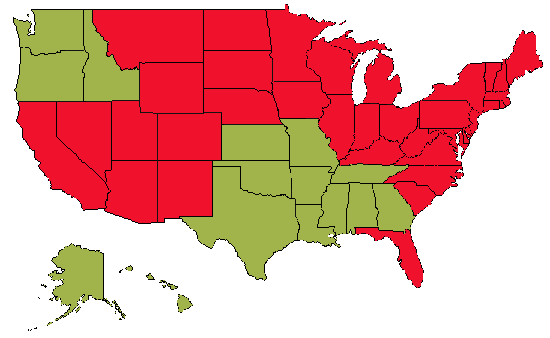
January 28, 2004
"Slipped the surly bonds of earth"
On January 28, 1986, Reagan made a speech to the nation, responding to the Challenger explosion. Written by Peggy Noonan, (whose column I like, but whose book on Reagan made me want to gag) this speech is often listed in compilations of "greatest speeches in the 20th century", and it is not hard to understand why. Noonan hit the nail on the head with this speech, which is simply spoken, deeply felt, and, I would dare say, perfect.
President Reagan's Speech on The Challenger Disaster, January 28, 1986
Nineteen years ago, almost to the day, we lost three astronauts in a terrible accident on the ground. But, we've never lost an astronaut in flight; we've never had a tragedy like this. And perhaps we've forgotten the courage it took for the crew of the shuttle; but they, the Challenger Seven, were aware of the dangers, but overcame them and did their jobs brilliantly. We mourn seven heroes: Michael Smith, Dick Scobee, Judith Resnik, Ronald McNair, Ellison Onizuka, Gregory Jarvis, and Christa McAuliffe. We mourn their loss as a nation together.
For the families of the seven, we cannot bear, as you do, the full impact of this tragedy. But we feel the loss, and we're thinking about you so very much. Your loved ones were daring and brave, and they had that special grace, that special spirit that says, 'Give me a challenge and I'll meet it with joy.' They had a hunger to explore the universe and discover its truths. They wished to serve, and they did. They served all of us.
We've grown used to wonders in this century. It's hard to dazzle us. But for twenty-five years the United States space program has been doing just that. We've grown used to the idea of space, and perhaps we forget that we've only just begun. We're still pioneers. They, the members of the Challenger crew, were pioneers.
And I want to say something to the schoolchildren of America who were watching the live coverage of the shuttle's takeoff. I know it is hard to understand, but sometimes painful things like this happen. It's all part of the process of exploration and discovery. It's all part of taking a chance and expanding man's horizons. The future doesn't belong to the fainthearted; it belongs to the brave. The Challenger crew was pulling us into the future, and we'll continue to follow them...
There's a coincidence today. On this day 390 years ago, the great explorer Sir Francis Drake died aboard ship off the coast of Panama. In his lifetime the great frontiers were the oceans, and a historian later said, 'He lived by the sea, died on it, and was buried in it.' Well, today we can say of the Challenger crew: Their dedication was, like Drake's, complete.
The crew of the space shuttle Challenger honoured us by the manner in which they lived their lives. We will never forget them, nor the last time we saw them, this morning, as they prepared for the journey and waved goodbye and 'slipped the surly bonds of earth' to 'touch the face of God.'
I am old
Realizing that 18 years ago I was a freshman in college ... WHAT? That cannot be right. Am I that old?
Big Stupid Tommy talks about where he was when the Challenger exploded.
Bill McCabe has his story.
We all have our story. We all remember where we were on that awful day.
I was a freshman in college when the Challenger exploded. I lived in Merrow, the only all-girl's dorm on campus. I was home, in between classes, when suddenly I heard someone down the hall start screaming. A terrible scream. Unlike anything you ever hear on a normal day , at least here in America.
A girl down the hall started screaming, tears in her voice, "OH MY GOD! OH MY GOD!" My roommate and I raced down the hall, along with most of the other girls who were around at that time.
We huddled in the dorm room, watching on a tiny little television, the disaster unfolding. Live. Those horrible long trails of smoke, splitting apart, diverging ... in a way which we knew was just not supposed to happen. This was bad. This was worse than bad.
I was crying. Everybody was. We were glued to the television, holding onto each other, crying. Saying things like, "No ... NO!" And the age-old cry, "Oh my God." Which takes on a whole other meaning when said in a true moment of duress. God with a capital G.
It was beyond belief. The lead-up to the Challenger launch, with the Christa McAuliffe coverage, had been overwhelming. Everyone knew about Christa McAuliffe, everyone knew that the Challenger was going up ... it was a big big deal. And to watch it explode, before our very eyes ... we were almost baffled. Hurt by the callousness of the universe. How could this happen? How could this happen?
The shots of the family members who watched it all unfold from the bleechers below have stayed with me always. I remembered certain images exactly. McAuliffe's parents clinging to one another, screaming up into the sky.
I do not understand "why" things like this happen. I do not understand why some people experience such tremendous loss, and why others seem to escape.
But I do not believe that God "lets" things like this happen. I do not. I cannot explain my theology, I cannot back up my beliefs with Bible verses ... but I don't believe that God is with some people and not with others. I believe He is there through all of it. With all of us.
God didn't choose to bless the nine saved miners in Pennsylvania, and choose NOT to bless the thousands of innocent people who died on September 11. (That only comes to mind because I remember all of the miners' wives saying, "God has blessed us, God has blessed us." I totally can understand, on a human level, why they would say that, but having witnessed with my own eyes the horrors of September 11, it bothered me a bit. Where was God on September 11? Why didn't he bless US? Why not us??)
These are not questions for me to answer.
January 27, 2004
I will not apologize...
for being so excited for the movie Miracle to come out that I can think of little else.
My entire personality is yearning towards next week - which, I believe, is when it opens.
I am excited on mulitple levels.
1. Yay, for Kurt Russell. Getting a nice meaty role like Herb Brooks. He's always been good, always, but he hasn't always had good roles, roles where he can show what he can really do. It looks like he has gone through a nice transformation, too, at least from the previews - his hair, his voice, the look in his eyes. Can't wait.
2. All of the hot young unknown hockey players/actors. I loved, in the previews, that the kids from Boston actually HAVE the Boston accents, which I would recognize if I heard it in the wastes of the Kara Kum desert. My entire family has that accent, so I am very particular about it - and that was my main issue with Robin Williams' over-praised turn in "Good Will Hunting". No accent. He's supposed to be a Southie boy, a local guy - Matt Damon and Ben Affleck both did the accent - Williams did not. Williams is usually a chameleon, in terms of his speech, etc. But I think this was a lazy performance, for that reason.
3. I loved the HBO documentary about the 1980 Olympic team. I taped it, and I watch it on occasion, and get completely thrilled every single time. When the assistant coach, at the end, chokes up unexpectedly as he says the words, "Those guys ..." (Suddenly, the feeling comes up - surprising him - his throat closes - You can see this embarrassment go over his face - this manly man - It is so moving ... He clears his throat, trying to get it under control - and then finishes his sentence:) "Those guys deserved that medal." Oh, it kills me every time.
I wrote a thing a while back about my response to that documentary, the first time I saw it. Join me in my obsession. I am counting the days till the movie opens.
Do You Believe in Miracles? YES!!
I had such a catharsis last night, watching the HBO documentary Do You Believe In Miracles? It is the story of the U.S. Olympic hockey team, winning the gold in 1980.
I don't know exactly what doors it opens up in me ... All I know is I was a blubbery MESS, and I still am one today. Perhaps it is the story of bucking the odds so unexpectedly that gets me. Or the fact that those kids came from nowhere, nowhere, and beat the greatest hockey team in the world. No one expected that of them.
I think, though, it is merely the specific human moments represented in this well-done documentary that slay my heart. The moments are emblazoned in my brain.
--The Iranian hostage, being released from captivity, and shown a videotape of everything that happened in America during his absence. The hostage said that the best part of the videotape, for him, was watching the hockey game, and watching all the people in the stands losing their minds. He said, "I was in deep captivity for over a year. Being held hostage shows you the ultimate depravity of humanity. But then ... watching that hockey game ... I saw the complete opposite. I saw all of these Americans going crazy over a hockey game. I just wish that I had been there."
--The one shot of Jim Craig, the goalie, draped in an American flag, right after they won the gold, skating along, looking up into the stands, searching with his eyes, saying, "Where's my father? Where's my father?"
--Pretty much every single shot of coach Herb Brooks' face. What a face! He rode those kids HARD, he made them a team. There was rivalry between the Minnesota kids and the New England kids - they hated each other. Herb Brooks said, "I wanted to blur the boundaries of this country. I wanted them to know that the USA on the front of their jerseys really meant something." He also knew that they HAD to win. And they did. After that "miracle game", they still had one more game to win before they could take home the gold. They had to beat Finland. Herb Brooks came into the locker room beforehand, and said, "If you lose this game, you will take it to your fucking grave." Then he turned and walked almost all the way out, before turning around and saying again, "To your fucking grave."
--The Russian player described watching the American team flipping out when they won. He said, "We were so used to winning. We watched how emotional they were … and we had forgotten that. I was almost jealous of their emotions."
Okay. Whatever. The entire documentary rips my heart out. The next time it is on is at, like, 6 a.m. a month from now, and I (of course) will be awake. And I will tape the whole damn thing. It is beautiful. A beautiful story.
January 19, 2004
Speaking of "the greatest speeches of the 20th century"...
Here is the full text of Martin Luther King Jr.'s "I have a dream" speech, delivered on the steps of the Lincoln Memorial on August 28, 1963.
"I have a dream"
Five score years ago, a great American, in whose symbolic shadow we stand signed the Emancipation Proclamation. This momentous decree came as a great beacon light of hope to millions of Negro slaves who had been seared in the flames of withering injustice. It came as a joyous daybreak to end the long night of captivity. But one hundred years later, we must face the tragic fact that the Negro is still not free.
One hundred years later, the life of the Negro is still sadly crippled by the manacles of segregation and the chains of discrimination. One hundred years later, the Negro lives on a lonely island of poverty in the midst of a vast ocean of material prosperity. One hundred years later, the Negro is still languishing in the corners of American society and finds himself an exile in his own land.
So we have come here today to dramatize an appalling condition. In a sense we have come to our nation's capital to cash a check. When the architects of our republic wrote the magnificent words of the Constitution and the Declaration of Independence, they were signing a promissory note to which every American was to fall heir.
This note was a promise that all men would be guaranteed the inalienable rights of life, liberty, and the pursuit of happiness. It is obvious today that America has defaulted on this promissory note insofar as her citizens of color are concerned. Instead of honoring this sacred obligation, America has given the Negro people a bad check which has come back marked "insufficient funds." But we refuse to believe that the bank of justice is bankrupt. We refuse to believe that there are insufficient funds in the great vaults of opportunity of this nation.
So we have come to cash this check -- a check that will give us upon demand the riches of freedom and the security of justice. We have also come to this hallowed spot to remind America of the fierce urgency of now. This is no time to engage in the luxury of cooling off or to take the tranquilizing drug of gradualism. Now is the time to rise from the dark and desolate valley of segregation to the sunlit path of racial justice. Now is the time to open the doors of opportunity to all of God's children. Now is the time to lift our nation from the quicksands of racial injustice to the solid rock of brotherhood.
It would be fatal for the nation to overlook the urgency of the moment and to underestimate the determination of the Negro. This sweltering summer of the Negro's legitimate discontent will not pass until there is an invigorating autumn of freedom and equality. Nineteen sixty-three is not an end, but a beginning. Those who hope that the Negro needed to blow off steam and will now be content will have a rude awakening if the nation returns to business as usual. There will be neither rest nor tranquility in America until the Negro is granted his citizenship rights.
The whirlwinds of revolt will continue to shake the foundations of our nation until the bright day of justice emerges. But there is something that I must say to my people who stand on the warm threshold which leads into the palace of justice. In the process of gaining our rightful place we must not be guilty of wrongful deeds. Let us not seek to satisfy our thirst for freedom by drinking from the cup of bitterness and hatred.
We must forever conduct our struggle on the high plane of dignity and discipline. we must not allow our creative protest to degenerate into physical violence. Again and again we must rise to the majestic heights of meeting physical force with soul force.
The marvelous new militancy which has engulfed the Negro community must not lead us to distrust of all white people, for many of our white brothers, as evidenced by their presence here today, have come to realize that their destiny is tied up with our destiny and their freedom is inextricably bound to our freedom.
We cannot walk alone. And as we walk, we must make the pledge that we shall march ahead. We cannot turn back. There are those who are asking the devotees of civil rights, "When will you be satisfied?" we can never be satisfied as long as our bodies, heavy with the fatigue of travel, cannot gain lodging in the motels of the highways and the hotels of the cities. We cannot be satisfied as long as the Negro's basic mobility is from a smaller ghetto to a larger one. We can never be satisfied as long as a Negro in Mississippi cannot vote and a Negro in New York believes he has nothing for which to vote. No, no, we are not satisfied, and we will not be satisfied until justice rolls down like waters and righteousness like a mighty stream.
I am not unmindful that some of you have come here out of great trials and tribulations. Some of you have come fresh from narrow cells. Some of you have come from areas where your quest for freedom left you battered by the storms of persecution and staggered by the winds of police brutality. You have been the veterans of creative suffering. Continue to work with the faith that unearned suffering is redemptive.
Go back to Mississippi, go back to Alabama, go back to Georgia, go back to Louisiana, go back to the slums and ghettos of our northern cities, knowing that somehow this situation can and will be changed. Let us not wallow in the valley of despair. I say to you today, my friends, that in spite of the difficulties and frustrations of the moment, I still have a dream. It is a dream deeply rooted in the American dream.
I have a dream that one day this nation will rise up and live out the true meaning of its creed: "We hold these truths to be self-evident: that all men are created equal." I have a dream that one day on the red hills of Georgia the sons of former slaves and the sons of former slaveowners will be able to sit down together at a table of brotherhood. I have a dream that one day even the state of Mississippi, a desert state, sweltering with the heat of injustice and oppression, will be transformed into an oasis of freedom and justice. I have a dream that my four children will one day live in a nation where they will not be judged by the color of their skin but by the content of their character. I have a dream today.
I have a dream that one day the state of Alabama, whose governor's lips are presently dripping with the words of interposition and nullification, will be transformed into a situation where little black boys and black girls will be able to join hands with little white boys and white girls and walk together as sisters and brothers. I have a dream today. I have a dream that one day every valley shall be exalted, every hill and mountain shall be made low, the rough places will be made plain, and the crooked places will be made straight, and the glory of the Lord shall be revealed, and all flesh shall see it together. This is our hope. This is the faith with which I return to the South. With this faith we will be able to hew out of the mountain of despair a stone of hope. With this faith we will be able to transform the jangling discords of our nation into a beautiful symphony of brotherhood. With this faith we will be able to work together, to pray together, to struggle together, to go to jail together, to stand up for freedom together, knowing that we will be free one day.
This will be the day when all of God's children will be able to sing with a new meaning, "My country, 'tis of thee, sweet land of liberty, of thee I sing. Land where my fathers died, land of the pilgrim's pride, from every mountainside, let freedom ring." And if America is to be a great nation, this must become true. So let freedom ring from the prodigious hilltops of New Hampshire. Let freedom ring from the mighty mountains of New York. Let freedom ring from the heightening Alleghenies of Pennsylvania! Let freedom ring from the snowcapped Rockies of Colorado! Let freedom ring from the curvaceous peaks of California! But not only that; let freedom ring from Stone Mountain of Georgia! Let freedom ring from Lookout Mountain of Tennessee! Let freedom ring from every hill and every molehill of Mississippi. From every mountainside, let freedom ring.
When we let freedom ring, when we let it ring from every village and every hamlet, from every state and every city, we will be able to speed up that day when all of God's children, black men and white men, Jews and Gentiles, Protestants and Catholics, will be able to join hands and sing in the words of the old Negro spiritual, "Free at last! free at last! thank God Almighty, we are free at last!"
December 18, 2003
Quote
"Wilbur Wright said, on their way home after the 1901 gliding experiments, that he didn’t think man would fly in a thousand years. In a way, though, as Orville Wright said long afterward, it was encouraging to learn that the work of predecessors could not be relied upon. It meant that more knowledge was needed, rather than that flight was impossible."
-- Fred C. Kelly
I love that: "it was encouraging to learn that the work of predecessors could not be relied upon"
December 14, 2003
And lastly - this one kills me ...
Thank you. Thank you, all - for being over there, for fighting this fight in our name. And in the name of the Iraqis.
December 1, 2003
Quote
"I find that the harder I work, the more luck I have."
-- Thomas Jefferson
November 7, 2003
A question of empire
Paul Johnson has a great piece in the Hoover Digest, on America and empire.
This is obviously a complex issue, and not something I want to get into at the moment - on a late-on-Friday afternoon - (with a rockabilly evening ahead of me) but the essay is a good one, and I suggest you give it a read.
Traditionally, successful imperialism has reflected high birthrates and the ability to export large surplus populations. The climax of European imperialism in the nineteenth century coincided with the European population explosion. America has never exported people overseas. On the contrary, its growing power and wealth have reflected its ability to attract and absorb immigrants. That continues. America now accepts more immigrants than the rest of the world put together. The amazing ability of groups such as the Cubans, the Hong Kong Chinese, the Vietnamese, and other new arrivals to grow roots and create wealth is a key part of America’s continuing success story. But America also has a high birthrate. Its population is now coming up to the 300 million mark. By 2050 it will be more than 400 million. By contrast, Europe’s population will shrink and the percentage of working age will fall rapidly. The ability of America to sustain a global role is demonstrated by the demographic figures, especially those on the working population.
And here below is where the complexity lies ... our own inner conflict as a nation about imperialism, and empire. How does one resolve this? The true difficulty is to really admit what it is we are doing, and call it by its proper name:
The Bush administration is only beginning to grasp the implications of the course on which it has embarked. It still, albeit with growing difficulty, speaks the language of anti-imperialism. But that is the jargon of the twentieth century or at least its second half. Who says it will be the prevailing discourse of the twenty-first? As it happens, imperialism became a derogatory term in America only during the Civil War, when the South accused the North of behaving like a European empire. It then became politically correct to speak only of “American exceptionalism.” Internationally imperialism became a dirty word early in the twentieth century, and it was the Communists who were chiefly responsible for turning it into a hate word. And it is worth recalling too that up to 1860 empire was not a term of abuse in the United States. George Washington himself spoke of “the rising American Empire.” Thomas Jefferson, aware of the dilemma, claimed that America was “an empire for liberty.” That is what America is becoming again, in fact if not in name. America’s search for security against terrorism and rogue states goes hand in hand with liberating their oppressed peoples. From the Evil Empire to an Empire for Liberty is a giant step, a contrast as great as the appalling images of the wasted twentieth century and the brightening dawn of the twenty-first. But America has the musculature and the will to take giant steps, as it has shown in the past.
Anyway. It's Friday.
I'm gonna go to the gym - and then - head out into the night - to join up with the different Manhattan world which lies below Canal Street. Can't wait.
October 17, 2003
Diary Friday
Today's entry is from October 1, 1983. I think I'm 14 years old. Something like that.
It seems a propos to post this today.
October 1, 1983 YAZ DAY
We got home so so so late last night. It was SO FUN. I love baseball. I always have. And Fenway Park! All of Boston. The people in Boston are so nice. So friendly. Very down to earth. Boston really comes alive on home games.And now - Yaz Fever is in!
As we came down the little narrow street towards Fenway Park - it was packed with screaming people waving Yaz banners. And as we were driving up, we passed this schoolbus full of kids, they all had on Yaz hats - and were really rowdy. We started waving at them - I whipped off Jean's Yaz hat, and they all started applauding and cheering with us. The whole bus waved banners at us, and the whole street went nuts!!
Inside Fenway Park, it was a mad house. And coming out into the stands, with the lights, and the sizzling excitement, and the teams right there warming up ... Our seats were really good. Right along the third baseline.
We looked for Yaz but couldn't find him. I felt like I was waiting for the curtain to open on a big show or something.
At 7:30, they announced the line-up. Yaz was fifth. We all went wild when they called his name. The crowd was screaming and screaming and screaming - we just would not stop. It was great.
I love Boston. I love the Red Sox. I love the people in Boston.
The game started. Cleveland was up first.
I wish we could have seen Yaz play first, but he was the designated hitter. When they announced Dennis Eckersley, Brendan went, "Oh, don't boo!" Everyone did, anyway.
And Jim Rice was right out there. I LOVE JIM RICE. It was so amazing to see all these stars and players I have idolized since I was 8 years old! They were all right there!!
When the Red Sox were up, you could just feel the anticipation. Just waiting for Yaz. He was up 5th. But everyone went hysterical whenever anyone made a hit. I got so worked up!
Then - oh God - when Yaz was on deck - all these camera flashes went off - everywhere across the Park - blinding! All I could do was just stare at Yaz warming up. He is such a hero to me. I swear that nobody was watching the actual game. They were just watching him.
Then - when he was up - and he started for the plate - I can't explain it.
Or - yes, I can.
All of Fenway Park immediately stood up and cheered and cheered and cheered - I was leaping, waving my arms, SCREAMING. This went on for about five minutes. Or longer. Really! No one got tired, no one could stop.
Yaz just stood there with his bat - and stood there - as the whole Park went NUTS - and after a while, he turned to us, and tipped his hat.
Oh my God, it was so beautiful the way he did it.
We all went bonkers!
Me and Brendan were screaming and waving, Jean was crying - then Yaz tipped his hat again - It was positively wonderful.
I almost cried. I wonder if Yaz almost cried.
Finally - FINALLY - we all sat down, still all revved up. Then - he took his stance - and on the first pitch - you could hear this CRACK - the crack of the bat - and everyone JUMPED UP again - yelling, screaming, going positively crazy - I almost had a coronary. It was a single, but we got to see Yaz hit. We got to see Yaz hit. This will be the last time we ever get to see Yaz hit.
I have always loved Yaz. He seems like a really nice guy - or something. Like he has kept his feet on the ground. And the way he tipped his hat to all of us - to all of Boston - I still feel like crying, when I think of it.
The other amazing thing about the night was when we all stood up for "The Star-Spangled Banner".
It is very hard NOT to feel patriotic - with the flag waving in the wind against the dark sky, and everyone around you, hands on their hearts, singing LOUD.
America really is beautiful.
Baseball games make me realize that all over again.
September 8, 2003
Patriotism
An inspiring and cut-through-the-nonsense post from Jeff Jarvis, about patriotism. Patriotism transcends politics, labels, affiliations.
September 11 changed me. As it changed all of us.
Do not get me wrong: I have "felt" like an American before. Every time I vote, every time, I take a moment to thank God I live in a country where I can do this. Even before September 11. I remember the bicentennial celebrations, when I was a kid. I remember being very proud of our country, and overwhelmed with pride at the onslaught of red, white, and blue at that time. I was brought up by two parents who were HIGHLY into the American Revolutionary war, so I grew up with a reverence for those times, for the founding fathers, for how it all happened. I knew the story. I loved the story.
But on September 11, I became an American.
I am an American before I am anything else.
Jeff Jarvis writes, eloquently:
Patriotism is much bigger than politics. And the definition of patriotism is no longer in the hands of the politicians and pundits. After 9.11, it is in our hands, for we are all Americans and we are all targets on this new battlefield. We know what it means to be patriotic and it has very little to do with partisanship or politics. We know the price of patriotism.Patriotism means defending the principles of America over politics. Patriotism means being willing to protect those principles where and when its necessary. Patriotism means defending your children and your neighbors against those who would attack us because we are American. Patriotism means being willing to go it alone even when your former friends (read: Europeans) snipe at you. Try that on as a new definition.
July 22, 2003
A John Adams fest
-- "Fire them with ambition to be useful." -- John to Abigal, in regards to raising their children
-- "It is my destiny to dig treasures with my own fingers." -- John Adams
-- "If the way to do good to my country were to render myself popular, I could easily do it. But extravagant popularity is not the road to public advantage." -- John Adams, after becoming President by only three votes
-- "I never shall shine, 'til some animating occasion calls forth all my powers." -- John Adams, 1760
-- "There must be, however, more employment for the press in favor of the government than there has been, or the sour, angry, peevish, fretful, lying paragraphs which assail it on every side will make an impression on many weak and ignorant people." -- John in a letter to Abigail (I couldn't agree more, John.)
-- "The story of B. Bicknal's wife is a very clever one. She said, when she was married she was very anxious, she feared, she trembled, she could not go to bed. But she recollected she had put her hand to the plow and could not look back, so she mustered up her spirits, committed her soul to God and her body to B. Bicknal and into bed she leaped -- and in the morning she was amazed, she could not think for her life what it was that had so scared her." -- Journal entry of John Adams ... I love that little story
-- "Ambition is one of the more ungovernable passions of the human heart. The love of power is insatiable and uncontrollable ... There is danger from all men. The only maxim of a free government outght to be to trust no man living with power to endanger the public liberty." -- John Adams
The following quote is Adams' description of the first meeting of the Continental Congress, in 1774:
-- "This assembly is like no other that ever existed. Every man in it is a great man -- an orator, a critic, a statesman, and therefore every man upon every question must show his oratory, his criticism, his political abilities. The consequence of this is that business is drawn and spun out to immeasurable length. I believe if it was moved and seconded that we should come to a resolution that three and two make five, we should be entertained with logic and rhetoric, law, history, politics, and mathematics concerning the subject for two whole days, and then we should pass the resolution unanimously in the affirmative."
-- "We cannot insure success, but we can deserve it." -- John Adams, in a letter to Abigail
-- "If we finally fail in this great and glorious contest, it will be by bewildering ourselves in groping for the middle way." -- John Adams
-- "I am more and more convinced that man is a dangerous creature, and that power whether vested in many or few is grasping ... The great fish swallow up the small and he who is most strenuous for the rights of the people, when vested with power, is as eager after the prerogatives of government. You tell me of degrees of perfection to which human nature is capable of arriving, and I believe it, but at the same time lament that our admiration should arise from the scarcity of the instances. -- Abigail Adams, in a letter to John
Oh, and this one gave me chills:
-- "It has been the will of Heaven that we should be thrown into existence at a period when the greatest philosophers and lawgivers of antiquity would have wished to live ... a period when a coincidence of circumstances without example has afforded to thirteen colonies at once an opportunity of beginning government anew from the foundation and building as they choose. How few of the human race have ever had an opportunity of choosing a system of government for themselves and their children? How few have ever had anything more of choice in government than in climate?" -- John Adams
And of course, this one from Abigail is kind of famous, but nevertheless here it is:
-- "--and by the way in the new code of laws which I suppose it will be necessary for you to make, I desire you would remember the ladies, and be more favorable to them than your ancestors. Do not put such unlimited power into the hands of husbands ... If particular care and attention is not paid to the ladies we are determined to foment a rebellion, and will not hold ourselves bound by any laws in which we have no voice or representation. That your sex are naturally tyrannical is a truth so thoroughly established as to admit of no dispute, but such of yours as wish to be happy willingly to give up the harsh title of master for the more tender and endearing one of friend." -- Abigail Adams, in a letter to John
Their love story brings a lump to my throat. The correspondence between the two of them is incredible. Here's a part of one of his letters to her.
-- "Is there no way for two friendly souls to converse together, although the bodies are 400 miles off. Yes, by letter. But I want a better communication. I want to hear you think, or to see your thoughts. The conclusion of your letter makes my heart throb more than a cannonade would. You bid me burn your letters. But I must forget you first." -- John Adams to Abigail
-- "A people may let a King fall, yet still remain a people, but if a King let his people slip from him, he is no longer a King. And as this is most certainly our case, why not proclaim to the world in decisive terms of our own importance?" --Abigail Adams, in a letter to John
-- "In general, our generals were outgeneralled." -- John Adams' comment after the disastrous battle on Long Island
-- "His understanding lies, I think, rather in seeing large things largely than correctly." --William Alexander describing John Adams' particular political genius
-- "Thanks to God that he gave me stubbornness when I know I am right." -- John Adams
-- "I must study politics and war that my sons may have liberty to study mathematics and philosophy. My sons ought to study mathematics and philosophy, geography, natural history, naval architecture, navigation, commerce, and agriculture in order to give their children a right to study paintings, poetry, music, artchitecture, statuary, tapestry, and porcelain." -- John Adams
-- "He means well for his country, is always an honest man, often a wise man, but sometimes and in some things, absolutely out of his senses." -- Ben Franklin, 1783, about John Adams (in a letter to Robert Livingston)
-- "If you are conscious to yourself that you possess more knowledge upon some subject than others of your standing, reflect that you have had greater opportunities of seeing the world, and obtaining a knowledge of mankind than any of your contemporaries. That you have never wanted a book but it has been supplied to you, that your whole time has been spent in the company of men of literature and science. How unpardonable would it have been iin you to have been a blockhead." -- Abigail Adams in a letter to son John Quincy Adams, during his first semester at Harvard
-- "You are afraid of the one, I, the few. We agree perfectly that the many should have full, fair, and perfect representation [in the House]. You are apprehensive of monarchy; I, of aristocracy. I would therefore have given more power to the President and less to the Senate." -- John Adams to Thomas Jefferson
-- "Gentlemen, I feel a great difficulty how to act. I am Vice President. In this I am nothing, but I may be everything." -- John Adams
-- "I firmly believe if I live ten years longer, I shall see a division of the Southern and Northern states, unless more candor and less intrigue, of which I have no hope, should prevail." -- Abigail Adams, 1792
-- Years subdue the ardor of passion but in lieu thereof friendship and affection deep-rooted subsists which defies the ravages of time, and whilst the vital flame exists. -- Abigail to John, 1793
-- Your letter is like laudanum. -- John to Abigail
-- You apologize for the length of your letters. They give me more entertainment than all the speeches I hear. There are more good thoughts, fine strokes, and mother wit in them than I hear in the whole week. -- John to Abigail
-- I am warm enough at night, but cannot sleep since I left you." -- John to Abigail
Editorial: All of those last quotes are from letters written when the two of them were in their 60s.
July 18, 2003
Blair again...
On our way down here, Senator Frist was kind enough to show me the fireplace where in 1814 the British had burned the Congress Library. I know this is kind of late, but: Sorry.
-- Tony Blair, yesterday
July 4, 2003
The Declaration
And here is Johnson's discussion in A History of the American People
It's exhilarating.
Read on, Macduff.
The creation of the Declaration of Independence:
At this point [early 1776] an inspired and rebellious Englishman stuck in his oar. Thomas Paine [1737-1809] was another of the self-educated polymaths the 18th century produced in such large numbers. He was, of all things, a customs officer and exciseman. But he was also a man with a grudge against society, a spectacular grumbler, what was termed in England a "barrack-room lawyer". In a later age he would have become a trade union leader. Indeed, he was a trade union leader, who employed his fluent and forceful pen on behalf of Britain's 3,000 excisemen to demand an increase in their pay, and was sacked for his courage.
He came to America in 1774, edited the Pennsylvania Magazine, and soon found himself on the extremist fringe of the Philadelphia patriots. Paine could and did design bridges, he invented a "smokeless candle"- like Franklin he was fascinated by smoke and light – and at one time he drew up detailed topographical scene for the invasion of England. But his real talent was for polemical journalism. In that, he has never been bettered. Indeed it was more than journalism; it was political philosophy, but written for a popular audience, with a devastating sense of topicality, and at great speed. He could pen a slashing article, a forceful, sustained pamphlet, and, without pausing for breath, a whole book, highly readable from cover to cover.
Paine's pamphlet Common Sense was on the streets of Philadelphia on January 10, 1776, and was soon selling fast all over the colonies. In a few weeks it sold over 100,000 copies and virtually everyone had read it or heard about it.
Two things gave it particular impact.
First, it was a piece of atrocity propaganda. The first year of hostilities had furnished many actual instances, and many more myths, of brutal conduct by British or mercenary soldiers. Entire towns, like Falmouth (now Portland, Maine) and Norfolk, had been burned by the British. Women, even children, had been killed in the inevitable bloody chaos of conflict. Paine preyed on these incidents: his argument was that any true-blooded American who was not revolted by them, and prepared to fight in consequence, had "the heart of a coward and the spirit of a sycophant." Crude though this approach was, it went home. Even General Washington, who had read the work by January 31, approved of it.
Second, Paine cut right through the half-and-half arguments in favor of negotiations and a settlement under British sovereignty. He wanted complete independence as the only possible outcome. Nor did he try to make a distinction, as Congress still did, between a wicked parliament and a benign sovereign. He called George III "the royal brute". Indeed, it was Paine who transformed this obstinate, ignorant, and, in his own way, well-meaning man into a personal monster and a political tyrant, a bogey-figure for successive generations of American schoolchildren. Such is war, and such is propaganda. Paine's Common Sense was by no means entirely common sense. Many thought it inflammatory nonsense. But it was the most successful and influential pamphlet ever published.
It was against this explosive background that Thomas Jefferson began his finest hour … On June 11 Congress appointed a committee of [Benjamin] Franklin, [John] Adams, Roger Sherman, Robert Livingston, and Jefferson so draft a Declaration of Independence "in case the Congress agreed thereto."
Congress well knew what it was doing when it picked these able men to perform a special task. It was aware that the struggle against a great world power would be long and that it would need friends abroad. It had already set up a Committee of Correspondence, in effect a "Foreign Office", led by Franklin, to get in touch with France, Spain, the Netherlands, and other possible allies. It wanted to put its case before the "court of world opinion," and needed a dignified and well-argued but ringing and memorable statement of what it was doing and why it was doing it. It also wanted to give the future citizens of America a classic statement of what their country was about, so that their children and their children's children could study it and learn it by heart.
Adams (if he is telling the truth) was quite convinced that Jefferson was the man to perform this miracle and proposed he be chairman of the Committee, though in fact he was the youngest member of it (apart from Livingston, the rich son of a New York judge.) He recorded the following conversation between them.
Jefferson: "Why?"
Adams: "Reasons enough."
"What can be your reasons?"
"Reason first: you are a Virginian, and a Virginian ought to appear at the head of the business. Reason second: I am obnoxious, suspect and unpopular. You are very much otherwise. Reason third: you can write ten times better than I can." All this was true enough.
Jefferson produced a superb draft, for which his 1774 pamphlet was a useful preparation. All kinds of philosophical and political influences went into it. They were all well-read men and Jefferson, despite his comparative youth, was the best read of all, and he made full use of the countless hours he had spent pouring over books of history, political theory, and government.
The Declaration is a powerful and wonderfully concise summary of the best Whig thought over several generations. Most of all, it has an electrifying beginning. It is hard to think of any way in which the first two paragraphs can be improved:
WHEN in the Course of human Events, it becomes necessary for one People to dissolve the Political Bands which have connected them with another, and to assume among the Powers of the Earth, the separate and equal Station to which the Laws of Nature and of Nature's God entitle them, a decent Respect to the Opinions of Mankind requires that they should declare the causes which impel them to the Separation.WE hold these Truths to be self-evident, that all Men are created equal, that they are endowed by their Creator with certain unalienable Rights, that among these are Life, Liberty and the Pursuit of Happiness -- That to secure these Rights, Governments are instituted among Men, deriving their just Powers from the Consent of the Governed, that whenever any Form of Government becomes destructive of these Ends, it is the Right of the People to alter or to abolish it, and to institute new Government, laying its Foundation on such Principles, and organizing its Powers in such Form, as to them shall seem most likely to effect their Safety and Happiness.
The first [paragraph], with its elegiac note of sadness at dissolving the union with Britain and its wish to show "a decent respect to the opinions of mankind" by giving its reasons; the second, with its riveting first sentence, the kernel of the whole: "We hold these truths to be self-evident, that all men are created equal, that they are endowed by their Creator with certain inalienable rights, that among these are life, liberty and the pursuit of happiness." After that sentence, the reader, any reader – even George III – is compelled to read on.
The Committee found it necessary to make few changes in Jefferson's draft. Franklin, the practical man, toned down Jefferson's grandiloquence – thus truths, from being "sacred and undeniable" became "self-evident", a masterly improvement. But in general the four others were delighted with Jefferson's work, as well they might be.
Congress was a different matter because at the heart of America's claim to liberty there was a black hole. What of the slaves? How could Congress say that "all men are created equal" when there were 600,000 blacks scattered through the colonies, and concentrated in some of them in huge numbers, who were by law treated as chattels and enjoyed no rights at all? Jefferson and the other members of the Committee tried to up-end this argument – rather dishonestly, one is bound to say – by blaming American slavery on the British and King George.
The original draft charged that the King had "waged a cruel war against human nature" by attacking a "distant people" and "captivating and carrying them into slavery in another hemisphere". But when the draft went before the full Congress, on June 28, the Southern delegates were not having this. Those from South Carolina, in particular, were not prepared to accept any admission that slavery was wrong and especially the acknowledgment that it violated the "most sacred rights of life and liberty". If the Declaration said that, then the logical consequence was to free all the slaves forthwith. So the slavery passage was removed, the first of many compromises over the issue during the next eighty years, until it was finally resolved inn an ocean of tears and blood. However, the word "equality" remained in the text, and the fact that it did so was, as it were, a constitutional guarantee that, eventually, the glaring anomaly behind the Declaration would be rectified.
The Congress debated the draft for three days. Paradoxically, delegates spent little time going over the fundamental principles it enshrined, because the bulk of the Declaration presented the specific and detailed case against Britain, and more particularly against the King. The Revolutionaries were determined to scrap the pretense that they distinguished between evil ministers and a king who "could do no wrong", and renounce their allegiance to the crown once and for all. So they fussed over the indictment of the King, to them the core of the document, and left its constitutional and ideological framework, apart from the slavery point, largely intact.
This was just as well. If Congress had chosen to argue over Jefferson's sweeping assumptions and propositions, and resolve their differences with verbal compromises, the magic wrought by his pen would surely have been exorcized, and the world would have been poorer in consequence.
As it was the text was approved on July 2, and on July 4 all the colonies formally adopted what was called, to give it its correct title, "The Unanimous Declaration of the Thirteen United States of America". At the time, and often since, Tom Paine was credited with its authorship, which did not help to endear it to the British, where he was (and still is) regarded with abhorrence. In fact he had nothing to do with it directly, but the term "United States" is certainly his.
On July 8 it was read publicly in the State House Yard and the Liberty Bell rung. The royal coat of arms was torn down and burned. On August 2 it was engrossed on parchment and signed by all the delegates. Whereupon (according to John Hancock) Franklin remarked: "Well, Gentlemen, we must now hang together, or we shall most assuredly hang separately."
Leading up to the Second Continental Congress
Another excerpt from Paul Johnson's A History of the American People
Excerpt describing the lead-in to the Second Constitutional Congress:
Next to religion, the concept of the rule of law was the biggest single force in creating the political civilization of the colonies. This was something they shared with all Englishmen. The law was not just necessary - essential to any civil society - it was noble. What happened in courts and assemblies on weekdays was the secular equivalent of what happened in church on Sundays. The rule of law in England, as Americans were taught in their schools, went back even beyond Magna Carta, to Anglo-Saxon times, to the laws of King Alfred and the Witanmagots, the ancient precursor of Massachusetts' Assembly and Virginia's House of Burgesses.
William the Conqueror had attempted to impose what Lord Chief Justice Coke, the great early 17th century authority of the law, had called 'The Norman Yoke'. But he had been frustrated. So, in time, had Charles I been frustrated, when he tried to re-impose it, by the Long Parliament. Now, in its arrogance and complacency, the English parliament, forgetting the lessons of the past, was trying to impose the Norman Yoke on free-born Americans, to take away their cherished rule of law and undermine the rights they enjoyed under it with as much justice as any Englishman! Lord North would have been astonished to learn he was doing any such thing, but no matter: that is what many, most, Americans believed. So America now had to do what parliamentarians had to do in 1640. 'What we did,' said Jefferson later, 'was with the help of Rushworth, whom we rummaged over for revolutionary precedents of those days.' So, in a sense, the United States was the posthumous child of the Long Parliament.
But Americans' fears that their liberties were being taken away, and the rule of law subverted, had to be dramatized - just as those old parliamentarians had dramatized their struggle by the Grand Remonstrance against Charles I and the famous 'Flight of the Five Members'. Who would play John Hampden, who said he would rather die than pay Ship Money to King Charles?
Up sprang Jefferson's friend and idol, Patrick Henry.
As a preliminary move towards setting up a united resistance of the mainland colonies to British parliamentary pretensions, a congress of colonial leaders met in Philadelphia, at Carpenters Hall, between September 5 and October 26, 1774. Only Georgia, dissuaded from participating by its popular governor, did not send delegates. Some fifty representatives from twelve colonies passed a series of resolutions, calling for defiance of the Coercive Acts, the arming of a militia, tax-resistance. The key vote came on October 14 when delegates passed the Declaration and Resolves, which roundly condemned British interference in America's internal affairs and asserted the rights of colonial assemblies to enact legislation and impose taxes as they pleased.
A common American political consciousness was taking shape, and delegates began to speak with a distinctive national voice. At the end of it, Patrick Henry marked this change in his customary dramatic manner: 'The distinctions between Virginians and New Englanders are no more. I am not a Virginian but an American.' Not everyone agreed with him, as yet, and the Continental Congress, as it called itself, voted by colonies rather than as individual Americans. But this body, essentially based on Franklin's earlier proposals, perpetuated its existence by agreeing to meet again in May 1775. Before that could happen, on February 5, 1775, parliament in London declared Massachusetts, identified as the most unruly and contumacious of the colonies, to be in a state of rebellion, thus authorizing the lawful authorities to use what force they thought fit. The fighting had begun. Hence when the Virginia burgesses met in convention to instruct their delegates to the Second Continental Congress, Henry saw his chance to bring home to all the revolutionary drama of the moment.
Henry was a born ham actor, in a great age of acting - the Age of Garrick. The British parliament was full of actors, notably [William] Pitt himself ('He acted even when he was dying') and the young [Edmund] Burke, who was not above drawing a dagger, and hurling it on the ground to make a point. But Henry excelled them all. He proposed to the burgesses that Virginia should raise a militia and be ready to do battle. What was Virginia waiting for? Massachusetts was fighting. 'Our brethren are already in the field. Why stand we her idle? What is it that gentlemen wish? What would they have?'
Then Henry got to his knees, in the posture of a manacled slave, intoning in a low but rising voice: 'Is life so dear, our peace so sweet, as to be purchased at the price of chains and slavery? Forbid it, Almighty God!' He then bent to the earth with his hands still crossed, for a few seconds, and suddenly sprang to his feet, shouting, 'Give me liberty!' and flung wide his arms, paused, lowered his arms, clenched his right hand as if holding a dagger at his breast, and said in sepulchral tones: 'Or give me death!' He then beat his breast, with his hand holding the imaginary dagger.
There was silence, broken by a man listening at the open window, who shouted: "Let me be buried on this spot!'
Henry had made his point.
On Thomas Jefferson
The following lengthy excerpt, on Thomas Jefferson, and the writing of the Declaration of Independence, comes from Paul Johnson's book A History of the American People
Read the excerpt, when you have time. It goes into Jefferson's primary influences for the document, what he stole from, what he amended, and how he transformed the arguments of others into an original AMERICAN document. It's great stuff. After I first read Johnson's chapter on the writing of the Declaration of Independence, I was unable to look at the Declaration in the same taking-for-granted way. It hadn't dropped down from the sky, Jefferson hadn't scribbled it out in a moment of revolutionary inspiration.
Paul Johnson's book provided me with context, and context is what makes the Declaration shine out as one of the most extraordinary documents ever written.
First an excerpt about Jefferson, the man:
In terms of all-round learning, gifts, sensibilities, and accomplishments, there has never been an American like him, and generations of educated Americans have rated him higher even than Washington and Lincoln…
We know a great deal about this remarkable man, or think we do. His Writings, on a bewildering variety of subjects, have been published in twenty volumes. In addition, twenty-five volumes of his papers have appeared so far, plus various collections of his correspondence, including three thick volumes of his letters to his follower and successor James Madison alone. In some ways he was a mass of contradictions. He thought slavery an evil institution, which corrupted the master even more than it oppressed the chattel. But he owned, bought, sold, and bred slaves all his adult life. He was a deist, possibly even a skeptic; yet he was also a 'closet theologian,' who read daily from a multilingual edition of the New Testament. He was an elitist in education – 'By this means twenty of the best geniuses will be raked from the rubbish annually' – but he also complained bitterly of elites, 'those who, rising above the swinish multitude, always contrive to nestle themselves into places of power and profit'. He was a democrat, who said he would 'always have a jealous care of the right of election by the people.' Yet he opposed direct election of the Senate on the ground that 'a choice by the people themselves is not generally distinguished for its wisdom'. He could be an extremist, glorying in the violence of revolution: 'What country before ever existed a century and a half without rebellion?…The tree of liberty must be refreshed from time to time with the blood of patriots and tyrants. It is its natural manure.' Yet he said of Washington: 'The moderation and virtue of a single character has probably prevented this revolution from being closed, as most others have been, by a subversion of that liberty it was intended to establish.'
No one did more than he did to create the United States of America. Yet he referred to Virginia as 'my country' and to the Congress as 'a foreign legislature'. His favorite books were Don Quixote and Tristam Shandy. Yet he lacked a sense of humor. After the early death of his wife, he kept – it was alleged – a black mistress. Yet he was priggish, censorious of bawdy jokes and bad language, and cultivated a we-are-not-amused expression. He could use the most inflammatory language. Yet he always spoke with a quiet, low voice and despised oratory as such. His lifelong passion was books. He collected them in enormous quantity, beyond his means, and then had to sell them all to the Congress to raise money. He kept as detailed daily accounts as it is possible to conceive but failed to realize that he was running deeply and irreversibly into debt. He was a man of hyperbole. But he loved exactitude – he noted all figures, weights, distances, and quantities in minute detail; his carriage had a device to record the revolutions of its wheels; his house was crowded with barometers, rain-gauges, thermometers and anemometers. The motto of his seal-ring, chosen by himself, was 'Rebellion to tyrants is obedience to God.' Yet he shrank from violence and did not believe God existed.
Jefferson inherited 5,000 acres at fourteen from his father. He married a wealthy widow, Martha Wayles Skelton, and when her father died he acquired a further 11,000 acres. It was natural for this young patrician to enter Virginia's House of Burgesses, which he did in 1769, meeting Washington there. He had an extraordinarily godlike impact on the assembly from the start, by virtue of his presence, not his speeches. Abigail Adams later remarked that his appearance was 'not unworthy of a God'. A British officer said that 'if he was put besides any king in Europe, that king would appear to be his laquey.' His first hero was his fellow-Virginian Patrick Henry (1736-99), who seemed to be everything Jefferson was not: a firebrand, a man of extremes, a rabble-rouser, and an unreflective man of action. He had been a miserable failure as a planter and storekeeper, then found his m�tier in the law courts and politics. Jefferson was seventeen when he met him and he was presenting 1765 when Henry acquired instant fame for his flamboyant denunciation of the Stamp Act. Jefferson admired him no doubt for possessing the one gift he himself lacked – the power to rouse men's emotions by the spoken word.
Jefferson had a more important quality, however: the power to analyze a historic situation in depth, to propose a course of conduct, and present it in such a way as to shape the minds of a deliberative assembly. In the decade between the Stamp Act agitation and the Boston Tea Party, many able pens had set out constitutional solutions for America's dilemma. But it was Jefferson, in 1774, who encapsulated the entire debate in one brilliant treatise – Summary View of the Rights of British America. Like the works of his predecessors in the march to independence – James Otis' Rights of the British Colonists Asserted (1764), Richard Bland's An Inquiry into the Rights of the British Colonists (1766), and Samuel Adams' A statement on the rights of the colonies (1772) – Jefferson relied heavily on Chapter Five of John Locke's Second Treatise on Government, which set out the virtues of a meritocracy, in which men rise by virtue, talent, and industry. Locke argued that the acquisition of wealth, even on a large scale, was neither unjust nor morally wrong, provided it was fairly acquired. So, he said, society is necessarily stratified, but by merit, not by birth. This doctrine of industry as opposed to idleness as the determining factoring a just society militated strongly against kings, against governments of nobles and their placement, and in favor of representative republicanism.
Jefferson's achievement, in his tract, as to graft onto Locke's meritocratic structure two themes which became the dominant leitmotifs of the Revolutionary struggle. The first was the primacy of individual rights: 'The God who gave us life, gave us liberty at the same time: the hand of force may destroy, but cannot disjoin them.' Equally important was the placing of these rights within the context of Jefferson's deep and in a sense more fundamental commitment to popular sovereignty: 'From the nature of things, every society must at all times possess within itself the sovereign powers of legislation.' It was Jefferson's linking of popular sovereignty with liberty, both rooted in a divine plan, and further legitimized by ancient practice and the English tradition, which gave the American colonists such a strong, clear, and plausible conceptual basis for their action. Neither the British government nor the American loyalists produced arguments which had a fraction of this power. They could appeal to the law as it stood, and duty as they saw it, but that was all. Just as the rebels won the media battle (in America) from the start, so they rapidly won the ideological battle too.