April 18, 2010
Today in history: April 18-19, 1775: "I set off upon a very good Horse"
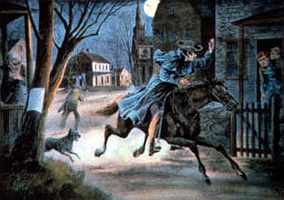
On the night of April 18, into April 19, in 1775, Paul Revere made his famous ride.
The spring of 1775 was a tense time. Prominent Bostonians were under constant threat of arrest from the British, and many of them - to avoid this - moved their families to outlying communities. However, two of the main patriotic leaders (Benjamin Church and Joseph Warren) stayed in Boston. Paul Revere did as well, and kept a close eye on British movements through that spring. Revere was trusted as a messenger, he knew everybody.
In mid-April, Revere started to notice some ominous signs: mainly that the British ships were taken out of the water, to be worked on, repaired. He could sense that something was coming. He felt the British were preparing for some kind of attack.
Revere went to Concord on April 16 (most of the weaponry was stored there) and warned the leaders of that community that the British were preparing something, they were up to something, and if they were going to strike, they would most definitely try to seize the weapons stash in Concord. So the people of Concord went to work, hiding their store of weapons in barns, cellars, swamps, etc. (Like I mentioned: Paul Revere was trusted. He knew everybody. If you're interested, read the excerpt I posted of Malcolm Gladwell's fascinating analysis of Paul Revere - and Gladwell's comparison with the far less successful messenger on that very same night - William Dawes.)
So. April 16. Revere returned to Boston from Concord, and met with other revolutionary leaders, and that is when they came up with the "one if by land, two if by sea" warning system. Revere knew they needed a way to have some advance warning about which route the British were going to take when they finally did attack.
By land? Or by sea?
So, Revere set up the system: Signal lanterns would be placed in the belfry of Old North Church (the steeple can be seen across the Charles River). If two lanterns were hung, then the British would be crossing the Charles by boat. If one lantern was hung, then the British would choose to attack using a land route.
"One if by land, two if by sea."
The plan was put in place just in time. On April 18, in the early evening, a stable boy came to Paul Revere, telling him that he had overheard some British soldiers discussing the upcoming attack, and that it was planned for early the next morning. The stable boy knew who to bring this information to, and that was Paul Revere. (Again, check out Gladwell's analysis of Paul Revere's personality. Really interesting.)
Revere, on receiving this urgent piece of information, knew he had to get the warning out (and that he especially had to warn John Hancock and Samuel Adams who, at that time, were hiding out in Lexington).
So off he went on his now legendary ride (here's a cool map of the route he took). Revere took the water route out of Boston, rowed across the Charles, and galloped through the communities north of Boston sounding the alarm. (Medford, Charlestown, Lexington, Concord.) Because of Paul Revere, the British had completely lost the element of surprise. When they came to attack, they found the rebellious colonists waiting for them everywhere, ambushing them left and right, from behind stone walls, hiding behind trees ...
An interesting tidbit (this is why I love this time in American history - yeah, the events themselves are really cool ... but it's details like the following one that really have me hooked, like a crack addict):
In his hurry to depart, Revere forgot to bring along pieces of cloth to wrap the oars of his boat. The purpose of the cloth would be to muffle the sound of the oars cutting through the water. The Somerset (the British man-of-war) was at anchor, right there in the harbor. Paul Revere had to row right by them, and so any sound at all would have alerted the crew, and if Revere was busted, the whole jig would be up. Revere was in a bit of a pickle ... standing by his boat, trying to figure out how he could improvise ... could he take off his stockings? Tie them around the end of the oars?
One of the boatmen involved in helping Revere make this crossing came to the rescue. He ran to his girlfriend's house and asked her for her petticoat. One can only imagine her startled response to the nighttime demand at her door from her beau: "Please, dear. It's 10 pm, and I need you to take off your petticoat, give it to me, and don't ask me ANY questions about it!!" But apparently, this girl, whoever she was, complied - took off her petticoat, handed it over, and Revere used it to wrap up the ends of his oars.
I love that woman, whoever she is. You're part of this story, dear, even though your name has not been passed down through the ages.
So. In honor of this great moment in American history -here is Henry Wadsworth Longfellow's celebrated poem "Paul Revere's Ride". And below that, I am posting an old essay I wrote about babysitting Cashel - which is relevant to this date in history. A couple years ago, I read the Cashel piece on a radio program, which was a pretty cool experience - and reading over the piece today makes me nostalgic for when Cashel was so little!!
But back to the poem: I know large swaths of it by heart ... I grew up hearing it. I'm an East Coast girl, most of my family is from Boston. So all of these places in the poem are places I had been to many times as a child, and not just a tourist ... but just because we lived near them. That piece of history felt very real to me. The poem is thrilling to me - because of the story it tells, of course, but also because of its rollicking perfect rhythm, you can feel the suspense, you can feel the urgency, the whole thing ends up sounding like the clatter of horses hooves galloping through the night. It's meant to be read out loud. Try it for yourself!! The last stanza is beyond compare. "For borne on the night-wind of the Past ..." I mean, come ON!! I love, too, how Longfellow includes the bit about the "muffled oar". These things pass on into folk tales at some point, a local mythology, and that's part of the reason why I love it.
April 18, 1775. A great day in American history. "The fate of a nation was riding that night." One of my personal favorite stories of the American revolution.
Paul Revere's Ride
- by Henry Wadsworth LongfellowListen my children and you shall hear
Of the midnight ride of Paul Revere,
On the eighteenth of April, in Seventy-five;
Hardly a man is now alive
Who remembers that famous day and year.
He said to his friend, "If the British march
By land or sea from the town to-night,
Hang a lantern aloft in the belfry arch
Of the North Church tower as a signal light,--
One if by land, and two if by sea;
And I on the opposite shore will be,
Ready to ride and spread the alarm
Through every Middlesex village and farm,
For the country folk to be up and to arm."
Then he said "Good-night!" and with muffled oar
Silently rowed to the Charlestown shore,
Just as the moon rose over the bay,
Where swinging wide at her moorings lay
The Somerset, British man-of-war;
A phantom ship, with each mast and spar
Across the moon like a prison bar,
And a huge black hulk, that was magnified
By its own reflection in the tide.
Meanwhile, his friend through alley and street
Wanders and watches, with eager ears,
Till in the silence around him he hears
The muster of men at the barrack door,
The sound of arms, and the tramp of feet,
And the measured tread of the grenadiers,
Marching down to their boats on the shore.
Then he climbed the tower of the Old North Church,
By the wooden stairs, with stealthy tread,
To the belfry chamber overhead,
And startled the pigeons from their perch
On the sombre rafters, that round him made
Masses and moving shapes of shade,--
By the trembling ladder, steep and tall,
To the highest window in the wall,
Where he paused to listen and look down
A moment on the roofs of the town
And the moonlight flowing over all.
Beneath, in the churchyard, lay the dead,
In their night encampment on the hill,
Wrapped in silence so deep and still
That he could hear, like a sentinel's tread,
The watchful night-wind, as it went
Creeping along from tent to tent,
And seeming to whisper, "All is well!"
A moment only he feels the spell
Of the place and the hour, and the secret dread
Of the lonely belfry and the dead;
For suddenly all his thoughts are bent
On a shadowy something far away,
Where the river widens to meet the bay,--
A line of black that bends and floats
On the rising tide like a bridge of boats.
Meanwhile, impatient to mount and ride,
Booted and spurred, with a heavy stride
On the opposite shore walked Paul Revere.
Now he patted his horse's side,
Now he gazed at the landscape far and near,
Then, impetuous, stamped the earth,
And turned and tightened his saddle girth;
But mostly he watched with eager search
The belfry tower of the Old North Church,
As it rose above the graves on the hill,
Lonely and spectral and sombre and still.
And lo! as he looks, on the belfry's height
A glimmer, and then a gleam of light!
He springs to the saddle, the bridle he turns,
But lingers and gazes, till full on his sight
A second lamp in the belfry burns.
A hurry of hoofs in a village street,
A shape in the moonlight, a bulk in the dark,
And beneath, from the pebbles, in passing, a spark
Struck out by a steed flying fearless and fleet;
That was all! And yet, through the gloom and the light,
The fate of a nation was riding that night;
And the spark struck out by that steed, in his flight,
Kindled the land into flame with its heat.
He has left the village and mounted the steep,
And beneath him, tranquil and broad and deep,
Is the Mystic, meeting the ocean tides;
And under the alders that skirt its edge,
Now soft on the sand, now loud on the ledge,
Is heard the tramp of his steed as he rides.
It was twelve by the village clock
When he crossed the bridge into Medford town.
He heard the crowing of the cock,
And the barking of the farmer's dog,
And felt the damp of the river fog,
That rises after the sun goes down.
It was one by the village clock,
When he galloped into Lexington.
He saw the gilded weathercock
Swim in the moonlight as he passed,
And the meeting-house windows, black and bare,
Gaze at him with a spectral glare,
As if they already stood aghast
At the bloody work they would look upon.
It was two by the village clock,
When he came to the bridge in Concord town.
He heard the bleating of the flock,
And the twitter of birds among the trees,
And felt the breath of the morning breeze
Blowing over the meadow brown.
And one was safe and asleep in his bed
Who at the bridge would be first to fall,
Who that day would be lying dead,
Pierced by a British musket ball.
You know the rest. In the books you have read
How the British Regulars fired and fled,---
How the farmers gave them ball for ball,
From behind each fence and farmyard wall,
Chasing the redcoats down the lane,
Then crossing the fields to emerge again
Under the trees at the turn of the road,
And only pausing to fire and load.
So through the night rode Paul Revere;
And so through the night went his cry of alarm
To every Middlesex village and farm,---
A cry of defiance, and not of fear,
A voice in the darkness, a knock at the door,
And a word that shall echo for evermore!
For, borne on the night-wind of the Past,
Through all our history, to the last,
In the hour of darkness and peril and need,
The people will waken and listen to hear
The hurrying hoof-beats of that steed,
And the midnight message of Paul Revere.

Paul Revere himself wrote of that time (it's such a cliffhanger, with people threatening to "blow his brains out" every other second):
In the Fall of 1774 and Winter of 1775 I was one of upwards of thirty, cheifly mechanics, who formed our selves in to a Committee for the purpose of watching the Movements of the British Soldiers, and gaining every intelegence of the movements of the Tories.We held our meetings at the Green-Dragon Tavern. We were so carefull that our meetings should be kept Secret; that every time we met, every person swore upon the Bible, that they would not discover any of our transactions, But to Messrs. HANCOCK, ADAMS, Doctors WARREN, CHURCH, and one or two more.
About November, when things began to grow Serious, a Gentleman who had Conections with the Tory party, but was a Whig at heart, acquainted me, that our meetings were discovered, and mentioned the identical words that were spoken among us the Night before. . . . We removed to another place, which we thought was more secure: but here we found that all our transactions were communicated to Governor Gage. (This came to me through the then Secretary Flucker; He told it to the Gentleman mentioned above). It was then a common opinion, that there was a Traytor in the provincial Congress, and that Gage was posessed of all their Secrets. (Church was a member of that Congress for Boston.) In the Winter, towards the Spring, we frequently took Turns, two and two, to Watch the Soldiers, By patroling the Streets all night. The Saturday Night preceding the 19th of April, about 12 oClock at Night, the Boats belonging to the Transports were all launched, and carried under the Sterns of the Men of War. (They had been previously hauld up and repaired). We likewise found that the Grenadiers and light Infantry were all taken off duty.
From these movements, we expected something serious was [to] be transacted. On Tuesday evening, the 18th, it was observed, that a number of Soldiers were marching towards the bottom of the Common. About 10 o'Clock, Dr. Warren Sent in great haste for me, and beged that I would imediately Set off for Lexington, where Messrs. Hancock and Adams were, and acquaint them of the Movement, and that it was thought they were the objets. When I got to Dr. Warren's house, I found he had sent an express by land to Lexington—a Mr. Wm. Daws. The Sunday before, by desire of Dr. Warren, I had been to Lexington, to Mess. Hancock and Adams, who were at the Rev. Mr. Clark's. I returned at Night thro Charlestown; there I agreed with a Col. Conant, and some other Gentlemen, that if the British went out by Water, we would shew two Lanthorns in the North Church Steeple; and if by Land, one, as a Signal; for we were aprehensive it would be dificult to Cross the Charles River, or git over Boston neck. I left Dr. Warrens, called upon a friend, and desired him to make the Signals. I then went Home, took my Boots and Surtout, and went to the North part of the Town, Where I had kept a Boat; two friends rowed me across Charles River, a little to the eastward where the Somerset Man of War lay. It was then young flood, the Ship was winding, and the moon was Rising. They landed me on Charlestown side. When I got into Town, I met Col. Conant, and several others; they said they had seen our signals. I told them what was Acting, and went to git me a Horse; I got a Horse of Deacon Larkin. While the Horse was preparing, Richard Devens, Esq. who was one of the Committee of Safty, came to me, and told me, that he came down the Road from Lexington, after Sundown, that evening; that He met ten British Officers, all well mounted, and armed, going up the Road.
I set off upon a very good Horse; it was then about 11 o'Clock, and very pleasant. After I had passed Charlestown Neck, and got nearly opposite where Mark was hung in chains, I saw two men on Horse back, under a Tree. When I got near them, I discovered they were British officer. One tryed to git a head of Me, and the other to take me. I turned my Horse very quick, and Galloped towards Charlestown neck, and then pushed for the Medford Road. The one who chased me, endeavoring to Cut me off, got into a Clay pond, near where the new Tavern is now built. I got clear of him, and went thro Medford, over the Bridge, and up to Menotomy. In Medford, I awaked the Captain of the Minute men; and after that, I alarmed almost every House, till I got to Lexington. I found Messrs. Hancock and Adams at the Rev. Mr. Clark's; I told them my errand, and inquired for Mr. Daws; they said he had not been there; I related the story of the two officers, and supposed that He must have been stopped, as he ought to have been there before me. After I had been there about half an Hour, Mr. Daws came; we refreshid our selves, and set off for Concord, to secure the Stores, &c. there. We were overtaken by a young Docter Prescot, whom we found to be a high Son of Liberty. I told them of the ten officers that Mr. Devens mett, and that it was probable we might be stoped before we got to Concord; for I supposed that after Night, they divided them selves, and that two of them had fixed themselves in such passages as were most likely to stop any intelegence going to Concord. I likewise mentioned, that we had better allarm all the Inhabitents till we got to Concord; the young Doctor much approved of it, and said, he would stop with either of us, for the people between that and Concord knew him, and would give the more credit to what we said. We had got nearly half way. Mr Daws and the Doctor stoped to allarm the people of a House: I was about one hundred Rod a head, when I saw two men, in nearly the same situation as those officer were, near Charlestown. I called for the Doctor and Daws to come up;—in an Instant I was surrounded by four;—they had placed themselves in a Straight Road, that inclined each way; they had taken down a pair of Barrs on the North side of the Road, and two of them were under a tree in the pasture. The Docter being foremost, he came up; and we tryed to git past them; but they being armed with pistols and swords, they forced us in to the pasture;—the Docter jumped his Horse over a low Stone wall, and got to Concord. I observed a Wood at a Small distance, and made for that. When I got there, out Started Six officers, on Horse back, and orderd me to dismount;—one of them, who appeared to have the command, examined me, where I came from, and what my Name Was? I told him. He asked me if I was an express? I answered in the afirmative. He demanded what time I left Boston? I told him; and aded, that their troops had catched aground in passing the River, and that There would be five hundred Americans there in a short time, for I had alarmed the Country all the way up. He imediately rode towards those who stoppd us, when all five of them came down upon a full gallop; one of them, whom I afterwards found to be Major Mitchel, of the 5th Regiment, Clapped his pistol to my head, called me by name, and told me he was going to ask me some questions, and if I did not give him true answers, he would blow my brains out. He then asked me similar questions to those above. He then orderd me to mount my Horse, after searching me for arms. He then orderd them to advance, and to lead me in front. When we got to the Road, they turned down towards Lexington. When we had got about one Mile, the Major Rode up to the officer that was leading me, and told him to give me to the Sergeant. As soon as he took me, the Major orderd him, if I attempted to run, or any body insulted them, to blow my brains out. We rode till we got near Lexington Meeting-house, when the Militia fired a Voley of Guns, which appeared to alarm them very much. The Major inquired of me how far it was to Cambridge, and if there were any other Road? After some consultation, the Major Rode up to the Sargent, and asked if his Horse was tired? He answered him, he was--(He was a Sargent of Grenadiers, and had a small Horse)—then, said He, take that man's Horse. I dismounted, and the Sargent mounted my Horse, when they all rode towards Lexington Meeting-House. I went across the Burying-ground, and some pastures, and came to the Revd. Mr. Clark's House, where I found Messrs. Hancok and Adams. I told them of my treatment, and they concluded to go from that House to wards Woburn. I went with them, and a Mr. Lowell, who was a Clerk to Mr. Hancock. When we got to the House where they intended to stop, Mr. Lowell and my self returned to Mr. Clark's, to find what was going on. When we got there, an elderly man came in; he said he had just come from the Tavern, that a Man had come from Boston, who said there were no British troops coming. Mr. Lowell and my self went towards the Tavern, when we met a Man on a full gallop, who told us the Troops were coming up the Rocks. We afterwards met another, who said they were close by. Mr. Lowell asked me to go to the Tavern with him, to git a Trunk of papers belonging to Mr. Hancock. We went up Chamber; and while we were giting the Trunk, we saw the British very near, upon a full March. We hurried to wards Mr. Clark's House. In our way, we passed through the Militia. There were about 50. When we had got about 100 Yards from the meeting-House the British Troops appeard on both Sides of the Meeting-House. In their Front was an Officer on Horse back. They made a Short Halt; when I saw, and heard, a Gun fired, which appeared to be a Pistol. Then I could distinguish two Guns, and then a Continual roar of Musquetry; When we made off with the Trunk.
As I have mentioned Dr. Church, perhaps it might not be disagreeable to mention some Matters of my own knowledge, respecting Him. He appeared to be a high son of Liberty. He frequented all the places where they met, Was incouraged by all the leaders of the Sons of Liberty, and it appeared he was respected by them, though I knew that Dr. Warren had not the greatest affection for him. He was esteemed a very capable writer, especially in verese; and as the Whig party needed every Strenght, they feared, as well as courted Him. Though it was known, that some of the Liberty Songs, which We composed, were parodized by him, in favor of the British, yet none dare charge him with it. I was a constant and critical observer of him, and I must say, that I never thought Him a man of Principle; and I doubted much in my own mind, wether He was a real Whig. I knew that He kept company with a Capt. Price, a half-pay British officer, and that He frequently dined with him, and Robinson, one of the Commissioners. I know that one of his intimate aquaintances asked him why he was so often with Robinson and Price? His answer was, that He kept Company with them on purpose to find out their plans. The day after the Battle of Lexington, I met him in Cambridge, when He shew me some blood on his stocking, which he said spirted on him from a Man who was killed near him, as he was urging the Militia on. I well remember, that I argued with my self, if a Man will risque his life in a Cause, he must be a Friend to that cause; and I never suspected him after, till He was charged with being a Traytor.
The full letter can be read here.
ONE IF BY LAND: An afternoon with Cashel
We colored for a while. As we waited for the pizza to arrive. Cashel commanded me to draw a house. So I did. Cashel was basically the architect and the interior designer. Telling me what he wanted to see.
"Put a playroom in the attic."
"But Auntie Sheila -- where are the stairs??"
I drew the bathroom, and the mere sight of the toilet caused Cashel to dissolve into mirth. Yes. Toilets are hilarious.
I drew a spiral staircase which blew Cashel away. "That's so COOL." Then I drew the living room. I said, "I think there needs to be a picture on the wall. Or a portrait. Whose picture should be on the wall, you think?"
Cashel said bluntly, "Einstein."
Okay, then. Einstein. So I drew this little cartoon of Einstein, with the crazy hair coming up, and Cashel said seriously, with all of his knowledge, "That really looks like Einstein."
We ate our pizza together, talking about stuff. Star Wars, Ben Franklin. Cashel informed me, "Ben Franklin discovered lightning."
Cashel is a wealth of information. Randomly, he told my parents that Vincent Van Gogh never sold a painting while he was alive, but that after he died, he became famous.
I read him a story. It was from the book of "Disney stories" which I had given him for his birthday. He loves it. He pulled it out of the bookshelf, and I said, "Oh! I gave that to you!" Cashel said, a little bit annoyed, "I know that."
He had me read the story of the little mouse who hung out with Ben Franklin, and basically (in the world of Disney) was the inspiration for all of Ben Franklin's famous moments. Cashel would shoot questions at me. "Why is Ben Franklin's hair white?" "Well ... he's old now. But also, in those days, men wore powdered wigs." Cashel's little serious face, listening, sponging this all up. Probably the next day he informed his friends that men in the olden days wore powdered wigs. He's that kind of listener, that kind of learner.
Then he put on his Obi Wan Kenobi costume which Grandma Peggy made him for Christmas. A long hooded brown cloak ... and he hooked his light saber into his waist, and galloped off down the hall. A mini Jedi knight.
I had him pick out three stories to read before bedtime. He sat beside me, curled up into me, looking at the pictures as I read to him. The last one we read was Longfellow's poem "Paul Revere's Ride". This poem was a favorite of ours, when we were kids. My dad would read it to us, and even now, when I read the words, I hear them in my father's voice. A magical poem. The way my dad read it to us (along with Longfellow's help) made us SEE it. The clock tower, the moon, the darkness ... the sense of anticipation, of secrecy, of urgency. It was thrilling. So I love that this is being passed on to Cashel! I've never read the poem outloud before, so I had one of those strange moments of the space-time continuum bending, me stepping into my father's shoes, Cashel 5 years old beside me, feeling the ghost of my own 5 year old self listening.
I also remember how Brendan and I used to chime in gleefully: "ONE IF BY LAND, TWO IF BY SEA!" And Cashel did the same thing. I paused before that moment in the poem, glanced down at him, and he screamed out, "ONE IF BY LAND, TWO IF BY SEA!"
There was also a subtlety of understanding in Cashel. For example, I read this part:
And lo! as he looks, on the belfry's height
A glimmer, and then a gleam of light!
He springs to the saddle, the bridle he turns,
But lingers and gazes, till full on his sight
A second lamp in the belfry burns.
And Cashel exclaimed, in a sort of "Uh-oh" tone, "They're comin' by sea!!" Now the words don't actually SAY that, but he remembered the "one if by land two if by sea" signal, and puts it all together. That's my boy!
I remembered the first lines from memory:
Listen my children and you shall hear
Of the midnight ride of Paul Revere,
On the eighteenth of April, in Seventy-five;
Hardly a man is now alive
Who remembers that famous day and year.
Again, those are just words on the page. But to me, they are filled with the echoes of my father's voice.
Cashel and I, as we went through the poem, had to stop many times for discussions.
There was one illustration of all the minute-men, hiding behind the stone walls, with a troop of Redcoats marching along, walking straight into the ambush. Cashel pointed at it, and stated firmly, "That's the civil war."
"Nope. Nope. That is actually a picture from the American Revolutionary War."
Cashel pondered this. Taking it in. Then: "The minute-men were in the civil war." But less certain. Glancing up at me for explanation.
"Nope. The minute-men were soldiers in the American Revolution. Do you know why they called them that?"
"Why?"
"Cause they were farmers, and regular people ... but they could be ready to go into battle in a minute."
Again, a long silence. Cashel filed this away for safekeeping. He forgets nothing.
"So ... Auntie Sheila ... what is the difference between the Revolutionary War and the Civil War?"
Woah. Okay. This will be a test. How to describe all of that in 5-year-old language. I mean, frankly, Cashel is not like a five-year-old at all. But still. Everything must be boiled down into its simplest components.
"Well. America used to be a part of England, and the American Revolutionary War was when America decided that it wanted to be free ... and Americans basically told the Brits to go home." Uh-oh. Brits? This is an inflammatory term. I corrected myself. "America told Great Britain that it wanted to be its own country. And the Civil War ... " Hmmm. How to begin ... what to say ... I know it was about more than slavery, but I decided to only focus on that one aspect. Economic theory and regional cultural differences would be too abstract. "In those days, Cashel, black people were slaves. And it was very very wrong. Can you understand that?"
He nodded. His little serious face.
"And the people in the South wanted to keep their slaves, and the people in the North said to the people in the South that they had to give up their slaves. And they ended up going to war. And eventually all the slaves were free."
Cashel accepted this explanation silently. Then he pointed back to the Paul Revere poem. "Read." he commanded.

April 13, 2010
Today in history: April 13, 1743
Thomas Jefferson was born.

James Parton:
A gentleman of 32 who could calculate an eclipse, survey an estate, tie an artery, plan an edifice, try a cause, break a horse, dance a minuet, and play the violin.
From David McCullough's John Adams
[Thomas] Jefferson was devoted to the ideal of improving mankind but had comparatively little interest in people in particular. [John] Adams was not inclined to believe mankind improvable, but was certain it was important that human nature be understood.
Thomas Jefferson, 1787:
The whole commerce between master and slave is a perpetual exercise of the most boisterous passions, the most unremitting despotism on the one part, and degrading submissions on the other. Our children see this, and learn to imitate it - The parent storms, the child looks on, catches the lineaments of wrath, puts on the same airs in the circle of smaller slaves, gives a loose to his worst passions, and thus nursed, educated, and daily exercised in tyranny, cannot but be stamped by it with odious peculiarities. The man must be a prodigy who can retain his manners and morals undepraved by such circumstances - if a slave can have a country in this world, it must be any other in preference to that in which he is to be born to live and labor for another - or entail his own miserable condition on the endless generations proceeding from him - Indeed, I tremble for my country when I reflect that God is just: that his justice cannot sleep forever.
Excerpt from Paul Johnson's magnificent History of the American People:
In terms of all-round learning, gifts, sensibilities, and accomplishments, there has never been an American like him, and generations of educated Americans have rated him higher even than Washington and Lincoln…We know a great deal about this remarkable man, or think we do. His Writings, on a bewildering variety of subjects, have been published in twenty volumes. In addition, twenty-five volumes of his papers have appeared so far, plus various collections of his correspondence, including three thick volumes of his letters to his follower and successor James Madison alone. In some ways he was a mass of contradictions. He thought slavery an evil institution, which corrupted the master even more than it oppressed the chattel. But he owned, bought, sold, and bred slaves all his adult life. He was a deist, possibly even a skeptic; yet he was also a 'closet theologian,' who read daily from a multilingual edition of the New Testament. He was an elitist in education – 'By this means twenty of the best geniuses will be raked from the rubbish annually' – but he also complained bitterly of elites, 'those who, rising above the swinish multitude, always contrive to nestle themselves into places of power and profit'. He was a democrat, who said he would 'always have a jealous care of the right of election by the people.' Yet he opposed direct election of the Senate on the ground that 'a choice by the people themselves is not generally distinguished for its wisdom'. He could be an extremist, glorying in the violence of revolution: 'What country before ever existed a century and a half without rebellion?…The tree of liberty must be refreshed from time to time with the blood of patriots and tyrants. It is its natural manure.' Yet he said of Washington: 'The moderation and virtue of a single character has probably prevented this revolution from being closed, as most others have been, by a subversion of that liberty it was intended to establish.'
No one did more than he did to create the United States of America. Yet he referred to Virginia as 'my country' and to the Congress as 'a foreign legislature'. His favorite books were Don Quixote and Tristam Shandy. Yet he lacked a sense of humor. After the early death of his wife, he kept – it was alleged – a black mistress. Yet he was priggish, censorious of bawdy jokes and bad language, and cultivated a we-are-not-amused expression. He could use the most inflammatory language. Yet he always spoke with a quiet, low voice and despised oratory as such. His lifelong passion was books. He collected them in enormous quantity, beyond his means, and then had to sell them all to the Congress to raise money. He kept as detailed daily accounts as it is possible to conceive but failed to realize that he was running deeply and irreversibly into debt. He was a man of hyperbole. But he loved exactitude – he noted all figures, weights, distances, and quantities in minute detail; his carriage had a device to record the revolutions of its wheels; his house was crowded with barometers, rain-gauges, thermometers and anemometers. The motto of his seal-ring, chosen by himself, was 'Rebellion to tyrants is obedience to God.' Yet he shrank from violence and did not believe God existed.
Jefferson inherited 5,000 acres at fourteen from his father. He married a wealthy widow, Martha Wayles Skelton, and when her father died he acquired a further 11,000 acres. It was natural for this young patrician to enter Virginia's House of Burgesses, which he did in 1769, meeting Washington there. He had an extraordinarily godlike impact on the assembly from the start, by virtue of his presence, not his speeches. Abigail Adams later remarked that his appearance was 'not unworthy of a God'. A British officer said that 'if he was put besides any king in Europe, that king would appear to be his laquey.' His first hero was his fellow-Virginian Patrick Henry (1736-99), who seemed to be everything Jefferson was not: a firebrand, a man of extremes, a rabble-rouser, and an unreflective man of action. He had been a miserable failure as a planter and storekeeper, then found his metier in the law courts and politics. Jefferson was seventeen when he met him and he was presenting 1765 when Henry acquired instant fame for his flamboyant denunciation of the Stamp Act. Jefferson admired him no doubt for possessing the one gift he himself lacked – the power to rouse men's emotions by the spoken word.
Jefferson had a more important quality, however: the power to analyze a historic situation in depth, to propose a course of conduct, and present it in such a way as to shape the minds of a deliberative assembly. In the decade between the Stamp Act agitation and the Boston Tea Party, many able pens had set out constitutional solutions for America's dilemma. But it was Jefferson, in 1774, who encapsulated the entire debate in one brilliant treatise – Summary View of the Rights of British America. Like the works of his predecessors in the march to independence – James Otis' Rights of the British Colonists Asserted (1764), Richard Bland's An Inquiry into the Rights of the British Colonists (1766), and Samuel Adams' A statement on the rights of the colonies (1772) – Jefferson relied heavily on Chapter Five of John Locke's Second Treatise on Government, which set out the virtues of a meritocracy, in which men rise by virtue, talent, and industry. Locke argued that the acquisition of wealth, even on a large scale, was neither unjust nor morally wrong, provided it was fairly acquired. So, he said, society is necessarily stratified, but by merit, not by birth. This doctrine of industry as opposed to idleness as the determining factoring a just society militated strongly against kings, against governments of nobles and their placement, and in favor of representative republicanism.
Jefferson's achievement, in his tract, as to graft onto Locke's meritocratic structure two themes which became the dominant leitmotifs of the Revolutionary struggle. The first was the primacy of individual rights: 'The God who gave us life, gave us liberty at the same time: the hand of force may destroy, but cannot disjoin them.' Equally important was the placing of these rights within the context of Jefferson's deep and in a sense more fundamental commitment to popular sovereignty: 'From the nature of things, every society must at all times possess within itself the sovereign powers of legislation.' It was Jefferson's linking of popular sovereignty with liberty, both rooted in a divine plan, and further legitimized by ancient practice and the English tradition, which gave the American colonists such a strong, clear, and plausible conceptual basis for their action. Neither the British government nor the American loyalists produced arguments which had a fraction of this power. They could appeal to the law as it stood, and duty as they saw it, but that was all. Just as the rebels won the media battle (in America) from the start, so they rapidly won the ideological battle too.

From David McCullough's John Adams
[Jefferson] worked rapidly [on writing the Declaration of Independence] and, to judge by surviving drafts, with a sure command of his material. He had none of his books with him, nor needed any, he later claimed. It was not his objective to be original, he would explain, only "to place before mankind the common sense of the subject.""Neither aiming at originality of principle or sentiment, nor yet copied from any particular and previous writing, it was intended to be an expression of the American mind, and to give to that expression the proper tone and spirit called for by the occasion."
He borrowed readily from his own previous writing, particularly from a recent draft for a new Virginia constitution, but also from a declaration of rights for Virginia, which appeared in the Pennsylvania Evening Post on June 12. it had been drawn up by George Mason, who wrote that "all men are born equally free and independent, and have certain inherent natural rights - among which are enjoyment of life and liberty." And there was a pamphlet written by the Pennsylvania delegate James Wilson, published in Philadelphia in 1774, that declared, "All men are, by nature equal and free: no one has a right to any authority over another without his consent: all lawful government is founded on the consent of those who are subject to it."
But then Mason, Wilson, and John Adams, no less than Jefferson, were, as they all appreciated, drawing on long familiarity with the seminal works of the English and Scottish writers John Locke, David Hume, Francis Hutcheson, and Henry St. John Bolinbroke, or such English poets as Defoe ("When kings the sword of justice first lay down,/They are no kings, though they possess the crown. / Titles are shadows, crowns are empty things, / The good of subjects is the end of kings"). Or, for that matter, Cicero ("The people's good is the highest law.")Adams, in his earlier notes for an oration at Braintree, had written, "Nature throws us all into the world equal and alike - The only maxim of a free government ought to be to trust no man to endanger public liberty."
What made Jefferson's work surpassing was the grace and eloquence of expression. Jefferson had done superbly and in minimum time.
"I was delighted with its high tone and flights of oratory with which it abounded [Adams would recall], especially that concerning Negro slavery, which, though I knew his southern brethren would never suffer to pass in Congress, I certainly would never oppose. There were other expressions which I would not have inserted, if I had drawn it up, particularly that which called the King tyrant - I thought the expression too passionate; and too much like scolding, for so grave and solemn a document; but as Franklin and Sherman were to inspect it afterwards, I thought it would not become me to strike it out. I consented to report it, and do not now remember that I made or suggested a single alteration."
A number of alterations were made, however, when Jefferson reviewed it with the committee, and several were by Adams. Possibly it was Franklin, or Jefferson himself, who made the small but inspired change in the second paragraph. Where, in the initial draft, certain "truths" were described as "sacred and undeniable", a simpler stronger "self-evident" was substituted.
We hold these truths to be self-evident, that all men are created equal.
It was to be the eloquent lines of the second paragraph of the Declaration that would stand down the years, affecting the human spirit as neither Jefferson nor anyone could have foreseen. And however much was owed to the writing of others, as Jefferson acknowledged, or to such editorial refinements as those contributed by Franklin or Adams, they were, when all was said and done, his lines. It was Jefferson who had written them for all time:
We hold these truths to be self-evident, that all men are created equal, that they are endowed by their Creator with certain unalienable rights, that among these are life, liberty, and the pursuit of happiness. That to secure these rights, governments are instituted among men, deriving their just powers from the consent of the governed.
John Page to Thomas Jefferson, July 20, 1776, on the signing of the Declaration of Independence:
God preserve the United States. We know the Race is not to the Swift nor the Battle to the Strong. Do you not think an Angel rides in the Whirlwind and directs this Storm?

Abraham Lincoln, on the Declaration of Independence:
All honor to Jefferson, to the man who had the coolness, forecast, and capacity to introduce into a merely revolutionary document an abstract truth, and so to embalm it there, that today, and in all coming days, it shall be a rebuke and a stumbling-block to the very harbingers of reappearing tyranny and oppression.
From Christopher Hitchens's Thomas Jefferson: Author of America (Eminent Lives)
It was partly as a result of a compromise that Jefferson was appointed to the committee charged with drawing up the Declaration. The author of the resolutions calling upon the thirteen colonies to announce independence, to form "a confederation and perpetual union," and to seek overseas recognition and military alliances was Richard Henry Lee, himself a Virginian. But he was needed at home, and Congress needed a Virginian just as it needed some New Englanders and some delegates from the middle colonies. John Adams, Benjamin Franklin, Roger Sherman of Connecticut, and Robert Livingston of New York comprised the rest of the drafting group.There is no other example in history, apart from the composition of the King James version of the Bible, in which great words and concepts have been fused into poetic prose by the banal processes of a committee. And, as with the extraordinary convocation of religious scholars that met at Hampton Court under the direction of Lancelot Andrewes in 1604, and with the later gathering of polymaths and revolutionaries at Philadelphia in 1776, the explanation lies partly in the simultaneous emergence, under the pressure of a commonly understood moment of crisis and transition, of like-minded philosophers and men of action. Modesty deserves its tribute here, too: a determination to do the best that could be commonly wrought was a great corrective to vanity. Thomas Jefferson's modesty was sometimes of the false kind. We have too many instances of him protesting, throughout his political ascent, that the honor is too great, the burden too heavy, the eminence too high. (Rather as the Speaker of the House of Commons is still ceremonially dragged to his chair on his inauguration, as if being compelled to assume his commanding role.) However, someone had to pull together a first draft, and we have it on the word of his longtime rival John Adams that Jefferson's reticence in the matter was on this occasion fairly swiftly overcome. He was generally thought to be the better writer and the finer advocate: one might wish to have seen a Franklin version -- which might at least have contained one joke -- but it was not to be.
Several years were to elapse before Jefferson was acknowledged as the author of the Declaration, or until the words themselves had so to speak "sunk in" and begun to resonate as they still do. So it is further evidence of his amour propre, as well as of his sense of history and rhetoric, that he always resented the changes that the Congress made to his original. These are reproduced, as parallel text, in his own Autobiography, and have been as exhaustively scrutinized as the intellectual sources on which Jefferson called when he repaired to a modest boarding house for seventeen days, with only a slave valet named Jupiter, brought from Monticello, at his disposal.
The most potent works, observes the oppressed and haunted Winston Smith in George Orwell's Nineteen Eighty-Four, where he's read the supposedly "secret" book of the forbidden opposition, are the ones that tell you what you already know. (And, in the "Dictionary of Newspeak" that closes that novel, a certain paragraph of prose is given as an example of something that could not be translated into "Newspeak" terms. The paragraph begins, "We hold these truths to be self-evident ...") Jefferson and Paine had this in common in that year of revolution; they had the gift of pithily summarizing what was already understood, and then of moving an already mobilized audience to follow an inexorable logic. But they also had to overcome an insecurity and indecision that is difficult for us, employing retrospect, to comprehend. Let not, in such circumstances, the trumpet give off an uncertain sound. So, after a deceptively modest and courteous paragraph that assumes the duty of making a full explanation and of manifesting "decent respect," the very first sentence of the actual declaration roundly states that certain truths are -- crucial words -- self-evident.
This style -- terse and pungent, yet fringed with elegance -- allied the plain language of Thomas Paine to the loftier expositions of John Locke, from whose 1690 Second Treatise on Civil Government some of the argument derived. (It is of interest that Locke, who wrote of slavery that it was "so vile and miserable an Estate of Man ... that 'tis hardly to be conceived that an Englishman, much less a Gentleman, should plead for it," was also the draftsman for an absolutist slaveholding "Fundamental Constitution" of the Carolinas in 1669.) Jefferson radicalized Locke by grounding human equality on the observable facts of nature and the common human condition. Having originally written that rights are derived 'from that equal creation," he amended the thought to say that men were "endowed by their Creator with certain unalienable rights," thus perhaps attempting to forestall any conflict between Deists and Christians. And, where Locke had spoken of "life, liberty, and property" as being natural rights, Jefferson famously wrote "life, liberty, and the pursuit of happiness." We differ still on whether this means seeking happiness of rather happiness itself as a pursuit, but given the advantageous social position occupied by most of the delegates at Philadelphia, it is very striking indeed that either notion should have taken precedence over property. The clear need of the hour was for inspiration (and property rights were to be restored to their customary throne when the Constitution came to be written), but "the pursuit of happiness" belongs to that limited group of lapidary phrases that has changed history, and it seems that the delegates realized this as soon as they heard it.
Thomas Jefferson, indeed, is one of the small handful of people to have his very name associated with a form of democracy. The word was not in common use at the time, and was not always employed positively in any case. (John Adams tended to say "democratical" when he meant unsound or subversive.) But the idea that government arose from the people and was not a gift to them or an imposition upon them, was perhaps the most radical element in the Declaration. Jefferson was later to compare government with clothing as "the badge of lost innocence," drawing from the myth of original nakedness and guilt in the Garden of Eden. Paine in his Common Sense had said, "Society is produced by our wants and government by our wickedness." As a compromise between government as a necessary evil - or an inevitable one - and in the course of a bill of complaint against a hereditary monarch, the Declaration proposed the idea of "the consent of the governed" and thus launched the experiment we call American, or sometimes Jeffersonian, democracy.
Thomas Jefferson on George Washington:
The moderation and virtue of a single character probably prevented this Revolution from being closed, as most others have been, by a subversion of that liberty it was intended to establish.
Thomas Jefferson, letter to Abigail Adams, 1787:
The spirit of resistance to government is so valuable on certain occasions, that I wish it to be always kept alive. I like a little rebellion now and then. It is like a storm in the atmosphere.
From David McCullough's John Adams
On Inauguration Day, Wednesday, March 4, 1801, John Adams made his exit from the President's House and the capital at four in the morning, traveling by public stage under clear skies lit by a quarter moon. He departed eight hours before Thomas Jefferson took the oath of office at the Capitol, and even more inconspicuously than he had arrived, rolling through empty streets past darkened houses.To his political rivals and enemies Adams' predawn departure was another ill-advised act of a petulant old man. But admirers, too, expressed disappointment. A correspondent for the Massachusetts Spy observed in a letter from Washington that numbers of Adams' friends wished he had not departed so abruptly. "Sensible, moderate men of both parties would have been pleased had he tarried until after the installation of his successor. It certainly would have had good effect."
By his presence at the ceremony Adams could have set an example of grace in defeat, while at the same time paying homage to a system whereby power, according to a written constitution, is transferred peacefully. After so vicious a contest for the highest office, with party hatreds so near to igniting in violence, a peaceful transfer of power seemed little short of a miracle. If ever a system was proven to work under extremely adverse circumstances, it was at this inauguration of 1801, and it is regrettable that Adams was not present.
"We are all Republicans, we are all Federalists," Jefferson said famously in his inaugural address before a full Senate Chamber, his voice so soft many had difficulty hearing him. A passing tribute to Washington was made before he finished, but of Adams he said nothing.
THOMAS JEFFERSON, in a letter to the mayor of Washington, June 24, 1826, declining an invitation to the 4th of July celebration in Washington - (Jefferson died 10 days later):
May it be to the world, what I believe it will be (to some parts sooner, to others later, but finally to all) the signal of arousing men to burst the chains under which monkish ignorance and superstition had persuaded them to bind themselves, and to assume the blessings and security of self-government - All eyes are opened or opening to the rights of man. The general spread of the light of science has already laid open to every view the palpable truth, that the mass of mankind has not been born with saddles on their backs, nor a favored few, booted and spurred, ready to ride them legitimately by the grace of God. These are the grounds of hope for others; for ourselves, let the annual return to this day forever refresh our recollections of these rights, and an undiminished devotion to them.
From Joseph Ellis's American Sphinx: The Character of Thomas Jefferson
Before editorial changes were made by the Continental Congress, Jefferson's early draft made it even clearer that his intention was to express a spiritual vision: ' We hold these truths to be sacred & undeniable; that all men are created equal & independent, that from that equal creation they derive rights inherent & unalienable, among which are the preservation of life, & liberty, & the pursuit of happiness." These are the core articles of faith in the American Creed. Jefferson's authorship of these words is the core of his seductive appeal across the ages, his central claim, on posterity's affection. What, then, do they mean? How do they make magic? Merely to ask the question is to risk being accused of some combination of treason and sacrilege, since self-evident truths are not meant to be analyzed; that is what being self-evident is all about. But when these words are stripped of the patriotic haze, read straightaway and literally, two monumental claims are being made here. The explicit claim is that the individual is the sovereign unit in society; his natural state is freedom from and equality with all other individuals; this is the natural order of things. The implicit claim is that all restrictions on this natural order are immoral transgressions, violations of what God intended; individuals liberated from such restrictions will interact with their fellows in a harmonious scheme requiring no external discipline and producing maximum human happiness.This is a wildly idealistic message, the kind of good news simply too good to be true. It is, truth be told, a recipe for anarchy. Any national government that seriously attempted to operate in accord with these principles would be committing suicide. But, of course, the words were not intended to serve as an operational political blueprint. Jefferson was not a profound political thinker. He was, however, an utterly brilliant political rhetorician and visionary. The genius of his vision is to propose that our deepest yearnings for personal freedom are in fact attainable. The genius of his rhetoric is to articulate irreconcilable human urges at a sufficiently abstract level to mask their mutual exclusiveness. Jefferson guards the American Creed at this inspirational level, which is inherently immune to scholarly skepticism and a place where ordinary Americans can congregate to speak the magic words together. The Jeffersonian magic works because we permit it to function at a rarefied region where real-life choices do not have to be made.
Thomas Jefferson to his grandson:
When I hear another express an opinion which is not mine, I say to myself, he has a right to his opinion, as I to mine. Why should I question it. His error does me no injury, and shall I become a Don Quixote, to bring all men by force of argument to one opinion? Be a listener only, keep within yourself, and endeavor to establish with yourself the habit of silence, especially in politics.
Thomas Jefferson to John Adams, July 17, 1791:
That you and I differ in our ideas of the best form of government is well known to us both: but we have differed as friends should do, respecting the purity of each other's motives, and confining our difference of opinion to private conversation. And I can declare with truth in the presence of the almighty that nothing was further from my intention or expectation than to have had either my own or your name brought before the public on this occasion. The friendship and confidence which has so long existed between us required this explanation from me, and I know you too well to fear any misconstruction of the motives of it. Some people here who would wish me to be, or to be thought, fuilty of impropieties have suggested that I was Agricola, that I was Brutus etc etc. [Anonymous op-ed columns, attacking John Adams, signed under these names] I never did in my life, either by myself or by any other, have a sentence of mine inserted in a newspaper without putting my name to it; and I believe I never shall.
Excerpt from Paul Johnson's History of the American People:
Jefferson produced a superb draft, for which his 1774 pamphlet was a useful preparation. All kinds of philosophical and political influences went into it. They were all well-read men and Jefferson, despite his comparative youth, was the best read of all, and he made full use of the countless hours he had spent pouring over books of history, political theory, and government.The Declaration is a powerful and wonderfully concise summary of the best Whig thought over several generations. Most of all, it has an electrifying beginning. It is hard to think of any way in which the first two paragraphs can be improved:
WHEN in the Course of human Events, it becomes necessary for one People to dissolve the Political Bands which have connected them with another, and to assume among the Powers of the Earth, the separate and equal Station to which the Laws of Nature and of Nature's God entitle them, a decent Respect to the Opinions of Mankind requires that they should declare the causes which impel them to the Separation.WE hold these Truths to be self-evident, that all Men are created equal, that they are endowed by their Creator with certain unalienable Rights, that among these are Life, Liberty and the Pursuit of Happiness -- That to secure these Rights, Governments are instituted among Men, deriving their just Powers from the Consent of the Governed, that whenever any Form of Government becomes destructive of these Ends, it is the Right of the People to alter or to abolish it, and to institute new Government, laying its Foundation on such Principles, and organizing its Powers in such Form, as to them shall seem most likely to effect their Safety and Happiness.
The first [paragraph], with its elegiac note of sadness at dissolving the union with Britain and its wish to show "a decent respect to the opinions of mankind" by giving its reasons; the second, with its riveting first sentence, the kernel of the whole: "We hold these truths to be self-evident, that all men are created equal, that they are endowed by their Creator with certain inalienable rights, that among these are life, liberty and the pursuit of happiness." After that sentence, the reader, any reader - even George III - is compelled to read on.
The Committee found it necessary to make few changes in Jefferson's draft. Franklin, the practical man, toned down Jefferson's grandiloquence - thus truths, from being "sacred and undeniable" became "self-evident", a masterly improvement. But in general the four others were delighted with Jefferson's work, as well they might be.
Congress was a different matter because at the heart of America's claim to liberty there was a black hole. What of the slaves? How could Congress say that "all men are created equal" when there were 600,000 blacks scattered through the colonies, and concentrated in some of them in huge numbers, who were by law treated as chattels and enjoyed no rights at all? Jefferson and the other members of the Committee tried to up-end this argument - rather dishonestly, one is bound to say - by blaming American slavery on the British and King George.
The original draft charged that the King had "waged a cruel war against human nature" by attacking a "distant people" and "captivating and carrying them into slavery in another hemisphere". But when the draft went before the full Congress, on June 28, the Southern delegates were not having this. Those from South Carolina, in particular, were not prepared to accept any admission that slavery was wrong and especially the acknowledgment that it violated the "most sacred rights of life and liberty". If the Declaration said that, then the logical consequence was to free all the slaves forthwith. So the slavery passage was removed, the first of many compromises over the issue during the next eighty years, until it was finally resolved inn an ocean of tears and blood. However, the word "equality" remained in the text, and the fact that it did so was, as it were, a constitutional guarantee that, eventually, the glaring anomaly behind the Declaration would be rectified.
The Congress debated the draft for three days. Paradoxically, delegates spent little time going over the fundamental principles it enshrined, because the bulk of the Declaration presented the specific and detailed case against Britain, and more particularly against the King. The Revolutionaries were determined to scrap the pretense that they distinguished between evil ministers and a king who "could do no wrong", and renounce their allegiance to the crown once and for all. So they fussed over the indictment of the King, to them the core of the document, and left its constitutional and ideological framework, apart from the slavery point, largely intact.
This was just as well. If Congress had chosen to argue over Jefferson's sweeping assumptions and propositions, and resolve their differences with verbal compromises, the magic wrought by his pen would surely have been exorcized, and the world would have been poorer in consequence.
As it was the text was approved on July 2, and on July 4 all the colonies formally adopted what was called, to give it its correct title, "The Unanimous Declaration of the Thirteen United States of America". At the time, and often since, Tom Paine was credited with its authorship, which did not help to endear it to the British, where he was (and still is) regarded with abhorrence. In fact he had nothing to do with it directly, but the term "United States" is certainly his.
On July 8 it was read publicly in the State House Yard and the Liberty Bell rung. The royal coat of arms was torn down and burned. On August 2 it was engrossed on parchment and signed by all the delegates. Whereupon (according to John Hancock) Franklin remarked: "Well, Gentlemen, we must now hang together, or we shall most assuredly hang separately."

Thomas Jefferson to Robert Skipwith, who had asked for a List of Books that would make up a "gentleman's library", Aug. 3, 1771
I sat down with a design of executing your request to form a catalogue of books to the amount of about 50 lib. sterl. But could by no means satisfy myself with any partial choice I could make. Thinking therefore it might be as agreeable to you I have framed such a general collection as I think you would wish and might in time find convenient to procure. Out of this you will chuse for yourself to the amount you mentioned for the present year and may hereafter as shall be convenient proceed in completing the whole. A view of the second column in this catalogue would I suppose extort a smile from the face of gravity. Peace to its wisdom! Let me not awaken it. A little attention however to the nature of the human mind evinces that the entertainments of fiction are useful as well as pleasant. That they are pleasant when well written every person feels who reads. But wherein is its utility asks the reverend sage, big with the notion that nothing can be useful but the learned lumber of Greek and Roman reading with which his head is stored?I answer, everything is useful which contributes to fix in the principles and practices of virtue. When any original act of charity or of gratitude, for instance, is presented either to our sight or imagination, we are deeply impressed with its beauty and feel a strong desire in ourselves of doing charitable and grateful acts also. On the contrary when we see or read of any atrocious deed, we are disgusted with it's deformity, and conceive an abhorence of vice. Now every emotion of this kind is an exercise of our virtuous dispositions, and dispositions of the mind, like limbs of the body acquire strength by exercise. But exercise produces habit, and in the instance of which we speak the exercise being of the moral feelings produces a habit of thinking and acting virtuously. We never reflect whether the story we read be truth or fiction. If the painting be lively, and a tolerable picture of nature, we are thrown into a reverie, from which if we awaken it is the fault of the writer. I appeal to every reader of feeling and sentiment whether the fictitious murther of Duncan by Macbeth in Shakespeare does not excite in him as great a horror of villany, as the real one of Henry IV. by Ravaillac as related by Davila? And whether the fidelity of Nelson and generosity of Blandford in Marmontel do not dilate his breast and elevate his sentiments as much as any similar incident which real history can furnish? Does he not in fact feel himself a better man while reading them, and privately covenant to copy the fair example? We neither know nor care whether Lawrence Sterne really went to France, whether he was there accosted by the Franciscan, at first rebuked him unkindly, and then gave him a peace offering: or whether the whole be not fiction. In either case we equally are sorrowful at the rebuke, and secretly resolve we will never do so: we are pleased with the subsequent atonement, and view with emulation a soul candidly acknowleging it's fault and making a just reparation. Considering history as a moral exercise, her lessons would be too infrequent if confined to real life. Of those recorded by historians few incidents have been attended with such circumstances as to excite in any high degree this sympathetic emotion of virtue. We are therefore wisely framed to be as warmly interested for a fictitious as for a real personage. The field of imagination is thus laid open to our use and lessons may be formed to illustrate and carry home to the heart every moral rule of life. Thus a lively and lasting sense of filial duty is more effectually impressed on the mind of a son or daughter by reading King Lear, than by all the dry volumes of ethics, and divinity that ever were written. This is my idea of well written Romance, of Tragedy, Comedy and Epic poetry. -- If you are fond of speculation the books under the head of Criticism will afford you much pleasure. Of Politics and Trade I have given you a few only of the best books, as you would probably chuse to be not unacquainted with those commercial principles which bring wealth into our country, and the constitutional security we have for the enjoiment ofthat wealth. In Law I mention a few systematical books, as a knowledge of the minutiae of that science is not neces-sary for a private gentleman. In Religion, History, Natural philosophy, I have followed the same plan in general, -- But whence the necessity of this collection? Come to the new Rowanty, from which you may reach your hand to a library formed on a more extensive plan. Separated from each other but a few paces the possessions of each would be open to the other. A spring centrically situated might be the scene of every evening's joy. There we should talk over the lessons of the day, or lose them in music, chess or the merriments of our family companions. The heart thus lightened our pillows would be soft, and health and long life would attend the happy scene. Come then and bring our dear Tibby with you, the first in your affections, and second in mine. Offer prayers for me too at that shrine to which tho' absent I pray continual devotions. In every scheme of happiness she is placed in the foreground of the picture, as the princi-pal figure. Take that away, and it is no picture for me. Bear my affections to Wintipock clothed in the warmest expressions of sincerity; and to yourself be every human felicity.
Adieu.
FINE ARTS.
Observations on gardening. Payne. 5/
Webb's essay on painting. 12mo 3/
Pope's Iliad. 18/
------- Odyssey. 15/
Dryden's Virgil. 12mo. 12/
Milton's works. 2 v. 8vo. Donaldson. Edinburgh 1762. 10/
Hoole's Tasso. 12mo. 5/
Ossian with Blair's criticisms. 2 v. 8vo. 10/
Telemachus by Dodsley. 6/
Capell's Shakespear. 12mo. 30/
Dryden's plays. 6v. 12mo. 18/
Addison's plays. 12mo. 3/
Otway's plays. 3 v. 12mo. 9/
Rowe's works. 2 v. 12mo. 6/
Thompson's works. 4 v. 12mo. 12/
Young's works. 4 v. 12mo. 12/
Home's plays. 12mo. 3/
Mallet's works. 3 v. 12mo. 9/
Mason's poetical works. 5/
Terence. Eng. 3/
Moliere. Eng. 15/
Farquhar's plays. 2 v. 12mo. 6/
Vanbrugh's plays. 2 v. 12mo. 6/
Steele's plays. 3/
Congreve's works. 3 v. 12mo. 9/
Garric's dramatic works. 2 v. 8vo. 10/
Foote's dramatic works. 2 v. 8vo. 10/
Rousseau's Eloisa. Eng. 4 v. 12mo. 12/
----- Emilius and Sophia. Eng. 4 v. 12mo. 12/
Marmontel's moral tales. Eng. 2 v. 12mo. 12/
Gil Blas. by Smollett. 6/
Don Quixot. by Smollett 4 v. 12mo. 12/
David Simple. 2 v. 12mo. 6/
Roderic Random. 2 v. 12mo. 6/ these are written by Smollett
Peregrine Pickle. 4 v. 12mo. 12/
Launcelot Graves. 6/
Adventures of a guinea. 2 v. 12mo. 6/
Pamela. 4 v. 12mo. 12/ these are by Richardson.
Clarissa. 8 v. 12mo. 24/
Grandison. 7 v. 12mo. 9/
Fool of quality. 3 v. 12mo. 9/
Feilding's works. 12 v. 12mo. pound 1.16
Constantia. 2 v. 12mo. 6/ by Langhorne.
Solyman and Almena. 12mo. 3/
Belle assemblee. 4 v. 12mo. 12/
Vicar of Wakefeild. 2 v. 12mo. 6/. by Dr. Goldsmith
Sidney Bidulph. 5 v. 12mo. 15/
Lady Julia Mandeville. 2 v. 12mo. 6/
Almoran and Hamet. 2 v. 12mo. 6/
Tristam Shandy. 9 v. 12mo. pound 1.7
Sentimental journey. 2 v. 12mo. 6/
Fragments of antient poetry. Edinburgh. 2/
Percy's Runic poems. 3/
Percy's reliques of antient English poetry. 3 v. 12mo. 9/
Percy's Han Kiou Chouan. 4 v. 12mo. 12/
Percy's Miscellaneous Chinese peices. 2 v. 12mo. 6/
Chaucer. 10/
Spencer. 6 v. 12mo. 15/
Waller's poems. 12mo. 3/
Dodsley's collection of poems. 6 v. 12mo. 18/
Pearch's collection of poems. 4 v. 12mo. 12/
Gray's works. 5/
Ogilvie's poems. 5/
Prior's poems. 2 v. 12mo. Foulis. 6/
Gay's works. 12mo. Foulis. 3/
Shenstone's works. 2 v. 12mo. 6/
Dryden's works. 4 v. 12mo. Foulis. 12/
Pope's works. by Warburton. 12mo. pound 1.4
Churchill's poems. 4 v. 12mo. 12/
Hudibrass. 3/
Swift's works. 21 v. small 8vo. pound 3.3
Swift's literary correspondence. 3 v. 9/
Spectator. 9 v. 12mo. pound 1.7
Tatler. 5 v. 12mo. 15/
Guardian. 2 v. 12mo. 6/
Freeholder. 12mo. 3/
Ld. Lyttleton's Persian letters. 12mo. 3/CRITICISM ON THE FINE ARTS.
Ld. Kaim's elements of criticism. 2 v. 8vo. 10/
Burke on the sublime and beautiful. 8vo. 5/
Hogarth's analysis of beauty. 4to. pound 1.1
Reid on the human mind. 8vo. 5/
Smith's theory of moral sentiments. 8vo. 5/
Johnson's dictionary. 2 v. fol. pound 3
Capell's prolusions. 12mo. 3/POLITICKS, TRADE.
Montesquieu's spirit of the laws. 2 v. 12mo. 6/
Locke on government. 8vo. 5/
Sidney on government. 4to. 15/
Marmontel's Belisarius. 12mo. Eng. 3/
Ld. Bolingbroke's political works. 5 v. 8vo. pound 1.5
Montesquieu's rise & fall of the Roman governmt. 12mo. 3/
Steuart's Political oeconomy. 2 v. 4to. pound 1.10
Petty's Political arithmetic. 8vo. 5/RELIGION.
Locke's conduct of the mind in search of truth. 12mo. 3/
Xenophon's memoirs of Socrates. by Feilding. 8vo. 5/
Epictetus. by Mrs. Carter. 2 v. 12mo. 6/
Antoninus by Collins. 3/
Seneca. by L'Estrange. 8vo. 5/
Cicero's Offices. by Guthrie. 8vo. 5/
Cicero's Tusculan questions. Eng. 3/
Ld. Bolingbroke's Philosophical works. 5 v. 8vo. pound 1.5
Hume's essays. 4 v. 12mo. 12/
Ld. Kaim's Natural religion. 8vo. 6/
Philosophical survey of Nature. 3/
Oeconomy of human life. 2/
Sterne's sermons. 7 v. 12mo. pound 1.1
Sherlock on death. 8vo. 5/
Sherlock on a future state. 5/LAW.
Ld. Kaim's Principles of equity. fol. pound 1.1
Blackstone's Commentaries. 4 v. 4to. pound 4.4
Cuningham's Law dictionary. 2 v. fol. pound 3HISTORY. ANTIENT.
Bible. 6/
Rollin's Antient history. Eng. 13 v. 12mo. pound 1.19
Stanyan's Graecian history. 2 v. 8vo. 10/
Livy. (the late translation). 12/
Sallust by Gordon. 12mo. 12/
Tacitus by Gordon. 12mo. 15/
Caesar by Bladen. 8vo. 5/
Josephus. Eng. 1.0
Vertot's Revolutions of Rome. Eng. 9/
Plutarch's lives. by Langhorne. 6 v. 8vo. pound 1.10
Bayle's Dictionary. 5 v. fol. pound 7.10.
Jeffery's Historical & Chronological chart. 15/HISTORY. MODERN.
Robertson's History of Charles the Vth. 3 v. 4to. pound 3.3
Bossuet's history of France. 4 v. 12mo. 12/
Davila. by Farneworth. 2 v. 4to. pound 1.10.
Hume's history of England. 8 v. 8vo. pound 2.8.
Clarendon's history of the rebellion. 6 v. 8vo. pound 1.10.
Robertson's history of Scotland. 2 v. 8vo. 12/
Keith's history of Virginia. 4to. 12/
Stith's history of Virginia. 6/NATURAL PHILOSOPHY. NATURAL HISTORY &c.
Nature displayed. Eng. 7 v. 12mo.
Franklin on Electricity. 4to. 10/
Macqueer's elements of Chemistry. 2 v. 8vo. 10/
Home's principles of agriculture. 8vo. 5/
Tull's horse-hoeing husbandry. 8vo. 5/
Duhamel's husbandry. 4to. 15/
Millar's Gardener's diet. fol. pound 2.10.
Buffon's natural history. Eng. pound 2.10.
A compendium of Physic & Surgery. Nourse. 12mo. 1765. 3/
Addison's travels. 12mo. 3/
Anson's voiage. 8vo. 6/
Thompson's travels. 2 v. 12mo. 6/
Lady M. W. Montague's letters. 3 v. 12mo. 9/MISCELLANEOUS.
Ld. Lyttleton's dialogues of the dead. 8vo. 5/
Fenelon's dialogues of the dead. Eng. 12mo. 3/
Voltaire's works. Eng. pound 4.
Locke on Education. 12mo. 3/
Owen's Dict. of arts & sciences 4 v. 8vo. pound 2.
I am not sure if mere words can express how much I love that list.

Thomas Jefferson to John Adams:
"I have given up newspapers in exchange for Tacitus and Thucydides, for Newton and Euclid; and I find myself much the happier."
One of the funniest things about this man, funny meaning fascinating, is that his epitaph (written by him) reads:
"Here was buried Thomas Jefferson, Author of the Declaration of American Independence, of the Statute of Virginia for Religious Freedom, and Father of the University of Virginia."
Not a word about being President.
He died on July 4, 1826. On the same day that John Adams died. These old colleagues and rivals died within hours of one another. On July 4th no less. Separated by distance, John Adams's last words were something about Jefferson - either "Jefferson still lives" or " Jefferson survives" - he was unaware, of course, that Jefferson had died a couple hours earlier. Incredible. That that would be what Adams went out with. A mystery wrapped in an enigma.
According to Robley Dunglison, the attending physician, Jefferson dozed through the day on July 3rd, and woke up in the early evening, saying as he awoke, "Is it the Fourth?" This gives me a lump in my throat.) Dunglison said to him that it soon would be. Nicholas Trist, married to Jefferson's granddaughter, remembers it this way: Jefferson woke and said, "This is the Fourth?" Trist remembers pretending not to hear the question, because he didn't want to tell Jefferson that it was still only the 3rd of July. But Jefferson asked again, "This is the Fourth?" Trist caved, and nodded - and he felt very bad about his lie. Virginia Randolph, his granddaughter, remembers it differently. She remembers him waking and saying, clearly, "This is the Fourth." No question. A statement. Jefferson faded out after that, and the next day, the Fourth, he called out for help at one point - and someone remembers him saying, at one point, "No, doctor. Nothing more." But it is his question/statement about what the date was that has passed down through the years as Jefferson's final words. In the end, it doesn't really matter, of course, although the story itself is one I treasure, in all its different details.
Did he wait? When he found out it was still just the Third, did he wait? To die on the Fourth? I wouldn't put it past him, he always loved symmetry.

March 29, 2010
The monumental project

My sister Jean teaches English and writing in middle school. Every year, the class goes on a trip to Washington D.C., which is a huge ordeal, involving chaperones, and crowd-control, and dealing with little kids who basically have never been out of Rhode Island and don't know how to cross a street at a crosswalk. Jean has been doing this trip for years, so she pretty much has it down to a science now. Prepping the kids, all that stuff.
One of her assignments that she gives them is to write their first real research paper. They can use one online source, but other than that, they have to find stuff in books. They have to do proper footnotes and attribution. She walks them through it, giving suggestions ("If you find an appropriate quote, you could lead off the paper with it ..."). The research paper has to be on one of the national monuments, and she assigns them out to the kids. She has learned, through experience, that Arlington is a very difficult topic - its history being what it is - so she always gives that to a kid who she thinks is up to the challenge. Or, she'll have them do it in pairs.
She was telling me all about this project the last time I was home, and the best thing about the project is this:
These kids spend a couple of weeks researching their monument. They get to know it. In a way, through this process, they get to feel like they "own" it - as indeed they do. So then, when they all go to D.C., the kids have this incredibly excited and personal response to their specific monument. They get to see in person what they had described in writing.
The papers had all just come in that week when I was home, so she was telling me about some of the best ones, and telling me about the kids who really "got" the project. Some don't - there are lots of levels of ability in her class.
She told me about how she coached the kids. This is, after all, their first research paper. Up until now, they have only had to write one or two paragraphs on something they have read, giving their opinion. This is different. I remember when things started getting serious in middle school (we called it junior high), when you could feel high school looming ahead of you, and you really had to get your study preparation techniques together.
She broke the paper down for them, to give them an idea of structure for the research paper. Start with a quote that sums up the whole thing. Give an overview of the monument, what it is, where it is.
Next paragraph: Talk about the man (or event) that the monument stands for. Who was George Washington? What is the Library of Congress? What is the history of the Supreme Court?
Next paragraph: Talk about the creation of the monument. When was it decided upon? How long did it take to build?
Last paragraph: Jean calls this the "national significance" paragraph. What does it stand for, what does it mean, why is it (the monument and the man) important? Now these are pre-teens. They perhaps are only used to gushing about the boy they have a crush on, or gushing about Miley Cyrus. Jean says to them, "Make this last paragraph a Hallmark Card to America. Go really really gushy - I want to feel like singing the National Anthem when I finish reading the last paragraph."
With kids of this age, if you tell them to go "too far", most of the time they will then approximate the tone you want. They aren't used to going over-the-top. You want to cover your ass. You can't wear your heart on your sleeve. Middle school is brutal! So Jean gives them permission to go "really really gushy".
When I was last home, some of the papers had already come in, and Jean was raving about them, how well the kids had done, how great they had worked. I wanted to hear everything. Who were the kids who knocked it out of the park? What were they like? She gave me two of them to read: the kid who had been assigned Arlington National Cemetery and the kid who had been assigned the Library of Congress. Like I mentioned, the Arlington kid is one of the smartest kids in her class, so she knew he could handle the complicated beginnings of Arlington, and the girl who had been assigned Library of Congress is a huge reader, and a real smarty-pants.
I know this sounds so goofy but I read their papers (all typewritten, of course), and found myself literally choking back tears. Their little footnotes: they all went to Wikipedia first, but then you could see their credit to encyclopedias and other books in the library. They ALL started with a quote - great tip, Jean - I still think it's powerful and interesting to start a paper with a quote, a good launching-point. And the kids had somehow figured out the perfect quote to choose. The quotes were relevant. Good job.
I seriously was so moved reading these papers. The girl who wrote the Library of Congress paper went all out. Her description of the creation of the Library of Congress is well-known to me, and she got all the particulars right. She also went hog-wild with numerical descriptions. "There are 2,567,901 volumes in the Library of Congress and every 5 minutes 287 more titles are added." (I made those numbers up, but that gives you an idea). I also loved (as in: I was a weepy mess) her explanation about the Gutenberg Bibles included in the Library of Congress (a tween who even knows what that is? Bestill my heart) - and she helpfully explains: "They are made of vellum (calf-skin)." The parenthetical kills me. I don't mean to sound condescending. I am saying that it truly kills me.
Her "Hallmark Card" paragraph was a masterpiece, an emotional prose-poem to the beauty of reading, and having all books available to all, for the present generations, and forever more.
Kudos.
The Arlington kid didn't get quite as gushy (he's a boy, so he kept a lid on it - as Jean knew he would) - but he handled all of the steps of the creation of that land perfectly, and his Hallmark Card paragraph spoke movingly about "remembering the men and women who have fought for our country...."
I have tears in my eyes. This is the best project I have ever heard of.
Just imagine this young girl and this young boy - now getting to SEE the Library of Congress and the Cemetery - and how amazing that will be for them.
Jean told me over the phone that another paper had come in, this one about the Jefferson Memorial. As Alexander Hamilton is my "dead boyfriend", Jefferson is Jean's "dead boyfriend" - which she informed the class - she calls him her "Revolutionary boyfriend", and they all just thought it was the funniest thing they had ever heard. "Mrs. W has a Revolutionary boyfriend - tee hee!" So she tried to impress on the girl assigned Thomas Jefferson: "He's a tough one. A tough one to write about and to nail down." She assured her that she could handle it.
Jean sent me the paper a couple of days ago and said to me, "Check out the final paragraph!"
The "Hallmark Card" paragraph.
Obviously I cannot post it here on the Internet, since this is a child's school assignment, but Jean and I were both just CRYING reading it - with laughter and also emotion. This kid WENT for it. "Okay, you want a Hallmark Card to Thomas Jefferson? Fine. Here it is." The final paragraph just reiterated over and over what a great man Jefferson was - but here's the best part: the girl explained why she thought that way. She wasn't being blindly obedient to her teacher - she knew: Okay. So let me think about this a bit, and try to figure out WHY there is a monument for him.
She just poured on the syrup, and gushed about him - he was seriously, according to this sweet young tween, the greatest man who had ever lived because of this, this and this. This girl took the coaching and ran with it.
A nice antidote to the whole Texas Textbook nonsense, I might add. Jean and I were just crying with laughter and emotion.
The language of the papers is naturally 12-year-old language, but they did really excellent jobs, all of them, and they are all now heading down to Washington D.C., as we speak, to spend a week there, seeing all of these monuments, and I'm just excited for all of them. I can't wait to get an update from Jean this weekend when I go home for Good Friday.
March 23, 2010
Today in history: March 23, 1775
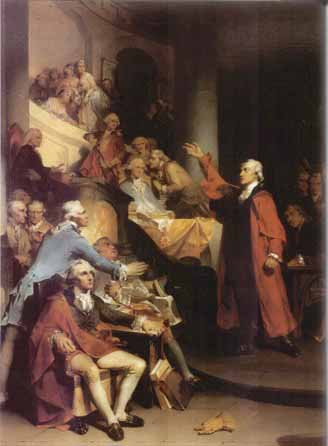
Patrick Henry made his famous "give me liberty or give me death" speech at St. John's Church in Richmond, Virginia.
Benson Bobrick writes in his book Angel in the Whirlwind: The Triumph of the American Revolution
On May 29, 1765, Patrick Henry rose in the Virginia House of Burgesses to introduce a series of momentous resolutions which he had hastily drafted on a blank leaf of an old law book ... Henry accompanied these resolutions with a fiery speech given the next day in which he concluded, "Caesar had his Brutus, Charles the First his Cromwell and George the Third" - amid cries of "Treason" that arose from all sides of the room - "and George the Third," he continued artfully, "may profit by their example. If this be treason, make the most of it!"Thomas Jefferson, then a student at the College of William and Mary, was standing in the doorway and heard Henry speak. "I well remember the cry of treason," Jefferson wrote afterward, "the pause of Mr. Henry at the name of George III, and the presence of mind with which he closed his sentence, and baffled the charge vociferated." To Jefferson it seemed as if Henry "spoke as Homer wrote".
Paul Johnson, in his wonderful book, A History of the American People
A common American political consciousness was taking shape, and delegates began to speak with a distinctive national voice. At the end of it, Patrick Henry marked this change in his customary dramatic manner: 'The distinctions between Virginians and New Englanders are no more. I am not a Virginian but an American.' Not everyone agreed with him, as yet, and the Continental Congress, as it called itself, voted by colonies rather than as individual Americans. But this body, essentially based on Franklin's earlier proposals, perpetuated its existence by agreeing to meet again in May 1775. Before that could happen, on February 5, 1775, parliament in London declared Massachusetts, identified as the most unruly and contumacious of the colonies, to be in a state of rebellion, thus authorizing the lawful authorities to use what force they thought fit. The fighting had begun. Hence when the Virginia burgesses met in convention to instruct their delegates to the Second Continental Congress, Henry saw his chance to bring home to all the revolutionary drama of the moment.Henry was a born ham actor, in a great age of acting - the Age of Garrick. The British parliament was full of actors, notably [William] Pitt himself ('He acted even when he was dying') and the young [Edmund] Burke, who was not above drawing a dagger, and hurling it on the ground to make a point. But Henry excelled them all. He proposed to the burgesses that Virginia should raise a militia and be ready to do battle. What was Virginia waiting for? Massachusetts was fighting. 'Our brethren are already in the field. Why stand we her idle? What is it that gentlemen wish? What would they have?'
Then Henry got to his knees, in the posture of a manacled slave, intoning in a low but rising voice: 'Is life so dear, our peace so sweet, as to be purchased at the price of chains and slavery? Forbid it, Almighty God!' He then bent to the earth with his hands still crossed, for a few seconds, and suddenly sprang to his feet, shouting, 'Give me liberty!' and flung wide his arms, paused, lowered his arms, clenched his right hand as if holding a dagger at his breast, and said in sepulchral tones: 'Or give me death!' He then beat his breast, with his hand holding the imaginary dagger.
There was silence, broken by a man listening at the open window, who shouted: "Let me be buried on this spot!'
Henry had made his point.
It's interesting - there's a great description of acting: "Acting is like a sculpture carved in snow." Obviously, that phrase came from the time of stage acting. Movies now can capture the "sculpture" before it melts. Or at least one version of it. But that quote always makes me think of Patrick Henry. Nobody alive today can ever experience his oratorical skills. There are no video tapes, tape recordings. We just have to take the word of those who were THERE. So while no "record" exists, and his speeches were, indeed, "carved in snow" ... a whiff of the power of them comes down to us regardless.
The impact of the "Give my liberty or give me death" speech was not quite the tinder-box effect of Thomas Paine's Common Sense
Here, in full, is Patrick Henry's speech that he made on this day in 1775:
Patrick Henry's Speech, St. John's Church, Richmond, Virginia, March 23, 1775
No man, Mr. President, thinks more highly than I do of the patriotism, as well as abilities, of the very worthy gentlemen who have just addressed the House. But different men often see the same subject in different lights; and, therefore, I hope it will not be thought disrespectful to those gentlemen if, entertaining as I do opinions of a character very opposite to theirs, I shall speak forth my sentiments freely and without reserve. This is no time for ceremony. The question before the House is one of awful moment to this country. For my own part, I consider it as nothing less than a question of freedom or slavery; and in proportion to the magnitude of the subject ought to be the freedom of the debate. It is only in this way that we can hope to arrive at truth, and fulfill the great responsibility which we hold to God and our country. Should I keep back my opinions at such a time, through fear of giving offense, I should consider myself as guilty of treason towards my country, and of an act of disloyalty toward the Majesty of Heaven, which I revere above all earthly kings.
Mr. President, it is natural to man to indulge in the illusions of hope. We are apt to shut our eyes against a painful truth, and listen to the song of that siren till she transforms us into beasts. Is this the part of wise men, engaged in a great and arduous struggle for liberty? Are we disposed to be of the number of those who, having eyes, see not, and, having ears, hear not, the things which so nearly concern their temporal salvation? For my part, whatever anguish of spirit it may cost, I am willing to know the whole truth; to know the worst, and to provide for it.
I have but one lamp by which my feet are guided, and that is the lamp of experience. I know of no way of judging of the future but by the past. And judging by the past, I wish to know what there has been in the conduct of the British ministry for the last ten years to justify those hopes with which gentlemen have been pleased to solace themselves and the House. Is it that insidious smile with which our petition has been lately received? Trust it not, sir; it will prove a snare to your feet. Suffer not yourselves to be betrayed with a kiss. Ask yourselves how this gracious reception of our petition comports with those warlike preparations which cover our waters and darken our land. Are fleets and armies necessary to a work of love and reconciliation? Have we shown ourselves so unwilling to be reconciled that force must be called in to win back our love? Let us not deceive ourselves, sir. These are the implements of war and subjugation; the last arguments to which kings resort. I ask gentlemen, sir, what means this martial array, if its purpose be not to force us to submission? Can gentlemen assign any other possible motive for it? Has Great Britain any enemy, in this quarter of the world, to call for all this accumulation of navies and armies? No, sir, she has none. They are meant for us: they can be meant for no other. They are sent over to bind and rivet upon us those chains which the British ministry have been so long forging. And what have we to oppose to them? Shall we try argument? Sir, we have been trying that for the last ten years. Have we anything new to offer upon the subject? Nothing. We have held the subject up in every light of which it is capable; but it has been all in vain. Shall we resort to entreaty and humble supplication? What terms shall we find which have not been already exhausted? Let us not, I beseech you, sir, deceive ourselves. Sir, we have done everything that could be done to avert the storm which is now coming on. We have petitioned; we have remonstrated; we have supplicated; we have prostrated ourselves before the throne, and have implored its interposition to arrest the tyrannical hands of the ministry and Parliament. Our petitions have been slighted; our remonstrances have produced additional violence and insult; our supplications have been disregarded; and we have been spurned, with contempt, from the foot of the throne! In vain, after these things, may we indulge the fond hope of peace and reconciliation. There is no longer any room for hope. If we wish to be free-- if we mean to preserve inviolate those inestimable privileges for which we have been so long contending--if we mean not basely to abandon the noble struggle in which we have been so long engaged, and which we have pledged ourselves never to abandon until the glorious object of our contest shall be obtained--we must fight! I repeat it, sir, we must fight! An appeal to arms and to the God of hosts is all that is left us!
They tell us, sir, that we are weak; unable to cope with so formidable an adversary. But when shall we be stronger? Will it be the next week, or the next year? Will it be when we are totally disarmed, and when a British guard shall be stationed in every house? Shall we gather strength by irresolution and inaction? Shall we acquire the means of effectual resistance by lying supinely on our backs and hugging the delusive phantom of hope, until our enemies shall have bound us hand and foot? Sir, we are not weak if we make a proper use of those means which the God of nature hath placed in our power. The millions of people, armed in the holy cause of liberty, and in such a country as that which we possess, are invincible by any force which our enemy can send against us. Besides, sir, we shall not fight our battles alone. There is a just God who presides over the destinies of nations, and who will raise up friends to fight our battles for us. The battle, sir, is not to the strong alone; it is to the vigilant, the active, the brave. Besides, sir, we have no election. If we were base enough to desire it, it is now too late to retire from the contest. There is no retreat but in submission and slavery! Our chains are forged! Their clanking may be heard on the plains of Boston! The war is inevitable--and let it come! I repeat it, sir, let it come.
It is in vain, sir, to extenuate the matter. Gentlemen may cry, Peace, Peace-- but there is no peace. The war is actually begun! The next gale that sweeps from the north will bring to our ears the clash of resounding arms! Our brethren are already in the field! Why stand we here idle? What is it that gentlemen wish? What would they have? Is life so dear, or peace so sweet, as to be purchased at the price of chains and slavery? Forbid it, Almighty God! I know not what course others may take; but as for me, give me liberty or give me death!
March 16, 2010
Today in history: March 16, 1751

James Madison, fourth President of the United States, was born on this day in Virginia.
"The principles and modes of government are too important to be disregarded by an inquisitive mind, and I think are well worthy of a critical examination by all students that have health and leisure." -- James Madison, age 22, to his friend who was just beginning to study the law
Elected to the presidency in 1808 - and then again for a second term in 1812 - he didn't really have a good time of it in office, what with, you know, the war of 1812 and all, and the Brits burning down our damn capital. Not a very successful President - but the story of his administration is a fascinating one - its failures, its successes, war again.
Henry Clay said about Madison, as President:
"Nature has cast him in too benevolent a mould. Admirably adapted to the tranquil scenes of peace, blending all the mild and amiable virtues, he is not fit for the rough and rude blasts which the conflicts of nations generate."
Madison's greatest accomplishment was his crafting of the US Constitution and also his commitment (second only to Alexander Hamilton's) to getting it ratified. Madison wrote Federalist #10 - probably the most famous of all of the Federalist Papers (I babble about it here) - although, if you haven't read them all in their entirety, all I can say is: do yourself a favor! (Excerpt here from # 15) It's the best civics class you'll ever get. Madison's mind was sharp, probing, deep - and all of the great political figures (especially the Virginians at the time) looked to him for guidance. Federalist #10 warns about the dangers of factions. But Madison, in his cunning behind-the-scenes manner, was hardly a neutral party himself in the battles of the day - and he had famous fights and breaks with his compatriots over matters of policy.

In May of 1787, the delegates arrived in Philadelphia for the Constitutional Convention.
The articles of Confederation, which loosely held the states together, were proving far too inefficient as time went on, and people like Madison, Hamilton, John Jay, and certainly Washington - who had been raging about the slowness of Congress since the war began - thought that the articles needed to be revised. As Washington wrote,
"Thirteen sovereignties pulling against each other, and all tugging at the foederal head, will soon bring ruin on the whole."
However, these were conservative men, despite their revolutionary fervor. They were land-owners, farmers, lawyers, not interested in tearing things down - but building upon foundations already there, so the delegates, for the most part, were not looking for a whole new form of government to be raised at their Convention. They were looking for a revision to the Articles, that was it. However, James Madison - and Alexander Hamilton - went in there with preconceived notions, definitely. They knew what they were going to try to push through.
The Articles could not stand. Earlier that year, the Shays Rebellion had taken place - which had freaked everyone out. What had happened to solidarity? Should military force be used to put down the rebellion? There couldn't have been a better time for the Constitutional Convention.
Catherine Drinker-Bowen, in her WONDERFUL book Miracle At Philadelphia: The Story of the Constitutional Convention May - September 1787
On the twenty-fifth of May, when a quorum was obtained, Washington was unanimously elected president of the Convention and escorted to the chair. From his desk on the raised dais he made a little speech of acceptance, depreciating his ability to give satisfaction in a scene so novel. "When seated," wrote a member, "he declared that as he never had been in such a situation he felt himself embarrassed, that he hoped his errors, as they would be unintended, would be excused. He lamented his want of qualifications."...In the front row near the desk, James Madison sat bowed over his tablet, writing steadily. His eyes were blue, his face ruddy; he did not have the scholar's pallor. His figure was well-knit and muscular and he carried his clothes with style. Though he usually wore black, he has also been described as handsomely dressed in blue and buff, with ruffles at breast and wrist. Already he was growing bald and brushed his hair down to hide it; he wore a queue and powder. He walked with the quick bouncing step that sometimes characterizes men of remarkable energy.
As a reporter Madison was indefatigable, his notes comprehensive, set down without comment or aside. One marvels that he was able at the same time to take so large a part in the debates. It is true that in old age Madison made some emendations in the record to accord with various disparate notes which later came to light; he has been severely criticized for it. Other members took notes at the Convention: Hamilton, Yates and Lansing of New York, McHenry of Maryland, Paterson of New Jersey, Rufus King of Massachusetts, William Pierce of Georgia, George Mason of Virginia. But most of these memoranda were brief, incomplete; had it not been for Madison we should possess very scanty records of the Convention. His labors, he said later, nearly killed him. "I chose a seat," he afterward wrote, "in front of the presiding member, with the other members on my right and left hand. In this favorable position for hearing all that passed, I noted in terms legible and in abbreviations and marks intelligble to myself what was read from the Chair or spoken by the members; and losing not a moment unnecessarily between the adjournment and reassembling of the Convention I was enabled to write out my daily notes during the session or within a few finishing days after its close in the extent and form preserved in my own hand on my files ... I was not absent a single day, nor more than a casual fraction of an hour in any day, so that I could not have lost a single speech, unless a very short one."
It was, actually, a tour de force, not to be published -- and scarcely seen -- until thirty years after the Convention. "Do you know," wrote Jefferson to John Adams from Monticello in 1815, "that there exists in manuscript the ablest work of this kind ever yet executed, of the debates of the constitutional convention of Philadelphia ...? The whole of everything said and done there was taken down by Mr. Madison, with a labor and exactness beyond comprehension." ...
As I mentioned before, these were all practical men - and many of them had gathered with practical concerns, about raising money, and internal improvements - and how the Articles would be able to handle such large projects. Madison and Hamilton kept their cards close to their chests, at first (this, of course, was long before their famous break. Hamilton broke with pretty much everyone). Hamilton was a practical man as well. He had a lot of problems with the Constitution as it was laid out in embryonic form by Madison. But he recognized the genius within, recognized the need for such a thing - and nobody - but NOBODY - worked harder for ratification than my dead boyfriend. It is amazing the amount of print he was able to devote to the Federalist Papers - it STILL boggles the mind.
But back to Madison. Poor man ... his more glittery compatriots always have a way of stealing the spotlight, don't they??
Catherine Drinker-Bowen goes on:
Time would pass before members realized how far the plans of such men as Madison and Hamilton reached, and what the Constitution promised to be. It would be misleading to name thus early the Constitution's "enemies", or to set down this name or that as "against" the Constitution. Five delegates in the end would refuse to sign -- Elbridge Gerry of Massachusetts, Yates and Lansing of New York, George Mason and Edmund Randolph of Virginia -- all men of decided views and each with a different reason for his action. More vociferous than any of these would be Luther Martin of Maryland, who, though out of town on private business at the moment of signing, later declared that had he been present he would have given the document his "solemn negative," even had he "stood single and alone".
It would be four months before the Constitution was finally ratified and signed.
Garry Wills has some very interesting thoughts on the famous Federalist 10 in his book on James Madison
Madison's debut contribution [to "The Federalist Papers"], would in time (a long time) become the most famous of them all. It crammed into a narrow space all the arguments Madison had been sifting and refining in his opposition to the Continental Congress's weakness, in his preparation for the convention, in his crafting of the Virginia Plan, and in his debates at the convention. Madison goes behind specific weaknesses in the Articles to expose the fundamental error on which the Articles were based, the idea that the only worthy democracy is direct democracy.Madison's attack on that concept is so radical for its time that it is often downplayed, or even altogether missed. The most important passage in the Number is its claim that no man can be a judge in his own case. Not much is made of that in some treatments of the Number. We hear about the tyranny of majorities (though Madison treats that as just a symptom of direct democracy). We hear about the difference between a small republic and an extended republic (whereas Madison is talking about the difference between a direct democracy and a republic). We hear that Madison wanted to multiply factions (though he thought all factions bad things). We hear that Madison wanted to create a national elite, above the states, because he distrusted the people (though his system calls precisely for trust - direct democracy is built on distrust). We hear that he was trying to set up a mechanical system for producing correct decisions (though he said that no governmental machinery can produce good results without virtue in its operators).
It has puzzled people that Number 10 did not get much attention until the twentieth century. It was not a matter of great dispute in the ratification debates, though it would have clarified and focused those debates - they spent endless hours on the number of representatives, rather than on the nature of representation. The reason for this is that a dismissal of direct democracy was almost literally unthinkable to the men who debated the Constitution. Every constitution in America was based on that ideal, as a thing to be approximated even when it could not be literally enacted. If people could not directly make the government's decisions, as in a New England town meeting or the Athenian Assembly, then they should tie down those making the decisions, making them (so far as possible) passive tools in their own hands. That is why short terms, rotation, instruction open proceedings (to see that instruction is followed), recall (to punish departures from instruction), and weak executives were adopted. These were the necessary melioratives for the necessary evil of any departure from direct democracy.
The rightness of all these measures was so self-evident to those who accepted them that the could not even imagine someone making the attack on them that Madison did. He did not say, as many did, that direct democracy would be wonderful if it were possible but, since it is not possible in large communities, some approximation to it must be cobbled up. He did not think direct democracy wonderful. He thought it fundamentally unjust.
No man is allowed to be a judge in his own cause, because his interests would certainly bias his judgment, and, not improbably, corrupt his integrity. With equal, nay with greater reason, a body of men are unfit to be both judges and parties at the same time; yet what are many of the most important acts of legislation but so many judicial determinations, not indeed concerning the right of single persons but concerning the right of large bodies of citizens; and what are the different classes of legislators but advocates and parties to the causes which they determine?By calling legislation quasi-judicial, he instantly disqualifies all those who come to the task of legislating with nothing but their own interest in mind. They have come to be judges in their own case - and that is what proponents of direct democracy would justify. In doing so, they defend a system of majority tyranny. If naked interest is all that can be expressed, then only one thing will determine the outcome. The only question to be decided is: which interest has the greater number backing it.
I find Madison a very interesting fellow, although not as easy to get to know as John Adams, who was a passionate warm-blooded flawed and sensitive man ... Madison is a bit more "close", perhaps. (You won't see an HBO miniseries about Madison any day soon!!) A wife of one of Madison's friends referred to Madison as a "gloomy stiff creature" - and that is obviously not one of the qualities that leads to an endearing and well-liked president (although the office was still, obviously, in its infancy when Madison held it). He did marry Dolley Madison - who remains, to this day, at the top of the list of "favorite first ladies" - not that anyone remembers her personally now, of course - but by all accounts she was a vivacious social happy woman, and everyone liked her.

The two did not have children, but it appears the marriage was a happy one (she referred to him as her "great little Madison"). Unlike many other first ladies since, Dolley Madison didn't have a problem with the social rigors of her position - she loved it. Men and women alike found her charming, easy-going.
Wills describes the burning of the capital and its aftermath:
During the night of the fires in Washington, Madison and Dolley were unable to find each other - she stayed at one friend's home in Virginia, he in another. He met her the next day; then, assured of her safety, he went to consult with Winder, whose troops were on the road toward Baltimore ... Madison wrote to Dolley suggesting she not return to Washington until he was sure the city was safe. But she was already on her way back to him.It was suggested that Madison would summon Congress to a different, safer spot - Congress had, after all, been shifted about during the Revolution. But Madison knew the government must be seen to function, and he called Congress back for an early session. He had chambers prepared for the House and Senate in the Post Office and Patent Building, which had escaped the fires. He and Dolley moved into the house they had lived in when he was secretary of state - though the French minister, Louis Serurier, soon vacated his own residence, the current Octagon House, for their use. Dolley found these quarters too cramped, and she would end up in the former offices of the Treasury, where she could entertain on the scale she was used to. She, too, realized that it was important to return the city to its normal patterns. But the Madisons never returned to the blackened White House.
I think someone's choice of a wife can be pretty illuminating. Madison was often seen as a dour brainiac, humorless and obsessive - but he chose as a counterpart Dolley, who was pretty, friendly, funny and resourceful: Perhaps her most famous moment is this: during the burning of the capital, Dolly was forced to flee by carriage - but she had the presence of mind to roll up Gilbert Stuart's portrait of George Washington - (she had to break the frame in order to get the painting out) - and give it to some soldiers to keep safe. And of course, it was preserved, for all time, thanks to her foresight.

I mean, you gotta love a person like that. Imagine: you are under siege. Your house is burning down around your ears. And you have the presence of mind to take a moment and think: "You know what? Gotta save this portrait." The image of her breaking the frame to get at the painting in the middle of that chaos ... It's one of my favorite White House anecdotes in Presidential history.
And so happy birthday, "great little Madison". We are forever in your debt!

February 22, 2010
Today in history, February 22, 1732
George Washington, first President of the United States, was born.

(All quotes from George Washington's letters below I got from my copy of the Library of America's compilation of his writings
Thomas Jefferson on George Washington:
The moderation and virtue of a single character probably prevented this Revolution from being closed, as most others have been, by a subversion of that liberty it was intended to establish.
In May, 1754, Washington wrote a letter home to his brother, after his first experience of battle in the French and Indian War:
I heard Bullets whistle and believe me there was something charming in the Sound.
In November, 1754, George Washington wrote:
My inclinations are strongly bent to arms.
GEORGE WASHINGTON, in a letter written to a friend in 1774
Does it not appear as clear as the sun in its meridian brightness that there is a regular, systematic plan to fix the right and practice of taxation upon us? Ought we not, then, to put our virtue and fortitude to the severest tests?
One of the things I love about Washington is that his progression to Revolutionary was gradual, and began with practical matters, like being taxed, and having his autonomy as a farmer taken away from him (the British regulated where he could buy parts, taxing him to death, etc.) His was not a high-flung "all men are created equal" mindset, like Thomas Jefferson's ... He began with the unfairness and humiliation of his status as someone who is being occupied and bossed around. It took all kinds to make that revolution. If we had just had Thomas Jefferson, we would have been in trouble. But we needed Thomas Jefferson to put the ideals into words, for the ages. But it was the mixture of personalities and mindsets that made it a success. Very important. John Adams countered Jefferson. Hamilton countered Washington and Jefferson. Ben Franklin gave it a glitter and notoriety. Madison was the brainiac lawyer. John Jay, Samuel Adams ... all with their area of expertise, their interests and passions. Thank God we had a good mix.
But Washington was the giant. A man who walked away from power even when it was offered to him? Had such a man ever lived before? George III didn't think so.
In 1755, Washington wrote a complaining letter to his friend Robert Dinwiddie:
We cannot conceive that because we are Americans, we shou'd therefore be deprived of the Benefits Common to British Subjects.
In 1758, Washington wrote a couple of letters to Sally Fairfax, a woman he was in love with - his first love - someone he never really recovered from (letters to her at the end of his life suggest that):
'Tis true, I profess myself a Votary to Love - I acknowledge that a Lady is in the Case - and further I confess that this Lady is known to you. - Yes Madam, as well as she is to one, who is too sensible of her Charms to deny the Power, whose Influence he feels and must ever Submit to. I feel the force of her amiable beauties in the recollection of a thousand tender passages that I coud wish to obliterate, till I am bid to revive them. - but experience alas! Sadly reminds me how Impossible this is. - and evinces an opinion which I have long entertained, that there is a Destiny, which has the Sovereign Controul of our Actions - not to be resisted by the Strongest efforts of Human Nature.The World has no business to know the object of my Love, declard in this manner to you - you when I want to conceal it - One thing, above all things in this World I wish to know, and only one person of your Acquaintance can solve me that, or guess my meaning. - but adieu to this, till happier times, if I shall ever see them ...
Excerpt from Joseph Ellis's His Excellency: George Washington
All of which is to suggest that Washington did not need to read books by radical Whig writers or receive an education in political theory from George Mason in order to regard the British military occupation of Massachusetts in 1774 as the latest installment in a long-standing pattern. His own ideological origins did not derive primarily from books but from his own experience with what he had come to regard as the imperiousness of the British Empire. Mason probably helped him to develop a more expansive vocabulary to express his thoughts and feelings, but the thoughts, and even more so the feelings, had been brewing inside him for more than twenty years. At the psychological nub of it all lay an utter loathing for any form of dependency, a sense of his own significance, and a deep distrust of any authority beyond his direct control.
Martha Washington wrote a letter to a relative on the eve of her husband's departure to the Convention in 1774:
I foresee consequences; dark days and darker nights; domestic happiness suspended; social enjoyments abandoned; property of every kind put in jeopardy by war, perhaps; neighbors and friends at variance, and eternal separations on earth possible. But what are all these evils when compared with the fate of which the Port Bill may be only a threat? My mind is made up; my heart is in the cause. George is right; he is always right. God has promised to protect the righteous, and I will trust him.

PATRICK HENRY, on his return home from the first Continental Congress in 1774 was asked whom he thought was the foremost man in the group:
"Colonel Washington is unquestionably the greatest man on that floor."
Abigail Adams first met Washington in 1774, and wrote to her husband:
You had prepared me to entertain a favorable opinion of him, but I thought the half was not told me. Dignity with ease and complacency, the gentleman and the soldier look agreeably blended in him. Modesty marks every line and feature of his face.
When George Washington was elected (unanimously) by the First Continental Congress to be Commander in Chief (this was in June, 1775) - here was the brief acceptance he made:
"Lest some unlucky event should happen unfavorable to my reputation, I beg it may be remembered by every gentleman in the room, that I this day declare, with the utmost sincerity, I do not think myself equal to the command."
In a 1775 letter to his brother-in-law, Burwell Bassett:
I am now Imbarked on a tempestuous Ocean from whence, perhaps, no friendly harbour is to be found ... It is an honour I wished to avoid ... I can answer but for three things, a firm belief of the justice of our Cause - close attention to the prosecution of it - and the strictest Integrity - If these cannot supply the places of Ability & Experience, the cause will suffer & more than probably my character along with it, as reputation derives its principal support from success.
GEORGE WASHINGTON, writing to Martha on June 18, 1775, following his nomination as commander in chief
My Dearest: I now sit down to write to you on a subject which fills me with inexpressible concern, and this concern is greatly aggravated and increased when I reflect upon the uneasiness I know it will give you. It has been determined in Congress that the whole army raised for the defence of the American cause shall be put under my care, and that it is necessary for me to proceed immediately to Boston to take upon me the command of it.You may believe me, my dear Patsy, when I assure you, in the most solemn manner, that, so far from seeking this appointment, I have used every endeavour in my power to avoid it, not only from my unwillingness to part with you and the family, but from a consciousness of its being a trust too great for my capacity, and that I should enjoy more real happiness in one month with you at home than I have the most distant prospect of finding abroad, if my stay were to be seven times seven years.
But as it has been a kind of destiny that has thrown me upon this service, I shall hope that my undertaking is designed to answer some good purpose.
George Washington describes here what a general expects in his aides:
The variegated and important duties of the aids of a commander in chief or the commander of a separate army require experienced officers, men of judgment and men of business, ready pens to execute them properly and with dispatch. A great deal more is required of them than attending him at a parade or delivering verbal orders here and there, or copying a written one. They ought, if I may be allowed to use the expression, to possess the Soul of the General, and from a single idea given to them, to convey his meaning in the clearest and fullest manner.
GEORGE WASHINGTON, letter to Joseph Reed, early December, 1775, after a disappointing recruiting drive
I have oftentimes thought how much happier I should have been if, instead of accepting the command under such circumstances, I had taken my musket on my shoulder and entered the ranks; or, if I could have justified the measure to posterity and my own conscience, had retired to the back country and lived in a wigwam. If I shall be able to rise superior to these and many other difficulties which might be enumerated, I shall most religiously believe that the finger of Providence is in it to blind the eyes of our enemies, for surely if we get well through this month it must be for want of their knowing the disadvantages which we labor under.
On August 1, 1777, Washington invited the newly arrived Marquis de Lafayette to witness a review of the troops. The American troops marched by, ragged, disheveled, shabby. Here is what the two men were reported to say to one another:
Washington: We are rather embarrassed to show ourselves to an officer who has just left the army of France.
Lafayette: I am here, sir, to learn and not to teach.

GEORGE WASHINGTON, on the self-sacrifice of his soldiers during the hard winter of 1777:
To see men without clothes to cover their nakedness, without blankets to lay on, without shoes, by which their marches might be traced by the blood from their feet, and almost as often without provisions as with; marching through frost and snow, and at Christmas taking up their winter quarters within a day's march of the enemy, without a house or hut to cover them till they could be built, and submitting to it without a murmur, is a mark of patience and obedience which in my opinion can scarce be paralleled.
In 1779, George Washington wrote:
Men are very apt to run into extremes; hatred to England may carry some into excessive Confidence in France ...; I am heartily disposed to entertain the most favourable sentiments of our new ally and to cherish them in others to a reasonable degree; but it is a maxim founded on the universal experience of mankind, that no nation is to be trusted farther than it is bound by its interest; and no prudent statesman or politician will venture to depart from it.
GEORGE WASHINGTON, letter of May 31, 1780, describing one of the things he was learning through the war - his frustration with Congress was constant, sometimes titanic rage (when he gets mad, boy, look out), other times just a nagging persistent annoyance.
Certain I am unless Congress speak in a more decisive tone, unless they are invested with powers by the several States competent to the great purposes of the war, or assume them as a matter of right, and they and the States respectively act with more energy than they hitherto have done, that our cause is lost. One State will comply with a requisition of Congress, another neglects to do it; a third executes it by halves; and all differ either in the manner, the matter, or so much in point of time, that we are always working up hill; and, while such a system as the present one or rather want of one prevails, we shall ever be unable to apply our strength or resources to any advantage.
Excerpt from Joseph Ellis's His Excellency: George Washington
One incident near the end of the war provides a clue to the transformation in his character wrought by the intense experience of serving so long as the singular embodiment of commitment to the cause. In 1781, Lund Washington reported that a British warship had anchored in the Potomac near Mount Vernon, presumably with orders to ravage Washington's estate. When the British captain offered assurances that he harbored no hostile intentions, Lund sent out a boatload of provisions to express his gratitude for the captain's admirable restraint. When Washington learned of this incident he berated Lund: "It would have been a less painful circumstance to me, to have heard, that in consequence of your non-compliance with their request, they had burnt my House, and laid the Plantation to ruins."
And here is a story - (perhaps it's a rumor - but I love it nonetheless) of Benjamin Franklin's response to the news of the surrender at Yorktown on October 19, 1781. He was, of course, in Paris at the time, setting the world on fire with his homespun wisdom, bacchanalian propensities, chess-playing abilities - and the vision he presented to the world of what liberty, American-style, looked like. An international celebrity.
Word came to France of the decisive American victory, and the complete surrender to George Washington in Yorktown. Franklin attended a diplomatic dinner shortly thereafter - and, of course, everyone was discussing the British defeat.
The French foreign minister stood, and toasted Louis XVI: "To his Majesty, Louis the Sixteenth, who, like the moon, fills the earth with a soft, benevolent glow."
The British ambassador rose and said, "To George the Third, who, like the sun at noonday, spreads his light and illumines the world."
Franklin rose and countered, "I cannot give you the sun or the moon, but I give you George Washington, General of the armies of the United States, who, like Joshua of old, commanded both the sun and the moon to stand still, and both obeyed."
Excerpt from Joseph Ellis's His Excellency: George Washington
After Yorktown, moreover, new life was breathed into these old fears, since Washington's insistence on maintaining the Continental army at full strength during a time when the majority of the citizenry believed, correctly it turned out, that the war was over only intensified fears that he intended to become the American Cromwell ... Such loose talk triggered the fear that the infant American republic was about to be murdered in its infancy by the same kind of military dictatorship that had destroyed the Roman and English republics in their formative phases. And since these were the only two significant efforts to establish republican governments in recorded history, the pattern did not bode well.Washington was fully aware of this pattern, and therefore recognized the need to make explicit statements of his intention to defy it. In May 1782 a young officer at the Newburgh encampment, Lewis Nicola, put in writing what many officers were whispering behind the scenes: that the Continental Congress's erratic conduct of the war had exposed the weakness of all republics and the certain disaster that would befall postwar America unless Washington declared himself king ... Washington responded with a stern lecture to "banish these thoughts from your Mind," and denounced the scheme as "big with the greatest mischiefs that can befall my Country." When word of Washington's response leaked out to the world, no less an expert on the subject than George III was heard to say that, if Washington resisted the monarchical mantle and retired, as he always said he would, he would be "the greatest man in the world".
While George III's judgment as a student of history has never met the highest standards, his opinion on this matter merits our attention, for it underlines the truly exceptional character of Washington's refusal to regard himself as the indispensable steward of the American Revolution. Oliver Cromwell had not surrendered power after the English Revolution. Napoleon, Lenin, Mao, and Castro did not step aside to leave their respective revolutionary settlements to others in subsequent centuries. We need to linger over this moment to ask what was different about Washington, or what was different about the political conditions created by the American Revolution, that allowed him to resist temptations that other revolutionary leaders before and since found irresistible.

GEORGE WASHINGTON, letter of (unwelcome) advice sent to governors of the 13 states, 1783, as the army began to disband.
Americans are now sole lords and proprietors of a vast tract of continent comprehending all the various soils and climates of the world and abounding with all the necessaries and conveniences of life - Heaven has crowned all other blessings, by giving a fairer opportunity for political happiness, than any other nation has been favored with - This is the time of their political probation; this is the moment when the eyes of the whole world are turned upon them; this is the moment to establish or ruin their national character forever; this is the favorable moment to give such a tone to our federal government as will enable it to answer the ends of its institution; or this may be the ill-fated moment for relaxing the powers of the Union, annihilating the cement of the Confederation and exposing us to become the sport of European politics, which may play one state against another, to prevent their growing importance and to serve their own interested purposes. For, according to the system of policy the states shall adopt at this moment, they will stand or fall; and by their confirmation or lapse it is yet to be decided whether the Revolution must ultimately be considered a blessing or a curse - a blessing or a curse, not to the present age alone, for with our fate will the destiny of unborn millions be involved.[He states that there are 4 requirements for the new America]
First. An indissoluble union of the states under one federal head. Secondly. A sacred regard to public justice (that is, the payment of debts). Thirdly. The adoption of a proper peace establishment (that is, an army and a navy). Fourthly. The prevalence of that pacific and friendly disposition among the people of the Union, which will influence them to forget their local prejudices and policies; to make those mutual concessions, which are requisite to the general prosperity; and, in some instances, to sacrifice their individual advantages to the interest of the community. These are the pillars on which the glorious future of our independency and national character must be supported.
Then there was the Newburgh Conspiracy, in March 1783, when a group of congressmen aligned with officers in the army threatened a military coup for various reasons. The new federal government was barely formed, there was no constitution yet - and the states were vying for powerful positions. It's important to remember just how tenuous all of this was at the time. It wasn't a smooth clear path full of Revolutionary-Era virtue and certainty, although there are bozos who claim that it was like that. They need to read their history books. Washington heard of the plot, and decided to address it headon. Now. One of the things I love about this story is that Washington - while he obviously said time and time again that he was uncomfortable with being a "symbol" (and I believe him) - he also realized that it was pointless to fight against it, and when he needed to USE that symbolic stature to get something done that he wanted, he had no problem with playing that card. This is a highly theatrical moment, described vividly by every person who was there, who left an account, and they all say the same thing. There wasn't a dry eye in the house. Perhaps it's my theatrical background, but I cannot believe that Washington was unaware of the effect he wanted to have, and that he did not USE that gesture described so vividly in a conscious manner. There is a way, you know, to be FALSE and TRUE at the same time. Any actor can tell you that. You are playing make-believe, you are pretending to be someone else - so that's the FALSE part - but your reactions and gestures all come from a very TRUE place, and many an actor will tell you that they feel MORE true when they are acting than when they are just out and about as a regular civilian. So that's my interpretation of Washington's big gesture here. It was certainly planned, and so that is FALSE ... but it was also organic and came from a true place. It was chosen for the EFFECT it would have. Washington was a celebrity. He knew that. He hated it. But he used it when convenient. Anyway, I'm going on and on but this is just one of my favorite moments of his life - I love its theatricality - and I also just wish I had been there. But so many people described the moment that I do feel like I can live it vicariously. Like Patrick Henry's "give me liberty or give me death" speech, where people record his gestures, his pantomime, the tenor of his voice. I have imagined myself there.
So Washington gets wind of this dangerous conspiracy, to basically take over, and undermine Washington's authority - not to mention the authority of the baby federal government.
Excerpt from Joseph Ellis's His Excellency: George Washington
For obvious reasons, the secret conversations within the officers' corps never found their way into the historical record, making all efforts to recover the shifting factions in the plot educated guesses at best. We can be sure that the crisis came to a head on March 11, when the dissident officers scheduled a meeting to coordinate their strategy. Washington countermanded the order for a meeting, saying only he could issue such an order, then scheduled a session for all officers on March 16.He spent the preceding day drafting, in his own hand, the most impressive speech he ever wrote. Beyond the verbal felicities and classic cadences, the speech established a direct link between his own honor and reputation and the abiding goals of the American Revolution. His central message was that any attempted coup by the army was simultaneously a repudiation of the principles for which they had all been fighting and an assault on his own integrity. Whereas Cromwell and later Napoleon made themselves synonymous with the revolution in order to justify the assumption of dictatorial power, Washington made himself synonymous with the American Revolution in order to declare that it was incompatible with dictatorial power.
On March 16, 1783, George Washington made the following speech to his group of officers:
Gentlemen: By an anonymous summons, an attempt has been made to convene you together; how inconsistent with the rules of propriety, how unmilitary, and how subversive of all order and discipline, let the good sense of the army decide...Thus much, gentlemen, I have thought it incumbent on me to observe to you, to show upon what principles I opposed the irregular and hasty meeting which was proposed to have been held on Tuesday last - and not because I wanted a disposition to give you every opportunity consistent with your own honor, and the dignity of the army, to make known your grievances. If my conduct heretofore has not evinced to you that I have been a faithful friend to the army, my declaration of it at this time would be equally unavailing and improper. But as I was among the first who embarked in the cause of our common country. As I have never left your side one moment, but when called from you on public duty. As I have been the constant companion and witness of your distresses, and not among the last to feel and acknowledge your merits. As I have ever considered my own military reputation as inseparably connected with that of the army. As my heart has ever expanded with joy, when I have heard its praises, and my indignation has arisen, when the mouth of detraction has been opened against it, it can scarcely be supposed, at this late stage of the war, that I am indifferent to its interests.
But how are they to be promoted? The way is plain, says the anonymous addresser. If war continues, remove into the unsettled country, there establish yourselves, and leave an ungrateful country to defend itself. But who are they to defend? Our wives, our children, our farms, and other property which we leave behind us. Or, in this state of hostile separation, are we to take the two first (the latter cannot be removed) to perish in a wilderness, with hunger, cold, and nakedness? If peace takes place, never sheathe your swords, says he, until you have obtained full and ample justice; this dreadful alternative, of either deserting our country in the extremest hour of her distress or turning our arms against it (which is the apparent object, unless Congress can be compelled into instant compliance), has something so shocking in it that humanity revolts at the idea. My God! What can this writer have in view, by recommending such measures? Can he be a friend to the army? Can he be a friend to this country? Rather, is he not an insidious foe? Some emissary, perhaps, from New York, plotting the ruin of both, by sowing the seeds of discord and separation between the civil and military powers of the continent? And what a compliment does he pay to our understandings when he recommends measures in either alternative, impracticable in their nature?
I cannot, in justice to my own belief, and what I have great reason to conceive is the intention of Congress, conclude this address, without giving it as my decided opinion, that that honorable body entertain exalted sentiments of the services of the army; and, from a full conviction of its merits and sufferings, will do it complete justice. That their endeavors to discover and establish funds for this purpose have been unwearied, and will not cease till they have succeeded, I have not a doubt. But, like all other large bodies, where there is a variety of different interests to reconcile, their deliberations are slow. Why, then, should we distrust them? And, in consequence of that distrust, adopt measures which may cast a shade over that glory which has been so justly acquired; and tarnish the reputation of an army which is celebrated through all Europe, for its fortitude and patriotism? And for what is this done? To bring the object we seek nearer? No! most certainly, in my opinion, it will cast it at a greater distance.
For myself (and I take no merit in giving the assurance, being induced to it from principles of gratitude, veracity, and justice), a grateful sense of the confidence you have ever placed in me, a recollection of the cheerful assistance and prompt obedience I have experienced from you, under every vicissitude of fortune, and the sincere affection I feel for an army I have so long had the honor to command will oblige me to declare, in this public and solemn manner, that, in the attainment of complete justice for all your toils and dangers, and in the gratification of every wish, so far as may be done consistently with the great duty I owe my country and those powers we are bound to respect, you may freely command my services to the utmost of my abilities.
While I give you these assurances, and pledge myself in the most unequivocal manner to exert whatever ability I am possessed of in your favor, let me entreat you, gentlemen, on your part, not to take any measures which, viewed in the calm light of reason, will lessen the dignity and sully the glory you have hitherto maintained; let me request you to rely on the plighted faith of your country, and place a full confidence in the purity of the intentions of Congress; that, previous to your dissolution as an army, they will cause all your accounts to be fairly liquidated, as directed in their resolutions, which were published to you two days ago, and that they will adopt the most effectual measures in their power to render ample justice to you, for your faithful and meritorious services. And let me conjure you, in the name of our common country, as you value your own sacred honor, as you respect the rights of humanity, and as you regard the military and national character of America, to express your utmost horror and detestation of the man who wishes, under any specious pretenses, to overturn the liberties of our country, and who wickedly attempts to open the floodgates of civil discord and deluge our rising empire in blood.
By thus determining and thus acting, you will pursue the plain and direct road to the attainment of your wishes. You will defeat the insidious designs of our enemies, who are compelled to resort from open force to secret artifice. You will give one more distinguished proof of unexampled patriotism and patient virtue, rising superior to the pressure of the most complicated sufferings. And you will, by the dignity of your conduct, afford occasion for posterity to say, when speaking of the glorious example you have exhibited to mankind, "Had this day been wanting, the world had never seen the last stage of perfection to which human nature is capable of attaining."
I hope you made it through that whole thing. It is rather extraordinary. BUT the most extraordinary thing is the "improvised" moment that came directly BEFORE he made that speech. It was the GESTURE that ended the coup, not his words. Or perhaps a mixture of both. But never ever underestimate the power of gesture.
Here is Joseph Ellis again on the moment in question:
Washington has just entered the New Building at Newburgh, a large auditorium recently built by the troops and also called The Temple. About 500 officers are present in the audience. Horatio Gates is chairing the meeting, a rich irony since Gates is most probably complicitous in the plot to stage a military coup that Washington has come to quash. Everything has been scripted and orchestrated beforehand. Washington's aides fan out into the audience to prompt applause for the general's most crucial lines. Washington walks slowly to the podium and reaches inside his jacket to pull out his prepared remarks. Then he pauses - the gesture is almost certainly planned - and pulls from his waistcoat a pair of spectacles recently sent to him by David Rittenhouse, the Philadelphia scientist. No one has ever seen Washington wear spectacles before on public occasions. He looks out to his assembled officers while adjusting the new glasses and says: "Gentlemen, you will permit me to put on my spectacles, for I have not only grown gray, but almost blind in the service of my country." Several officers began to sob. The speech itself is anti-climactic. All thoughts of a military coup die at that moment.
On November 25, 1783: George Washington "took back" New York.
The peace treaty had been signed a year before, France had pledged support and recognition of the new United States, but the redcoats remained in New York, waiting for their written orders from London. George Washington vowed that he would not go home, he would not break up his army, until every last redcoat had left.
Nov. 25 was that momentous day - the day the American troops marched back into town, after the departure of the British.
The exhausted army marched the long way downtown, through what was now a war-ravaged New York City. People lined the streets, throwing laurels in front of Washington's horse, screaming, crying ... a huge display of emotion and reverence that made the typically humble Washington feel uncomfortable.
A woman in the crowd that day wrote the following in her diary:
We had been accustomed for a long time to military display in all the finish and finery of [British] garrison life. The troops just leaving us were as if equipped for a show and with their scarlet uniforms and burnished arms made a brilliant display. The troops that marched in, on the contrary, were ill-clad and weather-beaten and made a forlorn appearance. But then, they were our troops and as I looked at them and thought upon all they had done and suffered for us, my heart and my eyes were full.
GEORGE WASHINGTON'S MOTHER to Lafayette, 1784:
"I am not surprised at what George has done, for he was always a good boy."
George Washington wrote the following on the eve of his inauguration in 1789:
It is said that every man has his portion of ambition. I may have mine, I suppose, as well as the rest, but if I know my own heart, my ambition would not lead me into public life; my only ambition is to do my duty in this world as well as I am capable of performing it, and to merit the good opinion of all good men.
 Washington's first inaugural address
David McCullough describes, in his book on John Adams
On the day of his inauguration, Thursday, April 30 1789, Washington rode to Federal Hall in a canary-yellow carriage pulled by six white horses and followed by a long column of New York militia in full dress. The air was sharp, the sun shone brightly, and with all work stopped in the city, the crowds along his route were the largest ever seen. It was as if all New York had turned out and more besides. "Many persons in the crowd," reported the Gazette of the United States "were heard to say they should now die contented - nothing being wanted to complete their happiness - but the sight of the savior of his country."In the Senate Chamber were gathered the members of both houses of Congress, the Vice President, and sundry officials and diplomatic agents, all of whom rose when Washington made his entrance, looking solemn and stately. His hair powdered, he wore a dress sword, white silk stockings, shoes with silver buckles, and a suit of the same brown Hartford broadcloth that Adams, too, was wearing for the occasion. They might have been dressed as twins, except that Washington's metal buttons had eagles on them.
It was Adams who formally welcomed the General and escorted him to the dais. For an awkward moment Adams appeared to be in some difficulty, as though he had forgotten what he was supposed to say. then, addressing Washington, he declared that the Senate and House of Representatives were ready to attend him for the oath of office as required by the Constitution. Washington said he was ready. Adams bowed and led the way to the outer balcony, in full view of the throng in the streets. People were cheering and waving from below, and from windows and rooftops as far as the eye could see. Washington bowed once, then a second time.
Fourteen years earlier, it had been Adams who called on the Continental Congress to make the tall Virginian commander-in-chief of the army. Now he stood at Washington's side as Washington, his right hand on the Bible, repeated the oath of office as read by Chancellor Robert R. Livingston of New York, who had also been a member of the Continental Congress.
In a low voice Washington solemnly swore to execute the office of the President of the United States and, to the best of his ability, to "preserve, protect, and defend the Constitution of the United States." Then, as not specified in the Constitution, he added, "So help me God", and kissed the Bible, thereby establishing his own first presidential tradition.
"It is done," Livingston said, and, turning to the crowd, cried out, "Long live George Washington, President of the United States."
George Washington said:
Men may speculate as they will, they may talk of patriotism; they may draw a few examples from current story - but whoever builds upon it as a sufficient basis for conducting a long and bloody war will find themselves deceived in the end - For a long time it may of itself push men to action, to bear much, to encounter difficulties, but it will not endure unassisted by Interest.
On August 17, 1790, George Washington visited Newport Rhode Island - and visited the Jewish congregation of the Touro Synagogue (which still stands - gorgeous building. We went on a field trip there in grade school). The congregation presented an address to George Washington, welcoming him to Newport, and to their synagogue. A couple of days later George Washington wrote an eloquent response. Both the address as well as Washington's response were printed in all of the "national" newspapers at the time.
August 21st, 1790
To the Hebrew Congregation in Newport Rhode Island.Gentleman.
While I receive, with much satisfaction, your Address replete with expressions of affection and esteem; I rejoice in the opportunity of assuring you, that I shall always retain a grateful remembrance of the cordial welcome I experienced in my visit to Newport, from all classes of Citizens.
The reflection on the days of difficulty and danger which are past is rendered the more sweet, from a consciousness that they are succeeded by days of uncommon prosperity and security. If we have wisdom to make the best use of the advantages with which we are now favored, we cannot fail, under the just administration of a good Government, to become a great and happy people.
The Citizens of the United States of America have a right to applaud themselves for having given to mankind examples of an enlarged and liberal policy: a policy worthy of imitation.
All possess alike liberty of conscience and immunities of citizenship. It is now no more that toleration is spoken of, as if it was by the indulgence of one class of people, that another enjoyed the exercise of their inherent natural rights. For happily the Government of the United States, which gives to bigotry no sanction, to persecution no assistance, requires only that they who live under its protection should demean themselves as good citizens, in giving it on all occasions their effectual support.
It would be inconsistent with the frankness of my character not to avow that I am pleased with your favorable opinion of my Administration, and fervent wishes for my felicity. May the children of the Stock of Abraham, who dwell in this land, continue to merit and enjoy the good will of the other Inhabitants; while every one shall sit in safety under his own vine and figtree, and there shall be none to make him afraid. May the father of all mercies scatter light and not darkness in our paths, and make us all in our several vocations useful here, and in his own due time and way everlastingly happy.
G. Washington
He expresses there my own issues with the concept of "tolerance", with his "It is now no more that toleration is spoken of, as if it was by the indulgence of one class of people, that another enjoyed the exercise of their inherent natural rights." Mitchell and I have bitched about that very thing before, only in not so beautiful language. Don't condescend to TOLERATE me. Don't "indulge" me, from your height of belonging, because that means that it is only by YOUR grace that I am tolerated. I don't care if you TOLERATE me or not, it makes no difference to me your opinion of my character and my lifestyle. I am protected by the laws of the land, and as long as I abide by those laws, then it doesn't matter in the slightest what you think of me. Good for you, George, for putting that into words. The Jewish people, as long as they were good citizens, had nothing to fear. It was not up to one group of people to decide to 'tolerate' them or not. They were citizens of the land, and therefore protected.
This is why John Adams said he wanted the new nation to be a nation "of laws, not men." Because men are fickle and subject to emotion and temptation. They may "tolerate" you one day and hate you the next. As long as we are a nation "of laws, not men" ... then that will not matter. Yes, there will be growth pains, as we saw in the suffragette movement, the civil rights movement, and as we continue to see in the gay / lesbian / transgender movement. Nothing is perfect. Thank God. Perfection means stasis, a perfect way to describe a totalitarian top-down state. We are not that. We are ruled by "laws, not men", so the Jewish synagogue in Newport was protected by the law, regardless of the anti-Semitism they may have faced around them.
Now I will wait for someone to pipe up "but Washington had slaves!"
Yes. He had slaves. You know why? Because he was a man of HIS time, not our own. It was a grave sin on the society at the time, and many - including Washington - were tormented by the contradiction. It was so interwoven with their own prosperity that many could not see a way out of it. But to discount everything he said because he happened to live THEN not NOW, and was therefore subject to the prejudices of his time, is ridiculous. It's also a shame. Because if you take that view - then you cut yourself off from the wisdom of the ages.

From Joseph Ellis' book Founding Brothers: The Revolutionary Generation
First, it is crucial to recognize that Washington's extraordinary reputation rested less on his prudent exercise of power than on his dramatic flair at surrendering it. He was, in fact, a veritable virtuoso of exits. Almost everyone regarded his retirement of 1796 as a repeat performance of his resignation as commander of the Continental Army in 1783. Back then, faced with a restive and unpaid remnant of the victorious army quartered in Newburgh, New York, he had suddenly appeared at a meeting of officers who were contemplating insurrection; the murky plot involved marching on the Congress and then seizing a tract of land for themselves in the West, all presumably with Washington as their leader.He summarily rejected their offer to become the American Caesar and denounced the entire scheme as treason to the cause for which they had fought. Then, in a melodramatic gesture that immediately became famous, he pulled a pair of glasses out of his pocket: "Gentlemen, you will permit me to put on my spectacles," he declared rhetorically, "for I have not only grown gray but almost blind in service to my country." Upon learning that Washington intended to reject the mantle of emperor, no less an authority than George III allegedly observed, "If he does that, he will be the greatest man in the world." True to his word, on December 22, 1783, Washington surrendered his commission to the Congress, then meeting in Annapolis: "Having now finished the work assigned me," he announced, "I now retire from the great theatre of action." In so doing, he became the supreme example of the leader who could be trusted with power because he was so ready to give it up.
Excerpt from Joseph Ellis's His Excellency: George Washington
The last days were spent hosting dinners and dances in his honor. The ceremonials culminated with the [John] Adams inauguration, where, somewhat to Adams's irritation, more attention was paid to the outgoing than incoming president. Adams reported to Abigail that he thought he heard Washington murmuring under his breath at the end of the ceremony: "Ay! I am fairly out and you are fairly in! See which of us will be the happiest." But the story is probably apocryphal. Washington's diary entry for the day was typically flat and unrevealing: "Much such a day as yesterday in all respects. Mercury at 41." The public man was already receding into the proverbial mists. The private man could not wait to get those new dentures and place himself beneath those vines and fig trees.
Washington said, at one point, to the doctor, during his final illness in 1799:
"Doctor, I die hard, but I am not afraid to go."
 Washington on his death bed
George Washington's last words:
"I feel myself going. I thank you for your attentions; but I pray you to take no more trouble about me. Let me go off quietly. I cannot last long."
Henry Lee said, in eulogy:
First in war, first in peace, and first in the hearts of his countrymen.
Mark Twain wrote in 1871:
I have a higher and greater standard of principle [than George Washington]. Washington could not lie. I can lie but I won't.
Gouverneur Morris said, upon the death of George Washington:
It is a question, previous to the first meeting, what course shall be pursued. Men of decided temper, who, devoted to the public, overlooked prudential considerations, thought a form of government should be framed entirely new. But cautious men, with whom popularity was an object, deemed it fit to consult and comply with the wishes of the people. AMERICANS! -- let the opinion then delivered by the greatest and best of men, be ever present to your remembrance. He was collected within himself. His countenance had more than usual solemnity -- His eye was fixed, and seemed to look into futurity. 'It is (said he)too probable that no plan we propose will be adopted. Perhaps another dreadful conflict is to be sustained. If to please the people, we offer what we ourselves disapprove, how can we afterwards defend our work? Let us raise a standard to which the wise and the honest can repair. The event is in the hand of God.'--this was the patriot voice of WASHINGTON; and this the constant tenor of his conduct.
My father said, in regards to Washington being our first President:
"We were so lucky."
And below, a video in praise of "George Washington's awesome-ness": Did you know he weighed "a fucking ton"? Well, he did.
On that note, happy birthday, Mr. Washington!
December 19, 2009
Happy birthday, Poor Richard's Almanack

On this day in history, December 19, 1732, Benjamin Franklin's Poor Richard's Almanack was born - and the first issue published. Franklin included all the information that almanacs normally provide - sun rise, sun set, eclipses, weather predictions. But it was also one of those small things (or - not so small - but let's just say that Richard's Almanack couldn't have done it on its own) that made the colonies into a community. The colonies did things for themselves. They were under the crown, but that feeling of being separate from the crown started very early (this due to geography, naturally, but the feeling of separation intensified into something more character-based, something more germane, later on) - and the almanac - with its listing of court dates, and town meetings, and church meetings, etc. - was part of that. It helped foster that. It helped spread information. It helped bind the colonies together. A benign thing, right? At first, yes. But you can see how that very sense of connectedness is what propelled the colonies into rebellion, when Massachusetts was singled out for punishment. What does Massachusetts have to do with Virginia? Or South Carolina? Nothing, on the face of it. They were separate entities. But it was the decision of the colonies to stand WITH Massachusetts and fight for her that started the chain of events leading to open revolution. Connectedness. Union. None of those things could happen on their own. Poor Richard's Almanac was one of the ties that bind. It also shows that the colonies were self-sufficient, and rarely waited for the CROWN to do things for them. Franklin is, perhaps, the best example of this. He felt there should be public libraries. So he created one. He felt there should be a fire department, along the lines of what he had seen in London. So he helped create one. He was a community-builder of the highest order, God bless him. Things must be done. He did not look to others to do them. "Oh, someone should handle that..." was not in Benjamin Franklin's emotional makeup at all. I love the guy. Of all "those guys", he is the one I would have most liked to know. I'd like to sleep with Hamilton (I mean, obvi), but I'd like to hang out with Franklin.

Benjamin Franklin wrote in his autobiography
In 1732 I first published my almanac, under the name of Richard Saunders; it was continued by me about twenty-five years and commonly called "Poor Richard's Almanac". I endeavored to make it both entertaining and useful, and it accordingly came to be in such demand that I reaped considerable profit from it, vending annually near ten thousand. And observing that it was generally read, scarce any neighborhood in the province being without it, I considered it as a proper vehicle for conveying instruction among the common people, who bought scarcely any other books. I therefore filled all the little spaces that occurred between the remarkable days in the calendar with proverbial sentences, chiefly such as inculcated industry and frugality as the means of procuring wealth, and thereby securing virtue; it being more difficult for a man in want to act always honestly, as, to use here one of those proverbs, it is hard for an empty sack to stand upright.These proverbs, which contained the wisdom of many ages and nations, I assembled and formed into a connected discourse prefixed to the almanac of 1757 as the harangue of a wise old man to the people attending an auction. The bringing all these scattered counsels thus into a focus enabled them to make greater impression. The piece, being universally approved, was copied in all the newspapers of the American continent, reprinted in Britain on a large sheet of paper to be stuck up in houses; two translations were made of it in France, and great numbers bought by the clergy and gentry to distribute gratis among their poor parishioners and tenants. In Pennsylvania, as it discouraged useless expense in foreign superfluities, some thought it had its share of influence in producing that growing plenty of money which was observable for several years after its publication.
Brilliant. And therein lies his particular brand of genius. It wasn't "just" an almanac. It was written in a specific VOICE. From when he was a teenager, Benjamin Franklin loved to write under pseudonyms, but not just write - he loved to take on different characters. He would write op-ed columns, when he was just a teenager, and take on a whole different personality, writing as a long-suffering wife, for example, and these columns are so funny, so awesome - he truly INHABITS these different personalities. What a character. So he decided, "Okay, my almanack is successful. It provides the people with information they need - so let's fill it out a bit - let's put in some jokes, some quotes, some moral teachings ..." And Franklin, who couldn't be a moral bore if you PAID him, made it FUNNY. Yes, there are lessons for life, but none of them come off as preachy or didactic. You can go to church for that. He kept it funny, human, and yet ALSO educational.
Imagine if George Washington had published the almanack. Now he was an extraordinary character, but HUMOR was not one of his defining characteristics. Neither Hamilton. But Franklin, yes. He couldn't suppress his humor on the rainiest of days. It makes him stand out. Additionally, he learned, very early on, that perfection was not possible. It saves him from being holier-than-thou. For example, as a young man, he decided to try to eliminate all of his sins. He even wrote a little chart in his journal, where he could check off when he exhibited this or that moral failing. He actually made it through a perfect week, where he committed no sins, and he felt a flush of pride about this. But Franklin, a perceptive and human gentleman, realized, suddenly: But pride is a sin. Even being proud about being good qualifies as a sin. His conclusion? Moral perfection was impossible. A worthy goal perhaps, but don't kid yourself.
I love that anecdote - very very revealing, and something I think about often.
I remember my grandmother, Mummy Gina, had a huge illustrated Richard's Almanack at her house that we loved to page through as kids . I can still see some of the illustrations in my mind. I remember very well the illustration for the proverb about visitors being like fish (they start to stink after a couple of days).
I love this website. Ha!!! Especially in light of the whole key on the kite thing.
Some of the proverbs from the almanac (he freely admitted that he did not invent many of these - they were passed down, or he would put his own humorous spin on them):
Keep your eyes wide open before marriage, half shut afterwards.After three days men grow weary, of a wench, a guest, and weather rainy.
Three may keep a secret, if two of them are dead.
Early to bed and early to rise, makes a man healthy, wealthy, and wise.
Plough deep while sluggards sleep and you shall have corn to sell and to keep.
Have you something to do tomorrow? Do it today
There are no gains without pains.
The noblest question in the world is: What good may I do in it?
H.W. Brands writes, in his kind of lame biography of Benjamin Franklin (The First American: The Life and Times of Benjamin Franklin
Gazette readers intrigued enough to buy the bound version (priced at three shillings sixpence per dozen, obviously intended for resale) or the broadsheet edition (two shillings sixpence the dozen) were introduced to Richard Saunders, Philomath - a standard honorific for almanac-makers - by Saunders himself. "Courteous Reader, I might in this place attempt to gain thy favour by declaring that I write almanacks with no other view than the public good; but in this I should not be sincere, and men are nowadays too wise to be deceived in pretenses how specious soever." Like the printer Franklin apologizing for the advertisement that gave offense to certain customers, Saunders confessed to monetary motives. "The plain truth of the matter is, I am excessive poor, and my wife, good woman, is, I tell her, excessive proud. She cannot bear, she says, to sit spinning in her shift of tow while I do nothing but gaze at the stars, and has threatened to burn all my books and rattling-traps (as she calls my instruments) if I do not make some profitable use of them for the good of my family. The printer has offered me some considerable share of the profits, and I have thus begun to comply with my Dame's desire."
Hahahahahahaha It's a CHARACTER. It's a VOICE. Franklin would have made a great playwright.
More from The First American:
As was apparent to the least attentive reader, Franklin thoroughly enjoyed adopting the guise of Richard Saunders. Where Franklin the businessman had to be circumspect careful not to offend, Saunders the almanacker could be outrageous - indeed, the more outrageous the better. Franklin as Franklin often had to hide his gifts to avoid inspiring envy; Franklin as Saunders could flaunt his wit, erudition, and general brilliance. In time - as his position in the community grew more secure - Franklin would no longer require Richard Saunders; till then the alter ego helped keep him sane.Readers enjoyed Poor Richard as much as Franklin did. Copies were out the door by the single and the gross. In one year John Peter Zenger of New York (lately the defendant in a celebrated libel trial) took eighteen dozen in a batch, then another sixteen dozen. Louis Timothee (who now generally went by Lewis Timothy) in South Carolina ordered twenty-five dozen; Thomas Fleet in Boston also took twenty-five dozen. James Franklin's widow, Ann, in Newport bought one thousand. These numbers hardly made Poor Richard the bestselling almanac in America; where Poor Richard sold an average of about ten thousand per year, Nathaniel Ames's Astronomical Diary sold five to six times as many. But Poor Richard had a unique persona, and it developed a loyal readership.
While readers may have come for the quarrels Franklin provoked, they stayed for the advice he dispensed - and the way he dispensed it. Every almanac offered pearls of wisdom on personal conduct and related matters of daily life; that the pearls had been retrieved from other oysters bothered no one except perhaps the owners of those other oysters, who in any event had no recourse in the absencew of applicable copyright law. The trick for writers like Franklin was to polish the pearls and set them distinctively; in this he had no peer. What came to be called "the sayings of Poor Richard" first surfaced as filler on the calendar pages of the almanac the limitations of space, together with Franklin's inherent economy, taught him to distill each message to its morsel. "Great talkers, little doers" broke no philosophical ground, but for pith it trumped nearly every alternative. "Hunger never saw bad bread"; "Light purse, heavy heart"; "Industry need not wish"; and "Gifts burst rocks" fell into the same category.
Sometimes succinctness yielded - slightly - to sauciness. "Neither a fortress nor a maidenhead will hold out long after they begin to parley." "Marry your son when you will but your daughter when you can." "Tell a miser he's rich, and a woman she's old, you'll get no money of one nor kindness of t'other." "Prythee isn't Miss Cloe's a comical case?/She lends out her tail, and she borrows her face." "The greatest monarch on the proudest throne is obliged to sit upon his own arse." "Force shits upon reason's back."
You can see how these sayings could cumulate into something akin to subversive thought (if you think like a monarch does).
Poor Richard's Almanack is still in print today

December 4, 2009
Today in history: December 4, 1783

George Washington met with his officers in Fraunces Tavern here in New York City to resign his commission as Commander in Chief. It was an emotional moment. The war had been long. What would happen now? Fraunces Tavern was downtown (still is - amazing, right?) and Washington met with his officers and then walked outside to the nearby waterfront, and got on a barge that took him across the Hudson River, back to civilian life.
So let's back into this.
On November 2, 1783, Washington made a farewell address to the armies of the United States. Washington, a very formal patrician man, had deep wells of emotion in him (that much of his meticulous manners had been devised to hide): titanic rage, deep feeling, and while often in his correspondence he comes across as robotic, and so formal that it's hard to figure out what the damn dude is even SAYING - when the emotion gets too strong for him to hide (and it is usually rage that is the emotion), it sparks off the page at you. You can almost hear his living voice. His years-long haranguing of Congress and how badly they were managing the war is so frustrating to read now. You can feel his helplessness as he looks around at his nearly-naked starving troops, and you realize that Washington was not a man to be trifled with. You know, basically that he was 6 foot 8, weighs a fucking ton... And when he filled up with emotion it is so startling, the contrast with his regular formality. Someone like John Adams was a big ball of emotion at all times (for good or ill), and so his correspondence reads very differently than Washington's. Adams is funny, sensitive, cranky, touchy, observant - they feel like letters you could receive today. But Washington's are from another era entirely. It is hard to get a sense of the man, at times. In order to get a sense of him, you have to look at his actions - because the written word was not his forte. His Farewell Address, worked over and edited, is beautifully done, high-flung, inspirational. One can only imagine the response of the army who had stuck with him through years of war. Some excerpts from that address:
It is universally acknowledged, that the enlarged prospects of happiness, opened by the confirmation of our independence and sovereignty, almost exceeds the power of description. And shall not the brave men, who have contributed so essentially to these inestimable acquisitions, retiring victorious from the field of War to the field of agriculture, participate in all the blessings which have been obtained; in such a republic, who will exclude them from the rights of Citizens and the fruits of their labour. In such a Country, so happily circumstanced, the pursuits of Commerce and the cultivation of the soil will unfold to industry, the certain road to competence. To those hardy Soldiers, who are actuated by the spirit of Adventure the Fisheries will afford ample and profitable employment, and the extensive and fertile regions of the West will yield a most happy asylum to those, who, fond of domestic enjoyments are seeking for personal independence. Nor is it possible to conceive, that any one of the U States will prefer a national bankruptcy and a dissolution of the union, to a compliance with the requisitions of Congress and the payment of its just debts; so that the Officers and Soldiers may expect considerable assistance in recommencing their civil occupations from the sums due to them from the public, which must and will most inevitably be paid.
Ha. Shades of his anger at Congress there. You WILL pay the debt, Congress, you WILL. I DECLARE IT.
But here, in the closing of his Farewell Address, he takes it upon himself, as a father would almost, to coach the soldiers in how to re-enter normal civilian life. He is basically saying, "you can do this. You must do this." He knows it will not be easy. He himself would find it a struggle, although he loved domestic life, and it was a great sacrifice to him to be away from home for years. Here he says:
The Commander in chief conceives little is now wanting to enable the Soldiers to change the military character into that of the Citizen, but that steady and decent tenor of behaviour which has generally distinguished, not only the Army under his immediate command, but the different detachments and separate Armies through the course of the war. From their good sense and prudence he anticipates the happiest consequences; and while he congratulates them on the glorious occasion, which renders their services in the field no longer necessary, he wishes to express the strong obligation he feels himself under for the assistance he has received from every Class, and in every instance. He presents his thanks in the most serious and affectionate manner to the General Officers, as well for their counsel on many interesting occasions, as for their Order in promoting the success of the plans he had adopted. To the Commandments of Regiments and Corps, and to the other Officers for their great zeal and attention, in carrying his orders promptly into execution. To the Staff, for their alacrity and exactness in performing the Duties of their several Departments. And to the Non Commissioned Officers and private Soldiers, for their extraordinary patience in suffering, as well as their invincible fortitude in Action. To the various branches of the Army the General takes this last and solemn opportunity of professing his inviolable attachment and friendship. He wishes more than bare professions were in his power, that he were really able to be useful to them all in future life. He flatters himself however, they will do him the justice to believe, that whatever could with propriety be attempted by him has been done, and being now to conclude these his last public Orders, to take his ultimate leave in a short time of the military character, and to bid a final adieu to the Armies he has so long had the honor to Command, he can only again offer in their behalf his recommendations to their grateful country, and his prayers to the God of Armies. May ample justice be done them here, and may the choicest of heaven's favours, both here and hereafter, attend those who, under the devine auspices, have secured innumerable blessings for others; with these wishes, and this benediction, the Commander in Chief is about to retire from Service. The Curtain of separation will soon be drawn, and the military scene to him will be closed for ever.
Not a dry eye in the house.
On November 25, 1783, George Washington and his troops "took back" New York City in an emotional parade. New York had been under British control for the entirety of the war. A couple of weeks, later, on this day in history, Washington stepped down.
The more formal resignation would come on December 23, 1783, with a big speech he made to Congress in Annapolis - but first, he gathered with almost 50 officers at Fraunces Tavern for a good-bye. It was written up in the paper:
Last Thursday noon, the principal Officers of the army in town, assembled at Fraunces Tavern, to take a final leave of their illustrious, gracious, and much loved Commander, General Washington. The passions of human nature were never more tenderly agitated, than in this interesting and distressful scene…[His] words produced extreme sensibility on both sides… -- Rivington's New-York Gazette, and Universal Advertiser, December 6, 1783.
"interesting and distressful scene". I can only imagine.
On December 4, 1783, he gathered at Fraunces Tavern with his officers and they caroused, and made toasts, and it sounds from all the accounts like it was almost an encounter-group session a la the 1970s. Grown men blubbering into their handkerchiefs, embracing one another, expressing lifelong friendship - and basically living in that intense state where everything being felt is beyond words.
Washington raised a glass and said to the men (texts of all of his speeches gotten from George Washington : Writings (Library of America)
With a heart full of love and gratitude, I now take leave of you. I most devoutly wish that your latter days may be as prosperous and happy as your former ones have been glorious and honorable…I…shall feel obliged if each of you will come and take me by the hand.
General Henry Knox was standing right next to Washington, and upon those words, the two men turned to one another. What do you say?? Colonel Benjamin Talmadge wrote in his memoir that the two men were "suffused in tears" and "embraced each other in silence." Washington then moved on to the next officer, and the next - repeating this emotional goodbye with each one. Everyone's hearts must have been exploding. Nobody spoke. Washington's brief words at the beginning were the only words spoken. When he had embraced the last officer, he left the Tavern, with the entire group following him in silence. He passed through the corps of light infantry and made his way to the Whitehall Ferry Landing where a barge was waiting. He got on, with the crowd gathered on the landing, and as the boat sailed away, he waved.
A couple of weeks later, there was a formal dinner and dance in Annapolis, where Washington formally handed back his commission as Commander in Chief (it had been granted in 1775). He made yet another emotional speech, and then walked out. His horse was waiting by the door.
The famous story goes that King George in England, humiliated and baffled by this strange turn of events, asked Benjamin West (an American painter, living in England) what Washington would do now that it all was over. West said, "They say he will go back to live on his farm." King George thought about this, and replied, "If he does that, he will be the greatest man in the world."
Joseph Ellis, touching on this important point, writes in his book Founding Brothers: The Revolutionary Generation
...it is crucial to recognize that Washington's extraordinary reputation rested less on his prudent exercise of power than on his dramatic flair at surrendering it. He was, in fact, a veritable virtuoso of exits. Almost everyone regarded his retirement of 1796 as a repeat performance of his resignation as commander of the Continental Army in 1783. Back then, faced with a restive and unpaid remnant of the victorious army quartered in Newburgh, New York, he had suddenly appeared at a meeting of officers who were contemplating insurrection; the murky plot involved marching on the Congress and then seizing a tract of land for themselves in the West, all presumably with Washington as their leader. He summarily rejected their offer to become the American Caesar and denounced the entire scheme as treason to the cause for which they had fought. Then, in a melodramatic gesture that immediately became famous, he pulled a pair of glasses out of his pocket: "Gentlemen, you will permit me to put on my spectacles," he declared rhetorically, "for I have not only grown gray but almost blind in service to my country."... On December 22, 1783, Washington surrendered his commission to the Congress, then meeting in Annapolis: "Having now finished the work assigned me," he announced, "I now retire from the great theater of action." In so doing, he became the supreme example of the leader who could be trusted with power because he was so ready to give it up.
Extraordinary. So rare as to be almost unheard of.
Jefferson, who was in Annapolis, with Congress, stage-managed the entire dinner/dance/speech. (What a shock. He of the "who me? I just want to hang out on my farm and watch my flowers grow, I'm no politician" was, in fact, the most wily politician of them all!) The relationship between Washington and Congress was not friendly, to say the least, and Jefferson, with his inimitable sense of "the moment", the zeitgeist, and what was NEEDED (he really has no equal in this, whatever his other faults may be), knew that this thing required planning, exquisite and detailed management, so that it could come off as it needed to come off. Washington had requested Jefferson to do this for him. As Joseph Ellis commented, Washington was a "virtuoso of exits".
Willard Sterne Randall writes in George Washington: A Life
At Annapolis, Jefferson, the most distinguished member of Congress was working secretly behind the scenes, stage-managing the important final tribute Washington was about to pay to a civilian government and, equally important, seeing to it that Congress responded with suitable dignity. Whether Congress won back any of the respect it had squandered during the Revolution depended on the perception, both in American and Europe, of Washington's grand public gesture of transforming his real power into the symbolism neceessary for a democratic government.
These men knew the eyes of the world were watching. These men knew that while there were a couple of nations out there who wanted this experiment to succeed, there were many more who hoped for failure. Symbolism, gesture, ritual, theatrics - all of this played a crucial part in the Revolution from start to finish. Awareness of posterity. Awareness of finding the RIGHT gesture. The RIGHT words. (Benjamin Franklin's precise editing of Thomas Jefferson's first draft of the Declaration of Independence is one of the greatest examples of that. Jefferson's draft was spectacular as it was, but Franklin's suggestions made it infinitely more powerful and universal. A gesture not just for their time and their circumstance, but one that could serve future generations in similar situations.)
Washington, after leaving New York on December 4, headed to Annapolis in a caravan with escorts. With each town he passed through, crowds of people gathered to greet him, cheer him, throw flowers at him. Martha was accompanying him. Leading citizens of the various towns, Philadelphia, Wilmington, Baltimore, gave him dinners and parties to celebrate him. To add to the impending drama, Congress was, as of yet, unaware that he was coming to resign his commission. They knew he approached, but that bit of information had been kept secret (although many suspected). Again, Washington (and his advisers) had a fine-tuned sense of the MOMENT. Jefferson met the Washingtons on the outskirts of town. The people of Annapolis had arranged a 13-gun salute in his honor, there were parties and celebrations, and in the midst of all of this, Jefferson and Washington were strategizing, meeting, huddling up. They had many worries about the ineptitude of the Continental Congress. Let's not forget that early in 1783, Congress had been forced to evacuate Philadelphia when threatened by troops who had marched on them demanding their pay. Congress was on the run, forced to take temporary seats in various cities, Princeton, etc. You know, this shite looks BAD. Washington's officers were enraged at the situation and had pressed Washington to seize power, become a dictator, essentially. Something needed to be done. Part of Washington's essential messages of farewell to his troops and the officers was about resisting the urge to KEEP power. Yes, there is chaos in any democracy, yes, it is a chaotic time, but retreat to your domestic life, and let it go. Let it go. He certainly wasn't about to "let go" the fact that Congress owed him money, but the alternative for him WASN'T storming Annapolis, with his army in tow, taking power by force. Nope. Not his thing. That is why King George felt that if Washington really meant what he said that he would be the greatest man who had ever lived.
Jefferson had arranged for Washington to head to the State House and hand in his resignation personally to the president of Congress. Interestingly enough, the President of Congress was Thomas Mifflin - who had fought beside Washington in the Bunker Hill days, and was now kind of in the enemy camp. Washington found this very disorienting. He had been in charge of Mifflin, once upon a time, and now Mifflin was President of the very body he held in such suspicion. He did not trust Mifflin, and certainly did not like being put in the position of having to ask Mifflin for instructions on what he should do next. Go to Congress personally? Write a letter to them? What?
His letter to Thomas Mifflin reads:
I take the earliest opportunity to inform Congress of my arrival in this city with the intention of asking leave to resign the commission I have the honor of holding in their service. It is essential for me to know their pleasure, and in what manner it will be most proper to offer my resignation, whether in writing or at an audience; I shall therefore request to be honored with the necessary information, that being apprized of the sentiments of Congress I may regulate my Conduct accordingly. I have the honor etc.
A real example of how everyone was just making this thing up as they went along. Also a real example of Washington's desire to have correct Conduct, which went back to his earliest days as a young boy, when he would copy out rules from various etiquette books into his diary.
Thomas Mifflin took the letter, read it out in Congress (without Washington present) and then, naturally, committees were formed to figure out the protocol. How does one resign the commission? What is appropriate? As always, these men knew that their choices would be watched by future generations (not to mention their present-day allies and enemies), and perhaps copied and imitated. The pressure!
Mifflin hosted a private dinner for Washington that week. Then came Congress' turn to pay homage. A delegate from Delaware, James Tilton, left his memories of that night.
Between the two and three hundred gentlemen dined together in the ballroom. The number of cheerful voices with the clangor of knives and forks made a din of a very extraordinary nature and most delightful influence. Every man seemed to be in heaven or so absorbed in the pleasures of imagination as to neglect the more sordid appetites, for not a soul got drunk.
On December 22, there was a ball at the State House.
Willard Sterne Randall describes the evening:
With Martha on his arm, Washington crossed the marble-floored portico, quickly bisecting the cheering citizenry, taking refuge in a wide arcaded hallway and seeing the shimmering Corinthian columns supporting the high central dome for the first time. The entire vaulted chamber was packed tonight with a jostling of invited guests. While Jefferson was too ill to be there, the fete was a tribute to his genius for behind-the-scenes organization, and Washington made the most of it. Tilton reported to Bedford, "To light the rooms every window was illuminated." The number of guests swelled to nearly six hundred, a "brilliant" assemblage, he added. George Washington, a famous dancer, astonished French officers with his skill and grace at the minute. "The General danced every set," Tilton recounted, "that all the ladies might have the pleasure of dancing with him or, as it has since been handsomely expressed, get a touch of him."
Ha! Celebrity culture lives in all eras.
December 23rd, the next day, was the big day, where Washington would appear before Congress and give a finely-crafted speech, the work of jefferson and Washington together. Nothing would be left to chance. Again, Martha accompanied her husband.
Willard Sterne Randall again:
On Tuesday, December 23, at the prescribed noon hour, Washington's carriage rolled up the long hill above Annapolis Harbor and swung around to the portico of the State House amid the roar of a throng of well-wishers. With Martha at his side and two aides close behind, he stepped up to the heavy doors and halted. At a tap from an aide, the doors to the bright green Senate Chamber swung open. Charles Thomas, secretary of every Continental Congress since the first, led Washington and his aides to the front of the chamber past the twenty congressmen, all sitting with their tricornered hats on. Washington, his own hat in hand, sat down facing up to the speaker's platform where President Mifflin stood to welcome him. At a nod from Mifflin, the chamber's doors opened again and a surge of two hundred women spectators, led by Martha Washington, climbed the narrow stairs and found seats in the balustraded visitors' gallery. On the main floor, behind a low screen and on every window seat two hundred men who had fought under Washington and a few who had fought against him jostled for a place. Mifflin pounded his gavel for quiet. There was a moment when the only sound in the crowded room was the crackling of logs burning in the ornately fluted fireplace.The hushed assemblage included Maryland's four signers of the Declaration of Independent, two future presidents, four Revolutionary generals, and several future cabinet members. Then President Mifflin gave the nod for Washington to speak. He rose and faced Congress, remaining in front of his assigned chair: he made no move toward the podium. Following Jefferson's lead, the delegates raised their hats, then lowered them, keeping them on. His hand visibly trembling, Washington drew a paper from his breast pocket and began to speak with great emotion.
Washington's address to Congress as that day is as follows:
Mr. President: The great events on which my resignation depended having at length taken place; I now have the honor of offering my sincere Congratulations to Congress and of presenting myself before them to surrender into their hands the trust committed to me, and to claim the indulgence of retiring from the Service of my Country.Happy in the confirmation of our Independence and Sovereignty, and pleased with the opportunity afforded the United States of becoming a respectable Nation, I resign with satisfaction the Appointment I accepted with diffidence. A diffidence in my abilities to accomplish so arduous a task, which however was superseded by a confidence in the rectitude of our Cause, the support of the Supreme Power of the Union, and the patronage of Heaven.
The Successful termination of the War has verified the most sanguine expectations, and my gratitude for the interposition of Providence, and the assistance I have received from my Countrymen, encreases with every review of the momentous Contest.
While I repeat my obligations to the Army in general, I should do injustice to my own feelings not to acknowledge in this place the peculiar Services and distinguished merits of the Gentlemen who have been attached to my person during the War. It was impossible the choice of confidential Officers to compose my family should have been more fortunate. Permit me Sir, to recommend in particular those, who have continued in Service to the present moment, as worthy of the favorable notice and patronage of Congress.
I consider it an indispensable duty to close this last solemn act of my Official life, by commending the Interests of our dearest Country to the protection of Almighty God, and those who have the superintendence of them, to his holy keeping.
Having now finished the work assigned me, I retire from the great theatre of Action; and bidding an Affectionate farewell to this August body under whose orders I have so long acted, I here offer my Commission, and take my leave of all the employments of public life.
Knowing what was in store for him, the words "That's what YOU think, George!" come to mind. You THINK you're going to retire from public life, but just you wait!
But we cannot know the future. This was a very very important exit. It had to be done. Not just for his own happiness (he missed his farm), but for the good of the brand new nation. War was over. Time to figure out how to get along in peace.
He got roped back in to public life (you know, with that minor event called "Becoming the First President of the United States"), but his genius was in relinquishing power at the exact moment when it seemed only natural that he should KEEP the power.
To quote Dad, "We were very very lucky."
September 5, 2009
Today in history: September 5, 1774
On September 5, 1774, the First Continental Congress convened at Carpenters Hall in Philadelphia.
It was a very stressful and dangerous time, and there was very little agreement among the colonies about what should be done. The Port Bill (closing down Boston to ships) had been passed by the British, in retaliation for the Boston Tea Party - and Boston was suffering greatly. The colonies faced the question, so monumental at the time: "Is Boston's suffering our business?" That question, of course, had large implications - the main one being: Are we, all the separate colonies, united? Are we willing to take a stand for Boston's survival, even though we're from South Carolina or Connecticut? The beginning of a union. There was no unanimity. They were all still subjects of the British crown. Many remained loyal, and the thought of breaking away was unthinkable, unimaginable (also not what they wanted at all). Others were already looking ahead to the eventual cataclysm, it was seen as an inevitability.
These were revolutionaries, although very few of them saw themselves as such. They were also good citizens of their various communities - lawyers and farmers, educated men, the elite. The time had not yet come for war. But the Port Bill was a gross and unfair "punishment" of a recalcitrant colony, and it was just a warning bell of things to come. These were men who considered themselves citizens of Britain - and to be treated in such a manner was outrageous.
They came from all the colonies. Delegates, sent with instructions and also their own biases, convened on Philadelphia.
Martha Washington wrote a letter to a relative on the eve of her husband's departure to the Convention:
I foresee consequences; dark days and darker nights; domestic happiness suspended; social enjoyments abandoned; property of every kind put in jeopardy by war, perhaps; neighbors and friends at variance, and eternal separations on earth possible. But what are all these evils when compared with the fate of which the Port Bill may be only a threat? My mind is made up; my heart is in the cause. George is right; he is always right. God has promised to protect the righteous, and I will trust him.
We have a series of letters from John Adams to his wife, describing this first Congress - they're fabulous, because Adams was not reticent at all with his wife. He had next to no formality with Abigail, he shared everything with her: his gripes, his self-doubt, his vanity, his jokes ... The letters are a rich first-person resource, one of the most amazing archives of letters we have in our national history.
Adams wrote a letter (the last paragraph of which is now rightly famous) to Abigail on his way down to Philadelphia:
We Yesterday visited Nassau Hall Colledge, and were politely treated by the Schollars, Tutors, Professors and President, whom We are, this Day to hear preach. Tomorrow We reach the Theatre of Action. God Almighty grant us Wisdom and Virtue sufficient for the high Trust that is devolved upon Us. The Spirit of the People wherever we have been seems to be very favourable. They universally consider our Cause as their own, and express the firmest Resolution, to abide the Determination of the Congress.I am anxious for our perplexed, distressed Province [Boston] -- hope they will be directed into the right Path. Let me intreat you, my Dear, to make yourself as easy and quiet as possible. Resignation to the Will of Heaven is our only Resource in such Dangerous Times. Prudence and Caution should be our Guides. I have the strongest Hopes, that We shall yet see a clearer Sky, and better Times...
Your Account of the Rain refreshed me. [In his absence, Abigail took complete charge of the farm, the finances, the help, along with raising their growing brood of children. It is speculated as well that without this "help", John Adams might have run their finances into the ground. From his book allowance alone!] I hope our Husbandry is prudently and industriously managed. Frugality must be our Support...
The Education of our Children is never out of my Mind. Train them to Virtue, habituate them to industry, activity and Spirit. Make them consider every Vice, as shameful and unmanly: fire them Ambition to be usefull -- make them disdain to be destitute of any usefull, or ornamental Knowledge or Accomplishment. Fix their Ambition upon great and solid Objects, and their Contempt upon little, frivolous, and useless ones. It is Time, my dear, for you to begin to teach them French. Every Decency, Grace, and Honesty should be inculcated upon them.
And here - finally - in a letter dated September 16, John Adams describes the first meeting of the First Continental Congress. Gives me chills, every time. I love Samuel Adams' comment. If only other religious bigots could take his lead:
When the Congress first met, Mr. Cushing made a Motion, that it shouild be opened with Prayer. It was opposed by Mr. Jay of N. York and Mr. Rutledge of South Carolina, because we were so divided in religious Sentiments, some Episcopalians, some Quakers, some Aanabaptists, some Presbyterians and some Congregationalists, so that We could not join in the same Act of Worship. -- Mr. S. Adams arose and said he was no Bigot, and could hear a Prayer from a Gentleman of Piety and Virtue, who was at the same Time a Friend to his Country. He was a Stranger in Phyladelphia, but had heard that Mr. Duche (Dushay they pronounce it) deserved that Character, and therefore he moved that Mr. Duche, an episcopal Clergyman, might be desired, to read Prayers to the Congress, tomorrow Morning. The Motion was seconded and passed in the Affirmative. Mr. Randolph our President waited on Mr. Duche, and received for Answer that if his Health would permit, he certainly would. Accordingly next Morning he appeared with his Clerk and in his Pontificallibus, and read several Prayers, in the established Form; and then read the Collect for the seventh day of September, which was the Thirty Fifth Psalm. -- You must remember this was the next Morning after we heard the horrible Rumour, of the Cannonade of Boston. -- I never saw a greater Effect upon an Audience. It seemed as if Heaven had ordained that Psalm to be read on that Morning.After this Mr. Duche, unexpected to every Body struck out into an extemporary Prayer, which filled the Bosom of every Man present. I must confess I never heard a better Prayer, or one so well pronounced. Episcopalian as he is, Dr. Cooper himself never prayed with such fervour, such Ardor, such Earnestness and Pathos, and in Language so elegant and sublime -- for America, for the Congress, for the Province of Massachusetts Bay, and especially the Town of Boston. It has had an excellent Effect upon every Body here.
I must beg you to read that Psalm.
Okay, John, relax, no need to beg, I'll read that Psalm.
The 35th PsalmOppose, LORD, those who oppose me; war upon those who make war upon me.
Take up the shield and buckler; rise up in my defense.Brandish lance and battle-ax against my pursuers. Say to my heart, "I am your salvation."
Let those who seek my life be put to shame and disgrace. Let those who plot evil against me be turned back and confounded.
Make them like chaff before the wind, with the angel of the LORD driving them on.
Make their way slippery and dark, with the angel of the LORD pursuing them.
Without cause they set their snare for me; without cause they dug a pit for me.
Let ruin overtake them unawares; let the snare they have set catch them; let them fall into the pit they have dug.
Then I will rejoice in the LORD, exult in God's salvation.
My very bones shall say, "O LORD, who is like you, Who rescue the afflicted from the powerful, the afflicted and needy from the despoiler?"
Malicious witnesses come forward, accuse me of things I do not know.
They repay me evil for good and I am all alone.
Yet I, when they were ill, put on sackcloth, afflicted myself with fasting, sobbed my prayers upon my bosom.
I went about in grief as for my brother, bent in mourning as for my mother.
Yet when I stumbled they gathered with glee, gathered against me like strangers. They slandered me without ceasing;
without respect they mocked me, gnashed their teeth against me.
Lord, how long will you look on? Save me from roaring beasts, my precious life from lions!
Then I will thank you in the great assembly; I will praise you before the mighty throng.
Do not let lying foes smirk at me, my undeserved enemies wink knowingly.
They speak no words of peace, but against the quiet in the land they fashion deceitful speech.
They open wide their mouths against me. They say, "Aha! Good! Our eyes relish the sight!"
You see this, LORD; do not be silent; Lord, do not withdraw from me.
Awake, be vigilant in my defense, in my cause, my God and my Lord.
Defend me because you are just, LORD; my God, do not let them gloat over me.
Do not let them say in their hearts, "Aha! Just what we wanted!" Do not let them say, "We have devoured that one!"
Put to shame and confound all who relish my misfortune. Clothe with shame and disgrace those who lord it over me.
But let those who favor my just cause shout for joy and be glad. May they ever say, "Exalted be the LORD who delights in the peace of his loyal servant."
Then my tongue shall recount your justice, declare your praise, all the day long.
And finally - a funny excerpt from one of the many descriptive letters John Adams wrote to his wife during the Congress - just makes me chuckle:
This assembly is like no other that ever existed. Every man in it is a great man -- an orator, a critic, a statesman, and therefore every man upon every question must show his oratory, his criticism, his political abilities. The consequence of this is that business is drawn and spun out to immeasurable length. I believe if it was moved and seconded that we should come to a resolution that three and two make five, we should be entertained with logic and rhetoric, law, history, politics, and mathematics concerning the subject for two whole days, and then we should pass the resolution unanimously in the affirmative.
hahahahaha
May 18, 2009
Abigail Adams, as we all know:
-- kept the farm running for decades on end while John was away
-- broke with Thomas Jefferson after a series of unfortunate events
-- couldn't spell worth a lick
-- was a strict mother, especially to John Quincy
-- missed her husband desperately during his years away
-- believed in the idea of America, and supported her husband totally in his revolutionary activities
But I am not sure it is AS well known that Abigail Adams was also a rabid Celtics fan, who listened to the game on her ear-buds AS the shots were fired on Bunker Hill.

May 4, 2009
Abigail Adams on her blackberry
Last night at around 7 p.m., Kerry and I were emailing back and forth. It was fast and furious and had to do with men and getting ahead of ourselves and various heartcracks and how we should do whatever Mike says and also our cats and how much we love boys, in general. There were almost no pauses between emails.
But then I realized what time it was. 7 pm. Kerry is now playing Abigail Adams in the Paper Mill Playhouse's production of 1776 (buy tickets here - great show!!), which I went to see last Sunday with Siobhan and Ben - and the show was at 7:30.
I emailed Kerry, "Are you in costume right now?"
"Yes."
So. Kerry was dressed like this, emailing me from stage left.

I still laugh at Kate, dressed up in some bullshit fashion from the ancien regime, all very fin de siecle, calling me from DURING her show and then hanging up hurriedly. But to picture her in a powdered wig and beauty mark and decolletage on her cell phone ... Too much.
For example, at one point last night, Kerry responded to something I said with: "OMG! Heartcrack!"
Picturing her saying something like that dressed like that just makes me happy.
April 18, 2009
Today in history: April 18-19, 1775: "I set off upon a very good Horse"
On the night of April 18, into April 19, in 1775, Paul Revere made his famous ride.
The spring of 1775 was a tense time. Prominent Bostonians were under constant threat of arrest from the British, and many of them - to avoid this - moved their families to outlying communities. However, two of the main patriotic leaders (Benjamin Church and Joseph Warren) stayed in Boston. Paul Revere did as well, and kept a close eye on British movements through that spring. Revere was trusted as a messenger, he knew everybody.
In mid-April, Revere started to notice some ominous signs: mainly that the British ships were taken out of the water, to be worked on, repaired. He could sense that something was coming. He felt the British were preparing for some kind of attack.
Revere went to Concord on April 16 (most of the weaponry was stored there) and warned the leaders of that community that the British were preparing something, they were up to something, and if they were going to strike, they would most definitely try to seize the weapons stash in Concord. So the people of Concord went to work, hiding their store of weapons in barns, cellars, swamps, etc. (Like I mentioned: Paul Revere was trusted. He knew everybody. If you're interested, read the excerpt I posted of Malcolm Gladwell's fascinating analysis of Paul Revere - and Gladwell's comparison with the far less successful messenger on that very same night - William Dawes.)
So. April 16. Revere returned to Boston from Concord, and met with other revolutionary leaders, and that is when they came up with the "one if by land, two if by sea" warning system. Revere knew they needed a way to have some advance warning about which route the British were going to take when they finally did attack.
By land? Or by sea?
So, Revere set up the system: Signal lanterns would be placed in the belfry of Old North Church (the steeple can be seen across the Charles River). If two lanterns were hung, then the British would be crossing the Charles by boat. If one lantern was hung, then the British would choose to attack using a land route.
"One if by land, two if by sea."
The plan was put in place just in time. On April 18, in the early evening, a stable boy came to Paul Revere, telling him that he had overheard some British soldiers discussing the upcoming attack, and that it was planned for early the next morning. The stable boy knew who to bring this information to, and that was Paul Revere. (Again, check out Gladwell's analysis of Paul Revere's personality. Really interesting.)
Revere, on receiving this urgent piece of information, knew he had to get the warning out (and that he especially had to warn John Hancock and Samuel Adams who, at that time, were hiding out in Lexington).
So off he went on his now legendary ride (here's a cool map of the route he took). Revere took the water route out of Boston, rowed across the Charles, and galloped through the communities north of Boston sounding the alarm. (Medford, Charlestown, Lexington, Concord.) Because of Paul Revere, the British had completely lost the element of surprise. When they came to attack, they found the rebellious colonists waiting for them everywhere, ambushing them left and right, from behind stone walls, hiding behind trees ...
An interesting tidbit (this is why I love this time in American history - yeah, the events themselves are really cool ... but it's details like the following one that really have me hooked, like a crack addict):
In his hurry to depart, Revere forgot to bring along pieces of cloth to wrap the oars of his boat. The purpose of the cloth would be to muffle the sound of the oars cutting through the water. The Somerset (the British man-of-war) was at anchor, right there in the harbor. Paul Revere had to row right by them, and so any sound at all would have alerted the crew, and if Revere was busted, the whole jig would be up. Revere was in a bit of a pickle ... standing by his boat, trying to figure out how he could improvise ... could he take off his stockings? Tie them around the end of the oars?
One of the boatmen involved in helping Revere make this crossing came to the rescue. He ran to his girlfriend's house and asked her for her petticoat. One can only imagine her startled response to the nighttime demand at her door from her beau: "Please, dear. It's 10 pm, and I need you to take off your petticoat, give it to me, and don't ask me ANY questions about it!!" But apparently, this girl, whoever she was, complied - took off her petticoat, handed it over, and Revere used it to wrap up the ends of his oars.
I love that woman, whoever she is. You're part of this story, dear, even though your name has not been passed down through the ages.
So. In honor of this great moment in American history -here is Henry Wadsworth Longfellow's celebrated poem "Paul Revere's Ride". And below that, I am posting an old essay I wrote about babysitting Cashel - which is relevant to this date in history. A couple years ago, I read the Cashel piece on a radio program, which was a pretty cool experience - and reading over the piece today makes me nostalgic for when Cashel was so little!!
But back to the poem: I know large swaths of it by heart ... I grew up hearing it. I'm an East Coast girl, most of my family is from Boston. So all of these places in the poem are places I had been to many times as a child, and not just a tourist ... but just because we lived near them. That piece of history felt very real to me. The poem is thrilling to me - because of the story it tells, of course, but also because of its rollicking perfect rhythm, you can feel the suspense, you can feel the urgency, the whole thing ends up sounding like the clatter of horses hooves galloping through the night. It's meant to be read out loud. Try it for yourself!! The last stanza is beyond compare. "For borne on the night-wind of the Past ..." I mean, come ON!! I love, too, how Longfellow includes the bit about the "muffled oar". These things pass on into folk tales at some point, a local mythology, and that's part of the reason why I love it.
April 18, 1775. A great day in American history. "The fate of a nation was riding that night." One of my personal favorite stories of the American revolution.
Paul Revere's Ride
- by Henry Wadsworth LongfellowListen my children and you shall hear
Of the midnight ride of Paul Revere,
On the eighteenth of April, in Seventy-five;
Hardly a man is now alive
Who remembers that famous day and year.
He said to his friend, "If the British march
By land or sea from the town to-night,
Hang a lantern aloft in the belfry arch
Of the North Church tower as a signal light,--
One if by land, and two if by sea;
And I on the opposite shore will be,
Ready to ride and spread the alarm
Through every Middlesex village and farm,
For the country folk to be up and to arm."
Then he said "Good-night!" and with muffled oar
Silently rowed to the Charlestown shore,
Just as the moon rose over the bay,
Where swinging wide at her moorings lay
The Somerset, British man-of-war;
A phantom ship, with each mast and spar
Across the moon like a prison bar,
And a huge black hulk, that was magnified
By its own reflection in the tide.
Meanwhile, his friend through alley and street
Wanders and watches, with eager ears,
Till in the silence around him he hears
The muster of men at the barrack door,
The sound of arms, and the tramp of feet,
And the measured tread of the grenadiers,
Marching down to their boats on the shore.
Then he climbed the tower of the Old North Church,
By the wooden stairs, with stealthy tread,
To the belfry chamber overhead,
And startled the pigeons from their perch
On the sombre rafters, that round him made
Masses and moving shapes of shade,--
By the trembling ladder, steep and tall,
To the highest window in the wall,
Where he paused to listen and look down
A moment on the roofs of the town
And the moonlight flowing over all.
Beneath, in the churchyard, lay the dead,
In their night encampment on the hill,
Wrapped in silence so deep and still
That he could hear, like a sentinel's tread,
The watchful night-wind, as it went
Creeping along from tent to tent,
And seeming to whisper, "All is well!"
A moment only he feels the spell
Of the place and the hour, and the secret dread
Of the lonely belfry and the dead;
For suddenly all his thoughts are bent
On a shadowy something far away,
Where the river widens to meet the bay,--
A line of black that bends and floats
On the rising tide like a bridge of boats.
Meanwhile, impatient to mount and ride,
Booted and spurred, with a heavy stride
On the opposite shore walked Paul Revere.
Now he patted his horse's side,
Now he gazed at the landscape far and near,
Then, impetuous, stamped the earth,
And turned and tightened his saddle girth;
But mostly he watched with eager search
The belfry tower of the Old North Church,
As it rose above the graves on the hill,
Lonely and spectral and sombre and still.
And lo! as he looks, on the belfry's height
A glimmer, and then a gleam of light!
He springs to the saddle, the bridle he turns,
But lingers and gazes, till full on his sight
A second lamp in the belfry burns.
A hurry of hoofs in a village street,
A shape in the moonlight, a bulk in the dark,
And beneath, from the pebbles, in passing, a spark
Struck out by a steed flying fearless and fleet;
That was all! And yet, through the gloom and the light,
The fate of a nation was riding that night;
And the spark struck out by that steed, in his flight,
Kindled the land into flame with its heat.
He has left the village and mounted the steep,
And beneath him, tranquil and broad and deep,
Is the Mystic, meeting the ocean tides;
And under the alders that skirt its edge,
Now soft on the sand, now loud on the ledge,
Is heard the tramp of his steed as he rides.
It was twelve by the village clock
When he crossed the bridge into Medford town.
He heard the crowing of the cock,
And the barking of the farmer's dog,
And felt the damp of the river fog,
That rises after the sun goes down.
It was one by the village clock,
When he galloped into Lexington.
He saw the gilded weathercock
Swim in the moonlight as he passed,
And the meeting-house windows, black and bare,
Gaze at him with a spectral glare,
As if they already stood aghast
At the bloody work they would look upon.
It was two by the village clock,
When he came to the bridge in Concord town.
He heard the bleating of the flock,
And the twitter of birds among the trees,
And felt the breath of the morning breeze
Blowing over the meadow brown.
And one was safe and asleep in his bed
Who at the bridge would be first to fall,
Who that day would be lying dead,
Pierced by a British musket ball.
You know the rest. In the books you have read
How the British Regulars fired and fled,---
How the farmers gave them ball for ball,
From behind each fence and farmyard wall,
Chasing the redcoats down the lane,
Then crossing the fields to emerge again
Under the trees at the turn of the road,
And only pausing to fire and load.
So through the night rode Paul Revere;
And so through the night went his cry of alarm
To every Middlesex village and farm,---
A cry of defiance, and not of fear,
A voice in the darkness, a knock at the door,
And a word that shall echo for evermore!
For, borne on the night-wind of the Past,
Through all our history, to the last,
In the hour of darkness and peril and need,
The people will waken and listen to hear
The hurrying hoof-beats of that steed,
And the midnight message of Paul Revere.
Paul Revere himself wrote of that time (it's such a cliffhanger, with people threatening to "blow his brains out" every other second):
In the Fall of 1774 and Winter of 1775 I was one of upwards of thirty, cheifly mechanics, who formed our selves in to a Committee for the purpose of watching the Movements of the British Soldiers, and gaining every intelegence of the movements of the Tories.We held our meetings at the Green-Dragon Tavern. We were so carefull that our meetings should be kept Secret; that every time we met, every person swore upon the Bible, that they would not discover any of our transactions, But to Messrs. HANCOCK, ADAMS, Doctors WARREN, CHURCH, and one or two more.
About November, when things began to grow Serious, a Gentleman who had Conections with the Tory party, but was a Whig at heart, acquainted me, that our meetings were discovered, and mentioned the identical words that were spoken among us the Night before. . . . We removed to another place, which we thought was more secure: but here we found that all our transactions were communicated to Governor Gage. (This came to me through the then Secretary Flucker; He told it to the Gentleman mentioned above). It was then a common opinion, that there was a Traytor in the provincial Congress, and that Gage was posessed of all their Secrets. (Church was a member of that Congress for Boston.) In the Winter, towards the Spring, we frequently took Turns, two and two, to Watch the Soldiers, By patroling the Streets all night. The Saturday Night preceding the 19th of April, about 12 oClock at Night, the Boats belonging to the Transports were all launched, and carried under the Sterns of the Men of War. (They had been previously hauld up and repaired). We likewise found that the Grenadiers and light Infantry were all taken off duty.
From these movements, we expected something serious was [to] be transacted. On Tuesday evening, the 18th, it was observed, that a number of Soldiers were marching towards the bottom of the Common. About 10 o'Clock, Dr. Warren Sent in great haste for me, and beged that I would imediately Set off for Lexington, where Messrs. Hancock and Adams were, and acquaint them of the Movement, and that it was thought they were the objets. When I got to Dr. Warren's house, I found he had sent an express by land to Lexington—a Mr. Wm. Daws. The Sunday before, by desire of Dr. Warren, I had been to Lexington, to Mess. Hancock and Adams, who were at the Rev. Mr. Clark's. I returned at Night thro Charlestown; there I agreed with a Col. Conant, and some other Gentlemen, that if the British went out by Water, we would shew two Lanthorns in the North Church Steeple; and if by Land, one, as a Signal; for we were aprehensive it would be dificult to Cross the Charles River, or git over Boston neck. I left Dr. Warrens, called upon a friend, and desired him to make the Signals. I then went Home, took my Boots and Surtout, and went to the North part of the Town, Where I had kept a Boat; two friends rowed me across Charles River, a little to the eastward where the Somerset Man of War lay. It was then young flood, the Ship was winding, and the moon was Rising. They landed me on Charlestown side. When I got into Town, I met Col. Conant, and several others; they said they had seen our signals. I told them what was Acting, and went to git me a Horse; I got a Horse of Deacon Larkin. While the Horse was preparing, Richard Devens, Esq. who was one of the Committee of Safty, came to me, and told me, that he came down the Road from Lexington, after Sundown, that evening; that He met ten British Officers, all well mounted, and armed, going up the Road.
I set off upon a very good Horse; it was then about 11 o'Clock, and very pleasant. After I had passed Charlestown Neck, and got nearly opposite where Mark was hung in chains, I saw two men on Horse back, under a Tree. When I got near them, I discovered they were British officer. One tryed to git a head of Me, and the other to take me. I turned my Horse very quick, and Galloped towards Charlestown neck, and then pushed for the Medford Road. The one who chased me, endeavoring to Cut me off, got into a Clay pond, near where the new Tavern is now built. I got clear of him, and went thro Medford, over the Bridge, and up to Menotomy. In Medford, I awaked the Captain of the Minute men; and after that, I alarmed almost every House, till I got to Lexington. I found Messrs. Hancock and Adams at the Rev. Mr. Clark's; I told them my errand, and inquired for Mr. Daws; they said he had not been there; I related the story of the two officers, and supposed that He must have been stopped, as he ought to have been there before me. After I had been there about half an Hour, Mr. Daws came; we refreshid our selves, and set off for Concord, to secure the Stores, &c. there. We were overtaken by a young Docter Prescot, whom we found to be a high Son of Liberty. I told them of the ten officers that Mr. Devens mett, and that it was probable we might be stoped before we got to Concord; for I supposed that after Night, they divided them selves, and that two of them had fixed themselves in such passages as were most likely to stop any intelegence going to Concord. I likewise mentioned, that we had better allarm all the Inhabitents till we got to Concord; the young Doctor much approved of it, and said, he would stop with either of us, for the people between that and Concord knew him, and would give the more credit to what we said. We had got nearly half way. Mr Daws and the Doctor stoped to allarm the people of a House: I was about one hundred Rod a head, when I saw two men, in nearly the same situation as those officer were, near Charlestown. I called for the Doctor and Daws to come up;—in an Instant I was surrounded by four;—they had placed themselves in a Straight Road, that inclined each way; they had taken down a pair of Barrs on the North side of the Road, and two of them were under a tree in the pasture. The Docter being foremost, he came up; and we tryed to git past them; but they being armed with pistols and swords, they forced us in to the pasture;—the Docter jumped his Horse over a low Stone wall, and got to Concord. I observed a Wood at a Small distance, and made for that. When I got there, out Started Six officers, on Horse back, and orderd me to dismount;—one of them, who appeared to have the command, examined me, where I came from, and what my Name Was? I told him. He asked me if I was an express? I answered in the afirmative. He demanded what time I left Boston? I told him; and aded, that their troops had catched aground in passing the River, and that There would be five hundred Americans there in a short time, for I had alarmed the Country all the way up. He imediately rode towards those who stoppd us, when all five of them came down upon a full gallop; one of them, whom I afterwards found to be Major Mitchel, of the 5th Regiment, Clapped his pistol to my head, called me by name, and told me he was going to ask me some questions, and if I did not give him true answers, he would blow my brains out. He then asked me similar questions to those above. He then orderd me to mount my Horse, after searching me for arms. He then orderd them to advance, and to lead me in front. When we got to the Road, they turned down towards Lexington. When we had got about one Mile, the Major Rode up to the officer that was leading me, and told him to give me to the Sergeant. As soon as he took me, the Major orderd him, if I attempted to run, or any body insulted them, to blow my brains out. We rode till we got near Lexington Meeting-house, when the Militia fired a Voley of Guns, which appeared to alarm them very much. The Major inquired of me how far it was to Cambridge, and if there were any other Road? After some consultation, the Major Rode up to the Sargent, and asked if his Horse was tired? He answered him, he was--(He was a Sargent of Grenadiers, and had a small Horse)—then, said He, take that man's Horse. I dismounted, and the Sargent mounted my Horse, when they all rode towards Lexington Meeting-House. I went across the Burying-ground, and some pastures, and came to the Revd. Mr. Clark's House, where I found Messrs. Hancok and Adams. I told them of my treatment, and they concluded to go from that House to wards Woburn. I went with them, and a Mr. Lowell, who was a Clerk to Mr. Hancock. When we got to the House where they intended to stop, Mr. Lowell and my self returned to Mr. Clark's, to find what was going on. When we got there, an elderly man came in; he said he had just come from the Tavern, that a Man had come from Boston, who said there were no British troops coming. Mr. Lowell and my self went towards the Tavern, when we met a Man on a full gallop, who told us the Troops were coming up the Rocks. We afterwards met another, who said they were close by. Mr. Lowell asked me to go to the Tavern with him, to git a Trunk of papers belonging to Mr. Hancock. We went up Chamber; and while we were giting the Trunk, we saw the British very near, upon a full March. We hurried to wards Mr. Clark's House. In our way, we passed through the Militia. There were about 50. When we had got about 100 Yards from the meeting-House the British Troops appeard on both Sides of the Meeting-House. In their Front was an Officer on Horse back. They made a Short Halt; when I saw, and heard, a Gun fired, which appeared to be a Pistol. Then I could distinguish two Guns, and then a Continual roar of Musquetry; When we made off with the Trunk.
As I have mentioned Dr. Church, perhaps it might not be disagreeable to mention some Matters of my own knowledge, respecting Him. He appeared to be a high son of Liberty. He frequented all the places where they met, Was incouraged by all the leaders of the Sons of Liberty, and it appeared he was respected by them, though I knew that Dr. Warren had not the greatest affection for him. He was esteemed a very capable writer, especially in verese; and as the Whig party needed every Strenght, they feared, as well as courted Him. Though it was known, that some of the Liberty Songs, which We composed, were parodized by him, in favor of the British, yet none dare charge him with it. I was a constant and critical observer of him, and I must say, that I never thought Him a man of Principle; and I doubted much in my own mind, wether He was a real Whig. I knew that He kept company with a Capt. Price, a half-pay British officer, and that He frequently dined with him, and Robinson, one of the Commissioners. I know that one of his intimate aquaintances asked him why he was so often with Robinson and Price? His answer was, that He kept Company with them on purpose to find out their plans. The day after the Battle of Lexington, I met him in Cambridge, when He shew me some blood on his stocking, which he said spirted on him from a Man who was killed near him, as he was urging the Militia on. I well remember, that I argued with my self, if a Man will risque his life in a Cause, he must be a Friend to that cause; and I never suspected him after, till He was charged with being a Traytor.
The full letter can be read here.
ONE IF BY LAND: An afternoon with Cashel
We colored for a while. As we waited for the pizza to arrive. Cashel commanded me to draw a house. So I did. Cashel was basically the architect and the interior designer. Telling me what he wanted to see.
"Put a playroom in the attic."
"But Auntie Sheila -- where are the stairs??"
I drew the bathroom, and the mere sight of the toilet caused Cashel to dissolve into mirth. Yes. Toilets are hilarious.
I drew a spiral staircase which blew Cashel away. "That's so COOL." Then I drew the living room. I said, "I think there needs to be a picture on the wall. Or a portrait. Whose picture should be on the wall, you think?"
Cashel said bluntly, "Einstein."
Okay, then. Einstein. So I drew this little cartoon of Einstein, with the crazy hair coming up, and Cashel said seriously, with all of his knowledge, "That really looks like Einstein."
We ate our pizza together, talking about stuff. Star Wars, Ben Franklin. Cashel informed me, "Ben Franklin discovered lightning."
Cashel is a wealth of information. Randomly, he told my parents that Vincent Van Gogh never sold a painting while he was alive, but that after he died, he became famous.
I read him a story. It was from the book of "Disney stories" which I had given him for his birthday. He loves it. He pulled it out of the bookshelf, and I said, "Oh! I gave that to you!" Cashel said, a little bit annoyed, "I know that."
He had me read the story of the little mouse who hung out with Ben Franklin, and basically (in the world of Disney) was the inspiration for all of Ben Franklin's famous moments. Cashel would shoot questions at me. "Why is Ben Franklin's hair white?" "Well ... he's old now. But also, in those days, men wore powdered wigs." Cashel's little serious face, listening, sponging this all up. Probably the next day he informed his friends that men in the olden days wore powdered wigs. He's that kind of listener, that kind of learner.
Then he put on his Obi Wan Kenobi costume which Grandma Peggy made him for Christmas. A long hooded brown cloak ... and he hooked his light saber into his waist, and galloped off down the hall. A mini Jedi knight.
I had him pick out three stories to read before bedtime. He sat beside me, curled up into me, looking at the pictures as I read to him. The last one we read was Longfellow's poem "Paul Revere's Ride". This poem was a favorite of ours, when we were kids. My dad would read it to us, and even now, when I read the words, I hear them in my father's voice. A magical poem. The way my dad read it to us (along with Longfellow's help) made us SEE it. The clock tower, the moon, the darkness ... the sense of anticipation, of secrecy, of urgency. It was thrilling. So I love that this is being passed on to Cashel! I've never read the poem outloud before, so I had one of those strange moments of the space-time continuum bending, me stepping into my father's shoes, Cashel 5 years old beside me, feeling the ghost of my own 5 year old self listening.
I also remember how Brendan and I used to chime in gleefully: "ONE IF BY LAND, TWO IF BY SEA!" And Cashel did the same thing. I paused before that moment in the poem, glanced down at him, and he screamed out, "ONE IF BY LAND, TWO IF BY SEA!"
There was also a subtlety of understanding in Cashel. For example, I read this part:
And lo! as he looks, on the belfry's height
A glimmer, and then a gleam of light!
He springs to the saddle, the bridle he turns,
But lingers and gazes, till full on his sight
A second lamp in the belfry burns.
And Cashel exclaimed, in a sort of "Uh-oh" tone, "They're comin' by sea!!" Now the words don't actually SAY that, but he remembered the "one if by land two if by sea" signal, and puts it all together. That's my boy!
I remembered the first lines from memory:
Listen my children and you shall hear
Of the midnight ride of Paul Revere,
On the eighteenth of April, in Seventy-five;
Hardly a man is now alive
Who remembers that famous day and year.
Again, those are just words on the page. But to me, they are filled with the echoes of my father's voice.
Cashel and I, as we went through the poem, had to stop many times for discussions.
There was one illustration of all the minute-men, hiding behind the stone walls, with a troop of Redcoats marching along, walking straight into the ambush. Cashel pointed at it, and stated firmly, "That's the civil war."
"Nope. Nope. That is actually a picture from the American Revolutionary War."
Cashel pondered this. Taking it in. Then: "The minute-men were in the civil war." But less certain. Glancing up at me for explanation.
"Nope. The minute-men were soldiers in the American Revolution. Do you know why they called them that?"
"Why?"
"Cause they were farmers, and regular people ... but they could be ready to go into battle in a minute."
Again, a long silence. Cashel filed this away for safekeeping. He forgets nothing.
"So ... Auntie Sheila ... what is the difference between the Revolutionary War and the Civil War?"
Woah. Okay. This will be a test. How to describe all of that in 5-year-old language. I mean, frankly, Cashel is not like a five-year-old at all. But still. Everything must be boiled down into its simplest components.
"Well. America used to be a part of England, and the American Revolutionary War was when America decided that it wanted to be free ... and Americans basically told the Brits to go home." Uh-oh. Brits? This is an inflammatory term. I corrected myself. "America told Great Britain that it wanted to be its own country. And the Civil War ... " Hmmm. How to begin ... what to say ... I know it was about more than slavery, but I decided to only focus on that one aspect. Economic theory and regional cultural differences would be too abstract. "In those days, Cashel, black people were slaves. And it was very very wrong. Can you understand that?"
He nodded. His little serious face.
"And the people in the South wanted to keep their slaves, and the people in the North said to the people in the South that they had to give up their slaves. And they ended up going to war. And eventually all the slaves were free."
Cashel accepted this explanation silently. Then he pointed back to the Paul Revere poem. "Read." he commanded.
April 10, 2009
"Yours, yours, yours" - Kerry O'Malley as Abigail Adams
Yes, yet another O'Malley cousin rockin' the planet.
My dear cousin (and friend) Kerry will be playing Abigail Adams in the Paper Mill Playhouse's upcoming production of 1776.
A wonderful interview with Kerry here about the project.
Good job, Kerry. You do us New Englanders proud.
Can't wait to see it.
Saltpeter. Pins.
February 22, 2009
Today in history: February 22, 1732
George Washington, first President of the United States, was born.
(All quotes from George Washington's letters below I got from my copy of the Library of America's compilation of his writings
Thomas Jefferson on George Washington:
The moderation and virtue of a single character probably prevented this Revolution from being closed, as most others have been, by a subversion of that liberty it was intended to establish.
In May, 1754, Washington wrote a letter home to his brother, after his first experience of battle in the French and Indian War:
I heard Bullets whistle and believe me there was something charming in the Sound.
In November, 1754, George Washington wrote:
My inclinations are strongly bent to arms.
GEORGE WASHINGTON, in a letter written to a friend in 1774
Does it not appear as clear as the sun in its meridian brightness that there is a regular, systematic plan to fix the right and practice of taxation upon us? Ought we not, then, to put our virtue and fortitude to the severest tests?
One of the things I love about Washington is that his progression to Revolutionary was gradual, and began with practical matters, like being taxed, and having his autonomy as a farmer taken away from him (the British regulated where he could buy parts, taxing him to death, etc.) His was not a high-flung "all men are created equal" mindset, like Thomas Jefferson's ... He began with the unfairness and humiliation of his status as someone who is being occupied and bossed around. It took all kinds to make that revolution. If we had just had Thomas Jefferson, we would have been in trouble. But we needed Thomas Jefferson to put the ideals into words, for the ages. But it was the mixture of personalities and mindsets that made it a success. Very important. John Adams countered Jefferson. Hamilton countered Washington and Jefferson. Ben Franklin gave it a glitter and notoriety. Madison was the brainiac lawyer. John Jay, Samuel Adams ... all with their area of expertise, their interests and passions. Thank God we had a good mix.
In 1755, Washington wrote a complaining letter to his friend Robert Dinwiddie:
We cannot conceive that because we are Americans, we shou'd therefore be deprived of the Benefits Common to British Subjects.
In 1758, Washington wrote a couple of letters to Sally Fairfax, a woman he was in love with - his first love - someone he never really recovered from (letters to her at the end of his life suggest that):
'Tis true, I profess myself a Votary to Love - I acknowledge that a Lady is in the Case - and further I confess that this Lady is known to you. - Yes Madam, as well as she is to one, who is too sensible of her Charms to deny the Power, whose Influence he feels and must ever Submit to. I feel the force of her amiable beauties in the recollection of a thousand tender passages that I coud wish to obliterate, till I am bid to revive them. - but experience alas! Sadly reminds me how Impossible this is. - and evinces an opinion which I have long entertained, that there is a Destiny, which has the Sovereign Controul of our Actions - not to be resisted by the Strongest efforts of Human Nature.The World has no business to know the object of my Love, declard in this manner to you - you when I want to conceal it - One thing, above all things in this World I wish to know, and only one person of your Acquaintance can solve me that, or guess my meaning. - but adieu to this, till happier times, if I shall ever see them ...
Excerpt from Joseph Ellis's His Excellency: George Washington
All of which is to suggest that Washington did not need to read books by radical Whig writers or receive an education in political theory from George Mason in order to regard the British military occupation of Massachusetts in 1774 as the latest installment in a long-standing pattern. His own ideological origins did not derive primarily from books but from his own experience with what he had come to regard as the imperiousness of the British Empire. Mason probably helped him to develop a more expansive vocabulary to express his thoughts and feelings, but the thoughts, and even more so the feelings, had been brewing inside him for more than twenty years. At the psychological nub of it all lay an utter loathing for any form of dependency, a sense of his own significance, and a deep distrust of any authority beyond his direct control.
Martha Washington wrote a letter to a relative on the eve of her husband's departure to the Convention in 1774:
I foresee consequences; dark days and darker nights; domestic happiness suspended; social enjoyments abandoned; property of every kind put in jeopardy by war, perhaps; neighbors and friends at variance, and eternal separations on earth possible. But what are all these evils when compared with the fate of which the Port Bill may be only a threat? My mind is made up; my heart is in the cause. George is right; he is always right. God has promised to protect the righteous, and I will trust him.
PATRICK HENRY, on his return home from the first Continental Congress in 1774 was asked whom he thought was the foremost man in the group:
"Colonel Washington is unquestionably the greatest man on that floor."
Abigail Adams first met Washington in 1774, and wrote to her husband:
You had prepared me to entertain a favorable opinion of him, but I thought the half was not told me. Dignity with ease and complacency, the gentleman and the soldier look agreeably blended in him. Modesty marks every line and feature of his face.
When George Washington was elected (unanimously) by the First Continental Congress to be Commander in Chief (this was in June, 1775) - here was the brief acceptance he made:
"Lest some unlucky event should happen unfavorable to my reputation, I beg it may be remembered by every gentleman in the room, that I this day declare, with the utmost sincerity, I do not think myself equal to the command."
In a 1775 letter to his brother-in-law, Burwell Bassett:
I am now Imbarked on a tempestuous Ocean from whence, perhaps, no friendly harbour is to be found ... It is an honour I wished to avoid ... I can answer but for three things, a firm belief of the justice of our Cause - close attention to the prosecution of it - and the strictest Integrity - If these cannot supply the places of Ability & Experience, the cause will suffer & more than probably my character along with it, as reputation derives its principal support from success.
GEORGE WASHINGTON, writing to Martha on June 18, 1775, following his nomination as commander in chief
My Dearest: I now sit down to write to you on a subject which fills me with inexpressible concern, and this concern is greatly aggravated and increased when I reflect upon the uneasiness I know it will give you. It has been determined in Congress that the whole army raised for the defence of the American cause shall be put under my care, and that it is necessary for me to proceed immediately to Boston to take upon me the command of it.You may believe me, my dear Patsy, when I assure you, in the most solemn manner, that, so far from seeking this appointment, I have used every endeavour in my power to avoid it, not only from my unwillingness to part with you and the family, but from a consciousness of its being a trust too great for my capacity, and that I should enjoy more real happiness in one month with you at home than I have the most distant prospect of finding abroad, if my stay were to be seven times seven years.
But as it has been a kind of destiny that has thrown me upon this service, I shall hope that my undertaking is designed to answer some good purpose.
George Washington describes here what a general expects in his aides:
The variegated and important duties of the aids of a commander in chief or the commander of a separate army require experienced officers, men of judgment and men of business, ready pens to execute them properly and with dispatch. A great deal more is required of them than attending him at a parade or delivering verbal orders here and there, or copying a written one. They ought, if I may be allowed to use the expression, to possess the Soul of the General, and from a single idea given to them, to convey his meaning in the clearest and fullest manner.
GEORGE WASHINGTON, letter to Joseph Reed, early December, 1775, after a disappointing recruiting drive
I have oftentimes thought how much happier I should have been if, instead of accepting the command under such circumstances, I had taken my musket on my shoulder and entered the ranks; or, if I could have justified the measure to posterity and my own conscience, had retired to the back country and lived in a wigwam. If I shall be able to rise superior to these and many other difficulties which might be enumerated, I shall most religiously believe that the finger of Providence is in it to blind the eyes of our enemies, for surely if we get well through this month it must be for want of their knowing the disadvantages which we labor under.
On August 1, 1777, Washington invited the newly arrived Marquis de Lafayette to witness a review of the troops. The American troops marched by, ragged, disheveled, shabby. Here is what the two men were reported to say to one another:
Washington: We are rather embarrassed to show ourselves to an officer who has just left the army of France.
Lafayette: I am here, sir, to learn and not to teach.
GEORGE WASHINGTON, on the self-sacrifice of his soldiers during the hard winter of 1777:
To see men without clothes to cover their nakedness, without blankets to lay on, without shoes, by which their marches might be traced by the blood from their feet, and almost as often without provisions as with; marching through frost and snow, and at Christmas taking up their winter quarters within a day's march of the enemy, without a house or hut to cover them till they could be built, and submitting to it without a murmur, is a mark of patience and obedience which in my opinion can scarce be paralleled.
In 1779, George Washington wrote:
Men are very apt to run into extremes; hatred to England may carry some into excessive Confidence in France ...; I am heartily disposed to entertain the most favourable sentiments of our new ally and to cherish them in others to a reasonable degree; but it is a maxim founded on the universal experience of mankind, that no nation is to be trusted farther than it is bound by its interest; and no prudent statesman or politician will venture to depart from it.
GEORGE WASHINGTON, letter of May 31, 1780, describing one of the things he was learning through the war - his frustration with Congress was constant, sometimes titanic rage (when he gets mad, boy, look out), other times just a nagging persistent annoyance.
Certain I am unless Congress speak in a more decisive tone, unless they are invested with powers by the several States competent to the great purposes of the war, or assume them as a matter of right, and they and the States respectively act with more energy than they hitherto have done, that our cause is lost. One State will comply with a requisition of Congress, another neglects to do it; a third executes it by halves; and all differ either in the manner, the matter, or so much in point of time, that we are always working up hill; and, while such a system as the present one or rather want of one prevails, we shall ever be unable to apply our strength or resources to any advantage.
Excerpt from Joseph Ellis's His Excellency: George Washington
One incident near the end of the war provides a clue to the transformation in his character wrought by the intense experience of serving so long as the singular embodiment of commitment to the cause. In 1781, Lund Washington reported that a British warship had anchored in the Potomac near Mount Vernon, presumably with orders to ravage Washington's estate. When the British captain offered assurances that he harbored no hostile intentions, Lund sent out a boatload of provisions to express his gratitude for the captain's admirable restraint. When Washington learned of this incident he berated Lund: "It would have been a less painful circumstance to me, to have heard, that in consequence of your non-compliance with their request, they had burnt my House, and laid the Plantation to ruins."
And here is a story - (perhaps it's a rumor - but I love it nonetheless) of Benjamin Franklin's response to the news of the surrender at Yorktown on October 19, 1781. He was, of course, in Paris at the time, setting the world on fire with his homespun wisdom, bacchanalian propensities, chess-playing abilities - and the vision he presented to the world of what liberty, American-style, looked like. An international celebrity.
Word came to France of the decisive American victory, and the complete surrender to George Washington in Yorktown. Franklin attended a diplomatic dinner shortly thereafter - and, of course, everyone was discussing the British defeat.
The French foreign minister stood, and toasted Louis XVI: "To his Majesty, Louis the Sixteenth, who, like the moon, fills the earth with a soft, benevolent glow."
The British ambassador rose and said, "To George the Third, who, like the sun at noonday, spreads his light and illumines the world."
Franklin rose and countered, "I cannot give you the sun or the moon, but I give you George Washington, General of the armies of the United States, who, like Joshua of old, commanded both the sun and the moon to stand still, and both obeyed."
Excerpt from Joseph Ellis's His Excellency: George Washington
After Yorktown, moreover, new life was breathed into these old fears, since Washington's insistence on maintaining the Continental army at full strength during a time when the majority of the citizenry believed, correctly it turned out, that the war was over only intensified fears that he intended to become the American Cromwell ... Such loose talk triggered the fear that the infant American republic was about to be murdered in its infancy by the same kind of military dictatorship that had destroyed the Roman and English republics in their formative phases. And since these were the only two significant efforts to establish republican governments in recorded history, the pattern did not bode well.Washington was fully aware of this pattern, and therefore recognized the need to make explicit statements of his intention to defy it. In May 1782 a young officer at the Newburgh encampment, Lewis Nicola, put in writing what many officers were whispering behind the scenes: that the Continental Congress's erratic conduct of the war had exposed the weakness of all republics and the certain disaster that would befall postwar America unless Washington declared himself king ... Washington responded with a stern lecture to "banish these thoughts from your Mind," and denounced the scheme as "big with the greatest mischiefs that can befall my Country." When word of Washington's response leaked out to the world, no less an expert on the subject than George III was heard to say that, if Washington resisted the monarchical mantle and retired, as he always said he would, he would be "the greatest man in the world".
While George III's judgment as a student of history has never met the highest standards, his opinion on this matter merits our attention, for it underlines the truly exceptional character of Washington's refusal to regard himself as the indispensable steward of the American Revolution. Oliver Cromwell had not surrendered power after the English Revolution. Napoleon, Lenin, Mao, and Castro did not step aside to leave their respective revolutionary settlements to others in subsequent centuries. We need to linger over this moment to ask what was different about Washington, or what was different about the political conditions created by the American Revolution, that allowed him to resist temptations that other revolutionary leaders before and since found irresistible.
GEORGE WASHINGTON, letter of (unwelcome) advice sent to governors of the 13 states, 1783, as the army began to disband.
Americans are now sole lords and proprietors of a vast tract of continent comprehending all the various soils and climates of the world and abounding with all the necessaries and conveniences of life - Heaven has crowned all other blessings, by giving a fairer opportunity for political happiness, than any other nation has been favored with - This is the time of their political probation; this is the moment when the eyes of the whole world are turned upon them; this is the moment to establish or ruin their national character forever; this is the favorable moment to give such a tone to our federal government as will enable it to answer the ends of its institution; or this may be the ill-fated moment for relaxing the powers of the Union, annihilating the cement of the Confederation and exposing us to become the sport of European politics, which may play one state against another, to prevent their growing importance and to serve their own interested purposes. For, according to the system of policy the states shall adopt at this moment, they will stand or fall; and by their confirmation or lapse it is yet to be decided whether the Revolution must ultimately be considered a blessing or a curse - a blessing or a curse, not to the present age alone, for with our fate will the destiny of unborn millions be involved.[He states that there are 4 requirements for the new America]
First. An indissoluble union of the states under one federal head. Secondly. A sacred regard to public justice (that is, the payment of debts). Thirdly. The adoption of a proper peace establishment (that is, an army and a navy). Fourthly. The prevalence of that pacific and friendly disposition among the people of the Union, which will influence them to forget their local prejudices and policies; to make those mutual concessions, which are requisite to the general prosperity; and, in some instances, to sacrifice their individual advantages to the interest of the community. These are the pillars on which the glorious future of our independency and national character must be supported.
Then there was the Newburgh Conspiracy, in March 1783, when a group of congressmen aligned with officers in the army threatened a military coup for various reasons. The new federal government was barely formed, there was no constitution yet - and the states were vying for powerful positions. It's important to remember just how tenuous all of this was at the time. It wasn't a smooth clear path full of Revolutionary-Era virtue and certainty, although there are bozos who claim that it was like that. They need to read their history books. Washington heard of the plot, and decided to address it headon. Now. One of the things I love about this story is that Washington - while he obviously said time and time again that he was uncomfortable with being a "symbol" (and I believe him) - he also realized that it was pointless to fight against it, and when he needed to USE that symbolic stature to get something done that he wanted, he had no problem with playing that card. This is a highly theatrical moment, described vividly by every person who was there, who left an account, and they all say the same thing. There wasn't a dry eye in the house. Perhaps it's my theatrical background, but I cannot believe that Washington was unaware of the effect he wanted to have, and that he did not USE that gesture described so vividly in a conscious manner. There is a way, you know, to be FALSE and TRUE at the same time. Any actor can tell you that. You are playing make-believe, you are pretending to be someone else - so that's the FALSE part - but your reactions and gestures all come from a very TRUE place, and many an actor will tell you that they feel MORE true when they are acting than when they are just out and about as a regular civilian. So that's my interpretation of Washington's big gesture here. It was certainly planned, and so that is FALSE ... but it was also organic and came from a true place. It was chosen for the EFFECT it would have. Washington was a celebrity. He knew that. He hated it. But he used it when convenient. Anyway, I'm going on and on but this is just one of my favorite moments of his life - I love its theatricality - and I also just wish I had been there. But so many people described the moment that I do feel like I can live it vicariously. Like Patrick Henry's "give me liberty or give me death" speech, where people record his gestures, his pantomime, the tenor of his voice. I have imagined myself there.
So Washington gets wind of this dangerous conspiracy, to basically take over, and undermine Washington's authority - not to mention the authority of the baby federal government.
Excerpt from Joseph Ellis's His Excellency: George Washington
For obvious reasons, the secret conversations within the officers' corps never found their way into the historical record, making all efforts to recover the shifting factions in the plot educated guesses at best. We can be sure that the crisis came to a head on March 11, when the dissident officers scheduled a meeting to coordinate their strategy. Washington countermanded the order for a meeting, saying only he could issue such an order, then scheduled a session for all officers on March 16.He spent the preceding day drafting, in his own hand, the most impressive speech he ever wrote. Beyond the verbal felicities and classic cadences, the speech established a direct link between his own honor and reputation and the abiding goals of the American Revolution. His central message was that any attempted coup by the army was simultaneously a repudiation of the principles for which they had all been fighting and an assault on his own integrity. Whereas Cromwell and later Napoleon made themselves synonymous with the revolution in order to justify the assumption of dictatorial power, Washington made himself synonymous with the American Revolution in order to declare that it was incompatible with dictatorial power.
On March 16, 1783, George Washington made the following speech to his group of officers:
Gentlemen: By an anonymous summons, an attempt has been made to convene you together; how inconsistent with the rules of propriety, how unmilitary, and how subversive of all order and discipline, let the good sense of the army decide...Thus much, gentlemen, I have thought it incumbent on me to observe to you, to show upon what principles I opposed the irregular and hasty meeting which was proposed to have been held on Tuesday last - and not because I wanted a disposition to give you every opportunity consistent with your own honor, and the dignity of the army, to make known your grievances. If my conduct heretofore has not evinced to you that I have been a faithful friend to the army, my declaration of it at this time would be equally unavailing and improper. But as I was among the first who embarked in the cause of our common country. As I have never left your side one moment, but when called from you on public duty. As I have been the constant companion and witness of your distresses, and not among the last to feel and acknowledge your merits. As I have ever considered my own military reputation as inseparably connected with that of the army. As my heart has ever expanded with joy, when I have heard its praises, and my indignation has arisen, when the mouth of detraction has been opened against it, it can scarcely be supposed, at this late stage of the war, that I am indifferent to its interests.
But how are they to be promoted? The way is plain, says the anonymous addresser. If war continues, remove into the unsettled country, there establish yourselves, and leave an ungrateful country to defend itself. But who are they to defend? Our wives, our children, our farms, and other property which we leave behind us. Or, in this state of hostile separation, are we to take the two first (the latter cannot be removed) to perish in a wilderness, with hunger, cold, and nakedness? If peace takes place, never sheathe your swords, says he, until you have obtained full and ample justice; this dreadful alternative, of either deserting our country in the extremest hour of her distress or turning our arms against it (which is the apparent object, unless Congress can be compelled into instant compliance), has something so shocking in it that humanity revolts at the idea. My God! What can this writer have in view, by recommending such measures? Can he be a friend to the army? Can he be a friend to this country? Rather, is he not an insidious foe? Some emissary, perhaps, from New York, plotting the ruin of both, by sowing the seeds of discord and separation between the civil and military powers of the continent? And what a compliment does he pay to our understandings when he recommends measures in either alternative, impracticable in their nature?
I cannot, in justice to my own belief, and what I have great reason to conceive is the intention of Congress, conclude this address, without giving it as my decided opinion, that that honorable body entertain exalted sentiments of the services of the army; and, from a full conviction of its merits and sufferings, will do it complete justice. That their endeavors to discover and establish funds for this purpose have been unwearied, and will not cease till they have succeeded, I have not a doubt. But, like all other large bodies, where there is a variety of different interests to reconcile, their deliberations are slow. Why, then, should we distrust them? And, in consequence of that distrust, adopt measures which may cast a shade over that glory which has been so justly acquired; and tarnish the reputation of an army which is celebrated through all Europe, for its fortitude and patriotism? And for what is this done? To bring the object we seek nearer? No! most certainly, in my opinion, it will cast it at a greater distance.
For myself (and I take no merit in giving the assurance, being induced to it from principles of gratitude, veracity, and justice), a grateful sense of the confidence you have ever placed in me, a recollection of the cheerful assistance and prompt obedience I have experienced from you, under every vicissitude of fortune, and the sincere affection I feel for an army I have so long had the honor to command will oblige me to declare, in this public and solemn manner, that, in the attainment of complete justice for all your toils and dangers, and in the gratification of every wish, so far as may be done consistently with the great duty I owe my country and those powers we are bound to respect, you may freely command my services to the utmost of my abilities.
While I give you these assurances, and pledge myself in the most unequivocal manner to exert whatever ability I am possessed of in your favor, let me entreat you, gentlemen, on your part, not to take any measures which, viewed in the calm light of reason, will lessen the dignity and sully the glory you have hitherto maintained; let me request you to rely on the plighted faith of your country, and place a full confidence in the purity of the intentions of Congress; that, previous to your dissolution as an army, they will cause all your accounts to be fairly liquidated, as directed in their resolutions, which were published to you two days ago, and that they will adopt the most effectual measures in their power to render ample justice to you, for your faithful and meritorious services. And let me conjure you, in the name of our common country, as you value your own sacred honor, as you respect the rights of humanity, and as you regard the military and national character of America, to express your utmost horror and detestation of the man who wishes, under any specious pretenses, to overturn the liberties of our country, and who wickedly attempts to open the floodgates of civil discord and deluge our rising empire in blood.
By thus determining and thus acting, you will pursue the plain and direct road to the attainment of your wishes. You will defeat the insidious designs of our enemies, who are compelled to resort from open force to secret artifice. You will give one more distinguished proof of unexampled patriotism and patient virtue, rising superior to the pressure of the most complicated sufferings. And you will, by the dignity of your conduct, afford occasion for posterity to say, when speaking of the glorious example you have exhibited to mankind, "Had this day been wanting, the world had never seen the last stage of perfection to which human nature is capable of attaining."
I hope you made it through that whole thing. It is rather extraordinary. BUT the most extraordinary thing is the "improvised" moment that came directly BEFORE he made that speech. It was the GESTURE that ended the coup, not his words. Or perhaps a mixture of both. But never ever underestimate the power of gesture.
Here is Joseph Ellis again on the moment in question:
Washington has just entered the New Building at Newburgh, a large auditorium recently built by the troops and also called The Temple. About 500 officers are present in the audience. Horatio Gates is chairing the meeting, a rich irony since Gates is most probably complicitous in the plot to stage a military coup that Washington has come to quash. Everything has been scripted and orchestrated beforehand. Washington's aides fan out into the audience to prompt applause for the general's most crucial lines. Washington walks slowly to the podium and reaches inside his jacket to pull out his prepared remarks. Then he pauses - the gesture is almost certainly planned - and pulls from his waistcoat a pair of spectacles recently sent to him by David Rittenhouse, the Philadelphia scientist. No one has ever seen Washington wear spectacles before on public occasions. He looks out to his assembled officers while adjusting the new glasses and says: "Gentlemen, you will permit me to put on my spectacles, for I have not only grown gray, but almost blind in the service of my country." Several officers began to sob. The speech itself is anti-climactic. All thoughts of a military coup die at that moment.
On November 25, 1783: George Washington "took back" New York.
The peace treaty had been signed a year before, France had pledged support and recognition of the new United States, but the redcoats remained in New York, waiting for their written orders from London. George Washington vowed that he would not go home, he would not break up his army, until every last redcoat had left.
Nov. 25 was that momentous day - the day the American troops marched back into town, after the departure of the British.
The exhausted army marched the long way downtown, through what was now a war-ravaged New York City. People lined the streets, throwing laurels in front of Washington's horse, screaming, crying ... a huge display of emotion and reverence that made the typically humble Washington feel uncomfortable.
A woman in the crowd that day wrote the following in her diary:
We had been accustomed for a long time to military display in all the finish and finery of [British] garrison life. The troops just leaving us were as if equipped for a show and with their scarlet uniforms and burnished arms made a brilliant display. The troops that marched in, on the contrary, were ill-clad and weather-beaten and made a forlorn appearance. But then, they were our troops and as I looked at them and thought upon all they had done and suffered for us, my heart and my eyes were full.
GEORGE WASHINGTON'S MOTHER to Lafayette, 1784:
"I am not surprised at what George has done, for he was always a good boy."
George Washington wrote the following on the eve of his inauguration in 1789:
It is said that every man has his portion of ambition. I may have mine, I suppose, as well as the rest, but if I know my own heart, my ambition would not lead me into public life; my only ambition is to do my duty in this world as well as I am capable of performing it, and to merit the good opinion of all good men.
David McCullough describes, in his book on John Adams
On the day of his inauguration, Thursday, April 30 1789, Washington rode to Federal Hall in a canary-yellow carriage pulled by six white horses and followed by a long column of New York militia in full dress. The air was sharp, the sun shone brightly, and with all work stopped in the city, the crowds along his route were the largest ever seen. It was as if all New York had turned out and more besides. "Many persons in the crowd," reported the Gazette of the United States "were heard to say they should now die contented - nothing being wanted to complete their happiness - but the sight of the savior of his country."In the Senate Chamber were gathered the members of both houses of Congress, the Vice President, and sundry officials and diplomatic agents, all of whom rose when Washington made his entrance, looking solemn and stately. His hair powdered, he wore a dress sword, white silk stockings, shoes with silver buckles, and a suit of the same brown Hartford broadcloth that Adams, too, was wearing for the occasion. They might have been dressed as twins, except that Washington's metal buttons had eagles on them.
It was Adams who formally welcomed the General and escorted him to the dais. For an awkward moment Adams appeared to be in some difficulty, as though he had forgotten what he was supposed to say. then, addressing Washington, he declared that the Senate and House of Representatives were ready to attend him for the oath of office as required by the Constitution. Washington said he was ready. Adams bowed and led the way to the outer balcony, in full view of the throng in the streets. People were cheering and waving from below, and from windows and rooftops as far as the eye could see. Washington bowed once, then a second time.
Fourteen years earlier, it had been Adams who called on the Continental Congress to make the tall Virginian commander-in-chief of the army. Now he stood at Washington's side as Washington, his right hand on the Bible, repeated the oath of office as read by Chancellor Robert R. Livingston of New York, who had also been a member of the Continental Congress.
In a low voice Washington solemnly swore to execute the office of the President of the United States and, to the best of his ability, to "preserve, protect, and defend the Constitution of the United States." Then, as not specified in the Constitution, he added, "So help me God", and kissed the Bible, thereby establishing his own first presidential tradition.
"It is done," Livingston said, and, turning to the crowd, cried out, "Long live George Washington, President of the United States."
George Washington said:
Men may speculate as they will, they may talk of patriotism; they may draw a few examples from current story - but whoever builds upon it as a sufficient basis for conducting a long and bloody war will find themselves deceived in the end - For a long time it may of itself push men to action, to bear much, to encounter difficulties, but it will not endure unassisted by Interest.
On August 17, 1790, George Washington visited Newport Rhode Island - and visited the Jewish congregation of the Touro Synagogue (which still stands - gorgeous building. We went on a field trip there in grade school). The congregation presented an address to George Washington, welcoming him to Newport, and to their synagogue. A couple of days later George Washington wrote an eloquent response. Both the address as well as Washington's response were printed in all of the "national" newspapers at the time.
August 21st, 1790
To the Hebrew Congregation in Newport Rhode Island.Gentleman.
While I receive, with much satisfaction, your Address replete with expressions of affection and esteem; I rejoice in the opportunity of assuring you, that I shall always retain a grateful remembrance of the cordial welcome I experienced in my visit to Newport, from all classes of Citizens.
The reflection on the days of difficulty and danger which are past is rendered the more sweet, from a consciousness that they are succeeded by days of uncommon prosperity and security. If we have wisdom to make the best use of the advantages with which we are now favored, we cannot fail, under the just administration of a good Government, to become a great and happy people.
The Citizens of the United States of America have a right to applaud themselves for having given to mankind examples of an enlarged and liberal policy: a policy worthy of imitation.
All possess alike liberty of conscience and immunities of citizenship. It is now no more that toleration is spoken of, as if it was by the indulgence of one class of people, that another enjoyed the exercise of their inherent natural rights. For happily the Government of the United States, which gives to bigotry no sanction, to persecution no assistance, requires only that they who live under its protection should demean themselves as good citizens, in giving it on all occasions their effectual support.
It would be inconsistent with the frankness of my character not to avow that I am pleased with your favorable opinion of my Administration, and fervent wishes for my felicity. May the children of the Stock of Abraham, who dwell in this land, continue to merit and enjoy the good will of the other Inhabitants; while every one shall sit in safety under his own vine and figtree, and there shall be none to make him afraid. May the father of all mercies scatter light and not darkness in our paths, and make us all in our several vocations useful here, and in his own due time and way everlastingly happy.
G. Washington
He expresses there my own issues with the concept of "tolerance", with his "It is now no more that toleration is spoken of, as if it was by the indulgence of one class of people, that another enjoyed the exercise of their inherent natural rights." Mitchell and I have bitched about that very thing before, only in not so beautiful language. Don't condescend to TOLERATE me. Don't "indulge" me, from your height of belonging, because that means that it is only by YOUR grace that I am tolerated. Fuck you. I don't care if you TOLERATE me or not, it makes no difference to me. I am protected by the laws of the land, and as long as I abide by those laws, then it doesn't matter in the slightest what you think of me. Good for you, George, for putting that into words. The Jewish people, as long as they were good citizens, had nothing to fear. It was not up to one group of people to decide to 'tolerate' them or not. They were citizens of the land, and therefore protected.
This is why John Adams said he wanted the new nation to be a nation "of laws, not men." Because men are fickle and subject to emotion and temptation. They may "tolerate" you one day and hate you the next. As long as we are a nation "of laws, not men" ... then that will not matter. Yes, there will be growth pains, as we saw in the suffragette movement, the civil rights movement, and as we continue to see in the gay / lesbian / transgender movement. Nothing is perfect. Thank God. Perfection means stasis, a perfect way to describe a totalitarian top-down state. We are not that. We are ruled by "laws, not men", so the Jewish synagogue in Newport was protected by the law, regardless of the anti-Semitism they may have faced around them.
Now I will wait for someone to pipe up "but Washington had slaves!"
Yes. He had slaves. You know why? Because he was a man of HIS time, not our own. It was a grave sin on the society at the time, and many - including Washington - were tormented by the contradiction. It was so interwoven with their own prosperity that many could not see a way out of it. But to discount everything he said because he happened to live THEN not NOW, and was therefore subject to the prejudices of his time, is ridiculous. It's also a shame. Because if you take that view - then you cut yourself off from the wisdom of the ages.
From Joseph Ellis' book Founding Brothers: The Revolutionary Generation
First, it is crucial to recognize that Washington's extraordinary reputation rested less on his prudent exercise of power than on his dramatic flair at surrendering it. He was, in fact, a veritable virtuoso of exits. Almost everyone regarded his retirement of 1796 as a repeat performance of his resignation as commander of the Continental Army in 1783. Back then, faced with a restive and unpaid remnant of the victorious army quartered in Newburgh, New York, he had suddenly appeared at a meeting of officers who were contemplating insurrection; the murky plot involved marching on the Congress and then seizing a tract of land for themselves in the West, all presumably with Washington as their leader.He summarily rejected their offer to become the American Caesar and denounced the entire scheme as treason to the cause for which they had fought. Then, in a melodramatic gesture that immediately became famous, he pulled a pair of glasses out of his pocket: "Gentlemen, you will permit me to put on my spectacles," he declared rhetorically, "for I have not only grown gray but almost blind in service to my country." Upon learning that Washington intended to reject the mantle of emperor, no less an authority than George III allegedly observed, "If he does that, he will be the greatest man in the world." True to his word, on December 22, 1783, Washington surrendered his commission to the Congress, then meeting in Annapolis: "Having now finished the work assigned me," he announced, "I now retire from the great theatre of action." In so doing, he became the supreme example of the leader who could be trusted with power because he was so ready to give it up.
Excerpt from Joseph Ellis's His Excellency: George Washington
The last days were spent hosting dinners and dances in his honor. The ceremonials culminated with the [John] Adams inauguration, where, somewhat to Adams's irritation, more attention was paid to the outgoing than incoming president. Adams reported to Abigail that he thought he heard Washington murmuring under his breath at the end of the ceremony: "Ay! I am fairly out and you are fairly in! See which of us will be the happiest." But the story is probably apocryphal. Washington's diary entry for the day was typically flat and unrevealing: "Much such a day as yesterday in all respects. Mercury at 41." The public man was already receding into the proverbial mists. The private man could not wait to get those new dentrues and place himself beneath those vines and fig trees.
Washington said, at one point, to the doctor, during his final illness in 1799:
"Doctor, I die hard, but I am not afraid to go."
George Washington's last words:
"I feel myself going. I thank you for your attentions; but I pray you to take no more trouble about me. Let me go off quietly. I cannot last long."
Henry Lee said, in eulogy:
First in war, first in peace, and first in the hearts of his countrymen.
Mark Twain wrote in 1871:
I have a higher and greater standard of principle [than George Washington]. Washington could not lie. I can lie but I won't.
Gouverneur Morris said, upon the death of George Washington:
It is a question, previous to the first meeting, what course shall be pursued. Men of decided temper, who, devoted to the public, overlooked prudential considerations, thought a form of government should be framed entirely new. But cautious men, with whom popularity was an object, deemed it fit to consult and comply with the wishes of the people. AMERICANS! -- let the opinion then delivered by the greatest and best of men, be ever present to your remembrance. He was collected within himself. His countenance had more than usual solemnity -- His eye was fixed, and seemed to look into futurity. 'It is (said he)too probable that no plan we propose will be adopted. Perhaps another dreadful conflict is to be sustained. If to please the people, we offer what we ourselves disapprove, how can we afterwards defend our work? Let us raise a standard to which the wise and the honest can repair. The event is in the hand of God.'--this was the patriot voice of WASHINGTON; and this the constant tenor of his conduct.
My father said, in regards to Washington being our first President:
"We were so lucky."
And below, a video in praise of "George Washington's awesome-ness": Did you know he weighed "a fucking ton"? Well, he did.
On that note, happy birthday, Mr. Washington!
February 13, 2009
February 13, three letters, one year apart:
On Board the Frigate Boston
5 O Clock in the Afternoon
Feb. 13, 1778
Dearest of Friends
I am favored with an unexpected Opportunity, by Mr. Woodward the later Man who once lived at Mr. Belchers, and who promises in a very kind manner to take great Care of the Letter, to inform you of our Safe Passage from the Moon head, on Board the ship. --The sea ran very high and the Spray of the seas would have wet Us, but Captn. Tucker kindly brought great Coats on Purpose with which he covered Up me and John so that We came very dry. -- Tomorrow Morning We sail. -- God bless you, and my Nabby, my Charley, my Tommy and all my Friends.
Yours, ever, ever, ever yours,
John Adams
Febry. 13. 1779
My Dearest Friend
This is the Anniversary of a very melancholy Day to me, it rose upon me this morning with the recollection of Scenes too tender to Name. -- Your own Sensibility will supply your Memory and dictate to your pen a kind remembrance of those dear connections to whom you waved an adieu, whilst the full Heart and weeping Eye followed your foot steps till intervening objects obstructed the Sight.
This Anniversary shall ever be more particularly Devoted to my Friend till the happy Day arrives that shall give him back to me again. Heaven grant that it may not be far distant, and that the blessings which he has so unweariedly and constantly sought after may crown his Labours and bless his country.
It is with double pleasure that I hold my pen this day to acquaint my Friend that I have had a rich feast indeed, by the Miflin privateer, which arrived here the 8th of this month and brought his Letters of 9 of Sepbr., 23 of october, 2d of November, 2d of December all together making more than I have received since your absence at one time. The Hankerchiefs in which the[y] were tied felt to me like the return of an absent Friend - tis Natural to feel an affection for every thing which belongs to those we love, and most so when the object is far - far distant from us.
You chide me for my complaints, when in reality I had so little occasion for them. I must intreat you to attribute it to the real cause - an over anxious Solicitude to hear of your welfare, and an illgrounded fear least multiplicity of publick cares, and avocations might render you less attentive to your pen than I could wish. But bury my dear Sir, in oblivion every expression of complaint - erase them from the Letters which contain them, as I have from my mind every Idea so contrary to that regard and affection you have ever manifested towards me. -- Have you a coppy of your Letter December the d. Some disagreeable circumstances had agitated your mind News from Rhoad Island - or what? Why was I not by to sooth my Friend to placidness - but I unhappily had contributed to it. With this consideration I read those passages, which would have been omited had the Letter been coppied.
And does my Friend think that there are no hopes of peace? Must we still endure the Desolations of war with all the direfull consequences attending it. -- I fear we must and that America is less and less worthy of the blessings of peace.
Luxery that bainfull poison has unstrung and enfeabled her sons. The soft penetrating plague has insinuated itself into the freeborn mind, blasting that noble ardor, that impatient Scorn of base subjection which formerly distinguished your Native Land, and the Benevolent wish of general good is swallowed up by a Narrow selfish Spirit, by a spirit of oppression and extortion.
Nourished and supported by the flood of paper which has nearly overwhelmed us, and which depreciates in proportion to the exertions to save it, and tho so necessary to us is of less value than any commodity whatever, yet the demand for it is beyond conception, and those to whom great sums of it have fallen, or been acquired, vest it in Luxurys, dissipate it in Extravagance, realize it at any rate. But I hope the time is not far distant when we shall in some measure be extricatd from our present difficulties and a more virtuous spirit succeed the unfealing dissipation which at present prevails. And America shine with virtuous citizens as much as she now deplores her degenerate sons.
Enclosed you will find a Letter wrote at your request, and if rewarded by your approbation it will abundantly gratify your
Portia
Passy Feb. 13 1779
My dearest Friend
Yours of 15 Decr. was sent me Yesterday by the Marquiss whose Praises are celebrated in all the Letters from America. You must be content to receive a short letter, because I have not Time now to write a long one. -- I have lost many of your Letters, which are invaluable to me, and you have lost a vast Number of mine. Barns, Niles, and many other Vessels are lost.
I have received Intelligence much more agreeable than that of a removal to Holland, I mean that of being reduced to a private Citizen which gives me more Pleasure, than you can imagine. I shall therefore soon present before you, your own good Man. Happy - happy indeed shall I be, once more to see our Fireside.
I have written before to Mrs. Warren and shall write again now.
Dr. J. is transcribing your scotch song, which is a charming one. Oh my leaping Heart.
I must not write a Word to you about Politicks, because you are a Woman.
What an offence have I committed? -- a Woman!
I shall soon make it up. I think Women better than Men in General, and I know that you can keep a Secret as well as any Man whatever. But the World dont know this. Therefore if I were to write any Secrets to you and the letter should be caught, and hitched into a Newspaper, the World would say, I was not to be trusted with a Secret.
I never had so much Trouble in my Life, as here, yet I grow fat. The Climate and soil agree with me - so do the Cookery and even the Manners of the People, of those of them at least that I converse with. Churlish Republican, as some of you, on your side the Water call me. The English have got at me in their News Papers. They make fine work of me - fanatic - Bigot - perfect Cypher - not one Word of the Language - aukward Figure - uncouth dress - no Address - No Character - cunning hard headed Attorney. But the falsest of it all is, that I am disgusted with the Parisians - Whereas I declare I admire the Parisians prodigiously. They are the happiest People in the World, I believe, and have the best Disposition to make others so.
If I had your Ladyship and our little folks here, and no Politicks to plague me and an hundred Thousand Livres a Year Rent, I should be the happiest Being on Earth - nay I believe I could make it do with twenty Thousand.
One word of Politicks - The English reproach the French with Gasconade, but I dont believe their whole History could produce so much of it as the English have practised this War.
The Commissioners Proclamation, with its sanction from the Ministry and Ratification by both Houses, I suppose is hereafter to be interpreted like Burgoines - Speaking Daggers, but using none. They cannot send any considerable Reinforcement, nor get an Ally in Europe - this I think you may depend upon. Their Artifice in throwing out such extravagant Threats, was so gross, that I presume it has not imposed on any. Yet a Nation that regarded its Character never could have threatened in that manner.
Adieu.
November 14, 2008
Today in History: November 14, 1732
On this day in history, the Library Company of Philadelphia (founded by Benjamin Franklin in 1731 - and still open today) hired its first librarian, and opened for "business".
Here is a painting of Benjamin Franklin opening the first subscription library - (painting by Charles Mill):

The Library Company was the brainchild of "The Junto", a group of local merchants and bigwigs in the community, who would gather periodically to talk about philosophy, politics, literature, whatever. Eventually, one of the things that came up in their conversations was the general need for more comprehensive libraries. Naturally having a library of your own at that time was the mark of a successful person, so there were private libraries, mainly in people's homes, and books, in general, were not always easy to come by. So at first, these Junto gentlemen wanted to expand their OWN libraries and thought if they pooled their resources (sharing book seller contacts in America and abroad) they could do that. But eventually, this idea expanded into the thought of creating a subscription library for the entire community.
Here are the "minutes" from the board of directors meeting where that decision was made:
[An] Extract from minutes of the directors of the Library Company of Philadelphia, dated August 31 st ., directed to the President, was read, as follows:Upon motion, ordered,
That the Librarian furnish the gentlemen, who are to meet in Congress, with the use of such Books as they may have occasion for, during their sitting, taking a receipt for them.
By order of the Directors,(Signed) William Attmore, Sec'y.
Ordered, That the thanks of the Congress be returned to the Directors of the Library Company of Philadelphia, for their obliging order.
Gives me goosebumps!
Here's a description of the plan from HW Brands' (not-very-good) biography of Ben Franklin: The First American: The Life and Times of Benjamin Franklin
Private libraries were common enough among men of wealth in the colonies. Franklin had taken advantage of a few himself. Nor were institutional libraries unheard of; these were usually joined to churches or other bodies heavenly bent. A secular subscription library, however, was something new. Subscribers would pool their resources to buy books all would share and from which all might benefit. Franklin floated the idea in the Junto; upon favorable reception he drew up a charter specifying an initiation fee of forty shillings and annual dues of ten shillings. The charter was signed in July 1731, to take effect upon the collection of fifty subscriptions.Franklin led the effort to obtain the subscriptions. At first, in doing so, he presented the library as his own idea, as indeed it was. But he encountered a certain resistance on the part of potential subscribers, a subtle yet unmistakable disinclination in some people to give credit by their participation to one so openly civic-minded. They asked themselves, if they did not ask him, what was in this for Ben Franklin that made him so eager to promote the public weeal. To allay their suspicions, Franklin resorted to a subterfuge. "I therefore put myself as much as I could of sight, and stated it as a scheme of a number of friends, who had requested me to go about and propose it to such as they thought lovers of reading."
Within four months the Library Company had its requisite two score and ten commitments. Compiling the initial book order involved identifying favorite titles and consulting James Logan, the most learned man in Pennsylvania. Logan knew Latin, Greek, Hebrew, French, and Italian and was said to be the only person in America sufficiently conversant with mathematics to be able to comprehend Newton's great Principia Mathematica. Before Franklin's emergence, Logan -- who was thirty years the elder and had been the personal protege of William Penn -- was the leading figure of Pennsylvania letters (and numbers). Naturally Franklin cultivated him as source of advice, patronage, and civic goodwill. Logan listed several items essential to the education of any self-respecting person; between these and the titles Franklin and the other library directors chose on their own, early purchases covered topics ranging from geometry to journalism, natural philopsophy to metaphysics, poetry to gardening.
Louis Timothée, a journeyman in Franklin's shop, was hired as librarian, and a room to house the collection was rented. Franklin and the other directors of the library instructed Timothée to open the room from two till three on Wednesday afternoons and from ten till four on Saturdays. Any "civil gentlemen" might peruse the books, but only subscribers could borrow them. (Exception was made for James Logan, in gratitude for his advice in creating the collection.) Borrowers might have one book at a time. Upon accepting a volume each borrower must sign a promissory note covering the cost of the book. This would be voided upon return of the book undamaged. The borrower might then take out another, building his edifice of knowledge, as it were, one brick at a time.
In 1774, they ended up making their entire library collection available to the first Continental Congress which was gathering in Philadelphia in Sept. 1774.
One of the things I am most impressed by, when it comes to our Founding Fathers, is that - unequivocally - each one of them would sense voids in the community (lack of newspapers, or libraries, or fire departments) and so would go about creating whatever needed to be created to fill that void, on their own. They did not look to others. They did not bitch about how there wasn't such-and-such yet. There are notable exceptions, obviously - they were, after all, men of THEIR day and age, not OURS - but in general: every single of one of them were can-do people. They did things themselves, without waiting. They were NOT like the people described in that excerpt above: the ones who were suspicious of Benjamin Franklin's enthusiasm and civic energy. Alexander Hamilton, working as a lawyer in New York, realized how his job was made so much more difficult because all of the laws in New York were not compiled and written down in one place. So, duh, he sat down and wrote that book. A huge undertaking, but SOMEONE had to do it. Nobody asked him to do it. He just sensed that void, feeling it at work in his own life, on a personal level, so decided to change the situation.
Ben Franklin realized that a public subscription library would be a wonderful thing for the community. And so he set about creating it.
So today in history: the Library Company hired Louis Timothée, as the first public librarian in the United States of America.
My father is a librarian. I cherish this date in history. I post it in honor of him.
October 19, 2008
Today in history: October 19, 1781

The surrender at Yorktown, which ended the American Revolutionary War.
Day before:
General Lord Charles Cornwallis to General George Washington, October 18, 1781
I agree to open a treaty of capitulation upon the basis of the garrisons of York and Gloucester, including seamen, being prisoners of war, without annexing the condition of their being sent to Europe; but I expect to receive a compensation in the articles of capitulation for the surrender of Gloucester in its present state of defence.I shall, in particular, desire, that the Bonetta sloop of war may be left entirely at my disposal, from the hour that the capitulation is signed, to receive an aid-de-camp to carry my dispatches to Sir Henry Clinton. Such soldiers as I may think proper to send as passengers in her, to be manned with fifty men of her own crew, and to be permitted to sail without examination, when my dispatches are ready: engaging, on my part, that the ship shall be brought back and delivered to you, if she escapes the dangers of the sea, that the crew and soldiers shall be accounted for in future exchanges, that she shall carry off no officer without your consent, nor public property of any kind; and I shall likewise desire, that the traders and inhabitants may preserve their property, and that no person may be punished or molested for having joined the British troops.
If you choose to proceed to negociation on these grounds, I shall appoint two field officers of my army to meet two officers from you, at any time and place that you think proper, to digest the articles of capitulation.
(Check out the full correspondence in the days leading up to the 19th)
Cornwallis had realized that aid would not come in time - and after two days of bombardment - he sent a drummer out into view, who apparently beat the rhythm of: "STOP! LET'S TALK!!!" A British officer high in rank came forward, was blindfolded and taken to George Washington (who was on his last legs himself).
The surrender document had already been drawn up, with Washington dictating the terms. Oh - here are the Articles of Capitulation.
Over 7,000 soldiers surrendered at Yorktown. The war was over.

The story is that as the defeated army marched away, the song "The World Turned Upside Down" was played. I did a quick Google search and there are lots of defensive people out there who feel the need to shout out into the wilds of the Internet, "There is NO evidence that 'The World Turned Upside Down' was played at that moment ..." Ha. I love freaks who take sides in meaningless historical debates like this. I adore them. We are all geeks cut from the same cloth. But still. It's a good story, I think. There are a couple of versions of said song (which has, by itself, a long interesting history). Here is one of the versions:
If buttercups buzz'd after the bee,
If boats were on land, churches on sea,
If ponies rode men and if grass ate the cows,
And cats should be chased into holes by the mouse,
If the mamas sold their babies
To the gypsies for half a crown;
If summer were spring and the other way round,
Then all the world would be upside down.
Dr. James Thacher, who served in the Continental Army, is one of our eyewitnesses of the capitulation, and he published his version of events a couple of years later, the relevant passage being:
"At about twelve o'clock, the combined army was arranged and drawn up in two lines extending more than a mile in length. The Americans were drawn up in a line on the right side of the road, and the French occupied the left. At the head of the former, the great American commander [George Washington], mounted on his noble courser, took his station, attended by his aides. At the head of the latter was posted the excellent Count Rochambeau and his suite. The French troops, in complete uniform, displayed a martial and noble appearance; their bands of music, of which the timbrel formed a part, is a delightful novelty, and produced while marching to the ground a most enchanting effect.The Americans, though not all in uniform, nor their dress so neat, yet exhibited an erect, soldierly air, and every countenance beamed with satisfaction and joy. The concourse of spectators from the country was prodigious, in point of numbers was probably equal to the military, but universal silence and order prevailed.
It was about two o'clock when the captive army advanced through the line formed for their reception. Every eye was prepared to gaze on Lord Cornwallis, the object of peculiar interest and solicitude; but he disappointed our anxious expectations; pretending indisposition, he made General O'Hara his substitute as the leader of his army. This officer was followed by the conquered troops in a slow and solemn step, with shouldered arms, colors cased and drums beating a British march. Having arrived at the head of the line, General O'Hara, elegantly mounted, advanced to his excellency the commander-in-chief, taking off his hat, and apologized for the non-appearance of Earl Cornwallis. With his usual dignity and politeness, his excellency pointed to Major-General Lincoln for directions, by whom the British army was conducted into a spacious field, where it was intended they should ground their arms.
The royal troops, while marching through the line formed by the allied army, exhibited a decent and neat appearance, as respects arms and clothing, for their commander opened his store and directed every soldier to be furnished with a new suit complete, prior to the capitulation. But in their line of march we remarked a disorderly and unsoldierly conduct, their step was irregular, and their ranks frequently broken.
But it was in the field, when they came to the last act of the drama, that the spirit and pride of the British soldier was put to the severest test: here their mortification could not be concealed. Some of the platoon officers appeared to be exceedingly chagrined when giving the word "ground arms," and I am a witness that they performed this duty in a very unofficer-like manner; and that many of the soldiers manifested a sullen temper, throwing their arms on the pile with violence, as if determined to render them useless. This irregularity, however, was checked by the authority of General Lincoln. After having grounded their arms and divested themselves of their accoutrements, the captive troops were conducted back to Yorktown and guarded by our troops till they could be removed to the place of their destination."
One of my favorite sites, Boston 1775, describes the blame-game that ensued, following the capitulation, between the British generals.
I have put a strategic military map from 1781 below the fold. On it you can see the positions of the British Army commanded by Cornwallis - you can see the American and French forces commanded by Washington - and check out the French fleet comin' down the pike - under Count de Grasse!! The last-minute cavalry charge!
And here is a story - (perhaps it's apocryphal, or an out-and-out fabrication - but I love it nonetheless and I will continue to do my part to spread word of this story far and wide) of Benjamin Franklin's response to the news of the surrender. He was, of course, in Paris at the time, setting the world on fire with his homespun wisdom, bacchanalian propensities, chess-playing abilities, fur-lined hats, and his dazzling ways with the ladies. The vision he presented to the world of what liberty, American-style, looked like. An international celebrity.
Word came to France of the decisive American victory, and the complete surrender to George Washington in Yorktown. Franklin attended a diplomatic dinner shortly thereafter - and, of course, everyone was discussing the British defeat.
The French foreign minister stood, and toasted Louis XVI: "To his Majesty, Louis the Sixteenth, who, like the moon, fills the earth with a soft, benevolent glow."
The British ambassador rose and said, "To George the Third, who, like the sun at noonday, spreads his light and illumines the world."
Franklin rose and countered, "I cannot give you the sun or the moon, but I give you George Washington, General of the armies of the United States, who, like Joshua of old, commanded both the sun and the moon to stand still, and both obeyed."
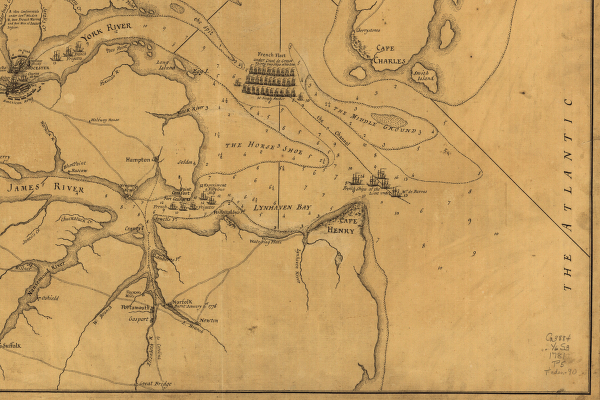
Map found here in this awesome collection - I could get lost in there forever.
July 4, 2008
July 4, 1826
It was the 50th anniversary of July 4, 1776. Both John Adams and Thomas Jefferson had been invited to attend huge celebrations in honor of the anniversary, but due to illness - both had sent their regrets and also best wishes, saying they would not be able to come. Thomas Jefferson's letter to the mayor of Washington, declining the invitation, ended as follows:
May it be to the world, what I believe it will be (to some parts sooner, to others later, but finally to all) the signal of arousing men to burst the chains under which monkish ignorance and superstition and persuaded them to bind themselves, and to assume the blessings and security of self-government ... All eyes are opened or opening to the rights of man. The general spread of the light of science has already laid open to every view the palpable truth, that the mass of mankind has not been born with saddles on their backs, nor a favored few, booted and spurred, ready to ride them legitimately by the grace of God. These are the grounds of hope for others; for ourselves, let the annual return of this day forever refresh our recollections of these rights, and an undiminished devotion to them.
Adams was too ill to put pen to paper. The light was going out. For both of them.


These two men, two of the main architects of the American Revolution, long estranged due to political differences, (and Jefferson referring, in public, to "political heresies" among some of his colleagues - a clear dig at Adams - and a clear sign of Jefferson's belief in some political orthodoxy, which was the breaking point for the overly sensitive Adams) had finally reconciled. The reconciliation had been engineered by Benjamin Rush, who thought it a shame that these two great patriots, once dear friends, would go to their graves without making up. Benjamin Rush had a dream that Adams and Jefferson became friends again (I wonder if he really had that dream? Or if it was just a fabrication in order to move things along). Rush wrote to Adams,
"And now, my dear friend, permit me again to suggest to you to receive the olive branch which has thus been offered to you by the hand of a man who still loves you. Fellow laborers in erecting the great fabric of American independence! ... embrace - embrace each other!"
Adams and Jefferson began to correspond ... and it lasted over a period of 12-years ... a correspondence that has to be read to be believed
When they finally began corresponding again, Rush (who had also been writing to Jefferson, urging him to make peace) wrote to Adams, and you can feel his excitement in his words:
I rejoice in the correspondence which has taken place between you and your old friend Mr. Jefferson. I consider you and him as the North and South Poles of the American Revolution. Some talked, some wrote, and some fought to promote and establish it but you and Mr. Jefferson thought for us all.
And then ... on the same day in 1826 ... which happened to be July 4 ... which happened to be the 50th anniversary of the Declaration of Independence ... John Adams and Thomas Jefferson both died. Within hours of each other.
David McCullough writes in his biography of John Adams:
That John Adams and Thomas Jefferson had died on the same day, and that it was, of all days, the Fourth of July, could not be seen as a mere coincidence: it was a "visible and palpable" manifestation of "Divine favor," wrote John Quincy Adams in his diary that night, expressing what was felt and would be said again and again everywhere the news spread.
John Adams' last words were either "Jefferson ... still lives." or "Jefferson ... survives."
I will never get tired of thinking about that, wondering, contemplating, shaking my head. I think I know what it means, and WHY Adams said it, and then I realize - No, I have no idea - and I prefer it that way. I prefer the mystery of it, the question, the subtlety - I prefer to just think about it, and wonder about it . I love it.
Amazingly, though, Jefferson actually had died a couple of hours earlier. Which makes this an even more amazing story. Like ... twins who live on opposite sides of the planet, and one twin knows when the other twin scrapes his knee. There are things that cannot be sufficiently explained. There are more things in heaven and earth, Horatio, than are dreamt of in your philosophy.
Thomas Jefferson's last words are in dispute - but there are enough similarities to suggest that something along these lines occurred. (I love the discrepancy, by the way - I love it because it just adds to the mystery.) According to Robley Dunglison, the attending physician, Jefferson dozed through the day on July 3rd, and woke up in the early evening, saying as he awoke, "Is it the Fourth?" (A lump in my throat ...) Dunglison said to him that it soon would be. Nicholas Trist, married to Jefferson's granddaughter, remembers it this way: Jefferson woke and said, "This is the Fourth?" Trist remembers pretending not to hear the question, because he didn't want to tell Jefferson that it was still only the 3rd of July. But Jefferson asked again, "This is the Fourth?" Trist caved, and nodded - and he felt very bad about his lie. Virginia Randolph, his granddaughter, remembers it differently. She remembers him waking and saying, clearly, "This is the Fourth." No question. A statement. Jefferson faded out after that, and the next day, the Fourth, he called out for help at one point - and someone remembers him saying, at one point, "No, doctor. Nothing more." But it is his question/statement about what the date was that has passed down through the years as Jefferson's final words. In the end, it doesn't really matter, of course, although the story itself is one I treasure, in all its different details.
Did he wait? When he found out it was still just the Third, did he wait? To die on the Fourth? I wouldn't put it past him, he always loved symmetry.
Yes, Mr. Jefferson. It is the fourth. And thank you. Thank you both. Thank you for thinking for us all.
Happy 4th of July, everybody!
April 18, 2008
On the eighteenth of April, in Seventy-five; Hardly a man is now alive Who remembers that famous day and year.
On the night of April 18, into April 19, in 1775, Paul Revere made his famous ride.
The spring of 1775 was a tense time. Prominent Bostonians were under constant threat of arrest from the British, and many of them - to avoid this - moved their families to outlying communities. However, two of the main patriotic leaders (Benjamin Church and Joseph Warren) stayed in Boston. Paul Revere did as well, and kept a close eye on British movements through that spring. Revere was trusted as a messenger, he knew everybody.
In mid-April, Revere started to notice some ominous signs: mainly that the British ships were taken out of the water, to be worked on, repaired. He could sense that something was coming. He felt the British were preparing for some kind of attack.
Revere went to Concord on April 16 (most of the weaponry was stored there) and warned the leaders of that community that the British were preparing something, they were up to something, and if they were going to strike, they would most definitely try to seize the weapons stash in Concord. So the people of Concord went to work, hiding their store of weapons in barns, cellars, swamps, etc. (Like I mentioned: Paul Revere was trusted. He knew everybody. If you're interested, read the excerpt I posted of Malcolm Gladwell's fascinating analysis of Paul Revere - and Gladwell's comparison with the far less successful messenger on that very same night - William Dawes.)
So. April 16. Revere returned to Boston from Concord, and met with other revolutionary leaders, and that is when they came up with the "one if by land, two if by sea" warning system. Revere knew they needed a way to have some advance warning about which route the British were going to take when they finally did attack.
By land? Or by sea?
So, Revere set up the system: Signal lanterns would be placed in the belfry of Old North Church (the steeple can be seen across the Charles River). If two lanterns were hung, then the British would be crossing the Charles by boat. If one lantern was hung, then the British would choose to attack using a land route.
"One if by land, two if by sea."
The plan was put in place just in time. On April 18, in the early evening, a stable boy came to Paul Revere, telling him that he had overheard some British soldiers discussing the upcoming attack, and that it was planned for early the next morning. The stable boy knew who to bring this information to, and that was Paul Revere. (Again, check out Gladwell's analysis of Paul Revere's personality. Really interesting.)
Revere, on receiving this urgent piece of information, knew he had to get the warning out (and that he especially had to warn John Hancock and Samuel Adams who, at that time, were hiding out in Lexington).
So off he went on his now legendary ride (here's a cool map of the route he took). Revere took the water route out of Boston, rowed across the Charles, and galloped through the communities north of Boston sounding the alarm. (Medford, Charlestown, Lexington, Concord.) Because of Paul Revere, the British had completely lost the element of surprise. When they came to attack, they found the rebellious colonists waiting for them everywhere, ambushing them left and right, from behind stone walls, hiding behind trees ...
An interesting tidbit (this is why I love this time in American history - yeah, the events themselves are really cool ... but it's details like the following one that really have me hooked, like a crack addict):
In his hurry to depart, Revere forgot to bring along pieces of cloth to wrap the oars of his boat. The purpose of the cloth would be to muffle the sound of the oars cutting through the water. The Somerset (the British man-of-war) was at anchor, right there in the harbor. Paul Revere had to row right by them, and so any sound at all would have alerted the crew, and if Revere was busted, the whole jig would be up. Revere was in a bit of a pickle ... standing by his boat, trying to figure out how he could improvise ... could he take off his stockings? Tie them around the end of the oars?
One of the boatmen involved in helping Revere make this crossing came to the rescue. He ran to his girlfriend's house and asked her for her petticoat. One can only imagine her startled response to the nighttime demand at her door from her beau: "Please, dear. It's 10 pm, and I need you to take off your petticoat, give it to me, and don't ask me ANY questions about it!!" But apparently, this girl, whoever she was, complied - took off her petticoat, handed it over, and Revere used it to wrap up the ends of his oars.
I love that woman, whoever she is.
So. In honor of this great moment in American history -here is Henry Wadsworth Longfellow's celebrated poem "Paul Revere's Ride". And below that, I am posting an old essay I wrote about babysitting Cashel - which is relevant to this date in history. A couple years ago, I read the Cashel piece on a radio program, which was a pretty cool experience - and reading over the piece today makes me nostalgic for when Cashel was so little!!
But back to the poem: I know large swaths of it by heart ... I grew up hearing it. I'm an East Coast girl, most of my family is from Boston. So all of these places in the poem are places I had been to many times as a child, and not just a tourist ... but just because we lived near them. That piece of history felt very real to me. The poem is thrilling to me - because of the story it tells, of course, but also because of its rollicking perfect rhythm, you can feel the suspense, you can feel the urgency, the whole thing ends up sounding like the clatter of horses hooves galloping through the night. It's meant to be read out loud. Try it for yourself!! The last stanza is beyond compare. "For borne on the night-wind of the Past ..." I mean, come ON!!
April 18, 1775. A great day in American history. "The fate of a nation was riding that night." One of my personal favorite stories of the American revolution.
Paul Revere's Ride
- by Henry Wadsworth LongfellowListen my children and you shall hear
Of the midnight ride of Paul Revere,
On the eighteenth of April, in Seventy-five;
Hardly a man is now alive
Who remembers that famous day and year.
He said to his friend, "If the British march
By land or sea from the town to-night,
Hang a lantern aloft in the belfry arch
Of the North Church tower as a signal light,--
One if by land, and two if by sea;
And I on the opposite shore will be,
Ready to ride and spread the alarm
Through every Middlesex village and farm,
For the country folk to be up and to arm."
Then he said "Good-night!" and with muffled oar
Silently rowed to the Charlestown shore,
Just as the moon rose over the bay,
Where swinging wide at her moorings lay
The Somerset, British man-of-war;
A phantom ship, with each mast and spar
Across the moon like a prison bar,
And a huge black hulk, that was magnified
By its own reflection in the tide.
Meanwhile, his friend through alley and street
Wanders and watches, with eager ears,
Till in the silence around him he hears
The muster of men at the barrack door,
The sound of arms, and the tramp of feet,
And the measured tread of the grenadiers,
Marching down to their boats on the shore.
Then he climbed the tower of the Old North Church,
By the wooden stairs, with stealthy tread,
To the belfry chamber overhead,
And startled the pigeons from their perch
On the sombre rafters, that round him made
Masses and moving shapes of shade,--
By the trembling ladder, steep and tall,
To the highest window in the wall,
Where he paused to listen and look down
A moment on the roofs of the town
And the moonlight flowing over all.
Beneath, in the churchyard, lay the dead,
In their night encampment on the hill,
Wrapped in silence so deep and still
That he could hear, like a sentinel's tread,
The watchful night-wind, as it went
Creeping along from tent to tent,
And seeming to whisper, "All is well!"
A moment only he feels the spell
Of the place and the hour, and the secret dread
Of the lonely belfry and the dead;
For suddenly all his thoughts are bent
On a shadowy something far away,
Where the river widens to meet the bay,--
A line of black that bends and floats
On the rising tide like a bridge of boats.
Meanwhile, impatient to mount and ride,
Booted and spurred, with a heavy stride
On the opposite shore walked Paul Revere.
Now he patted his horse's side,
Now he gazed at the landscape far and near,
Then, impetuous, stamped the earth,
And turned and tightened his saddle girth;
But mostly he watched with eager search
The belfry tower of the Old North Church,
As it rose above the graves on the hill,
Lonely and spectral and sombre and still.
And lo! as he looks, on the belfry's height
A glimmer, and then a gleam of light!
He springs to the saddle, the bridle he turns,
But lingers and gazes, till full on his sight
A second lamp in the belfry burns.
A hurry of hoofs in a village street,
A shape in the moonlight, a bulk in the dark,
And beneath, from the pebbles, in passing, a spark
Struck out by a steed flying fearless and fleet;
That was all! And yet, through the gloom and the light,
The fate of a nation was riding that night;
And the spark struck out by that steed, in his flight,
Kindled the land into flame with its heat.
He has left the village and mounted the steep,
And beneath him, tranquil and broad and deep,
Is the Mystic, meeting the ocean tides;
And under the alders that skirt its edge,
Now soft on the sand, now loud on the ledge,
Is heard the tramp of his steed as he rides.
It was twelve by the village clock
When he crossed the bridge into Medford town.
He heard the crowing of the cock,
And the barking of the farmer's dog,
And felt the damp of the river fog,
That rises after the sun goes down.
It was one by the village clock,
When he galloped into Lexington.
He saw the gilded weathercock
Swim in the moonlight as he passed,
And the meeting-house windows, black and bare,
Gaze at him with a spectral glare,
As if they already stood aghast
At the bloody work they would look upon.
It was two by the village clock,
When he came to the bridge in Concord town.
He heard the bleating of the flock,
And the twitter of birds among the trees,
And felt the breath of the morning breeze
Blowing over the meadow brown.
And one was safe and asleep in his bed
Who at the bridge would be first to fall,
Who that day would be lying dead,
Pierced by a British musket ball.
You know the rest. In the books you have read
How the British Regulars fired and fled,---
How the farmers gave them ball for ball,
From behind each fence and farmyard wall,
Chasing the redcoats down the lane,
Then crossing the fields to emerge again
Under the trees at the turn of the road,
And only pausing to fire and load.
So through the night rode Paul Revere;
And so through the night went his cry of alarm
To every Middlesex village and farm,---
A cry of defiance, and not of fear,
A voice in the darkness, a knock at the door,
And a word that shall echo for evermore!
For, borne on the night-wind of the Past,
Through all our history, to the last,
In the hour of darkness and peril and need,
The people will waken and listen to hear
The hurrying hoof-beats of that steed,
And the midnight message of Paul Revere.
Paul Revere himself wrote of that time:
In the Fall of 1774 and Winter of 1775 I was one of upwards of thirty, cheifly mechanics, who formed our selves in to a Committee for the purpose of watching the Movements of the British Soldiers, and gaining every intelegence of the movements of the Tories.We held our meetings at the Green-Dragon Tavern. We were so carefull that our meetings should be kept Secret; that every time we met, every person swore upon the Bible, that they would not discover any of our transactions, But to Messrs. HANCOCK, ADAMS, Doctors WARREN, CHURCH, and one or two more.
About November, when things began to grow Serious, a Gentleman who had Conections with the Tory party, but was a Whig at heart, acquainted me, that our meetings were discovered, and mentioned the identical words that were spoken among us the Night before. . . . We removed to another place, which we thought was more secure: but here we found that all our transactions were communicated to Governor Gage. (This came to me through the then Secretary Flucker; He told it to the Gentleman mentioned above). It was then a common opinion, that there was a Traytor in the provincial Congress, and that Gage was posessed of all their Secrets. (Church was a member of that Congress for Boston.) In the Winter, towards the Spring, we frequently took Turns, two and two, to Watch the Soldiers, By patroling the Streets all night. The Saturday Night preceding the 19th of April, about 12 oClock at Night, the Boats belonging to the Transports were all launched, and carried under the Sterns of the Men of War. (They had been previously hauld up and repaired). We likewise found that the Grenadiers and light Infantry were all taken off duty.
From these movements, we expected something serious was [to] be transacted. On Tuesday evening, the 18th, it was observed, that a number of Soldiers were marching towards the bottom of the Common. About 10 o'Clock, Dr. Warren Sent in great haste for me, and beged that I would imediately Set off for Lexington, where Messrs. Hancock and Adams were, and acquaint them of the Movement, and that it was thought they were the objets. When I got to Dr. Warren's house, I found he had sent an express by land to Lexington—a Mr. Wm. Daws. The Sunday before, by desire of Dr. Warren, I had been to Lexington, to Mess. Hancock and Adams, who were at the Rev. Mr. Clark's. I returned at Night thro Charlestown; there I agreed with a Col. Conant, and some other Gentlemen, that if the British went out by Water, we would shew two Lanthorns in the North Church Steeple; and if by Land, one, as a Signal; for we were aprehensive it would be dificult to Cross the Charles River, or git over Boston neck. I left Dr. Warrens, called upon a friend, and desired him to make the Signals. I then went Home, took my Boots and Surtout, and went to the North part of the Town, Where I had kept a Boat; two friends rowed me across Charles River, a little to the eastward where the Somerset Man of War lay. It was then young flood, the Ship was winding, and the moon was Rising. They landed me on Charlestown side. When I got into Town, I met Col. Conant, and several others; they said they had seen our signals. I told them what was Acting, and went to git me a Horse; I got a Horse of Deacon Larkin. While the Horse was preparing, Richard Devens, Esq. who was one of the Committee of Safty, came to me, and told me, that he came down the Road from Lexington, after Sundown, that evening; that He met ten British Officers, all well mounted, and armed, going up the Road.
I set off upon a very good Horse; it was then about 11 o'Clock, and very pleasant. After I had passed Charlestown Neck, and got nearly opposite where Mark was hung in chains, I saw two men on Horse back, under a Tree. When I got near them, I discovered they were British officer. One tryed to git a head of Me, and the other to take me. I turned my Horse very quick, and Galloped towards Charlestown neck, and then pushed for the Medford Road. The one who chased me, endeavoring to Cut me off, got into a Clay pond, near where the new Tavern is now built. I got clear of him, and went thro Medford, over the Bridge, and up to Menotomy. In Medford, I awaked the Captain of the Minute men; and after that, I alarmed almost every House, till I got to Lexington. I found Messrs. Hancock and Adams at the Rev. Mr. Clark's; I told them my errand, and inquired for Mr. Daws; they said he had not been there; I related the story of the two officers, and supposed that He must have been stopped, as he ought to have been there before me. After I had been there about half an Hour, Mr. Daws came; we refreshid our selves, and set off for Concord, to secure the Stores, &c. there. We were overtaken by a young Docter Prescot, whom we found to be a high Son of Liberty. I told them of the ten officers that Mr. Devens mett, and that it was probable we might be stoped before we got to Concord; for I supposed that after Night, they divided them selves, and that two of them had fixed themselves in such passages as were most likely to stop any intelegence going to Concord. I likewise mentioned, that we had better allarm all the Inhabitents till we got to Concord; the young Doctor much approved of it, and said, he would stop with either of us, for the people between that and Concord knew him, and would give the more credit to what we said. We had got nearly half way. Mr Daws and the Doctor stoped to allarm the people of a House: I was about one hundred Rod a head, when I saw two men, in nearly the same situation as those officer were, near Charlestown. I called for the Doctor and Daws to come up;—in an Instant I was surrounded by four;—they had placed themselves in a Straight Road, that inclined each way; they had taken down a pair of Barrs on the North side of the Road, and two of them were under a tree in the pasture. The Docter being foremost, he came up; and we tryed to git past them; but they being armed with pistols and swords, they forced us in to the pasture;—the Docter jumped his Horse over a low Stone wall, and got to Concord. I observed a Wood at a Small distance, and made for that. When I got there, out Started Six officers, on Horse back, and orderd me to dismount;—one of them, who appeared to have the command, examined me, where I came from, and what my Name Was? I told him. He asked me if I was an express? I answered in the afirmative. He demanded what time I left Boston? I told him; and aded, that their troops had catched aground in passing the River, and that There would be five hundred Americans there in a short time, for I had alarmed the Country all the way up. He imediately rode towards those who stoppd us, when all five of them came down upon a full gallop; one of them, whom I afterwards found to be Major Mitchel, of the 5th Regiment, Clapped his pistol to my head, called me by name, and told me he was going to ask me some questions, and if I did not give him true answers, he would blow my brains out. He then asked me similar questions to those above. He then orderd me to mount my Horse, after searching me for arms. He then orderd them to advance, and to lead me in front. When we got to the Road, they turned down towards Lexington. When we had got about one Mile, the Major Rode up to the officer that was leading me, and told him to give me to the Sergeant. As soon as he took me, the Major orderd him, if I attempted to run, or any body insulted them, to blow my brains out. We rode till we got near Lexington Meeting-house, when the Militia fired a Voley of Guns, which appeared to alarm them very much. The Major inquired of me how far it was to Cambridge, and if there were any other Road? After some consultation, the Major Rode up to the Sargent, and asked if his Horse was tired? He answered him, he was--(He was a Sargent of Grenadiers, and had a small Horse)—then, said He, take that man's Horse. I dismounted, and the Sargent mounted my Horse, when they all rode towards Lexington Meeting-House. I went across the Burying-ground, and some pastures, and came to the Revd. Mr. Clark's House, where I found Messrs. Hancok and Adams. I told them of my treatment, and they concluded to go from that House to wards Woburn. I went with them, and a Mr. Lowell, who was a Clerk to Mr. Hancock. When we got to the House where they intended to stop, Mr. Lowell and my self returned to Mr. Clark's, to find what was going on. When we got there, an elderly man came in; he said he had just come from the Tavern, that a Man had come from Boston, who said there were no British troops coming. Mr. Lowell and my self went towards the Tavern, when we met a Man on a full gallop, who told us the Troops were coming up the Rocks. We afterwards met another, who said they were close by. Mr. Lowell asked me to go to the Tavern with him, to git a Trunk of papers belonging to Mr. Hancock. We went up Chamber; and while we were giting the Trunk, we saw the British very near, upon a full March. We hurried to wards Mr. Clark's House. In our way, we passed through the Militia. There were about 50. When we had got about 100 Yards from the meeting-House the British Troops appeard on both Sides of the Meeting-House. In their Front was an Officer on Horse back. They made a Short Halt; when I saw, and heard, a Gun fired, which appeared to be a Pistol. Then I could distinguish two Guns, and then a Continual roar of Musquetry; When we made off with the Trunk.
As I have mentioned Dr. Church, perhaps it might not be disagreeable to mention some Matters of my own knowledge, respecting Him. He appeared to be a high son of Liberty. He frequented all the places where they met, Was incouraged by all the leaders of the Sons of Liberty, and it appeared he was respected by them, though I knew that Dr. Warren had not the greatest affection for him. He was esteemed a very capable writer, especially in verese; and as the Whig party needed every Strenght, they feared, as well as courted Him. Though it was known, that some of the Liberty Songs, which We composed, were parodized by him, in favor of the British, yet none dare charge him with it. I was a constant and critical observer of him, and I must say, that I never thought Him a man of Principle; and I doubted much in my own mind, wether He was a real Whig. I knew that He kept company with a Capt. Price, a half-pay British officer, and that He frequently dined with him, and Robinson, one of the Commissioners. I know that one of his intimate aquaintances asked him why he was so often with Robinson and Price? His answer was, that He kept Company with them on purpose to find out their plans. The day after the Battle of Lexington, I met him in Cambridge, when He shew me some blood on his stocking, which he said spirted on him from a Man who was killed near him, as he was urging the Militia on. I well remember, that I argued with my self, if a Man will risque his life in a Cause, he must be a Friend to that cause; and I never suspected him after, till He was charged with being a Traytor.
The full letter can be read here.
ONE IF BY LAND
We colored for a while. As we waited for the pizza to arrive. Cashel commanded me to draw a house. So I did. Cashel was basically the architect and the interior designer. Telling me what he wanted to see.
"Put a playroom in the attic."
"But Auntie Sheila -- where are the stairs??"
I drew the bathroom, and the mere sight of the toilet caused Cashel to dissolve into mirth. Yes. Toilets are hilarious.
I drew a spiral staircase which blew Cashel away. "That's so COOL." Then I drew the living room. I said, "I think there needs to be a picture on the wall. Or a portrait. Whose picture should be on the wall, you think?"
Cashel said bluntly, "Einstein."
Okay, then. Einstein. So I drew this little cartoon of Einstein, with the crazy hair coming up, and Cashel said seriously, with all of his knowledge, "That really looks like Einstein."
We ate our pizza together, talking about stuff. Star Wars, Ben Franklin. Cashel informed me, "Ben Franklin discovered lightning."
Cashel is a wealth of information. Randomly, he told my parents that Vincent Van Gogh never sold a painting while he was alive, but that after he died, he became famous.
I read him a story. It was from the book of "Disney stories" which I had given him for his birthday. He loves it. He pulled it out of the bookshelf, and I said, "Oh! I gave that to you!" Cashel said, a little bit annoyed, "I know that."
He had me read the story of the little mouse who hung out with Ben Franklin, and basically (in the world of Disney) was the inspiration for all of Ben Franklin's famous moments. Cashel would shoot questions at me. "Why is Ben Franklin's hair white?" "Well ... he's old now. But also, in those days, men wore powdered wigs." Cashel's little serious face, listening, sponging this all up. Probably the next day he informed his friends that men in the olden days wore powdered wigs. He's that kind of listener, that kind of learner.
Then he put on his Obi Wan Kenobi costume which Grandma Peggy made him for Christmas. A long hooded brown cloak ... and he hooked his light saber into his waist, and galloped off down the hall. A mini Jedi knight.
I had him pick out three stories to read before bedtime. He sat beside me, curled up into me, looking at the pictures as I read to him. The last one we read was Longfellow's poem "Paul Revere's Ride". This poem was a favorite of ours, when we were kids. My dad would read it to us, and even now, when I read the words, I hear them in my father's voice. A magical poem. The way my dad read it to us (along with Longfellow's help) made us SEE it. The clock tower, the moon, the darkness ... the sense of anticipation, of secrecy, of urgency. It was thrilling. So I love that this is being passed on to Cashel! I've never read the poem outloud before, so I had one of those strange moments of the space-time continuum bending, me stepping into my father's shoes, Cashel 5 years old beside me, feeling the ghost of my own 5 year old self listening.
I also remember how Brendan and I used to chime in gleefully: "ONE IF BY LAND, TWO IF BY SEA!" And Cashel did the same thing. I paused before that moment in the poem, glanced down at him, and he screamed out, "ONE IF BY LAND, TWO IF BY SEA!"
There was also a subtlety of understanding in Cashel. For example, I read this part:
And lo! as he looks, on the belfry's height
A glimmer, and then a gleam of light!
He springs to the saddle, the bridle he turns,
But lingers and gazes, till full on his sight
A second lamp in the belfry burns.
And Cashel exclaimed, in a sort of "Uh-oh" tone, "They're comin' by sea!!" Now the words don't actually SAY that, but he remembered the "one if by land two if by sea" signal, and puts it all together. That's my boy!
I remembered the first lines from memory:
Listen my children and you shall hear
Of the midnight ride of Paul Revere,
On the eighteenth of April, in Seventy-five;
Hardly a man is now alive
Who remembers that famous day and year.
Again, those are just words on the page. But to me, they are filled with the echoes of my father's voice.
Cashel and I, as we went through the poem, had to stop many times for discussions.
There was one illustration of all the minute-men, hiding behind the stone walls, with a troop of Redcoats marching along, walking straight into the ambush. Cashel pointed at it, and stated firmly, "That's the civil war."
"Nope. Nope. That is actually a picture from the American Revolutionary War."
Cashel pondered this. Taking it in. Then: "The minute-men were in the civil war." But less certain. Glancing up at me for explanation.
"Nope. The minute-men were soldiers in the American Revolution. Do you know why they called them that?"
"Why?"
"Cause they were farmers, and regular people ... but they could be ready to go into battle in a minute."
Again, a long silence. Cashel filed this away for safekeeping. He forgets nothing.
"So ... Auntie Sheila ... what is the difference between the Revolutionary War and the Civil War?"
Woah. Okay. This will be a test. How to describe all of that in 5-year-old language. I mean, frankly, Cashel is not like a five-year-old at all. But still. Everything must be boiled down into its simplest components.
"Well. America used to be a part of England, and the American Revolutionary War was when America decided that it wanted to be free ... and Americans basically told the Brits to go home." Uh-oh. Brits? This is an inflammatory term. I corrected myself. "America told Great Britain that it wanted to be its own country. And the Civil War ... " Hmmm. How to begin ... what to say ... I know it was about more than slavery, but I decided to only focus on that one aspect. Economic theory and regional cultural differences would be too abstract. "In those days, Cashel, black people were slaves. And it was very very wrong. Can you understand that?"
He nodded. His little serious face.
"And the people in the South wanted to keep their slaves, and the people in the North said to the people in the South that they had to give up their slaves. And they ended up going to war. And eventually all the slaves were free."
Cashel accepted this explanation silently. Then he pointed back to the Paul Revere poem. "Read." he commanded.
April 8, 2008
The perfect library
110 best books ...
Of course the thing with these lists is people get uppity and pissed, either by what is left off (My first uppity question is: "where the hell is Harriet the Spy


Some view of my library - which is far from perfect, but which gives me great pleasure:


The list - which is supposed to make up a "perfect library" reminds me of two things - a letter Charlotte Bronte wrote, where she recommended books to a friend (a female friend) - and also a letter Thomas Jefferson wrote, where he listed, exhaustively, the books every gentleman should have in his library. It's worth printing both of these in full:
CHARLOTTE BRONTE:
"You ask me to recommend you some books for your perusal. I will do so in as few words as I can. If you like poetry, let it be first-rate; Milton, Shakespeare, Thomson, Goldsmith, Pope (if you will, though I don't admire him), Scott, Byron, Campbell, Wordsworth, and Southey. Now don't be startled at the names of Shakespeare and Byron. Both these were great men, and their works are like themselves. You will know how to choose the good, and to avoid the evil; the finest passages are always the purest, the bad are invariably revolting; you will never wish to read them over twice. Omit the comedies of Shakespeare and the Don Juan, perhaps the Cain, of Byron, though the latter is a magnificent poem, and read the rest fearlessly; that must indeed be a depraved mind which can gather evil from Henry VIII, from Richard III, from Macbeth, and Hamlet, and Julius Caesar. Scott's sweet, wild, romantic poetry can do you no harm. Nor can Wordsworth's, nor Campbell's, nor Southey's -- the greatest part at least of his; some is certainly objectionable. For history, read Hume, Rollin, and the Universal History, if you can; I never did. For fiction, read Scott alone; all novels after his are worthless. For biography, read Johnson's Lives of the Poets, Boswell's Life of Johnson, Southey's Life of Nelson, Lockhart's Life of Burns, Moore's Life of Sheridan, Moore's Life of Byron, Wolfe's Remains. For natural history, read Bewick and Audobon, and Goldsmith, and White's History of Selborne. For divinity, your brother will advise you there. I can only say, adhere to standard authors, and avoid novelty."
I mean, honestly.
And are you ready for Thomas Jefferson's "gentleman's library"? I never look at this without feeling bad about myself, and woefully uneducated.
Thomas Jefferson to Robert Skip with a List of Books, Aug. 3, 1771
I sat down with a design of executing your request to form a catalogue of books to the amount of about 50 lib. sterl. But could by no means satisfy myself with any partial choice I could make. Thinking therefore it might be as agreeable to you I have framed such a general collection as I think you would wish and might in time find convenient to procure. Out of this you will chuse for yourself to the amount you mentioned for the present year and may hereafter as shall be convenient proceed in completing the whole. A view of the second column in this catalogue would I suppose extort a smile from the face of gravity. Peace to its wisdom! Let me not awaken it. A little attention however to the nature of the human mind evinces that the entertainments of fiction are useful as well as pleasant. That they are pleasant when well written every person feels who reads. But wherein is its utility asks the reverend sage, big with the notion that nothing can be useful but the learned lumber of Greek and Roman reading with which his head is stored?I answer, everything is useful which contributes to fix in the principles and practices of virtue. When any original act of charity or of gratitude, for instance, is presented either to our sight or imagination, we are deeply impressed with its beauty and feel a strong desire in ourselves of doing charitable and grateful acts also. On the contrary when we see or read of any atrocious deed, we are disgusted with it's deformity, and conceive an abhorence of vice. Now every emotion of this kind is an exercise of our virtuous dispositions, and dispositions of the mind, like limbs of the body acquire strength by exercise. But exercise produces habit, and in the instance of which we speak the exercise being of the moral feelings produces a habit of thinking and acting virtuously. We never reflect whether the story we read be truth or fiction. If the painting be lively, and a tolerable picture of nature, we are thrown into a reverie, from which if we awaken it is the fault of the writer. I appeal to every reader of feeling and sentiment whether the fictitious murther of Duncan by Macbeth in Shakespeare does not excite in him as great a horror of villany, as the real one of Henry IV. by Ravaillac as related by Davila? And whether the fidelity of Nelson and generosity of Blandford in Marmontel do not dilate his breast and elevate his sentiments as much as any similar incident which real history can furnish? Does he not in fact feel himself a better man while reading them, and privately covenant to copy the fair example? We neither know nor care whether Lawrence Sterne really went to France, whether he was there accosted by the Franciscan, at first rebuked him unkindly, and then gave him a peace offering: or whether the whole be not fiction. In either case we equally are sorrowful at the rebuke, and secretly resolve we will never do so: we are pleased with the subsequent atonement, and view with emulation a soul candidly acknowleging it's fault and making a just reparation. Considering history as a moral exercise, her lessons would be too infrequent if confined to real life. Of those recorded by historians few incidents have been attended with such circumstances as to excite in any high degree this sympathetic emotion of virtue. We are therefore wisely framed to be as warmly interested for a fictitious as for a real personage. The field of imagination is thus laid open to our use and lessons may be formed to illustrate and carry home to the heart every moral rule of life. Thus a lively and lasting sense of filial duty is more effectually impressed on the mind of a son or daughter by reading King Lear, than by all the dry volumes of ethics, and divinity that ever were written. This is my idea of well written Romance, of Tragedy, Comedy and Epic poetry. -- If you are fond of speculation the books under the head of Criticism will afford you much pleasure. Of Politics and Trade I have given you a few only of the best books, as you would probably chuse to be not unacquainted with those commercial principles which bring wealth into our country, and the constitutional security we have for the enjoiment ofthat wealth. In Law I mention a few systematical books, as a knowledge of the minutiae of that science is not neces-sary for a private gentleman. In Religion, History, Natural philosophy, I have followed the same plan in general, -- But whence the necessity of this collection? Come to the new Rowanty, from which you may reach your hand to a library formed on a more extensive plan. Separated from each other but a few paces the possessions of each would be open to the other. A spring centrically situated might be the scene of every evening's joy. There we should talk over the lessons of the day, or lose them in music, chess or the merriments of our family companions. The heart thus lightened our pillows would be soft, and health and long life would attend the happy scene. Come then and bring our dear Tibby with you, the first in your affections, and second in mine. Offer prayers for me too at that shrine to which tho' absent I pray continual devotions. In every scheme of happiness she is placed in the foreground of the picture, as the princi-pal figure. Take that away, and it is no picture for me. Bear my affections to Wintipock clothed in the warmest expressions of sincerity; and to yourself be every human felicity.
Adieu.
FINE ARTS.
Observations on gardening. Payne. 5/
Webb's essay on painting. 12mo 3/
Pope's Iliad. 18/
------- Odyssey. 15/
Dryden's Virgil. 12mo. 12/
Milton's works. 2 v. 8vo. Donaldson. Edinburgh 1762. 10/
Hoole's Tasso. 12mo. 5/
Ossian with Blair's criticisms. 2 v. 8vo. 10/
Telemachus by Dodsley. 6/
Capell's Shakespear. 12mo. 30/
Dryden's plays. 6v. 12mo. 18/
Addison's plays. 12mo. 3/
Otway's plays. 3 v. 12mo. 9/
Rowe's works. 2 v. 12mo. 6/
Thompson's works. 4 v. 12mo. 12/
Young's works. 4 v. 12mo. 12/
Home's plays. 12mo. 3/
Mallet's works. 3 v. 12mo. 9/
Mason's poetical works. 5/
Terence. Eng. 3/
Moliere. Eng. 15/
Farquhar's plays. 2 v. 12mo. 6/
Vanbrugh's plays. 2 v. 12mo. 6/
Steele's plays. 3/
Congreve's works. 3 v. 12mo. 9/
Garric's dramatic works. 2 v. 8vo. 10/
Foote's dramatic works. 2 v. 8vo. 10/
Rousseau's Eloisa. Eng. 4 v. 12mo. 12/
----- Emilius and Sophia. Eng. 4 v. 12mo. 12/
Marmontel's moral tales. Eng. 2 v. 12mo. 12/
Gil Blas. by Smollett. 6/
Don Quixot. by Smollett 4 v. 12mo. 12/
David Simple. 2 v. 12mo. 6/
Roderic Random. 2 v. 12mo. 6/ these are written by Smollett
Peregrine Pickle. 4 v. 12mo. 12/
Launcelot Graves. 6/
Adventures of a guinea. 2 v. 12mo. 6/
Pamela. 4 v. 12mo. 12/ these are by Richardson.
Clarissa. 8 v. 12mo. 24/
Grandison. 7 v. 12mo. 9/
Fool of quality. 3 v. 12mo. 9/
Feilding's works. 12 v. 12mo. pound 1.16
Constantia. 2 v. 12mo. 6/ by Langhorne.
Solyman and Almena. 12mo. 3/
Belle assemblee. 4 v. 12mo. 12/
Vicar of Wakefeild. 2 v. 12mo. 6/. by Dr. Goldsmith
Sidney Bidulph. 5 v. 12mo. 15/
Lady Julia Mandeville. 2 v. 12mo. 6/
Almoran and Hamet. 2 v. 12mo. 6/
Tristam Shandy. 9 v. 12mo. pound 1.7
Sentimental journey. 2 v. 12mo. 6/
Fragments of antient poetry. Edinburgh. 2/
Percy's Runic poems. 3/
Percy's reliques of antient English poetry. 3 v. 12mo. 9/
Percy's Han Kiou Chouan. 4 v. 12mo. 12/
Percy's Miscellaneous Chinese peices. 2 v. 12mo. 6/
Chaucer. 10/
Spencer. 6 v. 12mo. 15/
Waller's poems. 12mo. 3/
Dodsley's collection of poems. 6 v. 12mo. 18/
Pearch's collection of poems. 4 v. 12mo. 12/
Gray's works. 5/
Ogilvie's poems. 5/
Prior's poems. 2 v. 12mo. Foulis. 6/
Gay's works. 12mo. Foulis. 3/
Shenstone's works. 2 v. 12mo. 6/
Dryden's works. 4 v. 12mo. Foulis. 12/
Pope's works. by Warburton. 12mo. pound 1.4
Churchill's poems. 4 v. 12mo. 12/
Hudibrass. 3/
Swift's works. 21 v. small 8vo. pound 3.3
Swift's literary correspondence. 3 v. 9/
Spectator. 9 v. 12mo. pound 1.7
Tatler. 5 v. 12mo. 15/
Guardian. 2 v. 12mo. 6/
Freeholder. 12mo. 3/
Ld. Lyttleton's Persian letters. 12mo. 3/CRITICISM ON THE FINE ARTS.
Ld. Kaim's elements of criticism. 2 v. 8vo. 10/
Burke on the sublime and beautiful. 8vo. 5/
Hogarth's analysis of beauty. 4to. pound 1.1
Reid on the human mind. 8vo. 5/
Smith's theory of moral sentiments. 8vo. 5/
Johnson's dictionary. 2 v. fol. pound 3
Capell's prolusions. 12mo. 3/POLITICKS, TRADE.
Montesquieu's spirit of the laws. 2 v. 12mo. 6/
Locke on government. 8vo. 5/
Sidney on government. 4to. 15/
Marmontel's Belisarius. 12mo. Eng. 3/
Ld. Bolingbroke's political works. 5 v. 8vo. pound 1.5
Montesquieu's rise & fall of the Roman governmt. 12mo. 3/
Steuart's Political oeconomy. 2 v. 4to. pound 1.10
Petty's Political arithmetic. 8vo. 5/RELIGION.
Locke's conduct of the mind in search of truth. 12mo. 3/
Xenophon's memoirs of Socrates. by Feilding. 8vo. 5/
Epictetus. by Mrs. Carter. 2 v. 12mo. 6/
Antoninus by Collins. 3/
Seneca. by L'Estrange. 8vo. 5/
Cicero's Offices. by Guthrie. 8vo. 5/
Cicero's Tusculan questions. Eng. 3/
Ld. Bolingbroke's Philosophical works. 5 v. 8vo. pound 1.5
Hume's essays. 4 v. 12mo. 12/
Ld. Kaim's Natural religion. 8vo. 6/
Philosophical survey of Nature. 3/
Oeconomy of human life. 2/
Sterne's sermons. 7 v. 12mo. pound 1.1
Sherlock on death. 8vo. 5/
Sherlock on a future state. 5/LAW.
Ld. Kaim's Principles of equity. fol. pound 1.1
Blackstone's Commentaries. 4 v. 4to. pound 4.4
Cuningham's Law dictionary. 2 v. fol. pound 3HISTORY. ANTIENT.
Bible. 6/
Rollin's Antient history. Eng. 13 v. 12mo. pound 1.19
Stanyan's Graecian history. 2 v. 8vo. 10/
Livy. (the late translation). 12/
Sallust by Gordon. 12mo. 12/
Tacitus by Gordon. 12mo. 15/
Caesar by Bladen. 8vo. 5/
Josephus. Eng. 1.0
Vertot's Revolutions of Rome. Eng. 9/
Plutarch's lives. by Langhorne. 6 v. 8vo. pound 1.10
Bayle's Dictionary. 5 v. fol. pound 7.10.
Jeffery's Historical & Chronological chart. 15/HISTORY. MODERN.
Robertson's History of Charles the Vth. 3 v. 4to. pound 3.3
Bossuet's history of France. 4 v. 12mo. 12/
Davila. by Farneworth. 2 v. 4to. pound 1.10.
Hume's history of England. 8 v. 8vo. pound 2.8.
Clarendon's history of the rebellion. 6 v. 8vo. pound 1.10.
Robertson's history of Scotland. 2 v. 8vo. 12/
Keith's history of Virginia. 4to. 12/
Stith's history of Virginia. 6/NATURAL PHILOSOPHY. NATURAL HISTORY &c.
Nature displayed. Eng. 7 v. 12mo.
Franklin on Electricity. 4to. 10/
Macqueer's elements of Chemistry. 2 v. 8vo. 10/
Home's principles of agriculture. 8vo. 5/
Tull's horse-hoeing husbandry. 8vo. 5/
Duhamel's husbandry. 4to. 15/
Millar's Gardener's diet. fol. pound 2.10.
Buffon's natural history. Eng. pound 2.10.
A compendium of Physic & Surgery. Nourse. 12mo. 1765. 3/
Addison's travels. 12mo. 3/
Anson's voiage. 8vo. 6/
Thompson's travels. 2 v. 12mo. 6/
Lady M. W. Montague's letters. 3 v. 12mo. 9/MISCELLANEOUS.
Ld. Lyttleton's dialogues of the dead. 8vo. 5/
Fenelon's dialogues of the dead. Eng. 12mo. 3/
Voltaire's works. Eng. pound 4.
Locke on Education. 12mo. 3/
Owen's Dict. of arts & sciences 4 v. 8vo. pound 2.
March 16, 2008
Happy birthday to James Madison
... fourth President of the United States, born on this day in Virginia, 1751.
"The principles and modes of government are too important to be disregarded by an inquisitive mind, and I think are well worthy of a critical examination by all students that have health and leisure." -- James Madison, age 22, to his friend who was just beginning to study the law
Elected to the presidency in 1808 - and then again for a second term in 1812 - - he didn't really have a good time of it in office, what with, you know, the war of 1812 and all, and the Brits burning down our damn capital. Not a very successful President - but the story of his administration is a fascinating one - its failures, its successes, war again ... Henry Clay said about Madison, as President, "Nature has cast him in too benevolent a mould. Admirably adapted to the tranquil scenes of peace, blending all the mild and amiable virtues, he is not fit for the rough and rude blasts which the conflicts of nations generate."
Madison's greatest accomplishment was his crafting of the US Constitution and also his commitment (second only to Alexander Hamilton's) to getting it ratified. Madison wrote Federalist #10 - probably the most famous of all of the Federalist Papers (I babble about it here) - although, if you haven't read them all in their entirety, all I can say is: do yourself a favor! (Excerpt here from # 15) It's the best civics class you'll ever get. Madison's mind was sharp, probing, deep - and all of the great political minds (especially the Virginians at the time) looked to him for guidance. Federalist #10 warns about the dangers of factions. But Madison, in his cunning behind-the-scenes manner, was hardly a neutral party himself in the battles of the day - and he had famous fights and breaks with his compatriots over matters of policy.
In May of 1787, the delegates arrived in Philadelphia for the Constitutional Convention ... the articles of Confederation, which loosely held the states together, were proving far too inefficient as time went on ... and people like Madison, Hamilton, John Jay, and certainly Washington - who had been raging about the slowness of Congress since the war began - thought that the articles needed to be revised. As Washington wrote, "Thirteen sovereignties pulling against each other, and all tugging at the foederal head, will soon bring ruin on the whole." However, these were conservative men, despite their revolutionary fervor - they were not interested in tearing things down - but building upon foundations already there ... so it was not considered that a whole new form of government was going to be raised - although Madison - and Hamilton - went in there with preconceived notions, definitely. Nobody was more prepared than those two. The Articles could not stand. Earlier that year, the Shays Rebellion had taken place - which had pretty much freaked everyone out. What had happened to solidarity? Should military force be used to put down the rebellion? There couldn't have been a better time for the Constitutional Convention.
Catherine Drinker-Bowen, in her WONDERFUL book Miracle at Philadelphia, describes the beginning of the Convention - with a wonderful mini-portrait of James Madison:
On the twenty-fifth of May, when a quorum was obtained, Washington was unanimously elected president of the Convention and escorted to the chair. From his desk on the raised dais he made a little speech of acceptance, depreciating his ability to give satisfaction in a scene so novel. "When seated," wrote a member, "he declared that as he never had been in such a situation he felt himself embarrassed, that he hoped his errors, as they would be unintended, would be excused. He lamented his want of qualifications."...In the front row near the desk, James Madison sat bowed over his tablet, writing steadily. His eyes were blue, his face ruddy; he did not have the scholar's pallor. His figure was well-knit and muscular and he carried his clothes with style. Though he usually wore black, he has also been described as handsomely dressed in blue and buff, with ruffles at breast and wrist. Already he was growing bald and brushed his hair down to hide it; he wore a queue and powder. He walked with the quick bouncing step that sometimes characterizes men of remarkable energy.
As a reporter Madison was indefatigable, his notes comprehensive, set down without comment or aside. One marvels that he was able at the same time to take so large a part in the debates. It is true that in old age Madison made some emendations in the record to accord with various disparate notes which later came to light; he has been severely criticized for it. Other members took notes at the Convention: Hamilton, Yates and Lansing of New York, McHenry of Maryland, Paterson of New Jersey, Rufus King of Massachusetts, William Pierce of Georgia, George Mason of Virginia. But most of these memoranda were brief, incomplete; had it not been for Madison we should possess very scanty records of the Convention. His labors, he said later, nearly killed him. "I chose a seat," he afterward wrote, "in front of the presiding member, with the other members on my right and left hand. In this favorable position for hearing all that passed, I noted in terms legible and in abbreviations and marks intelligble to myself what was read from the Chair or spoken by the members; and losing not a moment unnecessarily between the adjournment and reassembling of the Convention I was enabled to write out my daily notes during the session or within a few finishing days after its close in the extent and form preserved in my own hand on my files ... I was not absent a single day, nor more than a casual fraction of an hour in any day, so that I could not have lost a single speech, unless a very short one."
It was, actually, a tour de force, not to be published -- and scarcely seen -- until thirty years after the Convention. "Do you know," wrote Jefferson to John Adams from Monticello in 1815, "that there exists in manuscript the ablest work of this kind ever yet executed, of the debates of the constitutional convention of Philadelphia ...? The whole of everything said and done there was taken down by Mr. Madison, with a labor and exactness beyond comprehension." ...
As I mentioned before, these were all practical men - and many of them had gathered with practical concerns, about raising money, and internal improvements - and how the Articles would be able to handle such large projects. Madison and Hamilton kept their cards close to their chests, at first ... (this, of course, was long before their famous break ...) Hamilton was a practical man as well. He had a lot of problems with the Constitution as it was laid out in embryonic form by Madison. But he recognized the genius within, recognized the need for such a thing - and nobody - but NOBODY - worked harder for ratification than my dead boyfriend. It is amazing the amount of print he was able to devote to the Federalist Papers - it STILL boggles the mind.
But back to Madison. Poor man ... his glittery compatriots always have a way of stealing the spotlight, don't they?? -
Catherine Drinker-Bowen goes on:
Time would pass before members realized how far the plans of such men as Madison and Hamilton reached, and what the Constitution promised to be. It would be misleading to name thus early the Constitution's "enemies", or to set down this name or that as "against" the Constitution. Five delegates in the end would refuse to sign -- Elbridge Gerry of Massachusetts, Yates and Lansing of New York, George Mason and Edmund Randolph of Virginia -- all men of decided views and each with a different reason for his action. More vociferous than any of these would be Luther Martin of Maryland, who, though out of town on private business at the moment of signing, later declared that had he been present he would have given the document his "solemn negative," even had he "stood single and alone".
It would be four months before the Constitution was finally ratified and signed.
I know I'm leaping around in a frightful way, sorry. Garry Wills has some very interesting thoughts on the famous Federalist 10 in his book on James Madison - it's long, but worth quoting in full:
Madison's debut contribution [to "The Federalist Papers"], would in time (a long time) become the most famous of them all. It crammed into a narrow space all the arguments Madison had been sifting and refining in his opposition to the Continental Congress's weakness, in his preparation for the convention, in his crafting of the Virginia Plan, and in his debates at the convention. Madison goes behind specific weaknesses in the Articles to expose the fundamental error on which the Articles were based, the idea that the only worthy democracy is direct democracy.Madison's attack on that concept is so radical for its time that it is often downplayed, or even altogether missed. The most important passage in the Number is its claim that no man can be a judge in his own case. Not much is made of that in some treatments of the Number. We hear about the tyranny of majorities (though Madison treats that as just a symptom of direct democracy). We hear about the difference between a small republic and an extended republic (whereas Madison is talking about the difference between a direct democracy and a republic). We hear that Madison wanted to multiply factions (though he thought all factions bad things). We hear that Madison wanted to create a national elite, above the states, because he distrusted the people (though his system calls precisely for trust - direct democracy is built on distrust). We hear that he was trying to set up a mechanical system for producing correct decisions (though he said that no governmental machinery can produce good results without virtue in its operators).
It has puzzled people that Number 10 did not get much attention until the twentieth century. It was not a matter of great dispute in the ratification debates, though it would have clarified and focused those debates - they spent endless hours on the number of representatives, rather than on the nature of representation. The reason for this is that a dismissal of direct democracy was almost literally unthinkable to the men who debated the Constitution. Every constitution in America was based on that ideal, as a thing to be approximated even when it could not be literally enacted. If people could not directly make the government's decisions, as in a New England town meeting or the Athenian Assembly, then they should tie down those making the decisions, making them (so far as possible) passive tools in their own hands. That is why short terms, rotation, instruction open proceedings (to see that instruction is followed), recall (to punish departures from instruction), and weak executives were adopted. These were the necessary melioratives for the necessary evil of any departure from direct democracy.
The rightness of all these measures was so self-evident to those who accepted them that the could not even imagine someone making the attack on them that Madison did. He did not say, as many did, that direct democracy would be wonderful if it were possible but, since it is not possible in large communities, some approximation to it must be cobbled up. He did not think direct democracy wonderful. He thought it fundamentally unjust.
No man is allowed to be a judge in his own cause, because his interests would certainly bias his judgment, and, not improbably, corrupt his integrity. With equal, nay with greater reason, a body of men are unfit to be both judges and parties at the same time; yet what are many of the most important acts of legislation but so many judicial determinations, not indeed concerning the right of single persons but concerning the right of large bodies of citizens; and what are the different classes of legislators but advocates and parties to the causes which they determine?By calling legislation quasi-judicial, he instantly disqualifies all those who come to the task of legislating with nothing but their own interest in mind. They have come to be judges in their own case - and that is what proponents of direct democracy would justify. In doing so, they defend a system of majority tyranny. If naked interest is all that can be expressed, then only one thing will determine the outcome. The only question to be decided is: which interest has the greater number backing it.
I find Madison a very interesting fellow, although not as easy to get to know as John Adams, who was a passionate warm-blooded flawed and sensitive man ... Madison is a bit more "close", perhaps. (You won't see an HBO miniseries about Madison any day soon!!) A wife of one of Madison's friends referred to Madison as a "gloomy stiff creature" - and that is obviously not one of the qualities that leads to an endearing and well-liked president (although the office was still, obviously, in its infancy when Madison held it). He did marry Dolley Madison - who remains, to this day, at the top of the list of "favorite first ladies" - not that anyone remembers her personally now, of course - but by all accounts she was a vivacious social happy woman, and everyone liked her.
The two did not have children, but it appears the marriage was a happy one (she referred to him as her "great little Madison"). Unlike many other first ladies since, Dolley Madison didn't have a problem with the social rigors of her position - she loved it. Men and women alike found her charming, easy-going.
Wills describes the burning of the capital and its aftermath:
During the night of the fires in Washington, Madison and Dolley were unable to find each other - she stayed at one friend's home in Virginia, he in another. He met her the next day; then, assured of her safety, he went to consult with Winder, whose troops were on the road toward Baltimore ... Madison wrote to Dolley suggesting she not return to Washington until he was sure the city was safe. But she was already on her way back to him.It was suggested that Madison would summon Congress to a different, safer spot - Congress had, after all, been shifted about during the Revolution. But Madison knew the government must be seen to function, and he called Congress back for an early session. He had chambers prepared for the House and Senate in the Post Office and Patent Building, which had escaped the fires. He and Dolley moved into the house they had lived in when he was secretary of state - though the French minister, Louis Serurier, soon vacated his own residence, the current Octagon House, for their use. Dolley found these quarters too cramped, and she would end up in the former offices of the Treasury, where she could entertain on the scale she was used to. She, too, realized that it was important to return the city to its normal patterns. But the Madisons never returned to the blackened White House.
I think someone's choice of a wife can be pretty illuminating. Madison was often seen as a dour brainiac and he loved Dolley, who was pretty, friendly, funny ... and let's not forget resourceful: Perhaps her most famous moment is this: during the burning of the capital, Dolly was forced to flee by carriage - but she had the presence of mind to roll up Gilbert Stuart's portrait of George Washington - (she had to break the frame in order to get the painting out) - and give it to some soldiers to keep safe. And of course, it was preserved, for all time, thanks to her foresight.

I mean, you gotta love a person like that.
And so happy birthday, "great little Madison". We are forever in your debt!
March 5, 2008
Today in history, March 5, 1770
The Boston Massacre. Probably should say "massacre" - with quotation marks - since "massacre" was a bit of a stretch - and used more for propaganda purposes. Same as Paul Revere's famous engraving - which is pretty much how we, modern-day folks, see the Boston Massacre. It's his image - kind of brilliant (below the fold) that sticks in our mind ... the smoke from the guns, advancing redcoats, and the poor victimized colonists ... who did NOTHING to provoke such a massacre. Naturally, the truth was a little bit more complex. The rebellious crowd had gathered after an altercation between one of them and a British soldier. The British soldiers brandished their weapons, but did not shoot. The crowd were throwing things at the British soldiers - mainly snowballs, and ice. Taunting them, etc. When the whole thing ended - 5 colonists lay dead.
The tale of this massacre spread throughout the land - naturally, it was in the colonists interests to keep the outrage alive, to pump it up, to fan the flames of resentment towards the British standing army in their midst.
One of the most important things about the Boston massacre is John Adams' part in the aftermath of it. He, a lawyer in the area, defended the British soldiers. Nobody could accuse him of harboring sympathies for the British crown - although, of course, that was what he was accused of. And whatever he may have thought about the soldiers, he did think they deserved a defense. And whatever this new entity would be ... whatever this new nation would be, if they ever freed themselves from the British yoke - Adams was committed to the idea that it would be a nation "of laws, not men".
Laws above men. It is the principle of the thing. (It reminds me of the great story of Alexander Hamilton lambasting the unruly crowds clamoring to attack the pro-British president of King's College. He was just a student at that time, and although he was on his way to being a full-time revolutionary - any mob like that terrified and angered him. He stood on the steps of the college and made a fiery speech about liberty that people talked about later - it was remembered. Pretty amazing.) The detachment of these gentlemen. Principled detachment.
Below the fold find Paul Revere's stirring engraving - propaganda, basically - very successful propaganda. Love it.

February 25, 2008
Geek
You know you're a US presidents geek when you accidentally buy the same biography of Chester Alan Arthur twice. Chester freakin' Alan Arthur? Ooh, let me bone up on Chester Alan Arthur ... need to have two of the same biography ... one for work, one for home ....
Next up? Millard freakin' Fillmore. Fun!
No. It's not fun. But it's totally interesting, and I'm getting a bit autistic about it.
It is also just proof that I have too many books. I am unaware of what I already own.
I'm going chronologically thru the presidents, reading bios of each. I'm on Andrew Jackson now. There's a lot I didn't know. You know, like James K. Polk's teenage agony.
February 22, 2008
Happy birthday to Sharon's dead boyfriend ...
... George Washington, who was born on this day in 1732.
Thomas Jefferson on George Washington:
The moderation and virtue of a single character probably prevented this Revolution from being closed, as most others have been, by a subversion of that liberty it was intended to establish.
More awesome quotes (and a video clip) below:
Martha Washington wrote a letter to a relative on the eve of her husband's departure to the Convention in 1774:
I foresee consequences; dark days and darker nights; domestic happiness suspended; social enjoyments abandoned; property of every kind put in jeopardy by war, perhaps; neighbors and friends at variance, and eternal separations on earth possible. But what are all these evils when compared with the fate of which the Port Bill may be only a threat? My mind is made up; my heart is in the cause. George is right; he is always right. God has promised to protect the righteous, and I will trust him.
PATRICK HENRY, on his return home from the first Continental Congress in 1774 was asked whom he thought was the foremost man in the group:
"Colonel Washington is unquestionably the greatest man on that floor."
Abigail Adams first met Washington in 1774, and wrote to her husband:
You had prepared me to entertain a favorable opinion of him, but I thought the half was not told me. Dignity with ease and complacency, the gentleman and the soldier look agreeably blended in him. Modesty marks every line and feature of his face.
When George Washington was elected (unanimously) by the First Continental Congress to be Commander in Chief (this was in June, 1775) - here was the brief acceptance he made:
"Lest some unlucky event should happen unfavorable to my reputation, I beg it may be remembered by every gentleman in the room, that I this day declare, with the utmost sincerity, I do not think myself equal to the command."
GEORGE WASHINGTON, writing to Martha on June 18, 1775, following his nomination as commander in chief
My Dearest: I now sit down to write to you on a subject which fills me with inexpressible concern, and this concern is greatly aggravated and increased when I reflect upon the uneasiness I know it will give you. It has been determined in Congress that the whole army raised for the defence of the American cause shall be put under my care, and that it is necessary for me to proceed immediately to Boston to take upon me the command of it.You may believe me, my dear Patsy, when I assure you, in the most solemn manner, that, so far from seeking this appointment, I have used every endeavour in my power to avoid it, not only from my unwillingness to part with you and the family, but from a consciousness of its being a trust too great for my capacity, and that I should enjoy more real happiness in one month with you at home than I have the most distant prospect of finding abroad, if my stay were to be seven times seven years.
But as it has been a kind of destiny that has thrown me upon this service, I shall hope that my undertaking is designed to answer some good purpose.
George Washington describes here what a general expects in his aides:
The variegated and important duties of the aids of a commander in chief or the commander of a separate army require experienced officers, men of judgment and men of business, ready pens to execute them properly and with dispatch. A great deal more is required of them than attending him at a parade or delivering verbal orders here and there, or copying a written one. They ought, if I may be allowed to use the expression, to possess the Soul of the General, and from a single idea given to them, to convey his meaning in the clearest and fullest manner.
GEORGE WASHINGTON, letter to Joseph Reed, early December, 1775, after a disappointing recruiting drive
I have oftentimes thought how much happier I should have been if, instead of accepting the command under such circumstances, I had taken my musket on my shoulder and entered the ranks; or, if I could have justified the measure to posterity and my own conscience, had retired to the back country and lived in a wigwam. If I shall be able to rise superior to these and many other difficulties which might be enumerated, I shall most religiously believe that the finger of Providence is in it to blind the eyes of our enemies, for surely if we get well through this month it must be for want of their knowing the disadvantages which we labor under.
George Washington wrote the following on the eve of his inauguration in 1789:
It is said that every man has his portion of ambition. I may have mine, I suppose, as well as the rest, but if I know my own heart, my ambition would not lead me into public life; my only ambition is to do my duty in this world as well as I am capable of performing it, and to merit the good opinion of all good men.
David McCullough describes, in his book on John Adams, the first inauguration day:
On the day of his inauguration, Thursday, April 30 1789, Washington rode to Federal Hall in a canary-yellow carriage pulled by six white horses and followed by a long column of New York militia in full dress. The air was sharp, the sun shone brightly, and with all work stopped in the city, the crowds along his route were the largest ever seen. It was as if all New York had turned out and more besides. "Many persons in the crowd," reported the Gazette of the United States "were heard to say they should now die contented - nothing being wanted to complete their happiness - but the sight of the savior of his country."In the Senate Chamber were gathered the members of both houses of Congress, the Vice President, and sundry officials and diplomatic agents, all of whom rose when Washington made his entrance, looking solemn and stately. His hair powdered, he wore a dress sword, white silk stockings, shoes with silver buckles, and a suit of the same brown Hartford broadcloth that Adams, too, was wearing for the occasion. They might have been dressed as twins, except that Washington's metal buttons had eagles on them.
It was Adams who formally welcomed the General and escorted him to the dais. For an awkward moment Adams appeared to be in some difficulty, as though he had forgotten what he was supposed to say. then, addressing Washington, he declared that the Senate and House of Representatives were ready to attend him for the oath of office as required by the Constitution. Washington said he was ready. Adams bowed and led the way to the outer balcony, in full view of the throng in the streets. People were cheering and waving from below, and from windows and rooftops as far as the eye could see. Washington bowed once, then a second time.
Fourteen years earlier, it had been Adams who called on the Continental Congress to make the tall Virginian commander-in-chief of the army. Now he stood at Washington's side as Washington, his right hand on the Bible, repeated the oath of office as read by Chancellor Robert R. Livingston of New York, who had also been a member of the Continental Congress.
In a low voice Washington solemnly swore to execute the office of the President of the United States and, to the best of his ability, to "preserve, protect, and defend the Constitution of the United States." Then, as not specified in the Constitution, he added, "So help me God", and kissed the Bible, thereby establishing his own first presidential tradition.
"It is done," Livingston said, and, turning to the crowd, cried out, "Long live George Washington, President of the United States."
George Washington said:
Men may speculate as they will, they may talk of patriotism; they may draw a few examples from current story - but whoever builds upon it as a sufficient basis for conducting a long and bloody war will find themselves deceived in the end - For a long time it may of itself push men to action, to bear much, to encounter difficulties, but it will not endure unassisted by Interest.
On August 17, 1790, George Washington visited Newport Rhode Island - and visited the Jewish congregation of the Touro Synagogue (which still stands - gorgeous building. We went on a field trip there in grade school). The congregation presented an address to George Washington, welcoming him to Newport, and to their synagogue. A couple of days later George Washington wrote an eloquent response. Both the address as well as Washington's response were printed in all of the "national" newspapers at the time.
August 21st, 1790
To the Hebrew Congregation in Newport Rhode Island.Gentleman.
While I receive, with much satisfaction, your Address replete with expressions of affection and esteem; I rejoice in the opportunity of assuring you, that I shall always retain a grateful remembrance of the cordial welcome I experienced in my visit to Newport, from all classes of Citizens.
The reflection on the days of difficulty and danger which are past is rendered the more sweet, from a consciousness that they are succeeded by days of uncommon prosperity and security. If we have wisdom to make the best use of the advantages with which we are now favored, we cannot fail, under the just administration of a good Government, to become a great and happy people.
The Citizens of the United States of America have a right to applaud themselves for having given to mankind examples of an enlarged and liberal policy: a policy worthy of imitation.
All possess alike liberty of conscience and immunities of citizenship. It is now no more that toleration is spoken of, as if it was by the indulgence of one class of people, that another enjoyed the exercise of their inherent natural rights. For happily the Government of the United States, which gives to bigotry no sanction, to persecution no assistance, requires only that they who live under its protection should demean themselves as good citizens, in giving it on all occasions their effectual support.
It would be inconsistent with the frankness of my character not to avow that I am pleased with your favorable opinion of my Administration, and fervent wishes for my felicity. May the children of the Stock of Abraham, who dwell in this land, continue to merit and enjoy the good will of the other Inhabitants; while every one shall sit in safety under his own vine and figtree, and there shall be none to make him afraid. May the father of all mercies scatter light and not darkness in our paths, and make us all in our several vocations useful here, and in his own due time and way everlastingly happy.
G. Washington
From Joseph Ellis' book The Founding Brothers:
First, it is crucial to recognize that Washington's extraordinary reputation rested less on his prudent exercise of power than on his dramatic flair at surrendering it. He was, in fact, a veritable virtuoso of exits. Almost everyone regarded his retirement of 1796 as a repeat performance of his resignation as commander of the Continental Army in 1783. Back then, faced with a restive and unpaid remnant of the victorious army quartered in Newburgh, New York, he had suddenly appeared at a meeting of officers who were contemplating insurrection; the murky plot involved marching on the Congress and then seizing a tract of land for themselves in the West, all presumably with Washington as their leader.He summarily rejected their offer to become the American Caesar and denounced the entire scheme as treason to the cause for which they had fought. Then, in a melodramatic gesture that immediately became famous, he pulled a pair of glasses out of his pocket: "Gentlemen, you will permit me to put on my spectacles," he declared rhetorically, "for I have not only grown gray but almost blind in service to my country." Upon learning that Washington intended to reject the mantle of emperor, no less an authority than George III allegedly observed, "If he does that, he will be the greatest man in the world." True to his word, on December 22, 1783, Washington surrendered his commission to the Congress, then meeting in Annapolis: "Having now finished the work assigned me," he announced, "I now retire from the great theatre of action." In so doing, he became the supreme example of the leader who could be trusted with power because he was so ready to give it up.
George Washington's last words:
"I feel myself going. I thank you for your attentions; but I pray you to take no more trouble about me. Let me go off quietly. I cannot last long."
Mark Twain wrote in 1871:
I have a higher and greater standard of principle [than George Washington]. Washington could not lie. I can lie but I won't.
Gouverneur Morris said, upon the death of this great man:
It is a question, previous to the first meeting, what course shall be pursued. Men of decided temper, who, devoted to the public, overlooked prudential considerations, thought a form of government should be framed entirely new. But cautious men, with whom popularity was an object, deemed it fit to consult and comply with the wishes of the people. AMERICANS! -- let the opinion then delivered by the greatest and best of men, be ever present to your remembrance. He was collected within himself. His countenance had more than usual solemnity -- His eye was fixed, and seemed to look into futurity. 'It is (said he)too probable that no plan we propose will be adopted. Perhaps another dreadful conflict is to be sustained. If to please the people, we offer what we ourselves disapprove, how can we afterwards defend our work? Let us raise a standard to which the wise and the honest can repair. The event is in the hand of God.'--this was the patriot voice of WASHINGTON; and this the constant tenor of his conduct.
My father said, in regards to Washington being our first President:
"We were so lucky."
And below: "George Washington's awesome-ness", featuring the lyrics:
"Washington, Washington,
6 foot 8
Weighs a fucking ton
Opponents beware
Opponents beware
He's coming
He's coming
He's coming ..."
Happy birthday, George! And thanks!
February 19, 2008
In honor of president's day:
Last night, I had a nightmare about James K. Polk's gallstone operation. I had just read a harrowing description of it - and could not (still cannot, actually) get it out of my mind (if you don't know what was done to him, Google around, you'll eventually find it). No anesthesia, no antiseptic - I cannot even imagine. He was 17 years old when it was done.
I woke up at 2 am, with my hands clutching at my own legs ... trying to stave off the surgeon's knife from 1811 as it were.
I had a big president's day thing planned but couldn't do it. James K. Polk's agony will have to do instead!
The no comments thing will probably be temporary. I just can't have comments right now. i need to preserve my energy - and I don't know, it feels right at the moment.
You know you're a US President geek when you dream about an operation that occurred almost 200 years ago.
February 12, 2008
"Do you bite your thumb at me, Sir?"
This is the kind of anecdote I totally adore. Like the one where Alexander Hamilton dares someone to walk up to George Washington and throw his arm around him in a chummy way. You just did not do that with Washington. The image of Revolutionary War heroes standing around at some tavern playing "I double-dog dare you" games is just so pleasing and funny to me. But here's a good one, too. This is from the biography of James Monroe I just finished, by Gary Hart:
Despite the relative social quiet of the Monroe White House, it was not without a little drama. The story is told of a ministerial dinner at which the British minister Sir Charles Vaughan saw the French minister Count de Serurier, directly across from him, bite his thumb every time Vaughan made a remark. "Do you bite your thumb at me, Sir?" Vaughan finally challenged. "I do," was the Frenchman's reply. They promptly withdrew and were at sword points in an adjoining hall when President Monroe arrived and threw up their swords with his own. Their carriages were called, and Monroe sent them, separately, away.
February 8, 2008
Culture snapshots
 -- I am not at all in love with the new season of Rock of Love. It cannot come close to the brilliance of the first season - and I can't believe I am saying this, but I miss Lacey! As heinous as that bitch was, she MADE that show. All the girls on the show now seem to be strippers with enormous collagen lips. Nobody seems normal. They all seem like ragged whores on the edge of oblivion. Not that there's anything wrong with that, if they're happy ... but the first season was so good because there were a handful of relatively normal girls (albeit clinically insane) - who were vying for Bret Michaels' attention. But now it doesn't seem to have that OOMPH. Because yes. I do want Bret Michaels to find someone to "continue to rock his world". I yearn for his happiness. I lose sleep over it. But to see those girls whip around the roller rink with baby carriages ... in some sort of maternal roller-derby situation ... My God. Television has never been so awesome. But where is Lacey? And Heather? I love those girls!
 -- I am reading a biography of James Monroe right now (making my way through Schlesinger's awesome American Presidents series). I didn't know much about James Monroe - except that he was part of that Virginia dynasty of men ... but other than that, I didn't know much about him. It's fascinating. Gary Hart wrote the book - he has done a great job. I'm loving it. I love the whole series, in general. They haven't published all of them yet - but I have all of the ones in the series so far. They aren't going in order, either - so the George H.W. Bush volume is published - but the one on Abraham Lincoln hasn't come out yet (and freakin' EL Doctorow has written that one - I am dying to read it!) Great series. Having a lot of fun with it.
 -- Watched Fort Apache last night, and was struck, for the 5000th time, with John Wayne's effectiveness as an actor and movie star. He has one moment where he shouts, "HOLD YOUR FIRE, MEN" and then says to himself, "Hold your fire." A possibly cheesy moment. But John Wayne doesn't have a cheesy bone in his body. You cannot force that man to ham. To overplay. The movie is interesting because it places Henry Fonda in the position of being the true alpha-dog ... and usually it's John Wayne who's the alpha, in his films. To see Fonda be above him, and watching Wayne have to deal with that - is fascinating. They both have their points - and in Wayne's moving monologue at the end, we can see that he has conceded to Fonda's position ... that Fonda's hard-ness had made the regiment better. He was willing to be "the bad guy" to his men - in order to make them better. And Shirley Temple is adorable in the movie. Surprise surprise. I love John Ford's movies because it's like an old-time regional theatre, where the same people keep showing up, in project after project. Like: Ward Bond (GOD WHO IS BETTER THAN HIM??) and Victor Maclagen (LOVE HIM) ... John Ford standbys. Always good. His movies would not work without that rock-solid ensemble of players. Love the movie.
January 17, 2008
Happy birthday to Ben Franklin

I have only a few years to live and I am resolved to devote them to the work that my fellow citizens deem proper for me; or speaking as old-clothes dealers do of a remnant of goods, 'You shall have me for what you please.' --Benjamin Franklin to Benjamin Rush, before leaving for France in 1776
Ben Franklin was born on this day in 1706. His accomplishments make me feel like a teeny homunculit or an unproductive one-celled organism. I read his lifestory and just think: But ... but ... how ... how ... how (How-ARD. Howard!) ... What a mind. What curiosity. What humor. Of all of the Founding Fathers, he seems the most human to me. Even though what he managed to do in his life is almost super-human. And any ONE of those things (the almanac, the kite, the Declaration of Independence, his sojourn in Paris) would have been enough to put him in the history books forever. But all of it? It's unbelievable. But still - even with all of that - somehow he seems the most ... accessible. Perhaps because he wrote a pamphlet about farts. Because of his almanac, and how funny it is. Perhaps because beneath all of it - you sense a man who LIVED. He was brilliant, of course - but ... he also seemed to be very much of this earth. He liked to drink, play cards, read, flirt ... His intelligence was of a wide scope. He inquired about everything. That is a mark of true intelligence: can you admit how much you DON'T know?
Every year I commemorate the day that the Library Company opened - which is one of my favorite stories of Franklin's life - the creation of that library, still a library today. Awe-inspiring.
Things he invented, investigated, developed - electricity, bifocals, the fire department in Philadelphia, the glass armonica, the list goes on and on. Wind-surfing across a pond, etc. Love the guy!!
I love this - I found this on the Library of Congress website. In response to the Stamp Act - which impacted Franklin's newspaper (and all newspapers) because it had to be printed on stamped paper - Franklin printed the following, on November 7, 1765. No date, no masthead, no page numbers.
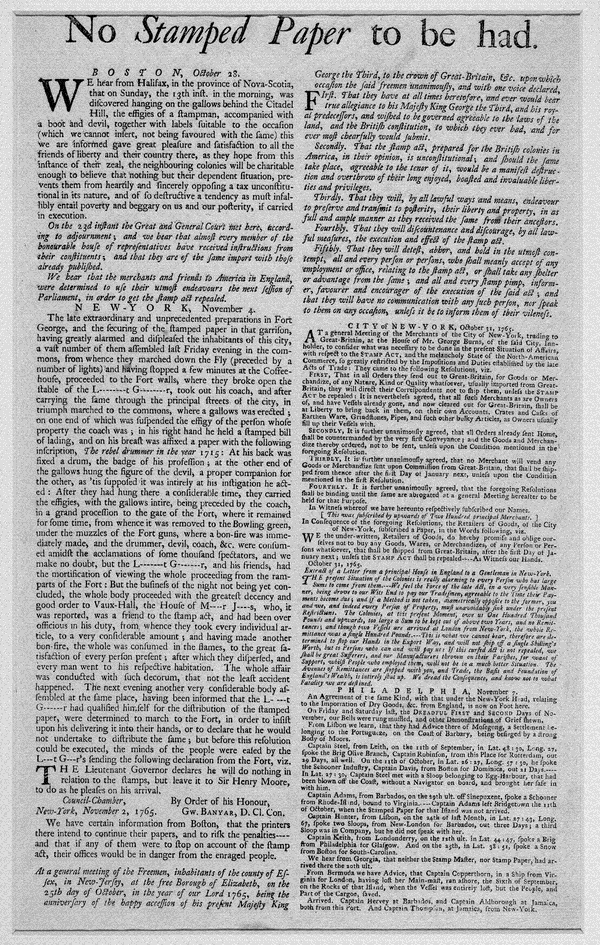
Ben Franklin said, "A man wrapped up in himself makes a very small bundle." Reminds me of Henry Miller's great quote: "Develop interest in life as you see it, in people, things, literature, music - the world is so rich, simply throbbing with rich treasures, beautiful souls and interesting people. Forget yourself."
That, to me, describes Benjamin Franklin.
Happy birthday, Ben!
Update: I knew Alex had written a fun tribute to him last year. Just tracked it down!
More Ben Franklin posts:
Paul Johnson's discussion of the writing of the Declaration
Ben Franklin: "I cannot give you the sun ..."
Science and the Founding Fathers
Benson Bobrick on the signing of the Declaration
Excerpt from Franklin's wonderful autobiography
Excerpt from HW Brands' The First American
January 11, 2008
Happy birthday to my dead boyfriend - Alexander Hamilton

Photo by me, that's near my house
On this day, in 1755, Alexander Hamilton was born in the British West Indies. Happy birthday to one of the most compelling (to me anyway) founding fathers that we have. He was illegitimate (or - as John Adams called him: "the bastard brat of a Scotch pedlar")- his illegitimacy was a stain on his birth he strove to wipe away for the rest of his short life.
Hamilton:
Take mankind in general, they are vicious - their passions may be operated upon. Take mankind as they are, and what are they governed by? Their passions. There may be in every government a few choice spirits, who may act from more worthy motives [but] one great error is that we suppose mankind more honest than they are. Our prevailing passions are ambition and interest. Wise government should avail itself of those passions, to make them subservient to the public good.
Hamilton's also the one who said, at the end of his 6-hour long speech at the Constitutional Convention: "Decision is true wisdom." This is part of the reason why he is one of the most important members of that founding generation - but it is also the reason that people found him terrifying. Abigail Adams warned her husband, "That man is another Bonaparte."
There is a contradictory dynamic within him that I find so compelling.
Hamilton would be number 1 on my geeky historical freebie list, as well as on my: "People From The Past I would Like To Have At My Perfect Dinner Party" list.
Also. He's a bit hot.

Rowr.
Here's a skit I wrote, imagining our first fateful meeting. I do not know if you could be geekier than I am.
Here's a big post I wrote a while back about one of my pet obsessions: the election of 1800. Some awesome information there about this man. Nobody was neutral about him. He was a polarizing kind of guy.
A couple years ago, the New York Historical Society had a massive Alexander Hamilton exhibit and Bill McCabe and I went - it was so so terrific. It was one of those events in New York when I was so excited to see all of it that I actually felt a bit nervous. You know what really got me? His DESK. I love actual objects ... the stuff historical figures actually touched, used ... He sat at that desk ...Here's a re-cap of our trip to the museum. Bill said something funny like, "I think this might be the first time I've gone to an exhibit like this where I'm with someone who knows MORE than I do about the topic." Hahahaha. History geeks - unite!!

The following is a letter the 17-year-old Alexander Hamilton wrote to his father, describing the hurricane that hit St. Croix on August 31, 1772 - one of the worst in the recorded history of the island. A couple of days later, Hamilton showed a copy of this letter to Reverend Knox (a very important person in the story of Alexander Hamilton - a real father figure to the boy.) Knox was so impressed with the prose that he arranged to have it published in the "Gazette". The letter was so well-received that Knox set the wheels in motion to send Hamilton to the colonies, so that he could get a college-level education. This move changed Hamilton's life. Here is the letter. It's riveting:
It began at dusk, at North, and raged very violently 'till ten o'clock. Then ensued a sudden and unexpected interval, which lasted about an hour. Meanwhile the wind was shifting 'round to the southwest ... it returned with redoubled fury and continued so 'till near three o'clock in the morning. Good God! What horror and destruction. It's impossible for me to describe or you to form any idea of it. It seemed as if a total dissolution of nature was taking place. The roaring of the sea and wind, fiery meteors flying about it in the air, the prodigious glare of almost perpetual lightning, the crash of the falling houses, and the ear-piercing shrieks of the distressed were sufficient to strike astonishment into angels.A great part of the buildings throughout the island are leveled to the ground, almost all the rest very much shattered, several persons killed and numbers utterly ruined, whole families running about the streets unknowing where to find a place of shelter; the sick exposed to the keenness of the water and air without a bed to lie upon or a dry covering to their bodies; and our harbors entirely bare. In a word, misery, in all its hideous shapes, spread over the whole face of the country ...
As to my reflections and feelings on this frightful and melancholy ocassion ...
Where now, oh! vile worm, is all thy boasted fortitude and resolution? What is become of thine arrogance and self-sufficiency? Why dost thou tremble and stand aghast? How humble, how helpless, how contemptible you now appear. And for why? The jarring of elements -- the discord of clouds? Oh! impotent presumptuous fool! Death comes rushing on in triumph, veiled in a mantle of tenfold darkness ... On his right hand sits destruction, hurling the winds and belching forth flames: calamity on his left threatening famine, disease and distress of all kinds. And oh! thou wretch, look still a little further. See the gulf of eternal misery open. There mayest thou shortly plunge -- the just reward of thy vileness. Alas! whither canst thou fly? Where hide thyself?
Uhm ... I look at my Diary Friday entries - written when I was 17 ... and ... er ... I hide my head in shame.

This is from a letter Alexander Hamilton wrote in 1780.
No wise statesman will reject the good from an apprehension of the ill. The truth is, in human affairs, there is no good, pure and unmixed. Every advantage has two sides, and wisdom consists in availing ourselves of the good and guarding as much as possible against the bad...A national debt, if it is not excessive, will be to us a national blessing. It will be powerful cement of our union. It will also create a necessity for keeping up taxation to such a degree which, without being oppressive, will be a spur to industry.
"A national debt, if it is not excessive, will be to us a national blessing." Ah. They are just words. But they went over like a BOMB exploding through the colonies. WHAT IS HE SAYING? WHAT IS HE TALKING ABOUT? IS HE THE DEVIL?
Alexander Hamilton made a six hour speech at the Constitutional Convention ... People scrawled down notes of it, because he spoke without notes (except when he laid out his plan for the Government), so whatever we have of that speech is from those notes. How I wish I had been in that room. It was a rousing call to a strong central government, a rousing call for the states to give up their power and their identities - to submerge themselves into America. This obviously did not go over well in some quarters. Another delegate to the Congress described Hamilton as "praised by everybody but supported by none". Anyway, here are some excerpts from his 6-hour speech in Philadlelphia, 1787.
All the passion we see, of avarice, ambition, interest, which govern most individuals and all public bodies, fall into the current of the states and do not flow into the stream of the general national government ... How then are all these evils to be avoided? Only by such a complete sovereignty in the general government as will turn all the strong principles and passions to its side.
In the context of the time, it is not surprising at all that people hated Hamilton, and thought he spoke treasonously. They had just thrown OFF the yoke of a monarch who had "complete sovereignty" ... and now Hamilton wanted to put the yoke on again?? This was heresy to this brand new nation.
More:
In every community where industry is encouraged, there will be a division of it into the few and the many. Hence, separate interests will arise. There will be debtors and creditors. Give all power to the many, they will oppress the few. Give all power to the few, they will oppress the many. Both, therefore, ought to have power, that each may defend itself against the other.
Hamilton read aloud from his notes - and what HE proposed as the set-up for the national government is basically what we have to this day (except for the "executive for life" thing.)
I think he went way too far out with some of his ideas - but that was his role, historically. I see him in that context. You always need someone like that - someone to be imaginative, bold, to push the boundaries OUT. He, as an immigrant, was not attached to any one state, in his loyalty. He stands out, because of this. His ideas were bold and new and there was literally no pause between thought and action with this guy (and that's why he got into so much trouble.) But great men usually have such a fatal flaw in their makeup. If they didn't have that, they wouldn't be great at all.
It reminds me of that great EM Forster quote: "Don't start with proportion. Only prigs do that." I believe in my heart that Hamilton was the most far-seeing of all of our founding fathers. He saw the world we live in now. I don't know how he did, but he did. They all still lived in an agrarian society, where land was power and prestige. Jefferson couldn't really imagine any other kind of world. Hamilton did and could imagine it. He saw ahead to the industrial revolution. He knew our society's set-up would change drastically ... and he wanted the economy to be flexible enough to deal with those changes. Most of the commentary at the time from his contemporaries (all brilliant men in their own right) is all along the lines of: "Alexander Hamilton is frightening." "Hamilton is dangerous and must be stopped." Etc.
I think he was way ahead of his time, almost as though he had dropped in from the future - and people like that always meet resistance.

Here is the ringing first paragraph of Federalist 1, written by Alexander Hamilton, published on October 27, 1787, in the "New York Independent Journal" - the first of 85 essays (written by Alexander Hamilton mostly, but James Madison wrote Federalist 10 - maybe the most famous of all of them, and John Jay contributed 5 essays). The purpose of this onslaught was to put the case for the Constitution before the New York public for its review. Here is the first paragraph of the first essay:
After a full experience of the insufficiency of the existing federal government, you are invited to deliberate upon a new Constitution for the United States of America. The subject speaks its own importance, comprehending in its consequences nothing less than the existence of the UNION, the safety and welfare of the parts of which it is composed, the fate of an empire in many respects the most interesting in the world.
Uhm, yeah. That prose would have gotten MY attention - as I scanned the "For Sale" ads for ladies hats and buggy whips surrounding it.
Alexander Hamilton, as Secretary of Treasury, put forth a monumental report to Congress calling for a national bank (this is something he had been pondering for years). He wanted it to be run by private citizens, and not the government. The bank had the power to issue paper money - the federal government should not have that power. Hamilton opposed the government running the printing presses to produce money. He wanted it to be separate, entirely. A quote from his report:
The wisdom of the government will be shown in never trusting itself with the use of so seducing and dangerous and expedient.
Brilliant.
The following anecdote (and quote) is pretty much why people were terrified of Alexander Hamilton, and felt that he should be stopped. To give you the proper context: he was answering criticism from his former Federalist Paper collaborator James Madison that this proposed Bank of America was un-constitutional. Hamilton had asked for a federal charter for the bank, Madison said there was nothing in the Constitution saying that the government should fund corporations. Hamilton pointed out that the last article of the Constitution - the one about Congress being able to make "all laws which shall be necessary and proper" - He said that that article was sufficient evidence that a charter would be constitutional.
BUT - the way Hamilton summed it all up was not calculated to assuage his enemies who feared his lust for power. He wrote:
Wherever the end is required, the means are authorized.
Gotcha, Machiavelli. Thanks for sharing. Then he went on:
If the end be clearly comprehended within any of the specified powers, and if the measure have an obvious relation to that end, and is not forbidden by any particular provision of the Constitution, it may safely be deemed to come within the compass of the national authority.
Fascinating - the story of the turbulent national debate about Hamilton's financial plan for the country is amazing. I've read about it from all sides: Hamilton's side, of course - but then John Adams' analysis of it, his letters to his wife, Jefferson's side of it, Washington's side of it ... - If you don't know all the ins and outs of this debate, I highly recommend you go back and check it out, read a biography of Hamilton, read his financial essays ... Truly an incredible time in our nation's history.
And about that duel. Hamilton had I guess what you could call a death-wish. I don't know if I want to diagnose him - but the thought of a "glorious" death permeates his personal letters. There are times when he is so cynical about his fellow man (due, probably, to his horrific upbringing) that he wants to end it all. Much of what happened to him came out of this death-wish ... there are times when he behaves in an absolutely incomprehensible manner - as though he WANTS to go down. As though, with all of his brilliance and intellectual power - he knew he would have a short life. He was involved in a sex scandal. He behaved with reckless abandon. He wrote a paper on John Adams, when Adams was president - which basically said that Adams was mentally incompetent, and not fit for office. It is a blistering attack, and so wrongheaded that you gasp at Hamilton's self-destructiveness. It was the death knell for his career. His makeup was such that he followed his impulses - and when he was on? BOY, was he on. Nobody has ever been so on in their lives! But when he messed up? He messed up big. His battle with Burr was fierce and long-standing. Honor was a huge deal to Hamilton. Maybe because of his illegitimacy, his sorry-ass beginnings ... he was very very sensitive to any slight. He felt disrespected by Washington - there is one famous incident where Hamilton kept Washington waiting for 5 minutes, because he had to talk to somebody else - and Washington was very angry and publicly told Hamilton so. Hamilton was so insulted by this (and obviously, his resentment had been growing - he wanted to see ACTION in the war, not just sit and be a clerk, and write 150 letters a day) that he asked to be released from his duties immediately. It was a total breach for him. He could not be insulted. If you insulted him by throwing a tiny arrow his way, he would respond with 25 cannon balls. He was, uhm, touchy. He had the presence of mind though, at least early in his career, to know that Washington (and what he stood for) was very important to America, and the union - so he wanted to keep his personal feelings out of it ... He was very concerned, when he left Washington's employ, that the real reasons be kept private (he mentions this in a couple of letters). Washington's image as a universally beloved leader was more important than Hamilton airing his grievances against the man. Later in life, though, Hamilton was unable to hold his personal feelings back, in such situations ... and more often than not, he would make his feelings public. This was not a casual thing for him. Honor, and his integrity, and his character - his very NAME - was something to be defended to the death. It HAD to be that way.
On July 10, 1804, Alexander Hamilton wrote the following letter to his wife Eliza:
My beloved Eliza Mrs. Mitchel is the person in the world to whom as a friend I am under the greatest Obligations. I have not hitherto done my duty to her. But resolved to repair my omission as much as possible, I have encouraged her to come to this Country and intend, if it shall be in my power to render the Evening of her days comfortable. But if it shall please God to put this out of my power and to inable you hereafter to be of service to her, I entreat you to do it and to treat her with the tenderness of a Sister.This is my second letter.
The Scruples of a Christian have determined me to expose my own life to any extent rather than subject my self to the guilt of taking the life of another. This must increase my hazards & redoubles my pangs for you. But you had rather I should die innocent than live guilty. Heaven can preserve me and I humbly hope will but in the contrary event I charge you to remember that you are a Christian. God's Will be done. The will of a merciful God must be good.
Once more Adieu My Darling darling Wife
AH
Tuesday Evening 10 oClock
Joseph Ellis, in his wonderful book Founding Brothers, opens the book with the story of the duel between Hamilton and Aaron Burr on the riverside plain of Weehawken. (You know, down the street from where I live. Life is beautiful. There's an Alexander Hamilton Park right down the street from me. Love that.) Ellis approaches the duel with a forensic eye - there is still a mystery at the heart of what happened on that day.

Joseph Ellis closes his chapter on The Duel with these words:
Oliver Wendell Holmes once observed that "a great man represents a strategic point in the campaign of history, and part of his greatness consists of his being there." Both Burr and Hamilton thought of themselves as great men who happened to come of age at one of those strategic points in the campaign of history called the American revolutionary era. By the summer of 1804, history had pretty much passed them by. Burr had alienated Jefferson and the triumphant Republican party by his disloyalty as a vice president and had lost by a landslide in his bid to become a Federalist governor of New York. Hamilton had not held national office for nine years and the Federalist cause he had championed was well on its way to oblivion. Even in his home state of New York, the Federalists were, as John Quincy Adams put it, "a minority, and of that minority, only a minority were admirers and partisans of Mr. Hamilton." Neither man had much of a political future.But by being there beneath the plains of Weehawken for their interview, they managed to make a dramatic final statement about the time of their time. Honor mattered because character mattered. And character mattered because the fate of the American experiment with republican government still required virtuous leaders to survive. Eventually, the United States might develop into a nation of laws and established institutions capable of surviving corrupt or incompetent public officials. But it was not there yet. It still required honorable and virtuous leaders to endure. Both Burr and Hamilton came to the interview because they wished to be regarded as part of such company.

And finally, here is an excerpt from Ron Chernow's magesterial biography of Alexander Hamilton:
Few figures in American history aroused such visceral love or loathing as Alexander Hamilton. To this day, he seems trapped in a crude historical cartoon that pits "Jeffersonian democracy" against "Hamiltonian aristocracy." For Jefferson and his followers, wedded to their vision of an agrarian Eden, Hamilton was the American Mephistopheles, the proponent of such devilish contrivances as banks, factories, and stock exchanges. They demonized him as a slavish pawn of the British Crown, a closet monarchist, a Machiavellian intriguer, a would-be Caesar. Noah Webster contended that Hamilton's "ambition, pride, and overbearing temper" had destined him "to be the evil genius of this country." Hamilton's powerful vision of American nationalism, with states subordinate to a strong central government and led by a vigorous executive branch, aroused fears of a reversion to royal British ways. His seeming solicitude for the rich caused critics to portray him as a snobbish tool of plutocrats who was contemptuous of the masses. For another group of naysayers, Hamilton's unswerving faith in a professional military converted him into a potential despot. "From the first to the last words he wrote," concluded historian Henry Adams, "I read always the same Napoleonic kind of adventuredom." Even some Hamilton admirers have been unsettled by a faint tincture of something foreign in this West Indian transplant; Woodrow Wilson grudgingly praised Hamilton as "a very great man, ut not a great American." Yet many distinguished commentators have echoed Eliza Hamilton's lament that justice has not been done to her Hamilton/ He has tended to lack the glittering multivolumed biographies that have burnished the fame of other founders. The British statesman Lord Bryce singled out Hamilton as the one founding father who had not received his due from posterity. In The American Commonwealth, he observed, "One cannot note the disappearance of this brilliant figure, to Europeans the most interesting in the early history of the Republic, without the remark that his countrymen seem to have never, either in his lifetime or afterwards, duly recognized is splendid gifts." During the robust era of Progressive Republicanism, marked by brawny nationalism and energetic government, Theodore Roosevelt took up the cudgels and declared Hamilton "the most brilliant American statesman who ever lived, possessing the loftiest and keenest intellect of his time." His White House successor, William Howard Taft, likewise embracedf Hamilton as "our greatest constructive statesman." In all probability, Alexander Hamilton is the foremost political figure in American history who never attained the presidency, yet he probably had a much deeper and more lasting impact than many who did.Hamilton was the supreme double threat among the founding fathers, at once thinker and doer, sparkling theoretician and masterful executive. He and James Madison were the prime movers behind the summoning of the Constitutional Convention and the chief authors of that classic gloss on the national charter, The Federalist, which Hamilton supervised. As the first treasury secretary and principal architect of the new government, Hamilton took constitutional principles and infused them with expansive life, turning abstractions into institutional realities. He had a pragmatic mind that minted comprehensive programs. In contriving the smoothly running machinery of a modern nation-state - including a budget system, a funded debt, a tax system, a central bank, a customs service, and a coast guard - and justifying them in some of America's most influential state papers, he set a high-water mark for administrative competence that has never been equaled. If Jefferson provided the essential poetry of American political discourse, Hamilton established the prose of American statecraft. No other founder articulated such a clear and prescient vision of America's future political, military, and economic strength or crafted such ingenious mechanisms to bind the nationa together.
Hamilton's crowded years as treasury secretary scarcely exhaust the epic story of his short life, which was stuffed with high drama. From his illegitimate birth on Nevis to his bloody downfall in Weehawken, Hamilton's life was so tumultuous that only an audacious novelist could have dreamed it up. He embodied an enduring archetype: the obscure immigrant who comes to America, re-creates himself, and succeeds despite a lack of proper birth and breeding. The saga of his metamorphosis from an anguished clerk on St. Croix to the reigning presence in George Washington's cabinet offers both a gripping personal story and a panoramic view of the formative years of the republic. Except for Washington, nobody stood closer to the center of American politics from 1776 to 1800 or cropped up at more turning points. More than anyone else, the omnipresent Hamilton galvanized, inspired, and scandalized the newborn nation, serving as the flash point for pent-up conflicts of class, geography, race, religion, and ideology. His contemporaries often seemed defined by how they reacted to the political gauntlets that he threw down repeatedly with such defiant panache.
Hamilton was an exuberant genius who performed at a fiendish pace and must have produced the maximum number of words that a human being can scratch out in forty-nine years. If promiscuous with his political opinions, however, he was famously reticent about his private life, especially his squalid Caribbean boyhood. No other founder had to grapple with such shame and misery, and his early years have remained wrapped in more mystery than those of any other major American statesman. While not scanting his vibrant intellectual life, I have tried to gather anecdotal material that will bring this cerebral man to life as both a public and a private figure. Charming and impetuous, romantic and witty, dashing and headstrong, Hamilton offers the biographer an irresistible psychological study. For all his superlative mental gifts, he was afflicted with a touchy ego that made him querulous and fatally combative. He never outgrew the stigma of his illegitimacy, and his exquisite tact often gave way to egregious failures of judgment that left even his keenest admirers aghast. If capable of numerous close friendships, he also entered into titanic feuds with Jefferson, Madison, Adams, Monroe, and Burr.
The magnitude of Hamilton's feats as treasury secretary has overshadowed many other facets of his life: clerk, college student, youthful poet, essayist, artillery captain, wartime adjutant to Washington, battlefield hero, congressman, abolitionist, Bank of New York founder, state assemblyman, member of the Constitutional Convention and New York Ratifying Convention, orator, lawyer, polemicist, educator, patron saint of the New York Evening Post, foreign-policy theorist, and major general in the army. Boldly uncompromising, he served as catalyst for the emergence of the first political parties and as the intellectual fountainhead for one of them, the Federalists. He was a pivotal force in four consecutive presidential elections and defined much of America's political agenda during the Washington and Adams administrations, leaving copious commentary on virtually every salient issue of the day.
A complex man - to be studied, discussed, fought about, celebrated ... He is still relevant.

December 28, 2007
"And why can we not have an American bank?"
Excerpt from an enormous letter written by Alexander Hamilton to James Duane in the midst of the Revolutionary War. Hamilton is 25 years old, and years away from becoming Secretary of the Treasury. Years away from his formation-of-the-bank extravaganza. Yet he is already (of course) pondering the issues, grappling with the inefficiency of the current system. He wrote this letter in 1780 - 7 years before the Constitutional Convention - long before the convention was even thought of ... the Articles of Confederation were the law of the land ... but here in this letter Hamilton is already sensing that things need to change. The letter is incredible. It's quoted at length in various Hamilton biographies - but it sure is worth it to go and read the whole thing. When you think of the circumstances under which the letter was written - Hamilton, camped out in the middle of a war, working his ass off for Washington, handling all of Washington's correspondence as well - not to mention courting Elizabeth Schuyler - it is even more amazing. The intellectual energy of the man. Surely he had more than 24 hours in a day. And this letter to Duane (which went through many drafts) was written on the same day as a bunch of other letters ... this was not the ONLY thing he wrote that day. It's over 6000 words. Extraordinary. Oh, and the last 2 times I have posted on Founding Fathers, I have gotten snotty condescending responses from the usual suspects. Please. If you want to discuss this stuff, be civil, for God's sake. And also: give me some credit. I read. Don't assume I haven't read the books you have, and that's why my opinion is different than yours. I probably have read the books you have. I'm a serious student of this stuff. I don't understand the condescension. I've been at this blogging thing for years now, and I still have a couple regulars who pat-pat me on the head and treat me like a dimwit. I know. Poor boys. It's so upsetting that Sheila dares to have an opinion, and dares to speak like she knows what she's talking about. What is this world coming to. I may come to a different conclusion than you, based on my own reading and study. But does that mean I'm stupid and that's why you talk to me in such an insulting way? What kind of isolated world do you live in if that is your response to a different opinion? Just adjust your tone, boys. Or I won't play with you at all. Sorry for the rant. I do try to keep such tangents out of my writing, since I know that the writing suffers. You see other bloggers all the time engaging with their critics through whatever they write. You know, the people who start every sentence with: "I know that there are those who disagree ..." or "I don't care what you bozos think, but ..." It's a trap I have fallen into myself. I used to write about Joyce with a defensive manner - because I had had so many rude people be whiny bitches when I would post about him. But over the past year, I stopped that. And I am happy with the result. Because I am not writing for the critics. Some people are - and that's cool for them ... but I'm not. It's not that kind of blog. More and more, I am getting the audience I WANT ... but it just so happens that I've had snotty condescension happen when I've posted about Founding Fathers - not across the board, just enough to make me go: Oh for Christ's sake, why do you use that tone with me? It's not like I'm a raving idiot lunatic. I write about their ideas. I post excerpts. I read books. I know the sources, I read them all. Engage with me on that level, or don't engage at all!
Here's just one excerpt of the mammoth letter:
And why can we not have an American bank? Are our monied men less enlightened to their own interest or less enterprising in the pursuit? I believe the fault is in our government which does not exert itself to engage them in such a scheme. It is true, the individuals in America are not very rich, but this would not prevent their instituting a bank; it would only prevent its being done with such ample funds as in other countries. Have they not sufficient confidence in the government and in the issue of the cause? Let the Government endeavour to inspire that confidence, by adopting the measures I have recommended or others equivalent to them. Let it exert itself to procure a solid confederation, to establish a good plan of executive administration, to form a permanent military force, to obtain at all events a foreign loan. If these things were in a train of vigorous execution, it would give a new spring to our affairs; government would recover its respectability and individuals would renounce their diffidence.The object I should propose to myself in the first instance from a bank would be an auxiliary mode of supplies; for which purpose contracts should be made between Government and the bank on terms liberal and advantageous to the latter. Everything should be done in the first instance to encourage the bank; after it gets well established it will take care of itself and government may make the best terms it can for itself....
A bank of this kind even in its commencement would answer the most valuable purposes to government and to the proprietors; in its progress the advantages will exceed calculation. It will promote commerce by furnishing a more extensive medium which we greatly want in our circumstances. I mean a more extensive valuable medium. We have an enormous nominal one at this time; but it is only a name.
In the present unsettled state of things in this country, we can hardly draw inferences from what has happened in others, otherwise I should be certain of the success of this scheme; but I think it has enough in its favour to be worthy of trial.
I have only skimmed the surface of the different subjects I have introduced. Should the plans recommended come into contemplation in earnest and you desire my further thoughts, I will endeavour to give them more form and particularity. I am persuaded a solid confederation a permanent army a reasonable prospect of subsisting it would give us treble consideration in Europe and produce a peace this winter.
If a Convention is called the minds of all the states and the people ought to be prepared to receive its determinations by sensible and popular writings, which should conform to the views of Congress. There are epochs in human affairs, when novelty even is useful. If a general opinion prevails that the old way is bad, whether true or false, and this obstructs or relaxes the operation of the public service, a change is necessary if it be but for the sake of change. This is exactly the case now. 'Tis an universal sentiment that our present system is a bad one, and that things do not go right on this account. The measure of a Convention would revive the hopes of the people and give a new direction to their passions, which may be improved in carrying points of substantial utility. The Eastern states have already pointed out this mode to Congress; they ought to take the hint and anticipate the others.
A phenom, this dude. "I have only skimmed the surface..." Ha! I grapple with his ideas myself, going this way, that - seeing his points, recoiling from others ... There's something about all of "these guys" that demand engagement. Just ENGAGE. Read their words and engage with them. See what comes up. See what you gravitate towards, and what you back off from. And also see how two things, two seemingly contradictory things, can be going on at the same time. That's why the primary sources of all of "these guys" - in the middle of a conflict - are so invaluable. It's a fight that goes on and on. The disagreement is built into the system. It's not perfect. But what it does do is ensure that the dialogue will continue. And I love these documents for that.
December 19, 2007
Happy birthday, Poor Richard
On this day in history, December 19, 1732, Benjamin Franklin's Poor Richard's Almanack was born - and the first issue published. Franklin included all the information that almanacs normally provide - sun rise, sun set, eclipses, weather predictions, yadda yadda. But it was also one of those small things (or - not so small - but let's just say that Richard's Almanack couldn't have done it on its own) that made the colonies feel more like a community. The colonies did things for themselves. They were under the crown, but that feeling of being separate from the crown started very early - and the almanac - with its listing of court dates, and town meetings, and church meetings, etc. - was part of that. It helped foster that. It helped spread information.
Benjamin Franklin wrote in his autobiography:
In 1732 I first published my almanac, under the name of Richard Saunders; it was continued by me about twenty-five years and commonly called "Poor Richard's Almanac". I endeavored to make it both entertaining and useful, and it accordingly came to be in such demand that I reaped considerable profit from it, vending annually near ten thousand. And observing that it was generally read, scarce any neighborhood in the province being without it, I considered it as a proper vehicle for conveying instruction among the common people, who bought scarcely any other books. I therefore filled all the little spaces that occurred between the remarkable days in the calendar with proverbial sentences, chiefly such as inculcated industry and frugality as the means of procuring wealth, and thereby securing virtue; it being more difficult for a man in want to act always honestly, as, to use here one of those proverbs, it is hard for an empty sack to stand upright.These proverbs, which contained the wisdom of many ages and nations, I assembled and formed into a connected discourse prefixed to the almanac of 1757 as the harangue of a wise old man to the people attending an auction. The bringing all these scattered counsels thus into a focus enabled them to make greater impression. The piece, being universally approved, was copied in all the newspapers of the American continent, reprinted in Britain on a large sheet of paper to be stuck up in houses; two translations were made of it in France, and great numbers bought by the clergy and gentry to distribute gratis among their poor parishioners and tenants. In Pennsylvania, as it discouraged useless expense in foreign superfluities, some thought it had its share of influence in producing that growing plenty of money which was observable for several years after its publication.
I remember my grandmother, Mummy Gina, had a huge illustrated Richard's Almanack at her house that we loved to page through as kids . I can still see some of the illustrations in my mind. I remember very well the illustration for the proverb about visitors being like fish (they start to stink after a couple of days).
I love this website. Ha!!! Especially in light of the whole key on the kite thing.
Some of the proverbs from the almanac (he freely admitted that he did not invent many of these - they were passed down, or he would put his own humorous spin on them):
Keep your eyes wide open before marriage, half shut afterwards.
After three days men grow weary, of a wench, a guest, and weather rainy.
Three may keep a secret, if two of them are dead.
Early to bed and early to rise, makes a man healthy, wealthy, and wise.
Plough deep while sluggards sleep and you shall have corn to sell and to keep.
Have you something to do tomorrow? Do it today
There are no gains without pains.
The noblest question in the world is: What good may I do in it?
H.W. Brands writes, in his biography of Benjamin Franklin (The First American):
Gazette readers intrigued enough to buy the bound version (priced at three shillings sixpence per dozen, obviously intended for resale) or the broadsheet edition (two shillings sixpence the dozen) were introduced to Richard Sauncers, Philomath - a standard honorific for almanac-makers - by Saunders himself. "Courteous Reader, I might in this place attempt to gain thy favour by declaring that I write almanacks with no other view than the public good; but in this I should not be sincere, and men are nowadays too wise to be deceived in pretenses how specious soever." Like the printer Franklin apologizing for the advertisement that gave offense to certain customers, Saunders confessed to monetary motives. "The plain truth of the matter is, I am excessive poor, and my wife, good woman, is, I tell her, excessive proud. She cannot bear, she says, to sit spinning in her shift of tow while I do nothing but gaze at the stars, and has threatened to burn all my books and rattling-traps (as she calls my instruments) if I do not make some profitable use of them for the good of my family. The printer has offered me some considerable share of the profits, and I have thus begun to comply with my Dame's desire."
Hahahahahahaha
More from The First American:
As was apparent to the least attentive reader, Franklin thoroughly enjoyed adopting the guise of Richard Saunders. Where Franklin the businessman had to be circumspect careful not to offend, Saunders the almanacker could be outrageous - indeed, the more outrageous the better. Franklin as Franklin often had to hide his gifts to avoid inspiring envy; Franklin as Saunders could flaunt his wit, erudition, and general brilliance. In time - as his position in the community grew more secure - Franklin would no longer require Richard Saunders; till then the alter ego helped keep him sane.Readers enjoyed Poor Richard as much as Franklin did. Copies were out the door by the single and the gross. In one year John Peter Zenger of New York (lately the defendant in a celebrated libel trial) took eighteen dozen in a batch, then another sixteen dozen. Louis Timothee (who now generally went by Lewis Timothy [more on him here) in South Carolina ordered twenty-five dozen; Thomas Fleet in Boston also took twenty-five dozen. James Franklin's widow, Ann, in Newport bought one thousand. These numbers hardly made Poor Richard the bestselling almanac in America; where Poor Richard sold an average of about ten thousand per year, Nathaniel Ames's Astronomical Diary sold five to six times as many. But Poor Richard had a unique persona, and it developed a loyal readership.
While readers may have come for the quarrels Franklin provoked, they stayed for the advice he dispensed - and the way he dispensed it. Every almanac offered pearls of wisdom on personal conduct and related matters of daily life; that the pearls had been retrieved from other oysters bothered no one except perhaps the owners of those other oysters, who in any event had no recourse in the absencew of applicable copyright law. The trick for writers like Franklin was to polish the pearls and set them distinctively; in this he had no peer. What came to be called "the sayings of Poor Richard" first surfaced as filler on the calendar pages of the almanac the limitations of space, together with Franklin's inherent economy, taught him to distill each message to its morsel. "Great talkers, little doers" broke no philosophical ground, but for pith it trumped nearly every alternative. "Hunger never saw bad bread"; "Light purse, heavy heart"; "Industry need not wish"; and "Gifts burst rocks" fell into the same category.
Sometimes succinctness yielded - slightly - to sauciness. "Neither a fortress nor a maidenhead will hold out long after they begin to parley." "Marry your son when you will but your daughter when you can." "Tell a miser he's rich, and a woman she's old, you'll get no money of one nor kindness of t'other." "Prythee isn't Miss Cloe's a comical case?/She lends out her tail, and she borrows her face." "The greatest monarch on the proudest throne is obliged to sit upon his own arse." "Force shits upon reason's back."
Poor Richard's Almanack is still in print today. Extraordinary.
December 16, 2007
Today In History: Dec. 16, 1773

On November 28, 1773, the Dartmouth sailed into port in Boston. It was full of tea. There had already been trouble in Philadelphia when the tea ship had tried to unload its cargo. A ship had been blown away from the port in New York by a storm. A confrontation was imminent.
Late November, early December, 1773, broadsides distributed throughout Boston:
Friends! Brethren! Countrymen! The worst of plagues, the detested TEA ... is now arrived in this harbor. The hour of destruction, or manly opposition to the machinations of tyranny, stares you in the face. Every friend to his country, to himself and posterity ... is now called upon ... to make a united and successful resistance to this last, worst, and most destructive measure of administration.
Samuel Adams spearheaded the campaign to fire up the populace, sending out broadsides - the Sons of Liberty posted armed guards around the wharf, to make sure that that tea was not unloaded.
Abigail Adams wrote to Mercy Warren on December 5:
The Tea that bainfull weed is arrived. Great and I hope effectual opposition has been made to the landing of it. The proceedings of our Citizens have been united spirited and firm. The flame is kindled and like lightning it catches from Soul to Soul. I tremble when I think what must be the direfull consequences. And in this Town must the Scene of action lay, my Heart beats at every Whistle I hear, and I dare not openly express half my fears.
On December 16, 1773 a town meeting was called at the Old South Meeting House - the meeting was run by Samuel Adams. The three tea ships sat in the harbor, full of cargo - not allowed to unload, not allowed to leave. A message was sent to Thomas Hutchinson, Lieutenant Governor of Massachusetts - who had continuously refused the ships to leave the harbor until they had unloaded, or until the duties were paid. The meeting raged on about "that bainfull weed" in the harbor. A messenger returned with word from Hutchinson: Clearance for the tea ships is refused. Catherine Drinker-Bowen writes in her wonderful book John Adams and the American Revolution what happened next:
Sam Adams read the message, then addressed the people briefly: "This meeting can do nothing more to save the country," he said. The words were a signal to the crowd outside. Instantly a warwhoop was heard, and the general shout, "To the docks!" Several hundred men, most of them disguised by prearrangement in Indian paint and feathers, headed north for Griffin's wharf, boarded the three ships and dumped three hundred and forty-two chests of tea into the Harbor.Not a life was lost, not a man hurt, no drop of blood was shed. In the moonlight a vast crowd assembled on the dock, watched almost in silence while the "Mohawks" did their work. The stillness was extraordinary; the crash of hatchets could plainly be heard across the line of water, and occasional perspiring grunts as men tipped the heavy boxes over the bulwarks. Admiral Montagu's two frigates lay in the outer Harbor, but the tide was on the ebb and they did not try to approach. None of the "Mohawks" kept so much as a fistful of tea to himself; one or two who tried it were quickly and summarily dissuaded. When morning came, tea marked the edge of high tide on beaches as far south as Nantasket ... One Mohawk, it was true, found his shoes full of tea when he got home; he put a little of it in a jar as a souvenir.
John Adams wrote in his diary on December 17, 1773:
Last Night 3 cargoes of Bohea Tea were emptied into the Sea. This Morning a Man of War sails. This is the most magnificent Movement of all. There is a Dignity, a Majesty, a Sublimity, in this last Effort of the Patriots, that I greatly admire. The People should never rise, without doing something to be remembered - something notable and striking. This Destruction of the Tea is so bold, so daring, so firm, intrepid, and inflexible, and it must have important Consequences, and so lasting, that I can't but consider it as an Epocha in History... Many persons wish that as many dead carcasses were floating in the harbor, as there are chests of tea. What measures will the ministry take? Will they punish us? How? By quartering troops upon us? by annulling our charter? by laying on more duties? by restraining our trade? By sacrifice of individuals? or how?
Alexander Hamilton (John Adams's future nemesis) had just begun school at King's College in New York (a British bastion of power). The Boston Tea Party galvanized him (according to reports from his friends). He was already becoming political - and although opposed to mob rule, in principle (he had a dread of riots and anarchy) - thought that the tea party was a splendid gesture. Robert Troup, Hamilton's good friend in college, later remembered, "The first political piece which [Hamilton] wrote was on the destruction of the tea at Boston in which he aimed to show that the destruction was both necessary and politic."
Almost a year to the day after the Tea Party itself, Hamilton published his first major political work - on December 15, 1774 - A Full Vindication of the Measures of Congress - a blistering and brilliant response to the grumblings about the "traitors" who had met in Philadelphia that fall. Hamilton is still a teenager here, not even 20 years old yet. He referenced the Tea Party in this 35 page attack:
But some people try to make you believe, we are disputing about the foolish trifle of three pence duty upon tea. They may as well tell you, that black is white. Surely you can judge for yourselves. Is a dispute, whether the Parliament of Great-Britain shall make what laws, and impose what taxes they please upon us, or not; I say, is this a dispute about three pence duty upon tea? The man that affirms it, deserves to be laughed at.It is true, we are denying to pay the duty upon tea; but it is not for the value of the thing itself. It is because we cannot submit to that, without acknowledging the principle upon which it is founded, and that principle is a right to tax us in all cases whatsoever. ...
But being ruined by taxes is not the worst you have to fear. What security would you have for your lives? How can any of you be sure you would have the free enjoyment of your religion long? would you put your religion in the power of any set of men living? Remember civil and religious liberty always go together, if the foundation of the one be sapped, the other will fall of course.
Call to mind one of our sister colonies, Boston. Reflect upon the situation of Canada, and then tell me whether you are inclined to place any confidence in the justice and humanity of the parliament. The port of Boston is blocked up, and an army planted in the town. An act has been passed to alter its charter, to prohibit its assemblies, to license the murder of its inhabitants, and to convey them from their own country to Great Britain, and to be tried for their lives. What was all this for? Just because a small number of people, provoked by an open and dangerous attack upon their liberties, destroyed a parcel of Tea belonging to the East India Company. It was not public but private property they destroyed. It was not the act of the whole province, but the act of a part of the citizens; instead of trying to discover the perpetrators, and commencing a legal prosecution against them; the parliament of Great Britain interfered in an unprecedented manner, and inflicted a punishment upon a whole province, "untried, unheard, unconvicted of any crime." This may be justice, but it looks so much like cruelty, that a man of a humane heart would be more apt to call it by the latter, than the former name.
Not bad for a college student. He signed it "A Friend to America". It made a huge sensation when it was published in the New York Evening Post. I'm proud of my dead boyfriend.
On December 31, 1773, Samuel Adams wrote to a friend, in regards to the "tea party" and how it affected the citizenry:
You cannot imagine the height of joy that sparkles in the eyes and animates the [faces] as well as the hearts of all [Bostonians].
Admiral John Montagu of the British Navy called out to the "Mohawks" as they did their damage: "Well, boys, you've had a fine, pleasant evening for your Indian caper. But mind, he who dances must pay the fiddler." One of the Mohawks shouted back, "Oh, never mind, Admiral. Just come out here, if you please, and we'll settle the bill in two minutes!"
Following the tea party, a broadside was widely released - containing a song/poem written about the tea party. It is speculated (in the biography I have of Sam Adams) that he had a hand in writing it. Sounds like his high-energy blazing style.
TEA, DESTROYED BY INDIANS
YE GLORIOUS SONS OF FREEDOM, brave and bold,
That has flood forth ---- fair LIBERTY to hold;
Though you were INDIANS, come from distant shores,
Like MEN you acted --- not like savage Moors.
CHORUS
Our LIBERTY, and LIFE is now invaded,
And FREEDOM's brightest CHARMS are darkly shaded:
But we will STAND --- and think it noble mirth,
To DART the man that dare oppress the Earth.
Bostonian's SONS keep up your Courage good,
Or Dye, like Martyrs, in fair Free-born Blood.
How grand the Scene! --- (No Tyrant shall oppose)
The TEA is sunk in spite of all our foes.
A NOBLE SIGHT -- to see th' accursed TEA
Mingled with MUD -- and ever for to be;
For KING and PRINCE shall know that we are FREE.
Bostonian's SONS keep up your Courage good,
Or Dye, like Martyrs, in fair Free-born Blood.
Must we be still --- and live on Blood-bought Ground,
And not oppose the Tyrants cursed found?
We Scorn the thought -- our views are well refin'd
We Scorn those slavish shackles of the Mind,
"We've Souls that were not made to be confin'd."
Bostonian's SONS keep up your Courage good,
Or Dye, like Martyrs, in fair Free-born Blood.
Could our Fore-fathers rise from their cold Graves,
And view their Land, with all their Children SLAVES;
What would they say! how would their Spirits rend,
And, Thunder-strucken, to their Graves descend.
Bostonian's SONS keep up your Courage good,
Or Dye, like Martyrs, in fair Free-born Blood.
Let us with hearts of steel now stand the task.
Throw off all darksome ways, nor wear a Mask.
Oh! may our noble Zeal support our frame,
And brand all Tyrants with eternal SHAME.
Bostonian's SONS keep up your Courage good,
And sink all Tyrants in their GUILTY BLOOD.
On December 31, 1773, the Boston Gazette printed a message for the New Year from Samuel Adams:
To all Nations under Heaven, know ye, that the PEOPLE of the AMERICAN WORLD are Millions strong - countless Legions compose their ARMY OF FREEMEN ... AMERICA now stands with the Scale of JUSTICE in one Hand, and the Sword of VENGEANCE in the other ... Let the Britons fear to do any more so wickedly as they have done, for the HERCULEAN ARM of this NEW WORLD is lifted up - and Woe be to them on whom it falls! -- At the Beat of the Drum, she can call five Hundred thousand of her SONS to ARMS ... Therefore, ye that are wise, make Peace with her, take Shelter under her Wings, that ye may shine by the Reflection of her Glory.May the NEW YEAR shine propitious on the NEW WORLD - and VIRTUE and LIBERTY reign here without a Foe, until rolling Years shall measure Time no more.
Boston 1775 has lots of great content about the Boston Tea Party.
References:
Benson Bobrick, Angel in the Whirlwind
John & Abigail Adams, The Book of Abigail and John
Dennis Fradin, Samuel Adams: The Father of American Independence
Catherine Drinker-Bowen, John Adams and the American Revolution
Ron Chernow, Alexander Hamilton
Alexander Hamilton, Library of America: Hamilton: Writings
The wind is blowing
something fierce. I made a pot of coffee. And I've been up for a couple of hours - sitting in bed - with books spread out around me:
-- Chernow's biography of Alexander Hamilton
-- Willard Sterne Randall's biography of Alexander Hamilton
-- my Library of America copy of The Federalist Papers
-- my Library of America copy of Hamilton's writings
-- my Library of America copy of Washington's writings
I read and cross-reference. Every sentence leads to a tangent. I track down original sources. I read the entire thing as opposed to an excerpt in the books. For example, when Hamilton was a teenager - he wrote a letter to his (deadbeat) father describing a devastating hurricane that had hit the West Indies. His father happened to show it to the Reverend Hugh Knox (one of Hamilton's first elderly-gentlemen mentors) - who was so impressed with the writing, and the power of description - that he sent it to the Royal Danish Gazette - the local paper - where it was printed (excerpt here). It caused a sensation - who wrote it? Who is that boy? Etc. Hamilton's family was already relatively notorious in that small world - due to his illegitimacy, and the mounting personal tragedies ... but with his letter about the hurricane, Hamilton became "famous" in another way. For his power of writing, and his precocious ability with his pen. It got him quite a bit of attention - men in power who wanted to help this young brilliant boy with no prospects - and it was that letter that launched the series of events that would get Hamilton out of the West Indies and up to New York, to get a college education. Anyway, it's a famous letter. Most books about Hamilton publish excerpts of it only, to give you a taste for it (they always include the "Oh! vile worm!" section because it is so frantic and so overblown. He is so angry at God, it seems - the world is a dreadful dark and random place. Is this a teenage boy who wrote this??) The good thing about the Library of America collections (of which I have many - most of the important ones anyway) is you get to read the whole thing, not just an excerpt. So I've been going back and forth, as my whim takes me ... reading the whole hurricane letter, or the whole of his famous letter to his friend Edward Stevens which ends with "In short I wish there was a War", etc. I'm lovin' my primary source library on this windy freezing morning.
December 14, 2007
Today in History: December 14, 1799
George Washington died on December 14, 1799.
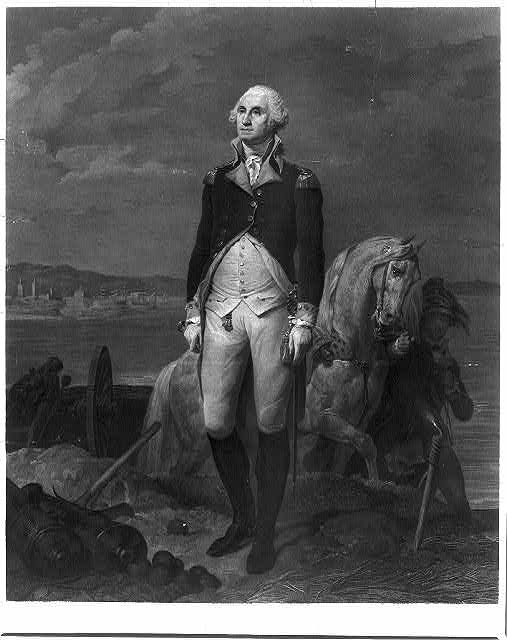
Here is a mish-mash of quotes, excerpts, etc.
Gouverneur Morris said, upon the death of this great man:
It is a question, previous to the first meeting, what course shall be pursued. Men of decided temper, who, devoted to the public, overlooked prudential considerations, thought a form of government should be framed entirely new. But cautious men, with whom popularity was an object, deemed it fit to consult and comply with the wishes of the people. AMERICANS! -- let the opinion then delivered by the greatest and best of men, be ever present to your remembrance. He was collected within himself. His countenance had more than usual solemnity -- His eye was fixed, and seemed to look into futurity. 'It is (said he)too probable that no plan we propose will be adopted. Perhaps another dreadful conflict is to be sustained. If to please the people, we offer what we ourselves disapprove, how can we afterwards defend our work? Let us raise a standard to which the wise and the honest can repair. The event is in the hand of God.'--this was the patriot voice of WASHINGTON; and this the constant tenor of his conduct.
George Washington is the standard-bearer - as much as he probably would not have wanted that role. But we cannot choose our own destiny. Destiny chose him. He was a deeply private man - perhaps the most private of all of our Founding Fathers. Adams and Jefferson always waxed rhapsodic about how much they wanted to "retire" and be simple farmers again - they had the pastoral fantasy that most men had at that time. And yet - once they were home, wandering through the turnip fields or whatever, they were always firing off letters to those in the thick of things, trying to keep up to date, manipulate events, and it was rare that the retirements "stuck". Adams and Jefferson, much more than Washington, were truly political animals. But Washington - when you read biographies of him, or you read his letters - you truly get the sense that he was very reluctantly a public man. Once he realized his duty - he did it - without much complaining - but he paid an enormous price, in terms of his personal life. He sacrificed his personal happiness for the good of the country. He knew he could not turn down the role that Destiny offered him. He may have yearned for Mount Vernon ... but it was not up to HIM to say: "You know what? This whole Leadership thing is not for me." I deeply admire him for that (and for many other things - but mainly for that). The union of this new nation was, for a while, tied up in the figure of George Washington. He was a symbolic figure DURING his lifetime. It was hard for him to accept that - he wasn't into all of that - There's that great story of Napoleon saying, in regards to Washington, "Has he crowned himself yet?" I am paraphrasing - but Napoleon was SHOCKED that Washington, with all he accomplished, did not just elect himself Leader of the new country. After all, that's what Napoleon would have done (and did!)
When George Washington was elected (unanimously) by the First Continental Congress to be Commander in Chief (this was in June, 1775) - here was the brief acceptance he made:
"Lest some unlucky event should happen unfavorable to my reputation, I beg it may be remembered by every gentleman in the room, that I this day declare, with the utmost sincerity, I do not think myself equal to the command."
On June 18, 1775, Washington sat down and wrote the following to his wife, Martha:
My Dearest: I now sit down to write to you on a subject which fills me with inexpressible concern, and this concern is greatly aggravated and increased when I reflect upon the uneasiness I know it will give you. It has been determined in Congress that the whole army raised for the defence of the American cause shall be put under my care, and that it is necessary for me to proceed immediately to Boston to take upon me the command of it.You may believe me, my dear Patsy, when I assure you, in the most solemn manner, that, so far from seeking this appointment, I have used every endeavour in my power to avoid it, not only from my unwillingness to part with you and the family, but from a consciousness of its being a trust too great for my capacity, and that I should enjoy more real happiness in one month with you at home than I have the most distant prospect of finding abroad, if my stay were to be seven times seven years.
But as it has been a kind of destiny that has thrown me upon this service, I shall hope that my undertaking is designed to answer some good purpose.
I sometimes get the sense with Adams and Jefferson that their yearning for their respective homes was a bit of a pose. Men at that time were not supposed to want power. But I never quite believe either of them when they say (over and over and over again): "I just want to be a private man - home with my garden and my wife ..." Yeah, boys, we got it. You want to go home. Then why don't you, hmmmmm?? Methinks you would perish if you weren't at the center of events, but who am I to talk.
But with Washington I never get the sense that that was a pose. He truly could not stand being away from his home. And yet his sense of duty overrode his personal concerns.
Abigail Adams first met Washington in 1774, and wrote to her husband:
You had prepared me to entertain a favorable opinion of him, but I thought the half was not told me. Dignity with ease and complacency, the gentleman and the soldier look agreeably blended in him. Modesty marks every line and feature of his face.
Here's something Washington said which I have pondered often - we are so fortunate to have had such a GROUP of men at our beginnings as a nation - If we had had only ONE of them we would have been in trouble. But all together as a group? Powerful.
Men may speculate as they will, they may talk of patriotism; they may draw a few examples from current story - but whoever builds upon it as a sufficient basis for conducting a long and bloody war will find themselves deceived in the end - For a long time it may of itself push men to action, to bear much, to encounter difficulties, but it will not endure unassisted by Interest.
A-frickin-men, George.
Now THAT is a practical mindset. His whole involvement in the Revolutionary cause began because of practical concerns. He was a farmer, a plantation owner - and the British sapped him dry with taxes, and levies, and limitations on where he could purchase things. He began a course, very early on, of trying to become self-sufficient, separating himself from the British economically - the stories of what he did, how he adjusted his farming practices, etc. - are fascinating. He wasn't all fired up with passion, or "Let's blow the bastards up!" He, as a personal private man, a landowner, felt hampered by the British, and they were directly affecting HIM and his INCOME. That was where it began for George Washington. Not some lofty Jeffersonian phrase about the "pursuit of happiness" (although God bless Jefferson for that.) Pursuit of happiness my EYE - how about those taxes??
On November 25, 1783: George Washington "took back" New York.
The peace treaty had been signed a year before, France had pledged support and recognition of the new United States, but the redcoats remained in New York, waiting for their written orders from London. George Washington vowed that he would not go home, he would not break up his army, until every last redcoat had left.
Nov. 25 was that momentous day - the day the American troops marched back into town, after the departure of the British.
The exhausted army marched the long way downtown, through what was now a war-ravaged New York City. People lined the streets, throwing laurels in front of Washington's horse, screaming, crying ... a huge display of emotion and reverence that made the typically humble Washington feel uncomfortable.
A woman in the crowd that day wrote the following in her diary:
We had been accustomed for a long time to military display in all the finish and finery of [British] garrison life. The troops just leaving us were as if equipped for a show and with their scarlet uniforms and burnished arms made a brilliant display. The troops that marched in, on the contrary, were ill-clad and weather-beaten and made a forlorn appearance. But then, they were our troops and as I looked at them and thought upon all they had done and suffered for us, my heart and my eyes were full.
George Washington wrote the following on the eve of his inauguration in 1789:
It is said that every man has his portion of ambition. I may have mine, I suppose, as well as the rest, but if I know my own heart, my ambition would not lead me into public life; my only ambition is to do my duty in this world as well as I am capable of performing it, and to merit the good opinion of all good men.
The following story may be just a rumor handed down over the years, but it is one of my favorites. Franklin was in France, and word came to France of the decisive (and shocking) American victory (1781). Franklin attended a diplomatic dinner shortly thereafter - and, of course, everyone was discussing the defeat of the British, and the victory of America.
The French foreign minister stood, and toasted Louis XVI, "To his Majesty, Louis the Sixteenth, who, like the moon, fills the earth with a soft, benevolent glow."
The British ambassador rose and said, "To George the Third, who, like the sun at noonday, spreads his light and illumines the world."
Franklin rose (reportedly) and countered, "I cannot give you the sun or the moon, but I give you George Washington, General of the armies of the United States, who, like Joshua of old, commanded both the sun and the moon to stand still, and both obeyed."
George Washington's last words were, apparently:
"I feel myself going. I thank you for your attentions; but I pray you to take no more trouble about me. Let me go off quietly. I cannot last long."
For me - the most telling part of that, the most revealing is: "I thank you for your attentions; but I pray you to take no more trouble about me."
How very ... Washington-ish of him.
December 12, 2007
June 18, 1775
 Letter from Abigail Adams to John Adams:
Dearest FriendThe Day; perhaps the decisive Day is come on which the fate of America depends. My bursting Heart must find vent at my pen. I have just heard that our dear Friend Dr. Warren is no more but fell gloriously fighting for his Country - saying better to die honourably in the field than ignominiously hang upon the Gallows. Great is our Loss. He has distinguished himself in every engagement, by his courage and fortitude, by animating the Soldiers and leading them on by his own example. A particular account of these dreadful, but I hope Glorious Days will be transmitted to you, no doubt in the exactest manner.
The race is not to the swift, nor the battle to the strong, but the God of Israel is he that giveth strength and power unto his people. Trust in him at all times, ye people pour out your hearts before him. God is a refuge for us. -- Charlestown is laid in ashes. The Battle began upon our intrenchments upon Bunker Hill, a Saturday morning about 3 o'clock and has not ceased yet and tis now 3 o'clock Sabbeth afternoon.
Tis expected they will come out over the Neck to night, and a dreadful Battle must ensue. Almighty God cover the heads of our Country men, and be a shield to our Dear Friends. How [many ha]ve fallen we know not - the constant roar of the cannon is so [distre]ssing that we can not Eat, Drink or Sleep. May we be supported and sustaind in the dreadful conflict. I shall tarry here till tis thought unsafe by my Friends, and then I have secured myself a retreat at your Brothers who has kindly offered me part of his house. I cannot compose myself to write any further at present. I will add more as I hear further.
July 1st, 1774
 Excerpt from letter of John Adams to his wife Abigail:
Dr. Gardiner arrived here to day, from Boston, brings us News of a Battle at the Town Meeting, between Whigs and Tories, in which the Whiggs after a Day and an Halfs obstinate Engagement were finally victorious by two to one. He says the Tories are preparing a flaming Protest.I am determined to be cool, if I can; I have suffered such Torments in my Mind, heretofore, as have almost overpowered my Constitution, without any Advantage: and now I will laugh and be easy if I can, let the Conflict of Parties, terminate as it will - let my own Estate and Interest suffer what it will. Nay whether I stand high or low in the Estimation of the World, so long as I keep a Conscience void of Offence towards God and Man. And thus I am determined by the Will of God, to do, let what will become of me or mine, my Country, or the World.
I shall arouse myself ere long I believe, and exert an Industry, a Frugality, a hard Labour, that will serve my family, if I cant serve my Country. I will not lie down and die in Despair. If I cannot serve my Children by the Law, I will serve them by Agriculture, by Trade, by some Way, or other. I thank God I have a Head, an Heart and Hands which if once fully exerted alltogether, will succeed in the World as well as those of the mean spirited, low minded, fawning obsequious scoundrells who have long hoped, that my Integrity would be an Obstacle in my Way, and enable them to out strip me in the Race.
But what I want in Comparison of them, of Villany and servility, I will make up in Industry and Capacity. If I dont they shall laugh and triumph.
I will not willingly see Blockheads, whom I have a Right to despise, elevated above me, and insolently triumphing over me. Nor shall Knavery, through any Negligence of mine, get the better of Honesty, nor Ignorance of Knowledge, nor Folly of Wisdom, nor Vice of Virtue.
I must intreat you, my dear Partner in all the Joys and Sorrow, Prosperity and Adversity of my Life, to take a Part with me in the Struggle. I pray God for your Health - intreat you to rouse your whole Attention to the Family, the stock, the Farm, the Dairy. Let every Article of Expence which can possibly be spared be retrench'd. Keep the Hands attentive to their Business, and [let] the most prudent Measures of every kind be adopted and pursued with Alacrity and Spirit.
I am &c.,
John Adams
December 11, 2007
"Miss Adorable ..."
 Here is the NY Times review of My Dearest Friend, the newest edition of the correspondence of John and Abigail Adams. It's nice to see that this edition goes further out in time, whereas earlier editions stop when the family is reunited in London in 1784. Once the family is together, they obviously do not need to write letters to one another. However - obviously there were still separations following 1784 - long ones, too! My Dearest Friend includes letters between them throughout the rest of their lives, which I am very excited to read.
November 27, 2007
Baron von Steuben's entourage
This is so amusing. What a lively letter. I can just SEE that whole scene, and the poor landlady trying to be compensated for her trouble. Ha!!
November 18, 2007
Lafayette
Yesterday, Allison, Tim and I went to the New York Historical Society. I was particularly moved by the Lafayette exhibit they have going on now - and it's going to be there until 2008 so I HIGHLY recommend it to anyone in the area, or anyone who plans on visiting New York. Wonderful stuff: relics of his triumphant return to America, his grand tour in 1824 - mugs imprinted with his face, ladies gloves with his face on them in a little imprint - handkerchiefs, invitations to balls - everything in honor of him. Portraits of him, snippets of his writing, etc. etc. Great stuff.
I also had a lovely time walking through the grand gallery on the 2nd floor where there is a marvelous exhibit of American painters of the Hudson River school. Soft green walls, vaulted high ceiling - and MASSIVE paintings. Very interesting stuff.
Oh, and one last thing: on the weekends, the NY Historical Society has what they call "Living History Days", where people dressed up in Revolutionary Era clothes mingle with the hoi polloi. They answer questions, they do demonstrations with their weapons, they cross-stitch little hankies and talk to children, and generally behave like history geeks. When we were there, we got to mingle with Lafayette (who, of course, had a mellifluous French accent) - I had a nice chat with him about the terror in Revolutionary France and how he fared - I exchanged a shy smile with Ben Franklin but was too timid to speak to him, and I cowered in awe and fear of the towering George Washington. I also caught one of the little Revolutionary ladies in her bonnet and apron chatting on her cell phone behind a column telling whomever was on the other end, "I'll be outta here by 6 ... wanna grab some Thai food later?" Hysterical. There's a 9/11 exhibit going on as well (the photo exhibit which makes up the book Here is New York - I'm sure you've heard of it - I own it, it's a prized possession of mine) - and there are two huge lit-up rooms filled with the photo prints from the book. It has a distinctly modern vibe, with fluorescent lights, etc. - unlike the Lafayette exhibit which feels like you are stepping back in time. I wasn't into the 9/11 exhibit, didn't feel like going in there - but I did glance in once - and the room full of photos was empty, except for one solitary figure. A British soldier from the time of the American Revolution, a true "lobsterback", with his rifle at his side, his red coat ablaze in the fluorescent lights, stood and browsed through the photos. All by himself. I took a picture of him from afar. I loved the incongruity of it, it seemed quite beautiful. It's why the NY Historical Society is one of my favorite organizations in the city, because you see stuff like that all the time.
If you have kids - "living history days" would be a great thing, I think. There were little kids talking with Washington, asking him questions with total belief - he WAS who he said he was, etc. And the actors, or re-enactors, were all wonderful. Great fun.
November 14, 2007
Today in History: November 14, 1732
As a librarian's daughter, the event that took place on this day, in 1732 has very special resonance. I posted this last year. Here it is again.
On this day in history, the Library Company of Philadelphia (founded by Benjamin Franklin in 1731 - and still open today) hired its first librarian - and finally opened for "business".
Painting of Benjamin Franklin opening the first subscription library - by Charles Mill:
The Library Company was the brainchild of a group of local merchants (Ben Franklin was one- the group called themselves "The Junto") - These guys met to have discussions about philosophy, politics, civic issues ... one of the things that came up often was the general need for more comprehensive libraries. Naturally having a library of your own at that time was the mark of a successful person - so there were private libraries - and books were not always easy to come by. So at first, these gentlemen wanted to expand their OWN libraries - but eventually, it expanded into the idea of having a subscription library for the entire community.
In 1774 - they ended up making their entire collection available to the first Continental Congress - gathering in Philadelphia in Sept. 1774.
Here are the "minutes" from the board of directors meeting where that decision was made:
[An] Extract from minutes of the directors of the Library Company of Philadelphia, dated August 31 st ., directed to the President, was read, as follows:Upon motion, ordered,
That the Librarian furnish the gentlemen, who are to meet in Congress, with the use of such Books as they may have occasion for, during their sitting, taking a receipt for them.
By order of the Directors,(Signed) William Attmore, Sec'y.
Ordered, That the thanks of the Congress be returned to the Directors of the Library Company of Philadelphia, for their obliging order.
Gives me goosebumps!
Here's a description of the plan from HW Brands' biography of Ben Franklin: The First American:
Private libraries were common enough among men of wealth in the colonies. Franklin had taken advantage of a few himself. Nor were institutional libraries unheard of; these were usually joined to churches or other bodies heavenly bent. A secular subscription library, however, was something new. Subscribers would pool their resources to buy books all would share and from which all might benefit. Franklin floated the idea in the Junto; upon favorable reception he drew up a charter specifying an initiation fee of forty shillings and annual dues of ten shillings. The charter was signed in July 1731, to take effect upon the collection of fifty subscriptions.Franklin led the effort to obtain the subscriptions. At first, in doing so, he presented the library as his own idea, as indeed it was. But he encountered a certain resistance on the part of potential subscribers, a subtle yet unmistakable disinclination in some people to give credit by their participation to one so openly civic-minded. They asked themselves, if they did not ask him, what was in this for Ben Franklin that made him so eager to promote the public weeal. To allay their suspicions, Franklin resorted to a subterfuge. "I therefore put myself as much as I could of sight, and stated it as a scheme of a number of friends, who had requested me to go about and propose it to such as they thought lovers of reading."
Within four months the Library Company had its requisite two score and ten commitments. Compiling the initial book order involved identifying favorite titles and consulting James Logan, the most learned man in Pennsylvania. Logan knew Latin, Greek, Hebrew, French, and Italian and was said to be the only person in America sufficiently conversant with mathematics to be able to comprehend Newton's great Principia Mathematica. Before Franklin's emergence, Logan -- who was thirty years the elder and had been the personal protege of William Penn -- was the leading figure of Pennsylvania letters (and numbers). Naturally Franklin cultivated him as source of advice, patronage, and civic goodwill. Logan listed several items essential to the education of any self-respecting person; between these and the titles Franklin and the other library directors chose on their own, early purchases covered topics ranging from geometry to journalism, natural philopsophy to metaphysics, poetry to gardening.
Louis Timothée, a journeyman in Franklin's shop, was hired as librarian, and a room to house the collection was rented. Franklin and the other directors of the library instructed Timothée to open the room from two till three on Wednesday afternoons and from ten till four on Saturdays. Any "civil gentlemen" might peruse the books, but only subscribers could borrow them. (Exception was made for James Logan, in gratitude for his advice in creating the collection.) Borrowers might have one book at a time. Upon accepting a volume each borrower must sign a promissory note covering the cost of the book. This would be voided upon return of the book undamaged. The borrower might then take out another, building his edifice of knowledge, as it were, one brick at a time.
One of the things I am most impressed by, when it comes to our Founding Fathers, is that - unequivocally - each one - if they sensed a void in the community, a need - would go about creating whatever needed to be created to fill that void. They did not look to others. They did not bitch about how there wasn't such-and-such yet. They were NOT like the people described in that excerpt above: the ones who were suspicious of Benjamin Franklin's enthusiasm and civic energy.
Alexander Hamilton, working as a lawyer in New York, realized how his job was made so much more difficult because all of the laws in New York were not compiled and written down in one place. So he sat down and wrote that book.
Ben Franklin realized that a public subscription library would be a wonderful thing for the community. And so he set about creating it.
Last year I had the great good fortune to film something IN the Library Company of Philadelphia. It was sooo cool to be in that environment, surrounded by those precious books, the relics, the quiet, ... the history all around ... An awesome privilege. One of those: "Wow, let's just take a moment and relish how cool this is, mkay?" experiences.
So today in history: the Library Company hired Louis Timothée, as the first public librarian in the United States of America.
Pretty damn cool, eh?
October 30, 2007
Happy birthday to our second President
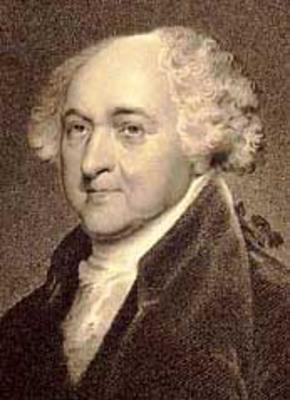
.. the often underappreciated (although never by the O'Malley family) John Adams.
Poor man. Anyone who came after George Washington would suffer by comparison. Gandhi could come after Washington and the collective historical record would respond with a "Eh." John Adams spent the rest of his life trying to reclaim some legacy for himself - but the Alien & Sedition Act kind of cast a shadow over everything (that lasts to this day - I have heard people bring it up NOW as a way to discount all the amazing things he did. HA.)
I love John Adams BECAUSE of his flaws. I love him for his brilliance, and his dedication - I love him for his relationship wtih Abigail - and I love the two of them for being so FREE in their correspondence with one another so that we, centuries later, can read their letters and get to know them both. I love him for defending the British soldiers in the aftermath of the Boston massacre in 1770. It gives me a chill - his ability to detach, his ability to see the larger picture. In later years, Adam said that that controversial act of his was one of the things he was most proud of. That, to me, says so much about who this man was. John Adams said that this new nation should be a government "of laws, not of men". Of course, he was a lawyer, so he WOULD say that ... but by defending the redcoats - and by WINNING - he took a stand on the side of law and order against the mob. Even though he agreed with the sentiments of the mob. Extraordinary. It was the same thing as Alexander Hamilton (Adams' sworn enemy later on) lambasting the mobbing people on the college lawns in New York, clamoring for the head of the President - known to be pro-British. Hamilton was a revolutionary by this point - and totally not pro-British - but mob violence was not the way to go, and he stood on the steps of the college and shouted at the mob to disperse. Amazing.
I love him for his fragile ego. I love him for his capacity to get his feelings hurt. Until the end of his life - he maintained that capacity. How many people get burnt by certain events along the way ... and close themselves off to future hurts? He never did. He remained juicy, alive ... read his letters back and forth to Jefferson at the very end. He is boisterous, fearless ... and then, at times, reflective, contemplative.
I love his nervousness about his own legacy and how he kind of had a sense that he would not get the props he felt he deserved (uhm ... quoting Eminem in a John Adams post, Sheila?)
I love him for his reliance on Abigail.
I love those damn LETTERS.
I love that the Constitution of Massachusetts - written by him (completed in 1779) is the oldest functioning written constitution in the world. Go, John.
Anyway. My affection for him knows no bounds. I suppose part of it has to do with the fact that he was a Bostonian - and that I have family who live in Quincy - so every time we would go to Thanksgiving dinner at their house, we would pass by the Adams homestead. He's not a historical figure. He's almost like a family member - that everyone passes on stories about. It seems like he is actually remembered. Growing up with a Boston family makes you feel like the Adams family is still alive, present, pulsing in the air around you, absorbed into the cobblestones where they walked ...
They are not dead. Not really. They are in the air we breathe, they are all around us still.
Happy birthday, John Adams. Thank you, thank you.
Here's a quote-fest from Adams ... The dude was so quotable. If you haven't read his letters (to his wife, and also the collection of letters between Adams and Jefferson) - I can't recommend them highly enough.
JOHN ADAMS QUOTE FEST ... Okay, I just threw these in hastily - these are my favorites - sorry about how the formatting is different - with some blockquotes, some not - whatever - I don't have time to iron that all out. It's the quotes that matter.
Enjoy!!!
-- "In my many years I have come to a conclusion that one useless man is a shame, two is a law firm, and three or more is a congress." (hahahahaha)
-- "If the way to do good to my country were to render myself popular, I could easily do it. But extravagant popularity is not the road to public advantage." -- John Adams, after becoming President by only three votes
-- "I never shall shine, 'til some animating occasion calls forth all my powers." -- John Adams, 1760
-- "The story of B. Bicknal's wife is a very clever one. She said, when she was married she was very anxious, she feared, she trembled, she could not go to bed. But she recollected she had put her hand to the plow and could not look back, so she mustered up her spirits, committed her soul to God and her body to B. Bicknal and into bed she leaped -- and in the morning she was amazed, she could not think for her life what it was that had so scared her." -- Journal entry of John Adams
-- Adams' description of the first meeting of the Continental Congress, in 1774 - in a letter to Abigail:
"This assembly is like no other that ever existed. Every man in it is a great man -- an orator, a critic, a statesman, and therefore every man upon every question must show his oratory, his criticism, his political abilities. The consequence of this is that business is drawn and spun out to immeasurable length. I believe if it was moved and seconded that we should come to a resolution that three and two make five, we should be entertained with logic and rhetoric, law, history, politics, and mathematics concerning the subject for two whole days, and then we should pass the resolution unanimously in the affirmative."
hahahahaha
-- "If we finally fail in this great and glorious contest, it will be by bewildering ourselves in groping for the middle way." -- John Adams
-- "It has been the will of Heaven that we should be thrown into existence at a period when the greatest philosophers and lawgivers of antiquity would have wished to live ... a period when a coincidence of circumstances without example has afforded to thirteen colonies at once an opportunity of beginning government anew from the foundation and building as they choose. How few of the human race have ever had an opportunity of choosing a system of government for themselves and their children? How few have ever had anything more of choice in government than in climate?" -- John Adams
-- "Is there no way for two friendly souls to converse together, although the bodies are 400 miles off. Yes, by letter. But I want a better communication. I want to hear you think, or to see your thoughts. The conclusion of your letter makes my heart throb more than a cannonade would. You bid me burn your letters. But I must forget you first." -- John Adams to Abigail - amazing. Romantic. Moving. "But I must forget you first."
-- "Thanks to God that he gave me stubbornness when I know I am right." -- John Adams
-- "In general, our generals were outgeneralled." -- John Adams' comment after the disastrous battle on Long Island
-- "He means well for his country, is always an honest man, often a wise man, but sometimes and in some things, absolutely out of his senses." -- Ben Franklin, 1783, about John Adams (in a letter to Robert Livingston)
-- "I must study politics and war that my sons may have liberty to study mathematics and philosophy. My sons ought to study mathematics and philosophy, geography, natural history, naval architecture, navigation, commerce, and agriculture in order to give their children a right to study paintings, poetry, music, artchitecture, statuary, tapestry, and porcelain." -- John Adams
-- "You are afraid of the one, I, the few. We agree perfectly that the many should have full, fair, and perfect representation [in the House]. You are apprehensive of monarchy; I, of aristocracy. I would therefore have given more power to the President and less to the Senate." -- John Adams to Thomas Jefferson
-- "Gentlemen, I feel a great difficulty how to act. I am Vice President. In this I am nothing, but I may be everything." -- John Adams
-- John Adams to Jonathan Sewall, July 1774:
"Swim or sink, live or die, survive or perish, [I am] with my country. You may depend upon it."
-- Thomas Jefferson, remembering John Adams' speeches at the Continental Congress:
"John Adams was our Colossus on the floor. He was not graceful nor elegant, nor remarkably fluent but he came out occasionally with a power of thought and expression, that moved us from our seats."-- John Adams, in a letter to Jefferson, 1812:
"Whether you or I were right posterity must judge. I never have approved and never can approve the repeal of taxes, the repeal of the judiciary system, or the neglect of the navy. Checks and balances, Jefferson, however you and your party may have ridiculed them, are our only security."
-- John Adams, in a July 3, 1776 letter to Abigail, after the signing of the Declaration of Independence on July 2:
The Delay of this Declaration to this Time, has many great Advantages attending it. ? The Hopes of Reconciliation, which were fondly entertained by Multitudes of honest and well meaning tho weak and mistaken People, have been gradually and at last totally extinguished. ? Time has been given for the whole People, maturely to consider the great Question of Independence and to ripen their Judgments, dissipate their Fears, and allure their Hopes, by discussing it in News Papers and Pamphletts, by debating it, in Assemblies, Conventions, Committees of Safety and Inspection, in town and County Meetings, as well as in private Conversations, so that the whole People in every Colony of the 13, have now adopted it, as their own Act. ? This will cement the Union, and avoid those Heats, and perhaps Convulsions which might have been occasioned, by such a Declaration Six Months ago.But the Day is past. The Second Day of July 1776, will be the most memorable Epocha, in the History of America. ? I am apt to believe that it will be celebrated, by succeeding Generations, as the great anniversary Festival. It ought to be commemorated, as the Day of Deliverance by solemn Acts of Devotion to God Almighty. It ought to be solemnized with Pomp and Parade, with Shews, Games, Sports, Guns, Bells, Bonfire and Illuminations from one End of this Continent to the other from this Time forward forever more.
You will think me transported with Enthusiasm, but I am not. I am well aware of the Toil, and Blood, and Treasure that it will cost Us to maintain this Declaration, and support and defend these States. Yet, through all the Gloom, I can see the Rays of ravishing Light and Glory. I can see that the End is more than worth all the Means, and that Posterity will triumph in that Day's Transaction, even though We should not rue it, which I trust in God We shall not.
-- John Adams, in a 1793 letter, responding to the revolution in France:
"Mankind will in time discover that unbridled majorities are as tyrannical and cruel as unlimited despots."
-- "I think instead of opposing systematically any administration, running down their characters and opposing all their measures, right or wrong, we ought to support every administration as far as we can in justice." -- John Adams
-- John to Abigail: Hartford May 2d 1775 - on his way down to Philadelphia. Adams is hoping that the disaster growing in Boston will bind the colonies together. That's eventually what happened, but at the time, he wasn't sure if it were a done deal.
"It is Arrogance and Presumption in human Sagacity to pretend to penetrate far into the Designs of Heaven. The most perfect Reverence and Resignation becomes us. But, I can't help depending upon this, that the present dreadfull Calamity of that beloved Town is intended to bind the Colonies together in more indissoluble Bands, and to animate their Exertions, at this great Crisis in the Affairs of Mankind. It has this Effect, in a most remarkable Degree, as far as I have yet seen or heard. It will plead, with all America, with more irresistible Perswasion, than Angells trumpet tongued.In a Cause which interests the whole Globe, at a Time, when my Friends and Country are in such keen Distress, I am scarecely ever interrupted, in the least Degree, by Apprehensions for my Personal Safety. I am often concerned for you and our dear Babes...
In case of real Danger, of which you cannot fail to have previous Intimations, fly to the Woods with our Children."
-- JOHN ADAMS, journal entry, 1770:
"Ambition is one of the more ungovernable passions of the human heart. The love of power is insatiable and uncontrollable.There is danger from all men. The only maxim of a free government ought to be to trust no man living with power to endanger the public liberty."
And lastly - one of my favorite Adams anecdotes. I love it because it came straight from his journal - so it's a first-person account - and it feels like I actually can hear Adams speaking, I can feel his humor, his emotions ... in a way that I never get with Jefferson or Washington - also great men, but just not personable writers. They had much more formality in their language. Adams had almost none, at least not in his journals and letters:
John Adams is sent as a delegate to France, to join Ben Franklin and Silas Deane (the stories of Silas Deane in France are hysterical - trying to be "undercover" - and yet barely speaking a word of French, etc.) Ben Franklin is living the high life (John Adams describes in his journal Franklin's leisurely schedule with haughty scorn). John Adams was more stern, more simple, more "republican", as he called it. He was talking as an anti-monarch.
Adams was overwhelmed by the politeness of the French, and by how eager they were to please the Americans. John Adams keeps all of his impressions of France, and the French people, in his journal, and in letters home to Abigail.
On his second or third night in France, he is at a dinner - and has the following exchange with a French woman, who asks him a particularly "brazen question". John Adams blushed his way through the conversation, not being used to women with open and free airs, but his ANSWER to her question - how he ANSWERS the French woman's question ... It kills me.
It's a perfect description of sexual chemistry.
John Adams' Journal, 1778 April 1 Wednesday
One of the most elegant Ladies at Table, young and handsome, tho married to a Gentleman in the Company, was pleased to Address her discourse to me. Mr. Bondfield must interpret the Speech which he did in these Words "Mr. Adams, by your Name I conclude you are descended from the first Man and Woman, and probably in your family may be preserved the tradition which may resolve a difficulty which I could never explain. I never could understand how the first Couple found out the Art of lying together?"
Whether her phrase was L'Art de se coucher ensemble, or any other more energetic, I know not, but Mr. Bondfield rendered it by that I have mentioned.
To me, whose Acquaintance with Women had been confined to America, where the manners of the Ladies were universally characterised at that time by Modesty, Delicacy and Dignity, this question was surprizing and shocking: but although I believe at first I blushed, I was determined not to be disconcerted. I thought it would be as well for once to set a brazen face against a brazen face and answer a fool according to her folly, and accordingly composing my countenance into an Ironical Gravity I answered her.
"Madame My Family resembles the First Couple both in the name and in their frailties so much that I have no doubt We are descended from that in Paradise. But the Subject was perfectly understood by Us, whether by tradition I could not tell: I rather thought it was by Instinct, for there was a Physical Quality in Us resembling the Power of Electricity or of the Magnet, by which when a Pair approached within a striking distance they flew together like the Needle to the Pole or like two Objects in Electrical Experiments."
When this Answer was explained to her, she replied, "Well I know not how it was, but this I know it is a very happy Shock."
I should have added "in a lawfull Way" after "a striking distance," but if I had her Ladyship and all the Company would only have thought it Pedantry and Bigottry.
Happy birthday, Mr. Adams, dear Mr. Adams. You are obnoxious and unpopular, it can't be denied ...
Or, another quote from 1776, a favorite musical (whoda guessed):
"SIT DOWN, JOHN
SIT DOWN, JOHN
FOR GOD'S SAKE JOHN, SIT DOWN!"
And for fun - here's the song lyrics to "But Mr. Adams" - where it is hashed out who will write the Declaration. Naturally, it is quite a self-serving story Adams told (he's the one who suggested Jefferson) - but still: SO funny. I love this song. I'm listening to it right now.
Franklin:
Mr. Adams, I say you should write it
To your legal mind and brilliance we defer
Adams:
Is that so? Well, if I'm the one to do it
They'll run their quill pens through it
I'm obnoxious and disliked, you know that, sir
Franklin:
Yes, I know
Adams:
So I say you should write it Franklin, yes you
Franklin:
Hell, no!
Adams:
Yes, you, Dr. Franklin, you
but, you, but, you, but
Franklin:
Mr. Adams, but, Mr. Adams
The things I write are only light extemporania
I won't put politics on paper; it's a mania
So I refuse to use the pen in Pennsylvania
Others:
Pennsylvania, Pennsylvania, refuse to use the pen
Adams:
Mr. Sherman, I say you should write it
You are never controversial as it were
Sherman:
That is true
Adams:
Whereas if I'm the one to do it
They'll run their quill pens through it
I'm obnoxious and disliked, you know that, sir
Sherman:
Yes, I do
Adams:
So I say you should write it, Sherman, yes you
Sherman:
Good heavens, no!
Adams:
Yes you, Roger Sherman, you
but, you, but, you, but
Sherman:
Mr. Adams, but, Mr. Adams
I cannot write with any style or proper etiquette
I don't know a participle from a predicate
I am just a simple cobbler from Connecticut
Others:
Connecticut, Connecticut, a simple cobbler he
Adams:
Mr. Livingston, maybe you should write it
You have many friends and you're a diplomat
Franklin:
Oh, that word!
Adams:
Whereas if I'm the one to do it
They'll run their quill pens through it
Others:
He's obnoxious and disliked; did you know that?
Livingston:
I hadn't heard
Adams:
So I say you should write it, Robert, yes you
Livingston:
Not me, Johnny!
Adams:
Yes you, Robert Livingston, you
but you but you but
Livingston:
Mr. Adams, dear Mr. Adams
I've been presented with a new son by the noble stork
So I am going home to celebrate and pop the cork
With all the Livingstons together back in old New York
Others:
New York, New York, Livingston's going to pop a cork
Jefferson:
Mr. Adams, leave me alone!
Adams:
Mr. Jefferson, dear Mr. Jefferson
I'm only 41; I still have my virility
And I can romp through Cupid's Grove with great agility
But life is more than sexual combustibility
Others:
Combustibility, combustibility, combustibili...
Jefferson:
Mr. Adams, damn you Mr. Adams
You're obnoxious and disliked; that cannot be denied
Once again you stand between me and my lovely bride
Oh, Mr. Adams, you are driving me to homicide!
Others:
Homicide, homicide, we may see murder yet!
BRILLIANT!
October 26, 2007
Today in History: October 26, 1776
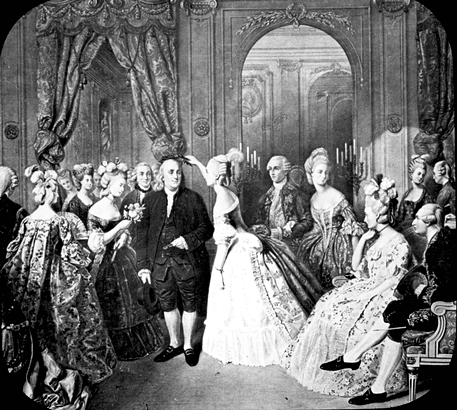
On October 26, 1776, Benjamin Franklin set off on a diplomatic mission across the Atlantic - to get the French governments financial backing for the Revolution. As is well-known, he was a huge HIT with the French (that's him in the royal court above) ... and he wore little fur caps which became all the rage - and there was a certain breath of freedom and independence in his attitude which really appealed to the French. This was not an easy mission for Franklin. France was still a monarchy. I mean, it only had a couple years to go before heads began to roll (ahem), but it was, in 1776, still a monarchy - and so wasn't too wacky about supporting this "experiment" in democracy across the water. However, wouldn't it be fun to stick it to the Brits??? Benjamin Franklin's success in France is now widely recognized as one of the main reasons that we were able to win the war at all. Not only did he win support for his cause - but he also won over the hearts and minds of the French people. He loved it - he loved the wining, the dining, the free and easy ways of the rich French ladies - he was a social animal. He became the darling of the artistocratic set.
A wonderful example of how he operated is here, in this perhaps apocryphal story (I love how many anecdotes about Franklin are 'perhaps apocryphal'):
During his sojourn in France - Franklin, always the ladies man, was playing chess with the Duchess of Bourbon, and she didn't really know what she was doing, or how to play. She placed her king in check. Franklin, not following the rules either (but he KNEW he wasn't following the rules) captured her king. She knew enough of chess to know that this was not right and scolded him. She said, "In France we do not take kings."
Franklin replied, "We do in America."
Ba dum CHING.
But today was the day that his ship sailed.
Here's an excerpt from The First American - something which, I think, gives great perspective on the enormity of what Franklin was attempting - just on a personal level:
For a man of seventy, suffering from gout and assorted lesser afflictions, to leave his home in the middle of a war, to cross a wintry sea patrolled by enemy warships where commanders could be counted on to know him even if they knew nary another American face, was no small undertaking. John Adams declined nomination in Franklin's commission; Thomas Jefferson rebuffed election. Yet Franklin had made his decision that America must be free, and he was determined to pay whatever cost his country required. "I have only a few years to live," he told Benjamin Rush, "and I am resolved to devote them to the work that my fellow citizens deem proper for me; or speaking as old-clothes dealers do of a remnant of goods, 'You shall have me for what you please.'"
And about the voyage itself:
The passage from America to France was "short but rough," in Franklin's contemporary account. His ship, the Reprisal, had been hastily pressed into the service of the fledgling United States navy, and though it was fast enough to capture two British merchantmen en route, it was hardly suited to the comfort of passengers. It pitched violently for nearly the whole of the thirty-day run, allowing Franklin hardly a night's - or day's - decent rest. The food was poor; he had to rely on salt beef because the chickens served were too tough for his teeth. His boils and rashes returned. In short, he told his daughter and son-in-law later, the voyage "almost demolished me".
Almost. But not quite. Thank God!
October 19, 2007
Today in history: October 19, 1781
The surrender at Yorktown, which ended the American Revolutionary War ...
Day before:
General Lord Charles Cornwallis to General George Washington, October 18, 1781
I agree to open a treaty of capitulation upon the basis of the garrisons of York and Gloucester, including seamen, being prisoners of war, without annexing the condition of their being sent to Europe; but I expect to receive a compensation in the articles of capitulation for the surrender of Gloucester in its present state of defence.I shall, in particular, desire, that the Bonetta sloop of war may be left entirely at my disposal, from the hour that the capitulation is signed, to receive an aid-de-camp to carry my dispatches to Sir Henry Clinton. Such soldiers as I may think proper to send as passengers in her, to be manned with fifty men of her own crew, and to be permitted to sail without examination, when my dispatches are ready: engaging, on my part, that the ship shall be brought back and delivered to you, if she escapes the dangers of the sea, that the crew and soldiers shall be accounted for in future exchanges, that she shall carry off no officer without your consent, nor public property of any kind; and I shall likewise desire, that the traders and inhabitants may preserve their property, and that no person may be punished or molested for having joined the British troops.
If you choose to proceed to negociation on these grounds, I shall appoint two field officers of my army to meet two officers from you, at any time and place that you think proper, to digest the articles of capitulation.
(Check out the full correspondence in the days leading up to the 19th)
Cornwallis had realized that aid would not come in time - and after two days of bombardment - he sent a drummer out into view, who apparently beat the rhythm of: "STOP! LET'S TALK!!!" A British officer high in rank came forward - was blindfolded and taken to George Washington (who was pretty much on his last legs himself).
The surrender document had already been drawn up, with Washington dictating the terms. Oh - here are the Articles of Capitulation.
Over 7,000 soldiers surrendered at Yorktown. The war was over.
Oh - and the story is that as the defeated army marched away, the song "The World Turned Upside Down" was played. I did a quick Google search and there are lots of defensive people out there who feel the need to shout out into the wilds of the Internet, "There is NO evidence that 'The World Turned Upside Down' was played at that moment ..." Ha. I love freaks who take sides in meaningless historical debates like this. I adore them. We are all geeks cut from the same cloth. But still. It's a good story, I think. Here are the lyrics to that song, which was popular at the time. (Eyewitness account here: "The Americans, though not all in uniform, nor their dress so neat, yet exhibited an erect, soldierly air, and every countenance beamed with satisfaction and joy. The concourse of spectators from the country was prodigious, in point of numbers was probably equal to the military, but universal silence and order prevailed.")
Check out this military map from 1781. (I put it below the fold so that I could make it as big as I wanted.) On it you can see the positions of the British Army commanded by Cornwallis - you can see the American and French forces commanded by Washington - and tada - check out the French fleet comin' down the pike - under Count de Grasse!! The last-minute cavalry charge!
And here is a story - (perhaps it's a rumor - but I love it nonetheless) of Benjamin Franklin's response to the news of the surrender. He was, of course, in Paris at the time, setting the world on fire with his homespun wisdom, bacchanalian propensities, chess-playing abilities - and the vision he presented to the world of what liberty, American-style, looked like. An international celebrity.
Word came to France of the decisive American victory, and the complete surrender to George Washington in Yorktown. Franklin attended a diplomatic dinner shortly thereafter - and, of course, everyone was discussing the British defeat.
The French foreign minister stood, and toasted Louis XVI: "To his Majesty, Louis the Sixteenth, who, like the moon, fills the earth with a soft, benevolent glow."
The British ambassador rose and said, "To George the Third, who, like the sun at noonday, spreads his light and illumines the world."
Franklin rose and countered, "I cannot give you the sun or the moon, but I give you George Washington, General of the armies of the United States, who, like Joshua of old, commanded both the sun and the moon to stand still, and both obeyed."
Map found here in this awesome collection - I could get lost in there forever.
September 30, 2007
Brokeback 1776
hahahahahaha - hysterical parody of Brokeback Mountain using footage from the movie 1776 - I love when it gets all slo-mo and romantic. I practically know 1776 by heart ("But I burn, Mr. A!!" "So do I!") - so the clips they pick, out of context, work perfectly. Funny!!!
Found the video here, naturally - and he relates one of my favorite stories from the early days of the American Revolution - of John Adams and Benjamin Franklin sleeping in the same bed, and arguing about whether or not night air is good or bad for you. It's just such a funny image to me - these two Founding Fathers bickering through the darkness. (It's not as funny as Ben Franklin suggesting they fight the war using bows and arrows ... and the other dudes all being like, "Uhm, Ben? We have cannonballs and stuff now? Sooooo ... thanks for sharing ... but no." - but ALMOST as funny.)
September 26, 2007
"On the eighteenth of April, in Seventy-Five Hardly a man is now alive Who remembers that famous day and year"
Are there more magical words in the world of literature than: "an earlier draft has been discovered"??
As in:
In Longfellow’s papers, Charlie found what appears to be the first complete draft of “Paul Revere’s Ride.�
?????

My love of Longfellow's famous poem is all over my dern blog. I post the poem every 18th of April (uhm - almost every April. Right, Ken?) I can recite huge chunks of it. I have grown up with it. And now - God bless America - my nephew is growing up with it too. I read an edited version of this piece about Cashel on the radio a couple years ago. (Let's just load up this post with links, shall we?)
Anyway, let's get back to the exciting matter at hand:
In Longfellow’s papers, Charlie found what appears to be the first complete draft of “Paul Revere’s Ride.�
Yo!!! More information here - on what was going on in that first draft, and speculations on why Longfellow left it out. (Lots of great links to follow over there as well. Terrific site.) How I wish I had been to that lecture! Fascinating thoughts.
And just because it pleases me, here is the entirety of Longfellow's poem.
Best read it out loud. You can hear the clattering of horse hooves on cobblestones in the rhythm. Goosebumps!
Paul Revere's Ride
by Henry Wadsworth Longfellow
Listen my children and you shall hear
Of the midnight ride of Paul Revere,
On the eighteenth of April, in Seventy-five;
Hardly a man is now alive
Who remembers that famous day and year.
He said to his friend, "If the British march
By land or sea from the town to-night,
Hang a lantern aloft in the belfry arch
Of the North Church tower as a signal light,--
One if by land, and two if by sea;
And I on the opposite shore will be,
Ready to ride and spread the alarm
Through every Middlesex village and farm,
For the country folk to be up and to arm."
Then he said "Good-night!" and with muffled oar
Silently rowed to the Charlestown shore,
Just as the moon rose over the bay,
Where swinging wide at her moorings lay
The Somerset, British man-of-war;
A phantom ship, with each mast and spar
Across the moon like a prison bar,
And a huge black hulk, that was magnified
By its own reflection in the tide.
Meanwhile, his friend through alley and street
Wanders and watches, with eager ears,
Till in the silence around him he hears
The muster of men at the barrack door,
The sound of arms, and the tramp of feet,
And the measured tread of the grenadiers,
Marching down to their boats on the shore.
Then he climbed the tower of the Old North Church,
By the wooden stairs, with stealthy tread,
To the belfry chamber overhead,
And startled the pigeons from their perch
On the sombre rafters, that round him made
Masses and moving shapes of shade,--
By the trembling ladder, steep and tall,
To the highest window in the wall,
Where he paused to listen and look down
A moment on the roofs of the town
And the moonlight flowing over all.
Beneath, in the churchyard, lay the dead,
In their night encampment on the hill,
Wrapped in silence so deep and still
That he could hear, like a sentinel's tread,
The watchful night-wind, as it went
Creeping along from tent to tent,
And seeming to whisper, "All is well!"
A moment only he feels the spell
Of the place and the hour, and the secret dread
Of the lonely belfry and the dead;
For suddenly all his thoughts are bent
On a shadowy something far away,
Where the river widens to meet the bay,--
A line of black that bends and floats
On the rising tide like a bridge of boats.
Meanwhile, impatient to mount and ride,
Booted and spurred, with a heavy stride
On the opposite shore walked Paul Revere.
Now he patted his horse's side,
Now he gazed at the landscape far and near,
Then, impetuous, stamped the earth,
And turned and tightened his saddle girth;
But mostly he watched with eager search
The belfry tower of the Old North Church,
As it rose above the graves on the hill,
Lonely and spectral and sombre and still.
And lo! as he looks, on the belfry's height
A glimmer, and then a gleam of light!
He springs to the saddle, the bridle he turns,
But lingers and gazes, till full on his sight
A second lamp in the belfry burns.
A hurry of hoofs in a village street,
A shape in the moonlight, a bulk in the dark,
And beneath, from the pebbles, in passing, a spark
Struck out by a steed flying fearless and fleet;
That was all! And yet, through the gloom and the light,
The fate of a nation was riding that night;
And the spark struck out by that steed, in his flight,
Kindled the land into flame with its heat.
He has left the village and mounted the steep,
And beneath him, tranquil and broad and deep,
Is the Mystic, meeting the ocean tides;
And under the alders that skirt its edge,
Now soft on the sand, now loud on the ledge,
Is heard the tramp of his steed as he rides.
It was twelve by the village clock
When he crossed the bridge into Medford town.
He heard the crowing of the cock,
And the barking of the farmer's dog,
And felt the damp of the river fog,
That rises after the sun goes down.
It was one by the village clock,
When he galloped into Lexington.
He saw the gilded weathercock
Swim in the moonlight as he passed,
And the meeting-house windows, black and bare,
Gaze at him with a spectral glare,
As if they already stood aghast
At the bloody work they would look upon.
It was two by the village clock,
When he came to the bridge in Concord town.
He heard the bleating of the flock,
And the twitter of birds among the trees,
And felt the breath of the morning breeze
Blowing over the meadow brown.
And one was safe and asleep in his bed
Who at the bridge would be first to fall,
Who that day would be lying dead,
Pierced by a British musket ball.
You know the rest. In the books you have read
How the British Regulars fired and fled,---
How the farmers gave them ball for ball,
>From behind each fence and farmyard wall,
Chasing the redcoats down the lane,
Then crossing the fields to emerge again
Under the trees at the turn of the road,
And only pausing to fire and load.
So through the night rode Paul Revere;
And so through the night went his cry of alarm
To every Middlesex village and farm,---
A cry of defiance, and not of fear,
A voice in the darkness, a knock at the door,
And a word that shall echo for evermore!
For, borne on the night-wind of the Past,
Through all our history, to the last,
In the hour of darkness and peril and need,
The people will waken and listen to hear
The hurrying hoof-beats of that steed,
And the midnight message of Paul Revere.
September 17, 2007
John Quincy Adams
An event I would LOVE to attend. His travels through Russia as, basically, a teenager, at first - and then later as a young man - have always fascinated me. Also: it's awesome because he kept a journal, and wrote copious letters ... so we have his first impressions. Russia in the late18th century. Quite an extraordinary experience for a young man.
More on John Quincy Adams in Russia here
July 11, 2007
On July 10, 1804
Alexander Hamilton wrote the following letter to this wife:
My beloved ElizaMrs. Mitchel is the person in the world to whom as a friend I am under the greatest Obligations. I have not hitherto done my duty to her. But resolved to repair my omission as much as possible, I have encouraged her to come to this Country and intend, if it shall be in my power to render the Evening of her days comfortable. But if it shall please God to put this out of my power and to inable you hereafter to be of service to her, I entreat you to do it and to treat her with the tenderness of a Sister.
This is my second letter.
The Scruples of a Christian have determined me to expose my own life to any extent rather than subject my self to the guilt of taking the life of another. This must increase my hazards & redoubles my pangs for you. But you had rather I should die innocent than live guilty. Heaven can preserve me and I humbly hope will but in the contrary event I charge you to remember that you are a Christian. God's Will be done. The will of a merciful God must be good.
Once more Adieu My Darling darling Wife
AH
Tuesday Evening 10 oClock
Early the next morning, July 11, 1804, my soon-to-be-dead boyfriend rowed across the Hudson with his second and a doctor. He rowed to the cliffs in Weehawken, a well-used dueling ground, to meet Aaron Burr. The shots were fired - and it is apparent, from comments he made later, that Hamilton knew he would die from them. He said to the doctor later, "This is a mortal wound, Doctor."
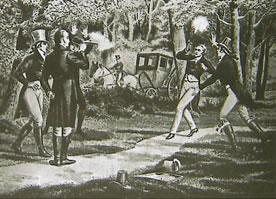
Excerpt from Willard Sterne Randall's Alexander Hamilton:
Alexander Hamilton lasted thirty-one hours after Aaron Burr shot him. When they finally got him into a bed on the second floor of Bayard's house on Chambers Street, he was nearly comatose. The doctor undressed him and administered a large dose of a strong anodyne, a painkiller. During the first day, Hosack gave Hamilton more than an ounce of opoium and cider potion, called laudanum, washing it down with watered wine. But, Hosack noted, "his sufferings during the whole day were almost intolerable." The ball had lodged inside his second lumbar disk, which had shattered, paralyzing his legs. His stomach was slowly filling with blood from severed blood vessels in his liver. Hosack "had not the shadow of a hope of his recovery," but he called in surgeons from French men-of-war anchored in the harbor who "had much experience in gunshot wounds." They agreed that Hamilton's condition was hopeless.During the night of July 11, the sedated Hamilton "had some imperfect sleep". He knew he had little time left to live: he asked Bayard to summon the Reverend Benjamin Moore, Episcopal bishop of New York and president of Columbia College, where Hamilton had once been a scholarship boy. In recent months, Hamilton had prayed Episcopal Matins and Vespers with his family at home. He had not attended any church since the Revolution. When the bishop arrived, he refused Hamilton Holy Communion after he learened that Hamilton not only had never been baptized an Episcopalian, but had been wounded in a duel, something Moore considered a mortal sin. Instead, the bishop gave Hamilton a lecture on the meaning of communion and left him to take some "time for serious reflection". Hamilton, clearheaded and determined now, asked the Bayards to send for the Reverend John M. Mason, pastor of the Presbyterian church and son of th eman who had once sponsored him for a place at a Presbyterian academy when he had arrived in New York, an orphan from the West Indies. Hamilton as a boy had undergone a strong Presbyterian conversion experience - although, as a bastard, he had not been allowed to receive Presbyterian communion. But this Reverend Mason informed Hamilton that he could only receive communion in church, at the altar, during a regular Sunday ceremony. Hamilton pleaded for Bayard to go once more to Bishop Moore and try to persuade him.
It was noontime on the twelfth, more than twenty-four hours after the duel, before Elizabeth Hamilton arrived with their seven children. No one had told her the truth. Hamilton, she believed, was suffering only from stomach cramps: he'd had digestive disorders recently. Now she learned everything. She became frantic. Hamilton had been semiconscious, his eyes closed. He opened them, saw his children. His own grief at seeing his daughter Angelica, half mad since her brother's death in a duel over his father's politics, swept over him. He closed his eyes again, only saying to his wife, "Remember, Eliza, you are a Christian." It was as if he had banished her. She left with the children, sobbing hysterically.
When Bishop Moore called again, he lectured Hamilton once more on his own "delicate" situation. He wanted to help "a fellow mortal in distress," but he must "unequivocally condemn" dueling. Hamilton agreed with him "with sorrow and contrition", Moore reported. If Hamilton survived, would he vow never to duel again and use his influence to oppose the "barbaric custom"? It was a promise Hamilton found easy to make. Would he live "in love and charity with all men"? He answered yes, he bore "no ill will" to Aaron Burr. "I forgive all that happened." He received communion "with great devotion," Moore recorded, and "his heart afterwards appeared to be perfectly at rest."
But Hamilton was now writhing in agony. He could not hear the commotion downstairs when a note arrived from Aaron Burr, asking about his condition, and worrying about a rumor that Hamilton had never intended to fire at him. When Bishop More returned the morning of the twelfth, he stayed at Hamilton's bedside - across the bed from another grief-stricken visitor, Hamilton's sister-in-law, Angelica Schuyler Church. She did not speak, nor did Hamilton. Over the years, they had been lovers. For nearly thirty years, Angelica Church had loved Hamilton more than her own dour, money-grubbing husband. Church, an expert duelist, had fled England after believing he had killed a man, changed his identity, grown rich selling supplies during the Revolution, and then returned to take a seat in Parliament. He often had left Angelica alone in their Manhattan mansion near Hamilton's town house while Elizabeth Schuyler stayed in the country with the children. John Church's pistols had finally ended the affair. Hamilton and Angelica could say nothing now. There was nothing more to say.
On July 12, 1804, shortly after noon, with his mistress and his bishop at his bedside, Alexander Hamilton died "without a groan". He was forty-nine.
The old dueling grounds are near my house - and I took some pictures of the monument that is now there. It was erected on July 11, 2004 - the 200th anniversary of the Hamilton-Burr duel.
Here are the pictures.
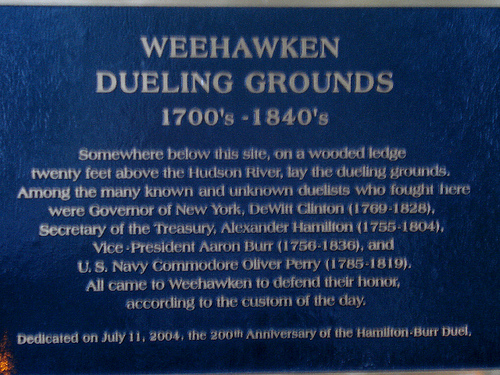
Some of my Hamilton posts below
Excerpt from Chernow's towering biography of the man
Letter to Lafayette 1789: "I dread the vehement character of your people"
1780: "A national debt ... will be to us a national blessing."
July 4, 2007
The 4th of July, 1826
It was the 50th anniversary of July 4, 1776. Both John Adams and Thomas Jefferson had been invited to attend huge celebrations in honor of the anniversary, but due to illness - both had sent their regrets and also best wishes, saying they would not be able to come. Thomas Jefferson's letter to the mayor of Washington, declining the invitation, ended as follows:
May it be to the world, what I believe it will be (to some parts sooner, to others later, but finally to all) the signal of arousing men to burst the chains under which monkish ignorance and superstition and persuaded them to bind themselves, and to assume the blessings and security of self-government ... All eyes are opened or opening to the rights of man. The general spread of the light of science has already laid open to every view the palpable truth, that the mass of mankind has not been born with saddles on their backs, nor a favored few, booted and spurred, ready to ride them legitimately by the grace of God. These are the grounds of hope for others; for ourselves, let the annual return of this day forever refresh our recollections of these rights, and an undiminished devotion to them.
Adams was too ill to put pen to paper. The light was going out. For both of them.
These two men, two of the main architects of the American Revolution, long estranged due to political differences, (and Jefferson referring, in public, to "political heresies" among some of his colleagues - a clear dig at Adams - and a clear sign of Jefferson's belief in some political orthodoxy, which was the breaking point for Adams) had finally reconciled. The reconciliation had been engineered by Benjamin Rush, who thought it a shame that these two great patriots, once dear friends, would go to their graves without making up. Benjamin Rush had a dream that Adams and Jefferson became friends again (I wonder if he really had that dream? Or if it was just a fabrication in order to move things along). Rush wrote to Adams, "And now, my dear friend, permit me again to suggest to you to receive the olive branch which has thus been offered to you by the hand of a man who still loves you. Fellow laborers in erecting the great fabric of American independence! ... embrace - embrace each other!" Adams and Jefferson began to correspond ... and it lasted over a period of 12-years ... a correspondence that has to be read to be believed. Rush's dream was prophetic. What an amazing gift to posterity those letters are.
And then ... on the same day in 1826 ... which happened to be July 4 ... which happened to be the 50th anniversary of the Declaration of Independence ... John Adams and Thomas Jefferson both died. Within hours of each other.
David McCullough writes in his biography of John Adams:
That John Adams and Thomas Jefferson had died on the same day, and that it was, of all days, the Fourth of July, could not be seen as a mere coincidence: it was a "visible and palpable" manifestation of "Divine favor," wrote John Quincy Adams in his diary that night, expression what was felt and would be said again and again everywhere the news spread.
John Adams' last words were either "Jefferson ... still lives." or "Jefferson ... survives."
I will never get tired of thinking about that, wondering, contemplating, shaking my head. I think I know what it means, and WHY Adams said it, and then I realize - No, I have no idea - and I prefer it that way. I prefer the mystery of it, the question, the subtlety - I prefer to just think about it, and wonder about it .
Amazingly, though, Jefferson actually had died a couple of hours earlier. Which makes this an even more amazing story. Like ... twins who live on opposite sides of the planet, and one twin knows when the other twin scrapes his knee. There are things that cannot be sufficiently explained. There are more things in heaven and earth, Horatio, than are dreamt of in your philosophy.
Among Thomas Jefferson's last words were: "It is the Fourth of July." A sudden and clear declaration, in the middle of his fadeout. He actually said those words on the 3rd ... and he was assured, by those attending him, that it would be the Fourth soon.
Did he wait? When he found out it was still just the Third, did he wait? To die on the Fourth? I wouldn't put it past him, he always loved symmetry.
Yes, Mr. Jefferson. It is the fourth. And thank you. Thank you both.
Happy 4th of July, everybody!
May 30, 2007
Commonplace
I have a higher and greater standard of principle [than George Washington]. Washington could not lie. I can lie but I won't.
-- Mark Twain, 1871
January 23, 2007
Gouverneur Morris: "We the people ..."
I love the many anecdotes about this man - he seems quite likable, and yet also intimidating (the intellect, the fearlessness). Just came across a quote in a book I'm reading and it made me laugh. Morris, despite his wooden leg (or who knows, maybe because of it) was quite a womanizer. The ladies loooooooved him. And he looooooved the ladies. He was kind of a party hound, in an 18th century kind of way. He's the one who took Hamilton's dare: "Go over there and pat Washington on the back and say, 'How's it goin', dude?'" Or something like that, hahaha, something very familiar. Morris, gamely, took the dare. Went over and cuffed Washington on the arm, saying some genial friendly like thing - and Washington froze him with a frigid stare. Morris never got over the humiliation of the moment. He and Washington were good friends, though - so I think maybe that made Morris' social agony in that moment even worse.
But anyway - back to the quote I found that I liked. Many of Morris' fellow revolutionaries were a bit chagrined by the open-ness of his womanizing ... a gentleman should be more discreet ... and John Jay wrote the following in a letter:
"Gouverneur's leg has been a tax on my heart. I am almost tempted to wish he had lost something else."
hee hee
Morris is a guy I think I would have liked.
January 17, 2007
Ben Franklin's Birthday!
I have only a few years to live and I am resolved to devote them to the work that my fellow citizens deem proper for me; or speaking as old-clothes dealers do of a remnant of goods, 'You shall have me for what you please.' --Benjamin Franklin to Benjamin Rush, before leaving for France in 1776
Ben Franklin was born on this day in 1706. His accomplishments have a way of making me feel like a little teeny homunculit with no contribution made to the betterment of the planet. I read his lifestory and just think: But ... but ... how ... how ... how does one man do so much? What a mind. What curiosity. What humor. Of all of the Founding Fathers, he seems the most human to me. Even though what he managed to do in his life is almost super-human. And any ONE of those things (the almanac, the kite, the Declaration of Independence, his sojourn in Paris) would have been enough to put him in the history books forever. But all of it? It's unbelievable. But still - even with all of that - somehow he seems the most ... accessible. Perhaps because he wrote a pamphlet about farts. Because of his almanac, and how funny it is. Perhaps because beneath all of it - you sense a man who LIVED. He was brilliant, of course - but ... he also seemed to be very much of this earth. He liked to drink, play cards, read, flirt ... His intelligence was of a wide scope. He inquired about everything. That is a mark of true intelligence: can you admit how much you DON'T know?
Every year I commemorate the day that the Library Company opened - which is one of my favorite stories of Franklin's life - the creation of that library, still a library today. Awe-inspiring.
Things he invented, investigated, developed - electricity, bifocals, the fire department in Philadelphia, the glass armonica, the list goes on and on.
I love this - I found this on the Library of Congress website. In response to the Stamp Act - which impacted Franklin's newspaper (and all newspapers) because it had to be printed on stamped paper - Franklin printed the following, on November 7, 1765. No date, no masthead, no page numbers.
Ben Franklin said, "A man wrapped up in himself makes a very small bundle." Indeed. Reminds me of Henry Miller's great quote: "Develop interest in life as you see it, in people, things, literature, music - the world is so rich, simply throbbing with rich treasures, beautiful souls and interesting people. Forget yourself."
That, to me, describes Benjamin Franklin.
Happy birthday, Ben!
Update: I knew Alex had written a fun tribute to him last year. Just tracked it down!
January 11, 2007
Happy birthday - to Alexander Hamilton
On this day, in 1755, Alexander Hamilton was born in the British West Indies. Happy birthday to one of the most compelling (to me anyway) founding fathers that we have. He was illegitimate (or - as John Adams called him: "the bastard brat of a Scotch pedlar")- his illegitimacy was a stain on his birth he strove to wipe away for the rest of his short life.
Hamilton:
Take mankind in general, they are vicious - their passions may be operated upon. Take mankind as they are, and what are they governed by? Their passions. There may be in every government a few choice spirits, who may act from more worthy motives [but] one great error is that we suppose mankind more honest than they are. Our prevailing passions are ambition and interest. Wise government should avail itself of those passions, to make them subservient to the public good.
Hamilton's also the one who said, at the end of his 6-hour long speech at the Constitutional Convention: "Decision is true wisdom." This is part of the reason why he is one of the most important members of that founding generation - but it is also the reason that people found him terrifying. Abigail Adams warned her husband, "That man is another Bonaparte."
There is a contradictory dynamic within him that I find so compelling.
I love the guy. What can I say. I fantasize about him. He's on my geeky historical freebie list, as well as on my: "People From The Past I would Like To Have At My Perfect Dinner Party" list.
Also. He's a bit hot.
Here's a big post I wrote a while back about one of my pet obsessions: the election of 1800. Some awesome information there about this man. Nobody was neutral about him. He was a polarizing kind of guy from the start.
Last year, the New York Historical Society had a massive Alexander Hamilton exhibit and Bill McCabe and I went - it was so so terrific. It was one of those events in New York when I was so excited to see all of it that I actually felt a bit nervous. You know what really got me? His DESK. I love actual objects ... the stuff historical figures actually touched, used ... He sat at that desk ...Here's a re-cap of our trip to the museum. Bill said something funny like, "I think this might be the first time I've gone to an exhibit like this where I'm with someone who knows MORE than I do about the topic." Hahahaha. History geeks - unite!!
The following is a letter the 17-year-old Alexander Hamilton wrote to his father, describing the hurricane that hit St. Croix on August 31, 1772 - one of the worst in the recorded history of the island. A couple of days later, Hamilton showed a copy of this letter to Reverend Knox (a very important person in the story of Alexander Hamilton - a real father figure to the boy.) Knox was so impressed with the prose that he arranged to have it published in the "Gazette". The letter was so well-received that Knox set the wheels in motion to send Hamilton to the colonies, so that he could get a college-level education. This move changed Hamilton's life. Here is the letter. It's riveting:
It began at dusk, at North, and raged very violently 'till ten o'clock. Then ensued a sudden and unexpected interval, which lasted about an hour. Meanwhile the wind was shifting 'round to the southwest ... it returned with redoubled fury and continued so 'till near three o'clock in the morning. Good God! What horror and destruction. It's impossible for me to describe or you to form any idea of it. It seemed as if a total dissolution of nature was taking place. The roaring of the sea and wind, fiery meteors flying about it in the air, the prodigious glare of almost perpetual lightning, the crash of the falling houses, and the ear-piercing shrieks of the distressed were sufficient to strike astonishment into angels.A great part of the buildings throughout the island are leveled to the ground, almost all the rest very much shattered, several persons killed and numbers utterly ruined, whole families running about the streets unknowing where to find a place of shelter; the sick exposed to the keenness of the water and air without a bed to lie upon or a dry covering to their bodies; and our harbors entirely bare. In a word, misery, in all its hideous shapes, spread over the whole face of the country ...
As to my reflections and feelings on this frightful and melancholy ocassion ...
Where now, oh! vile worm, is all thy boasted fortitude and resolution? What is become of thine arrogance and self-sufficiency? Why dost thou tremble and stand aghast? How humble, how helpless, how contemptible you now appear. And for why? The jarring of elements -- the discord of clouds? Oh! impotent presumptuous fool! Death comes rushing on in triumph, veiled in a mantle of tenfold darkness ... On his right hand sits destruction, hurling the winds and belching forth flames: calamity on his left threatening famine, disease and distress of all kinds. And oh! thou wretch, look still a little further. See the gulf of eternal misery open. There mayest thou shortly plunge -- the just reward of thy vileness. Alas! whither canst thou fly? Where hide thyself?
Uhm ... I look at my Diary Friday entries - written when I was 17 ... and ... er ... I hide my head in shame.
Hamilton, "stuck" in a clerking job in nowheresville-St. Croix, was 16 years old, and although he had a lot of responsibility as a shipping clerk, (a LOT of responsibility, he basically ran the joint) - he wanted to get things moving for himself. He wanted attention. He started to submit some of his poems to the "Gazette". He (as he did throughout his life) lied about his age, saying he was 17. When he was a kid he always said he was older, and when he was a man he always lopped a few years off his age (to make it seem like he was even MORE of a prodigy). Anyway, he sent these randy erotic poems to the newspaper, and they were published under the name "A.H." Both of the poems will show that the kid was wise beyond his years, on multiple levels. The poems made a sensation. Hamilton loved being "notorious".
Here's the first one:
In yonder mead my love I found
Beside a murm'ring brook reclin'd:
Her pretty lambkins dancing 'round
Secure in harmless bliss.
I bade the waters gently glide
And vainly hushed the heedless wind,
Then, softly kneeling by her side
I stole a silent kiss.
And here's the second one, even more explicit and sexy.
Coelia's an artful little slut;
Be fond, she'll kiss, et cetera -- but
She must have all her will;
For, do but rub her 'gainst the grain
Behold a storm, blow winds and rain,
Go bid the waves be still.
Very good erotic advice, AH, very good. I love the "et cetera". It says it all.
There is also that famous quote from a letter he wrote to his dear friend - who had already moved up to America, I believe - and Alexander wrote to him of his boredom, his feeling that he was stuck, his ambition.
I'm confident, Ned, that though my youth excludes me from any hopes of immediate preferment, nor do I desire it, but I mean to prepare the way for my futurity. I'm no philosopher, you see, and may be justly said to build castles in the air. My folly makes me ashamed and [I] beg you'll conceal it yet, Neddy, we have seen such schemes successful when the projector is constant. I shall conclude by saying, I wish there was a war.
"I wish there was a war".
He knew the advancement that war would bring (and indeed, it DID bring, eventually.)
The following is from Hamiton's 1774 pamphlet "The Farmer Refuted" - his first piece of Revolutionary writing.
The sacred rights of mankind are not to be rummaged for among old parchments ... They are written, as with a sunbeam, in the whole volume of human nature by the hand of Divinity itself.
The man was not yet 20 years old when he wrote that. There's a genius there - not just of sentiment but of expression. It has a Jeffersonian ring to it (although Jefferson would hate me for sayiing that.)
Hamilton's wrote "The Farmer Refuted" - while he was still a student at King's College (a loyalist college) - and yet getting swept away by revolutionary politics. He was surrounded by redcoats, surrounded by pro-British students ... and yet slowly he became convinced that the rebellious colonies were in the right. He wrote pamphlets under pseudonyms - "The Farmer Refuted" made a sensation. In it, he borrows from Locke's 2nd Treatise (as all "those guys" did). He was far ahead of many of the other Founding Fathers, in terms of becoming radicalized. The guys in Massachusetts were obviously radical, and ready for war ... many of the other colonies were more reticent. Hamilton foresaw the tumultuous year of 1776, and his prose reflects that.
In the former state [freedom], a man is governed by the laws to which he has given his consent, either in person or by his representative: in the latter [slavery], he is governed by the will of another. In the one case, his life and property are his own; in the other, they depend upon the pleasure of a master ... The foundation of the English consitution rests upon this principle, that no laws have any validity or binding force without the consent and approbation of the people, given in the persons of their representatives, periodically elected by themselves.
It is often surmised that because Hamilton was, essentially, an immigrant - he did not have that whole "I am loyal to my STATE" thing that all of the other founding fathers had. Jefferson referred to Virginia as "my country". Hamilton, if anything, felt loyal to New York - because it was King's College that opened its doors to him - but he wasn't from there. He didn't have a state loyalty. He was loyal to the idea of a united nation. He was way ahead of the curve. He already was an American.
Hamilton's war against Congress lasted pretty much his entire life. It began during the Revolutionary War, and he fired off letter after letter to officials and politicians, criticizing Congress' mishandling of the Army. He wrote a letter (one of many) to George Clinton about Congress (excerpt quoted below - Hamilton is only 23 years old here) - This letter launched his war. It was always a war to him. A war of words.
Folly, caprice, a want of foresight, comprehension and dignity characterize the general tenor of their actions. Of this, I dare say, you are sensible, though you have not, perhaps, so many opportunities of knowing it as I have. Their conduct with respect to the army especially is feeble, indecisive and improvident. We are reduced to a more terrible situation than you can conceive ...At this very day there are complaints from the whole line of three or four days without provisions. Desertions have been immense and strong features of mutiny begin to show themselves ... If effectual measures are not speedily adopted, I know not how we shall keep the army together. I omit saying anything of the want of clothing.
American once had a representation [in Congress] that would do honor to any age or nation. The present falling off is very alarming and dangerous. What is the cause? How is it to be remedied? The great men who composed our first council -- are they dead, have they deserted the cause, or what has become of them? Very few are dead and still fewer have deserted the cause ... They are either in the field or in the offices of the respective states. The only remedy is to return them to the place where their presence is infinitely more important.
A strong chord struck here - a harbinger of things to come: The states needed to give back their power and submit to a strong central government. The states needed to stop thinking of themselves as Virginians, Rhode Islanders, what-have-you. They needed to start thinking of themselves as Americans.
Hamilton was strongly in favor of arming the slaves against the British. As you probably know, Hamilton was very much against slavery, and many of his comments about prejudice are way ahead of his time. For example, he was saying in the mid-1770s: Perhaps it is not that the black population is not as smart, or not able to handle freedom -- Perhaps that is just what happens to a man when you do not allow him freedom or education. If you free blacks and educate them, then there is no reason that they should not succeed. Etc. This is all self-evident to us now, obviously, but back then? Not so much. Anyway, here is an excerpt from a letter Hamilton wrote to John Jay in 1779, recommending that they arm the slaves against the British.
I have not the least doubt that the Negroes will make very excellent soldiers with proper management. I frequently hear it objected to the scheme of embodying Negroes that they are too stupid to make soldiers. This is so far from appearing to me a valid objection that I think their want of cultivation (for their natural facilities are probably as good as ours) joined to that habit of subordination which they acquire from a life of servitude, will make them sooner become soldiers than our white inhabitants. Let officers be men of sense and sentiment and the nearer the soldiers approach to machines, the better.The contempt we have been taught to entertain for the blacks makes us fancy many things that are founded neither in reason nor experience. An unwillingness to part with property of so valuable a kind will furnish a thousand arguments to show the impracticability or pernicious tendency of a scheme which requires such a sacrifice. But if we do not make use of the slaves in this way, the enemy probably will. The best way to counteract the temptations they will hold out will be to offer them ourselves. An essential part of the plan is to give them their freedom with their muskets. This will secure their fidelity, animate their courage, and, I believe, will have a good influence upon those who remain [enslaved] by opening a door to their emancipation. This cirucumstance, I confess, has no small weight in inducing me to wish the success of the project, for the dictates of humanity and true policy equally interest me in favor of this unfortunate class of men.
So much to discuss there. So much revealed. He feels bad for them. But listen to that language: "The contempt that we have been taught" ... To realize that the contempt is not justified - that it has been taught - is so far and away beyond what most of his contemporaries felt, even the ones tormented by the fact of slavery. Hamilton goes much farther. He recognizes their natural abilities. And yet - and this is important, in terms of understanding who this man was: he would not give up his practical concerns. He is saying: if we don't arm the slaves, the British certainly will. Kind of Schindler-esque, if you know what I mean. But his compassion for "this unfortunate class of men" was not just opportunistic, as his behavior later in his life shows.
This is from a letter Alexander Hamilton wrote in 1780.
No wise statesman will reject the good from an apprehension of the ill. The truth is, in human affairs, there is no good, pure and unmixed. Every advantage has two sides, and wisdom consists in availing ourselves of the good and guarding as much as possible against the bad...A national debt, if it is not excessive, will be to us a national blessing. It will be powerful cement of our union. It will also create a necessity for keeping up taxation to such a degree which, without being oppressive, will be a spur to industry.
"A national debt, if it is not excessive, will be to us a national blessing." Ah. They are just words. But they went over like a BOMB exploding through the colonies. WHAT IS HE SAYING? WHAT IS HE TALKING ABOUT? IS HE THE DEVIL? hahahaha
Alexander Hamilton made a SIX HOUR speech at the Constitutional Convention ... People scrawled down notes of it, because he spoke without notes (except when he laid out his plan for the Government), so whatever we have of that speech is from those notes. How I wish I had been in that room. It was a rousing call to a strong central government, a rousing call for the states to give up their power and their identities - to submerge themselves into America. This obviously did not go over well in some quarters. Another delegate to the Congress described Hamilton as "praised by everybody but supported by none". Anyway, here are some excerpts from his 6-hour speech in Philadlelphia, 1787.
All the passion we see, of avarice, ambition, interest, which govern most individuals and all public bodies, fall into the current of the states and do not flow into the stream of the general national government ... How then are all these evils to be avoided? Only by such a complete sovereignty in the general government as will turn all the strong principles and passions to its side.
In the context of the time, it is not surprising at all that people hated Hamilton, and thought he spoke treasonously. They had just thrown OFF the yoke of a monarch who had "complete sovereignty" ... and now Hamilton wanted to put the yoke on again?? This was heresy to this brand new nation.
More:
In every community where industry is encouraged, there will be a division of it into the few and the many. Hence, separate interests will arise. There will be debtors and creditors. Give all power to the many, they will oppress the few. Give all power to the few, they will oppress the many. Both, therefore, ought to have power, that each may defend itself against the other.
Hamilton read aloud from his notes - and what HE proposed as the set-up for the national government is basically what we have to this day (except for the "executive for life" thing.)
I think he went way too far out on some of his ideas - the world was not yet ready for Alexander Hamilton - but that was his role, historically. I see him in that context. You always need someone like that - someone to be imaginative, bold, to push the boundaries OUT. It reminds me of that great EM Forster quote: "Don't start with proportion. Only prigs do that." I believe in my heart that Hamilton was the most far-seeing of all of our founding fathers. He saw the world we live in now. I don't know how he did, but he did. They all still lived in an agrarian society, where land was power and prestige. Jefferson couldn't really imagine any other kind of world. Hamilton did and could imagine it. He saw ahead to the industrial revolution. He knew our society's set-up would change drastically ... and he wanted the economy to be flexible enough to deal with those changes. Most of the commentary at the time from his contemporaries (all brilliant men in their own right) is all along the lines of: "Alexander Hamilton is frightening." "Hamilton is dangerous and must be stopped." Etc.
I think he was way ahead of his time, almost as though he had dropped in from the future - and people like that always meet resistance.
Here's an excerpt from Ron Chernow's magesterial biography of Hamilton.
Few figures in American history aroused such visceral love or loathing as Alexander Hamilton/ To this day, he seems trapped in a crude historical cartoon that pits "Jeffersonian democracy" against "Hamiltonian aristocracy." For Jefferson and his followers, wedded to their vision of an agrarian Eden, Hamilton was the American Mephistopheles, the proponent of such devilish contrivances as banks, factories, and stock exchanges. They demonized him as a slavish pawn of the British Crown, a closet monarchist, a Machiavellian intriguer, a would-be Caesar. Noah Webster contended that Hamilton's "ambition, pride, and overbearing temper" had destined him "to be the evil genius of this country." Hamilton's powerful vision of American nationalism, with states subordinate to a strong central government and led by a vigorous executive branch, aroused fears of a reversion to royal British ways. His seeming solicitude for the rich caused critics to portray him as a snobbish tool of plutocrats who was contemptuous of the masses. For another group of naysayers, Hamilton's unswerving faith in a professional military converted him into a potential despot. "From the first to the last words he wrote," concluded historian Henry Adams, "I read always the same Napoleonic kind of adventuredom." Even some Hamilton admirers have been unsettled by a faint tincture of something foreign in this West Indian transplant; Woodrow Wilson grudgingly praised Hamilton as "a very great man, ut not a great American." Yet many distinguished commentators have echoed Eliza Hamilton's lament that justice has not been done to her Hamilton/ He has tended to lack the glittering multivolumed biographies that have burnished the fame of other founders. The British statesman Lord Bryce singled out Hamilton as the one founding father who had not received his due from posterity. In The American Commonwealth, he observed, "One cannot note the disappearance of this brilliant figure, to Europeans the most interesting in the early history of the Republic, without the remark that his countrymen seem to have never, either in his lifetime or afterwards, duly recognized is splendid gifts." During the robust era of Progressive Republicanism, marked by brawny nationalism and energetic government, Theodore Roosevelt took up the cudgels and declared Hamilton "the most brilliant American statesman who ever lived, possessing the loftiest and keenest intellect of his time." His White House successor, William Howard Taft, likewise embracedf Hamilton as "our greatest constructive statesman." In all probability, Alexander Hamilton is the foremost political figure in American history who never attained the presidency, yet he probably had a much deeper and more lasting impact than many who did.Hamilton was the supreme double threat among the founding fathers, at once thinker and doer, sparkling theoretician and masterful executive. He and James Madison were the prime movers behind the summoning of the Constitutional Convention and the chief authors of that classic gloss on the national charter, The Federalist, which Hamilton supervised. As the first treasury secretary and principal architect of the new government, Hamilton took constitutional principles and infused them with expansive life, turning abstractions into institutional realities. He had a pragmatic mind that minted comprehensive programs. In contriving the smoothly running machinery of a modern nation-state - including a budget system, a funded debt, a tax system, a central bank, a customs service, and a coast guard - and justifying them in some of America's most influential state papers, he set a high-water mark for administrative competence that has never been equaled. If Jefferson provided the essential poetry of American political discourse, Hamilton established the prose of American statecraft. No other founder articulated such a clear and prescient vision of America's future political, military, and economic strength or crafted such ingenious mechanisms to bind the nationa together.
Hamilton's crowded years as treasury secretary scarcely exhaust the epic story of his short life, which was stuffed with high drama. From his illegitimate birth on Nevis to his bloody downfall in Weehawken, Hamilton's life was so tumultuous that only an audacious novelist could have dreamed it up. He embodied an enduring archetype: the obscure immigrant who comes to America, re-creates himself, and succeeds despite a lack of proper birth and breeding. The saga of his metamorphosis from an anguished clerk on St. Croix to the reigning presence in George Washington's cabinet offers both a gripping personal story and a panoramic view of the formative years of the republic. Except for Washington, nobody stood closer to the center of American politics from 1776 to 1800 or cropped up at more turning points. More than anyone else, the omnipresent Hamilton galvanized, inspired, and scandalized the newborn nation, serving as the flash point for pent-up conflicts of class, geography, race, religion, and ideology. His contemporaries often seemed defined by how they reacted to the political gauntlets that he threw down repeatedly with such defiant panache.
Hamilton was an exuberant genius who performed at a fiendish pace and must have produced the maximum number of words that a human being can scratch out in forty-nine years. If promiscuous with his political opinions, however, he was famously reticent about his private life, especially his squalid Caribbean boyhood. No other founder had to grapple with such shame and misery, and his early years have remained wrapped in more mystery than those of any other major American statesman. While not scanting his vibrant intellectual life, I have tried to gather anecdotal material that will bring this cerebral man to life as both a public and a private figure. Charming and impetuous, romantic and witty, dashing and headstrong, Hamilton offers the biographer an irresistible psychological study. For all his superlative mental gifts, he was afflicted with a touchy ego that made him querulous and fatally combative. He never outgrew the stigma of his illegitimacy, and his exquisite tact often gave way to egregious failures of judgment that left even his keenest admirers aghast. If capable of numerous close friendships, he also entered into titanic feuds with Jefferson, Madison, Adams, Monroe, and Burr.
The magnitude of Hamilton's feats as treasury secretary has overshadowed many other facets of his life: clerk, college student, youthful poet, essayist, artillery captain, wartime adjutant to Washington, battlefield hero, congressman, abolitionist, Bank of New York founder, state assemblyman, member of the Constitutional Convention and New York Ratifying Convention, orator, lawyer, polemicist, educator, patron saint of the New York Evening Post, foreign-policy theorist, and major general in the army. Boldly uncompromising, he served as catalyst for the emergence of the first political parties and as the intellectual fountainhead for one of them, the Federalists. He was a pivotal force in four consecutive presidential elections and defined much of America's political agenda during the Washington and Adams administrations, leaving copious commentary on virtually every salient issue of the day.
I have been studying Alexander Hamilton for 4 years now? Something like that? And he never ceases to surprise me. I am never "over" him. What an extraordinary man.
Here is the ringing first paragraph of Federalist 1, written by Alexander Hamilton, published on October 27, 1787, in the "New York Independent Journal" - the first of 85 essays (written by Alexander Hamilton mostly, but James Madison wrote Federalist 10 - maybe the most famous of all of them, and John Jay contributed 5 essays). The purpose of this onslaught was to put the case for the Constitution before the New York public for its review. Here is the first paragraph of the first essay:
After a full experience of the insufficiency of the existing federal government, you are invited to deliberate upon a new Constitution for the United States of America. The subject speaks its own importance, comprehending in its consequences nothing less than the existence of the UNION, the safety and welfare of the parts of which it is composed, the fate of an empire in many respects the most interesting in the world.
Uhm, yeah. That prose would have gotten MY attention - as I scanned the "For Sale" ads for ladies hats and buggy whips surrounding it.
Alexander Hamilton, as Secretary of Treasury, put forth a monumental report to Congress calling for a national bank. He wanted it to be run by private citizens, and not the government. The bank had the power to issue paper money - the federal government should not have that power. Hamilton opposed the government running the printing presses to produce money. He wanted it to be separate, entirely. A quote from his report:
The wisdom of the government will be shown in never trusting itself with the use of so seducing and dangerous and expedient.
Brilliant.
The following anecdote (and quote) is pretty much why people were terrified of Alexander Hamilton, and felt that he should be stopped. To give you the proper context: he was answering criticism from his former Federalist Paper collaborator James Madison that this proposed Bank of America was un-constitutional. Hamilton had asked for a federal charter for the bank, Madison said there was nothing in the Constitution saying that the government should fund corporations. Hamilton pointed out that the last article of the Constitution - the one about Congress being able to make "all laws which shall be necessary and proper" - He said that that article was sufficient evidence that a charter would be constitutional.
BUT - the way Hamilton summed it all up was not calculated to assuage his enemies who feared his lust for power. He wrote:
Wherever the end is required, the means are authorized.
Gotcha, Machiavelli. Thanks for sharing. Then he went on:
If the end be clearly comprehended within any of the specified powers, and if the measure have an obvious relation to that end, and is not forbidden by any particular provision of the Constitution, it may safely be deemed to come within the compass of the national authority.
Fascinating - the story of the turbulent national debate about Hamilton's financial plan for the country is amazing. I've read about it from all sides: Hamilton's side, of course - but then John Adams' analysis of it, his letters to his wife, Jefferson's side of it, Washington's side of it ... - If you don't know all the ins and outs of this debate, I highly recommend you go back and check it out, read a biography of Hamilton, read his financial essays ... Truly an incredible time in our nation's history.
And about that duel.
Joseph Ellis, in his wonderful book Founding Brothers, opens the book with the story of the duel between Hamilton and Aaron Burr on the riverside plain of Weehawken. (Ahem. I live down the street from the spot where the duel took place. When I take a run, I run right by the memorial. Life is awesome. There's an Alexander Hamilton Park right down the street from me. Love that.) Ellis approaches the duel with a forensic eye - there is still a mystery at the heart of what happened on that day.
Joseph Ellis closes his chapter on The Duel with these words - and I'll let these words close this post:
Oliver Wendell Holmes once observed that "a great man represents a strategic point in the campaign of history, and part of his greatness consists of his being there." Both Burr and Hamilton thought of themselves as great men who happened to come of age at one of those strategic points in the campaign of history called the American revolutionary era. By the summer of 1804, history had pretty much passed them by. Burr had alienated Jefferson and the triumphant Republican party by his disloyalty as a vice president and had lost by a landslide in his bid to become a Federalist governor of New York. Hamilton had not held national office for nine years and the Federalist cause he had championed was well on its way to oblivion. Even in his home state of New York, the Federalists were, as John Quincy Adams put it, "a minority, and of that minority, only a minority were admirers and partisans of Mr. Hamilton." Neither man had much of a political future.But by being there beneath the plains of Weehawken for their interview, they managed to make a dramatic final statement about the time of their time. Honor mattered because character mattered. And character mattered because the fate of the American experiment with republican government still required virtuous leaders to survive. Eventually, the United States might develop into a nation of laws and established institutions capable of surviving corrupt or incompetent public officials. But it was not there yet. It still required honorable and virtuous leaders to endure. Both Burr and Hamilton came to the interview because they wished to be regarded as part of such company.
Another famous quote from Hamilton, eerie in light of how he died. This is from a letter to his good friend John Laurens (a fascinating gentleman in his own right). Hamilton wrote this in 1779:
I am disgusted with everything in this world but yourself and very few more honest fellows and I have no other wish than, as soon as possible, to make a brilliant exit.
December 28, 2006
Love him or hate him

Excerpt from Ron Chernow's magesterial biography of Alexander Hamilton:
Few figures in American history aroused such visceral love or loathing as Alexander Hamilton/ To this day, he seems trapped in a crude historical cartoon that pits "Jeffersonian democracy" against "Hamiltonian aristocracy." For Jefferson and his followers, wedded to their vision of an agrarian Eden, Hamilton was the American Mephistopheles, the proponent of such devilish contrivances as banks, factories, and stock exchanges. They demonized him as a slavish pawn of the British Crown, a closet monarchist, a Machiavellian intriguer, a would-be Caesar. Noah Webster contended that Hamilton's "ambition, pride, and overbearing temper" had destined him "to be the evil genius of this country." Hamilton's powerful vision of American nationalism, with states subordinate to a strong central government and led by a vigorous executive branch, aroused fears of a reversion to royal British ways. His seeming solicitude for the rich caused critics to portray him as a snobbish tool of plutocrats who was contemptuous of the masses. For another group of naysayers, Hamilton's unswerving faith in a professional military converted him into a potential despot. "From the first to the last words he wrote," concluded historian Henry Adams, "I read always the same Napoleonic kind of adventuredom." Even some Hamilton admirers have been unsettled by a faint tincture of something foreign in this West Indian transplant; Woodrow Wilson grudgingly praised Hamilton as "a very great man, ut not a great American."Yet many distinguished commentators have echoed Eliza Hamilton's lament that justice has not been done to her Hamilton/ He has tended to lack the glittering multivolumed biographies that have burnished the fame of other founders. The British statesman Lord Bryce singled out Hamilton as the one founding father who had not received his due from posterity. In The American Commonwealth, he observed, "One cannot note the disappearance of this brilliant figure, to Europeans the most interesting in the early history of the Republic, without the remark that his countrymen seem to have never, either in his lifetime or afterwards, duly recognized is splendid gifts." During the robust era of Progressive Republicanism, marked by brawny nationalism and energetic government, Theodore Roosevelt took up the cudgels and declared Hamilton "the most brilliant American statesman who ever lived, possessing the loftiest and keenest intellect of his time." His White House successor, William Howard Taft, likewise embracedf Hamilton as "our greatest constructive statesman." In all probability, Alexander Hamilton is the foremost political figure in American history who never attained the presidency, yet he probably had a much deeper and more lasting impact than many who did.
Hamilton was the supreme double threat among the founding fathers, at once thinker and doer, sparkling theoretician and masterful executive. He and James Madison were the prime movers behind the summoning of the Constitutional Convention and the chief authors of that classic gloss on the national charter, The Federalist, which Hamilton supervised. As the first treasury secretary and principal architect of the new government, Hamilton took constitutional principles and infused them with expansive life, turning abstractions into institutional realities. He had a pragmatic mind that minted comprehensive programs. In contriving the smoothly running machinery of a modern nation-state - including a budget system, a funded debt, a tax system, a central bank, a customs service, and a coast guard - and justifying them in some of America's most influential state papers, he set a high-water mark for administrative competence that has never been equaled. If Jefferson provided the essential poetry of American political discourse, Hamilton established the prose of American statecraft. No other founder articulated such a clear and prescient vision of America's future political, military, and economic strength or crafted such ingenious mechanisms to bind the nationa together.
Hamilton's crowded years as treasury secretary scarcely exhaust the epic story of his short life, which was stuffed with high drama. From his illegitimate birth on Nevis to his bloody downfall in Weehawken, Hamilton's life was so tumultuous that only an audacious novelist could have dreamed it up. He embodied an enduring archetype: the obscure immigrant who comes to America, re-creates himself, and succeeds despite a lack of proper birth and breeding. The saga of his metamorphosis from an anguished clerk on St. Croix to the reigning presence in George Washington's cabinet offers both a gripping personal story and a panoramic view of the formative years of the republic. Except for Washington, nobody stood closer to the center of American politics from 1776 to 1800 or cropped up at more turning points. More than anyone else, the omnipresent Hamilton galvanized, inspired, and scandalized the newborn nation, serving as the flash point for pent-up conflicts of class, geography, race, religion, and ideology. His contemporaries often seemed defined by how they reacted to the political gauntlets that he threw down repeatedly with such defiant panache.
Hamilton was an exuberant genius who performed at a fiendish pace and must have produced the maximum number of words that a human being can scratch out in forty-nine years. If promiscuous with his political opinions, however, he was famously reticent about his private life, especially his squalid Caribbean boyhood. No other founder had to grapple with such shame and misery, and his early years have remained wrapped in more mystery than those of any other major American statesman. While not scanting his vibrant intellectual life, I have tried to gather anecdotal material that will bring this cerebral man to life as both a public and a private figure. Charming and impetuous, romantic and witty, dashing and headstrong, Hamilton offers the biographer an irresistible psychological study. For all his superlative mental gifts, he was afflicted with a touchy ego that made him querulous and fatally combative. He never outgrew the stigma of his illegitimacy, and his exquisite tact often gave way to egregious failures of judgment that left even his keenest admirers aghast. If capable of numerous close friendships, he also entered into titanic feuds with Jefferson, Madison, Adams, Monroe, and Burr.
The magnitude of Hamilton's feats as treasury secretary has overshadowed many other facets of his life: clerk, college student, youthful poet, essayist, artillery captain, wartime adjutant to Washington, battlefield hero, congressman, abolitionist, Bank of New York founder, state assemblyman, member of the Constitutional Convention and New York Ratifying Convention, orator, lawyer, polemicist, educator, patron saint of the New York Evening Post, foreign-policy theorist, and major general in the army. Boldly uncompromising, he served as catalyst for the emergence of the first political parties and as the intellectual fountainhead for one of them, the Federalists. He was a pivotal force in four consecutive presidential elections and defined much of America's political agenda during the Washington and Adams administrations, leaving copious commentary on virtually every salient issue of the day.
December 7, 2006
1787 - George Washington
Excerpt from Young Patriots - I'm halfway through it and having a great time with it. Much more to be said. But for now, I like this bit:
Paradoxically, George Washington's desire not to participate actively in the discussions and maneuvering at the Constitutional Convention seemed to enhance his role as a leader. He could occasionally be an impressive speaker, but this depended on considerable preparation and something approaching stage management. At other times, a stolid silence was his most impressive tool, as when he had chosen to head America's first wartime army. He had more of a military background than anyone else who was available, and his silence had enhanced the impression of strength.What made him an ideal choice for the top leadership role was a trait that would develop in the course of the war: A capacity to adapt. Almost as amazingly as his friend Henry Knox intuitively learned how to use artillery by readin books, Washington quickly developed the multiple capacities of a true supreme commander - strategic planning, intelligence and espionage, guerrilla tactics and other clandestine operations, the difficult art of conducting an orderly retreat, and perhaps most of all, he exuded the "attitude of command" that made other men follow his lead. He was not a "great general", like the few whose tactics are studied by military schools around the world. But he was the perfect commander for Americans fighting in a revolution, because he pinpointed what was essential and made it part of him. Among other specially acquired traits, he was unsurpassed in the delicate skill of integrating many foreign officers into his forces, and this played a large part in American success.
Washinton also had the rare gift for remembering the lessons of past defeats and continuing to profit from them. As long ago as 1754, when he was the twenty-two-year-old commander of the Virginia Regiment in what came to be known as the French and Indian War, he had been forced to surrender after heavy losses in the Battle of Fort Necessity, a small stockade in Pennsylvania near the forks of the Ohio River. Forever after that, the date July 3, 1754, seemed to persist in his mind even more strongly than July 4. He spoke of his grateful remembrance for having escaped, and he remembered not only the errors that had caused defeat, but also the helplessness of a loser, which would later make him exceptionally attentive to his own prisoners of war.
Even with all the prestige and aura brought by his great victory, however, he did not develop an easy manner of standing out in a large meeting. On several occasions, with careful preparion for a specific appearance that was deemed to be critical, he prepared and even stage-managed a magic moment. But it was not an ability that he could use at will, and certainly not in an all-day session. This deficiency misled the hotheaded John Adams, who sometimes jumped to premature conclusions, to write in a diary a cutting opinion of Washington's preparation for his task: "He is too illiterate, unread, unlearned for his status and reputation."
Adams was, in a sense, correct in calling Washington 'unread", for he had little or no interest in reading for pleasure. Looking through Washington's diary pages over the years, it is clear that his hours were seldom devoted to anything beyond practical reading matter that touched on surveying, farming, or governing. But while he would not have studied ancient history as Madison did, he was not at all unaware of its merits. His way of tapping these benefits was to listen carefully and respectfully to the men who knew them best, and here Madison was at the head of the line.
One facet of the General's great wisdom was that he clearly understood his own shortcomings. He avoided prattling on with extemporaneous talk that would have declined in quality. He was careful not to speak often, and this purposeful silence gave the appearance of depth and penetrating thought.
What an interesting personality. Love it.
October 30, 2006
Happy birthday to our second President ...
.. the often underappreciated (although never by the O'Malley family) John Adams.
Poor man. No matter WHO came after George Washington would suffer by comparison. John Adams spent the rest of his life trying to reclaim some legacy for himself - but the Alien & Sedition Act kind of cast a shadow over everything (that lasts to this day - I have heard people bring it up NOW as a way to discount all the amazing things he did. HA.)
I love John Adams BECAUSE of his flaws. I love him for his brilliance, and his dedication - I love him for his relationship wtih Abigail - and I love the two of them for being so FREE in their correspondence with one another so that we, centuries later, can read their letters and get to know them both. I love him for defending the British soldiers in the aftermath of the Boston massacre in 1770. It gives me a chill - his ability to detach, his ability to see the larger picture. In later years, Adam said that that controversial act of his was one of the things he was most proud of. That, to me, says so much about who this man was. John Adams said that this new nation should be a government "of laws, not of men". Of course, he was a lawyer, so he WOULD say that ... but by defending the redcoats - and by WINNING - he took a stand on the side of law and order against the mob. Even though he agreed with the sentiments of the mob. Extraordinary. It was the same thing as Alexander Hamilton (Adams' sworn enemy later on) lambasting the mobbing people on the college lawns in New York, clamoring for the head of the President - known to be pro-British. Hamilton was a revolutionary by this point - and totally not pro-British - but mob violence was not the way to go, and he stood on the steps of the college and shouted at the mob to disperse. Amazing.
I love him for his fragile ego. I love him for his capacity to get his feelings hurt. Until the end of his life - he maintained that capacity. How many people get burnt by certain events along the way ... and close themselves off to future hurts? He never did. He remained juicy, alive ... read his letters back and forth to Jefferson at the very end. He is boisterous, fearless ... and then, at times, reflective, contemplative.
I love his nervousness about his own legacy and how he kind of had a sense that he would not get the props he felt he deserved (uhm ... quoting Eminem in a John Adams post, Sheila?)
I love him for his reliance on Abigail.
I love those damn LETTERS.
I love that the Constitution of Massachusetts - written by him (completed in 1779) is the oldest functioning written constitution in the world. Go, John.
Anyway. My affection for him knows no bounds. I suppose part of it has to do with the fact that he was a Bostonian - and that I have family who live in Quincy - so every time we would go to Thanksgiving dinner at their house, we would pass by the Adams homestead. He's not a historical figure. He's almost like a family member - that everyone passes on stories about. It seems like he is actually remembered. I remember Bingley telling me once a story about going to college in Virginia - and having people talk about "Mr. Jefferson" - as though he was in the next room and could walk in at any moment. Yes. Growing up with a Boston family makes you feel like the Adams family is still alive, present, pulsing in the air around you, absorbed into the cobblestones where they walked ...
They are not dead. Not really. They are in the air we breathe, they are all around us still.
Happy birthday, John Adams. Thank you, thank you.
Here's a quote-fest from Adams ... The dude was so quotable. If you haven't read his letters (to his wife, and also the collection of letters between Adams and Jefferson) - I can't recommend them highly enough.
JOHN ADAMS QUOTE FEST ... Okay, I just threw these in hastily - these are my favorites - sorry about how the formatting is different - with some blockquotes, some not - whatever - I don't have time to iron that all out. It's the quotes that matter.
Enjoy!!!
-- "In my many years I have come to a conclusion that one useless man is a shame, two is a law firm, and three or more is a congress." (hahahahaha)
-- "If the way to do good to my country were to render myself popular, I could easily do it. But extravagant popularity is not the road to public advantage." -- John Adams, after becoming President by only three votes
-- "I never shall shine, 'til some animating occasion calls forth all my powers." -- John Adams, 1760
-- "The story of B. Bicknal's wife is a very clever one. She said, when she was married she was very anxious, she feared, she trembled, she could not go to bed. But she recollected she had put her hand to the plow and could not look back, so she mustered up her spirits, committed her soul to God and her body to B. Bicknal and into bed she leaped -- and in the morning she was amazed, she could not think for her life what it was that had so scared her." -- Journal entry of John Adams
-- Adams' description of the first meeting of the Continental Congress, in 1774 - in a letter to Abigail:
"This assembly is like no other that ever existed. Every man in it is a great man -- an orator, a critic, a statesman, and therefore every man upon every question must show his oratory, his criticism, his political abilities. The consequence of this is that business is drawn and spun out to immeasurable length. I believe if it was moved and seconded that we should come to a resolution that three and two make five, we should be entertained with logic and rhetoric, law, history, politics, and mathematics concerning the subject for two whole days, and then we should pass the resolution unanimously in the affirmative."
hahahahaha
-- "If we finally fail in this great and glorious contest, it will be by bewildering ourselves in groping for the middle way." -- John Adams
-- "It has been the will of Heaven that we should be thrown into existence at a period when the greatest philosophers and lawgivers of antiquity would have wished to live ... a period when a coincidence of circumstances without example has afforded to thirteen colonies at once an opportunity of beginning government anew from the foundation and building as they choose. How few of the human race have ever had an opportunity of choosing a system of government for themselves and their children? How few have ever had anything more of choice in government than in climate?" -- John Adams
-- "Is there no way for two friendly souls to converse together, although the bodies are 400 miles off. Yes, by letter. But I want a better communication. I want to hear you think, or to see your thoughts. The conclusion of your letter makes my heart throb more than a cannonade would. You bid me burn your letters. But I must forget you first." -- John Adams to Abigail - amazing. Romantic. Moving. "But I must forget you first."
-- "Thanks to God that he gave me stubbornness when I know I am right." -- John Adams
-- "In general, our generals were outgeneralled." -- John Adams' comment after the disastrous battle on Long Island
-- "He means well for his country, is always an honest man, often a wise man, but sometimes and in some things, absolutely out of his senses." -- Ben Franklin, 1783, about John Adams (in a letter to Robert Livingston)
-- "I must study politics and war that my sons may have liberty to study mathematics and philosophy. My sons ought to study mathematics and philosophy, geography, natural history, naval architecture, navigation, commerce, and agriculture in order to give their children a right to study paintings, poetry, music, artchitecture, statuary, tapestry, and porcelain." -- John Adams
-- "You are afraid of the one, I, the few. We agree perfectly that the many should have full, fair, and perfect representation [in the House]. You are apprehensive of monarchy; I, of aristocracy. I would therefore have given more power to the President and less to the Senate." -- John Adams to Thomas Jefferson
-- "Gentlemen, I feel a great difficulty how to act. I am Vice President. In this I am nothing, but I may be everything." -- John Adams
-- John Adams to Jonathan Sewall, July 1774:
"Swim or sink, live or die, survive or perish, [I am] with my country. You may depend upon it."
-- Thomas Jefferson, remembering John Adams' speeches at the Continental Congress:
"John Adams was our Colossus on the floor. He was not graceful nor elegant, nor remarkably fluent but he came out occasionally with a power of thought and expression, that moved us from our seats."-- John Adams, in a letter to Jefferson, 1812:
"Whether you or I were right posterity must judge. I never have approved and never can approve the repeal of taxes, the repeal of the judiciary system, or the neglect of the navy. Checks and balances, Jefferson, however you and your party may have ridiculed them, are our only security."
-- John Adams, in a July 3, 1776 letter to Abigail, after the signing of the Declaration of Independence on July 2:
The Delay of this Declaration to this Time, has many great Advantages attending it. ? The Hopes of Reconciliation, which were fondly entertained by Multitudes of honest and well meaning tho weak and mistaken People, have been gradually and at last totally extinguished. ? Time has been given for the whole People, maturely to consider the great Question of Independence and to ripen their Judgments, dissipate their Fears, and allure their Hopes, by discussing it in News Papers and Pamphletts, by debating it, in Assemblies, Conventions, Committees of Safety and Inspection, in town and County Meetings, as well as in private Conversations, so that the whole People in every Colony of the 13, have now adopted it, as their own Act. ? This will cement the Union, and avoid those Heats, and perhaps Convulsions which might have been occasioned, by such a Declaration Six Months ago.But the Day is past. The Second Day of July 1776, will be the most memorable Epocha, in the History of America. ? I am apt to believe that it will be celebrated, by succeeding Generations, as the great anniversary Festival. It ought to be commemorated, as the Day of Deliverance by solemn Acts of Devotion to God Almighty. It ought to be solemnized with Pomp and Parade, with Shews, Games, Sports, Guns, Bells, Bonfire and Illuminations from one End of this Continent to the other from this Time forward forever more.
You will think me transported with Enthusiasm, but I am not. I am well aware of the Toil, and Blood, and Treasure that it will cost Us to maintain this Declaration, and support and defend these States. Yet, through all the Gloom, I can see the Rays of ravishing Light and Glory. I can see that the End is more than worth all the Means, and that Posterity will triumph in that Day's Transaction, even though We should not rue it, which I trust in God We shall not.
-- John Adams, in a 1793 letter, responding to the revolution in France:
"Mankind will in time discover that unbridled majorities are as tyrannical and cruel as unlimited despots."
-- "I think instead of opposing systematically any administration, running down their characters and opposing all their measures, right or wrong, we ought to support every administration as far as we can in justice." -- John Adams
-- John to Abigail: Hartford May 2d 1775 - on his way down to Philadelphia. Adams is hoping that the disaster growing in Boston will bind the colonies together. That's eventually what happened, but at the time, he wasn't sure if it were a done deal.
"It is Arrogance and Presumption in human Sagacity to pretend to penetrate far into the Designs of Heaven. The most perfect Reverence and Resignation becomes us. But, I can't help depending upon this, that the present dreadfull Calamity of that beloved Town is intended to bind the Colonies together in more indissoluble Bands, and to animate their Exertions, at this great Crisis in the Affairs of Mankind. It has this Effect, in a most remarkable Degree, as far as I have yet seen or heard. It will plead, with all America, with more irresistible Perswasion, than Angells trumpet tongued.In a Cause which interests the whole Globe, at a Time, when my Friends and Country are in such keen Distress, I am scarecely ever interrupted, in the least Degree, by Apprehensions for my Personal Safety. I am often concerned for you and our dear Babes...
In case of real Danger, of which you cannot fail to have previous Intimations, fly to the Woods with our Children."
-- JOHN ADAMS, journal entry, 1770:
"Ambition is one of the more ungovernable passions of the human heart. The love of power is insatiable and uncontrollable.There is danger from all men. The only maxim of a free government ought to be to trust no man living with power to endanger the public liberty."
And lastly - one of my favorite Adams anecdotes. I love it because it came straight from his journal - so it's a first-person account - and it feels like I actually can hear Adams speaking, I can feel his humor, his emotions ... in a way that I never get with Jefferson or Washington - also great men, but just not personable writers. They had much more formality in their language. Adams had almost none, at least not in his journals and letters:
John Adams is sent as a delegate to France, to join Ben Franklin and Silas Deane (the stories of Silas Deane in France are hysterical - trying to be "undercover" - and yet barely speaking a word of French, etc.) Ben Franklin is living the high life (John Adams describes in his journal Franklin's leisurely schedule with haughty scorn). John Adams was more stern, more simple, more "republican", as he called it. He was talking as an anti-monarch.
Adams was overwhelmed by the politeness of the French, and by how eager they were to please the Americans. John Adams keeps all of his impressions of France, and the French people, in his journal, and in letters home to Abigail.
On his second or third night in France, he is at a dinner - and has the following exchange with a French woman, who asks him a particularly "brazen question". John Adams blushed his way through the conversation, not being used to women with open and free airs, but his ANSWER to her question - how he ANSWERS the French woman's question ... It kills me.
It's a perfect description of sexual chemistry.
John Adams' Journal, 1778 April 1 Wednesday
One of the most elegant Ladies at Table, young and handsome, tho married to a Gentleman in the Company, was pleased to Address her discourse to me. Mr. Bondfield must interpret the Speech which he did in these Words "Mr. Adams, by your Name I conclude you are descended from the first Man and Woman, and probably in your family may be preserved the tradition which may resolve a difficulty which I could never explain. I never could understand how the first Couple found out the Art of lying together?"
Whether her phrase was L'Art de se coucher ensemble, or any other more energetic, I know not, but Mr. Bondfield rendered it by that I have mentioned.
To me, whose Acquaintance with Women had been confined to America, where the manners of the Ladies were universally characterised at that time by Modesty, Delicacy and Dignity, this question was surprizing and shocking: but although I believe at first I blushed, I was determined not to be disconcerted. I thought it would be as well for once to set a brazen face against a brazen face and answer a fool according to her folly, and accordingly composing my countenance into an Ironical Gravity I answered her.
"Madame My Family resembles the First Couple both in the name and in their frailties so much that I have no doubt We are descended from that in Paradise. But the Subject was perfectly understood by Us, whether by tradition I could not tell: I rather thought it was by Instinct, for there was a Physical Quality in Us resembling the Power of Electricity or of the Magnet, by which when a Pair approached within a striking distance they flew together like the Needle to the Pole or like two Objects in Electrical Experiments."
When this Answer was explained to her, she replied, "Well I know not how it was, but this I know it is a very happy Shock."
I should have added "in a lawfull Way" after "a striking distance," but if I had her Ladyship and all the Company would only have thought it Pedantry and Bigottry.
Happy birthday, Mr. Adams, dear Mr. Adams. You are obnoxious and unpopular, it can't be denied ...
Or, another quote from 1776, a favorite musical (whoda guessed):
"SIT DOWN, JOHN
SIT DOWN, JOHN
FOR GOD'S SAKE JOHN, SIT DOWN!"
And for fun - here's the song lyrics to "But Mr. Adams" - where it is hashed out who will write the Declaration. Naturally, it is quite a self-serving story Adams told (he's the one who suggested Jefferson) - but still: SO funny. I love this song. I'm listening to it right now.
Franklin:
Mr. Adams, I say you should write it
To your legal mind and brilliance we defer
Adams:
Is that so? Well, if I'm the one to do it
They'll run their quill pens through it
I'm obnoxious and disliked, you know that, sir
Franklin:
Yes, I know
Adams:
So I say you should write it Franklin, yes you
Franklin:
Hell, no!
Adams:
Yes, you, Dr. Franklin, you
but, you, but, you, but
Franklin:
Mr. Adams, but, Mr. Adams
The things I write are only light extemporania
I won't put politics on paper; it's a mania
So I refuse to use the pen in Pennsylvania
Others:
Pennsylvania, Pennsylvania, refuse to use the pen
Adams:
Mr. Sherman, I say you should write it
You are never controversial as it were
Sherman:
That is true
Adams:
Whereas if I'm the one to do it
They'll run their quill pens through it
I'm obnoxious and disliked, you know that, sir
Sherman:
Yes, I do
Adams:
So I say you should write it, Sherman, yes you
Sherman:
Good heavens, no!
Adams:
Yes you, Roger Sherman, you
but, you, but, you, but
Sherman:
Mr. Adams, but, Mr. Adams
I cannot write with any style or proper etiquette
I don't know a participle from a predicate
I am just a simple cobbler from Connecticut
Others:
Connecticut, Connecticut, a simple cobbler he
Adams:
Mr. Livingston, maybe you should write it
You have many friends and you're a diplomat
Franklin:
Oh, that word!
Adams:
Whereas if I'm the one to do it
They'll run their quill pens through it
Others:
He's obnoxious and disliked; did you know that?
Livingston:
I hadn't heard
Adams:
So I say you should write it, Robert, yes you
Livingston:
Not me, Johnny!
Adams:
Yes you, Robert Livingston, you
but you but you but
Livingston:
Mr. Adams, dear Mr. Adams
I've been presented with a new son by the noble stork
So I am going home to celebrate and pop the cork
With all the Livingstons together back in old New York
Others:
New York, New York, Livingston's going to pop a cork
Jefferson:
Mr. Adams, leave me alone!
Adams:
Mr. Jefferson, dear Mr. Jefferson
I'm only 41; I still have my virility
And I can romp through Cupid's Grove with great agility
But life is more than sexual combustibility
Others:
Combustibility, combustibility, combustibili...
Jefferson:
Mr. Adams, damn you Mr. Adams
You're obnoxious and disliked; that cannot be denied
Once again you stand between me and my lovely bride
Oh, Mr. Adams, you are driving me to homicide!
Others:
Homicide, homicide, we may see murder yet!
BRILLIANT!
October 26, 2006
Today in history: October 26, 1776
Benjamin Franklin set off on a diplomatic mission across the Atlantic - to get the French governments financial backing for the Revolution. As is well-known, he was a huge HIT with the French (that's him in the royal court above) ... and he wore little fur caps which became all the rage - and there was a certain breath of freedom and independence in his attitude which really appealed to the French. This was not an easy mission for Franklin. France was still a monarchy. I mean, it only had a couple years to go before heads began to roll (ahem), but it was, in 1776, still a monarchy - and so wasn't too wacky about supporting this "experiment" in democracy across the water. However, wouldn't it be fun to stick it to the Brits??? Benjamin Franklin's success in France is now widely recognized as one of the main reasons that we were able to win the war at all. Not only did he win support for his cause - but he also won over the hearts and minds of the French people. He loved it - he loved the wining, the dining, the free and easy ways of the rich French ladies - he was a social animal. He became the darling of the artistocratic set.
But today was the day that his ship sailed.
Here's an excerpt from The First American - something which, I think, gives great perspective on the enormity of what Franklin was attempting - just on a personal level:
For a man of seventy, suffering from gout and assorted lesser afflictions, to leave his home in the middle of a war, to cross a wintry sea patrolled by enemy warships where commanders could be counted on to know him even if they knew nary another American face, was no small undertaking. John Adams declined nomination in Franklin's commission; Thomas Jefferson rebuffed election. Yet Franklin had made his decision that America must be free, and he was determined to pay whatever cost his country required. "I have only a few years to live," he told Benjamin Rush, "and I am resolved to devote them to the work that my fellow citizens deem proper for me; or speaking as old-clothes dealers do of a remnant of goods, 'You shall have me for what you please.'"
And about that voyage:
The passage from America to France was "short but rough," in Franklin's contemporary account. His ship, the Reprisal, had been hastily pressed into the service of the fledgling United States navy, and though it was fast enough to capture two British merchantmen en route, it was hardly suited to the comfort of passengers. It pitched violently for nearly the whole of the thirty-day run, allowing Franklin hardly a night's - or day's - decent rest. The food was poor; he had to rely on salt beef because the chickens served were too tough for his teeth. His boils and rashes returned. In short, he told his daughter and son-in-law later, the voyage "almost demolished me".
September 26, 2006
Competing obsessions
-- My Dino book just arrived.
-- I have my Alexander Hamilton lecture tonight.
I am truly torn. Hamilton's gonna win, cause he pre-dates Dino - also, I bought tickets ... but still ... I had feared this would happen. I had feared that Dino would come on the same day, causing my psyche to go into a tailspin of competing interests.

August 23, 2006
"... but not the British children ..."
Guys, this is absolutely NUTS. A cartoon/rap song about George Washington. It's hysterical. (Oh, and normally I don't do this: but there are curses involved. So you might not want to blast it out at work.)
Thank you so much, Steve, for sending it to me.
August 17, 2006
Today in History: August 17, 1790

On August 17, 1790 George Washington came to visit the Touro Synagogue in Newport Rhode Island. Dedicated in 1763 - the building is a masterpiece - a gem - and also an architectural landmark. It's the only existing colonial-era synagogue - we went there on field trips when we were in grade school. Look at that building.
On August 17, 1790, George Washington visited Newport - and visited the Jewish congregation of the Touro Synagogue. (Now just think about the times - and how revolutionary this is, in and of itself.)
The congregation presented an address to George Washington, welcoming him to Newport, and to their synagogue. (Click below to see the piece of parchment with this address on it. Gulp. It makes me just want to cry.) A couple of days later George Washington wrote an eloquent response ("gives to bigotry no sanction" - AMEN, George. FUCK YEAH.) Both the address as well as Washington's response were printed in all of the "national" newspapers at the time. A clear message as to what this new nation would be.
Below, I have posted the "Congratulatory Address to George Washington on Behalf of the Hebrew Congregation of Newport, Rhode Island" - and then I have posted the response from Mr. Washington.
August 17, 1790Sir:
Permit the children of the stock of Abraham to approach you with the most cordial affection and esteem for your person and merits -- and to join with our fellow citizens in welcoming you to Newport.
With pleasure we reflect on those days -- those days of difficulty, and danger, when the God of Israel, who delivered David from the peril of the sword -- shielded Your head in the day of battle: and we rejoice to think, that the same Spirit, who rested in the Bosom of the greatly beloved Daniel enabling him to preside over the Provinces of the Babylonish Empire, rests and ever will rest, upon you, enabling you to discharge the arduous duties of Chief Magistrate in these States.
Deprived as we heretofore have been of the invaluable rights of free Citizens, we now with a deep sense of gratitude to the Almighty disposer of all events behold a Government, erected by the Majesty of the People -- a Government, which to bigotry gives no sanction, to persecution no assistance -- but generously affording to all Liberty of conscience, and immunities of Citizenship: deeming every one, of whatever Nation, tongue, or language equal parts of the great governmental Machine:
This so ample and extensive Federal Union whose basis is Philanthropy, Mutual confidence and Public Virtue, we cannot but acknowledge to be the work of the Great God, who ruleth in the Armies of Heaven, and among the Inhabitants of the Earth, doing whatever seemeth him good.
For all these Blessings of civil and religious liberty which we enjoy under an equal benign administration, we desire to send up our thanks to the Ancient of Days, the great preserver of Men beseeching him, that the Angel who conducted our forefathers through the wilderness into the promised Land, may graciously conduct you through all the difficulties and dangers of this mortal life: And, when, like Joshua full of days and full of honour, you are gathered to your Fathers, may you be admitted into the Heavenly Paradise to partake of the water of life, and the tree of immortality.
Done and Signed by order of the Hebrew Congregation in NewPort, Rhode
Island August 17th 1790.Moses Seixas, Warden
And here is George Washington's reply:
August 21st, 1790To the Hebrew Congregation in Newport Rhode Island.
Gentleman.
While I receive, with much satisfaction, your Address replete with expressions of affection and esteem; I rejoice in the opportunity of assuring you, that I shall always retain a grateful remembrance of the cordial welcome I experienced in my visit to Newport, from all classes of Citizens.
The reflection on the days of difficulty and danger which are past is rendered the more sweet, from a consciousness that they are succeeded by days of uncommon prosperity and security. If we have wisdom to make the best use of the advantages with which we are now favored, we cannot fail, under the just administration of a good Government, to become a great and happy people.
The Citizens of the United States of America have a right to applaud themselves for having given to mankind examples of an enlarged and liberal policy: a policy worthy of imitation.
All possess alike liberty of conscience and immunities of citizenship. It is now no more that toleration is spoken of, as if it was by the indulgence of one class of people, that another enjoyed the exercise of their inherent natural rights. For happily the Government of the United States, which gives to bigotry no sanction, to persecution no assistance, requires only that they who live under its protection should demean themselves as good citizens, in giving it on all occasions their effectual support.
It would be inconsistent with the frankness of my character not to avow that I am pleased with your favorable opinion of my Administration, and fervent wishes for my felicity. May the children of the Stock of Abraham, who dwell in this land, continue to merit and enjoy the good will of the other Inhabitants; while every one shall sit in safety under his own vine and figtree, and there shall be none to make him afraid. May the father of all mercies scatter light and not darkness in our paths, and make us all in our several vocations useful here, and in his own due time and way everlastingly happy.
G. Washington
George. George. We are not worthy.
In these days of darkness, danger and bigotry, I find it comforting to remember
how far that little candle throws his beams!
So shines a good deed in a naughty world.
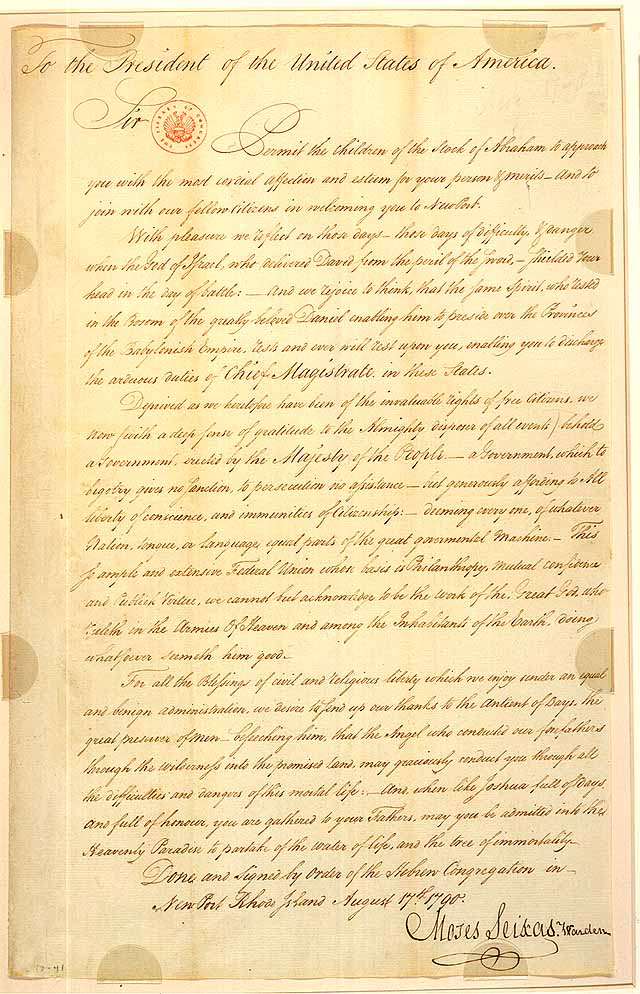
July 30, 2006
This is for Bill's amusement
Scene: A smoke-filled tavern in New York, 1787. Sheila, in modern-day dress, enters. Her pupils are dilated from excitement. She strolls through, looking around. Powdered wigs. Tin mugs, with foam dripping down the side. Candles sputtering black smoke. Men. Mostly men. Then - she sees him. Standing in conversation in the back. She recognizes him immediately. She recognizes his ruddy face, his bright eyes. He has a glitter to him that the other men do not have. She has read about that glitter. And there it is. Right in front of her. It is unmistakeable. The books did not lie. Shyly, she approaches. He turns, and sees her. Those eyes. Holy shit. It's HIM. She makes her move. Once she starts talking, she cannot stop. It is mortifying, and yet she cannot help herself.
Sheila: Oh, Mr. Hamilton. I have waited so long for this moment. You don't know me - I'm from the future. I'm an American - and - well - everything that you're working on right now - everything you're fighting for, and fighting about - well, I just want you to know that i am living in the country that you planned, that you dreamt up. You saw so far ahead - and I'm telling you - so much of what you imagined has come to pass. Uhm ... well ... I just wanted you to know that I so admire you, even though you were kind of insane, and - I just wondered how you did it. How did you write so much? How did you just KNOW certain things? Where does that kind of intelligence come from? Jefferson's gonna get all the glory - at least intellectually - I really should warn you about that - is John Adams here? Because he should be warned as well - I know that's gonna piss him off - but anyway - even though Jefferson's the golden boy, in terms of posterity - you should just know that I think you're the bomb. I really do. Even though Abigail Adams despised you. I have so many questions to ask you. I have so much I want to say. Sorry to bother you ...I am sure you're really busy right now - it's 1787 after all - but do you have, like, 5 or 10 minutes to give me? I MUST interview you - I have a list of questions.
There is a long pause. Hamilton stares at Sheila. He then leans forward, and awkwardly, kind of stumbles a bit. Sheila smells the liquor on his breath. He holds out his mug.
Hamilton: (slurring words) You've got killer knockers.
Sheila: Uhm - woah. Mr. Hamilton - uh ...
Hamilton: (throwing his arm around her) Bitch, you're hot.
Sheila: But ... but ... The Federalist Papers ...
Hamilton: Federalist Shmederalist. Let's knock boots.
Sheila: I ... I've come such a long way ... is Madison here? Maybe I can talk to him?
Hamilton: Madison's a fucking bore. Let's PARTY!
Sheila: Okay - but - I only have limited time to ask you what ----
Hamilton: Are your boobs real?
July 11, 2006
Today in history: July 11, 1804
Today in history my dead boyfriend was shot and killed. Well - he was alive obviously, on July 10. But then he was killed in a duel on July 11 ... and so now he is dead. He was killed only a couple of miles from where I live now.
Old posts of mine below with a ton of great quotes from him.
He's my favorite. Of course he was. He's my dead boyfriend. When I get home tonight, I'll stop by his statue on the cliff near my house and pay my respects.

"An active and scheming mind ..."
"A total dissolution of nature"
"I dread the vehement character of your people"
"You are invited to deliberate upon a new Constitution for the United States of America"
"Take mankind in general, they are vicious"
"a division ... into the few and the many"
May 15, 2006
The Books: "His Excellency: George Washington" (Joseph Ellis)
And here is my next excerpt of the day from my library.
 Next book in my American history section is His Excellency: George Washington by Joseph Ellis
Hard to believe but this is the last book on this particular bookshelf (at least the last one I've READ. I hav a biography of Lincoln I haven't read yet, Henry Adams' book, as well as McCullough's Trumna bio - but I haven't read those). So this will be the last excerpt from the particular bookshelf. The "play" bookshelf felt like it went on forever - I guess because play scripts are so small, you can fit more of them on the shelves.
Anyhoo - this is Ellis' latest book, a superb biography of George Washington. But it's a biography in the Ellis style - it's more of a character analysis, an assessment of who this man was in Ellis' eyes. Ellis is open about the fact that this is his own personal interpretation (based on research, of course). He's not like many other biographers who basically say: "This is the way this person was, and I am right about it." Ellis can back up his interpretation with facts - but that's one of the reasons why I love Ellis' books sooo much and I am DYING for him to write another one.
I thought I'd post an excerpt from the end of the book, where Ellis takes the long view. To me, the way he writes about those guys (in his Adams biography, in Founding Brothers, in his Jefferson bio) - it just makes them come alive, fully human, flawed, mysterious, interesting.
His Excellency: George Washington by Joseph Ellis
In effect, there were two distinct creative moments in the American founding, the winning of independence and the invention of nationhood, and Washington was the central figure in both creations. No one else in the founding generation could match these revolutionary credentials, so no one else could plausibly challenge his place atop the American version of Mount Olympus. Whatever minor missteps he made along the way, his judgment on all the major political and military questions had invariably proved prescient, as if he had known where history was headed; or, perhaps, as if the future had felt compelled to align itself with his choices. He was that rarest of men: a supremely realistic visionary, a prudent prophet whose final position on slavery served as the capstone to a career devoted to getting the big things right. His genius was his judgment.
But where did that come from? Clearly, it did not emanate from books or formal education, places where it is customary and often correct to look for the wellspring that filled the minds of such eminent colleagues as Adams, Jefferson, and Madison with their guiding ideas. Though it might seem sacrilegious to suggest Washington's powers of judgment derived in part from the fact that his mind was uncluttered with sophisticated intellectual preconceptions. As much a self-made man as Franklin, the self he made was less protean and more primal because his education was more elemental. From his youthful experience on the Virginia frontier as an adventurer and soldier he had internalized a visceral understanding of the arbitrary and capricious ways of the world. Without ever reading Thucydides, Hobbes, or Calvin, he had concluded that men and nations were driven by interests rather than ideals, and that surrendering control to another was invariably harmful, often fatal.
Armed with these basic convictions, he was capable of remarkably unblinkered and unburdened response to the increasingly consequential decisions that history placed before him. He no more expected George III and his ministers to respond to conciliatory pleas from the American colonists than he expected Indians to surrender their tribal lands without a fight. He took it for granted that the slaves at Mount Vernon would not work unless closely supervised. He presumed that the Articles of Confederation would collapse in failure or be replaced by a more energetic and empowered federal government, for the same reasons that militia volunteers could never defeat the British army. It also was quite predictable that the purportedly self-enacting ideals of the French Revolution would lead to tragedy and tyranny. With the exception of his Potomac dream, a huge geographic miscalculation, he was incapable of illusion, fully attuned to the specter of evil in the world. All of which inoculated him against the grand illusion of the age, the presumption that there was a natural order in human affairs that would generate perfect harmony once, in Diderot's phrase, the last king was strangled with the entrails of the last priest. For Washington, the American Revolution was not about destroying political power, as it was for Jefferson, but rather seizing it and using it wisely. Ultimately, his life was all about power: facing it, taming it, channeling it, projecting it. His remarkably reliable judgment derived from his elemental understanding of how power worked in the world.
May 14, 2006
The Books: "George Washington : A Life" (Willard Sterne Randall)
And here is my next excerpt of the day from my library.
 Next book in my American history section is George Washington : A Life by Willard Sterne Randall
A huge book - this was the first biography I've ever read of Washington, actually. My main interests had been John Adams and Thomas Jefferson for years ... and somehow I took Washington for granted. So it was quite a revelation to read about the tremendous scope of his whole life, how he became a soldier, how he began to become irritated by Britain - and for him it was primarily economic. That was where it began for him. They were keeping him from making choices, in who to trade to, buy from ... they were taxing the shit out of him ... He became obsessed with getting around all of this, and so he made changes in his crops - he was determined to become self-sufficient. Eventually, this translated into: we need to be independent. But I was really interested in his journey - so different from the other men I've been studying.
So many good Washington stories. It's real goosebump territory, if you know what I mean.
Here's an excerpt about the winter of 1775-76. One of my favorite stories of the Revolutionary War is the hijacking of the cannons and the moving of the cannons over a damn mountain range. It's just ... you know. Goosebumps.
From George Washington : A Life by Willard Sterne Randall
Increasingly as the winter went by the talk in Washington's camp reflected the mood in Congress. The nonimportation agreement was expanded as the British tightened the coastal naval blockade. With spring the Americans expected an onslaught of fresh British armies. Many Americans began to believe it was high time to give up on reconciliation with England and declare American independence. This growing movement received a considerable boost when Washington's army suddenly acquired a large supply of modern artillery. In November 1775 Washington had dispatched his massive young artillerist, a tall, deep-voiced, 280-pound former bookseller named Henry Knox, to fetch the cannon Benedict Arnold had seized at Crown Point and Ticonderoga. Knox waited until the Hudson River froze over and then, with requisitional teams of oxen scarcely bigger than himself, towed a long column of sledges bristling with fifty-nine French- and British-forged cannon over the Berkshire Mountains along the route of the present-day Massachusetts Turnpike. His arrival in Framingham heralded the birth of a state-of-the-art American army.
By February, Washington was ready to use his new weaponry, and when on March 8 he learned from a spy inside Boston that the British command had received orders to evacuate, he decided to make political capital out of their departure by seizing the high ground of Dorchester Heights and fortifying it overnight. Anything less than a careful and quick movement would court disaster and the loss not only of his new artillery but of his army. Colonel Rufus Putnam submitted a plan to Washington on which he decided to gamble everything. Thousands of men were put to work making large frames of timber in which gabions, fascines, and bales of hay could be hauled quickly up on Dorchester Heights. The woven gabions were to be filled with earth; the hay was to be covered with as much dirt as the men could dig. Large branches, cut from nearby orchards, were sharpened to act as protective abatis to slow and ensnare infantry. Barrels of earth were readied to roll down on attackers.
By the night of March first, everything was ready. Washington put "Old Put," Israel Putnam, the hero of Bunker Hill, in command and designated John Sullivan of New Hampshire and Nathaniel Greene of Rhode Island in charge of the divisions. To cover the noise of thousands of men and their carts and draft animals Washington began an artillery barrage that night and resumed it the next night. On the night of March 4 the exchange of cannon fire was heavy. Around 7 p.m., 2000 men headed for Dorchester Heights, 800 infantry screening 1,200 workmenn who threw up breastworks and laid out the redoubts for the cannon as 300 oxcarts brought up the tools, the gabions, the fascines. A fresh work party relieved them toward dawn; by this time there were two redoubts lined with cannon infantry.
The British were stunned when dawn revealed the night's work. Washington's artillery could fire easily into Boston and sink any Royal Navy ship. Howe's first reaction was to attack. He assembled troops and barges, but a storm scattered his landing craft, giving him time to ponder the possibility of another Bunker Hill. He had already decided to abandon Boston. He decided another attack was impossible and ordered the evacuation to begin. On St. Patrick's Day, March 17, three weeks after Washington's cannon appeared on Dorchester Heights the last British transport crowded with the loyal English subjects of Massachusetts and everything Howe's army could carry off sailed from Boston harbor. Washington had his first great victory.
The British retreat made Washington a popular hero. Harvard College granted him an honorary degree, Doctor of Laws for honoria causa, and Congress struck him a gold medal. But the real effect of his success at holding an army of farm boys and fishermen together under the glower of the British army for nearly a year was to convince Americans that men like John Adams - considered radicals a year before - were behaving rationally when they said America was ready to become a self-supporting nation. Only six weeks after Howe's withdrawal to Nova Scotia, Richard Henry Lee of Virginia introduced a motion in Congress that "these states are and have right to be free and independent states." As members of Congress hurried home to obtain authorization to vote for - or against - independence, Washington prepared to ward off the powerful counterattack he expected any day from the British. On July 4, when Congress voted narrowly to declare American independence, John Adams could have been speaking for his friend Washington when he wrote to Abigail Adams, "The revolution is now complete: all that remains is a war."
May 13, 2006
The Books: "Thomas Jefferson : A Life" (Willard Sterne Randall)
And here is my next excerpt of the day from my library.
 Next book in my American history section is Thomas Jefferson : A Life by Willard Sterne Randall
Now I like Willard Sterne Randall's books - I read his one on Hamilton, his one on Washington, and this enormous one on Jefferson. It truly is enormous - and my particular copy has really small print, which is a bit of a challenge. This is the problem when you have bad eyes. Anyhoo ... It was published in 1994, I believe - and sadly he seems hell-bent on making the claim that Jefferson was NOT sexually involved with Sally Hemings. He seems strangely invested in the fact that Jefferson did NOT screw around with her. I just don't have that anxiety - and therefore, he seems a little bit untrustworthy as a biographer. The whole DNA study published its results in 1998 and obviously nobody can ever say, without a shadow of a doubt, "He slept with her and fathered children" ... but it also seems to me that you cannot say the OPPOSITE, without a shadow of a doubt either. Ya know why? Cause we weren't there. Mkay? Hitchens, in his book on Jefferson, gets very frustrated in his unbelievably articulate way with biographers like Randall - saying that make no mistake, there is racism in such defensiveness. Randall's just one in a long long long line of biographers who pooh-pooh the rumors - he's not the only one. Jefferson has had overly protective biographers for YEARS. And this isn't about yanking him off his mountaintop, and sullying his reputation. This is about what might or might not have happened. In my mind, it is completely not inconceivable that Jefferson would have messed around with a slave - not at all - he was ambivalent enough about his own slaveowner status, and in denial enough about the fact that he even HAD slaves (the entire design of Monticello reinforces this - He put effort into HIDING the slaves) ... Again, none of this, to me, makes Jefferson a limb of Satan. He was a man of his time, and I just find it all INTERESTING. I would rather look at the rumors with open eyes, rather than say "No. That could not have happened" right up front. What are you so afraid of, Randall? What are you protecting??
BUT his over-protectiveness of Jefferson is not enough for me to NOT recommend this book. I really like Randall's writing, I like his incorporation of primary documents (I think his books are filled with more of his subjects' words than his own words - and I really like that) - and it's very in-depth. It's a good old-fashioned massive biography, and if you want to get a good linear look at Jefferson's life, I can recommend this book.
I'm going to post an excerpt about Jefferson's intellectual influences. I always love it when biographers include that kind of stuff in their books ... what books did this person read? What books did he own? What were his main influences?
Thomas Jefferson : A Life by Willard Sterne Randall
Beginning in 1770, shortly after British troops shot down Boston protestors in the Boston Massacre, Jefferson had begun studying systems of government, following Diderot's injunction in that Bible of the Englightenment, the Encyclopedie: "Everything must be examined, everything must be shaken up, without exception and without circumspection." He was not seeking a philosophical system to adopt whole. As Merrill Peterson has pointed out, Jefferson "was distrustful of philosophical systems generally," considering them "prisms of the mind." He regarded thought as a tool for reshaping life, not for absorbing some grand design. His thinking was pragmatic, always as unfinished as his house at Monticello would be. But that was the whole point with both his thinking and his constructions, the doing of them. The delight was to finish neither, but to revise, constantly. He borrowed fully to assemble an eclectic set of principles which, he believed, provided the greatest flexibility, dynamism, durability. To prepare for the future, he reached back. He brushed aside whole systems. Years later, asked to be a godfather, he refused: "I had never sense enough to comprehend the articles of faith of the Church," he replied. Already a confirmed deist who believed in natural religion and morality, he regarded the clergy of the established Church of England as part of the problems of the British Empire, not as a solution. In concluding his brief in the Lunan case in 1774, he had written, "In truth, the alliance between church and state in England has ever made their judges accomplices in the frauds of the clergy, and even bolder than they are." It was at about this time, this fecund summer of 1774, that, questioning the legal foundations of the established church, he penned a little essay in his commonplace book under the title, "Whether Christianity is a Part of the Common Law."
For nearly fifteen years, Jefferson had followed the developments and writers of the Enlightenment, which had its roots in early eighteenth-century England. His three personal patron saints were Bacon, Newton, and Locke. While remaining a nominal Anglican and serving as a parish vestryman, Jefferson had drifted away from the Church of England as a student about the time he had begun to study "moral sense" Enlightenment philosophy under the tutelage of Dr. Small at William and Mary. As an old man, he wrote to John Adams in 1823:
I can never join Calvin in addressing his God. He was indeed an atheist, which I can never be; or rather his religion was demonism. If ever man worshipped a false God, he did ... not the God whom you and I acknowledge and adore, the Creator and benevolent Governor of the world, but a demon of malignant spirit.
His commonplace books contain numerous excerpts from the religious thoughts of Locke and Shaftesbury and his disciple Francis Hutcheson. A third-generation Presbyterian minister, Hutcheson gave enormously popular lectures at the University of Edinburgh, included James Boswell and David Hume among his students, had rejected Calvinist orthodoxy, and was once tried by the Presbytery of Glasgow for teaching "false and dangerous" doctrines. Hutcheson's "moral sense" philosophy asserted that moral goodness could be measured by the extent to which one's actions promoted the happiness of others. He also agreed that it was possible to experience a God-given knowledge of good and evil without resorting to the studying of God. Moral-sense philosophy weighed virtue in social terms: "That action is best which accomplishes the greatest happiness for the greatest numbers." One of Hutcheson's disciples, Thomas Reid, held that "moral truths" could be divided into truths "self-evident to every man whose understanding and moral faculty are ripe" and truths that had to be "deduced by reasoning from those that are self-evident." Another Scottish exponent of the moral-sense school was Henry Home, Lord Kames, whose thoughts Jefferson commonplaced copiously and who was listed under three headings in Jefferson's book-buying recommednation to Skipwith in 1771. Jefferson's study of Kames as early as 1767 led to his conviction that primogeniture in Virginia, the law requiring the leaving of all property to the firstborn son, had been unjustly transported from England and become early entrenched there. Jefferson had studied Kames's Essays on the Principles of Morals and Natural Religion during his student days, his boyish marginal notations surviving in one of the few books to escape the flames at Shadwell. From Kames, young Jefferson learned that "there is a principle of benevolence in man which prompts him to an equal pursuit of the happiness of all." There were echoes of Kames in contemporary Scot Adam Smith's philosophical writings. "All constitutions of government," Smith wrote, "are valued only in proportion as they tend to promote the happiness of those who live under them." And there were echoes of all these Scottish moral philosophers in Jefferson's political writings between 1774 and 1776.
If Jefferson had any religious credo, it was a utilitarian faith in progress. With Bacon, he believed that mysteries beyond human understanding should be set aside so that the mind was freed to attack real obstacles to happiness in life. Like the philosopher Baron de Holbach, who wrote that "man is unhappy only because he does not know nature," he believed that enlightenment provided a route to happiness. If man studied nature, he could bring himself into harmony with the natural order of his environment and use its laws to set himself free. He saw this as the pursuit of happiness that was his right as well as his deepest desire. Because there were individual definitions of happiness, societies needed the freedom that would allow pluralism and tolerance. Jefferson believed that limitless progress was possible, that man had all the "necessities" for progress, if not perfection:
Although I do not, with some enthusiasts, believe that the human condition will ever advance to such a state of perfection as that there shall no longer be pain or vice in the world, yet I believe it susceptible to much improvement and, most of all, in matters of government and religion, and that the diffusion of knowledge among people is to be the instrument by which it is effected.
It is not from the Scottish religious reformers but from English and European writers of the seventeenth- and eighteenth-century Age of Reason that Jefferson drew his evolving notions of government. From Bacon, the grandfather of the English Enlightenment, Jefferson had learned to use his powers of observation and question any opinion, regardless of its source. He adhered to Bacon's admonition to apply reason and learning to the functions of government to improve society. Jefferson was influenced by Newton's Principia, which held that the universe was a great clock invented, made, and set in motion by a deity, but he had adapted Newton's view to his own quest for a world of order and harmony. Like Newton, Jefferson did not believe in miracles. Jefferson's third hero from the time of his boyhood studies was Locke, who had joined the empiricism of Bacon and Newton to the realm of politics. Locke's An Essay Concerning Human Understanding for the first time fed his natural optimism and gave him hope that mankind could be improved by education. From Locke and his Scottish adherents, Jefferson had adopted the theory of the Second Treatise of Government that legitimate authority to govern was derived from the consent of the governed, which had first been granted while mankind had still been in a "state of nature" when all human beings were by right free and equal. Locke underpinned all of Jefferson's political thought.
May 12, 2006
The Books: "Thomas Jefferson : Author of America" (Christopher Hitchens)
And here is my next excerpt of the day from my library.
 Next book in my American history section is Thomas Jefferson : Author of America by Christopher Hitchens.
I admit it. I'm a Hitchens addict. I am also a US History addict - so this book was a particular delight. It's part of the REALLY cool "Eminent lives" series. They're little books - this is not a full-blown biography - it's more of a very pointed analysis of certain events. In that typical Hitchens voice which I find so addictive. How does he do it? How does he write so much and still manage to drink so much alcohol? The guy is everywhere. His book reviews, his columns for Vanity Fair, his columns for Atlantic, his books, his op-ed columns - I'm in awe. It was really fun to see his interpretation of Jefferson.
And because Hitchens is also such a wordsmith - I figured I'd excerpt the section where he analyzes the Declaration of Independence.
From Thomas Jefferson : Author of America by Christopher Hitchens.
It was partly as a result of a compromise that Jefferson was appointed to the committee charged with drawing up the Declaration. The author of the resolutions calling upon the thirteen colonies to announce independence, to form "a confederation and perpetual union," and to seek overseas recognition and military alliances was Richard Henry Lee, himself a Virginian. But he was needed at home, and Congress needed a Virginian just as it needed some New Englanders and some delegates from the middle colonies. John Adams, Benjamin Franklin, Roger Sherman of Connecticut, and Robert Livingston of New York comprised the rest of the drafting group.
There is no other example in history, apart from the composition of the King James version of the Bible, in which great words and concepts have been fused into poetic prose by the banal processes of a committee. And, as with the extraordinary convocation of religious scholars that met at Hampton Court under the direction of Lancelot Andrewes in 1604, and with the later gathering of polymaths and revolutionaries at Philadelphia in 1776, the explanation lies partly in the simultaneous emergence, under the pressure of a commonly understood moment of crisis and transition, of like-minded philosophers and men of action. Modesty deserves its tribute here, too: a determination to do the best that could be commonly wrought was a great corrective to vanity. Thomas Jefferson's modesty was sometimes of the false kind. We have too many instances of him protesting, throughout his political ascent, that the honor is too great, the burden too heavy, the eminence too high. (Rather as the Speaker of the House of Commons is still ceremonially dragged to his chair on his inauguration, as if being compelled to assume his commanding role.) However, someone had to pull together a first draft, and we have it on the word of his longtime rival John Adams that Jefferson's reticence in the matter was on this occasion fairly swiftly overcome. He was generally thought to be the better writer and the finer advocate: one might wish to have seen a Franklin version -- which might at least have contained one joke -- but it was not to be.
Several years were to elapse before Jefferson was acknowledged as the author of the Declaration, or until the words themselves had so to speak "sunk in" and begun to resonate as they still do. So it is further evidence of his amour propre, as well as of his sense of history and rhetoric, that he always resented the changes that the Congress made to his original. These are reproduced, as parallel text, in his own Autobiography, and have been as exhaustively scrutinized as the intellectual sources on which Jefferson called when he repaired to a modest boarding house for seventeen days, with only a slave valet named Jupiter, brought from Monticello, at his disposal.
The most potent works, observes the oppressed and haunted Winston Smith in George Orwell's Nineteen Eighty-Four, where he's read the supposedly "secret" book of the forbidden opposition, are the ones that tell you what you already know. (And, in the "Dictionary of Newspeak" that closes that novel, a certain paragraph of prose is given as an example of something that could not be translated into "Newspeak" terms. The paragraph begins, "We hold these truths to be self-evident ...") Jefferson and Paine had this in common in that year of revolution; they had the gift of pithily summarizing what was already understood, and then of moving an already mobilized audience to follow an inexorable logic. But they also had to overcome an insecurity and indecision that is difficult for us, employing retrospect, to comprehend. Let not, in such circumstances, the trumpet give off an uncertain sound. So, after a deceptively modest and courteous paragraph that assumes the duty of making a full explanation and of manifesting "decent respect," the very first sentence of the actual declaration roundly states that certain truths are -- crucial words -- self-evident.
This style -- terse and pungent, yet fringed with elegance -- allied the plain language of Thomas Paine to the loftier expositions of John Locke, from whose 1690 Second Treatise on Civil Government some of the argument derived. (It is of interest that Locke, who wrote of slavery that it was "so vile and miserable an Estate of Man ... that 'tis hardly to be conceived that an Englishman, much less a Gentleman, should plead for it," was also the draftsman for an absolutist slaveholding "Fundamental Constitution" of the Carolinas in 1669.) Jefferson radicalized Locke by grounding human equality on the observable facts of nature and the common human condition. Having originally written that rights are derived 'from that equal creation," he amended the thought to say that men were "endowed by their Creator with certain unalienable rights," thus perhaps attempting to forestall any conflict between Deists and Christians. And, where Locke had spoken of "life, liberty, and property" as being natural rights, Jefferson famously wrote "life, liberty, and the pursuit of happiness." We differ still on whether this means seeking happiness of rather happiness itself as a pursuit, but given the advantageous social position occupied by most of the delegates at Philadelphia, it is very striking indeed that either notion should have taken precedence over property. The clear need of the hour was for inspiration (and property rights were to be restored to their customary throne when the Constitution came to be written), but "the pursuit of happiness" belongs to that limited group of lapidary phrases that has changed history, and it seems that the delegates realized this as soon as they heard it.
Thomas Jefferson, indeed, is one of the small handful of people to have his very name associated with a form of democracy. The word was not in common use at the time, and was not always employed positively in any case. (John Adams tended to say "democratical" when he meant unsound or subversive.) But the idea that government arose from the people and was not a gift to them or an imposition upon them, was perhaps the most radical element in the Declaration. Jefferson was later to compare government with clothing as "the badge of lost innocence," drawing from the myth of original nakedness and guilt in the Garden of Eden. Paine in his Common Sense had said, "Society is produced by our wants and government by our wickedness." As a compromise between government as a necessary evil - or an inevitable one - and in the course of a bill of complaint against a hereditary monarch, the Declaration proposed the idea of "the consent of the governed" and thus launched the experiment we call American, or sometimes Jeffersonian, democracy.
May 11, 2006
The Books: "American Sphinx : The Character of Thomas Jefferson" (Joseph Ellis)
And here is my next excerpt of the day from my library.
 Next book in my American history section is American Sphinx : The Character of Thomas Jefferson by Joseph ("Yeah. I was in 'Nam. DOH.") Ellis.
My favorite of all of his contemplative biographies - he really just hits his stride here. Jefferson, too, is more of an enigma than John Adams was - Adams was pretty much whatyou see is what you get - He also unburdened himself to his wife in letter after letter after letter - so he really had an intimate personal relationship with someone where he could really be himself, flaws and all. Jefferson didn't really have that. Perhaps the closest he came to it was with Adams himself at the ends of their lives when they renewed their friendship. But even then ... you can feel his formal manner protecting ... what? Protecting something.
Speaking personally - having read the correspondence between Adams and Jefferson - I can say that Jefferson's brief brief moments of deep feeling are so so moving, more so than Adams' more regular effusions - because you sense that these moments really COST Jefferson something. You feel for him. You get the sense that Jefferson might have had to lie down after writing the letter of condolence to John Adams on the death of Abigail. Open feeling did not come easily to him.
He's an enigma. A political animal. A lovelorn suitor (his letters to women are revealing as well - in their teasing almost coquettish tone - except with Abigail - he got the sense that that crap would not fly with HER). A farmer and inventor. Full of contradictions. Unreconcilable. He did not reconcile any of his contradictions by the time he died - they were all still there - but that's what makes him an interesting study. He tended to see the world in a polar-opposite kind of way. Most people who are political animals do. There's THIS way that will counteract THAT way. Jefferson seemed to believe that harmony could, actually be achieved on this earth. I disagree with him - uhm - look at all of human history - but that whole polar-opposite thing is one of the reasons why the Declaration of Independence is such a TIMELESS document. Perhaps its goals (at least its humanist goals) can never be fully achieved - but also perhaps they aren't meant to be. Perhaps their real role in human history (and that second paragraph is what people know by heart - and not just Americans - it's not a goal for ONE people, it's a goal for all humanity - it's universal, therein lies the appeal) but anyway - perhaps that second paragraph can never be actually achieved - but is a constant reminder of the GOOD that is in us, of man's inherent dignity. Never forget your rights as a human being. Never ever forget it. Those rights must ALWAYS be fought for. The rest of the document, with its King George did THIS to us, did THAT to us - is more easily achieved - it's a checklist. But that second paragraph? Is it a utopia? Have we ever achieved it? I don't think so (and I believe I've expressed here before my distrust of people who get all googly-eyed with excitement over utopias) - and perhaps Jefferson did believe that it was achievable, I don't know. Now let me go off in my own contemplation: I think ugliness truly HURT Thomas Jefferson. I think he preferred solitude, quiet, and purity. People who prefer those things can have a rough time when they come down off the mountaintop. HOWEVER, on the flip side of that - Jefferson was a master political manipulator. He SAID he wanted to retire, yet he had Madison reporting to him left and right about what was going on. I think both sides are true. I don't think one side is a lie, and the other side is the REAL Jefferson. I think he truly loved purity, solitude, and quiet intellectual contemplations. I think he truly did detest the ugliness that came out of people when they played politics hard. I think he wished the world was a nicer calmer place. But I also think he couldn't have backed out of politics if he tried. He needed to be in the game, as ugly as it could get. And he played it ugly himself. But then somehow - with Madison as his front-man, he could somehow claim that he had nothing to do with it ...
None of this is reconciled. So Ellis picked a good title for his book, I'm thinkin'.
Jefferson's discomfort with irreconcilable differences was really made clear (at least to us - years in the future) during the French Revolution. I often wonder what he REALLY thought about it. He was actually THERE during some of the main events of that bloody revolution - and his letters are well-known. Adams was horrified at the excesses of the revolution. Jefferson stood by it - in what seemed at the time like a breezy indifference to horror. He seemed to RELISH the blood running in the streets, etc. As long as the king was put down! Same thing with Shays Rebellion. Abigail wrote him a letter about the rebellion and how frightening she found it - how fragile was civil society ... and he wrote back his now-famous letter saying "I like a little revolution now and then ... it's like a storm that clears the atmosphere." Abigail was horrified. It seems that Jefferson was one of those men who wanted constant revolution. And there was a side of him that did.
Hoo hoo. I'll stop now.
Ellis' book is not set up like a typical biography. He chooses certain chunks of years - and analyses what was going on there, and how it created or revealed "the charater of Thomas Jefferson". It's fascinating - it's for true junkies like myself. If you want a more typical biography, or if you don't know that much about Jefferson - then this probably isn't the one to start with. But if you're already a bit down the Jeffersonian path, I HIGHLY recommend this one.
I'll post an excerpt about the French Revolution.
From American Sphinx : The Character of Thomas Jefferson by Joseph Ellis.
So much history happened in prerevolutionary France during the last two years of Jefferson's ministry that it is not easy to summarize his shifting political positions, except perhaps to say that he presumed that France would emerge from the ferment as some kind of constitutional monarchy. Despite his earlier characterizations of the French king as a drunken sot, completely out of touch with the needs and frustrations of the French people, by the summer of 1788 he had come to regard Louis as an enlightened ruler who was anxious to play a crucial role in forging political alliances between the nobility and the members of the Third Estate. (In the end Louis XVI turned out to be like George III, fated to do precisely the wrong thing at just the right time, what Jefferson called "a machine for making revolutions.") But his fondest hopes for the recovery of political stability rested with the group of moderate and enlightened aristocrats, led by his good friend Lafayette, called the Patriots or the Patriot Party. Although he was prepared to acknowledge that the situations were fundamentally different, Jefferson seemed to regard the Patriots in France as counterparts to the Federalists in America; they were "sensible of the abusive government under which they lived, longed for occasions of reforming it" and were dedicated to "the establishment of a constitution which shall assure ... a good degree of liberty." Lafayette was cast in the role of a French Madison, orchestrating the essential compromises among the different factions and thereby consolidating the energies of the revolution within a political framework that institutionalized the maximum gains that historical circumstances would allow.
Jefferson was prepared to recognize that those circumstances were not ideal. The deeply rooted class divisions of French society were on display during the debates within the Estates-General that he attended in May and June 1789, as were the still-powerful legacies of feudalism, which had all but vanished in America but in Versailles took on the highly virulent and visible form of costumed lords and courtly processions. Given these entrenched impediments to a fully flowered revolution along American lines, Jefferson advised his friends in the Patriot Party to settle for the English consitutional model, supplemented by one important American addition - that is, he recommended the retention of the French monarchy, though with vastly reduced powers, the creation of a bicameral legislature with the upper chamber reserved for the clergy and nobility and -- the American contribution -- the insistence on a declaration of rights that protected basic liberties from violation by kings, lords or even elected legislators. Characteristically, he devoted most of his time and energy to drafting the Charter of Rights, which called for the abolition of all pecuniary privileges and exemptions enjoyed by the nobility, civilian rule over the military, equal treatment under the law and a modified version of freedom of the press. With France as with America, his fondest political topic was not the artful arrangement of government power but rather the cordoning off of a region where no government power could exist. He conveyed his draft to Lafayette in June 1789; it served as the basis for the Declaration of Rights that Lafayette presented to the National Assembly the following month.
By that time Jefferson was confident that the danger of disintegration and violent revolution had been averted. "The great crisis being now over," he wrote to Jay, "I shall not have a matter interesting enough to trouble you with as often as I have lately." The Estates-General had not taken his advice and established a separate chamber for the clergy and nobility, but enough of the privileged classes had gone over to the Third Estate to make the newly established National Assembly a representative, if somewhat unwieldy, body. Nevertheless, as he explained to Tom Paine on July 11, 1789, the French Revolution was effectively over. "The National assembly (for that is the name they take) ... are now in complete and undisputed possession of sovereignty. The executive and the aristocracy are now at their feet. The mass of the nation, the mass of the clergy, and the army are with them. They have prostrated the old government, and are now beginning to build one from the foundation."
The following day Paris exploded in a series of riots and mob actions that have been memorialized in countless histories, novels and films on the French Revolution: the assault on the Customs House, the stoning and eventual massacre of the royal cavalry; the storming of the Bastille and subsequent beheading and dismemberment of its garrison. After five days of random violence and massive demonstrations, Jefferson described to Jay the scene as Louis XVI returned to the capital, with Lafayette at his side, to be greeted by "about 60,000 citizens of all forms and conditions armed with the muskets of the Bastille and ... pistols, swords, pikes, pruning hooks, sythes, etc." and all shouting "vive la nation."
If one were to conjure up a scene designed to weaken Jefferson's faith in the inherent benevolence of popular movements or to shake his apparent serenity toward popular rebellions, one could hardly do better. Therefore it is worth noting that, though shocked at first by the random and savage character of the mob violence, he never questioned his belief in the essential rightness of the cause or the ultimate triumph of its progressive principles. His letters to Jay and Madison described the carnage of July 1789 as an unfortunate but temporary aberration that in no way called into question the prospect for an enduring and peaceful political settlement. He seemed to regard the spasm of violence as the product of a misguided decision by the king or his ministers to increase the troop strength in the city rather than as ominous evidence of deep and irreconcilable class resentments. By early August, in fact, he was convinced that the storm (shades of Shays's Rebellion) had passed the future looked clear and bright: "Quiet is so well established here that I think there is nothing further to be appreheded. The harvest is so near that there is nothing to fear from the want of bread. The National assembly are wise, firm and moderate. They will establish the English constitution, purged or its numerous and capital defects."
It was in this brave and buoyant mood that Jefferson sat down on September 6, 1789, to write what has subsequently proved to be one of the most famous letters in his vast correspondence. "The course of reflection in which we are immersed here on the elementary principles of society," he explained to Madison, "has presented the question to my mind." The question itself was not entirely new. It was "Whether one generation of men has a right to bind another," which Jefferson claimed had implications that had not been sufficiently appreciated in either Europe or America. His answer to the question had the kind of unequivocal ring that he normally reserved for documents like the Declaration of Independence. "I set out on this ground," he announced, "which I suppose to be self-evident, that the earth belongs in usufruct to the living."
Exactly what Jefferson meant by this proposition has been the subject of endless debate among historians for some time. In the letter itself Jefferson seemed to be advocating some version of generational sovereignty. "We seem not to perceive," as he put it to Madison, "that, by the law of nature, one generation is to another as one independent nation is to another." He produced elaborate calculations based on Buffon's demographic tables to show that, on average, a generation lasted about nineteen years. It therefore followed from the principle - "the earth belongs always to the living generations" - that all personal and national debst, all laws, even all constitutions, should expire after that time.
Madison, always the gentle critic of Jeffersonian ideas, complimented Jefferson on his "interesting reflections," then proceeded to demolish the idea of generational sovereignty, which was not really an idea at all, he suggested, but rather a dangerous fantasy. In the course of presenting his argument, Jefferson had asked Madison to imagine "a whole generation of men to be born on the same day, to attain mature age on the same day, and to die on the same day." Here, Madison observed not so diplomatically, was the chief clue that Jefferson was engaged in magic more than political philosophy. For there is not, and never can be, a generation in Jefferson's pure sense of the term. Generational cohorts simply do not come into the world as discrete units. There is instead a seamless web of arrivals and departures, along with an analogous web of obligatory connections between past and present generations. These connections are not only unavoidable but absolutely essential for the continuation of civilized society.
Madison did not say it, but the whole tenor of his response implied that Jefferson's letter was an inadvertent repudiation of all the painstaking work that he and his Federalist colleagues had been doing for the past two years. For Jefferson's idea (or, if you will, fantasy) struck at the very stability and long-term legality that the new Constitution was designed to assure. The notion that all laws, contractual obligations and hard-won constitutional precedents would lapse every nineteen or twenty years was a recipe for anarchy. Like Jefferson's earlier remark about wanting to see "a little rebellion now and then," which it seemed to echo, the generational argument struck Madison as an utterly irresponsible and positively dangerous example of indulged speculation and just the kind of abstract reasoning that gave French political thinkers a reputation for building castles in the air.
As usual, Jefferson listened to Madison's advice. He never put forward his generational argument as a serious legislative proposal, and he refrained from ever mentioning the matter to Madison again. But whatever practical problems the idea posed, whatever its inadequacies as a realistic rationale for legal reform, he clung to it tenaciously, introducing it in conversations and letters for the rest of his life. If, as Madison had suggested, the core of the idea was incompatible with the way the world actually worked, it was compatible with the way Jefferson's mind worked. Indeed, there is no single statement in the vast literature by and about Jefferson that provides as clear and deep a look into his thinking about the way the world ought to work. The notion that "the earth belongs to the living" is in fact a many-faceted product of his political imagination that brings together in one place his essential obsessions and core convictions.
May 10, 2006
The Books: "Alexander Hamilton : A Life" (Willard Sterne Randall)
And here is my next excerpt of the day from my library.
 Next book in my American history section is Alexander Hamilton : A Life by Willard Sterne Randall. Now that the Chernow biography of Hamilton has come out - there's probably no need to read this one (unless you're a junkie like me). Everything you could ever want to know about Hamilton is in the Chernow ... but I have a fondness for this book, as well as a fondness for Willard Sterne Randall's writing - I've read three of his biographies - one of Washington, one of Jefferson, and this one - and I really do like his style. Sadly, he seemed to have a vested interest in proving that Jefferson DIDN'T have an affair with Sally Hemings - and so he is definitely on the wrong side of history - It's kind of painful to read his Jefferson book for that reason. Like, I read it, thinking: What are you so afraid of, buddy? Why is it so horrifying to contemplate that he DID sleep with her? How you can be so SURE that he never did sleep with her? I mean - how can you stand here in the 1990s and be so CERTAIN of what happened in the private life of a man over 200 years ago - where do you get that arrogance? Why are you so intent on telling me there is "no evidence to support" blah blah blah. I know most writers of biographies have agendas - but I prefer them to be a little bit more artfully hidden.
So skip his book on Jefferson - but read his one on Hamilton. He doesn't have the same weird need to PROTECT Hamilton like he did with Jefferson - and the book is better for it.
One of the great things about Randall's writing (I've noticed it in all three of his books) is his reliance on primary documents - He quotes extensively from letters, diary entries, newspaper articles, speeches - His books are filled with block quotes - and I am ALL ABOUT the block quotes.
Now - nobody wrote more than Alexander Hamilton. I mean, from a very early age the boy was a wunderkind. I'll be studying Alexander Hamilton until I shuffle off this mortal coil. He, to me, is the dark horse of that group. Completely independent, out of nowhere, brilliant to the point of being intimidating (to his contemporaries and to me), prophetic, fearless, hated, complex ... I LOVE reading about this guy. He excites me.
During the Constitutional Congress in 1787 - he stood up at one point and talked for SIX HOURS STRAIGHT. Oh man, what I would not give to have been there that day. He had notes (as a matter of fact, I SAW those notes when I went to the Hamilton exhibit at the New York Historical Society - little scratchings on a page) - but he didn't look down at them. He knew what he had to say. And he said it - for six hours. It was a breathtaking accomplishment - even in that room filled with men who are still known for their own breathtaking accomplishments.
So here's an excerpt describing his six-hour marathon. And thank goodness that James Madison took extensive notes of the entire proceedings - recording every word everyone said, like an autistic lunatic. Thanks, Jimmy!
One of my favorite Hamiltonian quotes is below. It didn't come from his six-hour speech but a couple days later - during the arguments following his plan - It's the last blockquote in the excerpt. Words to live by, man, words to live by.
From Alexander Hamilton : A Life by Willard Sterne Randall.
Two days into an intense three-day debate on the New Jersey Plan, Hamilton asked President Washington if he could have the floor. It was early in the session of June 18 when the tall, thin, angular-faced New Yorker in elegant black and white stood and began a six-hour speech. Carefully prepared notes lay beside him, but he did not have to consult them. Madison, deeply impressed, recorded the scene:
Mr. Hamilton [said that he] had been hitherto silent on the business before the Convention, partly from respect to others whose superior abilities, age, and experience rendered him unwilling to bring forward ideas dissimilar to theirs and partly from his delicate situation with respect to his own state.
Madison was wrong about Hamilton's silence. He had already made two key motions. But, as it would later turn out, Madison was dead right about Hamilton's delicate situation in the New York delegation, where he was sure to be outvoted - and in bloc voting that meant nullified - by the pro-Clinton delegates. But that also meant he had nothing to lose. While Hamilton declared that he could not possibly accede to the views of his fellow New Yorkers, he said that the crisis "which now marked our affairs was too serious to permit any scruples whatever to prevail over the duty imposed on every man to contribute his efforts for the public safety and happiness."
Hamilton felt he was "obliged therefore to declare himself unfriendly" to both the Virginia and the New Jersey plans. He was "particularly opposed" to Paterson's small-state plan. No amendment of the Confederation that left the states sovereign "could possibly answer." Yet he was "much discouraged" by the "amazing" number of delegates who expected the "desired blessings" by merely substituting a federal national government for a loose-knit confederation of sovereign states. He agreed with Randolph of Virginia that "we owe it to our country to do in this emergency whatever we should deem essential to its happiness." To do anything less, jsut because it was "not clearly within our pwoers, would be to sacrifice the means to the end."
To Hamilton, all the defects lay with the states. Massachusetts was feeling the lack of a "certain portion of military force that is absolutely necessary":
All the passions we see, of avarice, ambition, interest, which govern most individuals and all public bodies, fall into the current of the states and do not flow into the stream of the general [national] government ... How then are all these evils to be avoided? Only by such a complete sovereignty in the general government as will turn all the strong principles and passions [to] its side.
Hamilton argued that Paterson's plan provided no remedy. Small states like New Jersey and North Carolina, "not being commercial states and [only] contributing to the wealth of the commercial ones," could never meet proportional tax quotas as Randolph of Virginia had proposed. "They will and must fail in their duty, their example will be followed, and the Union itself will be dissolved." What, then, was to be done? The expense of a national government over so great an extent of land would be "formidable" unless the cost of state government diminished. He did not mean to shock public opinion but he favored "extinguishing" the state governments: "they are not necessary for any of the great purposes of commerce, revenue or agriculture." What would work better would be "district tribunals: corporations for local purposes." The "only difficulty of a serious nature" which he foresaw was in drawing public officials from the edges to the center of the national community. "Moderate wages" would only "be a bait to little demagogues." Hamilton's views "almost led him to despair," Madison noted, "that a republican government could be established over so great an extent." In his private opinion, Madison wrote of Hamilton, "he had no scruple in declaring, supported as he was by so many of the wise and good, that the British government was the best in the world." He dared to say this because, he said, he had seen a profound shift in public opinion as the members of Congress who were the most tenacious republicans were as loud as anyone in declaiming against "the vices of democracy." He agreed with Necker, the French finance minister, who viewed the British Parliament as "the only government in the world 'which unites public strength with individual security.'"
Many in his audience reeling at such heresy in a Revolutionary council, Hamilton raced on:
In every community where industry is encouraged, there will be a division of it into the few and the many. Hence, separate interests will arise. There will be debtors and creditors. Give all power to the many, they will oppress the few. Give all power to the few, they will oppress the many. Both, therefore, ought to have power, that each may defend itself against the other.
Hamilton submitted "a sketch of his plan" to the Committee of the Whole, warning that "the people" outside the convention's walls would not adopt either the Virginia or the New Jersey plans. Hamilton said he saw the Union dissolving. "He seees evils in the states which must soon cure the people of their fondness for democracies," reported Madison.
Hamilton then read aloud his own plan of government. He proposed a two-house Supreme Legislative Power "in two distinct bodies of men": an elected assembly, elected by free men, serving three-year terms, and a lifetime senate, like the English House of Lords but not hereditary, serving "during good behavior." The senators would be chosen by electors chosen by the people, would form "a permanent barrier against every pernicious innovation." Judges also would be elected by the people and serve during good behavior. The supreme executive would be a governor chosen in the same fashion, for life, but only during good behavior: could there be "a good government without a good executive"? This "governor" -- Hamilton did not use the word "president" -- would be able to veto "all laws about to be passed" and would be in charge of executing the laws. He would be "the commander in chief of the land and naval forces and of the militia." He would have "with the advice and approbation of the Senate" the power of making all treaties. He would appoint the heads of the departments of finance, war, and foreign affairs. He would nominate all ambassadors subject to Senate approval, and he would "have the power of pardoning all offenses but treason," which would require the assent of Congress.
In one brilliant, six-hour, standup oration that left the convention stunned, Alexander Hamilton, with only the exception of term limits and the rules and qualifications of voters, laid out what would become the basic framework of the United States government. Off and on for the next few days, he rose to defend portions of his plan. Hamilton's plan coincided with the Virginia Plan on the major premise that there should be three branches of a national government, legislative, executive, and judiciary. On June 19, when the revised Virginia Plan came out of committee, he rose to elaborate on where his plan differed. His suggestion that the states should be abolished had drawn sharp criticism overnight. By "abolish", he meant their authority must be lessened. It should be "indefinite," but they should be left as "subordinate jurisdictions," as Persia within the Roman Empire. That same day, he rose again to contest a part of the Virginia Plan written by Luther Martin of Maryland that said the thirteen states were "in a state of nature," the old argument of philosopher John Locke. But Hamilton found James Wilson of Pennsylvania's resolution more palatable: the states had won their independence from Great Britain not individually but collectively. He did not fear combinations of states. The large states, Virginia and Massachusetts, were separated by too great distance.
Once again, on June 21, he rose to challenge Charles Cotesworth Pinckney of South Carolina, who wanted Congress to be elected by the state legislation. Without direct election by the people, Congress would be "engrafted" to state governments that could dwindle and die. The same day, he remained adamant on the term of representatives to the lower house. Three years in office was better than a shorter term because too frequent elections made the "people listless to them." He argued against letting state governments pay national salaries: "Those who pay are masters of those who are paid." And he argued vigorously against the holding of more than one public office:
Take mankind in general, they are vicious - their passions may be operated upon. Take mankind as they are, and what are they governed by? Their passions. There may be in every government a few choice spirits, who may act from more worthy motives [but] one great error is that we suppose mankind more honest than they are. Our prevailing passions are ambition and interest. Wise government should avail itself of those passions, to make them subservient to the public good.
And then, sure that no one at the convention would follow his advice, he went home.
May 9, 2006
The Books: "The First American: The Life and Times of Benjamin Franklin" (H.W. Brands)
And here is my next excerpt of the day from my library.
 Next book in my American history section is The First American: The Life and Times of Benjamin Franklin by H.W. Brands.
As you can probably tell I have arranged my American History biographies (we're in that section now, in case you didn't notice) by TOPIC, rather than by author. Believe me, I have agonized over whether or not this was the right choice. I am still not sure, and periodically I arrange all the biographies by author's name ... but there's something I really like about seeing all of the John Adams books next to each other, the Washington books, etc.
The First American is a big hefty fun book - I am sure there are better-written biographies of Franklin out there - this one was just the most recent. I enjoyed it, even though it's obviously a rather "typical" book. I like it for its breadth - but that's really just because of who Franklin was. Any biography of Franklin is necessarily going to be massive. He had such a deep life, such a long life - with so many different facets. It's really kind of astonishing. His commitment to civic duty - his practical bent - ("Let's set up a fire department like the one I saw in England ..." "Let's create a public lending library ...") - It's just awe-inspiring. There are still people like that today, of course - self-starters - people who don't WAIT for stuff to be given to them - and when you read any biography of Ben Franklin, you kind of start to think that you should never wait for anything, that you should go right ahead and do it yourself. Get people involved! Invest in the community! Figure out what needs to be done, and get the community to do it. Self-sufficiency. He was just a master at all of this. Or - yes. He was a master. But it's more that - it just seems that that's who he WAS. I don't know, I never met the guy - but he seems like a very positive can-do personality. He backed it up with intimidating brain power, obviously - but he just seems very very likable to me. And of course people would want to get on board with his schemes. And all of this is without even mentioning his role in the American Revolution!
I knew immediately the excerpt I wanted to post. This is one of the main reasons that I feel like I would have LIKED Ben Franklin. He was such a NUT. He was 16 years old and an apprentice in his brother's printing shop in Boston - they produced the paper The Courant. Only I can't remember what was going on with the father, exactly - but Ben's brother James was running the show. There was quite a bit of sturm and drang here - James Franklin despised Cotton Mather (which you just didn't do at that time) and put scathing attacks on Mather into his paper. Mather fought back - the establishment fought back - James reached out for allies in the community (many of whom were sick to death of Mather's pious bullshit.) Anyway - they got people in the community to write "op eds" in support of the paper (all under pseudonyms, of course).
And ... I am just so in love with what Ben Franklin - a kid of SIXTEEN - did.
So creative! So HUMOROUS! One of his main things was: never attack directly. You lose half your audience that way. Learn to make your points in a subtler way. Do it through humor. Or aphorisms. Make people LAUGH, soften them up - they'll be more inclined to agree with you.
Anyway, here's the excerpt. Ben Franklin creates a persona - and completely channels her personality. It's an act of transformation, of ... acting, if you will. I just LOVE it.
From The First American: The Life and Times of Benjamin Franklin by H.W. Brands.
Consequently it was with pleasure that James awoke one morning to discover beneath the door of the print shop a contribution from a genuine outsider. Actually, this contributor was not an outsider at all; it was Ben Franklin, who had observed the genesis of the Courant and its challenge to Mather and the Massachusetts hierarchy but who conspicuously had not been invited to join the undertaking. Because he had not - and because he realized that James might be less than enthusiastic about his younger brother's participation in the new project - Ben carefully disguised his handwriting and signed the letter "Silence Dogood". James read the missive with growing delight - which increased the more from his appreciation that the author's very name tweaked Cotton Mather, whose recently published Silentarius followed his earlier Bonifacius, or Essays to Do Good. James shared the Dogood letter with his colleagues; they registered equal approval. James ran it in the April 2, 1722, issue of the Courant.
Mrs. Dogood introduced herself to Courant patrons by chaffing them for the contemporary unwillingness "either to commend or dispraise what they read until they are in some measure informed who or what the author of it is, whether he be poor or rich, old or young, a scholar or a leather apron man." She (Ben Franklin, rather) proceeded to mock this timidity by fabricating a fanciful background for herself. She had, she said, been born at sea en route from the old England to New England. But the joy surrounding her birth had turned to sorrow almost at once when a huge wave swept across the deck of the vessel and carried her celebrating father to his watery doom. It was a misfortune, Silence said, "which though I was not then capable of knowing, I shall never be able to forget."
The death of her father had made an indigent of her mother, with the result that the infant Silence was placed in foster care outside Boston, where she passed her childhood "in vanity and idleness" until being bound over to a country minister, "a pious good-natured young man and a bachelor." This godly fellow instructed the girl in all that was necessary for the female sex to learn - "needlework, writing, arithmetic, &c." (Had James known of Ben's earlier defense of education for girls, he might have guessed the identity of Silence Dogood at this point.) Because she displayed a head for books, the minister allowed her the run of his library, "which though it was but small, yet it was well chose to inform the understanding rightly and enable the mind to frame great and noble ideas." This bucolic idyll was interrupted briefly by the news that her poor mother had died - "leaving me as it were by my self, having no relations on earth within my knowledge" - but soon enough it resumed. "I passed away the time with a mixture of profit and pleasure, having no affliction but what was imaginary and created in my own fancy; as nothing is more common with us women than to be grieving for nothing when we have nothing else to grieve for."
Almost certainly none of the readers of the Courant guessed that this ironically knowing voice belonged to a sixteen-year-old boy; neither did James, who inserted after Silence Dogood's first epistle an invitation for more. Any such additional missives could be delivered to the printing house or to the candle shop of Josiah Franklin. "No questions shall be asked of the bearer."
Ben later said he felt "exquisite pleasure" at the approbation this first effort in journalism elicited; he took particular satisfaction from listening to james and the others guess who the anonymous author might be. "None were named but men of some character among us for learning ad ingenuity." During the next six months Ben continued his correspondence, delivering fifteen Dogood letters in all.
His topics ranged from love to learning to lamenting the death of dear ones. As in the first letter, insight and irony were evenly matched. Silence related how, to her astonishment, her ministerial benefactor presently essayed to woo her. "There is certainly scarce any part of a man's life in which he appears more silly and ridiculous than when he makes his first onset in courtship." (As Ben was of an age, if not an economic condition, to consider courtship, the reader who knows the identity of Silence Dogood discerns a certain dawning in him of the difficulties of the endeavor.) But gratitude inclined Silence to accept his suit, leading to wedlock and "the height of conjugal love and mutual endearments", not to mention "two likely girls and a boy." Tragically, her husband was carried off by illness almost as suddenly as her father had been swept away by the ocean, and Silence was left to look after herself and her offspring. Yet, as she assured readers, especially the men among them: "I could be easily persuaded to marry again ... I am courteous and affable, good humoured (unless I am first provoked) and handsome, and sometimes witty."
Silence satirized the state of higher education in Boston, lampooning Harvard College - the alma mater of Cotton Mather, among other establishment influentials - as a snobbish ivory tower where students "learn little more than how to carry themselves handsomely and enter a room genteelly (which might as well be acquired at a dancing school) and from whence they return, after abundance of trouble and charge, as great blockheads as ever, only more proud and conceited." She chided men for being as foolish as the women they criticized for idleness and folly: "Are not the men to blame for their folly in maintaining us in idleness?" She scoffed at women for silliness equal to men's - how else to explain hoop petticoats, those "monstrous topsy-turvy mortar pieces" that looked more like "engines of war" than ornaments of the fair sex. Having experienced multiple deaths in her family, she offered a formula for eulogizing departed loved ones, pointing out that tears were the easier to elicit the more unexpected and violent the demise. "It will be best if he went away suddenly, being killed, drowned, or froze to death." The address in such a case ought to include a litany of melancholic expressions such as "dreadful, deadly, cruel cold death, unhappy fate, weeping eyes." An experienced speaker would wring the maximal lachrymation from an audience, but in a pinch anyone could deliver the doleful sentiments. "Put them into the empty skull of some young Harvard (but in case you have ne'er a one at hand, you may use your own)." Rhymes were nice: "power, flower; quiver, shiver; grieve us, leave us." A concluding flourish was the mark of a really distinguished graveside encomium. "If you can procure a scrap of Latin to put at the end, it will garnish it mightily."
Had they come from the pen of a mature writer, the Dogood letters would deserve to be considered a delightful example of social satire. Coming as they did from the pen of a mere youth, they reveal emerging genius. Some of what Franklin wrote he might have experienced indirectly; some he extrapolated from his reading; much he must simply have imagined. But the tone is uniformly confident and true to the character he created. Silence is irreverent and full of herself, yet she brings most readers - the proud and pwerful excepted - into the realm of her sympathy. They laugh when she laughs, and laugh at whom she laughs at. She is one of the more memorable minor characters of American literature, and all the more memorable for being the creation of a sixteen-year-old boy.
May 8, 2006
The Books: "The Autobiography of Benjamin Franklin" (Benjamin Franklin)
And here is my next excerpt of the day from my library.
 Next book in my American history section is The Autobiography of Benjamin Franklin by Benjamin Franklin
A must-read. I struggled with which excerpt to choose. I love the part when he decides to be a vegetarian (which he pretty much was for his whole life). I love his determination to be perfect - and his whole journey with that - making charts with all of the virtues, checking them off. I love his discussions of the books that really helped him, the people who took a shine to him. But it's so unvarnished - that's why I love it. You get a sense of what an amazing character he was - going to England at so young an age, being swindled out of his money, having to make his own way ...
He also was such an earthy kind of person. Or - at least he admitted his earthiness. You totally get the sense of the frolics he's having left and right, with this or that girl ... His main revelation in life was that moderation was the key to all that was good. He liked to drink. In moderation. He was a vegetarian. But he didn't make it a religion. He was moderate about it. He liked the ladies. In moderation. He had massive appetites - and as long as he kept them a bit under control, they were fine. I don't know - I just really like that about him.
I love the excerpt I've chosen. It's advice about writing - advice that REALLY resonates with me. It's why I can't read the majority of political blogs. They're too certain they are RIGHT. And that kind of certainty, in my opinion, makes for terrible writing. Boring terrible harangues. Franklin's advice, while about writing, also ends up being a philosophy of life - it gets into deeper issues, not just writing issues - and it's stuff I don't care to discuss - but Franklin's writing advice goes a long way towards understanding who he was, why he was beloved the world round, why some people despised him, and why his career was so long and fruitful. Also - his scientific inquiries fall under this category as well ... His inquisitive mind, his curiosity, his ability to - even as a grown man - look at the natural world and say: "Why is it LIKE that?" His ability to take NOTHING for granted. All of this also seems to come under the philosophy he puts out in the second paragraph below. It's not about not having opinions or having ideas. Not at all! It's about how you express them - Is the point to just walk around feeling that you were right? Well, if it is - then good luck with persuading anyone to come to your side. People, in general, do not like to hang around self-righteous jagoffs. But what if the point is to persuade?? Are you able to ADJUST how you express yourself so that it is not so odious to others? The powers of persuasion ... Franklin was a master at it. Reading this book, you realize he was such a master at persuasion because he PRACTICED it.
Oh - it was great - last week I went to the Library Company of Philadelphia. Founded by Franklin (and his buddies) in 1731. That reading room!!!!! DROOLING OVER THE READING ROOM. (I wrote a bit about the Library Company here.)
Franklin is, of course, everywhere in Philadelphia - even more so than William Penn. Franklin has trickled down to the most trivial level of life. Franklin Liquors. Franklin Cafe. Franklin Bar & Grill. Franklin Mall. Franklin Lingerie. Just pop his name onto the beginning and you've got yourself a business!!
From The Autobiography of Benjamin Franklin by Benjamin Franklin
While I was intent on improving my language I met with an English grammar (I think it was Greenwood's) having at the end of it two little sketches on the arts of rhetoric and logic, the latter finishing with a dispute in the Socratic method; and soon after I procured Xenophon's Memorable Things of Socrates, wherein there are many examples of the same method. I was charmed with it, adopted it, dropped my abrupt contradictions and positive argumentation, and put on the humble inquirer. And being then, from reading Shaftesbury and Collins, made a doubter, as I already was in many points of our religious doctrines, I found this method the safest for myself and very embarrassing to those against whom I used it; therefore I took delight in it, practiced it continually, and grew very artful and expert in drawing people even of superior knowledge into concessions the consequence of which they did not foresee, entangling them in difficulties out of which they could not extricate themselves, and so obtaining victories that neither myself nor my cause always deserved.
I continued this method some few years, but gradually left it, retaining only the habit of expressing myself in terms of modest diffidence, never using, when I advanced anything that may possibly be disputed, the words certainly, undoubtedly, or any others that give the air of positiveness to an opinion; but rather say, I conceive or apprehend a thing to be so and so; It appears to me, or I should not think it so or so, for such and such reasons; or, I imagine it to be so; or, It is so, if I am not mistaken. This habit, I believe, has been of great advantage to me when I have had occasion to inculcate my opinions and persuade men into measures that I have been from time to time engaged in promoting. And as the chief ends of conversation are to inform or to be informed, to please or to persuade, I wish well-meaning and sensible men would not lessen their power of doing good by a positive assuming manner that seldom fails to disgust, tends to create opposition, and to defeat most of those purposes for which speech was given to us. In fact, if you wish to instruct others, a positive dogmatical manner in advancing your sentiments may occasion opposition and prevent a candid attention. If you desire instruction and improvement from others, you should not at the same time express yourself fixed in your present opinions. Modest and sensible men, who do not love disputation, will leave you undisturbed in the possession of your errors. In adopting such a manner, you can seldom expect to please your hearers or obtain the concurrence you desire. Pope judiciously observes --
"Men must be taught as if you taught them not,
And things unknown proposed as things forgot."
He also commended it to us
"To speak, though sure, with seeming diffidence."
And he might have joined with this line that which he has coupled with another, I think, less properly --
"For want of modesty is want of sense."
If you ask, Why less propoerly? I must repeat the lines,
"Immodest words admit of no defense,
For want of modesty is want of sense."
Now, is not the want of sense, where a man is so unfortunate as to want it, some apology for his want of modesty? And would not the lines stand more justly thus?
"Immodest words admit but this defense,
That want of modesty is want of sense."
This, however, I should submit to better judgments.
May 7, 2006
The Books: "Samuel Adams : The Father of American Independence" (Dennis Brindell Fradin)
And here is my next excerpt of the day from my library.
 Next book in my American history section is Samuel Adams : The Father of American Independence by Dennis Brindell Fradin
This book was sent to me by ricki! It's an over-size hardcover - and it's filled with paintings, woodcuts, engravings, newspaper cartoons from the time ... It's a really rich book that way, in terms of images, and I love to flip through it. John Adams was a really successful lawyer before the Revolution came along. Washington was a rich dude who had distinguished himself as a soldier. Franklin - fuggedaboutit - what DIDN'T the guy succeed in? Sam Adams, though, really didn't have much going on for himself except his rage at the British - he wasn't Mr. Successful like all the rest of them - but when it came time to rebel? He was at the top of his game. It was his moment. Without the American Revolution, Benjamin Franklin would still have made it into the history books. Even just as a philanthropist and general smarty-pants. But the American Revolution MADE Sam Adams - without it, he would have been completely forgotten. I find that one of the most interesting things about him. How certain people merge with certain moments in time ... It is as though they were MEANT to be born at that time. Sam Adams was a perfect example of right man- right time. He needed a CAUSE to bring out his particular brand of energy and genius. I mean, I guess they all did - but he REALLY did, because he didn't have too much else going for him. He was the kind of guy who get others fired up. He was inspirational, fierce, tireless ... When he spoke (or wrote) - people listened.
Here's an excerpt about the most famous protest he organized.
Samuel Adams : The Father of American Independence by Dennis Brindell Fradin
The first of the tea ships, the Dartmouth, arrived in Boston Harbor on November 28, followed soon after by the Eleanor and the Beaver. The Sons of Liberty posted armed guards at Griffin's Wharf to watch over the three ships and make sure that the agents did not try to sneak the tea ashore. Meanwhile, Samuel Adams was whipping the patriots into a frenzy, as demonstrated by a message that he sent to towns near Boston in late November:
Now brethren, we are reduced to this dilemma, either to sit down quiet under this and every other burden that our enemies shall see fit to lay upon us as good-natured slaves, or rise and resist this and every other plan laid for our destruction, as becomes wise freemen. In this extremity we earnestly request your advice, and that you would give us the earliest intelligence of the sense your several towns have of the present gloomy situation of our affairs.
By mid-December Adams had completed the details of his secret plan. On Thursday, December 16, the largest public gathering in Boston had ever held in its 143-year history took place at the Old South Meeting House. About five thousand Bostonians and two thousand people from outlying areas crowded into and around the church. Since Boston's population was about seventeen thousand, nearly every adult in the Massachusetts capital must have attended this gigantic town meeting.
The townspeople decided to send a final request asking that Hutchinson send away the tea ships. As they awaited the governor's answer, people in the meeting house stood up and made defiant speeches. One man hinted at what was coming by saying: "Who knows how tea will mingle with salt water?" His comment drew loud applause. Finally, at about six at night, the messenger returned with the response that Samuel Adams and nearly everyone else had expected: Hutchinson absolutely refused to send the tea ships back to England.
Samuel Adams then arose and faced the multitude of angry Bostonians. "This meeting can do nothing more to save the country!" he shouted. These words were a prearranged signal to forty or fifty men, disguised as Indians, who were posted at the church entrance.
"Boston Harbor a teapot tonight!" whooped the "Indians", waving their hatchets. The war party set off along Milk Street toward Griffin's Wharf. As the crowd emptied out of the Old South, John Hancock was heard to say, "Let every man do what is right in his own eyes!" Many in the crowd decided to help the "Indians" dispose of the tea, for by this time everyone knew the purpose of the hatchets.
Not counting spectators, the mob contained about a hundred and fifty people by the time it reached Griffin's Wharf. Most of their identities remain unknown, but we do know that Paul Revere was among them. By the light of torches and lanterns, the men boarded the three ships, smashed open the 342 chests (some sources say 340) with their hatchets, then dumped all the tea into Boston Harbor.
Their mission accomplished, the Bostonians marched home to the tooting of a fife. As the men joked about having turned Boston Harbor into a "teapot", Admiral John Montagu of the British Navy stuck his head out of a window and said, "Well, boys, you've had a fine, pleasant evening for your Indian caper. But mind, he who dances must pay the fiddler." A leader of the tea party shouted back, "Oh, never mind, Admiral. Just come out here, if you please, and we'll settle the bill in two minutes!"
Most Bostonians considered the destruction of the tea a brave and necessary act of defiance. Even John Adams, who loathed violence and destruction, said that the Boston Tea Pary was "the most magnificent act" the patriots had yet perpetrated. But no one was happier than Samuel Adams, who on New Year's Eve of 1773 wrote a letter to a friend about the events of December 16. "You cannot imagine the height of joy that sparkles in the eyes and animates the [faces] as well as the hearts of all [Bostonians," he wrote. Also on December 31, the Boston Gazette printed a New Year's message from Samuel Adams charged with the highly emotional style he was using to move his fellow Americans closer to war:
To all Nations under Heaven, know ye, that the PEOPLE of the AMERICAN WORLD are Millions strong - countless Legions compose their ARMY OF FREEMEN ... AMERICA now stands with the Scale of JUSTICE in one Hand, and the Sword of VENGEANCE in the other ... Let the Britons fear to do any more so wickedly as they have done, for the HERCULEAN ARM of this NEW WORLD is lifted up - and Woe be to them on whom it falls! -- At the Beat of the Drum, she can call five Hundred Thousand of her SONS to ARMS ... Therefore, ye that are wise, make Peace with her, take Shelter under her Wings, that ye may shine by the Reflection of her Glory.May the NEW YEAR shine propitious on the NEW WORLD - and VIRTUE and LIBERTY reign here without a Foe, until rolling Years shall measure Time no more.
May 6, 2006
The Books: "Passionate Sage: The Character and Legacy of John Adams" (Joseph Ellis)
And here is my next excerpt of the day from my library.
 Next book in my American history section is Passionate Sage: The Character and Legacy of John Adams by Joseph Ellis
In addition to Founding Brothers Ellis has these other books which don't qualify exactly as biographies - they are more like contemplations. I LOVE them. There's American Sphinx - about Thomas Jefferson, and His Excellency - about George Washington. Passionate Sage is Ellis' contemplation on the "character and legacy of John Adams". He's really good at this type of writing.
Here's an excerpt from Passionate Sage - where Ellis talks about Adams' autobiography. All of the founders were aware that future generations would be watching them - Adams more than most. Adams felt he got the short end of the stick, in terms of securing a legacy for himself. I love John Adams for a ton of reasons that have to do with what he actually DID - but I also love John Adams the most of all "those guys" because of how openly human he was. There he is - warts and all. His insecurities, his vanities, his never-ending yowl of "It's not FAIR ... why does HE get the credit for that??"
From Passionate Sage: The Character and Legacy of John Adams by Joseph Ellis
Adams' autobiography, on the other hand, was less like a well-crafted work of literature than an open wound, a text that requires no "deconstructing" because it was never "constructed" in the first place. Like Adams's life, it was impulsive, exuberant, and candid. And its theme, as well as its form, was the exact opposite of Franklin's. It was about self-doubt and failure rather than self-fulfillment and success, about the ironic ravages of history rather than the triumph of the individual. When Adams eventually read Franklin's autobiography in 1818, he admitted defeat: "My own appears, upon retrospection, a dull dreary unfruitful Waste." But then defeat and failure in the face of American popular opinion had always been his dominant message. In that sense, Adams's autobiography was a clumsy model for his great-grandson's masterpiece, The Education of Henry Adams, as well as an anguished exprssion of the dark and hidden underside of Franklin's beguilingly happy narrative.
Villains and intriuges had always played a crucial role in Adams's thinking about the American Revolution, although it was usually British leaders like Lord North or American Loyalists like Thomas Hutchinson who bore the brunt of Adams's accusations of conspiracy in the 1760s and 1770s. (As Adams once put it, "Mr. Hutchinson never drank a Cup of Tea in his life without Contemplating the Connectio between that Tea, and his Promotion.") Now, in the autobiography, after an opening section that described his early years as a student, grammar school teacher, and country lawyer, he got down to the serious business of eviscerating his enemies on the American side.
Alexander Hamilton - no surprise here - was the chief villain. The fact that Hamilton had only recently died in a duel with Aaron Burr, Adams declared, was no cause for mercy. Adams claimed to feel no obligation "to suffer my Character to lie under infamous Calumnies, because the Author of them, with a Pistol Bullet through his Spinal Marrow, died a Penitent." During the final year of his presidency Adams had periodically terrified the High Federalists and startled the members of his cabinet with outbursts against Hamilton. But he had not seen fit to record his personal feelings toward the unofficial leader of the Federalist faithful. And he had adopted a stately pose in the wake of Hamilton's slanderous and scandalous Letter ... Concerning the Public Conduct and Character of John Adams... All the while, however, the suppressed anger had been throbbing away inside him. Now the invective poured out. Hamilton was a "Creole Bolingbroke ... Born on a Speck more obscure than Corsica ... as ambitious as Bonaparte, though less courageous, and, save for me, would have involved us in a foreign war with France & a civil war with ourselves." Writing to his good friend Judge Francis Vanderkemp at the same time, he amplified his accusation: Hamilton was "a bastard brat of a Scotch pedlar," who lived constantly "in a delirium of Ambition" and who "had fixed his Eye on the highest Station in America and ... hated every man young or old who Stood in his Way." To Rush, he acknowledged that such diatribes against the man regarded as "the Sovereign Pontiff of Federalism" would probably cause "all his Cardinals ... to excite the whole Church to excommunicate and Anathematize me." But Adams claimed to be unfazed, adding: "It was time for a Protestant Separation." It was the closest he ever came to a direct assertion of what was his de facto desertion of the Federalist Party. If Hamilton was, as his worshippers claimed, the guiding light of Federalism, it was a light that deserved to go out.
Tom Paine ranked as second only to Hamilton in Adams's version of the American rogues gallery. Paine, wrote Adams, was "a Disastrous Meteor", "a disgrace to the moral Character and Understanding of the Age." Everyone knew that Benjamin Rush had given him the title for his wildly popular pamphlet, Common Sense, and that the arguments about the inevitability of American independence that Pain advanced had, in fact, been circulating throughout the colonies since 1760. In the midst of the accelerating events of early 1776, when Common Sense first appeared, Adams's initial reaction had been more generous, though even then he was somewhat wary. Paine's pamphlet, he oted then, contained "a great deal of good sense, delivered in a clear, simple, concise and nervous Style." In fact, it was the electricity and accessibility of the prose that caught his attention, causing Adams to recognize that Paine's message was identical to his won -- the American Revolution was both inevitable and natural -- but that he himself "could not have written anything in so manly and striking a style ..." What worried him then was Paine's endorsement of a single house legislature as the prescribed form of government for the new states, a prescription that revealed that "this Writer has a better Hand at pulling down than building." What worried him in his autobiography was the credit Paine had received for his elegant statement of the obvious. Paine was a mere cypher, a nonentity in the Continental Congress. Worse, Paine was "the Satyr of the Age ... a mongrel between Pigg and Puppy, begotten by a wild Boar on a Butch Wolf." Only if one wished to call the eighteenth century "the Age of Frivolity" could one call it "the Age of Paine".
The verdict on what he called "the American untouchables" -- Jefferson, Franklin, and Washington -- was decidedly less vitriolic, but sufficiently equivocal to sense Adams's ego throbbing just beneath the surface. All three American greats served as an illustration of the principle "that Eloquence in public Assemblies is not the surest road to Fame and Preferment, at least unless it be used with great caution, very rarely, and with great Reserve." This was the lesson of "eternal taciturnity" that Adams preached to John Quincy and anyone else who would listen, and it derived from Adams's sure but somewhat neurotic sense that, as "the Atlas of Indepedence" who made the fierce and ferocious speeches that were needed to assure separation from England in the Continental Congress, he inevitably made lifelong enemies. The rule seemed to be that men who played leading roles in controversies became controversial. Jefferson, on the other hand, "had attended his duty in the House [the Second Continental Congress] but a very small part of the time and when there had never spoken in public." Adams recalled, with a mingled sense of admiration and accusation, that "during the whole Time I sat with him in Congress, I never heard him utter three sentences together."
May 5, 2006
The Books: "John Adams" (David McCullough)
And here is my next excerpt of the day from my library.
 Next book in my American history section is John Adams by David McCullough
You know, I read a lot of biographies and most of them are kinda crappy. I read them for the TOPIC mainly. I have a crappy biography of Gary Cooper - which is written so salaciously and so badly (I mean, it's also so much fun) - but I have it because I love Gary Cooper, and there are some great anecdotes in there. But sometimes a biography comes along (and it's very rarely) that re-defines the entire genre, raises the bar, throws down a gauntlet to other writers - whatever you want to call it. And it's a short short list. When book reviewers talk about high-water-mark biographies there aren't many on their list. The same titles referenced over and over: Juliet Barker's book about the Brontes. It is generally agreed that Barker was one of those gauntlet-throwers. She makes all other biographies pale in comparison. The standard Bronte biography before Barker's had been written OVER A CENTURY BEFORE ... by someone who KNEW Charlotte Bronte. Woah. Barker went straight into the heart of the Bronte myth, and wrote a massive exhaustively researched book which actually made readers have to re-think the Brontes. The myth is so enduring of Haworth Parsonage, etc., and the wild Bronte girls, and their isolation ... but Barker researched EVERYTHING - the footnotes are almost as long as the book. We have financial statements, and leases, and grocery lists - all used as evidence - I mean, it's a stunning accomplishment. It came out in th 80s or 90s, I think, and you can STILL see it referenced on an almost weekly basis in various book reviews. Richard Ellmann's biography of James Joyce. Another gauntlet. Gerald Clarke's Capote. That book came out years ago and it is telling that nobody has even tried to compete with it. Nobody has said, "Let ME write a biography of Capote ... " Because ... why bother after that one? Scott Berg's biography of Lindbergh was also hailed as a high-water-mark of the genre - the access he had to Anne Lindbergh's private papers was unprecedented. These are the ones I can think of off the top of my head - biographies that made a real STIR -not just because they were best-sellers but because they really made reviewers and readers look at the actual genre, and realize the possibilities of it. All of this is a lead-up to say that David McCullough's biography of John Adams is one of the best biographies I have ever read - it's on the short short list of greatest books I have EVER read, fiction or non-fiction. John Adams is having a bit of a resurgence right now - a couple of other people have come out with biographies of Adams since McCullough's book took the entire damn world by storm (there were a couple months there where you couldn't take a subway ride without seeing SOMEONE reading that book - it was so so cool) - but McCullough's book is so commanding, so readable, so ... GOOD ... that all biographies now have to compete with his. He is the guy to reach. Same with anyone who would want to write a biography of Joyce. Like it or not, you have to compete with Ellmann's book.
I LOVED McCullough's book. I love him, in general.
My whole family read this book (naturally - we're all such Adams freaks) ... and I remember Siobhan and I just LAUGHING about the anecdote in the following excerpt. It's my favorite anecdote in the whole book. I just love the image of it so much that it almost makes me nervous.
It's from 1776. The Declaration has been signed. There was the disastrous battle of Long Island (disastrous for the rebels, I mean) ... when Washington, in the dead of night, removed his troops across the Hudson. A retreat. Adams, when he heard the news, replied, "In general our generals were outgeneralled."
Lord Howe requests a conference with some of the delegates of the Continental Congress - who were all in Philadelphia. Adams was unanimously chosen as one of the delegates who should go (the conference was going to be on Staten Island). Benjamin Franklin was also chosen - and Edward Rutledge.
What happens on the journey just ... I picture it and I just LOVE IT. Thank God these guys kept diaries.
From John Adams by David McCullough
They were to meet His Lordship on Staten Island, and on the morning of September 9, in "fine sunshine", they set off, the whole city aware of what was happening. Franklin and Rutledge each rode in a high, two-wheeled chaise, accompanied by a servant. Adams went on horseback, accompanied by Joseph Bass. Congress, in the meanwhile, could only sit and wait, while in New York the admiral's brother, General Howe, temporarily suspended operations against the rebels.
Free of the city, out of doors and riding again, Adams felt a wave of relief from his cares and woes, even to the point of finding Edward Rutledge an acceptable companion. The road across New Jersey was filled with soldiers marching to join Washington, mainly Pensylvania men in long, brown coats. But for the "straggling and loitering" to be seen, it would have been an encouraging spectacle.
The journey consumed two days. With the road crowded, progress was slow and dusty. At New Brunswick, the inn was so full, Adams and Franklin had to share the same bed in a tiny room with only one small window. Before turning in, when Adams moved to close the window against the night air, Franklin objected, declaring they would suffocate. Contrary to convention, Franklin believed in the benefits of fresh air at night and had published his theories on the question. "People often catch cold from one another when shut up together in small close rooms," he had written, stressing "it is the frowzy corrupt air from animal substances, and the perspired matter from our bodies, which, being long confined in beds not lately used, and clothes not lately worn ... obtains that kind of putridity which infects us, and occasions the colds observed upon sleeping in, wearing, or turning over, such beds [and] clothes." He wished to have the window remain open, Franklin informed Adams.
"I answered that I was afraid of the evening air," Adams would write, recounting the memorable scene. "Dr. Franklin replied, 'The air within this chamber will soon be, and indeed is now worse than that without doors. Come, open the window and come to bed, and I will convince you. I believe you are not acquainted with my theory of colds.' " Adams assured Franklin he had read his theories; they did not match his own experience, Adams said, but he would be glad to hear them again.
So the two eminent bedfellows lay side-by-side in the dark, the window open, Franklin expounding, as Adams remembered, "upon air and cold and respiration and perspiration, with which I was so much amused that I soon fell asleep."
May 1, 2006
The Books: "Adams Vs. Jefferson: The Tumultuous Election of 1800" (John Ferling)
And here is my next excerpt of the day from my library.
 Next book in my American history section is Adams Vs. Jefferson: The Tumultuous Election of 1800 by John Ferling
So whoo-hoo American Revolution, right? I'll be studying it forever - it's an endless topic, I love it all. But the election of 1800 ... John Adams the incumbent, with Thomas Jefferson "campaigning" (ahem - sitting on his hilltop in Virginia pretending he wasn't campaigning - oh no, politics are disgusting - who, me? I'm just a farmer ... Move along without me ...) is where things REALLY get interesting. I think it's so funny and kind of cute how some people think politcs are played so DIRTY now ... that in one glorious time in the past, campaigns weren't so ugly and so personal. I really wonder what glorious time in the past these people are referring to. They have no idea what they are talking about, frankly. The election of 1800 has to be one of the dirtiest elections (in terms of how both candidates played it) EVER in the history of our country. And it was the THIRD ELECTION. Mkay? Politcs have ALWAYS been personal. The media has ALWAYS been biased. Yay for you if you want to live in some fantasy utopia world where things USED to be great and NOW they suck - but it's not true.
I think the election of 1800 is one of the most pivotal moments in our nation's history - up there with the American Revolution and the Civil War. Well, and also - George Washington "stepping down" from the Presidency - with a peaceful handover of power to the next guy coming in. I think THAT is one of the most important moments in our collective history as well. John Adams became the second President. And nobody on the opposing side was lined up against the wall and shot. Nobody was run out of town on a rail. An unprecedented event in human history. But then we come to the election of 1800 - and the real birth of party politics in this country. I wrote a couple of posts about it, if you're interested. Here's one. Here's another one.
It was exciting for me because last year a book came out which focused ONLY on the election of 1800 - which was very exciting, because normally that election is just folded into a larger story - part of John Adams' long life-story, or told as part of the life story of Thomas Jefferson - but Ferling's book honed in on that one event. (There was another book that came out at around the same time - by Susan Dunn - and I read that as well, but I don't think she's a good writer. Ferling is much better, although he does use the word "Indeed" too much. Just stop with the "Indeed". The same could be said of Glenn Reynolds. Enough. Find another word. Otherwise: YAWN.)
Here's an excerpt about the clash between Jefferson and Hamilton.
From Adams Vs. Jefferson: The Tumultuous Election of 1800 by John Ferling
Hamilton caused Jefferson the greatest concern. By late 1790 Jefferson suspected a concurrence of Hamiltonianism and royalism. Madison surely had filled him in on what he had gleaned of Hamilton's private thinking during the Nationalist battles in the 1780s, including a recapitulation of a remarkably unabashed pro-monarchist speech that the New Yorker had given at the Constitutional Convention. In addition, Jefferson leanred some things at first hand, ahving personally heard Hamilton extol the merits of the British system. Jefferson was coming to believe that the "ultimate object" of Hamilton and his followers was to "prepare the way for a change, from the present republican form of government, to that of a monarchy, of which the English constitution is to be the model." Indeed, he had grown certain that the Hamiltonians were "panting after ... [and] itching for crowns, coronets and mitres," and that the economic revolution that the Treasury Secretary envisioned was part and parcel of a transformation to the British way of things. Jefferson saw too that funding had unleashed a speculative craze in New York and other commercial hubs. A hot mass of feelings, Jefferson exclaimed that America was being transformed into a "gaming table". Already, he contended, the new national government was imperiled by the financial mania. A "corrupt squadron of paper dealers," whom he labeled as "stockjobbers" driven solely by pecuniary interests, had surfaced within Congress, and the day was coming when they and their kind would have the resources to sway a congressional majority. Furthermore, Jefferson cautioned, their gamester ethic would corrode the traditional frugality and industry that had defined the American character. Jefferson believed Hamilton and his compatriots were taking America for a ride along the same sordid path that adulterated Europe had traveled. During 1790 the notion took shape in Jefferson's mind that unless Hamilton was stopped, America would someday be dominated by huge financial institutions. Commercial avarice would dominate the national mores, and ever larger chunks of the American population would become the propertyless denizens of vast, squalid cities. This, Jefferson believed to the very marrow of his bones, was no way for free people to live. Indeed, those who lived in such a checkered society would not be free, and as they lost their independence, republicanism would be relegated to the scrap heap of the past.
Jefferson never wavered in his judgment of Hamiltonianism. The conclusions that he reached in 1790 presaged the decade of fiery partisanship that lay ahead, for Jefferson saw his disagreement with Hamilton not merely as a difference between men or a clash over policy but as a deep ideological rift. This was a view with which Hamilton concurred. Indeed, it was this sense of a titanic struggle between rival ideologies that in large measure brought to the politics of the 1790s a passion only occasionally equalled in America's political history. What loomed, virtually all activists understood, was a political war to shape the American future, possibly for all time, as it was widely presumed that what was put in place in the first days of the new Republica would not be easily changed by subsequent generations. Perhaps too, as the historians Stanley Elkins and Eric McKitrick theorized, the politics of the 1790s took on a supercharged quality because those who participated were revolutionaries. It was not just that Hamilton, Jefferson, Madison, and those in Congress and the state governments had played active roles in the American Revolution. They had a revolutionary mentality. Not only were they audacious, they were visionaries. They beheld an American vista for which they had been willing to die after 1775. For them, the politics of the 1790s was about the ultimate realization of their often grandiose dreams, and it meant that the politics battles of the decade were almost literally fought on a battlefield.
April 30, 2006
Today in history: April 30, 1789
On April 30, 1789, George Washington was sworn in as the first President of the United States.
George Washington wrote the following on the eve of his inauguration:
It is said that every man has his portion of ambition. I may have mine, I suppose, as well as the rest, but if I know my own heart, my ambition would not lead me into public life; my only ambition is to do my duty in this world as well as I am capable of performing it, and to merit the good opinion of all good men.
We are so lucky, so very lucky, to have had this man in our "canon". There's as always, so much to say. One of the thing that strikes me about him is that he never wanted to seem like he was jostling for power or position. George Washington had many wonderful qualities and abilities - but it was this distaste for public life that I believe made him truly great. He went out of his way to let everyone know how unworthy he felt, how he hoped their trust in him was warranted, that he was eager to finally go home and live the life of a private man... But on this day in history, April 30, there was to be no private man anymore. His people had chosen him, and while Mount Vernon continued to call to him, he knew he must accept.
David McCullough describes, in his book on John Adams, inauguration day:
On the day of his inauguration, Thursday, April 30 1789, Washington rode to Federal Hall in a canary-yellow carriage pulled by six white horses and followed by a long column of New York militia in full dress. The air was sharp, the sun shone brightly, and with all work stopped in the city, the crowds along his route were the largest ever seen. It was as if all New York had turned out and more besides. "Many persons in the crowd," reported the Gazette of the United States "were heard to say they should now die contented � nothing being wanted to complete their happiness � but the sight of the savior of his country."In the Senate Chamber were gathered the members of both houses of Congress, the Vice President, and sundry officials and diplomatic agents, all of whom rose when Washington made his entrance, looking solemn and stately. His hair powdered, he wore a dress sword, white silk stockings, shoes with silver buckles, and a suit of the same brown Hartford broadcloth that Adams, too, was wearing for the occasion. They might have been dressed as twins, except that Washington's metal buttons had eagles on them.
It was Adams who formally welcomed the General and escorted him to the dais. For an awkward moment Adams appeared to be in some difficulty, as though he had forgotten what he was supposed to say. then, addressing Washington, he declared that the Senate and House of Representatives were ready to attend him for the oath of office as required by the Constitution. Washington said he was ready. Adams bowed and led the way to the outer balcony, in full view of the throng in the streets. People were cheering and waving from below, and from windows and rooftops as far as the eye could see. Washington bowed once, then a second time.
Fourteen years earlier, it had been Adams who called on the Continental Congress to make the tall Virginian commander-in-chief of the army. Now he stood at Washington's side as Washington, his right hand on the Bible, repeated the oath of office as read by Chancellor Robert R. Livingston of New York, who had also been a member of the Continental Congress.
In a low voice Washington solemnly swore to execute the office of the President of the United States and, to the best of his ability, to "preserve, protect, and defend the Constitution of the United States." Then, as not specified in the Constitution, he added, "So help me God", and kissed the Bible, thereby establishing his own first presidential tradition.
"It is done," Livingston said, and, turning to the crowd, cried out, "Long live George Washington, President of the United States."
The following is George Washington's first inaugural address. What I sense in these words is what I sense in so many of the original documents of that time, written by the main players: they were embarking on a grand and hopeful experiment. They were entering uncharted waters. And they all seem determined (each in their different ways, with their different views) to make the most of the opportunity, to seize the day. No decision was unimportant, everything had meaning ... and what I also sense in this inaugural address is that Washington knew that he wasn't only talking to the people present, but he was also talking to us. The future generations. They all knew that they were being watched, carefully, by those who would come after.
The only thing required of a President on his inauguration day, in those early early days, was that he take the oath of Office. Washington, in composing an address, to the people who put their faith in him, set the precedent. Every president since then has followed his example.
George Washington's first inaugural address:
Fellow-Citizens of the Senate and of the House of Representatives:Among the vicissitudes incident to life no event could have filled me with greater anxieties than that of which the notification was transmitted by your order, and received on the 14th day of the present month. On the one hand, I was summoned by my Country, whose voice I can never hear but with veneration and love, from a retreat which I had chosen with the fondest predilection, and, in my flattering hopes, with an immutable decision, as the asylum of my declining years--a retreat which was rendered every day more necessary as well as more dear to me by the addition of habit to inclination, and of frequent interruptions in my health to the gradual waste committed on it by time. On the other hand, the magnitude and difficulty of the trust to which the voice of my country called me, being sufficient to awaken in the wisest and most experienced of her citizens a distrustful scrutiny into his qualifications, could not but overwhelm with despondence one who (inheriting inferior endowments from nature and unpracticed in the duties of civil administration) ought to be peculiarly conscious of his own deficiencies. In this conflict of emotions all I dare aver is that it has been my faithful study to collect my duty from a just appreciation of every circumstance by which it might be affected. All I dare hope is that if, in executing this task, I have been too much swayed by a grateful remembrance of former instances, or by an affectionate sensibility to this transcendent proof of the confidence of my fellow-citizens, and have thence too little consulted my incapacity as well as disinclination for the weighty and untried cares before me, my error will be palliated by the motives which mislead me, and its consequences be judged by my country with some share of the partiality in which they originated.
Such being the impressions under which I have, in obedience to the public summons, repaired to the present station, it would be peculiarly improper to omit in this first official act my fervent supplications to that Almighty Being who rules over the universe, who presides in the councils of nations, and whose providential aids can supply every human defect, that His benediction may consecrate to the liberties and happiness of the people of the United States a Government instituted by themselves for these essential purposes, and may enable every instrument employed in its administration to execute with success the functions allotted to his charge. In tendering this homage to the Great Author of every public and private good, I assure myself that it expresses your sentiments not less than my own, nor those of my fellow- citizens at large less than either. No people can be bound to acknowledge and adore the Invisible Hand which conducts the affairs of men more than those of the United States. Every step by which they have advanced to the character of an independent nation seems to have been distinguished by some token of providential agency; and in the important revolution just accomplished in the system of their united government the tranquil deliberations and voluntary consent of so many distinct communities from which the event has resulted can not be compared with the means by which most governments have been established without some return of pious gratitude, along with an humble anticipation of the future blessings which the past seem to presage. These reflections, arising out of the present crisis, have forced themselves too strongly on my mind to be suppressed. You will join with me, I trust, in thinking that there are none under the influence of which the proceedings of a new and free government can more auspiciously commence.
By the article establishing the executive department it is made the duty of the President "to recommend to your consideration such measures as he shall judge necessary and expedient." The circumstances under which I now meet you will acquit me from entering into that subject further than to refer to the great constitutional charter under which you are assembled, and which, in defining your powers, designates the objects to which your attention is to be given. It will be more consistent with those circumstances, and far more congenial with the feelings which actuate me, to substitute, in place of a recommendation of particular measures, the tribute that is due to the talents, the rectitude, and the patriotism which adorn the characters selected to devise and adopt them. In these honorable qualifications I behold the surest pledges that as on one side no local prejudices or attachments, no separate views nor party animosities, will misdirect the comprehensive and equal eye which ought to watch over this great assemblage of communities and interests, so, on another, that the foundation of our national policy will be laid in the pure and immutable principles of private morality, and the preeminence of free government be exemplified by all the attributes which can win the affections of its citizens and command the respect of the world. I dwell on this prospect with every satisfaction which an ardent love for my country can inspire, since there is no truth more thoroughly established than that there exists in the economy and course of nature an indissoluble union between virtue and happiness; between duty and advantage; between the genuine maxims of an honest and magnanimous policy and the solid rewards of public prosperity and felicity; since we ought to be no less persuaded that the propitious smiles of Heaven can never be expected on a nation that disregards the eternal rules of order and right which Heaven itself has ordained; and since the preservation of the sacred fire of liberty and the destiny of the republican model of government are justly considered, perhaps, as deeply, as finally, staked on the experiment entrusted to the hands of the American people.
Besides the ordinary objects submitted to your care, it will remain with your judgment to decide how far an exercise of the occasional power delegated by the fifth article of the Constitution is rendered expedient at the present juncture by the nature of objections which have been urged against the system, or by the degree of inquietude which has given birth to them. Instead of undertaking particular recommendations on this subject, in which I could be guided by no lights derived from official opportunities, I shall again give way to my entire confidence in your discernment and pursuit of the public good; for I assure myself that whilst you carefully avoid every alteration which might endanger the benefits of an united and effective government, or which ought to await the future lessons of experience, a reverence for the characteristic rights of freemen and a regard for the public harmony will sufficiently influence your deliberations on the question how far the former can be impregnably fortified or the latter be safely and advantageously promoted.
To the foregoing observations I have one to add, which will be most properly addressed to the House of Representatives. It concerns myself, and will therefore be as brief as possible. When I was first honored with a call into the service of my country, then on the eve of an arduous struggle for its liberties, the light in which I contemplated my duty required that I should renounce every pecuniary compensation. From this resolution I have in no instance departed; and being still under the impressions which produced it, I must decline as inapplicable to myself any share in the personal emoluments which may be indispensably included in a permanent provision for the executive department, and must accordingly pray that the pecuniary estimates for the station in which I am placed may during my continuance in it be limited to such actual expenditures as the public good may be thought to require.
Having thus imparted to you my sentiments as they have been awakened by the occasion which brings us together, I shall take my present leave; but not without resorting once more to the benign Parent of the Human Race in humble supplication that, since He has been pleased to favor the American people with opportunities for deliberating in perfect tranquillity, and dispositions for deciding with unparalleled unanimity on a form of government for the security of their union and the advancement of their happiness, so His divine blessing may be equally conspicuous in the enlarged views, the temperate consultations, and the wise measures on which the success of this Government must depend.
William Maclay, a senator from Pennsylvania, kept a daily journal - highly detailed, and rather cynical, about the Senate sessions of the first Congress. He describes the first inauguration in vivid detail:
30th April, Thursday.--This is a great, important day. Goddess of etiquette, assist me while I describe it. The Senate stood adjourned to half after eleven o'clock. About ten dressed in my best clothes; went for Mr. Morris' lodgings, but met his son, who told me that his father would not be in town until Saturday. Turned into the Hall. The crowd already great. The Senate met. The Vice-President rose in the most solemn manner. This son of Adam seemed impressed with deeper gravity, yet what shall I think of him? He often, in the midst of his most important airs--I believe when tie is at loss for expressions (and this he often is, wrapped up, I suppose, in the contemplation of his own importance)-- suffers an unmeaning kind of vacant laugh to escape him. This was the case to-day, and really to me bore the air of ridiculing the farce he was acting. "Gentlemen, I wish for the direction of the Senate. The President will, I suppose, addressthe Congress. How shall I behave? How shall we receive it? Shall it be standing or sitting?"Here followed a considerable deal of talk from him which I could make nothing of. Mr. Lee began with the House of Commons (as is usual with him), then the House of Lords, then the King, and then back again. The result of his information was, that the Lords sat and the Commons stood on the delivery of the King's speech. Mr. Izard got up and told how often he had been in the Houses of Parliament. He said a great deal of what he had seen there. [He] made, however, this sagacious discovery, that the Commons stood because they had no. seats to sit on, being arrived at the bar of the House of Lords. It was discovered after some time that the King sat, too, and had his robes and crown on.
Mr. Adams got up again and said he had been very often indeed at the Parliament on those occasions, but there always was such a crowd, and ladies along, that for his part he could not say how it was. Mr. Carrol got up to declare that he thought it of no consequence how it was in Great Britain; they were no rule to us, etc. But all at once the Secretary, who had been out, whispered to the Chair that the Clerk from the Representatives was at the door with a communication. Gentlemen of the Senate, how shall he be received? A silly kind of resolution of the committee on that business had been laid on the table some days ago. The amount of it was that each House should communicate to the other what and how they chose; it concluded, however, something in this way: That everything should be done with all the propriety that was proper. The question was, Shall this be adopted, that we may know how to receive the Clerk? It was objected [that] this will throw no light on the subject; it will leave you where you are. Mr. Lee brought the House of Commons before us again. He reprobated the rule; declared that the Clerk should not come within the bar of file House; that the proper mode was for the Sergeant-at-Arms, with the mace on his shoulder, to meet the Clerk at the door and receive his communication; we are not, however, provided for this ceremonious way of doing business, having neither mace nor sergeant nor Masters in Chancery, who carry down bills from the English Lords.
Mr. Izard got up and labored unintelligibly to show the great distinction between a communication and a delivery of a thing, but he was not minded. Mr. Elsworth showed plainly enough that if the Clerk was not permitted to deliver the communication, the Speaker might as well send it inclosed. Repeated accounts came [that] the Speaker and Representatives were at the door. Confusion ensued; the members left their seats. Mr. Read rose and called the attention of the Senate to the neglect that had been shown Mr. Thompson, late Secretary. Mr. Lee rose to answer him, but I could not hear one word he said. The Speaker was introduced, followed by the Representatives. Here we sat an hour and ten minutes before the President arrived--this delay was owing to Lee, Izard, and Dalton, who had stayed with us while the Speaker came in, instead of going to attend the President. The President advanced between the Senate and Representatives, bowing to each. He was placed in the chair by the Vice-President; the Senate with their president on the right, the Speaker and the Representatives on his left. The Vice-President rose and addressed a short sentence to him. The import of it was that he should now take the oath of office as President. He seemed to have forgot half what he was to say, for he made a dead pause and stood for some time, to appearance, in a vacant mood. He finished with a formal bow, and the President was conducted out of the middle window into the gallery, and the oath was administered by the Chancellor. Notice that the business done was communicated to the crowd by proclamation, etc., who gave three cheers, and repeated it on the President's bowing to them.
As the company returned into the Senate chamber, the President took the chair and the Senators and Representatives their seats. He rose, and all arose also and addressed them. This great man was agitated and embarrassed more than ever he was by the leveled cannon or pointed musket. He trembled, and several times could scarce make out to read, though it must be supposed he had often read it before. He put part of the fingers of his left hand into the side of what I think the tailors call the fall of the breeches, changing the paper into his left hand. After some time he then did the same with some of the fingers of his right hand. When he came to the words all the world, he made a flourish with his right hand, which left rather an ungainly impression. I sincerely, for my part, wished all set ceremony in the hands of the dancing-masters, and that this first of men had read off his address in the plainest manner, without ever taking his eyes from the paper, for I felt hurt that he was not first in everything. He was dressed in deep brown, with metal buttons, with an eagle on them, white stockings, a bag, and sword.
From the hall there was a grand procession to Saint Paul's Church, where prayers were said by the Bishop. The procession was well conducted and without accident, as far as I have heard. The militia were all under arms, lined the street near the church, made a good figure, and behaved well.
The Senate returned to their chamber after service, formed, and took up the address. Our Vice-President called it his most gracious speech. I can not approve of this. A committee was appointed on it--Johnson, Carrol, Patterson. Adjourned. In the evening there were grand fireworks. The Spanish Ambassador's house was adorned with transparent paintings; the French Minister's house was illuminated, and had some transparent pieces; the Hall was grandly illuminated, and after all this the people went to bed.
I have such a deep fondness for John Adams, with all his airs and self-importance and vanity. I just love the guy, what can I say. He's so feckin' human.
The description of Washington's awkwardness makes me want to cry:
He rose, and all arose also and addressed them. This great man was agitated and embarrassed more than ever he was by the leveled cannon or pointed musket. He trembled, and several times could scarce make out to read, though it must be supposed he had often read it before. He put part of the fingers of his left hand into the side of what I think the tailors call the fall of the breeches, changing the paper into his left hand. After some time he then did the same with some of the fingers of his right hand. When he came to the words all the world, he made a flourish with his right hand, which left rather an ungainly impression. I sincerely, for my part, wished all set ceremony in the hands of the dancing-masters, and that this first of men had read off his address in the plainest manner, without ever taking his eyes from the paper, for I felt hurt that he was not first in everything. He was dressed in deep brown, with metal buttons, with an eagle on them, white stockings, a bag, and sword.
God. Good God. But what really moves me is that after the address, they all walked in procession, led by George Washington, to St. Paul's Church, for a service.
St. Paul's Church. (Read that article ... it's a well-known story, of course, but it always bears repeating.) St. Paul's has always had meaning for us here in New York, because of its long history, but now ... it has more meaning than ever. I can't even think about St. Paul's without feeling tears come to my eyes. So to think ... that that special church, that church that became symbolic (not just to us here, but to people all over the country) of hope, or survival, of healing ... would be the place where George Washington prayed for guidance after being sworn in as the first President... I mean, honestly. I don't even know what else to say about it.
April 30, 1789 ... the day this new nation embarked on its unknown and exciting course, with George Washington at the helm.
Here is an image of the first page of this inaugural address, in Washington's own hand.
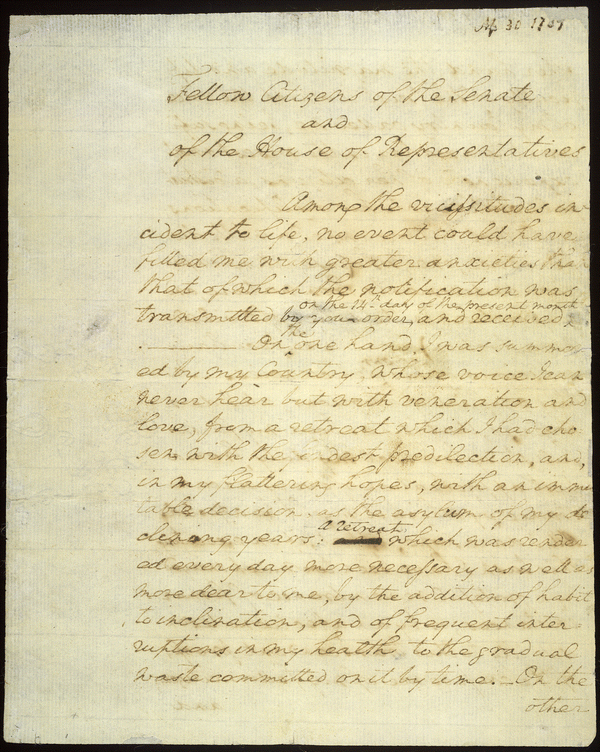
April 27, 2006
The Books: "The Book of Abigail and John"
And here is my next excerpt of the day from my library.
 Next book in my American history section is the massive The Book of Abigail and John: Selected Letters of the Adams Family, 1762-1784 .
My grandmother (dad's mother) used to say that my grandfather was cheating on her. With Abigail Adams.
I grew up in that kind of environment as well. It was all about John Adams. Maybe it was something to do with the fact that my parents grew up around Boston ... so Adams was everywhere. Maybe it was something to do with the fact that my uncle lives in Quincy - so every time we went there for Thanksgiving we drove by the Adams family house. Or maybe it was because 1776 was a HUGE musical in our house. I don't know what it is - I just remember being aware of John and Abigail Adams from a very very young age. I feel like there was never not a time when I did not know about them. Same with George Washington, too. I don't remember the moment when I learned about Washington although there had to have been a first time I heard his name. He was just always there. The other founding fathers came later. I learned about them in the normal way, in classes at school, and during the Bicentennial Blitzkrieg which took over the entire nation during my childhood. It was all American History all the time.
My parents were both so into John and Abigail Adams that it rubbed off on me - and also - I saw a production of 1776 during (of course) that Bicentennial year which comPLETELY turned me on. I was the same girl then that I am now. Only I was 4 feet tall, with bug bites on my legs, and funny glasses that looked too big for my face. So I read the collected letters of John and Abigail - I think I took it out from the library.
Since that time - I've read this book countless times. I don't know - I probably read it once every other year, if I had to guess. It's also something I dip into, for inspiration, all the time. I should put together a daily calendar of quotes from those letters. They are just so so so extraordinary. I never quite get over the fact that we are so BLESSED to have such letters in our public record!!
So what to choose, what to choose.
I decided to go with one of Abigail's letters. And I decided to go with a really personal one. Because the volume is so rich - and because they were apart for the majority of their marriage - they discussed everything in their letters. Abigail ran the farm for the years he was gone. She was quite an astute manager and businesswoman - he might have been totally ruined when it came time for him to retire - if he hadn't had Abigail. So there are letters about seed and planting crops and animals and hired hands. There are AMAZING letters during 1775 - 1776 - I mean, you just read them in awe - the sense of urgency, and mission, and uplift, and fear ...
Then came the long long years when Adams was away in France and the Netherlands ... and it took weeks for letters to arrive - They continued to just write, regardless of lack of response ... Sometimes letters were lost at sea. Sometimes letters were intercepted.
The two of them never really got accustomed to the whole being-apart thing - although they were two strong people, and they managed. But their letters are filled with yearning. Or sometimes the whole letter will be businesslike, filled with surface updates about events ... and then the last paragraph will suddenly open wide, showing the loneliness, the aching for the other ...
They are so so romantic. "My dearest Friend ..."
So I decided to go with one of Abigail's sadder letters, when she let her loneliness be expressed. Both of them were strong people, they bore up well ... but they were intimate with one another. These were letters from one soul to another. You can sense that.
This letter always just tears at my heart. It's become quite famous now - one of her more well-known letters ... but in the moment she wrote it she could have no way of knowing that. She just was missing her "dearest friend".
It's from 1778. Oh, and "Portia" was what Adams called her - it dated from their courtship when they would write these steamy letters to each other, using the names Portia and Lysander. Taking on fake names from the "olden days" freed them up from their more restricted present ... those early letters are awesome.
But the nicknames stuck.
From The Book of Abigail and John: Selected Letters of the Adams Family, 1762-1784 .
ABIGAIL TO JOHN
Sunday Evening December 27 1778
How lonely are my days? How solitary are my Nights? Secluded from all Society but my two Little Boys, and my domesticks, by the Mountains of snow which surround me I could almost fancy myself in Greenland. We have had four of the coldest Days I ever knew, and they were followed by the severest snow storm I ever remember, the wind blowing like a Hurricane for 15 or 20 hours renderd it impossible for Man or Beast to live abroad, and has blocked up the roads so that they are impassible.
A week ago I parted with my Daughter at the request of our P[lymout]h Friends to spend a month with them, so that I am solitary indeed.
Can the best of Friends recollect that for 14 years past, I have not spent a whole winter alone. Some part of the Dismal Season has heretofore been Mitigated and Softned by the Social converse and participation of the Friend of my youth.
How insupportable the Idea that 3000 leigues, and the vast ocean now devide us -- but devide only our persons for the Heart of my Friend is in the Bosom of his partner. More than half a score years has so rivetted it there, that the Fabrick which contains it must crumble into Dust, e'er the particles can be seperated.
"For in one fate, our Hearts our fortunes
And our Beings blend."
I cannot discribe to you How much I was affected the other day with a Scotch song which was sung to me by a young Lady in order to divert a Melancholy hour, but it had quite a different Effect, and the Native Simplicity of it, had all the power of a well wrought Tragidy. When I could conquer my Sensibility I beg'd the song, and Master Charles has learnt it and consoles his Mamms by singing it to her. I will enclose it to you. It has Beauties in it to me, which an indifferent person would not feel perhaps --
His very foot has Musick in't,
As he comes up the stairs.
How oft has my Heart danced to the sound of that Musick?
And shall I see his face again?
And shall I hear him speak?
Gracious Heaven hear and answer my daily petition, "by banishing all my Grief."
I am sometimes quite discouraged from writing. So many vessels are taken, that there is Little chance of a Letters reaching your Hands. That I meet with so few returns is a circumstance that lies heavy on my Heart. If this finds its way to you, it will go by the Alliance. By her I have wrote before, she has not yet saild, and I love to amuse myself with my pen, and pour out some of the tender sentiments of a Heart over flowing with affection, not for the Eye of a cruel Enemy who no doubt would ridicule every Humane and Social Sentiment long ago grown Callous to the finer sensibilities -- but for the sympathetick Heart that beats in unison with
Portia
April 25, 2006
The Books: "The Adams-Jefferson Letters"
And here is my next excerpt of the day from my library.
 Next book in my American history section is the massive The Adams-Jefferson Letters: The Complete Correspondence Between Thomas Jefferson and Abigail and John Adams .
The correspondence between those two has to be one of their greatest legacies they left behind for us. In the beginning - they were just sharing diplomatic information, they were colleagues, and - with Abigail - they were all friends. The rift finally came (it had been building for years) - but finally, they broke apart. And did not speak to one another for years. Benjamin Rush, a friend of both, was the one who "got them back together" - although Jefferson had reached out to Abigail in a letter - he truly missed her friendship. She wrote him back with the now-famous "faithfull are the wounds of a friend" letter which was her 18th century way of saying, "Talk to the hand!" It took Rush's pleading on both sides to open up the way to correspondence again - it's a great story - he told Adams that he had had a dream about it. That these two old gents were meant to correspond with one another ... it was in the stars! I think Rush knew what an amazing document the correspondence would be for future generations - but I don't think even he could anticipate how INCREDIBLE those letters really are.
They are a great great gift.
I love, too, that you can just hear their different personalities IN the letters. Adams is rambunctious, emotional, funny. Jefferson is more reserved - but that makes his little sparks of emotion even more moving. You really get the sense of how much intimacy cost this man. His feelings ran deep deep deep.
So - I picked out two letters to excerpt - which seems so unfair to all the rest of them, but oh well!
In these two letters, we can see the character of the entire correspondence. But you should read the whole thing, if you haven't already!!! The letters illuminate the differences in philosophy between Adams and Jefferson. In some ways, they illuminate the irreconcilable differences. However - overriding all of this is mutal respect and cordiality. They were both in process. Neither of them "gave up" on trying to figure all of this stuff out. When they used to be active politically, their different conclusions caused much strife. But once retired they were free to discuss all of these issues at length, with no object but to illuminate and explain their point of view to the other. (In 1813 John Adams wrote a letter to Jefferson which is still rightly famous - and in it he said: "You and I ought not to die before We have explained ourselves to each other." Gulp. So moving.)
And so that's what they did. Over the next 13 years, they wrote letter after letter, trying to "explain" themselves "to each other". The letters only stopped when they died (er - on the same feckin' day, mkay? Also - ehm ... it was July 4. Mmkay? Also, it was the 50th anniversary of 1776. Mmkay? I mean, you just could not make this shit up!! No one would believe it!)
These are two letters from 1815.
So: a couple things swirling around in the world at that time
-- The aftermath of the war of 1812.
-- Adams and Jefferson watched the meteoric rise of Napoleon with horror. (Jefferson had been a big fan of the French revolution, Adams had been horrified by it ... but they both were horrified by the tyranny of Napoleon. Jefferson called him 'the Attila of the age')
-- March to June 1815: The Hundred Days. (the end of the Napoleonic regime, the last chapter, as it were)
-- But, let us add this in to the mix: Jefferson and Adams, now old men, wondered to one another: who was the greater tyrant, John Bull or this new tyrannical France? They hashed it out. Their anti-British feelings were still strong ... and yet the two of them knew, somehow, that the fortunes of the United States would be forever tied with the fortunes of that original parent nation. (I think of Emily, Bill and myself toasting Tony Blair the first time we all met, clinking our beer glasses together. Ha!)
These events are, collectively, center stage for Adams and Jefferson at this time. They are their current-day concerns. On a more uber level, they wonder: have the advances from the 18th century in political/moral theory and man's enlightenment all been swept away? Is it so easy to regress, did all you and I worked for mean nothing?
Pertinent questions to them in their day, and, I believe, still pertinent to us in ours.
Note - at the end of the first letter: John Adams is making a joke here. A book had just come out which included some of Adams' private letters - used without his permission. And after one of the letters, which had to do with the convulsions going on in Europe at the time, the author of the book characterized Adams' thought process as "the effusions of a splenetic mind, rather than as the sober reflections of an unbiassed Understanding". Adams continuously made jokes from there on out about his "splenetic mind" and its "effusions".
And about Jefferson's reply: The letter is a masterpiece of Jeffersonian abstraction: good vs. evil, light vs. dark ... all that stuff he loved. Diametrical opposites balancing each other out, trembling across the abyss from one another... But anyway - I'll refrain from commenting too much. At least for now. I just love that letter.
JOHN ADAMS to THOMAS JEFFERSON
Quincy Nov. 13 1815
Dear Sir
The fund[a]mental Article of my political Creed is, that Despotism, or unlimited Sovereignty, or absolute Power is the same in a Majority of a popular Assembly, an Aristocratical Counsel, an Oligarchical Junto and a single Emperor. Equally arbitrary cruel bloody and in every respect diabolical.
Accordingly arbitrary Power, wherever it has resided, has never failed to destroy all the records Memorials and Histories of former times which it did not like and to corrupt and interpolate such as it was cunning enough to preserve or to tolerate. We cannot therefore say with much confidence, what Knowledge or what Virtues may have prevailed in some former Ages in some quarters of the World.
Nevertheless, according to the few lights that remain to Us, We may say that the Eighteenth Century, notwithstanding all its Errors and Vices has been, of all that are past, the most honourable to human Nature. Knowledge and Virtues were increased and diffused, Arts, Sciences useful to Men, ameliorating their condition, were improved, more than in any former equal Period.
But, what are We to say now? Is the Nineteenth Century to be a contrast to the Eighteenth? Is it to extinguish all the Lights of its Predecessor? Are the Sorbonne, the Inquisition, the Index expurgatorius, and the Knights Errant of St Ignatius Loyola to be revived and restored to all their salutary Powers of supporting and propagating the mild Spirit of Christianity? The Proceedings of the Allies and their Congress at Vienna, the Accounts from Spain France etc the Chateaubriands and the Genlis, indicate which Way the Wind blows. The Priests are at their Old Work again. The Protestants are denounced and another St Bartholomew's day, threatened.
This however, will probably, 25 Years hence, be honoured with the Character of "the effusions of a splenetic mind, rather than as the sober reflections of an unbiassed Understanding."
THOMAS JEFFERSON to JOHN ADAMS
Monticello Jan. 11 1816
...
I agree with you in all it's eulogies on the 18th century. It certainly witnessed the sciences and arts, manners and morals, advanced to a higher degree than the world had ever before seen. And might we not go back to the aera of the Borgias, by which time the barbarous ages had reduced national morality to it's lowest point of depravity, and observe that the arts and sciences, rising from that point, advanced gradually thro' all the 16th. 17th. and 18th. centuries, softening and correcting the manners and moral of man? I think too we may add, to the great honor of science and the arts, that their natural effect is, by illuminating public opinion, to erect it into a Censor, before which the most exalted tremble for their future, as well as present fame.
With some exceptions only, through the 17th. and 18th. centuries morality occupied an honorable chapter in the political code of nations. You must have observed while in Europe, as I thought I did, that those who administered the governments of the greater powers at least, had a respect to faith, and considered the dignity of their government as involved in it's integrity. A wound indeed was inflicted on this character of honor in the 18th. century by the partition of Poland. But this was the atrocity of a barbarous government chiefly, in conjunction with a smaller one still scrambling to become great, while one only of these already great, and having character to lose, descended to the baseness of an accomplice in the crime.
France, England, Spain shared in it only inasmuch as they stood aloof and permitted it's perpetration. How then has it happened that these nations, France especially and England, so great, so dignified, so distinguished by science and the arts, plunged at once into all the depths of human enormity, threw off suddenly and openly all the restraints of morality, all sensation to character, and unblushingly avowed and acted on the principle that power was right? Can this sudden apostacy from national rectitude be accounted for?
The treaty of Pilnitz seems to have begun it, suggested perhaps by the baneful precedent of Poland. Was it from the terror of monarchs, alarmed at the light returning on them from the West, and kindling a Volcano under their thrones? Was it a combination to extinguish that light, and to bring back, as their best auxiliaries, those enumerated by you, the Sorbonne, the Inquisition, the Index expurgatorius, and the knights of Loyola?
Whatever it was, the close of the century saw the moral world thrown back again to the age of the Borgias, to the point from which it had departed 300. years before. France, after crushing and punishing the conspiracy of Pilnitz, went herself deeper and deeper into the crimes she has been chastising. I say France, and not Bonaparte; for altho' he was the head and mouth, the nation furnished the hands which executed his enormities. England, altho' in opposition, kept full pace with France, not indeed by the manly force of her own arms, but by oppressing the weak, and bribing the strong. At length the whole choir joined and divided the weaker nations among them.
Your prophecies to Dr. Price proved truer than mine [This is a reference to Adams making dire predictions about which way the French revolution was going to go - not a popular view at the time. Adams sensed impending disaster and carnage, and Jefferson thought that "the blood of patriots and tyrants" were needed to water "the tree of liberty". Adams predicted to Dr. Price, in a letter, that a million people would eventually die.]; and yet fell short of the fact, for instead of a million, the destruction of 8 or 10 millions of human beings has probably been the effect of these convulsions. I did not, in 89. believe they would have lasted so long, nor have cost so much blood. But altho' your prophecy has proved true so far, I hope it does not preclude a better final result. That same light from our West seems to have spread and illuminated the very engines employed to extinguish it. It has given them a glimmering of their rights and their power. The idea of representative government has taken root and growth among them. Their masters feel it, and are saving themselves by timely offers of this modification of their own powers. Belgium, Prussia, Poland, Lombardy etc. are now offered a representative organization: illusive probably at first, but it will grow into power in the end. Opinion is power, and that opinion will come.
Even France will attain representative government. You observe it makes the basis of every constitution which has been demanded or offered: of that demanded by their Senate; of that offered by Bonaparte; and of that granted by Louis XVIII. The idea then is rooted, and will be established, altho' rivers of blood may yet flow between them and their object. The allied armies now couching upon them are first to be destroyed, and destroyed they will surely be. A nation united can never be conquered.
We have seen what the ignorant bigotted and unarmed Spaniards could do against the disciplined veterans of their invaders. What then may we not expect from the power and character of the French nation? The oppressors may cut off heads after heads, but like those of the Hydra, they multiply at every stroke. The recruits within a nation's own limits are prompt and without number; while those of their invaders from a distance are slow, limited, and must come to an end.
I think too we perceive that all these allies do not see the same interest in the annihilation of the power of France. There are certainly some symptoms of foresight in Alexander that France might produce a salutary diversion of force were Austria and Prussia to become her enemies. France too is the natural ally of the Turk, as having no interfering interests, and might be useful in neutralizing and perhaps turning that power on Austria. That a re-acting jealousy too exists with Austria and Prussia I think their late strict alliance indicates; and I should not wonder if Spain should discover a sympathy with them. Italy is so divided as to be nothing.
Here then we see new coalitions in embrio which after France shall in turn have suffered a just punishment for her crimes, will not only raise her from the earth on which she is prostrate, but give her an opportunity to establish a government of as much liberty as she can bear, enough to ensure her happiness and prosperity. When insurrection begins, be it where it will, all the partitioned countries will rush to arms, and Europe again become an Arena of gladiators. And what is the definite object they will propose? A restoration of the status quo prius, of the state of possession of 89.
I see no other principle on which Europe can ever again settle down in lasting peace. I hope your prophecies will go thus far, as my wishes do, and that they, like the former, will prove to have been the sober dictates of a superior understanding, and a sound calculation of effects from causes well understood.
April 22, 2006
The Books: "The True History of the United States of America" (Elbridge Streeter Brooks)
And here is my next excerpt of the day from my library.
Next book in my American history section is a book I found in the second-hand bookstore near my parents house - and I just treasure it, in all its outdated glory. Even the title shows it is from a different age. It is called: The True History of the United States of America. And even the author's NAME shows it is from a different age. It is by Elbridge S. Brooks. Elbridge Brooks? Now that's a 19th century moniker! It's a book for kids - and it was first published in 1891 - but I guess it was a big hit at the time, so they kept re-releasing it over the years. But my copy is the 1891 copy. It has that almost glossy type of pages where if you run your hands over it, you can feel the imprint of the type. I love that. And it's filled with awesome illustrations - woodcuts, and cartoons from the newspapers, and drawings of this or that great event in the "true history" of America -- I love the drawings. I just love the whole she-bang. I even love the tone ... the tone boils everything down to its essentials, so that high school kids could get the jist of it.
Here's an excerpt from Chapter III - called "The Naming of America".
The whole John Cabot flag story reminds me of Eddie Izzard's hysterical bit about Empire: "England took over other countries and then maintained a vast empire - They did this with the cunning use of flags." He imagines the first confrontation with India. Snooty English voice: "You're OUR country now." Indian person: "What are you talking about? There are billions of us ... we LIVE here, ya bastards." Snooty English person: "Yes, but ... do you have a flag?"
From i>The True History of the United States of America, by Elbridge S. Brooks.
Columbus, as you have heard, did not know that he had discovered a new world. He thought he had merely touched some of the great islands off the eastern coast of Asia. Even when, in the month of August, 1498, he first saw the mainland of America, at the mouth of the river Orinoco, he did not imagine that he had found a new continent, but believed that he had discovered the fabled river of the East into which, so men said, flowed the four great rivers of the world -- the Ganges, the Tigris, the Euphrates and the Nile.
But his success set other men to thinking, and after his wonderful voyage in 1492 many expeditions were sent westward for purpose of discovery and exploration. After he had found "Cathay" every man, he declared, wanted to become a discoverer. There is an old saying you may have heard that tells us "nothing succeeds like success." And the success of Columbus sent many adventurers sailing westward. They, too, wished to share in the great riches that were to be found in "the lands where the spices grow," and they believed they could do this quite as well as the great admiral. Once at a dinner given to Columbus a certain envious Spaniard declared that he was tired of hearing the admiral praised so highly for what any one else could have done. "Why," said he, "if the admiral had not discovered the Indies, do you think there are not other men in Spain who might have done this?" Columbus made no reply to the jealous Don, but took an egg from its dish. "Can any of you stand this egg on end?" he asked. One after another of the company tried it and failed, whereupon the admiral struck it smartly on the table and stood it upright on its broken part. "Any of you can do it now," he said, "and any of you can find the Indies, now that I have shown you the way."
So every great king in Europe desired to possess new principalities beyond the sea. Spain, Portugal, France, England alike sent out voyages of discovery westward -- "trying to set the egg on end."
Of all these discoverers two other Italians, following where Columbus had led, are worthy of special note -- John Cabot, sent out by King Henry the Seventh of England in 1497, and Amerigo or Alberigo Vespucci, who is said to have sailed westward with a Spanish expedition in the same year. Both of these men, it is asserted, saw the mainland of America before Columbus did, and England founded her claims to possession in South America and fought many bloody wars to maintain them because John Cabot in 1497 "first made the American continent" and set up the flag of England on a Canadian headland. In that same year of 1497 Cabot sailed along the North American coast from the St. Lawrence to the Hudson; and Vespucci, although this is doubted by many, sailed in the same year along the southern coast from Florida to North Carolina. In 1499 Vespucci really did touch the South American coast, and in 1503 he built the first fort on the mainland near the present city of Rio de Janiero.
Both these Italian navigators thought at first, as did Columbus, that they had found the direct way to the Indies, and each one earnestly declared himself to have been the first to discover the mainland. At any rate Vespucci could talk and write the best and he had many friends among the scholars of his day. When, therefore, it really dawned upon men that the land across the seas to which the genius of Columbus had led them was not India or "Cathay" but a new continent, then it was that the man who had the most to say about it obtained the greatest glory -- that of giving it a name.
Wise men who have studied the matter deeply are greatly puzzled just how to decide whether the continent of America took its name from Amerigo Vespucci or whether Vespucci took his name from America. Those who hold to the first quote from a very old book that says, "a fourth part of the world, since Amerigo found it, we may call Amerigo or America;" those who incline to the other opinion claim that America came from an old Indian word Maraca-pan or Amarca, a South American country and tribe; Vespucci, they say, used this native word to designate the new land, and upon its adoption by map-makers deliberately changed his former name of Alberigo or Albericus Vespucci to Amerigo or Americus.
But whichever of these two opinions is correct, the Italian astronomer and ship chandler Vespucci received the honor and glory that Columbus should have received or that Cabot might justly have claimed, and the great continent upon which we live has for nearly four hundred years borne the name that he or his admirers gave to it -- America.
April 21, 2006
The Books: "A History of the American People" (Paul Johnson)
And here is my next excerpt of the day from my library.
 Next book in my American history section is the massive A History of the American People , by Paul Johnson. Massive in scope and really well-written - I totally recommend this book. There are swaths of American history I'm not clear on ... and Paul Johnson attempts to cover it all: industries rising, the birth of American literature, the religious renaissance that swept the nation in the 1800s ... but then, of course, we go through each President ... and each administration, the events that shaped our nation, domestic and foreign. Johnson's English, an outsider, but I think that makes him even more qualified to write about some of this stuff, because he's not trying to stick it to a political party he despises, he's not trying to right a historical wrong, he doesn't write with a massive CHIP on his shoulder, which is unbelievably refreshing. He certainly has opinions - he's LOADED with opinions ... but it's still an outsider's analysis of how our nation morphed into what it is today. Johnson loves America. He is certainly not uncritical of a lot of it - but whatever, we're a huge nation - anyone who is completely uncritical of America in a kneejerk way is a moron.
Johnson writes at the end of his introduction: "I have not bowed to current academic nostrums about nomenclature or accepted the fly-blown philacteries of Political Correctness. So I do not acknowledge the existence of hyphenated Americans, or Native Americans, or any other qualified kind. They are all Americans to me: black, white, red, brown, yellow, thrown together by fate in that swirling maelstrom of history which has produced the most remarkable people the world has ever seen. I love them and salute them, and this is their story."
He's a marvelous writer. This book is enormous and rather daunting - but I can't recommend it highly enough.
It was hard to figure out what to choose as an excerpt - there's so much awesome information here - but I decided to go with an excerpt from his section called "Monster Cities: Chicago and New York". I loved this section especially because Chicago and New York are both so dear to me ... I loved reading about their development.
From A History of the American People , by Paul Johnson.
New York, by contrast, was circumferenced by water and chose to have its park, on a giant scale, in the middle. New York was still second in size to Philadelphia at the time of the 1810 census, with 91,874 to 96,373 people, and the plan for its development laid down the following year provided only minimum public spaces (its original Parade Ground between 23rd and 34th Streets had been long since greedily built over). But when the fashions for laying out big public parks within cities was brought from London and Paris soon after, New York still had plenty of undeveloped land in central Manhattan, and the city fathers were able to set aside an enormous area. The landscape architect F.L. Olmsted (1822-1903), from Hartford, Connecticut, that nursery of genius, together with the Londoner Calvert Vaux (1824-95), designed Central Park as an extraordinary multi-class complex of carriage drives, walks, lakes for fishing, boating, and skating, and boulder-strewn wilderness woods.
By the time the Park was in working order the City was fast growing up around it. Population was then 813,000. Forty years later, thanks largely to immigration, it was nearly 3,500,000 and still growing at breakneck speed. The rise of high buildings meant that the immense flat space of Central Park was increasingly surrounded by a periphery of stone and masonry achieving spectacular effects of precisely the rus in urbe appeal which had been the aim of the earliest town planners, like John Nash of London. No other city in the world can produce these skylines. First came four or five-story structures, developed out of British precedent for shops, factories, and warehouses, the leading spirits being two brilliant iron-founders of the 1850s, Daniel Badger and James Bogardus. From this emerged cage-constructions, whose interiors were self-supporting metal frameworks reinforced by independent masonry walls. Next was skeleton-type construction, in which even the external walls hung off the metal frame. The Equitable Building of 1868-70 is often regarded as the first New York skyscraper: it had a frontage only five bays wide but it rose to 142 feet in eight stories and was serviced by two elevators. (Its replacement, the Equitable Building of 1913-15, was an entire block, reached forty stories and 542 feet, and had forty-eight elevators making 50,000 trips a day, giving some idea of the leap from large to gigantic in New York City in these four decades.
Evidently the New York skyline was beginning to assume its characteristic form, and to promote deep thoughts in visitors, as early as 1876, when T.H. Huxley, the leading promoter of scientific ideas in Europe, made his first visit. His verdict was: "Ah, that is interesting. In the Old World, the first things you see as you approach a great city are steeples; here you see, first, centers of intelligence." Huxley was in a sense right: the skyscraper represented the application of science at its frontiers and imaginative intelligence in the art of building in precisely the way a great Renaissance architect like Michelangelo would have instantly appreciated. But the men who devoted huge creative intelligence and engineering and mathematical skills to making New York a "scientific city" did not share Huxley's atheism. Rather the contrary. A characteristic American religiosity tended to enter even the field of the high-rise and the structurally gigantic. John Roebling (1806-99), the German-trained immigrant who designed the Brooklyn Bridge (it was completed by his son Washington in 1883), then the longest suspension bridge in the world, said it was "proof positive that our mind is one with the Great Universal Mind."
New York differed from Chicago in key respects. Though less innovative, it was richer in the sense that it was the source of the capital for Chicago as well as itself, and most major firms with immortal longings, who wished to commemorate themselves with the tallest, largest, most expensive skyscraper, had their headquarters in New York. So ultimately New York skyscrapers were not only taller but more decorative. The ten-story Western Union headquarters was put up in 1873-5, followed quickly by the eleven-story Tribune building, then the sixteen-story World Building in 1889-90 and the twenty-story Manhattan Life Insurance giant of 1893. New York soon surpassed Chicago in height, with ten stories or more added every decade, and it indulged in fantastic and often beautiful accretions of domes, columns, and spires. Most New York skyscrapers were permanent advertisements for their companies. Thus the Singer Building of 1902 paid for its construction by one year's extra sales in Asia alone. Equally, New York's vast insurance industry dictated the construction, regardless of cost, of headquarters buildings which vaunted strength, size, and durability (rather like banks). In the first decade of the 20th century, the Metropolitan Life had insurance in force totaling over $2.2 billion, so it built and occupied, 1909-10, an immense temple in the sky which was 700 feet high, the world's tallest for a time. Another example was the spectacular Woolworth Building of 1911, which for long represented the skyscraper. Frank Winfield Woolworth (1852-1919), who established his first five-and-ten-cent store in 1879 and by 1911 had over 1,000 worldwide, told the contractor who put up his building that though it could never make a proper return on capital it had an enormous hidden profit as a gigantic signboard.
By 1903 office rents were four times higher in Manhattan than in central Chicago and that was one reason buildings were taller. High rents also determined the cluster of skyscrapers within easy reach of the Stock Exchange: by 1910 they could be as high as $24,750 a square foot in Wall Street but only $800 in South Street a few blocks away. Then in 1916 came the New York Set-Back ordinance: so long as your architect worked out the set-backs correctly, you could go to any height you liked. Grandeur and display raised the height well above the economic optimum and by 1930 it was averaging sixty-three stories in the best area around Grand Central, with the Chrysler Building (1929-30) pushing up to seventy-seven stories, the extra being the advertising element. The sensation of the 1920s, indeed, was the development of the Grand Central area as an alternative to Wall Street, and New York skyscrapers are still to this day grouped around these two foci.
But we are getting ahead of our story, and above it too, for beneath the towering New York high-rises were the clustering tenements, themselves also multistory, of the burgeoning metropolis of the 1870s, 1880s, and 1890s. New York had begun as a Dutch city, then had expanded as a mainly English city, then in the 19th century had broadened into a multiethnic city, much favored by Germans and, above all, by the Irish. Then came the turn of the Italians, the Greeks, and the Jews from Eastern Europe. The outbreak of savage state pogroms in Russia from 1881 had dramatic consequences for New York. In the following ten years Jews were arriving in the city at the rate of 9,000 a year. In the 1890s it jumped to an average of 37,000 a year and in the twelve years 1903-14 it averaged 76,000 a year. In 1886 the Grench people commemorated the centenary of American Independence by having their sculptor Frederic Auguste Bartholdi fashion a gigantic copper statue of Liberty, which was placed on a 154-foot pedestal on Bedloe's Island in New York Harbor, the whole rising to 305 feet, making it the highest statue in the world. A local Jewish relief worker, Emma Lazarus (1849-87), whose talent had been spotted by Emerson, grasped, perhaps better than anyone else in America at that time, the true significance of the open-door policy to the persecuted poor of Europe. So she wrote a noble sonnet, "The New Colossus," celebrating the erection of the statue, in which the Goddess of Liberty herself speaks to the Old World:
Give me your tired, your poor,
Your huddled masses yearning to breathe free,
The wretched refuse of your teeming shore.
Send these, the homeless, the tempest-toss'd to me.
I lift my lamp beside the golden door.
The refugees and the huddled masses crowded not just into Manhattan as a whole but in particular into the Lower East Side, one and a half square miles bounded by the Bowery, Third Avenue, Catherine Street, 14th Street, and the East River. In 1894 the density of Manhattan reached 142.2 people an acre, as opposed to 126.9 in Paris and 100.8 in Berlin. They were much higher than the Chicago tenements, perhaps safer -- fire escapes had been made obligatory in 1867 -- and far more crowded. The most infested were the Dumbell Tenements, which get their name from a shape determined by the 1879 regulartion which imposed airshafts. They were five to eight stories high, 25 feet wide, 100 feet deep, and with fourteen rooms, only one of which got natural light, on each floor. Over half a million Jews were crowded into the Lower Easy Side, and the heart of New York Jewry was the Tenth Ward, where, in 1893, 74,401 people lived in 1,196 tenements spread over six blocks. Five years later the population density in Tenth Ward was 747 persons per acre or 478,080 per square mile. By comparison, the modern density of Calcutta is only 101,010 per square mile (1961-3). The New York buildings had more stories of course; even so, the Tenth Ward was probably the most crowded habitation, in the 1890s, in the whole of human history. By 1900 there were 42,700 tenements in Manhattan, housing 1,585,000 people.
So here were luxury skyscrapers surrounded by slums, an image of rich-and-poor America. And the poor were, in a sense, sweated labor, most of them in the 'needle trades'. By 1888 no less than 234 out of 241 New York clothing firms were Jewish. By 1913 clothing was New York's biggest industry, with 16,552 factories, nearly all Jewish, employing 312,245 people. But the apparent rich-poor dichotomy concealed a huge engine of upward mobility. The whole engine of America was upwardly mobile, but New York, for the penniless immigrant, was the very cathedral of ascent.
April 18, 2006
Today in history: April 18-19, 1775
On the night of April 18, into April 19, in 1775, Paul Revere made his famous ride.
The spring of 1775 was a tense time. Prominent Bostonians were under constant threat of arrest from the British, and many of them - to avoid this - moved their families to outlying communities. However, two of the main patriotic leaders (Benjamin Church and Joseph Warren) stayed in Boston. Paul Revere did as well, and kept a close eye on British movements through that spring. Revere was trusted as a messenger, he knew everybody, he was just one of those guys.
In mid-April, Revere started to notice some ominous signs: mainly that the British ships were taken out of the water, to be worked on, repaired. He could sense that something was coming. He felt the British were preparing for some kind of attack.
Revere went to Concord on April 16 (most of the weaponry was stored there) and warned the leaders of that community that the British were preparing something, they were up to something, and if they were going to strike, they would most definitely try to seize the weapons stash in Concord. So the people of Concord went to work, hiding their store of weapons in barns, cellars, swamps, etc. (Like I mentioned: Paul Revere was trusted. He knew everybody. If you're interested, read the excerpt I posted of Malcolm Gladwell's fascinating analysis of Paul Revere - and Gladwell's comparison with the far less successful messenger on that very same night - William Dawes.)
So. April 16. Revere returned to Boston from Concord, and met with other revolutionary leaders, and that is when they came up with the "one if by land, two if by sea" warning system. Revere knew they needed a way to have some advance warning about which route the British were going to take when they finally did attack.
By land? Or by sea?
So, Revere set up the system: Signal lanterns would be placed in the belfry of Old North Church (the steeple can be seen across the Charles River). If two lanterns were hung, then the British would be crossing the Charles by boat. If one lantern was hung, then the British would choose to attack using a land route.
"One if by land, two if by sea."
This plan was put in place just in time. On April 18, in the early evening, a stable boy came to Paul Revere, telling him that he had overheard some British soldiers discussing the upcoming attack, and that it was planned for early the next morning. The stable boy knew who to bring this information to, and that was Paul Revere. (Again, check out Gladwell's analysis of Paul Revere's personality. Really interesting.)
Revere, on receiving this urgent piece of information, knew he had to get the warning out (and that he especially had to warn John Hancock and Samuel Adams who, at that time, were hiding out in Lexington).
The signal was given: two lanterns.
So off he went onto his now legendary ride. Revere took the water route out of Boston, rowed across the Charles, and galloped through the communities north of Boston sounding the alarm. (Medford, Charlestown, Lexington, Concord.) Because of Paul Revere, the British had completely lost the element of surprise. When they came to attack, they found the rebellious colonists waiting for them everywhere, ambushing them left and right, from behind stone walls, hiding behind trees ...
An interesting tidbit (this is why I love this time in American history - yeah, the events themselves are really cool ... but it's details like the following one that really have me hooked, like a crack addict):
In his hurry to depart, Revere forgot to bring along pieces of cloth to wrap the oars of his boat. The purpose of this was to muffle the sound of them cutting through the water. The Somerset (the British man-of-war) was at anchor, right there in the harbor. Paul Revere had to row right by them, and so any sound at all would have alerted the crew, and if Revere was busted, the whole jig would be up. Revere was in a bit of a pickle ... standing by his boat, trying to figure out how he could improvise ... could he take off his stockings? Tie them around the end of the oars?
One of the boatmen involved in helping Revere make this crossing came to the rescue. He ran to his girlfriend's house and asked her for her petticoat. hahaha One can only imagine her startled response to the nighttime demand at her door: "Please, dear. It's 10 pm, and I need you to take off your petticoat, give it to me, and don't ask me ANY questions about it!!" But apparently, this girl, whoever she was, complied - took off her petticoat, gave it up, and Revere used that to wrap up the ends of his oars.
I love that woman, whoever she is.
So. In honor of the great Paul Revere, I have a couple other things to post. One is, my conversation with Cashel about the American Revolution. I read that piece on the radio in 2003. I love it. It's one of my favorite conversations I've ever had with him.
And lastly, please find Henry Wadsworth Longfellow's celebrated poem "Paul Revere's Ride". I know large swaths of it by heart ... To me, it's a thrilling poem. Because of the story it tells, but also because of its rollicking rhythm, you can feel the suspense, you can feel the urgency. It's meant to be read out loud. Try it for yourself - it's so much funner that way. You can feel the beat of the horse hooves in the poem. The last stanza is beyond compare. "For borne on the night-wind of the Past ..." I mean, come ON!!
April 18, 1775. A great day in American history. One of my personal favorite "stories" of the American revolution.
Paul Revere's Ride
- by Henry Wadsworth LongfellowListen my children and you shall hear
Of the midnight ride of Paul Revere,
On the eighteenth of April, in Seventy-five;
Hardly a man is now alive
Who remembers that famous day and year.
He said to his friend, "If the British march
By land or sea from the town to-night,
Hang a lantern aloft in the belfry arch
Of the North Church tower as a signal light,--
One if by land, and two if by sea;
And I on the opposite shore will be,
Ready to ride and spread the alarm
Through every Middlesex village and farm,
For the country folk to be up and to arm."
Then he said "Good-night!" and with muffled oar
Silently rowed to the Charlestown shore,
Just as the moon rose over the bay,
Where swinging wide at her moorings lay
The Somerset, British man-of-war;
A phantom ship, with each mast and spar
Across the moon like a prison bar,
And a huge black hulk, that was magnified
By its own reflection in the tide.
Meanwhile, his friend through alley and street
Wanders and watches, with eager ears,
Till in the silence around him he hears
The muster of men at the barrack door,
The sound of arms, and the tramp of feet,
And the measured tread of the grenadiers,
Marching down to their boats on the shore.
Then he climbed the tower of the Old North Church,
By the wooden stairs, with stealthy tread,
To the belfry chamber overhead,
And startled the pigeons from their perch
On the sombre rafters, that round him made
Masses and moving shapes of shade,--
By the trembling ladder, steep and tall,
To the highest window in the wall,
Where he paused to listen and look down
A moment on the roofs of the town
And the moonlight flowing over all.
Beneath, in the churchyard, lay the dead,
In their night encampment on the hill,
Wrapped in silence so deep and still
That he could hear, like a sentinel's tread,
The watchful night-wind, as it went
Creeping along from tent to tent,
And seeming to whisper, "All is well!"
A moment only he feels the spell
Of the place and the hour, and the secret dread
Of the lonely belfry and the dead;
For suddenly all his thoughts are bent
On a shadowy something far away,
Where the river widens to meet the bay,--
A line of black that bends and floats
On the rising tide like a bridge of boats.
Meanwhile, impatient to mount and ride,
Booted and spurred, with a heavy stride
On the opposite shore walked Paul Revere.
Now he patted his horse's side,
Now he gazed at the landscape far and near,
Then, impetuous, stamped the earth,
And turned and tightened his saddle girth;
But mostly he watched with eager search
The belfry tower of the Old North Church,
As it rose above the graves on the hill,
Lonely and spectral and sombre and still.
And lo! as he looks, on the belfry's height
A glimmer, and then a gleam of light!
He springs to the saddle, the bridle he turns,
But lingers and gazes, till full on his sight
A second lamp in the belfry burns.
A hurry of hoofs in a village street,
A shape in the moonlight, a bulk in the dark,
And beneath, from the pebbles, in passing, a spark
Struck out by a steed flying fearless and fleet;
That was all! And yet, through the gloom and the light,
The fate of a nation was riding that night;
And the spark struck out by that steed, in his flight,
Kindled the land into flame with its heat.
He has left the village and mounted the steep,
And beneath him, tranquil and broad and deep,
Is the Mystic, meeting the ocean tides;
And under the alders that skirt its edge,
Now soft on the sand, now loud on the ledge,
Is heard the tramp of his steed as he rides.
It was twelve by the village clock
When he crossed the bridge into Medford town.
He heard the crowing of the cock,
And the barking of the farmer's dog,
And felt the damp of the river fog,
That rises after the sun goes down.
It was one by the village clock,
When he galloped into Lexington.
He saw the gilded weathercock
Swim in the moonlight as he passed,
And the meeting-house windows, black and bare,
Gaze at him with a spectral glare,
As if they already stood aghast
At the bloody work they would look upon.
It was two by the village clock,
When he came to the bridge in Concord town.
He heard the bleating of the flock,
And the twitter of birds among the trees,
And felt the breath of the morning breeze
Blowing over the meadow brown.
And one was safe and asleep in his bed
Who at the bridge would be first to fall,
Who that day would be lying dead,
Pierced by a British musket ball.
You know the rest. In the books you have read
How the British Regulars fired and fled,---
How the farmers gave them ball for ball,
>From behind each fence and farmyard wall,
Chasing the redcoats down the lane,
Then crossing the fields to emerge again
Under the trees at the turn of the road,
And only pausing to fire and load.
So through the night rode Paul Revere;
And so through the night went his cry of alarm
To every Middlesex village and farm,---
A cry of defiance, and not of fear,
A voice in the darkness, a knock at the door,
And a word that shall echo for evermore!
For, borne on the night-wind of the Past,
Through all our history, to the last,
In the hour of darkness and peril and need,
The people will waken and listen to hear
The hurrying hoof-beats of that steed,
And the midnight message of Paul Revere.
The Books: "Founding Brothers" (Joseph Ellis)
And here is my next excerpt of the day from my library.
 Next book in my American history section is the marvelous Founding Brothers: The Revolutionary Generation , by Joseph Ellis.
7 guys: Hamilton, Aaron Burr, Jefferson, Adams, Washington, Madison, Franklin
6 episodes:
-- The duel between Hamilton and Burr
-- George Washington's Farewell Address
-- The Adams administration
-- The heated debate about where to place the capital
-- Benjamin Franklin trying to force Congress to deal with the issue of slavery and James Madison's resistance to that
-- The correspondence between John Adams and Thomas Jefferson
Ellis is one of my favorite popular historians out there. I've read all of his stuff by now. Wonderful writer, but why I really like him is that I like how he THINKS. I like to hear what he thinks about things. He comes at things from a different angle. Unlike so many other historians or biographers, he seems quite comfortable with contradiction, mystery, and with saying, as an author: "We can't really know what Jefferson was thinking here ..." He tries to guess, but we KNOW he's guessing, and it's a pleasure to listen to his speculations.
His biography of Jefferson is not-to-be-missed as well, although I like all of his stuff.
With this book, Founding Brothers he hit the big leagues. As in NY Times bestseller list, etc. Small wonder.
I love it!! I've already read it twice. Here's an excerpt from the chapter on Washington's farewell address (props to Alexander Hamilton) - and why it continuees to be studied, picked apart, interpreted and re-interpreted.
From Founding Brothers: The Revolutionary Generation , by Joseph Ellis.
The disarming simplicity of the statement, combined with its quasi-Delphic character, has made the Farewell Address a perennial candidate for historical commentary. Throughout the nineteenth and most of the twentieth centuries, the bulk of attention focused on the foreign policy section, advocates of American isolationism citing it as the classic statement of their cause, others arguing that strict isolation was never Washington's intention, or that America's emergence as a world power has rendered Washington's wisdom irrelevant. More recently, the early section of the Farewell Address has been rediscovered, its plea for a politics of consensus serving as a warning against single-issue political movements, or against the separation of American into racial, ethnic, of gender-based constituencies. Like the classic it has become, the Farewell Address has demonstrated the capacity to assume different shapes in different eras, to change color, if you will, in varying shades of light.
Although Washington's own eyes never changed color and were set very much on the future, he had no way of knowing (much less influencing) the multiple meanings that future generations would discover in his words. The beginning of all true wisdom concerning the Farewell Address is that Washington's core insights were firmly grounded in the lessons he had learned as America's premier military and civilian leader during the revolutionary era. Unless one believes that ideas are like migratory birds that can fly unchanged from one century to the next, the only way to grasp the authentic meaning of his message is to recover the context out of which it emerged. Washington was not claiming to offer novel prescriptions based on his original reading of philosophical treatises or books; quite the opposite, he was reminding his countrymen of the venerable principles he had acquired from personal experience, principles so obvious and elemental that they were at risk of being overlooked by his contemporaries; and so thoroughly grounded in the American Revolution that they are virtually invisible to a more distant posterity.
First, it is crucial to recognize that Washington's extraordinary reputation rested less on his prudent exercise of power than on his dramatic flair at surrendering it. He was, in fact, a veritable virtuoso of exits. Almost everyone regarded his retirement of 1796 as a repeat performance of his resignation as commander of the Continental Army in 1783. Back then, faced with a restive and unpaid remnant of the victorious army quartered in Newburgh, New York, he had suddenly appeared at a meeting of officers who were contemplating insurrection; the murky plot involved marching on the Congress and then seizing a tract of land for themselves in the West, all presumably with Washington as their leader.
He summarily rejected their offer to become the American Caesar and denounced the entire scheme as treason to the cause for which they had fought. Then, in a melodramatic gesture that immediately became famous, he pulled a pair of glasses out of his pocket: "Gentlemen, you will permit me to put on my spectacles," he declared rhetorically, "for I have not only grown gray but almost blind in service to my country." Upon learning that Washington intended to reject the mantle of emperor, no less an authority than George III allegedly observed, "If he does that, he will be the greatest man in the world." True to his word, on December 22, 1783, Washington surrendered his commission to the Congress, then meeting in Annapolis: "Having now finished the work assigned me," he announced, "I now retire from the great theatre of action." In so doing, he became the supreme example of the leader who could be trusted with power because he was so ready to give it up.
April 17, 2006
The Books: "Miracle At Philadelphia" (Catherine Drinker Bowen)
And here is my next excerpt of the day from my library.
 Next book in my American history section is the classic, and one of my all-time favorites: Miracle At Philadelphia : The Story of the Constitutional Convention May - September 1787 , by Catherine Drinker Bowen. She's such a good writer that you feel like you were there. She paints brief vivid portraits of all of the participants - many of them have famous names, of course - but there's something about her writing that makes the thing pop off the page. The image of Ben Franklin, with his gout, being carried in a chair by 4 servants to Independence Hall, etc. I mean, obviously, this is one of my favorite times in history - and this book really captures the spirit of why. These guys were BRAINIACS, first of all ... but what really blows me away is how they were just human beings, they couldn't see into the future, but they TRIED ... they tried to set up the constitution in a way to leave enough vagueness, enough ambiguity - that it would continue to be relevant as time went on. It's, frankly, amazing what they were able to accomplish.
This book is fantastic. If you're an American history buff, and you haven't read it -then go out right now and buy it. If you're gonna write about the Constitutional Convention, then this is the book to beat.
Here is an excerpt, describing the arrival of the delegates for the start of the convention.
From Miracle At Philadelphia : The Story of the Constitutional Convention May - September 1787 , by Catherine Drinker Bowen.
On the twenty-fifth of May, when a quorum was obtained, Washington was unanimously elected president of the Convention and escorted to the chair. From his desk on the raised dais he made a little speech of acceptance, depreciating his ability to give satisfaction in a scene so novel. "When seated," wrote a member, "he declared that as he never had been in such a situation he felt himself embarrassed, that he hoped his errors, as they would be unintended, would be excused. He lamented his want of qualifications."...
In the front row near the desk, James Madison sat bowed over his tablet, writing steadily. His eyes were blue, his face ruddy; he did not have the scholar's pallor. His figure was well-knit and muscular and he carried his clothes with style. Though he usually wore black, he has also been described as handsomely dressed in blue and buff, with ruffles at breast and wrist. Already he was growing bald and brushed his hair down to hide it; he wore a queue and powder. He walked with the quick bouncing step that sometimes characterizes men of remarkable energy.
As a reporter Madison was indefatigable, his notes comprehensive, set down without comment or aside. One marvels that he was able at the same time to take so large a part in the debates. It is true that in old age Madison made some emendations in the record to accord with various disparate notes which later came to light; he has been severely criticized for it. Other members took notes at the Convention: Hamilton, Yates and Lansing of New York, McHenry of Maryland, Paterson of New Jersey, Rufus King of Massachusetts, William Pierce of Georgia, George Mason of Virginia. But most of these memoranda were brief, incomplete; had it not been for Madison we should possess very scanty records of the Convention. His labors, he said later, nearly killed him. "I chose a seat," he afterward wrote, "in front of the presiding member, with the other members on my right and left hand. In this favorable position for hearing all that passed, I noted in terms legible and in abbreviations and marks intelligble to myself what was read from the Chair or spoken by the members; and losing not a moment unnecessarily between the adjournment and reassembling of the Convention I was enabled to write out my daily notes during the session or within a few finishing days after its close in the extent and form preserved in my own hand on my files ... I was not absent a single day, nor more than a casual fraction of an hour in any day, so that I could not have lost a single speech, unless a very short one."
It was, actually, a tour de force, not to be published -- and scarcely seen -- until thirty years after the Convention. "Do you know," wrote Jefferson to John Adams from Monticello in 1815, "that there exists in manuscript the ablest work of this kind ever yet executed, of the debates of the constitutional convention of Philadelphia ...? The whole of everything said and done there was taken down by Mr. Madison, with a labor and exactness beyond comprehension." ...
"The State of Georgia, by the grace of God, free, Sovereign and Independent" ... On Friday morning, May twenty-fifth, as soon as Washington had finished his little speech of acceptance from the chair, Major Jackson rose to read aloud the credentials -- so carefully worked over at home -- of the nine states present. It was noticeable that the smallest states spoke out with the loudest voice. Georgia, referred to as "small and trifling" because of her sparse population, announced herself to the Convention with a proud resounding orchestration which left little doubt of her position ... "Sovereign and Independent."
Certain members of the Convention were already heartily sick of the word sovereign. The monster, sovereignty, Washington had called it. The General knew well from what sanction Georgia derived the word. "Each state," the Articles of Confederation had said, "retains its sovereignty, freedom and independence." Without such a clause the Confederacy never would have been achieved ...
Before the Declaration of Independence, no colony had pretensions to independent sovereignty, nor were the states mentioned by name in the body of that document. Yet from the moment peace had been signed, states flaunted their sovereignty as an excuse to do as they pleased. "Thirteen sovereignties," Washington had written, "pulling against each other, and all tugging at the foederal head, will soon bring ruin on the whole."
A General of the Army is not expected to possess so direct and merciless a political eye. Already on May 25, 1787, it looked as if the Federal Convention were to have its fill of sovereignty. The reading aloud of these state credentials was a matter for strict attention; here were signs portent of which way the states were leaning. Madison and Hamilton thought they already knew. Madison had canvassed exhaustively; both men were personally acquainted with many delegates, some of whom had themselves drafted these documents and no doubt would stand by what they had written. Delaware, for instance, whose credentials forbade her deputies to change Article V of the Confederation, giving to each state one vote in Congress and one vote only. Proportional representation was no part of Delaware's scheme. Should the old rule be altered to voting by population, the small states would be blanketed out. Delaware had come prepared to oppose it.
Small states against large, the planting interests of the South against the mercantile money of the North, the regulation of the Western Territory -- these were immediate problems. Not every delegate brought to Philadelphia a comprehension of how thirteen independent states could share a government of tripartite powers: legislative, judicial, executive. James Wilson of Philadelphia understood it and so did Wythe of Virginia. Wilson and Wythe were scholars like Madison. Not only had they acted a part in government bu tthey had thought, red, pondered on the subject; they knew the theory behind the practice. "I am both a citizen of Pennsylvania and of the United States," Wilson told the Convention.
Time would pass before members realized how far the plans of such men as Madison and Hamilton reached, and what the Constitution promised to be. It would be misleading to name thus early the Constitution's "enemies", or to set down this name or that as "against" the Constitution. Five delegates in the end would refuse to sign -- Elbridge Gerry of Massachusetts, Yates and Lansing of New York, George Mason and Edmund Randolph of Virginia -- all men of decided views and each with a different reason for his action. More vociferous than any of these would be Luther Martin of Maryland, who, though out of town on private business at the moment of signing, later declared that had he been present he would have given the document his "solemn negative," even had he "stood single and alone".
Martin did not arrive at the Convention until nearly a month after it met; for the moment, members were spared his boisterous and interminable harangues. On this first Saturday of a quorum the Convention faced a twofold problem: the theoretic question of what kind of government best suited America -- a democracy, a limited monarchy, a republic? -- and the practical problem of creating such a government with all its untried component parts. It was good to review, by way of the state credentials, the aims of the Convention as declared by twelve legislatures. Major Jackson's voice droned on:
"To take into consideration the state of the union ... as to trade and other important objects ... to render the Foederal Government entirely adeuqate to the actual situation ..." When Jackson ceased there was time only to name a committee to prepare standing rules and orders, and to appoint a doorkeeper and messenger. The meeting adjourned for the weekend.
April 15, 2006
The Books: "Angel in the Whirlwind : The Triumph of the American Revolution" (Benson Bobrick)
And here is my next excerpt of the day from my library.
Okay, now I'm all nervous and excited. I'm now ready to begin my American history section. I get nervous about this stuff because I am SO into it that I fear I won't be able to express myself properly. Or - I get so excited that all I want to do is scream. So I get nervous. I'm such a moron.
 First book in this section is Angel in the Whirlwind : The Triumph of the American Revolution, by Benson Bobrick. I really like this book. You know why? He comes right out in his introduction saying: "A great many books have been written on the American Revolution and quite a few of them are good. I have not written mine to try to supersede them, or out of some general dissatisfaction with the canon, but -- hearkening to the voice of my own ancestral heritage -- to retell the story in my own way." He had ancestors who died on both sides of the war. So - it's a story he likes, and he decided to write a book about it. There is nothing new here - but what I really like about it is his enthusiasm for the subject. He's not a scholar. He just loves the story, and that comes through in his writing. Fans of this period in history would really enjoy this book. He's no Catherine Drinker-Bowen, but then again - who is?
I also like (as always) how many primary documents he includes. That's the stuff that I really like - because no matter how good a present-day narrator is - the men (and women) who were actually THERE told the story best - in their letters, and speeches, and pamphlets, etc. Bobrick peppers his entire narrative with first-person descriptions of this or that event. The book moves at a breakneck pace, and it's a blast. Again - nothing new, but really enjoyable.
I'm going to post an excerpt about one of my favorite "characters" in this story: Friedrich Wilhelm von Steuben. In 1778, Steuben - a Prussian, a veteran of many wars, a guy who served under Frederick the Great - arrived at Valley Forge - he was there to help whip the ragtag Continentals into an army that could win. Steuben just fascinates me. He passed himself off as a baron. He wasn't a baron. He passed himself off as a "lieutenant general" - but he had never gotten that high up in the ranks. But hey - he was a "baron" who was also a "lieutenant general", and that's final! Washington was impressed with his abilities, and brought him onto the team. Ben Franklin - who had met Steuben in Paris, and who agreed with the French attitude that the American army needed an overhaul - needed organization - was the one who sent him to America, writing a letter of introduction to Washington for Steuben
Here's an excerpt: (the whole anecdote about the petticoats is hysterical)
EXCERPT FROM Angel in the Whirlwind : The Triumph of the American Revolution, by Benson Bobrick.
On September 26, Steuben set sail for America in a warship that masqueraded as a commercial transport belonging to Beaumarchais's Rodrique Hortalez & Co. with the pretended destination of Martinique. The crossing took two months, which allowed Steuben plenthy of time to occupy himself with mathematical calculations (according to his predilection), take target practice, and acquaint himself with the words of the Abbe Raynal. When his ship finally docked at Portsmouth, New Hampshire, on December 1, he was effusively welcomed by the local American commander, inspected the harbor fortifications, and dispatched a letter to Washington at Valley Forge. Briefed in advance about the political sensitivity of foreign appointments, he wrote, "My greatest ambition is to deserve the title of a citizen of America by fighting for the cause of liberty. But if the distinguished ranks in which I have served in Europe should be an obstacle, I had rather serve under your Excellecy as a volunteer than to be a student of discontent to such deserving officers as have already distinguished themselves amongst you."
From Portsmouth, he proceeded to Boston, where he was the guest of John Hancock, and then on to York, Pennsylvania, to see what Congress would do.
The journey was not without adventure. Near the Connecticut border, when his weary party sought refuge from a furious snowstorm, a Tory innkeeper refused to put him up. "I have no beds, bread, meat, drink, milk, nor eggs for you," he adamantly told them, which they could see was untrue. But repeated remonstrations did no good. "Bring me my pistols!" cried Steuben in German, and suddenly the innkeeper found a pistol at his chest. Accommodations were promptly furnished; their table lavishly spread. The following morning, after an abundant breakfast, the party resumed its journey, not forgetting to pay the innkeeper liberally with the Continental money he despised.
In Pennsylvania, where the Pennsylvania Dutch (Deutsch) community was large, he was everywhere received with both hospitality and pride. Many members of the community had portraits of Frederick the Great on their walls, and in one establishment at Manheim he almost collapsed from laughter at an engraving showing a Prussian knocking down a Frenchman, with the caption, "Ein Franzmann zum Preuszen wie eine Mucke" ("To a Prussian a Frenchman is like a goat.")
Steuben made a favorable impression at York. Congress accepted his services, and he set out for Valley Forge. Washington met him on the outskirts of his encampment, and the very next day the troops were mustered for his review. "Never before or since, have I had such an impression of the ancient fabled God of War," wrote a young private long afterward, "as when I looked on the baron: he seemed to me a perfect personification of Mars. The trappings of his horse, the enormous holster of his pistols, his large size, and his strikingly martial aspect, all seemed to favor the idea."
Steuben soon discovered that in the Continental Army as it existed there was little internal administration in the conventional sense. Although the number of men in a regiment or a company, for example, had been fixed by Congress, each was made up of men who had enlisted for different terms. Thus, with the uncharted comings and goings of personnel, at any given moment, a company might have more men in it than a regiment and a regiment than a brigade. "The words company, regiment, brigade and division were so vague," he wrote, "that they did not convey any idea upon which to form a calculation, either of the particular corps or of the army in general ... I have seen a regiment consisting of thirty men, and a company of one corporal ... No captain kept a book." Leaves of absence and even dismissals were not always recorded, and many still on the regimental books had long since ceased to be part of the army. Army property -- muskets, bayonets, clothing, and so on -- was scattered everywhere, and at the end of each campaign, five thousand to eight thousand new muskets were carried off by men whose terms of enlistment had expired. There was no uniform code or system of regulations, and as for drill, "each colonel had a system of his own."
Under Steuben, all that changed. Records were scrupulously kept, and at rigorous monthly inspections, every man not present had to be accounted for, as well as every piece of equipment -- every musket, flint, and cartridge box. Steuben's own methods of discipline were unfamiliar and at first met resistance: "My good republicans wanted everything in the English style; our great and good allies everything according to the French mode. When I presented a plate of sauerkraut dressed in the Prussian style, they all wanted to throw it out of the window. Nevertheless, by the force of proving by Goddams that my cookery was the best, I overcame their prejudices."
Americans were not accustomed to blind obedience, and Steuben recognized and respected this. The genius of the nation, he wrote, "is not in the least to be compared with that of the Prussians, Austrians or French. You say to your soldier, 'Do this,' and he doeth it, but here I am obliged to say, 'This is the reason why you ought to do that': and then he does it."
Steuben's genius was his ability to unite Prussian virtues to those of the American mind. He brought uniformity and order to Continental training, drilled the troops repeatedly in different formations, and taught them how to deploy quickly from column into line, fire scything voleys, and deliver and receive bayonet attacks. He also insisted that all Continental officers drill their own soldiers instead of assigning the task to a soldier of lesser rank, both to encourage greater professionalism and to promote a closer bond between the officers and men. Until his advent, troops had drilled from at least three separate manuals, so that when they brigaded together, disarray ensued.
Steuben's new military manual, or "The Blue Book", simplified and shrewdly adapted standard procedures to the particular requirements of training patriot troops. In European armies at the time, a man who had been drilled for three months was still considered a raw recruit; Steuben knew he could not always count on more than a couple of months in which to turn his American recruits into soldiers. He worked on the manual during the winter of 1779, and it was accepted by Congress on March 29, 1779, ad published as Regulations for the Order and Discipline of the Troops of the United States, Part I. It remained the official manual of the U.S. Army until the War of 1812.
Steuben's training brought together the best of traditional military thinking and American technique. He took into account the skirmishing style colonials had developed for themselves (in loose bodies rather than in close formations), organized sharpshooters into light infantry companies with their own special discipline and drill (an American innovation afterward adopted by all European armies), taught the Continentals how to use the bayonet, and had them aim their muskets like rifles, which improved their accuracy to a considerable degree. As occasion warranted, the light companies could also be detached from their "parent" regiments, brigaded together in a separate corps, and used as shock troops or advance guards for the main army.
As an example to the other officers, Steuben also created a model company which he drilled himself. "To see a gentleman dignified with a lieutenant general's commission from the great Prussian monarch," wrote one American colonel, "condescend with a grace peculiar to himself to take under his direction a squad of ten or twelve men in the capacity of a drill sergeant, commanded the admiration of both officers and men."
Steuben had begun his task with almost no knowledge of English, and his young secretary and translator, Pierre Duponceau, remembered that "when some movement or maneuver was not performed toi his mind he began to swear in German, then in French, and then in both languages together. When he had exhausted his artillery of foreign oaths, he would call to his aides, 'My dear [Captain Benjamin] Walker and my dear Duponceau, come and swear for me in English. These fellows won't do what I bid them.' A good-natured smile then went through the ranks and at last the maneuver or the movement was properly performed."
(Steuben's English steadily improved to the point where he was capable of a happy pun. Despite his parade-ground vituperations he had an elegant social manner, and on one occasion, on being presented to a beautiful Miss Sheaf, he said, "Ah, madam, I have always been cautioned to avoid mischief, but I never knew till today how dangerous she was.")
Not all his military exercises went as planned. One morning a mock battle was staged between two full divisions. Duponceau was sent to reconnoiter, with orders to return immediately when the enemy was in sight. About a quarter of a mile from camp, he saw a blur of red which he mistook for a body of British soldiers. He raced back with the news that the enemy really was marching on the camp. Steuben's division marched out smartly on the road Duponceau indicated and, drawing near to where the British had supposedly been seen, prepared to charge, when the red blur was discovered to be "some red petticoats hanging on a fence to dry." Duponceau's error naturally excited hilarity, to his own "utter confusion and dismay," and summoned into Washington's presence, he expected a reprimand. Instead, Washington passed aroud a bowl of punch to the officers present and invited Duponceau to share in the good cheer.
On March 24, Steuben put on a demonstration involving Washington's whole army. All the brigades turned out, "each regiment on its own parade," and after he took them through all the formations of their drill, he conducted maneuvers with ten and twelve battalions "with as much precision as the evolution of a single company." A new spirit had entered the army. Its encampment became more orderly, and parades, maneuvers, and reviews exhibited a harmony of movement that gave thousands of soldiers the appearance of acting as a single body under the control of a single will. On March 28, Washington officially appointed Steuben inspector general of the army "till the pleasure of Congress shall be known ... The Importance of establishing an uniform system of useful maneuvers, and regularity of discipline, must be obvious." On May 5, Congress ratified the appointment and gave Steuben the rank of major general in the American army.
March 26, 2006
Geek moments
-- I cannot even describe how happy it makes me that on my daily run I pass the spot (sort of) where the duel between Alexander Hamilton and Aaron Burr took place. There's a big bust of my dead boyfriend and a plaque memorializing the duel. Of course I'm not happy he had such an untimely end ... but ... GOD. EVERY. STINKIN. TIME. I run by there I have a moment of ... dammit, I am so happy I live where I live. How perfect is that? I live surrounded by the ghosts of Alexander Hamilton. I am a geek, and this thrills me.
-- The other night when David came over we were talking about a project his daughter was working on for school. It had to do with Paul Revere's famous etching of the Boston Massacre. David was helping her with her homework - and I guess she didn't have her school book with her - where the copy of the etching was reproduced. David was fascinated by the whole story - the Boston Massacre, and the story of the etching, etc. - and David said something like, "I haven't seen the etching, though". I calmly got up off my bed, walked to Bookshelf #6, pulled out David McCullough's biography of John Adams - I just knew it would be in there, because John Adams defended the British soldiers in the eventual trial ... I flipped to the pictures, and voila. There it was. Handed the book over to David - who GREEDILY looked at it, and read the caption. I am a massive geek, and also: I am so my father's daughter. This is the advantage of having a huge library, of keeping your books around you at all times. I loved that moment. To be able to behave as a reference librarian for a friend of mine who was interested in a certain topic.
March 23, 2006
Today in history: March 23, 1775
Patrick Henry made his famous "give me liberty or give me death" speech at St. John’s Church in Richmond, Virginia. The speech changed people's lives, ignited them.
Benson Bobrick writes in his book Angel in the Whirlwind (this is about a speech Henry made a decade earlier) - You get the sense in the following excerpt of Henry's power as a public speaker - the consciousness with where he chose to PAUSE ... and then how he concluded his thought, as the cries of "treason" rose around him - genius:
On May 29, 1765, Patrick Henry rose in the Virginia House of Burgesses to introduce a series of momentous resolutions which he had hastily drafted on a blank leaf of an old law book…Henry accompanied these resolutions with a fiery speech given the next day in which he concluded, "Caesar had his Brutus, Charles the First his Cromwell and George the Third"—amid cries of "Treason" that arose from all sides of the room – "and George the Third," he continued artfully, "may profit by their example. If this be treason, make the most of it!"Thomas Jefferson, then a student at the College of William and Mary, was standing in the doorway and heard Henry speak. "I well remember the cry of treason," Jefferson wrote afterward, "the pause of Mr. Henry at the name of George III, and the presence of mind with which he closed his sentence, and baffled the charge vociferated."…To Jefferson it seemed as if Henry "spoke as Homer wrote".
Paul Johnson, in his wonderful book, History of the American People, writes of the "Give me liberty or give me death" speech:
A common American political consciousness was taking shape, and delegates began to speak with a distinctive national voice. At the end of it, Patrick Henry marked this change in his customary dramatic manner: 'The distinctions between Virginians and New Englanders are no more. I am not a Virginian but an American.' Not everyone agreed with him, as yet, and the Continental Congress, as it called itself, voted by colonies rather than as individual Americans. But this body, essentially based on Franklin's earlier proposals, perpetuated its existence by agreeing to meet again in May 1775. Before that could happen, on February 5, 1775, parliament in London declared Massachusetts, identified as the most unruly and contumacious of the colonies, to be in a state of rebellion, thus authorizing the lawful authorities to use what force they thought fit. The fighting had begun. Hence when the Virginia burgesses met in convention to instruct their delegates to the Second Continental Congress, Henry saw his chance to bring home to all the revolutionary drama of the moment.Henry was a born ham actor, in a great age of acting - the Age of Garrick. The British parliament was full of actors, notably [William] Pitt himself ('He acted even when he was dying') and the young [Edmund] Burke, who was not above drawing a dagger, and hurling it on the ground to make a point. But Henry excelled them all. He proposed to the burgesses that Virginia should raise a militia and be ready to do battle. What was Virginia waiting for? Massachusetts was fighting. 'Our brethren are already in the field. Why stand we her idle? What is it that gentlemen wish? What would they have?'
Then Henry got to his knees, in the posture of a manacled slave, intoning in a low but rising voice: 'Is life so dear, our peace so sweet, as to be purchased at the price of chains and slavery? Forbid it, Almighty God!' He then bent to the earth with his hands still crossed, for a few seconds, and suddenly sprang to his feet, shouting, 'Give me liberty!' and flung wide his arms, paused, lowered his arms, clenched his right hand as if holding a dagger at his breast, and said in sepulchral tones: 'Or give me death!' He then beat his breast, with his hand holding the imaginary dagger.
There was silence, broken by a man listening at the open window, who shouted: "Let me be buried on this spot!'
Henry had made his point.
It's interesting - there's a great description of acting: "Acting is like a sculpture carved in snow." Obviously, that phrase came from the time of stage acting. Movies now can capture the "sculpture" before it melts. But that quote always makes me think of Patrick Henry. Nobody alive today can ever see his oratorical skills. There are no video tapes, tape recordings. We just have to take the word of those who were THERE. So while no "record" exists, and his speeches were, indeed, "carved in snow" ... a whiff of the power of them comes down to us regardless.
Click below to read, in full, Patrick Henry's speech that he made on this day in 1775:
Patrick Henry's Speech, St. John's Church, Richmond, Virginia, March 23, 1775
No man, Mr. President, thinks more highly than I do of the patriotism, as well as abilities, of the very worthy gentlemen who have just addressed the House. But different men often see the same subject in different lights; and, therefore, I hope it will not be thought disrespectful to those gentlemen if, entertaining as I do opinions of a character very opposite to theirs, I shall speak forth my sentiments freely and without reserve. This is no time for ceremony. The question before the House is one of awful moment to this country. For my own part, I consider it as nothing less than a question of freedom or slavery; and in proportion to the magnitude of the subject ought to be the freedom of the debate. It is only in this way that we can hope to arrive at truth, and fulfill the great responsibility which we hold to God and our country. Should I keep back my opinions at such a time, through fear of giving offense, I should consider myself as guilty of treason towards my country, and of an act of disloyalty toward the Majesty of Heaven, which I revere above all earthly kings.
Mr. President, it is natural to man to indulge in the illusions of hope. We are apt to shut our eyes against a painful truth, and listen to the song of that siren till she transforms us into beasts. Is this the part of wise men, engaged in a great and arduous struggle for liberty? Are we disposed to be of the number of those who, having eyes, see not, and, having ears, hear not, the things which so nearly concern their temporal salvation? For my part, whatever anguish of spirit it may cost, I am willing to know the whole truth; to know the worst, and to provide for it.
I have but one lamp by which my feet are guided, and that is the lamp of experience. I know of no way of judging of the future but by the past. And judging by the past, I wish to know what there has been in the conduct of the British ministry for the last ten years to justify those hopes with which gentlemen have been pleased to solace themselves and the House. Is it that insidious smile with which our petition has been lately received? Trust it not, sir; it will prove a snare to your feet. Suffer not yourselves to be betrayed with a kiss. Ask yourselves how this gracious reception of our petition comports with those warlike preparations which cover our waters and darken our land. Are fleets and armies necessary to a work of love and reconciliation? Have we shown ourselves so unwilling to be reconciled that force must be called in to win back our love? Let us not deceive ourselves, sir. These are the implements of war and subjugation; the last arguments to which kings resort. I ask gentlemen, sir, what means this martial array, if its purpose be not to force us to submission? Can gentlemen assign any other possible motive for it? Has Great Britain any enemy, in this quarter of the world, to call for all this accumulation of navies and armies? No, sir, she has none. They are meant for us: they can be meant for no other. They are sent over to bind and rivet upon us those chains which the British ministry have been so long forging. And what have we to oppose to them? Shall we try argument? Sir, we have been trying that for the last ten years. Have we anything new to offer upon the subject? Nothing. We have held the subject up in every light of which it is capable; but it has been all in vain. Shall we resort to entreaty and humble supplication? What terms shall we find which have not been already exhausted? Let us not, I beseech you, sir, deceive ourselves. Sir, we have done everything that could be done to avert the storm which is now coming on. We have petitioned; we have remonstrated; we have supplicated; we have prostrated ourselves before the throne, and have implored its interposition to arrest the tyrannical hands of the ministry and Parliament. Our petitions have been slighted; our remonstrances have produced additional violence and insult; our supplications have been disregarded; and we have been spurned, with contempt, from the foot of the throne! In vain, after these things, may we indulge the fond hope of peace and reconciliation. There is no longer any room for hope. If we wish to be free-- if we mean to preserve inviolate those inestimable privileges for which we have been so long contending--if we mean not basely to abandon the noble struggle in which we have been so long engaged, and which we have pledged ourselves never to abandon until the glorious object of our contest shall be obtained--we must fight! I repeat it, sir, we must fight! An appeal to arms and to the God of hosts is all that is left us!
They tell us, sir, that we are weak; unable to cope with so formidable an adversary. But when shall we be stronger? Will it be the next week, or the next year? Will it be when we are totally disarmed, and when a British guard shall be stationed in every house? Shall we gather strength by irresolution and inaction? Shall we acquire the means of effectual resistance by lying supinely on our backs and hugging the delusive phantom of hope, until our enemies shall have bound us hand and foot? Sir, we are not weak if we make a proper use of those means which the God of nature hath placed in our power. The millions of people, armed in the holy cause of liberty, and in such a country as that which we possess, are invincible by any force which our enemy can send against us. Besides, sir, we shall not fight our battles alone. There is a just God who presides over the destinies of nations, and who will raise up friends to fight our battles for us. The battle, sir, is not to the strong alone; it is to the vigilant, the active, the brave. Besides, sir, we have no election. If we were base enough to desire it, it is now too late to retire from the contest. There is no retreat but in submission and slavery! Our chains are forged! Their clanking may be heard on the plains of Boston! The war is inevitable--and let it come! I repeat it, sir, let it come.
It is in vain, sir, to extenuate the matter. Gentlemen may cry, Peace, Peace-- but there is no peace. The war is actually begun! The next gale that sweeps from the north will bring to our ears the clash of resounding arms! Our brethren are already in the field! Why stand we here idle? What is it that gentlemen wish? What would they have? Is life so dear, or peace so sweet, as to be purchased at the price of chains and slavery? Forbid it, Almighty God! I know not what course others may take; but as for me, give me liberty or give me death!
February 22, 2006
Happy Birthday, George Washington!
Some quotes:
-- PATRICK HENRY, on his return home from the first Continental Congress in 1774 was asked whom he thought was the foremost man in the group:
"Colonel Washington is unquestionably the greatest man on that floor."
-- GEORGE WASHINGTON, in a letter written to a friend in 1774
Does it not appear as clear as the sun in its meridian brightness that there is a regular, systematic plan to fix the right and practice of taxation upon us?…Ought we not, then, to put our virtue and fortitude to the severest tests?
-- MARTHA WASHINGTON, in a letter written to a relative – on Washington's departure to Philadelphia in 1774 for the first Continental Congress:
I foresee consequences; dark days and darker nights; domestic happiness suspended; social enjoyments abandoned; property of every kind put in jeopardy by war, perhaps; neighbors and friends at variance, and eternal separations on earth possible. But what are all these evils when compared with the fate of which the Port Bill may be only a threat? [The Port Bill was to close the port of Boston – as a punishment for the Boston Tea Party] My mind is made up; my heart is in the cause. George is right; he is always right. God has promised to protect the righteous, and I will trust him.
-- ABIGAIL ADAMS, on first meeting Washington in 1774, wrote to John Adams:
You had prepared me to entertain a favorable opinion of him, but I thought the half was not told me. Dignity with ease and complacency, the gentleman and the soldier look agreeably blended in him. Modesty marks every line and feature of his face.
-- GEORGE WASHINGTON – his brief acceptance speech June 15, 1775 to the members of the Continental Congress who had just elected him commander in chief of the Continental troops:
"Lest some unlucky event should happen unfavorable to my reputation, I beg it may be remembered by every gentleman in the room, that I this day declare, with the utmost sincerity, I do not think myself equal to the command."
-- GEORGE WASHINGTON, speech on July 4, 1775 – He arrived in Cambridge to take up his post, stood outside Harvard and formally took command of the Continental Army:
The Continental Congress having now taken all the Troops of the several Colonies which have been raised, or which may be hereafter raised for the support and defence of the Liberties of America; into their Pay and Service. They are now the Troops of the UNITED PROVINCES of North America; and it is hoped that all Distinctions of Colonies will be laid aside; so that one and the same Spirit may animate the whole, and the only Contest be, who shall render, on this great and trying occasion, the most essential service to the great and common cause in which we are all engaged.
-- GEORGE WASHINGTON, letter to Joseph Reed, early December, 1775, after a disappointing recruiting drive
I have oftentimes thought how much happier I should have been if, instead of accepting the command under such circumstances, I had taken my musket on my shoulder and entered the ranks; or, if I could have justified the measure to posterity and my own conscience, had retired to the back country and lived in a wigwam. If I shall be able to rise superior to these and many other difficulties which might be enumerated, I shall most religiously believe that the finger of Providence is in it to blind the eyes of our enemies, for surely if we get well through this month it must be for want of their knowing the disadvantages which we labor under.
-- BEN FRANKLIN, 1781 – The following story may be just a rumor handed down over the years, but it is one of my favorites. Franklin was in France, and word came to France of the decisive (and shocking) American victory. Franklin attended a diplomatic dinner shortly thereafter – and, of course, everyone was discussing the defeat of the British, and the victory of America.
The French foreign minister stood, and toasted Louis XVI, "To his Majesty, Louis the Sixteenth, who, like the moon, fills the earth with a soft, benevolent glow.
The British ambassador rose and said, "To George the Third, who, like the sun at noonday, spreads his light and illumines the world."
Franklin rose (reportedly) and countered, "I cannot give you the sun or the moon, but I give you George Washington, General of the armies of the United States, who, like Joshua of old, commanded both the sun and the moon to stand still, and both obeyed."
-- GEORGE WASHINGTON, letter of (unwelcome) advice sent to governors of the 13 states, 1783 – as the army began to disband.
Americans are now sole lords and proprietors of a vast tract of continent comprehending all the various soils and climates of the world and abounding with all the necessaries and conveniences of life … Heaven has crowned all other blessings, by giving a fairer opportunity for political happiness, than any other nation has been favored with … This is the time of their political probation; this is the moment when the eyes of the whole world are turned upon them; this is the moment to establish or ruin their national character forever; this is the favorable moment to give such a tone to our federal government as will enable it to answer the ends of its institution; or this may be the ill-fated moment for relaxing the powers of the Union, annihilating the cement of the Confederation and exposing us to become the sport of European politics, which may play one state against another, to prevent their growing importance and to serve their own interested purposes. For, according to the system of policy the states shall adopt at this moment, they will stand or fall; and by their confirmation or lapse it is yet to be decided whether the Revolution must ultimately be considered a blessing or a curse – a blessing or a curse, not to the present age alone, for with our fate will the destiny of unborn millions be involved. [He states that there are 4 requirements for the new America]First. An indissoluble union of the states under one federal head. Secondly. A sacred regard to public justice (that is, the payment of debts). Thirdly. The adoption of a proper peace establishment (that is, an army and a navy). Fourthly. The prevalence of that pacific and friendly disposition among the people of the Union, which will influence them to forget their local prejudices and policies; to make those mutual concessions, which are requisite to the general prosperity; and, in some instances, to sacrifice their individual advantages to the interest of the community. These are the pillars on which the glorious future of our independency and national character must be supported.
-- GEORGE WASHINGTON, to his private secretary David Humphreys, on the eve of his election, in 1789:
It is said that every man has his portion of ambition. I may have mine, I suppose, as well as the rest, but if I know my own heart, my ambition would not lead me into public life; my only ambition is to do my duty in this world as well as I am capable of performing it, and to merit the good opinion of all good men.
-- George Washington's last words:
"'Tis well."
February 20, 2006
Presidents: "a little rebellion now and then"
THOMAS JEFFERSON, letter to Abigail Adams, 1787, who had written to him, concerned about mob violence in Massachusetts. He responded (and this sentiment that he expresses here is one of the reasons Abigail backed off from her correspondence and friendship with Jefferson - although the real rift wouldn't come until later):
The spirit of resistance to government is so valuable on certain occasions, that I wish it to be always kept alive. I like a little rebellion now and then. It is like a storm in the atmosphere.
Presidents: "his character"
ABIGAIL ADAMS, on George Washington (lifting a quote Shakespeare):
"Take his character all together, and we shall not look upon his like again."
Presidents: "the blood from their feet"
GEORGE WASHINGTON, on the self-sacrifice of his soldiers during the hard winter of 1777:
To see men without clothes to cover their nakedness, without blankets to lay on, without shoes, by which their marches might be traced by the blood from their feet, and almost as often without provisions as with; marching through frost and snow, and at Christmas taking up their winter quarters within a day's march of the enemy, without a house or hut to cover them till they could be built, and submitting to it without a murmur, is a mark of patience and obedience which in my opinion can scarce be paralleled.
Presidents: "a division of the Republic"
JOHN ADAMS:
There is nothing I dread so much as a division of the Republic into two great parties, each arranged under its leader and converting measures in opposition to each other.
Oh boy.
Presidents: "I wish it may do more"
JOHN ADAMS, 85 years old, 1820 - replying to a letter from Mordecai Noah, a Jewish editor from New York:
I have had occasion to be acquainted with several gentlemen of your nation and to transact business with some of them, whom I found to be men of as liberal minds, as much as honor, probity, generosity, and good breeding as any I have known in any seat of religion or philosophy. I wish your nation to be admitted to all the privileges of citizens in every country in the world. This country has done much, I wish it may do more.
Presidents: "a Lady infinitely dearer to me"
John to Abigail, Saturday morning, Aug. 1763 - this is from their courtship period (he referred to her as "Diana" in their letters, she addressed him as "Lysander") - I love this letter, it's so erotic:
I lay, in the well known Chamber, and dreamed, I saw a Lady, tripping it over the Hills, on Weymouth shore, and Spreading Light and Beauty and Glory, all around her. At first I thought it was Aurora, with her fair Complexion, her Crimson Blushes and her million Charms and Graces. But I soon found it was Diana, a Lady infinitely dearer to me and more charming. -- Should Diana make her Appearance every morning instead of Aurora, I should not sleep as I do, but should be all awake and admiring by four, at latest.
Presidents: "Methought I heard him think"
John Adams later wrote about the day of his inauguration as the second President of the United States:
A solemn scene it was indeed. Washington's face remained as serene and unclouded as the day. Methought I heard him think, 'Ay! I am fairly out and you are fairly in! See which of us will be the happiest!'
Presidents: "How unpardonable"
Abigail Adams - wife of a President, and mother of a President, wrote the following letter to John Quincy Adams, during his first semester at Harvard:
If you are conscious to yourself that you possess more knowledge upon some subject than others of your standing, reflect that you have had greater opportunities of seeing the world, and obtaining a knowledge of mankind than any of your contemporaries. That you have never wanted a book but it has been supplied to you, that your whole time has been spent in the company of men of literature and science. How unpardonable would it have been in you to have been a blockhead.
Presidents: "He means well"
Benjamin Franklin wrote these famous words about John Adams in 1783:
He means well for his country, is always an honest man, often a wise man, but sometimes and in some things, absolutely out of his senses.
hahahahahaha
Presidents: "our generals"
After word of the disastrous battle at Long Island reached Congress, John Adams said in a letter, trying to sum it up:
In general, our generals were outgeneralled.
Presidents: "bewildering ourselves in groping"
Letter of John Adams to Abigail:
If we finally fail in this great and glorious contest, it will be by bewildering ourselves in groping for the middle way.
Presidents: "extravagant popularity"
John Adams became president by a margin of three votes, I believe. Here is what Adams had to say:
If the way to do good to my country were to render myself popular, I could easily do it. But extravagant popularity is not the road to public advantage.
Presidents: "Gimme a break."
Uhm ... had to include this: a quote from Dennis Miller - this was pretty soon after September 11:
People say, 'But what about the Founding Fathers? They were civil libertarians ... they would not have wanted to see the government take away people's civil rights!' The Founding Fathers?? Gimme a break. Do you think for one second that the Founding Fathers would have put up with ANY of this shit? I mean, come on! They were blowing people's heads off because there was a tax on their breakfast drink, okay?
Presidents: "shall I become a Don Quixote"
Thomas Jefferson in a letter to his grandson:
When I hear another express an opinion which is not mine, I say to myself, he has a right to his opinion, as I to mine. Why should I question it. His error does me no injury, and shall I become a Don Quixote, to bring all men by force of argument to one opinion? Be a listener only, keep within yourself, and endeavor to establish with yourself the habit of silence, especially in politics.
Presidents: "laws not of men"
My favorite John Adams quote. Ever.
I believe in a government of laws not of men.
Presidents: "This Destruction of the Tea"
Entry in John Adams' diary, December 17, 1773 - day after the Boston Tea Party
There is a Dignity, a Majesty, a Sublimity, in this last Effort of the Patriots, that I greatly admire. The People should never rise, without doing something to be remembered - something notable and striking. This Destruction of the Tea is so bold, so daring, so firm, intrepid, and inflexible, and it must have important Consequences, and so lasting, that I can't but consider it as an Epocha in History.
Presidents: "a kind of destiny"
George Washington, writing to Martha on June 18, 1775, following his nomination as commander in chief
My Dearest:I now sit down to write to you on a subject which fills me with inexpressible concern, and this concern is greatly aggravated and increased when I reflect upon the uneasiness I know it will give you. It has been determined in Congress that the whole army raised for the defence of the American cause shall be put under my care, and that it is necessary for me to proceed immediately to Boston to take upon me the command of it.
You may believe me, my dear Patsy, when I assure you, in the most solemn manner, that, so far from seeking this appointment, I have used every endeavour in my power to avoid it, not only from my unwillingness to part with you and the family, but from a consciousness of its being a trust too great for my capacity, and that I should enjoy more real happiness in one month with you at home than I have the most distant prospect of finding abroad, if my stay were to be seven times seven years.
But as it has been a kind of destiny that has thrown me upon this service, I shall hope that my undertaking is designed to answer some good purpose.
Presidents: "our Colossus on the floor"
THOMAS JEFFERSON, remembering John Adams' speeches at the Continental Congress:
John Adams was our Colossus on the floor. He was not graceful nor elegant, nor remarkably fluent but he came out occasionally with a power of thought and expression, that moved us from our seats.
Oh, for a time machine!!!!!!
Presidents: "an Angel rides in the Whirlwind"
John Page to Thomas Jefferson, July 20, 1776 - on the signing of the Declaration of Independence:
God preserve the United States. We know the Race is not to the Swift nor the Battle to the Strong. Do you not think an Angel rides in the Whirlwind and directs this Storm?
Goosebumps
Presidents: "it shall be a rebuke and a stumbling-block"
ABRAHAM LINCOLN, on Jefferson's writing of the Declaration of Independence:
All honor to Jefferson, to the man who had the coolness, forecast, and capacity to introduce into a merely revolutionary document an abstract truth, and so to embalm it there, that today, and in all coming days, it shall be a rebuke and a stumbling-block to the very harbingers of reappearing tyranny and oppression.
Presidents: "a single character"
THOMAS JEFFERSON, on George Washington:
The moderation and virtue of a single character probably prevented this Revolution from being closed, as most others have been, by a subversion of that liberty it was intended to establish.
Presidents: "it will not endure unassisted by Interest"
GEORGE WASHINGTON:
Men may speculate as they will, they may talk of patriotism; they may draw a few examples from current story - but whoever builds upon it as a sufficient basis for conducting a long and bloody war will find themselves deceived in the end - For a long time it may of itself push men to action, to bear much, to encounter difficulties, but it will not endure unassisted by Interest.
Presidents: "ill-clad and weather-beaten"
November 25, 1783: George Washington "took back" New York.
The peace treaty had been signed a year before, France had pledged support and recognition of the new United States, but the redcoats remained in New York, waiting for their written orders from London. George Washington vowed that he would not go home, he would not break up his army, until every last redcoat had left.
Nov. 25 was that momentous day - the day the American troops marched back into town, after the departure of the British.
The exhausted army marched the long way downtown, through what was now a war-ravaged New York City. People lined the streets, throwing laurels in front of Washington's horse, screaming, crying ... a huge display of emotion and reverence that made the typically humble Washington feel uncomfortable.
A woman in the crowd that day wrote the following in her diary:
We had been accustomed for a long time to military display in all the finish and finery of [British] garrison life. The troops just leaving us were as if equipped for a show and with their scarlet uniforms and burnished arms made a brilliant display. The troops that marched in, on the contrary, were ill-clad and weather-beaten and made a forlorn appearance. But then, they were our troops and as I looked at them and thought upon all they had done and suffered for us, my heart and my eyes were full.
My eyes are full, too.
Presidents: "Success"
John to Abigail, Feb. 18 1776 - I LOVE this quote
The Events of War are uncertain: We cannot insure Success, but We can deserve it.
Presidents: "Elections, my dear sir ..."
Thomas Jefferson to John Adams, Nov. 13 1787:
How do you like our new constitution? I confess there are things in it which stagger all my dispositions to subscribe to what such an assembly has proposed. The house of federal representatives will not be adequate to the management of affairs either foreign or federal. Their President seems a bad edition of a Polish king. He may be reelected from 4 years to 4 years for life. Reason and experience prove to us that a chief magistrate, so continuable, is an officer for life. When one or two generations shall have proved that this is an office for life, it becomes on every succession worthy of intrigue, of bribery, of force, and even of foreign interference. It will be of great consequence to France and England to have America governed by a Galloman or Angloman. Once in office, and possessing the military force of the union, without either the aid or check of a council, he would not be easily dethroned, even if the people could be induced to withdraw their votes from him. I wish that at the end of the 4 years they had made him for ever ineligible a second time.
John Adams replied (in what might be his most famous letter):
You are the afraid of the one -- I, of the few. We agree perfectly that the many should have a full fair and perfect Representation. -- You are Apprehensive of Monarchy; I, of Aristocracy. I would therefore have given more Power to the President and less to the Senate. The Nomination and Appointment to all offices I would have given to the President, assisted only by a Privy Council of his own Creation, but not a Vote or Voice would I have given to the Senate or any Senator, unless he were of the Privy Council. Faction and Distraction are the sure and certain Consequence of giving to a Senate a vote in the distribution of offices.You are apprehensive the President when once chosen, will be chosen again and again as long as he lives. So much the better as it appears to me.
You are apprehensive of foreign Interference, Intrigue, Influence. So am I. -- But, as often as Elections happen, the danger of foreign Influence recurs. The less frequently they happen the less danger. -- And if the Same Man may be chosen again, it is probable he will be, and the danger of foreign Influence will be less. Foreigners, seeing little Prospect will have less Courage for Enterprize.
Elections, my dear sir, Elections to offices which are great objects of Ambition, I look at with terror. Experiments of this kind have been so often tryed, and so universally found productive of Horrors, that there is great Reason to dread them.
Presidents: "Every man in it is a great man"
From a letter John Adams wrote to his wife Abigail in 1774 during the first Continental Congress:
This assembly is like no other that ever existed. Every man in it is a great man -- an orator, a critic, a statesman, and therefore every man upon every question must show his oratory, his criticism, his political abilities. The consequence of this is that business is drawn and spun out to immeasurable length. I believe if it was moved and seconded that we should come to a resolution that three and two make five, we should be entertained with logic and rhetoric, law, history, politics, and mathematics concerning the subject for two whole days, and then we should pass the resolution unanimously in the affirmative.
hahahahahaha
Presidents: "the crowds along his route were the largest ever seen"
David McCullough describes, in his book on John Adams, Washington's inauguration day:
On the day of his inauguration, Thursday, April 30 1789, Washington rode to Federal Hall in a canary-yellow carriage pulled by six white horses and followed by a long column of New York militia in full dress. The air was sharp, the sun shone brightly, and with all work stopped in the city, the crowds along his route were the largest ever seen. It was as if all New York had turned out and more besides. "Many persons in the crowd," reported the Gazette of the United States "were heard to say they should now die contented � nothing being wanted to complete their happiness � but the sight of the savior of his country."In the Senate Chamber were gathered the members of both houses of Congress, the Vice President, and sundry officials and diplomatic agents, all of whom rose when Washington made his entrance, looking solemn and stately. His hair powdered, he wore a dress sword, white silk stockings, shoes with silver buckles, and a suit of the same brown Hartford broadcloth that Adams, too, was wearing for the occasion. They might have been dressed as twins, except that Washington's metal buttons had eagles on them.
It was Adams who formally welcomed the General and escorted him to the dais. For an awkward moment Adams appeared to be in some difficulty, as though he had forgotten what he was supposed to say. then, addressing Washington, he declared that the Senate and House of Representatives were ready to attend him for the oath of office as required by the Constitution. Washington said he was ready. Adams bowed and led the way to the outer balcony, in full view of the throng in the streets. People were cheering and waving from below, and from windows and rooftops as far as the eye could see. Washington bowed once, then a second time.
Fourteen years earlier, it had been Adams who called on the Continental Congress to make the tall Virginian commander-in-chief of the army. Now he stood at Washington's side as Washington, his right hand on the Bible, repeated the oath of office as read by Chancellor Robert R. Livingston of New York, who had also been a member of the Continental Congress.
In a low voice Washington solemnly swore to execute the office of the President of the United States and, to the best of his ability, to "preserve, protect, and defend the Constitution of the United States." Then, as not specified in the Constitution, he added, "So help me God", and kissed the Bible, thereby establishing his own first presidential tradition.
"It is done," Livingston said, and, turning to the crowd, cried out, "Long live George Washington, President of the United States."
Presidents: "sacred and undeniable" became "self-evident"
From Paul Johnson's superb book A History of the American People (if you haven't read it, I highly recommend it - the excerpt below should show you why):- Oh, and this is a great analysis of the Declaration of Independence:
Jefferson produced a superb draft, for which his 1774 pamphlet was a useful preparation. All kinds of philosophical and political influences went into it. They were all well-read men and Jefferson, despite his comparative youth, was the best read of all, and he made full use of the countless hours he had spent pouring over books of history, political theory, and government.The Declaration is a powerful and wonderfully concise summary of the best Whig thought over several generations. Most of all, it has an electrifying beginning. It is hard to think of any way in which the first two paragraphs can be improved:
WHEN in the Course of human Events, it becomes necessary for one People to dissolve the Political Bands which have connected them with another, and to assume among the Powers of the Earth, the separate and equal Station to which the Laws of Nature and of Nature's God entitle them, a decent Respect to the Opinions of Mankind requires that they should declare the causes which impel them to the Separation.WE hold these Truths to be self-evident, that all Men are created equal, that they are endowed by their Creator with certain unalienable Rights, that among these are Life, Liberty and the Pursuit of Happiness -- That to secure these Rights, Governments are instituted among Men, deriving their just Powers from the Consent of the Governed, that whenever any Form of Government becomes destructive of these Ends, it is the Right of the People to alter or to abolish it, and to institute new Government, laying its Foundation on such Principles, and organizing its Powers in such Form, as to them shall seem most likely to effect their Safety and Happiness.
The first [paragraph], with its elegiac note of sadness at dissolving the union with Britain and its wish to show "a decent respect to the opinions of mankind" by giving its reasons; the second, with its riveting first sentence, the kernel of the whole: "We hold these truths to be self-evident, that all men are created equal, that they are endowed by their Creator with certain inalienable rights, that among these are life, liberty and the pursuit of happiness." After that sentence, the reader, any reader � even George III � is compelled to read on.The Committee found it necessary to make few changes in Jefferson's draft. Franklin, the practical man, toned down Jefferson's grandiloquence � thus truths, from being "sacred and undeniable" became "self-evident", a masterly improvement. But in general the four others were delighted with Jefferson's work, as well they might be.
Congress was a different matter because at the heart of America's claim to liberty there was a black hole. What of the slaves? How could Congress say that "all men are created equal" when there were 600,000 blacks scattered through the colonies, and concentrated in some of them in huge numbers, who were by law treated as chattels and enjoyed no rights at all? Jefferson and the other members of the Committee tried to up-end this argument � rather dishonestly, one is bound to say � by blaming American slavery on the British and King George.
The original draft charged that the King had "waged a cruel war against human nature" by attacking a "distant people" and "captivating and carrying them into slavery in another hemisphere". But when the draft went before the full Congress, on June 28, the Southern delegates were not having this. Those from South Carolina, in particular, were not prepared to accept any admission that slavery was wrong and especially the acknowledgment that it violated the "most sacred rights of life and liberty". If the Declaration said that, then the logical consequence was to free all the slaves forthwith. So the slavery passage was removed, the first of many compromises over the issue during the next eighty years, until it was finally resolved inn an ocean of tears and blood. However, the word "equality" remained in the text, and the fact that it did so was, as it were, a constitutional guarantee that, eventually, the glaring anomaly behind the Declaration would be rectified.
The Congress debated the draft for three days. Paradoxically, delegates spent little time going over the fundamental principles it enshrined, because the bulk of the Declaration presented the specific and detailed case against Britain, and more particularly against the King. The Revolutionaries were determined to scrap the pretense that they distinguished between evil ministers and a king who "could do no wrong", and renounce their allegiance to the crown once and for all. So they fussed over the indictment of the King, to them the core of the document, and left its constitutional and ideological framework, apart from the slavery point, largely intact.
This was just as well. If Congress had chosen to argue over Jefferson's sweeping assumptions and propositions, and resolve their differences with verbal compromises, the magic wrought by his pen would surely have been exorcized, and the world would have been poorer in consequence.
As it was the text was approved on July 2, and on July 4 all the colonies formally adopted what was called, to give it its correct title, "The Unanimous Declaration of the Thirteen United States of America". At the time, and often since, Tom Paine was credited with its authorship, which did not help to endear it to the British, where he was (and still is) regarded with abhorrence. In fact he had nothing to do with it directly, but the term "United States" is certainly his.
On July 8 it was read publicly in the State House Yard and the Liberty Bell rung. The royal coat of arms was torn down and burned. On August 2 it was engrossed on parchment and signed by all the delegates. Whereupon (according to John Hancock) Franklin remarked: "Well, Gentlemen, we must now hang together, or we shall most assuredly hang separately."
Presidents: "the eloquent lines of the second paragraph"
Excerpt from David McCullough's John Adams:
[Jefferson] worked rapidly [on writing the Declaration of Independence] and, to judge by surviving drafts, with a sure command of his material. He had none of his books with him, nor needed any, he later claimed. It was not his objective to be original, he would explain, only "to place before mankind the common sense of the subject.""Neither aiming at originality of principle or sentiment, nor yet copied from any particular and previous writing, it was intended to be an expression of the American mind, and to give to that expression the proper tone and spirit called for by the occasion."
He borrowed readily from his own previous writing, particularly from a recent draft for a new Virginia constitution, but also from a declaration of rights for Virginia, which appeared in the Pennsylvania Evening Post on June 12. it had been drawn up by George Mason, who wrote that "all men are born equally free and independent, and have certain inherent natural rights � among which are enjoyment of life and liberty." And there was a pamphlet written by the Pennsylvania delegate James Wilson, published in Philadelphia in 1774, that declared, "All men are, by nature equal and free: no one has a right to any authority over another without his consent: all lawful government is founded on the consent of those who are subject to it."
But then Mason, Wilson, and John Adams, no less than Jefferson, were, as they all appreciated, drawing on long familiarity with the seminal works of the English and Scottish writers John Locke, David Hume, Francis Hutcheson, and Henry St. John Bolinbroke, or such English poets as Defoe ("When kings the sword of justice first lay down,/They are no kings, though they possess the crown. / Titles are shadows, crowns are empty things, / The good of subjects is the end of kings"). Or, for that matter, Cicero ("The people's good is the highest law.")
Adams, in his earlier notes for an oration at Braintree, had written, "Nature throws us all into the world equal and alike � The only maxim of a free government ought to be to trust no man to endanger public liberty."�
What made Jefferson's work surpassing was the grace and eloquence of expression. Jefferson had done superbly and in minimum time.
"I was delighted with its high tone and flights of oratory with which it abounded [Adams would recall], especially that concerning Negro slavery, which, though I knew his southern brethren would never suffer to pass in Congress, I certainly would never oppose. There were other expressions which I would not have inserted, if I had drawn it up, particularly that which called the King tyrant � I thought the expression too passionate; and too much like scolding, for so grave and solemn a document; but as Franklin and Sherman were to inspect it afterwards, I thought it would not become me to strike it out. I consented to report it, and do not now remember that I made or suggested a single alteration."
A number of alterations were made, however, when Jefferson reviewed it with the committee, and several were by Adams. Possibly it was Franklin, or Jefferson himself, who made the small but inspired change in the second paragraph. Where, in the initial draft, certain "truths" were described as "sacred and undeniable", a simpler stronger "self-evident" was substituted.
We hold these truths to be self-evident, that all men are created equal�It was to be the eloquent lines of the second paragraph of the Declaration that would stand down the years, affecting the human spirit as neither Jefferson nor anyone could have foreseen. And however much was owed to the writing of others, as Jefferson acknowledged, or to such editorial refinements as those contributed by Franklin or Adams, they were, when all was said and done, his lines. It was Jefferson who had written them for all time:
We hold these truths to be self-evident, that all men are created equal, that they are endowed by their Creator with certain unalienable rights, that among these are life, liberty, and the pursuit of happiness. That to secure these rights, governments are instituted among men, deriving their just powers from the consent of the governed.
Presidents: "the Jeffersonian utopia"
From Joseph Ellis' book on Thomas Jefferson: American Sphinx:
The vision he projected in the natural rights section of the Declaration, then, represented yet another formulation of the Jeffersonian imagination. The specific form of the vision undoubtedly drew upon language Locke had used to describe the putative conditions of society before governments were established. But the urge to embrace such an ideal society came from deep inside Jefferson himself. It was the vision of a young man projecting his personal cravings for a world in which all behavior was voluntary and therefore all coercion unnecessary, where independence and equality never collided, where the sources of all authority were invisible because they had already been internalized. Efforts on the part of scholars to determine whether Jefferson's prescriptive society was fundamentally individualistic or communal can never reach closure, because within the Jeffersonian utopia such choices do not need to be made. They reconcile themselves naturally.Though indebted to Locke, Jefferson's political vision was more radical than liberal, driven as it was by a youthful romanticism unwilling to negotiate its high standards with an imperfect world. One of the reasons why European commentators on American politics have found American expectations so excessive and American political thinking in general so beguilingly innocent is that Jefferson provided a sanction for youthful hopes and illusions, planted squarely in what turned out to be the founding document of the American republic. The American dream, then, is just that, the Jeffersonian dream writ large.
January 17, 2006
Happy birthday, Ben Franklin!
Once upon a time, giants walked the earth.

This is a rather legendary tale about Franklin, oft told, and worth re-telling, over and over and over.
It comes from his long sojourn in France, when he was the darling of the world, the epitome of the new American, to Europe at that time he WAS America. All the while trying to negotiate matters between France and the rebelling colonies. He was, at that time, one of the most well-known (if not the most well-known) faces in the world.
Franklin, always the ladies man, was playing chess with the Duchess of Bourbon, and she didn't really know what she was doing, or how to play. She placed her king in check. Franklin, not following the rules either (but he KNEW he wasn't following the rules) captured her king. She knew enough of chess to know that this was not right and scolded him. She said, "In France we do not take kings."
Franklin replied, "We do in America."
Happy birthday, Ben. You rock, on so so so many levels.
January 11, 2006
Happy birthday to my dead boyfriend - Alexander Hamilton!
On this day, in 1755, Alexander Hamilton was born in the British West Indies. Happy birthday to one of the most compelling (to me anyway) founding fathers that we have. He was illegitimate (or - as John Adams called him: "the bastard brat of a Scotch pedlar")- his illegitimacy was a stain on his birth he strove to wipe away for the rest of his short life.
Hamilton:
Take mankind in general, they are vicious - their passions may be operated upon. Take mankind as they are, and what are they governed by? Their passions. There may be in every government a few choice spirits, who may act from more worthy motives [but] one great error is that we suppose mankind more honest than they are. Our prevailing passions are ambition and interest. Wise government should avail itself of those passions, to make them subservient to the public good.
Hamilton's also the one who said, at the end of his 6-hour long speech at the Constitutional Convention: "Decision is true wisdom." This is part of the reason why he is one of the most important members of that founding generation - but it is also the reason that people found him terrifying. Abigail Adams warned her husband, "That man is another Bonaparte."
There is a contradictory dynamic within him that I find so compelling.
I love the guy. What can I say. He's on my geeky historical freebie list, as well as on my: "People From The Past I would Like To Have At My Perfect Dinner Party" list.
Also. He's a bit hot.

Sorry. I love my dead gay boyfriend!**
Here's a big post I wrote a while back about one of my pet obsessions: the election of 1800. Some awesome information there about this man. Nobody was neutral about him. He was a polarizing kind of guy.
This past year, the New York Historical Society had a massive Alexander Hamilton exhibit and Bill McCabe and I went - it was so so terrific. It was one of those events in New York when I was so excited to see all of it that I actually felt a bit nervous. You know what really got me? His DESK. I love actual objects ... the stuff historical figures actually touched, used ... He sat at that desk ...Here's a re-cap of our trip to the museum. Bill said something funny like, "I think this might be the first time I've gone to an exhibit like this where I'm with someone who knows MORE than I do about the topic." Hahahaha. History geeks - unite!!
The following is a letter the 17-year-old Alexander Hamilton wrote to his father, describing the hurricane that hit St. Croix on August 31, 1772 - one of the worst in the recorded history of the island. A couple of days later, Hamilton showed a copy of this letter to Reverend Knox (a very important person in the story of Alexander Hamilton - a real father figure to the boy.) Knox was so impressed with the prose that he arranged to have it published in the "Gazette". The letter was so well-received that Knox set the wheels in motion to send Hamilton to the colonies, so that he could get a college-level education. This move changed Hamilton's life. Here is the letter. It's riveting:
It began at dusk, at North, and raged very violently 'till ten o'clock. Then ensued a sudden and unexpected interval, which lasted about an hour. Meanwhile the wind was shifting 'round to the southwest ... it returned with redoubled fury and continued so 'till near three o'clock in the morning. Good God! What horror and destruction. It's impossible for me to describe or you to form any idea of it. It seemed as if a total dissolution of nature was taking place. The roaring of the sea and wind, fiery meteors flying about it in the air, the prodigious glare of almost perpetual lightning, the crash of the falling houses, and the ear-piercing shrieks of the distressed were sufficient to strike astonishment into angels.A great part of the buildings throughout the island are leveled to the ground, almost all the rest very much shattered, several persons killed and numbers utterly ruined, whole families running about the streets unknowing where to find a place of shelter; the sick exposed to the keenness of the water and air without a bed to lie upon or a dry covering to their bodies; and our harbors entirely bare. In a word, misery, in all its hideous shapes, spread over the whole face of the country ...
As to my reflections and feelings on this frightful and melancholy ocassion ...
Where now, oh! vile worm, is all thy boasted fortitude and resolution? What is become of thine arrogance and self-sufficiency? Why dost thou tremble and stand aghast? How humble, how helpless, how contemptible you now appear. And for why? The jarring of elements -- the discord of clouds? Oh! impotent presumptuous fool! Death comes rushing on in triumph, veiled in a mantle of tenfold darkness ... On his right hand sits destruction, hurling the winds and belching forth flames: calamity on his left threatening famine, disease and distress of all kinds. And oh! thou wretch, look still a little further. See the gulf of eternal misery open. There mayest thou shortly plunge -- the just reward of thy vileness. Alas! whither canst thou fly? Where hide thyself?
Uhm ... I look at my Diary Friday entries - written when I was 17 ... and ... er ... I hide my head in shame.
This is from a letter Alexander Hamilton wrote in 1780.
No wise statesman will reject the good from an apprehension of the ill. The truth is, in human affairs, there is no good, pure and unmixed. Every advantage has two sides, and wisdom consists in availing ourselves of the good and guarding as much as possible against the bad...A national debt, if it is not excessive, will be to us a national blessing. It will be powerful cement of our union. It will also create a necessity for keeping up taxation to such a degree which, without being oppressive, will be a spur to industry.
"A national debt, if it is not excessive, will be to us a national blessing." Ah. They are just words. But they went over like a BOMB exploding through the colonies. WHAT IS HE SAYING? WHAT IS HE TALKING ABOUT? IS HE THE DEVIL? hahahaha
Alexander Hamilton made a SIX HOUR speech at the Constitutional Convention ... People scrawled down notes of it, because he spoke without notes (except when he laid out his plan for the Government), so whatever we have of that speech is from those notes. How I wish I had been in that room. It was a rousing call to a strong central government, a rousing call for the states to give up their power and their identities - to submerge themselves into America. This obviously did not go over well in some quarters. Another delegate to the Congress described Hamilton as "praised by everybody but supported by none". Anyway, here are some excerpts from his 6-hour speech in Philadlelphia, 1787.
All the passion we see, of avarice, ambition, interest, which govern most individuals and all public bodies, fall into the current of the states and do not flow into the stream of the general national government ... How then are all these evils to be avoided? Only by such a complete sovereignty in the general government as will turn all the strong principles and passions to its side.
In the context of the time, it is not surprising at all that people hated Hamilton, and thought he spoke treasonously. They had just thrown OFF the yoke of a monarch who had "complete sovereignty" ... and now Hamilton wanted to put the yoke on again?? This was heresy to this brand new nation.
More:
In every community where industry is encouraged, there will be a division of it into the few and the many. Hence, separate interests will arise. There will be debtors and creditors. Give all power to the many, they will oppress the few. Give all power to the few, they will oppress the many. Both, therefore, ought to have power, that each may defend itself against the other.
Hamilton read aloud from his notes - and what HE proposed as the set-up for the national government is basically what we have to this day (except for the "executive for life" thing.)
I think he went WAY too far out on some of his ideas - but that was his role, historically. I see him in that context. You always need someone like that - someone to be imaginative, bold, to push the boundaries OUT. It reminds me of that great EM Forster quote: "Don't start with proportion. Only prigs do that." I believe in my heart that Hamilton was the most far-seeing of all of our founding fathers. He saw the world we live in now. I don't know how he did, but he did. They all still lived in an agrarian society, where land was power and prestige. Jefferson couldn't really imagine any other kind of world. Hamilton did and could imagine it. He saw ahead to the industrial revolution. He knew our society's set-up would change drastically ... and he wanted the economy to be flexible enough to deal with those changes. Most of the commentary at the time from his contemporaries (all brilliant men in their own right) is all along the lines of: "Alexander Hamilton is frightening." "Hamilton is dangerous and must be stopped." Etc.
I think he was way ahead of his time, almost as though he had dropped in from the future - and people like that always meet resistance.
Here is the ringing first paragraph of Federalist 1, written by Alexander Hamilton, published on October 27, 1787, in the "New York Independent Journal" - the first of 85 essays (written by Alexander Hamilton mostly, but James Madison wrote Federalist 10 - maybe the most famous of all of them, and John Jay contributed 5 essays). The purpose of this onslaught was to put the case for the Constitution before the New York public for its review. Here is the first paragraph of the first essay:
After a full experience of the insufficiency of the existing federal government, you are invited to deliberate upon a new Constitution for the United States of America. The subject speaks its own importance, comprehending in its consequences nothing less than the existence of the UNION, the safety and welfare of the parts of which it is composed, the fate of an empire in many respects the most interesting in the world.
Uhm, yeah. That prose would have gotten MY attention - as I scanned the "For Sale" ads for ladies hats and buggy whips surrounding it.
Alexander Hamilton, as Secretary of Treasury, put forth a monumental report to Congress calling for a national bank. He wanted it to be run by private citizens, and not the government. The bank had the power to issue paper money - the federal government should not have that power. Hamilton opposed the government running the printing presses to produce money. He wanted it to be separate, entirely. A quote from his report:
The wisdom of the government will be shown in never trusting itself with the use of so seducing and dangerous and expedient.
Brilliant.
The following anecdote (and quote) is pretty much why people were terrified of Alexander Hamilton, and felt that he should be stopped. To give you the proper context: he was answering criticism from his former Federalist Paper collaborator James Madison that this proposed Bank of America was un-constitutional. Hamilton had asked for a federal charter for the bank, Madison said there was nothing in the Constitution saying that the government should fund corporations. Hamilton pointed out that the last article of the Constitution - the one about Congress being able to make "all laws which shall be necessary and proper" - He said that that article was sufficient evidence that a charter would be constitutional.
BUT - the way Hamilton summed it all up was not calculated to assuage his enemies who feared his lust for power. He wrote:
Wherever the end is required, the means are authorized.
Gotcha, Machiavelli. Thanks for sharing. Then he went on:
If the end be clearly comprehended within any of the specified powers, and if the measure have an obvious relation to that end, and is not forbidden by any particular provision of the Constitution, it may safely be deemed to come within the compass of the national authority.
Fascinating - the story of the turbulent national debate about Hamilton's financial plan for the country is amazing. I've read about it from all sides: Hamilton's side, of course - but then John Adams' analysis of it, his letters to his wife, Jefferson's side of it, Washington's side of it ... - If you don't know all the ins and outs of this debate, I highly recommend you go back and check it out, read a biography of Hamilton, read his financial essays ... Truly an incredible time in our nation's history.
And about that duel.
Joseph Ellis, in his wonderful book Founding Brothers, opens the book with the story of the duel between Hamilton and Aaron Burr on the riverside plain of Weehawken. (Ahem. I live there now. Life is awesome. There's an Alexander Hamilton Park right down the street from me. Love that.) Ellis approaches the duel with a forensic eye - there is still a mystery at the heart of what happened on that day.
Joseph Ellis closes his chapter on The Duel with these words - and I'll let these words close this post:
Oliver Wendell Holmes once observed that "a great man represents a strategic point in the campaign of history, and part of his greatness consists of his being there." Both Burr and Hamilton thought of themselves as great men who happened to come of age at one of those strategic points in the campaign of history called the American revolutionary era. By the summer of 1804, history had pretty much passed them by. Burr had alienated Jefferson and the triumphant Republican party by his disloyalty as a vice president and had lost by a landslide in his bid to become a Federalist governor of New York. Hamilton had not held national office for nine years and the Federalist cause he had championed was well on its way to oblivion. Even in his home state of New York, the Federalists were, as John Quincy Adams put it, "a minority, and of that minority, only a minority were admirers and partisans of Mr. Hamilton." Neither man had much of a political future.But by being there beneath the plains of Weehawken for their interview, they managed to make a dramatic final statement about the time of their time. Honor mattered because character mattered. And character mattered because the fate of the American experiment with republican government still required virtuous leaders to survive. Eventually, the United States might develop into a nation of laws and established institutions capable of surviving corrupt or incompetent public officials. But it was not there yet. It still required honorable and virtuous leaders to endure. Both Burr and Hamilton came to the interview because they wished to be regarded as part of such company.
** Hamilton was not gay. This is a reference to the moment in Heathers when the weeping father sobs at his son's funeral: "MY SON IS GAY AND I LOVE HIM. I LOVE MY DEAD GAY SON!" I am sorry for any confusion.
December 19, 2005
Happy Birthday, Poor Richard
On this day in history, December 19, 1732, Benjamin Franklin's Poor Richard's Almanack was born - and the first issue published. I'll do a bigger post about it tonight when I get home and am near to my awesome LIBRARY where I have a couple of biographies of Franklin to excerpt. Suffice it to say: it was an amazing project - almanacs were big sellers in those days (the best sellers) - so Franklin included all the information that almanacs normally provide - sun rise, sun set, eclipses, weather predictions, yadda yadda. But it was also one of those small things (or - not so small - but let's just say that Richard's Almanack couldn't have done it on its own) that made the colonies feel more like a community. The colonies did things for themselves. They were under the crown, but that feeling of being separate from the crown started very early - and the almanac - with its listing of court dates, and town meetings, and church meetings, etc. - was part of that. It helped foster that. It helped spread information.
But of course - what has withstood the test of time? The PROVERBS.
I remember my grandmother, Mummy Gina, had a huge illustrated Richard's Almanack at her house that we loved to page through as kids . I can still see some of the illustrations in my mind. I remember very well the illustration for the proverb about visitors being like fish (they start to stink after a couple of days).
I love Ben Franklin. He was just so earthy, so funny - not to mention brilliant and inventive. I just love his sense of humor. I feel like he might have been fun to hang out with, really interesting man.
I love this website. Ha!!! Especially in light of the whole key on the kite thing.
Some of the proverbs from the almanac (he freely admitted that he did not invent many of these - they were passed down, or he would put his own humorous spin on them):
Keep your eyes wide open before marriage, half shut afterwards.
After three days men grow weary, of a wench, a guest, and weather rainy.
Three may keep a secret, if two of them are dead.
Early to bed and early to rise, makes a man healthy, wealthy, and wise.
Plough deep while sluggards sleep and you shall have corn to sell and to keep.
Have you something to do tomorrow? Do it today
There are no gains without pains.
The noblest question in the world is: What good may I do in it?
Poor Richard's Almanack is still in print today. Extraordinary.
December 14, 2005
Today in history
George Washington died on December 14, 1799.
Here is a mish-mash of quotes, excerpts, etc.
Gouverneur Morris said, upon the death of this great man:
It is a question, previous to the first meeting, what course shall be pursued. Men of decided temper, who, devoted to the public, overlooked prudential considerations, thought a form of government should be framed entirely new. But cautious men, with whom popularity was an object, deemed it fit to consult and comply with the wishes of the people. AMERICANS! -- let the opinion then delivered by the greatest and best of men, be ever present to your remembrance. He was collected within himself. His countenance had more than usual solemnity -- His eye was fixed, and seemed to look into futurity. 'It is (said he)too probable that no plan we propose will be adopted. Perhaps another dreadful conflict is to be sustained. If to please the people, we offer what we ourselves disapprove, how can we afterwards defend our work? Let us raise a standard to which the wise and the honest can repair. The event is in the hand of God.'--this was the patriot voice of WASHINGTON; and this the constant tenor of his conduct.
George Washington set the bar high. Not only for his colleagues and friends - but for all of us, in future generations. He set the bar for those men and women who decide to go into public service. (99.9999 percent of them ignore his example.) He is the standard-bearer - as much as he probably would not have wanted that role. But we cannot choose our own destiny. Destiny chose him. He was a deeply private man - perhaps the most private of all of our Founding Fathers. Adams and Jefferson always waxed rhapsodic about how much they wanted to "retire" and be simple farmers again - they had the pastoral fantasy that most men had at that time. And yet - once they were home, wandering through the turnip fields or whatever, they were always firing off letters to those in the thick of things, trying to keep up to date, manipulate events, and it was rare that the retirements "stuck". Adams and Jefferson, much more than Washington, were truly political animals. But Washington - when you read biographies of him, or you read his letters - you truly get the sense that he was very reluctantly a public man. Once he realized his duty - he did it - without much complaining - but he paid an enormous price, in terms of his personal life. He sacrificed his personal happiness for the good of the country. He knew he could not turn down the role that Destiny offered him. He may have yearned for Mount Vernon ... but it was not up to HIM to say: "You know what? This whole Leadership thing is not for me." I deeply admire him for that (and for many other things - but mainly for that). The union of this new nation was, for a while, tied up in the figure of George Washington. He was a symbolic figure DURING his lifetime. It was hard for him to accept that - he wasn't into all of that - There's that great story of Napoleon saying, in regards to Washington, "Has he crowned himself yet?" I am paraphrasing - but Napoleon was SHOCKED that Washington, with all he accomplished, did not just elect himself Leader of the new country. After all, that's what Napoleon would have done (and did!)
When George Washington was elected (unanimously) by the First Continental Congress to be Commander in Chief (this was in June, 1775) - here was the brief acceptance he made - it's enough to bring tears to my eyes:
"Lest some unlucky event should happen unfavorable to my reputation, I beg it may be remembered by every gentleman in the room, that I this day declare, with the utmost sincerity, I do not think myself equal to the command."
On June 18, 1775, Washington sat down and wrote the following to his wife, Martha:
My Dearest: I now sit down to write to you on a subject which fills me with inexpressible concern, and this concern is greatly aggravated and increased when I reflect upon the uneasiness I know it will give you. It has been determined in Congress that the whole army raised for the defence of the American cause shall be put under my care, and that it is necessary for me to proceed immediately to Boston to take upon me the command of it. You may believe me, my dear Patsy, when I assure you, in the most solemn manner, that, so far from seeking this appointment, I have used every endeavour in my power to avoid it, not only from my unwillingness to part with you and the family, but from a consciousness of its being a trust too great for my capacity, and that I should enjoy more real happiness in one month with you at home than I have the most distant prospect of finding abroad, if my stay were to be seven times seven years.But as it has been a kind of destiny that has thrown me upon this service, I shall hope that my undertaking is designed to answer some good purpose.
I sometimes get the sense with Adams and Jefferson that their yearning for their respective homes was a bit of a pose. Men at that time were not supposed to want power. But I never quite believe either of them when they say (over and over and over again): "I just want to be a private man - home with my garden and my wife ..."
But with Washington I never get the sense that that was a pose. He truly could not stand being away from his home. And yet his sense of duty overrode his personal concerns. How many of us can say that about ourselves?
Abigail Adams first met Washington in 1774, and wrote to her husband:
You had prepared me to entertain a favorable opinion of him, but I thought the half was not told me. Dignity with ease and complacency, the gentleman and the soldier look agreeably blended in him. Modesty marks every line and feature of his face.
Here's something Washington said which I have pondered often - we are so fortunate to have had such a GROUP of men at our beginnings as a nation - If we had had only ONE of them we would have been in trouble. But all together as a group? Unbelievable -
Anyway, here's the quote:
Men may speculate as they will, they may talk of patriotism; they may draw a few examples from current story … but whoever builds upon it as a sufficient basis for conducting a long and bloody war will find themselves deceived in the end … For a long time it may of itself push men to action, to bear much, to encounter difficulties, but it will not endure unassisted by Interest.
Now THAT is a practical mindset.
On November 25, 1783: George Washington "took back" New York.
The peace treaty had been signed a year before, France had pledged support and recognition of the new United States, but the redcoats remained in New York, waiting for their written orders from London. George Washington vowed that he would not go home, he would not break up his army, until every last redcoat had left.
Nov. 25 was that momentous day - the day the American troops marched back into town, after the departure of the British.
The exhausted army marched the long way downtown, through what was now a war-ravaged New York City. People lined the streets, throwing laurels in front of Washington's horse, screaming, crying ... a huge display of emotion and reverence that made the typically humble Washington feel uncomfortable.
A woman in the crowd that day wrote the following in her diary:
We had been accustomed for a long time to military display in all the finish and finery of [British] garrison life. The troops just leaving us were as if equipped for a show and with their scarlet uniforms and burnished arms made a brilliant display. The troops that marched in, on the contrary, were ill-clad and weather-beaten and made a forlorn appearance. But then, they were our troops and as I looked at them and thought upon all they had done and suffered for us, my heart and my eyes were full.
My eyes fill up with tears every time I read that diary entry.
George Washington wrote the following on the eve of his inauguration in 1789:
It is said that every man has his portion of ambition. I may have mine, I suppose, as well as the rest, but if I know my own heart, my ambition would not lead me into public life; my only ambition is to do my duty in this world as well as I am capable of performing it, and to merit the good opinion of all good men.
The following story may be just a rumor handed down over the years, but it is one of my favorites. Franklin was in France, and word came to France of the decisive (and shocking) American victory (1781). Franklin attended a diplomatic dinner shortly thereafter – and, of course, everyone was discussing the defeat of the British, and the victory of America.
The French foreign minister stood, and toasted Louis XVI, "To his Majesty, Louis the Sixteenth, who, like the moon, fills the earth with a soft, benevolent glow."
The British ambassador rose and said, "To George the Third, who, like the sun at noonday, spreads his light and illumines the world."
Franklin rose (reportedly) and countered, "I cannot give you the sun or the moon, but I give you George Washington, General of the armies of the United States, who, like Joshua of old, commanded both the sun and the moon to stand still, and both obeyed."
George Washington's last words were, apparently:
"I feel myself going. I thank you for your attentions; but I pray you to take no more trouble about me. Let me go off quietly. I cannot last long."
For me - the most telling part of that, the most revealing is: "I thank you for your attentions; but I pray you to take no more trouble about me."
How very ... Washington-ish of him.
December 12, 2005
Happy birthday, John Jay
God's will be done; to him I resign—in him I confide. Do the like. Any other philosophy applicable to this occasion is delusive. Away with it.-- Letter to his wife, Sally Jay, April 20, 1794
John Jay was born on this day in 1745 into a wealthy New York family - one of a group of families who were descended from French Hugeunots and who were the pillars of society. When Alexander Hamilton came to town, an ambitious but pretty much penniless immigrant, he immediately began to ingratiate himself, through various introductions, to this important inner circle. He knew about power - he knew who had power, and who he had to "suck up" to. His relationship with John Jay would end up being extremely important - not only to each other but to future generations, of course - due to their collaboration on The Federalist Papers. Jay got ill very early on in the writing process - so he only wrote 5 of the papers while Hamilton wrote the majority, and Madison ended up writing the most influential (as well as my personal favorite: Federalist # 10). John Jay's contribution to the ratification propaganda in terms of the Federalist Papers was his focus on foreign policy.
Like most of our Founding Fathers - his life has so many different chapters it's rather breath-taking. How can one man have so many different lives? To me, the first thing I think of is his involvement with The Federalist Papers, but that's just because I'm a Federalist DORK.
Other accomplishments of John Jay:
-- major advocate of property rights - one of his most famous quotes is: "No power on earth has a right to take our property from us without our consent."
-- elected President of the 2nd Continental Congress
-- chosen to be a diplomat - went off and negotiated treaties with France and Spain
-- became our first Secretary of State - although the job title wasn't that at the time
-- wrote 5 of the Federalist Papers - joining forces with Alexander Hamilton and James Madison to convince the people of New York (and, of course, a larger audience) that the Articles of Confederation were inadequate to keep the country together.
-- in 1789, John Jay became the first Chief Justice of the United States, appointed by George Washington (just gives you goosebumps, don't it?)
-- he served on the Supreme Court from 1789 to 1794.
-- in 1794, Washington sent Jay to England to negotiate with their former enemy - Jay did a good job (at least in diplomatic terms - he got the job done), and came home with a very pro-British treaty which became known as "The Jay Treaty". He would forever be associated with this treaty - which was pretty much universally despised. Thomas Jefferson was horrified, enraged. Most people were. It was an extremely unpopular treaty (although, in retropsect, very far-sighted). But it made John Jay a hated individual. I love the quote from Jay that after the treaty, he found he could travel at night from Philadelphia to Boston mainly by the light of his own burning effigies. hahaha But Washington signed the treaty.
-- he became governor of New York AFTER all of this - and served in that role until 1800
-- When John Adams became President, he re-nominated Jay to the Supreme Court - and the nomination was quickly confirmed - but this time Jay turned it down.
-- He died in 1829.
Here is an excerpt from Federalist # 4 - (he wrote Federalist #2 - 5, and Federalist #64. Federalist # 2 is basically background, exposition: it describes the "Convention" that just occurred - and how it came out of the basic inadequacies of the Articles of Confederation. But in Federalist # 3 - 5, Jay takes on the inadequacies of the Articles in a larger context - and how the Articles will be insufficient in terms of this country defending itself from foreign powers. It's his main argument for why we need a central government, a national government, and a Constitution. A loosely connected confederation of states would be far too easy to divide and conquer - Jay champions some level of centralization, especially in terms of defense.) The last essay he wrote in the series was much later in the Publius onslaught - # 64 - and that essay takes on the issue of treaties. Who has the power to make them? But in the beginning - before Jay got ill and backed out of the project - he fired off 4 amazing essays in a row - and probably Federalist # 4 is the most well-known.
Excerpt from Federalist #4:
As the safety of the whole is the interest of the whole, and cannot be provided for without government, either one or more or many, let us inquire whether one good government is not, relative to the object in question, more competent than any other given number whatever.One government can collect and avail itself of the talents and experience of the ablest men, in whatever part of the Union they may be found. It can move on uniform principles of policy. It can harmonize, assimilate, and protect the several parts and members, and extend the benefit of its foresight and precautions to each. In the formation of treaties, it will regard the interest of the whole, and the particular interests of the parts as connected with that of the whole. It can apply the resources and power of the whole to the defense of any particular part, and that more easily and expeditiously than State governments or separate confederacies can possibly do, for want of concert and unity of system. It can place the militia under one plan of discipline, and, by putting their officers in a proper line of subordination to the Chief Magistrate, will, as it were, consolidate them into one corps, and thereby render them more efficient than if divided into thirteen or into three or four distinct independent companies.
What would the militia of Britain be if the English militia obeyed the government of England, if the Scotch militia obeyed the government of Scotland, and if the Welsh militia obeyed the government of Wales? Suppose an invasion; would those three governments (if they agreed at all) be able, with all their respective forces, to operate against the enemy so effectually as the single government of Great Britain would?
We have heard much of the fleets of Britain, and the time may come, if we are wise, when the fleets of America may engage attention. But if one national government, had not so regulated the navigation of Britain as to make it a nursery for seamen--if one national government had not called forth all the national means and materials for forming fleets, their prowess and their thunder would never have been celebrated. Let England have its navigation and fleet--let Scotland have its navigation and fleet--let Wales have its navigation and fleet--let Ireland have its navigation and fleet--let those four of the constituent parts of the British empire be be under four independent governments, and it is easy to perceive how soon they would each dwindle into comparative insignificance.
Apply these facts to our own case. Leave America divided into thirteen or, if you please, into three or four independent governments--what armies could they raise and pay--what fleets could they ever hope to have? If one was attacked, would the others fly to its succor, and spend their blood and money in its defense? Would there be no danger of their being flattered into neutrality by its specious promises, or seduced by a too great fondness for peace to decline hazarding their tranquillity and present safety for the sake of neighbors, of whom perhaps they have been jealous, and whose importance they are content to see diminished? Although such conduct would not be wise, it would, nevertheless, be natural. The history of the states of Greece, and of other countries, abounds with such instances, and it is not improbable that what has so often happened would, under similar circumstances, happen again.
But admit that they might be willing to help the invaded State or confederacy. How, and when, and in what proportion shall aids of men and money be afforded? Who shall command the allied armies, and from which of them shall he receive his orders? Who shall settle the terms of peace, and in case of disputes what umpire shall decide between them and compel acquiescence? Various difficulties and inconveniences would be inseparable from such a situation; whereas one government, watching over the general and common interests, and combining and directing the powers and resources of the whole, would be free from all these embarrassments, and conduce far more to the safety of the people.
But whatever may be our situation, whether firmly united under one national government, or split into a number of confederacies, certain it is, that foreign nations will know and view it exactly as it is; and they will act toward us accordingly. If they see that our national government is efficient and well administered, our trade prudently regulated, our militia properly organized and disciplined, our resources and finances discreetly managed, our credit re-established, our people free, contented, and united, they will be much more disposed to cultivate our friendship than provoke our resentment. If, on the other hand, they find us either destitute of an effectual government (each State doing right or wrong, as to its rulers may seem convenient), or split into three or four independent and probably discordant republics or confederacies, one inclining to Britain, another to France, and a third to Spain, and perhaps played off against each other by the three, what a poor, pitiful figure will America make in their eyes! How liable would she become not only to their contempt but to their outrage, and how soon would dear-bought experience proclaim that when a people or family so divide, it never fails to be against themselves.
November 14, 2005
Today in history: Nov. 14, 1732
As a librarian's daughter, the event that took place on this day, in 1732 has very special resonance:
On this day in history, the Library Company of Philadelphia (founded by Benjamin Franklin in 1731 - and still open today) hired its first librarian - and finally opened for "business".
In 1731, the Library Company had enrolled members (who had to pay a small fee) - but then had to wait for books to arrive (which had been ordered from England).
The Library Company originally grew out of the informal meetings of a group of local merchants (Ben Franklin was one- the group called themselves "The Junto") - they met to exchange information, have discussions about philosophy, politics ... and they also discussed their general need for more comprehensive libraries. These gentlemen wanted to expand their OWN libraries - but eventually, these discussions expanded into the idea of having a subscription library for the entire community.
In 1774 - they ended up making their entire collection available to the first Continental Congress - gathering in Philadelphia in Sept. 1774.
Here are the "minutes" from the board of directors meeting where that decision was made:
[An] Extract from minutes of the directors of the Library Company of Philadelphia, dated August 31 st .,—directed to the President, was read, as follows:Upon motion, ordered,
That the Librarian furnish the gentlemen, who are to meet in Congress, with the use of such Books as they may have occasion for, during their sitting, taking a receipt for them.
By order of the Directors,(Signed) William Attmore, Sec'y.
Ordered, That the thanks of the Congress be returned to the Directors of the Library Company of Philadelphia, for their obliging order.
Gives me goosebumps!
Here's a description of the plan from HW Brands' biography of Ben Franklin: The First American:
Private libraries were common enough among men of wealth in the colonies. Franklin had taken advantage of a few himself. Nor were institutional libraries unheard of; these were usually joined to churches or other bodies heavenly bent. A secular subscription library, however, was something new. Subscribers would pool their resources to buy books all would share and from which all might benefit. Franklin floated the idea in the Junto; upon favorable reception he drew up a charter specifying an initiation fee of forty shillings and annual dues of ten shillings. The charter was signed in July 1731, to take effect upon the collection of fifty subscriptions.Franklin led the effort to obtain the subscriptions. At first, in doing so, he presented the library as his own idea, as indeed it was. But he encountered a certain resistance on the part of potential subscribers, a subtle yet unmistakable disinclination in some people to give credit by their participation to one so openly civic-minded. They asked themselves, if they did not ask him, what was in this for Ben Franklin that made him so eager to promote the public weeal. To allay their suspicions, Franklin resorted to a subterfuge. "I therefore put myself as much as I could of sight, and stated it as a scheme of a number of friends, who had requested me to go about and propose it to such as they thought lovers of reading."
Within four months the Library Company had its requisite two score and ten commitments. Compiling the initial book order involved identifying favorite titles and consulting James Logan, the most learned man in Pennsylvania. Logan knew Latin, Greek, Hebrew, French, and Italian and was said to be the only person in America sufficiently conversant with mathematics to be able to comprehend Newton's great Principia Mathematica. Before Franklin's emergence, Logan -- who was thirty years the elder and had been the personal protege of William Penn -- was the leading figure of Pennsylvania letters (and numbers). Naturally Franklin cultivated him as source of advice, patronage, and civic goodwill. Logan listed several items essential to the education of any self-respecting person; between these and the titles Franklin and the other library directors chose on their own, early purchases covered topics ranging from geometry to journalism, natural philopsophy to metaphysics, poetry to gardening.
Louis Timothée, a journeyman in Franklin's shop, was hired as librarian, and a room to house the collection was rented. Franklin and the other directors of the library instructed Timothée to open the room from two till three on Wednesday afternoons and from ten till four on Saturdays. Any "civil gentlemen" might peruse the books, but only subscribers couold borrow them. (Exception was made for James Logan, in gratitude for his advice in creating the collection.) Borrowers might have one book at a time. Upon accepting a volume each borrower must sign a promissory note covering the cost of the book. This would be voided upon return of the book undamaged. The borrower might then take out another, building his edifice of knowledge, as it were, one brick at a time.
One of the things I am most impressed by, when it comes to our Founding Fathers, is how - unequivocally - each one of them, whenever they sensed a void - would go about creating whatever needed to be created to fill that void. They did not wait for others to do it for them. They did not bitch about how there wasn't such-and-such yet. They were NOT like the people described in that excerpt above: the ones who were suspicious of Benjamin Franklin's enthusiasm and civic energy.
Alexander Hamilton, working as a lawyer in New York, realized how his job was made so much more difficult because all of the laws in New York were not compiled and written down in one place. So whaddya know, he sat down and wrote that book.
Ben Franklin realized that a public subscription library would be a wonderful thing for the community. And so he set about creating it.
And today in history: they hired Louis Timothée, as the first public librarian in the United States of America.
Pretty damn cool, eh?
October 25, 2005
Today in history: October 25, 1764
John Adams married Abigail Smith. They were married for 54 years. They were partners for 54 years. They moved from colonial Boston, spend most of the American Revolution apart (but they wrote letters - oh MAN did they write letters), they lived in Paris, in London, and also in the brand-new muddy swampy capital of Washington D.C. They retired to Quincy after Adams' term as President.
In a funny way, we should be grateful that these two extraordinary individuals were forced to spend so much time apart - as wrenching as it was for the both of them. Because they left behind their letters ... In the times when they lived in the same house, they obviously did not need to correspond. It's selfish of me to say that, but there you have it. The sacrifices they made, in terms of being together, was - in terms of history - worth it, because of the unprecedented correspondence they left behind.
I've read their letters more times than I can count. Every time I go back to them, I find something new. They are amazing, and if you haven't read them - all I can say is: find yourself a copy of The Book of Abigail and John and go to it. You won't be sorry.
It is a marriage that just breathes off the written page. Adams was a warm, temperamental, emotional guy. He poured his heart out to his wife. There was true intimacy between them. He is revealed, in all his wounded vanity, his pettiness, and also his humor, his bawdiness. It is very unlike Thomas Jefferson who - although human, of course, hahaha - was much more reserved and formal in his correspondence. Jefferson wasn't intimate with ANYONE the way Adams was intimate with his wife.
Again: we are lucky that we have these letters. How much we can learn from them!
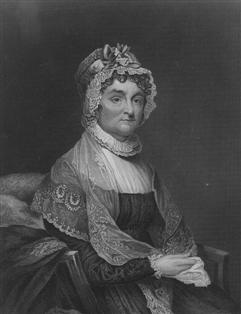
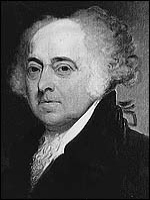
Happy anniversary, John and Abigail!!
Excerpts from their letters below:
-- "Is there no way for two friendly souls to converse together, although the bodies are 400 miles off. Yes, by letter. But I want a better communication. I want to hear you think, or to see your thoughts. The conclusion of your letter makes my heart throb more than a cannonade would. You bid me burn your letters. But I must forget you first." -- John Adams to Abigail
-- Years subdue the ardor of passion but in lieu thereof friendship and affection deep-rooted subsists which defies the ravages of time, and whilst the vital flame exists. -- Abigail to John, 1793
-- Your letter is like laudanum. -- John to Abigail
-- You apologize for the length of your letters. They give me more entertainment than all the speeches I hear. There are more good thoughts, fine strokes, and mother wit in them than I hear in the whole week. -- John to Abigail
-- I am warm enough at night, but cannot sleep since I left you." -- John to Abigail
-- "There must be, however, more employment for the press in favor of the government than there has been, or the sour, angry, peevish, fretful, lying paragraphs which assail it on every side will make an impression on many weak and ignorant people." -- John in a letter to Abigail
-- "I am more and more convinced that man is a dangerous creature, and that power whether vested in many or few is grasping ... The great fish swallow up the small and he who is most strenuous for the rights of the people, when vested with power, is as eager after the prerogatives of government. You tell me of degrees of perfection to which human nature is capable of arriving, and I believe it, but at the same time lament that our admiration should arise from the scarcity of the instances. -- Abigail Adams, in a letter to John
-- "You had prepared me to entertain a favorable opinion of him, but I thought the half was not told me. Dignity with ease and complacency, the gentleman and the soldier look agreeably blended in him. Modesty marks every line and feature of his face." -- Abigail to John - on first meeting George Washington in 1774
-- The following is from the letter John wrote to Abigail on July 3, 1776 ... after the signing of the Declaration of Independence on July 2 - look at the window he provides posterity - look at how openly he expresses himself - THANK YOU, John Adams!!:
"The Delay of this Declaration to this Time, has many great Advantages attending it. – The Hopes of Reconciliation, which were fondly entertained by Multitudes of honest and well meaning tho weak and mistaken People, have been gradually and at last totally extinguished. – Time has been given for the whole People, maturely to consider the great Question of Independence and to ripen their Judgments, dissipate their Fears, and allure their Hopes, by discussing it in News Papers and Pamphletts, by debating it, in Assemblies, Conventions, Committees of Safety and Inspection, in town and County Meetings, as well as in private Conversations, so that the whole People in every Colony of the 13, have now adopted it, as their own Act. – This will cement the Union, and avoid those Heats, and perhaps Convulsions which might have been occasioned, by such a Declaration Six Months ago.
But the Day is past. The Second Day of July 1776, will be the most memorable Epocha, in the History of America. – I am apt to believe that it will be celebrated, by succeeding Generations, as the great anniversary Festival. It ought to be commemorated, as the Day of Deliverance by solemn Acts of Devotion to God Almighty. It ought to be solemnized with Pomp and Parade, with Shews, Games, Sports, Guns, Bells, Bonfire and Illuminations from one End of this Continent to the other from this Time forward forever more.
You will think me transported with Enthusiasm, but I am not. I am well aware of the Toil, and Blood, and Treasure that it will cost Us to maintain this Declaration, and support and defend these States. Yet, through all the Gloom, I can see the Rays of ravishing Light and Glory. I can see that the End is more than worth all the Means, and that Posterity will triumph in that Day's Transaction, even though We should not rue it, which I trust in God We shall not."
-- Here is a letter John wrote to Abigail on Sept. 30 1764 ... a month before their marriage:
"Oh my dear Girl, I thank Heaven that another Fortnight will restore you to me -- after so long a separation. My soul and Body have both been thrown into Disorder, by your Absence, and a Month of two more would make me the most insufferable Cynick in the World. I see nothing but Faults, Follies, Frailties and Defects in any Body, lately. People have lost all their good Properties or I my Justice or Discernment.
But you have always softened and warmed my Heart, shall restore my Benevolence as well as my Health and Tranquility of mind. You shall polish and refine my sentiments of Life and Manners, banish all the unsocial and ill natured Particles in my Composition, and form me to that happy Temper, that can reconcile a quick Discernment with a perfect Candour."
What he describes here would always be true. He found equilibrium when he was with her. He was able to talk about his problems, hash stuff out, and temper some of his responses. When he was President - she remained back up in Quincy for some time until finally he begged her to come down to Washington. He needed her there. His colleagues and cabinet members also thought: Dammit, get Abigail down here, NOW - because he is LOSING it without her.
-- Letter from Abigail to John - August 19, 1774 - John had left for Philadelphia for the First Continental Congress: "The great anxiety I feel for my Country, for you and for our family renders the day tedious, and the night unpleasant. The Rocks and quick Sands appear upon every Side. What course you can or will take is all wrapt in the Bosom of futurity. Uncertainty and expectation leave the mind great Scope. Did ever any Kingdom or State regain their Liberty, when once it was invaded without Blood shed? I cannot think of it without horror.
Yet we are told that all the Misfortunes of Sparta were occasiond by their too great Sollicitude for present tranquility, and by an excessive love of peace they neglected the means of making it sure and lasting. They ought to have reflected, says Polibius, that as there is nothing more desirable, or advantages than peace, when founded in justice and honour, so there is nothing more shameful and at the same time more pernicious when attained by bad measures, and purchased at the price of liberty...
I want so much to hear from you. I long impatiently to have you upon the Stage of action. The first of September or the month of September may be of as much importance to Great Britan as the Ides of March were to Ceaser."
-- John to Abigail: Hartford May 2d 1775 - on his way down to Philadelphia. Adams is hoping that the disaster growing in Boston will bind the colonies together. That's eventually what happened, but at the time, he wasn't sure if it were a done deal.: "It is Arrogance and Presumption in human Sagacity to pretend to penetrate far into the Designs of Heaven. The most perfect Reverence and Resignation becomes us. But, I can't help depending upon this, that the present dreadfull Calamity of that beloved Town is intended to bind the Colonies together in more indissoluble Bands, and to animate their Exertions, at this great Crisis in the Affairs of Mankind. It has this Effect, in a most remarkable Degree, as far as I have yet seen or heard. It will plead, with all America, with more irresistible Perswasion, than Angells trumpet tongued.
In a Cause which interests the whole Globe, at a Time, when my Friends and Country are in such keen Distress, I am scarecely ever interrupted, in the least Degree, by Apprehensions for my Personal Safety. I am often concerned for you and our dear Babes...
In case of real Danger, of which you cannot fail to have previous Intimations, fly to the Woods with our Children."
Incredible, inspiring - what these people went through - for us, essentially. Abigail even wrote, at one point, "I hope future generations appreciate the sacrifices we made ..."
-- Abigail to John June 16 1775 - Listen to her practicality in the last paragraph. Love her. : "We now expect our Sea coasts ravaged. Perhaps, the very next Letter I write will inform you that I am driven away from our yet quiet cottage. Necessity will oblige Gage to take some desperate steps. We are told for Truth that he is now Eight thousand strong. We live in continual expectation of allarms.
Courage I know we have in abundance, conduct I hope we shall not want, but powder -- where shall we get a sufficient supply? I wish we may not fail there."
-- Abigail to John June 18 1775 - She writes to him the day after the Battle of Bunker Hill begins. She and John lost a dear friend in the Battle.
"The Day; perhaps the decisive Day is come on which the fate of America depends. My bursting Heart must find vent at my pen... Great is our Loss...
The race is not to the swift, nor the battle to the strong, but the God of Israel is he that giveth strength and power unto his people. Trust in him at all times, ye people pour out your hearts before him. God is a refuge for us. -- Charlstown is laid in ashes. The Battle began upon our intrenchments upon Bunkers Hill, a Saturday morning about 3 o'clock and has not ceased yet and tis now 3 o'clock Sabbeth afternoon...
I cannot compose myself to write any further at present."
-- John to Abigail July 7, 1775: "Your Description of the Distresses of the worthy Inhabitants of Boston, and the other Sea Port Towns, is enough to melt an Heart of Stone. Our Consolation must be this, my dear, that Cities may be rebuilt, and a People reduced to Poverty, may acquire fresh Property: But a Constitution of Government once changed from Freedom, can never be restored. Liberty once lost is lost forever. When the People once surrender their share in the Legislature, and their Right of defending the Limitations upon the Government, and of resisting every Encroachment upon them, they can never regain it...
I am forever yours ---"
-- John to Abigail Oct. 19 1775: "When I shall come home I know not. We have so much to do, and it is so difficult to do it right, that We must learn Patience. Upon my Word I think, if ever I were to come here again, I must bring you with me. I could live here pleasantly if I had you, with me... What if We should? Let me please myself with the Thought however."
-- JOHN ADAMS, on being Vice President, in a letter to Abigail: "My country in its wisdom contrived for me the most insignificant office that ever the invention of man contrived or his imagination conceived."
-- Abigail Adams wrote the following to John - months before the Declaration of Independence was in existence: "A people may let a King fall, yet still remain a people, but if a King let his people slip from him, he is no longer a King. And as this is most certainly our case, why not proclaim to the world in decisive terms of our own importance."
-- Letter of John Adams, to Abigail: "It has been the will of Heaven that we should be thrown into existence at a period when the greatest philosophers and lawgivers of antiquity would have wished to live ... a period when a coincidence of circumstances without example has afforded to thirteen colonies at once an opportunity of beginning government anew from the foundation and building as they choose. How few of the human race have ever had an opportunity of choosing a system of government for themselves and their children? How few have ever had anything more of choice in government than in climate?"
October 19, 2005
Today in History: October 19, 1781
The surrender at Yorktown, which ended the American Revolutionary War. Cornwallis realized that aid would not come in time - and after two days of bombardment - he sent a drummer out into view, who apparently beat the rhythm of: "STOP! LET'S TALK!!!" I love that the two sides would communicate this way - quite amazing. A British officer high in rank came forward - was blindfolded - and taken to George Washington (who was pretty much on his last legs himself).
The surrender document was drawn up, with Washington dictating the terms.
Over 7,000 soldiers surrendered at Yorktown. The war was over. There was still a lot of cleaning up to do, and negotiating, and brou-hahas, etc. - but the war was over.
And here is a story (perhaps a rumor - but I love it nonetheless) of Benjamin Franklin's response to the news of the surrender. He was, of course, in Paris at the time.
Here is, apparently, what happened.
Franklin was in France, and word came to France of the decisive American victory, and the complete surrender to George Washington in Yorktown. Franklin attended a diplomatic dinner shortly thereafter – and, of course, everyone was discussing the defeat of the British, and the victory of America.
The French foreign minister stood, and toasted Louis XVI: "To his Majesty, Louis the Sixteenth, who, like the moon, fills the earth with a soft, benevolent glow."
The British ambassador rose and said, "To George the Third, who, like the sun at noonday, spreads his light and illumines the world."
Franklin rose and countered, "I cannot give you the sun or the moon, but I give you George Washington, General of the armies of the United States, who, like Joshua of old, commanded both the sun and the moon to stand still, and both obeyed."
September 18, 2005
Today in history
Not only is today my sister Jean Grania's birthday (yes, she was named for the female pirate Gráinne Ni Mhaille, our most illustrious ancestor) - but today is also the day that George Washington laid the cornerstone for the US Capitol building in what was then just a broad marsh on the Potomac. Sept. 18, 1793.

Choosing the site of our nation's capital is a fascinating story in and of itself, involving political wheeling and dealing, major discord between North and South, and a secret dinner between foes Alexander Hamilton and James Madison - hosted by Thomas Jefferson at his residence in New York (57 Maiden Lane, if you're really interested. I'm autistic. Okay, then. Moving on.) In 1790, Hamilton submitted to Congress his financial plan for recovering the economy, which generated a shitstorm of controversy. Of course it did, because it was authored by Alexander Hamilton - who, along with being my dead boyfriend, was a man who probably never did an uncontroversial thing in his life. Southern congressmen, led by James Madison, blocked approval of Hamilton's plan - basically because of one element of the whole thing: the part that said that the federal government should take on the debt of the states. This one piece of the plan was so controversial that it threatened to derail Hamilton's entire plan. Total gridlock was the result. Hamilton threatened to resign (he was Secretary of the Treasury).
In June, 1790 - in the middle of all of this - Hamilton and Jefferson (also a member of Washington's cabinet) ran into each other on the sidewalk outside Washington's residence in New York. The way Jefferson told it, Hamilton did not look like his normal shining self. He was haggard, distracted, upset. He unloaded on Jefferson his anger about the hold-up in Congress, and told him his feeling of utter defeat. Jefferson later wrote: "On considering the situation of things, I thought the first step towards some reconciliation of views would be to bring Mr. Madison and Colo. Hamilton to a friendly discussion of the subject."
He offered to host a private dinner at his residence - outside of the glaring light of political intigue, beyond the reach of the press - where the two warring gentlemen could come together and find some common ground. Typical politics. Jefferson, the man who always wanted to be above politics, was, in essence, the master wheeler-dealer. He was always behind the scenes, pulling the strings, and yet somehow pretending he wasn't doing so. Fascinating. His accounts of his own behavior are often inaccurate - because of this dichotomy. It was like there was some deep-down paradox there, something even he couldn't reconcile. This is, actually, not just evidence of being hypocritical - but evidence of being supremely human. All of us operate from our own set of assumptions about reality ... and any account we give of our own actions tend to put us in the best light. Go to any happy hour, and you'll overhear innumerable snippets of people sharing stories about how they got the best of so-and-so. We are always right. We are always justified. Some of our deepest motivations are blurred to our own sight. But that's all right. That's just being human. Welcome to the human race.
Here is how Jefferson described that fateful meeting:
They came. I opened the subject to them, acknowledged that my situation had not permitted me to understand it sufficiently but encouraged them to consider the thing altogether. They did so. It ended in Mr. Madison's acquienscence in a proposition that the question should be again brought before the house by way of amendment from the Senate, that he would not vote for it, not entirely withdraw his opposition, yet he would not be strenuous, but leave it to its fate. It was observed, I forget by which of them, that as the pill would be a bitter one to the Southen states, something should be done to soothe them; and the removal of the seat of government to the Patowmac was a just measure, and would probably be a popular one with them, and would be a proper one to follow the assumption.
So simple, so seemingly casual, huh??
Joseph Ellis, in his marvelous book Founding Brothers, devotes a chapter to this event. He writes:
Jefferson brokered a political bargain of decidedly far-reaching significance: Madison agreed to permit the core provision of Hamilton's fiscal program to pass; and in return Hamilton agreed to use his influence to assure that the permanent residence of the national capital would be on the Potomac River. If true, this story deserves to rank alongside the Missouri Compromise and the Compromise of 1850 as one of the landmark accommodations in American politics. And, without much question, what we might call "The Compromise of 1790" would top the list as the most meaningful dinner party in American history.But is it true? The verdict of history, or at least the reigning judgment of most historians, is that the story is essentially true. Hamilton and Madison did meet at Jefferson's quarters in late June of 1790. On July 9 the House passed the Residence Bill, locating the permanent national capital on the Potomac after a ten-year residencde in Philadelphia, all this decided by a vote of 32 to 29. On July 26, the House passed the Assumption Bill [this was Hamilton's bill about the federal government assuming the debts of the states] by a nearly identical vote of 34 to 28, Madison voted against but, in keeping with Jefferson's version of the bargain, not leading the opposition in his previously "strenuous" fashion. Moreover, several different political observers and newspaper editors of the day clearly believed that some kind of secret deal had been made to effect the switching of votes necessary to break the long-standing deadlock on both issues. A disgruntled New York editor, for example, was quite explicit: "The true reason of the removal of Congress from this city will be explained to the people in the course of a very few days. To the lasting disgrace of the majority in both houses it will be seen, that the Pennsylvania and Patowmack interests have been purchased with twenty one and one-half million dollars," which just happened to be the size of the assumed state debts.
Then - the other issue on the table - was where to place the capital. The decision, of couse, had huge political implications. Madison wrote: "The business of the seat of Government is become a labyrinth for which the votes printed furnish no clue, and which it is impossible in a letter to explain to you." Any ultimate decision - Philadelpiha, New york, Annapolis, Trenton ... whatever ... would be seen as insult to SOMEone. If New York was chosen ... would that give New England an unfair advantage over the southern states? And, etc. etc. Nothing was good, nothing could be agreed upon.
Here's another excerpt from Founding Brothers about the Potomac, and what it all meant, and how important this decision was:
Although it never seemed to be part of the conscious intnetion of either Jefferson or Madison at the time, the isolated location and de novo character of the national capital had even deeper political implications. For at the start and for several decades thereafter, it remained a vast and nearly vacant plot of ground. Visitors in those early years who stopped to ask directions to the American capital were often astonished when told they were standing squarely in its center. Anyone apprehensive about the encroaching powers of the federal government must have felt a palpable sense of reassurance that the seat of power was virtually invisible. Or if, like Jefferson, one believed that cities were sores on the body politic, and agrarian values were the mainstay of American virtue, then Washington, D.C., must have seemed the perfect capital for the new republic, since it was really not a city at all. If the clustering together or consolidation of political power touched some primal nerve, conjuring up horrific scenes of courtiers in london or Paris plotting against the rights of ordinary citizens, again the American capital performed visual therapy by lacking courts, corridors, or many public buildings whatsoever. It symbolized the victory of diffusion over consoldiation.
Jefferson's wheeling and dealing worked.
Hamilton's bill was passed, and the Potomac was settled on as the location of the new capital.
On September 18,1793, President Washington laid the cornerstone of the US Capitol.
September 5, 2005
Today in history
... was the start of the First Continental Congress, in 1774. They convened at Carpenters Hall in Philadelphia. Anyone been there? It's so cool, full of potent powerful ghosts:
It is hard to imagine, or remind ourselves, of the tension of the times, the unknown that these men were strolling into ... Now it all has a tendency to seem like a done deal, but when those men convened in Philadelphia in 1774 - none of it was a done deal. It was a very stressful and dangerous situation, and there was very little agreement among the colonies about what should be done. The Port Bill (closing down Boston to ships) had been passed by the British, in retaliation for the Boston Tea Party - and Boston was suffering greatly. The colonies faced the question, so monumental at the time: "Is Boston's suffering our business?" That question, of course, had large implications - the main one being: Are we, all the separate colonies, united? Are we willing to take a stand for Boston's survival, even though we're from South Carolina or Connecticut? The beginning of a union ...
Martha Washington wrote a letter to a relative on the eve of her husband's departure to the Convention:
I foresee consequences; dark days and darker nights; domestic happiness suspended; social enjoyments abandoned; property of every kind put in jeopardy by war, perhaps; neighbors and friends at variance, and eternal separations on earth possible. But what are all these evils when compared with the fate of which the Port Bill may be only a threat? My mind is made up; my heart is in the cause. George is right; he is always right. God has promised to protect the righteous, and I will trust him.
We have a series of letters from John Adams to his wife, describing this first Congress - they're fabulous, because Adams was not reticent at all with his wife. He had next to no formality with Abigail, he shared everything with her: his gripes, his self-doubt, his vanity, his jokes ... The letters are a rich first-person resource, one of the most amazing archives of letters we have in our national history.
Adams wrote a letter (the last paragraph of which is now rightly famous) to Abigail on his way down to Philadelphia:
We Yesterday visited Nassau Hall Colledge, and were politely treated by the Schollars, Tutors, Professors and President, whom We are, this Day to hear preach. Tomorrow We reach the Theatre of Action. God Almighty grant us Wisdom and Virtue sufficient for the high Trust that is devolved upon Us. The Spirit of the People wherever we have been seems to be very favourable. They universally consider our Cause as their own, and express the firmest Resolution, to abide the Determination of the Congress.I am anxious for our perplexed, distressed Province [Boston] -- hope they will be directed into the right Path. Let me intreat you, my Dear, to make yourself as easy and quiet as possible. Resignation to the Will of Heaven is our only Resource in such Dangerous Times. Prudence and Caution should be our Guides. I have the strongest Hopes, that We shall yet see a clearer Sky, and better Times...
Your Account of the Rain refreshed me. [In his absence, Abigail took complete charge of the farm, the finances, the help, along with raising their growing brood of children. It is speculated as well that without this "help", John Adams might have run their finances into the ground. From his book allowance alone!] I hope our Husbandry is prudently and industriously managed. Frugality must be our Support...
The Education of our Children is never out of my Mind. Train them to Virtue, habituate them to industry, activity and Spirit. Make them consider every Vice, as shameful and unmanly: fire them Ambition to be usefull -- make them disdain to be destitute of any usefull, or ornamental Knowledge or Accomplishment. Fix their Ambition upon great and solid Objects, and their Contempt upon little, frivolous, and useless ones. It is Time, my dear, for you to begin to teach them French. Every Decency, Grace, and Honesty should be inculcated upon them.
And here - finally - in a letter dated September 16, John Adams describes the first meeting of the First Continental Congress. Gives me chills, every time:
When the Congress first met, Mr. Cushing made a Motion, that it shouild be opened with Prayer. It was opposed by Mr. Jay of N. York and Mr. Rutledge of South Carolina, because we were so divided in religious Sentiments, some Episcopalians, some Quakers, some Aanabaptists, some Presbyterians and some Congregationalists, so that We could not join in the same Act of Worship. -- Mr. S. Adams arose and said he was no Bigot, and could hear a Prayer from a Gentleman of Piety and Virtue, who was at the same Time a Friend to his Country. He was a Stranger in Phyladelphia, but had heard that Mr. Duche (Dushay they pronounce it) deserved that Character, and therefore he moved that Mr. Duche, an episcopal Clergyman, might be desired, to read Prayers to the Congress, tomorrow Morning. The Motion was seconded and passed in the Affirmative. Mr. Randolph our President waited on Mr. Duche, and received for Answer that if his Health would permit, he certainly would. Accordingly next Morning he appeared with his Clerk and in his Pontificallibus, and read several Prayers, in the established Form; and then read the Collect for the seventh day of September, which was the Thirty Fifth Psalm. -- You must remember this was the next Morning after we heard the horrible Rumour, of the Cannonade of Boston. -- I never saw a greater Effect upon an Audience. It seemed as if Heaven had ordained that Psalm to be read on that Morning. After this Mr. Duche, unexpected to every Body struck out into an extemporary Prayer, which filled the Bosom of every Man present. I must confess I never heard a better Prayer, or one so well pronounced. Episcopalian as he is, Dr. Cooper himself never prayed with such fervour, such Ardor, such Earnestness and Pathos, and in Language so elegant and sublime -- for America, for the Congress, for the Province of Massachusetts Bay, and especially the Town of Boston. It has had an excellent Effect upon every Body here.I must beg you to read that Psalm.
I put the 35th Psalm in the extended entry, if you'd like to read it.
And finally - a funny excerpt from one of the many descriptive letters John Adams wrote to his wife during the Congress - just makes me chuckle:
This assembly is like no other that ever existed. Every man in it is a great man -- an orator, a critic, a statesman, and therefore every man upon every question must show his oratory, his criticism, his political abilities. The consequence of this is that business is drawn and spun out to immeasurable length. I believe if it was moved and seconded that we should come to a resolution that three and two make five, we should be entertained with logic and rhetoric, law, history, politics, and mathematics concerning the subject for two whole days, and then we should pass the resolution unanimously in the affirmative.
hahahahaha
The 35th Psalm
Oppose, LORD, those who oppose me; war upon those who make war upon me.
Take up the shield and buckler; rise up in my defense.
Brandish lance and battle-ax against my pursuers. Say to my heart, "I am your salvation."
Let those who seek my life be put to shame and disgrace. Let those who plot evil against me be turned back and confounded.
Make them like chaff before the wind, with the angel of the LORD driving them on.
Make their way slippery and dark, with the angel of the LORD pursuing them.
Without cause they set their snare for me; without cause they dug a pit for me.
Let ruin overtake them unawares; let the snare they have set catch them; let them fall into the pit they have dug.
Then I will rejoice in the LORD, exult in God's salvation.
My very bones shall say, "O LORD, who is like you, Who rescue the afflicted from the powerful, the afflicted and needy from the despoiler?"
Malicious witnesses come forward, accuse me of things I do not know.
They repay me evil for good and I am all alone.
Yet I, when they were ill, put on sackcloth, afflicted myself with fasting, sobbed my prayers upon my bosom.
I went about in grief as for my brother, bent in mourning as for my mother.
Yet when I stumbled they gathered with glee, gathered against me like strangers. They slandered me without ceasing;
without respect they mocked me, gnashed their teeth against me.
Lord, how long will you look on? Save me from roaring beasts, my precious life from lions!
Then I will thank you in the great assembly; I will praise you before the mighty throng.
Do not let lying foes smirk at me, my undeserved enemies wink knowingly.
They speak no words of peace, but against the quiet in the land they fashion deceitful speech.
They open wide their mouths against me. They say, "Aha! Good! Our eyes relish the sight!"
You see this, LORD; do not be silent; Lord, do not withdraw from me.
23
Awake, be vigilant in my defense, in my cause, my God and my Lord.
Defend me because you are just, LORD; my God, do not let them gloat over me.
Do not let them say in their hearts, "Aha! Just what we wanted!" Do not let them say, "We have devoured that one!"
Put to shame and confound all who relish my misfortune. Clothe with shame and disgrace those who lord it over me.
But let those who favor my just cause shout for joy and be glad. May they ever say, "Exalted be the LORD who delights in the peace of his loyal servant."
Then my tongue shall recount your justice, declare your praise, all the day long.
July 4, 2005
July 4, 1826
The 50th anniversary of July 4, 1776.
John Adams and Thomas Jefferson, two of the main architects of the American Revolution, long estranged due to political differences, (and Jefferson referring, in public, to "political heresies" - meaning that he felt there was some orthodoxy and Adams was a heretic) had finally reconciled (engineered by Benjamin Rush, who thought it a shame that these two great patriots, once dear friends, would go their graves without making up). Then followed a 12-year correspondence between the two aging statesmen ... a correspondence that has to be read to be believed.
And then ... on the same day ... which happened to be July 4 ... which happened to be the 50th anniversary of the Declaration of Independence ... they both died. Within hours of each other.
I don't even know what more to say about that.
John Adams' last words were "Jefferson ... still lives." (Dammit, that just kills me.) Amazingly, though, is that Jefferson actually had died a couple of hours earlier.
Thomas Jefferson's last words (and this always just chokes me up - I'm choked up right now): "Is it the fourth?"
Yes, Mr. Jefferson. It is the fourth. And thank you. Thank you both.
Declaration - "Perpetual itching without benefit of scratching to the enemies of America."
From Benson Bobrick's Angel in the Whirlwind: The Triumph of the American Revolution
On the morning of July 4, Jefferson rose before dawn, and at six a.m. calmly noted that the temperature was 68 degrees Farenheit. The wind was southeast and the mercury soon climbed to 76. He soaked his feet in a basin of cold water (as was his morning habit), took some tea and biscuits, and proceeded to Independence Hall. By midafternoon, the collective editing of the declaration (accelerated by a plague of horseflies which had swarmed out of the stables nearby) had come to its happy end. It was voted on and adopted (New York alone abstaining), whereupon Joseph Hewes of North Carolina, who had repeatedly voted against it, "started suddenly upright, and lifting up both his Hands to Heaven as if he had been in a trance, cry'd out, 'It is done! and I will abide by it.'" An old bellman at nearby Christ's Church, waiting for the signal from a boy stationed at the State House door, suddenly heard the lad clap his hands and shout, "Ring! Ring!"
Those who afterward lined up to sign the document (on August 22) had reason to be uneasy. They knew the peril and penalty of treason and were signing, as it were, with halters about their necks. John Hancock, as president of Congress, wrote his name first. "We must be unanimous," he reportedly declared. "There must be no pulling different ways, we must all hang together." "Yes," replied Franklin, 'we must indeed all hang together, or most assuredly we shall all hang separately." Behind them stood Benjamin Harrison, a large, heavy man, who nervously picked up the theme. To the diminutive Eldridge Gerry, he said, "I shall have a great advantage over you, Mr. Gerry, when we are all hung for what we are now doing. From the size and weight of my body I shall die in a few minutes, but from the lightness of your body, you will dance in the air an hour or two before you are dead."Yet there was also an overriding and mystical feeling of providential cover to the boldness of their act. As John Page, a Virginia statesman, put it rather beautifully to Jefferson two weeks after the declaration was adopted, "God preserve the United States. We know the Race is not to the swift nor the Battle to the Strong. Do you not think an Angel rides in the Whirlwind and directs this Storm?"
Congress had copies of the declaration sent to every state Assembly and convention, to the various committees of safety, and to the commanding officers of the Continental Army to proclaim before their troops.
John Adams, writing to Abigail, was moved to prophecy by the transcendent spirit of the hour: "You will think me transported with enthusiasm, but I am not. I am well aware of the toil, and blood, and treausre that it will cost us to maintain the Declaration, and support and defend these States. Yet, through all the gloom, I can see the rays of ravishing light and glory. I can see that the end is more than worth all the means, and that posterity will triumph in that day's transaction, even though we should rue it, which I trust in God we shall not."
It seemed to him, moreover, that it was just as well consideration of the declaration (by which he meant Lee's resolutions) had taken as long as it had:
Time has been given for the whole people maturely to consider the great question of independence, and to ripen their judgment, dissipate their fears, and allure their hopes, by discussing it in newspapers and pamphlets, by debating it in assemblies, conventions, committees of safety and inspection, in town and county meetings, as well as in private conversations, so that the whole people, in every colony of the thirteen, have now adopted it as their own act. This will cement the union, and avoid those heats, and perhaps convulsions, which might have been occasioned by such a Declaration six months ago.With his usual prescience, he predicted the day would be "celebrated by succeeding generations as the great anniversary festival" and "solemnized with pomp and parade, with shows, games, sports, guns, bells, bonfires, and illuminations, from one end of this continent to the other, from this time forward forevermore." (The practice, of course, has been to celebrate the Fourth of July, the day on which the form of the Declaration of Independence was agreed to, rather than the second, when Lee's resolutions were adopted and which Adams actually had in mind.)
Celebrations followed in city, town, village, and country hamlet, with bell ringing, parades, bonfires,and illuminations throughout the land. In New York, after the colonial assembly "at the risque of our lives and fortunes" gave its assent on July 9, Washington had the army brigades drawn up at six PM to hear "the United Colonies of America" declared "Free and Independent States". After the text was read, he saw fit to add, "The General hopes that this important event will serve as a fresh incentive to every officer and solider to act with fidelity and courage, as knowing that now the peace and safety of his country depend, under God, solely on the success of our arms; and that he is now in the service of a state possessed of sufficient power to reward his merit, and to advance him to the highest honors of a free country."
That evening New Yorkers toppled the lead equestrian statue of King George III (errected after repeal of the Stamp Act) from its pedestal on Bowling Green. Eventually, its metal would be melted down and molded into 42,000 cartridges for patriot guns. Citizens in Baltimore, Savannah, and elsewhere likewise burned or buried the king in effigy and tore from their hinges all signs bearing the royal arms. In Worcester, Massachusetts, thirsty patriots repaired to a local tavern and offered toasts to the prosperity of the United States and a dozen other things, including "Perpetual itching without benefit of scratching to the enemies of America." That Sunday, Bishop Willaim White, the patriot rector of Christ's Church in Philadelphia, omitted the usual prayers offered for the king, and one year later, as a sign that God's imprimatur was now stamped upon the radical sermons he preached, a bolt of lightning struck and shattered the Royal Crown of England affixed to the top of the spire.
In just over two years, a new nation had been born.
Declaration - "within the Jeffersonian utopia such choices do not need to be made"
More from Joseph Ellis' book on Thomas Jefferson: American Sphinx: The Character of Thomas Jefferson
The vision he projected in the natural rights section of the Declaration, then, represented yet another formulation of the Jeffersonian imagination. The specific form of the vision undoubtedly drew upon language Locke had used to desscribe the putative conditions of society before governments were established. But the urge to embrace such an ideal society came from deep inside Jefferson himself. It was the vision of a young man projecting his personal cravings for a world in which all behavior was voluntary and therefore all coercion unnecessary, where independence and equality never collided, where the sources of all authority were invisible because they had already been internalized. Efforts on the part of scholars to determine whether Jefferson's prescriptive society was fundamentally individualistic or communal can never reach closure, because within the Jeffersonian utopia such choices do not need to be made. They reconcile themselves naturally.Though indebted to Locke, Jefferson's political vision was more radical than liberal, driven as it was by a youthful romanticism unwilling to negotiate its high standards with an imperfect world. One of the reasons why European commentators on American politics have found American expectations so excessive and American political thinking in general so beguilingly innocent is that Jefferson provided a sanction for youthful hopes and illusions, planted squarely in what turned out to be the founding document of the American republic. The American dream, then, is just that, the Jeffersonian dream writ large.
Declaration - "it does not explain Jefferson's much-debated deletion of 'property' "
More from Joseph Ellis' book on Thomas Jefferson: American Sphinx: The Character of Thomas Jefferson
The most famous section of the Declaration, which has become the most quoted statement of human rights in recorded history as well as the most eloquent justification of revolution on behalf of them, went through the Continental Congress without comment and with only one very minor change. These are, in all probability, the best known fifty-eight words in American history: "We hold these truths to be self evident; that all men are created equal; that they are endowed by their Creator with certain [inherent and] inalienable Rights; that among these are life, liberty & the pursuit of happiness; that to secure these rights, governments are instituted among men, deriving their just powers from the consent of the governed." This is the seminal statement of the American Crered, the closest approximation to political poetry ever produced in American culture. In the nineteenth century Abraham Lincoln, who also knew how to change history with words, articulated with characteristic eloquence the quasi-religious view of Jefferson as the original American oracle: "All honor to Jefferson -- to the man who, in the concrete pressure of a struggle for national independence by a single people, had the coolness, forecaste, and capacity to introduce into a merely revolutionary document, an abstract truth, and so to embalm it there, that today and in all coming days, it shall be a rebuke and a stumbling block to the very harbingers of reappearing tyranny and oppression." The entire history of liberal reform in American can be written as a process of discovery, within Jefferson's words, of a spiritually sanctioned mandate for ending slavery, providing the rights of citizenship to blacks and women, justifying welfare programs for the poor and exanding individual freedoms.
No serious student of either Jefferson or the Declaration of Independence has ever claimed that he foresaw all or even most of the ideological consequences of what he wrote. But the effort to explain what was in his head has spawned almost as many interpretations as the words themselves have generated political movements. Jefferson himself was accused of plagiarism by enemies or jealous friends on so many occasions throughout his career that he developed a standard reply. "Neither aiming at originality of principle or sentiment, nor yet copied from any particular and previous writing," he explained, he drew his ideas from "the harmonizing sentiments of the day, whether expressed in letters, printed essays or in the elementary books of public right, as Aristotle, Cicero, Locke, Sidney, etc."This is an ingeniously double-edged explanation, for it simultaneously disavows any claims to originality and yet insists that he depended upon no specific texts or sources. The image it conjures up is that of a medium, sitting alone at the writing desk and making himself into an instrument for the accumulated wisdom and "harmonizing sentiments" of the ages. It is only a short step from this image to Lincoln's vision of Jefferson as oracle or prophet, receiving the message from the gods and sending it on to us and then to the ages. Given the creedal character of the natural rights section of the Declaration, several generations of American interpreters have felt the irresistible image to bathe the scene in speckled light and cloudy mist, thereby implying that efforts to dispel the veil of mystery represent some vague combination of sacrilege and treason.
Any serious attempt to pierce through this veil must begin by recovering the specific conditions inside that room on Market and Seventh streets in June 1776. Even if we take Jefferson at his word, that he did not copy sections of the Declaration from any particular books, he almost surely had with him copies of his own previous writings, to include Summary View, Causes and Necessities and his three drafts of the Virginia constitution. This is not to accuse him of plagiarism, unless one wishes to argue that an author can plagiarize himself. It is to say that virtually all the ideas found in the Declaration and much of the specific language, especially the grievances against George III, had already found expression in those earlier writings.
Recall the context. The Congress is being overwhelmed with military reports of imminent American defeat in New York and Canada. The full Congress is in session six days a week, and committees are meeting throughout the evenings. The obvious practical course for Jefferson to take was to rework his previous drafts on the same general theme. While it seems almost sacrilegious to suggest that the creative process that produced the Dedclaration was a cut-and-paste job, it strains credulity and common sense to the breaking point to believe that Jefferson did not have these items at his elbow and draw liberally from them when drafting the Declaration.
His obvious preoccupation with the ongoing events at the Virginia convention, which was drafting the Virginia constitution at just this time, is also crucial to remember. Throughout late May and early June couriers moved back and forth between Williamsburg and Philadelphia, carrying Jefferson's drafts for a new constitution to the convention and reports on the debate there to the Continental Congress. On June 12 the Virginians unanimously adopted a preamble drafted by George Mason that contained these words: "All men are created equally free and independent and have certain inherent and natural rights ..., among which are the enjoyment of life and liberty, with the means of acquiring and possessing property, and pursuing and obtaining happiness and safety." The Pennsylvania Gazette published Mason's words the same day they were adopted in Williamsburg. Since Jefferson's version of the same thought was drafted sometime that following week, and since we know that he regarded the unfolding events in Virginia as more significant than what was occurring in Philadelphia and that he was being kept abreast by courier, it also strains credulity to deny the influence of Mason's language on his own.
While that explains the felicitous phrase "pursuit of happiness", which Mason himself could have picked up from several English and American sources, it does not explain Jefferson's much-debated deletion of "property", the conventional third right memorialized in Locke's Second Treatise on Government. He made that choice on his own. He was probably aware that Mason's language had generated spirited opposition from a segment of the planter class in Virginia who worried that it implied a repudiation of slavery; they insisted on an amendment that excluded slaves by adding the qualifying clause "when they enter into a state of society." All this suggests that Jefferson was probably aware of the contradictions between his own version of the natural rights philosophy and the institution of slavery. By dropping any reference to "property" he blurred that contradiction. This helps answer the intriguing question of why no debate over the issue occurred in the Continental Congress, as it did in the Virginia convention. Perhaps the debate over the slave trade provision also served that purpose.
Declaration - "An elegant, if decidedly one-sided, version of recent Anglo-American history"
From Joseph Ellis' book on Thomas Jefferson: American Sphinx: The Character of Thomas Jefferson
This excerpt discusses the three revisions made by Congress (things to be deleted) that bothered Jefferson most.
Most of the debate in the Congress and most of the revisions of Jefferson's draft of the Declaration focused on the long bill of indictment against George III, the section that modern readers care about least. When Jefferson much later insisted that he was not striving for "originality of principle or sentiment" but was seeking only to provide an "expression of the American mind", he was probably referring to this section, which was intended to sum up the past twelve years of colonial opposition to British policy in language designed to make the king responsible for all the trouble. Jefferson had been practicing this list of grievances for more than two years, first in Summary View, then in Causes and Necessities and then in his drafts of the Virginia constitution. "I expected you had ... exhausted the Subject of Complaint against Geo. 3d. and was at a loss to discover what the Congress would do for one to their Declaration of Independence without copying," wrote Edmund Pendleton when he first saw the official version, "but find that you have acquitted yourselves very well on that score."As an elegant, if decidedly one-sided, version of recent Anglo-American history, this section of the Declaration has certainly stood the test of time, providing students of the American Revolution with a concise summary of the constitutional crisis from the colonists' perspective at the propitious moment. As a reflection of Jefferson's thinking, however, it is missing three distinctive and distinctively Jeffersonian perspectives on the conflict. When Jefferson wrote back to friends in Virginia, complaining that critics in the Congress had, as one friend put it, "mangled ... the Manuscript", these were the three major revisions he most regretted.
First, as we noticed earlier, the Congress deleted the long passage blaming George III for waging "cruel war against human nature itself" by establishing slavery in North America; Jefferson also accused the king of blocking colonial efforts to end the slave trade, then "exciting those very people to rise in arms against us ... by murdering the people on whom he has also obtruded them." Several complicated and even tortured ideas are struggling for supremacy here. One can surmise that the members of Congress decided to delete it out of sheer bewilderment, since the passage mixes together an implicit moral condemnation of slavery with an explicit condemnation of the British monarch for both starting it and trying to end it.In his own notes on the debate in Congress Jefferson claimed that the opposition was wholly political. Several southern delegations, especially those of South Carolina and Georgia, opposied any restraint on the importation of slaves, he reported, adding that their "Northern brethren also I believe felt a little tender under those censures; for tho' their people have very few slaves themselves, yet they had been pretty considerable carriers of them to others." Jefferson's clear implication is that he was trying to take a principled stand against both slavery and the slave trade but that a majority of delegates were unprepared to go along with him.
The truth was much messier. With regard to the trade, Jefferson knew from his experience in the House of Burgesses that many established slaveowners in the Tidewater region favored an end of imports because their own plantations were already well stocked and new arrivals only reduced the value of their own slave populations. Ending the trade in Virginia, in short, was not at all synonymous with ending slavery. With regard to slavery itself, Jefferson's formulation made great polemic sense but historical and intellectual nonsense. It absolved slaveowners like himself from any responsibility or complicity in the establishment of an institution that was clearly at odds with the values on which the newly independent American was based. Slavery was another one of those vestiges of feudalism foisted upon the liberty-loving colonists by the evil heir to the Norman Conquest. This was complete fiction, of course, but also completely in accord with Jefferson's urge to preserve the purity of his moral dichotomies and his romantic view of America's uncontaminated origins. Slavery was the serpent in the garden sent there by a satanic king. But the moral message conveyed by this depiction was not emancipation so much as commiseration. Since the colonists had nothing to do with establishing slavery -- they were the unfortunate victims of English barbarism -- they could not be blamed for its continuance. This was less a clarion call to end slavery than an invitation to wash one's hands of the matter.
Second, jefferson tried once again, as he had tried before in Causes and Necessities, to insert his favorite theory of expatriation, claiming that the first settlers came over at their own expense and initiative "unassisted by the wealth or the strength of Great Britian." His obsessive insistence on this theme derived from his devotion to the Saxon myth, which allowed for the neat separation of Whiggish colonists and feudal or absolute English ministers. The tangled history of imperial relations did not fit very well into these political categories, but Jefferson found it much easier to revise the history (i.e., claiming there had never been any colonial recognition of royal or parliamentary authority) than give up his moral dichotomies. Once again his colleagues in the Continental Congress found his argument excessive.
Third, the last excision came toward the very end of Jefferson's draft. It was a rousingly emotional passage with decidedly sentimental overtones that condemned "our British brethren" for sending over "not only souldiers of our common blood, but Scotch & foreign mercenaries to invade and destroy us." It went on: "These facts have given the last stab to agonizing affection, and manly spirit bids us to renounce forever these unfeeling brethren. We must endeavor to forget our former love for them, and to hold them as we hold the rest of mankind, enemies in war, in peace friends; but a communication of grandeur & of freedom it seems is below their dignity. Be it so, since they will have it. The road to happiness & to glory is open to us too. We will tread it apart from them ..." This was a remarkable piece of rhetoric that Jefferson apparently regarded as one of his better creations. Even at the end of his life he was bitter about its deletion. "The pusillanimous idea that we had friends in England worth keeping terms with, still haunted the minds of many," he recalled, and therefore "those passages which conveyed censures on the people of England were struck out, lest they should give them offence."
What strikes the modern reader is not the timidity of the Continental Congress for excising the passage so much as the melodramatic sentimentalism of Jefferson in composing it. As with the expatriation theory, Jefferson was anxious to depict the separation of teh colonies from the British Empire as a decision forced upon the colonists, who are passive victims rather than active agents of revolution. But here the broken bonds are more affective than political. A relationship based on love and trust has been violated, and the betrayed partner, the colonists, is bravely moving forward in life, wounded by the rejection but ready to face alone a glorious future that might otherwise have been shared together. This is a highly idealized and starkly sentimental rendering of how and why emotional separations happen, a projection onto the imperial crisis of the romantic innocence Jefferson had displayed in his adolescent encounters with young women, an all-or-nothing-at-all mentality that the other delegates found inappropriate for a state paper purporting to convey more sense than sensibility.
Declaration - "On July 4 the Congress approved its revised version"
From Joseph Ellis' book on Thomas Jefferson: American Sphinx: The Character of Thomas Jefferson
Jefferson wrote the Declaration of Independence in a matter of a few days -- Adams later remembered it took him only "a day or two" -- and then showed the draft to Adams and Franklin, later recalling that "they were the two members of whose judgments and amendments I wished most to have the benefit." They suggested a few minor revisions (i.e., replacing "sacred & undeniable truths" with "self-evident truths"); then the committee placed the document before the Continental Congress on June 28. After Lee's resoltuion was debated and passed (July 1 - 2), the Congress took up the wording of the Declaration; it made several major changes and excised about one-quarter of the text. During the debate Jefferson sat silently and sullenly, regarding each proposed revision as another defacement. Franklin sat next to him and tried to soothe his obvious pain with the story of a sign painter commissioned by a hatter, who kept requesting more concise language for his sign until nothing was left on the sign but a picture of a hat. On July 4 the Congress approved its revised version and the Declaration of Independence was sent to the printer for publication.
Declaration - "Jefferson guards the American Creed at this inspirational level"
Excerpt from Joseph Ellis' marvelous Founding Brothers: The Revolutionary Generation
Before editorial changes were made by the Continental Congress, Jefferson's early draft made it even clearer that his intention was to express a spiritual vision: ' We hold these truths to be sacred & undeniable; that all men are created equal & independent, that from that equal creation they derive rights inherent & unalienable, among which are the preservation of life, & liberty, & the pursuit of happiness." These are the core articles of faith in the American Creed. Jefferson's authorship of these words is the core of his seductive appeal across the ages, his central claim, on posterity's affection. What, then, do they mean? How do they make magic?
Merely to ask the question is to risk being accused of some combination of treason and sacrilege, since self-evident truths are not meant to be analyzed; that is what being self-evident is all about. But when these words are stripped of the patriotic haze, read straightaway and literally, two monumental claims are being made here. The explicit claim is that the individual is the sovereign unit in society; his natural state is freedom from and equality with all other individuals; this is the natural order of things. The implicit claim is that all restrictions on this natural order are immoral transgressions, violations of what God intended; individuals liberated from such restrictions will interact with their fellows in a harmonious scheme requiring no external discipline and producing maximum human happiness.This is a wildly idealistic message, the kind of good news simply too good to be true. It is, truth be told, a recipe for anarchy. Any national government that seriously attempted to operate in accord with these principles would be committing suicide. But, of course, the words were not intended to serve as an operational political blueprint. Jefferson was not a profound political thinker. He was, however, an utterly brilliant political rhetorician and visionary. The genius of his vision is to propose that our deepest yearnings for personal freedom are in fact attainable. The genius of his rhetoric is to articulate irreconcilable human urges at a sufficiently abstract level to mask their mutual exclusiveness. Jefferson guards the American Creed at this inspirational level, which is inherently immune to scholarly skepticism and a place where ordinary Americans can congregate to speak the magic words together. The Jeffersonian magic works because we permit it to function at a rarefied region where real-life choices do not have to be made.
Declaration - "it was Franklin, or Jefferson himself, who made the small but inspired change in the second paragraph."
Excerpt from David McCullough's John Adams
[Jefferson] worked rapidly [on writing the Declaration of Independence] and, to judge by surviving drafts, with a sure command of his material. He had none of his books with him, nor needed any, he later claimed. It was not his objective to be original, he would explain, only "to place before mankind the common sense of the subject."
"Neither aiming at originality of principle or sentiment, nor yet copied from any particular and previous writing, it was intended to be an expression of the American mind, and to give to that expression the proper tone and spirit called for by the occasion."He borrowed readily from his own previous writing, particularly from a recent draft for a new Virginia constitution, but also from a declaration of rights for Virginia, which appeared in the Pennsylvania Evening Post on June 12. it had been drawn up by George Mason, who wrote that "all men are born equally free and independent, and have certain inherent natural rights � among which are enjoyment of life and liberty." And there was a pamphlet written by the Pennsylvania delegate James Wilson, published in Philadelphia in 1774, that declared, "All men are, by nature equal and free: no one has a right to any authority over another without his consent: all lawful government is founded on the consent of those who are subject to it."
But then Mason, Wilson, and John Adams, no less than Jefferson, were, as they all appreciated, drawing on long familiarity with the seminal works of the English and Scottish writers John Locke, David Hume, Francis Hutcheson, and Henry St. John Bolinbroke, or such English poets as Defoe ("When kings the sword of justice first lay down,/They are no kings, though they possess the crown. / Titles are shadows, crowns are empty things, / The good of subjects is the end of kings"). Or, for that matter, Cicero ("The people's good is the highest law.")
Adams, in his earlier notes for an oration at Braintree, had written, "Nature throws us all into the world equal and alike � The only maxim of a free government ought to be to trust no man to endanger public liberty."�
What made Jefferson's work surpassing was the grace and eloquence of expression. Jefferson had done superbly and in minimum time.
"I was delighted with its high tone and flights of oratory with which it abounded [Adams would recall], especially that concerning Negro slavery, which, though I knew his southern brethren would never suffer to pass in Congress, I certainly would never oppose. There were other expressions which I would not have inserted, if I had drawn it up, particularly that which called the King tyrant � I thought the expression too passionate; and too much like scolding, for so grave and solemn a document; but as Franklin and Sherman were to inspect it afterwards, I thought it would not become me to strike it out. I consented to report it, and do not now remember that I made or suggested a single alteration."
A number of alterations were made, however, when Jefferson reviewed it with the committee, and several were by Adams. Possibly it was Franklin, or Jefferson himself, who made the small but inspired change in the second paragraph. Where, in the initial draft, certain "truths" were described as "sacred and undeniable", a simpler stronger "self-evident" was substituted.
We hold these truths to be self-evident, that all men are created equal�
It was to be the eloquent lines of the second paragraph of the Declaration that would stand down the years, affecting the human spirit as neither Jefferson nor anyone could have foreseen. And however much was owed to the writing of others, as Jefferson acknowledged, or to such editorial refinements as those contributed by Franklin or Adams, they were, when all was said and done, his lines. It was Jefferson who had written them for all time:
We hold these truths to be self-evident, that all men are created equal, that they are endowed by their Creator with certain unalienable rights, that among these are life, liberty, and the pursuit of happiness. That to secure these rights, governments are instituted among men, deriving their just powers from the consent of the governed.
Declaration - "It is hard to think of any way in which the first two paragraphs can be improved"
From Paul Johnson's superb book A History of the American People
Jefferson produced a superb draft, for which his 1774 pamphlet was a useful preparation. All kinds of philosophical and political influences went into it. They were all well-read men and Jefferson, despite his comparative youth, was the best read of all, and he made full use of the countless hours he had spent pouring over books of history, political theory, and government.The Declaration is a powerful and wonderfully concise summary of the best Whig thought over several generations. Most of all, it has an electrifying beginning. It is hard to think of any way in which the first two paragraphs can be improved:
WHEN in the Course of human Events, it becomes necessary for one People to dissolve the Political Bands which have connected them with another, and to assume among the Powers of the Earth, the separate and equal Station to which the Laws of Nature and of Nature's God entitle them, a decent Respect to the Opinions of Mankind requires that they should declare the causes which impel them to the Separation.WE hold these Truths to be self-evident, that all Men are created equal, that they are endowed by their Creator with certain unalienable Rights, that among these are Life, Liberty and the Pursuit of Happiness -- That to secure these Rights, Governments are instituted among Men, deriving their just Powers from the Consent of the Governed, that whenever any Form of Government becomes destructive of these Ends, it is the Right of the People to alter or to abolish it, and to institute new Government, laying its Foundation on such Principles, and organizing its Powers in such Form, as to them shall seem most likely to effect their Safety and Happiness.
The first [paragraph], with its elegiac note of sadness at dissolving the union with Britain and its wish to show "a decent respect to the opinions of mankind" by giving its reasons; the second, with its riveting first sentence, the kernel of the whole: "We hold these truths to be self-evident, that all men are created equal, that they are endowed by their Creator with certain inalienable rights, that among these are life, liberty and the pursuit of happiness." After that sentence, the reader, any reader � even George III � is compelled to read on.
The Committee found it necessary to make few changes in Jefferson's draft. Franklin, the practical man, toned down Jefferson's grandiloquence � thus truths, from being "sacred and undeniable" became "self-evident", a masterly improvement. But in general the four others were delighted with Jefferson's work, as well they might be.
Congress was a different matter because at the heart of America's claim to liberty there was a black hole. What of the slaves? How could Congress say that "all men are created equal" when there were 600,000 blacks scattered through the colonies, and concentrated in some of them in huge numbers, who were by law treated as chattels and enjoyed no rights at all? Jefferson and the other members of the Committee tried to up-end this argument � rather dishonestly, one is bound to say � by blaming American slavery on the British and King George.
The original draft charged that the King had "waged a cruel war against human nature" by attacking a "distant people" and "captivating and carrying them into slavery in another hemisphere". But when the draft went before the full Congress, on June 28, the Southern delegates were not having this. Those from South Carolina, in particular, were not prepared to accept any admission that slavery was wrong and especially the acknowledgment that it violated the "most sacred rights of life and liberty". If the Declaration said that, then the logical consequence was to free all the slaves forthwith. So the slavery passage was removed, the first of many compromises over the issue during the next eighty years, until it was finally resolved inn an ocean of tears and blood. However, the word "equality" remained in the text, and the fact that it did so was, as it were, a constitutional guarantee that, eventually, the glaring anomaly behind the Declaration would be rectified.
The Congress debated the draft for three days. Paradoxically, delegates spent little time going over the fundamental principles it enshrined, because the bulk of the Declaration presented the specific and detailed case against Britain, and more particularly against the King. The Revolutionaries were determined to scrap the pretense that they distinguished between evil ministers and a king who "could do no wrong", and renounce their allegiance to the crown once and for all. So they fussed over the indictment of the King, to them the core of the document, and left its constitutional and ideological framework, apart from the slavery point, largely intact.
This was just as well. If Congress had chosen to argue over Jefferson's sweeping assumptions and propositions, and resolve their differences with verbal compromises, the magic wrought by his pen would surely have been exorcized, and the world would have been poorer in consequence.
As it was the text was approved on July 2, and on July 4 all the colonies formally adopted what was called, to give it its correct title, "The Unanimous Declaration of the Thirteen United States of America". At the time, and often since, Tom Paine was credited with its authorship, which did not help to endear it to the British, where he was (and still is) regarded with abhorrence. In fact he had nothing to do with it directly, but the term "United States" is certainly his.
On July 8 it was read publicly in the State House Yard and the Liberty Bell rung. The royal coat of arms was torn down and burned. On August 2 it was engrossed on parchment and signed by all the delegates. Whereupon (according to John Hancock) Franklin remarked: "Well, Gentlemen, we must now hang together, or we shall most assuredly hang separately."
June 13, 2005
The Books: "The Federalist Papers" (Alexander Hamilton, James Madison, John Jay)
Next in my Daily Book Excerpt:
 Next book in my politics/philosophy section is:
The Federalist Papers (Penguin Classics)
Written in a period of months from 1787 to 1788 - spearheaded by Alexander Hamilton (otherwise known as "Sheila's dead boyfriend") - the 85 essays that appeared in 4 of the 5 newspapers in New York were created in order to convince the people of the state of New York why they should agree to the ratification of the Constitution. The Constitutional Congress concluded in the early fall of 1787, with all of the delegates returning to their respective states to begin the ratification process. What ended up being known as "The Federalist Papers" were a blitzkrieg of pro-Constitution propaganda. We are so lucky to have them. If you want to understand the Constitution? Read the Federalist Papers. They set out to explain to the reluctant public (who were, in general, horrified at this idea of an "energetic" national government) why a Constitution was necessary, and the whys and wherefores of each part of it. It's an extraordinary work - hugely important - and really explains the inner workings of the grand experiment called the United States. Hamilton did the lion's share of the work (no surprise there - the man was unbelievable. Was he a mortal man or some freak of nature? His productivity was astonishing). Madison wrote, what is perhaps, the most well-known of the papers - Federalist # 10 (I babbled about it here, on the morning of election day), where he warns against faction and the creating of political parties (although he didn't use that word). Fascinating that Madison later, with the turbulent election of 1800, become a genius at party politics. No matter. His Federalist #10 should be required reading. I want to stand over certain politicians in Washington and feed it to them manually. (Now that's an image.)
Each essay appeared under the name "Publius". The depth and breadth of the essays are amazing, considering the speed in which they were written, and the frequency in which they appeared. Frankly, the entire series takes my breath away.
Hamilton is an interesting case. Born illegitimate (in the immortal words of one of his many enemies, John Adams: "the bastard brat of a Scotch peddler"), in the Caribbean - he came to the United States at the age of 15 to further his education. Because he was not affiliated with any one State, his concerns were different than the other delegates at the Constitution, his outlook completely original. He believed in AMERICA, not in a particular State. His loyalty was to the Union, from the beginning. I think his perspective allowed him to see farther ahead than anybody else. Truly. He predicted the industrial revolution, far before anyone else did, for example. It would no longer be land that would make someone wealthy, it would be money itself. You wonder how he did it - but I really think it had something to do with his foreign birth, his hard-scrabble beginnings, and the fact that he came to America as an outsider.
The excerpt for today is from Federalist # 15, one of a couple of essays in the series where Hamilton takes on the old Articles of Confederation that Congress, with its new Constitution, was looking to get rid of. He predicts that the Articles will not be strong enough to handle the problems of the nation in the future. The States must consolidate.
"they have not suffered a blind veneration for antiquity, for custom, or for names"
"If their works betray imperfections, we wonder at the fewness of them."
Incredible.
EXCERPT FROM The Federalist Papers (Penguin Classics)
As almost every State will be one side or the other, be a frontier, and will thus find in a regard to its safety, an inducement to make some sacrifices for the sake of the general protection; so the States which lie at the greatest distance from the heart of the union, and which of course may partake least of the ordinary circulation of its benefits, will be at the same time immediately contiguous to foreign nations, and will consequently stand on particular occasions, in greatest need of its strength and resources. It may be inconvenient for Georgia or the States forming our western or north eastern borders to send their representatives to the seat of government, but they would find it more so to struggle alone against an invading enemy, or even to support alone the whole expence of those precautions, which may be dictated by the neighborhood of continual danger. If they should derive less benefit therefore from the union in some respects, than the less distant States, they will derive greater benefit from it in other respects, and thus the proper equilibrium will be maintained throughout.
I submit to you my fellow citizens, these considerations, in full confidence that the good sense which has so often marked your decisions, will allow them their due weight and effect; and that you will never suffer difficulties, however formidable in appearance or however fashionable the error on which they may be founded, to drive you into the gloomy and perilous scene into which the advocates for disunion would conduct you. Hearken not to the unnatural voice which tells you that the people of America, knit together as they are by so many chords of affection, can no longer live together as members of the same family; can no longer continue the mutual guardians of their mutual happiness; can no longer be fellow citizens of one great respectable and flourishing empire. Hearken not to the voice which petulantly tells you that the form of government recommended for your adoption is a novelty in the political world; that it has never yet had a place in the theories of the wildest projectors; that it rashly attempts what it is impossible to accomplish.
No my countrymen, shut your ears against this unhallowed language. Shut your hearts against the poison which it conveys; the kindred blood which flows in the veins of American citizens, the mingled blood which they have shed in defence of their sacred rights, consecrate the union, and excite horror at the idea of their becoming aliens, rivals, enemies. And if novelties are to be shunned, believe me the most alarming of all novelties, the most wild of all projects, the most rash of all attempts, is that of rending us in pieces, in order to preserve our liberties and promote our happiness. But why is the experiment of an extended republic to be rejected merely because it may comprise what is new? Is it not the glory of the people of America, that whilst they have paid a decent regard to the opinions of former times and other nations, they have not suffered a blind veneration for antiquity, for custom, or for names, to overrule the suggestions of their own good sense, the knowledge of their own situation, and the lessons of their own experience? To this manly spirit, posterity will be indebted for the possession, and the world for the example of the numerous innovations displayed on the American theatre, in favor of private rights and public happiness.
Had no important step been taken by the leaders of the revolution for which a precedent could not be discovered, no government established of which an exact model did not present itself, the people of the United States might, at this moment, have been numbered among the melancholy victims of misguided councils, must at best have been labouring under the weight of some of those forms which have crushed the liberties of the rest of mankind. Happily for America, happily we trust for the whole human race, they pursued a new and more noble course. They accomplished a revolution which has no parallel in the annals of human society: They reared the fabrics of governments which have no model on the face of the globe. They formed the design of a great confederacy, which it is incumbent on their successors to improve and perpetuate. If their works betray imperfections, we wonder at the fewness of them. If they erred most in the structure of the union; this was the work most difficult to be executed; this is the work which has been new modelled by the act of your Convention, and it is that act on which you are now to deliberate and to decide.
PUBLIUS.
June 9, 2005
Aaron Burr: "An active and scheming mind ..."
An interesting character study of Aaron Burr - from Adams vs. Jefferson: The Tumultuous Election of 1800 (Pivotal Moments in American History)
Of the candidates in 1800, Burr is the most difficult to understand, in part because he revealed so little of himself, but in large measure because most of the surviving assessments by his contemporaries were colored by his controversial behavior during and after this election. What seems clear is that Burr was a striking figure, at first blush quite likely the most dazzling and captivating of the four candidates. He was only average height -- he stood five foot six, about an inch below the median height of native-born Americans -- and his body was small, even wispy. Many thought him handsome, and indeed in the Gilbert Stuart portrait, for which he sat when in his mid-thirties, he bears a resemblance to a middle-aged Henry Fonda, a Hollywood leading man. Ten years later, in 1802, the artist John Vanderlyn captured the same qualities, depicting a subject who radiated a pleasant and attractive countenance beneath long thick gray-black hair that was receding dangerously. In both portraits, and according to numerous observers, Burr's features were dominated by great, expressive hazel eyes and an air of earnest urbanity. Many were struck, too, by his gentlemanly bearing -- some thought it an aristocratic manner -- as well as by his self-assurance and, above all, an unconcealed pride in his superior intellect. Some thought him graceful, most found him to be friendly and agreeable, and all regarded him as a delightful conversationalist. Burr brought to public life better-than-average oratorical skills, a talent honed in countless courtrooms where he gradually jettisoned the pistonlike delivery and overbearing habits of his youth, substituting instead a "slow, circumspect manner that convinced listeners that careful deliberation and reasoned reflection underlay his every word. Yet for all his compelling qualities, aspects of his demeanor caused him harm. For instance, when Burr came to Virginia in 1796 to court support, some who met him not only discerned an active and scheming mind but concluded that he was not passionately committed to any political principle. Winning laurels and holding power, they suspected, were his only real objectives. They were not alone in this judgment. Throughout his career, many detected in him a frenetic ambition, an insatiable, indomitable craving for more wealth, material possessions, power, and acclaim -- more of everything, a gluttonous avidity that they assumed drove him relentlessly.
May 29, 2005
Patrick Henry: "that overwhelming torrent"
Today is the birthday of Patrick Henry. The old firebrand! The old Virginian firebrand! What a hothead, what a motivator, what a fascinating man. A die-hard patriot, who made perhaps the most famous speech in American history (second only to the Gettysburg Address, perhaps) - the "Give me liberty or give me death" speech - made at St. John’s Church in Richmond, Virginia on March 23, 1775.
I love how his glasses are on top of his head here.
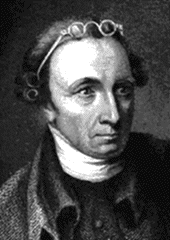
Here is a brief biographical sketch of the man - truly one of the great people in our nation's history. He was one of those people who could FRAME a debate. Like Tom Paine. A radical. There was nothing halfway about this guy. He was an extremist, he was a black-and-white kind of guy - and that was necessary, in those early days of the Revolution. It was not a time for moderation. Thank goodness we had some moderates, but without those like Patrick Henry - nothing would have ever gotten done at all. Whether or not you agreed with him, he was fearless in standing up, and being counted, and shouting (always, shouting) his opinion. And everyone says that he had a way with words. An oratorical gift. He could make a speech and move people to action.
The 'give me liberty' speech changed people's lives. We have many eyewitness accounts of it - Thomas Jefferson was there, and it changed his life. Henry's speech and Tom Paine's book Common Sense were pretty much the two sparks which ignited the populace. People were forever changed after these events. Here is a description (how I wish I could have been there) of the lead-up to that speech, and Henry's taking a starring role - but also a vivid description of Patrick Henry's oratory on March 23, 1775 - this is from Paul Johnson's great book History of the American People:
Next to religion, the concept of the rule of law was the biggest single force in creating the political civilization of the colonies. This was something they shared with all Englishmen. The law was not just necessary - essential to any civil society - it was noble. What happened in courts and assemblies on weekdays was the secular equivalent of what happened in church on Sundays. The rule of law in England, as Americans were taught in their schools, went back even beyond Magna Carta, to Anglo-Saxon times, to the laws of King Alfred and the Witanmagots, the ancient precursor of Massachusetts' Assembly and Virginia's House of Burgesses.William the Conqueror had attempted to impose what Lord Chief Justice Coke, the great early 17th century authority of the law, had called 'The Norman Yoke'. But he had been frustrated. So, in time, had Charles I been frustrated, when he tried to re-impose it, by the Long Parliament. Now, in its arrogance and complacency, the English parliament, forgetting the lessons of the past, was trying to impose the Norman Yoke on free-born Americans, to take away their cherished rule of law and undermine the rights they enjoyed under it with as much justice as any Englishman! Lord North would have been astonished to learn he was doing any such thing, but no matter: that is what many, most, Americans believed. So America now had to do what parliamentarians had to do in 1640. 'What we did,' said Jefferson later, 'was with the help of Rushworth, whom we rummaged over for revolutionary precedents of those days.' So, in a sense, the United States was the posthumous child of the Long Parliament.
But Americans' fears that their liberties were being taken away, and the rule of law subverted, had to be dramatized - just as those old parliamentarians had dramatized their struggle by the Grand Remonstrance against Charles I and the famous 'Flight of the Five Members'. Who would play John Hampden, who said he would rather die than pay Ship Money to King Charles?
Up sprang Jefferson's friend and idol, Patrick Henry.
As a preliminary move towards setting up a united resistance of the mainland colonies to British parliamentary pretensions, a congress of colonial leaders met in Philadelphia, at Carpenters Hall, between September 5 and October 26, 1774. Only Georgia, dissuaded from participating by its popular governor, did not send delegates. Some fifty representatives from twelve colonies passed a series of resolutions, calling for defiance of the Coercive Acts, the arming of a militia, tax-resistance. The key vote came on October 14 when delegates passed the Declaration and Resolves, which roundly condemned British interference in America's internal affairs and asserted the rights of colonial assemblies to enact legislation and impose taxes as they pleased.
A common American political consciousness was taking shape, and delegates began to speak with a distinctive national voice. At the end of it, Patrick Henry marked this change in his customary dramatic manner: 'The distinctions between Virginians and New Englanders are no more. I am not a Virginian but an American.' Not everyone agreed with him, as yet, and the Continental Congress, as it called itself, voted by colonies rather than as individual Americans. But this body, essentially based on Franklin's earlier proposals, perpetuated its existence by agreeing to meet again in May 1775. Before that could happen, on February 5, 1775, parliament in London declared Massachusetts, identified as the most unruly and contumacious of the colonies, to be in a state of rebellion, thus authorizing the lawful authorities to use what force they thought fit. The fighting had begun. Hence when the Virginia burgesses met in convention to instruct their delegates to the Second Continental Congress, Henry saw his chance to bring home to all the revolutionary drama of the moment.
Henry was a born ham actor, in a great age of acting - the Age of Garrick. The British parliament was full of actors, notably [William] Pitt himself ('He acted even when he was dying') and the young [Edmund] Burke, who was not above drawing a dagger, and hurling it on the ground to make a point. But Henry excelled them all. He proposed to the burgesses that Virginia should raise a militia and be ready to do battle. What was Virginia waiting for? Massachusetts was fighting. 'Our brethren are already in the field. Why stand we her idle? What is it that gentlemen wish? What would they have?'
Then Henry got to his knees, in the posture of a manacled slave, intoning in a low but rising voice: 'Is life so dear, our peace so sweet, as to be purchased at the price of chains and slavery? Forbid it, Almighty God!' He then bent to the earth with his hands still crossed, for a few seconds, and suddenly sprang to his feet, shouting, 'Give me liberty!' and flung wide his arms, paused, lowered his arms, clenched his right hand as if holding a dagger at his breast, and said in sepulchral tones: 'Or give me death!' He then beat his breast, with his hand holding the imaginary dagger.
There was silence, broken by a man listening at the open window, who shouted: "Let me be buried on this spot!'
Henry had made his point.
Here's a painting of Henry making his point:
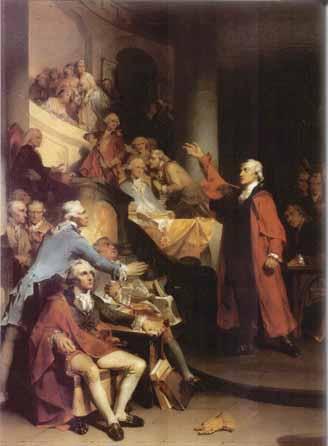
Here, in full, is Patrick Henry's speech that he made on that day:
No man, Mr. President, thinks more highly than I do of the patriotism, as well as abilities, of the very worthy gentlemen who have just addressed the House. But different men often see the same subject in different lights; and, therefore, I hope it will not be thought disrespectful to those gentlemen if, entertaining as I do opinions of a character very opposite to theirs, I shall speak forth my sentiments freely and without reserve. This is no time for ceremony. The question before the House is one of awful moment to this country. For my own part, I consider it as nothing less than a question of freedom or slavery; and in proportion to the magnitude of the subject ought to be the freedom of the debate. It is only in this way that we can hope to arrive at truth, and fulfill the great responsibility which we hold to God and our country. Should I keep back my opinions at such a time, through fear of giving offense, I should consider myself as guilty of treason towards my country, and of an act of disloyalty toward the Majesty of Heaven, which I revere above all earthly kings.Mr. President, it is natural to man to indulge in the illusions of hope. We are apt to shut our eyes against a painful truth, and listen to the song of that siren till she transforms us into beasts. Is this the part of wise men, engaged in a great and arduous struggle for liberty? Are we disposed to be of the number of those who, having eyes, see not, and, having ears, hear not, the things which so nearly concern their temporal salvation? For my part, whatever anguish of spirit it may cost, I am willing to know the whole truth; to know the worst, and to provide for it.
I have but one lamp by which my feet are guided, and that is the lamp of experience. I know of no way of judging of the future but by the past. And judging by the past, I wish to know what there has been in the conduct of the British ministry for the last ten years to justify those hopes with which gentlemen have been pleased to solace themselves and the House. Is it that insidious smile with which our petition has been lately received? Trust it not, sir; it will prove a snare to your feet. Suffer not yourselves to be betrayed with a kiss. Ask yourselves how this gracious reception of our petition comports with those warlike preparations which cover our waters and darken our land. Are fleets and armies necessary to a work of love and reconciliation? Have we shown ourselves so unwilling to be reconciled that force must be called in to win back our love? Let us not deceive ourselves, sir. These are the implements of war and subjugation; the last arguments to which kings resort. I ask gentlemen, sir, what means this martial array, if its purpose be not to force us to submission? Can gentlemen assign any other possible motive for it? Has Great Britain any enemy, in this quarter of the world, to call for all this accumulation of navies and armies? No, sir, she has none. They are meant for us: they can be meant for no other. They are sent over to bind and rivet upon us those chains which the British ministry have been so long forging. And what have we to oppose to them? Shall we try argument? Sir, we have been trying that for the last ten years. Have we anything new to offer upon the subject? Nothing. We have held the subject up in every light of which it is capable; but it has been all in vain. Shall we resort to entreaty and humble supplication? What terms shall we find which have not been already exhausted? Let us not, I beseech you, sir, deceive ourselves. Sir, we have done everything that could be done to avert the storm which is now coming on. We have petitioned; we have remonstrated; we have supplicated; we have prostrated ourselves before the throne, and have implored its interposition to arrest the tyrannical hands of the ministry and Parliament. Our petitions have been slighted; our remonstrances have produced additional violence and insult; our supplications have been disregarded; and we have been spurned, with contempt, from the foot of the throne! In vain, after these things, may we indulge the fond hope of peace and reconciliation. There is no longer any room for hope. If we wish to be free-- if we mean to preserve inviolate those inestimable privileges for which we have been so long contending--if we mean not basely to abandon the noble struggle in which we have been so long engaged, and which we have pledged ourselves never to abandon until the glorious object of our contest shall be obtained--we must fight! I repeat it, sir, we must fight! An appeal to arms and to the God of hosts is all that is left us!
They tell us, sir, that we are weak; unable to cope with so formidable an adversary. But when shall we be stronger? Will it be the next week, or the next year? Will it be when we are totally disarmed, and when a British guard shall be stationed in every house? Shall we gather strength by irresolution and inaction? Shall we acquire the means of effectual resistance by lying supinely on our backs and hugging the delusive phantom of hope, until our enemies shall have bound us hand and foot? Sir, we are not weak if we make a proper use of those means which the God of nature hath placed in our power. The millions of people, armed in the holy cause of liberty, and in such a country as that which we possess, are invincible by any force which our enemy can send against us. Besides, sir, we shall not fight our battles alone. There is a just God who presides over the destinies of nations, and who will raise up friends to fight our battles for us. The battle, sir, is not to the strong alone; it is to the vigilant, the active, the brave. Besides, sir, we have no election. If we were base enough to desire it, it is now too late to retire from the contest. There is no retreat but in submission and slavery! Our chains are forged! Their clanking may be heard on the plains of Boston! The war is inevitable--and let it come! I repeat it, sir, let it come.
It is in vain, sir, to extenuate the matter. Gentlemen may cry, Peace, Peace-- but there is no peace. The war is actually begun! The next gale that sweeps from the north will bring to our ears the clash of resounding arms! Our brethren are already in the field! Why stand we here idle? What is it that gentlemen wish? What would they have? Is life so dear, or peace so sweet, as to be purchased at the price of chains and slavery? Forbid it, Almighty God! I know not what course others may take; but as for me, give me liberty or give me death!
Here are Jefferson's brief thoughts on Henry's speech.
I am not sure that even Patrick Henry would have thought that his predictions would so soon come true. Within less than a month, on April 19, the tension exploded in Boston, leading to the Lexington and Concord battles. Boston was now under siege. The Continental Congress met on May 10, and in just one month - had authorized the formation of an army, and elected George Washington as Commander in Chief.
Regardless of the huge role Henry played in the lead-up to the American Revolution, he didn't really take a part in the aftermath. He was elected governor of Virginia, true ... but when it came time to the Constitutional Congress, and the forging of a brand-new government ... he did not play a leading role at all.
It's interesting - there's a great description of acting: "Acting is like a sculpture carved in snow." Obviously, this was from the time of stage acting. Movies now can capture the "sculpture" before it melts. But that quote always makes me think of Patrick Henry. Nobody alive today can ever see his oratorical skills. There are no video tapes, tape recordings. We just have to take the word of those who were THERE. So while no "record" exists, and his speeches were, indeed, "carved in snow" ... a whiff of the power of them comes down to us regardless. It's like the acting of Edmund Kean, or David Garrick, or Mrs. Siddons - these great great actors of the past. We can never see their work, their performances were "sculptures carved in snow" ... but they must have been extraordinary. Too many people left records - in diaries, letters, newspaper columns ... for it to be discounted.
Henry refused to be a delegate to the Constitutional Congress in 1787. He was a big states-rights man, for all his revolutionary fervor. Catherine Drinker-Bowen, in Miracle at Philadelphia explains why:
Patrick Henry was conspicuous by his absence. Named to the Convention, he refused, saying he "smelt a rat." Fifty-one years old, a member of his local legislature, Henry was still a powerful factor in state politics. For all his celebrated rhetoric ("I am not a Virginian but an American"), he was the most Virginian of them all. At the moment, state politics to him were paramount. Madison said outright that Henry had stayed home to look after Virginia's interests along the Mississippi -- a matter of life and death to the back settlements, with Spain in control of New Orleans. Samuel Admas too remained in Boston. He had not been named to the Convention; he was suspicious, he said, "of a general revision of the Confederation." Though he came round in the end, Sam Adams was to oppose the new Constitution vigorously. "I stumble at the threshold," he wrote. "I meet with a National Government instead of a Federal Union of sovereign States."Patrick Henry, Sam Adams -- the old firebrands of '76 were missing. The Violent Men, as they had been called, skillful and dedicated in revolution and the intrigues of revolution, but lacking the qualities to erect a government. Better hands at pulling down than building, as John Adams had said.
When it came time for ratification, Henry again took center stage. Drinker-Bowen describes the Virginia ratification convention as "a gathering studded with stars, with names and faces known throughout the state and beyond -- well-speaking gentlemen on both sides, well-dressed, well born."
Chief among anti-Federalists was Patrick Henry, tall, thin, stooped, and at fifty-two looking on himself as aged and broken in health. He wore spectacles, concealed his reddish-brown hair by a brown wig, not too well-fitting. His blue eye was still keen, his long face alive with feeling; the old magic waited to be called up at will. "I fear that overwhelming torrent, Patrick Henry," wrote General Knox to Rufus King when the convention was well under way.From the first day, Henry was the nerve center of the room. "The Henryites," they called his followers. Every Federalist was girded against them. And the Federalist ranks were impressive. One of them, Judge Edmund Pendleton, served as presiding officer. White-haired, painfully crippled, he struggled to his feet on crutches; his hip had been dislocated by a fall from a horse. Pendleton's dress was elegant; his infirmity only added somehow to the dignity of his bearing. "The Confederation did not carry us through the war," he said. "Common danger and the spirit of America did that."
What I would have given to be in that room. What a scene.
With such dramatis personae, the Virginia convention could not lack color. Always, one is conscious of the fourteen Kentuckians, sitting watchful, biding their time. Always, too, one remembers that out of one hundred and seventy members, the barest majority will carry the Constitution. It is a scene romantic, passionate, the very best "theater". Yet all of it is true, factual, and seldom has American history shown a political scene more seriously enacted. Patrick Henry rose and hurled his bolts: "Whither is the spirit of America gone? Whither is the genius of America fled? ... We drew the spirit of liberty from our British ancestors. But now, Sir, the American spirit, assisted by the ropes and chains of consolidation, is about to convert this country into a powerful and mighty empire ... There will be no checks, no real balances, in this government. What can avail your specious imaginary balances, your rope-dancing, chain-rattling, ridiculous ideal checks and contrivances?"
Hm, Patrick. Tell us how you really feel.
Now listen, though, to the response of one of the people in that room. This is what I mean by the power of this man's rhetoric - whether or not you agree with his sentiment. Henry must have been positively amazing to watch.
It was here, or hereabouts, that Mr. Best of Nansemound County, "an intelligent gentleman," says Grigby, "involuntarily felt his wrists to assure himself that the fetters were not already pressing his flesh. The gallery on which he was sitting seemed to become dark as a dungeon."The true orator's power possessed Patrick Henry. Even Madison confessed himself nonplussed, and said that when Mr. Henry stood up to reply to him, a pause, a shake of the head or a striking gesture would undo an hour's work before a word was uttered.
Incredible. The power! Here's more description of Henry in action, from Drinker-Bowen:
At impassioned moments Henry would raise a hand and twirl his wig two or three times round his head. The galleries were always packed when Henry spoke; once he was on his feet for seven hours: "Who authorizes gentlemen to speak the language of We, the people, instead of We, the states? ... The people gave them no power to use their name ... Even from that illustrious man who saved us by his valor, I would have a reason for this conduct!" Advocates of the Constitution, said Henry, brought forward fears, awful prognostications of evils to come, should the Constitution fail of ratification. Yet had there been a single tumult in Virginia? Where was any disposition in this country to revolt against the dominion of laws?
The battle of ratification continued. At one point, Madison became so annoyed with Henry that he interrupted him a couple of times in a row ... and following that, had to go to bed for three days. Tempers ran high. People who took notes at the Convention spent a lot of time underlining certain words, to show how emphatic the speakers were.
The turning point came when governor Edmund Randolph, a staunch anti-Federalist, switched sides.
On June fourth, the first day of full debate, the Governor rose and made his declaration. It took him some time to reach his point. Plainly on the defensive, Randolph said he had not come hither to apologize ... He was not a candidate for popularity ... If the Constitution were put before him as in Philadelphia -- wholly to adopt or wholly to reject -- he would again refuse his signature. But Massachusetts had urged amendments to be enacted by Congress after full ratification. For himself, he had originally been for previous amendments, to be approved by the several states before they ratified. But the postponement of this convention to so late a date made this impossible, "without inevitable ruin to the Union". Eight states had adopted the Constitution; they could not recede. He stood then, to express his earnest endeavors for a firm, energetic government, and to concur in any practical scheme of amendments. Randolph, in short, was for the Constitution.
Almost brings tears to my eyes. The compromises these strong-willed men had to make (and for the most part, they all did). In the end, they believed in something greater than themselves. It was the "idea" of America, although their loyalties to their individual states remained rock-solid. It is those who had to COMPROMISE that I feel truly in debt to. It can't have been easy.
Henry, naturally, did not go down without a fight.
The gentleman's [Randolph's] alteration of opinion, Henry said, "was very strange and unaccountable ... Did he not tell us that he withheld his signature? He was not then led by the illumined, the illustrious few ... What alterations have a few months brought about! ... Something extraordinary must have operated so great a change in his opinions."Randolph and the convention understood Henry's hints very well, with their implication that Washington's persuasion -- or worse, Washington's promise of future favors under the new government -- had brought about this change. Much later, when Washington named Randolph as United States Attorney Gedneral, Randolph would be at pains to defend himself from th is same charge. Furiously, Randolph answered Patrick Henry. He disdained the honorable gentleman's aspersions and insinuations. "If our friendship must fall," said Randolph, "let it fall like Lucifer, never to rise again! ... He has accused me of inconsistency ... Sir, if I do not stand on the bottom of integrity and pure love for Virginia, as much as those who can be most clamorous, I wish to resign my existence."
Henry was staunch against amendments being made after the fact. He thought it was ridiculous to agree to something that was not yet finished.
Subsequent amendments, Henry said, were a novelty and an absurdity. To enter into a compact of government, and then afterward to settle the terms of this compact was an idea dreadful, abhorrent to his mind ... If this plan were accepted by the convention, said Henry, he would conceive it his duty to have nothing more to do with the Constitution and to quit this assembly and go home.
Henry had come up with his own list of amendments, called "Henry's Declaration of Rights", which was read aloud to the Convention. Interestingly enough, they were almost exactly the same as the amendments that would eventually be added. But Randolph, also a big fighter, stood up and said that Henry's words about "quit this assembly and go home" amounted to a threat of secession. Henry denied this vehemently. The thought of the states breaking up, of the Union dissolving, was a thought not to be contemplated for Henry. It was just that the Constitution, as it stood, terrified him.
The day ended with Patrick Henry prophesying the "awful immensity of the dangers with which [the new system] was pregnant" and envisioning "the angels on high, looking down and reviewing America's future." It was at this opportune moment that a thunderstorm arose, the hall grew dark, lightning glared, rain dashed against the windows. Doors slammed, says Grigsby, like a peal of muskitry. Men rushed from their seats to the center of the room, and the meeting adjourned.
It is that one detail that makes me in love with American history. It certainly did seem to be that massive universal forces were at work here, and they all knew it.
A couple of days later, after more debate, and more hashing out of the amendments, that it came time to vote. And here is what I think was Patrick Henry's greatest hour - out of all of his great hours.
On Wednesday, June 25th, Edmund Pendleton, from the chair, ordered Wythe's original motion be put to the question. Shortly before the vote was taken, Patrick Henry spoke his last word. If he should find himself in the minority, he would have, he said, those painful sensations which arise from a conviction of being overpowered in a good cause. But he would be a peaceful citizen. "I wish not to go to violence, but will wait with hopes that the spirit which predominated in the Revolution is not yet gone, nor the cause of those who are attached to the Revolution not yet lost. I shall therefore wait in expectation of seeing that government changed, so as to be compatible with the safety, liberty, and happiness of the people."It was generous, it had a touch of magnificence. Randolph spoke next, very briefly, and his last word did not equal Henry's. Randolph spoke solely in self-justification. His part in the Federal Convention, he said, had been inspired by strongest affection for the Union. The objections which he then had to the Constitution still stood. Yet the accession of eight states reduced deliberation to the single question of Union or no Union. Should some future annalist desire to vilify his name, let him state those truths.
And then came time for the vote.
By 89 to 79 the Constitution won. It had been close, very close indeed. That night angry Antifederalists, determined to create measures for resisting the new system, held a mass meeting in Richmond, with Patrick Henry presiding. But Henry told his wrathful colleagues that he had done his best against the Constitution "in the proper place [the Convention]." The question, said Henry, was now settled; "as true and faithful republicans you had all better go home."
Amazing. The debate had occurred "in the proper place", and once the vote went down ... it was time to be a "peaceful citizen" again, and a "true and faithful republican". I can think of a few folks out there right now who would do well to follow Patrick Henry's great example.
And here, again from Drinker-Bowen, is a reiteration of a point I made a day or so ago. It was those who OPPOSED the Constitution who were so instrumental in bringing it about, and hammering it into a form that people could agree to. Complete agreement would have been a disaster, and people like Randolph, people like Henry, were those who could provide a frame for the debate. Their objections were good ones, in the context of the times, but the path of history did not go in their direction. And so they chose the greater good, but making damn sure that their objections were in the record.
Henry's admirers claim that he was probably more responsible than any or all others for the adoption of the first ten amendments to the Constitution -- the Bill of Rights. And there is no doubt that Henry's part in this went beyond mere rhetorical challenges and thunderbolts. In final form the Constitution was the product of both sides, pro and anti. The opposition's part is difficult to assess, though none can question its value. Even Washington conceded it. "Upon the whole," he wrote, "I doubt whether the opposition to the Constitution will not ultimately be productive of more good than evil; it has called forth, in its defence, abilities which would not perhaps have been otherwise exerted that have thrown new light upon the science of Government, they have given the rights of man a full and fair discussion, and explained them in so clear and forcible a manner, as cannot fail to make a lasting impression."
It's a good reminder, too, to those people in our country who can't stand dissenting opinions to the majority, and basically think anyone who disagrees is stupid, unpatriotic, and an asshole. You show me monolithic agreement and I will show you a totalitarian society.
His one speech where he shouted "Give me liberty or give me death" makes me think of the idea that America was supposed to be a "city on a hill" for others to see. Whether or not we always live up to that is kind of irrelevant. No "idea" is perfect. But when I saw Chinese kids holding up banners with those very words on it in Tieneman Square, I thought of Patrick Henry. I thought of the "city on the hill". What the Founding Fathers dreamt of had indeed, with all its inherent problems and fits and starts and failures, come to pass.
So here's to Patrick Henry!
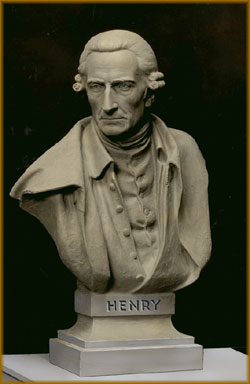
May 27, 2005
Science and the Founding Fathers: "an Epocha when the rights of mankind were better understood"
I am now reading a very interesting book called Science and the Founding Fathers: Science in the Political Thought of Jefferson, Franklin, Adams, and Madison
Mr. Cohen is a professor of the history of science at Harvard - and I am very much liking the dovetailed-nature of this book: the way scientific discoveries in the 17th and 18th centuries informed political thought.
The description of the book reads:
For Thomas Jefferson, Benjamin Franklin, John Adams, and James Madison, science was an integral part of life -- including political life. This is the story of their scientific education and of how they employed that knowledge in shaping the political issues of the day, incorporating scientific reasoning even into the Constitution.
I took a "History of Science" class in college - taught by the wonderful Mort Briggs - and it was one of my favorite classes I ever took. I took it just for the hell of it, I needed the credit, and I knew Mort quite well. He was a professor, but he also acted in the university shows ... so I knew him that way. It's fascinating to learn about the developments of different theories - how scientists build on those who came before (the whole "shoulders of giants" thing) ...
So this new book is not only a look at the scientific interests of those Founding fathers guys, but also a really interesting history of science in general.
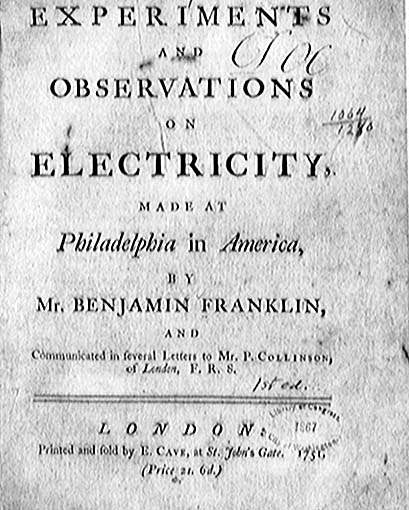
A couple of excerpts from Science and the Founding Fathers below:
From Science and the Founding Fathers: Science in the Political Thought of Jefferson, Franklin, Adams, and Madison
James Harrington, the seventeenth-century political theorist whose Oceana has been called a "constitutional blueprint," described his method as a "political anatomy". He was a great admirer of William Harvey, discoverer of the circulation of the blood, and made use of a number of analogies based on Harvey's work. Thus, he argued for a bicameral legislation on the analogy with Harvey's discovery of the functions of the two ventricles of the human heart, even making use in his argument of the difference in size and strength between the ventricles. This political analogy included Harvey's discussion of the difference between the blood pumped out by each ventricle, concluding that the two houses of the legislature would similarly have different functions. Only a historian of science or someone really familiar with the nature of Harvey's discoveries would fully appreciate this analogy. Furthermore, only a historian of science who knew Harvey's work on animal generation would recognize the Harveyan origins of other political analogies used by Harrington, including one introduced by the bold statement, Everything comes from the egg, taken directly from the motto "Ex ovo omnia" in the frontispiece to Harvey's Latin treatise De Generatione Animalium. Similarly, only a historian of science or someone familiar with the text of Newton's Pincipia would recognize the Newtonian source of Jefferson's paraphrase in his Notes on the State of Virginia...In the days of the Founding Fathers, only one political leader, Benjamin Franklin, had a real scientific reputation; he was recognized the world over as one of the foremost scientists of his day. Many of our historians, however, have not had sufficient knowledge and understanding of science to evaluate his scientific achievement at its true worth. As a result, historians have generally either belittled his contributions to basic science and his scientific stature or confused the advance of knowledge with its applications, treating his scientific research as if it were on the same level as the invention of gadgets such as a rocking chair, bifocal glasses, or his "armonica".
Having read a number of biographies of Benjamin Franklin, I have to say that this observation is pretty much spot-on.
One more excerpt:
American political thought in the age of the Declaration of Independence and the Constitution exhibits two seemingly different qualities. One is deductive, the other inductive. The deductive feature emulates mathematics and logic as the expression of human reason, finding a model in the geometry of Euclid and in Newton's Principia. An example would be some of the Federalist papers, in which certain general principles are held to be the axioms of political thought from which some features of the Constitution are derived or defended. So extreme did this procedure seem to critics that one of them pilloried Madison for the form of arguments in the Federalist. He would, the correspondent wrote, "next have recourse to CONIC SECTIONS, by which he will be enabled with greater facility, to discover the many windings of his favorite system." This deductive quality is a feature of the Declaration of Independence, where certain general principles are set forth in the preamble, followed by particular grievances seen in consequence.The inductive feature is more closely related to experience than to logic or mathematics. A reliance on the lessons of experience rather than on the simple powers of reason characterizes this approach. John Adams was expressing the viewpoint of many of his fellow Americans when he wrote that "the two sources of true government are reason and experience". This notion of a test by experience was a feature of Lincoln's famed Gettysburg Address, when he spoke of a test whether a "nation, conceived in Liberty, and dedicated to the proposition that all men are created equal" can "long endure".
In the days of the Declaration and the Constitution, the two chief prophets of the deductive and the inductive points of view were Isaac Newton and Francis Bacon, respectively. Jefferson's great trio of immortals, the highest incarnation of the human mind, were Bacon and Newton plus John Locke. He commissioned their portraits and hung them in a place of prominence in his office in the State Department, where they were duly admired by Alexander Hamilton, and he later displayed them prominently in his house at Monticello.
The inductive approach, with its grounding on experience, had certain features which made it seem particularly attractive to Americans. The constant regard for the lessons of experience had to be significant to citizens of the New World in a way that was not the case for Europeans, simply because in the New World there was a consciousness of a frontier, even for those who lived in urban centers or on farms and plantations far removed from the boundaries of the wilderness and the domains of the Indians. Woe to anyone who was so wedded to theory or abstractions as to neglect the hard facts of brute experience. "Experience," as Franklin had Poor Richard say, "keeps a dear school"...
The role of experience was a principal factor of the philosophy of the third of Jefferson's trio of immortals, John Locke. Locke, it will be recalled, held that infants are born with an empty mind, a "tabula rasa", with no "innate" ideas. Ideas come to be formed, he argued, on the basis of the impinging of the sense-data or impressions of experience. In this context it must not be forgotten that Newton's two masterpieces of physical science, the Principia and the Opticks, were both based ultimately on experience and on induction. Newton's third and fourth "Rules for Natural Philosophy" in the Principia are concerned with the method of induction. In the final "Query" of the Opticks Newton gave the reader a guide to the way of "arguing from Experiments and Observations by Induction," the method of proceeding "from Effects to their Causes, and from particular Causes to more general ones, till the Argument end in the most general." Newton even expressed the hope that "if natural Philosophy in all its Parts, by pursuing this Method, shall at length be perfected, the Bounds of Moral Philosophy will be also enlarged."
In the age of the Constitution the veneration of Newton did not preclude placing a high value on the new and post-Newtonian sciences based on direct interrogation of nature by experiment and observation. The most famous American at the Convention was Benjamin Franklin, a scientist renowned for his experiments and for a theory devised to explain the features of experiential knowledge. His celebrated treatise was, in fact, called Experiments and Observations on Electricity. One of the scientific heroes of the Enlightenment was Linnaeus, founder of the great system of classification of plants that bore his name. Linnaeus had proceeded by observation and not by mathematics or deduction.
Political creeds are always ultimately based on religious beliefs or political or social philosophies, a set of general beliefs or axioms from which particular conclusions are derived. In considering the political thought of the men who signed the Declaration of Independence and who framed the Constitution, therefore, we cannot neglect the impress on their mind-set of the intellectual background of the Enlightenment, the Age of Reason. Even George Washington, not usually noted for a deep reading of the philosophers, was aware of the importance of Enlightenment thinkers in making possible the political new world of America being created after independence. In a circular letter to the states, announcing his retirement as commander-in-chief of the army and declaring his return to private life, George Washington took note that the establishment of the new nation did not occur "in the gloomy age of Ignorance and Superstition" but rather "at an Epocha when the rights of mankind were better understood and more clearly defined, than at any former period." Washington attributed this change to the successful "researches of the human mind, after social happiness," to the "collected wisdom" acquired by the "labours of Philosophers," and of "Sages and Legislatures".
May 25, 2005
Today in History: "how thirteen independent states could share a government of tripartite powers"
May 25, 1787 ... the Constitutional Convention (although that would only be its name later ... at the time it was called the "Federal Convention") got underway. Most of the delegates had arrived, by that time, from their far-flung states, and May 25th was the first day that they convened in Independence Hall.
At the time, nobody (except perhaps James Madison, Alexander Hamilton, and George Washington) was thinking about creating a constitution, or even considering "consolidating". The thought of "consolidation" was horrifying to most, and the thought of an "energetic national government" was even worse. No. No energetic government. The colonies had had quite enough of being bossed around and wanted to be left alone. However, the original Articles of Confederation were seen by most as inadequate for the present circumstances, so the Convention was called to revise the Articles of Confederation. But Washington, Madison, Hamilton - and a couple of other far-seeing gentlemen - saw the need for an even greater revolution, an even more daring task.
One thing to add into this pot, one important piece of context is Shays Rebellion. The Convention began in May, 1787, and Shays Rebellion had raged from the fall of 1786 into the early spring of 1787. So it was still fresh in the memories of all present. Shays Rebellion had left Washington deeply angered, and shaken. He knew that civilization was a fragile construct, easily destroyed. That was the spectre before Washington's eyes, in terms of Shays Rebellion, and any other future uprising. He was convinced that the Articles of Confederation would not be sufficient to cope. There needed to be a federal government.
Man, it's so hard to get just how controversial and outrageous those words were seen in the context of the time. But Washington was not alone. Hamilton, Madison ... also were in favor of strengthening the central government. The violence of Shays Rebellion was the spark which caused the first rift between Thomas Jefferson and Abigail Adams - good friends up until then. Abigail, in London at the time, was enraged at the Rebellion and she wanted it to be crushed, mercilessly. How dare these people threaten all they had fought for? How DARE they? She wrote a passionate letter to Jefferson about it, expressing her rage, and his response to her contained the now-famous line: "I like a little rebellion now and then. It is like a storm in the atmosphere." She quickly withdrew from his friendship, fearful that his view of government would lead the newly free colonies into complete and utter anarchy.
Anyway - the memory of Shays Rebellion was fresh, and vivid to the men who gathered in the Pennsylvania State House, on May 25th, 1787. Most of them knew they were part of a grand experiment, but many of them didn't know just how much grander and bolder it was about to get. Die-hard patriots, men who had signed the Declaration of Independence, balked at the new idea of this "Constitution", and a consolidated government - with one man at the head of it. One man?? Hadn't they all seen what one man could do?
Regardless: today is the day that the Convention began.
I'll let the marvelous Catherine Drinker-Bowen set the scene (this is from Miracle At Philadelphia
MAY 25TH, 1787
On the twenty-fifth of May, when a quorum was obtained, Washington was unanimously elected president of the Convention and escorted to the chair. From his desk on the raised dais he made a little speech of acceptance, depreciating his ability to give satisfaction in a scene so novel. "When seated," wrote a member, "he declared that as he never had been in such a situation he felt himself embarrassed, that he hoped his errors, as they would be unintended, would be excused. He lamented his want of qualifications."...In the front row near the desk, James Madison sat bowed over his tablet, writing steadily. His eyes were blue, his face ruddy; he did not have the scholar's pallor. His figure was well-knit and muscular and he carried his clothes with style. Though he usually wore black, he has also been described as handsomely dressed in blue and buff, with ruffles at breast and wrist. Already he was growing bald and brushed his hair down to hide it; he wore a queue and powder. He walked with the quick bouncing step that sometimes characterizes men of remarkable energy.
As a reporter Madison was indefatigable, his notes comprehensive, set down without comment or aside. One marvels that he was able at the same time to take so large a part in the debates. It is true that in old age Madison made some emendations in the record to accord with various disparate notes which later came to light; he has been severely criticized for it. Other members took notes at the Convention: Hamilton, Yates and Lansing of New York, McHenry of Maryland, Paterson of New Jersey, Rufus King of Massachusetts, William Pierce of Georgia, George Mason of Virginia. But most of these memoranda were brief, incomplete; had it not been for Madison we should possess very scanty records of the Convention. His labors, he said later, nearly killed him. "I chose a seat," he afterward wrote, "in front of the presiding member, with the other members on my right and left hand. In this favorable position for hearing all that passed, I noted in terms legible and in abbreviations and marks intelligble to myself what was read from the Chair or spoken by the members; and losing not a moment unnecessarily between the adjournment and reassembling of the Convention I was enabled to write out my daily notes during the session or within a few finishing days after its close in the extent and form preserved in my own hand on my files ... I was not absent a single day, nor more than a casual fraction of an hour in any day, so that I could not have lost a single speech, unless a very short one."
It was, actually, a tour de force, not to be published -- and scarcely seen -- until thirty years after the Convention. "Do you know," wrote Jefferson to John Adams from Monticello in 1815, "that there exists in manuscript the ablest work of this kind ever yet executed, of the debates of the constitutional convention of Philadelphia ...? The whole of everything said and done there was taken down by Mr. Madison, with a labor and exactness beyond comprehension." ...
"The State of Georgia, by the grace of God, free, Sovereign and Independent" ... On Friday morning, May twenty-fifth, as soon as Washington had finished his little speech of acceptance from the chair, Major Jackson rose to read aloud the credentials -- so carefully worked over at home -- of the nine states present. It was noticeable that the smallest states spoke out with the loudest voice. Georgia, referred to as "small and trifling" because of her sparse population, announced herself to the Convention with a proud resounding orchestration which left little doubt of her position ... "Sovereign and Independent."
Certain members of the Convention were already heartily sick of the word sovereign. The monster, sovereignty, Washington had called it. The General knew well from what sanction Georgia derived the word. "Each state," the Articles of Confederation had said, "retains its sovereignty, freedom and independence." Without such a clause the Confederacy never would have been achieved ...
Before the Declaration of Independence, no colony had pretensions to independent sovereignty, nor were the states mentioned by name in the body of that document. Yet from the moment peace had been signed, states flaunted their sovereignty as an excuse to do as they pleased. "Thirteen sovereignties," Washington had written, "pulling against each other, and all tugging at the foederal head, will soon bring ruin on the whole."
A General of the Army is not expected to possess so direct and merciless a political eye. Already on May 25, 1787, it looked as if the Federal Convention were to have its fill of sovereignty. The reading aloud of these state credentials was a matter for strict attention; here were signs portent of which way the states were leaning. Madison and Hamilton thought they already knew. Madison had canvassed exhaustively; both men were personally acquainted with many delegates, some of whom had themselves drafted these documents and no doubt would stand by what they had written. Delaware, for instance, whose credentials forbade her deputies to change Article V of the Confederation, giving to each state one vote in Congress and one vote only. Proportional representation was no part of Delaware's scheme. Should the old rule be altered to voting by population, the small states would be blanketed out. Delaware had come prepared to oppose it.
Small states against large, the planting interests of the South against the mercantile money of the North, the regulation of the Western Territory -- these were immediate problems. Not every delegate brought to Philadelphia a comprehension of how thirteen independent states could share a government of tripartite powers: legislative, judicial, executive. James Wilson of Philadelphia understood it and so did Wythe of Virginia. Wilson and Wythe were scholars like Madison. Not only had they acted a part in government bu tthey had thought, red, pondered on the subject; they knew the theory behind the practice. "I am both a citizen of Pennsylvania and of the United States," Wilson told the Convention.
Time would pass before members realized how far the plans of such men as Madison and Hamilton reached, and what the Constitution promised to be. It would be misleading to name thus early the Constitution's "enemies", or to set down this name or that as "against" the Constitution. Five delegates in the end would refuse to sign -- Elbridge Gerry of Massachusetts, Yates and Lansing of New York, George Mason and Edmund Randolph of Virginia -- all men of decided views and each with a different reason for his action. More vociferous than any of these would be Luther Martin of Maryland, who, though out of town on private business at the moment of signing, later declared that had he been present he would have given the document his "solemn negative," even had he "stood single and alone".
Martin did not arrive at the Convention until nearly a month after it met; for the moment, members were spared his boisterous and interminable harangues. On this first Saturday of a quorum the Convention faced a twofold problem: the theoretic question of what kind of government best suited America -- a democracy, a limited monarchy, a republic? -- and the practical problem of creating such a government with all its untried component parts. It was good to review, by way of the state credentials, the aims of the Convention as declared by twelve legislatures. Major Jackson's voice droned on:
"To take into consideration the state of the union ... as to trade and other important objects ... to render the Foederal Government entirely adeuqate to the actual situation ..." When Jackson ceased there was time only to name a committee to prepare standing rules and orders, and to appoint a doorkeeper and messenger. The meeting adjourned for the weekend.
And so endeth May 25th, 1787.
Four months later:
The Scene at the Signing of the Constitution, oil painting (reproduction) by Howard Chandler Christy, 1940

May 16, 2005
What??
The superb David McCullough has a new book out ... and it is called 1776 and nobody told me???? I feel so betrayed!!
Now excuse me as I gush like a little girl:
McCullough's biography of John Adams was one of the best books I've ever read. And now he has written a book that takes the year 1776, and breaks it down day by day, step by step. We're talking about a microscopic look at that momentous year.
Oh GOD, he is totally the man to write such a book.
I could barely get through the review in The New Yorker ... I was too excited to settle down and read. I wish I could have the book air-lifted to my house immediately.
What I find most exciting is that Washington, by necessity, if you think about that year, is really the star of the book. The guys in Philadelphia, hashing out the Declaration, are (and were) peripheral. The writing of the Declaration (now seen as such a tremendous moment) was little more than a formality at the time. They needed to declare their intentions to King George, but it was more of something to check off a list, something that needed to be done ... rather than a moment when the gods on high descended and flowed out of Jefferson's pen. One of the reasons why the Declaration so amazes me is that it was NOT borne out of a holy-halo glow of sanctity, it was NOT the most important moment ... it was a bit of housekeeping, it was a memo. The fact that Jefferson managed to infuse that document with such hope for humanity, such a STAND for the dignity of mankind, is quite incredible.
BUT. 1776, if you pull back, and get perspective, is much more about Washington, and the actual war being fought.
So I am so thrilled that McCullough - such a marvelous biographer - is turning his focus onto George Washington. I've read a couple different biographies of Washington, and I have to say: the guy remains a bit of an enigma. Not like John Adams, who was an open emotional volatile book. Washington fascinates, because of what he DOESn't say. I can't wait to hear McCullough's take on the guy.
McCullough is one of my writing idols and I am so excited right now that I actually feel like crying. Read that New Yorker article ... you'll see why. Especially when you get to the last paragraph.
GEEK ALERT!! Sheila's a wicked huge geek!!!
May 13, 2005
The pursuit of happiness
One of the most interesting (and moving) things to me about those 18th century philosopher politician types is the continuous use of the word "happiness". It has multiple levels of meaning ... and doesn't at all have the sort of shallow connotation that it has today (where "happiness" is some sort of psychological achievement that you can reach by doing daily meditation, forgiving your parents, watching Oprah every day, or following the Food Pyramid step by step). No. It's not that kind of emotion they are talking about. Happiness isn't easy, or inevitable. It had to be planned for, it had to be nurtured, it had to be fought for. Happiness was that important, happiness was that essential. It wasn't a byproduct of the new government, it wasn't an accident or a coincidence, or something to hope for ... it was one of the primary and conscious GOALS of the new government. Happiness. Imagine that. It's stunning to contemplate. Happiness is a worthwhile goal. Happiness is essential to the health of a nation. What exactly did they mean by it? Well, you can go back and read all the primary sources, all their letters, and pamphlets, and papers and figure it out. It's all there. They talk about it - to themselves, to each other, to the public, all. The. Time. Happiness, happiness ... How could the new government be constructed as to protect "happiness" ... Tough and thorny questions, obviously. This concern with "the pursuit of happiness" was nothing less than a revolution in thought, a leap forward in man's expectations for himself.
May 12, 2005
Miracle.
I'm still reading Miracle at Philadelphia. It's like CANDY to me and I don't want it to end.
Catherine Drinker Bowen writes with an unabashed sense of import and admiration - and yet she also gets us down into the muck and everyday-ness of the Convention. These men are not gods, or statues. They were real men, separated from their families, burdened by financial problems, tormented by the heat ... and yet there they were, day after day, hashing out this new Constitution. Drinker Bowen takes us into Independence Hall, and certainly takes us through the arguments pro and con step by step. We get to know who is for, who is against ... we hear about this person's speech on that day, and so-and-so's rebuttal speech the next day - it's that specific (and we get to hear about Hamilton's now-famous 6 hour long speech) ... but she also tells us the more mundane stuff. And it's THAT stuff that really makes the book special: where they ate for dinner, the heat wave Philadelphia had that summer, what the 4th of July celebrations were like ... You really feel like you were THERE.
I am well acquainted with the main characters. Ahem. Of COURSE. But there are a host of other characters I am not as close to, shall we say, and so it's really fun getting to know them too. Charles Pinckney. Luther Martin. What a blowhard he was. Too funny ... a couple of other gentlemen at the convention mentioned his way-too-long speeches in their notes from the time. There seemed to be a unanimous agreement about it: Luther Martin talked too much. So he's kind of new to me. George Mason. James Wilson.
In all the other books I've read, these guys of course are mentioned - but they're peripheral. In a book about Thomas Jefferson, who's gonna dwell on Luther Martin? But this book is the biography of an EVENT, not just one individual. So all the characters are important. Everyone who attended the Convention was important. We owe them ALL an enormous debt. Even chatty-Kathy Luther Martin.
Catherine Drinker Bowen has a novelist's eye. She tells us the physical characteristics of each man (put together from first-hand reports), she gives us a few sensory details about each one (this one wore velvet suits, this one had one leg, this one didn't wear a wig) ... and they become characters - like in a book. But not in a folksy unreal kind of way. It's just that she makes you feel like you are THERE in Independence Hall. I've said it before, but that would be the #1 place/time I would go if I had a time machine. I am loving the book.
April 30, 2005
Today in History
On April 30, 1789, George Washington was sworn in as the first President of the United States.
George Washington wrote the following on the eve of his inauguration:
It is said that every man has his portion of ambition. I may have mine, I suppose, as well as the rest, but if I know my own heart, my ambition would not lead me into public life; my only ambition is to do my duty in this world as well as I am capable of performing it, and to merit the good opinion of all good men.
We are so lucky, so very lucky, to have had this man in our "canon". There's as always, so much to say. One of the thing that strikes me about him is that he never wanted to seem like he was jostling for power or position. George Washington had many wonderful qualities and abilities - but it was this distaste for public life that I believe made him truly great. He went out of his way to let everyone know how unworthy he felt, how he hoped their trust in him was warranted, that he was eager to finally go home and live the life of a private man... But on this day in history, April 30, there was to be no private man anymore. His people had chosen him, and while Mount Vernon continued to call to him, he knew he must accept.
David McCullough describes, in his book on John Adams, inauguration day:
On the day of his inauguration, Thursday, April 30 1789, Washington rode to Federal Hall in a canary-yellow carriage pulled by six white horses and followed by a long column of New York militia in full dress. The air was sharp, the sun shone brightly, and with all work stopped in the city, the crowds along his route were the largest ever seen. It was as if all New York had turned out and more besides. "Many persons in the crowd," reported the Gazette of the United States "were heard to say they should now die contented – nothing being wanted to complete their happiness … but the sight of the savior of his country."In the Senate Chamber were gathered the members of both houses of Congress, the Vice President, and sundry officials and diplomatic agents, all of whom rose when Washington made his entrance, looking solemn and stately. His hair powdered, he wore a dress sword, white silk stockings, shoes with silver buckles, and a suit of the same brown Hartford broadcloth that Adams, too, was wearing for the occasion. They might have been dressed as twins, except that Washington's metal buttons had eagles on them.
It was Adams who formally welcomed the General and escorted him to the dais. For an awkward moment Adams appeared to be in some difficulty, as though he had forgotten what he was supposed to say. then, addressing Washington, he declared that the Senate and House of Representatives were ready to attend him for the oath of office as required by the Constitution. Washington said he was ready. Adams bowed and led the way to the outer balcony, in full view of the throng in the streets. People were cheering and waving from below, and from windows and rooftops as far as the eye could see. Washington bowed once, then a second time.
Fourteen years earlier, it had been Adams who called on the Continental Congress to make the tall Virginian commander-in-chief of the army. Now he stood at Washington's side as Washington, his right hand on the Bible, repeated the oath of office as read by Chancellor Robert R. Livingston of New York, who had also been a member of the Continental Congress.
In a low voice Washington solemnly swore to execute the office of the President of the United States and, to the best of his ability, to "preserve, protect, and defend the Constitution of the United States." Then, as not specified in the Constitution, he added, "So help me God", and kissed the Bible, thereby establishing his own first presidential tradition.
"It is done," Livingston said, and, turning to the crowd, cried out, "Long live George Washington, President of the United States."
The following is George Washington's first inaugural address. What I sense in these words is what I sense in so many of the original documents of that time, written by the main players: they were embarking on a grand and hopeful experiment. They were entering uncharted waters. And they all seem determined (each in their different ways, with their different views) to make the most of the opportunity, to seize the day. No decision was unimportant, everything had meaning ... and what I also sense in this inaugural address is that Washington knew that he wasn't only talking to the people present, but he was also talking to us. The future generations. They all knew that they were being watched, carefully, by those who would come after.
The only thing required of a President on his inauguration day, in those early early days, was that he take the oath of Office. Washington, in composing an address, to the people who put their faith in him, set the precedent. Every president since then has followed his example.
Fellow-Citizens of the Senate and of the House of Representatives:Among the vicissitudes incident to life no event could have filled me with greater anxieties than that of which the notification was transmitted by your order, and received on the 14th day of the present month. On the one hand, I was summoned by my Country, whose voice I can never hear but with veneration and love, from a retreat which I had chosen with the fondest predilection, and, in my flattering hopes, with an immutable decision, as the asylum of my declining years--a retreat which was rendered every day more necessary as well as more dear to me by the addition of habit to inclination, and of frequent interruptions in my health to the gradual waste committed on it by time. On the other hand, the magnitude and difficulty of the trust to which the voice of my country called me, being sufficient to awaken in the wisest and most experienced of her citizens a distrustful scrutiny into his qualifications, could not but overwhelm with despondence one who (inheriting inferior endowments from nature and unpracticed in the duties of civil administration) ought to be peculiarly conscious of his own deficiencies. In this conflict of emotions all I dare aver is that it has been my faithful study to collect my duty from a just appreciation of every circumstance by which it might be affected. All I dare hope is that if, in executing this task, I have been too much swayed by a grateful remembrance of former instances, or by an affectionate sensibility to this transcendent proof of the confidence of my fellow-citizens, and have thence too little consulted my incapacity as well as disinclination for the weighty and untried cares before me, my error will be palliated by the motives which mislead me, and its consequences be judged by my country with some share of the partiality in which they originated.
Such being the impressions under which I have, in obedience to the public summons, repaired to the present station, it would be peculiarly improper to omit in this first official act my fervent supplications to that Almighty Being who rules over the universe, who presides in the councils of nations, and whose providential aids can supply every human defect, that His benediction may consecrate to the liberties and happiness of the people of the United States a Government instituted by themselves for these essential purposes, and may enable every instrument employed in its administration to execute with success the functions allotted to his charge. In tendering this homage to the Great Author of every public and private good, I assure myself that it expresses your sentiments not less than my own, nor those of my fellow- citizens at large less than either. No people can be bound to acknowledge and adore the Invisible Hand which conducts the affairs of men more than those of the United States. Every step by which they have advanced to the character of an independent nation seems to have been distinguished by some token of providential agency; and in the important revolution just accomplished in the system of their united government the tranquil deliberations and voluntary consent of so many distinct communities from which the event has resulted can not be compared with the means by which most governments have been established without some return of pious gratitude, along with an humble anticipation of the future blessings which the past seem to presage. These reflections, arising out of the present crisis, have forced themselves too strongly on my mind to be suppressed. You will join with me, I trust, in thinking that there are none under the influence of which the proceedings of a new and free government can more auspiciously commence.
By the article establishing the executive department it is made the duty of the President "to recommend to your consideration such measures as he shall judge necessary and expedient." The circumstances under which I now meet you will acquit me from entering into that subject further than to refer to the great constitutional charter under which you are assembled, and which, in defining your powers, designates the objects to which your attention is to be given. It will be more consistent with those circumstances, and far more congenial with the feelings which actuate me, to substitute, in place of a recommendation of particular measures, the tribute that is due to the talents, the rectitude, and the patriotism which adorn the characters selected to devise and adopt them. In these honorable qualifications I behold the surest pledges that as on one side no local prejudices or attachments, no separate views nor party animosities, will misdirect the comprehensive and equal eye which ought to watch over this great assemblage of communities and interests, so, on another, that the foundation of our national policy will be laid in the pure and immutable principles of private morality, and the preeminence of free government be exemplified by all the attributes which can win the affections of its citizens and command the respect of the world. I dwell on this prospect with every satisfaction which an ardent love for my country can inspire, since there is no truth more thoroughly established than that there exists in the economy and course of nature an indissoluble union between virtue and happiness; between duty and advantage; between the genuine maxims of an honest and magnanimous policy and the solid rewards of public prosperity and felicity; since we ought to be no less persuaded that the propitious smiles of Heaven can never be expected on a nation that disregards the eternal rules of order and right which Heaven itself has ordained; and since the preservation of the sacred fire of liberty and the destiny of the republican model of government are justly considered, perhaps, as deeply, as finally, staked on the experiment entrusted to the hands of the American people.
Besides the ordinary objects submitted to your care, it will remain with your judgment to decide how far an exercise of the occasional power delegated by the fifth article of the Constitution is rendered expedient at the present juncture by the nature of objections which have been urged against the system, or by the degree of inquietude which has given birth to them. Instead of undertaking particular recommendations on this subject, in which I could be guided by no lights derived from official opportunities, I shall again give way to my entire confidence in your discernment and pursuit of the public good; for I assure myself that whilst you carefully avoid every alteration which might endanger the benefits of an united and effective government, or which ought to await the future lessons of experience, a reverence for the characteristic rights of freemen and a regard for the public harmony will sufficiently influence your deliberations on the question how far the former can be impregnably fortified or the latter be safely and advantageously promoted.
To the foregoing observations I have one to add, which will be most properly addressed to the House of Representatives. It concerns myself, and will therefore be as brief as possible. When I was first honored with a call into the service of my country, then on the eve of an arduous struggle for its liberties, the light in which I contemplated my duty required that I should renounce every pecuniary compensation. From this resolution I have in no instance departed; and being still under the impressions which produced it, I must decline as inapplicable to myself any share in the personal emoluments which may be indispensably included in a permanent provision for the executive department, and must accordingly pray that the pecuniary estimates for the station in which I am placed may during my continuance in it be limited to such actual expenditures as the public good may be thought to require.
Having thus imparted to you my sentiments as they have been awakened by the occasion which brings us together, I shall take my present leave; but not without resorting once more to the benign Parent of the Human Race in humble supplication that, since He has been pleased to favor the American people with opportunities for deliberating in perfect tranquillity, and dispositions for deciding with unparalleled unanimity on a form of government for the security of their union and the advancement of their happiness, so His divine blessing may be equally conspicuous in the enlarged views, the temperate consultations, and the wise measures on which the success of this Government must depend.
William Maclay, a senator from Pennsylvania, kept a daily journal - highly detailed, and rather cynical, about the Senate sessions of the first Congress. He describes the first inauguration in vivid detail:
30th April, Thursday.--This is a great, important day. Goddess of etiquette, assist me while I describe it. The Senate stood adjourned to half after eleven o'clock. About ten dressed in my best clothes; went for Mr. Morris' lodgings, but met his son, who told me that his father would not be in town until Saturday. Turned into the Hall. The crowd already great. The Senate met. The Vice-President rose in the most solemn manner. This son of Adam seemed impressed with deeper gravity, yet what shall I think of him? He often, in the midst of his most important airs--I believe when tie is at loss for expressions (and this he often is, wrapped up, I suppose, in the contemplation of his own importance)-- suffers an unmeaning kind of vacant laugh to escape him. This was the case to-day, and really to me bore the air of ridiculing the farce he was acting. "Gentlemen, I wish for the direction of the Senate. The President will, I suppose, addressthe Congress. How shall I behave? How shall we receive it? Shall it be standing or sitting?"Here followed a considerable deal of talk from him which I could make nothing of. Mr. Lee began with the House of Commons (as is usual with him), then the House of Lords, then the King, and then back again. The result of his information was, that the Lords sat and the Commons stood on the delivery of the King's speech. Mr. Izard got up and told how often he had been in the Houses of Parliament. He said a great deal of what he had seen there. [He] made, however, this sagacious discovery, that the Commons stood because they had no. seats to sit on, being arrived at the bar of the House of Lords. It was discovered after some time that the King sat, too, and had his robes and crown on.
Mr. Adams got up again and said he had been very often indeed at the Parliament on those occasions, but there always was such a crowd, and ladies along, that for his part he could not say how it was. Mr. Carrol got up to declare that he thought it of no consequence how it was in Great Britain; they were no rule to us, etc. But all at once the Secretary, who had been out, whispered to the Chair that the Clerk from the Representatives was at the door with a communication. Gentlemen of the Senate, how shall he be received? A silly kind of resolution of the committee on that business had been laid on the table some days ago. The amount of it was that each House should communicate to the other what and how they chose; it concluded, however, something in this way: That everything should be done with all the propriety that was proper. The question was, Shall this be adopted, that we may know how to receive the Clerk? It was objected [that] this will throw no light on the subject; it will leave you where you are. Mr. Lee brought the House of Commons before us again. He reprobated the rule; declared that the Clerk should not come within the bar of file House; that the proper mode was for the Sergeant-at-Arms, with the mace on his shoulder, to meet the Clerk at the door and receive his communication; we are not, however, provided for this ceremonious way of doing business, having neither mace nor sergeant nor Masters in Chancery, who carry down bills from the English Lords.
Mr. Izard got up and labored unintelligibly to show the great distinction between a communication and a delivery of a thing, but he was not minded. Mr. Elsworth showed plainly enough that if the Clerk was not permitted to deliver the communication, the Speaker might as well send it inclosed. Repeated accounts came [that] the Speaker and Representatives were at the door. Confusion ensued; the members left their seats. Mr. Read rose and called the attention of the Senate to the neglect that had been shown Mr. Thompson, late Secretary. Mr. Lee rose to answer him, but I could not hear one word he said. The Speaker was introduced, followed by the Representatives. Here we sat an hour and ten minutes before the President arrived--this delay was owing to Lee, Izard, and Dalton, who had stayed with us while the Speaker came in, instead of going to attend the President. The President advanced between the Senate and Representatives, bowing to each. He was placed in the chair by the Vice-President; the Senate with their president on the right, the Speaker and the Representatives on his left. The Vice-President rose and addressed a short sentence to him. The import of it was that he should now take the oath of office as President. He seemed to have forgot half what he was to say, for he made a dead pause and stood for some time, to appearance, in a vacant mood. He finished with a formal bow, and the President was conducted out of the middle window into the gallery, and the oath was administered by the Chancellor. Notice that the business done was communicated to the crowd by proclamation, etc., who gave three cheers, and repeated it on the President's bowing to them.
As the company returned into the Senate chamber, the President took the chair and the Senators and Representatives their seats. He rose, and all arose also and addressed them. This great man was agitated and embarrassed more than ever he was by the leveled cannon or pointed musket. He trembled, and several times could scarce make out to read, though it must be supposed he had often read it before. He put part of the fingers of his left hand into the side of what I think the tailors call the fall of the breeches, changing the paper into his left hand. After some time he then did the same with some of the fingers of his right hand. When he came to the words all the world, he made a flourish with his right hand, which left rather an ungainly impression. I sincerely, for my part, wished all set ceremony in the hands of the dancing-masters, and that this first of men had read off his address in the plainest manner, without ever taking his eyes from the paper, for I felt hurt that he was not first in everything. He was dressed in deep brown, with metal buttons, with an eagle on them, white stockings, a bag, and sword.
From the hall there was a grand procession to Saint Paul's Church, where prayers were said by the Bishop. The procession was well conducted and without accident, as far as I have heard. The militia were all under arms, lined the street near the church, made a good figure, and behaved well.
The Senate returned to their chamber after service, formed, and took up the address. Our Vice-President called it his most gracious speech. I can not approve of this. A committee was appointed on it--Johnson, Carrol, Patterson. Adjourned. In the evening there were grand fireworks. The Spanish Ambassador's house was adorned with transparent paintings; the French Minister's house was illuminated, and had some transparent pieces; the Hall was grandly illuminated, and after all this the people went to bed.
I have such a deep fondness for John Adams, with all his airs and self-importance and vanity. I just love the guy, what can I say. He's so feckin' human.
The description of Washington's awkwardness makes me want to cry:
He rose, and all arose also and addressed them. This great man was agitated and embarrassed more than ever he was by the leveled cannon or pointed musket. He trembled, and several times could scarce make out to read, though it must be supposed he had often read it before. He put part of the fingers of his left hand into the side of what I think the tailors call the fall of the breeches, changing the paper into his left hand. After some time he then did the same with some of the fingers of his right hand. When he came to the words all the world, he made a flourish with his right hand, which left rather an ungainly impression. I sincerely, for my part, wished all set ceremony in the hands of the dancing-masters, and that this first of men had read off his address in the plainest manner, without ever taking his eyes from the paper, for I felt hurt that he was not first in everything. He was dressed in deep brown, with metal buttons, with an eagle on them, white stockings, a bag, and sword.
God. Good God. But what really moves me is that after the address, they all walked in procession, led by George Washington, to St. Paul's Church, for a service.
St. Paul's Church. (Read that article ... it's a well-known story, of course, but it always bears repeating.) St. Paul's has always had meaning for us here in New York, because of its long history, but now ... it has more meaning than ever. I can't even think about St. Paul's without feeling tears come to my eyes. So to think ... that that special church, that church that became symbolic (not just to us here, but to people all over the country) of hope, or survival, of healing ... would be the place where George Washington prayed for guidance after being sworn in as the first President... I mean, honestly. I don't even know what else to say about it.
April 30, 1789 ... the day this new nation embarked on its unknown and exciting course, with George Washington at the helm.
Here is an image of the first page of this inaugural address, in Washington's own hand.
April 24, 2005
Happy birthday, Library of Congress!
On this day, in 1800, President John Adams approved legislation that appropriated $5,900 to purchase the books that would create the Library of Congress.
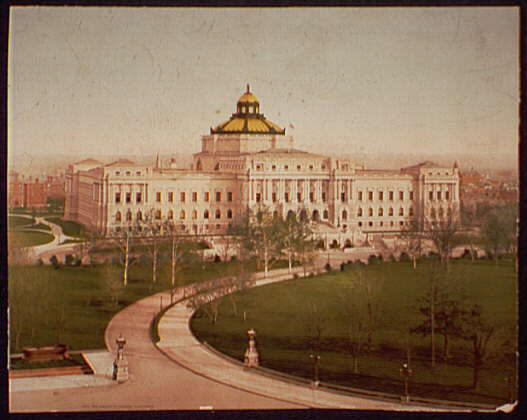
(This image isn't from that time - the building itself was constructed at the end of the 1800s.)
During the War of 1812, the British invaded Washington and wreaked havoc. They burned the 3,000 volumes that made up the Library of Congress (these were housed in the Capitol), ordered from all over the world. Thomas Jefferson, during his time as President (1801 to 1809) took a huge interest in the Library (no surprise there - the guy went into massive lifelong debt because of his book-buying addiction). His own personal library was known as the greatest in the country. When the Library was burned in 1814, Jefferson was no longer President, and was living in retirement at Monticello. I love this story: Jefferson offered to sell Congress his private library (almost 6,500 books, people ... damn!) - as a starting point to building up the Library of Congress collection again. The original Library of Congress had a narrow focus: law, economics, and history. With the new books from Jefferson, the national collection had much more breadth and depth: architecture, botany, geography, literature, science. Amazing. The Jefferson collection sat in a reading room in Congress for most of the 19th century, until 1871 when plans were approved to build a separate building for the Library of Congress. Project approved by Congress in 1886, and construction began. At the time, it was the largest (and costliest) library building in the world.
I'm going to DC in a couple of weeks, and I must, of course, make a pilgrimage to the Library of Congress.
April 22, 2005
It never ceases to amaze me ...
the kindness and generosity, in general, of human beings. Sure, people can be selfish shits, so can I ... but the evidence of goodness in people, for me, has a longer-lasting impact, makes more of an impression. This is obviously not true for the cynics of the world. As a matter of fact, it's the opposite that would be true: Goodness, to them, seems flimsy and unsubstantial. It is the bad-ness that makes the impression.
Well, for me ... I am stunned by the kindness of people. And I am stunned by the generosity.
I am thinking about this right now because I just received a gift in the mail from my Amazon list ... sent to me by this gentleman right here, a gentleman who has, to put it mildly, a lot going on right now. But he took the time to look at my list, and send me 2 things I had asked for ... because he likes to read my site every day and forget a little bit about his troubles. This, for me, is the greatest compliment.
I have tears in my eyes right now. Big Dan: fighting against his own body that is trying to destroy him - and yet still: he writes every day on his blog - thank God! It's such a gift to read it. It is always a reminder that we should not take this life for granted. But now ... with the gifts arrived ... from this man I do not know, this man I have never met ...
Honestly, I'm all choked up right now. It's generosity like a blinding light.
So. What did he buy me?? Well, this is VERY exciting. I'm all a-twitter about it.
1. The new biography of Alexander Hamilton by Ron Chernow. It's massive. It's a beaaauuuuutiful book, too - hardcover. And inside are all these glossy pages filled with stunning portraits of all the main characters in Hamilton's life, including one of George Washington, leaning with his elbow against a cannon - a really casual open pose, very very unlike his later stiff self. I love the illustrations. Can't seem to get enough of Alexander Hamilton, no matter how much I try to segue out into other interests. He is endlessly fascinating. I am very VERY excited to start this book.
2. Staying with that theme, Dan sent me a second book: Adams Vs. Jefferson: The Tumultuous Election of 1800 . I've written quite a bit before about this election - it's one of my passions from that period. To my mind, it is after THAT election that we truly became a nation. A nation unlike any other nation on earth. There was no coup, no overthrow ... and these were two brand-new political parties who not only hated each other, but truly believed that the ruin of the nation would come if the other side was elected. (Huh. Sound familiar?) It's an amazing story - the story of that election, and I've read it, of course, in the biographies of Adams and Jefferson - the ugliness of that campaign (which makes our polarization look like child's play - These people were apocalyptically mean about their opponents). I started a book called Jefferson's 2nd Revolution, and did a couple of posts on it - but I'm going to be frank: The woman cannot write. I was forcing myself to get through it because of the story told, but she cannot write. If you see that book in a bookstore and feel like picking it up, remember my words: She is a bad writer. I stopped reading the book, and now another book has arrived - from Pastor Dan. It is a gorgeous book as well, and I'm reaallly excited to dig into it.
Thank you!!! I love my two new books! They have proudly taken their spots in Bookshelf # 6.
April 18, 2005
Today in history
On this day, in 1775, Paul Revere made his famous ride. (To quote Longfellow: "On the 18th of April in 75, hardly a man is now alive, who remembers that famous day and year ...")
The spring of 1775 was a tense time. Prominent Bostonians were under constant threat of arrest from the British, and so many of them - to avoid this - moved their families to outlying communities. However, two of the main patriotic leaders (Benjamin Church and Joseph Warren) stayed in Boston - Paul Revere did as well, and kept a close eye on British movements through that spring. Revere was trusted as a messenger, he knew everybody, he was just one of those guys. In mid-April, Revere started to notice some ominous signs: mainly that the British ships were taken out of the water, to be worked on, repaired. He could sense that something was coming. He felt the British were preparing for some kind of attack.
Revere went to Concord on April 16 (most of the weaponry was stored there) and warned the leaders of that community that the British were preparing something, up to something, and if they were going to strike, they would most definitely try to seize the weapons stash in Concord. So the people of Concord went to work, hiding their store of weapons in barns, cellars, swamps, etc. (Like I mentioned: Paul Revere was trusted. He knew everybody. If you're interested, read the excerpt I posted of Malcolm Gladwell's fascinating analysis of Paul Revere - and his comparison with the far less successful messenger William Dawes.)
So. April 16. Revere returned to Boston from Concord, and met with other revolutionary leaders, and that is when they came up with the "one if by land, two if by sea" warning system. Revere knew they needed a way to have some advance warning about which route the British were going to take when they finally did attack.
By land? Or by sea?
So, Revere set up the system: Signal lanterns would be placed in the belfry of Old North Church (the steeple can be seen across the Charles River). If two lanterns were hung, then the British would be crossing the Charles by boat. If one lantern was hung, then the British would choose to attack using a land route.
"One if by land, two if by sea."
This plan was put in place just in time. On April 18, in the early evening, a stable boy came to Paul Revere, telling him that he had overheard some British soldiers discussing the upcoming attack, and that it was planned for early the next morning. The stable boy knew who to bring this information to, and that was Paul Revere. (Again, check out Gladwell's analysis of Paul Revere's personality. Really interesting.)
Revere, on receiving this urgent piece of information, knew he had to get the warning out (and that he especially had to warn John Hancock and Samuel Adams who, at that time, were hiding out in Lexington).
So off he went onto his now legendary ride. Revere took the water route out of Boston, rowed across the Charles, and galloped through the communities north of Boston sounding the alarm. (Medford, Charlestown, Lexington, Concord.) Because of Paul Revere, the British had completely lost the element of surprise. When they came to attack, they found the rebellious colonists waiting for them everywhere, ambushing them left and right, from behind stone walls, hiding behind trees ... they were everywhere.
An interesting tidbit (this is why I love this time in American history - yeah, the events themselves are really cool ... but it's details like the following one that really have me hooked, like a crack addict):
In his hurry to depart, Revere forgot to bring along pieces of cloth to wrap the oars of his boat. The purpose of this was to muffle the sound of them cutting through the water. The Somerset (the British man-of-war) was at anchor, right there in the harbor. Paul Revere had to row right by them, and so any sound at all would have alerted the crew, and if Revere was busted, the whole jig would be up. Revere was in a bit of a pickle ... standing by his boat, trying to figure out how he could improvise ... could he take off his stockings? Tie them around the end of the oars?
One of the boatmen involved in helping Revere make this crossing came to the rescue. He ran to his girlfriend's house and asked her for her petticoat. hahaha One can only imagine her startled response!! "Please, dear. It's 10 pm, and I need you to take off your petticoat, give it to me, and don't ask me ANY questions about it!!" But apparently, this girl, whoever she was, complied - took off her petticoat, gave it up, and Revere used that to wrap up the ends of his oars.
I love that woman, whoever she is.
So. In honor of the great Paul Revere, I have a couple other things to post. One is, my conversation with Cashel about the American Revolution. I read this on the radio last year. I love it. It's one of my favorite conversations I've ever had with him.
And lastly, in the extended entry, please find Henry Wadsworth Longfellow's celebrated poem "Paul Revere's Ride". I know large swaths of it by heart ... To me, it's a thrilling poem. Because of the story it tells, but also because of its rollicking rhythm, you can feel the suspense, you can feel the urgency.
April 18, 1775. A great day in American history. One of my personal favorite "stories" of the American revolution.
Paul Revere's Ride
Listen my children and you shall hear
Of the midnight ride of Paul Revere,
On the eighteenth of April, in Seventy-five;
Hardly a man is now alive
Who remembers that famous day and year.
He said to his friend, "If the British march
By land or sea from the town to-night,
Hang a lantern aloft in the belfry arch
Of the North Church tower as a signal light,--
One if by land, and two if by sea;
And I on the opposite shore will be,
Ready to ride and spread the alarm
Through every Middlesex village and farm,
For the country folk to be up and to arm."
Then he said "Good-night!" and with muffled oar
Silently rowed to the Charlestown shore,
Just as the moon rose over the bay,
Where swinging wide at her moorings lay
The Somerset, British man-of-war;
A phantom ship, with each mast and spar
Across the moon like a prison bar,
And a huge black hulk, that was magnified
By its own reflection in the tide.
Meanwhile, his friend through alley and street
Wanders and watches, with eager ears,
Till in the silence around him he hears
The muster of men at the barrack door,
The sound of arms, and the tramp of feet,
And the measured tread of the grenadiers,
Marching down to their boats on the shore.
Then he climbed the tower of the Old North Church,
By the wooden stairs, with stealthy tread,
To the belfry chamber overhead,
And startled the pigeons from their perch
On the sombre rafters, that round him made
Masses and moving shapes of shade,--
By the trembling ladder, steep and tall,
To the highest window in the wall,
Where he paused to listen and look down
A moment on the roofs of the town
And the moonlight flowing over all.
Beneath, in the churchyard, lay the dead,
In their night encampment on the hill,
Wrapped in silence so deep and still
That he could hear, like a sentinel's tread,
The watchful night-wind, as it went
Creeping along from tent to tent,
And seeming to whisper, "All is well!"
A moment only he feels the spell
Of the place and the hour, and the secret dread
Of the lonely belfry and the dead;
For suddenly all his thoughts are bent
On a shadowy something far away,
Where the river widens to meet the bay,--
A line of black that bends and floats
On the rising tide like a bridge of boats.
Meanwhile, impatient to mount and ride,
Booted and spurred, with a heavy stride
On the opposite shore walked Paul Revere.
Now he patted his horse's side,
Now he gazed at the landscape far and near,
Then, impetuous, stamped the earth,
And turned and tightened his saddle girth;
But mostly he watched with eager search
The belfry tower of the Old North Church,
As it rose above the graves on the hill,
Lonely and spectral and sombre and still.
And lo! as he looks, on the belfry's height
A glimmer, and then a gleam of light!
He springs to the saddle, the bridle he turns,
But lingers and gazes, till full on his sight
A second lamp in the belfry burns.
A hurry of hoofs in a village street,
A shape in the moonlight, a bulk in the dark,
And beneath, from the pebbles, in passing, a spark
Struck out by a steed flying fearless and fleet;
That was all! And yet, through the gloom and the light,
The fate of a nation was riding that night;
And the spark struck out by that steed, in his flight,
Kindled the land into flame with its heat.
He has left the village and mounted the steep,
And beneath him, tranquil and broad and deep,
Is the Mystic, meeting the ocean tides;
And under the alders that skirt its edge,
Now soft on the sand, now loud on the ledge,
Is heard the tramp of his steed as he rides.
It was twelve by the village clock
When he crossed the bridge into Medford town.
He heard the crowing of the cock,
And the barking of the farmer's dog,
And felt the damp of the river fog,
That rises after the sun goes down.
It was one by the village clock,
When he galloped into Lexington.
He saw the gilded weathercock
Swim in the moonlight as he passed,
And the meeting-house windows, black and bare,
Gaze at him with a spectral glare,
As if they already stood aghast
At the bloody work they would look upon.
It was two by the village clock,
When he came to the bridge in Concord town.
He heard the bleating of the flock,
And the twitter of birds among the trees,
And felt the breath of the morning breeze
Blowing over the meadow brown.
And one was safe and asleep in his bed
Who at the bridge would be first to fall,
Who that day would be lying dead,
Pierced by a British musket ball.
You know the rest. In the books you have read
How the British Regulars fired and fled,---
How the farmers gave them ball for ball,
>From behind each fence and farmyard wall,
Chasing the redcoats down the lane,
Then crossing the fields to emerge again
Under the trees at the turn of the road,
And only pausing to fire and load.
So through the night rode Paul Revere;
And so through the night went his cry of alarm
To every Middlesex village and farm,---
A cry of defiance, and not of fear,
A voice in the darkness, a knock at the door,
And a word that shall echo for evermore!
For, borne on the night-wind of the Past,
Through all our history, to the last,
In the hour of darkness and peril and need,
The people will waken and listen to hear
The hurrying hoof-beats of that steed,
And the midnight message of Paul Revere.
April 15, 2005
The Federal Convention
Nobody went into the "Constitutional Convention" calling it the "Constitutional Convention". For the most part (except for maybe Madison, Hamilton, and Washington who pretty much wanted to create a strong "energetic" national government from the getgo) they were all there to battle over the deficiencies of the Articles of Confederation. They were all big on "sovereignty" - that word comes up a lot. Each state being "sovereign" - blah blah. A strong government was a dirty word (small wonder - look at the system they had all just fought to escape). Here is a really interesting excerpt from Miracle at Philadelphia about what made the Convention in 1787 different from the Convention in 1776 when they decided to declare their independence. I mean, the difference is obvious in the externals, but Catherine Drinker-Bowen (the author) describes a philosophical differnce:
Characteristically, the Convention never stayed long upon theory. Its business was not to defend "freedom" or to vindicate a revolution. That had been done long ago, in July of 1776 and later, when colony after colony created its state constitution, flinging out its particular preamble of political and religious freedom. The Convention of 1787 would debate the rights of states, not the rights of man in general. The records show nothing grandly declaratory or defiant, as in the French constituent assembly of 1789. America had passed that phase; had anyone challenged members, they would have said such declarations are already cemented with their blood. In 1787 the states sat not to justify the term United States but to institute a working government for those United States. One finds no quotations from Rousseau, John Locke, Burlamaqui or the French philosophes, and if Montesquieu is invoked it is deffend the practical organization of a tripartite government. When the Federal Convention discussed political power, governmental authority, they discussed it in terms of what was likely to happen to Delaware or Pennsylvania , New Jersey or Georgia.Most members of the Philadelphia Convention, in short, were old hands, politicians to the bone. That some of them happened also to be men of vision, educated in law and the science of government, did not distract them from the matters impending. There was a minimum of oratory or showing off. Each time a member seemed about to soar into the empyrean of social theory -- the eighteenth century called it "reason" -- somebody brought him round, and shortly. "Experience must be our only guide," said John Dickinson of Delaware. "Reason may mislead us."
The practical matter of how the national legislature should be elected was to take up half the summer. Roger Sherman of Connecticut, on May thirty-first, declared the people "should have as little to do as may be about the government. They want information and are constantly liable to be misled." Elbridge Gerry, man of business affairs and money, agreed. "The evils we experience," he said, "flow from the excess of democrazy. The people do not want virtue, but are the dupes of pretended patriots." There is small doubt that Gerry's mind turned as he said it to Captain Shays and his band of debt-ridden farmers, breaking up the meetings of county law courts and demanding "reforms" in the legislature. That the farmers had been badly treated did not enter into Gerry's philosophy. To this Boston merchant a mob was a mob. And were men of this stamp to be permitted authority in government?
Elbridge Gerry, friend of Samuel Adams, was one of the"old patriots"; he had signed the Declaration of Independence. Yet to the members of the Federal Convention the word democracy carried another meaning than it does today. Democrazy signified anarchy; demos was not the people but the mob. When Paterson of New Jersey said "the democratic spirit beats high," it was meant in derogation, not in praise. Again and again we meet these phrases: if aristocracy was "baleful" and "baneful," unchecked democracy was equally to be shunned. Edmund Randolph desired, he said, "to restrain the fury of democracy," and spoke also of "the democratic licentiousness of the State legislatures."
Gerry went on with his speech. "I am still republican," he said. "But I have been taught by experience the danger of the levelling spirit."
Drinker-Bowen's comment that there was "little oratory or showing off" reminds me of one of my favorite quotes from John Adams. He wrote home to his wife, Abigail, during the first Continental Congress, in 1774, and here is what he had to say:
This assembly is like no other that ever existed. Every man in it is a great man -- an orator, a critic, a statesman, and therefore every man upon every question must show his oratory, his criticism, his political abilities. The consequence of this is that business is drawn and spun out to immeasurable length. I believe if it was moved and seconded that we should come to a resolution that three and two make five, we should be entertained with logic and rhetoric, law, history, politics, and mathematics concerning the subject for two whole days, and then we should pass the resolution unanimously in the affirmative.
ha ha ha
April 13, 2005
Washington's head
Here's an article analyzing George Washington's head, via the Jean-Antoine Houdon bust. It's a famous bust - Houdon poured plaster over Washington's head - and I believe he had a bit of a dodgy time getting the dern stuff off of the father of our country ... [ Update: or maybe that was Jefferson - Yeah, that's right. It was Jefferson who had a really bad experience with a plaster-cast at the end of his life. Sorry, wrong Founding Father. It's an awful story - Jefferson really panicked, the plaster hardened, and the artist had to conk him about the head and face with a hammer, in order to crack the hardened plaster. Jefferson thought he would suffocate, and was pretty shook up for a couple of months afterwards. He wrote about it in a letter to Adams. Sorry - it was haunting me for a bit: Was it George or Jefferson that happened to???]
But back to George! Here's the bust:
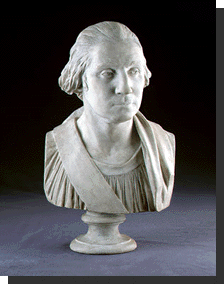
Using this bust, they're somehow trying to recreate what Washington really looked like. All of this is in preparation for an upcoming Washington exhibit at Mount Vernon, which will be called "The Real Washington".
But what I found really interesting, because of the synchronicity, was that just this morning, I read in Miracle at Philadelphia the following section about Washington (and there's a quote specifically about his head):
On the twenty-fifth of May, when a quorum was obtained, Washington was unanimously elected president of the Convention and escorted to the chair. From his desk on the raised dais he made a little speech of acceptance, depreciating his ability to give satisfaction in a scene so novel. "When seated," wrote a member, "he declared that as he never had been in such a situation he felt himself embarrassed, that he hoped his errors, as they would be unintentional, would be excused. He lamented his want of qualifications."There is something touching in the way Washington always lamented his want of qualifications and called on God to help, whether it was a nomination as Commander in Chief of the army, as president of the Federal Convention or as President of the United States. One feels he meant it, this was not false modesty. To his colleagues it must have been reassuring. Washington was everywhere known as "the greatest character in America" -- a man of prestige, with a landed estate and a magnificent physical appearance. An English traveler, impressed, wrote a detailed account, beginning with the General's commanding height and going on to say that "his chest is full and his limbs, though rather slender, well shaped and muscular. His head is small ... his eyes are of a light grey color ... and, in proportion to the length of his face, his nose is long. Mr. Stewart, the eminent portrait painter, told me there are features in his face totally different from those he had observed in that of any human being. The sockets of the eyes, for instance, are larger than what he ever met with before, and the upper part of the nose broader. All his features ... were indicative of the strongest passions, and had he been born in the forest ... he would have been the fiercest man among the savage tribes."
A person of such passions had need of control. "This Vesuvius of a man," the biographer Beveridge has called him. Washington's self-discipline is legendary, as is his anger when aroused. Officers who served under him in the war testified they had never seen him smile, that his countenance held something austere and his manners were uncommonly reserved.
An interesting coincidence, huh? Some random project going on right now to determine the size and shape of George Washington's head, and I read that this morning.
Two tangential things:
-- "Mr. Stewart" is, of course, the portrait painter Gilbert Stuart (nice bio of him here). He did quite a few portraits of Washington, and here is one you will probably recognize:

There are many more, though - he became known for his portraits of all "those guys".
Stuart was born a town over from where I grew up in Rhode Island - born in 1755, and field trips to his birthplace were par for the course throughout school. If you're ever driving through Rhode Island, by the way, his birthplace is quite nice, and very accessible. It's right off the highway - there are signs from Route 1 telling you where to go. I remember that he had constructed a clock, making it himself - somehow - using paintbrushes as the hands of the clock.
-- Every time I hear about Washington's "uncommon reserve" (and the record is FULL of such mentions ... apparently, his manners were just a wee bit glacial - and ALWAYS formal - except when he got enraged, and then he went batshit. If he was pissed off or frustrated, he had no problem with chewing someone - or all of Congress for that matter - out.) But anyway: I hear about his "reserve" and I can't help but remember the anecdote about Alexander Hamilton: There was some party (dodgy on the details, forgive - maybe one of you will remember) - Anyway, a large gathering of all the main characters of the American Revolution. It was a party, though, not a business gathering. So there was liquor flowing, and a bit more of a free atmosphere. George Washington, however, remained - as always - perfectly correct. His correct-ness was interpreted by many as coldness. You couldn't warm up to the guy, you could never just hang out with George. His sense of propriety would not allow it. So Alexander Hamilton, yukking it up in the corner (troublemaker!!) with a couple other fellows, dared one of them to walk up to Washington, throw his arm around him, and say, "Hello, George!" Not "General Washington", not "Mr. Washington" - but "George". This was an unthinkable prospect (which goes to show you the effect Washington's reserve had on others - People couldn't even imagine what would happen if anyone acted in a familiar way with him). Hamilton goaded this one particular gentleman, "I dare you, I dare you to go do it ... I dare you" until finally the guy caved, and did it. While Hamilton watched from across the room, laughing hysterically. Washington was never rude, just always distant and chill. And this poor guy threw his arm around him and called him "George!" in a buddy-buddy way and Washington just would not have any of it. I think the gentleman in question never forgave himself for insulting George Washington, but I may be making up that part of the story.
The Soothing "miracle" at Philadelphia
Obviously I'm really upset right now. To the point where I am finding it hard to even think straight. I want to wave a magic wand over my computer, and have it all be well again.
So what do I do when I feel this way? I find comfort any way I can.
Right now, I'm reading with GREAT enjoyment Catherine Drinker-Bowen's classic Miracle at Philadelphia: The Story of the Constitutional Convention May - September 1787. Ahhhh. Now I read her spectacular book John Adams and the American Revolution (my dad loved this book, and passed on that love to me.) I had never read Miracle though, so I am having a blast. A total BLAST.
It is the story of the Constitutional Convention - from start to finish, day to day. You do get brief backgrounds on the Articles of Confederation, etc., but primarily - it is the story of those months, hashing out the constitution, bit by bit by bit. She tells us when each delegate arrived, and how they arrived ... where did they stay, what did they all do for entertainment ... how did they regard one another? Pieced together through letters, journals, and (primarily) James Madison's scrupulous notes (how he managed to keep such detailed notes, as well as making speeches, and paying close attention so he could report it all to Jefferson - is another miracle. More evidence of the unbelievably cool and logical mind of this extraordinary gentleman) ... anyway, she has pieced them together and writes the book like a novel. You feel that you are in those rooms. You feel the stifling heat, the mugginess, you see the green baize tables ... It's a wonderful book, rightly called a classic.
I'm finding it reaaallllly comforting to read right now. In my unbelievable stress.
February 21, 2005
1791 Jefferson and Adams - the break-up
And here, now, the relationship between Jefferson and Adams started to get prickly.
July 17, 1791: Jefferson to Adams (he writes - trying to explain the whole "political heresies" comment)
That you and I differ in our ideas of the best form of government is well known to us both: but we have differed as friends should do, respecting the purity of each other's motives, and confining our difference of opinion to private conversation. And I can declare with truth in the presence of the almighty that nothing was further from my intention or expectation than to have had either my own or your name brought before the public on this occasion. The friendship and confidence which has so long existed between us required this explanation from me, and I know you too well to fear any misconstruction of the motives of it. Some people here who would wish me to be, or to be thought, fuilty of impropieties have suggested that I was Agricola, that I was Brutus etc etc. [Anonymous op-ed columns, attacking John Adams, etc. - signed under these names] I never did in my life, either by myself or by any other, have a sentence of mine inserted in a newspaper without putting my name to it; and I believe I never shall.
John Adams did not accept the olive brance and fired back a letter on July 29, 1791:
You declare very explicitly that you never did, by yourself, or by any other, have a Sentence of yours, inserted in a Newspaper without your name to it. And I, with equal frankness declare that I never did, either by my self or by any other, have a Sentence of mine inserted in any Newspaper since I left Philadelphia. I neither wrote nor corrected Publicola. The Writer in the Composition of his Pieces [which turned out to be Adams' son, John Quincy Adams] followed his own Judgment, Information and discretion, without any assistance from me.You observe "that You and I differ in our Ideas of the best form of Government is well known to us both." But, my dear Sir, you will give me leave to say, that I do not know this. I know not what your Idea is of the best form of Government. You and I have never had a serious conversation together that I can recollect concerning the nature of Government. The very transient hints that have ever passed between Us have been jocular and superficial, without ever coming to any explanation. If You suppose that I have ever or ever had a design or desire, of attempting to introduce a Government of King, Lords, and Commons, or in other words an hereditary Executive, or an hereditary Senate, either into the Government of the United States or that of any Individual State, in this Country, you are wholly mistaken. There is not such a Thought expressed or intimated in any public writing or private Letter of mine, and I may safely challenge all Mankind to produce such a passage and quote the Chapter and Verse.
If you have ever put such a Construction on any Thing of mine, I beg you would mention it to me, and I will undertake to convince you, that it has no such meaning...
I thank you, Sir, very sincerely for writing to me upon this Occasion. It was high time that you and I should come to an explanation with each other. The friendship that has subsisted for fifteen Years between Us without the smallest interruption, and untill this occasion without the slightest Suspicion, ever has been and still is, very dear to my heart. There is no office which I would not resign, rather than give a just occasion to one friend to forsake me. Your motives for writing to me, I have not a doubt were the most pure and the most friendly; and I have no suspicion that you will not receive this explanation from me in the same candid light.
Ouch. It would be over 20 years before the wounds of this break healed, and the two could settle down to try to "explain" themselves to each other.
1789: John Adams: "a Junto of Grandees"
John Adams wrote the following letter to Jefferson on March 1, 1789. 2 months before the first inauguration, and the beginning of this new government. Jefferson was still in Paris. Adams wrote:
In four days, the new Government is to be erected. Washington appears to have an unanimous vote: and there is probably a Plurality if not a Majority in favour of your Friend. -- It may be found easier to give Authority, than to yield Obedience.Amendments to the Constitution, will be expected, and no doubt discusseed. Will you be so good as look over the Code and write me your Sentiments of Amendments which you think necessary or usefull? That greatest and most necessary of all Amendments, the Separation of the Executive Power, from the Legislative Seems to be better understood than it once was. Without this our Government is in danger of being a continual struggle between a Junto of Grandees, for the first Chair.
1787: John Adams: "You are the afraid of the one -- I, of the few"
John Adams responded to Thomas Jefferson's concerns about the "new constitution" (see post below) in this letter. Here, John Adams describes the essential political differences between these two people - differences which were never resolved - and indeed I don't believe ever should be resolved. It is a debate, a debate which must continue.
You are the afraid of the one -- I, of the few. We agree perfectly that the many should have a full fair and perfect Representation. -- You are Apprehensive of Monarchy; I, of Aristocracy. I would therefore have given more Power to the President and less to the Senate. The Nomination and Appointment to all offices I would have given to the President, assisted only by a Privy Council of his own Creation, but not a Vote or Voice would I have given to the Senate or any Senator, unless he were of the Privy Council. Faction and Distraction are the sure and certain Consequence of giving to a Senate a vote in the distribution of offices.You are apprehensive the President when once chosen, will be chosen again and again as long as he lives. So much the better as it appears to me.
You are apprehensive of foreign Interference, Intrigue, Influence. So am I. -- But, as often as Elections happen, the danger of foreign Influence recurs. The less frequently they happen the less danger. -- And if the Same Man may be chosen again, it is probable he will be, and the danger of foreign Influence will be less. Foreigners, seeing little Prospect will have less Courage for Enterprize.
Elections, my dear sir, Elections to offices which are great objects of Ambition, I look at with terror. Experiments of this kind have been so often tryed, and so universally found productive of Horrors, that there is great Reason to dread them.
Fascinating.
1787: Thomas Jefferson: "How do you like our new constitution?"
Thomas Jefferson to John Adams, Nov. 13 1787:
How do you like our new constitution? I confess there are things in it which stagger all my dispositions to subscribe to what such an assembly has proposed. The house of federal representatives will not be adequate to the management of affairs either foreign or federal. Their President seems a bad edition of a Polish king. He may be reelected from 4 years to 4 years for life. Reason and experience prove to us that a chief magistrate, so continuable, is an officer for life. When one or two generations shall have proved that this is an office for life, it becomes on every succession worthy of intrigue, of bribery, of force, and even of foreign interference. It will be of great consequence to France and England to have America governed by a Galloman or Angloman. Once in office, and possessing the military force of the union, without either the aid or check of a council, he would not be easily dethroned, even if the people could be induced to withdraw their votes from him. I wish that at the end of the 4 years they had made him for ever ineligible a second time.
1787: John Adams: "you and I have been indefatigable Labourers"
John Adams wrote this letter to Thomas Jefferson on Oct. 9, 1787 (Jefferson in Paris, Adams in London).
Disgrace is not easily washed out, even with blood. Lessons my dear Sir, are never wanting. Life and History are full. The Loss of Paradise, by eating a forbidden apple, has been many Thousand years a Lesson to Manking, but not much regarded. Moral Reflections, wise Maxims, religious Terrors, have little Effect upon Nations when they contradict a present Passion, Prejudice, Imagination, Enthusiasm or Caprice. Resolutions never to have an hereditary officer will be kept in America, as religiously as that of the Cincinnati was in the Case of General Greene's son. [Adams is being sarcastic here. After the death of General Nathaniel Greene in 1786, the Order of the Cincinnati met and agreed that his son should be admitted into the society, to take up his father's seat when he reached the age of 18.] Resolutions never to let a Citizen ally himself with things will be kept untill an Opportunity presents to violate it. If the Duke of Angoleme, or Burgundy, or especially the Dauphin should demand one of your beautiful and most amiable Daughters in Marriage, all America from Georgia to New Hampshire would find their Vanity and Pride, so agreeably flattered by it, that all their Sage Maxims would give way; and even our Sober New England Republicans would keep a day of Thanksgiving for it, in their hearts. If General Washington had a Daughter, I firmly believe, she would be demanded in Marriage by one of the Royal Families of France or England, perhaps by both, or if he had a Son he would be invited to come a courting to Europe. -- The Resolution not to call in foreign Nations to settle domestic differences will be kept untill a domestic difference of a serious nature shall break out.-- I have long been settled in my own opinion, that neither Philosophy, nor Religion, nor Morality, nor Wisdom, nor Interest, will ever govern nations or Parties, against their Vanity, their Pride, their Resentment or Revenge, or their Avarice or Ambition. Nothing but Force and Power and Strength can restrain them...
In short my dear Friend you and I have been indefatigable Labourers through our whole Lives for a Cause which will be thrown away in the next generation, upon the Vanity and Foppery of Person of whom we do not now know the Names perhaps...
Pardon this freedom. It is not Melancholly: but Experience and believe me without reserve your Friend, O tempora -- oh mores
1787: Thomas Jefferson: "their stupid king"
Thomas Jefferson to John Adams (while Jefferson was in Paris, Adams in London):
We I hope shall be left free to avail ourselves of the advantages of neutrality: and yet much I fear the English, or rather their stupid king, will force us out of it. For thus I reason. By forcing us into the war against them they will be engaged in an expensive land war as well as a sea war. Common sense dictates therefore that they should let us remain neuter: ergo they will not let us remain neuter. I never yet found any other general rule for foretelling what they will do but that of examining what they ought not to do.
1787: John Adams: "John Bull dont see it"
John Adams to Thomas Jefferson (while Jefferson was in Paris, and the Adams' were in London):
Opening a direct Communication between Paris and America will facilitate the Trade of the two Countries, very much, and the new Treaty between France and England, will promote it still more. John Bull dont see it, and if he dont see a Thing at first, you know it is a rule with him ever after wards to swear that it dont exist, even when he does both see it and feel it.
1786: John Adams: "I am so impressed and distressed with this affair"
John Adams to Thomas Jefferson (while Jefferson was in Paris, and the Adams' were in London):
There is here a Tripolitan Ambassador with whom I have had three Conferences. The Substance of what passed Colonel Smith will explain to you. Your Visit here will be imputed to Curiosity, to take a Look at England and pay your Respects at Court and to the Corps Diplomatick. There is nothing to be done in Europe, of half the Importance of this, and I dare not communicate to Congress what has passed without your Concurrence. What has already been done and expended will be absolutely thrown away and We shall be involved in a universal and horrible War with these Barbary States, which will continue for many Years, unless more is done immediately. I am so impressed and distressed with this affair that I will go to New York or to Algiers or first to one and then to the other, if you think it necessary, rather than it should not be brought to a Conclusion.
Prophetic. "universal and horrible War ... continue for many Years ..."
hmmm
In honor of Presidents Day ...
I have willingly surrendered my sanity. As you can see from the extravaganza unfurling below you.
I'm not done yet, either.
Enjoy. To all the freaks and geeks out there like me, ENJOY!
1776: John Adams - "we cannot insure Success"
John to Abigail, Feb. 18 1776 - I LOVE this quote
The Events of War are uncertain: We cannot insure Success, but We can deserve it.
1775: Abigail Adams: "I am more and more convinced that Man is a dangerous creature"
Abigail to John November 27 1775:
I wish I knew what mighty things were fabricating. If a form of Government is to established here what one will be assumed? Will it be left to our assemblies to chuse one? and will not many men have many minds? and shall we not run into Dissentions among ourselves?I am more and more convinced that Man is a dangerous creature, and that power whether vested in many or a few is ever grasping, and like the grave cries give, give. The great fish swallow up the small, and he who is most strenuous for the Rights of the people, when vested with power, is as eager after the perogatives of Government. You tell me of degrees of perfection to which Humane Nature is capable of arriving, and I believe it, but at the same time lament that our admiration should arise from the scarcity of the instances.
The Building up a Great Empire, which was only hinted at by my correspondent may now I suppose be realized even by the unbelievers. Yet will not ten thousand Difficulties arise in the formation of it? The Reigns of Government have been so long slakned, that I fear the people will not quietly submit to those restrains which are necessary for the peace, and security of the community; if we separate from Brittain, what Code of Laws will be established. How shall we be governed so as to retain our Liberties? Can any government be free which is not administred by general stated Laws? Who shall frame these Laws? Who will give them force and energy? Tis true your Resolutions as a Body have heithertoo had the force of Laws. But will they continue to have?
When I consider these things and the prejudices of people in favour of Ancient customs and Regulations, I feel anxious for the fate of our Monarchy or Democracy or what ever is to take place. I soon get lost in a Labyrinth of perplexities, but whatever occurs, may justice and righteousness be the Stability of our times, and order arise out of confusion. Great difficulties may be surmounted by patience and perseverence.
I believe I have tired you with politicks. As to news we have not any at all.
1775: John Adams: "Liberty once lost is lost forever"
John Adams to Abigail Adams - July 7, 1775
Your Description of the Distresses of the worthy Inhabitants of Boston, and the other Sea Port Towns, is enough to melt an Heart of Stone. Our Consolation must be this, my dear, that Cities may be rebuilt, and a People reduced to Poverty, may acquire fresh Property: But a Constitution of Government once changed from Freedom, can never be restored. Liberty once lost is lost forever. When the People once surrender their share in the Legislature, and their Right of defending the Limitations upon the Government, and of resisting every Encroachment upon them, they can never regain it...I am forever yours ---
1783: "thought upon all they had done and suffered for us"
November 25, 1783: George Washington "took back" New York.
The peace treaty had been signed a year before, France had pledged support and recognition of the new United States, but the redcoats remained in New York, waiting for their written orders from London. George Washington vowed that he would not go home, he would not break up his army, until every last redcoat had left.
Nov. 25 was that momentous day - the day the American troops marched back into town, after the departure of the British.
The exhausted army marched the long way downtown, through what was now a war-ravaged New York City. People lined the streets, throwing laurels in front of Washington's horse, screaming, crying ... a huge display of emotion and reverence that made the typically humble Washington feel uncomfortable.
A woman in the crowd that day wrote the following in her diary:
We had been accustomed for a long time to military display in all the finish and finery of [British] garrison life. The troops just leaving us were as if equipped for a show and with their scarlet uniforms and burnished arms made a brilliant display. The troops that marched in, on the contrary, were ill-clad and weather-beaten and made a forlorn appearance. But then, they were our troops and as I looked at them and thought upon all they had done and suffered for us, my heart and my eyes were full.
My eyes are full, too.
Ben Franklin - check MATE
This is a rather legendary tale about Franklin, oft told - it has showed up in most of the other books I have read about this time.
It comes from his long sojourn in France, when he was the darling of the world, the epitome of the new American, he WAS America. All the while trying to negotiate matters between France and the rebelling colonies. He was, at that time, one of the most well-known (if not the most well-known) faces in the world.
Franklin was playing chess with the Duchess of Bourbon, and she didn't really know what she was doing, or how to play. She placed her king in check. Franklin, not following the rules either (but he KNEW he wasn't following the rules) captured her king. She knew enough of chess to know that this was not right and scolded him. She said that in France "we do not take kings."
Franklin replied, "We do in America."
Washington: "Men ... may talk of patriotism"
GEORGE WASHINGTON
Men may speculate as they will, they may talk of patriotism; they may draw a few examples from current story … but whoever builds upon it as a sufficient basis for conducting a long and bloody war will find themselves deceived in the end … For a long time it may of itself push men to action, to bear much, to encounter difficulties, but it will not endure unassisted by Interest.
Jefferson: "a single character"
THOMAS JEFFERSON, on George Washington:
The moderation and virtue of a single character probably prevented this Revolution from being closed, as most others have been, by a subversion of that liberty it was intended to establish.
July 3, 1776: John Adams: "The Hopes of Reconciliation ... at last totally extinguished"
JOHN ADAMS, in a July 3, 1776 letter to Abigail, after the signing of the Declaration of Independence on July 2:
The Delay of this Declaration to this Time, has many great Advantages attending it. – The Hopes of Reconciliation, which were fondly entertained by Multitudes of honest and well meaning tho weak and mistaken People, have been gradually and at last totally extinguished. – Time has been given for the whole People, maturely to consider the great Question of Independence and to ripen their Judgments, dissipate their Fears, and allure their Hopes, by discussing it in News Papers and Pamphletts, by debating it, in Assemblies, Conventions, Committees of Safety and Inspection, in town and County Meetings, as well as in private Conversations, so that the whole People in every Colony of the 13, have now adopted it, as their own Act. – This will cement the Union, and avoid those Heats, and perhaps Convulsions which might have been occasioned, by such a Declaration Six Months ago.But the Day is past. The Second Day of July 1776, will be the most memorable Epocha, in the History of America. – I am apt to believe that it will be celebrated, by succeeding Generations, as the great anniversary Festival. It ought to be commemorated, as the Day of Deliverance by solemn Acts of Devotion to God Almighty. It ought to be solemnized with Pomp and Parade, with Shews, Games, Sports, Guns, Bells, Bonfire and Illuminations from one End of this Continent to the other from this Time forward forever more.
You will think me transported with Enthusiasm, but I am not. I am well aware of the Toil, and Blood, and Treasure that it will cost Us to maintain this Declaration, and support and defend these States. Yet, through all the Gloom, I can see the Rays of ravishing Light and Glory. I can see that the End is more than worth all the Means, and that Posterity will triumph in that Day's Transaction, even though We should not rue it, which I trust in God We shall not.
1812: John Adams: "posterity must judge"
JOHN ADAMS, in a letter to Jefferson, 1812:
Whether you or I were right posterity must judge. I never have approved and never can approve the repeal of taxes, the repeal of the judiciary system, or the neglect of the navy. Checks and balances, Jefferson, however you and your party may have ridiculed them, are our only security.
Abraham Lincoln: "All honor to Jefferson"
ABRAHAM LINCOLN, on Jefferson's writing of the Declaration of Independence:
All honor to Jefferson, to the man who had the coolness, forecast, and capacity to introduce into a merely revolutionary document an abstract truth, and so to embalm it there, that today, and in all coming days, it shall be a rebuke and a stumbling-block to the very harbingers of reappearing tyranny and oppression.
1776: John Page: "an Angel rides in the Whirlwind"
JOHN PAGE TO THOMAS JEFFERSON, July 20, 1776 – on the signing of the Declaration of Independence:
God preserve the United States. We know the Race is not to the Swift nor the Battle to the Strong. Do you not think an Angel rides in the Whirlwind and directs this Storm?
John Adams - "our Colossus"
THOMAS JEFFERSON, remembering John Adams' speeches at the Continental Congress:
John Adams was our Colossus on the floor. He was not graceful nor elegant, nor remarkably fluent but he came out occasionally with a power of thought and expression, that moved us from our seats.
1775: George Washington: "if I could have justified the measure to posterity"
GEORGE WASHINGTON, letter to Joseph Reed, early December, 1775, after a disappointing recruiting drive
I have oftentimes thought how much happier I should have been if, instead of accepting the command under such circumstances, I had taken my musket on my shoulder and entered the ranks; or, if I could have justified the measure to posterity and my own conscience, had retired to the back country and lived in a wigwam. If I shall be able to rise superior to these and many other difficulties which might be enumerated, I shall most religiously believe that the finger of Providence is in it to blind the eyes of our enemies, for surely if we get well through this month it must be for want of their knowing the disadvantages which we labor under.
1775: George Washington: "a kind of destiny"
GEORGE WASHINGTON, writing to Martha on June 18, 1775, following his nomination as commander in chief
My Dearest:
I now sit down to write to you on a subject which fills me with inexpressible concern, and this concern is greatly aggravated and increased when I reflect upon the uneasiness I know it will give you. It has been determined in Congress that the whole army raised for the defence of the American cause shall be put under my care, and that it is necessary for me to proceed immediately to Boston to take upon me the command of it.You may believe me, my dear Patsy, when I assure you, in the most solemn manner, that, so far from seeking this appointment, I have used every endeavour in my power to avoid it, not only from my unwillingness to part with you and the family, but from a consciousness of its being a trust too great for my capacity, and that I should enjoy more real happiness in one month with you at home than I have the most distant prospect of finding abroad, if my stay were to be seven times seven years.
But as it has been a kind of destiny that has thrown me upon this service, I shall hope that my undertaking is designed to answer some good purpose.
1775: George Washington: "I do not think myself equal to the command"
GEORGE WASHINGTON – his brief acceptance speech June 15, 1775 to the members of the Continental Congress who had just elected him commander in chief of the Continental troops:
"Lest some unlucky event should happen unfavorable to my reputation, I beg it may be remembered by every gentleman in the room, that I this day declare, with the utmost sincerity, I do not think myself equal to the command."
1774: Martha Washington: "my heart is in the cause"
MARTHA WASHINGTON, in a letter written to a relative – on Washington's departure to Philadelphia in 1774 for the first Continental Congress:
I foresee consequences; dark days and darker nights; domestic happiness suspended; social enjoyments abandoned; property of every kind put in jeopardy by war, perhaps; neighbors and friends at variance, and eternal separations on earth possible. But what are all these evils when compared with the fate of which the Port Bill may be only a threat? [The Port Bill was to close the port of Boston – as a punishment for the Boston Tea Party] My mind is made up; my heart is in the cause. George is right; he is always right. God has promised to protect the righteous, and I will trust him.
1773: John Adams: "an Epocha in History"
ENTRY IN JOHN ADAMS' DIARY, December 17, 1773 – day after the Boston Tea Party
There is a Dignity, a Majesty, a Sublimity, in this last Effort of the Patriots, that I greatly admire. The People should never rise, without doing something to be remembered – something notable and striking. This Destruction of the Tea is so bold, so daring, so firm, intrepid, and inflexible, and it must have important Consequences, and so lasting, that I can't but consider it as an Epocha in History.
John Adams: "laws not of men"
My favorite John Adams quote. Ever.
I believe in a government of laws not of men.
1785: Thomas Jefferson: "Indeed, I tremble for my country when I reflect that God is just"
THOMAS JEFFERSON, a denunciation of slavery, 1785
The whole commerce between master and slave is a perpetual exercise of the most boisterous passions, the most unremitting despotism on the one part, and degrading submissions on the other. Our children see this, and learn to imitate it…The parent storms, the child looks on, catches the lineaments of wrath, puts on the same airs in the circle of smaller slaves, gives a loose to his worst passions, and thus nursed, educated, and daily exercised in tyranny, cannot but be stamped by it with odious peculiarities. The man must be a prodigy who can retain his manners and morals undepraved by such circumstances … if a slave can have a country in this world, it must be any other in preference to that in which he is to be born to live and labor for another … or entail his own miserable condition on the endless generations proceeding from him … Indeed, I tremble for my country when I reflect that God is just: that his justice cannot sleep forever.
Thomas Jefferson: "Be a listener only"
THOMAS JEFFERSON, in a letter to his grandson:
When I hear another express an opinion which is not mine, I say to myself, he has a right to his opinion, as I to mine. Why should I question it. His error does me no injury, and shall I become a Don Quixote, to bring all men by force of argument to one opinion? Be a listener only, keep within yourself, and endeavor to establish with yourself the habit of silence, especially in politics.
1774: John Adams: "Swim or sink"
JOHN ADAMS to Jonathan Sewall, July 1774
Swim or sink, live or die, survive or perish, [I am] with my country. You may depend upon it.
And now ...
for something COMPLETELY different - a quote from Dennis Miller:
People say, 'But what about the Founding Fathers? They were civil libertarians ... they would not have wanted to see the government take away people's civil rights!' The Founding Fathers?? Gimme a break. Do you think for one second that the Founding Fathers would have put up with ANY of this shit? I mean, come on! They were blowing people's heads off because there was a tax on their breakfast drink, okay?
John Adams: 'extravagant popularity is not the road to public advantage"
John Adams became president by a margin of three votes, I believe. Ehm, a bit too close for comfort. Here is what Adams had to say:
If the way to do good to my country were to render myself popular, I could easily do it. But extravagant popularity is not the road to public advantage.
1770: John Adams: "trust no man living with power"
John Adams again, in one of his eternal themes - This is from a journal entry, in 1770:
Ambition is one of the more ungovernable passions of the human heart. The love of power is insatiable and uncontrollable ... There is danger from all men. The only maxim of a free government ought to be to trust no man living with power to endanger the public liberty.
1774: John Adams: "three and two make five"
The following excerpt is why John Adams' letters to his wife - and hers back to him - are among the most extraordinary historical documents ever preserved. We are lucky to have them. Adams is able to make events LIVE, in how he describes them. Not all people are able to do that. But he is. And so he gives us (through Abigail) the following glimpse (humorous, of course) of the first meeting of the Continental Congress, in 1774:
This assembly is like no other that ever existed. Every man in it is a great man -- an orator, a critic, a statesman, and therefore every man upon every question must show his oratory, his criticism, his political abilities. The consequence of this is that business is drawn and spun out to immeasurable length. I believe if it was moved and seconded that we should come to a resolution that three and two make five, we should be entertained with logic and rhetoric, law, history, politics, and mathematics concerning the subject for two whole days, and then we should pass the resolution unanimously in the affirmative.
John Adams: "bewildering ourselves in groping..."
Another excerpt from a letter of John Adams to Abigail:
If we finally fail in this great and glorious contest, it will be by bewildering ourselves in groping for the middle way.
That one is one of my favorites.
John Adams: "a coincidence of circumstances without example"
This is from a letter of John Adams, to his wife Abigail:
It has been the will of Heaven that we should be thrown into existence at a period when the greatest philosophers and lawgivers of antiquity would have wished to live ... a period when a coincidence of circumstances without example has afforded to thirteen colonies at once an opportunity of beginning government anew from the foundation and building as they choose. How few of the human race have ever had an opportunity of choosing a system of government for themselves and their children? How few have ever had anything more of choice in government than in climate?
Abigail Adams: "he is no longer a King"
Abigail Adams wrote the following to John - months before the Declaration of Independence was in existence:
A people may let a King fall, yet still remain a people, but if a King let his people slip from him, he is no longer a King. And as this is most certainly our case, why not proclaim to the world in decisive terms of our own importance.
John Adams: "In general ..."
After word of the disastrous battle at Long Island reached Congress, John Adams said in a letter, trying to sum it up:
In general, our generals were outgeneralled.
John Adams: "I must study politics and war"
John Adams wrote:
I must study politics and war that my sons may have liberty to study mathematics and philosophy. My sons ought to study mathematics and philosophy, geography, natural history, naval architecture, navigation, commerce, and agriculture in order to give their children a right to study paintings, poetry, music, artchitecture, statuary, tapestry, and porcelain.
1783: Ben Franklin: "But sometimes and in some things ..."
Benjamin Franklin wrote these famous words about John Adams in 1783:
He means well for his country, is always an honest man, often a wise man, but sometimes and in some things, absolutely out of his senses.
Abigail Adams: "How unpardonable"
Abigail Adams - wife of a President, and mother of a President, wrote the following letter to John Quincy Adams, during his first semester at Harvard:
If you are conscious to yourself that you possess more knowledge upon some subject than others of your standing, reflect that you have had greater opportunities of seeing the world, and obtaining a knowledge of mankind than any of your contemporaries. That you have never wanted a book but it has been supplied to you, that your whole time has been spent in the company of men of literature and science. How unpardonable would it have been in you to have been a blockhead.
John Adams: "I am nothing"
John Adams, again, on being VP:
Gentlemen, I feel a great difficulty how to act. I am Vice President. In this I am nothing, but I may be everything.
I love John Adams. He's my favorite. He makes me laugh.
1780: George Washington: "we are always working up hill"
GEORGE WASHINGTON, letter of May 31, 1780
Certain I am unless Congress speak in a more decisive tone, unless they are invested with powers by the several States competent to the great purposes of the war, or assume them as a matter of right, and they and the States respectively act with more energy than they hitherto have done, that our cause is lost. One State will comply with a requisition of Congress, another neglects to do it; a third executes it by halves; and all differ either in the manner, the matter, or so much in point of time, that we are always working up hill; and, while such a system as the present one or rather want of one prevails, we shall ever be unable to apply our strength or resources to any advantage.
Ben Franklin, 1781
BEN FRANKLIN, 1781:
The following story may be just a rumor handed down over the years, but it is one of my favorites. Franklin was in France, and word came to France of the decisive (and shocking) American victory. Franklin attended a diplomatic dinner shortly thereafter – and, of course, everyone was discussing the defeat of the British, and the victory of America.
The French foreign minister stood, and toasted Louis XVI, "To his Majesty, Louis the Sixteenth, who, like the moon, fills the earth with a soft, benevolent glow.
The British ambassador rose and said, "To George the Third, who, like the sun at noonday, spreads his light and illumines the world."
Franklin rose and said, "I cannot give you the sun or the moon, but I give you George Washington, General of the armies of the United States, who, like Joshua of old, commanded both the sun and the moon to stand still, and both obeyed."
1789: George Washington: "if I know my own heart"
George Washington wrote the following on the eve of his inauguration:
It is said that every man has his portion of ambition. I may have mine, I suppose, as well as the rest, but if I know my own heart, my ambition would not lead me into public life; my only ambition is to do my duty in this world as well as I am capable of performing it, and to merit the good opinion of all good men.
John Adams: "the most insignificant office"
JOHN ADAMS, on being Vice President, in a letter to Abigail:
My country in its wisdom contrived for me the most insignificant office that ever the invention of man contrived or his imagination conceived.
John Quincy Adams: "have not yet established any infallible criterion of orthodoxy, either in church or state"
JOHN QUINCY ADAMS, in a public letter addressed to Thomas Jefferson.
Jefferson had made mention of Edmund Burke's book Reflections on the Revolution in France , and had endorsed it as the answer to "the political heresies that have sprung up among us." -- (This was an obvious reference to John Adams.) Jefferson had never meant his private note to the publisher on "political heresies" to be published - and to his chagrin, the publisher added the note, in its entirety, as the foreword to the book.
This was the reason (or, one of many, shall we say) that John Adams and Thomas Jefferson did not speak for many many years - Adams knew that "political heresies" was directed at him.
John Quincy Adams went on the attack for his father, and published a letter anonymously in the newspaper:
I am somewhat at a loss to determine what this very respectable gentleman means by political heresies. Does he consider this pamphlet of Mr. Paine's as a canonical book of political scripture? As containing the true doctrine of popular infallibility, from which it would be heretical to depart in one single point? I have always understood, sir, that the citizens of these States were possessed of a full and entire freedom of opinion upon all subjects civil as well as religious; they have not yet established any infallible criterion of orthodoxy, either in church or state … and the only political tenet which they could stigmatize with the name of heresy would be that which should attempt to impose an opinion upon their understandings, upon the single principle of authority.
1793: "unbridled majorities"
John Adams wrote the following in 1793, expressing his fear of what would happen during the revolution in France:
Mankind will in time discover that unbridled majorities are as tyrannical and cruel as unlimited despots.
1797 - John Adams' inauguration
John Adams later wrote about the day of his inauguration as the second President of the United States:
A solemn scene it was indeed. Washington's face remained as serene and unclouded as the day. Methought I heard him think, 'Ay! I am fairly out and you are fairly in! See which of us will be the happiest!'
Adams: ""We ought to support every administration as far as we can..."
John Adams said
I think instead of opposing systematically any administration, running down their characters and opposing all their measures, right or wrong, we ought to support every administration as far as we can in justice.
1826: "the blessings and security of self-government"
THOMAS JEFFERSON, in a letter to the mayor of Washington, June 24, 1826, declining an invitation to the 4th of July celebration in Washington - (Jefferson died 10 days later):
May it be to the world, what I believe it will be (to some parts sooner, to others later, but finally to all) the signal of arousing men to burst the chains under which monkish ignorance and superstition had persuaded them to bind themselves, and to assume the blessings and security of self-government … All eyes are opened or opening to the rights of man. The general spread of the light of science has already laid open to every view the palpable truth, that the mass of mankind has not been born with saddles on their backs, nor a favored few, booted and spurred, ready to ride them legitimately by the grace of God. These are the grounds of hope for others; for ourselves, let the annual return to this day forever refresh our recollections of these rights, and an undiminished devotion to them.
1785: "Plentiful Rains"
John Adams to Thomas Jefferson:
Dessin's Calais May 23, 1785... From a motive of Humanity I wish that our Country may have plentiful Rains, and our Husbandmen Industry, that they may Supply the Wants of their Suffering Fellow Creatures in Europe. You see I have nothing so mean as a selfish or even a patriotic Wish in all this. But from the same regard to Europe and her worthy Colonists in the West Indies, I hope that these rainless, heatless Heavens will convince them that it is abundantly for their good that We should bring and carry freely, our Flour, Wheat, Corn, Rice, Flesh, and Fish for their Soulagement.
February 20, 2005
1781: the required end
The following quote is pretty much why people were terrified of Alexander Hamilton. To give you the proper context: he was answering criticism from his former Federalist Paper collaborator James Madison that this proposed Bank of America was un-constitutional. Hamilton had asked for a federal charter for the bank, Madison said there was nothing in the Constitution saying that the government should fund corporations. Hamilton pointed out that the last article of the Constitution - the one about Congress being able to make "all laws which shall be necessary and proper" - He said that that article was sufficient evidence that a charter would be constitutional.
BUT - the way Hamilton summed it all up was not calculated to assuage his enemies who feared his lust for power. He wrote:
Wherever the end is required, the means are authorized.
Okay, Machiavelli - whatever you say. Hamilton went on:
If the end be clearly comprehended within any of the specified powers, and if the measure have an obvious relation to that end, and is not forbidden by any particular provision of the Constitution, it may safely be deemed to come within the compass of the national authority.
One interpretation here, and it's my own: Hamilton ended up being right about a lot of things (although his autocratic STYLE didn't make him many friends) - and one of the things I think he was right about was that he was really the first one to challenge the Constitution that he helped create and defend. He was the first one to refuse to look at it as a rigid set-in-stone document, to be obeyed. No. It was to be USED, challenged. It was not dead. It was to be a LIVING document.
I suppose there are those out there who think I have just committed heresy myself. Strict constructionists, and all that. Whatever. Room for all of us in this big country here.
1790: "never trusting itself"
Alexander Hamilton, as Secretary of Treasury, put forth a monumental report to Congress calling for a national bank. He wanted it to be run by private citizens, and not the government. The bank had the power to issue paper money - not the federal government. Hamilton opposed the government running the printing presses to produce money. He wanted it to be separate, entirely. A quote from his report:
The wisdom of the government will be shown in never trusting itself with the use of so seducing and dangerous and expedient.
1789: "I dread the vehement character of your people"
Alexander Hamilton, of course, was appointed the first Secretary of the Treasury, under George Washington. In October, 1789, he wrote to his old friend and Revolutionary War colleague Lafayette - to tell him the news, but also to find out more news about what was happening in Paris. Paris was in complete chaos in 1789, of course. Lafayette, by that point, was trying to unite all the different factions. He failed, eventually. Hamilton and Lafayette exchanged many letters, Hamilton sharing with Lafayette the bad feeling he got about the French Revolution already. It was a psychic thing, really - he just had this feeling that it was all going to go bad. Lafayette, in the thick of it, couldn't understand that. He was certain that the revolution in his country was going to go the way of the revolution in America. Hamilton wrote to Lafayette:
You will ask why this foreboding of ill when all the appearances have been so much in your favor. I will tell you: I dread disagreements among those who are now united ... about the nature of your constitution. I dread the vehement character of your people, whom I fear you may find it easier to bring out than to keep within proper bounds after you have put them in motion. I dread the interested refractoriness of your nobles, who cannot be gratified and who may be unwilling to submit to the requisite sacrifices.
Prophetic, indeed.
1787: Federalist 1: "you are invited to deliberate upon a new Constitution for the United States of America"
Here is the ringing first paragraph of Federalist 1, written by Alexander Hamilton, published on October 27, 1787, in the "New York Independent Journal" - the first of 85 essays (written by Alexander Hamilton mostly, but James Madison wrote Federalst 10 - maybe the most famous of all of them, and John Jay contributed 5). The purpose of this onslaught was to put the case for the Constitution before the public for its review. Here is the first paragraph of the first essay:
After a full experience of the insufficiency of the existing federal government, you are invited to deliberate upon a new Constitution for the United States of America. The subject speaks its own importance, comprehending in its consequences nothing less than the existence of the UNION, the safety and welfare of the parts of which it is composed, the fate of an empire in many respects the most interesting in the world.
Yup.
That prose would have gotten MY attention - as I scanned the "For Sale" ads surrounding it.
1787: "Take mankind in general, they are vicious"
Another excerpt from a speech Alexander Hamilton made at the Constitutional Convention in 1787. Here he argues against allowing people to hold more than one public office at a time.
Take mankind in general, they are vicious -- their passions may be operated upon. Take mankind as they are, and what are they governed by? Their passions. There may be in every government a few choice spirits, who may act from more worthy motives but one great error is that we suppose mankind more honest than they are. Our prevailing passions are ambition and interest. Wise government should avail itself of those passions, to make them subservient to the public good.
1787: "a division ... into the few and the many"
Alexander Hamilton made a SIX HOUR speech at the Constitutional Convention ... People scrawled down notes of it, because he spoke without notes (except when he laid out his plan for the Government), so whatever we have of that speech is from those notes. How I wish I had been in that room. It was a rousing call to a strong central government, a rousing call for the states to give up their power and their identities - to submerge themselves into America. This obviously did not go over well in some quarters. Another delegate to the Congress described Hamilton as "praised by everybody but supported by none". Anyway, here are some excerpts from his 6-hour speech in Philadlelphia, 1787.
All the passion we see, of avarice, ambition, interest, which govern most individuals and all public bodies, fall into the current of the states and do not flow into the stream of the general national government ... How then are all these evils to be avoided? Only by such a complete sovereignty in the general government as will turn all the strong principles and passions to its side.
In the context of the time, it is not surprising at all that people hated Hamilton, and thought he spoke treasonously. They had just thrown OFF the yoke of a monarch who had "complete sovereignty" ... and now Hamilton wanted to put the yoke on again?? This was heresy to this brand new nation.
More:
In every community where industry is encouraged, there will be a division of it into the few and the many. Hence, separate interests will arise. There will be debtors and creditors. Give all power to the many, they will oppress the few. Give all power to the few, they will oppress the many. Both, therefore, ought to have power, that each may defend itself against the other.
Hamilton read aloud from his notes - what HE proposed as the set-up for the national government. It is basically what he have to this day (except for the "executive for life" thing.)
1782: "The sensations of a tender father"
Alexander Hamilton's first child - Philip - was born in 1782. He wrote the following to a friend. (Now remember, Hamilton was a "bastard brat". An orphan, essentially. He had never had a home-life. Ever. This whole fatherhood thing was new to him. He loved it.) When Philip was killed in a duel, years later, Hamilton never really recovered from the loss.
The sensations of a tender father can only be conceived by those who have experienced them. You cannot imagine how entirely domestic I am growing. I lose all taste for the pursuits of ambition. I sigh for nothing but the company of my wife and baby.
1780: "A national debt ... will be to us a national blessing."
This is from a letter Alexander Hamilton wrote in 1780.
No wise statesman will reject the good from an apprehension of the ill. The truth is, in human affairs, there is no good, pure and unmixed. Every advantage has two sides, and wisdom consists in availing ourselves of the good and guarding as much as possible against the bad...A national debt, if it is not excessive, will be to us a national blessing. It will be powerful cement of our union. It will also create a necessity for keeping up taxation to such a degree which, without being oppressive, will be a spur to industry.
1779: "a brilliant exit"
Another famous quote from Hamilton, eerie in light of how he died. This is from a letter to his good friend John Laurens:
I am disgusted with everything in this world but yourself and very few more honest fellows and I have no other wish than, as soon as possible, to make a brilliant exit.
1775: "every man ought to be supposed a knave"
A quote from Hamilton's 1775 pamphlet "The Farmer Refuted":
In contriving any system of government and fixing the several checks and contracts of the constitution, every man ought to be supposed a knave and to have no other end in all his actions but private interest. By this interest, we must govern him.
Once again I am struck by the cynical nature of our Founding Fathers. All of them (except for perhaps Jefferson, who believed in the perfectability of man) ... they knew men operated only out of self-interest. Checks and balances were then needed ... every power checked by another power on the opposite side. Men cannot be trusted with power. EVER. These guys KNEW that, instinctively. Amazing.
1781: "it's a dog's life when two dissonant tempers meet"
Five weeks after Alexander Hamilton married Betsy Schuyler, Betsy wrote to her younger sister Margarita telling her how wonderful marriage was, and told her she should get married right away so that she could be truly happy ... Alexander added the following note as a postscript:
Because your sister has the talent of growing more amiable every day, or because I am afanatic in love, or both -- or if you prefer another interpretation, because I have address enough to be a good dissembler, she fancies herself the happiest woman in the world, and would need persuade all her friends to embark with her in the matrimonial voyage. But I pray you do not let her advice have so much influence as to make you matrimony-mad. 'Tis a very good thing when their stars unite two people who are fit for each other, who have souls capable of relishing the fruits of friendship.But it's a dog's life when two dissonant tempers meet, and 'tis ten to one but this is the case. Be cautious in the choice. Get a man of sense, not ugly enough to be pointed at -- with some good nature -- a few grains of feeling -- a little taste -- a little imagination -- and above all a good deal of decision to keep you in order. If you can find one with all these qualities willing to marry you, marry him as soon as you please. I must tell you in confidence that I think I have been very fortunate.
Quote from Alexander Hamilton:
"A man of real merit is never seen in so favorable a light as through the medium of adversity."
1780: "For god's sake My Dear Betsy"
A letter from Hamilton to "Betsy", his fiance - soon to be wife. It was 1780, the war was still going on. Betsy never wrote to him often enough, in his worldview. He peppered her with letters, she was noticeably lackadaisacal in responding. It drove him nuts, as this excerpt will show:
For god's sake My Dear Betsy try to write me oftender and give me the picture of your heart in all its varieties of light and shade. Tell me whether it feels the same for me or did when we were together, or whether what seemed to be love was nothing more than a generous sympathy. The possibility of this frequently torments me.
Her non-responsive letter-writing-ness (or whatever) continued to be an issue for him His letters are often signed with such things as: "Impatiently, My Dearest", etc.
1779: "get me a wife in Carolina"
In the following letter to his good friend John Laurens in South Carolina, Hamilton describes what he wants in a wife. heh heh Amusing how men often make fun of women for having reaaaaallly specific lists of what they want in a mate ... and somehow they believe they don't have requirements?? None? You love to laugh, but you wouldn't mind having a humorless woman? Come on now. Admit it. You've got a couple of requirements too. Granted, Hamilton is kind of joking here, Laurens was a very good friend ... but still. Read this list!! I find it very amusing. He was picky. On the positive side: he found a woman who pretty much fit the bill exactly. So yee-haw for having some requirements!
Also - fascinating how Hamilton's son scratched out one line of this revealing letter. It wouldn't take a brain surgeon to figure out what Hamilton had originally written.
I empower and command you to get me a wife in Carolina ... Take her description: she must be young, handsome (I lay most stress upon a good shape); sensible (a little learning will do); well bred, chaste and tender (I am an enthusiast in my notions of fidelity and fondness); of some good nature; a great deal of generosity (she must neither love money nor scolding for I dislike equally a termagant and an economist.)In politics, I am indifferent what side she may be of: I think I have arguments that will safely convert her to mine. As to religion, a moderate stock will satisfy me. She must believe in god and hate a saint. But as to fortune, the larger stock of that, the better. You know my temper and circumstances and will therefore pay special attention to this article of the treaty. Though I run no risk of going to Purgatory for my avarice, yet as money is an essential ingredient of happiness in this world, as I have not much of my own and as I am very little calculated to get more, it must needs be that my wife bring at least a sufficiency to administer to her own extravagancies.
If you should not readily meet with a lady that you think answers my description, you can only advertise in the public papers and doubtless you will hear of many competitors for most of the qualifications required who will glad to become candidates for such a prize as I am. To excite them, it will be necessary for you to give an account of the lover -- his size, make, quality of mind and body, achievements, expectations, fortune, etc. In drawing my picture, you will no doubt be civil to your friend. Mind you do justice to the length of my nose and don't forget that I xxxxxxxxxxxxxx [That's the scratched-out part. "Don't forget that I ..." Fill in the blanks, people. Seems obvious to me!]
After reviewing what I have written, I am ready to ask myself what could have put it into my head to hazard this jeu de follie. Do I want a wife? No -- I have plagues enough without desiring to add to the number that greatest of all. And if I were silly enough to do it, I should care how I employ a proxy.
You will be pleased to recollect in your negotiations that I have no invincible antipathy to the maidenly beauties and that I am willing to take the trouble of them upon myself.
I'm sure Hamilton is right. Virgins ("maidenly beauties") can be a lot of "trouble". But it is nice to know that Hamilton didn't mind taking on that "trouble" himself.
I just love that letter. You get the sense of their open amusing intimate friendship. Hamilton was devastated when Laurens was killed a couple years later (I think he was crushed by his horse falling on him?? not sure.)
But I love Hamilton's "she must believe in god and hate a saint". I feel that way myself. I also love his openness about needing a rich woman. He was no dummy. He found her. Good for him.
1779: "give them their freedom with their muskets"
Hamilton was strongly in favor of arming the slaves against the British. As you probably know, Hamilton was very much against slavery, and many of his comments about prejudice are ahead of his time. For example, he was saying in the mid-1770s: Perhaps it is not that the black population is not as smart, or not able to handle freedom -- Perhaps that is just what happens to a man when you do not allow him freedom or education. If you free blacks and educate them, then there is no reason that they should not succeed. Etc. This is all self-evident to us now, obviously, but back then? Not so much. Anyway, here is an excerpt from a letter Hamilton wrote to John Jay in 1779, recommending that they arm the slaves against the British.
I have not the least doubt that the Negroes will make very excellent soldiers with proper management. I frequently hear it objected to the scheme of embodying Negroes that they are too stupid to make soldiers. This is so far from appearing to me a valid objection that I think their want of cultivation (for their natural facilities are probably as good as ours) joined to that habit of subordination which they acquire from a life of servitude, will make them sooner become soldiers than our white inhabitants. Let officers be men of sense and sentiment and the nearer the soldiers approach to machines, the better.The contempt we have been taught to entertain for the blacks makes us fancy many things that are founded neither in reason nor experience. An unwillingness to part with property of so valuable a kind will furnish a thousand arguments to show the impracticability or pernicious tendency of a scheme which requires such a sacrifice. But if we do not make use of the slaves in this way, the enemy probably will. The best way to counteract the temptations they will hold out will be to offer them ourselves. An essential part of the plan is to give them their freedom with their muskets. This will secure their fidelity, animate their courage, and, I believe, will have a good influence upon those who remain [enslaved] by opening a door to their emancipation. This cirucumstance, I confess, has no small weight in inducing me to wish the success of the project, for the dictates of humanity and true policy equally interest me in favor of this unfortunate class of men.
So much to discuss there. So much revealed. He feels bad for them. He recognizes their natural abilities. And yet - he will not give up his practical concerns - if we don't arm the slaves, the British certainly will. Kind of Schindler-esque, if you know what I mean. But his compassion for "this unfortunate class of men" was not just opportunistic, as his behavior later in his life shows.
1778 - "I abhor such Neroian maxims"
More on Hamilton's war on Congress. This is from yet another letter he fired off to Governor Clinton - who was a strong anti-Federalist. Funny. Hamilton took his arguments straight to the enemy. Again, he's only 23 years old here, but he's in the thick of the Revolutionary War, and aware that there are some huge problems with how Congress deals with things.
Whatever refined politicians may think, it is of great consequence to preserve a national character ... To violate its faith whenever it is the least inconvenient to keep it [will] unquestionably have an ill-effect upon foreign negotiations and tend to bring Government at home into contempt.I would ask whether, in a republican state and a republican army, such a cruel policy as that of exposing those men who [were] foremost in defense of their country to the miseries of hopeless captivity can succeed? For my own part, I have so much of the milk of humanity in me that I abhor such Neroian maxims, and I look up on the old proverb, that honesty is the best policy, to be so generally true that I can never expect any good from any systemative deviation from it.
1778 - "I know not how we shall keep the army together"
Hamilton's war against Congress lasted pretty much his entire life. It began during the Revolutionary War, and he fired off letter after letter to officials and politicians, criticizing Congress' mishandling of the Army. He wrote a letter (one of many) to George Clinton about Congress (excerpt quoted below - Hamilton is only 23 years old here) - This letter launched his war. It was always a war to him. A war of words.
Folly, caprice, a want of foresight, comprehension and dignity characterize the general tenor of their actions. Of this, I dare say, you are sensible, though you have not, perhaps, so many opportunities of knowing it as I have. Their conduct with respect to the army especially is feeble, indecisive and improvident. We are reduced to a more terrible situation than you can conceive ...At this very day there are complaints from the whole line of three or four days without provisions. Desertions have been immense and strong features of mutiny begin to show themselves ... If effectual measures are not speedily adopted, I know not how we shall keep the army together. I omit saying anything of the want of clothing.
American once had a representation [in Congress] that would do honor to any age or nation. The present falling off is very alarming and dangerous. What is the cause? How is it to be remedied? The great men who composed our first council -- are they dead, have they deserted the cause, or what has become of them? Very few are dead and still fewer have deserted the cause ... They are either in the field or in the offices of the respective states. The only remedy is to return them to the place where their presence is infinitely more important.
A strong chord struck here - a harbinger of things to come: The states needed to give back their power and submit to a strong central government. The states needed to stop thinking of themselves as Virginians, Rhode Islanders, what-have-you. They needed to start thinking of themselves as Americans.
"possess the Soul of the General"
George Washington here describes what a good general expects in his aides, and in his staff. Alexander Hamilton had an uncanny ability to anticipate Washington's needs, to get into his world so to speak, to know what was needed before Washington said it was needed ... and also, eventually, to BE Washington in terms of letter-writing. An amazing relationship. But anyway, here's how Washington describes it:
The variegated and important duties of the aids of a commander in chief or the commander of a separate army require experienced officers, men of judgment and men of business, ready pens to execute them properly and with dispatch. A great deal more is required of them than attending him at a parade or delivering verbal orders here and there, or copying a written one. They ought, if I may be allowed to use the expression, to possess the Soul of the General, and from a single idea given to them, to convey his meaning in the clearest and fullest manner.
Hamilton could do all of this to an almost frightening level.
1774 - "without the consent and approbation of the people"
Hamilton's pamphlet "The Farmer Refuted" - written when he was 20 years old - a student at King's College (a loyalist college) - and yet getting swept away by revolutionary politics. He was surrounded by redcoats, surrounded by pro-British students ... and yet slowly he became convinced that the rebellious colonies were in the right. He wrote pamphlets under pseudonyms - "The Farmer Refuted" made a sensation. In it, he borrows from Locke's 2nd Treatise (as all "those guys" did). He was far ahead of many of the other Founding Fathers, in terms of becoming radicalized. The guys in Massachusetts were obviously radical, and ready for war ... many of the other colonies were more reticent. Hamilton foresaw the tumultuous year of 1776, and his prose reflects that.
In the former state [freedom], a man is governed by the laws to which he has given his consent, either in person or by his representative: in the latter [slavery], he is governed by the will of another. In the one case, his life and property are his own; in the other, they depend upon the pleasure of a master ... The foundation of the English consitution rests upon this principle, that no laws have any validity or binding force without the consent and approbation of the people, given in the persons of their representatives, periodically elected by themselves.
1774 - Hamilton's sunbeam
The following is from Hamiton's 1774 pamphlet "The Farmer Refuted" - his first piece of Revolutionary writing. The most famous lines from that pamphlet are:
The sacred rights of mankind are not to be rummaged for among old parchments ... They are written, as with a sunbeam, in the whole volume of human nature by the hand of Divinity itself.
1771 - "Be fond, she'll kiss, et cetera --"
Hamilton, "stuck" in a clerking job in nowheresville-St. Croix, was 16 years old, and although he had a lot of responsibility as a shipping clerk, (a LOT of responsibility, he basically ran the joint) - he wanted to get things moving for himself. He wanted attention. He started to submit some of his poems to the "Gazette". He (as he did throughout his life) lied about his age, saying he was 17. When he was a kid he always said he was older, and when he was a man he always lopped a few years off his age (to make it seem like he was even MORE of a prodigy). Anyway, he sent these randy erotic poems to the newspaper, and they were published under the name "A.H." Both of the poems will show that the kid was wise beyond his years, on multiple levels. The poems made a sensation. Hamilton loved being "notorious".
Here's the first one:
In yonder mead my love I found
Beside a murm'ring brook reclin'd:
Her pretty lambkins dancing 'round
Secure in harmless bliss.
I bade the waters gently glide
And vainly hushed the heedless wind,
Then, softly kneeling by her side
I stole a silent kiss.
And here's the second one, even more explicit and sexy.
Coelia's an artful little slut;
Be fond, she'll kiss, et cetera -- but
She must have all her will;
For, do but rub her 'gainst the grain
Behold a storm, blow winds and rain,
Go bid the waves be still.
Very good erotic advice, AH, very good.
1770 - "I'm no philosopher, you see"
Letter from Alexander Hamilton to his best friend Edward Stevens - Hamilton was still back on St. Croix, and "Ned" had traveled to NYC to start a premed course at King's College (now Columbia). Hamilton was 14 years old when he wrote this letter to his friend.
I'm confident, Ned, that though my yough excludes me from any hopes of immediate preferment, nor do I desire it, but I mean to prepare the way for my futurity. I'm no philosopher, you see, and may be justly said to build castles in the air. My folly makes me ashamed and [I] beg you'll conceal it yet, Neddy, we have seen such schemes successful when the projector is constant. I shall conclude by saying, I wish there was a war.
"A total dissolution of nature"
This is a letter the 17-year-old Alexander Hamilton wrote to his father, describing the hurricane that hit St. Croix on August 31, 1772 - one of the worst in the recorded history of the island. A couple of days later, Hamilton showed a copy of this letter to Reverend Knox (a very very important person in the story of Alexander Hamilton - a real father figure to the boy.) Knox was so impressed with the prose that he arranged to have it published in the "Gazette". The letter was so well-received that Knox set the wheels in motion to send Hamilton to the colonies, so that he could get a college-level education. This move changed Hamilton's life. However, here's the letter itself:
It began at dusk, at North, and raged very violently 'till ten o'clock. Then ensued a sudden and unexpected interval, which lasted about an hour. Meanwhile the wind was shifting 'round to the southwest ... it returned with redoubled fury and continued so 'till near three o'clock in the morning. Good God! What horror and destruction. It's impossible for me to describe or you to form any idea of it. It seemed as if a total dissolution of nature was taking place. The roaring of the sea and wind, fiery meteors flying about it in the air, the prodigious glare of almost perpetual lightning, the crash of the falling houses, and the ear-piercing shrieks of the distressed were sufficient to strike astonishment into angels.
A great part of the buildings throughout the island are leveled to the ground, almost all the rest very much shattered, several persons killed and numbers utterly ruined, whole families running about the streets unknowing where to find a place of shelter; the sick exposed to the keenness of the water and air without a bed to lie upon or a dry covering to their bodies; and our harbors entirely bare. In a word, misery, in all its hideous shapes, spread over the whole face of the country ...
As to my reflections and feelings on this frightful and melancholy ocassion ...
Where now, oh! vile worm, is all thy boasted fortitude and resolution? What is become of thine arrogance and self-sufficiency? Why dost thou tremble and stand aghast? How humble, how helpless, how contemptible you now appear. And for why? The jarring of elements -- the discord of clouds? Oh! impotent presumptuous fool! Death comes rushing on in triumph, veiled in a mantle of tenfold darkness ... On his right hand sits destruction, hurling the winds and belching forth flames: calamity on his left threatening famine, disease and distress of all kinds. And oh! thou wretch, look still a little further. See the gulf of eternal misery open. There mayest thou shortly plunge -- the just reward of thy vileness. Alas! whither canst thou fly? Where hide thyself?
February 15, 2005
Jefferson's Inaugural
I'm careening through Joseph Ellis' American Sphinx - (alongside my re-reading of East of Eden). Ellis' book is not really a traditional biography. He breaks up the chapters into separate and distinct time-spans in Thomas Jefferson's life. The chapter titles are:
1. Philadelphia: 1775-1776
2. Paris: 1784-1789
3. Monticello: 1794-1797
4. Washington DC: 1801-1804
5. Monticello: 1816-1826
See what I mean? Each chapter a discreet and individual time-span. Of course, the gaps in the timeline are filled in and fleshed out within each chapter - but Ellis is primarily interested in "the character of Thomas Jefferson", and he believes that these 5 time-spans are crucial to understanding the elusive contradictory character of Jefferson. Those are the times when Jefferson's political theories were formed, tried, tested, under fire, or in retreat - whatever. I like the structure of the book a lot.
I'm now in the 4th chapter, where Jefferson's presidency is discussed. As is probably obvious, if you read my site all the time, I know the story already. I know the characters, the villains, the plot points, the set pieces, the various arguments. But Ellis goes at all of this in a very different way, a way I find extremely refreshing. I don't quite know how to describe it - perhaps I would say that Ellis' book is an intellectual biography, or not a biography at all, even. It is more of a contemplation. An investigation. Not on the facts of Jefferson's life, although those come into it. But an investigation into how Jefferson's mind MIGHT have worked, what clues he left behind in this regard, what were his intellectual reference-points, who did he admire, who was he reading, what was the genesis of some of his ideas, what clues MADISON left behind about Jefferson's character (very important - nobody understood Jefferson better than Madison) ... The book is really fun to read.
Ellis busts up a lot of the Jeffersonian myths because ultimately he finds the truth more interesting. And if the truth can't be known, then Ellis is perfectly fine with admitting: I don't know what REALLY went on. There's a lot of surmising, a lot of conclusions drawn ... but only from what is down in the public record. What did Jefferson write? How can we analyze his letters? What did THIS sentence mean? What were Jefferson's hidden meanings (because there were always hidden meanings with this bloke - sometimes hidden even to himself!) Ellis, as much as is possible, uses primary sources.
I just completed Ellis' analysis of Thomas Jefferson's inaugural address (written by him - and, unlike the Declaration of Independence, untouched by the editorial pen of others) - and found it fascinating.
I'll post some excerpts. It's juicy stuff.
February 9, 2005
Speaking of Thomas Jefferson -
If you're interested in the guy, and in reading a WONDERFUL book about him ... pick up The American Sphinx, by Joseph Ellis.
It's not a typical biography. It's not really a biography at all. It's more of a contemplation, I would say ... a contemplation on "the character of Thomas Jefferson". Ellis doesn't start with: "Thomas Jefferson was born a poor black child ..." or whatever. Ellis is more interested in delving into the Sphinx-like nature of Jefferson, why he still has such a hold on the American imagination, even with all his contradictions, and Ellis is able to LIVE with those contradictions, rather than trying to explain them away, or take sides (like sooo many historians do. "I agree with THIS aspect of Jefferson's personality ... and so THAT is obviously the REAL Jefferson". Thomas Jefferson is a mystery wrapped in an enigma. While we do know quite a bit about him, anyone who claims to say they have found the real Thomas Jefferson, SHOULD NOT BE TRUSTED.)
Ellis has proven time and time again that even though he is a historian, he is quite capable of saying, flat-out, "You know, there is only so much we can actually know. I have no idea of what Thomas Jefferson was thinking at this point ... but let's take a look at the context of those turbulent months." He's all about context. And from there? You're just guessing.
Also, it doesn't hurt that Ellis is a lovely writer.
I highly recommend it to you all.
The election of 1800 ... and newspapers ... and media bias ...
This morning, I was reading Jefferson's Second Revolution - a book I started a while ago, lost interest in (not because of the topic ... but because of the writing ) - and have now picked up again.
It's about the election of 1800 - the "second Revolution", the "Jeffersonian" revolution, the "triumph of Republicanism" - the death of the Federalist party. It also is, in my opinion, one of the most incredible stories of the beginning of this nation - because it was, in the end, a peaceful transfer of power. It blows my mind ... when you look at, first of all historical precedent (peaceful transfer of power between two groups THAT HATE EACH OTHER??? When the hell does THAT ever happen?) and second of all how much the Federalists and Republicans demonized each other, each thought that the country would literally be destroyed by the other.
It was the birth of party politics in this country. And, like many births, it was painful, messy, long.
And yet when the Republicans won - the Federalists weren't lined up against the wall. The transfer happened peacefully. I mean, granted, the Federalists were destroyed, completely - they had been relics of the landed aristocracy anyway, and their time had come and gone ... it was time for them to go ... but still. The party was destroyed, but the people who had made up the party were not murdered and thrown in mass graves. They stayed involved in the system, they adjusted ... During the election of 1800 friendships fell apart, relationships shattered and never recovered ... but the NATION survived.
There's a new book out now - I've seen it - that also has the election of 1800 as its focus - and I think I need to pick up that book, since i'm not wild about this woman's writing. It almost sounds like a first draft. But whatever. I'm making my way through it, concentrating on the STORY.
It's awesome stuff. Stuff I know already, but still ... You think the election we just went through was nasty? The nastiest ever? If you think that, then I suggest you look into the election of 1800. It'll give a nice perspective, a little historical distance from our own present day. The rhetoric NOW is sooooo much more restrained than what was common-day vitriol back then. You can't even believe it. You think NOW we have a loud fringe on both sides? Go back and read about the election of 1800. History. Always good to realize that there is nothing really new under the sun, and that no generation invents the wheel. (Well. Except for the actual generation who actually DID invent the wheel, of course.)
I also thought it was really funny (in light of what's going on nowadays) to learn, again, how people expected newspapers to be biased back then. That was the whole DEAL with newspapers. An unbiased newspaper? A newspaper not connected to a political party? What? Why on earth would one read a newspaper like THAT? One paper presented one side, other papers presented the OTHER side.
The same thing is true today, obviously. You watch Fox for one "side", you listen to NPR for the other "side" - it's up to you. But you KNOW they're biased. I don't expect The New York Times to be unbiased. But I certainly don't ONLY read The New York Times. I surf around, checking multiple sources, for stories that interest me ... hoping I can piece together what I think that way. I guess what I'm saying is is that I try not to have fits of apoplexy if I run into bias. I try to get at the NEWS and if that takes a bit more work? If that means I read 3 newspapers? 4 or 5? Then okay. I'm fine with that.
When John Adams signed the Sedition Act (Oh, John ... John ... why ...) - Republican newspapers were shut down, editors jailed, etc. Jefferson, hanging out at Monticello, was instrumental in getting some of these papers started up again, so that he could have a place to put HIS views into the public realm. (Only, of course, he never signed his name. He let Madison be his front-man, while he pretended to only care about sweet peas, the constellations, and his grandkids. "Interested in politics? Me? Oh, never. I wouldn't have anything to do with the nasty business ... Let me count the flowers in my garden ... I need to harvest the hay tomorrow ..." Meanwhile, he was completely pulling the strings. Turns out, this guy was a ruthless party politician - he just didn't want to appear like he was in the fray.)
Regardless. I just thought it was so funny to remember again the long long history of bias in the media in this country ... and probably, if blogging had existed at the time of the election of 1800, a bunch of people on the sidelines would have had a FIELD DAY. Sure! I suppose the frenzied pamphleteers throughout the colonies (it seems, at times, like every private citizen in America was pumping out pamphlets on political issues) could be the equivalent of bloggers today.
But to hear actual newspaper editors, in the late 1700s, say stuff like, "A newspaper that is not biased towards one side is no good at all." hahahaha
Can you imagine?? An open acceptance of bias - from editors, writers, audience alike: if you read THIS paper, you'd get THIS side. If you wanted the other side, you'd read THIS paper (and pray to God that the editor hadn't been thrown in jail). It was a dirty fight, a battle of the newspapers, a war of words. And bias was ASSUMED.
February 7, 2005
George Washington: Thanks, man.
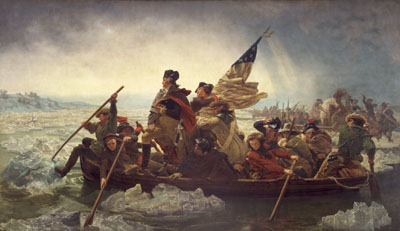
Now that I have finally bumped Don DeLillo's Underworld off the list, I've got more energy for other reading. And yesterday, on the trainride out to my Super Bowl party, I finished the biography of George Washington that I've been working on for a while.
I have read so many books about Adams and Jefferson, that I know their particular story by heart. I'm not as familiar with the actual WAR side of things, the strategies, the Valley Forge winter, a blow-by-blow of all the battles... It's great stuff. Really interesting. Baron von Steuben! Who wasn't a baron! But who knew his stuff, in terms of the military - so along he comes, and he whips the rag-tag army into shape, drilling them with military discipline, and battle field maneuvers - all of which ended up paying off quite nicely.
Also, so interesting: no one knew WHAT the President should "be" like in the beginning. Is he a king? What do they call him? Congress wrangled over this for days - so long that it became a joke, and the newspapers brutally pointed out that there were more pressing concerns for the infant nation than a 5-day long debate over whether the President should be called "Your Highness" or "Mr". John Adams, who thought the nomenclature of the President was of utmost importance, and spearheaded the long debate about it became a laughingstock (notes being passed back and forth in Congress, basically saying: "Jesus, John, this is not a big deal ... Please stop!"). Adams thought the President should be referred to as, "Your Highness, The President of the United States." (Later, when it was rumored that Adams was a secret monarchist, this innocent "Your Highness" suggestion of his would come back and bite him in the ass.) Somehow, the nonsensical debate ended, much to everyone's relief, and they just settled on the plainer more republican title "Mr. President".
Washington asked for lots of advice in terms of etiquette: should he not dine with private citizens? Should he hold dinners once a week and invite everyone, or just a select few? He got conflicting answers, of course - Hamilton thought he should act like a king, others thought he should behave like a regular citizen, etc. - and many of the precedents set by his administration remain traditions to this day. But it was all just trial and error in those beginning years.
Out of all of "those guys" (Jefferson, Adams, Franklin, etc etc) ... it seems to me that George Washington had the hardest time with the reality of living a public life. It seemed to have been an enormous sacrifice for him - more of a sacrifice than with the other founding father chaps. I get the sense that John Adams missed Abigail so much that it hurt, and he missed Braintree, and he romanticized wandering through his "turnip fields" at home during his long years away ... and yet I ALSO get the sense that John Adams NEEDED to be at the center of the debates, he NEEDED to be there. Any sacrifice was worth it. Abigail felt the same way, she talks about it all the time in her letters, sometimes with a positive outlook and sometimes a bit more melancholy. (There's one letter to her husband that always makes me feel like crying. She is having a rough time being apart from him, she misses him, the separation is too great, an ocean between them ... and she wonders if the generations to come will truly appreciate the sacrifices she has made in service of this country ... Whenever I read that mournful letter, I wish I could pop off a postcard to her in heaven, saying: "I APPRECIATE IT. THANK YOU!!")
But back to George: I get the sense that, for Washington, all of this was not as clear a choice. He was bitter from his long years of wrangling with Congress during the fighting of the actual war, he was worn out, exhausted from army life, his health broken down. The dude had dysentery like you wouldn't believe. He wanted to go HOME. Martha, by the second term, refused to leave Mount Vernon. She was getting old, and she had had it. Washington knew that the sacrifice he made was essential - and he knew this, somehow, without losing his humility. He knew he had become a symbol of the new nation, of its unity, as uncomfortable as that seemed to make him, and that as long as he was at the helm, the nation would remain united. The new nation would make it safely through the rough waters of the late 18th century.
Factions breaking out, political intrigues, Jefferson and Hamilton (2 cabinet members) refusing to cooperate with one another, Washington trying to maintain a middle course (even though he basically swung towards the Federalist side). But through all of this - after his long long years of service, of the long Revolutionary War - he just wanted to go HOME. He wanted to be on his farm, where he could go horse-riding every day, and oversee his land, and hang out with his grandkids (many of whom lived at Mount Vernon with him.) This was where his true heart resided.
And so, one of the overriding impressions I got from this biography was that -- Sorry to be all grandiose and stuff, but that this guy GAVE UP his private happiness for the public good. A public life did not suit him. He had too much homesickness, too much humility , not enough ambition for power ... and yet he spent the majority of his entire life away from Mount Vernon, dedicating himself to the liberty of the colonies.
And his letters, his private correspondence ... they are painful to read, at times. Especially as it became clear that he HAD to stay President for a second term. He HAD to. As much as his own concerns were calling, as much as his domestic happiness was threatened ... there was no way he could say no.
He basically gave his life to the cause.
And, of course, what that really means is: George Washington gave up his life for us .
Finally, I love this: what were Washington's last words?
"'Tis well."
February 4, 2005
2nd letter - Jan. 11 1816
And here is Thomas Jefferson's reply to John Adams' letter below.
In these two letters, we can see the character of the entire correspondence. The letters illuminate the differences in philosophy between Adams and Jefferson. In some ways, they illuminate the irreconcilable differences. However - overriding all of this is mutal respect and cordiality. They were both in process. They were both trying to figure stuff out and they came to different conclusions. When they used to be active politically, these different conclusions caused much strife. But once retired they were free to discuss all of these issues at length, with no object but to illuminate and explain their point of view to the other. (In 1813 John Adams wrote a letter to Jefferson which is still rightly famous - and in it he said: "You and I ought not to die before We have explained ourselves to each other." Gulp. So moving.)
And so that's what they did. Over the next 13 years, they wrote letter after letter, trying to "explain" themselves "to each other". The letters only stopped when they died (er - on the same feckin' day, mkay? Also - ehm ... it was July 4. Mmkay? Also, it was the 50th anniversary of 1776. Mmkay? I mean, you just could not make this shit up!! No one would believe it!)
Enough preamble. Here is Jefferson's reply to John Adams' letter.
THOMAS JEFFERSON to JOHN ADAMS
Monticello Jan. 11 1816
...
I agree with you in all it's eulogies on the 18th century. It certainly witnessed the sciences and arts, manners and morals, advanced to a higher degree than the world had ever before seen. And might we not go back to the aera of the Borgias, by which time the barbarous ages had reduced national morality to it's lowest point of depravity, and observe that the arts and sciences, rising from that point, advanced gradually thro' all the 16th. 17th. and 18th. centuries, softening and correcting the manners and moral of man? I think too we may add, to the great honor of science and the arts, that their natural effect is, by illuminating public opinion, to erect it into a Censor, before which the most exalted tremble for their future, as well as present fame.
With some exceptions only, through the 17th. and 18th. centuries morality occupied an honorable chapter in the political code of nations. You must have observed while in Europe, as I thought I did, that those who administered the governments of the greater powers at least, had a respect to faith, and considered the dignity of their government as involved in it's integrity. A wound indeed was inflicted on this character of honor in the 18th. century by the partition of Poland. But this was the atrocity of a barbarous government chiefly, in conjunction with a smaller one still scrambling to become great, while one only of these already great, and having character to lose, descended to the baseness of an accomplice in the crime. [Note: Poland was partitioned by Austria, Russia, and Prussia in 1773, 1793, and 1795.]
France, England, Spain shared in it only inasmuch as they stood aloof and permitted it's perpetration. How then has it happened that these nations, France especially and England, so great, so dignified, so distinguished by science and the arts, plunged at once into all the depths of human enormity, threw off suddenly and openly all the restraints of morality, all sensation to character, and unblushingly avowed and acted on the principle that power was right? Can this sudden apostacy from national rectitude be accounted for?
The treaty of Pilnitz [Prussia agreed to take common action against any attack by the French ... this treaty in 1791 was the basis for the first coalition against France] seems to have begun it, suggested perhaps by the baneful precedent of Poland. Was it from the terror of monarchs, alarmed at the light returning on them from the West, and kindling a Volcano under their thrones? Was it a combination to extinguish that light, and to bring back, as their best auxiliaries, those enumerated by you, the Sorbonne, the Inquisition, the Index expurgatorius, and the knights of Loyola?
Whatever it was, the close of the century saw the moral world thrown back again to the age of the Borgias, to the point from which it had departed 300. years before. France, after crushing and punishing the conspiracy of Pilnitz, went herself deeper and deeper into the crimes she has been chastising. I say France, and not Bonaparte; for altho' he was the head and mouth, the nation furnished the hands which executed his enormities. England, altho' in opposition, kept full pace with France, not indeed by the manly force of her own arms, but by oppressing the weak, and bribing the strong. At length the whole choir joined and divided the weaker nations among them.
Your prophecies to Dr. Price proved truer than mine [This is a reference to Adams making dire predictions about which way the French revolution was going to go - not a popular view at the time. Adams sensed impending disaster and carnage, and Jefferson thought that "the blood of patriots and tyrants" were needed to water "the tree of liberty". Adams predicted to Dr. Price, in a letter, that a million people would eventually die.]; and yet fell short of the fact, for instead of a million, the destruction of 8 or 10 millions of human beings has probably been the effect of these convulsions. I did not, in 89. believe they would have lasted so long, nor have cost so much blood. But altho' your prophecy has proved true so far, I hope it does not preclude a better final result. That same light from our West seems to have spread and illuminated the very engines employed to extinguish it. It has given them a glimmering of their rights and their power. The idea of representative government has taken root and growth among them. Their masters feel it, and are saving themselves by timely offers of this modification of their own powers. Belgium, Prussia, Poland, Lombardy etc. are now offered a representative organization: illusive probably at first, but it will grow into power in the end. Opinion is power, and that opinion will come.
Even France will attain representative government. You observe it makes the basis of every constitution which has been demanded or offered: of that demanded by their Senate; of that offered by Bonaparte; and of that granted by Louis XVIII. The idea then is rooted, and will be established, altho' rivers of blood may yet flow between them and their object. The allied armies now couching upon them are first to be destroyed, and destroyed they will surely be. A nation united can never be conquered.
We have seen what the ignorant bigotted and unarmed Spaniards could do against the disciplined veterans of their invaders. What then may we not expect from the power and character of the French nation? The oppressors may cut off heads after heads, but like those of the Hydra, they multiply at every stroke. The recruits within a nation's own limits are prompt and without number; while those of their invaders from a distance are slow, limited, and must come to an end.
I think too we perceive that all these allies do not see the same interest in the annihilation of the power of France. There are certainly some symptoms of foresight in Alexander that France might produce a salutary diversion of force were Austria and Prussia to become her enemies. France too is the natural ally of the Turk, as having no interfering interests, and might be useful in neutralizing and perhaps turning that power on Austria. That a re-acting jealousy too exists with Austria and Prussia I think their late strict alliance indicates; and I should not wonder if Spain should discover a sympathy with them. Italy is so divided as to be nothing.
Here then we see new coalitions in embrio which after France shall in turn have suffered a just punishment for her crimes, will not only raise her from the earth on which she is prostrate, but give her an opportunity to establish a government of as much liberty as she can bear, enough to ensure her happiness and prosperity. When insurrection begins, be it where it will, all the partitioned countries will rush to arms, and Europe again become an Arena of gladiators. And what is the definite object they will propose? A restoration of the status quo prius, of the state of possession of 89.
I see no other principle on which Europe can ever again settle down in lasting peace. I hope your prophecies will go thus far, as my wishes do, and that they, like the former, will prove to have been the sober dictates of a superior understanding, and a sound calculation of effects from causes well understood.
There's so much I want to comment on. The writing itself (love "the Censor" image, and I particularly love this sentence/image: "the terror of monarchs, alarmed at the light returning on them from the West, and kindling a Volcano under their thrones?" ... The letter is a masterpiece of Jeffersonian abstraction: good vs. evil, light vs. dark ... all that stuff he loved. But anyway - I'll refrain from commenting too much. At least for now. I just love that letter.
1st letter - Nov. 13 1815
JOHN ADAMS to THOMAS JEFFERSON
Quincy Nov. 13 1815
Dear Sir
The fund[a]mental Article of my political Creed is, that Despotism, or unlimited Sovereignty, or absolute Power is the same in a Majority of a popular Assembly, an Aristocratical Counsel, an Oligarchical Junto and a single Emperor. Equally arbitrary cruel bloody and in every respect diabolical.
Accordingly arbitrary Power, wherever it has resided, has never failed to destroy all the records Memorials and Histories of former times which it did not like and to corrupt and interpolate such as it was cunning enough to preserve or to tolerate. We cannot therefore say with much confidence, what Knowledge or what Virtues may have prevailed in some former Ages in some quarters of the World.
Nevertheless, according to the few lights that remain to Us, We may say that the Eighteenth Century, notwithstanding all its Errors and Vices has been, of all that are past, the most honourable to human Nature. Knowledge and Virtues were increased and diffused, Arts, Sciences useful to Men, ameliorating their condition, were improved, more than in any former equal Period.
But, what are We to say now? Is the Nineteenth Century to be a contrast to the Eighteenth? Is it to extinguish all the Lights of its Predecessor? Are the Sorbonne, the Inquisition, the Index expurgatorius, and the Knights Errant of St Ignatius Loyola to be revived and restored to all their salutary Powers of supporting and propagating the mild Spirit of Christianity? The Proceedings of the Allies and their Congress at Vienna, the Accounts from Spain France etc the Chateaubriands and the Genlis, indicate which Way the Wind blows. The Priests are at their Old Work again. The Protestants are denounced and another St Bartholomew's day, threatened.
This however, will probably, 25 Years hence, be honoured with the Character of "the effusions of a splenetic mind, rather than as the sober reflections of an unbiassed Understanding."
[Note: John Adams is making a joke here. A book had just come out which included some of Adams' private letters - used without his permission. And after one of the letters, which had to do with the convulsions going on in Europe at the time, the author of the book characterized Adams' thought process as "the effusions of a splenetic mind, rather than as the sober reflections of an unbiassed Understanding". Adams continuously made jokes from there on out about his "splenetic mind" and its "effusions".]
Additional note from Sheila: I will be posting Thomas Jefferson's EXTRAORDINARY response to John Adams' letter shortly.
Some context for the Adams-Jefferson letters of 1815
Oops ... before I post the two letters ... just a bit of context. It's always important to get the context of the times.
The letters are from late 1815. So: a couple things swirling around in the world at that time
-- The aftermath of the war of 1812.
-- Adams and Jefferson watched the meteoric rise of Napoleon with horror. (Jefferson had been a big fan of the French revolution, Adams had been horrified by it ... but they both were horrified by the tyranny of Napoleon. Jefferson called him 'the Attila of the age')
-- March to June 1815: The Hundred Days. (the end of the Napoleonic regime, the last chapter, as it were)
-- But, let us add this in to the mix: Jefferson and Adams, now old men, wondered to one another: who was the greater tyrant, John Bull or this new tyrannical France? They hashed it out. Their anti-British feelings are still strong ... and yet the two of them know, somehow, that the fortunes of the United States will be forever tied with the fortunes of that original parent nation. (I read about this this morning and thought of Emily, Bill and myself toasting Tony Blair the first time we all met, clinking our beer glasses together. Ha!)
These events are, collectively, center stage for Adams and Jefferson at this time. They are their current-day concerns. On a more uber level, they wonder: have the advances from the 18th century in political/moral theory and man's enlightenment all been swept away? Is it so easy to regress, did all you and I worked for mean nothing?
Pertinent questions to them in their day, and, I believe, still pertinent to us in ours.
January 1, 2005
"Self-evident"
In this post below, I mentioned the fact that Jefferson's original draft of the Declaration of Independence, had the words "sacred and undeniable" instead of what is now there: "self-evident": "We hold these truths to be sacred and undeniable ..."
The stories of the editing sessions in the Continental Congress that sweltering summer in Philadelphia are famous. Jefferson couldn't stand to be edited. He lived in a lofty realm of abstract ideals, and when he put his ideals down on paper, nothing was accidental or coincidental. He liked dichotomies - he used them often - pitting one thing against another. Perhaps exaggerating the case, or, in some cases, fictionalizing the struggle altogether. But his strength was never as a lawmaker, really - or a down-and-dirty compromiser. His strength lay in setting down the ideal - in no uncertain terms. And so to have all those petty other little delegates touch his prose was intolerable to him.
You can see Jefferson's original mindset, with his word choice: the rights are "sacred and undeniable". There's something a bit more lofty and philosophical about those words, in comparison to the more blunt "self-evident". Just an interpretation o' mine. I find all of this interesting, because of how it reveals to us the workings of Jefferson's mind, his concerns. Or, I like to think it does.
Joseph Ellis, in his prologue, discusses the hold that Jefferson has over Americans ...and tries to figure out where it comes from, where the magic actually lies. It's great great stuff. I love Ellis' writing. So here's a small excerpt about this whole issue of "sacred and undeniable" vs. "self-evident":
Before editorial changes were made by the Continental Congress, Jefferson's early draft made it even clearer that his intention was to express a spiritual vision: ' We hold these truths to be sacred & undeniable; that all men are created equal & independent, that from that equal creation they derive rights inherent & unalienable, among which are the preservation of life, & liberty, & the pursuit of happiness." These are the core articles of faith in the American Creed. Jefferson's authorship of these words is the core of his seductive appeal across the ages, his central claim, on posterity's affection. What, then, do they mean? How do they make magic?Merely to ask the question is to risk being accused of some combination of treason and sacrilege, since self-evident truths are not meant to be analyzed; that is what being self-evident is all about. But when these words are stripped of the patriotic haze, read straightaway and literally, two monumental claims are being made here. The explicit claim is that the individual is the sovereign unit in society; his natural state is freedom from and equality with all other individuals; this is the natural order of things. The implicit claim is that all restrictions on this natural order are immoral transgressions, violations of what God intended; individuals liberated from such restrictions will interact with their fellows in a harmonious scheme requiring no external discipline and producing maximum human happiness.
This is a wildly idealistic message, the kind of good news simply too good to be true. It is, truth be told, a recipe for anarchy. Any national government that seriously attempted to operate in accord with these principles would be committing suicide. But, of course, the words were not intended to serve as an operational political blueprint. Jefferson was not a profound political thinker. He was, however, an utterly brilliant political rhetorician and visionary. The genius of his vision is to propose that our deepest yearnings for personal freedom are in fact attainable. The genius of his rhetoric is to articulate irreconcilable human urges at a sufficiently abstract level to mask their mutual exclusiveness. Jefferson guards the American Creed at this inspirational level, which is inherently immune to scholarly skepticism and a place where ordinary Americans can congregate to speak the magic words together. The Jeffersonian magic works because we permit it to function at a rarefied region where real-life choices do not have to be made.
This kind of "rarefied region" is why Jefferson is such a lightning rod for controversy. Who is this man of high ideals, lofty goals ... who lived a life of such contradictions?
Bah.
As a person who has behaved, at times, in completely incomprehensible ways, in ways that would BAFFLE biographers or historians trying to pin me down ... I'm not all that disturbed by a man of contradictions.
The contradictions make him more interesting, not less. As I've said before, I'm an Adams girl myself - Thomas Jefferson always baffled me. I couldn't seem to get in there, I couldn't relate. Politically, I'm usually on John Adams' side, through their many years of correspondence and collaboration. Not always, but usually. Jefferson's political ideas and thoughts were ... almost trying to create a Utopia. And I'm scared of utopias. Or scared of those who really believe they can bring them about. (Er ... communism, mmkay?) But then ... there's something really necessary about ideals, and abstracts ... Hard to explain, but I think that that's the realm where Jefferson really shone. He put the abstract into language. Unforgettable language. But still. The guy is confusing. Infuriating, at times. That's why reading about him is always a fun endeavor. Everyone's got a different take, the lines are clearly drawn ...
I like Ellis' style, though. He accepts that there will be contradictions, and he also seems to accept (rare for historians) that there are just some things we can never know. First of all, because of the massive fire at Monticello in 1770 - which destroyed pretty much all of Jefferson's personal papers up until that time. We just don't know what was lost, and so there are huge gaps in the knowledge-base, because of that fire.
Here's what Ellis has to say about the current trend of tearing down the old heroes - the "let's trash the dead white males" syndrome. Ellis is speaking, in particular, about historian Gordon Wood, who had this to say about Jefferson: "We Americans make a great mistake in idolizing and making symbols of authentic figures who cannot and should not be ripped out of their time and place ... By turning Jefferson into the kind of transcendently moral hero that no authentic historically situated human being could ever be, we leave ourselves demoralized by the time-bound weaknesses of this 18th century slaveholder." Okay - this is pretty typical rhetoric about Jefferson right now and for the last, oh, 30 years. Whatever. And he asked for it, really, because he's such a contradictory kind of guy - but still. I get a bit tired of the argument, because - you know how PESKY actual FACTS can be - there is more than one side to this story. However, Ellis responds to Gordon Wood in this manner:
It seemed to me that Wood's point was true enough; in fact, just the kind of sober assessment of the Jefferson problem one wanted to hear amid all the shrill pronouncements. But it also seemed abundantly clear that it would make absolutely no practical difference. Yes, perhaps we all would be better served if Americans were allowed to select their heroes (and villains) only from fictional characters, who would therefore never disappoint us. But we won't and can't. We would be even better served if we discarded our need for heroes altogether. But no people in recorded history have ever been able to do that, and there was no reason to believe that modern Americans would prove an exception. Moreover, the scholarly instinct to establish a secure checkpoint between the past and the present in order to prevent the flow of traffic back and forth, while it had the advantage of deterring those ideologiically motivated raiding parties that wanted to go back to capture heroes and villains to suit their own political agenda, also had the disadvantage of making history an irrelevant, cloistered, indeed dead place, populated only by historians.
And all of this makes me think of my favorite line of Walt Whitman's:
"Do I contradict myself?
All right then. I contradict myself.
I am large.
I contain multitudes."
It's all just very very cool. As is obvious, I'm digging this book enormously.
December 30, 2004
The Sphinx at Monticello
I want to thank the kind and generous reader (you know who you are!) who sent me Joseph Ellis' book American Sphinx: The Character of Thomas Jefferson. I read and enjoyed Ellis' Founding Brothers very much (and to anyone who wants a jumpstart on all this American Revolution stuff - that book is a terrific place to start) - and I'm very excited to launch into this new work on Thomas Jefferson.
I'm a John Adams fan myself, but I think that's just because my sensibility, to some degree, corresponds with Adams'. Overly sensitive, a bit tetchy, passionate, humorous, prone to self-dramatizing ... I grew up in a family that was all about "the Adams family". I think it was my dad's mother, (my grandmother), who said, "My husband is cheating on me..... With Abigail Adams." Maybe it's the Boston connection. I've got family in Quincy, in Boston, all over. The American Revolution was one of the bed-time stories we were told as kids. Because we lived so close to where it all began.
Thomas Jefferson, though ... a sphinx indeed. I've read I don't know how many biographies about this man, and there is still something un-reachable, in the heart of this man. This isn't a criticism. This is why he fascinates. He is a mass of contradictions. He wasn't overly introspective in his correspondence, so we aren't really sure his innermost thoughts, feelings - in the way we are with John Adams, who poured his heart out to Abigail in letter after letter. I've read the correspondence between Jefferson, John Adams, and Abigail Adams (which ... really ... if you haven't read it ... YOU MUST!!), I've read as much of Jefferson's actual writings that I can get my hands on - because, when you get right down to it, nobody could touch that man when it came to having a gift with the written word. He is IT in that regard. His writing takes my breath away.
Read The Declaration of Independence (even though it was edited by the Continental Congress - much to Jefferson's chagrin: He sat there in agony, as they "hacked" away at his prose - while Ben Franklin murmured comforting nothings in Jefferson's ear, basically talking Jefferson down off the ledge. The edits suggested by Congress, in general, make the document better - although Jefferson wouldn't admit that, probably. For example, in the striking first sentence - Jefferson's first draft had: "We hold these truths to be sacred and undeniable." It is thought that Franklin suggested it be changed to "self-evident". Maybe it's just me but that is one HELL of an excellent change. Self-evident as opposed to sacred and undeniable? Self-evident. It's angrier than "sacred and undeniable", it's a bit contemptuous, too. Now that would REALLY stick it to King George. WE hold these truths to be SELF-EVIDENT. Why don't you, you moron?? A brilliant change. Much more powerful, I think.
But the bulk of the document is his and his alone. Not the thoughts and theories perhaps - he borrowed heavily from Locke and others, in terms of philosophy - but the prose is all him. In the prose you can feel the personality of this man.
A revolutionary. With a veneer of gentility. Or perhaps he was truly genteel, with a veneer of revolution. It depends on how you look at it. The prism refracts. He hated authority. He despised government. He despised power. And yet, he used it cunningly. He was a master at this new breed of American party politics, and factions. He helped to create it. More than anything, he seems to have been a master of disguise. He cloaked his own ambitions, he retreated to the hilltop at Monticello, behind the post of: he was just a simple farmer, he was an inventor, he had a library, and plants to tend to ... And yet ... this man obviously had enormous political ambition. Enormous.
Rather than feeling frustrated with him because he WON'T MAKE HIMSELF CLEAR TO US, the later generations - or rather than writing him off BECAUSE he was full of contradictions ("who needs to listen to that guy? Yeah, he wrote the Declaration of Independence, but he had slaves!!!") - I choose to delve into the life and mind of this man. I will never get over my curiosity about him.
There is something in him that will always remain mysterious, I believe. It's sort of like St. Augustine saying, "If you think you understand, it's not God." I don't mean to make too huge a point on this, but I've had arguments with people who think they know who this guy was, based on only ONE side of him.
From the back of my new book:
Ellis unraves the contradictions of Jefferson's character. He gives us the slaveholding libertarian who was capable of decrying ciscegenation while maintaining an intimate relationship with his slave Sally Hemings; the enemy of government power who exercised it audaciously as prsident; the visionary who remained curiously blind to the inconsistencies in his nature.
The more I read, the more I learn, the more it's like peeling an onion. Is there no center?
For myself, I don't believe that there's really an answer here. I think the point is just to continue asking the questions.
I'm excited to read Ellis' work on Jefferson. The title alone speaks volumes.
November 3, 2004
Federalist # 10
I woke up at around 5:30 this morning. There's a huge wind here in Manhattan today, and the sound of it battering against my window woke me up. I got up, I listened to the election on the radio for a bit, made some coffee, wrote in my journal my thoughts, reflections, feelings on this day.
Then ... I was passing by the bookcase in my kitchen (or, let me be clear, one of the bookcases in my kitchen - each "room" in my tiny apartment has more than one bookcase in it) - I caught a glimpse of The Federalist Papers, and pulled it out. I thought: Yeah, man. Let's take a look at this today. It seems appropriate.
(I have mentioned before my kick-ass library and how much I love to have those books around. It's for moments like that. "Damn, I feel like peeking into the Federalist Papers right now ... and lookee here, by golly, I can!!")
This morning, I read Federalist # 10, perhaps the most famous of all of the essays. Penned by James Madison, it is a brilliant essay on party-politics, and the dangers of factions. Now granted - Madison very famously changed his tune later in life, when he hooked up with Jefferson, and they began planning an opposition party.
From Mr. We-Must-Try-To-Prevent-the-Forming-of-Parties to Mr. Let's-Set-Up-a-Party-In-Opposition ...
That was Madison's journey.
Ironically, Madison and Jefferson ended up heading the party that would be known as the "Republicans" - They set themselves up against the "Federalists" - led by Alexander Hamilton. (Hamilton, of course, was Madison's former friend and co-writer of the Federalist Papers. Madison, indeed, may have written the most famous one of the papers - but Hamilton's contribution is beyond compare. Did that man ever sleep???) Madison and Hamilton, once so in agreement, diverged strongly ... Madison feared Hamilton's version of Federalism (which seemed to Madison just another version of aristocracy) - and Hamilton couldn't stand Madison's proposals for a more wide-spread distribution of power.
Anyway. James Madison discusses in Federalist # 10 (you can read the text of it here) the inevitability of factions (you cannot make a nation of millions of people with diverse backgrounds agree - nor should you try - look at Communist Russia - any kind of thought-control or toe-the-correct-party-line is totalitarianism. Also, more practically, it is nearly impossible to find two individual men who agree on EVERYTHING, let alone an entire nation) - so there will always be different opinions, etc. - but in # 10 Madison describes how important all those little pesky checks and balances in the Constitution are, and he describes this in a way unparalleled in its clarity. The dude had a brilliant legal mind.
I'll excerpt a couple of my favorite parts of it - but I was really glad I read it this morning, at the tailend of one of the ugliest elections I can remember.
It reminded me (as well as the brief and positive conversation I had with both my parents last night about America, this democratic process, the "civic duty", the high voter turnout, etc.) that what I REALLY love (more than any candidate for President, more than any politician ever) is this country, and our form of government.
THAT is what I revere. THAT is what I am proud of. I participated yesterday. We all did. This is why this country is great. Our form of government is bigger than any candidate - the Office is larger than the Man.
James Madison understood this to his core. So did all those Founding Father blokes. Actually, perhaps this is the wrong way to say it. It wasn't so much that they "understood" this, because, after all, the entire thing was an improvisation, an experiment at that point. But they knew what it was that they feared. They were some of the deepest cynics to have ever walked this earth. Perfection is impossible. There is no utopia. There is ALWAYS a serpent in the garden. Man is corruptible. So - taking all of this as a given - they set out to create a government of LAWS, not MEN. They feared man's corruptibility so much that there literally could not be enough checks and balances in our constitution. They knew that there was a possibility of a government becoming deadlocked with so many checks and balances. So be it. Better a deadlock than a tyranny.
Madison writes:
The influence of factious leaders may kindle a flame within their particular States, but will be unable to spread a general conflagration through the other States. A religious sect may degenerate into a political faction in a part of the Confederacy; but the variety of sects dispersed over the entire face of it must secure the national councils against any danger from that source. A rage for paper money, for an abolition of debts, for an equal division of property, or for any other improper or wicked project, will be less apt to pervade the whole body of the Union than a particular member of it; in the same proportion as such a malady is more likely to taint a particular county or district, than an entire State.
The following is one of my favorite excerpts (it comes from the beginning of the essay) - but I highly recommend you go read the rest.
By a faction, I understand a number of citizens, whether amounting to a majority or a minority of the whole, who are united and actuated by some common impulse of passion, or of interest, adversed to the rights of other citizens, or to the permanent and aggregate interests of the community.There are two methods of curing the mischiefs of faction: the one, by removing its causes; the other, by controlling its effects.
There are again two methods of removing the causes of faction: the one, by destroying the liberty which is essential to its existence; the other, by giving to every citizen the same opinions, the same passions, and the same interests.
It could never be more truly said than of the first remedy, that it was worse than the disease. Liberty is to faction what air is to fire, an aliment without which it instantly expires. But it could not be less folly to abolish liberty, which is essential to political life, because it nourishes faction, than it would be to wish the annihilation of air, which is essential to animal life, because it imparts to fire its destructive agency.
The second expedient is as impracticable as the first would be unwise. As long as the reason of man continues fallible, and he is at liberty to exercise it, different opinions will be formed. As long as the connection subsists between his reason and his self-love, his opinions and his passions will have a reciprocal influence on each other; and the former will be objects to which the latter will attach themselves. The diversity in the faculties of men, from which the rights of property originate, is not less an insuperable obstacle to a uniformity of interests. The protection of these faculties is the first object of government.
God bless America.
September 23, 2004
For you electoral college fanatics:
Here's an excerpt from the latest book I'm reading, Susan Dunn's Jefferson's Second Revolution: The Election Crisis of 1800 and the Triumph of Republicanism.
To orient you, this excerpt is from the beginning of the book, where Dunn sets up her story. Thomas Jefferson is surreptitiously running for president from the privacy of Monticello, pretending he's not campaigning at all, getting all of his news from Madison... basically pretending that his eyes were lifted towards loftier philosophical goals, and he would not get mucked up in politics.
Remember, in those early days, it was seen to be very VERY bad form to WANT to hold the highest office in the land. Campaigning meant that you obviously admitted you wanted to have a ton of power, which people feared, and campaigning also meant that you, in your heart of hearts, didn't think you were really up to the job and had to spend a lot of time convincing people. (Heh heh. I sure wish THAT attitude would return into vogue. There is nothing more disgusting to me than a career politician telling me why I should vote for him, why his vision is better than the other guy's.)
Not that Thomas Jefferson didn't feel all those things. He is, to my taste, one of the most infinitely fascinating and contradictory men this country has ever produced. We will NEVER get to the bottom of this man.
John Adams, by contrast, was an open book. He left behind journals, personal letters that could fill a library ... He ranted, raved, whined, he was completely open with Abigail about his inner thoughts and insecurities, and so he shared all of that stuff with her. By sharing himself with her, we get to know him. We get to see his concerns, his humanity, his fears, his yearning to be with her again.
Thomas Jefferson had no such confidante. It was not in his nature, perhaps? I don't know. The journals he kept were basically financial records, and farming and gardening records: "Sweet peas bloomed today. Bought a harpsichord." (With money he didn't have! But that didn't matter - he would meticuously write down the price in his records) There was no introspection in his language, no hint of an inner life ...
There's a VERY funny story about John Adams and Thomas Jefferson taking a country-trip through England, during their sojourn there ... John Adams wrote in his journal eloquently and emotionally about wanting to kiss the door-stone of Shakespeare's house, he tells Abigail he wishes she had been there, he raves about the unbelievable beauty of the country, the gardens, and how he hopes that America can someday achieve such cultivation. Thomas Jefferson's journals are all: "Paid 2 pence for wine. Found an inn. Paid 3 pounds for a room. Went to the stables. Good horses. Book shop. Bought 49,000 books." Whatever. Blunt, financial, boring.
Side by side, these accounts are HILARIOUS. There is no mention in Jefferson's journal about John Adams, their conversations, their enjoyable evenings in the inn, what they talked about ...
And yet, when Thomas Jefferson decided to put pen to paper for a purpose - literally nobody could touch him. Perhaps it was that his gift for the English language, and for expressing deep and inspirational ideas (and rage - don't forget that rage in the Declaration of Independence) only manifested when it was in the cause of an ACTION, as opposed to a moment of reflection.
By that I mean: Thomas Jefferson was the typical example of a man who used his pen as a sword.
John Adams used his pen to work through his problems, his feelings, his grievances ... he used his pen to ward off loneliness, to feel close to Abigail ... You read those letters now, and you can FEEL the presence of John Adams, sitting beside you, in all his complexity and warmth.
So Thomas Jefferson sat on his mountaintop, pretending to not campaign, pretending to be unaware that an election was going on ... but this was, in essence, a pose.
And now on to the excerpt:
...Federalists were not as enchanted by the Virginian's [Thomas Jefferson] courtly manners, pensive eyes, and gentle lilting voice. His intellectual stature and distinguished public service -- author of the Declaration of Independence, member of the Virginia House of Burgesses at the age of 26, wartime governor of Virginia, delegate to the Continental Congress, minister to France, secretary of state under George Washington, vice president under John Adams -- left them unimpressed. Perhaps in the little republic of St. Marino Jefferson's political "experiments" could be tolerated, observed Charles Carroll of Carrollton, but in America the Virginian's "fantastic tricks" would most assuredly dissolve the Union.Carroll and his patrician Federalist friends not only wanted to remain at the help, from which they had so ably steered the country toward stability and prosperity, but they believed that they were entitled to remain there. Clinging to the myth of the virtue of the elite few, they were convinced that only they possessed a deep commitment to public service and an unerring sense of the common good. How could the nation survive and flourish without them, "the wise & good," asked Alexander Hamilton, one of the Federalist leaders. "Obedience and submission to the powers that be," a Pennsylvania congressman declared, "is the duty of all." In private, the Federalist governor of New York, John Jay, was just as blunt. Conflating power and property, he candidly confided to a friend that "those who own the country ought to participate in the government of it."
Oddly, the pedigreed, patrician Jefferson was one of those "owners" of the country -- wealthier and from a more distinguished family than Federalists like Adams and the self-made Hamilton. And yet Jefferson sought to challenge their hold on power -- their "strident exclusivism," in the words of historians Stanley Elkins and Eric McKitrick -- and even challenge the legacy of the great George Washington. The father of the country and his closest disciples, Federalists believed, had created and bequeathed to America an orderly society and well-functioning institutions. "Our government is as free as it is capable of being -- the country as happy as a government can make it," they crowed. "What more do you want? Will you grasp at a shadow, and lose the substance?"
What principles guided Jefferson and his so-called Republicans? The Jeffersonian brand of republicanism, Federalists scoffed, simply meant "an essential want of integrity, and an unprincipled pursuit of whatever promotes the interests, or gratifies the passions of the individuals." In short, Republicans were motivated only by base "self-interest" whereas Federalists were proud to be anti-individualists, committed to the notion of the common good of all...
Surely in a democracy in which the people were sovereign, the Republicans, though political outsiders, had the right to criticize and oppose those who governed. And yet, some Federalists proposed that "a few BOLD STROKES" be used to silence all opposition to government. But Republicans refused to be silent. They offered voters a forceful platform and an aggressive agenda for change. They blasted John Jay's recent one-sided treaty with Great Britain in which the English had made no concessions to American claims. They attacked Adams and the other Federalists for passing the repressive Sedition Act in 1798, designed to smother opposition to the Federalist regime. They denounced the standing federal army, warning that it could be used to quash domestic dissent. They condemned the dispatching of federal troops in 1799 to crush a tax revolt -- Fries's Rebellion -- in Pennsylvania.
Republicans pounded home their message: a simple government, low taxes, state militias instead of a standing army, repeal of the Sedition Act, and free schools. In the South and the burgeoning West, they attracted voters by offering security for slavery, access to new unsettled lands, and markets for their agricultural products. In New England, their democratic message appealed to voters with aspirations of upward mobility.
Most of all, Republicans criticized the Federalist "monocrats" for upholding the rights of the few and ignoring the rights of the many, for catering to the social and financial elite, for disdaining the people and democracy itself. Even Federalist Governeur Morris, the former minister to France and now the junior senator from New York, conceded that his Federalist colleagues had given Republicans reason to believe that they wished to establish a monarchy. [Remember Abigail's warning to her husband John, in re: Hamilton: "That man could be a Bonaparte.] The Republican's affinity for inclusion contrasted sharply with Federalist elitism.
The election, declared Massachusetts Republican Elbridge Gerry, was a battle between the people and a party "utterly devoted to a monarchical system."
If you think the country is polarized NOW, you oughta go back and look at some of the rhetoric from the election of 1800. It was sheer apocalyptic language. 1776 and the long years of war following was a living memory for everyone ... The union was fragile, fractious, exhausted. At any moment the grand experiment could crumble. There was a deep suspicion and hatred of "parties" and "factions" (I know how they feel) - and yet, inevitably, two sides emerged - the Federalists and the Republicans - with two different philosophies, plans of action. And each side was utterly convinced that THEY were holding the true legacy of the American Revolution.
Not only that but each side demonized the other to the point of absurdity.
There is, as well, that old question: what is the more important event, in terms of the creation of this country and its spirt: The Declaration of Independence or the creation of the Constitution? The country was split in its opinion on this question.
There were those who believed (and Jefferson was one of them) - that a state of perpetual revolution was good for the nation. Nothing should be set in stone. All authority was to be distrusted - ALWAYS. He even wanted laws to not be continuous - to be up for review from administration to administration. John Adams thought he was wacked - there had to be SOME continuous culture in this country, you couldn't just re-write the laws every 4 years. But Jefferson felt that revolution "cleared the air". People feared him for this reason. Abigail Adams feared him for this reason. He seemed blood-thirsty (in his lofty Monticello way), too eager for violence, he thought the revolution in France was great. It took him a while to perceive that things had taken a chilling and horrific turn in France, because he was so against monarchies, he was so against kings and queens of any kind.
I really have no conclusions here. It's a topic I'm hugely interested in, obviously. Something I enjoy pondering.
July 25, 2004
The Book of Abigail and John - More
My first batch of posting these letters are from the time before John and Abigail Adams got married.
This second batch unfurling below you take us up to 1776 - through the tumultuous years of the Stamp Act, the Boston Tea Party, the Boston Port Act, the First and Second Continental Congress ... You'll want to start at the bottom and read up (chronological backwards posting...)
I know I have just WAY bumped David's post way off the page - sorry David!
Red Sox. Tonight. Cowboy Up, dammit.
Abigail to John: "I'll meet you at Philippi"
Abigail to John March 16 1776
By the accounts in the publick papers the plot thickens; and some very important Crisis seems near at hand. Perhaps providence sees it necessary in order to answer important ends and designs that the Seat of War should be changed from this to the Southern colonies that each may have a proper sympathy for the other, and unite in a separation. The Refuge of the Believer amidst all the afflictive dispensations of providence, is that the Lord Reigneth, and that he can restrain the Arm of Man.Orders are given to our Army to hold themselves in readiness to March at a moments warning. I'll meet you at Philippi said the Ghost of Caesar to Brutus.
John to Abigail: "Success"
John to Abigail, Feb. 18 1776 - I LOVE this quote
The Events of War are uncertain: We cannot insure Success, but We can deserve it.
Thomas Paine's Common Sense
John headed home to Abigail in early 1776. There was still (unbelievable as it may seem at this point) a hope that matters could be resolved, and that the 13 rebellious colonies would remain a part of the British Empire. This was the general feeling, the Congress was not looking towards Independence - but towards "resolutions" and self-rule laws that they would present to England.
But then - like a bomb going off in January - Thomas Paine's Common Sense was published. The impact of this document can't be over-estimated. Shock waves went out through the colonies. People began to look towards a complete break with England.
Abigail to John: "like the grave cries give, give"
Abigail to John November 27 1775: In this letter to John, Abigail states the case, the problems facing the Congress, the nation in general. Also, she poses the sides of the argument which years and years later would be the source of the debate between Jefferson and Adams: do we fear the "many" or do we fear the "few"??
I wish I knew what mighty things were fabricating. If a form of Government is to established here what one will be assumed? Will it be left to our assemblies to chuse one? and will not many men have many minds? and shall we not run into Dissentions among ourselves?I am more and more convinced that Man is a dangerous creature, and that power whether vested in many or a few is ever grasping, and like the grave cries give, give. The great fish swallow up the small, and he who is most strenuous for the Rights of the people, when vested with power, is as eager after the perogatives of Government. You tell me of degrees of perfection to which Humane Nature is capable of arriving, and I believe it, but at the same time lament that our admiration should arise from the scarcity of the instances. [I'm with you, Abigail.]
The Building up a Graet Enmpire, which was only hinted at by my correspondent may now I suppose be realized even by the unbelievers. Yet will not ten thousand Difficulties arise in the formation of it? The Reigns of Government have been so long slakned, that I fear the people will not quietly submit to those restrains which are necessary for the peace, and security of the community; if we separate from Brittain, what Code of Laws will be established. How shall we be governed so as to retain our Liberties? Can any government be free which is not administred by general stated Laws? Who shall frame these Laws? Who will give them force and energy? Tis true your Resolutions as a Body have heithertoo had the force of Laws. But will they continue to have?
When I consider these things and the prejudices of people in favour of Ancient customs and Regulations, I feel anxious for the fate of our Monarchy or Democracy or what ever is to take place. I soon get lost in a Labyrinth of perplexities, but whatever occurs, may justice and righteousness be the Stability of our times, and order arise out of confusion. Great difficulties may be surmounted by patience and perseverence.
I believe I have tired you with politicks. As to news we have not any at all.
John to Abigail: "that overweening prejudice in favor of New England"
John to Abigail October 29, 1775
There is, in the human Breast, a social Affection, which extends to our whole Species. Faintly indeed; but in some degree. The Nation, Kingdom, or Community to which We belong is embraced by it more vigorously. It is stronger still towards the Province to which we belong, and in which We had our birth. It is stronger and stronger, as We descend to the County, Town, Parish, Neighborhood, and Family, which We call our own. -- And here We find it often so powerfull as to become partial, to blind our Eyes, to darken our Understandings and pervert our Wills.It is to this Infirmity, in my own Heart, that I must perhaps attribute that local Attachment, that partial Fondness, that overweening prejudice in favor of New England, which I feel very often and which I fear sometimes leads me to expose myself to just Ridicule.
John to Abigail: " it is so difficult to do it right"
John to Abigail Oct. 19 1775
When I shall come home I know not. We have so much to do, and it is so difficult to do it right, that We must learn Patience. Upon my Word I think, if ever I were to come here again, I must bring you with me. I could live here pleasantly if I had you, with me... What if We should? Let me please myself with the Thought however.
Abigail to John: "O my bursting Heart"
Abigail to John October 1, 1775 - This grief-struck letter never fails to bring tears to my eyes.
Have pitty upon me, have pitty upon me o! thou my beloved for the Hand of God presseth me sour.Yet will I be dumb and silent and not open my mouth because thou o Lord hast done it.
How can I tell you (o my bursting Heart) that my Dear Mother has Left me, this day about 5 oclock she left this world for an infinitely better...
Blessed Spirit where art thou? At times I almost am ready to faint under this severe and heavy Stroke, separated from thee who used to be a comforter towards me in affliction, but blessed be God, his Ear is not heavy that he cannot hear, but he has bid us call upon him in time of Trouble...
You often Express'd your anxiety for me when you left me before, surrounded with Terrors, but my trouble then was as the small dust in the balance compaird to what I have since endured. I hope to be properly mindful of the correcting hand, that I may not be rebuked in anger. -- You will pardon and forgive all my wanderings of mind. I cannot be correct.
Tis a dreadful time with this whole province. Sickness and death are in almost every family. I have no more shocking and terible Idea of any Distemper except the Plague than this.
Almighty God restrain the pestilence which walketh in darkness and wasteth at noon day and which has laid in the dust one of the dearest of parents. May the Life of the other be lengthend out to his afflicted and Your distressed Portia.
John to Abigail: "a Disposition entirely American"
John to Abigail July 23 1775
Dr. Franklin has been very constant in his Attendance on Congress from the Beginning. His Conduct has been composed and grave and in the Opinion of many Gentlemen very reserved. He has not assumed any Thing, nor affected to take the lead; but has seemed to choose that the Congress should pursue their own Principles and sentiments and adopt their own Plans: Yet he has not been backward: has been very usefull, on many occasions, and discovered a Disposition entirely American. He does not hesitate at our boldest Measures, but rather seems to think us too irresolute, and backward. He thinks us at present in an odd State, neither in Peace nor War, neither dependent nor independent. But he thnks that We shall soon assume a Character more decisive.He thinks that We have the Power of preserving ourselves, and that even if We should be driven to the disagreeable Necessity of assuming a total Independency, and set up a separate state, we could maintain it. The People of England have thought that the Opposition in America was wholly owing to Dr. Franklin: and I suppose their scribblers will attribute the Temper, and Proceedings of this Congress to him: but there cannot be a greater Mistake. He has had but little share farther than to cooperate and assist. He is however a great and good Man.
Abigail to John: "I want some sentimental Effusions of the Heart"
Abigail to John July 16 1775
You have made often and frequent complaints that your Friends do not write to you. I have stired up some of them. Dr. Tufts, Col. Quincy, Mr. Tudor, Mr. Thaxter all have wrote you now, and a Lady whom I am willing you should value preferable to all others save one. May not I in my turn make complaints? All the Letters I receive from you seem to be wrote in so much haste, that they scarcely leave room for a social feeling. They let me know that you exist, but some of them contain scarcely six lines. I want some sentimental Effusions of the Heart. I am sure you are not destitute of them or are they all absorbed in the great publick? Much is due to that I know, but being part of the whole I lay claim to a Larger Share than I have had. You used to be more communicative a Sundays. I always loved a Sabbeth days letter, for then you had a greater command of your time -- but hush to all complaints.
John to Abigail: "Liberty once lost is lost forever"
John to Abigail July 7, 1775
Your Description of the Distresses of the worthy Inhabitants of Boston, and the other Sea Port Towns, is enough to melt an Heart of Stone. Our Consolation must be this, my dear, that Cities may be rebuilt, and a People reduced to Poverty, may acquire fresh Property: But a Constitution of Government once changed from Freedom, can never be restored. Liberty once lost is lost forever. When the People once surrender their share in the Legislature, and their Right of defending the Limitations upon the Government, and of resisting every Encroachment upon them, they can never regain it...I am forever yours ---
John to Abigail: "My Love"
John to Abigail June 23 1775 - This is the quick note he fired off after receiving her letter below.
This Moment received two Letters from you. Courage, my dear! We shall be supported in Life, or comforted in Death. I rejoice that my Countrymen behaved so bravely, tho not so skillfully conducted as I could wish. I hope this defect will be remedied by the new modelling of the Army.My Love every where.
Abigail to John: "Charlstown is laid in ashes"
Abigail to John June 18 1775 - She writes to him the day after the Battle of Bunker Hill begins. She and John lost a dear friend in the Battle.
The Day; perhaps the decisive Day is come on which the fate of America depends. My bursting Heart must find vent at my pen... Great is our Loss...The race is not to the swift, nor the battle to the strong, but the God of Israel is he that giveth strength and power unto his people. Trust in him at all times, ye people pour out your hearts before him. God is a refuge for us. -- Charlstown is laid in ashes. The Battle began upon our intrenchments upon Bunkers Hill, a Saturday morning about 3 o'clock and has not ceased yet and tis now 3 o'clock Sabbeth afternoon...
I cannot compose myself to write any further at present.
John to Abigail: "Designs of Independency -- an American Republic"
John to Abigail June 17 1775 -- Interesting. At this point, the hope still was that they could reconcile with England. "Independency" hadn't come into it yet.
I have found this Congress like the last. When We first came together, I found a strong Jealousy of Us, from New England, and the Massachusetts in particular. Suspicions were entertained of Designs of Independency -- an American Republic -- Presbyterian Principles -- and twenty other things. Our Sentiments were heard in Congress, with great Caution -- and seemed to make but little Impression: but the longer We sat, the more clearly they saw the Necessity of pursuing vigorous Measures. It has been so now. Every Day We sit, the more We are convinced that the Designs against Us, are hostile and sanguinary, and that nothing but Fortitude, Vigour, and Perseverance can save Us.But America is a great, unwieldy Body. Its Progress must be slow. [He is writing this on June 17, 1775 - the day of the Battle of Bunker Hill - which, of course, word hadn't reached him about yet. He has no idea how quickly, how spontaneously, this "great unwieldy Body" called America is about to start moving.] It is like a large Fleet sailing under Convoy. The fleetest Sailors must wait for the dullest and slowest. Like a Coach and six -- the swiftest Horses must be slackened and the slowest quickened, that all may keep an even Pace.
It is long since I heard from you. I fear you have been kept in continual Alarms.
Abigail to John: "but powder -- where shall we get a sufficient supply?"
Abigail to John June 16 1775
We now expect our Sea coasts ravaged. Perhaps, the very next Letter I write will inform you that I am driven away from our yet quiet cottage. Necessity will oblige Gage to take some desperate steps. We are told for Truth that he is now Eight thousand strong. We live in continual expectation of allarms.Courage I know we have in abundance, conduct I hope we shall not want, but powder -- where shall we get a sufficient supply? I wish we may not fail there.
John to Abigail: "a Cause which interests the whole Globe"
John Adams came home from the First Congress in late October. He was home for only 6 months before being summoned to the Second Continental Congress, which convened in May 1775. I am a geek. I know. But the words "Second Continental Congress" never fails to give me goosebumps.
Meanwhile, Massachusetts was erupting. Bloodshed, battles - General Gage's forces were under siege. British soldiers would shack themselves up in local people's homes (the Adams home was one of them) - the situation was reaching a breaking point. So John was in Philadelphia with the Congress, Abigail and her children were living in a war zone.
John to Abigail: Hartford May 2d 1775 - on his way down to Philadelphia. Adams is hoping that the disaster growing in Boston will bind the colonies together. That's eventually what happened, but at the time, he wasn't sure if it were a done deal.
It is Arrogance and Presumption in human Sagacity to pretend to penetrate far into the Designs of Heaven. The most perfect Reverence and Resignation becomes us. But, I can't help depending upon this, that the present dreadfull Calamity of that beloved Town is intended to bind the Colonies together in more indissoluble Bands, and to animate their Exertions, at this great Crisis in the Affairs of Mankind. It has this Effect, in a most remarkable Degree, as far as I have yet seen or heard. It will plead, with all America, with more irresistible Perswasion, than Angells trumpet tongued.In a Cause which interests the whole Globe, at a Time, when my Friends and Country are in such keen Distress, I am scarecely ever interrupted, in the least Degree, by Apprehensions for my Personal Safety. I am often concerned for you and our dear Babes...
In case of real Danger, of which you cannot fail to have previous Intimations, fly to the Woods with our Children.
Abigail to John: "anxious hours"
Abigail to John Braintree october 16 1774
I dare not express to you at 300 hundred miles distance how ardently I long for your return. I have some very miserly Wishes; and cannot consent to your spending one hour in Town till at least I have had you 12. The Idea plays about my Heart, unnerves my hand whilst I write, awakens all the tender sentiments that years have encreased and matured, and which when with me were every day dispensing to you. The whole collected stock of ten weeks absence knows not how to brook any longer restraint, but will break forth and flow thro my pen. May the like sensations enter thy breast, and (in spite of all the weighty cares of State) Mingle themselves with those I wish to communicate, for in giving them utterance I have felt more sincere pleasure than I have known since the 10 of August. --Many have been the anxious hours I have spent since that day -- the threatening aspect of our publick affairs, the complicated distress of this province, the Arduous and perplexed Business in which you are engaged, have all conspired to agitate my bosom, with fears and apprehensions to which I have heretofore been a stranger, and far from thinking the Scene close3d, it looks as tho the curtain was but just drawn and only the first Scene of the infernal plot disclosed [She was right - it was only the first] and whether the end will be tragical Heaven alone knows.
You cannot be, I know, nor do I wish to see you an inactive Spectator, but if the Sword be drawn I bid adieu to all domestick felicity, and look forward to that Country where there is neither wars nor rumors of War in a firm belief that thro the mercy of its King we shall both rejoice there together.
John to Abigail: "Every Man in it is a great Man"
Love this letter. It's pretty famous. I think I've posted it here before.
John to Abigail Phyladelphia Octr. 9 1774
I am wearied to Death with the Life I lead. The Business of the Congress is tedious, beyond Expression. This Assembly is like no other that ever existed. Every Man in it is a great Man -- an orator, a Critick, a statesman, and therefore every Man upon every Question must shew his oratory, his Criticism and his Political Abilities.The Consequence of this is, that Business is drawn and spun out to an immeasurable Length. I believe if it was moved and seconded that We should come to a Resolution that Three and two make five We should be entertained withi Logick and Rhetorick, Law, History, Politicks, and Mathematicks, concerning the Subject for two whole Days, and then We should pass the Resolution unanimously in the Affirmative.
John to Abigail: "the Thirty Fifth Psalm"
John describes to Abigail the first meeting of the Continental Congress, in this letter, dated September 16, 1774. It's exciting to read - because this is really the first time we casually hear the names of those who will one day be so famous, all the names on the Declaration of Independence, all those damn GUYS!! But here for the first time, we get a glimpse of them - and of course, what are they doing? Debating.
When the Congress first met, Mr. Cushing made a Motion, that it shouild be opened with Prayer. It was opposed by Mr. Jay of N. York and Mr. Rutledge of South Carolina, because we were so divided in religious Sentiments, some Episcopalians, some Quakers, some Aanabaptists, some Presbyterians and some Congregationalists, so that We could not join in the same Act of Worship. -- Mr. S. Adams arose and said he was no Bigot, and could hear a Prayer from a Gentleman of Piety and Virtue, who was at the same Time a Friend to his Country. He was a Stranger in Phyladelphia, but had heard that Mr. Duche (Dushay they pronounce it) deserved that Character, and therefore he moved that Mr. Duche, an episcopal Clergyman, might be desired, to read Prayers to the Congress, tomorrow Morning. The Motion was seconded and passed in the Affirmative. Mr. Randolph our President waited on Mr. Duche, and received for Answer that if his Health would permit, he certainly would. Accordingly next Morning he appeared with his Clerk and in his Pontificallibus, and read several Prayers, in the established Form; and then read the Collect for the seventh day of September, which was the Thirty Fifth Psalm. -- You must remember this was the next Morning after we heard the horrible Rumour, of the Cannonade of Boston. -- I never saw a greater Effect upon an Audience. It seemed as if Heaven had ordained that Psalm to be read on that Morning.After this Mr. Duche, unexpected to every Body struck out into an extemporary Prayer, which filled the Bosom of every Man present. I must confess I never heard a better Prayer, or one so well pronounced. Episcopalian as he is, Dr. Cooper himself never prayed with such fervour, such Ardor, such Earnestness and Pathos, and in Language so elegant and sublime -- for America, for the Congress, for the Province of Massachusetts Bay, and especially the Town of Boston. It has had an excellent Effect upon every Body here.
I must beg you to read that Psalm.
Here's the 35th Psalm, so you can see what John Adams is talking about, how relevant it must have seemed to all of those gentleman, thinking of the hostilities in Boston:
Oppose, LORD, those who oppose me; war upon those who make war upon me.Take up the shield and buckler; rise up in my defense.
Brandish lance and battle-ax against my pursuers. Say to my heart, "I am your salvation."
Let those who seek my life be put to shame and disgrace. Let those who plot evil against me be turned back and confounded.
Make them like chaff before the wind, with the angel of the LORD driving them on.
Make their way slippery and dark, with the angel of the LORD pursuing them.
Without cause they set their snare for me; without cause they dug a pit for me.
Let ruin overtake them unawares; let the snare they have set catch them; let them fall into the pit they have dug.
Then I will rejoice in the LORD, exult in God's salvation.
My very bones shall say, "O LORD, who is like you, Who rescue the afflicted from the powerful, the afflicted and needy from the despoiler?"
Malicious witnesses come forward, accuse me of things I do not know.
They repay me evil for good and I am all alone.
Yet I, when they were ill, put on sackcloth, afflicted myself with fasting, sobbed my prayers upon my bosom.
I went about in grief as for my brother, bent in mourning as for my mother.
Yet when I stumbled they gathered with glee, gathered against me like strangers. They slandered me without ceasing;
without respect they mocked me, gnashed their teeth against me.
Lord, how long will you look on? Save me from roaring beasts, my precious life from lions!
Then I will thank you in the great assembly; I will praise you before the mighty throng.
Do not let lying foes smirk at me, my undeserved enemies wink knowingly.
They speak no words of peace, but against the quiet in the land they fashion deceitful speech.
They open wide their mouths against me. They say, "Aha! Good! Our eyes relish the sight!"
You see this, LORD; do not be silent; Lord, do not withdraw from me.
23
Awake, be vigilant in my defense, in my cause, my God and my Lord.Defend me because you are just, LORD; my God, do not let them gloat over me.
Do not let them say in their hearts, "Aha! Just what we wanted!" Do not let them say, "We have devoured that one!"
Put to shame and confound all who relish my misfortune. Clothe with shame and disgrace those who lord it over me.
But let those who favor my just cause shout for joy and be glad. May they ever say, "Exalted be the LORD who delights in the peace of his loyal servant."
Then my tongue shall recount your justice, declare your praise, all the day long.
John to Abigail: "our perplexed, distressed Province"
Now here's where things start to get really exciting. John writes to her on his way down to Philadelphia for the First Continental Congress. This is really the start of their long long (sometimes years-long) separations.
John to Abigail Prince Town New Jersey Aug. 28th 1774
We Yeaterday visited Nassau Hall Colledge [Note from Sheila: This was a featured Trivia Question here on this blog some time back.], and were politely treated by the Schollars, Tutors, Professors and President, whom We are, this Day to hear preach. Tomorrow We reach the Theatre of Action. God Almighty grant us Wisdom and Virtue sufficient for the high Trust that is devolved upon Us. The Spirit of the People wherever we have been seems to be very favourable. They universally consider our Cause as their own, and express the firmest Resolution, to abide the Determination of the Congress.I am anxious for our perplexed, distressed Province [Boston] -- hope they will be directed into the right Path. Let me intreat you, my Dear, to make yourself as easy and quiet as possible. Resignation to the Will of Heaven is our only Resource in such Dangerous Times. Prudence and Caution should be our Guides. I have the strongest Hopes, that We shall yet see a clearer Sky, and better Times...
Your Account of the Rain refreshed me. [In his absence, Abigail took complete charge of the farm, the finances, the help, along with raising their growing brood of children. It is speculated as well that without this "help", John Adams might have run their finances into the ground. From his book allowance alone!! Heh. I relate. So her letters are filled with farm information, crop information, etc.] I hope our Husbandry is prudently and industriously managed. Frugality must be our Support...
The Education of our Children is never out of my Mind. Train them to Virtue, habituate them to industry, activity and Spirit. Make them consider every Vice, as shameful and unmanly: fire them Ambition to be usefull -- make them disdain to be destitute of any usefull, or ornamental Knowledge or Accomplishment. Fix their Ambition upon great and solid Objects, and their Contempt upon little, frivolous, and useless ones. It is Time, my dear, for you to begin to teach them French. Every Decency, Grace, and Honesty should be inculcated upon them.
One of my favorite quotes from all of their letters is in this one: Fire them Ambition to be usefull. What an assignment. This is the assignment I try to give myself on a daily basis - to be fired with ambition to be useful.
Abigail to John: "the Misfortunes of Sparta"
Abigail to John, August 19 1774 (John had left for Philadelphia with some of the other delegates on August 10.)
The great anxiety I feel for my Country, for you and for our family renders the day tedious, and the night unpleasant. The Rocks and quick Sands appear upon every Side. What course you can or will take is all wrapt in the Bosom of futurity. Uncertainty and expectation leave the mind great Scope. Did ever any Kingdom or State regain their Liberty, when once it was invaded without Blood shed? I cannot think of it without horror.Yet we are told that all the Misfortunes of Sparta were occasiond by their too great Sollicitude for present tranquility, and by an excessive love of peace they neglected the means of making it sure and lasting. They ought to have reflected, says Polibius, that as there is nothing more desirable, or advantages than peace, when founded in justice and honour, so there is nothing more shameful and at the same time more pernicious when attained by bad measures, and purchased at the price of liberty...
I want so much to hear from you. I long impatiently to have you upon the Stage of action. The first of September or the month of September may be of as much importance to Great Britan as the Ides of March were to Ceaser.
John to Abigail: "a weary Traveller"
In June, 1774 - John Adams was asked to be a delegate at the First Continental Congress, to be held in Philadelphia starting in September. He began to prepare for the journey, while still keeping up with his law practice. He wrote to Abigail from the court in Falmouth:
I believe I forgot to tell you one Anecdote: When I first came to this House it was late in the Afternoon, and I had ridden 35 miles at least. "Madam" said I to Mrs. Huston, "is it lawfull for a weary Traveller to refresh himself with a Dish of Tea provided it has been honestly smuggled, or paid no Duties?""No sir, said she, we have renounced all Tea in this Place. I can't make Tea, but I'll make you Coffee." Accordingly I have drank Coffee every Afternoon since, and have borne it very well. Tea must be universally renounced. I must be weaned, and the sooner, the better.
John to Abigail: "a continual Scene of Fatigue"
John to Abigail June 29 1774 (writing to her as he makes the rounds to the different courts) - In this letter, you hear the tone which will be so common throughout much of his writing: wondering: "Why does it seem so much HARDER for me than for others?"
My Life has been a continual Scaene of Fatigue, Vexation, Labour and Anxiety. I have four Children. I had a pretty Estate from my Father, I have been assisted by your Father. I have done the greatest Business in the Province: Yet I am Poor in Comparison of others.This I confess is grievous and discouraging. I ought however, to be candid enough to acknowledge that I have been imprudent. I have spent an Estate in Books. I have spent a Sum of Money indiscreetly in a Lighter, another in a Pew, and a much greater in an House in Boston. These would have been Indiscretions, if the Impeachment of the Judges, the Boston Port Bill, &c. &c. had never happened; but by the unfortunate Interruption of my Business from these Causes, these Indiscretions become almost fatal to me, to be sure much more detrimental.
John Lowell, at Newbury Port, has built him an House, like the Palace of a Nobleman and lives in great Splendor. His Business is very profitable. In short every Lawyer who has the least Appearance of Abilities makes it do in the Country. In Town, nobody dies, or ever can, who Either is not obstinately determined never to have any Connection with Politicks or does not engage on the Side of the Government, the Administration, and the Court.
Let us therefore my dear Partner, from that Affection which we feel for our lovely Babes, apply ourselves by every Way, we can, to the Cultivation of our Farm. Let Frugality, and Industry, be our Virtues, if they are not of any others. And above all Cares of the Life let our ardent Anxiety be, to mould the Minds and Manners of our Children. Let us teach them not only to do virtuously but to excell. To excell they must be taught to be steady, active, and industrious.
John to Abigail: "the Project of the Tea"
On December 17, 1773 came what would eventually be known as the Boston Tea Party. John Adams wrote about in his journal and said "This is the most magnificent Movement of all ... I can't but consider it as an Epocha in History."
Then, in March, 1774 came the Boston Port Act, which closed the port to trade. A punishment for those rabble-rousers. General Thomas Gage came to Boston harbor. This was already the beginning of the end, but nobody really knew it yet.
This is from a letter by John to Abigail, on May 12, 1774 - He was still one of the busiest lawyers in the area, so he traveled quite a bit.
We live my dear Soul, in an Age of Tryal. What will be the Consequence I know not. The Town of Boston, for ought I can see, must suffer Martyrdom: It must expire: And our principal Consolation is, that it dies in a noble Cause. The Cause of Truth, of Virtue, of Liberty and of Humanity: and that it will probably have a glorious Reformation, to greater Wealth, Splendor and Power than ever...Don't imagine from all this that I am in the Dumps. Far otherwise. I can truly say, that I have felt more Spirits and Activity, since the Arrival of this News, than I had done before for years. I look upon this, as the last Effort of Lord North's Despair. And he will as surely be defeated in it, as he was in the Project of the Tea.
More John and Abigail Adams
Read the rest of the excerpts starting here.
John Adams and Abigail Smith were married on October 25, 1764. In 1765, Adams published a bunch of essays in The Boston Gazette attacking the infamous Stamp Act. Even though he constantly said he had no interest in "politicks", it didn't matter - after those essays, "politicks" took an interest in him. The call would not be avoided.
July 24, 2004
The Book of Abigail and John
So okay, fine, I'm in the middle of a manic episode. Sue me. You people are the beneficiaries of it!! Unfurling below you are excerpts from the early letters of John and Abigail Adams. Actually, to be accurate - these are excerpts from the early letters of John Adams and Abigail Smith - these are all pre-marriage letters, when Adams was an up-and-coming lawyer, and courting Abigail Smith of Braintree.
This is the beginning story of their love affair. Their letters are passionate, inquiring, very funny ... They enjoy teasing one another, being "saucy", as Abigail puts it.
Because of an outbreak of smallpox in the spring of 1764, the two had to postpone their wedding.
And my pet theory is that the smallbox outbreak, when John went into Boston to be inoculated (a long drawn out process, which caused the two of them to be separated for two months) - was really when their relationship blossomed into maturity. Maybe it was because of the seriousness of inoculation, the risks they faced ... but their letters take a different tone during John's quarantined period. They ache for one another, John begins to ramble on about "monks and hermits", and they begin to talk about one another's "faults". To me, it reads like they are working out those personality kinks beforehand, getting to know "the dark side" BEFORE they get married. Trust growing, honesty growing ... during that time of separation.
I love both of them. As will be obvious by the manic amount of typing I have just done. But that's okay. Spending a morning with John Adams and Abigail Smith ain't too shabby.
I post these for all of you - but also, specifically, for my parents, who instilled in me at a very young age a fascination with the American Revolution, and also a love of these two revolutionary characters in particular.
Thanks, Mum and Dad.
You'll want to scroll to the bottom post here and read up - because they're chronological.
Abigail to John: "this is not said for to recriminate"
Abigail to John October 4 1764
I am much obliged to you for the care you have taken about help. [Finding servants.] I am very willing to submit to some inconveniences in order to lessen your expenses, which I am sensible have run very high for these 12 months past and tho you know I have no particular fancy for Judah yet considering allt hings, and that your Mamma and you seem to think it would be best to take her, I shall not at present look out any further.The cart you mentioned came yesterday, by which I sent as many things as the horse would draw the rest of my things will be ready the Monday after you return from Taunton. And -- then, Sir, if you please you may take me.
I hope by that time, that you will have recovered your Health, together with your formour tranquility of mind. Think you that the phylosopher who laught at the follies of mankind did not pass thro' life with more ease and pleasure, than he who weept at them, and perhaps did as much towards a reformation.
Tis true that I have had a good deal of fatigue in my own affair since I have been in town, but when I compare that with many other things that might have fallen to my Lot I am left without any Shadow of a complaint. A few things, indeed I could meet with that have really discomposed me, one was haveing a corosive applied when a Lenitive would have answerd the same good purpose. [Translation? Be gentle with your criticisms, not so harsh and "corosive" in the future, please.] But I hope I have drawn a lesson from that which will be useful to me in futurity, viz. never to say a severe thing because to a feeling heart they wound too deeply to be easily cured. -- Pardon me this is not said for to recriminate, and I have only mentiond it, that when ever there is occasion a different method may be taken.
I do not think of any thing further to add, nor any thing new to tell you, for tis an old Story tho I hope as pleasing as it is true, to tell you that I am unfeignedly Your Diana
Abigial Smith and John Adams were married on October 25, 1764. And, of course, with marriage, their letters stopped. (For a brief while, anyway.)
At this point, Adams' vehement response to the Stamp Act was still a year away. This, of course, was what would catapult him into prominence. While there were rumblings of things to come, Adams did not yet know the major role he would so soon play. And neither of them could know that the majority of their marriage would be spent far apart, writing letter after letter after letter to one another ... letters which would one day become so world-famous.
John to Abigail: "I see nothing but Faults"
John is finally released from quarantine. John and Abigail spend the summer getting their house ready, looking for servants, for when they will move in after their wedding. As a lawyer, John traveled a lot for his cases. He wrote diligently to Abigail during every separation. In this letter he expresses for the first time something that will be a continuing theme through their long long marriage, where they spent so much time apart. He relied on her perspective. He began to lose it during separations, he needed to run things by her, he needed to hear her thoughts ... She brought out a more forgiving person in him. Without it, at times he would descend into paranoia, or bitterness. When he was President, and she was still up in Quincy - the press would openly refer to her absence as something that needed to be rectified, because without her he clearly lost his mind. This was an exaggeration, but there was a grain of truth to it. She was like a compass for him.
John to Abigail Septr. 30th 1764
Oh my dear Girl, I thank Heaven that another Fortnight will restore you to me -- after so long a separation. My soul and Body have both been thrown into Disorder, by your Absence, and a Month of two more would make me the most insufferable Cynick in the World. I see nothing but Faults, Follies, Frailties and Defects in any Body, lately. People have lost all their good Properties or I my Justice or Discernment.But you have always softened and warmed my Heart, shall restore my Benevolence as well as my Health and Tranquility of mind. You shall polish and refine my sentiments of Life and Manners, banish all the unsocial and ill natured Particles in my Composition, and form me to that happy Temper, that can reconcile a quick Discernment with a perfect Candour.
Abigail to John: "And permit me to tell you Sir"
And here is Abigail's response to John's letter cataloguing her faults. Meanwhile: remember - John is STILL quarantined.
Abigail to John May 9 1764
Your Brother brought your Letter, tho he did not let me see him, deliverd it the Doctor from whom received it safe. I thank you for your Catalogue, but must confess I was so hardned as to read over most of my Faults with as much pleasure, as an other person would have read their perfections. And Lysander must excuse me if I still persist in some of them, at least till I am convinced that an alteration would contribute to his happiness. [Heh. Smart woman.] Especially may I avoid that Freedom of Behaviour which according to the plan given, consists in Violations of Decency, and which would render me unfit to Herd even with the Brutes. And permit me to tell you Sir, nor disdain to be a learner, that there is such a thing as Modesty without either Hypocrisy or Formality.As to a neglect of Singing, that I acknowledg to be a Fault which if posible shall not be compland of a second time, nor should you have had occasion for it now, if I had not a voice harsh as the screech of a peacock.
The Capotal fault shall be rectified, tho not with any hopes of being lookd upon as a Beauty, to appear agreeable in the Eyes of Lysander, has been for Years past, and still is the height of my ambition.
The 5th fault, will endeavor to amend of it, but you know I think that a gentleman has no business to concern himself about the Leggs of a Lady, for my part I do not apprehend any bad effects from the practise, yet since you desire it, and that you may not for the future trouble Yourself so much about it, will reform.
The sixth and last can be cured only by a Dancing School.
John to Abigail: "I proceed to recollect yourself"
John to Abigail May 7th 1764 - This letter (as indeed many of their letters) should be read in a teasing adoring tone. It could read harsh if you miss the fact that this exchange is mostly about teasing her. Fortunately, people in the 18th century didn't use :) and :-p to connote teasing, or "It's okay, let me soften the blow of that teasing remark with a 'smiley'." For example, when Adams laments that she "reads and writes and thinks" and this is "inexcusable", it would be a mistake to take that literally. His entire tone here is one of humor.
I promised you, Sometimes agone, a Catalogue of your Faults, Imperfections, Defects, or whatever you please to call them. I feel at present, pretty much at Leisure, and in a very suitable Frame of Mind to perform my Promise. But I must caution you, before I proceed to recollect yourself, and instead of being vexed or fretted or thrown into a Passion, to resolve upon a Reformation -- for this is my sincere Aim, in laying before you, this Picture of yourself.In the first Place, then, give me leave to say, you have been extreamly negligent, in attending so little to Cards. You have very little Inclination, to that noble and elegant Diversion, and whenever you have taken an Hand you have held it but aukwardly and played it, with a very uncourtly, and indifferent Air. Now I have Confidence enough in your good sense, to rely upon it, you will for the future endeavor to make a better Figure in this elegant and necessary Accomplishment.
Another Thing, which ought to be mentioned, and by all means amended, is, the Effect of a Country Life and Education. I mean, a certain Modesty, sensibility, Bashfulness, call it by which of these Names you will, that enkindles Blushes forsooth at every Violation of Decency, in Company, and lays a most insupportable Constraint on the freedom of Behaviour. [Translation? Loosen up, babe.] Thanks to the late Refinements of modern manners, Hypocrisy, superstition, and Formality have lost all Reputation in the World and the utmost sublimation of Politeness and Gentility lies, in Ease, and Freedom, or in other Words in a natural Air and Behaviour, and in expressing a satisfaction at whatever is suggested and prompted by Nature, which the aforesaid Violations of Decency, most certainly are.
In the Third Place, you could never be prevail'd on to learn to sing. This I take very soberly to be an Imperfection of the most moment of any...
In the Fourth Place you very often hang your Head like a Bulrush. You do not sit, erected as you ought, by which Means, it happens that you appear too short for a Beauty, and the Company looses the sweet smiles of that Countenance and the bright sparkles of those Eyes -- This Fault is the Effect and Consequence of another, still more inexcusable in a Lady. I mean an habit of Reading, Writing, and Thinking. But both the Cause and the Effect ought to be repented and amended as soon as possible.
Another Fault, which seems to have been obstinately persisted in, after frequent Remonstrances, Advices and Admonitions of your Friends, is that of sitting with the Leggs across. This ruins the figure and the Air, this injures the Health. And springs I fear from the former source vist. too much Thinking. -- These Things ought not to be!
A sixth imperfection is that of Walking, with the Toes bent inward. This Imperfection is commonly called Parrot-toed, I think, I know not for what Reason. But it gives an Idea, the reverse of a bold and noble Air, the Reverse of the stately strutt, and the sublime Deportement.
Thus have I given a faithful Portraiture of all the Spotts, I have hitherto discerned in this Luminary. Have not regarded Order, but have painted them as they arose in my Memory. Near Three Weeks have I conned and studied for more, but more are not to be discovered.
All the rest is bright and luminous.
Lysander.
Abigail to John: "for Saucyness no Mortal can match him"
John finally responds, telling her that the entire hospital had gotten so sick that it was deemed unsafe for letters to go out. He assures her that he is fine, and still able to view things with humor. Even in the midst of the illness, he sees the comedic nature of things, and writes her stories. She responds with a story of her own - She witnessed the reunion moment between a "Gentleman and his Lady", a goodnatured one, all "how do ye", and reflects on her own more passionate and tumultuous relationship.
Abigail to John April 30 1764
I was yesterday at the Meeting of a Gentleman and his Lady, Clothes all shifted -- no danger -- and no fear. A how do ye, and a how do ye, was exchanged between them, a Smile, and a good natured look. Upon my word I believe they were glad to see each other. A tender meeting. I was affected with it. And thought whether Lysander, under like circumstances could thus coldly meet his Diana, and whether Diana could with no more Emotion receive Lysander. What think you. I dare answer for a different meeting on her part were She under no restraint. When may that meeting be?
Later in the letter, Abigail gets back on her pet topic, which Adams keeps hinting at, but never follows through on: that he will tell her her "faults". She won't let the matter drop. And notice, she won't let him escape without knowing what she thinks are HIS faults. She wants an equal exchange, a quid pro quo
O by the way you have not told me that insinuation to my disadvantage which you promised me. Now methinks I see you criticizeing -- What upon Earth is the Girl after. Where is the connection between my standing the distemper likek an oak, and an insinuation to her disadvantage? -- Why i did not expect that a short-sighted mortal would comprehend it, it was a Complex Idea if I may so express myself. And in my mind there was a great connexion. I will show you how it came about."I did expect this purgation [the smallpox inoculation process] of Lysander would have set us on a level and have renderd him a Sociable Creature, but Ill Luck, he stands it like an oak, and is as haughty as ever." Now mentioning one part of this Sentence, brought to mind the accusation of haughtiness, and your faults naturally lead me to think of my own. But here look yee. I have more than insinuations against you. "An intolerable forbiding expecting Silence, which lays such a restraint upon but moderate Modesty that tis imposible for a Stranger to be tranquil in your presence." What say you to that chrage? Deny it not, for by experience I know it to be true. Yes to this day I feel a greater restraint in your Company, than in that of allmost any other person on Earth, but I thought I had reasons by myself to account for it, and know not that others were affected in the same manner till a late complaint was enterd against you. Is there anything austere in your countenance? Indeed I cannot recollect anything. Yet when I have been most pained I have thoroughly studied it, but never could discover one trace of the severe. Must it not then be something in Behaviour ... else why should not I feel as great restraint when I write... Unsociable Being, is an other charge. Bid a Lady hold her Tongue when she was tenderly inquireing after your wellfare, why that sounds like want of Breeding. It looks not like Lysander for it wears the face of ingratitude. -- I expect you to clear up these matters, without being in the least saucy.
As to the charge of Haughtiness I am certain that is a mistake, for if I know any thing of Lysander, he has as little of that in his disposition, as he has of Ill nature. But for Saucyness no Mortal can match him, no not even His Diana
Saucy, indeed!!
Abigail to John: "Gold and Silver have I none"
Still receiving no response from John, Abigail writes again.
Thou canst not prove a villain, imposible. I therefore still insist upon it, that I neither do, nor can fear thee. For my part I know not that there is any pleasure in being feard, but if there is, I hope you will be so generous as to fear your Diana, that she may at least be made sensible of the pleasure...Tomorrow makes the 14th Day. How many more are to come? I dare not trust my self with the thought. Adieu. Let me hear from you by Mr. Ayers, and excuse this very bad writing, if you had mended my pen it would have been better, once more adieu. Gold and Silver have I none, but such as I have, give I unto thee -- which is the affectionate Regard of Your
A Smith
Abigail to John: "I cannot make my self visible to you"
John doesn't write to Abigail for several days, basically because it is thought that it would be too dangerous to send letters out from the infected hospital. Even though Abigail had promised to "smoke" all his letters to purify them, John didn't want to take the risk of infecting her. However, Abigail doesn't know why he isn't responding to her letters, and she goes into a bit of a tailspin.
Can you tell how much I love this woman? I know it's an illusion that I feel like I know her - but I can certainly say this: I feel privileged to read her private letters. Privileged to be let into her world, her thought process.
Abigail to John April 20th 1764
What does it signify, why may not I visit you a Days as well as Nights? I no sooner close my Eyes than some invisible Being, swift as the Alborack of Mahomet, bears me to you. I see you, but cannot make my self visible to you. That tortures me, but it is still worse when I do not come for I am then haunted by half a dozen ugly Sprights. One will catch me and leep into the Sea, an other will carry me up a precipice (like that which Edgar describes to Lear), then toss me down, and were I not then light as the Gosemore I should shiver into atoms -- an other will be pouring down my throat stuff worse than the witches Broth in Macbeth. -- Where I shall be carried next I know not, but I had rather have the small pox by inoculation half a dozen times than be sprighted about as I am.
Abigail to John: "be to me a second conscience"
This is Abigail's teasing response to John's teasing letter below.
Abigail to John Thursday Eve April th 19 1764
Why my good Man, thou hast the curiosity of a Girl. Who could have believed that only a slight hint would have set thy imagination a gig in such a manner. And a fine encouragement I have to unravel the Mistery as thou callest it. Nothing less truly than to be told Something to my disadvantage. What an excellent reward that will be? In what Court of justice did'st thou learn that equity?... As to the insinuation, it doth not give me any uneasiness, for if it is any thing very bad, I know thou does not believe it ...But altho it is vastly disagreeable to be accused of faults, yet no person ought to be offended when such accusations are delivered in the Spirit of Friendship. -- I now call upon you to fulfill your promise, and tell me all my faults, both of omission and commision, and all the Evil you either know, or think of me, be to me a second conscience, nor put me off to a more convenient Season. There can be no time more proper than the present, it will be harder to erase them when habit has strengthened and confirmd them.
John to Abigail: "You are a wanton, malicious, what shall I call you..."
In one of the letters written to him while he was quarantined during the inoculation process, Abigail had hinted to him that she had to tell him Something, and she would do so in another letter. This sets John's brain spinning.
John to Abigail Tuesday 17th April 1764
I never receive a Line from you without a Revivification of Spirits, and a joyful Heart. I long to hear that -- something you promised to tell me, in your next. What can that Thing be? thought I. My busy fancy will be speculating and conjeturing about it, night and day, I suppose, till your next Letter shall unriddle the Mystery. You are a wanton, malicious, what shall I call you for putting me in this Puzzle and Teaze for a day or two, when you might have informed me in a Minute...Oh. Now I think on't I am determined very soon to write you, an Account in Minute Detail of the many Faults I have observed in you. You remember I gave you an Hint that I had observed some, in one of my former Letters. You'l be surprized, when you come to find the Number of them.
By the Way, I have heard since I came to Town an Insinuation to your Disadvantage, which I will inform you off, as soon as you have unravelled your Enigma.
Ha! He's so transparent. I love it!!
Abigail to John: "all I insist upon"
Abigail to John - still quarantined - Sunday Noon Weymouth April th 15 1764
I cannot consent you should omit writing, unless you find it prejudicial to your Health, if so I have not a word more to say. But, if amusement is all they require, why is not one amusement as good as an other, it may be those who forbid you cannot conceive that writing to a Lady is any amusement, perhaps they rank it under the Head of drudgery, and hard Labour.However all I insist upon is that you follow that amusement which is most agreeable to you whether it be Cards, Chequers, Musick, Writing, or Romping.
Abigail to John: "I have abundance to say to you"
Abigail to John Weymouth April 12 1764
I know you are a critical observer, and your judgment of people generally plases me. Sometimes you know, I think you too severe, and that you do not make quite so many allowances as Humane Nature requires, but perhaps this may be oweing to my unacquained-ness with the World. Your Business Naturaly leads you to a nearer inspection of Mankind, and to see the corruptions of the Heart, which I believe you often find desperately wicked and deceitful.Methinks I have abundance to say to you. What is next? O that I should have been extreemlky glad to have seen you to Day. Last Fast Day, if you remember, we spent together, and why might we not this? Why I can tell you, we might, if we had been together, have been led into temptqation. I don't mean to commit any Evil, unless setting up late, and thereby injuring our Health, may be called so. To that I could have submitted without much remorse of Conscience, that would have had but little weight with me, had you not bid me adieu, the last time I saw you. The reflexion of what I that forenoon endured, has been ever since sufficient to deter me from wishing to see you again, till you can come and go, as you formerly used to.
Abigail to John: "the dark side of your Diana"
Abigail to John April 12 1764 (Watch how Abigail picks up on the last sentence of John's last letter - posted below - about the "excellencies and defects" in her character.) The following letters from her are, possibly, why I admire her the most . She has a fearlessness in addressing the "defects" in her character, (but also a sense of humor about it all) and through it all, she persistently asks John for help with them. It's quite amazing. He resists at first her pleas, and she won't give up - She keeps bringing it up: "Now, about my faults ... when are you going to help me address them?" How many people are that courageous? That courageous in looking at themselves and admitting their imperfections? And, judging from John's eventual response to her please - he is worthy of her trust. I'm jealous. I'd like a "helpmate" in this regard. Of course it has to be a 2-way street. I'm not interested in a man who thinks he's "done", and who has no curiosity about his inner conflicts, or no interest in inquiring into things. For all of John Adams' faults - one of his many many virtues is his unending child-like curiosity. About everything. Long before there is such a thing as "therapy" - his letters are all about that kind of self-reflective and relentless curiosity. Nothing escapes his notice. He hashes stuff out, putting his thoughts into words, expressing feelings of rejection, loss, wounded vanity ... Abigail the recipient of all that storminess. This wasn't a one-way "let me correct the little wife's faults" thing. She gave as good as he did. Heh. Okay, so onward!)
Abigail to John April 12 1764
How kind is it in you, thus by frequent tokens of remembrance to alleviate the pangs of absence, by this I am convinced that I am often in your Thoughts, which is a satisfaction to me, notwithstanding you tell me that you sometimes view the dark side of your Diana, and there no doubt you discover many Spots -- which I rather wish were erased, than conceal'd from you. Do not judge by this, that your opinion is an indifferent thing to me, (were it so, I should look forward with a heavey Heart,) but it is far otherways, for I had rather stand fair there, and be thought well of by Lysander than by the greater part of the Worldb esides. I would fain hope that those faults which you discover, proceed more, from a wrong Heaad, than a bad Heaert. E'er long May I be connected with a Friend from whose Example I may form a more faultless conduct, and whose benevolent mind will lead him to pardon, what he cannot amend.
John to Abigail: "I doubt whether I understand human Nature"
John to Abigail Thursday 5 Oclock 12 April 1764 (still quarantined - He proposes that he will begin a journal - and yet it will be addressed to her. So that he can speak to her as though he is speaking to himself.)
Heaven forgive me for suffering my Imagination to straggle into a Region of Ideas so nauseous And abominable: and suffer me to return to my Project of writing you a Journal. You would have a great Variety of characters -- Lawyers, Physicians (no Divines I believe), a Number of Tradesmen, Country Colonells, Ladies, Girls, Nurses, Watchers, Children, Barbers &c. &c. &c. But among all These, there is but one whose Character I would give much to know better than I do at present. In a Word I am an old Fellow, and have seen so many Characters in my Day, that I am almost weary of Observing them. -- Yet I doubt whether I understand human Nature or the World very well or not?There is not much Satisfaction in the study of Mankind to a benevolent Mind. It is a new Moon, Nineteen Twentyeths of it opaque and unenlightened.
Intimacy with the most of People, will bring you acquainted with Vices and Follies enough to make you despize them. Nay Intimacy with the most celebrated will very much diminish our Revernce and Admiration.
What say you now my dear shall I go on with my Design of Writing Characters? -- Answer as you please, there is one Character, that whether I draw it on Paper or not, I cannot avoid thinking on every Hour, and considering sometimes together and sometimes asunder, the Excellencies and Defects in it.
John to Abigail: "the soft Ligaments of Matrimony"
John to Abigail Braintree Ap. 11th 1764
Abstinence from all, but the cool and the soft, has hitherto agreed with me very well; and I have not once transgressed in a single Iota. The Medicine we have taken is far from being loathsome or painful or troublesome, as I own I expected. And if I could but enjoy my Retreat in silence and solitude, there would be nothing Wanting but Obliviscence of your Ladyship, to make me as Happy as a Monk in a Cloyster or an Hermit in his Cell. You will wonder, perhaps at my calling in Monks and Hermits, on this Occasion, and may doubt about the Happiness of their situations: Yet give me leave to tell you freely, the former of these are so tottally absorbed in Devotion and the latter in Meditation, and such an Appetite, such a Passion for their Respective Employments and Pleasures grows habitually up in their Minds, that no Mortals (excepting him who hopes to be bound to your Ladyship in the soft Ligaments of Matrimony) has a better security for Happiness than they...I long to come once more to Weymouth before I go to Boston. I could, well enough. I am as well as ever, and better too. Why should I not come? Shall I come and keep fast with you? Or will you come and see me? I should be glad to see you in this House, but there is another very near it, where I should rejoice much more to see you, and to live with you till we shall have lived enough to ourselves, to Glory, Virtue and Mankind, and till both of us shall be desirous of Translation to a wiser, fairer, better World.
I am, and till then, and forever after will be your Admirer and Friend, and Lover,
John Adams
Abigail to John: "let her who tenderly cares for you"
Abigail to John Weymouth April 8 1764
Let me know whether you took your vomit, whether you have got your pills and whether you have begun Lent -- how it suits you? I am very fearful that you will not when left to your own management follow your directions -- but let her who tenderly cares for you both in Sickness and Health, intreet you to be careful of that Health upon which depends the happiness of Your A Smith
John to Abigail: "Ipichacuana'd"
John to Abigail Sunday Morning 1/2 After 10
Did you ever see two Persons in one Room Ipichacuana'd together? (I hope I have not Spelled that ineffable Word amiss!) I assure you they make merry Diversion. We took turns to be sick and to laugh. When my Companion was sick I laughed at him, and when I was sick he laughed at me. Once however and once only we were both sick together, and then all Laughter and good Humor deserted the Room.
John to Abigail: "a Six Weeks Separation from my Diana"
John to Abigail, Saturday Evening Eight O'Clock 7 April 1764
For, I assure you Sincerely, that, (as Nothing which I before expected from the Distemper gave me more Concern, than the Thought of a six Weeks Separation from my Diana) my Departure from your House this Morning made an Impression upon me that was severely painfull. I thought I left you, in Tears and Anxiety -- And was very glad to hear by your Letter, that your Fears were abated.
Smallpox
By the end of 1763, John Adams was formally recognized as Abigail Smith's husband-to-be. They began to plan a wedding - but then, in early 1764, there was a smallpox outbreak in Boston. The wedding was pushed off to the fall. In 1764, inoculation had grown in acceptance (although still quite controversial). In fact, there were areas which vehemently prohibited inoculation. Boston did not prohibit inoculation, and so in the spring of 1764, the entirety of the city began an inoculation process. John Adams himself went into quarantine with the other inoculees and wrote copious letters to Abigail from his confinement - These letters provide an invaluable picture of medical practices at that time. I love the "smallpox letters". They're fascinating.
Inoculation was still very risky. Many people became quite ill with it. John puts on a humorous pose as he goes into quarantine with many others, making jokes to Abigail, kidding about the bad food, the comical characters - but both of them knew the risks.
Anyway - just a bit of background for the "smallpox letters" above.
Abigail to John: "I have too much pride"
Abigail to John, Weymouth Sepbr. th12 1763
I have too much pride to be a clog to any body.
John to Abigail: "I saw a Lady"
John to Abigail, Saturday morning, Aug. 1763
I lay, in the well known Chamber, and dreamed, I saw a Lady, tripping it over the Hills, on Weymouth shore, and Spreading Light and Beauty and Glory, all around her. At first I thought it was Aurora, with her fair Complexion, her Crimson Blushes and her million Charms and Graces. But I soon found it was Diana, a Lady infinitely dearer to me and more charming. -- Should Diana make her Appearance every morning instead of Aurora, I should not sleep as I do, but should be all awake and admiring by four, at latest.
Abigail to John: "The Fabrick often wants repairing"
Abigail to John, August th11 1763
Humanity obliges us to be affected with the distresses and Miserys of our fellow creatures. Friendship is a band yet stronger, which causes us to [fee]l with greater tenderness the afflictions of our Friends.And there is a tye more binding than Humanity, and stronger than Friendship, which makes us anxious for the happiness and welfare of those to whom it binds us. It makes their Misfortunes, Sorrows and afflictions, our own. Unite these, and there is a threefold cord -- by this cord I am not ashamed to own myself bound, nor do I [believe] that you are wholly free from it. Judge you then for your Diana has she not this day [had sufficien]t cause for pain and anxiety of mind?
She bids me [tell] you that Seneca, for the sake of his Paulina was careful and tender of his health. The health and happiness of Seneca she says was not dearer to his Paulina, than that of Lysander to his Diana.
The Fabrick often wants repairing and if we neglect it the Deity will not long inhabit it, yet after all our care and solisitude to preserve it, it is a tottering Building, and often reminds us that it will finally fall.
John to Abigail: "blessed storm!"
John to Abigail, Feb. 14th 1763
I intended to have been at Weymouth Yesterday, but a storm pervented. -- Cruel. Yet perhaps blessed storm! -- Cruel for detaining me from so much friendly, social Company, and perhaps blessed to you, or me or both, for keeping me at my Distance. For every experimental Phylosopher knows, that the steel and the Magnet or the Glass and feather will not fly together with more Celerity, than somebody And somebody, when brought within the striking Distance -- and, Itches, Aches, Agues, and Repentance might be the Consequences of a Contact in present Circumstances. Even the Divines pronounce casuistically, I hear, "unfit to be touched these three Weeks.
The beginning
John Adams and Abigail Smith began exchanging letters in the early 1760s. What I love so much about these early letters is the passion burning through the words. They write to one another with abandon, using the names Diana and Lysander, instead of John and Abigail -- Perhaps using pseudonyms allowed them to express themselves with greater freedom than would have been possible. Who knows. Later on in life, Abigail began to sign her letters "Portia" - after the wonderful character in The Merchant of Venice, as well as the "Roman matron of history". John loved the name for her, and used it himself.
But more than anything else, as the years went by, they did not address one another in these remarkable letters as "Dear John" or "Dear Abigail" or "Dear Portia" or "Dear Lysander". They used, over and over and over again, like a chorus: "My dearest friend".
My dearest friend. Over and over. The most apt way to describe this remarkable relationship and partnership.
But in the beginning of their courtship, it was all drama and thwarted passion, and "Diana and Lysander". Or sometimes, when John was feeling particularly frisky, he would call her, "Miss Adorable".
These early letters are something else.
July 19, 2004
Nov. 25 1783
On November 25, 1783, George Washington and his honor guard (1000 officers) "took back" Manhattan, after the long years of war (when New York City was basically a British garrison). The peace treaty had been signed a year before, France had pledged support and recognition of the new United States, but the redcoats remained in New York, waiting for their written orders from London. George Washington vowed that he would not go home, he would not break up his army, until every last redcoat had left. He didn't want any pockets of the enemy left anywhere, where they could still stir up trouble.
Nov. 25 was that momentous day - the day the American troops marched back into town, after the departure of the British.
The exhausted army marched the long way downtown, through what was now a war-ravaged New York City. People lined the streets, crowding in, throwing laurels in front of Washington's horse, screaming, crying ... a huge display of emotion and reverence that made the typically humble Washington feel uncomfortable. Washington had been in a state of constant war for YEARS by this point. He was handling mutinies, starving soldiers, naked soldiers, unpaid soldiers - on a daily basis ... he had endured unbelievable hardships, just trying to keep the army together. An amazing task, when you think about it in retrospect. Just amazing.
And his absolute certainty that the military had no place in politics. He believed in the separation of the army from the political maneuverings of the Continental Congress ... Amazing. His prescience in this regard. Way before the term "Bonapartism" would even enter the language (of course, because Bonaparte was in the future) - Washington completely understood the dangers of letting the military too close to the government.
Anyway, in the great biography of George Washington I have (by Willard Sterne Randall) I came across this very moving excerpt from a diary of a Manhattan woman, who was in the crowds, watching the parade, that November day.
Here is what she wrote:
We had been accustomed for a long time to military display in all the finish and finery of [British] garrison life. The troops just leaving us were as if equipped for a show and with their scarlet uniforms and burnished arms made a brilliant display. The troops that marched in, on the contrary, were ill-clad and weather-beaten and made a forlorn appearance. But then, they were our troops and as I looked at them and thought upon all they had done and suffered for us, my heart and my eyes were full.
I just find that so MOVING
April 3, 2004
The chessboard
Here's an excerpt from the biography of Ben Franklin I am reading right now (the one which has too many "perhaps'" and too many "must have been"s - but still - it's a good read.)
This is a rather legendary tale about Franklin, oft told - it has showed up in most of the other books I have read about this time. I love it. It comes from his long sojourn in France, when he was the darling of the world, basically. All the while trying to negotiate matters between France and the rebelling colonies. He was, at that time, one of the most well-known (if not the most well-known) faces in the world.
Not surprisingly, the relative rarity of his [Franklin's] spoken mots made them the more precious.One that was long remembered came from a chess match between Franklin and the elderly Duchess of Bourbon. Inexpert, she illegally placed her king in check. Franklin, in the spirit of rule-breaking, captured it. She, knowing enough to realize that this was not permitted, declared that in France "we do not take kings".
With a sly smile he responded, "We do in America."
Check MATE.
March 15, 2004
My self-imposed reading list
It was my President's Day extravaganza which catapulted me into mania.
I have begun a tear through biographies of the Founding Fathers. Some I have read already, some are new.
Last year, I read David McCullough's stupendous achievement, John Adams. Unbelievable. The book, even in paperback, has to weigh 15 pounds.
But after Presidents Day, I made up a list - and have been tearing on through it.
-- I read a biography of Alexander Hamilton.
-- I re-read the correspondence of John and Abigail Adams. Never fails to take my breath away.
-- I read a biography of Thomas Jefferson (I know - there are so many out there - but I wanted a standard one - not a "let's re-open the case of Thomas Jefferson" blah blah. I wanted your basic biography without any axes to grind. I found one. Finished that last week.)
-- This week, I started a biography of Ben Franklin. It is called The First American. He is blowing me away. How he basically tripped over the discovery of wind-surfing, at, like, the age of 13, because he didn't want to stop flying his kite while he was swimming. He wanted to be able to do BOTH activities, simultaneously. Right now, he just moved to London for the first time, in the 1720s, on the false promises of some lying governor, who told him he would set him up as a printer in London ... It all turned out to be a lie, the governor had no connections in London - but of course Ben Franklin, after struggling a bit, landed on his feet. But now he's heading back to Philadelphia. I'll probably talk more about what I'm learning in this biography at a later date.
After Ben?
I need to "do" George Washington.
Founding Fathers reading list. I should probably go to the Strand. They have an enormous American history section, with 2nd hand books - which are usually the best.
March 3, 2004
Jefferson and Locke
An excerpt from Paul Johnson's sweeping A History of the American People
[Thomas Jefferson's] first hero was his fellow-Virginian Patrick Henry, who seemed to be everything Jefferson was not: a firebrand, a man of extremes, a rabble-rouser, and an unreflective man of action - Jefferson was 17 when he met him and he was present in 1765 when Henry acquired instant fame for his flamboyant denunciation of the Stamp Act. Jefferson admired him no doubt for possessing the one gift he himself lacked -- the power to rouse men's emotions by the spoken word.Jefferson had a more important quality, however: the power to analyze a historical situation in depth, to propose a course of conduct, and present it in such a way as to shape the minds of a deliberative assembly ... It was Jefferson, in 1774, who encapsulated the entire debate in one brilliant treatise -- Summary View of the Rights of British America...
Jefferson relied heavily on Chapter Five of John Locke's Second Treatise on Government, which set out the virtues of a meritocracy, in which men rise by virtue, talent, and industry. Locke argued that the acquisition of weath, even on a large scale, was neither unjust nor morally wrong, provided it was fairly acquired. So, he said, society is necessarily stratified, but by merit, not by birth. This doctrine of industry as opposed to idleness as the determining factor in a just society militated strongly against kings, against governments of nobles and their placemen, in favor of representative republicanism.
Jefferson's achievement, in his tract, was to graft onto Locke's meritocratic structures two themes which became the dominant leitmotifs of the Revolutionary struggle. The first was the primacy of individual rights: "The God who gave us life, gave us liberty at the same time: the hand of force may destroy, but cannot disjoin them." Equally important was the placing of these rights within the context of Jefferson's deep and in a sense more fundamental commitment to popular sovereignty. "From the nature of things, every society must at all times possess within itself the sovereign powers of legislation."
It was Jefferson's linking of popular sovereignty with liberty, both rooted in a divine plan, and further legitimized by ancient practice and the English tradition, which gave the American colonists such a strong, clear, and plausible conceptual basis for their action. Neither the British government nor the American loyalists produced arguments which had a fraction of this power. They could appeal to the law as it stood, and duty as they saw it, but that was all. Just as the rebels won the media battle (in America) from the start, so they rapidly won the ideological battle too.
February 26, 2004
The "first family"
I am deeply engrossed in reading, for the 8,421 time, the letters of Abigail and John Adams. They never fail to stun me, to take my breath away.
Sometimes, I get swept away by the world events described, the sense of being in the middle of an important moment in history - but then other times I just get overwhelmed by their love for one another, and their long long separations.
One of her letters, her sad letters to him, she signs:
"Yours yours yours."
There's such longing in it, such intimacy, such trust. It kills me.
Excerpts from John Adams' diary are also in my book, and here's one of them. I love this.
John Adams is sent as a delegate to France, to join Ben Franklin and Silas Deane. Ben Franklin is living the high life (John Adams describes in his journal Franklin's leisurely schedule with haughty scorn). John Adams was more stern, more simple, more "republican", as he called it. That word, obviously, had totally different connotations then. It was before the splitting up of the government into dueling parties. He was talking as an anti-monarch.
Adams was overwhelmed by the politeness of the French, and by how eager they were to please the Americans. (Please no snarky comments. Once upon a time we hated Great Britain, and now "we have no better friend than Great Britain".)
John Adams keeps all of his impressions of France, and the French people, in his journal, and in letters home to Abigail.
On his second or third night in France, he is at a dinner - and has the following exchange with a French woman, who asks him a particularly "brazen question". John Adams blushed his way through the conversation, not being used to women with open and free airs, but his ANSWER to her question - how he ANSWERS the French woman's question ... It kills me.
It's a perfect description of sexual chemistry.
John Adams' Journal, 1778 April 1 Wednesday
One of the most elegant Ladies at Table, young and handsome, tho married to a Gentleman in the Company, was pleased to Address her discourse to me. mr. Bondfield must interpret the Speech which he did in these Words "Mr. Adams, by your Name I conclude you are descended from the first Man and Woman, and probably in your family may be preserved the tradition which may resolve a difficulty which I could never explain. I never could understand how the first Couple found out the Art of lying together?"
Whether her phrase was L'Art de se coucher ensemble, or any other more energetic, I know not, but Mr. Bondfield rendered it by that I have mentioned.
To me, whose Acquaintance with Women had been confined to America, where the manners of the Ladies were universally characterised at that time by Modesty, Delicacy and Dignity, this question was surprizing and shocking: but although I believe at first I blushed, I was determined not to be disconcerted. I thought it would be as well for once to set a brazen face against a brazen face and answer a fool according to her folly, and accordingly composing my countenance into an Ironical Gravity I answered her.
"Madame My Family resembles the First Couple both in the name and in their frailties so much that I have no doubt We are descended from that in Paradise. But the Subject was perfectly understood by Us, whether by tradition I could not tell: I rather thought it was by Instinct, for there was a Physical Quality in Us resembling the Power of Electricity or of the Magnet, by which when a Pair approached within a striking distance they flew together like the Needle to the Pole or like two Objects in Electrical Experiments."
When this Answer was explained to her, she replied, "Well I know not how it was, but this I know it is a very happy Shock."
I should have added "in a lawfull Way" after "a striking distance," but if I had her Ladyship and all the Company would only have thought it Pedantry and Bigottry.
February 20, 2004
Another Hamiltonian quote
This came from his 1790 proposal (he was Secretary of the Treasury) to create a Bank of the United States.
There's a lot of financial jargon I have a hard time understanding - but this one sentence stood out for me - clear, startling:
The wisdom of the government will be shown in never trusting itself.
I read that, and had to put the book down for a second, to think about it. Amazing.
February 19, 2004
"Our prevailing passions are ambition and interest"
I am tearing through the biography of Alexander Hamilton at breakneck speed.
At this point, Hamilton has teamed up with Jay and Madison, after the Constitutional wrangling in Philadelphia, a divisive and vicious process - and the three of them have decided to publish a series of newspaper articles, which, of course, will later be known as "The Federalist Papers".
Hamilton's blowing my mind. As he went about to study to become a lawyer in New York, he realized that all of the laws were not written down, there was no handbook, no law book to pass out, in regards to New York State law. And so, of course, Hamilton wrote the book.
It's that kind of single-minded focus, and determination that all of these guys had in common - even though each one of them had a different take on the "how should we move forward" question.
Oh - so this book doesn't exist. But this book NEEDS to exist. So, clearly, I must write it.
It was Hamilton who said, during his 6 hour long speech at the end of the Constitutional Convention, "Decision is true wisdom."
It's that very view that can make him rather terrifying, at times.
But still. I could not be more facinated by him.
Hamilton said:
Take mankind in general, they are vicious - their passions may be operated upon. Take mankind as they are, and what are they governed by? Their passions. There may be in every government a few choice spirits, who may act from more worthy motives [but] one great error is that we suppose mankind more honest than they are. Our prevailing passions are ambition and interest. Wise government should avail itself of those passions, to make them subservient to the public good.
February 16, 2004
President's Day...
My disk problems are solved - and so ... unfurling out below you ... is my tribute to President's Day.
Thomas Jefferson, 1826 "Let the annual return to this day forever refresh our recollections..."
THOMAS JEFFERSON, in a letter to the mayor of Washington, June 24, 1826, declining an invitation to the 4th of July celebration in Washington - (Jefferson died 10 days later):
May it be to the world, what I believe it will be (to some parts sooner, to others later, but finally to all) the signal of arousing men to burst the chains under which monkish ignorance and superstition had persuaded them to bind themselves, and to assume the blessings and security of self-government … All eyes are opened or opening to the rights of man. The general spread of the light of science has already laid open to every view the palpable truth, that the mass of mankind has not been born with saddles on their backs, nor a favored few, booted and spurred, ready to ride them legitimately by the grace of God. These are the grounds of hope for others; for ourselves, let the annual return to this day forever refresh our recollections of these rights, and an undiminished devotion to them.
George Washington's mom, 1784
GEORGE WASHINGTON'S MOTHER to Lafayette, 1784:
"I am not surprised at what George has done, for he was always a good boy."
Adams and Jefferson
From David McCullough's John Adams – on the later-in-life correspondence between Adams and Jefferson:
Once, briefly, a difference in philosophy was touched upon, when Jefferson observed that the "paper transactions" of one generation should "scarcely be considered by succeeding generations," a principle he had earlier stated to Madison as "self-evident," that "'the earth belongs to usufruct to the living': that the dead have neither the power of rights over it." Adams, however, refused to accept the idea that each new generation could simply put aside the past, sweep clean the slate, to suit its own desires. Life was not like that, and if Jefferson thought so, it represented a fundamental difference in outlook.
"The rights of one generation of men must depend, in some degree, on the paper transactions of another," Adams wrote. "The social compact and the laws must be reduced to writing. Obedience to them becomes a national habit and they cannot be changed by revolutions that are costly things. Men will be too economical of their blood and property to have recourse to them very frequently." Jefferson's wish for a "little rebellion now and then to clear the atmosphere," as he had once put it to Abigail, did not stand to reason, Adams was telling him. nor did reason have any bearing on what was happening in France, Adams insisted in another letter:"Reason has been all lost. Passion, prejudice, interest, necessity have governed and will govern; and a century must roll away before any permanent and quiet system will be established … You and I must look down from the battlements of Heaven if we ever have the pleasure of seeing it."
Politics, Jefferson answered, was "a subject I never loved, and now I hate."
1801: The Inauguration of Thomas Jefferson
From David McCullough's John Adams:
On Inauguration Day, Wednesday, March 4, 1801, John Adams made his exit from the President's House and the capital at four in the morning, traveling by public stage under clear skies lit by a quarter moon. He departed eight hours before Thomas Jefferson took the oath of office at the Capitol, and even more inconspicuously than he had arrived, rolling through empty streets past darkened houses …To his political rivals and enemies Adams' predawn departure was another ill-advised act of a petulant old man. But admirers, too, expressed disappointment. A correspondent for the Massachusetts Spy observed in a letter from Washington that numbers of Adams' friends wished he had not departed so abruptly. "Sensible, moderate men of both parties would have been pleased had he tarried until after the installation of his successor. It certainly would have had good effect."
By his presence at the ceremony Adams could have set an example of grace in defeat, while at the same time paying homage to a system whereby power, according to a written constitution, is transferred peacefully. After so vicious a contest for the highest office, with party hatreds so near to igniting in violence, a peaceful transfer of power seemed little short of a miracle. If ever a system was proven to work under extremely adverse circumstances, it was at this inauguration of 1801, and it is regrettable that Adams was not present…"We are all Republicans, we are all Federalists," Jefferson said famously in his inaugural address before a full Senate Chamber, his voice so soft many had difficulty hearing him. A passing tribute to Washington was made before he finished, but of Adams he said nothing…
Whatever Adams' state of mind, he was leaving his successor a nation "with its coffers full," as he wrote, and with "fair prospects of peace with all the world smiling in its face, its commerce flourishing, its navy glorious, its agriculture uncommonly productive and lucrative."
In turbulent dangerous times he had held to a remarkably steady course. He had shown that a strong defense and a desire for peace were not mutually exclusive, but compatible and greatly in the national interest. The new navy was an outstanding achievement…Further, by undercutting [Alexander] Hamilton and making his army useless, he may have saved the country from militarism.
In his four years as President, there had been no scandal or corruption. If he was less than outstanding as an administrator, if he had too readily gone along with the Alien and Sedition Acts, and was slow to see deceit within his own cabinet, he had managed nonetheless to cope with a divided country and a divided party, and in the end achieved a rare level of statesmanship. To his everlasting credit, he chose not to go to war when that would have been highly popular and politically advantageous in the short run. As a result, the country was spared what would almost certainly have been a disastrous mistake…To his dying day he would be proudest of all of having achieved peace. As he would write to a friend, "I desire no other inscription over my gravestone than: 'Here lies John Adams, who took upon himself the responsibility of peace with France in the year 1800.'"
John Adams, 1820 "I wish your nation to be admitted ..."
JOHN ADAMS, 85 years old, 1820 - replying to a letter from Mordecai Noah, a Jewish editor from New York:
I have had occasion to be acquainted with several gentlemen of your nation and to transact business with some of them, whom I found to be men of as liberal minds, as much as honor, probity, generosity, and good breeding as any I have known in any seat of religion or philosophy. I wish your nation to be admitted to all the privileges of citizens in every country in the world. This country has done much, I wish it may do more.
George Washington's farewell speech
An excerpt from George Washington's farewell speech (which actually, it was later discovered, was written by Alexander Hamilton):
The name of AMERICAN, which belongs to you in your national capacity, must always exalt the just pride of patriotism more than any appellation derived from local discriminations.
John Adams: "We ought to support every administration as far as we can..."
JOHN ADAMS:
I think instead of opposing systematically any administration, running down their characters and opposing all their measures, right or wrong, we ought to support every administration as far as we can in justice.
1797 - The Inauguration of John Adams
David McCullough on the inauguration of John Adams (March 4, 1797):
The room was filled to overflowing, every seat taken by members of the House and Senate, justices of the Supreme Court, heads of departments, the diplomatic corps, and many ladies said to have added a welcome note of "brilliancy" to the otherwise solemn occasion.There was a burst of applause when George Washington entered and walked to the dais. More applause followed on the appearance of Thomas Jefferson, who had been inaugurated Vice President upstairs in the Senate earlier that morning, and "like marks of approbation" greeted John Adams, who on his entrance in the wake of the two tall Virginians seemed shorter and more bulky even than usual.
It was a scene few who were present would ever forget.
Here were the three who, more than any others, had made the Revolution, and as many in the audience supposed, it was to be the last time they would ever appear on the same platform. Adams felt as he had when he first appeared before George III – as if he were on stage playing a part. It was, he later told Abigail, "the most affecting and overpowering scene I ever acted in."Jefferson's height was accentuated by a long blue frock coat. Washington was in a dress suit of black velvet. Adams, the plainest of the three, wore a suit of grey broadcloth intentionally devoid of fancy buttons and knee buckles…
Though in print [Adams' inaugural speech] would seem a bit stilted, it was delivered with great force and effect. Stirred by emotion, and in a strong voice, Adams recalled the old ardor of the American Revolution and spoke of the "present happy Constitution" as the creation of "good heads prompted by good hearts." In answer to concerns about his political creed, he expressed total attachment to and veneration for the present system of a free republican government. "What other form of government, indeed, can so well deserve our esteem and love?" He spoke of his respect for the rights of all states, and of his belief in expanded education for all the people, both to enlarge the happiness of life and as essential to the preservation of freedom. The great threats to the nation, Adams warned, were sophistry, the spirit of party, and "the pestilence of foreign influence."
He paid gracious tribute to Washington's leadership… Then, having issued a solemn invocation of the Supreme Being, he stepped down from the platform to a table at the front of the chamber, where Chief Justice Oliver Ellsworth administered the oath of office, Adams energetically repeating the words.
And so Adams became President of the nation that now – with the additions of Vermont, Kentucky and Tennessee – numbered 16 states…
Many in the chamber were weeping, moved by his words, but still more, it seems, by the prospect of Washington's exit from the national stage. "A solemn scene it was indeed," Adams wrote, noting that Washington's face remained as serene and unclouded as the day. "Methought I heard him think, 'Ay! I am fairly out and you are fairly in! See which of us will be the happiest!'"
John Adams, 1793, "unbridled majorities"
JOHN ADAMS, in a 1793 letter, responding to the revolution in France:
Mankind will in time discover that unbridled majorities are as tyrannical and cruel as unlimited despots.
John Quincy Adams: "political heresies"
JOHN QUINCY ADAMS, in a public letter addressed to Thomas Jefferson.
Jefferson had made mention of Edmund Burke's book Reflections on the Revolution in France , and had endorsed it as the answer to "the political heresies that have sprung up among us." -- (This was an obvious reference to John Adams.)
John Quincy Adams went on the attack for his father, and published a letter anonymously in the newspaper:
I am somewhat at a loss to determine what this very respectable gentleman means by political heresies. Does he consider this pamphlet of Mr. Paine's as a canonical book of political scripture? As containing the true doctrine of popular infallibility, from which it would be heretical to depart in one single point? I have always understood, sir, that the citizens of these States were possessed of a full and entire freedom of opinion upon all subjects civil as well as religious; they have not yet established any infallible criterion of orthodoxy, either in church or state … and the only political tenet which they could stigmatize with the name of heresy would be that which should attempt to impose an opinion upon their understandings, upon the single principle of authority.
John Adams as Vice-President
JOHN ADAMS, on being Vice President, in a letter to Abigail:
My country in its wisdom contrived for me the most insignificant office that ever the invention of man contrived or his imagination conceived.
John Adams on "division of the Republic"
JOHN ADAMS:
There is nothing I dread so much as a division of the Republic into two great parties, each arranged under its leader and converting measures in opposition to each other.
Jesus. If he could see us now, he would be horrified.
1789: The Inauguration of George Washington
Exerpt from David McCullough's John Adams:
On the day of his inauguration, Thursday, April 30 1789, Washington rode to Federal Hall in a canary-yellow carriage pulled by six white horses and followed by a long column of New York militia in full dress. The air was sharp, the sun shone brightly, and with all work stopped in the city, the crowds along his route were the largest ever seen. It was as if all New York had turned out and more besides. "Many persons in the crowd," reported the Gazette of the United States "were heard to say they should now die contented – nothing being wanted to complete their happiness … but the sight of the savior of his country."In the Senate Chamber were gathered the members of both houses of Congress, the Vice President, and sundry officials and diplomatic agents, all of whom rose when Washington made his entrance, looking solemn and stately. His hair powdered, he wore a dress sword, white silk stockings, shoes with silver buckles, and a suit of the same brown Hartford broadcloth that Adams, too, was wearing for the occasion. They might have been dressed as twins, except that Washington's metal buttons had eagles on them.
It was Adams who formally welcomed the General and escorted him to the dais. For an awkward moment Adams appeared to be in some difficulty, as though he had forgotten what he was supposed to say. then, addressing Washington, he declared that the Senate and House of Representatives were ready to attend him for the oath of office as required by the Constitution. Washington said he was ready. Adams bowed and led the way to the outer balcony, in full view of the throng in the streets. People were cheering and waving from below, and from windows and rooftops as far as the eye could see. Washington bowed once, then a second time.Fourteen years earlier, it had been Adams who called on the Continental Congress to make the tall Virginian commander-in-chief of the army. Now he stood at Washington's side as Washington, his right hand on the Bible, repeated the oath of office as read by Chancellor Robert R. Livingston of New York, who had also been a member of the Continental Congress.
In a low voice Washington solemnly swore to execute the office of the President of the United States and, to the best of his ability, to "preserve, protect, and defend the Constitution of the United States." Then, as not specified in the Constitution, he added, "So help me God", and kissed the Bible, thereby establishing his own first presidential tradition.
"It is done," Livingston said, and, turning to the crowd, cried out, "Long live George Washington, President of the United States."
George Washington, 1789 "My only ambition is to do my duty in this world"
GEORGE WASHINGTON, to his private secretary David Humphreys, on the eve of his election, in 1789:
It is said that every man has his portion of ambition. I may have mine, I suppose, as well as the rest, but if I know my own heart, my ambition would not lead me into public life; my only ambition is to do my duty in this world as well as I am capable of performing it, and to merit the good opinion of all good men.
George Washington, 1783 "This is the favorable moment"
GEORGE WASHINGTON, letter of (unwelcome) advice sent to governors of the 13 states, 1783 – as the army began to disband. It may have been unwelcome advice to the governors whose attitude was: "It's pretty presumptuous of an army commander to tell us how to set up the country..." But it is obvious, in the following words, why he was chosen as our first President:
Americans are now sole lords and proprietors of a vast tract of continent comprehending all the various soils and climates of the world and abounding with all the necessaries and conveniences of life … Heaven has crowned all other blessings, by giving a fairer opportunity for political happiness, than any other nation has been favored with … This is the time of their political probation; this is the moment when the eyes of the whole world are turned upon them; this is the moment to establish or ruin their national character forever; this is the favorable moment to give such a tone to our federal government as will enable it to answer the ends of its institution; or this may be the ill-fated moment for relaxing the powers of the Union, annihilating the cement of the Confederation and exposing us to become the sport of European politics, which may play one state against another, to prevent their growing importance and to serve their own interested purposes. For, according to the system of policy the states shall adopt at this moment, they will stand or fall; and by their confirmation or lapse it is yet to be decided whether the Revolution must ultimately be considered a blessing or a curse – a blessing or a curse, not to the present age alone, for with our fate will the destiny of unborn millions be involved.[He states that there are 4 requirements for the new America]
First. An indissoluble union of the states under one federal head. Secondly. A sacred regard to public justice (that is, the payment of debts). Thirdly. The adoption of a proper peace establishment (that is, an army and a navy). Fourthly. The prevalence of that pacific and friendly disposition among the people of the Union, which will influence them to forget their local prejudices and policies; to make those mutual concessions, which are requisite to the general prosperity; and, in some instances, to sacrifice their individual advantages to the interest of the community. These are the pillars on which the glorious future of our independency and national character must be supported.
Ben Franklin, 1781 "I cannot give you the sun"
BEN FRANKLIN, 1781 – The following story may be just a rumor handed down over the years, but it is one of my favorites. Franklin was in France, and word came to France of the decisive (and shocking) American victory. Franklin attended a diplomatic dinner shortly thereafter – and, of course, everyone was discussing the defeat of the British, and the victory of America.
The French foreign minister stood, and toasted Louis XVI, "To his Majesty, Louis the Sixteenth, who, like the moon, fills the earth with a soft, benevolent glow.
The British ambassador rose and said, "To George the Third, who, like the sun at noonday, spreads his light and illumines the world."
Franklin rose (reportedly) and countered, "I cannot give you the sun or the moon, but I give you George Washington, General of the armies of the United States, who, like Joshua of old, commanded both the sun and the moon to stand still, and both obeyed."
George Washington, 1780 "we are always working uphill"
GEORGE WASHINGTON, letter of May 31, 1780 – describing one of the things he was learning through the war – the need for a strong central government:
Certain I am unless Congress speak in a more decisive tone, unless they are invested with powers by the several States competent to the great purposes of the war, or assume them as a matter of right, and they and the States respectively act with more energy than they hitherto have done, that our cause is lost. One State will comply with a requisition of Congress, another neglects to do it; a third executes it by halves; and all differ either in the manner, the matter, or so much in point of time, that we are always working up hill; and, while such a system as the present one or rather want of one prevails, we shall ever be unable to apply our strength or resources to any advantage.
George Washington, 1777
GEORGE WASHINGTON, on the self-sacrifice of his soldiers during the hard winter of 1777:
To see men without clothes to cover their nakedness, without blankets to lay on, without shoes, by which their marches might be traced by the blood from their feet, and almost as often without provisions as with; marching through frost and snow, and at Christmas taking up their winter quarters within a day's march of the enemy, without a house or hut to cover them till they could be built, and submitting to it without a murmur, is a mark of patience and obedience which in my opinion can scarce be paralleled.
George Washington: Patriotism "will not endure unassisted by Interest"
GEORGE WASHINGTON
Men may speculate as they will, they may talk of patriotism; they may draw a few examples from current story … but whoever builds upon it as a sufficient basis for conducting a long and bloody war will find themselves deceived in the end … For a long time it may of itself push men to action, to bear much, to encounter difficulties, but it will not endure unassisted by Interest.
Washington and Lafayette, 1777
THE MEETING OF GEORGE WASHINGTON AND MARQUIS DE LAFAYETTE
August 1, 1777 – Washington invited the newly arrived Lafayette to witness a review of the troops – They marched by, ragged, disheveled, shabby:
Washington: We are rather embarrassed to show ourselves to an officer who has just left the army of France.Lafayette: I am here, sir, to learn and not to teach.
John Adams "extravagant popularity"
JOHN ADAMS, in a letter to his daughter Nabby:
If the way to do good to my country were to render myself popular, I could easily do it. but extravagant popularity is not the road to public advantage.
Abigail Adams on George Washington
ABIGAIL ADAMS, on George Washington (lifting a quote Shakespeare):
"Take his character all together, and we shall not look upon his like again."
Abigail Adams to John Quincy Adams, 1786
ABIGAIL ADAMS, in a cautionary letter to her genius future-president son, John Quincy Adams, 1786, during his first semester at Harvard. Abigail had heard through the grapevine that her son could be "a little too decisive and tenacious" in his opinions. She shot off the following letter:
If you are conscious to yourself that you possess more knowledge upon some subjects than others of your standing, reflect that you have had greater opportunities of seeing the world, and obtaining a knowledge of mankind than any of your contemporaries. That you have never wanted a book but it has been supplied to you, that your whole time has been spent in the company of men of literature and science. How unpardonable would it have been in you to have been a blockhead.
Thomas Jefferson: "I like a little rebellion now and then"
THOMAS JEFFERSON, letter to Abigail Adams, 1787, who had written to him, concerned about mob violence in Massachusetts. He responded:
The spirit of resistance to government is so valuable on certain occasions, that I wish it to be always kept alive. I like a little rebellion now and then. It is like a storm in the atmosphere.
John Adams, 1779 - the writing of the Massachusetts Constitution
From David McCullough's John Adams:
On Adams' writing of "A Constitution or Form of Government for the Commonwealth of Massachusetts" – completed on October 30, 1779 (Adams' 44th birthday)
The work was to be his alone, and if ever he had a chance to rise to an occasion for which he was ideally suited, this was it. so many of his salient strengths – the acute legal mind, his command of the English language, his devotion to the ideals of the good society – so much that he knew of government, so much that he had read and written, could now be brought to bear on one noble task …In any event, the result was to be one of the most admirable, long-lasting achievements of John Adams' life…
A tone of absolute clarity and elevated thought was established in the opening lines, in a Preamble, a new feature in constitutions, affirming the old ideal of the common good founded on a social compact:"The end of the institution, maintenance, and administration of government is to secure the existence of the body politic; to protect it; and to furnish the individuals who compose it with the power of enjoying, in safety and tranquility, their natural rights and the blessings of life; and whenever these great objects are not obtained, the people have a right to alter the government, and to take measures necessary for their safety, happiness and prosperity…"
A Declaration of Rights, following the Preamble and preceding the Constitution itself, stated unequivocally that all men were "born equally free and independent" … and that they had certain "natural, essential, and inalienable rights." It guaranteed free elections, and in one of a number of articles borrowed from the constitution of Pennsylvania, guaranteed "freedom of speaking" and "liberty of the press". It provided against unreasonable searches and seizures, and trial by jury. While it did not guarantee freedom of religion, it affirmed the "duty" of all people to worship "the Supreme Being, the great creator and preserver of the universe," and that no one was to "hurt, molested, or restrained in his person, liberty, or estate for worshiping God in the manner most agreeable to the dictates of his own conscience", provided he did not disturb the public peace…
There would be two branches of the legislature, a Senate and a House of Representatives, an executive, the governor, who was to be elected at large annually and have veto power over the acts of the legislature. But it was the establishment of an independent judiciary, with judges of the Supreme Court appointed, not elected, and for life ("as long as they behave themselves well"), that Adams made one of his greatest contributions not only to Massachusetts but to the country, as time would tell.
In addition, notably, there was Section II of Chapter 6, a paragraph headed "The Encouragement of Literature, Etc.", which was like no other declaration to be found in any constitution ever written until then or since. It was entirely Adams' creation, his original contribution to the constitution of Massachusetts and he rightly took great pride in it.
"Wisdom and knowledge, as well as virtue, diffused generally among the body of the people being necessary for the preservation of their rights and liberties; and as these depend on spreading the opportunities and advantages of education in various parts of the country, and among the different orders of the people, it shall be the duty of legislators and magistrates in all future periods of this commonwealth to cherish the interests of literature and the sciences, and all seminaries of them, especially the university at Cambridge, public schools, and grammar schools in the towns; to encourage private societies and public institutions, rewards and immunities, for the promotion of agriculture, arts, sciences, commerce, trades, manufactures, and a natural history of the country; to countenance and inculcate the principles of humanity and general benevolence, public and private charity, industry and frugality, honesty and punctuality in their dealings, sincerity, good humor, and all social affections, and generous sentiments among the people."
It was, in all, a declaration of Adams' faith in education as the bulwark of the good society, the old abiding faith of this Puritan forebears. The survival of the rights and liberties of the people depended on the spread of wisdom, knowledge, and virtue among all the people, the common people, of whom he, as a farmer's son, was one. "I must judge for myself, but how can I judge, how can any man judge, unless his mind has been opened and enlarged by reading," Adams had written in his diary at age 25 …
As had no constitution before, Adams was declaring it the "duty" of government not only to provide education but to "cherish" the interests of literature and science – indeed, the full range of the arts, commerce, trades, manufactures, and natural history …
Because wisdom and education were not sufficient of themselves, he had added the further "duty" of government to "countenance and inculcate" the principles of humanity, charity, industry, frugality, honesty, sincerity – virtue, in sum. And amiability as well – "good humor," as he called it – counted for the common good, the Constitution of Massachusetts was to proclaim, suggesting that such delight in life as Adams had found in the amiable outlook of the French had had a decided influence.
He had written Section II of Chapter 6 in a burst of inspiration, the words "flowing" from his pen, but expected the convention to "show it no mercy," as he later said. "I was somewhat apprehensive that criticism and objections would be made to the section, and particularly that the 'natural history' and 'good humor' would be stricken out." To his surprise and delight, the whole of the paragraph passed intact, and, as he also noted, "unanimously without amendment!"
In the end, the convention approved nearly all of his draft, with only a few notable changes. Preferring what Jefferson had written in the Declaration of Independence, the convention revised the first article of the Declaration of Rights, that all men were "born equally free and independent", to read that all men were "born free and equal", a change Adams did not like and would like even less as time went on. He did not believe all men were created equal, except in the eyes of God, but that all men, for their many obvious differences, were born to equal rights.
The reference to freedom of speech was removed, not to be reinstated until much later, and the worship of God was declared a right of all men, as well as a duty. The legislature was also given power to override the governor's veto, another change Adams regretted, as it was contrary to his belief in a strong, popularly elected executive.
None of the alterations, however, diminished his overall pride in what he and the convention had achieved, and the acclaim it brought. "I take vast satisfaction in the general approbation of the Massachusetts Constitution," he would tell a friend. "If the people are as wise and honest in the choice of their rulers, as they have been in framing a government, they will be happy, and I shall die content with the prospect for my children."
As time would prove, he had written one of the great, enduring documents of the American Revolution. The constitution of the Commonwealth of Massachusetts is the oldest functioning written constitution in the world.
Jefferson on Washington
THOMAS JEFFERSON, on George Washington:
The moderation and virtue of a single character probably prevented this Revolution from being closed, as most others have been, by a subversion of that liberty it was intended to establish.
John Adams to Abigail, July 3, 1776
JOHN ADAMS, in a July 3, 1776 letter to Abigail, after the signing of the Declaration of Independence on July 2:
The Delay of this Declaration to this Time, has many great Advantages attending it. – The Hopes of Reconciliation, which were fondly entertained by Multitudes of honest and well meaning tho weak and mistaken People, have been gradually and at last totally extinguished. – Time has been given for the whole People, maturely to consider the great Question of Independence and to ripen their Judgments, dissipate their Fears, and allure their Hopes, by discussing it in News Papers and Pamphletts, by debating it, in Assemblies, Conventions, Committees of Safety and Inspection, in town and County Meetings, as well as in private Conversations, so that the whole People in every Colony of the 13, have now adopted it, as their own Act. – This will cement the Union, and avoid those Heats, and perhaps Convulsions which might have been occasioned, by such a Declaration Six Months ago.
But the Day is past. The Second Day of July 1776, will be the most memorable Epocha, in the History of America. – I am apt to believe that it will be celebrated, by succeeding Generations, as the great anniversary Festival. It ought to be commemorated, as the Day of Deliverance by solemn Acts of Devotion to God Almighty. It ought to be solemnized with Pomp and Parade, with Shews, Games, Sports, Guns, Bells, Bonfire and Illuminations from one End of this Continent to the other from this Time forward forever more.You will think me transported with Enthusiasm, but I am not. I am well aware of the Toil, and Blood, and Treasure that it will cost Us to maintain this Declaration, and support and defend these States. Yet, through all the Gloom, I can see the Rays of ravishing Light and Glory. I can see that the End is more than worth all the Means, and that Posterity will triumph in that Day's Transaction, even though We should not rue it, which I trust in God We shall not.
Jefferson to Adams 1812 "opinions, which are equally honest on both sides, should not effect personal esteem"
THOMAS JEFFERSON, in a letter to John Adams, 1812
To me then it appears that there have been differences of opinion, and party differences, from the establishment of governments to the present day, and on the same question which now divides our country, that these will continue through all future times: that everyone takes his side in favor of the many, or of the few, according to his constitution and the circumstances in which he is placed, that opinions, which are equally honest on both sides, should not effect personal esteem or social intercourse…nothing new can be added by you or me to what has been said by others, and will be said in every age.
Adams to Jefferson, 1812: "Checks and balances, Jefferson"
JOHN ADAMS, in a letter to Jefferson, 1812:
Whether you or I were right posterity must judge. I never have approved and never can approve the repeal of taxes, the repeal of the judiciary system, or the neglect of the navy. Checks and balances, Jefferson, however you and your party may have ridiculed them, are our only security.
Adams to Jefferson "Who will ever be able to write it?"
FROM THE CORRESPONDENCE OF ADAMS AND JEFFERSON, after they both had been President and mended their relationship:
Adams, in a letter: Who shall write the history of the American Revolution? Who can write it? Who will ever be able to write it?
Jefferson's reply: Nobody, except perhaps its external facts.
Adams to Jefferson: "You are afraid of the one, I the few"
JOHN ADAMS, in a letter to Thomas Jefferson, describing their essential differences:
You are afraid of the one, I, the few. We agree perfectly that the man should have full, fair and perfect representation [in the House]. You are apprehensive of monarchy; I, of aristocracy. I would therefore have given more power to the President and less to the Senate.
August 2, 1776: "My hand trembles, but my heart does not"
Excerpt from David McCullough's John Adams – on the signing of the Declaration of Independence
Apparently, there was no fuss or ceremony on August 2 [1776]. The delegates simply came forward in turn and fixed their signatures. Also a number of the most important figures of Congress were absent – Richard Henry Lee, George Wythe, Oliver Wolcott, Elbridge Gerry – and would sign later. A new representative from New Hampshire, Matthew Thornton, who had not been a member when the Declaration was passed, would sign his name in November, and Thomas McKean of Delaware appears not to have signed until January 1777, which made him the last.
Like the others, Adams and Jefferson each signed with his own delegation, Adams on the right, in a clear and firm plain hand, Jefferson at lower center with a signature more precise and elegant, but equally legible.The fact that a signed document now existed, as well as the names of the signatories, was kept secret for the time being, as all were acutely aware that by taking up the pen and writing their names, they had committed treason, a point of considerably greater immediacy now, with the British army so near at hand.
Whether Benjamin Franklin quipped, "We must all hang together, or most assuredly we shall hang separately" is impossible to know, just as there is no way to confirm the much-repeated story that the diminutive John Hancock wrote his name large so the King might read it without his spectacles. But the stories endured because they were in character, like the remark attributed to Stephen Hopkins of Rhode Island. Hopkins, who suffered from palsy, is said to have observed, on completing his spidery signature, "My hand trembles, but my heart does not."
Abraham Lincoln: "All honor to Jefferson"
ABRAHAM LINCOLN, on Jefferson's writing of the Declaration of Independence:
All honor to Jefferson, to the man who had the coolness, forecast, and capacity to introduce into a merely revolutionary document an abstract truth, and so to embalm it there, that today, and in all coming days, it shall be a rebuke and a stumbling-block to the very harbingers of reappearing tyranny and oppression.
"An Angel rides in the Whirlwind"
JOHN PAGE TO THOMAS JEFFERSON, July 20, 1776 – on the signing of the Declaration of Independence:
God preserve the United States. We know the Race is not to the Swift nor the Battle to the Strong. Do you not think an Angel rides in the Whirlwind and directs this Storm?
Thomas Jefferson: "We hold these truths to be self-evident"
Excerpt from David McCullough's John Adams
[Jefferson] worked rapidly [on writing the Declaration of Independence] and, to judge by surviving drafts, with a sure command of his material. He had none of his books with him, nor needed any, he later claimed. It was not his objective to be original, he would explain, only "to place before mankind the common sense of the subject.""Neither aiming at originality of principle or sentiment, nor yet copied from any particular and previous writing, it was intended to be an expression of the American mind, and to give to that expression the proper tone and spirit called for by the occasion."
He borrowed readily from his own previous writing, particularly from a recent draft for a new Virginia constitution, but also from a declaration of rights for Virginia, which appeared in the Pennsylvania Evening Post on June 12. it had been drawn up by George Mason, who wrote that "all men are born equally free and independent, and have certain inherent natural rights … among which are enjoyment of life and liberty." And there was a pamphlet written by the Pennsylvania delegate James Wilson, published in Philadelphia in 1774, that declared, "All men are, by nature equal and free: no one has a right to any authority over another without his consent: all lawful government is founded on the consent of those who are subject to it."But then Mason, Wilson, and John Adams, no less than Jefferson, were, as they all appreciated, drawing on long familiarity with the seminal works of the English and Scottish writers John Locke, David Hume, Francis Hutcheson, and Henry St. John Bolinbroke, or such English poets as Defoe ("When kings the sword of justice first lay down,/They are no kings, though they possess the crown. / Titles are shadows, crowns are empty things, / The good of subjects is the end of kings"). Or, for that matter, Cicero ("The people's good is the highest law.")
Adams, in his earlier notes for an oration at Braintree, had written, "Nature throws us all into the world equal and alike … The only maxim of a free government ought to be to trust no man to endanger public liberty."…
What made Jefferson's work surpassing was the grace and eloquence of expression. Jefferson had done superbly and in minimum time.
"I was delighted with its high tone and flights of oratory with which it abounded [Adams would recall], especially that concerning Negro slavery, which, though I knew his southern brethren would never suffer to pass in Congress, I certainly would never oppose. There were other expressions which I would not have inserted, if I had drawn it up, particularly that which called the King tyrant … I thought the expression too passionate; and too much like scolding, for so grave and solemn a document; but as Franklin and Sherman were to inspect it afterwards, I thought it would not become me to strike it out. I consented to report it, and do not now remember that I made or suggested a single alteration."
A number of alterations were made, however, when Jefferson reviewed it with the committee, and several were by Adams. Possibly it was Franklin, or Jefferson himself, who made the small but inspired change in the second paragraph. Where, in the initial draft, certain "truths" were described as "sacred and undeniable", a simpler stronger "self-evident" was substituted.
We hold these truths to be self-evident, that all men are created equal…
It was to be the eloquent lines of the second paragraph of the Declaration that would stand down the years, affecting the human spirit as neither Jefferson nor anyone could have foreseen. And however much was owed to the writing of others, as Jefferson acknowledged, or to such editorial refinements as those contributed by Franklin or Adams, they were, when all was said and done, his lines. It was Jefferson who had written them for all time:
We hold these truths to be self-evident, that all men are created equal, that they are endowed by their Creator with certain unalienable rights, that among these are life, liberty, and the pursuit of happiness. That to secure these rights, governments are instituted among men, deriving their just powers from the consent of the governed.
Thomas Jefferson: "John Adams was our Colossus"
THOMAS JEFFERSON, remembering John Adams' speeches at the Continental Congress:
John Adams was our Colossus on the floor. He was not graceful nor elegant, nor remarkably fluent but he came out occasionally with a power of thought and expression, that moved us from our seats.
George Washington, 1775: "the finger of Providence"
GEORGE WASHINGTON, letter to Joseph Reed, early December, 1775, after a disappointing recruiting drive
I have oftentimes thought how much happier I should have been if, instead of accepting the command under such circumstances, I had taken my musket on my shoulder and entered the ranks; or, if I could have justified the measure to posterity and my own conscience, had retired to the back country and lived in a wigwam. If I shall be able to rise superior to these and many other difficulties which might be enumerated, I shall most religiously believe that the finger of Providence is in it to blind the eyes of our enemies, for surely if we get well through this month it must be for want of their knowing the disadvantages which we labor under.
George Washington, 1775: "one and the same Spirit may animate the whole"
GEORGE WASHINGTON, speech on July 4, 1775 – He arrived in Cambridge to take up his post, stood outside Harvard and formally took command of the Continental Army:
The Continental Congress having now taken all the Troops of the several Colonies which have been raised, or which may be hereafter raised for the support and defence of the Liberties of America; into their Pay and Service. They are now the Troops of the UNITED PROVINCES of North America; and it is hoped that all Distinctions of Colonies will be laid aside; so that one and the same Spirit may animate the whole, and the only Contest be, who shall render, on this great and trying occasion, the most essential service to the great and common cause in which we are all engaged.
George Washington, 1775: "a kind of destiny"
GEORGE WASHINGTON, writing to Martha on June 18, 1775, following his nomination as commander in chief
My Dearest:
I now sit down to write to you on a subject which fills me with inexpressible concern, and this concern is greatly aggravated and increased when I reflect upon the uneasiness I know it will give you. It has been determined in Congress that the whole army raised for the defence of the American cause shall be put under my care, and that it is necessary for me to proceed immediately to Boston to take upon me the command of it.You may believe me, my dear Patsy, when I assure you, in the most solemn manner, that, so far from seeking this appointment, I have used every endeavour in my power to avoid it, not only from my unwillingness to part with you and the family, but from a consciousness of its being a trust too great for my capacity, and that I should enjoy more real happiness in one month with you at home than I have the most distant prospect of finding abroad, if my stay were to be seven times seven years.
But as it has been a kind of destiny that has thrown me upon this service, I shall hope that my undertaking is designed to answer some good purpose.
George Washington, 1775: "I do not think myself equal to the command"
GEORGE WASHINGTON – his brief acceptance speech June 15, 1775 to the members of the Continental Congress who had just elected him commander in chief of the Continental troops:
"Lest some unlucky event should happen unfavorable to my reputation, I beg it may be remembered by every gentleman in the room, that I this day declare, with the utmost sincerity, I do not think myself equal to the command."
Abigail Adams on George Washington
ABIGAIL ADAMS, on first meeting Washington in 1774, wrote to John Adams:
You had prepared me to entertain a favorable opinion of him, but I thought the half was not told me. Dignity with ease and complacency, the gentleman and the soldier look agreeably blended in him. Modesty marks every line and feature of his face.
Patrick Henry on George Washington
PATRICK HENRY, on his return home from the first Continental Congress in 1774 was asked whom he thought was the foremost man in the group:
"Colonel Washington is unquestionably the greatest man on that floor."
John Adams, 1774, "The magnanimity and public spirit"
JOHN ADAMS, entry in his diary, 1774, during the first Continental Congress in Philadelphia
There is in the Congress a collection of the greatest men upon this continent in point of abilities, virtues, and fortunes. The magnanimity and public spirit which I see here make me blush for the sordid, venal herd.
Martha Washington, 1774 "George is right; he is always right"
MARTHA WASHINGTON, in a letter written to a relative – on Washington's departure to Philadelphia in 1774 for the first Continental Congress:
I foresee consequences; dark days and darker nights; domestic happiness suspended; social enjoyments abandoned; property of every kind put in jeopardy by war, perhaps; neighbors and friends at variance, and eternal separations on earth possible. But what are all these evils when compared with the fate of which the Port Bill may be only a threat? [The Port Bill was to close the port of Boston – as a punishment for the Boston Tea Party] My mind is made up; my heart is in the cause. George is right; he is always right. God has promised to protect the righteous, and I will trust him.
George Washington, 1774 "clear as the sun in its meridian brightness"
GEORGE WASHINGTON, in a letter written to a friend in 1774
Does it not appear as clear as the sun in its meridian brightness that there is a regular, systematic plan to fix the right and practice of taxation upon us?…Ought we not, then, to put our virtue and fortitude to the severest tests?
John Adams, Dec. 17, 1773: "I consider it as an Epocha in History"
ENTRY IN JOHN ADAMS' DIARY, December 17, 1773 – day after the Boston Tea Party
There is a Dignity, a Majesty, a Sublimity, in this last Effort of the Patriots, that I greatly admire. The People should never rise, without doing something to be remembered – something notable and striking. This Destruction of the Tea is so bold, so daring, so firm, intrepid, and inflexible, and it must have important Consequences, and so lasting, that I can't but consider it as an Epocha in History.
Thomas Jefferson: "[Patrick] Henry spoke as Homer wrote"
From ANGEL IN THE WHIRLWIND, by Benson Bobrick
On May 29, 1765, Patrick Henry rose in the Virginia House of Burgesses to introduce a series of momentous resolutions which he had hastily drafted on a blank leaf of an old law book…Henry accompanied these resolutions with a fiery speech given the next day in which he concluded, "Caesar had his Brutus, Charles the First his Cromwell and George the Third"—amid cries of "Treason" that arose from all sides of the room – "and George the Third," he continued artfully, "may profit by their example. If this be treason, make the most of it!"Thomas Jefferson, then a student at the College of William and Mary, was standing in the doorway and heard Henry speak. "I well remember the cry of treason," Jefferson wrote afterward, "the pause of Mr. Henry at the name of George III, and the presence of mind with which he closed his sentence, and baffled the charge vociferated."…To Jefferson it seemed as if Henry "spoke as Homer wrote".
John Adams
JOHN ADAMS
"I believe in a government of laws not of men."
Thomas Jefferson, 1785 "I tremble for my country when I reflect that God is just"
THOMAS JEFFERSON, a denunciation of slavery, 1785
The whole commerce between master and slave is a perpetual exercise of the most boisterous passions, the most unremitting despotism on the one part, and degrading submissions on the other. Our children see this, and learn to imitate it…The parent storms, the child looks on, catches the lineaments of wrath, puts on the same airs in the circle of smaller slaves, gives a loose to his worst passions, and thus nursed, educated, and daily exercised in tyranny, cannot but be stamped by it with odious peculiarities. The man must be a prodigy who can retain his manners and morals undepraved by such circumstances … if a slave can have a country in this world, it must be any other in preference to that in which he is to be born to live and labor for another … or entail his own miserable condition on the endless generations proceeding from him … Indeed, I tremble for my country when I reflect that God is just: that his justice cannot sleep forever.
Benjamin Franklin 1783 "He means well..."
BENJAMIN FRANKLIN, describing John Adams in a letter of July 22, 1783
He means well for his country, is always an honest man, often a wise one, but sometimes and in some things, absolutely out of his senses.
I love that quote.
"I am obnoxious, suspected and unpopular. You are very much otherwise."
Conversation between Thomas Jefferson and John Adams, regarding who should be the author of the Declaration of Independence. (This is how Adams remembered it occurring, years later. Jefferson had no such memory. regardless – I love it, and choose to believe that this exchange did take place.)
John Adams insisted that the author be Jefferson.
Jefferson: You should do it.
Adams: Oh no.
Jefferson: Why will you not?
Adams: I will not.
Jefferson: Why?
Adams: Reasons enough.
Jefferson: What can be your reasons?
Adams: Reason first: you are a Virginian and a Virginian ought to appear at the head of this business. Reason second: I am obnoxious, suspected and unpopular. You are very much otherwise. Reason third: You can write ten times better than I can.
Jefferson: Well, if you are decided, I will do as well as I can.
Thomas Jefferson "keep within yourself"
THOMAS JEFFERSON, to his grandson:
When I hear another express an opinion which is not mine, I say to myself, he has a right to his opinion, as I to mine. Why should I question it. His error does me no injury, and shall I become a Don Quixote, to bring all men by force of argument to one opinion? Be a listener only, keep within yourself, and endeavor to establish with yourself the habit of silence, especially in politics.
John Adams, 1776 "government under the people..."
JOHN ADAMS, letter to Abigail, May 1776
I have reasons to believe that no colony which shall assume a government under the people, will give it up.
Jefferson vs. Adams
From David McCullough's John Adams
[Thomas] Jefferson was devoted to the ideal of improving mankind but had comparatively little interest in people in particular. [John] Adams was not inclined to believe mankind improvable, but was certain it was important that human nature be understood.
John Adams, 1776 "The middle way"
JOHN ADAMS, letter to General Horatio Gates, 1776
The middle way is no way at all. If we finally fail in this great and glorious contest, it will be by bewildering ourselves in groping for the middle way.
John Adams, 1774
JOHN ADAMS to Jonathan Sewall, July 1774
Swim or sink, live or die, survive or perish, [I am] with my country. You may depend upon it.
John Adams, 1770 "Ambition...
JOHN ADAMS, journal entry, 1770:
Ambition is one of the more ungovernable passions of the human heart. The love of power is insatiable and uncontrollable.There is danger from all men. The only maxim of a free government ought to be to trust no man living with power to endanger the public liberty.
John Adams, 1755 "Be not surprised..."
JOHN ADAMS, letter to Nathan Webb, October 12, 1755 – while Adams was a student at Harvard:
Soon after the Reformation a few people came over into the new world for conscience sake. Perhaps this (apparently) trivial incident may transfer the great seat of empire into America. It looks likely to me. For if we can remove the turbulent Gallics, our people according to exactest computations, will in another century, become more numerous than England itself. Should this be the case, since we have (I may say) all the naval stores of the nation in our hands, it will be easy to obtain the mastery of the seas, and then the united force of all Europe, will not be able to subdue us. The only way to keep us from setting up for ourselves is to disunite us. Divide et impera. Keep us in distinct colonies, and then, some great men in each colony, desiring the monarchy of the whole, they will destroy each others' influence and keep the country in equlibrio.Be not surprised that I am turned politician.
February 14, 2004
My Valentine is Alexander Hamilton
The Hudson has been frozen for weeks, heaving chunks of ice pushing up against Chelsea piers. The sky is an unremitting white, a pale white. That blank white winter sky. We've had "white sky days" for a month now. Today - there seems to be something else happening - a quickening, a letting-go - the Hudson gleamed blue at the bottom of the cliff at the end of my street - with almost geometrical shapes of ice - now floating separately. Breaking up. The air is cold. But not bitter. If that makes sense. And the sky is blue.
I am going into rehearsal next week for a play. I have a lot of work to do.
I also have just been given a script for yet another project - haven't read it yet - but so far it looks like an amazing opportunity. If the script SUCKS, I'll have to re-think my position on that. So I'll read it tonight. Can't wait to get my itchy little fingers all over it!
In addition to that - I have my writing schedule I have to keep up - as well as tearing my way through a biography of Alexander Hamilton. Which I absolutely love. Dammit, I love all those guys, all those Revolution guys. I've loved them since I was a little kid, and I saw the musical "1776". Of course, I knew all the names - from school and stuff - and from the bicentennial celebrations - but when I saw that musical, they all became real to me. I have also been blessed with a father who is a nut on the American Revolution. We, as children, were told the story of the Boston Tea Party, as though it were a fairy tale, a bedtime story - and it became alive for us. My mom loves Thomas Jefferson - that is her fascination - and my dad is a big John Adams fan.
A nice balance.
Alexander Hamilton rocks. I am filled with awe towards this man - this illegitimate poor kid from the West Indies, a prodigy, a brilliant manipulator - an ambitious articulate youth - incredible. I have a little bit of a crush on him.
Sometimes that happens. I get crushes on historical figures.
And today is Valentine's Day. I saw a couple of men rushing by me on the sidewalk, clutching bouquets, on their way somewhere else - their faces tight and flat with obligation and ... something else. Terror.
I'm happy to be heading home with my script to read - a movie rented (The Winslow Boy, an old favorite) - and my book on Mr. Hamilton. It should be a good night.
February 2, 2004
Paul Revere and the phenomenon of 'connectors'
I spoke below of my friend Mitchell, as an "ultimate connector".
Malcolm Gladwell's book The Tipping Point (a treatise on the phenomenon of epidemics - crime waves, fashion trends, etc... It's very interesting) dissects what it is to be a "connector" - one of those special (and rare) people who know a lot of people, but it's not just about having a huge address book. It's about having a gift for bringing people together, it's about being the connecting link between multiple over-lapping worlds.
The whole blog-epidemic could probably be traced back to one or two "Connectors".
Malcolm Gladwell fills his book with interesting examples from real life, but one of my favorite examples he uses is Paul Revere. Paul Revere as a "Connector". It wasn't just that he went on his famous ride, and rallied the troops - it was that he was the kind of person who could galvanize others, who knew EVERYBODY, and everybody knew him ...
Read on. It's very interesting.
Paul Revere's ride is perhaps the most famous historical example of a word-of-mouth epidemic. A piece of extraordinary news traveled a long distance in a very short time, mobilizing an entire region to arms ...At the same time that Revere began his ride north and west of Boston, a fellow revolutionary -- a tanner by the name of William Dawes -- set out on the same urgent errand, working his way to Lexington via the towns west of Boston. He was carrying the identical message, through just as many towns over just as many miles as Paul Revere. But Dawes's ride didn't set the countryside afire. The local militia leaders weren't altered. In fact, so few men from one of the main towns he rode through -- Waltham -- fought the following day that some subsequent historians concluded that it must have been a strongly pro-British community. It wasn't. The people of Waltham just didn't find out the British were coming until it was too late. If it were only the news itself that mattered in a word-of-mouth epidemic, Dawes would now be as famous as Paul Revere. He isn't. So why did Revere succeed where Dawes failed?
The answer is that the success of any kind of social epidemic is heavily dependent on the involvement of people with a particular and rare set of social gifts. Revere's news tipped and Dawes's didn't because of the differences between the two men.
[Revere] was gregarious and intensely social. He was a fisherman and a hunter, a cardplayer and a theatre-lover, a frequenter of pubs and a successful businessman. He was active in the local Masonic Lodge and was a member of several select social clubs. He was also a doer, a man blessed -- as David Hackett Fischer recounts in his brilliant book Paul Revere's Ride -- with "an uncanny genius for being at the center of events."
It is not surprising, then, that when the British army began its secret campaign in 1774 to root out and destroy the stores of arms and ammunition held by the fledgling revolutionary movement, Revere became a kind of unofficial clearing house for the anti-British forces. He knew everybody. He was the logical one to go to if you were a stable boy on the afternoon of April 18th, 1775, and overheard two British officers talking about how there would be hell to pay on the following afternoon. Nor is it surprising that when Revere set out for Lexington that night, he would have known just how to spread the news as far and wide as possible. When he saw people on the roads, he was so naturally and irrepressibly social he would have stopped and told them. When he came upon a town, he would have known exactly whose door to knock on, who the local militia leader was, who the key players in town were. He had met most of them before. And they knew and respected him as well.
But William Dawes? Fischer finds it inconceivable that Dawes could have ridden all seventeen miles to Lexington and not spoken to anyone along the way. But he clearly had none of the social gifts of Revere, because there is almost no record of anyone who remembers him that night. "Along Paul Revere's northern route, the town leaders and company captains instantly triggered the alarm," Fischer writes. "On the southerly circuit of William Dawes, this did not happen until later. In at least one town it did not happen at all. Dawes did not awaken the town fathers or militia commanders in the towns of Roxbury, Brookline, Watertown or Waltham."
Why? Because Roxbury, Brookline, Watertown and Waltham were not Boston. And Dawes was in all likelihood a man with a normal social circle, which means that -- like most of us -- once he left his hometown he probably wouldn't have known whose door to knock on. Only one small community along Dawes's ride appeared to get the message, a few farmers in a neighborhood called Waltham Farms. But alerting just those few houses wasn't enough to "tip" the alarm.
Word-of-mouth epidemics are the work of Connectors. William Dawes was just an ordinary man.
December 1, 2003
Quote
"I find that the harder I work, the more luck I have."
-- Thomas Jefferson
July 22, 2003
A John Adams fest
-- "Fire them with ambition to be useful." -- John to Abigal, in regards to raising their children
-- "It is my destiny to dig treasures with my own fingers." -- John Adams
-- "If the way to do good to my country were to render myself popular, I could easily do it. But extravagant popularity is not the road to public advantage." -- John Adams, after becoming President by only three votes
-- "I never shall shine, 'til some animating occasion calls forth all my powers." -- John Adams, 1760
-- "There must be, however, more employment for the press in favor of the government than there has been, or the sour, angry, peevish, fretful, lying paragraphs which assail it on every side will make an impression on many weak and ignorant people." -- John in a letter to Abigail (I couldn't agree more, John.)
-- "The story of B. Bicknal's wife is a very clever one. She said, when she was married she was very anxious, she feared, she trembled, she could not go to bed. But she recollected she had put her hand to the plow and could not look back, so she mustered up her spirits, committed her soul to God and her body to B. Bicknal and into bed she leaped -- and in the morning she was amazed, she could not think for her life what it was that had so scared her." -- Journal entry of John Adams ... I love that little story
-- "Ambition is one of the more ungovernable passions of the human heart. The love of power is insatiable and uncontrollable ... There is danger from all men. The only maxim of a free government outght to be to trust no man living with power to endanger the public liberty." -- John Adams
The following quote is Adams' description of the first meeting of the Continental Congress, in 1774:
-- "This assembly is like no other that ever existed. Every man in it is a great man -- an orator, a critic, a statesman, and therefore every man upon every question must show his oratory, his criticism, his political abilities. The consequence of this is that business is drawn and spun out to immeasurable length. I believe if it was moved and seconded that we should come to a resolution that three and two make five, we should be entertained with logic and rhetoric, law, history, politics, and mathematics concerning the subject for two whole days, and then we should pass the resolution unanimously in the affirmative."
-- "We cannot insure success, but we can deserve it." -- John Adams, in a letter to Abigail
-- "If we finally fail in this great and glorious contest, it will be by bewildering ourselves in groping for the middle way." -- John Adams
-- "I am more and more convinced that man is a dangerous creature, and that power whether vested in many or few is grasping ... The great fish swallow up the small and he who is most strenuous for the rights of the people, when vested with power, is as eager after the prerogatives of government. You tell me of degrees of perfection to which human nature is capable of arriving, and I believe it, but at the same time lament that our admiration should arise from the scarcity of the instances. -- Abigail Adams, in a letter to John
Oh, and this one gave me chills:
-- "It has been the will of Heaven that we should be thrown into existence at a period when the greatest philosophers and lawgivers of antiquity would have wished to live ... a period when a coincidence of circumstances without example has afforded to thirteen colonies at once an opportunity of beginning government anew from the foundation and building as they choose. How few of the human race have ever had an opportunity of choosing a system of government for themselves and their children? How few have ever had anything more of choice in government than in climate?" -- John Adams
And of course, this one from Abigail is kind of famous, but nevertheless here it is:
-- "--and by the way in the new code of laws which I suppose it will be necessary for you to make, I desire you would remember the ladies, and be more favorable to them than your ancestors. Do not put such unlimited power into the hands of husbands ... If particular care and attention is not paid to the ladies we are determined to foment a rebellion, and will not hold ourselves bound by any laws in which we have no voice or representation. That your sex are naturally tyrannical is a truth so thoroughly established as to admit of no dispute, but such of yours as wish to be happy willingly to give up the harsh title of master for the more tender and endearing one of friend." -- Abigail Adams, in a letter to John
Their love story brings a lump to my throat. The correspondence between the two of them is incredible. Here's a part of one of his letters to her.
-- "Is there no way for two friendly souls to converse together, although the bodies are 400 miles off. Yes, by letter. But I want a better communication. I want to hear you think, or to see your thoughts. The conclusion of your letter makes my heart throb more than a cannonade would. You bid me burn your letters. But I must forget you first." -- John Adams to Abigail
-- "A people may let a King fall, yet still remain a people, but if a King let his people slip from him, he is no longer a King. And as this is most certainly our case, why not proclaim to the world in decisive terms of our own importance?" --Abigail Adams, in a letter to John
-- "In general, our generals were outgeneralled." -- John Adams' comment after the disastrous battle on Long Island
-- "His understanding lies, I think, rather in seeing large things largely than correctly." --William Alexander describing John Adams' particular political genius
-- "Thanks to God that he gave me stubbornness when I know I am right." -- John Adams
-- "I must study politics and war that my sons may have liberty to study mathematics and philosophy. My sons ought to study mathematics and philosophy, geography, natural history, naval architecture, navigation, commerce, and agriculture in order to give their children a right to study paintings, poetry, music, artchitecture, statuary, tapestry, and porcelain." -- John Adams
-- "He means well for his country, is always an honest man, often a wise man, but sometimes and in some things, absolutely out of his senses." -- Ben Franklin, 1783, about John Adams (in a letter to Robert Livingston)
-- "If you are conscious to yourself that you possess more knowledge upon some subject than others of your standing, reflect that you have had greater opportunities of seeing the world, and obtaining a knowledge of mankind than any of your contemporaries. That you have never wanted a book but it has been supplied to you, that your whole time has been spent in the company of men of literature and science. How unpardonable would it have been iin you to have been a blockhead." -- Abigail Adams in a letter to son John Quincy Adams, during his first semester at Harvard
-- "You are afraid of the one, I, the few. We agree perfectly that the many should have full, fair, and perfect representation [in the House]. You are apprehensive of monarchy; I, of aristocracy. I would therefore have given more power to the President and less to the Senate." -- John Adams to Thomas Jefferson
-- "Gentlemen, I feel a great difficulty how to act. I am Vice President. In this I am nothing, but I may be everything." -- John Adams
-- "I firmly believe if I live ten years longer, I shall see a division of the Southern and Northern states, unless more candor and less intrigue, of which I have no hope, should prevail." -- Abigail Adams, 1792
-- Years subdue the ardor of passion but in lieu thereof friendship and affection deep-rooted subsists which defies the ravages of time, and whilst the vital flame exists. -- Abigail to John, 1793
-- Your letter is like laudanum. -- John to Abigail
-- You apologize for the length of your letters. They give me more entertainment than all the speeches I hear. There are more good thoughts, fine strokes, and mother wit in them than I hear in the whole week. -- John to Abigail
-- I am warm enough at night, but cannot sleep since I left you." -- John to Abigail
Editorial: All of those last quotes are from letters written when the two of them were in their 60s.
July 4, 2003
The Declaration
And here is Johnson's discussion in A History of the American People
It's exhilarating.
Read on, Macduff.
The creation of the Declaration of Independence:
At this point [early 1776] an inspired and rebellious Englishman stuck in his oar. Thomas Paine [1737-1809] was another of the self-educated polymaths the 18th century produced in such large numbers. He was, of all things, a customs officer and exciseman. But he was also a man with a grudge against society, a spectacular grumbler, what was termed in England a "barrack-room lawyer". In a later age he would have become a trade union leader. Indeed, he was a trade union leader, who employed his fluent and forceful pen on behalf of Britain's 3,000 excisemen to demand an increase in their pay, and was sacked for his courage.
He came to America in 1774, edited the Pennsylvania Magazine, and soon found himself on the extremist fringe of the Philadelphia patriots. Paine could and did design bridges, he invented a "smokeless candle"- like Franklin he was fascinated by smoke and light – and at one time he drew up detailed topographical scene for the invasion of England. But his real talent was for polemical journalism. In that, he has never been bettered. Indeed it was more than journalism; it was political philosophy, but written for a popular audience, with a devastating sense of topicality, and at great speed. He could pen a slashing article, a forceful, sustained pamphlet, and, without pausing for breath, a whole book, highly readable from cover to cover.
Paine's pamphlet Common Sense was on the streets of Philadelphia on January 10, 1776, and was soon selling fast all over the colonies. In a few weeks it sold over 100,000 copies and virtually everyone had read it or heard about it.
Two things gave it particular impact.
First, it was a piece of atrocity propaganda. The first year of hostilities had furnished many actual instances, and many more myths, of brutal conduct by British or mercenary soldiers. Entire towns, like Falmouth (now Portland, Maine) and Norfolk, had been burned by the British. Women, even children, had been killed in the inevitable bloody chaos of conflict. Paine preyed on these incidents: his argument was that any true-blooded American who was not revolted by them, and prepared to fight in consequence, had "the heart of a coward and the spirit of a sycophant." Crude though this approach was, it went home. Even General Washington, who had read the work by January 31, approved of it.
Second, Paine cut right through the half-and-half arguments in favor of negotiations and a settlement under British sovereignty. He wanted complete independence as the only possible outcome. Nor did he try to make a distinction, as Congress still did, between a wicked parliament and a benign sovereign. He called George III "the royal brute". Indeed, it was Paine who transformed this obstinate, ignorant, and, in his own way, well-meaning man into a personal monster and a political tyrant, a bogey-figure for successive generations of American schoolchildren. Such is war, and such is propaganda. Paine's Common Sense was by no means entirely common sense. Many thought it inflammatory nonsense. But it was the most successful and influential pamphlet ever published.
It was against this explosive background that Thomas Jefferson began his finest hour … On June 11 Congress appointed a committee of [Benjamin] Franklin, [John] Adams, Roger Sherman, Robert Livingston, and Jefferson so draft a Declaration of Independence "in case the Congress agreed thereto."
Congress well knew what it was doing when it picked these able men to perform a special task. It was aware that the struggle against a great world power would be long and that it would need friends abroad. It had already set up a Committee of Correspondence, in effect a "Foreign Office", led by Franklin, to get in touch with France, Spain, the Netherlands, and other possible allies. It wanted to put its case before the "court of world opinion," and needed a dignified and well-argued but ringing and memorable statement of what it was doing and why it was doing it. It also wanted to give the future citizens of America a classic statement of what their country was about, so that their children and their children's children could study it and learn it by heart.
Adams (if he is telling the truth) was quite convinced that Jefferson was the man to perform this miracle and proposed he be chairman of the Committee, though in fact he was the youngest member of it (apart from Livingston, the rich son of a New York judge.) He recorded the following conversation between them.
Jefferson: "Why?"
Adams: "Reasons enough."
"What can be your reasons?"
"Reason first: you are a Virginian, and a Virginian ought to appear at the head of the business. Reason second: I am obnoxious, suspect and unpopular. You are very much otherwise. Reason third: you can write ten times better than I can." All this was true enough.
Jefferson produced a superb draft, for which his 1774 pamphlet was a useful preparation. All kinds of philosophical and political influences went into it. They were all well-read men and Jefferson, despite his comparative youth, was the best read of all, and he made full use of the countless hours he had spent pouring over books of history, political theory, and government.
The Declaration is a powerful and wonderfully concise summary of the best Whig thought over several generations. Most of all, it has an electrifying beginning. It is hard to think of any way in which the first two paragraphs can be improved:
WHEN in the Course of human Events, it becomes necessary for one People to dissolve the Political Bands which have connected them with another, and to assume among the Powers of the Earth, the separate and equal Station to which the Laws of Nature and of Nature's God entitle them, a decent Respect to the Opinions of Mankind requires that they should declare the causes which impel them to the Separation.WE hold these Truths to be self-evident, that all Men are created equal, that they are endowed by their Creator with certain unalienable Rights, that among these are Life, Liberty and the Pursuit of Happiness -- That to secure these Rights, Governments are instituted among Men, deriving their just Powers from the Consent of the Governed, that whenever any Form of Government becomes destructive of these Ends, it is the Right of the People to alter or to abolish it, and to institute new Government, laying its Foundation on such Principles, and organizing its Powers in such Form, as to them shall seem most likely to effect their Safety and Happiness.
The first [paragraph], with its elegiac note of sadness at dissolving the union with Britain and its wish to show "a decent respect to the opinions of mankind" by giving its reasons; the second, with its riveting first sentence, the kernel of the whole: "We hold these truths to be self-evident, that all men are created equal, that they are endowed by their Creator with certain inalienable rights, that among these are life, liberty and the pursuit of happiness." After that sentence, the reader, any reader – even George III – is compelled to read on.
The Committee found it necessary to make few changes in Jefferson's draft. Franklin, the practical man, toned down Jefferson's grandiloquence – thus truths, from being "sacred and undeniable" became "self-evident", a masterly improvement. But in general the four others were delighted with Jefferson's work, as well they might be.
Congress was a different matter because at the heart of America's claim to liberty there was a black hole. What of the slaves? How could Congress say that "all men are created equal" when there were 600,000 blacks scattered through the colonies, and concentrated in some of them in huge numbers, who were by law treated as chattels and enjoyed no rights at all? Jefferson and the other members of the Committee tried to up-end this argument – rather dishonestly, one is bound to say – by blaming American slavery on the British and King George.
The original draft charged that the King had "waged a cruel war against human nature" by attacking a "distant people" and "captivating and carrying them into slavery in another hemisphere". But when the draft went before the full Congress, on June 28, the Southern delegates were not having this. Those from South Carolina, in particular, were not prepared to accept any admission that slavery was wrong and especially the acknowledgment that it violated the "most sacred rights of life and liberty". If the Declaration said that, then the logical consequence was to free all the slaves forthwith. So the slavery passage was removed, the first of many compromises over the issue during the next eighty years, until it was finally resolved inn an ocean of tears and blood. However, the word "equality" remained in the text, and the fact that it did so was, as it were, a constitutional guarantee that, eventually, the glaring anomaly behind the Declaration would be rectified.
The Congress debated the draft for three days. Paradoxically, delegates spent little time going over the fundamental principles it enshrined, because the bulk of the Declaration presented the specific and detailed case against Britain, and more particularly against the King. The Revolutionaries were determined to scrap the pretense that they distinguished between evil ministers and a king who "could do no wrong", and renounce their allegiance to the crown once and for all. So they fussed over the indictment of the King, to them the core of the document, and left its constitutional and ideological framework, apart from the slavery point, largely intact.
This was just as well. If Congress had chosen to argue over Jefferson's sweeping assumptions and propositions, and resolve their differences with verbal compromises, the magic wrought by his pen would surely have been exorcized, and the world would have been poorer in consequence.
As it was the text was approved on July 2, and on July 4 all the colonies formally adopted what was called, to give it its correct title, "The Unanimous Declaration of the Thirteen United States of America". At the time, and often since, Tom Paine was credited with its authorship, which did not help to endear it to the British, where he was (and still is) regarded with abhorrence. In fact he had nothing to do with it directly, but the term "United States" is certainly his.
On July 8 it was read publicly in the State House Yard and the Liberty Bell rung. The royal coat of arms was torn down and burned. On August 2 it was engrossed on parchment and signed by all the delegates. Whereupon (according to John Hancock) Franklin remarked: "Well, Gentlemen, we must now hang together, or we shall most assuredly hang separately."
Leading up to the Second Continental Congress
Another excerpt from Paul Johnson's A History of the American People
Excerpt describing the lead-in to the Second Constitutional Congress:
Next to religion, the concept of the rule of law was the biggest single force in creating the political civilization of the colonies. This was something they shared with all Englishmen. The law was not just necessary - essential to any civil society - it was noble. What happened in courts and assemblies on weekdays was the secular equivalent of what happened in church on Sundays. The rule of law in England, as Americans were taught in their schools, went back even beyond Magna Carta, to Anglo-Saxon times, to the laws of King Alfred and the Witanmagots, the ancient precursor of Massachusetts' Assembly and Virginia's House of Burgesses.
William the Conqueror had attempted to impose what Lord Chief Justice Coke, the great early 17th century authority of the law, had called 'The Norman Yoke'. But he had been frustrated. So, in time, had Charles I been frustrated, when he tried to re-impose it, by the Long Parliament. Now, in its arrogance and complacency, the English parliament, forgetting the lessons of the past, was trying to impose the Norman Yoke on free-born Americans, to take away their cherished rule of law and undermine the rights they enjoyed under it with as much justice as any Englishman! Lord North would have been astonished to learn he was doing any such thing, but no matter: that is what many, most, Americans believed. So America now had to do what parliamentarians had to do in 1640. 'What we did,' said Jefferson later, 'was with the help of Rushworth, whom we rummaged over for revolutionary precedents of those days.' So, in a sense, the United States was the posthumous child of the Long Parliament.
But Americans' fears that their liberties were being taken away, and the rule of law subverted, had to be dramatized - just as those old parliamentarians had dramatized their struggle by the Grand Remonstrance against Charles I and the famous 'Flight of the Five Members'. Who would play John Hampden, who said he would rather die than pay Ship Money to King Charles?
Up sprang Jefferson's friend and idol, Patrick Henry.
As a preliminary move towards setting up a united resistance of the mainland colonies to British parliamentary pretensions, a congress of colonial leaders met in Philadelphia, at Carpenters Hall, between September 5 and October 26, 1774. Only Georgia, dissuaded from participating by its popular governor, did not send delegates. Some fifty representatives from twelve colonies passed a series of resolutions, calling for defiance of the Coercive Acts, the arming of a militia, tax-resistance. The key vote came on October 14 when delegates passed the Declaration and Resolves, which roundly condemned British interference in America's internal affairs and asserted the rights of colonial assemblies to enact legislation and impose taxes as they pleased.
A common American political consciousness was taking shape, and delegates began to speak with a distinctive national voice. At the end of it, Patrick Henry marked this change in his customary dramatic manner: 'The distinctions between Virginians and New Englanders are no more. I am not a Virginian but an American.' Not everyone agreed with him, as yet, and the Continental Congress, as it called itself, voted by colonies rather than as individual Americans. But this body, essentially based on Franklin's earlier proposals, perpetuated its existence by agreeing to meet again in May 1775. Before that could happen, on February 5, 1775, parliament in London declared Massachusetts, identified as the most unruly and contumacious of the colonies, to be in a state of rebellion, thus authorizing the lawful authorities to use what force they thought fit. The fighting had begun. Hence when the Virginia burgesses met in convention to instruct their delegates to the Second Continental Congress, Henry saw his chance to bring home to all the revolutionary drama of the moment.
Henry was a born ham actor, in a great age of acting - the Age of Garrick. The British parliament was full of actors, notably [William] Pitt himself ('He acted even when he was dying') and the young [Edmund] Burke, who was not above drawing a dagger, and hurling it on the ground to make a point. But Henry excelled them all. He proposed to the burgesses that Virginia should raise a militia and be ready to do battle. What was Virginia waiting for? Massachusetts was fighting. 'Our brethren are already in the field. Why stand we her idle? What is it that gentlemen wish? What would they have?'
Then Henry got to his knees, in the posture of a manacled slave, intoning in a low but rising voice: 'Is life so dear, our peace so sweet, as to be purchased at the price of chains and slavery? Forbid it, Almighty God!' He then bent to the earth with his hands still crossed, for a few seconds, and suddenly sprang to his feet, shouting, 'Give me liberty!' and flung wide his arms, paused, lowered his arms, clenched his right hand as if holding a dagger at his breast, and said in sepulchral tones: 'Or give me death!' He then beat his breast, with his hand holding the imaginary dagger.
There was silence, broken by a man listening at the open window, who shouted: "Let me be buried on this spot!'
Henry had made his point.
On Thomas Jefferson
The following lengthy excerpt, on Thomas Jefferson, and the writing of the Declaration of Independence, comes from Paul Johnson's book A History of the American People
Read the excerpt, when you have time. It goes into Jefferson's primary influences for the document, what he stole from, what he amended, and how he transformed the arguments of others into an original AMERICAN document. It's great stuff. After I first read Johnson's chapter on the writing of the Declaration of Independence, I was unable to look at the Declaration in the same taking-for-granted way. It hadn't dropped down from the sky, Jefferson hadn't scribbled it out in a moment of revolutionary inspiration.
Paul Johnson's book provided me with context, and context is what makes the Declaration shine out as one of the most extraordinary documents ever written.
First an excerpt about Jefferson, the man:
In terms of all-round learning, gifts, sensibilities, and accomplishments, there has never been an American like him, and generations of educated Americans have rated him higher even than Washington and Lincoln…
We know a great deal about this remarkable man, or think we do. His Writings, on a bewildering variety of subjects, have been published in twenty volumes. In addition, twenty-five volumes of his papers have appeared so far, plus various collections of his correspondence, including three thick volumes of his letters to his follower and successor James Madison alone. In some ways he was a mass of contradictions. He thought slavery an evil institution, which corrupted the master even more than it oppressed the chattel. But he owned, bought, sold, and bred slaves all his adult life. He was a deist, possibly even a skeptic; yet he was also a 'closet theologian,' who read daily from a multilingual edition of the New Testament. He was an elitist in education – 'By this means twenty of the best geniuses will be raked from the rubbish annually' – but he also complained bitterly of elites, 'those who, rising above the swinish multitude, always contrive to nestle themselves into places of power and profit'. He was a democrat, who said he would 'always have a jealous care of the right of election by the people.' Yet he opposed direct election of the Senate on the ground that 'a choice by the people themselves is not generally distinguished for its wisdom'. He could be an extremist, glorying in the violence of revolution: 'What country before ever existed a century and a half without rebellion?…The tree of liberty must be refreshed from time to time with the blood of patriots and tyrants. It is its natural manure.' Yet he said of Washington: 'The moderation and virtue of a single character has probably prevented this revolution from being closed, as most others have been, by a subversion of that liberty it was intended to establish.'
No one did more than he did to create the United States of America. Yet he referred to Virginia as 'my country' and to the Congress as 'a foreign legislature'. His favorite books were Don Quixote and Tristam Shandy. Yet he lacked a sense of humor. After the early death of his wife, he kept – it was alleged – a black mistress. Yet he was priggish, censorious of bawdy jokes and bad language, and cultivated a we-are-not-amused expression. He could use the most inflammatory language. Yet he always spoke with a quiet, low voice and despised oratory as such. His lifelong passion was books. He collected them in enormous quantity, beyond his means, and then had to sell them all to the Congress to raise money. He kept as detailed daily accounts as it is possible to conceive but failed to realize that he was running deeply and irreversibly into debt. He was a man of hyperbole. But he loved exactitude – he noted all figures, weights, distances, and quantities in minute detail; his carriage had a device to record the revolutions of its wheels; his house was crowded with barometers, rain-gauges, thermometers and anemometers. The motto of his seal-ring, chosen by himself, was 'Rebellion to tyrants is obedience to God.' Yet he shrank from violence and did not believe God existed.
Jefferson inherited 5,000 acres at fourteen from his father. He married a wealthy widow, Martha Wayles Skelton, and when her father died he acquired a further 11,000 acres. It was natural for this young patrician to enter Virginia's House of Burgesses, which he did in 1769, meeting Washington there. He had an extraordinarily godlike impact on the assembly from the start, by virtue of his presence, not his speeches. Abigail Adams later remarked that his appearance was 'not unworthy of a God'. A British officer said that 'if he was put besides any king in Europe, that king would appear to be his laquey.' His first hero was his fellow-Virginian Patrick Henry (1736-99), who seemed to be everything Jefferson was not: a firebrand, a man of extremes, a rabble-rouser, and an unreflective man of action. He had been a miserable failure as a planter and storekeeper, then found his m�tier in the law courts and politics. Jefferson was seventeen when he met him and he was presenting 1765 when Henry acquired instant fame for his flamboyant denunciation of the Stamp Act. Jefferson admired him no doubt for possessing the one gift he himself lacked – the power to rouse men's emotions by the spoken word.
Jefferson had a more important quality, however: the power to analyze a historic situation in depth, to propose a course of conduct, and present it in such a way as to shape the minds of a deliberative assembly. In the decade between the Stamp Act agitation and the Boston Tea Party, many able pens had set out constitutional solutions for America's dilemma. But it was Jefferson, in 1774, who encapsulated the entire debate in one brilliant treatise – Summary View of the Rights of British America. Like the works of his predecessors in the march to independence – James Otis' Rights of the British Colonists Asserted (1764), Richard Bland's An Inquiry into the Rights of the British Colonists (1766), and Samuel Adams' A statement on the rights of the colonies (1772) – Jefferson relied heavily on Chapter Five of John Locke's Second Treatise on Government, which set out the virtues of a meritocracy, in which men rise by virtue, talent, and industry. Locke argued that the acquisition of wealth, even on a large scale, was neither unjust nor morally wrong, provided it was fairly acquired. So, he said, society is necessarily stratified, but by merit, not by birth. This doctrine of industry as opposed to idleness as the determining factoring a just society militated strongly against kings, against governments of nobles and their placement, and in favor of representative republicanism.
Jefferson's achievement, in his tract, as to graft onto Locke's meritocratic structure two themes which became the dominant leitmotifs of the Revolutionary struggle. The first was the primacy of individual rights: 'The God who gave us life, gave us liberty at the same time: the hand of force may destroy, but cannot disjoin them.' Equally important was the placing of these rights within the context of Jefferson's deep and in a sense more fundamental commitment to popular sovereignty: 'From the nature of things, every society must at all times possess within itself the sovereign powers of legislation.' It was Jefferson's linking of popular sovereignty with liberty, both rooted in a divine plan, and further legitimized by ancient practice and the English tradition, which gave the American colonists such a strong, clear, and plausible conceptual basis for their action. Neither the British government nor the American loyalists produced arguments which had a fraction of this power. They could appeal to the law as it stood, and duty as they saw it, but that was all. Just as the rebels won the media battle (in America) from the start, so they rapidly won the ideological battle too.