June 2, 2010
Don't Bother to Knock (1952); Director: Roy Ward Baker
Yesterday, June 1, was Marilyn Monroe's birthday. Here is a look at an under-rated performance, that of the babysitter in "Don't Bother to Knock", co-starring Richard Widmark.

"I rather think that had she endured, had she come ten years later, maybe it would have been different. But at that time - I mean, she came in at the height of the Hollywood system - and she was not alone feeling debased by the whole thing. It was a common complaint. Like [the way] John Garfield was a terrific actor - yet he did nothing but scream and howl. There was some demeaning aspect to the whole thing. So most of them went with it. They simply adopted the contempt with which they were treated. I think that's what happened. Pretty hard to withstand - a culture of contempt. I think it helped destroy her." -- Arthur Miller on Marilyn Monroe
Seeing Monroe's performance in 1952's Don't Bother to Knock, as Nell, the psychologically shattered and borderline psychotic babysitter in a plush hotel, makes you wonder about roads not traveled. It makes you think of her courage in putting up with contemptuous projects like Let's Make Love or The Seven Year Itch (one of the meanest spirited movies she was ever in) and wonder what might have happened if she had been allowed to experiment. Now I'm not saying that her work, as it exists, in comedic gems such as Some Like It Hot is somehow lesser, or somehow lacking. But Don't Bother to Knock hints at another kind of career that this woman could have had. Who knows, maybe she wouldn't have wanted it. She wanted the love of the audience, she needed that love, it had to happen. I still wonder, though.
Billy Wilder said this about Monroe (this is a transcription of a conversation he had with Cameron Crowe):
She had a kind of elegant vulgarity about her. That, I think, was very important. And she automatically knew where the joke was. She did not discuss it. She came up for the first rehearsal, and she was absolutely perfect, when she remembered the line. She could do a 3-page dialogue scene perfectly, and then get stuck on a line like, "It's me, Sugar"... But if she showed up, she delivered, and if it took 80 takes, I lived with 80 takes, because the 81st was very good ... She had a feeling for and a fear of the camera. Fright. She was afraid of the camera, and that's why, I think, she muffed some lines. God knows how often. She also loved the camera. Whatever she did, wherever she stood, there was always that thing that comes through. She was not even aware of it.
We all have magic in us. But Marilyn Monroe had movie magic. And, like Wilder said, "...she automatically knew where the joke was." That kind of sensibility cannot be taught. And in the same way that it is rare to find a man as outrageously good-looking as Cary Grant who is also a comedic genius, it's rare to find a bombshell who can nail jokes in the way she does (even when she is the butt of them)! But she is always the one who comes off smelling like a rose, even in nasty pictures like The Seven Year Itch, which tries to make a joke out of her, and fails.
So I love Marilyn's funniness, it's one of the most spontaneous things about her. However, she always yearned to show more of herself, more of what she could do (especially as she got more serious about acting as a craft). Don't Bother to Knock is early Monroe. Her stardom hadn't "hit" yet.
Who knows what demons Monroe battled on a daily basis. All I know is that sadness and fear flickers across her face in Don't Bother to Knock in a neverending dance. She seems dangerous at times. She never seems to push the emotion, it seems to just happen to her. She (Nell) is not fully control of herself and neither is Marilyn. I don't know if Marilyn was "tapping into" her own wealth of miserable memories, or if it was her talent allowing her the ability to portray such fragility ... it doesn't matter "how" she got there. What matters is the end result. It's a stunning performance, and most often not even mentioned when Marilyn Monroe's career is brought up.

Marilyn Monroe often played either naive breathless girls, easily taken in, a bit dopey, or vaguely trashy showgirls, who somehow have managed to maintain their sweetness. She never played bitter. She never played a wisecracker. That was not her thing. And whatever "experiences" she had had in her life, it had not touched that diamond-bright innocence inside her. Nothing could kill it. But she never played - except in Don't Bother To Knock - a truly damaged woman. I suppose a woman with a body like that and a face like that was made to be a fantasy for audiences and audiences don't really want to see their sex goddesses as damaged. Marilyn knew that better than anyone. She had a love-hate relationship with her beauty. It was her ticket to fame, she knew that, and she was grateful for it, and she knew how to use it. She was a master at creating her persona (and she knew how to turn it on and off). But it was also what tormented her, and gave her such intense stage fright that she wouldn't come out of her dressing room for sometimes hours, staring at herself in the mirror. What was she looking for? How hard was it for her to drag up that sexy goddess on days when she didn't feel like it? There are those who respond to such questions with, "Oh, boo hoo, cry me a river, she was famous, we all should have such problems!" I think it represents a truly ungenerous and stingy attitude, not to mention a lack of understanding of "what it takes" to be "on". And not just "on", but the most beautiful woman in the world, etc. ad nauseum. Monroe would lock her dressing room door, and refuse to come out, knowing that within her was an abyss of sadness that nobody wanted to see. It had to have been horrible. I can only imagine. I don't have that kind of beauty. I have no idea what that must be like. She was often very afraid of directors, who could get impatient with her constant bungling of lines (most likely the result of undiagnosed dyslexia) ... but (and this is important) she absolutely loved the crew, who loved her right back. They were her audience. They were not stingy. She would walk out of her dressing room, all dolled up, after having made everyone wait for hours, and the crew - hanging off their scaffolds - would catcall and whistle, and she ate it up. It was friendly. Marilyn was loved by those guys; they represented her fan base. Directors loved her too, in spite of themselves. They loved her because, like Billy Wilder said, even if it took 80 takes for her to get a line, she was Marilyn Monroe, after all ... so that's why she was paid the big bucks, and that's why you sucked it up and tried not to mind having to wait around for her to get over her stage fright or whatever it was. I see both sides. I can see why a director would tear his hair out with her shenanigans. But this is a post about Marilyn Monroe, and there were certainly demons there, demons that sometimes took over. In Don't Bother to Knock, she was asked to reveal some of that stuff.
Monroe plays a resolutely unglamorous part. She lives with her parents. She is recently out of an institution (we learn this later). Her uncle has gotten her a job babysitting in the hotel where he is a doorman. She shows up on her first day, wearing a simple cotton dress, low heels, a little black beret - and when she gets on the elevator for the first time and we see her from behind, her dress is a little bit wrinkled, like it would be for any woman who had just taken a long subway ride. It's touching. Alex told me that she read in some Photoplay magazine she owns that Monroe had bought the dress herself at a five and dime for the movie. Monroe had seen it, and known that it was "Nell's dress". It shows her intelligence of her choice for the character, as well as a lack of vanity.
Nell's backstory unfolds slowly. When we first see her come through the revolving doors, we see a pretty woman, who seems unsure. Her step is hesitating. She looks like a raw nerve, everything making an impression on her, the air, the molecules leaving marks on her, as though she hasn't been out in public for a long long time. This turns out to be true but watch how Marilyn is playing it in the first scene, before we know anything about her. That's building a character.) If we know the rest of Marilyn Monroe's work, we may be forgiven for thinking that Nell is just another one of her naive breathless creations. She meets up with the elevator man, who turns out to be her uncle, who has gotten her a job babysitting for a child of guests in the hotel. The uncle seems solicitous, perhaps overly so. He says, "You won't have any trouble babysitting, will you, Nell?" A bottomless look of sadness battling with fear comes over Marilyn's face. It's startling. This was my first clue that Nell was going to be a little different than Marilyn's other characters. She says, "Of course not. Why would I?" She's not defensive, only unbelievably sad that his question even needs to be asked. It seems to suggest that there might be something ... wrong with her.

Nell is brought into the hotel room, and meets the parents of Bunny, the little girl she will be babysitting. The parents swirl out, leaving simple instructions. Nell reads Bunny a fairy story before she goes to bed. There is something touching here, and also not quite right. Marilyn reads the story in almost a monotone, a dreamy uninflected voice, as though she is trying to imagine herself into the story she is reading. She's cut off. From the sweetness of the experience, and also from her self. We can't even guess what she's thinking. Bunny, however, is riveted.

Once Bunny goes to bed, Nell is left alone in the apartment. She's aimless. When her face is in stasis, and when she is alone, all you see is the sadness. And, more than that, more disturbing, the restlessness. In the introduction to the parents, and in her dealings with her uncle, she tries to keep it together, and put on a social happy expression. But once alone, the mask is off.
Marilyn was so rarely without her mask, and so it's amazing to watch.
Another thing that is fascinating about this film, and also singular in Marilyn's career, is that she gets the opportunity to show anger. Real rage. I can't think of another film where she gets angry in a similar way, where she pushes back, where the helplessness suddenly pushes OUT, lashing out in fury at those who try to contain her. It's terrifying.
Meanwhile, another story goes on in the film. Richard Widmark plays Jed, a cynical pilot, who's been dating Lynn, played by Anne Bancroft. Lyn is a lounge singer in the hotel, Jed flies in on the weekends. It's obviously a "friends with benefits" type situation, and Lyn has been okay with that, up until now. She's portrayed by Bancroft as an intelligent and compassionate woman, who is not above having harmless fun, and she's not the type to put the pressure on him to commit. But there are qualities she senses in Jed that disturb her, and she finally has come to the decision that she can't be with him anymore. It's his coldness, the way he treats people. Jed sees through a cynical lens, and any act of kindness is assigned a base motive. You can see it in how he treats Eddie, the elevator man, who tries to joke with him. You can see it in the contemptuous way he treats the woman who wants to take their photograph. Richard Widmark (he's so sexy in this film) only has a couple of specific moments where these qualities can be displayed, and he nails them. We can see Lyn's point. Lyn says, "You lack what I need. You lack an understanding heart." They "wrangle" back and forth in the bar of the hotel, and she's pretty certain that she needs to walk away. He's the kind of guy who has a little black book of names, always in his back pocket, but there's something about this Lyn woman that has gotten under his skin. He can't admit it yet. He's too proud. But her calm and reasoned explanation leaves him restless, pissed.

Jed finds himself at loose ends back up in his hotel room, while he can hear the lovely strains of Lyn singing torch songs (or, to say it another way, Anne Bancroft lip syncing) through the radio on the wall, connected to the bar downstairs (a nice omnipresent touch). He pours a drink. He sprawls on the bed. He throws his black book on the floor. He's cranky. He thought he would be getting laid, and now he won't be. He then catches a glimpse in the window across the way, of Nell, dressed up in a gown, dancing around by herself. A private moment. Jed is struck dumb. Eventually she notices him, and they begin a conversation across the space in-between. He figures out her room number from the floor plan on the back of the door, and calls her. They sit and talk on the phone, staring at each other from window to window. It's hot. There's an ache to the scene, in their separation, the mystery of the connection.

Now one of the things that I really love about this film is Richard Widmark's journey through it, and how he treats Nell at first, and then watching him adjust to the reality before him.
Here's the thing: Marilyn had an aura about her that clued you in to the fact that inside, she was about 11 years old. She had a woman's body but a child's mind. I think that's one of the reasons why pairing her up with someone like John Wayne wouldn't have worked. Wayne required a grown-up, and his best romantic pairings were when he was somehow equally matched. No kid's stuff for Wayne. Only grown-up dames need apply. The thing about Marilyn, the captivating and also complicated thing, is that she was a little innocent girl in that sex-bomb of a body. And here, in Don't Bother to Knock, Richard Widmark's Jed, a guy out for a good time, a guy looking (in this moment anyway) to fuck his loneliness away, only sees the body at first. But don't we all? I can't judge him for that. It's quite a body. He looks at Nell, and sees ... well ... Marilyn Monroe ... and he thinks: I have hit the jackpot. There's also a certain passivity in Nell (at first), a certain willingness, that makes you think she would be "easy". Monroe had that. She was soft, she would yield. And so Jed, who's not in the mood for a fight, or even a seduction, thinks that it will be pretty easy to capture this woman for the night. And that's what he wants right now. No more problems, for God's sake.
But over the devastating course of their next couple of scenes, when he invites himself over to her room (not knowing, of course, that it is not her room at all), he begins to realize that something is not right. They flirt, they drink, they kiss ... and through their interactions, something opens up in Nell, a ferocious need is unleashed. She projects onto him all of her hopes and dreams, which is alarming, so early in the game, and calls to mind Fatal Attraction, except perhaps with more subtlety. She needs too much. She loves him immediately. She clutches and clings. But instead of ignoring the red flags and taking what he thinks he deserves anyway (after all, she invited him over, she's in a negligee, she knows exactly what he wants!), he turns her down. And in so doing, Jed becomes a better man. He shows his "understanding heart". He doesn't realize that that is what is happening in the moment, he just knows that seducing this woman would be wrong. Kim Morgan, in her wonderful review of the film, writes:
In real life, most men wouldn't so sensitively resist.
That, to me, is the most moving part of the film: Widmark's growing realization that Nell is sick, and his decision to help her, rather than just add to the hurts she's experienced. Marilyn Monroe is usually a friendly girlie bombshell, eager, open-eyed, innocent, and yet smokin' hot. There is never any concern for how she might feel, being treated like a walking-talking blow-up doll. It is assumed that she is on board with it - and, like I said, Marilyn, for the most part, was. She was a movie goddess. We don't want to know that movie goddesses might have contradictory opinions about being ogled over in film after film. Marilyn's power was in strolling through that kind of gantlet and coming out unscathed, and yet still glowing. She did it in film after film. But in Don't Bother To Knock, she is actually human, and Widmark, at first distracted by the boobs and the face, ends up seeing her as she really is: a damaged sad little girl, trapped in a pin-up model's body. It's incredibly moving to watch that transformation happen in Widmark's face. Marilyn has never been treated so kindly as she is in this film.

Don't Bother To Knock had a short shooting schedule, and Marilyn actually is not in a lot of it. It feels like she is, she dominates the film - but the scenes with Widmark and Bancroft take up quite a bit of time as well, and so Marilyn only really shot for 2 weeks. She was so enamored with Anne Bancroft's acting that she would show up on the set to watch Bancroft's scenes being filmed. Bancroft was a "real" actress, and this was at the point in Marilyn's life (with the encouragement of her good friend Shelley Winters) that Marilyn was starting to learn her craft, and taking acting classes at The Actors Studio. Bancroft represented the serious side of the business, the actresses, who got to act, rather than just show their awesome silhouettes, and giggle and simper and wear bathing suits, etc. Marilyn so wanted to be considered a real actress.
Like I said in the beginning, I love her comedic stuff ("Maybe somebody's name is Butler..." - her worried line from All About Eve that makes me laugh every time I see the movie). I love her musical numbers ("File my Claim" from River of No Return is my favorite). I'm a fan, regardless of the material. She's got "it". When Monroe was put in projects like Some Like It Hot, projects that were worthy of her talents, she was very happy. She hated some of the stuff she was forced to do (Let's Make Love, for example), and she hated that she wasn't able, most of the time, to show the full spectrum of her emotions. Her idols were not other bombshells. Her idols were real actresses.
We are a couple of years away, at the time of Don't Bother to Knock, from Monroe's famous disappearing act, when she dropped off the face of the earth, and wasn't heard from for a month or so until she re-emerged in New York, having moved there to study with Lee Strasberg, and to develop her own projects. She formed a production company. She wanted to do The Brothers Karamazov. It was a hugely rebellious act, and was treated with disdain by the powers-that-be, but it was her way of saying, "I do not like the movies I am being put in. I am taking control of my career." A reporter asked her at the press conference she held to announce her plans: "Do you know how to spell Dostoevsky, Marilyn?"
The guts that woman had. To tolerate such condescension. Monroe laughed at the question, however, and said, "Have you read the book? There's a wonderful part in it for me, a real seductress."
She was right, not only in her belief that there was a part for her in any version of Brothers Karamazov that would come to the screen (Grushenka, naturally), but also in how she handled the snotty remark from the reporter, who probably hadn't even read the book, or if he had, he certainly didn't remember it clearly.
Don't Bother to Knock, although a big flop at the time, and not well-remembered at all, is evidence of the many shades of Marilyn Monroe; it is a nuanced terrifying performance, and her crack-up at the end is excruciating to watch. She walks across the hotel lobby, and her arms look stiff and un-usable, she is vaguely unsteady on her feet, as though she is learning to walk for the first time, her face is wet with tears, and she blinks up at the lights of the lobby, alarmed, squinting at the glare. She goes down the steps, one step, two step, her body slack and yet also rigid, she cannot move easily. Her psychic pain emanates not just from her face, the ending of the film is not done in closeup anyway, it's a full-body shot ... and her physicality is eloquent. It tells the whole story.
The glass has shattered. The character is in pieces. Her psyche has fragmented, parts of herself trailing behind her as she crosses the lobby. Her sorrow and fear is in her pinky finger, her waist, her calves, her posture ... It surges through her and makes it difficult to even walk.
You know who plays a scene that well and with that much specificity as well as abandon?
A real actress does, that's who.


September 30, 2009
Marilyn the bookworm
A wonderful compilation of photos.
Moira writes:
Beginning this little project of unearthing photos of actors and their reading matter, I'd no idea that Marilyn Monroe would prove to have been one lady who was most often photographed in this most civilized of pastimes.
June 2, 2009
Marilyn
Never-used negatives from a photo shoot (by Life photographer Ed Clark) of yesterday's birthday girl, Marilyn Monroe, have just been discovered. She was only 24 years old when the pictures were taken, a hopeful starlet, and she already obviously had that magic "thing" with the camera.
Here is the gallery on the Life website.
I like this one in particular, but they're all rather adorable. I always liked Marilyn Monroe best when she was frolicking around outside.
found via Gawker
June 1, 2009
Happy birthday Marilyn Monroe!
On June 1, 1926 Norma Jean Mortensen was born.
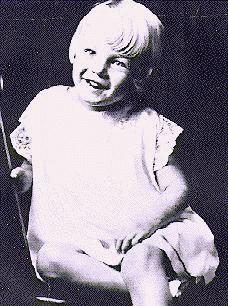
Objectified while alive, Marilyn Monroe has become the ultimate object in death. The image has become the reality ... the multitudinous icons and posters, her face and body standing in for the whole thing, standing in for the life force.
Her desire to be a good actress, to not just play bimbos or sex objects, is what still complicates our response to her, long after her death. Many people who are unaware of her gifts as an actress are frankly shocked by how natural she is, when they encounter her in films. It's like the Object has won the war, but Marilyn Monroe the person, the actress, continues to win battles. To see her in Some Like It Hot is to encounter true giggly effervescent movie MAGIC, and then to see her in Don't Bother to Knock(my review here) is to understand that this woman had talent as a dramatic actress as well. Not just talent, but a gift. I don't quite buy into the whole Marilyn Monroe as Ultimate Victim thing, although I do know that her demons were huge and loud, and caused her much grief in her life. She was a chronic insomniac. She was a loner. If you trust the reports of some of her confidantes and the private notes of her psychiatrist, she was frigid sexually. But nobody wanted to hear about any of that stuff from Marilyn ... that was not what we loved her for. She was famous and adored, but ultimately alone. She could not be saved. Arthur Miller tried. Many tried. She brought out a protective impulse in people. And, in my opinion, that is part of her movie magic. She was not a sassy sex symbol who "owned" her sexuality, and flaunted it (at least not overtly). There was always the wide-eyed innocence there, in spite of the body made for lovin' - and that somehow engendered a protective response in audiences ... male AND female - so she was one of those very rare movie creatures: a sex symbol whom men loved and desired, but also whom women respected and looked up to ... and I think it had something to do with that fragmented innocence peering out of her radiant face. She seemed unaware of the responses she brought up in men, and she never seemed out for sex - the Marilyn Monroe persona was all about finding love. Her gifts as an actress and comedienne are obvious - but her appeal is still rather complicated, which, I suppose, is why people still obsess over her, and talk about her, and pick her apart.
So while I can ache for Marilyn Monroe and what it had to be like, at times, to be her, with an abyss of sadness inside her that nobody - nobody - wanted to see ... what I am ultimately left with, in her case, is admiration for the act of WILL it took for her to put that persona together on a daily basis, and BE that fantasy. It had to have given her great joy. There's that great quote (included below) where someone asked her what it was like for her doing a photo shoot - and she said, "It's like being screwed by a thousand guys and you can't get pregnant."
Marilyn Monroe was 100% aware of what she was doing when she was in front of the camera. That, I believe, is the greatest misperception about her - and also the problem when you become an Object - especially posthumously. Everything hardens, solidifies, and certain aspects of the narrative win out over others. The narrative that "won" was that she was a victim of circumstance and whim, totally used and abused and objectified, and she barely had any consciousness about what she was actually doing. That was the "story". So Marilyn the poor victimized starlet (or Marilyn the drugged-out diva) won the battle in the narrative wars for a couple of decades. That was the filter through which most people (people who are not cinephiles anyway) saw Monroe.
Thankfully, there's a bit more nuance out there now, in regards to how we talk about Monroe - and regular old popcorn-buying audiences, anyway, always knew the truth: Marilyn Monroe was magic, they loved her. They maybe felt protective of her, because of the wide-eyed innocence of her parts ... but there is obviously something about her that made her "stand out". When the nude calendar photos came out, and Marilyn Monroe was forced to apologize by the studio, her apology wasn't really an apology. Just a flat out, "I was behind in my rent, I needed the money." The studio was furious about this - but then they were bombarded by supportive fan mail, thousands and thousands of letters - from men, women, everyone, saying how much they loved her for her honesty.
Not every young starlet has that kind of massive spontaneous cross-gendered support. It is extraordinary and rare, to this day.
Marilyn Monroe did not have an accidental kind of career, where her beauty and maybe a couple of breaks made her. She was a starlet, like any other. Except that this starlet had ambition, and not just that: she had nowhere else to go, no other goals, no other dreams. There was no family, no one to either put the pressure on, to judge her harshly, or, conversely, to cheer her on. There was never any place for Marilyn to go home to. The ultimate orphan. No plan B. Having to survive by her wits. Befriending powerful men who could help her, protect her. She thanked God for her beauty, even if it didn't make any difference to her, in terms of battling with her demons and all that. But her beauty was eye-catching, even in her early brunette days, and she submitted to the humiliations of the starlet-life, always keeping her eye on the ball, so that when the time came, and an actual part came her way, she'd be ready.
I love her performance in All About Eve. She was cast to be the impossibly gorgeous young actress, and all she needed to do was stand next to Bette Davis, and you got the message. I mean, you might as well throw in the towel if you're a 40-something actress and THAT chick in the white dress is coming down the pike. But Marilyn has a couple of lines in the film, comedic lines, showing her gift at comedy - her absolutely perfect pitch (Watch how she delivers the line: "Well, I can't yell 'Oh butler!', can I? Maybe somebody's name is Butler." To which Addison DeWitt replies; "You have a point. An idiotic one, but a point." But it's HER delivery of that line that is funny. Here's the clip.) and again, I am struck by the act of WILL it had to have taken, to just keep going, through the sneers and catcalls, to make something of herself.
She also was smart, and worked on her acting - with a series of coaches through her life ... wanting to go deeper into her craft, and improve herself. Watch her slam-dunk performance in Don't Bother to Knock to encounter a Marilyn Monroe you might never have seen before. She's fantastic.
One of my favorite off-screen stories involving Monroe is told by Billy Wilder, who, famously, had a very tempestuous relationship with her, because of her behavior on the set. Not coming out of her dressing room, showing up hours late, and bumbling her lines so badly that entire days of shooting were spent on Monroe trying to get the line, "Where's the bourbon?" right. But, as Billy Wilder joked: "As I've said before, I've got an old aunt in Vienna who would say every line perfectly. But who would see such a picture." Anyway, here's a bit from the book-length interview between Cameron Crowe and Billy Wilder
CC: One of the reasons you've said that Marilyn enjoyed the Hotel del Coronado sequences in Some Like It Hot is that she had an audience there on the beach watching her. Is that true? Were there, again, a lot of people lined up, watching the filming?BW: She had an audience. She always had thousands in New York, but at the beach there, hundreds. Yeah, she's a show-off.
CC: So they would be cheering and screaming and yelling?
BW: Screaming and yelling. But then when I wanted it quiet I had her say "Shhhh." They listened to her.
That's a movie star.
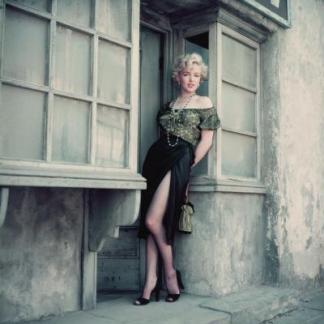
Kim Morgan has a great piece up about Monroe and I loved her comments on Monroe as a singer:
And though people love to discuss Marilyn Monroe the underrated actress (which is true -- she was a great comedienne), rarely do they argue about MM the underrated singer. As proven in Some Like it Hot, Gentlemen Prefer Blondes, River of No Return, Bus Stop (oh lord...her sexy, warbled, scared, ripped fishnet version of "That Old Black Magic"...so brilliant) and the less classic Let's Make Love (where her rendition of "My Heart Belongs to Daddy" is one of the best versions of that song ever recorded), the woman had distinct pipes.
My favorite musical number of hers is one that isn't often mentioned in the list of great Monroe songs, but I adore it. It's "File My Claim" from River of No Return - delicious clip below (along with a million quotes about Monroe and from Monroe).
Perfection!
Now, in honor of our lovely Norma Jean, let's get to the quotes:

(That's a photo by Sam Shaw - his photos of her are my favorites. Natural light, an innocence to them ... candid-feeling ... just beautiful.)
Marilyn Monroe:
People had a habit of looking at me as if I were some kind of mirror instead of a person. They didn't see me, they saw their own lewd thoughts, then they white-masked themselves by calling me the lewd one.
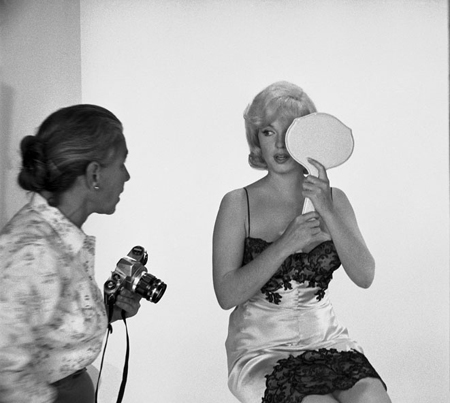
That's Monroe and photographer Eve Arnold
Billy Wilder:
She had a kind of elegant vulgarity about her. That, I think, was very important. And she automatically knew where the joke was. She did not discuss it. She came up for the first rehearsal, and she was absolutely perfect, when she remembered the line. She could do a 3-page dialogue scene perfectly, and then get stuck on a line like, "It's me, Sugar"... But if she showed up, she delivered, and if it took 80 takes, I lived with 80 takes, because the 81st was very good ...She had a feeling for and a fear of the camera. Fright. She was afraid of the camera, and that's why, I think, she muffed some lines. God knows how often. She also loved the camera. Whatever she did, wherever she stood, there was always that thing that comes through. She was not even aware of it.
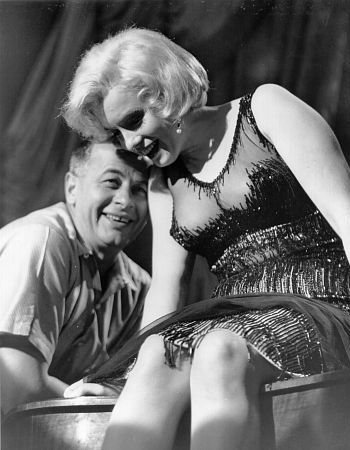
Eve Arnold:
If an editor wanted her, he had to agree to her terms. She knew how she wanted to be seen, and if her cooperation was sought, she reserved the right of veto.She knew she was superlative at creating still pictures and she loved doing it.
She had learned the trick of moving infinitesimally to stay in range, so that the photographer need not refocus but could easily follow movements that were endlessly changing.
At first I thought it was surface technique, but it went beyond technique. It didn't always work, and sometimes she would tire and it was as though her radar had failed; but when it did work, it was magic. With her it was never a formula; it was her will, her improvisation.
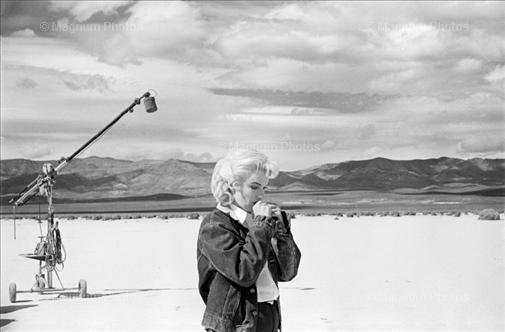
Peter Bogdonavich:
The fact is that Marilyn was in bad trouble from the day she was born as Norma Jean Mortenson on June 1, 1926, in the city of angels and movies, a poor bastard angel child who rose to be queen of a town and a way of life that nevertheless held her in contempt. That she died a martyr to pictures at the same time as the original studio star system -- through which she had risen -- finally collapsed and went also to its death seems too obviously symbolic not to note. Indeed, the coincidence of the two passing together is why I chose to end this long book about movie stars with Marilyn Monroe.What I saw so briefly in my glimpse of Marilyn at the very peak of her stardom (and the start of my career) -- that fervent, still remarkably naive look of all-consuming passion for learning about her craft and art -- haunts me still. She is the most touching, strangely innocent -- despite all the emphasis on sex -- sacrifice to the twentieth-century art of cinematic mythology, with real people as gods and goddesses. While Lillian Gish had been film's first hearth goddess, Marilyn was the last love goddess of the screen, the final Venus or Aphrodite. The minute she was gone, we started to miss her and that sense of loss has grown, never to be replaced. In death, of course, she triumphed at last, her spirit being imperishable, and keenly to be felt in the images she left behind to mark her brief visit among us.
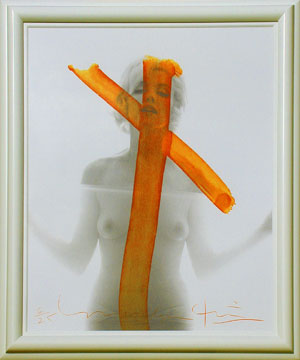
Elia Kazan:
Relieve your mind now of the images you have of this person. When I met her, she was a simple, eager young woman who rode a bike to the classes she was taking, a decent-hearted kid whom Hollywood brought down, legs parted. She had a thin skin and a soul that hungered for acceptance by people she might look up to ...The girl had little education and no knowledge except the knowledge of her own experience; of that she had a great deal, and for an actor, that is the important kind of knowledge. For her, I found, everything was either completely meaningless or completely personal. She had no interest in abstract, formal, or impersonal concepts but was passionately devoted to her own life's experiences. What she needed above all was to have her sense of worth confirmed. Born out of wedlock, abandoned by her parents, kicked around, scorned by the men she'd been with until Johnny, she wanted more than anything else approval from men she could respect. Comparing her with many of the wives I got to know in that community, I thought her the honest one, them the "chumps". But there was a fatal contradiction in Marilyn. She deeply wanted reassurance of her worth, yet she respected the men who scorned her, because their estimate of her was her own.
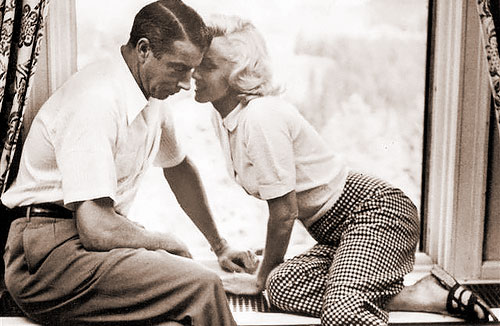
Marilyn Monroe:
Being a most serious actress is not something God has removed from my destiny as He chooses to destroy my chances of being a mother. It’s therefore my perogative to make the dream of creative fulfillment come true for me. That is what I believe God is saying to me and is the answer to my prayers.

Marilyn Monroe:
Well-behaved women rarely make history.
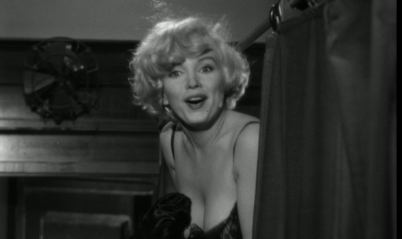
John Strasberg (son of Lee Strasberg, Marilyn's acting teacher):
I think I was talking about cars to Mother and Father. You know how I loved cars. I'd just come home and it was going to be my eighteenth birthday. I'd wanted to come for that.Mother and Father hadn't wanted me to come. "Why don't you wait till the end of the year?" Well, i'd already been kicked out of college. They didn't know yet.
When I'd gone off at the airport, I'd turned to Mother and said, "For two cents, I won't go." Nobody gave me the two cents, but I'd meant it. What I'd wanted to do was work. I'd wanted to work from the time I was fifteen, and they were always against any effort on my part to be strong or independent. I remember how much I resented it. "You don't have to work, we'll take care of everything," undermining me.
So I was talking about cars, no one was listening, and Marilyn was there and out of the blue said, "Why don't you take my car, Johnny?"
I thought I hadn't heard her right, and I said, "What?" She had remembered the summer before, in California, I'd had that Chevy I'd rented. God, I loved that car, a '57 Bel Air silver Chevy, and she had the Thunderbird.
She continued, "I've got the Ford Mustang the corporation gave me, and Arthur and I have a car. That one's just sitting in the garage, we don't use it."
I was stunned. I couldn't believe she meant it.
Mother and Father were horrified; they didn't like it at all. I don't know if it felt like too much to give me or if they were worried about my driving in my state of mind, but they objected strenuously. "He's too young. Maybe later, Marilyn. You don't have to. It's impossible, he can't afford it, it could be dangerous."
Marilyn just said, "Well, don't worry about any of that, it's in the corporation's name, so I'll take care of the insurance."
I'll never forget that ... There were so few, so very few people who were generous like that. Especially to me, who couldn't do anything for her.
I think that car saved my life.
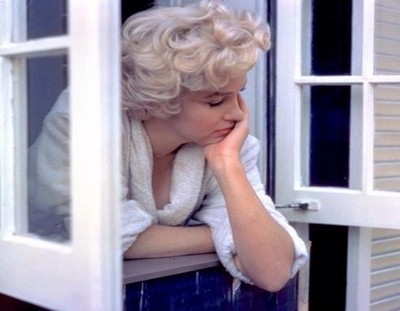
Billy Wilder:
I never knew what Marilyn was going to do, how she was going to play a scene. I had to talk her out of it, or I had to underline it and say, "That's very good" or "Do it this way." But I never knew anybody who ... except for a dress that blows up and she's standing there ... I don't know why she became so popular. I never knew. She was really kind of ... She was a star. Every time you saw her, she was something. Even when she was angry, it was just a remarkable person. A remarkable person, and in spades when she was on the screen. She was much better on the screen than not on the screen.
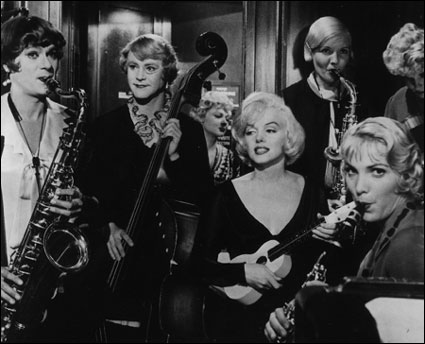
Marilyn Monroe:
Some people have been unkind. If I say I want to grow as an actress, they look at my figure. If I say I want to develop, to learn my craft, they laugh. Somehow they don't expect me to be serious about my work.
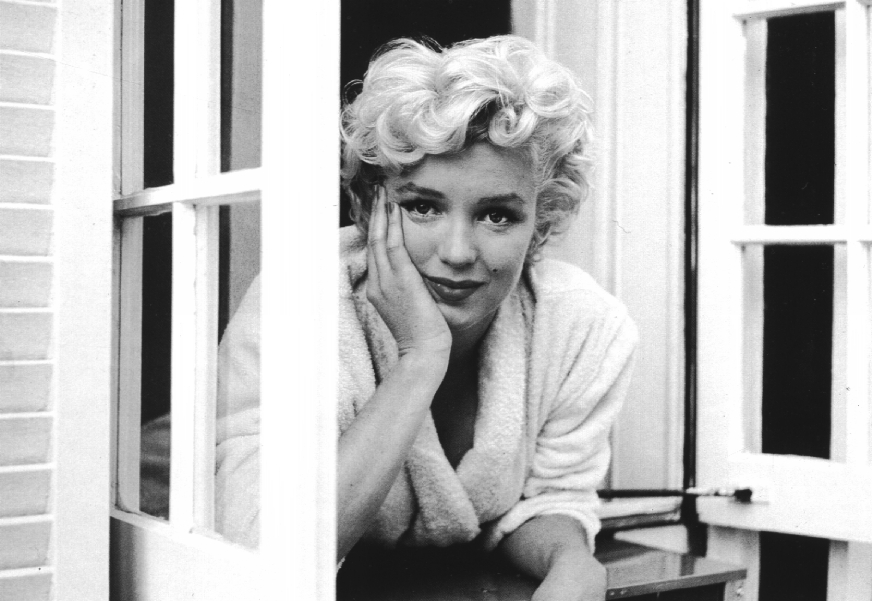
Billy Wilder:
It's very difficult to talk seriously about Monroe, because she was so glitzy, you know. She escaped the seriousness somehow; she changed the subject. Except that she was very tough to work with. But what you had, by hook or crook, once you saw it on the screen, it was just amazing. Amazing, the radiation that came out. And she was, believe it or not, an excellent dialogue actress. She knew where the laugh was. She knew.
Marilyn Monroe:
"For breakfast, I have two raw beaten eggs in a glass of hot milk. I never eat dessert. My nail polish is transparent. I never wear stockings or underclothes because I think it is important to breathe freely. I wash my hair everyday and I am always brushing it. Every morning I walk across my apartment rolling an empty soda bottle between my ankles, in order to preserve my balance."
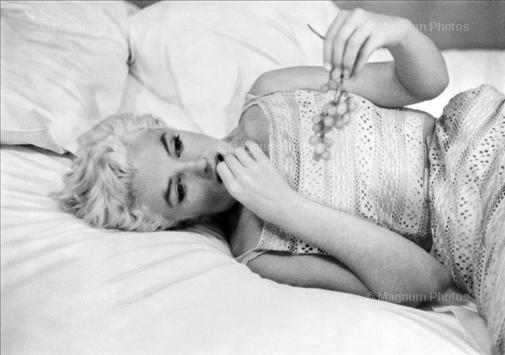
Eve Arnold:
I never knew anyone who even came close to Marilyn in natural ability to use both photographer and still camera. She was special in this, and for me there has been no one like her before or after. She has remained the measuring rod by which I have -- unconsciously -- judged other subjects.
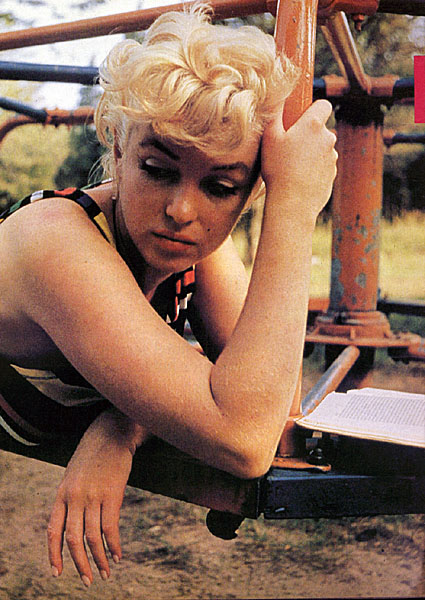
Marilyn Monroe:
It's not true that I had nothing on. I had the radio on.
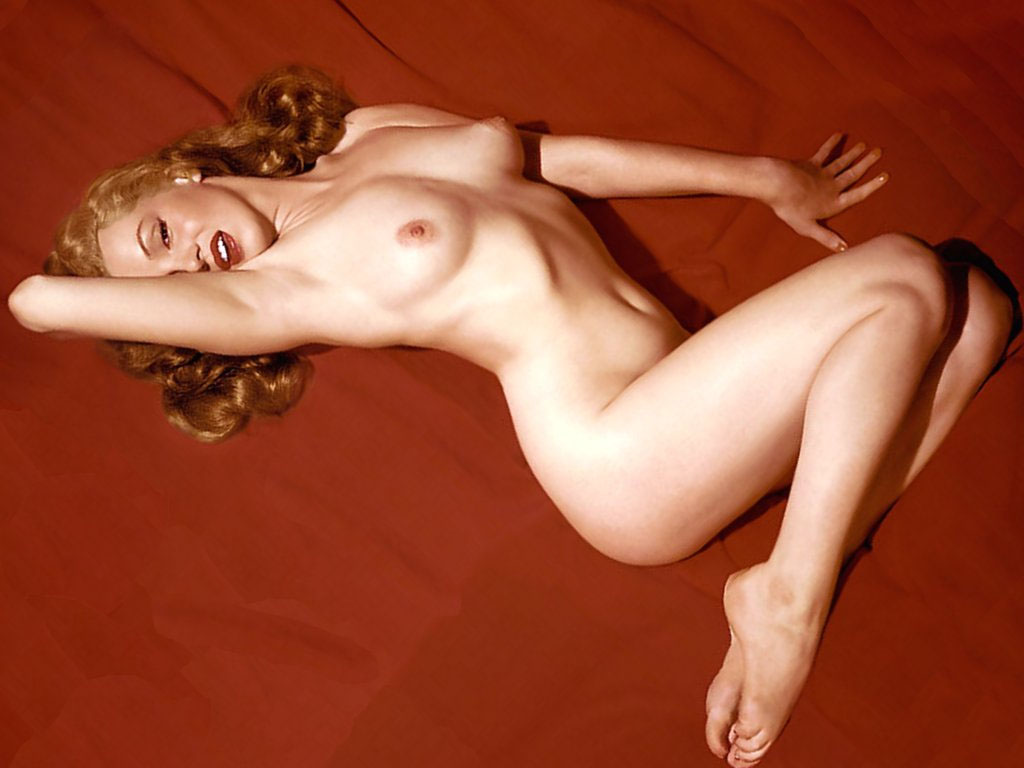
Ernest Cunningham (photographer):
I worked with Marilyn Monroe. A rather dull person. But when I said "Now!" she lit up. Suddenly, something unbelievable came across. The minute she heard the click of the camera, she was down again. It was over. I said, "What is it between you and the camera that doesn't show at any other time?" She said, "It's like being screwed by a thousand guys and you can't get pregnant."
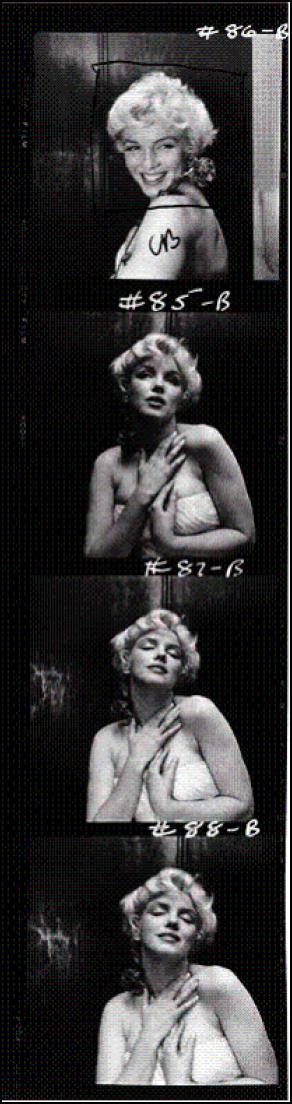
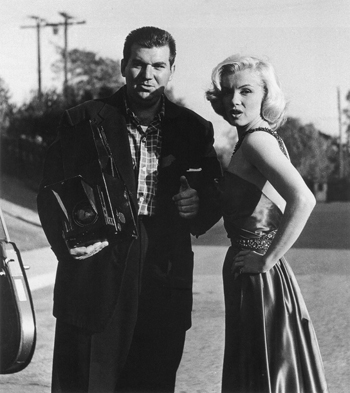
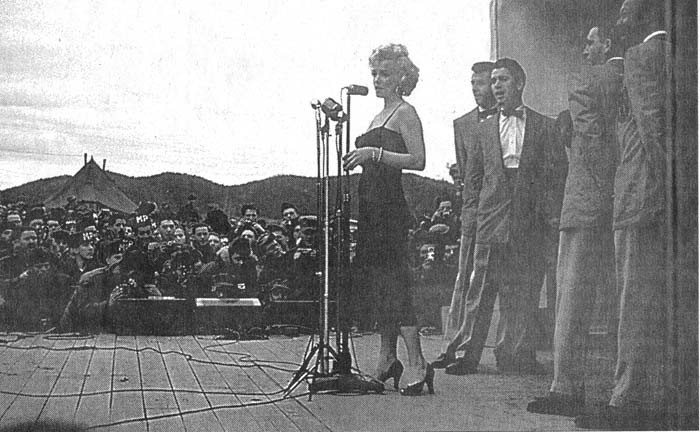
Peter Bogdonavich:
More than forty years have passed since Marilyn's mysterious death, but her legend and persona have survived. This is all the more remarkable because she actually made very few films, and even fewer that were any good. But there was a reality to her artifice -- she believed in the characters she played, even if they were inherently unbelievable. "Everything she did," [Arthur] Miller said to me, "she played realistically. I don't think she knew any other way to play anything -- only to tell you the truth. She was always psychologically committed to that person as a person, no matter what the hell it was, rather than a stock figure. Because the parts she got could easily have been stock figures, which had no other dimension. But she wouldn't have known how to do that. In other words, she did not have the usual technique for doing something as a stock figure ... She was even that way when [director] John Huston used her the first time [in a memorable walk-on bit] in The Asphalt Jungle [1950]."This went for every picture she did in her surprisingly, painfully short career as a star, barely a decade, little more than a dozen pictures. Though she managed to work with quite a number of major directors, it was not necessarily always in their best efforts; but still they were Fritz Lang, Howard Hawks (twice), Otto Preminger, Billy Wilder (twice), George Cukor (twice, if you count her last unfinished one), John Huston (twice), Laurence Olivier, Joshua Logan, and Joseph L. Mankiewicz (bit part in 1950's classic All About Eve). In my conversation with Miller, he said, "I thought she had the potential for being a great performer if she were given the right stuff to do. And if you look at the stuff she did do, it's amazing that she created any impression at all because most of it was very primitive. And the fact that people remember these parts from these films is amazing ... She was comitted to these parts as though they were real people, not cardboard cutouts. Even though the director and author and the rest might have thought they were cutouts and would deal with them that way. The way the two men [Tony Curtis, Jack Lemmon] in Some Like It Hot felt with their parts, or George Raft with his part. She was real. And therefore she had the potential of being a great comedienne." (Norman Mailer, in his book on Monroe -- he never met her -- wrote that starting with 1953's Gentlemen Prefer Blondes, she was a great comedienne.)
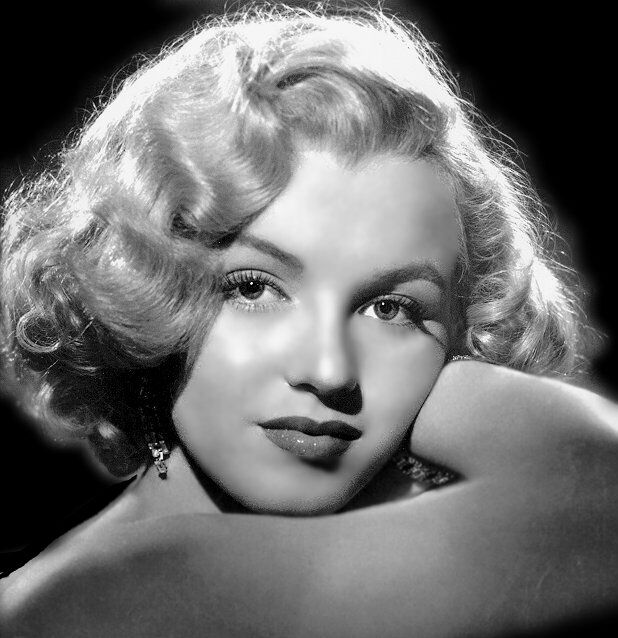
Marilyn Monroe:
I'd prefer not to analyze it [acting] ... it's subjective; rather, I want to remain subjective while I'm doing it. Rather than do much talking I'd rather act. When it's on the screen, that's when you'll know who Roslyn [her character in The Misfits] is. I don't want to water down my own feeling ... Goethe says a career is developed in public but talent is developed in private, or silence. It's true for the actor. To really say what's in my heart, I'd rather show than to say. Even though I want people to understand, I'd much rather they understand on the screen. If I don't do that, I'm on the wrong track, or in the wrong profession.... Nobody would have heard of me if it hadn't been for John Huston. When we started Asphalt Jungle, my first picture, I was very nervous, but John said, 'Look at Calhern [the late Louis Calhern, a veteran actor], see how he's shaking. If you're not nervous, you might as well give up.' John has meant a great deal in my life. It's sort of a coincidence to be with him ten years later.
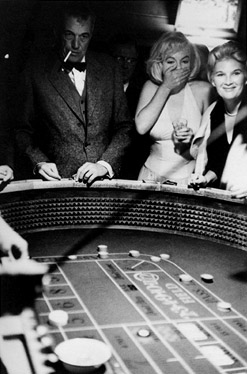
John Strasberg:
The first time I met her I remember she came out of the living room and Pop said, "This is my son," and my first impression of her was that she was different from most of the people who came to the house. I'd watch all these people trading their most human qualities, betraying themselves for success at all costs, to become rich and famous, and afterward, when it was too late, they'd realize they had lost the best part of themselves along the way, but she, she was like me. When I looked into her eyes, it was like looking into my own, they were like a child's eyes. I was still a child. You know how children just look at you. My feeling was she had less ego or was less narcissistic than most of the actors who never really bothered with me. She was just another person to me, another one from that world I felt cut off, excluded, from. She was nicer, real simple, no makeup, and she really looked at me as if she saw me. It wasn't that I wanted people to look at me, but I knew the difference when she did. I knew everyone said she was the sexiest, most sensual woman in the world. Not to me. I thought there was something wrong with me for not feeling that from her. I'd felt it from other women who came to the house. I was pretty sexually frustrated then. She was so open, so loose, and her sensuality as such was so totally innocent, nothing dirty in it at all, and the first time it was just like talking to an ordinary person, only realer than most who came into the house in those days. She was quiet, too, I remember, like an animal is quiet, and I was like that too, survival tactics. She seemed smart, but not in an educated way, instinctively smart, nobody's fool.
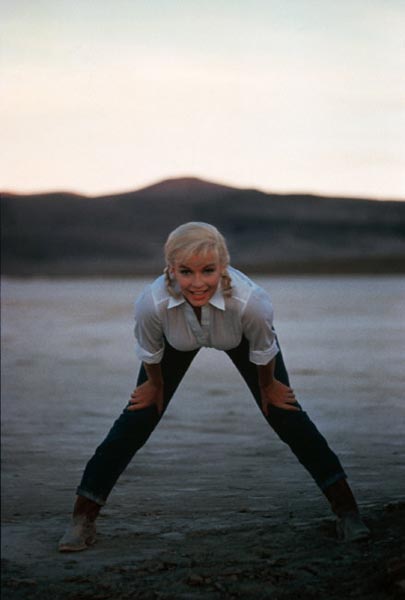
Couldn't resist:
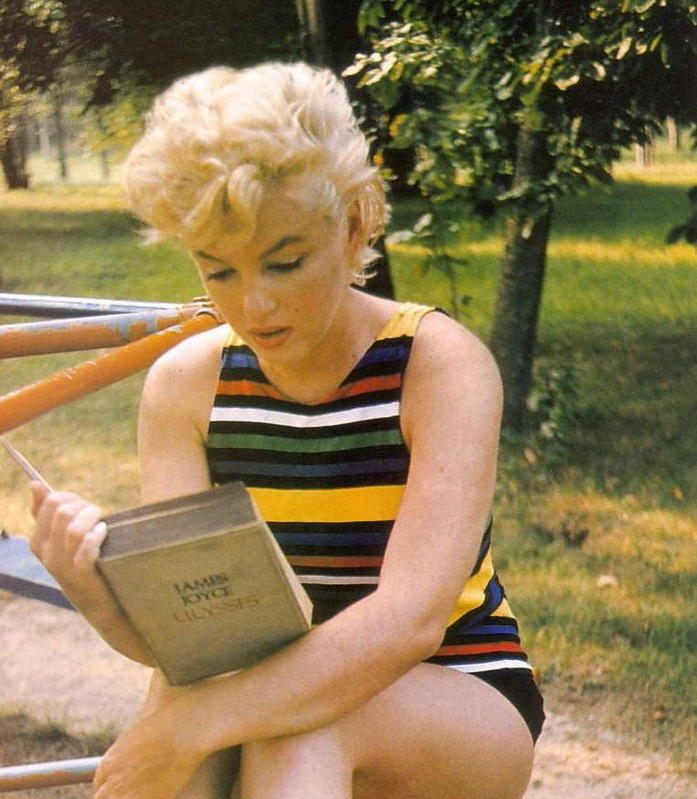
Marilyn Monroe:
"I am a failure as a woman. My men expect so much of me because of the image they have made of me and that I have made of myself, as a sex symbol. Men expect so much and I can't live up to it. They expect bells to ring and whistles to whistle, but my anatomy's the same as any other woman's. I can't live up to it."
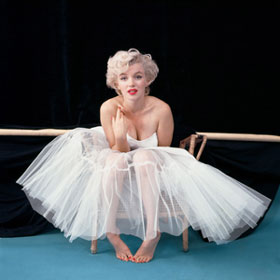
Marilyn Monroe:
My illusions didn't have anything to do with being a fine actress. I knew how third rate I was. I could actually feel my lack of talent, as if it were cheap clothes I was wearing inside. But, my God, how I wanted to learn, to change, to improve!
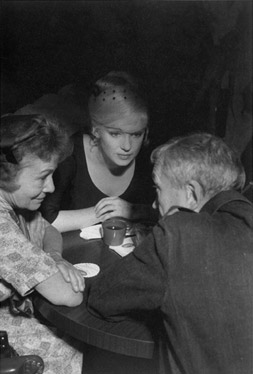
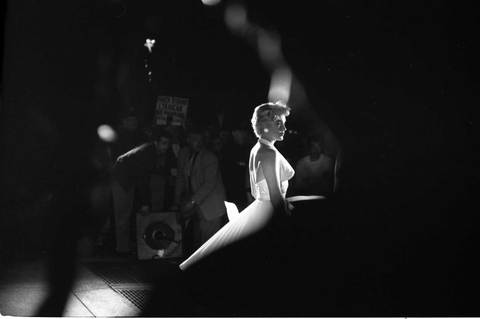
Arthur Miller:
She was a whirling light to me then, all paradox and enticing mystery, street-tough one moment, then lifted by a lyrical and poetic sensitivity that few retain past early adolescence. Sometimes she seemed to see all men as boys, children with immeidate needs that it was her place in nature to fulfill; meanwhile her adult self stood aside observingt he game. Men were their need, imperious and somehow sacred. She might tell about being held down at a party by two of the guests in a rape attempt from which she said she had escaped, but the truth of the account was far less important than its strange remoteness from her personally. And ultimately something nearly godlike would emerge from this depersonalization. She was at this point incapable of condemning or even of judging people who had damaged her, and to be with her was to be accepted, like moving out into a kind of sanctifying light from a life where suspicions was common sense. She had no common sense, but what she did have was something holier, a long-reaching vision of which she herself was only fitfully aware: humans were all need, all wound. What she wanted most was not to be judged but to win recognition from a sentimentally cruel profession, and from men blinded to her humanity by her perfect beauty. She was part queen, part waif, sometimes on her knees before her own body and sometimes despairing because of it -- "Oh, there's lots of beautiful girls," she would say to some expression of awed amazement, as though her beauty betrayed her quest for a more enduring acceptance.
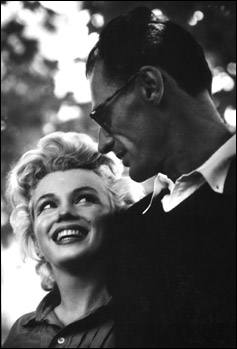
Peter Bogdonavich:
The year before her much-speculated-over death at thirty-six (rumors of presidential involvement, etc.), playwright Clifford Odets told me that she used to come over to his house and talk, but that the only times she seemed to him really comfortable were when she was with his two young children and their large poodle. She relaxed with them, felt no threat. With everyone else, Odets said, she seemed nervous, intimidated, frightened. When I repeated to Miller this remark about her with children and animals, he said, "Well, they didn't sneer at her."
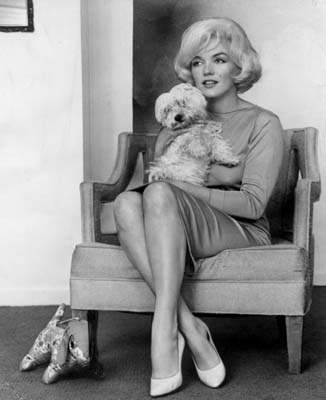
Burt Glinn (photographer):
She had no bone structure -- the face was a Polish flat plate. Not photogenic in the accepted sense, the features were not memorable or special; what she had was the ability to project.
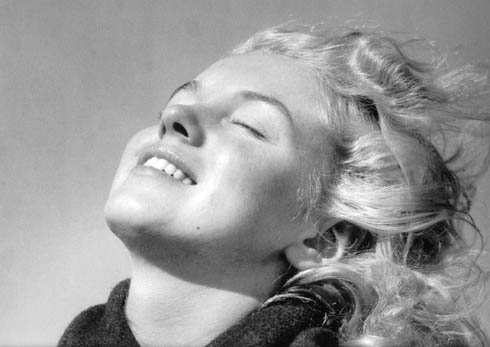
Billy Wilder:
Marilyn was not interested in costumes. She was not a clotheshose. You could put anything on her you wanted. If it showed something, then she accepted it. As long as it showed a little something.
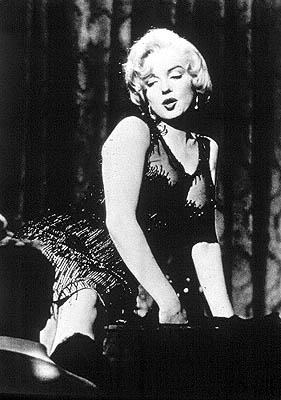
Henri Cartier Bresson (photographer):
She's American and it's very clear that she is - she's very good that way - one has to be very local to be universal.
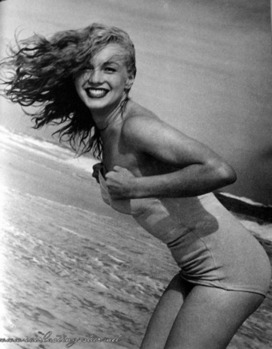
Here's the mega-post I wrote about the making of The Misfits
Marilyn Monroe:
Hollywood is a place where they'll pay you a thousand dollars for a kiss and fifty cents for your soul.
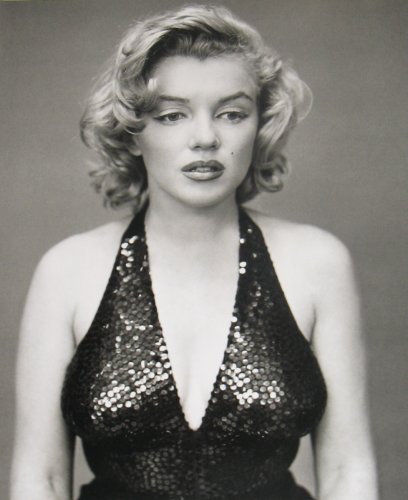
Marilyn Monroe:
Being a sex symbol is a heavy load to carry, especially when one is tired, hurt and bewildered.
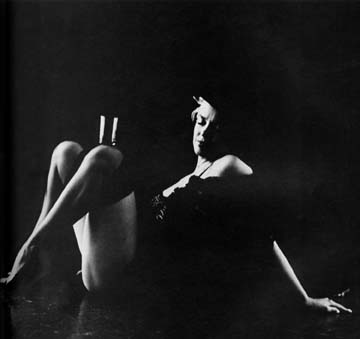
Marilyn Monroe:
Acting isn't something you do. Instead of doing it, it occurs. If you're going to start with logic, you might as well give up. You can have conscious preparation, but you have unconscious results.
Arthur Miller:
To have survived, she would have had to be either more cynical or even further from reality than she was. Instead, she was a poet on a street corner trying to recite to a crowd pulling at her clothes.

Marilyn Monroe:
I'm not interested in money. I just want to be wonderful.
Marilyn Monroe (this is what she pleaded at the end of the last interview she gave):
What I really want to say: That what the world really needs is a real feeling of kinship. Everybody: stars, laborers, Negroes, Jews, Arabs. We are all brothers.Please don't make me a joke. End the interview with what I believe.
May 8, 2009
Speaking of essence:
I just love this photograph, and its caught-moment feel of it.
Marilyn Monroe and Jane Russell.

May 7, 2009
Rainy melancholy morning
Restless night where I had terrible dreams and kicked all of the covers off, and must have been thrashing about so much for HOURS that I woke up with my hair looking exactly like this.

Granted, I was in plaid pajamas and wearing glasses, but THAT was my 'do at 5:30 this morning when I went to brush my teeth.
I think I need to have restless nights more often. It acts as the perfect hairdresser.
So after such a night, and on our fourth straight day of rain (not that I'm complaining, I love rain, I prefer it) it was wonderful to come across this post which made me laugh out loud.
April 8, 2009
When love goes wrong? Nothing goes right. We all know that.

Clip of Jane Russell and Marilyn Monroe singing "When Love Goes Wrong" in Gentleman Prefer Blondes below the jump (I've been listening to Marilyn's Greatest Hits today, I find them relaxing).
I love when the va-va-voom section of the song kicks in. Yum. It seems like we're in for a melancholy ballad, but then, hey, look, the girls keep their spirits up after all.
And watch Marilyn dance with a little kid - and somehow make it not be a dirty weird moment. It's happy. Cute.
Another example of how you don't have to do too much to get your point across. To tell the story. The choreography is simple, yet perfect. They're in traveling suits and hats and gloves. A little shimmy from both of them can make your knees go weak.
So sexy. So good together.
C'est vrai, c'est vrai! Touche!
February 6, 2009
Sam Shaw's artistry: Marilyn Monroe
Another one of my favorites from the Shaw / Monroe collaboration.
This is an interior shot, so there is probably some artificial lighting going on, but the effect is that of totally natural light. And while she can't help but be glamorous - because she, like Jessica Rabbit, is just "drawn that way" ... it also has a candid "caught" feeling to it, that, to me, deepens our view of Miss Monroe. It's not quite a "glamour" shot. She's a woman in a slip, beautiful, yes, with a slamming body, but more is going on there ... she is "caught" in what appears to be almost a private moment.
A beautiful photo.
Sam Shaw's artistry: Marilyn Monroe
Marilyn on the phone. I love her twining legs in the photo. I could not do that with my legs if you paid me a hundred dollars. They just don't seem to "go" that way. Her legs remind me of this famous photo of Anne Sexton, used to promote Sexton's poetry readings in Cambridge (which my father attended, once upon a time):

I love how Monroe looks like she maybe just woke up, or maybe came in from a swim ... there's something lazy and disheveled about her that reminds me of long summery days.

Sam Shaw's artistry: Marilyn Monroe
I love this one. Classic period photo - the purse, the stole, the whole look and feel.

Sam Shaw's artistry: Marilyn Monroe
Marilyn frolicking in the surf. That first one just makes me smile every time I see it. Maybe because I don't see that much difference between her there, a grown woman, and me here, a small child. It has that same unselfconsciousness.


Sam Shaw's artistry: Marilyn Monroe
Marilyn dancing around in her yard in Connecticut. These are just so much fun.


Sam Shaw's artistry: Marilyn Monroe
I adore these photos.
When I did After the Fall, I gave these two photos to the amazing costume designer, to give her an idea of what I was thinking for the first costume. I didn't want it to be va-va-voom, not too much - I wanted it to be the character's version of what is ladylike and sweet. A summery dress, white gloves ... sweet. Here is what the costume designer came up with. God, I loved that dress.
Here are the two inspirations for that costume.


Sam Shaw's artistry: Marilyn Monroe
Ceci - my dear friend whom I have never met - counts this as her favorite photo of Marilyn (am I right?)
It's mine as well.

Sam Shaw's artistry: Marilyn Monroe
"Hers was the joy of being alive and loving her work: the life recalled and held out to us in these sweet, haunting reminders."
-- Sam Shaw
One of the Sam Shaw photos of Marilyn below. I like the less glamorous shots - the more casual ones. Sam Shaw, as will be obvious in most of these, preferred to use natural light. That Marilyn would allow this just goes to show you how much she trusted him.

Sam Shaw's artistry: First up, John and Gena - then on to Marilyn Monroe
Marilyn Monroe was, of course, beloved by photographers. While generally agreed that she could be quite plain-faced in person, rather flat-looking, actually - when a camera was turned on her, magic happened. Photographer Burt Glinn said:
She had no bone structure -- the face was a Polish flat plate. Not photogenic in the accepted sense, the features were not memorable or special; what she had was the ability to project.
Photographer Eve Arnold (who took some of my favorite pictures of Monroe) said:
I never knew anyone who even came close to Marilyn in natural ability to use both photographer and still camera. She was special in this, and for me there has been no one like her before or after. She has remained the measuring rod by which I have -- unconsciously -- judged other subjects.
Here is a post I wrote a while back about the making of The Misfits (which was unique, at that time, because of the phalanx of world-class photographers who were hanging out at the shoot, documenting the whole thing). Some very cool comments from photographers there, about their process, and also their impressions of Monroe as a subject.
Sam Shaw was a close friend of Marilyn Monroe from even before she became a star. She became an honorary member of the Shaw family, which was part of Marilyn's thing - sort of adopting herself into already-existing families - but the Shaws loved her, and it was a friendship that lasted until Monroe's death. Sam Shaw took many pictures of Monroe - one being the most famous and most replicated of all (Monroe on the grate with her skirt blowing up) - but my favorites that he took are the more casual ones, of Marilyn cavorting in the lawn of the house she shared with husband Arthur Miller, hanging out in various places, reading the newspaper, whatever.
Before we get on to Marilyn, I wanted to mention one other thing about Sam Shaw. My love for him pre-dates my love for Marilyn, strangely enough, because in the early 90s I came across some photos in Interview magazine that Sam Shaw had taken while hanging out at the Cassavetes household. There's John Cassavetes, Ben Gazzarra, and Peter Falk clowning around beside the pool. There's the garden that Gena Rowlands loved to work in outside her house. And - best of all - one of my favorite photographs of all time, spread out over two pages - of John and Gena, holding their dog. I ripped the pages out and went to a Xerox joint and made a huge copy of the two ripped out pages on thick heavy paper - not just cheap Xerox paper. I have had it on my wall ever since. You can see the rip down the middle in the Xeroxed copy. I love it for its character and also its long history in my own life. I love it that it has a quote from Ben Gazzarra on the photo, about John's love for Gena as an actress. I love the roughness of it, and the image itself. I have never seen this image online anywhere else - in Sam Shaw collections or elsewhere - so it's even more precious to me, especially in its imperfections. It has been on my wall in every apartment I have lived in, my apartments in Chicago, in Hoboken, in New York ... I look at it, and I remember who I am, who I want to be, the kind of life I would like to have (and, come to think of it, the kind of life I do have), my values.
I know it might sound goofy but Michael told me he fell in love with me when he first walked into my bedroom and saw that I had this on my wall.
So without further ado, here's a picture of the Sam Shaw photo I have on my wall (and yes, it is that faded, and sepia-toned) of John Cassavetes and Gena Rowlands:

October 19, 2008
The Books: "Marilyn and Me" (Susan Strasberg)
 Next book on my "entertainment biography" shelf:
Marilyn and Me
There is much to say here, about the smothering psychodrama of the Strasberg family - and the introduction of Lee Strasberg's most famous student - Marilyn Monroe - as practically an adopted daughter into the family.
Lee Strasberg had been one of the founding members of the Group Theatre in the 30s. It soon became clear that his gift was not in acting or in directing - but in teaching, and theorizing. People came to him for help with scenes - he was a close student of the Stanislavksy "system" (known, in its American version, as "the Method") - and he put his own spin on it very early on, by introducing what is known as "affective memory" [corrected!] into the pot.
"Sense memory" is when you, the actor, concentrate on creating, say, a coffee cup full of coffee. You work at it with your hands, you try to feel the weight of the cup, you try to feel the heat emanating, you try to create for yourself the smell of coffee. These exercises are meant to unleash the actor's creativity and imagination. The point of acting is to come alive under imaginary circumstances and for some actors that takes practice. Strasberg was always fascinated by those who did it anyway, who did it easily - who did it naturally, with no training. What was it in, say, Eleanora Duse - or Paul Muni - that was so authentic? Duse is famous for blushing on stage when a blush was called for (it was George Bernard Shaw who first noticed it and commented on it, how it seemed to him to be the purest example of imagination and creativity he had ever seen). Her sense of reality and being in-the-moment was so intense, so unshakeable, that she would blush. On cue. No one alive today has seen "Duse's blush" - any audience member from her time is now long dead - and yet the impression it made has remained famous, and you will still hear people reference "Duse's blush".

Strasberg wondered if such authenticity (which came natural to the geniuses of the world - the Duse's, the Brando's) could be taught. Could an actor train his concentration so that the world of the play would be so real that all kinds of involuntary things (like a blush) could be possible? The "affective memory" exercise that Strasberg developed is the most controversial aspect of the Method, and I have pretty mixed feelings about it (mainly because it didn't work for me). You go back in time (in your mind) to re-create a memory, something from your past ... trying to not just think about it, or remember it intellectually - but re-live it. This is not meant to be a general experience, a re-hashing of an old familiar narrative from your life - that would do you no good as an actor. The point is to use that concentration you have been training - on creating coffee cups and taking a shower and a hot humid day - in the services of resurrecting that old memory - but you do not do it by focusing on the emotions of the old memory, you do it by focusing on the sensory details. For example, one day when you were 6 years old, a phone call came, and your mother answered, and the news arrived that your beloved grandmother had died - and it was your first moment of grief, loss, fear, whatever ... It was an important moment. For "affective memory", you don't go straight for the jugular, and think about your grandmother dying. No. You focus on how the light looked on the kitchen tile that day, and the smell of breakfast on the stove ... the shoes your mother was wearing, the sound of the telephone ring ... and through focusing on those sensory details, you can get closer to the actual source of the memory. Because, of course, our bodies remember sensoral details better than it remembers actual information. You touch a hot stove once, you never do it again, to use an obvious example. Much of this is at a primitive level, an animal level ... but we, as complex intellectual creatures, tend to distance ourselves, or we forget ... But to quote Metallica: "the memory remains" - not in the brain, but in the sensoral apparatus at our disposal. I have been in classes where everyone is doing an "affective memory" at the same time and it is literally like sitting in the main room of a psych ward. People babble, weep, moan, talk out loud - some people freak out so badly they have to stop the exercise. Just because it never worked for me is not to say that it is not a useful exercise, or that some people were really set free by it. Actors are not cookie-cutters. We are all different.
For me, I certainly could do the exercise. It wasn't that I was blocked or anything like that. I could re-create anything. I live in a fantasy world half the time, anyway, this shit is old hat to me. The problem (for me) came when I had to "use" it in my acting. As an exercise it was fine, but I never seemed to use it when I was actually onstage acting. Now, much of the purpose of sense memory and effective memory IS just for training. It helps you hone your skills, it's a craft, you have to practice - it's like practicing giving yourself permission to enter an imaginary world. Sense memory helps you do that, and it also helps you to be specific, as opposed to general. Actors who are good are good because of all kinds of reasons - but actors who are bad all have one thing in common: They are GENERAL. Generality is death to good acting. But people working on sense memory DURING a scene had a tendency to look like they were in a fog, they were unable to connect with their scene partner, they were so busy creating the damn sound of rain on the windows. It had a tendency to look belabored. I would rather be an actor who is not, perhaps, transported to another dimension by a sense memory exericse - but is able to listen and talk in a believable manner onstage. However: it doesn't have to be either/or. It actually shouldn't be either/or. I ended up basically just using sense memory as strictly a training exercise - like practicing meditation ... which can be difficult. It was a way to leave the workaday everyday world, and surrender to the moment. It was about giving myself permission to be a little kid again. Again: this is not to say my experience is right. It was just my experience. Judging other people's acting processes is, to me, a little bit like judging how other people have sex. There cannot be a more pointless and idiotic way to spend your mental energy. If it works for someone, who are you to say it shouldn't? What kind of an arrogant insecure son-of-a-bitch are you anyway? But you see that a lot. Young actors, perhaps not as knowledgeable as they should be, try to assert their own process as THE way to do things. I have noticed this, too, with my friends who have become mothers. Other mothers can't just be like, "I do things THIS way with my baby - maybe that would work for you ..." They have to be like, "I do things THIS way with my baby, and if you DON'T do it that way, then you are abusive and selfish." It's retarded. So because Spencer Tracy didn't consciously sit around using sense memory, that means he's somehow lesser? How fucking condescending. You use it if you NEED it. But there can be a rigidity in acting training - because it's such an uncertain pursuit - there are no guarantees - and so actors (some actors) want to believe that there is only one way to do things, and if they could just "do it right", then all the glory in the world will follow.
There are also teachers out there who are charlatans - of the New Age Deepak Chopra variety - who insist that THEIR way is the only way, if you follow THEM you will succeed ... It's almost like a cult. Like, if you decide to switch teachers, or stop taking class altogether, it's seen as you leaving the fold, going beyond the pale. Acting careers, like any other, have pressures, and people are looking for the magic bullet, the golden goose, whatever it is.
My process usually involves music (I always have a "mix tape" for whatever show I'm in ... stuff that gets me into the world of the play) - and then just practical concerns - like learning my lines, and doing what the character does, whatever that may be. I like things like costumes ... they help set me free and launch me into another person's psyche as opposed to my own. Things like shoes are very important. How you walk, and how your feet feel ... it's something palpable, tangible. And then, I'm a huge fan of what I call the "Bang Bang You're Dead" school of acting. I go into that a bit here, in my piece on William Holden. Meaning: when a little kid is playing cops and robbers and shouts at his friend, "BANG BANG YOU'RE DEAD", the other little kid will launch into a swandive of death more convincing than any seasoned actor could ever hope to accomplish. There is no gap between impulse and action, there is no questioning of "how" to do it ... You know that you have to die, and you have been shot, and so you throw your body into the void. Much of acting is remembering what it was like to be a child playing make-believe (at least it is for me) - when you are unselfconsciously in the world you have created ... and so much of my process involves doing whatever I have to do to get into that state. This (for me) never involved sense memory. Or, maybe I'm stating it too strongly. There were moments, yes, when it came in useful. Working on Summer and Smoke, and doing a scene that happens on a hot humid night, where the air sits there like soup, making you sluggish and tired. I would use sense memory for that ... to create the sensation of humidity, and still thick air. Often, though, it seemed to me that it came easier if I would just give myself the cue, the "Bang Bang Youre Dead" cue - only this time it was, "Hot Humid Night - GO" ... and, because I'm a human being, aware, and open, my senses would jump into action. I remember humidity. I didn't need to turn myself inside out to get there. However, that could just be a matter of practice and talent ... You don't always need to turn yourself inside out (and I very much disliked teachers who were suspicious of ease. Those people have a vested interest in you, the student, being in their thrall, of needing them ... so they keep you weak. They don't like ANYTHING to come easy.)
All of this is to say that Lee Strasberg was THE teacher of "The Method" for 20, 30 years - and even with the controversies, having ringing endorsements from people like Al Pacino did much to maintain his mystique (and the mystique of the Actors Studio- with which Strasberg was forever linked - as though they were one and the same).
Lee Strasberg remains a controversial figure (and his third and last wife Anna Strasberg even more so_, a very important man in American theatrical history, but there is no "official" version of him. Some people hated him, some loved him, some felt liberated by his teaching (Ellen Burstyn), some felt stifled. There is no right answer here.
But when we get into the Marilyn Monroe connection, things get even more murky. I have read both of Susan Strasberg's books (Marilyn and Me and Bittersweet) - and I have to say: they make me feel stifled. Susan Strasberg, daughter of Lee and Paula Strasberg, was an actress. Because of who her parents were (and Paula had been an actress in the Group Theatre - she became Lee Strasberg's second wife - they had two children) - it was expected that she would go into the theatre, but it was also expected that she would study with her father, join the Actors Studio, take that route. They were unbelievably pushy parents. Or, Paula was pushy ... a very ambitious woman, bloated with her own thwarted dreams ... Paula was an acting coach herself (and she ended up having a very close relationship with Monroe - which caused all sorts of problems on movie sets - with Monroe deferring to PAULA'S judgment as opposed to the director's) ... and she wanted her daughter to thrive. However, I can't help but get the sense that she wanted her daughter to thrive on HER terms. She didn't REALLY want Susan to be free and independent. Whatever Susan had as an actress (and she had a pretty fine run!) would be OWNED by her parents. Just the thought of that makes me a little sick to my stomach.

Lee Strasberg was, famously, a very remote man. He was cut off, somewhere deep inside, and while he obviously had a gift of insight into acting - and into other people's processes - he wasn't as good with his own family. The house was always full of actors, all toadying up to Lee, and Susan grew up in that heady atmosphere, a little dark-haired girl on the sidelines, watching movie stars suck up to her father. Would there be room in that for HER? The thought of breaking free of her parents was unthinkable. They were too powerful. However, Susan started studying at the Actors Studio. Of course that meant that she was studying with her father - which, naturally, would make her freeze up ... If he treated her like he treated the other students (pushing at them, shouting at them, slicing through their defenses) ... how would she take that home with her? How would that affect their relationship? But even with these struggles, Strasberg started working. Very early. She got the role of Anne Frank in the Broadway production - she was just a teenager - and it was a giant smash hit. She was the toast of Broadway. Here's a picture of Susan from that time - and you can see, smiling above her - the mouth of Marilyn Monroe - one of the oddest things to see - because Marilyn Monroe is always the focus of any photo she is in. But here - in this case - she is not. It's Susan Strasberg's night.

She went on to minor success - playing Millie Owens in Picnic (a part with which I have many fond memories myself) and other roles.

Meanwhile, though, Marilyn Monroe had latched on to Lee Strasberg (and the feeling was mutual). Marilyn Monroe had moved to New York at the height of her career with two goals in mind: 1. To nab Arthur Miller and 2. To study with Lee Strasberg at the Actors Studio. Monroe and Shelley Winters were great friends, and Winters had suggested that the Studio would be a good no-pressure place (ha!) for Monroe to go to work on her acting. She could take classes, have private sessions with Lee. Monroe would probably never get the chance to work on Nora in Doll's House (although I think she would have been wonderful in the part) - but there at the Studio she could.

Monroe dedicated herself to her classes at the Studio, and Strasberg very early on had some kind of connection to her. Perhaps he was enamored at the thought that this glamorous movie star had chosen him. Perhaps he was a little bit in love with her. Perhaps he had a Svengali complex. I think there was all of that going on. His devotion to Marilyn Monroe became paramount. He was more devoted to her than he was to his own children (at least that is how Susan and Johnny - the Strasberg's son - felt). Both of them had artistic ambition and dreams ... why couldn't their famous father stay focused on THEM?

Marilyn Monroe became ensconced in the Strasberg household. She and Lee would have hours-long sessions in his study, and she would emerge, unsteady on her feet, drained from weeping, and ready for a drink. Boundaries were blurred. Monroe slept over (as a matter of fact, she slept in the same room as Johnny - who was a 16 year old boy at the time - can you imagine the sexual confusion of that situation for him?) John, though, years later, would remember very movingly his first impressions of her, the biggest movie star in the world:
The first time I met her I remember she came out of the living room and Pop said, "This is my son," and my first impression of her was that she was different from most of the people who came to the house. I'd watch all these people trading their most human qualities, betraying themselves for success at all costs, to become rich and famous, and afterward, when it was too late, they'd realize they had lost the best part of themselves along the way, but she, she was like me. When I looked into her eyes, it was like looking into my own, they were like a child's eyes. I was still a child. You know how children just look at you. My feeling was she had less ego or was less narcissistic than most of the actors who never really bothered with me. She was just another person to me, another one from that world I felt cut off, excluded, from. She was nicer, real simple, no makeup, and she really looked at me as if she saw me. It wasn't that I wanted people to look at me, but I knew the difference when she did. I knew everyone said she was the sexiest, most sensual woman in the world. Not to me. I thought there was something wrong with me for not feeling that from her. I'd felt it from other women who came to the house. I was pretty sexually frustrated then. She was so open, so loose, and her sensuality as such was so totally innocent, nothing dirty in it at all, and the first time it was just like talking to an ordinary person, only realer than most who came into the house in those days. She was quiet, too, I remember, like an animal is quiet, and I was like that too, survival tactics. She seemed smart, but not in an educated way, instinctively smart, nobody's fool.
They had a special bond. She had a special bond with Susan as well, they were practically like sisters. They would sleep in in the mornings, lying in Susan's bed, talking about boys and makeup and life. As Susan Strasberg started getting important parts in plays that were truly relevant, Monroe was proud and happy for her - but jealous as well - since she had never been given the chance to do anything that would be "important". Monroe, like most brilliant comediennes and sex bombs, yearned to be taken seriously. Her relationship with the Strasbergs was deep, complex, disturbing to read about, and, frankly, a mess. Everyone was just trying to get their needs met. But her presence in the family messed up an already strained dynamic.

Monroe looked to Strasberg as a father figure, and if there were any sexual shenanigans (who knows, just speculating) Paula looked the other way. Paula insinuated herself into Monroe's life, becoming a constant companion. She, in lieu of Lee, would travel with Marilyn, going on her shoots with her, to work on the part privately, and have private sessions. Directors HATED her. They HATED her. She would stand behind them as they shot the scene, and the director would call "Cut" and Marilyn would not look at the director to see if it was good, she would glance over the director's shoulder to Paula. An insufferable situation. Paula Strasberg was banned from many sets. She was seen as interference. She got in the way of Marilyn doing good work - as opposed to the other way around. It was almost like (and this is my interpretation from all the reading I've done) that Paula's presence made Marilyn doubt herself. Marilyn was a huge talent. Yeah, she had problems memorizing lines (she probably was dyslexic) and had other issues ... but dammit, she knew how to be a movie star. Come on. She created that all on her own without the help of Paula Strasberg. In a cynical sense, I can see that Lee and Paula saw Marilyn as a possible gravy train (and the debacle with Marilyn's estate - a controversy to this day - is indicative of what perhaps they had hoped to happen). Lee Strasberg made his living through acting teaching. He was not a director, he was not an actor. So he wasn't a wealthy man. Marilyn Monroe was loaded, and willing to pay.
But I think, too, there was something in Marilyn that was, perhaps, weaker than other actresses - who also need to be coddled and told they are wonderful, etc. Marilyn Monroe yearned to be seen as a real actress, and Lee Strasberg, unlike most of the folks in Hollywood, saw it in her. He saw potential unlike anything he had ever seen before. I do think that part of it was genuine for him. He made her work on Anna Christie and Shakespeare. He made her work on Molly Bloom's monologue at the end of Ulysses. He saw that Marilyn Monroe had a natural ability - rare indeed - to project herself, her personality, her soul - out into the open. Most actors need to be taught to do what she did naturally.
Regardless: the Strasberg involvement in Monroe's life was intense. It makes me stifled to read it. By the end of Marilyn's life, she was trying to cut the cords. It was not easy. It is never easy to change a dance step. To say to someone who is convinced that you need them: "Yeah, thanks, I got it now. I can do it on my own." Especially when there is a financial element to the relationship. They depended on Marilyn financially.
Anyway, books have been written about all of this. You could obviously look at it through many different lenses. Arthur Miller was furious at the Strasbergs for taking advantage of Marilyn, as he saw it. John Huston was like, "If I ever see that black bat [meaning Paula Strasberg] on my set ..."

The book Marilyn and Me is Susan's story - of trying to survive in that environment and carve out her own place. Even though her work was good and she was getting great reviews ... it didn't seem to win her parents' approval. They would drop everything if Marilyn called. And Marilyn - never a woman with rock-hard boundaries - seemed to not realize how much damage she did ... she couldn't help herself. She also loved the Strasbergs (all 4 of them, not just Paula and Lee). She loved them as the family she never had.
But boy. What a mess.
You can't wait for Susan and Johnny to move out and get on with their OWN lives. Interestingly enough, Marilyn seemed to sense that as well. She had a big sister role to the two younger Strasbergs, and sometimes (with her sensitivity) could see what the situation was clearer than any insider could. John Strasberg (who has gone on to be an amazing director and teacher - I took a workshop with him and he blew me away) tells a beautiful story about Marilyn, one of my favorites:
I think I was talking about cars to Mother and Father. You know how I loved cars. I'd just come home and it was going to be my eighteenth birthday. I'd wanted to come for that.Mother and Father hadn't wanted me to come. "Why don't you wait till the end of the year?" Well, i'd already been kicked out of college. They didn't know yet.
When I'd gone off at the airport, I'd turned to Mother and said, "For two cents, I won't go." Nobody gave me the two cents, but I'd meant it. What I'd wanted to do was work. I'd wanted to work from the time I was fifteen, and they were always against any effort on my part to be strong or independent. I remember how much I resented it. "You don't have to work, we'll take care of everything," undermining me.
So I was talking about cars, no one was listening, and Marilyn was there and out of the blue said, "Why don't you take my car, Johnny?"
I thought I hadn't heard her right, and I said, "What?" She had remembered the summer before, in California, I'd had that Chevy I'd rented. God, I loved that car, a '57 Bel Air silver Chevy, and she had the Thunderbird.
She continued, "I've got the Ford Mustang the corporation gave me, and Arthur and I have a car. That one's just sitting in the garage, we don't use it."
I was stunned. I couldn't believe she meant it.
Mother and Father were horrified; they didn't like it at all. I don't know if it felt like too much to give me or if they were worried about my driving in my state of mind, but they objected strenuously. "He's too young. Maybe later, Marilyn. You don't have to. It's impossible, he can't afford it, it could be dangerous."
Marilyn just said, "Well, don't worry about any of that, it's in the corporation's name, so I'll take care of the insurance."
I'll never forget that ... There were so few, so very few people who were generous like that. Especially to me, who couldn't do anything for her.
I think that car saved my life.
It was a family, what can you say. A makeshift one, with all kinds of weirdness - described by Susan. When Susan was in Anne Frank on Broadway she was 16, 17 ... and she started an affair with the married Richard Burton, who was also on Broadway at the time. It was her first love. Paula Strasberg was Susan's mother. Instead of being either scared for her daughter, or judgmental - she was thrilled. What a great opportunity for her daughter - to lose her virginity to one of the biggest stars of the stage! I mean, I'm coarsening it - but Paula was so excited - had Burton over to the house, let him sleep in Susan's bed, and made sure that Susan was well-versed in all things birth control. Paula was a woman who, in the 30s, had been a blonde buxom fraulein-type girl, a committed Socialist, and a good actress. Years would destroy her. She was obese by the 50s, and dressed only in black, with a black scarf draped over her head like a bubushka. She had had dreams, of course, she had been at the forefront of the American theatre for a brief decade and life seemed to pass her by. She had married the ultimate acting coach ... and who knows ... I think there were a lot of issues there. If you read books about the Group Theatre, you meet Paula as one kind of person ... then you read the books about Marilyn Monroe, and another person entirely emerges. She was despised by those who loved and cared about Monroe. She was like a leech, a bloodsucker ... and she restricted access to Monroe, isolating Monroe from the world. You had to go through her. So who knows - I don't feel qualified to weigh in on who Paula actually was - I can only guess.
But Susan Strasberg experienced her mother as bossy, intrusive, strangely passive around her husband, and a woman who was full of mystical thoughts about signs, messages, portents ... She had a sense of destiny. Marilyn Monroe came along, and it was the most exciting thing that had happened to the family.
Susan loved Marilyn Monroe. She considered her to be her best friend.
Here are the two of them, sitting in one of Lee Strasberg's classes.

But it must have seemed kind of like a dream - those years of the 50s into the 60s ... those years when Marilyn Monroe came to stay with us ... She was such a big star. Such a troubled woman. I happen to think she was a wonderful actress - but there was something in the Strasbergs that, yes, made her go deeper into her work - but also stymied her, made her stuck. I don't take the condescending snotty view that Marilyn Monroe working on Shakespeare is silly because why would she ever be cast in such plays? That's the whole point of training. That's the whole point of the Actors Studio, actually: a place where you can work on things outside of commercial considerations. But like I mentioned: all the boundaries got blurred, and Monroe started being nervous about making a choice in her acting, ANY choice, without running it by the Strasbergs first.
Must have been quite an ego trip for them, but that may be a cynical interpretation.
Marilyn and Me is not well-written. It is the definition of conventional prose, which makes me believe that Susan wrote every word. If it was better written, I might suspect she had some outside help. The text is interspersed with long bits where people who knew Marilyn tell what they remembered - Susan Strasberg had obviously gone around getting people on tape for the purposes of the book. The anecdotes are fascinating. Actually, the whole book is fascinating. The picture that emerges of Marilyn Monroe is absolutely 100% three-dimensional. She was not an evil witch-woman who stole Strasberg's parents. It was like Monroe went back to her years in the foster care system, and joined the family for a time. She was clearly a grownup but she was a good friend to the two young ones, too. She was a movie star, completely in control of her persona, absolutely in love with her own fame ... but she was also a woman who still woke up from nightmares of her time in the orphanage ... and who dreamt, wistfully, of being in a play like The Diary of Anne Frank - of having the critics and the public ACCEPT her as a serious actress.
Monroe said to Susan Strasberg once:
“Being a most serious actress is not something God has removed from my destiny as He chooses to destroy my chances of being a mother. It’s therefore my perogative to make the dream of creative fulfillment come true for me. That is what I believe God is saying to me and is the answer to my prayers.”

This has been an unearthly long entry, but I obviously have a lot of thoughts about the Strasbergs. I have been studying them, as a family, since I was 12 years old and decided that the Actors Studio was where I needed to be. My main response to the book (besides the revelatory anecdotes about Marilyn) is: Sheesh. Thank God I wasn't in that family.
Here's an anecdote from when Marilyn first started taking classes with Lee.
EXCERPT FROM Marilyn and Me
Pop and Marilyn decided that she would observe at the studio, work with him at home, sit in on the private classes and eventually do the exercise work and scenes with the other students. Observer privileges at the studio were a courtesy that was extended to foreign or already established actors. Some came once, like Laurence Olivier; others came often.
My father had gone out of his way for both known and unknown artists before, if they were needy, financially or emotionally, and if they were talented. He said that often the depth of the emotional problem was correspondent to the degree of talent. He was fascinated with the transmutation of antisocial behavior into creative work. Because of this, he was accused of doing therapy. One student and friend remarked, "Lee, you should have been a therapist."
He shook his head. "Why, darling? I have more freedom in my work."
He sent numerous actors to psychiatrists, and many doctors sent their patients to class because they felt his work helped theirs in analysis.
He felt Marilyn had to go into therapy before he could work with her. She'd seen doctors before only on a hit-and-run basis, emergency room therapy with no continuity. Now she agreed to commit on a long-term basis.
After a day of teaching, my dad was usually too exhausted to talk, and even when he wasn't exhausted, he wasn't exactly a magpie. Now, three times a week after work he and Marilyn disappeared into the living room. Soon I'd hear laughing or weeping, sometimes an outburst of anger, a diatribe against her studio or someone who'd betrayed her trust. She was very unforgiving during these bouts, it was all ablack and white for her. People were either for her or against her, there was no middle ground. If she even suspected they were against her, and she could be very suspicious, she'd go wild. I don't know if "those bastards ... sons of bitches ..." and so on were ever told off in person, but if they were, I doubt they would have ever forgotten it. And she didn't stutter once.
Her scatological language fascinated me. My parents rarely cursed in private. You didn't say certain words in public, it just wasn't done. Others could do it, but we didn't except my brother, who refused to obey the unspoken rules. "Hypocrites!" he'd yell at my parents. "Goddamned hypocrites!"
Marilyn's vocabulary included words I'd never ever heard of, and she wielded them like a sailor, with no embarrassment. She had quite a temper when she lost control. It didn't faze my father, perhaps because he was always battling his own prodigious rage, which more than matched hers. He seemed to have a calming effect on her. Her tirade would evaporate and, as if nothing had occurred, they'd be speaking quietly about very personal matters - men, her mother, her feelings of worthlessness or hopelessness. It was such a stark contrast to the way she behaved with me. I could hardly believe it was the same woman.
When I overheard snatches of these sessions I'd get excited with a sense of being part of something forbidden. As if I were a sieve, I'd feel her emotions run through me. If she cried, tears came to my eyes.
On the other hand, I was ambivalent about the tenderness I heard in my dad's voice as he consoled her. When I'd gone to my father to talk about something personal in my life - my fights with Mother, my need for more freedom, a young man I'd been dating who never called me any more - he closed up. "Darling, I'm not concerned with that except as it relates to the work." It was true, mine weren't life-or-death problems, but they felt that way to me, and he acted as if they were so trivial he couldn't be bothered. I wanted to cry out to him, "I don't care about the work. I'm young, I want to have a good time. I don't want to suffer or be in pain, I want you to help me. I want you to hold me." The words lodged in my throat, and I couldn't say anything.
Another thing confused me - given that my middle name was confusion. It confused me to observe the attention and time my father devoted to Marilyn. It began to dawn on me that there was some connection between them that went beyond the work. She was so different from the classic actresses he spoke of with glowing admiration, the actresses he admired - Rachel, the great French tragedienne, whom I looked like; Eleonora Duse, whom he'd seen and whom he believed was the greatest actress that had ever lived. He advocated willpower and structure and discipline. Marilyn seemed such an unlikely disciple. Her work and life seemed the antithesis of everything he stood for to me. Was he in love with her? I didn't think so. But he was practically a stranger to me. In some ways our entire family were intimate strangers. I wondered if my mother was jeaous of the time he gave to Marilyn.
"She's not your father's type, you know," Mom confided.
"My type is Jennifer Jones, that dark-haired, fair-skinned beauty," Pop affirmed.
"It's her talent he loves," Mother assured herself. "She's so incredibly talented." Then she wondered whether I should darken my hair and eyebrows for a more glamorous look. Eventually I did and, when I saw the photos of myself, dark and dramatic, I realized with a shock that I resembled a young Jennifer Jones.
Someone who'd known Pop from the Group Theatre days was reminiscing to me: "There were two things we knew about Lee. He loved baseball and Alice Faye." Alice Faye was a blonde like Marilyn, like my mother. Maybe my father didn't have a type.
Even when Marilyn wasn't physically present, she often monopolized the conversation. My father was unaccustomedly verbal about her. After dinner one night he told us, "She has this phenomenal sensitivity, her instrument is incredibly responsive. Despite the bad mannerisms and habits she may have acquired in Hollywood, and with all the abuse she was subjected to, they haven't touched what is underneath. It's difficult because you have to look past what she looks like to see what's hidden. She had to hide it or she'd have been too vulnerable to survive, and she's so eager and willing, as if she's a flower that's been waiting all this time for someone to water her."
There was this strange constriction in my throat as he continued. Was it boredom, or was it resentment? He never talked about me with that look in his eyes. He wasn't finished either; he went on to say, "After Marlon, she has the greatest talent, raw talent, that I've ever come across, except in her it's just not at all developed. But she has the desire. And if she has the discipline, the will, she can do it."
Early one evening Marilyn had finished a particularly grueling session wtih Pop. We were waiting for dinner, which we ate around six-thirty, and she'd borrowed some of my makeup to fix up her face because she'd been crying. She was unusually relaxed and pleased about whatever they'd done. We were in my bedroom and I sprawled on my bed, watching her apply my rouge and mascara, the only makeup I used.
As she began to talk to me, she seemed to be talking to herself, too. Her voice was hushed but clear. "I thought your father would be so forbidding, I was terrified the first time I was alone with him in there. But he wasn't scary at all. Gadge [Elia Kazan, the director], a lot of people told me he was scary, but I think they just didn't want me to see him. Susie, the best thing that ever happened to me was when your father took me seriously. I've always wanted for people to see me, not the actress, the real person. Your daddy does. He treats me like I'm a human being. I was so sick of being treated like a poster babe or a broad out there. Everybody laughed when I said I wanted to play Grushenka in The Brothers Karamazov, like I was a dummy. They were the dummies. If they'd bothered to read the book, they'd know she was this sensual girl, a barmaid. I could really have played her."
She turned to look at me. "You know why I make fun of myself? So I'll do it before they do. That way it's not so bad, doesn't hurt so much. It's either commit suicide or laugh." She had this pensive look on her face, as if she were figuring something out.
Daylight was fading fast, and she switched on the lamp near the mirror. "And you know, since your daddy's given me his stamp of approval, other people are suddenly changing their tune. Only I'm not sure they believe it like he does."
Inside I was dying. I'd been one of those people who'd looked down at her aspirations. Thank God she couldn't read my mind.
In a stream of consciousness her voice flowed on. "I worked with this woman in California for years. She taught me, educated me, like your father, gave me books to read, but even she thought I was a dummy. He doesn't, and the most important thing is, with your father for the first time I feel it's OK to be me, the whole kit and caboodle, you know, the whole mess.
"I never dared to even think about it before - who's got time to think when you gotta survive? But now I want to be an artist, pardon the expression, a real actress. I don't care about the money and the fame, although I'm not knocking it, but like the man says, 'Life's not written on dollar bills,' right? Since I came here to New York, I feel I'm accepted, not as a freak, but as myself, whoever the hell that is. I'm kind of just finding out."
She was so open, her face flowing with fervor and longing. I felt glad for her, and I wondered if this was what my father was drawn to - this longing of hers.
She turned off the makeup light, and then, almost as if she'd made a discovery, she continued, "You know, for the first time in a long time I feel that something good is going to come out of my life ... and I'm beginning to think that the something good is me. I know your father's really going to help me. You don't know how lucky you are." I assumed she meant to have a father like that, and I was a little embarrassed on general principles and just nodded agreement.
It was dark in the room now, and we sat, unable to see each other's faces, lost in our own thoughts. Faint notes of some lyrical strains of flute music drifted in the air. The sweet-sour aroma of red cabbage and brisket made my mouth water.
Listening to her had reminded me of this story about an agent who sold a producer on this actress, saying she'd stop the show if he cast her. On opening night she did stop the show and got a standing ovation. The agent turned to the producer triumphantly. "You see, I told you she was great, and now I believe it."
Marilyn seemed like the agent before the ovation, hoping for the best yet not convinced.
It amazed me that she was so much older, had achieved so much, yet she was just as insecure as, maybe even more insecure than, me. She had won my complete admiration for one thing: she wasn't scared of my father, not even a little bit. I determined I'd watch her closely so I could learn her secret.
October 18, 2008
Hope as Marilyn Monroe
Speaking of Marilyn Monroe:
We all know the famous photographs that Bert Stern took of Monroe near the end of her life, where she rolled around naked in white sheets.

Bert Stern recently re-created that photo shoot for NY Magazine with Lindsay Lohan.

Well.
Bert Stern is not done with the recreations.
Cue Hope.


The Books: "Marilyn: Her Life in Her Own Words : Marilyn Monroe's Revealing Last Words and Photographs" (George Barris)
 Next book on my "entertainment biography" shelf:
Marilyn: Her Life in Her Own Words : Marilyn Monroe's Revealing Last Words and Photographs
George Barris claims that these were the last photographs of Mariliyn Monroe before she died. Bert Stern claims that his photos (the ones of Marilyn lying naked in bed, drinking champagne) are the last photos of Marilyn Monroe. Neither are correct. There was actually another photo shoot that was her last. The competition to be the "last" with Marilyn is intense ... her last moments, the phone calls, the meetings, have been narrowed down to the second ... as though something in the banal could reveal her state of mind, or her intention. The 'myth' of Marilyn can obscure her. I have always loved Marilyn Monroe, and while, of course, the "myth" affects me - it's like osmosis - you can't really help it ... I have always been interested in getting beyond the myth. Not so much in terms of knowing her biographical details (which will always be murky with Monroe) - that doesn't interest me as much - but in understanding her as an actress: her struggles, her commitment, what she was good at, what she knew she had to work at - her fights with the studio, her negotiating power and how she used it - her work at the Actors Studio and what that was all about for her ...
Since I first saw Marilyn Monroe on television in Some Like It Hot, I've thought: "Who the hell is that luscious woman and why is she so damn FUNNY??" Her funniness can often be skated over, as can her dramatic ability - just because of her looks, and the va-va-voom nature of her persona. I mean, I know it's understood that she was a marvelous comedienne, but still: I think the "myth" tends to override everything else, until it is hard to believe that this was, you know, a real woman, an actress, a person like any other. The myth had already begun when she was alive. She was the biggest female star in the world. An international phenomenon.
The pressure began very early to have her appear in certain kinds of parts ... and the studio often punished her by putting her in projects unworthy of her - not only unworthy of her talent, but unworthy of her stature as a giant star. There were those in power who thought she was a whore who just got lucky. Now, not everyone felt this way. She had powerful friends. She knew how to shmooze and get what she needed. And once you were a trusted ally of Monroe, you were a trusted ally forever. There were agents and directors who went to bat for her, who tried to protect her ... but, once you look at the whole of her life - and the decisions she made - you begin to realize that the myth of Marilyn - as one of the greatest victims of all time - was actually nothing of the sort. Sure, she had some bad things happen to her (again, I'm talking career-wise), some hard knocks - but once you delve into the details, you really can see her as a businesswoman, her own career manager - playing hardball with the big boys. She was no victim. I've always been a bit annoyed by that characterization of her.
At the height of her career, she refused to do a couple of pictures, because she didn't like the material. She was put on suspension, as though she were a recalcitrant child. She didn't care. She moved to New York City at that time, and started taking acting classes at the Actors Studio. I am trying to imagine one of our most giant stars behaving in that way today. How refreshing it would be! She knew she needed to grow as an actress, and there was no way she could do so if she relied on the studio to put her in challenging projects. So she took charge. In the mid-50s, the Studio was THE place to be - having turned out stars such as Marlon Brando, Paul Newman, and others. Monroe put herself on the line, her reputation, knowing that there were those in the Studio who sneered at her ("big movie star trying to be a serious actress ...") - and began to study, taking acting classes, doing scenes, working on Eugene O'Neill and others. At the same time, she formed her own production company - another thing relatively unheard of at that time. An actress trying to have control over her own destiny? Who does she think she is? She should be grateful that we let her act at all! Make no mistake: that vibe was present in the studio, and it was reflected in her low-balled salary and the projects they put her in.
She gave a press conference in New York, announcing her move to New York and the creation of her new production company. The joint was mobbed, photographers and journalists clamoring to the microphones to shout questions at her. She was quite open about how unhappy she was in Hollywood, and had no hesitation in saying so. She said she didn't like the projects that had been coming her way - she wanted people to know she was more than just her body and her glamorous image - she wanted people to know that she was a real actress. She announced that she wanted to develop The Brothers Karamazov for the screen. One of the reporters called out, "Do you even know how to spell Dostoevsky, Marilyn?" Look at that. Look at that open contempt. This was something Marilyn faced every day. So she must have been used to it because she replied calmly, "Have you read the book? There's a character in it named Grushenka - she's a real seductress - and I think it would be a great part for me." Marilyn, you've got more class in your pinky toe than any of those folks looking down on you, and her calm (yet pointed) response to the reporter is one I really admire. "Have you read the book?" That's really all you need to say to some bigot who tries to put you down.
Unfortunately, her "Grushenka" never came to fruition - but I share that anecdote because it shows Marilyn's business smarts. She always had it. She was one of those rare rare stars who is chosen by the public to be famous. I've written my theories about such people before - the Julia Roberts-es, the Tom Cruise-es, There is something indestructible about the fame of these people (well, until one of them leapt on a certain couch and made history). But let me get back to my point: You can feel when the industry is trying to MAKE a star. The best example I can think of is when Vanity Fair put Gretchen Mol on their cover 10-odd years ago.

Mol obviously had powerful people behind her, and everyone wants to be the one to take credit for finding "the next hot thing". But the backlash from that cover ("who does she think she is?" "Who the hell is Gretchen Mol and why are her hardened nipples staring at me from the magazine rack??") was acute. Her WORK had not yet even been seen in a wide way, and so the cover was perceived (by many in the industry as well as by the public) as pushy, too-much-too-soon (even Mol has said that about the cover - her career was delicate, she had done a couple of indie movies, and the level of scrutiny the cover brought her was WAY too much) - She hadn't even done any movies yet that had any real kind of buzz (out in the larger world, I mean, outside the boundaries of Hollywood) ... and so trying to CREATE the buzz backfired. (Sometimes that ploy will work, but Mol, a lovely actress, is really representative of how it can NOT go over well). The question on the Vanity Fair cover was a mistake, in my opinion: "Is she Hollywood's next 'It' girl?" The answer came back - from Hollywood and the public (who had never heard of Mol, and many of her movies weren't even playing in most cineplexes in America - it was strictly an "insider's" cover) - a resounding "No."
But with someone like Julia Roberts: her fame took even her own agent by surprise. Yes, she was being groomed for good stuff ... she had been nominated for Best Supporting Actress in Steel Magnolias (Julia now says that she sees that as one of those polite "welcome to the business" nominations - as opposed to anything with more fire behind it) - and she was already playing leads. But she was on location for Sleeping With the Enemy when Pretty Woman opened - she hadn't even done publicity for the film!! It wasn't thought that it would be necessary. Can you imagine?? Pretty Woman had its opening weekend, and Roberts, on location in South Carolina, had no idea the BROU HAHA that had broken loose. This is pre-Internet days, pre-blackberry days ... If you were out of town, you were most decidedly out of town. Her agent called her and said, "Do you have any idea what is happening right now?" When Roberts came back to Hollywood after her shoot, she was the biggest box-office star in the world. It was a true Cinderella story. And it was the PUBLIC who did that, the PUBLIC who screamed, "WE WANT MORE OF HER." It took the industry by surprise. Best kind of fame.

I want to make it clear that I am not really talking about "talent" here. There are plenty of fantastic actresses out there who are doing work superior to Julia Roberts. What I'm talking about is fame. And whether or not you like Julia Roberts is irrelevant to what actually happened to her back in the early 90s. It was one of those rare rare things: a public-driven phenomenon. It's not that Gretchen Mol is less of an actress. It's that the industry was trying to create something with her before it was time, before she had "the role", before she had even "hit". Julia Roberts "hit" all on her own. The amount of good will that that generated towards Julia Roberts is still in evidence today. That's what I mean when I say there is something "indestructible" about that kind of fame. If you play it right, you can ride that wave for a long long time.
If you look at some of the choices Roberts made in the wake of her stardom - it's incredible. She, like Monroe, was unhappy with all of the Pretty Woman II scripts she was being offered. So she didn't make a movie FOR TWO YEARS. I mean, the balls!! She had made Dying Young and Sleeping with the Enemy - but these were both filmed before the firestorm of the opening of Pretty Woman. Both films opened on the heels of Pretty Woman, which gave the illusion that they were now "Julia Roberts Pictures" - but they weren't - not yet. The Julia Roberts acting in those films was unaware that the genie in the bottle was about to be released. In 1991, the year after Pretty Woman came out, she was Tinkerbell in Hook which amounted to maybe a week of work - but other than that, she stopped working immediately following her giant breakthrough. This is unheard of. But I think Roberts was smart. Probably at the time it felt crazy to her, and I know that her agent was pulling her hair out, begging Roberts to get back to work - to do something - ANYTHING - to remind the public of why they had loved her so much in Pretty Woman. But Roberts remained firm. I'm convinced that that is one of the reasons she is still such an enormous star. She's her own person. She would not be manipulated. From very early on, she refused to do nude scenes. Even in Pretty Woman, where you would think it would be par for the course, she refused. Contract negotiations were stalled because Roberts refused to take her top off. No, no, no, she would not do it. Garry Marshall obviously wanted her badly enough that he caved. They compromised - she did one scene in her panties, so there is the impression that she is nude, but she actually is not. To this day, Roberts has never done a nude scene. But the important thing about this whole story is that before she was famous she knew her limits, and she wasn't afraid to say "no". In such a soulless world as Hollywood, where people are willing to do anything, anything, to be famous - even if it means contradicting their own ideals for themselves - this is rare. And I think that, too, goes a long way towards explaining the Julia Roberts phenomenon. People GET that about her. To be clear (yet again): I don't think doing nude scenes is a bad thing, and I don't judge anyone who makes that choice. I was nude onstage once. Whatever, it was important to the part. I didn't have to spout lines that told the audience I was a manipulative trashy person with ZERO boundaries. The nudity did it all for me. It was great. Embarrassing at first, but eventually no big deal. I like Shelley Winters' quote about nudity: "I think on-stage nudity is disgusting, shameful and damaging to all things American. But if I were 22 with a great body, it would be artistic, tasteful, patriotic and a progressive religious experience." hahahaha But Roberts didn't feel right about it, and she stuck to her guns.
I happen to love Julia Roberts, and I know she has her detractors. My point in all of this, though, is to demonstrate the power and strength of a star who is chosen by the public, as opposed to by the industry. There's just something untouchable about that kind of fame.
This is what happened to Marilyn Monroe, who started out as a starlet in a line of starlets, indistinguishable from any of the rest. Of course what WAS distinguishable was her drive, her desire to be not only famous but GOOD, to be a "real actress". Her performance in Don't Bother to KNock (my review here) is proof that Marilyn was not just whistling into the wind with her ambition, there was real talent there, and a real capability for true dramatic expression. But that was not what was wanted of her. What "hit" with the public was her giggly bubbly sex goddess, the kind-hearted innocent woman who also had the body of a pin-up. Powerful directors pulled her out of obscurity and gave her small things to do ... Asphalt Jungle, All About Eve ... and somewhere along the line the publicity department at the studio decided to put their power behind this new blonde starlet, and they went into overdrive, putting her in photo shoots that appeared in Life magazine - and the fan mail started pouring in. People loved her. Who knows what they sensed ... but they wanted more. When the nude photos she had done earlier in her life came to light, a shitstorm erupted. It was scandalous, horrible - and many of those in charge at the studios wanted her to apologize, to be contrite. Marilyn refused. She made a statement acknowledging that yes, that was her in the photos, and no, she wasn't sorry, because her rent had been due and she had no money, and she was desperate. This was not at all what the studio bigwigs wanted her to say - but imagine their surprise - the public overwhelmingly supported her. The publicity department was bombarded with sacks and sacks of mail from all over the world - women AND men (that was another key element of her appeal: women loved her and wanted to be like her, men desired her and wanted to protect her - if you have that kind of cross-gender appeal, then it is your OWN fault if you don't capitalize on it - because it is rare rare rare - Julia Roberts has the same thing) - and the letters all said the same thing: "We love this girl!" Her honesty shone through. People respect honesty. What Monroe's detractors had hoped would be her downfall (you know, the ones who had the sneering, "She's just a whore who got lucky" attitude) ended up being one of her biggest triumphs. THAT'S the power of a public-driven stardom. The industry was ready to cut her loose. As far as they concerned, she was a dime a dozen. But she wasn't. In Marilyn Monroe's case, the public ALWAYS knew better than the industry.
George Barris, the author of this book, interviewed Marilyn extensively and took the famous photos of Marilyn playing in the surf in Santa Monica, drinking champagne, cavorting on the beach in an orange bathing suit. Monroe had only a month or so left to live. She had already been fired from Something's Got to Give, and was eloquent about what she thought had happened. She comes off, here, as lucid, sweet, and determined. I feel like any book about Marilyn Monroe has to be taken with a grain of salt - there is soooo much to gain by saying, "Hey, I spoke with Marilyn Monroe and here is what she said" - that I am suspect of mostly everything. But this is a beautiful volume, glossy, Marilyn's words on various topics interspersed with Barris' photographs. I love the Barris photographs because many of them feel candid. It seems like he just turned his camera on her and "caught" her, behaving. She's wearing a little bit of eye makeup, but nothing much else. She jumps and laughs and seems to be talking right at the camera, at times ... They have a wonderful vibe, and capture, to me, what I feel is Monroe's essence. Yes, she was damaged, and insecure, and frightened, and (ironically) sexually frigid. All of that is true. But she was also a nature-loving beach girl, a woman who was funny, and who loved funny people. Also: she LOVED the camera, and the camera LOVED her. (I wrote a post called Marilyn and the Camera which has some great quotes from photographers who had worked with her). She was beyond being photogenic. She was magic, and she created that magic for herself. It was like a button was pushed in her when that camera was pointed her way, and she came to life. It was what she did. It made her happy, and you can tell that that is true in the photographs Barris took of her that day on the beach.


Barris keeps the narration to a minimum. Occasionally he interjects with explanatory footnotes, but most of the text is Marilyn speaking. She talks about her childhood, her mentally ill mother, her marriage as a teenager, Joe DiMaggio, her acting, John Huston, the nude calendar, etc. etc. Again, a grain of salt is needed here ... but even that being said, this is a beautiful book. A coffee table book, I guess - and the photos are haunting. You can hear her laughter mixed with the crashing surf.

I chose an excerpt where Marilyn talks about various different topics, nothing too deep or personal ... just her own preferences in life.
EXCERPT FROM Marilyn: Her Life in Her Own Words : Marilyn Monroe's Revealing Last Words and Photographs
On Aging: Women as they grow older should take heart. They've gained in wisdom. They're really silly when they are twenty.
Carl Sandburg, who's in his eighties - you should see his vitality, what he has contributed. Why, he could play the guitar and sing at three in the morning - I like him very much.
On Food, Fragrance, and Flowers: I love food as long as it has flavor. It's flavorless food I can't stand. I usually have a steak and a green salad for my dinner, also for breakfast when I'm really hungry. I keep away from pastries - I used to love them, and ice cream, too. I skip all desserts unless it's fruit. I just don't like the taste of pastries As a kid I did, but now I hate it - and as for candy, I can take it or leave it, usually leave it. But I love champagne - just give me champagne and good food, and I'm in heaven and love. That's what makes the world go round.
I like different scents of perfume, beside Chanel No. 5.
My favorite flower is the delphinium. Roses, any color, are [among my] favorites, too.
On Traveling: I like getting there, not the actual traveling itself. I've never been to Italy, but I love Italians. Paris I hear is a marvelous plae - the city of lights. It must be beautiful; I hope someday to go there and all these other exciting places.
I've traveled to England, Korea, Japan, and Mexico. I've been to Canada, too - when I made the film River of No Return, in 1953. We were on location in the Canadian Rockies and Banff. Did you know I almost drowned in the Bow River, when the icy torrent dragged me downstream? I also tore a ligament in my ankle when I tripped over a rock in the river. They had to put me in a cast for ten days when my ankle swelled badly. Now I can laugh about it, but it wasn't funny then. Imagine, this was my contact with nature - poor little me. A big-city girl, drenched, half drowned, and crippled, crushed by the wilderness. But if you remember the picture, I rode a log raft down the rapids. It sure was beautiful country. Oh, yes, how can I ever forget Canada?
On Television and Movies: The only time I watch television is for the news program or for a good movie. I'm not what you'd call a TV fan. I was going to do Somerset Maugham's Rain - the Sadie Thompson role. I find it an exciting one, but the deal fell through. I wanted Lee Strasberg, my drama coach, to direct me in it, but NBC wanted an experienced TV director. I think it can be an exciting movie for the big screen - I believe in movies. Everyone should get out of their house once in a while - not just sit around with their socks on.
On Acting and Actors: When anyone asks me for advice on how to become an actress, the only advice I feel qualified to give is only through my own experience. So here goes: Always be yourself. Retain individuality; listen to the truest part of yourself. Study if you can. Get a good teacher. Believe in yourself. Have confidence, too.
I have favorite motion-picture stars, like everyone else. You know who mine are? My favorite is Marlon Brando. I mean, really, I believe we'd be an interesting combination. I've said that about Marlon for a long time, but we haven't found the right story. Can you imagine us on the big screen? I hope something happens soon.
Greta Garbo, I've never met her. It really bugs me when I miss one of her films on TV. Oh, if you could only get me to meet her! I've also heard wonderful things about Jeanne Eagels and Laurette Taylor. And the one they called the Blond Bombshell: Jean Harlow. Kay Kendall was a great comedian. She was really talented.
I would have loved working with Gerard Philipe, the handsome French star - his films I've been told were a huge success in France, as were his stage plays. I was told he wanted to make films with me. Oh, what a shame we never got the opportunity. We would have made an interesting team. What a shame. He was so young to die; he was thirty-six. He had been ill and apparently died of a heart attack.
On Marilyn: Those things the press has been saying about me [are fine] if they want to give the wrong impression. It's as simple as all that. I'm not interested in being a millionaire. The one thing a person wants most in life is usually something basic money can't buy. I'm not the girl next door - I'm not a goody-goody - but I think I'm human.
September 2, 2008
Marilyn Monroe's filing cabinets

(Photo of Marilyn Monroe performing for the troops in Korea - on my fridge)
To those of you out there steeped in Marilyn Monroe lore, you will know about her two filing cabinets immediately. If you say to a Marilyn Monroe fanatic, "I wonder about those two filing cabinets ..." they will nod, knowingly, and say, "Yeah, I've always wondered about them, too." No need to explain further.
The cabinets mysteriously disappeared after her death (like so many other things - her journal, some letters, blah blah). I always blamed Peter Lawford who had been sent on a cleaning-up mission to her house. But others thought DiMaggio had removed it - wanting to protect her posthumously ... Theories abound.
But the filing cabinets have now re-emerged - full of .... STUFF.
Frank Sinatra had advised her to put all of her stuff under lock and key, get some sort of system going - a filing system ... and so she did. When I first heard that the "two filing cabinets" had been found, my heart seriously skipped a beat. I have been wondering about those cabinets since ... what ... college?? In a similar vein, if I suddenly heard that "The journals from Sylvia Plath's last two years have been found" - I would seriously have to hold myself back from stabbing the person next to me out of sheer excitement. Because yeah. That's what I do when I get excited. I stab strangers.
But there are things that have been "lost" ... and I have always wondered about those filing cabinets, wondering what the hell that sleazebag Peter Lawford did with them and if they would ever turn up.
Vanity Fair has the story of those two filing cabinets from Marilyn Monroe - and more than that has an enormous archive of slideshows of the things found in those filing cabinets: letters she wrote, handbags, receipts, photos, fan mail, prescriptions ... the list goes on forever. I haven't even begun to look through all of the slideshows (there must be hundreds of slides) ... but I am just lost in all of it. I've pulled out a couple of images that really struck me - but the investigation continues.
The filing cabinets have been found. Unbelievable.
Some images below:

(Letter from Monroe to Lee Strasberg, Elia "Gadge" Kazan and Cheryl Crawford - heads of the Actors Studio)

(Green dice)

(A clear handbag that seriously has made me want to cry with envy. I want it.)

(This was Marilyn Monroe's favorite photo of herself. She's in a jeep during her trip to Korea to perform for the troops. She always kept the photo in her purse. When she changed purses, she would move the photo to the new purse. On the back she had written: "I like this one the best". That's the best image I could find of that photo ... I actually have it in a calendar at home, made up entirely of images of Marilyn Monroe's visit to Korea ... but couldn't find a bigger one online. However: you can see Marilyn's writing across the back:)


(Marilyn's hand-written recipes)

(This one just amazed me. It's Joe Dimaggio's shaving kit. I guess I love objects. When I went to the Hamilton exhibit at the NY Historical Society I was most taken with his desk.)

(Marilyn Monroe's personal stationery)
Take a look at the phenomenal new archive of stuff here - and the latest issue of Vanity Fair hits the stands tomorrow in New York and across the nation later this week.
June 30, 2008
Natural beauty
An early photo of Marilyn Monroe. There's something about this one I really like. The light, the messiness of her hair.

June 1, 2008
Happy birthday, Marilyn Monroe
On June 1, 1926 Norma Jean Mortensen was born.
Objectified and misunderstood while alive, Marilyn Monroe has become the ultimate object in death. The image has become reality, canceling out the memory of the living-breathing woman ... leaving just the Object in its wake - the multitudinous images and icons and posters, her face and body standing in for the whole thing, standing in for the life force. It was what she fought against in her career, wanting to be seen as more than a joke, or tits and ass (although she had no problem with shimmying around a little bit either! She knew her assets, she didn't discount them). But her desire to be a good actress, to not just play bimbos or sex objects, is what still complicates our response to her, long after her death. Many people who are unaware of her gifts as an actress are frankly shocked by how natural she is, when they encounter her in films. It's like the Object has won the war, but Marilyn Monroe the person, the actress, continues to win battles. To see her in Some Like It Hot is to encounter true giggly effervescent movie MAGIC, and then to see her in Don't Bother to Knock(my review here) is to understand that this woman had talent as a dramatic actress as well. Not just talent, but a gift. I don't quite buy into the whole Marilyn Monroe as Ultimate Victim thing, although I do know that her demons were huge and loud, and caused her much grief in her life. She was a chronic insomniac. She was a loner. If you trust the reports of some of her confidantes and the private notes of her psychiatrist, she was frigid sexually. But nobody wanted to hear about any of that stuff from Marilyn ... that was not what we loved her for. She was famous and adored, but ultimately alone. She could not be saved. Arthur Miller tried. Many tried. She brought out a protective impulse in people. And, in my opinion, that is part of her movie magic. She was not a sassy sex symbol who "owned" her sexuality, and flaunted it (at least not overtly). There was always the wide-eyed innocence there, in spite of the body made for lovin' - and that somehow engendered a protective response in audiences ... male AND female - so she was one of those very rare movie creatures: a sex symbol whom men loved and desired, whom women respected and looked up to ... and I think it had something to do with that fragmented innocence peering out of her radiant face. She seemed unaware of the responses she brought up in men, and she never seemed out for sex - the Marilyn Monroe persona was all about finding love. Her gifts as an actress and comedienne are obvious - but her appeal is still rather complicated, which, I suppose, is why people still obsess over her, and talk about her, and pick her apart.
So while I can ache for Marilyn Monroe and what it had to be like, at times, to be her, with an abyss of sadness inside her that nobody - nobody - wanted to see ... what I am ultimately left with, in her case, is admiration for the act of WILL it took for her to put that persona together on a daily basis, and BE that fantasy. It had to have given her great joy. There's that great quote (included below) where someone asked her what it was like for her doing a photo shoot - and she said, "It's like being screwed by a thousand guys and you can't get pregnant." Marilyn Monroe was 100% aware of what she was doing when she was in front of the camera. That, I believe, is the greatest misperception about her - and also the problem when you become an Object - especially posthumously. Everything hardens, solidifies, and certain aspects of the narrative win out over others. So Marilyn the poor victimized starlet (or Marilyn the drugged-out diva) won the battle in the narrative wars for a couple of decades. That was the filter through which most people (not cinephiles anyway) saw Monroe. Thankfully, there's a bit more nuance out there now, in regards to how we talk about Monroe - and regular old popcorn-buying audiences, anyway, always knew the truth: Marilyn Monroe was magic, they loved her. They maybe felt protective of her, because of the wide-eyed innocence of her parts ... but there is obviously something about her that made her "stand out". When the nude calendar photos came out, and Marilyn Monroe was forced to apologize by the studio - as we all know now, her apology wasn't really an apology. Just a flat out, "I was behind in my rent, I needed the money." The studio was furious - but then they were bombarded by supportive fan mail, thousands and thousands of letters - from men, women, everyone, saying how much they loved her for her honesty. Not every young starlet has that kind of massive cross-gendered support. It is extraordinary and rare, to this day.
Marilyn Monroe did not have an accidental kind of career, where her beauty and maybe a couple of breaks made her. She was a starlet, like any other. Except that this starlet had ambition, and not just that: she had nowhere else to go, no other goals, no other dreams. There was no family, no one to either put the pressure on, to judge her harshly, or, conversely, to cheer her on. There was never any place for Marilyn to go home to. The ultimate orphan. Having to survive by her wits. Befriending powerful men who could help her, protect her. She thanked God for her beauty, even if it didn't make any difference to her, in terms of battling with her demons and all that. But her beauty was eye-catching, even in her early brunette days, and she submitted to the humiliations of the starlet-life, always keeping her eye on the ball, so that when the time came, and an actual part came her way, she'd be ready. I love her performance in All About Eve. She was cast to be the impossibly gorgeous young actress, and all she needed to do was stand next to Bette Davis, and you got the message. I mean, you might as well throw in the towel if you're a 40-something actress and THAT chick in the white dress is coming down the pike. But Marilyn has a couple of lines in the film, comedic lines, showing her gift at comedy - her absolutely perfect pitch (Watch how she delivers the line: "Well, I can't yell 'Oh butler!', can I? Maybe somebody's name is Butler." To which Addison DeWitt replies; "You have a point. An idiotic one, but a point." But it's HER delivery of that line that is funny. Here's the clip.) and again, I am struck by the act of WILL it had to have taken, to just keep going, through the sneers and catcalls, to make something of herself. She also was smart, and worked on her acting - with a series of coaches through her life ... wanting to go deeper into her craft, and improve herself. Watch her slam-dunk performance in Don't Bother to Knock to encounter a Marilyn Monroe you might never have seen before. She's fantastic.
One of my favorite off-screen stories involving Monroe is told by Billy Wilder, who, famously, had a very tempestuous relationship with her, because of her behavior on the set. Not coming out of her dressing room, showing up hours late, and bumbling her lines so badly that entire days of shooting were spent on Monroe trying to get the line, "Where's the bourbon?" right. But, as Billy Wilder joked: "As I've said before, I've got an old aunt in Vienna who would say every line perfectly. But who would see such a picture." Anyway, here's a bit from the book-length interview between Cameron Crowe and Billy Wilder
CC: One of the reasons you've said that Marilyn enjoyed the Hotel del Coronado sequences in Some Like It Hot is that she had an audience there on the beach watching her. Is that true? Were there, again, a lot of people lined up, watching the filming?BW: She had an audience. She always had thousands in New York, but at the beach there, hundreds. Yeah, she's a show-off.
CC: So they would be cheering and screaming and yelling?
BW: Screaming and yelling. But then when I wanted it quiet I had her say "Shhhh." They listened to her.
That's a movie star.
Kim Morgan has a great piece up about Monroe right now and I loved her comments on Monroe as a singer:
And though people love to discuss Marilyn Monroe the underrated actress (which is true -- she was a great comedienne), rarely do they argue about MM the underrated singer. As proven in Some Like it Hot, Gentlemen Prefer Blondes, River of No Return, Bus Stop (oh lord...her sexy, warbled, scared, ripped fishnet version of "That Old Black Magic"...so brilliant) and the less classic Let's Make Love (where her rendition of "My Heart Belongs to Daddy" is one of the best versions of that song ever recorded), the woman had distinct pipes.
My favorite musical number of hers is one that isn't often mentioned in the list of great Monroe songs, but I adore it. It's "File My Claim" from River of No Return - delicious clip below (along with a million quotes about Monroe and from Monroe).
Perfection!
Now, in honor of our lovely Norma Jean, let's get to the quotes:
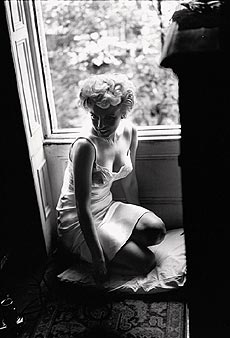
(That's a photo by Sam Shaw - his photos of her are my favorites. Natural light, an innocence to them ... candid-feeling ... just beautiful.)
Marilyn Monroe:
People had a habit of looking at me as if I were some kind of mirror instead of a person. They didn't see me, they saw their own lewd thoughts, then they white-masked themselves by calling me the lewd one.
That's Monroe and photographer Eve Arnold
Billy Wilder:
She had a kind of elegant vulgarity about her. That, I think, was very important. And she automatically knew where the joke was. She did not discuss it. She came up for the first rehearsal, and she was absolutely perfect, when she remembered the line. She could do a 3-page dialogue scene perfectly, and then get stuck on a line like, "It's me, Sugar"... But if she showed up, she delivered, and if it took 80 takes, I lived with 80 takes, because the 81st was very good ...She had a feeling for and a fear of the camera. Fright. She was afraid of the camera, and that's why, I think, she muffed some lines. God knows how often. She also loved the camera. Whatever she did, wherever she stood, there was always that thing that comes through. She was not even aware of it.
Eve Arnold:
If an editor wanted her, he had to agree to her terms. She knew how she wanted to be seen, and if her cooperation was sought, she reserved the right of veto.She knew she was superlative at creating still pictures and she loved doing it.
She had learned the trick of moving infinitesimally to stay in range, so that the photographer need not refocus but could easily follow movements that were endlessly changing.
At first I thought it was surface technique, but it went beyond technique. It didn't always work, and sometimes she would tire and it was as though her radar had failed; but when it did work, it was magic. With her it was never a formula; it was her will, her improvisation.
Peter Bogdonavich:
The fact is that Marilyn was in bad trouble from the day she was born as Norma Jean Mortenson on June 1, 1926, in the city of angels and movies, a poor bastard angel child who rose to be queen of a town and a way of life that nevertheless held her in contempt. That she died a martyr to pictures at the same time as the original studio star system -- through which she had risen -- finally collapsed and went also to its death seems too obviously symbolic not to note. Indeed, the coincidence of the two passing together is why I chose to end this long book about movie stars with Marilyn Monroe.What I saw so briefly in my glimpse of Marilyn at the very peak of her stardom (and the start of my career) -- that fervent, still remarkably naive look of all-consuming passion for learning about her craft and art -- haunts me still. She is the most touching, strangely innocent -- despite all the emphasis on sex -- sacrifice to the twentieth-century art of cinematic mythology, with real people as gods and goddesses. While Lillian Gish had been film's first hearth goddess, Marilyn was the last love goddess of the screen, the final Venus or Aphrodite. The minute she was gone, we started to miss her and that sense of loss has grown, never to be replaced. In death, of course, she triumphed at last, her spirit being imperishable, and keenly to be felt in the images she left behind to mark her brief visit among us.
Elia Kazan:
Relieve your mind now of the images you have of this person. When I met her, she was a simple, eager young woman who rode a bike to the classes she was taking, a decent-hearted kid whom Hollywood brought down, legs parted. She had a thin skin and a soul that hungered for acceptance by people she might look up to ...The girl had little education and no knowledge except the knowledge of her own experience; of that she had a great deal, and for an actor, that is the important kind of knowledge. For her, I found, everything was either completely meaningless or completely personal. She had no interest in abstract, formal, or impersonal concepts but was passionately devoted to her own life's experiences. What she needed above all was to have her sense of worth confirmed. Born out of wedlock, abandoned by her parents, kicked around, scorned by the men she'd been with until Johnny, she wanted more than anything else approval from men she could respect. Comparing her with many of the wives I got to know in that community, I thought her the honest one, them the "chumps". But there was a fatal contradiction in Marilyn. She deeply wanted reassurance of her worth, yet she respected the men who scorned her, because their estimate of her was her own.
Marilyn Monroe:
Well-behaved women rarely make history.
John Strasberg (son of Lee Strasberg, Marilyn's acting teacher):
I think I was talking about cars to Mother and Father. You know how I loved cars. I'd just come home and it was going to be my eighteenth birthday. I'd wanted to come for that.Mother and Father hadn't wanted me to come. "Why don't you wait till the end of the year?" Well, i'd already been kicked out of college. They didn't know yet.
When I'd gone off at the airport, I'd turned to Mother and said, "For two cents, I won't go." Nobody gave me the two cents, but I'd meant it. What I'd wanted to do was work. I'd wanted to work from the time I was fifteen, and they were always against any effort on my part to be strong or independent. I remember how much I resented it. "You don't have to work, we'll take care of everything," undermining me.
So I was talking about cars, no one was listening, and Marilyn was there and out of the blue said, "Why don't you take my car, Johnny?"
I thought I hadn't heard her right, and I said, "What?" She had remembered the summer before, in California, I'd had that Chevy I'd rented. God, I loved that car, a '57 Bel Air silver Chevy, and she had the Thunderbird.
She continued, "I've got the Ford Mustang the corporation gave me, and Arthur and I have a car. That one's just sitting in the garage, we don't use it."
I was stunned. I couldn't believe she meant it.
Mother and Father were horrified; they didn't like it at all. I don't know if it felt like too much to give me or if they were worried about my driving in my state of mind, but they objected strenuously. "He's too young. Maybe later, Marilyn. You don't have to. It's impossible, he can't afford it, it could be dangerous."
Marilyn just said, "Well, don't worry about any of that, it's in the corporation's name, so I'll take care of the insurance."
I'll never forget that ... There were so few, so very few people who were generous like that. Especially to me, who couldn't do anything for her.
I think that car saved my life.
Billy Wilder:
I never knew what Marilyn was going to do, how she was going to play a scene. I had to talk her out of it, or I had to underline it and say, "That's very good" or "Do it this way." But I never knew anybody who ... except for a dress that blows up and she's standing there ... I don't know why she became so popular. I never knew. She was really kind of ... She was a star. Every time you saw her, she was something. Even when she was angry, it was just a remarkable person. A remarkable person, and in spades when she was on the screen. She was much better on the screen than not on the screen.
Marilyn Monroe:
Some people have been unkind. If I say I want to grow as an actress, they look at my figure. If I say I want to develop, to learn my craft, they laugh. Somehow they don't expect me to be serious about my work.
Billy Wilder:
It's very difficult to talk seriously about Monroe, because she was so glitzy, you know. She escaped the seriousness somehow; she changed the subject. Except that she was very tough to work with. But what you had, by hook or crook, once you saw it on the screen, it was just amazing. Amazing, the radiation that came out. And she was, believe it or not, an excellent dialogue actress. She knew where the laugh was. She knew.
Marilyn Monroe:
"For breakfast, I have two raw beaten eggs in a glass of hot milk. I never eat dessert. My nail polish is transparent. I never wear stockings or underclothes because I think it is important to breathe freely. I wash my hair everyday and I am always brushing it. Every morning I walk across my apartment rolling an empty soda bottle between my ankles, in order to preserve my balance."
Eve Arnold:
I never knew anyone who even came close to Marilyn in natural ability to use both photographer and still camera. She was special in this, and for me there has been no one like her before or after. She has remained the measuring rod by which I have -- unconsciously -- judged other subjects.
Marilyn Monroe:
It's not true that I had nothing on. I had the radio on.
Ernest Cunningham (photographer):
I worked with Marilyn Monroe. A rather dull person. But when I said "Now!" she lit up. Suddenly, something unbelievable came across. The minute she heard the click of the camera, she was down again. It was over. I said, "What is it between you and the camera that doesn't show at any other time?" She said, "It's like being screwed by a thousand guys and you can't get pregnant."
Peter Bogdonavich:
More than forty years have passed since Marilyn's mysterious death, but her legend and persona have survived. This is all the more remarkable because she actually made very few films, and even fewer that were any good. But there was a reality to her artifice -- she believed in the characters she played, even if they were inherently unbelievable. "Everything she did," [Arthur] Miller said to me, "she played realistically. I don't think she knew any other way to play anything -- only to tell you the truth. She was always psychologically committed to that person as a person, no matter what the hell it was, rather than a stock figure. Because the parts she got could easily have been stock figures, which had no other dimension. But she wouldn't have known how to do that. In other words, she did not have the usual technique for doing something as a stock figure ... She was even that way when [director] John Huston used her the first time [in a memorable walk-on bit] in The Asphalt Jungle [1950]."This went for every picture she did in her surprisingly, painfully short career as a star, barely a decade, little more than a dozen pictures. Though she managed to work with quite a number of major directors, it was not necessarily always in their best efforts; but still they were Fritz Lang, Howard Hawks (twice), Otto Preminger, Billy Wilder (twice), George Cukor (twice, if you count her last unfinished one), John Huston (twice), Laurence Olivier, Joshua Logan, and Joseph L. Mankiewicz (bit part in 1950's classic All About Eve). In my conversation with Miller, he said, "I thought she had the potential for being a great performer if she were given the right stuff to do. And if you look at the stuff she did do, it's amazing that she created any impression at all because most of it was very primitive. And the fact that people remember these parts from these films is amazing ... She was comitted to these parts as though they were real people, not cardboard cutouts. Even though the director and author and the rest might have thought they were cutouts and would deal with them that way. The way the two men [Tony Curtis, Jack Lemmon] in Some Like It Hot felt with their parts, or George Raft with his part. She was real. And therefore she had the potential of being a great comedienne." (Norman Mailer, in his book on Monroe -- he never met her -- wrote that starting with 1953's Gentlemen Prefer Blondes, she was a great comedienne.)
Marilyn Monroe:
I'd prefer not to analyze it [acting] ... it's subjective; rather, I want to remain subjective while I'm doing it. Rather than do much talking I'd rather act. When it's on the screen, that's when you'll know who Roslyn [her character in The Misfits] is. I don't want to water down my own feeling ... Goethe says a career is developed in public but talent is developed in private, or silence. It's true for the actor. To really say what's in my heart, I'd rather show than to say. Even though I want people to understand, I'd much rather they understand on the screen. If I don't do that, I'm on the wrong track, or in the wrong profession.... Nobody would have heard of me if it hadn't been for John Huston. When we started Asphalt Jungle, my first picture, I was very nervous, but John said, 'Look at Calhern [the late Louis Calhern, a veteran actor], see how he's shaking. If you're not nervous, you might as well give up.' John has meant a great deal in my life. It's sort of a coincidence to be with him ten years later.
John Strasberg:
The first time I met her I remember she came out of the living room and Pop said, "This is my son," and my first impression of her was that she was different from most of the people who came to the house. I'd watch all these people trading their most human qualities, betraying themselves for success at all costs, to become rich and famous, and afterward, when it was too late, they'd realize they had lost the best part of themselves along the way, but she, she was like me. When I looked into her eyes, it was like looking into my own, they were like a child's eyes. I was still a child. You know how children just look at you. My feeling was she had less ego or was less narcissistic than most of the actors who never really bothered with me. She was just another person to me, another one from that world I felt cut off, excluded, from. She was nicer, real simple, no makeup, and she really looked at me as if she saw me. It wasn't that I wanted people to look at me, but I knew the difference when she did. I knew everyone said she was the sexiest, most sensual woman in the world. Not to me. I thought there was something wrong with me for not feeling that from her. I'd felt it from other women who came to the house. I was pretty sexually frustrated then. She was so open, so loose, and her sensuality as such was so totally innocent, nothing dirty in it at all, and the first time it was just like talking to an ordinary person, only realer than most who came into the house in those days. She was quiet, too, I remember, like an animal is quiet, and I was like that too, survival tactics. She seemed smart, but not in an educated way, instinctively smart, nobody's fool.
Couldn't resist:
Marilyn Monroe:
"I am a failure as a woman. My men expect so much of me because of the image they have made of me and that I have made of myself, as a sex symbol. Men expect so much and I can't live up to it. They expect bells to ring and whistles to whistle, but my anatomy's the same as any other woman's. I can't live up to it."
Marilyn Monroe:
My illusions didn't have anything to do with being a fine actress. I knew how third rate I was. I could actually feel my lack of talent, as if it were cheap clothes I was wearing inside. But, my God, how I wanted to learn, to change, to improve!
Arthur Miller:
She was a whirling light to me then, all paradox and enticing mystery, street-tough one moment, then lifted by a lyrical and poetic sensitivity that few retain past early adolescence. Sometimes she seemed to see all men as boys, children with immeidate needs that it was her place in nature to fulfill; meanwhile her adult self stood aside observingt he game. Men were their need, imperious and somehow sacred. She might tell about being held down at a party by two of the guests in a rape attempt from which she said she had escaped, but the truth of the account was far less important than its strange remoteness from her personally. And ultimately something nearly godlike would emerge from this depersonalization. She was at this point incapable of condemning or even of judging people who had damaged her, and to be with her was to be accepted, like moving out into a kind of sanctifying light from a life where suspicions was common sense. She had no common sense, but what she did have was something holier, a long-reaching vision of which she herself was only fitfully aware: humans were all need, all wound. What she wanted most was not to be judged but to win recognition from a sentimentally cruel profession, and from men blinded to her humanity by her perfect beauty. She was part queen, part waif, sometimes on her knees before her own body and sometimes despairing because of it -- "Oh, there's lots of beautiful girls," she would say to some expression of awed amazement, as though her beauty betrayed her quest for a more enduring acceptance.
Peter Bogdonavich:
The year before her much-speculated-over death at thirty-six (rumors of presidential involvement, etc.), playwright Clifford Odets told me that she used to come over to his house and talk, but that the only times she seemed to him really comfortable were when she was with his two young children and their large poodle. She relaxed with them, felt no threat. With everyone else, Odets said, she seemed nervous, intimidated, frightened. When I repeated to Miller this remark about her with children and animals, he said, "Well, they didn't sneer at her."
Burt Glinn (photographer):
She had no bone structure -- the face was a Polish flat plate. Not photogenic in the accepted sense, the features were not memorable or special; what she had was the ability to project.
Billy Wilder:
Marilyn was not interested in costumes. She was not a clotheshose. You could put anything on her you wanted. If it showed something, then she accepted it. As long as it showed a little something.
Henri Cartier Bresson (photographer):
She's American and it's very clear that she is - she's very good that way - one has to be very local to be universal.
Here's the mega-post I wrote about the making of The Misfits
Marilyn Monroe:
Hollywood is a place where they'll pay you a thousand dollars for a kiss and fifty cents for your soul.
Marilyn Monroe:
Being a sex symbol is a heavy load to carry, especially when one is tired, hurt and bewildered.
Marilyn Monroe:
Acting isn't something you do. Instead of doing it, it occurs. If you're going to start with logic, you might as well give up. You can have conscious preparation, but you have unconscious results.
Arthur Miller:
To have survived, she would have had to be either more cynical or even further from reality than she was. Instead, she was a poet on a street corner trying to recite to a crowd pulling at her clothes.
Marilyn Monroe:
I'm not interested in money. I just want to be wonderful.
Marilyn Monroe (this is what she pleaded at the end of the last interview she gave):
What I really want to say: That what the world really needs is a real feeling of kinship. Everybody: stars, laborers, Negroes, Jews, Arabs. We are all brothers.Please don't make me a joke. End the interview with what I believe.
April 27, 2008
Don't Bother To Knock; directed by Roy Baker
"I rather think that had she endured, had she come ten years later, maybe it would have been different. But at that time - I mean, she came in at the height of the Hollywood system - and she was not alone feeling debased by the whole thing. It was a common complaint. Like [the way] John Garfield was a terrific actor - yet he did nothing but scream and howl. There was some demeaning aspect to the whole thing. So most of them went with it. They simply adopted the contempt with which they were treated. I think that's what happened. Pretty hard to withstand - a culture of contempt. I think it helped destroy her." -- Arthur Miller on Marilyn Monroe
Seeing Monroe's performance in 1952's Don't Bother to Knock, as Nell, the psychologically shattered and borderline psychotic babysitter in a plush hotel, makes you wonder about all the roads not traveled. It makes you think of her courage in putting up with contemptuous projects like Let's Make Love or The Seven Year Itch (one of the meanest spirited movies she was ever in) ... and wonder what might have happened if she had been allowed to experiment. Now I'm not saying that her work, as it exists, in comedic gems such as Some Like It Hot is somehow lesser, or somehow lacking. I'm already rather annoyed that comedy often takes a backseat to drama with a capital D. It's why Cary Grant was stiffed in the Oscar department. You show me a better performance than what he did in His Girl Friday!
Billy Wilder said this about her (and it rambles a bit - this is a transcription of a conversation he had with Cameron Crowe):
She had a kind of elegant vulgarity about her. That, I think, was very important. And she automatically knew where the joke was. She did not discuss it. She came up for the first rehearsal, and she was absolutely perfect, when she remembered the line. She could do a 3-page dialogue scene perfectly, and then get stuck on a line like, "It's me, Sugar"... But if she showed up, she delivered, and if it took 80 takes, I lived with 80 takes, because the 81st was very good ... She had a feeling for and a fear of the camera. Fright. She was afraid of the camera, and that's why, I think, she muffed some lines. God knows how often. She also loved the camera. Whatever she did, wherever she stood, there was always that thing that comes through. She was not even aware of it.
We all have magic in us. But Marilyn Monroe had movie magic. And, like Wilder said, "...she automatically knew where the joke was." That kind of sensibility cannot be taught. And in the same way that it is rare to find a man as outrageously good-looking as Cary Grant who is also a comedic genius, it's rare to find a bombshell at the level of Marilyn Monroe who can nail jokes in the way she does (even when she is the butt of them)! But she is always the one who comes off smelling like a rose, even in nasty misogynistic pictures like The Seven Year Itch, which tries to make a joke out of her (and women's sexuality, in general). Watch that film and watch how she evades and eludes "capture" - meaning: she somehow, gently, subtly, by being totally innocent and guileless ... evades being the butt of the joke. That takes guts. That takes smarts. Because, believe me, she was being set up in that film. In many of her films, she was being set up.
So I love Marilyn's funniness, it's one of the most spontaneous things about her. But she always yearned to show more of herself, more of what she could do. Nobody wanted to see it. However, Don't Bother to Knock is early Monroe, or relatively early ... her stardom hadn't "hit" yet. So to watch her in this psychological drama (that has elements of a thriller) is astonishing.
Who knows what demons Monroe battled on a daily basis. All I know is that sadness and fear flickers across her face in Don't Bother to Knock in a neverending dance. She seems truly dangerous at times. She never seems to push the emotion, it seems to just happen to her. She (Nell) is not fully control of herself and neither is Marilyn. I don't know if Marilyn was "tapping into" her own wealth of miserable memories, or if it was her talent allowing her the ability to portray such fragility ... it doesn't matter "how" she got there. What matters is the end result. It's a stunning performance, and most often not even mentioned when Marilyn Monroe's career is brought up - which is a shame. She's riveting.
Marilyn Monroe often played either naive breathless girls, easily taken in, a bit dopey, or vaguely trashy showgirls, who somehow have managed to maintain their sweetness. She never played bitter. She never played a wisecracker. That was not her thing. And whatever "experiences" she had had in her life, it had not touched that diamond-bright innocence inside her. Nothing could kill it. You watch her films and it's truly amazing - how it is always there, even in projects that were not worthy of her. But she never played - except in Don't Bother To Knock - a truly damaged woman. I suppose a woman with a body like that and a face like that was made to be a fantasy for audiences and audiences don't really want to see their sex goddesses as damaged. Marilyn knew that better than anyone. She had a love-hate relationship with her beauty. It was her ticket to fame, she knew that, and she was truly grateful for it, and she knew how to use it. She was a master at creating her persona. But it was also what tormented her, and gave her such intense stage fright that she wouldn't come out of her dressing room for sometimes hours, staring at herself in the mirror. What was she looking for? How hard was it for her to drag up that sexy goddess on days when she didn't feel like it? I don't have much sympathy for those who respond to questions like that with, "Oh, boo hoo, cry me a river, she was famous, we all should have such problems!" I think it represents a truly ungenerous and stingy attitude, something that she faced daily, and struggled against. And so she would lock her door, and refuse to come out, terrified of the expectations placed on her, knowing that within her was an abyss of sadness that nobody wanted to see. It had to have been horrible. I can only imagine. I don't have that kind of beauty. I have no idea what that must be like. I think it's indicative that she was often very afraid of directors, who could get impatient with her constant bungling of lines (it is thought that she had undiagnosed dyslexia) ... but absolutely loved the crew, who loved her right back. They were her audience. They were not stingy. She would walk out of her dressing room, all dolled up, after having made everyone wait for hours, and the crew - hanging off their scaffolds - would catcall and whistle, and she ate it up. It was friendly. If you've ever experienced a friendly and appreciative catcall (which is something some people just can't imagine) then you know how nice it can be. It can totally brighten your day. I'm not talking about avoiding a certain block because there's a construction site there and you're fucking sick of having to walk through a goddamn gantlet (who knew?? I sure as hell didn't!), which forces you into a sexualized atmosphere at 9 a.m. when you're just trying to go get a coffee. That's harassment. But some dude calling out at you, "Girl, YOU PRETTY!" like happened to me once ... thank you, sir!! Marilyn was loved by those guys. Because they represented her fan base. Directors loved her too, in spite of themselves - they loved her because, like Billy Wilder said, even if it took 80 takes for her to get a line - if she nailed it on the 81st, it would be the best take ever, and it would be Marilyn Monroe, after all ... so that's why she was paid the big bucks, and that's why you sucked it up and tried not to mind having to wait around for her to get over her stage fright or whatever it was. But the love the crew had for her was simple and unhindered by concerns other than appreciation. Marilyn fed off of them. She played to them.
In Don't Bother to Knock, she plays a resolutely unglamorous part. It's not made into a big deal, like, "Oooh, look at the pretty movie star being plain-ed down" ... It's appropriate for the part. She wears a simple cotton dress, low heels, a little black beret - and when she gets on the elevator for the first time and we see her from behind, her dress is a little bit wrinkled. Like it would be for any woman who had just taken a long subway ride. It's touching. Alex told me last night (she read it in some Photoplay magazine she owns. The woman is insane) that Marilyn had bought the dress herself at a five and dime for the movie. She had seen it, and known that it was Nell's dress. I love the intelligence of that, the intelligence of her choice for the character. It's perfect.
Nell's backstory unfolds slowly. When we first see her come through the revolving doors, we see a pretty woman, who seems unsure. Her step is hesitating. She looks like a raw nerve, everything making an impression on her, like she hasn't been out in public for a long long time (this turns out to be true - but watch how Marilyn is playing it in the first scene, before we know anything about her. That's smart acting. That's building a character.) If we know the rest of Marilyn Monroe's work, we may be forgiven for thinking that Nell is just another one of her naive breathless creations. She meets up with the elevator man, who turns out to be her uncle, who has gotten her a job babysitting for a child of guests in the hotel. The uncle seems solicitous, perhaps overly so. He says, "You won't have any trouble babysitting, will you, Nell?" A bottomless look of sadness battling with fear comes over Marilyn's face. It's startling. This was my first clue that Nell was going to be a little different than Marilyn's other characters. She says, "Of course not. Why would I?" She's not defensive. But unbelievably sad that his question even needs to be asked. It seems to suggest that there might be something ... wrong with her. The movie is full of tiny eloquent moments like that.
Nell is brought into the hotel room, and meets the parents of Bunny, the little girl she will be babysitting. The parents swirl out, leaving simple instructions. Nell reads Bunny a fairy story before she goes to bed. There is something touching here, and also not quite right. Marilyn reads the story in almost a monotone, a dreamy uninflected voice, as though she is trying to imagine herself into the story she is reading. Bunny is riveted.
Once Bunny goes to bed, Nell is left alone in the apartment. She's aimless. When her face is in stasis, and when she is alone, all you see is her sadness. There's no peace on her face. In the introduction to the parents, and in her dealings with her uncle, she tries to keep it together, and put on a social happy expression. But once alone, the mask is off. Marilyn was so rarely without her mask, and so it's amazing to watch.
Another thing that is fascinating about this film, and also singular in Marilyn's career, is that she gets the opportunity to show anger. Rage. I can't think of another film where she truly gets angry, where she asserts herself in that way. It's terrifying.
Meanwhile, another story goes on in the film. Richard Widmark plays Jed, a cynical pilot, who's been dating Lynn, played by Anne Bancroft. Lyn is a lounge singer in the hotel, Jed flies in on the weekends. It's obviously a "friends with benefits" type situation, and Lyn has been okay with that, up until now. She's portrayed by Bancroft as an intelligent and compassionate woman, who is not above having harmless fun, and she's not the type to yearn for domesticity or put the pressure on him to commit. But there are qualities she senses in Jed that disturb her, and she finally has come to the decision that she can't be with him anymore. It's his coldness, the way he treats people ... everything is seen through a cynical snarky lens ... and any act of kindness is assigned a base motive. You can see it in how he treats Eddie, the elevator man, who tries to joke with him. You can see it in the contemptuous way he treats the woman who wants to take their photograph. Richard Widmark (ooomph, he's sexy in this film) only has a couple of specific moments where these qualities can be displayed, and he nails them. We can see Lyn's point. He makes fun of her. She says, "You lack what I need. You lack an understanding heart." They "wrangle" back and forth in the bar of the hotel, and she's pretty certain that she needs to walk away. He's the kind of guy who has a little black book of names, always in his back pocket, but there's something about this Lyn woman that has gotten under his skin. He can't admit it yet. He's too proud. But her calm and reasoned explanation leaves him restless, pissed.
Jed finds himself at loose ends back up in his hotel room, while he can hear the lovely strains of Lyn singing torch songs (or, to say it another way, Anne Bancroft lip syncing) through the radio on the wall, connected to the bar downstairs (a nice omnipresent touch). He pours a drink. He lies on the bed. He throws his black book on the floor. He's cranky. And then he catches a glimpse in the window across the way - of Nell, dressed up in a gown, dancing around. A private moment. It's a haunting image, and Jed is struck dumb. Eventually she notices him, and they begin a conversation across the space in-between. He figures out her room number from the floor plan on the back of the door, and calls her. They sit and talk on the phone, staring at each other from window to window.
Now one of the things that I really love about this film is Richard Widmark's journey through it, and how he treats Nell at first, and then adjusts to the reality before him. Here's the thing: Marilyn was really about 11 years old inside. I think that's one of the reasons why pairing her up with someone like, oh, John Wayne, wouldn't have worked. Wayne required a grown-up. The thing about Marilyn, the captivating and also complicated thing, is that she was a little innocent girl in that sex-bomb of a body. And Richard Widmark's Jed, a guy out for a good time, a guy looking, in this moment anyway, to fuck his loneliness away ... only sees the body at first. But don't we all? I can't judge him for that. It's quite a body. He looks at Nell, and sees ... well ... Marilyn Monroe ... and he thinks: I have hit the jackpot here. There's also a certain passivity in Nell (at first), a certain willingness ... and so Jed, who's not in the mood for a fight, thinks that it will be pretty easy to seduce this one. And that's what he wants right now. No more problems, for God's sake. But over the devastating course of their next couple of scenes, when he invites himself over to her room (not knowing, of course, that it is not her room at all), he begins to realize that something is not right. They kiss, they drink, they flirt ... and something opens up in Nell, something is unleashed. She projects onto him all of her hopes and dreams, which is alarming - and has a kind of Fatal Attraction feel to it. Jed gets that vibe. And instead of ignoring it, and taking what he thinks he deserves anyway (after all, she invited him over - she's in a negligee - she knows what he wants!), he turns her down. And in so doing, becomes a better man. He shows his "understanding heart". He doesn't realize that that is what is happening in the moment, he just knows that seducing this woman would be wrong. Kim Morgan, in her wonderful review of the film, writes:
In real life, most men wouldn't so sensitively resist.
That, to me, is the most moving part of the film: Widmark's growing realization that Nell is sick, and his decision to help her, rather than just add to the hurts she's experienced. I can't think of another film of Marilyn's where she is treated in quite the way that Widmark treats her. She's usually a bombshell, a friendly girlie bombshell, eager, open-eyed, innocent, and yet smokin'. There is never any concern for how she might feel, being treated like a walking-talking blow-up doll. It is assumed that she is on board with it - and, like I said, Marilyn, for the most part, was. She was a movie goddess. We don't want to know that movie goddesses might have contradictory opinions about being ogled over in film after film. Marilyn's power was in strolling through that kind of gantlet and coming out unscathed, and still glowing. She did it in film after film. But in Don't Bother To Knock, she is actually human, and Widmark, at first distracted by the boobs and the face, ends up seeing her as she really is: a damaged sad little girl, trapped in a pin-up model's body. It's incredibly moving to watch that transformation happen in Widmark's face. Marilyn has never been treated so, well, kindly, as she is in this film.
Don't Bother To Knock had a short shooting schedule, and Marilyn actually is not in a hell of a lot of it. It feels like she is, she dominates the film - but the scenes with Widmark and Bancroft take up quite a bit of time as well, and so Marilyn only really shot for 2 weeks. She was so enamored with Anne Bancroft's acting that she would show up on the set to watch Bancroft's scenes being filmed. Bancroft was a "real" actress, and this was at the point in Marilyn's life (with the encouragement of her good friend Shelley Winters) that Marilyn was starting to learn her craft, and taking acting classes at The Actors Studio. Bancroft represented the serious side of the business, the actresses, who got to act, rather than just show their awesome silhouettes, and giggle and simper and wear bathing suits, etc. Marilyn so wanted to be considered a real actress.
And you know, like I said in the beginning, I love her stuff in comedies, musicals, melodramas ... I'm a fan, regardless of the material. She's got "it". What she is able to do in Some Like It Hot is awesome - it's movie magic. And when Marilyn was put in projects like that, projects that were worthy of her talents, she was very happy. She hated some of the stuff she was forced to do (uhm, Let's Make Love, for example), and she hated that she wasn't able, most of the time, to show the full spectrum. Her idols were not other bombshells. Her idols were real actresses.
We are a couple of years away, in Don't Bother to Knock, from Marilyn's famous disappearing act, when she dropped off the face of the earth, and wasn't heard from for a month or so ... until she re-emerged in New York, having moved there to study with Lee Strasberg, and to develop her own projects. She formed a production company. She wanted to do The Brothers Karamazov. It was a hugely rebellious act, and was treated with disdain by the powers-that-be, but it was her way of saying, "I do not like the movies I am being put in. I am taking the reins of my own career." And how was she rewarded? By having a reporter ask her at a press conference, "Do you know how to spell Dostoevsky, Marilyn?"
The guts that woman had. To tolerate such condescension.
And Don't Bother to Knock, although a big flop at the time, and not well-remembered at all, is evidence of the many shades of Marilyn Monroe; it is a nuanced terrifying performance, and her crack-up at the end is shattering to watch. She walks across the hotel lobby, and her arms look stiff and un-usable, she is vaguely unsteady on her feet, as though she is learning to walk all over again, her face is wet with tears, and she blinks up at the lights of the lobby, alarmed, squinting at the glare. She goes down the steps, one step, two step, her body slack and yet also rigid, she cannot move easily. Her psychic pain emanates not just from her face, the ending is not done in closeup, it's a full-body shot ... and her physicality is eloquent. It tells the whole story. Her pain is in her pinky finger, her waist, her calves ... It surges through her and makes it difficult to even walk.
You know who plays a scene that well and with that much specificity and abandon?
A real actress does, that's who.
"Gauntlet" has been changed to "gantlet" throughout. You learn something new every day. Thanks, Kerry!
April 15, 2008
Speaking of Marilyn Monroe ...
(oh were we??) -

The wonderful Kim Morgan has a piece up about Don't Bother to Knock - with Marilyn Monroe and Richard Widmark (rest in peace) - I remember Alex telling me I HAD to see this movie - somehow I had missed it, although I had seen most of Marilyn's other stuff ... I very much liked Kim's comment here, it really resonates with me:
But, why? Why must women have to be so normal? Though suffering from deep seated psychological problems, I sense that it’s this type of "normal" pressure making her crack (the punishing and smarmy Cook Jr. doesn't help either). Monroe portrays these ideas beautifully, so much so, that I wondered how much of her real life was seeping into her performance, it plays so real. I kept wishing that she could just get out of that hotel, doll herself up and have some fun with a man who might understand her. Widmark isn't really the one, even though underneath his smirk and swagger, he’s essentially a good heart.
Don't Bother to Knock is actually on my queue right now - but apparently I am trying to see every Iranian film I haven't yet seen in as short a time as possible - so Don't Bother to Knock got pushed down. I put it on the queue when Richard Widmark died - wanting to see it again ... and now, after reading Kim's piece, I feel quite urgent about it! She writes so well. (Great and insightful comment in the comments section too).
April 14, 2008

February 2, 2008

December 12, 2007
Life-size icon in a white dress
Marilyn Monroe. Nice commentary - also cool photo, huh? I love that weird hand-chair right next to her.
Relevant clip from Seven Year Itch below:
I find Seven Year Itch rather nasty, actually - and it makes me feel uncomfortable to watch it. Like I feel uncomfortable at the vicious homophobia in Adam's Rib, or the little tap-dancing black children in Affair to Remember. I just have to murmur to myself, "Different time, different time ..." and enjoy the movie anyway. Seven Year Itch has a twisted sexual psychology to it - a hatred of HER, in particular - which makes me sad and angry - but Marilyn comes out of it smelling like a rose, even though the movie seems determined to humiliate her.
It's not like Some Like It Hot which shows off her sexiness in a more fun-loving way, not so hateful ... Yes, she's babealicious in a way that could sink ships and make men crash their cars. I'm not saying to treat her like she's NORMAL ... she obviously isn't ... but don't try to humiliate that lovely shining creature. Just kneel down in worship, and submit. That's all you can do.
In Seven Year Itch she slips from from the grasping fingers of the nasty-minded people who want to shame her, who look eagerly at her face waiting to see her defeat - and gives a charming sweet innocent performance anyway. That's guts.
Arthur Miller said: "I thought she had the potential for being a great performer if she were given the right stuff to do. And if you look at the stuff she did do, it's amazing that she created any impression at all because most of it was very primitive. And the fact that people remember these parts from these films is amazing ... She was committed to these parts as though they were real people, not cardboard cutouts."
Another relevant quote, I think, comes from Peter Bogdonavich - and I think of Seven year Itch when I read this:
The year before her much-speculated-over death at thirty-six (rumors of presidential involvement, etc.), playwright Clifford Odets told me that she used to come over to his house and talk, but that the only times she seemed to him really comfortable were when she was with his two young children and their large poodle. She relaxed with them, felt no threat. With everyone else, Odets said, she seemed nervous, intimidated, frightened. When I repeated to Miller this remark about her with children and animals, he said, "Well, they didn't sneer at her."
Even in a film that sneers at her, she shines. She's adorable. She eludes capture. She is loved.
September 14, 2007
Perfection: Marilyn in action
Diamonds are a girl's best friend
It's luscious, the colors, the guy's ties, the fact that in all of the women she is the ONLY blonde (she would make sure that no other blonde ever was in one of her pictures- even down to the extras ... She would scan the crowd of extras, looking for any platinum headed chick - and if there was one? She'd quietly speak to someone, and platinum extra would vanish the next day. Look closer next time you see one of her movies, even in crowd scenes - it's all brunettes, and mousy-haired girls ... except for her. Marilyn was no dummy)
The number makes me happy every time I see it. I just lose myself in it - even though I've memorized her every gesture.
And speaking of gestures: just WATCH her. Yes, it's choreography. Someone gave the moves to her. She always had good people working around her. But it takes a star to fill those gestures, to make them mythic, to have them land. Every tiny shimmy, every eensy shoulder shrug - and then every big bold burlesque move - is not just perfectly executed - but perfectly embodied and filled.
It's just so much fun to watch her.
Always and forever.
August 26, 2007
The Books: "Music for Chameleons" - 'A Beautiful Child' (Truman Capote)
Next book on my adult fiction bookshelves:
 Music for Chameleons - by Truman Capote. Today's excerpt is from 'A Beautiful Child'.
This is perhaps the most famous of these little transcripts. 1955. Marilyn Monroe and Truman Capote, drinking buddies and gossipy friends, meet up at a funeral for a well-loved actress and acting teacher. Monroe and Capote spend the whole day hanging out, drinking champagne, walking down by the docks, talking ... at this point, Marilyn is divorced from Dimaggio - and has a "secret lover" - which will turn out to be Arthur Miller. Monroe has moved back to New York - to protest the crap movies the studios were placing her in - she has formed her own production company and started studying acting with Lee Strasberg. I love this photograph of Capote and Monroe - dude, hold her HAND, not her wrist!!

It's a fun piece .... an illuminating glimpse of Marilyn Monroe.
Excerpt from Music for Chameleons - by Truman Capote - 'A Beautiful Child'.
TC: Now do you think we can get the hell out of here? You promised me champagne, remember?
MARILYN: I remember. But I don't have any money.
TC: You're always late and you never have any money. By any chance are you under the delusion that you're Queen Elizabeth?
MARILYN: Who?
TC: Queen Elizabeth. The Queen of England.
MARILYN: (frowning) What's that cunt got to do with it?
TC: Queen Elizabeth never carries money either. She's not allowed to. Filthy lucre ust not stain the royal palm. It's a law or something.
MARILYN: I wish they'd pass a law like that for me.
TC: Keep going the way you are and maybe they will.
MARILYN: Well, gosh. How does she pay for anything? Like when she goes shopping?
TC: Her lady-in-waiting trots along with a bag full of farthings.
MARILYN: You know what? I'll bet she gets everything free. In return for endorsemenkts.
TC: Very possible. I wouldn't be a bit surprised. By Appointment to Her Majesty. Corgi dogs. All those Fortnum & Mason goodies. Pot. Condoms.
MARILYN: What would she want with condoms?
TC: Not her, dopey. For that chump who walks two steps behind. Prince Philip.
MARILYN: Him. Oh, yeah. He's cute. He looks like he might have a nice prick. Did I ever tell you about the time I saw Errol Flynn whip out his prick and play the piano with it? Oh well, it was a hundred years ago, I'd just got into modeling, and I went to this half-ass party, and Errol Flynn, so pleased with himself, he was there and he took out his prick and played the piano with it. Thumped the keys. He played You Are My Sunshine. Christ! Everybody says Milton Berle has the biggest schlong in Hollywood. But who cares? Look, don't you have any money?
TC: Maybe about fifty bucks.
MARILYN: Well, that ought to buy us some bubbly.
(Outside, Lexington Avenue was empty of all but harmless pedestrians. It was around two, and as nice an April afternoon as one could wish: ideal strolling weather. So we moseyed toward Third Avenue. A few gawkers spun their heads, not because they recognized Marilyn as the Marilyn, but because of her funereal finery; she giggled her special little giggle, a sound as tempting as the jingling bells on a Good Humor wagon, and said: "Maybe I should always dress this way. Real anonymous."As we neared P.J. Clarke's saloon, I suggested P.J.'s might be a good place to refresh ourselves, but she vetoed that: "It's full of those advertising creeps. And that bitch Dorothy Kilgallen, she's always in there getting bombed. What is it wiht these micks? The way they booze, they're worse than Indians."
I felt called upon to defend Kilgallen, who was a friend, somewhat, and I allowed as to how she could upon occasion be a clever funny woman. She said: "Be that as it may, she's written some bitchy stuff about me. But all those cunts hate me. Hedda. Louella. I know you're supposed to get used to it, but I just can't. It really hurts. What did I ever do to those hags? The only one who writes a decent word about me is Sidney Skolsky. But he's a guy. The guys treat me okay. Just like maybe I was a human person. At least they give me the benefit of the doubt. And Bob Thomas is a gentleman. And Jack O'Brian."
We looked in the windows of antique shops; one contained a tray of old rings, and Marilyn said: "That's pretty. The garnet with the seed pearls. I wish I could wear rings, but I hate people to notice my hands. They're too fat. Elizabeth Taylor has fat hands. But with those eyes, who's looking at her hands? I like to dance naked in front of mirrors and watch my titties jump around. There's nothing wrong with them. But I wish my hands weren't so fat."
Another window displayed a handsome grandfather clock, which prompted her to observe: "I've never had a home. Not a real one with all my own furniture. But if I ever get married again, and make a lot of money, I'm going to hire a couple of trucks and ride down Third Avenue buying every damn kind of crazy thing. I'm going to get a dozen grandfather clocks and line them all up in one room and have them all ticking away at the same time. That would be real homey, don't you think?")
MARILYN: Hey! Across the street!
TC: What?
MARILYN: See the sign with the palm? That must be a fortunetelling parlor.
TC: Are you in the mood for that?
MARILYN: Well, let's take a look.
(It was not an inviting establishment. Through a smearaed window we could discern a barren room with a skinny, hairy gypsy lady seated in a canvas chair under a hellfire-red ceiling lamp that shed a torturous glow; she was knitting a pair of baby-booties and did not return our stares. Nevertheless, Marilyn started to go in, then changed her mind.)
MARILYN: Sometimes I want to know what's going to happen. Then I think it's better not to. There's two things I'd like to know, though. One is whether I'm going to lose weight.
TC: And the other?
MARILYN: That's a secret.
August 20, 2007
"Want to see her?"
a beautiful shot from Marilyn Monroe's last unfinished film.
You know, certain cinematographers said that it was so easy to film her and light her because her skin was naturally reflective. Lots of actresses need makeup to pick up all that light - and to have it come across - and of course Marilyn wore makeup - but it wasn't just makeup that made her look like that - there was something glowing already about her skin. There's a wonderful grainy photograph of Marilyn, 1955, in an acting class in New York. It's dingy - there's a bare bulb - a scratched floor. People like Paul Newman and Joanne Woodward are also in the class. A crowd of people sit in battered wooden chairs, listening to the teacher. Marilyn is just one of that crowd. She's wearing a trench coat, very plain and simple - no makeup - and I swear, it is as though there is a special spotlight shining down on her. Partly it's the blonde - your eyes naturally go to the blonde hair - but it's more than that, and more than the fact that she's so famous. It is as though she has a key light with her, at all times. I read one photographer say that he had noticed a layer of peach fuzz over her face - almost thicker than other people have - and he thought that that was what gave her that luminous look - the fuzz catching the light - there was nothing MATTE about her face.

There are also wonderful stories about her walking around in New York completely anonymous - she was able to douse that light (by magic, I'm convinced) so that nobody would ever look at her and say, 'That's Marilyn Monroe'. She was walking with a friend through the crowded streets of Manhattan - she had a headscarf on, no makeup, she was wearing jeans, sneakers - and completely disappeared into the crowd. The friend was amazed. This was the most famous most desired woman in the world. How did she turn that OFF so completely? They discussed it a bit. And then Marilyn said, with a wicked grin, "Want to see her?" Meaning: Marilyn with a capital M. I love that she referred to her persona in the third person. The friend said, yeah, let's see "her";. So Marilyn took off the headscarf, and - without any makeup - any fluffing of hair - anything external - she turned on the light inside. And there "she" was. Marilyn Monroe, walking in the grime of 9th Avenue. And slowly - people noticed - and came over - and asked for autographs - and the whole thing ended with a mob scene - Marilyn surrounded by throngs.
"Want to see her?"
That's a movie star. It can't be taught. Whether it was a small layer of fuzz on her face that picked up the lights ... or whether it was something magical within ... that's the key to her mysterious appeal.
July 23, 2007
File My Claim
I know the song Marilyn Monroe is probably most known for singing is "Diamonds are a girl's best friend".
But the way she sings "File My Claim" in River of no Return is my personal favorite.

Marilyn in River of No Return
"File My Claim" clip below.
June 1, 2007
Happy birthday, Marilyn Monroe!!
On June 1, 1926 Norma Jeane Mortenson was born.
Happy birthday, dear Marilyn Monroe!! You're one of my favorites.
Bunch of quotes about her and by her below ... Enjoy!!
(That's a photo by Sam Shaw - his photos of her are my favorites. Natural light, an innocence to them ... candid-feeling ... just beautiful.)
Marilyn Monroe:
People had a habit of looking at me as if I were some kind of mirror instead of a person. They didn't see me, they saw their own lewd thoughts, then they white-masked themselves by calling me the lewd one.
That's Monroe and photographer Eve Arnold
Billy Wilder:
She had a kind of elegant vulgarity about her. That, I think, was very important. And she automatically knew where the joke was. She did not discuss it. She came up for the first rehearsal, and she was absolutely perfect, when she remembered the line. She could do a 3-page dialogue scene perfectly, and then get stuck on a line like, "It's me, Sugar"... But if she showed up, she delivered, and if it took 80 takes, I lived with 80 takes, because the 81st was very good ...She had a feeling for and a fear of the camera. Fright. She was afraid of the camera, and that's why, I think, she muffed some lines. God knows how often. She also loved the camera. Whatever she did, wherever she stood, there was always that thing that comes through. She was not even aware of it.
Eve Arnold:
If an editor wanted her, he had to agree to her terms. She knew how she wanted to be seen, and if her cooperation was sought, she reserved the right of veto.She knew she was superlative at creating still pictures and she loved doing it.
She had learned the trick of moving infinitesimally to stay in range, so that the photographer need not refocus but could easily follow movements that were endlessly changing.
At first I thought it was surface technique, but it went beyond technique. It didn't always work, and sometimes she would tire and it was as though her radar had failed; but when it did work, it was magic. With her it was never a formula; it was her will, her improvisation.
Peter Bogdonavich:
The fact is that Marilyn was in bad trouble from the day she was born as Norma Jean Mortenson on June 1, 1926, in the city of angels and movies, a poor bastard angel child who rose to be queen of a town and a way of life that nevertheless held her in contempt. That she died a martyr to pictures at the same time as the original studio star system -- through which she had risen -- finally collapsed and went also to its death seems too obviously symbolic not to note. Indeed, the coincidence of the two passing together is why I chose to end this long book about movie stars with Marilyn Monroe. What I saw so briefly in my glimpse of Marilyn at the very peak of her stardom (and the start of my career) -- that fervent, still remarkably naive look of all-consuming passion for learning about her craft and art -- haunts me still. She is the most touching, strangely innocent -- despite all the emphasis on sex -- sacrifice to the twentieth-century art of cinematic mythology, with real people as gods and goddesses. While Lillian Gish had been film's first hearth goddess, Marilyn was the last love goddess of the screen, the final Venus or Aphrodite. The minute she was gone, we started to miss her and that sense of loss has grown, never to be replaced. In death, of course, she triumphed at last, her spirit being imperishable, and keenly to be felt in the images she left behind to mark her brief visit among us.
Elia Kazan:
Relieve your mind now of the images you have of this person. When I met her, she was a simple, eager young woman who rode a bike to the classes she was taking, a decent-hearted kid whom Hollywood brought down, legs parted. She had a thin skin and a soul that hungered for acceptance by people she might look up to ...The girl had little education and no knowledge except the knowledge of her own experience; of that she had a great deal, and for an actor, that is the important kind of knowledge. For her, I found, everything was either completely meaningless or completely personal. She had no interest in abstract, formal, or impersonal concepts but was passionately devoted to her own life's experiences. What she needed above all was to have her sense of worth confirmed. Born out of wedlock, abandoned by her parents, kicked around, scorned by the men she'd been with until Johnny, she wanted more than anything else approval from men she could respect. Comparing her with many of the wives I got to know in that community, I thought her the honest one, them the "chumps". But there was a fatal contradiction in Marilyn. She deeply wanted reassurance of her worth, yet she respected the men who scorned her, because their estimate of her was her own.
Marilyn Monroe:
Well-behaved women rarely make history.
John Strasberg (son of Lee Strasberg, Marilyn's acting teacher):
I think I was talking about cars to Mother and Father. You know how I loved cars. I'd just come home and it was going to be my eighteenth birthday. I'd wanted to come for that.Mother and Father hadn't wanted me to come. "Why don't you wait till the end of the year?" Well, i'd already been kicked out of college. They didn't know yet.
When I'd gone off at the airport, I'd turned to Mother and said, "For two cents, I won't go." Nobody gave me the two cents, but I'd meant it. What I'd wanted to do was work. I'd wanted to work from the time I was fifteen, and they were always against any effort on my part to be strong or independent. I remember how much I resented it. "You don't have to work, we'll take care of everything," undermining me.
So I was talking about cars, no one was listening, and Marilyn was there and out of the blue said, "Why don't you take my car, Johnny?"
I thought I hadn't heard her right, and I said, "What?" She had remembered the summer before, in California, I'd had that Chevy I'd rented. God, I loved that car, a '57 Bel Air silver Chevy, and she had the Thunderbird.
She continued, "I've got the Ford Mustang the corporation gave me, and Arthur and I have a car. That one's just sitting in the garage, we don't use it."
I was stunned. I couldn't believe she meant it.
Mother and Father were horrified; they didn't like it at all. I don't know if it felt like too much to give me or if they were worried about my driving in my state of mind, but they objected strenuously. "He's too young. Maybe later, Marilyn. You don't have to. It's impossible, he can't afford it, it could be dangerous."
Marilyn just said, "Well, don't worry about any of that, it's in the corporation's name, so I'll take care of the insurance."
I'll never forget that ... There were so few, so very few people who were generous like that. Especially to me, who couldn't do anything for her.
I think that car saved my life.
Billy Wilder:
I never knew what Marilyn was going to do, how she was going to play a scene. I had to talk her out of it, or I had to underline it and say, "That's very good" or "Do it this way." But I never knew anybody who ... except for a dress that blows up and she's standing there ... I don't know why she became so popular. I never knew. She was really kind of ... She was a star. Every time you saw her, she was something. Even when she was angry, it was just a remarkable person. A remarkable person, and in spades when she was on the screen. She was much better on the screen than not on the screen.
Marilyn Monroe:
Some people have been unkind. If I say I want to grow as an actress, they look at my figure. If I say I want to develop, to learn my craft, they laugh. Somehow they don't expect me to be serious about my work.
Billy Wilder:
It's very difficult to talk seriously about Monroe, because she was so glitzy, you know. She escaped the seriousness somehow; she changed the subject. Except that she was very tough to work with. But what you had, by hook or crook, once you saw it on the screen, it was just amazing. Amazing, the radiation that came out. And she was, believe it or not, an excellent dialogue actress. She knew where the laugh was. She knew.
Marilyn Monroe:
"For breakfast, I have two raw beaten eggs in a glass of hot milk. I never eat dessert. My nail polish is transparent. I never wear stockings or underclothes because I think it is important to breathe freely. I wash my hair everyday and I am always brushing it. Every morning I walk across my apartment rolling an empty soda bottle between my ankles, in order to preserve my balance."
Eve Arnold:
I never knew anyone who even came close to Marilyn in natural ability to use both photographer and still camera. She was special in this, and for me there has been no one like her before or after. She has remained the measuring rod by which I have -- unconsciously -- judged other subjects.
Marilyn Monroe:
It's not true that I had nothing on. I had the radio on.
Ernest Cunningham (photographer):
I worked with Marilyn Monroe. A rather dull person. But when I said "Now!" she lit up. Suddenly, something unbelievable came across. The minute she heard the click of the camera, she was down again. It was over. I said, "What is it between you and the camera that doesn't show at any other time?" She said, "It's like being screwed by a thousand guys and you can't get pregnant."
Peter Bogdonavich:
More than forty years have passed since Marilyn's mysterious death, but her legend and persona have survived. This is all the more remarkable because she actually made very few films, and even fewer that were any good. But there was a reality to her artifice -- she believed in the characters she played, even if they were inherently unbelievable. "Everything she did," [Arthur] Miller said to me, "she played realistically. I don't think she knew any other way to play anything -- only to tell you the truth. She was always psychologically committed to that person as a person, no matter what the hell it was, rather than a stock figure. Because the parts she got could easily have been stock figures, which had no other dimension. But she wouldn't have known how to do that. In other words, she did not have the usual technique for doing something as a stock figure ... She was even that way when [director] John Huston used her the first time [in a memorable walk-on bit] in The Asphalt Jungle [1950]."This went for every picture she did in her surprisingly, painfully short career as a star, barely a decade, little more than a dozen pictures. Though she managed to work with quite a number of major directors, it was not necessarily always in their best efforts; but still they were Fritz Lang, Howard Hawks (twice), Otto Preminger, Billy Wilder (twice), George Cukor (twice, if you count her last unfinished one), John Huston (twice), Laurence Olivier, Joshua Logan, and Joseph L. Mankiewicz (bit part in 1950's classic All About Eve). In my conversation with Miller, he said, "I thought she had the potential for being a great performer if she were given the right stuff to do. And if you look at the stuff she did do, it's amazing that she created any impression at all because most of it was very primitive. And the fact that people remember these parts from these films is amazing ... She was comitted to these parts as though they were real people, not cardboard cutouts. Even though the director and author and the rest might have thought they were cutouts and would deal with them that way. The way the two men [Tony Curtis, Jack Lemmon] in Some Like It Hot felt with their parts, or George Raft with his part. She was real. And therefore she had the potential of being a great comedienne." (Norman Mailer, in his book on Monroe -- he never met her -- wrote that starting with 1953's Gentlemen Prefer Blondes, she was a great comedienne.)
Marilyn Monroe:
I'd prefer not to analyze it [acting] ... it's subjective; rather, I want to remain subjective while I'm doing it. Rather than do much talking I'd rather act. When it's on the screen, that's when you'll know who Roslyn [her character in The Misfits] is. I don't want to water down my own feeling ... Goethe says a career is developed in public but talent is developed in private, or silence. It's true for the actor. To really say what's in my heart, I'd rather show than to say. Even though I want people to understand, I'd much rather they understand on the screen. If I don't do that, I'm on the wrong track, or in the wrong profession.... Nobody would have heard of me if it hadn't been for John Huston. When we started Asphalt Jungle, my first picture, I was very nervous, but John said, 'Look at Calhern [the late Louis Calhern, a veteran actor], see how he's shaking. If you're not nervous, you might as well give up.' John has meant a great deal in my life. It's sort of a coincidence to be with him ten years later.
John Strasberg:
The first time I met her I remember she came out of the living room and Pop said, "This is my son," and my first impression of her was that she was different from most of the people who came to the house. I'd watch all these people trading their most human qualities, betraying themselves for success at all costs, to become rich and famous, and afterward, when it was too late, they'd realize they had lost the best part of themselves along the way, but she, she was like me. When I looked into her eyes, it was like looking into my own, they were like a child's eyes. I was still a child. You know how children just look at you. My feeling was she had less ego or was less narcissistic than most of the actors who never really bothered with me. She was just another person to me, another one from that world I felt cut off, excluded, from. She was nicer, real simple, no makeup, and she really looked at me as if she saw me. It wasn't that I wanted people to look at me, but I knew the difference when she did. I knew everyone said she was the sexiest, most sensual woman in the world. Not to me. I thought there was something wrong with me for not feeling that from her. I'd felt it from other women who came to the house. I was pretty sexually frustrated then. She was so open, so loose, and her sensuality as such was so totally innocent, nothing dirty in it at all, and the first time it was just like talking to an ordinary person, only realer than most who came into the house in those days. She was quiet, too, I remember, like an animal is quiet, and I was like that too, survival tactics. She seemed smart, but not in an educated way, instinctively smart, nobody's fool.
Couldn't resist:
Marilyn Monroe:
"I am a failure as a woman. My men expect so much of me because of the image they have made of me and that I have made of myself, as a sex symbol. Men expect so much and I can't live up to it. They expect bells to ring and whistles to whistle, but my anatomy's the same as any other woman's. I can't live up to it."
Marilyn Monroe:
My illusions didn't have anything to do with being a fine actress. I knew how third rate I was. I could actually feel my lack of talent, as if it were cheap clothes I was wearing inside. But, my God, how I wanted to learn, to change, to improve!
Arthur Miller:
She was a whirling light to me then, all paradox and enticing mystery, street-tough one moment, then lifted by a lyrical and poetic sensitivity that few retain past early adolescence. Sometimes she seemed to see all men as boys, children with immeidate needs that it was her place in nature to fulfill; meanwhile her adult self stood aside observingt he game. Men were their need, imperious and somehow sacred. She might tell about being held down at a party by two of the guests in a rape attempt from which she said she had escaped, but the truth of the account was far less important than its strange remoteness from her personally. And ultimately something nearly godlike would emerge from this depersonalization. She was at this point incapable of condemning or even of judging people who had damaged her, and to be with her was to be accepted, like moving out into a kind of sanctifying light from a life where suspicions was common sense. She had no common sense, but what she did have was something holier, a long-reaching vision of which she herself was only fitfully aware: humans were all need, all wound. What she wanted most was not to be judged but to win recognition from a sentimentally cruel profession, and from men blinded to her humanity by her perfect beauty. She was part queen, part waif, sometimes on her knees before her own body and sometimes despairing because of it -- "Oh, there's lots of beautiful girls," she would say to some expression of awed amazement, as though her beauty betrayed her quest for a more enduring acceptance.
Peter Bogdonavich:
The year before her much-speculated-over death at thirty-six (rumors of presidential involvement, etc.), playwright Clifford Odets told me that she used to come over to his house and talk, but that the only times she seemed to him really comfortable were when she was with his two young children and their large poodle. She relaxed with them, felt no threat. With everyone else, Odets said, she seemed nervous, intimidated, frightened. When I repeated to Miller this remark about her with children and animals, he said, "Well, they didn't sneer at her."
Burt Glinn (photographer):
She had no bone structure -- the face was a Polish flat plate. Not photogenic in the accepted sense, the features were not memorable or special; what she had was the ability to project.
Billy Wilder:
Marilyn was not interested in costumes. She was not a clotheshose. You could put anything on her you wanted. If it showed something, then she accepted it. As long as it showed a little something.
Henri Cartier Bresson (photographer):
She's American and it's very clear that she is - she's very good that way - one has to be very local to be universal.
Here's the mega-post I wrote about the making of The Misfits
Marilyn Monroe:
Hollywood is a place where they'll pay you a thousand dollars for a kiss and fifty cents for your soul.
Marilyn Monroe:
Being a sex symbol is a heavy load to carry, especially when one is tired, hurt and bewildered.
Marilyn Monroe:
Acting isn't something you do. Instead of doing it, it occurs. If you're going to start with logic, you might as well give up. You can have conscious preparation, but you have unconscious results.
Arthur Miller:
To have survived, she would have had to be either more cynical or even further from reality than she was. Instead, she was a poet on a street corner trying to recite to a crowd pulling at her clothes.
Marilyn Monroe:
I'm not interested in money. I just want to be wonderful.
Marilyn Monroe (this is what she pleaded at the end of the last interview she gave):
What I really want to say: That what the world really needs is a real feeling of kinship. Everybody: stars, laborers, Negroes, Jews, Arabs. We are all brothers.Please don't make me a joke. End the interview with what I believe.
May 15, 2007
Question for Ceci

On Saturday, my sister Jean and I went and got mani/pedis. French nails on Ye Olde Digits - and I got the lovely shade called "Kinky from Helsinki" on the toes. As we sat there, getting pampered, we watched television with the other ladies in the shop. River of No Return was playing on AMC - the Saturday morning Western. Love that movie!
A funny moment:
A lady sitting in the chair next to me, getting her heels scrubbed by the manicurist, said, in a growly voice, with a RI accent, "God, look at huh." ("huh" meaning "her") We were staring up at Marilyn in her showgirl outfit. Lady said to no one in particular, "People said she was fat." Long pause, as we all contemplated the "fat"-ness of Marilyn Monroe. Lady in the chair then said, to complete the thought, "Jesus. I'd love to be fat." (Meaning: if "fat" means I look like "huh" - then bring it on!)
Now Ceci - my question for you is:
There are all of those lovely scenes with Marilyn playing the guitar. Sometimes during her show, and then sometimes out in the wild, to entertain the little boy. Her guitar-playing looks very realistic. The chord changes, the way her fingers move ... all seemed perfect.
Jean asked me, "Did she really play?"
And I didn't know the answer. It looks like she knew how to play. And I also recall the little ukelele in Some Like It Hot - but I KNOW, Ceci, that you will know the answer.
Could Marilyn Monroe play the guitar? Was that her really playing in River of No Return?
January 24, 2007
Marilyn Monroe ...
... photographed by Harold Lloyd.
The Harold Lloyd? The silent film star?
I like that picture. It has a strange candid feel to it. Ceci? Anything to add, o Marilyn Monroe expert?? Where is she? Is it candid? I love the comment over there to that post that Marilyn Monroe is always 3-D without the audience having to put on the goggles. Ha!
More of my obsessive sickness below the fold:
I do realize that I am all about Rocky right now, I am aware that I am very sick in the head - and that all roads do NOT actually lead back to Rocky Balboa, but for me, right now, they do. So. About Harold Lloyd. (Who was also Cary Grant's inspiration for the character in Bringing Up Baby - those silly round glasses.) I just bought the 2 disc collector's edition of Rocky - which just came out, on the heels of Rocky Balboa - and the entire thing has audio commentary from Stallone. I've only listened to a bit of it - but he was talking about the black hat Rocky always wears, and how it was kind of a battle with the studio to allow him to wear it. They didn't "get it" and didn't like what he looked like with the hat on - but Stallone felt it was important that Rocky be all armored up, and that he look ... well, like a thug. But Stallone also said in the commentary, "And there was kind of an homage there, too, that I liked - to Chaplin - the tramp - and Harold Lloyd and Buster Keaton - those little guys who took on the big guys ..."
December 13, 2006
A bit of Marilyn Monroe to start the day
RTG has photos of a beautiful little relic. I LOVE RTG's childlike writing on the back pages.
Second of all - last week, RTG sent me an URGENT email with URGENT new Marilyn Monroe information:
Heretofore unseen photographs of Monroe by Eve Arnold - who was totally brilliant, in terms of capturing Monroe. I love Arnold's stuff. If you click through the gallery of new photos - my favorite, I think, is Marilyn at the mirror. Her back is to the camera, and she's pulled her white dress up - it's bunched around her waist - and she's messing with her hair.
December 3, 2006
The Making of the Misfits

Eve Arnold, photographer
So I have finished my third book in the From the Stacks challenge.
First of all - the challenge has exploded. Check out the updated list of participants - as well as all of the books that will be read by all of us in this challenge. Amazing!! Also amazing how little overlap there is - in terms of books.
Here is my own personal list.
I read Master and Margarita and I read Isaac Newton.
And I finished The Making of the Misfits this past week.
This is a book I have been wanting to read for a long time - but it's a bit hard to find. (At least, you can't find it in your regular old Barnes and Noble). I have known about the notoriously difficult shoot for The Misfits since I was in high school - just because - if you study film, if you're interested in Marilyn Monroe, whatever - you would have heard about this shoot. It's like the shoot for Cleopatra. Or Waterworld, for that matter. Certain movies become famous for the difficulty of the actual shooting itself. The Misfits is one of those. And I had heard about this book The Making of the Misfits - it's quoted left and right in Marilyn Monroe biographies, Monty Clift biographies, John Huston biographies ... and I finally tracked down a copy at a used bookseller - and I've had it for quite some time.
Now - another thing that makes the shooting of The Misfits stand out:
Magnum sent a barrage of photographers to hang out on the location - and document the entire process. We're talking about photographers like Henri Cartier-Bresson, Eve Arnold, Inge Morath ... and more. People who are famous. So this is also one of the most documented shoots EVER. Every single second of it is captured by at least one of these photographers. The photos are amazing. I've spoken about Eve Arnold before ... and her gift with photographing Marilyn (although Marilyn was one of the most photogenic women ever to grace the planet).
So there is that as well (having all the photographers there). The photographers were not clustered on the edges, trying to get a good shot (the way they were on the Cleopatra shoot - which was barred to outsiders and press - because of the sensitivity of the fact that Elizabeth Taylor and Richard Burton were openly cheating on their spouses - who were RIGHT THERE) ... The Misfits, a grueling difficult shoot, was documented by people who were asked to be there. These are not blurry paparazzi shots. ... these are works of art.

Bruce Davidson, photographer

Eve Arnold, photographer - that's Frank Taylor, the producer, Arthur Miller, and Gable

Ernst Haas, photographer
Magnum also wanted to do a picture book on the shooting of the movie (this is all from before they even started shooting - there was a buzz around this movie, for many reasons) - and so there were also reporters and writers who came along on the shoot, to do interviews, articles, etc. James Goode was one of those people.
One of the things that really interested me about this book was that there is no retrospective point of view. It is a running diary of James Goode's experience on the film - so it's all: Today we moved to the second location ... Last night we gambled all night ... whatever. He is writing down his impressions as they occur.
I have heard so much about the problems on this shoot from other books - the breakup of Arthur Miller and Marilyn Monroe - John Huston's compulsive gambling - Monroe being hospitalized for exhaustion (this was not a Lindsey Lohan type thing - where "exhaustion" stands in for "partying non-stop without wearing panties". Monroe was not a partier - although she was addicted to sleeping pills, due to her lifelong struggle with insomnia.) Not to mention Monroe's mental state at the time - which was not good - due to the growing distance with Arthur Miller, her embarrassing failed love affair with Yves Montand - the arduous nature of the shoot in Reno - the fact that Monroe was in every shot of the film practically - she got no rest - and, in general, her acting demons coming up and grabbing her by the throat. Monroe always wanted to be taken seriously as an actress. It seemed to her, at times, that the studio wanted to thwart her in this goal - putting her in crappy vehicles like Let's make Love to punish her. This is why she formed her own production company. This is why she read books like The Brothers Karamazov because she knew she could play parts like the seductress in that book. The Misfits was, by far, the most serious and grueling part she had ever been asked to do. Arthur Miller had written it for her. He had used aspects of her personality in the role of Roslyn. He probably had a Svengali thing going on ... if I just write this piece for her, and she gets the acclaim she deserves, maybe our marriage will survive?? Sadly, it was too late - and everything started to fall apart DURING the shooting.
James Goode - observing all of this - doesn't have much to say about it - since he's on the ground with them, everything is going down right in front of him - all he knows is Marilyn moved out of the hotel room she had been sharing with Miller. That's it.
It surprised me, reading this book, how professional Marilyn Monroe was - what a trooper she was. Not that I didn't think she was professional - but just from all the stories I've heard of what a nightmare she could be (she had a real problem with memorizing lines - it is thought that she probably was undiagnosed dyslexic - she would invert words, repeatedly - causing much problems with simple lines like, "We're over here!" A small line like that could take 70 takes for Marilyn to get right.) I had assumed that the entire story here in this book would be one of growing annoyance, or impatience ... with her illnesses, her tantrums, all that ... but that's not the case at ALL. I'm obviously a huge fan of Marilyn Monroe, and I feel protective of her (I realize this is ridiculous, but whatever) ... so I was so pleased to read that while yes, she had some mental and physical problems during the shoot - shooting had to stop while she was airlifted to a hospital in Los Angeles so she could recover - Everyone still had to be paid during the time she was gone - and, uhm, Clark Gable was the freakin' star - so the costs started skyrocketing. But besides all of that - I was happy to read about how much the crew loved her, how much the people of Dayton (the little town in Nevada where they shot a lot of the film) loved her - "When she wasn't filming, she would talk to anybody. She was real down to earth" - said one Dayton resident. Stuff like that ... I am not surprised at all. A sweet woman - whose life fell apart during the filming of this movie.

Bruce Davidson, photographer
One of the things that I loved about this book was how funny it was. It's just a running diary - but I think Goode captures so well that sense of absurdity and collaboration in trying to make a picture like this one. Instead of being on the backlot at Paramount - they are out in the desert - working with wild horses, real cowboys, raging bulls, dust storms, airplanes, rodeos ... Location shoots are intensely difficult - it's hard to control the sound, the extras, mother nature ... And Goode just captures so much of what I love about film-making: the hunker-down mentality, the "let's just get it done" mentality ... everyone working their asses off towards one goal. Everyone a part of this larger project. Yes, we've got Clark Gable. He is very important. But so is the sound guy. So is the stunt double for Montgomery Clift, the rodeo cowboy Clift had been following around for months before shooting began. So is the proprietor of the hotel in Dayton - who opened up their entire hotel for the cast and crew of this film - and treated them with kindness, welcoming them to their town. The guy who figures out how to get the lights into Roslyn's tiny room - and the makeup person who makes sure that Marilyn's pancake makeup didn't melt off of her - Just the whole TEAM. The book is so evocative of that crazy atmosphere. Like - there's a combination of plain old hard work - and then also an awareness of the absurdity of the entire thing. I loved how funny the book was - it made me feel like I was there.

Bruce Davidson, photographer
I'll post some excerpts, some of my favorites:
Gambling is a vice and may be a sin, but at least there was no hypocrisy about it in Reno. Everything was in the open, including the expressions of greed, momentary triumph, and, finally, despair, in the eyes of the tourists and permanent residents. Every human quality was enlarged a hundredfold in the unseeing faces of the players. Here, for the first time, an observer could see absolute greed, absolute degeneration, and often an absolute vacuum of emotion. Listening to stories on The Misfits set about the avariciousness of the Reno inhabitants, [John] Huston defended the town, himself belieing Reno, and the West in general, to be the last stop for the vanishing American innocent. [Arthur] Miller, of course, was saying much the same thing in his screenplay about some of the last free men on the continent.Miller and Tom Shaw, Huston's first assistant director, were given an example of Miller's point when they tried to hire some casual faces for the picture. They wanted an Indian, for one, as a kind of grace note or signature to reappear throughout the picture in the crowd scenes, and finally found the man they wanted drinking in a skid-row saloon with a white friend. The friend translated Shaw's offer, but the Indian, a Paiute from the local Pyramid Lake reservation, was umoved. Shaw: "Would you do a job for ten dollars?" The Indian: "I have ten dollars. I'm an Indian, and you won't take my picture. I may be the face on the nickel, but I won't kiss the buffalo's ass." Shaw later found a corrupt Indian.
Okay - so can you get the tone here? These are the kinds of anedotes that are MANNA to my soul. Maybe because of the inherent humor in this. The humor in this ridiculous (and yet - also - important) business of entertainment.
I LOVED this anecdote - because, to me, it is so indicative of Clark Gable's character. Well, not just of his character - but of his talent. More inexperienced actors talk about working with, say, Robert DeNiro - and how he makes you be better. He forces you to be in the moment, to listen. And it doesn't seem like he is doing anything at all. It is just that he knows how to be PRESENT. Listen to this anecdote from a woman who is not even an actress - but who had a small part in the film:
Playing opposite Gable in this brief scene was blonde Marietta Tree, socialite and friend of John Huston, and most famous for the Democratic political salon that she runs in her upper-Eastside mansion in New York. Mrs. Tree had not intended to appear in the picture, but had simply stopped off to see Huston on her way to San Francisco. The day before, Huston had interviewed a local actress who was to play the part of the departing St. Louis divorcee, and had decided against using her. Gable, Huston, and Mrs. Tree were talking later at lunch when Gable suddenly said, "Why don't we have that one over there?" meaning that Mrs. Tree could very well play the part. Mrs. Tree protested, saying that she wasn't an actress, and not the type. Gable replied that she was just the type he wanted. Huston said, "Why don't you do it, honey? We can fix you up so you'll look real flashy."Mrs. Tree described her first role, "Gable and I read the scene three times and acted it once. Then I went out to dinner with John and rehearsed the scene twenty times during dinner. Huston even played the part of Susan for me. The next morning I was called for makeup at 6:15 and I was shown how to make up my own mouth, which came to me as a revelation. There were three rehearsals but I did the scene in one take.
There was really no reason to be ervous, because Gable and Huston gave me such a feeling, as professionals. I felt like a very young ballet dancer being wafted across the stage by Nijinsky. Gable played the part so completely that he became the man and I became the girl. When the time came for me to turn, I couldn't leave and he put me on the train. I had no responsibility."
Why does that move me so much? It just does. The book is FULL of glimpses of these people - Gable, Clift, Monroe, Huston - people who are, frankly, idols to me. I look up to them. They are, partly, why I am who I am today. Because of their inspiration, because of seeing their movies at a young age and thinking: Hoooooleeeee crap. I have to do that!!
So I just love to learn more about them. I never get over them. And I love the image of Gable being so good - and so in character - and just so solid - that this woman who wasn't even an actress found herself playing this scene. (And if you see the movie - she's only in it for 10 seconds, maybe? It's a short scene - but she's great. Her presence tells the whole story - totally sets up the Gable character. You don't have to do it with dialogue - we don't have to have Gable give a huge monologue about who he is - all you see is him putting this crying divorcee on the train out of town ... and you know who he is.)
Then there's this:
July 23 - Rehearsals began this morning for the scene between Rosly and Mr. Taber on the courthouse steps. Policement were necessary to keep off the crowds but a number of children made their way to Huston and the principals. One little boy looked at [Kevin] McCarthy in his shiny Chicago suit, announcing, "This is a gangster movie and that's him!" Another, perceiving Huston's good nature, reached out and tweaked John's nose, saying, "Gee, mister, you got a lot of guts to direct this picture." And he had.Kevin McCarthy talked about his role that evening at the hotel. "I grew up with Nan Taylor, Frank's wife, in Deerwood, Minnesota. My sister is Mary McCarthy, who wrote Memories of a Catholic Girlhood. I've been a member of the Actor's Studio since 1947, with Montgomery Clift and Eli Wallach. I work there about ten hours a week. My agent was against me doing this small part in The Misfits but for me it was a sentimental appearance. They're compensating for my minute part by a special arrangement card in the title for me, Estelle Winwood and James Barton. Really, I only do twenty-seven words. I didn't feel I was Mr. Taber until I put on that shiny suit. It bothered me that Frank Taylor thought I could be Mr. Taber. I worked for Miller once before in the Robin Hood Theatre at Arden, Delaware. He directed All My Sons, which we played for comedy. I told Huston that I didn't feel I was accomplishing this character. He said, 'It's there by implication in what she's saying to you. Just imagine that you run the most successful Cadillac agency in Chicago.' Frank Taylor thought I ran a used-car lot.
Marilyn had the difficult scene, the blast-off for the picture. She had considerable anxiety but like a wise child she uses it. Huston is the best director I ever worked for."
"She had considerable anxiety but like a wise child she uses it."
Peeps, I have not been able to stop thinking about that sentence from the first moment I read it. God.

Henri Cartier-Bresson, photographer
Here's more - from one of Goode's many interviews with John Huston:
"We had no difference in casting, or in the story. In collaborating with Miller, I'd go a little further, a little deeper. He'd go a little further. Knowing when you arrive at the point where you should stop is maturity as an artist. I had to use drawings, now I try and get as much out of the people as I possibly can. I know automatically each scene. I court accident. I try to keep them that way, spontaneous. I very much like going into a little room. It has its own requirements. Confronted with limitations, thinking is less prosaic. Don't forget the eye of the public. They'd laugh like hell at Booth's Hamlet. The public now knows what ham acting is. We try to get all the reality we can in this picture, but still you must remember the picture is a convention. It is on a screen with music, and it must be a convention. I tell an actor as little as I possibly can. When I have to step in I feel defeated. I haven't had to tell anyone anything on this picture.Guido [played by Eli Wallach] is probably the most complex character in this film, a bit of the hypocrite. He changes tune. None of the others would. He'd become an animal lover if he could have the girl. He has made his compromise. Perce [played by Montgomery Clift] on the other hand is very simple. What he does makes no damn sense but thank God for them. They're awful good men. Pity is that they're inverted. You've got to be singularly blessed to be part of anything and keep your self-respect."
Speaking about working for the major studios in Hollywood before the war, Huston said, "I'm not sure I wasn't better then. Some of the worst pictures I ever made, I've made since I've had complete freedom. As for Langland [the part played by Clark Gable], as long as those horses are in the hills, he's a free man. As for myself, I'm not in the system as long as I can tell anyone to kiss my ass."
Heh. A lot of those old studio directors had that "I'm not sure I wasn't better then" sensibility.
This next excerpt made me laugh. A bit of background. Montgomery Clift, by this point, had had the accident which had ruined his face - and had begun his downward spiral that would kill him not too many years later. This poor man. This poor tormented unbelievably talented man. Nobody wanted to work with him anymore - because of the drug addiction, and all of his problems. Despite the fact that once upon a time he had been the premiere actor of his generation. Marlon Brando was freakin' intimidated by this guy's talent, mkay?? But Huston decided to take a chance - because Clift was so perfect for this part - especially with his now battered face, and that kind of - constantly tormented blank look in his eyes. God, what a tragedy. But anyway - I can't remember the details - either the insurance company would NOT back Clift - or Huston said he would pay the insurance himself - I'm not sure ... but it turned out that Clift was, perhaps, the most reliable one on that entire shoot. He didn't drink (he guzzled grapefruit juice 24/7 - and that was it) - didn't do drugs - showed up on time - knew his lines - and would be so brilliant on the first take that people, hardened crew members who don't impress easily, would burst into applause. He was that good (and if you see the movie - he IS that good.)

Inge Morath, photographer
Anyway, the following anecdote made me laugh - just because of the whole mumbly Actor's Studio thing - which was still a new thing at this point. And having Gable - king of the studio system - acting with all these younger Actors' Studio types - that's another reason why the film (although not perfect) is SO interesting to watch. It doesn't matter your "method". Talent is talent.
But anyway, I love this because it shows Clift's sense of humor about the whole Actor's Studio thing - and also Gable's graciousness:
[Gable] told Nan Taylor that she must understand that when he spoke of himself as an actor he spoke without vanity, that vanity was a sin. Monty Clift said that actors could speak with pride, however, and Gable agreed. Gable spoke about his own early career on Broadway and on the road, including Shakespearean roles. The others compared the Actor's Studio as training for acting, and Kevin McCarthy said, "Of course, the Studio can't teach you how to do Shakespeare, but it can give you things you can use." Monty replied, "Yes, Kevin, you and I have hung on to our purity of diction."
Ha! Which is so true. Clift was never one of the Brando-Dean mumblers. There is an elegance about his work - and I would venture to say as well, that when he is good? He's not just good - he's perfect.
Tragedy. Thinking about Montgomery Clift makes me sad.
Everyone is interviewed for Making of the Misfits - any film buff, of anyone interested in the process of film-making, should definitely check it out. It's not just the actors. The costume crew is interviewed, the sound people, the cowboys, the townspeople, the assistant directors - and here is Russell Metty, cameraman, talking about his part of this process:
"The quality of this picture is adjusted for realism. We get blacker blacks, whiter whites, and fewer grays, high contrast, more like a news photograph, by using less light. It's harder to shoot here on location because this house is confined."I became a lab technician when I was eighteen, and spent two years developing, printing, cutting. I was an assistant cameraman for two years, an operator for six years, and became a first cameraman on West of the Pecos. I am here on loan-out from Universal-International, and my last picture was Spartacus."
Signs of trouble - Goode doesn't dwell on it - just makes note of it:
July 30 - No shooting; Monroe is indisposed. Clift, Eli Wallach, and Frank Taylor have flown off to Los Angeles for an Ella Fitzgerald concert.
Here's a snippet of an interview with the wonderful Eli Wallach (I love the bit about "who pays the check?" That's thinking like an actor. Knowing who's gonna pay the check in the scene makes all the difference in how it is played. THAT is detail:
"John Huston elicits a performance, gives you clues, suggests, doesn't stomp on it, draws it out of you. He's very amenable to suggestions. I feel it; it's up to him to orchestrate it. Huston said, 'Make an impression on her. Make a dent.'"In that scene in Harrah's Club in the bar, I asked, 'Who pays the check in this scene, John?' and he said, 'I don't know.' It was kind of a struggle of virility and manhood and honor about who paid the check. Nor did we rehearse the dance scene ...
"There were times today when marilyn was absolutely wonderful when she began to relax a little. She had a kind of innocence, a freshness. Gable was sincere, cooperative, warm - an actor. Thelma [Ritter] I have great respect and warmth for. For each of us this is the first time we have worked together. I identify with each role. It was good to take Marilyn and dance with her, to take her away from Gable. I understand Guido. I find that Arthur has written in depth in this screenplay, that you can walk around each character. They are self-contradictory, unpredictable. Do you realize the split in a guy like Guido? At the very moment he speaks of his wife he is wooing this girl.
"What I know about acting is - trying to capture a universal that people can identify with, a behavior they have seen, known, or experienced themselves. Why the popularity of Mickey Spillane if not for images? To capture that genie and bottle him and to seemingly let him out accidentally, that's what is marvelous about acting to me....
"I have a great trust in John because I think he understands almost in Hemingway's terms that man can take his licks without whimpering. He keeps me from being self-pitying, self-indulgent, or weak. And Marilyn said a very touching thing to me in the lobby the other day. I was wearing a Sigmund Freud costume [Huston was going to be directing Freud the next year - and Eli Wallach dressed up as Freud on one of their days off, as a gag]. She said, 'Eli, you're going to be working all your life.' I said, 'Yes, until I die.' She said it so sweetly. I would like to be like A.E. Mathews, an actor who just died this week. He was working until this season. He was ninety-three years old."
Eli and Marilyn were great friends. I love that sweet glimpse of her in that anecdote.
There was a dog who had a part in the picture and he caused a lot of problems. He was not a good movie dog. Humorous anecdote here:
Completing the action in the living room of the Stix house, Huston rehearsed the players for a scene in which Roslyn [played by Monroe], a little high from the drinks and the dancing, falls fromt he front door, where the step is missing. The rehearsal of the fall was so realistic that everyone held his breath until Eli caught Marilyn in his arms. This prompted Gable to say that for a moment he was afraid Eli wasn't going to catch her and they would all be out of work. After a moment in the picture in which Roslyn dances dreamily by herself around a large tree, Gay Langland takes her to the station wagon to drive her back to town. Guido helps them into the wagon, but Langland's dog, Tom Dooley, wouldn't cooperate during the takes. Miller thought that Eli could simply kick the dog into the car. Furiously, Eli wondered whether they couldn't find a dog that would simply get in and sit down. But it was too late; Tom Dooley was in too many scenes to be replaced. Alabam' Davis thoguht that Tom Dooley was simply a "method" dog and all he needed was a dramatic coach.
And this made me laugh out loud (the book is full of overheard snippets like this):
Two persons were discussing [Frank] Taylor in the lobby and one man said, "What's Frank Taylor's background?" His friend, "He's a publisher." "What's a publisher doing producing a movie?" "They're going to release the book in movie form."
I know this isn't really a book review (what I'm writing here) - but I kept a running list of anecdotes and snippets I loved from this book - and I knew Ceci, at least, would appreciate it ... there's so much good stuff (although I would also like to read a more distanced story of this shoot: why it got so expensive, what happened, why the film doesn't really WORK - at least not the way everyone expected it to - a lot of that had to do with the fact that Gable died shortly after shooting - before the picture was released - and that gave the picture a kind of notorious reputation - Huston was watching a scene in the editing room of Gable being dragged by a rope behind a truck and he commented to himself, "They're gonna say we killed Gable." Who knows - it might have been a mega-hit if Gable had been alive when it came out.) But anyway. Onward with the excerpts.
Here's an excerpt from an interview with the great Montgomery Clift who is, in my opinion, the definition of an intelligent (and yet also intuitive) actor. The guy had it all. He was a raw nerve, but he was also an intellect, he studied his craft. Amazing - it's all here in his language. Listen to his openness. Is it any wonder that this man was destroyed by the mere act of living? He couldn't hack it. Thank God he was an actor - at least he had a place where he was SUPPOSED to be that open. Oh, and believe it or not - Montgomery Clift was terrified of working with all of these people whom he considered to be giants (and they are - but so is he!) - he was intimidated by Gable, by Huston, by Miller - he couldn't believe he had been asked to be in this thing ... the beautiful (and yet tragic - because he couldn't see his own goodness) of this man:
"What I think of Miller - boy, he represents to me such an ideal as an artist! Somehow the artists are all allied, whether it's Miller, Cartier-Bresson, Marilyn or Huston. My feeling aobut Miller is that I sort of face East every time I see him. I'm that much in admiration of him."I was happy that there was something he genuinely wanted me to do. Acting with all these goddamned talented people around is pretty frightening, but I look forward to it. If I were convinced they were also scared ... The problem is how to remain thin-skinned and yet survive. One can uncallous one's self, you know. I haven't talked to John or Arthur about the part. I don't have any desire to formulate anything too strong of my own. I don't know what John or Arthur may be after. He knows what he's written about. I think Taylor's tremendously talented to put together this network of people. Nothing of him is the norm. There is the whole terrible problem of remaining vulnerable, and Taylor has the small, intimate means of making you feel wanted. And it's a lovely thing to work with a director who is not vain.
"I have no misgivings about this character. Someone said, 'My God, it's exactly like you.' Now it's just a question of can I do it? It's a wonderful part, and if I don't do it justice I'll shoot myself. You're not the master of a film as an actor. A director with control contributes. I don't know where contribution begins and ends. Whenever the fortuitous happens, it happens. When I see the film, if I vomit, I'll know I haven't done it justice.
"I find no value for myself in analyzing something down to some terribly finite Freudian point, because it loses its measure of relish. Wonderfully enough, Arthur is so wildly aware of the ambivalence in relations between people that for a performer it is almost an offense to dissect it. I imagine that he, as a writer, would not be able to write it if he consciously tried to become clinical and symbolic. Nothing would flow. I have trouble working with people I greatly admire. I started with Eli. You know, it's been two weeks now and I can't find one goddamned thing I don't like about him. I've never worked with any of these people before.
"I wish I were more thin-skinned. The problem is to remain sensitive to all kinds of things wihtout letting them pull you down. Now, take this - the fact that someone drops a book of matches at a time when he most wants not to seem ill at ease. To a normal person that is not a terribly moving talent, but to an actor in films, such a thing maybe perhaps changes the whole relationship to the girl that dropped the matches. The only line I know of that's wrong in Shakespeare is 'Holding a mirror up to nature.' You hold the magnifying glass up to nature. As an actor you just enlarge it enough so that your audience can identify with a situation. If it were a mirror we would have no art. Essence is a wonderful word. Miller has written the essence of Roslyn. You'd be bored to death if it were a mirror. Take the line in the script, 'Who did this to me? The ambulance did it.' Magnifying the essential things that liberate the imagination and enable one to identify - when one has those qualities, they are fabulous gifts. Take a pause, for example. That I call a magnification. I wouldn't call it a mirror. The magnifying glass has been misused totally, but in this picture it has been put to the use of capturing what possibly is flitting in and out of someone's mind and one person's relationship to another and another, and that's what's fascinating."
Amazing analysis. I have a lot to think about from his words.
Okay, so anyone who discussed impressions of Marilyn Monroe, anyone who knew her, came into contact with her, has my ear. Listen to Henri Cartier-Bresson's impressions of this woman:

Henri Cartier-Bresson, photographer. That's Thelma Ritter, Monroe, and Huston - discussing an upcoming scene
"I saw her bodily - Marilyn Monroe - for the first time, and I was struck as by an apparition in a fairy tale. Well, she's beautiful - anybody can notice this, and she represents a certain myth of what we call in France la femme eternelle. On the other hand, there's something extremely alert and vivid in her, an intelligence. It's her personality, it's a glance, it's something very tenuous, very vivid that disappears quickly, that appears again. You see it's all these elements of her beauty and also her intelligence that makes the actress not only a model but a real woman expressing herself. Like many people I heard many things that she had said, but last night I had the pleasure of having dinner next to her and I saw that these things came fluidly all the time ... all these amusing remarks, precise, pungent, direct. It was flowing all the time. It was almost a quality of naivete ... and it was completely natural."In her you feel the woman, and also the great discipline as an actress. She's American and it's very clear that she is - she's very good that way - one has to be very local to be universal."
"One has to be very local to be universal." God, this is also food for thought. This is something I have been working on in my own writing, my own acting, my own art - for years. The best artists are, indeed, "very local" and it is this very local-ness that makes them universal. Thanks, Henri. And thanks for appreciating Miss Monroe in such a specific way.

Inge Morath - that's Monroe talking with Paula Strasberg, her ubiquitous acting coach
Now listen to this conversation between Huston and Miller (unlike most writers - he was there throughout filming - and although he messed up a couple of times, in terms of not knowing his relationship to a film director - which is different from that to a theatre director, where - 9 times out of 10 - Miller will be the bigger star, and Miller will always have the final word. Not so in films. However, the following conversation - about how to shoot a certain scene - shows that Huston was completley open to Miller's contributions - mainly because it is he who wrote it, and it is he who understands, better than anyone else, the point of view of each scene. BUT - how to make that come across? That'll be Huston's job. This is true collaboration here:
John Huston and Arthur Miller sat for an hour in Steve Grimes' reactivated saloon, discussing the camera's point of view as the station wagon with Roslyn, Gay, Isabelle, Perce and Guido enters the town. The shot in question was to be a long continuous look at the car from a motorized cameral dolly, involving a great deal of action on both sides of the street. There was understandable anxiety.Huston: "Do we shoot them or what they see?"
Miller: "What they see."
Huston: "Then we hold on a few things."
Miller: "A cowboy backing a horse out of a trailer, or the shot I wrote about the Cadillac and the bumper."
Huston: "Thsi thing about the gamblers and the showgirl. It's just happening. If it's pointed out, it's bad. It acquires a significance it doesn't have. (Pause) I'm just trying to see which is the better way."
Miller: "I'm inclined to stretch her (Roslyn's) point of view.
Huston: "It's her point of view, or it's our comment."
Miller: "The shots can be brief."
Huston: "They ahve to hold long enough on the screen to be seen. (Pause) These shots are literally vignettes."
Miller: "My feeling is there is a compromise to be made here. If you keep referring back to their car, you can pull in anything you want."
Huston: "You have to keep moving. As you go by things, you see them."
Miller: "I'm afraid if we stick to their point of view (the passengers in the car), it would limit us. Shoot the car and the passengers from inside the car."
Huston: "Then you can't cut to vignettes, like the deputy jumping up and down on the Cadillac bumper."
Miller: "How about an omniscent view."
Huston: "Then you lose your people, you go into God's viewpoint of the town. (Pause) We mustn't confuse Roslyn's viewpoint with our own. If we shoot her looking at the deputy, aren't we endowing it with significance?"
And that is a glimpse of a good director at work. Young directors today should study John Huston's movies for this kind of intelligent structured point-of-view work.
The following anecdote made me laugh:
August 22 - For once, everyone was glad to go to work, just to escape the hell of Reno. The power lines had not yet been repeaired and the Mapes coffee shop was down to cold cuts and coffee. Shooting today was a sequence of Dick Pascoe, as Clift's stunt double, riding a black and white Brahma bull out of a chute and across the ring until he was thrown, then rescued from the bull's horns in the nick of time by Jim Palen, made up as a rodeo clown. Four times the bull crashed through Steve Grimes' fencing with Jones' horsemen in frantic pursuit. On the last breakout, the bull scattered the crowd of extras in the street, taking refuge in Gold Canyon Creek. Each time the bull got loose, Pete Logan, who used to announce the rodeos in Madison Square Garden, called over the public address system, "Carpenter, please."
hahahaha They're so over it. Oh, bull got loose, there goes the fence again, carpenter, please.
More on the bull (and notice the good humor here about Monroe's absences ... yes, it was annoying ... but the tone of the anecdote is not annoyed):
August 25 - Shooting again in the rodeo ring, long shots of Pascoe on the bull and the bucking horse. The bull got loose again, prompting remakrs that the bull needed a carpenter's local to follow him around and was harder to get on the set than Marilyn Monroe.
hahahahaha
Monroe could not work in the morning - due to many issues, mainly having to do with insomnia - and always crashing into the deepest of pill-induced sleeps at around 6 a.m. This kind of thing was always a problem for her - ALWAYS. John Huston took care of her, was gentle with her, made her feel confident about her ability to play the part - never harassed her - and yet obviously was frustrated that he could not begin shooting with her until noon, at the earliest. They got so little done, waiting for Monroe. And every single night - Huston and a couple of buddies - sat up gambling and drinking. So everyone was sort of losing it - in terms of sleep, (and also money - Huston lost a ton - thousands of dollars). Monroe was addicted to sleeping pills and Huston could never walk away from a bet. Eventually the situation cracked and Monroe's health broke down. She was flown to Los Angeles to recover. Shooting stopped.
Take a look at this photo.

Cornell Capa, photographer
Members of the crew and also locals in the town ... gathering to see Marilyn off. This photo goes a long way to explaining Marilyn's affect on people, and even though she was a pain in the ass - she was so well loved. I mean, obviously - she was a huge star - that wasn't an accident - audiences loved her as well - who cares that it took her an entire day to get out the line "Where's the bourbon" in Some Like it Hot? Yes, it drove Billy Wilder to distraction that she could not get the line right ... but when push comes to shove, she's Marilyn Monroe, and her mere presence in a film was enough to justify all that crap (Lindsey Lohan - who I actually like, and think is very talented - needs to realize that she is not yet at that place ... she may be some day ... but not yet). When the cameras rolled, and Marilyn was on ... you didn't want anybody else to be there. You didnt' care about the lost day of work. Because she is Marilyn Monroe and you can count on 1 or 2 or 3 fingers the actors who had that kind of magic. Not only that - but the photo shows her relationship with the crews on her films - having a good rapport with the crew was always very important to her. She loved crews - the gaffers, and grips, and carpenters. They treated her with kindness, they loved her, and she loved them back. She had a harder time with the executives, the business folks - who treated her like a whore who just got lucky. The dudes holding sound equipment up on ladders knew better. A lucky whore? Are you kidding me? Have you seen what happens to this woman when the cameras start to roll? Marilyn, in her scenes, often played to them - the crew - because she knew how much she was loved, it made her feel comfortable and confident.
Another anecdote showing why John Huston was so good with actors. If you tell an actor exactly how to do something - well, first of all, you're an ass. Why don't YOU act then if you think you can do it better? Second of all, you're cutting off the magic - the possibility of something that might be better than what is in your own head. People say about Woody Allen that he never tells them anything, never directs ANYthing - what he does is - is cast well - he casts perfectly - and he is completley confident in whatever EVENT is taking place in any given scene. The actors need to know the EVENT ... not how to do it. Here is what I am talking about:
Eli Wallach volunteered an example of Huston's genius as a director. In the scene today, Gable and Wallach are alone at the table, watching Monroe and Clift dancing, and getting drunker and drunker. Wallach quoted Huston as saying, "Eli, yesterday in Virginia City I was deeply drunk. So drunk it didn't show." That was all he said, and Eli played the scene that way, saying later that Huston was a master of indirection.
So many directors have no idea what the actor's craft even is (especially now - when directors come out of film schools, as opposed to the theatre). Telling an intuitive actor like Wallach to be so "drunk it didn't show" is perfect. It's just mysterious enough that Wallach can just run with it.
James Goode gets some AMAZING interviews with Clark Gable - who at this point - had only a couple months left to live. It's astonishing - and so sad - how vital and YOUNG this man still was. His intelligence, his openness, his curiosity about life and his own craft ... he's still in process. He worked his ass off.

Eve Arnold, photographer
Amazing actor. There are also a couple of anecdotes in the book about him murmuring to John Huston after watching Montgomery Clift do a scene: "That Clift boy really comes across." He was amazed by Clift. In my opinion, Montgomery Clift gives the best performance in that film - and Gable could notice it happening - and didn't have any weird ego thing about it - he was more just in awe. "The look that comes in that kid's eyes sometimes ..." Here are some excerpts:
"I don't know exatly what they mean by method acting. I do know it must have a lot of merit, because it has proven itself with some of the people we have in the business today. The acting I know - what I know of it - originally came by working with professionals in the theatre, being privileged to working with them, watching them work from behind the scenes. I had a great deal of training from Lionel Barrymore. I was a juvenile lead in a play called Copperhead. I played an extra in Romeo and Juliet with Jane Cowl. I was given the opportunity to understudy Romeo, Mercutio, Tybalt, Benvolio. I memorized all of the parts and watched all of the movements from the wings, understudying Dennis King as Mercutio, Rollo Peters as Romeo, and Lewis Hester as Tybalt, and got a great deal of experience in Shakespearean roles ..."Acting came to me first because I wanted to do it, but it was hard work. You had to work. I didn't learn one particular way of acting. I learned several different ways - I'm still learning. Strangely enough, I learn something new in every picture I make. I don't know what they mean by a finished actor. As far as I know, finished is when you can't get a job."
heh. I just find all of that so moving
Now a bit about the bedroom scene - which ended up causing a lot of problems - because of the nudity ... or the implied nudity ... and in one case, the actual nudity:

Inge Morath, photographer - more on her later ... she ended up being Arthur Miller's next wife - and last wife. They were together until he died last year. So the shots of Marilyn and him ... taken by Morath ... are fascinating to me. Inge Morath said, of Marilyn Monroe: "She is the only woman I ever knew who photographed 10 pounds lighter." ha!
At the Stix house Huston was shooting the bedroom scene again, at the request of both Gable and Taylor. Gable, dressed, walked into the bedroom and kissed Monroe awake. She stretched, nude between the sheets, and reached for the white terry-cloth bathrobe. She sat up and put it on, through nine takes, exposing her right breast to the camera in the seventh take, which was the shot that was finally printed. Huston interrupted the takes, saying angrily, "It's a mess ... I mean the sheet you're holding in your hand." Huston arranged the sheets and the blanket. Tom Shaw said they could use the shot of the exposed breast for the foreign market and one of the others for the United States ...Arthur Miller and Frank Taylor had looked at the film of the bedroom scene; Taylor thoguht that the take whicih momentarily showed Marilyn's breast was by far the best, and wanted to keep it. Miller was undecided. They asked Marilyn, who said that it was natural. She said that the picture had no seal from the Motion Picture Association anyway, and added, "Let's get the people away from the television sets. I love to do things the censors wouldn't pass. After all, what are we all here for, just to stand around and let it pass us by? Gradually they'll let down the censorship - sadly probably not in my lifetime" Max Youngstein had called from United Artists in New York, "just out of academic curiosity," and was told about the shot, which Taylor described to him as "a beautiful natural accident."
Max was enthusiastic. "Let's use it! Let's do it! The time has come! This is UA's answer to television!"
John Huston, who was opposed to the shot, listened to Taylor and Miller, and said, "Fine, I've always known that girls have breasts."

Eve Arnold, photographer - that's Gable and Monroe, I love that one
Marilyn Monroe herself finally consented to an interview. Here are a couple of excerpts:
"I'd prefer not to analyze it [acting] ... it's subjective; rather, I want to remain subjective while I'm doing it. Rather than do much talking I'd rather act. When it's on the screen, that's when you'll know who Roslyn is. I don't want to water down my own feeling ... Goethe says a career is developed in public but talent is developed in private, or silence. It's true for the actor. To really say what's in my heart, I'd rather show than to say. Even though I want people to understand, I'd much rather they understand on the screen. If I don't do that, I'm on the wrong track, or in the wrong profession.... Nobody would have heard of me if it hadn't been for John Huston. When we started Asphalt Jungle, my first picture, I was very nervous, but John said, 'Look at Calhern (the late Louis Calhern, a veteran actor), see how he's shaking. If you're not nervous, you might as well give up.' John has meant a great deal in my life. It's sort of a coincidence to be with him ten years later."

Eve Arnold, photographer - Marilyn didn't spend any time in the casinos - not like John Huston did - but she did come out with the crew one night. Here's a shot from that night - Huston and Monroe ... look at her girlishness. I just love her.
And that image is in contrast to the one taken near the end of the shoot - Monroe and Miller, their marriage nearly over, standing in the hotel room they no longer share. And Inge Morath took this photo.

Inge Morath, photographer
Miller and Morath did not get together on the shoot - their romance began after - and was haunted a bit by Monroe, of course -who died in 63 ... but Morath had a good head on her shoulders and was very taken with Monroe. Morath, asked many years later, what it was like to be the wife who came AFTER Marilyn Monroe, considered by some to be the sexiest woman in the world - (this was in the NY Times, this interview with Morath) - and Morath said, "You have to remember that I also had a great career in my own field, and I also had had a number of pretty terrific boyfriends." hahaha She was 65 years old when she said that, maybe older - and I just loved her for that. She loved Marilyn Monroe - she said that after she married Arthur Miller (okay, please forgive me - but tears are in my eyes right now) - she had a recurring dream - where she and Marilyn Monroe were dancing together. Beautiful glimmery ghostly now-dead Monroe dancing with Inge Morath - the woman who finally made Arthur Miller happy. Such self-knowledge in those statements, such acceptance and joy.
Here's another one of Moraths photos - this from the beginning of the shoot. Notice Arthur Miller in the foreground, Marilyn a tiny figure in the background.

Inge Morath, photographer
So I figure I'll end this now. Down below you'll see a couple more photographs that I LOVE (including one of my favorites ever taken of Marilyn Monroe - it's the first one in the group) ... and one last anecdote, which shows the main thing I loved about this book - which didn't go too deep, stayed on the surface a bit more than I would have liked ... but anecdotes like this - fragments of time captured - funny moments nailed down and remembered - it's the kind of writing I like, it's why I keep a journal:
That evening, John gave a birthday party for both Arthur Miller and Montgomery Clift at the Christmas Tree Inn on the Mount Rose highway outside Reno, high in the mountains. It was attended by Mrs. Walter Huston, John's mother, Marilyn and Arthur (in one of their rare public appearances), Monty Clift, Eli Wallach, Angela Allen, Eve Arnold, Gladys Hill, Ernst Haas, Tom and Ruth Shaw, Russell Metty, Doc and Connie Erickson, and Ernie Anderson; Rudy Kautzsky, Marilyn's driver, Charles Edwards, Eli's driver; Charles Coffman, Clark Gable;'s driver; Ralph Thelander, Clift's driver; and Al Edgecomb, driver for Huston.The occasion was raucous. Most of the people there had held themselves in for three months, but the next day was the last day of location shooting, and a few remarks seemed to be in order. Marilyn's unfamiliar social presence only added to the compulsion. A few of the verbal exchanges:
Eli: "I'm abandoning my career." Russell Metty: "How can you lose what you never had?"
John was talking to Marilyn. Monty leaned over to listen. John to Monty: "Are you about to make an observation?" Clift: "No ..." John: "Well, you look like you're about to make an observation." Clift: "No ..." John: "Today's your birthday, so shut up."
John to Mrs. Guy Michaels, the wife of the owner of the Christmas Tree: "I want my steak well done, very well done, burn it." Marilyn: "How cruel!"
Arthru Miller looked over his presents, one of them being twelve pencils from Ernst Haas: "Nothing loosens my tongue like an unsharpened pencil."
Huston: "How old are you, Arhtur? Spit it out clearly; you're not in a pool hall now."
Russell Metty got to his feet at this moment and delivered a series of humorous broadsides around the room, determined to speak his mind after a long silence: "Arthur writes scripts and John shoots ducks. First Arthur screwed up the script and now his wife is screwing it up. Why don't you wish him a happy birthday, Marilyn? Arthur doesn't know whether the horse should be up or down. Marilyn thinks we should keep the scene showing her half-naked in bed. Monty is buying into the Del Monte grapefruit juice business. Ernie Anderson is the most mysterious man I know. No one knows what the hell he does, but he always seems to have John's telephone number in San Francisco. This is truly the biggest bunch of misfits I ever saw." (Applause)
The dinner collapsed, and the company went into the bar and began to gamble at a crap table. Huston won and lost, and Arthur Miller rolled for the first time in Reno, winning a little and then losing it all. Marilyn was persuaded to try: "Oh, why don't they ever come up right (throwing a seven after making a point)? Oh, I didn't mean that, can I take it back?" When she got the dice again, Marilyn asked John: "What should I ask the dice for, John?" Huston: "Don't think, honey, just throw. That's the story of your life. Don't think, do it."
Ha!!
Below you'll find more photos - as well as to the PBS website that hosts a ton of them, if you want to see a bazillion more (which is yet another reason why PBS has my monetary support and will forever).
Wonderful little book, LOTS of fun to read - and makes me want to see The Misfits again.
EVE ARNOLD PHOTOS


HENRI CARTIER-BRESSON

What a candid, huh? Look at all three of those men.
INGE MORATH PHOTOS


November 29, 2006
When legends gather ...
Charlton Heston, Marilyn Monroe, and Rock Hudson.
You know, even from that angle (which is disastrous for 99.99999% of the population - especially the female population) Marilyn looks ravishing.
Which reminds me - I finished the third book on my From the Stacks challenge: The Making of the Misfits ... Need to write up a post on it. It was a quick read - a reporter's first-hand journal about being on the "set" in Reno for The Misfits, one of the more notoriously difficult shoots in cinematic history. This is the story of that shoot - from the ground up, no retrospect ... it's all in present-tense: "Today we moved out to the dry lake for the wild horses scene ..." etc.
I loved it. I'll write up a post about it later.
October 24, 2006
"My work is the only trustworthy hope I have"
An amazing cache of letters (and one photograph) from Marilyn Monroe - being sold. These letters (many of them) have never before been seen by the public. Her scrawling note to Marlon Brando is very moving to me. They were good friends. I always believed that Marilyn was on the verge of getting her act together at the very end ... she was making plans, she was cutting ties with those who were dragging her down, etc. Her letter to Lee Strasberg (click at the top of that article to see the documents.) is extraordinary. I have mixed feelings about it - because of how she let Lee Strasberg feel that he owned her talent, her art. No, Marilyn - YOU own it. However ... listen to her tone in that letter, its certainty, and its energy. What an incredible thing that might have been - a production company owned by Brando, Monroe, and Strasberg? It might have been a debacle - but it sure would have been interesting!!
Also - check out the documents where she makes notes on a publicity script presented to her, for a small documentary about her visiting the troops in Korea. Look at her scrawled-in corrections to the text they gave her. And pardon me for saying this: but every single one of her corrections make the script better. Her instincts are right on the money. She's correcting the facts as well ... but I love to see how she pared down the language to be much clearer, more direct.
Speaking of Marilyn - I love this. (By the way - happy birthday to that wonderful blog - now one of my favorite blogs on this here web.)
The first comment over there says something like "looks like she's finished the book and is now looking at the inside of the back cover". (Also - VERY funny anecdote in the third comment down over there about Loni Anderson reading Ulysses - hahahahaha)
But here's my guess on that photo of Monroe reading Ulysses. I bet Lee Strasberg or Arthur Miller had told her to look at Molly Bloom's "monologue" which makes up the last 40 pages of that book. Maybe to work on as an acting exercise (I've seen people do it, I've done it myself - it's a great challenge for an actor). And I could see that Strasberg and Miller, who obviously would have read the book, would have thought: Hmmm, Marilyn as Molly? Hmmmm .....
Monroe would have made a helluva Molly Bloom, with her sleepy-eyed sensual and yet ultimately loyal heart. That's my guess. She's posing, of course, but I bet she's also been told to look at Molly Bloom.
so he could feel my breasts all perfume yes and his heart was going like mad and yes I said yes I will Yes.
I don't know. I can kind of hear Marilyn saying those words already.
Anyway, it's fun to speculate.
June 1, 2006
Today ... Marilyn Monroe would have turned 80.

She was so photographed it's hard to even see her anymore - see her without the myth, the legend, the baggage, the stories about how she died, etc. All of that hovers over her, like a cloud, halo, something obscuring our access to her.
Here's a big post I wrote about her. I actually find it kind of difficult to write about her. It's too personal, almost.
And here's another one. The anecdote shared about her in that post always brings a lump to my throat. I actually heard that anecdote in person - from Johnny Strasberg himself. Yeah, I know. I am SO COOL. I had to literally calm myself down AS he was telling it.
Alex just posted a wonderful tribute - made up entirely of quotes from Marilyn.
Sam Shaw, in my opinion, captured a Marilyn that nobody else really captured.
He took some of my favorite photographs of her. Like the one below:
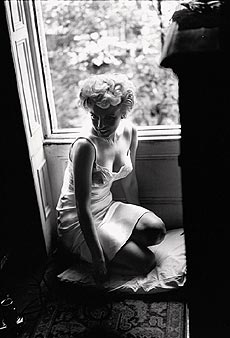
Sam Shaw liked to photograph her outside - just naturally beautiful and earthy, rather than all dolled up. Even the photo above, while very alluring, has a natural-ness to it. Natural light - or at least it looks natural - and her pose looks almost candid.
Here's another one from Sam Shaw: So beautiful, right??
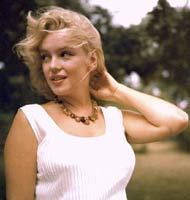
And of course - he took my favorite photo of her ever - there's just so much in it - I could look at it forever:
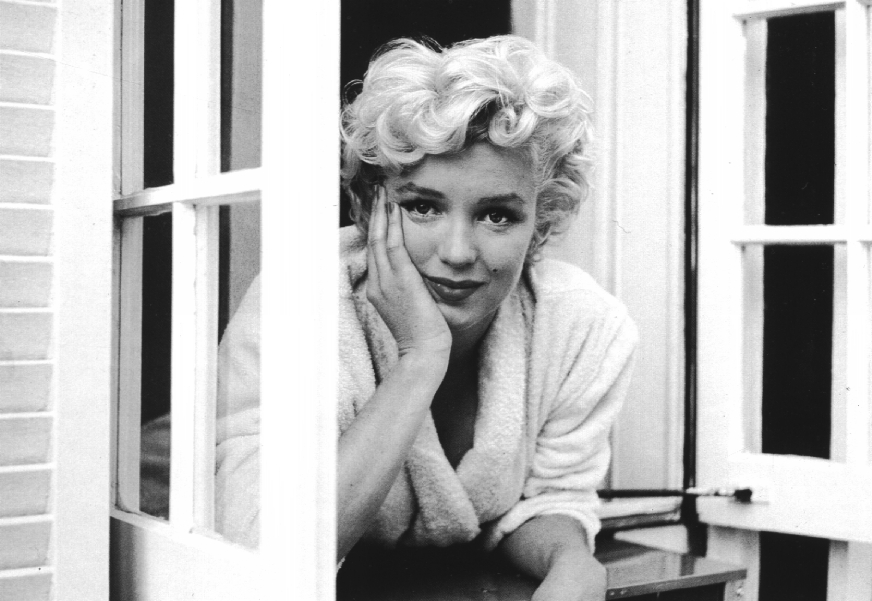
And a couple more images:
The photos below were from Bert Stern's famous last session with Marilyn - which involved her drinking champagne and rolling around naked in a big white bed. There are hundreds of photos from that shoot - all of them hypnotic. She is a chameleon. That's what's so amazing about her. So many beautiful women have only ONE LOOK. They need to arrange their faces into that ONE LOOK in order to continue to be beautiful. I mean, think about the practiced red carpet smiles of all the soulless little starlets parading about now. Monroe is, by any standards, gorgeous ... but it's amazing how alive she is, in print. Laughing, pensive, mischievous, serious, shy - all of it seems real, vital, in the moment, not rehearsed ... This is what it means to be a genius at being a model. And Marilyn was a genius - I'm not sure she was as an actress, but in terms of print work? Nobody even comes close to her abilities.
Anyway:
Bert Stern sent Marilyn the proofs of what we now know was her last photo shoot. Marilyn sent the proofs back with big X-es over the ones she hated. Stern has spoken about how she didn't just put a little X up on the side, like most more vain starlets did - she just X-ed the entire image out, sometimes scribbling so hard the pen came thru the page. We shouldn't read too much into this - as so many have done. (Like: "oooooh, she wanted to destroy the very thing which made her famous".) Now there may be an element of truth in that - after all, she died very soon after these photos were taken - but make no mistake: Marilyn was as good as it gets, in terms of still photography. Her only rival in this regard is Bettie Page. Marilyn STILL sets the mark for how it should be done, and she STILL shows up the actresses of today. She USED still photography to further her persona, to play with it, to create, to add to her own mystique. The starlets of today who flounce around on the cover of Vogue and Bazaar flashing toothy smiles and siliconed cleavage should look at these rejected proofs of Marilyn's and LEARN.
I try to see the X-ed photographs through her eyes. Like: what was off, for her? What didn't she like? This was not just a neurotic moment, I don't believe. I think she was able (unlike so many people in her position) to stare at herself coldly, as though she was a product. This may have been part of her problem, in the end ... but she was never EVER just an "employee" in those photo shoots. She knew exactly what she was doing.
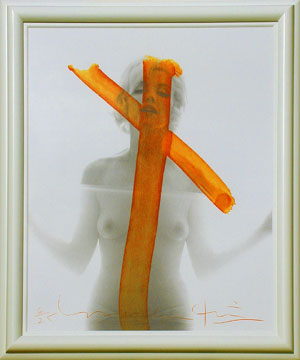
Here's another X-ed out one. I think it's gorgeous. For Marilyn, it didn't make the cut. (Some of the other X-ed out ones are obviously not ones to be used and she would probably be HORRIFIED that they are all in a book right now. There are some where one of her eyes is closed - or her smile looks a bit lazy - stuff she NEVER would have allowed us to see.)
Anyhoo:
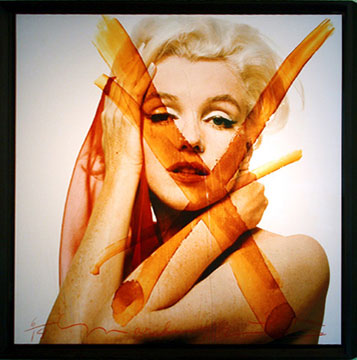
And now look here. Look at this beautiful beautiful girl. Look at her sandals. Look at her hair.

How unselfconscious she seems (again: we have no idea what was going on in her heart - maybe she was being taken advantage of? Maybe she hated her hair that day? Maybe the photographer wanted to sleep with her and it made her feel awkward? We just can't know.) But she SEEMS unself-conscious - beautifully unselfconscious - and that is half the battle in being an actress. No matter how bad you feel, or how awful you feel about how your thighs look in your costume ... you must know how to SEEM unselfconscious. Marilyn always seems to have had that.
It was an act of WILL, I tell ya. This is what I believe.
The camera would never reject her. She knew how to have a relationship with it. She knew how to be loved by it. Her soul came pouring out of her because she trusted she would be received well. No rejection possible.
She was beloved.
She was not bitter about being beautiful. She didn't hate her own beauty - she was GRATEFUL for it. (She was hurt, though, that men saw her as sexually superhuman merely because of her body shape and the persona she created as an actress - she said to one of her friends, "My men expect so much of me because of the image they have made of me and that I have made of myself, as a sex symbol. Men expect so much and I can't live up to it. They expect bells to ring and whistles to whistle, but my anatomy's the same as any other woman's. I can't live up to it.") But still, with all of that: she was never bitter about the beauty - because the beauty gave her a LIFE. The camera ... that was her only way out. It saw her. It looooooooved her. It made her life possible. Hence - the clear-eyed X-ing through of her own image.
I always wonder who you would be now if you were alive. I like to think you would have found happiness. I think the 1960s and 1970s might have been VERY good to you. But who knows. No one can know.
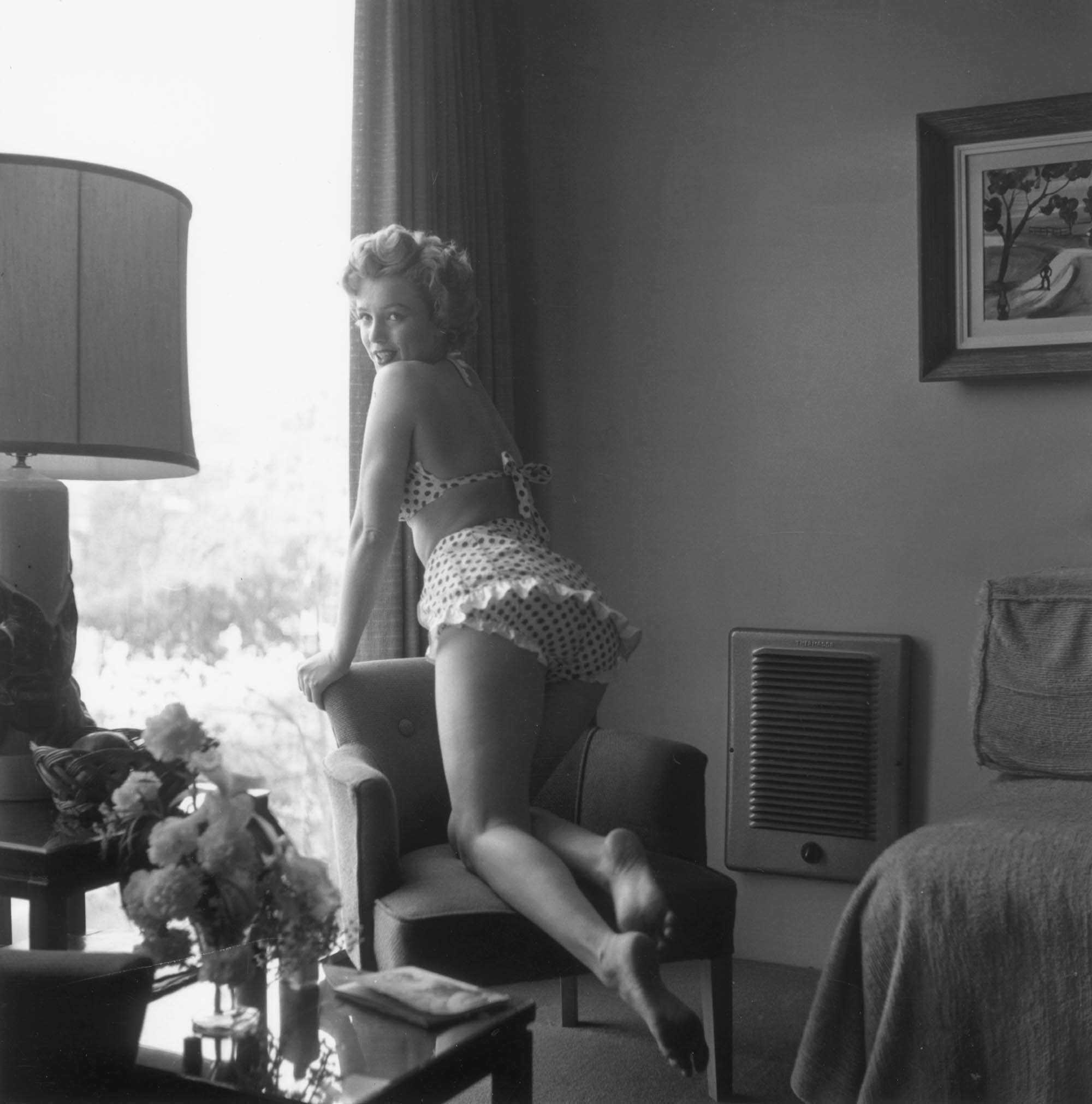
Happy birthday, Marilyn.
March 11, 2006
Thank you ...
... to whoever sent me the book The Many Lives of Marilyn Monroe ... I don't know who you are! There was no message but I assume it was someone who reads this blog - so thank you, thank you! I've been wanting to read it ever since it came out.
It's not a biography of Monroe, per se, because - well - do we need another one? No. This is an exploration of the nature of myths, and how they are created. Marilyn Monroe was a real woman, just an actress really - an actress who made it really huge - but she has become a myth. Why? We could talk about it forever. I love talking about it.

Sarah Churchwell, the author of the book, looks at how certain myths were created and perpetuated, in terms of Monroe. The facts are well-known - but certain untruths have been passed on, or certain interpretations - Even in death, everyone wants a piece of Marilyn Monroe. There was Norman Mailer's book about her - there was Gloria Steinem's book - each of them creating a myth in the process. Every single person who knew Monroe (except for Joe dimaggio and her beloved makeup artist and confidante - with her for years - they kept all her secrets) published some kind of a memoir about her. "My Summer with Monroe". "My Wild Night with Marilyn Monroe". Whatever. These memoirs, subjective, retrospective, and definitely filled with self-interest, are then passed on as TRUTH. This is what happens with myth. Was Monroe a damaged little girl? Or was she a feminist before her time? Was she just one of the most successful results of the casting couch Hollywood has ever seen? Or was she a true talent? What the hell??? Everyone has an opinion.
Churchwell examines ALL of these different myths. In a way, it reminds me of the whole Sylvia Plath after-death phenomenon. Her memory was co-opted by her cultish followers who needed to cast her in some sort of feminista epic struggle. Ted = evil villain. Sylvia = martyr. The fact of her WORK was sometimes lost in all of the proprietary posturing. Like: how 'bout those POEMS, huh??? Nope - for a lot of the followers, the poems are just autobiographical. That is why they are interesting to these people: not because they are good art, but because they support their case about Sylvia. Now - I say all this because I WAS one of those people once ... hahahaha ... it's a very young-woman thing to do - but I grew out of it, and finally just was able to love Plath's poems as POEMS. But biographies of her are notoriously horrible - because, well - for many reasons. The Hughes estate, watched over by Hughes' tight-fisted sister Olwyn, would not allow ANY interpretation counter to Hughes' interests. Every draft had to go through Olwyn. I mean, can you imagine? This only ADDED to the general perception that Sylvia was trapped in this marriage, and limited - held down. The draconian Hughes estate made it nearly impossible for a DECENT biography of Plath to come out. Their main defense was that: Ted Hughes was still alive, the two children were alive, and yadda yadda, Sylvia could be "vicious" and there was a feeling that her children should be protected. Now - her children are grown ups now - older than I am - I always found this attitude despicable. Sylvia Plath was a major fucking poet - and there has STILL not been a good biography of her written. Shameless. Ted Hughes, by publishing his book of poems about and to Sylvia Birthday Letters - right before his death - hopefully opened the floodgates. He needed to come clean, and break his silence. He himself broke free of his sister's iron fist. Now Plath and Hughes are a bit more fluid - at least in memory - for many years they were FIXED images. Circling one another. FIXED. Many people had a vested interest in keeping these images fixed. They made careers out of the fixed nature of the Hughes-Plath myths. I do hope that, with Hughes' death, and with Frieda (Hughes and Plath's daughter) making many statements recently, writing some wonderful op-ed columns - the bonds have been broken, and we can finally LOOK at these people with a bit more clarity.
Anyway - I'm straying from the point, but I don't care - Eventually, the wonderful Janet Malcolm wrote a FANTASTIC book called The Silent Woman. Its topic? How difficult it was to write a biography of Sylvia Plath, because of all of this. At its essence, her book is about the nature of myth ... and the uncomfortable position biographers can be put in - they are eavesdroppers, snoops ... and what you discover is not always convenient to your IDEA behind your book.
Marilyn Monroe is in the same pantheon. I have read every single biography of this woman ever written. I have read every memoir of her friends/assistants/lovers I can get my hands on. I'm that fascinated.
But still. Even with all that. You get the sense, still, that you are in the presence of a great mystery.
Because - when you get right down to it - can we ever really KNOW another human being? Even if they leave a ton of evidence behind in journals and letters - we still can't say, definitively, that we KNOW them. Or - you CAN say that - but i think you're missing the whole point if you do. I think that's one of the reasons why I can't get enough of Alexander Hamilton. And Thomas Jefferson, come to think of it. Both of those guys wrote more words than all the other founding fathers combined - letters, papers, books, pamphlets, speeches - it's endless - we can read their actual words - but still: there's a sense, at least from me, that they are, essentially, unexplainable. I'm reading the Chernow biography right now - and I am reading the FACTS - the FACTS of Hamilton's beginnings - his horrific beginnings - and then his journey to New York - and his education - We know that this HAPPENED. But ... but ... it still amazes me. It just does. Because really: I can't KNOW him. I can't. I can know the facts ... but his essence? His soul? What it was like to BE him? What he thought about when he was by himself? How his mind worked? A biography can't really give you any of that stuff ... there's still so much stuff between the lines.
Marilyn Monroe (in my opinion) - even though she is one of the most recognizable faces in the world - even though we have more images of her than of any other actress - even though we know all the sordid details of her sad life - even though we have ALL Of that - Marilyn Monroe is almost COMPLETELY between the lines.
THAT'S the fascination.
Her acting is wonderful, and I love her comedic spirit. I love her positive and joyous screen presence. I love her innocence. Even with that body, and even in the parts she was cast in ... she had a deep Bambi-esque innocence ... Now THAT, to me, is a complete mystery. How that occurred.
And I don't need to know WHY, actually. I know that I cannot know.
Doesn't mean it's not an interesting avenue of inquiry - but the real truth cannot be known. She is gone.
Sarah Churchwell, in this book, which came out last year and got terrific reviews, doesn't try to EXPLAIN Marilyn Monroe - because she cannot be sufficiently explained. She tries to see how the myth has endured. There were people who had a vested interest in perpetuating the myth - and she looks at those people - but also: the myth was perpetuated by the adoring public - and that was a much more organic thing. Marilyn Monroe's legend would have lived on with or without all the self-interested tell-all memoirs, and sordid revelations ... because there was something about her that people just, frankly, LOVED. She was so vital, so alive ... it was hard to believe she was dead.
It is interesting to contemplate how all of this would have played out if she hadn't died. Marilyn would be 80 years old today if she hadn't died in 1962. I often wonder what her career would have been like if it hadn't been cut short. The studio system that had so controlled her and marginalized her (the public made her a star - and the studios begrudgingly allowed it) was on its way out - the 70s were coming - with brave new filmmakers, and the whole birth of the independents. I wonder what place Marilyn would have found for herself in all that.
Anyway: to my mystery Santa Claus: thank you SO MUCH! I haven't even READ it yet, and look at all my thoughts on it!!
March 8, 2006
Marilyn and the camera
Eve Arnold took some of my favorite photos of Marilyn Monroe ever. Like this candid one.
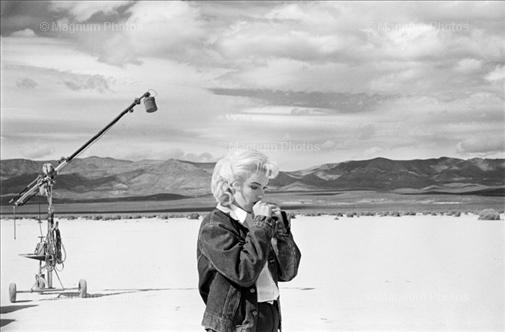
That's on the set of The Misfits. Spectacular photograph - regardless of who the subject is. I have it on my bulletin board in my kitchen. I just love it. Who knows - she COULD be thinking: "Damn, I'm hungry" or "I love the color of the sky" or "I'm so pissed at my husband right now" ... You could project anything onto it - and what I project onto it is - This is a photo of an actress preparing for a scene. I like to think this is her having a meditative quiet moment before the camera starts rolling.
I just love everything about it.
Eve Arnold has written a couple of books about Marilyn (mainly photo books) and there's a lot of great insights in there about the relationship between Marilyn and the camera, which even directors who found her a handful and a half to direct (like Billy Wilder) could not deny was something completely out of the ordinary. The camera turned on, and Marilyn DECIDED to become Marilyn. And the audience - millions of miles away, and months away from the time of shooting, GOT her. Marilyn skipped right over the heads of the directors, the editors, the publicists, and went STRAIGHT to the public, who loved her. Men and women.
Here's another one of Eve Arnold's.

Here are some of Arnold's quote about Marilyn's magic:
I never knew anyone who even came close to Marilyn in natural ability to use both photographer and still camera. She was special in this, and for me there has been no one like her before or after. She has remained the measuring rod by which I have -- unconsciously -- judged other subjects.
Story after story from photographers tell of this plain-looking rather blanched-faced woman showing up at the studio - who then just transformed when the camera was clicking. It was not just a matter of makeup. There are plenty of beautiful girls. It was a matter of turning a light on inside. And Monroe was not only conscious of this - this was no accident of talent, or coloring, or working hard ... She knew how to be photographed better than anybody.
Eve Arnold again:
If an editor wanted her, he had to agree to her terms. She knew how she wanted to be seen, and if her cooperation was sought, she reserved the right of veto.She knew she was superlative at creating still pictures and she loved doing it.
She had learned the trick of moving infinitesimally to stay in range, so that the photographer need not refocus but could easily follow movements that were endlessly changing.
At first I thought it was surface technique, but it went beyond technique. It didn't always work, and sometimes she would tire and it was as though her radar had failed; but when it did work, it was magic. With her it was never a formula; it was her will, her improvisation.
Amazing. There's a mystery at the heart of it. I love it. My friend Anne said to me in high school, "Everyone has magic inside of them. But only some people have theatre magic."
Photographer Burt Glinn had this to say:
She had no bone structure -- the face was a Polish flat plate. Not photogenic in the accepted sense, the features were not memorable or special; what she had was the ability to project.
Yup. That's the actress in her. She PROJECTED herself into the dreams and fantasies of the audience - you can see it in the photos, sure, but you can also see it in the films. Watch her. Watch how her face moves. How her eyes close slightly, open, become serious and wide, and then drowsy again - This is projection. It cannot be duplicated. She is literally in a class all her own in this regard. People try to imitate Monroe, and fail. Because, at heart, she is one of our most organic of actresses. If she didn't FEEL it (like Arnold wrote above), she couldn't do it. This is why she could be a nightmare on the set. If she didn't feel "her" when it came time to shoot the scene (she would refer to that person who came out of her when the cameras were rolling in the third person ... "So do you want to see 'her'?") - panic would set in, and she would lock herself in her trailer, or get lost on the way to the location, or whatever. Panic. Fear. It had to come from inside, or she couldn't do it.
But that's neither here nor there. Every artist has his or her demons. Those were Marilyns.
This is meant to just be a wee celebration of her magic with the camera.
Even in moments of either a pause between shots - or - sadness? - she is riveting. Arnold again:
Who knows what is going on here. She might just be resting, or thinking - and the camera, for whatever magic reason, picks up on the underlying sadness there ... That was the kind of relationship Marilyn had with the camera: it was intimate.
I'll save one of my favorite quotes about this for last.
Here's one more photo from Eve Arnold: Marilyn as Venus on the half shell practically:

Now obviously that photo is all about her body and its curves - but if you look at her face - if you look at that expression - it's a startlingly intimate expression. She is WITH us. We are so used to seeing images of Marilyn Monroe - it's hard to remember how out-of-the-ordinary she is. How nobody does it like her. Her eyes are half-closed, she's got a soft and vulnerable look on her face ... she lets the camera IN. Beautiful. No wonder audiences always felt PROTECTIVE of her. Anyone that vulnerable obviously needs protection.
Ernest Cunningham, another photographer who worked with her, describes the whole magic in the following quote - and what I love about this quote, is that we get a quote from Marilyn herself, showing her awareness about the whole thing - she was in charge of what was going on. Anyway, here's Cunningham:
I worked with Marilyn Monroe. A rather dull person. But when I said "Now!" she lit up. Suddenly, something unbelievable came across. The minute she heard the click of the camera, she was down again. It was over. I said, "What is it between you and the camera that doesn't show at any other time?" She said, "It's like being screwed by a thousand guys and you can't get pregnant."
That's what it is, isn't it? She felt intimate with the camera. It was where she could project. She knew that the camera could see everything and so she LET it see everything. She was loved by that camera more than she was ever loved by any human being.
But I don't mean to pathologize this woman - that's not what interests me about her.
What interests me, above all, is her magic.

November 20, 2005
Marilyn Monroe Appreciation Moment

From Who the Hell's In It, by Peter Bogdonavich:
The fact is that Marilyn was in bad trouble from the day she was born as Norma Jean Mortenson on June 1, 1926, in the city of angels and movies, a poor bastard angel child who rose to be queen of a town and a way of life that nevertheless held her in contempt. That she died a martyr to pictures at the same time as the original studio star system -- through which she had risen -- finally collapsed and went also to its death seems too obviously symbolic not to note. Indeed, the coincidence of the two passing together is why I chose to end this long book about movie stars with Marilyn Monroe.What I saw so briefly in my glimpse of Marilyn at the very peak of her stardom (and the start of my career) -- that fervent, still remarkably naive look of all-consuming passion for learning about her craft and art -- haunts me still. She is the most touching, strangely innocent -- despite all the emphasis on sex -- sacrifice to the twentieth-century art of cinematic mythology, with real people as gods and goddesses. While Lillian Gish had been film's first hearth goddess, Marilyn was the last love goddess of the screen, the final Venus or Aphrodite. The minute she was gone, we started to miss her and that sense of loss has grown, never to be replaced. In death, of course, she triumphed at last, her spirit being imperishable, and keenly to be felt in the images she left behind to mark her brief visit among us.
Marilyn Monroe Appreciation Moment
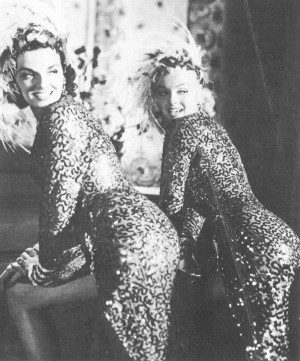
From Who the Hell's In It, by Peter Bogdonavich:
Howard Hawks, who directed her first big success, Gentlemen Prefer Blondes (co-starring established, top-billed sex goddess Jane Russell), had initially directed her a year earlier, in a major supporting role, with Cary Grant and Ginger Rogers, in Monkey Business (1952), which actually featured the first great Marilyn Monroe performance. In fact, her scenes with Cary are the highlights of the picture and make you wish they could have done an entire romantic screwball comedy together. The same year Marilyn died, Hawks told me, "Marilyn was frightened to come on the stage -- she had such an inferiority complex -- and I felt sorry for her. I've seen other people like that. I did the best I could and I wasn't bothered by it too much. In Monkey Business, she had only a small part -- that didn't frighten her so much -- but when she got into a big part ... For instance, when we started her singing [for Gentlemen Prefer Blondes], she tried to run out of the recording studio two or three times. We had to grab her and hold her to keep her there. She sang quite well, actually. I got a great deal of help from Jane Russell. Without her I couldn't have made the picture. Jane gave Marilyn that "You-can-do-it" pep talk to get her out there. She was just frightened, that's all -- frightened she couldn't do it" ...Ironically, the picture that made Monroe a sex symbol, Gentlemen Prefer Blondes was intended by Hawks as "a complete caricature, a travesty on sex -- it didn't have normal sex." In a 1967 interview I did with Hawks for the BBC, he said, "Their sex was a sort of a symbol, an obvious thing, which all you can do is really make fun of and enjoy, you know, and watch them perform. You don't try to make reality. Monroe never was any good playing the reality. She always played in a sort of a fairy tale. And when she did that she was great -- something happened. But as far as doing a real story with her, I don't believe that she's ever done a good picture that was a real story. They were all more or less of a fairy tale quality. Kind of a musical-comedy sort of a thing."
Hawks had told me that when he knew her on those early pictures, Marilyn wasn't "very sexy in real life." He said, "Monroe couldn't get anybody to take her out -- nobody. A funny little agent about five-feet-two used to cart her around. But they both [Monroe and monogamous housewife Jane Russell] were sex symbols to the motion picture public ..." Hawks also said that while Russell peaked in one or two takes, Marilyn continued to improve through repetition: "With Monroe, the more you kept going, the better she got."
Marilyn Monroe Appreciation Moment
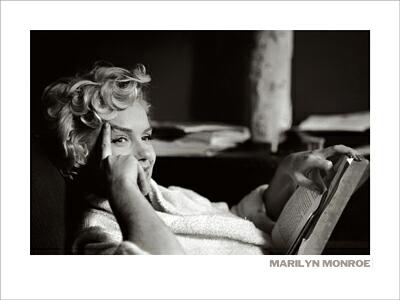
From Who the Hell's In It, by Peter Bogdonavich:
More than forty years have passed since Marilyn's mysterious death, but her legend and persona have survived. This is all the more remarkable because she actually made very few films, and even fewer that were any good. But there was a reality to her artifice -- she believed in the characters she played, even if they were inherently unbelievable. "Everything she did," [Arthur] Miller said to me, "she played realistically. I don't think she knew any other way to play anything -- only to tell you the truth. She was always psychologically committed to that person as a person, no matter what the hell it was, rather than a stock figure. Because the parts she got could easily have been stock figures, which had no other dimension. But she wouldn't have known how to do that. In other words, she did not have the usual technique for doing something as a stock figure ... She was even that way when [director] John Huston used her the first time [in a memorable walk-on bit] in The Asphalt Jungle [1950]."This went for every picture she did in her surprisingly, painfully short career as a star, barely a decade, little more than a dozen pictures. Though she managed to work with quite a number of major directors, it was not necessarily always in their best efforts; but still they were Fritz Lang, Howard Hawks (twice), Otto Preminger, Billy Wilder (twice), George Cukor (twice, if you count her last unfinished one), John Huston (twice), Laurence Olivier, Joshua Logan, and Joseph L. Mankiewicz (bit part in 1950's classic All About Eve). In my conversation with Miller, he said, "I thought she had the potential for being a great performer if she were given the right stuff to do. And if you look at the stuff she did do, it's amazing that she created any impression at all because most of it was very primitive. And the fact that people remember these parts from these films is amazing ... She was comitted to these parts as though they were real people, not cardboard cutouts. Even though the director and author and the rest might have thought they were cutouts and would deal with them that way. The way the two men [Tony Curtis, Jack Lemmon] in Some Like It Hot felt with their parts, or George Raft with his part. She was real. And therefore she had the potential of being a great comedienne." (Norman Mailer, in his book on Monroe -- he never met her -- wrote that starting with 1953's Gentlemen Prefer Blondes, she was a great comedienne.)
Marilyn Monroe Appreciation Moment
From Who the Hell's In It, by Peter Bogdonavich:
I recalled Orson Welles telling me about being at a Hollywood party which Marilyn attended (circa 1946 or '47) while she was still a lowly starlet, and seeing someone casually pull down the top of her dress in front of people and fondle her. She had laughed. Welles said that "just about everyone in town" had slept with her. Yet, [Arthur] Miller had gone on to say that the kind of mythological figure Marilyn created on the screen was all her own and a great achievement for her...The year before her much-speculated-over death at thirty-six (rumors of presidential involvement, etc.), playwright Clifford Odets told me that she used to come over to his house and talk, but that the only times she seemed to him really comfortable were when she was with his two young children and their large poodle. She relaxed with them, felt no threat. With everyone else, Odets said, she seemed nervous, intimidated, frightened. When I repeated to Miller this remark about her with children and animals, he said, "Well, they didn't sneer at her."
Marilyn Monroe Appreciation Moment
Arthur Miller wrote, in his autobiography Timebends:
She was a whirling light to me then, all paradox and enticing mystery, street-tough one moment, then lifted by a lyrical and poetic sensitivity that few retain past early adolescence. Sometimes she seemed to see all men as boys, children with immeidate needs that it was her place in nature to fulfill; meanwhile her adult self stood aside observingt he game. Men were their need, imperious and somehow sacred. She might tell about being held down at a party by two of the guests in a rape attempt from which she said she had escpaed, but the truth of the account was far less important than its strange remoteness from her personally. And ultimately something nearly godlike would emerge from this depersonalization. She was at this point incapable of condemning or even of judging people who had damaged her, and to be with her was to be accepted, like moving out into a kid of sanctifying light from a life where suspicions was common sense. She had no common sense, but what she did have was something holier, a long-reaching vision of which she herself was only fitfully aware: humans were all need, all wound. What she wanted most was not to judged but to win recognition from a sentimentally cruel profession, and from men blinded to her humanity by her perfect beauty. She was part queen, part waif, sometimes on her knees before her own body and sometimes despairing because of it -- "Oh, there's lots of beautiful girls," she would say to some expression of awed amazement, as though her beauty betrayed her quest for a more enduring acceptance.
Marilyn Monroe Appreciation Moment
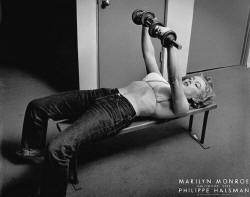
Elia Kazan wrote about Marilyn:
Relieve your mind now of the images you have of this person. When I met her, she was a simple, eager young woman who rode a bike to the classes she was taking, a decent-hearted kid whom Hollywood brought down, legs parted. She had a thin skin and a soul that hungered for acceptance by people she might look up to ...The girl had little education and no knowledge except the knowledge of her own experience; of that she had a great deal, and for an actor, that is the important kind of knowledge. For her, I found, everything was either completely meaningless or completely personal. She had no interest in abstract, formal, or impersonal concepts but was passionately devoted to her own life's experiences. What she needed above all was to have her sense of worth confirmed. Born out of wedlock, abandoned by her parents, kicked around, scorned by the men she'd been with until Johnny, she wanted more than anything else approval from men she could respect. Comparing her with many of the wives I got to know in that community, I thought her the honest one, them the "chumps". But there was a fatal contradiction in Marilyn. She deeply wanted reassurance of her worth, yet she respected the men who scorned her, because their estimate of her was her own.
November 19, 2005
Marilyn Monroe Appreciation Moment
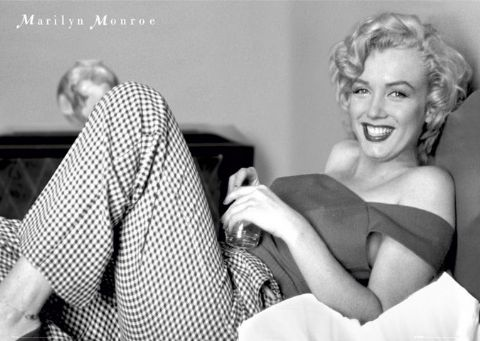
I've never done a proper post about Marilyn Monroe. She's one of those topics that I almost shy away from. I have a couple of them - mainly because the thought of sitting down and putting all my random thoughts and emotions into words - is kind of daunting. John Cassavetes is another one. If I sit down and write about Cassavetes, I have to do it RIGHT, and that will take a lot of energy. Someday I will ... but I put it off.
Monroe's like that.
Some Like It Hot is on right now. I am in heaven.
So - until I'm ready to write my OWN thoughts about this fascinating actress - I'll let other people speak for me.
Here's a quote from John Strasberg - son of the famous acting teacher Lee Strasberg. Marilyn studied with Lee Strasberg, and idolized him. The Strasberg family basically adopted her. She was a grown woman, and one of the biggest stars in the world, but she would hang out at their house until all hours of the night, never wanting to go home. She didn't think she was a good actress. She wanted legitimacy. Lee Strasberg (and his wife Paula - a pretty much universally reviled woman) gave her confidence, treated her like a real actress (and also, incidentally, really messed with her head.) The Strasbergs had two kids - Susan and Johnny - both of them were teenagers when Marilyn was hanging around their house. I actually studied with John Strasberg - who is now a director, and an incredible acting teacher - just like his father - but that's a story for another day.
John Strasberg was a teenager when Marilyn Monroe came into the Strasberg household ... He describes the moment:
The first time I met her I remember she came out of the living room and Pop said, "This is my son," and my first impression of her was that she was different from most of the people who came to the house. I'd watch all these people trading their most human qualities, betraying themselves for success at all costs, to become rich and famous, and afterward, when it was too late, they'd realize they had lost the best part of themselves along the way, but she, she was like me. When I looked into her eyes, it was like looking into my own, they were like a child's eyes. I was still a child. You know how children just look at you. My feeling was she had less ego or was less narcissistic than most of the actors who never really bothered with me. She was just another person to me, another one from that world I felt cut off, excluded, from. She was nicer, real simple, no makeup, and she really looked at me as if she saw me. It wasn't that I wanted people to look at me, but I knew the difference when she did. I knew everyone said she was the sexiest, most sensual woman in the world. Not to me. I thought there was something wrong with me for not feeling that from her. I'd felt it from other women who came to the house. I was pretty sexually frustrated then. She was so open, so loose, and her sensuality as such was so totally innocent, nothing dirty in it at all, and the first time it was just like talking to an ordinary person, only realer than most who came into the house in those days. She was quiet, too, I remember, like an animal is quiet, and I was like that too, survival tactics. She seemed smart, but not in an educated way, instinctively smart, nobody's fool.
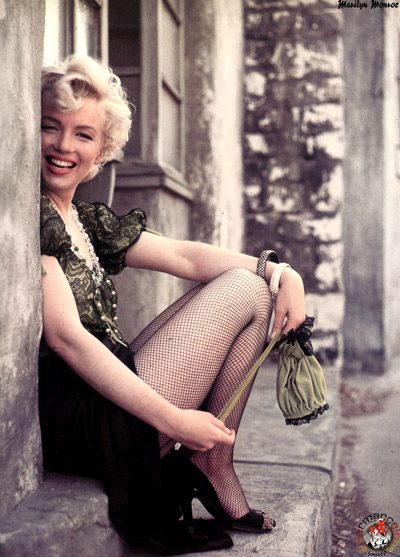
She befriended Johnny Strasberg, this lonely shy teenager, cowed by his own family, and by the constant stream of famous visitors. She was kind to him. He remembered her as overwhelmingly kind.
Here is my favorite story John Strasberg tells about Marilyn. It just brings a lump to my throat. See? I can't talk about Marilyn and be articulate. So here's the story:
I think I was talking about cars to Mother and Father. You know how I loved cars. I'd just come home and it was going to be my eighteenth birthday. I'd wanted to come for that.Mother and Father hadn't wanted me to come. "Why don't you wait till the end of the year?" Well, i'd already been kicked out of college. They didn't know yet.
When I'd gone off at the airport, I'd turned to Mother and said, "For two cents, I won't go." Nobody gave me the two cents, but I'd meant it. What I'd wanted to do was work. I'd wanted to work from the time I was fifteen, and they were always against any effort on my part to be strong or independent. I remember how much I resented it. "You don't have to work, we'll take care of everything," undermining me.
So I was talking about cars, no one was listening, and Marilyn was there and out of the blue said, "Why don't you take my car, Johnny?"
I thought I hadn't heard her right, and I said, "What?" She had remembered the summer before, in California, I'd had that Chevy I'd rented. God, I loved that car, a '57 Bel Air silver Chevy, and she had the Thunderbird.
She continued, "I've got the Ford Mustang the corporation gave me, and Arthur and I have a car. That one's just sitting in the garage, we don't use it."
I was stunned. I couldn't believe she meant it.
Mother and Father were horrified; they didn't like it at all. I don't know if it felt like too much to give me or if they were worried about my driving in my state of mind, but they objected strenuously. "He's too young. Maybe later, Marilyn. You don't have to. It's impossible, he can't afford it, it could be dangerous."
Marilyn just said, "Well, don't worry about any of that, it's in the corporation's name, so I'll take care of the insurance."
I'll never forget that ... There were so few, so very few people who were generous like that. Especially to me, who couldn't do anything for her.
I think that car saved my life.
What do you want to bet that Marilyn, even with all her breezy casualness in that anecdote, knew exactly what that car would mean to that trapped parent-pecked young man ...
November 5, 2005
Marilyn
Here's Billy Wilder on Marilyn Monroe. He had a notoriously difficult time directing her ... and yet he knew that if he wanted movie magic, he had to put up with her neuroses. No one like her. No one before like her, and no one after has even come close.
Here are his words:
"Whatever she threw away, we printed it, and it was very good. It was very, very good. She had a kind of elegant vulgarity about her. That, I think, was very important. And she automatically knew where the joke was. She did not discuss it. She came for the first rehearsal, and she was absolutely perfect. She had a feeling for and a fear of the camera. Fright. She also loved the camera. Whatever she did, wherever she stood, there was always that thing that comes through. She was not even aware of it."
Below is, I think, my favorite picture taken of Marilyn ever. Out of the thousands of them in existence ... this one is my favorite.
August 3, 2005
The Books: "After the Fall" (Arthur Miller)
Next in my Daily Book Excerpt:
 Next play on the script shelf is After the Fall
The first production of this was directed by Elia Kazan and it starred Jason Robards and Barbara Loden (who was Kazan's wife, at the time). It was going to be the premiere production of America's very first repertory company: Lincoln Center Repertory. (The story of the short-lived theatre company is very sad.) After the Fall was not only its first prodcution, but it was also its last. The play was controversial - everyone wanted to see it for prurient reasons - Barbara Loden insisted on wearing a platinum wig (against Arthur Miller's wishes) - which didn't really work - because people came looking for Marilyn Monroe, and of course nobody but Marilyn is Marilyn. Also: the play is VERY wordy. And VERY intellectual. Basically, the way I see it is: it is Arthur Miller's purging of his own guilt for not being able to save his wife. He was explaining himself to the audience. "This is how it really was!!! It's not my fault!!!!" And Miller always had a bit of the lecturing didact in him - So in a way - Quentin comes off as this superior know-it-all drip, and Maggie comes off as deeply misunderstood, and rightfully suspicious of his motives.
Anyway - who knows. It's not a perfect work, but I love it deeply. I loved working on it. Playing Maggie changed my life. I didn't think I could do it. But I did. It was wonderful.
There are so many great 2-person scenes in this play it's hard to choose ... Their first meeting in Central Park is wonderful - funny, sweet, sad ... but I'm gonna go with a scene from later in the play, when they are married. She is falling apart. He has realized the depth of the woman's problems - beneath the bombshell exterior - he has begun to back off from her drowning - and she feckin' HATES him for that. Things turn very ugly.
(Oh, and just so you know - Quentin occasionally turns and talks to the audience. To make the whole thing even MORE didactic. It's not a realistic play. People wander in and out of scenes, there are sudden flashbacks - like in a movie - people can be in different settings and times - talking to one another. It is a truly introspective play - like it all takes place in Quentin's brain. As he goes over and over these events, and they get all mixed up in his mind ... trying to figure out where he went wrong with Maggie.)
EXCERPT FROM After the Fall
QUENTIN. By the ocean. That cottage. That night. The last night.
Maggie in a rumpled wrapper, a bottle in her hand, her hair in snags over her face, staggers out to the edge of the pier and stands in the sound of the surf. Now she starts to topple over the edge of the pier, and he rushes to her and holds her in his hands. Maggie turns around and they embrace. Now the sound of jazz from within is heard, softly.
MAGGIE. You were loved, Quentin; no man was ever loved like you.
QUENTIN. [releasing her] Carrie tell you I called? My plane couldn't take off all day --
MAGGIE. [drunk, but aware] I was going to kill myself just now. [He is silent] Or don't you believe that either?
QUENTIN. [with an absolute calm, a distance, but without hostility] I saved you twice, why shouldn't I believe it? [going toward her] This dampness is bad for your throat, you oughtn't be out here.
MAGGIE. [she defiantly sits, her legs dangling] Where've you been?
QUENTIN. [going upstage, removing his jacket] I've been in Chicago. I told you. The Hathaway estate.
MAGGIE. [with a sneer] Estates!
QUENTIN. Well, I have to pay some of our debts before I save the world. [He removes his hat and puts it on bureau box; sits and removes a shoe]
MAGGIE. [from the pier] Didn't you hear what I told you?
QUENTIN. I heard it. I'm not coming out there, Maggie, it's too wet.
[She looks toward him, gets up, unsteadily, enters the room]
MAGGIE. I didn't go to rehearsal today.
QUENTIN. I didn't think you did.
MAGGIE. And I called the network that I'm not finishing that stupid show. I'm an artist! And I don't have to do stupid shows, no matter what contract you made!
QUENTIN. I'm very tired, Maggie. I'll sleep in the living room. Good night. [He stands and starts out upstage]
MAGGIE. What is this?
[Pause. He turns back to her from the exit.]
QUENTIN. I've been fired.
MAGGIE. You're not fired.
QUENTIN. I didn't expect you to take it seriously, but it is to me; I can't make a decision any more without something sits up inside me and busts out laughing.
MAGGIE. That's my fault, huh?
[Slight pause. Then he resolves]
QUENTIN. Look, dear, it's gone way past blame or justifying ourselves, I ... talked to your doctor this afternoon.
MAGGIE. [stiffening with fear and suspicion] About what?
QUENTIN. You want to die, Maggie, and I really don't know how to prevent it. But it struck me that I have been playing with your life out of some idiotic hope of some kind that you'd come out of this endless spell. But there's only one hope, dear -- you've got to start to look at what you're doing.
MAGGIE. You going to put me away somewhere. Is that it?
QUENTIN. Your doctor's trying to get a plane up here tonight; you settle it with him.
MAGGIE. You're not going to put me anywhere, mister. [She opens the pill bottle]
QUENTIN. You have to be supervised, Maggie. [She swallows pills] Now listen to me while you can still hear. If you start going under tonight I'm calling the ambulance. I haven't the strength to go through that alone again. I'm not protecting you from the newspapers any more, Maggie, and the hospital means a headline. [She raises the whiskey bottle to drink] You've got to start facing the consequences of your actions, Maggie. [She drinks whiskey] Okay. I'll tell Carrie to call the ambulance as soon as she sees the signs. I'm going to sleep at the inn. [He gets his jacket]
MAGGIE. Don't sleep at the inn!
QUENTIN. Then put that stuff away and go to sleep.
MAGGIE. [afraid he is leaving, she tries to smooth her tangled hair] Could you ... stay five minutes?
QUENTIN. Yes. [He returns]
MAGGIE. You can even have the bottle if you want. I won't take any more. [She puts the pill bottle on the bed before him]
QUENTIN. [against his wish to take it] I don't want the bottle.
MAGGIE. Member how used talk to me till I fell asleep?
QUENTIN. Maggie, I've sat beside you in darkened rooms for days and weeks at a time, and my office looking high and low for me --
MAGGIE. No, you lost patience with me.
QUENTIN. [after a slight pause] That's right, yes.
MAGGIE. So you lied, right?
QUENTIN. Yes, I lied. Every day. We are all separate people. I tried not to be, but finally one is -- a separate person. I have to survive too, honey.
MAGGIE. So where you going to put me?
QUENTIN. [trying not to break] You discuss that with your doctor.
MAGGIE. But if you loved me ...
QUENTIN. But how would you know, Maggie? Do you know any more who I am? Aside from my name? I'm all the evil in the world, aren't I? All the betrayal, the broken hopes, the murderous revenge? [She pours pills into her hand, and he stands. Now fear is in his voice.] A suicide kills two people, Maggie, that's what it's for! So I'm removing myself, and perhaps it will lose its point. [He resolutely starts out. She falls back on the bed. Her breathing is suddenly deep. He starts toward Carrie, who sits in semi-darkness, praying.] Carrie!
MAGGIE. Quentin, what's Lazarus?
[He halts. She looks about for him, not knowing he has left]
MAGGIE. Quentin? [Not seeing him, she starts up off the bed; a certain alarm ...] Quen? [He comes halfway back.]
QUENTIN. Jesus raised him from the dead. In the Bible. Go to sleep now.
MAGGIE. Wha's 'at supposed to prove?
QUENTIN. The power of faith.
MAGGIE. What about those who have no faith?
QUENTIN. They only have the will.
MAGGIE. But how you get the will?
QUENTIN. You have faith.
MAGGIE. Some apples. [She lies back. A pause.] I want more cream puffs. And my birthday dress? If I'm good? Mama? I want my mother! [She sits up, looks about as in a dream, turns and sees him.] Why you standing there? [She gets out of bed, squinting, and comes up to him, peers into his face; her expression comes alive.] You -- you want music?
QUENTIN. All right, you lie down, and I'll put a little music on.
MAGGIE. No, no; you, sit down. And take off your shoes. I mean just to rest. You don't have to do anything. [She staggers to the machine, turns it on; jazz. She tries to sing, but suddenly comes totally awake.] Was I sleeping?
QUENTIN. For a moment, I think.
MAGGIE. [coming toward him in terror] Was -- was my -- was anybody else here?
QUENTIN. No, just me.
MAGGIE. Is there smoke? [Witha cry she clings to him; he holds her close]
QUENTIN. Your mother's dead and gone, dear; she can't hurt you anymore, don't be afraid.
MAGGIE. [in the helpless voice of a child as he returns her to the bed] Where you going to put me?
QUENTIN. [his chest threatening a sob] Nowhere dear -- the doctor'll decide with you.
MAGGIE. See? I'll lay down. [She lies down.] See? [She takes a strange deep breath.] You -- you could have the pills if you want.
QUENTIN. [stands and, after a hesitation, starts away] I'll have Carrie come in and take them.
MAGGIE. [sliding off the bed, holding the pill bottle out to him] No, I won't give them to Carrie. Only you. You take them.
QUENTIN. Why do you want me to have them?
MAGGIE. [extending them] Here.
QUENTIN. [after a pause] Do you see it, Maggie? Right now? You're trying to make me the one who does it to you? I grab them; and then we fight, and then I give them up, and you take your death from me. Something in you has been setting me up for a murder. Do you see it? [He moves backward] But now I'm going away, so you're not my victim any more. It's just you, and your hand.
MAGGIE. But Jesus must have loved her.
QUENTIN. Who?
MAGGIE. Lazarus?
[Pause. He sees, he gropes toward his vision]
QUENTIN. That's right, yes! He ... loved her enough to raise her from the dead. But He's God, see ... and God's power is love without limit. But when a man dares reach for that ... he is only reaching for the power. Whoever goes to save another person with the lie of limitless love throws a shadow on the face of God. And God is what happened, God is what is, and whoever stands between another person and her truth is not a lover, he is ... [He breaks off, lost, peering, and turns back to Maggie for his clue.] And then she said. [He goes back to Maggie, crying out to invoke her.] And then she said!
MAGGIE. I still hear you. Way inside, Quentin! My love? I hear you! Tell me what happened!
QUENTIN. [through a sudden burst of tears] Maggie, we ... used one another!
MAGGIE. Not me, not me!
QUENTIN. Yes, you. And I. "To live" we cried and "Now" we cried. And loved each other's innocence, as though to love enough what was not there would cover up what was. But there is an angel, and night and day he brings back to us exactly what we want to lose. So you must love him because he keeps truth in the world. You eat those pills to blind yourself, but if you could only say, "I have been cruel", this frightening room would open. If you could say, "I have been kicked around, but I have been just as inexcusably vicious to others, called my husband an idiot in public, I have been utterly selfish despite my generosity, I have been hurt by a long line of men but I have cooperated with my persecutors--"
MAGGIE. [she has been writhing in fury] Son of a bitch!
QUENTIN. "And I am full of hatred; I, Maggie, sweet lover of all life -- I hate the world!"
MAGGIE. Get out of here!
QUENTIN. Hate women, hate men, hate all who will not grovel at my feet proclaiming my limitless love for ever and ever! But no pill can make us innocent. Throw them in the sea, throw death in the sea and all your innocence. Do the hardest thing of all -- see your own hatred and live!
MAGGIE. What about your hatred? You know when I wanted to die. When I read what you wrote, kiddo. Two months after we were married, kiddo.
QUENTIN. Let's keep it true -- you told me you tried to die long before you met me.
MAGGIE. So you're not even there, huh? I didn't even meet you. You coward! What about your hatred! [She moves front] I was married to a king, you son of a bitch! I was looking for a fountain pen to sign some autographs. And there's his desk -- [She is speaking toward some invisible source of justice now, telling her injury] -- and there's his empty chair where he sits and thinks how to help people. And there's his handwriting. And there's some words. [She almost literally reads in the air, and with the same original astonishment] "The only one I will ever love is my daughter. If I could only find an honorable way to die." [Now she turns to him] When you gonna face that, Judgey? Remember how I fell down, fainted? On the new rug? That's what killed me, Judgey. Right? [She staggers up to him and into his face] 'Zat right?
QUENTIN. [after a pause] All right. You pour them back, and I'll tell you the truth about that.
MAGGIE. You won't tell truth.
[He tries to tip her hand toward the bottle, holding both her wrists.]
QUENTIN. [with difficulty] We'll see. Pour them back first, and we'll see.
[She lets him pour them back, but sits on the bed, holding the bottle in both hands]
MAGGIE. [
QUENTIN. [in quiet tension against his own self-condemnation] We'd had our first party in our own house. Some important people, network heads, directors --
MAGGIE. And you were ashamed of me. Don't lie, now! You're still playing God! That's what killed me, Quentin!
QUENTIN. All right. I wasn't ... ashamed. But ... afraid. [Pause] I wasn't sure if any of them ... had had you.
MAGGIE. [astounded] But I didn't know any of those!
QUENTIN. [not looking at her] I swear to you, I did get to where I couldn't imagine what I'd ever been ashamed of. But it was too late. I had written that, and I was like all the others who'd betrayed you, and I could never be trusted again.
MAGGIE. [with a mixture of accusation and lament for a lost life, weeping] Why did you write that?
QUENTIN. Because when the guests had gone, and you suddenly turned on me, calling me cold, remote, it was the first time i saw your eyes that way -- betrayed, screaming that I'd made you feel you didn't exist --
MAGGIE. Don't mix me up with Louise!
QUENTIN. That's just it. That I could have brought two women so different to the same accusation -- it closed a circle for me. And I wanted to face the worst thing I could imagine -- that I could not love. And I wrote it down, like a letter from hell. [She starts to raise her hand to her mouth, and he steps in and holds her wrist] That's rock bottom. What more do you want? [She looks at him; her eyes unreadable] Maggie, we were both born of many errors; a human being has to forgive himself! Neither of us is innocent. What more do you want?
[A strange calm overtakes her. She lies back on the bed. The hostility seems to have gone.]
MAGGIE. Love me, and do what I tell you. And stop arguing. [He moves in anguish up and down beside the bed] And take down the sand dune. It's not too expensive. I want to hear the ocean when we make love in here, but we never hear the ocean.
QUENTIN. We're nearly broke, Maggie; and the dune keeps the roof from blowing off.
MAGGIE. So you buy a new roof. I'm cold. Lie on me.
QUENTIN. I can't do that again, not when you're like this.
MAGGIE. Just till I sleep!
QUENTIN. [an outcry] Maggie, it's a mockery. Leave me something.
MAGGIE. Just out of humanness! I'm cold! [Holding down self-disgust, he lies down on her but holds his head away. Pause.] If you don't argue with me any more, I'll let you be my lawyer again. 'Kay? If you don't argue? Ludwig doesn't argue. [He is silent.] And don't keep saying we're broke? And the sand dune? [The agony is growing in his face, of total disintegration.] 'Cause I love the ocean sound; like a big mother -- sssh, sssh, sssh. [He lifts himself off, stands looking down at her. Her eyes are closed.] You gonna be good now? [She takes a very deep breath. He reaches in carefully and tries to snatch the bottle. She grips it.]
QUENTIN. It isn't my love you want any more. It's my destruction! But you're not going to kill me, Maggie. I want those pills. I don't want to fight you, Maggie. Now put them in my hand.
[She looks at him, then quickly tries to swallow her handful, but he knocks some of them out -- although she swallows many. He grabs for the bottle, but she holds and he pulls, yanks. She goes with the force, and he drags her onto the floor, trying to pry her hands open as she flails at him and hits his face -- her strength is wild and no longer her own. He grabs her wrist and squeezes it with both his fists.]
QUENTIN. Drop them, you bitch! You won't kill me! [She holds on, and suddenly, clearly, he lunges for her throat and lifts her with his grip] You won't kill me! You won't kill me! [She drops the bottle as from the farthest distance Mother rushes to the 'bathroom door', cryuing out -- the toy sailboat in her hand.]
MOTHER. Darling, open this door! I didn't trick you! [Quentin springs away from Maggie, who falls back to the floor, his hands open and in air. Mother continues without halt.] Quentin, why are you running water in there? [She backs away in horror from the "door".] I'll die if you do that! I saw a star when you were born -- a light, a light in the world.
[He stands transfixed as Mother backs into his hand, which of its own volition, begins to squeeze her throat. She sinks to the floor, gasping for breath. And he falls back in horror]
QUENTIN. Murder?
[Maggie gets to her hands and knees, gasping. He rushes to help her, terrified by his realization. She flails out at him, and on one elbow looks up at him in a caricature of laughter, her eyes victorious and wild with fear]
MAGGIE. Now we both know. You tried to kill me, mister. I been killed bya lot of people, some couldn't hardly spell, but it's the same, mister. You're on the end of a long, long line, Frank. [As though to ward off the accusation, he reaches again to help her up, and in absolute terror she springs away across the floor. Stay 'way! ... No! No -- no, Frank. Don't you do that. [Cautiously, as though facing a wild ravening beast. Don't you do that ... I'll call Quentin if you do that. [She glances off and calls quietly, but never leaving him out of her sight.] Quentin! Qu --
[She falls asleep, crumpled on the floor. Now deep, strange breathing. He quickly goes to her, throws her over onto her stomach for artificial respiration, but just as he is about to start, he stands. He calls upstage.]
QUENTIN. Carrie? Carrie! [Carrie enters. As though it were a final farewell:] Quick! Call the ambulance! Stop wasting time! Call the ambulance!
[Carrie exits. He looks down at Maggie, addressing Listener]
QUENTIN. No-no, we saved her. It was just in time. Her doctor tells me she had a few good months; he even thought for a while she was making it. Unless, God knows, he fell in love with her too. [He almost smiles. It is gone. He moves out to the dock] Look, I'll say it. It's really all I came to say. Barbituates kill by suffocation. And the signal is a kind of sighing -- the diaphragm is paralyzed. And I stood out on that dock. [He looks up] And all those stars, still so fixed, so fortunate! And her precious seconds squirming in my hand, alive as bugs; and I heard. Those deep, unnatural breaths, like the footfalls of my coming peace -- and knew ... I wanted them. How is that possible? I loved that girl!
May 27, 2005
The Books: "Marilyn: The Last Take" (Peter Harry Brown and Patte B. Barham)
Next book in my Daily Book Excerpt:
 The following book in my true crime section is Marilyn: The Last Take
The following excerpt describes the disaster that was Cleopatra (I love the story about Marlon Brando below ... true story.). I also love how this excerpt shows off how canny and smart Monroe obviously was.
EXCERPT FROM Marilyn: The Last Take
The inefficiency, waste and eventual scandal that swirled around the Cleopatra set in Rome would soon result in parsimonious controls on the set of Something's Got to Give. For instance, an enchanting desert island scene between Monroe and Tom Tryon was canceled, and a fanciful dream sequence that was to have involved fog and considerable pyrotechnics was nixed at the last minute. "They sliced away at the Something's Got to Give budget bit by bit," recalled William Travilla. "The cash for Marilyn's seaside idyll went to pay for more elephants or something."
But it wasn't only the money itself that angered Monroe. She was furious and deeply resentful that Fox had ignored her own passionate desire to play Cleopatra, a desire which stretched back to the origins of the project. It was early 1959 when Monroe first learned, via the gossip mill, that Spyros Skouras was planning to remake Cleopatra, which Fox's parent company, William Fox Films, had made with screen vamp Theda Bara in 1917. Monroe launched a vigorous campaign to obtain the part, which included a telephone plea to Skouras in New York.
"Darling," he said. "This will be a very low-budget affair -- using old costumes and even older sets. We're even castin g a starlet -- Joan Collins. Believe me, you don't want this one."
When informed that the budget was to be $210,000, even less than the budget of the Theda Bara version, Monroe lost interest. But always wary of executive promises, she told her agent, George Chasin of the powerful MCA Agency, then the largest talent pool in the world, to keep an eye on the project "just in case". Chasin recalled that Marilyn had fought for, and lost, the leading female role in The Egyptian, the 1954 film that would have placed her opposite Marlon Brando. She had even offered to test in a black wig and period dress. But Gene Tierney got the part. Ultimately, Fox was the loser. When Zanuck refused to cast Monroe, Brando walked off the project, leaving the part to Edmund Purdom. The Egyptian bombed at the box office.
Filming of Cleopatra began in late 1958 on a plaster and papier-mache set with a cast that included Collins, Peter Finch as Julius Caesar and Stephen Boyd as Mark Antony.
Then MGM's Ben-Hur went into production in Hollywood and abroad. When Skouras was allowed to preview the chariot race with its ten thousand extras, its monumental religious overtones, and its obvious star power, he instantly canceled his makeshift epic, but politely told Collins she would be "strongly considered" for the lead in the new, big-budget version.
Skouras secretly hired producer Walter Wanger, a man whose credits stretched back to the silents, and charged him with fashioning a glitzy, monumental Cleopatra.
True to his word, Monroe's agent, George Chasin, intercepted a Fox interoffice memo that indicated that the studio was actively courting "major stars" to play the Queen of Egypt.
In May 1959, when Fox forced her to sign for Let's Make Love, Monroe appealed to Buddy Adler, who had succeeded Zanuck as production chief. She flew into town from the Connecticut farm she shared with husband Arthur Miller and wooed Adler in person. She had chosen a form-fitting black dress, added five strands of faux pearls, and pleaded her case for half an hour. "You've got my vote," said Adler. "But this is a Skouras deal from start to finish; he doesn't even consult me about it."
Monroe turned her attentions to Skouras, her former lover. She sent him a color portrait of herself costumed as Theda Bara, whose version the mogul had recently shown to the Fox board of directors. The photograph captured Monroe decked out in a black wig, ropes and ropes of pearls, kohl-ringed eyes, and filmy harem clothes. [Ed: Wanna see the photo? Here it is! Scroll down ...] Taken by celebrity photographer Richard Avedon, it was one of a series of photographs that appeared in the December 22, 1958 issue of Life magazine. ..
"She desperately wanted to play that role," said Monroe's stand-in, Evelyn Moriarty. "And she could use the portrayal to successfully escape from the typecasting prison Hollywood had built around her."
Documents in the Skouras collection show that the Fox president held a series of "casting dinners" with Susan Hayward (a last-minute suggestion), Taylor, and Lollobrigida. "Marilyn was never considered for that role," said William Travilla. "Everyone involved was afraid that she would be laughed off the screen. But, truthfully, she was the only star on Fox's contract list who could do it." ...
The resounding choice was Taylor. Skouras dispatched Wanger to sign Taylor -- no matter the cost.
Super-agent Kurt Frings drafted a history-making contract for Taylor: she was to get $125,000 for the first sixteen weeks, $50,000 a week after that and 10 percent of the gross (meaning she would get her money off the top -- whether or not the film ever turned a profit). She was also to receive $3,000 per week living expenses, and would have a secretary, a hairdresser and a physician. (Thanks to the number of weeks it took to shoot Cleopatra, Taylor's weekly payroll added up to the famous "two-million dollar salary".)
When the Taylor contract was signed, Monroe was toiling in the broiling Nevada desert shooting The Misfits. She was angry and bitter. "They put me in a disaster, Let's Make Love, but turn to Elizabeth for the biggest film they have ever made," she lamented to Rupert Allan.
To Slatzer she said, "I'm the one who's under contract, and they treat me like hell. Liz isn't the only star who can act."
Taylor's victory -- the talk of show-business circles -- reawakened the antagonism Monroe had felt for her since the mid-fifties, when Taylor walked off with a series of roles that Monroe had coveted. Most notably, she regretted losing the leads in two Tennessee Williams films, Cat on a Hot Tin Roof and Suddenly Last Summer, both adapted from Broadway plays. After Monroe met Williams at Rupert Allan's Bel Air home, he agreed that she would be the perfect Maggie in Cat on a Hot Tin Roof. Both projects, however, were purchased for Taylor.
"There was definitely a feud between the two most famous actresses in the world," said Randall Riese, author of The Unabridged Marilyn.
Taylor had equally strong feelings. When author Max Lerner wrote in The New Yorker that "Elizabeth Taylor is a legend, but Marilyn Monroe is a myth," Taylor raged at Lerner: "You have a nerve saying Marilyn is 'a myth' and I'm just a lousy 'legend'. I'm much more beautiful than Marilyn Monroe ever was, and I'm certainly a much better actress."
Looking back on Taylor's career and scandalous private life, one can hardly imagine that they ever considered anyone else for Cleopatra. By 1959, she was the world's most notorious femme fatale. She had already married and divorced hotel scion Nicky Hilton, had married and divorced British actor Michael Wilding, and had then been tragically widowed by the death of the flamboyant producer Michael Todd. Just the year before, she had snatched away the husband of her best and dearest friend, America's sweetheart, Debbie Reynolds.
Reynolds had dispatched husband Eddie Fisher on a mission of mercy to console "poor Elizabeth" on the death of her husband. A week later, Fisher was in Taylor's bed. Reynolds appealed to the world press. She even held a front-yard conference, a baby over one shoulder and a diaper over the other. Newspapers and tabloids branded Taylor "an international homewrecker". The same press that had deemed her a madonna on the death of Michael Todd now conferred upon her the scarlet "A".
Hedda Hopper predicted ruination. MGM checked its morals clauses. But quickly and quietly, Taylor's millions of fans tropped back. When she played vixens, as in Cat on a Hot Tin Roof and Butterfield 8, she sold even more tickets. She was the Queen of Hollywood when Walter Wanger offered her Cleopatra. In a bubble bath, a pink telephone cuddled in one hand, she cooed, "Well, Walter, I'd love to do it -- for one million dollars."
The leadership of Fox gulped. Skouras took another poll, asking, "Is she worth it?" The distributors replied, "Affirmative." The Fox president soon grew expansive. "This is going to be the biggest hit ever," he told journalists.
Buddy Adler, production chief at the time, didn't necessarily agree. The cool, battle-weary producer of From Here to Eternity and other major hits had a luncheon meeting with Taylor and was alarmed by her grandiose ideas for the film. "Watch out," he warned Skouras. "Elizabeth's demands may soon become unrealistic. If the studio cannot produce this film without Taylor's interference, there is absolutely no guarantee that it can be made at a profit."
It was an ominous warning. But no one listened.
September 2, 2004
Billy Wilder - on Audrey and Marilyn
On Audrey Hepburn and Marilyn Monroe, 2 of his most famous and beloved leading ladies:
I had a special little niche for Givenchy. He did the clothes for Audrey Hepburn. There was always that style, you know. Of course she did not wear the clothes when she was with her father washing cars [at the beginning of Sabrina]. She was barefoot. So that I have distance, you know. She has some way to go there. So when she wore the clothes that she brought from Paris, Givenchy kind of gets all the fireworks...Givenchy was one of the best. And he kind of felt the girl she was - underneath that dress. And that was Audrey Hepburn. She was simple, but stunning ... She had first-class taste...
Marilyn was not interested in costumes. She was not a clotheshose. You could put anything on her you wanted. If it showed something, then she accepted it. As long as it showed a little something.
Billy Wilder - more on Marilyn
More on Marilyn Monroe in Some Like It Hot, and who she was as an actress and a star
She had a kind of elegant vulgarity about her. That, I think, was very important. And she automatically knew where the joke was. She did not discuss it. She came up for the first rehearsal, and she was absolutely perfect, when she remembered the line. She could do a 3-page dialogue scene perfectly, and then get stuck on a line like, "It's me, Sugar"... But if she showed up, she delivered, and if it took 80 takes, I lived with 80 takes, because the 81st was very good ...She had a feeling for and a fear of the camera. Fright. She was afraid of the camera, and that's why, I think, she muffed some lines. God knows how often. She also loved the camera. Whatever she did, wherever she stood, there was always that thing that comes through. She was not even aware of it.
Billy Wilder - more on Marilyn
Wilder on Marilyn Monroe, again - and for the record, they had a very rocky relationship - and after Seven Year Itch, Wilder swore that he would never work with her again. Thank God he got over it, because their next partnership brought us Some Like it Hot. He disliked her unprofessionalism, but he always always gave her props. By that I mean, he always gave her credit, never belittled her. He was honest about how her shenanigans drove him nuts, but when push came to shove, she was Marilyn freakin' Monroe, and she was a light-source, and he knew it. I love how he keeps saying, "she instinctively knew where the laugh was." A rare gift - can't be taught.:
I never knew what Marilyn was going to do, how she was going to play a scene. I had to talk her out of it, or I had to underline it and say, "That's very good" or "Do it this way." But I never knew anybody who ... except for a dress that blows up and she's standing there ... I don't know why she became so popular. I never knew. She was really kind of ... She was a star. Every time you saw her, she was something. Even when she was angry, it was just a remarkable person. A remarkable person, and in spades when she was on the screen. She was much better on the screen than not on the screen.
Billy Wilder on "Nobody's Perfect"
... maybe one of the most famous last-lines in movie history. Wilder tells how he and his writing partner came up with it.
The final scene of Some Like it Hot, we wrote on a weekend in the studio. We just did not have it. We had the guys escaping, jumping into the motorboat of Mr. Joe E. Brown. And a little dialogue between Marilyn Monroe and Tony Curtis. And then we came to the unmasking, when Jack Lemmon says, "You know I cannot marry you because ... I smoke." And finally he takes that wig off and says, "Look, I'm a man." Now we needed a line for Joe E. Brown and could not find it. But somewhere in the beginning of our discussion, Iz [Diamond] said, "Nobody's perfect." And I said, "Look, let's go back to your line, 'Nobody's perfect'. Let's send it to the mimeograph department so that they have something, and then we're going to really sit down and make a real funny last line."We never found the line, so we went with "Nobody's perfect". The audience just exploded at the preview in Westwood ...
It's always very difficult for me to say, "This is my line and this is his," always, except of course I have to give him credit for "Nobody's perfect". Because that's the thing they jump on, and I say, "That was a temporary line, suggested by Mr. Diamond." And it wound up to be our funniest last line. I was asked by many people, "What is going to happen now? What happens now to Lemmon, what happens to his husband?" And I always said, "I have no idea." "Nobody's perfect." Leave it up there on the screen. You cannot top that."
Billy Wilder
He talks about Marilyn Monroe
It's very difficult to talk seriously about Monroe, because she was so glitzy, you know. She escaped the seriousness somehow; she changed the subject. Except that she was very tough to work with. But what you had, by hook or crook, once you saw it on the screen, it was just amazing. Amazing, the radiation that came out. And she was, believe it or not, an excellent dialogue actress. She knew where the laugh was. She knew.