March 14, 2010
Speaking of Pi
I knew I had read a profile in the New Yorker years ago about Pi, and then remembered that I have it in one of the New Yorker compilations that I own. It's called "The Mountains of Pi", and it's from 1992, a profile of two brothers (the Chudnovsky brothers) on their quest for Pi. That makes it sound tame and intellectual. No. This is a profile of shared obsession.
I love having a library. "Wasn't there something about Pi in one of those New Yorker books I have ...?"
It's also online - very fascinating profile of two men driven to extremes by their desire to understand pi. It's also from a time when something like a "computer" in your house was something of a novelty, let alone a "supercomputer", built to order. Built to serve Pi and Pi alone.
The Chudnovsky brothers claim that the digits of pi form the most nearly perfect random sequence of digits that has ever been discovered. They say that nothing known to humanity appears to be more deeply unpredictable than the succession of digits in pi, except, perhaps, the haphazard clicks of a Geiger counter as it detects the decay of radioactive nuclei. But pi is not random. The fact that pi can be produced by a relatively simple formula means that pi is orderly. Pi looks random only because the pattern in the digits is fantastically complex. The Ludolphian number is fixed in eternity - not a digit out of place, all characters in their proper order, an endless sentence written to the end of the world by the division of the circle's diameter into its circumference. Various simple methods of approximation will always yield the same succession of digits in the same order. If a single digit in pi were to be changed anywhere between here and infinity, the resulting number would no longer be pi; it would be "garbage", in David's word, because to change a single digit in pi is to throw all the following digits out of whack and miles from pi."Pi is a damned good fake of a random number," Gregory said. "I just wish it were not as good a fake. It would make our lives a lot easier."
Around the three-hundred-millionth decimal place of pi, the digits go 88888888 - eight eights pop up in a row. Does this mean anything? It appears to be random noise. Later, ten sixes erupt: 6666666666. What does this mean? Apparently nothing, only more noise. Somewhere past the half-billion mark appears the string 123456789. It's an accident, as it were. "We do not have a good, clear, crystallized idea of randomness," Gregory said. "It cannot be that pi is truly random. Actually, truly random sequence of numbers has not yet been discovered."
Apparently today (3/14) is Pi Day
As in: π.
In honor of Pi Day, please check out the clip below the jump. Lucy Kaplansky is one of my favorite current-day folk singers. I have seen her perform numerous times. Her father was a mathematician, and he wrote "a song about Pi", where the notes correspond to the starting digits of the eternal Pi. I have seen Kaplansky perform this, and it was a funny moment: I saw her perform at Maxwell's once, in Hoboken, and someone requested "Song About Pi", and she was so touched, it took her so aback - this is not a song she has ever recorded, but over the years it has become a fan favorite. Also, the fact that her father (a man she obviously loved very much) wrote it.
So, in honor of Pi Day, here is Lucy Kaplansky singing her dad's song "Song About Pi". So glad it was on Youtube. The second I saw it was Pi Day, I thought of Lucy Kaplansky and her father.
November 22, 2006
Isaac Newton

-- William Blake's "Isaac Newton", 1795
So I finished my second book on the "From the Stacks" challenge list. (I'm not going in order, by the way - I'll read the books in any order I please!)
But I just finished Isaac Newton - by James Gleick. Funny - one of the reader reviews on that Amazon page says, "I found myself reading this book as I walked to the busstop - it was that good." I experienced the same thing. I couldn't put it down. I read it everywhere. On the bus, waiting in line, sitting in the movie theatre waiting for the previews to start ... I had it with me at all times over this past week. I enjoyed it so much that I slowed down my reading pace for the last 20 pages because I didn't want the book to end.
This book doesn't really dwell on Newton's personal life (uhm, what personal life??) - it briefly mentions his mental collapse near the end of his life, that people are still arguing about - it mentions his problems with maintaining celibacy and the diary entries he wrote about his dreams of "woemen", etc. But it's mainly a scientific biography - It focuses on Newton the scientist - and the surrounding Scientific Revolution that was going on at that time. There are long descriptions of his arguments with other scientists - Leibniz, primarly, but also Robert Hooke. I found it so interesting how Newton pretty much hid in plain sight. There he was, a semi-public figure, sitting on all of this information, on the calculus ... and there are excerpts from letters from scientists - begging him to divulge, publish, let us in, stop being so secretive.
One of the things I really enjoyed about this book (and what I enjoy about biographies, in general) - is the amount of first-hand textual information that is included. We get his letters, his papers, how HE described things (oh, and the endnotes are indispensable - just wonderful - they aren't just a list of Ibid Ibid ibid ... Gleick elaborates on his points in the text in the endnotes, we get fuller quotes from Newton's letters, to give context - we get diary entries from Samuel Pepys - etc. The endnotes are fantastic - almost like other additional chapters).
A couple things I found enormously fascinating:
-- Newton's thing with crimson. This blew me away. Gleick doesn't dwell on it like other more Freudian biographers do - but still - it's a fact that cannot be denied. Richard deVillamil wrote in 1931 (he had analyzed the inventory of Newton's house at the time of Newton's death): "crimson mohairs nearly everywhere. Newton's own bed was a "crimson mohair bed," witih "crimson Harrateen' bed-curtains" ... "crimson mohair hangings" ... a "crimson sattee." In fact, there is no other colour referred to in the "Inventary" but crimson. This living in what I may call an "atmosphere of crimson" is probably one of the reasons why Newton became rather irritable toward the end of his life." That's just such a vivid image. An entirely red room. Fascinating!!
-- the descriptions of Newton's long solitary years of standing in his room - not sitting - calculating, experimenting, scribbling
-- the whole alchemy thing. I just have this image of Newton hovering over these boiling smelting pots ... It's just extraordinary to me.
-- his heretical ruminations on scripture - documents that were kept secret for centuries
-- also the sense (described very well in the book) of how much was not known at that time ... and how Newton changed everything ...
-- how he perceived the natural world
-- and just ... HOW he did what he did
I loved the stories about the first scientific journal - published by the Royal Society - and how scientists from all over Europe would send in accounts of their experiments. Measuring the tides in a certain town in Norway. Whatever. This thirst for knowledge. An explosion of interest and energy ... but so much still not known, the pieces of the puzzle not put together ... but you can totally get the sense of the time, and it was thrilling to read. It's so validating - the human mind - the curious inquisitive courageous human mind.
Oh, too funny. I sat at a bar earlier this week - I was going to a movie across the street and had an hour to kill. I sat at the bar and read this book and had a drink. The bartender was a big rough guy with a pockmarked face and a long ponytail. He noticed what I was reading. Didn't mention it - but just started listing names at me in a thick Bronx accent: "Copernicus. Kepler. Galileo. Einstein. Newton. You know. These guys are like the smartest guys who have ever lived. Right? Want another beer?" I just wanted to hug him. Hearing "Copernicus. Kepler. Galileo" in a dark Irish pub. Hysterical.
I don't have a science background, obviously, but I love biographies of scientists - and have many on my shelves. They're one of my pet obsessions - and it's important to find the right TYPE of biography ... If this stuff can be explained in language that I can understand, where even if I don't get the math, I get the IMPORTANCE of the vision, then that's the kind of book I want. Thankfully, there seems to be a glut of those types of biographies being published right now. I have many of them, and they're always great reads.
Here's an excerpt from Isaac Newton. The prose is open, clear, and goose-bumpy. The whole book was goosebumpy.
No one understands the mental faculty we call mathematical intuition; much less, genius. People's brains do not differ much, from one to the next, but numerical facility seems rarer, more special, than other talents. It has a threshold quality. In no other intellectual realmdoes the genius find so much common ground with the idiot savant. A mind turning inward from the world can see numbers as lustrous creatures; can find order in them, and magic; can know numbers as if personally. A mathematician, too, is a polyglot. A powerful source of creativity is a facility in translating, seeing how the same thing can be said in seemingly different ways. If one formulation doesn't work, try another.Newton's patience was limitless. Truth, he said much later, was "the offspring of silence and meditation."
And he said: "I keep the subject constantly before me and wait 'till the first dawnings open slowly, by little and little, into a full and clear light."
Marvelous. I love that: "I keep the subject constantly before me."
Another excerpt:
When he observed the world it was as if he had an extra sense organ for peering into the frame or skeleton or wheels hidden beneath the surface of things. He sensed the understructure. His sight was enhanced, that is, by the geometry and calculus he had internalized. He made associations between seemingly disparate physical phenomena and across vast differences in scale. When he saw a tennis ball veer across the court at Cambridge, he also glimpsed invisible eddies in the air and linked them to eddies he had watched as a child in the rock-filled stream at Woolsthorpe. When one day he observed an air-pump at Christ's College, creating a near vacuum in a jar of glass, he also saw what could not be seen, an invisible negative: that the reflection on the inside of the glass did not appear to change in any way. No one's eyes are that sharp. Lonely and dissocial as his worlld was, it was not altogether uninhabited; he communed night and day with forms, forces, and spirits, some real and some imagined.
The painting above is by William Blake (any Blake fans will have recognized it immediately). Blake despised Isaac Newton (of course he did - if you know anything about Blake, you would expect nothing less) ... and Newton comes up constantly in his poems. The book ends with a chapter about the centuries after Newton's death - how he was interpreted - how the message traveled - those who loved him, those who hated him, those who resented his "mechanical" view of the universe, those who embraced it.
I always loved this quote from Albert Einstein in 1919:
"Let no one suppose that the mighty work of Newton can really be superseded by this or any other theory. His great and lucid ideas will retain their unique significance for all time as the foundations of our whole modern conceptual structure in the sphere of natural philosophy."
(Echoes of the bartender's wisdom).
Speaking of the scientists who begged Newton to give up the goods - to share what he had been working on ... He seemed to be the gatekeeper of the greatest secret of all ... Here's a letter to Newton from mathematician John Wallis:
You say, you dare not yet publish it. And why not yet? Or, if not now, when then? You adde, lest I create you some trouble. What trouble now, more then at another time? ... Mean while, you loose the Reputation of it, and we the Benefit.
This is only one example of these letters - Gleick quotes many of them in his text, and they are amazing to read.
Great excerpt from the book about the publishing of the Principia:
Of the Principia itself, fewer than a thousand copies had been printed. These were almost impossible to find on the Continent, but anonymous reviews appeared in three young journals in the spring and summer of 1688, and the book's reputation spread. When the Marquis de l'Hopital wondered why no one knew what shape let an object pass through a fluid with the least resistance, the Scottish mathematician John Arbuthnot told him that this, too, was answered in Newton's masterwork: "He cried out with admiration Good god what a fund of knowledge there is in that book? ... Does he eat & drink & sleep? Is he like other men?"
Uhm, no. He is not like other men.
Excerpt about Newton's activity during "the plague year":
Newton returned home. He built bookshelves and made a small study for himself. He opened the nearly blank thousand-page commonplace book he had inherited from his stepfather and named it his Waste Book. He began filling it with reading notes. These mutated seamlessly into original research. He set himself problems; considered them obsessively; calculated answers, and asked new questions. He pushed past the frontier of knowledge (though he did not know this). The plague year was his transfiguration. Solitary and almost incommunicado, he became the world's paramount mathematician.Most of the numerical truths and methods that people had discovered, they had forgotten and rediscovered, again and again, in cultures far removed from one another. Mathematics was evergreen. One scion of Homo sapiens could still comprehend virtually all that the species knew collectively. Only recently had this form of knowledge begun to build upon itself. Greek mathematics had almost vanished; for centuries, only Islamic mathematicians had kept it alive, meanwhile inventing abstract methods of problem solving called algebra. Now Europe became a special case: a region where people were using books and mail and a single language, Latin, to span tribal divisions across hundreds of miles; and where they were, self-consciously, receiving communications from a culture that had flourished and then disintegrated more than a thousand years before. The idea of knowledge as cumulative - a ladder, or a tower of stones, rising higher and higher - existed only as one possibility among many. For several hundred years, scholars of scholarship had considered that they might be like dwarves seeing farther by standing on the shoulders of giants, but they tended to believe more in rediscovery than in progress. Even now, when for the first time Western mathematics surpassed what had been known in Greece, many philosophers presumed they were merely uncovering ancient secrets, found in sunnier times and then lost or hidden.
Newton, during the plague year, broke past the barrier of what was known, forging ahead:
Descartes opened the cage doors, freeing new bestiaries of curves, far more varied than the elegant conic sections studied by the Greeks. Newton immediately began expanding the possibilities, adding dimensions, generalizing, mapping one plane to another with new coordinates. He taught himself to find real and complex roots of equations and to factor expressions of many terms - polynomials. When the infinite number of points in a curve correspond to the infinite solutions of its equation, then all the solutions can be seen at once, as a unity. Then equations have not just solutions but other properties: maxima and minima, tangents and areas. These were visualized, and they were named.
It's a wonderful book and I didn't want it to end. I highly recommend it to anyone who's interested in Newton, or the history of science in general.
And I'll let Wordsworth have the last word.
Newton with his prism and silent face,
The marble index of a mind for ever
Voyaging through strange seas of Thought, alone.
March 10, 2006
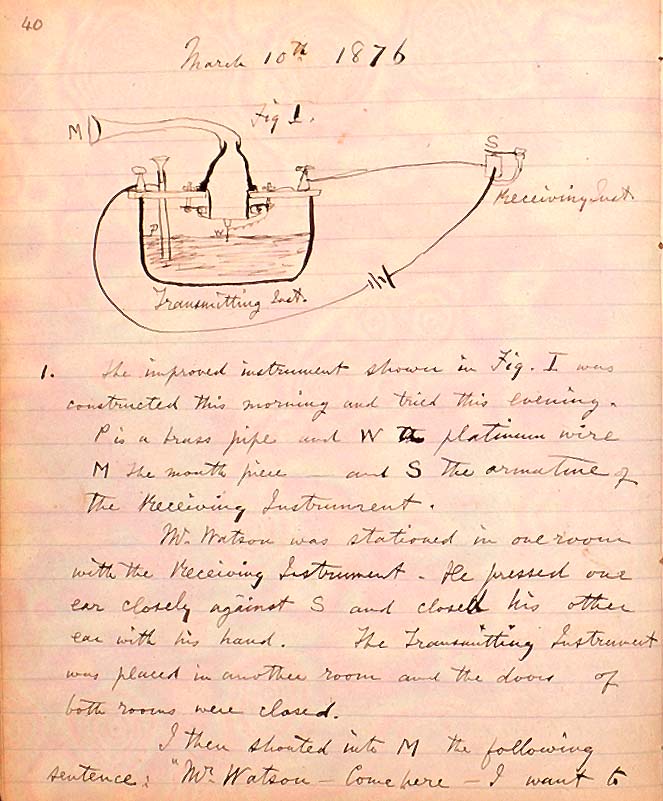
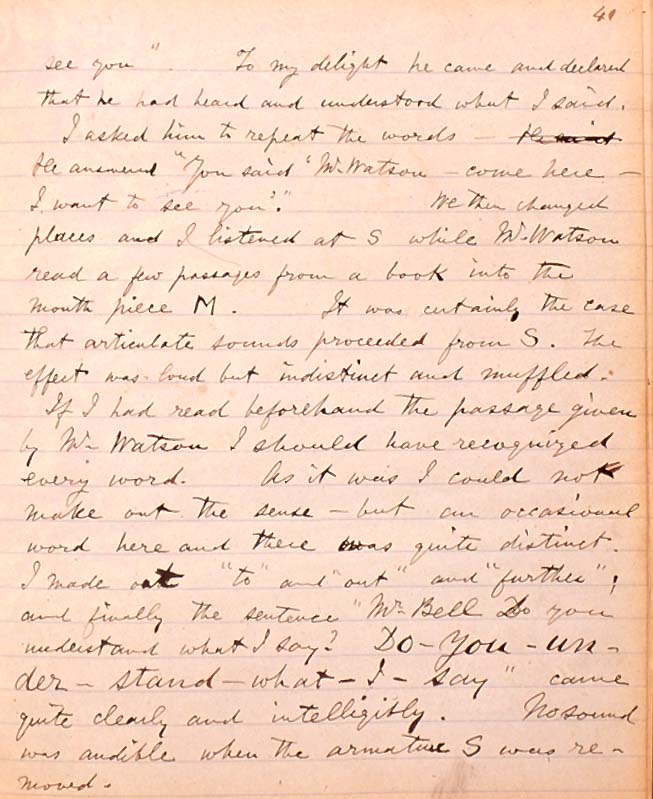
Today in history: "To my delight he came and declared that he had heard and understood what I said."
On March 10, 1876 - the first speech was transmitted across a telephone wire.
All together now: "Mr. Watson, come here ..."
So if you make a phone call today (or - I should say - WHEN you make a phone call today) - take a second to think of Mr. Alexander Graham Bell.
I Googled the dude - and came across the relevant pages in his notebook for March 10, 1876. See them below - pretty damn cool.
January 16, 2006
The 1918 influenza epidemic. Millions dead. Whatever.
I have been reading The Great Influenza since basically mid-1977. At least it feels that way. The epidemic in 1918 is something that has always interested me - and the book began as research for another project I had been working on. I needed to know what it was like during the influenza epidemic. Well. I had no idea how MUCH of a good thing this book would be. The book is 350 pages and it feels like it is an 8-volume manifesto. It's interesting, don't get me wrong ... the best parts are the parts about the virus itself, and how the virus worked. I like all the scientists, too - racing to try to handle the 1918 epidemic.
Great stuff!
But ... God. It's just ... plodding along. Why so long? Why is it taking me so long to finish the damn thing? I can't quite put my finger on it. There's too much extraneous stuff included. I'm 200 pages in, and we're still only in September 1918. The epidemic hasn't even peaked yet. And I'm actually IMPATIENT by that. I think: "Come on, let's get to the death. Let's get to the mass graves. Come on now. Wrap it up, wrap it up."
I'm now at the point where literally my response to the whole book is: "Yeah. Okay. I GOT it. Millions dead. Whatever. I GOT IT. So????"
But I'll be damned if I'm gonna put it down now. I've already invested so much time in the damn thing.
I'm also reading Annie Proulx's 2 collections of Wyoming short stories now as well. I need to counter the boring stupid epidemic (millions dead. Whatever) with some fantastic prose, and great stories.
1918 influenza epidemic. What a big yawn.
January 4, 2006
Isaac Newton!!

There are a couple of books I've been working on for a while - they're the kinds of books it seems okay to just dip into, put down for a while, and pick back up again ... Some books aren't like that you know!
One of these books is the biography of Isaac Newton by James Gleick - sent to me by peteb. Thank you!!
What a fascinating man. I knew nothing about Newton the person - just knew his laws of motion, and the apple falling, and all that stuff that everybody knows. I know him because of the biographies I've read of Einstein and all the quantum physics shit I struggle through. Newton, of course, is a major player in all of that.
But here's some more about him from the biography:
Solitude was the essential part of his genius. As a youth he assimilated or rediscovered most of the mathematics known to humankind and then invented the calculus -- the machinery by which the modern world understands change and flow -- but kept this treasure to himself. He embraced his isolation through his productive years, devoting himself to the most secret of sciences, alchemy. He feared the light of exposure, shrank from criticism and controversy, and seldom published his work at all. Striving to decipher the riddles of the universe, he emulated the complex secrecy in which he saw them encoded. He stood aloof from other philosophers even after becoming a national icon -- Sir Isaac, Master of the Mint, President of the Royal Society, his likeness engraved on medals, his discoveries exalted in verse."I don't know what I may seem to the world," he said before he died, "but, as to myself, I seem to have been only like a boy playing on the sea-shore, and diverting myself in now and then finding a smoother pebble or a prettier shell than ordinary, whilst the great ocean of truth lay all undiscovered before me."
I don't know. Just makes me wanna cry, you know?
Einsten wrote:
Fortunate Newton, happy childhood of science! Nature to him was an open book. He stands before us strong, certain, and alone.
There are many things that do not knock me flat on my ass anymore ... no matter how amazing the fact of them ... they no longer have the power to stun me into total stillness.
There are many things that I am "over".
Isaac Newton ain't one of them.
December 4, 2005
Code makers and code breakers
I'm now reading The Code Book: The Science of Secrecy from Ancient Egypt to Quantum Cryptography. Thanks, Iain!
I literally knew NONE of this stuff, but it sounded very very interesting - and, just as I expected, an entire WORLD has been revealed to me. The world of trying to keep communications secret - and how codes have developed through the centuries. Different kinds of codes - from invisible ink to the Enigma machine ...
and also the race between the people who make up the codes - and the people devoted to breaking the codes.
Once a code is broken - it pretty much can no longer be used - so there is an entire industry of people (FASCINATING individuals - linguists, mathematicians, electronics wizards) devoted to creating a code that cannot be broken.
The entire Beale mystery was amazing. Never knew ANYTHING about ANY of this.
I love discovering an entire world, an entire industry - that I never knew existed. I love it - it's like a veil being lifted back on how a certain slice of our world works. It goes back to what I was expressing in this post. No one can ever know EVERYthing - but stuff like this makes me feel like I can get a bit closer, or ... a bit higher up in my perspective ... I love that. The world of international intrigue? Uhm, please: give me MORE.
I'm almost half-way through it - I'll post some excerpts when I'm done with the book.
Also - Francis Walsingham - I'd like to know more about him. Of course I have heard of him before, he's kind of a big deal (check out this awesome post of CW's) - but I would love to learn more.
I'm not a math person - so much of the math in the book is very difficult for me to comprehend. It's also - putting together puzzles - Singh goes into how certain codes are constructed, and he includes in the book multiple ciphers to be decoded (to any reader who feels up to the task). My brain doesn't really work that way - stuff like that always baffled me in school - I couldn't comprehend where to even begin. I had a hell of a time with word problems, for example. COULD NOT GET THEM. I was good at geometry, and that's about it. Algebra? Argh. Couldn't get it. So much of this stuff is intensely mysterious to me and I have nothing but the deepest admiration for those who can look at a coded text, and start to break it down, figuring out the message beneath. Amazing.
September 27, 2005
"The great live Squid, which, they say, few whale-ships ever beheld, and returned to their ports to tell of it."
Speaking of Moby Dick, check out these incredible images of a live giant squid.
Japanese scientists have taken the first photographs of one of the most mysterious creatures in the deep ocean -- the giant squid.Until now the only information about the behavior of the creatures which measure up to 18 meters (59 feet) in length has been based on dead or dying squid washed up on shore or captured in commercial fishing nets.
Check out those eerie photos.
The giant squid warrants an entire chapter in Moby-Dick
Now to Melville:
The Squid

In the distance, a great white mass lazily rose, and rising higher and higher, and disentangling itself from the azure, at last gleamed before our prow like a snow-slide, new slid from the hills. Thus glistening for a moment, as slowly it subsided, and sank. Then once more arose, and silently gleamed. It seemed not a whale; and yet is this Moby Dick? thought Daggoo. Again the phantom went down, but on re-appearing once more, with a stiletto-like cry that startled every man from his nod, the negro yelled out -- "There! there again! there she breaches! right ahead! The White Whale, the White Whale!"
Upon this, the seamen rushed to the yard-arms, as in swarmin-time the bees rush to the boughs. Bare-headed in the sultry sun, Ahab stood on the bowsprit, and with one hand pushed far behind in readiness to wave his orders to the helmsman, cast his eager glance in the direction indicated aloft by the outstretched motionless arm of Daggoo.
Whether the flitting attendance of the one still and solitary jet had gradually worked upon Ahab, so that he was now prepared to connect the ideas of mildness and repose with the first sight of the particular whale he pursued; however this was, or whether his eagerness betrayed him; whichever way it might have been, no sooner did he distinctly perceive the white mass, than with a quick intensity he instantly gave orders for lowering.
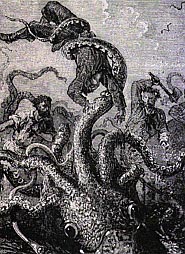
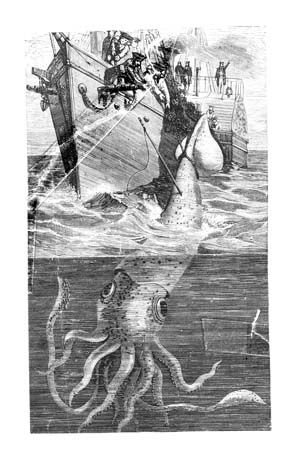
The four boats were soon on the water; Ahab's in advance, and all swiftly pulling towards their prey. Soon it went down, and while, with oars suspended, we were awaiting its reappearance, lo! in the same spot where it sank, once more it slowly rose. Almost forgetting for the moment all thoughts of Moby Dick, we now gazed at the most wondrous phenomenon which the secret seas have hitherto revealed to mankind. A vast pulpy mass, furlongs in length and breadth, of a glancing cream-color, lay floating on the water, innumerable long arms radiating from its centre, and curling and twisting like a nest of anacondas, as if blindly to clutch at any hapless object within reach. No perceptible face or front did it have; no conceivable token of either sensation or instinct; but undulated there on the billows an unearthly, formless, chance-like apparition of life.

As with a low sucking sound it slowly disappeared again, Starbuck still gazing at the agitated waters where it had sunk, with a wild voice exclaimed -- "Almost rather had I seen Moby Dick and fought him, than to have seen thee, thou white ghost!"
"What was it, Sir?" said Flask.
"The great live Squid, which, they say, few whale-ships ever beheld, and returned to their ports to tell of it."
But Ahab said nothing; turning his boat, he sailed back to the vessel; the rest as silently following.
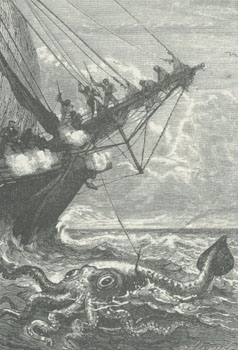
Whatever superstitions the Sperm Whalemen in general have connected with the sight of this object, certain it is, that a glimpse of it being so very unusual, that circumstance has gone far to invest it with portentousness. So rarely is it beheld, that though one and all of them declare it to be the largest animated thing in the ocean, yet very few of them have any but the most vague idea concerning its true nature and form; notwithstanding, they believe it to furnish the Sperm Whale his only food. For though other species of whales find their food above water, and may be seen by man in the act of feeding, the spermaceti whale obtains his whole food in unknown zones below the surface; and only by inference is it that any one can tell of what, precisely, that food consists. At times, when closely pursued, he will disgorge what are supposed to be the detached arms of the Squid; some of them thus exhibited exceeding twenty and thirty feet in length. They fancy that the monster to which these arms belonged ordinarily clings by them to the bed of the ocean; and that the Sperm Whale, unlike other species, is supplied with teeth in order to attack and tear it.
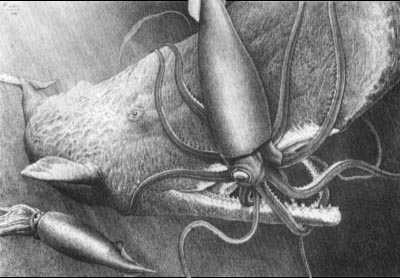
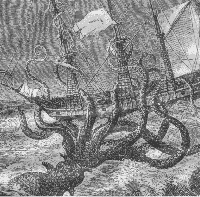
There seems some ground to imagine that the great Kraken of Bishop Pontoppodan may ultimately resolve itself into Squid. The manner in which the Bishop describes it, as alternately rising and sinking; with some other particulars he narrates, in all this the two correspond. But much abatement is necessary with respect to the incredible bulk he assigns it.
By some naturalists who have vaguely heard rumors of the mysterious creature, here spoken of, it is included among the class of cuttle-fish, to which, indeed, in certain external respects it would seem to belong, but only as the Anak of the tribe.
July 13, 2005
Stars and moons ...
When a comet is exploded by NASA ... say, by the Deep Impact Probe, for example ... there are many important issues to consider. We can't even begin to ponder the ramifications of such an event. It raises many questions, and hopefully deepens our understanding of space.
But the REALLY important thing to consider is:
HOW WILL IT AFFECT ASTROLOGERS????
One astrologer is pissed, and she's not afraid to let NASA know. Her horoscope has been "deformed". She has experienced "moral sufferings" because of this.
I just love nutters like this woman.
(via Truly Bad Films)
May 12, 2005
Speaking of science and stuff
This photograph blows my mind.

In this photo released by NASA/JPL/Space Science Institute on Tuesday, May 10, 2005, a new moon, provisionally named S/2005 S1, within the Keeler gap in Saturn's rings, is shown in an image obtained with the Cassini spacecraft narrow-angle camera on May 2, 2005, at a distance of about 594,000 kilometers (369,000 miles) from Saturn. The moon measures four miles across and is about 85,000 miles from the center of Saturn. (AP Photo/NASA/JPL/Space Science Institute)
April 28, 2005
The Books: "The Discoverers: A History of Man's Search to Know His World and Himself" (Daniel J. Boorstin)
Next book in my daily book excerpt from the science and philosophy shelf:
 An excerpt from the MASSIVE book by Daniel Boorstin The Discoverers
This excerpt comes from the first chapter, which discusses human beings and time - how different cultures have figured out time, and the calendar, in different eras. It's amazing stuff, I tell ya!
EXCERPT FROM The Discoverers
Many of the early Christians, following their own literal interpretation of the Bible, fixed the death of Jesus on a Friday, and the Easter resurrection on the following Sunday. But if the anniversary of the festival was to follow the Jewish lunar calendar, there was no assurance that Easter would occur on a Sunday. The bitter quarrel over the calendar led to one of the earliest schisms between the Eastern Orthodox Church and the Church of Rome. The Eastern Christians, holding to the lunar calendar, continued to observe Easter on the fourteenth day of the lunar month, regardless of the day of the week. At the very first ecumenical (worldwide) council of the Christian Church, held at Nicaea in Asia Minor in 325, one of the world-unifying questions to be decided was the date of Easter. A uniform date was fixed in such a way as both to stay with the traditional lunar calendar and to assure that Easter would always be observed on Sunday.
But this did not quite settle the matter. For community planning someone still had to predict the phases of the moon and locate them on a solar calendar. The Council of Nicaea had left this task to the bishop of Alexandria. In the ancient center of astronomy he was to forecast the phases of the moon for all future years. Disagreement over how to predict those specified cycles led to a division in the Church, with the result that different parts of the world continued to observe Easter on different Sundays.
The reform of the calendar by Pope Gregory XIII was needed because the year that Julius Caeser had borrowed from the Egyptians, and which had ruled Western civilization since then, was not a precise enough measure of the solar cycle. The actual solar year -- the time required for the earth to complete an orbit around the sun -- is 365 days, 5 hours, 48 minutes, and 46 seconds. This was some 11 minutes and 14 seconds less than the 365 1/4 days in the Egyptian year. As a result, dates on the calendar gradually lost their intended relation to solar events and to the seasons. The crucial date, the vernal equinox, from which Easter was calculated, had been fixed by the First Council of Nicaea at March 21. But the accumulating inaccuracy of the Julian calendar meant that by 1582 the vernal equinox was actually occurring on March 11.
Pope Gregory XIII, though notorious now for this public Thanksgiving for the brutal massacre of Protestants in Paris on Saint Bartholomew's Day (1572), was in some matters an energetic reformer. He determined to set the calendar straight. Climaxing a movement for calendar reform which had been developing for at least a century, in 1582 Pope Gregory ordained that October 4 was to be followed by October 15. This meant, too, that in the next year the vernal equinox would occur, as the solar calendar of seasons required, on March 21. In this way the seasonal year was restored to what it had been in 325. The leap years of the old Julian calendar were readjusted. To prevent the accumulationi of another 11-minute-a-year discrepancy, the Gregorian calendar omitted the leap day from years ending in hundreds, unless they were divisible by 400. This produced the modern calendar by which the West still lives.
April 27, 2005
The Books: "Galileo's Daughter: A Historical Memoir of Science, Faith, and Love" (Dava Sobel)
Next book in my science and philosophy shelf:
 Another book by Dava Sobel - this one called Galileo's Daughter: A Historical Memoir of Science, Faith, and Love
It's a really interesting book.
EXCERPT FROM Galileo's Daughter: A Historical Memoir of Science, Faith, and Love
Galileo's daughter, born of his long illicit liaison with the beautiful Marina Gamba of Venice, entered the world in the summer heat of a new century, on August 13, 1600 -- the same year the Dominican friar Giordano Bruno was burned at the stake in Rome for insisting, among his many heresies and blasphemies, that the Earth traveled around the Sun, instead of remaining motionless at the center of the universe. In a world that did not yet know its place, Galileo would engage this same cosmic conflict with the Church, trading a dangerous path between the Heaven he revered as a good Catholic and the heavens he revealed through his telescope.
Galileo christened his daughter Virginia, in honor of his "cherished sister". But because he never married Virginia's mother, he deemed the girl herself unmarriageable. Soon after her thirteenth birthday, he placed her at the Convent of San Matteo in Arcetri, where she lived out her life in poverty and seclusion.
Virginia adopted the name Maria Celeste when she became a nun, in a gesture that acknowledged her father's fascination with the stars. Even after she professed a life of prayer and penance, she remained devoted to Galileo as though to a patron saint. The doting concern evident in her condolence letter [on the occasion of Galileo's sister's death] was only to intensify over the ensuing decade as her father grew old, fell more frequently ill, pursued his singular research nevertheless, and published a book that brought him to trial by the Holy Office of the Inquisition...
Thus Suor Maria Celeste consoled Galileo for being left alone in his world, with daughters cloistered in the separate world of nuns, his son not yet a man, his former mistress dead, his family of origin all deceased or dispersed.
Galileo, now fifty-nine, also stood boldly alone in his worldview, as Suor Maria Celeste knew from reading the books he wrote and the letters he shared with her from colleagues and critics all over Italy, as well as from across the continent beyond the Alps. Although her father had started his career as a professor of mathematics, teaching first at Pisa and then at Padua, every philosopher in Europe tied Galileo's name to the most startling series of astronomical discoveries ever claimed by a single individual.
In 1609, when Suor Maria Celeste was still a child in Padua, Galileo had set a telescope in the garden behind his house and turned it skyward. Never-before-seen stars leaped out of the darkness to enhance familiar constellations; the nebulous Milky Way resolved into a swath of densely packed stars; mountains and valleys pockmarked the storied perfection of the Moon; and a retinue of four attendance bodies traveled regularly around Jupiter like a planetary system in miniature.
"I render infinite thanks to God," Galileo intoned after those nights of wonder, "for being so kind as to make me alone the first observer of marvels kept hidden in obscurity for all previous centuries."
The newfound worlds transformed Galileo's life. He won appointment as chief mathematician and philosopher to the grand duke in 1610, and moved to Florence to assume his position at the court of Cosimo de Medici. He took along wtih him his two daughters, then ten and nine years old, but he left Vincenzio, who was only four when greatness descended on the family, to live a while longer in Padua with Marina.
Galileo found himself lionized as another Columbus for his conquests. Even as he attained the height of his glory, however, he attracted enmity and suspicion. For instead of opening a distant land dominated by heathens, Galileo trespassed on holy ground. Hardly had his first spate of findings stunned the populace of Europe before a new wave followed: He saw dark spots creeping continuously across the face of the Sun, and "the mother of loves," as he called the planet Venus, cycling through phases from full to crescent, just as the Moon did.
All his observations lent credence to the unpopular Sun-centered universe of Nicolaus Copernicus, which had been introduced over half a century previously, but foundered on lack of evidence. Galileo's efforst provided the beginning of a proof. And his flamboyant style of promulgating his ideas -- sometimes in bawdy humorous writings, sometimes loudly at dinner parties and staged debates -- transported the new astronomy from the Latin Quarters of the universities into the public arena. In 1616, a pope and a cardinal inquisitor reprimanded Galileo, warning him to curtail his forays into the supernal realms. The motions of the heavenly bodies, they said, having been touched upon in the Psalms, the Book of Joshua, and elsewhere in the Bible, were matters best left to the Holy Fathers of the Church.
Galileo obeyed their orders, silencing himself on the subject. For seven cautious years he turned his efforts to less perilous pursuits, such as harnessing his Jovian satellites in the service of navigation, to help sailors discover their longitude at sea. He studied poetry and wrote literary criticism. Modifying his telescope, he developed a compound microscope. "I have observed many tiny animals with great admiration," he reported, "among which the flea is quite horrible, the gnat and the moth very beautiful; and with great satisfaction I have seen how flies and other little animals can walk attached to mirrors, upside down."
April 26, 2005
The Books: "Longitude: The True Story of a Lone Genius Who Solved the Greatest Scientific Problem of His Time"(Dava Sobel)
Next book on the science and philosophy bookshelf:
 Dava Sobel's wonderful Longitude: The True Story of a Lone Genius Who Solved the Greatest Scientific Problem of His Time
Along comes a man named John Harrison, who devoted his life to solving the longitude problem. And - like so many other stories of genius - John Harrison was not a scientist, or an astronomer - he had no formal education, he wasn't a Newton or a Galileo. He was a clockmaker. And he also had what it took, in terms of intellectual endurance ... to keep trying, to keep experimenting, until he got it right. It's so so inspiring what he did.
If you haven't read this book, I highly recommend it. Harrison ended up making a series of time-pieces - called H1, H2, H3 ... With each one, he got closer and closer to perfection. H4 is the timepiece that won the prize. H1, H2, and H3 were all heavy, large - After all, these timepieces would need to withstand a storm at sea, would need to keep time steadily throughout the massive up and down motion of the ocean at such times. But H4 is a small and simple pocketwatch. Here is what it looks like.
Here's an excerpt:
EXCERPT FROM Longitude: The True Story of a Lone Genius Who Solved the Greatest Scientific Problem of His Time
The active quest for a solution to the problem of longitude persisted over four centuries and across the whole continent of Europe. Most crowned heads of state eventually played a part in the longitude story, notably King George III of England and King Louis XIV of France. Seafaring men such as Captain William Bligh of the Bounty and the great circumnavigator Captain James Cook, who made three long voyages of exploration and experimentation before his violent death in Hawaii, took the more promising methods to sea to test their accuracy and practicability.
Renowned astronomers approached the longitude challenge by appealing to the clockwork universe: Gallileo Galilei, Jean Dominique Cassini, Christiaan Huygens, Sir Isaac Newton, and Edmond Halley, of comet fame, all entreated the moon and stars for help. Palatial observatories were founded at Paris, London, and Berlin, for the express purpose of determining longitude by the heavens. Meanwhile, lesser minds devised schemes that depended on the yelps of wounded dogs, or the cannon blasts of signal ships strategically anchored -- somehow -- on the open ocean.
In the course of their struggle to find longitude, scientists struck upon other discoveries that changed their view of the universe. These include the first accurate determinations of the weight of the Earth, the distance to the stars, and the speed of light.
As time passed and no method proved successful, the search for a solution to the longitude problem assumed legendary proportions, on a par with discovering the Fountain of Youth, the secret of perpetual motion, or the formula for transforming lead into gold. The governments of the great maritime nations -- including Spain, the Netherlands, and certain city-states of Italy -- periodically roiled the fervor by offering jackpot purses for a workable method. The British Parliament, in its famed Longitude Act of 1714, set the highest bounty of all, naming a prize equal to a king's ransom (several million dollars in today's currency) for a "Practicable and Useful" means of determining longitude.
English clockmaker John Harrison, a mechanical genius who pioneered the science of portable precision timekeeping, devoted his life to this quest. He accomplished what Newton had feared was impossible: He invented a clock that would carry the true time for the home port, like an eternal flame, to any remote corner of the world.
Harrison, a man of simple birth and high intelligence, crossed swords with the leading lights of his day. He made a special enemy of the Reverent Nevil Maskelyne, the fifth astronomer royal, who contested his claim to the coveted prize money, and whose tactics at certain junctures can only be described as foul play.
With no formal education or apprenticeship to any watchmaker, Harrison nevertheless constructed a series of virtually friction-free clocks that required no lubrication and no cleaning, that were made from materials impervious to rust, and that kept their moving parts perfectly balanced in relation to one another, regardless of how the world pitched or tossed about them. He did away with the pendulum, and he combined different metals inside his works in such a way that when one component expanded or contracted with changes in temperature, the other counteracted the change and kept the clock's rate constant.
His every success, however, was parried by members of the scientific elite, who distrusted Harrison's magic box. The commissioners charged with awarding the longitude prize -- Nevil Maskelyne among them -- changed the contest rules whenever they saw fit, so as to favor the chances of astronomers over the likes of Harrison and his fellow "mechanics". But the utility and accuracy of Harrison's approach triumphed in the end. His followers shepherded Harrison's intricate, exquisite invention through the design modifications that enabled it to be mass produced and enjoy wide use.
An aged, exhausted Harrison, taken under the wing of King George III, ultimately claimed his rightful monetary reward in 1773 -- after forty struggling years of political intrigue, international warfare, academic backbiting, scientific revolution, and economic upheaval.
All these threads, and more, entwine in the lines of longitude. To unravel them now -- to retrace their story in an age when a network of orbiting satellites can nail down a ship's position within a few feet in just a moment or two -- is to see the globe anew.
April 25, 2005
The Books: "In Search of Schrodinger's Cat: Quantum Physics and Reality" (John Gribbin)
Next book on the science and philosophy shelf:
 The beautiful little physics book In Search of Schrödinger's Cat: Quantum Physics and Reality
"The only existing things are atoms and empty space; all else is mere opinion."
a lone voice crying in the wilderness ...
"At first, I was deeply alarmed."
So here's yet another excerpt from this book: This one has to do with alternative realities, and time travel.
EXCERPT FROM In Search of Schrödinger's Cat: Quantum Physics and Reality
Cosmologists today talk quite happily about events that occurred just after the universe was born in a Big Bang, and they calculate the reactions that occurred when the age of the universe was 10-35 seconds or less. The reactions involve a maelstrom of particles and radiation, pair production and annihilation. The assumptions about how these reactions take place come from a mixture of theory and the observations of the way particles interact in giant accelerators, like the one run by CERN in Geneva. According to these calculations, the laws of physics determined from our puny experiments here on earth can explain in a logical and self-consistent fashion how the universe got from a state of almost infinite density into the state we see it in today. The theories even make a stab at predicting the balance between matter and antimatter in the universe, and between matter and radiation. Everyone interested in science, however mild and passing their interest, has heard of the Big Bang theory origin of the universe. Theorists happily play with numbers describing events that allegedly occurred during split seconds some 15 thousand million years ago. But who today stops to think what these ideas really mean? It is absolutely mind-blowing to attempt to understand the implications of these ideas. Who can appreciate what a number like 10-35 of a second really means, let alone comprehend the nature of the universe when it was 10-35 seconds old? Scientists who deal with such bizarre extremees of nature really should not find it too difficult to stretch their minds to accommodate the concept of parallel worlds.
In face, that felicitous-sounding expression, borrowed from science fiction, is quite inappropriate. The natural image of alternative realities is as alternative branches fanning out from a main stem and running alongside one another through superspace, like the branching lines of a complex railway junction. Like some super-superhighway, with millions of parallel lines, the SF writers imagine all the worlds proceeding side by side through time, our near neighbors almost identical to our own world, but with the differences becoming clearer and more distinct the further we move "sideways in time". This is the image that leads naturally to speculation about the possibility of changing lanes on the superhighway, slipping across into the world next door. Unfortunately, the math isn't quite like this neat picture.
Mathematicians have no trouble handling more dimensions than the familiar three space dimensions so important to our everday lives. The whole of our world, one branch of Everett's many-worlds reality, is described mathematically in four dimensions, three of space and one of time, all at right angles to one another, and the math to describe more dimensions all at right angles to each other and to our own four is routine number juggling. This is where the alternative realities actually lie, not parallel to our own world, but at right angles to it, perpendicular worlds branching off "sideways" through superspace. The pciture is hard to visualize, but it does make it easier to see why slipping sideways into an alternative reality is impossible. If you set off at right angles to our world -- sideways -- you would be creating a new world of your own. Indeed, on the many-worlds theory this is what happens every time the universe is faced with a quantum choice. The only way you could gete in to one of the alternative realities created by such a splitting of the universe as a result of a cat-in-the-box experiment, or a two-holes experiment, would be to go back in time in our own four-dimensional reality to the time of the experiment, and then to go forward in time along the alternative branch, at right angles to our own four-dimensional world.
This might be impossible. Conventional wisdom has it that true time travel must be impossible, because of the paradoxes involved, like the one where you go back in time and kill your own grandfather before your own father has been conceived. On the other hand, at the quantum level particles seem to be involved in time travel all the "time," and Frank Tipler has shown that the equations of general relativity permit time travel. It is possible to conceive of a kind of genuine travel forward and backward in time that does not permit paradoxes, and such a form of time travel depends on the reality of alternative universes. David Gerrold explored these possibilities in an entertaining SF book The Man Who Folded Himself, well worth reading as a guide to the complexities and subtleties of a many-worlds reality. The point is that, taking the classic example, if you back in time and kill your grandfather you are creating, or entering (depending on your point of view) an alternative world branching off at right angles to the world in which you started. In that "new" reality, your father, and yourself, are never born, but there is no paradox because you are still born in the "original" reality, and make the journey back through time and into an alternative branch. Go back again to undo the mischief you have done, and all you do is reenter the original branch of reality, or at least one rather like it.
April 24, 2005
The Books: "Fermat's Enigma: The Epic Quest to Solive the World's Greatest Mathematical Problem" (Simon Singh)
Next book on the science and philosophy shelf:
 A book about 17th century French mathematician Pierre de Fermat and his last theorem. Proving this last theorem turned out to be no easy feat, and mathematicians tried, for 350 years. It has been called "the Holy Grail of mathematics". Obviously, I'm pulling this book down from my "Math and Science for People who Love Math and Science but Don't Understand the Actual Math and Science" shelf. One of my favorite shelves! The book is by Simon Singh and it's called Fermat's Enigma: The Epic Quest to Solve the World's Greatest Mathematical Problem
The book mostly details the mathematicians throughout history who have struggled to find a proof for Fermat's Last Theorem. But the following excerpt is about Fermat, and his "enigma":
EXCERPT FROM Fermat's Enigma: The Epic Quest to Solve the World's Greatest Mathematical Problem
One of Fermat's discoveries concerned the so-called friendly numbers, or amicable numbers, closely related to the perfect numbers that had fascinated Pythagoras two thousand years earlier. Friendly numbers are pairs of numbers such that each number is the sum of the divisors of the other number. The Pythagoreans made the extraordinary discovery that 220 and 284 are friendly numbers. The divisors of 220 are 1, 2, 4, 5, 10, 11, 20, 22, 44, 55, 110, and the sum of all these is 284. On the other hand, the divisors of 284 are 1, 2, 4, 71, 142, and the sum of all these is 220.
The pair 220 and 284 was said to be symbolic of friendship. Martin Gardner's book Mathematical Magic Show tells of talismans sold in the Middle Ages that were inscribed with these numbers on the grounds that wearing the charms would promote love. An Arab numerologist documents the practice of carving 220 on one fruit and 284 on another, and then eating the first one and offering the second one to a lover as a form of mathematical aphrodisiac. Early theologians noted that in Genesis Jacob gave 220 goats to Esau. They believed that the number of goats, one half of a friendly pair, was an expression of Jacob's love for Esau.
No other friendly numbers were identified until 1636, when Fermat discovered the pair 17,296 and 18,416. Although not a profound discovery, it demonstrates Fermat's familiarity with numbers and his love of playing with them. Fermat started a fad for finding friendly numbers; Descartes discovered a thir pair (9,363,584 and 9,437,056), and Leonhard Euler went on to list sixty-two amicable pairs. Curiously they had all overlooked a much smaller pair of friendly numbers. In 1866 a sixteen-year-old Italian, Nicolo Paganini, discovered the pair 1,184 and 1,210.
During the twentieth century mathematicians have extended the idea further and have searched for so-called "sociable numbers", three or more numbers that form a closed loop. For example, in this loop of five numbers (12,496; 14,288; 15,472; 14,536; 14,264) the divisors of the first number add up to the second, the divisors of the second add up to the third, the divisors of the third add up to the fourth, the divisors of the fourth add up to the fifth, and the divisors of the fifth add up to the first. [Note from Sheila: Cool!!!]
Although discovering a new pair of friendly numbers made Fermat something of a celebrity, his reputation was truly confirmed thanks to a series of mathematical challenges. For example, Fermat noticed that 26 is sandwiched between 25 and 17, one of which is a square number (25 = 52 = 5 x 5) and the other is a cube number (27 = 33 = 3 x 3 x 3). He searcherd for other numbers sandwiched between a square and a cube but failed to find any, and suspected that 26 might be unique. After days of strenuous effort he managed to construct an elaborate argument that proved without any doubt that 26 is indeed the only number between a square and a cube. His step-by-step logical proof established that no other numbers could fulfill this criterion.
Fermat announced this unique property of 26 to the mathematical community, and then challenged them to prove that this was the case. He openly admitted that he himself had a proof; the question was, however, did others have the ingenuity to match it? Despite the simplicity of the claim the proof is fiendishly complicated, and Fermat took particular delight in taunting the English mathematicians Wallis and Digby, who eventually had to admit defeat. UYltimately Fermat's greatest claim to fame would turn out to be another challenge to the rest of the world. However, it would be an accidental riddle that was never intended for public discussion.
While studying Book II of the Arithmetica Fermat came upon a whole series of observations, problems, and solutions that concerned Pythagoras's theorem and Pythagorean triples. Fermat was struck by the variety and sheer quantity of Pythagorean triples. He was aware that centuries earlier Euclid had stated a proof which demonstrated that, in fact, there are an infinite number of Pythagorean triples. Fermat must have gazed at Diophantus's detailed exposition of Pythagorean triples and wondered what there was to add to the subject. As he stared at the page he began to play with Pythagoras's equation, trying to discovere something that had evaded the Greeks.
Suddenly, in a moment of genius that would immortalize the Prince of Amateurs, he created an equation that, though very similar to Pythagoras's equation, had no solutions at all...
Instead of considering the equation
x2 + y2 = z2,
Fermat was contemplating a variant of Pythagoras's creation:
x3 + y3 = z3.
As mentioned in the last chapter, Fermat had merely changed the power from 2 to 3, the square to a cube, but his new equation apparently had no whole number solutions whatsoever. Trial and error soon shows the difficulty of finding two cubed numbers that add together to make another cubed number. Could it really be the case that this minor modification turns Pythagoras's equation, one with an infinite number of solutions, into an equation with no solutions?
He altered the equation further by changing the power to numbers bigger than 3, and discovered that finding a solution to each of these equations was equally difficult. According to Fermat there appeared to be no three numbers that would perfectly fit the equation
xn + yn = zn where n represents 3,4,5...
In the margin of his Arithmetica, next to Problem 8, he made a note of his observation:
Cubem autem in duos cubos, aut quadratoquadratum in duos quadratoquadratos, et generaliter nullam in infinitum ultra quadratum potestatem in duos eiusdem nominis fas est dividere.It is impossible for a cube to be written as a sum of two cubes or a fourth power to be written as the sum of two fourth powers or, in general, for any number which is a greater power than the second to be written as a sum of two like powers.
Among all the possible numbers there seemed to be no reason why at least one set of solutions could not be found, yet Fermat stated that nowhere in the infinite universe of numbers was there a "Fermatean triple". It was an extraordinary claim, but one that Fermat believed he could prove. After the first marginal note outlining the theory, the mischievous genius jotted down an additional comment that would haunt generations of mathematicians:
Cuius rei demonstrationem mirabilem sane detexi hanc marginis exiguitas non caperet.I have a truly marvelous demonstration of this proposition which this margin is too narrow to contain.
This was Fermat at his most infuriating. His own words suggest that he was particularly pleased with this "truly marvelous" proof, but he had no intention of bothering to write out the detail of the argument, never mind publishing it. He never told anyone about his proof, and yet, despite the combination of indolence and modesty, Fermat's Last Theorem, as it would later be called, would become famous around the world for centuries to come.
April 23, 2005
The Books: "Zero: The Biography of a Dangerous Idea" (Charles Seife)
Next book in my science and philosophy section:
 A book about the history of the number zero. It is called Zero: The Biography of a Dangerous Idea
Who knew that the number zero could be so eternally controversial?
This book tells the story. And this excerpt deals with the Egyptians, the solar vs. lunar calendar, geometry, and the number zero.
EXCERPT FROM Zero: The Biography of a Dangerous Idea
Though counting abilities were rare in the ancient world, numbers and the fundamentals of counting always developed before writing and reading. When early civilizations started pressing reeds to clay tablets, carving figures in stone, and daubing ink on parchment and on papyrus, number systems had already been well-established. Transcribing the oral number system into written form was a simple task: people just needed to figure out a coding method whereby scribes could set the numbers down in a more permanent form. (Some societies even found a way to do this before they discovered writing. The illiterate Incas, for one, used the quipu, a string of colored, knotted cords, to record calculations.)
The first scribes wrote down numbers in a way that matched their base system, and predictably, did it in the most concise way they could think of. Society had progressed since the time of Gog. Instead of making little groups of marks over and over, the scribes created symbols for each type of grouping; in a quinary system, a scribe might make a certain mark for one, a different symbol for a group of five, yet another mark for a group of 25, and so forth.
The Egyptians did just that. More than 5,000 years ago, before the time of the pyramids, the ancient Egyptians designed a system for transcribing their decimal system, where pictures stood for numbers. A single vertical mark represented a unit, while a heel bone represented 10, a swirly snare stood for 100, and so on. To write down a number with this scheme, all an Egyptian scribe had to do was record groups of these symbols. Instead of having to write down 123 tick marks to denote the number "one hundred and twenty-three", the scribe wrote six symbols: one snare, two heels, and three vertical marks. It was the typical way of doing mathematics in antiquity. And like most other civilizations Egypt did not have -- or need -- a zero.
Yet the ancient Egyptians were quite sophisticated mathematicians. They were master astronomers and timekeepers, which meant that they had to use advanced math, thanks to the wandering nature of the calendar.
Creating a stable calendar was a problem for most ancient peoples, because they generally started out with a lunar calendar: the length of a month was the time between successive full moons. It was a natural choice; the waxing and waning of the moon in the heavens was hard to overlook, and it offered a convenient way of marking periodic cycles of time. But the lunar month is between 29 and 30 days long. No matter how you arrange it, 12 lunar months only add up to about 354 days -- roughly 11 short of the solar year's length. Thirteen lunar months yield roughly 19 days too many. Since it is the solar year, not the lunar year, that determines the time for harvest and planting, the seasons seem to drift when you reckon by an uncorrected lunar year.
Correcting the lunar calendar is a complicated undertaking. A number of modern-day nations, like Israel and Saudi Arabia, still use a modified lunar calendar, but 6,000 years ago the Egyptians came up with a better system. Their method was a much simpler way of keeping track of the passage of the days, producing a calendar that styaed in sync with the seasons for many years. Instead of using the moon to keep track of the passage of time, the Egyptians used the sun, just as most nations do today...
The Egyptians' innovation of the solar calendar was a breakthrough, but they made an even more important mark on history: the invention of the art of geometry. Even without a zero, the Egyptians had quickly become masters of mathematics. They had to, thanks to an angry river. Every year the Nile would overflow its banks and flood the delta. The good news was that the flooding deposited rich, alluvial silt all over the fields, making the Nile delta the richest farmland in the ancient world. The bad news was that the river destroyed many of the boundary markers, erasing all of the landmarks that told farmers which land was theirs to cultivate. (The Egyptians took property rights very seriously. In the Egyptian Book of the Dead, a newly deceased person must swear to the gods that he hasn't cheated his neighbor by stealing his land. It was a sin punishable by having his heart fed to a horrible beast called the devourer. In Egypt, filching your neighbor's land was considered as grave an offense as breaking an oath, murdering somebody, or masturbating in a temple.)
The ancient pharaohs assigned surveyors to assess the damage and reset the boundary markers, and thus geometry was born. These surveyors, or rope stretchers (named for their measuring devices and knotted ropes designed to mark right angles), eventually learned to determine the areas of plots of land by dividing them into rectangles and triangles. The Egyptians also learned how to measure the volumes of objects -- like pyramids. Egyptian mathematics was famed throughout the Mediterranean, and it is likely that the early Greek mathematicians, masters of geometry like Thales and Pythagoras, studied in Egypt. Yet despite the Egyptians' brilliant geometric work, zero was nowhere to be found within Egypt.
This was, in part, because the Egyptians were of a practical bent. They never progressed beyond measuring volumes and counting days and hours. Mathematics wasn't used for anything impractical, except their system of astrology. As a result, their best mathematicians were unable to use the principles of geometry for anything unrelated to real world problems -- they did not take their system of mathematics and turn it into an abstract system of logic. They were also not inclined to put math into their philosophy. The Greeks were different; they embraced the abstract and the philosophical, and brought mathematics to its highest point in ancient times. Yet it was not the Greeks who discovered zero. Zero came from the East, not the West.
April 22, 2005
The Books: "Driving Mr. Albert: A trip across America with Einstein's brain" (Michael Paterniti)
Next book in my science and philosophy books section:
 Another book about Einstein - this one is called Driving Mr. Albert: A Trip Across America with Einstein's Brain
Anyway, here's the excerpt - Enjoy:
EXCERPT FROM Driving Mr. Albert: A Trip Across America with Einstein's Brain
A confession: I want Harvey to sleep. I want him to fall into a deep, blurry, Rip Van Winkle daze, and I want to park the Skylark mother-ship and walk around to the trunk and open it. I want Harvey snoring loudly as I unzip the duffel bag and reach my hands inside, and I want to -- what? -- touch Einstein's brain. I want to touch the brain. Yes, I've admitted it. I want to hold it, coddle it, measure its weight in my palm, handle some of its one hundred billion now-dormant neurons. Does it feel like tofu, sea urchin, bologna? What, exactly? And what does such a desire make me? One of the legion of relic freaks? Or something worse?
The more the idea persists in my head, the more towns slip past outside the window as Harvey gazes into the distant living rooms of happy families, the more I wonder what, in fact, I'd be holding if I held the brain. I mean, it's not really Einstein and it's not really a brain, but disconnected pieces of a brain, just as the passing farms are not really America but parts of a whole, symbols of the thing itself, which is everything and nothing at once.
Still, I'd be touching Einstein the Superstar, immediately recognizable by the electrocuted hair and those mournful mirthful eyes. The man whose American apotheosis is so complete that he's now a coffee mug, a postcard, a T-shirt. A figure of speech, an ad pitchman, a bumper sticker ("I'm hung like Einstein," reads one that I spy on the back of some ironic VW Jetta, "and I'm smart as a horse.") Despite the fact that he was a sixty-one-year-old man when he was naturalized as an American citizen, it's amazing how fully he's been appropriated by this country.
But why? I think the answer is that, more so than anyone else in the last one hundred years, Einstein was not exactly one of us. Even now, he comes back again as both Lear's fool and Tiresias, comically offering his uncanny vision of the future while warning us about the lurking violence of humankind. "I do not know how the third world war will be fought," he is said to have cautioned, "but I do know how the fourth will: with sticks and stones." Because he glimpsed into the workings of the universe and saw an impersonal God -- what he called an "invisible piper" -- and because he greeted the twentieth century by rocketing into the twenty-first with his breakthrough tehories, he assumed a mien of invincibility. And because his sloppy demeanor stood in such stark contrast to what we expect from a white-winged prophet, he seemed both innocent and trustworthy, and thus that much more supernatural.
If we've incorporated the theory of relativity into our scientific view of the universe, as well as our literature, art, music, and culture at large, it's the great scientist's attempt to devise a kind of personal religion -- an intimate spiritual and political manifesto -- that still stands in stark, almost sacred contrast to the Pecksniffian systems of salvation offered by modern society. Einstein's blending of twentieth-century skepticism with nineteenth-century romanticism offers a different kind of hope.
"I am a deeply religious nonbeliever," he said. "This is a somewhat new kind of religion." Pushing further, he sought to marry science and religion by redefining their terms. "I am of the opinion that all the finer speculations in the realm of science spring from a deep religious feeling," he said. "I also believe that this kind of religiousness ... is the only creative religious activity of our time."
To touch Einstein's brain, then, would be to ride a ray of light, as Einstein once dreamed it as a child. To clasp time itself. To feel the warp and wobble of the universe. Einstein claimed that the happiest thought of his life came to him in 1907, during his seven-year tenure at the Patent Office in Bern, when he was twenty-eight and still couldn't find a teaching job. Up to his ears in a worsted-wool suit and patent applications, a voice in his mind whispered, "If a person falls freely, he won't feel his own weight." That became the general theory of relativity. His life and ideas continue to fill thousands of books; even today, scientists are still verifying his work. Recently, a NASA satellite took millions of measurements in space that proved a uniform distribution of primordial temperatures just above absolute zero; that is, the data proved that the universe was in a kind of postcoital afterglow from the big bang, further confirming Einstein's explanation for how the universe began.
It would be good to touch that.
April 21, 2005
The Books: "Einstein's Dreams" (Alan Lightman)
Next book in my science and philosophy books section:
 Einstein's Dreams
Here is one of the patent clerk's dreams:
EXCERPT FROM Einstein's Dreams
11 June 1905
On the corner of Kramgasse and Theaterplatz there is a small outdoor cafe with six blue tables and a row of blue petunias in the chef's window box, and from this cafe one can see and hear the whole of Berne. People drift through the arcades on Kramgasse, talking and stopping to buy linen or wristwatches or cinnamon; a group of eight-year-old boys, let out for morning recess from the grammar scshool on Kochergasse, follow their teacher in single file through the streets to the banks of the Aare; smoke rises lazily from a mill just over the river; water gurgles from the spouts of the Zahringer Fountain; the giant clock tower on Kramgasse strikes the quarter hour.
If, for the moment, one ignores the sounds and the smells of the city, a remarkable sight will be seen. Two men at the corner of Kochergasse are trying to part but cannot, as if they would never see each other again. They say goodbye, start to walk in opposite directions, then hurry back together and embrace. Nearby, a middle-aged woman sits on the stone rim of a fountain, weeping quietly. She grips the stone with her yellow stained hands, grips it so hard that the blood rushes from her hands, and she stares in despair at the ground. Her loneliness has the permanence of a person who believes she will never see other people again. Two women in sweaters stroll down Kramgasse, arm in arm, laughing with such abandon that they could be thinking no thought of the future.
In fact, this is a world without future. In this world, time is a line that terminates at the present, both in reality and in the mind. In this world, no person can imagine the future. Imagine the future is no more possible than seeing colors beyond violet: the senses cannot conceive what may lie past the visible end of the spectrum. In a world without future, each parting of friends is a death. In a world without future, each laugh is the last laugh. In a world without future, beyond the present lies nothingness, and people cling to the present as if hanging from a cliff.
A person who cannot imagine the future is a person who cannot contemplate the results of his actions. Some are thus paralyzed into inaction. They lie in their beds through the die, wide awake but afraid to put on their clothes. They drink coffee and look at photographs. Others leap out of bed in the morning, unconcerned that each action leads into nothingness, unconcerned that they cannot plan out their lives. They live moment to moment, and each moment is full. Still others substitute the past for the future. They recount each memory, each action taken, each cause and effect, and are fascinated by how events have delivered them to this moment, the last moment of the world, the termination of the line that is time.
In the little cafe with the six outdoor tables and the row of petunias, a young man sits with his coffee and pastry. He has been idly observing the street. He has seen the two laughing women in sweaters, the middle-aged woman at the fountain, the two friends who keep repeating goodbyes. As he sits, a dark rain cloud makes its way over the city. But the young man remains at his table. He can imagine only the present, and at this moment the present is a blackening sky but no rain. As he sips the coffee and eats the pastry, he marvels at how the end of the world is so dark. Still there is no rain, and he squints at his paper in the dwindling light, trying to read the last sentence that he will read in his life. Then, rain. The young man goes inside, takes off his wet jacket, marvels at how the world ends in rain. He discusses food with the chef, but he is not waiting for the rain to stop because he is not waiting for anything. In a world without future, each moment is the end of the world. After twenty minutes, the storm cloud passes, the rain stops, and the sky brightens. The young man returns to his table, marvels that the world ends in sunshine.
April 6, 2005
Pi in the sky
A very interesting and fun piece about two mathematician brothers, Gregory and David Chudnovsky, who have devoted their lives to "pi". Originally published in the magazine in 1992, the piece is a peek into the lives of two interesting and obsessed people, brothers who built a supercomputer (named "m zero") which sits in the cramped Upper West Side apartment they share, calculating "pi" out to millions of numbers. (Richard Preston, author of the essay, writes: "The Chudnovsky brothers insist that they are functionally one mathematician who happens to occupy two human bodies.") The New Yorker unearthed the essay from their archives this week, and I knew I wanted to pass it on to anyone who is interested. I have this piece in a compilation at home, and it's well worth your while to read it, if you have the time.
From the essay:
[Pi] is a bloody mess. No apparent pattern emerges in the succession of digits. The digits of pi march to infinity in a predestined yet unfathomable code: they do not repeat periodically, seeming to pop up by blind chance, lacking any perceivable order, rule, reason, or design—“random” integers, ad infinitum. If a deep and beautiful design hides in the digits of pi, no one knows what it is, and no one has ever been able to see it by staring at the digits. Among mathematicians, there is a nearly universal feeling that it will never be possible, in principle, for an inhabitant of our finite universe to discover the system in the digits of pi. But for the present, if you want to attempt it, you need a supercomputer to probe the endless scrap of leftover pi.
So the brothers built a computer which hums away in their teeny apartment (they did not clear this with the landlord) ... but they used to do these calculations by hand, I believe. They are two very interesting people, a very good profile piece.
I have often wondered what ever became of their project, if it's still going, if anything has changed, etc. What is great is that The New Yorker has an update, of sorts. The two mathematicians, older now, but still working together, in yet another interesting project having to do with a medieval tapestry at the Cloisters.
In general, I love obsessives. These two certainly fit the bill.
March 14, 2005
"Great spirits have always encountered ...
...violent opposition from mediocre minds."
So sayeth the gentleman whose birthday it is today.
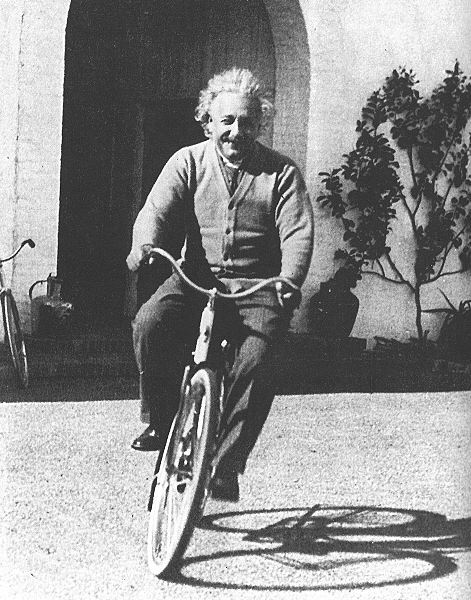
Happy birthday, Albert Einstein!
March 10, 2005
Synchronicity: Wolfgang Pauli's vision of the "world clock"
Here is another excerpt from Synchronicity. In it, the author looks into the relationship between Wolfgang Pauli and Carl Jung.
The background of it is: Wolfgang Pauli had a lot of personal problems - he was a heavy drinker, I think - he married impulsively and the bride left him a couple weeks following the marriage - his mother poisoned herself - and there was a ton of other stuff going on, too. His life was chaos, and he felt like he was going to have some sort of breakdown. So he started visiting Carl Jung.
That is what this excerpt is about.
Jung found his patient to be:...a university man, a very one-sided intellectual. His unconscious had become troubled and activated; so it projected itself onto other men who appeared to be his enemies, and he felt terribly lonely, because everyone seemed to be against him.Again:
...he had lived in a very one-sided intellectual way, and naturally had certain desires and needs also. But he had no chance with women at all, because he had no differentiation of feeling whatsoever. So he made a fool of himself with women at once and of course they had no patience with him.Jung discovered that Pauli was "chock full of archaic material" and, not wishing to influence his dreams and images, handed him over to one of his (Jung's) students, who worked with the physicist over the next five months.
Editorial Ramblings from Sheila: Briefly - for any of you out there not familiar with Jung (and I am - good Lord am I!) - Jung felt that all human personalities have the same polarities, and psychic health depends upon some sort of balance between these polarities. He broke these into: Intuition being the polarity of Sensation. Thinking being the polarity of Feeling. If the balance is tipped only towards feeling, you can have psychic problems. If the balance is tipped only towards thinking (which is what Jung discovered was what was going on with Wolfgang Pauli), your psyche will be in trouble. While it may seem to you all out there that I am a random ball of emotion, I must remind you that you are only seeing a tiny sliver of my personality, a sliver that I control, and manipulate. I decide what I feel like sharing with you. And the truth of the matter is - that I am way more tipped towards the Thinking side of things, and this has caused problems from time to time. If I have bouts of depression, or rage, that's where it comes from. Feeling is not given its proper due - and so it morphs into something destructive, or out-of-proportion. This is very common with intelligent people. You think you can THINK your way out of things. When you cannot, there are crack-ups. It is here - on the blog - and in my other writing - in any of my creative pursuits - where I get to go directly into FEELING, and give it its due, bring it to the forefront, wallow in it, be creative with it. It's fun, it's enormously cathartic. But in my "real life", this is not the case. It's a complex thing, I should write about it more. I'm getting much better at tipping the scales back towards Feeling, but I need a lot of help and support in that, friends who love me and know what's going on with me, who can help me recognize when I'm out of whack.
The following excerpt describes perfectly well my own experience of the lack of equilibrium between Thought and Feeling:
...In Pauli's case, thought had dominated feeling so that the emotions were relegated to what Jung termed the Shadow side of the Ego. In other words, Pauli's emotional and Feeling nature had never fully developed but existed in a raw and highly energized form which tended to break through in the form of irrational behavior, dreams, and neuroses. Thought, sensing what it felt to be primitive forces at work, put the lid on even tighter so that Feeling found itself in the position of a red-hot pressure cooker with the valve jammed. The result was Pauli's absurd marriage, his increasingly sarcastic attacks on colleagues and his bouts of drunkenness.According to Jung, the cure lay in bringing Feeling out of the Shadow and into the light, where it could perform its proper function and restore harmony to Pauli's whole personality. The method for Pauli was to come to terms with the content of his unconscious thought through dreams and waking fantasies. Over the next months Pauli produced "over a thousand dreams and visual impressions," which were later analyzed by Jung and formed the basis of one of his major writings -- Individual Dream Symbolism in Relation to Alchemy. The psychologist had discovered that the symbolism within Pauli's dreams was remarkably similar to that of the medieval alchemists. The culmination of this series of dreams was Pauli's vision of the world clock, an image of "the most sublime harmony" which left a deep impression on him, and, in Jung's words, was "what we would call -- in the language of religion -- a conversion."
If you want to see a drawing of this "world clock", based on Pauli's accounts of his dream of it, I found one here. Just scroll down.
Now here is how Jung interpreted this dream, and in so doing, helped Pauli to be "reborn" as a more whole and complete man, his psyche in equilibrium.
...Jung identified the point of rotation of the disks with the mystical speculum, for it both partakes of the rhythmic movement yet stands outside it. [Sheila's note: Speaking as a woman, there ain't nothin' mystical 'bout a speculum. The very word gives me the heebie-jeebies. Onward.] The two disks belong to the two universes of the conscious and the unconscious, which intersect in this speculum. The whole figure together with its elaborate internal movement is therefore a mandala of the Self, which is at one and the same time the center and the periphery of the world clock. In addition, the dream could also stand as a model of the universe itself and the nature of space-time...But it should also be pointed out that Pauli, as a physicist, was also seeking to discover an innter unity between the elementary particles and their abstract symmetries. The vision of the world clock is therefore capable of many levels of interpretation, and it is indeed a particularly rich image in its resonances of meaning.
Pauli's rebirth as "a perfectly normal and reasonable person ... completely adapted" was therefore the result of sensing a deep inner symmetry to his own mind, a dynamic pattern that had been illustrated in symbolic times by the early Gnostics, the alchemists of the Middle Ages, and the Taoists of ancient China...
The notion of symmetries in nature and in the psyche continued to preoccupy the physicist for the rest of his life. The results confirmed Jung's findings on what he called the archetypes, dynamic forces and mosaics of energy within the collective unconscious which are revealed to us symbolically through dreams, fantasies, works of art, and myths.
Pretty cool, huh?
Synchronicity: Wolfgang Pauli's exclusion principle
If you want to know what I'm doing, start here. Then go here, here and here.
Here is another excerpt from Synchronicity - This one has to do with Wolfgang Pauli's exclusion principle. FASCINATING. And also pretty much completely incomprehensible to me, except on a reaaaaallly literal-image level. Then I get it. Kind of.
Wolfgang Pauli was born in 1900 into a well-to-do Viennese family...As a young child Pauli excelled at school but was frightened by fairy tales. At 18 he enrolled at the University of Munich, where, two years later, Werner Heisenberg was to meet him.I spotted a dark-haired student with a somewhat secretive face in the the third row. Sommerfeld had introduced us during my first visit and had then told me that he considered the boy to be one of his most talented students, one from whom I could learn a great deal. His name was Wolfgang Pauli and for the rest of his life he was to be a good friend, though often a severe critic.Pauli could indeed be ruthless in his scientific criticism for he had a profound insight into physics and his intuition was quick to spot false trials, shaky arguments, and errors of assumption ... Even Einstein himself was not immune from critical attacks. However, when the young man produced a book-length review of the theory of relativity, Einstein wrote:
No one studying this mature, grandly conceived work could believe that the author is a man of 21. One wonders what to admire most, the psychological understanding for the development of ideas, the sureness of mathematical deduction, the profound physical insight, the capacity for lucid systematic presentation, the complete treatment of the subject matter, or the sureness of critical appraisal.... Of all Pauli's contributions to physics the best known is his exclusion principle, an addition to Heisenberg's quantum mechanics which makes an interesting resonance to the general notion of synchronicity. Synchronicity, we will suggest in this book, arises out of the underlying patterns of the universe rather than through a causality of pushes and pulls that we normally associate with events in nature. For this reason synchronicity has been called by Jung an "acausal connection principle". But an acausal connection is exactly what was promposed by Pauli in his exclusion principle.
The Pauli principle may be clear enough to the physicist when expressed in mathematical terms but conceptually it is rather abstract. Possibly the best way to understand it is to rely on a simple image.
Pauli arged that, at the quantum level, all of nature engages in an abstract dance. Moreover all the elementary particles and quanta of energy can be divided into two groups depending on the type of dance they execute. Electrons, protons, neutrons, and neutrinos, along with other particles, form one group (and engage in an asymmetric dance) while the other group includes mesons and photons of light (and forms a symmetric dance.) [From Sheila: Huh?]
It turns out that, in the former case, the nature of this abstract movement or dance has the effect of keeping particles with the same energy always apart from each other. [Sheila's pondering: This alone would account for the whole "opposites attract" theory of human love relationships. At least it seems so to me.] However, this exclusion of particles from each other's energy space is not the result of any force which operates between them nor indeed is an act of causality in the normal sense, rather it arises out of the antigymmetry of abstract movement of the particles as a whole. Hence the underlying pattern of the whole dance has a profound effect on the behavior of each individual particle. [Okay. Now THAT I understand.]
For example, it is the exclusion principle which causes electrons in an atom to stack up in a series of energy levels and makes one atom chemically distinguishable from another. It is the Pauli principle which gives rise to the rich chemistry of nature, and without it, the whole universe would seem more or less featureless...
The antigymmetric dance of the Pauli principle is in constant battle against the force of gravity and the various stages of this battle result in the collapse of a star through the white dwarf, neutron star, and black hole stages.
So Wolfgang Pauli's most famous contribution to physics involved the discovery of an abstract pattern that lies hidden beneath the surface of atomic matter and determines its behavior in a noncausal way.
More coming up on the fascination relationship of Pauli and Jung.
Synchronicity: "Synchronicities are the jokers in nature's pack of cards"
Another excerpt from Synchronicity.
If you're interested:
Start here. Then go here and here
More to come. But here's the excerpt:
One of the "classic" examples of synchronicity, told by Carl Jung himself, concerns a crisis that occurred during therapy. Jung's patient was a woman whose highly rational approach to life made any form of treatment particularly difficult. On one occasion the woman related a dream in which a golden scarab appeared. Jung knew that such a beetle was of great significance to the ancient Egyptians for it was taken as a symbol of rebirth. As the woman was talking, the psychiatrist in his darkened office heard a tapping at the window behind him. He drew the curtain, opened the window, and in flew a gold-greenscarab -- called a rosechafer, or Cetonia Aureate. Jung showed the woman "her" scarab and from that moment the patient's excessive rationality was pierced and their sessions together became more profitable.Despite our appeal to a "scientific" view of nature, such events do occur, and while it is true that any one of them can be dismissed as "coincidence", such an explanation makes little sense to the person who has experienced such a synchronicity. Indeed the whole point of such happenings is that they are meaningful and play a significant role in a person's life. Synchronicities are the jokers in nature's pack of cards for they refuse to play by the rules and offer a hint that, in our quest for certainty about the universe, we may have ignored some vital clues.
Synchronicity: "the universe is a participatory universe"
Another excerpt from Synchronicity.
Quantum theory and relativity had a revolutionary effect upon [the] Newtonian approach, not only in transforming the formalism of physics but also in changing the worldview that was associated with it. Niels Bohr, for example, stressed that quantum theory had revealed the essential indivisibility of nature while Heisenberg's uncertainty principle indicated the extent to which an observer intervenes in the system he observes. A contemporary physicist, John Wheeler, has expressed this new approach in particularly graphic terms:We had this old idea, that there was a universe out there, and here is man, the observer, safely protected from the universe by a six-inch slab of plate glass. Now we learn from the quantum world that even to observe so miniscule an object as an electron we have to shatter that plate glass; we have to reach in there ... So the old word observer simply has to be crossed off the books, and we must put in the new word participator. In this way we've come to realize that the universe is a participatory universe.This participatory universe of Bohr and Heisenberg, this relativity of space and time, this interconnectedness of things, points to a very different worldview than that of Newtonian mechanism. Yet despite important revolutions that have taken place within physics, old ways of thinking continue to dominate our relationship to nature. Time, we believe, is external to our lives and carries us along its flow; causality rules the actions of nature with its iron hand and our "consensus reality" is restricted to the surface of things and seems closer to the rule-bound functioning of a machine than to the subtle adaptability of an organism. Even scientists themselves, who accept the formalism and mathematics of what has been called the "new physics", retain many of the attitudes of 19th century science. Most believe, for example, in some form of objective reality that is external and independent of themselves ... Paradoxically, scientists have not yet caught up with the deeper implications of their own subject.
Synchronicity: "a tiny flaw in the fabric of all that we have hitherto taken for reality"
An excerpt from the starting chapter of the book Synchronicity. In this chapter, author F. David Peat makes clear the focus of the book.
Science may have uncovered the internal structure of the atom, studied the genometry of the DNA molecule, and probed the mysteries of the black hole, but what can it make of T.E. Lawrence's experience on traveling one early morning in the desert?We started off one one of those clear dawns that wake up the senses with the sun. For an hour or so, on such a morning, the sounds, scents, and colors of the world struck man individually and directly, not filtered through or made typical by thought.And can it shed light on Wordsworth's recollections of his childhood?
There was a time when meadow, grove, and stream,
The earth, and every common sight,
To me did seem
Appareled in celestial light
The glory and the freshness of a dream?On the one hand we have the immediacy and flavor of our lives, of poetry, music, art, and mysticism, and the other the objective discoveries and explanations of science. On the one there is excitement, beauty, and wonder, and on the other the possibility that consciousness is an epiphenomenon of certain complex electrochemical reactions, that life is the product of random molecular processes, and the universe is an accident. There appears, therefore, to be an unbridgeable gap between the objective and the subjective approaches to the question of the universe and our role within it. There seems, at first sight, to be no way in which the theories of science can be spiced with the flavor of human experience or that a poetic insight can be transformed into the rigor of scientific objectivity. These two worlds appear to be simply too far apart.
It is, however, the argument of this book that a bridge can indeed be built between interior and exterior worlds and that synchronicity provides us with a starting point, for it represents a tiny flaw in the fabric of all that we have hitherto taken for reality. Synchronicities give us a glimpse beyond our conventional notions of time and causality into the immense patterns of nature, the underlying dance which connects all things and the mirror which is suspended between inner and outer universes. With synchronicity as our starting point, it becomes possible to begin the construction of a bridge that spans the worlds of mind and matter, physics and psyche.
Deep thoughts ...
Now ... not only is that a fascinating post, with a lot in it to ponder, but it reminded me of this weird little book I love called Synchronicity: The Bridge Between Matter and Mind. We discussed it a bit in the comments section over there. It's by F. David Peat, and it's one of my most treasured books because it is one of those science-lite books - ha ha - but it looks at the phenomenon of what he calls "synchronicity". Things like: coincidence, deja vu, dream symbols, random moments when some sort of pattern is discerned. You learn a new word, and suddenly you start seeing it everywhere. You have a dream about someone you haven't seen in 10 years. The next day, that person calls you. Kneejerk skeptics brush this off as "coincidence". That's fine, maybe it is. But - er - how can you be SURE? What's the harm in entertaining the possibility that there is some sort of pattern? Why does this piss people off so much? I like to ponder the possibility that these things are not JUST coincidences. I try not to make a religion out of it, however, as in: seeing "signs" everywhere, and reading meaning into EVERYTHING. In my opinion, that leads to paralysis (I've seen it in a really good of friend of mine. Everything to her is a sign. Everything. But the end result in her case means that she feels very little sense of agency in her own life. Whatever happens is supposed to happen. So it's very difficult for her to take ACTION. She has made a sort of religion out of coincidences and signs.)
I, for one, love it when these synchronicity moments happen (for the most part - sometimes they are awful) - and I love the book for taking this very common human experience seriously.
I picked up the book last night, and leafed through it, getting all excited all over again by it.
Get ready for a bombardment of excerpts.
February 5, 2005
"At first, I was deeply alarmed."
From "In Search of Schrodinger's Cat" -by John Gribbin - we're talking about atoms now. Other excerpts here and here and here and here. More on Heisenberg.
Now it starts to get really freaky - LOVE IT.
The story is often told of how Heisenberg was struck down by a severe bout of hayfever in May 1925, and went off to recuperate on the rocky island of Heligoland, where he painstakingly tackled the task of interpreting what was known about quantum behavior in these terms. With no distractions on the island, and his hayfever gone, Heisenberg was able to work intensively on the problem. In his autobiographical Physics and Beyond, he described his feelings as the numbers began to fall into place, and how at three o'clock one morning he "could no longer doubt the mathematical consistency and coherence of the kind of quantum mechanics to which my calculations pointed. At first, I was deeply alarmed. I had the feeling that, through the surface of atomic phenomena, I was looking at a strangely beautiful interior, and felt almost giddy at the thought that I now had to probe this wealth of mathematical structures nature had so generously spread out before me."
Note from me: That just gives me the chills, I tell ya!!
Returning to Gottingen, Heisenberg spent three weeks preparing his work in a form suitable for publication and sent a copy of the paper first to his old friend Pauli, asking if he thought it made sense. Pauli was enthusiastic, but Heisenberg was exhausted by his efforts and not yet sure that the work was ready for publication. He left the paper with Born to dispose of as he felt appropriate, and departed, in July 1925, to give a series of lectures in Leyden and Cambridge. Ironically, he did not choose to speak about his new work to the audiences there, who had to wait for news to reach them by other channels.
Born was happy enough to send Heisenberg's paper off to the Zeitschrift fur Physik, and almost immediately realized what it was that Heisenberg had stumbled upon. The mathematics involving two states of an atom couldn't be dealt with by ordinary numbers, but involved arrays of numbers, which Heisenberg had thought of as tables. The best analogy is with a chessboard. [There are a bunch of diagrams in the book right around here, showing what the HELL is going on - chessboards, basically, numbered, and lettered. We will carry on. Hopefully the diagrams will not be necessary.]
There are 64 squares on the board, and in this case you could identify each square by one number, in the range of 1 to 64. However, chess players prefer to use a notation that labels the "columns" of squares across the board by the letters a, b, c, d, e, f, g, and h, with the "rows" numbered up the board 1, 2, 3, 4, 5, 6, 7, 8. Now, each square on the board can be identified by a unique pair of identifying labels: a1 is the home square of a rook, g2 is the home square of a knight's pawn, and so on.
Heisenberg's tables, like a chess board, involved two-dimensional arrays of numbers, because he was doing calculations involving two states and their interactions. Those calculations involved, among other things, multiplying two such sets of numbers, or arrays, together, and Heisenberg had laboriously worked out the right mathematical tricks to do the job. But he had come up with a very curious result, so puzlling that it was one of the reasons for his diffidence about publishing his calculations. When two of these arrays are multiplied together, the "answer" you get depends on the order in which you do the multiplication.
This is strange indeed. It is as if 2 x 3 is not the same as 3 x 2, or in algebraic terms a x b does not equal b x a.
Born worried at this peculiarity day and night, convinced that something fundamental lay behind it. Suddenly, he saw the light. The mathematical arrays and tables of numbers, so laboriously constructed by Heisenberg, were already known in mathematics. A whole calculus of such numbers existed; they were called matrices, and Born had studied them in the early years of the 20th century, when he was a student in Breslau. It isn't really surprising that he should have remembered this obscure branch of mathematics more than 20 years later, for there is one fundamental property of matrices that always makes a deep impression on students when they first learn of it -- the answer you get when you multiply matrices depends on the order in which you do the multiplying, or in mathematical language, matrices do not commute.
Heisenberg's breakthrough
From "In Search of Schrodinger's Cat" -by John Gribbin - we're talking about atoms now. Other excerpts here and here and here. The following excerpt is about Werner Heisenberg, and honestly:
I barely know WHAT is going on here, really, but I can tell that it is FASCINATING. Actually, I'm exaggerating. I know what is going on here, it's just that I could never summarize it or try to talk about it without sounding like a blundering idiot. All I can do is just follow along, try to keep up. I love this stuff.
Werner Heisenberg was born in Wurzburg on 5 December 1901. In 1920 he entered the University of Munich, where he studied physics under Arnold Sommerfeld, one of the leading physicists of the time who had been closely involved with the development of the Bohr model of the atom. Heisenberg was plunged straight into research on quantum theory, and set the task of finding quantum numbers that could explain some of the splitting of spectral lines into pairs, or doublets. He found the answer in a couple of weeks -- the whole pattern could be explained in terms of half-integer quantum numbers. [Uhm ... okay. I THINK I get that.] The young, unprejudiced student had found the simplest solution to the problem, but his colleagues and his supervisor Sommerfeld were horrified. To Sommerfeld, steeped in the Bohr model, integral quantum numbers were established doctrine, and the young student's speculations were quickly quashed. The fear among the experts was that by introducing half integers into the equations they would open the door to quarter integers, then eighths and sixteenths, destroying the fundamental basis of quantum theory. But they were wrong.
Within a few months, the older and more senior physicist Alfred Lande came up with the same idea and published it; it later turned out that half-integer quantum numbers are crucially important in the full quantum theory, [Uhm, okay, if you say so ...], and play a key role in describing the property of electrons called spin. Objects that have integer or zero spin, like photons, obey the Bose-Einstein statistics, while those that have half-integer spin (1/2 or 3/2, and so on) obey the Fermi-Dirac statistics ... [Then follows a bunch of math, which I don't feel up to typing.]
So Heisenberg missed a chance for credit for a new idea in quantum theory; but the point of the story is that just as it took young men in the previous generation to develop the first quantum theory, so in the 1920s it was time again for young minds unencumbered by ideas that "everyone knows" must be right to take the next step forward. Heisenberg certainly made up for missing out on one minor scientific "first" with his work over the next few years.
After a team working in Gottingen under Born, where he had attended the famous "Bohr festival", Heisenberg returned to Munich and completed his PhD in 1923 -- still not quite 22 years old. At that time, Wolfgang Pauli, a close friend of Heisenberg's, equally precocious and another former student of Sommerfeld's, was just moving on from a spell as Born's assistant in Gottingen, and Heisenberg took over the post in 1924. It was a job that gave him the opportunity to work for several months with Bohr in Copenhagen, and by 1925 the precocious mathematical physicist was better equipped than anyone to find the logical quantum theory that every physicist expected to be found eventually, but no one expected to find so soon.
Heisenberg's breakthrough was founded on an idea he picked up from the Gottingen group -- nobody now is quite sure who suggested it first -- that a physical theory should only be concerned with things that can actually be observed by experiments. This sounds trite, but it is actually a very deep insight. An experiment that "observes" electrons in atoms, for example, doesn't show us a picture of little hard balls orbiting around the nucleus -- there is no way to observe the orbit, and the evidence from spectral lines tell sus what happens to electrons when they move from one energy state (or orbit, in Bohr's language) to another. All of the observable features of electrons and atoms deal with two states, and the concept of an orbit is something tacked on to the observations by analogy with the way things move in our everyday world ... Heisenberg stripped away the clutter of the everyday analogies, and worked intensively on the mathematics that described not one "state" of an atom or electron, but the associations between pairs of states.
This all seems very very cool. More on Heisenberg in the next excerpt.
a lone voice crying in the wilderness ...
From "In Search of Schrodinger's Cat" -by John Gribbin - we're talking about atoms now. Other excerpts here and here.
This excerpt is about 1905, and the groundbreaking papers Einstein published in that year.
This paper was just one of three published by Einstein in the same volume of the Annalen der Physik in 1905, any one of which would have assured him of a place in the annals of science. One of the papers introduced the special theory of relativity and is largely outside the scope of the present book; another concerned the interaction of light with electrons and was later recognized as the first scientific work dealing with what we now call quantum mechanics -- it was for this work that Einstein received the Nobel Prize in 1921. The third paper was a deceptively simple explanation of a puzzle that had baffled scientists since 1827 -- an explanation that established, as far as any theoretical paper ever could, the reality of atoms.
Einstein later said that his major aim at that time was "to find facts which would guarantee as much as possible the existence of atoms of finite size," an aim that perhaps indicates the importance of the work at the beginning of the present century. At the time these papers were published, Einstein was working as a patent examiner in Berne -- his unconventional approach to physics had not made him an obvious candidate for an academic post when he completed his formal education, and the patent office job suited him. His logical mind proved well able to sort out the wheat of new inventions from the chaff, and his skill at the job left him plenty of free time in which to think about physics, even during office hours. Some of his thoughts concerned the discoveries made by the British botanist Thomas Brown almost eighty years before. Brown noticed that when a pollen grain floating in a drop of water is examined using a microscope it is seen to bounce around in an irregular fashion, moving in a random pattern that is now called Brownian motion. Einstein showed that this motion, although random, obeys a definite statistical law, and that the pattern of behavior is exactly what should be expected if the pollen grain is being repeatedly "kicked" by unseen, submicroscopic particles that move in accordance with the statistics used by Boltzmann and Maxwell to desscribe the way atoms move in a gas or liquid. It looks so obvious today that it is hard to credit what a breakthrough this paper made. You or I, used to the idea of atoms, can see at once that if pollen grains are being jostled by unseen collisions then it must be moving atoms that push them around. But before Einstein made the point, respected scientists could still find room to doubt the reality of atoms; after his paper appeared, there was no longer room to doubt. Easy when explained, like the fall of an apple from a tree, but if it was so obvious why had it not been appreciated in the previous eight decades?
It's ironic that this scientific paper should have been published in German (in the journal Annalen der Physik), because it was the opposition of leading German-speaking scientists such as Ernst Mach and Wilhelm Ostwald that seems to have convinced [Ludwig] Boltzmann that his was a lone voice crying in the wildnerness. In fact, by the beginning of the 20th century there was a great deal of evidence for the reality of atoms, even if, strictly speaking, that evidence could only be described as circumstantial.
Heat is a form of motion ...
From "In Search of Schrodinger's Cat" -by John Gribbin - a continuation of the excerpt below
During the 1860s and 1870s these pioneers developed the idea that a gas is made up of very many atoms or molecules (the number derived from Avogadro's hypothesis gives you some idea how many), which can be thought of as tiny, hard spheres that bounce around, colliding with one another and with the walls of the container that holds the gas. This related directly to the idea that heat is a form of motion -- when a gas is heated, the molecules move faster, which increases the pressure on the walls of the container, and if the walls are not fixed in place, the gas will expand. The key feature of these new ideas was that the behavior of a gas could be explained by applying the laws of mechanics -- Newton's laws -- in a statistical sense to a very large number of atoms or molecules. Any one molecule might be moving in any direction in the gas at any time, but the combined effect of many molecules colliding with the walls of the container each second produces a steady pressure. This led to the development of a mathematical description of gas processes called statistical mechanics. But still there was no direct proof that atoms existed; some leading physicists of the time argued strongly against the atomic hypothesis, and even in the 1890s [Ludwig] Boltzmann felt himself (perhaps mistakenly) to be an individual struggling against the tide of scientific opinion. In 1898, he published his detailed calculations in the hope "that, when the theory of gases is again revived, not too much will have to be rediscovered"; in 1906, ill and depressed, unhappy about the continuing opposition of many leading scientists to this kinetic theory of gases, he killed himself, unaware that a few months before an obscure theorist called Albert Einstein had published a paper that established the reality of atoms beyond reasonable doubt.
Stay tuned!! More to come! God, I'm a geek. Oh well.
"The only existing things are atoms and empty space; all else is mere opinion."
From "In Search of Schrodinger's Cat" -by John Gribbin.
The book begins with a discussion of the atom theory of matter, and its development
Many popular accounts of the history of science say that the idea of atoms goes back to the ancient Greeks, a time of the birth of science, and go on to praise the ancients for their early perception of the true nature of matter. But this account is a bit of an exaggeration. It is true that Democritus of Abdera, who died sometime close to 370 BC, did propose that the complex nature of the world could be explained if all things were composed of different kinds of unchangeable atoms, each type with its own shape and size, in constant motion. "The only existing things are atoms and empty space; all else is mere opinion," he wrote, and later Epicurius of Samos and the Roman Lucretius-Carus adopted the idea. But it was not in those days the front-runner among theories to account for the nature of the world, and Aristotle's suggestion that everything in the universe is made up from the four "elements" fire, earth, air, and water proved much more popular and enduring. While the idea of atoms was largely forgotten by the time of Christ, Aristotle's four elements were accepted for two thousand years.
Although the Englishman Robert Boyle used the concept of atoms in his work on chemistry in the 17th century, and Newton had it in mind in his work on physics and optics, atoms only really became a part of scientific thought in the latter part of the 18th century when the French chemist Antoine Lavoisier investigated why things burn. Lavoisier identified many real elements, pure chemical substances that cannot be separated into other chemical substances, and he realized that burning is simply the process by which oxygen from the air combines with other elements. In the early years of the 19th century John Dalton put the role of atoms in chemistry on a secure footing. he stated that matter is made up of atoms, which are themselves indivisible; that all the atoms of one element are identical, but that different elements have different kinds of atoms (different sizes or shapes); that atoms cannot be created or destroyed, but are rearranged by chemical reactions; and that a chemical compound, made from two or more elements, is composed of molecules, each of which has a small, fixed number of atoms from each of the elements in the compound. So the atomic concept of the material world really came into being, in the form that is taught in textbooks today, less than two hundred years ago.
Schrodinger and stuff like that.
This morning, I picked up a book that I love: In Search of Schrodinger's Cat, by John Gribbin, and started flipping through it. It's one of those books I dip into, time and again, to either refresh my memory, or try to understand again ... It's a lovely book. I am not a scientist, and I do not have a scientific background AT ALL, but I have a lot of interest in it (maybe I should say childlike wonder and fascination ... that's where I'm at with it ... I'm still like a kid asking "why is the sky blue??") - and this book, In Search of Schrodinger's Cat was a JOY to read. I ADORED it. There were times when I felt like I actually understood, like I could get in there - between the cracks - (without squinting so hard my eyelids disappeared, I mean). Much of the math goes over my head. However the book is filled with diagrams and pictures - illustrating the theories, making the mathematical equations visible in really creative ways. I find this enormously useful, and am grateful to Gribbin for this book. I love it.
Einstein's been everywhere these days, due to the 100th anniversary of E=mc2 and all that ... so I thought I'd post some excerpts from the book, just for fun.
I've got a lot of science geeks out there, I know. So you guys can discuss the excerpts amongst yourselves ... I'm not posting them for any other reason than I find them really interesting and thought-provoking.
Onward! Into the netherword of Schrodinger's dead-but-not-dead cat!!
January 20, 2005
And now ...
... a beautiful scary nature picture.
I guess they're afraid that that ice-monolith is gonna crash into another ice-monolith. Or ... not afraid. Maybe even hopeful. Seaways opening up, happy penguins, I have no idea. I just like the picture.
January 11, 2005
The choppy spacetime sea
Here is why I love science, even though I don't understand what scientists are talking about half the time.
First of all, because of images like this:
That has got to be one of the most beautiful things I have ever seen in my life.
Second of all, because the language of science, at its most awe-some, AND its most practical, verges on poetry, mysticism. In order to talk about what is going on out in space, one MUST speak in terms almost poetic.
Favorite quote from the "scientists":
"Gas whipping around the black hole has no choice but to ride that wave of choppy spacetime sea that distorts everything falling into the black hole."
Ride that wave of choppy spacetime sea.
God. Beautiful. Language like that is trying to describe reality, trying to describe what is actually happening out there ... and yet, for me, it tips over the edge into some kind of poetic metaphor. I love that. All the good science writers have that tone. It's what hooks ME in, that language, the wondrous language, because I can't understand the math.
January 4, 2005
Cool!
Okay, this is fabulously interesting.
John Brockman, publisher and editor of Edge (which describes itself as The World's Question Center) asked 100 scientists and thinkers and ... you know, big brainiac-types, the question:
"WHAT DO YOU BELIEVE IS TRUE EVEN THOUGH YOU CANNOT PROVE IT?"
I have just gotten LOST in all of the responses. They are all so thought-provoking (and so diverse) that I feel like I might have a heart attack.
A couple snippets (each of these has an accompanying essay with it):
"I believe that human talents are based on distinct patterns of brain connectivity.""I am convinced that quantum mechanics is not a final theory."
"There are good reasons to believe that the universe is infinite. "
"I believe that we are writing software the wrong way."
"I can't prove it more than anecdotally, but I believe evolution has purpose and direction."
Etc. Etc. I'm tellin' ya, this site is a black hole. It will suck you in, and you will NEVER WANT TO LEAVE.
And so:
What do I believe that I can't prove? Well, first of all, I'm not a scientist, so I can't really prove anything ANYway.
But I'll give it a go.
I believe in a collective human unconscious. I believe that we all (past and present) are connected in ways that are - primal, eternal, archtypal. Dreams are symbolic messages from that collective. I'm a Jungian, basically. Not a Freudian.
I believe that there is life on other planets. I believe in ET. I believe in many ETs. I believe the universe is FILLED with life.
I believe in true love. Not only do I believe in it, but I also believe it is as rare as the rarest of diamonds. It's not an "ooh, I believe in soul mates" kind of malarkey. If there's one phrase I wish I could STRIKE from the English language, it's "soul mate". No. Fuck soul mates. But I do believe in a very specific kind of love ... er ... how to explain it. "True love" will have to suffice. My belief in this kind of love is scientific. I think true love (not your garden variety love, but TRUE love - huge difference) has to do with chemistry. Literally. Body chemistry, brain chemistry, pheromones, the 5 senses ... Nothing about souls or heart or spirit ... but chemistry. Can't prove it, but this is what I believe. (And believe it or not, I think that MY way of looking at it is MORE romantic than the "soul mate" way. But then again, I am certifiable.)
And - to quote Annie Lennox: "I believe in the power of creation, I believe in the good vibration, I believe in love alone, yeah yeah ..."
Anyway, here is the link to the coolest site. EVER.
December 23, 2004
I think I'm caught in a Tesla coil myself
Very neat post by CW about Nikola Tesla. I knew pretty much nothing Tesla (before the 7-hour conversation last week, I mean). I vaguely remember the phrase "Tesla coil" from ... er ... some damn class at some point. Anyway, click on that link to read more about this fascinating individual.
Dumb Sheila science question
Now sadly - I feel like I need to DRAW my question, it requires visual aids - so be patient as I try to explain what I am asking. Well, it's multiple questions:
1. Do orbits only go one way? As in - Clockwise or counter-clockwise?
2. Okay, here's the dumber part: Is the orbit around our planet (or any planet, I suppose) limited to one ... section? Er - here is where I need to draw out what I'm asking on a bar napkin. Do satellites ONLY circle the earth on one longitude? (I think that's the correct term. Longitude goes east-west, right?) Does our orbit correspond to the coordinates of, for example, the Equator? Is our orbit something like the rings around Saturn, is basically the question - Or - is the orbit a general FIELD surrounding the earth, going every which way? (I am sounding like a jackass.)
3. Okay, so you know how Saturn has rings? Please explain to me - if possible - why the rings automatically (or gradually, whatever) settled where they did - does it have to do with gravity?
4. And lastly - this is probably VERY stupid - but about Saturn's rings: Would it be scientifically impossible for the rings to have formed on the opposite axis from where they are now? Like - if Saturn were the earth, then the rings appear to be circling at the Equator line. But would it be scientifically impossible for the rings to have formed, say, going from North Pole to South Pole?
December 9, 2004
Expert Essay: by David W.
Well, David W. (a long-time and regular reader - "DBW" - I've got a soft spot in my heart for him ... even though I've never met him!) has sent in an essay about the constellation Orion. It's a beautiful piece of work. I love Orion myself. Perhaps because it's familiar? That's not so bad a reason when you're talking about a couple of stars out of billions and billions. It's nice to see some you recognize. (Also, is there a term more romantic and mysterious than "stellar nursery"? Gives me the chills.)
Thanks, DBW. A lovely essay.
EXPERT ESSAY: The constellation Orion
This time of year Orion can be easily identified. In the mid-evening, it sits in the southern sky about halfway between the horizon and the top of the sky.
Look for three relatively bright stars in a close line--these are Orion's belt.
Above his belt are Orion's shoulders. The reddish star on the left is Betelgeuse, which will be the main focus of this essay. Betelgeuse is a red supergiant of incredible size. While it is something like 12,000 times as bright as our sun, it is much cooler--which is the reason for its easily-seen orangish-red color. It is a pulsating variable star, which means it regularly changes in size, and emits a tremendous amount of radio waves. While there is some disagreement about its size and distance from Earth(and I am sure someone will write in to correct my figures), at its largest Betelgeuse is arguably the largest single object visible with the naked eye. If it were to replace the sun, its diameter would easily engulf every planet out past Mars, and perhaps reach as far as the orbit of Neptune. It is a staggering speculation that something like 150 million suns could fit inside Betelgeuse's diffuse vacuum. Again, there is disagreement about how far Betelgeuse is from Earth, but it somewhere between 430-520 light years away(2.5 quadrillion miles), which means the light we are seeing now left there around the time Columbus discovered America. As I said, pondering these facts lends me great perspective on my own burdensome concerns.
Below Orion's belt are the stars of his feet. On the right is Rigel, a young, blue supergiant that is 40,000 times as bright as our sun, and 60 times its diameter. Rigel is 775 light years from Earth, which means the light we are seeing left there around the time Genghis Khan died.
Orion also includes the Great Orion Nebula--which can be easily seen with decent binoculars. It makes up part of Orion's sword. The Nebula is the nearest star-making formation to the Earth, and is basically a stellar nursery. Within its enormous boundaries is the very beautiful Horsehead Nebula--Google it for some spectacular pictures.
One last thing before everyone's eyes glaze over. Below, and to the left of Orion, is one of his faithful dogs, Canis Major. There you will find Sirius, the brightest star in the night sky. Sirius is a "mere" 8.6 light years from us, which accounts for its scorching whiteness. Sirius actually has a small companion star that is smaller than the Earth, but hotter than Sirius.
For thousands of years our ancestors knew the night sky the way we recognize our neighbors' back porches. With our modern inside comforts, coupled with bright city lights which hide so many stars from our sight, we have lost touch with the simple wonder of looking up at night, and contemplating it all. Orion is an easy first step to recapturing that wonder. I can tell you from personal experience that kids love to hear about "the largest single thing you will ever see," and distances that befuddle all of us--and these are stars right in our celestial neighborhood--much less billions of other galaxies infinitely farther away.
-- by DBW
November 6, 2004
Ulugh Beg Tutorial
I'm no expert, but Ulugh Beg came up here yesterday. Please dont' ask how. Ulugh Beg was an astronomer and mathematician, grandson of warrior Tamerlane. Ulugh Beg lived in what is now Uzbekistan in the 15th century.
Here's what I know:
Apparently, when Tamerlane died, his empire was fought over by his sons. Ulugh Beg had been very close to his grandfather, and Beg (only 16 years old at the time) was put in charge of Samarqand following the death of Tamerlane (I believe Ulugh Beg was at his side when he died. I could be making that up, though). Ulugh Beg was only 16 years old when he became the leader of the great medieval oasis town - but instead of focusing on world conquest, or tribal slaughter, or trying to fill the shoes of his despotic grandfather, Ulugh Beg set out to transform Samarqand into a scientific and cultural center. He sounds like an extraordinary man. He believed in sharing information - and so he built observatories - one major one in paritcular (the ruins of which still stand today).
The Ulugh Beg Observatory was enormous - and cylindrical in shape. There was a massive marble sextant (discovered centuries later during an archaeological dig, I think) - that somehow was too large to fit and had to be dug into the ground or something. Sorry - not sure about that. The observatory was tall enough to be seen from miles away, and the sight of it would let the camel-trains on the Silk Road know that they were close to Samarqand. The "observatory" was as famous, in its day, as the Eiffel Tower is now. Like, even if you have never seen the Eiffel Tower in actuality, you know the shape of it - you would recognize it if you saw it. The Ulugh Beg Observatory was like that.
Scientists from all over the world would travel to Samarqand to meet with Ulugh Beg, to use the observatory, etc. Ulugh Beg was ahead of his time. He is one of the cultural heroes of Uzbekistan - and there are many madrassahs named after him today (the largest one in Bukhara is named after him).
Ulugh Beg was assassinated by a group of revolutionaries (led by his own son).
If you're interested in what Ulugh Beg contributed to the scientific world (he was way ahead of his time, again), here is a great article about him. It talks about all of the instruments he had in the Ulugh Beg Observatory (quadrants, sextants). It also talks about his mathematics.
Ulugh Beg catalogued over a thousand stars (this was in the 15th century, by the way) - He was the first person to put together such a comprehensive map of the heavens since Ptolemy.
So while Ulugh Beg was an enlightened man, an educated and curious man - he might have been rather naive about being a leader of such a turbulent area. Whatever it was - he was killed by a group led by his own son.
Here's a picture of the remains of the famous observatory (archaeologists believe that it was built in the 1420s):
November 5, 2004
Question
I am nearly done with Brothers Karamazov. Once you get into the trial section, the book reads like a bullet out of a gun. SO good.
But here's my question, and it's kind of a history/science-knowledge kind of question:
In the chapter where it is revealed that Ivan receives this nightly visitor, and it is revealed who this visitor is (I just can't bring myself to tell you, if you haven't read it ... because it was an enormous shock to me when I got to that chapter) -
But anyway, in this chapter, the visitor makes reference to an axe falling through space (he's talking about the cold, and little kids putting their tongues against freezing things and having the skin ripped off, etc.) - well, I can't explain it, here's the excerpt I have the question about:
"You know the game the village girls play -- they invite the unwary to lick an ax in zero weather, the tongue instantly freezes to it and the fool tears the skin off, so it bleeds. But that's only at zero, at 150 below I imagine it would be enough to put your finger on the ax and it would be the end of it ... If only there could be an ax there.""And can there be an ax there?" Ivan interrupted carelessly...
"An ax?" the guest interrupted in surprise.
"Yes, what would become of an ax there?" Ivan cried suddenly, with a sort of savage and insistent obstinacy.
"What would become of an ax in space? What an idea! If it were to fall any distance, it would begin, I think, flying around the earth without knowing why, like a satellite. The astronomers would calculate the rising and setting of the ax ..."
Brothers K was published in 1880, I think, or 1881.
Obviously, at that point, orbits of planets were understood and known of.
I've never really thought of this before, because - well, it never occurred to me until I read that sentence - but "satellite" isn't solely a word from our technological age? How would Dostoevsky know that things would be launched into our orbit and then circle the planet?
Where does the word "satellite" come from, is basically my question. Also ... how early was it in time that orbits were understood, and it was understood that if you put something IN the orbit, it would circle the earth automatically "without knowing why"...
August 2, 2004
Dark energy
Here is a great interview with Lawrence M. Krauss, physicist, author, and "dark energy proponent". I can't really understand what he means when he says "dark energy", so I suppose he can count me among the scientifically illiterate. Can any of my self-proclaimed "geek" readers enlighten me? I assume it has something to do with black holes, but other than that ...
I had terrible science teachers in high school: bumbling, inept, and in some cases, downright evil men. So my interest in physics came late, and my interest in it is almost philosophical - because I'm too dense to really understand the math.
HOWEVER: - great interview. Especially where Krauss discusses taking on creationists.
June 23, 2004
Day After the Younger-Dryas Event
I read this post when CW first wrote it and found it very interesting, mostly because I know nothing. I don' know nuthin' 'bout birthin' babies, Miz Scarlett ... and I also don' know nuthin' about The Younger-Dryas Event.
Read it!