April 14, 2006
The Books: "The Clash of Civilizations and the Remaking of World Order" (Samuel P. Huntington)
And here is my next excerpt of the day from my library.
 Next book on the shelf is The Clash of Civilizations, by Samuel Huntington.
I felt I had to read it because every other book and every other article in the last 6 years references the damn thing. It started out as an article for Foreign Affairs - and then he expanded it into a book. It was published in 1996, and probably foreign policy wonks and scholars were the only ones who paid attention to it. It was mildly controversial - his thesis being that the nation-state's glory days are over. Conventional wars between nation-states are a thing of the past. The wave of the future is the clash of civilizations - which is pretty much what we are seeing now. It's a clash of ideologies. A clash of religions. Huntington's book became hugely important in the wake of September 11 - everyone read it. His name was everywhere. It's a prescient book. A lot of people disagree with his thesis - disagree so vehemently that they just write him off. I think we ignore him at our peril. I am not saying I think he's totally right, because who can ever say that? But I think he's onto something, and he should not be ignored entirely. Much of what he wrote in 1996 has since come true tenfold.
I've been thinking a lot about CW's post here - about misdefining problems. It's relevant to the issues Huntington brings up in his book. Huntington says that we will now start to see civilizational clashes break out across the globe - he breaks down the world into its major civilizations, and looks at the irreconcilable differences between them. The intensification of religious fanaticism in recent years (not just Muslims, but everywhere) - the downfall of the USSR - the replacing of political ideologies with religious ideologies - These are all civilizational issues (according to Huntington) and THAT is where we will see conflict in the 21st century. This is tough stuff for some people to hear - and Huntington has been written off as a nut in many circles. But - in my opinion - and going back to CW's post - he is pretty close to diagnosing the problem correctly. Now what do I know - I'm just a measly citizen, a member of Western civilization - but like I said earlier: I think Huntington is onto something. His book is far-seeing in many ways. He is not just REACTING to the issues of the day - like so many pundits and writers are, who do not know their ass from their elbow. He is trying to diagnose a problem, a world-wide problem ... and people like that are often ignored (until they have been proven right, that is.) Oh, and I agree with CW's thesis about the current mis-defining of our problem, and how once you mis-define a problem - no solution can ever be found. Yup. To me, that is EXACTLY what has happened. I've felt it from the beginning of this current conflict. Something was OFF in the diagnosis. And who the hell am I - I have no power - I'm just a citizen ... but still. To my taste, the diagnosis was OFF. And so only disaster can follow if you don't even diagnose the problem correctly.
Back to Huntington: All of this being said, I think he is a boring writer. You can still feel his outline for the book in the text. Everything is neatly organized like a college term paper. "In the next section, I will show that blah blah blah, and I will do so using the following examples." And then, whaddya know, he does it! I mean, this is good writing for a 10th grader, but one would hope that you could be a bit more graceful with your thesis statement if you're 180 years old like Huntington is.
Literally - he writes like that. I'm used to reading better writers - so it took a bit to just accept that that was how he wrote the book - and read it for the CONTENT, not the good-ness of the writing.
Here's an excerpt.
EXCERPT FROM The Clash of Civilizations, by Samuel Huntington.
While one-world expectations appear at the end of major conflicts, the tendency to think in two worlds recurs throughout human history. People are always tempted to divide people into us and them, the in-group and the other, our civilization and those barbarians. Scholars have analyzed the world in terms of the Orient and the Occident, North and South, center and periphery. Muslims have traditionally divided the world into Dar al-Islam and Dar al-Harb, the abode of peace and the abode of war. This distinction was reflected, and in a sense reversed, at the end of the Cold War by American scholars who divided the world into "zones of peace" and "zones of turmoil". The former included the West and Japan with about 15 percent of the world's population, the latter everyone else.
Depending upon how the parts are defined, a two-part world picture may in some measure correspond with reality. The most common division, which appears under various names, is between rich (modern, developed) countries and poor (traditional, underdeveloped or developing) countries. Historically correlating with this economic division is the cultural division between West and East, where the emphasis is less on differences in economic well-being and more on differences in underlying philosophy, values, and way of life. Each of these images reflects some elements of reality yet also suffers limitations. Rich modern countries share characteristics which differentiate them from poor traditional countries, which also share charactertistics. Differences in wealth may lead to conflicts between societies, but the evidence suggests that this happens primarily when rich and more powerful societies attempt to conquer and colonize poor and more traditional societies. The West did this for four hundred years, and then some of the colonies rebelled and waged wars of liberation against the colonial powers, who may well have lost the will to empire. In the current world, decolonization has occurred and colonial wars of liberation have been replaced by conflicts among the liberated peoples.
At a more general level, conflicts between rich and poor are unlikely because, except in special circumstances, the poor countries lack the political unity, economic power, and military capability to challenge the rich countries. Economic development in Asia and Latin America is blurring the simple dichotomy of haves and have-nots. Rich states may fight tradew wars with each other; poor states may fight violent wars with each other; but an international class war between the poor South and the wealthy orth is almost as far from reality as one happy harmonious world.
The cultural bifurcation of the world division is still less useful. At some level, the West is an entity. What, however, do non-Western societies have in common other than the fact that they are non-Western? Japanese, Chinese, Hindu, Muslim, and African civilizations share little in terms of religion, social structure, institutions, and prevailing values. The unity of the non-West and the East-West dichotomy are myths created by the West. These myths suffer the defects of the Orientalism which Edward Said appropriately criticized for promoting "the difference between the familiar (Europe, the West, "us"), and the strange (the Orient, the East, "them")" and for assuming the inherent superiority of the former to the latter. During the Cold War the world was, however, no single cultural spectrum. The polarization of "East" and "West" culturally is in part another consequence of the universal but unfortunate practice of calling European civilization Western civilization. Instead of "East and West", it is more appropriate to speak of "the West and the rest", which at least implies the existence of many non-Wests. The world is too complex to be usefully envisioned for most purposes as simply divided economically between North and South or culturally between East and West.
April 13, 2006
The Books: "The Great Terror: A Reassessment" (Robert Conquest)
And here is my next excerpt of the day from my library.
 Next book on the shelf is The Great Terror: A Reassessment, by Robert Conquest
One of the most important non-fiction books of the 20th century. It was first published in 1968 - and then was re-written by Conquest, a generation later, in order to add back-up documentation, and archival information which was now available to him (crackup of the USSR, perestroika and all that). He found confirmation that he had actually UNDER-estimated the level of Stalin's terror. Conquest's work is highly regarded in some circles and completely ignored in other circles. Certain circles still cling to the utopian dream of socialism, and Robert Conquest does not play well with others, in this regard. The Great Terror is a relentless book - there is almost nothing pleasant about the reading experience - He explains the mindset so well, I think. Because that's another thing that is so frightening: the whole thing makes SENSE. It's a horrific sense, it's a looking-glass-world sense - but once you get down to brass tacks, you can see that Stalin never made a move for nothing. He always knew what he was doing, and every move he made had some logic to it.
I wrote about my response to the book here. And here too.
Essential reading. (Not my posts about the book, obviously - but the book itself). Here's an excerpt about the confessions. I always found the spectacle of the forced confessions one of the most hypnotic and awful parts about the whole thing. Like I've said time and time again, I can't help but put myself in those people's shoes ... and I try to imagine what the hell would have to happen to me, psychologically, to make me confess to something I didn't do, and to denounce my family and friends publicly. It's so incomprehensible - to me, on this side of the fence ... living as I do, never having to face those challenges ...
Conquest talks a lot about the confessions, and why they were SO important to Stalin's plan.
EXCERPT FROM The Great Terror: A Reassessment, by Robert Conquest
The question naturally arises, not only why the accused made the confessions, but also why the prosecution wanted them. In the public trials, as Radek pointed out in the dock, there was no other evidence. A case in which there was no evidence against the accused, who denied the charges, would clearly be rather a weak one by any standards.
In fact, confession is the logical thing to go for when the accused are not guilty and there is no genuine evidence. For in these circumstances, it is difficult to make people appear guilty unless they themselves admit it. And it is easier to stage-manage a trial of this sort if one can be sure that no awkward defendant is going to speak up at unpredictable intervals.
In general, moreover, in the public trials of Zinoviev and the others, the confession method can be easily accounted for. Stalin wanted not merely to kill his old opponents, but to destroy them morally and politically. It would have been difficult simply to announce the secret execution of Zinoviev. It would have been equally difficult to try him publicly, without any evidence, on charges which he could vigorously and effectively deny.
Even if confessions seem highly implausible, they may have some effect on skeptics, on the principles that there is no smoke without fire and that mud sticks. Even if the confession is disbelieved, a defendant who humbly confesses and admits that his opponents were right is to some extent discredited politically -- certainly more than if, publicly, he had put up a stout fight. Even if the confession is disbelieved, it is striking demonstration of the power of the State over its opponents. It is more in accordance with totalitarian ideologies that a defendant should confess, even under duress: it is better discipline and a good example to the ranks. (Those who would not confess properly in court were sometimes provided with posthumous confessions, to keep up the standards, as with the Bulgarian Kostov in 1949.)
These are rational considerations. But it is also clear that the principle of confession in all cases, even from ordinary victims tried in secret, was insisted on. In fact, the major effort of the whole vast police organization throughout the country went into obtaining such confessions. When we read, in cases of no particular importance, and ones never to be made public, of the use of the "conveyor" system tying down team after team of police investigators for days on end, the impression one gets is not simply of vicious cruelty, but of insane preoccupation with a pointless formality. The accused could perfectly well, it seems, have been shot or sentenced without this frightful rigamarole.
But the extraordinary, contorted legalism of the whole operation remained to the end. It would have been possible simply to have deported thousands or millions of people on suspicion. Yet perhaps 100,000 examiners and other officials spent months interrogating and guarding prisoners who did not, during that time, even provide the State with any labor. One explanation advanced in the prisons was that, apart from a hypocritical wish to preserve the facade, the absence of confessions would have made it much more difficult to find fresh inculpations.
It is also clear that the confession system, involving one single type of evidence, was easier to stereotype down the whole line of investigators than were more substantial methods of faking. When evidence of actual objects was involved, there was often trouble. In the Ukraine, a group of Socialist Revolutionaries confessed to having a secret arms cache, at the instance of an inexperienced interrogator. The first "conspirator" confessed to having put it in charge of another man. The second man, under torture, said that he had passed the weapons on to another member. They went through eleven hands until, after a discussion in his cell, the last consignee was urged to think of someone who had died whom he knew well. He could only remember his former geography master, a completely nonpolitical character who had just died, but maintained that the examiner would never believe him to have been a conspirator. He was finally persuaded that all the examiner wanted was to get rid of the arms somehow, so he made the confession as suggested, and the examiner was so delighted that he gave him a good meal and some tobacco.
We mayt also feel that with the establishment of the confession principle in the public trials, its abandonment with lesser accused might have been taken in NKVD usage as an implied criticism of the trials. The principle had become established that a confession was the best result obtainable. Those who could obtain it were to be considered successful operatives, and poor NKVD operative had a short life expectancy. Beyond all this, one forms the impression of a determination to break the idea of the truth, to impose on everyone the acceptance of official falsehood. In fact, over and above the rational motives for the extraction of confessions, one seems to sense an almost metaphysical preference for it.
As early as 1918, Dzerzhinsky had remarked, of enemies of the Soviet Government, "When confronted with evidence, criminals in almost every case confess; and what argument can have greater weight than a criminal's own confession?" Vyshinsky was the great theorist of confession. He regarded a confession, however obtained, as "in itself grounds for a conviction," and recommended prosecutors and investigators to make a practice of getting the defendant's testimony in his own handwriting, as looking more voluntary. He added, "I personally prefer a half confession in the defendant's own handwriting to a full confession in the investigator's writing," thereby, as a recent Soviet legal commentator remarks, "creating the appearance of the 'voluntary nature' of this testimony." (One prisoner reports that after several days of bullying and beating to make him sign a confession which he had not read, with the interrogator showing especial rage at his obstinacy, he found himself unable to speak or use his hand, whereupon the interrogator put a pen in his fingers and signed it thus.)
Vyshinsky's remark is interesting, as showing some awareness on the part of Stalin's entourage of the basic incredibility likely to attach to confessions. But as to their general desirability, we can note that Vyshinsky was not a man likely to intrude his own prejudices in a matter in which Stalin was deeply concerned. We can take it that basically the idea must have been Stalin's own. It involved endless thousands of men and women in days and months of mental and physical torment.
April 12, 2006
The Books: "Road Work: Among Tyrants Heroes, Rogues and Beasts" (Mark Bowden)
And here is my next excerpt of the day from my library.
 Next book on the shelf is Road Work: Among Tyrants, Beasts, Heroes, and Rogues , by Mark Bowden.
A book of essays by Mark Bowden - some from his years on Philadelphia Inquirer and some from post-Black Hawk Down days. He wrote a massive piece on Saddam Hussein for Atlantic Monthly - and there were times that I felt like Bowden was flirting with a Kapuscinski-esque style of writing - which didn't quite work for me. Kapuscinski has the melancholy intellectualism of Communist Eastern Europe. That sort of writing comes naturally to him because that was his background, his life. Bowden is an American, he grew up during the Cold War, obviously - but ... I don't know. I think sometimes Bowden's experiment with this OTHER style of writing works, and sometimes it doesn't. Black Hawk Down was a straight-up narrative, with very little sentiment. He didn't DWELL on moments ... they rushed right by you without you having a chance to deal with it ... just like the guys experienced on the ground there. When I read his piece on Saddam Hussein, I thought: "Huh. This is Mark Bowden trying something new with his writing." It's a bit self-conscious, stylistically - but I can see why he chose to go in that route. It is a personality piece on Saddam Hussein, after all. He's trying to get into the psychology of the tyrant. A straight-up Black Hawk Down-esque style would not work.
These are just my wee comments, take them for what they're worth! I don't begrudge him his experiment - he was stretching himself as a writer, and I think that's a good thing, even if it's only partly successful.
Here's an excerpt from his long in-depth piece on Saddam Hussein called "Tales of the Tyrant". I remember reading it when it first came out in The Atlantic Monthly in May 2002.
EXCERPT FROM Road Work: Among Tyrants, Beasts, Heroes, and Rogues , by Mark Bowden.
In what sense does Saddam see himself as a great man? Saad al-Bazzaz, who defected in 1992, has thought a lot about this question, during his time as a newspaper editor and TV producer in Baghdad, and in the years since, as the publisher of an Arabic newspaper in London.
"I need a piece of paper and a pen," he told me recently in the lobby of Claridge's Hotel. He flattened the paper out on a coffee table and tested the pen. Then he drew a line down the center. "You must understand, the daily behavior is just the result of the mentality," he explained. "Most people would say that the main conflict in Iraqi society is sectarian, between the Sunni and the Shia Muslims. But the big gap has nothing to do with religion. It is betweent he mentality of the villages and the mentality of the cities."
"Okay. Here is a village." On the right half of the page al-Bazzaz wrote a V and underneath it he drew a collection of separate small squares. "These are houses or tents," he said. "Notice there are spaces between them. This is because in the villages each family has its own house, and each house is sometimes several miles from the next one. They are self-contained. They grow their own food and make their own clothes. Those who grow up in the villages are frightened of everything. There is no real law enforcement or civil society. Each family is frightened of each other, and all of them are frightened of outsiders. This is the tribal mind. The only loyalty they know is to their own family, or to their own village. Each of the families is ruled by a patriarch, and the village is ruled by the strongest of them. This loyalty to tribe comes before everything. There are no values beyond power. You can lie, cheat, steal, even kill, and it is okay so long as you are a loyal son of the village or the tribe. Politics for these people is a bloody game, and it is all about getting or holding power."
Al-Bazzaz wrote the word "city" atop the left half of the page. Beneath it he drew a line of adjacent squares. Below that he drew another line, and another. "In the city the old tribal ties are left behind. Everyone lives close together. The state is a big part of everyone's life. They work at jobs and buy their food and clothing at markets and in stores. There are laws, police, courts, and schools. People in the city lose their fear of outsiders, and take an interest in foreign things. Life in the city depends on cooperation, on sophisticated social networks. Mutual self-interest defines public policy. You can't get anything done without cooperating with others, so politics in the city becomes the art of compromise and partnership. The highest goal in politics becomes cooperation, community, and keeping the peace. By definition, politics in the city becomes nonviolent. The backbone of urban politics isn't blood, it's law."
In al-Bazzaz's view, Saddam embodies the tribal mentality. "He is the ultimate Iraqi patriarch, the village leader who has seized a nation," he explained. "Because he has come so far, he feels anointed by destiny. Everything he does is, by definition, the right thing to do. He has been chosen by Heaven to lead. Often in his life he has been saved by God, and each escape makes him more certain of his destiny. In recent years, in his speeches, he has begun using passages and phrases from the Koran, speaking the words as if they are his own. In the Koran, Allah says, 'If you thank me, I will give you more.' In the early nineties Saddam was on TV, presenting awards to military officers, and he said, 'If you thank me, I will give you more.' He no longer believes he is a normal person. Dialogue with him is impossible because of this. He can't understand why journalists should be allowed to criticize him. How can they criticize the father of the tribe? This is something unacceptable in his mind. To him, strength is everything. To allow criticism or difference of opinion, to negotiate or compromise, to accede to the rule of law or to due process -- these are signs of weakness."
April 11, 2006
The Books: "Black Hawk Down: A Story Of Modern War" (Mark Bowden)
And here is my next excerpt of the day from my library.
I'm finished alphabetically with all of the books on the "history" shelves - at least with the ones I've read. Next I have a shelf where I keep hard-covers, which don't fit on the smaller higher shelves.
 Next book on the shelf is Black Hawk Down, by Mark Bowden.
Hands down, one of the best nonfiction books I've ever read. From the first page to the last, I couldn't put it down. It's horrific - you are on the streets with those guys, you live their experience with them. It's not poetically written, it doesn't linger in any one place too long - and that's exactly right - because that's what those guys experienced. And yet - there's still enough time to get to know all of these people by name, just a couple of details here and there ... It's so vivid, so awful - I can't say enough good stuff about this book. I saw Mark Bowden on Book Notes, when the book first came out - and liked him so much. I loved his whole story - long-time reporter at The Philadelphia Inquirer - he wasn't an international dude, he wasn't a foreign correspondent - nothing like that. But the whole debacle in Somalia happened, and he thought: "That'll make a great book. I wonder what the ins and outs of that whole thing were." Then he waited for the book to come out. Because it HAD to be a book, right? Someone HAD to be on the story, right? Obviously it wouldn't be by HIM because - he didn't have that kind of journalistic experience - but it NEEDED to be a book, and he just assumed that "someone" out there would be "on it". Years went by and no book came out. Bowden then realized: All right. No one's writing the story of what happened in Somalia - for some bizarre reason - so ... I guess I'll do it. He had no access to the military - it was a challenge for him to get "in there" - but eventually, one connection led to another led to another - until he had the full cooperation of everyone involved. It's just an amazing accomplishment.
Fantastic book. A reading experience I'll never forget.
Here's an excerpt.
From Black Hawk Down, by Mark Bowden.
In short order, Howe and his Delta team were in front of the force. Howe saw bullets skipping off the dirt and skimming down the walls, chipping the concrete. He was way past worrying about staying in formation. The street was a kill zone. Survival meant moving like your hair was on fire. It was time to lead by example. The goal was to punch through to the downed helicopter, and every second mattered. If they failed to link up, then there would be two weak forces instead of a single strong one. Two perimeters to defend instead of one. So they moved quickly but also smartly. As Howe moved he thought about making every one of his shots count, and keeping his back to a wall at all times. There were in a 360-degree battlefield, so keeping a wall behind him meant one angle he couldn't be shot from. At each crossroads he and his team would pause, watch, and listen. Were bullets hitting walls? Bouncing off the streets? Were the shots going left to right or right to left? Every bit of experience and practical knowledge was useful now for staying alive. Were they machine-gun bullets or AKs? An AK only has twenty-five to thirty rounds in a magazine, so if you waited for the lull, Sammy would be reloading when you ran. The most important thing was to keep moving. One of the hardest things in the world to hit is a moving target.
He and his team had spent years training with each other, had fought together in Panama and other places, and moved with confidence and authority. Howe felt that they were the perfect soldiers for this situation. They'd learned to filter out the confusion, put up a mental curtain. The only information that came fully through was the most critical at that moment. Howe could ignore the pop of a rifle or the snap of a nearby round. It was usually just somebody shooting airballs. It would take chips flying from a wall near him to make him react. As they moved down the street it was one fluid process -- scan for threats, find a safe place to go next, shoot, move, scan for t hreats ... The key was to keep moving. With the volume of fire on these streets, to stop meant to die. The greatest danger was in getting pinned down.
The Rangers followed as well as they could, leapfrogging across the intersections. Stebbins and 60-gunner Private Brian Heard kept up with them, reassured just to be close to the D-boys. These guys knkew how to stay alive. Stebbins kept telling himself, This is dangerous, but we'll make it. It's okay. At the intersections he would take a knee and shoot while the man in front of him ran. Then the man behind him would tap his shoulder and he would take off, just closing his eyes and praying and running for all he was worth,
Sergeant Goodale, who had once bragged to his mother how eager he was for combat, felt terrified. He was waiting for his turn to sprint across a street when one of the D-boys tapped him on the shoulder. Goodale recognized him: it was the short stocky one, Earl, Sergeant First Class Earl Fillmore, a good guy. Fillmore must have seen how scared Goodale looked.
"You okay?" he asked.
"I'm okay."
Fillmore winked at him and said, "It's all right. We're coming out of this thing, man."
It calmed Goodale. He believed Fillmore.
By the time they were three blocks over, Howe's team was way out front. With them were Stebbins, Heard, Goodale, Perino, Corporal Jamie Smith, and a few other Rangers. They turned left onto Marehan Road, where the alley ended. The wide dirt road sloped uphill slightly and then downhill for several blocks, so when they made the turn they were just shy of the crest of a hill. Downhill to the south they could see Sammies running every which way. Over the crest of the hill to the north, Howe saw signal smoke from what must have been the crash. They were about two hundred yards away.
There was a blizzard of fire at that intersection. Automatic rifle fire and RPGs from all directions. Howe felt the force was in peril of getting stuck and cut to ribbons. He shouted back down the street to Captain Miller, "Follow me!" and plunged straight down the left side. Stebbins and several other Rangers followed. Perino, Goodale, Smith, and some others followed Hooten's Delta team across the street and started down the right wall. Immediately behind them was Sergeant First Class John Boswell's Delta team.
An RPG exploded on the wall near Howe and his men. Howe felt the wallop of pressure in his ears and chest and dropped to one knee. One of his men had been hit on the left side with a small piece of shrapnel. Howe abruptly kicked in the door to a one-room house on his left. He and his team had learned to move like they owned the world. Every house was their house. If they needed shelter, they kicked in a door. Anyone who threatened them would be killed. It was that simple. No one was inside. They caught their breath and reloaded their weapons. Running with all that gear was exhausting. The body armor was like wearing a wet suit. They were sweating profusely and breathing heavily. Howe drew his knife and cut away the back of his buddy's shirt to check the wound. There was a small hole in the man's back with about a two-inch swollen, bruised ring around it. There was almost no blood. The swelling had closed the hole.
"You're good to go," Howe told him, and they were out the door and moving again.
April 10, 2006
The Books: "An Unexpected Light : Travels in Afghanistan" (Jason Elliot)
And here is my next excerpt of the day from my library.
I'm finished alphabetically with all of the books on the "history" shelves - at least with the ones I've read. Next I have a shelf where I keep hard-covers, which don't fit on the smaller higher shelves. These are also sort of history books.
 Next book on the shelf is An Unexpected Light : Travels in Afghanistan , by Jason Elliot.
A marvelous book - part travelogue, part memoir. It's not a proper book of journalism - there are no footnotes, no bibliography. Elliot is basically writing a book-length love-letter to Afghanistan, a place he had visited, off and on, for many years. For whatever reason, it tapped into his imagination, his soul - in the same way that Yugoslavia tapped right into Rebecca West's soul - and he had to keep going back. He had to write about it as well. This was his first book. Now it came out in 1999 and of course, hardly anyone read it. Whatever. Who cares about Afghanistan, right? After September 11 happened - suddenly they re-issued the book in mass quantities (it was on display everywhere) - and now it's out in a paperback edition, and the book is now having a really long life.
I absolutely loved reading this book. I like his style.
Here's one of my favorite anecdotes from the book. I don't know why - but it's stuck with me.
From An Unexpected Light : Travels in Afghanistan , by Jason Elliot.
Across the valley the shadows were deepening in the ochreous folds of the hills and the skyline had begun to resemble the crenellated walls of a hilltop castle punctuated by ruined watchtowers and lost to time. Dusk was falling and grey plumes had begun to rise from the tiny houses below us. WEe could hear the faint shouts of boys playing football in a square behind the village and then, with a mounrful timelessness, the cry of the muezzin. Suddenly I remembered Wordsworth:
that blessed moment In which the burden of the mystery In which the heavy and the weary weight Of all this unintelligible world Is lightened.
And when I turned the others were looking at me, as if expecting some pronouncement.
We walked down again past the ruins of homes destroyed by bombs and returned to Sayeed's house where I wrote up my diary. I had learned to excuse myself expertly for this ritual and although a courteous hush spread through the room for the duration of my scrawling, the more curious men would draw in at close range, kneeling, their faces locked in perplexed delight at the odd shapes flowing from my pen.
"And he reads and writes Persian too," said Sayeed, with a touch of pride. At this I was handed a children's schoolbook and invited to read; it was the story of Joseph.
"And what about your Prophet?" asked one of the men after I had read.
"That would be Jesus," muttered another.
"Yes, Jesus - is he alive or dead?" asked a third, and the room fell unexpectedly silent at the crucial question.
It is hard to imagine unlettered European villagers enquiring of a Moslem visitor as to the significance of the Prophet Mohammed's mission. Yet here in a tiny and remote Afghan village was evidence of a sincere concern for a guest's interpretation of what to Moslem minds is a vital event.
Few non-Moslems are aware of the profound reverence throughout the Islamic world for Jesus, or of the high esteem in which Maryam Mary, is held by practicing Moslems. There is no historical equivalent, in the reverse sense, to the centuries of derogation in the West of Islam as a system of faith, or the calumny heaped upon its Prophet. And whereas Christianity has distanced itself from Islam, there remains in the Islamic world a deep consciousness of the intertwining roots of both religions, which one flourished on the same soils.
Moslem admiration for Christianity founders on two crucial objections. These are doctrinal rather than historical: both are considered inimical to the vigorous monotheism of orthodox Islam. One is the putative confusion between jesus and God, which is seen as confusion between the Messenger for its Source. The other is the symbolism of the Trinity, which smacks heavily of polytheism -- to the Moslem mind perhaps the greatest of metaphysical heresies.
Inevitably the trouble trickles down to such problematic events as the Crucifixion. As any sensible Moslem knows, Jesus did not die on the cross: someone else must have, or else He did not die. The belief that a man could die and return to life strikes Moslems as bafflingly misguided.
They have a point. If removing the cornerstone of the resurrection from the Christian edifice is troublesome for Christianity, Islam does not find itself obliged to square metaphysical circles when a simple answer suffices. There is no humanization of the Absolute in Islam. No danger, either, of having the baby of religion itself thrown out with the bathwater of anthropomorphic symbolism. Consequently it suffers from none of the insecurities that arise from the headier mysteries built into Christianity; of the terrible dichotomies between God and Man, earthly and heavenly worlds, flesh and spirit.
In Islam there is no confusion as to which is really which and who is who: no sane reason why dead men should live and three should equal one and vice versa; no conflict between spiritual and worldly endeavour; no need, therefore, for an entire class of men (and now even women) to pretend at interceding between the Divine and his servants -- confusions that smack of polytheism, mystification, of a religion gone astray; metaphysical mouthfuls indeed, to Moslems weaned on a powerfully single-flavoured religion, but which Christians are conditioned to swallow whole without thinking.
Even the most modern and sophisticated of Moslems finds the Christian version of things unnecessarily complicated and, whether he admits it or not, misguided. At the heart of Islam, conversely, lies something which, to the Christian or at least Western mind, appears disturbingly -- disappointly, almost -- straightforward: something altogether too uncompromisingly, if not oppressively, inflexible. This is the shahada, or profession of faith, the proclamation of belief so potent as to be contained within a few syllables; the adamantine nexus around which orbits the religion of a billion souls:
La illaha ill 'allah
(There is no God but God himself)
The room was silent, and the shadows from the lantern rippled over the men's faces as they leaned forward to hear my reply. But the prospect of venturing into such problematic territory, equipped only with my crippled Persian, seemed overly ambitious.
I said: "Just as a man's spirit lives on in his children, so too is Jesus alive in his followers." For a few minutes they discussed the answer among themselves and seemed content. I was off the hook.
"And where is God then?" came a voice.
It was the same man who had begun this troublesome line of enquirty.
"Here," I said, and put my hand over my heart. He looked suddenly serious, fell silent, and a moment later left the room.
April 9, 2006
The Books: "The Last Great Revolution : Turmoil and Transformation in Iran" (Robin Wright)
And here is my next excerpt of the day from my library.
 Next book on the shelf is The Last Great Revolution : Turmoil and Transformation in Iran , by Robin Wright. Wright, a reporter who first started covering Iran in 1973 - writes this book about where Iran is now - the revolution launched them to one place, and it is now 20, 30 years later - what's going on there now? Her main focus is cultural. (Look at the cover of the book in that link - that's the kind of duality she is exploring). She refers to it as " great revolution" not like "whoo-hoo, isn't it awesome" - but "great" as in history-making. Like the Russian Revolution. The French Revolution. The American Revolution. These are revolutions that changed the world. On multiple levels. Good or bad, it doesn't matter - they are huge events. Robin Wright writes from a bias - she loves the Iranian people, and she hates the government. But she has lived and worked there for many years. Each chapter takes on a different topic: freedom of the press (a fascinating chapter - newspapers closing because of censorship and then opening the next day - same paper, different name), birth control (huge government-run campaign to educate the populace about birth control - couples about to be married have to take the course, it's mandatory), separation of church and state, Islam and democracy (it is through this book that I was introduced to Abdul Karim Soroush - she does a whole chapter on him). He's a theologian, a philosopher - he has been called "the Iranian Martin Luther". FASCINATING man.
Anyway, it's your typical book - I would say that it's not that well-written. If you want one of these "Let's look at the entire country in 300 pages" type of books about Iran, then I would recommend Persian Mirrors. Beautifully written.
Wright's prose is a little bit boring to me. BUT - she has an entire chapter on the film industry of Iran, which is interesting and active - and that's why I really appreciate this book. She interviews the main actors, the directors ... the challenges they have with the censors - which is why so many Iranian films are about kids, and kids facing challenges, etc ... They just stay away from portraying adults altogether. Has anyone out there seen Children of Heaven?? One of my favorite films - it's on my Top 50 list - It actualyl did quite a bit of business here in the US, and was nominated for a best foreign Film Oscar - so you will be able to find it, probably, at Blockbuster, or on Netflix. It's a good film to watch with your kids, too - if they're able to read - it'll take them about 10 minutes to get used to the subtitles. I saw it in the movie theatre in New York and while there were lots of adults in the audience, a lot of parents brought their kids - 9, 10 year olds ... who just LOVED it. There's a running-race at the end of the film which is so exciting that one of the kids sitting in front of Kate and I started cheering the "hero" (a 10 year old boy like himself) on. Wonderful film. I've been very interested in the Iranian film industry ever since.
So whatever, politics shmolitics, Islam Shmislam, I'm going to post an excerpt about the film industry in Iran. Specifically about one of its biggest stars Akbar Abdi. Robin Wright lists a quote from Ayatollah Khomeini at the top of this chapter: "There is no fun in Islam." Hey, Ayatollah, thanks for the sunshine, jagoff!!

Abdi's words on Buster Keaton bring a lump to my throat. The universality of art. The universal language of actors. It just moves me so much.
The Last Great Revolution : Turmoil and Transformation in Iran , by Robin Wright.
Akbar Abdi is Iran's greatest comedic actor. A playful, pudgy man with fat cheeks and a thick walrus mustache that turns down instead of up at the sides, Abdi is best known for his breakthrough role in a breakthrough film called The Snowman.
The movie broke so much ground, in fact, that it was pretty much banned indefinitely by the Ministry of Culture and Islamic Guidance in 1995. The black-comedy plotline involved an Iranian who went to Turkey in a desperate bid to get a visa to the United States. He repeatedly got scammed, leading him into ever deeper intrigues and compromising antics. But that wasn't the most controversial part of the film. What really offended censors was that Abdi played a woman.
"I was the Tootsie or Mrs. Doubtfire of Iran," he said with a mischievous smile when I visited him in 1998 on another movie set in Tehran.
As one of the character's ruses, Abdi did exactly what Dustin Hoffman did as Tootsie and Robin Williams did as Mrs. Doubtfire. He disguised himself as a woman to get what he couldn't as a man. The main scam in The Snowman had Abdi dressed as a woman paying money to a man he thinks is an American to marry him -- since marriage to an American is one of the few surefire ways for an Iranian to qualify for a visa.
But to conservative censors, the plot was also a surefire way to get slapped with an official ban for being "un-Islamic", even though The Snowman was supported by the official Islamic Propagation Organization and even though the character ended up falling in love with an Iranian woman and returning home.
"It was a wonderful part. A man trying to be a woman is one of three roles every actor wants to play. The other two are an addict and a crazy person," Abdi said, puffing on a Marlboro Light during a filming break. He'd just finished entertaining the cast and crew with a funny Turkish song and a little jig. They were all still chuckling in the background.
The Snowman did finally open in Iran, however. After President Khatami's 1997 election, one of the new culture minister's first acts was to lift the ban on the Abdi film. It instantly became a box-office hit. I saw the film several months after it was released; it was still playing in Tehran cinemas. For his role, Abdi told me proudly that he'd been nominated for a best actor Tandee, Iran's equivalent of the Oscar. The film also grossed more than any other movie that year -- by far.
Abdi claimed that he wasn't bitter about the delay.
"I wasn't worried, because the film probably was a little bit ahead of its time," he reflected. "Even three years later, it still had problems."
Big problems, in fact. On the day The Snowman was to premiere in Isfahan, militant Hizbollah thugs attacked the local theatre. They destroyed posters of the film. They threatened people lined up for the show, including females and children. And then they attacked anyone who didn't flee.
The cinema succumbed -- and shut down. The Snowman opened in November 1997 in twenty-two other Iranian cities, but not in Isfahan.
Just to make sure that the theatre didn't try again, militants returned for several days and held "God is Great" victory prayers on the street outside. No one even tried to stop them. Nor did police and city officials in Isfahan step in, despite the fact that Hizbollahis repeatedly broke several laws.
In a sign of the times, the showdown was defused only after the leading local ayatollah intervened -- on behalf of the movie. Ayatollah Jaleleddin Taheri used his Friday prayer sermon to scold Isfahan officials for their failure to act -- either to ensure law and order or to allow an unbanned movie to be shown.
"If the police and intelligence forces and the governor's office are unable to deal with them," the seventy-year-old cleric warned, "then let them tell me and I'll put them in their places."
Taheri's word was final. So The Snowman finally opened in Isfahan too, several weeks after its premiere elsewhere. Again, it was an instant hit.
I asked Abdi if humor was more sensitive in an Islamic theocracy -- or if there was even such a thing as Islamic humor.
"It's better not to use terms like that," he replied. "After all, what is human humor? It's the same for Christians too."
Then with a twinkle in his eye, he boomed, "Oh, I'm afraid the ceiling will collapse because I'm telling such lies!"
The film's producer and several crew members who'd gathered around to listen laughed again.
"What I mean is that a human should be a human and know God. But he shouldn't be afraid if he says this kind of thing is true. We're all humans with similar values," he added, in a more serious tone.
I asked Abdi if he was religious, and if being religious was important to an actor hoping to make it in the Islamic Republic.
"I can't say I'm very religious, but I believe in God. I believe in God very much," he said.
"At the beginning of my life, I believed because of my mother. Since I loved her very much. I wanted to follow her way. As a child, I prayed and fasted because I wanted her to love me. It's the same at the other end of life. Sometimes when people grow older they think they should get closer to God. They think if they no longer commit the sins they did when they were young, then they'll get closer to God," Abdi added. "I'm not like that. Now I really believe in God."
The thirty-eight-year old actor, however, hardly fit the outside world's image of a devout Iranian believer. He had shaken my hand when we were introduced. During the filming break, he sat across from me in a heavy military uniform for his part as a famous nineteenth-century shah. The bulky black jacket with gold trim and epaulets was wide open, fully exposing his white T-shirt underneath.
I asked Abdi whom he most admired as an actor or director.
"God," he said, pausing. Then he smiled. He clearly thought my questions were taking the religious stuff too far.
"No," he said, smiling and waving his hand sideways in the air as if to erase his words.
"It's probably Buster Keaton. For him, humanity is important. He cares about the other side of the coin. Sometimes when I've seen his films or biography I've actually broken into tears because I see a similarity between us. He was a very lonely person. And usually comedians know sadness better than others."
Before he resumed filming in the opulent Mirror Room of Golestan Palace -- golestan means "rose garden" and is so named because of the splendid flower beds alla round it -- I asked Abdi if there was any other daring role he wanted to play.
"I think playing a bisexual would be very interesting," he mused.
In light of my conversation with Mohajerani about the arts portraying homosexuality, I asked Abdi if he really thought that kind of role could ever be written into an Iranian movie script.
"Who would've thought a man could play the role of Tootsie in Iran?" he replied. "So maybe even that's possible here.
"Maybe ..." he repeated, for emphasis.
"Someday," he added. Then he turned and went back to the set, cracking jokes in Persian to amuse the crew.
A few actors do have star quality in Iran. Ihsan, the wiry little taxi driver who'd taken me to Golestan Palace, had lingered on the edge of the set during my interviews. He came up close when I talked with Abdi, almost hovering over me at the end, so I introduced him.
"It was like meeting Clint Eastwood or Charles Bronson," he gushed later. "We don't get opportunities like this."
Yet making a film in Iran is not a major production, at least compared with the way most American or European movies are made. Both the cast and crew of Abdi's movie were tiny -- six actors and actresses and a staff of thirty camera, sound, light and set technicians. As in most Iranian films, the director was also the lone screenwriter. The set had no trailers for the stars or caterers for lunch. The cast and crew had all taken public transportation, or driven themselves and parked in the small lot outside the palace. Lunch was strictly brown bag.
Equipment was also sparse. The lone camera was a German-made Arriflex BL4S.
"This kind of camera probably hasn't been used anywhere in the West for fifteen years or more," Habib Allahyari, the film's tall dapper producer told me as I inspected it.
"After eight years of war and two decades of sanctions, we make quality films good enough for the whole world with this old equipment. Give us your facilities and we'll give you ours -- and then we'll compare films," he added, though with envy rather than anger.
For all the pride Iranians have in their films, the industry gets few perks. The crew had to suspend shooting for a couple of hours until repairmen quit making banging, clanging noises as they worked on the old downtown palace, built just a few years after Tehran became the capital. The shahs were coronated in the ornate first-floor ballroom before the court aristocracy and diplomatic corps. Anyone can visit now, though few besides foreign tourists bothered a generation after the last shah's departure.
Iranian movies also tend to be low-budget, to say the least. Abdi's new movie involved a sixty-day shoot and was onen of the costlier recent productions, Allahyari said. The budget was about $185,000, and it was that high only because the producer counted on a big audience. The last movie Abdi starred in grossed a billion tomans, or about $1.2 million at the exchange rate of the time.
Yet Iran's vibrant and original cinema may be the richest cultural byproduct of the revolution -- often in spite of the revolutionaries themselves.
In the 1990s, Iranian films were good enough to become standards at the world's major film festivals. And they fared well, taking major prizes at Cannes and other festivals from Switzerland to Singapore, Canada to South Korea, Italy to India to Israel, Japan to Germany, Australia to Argentina, Belgium to Brazil, Spain to China. They won for best picture, best foreign film, best director, best script, best actor, best documentary, best short film, and best jury. The Taste of Cherries, the story of a man talked out of suicide by the taste of cherries, won the Cannes Palm d'Or in 1997.
Iranian films even did well in America. The New York Film Critics Circle named The White Balloon, a poignant tale of a little girl and her brother who lose their money on the Iranian New Year and their encounters with people who try to help them retrieve it, as the best foreign film in 1996. It also won the Cannes Camera d'Or for best feature film in 1995.
Of the seven-year-old girl who plays the lead role, the Hollywood Reporter raved, "She displays a range of emotions that would stymie Meryl Streep."
Life in the Mist won the Horizon award for short films at the Aspen Filmfest in 1999. It was a powerfully simply story of a young Kurdish boy who made the family's only cash income by carrying goods on his mule along the rough Iran-Iraq border. With the death of the mule, he was forced to carry the goods himself, in turn triggering other challenges and adventures.
In 1999, Lincoln Center in New York, the American Film Institute in Washington and the Chicago Art Institute all held retrospectives honoring director Dariush Mehrjui, arguably the father of modern Iranian film, who's been ranked by both domestic and foreign critics as the most important of Iran's new generation of directors.
In Hollywood, Children of Heaven was one of the five films nominated for a foreign Oscar in 1999. The heartrending tale centers on a nine-year old boy named Ali who accidentally lost his seven-year-old sister Zahra's only shoes, a tattered pair with pink bows. To hide the loss from their poor and occasionally employed father, Ali and Zahra swapped the only pair of shoes between them, racing to meet after her school shift ended and before his began. Sharing a single pair repeatedly got both children in trouble. To solve their problems, Ali entered a long distance race -- in which, of course, shoes were a prize. The catch was that it was third prize. The subtle ending did not include Ali's winning the shoes.
The competition for best foreign film taht year was arguably the toughest in Oscar history. Iran's Children of Heaven was up against Italy's Life is Beautiful and Brazil's Central Station -- both of which were so impressive that their foreign stars were also nominated for best-actor and best-actress Oscars. Children of Heaven lost to Life is Beautiful, which also took the best-actor Oscar.
Despite the rich variety of plots, Iranian films tend to share several striking features: Characters aren't crafted from superlatives -- the prettiest, the wealthiest, most powerful, bravest or strongest, nor the most evil, ugliest, dumbest, or most cowardly. They're instead quite ordinary folk: small shopkeepers, poor families, children or housewives. The settings are not sets but real homes and back alleys, villages and schoolytards, downtown shops and public streets.
The stories also don't center on earthbound asteroids, spy escapades, sinking ocean liners or historic epics. Little is glamorous.
The common thread in many Iranian films is instead a deceptively simple story line culled from small events, encounters or challenges that subtly offer the grist for bigger themes. The heroics involve getting rhough the calamities of daily life, rarely unscathed. Many amount to modern fables that leave viewers with hauntingly deep feelings.
April 8, 2006
The Books: "Black Lamb and Grey Falcon: A Journey Through Yugoslavia " (Rebecca West)
And here is my next excerpt of the day from my library.
My history bookshelf.
 Next book on the shelf is the great Black Lamb and Grey Falcon: A Journey Through Yugoslavia , by Rebecca West. A 1200 page masterpiece. Is it possible that every page contains interest, horror, great writing, insight? Yes, it is. Her accomplishment has never been matched. It's one of the most important books of the 20th century. I don't know how many people have even read this book - I know CW has!! It's just one of those massive TOMES that sit in Barnes and Noble, and ... people probably say, "I should read that some day ..." but LOOK at the LENGTH! That was my response to it for years. I read everything else about the Balkans I could get my hands on ... and avoided Black Lamb and Grey Falcon ... it's just so HUGE. But reading about the Balkans without reading her book is ridiculous - because every single writer references her work. (Every writer worth his or her salt, I mean.) If you don't give her the props for her accomplishment, and you think you can re-invent the wheel, then you're an idiot. Once you READ the thing, you realize just what the hell the big deal is about her book. And why people who HAVE read it talk about it in the way that they do. I am really grateful for CW's promptings to me: "Read it! You gotta read it!" I finally just picked the damn thing up, and started. And it's not a lie - once I started, I couldn't stop. It took me months to finish it - but there isn't one boring passage, there isn't one sentence of dry or boring writing. Guys, put this book on your radar. One cannot fully understand the former Yugoslavia, and that entire area, without reading this book. The book was such a project to me that I created a whole category on my blog here for it. The other thing that makes it not just a good and informative book but a great book - is how prophetic it turned out to be. Rebecca West took her journey in the late 30s, a terrible terrible time in Europe. But oh - even more terrible times were to come, especially for those in the Balkans. She predicts it all. She predicts it all.
A massive book. You can check out the category-archive above for a bunch of excerpts ... but here I'm going to excerpt one of the sections that truly blew me away. She and her husband are at a place called Sheep's Field, in Macedonia. They go out into this field where a fertility ritual is taking place - There's a specific rock where it happens - a sheep is slaughtered so that a barren woman can get pregnant. Sheeps are brought forth, their throats are cut, blood spurts out ... and Rebecca West goes OFF on this.
This is why her book is brilliant. There are more historical sections than this one - it's a history book, after all - and there's a hell of a lot of history in the Balkans - but here is where she gets UBER. Here is where she gets global, rises up above historical concerns, or timelines, and looks at humanity. The human race. She's PISSED.
Passages like this are why other writers like Robert Kaplan spend their lives trying to write a book even HALF as good as this one. (Rebecca West is Kaplan's idol).
The excerpt is long. She starts slowly, and then builds to an indictment of - well, you'll see. Pretty much everything. The world was going MAD then. And she SEES it. She sees the madness EVERYWHERE. And Rebecca West is the opposite of non-judgmental. She judges. If that makes you uncomfortable, and if you take a stance of "all cultures are equal, who am I to judge?" then this book would be difficult for you. She pulls no punches. (She LOVES Yugoslavia, though - obviously - it is a place that haunted her dreams ... this is the book she was meant to write, and she knew it.) Context is decisive here. Europe was being overrun by a savage madman. Loss of intelligent thought - mindless nationalism and zealotry ... It was coming. The apocalypse was coming. This is what she sees on the fertility rock in the field in Macedonia. And yet ... and yet ... she also writes: "It is not possible to kill goodness." A crazy time. She had a deep hatred for anything "mindless" ... because she saw what that mindlessness was doing to the great culture of Germany. She prized rationality in a time when no one was rational. Hence - her fury at all religions, at anything designed to take away man's sense of AGENCY in his own destiny. This was one of the ongoing things she kept coming back to - in her travels through the Balkans. A region where, so often, passion ruled the day, ancient gripes, ancient hatreds ... mindless, and seemingly inevitable. There are many people who probably couldn't even get through the following section without little trap doors in their brains closing left and right ... because they do not want to deal wtih the implications. People like that are part of the problem, in my opinion. I'm not even saying that Rebecca West is right here - it's her OPINION - but there are those who can't even bear to look at such opinions, because it feels like an attack on them personally. Again: people who respond to differences of opinion like that are not just part of the problem - they ARE the problem.
Rebecca West hates those who "hate reason".
Great great writing.
From Black Lamb and Grey Falcon: A Journey Through Yugoslavia , by Rebecca West.
The man with the knife and his friends gathered round us and told us of the virtue of the place. Many women had got children by giving cocks and lambs to the rock. One woman who had come all the way from Prilep had had a child after she had lived in a barren marriage for fifteen years. But it was foolish to doubt the efficacy of making sacrifices to the rock, for people would not go on doing it if it were not efficacious, and they had done it for a very long time, for hundreds of years. They should, of course, have said thousands. Their proof, which should have been valid if man were a reasonable animal, was therefore stronger than they supposed. The men who told us these things were good animals, with bright eyes and long limbs and good bones. They were also intelligent. Their remarks on the stone were based on insufficient information but were logical enough, and when they went on to talk of matters less mysterious than fertility, such as their experiences in the last war, they showed considerable good sense and powers of observation. One spoke a little English, another spoke fluent French, two or three seemed to follow skilled tradees. But what they were doing at the rock was abominable.
All I had seen the night before was not discerniable to humanity. I had not found anything being done which was likely to give children to women who were barren for physiological reasons; but I had seen ritual actions that were likely to evoke the power of love, which is not irrelevant to these matters. When the Moslem women in the Tekiya put out their arms to embrace the black stone and dropped their heads to kiss it, they made a gesture of the same nature, though not so absolute, as that which men and women make when they bend down to kiss the cloth which lies instead of Christ on the holy table at Easter. Such a gesture is an imitation by the body of the gesture made by the soul in loving. It says, "I will pour myself in devotion to you, I will empty myself without hoping for return, and I can do this serenely, for I know that as I empty myself I shall be filled again." Human beings cannot remind themselves too often that they are capable of performing this miracle, the existence of which cannot be proved by logic.
The women who lay in ritual sleep on the tomb of St. George were working as fitly as the women in the Tekiya for the health of their souls. We prune our minds to fit them into the garden of ordinary life. We exclude from our consciousness all sorts of knowledge that we have acquired because it might distract us from the problems we must solve if we are to go on living, and it might even make us doubt whether it is prudent to live. But sometimes it is necessary for us to know where we are in eternity as well as in time, and we must lift this ban. Then we must let our full knowledge invade our minds, and let our memories of birth crawl like serpents from their cave and our foreknowledge of death spread its wide shadow. There is nothing shameful for women whose senses have been sharpened by the grief of barrenness to lie down on the tomb of one whose life was visible marvel and explore the invisible marvels of their own nature. Their ritual sleep was wholesome as common sleep.
But the rite of the Sheep's Field was purely shameful. It was a huge and dirty lie. There is a possibility that barrenness due to the mind could be aided by a rite that evoked love and broke down peevish desires to be separate and alone, or that animated a fatigued nature by refreshment from its hidden sources. But this could do nothing that it promised. Women do not get children by adding to the normal act of copulation the slaughter of a lamb, the breaking of a jar, the decapitation of a cock, the stretching of wool through blood and grease. If there was a woman whose womb could be unsealed by witnessing a petty and pointless act of violence, by seeing a jet of blood fall from a lamb's throat on a rock wet with stale and stinking blood, her fertility would be the reverse of motherhood, she would have children for the purpose of hating them.
The rite made its false claims not out of delusion: it was a conscious cheat. Those who had invented it and maintained it through the ages were actuated by a beastly retrogression, they wanted again to enjoy the dawn of nastiness as it had first broken over their infant minds. They wanted to put their hands on something weaker than themselves and prod its mechanism to funny tricks by the use of pain, to smash what was whole, to puddle in the warm stickiness of their own secretions. Hence the slaughter of the lambs and the cocks, the breaking of the jars, the mess of blood and grease. But the intelligence of man is sound enough to have noticed that if the fully grown try to go back to the infantile they cannot succeed, but must go on to imbecility and mania. Therefore those who wish to indulge in this make the huge pretension for it that it is a secret way of achieving what is good, and that there is a mysterious process at work in the world which has no relation to causality. This process is a penny-in-the-slot machine of idiot character. If one drops in a piece of suffering, a blessing pops out at once. If one squares death by offering him a sacrifice, one will be allowed some share in life for which one has hungered. Thus those who had a letch for violence could gratify it and at the same time gain authority over those who loved peace and life. It could be seen that the slaughterer of the lamb was very well pleased with his importance, and some of the Moslems round the rock smugly hastened to tell us that they had performed his office some time during the night. It was disgusting to think that they enjoyed any prestige, for though they were performing an action that was thousands of years old and sanctified by custom, there was about them a horrid air of whimsicality, or caprice, of instability. For all their pretensions they were doing what was not necessary. They had achieved unsurpassably what Monsieur Andre Fide licks his lips over, l'acte gratuit. This is the very converse of goodness, which must be stable, since it is a response to the fundamental needs of mankind, which themselves are stable.
I knew this rock well. I had lived under the shadow of it all my life. All our Western thought is founded on this repulsive pretence that pain is the proper price of any good thing. Here it could be seen how the meaning of the Crucifixion had been hideen from us, though it was written clear. A supremely good man was born on earth, a man who was without cruelty, who could have taught mankind to live in perpetual happiness; and because we are infatuated with the idea of sacrifice, of shedding innocent blood to secure innocent advantages, we found nothing better to do with this passport to deliverance than destroy him. There is that in the universe, half inside and half outside our minds, which is wholly adorable; and this it was that men killed when they crucified Jesus Christ. Our shame would be absolute, were it not that the crime we intended cannot in fact be committed. It is not possible to kill goodness. There is always more of it, it does not take flight from our accursed earth, it perpetually asks us to take what we need from it.
Of that lesson we had profited hardly at all, because resourcefulness rises from the rock like the stench of its blood. The cruel spirit which informed it saved itself by a ruse, a theological ruse. So successful has this ruse been that the rock disgusted me with the added loathsomeness of familiarity, as the drunkenness of a man known to be a habitual alcoholic is more offensive than the accidental excess of a temperate man. Its rite, under various disguises, had been recommended to me since my infancy by various religious bodies, by Roman Catholocism, by Anglicanism, by Methodism, by the Salvation Army. Since its earliest days Christianity has been compelled to seem its opposite. This stone, the knife, the filth, the blood, is what many people desire beyond anything else, and they fight to obtain it. There was an enemy of love and Christ called Saul of Taurus who could not abide this demonistration by the cross that man was vile and cruelty the essence of his vileness, and for that reason persecuted Christians till his honesty could not tolerate his denial of the adorability of goodness and showed it to him under the seeming of a bright light. But the belief of his heart was in force and in pain, and his mind, which was very Jewish in its refusal to accept defeat, tinkered incessantly with the gospel till it found a way of making it appear as if cruelty was the way to salvation. He developed a theory of the Atonement which was pure nonsense yet had the power to convince, for it was spoken quickly in tones of genius to excited people who listened trustfully, knowing the innocence of Christ and assuming that everything said in his name was innocent also, and being tainted, as all human beings are, with the same love of blood as the speaker. This monstrous theory supposes that God was angry with man for his sins and that He wanted to punish him for these, not in any way that migh tlead to his reformation, but simply by inflicting pain on him; and that He allowed Christ to suffer this pain instead of man as if he had not committed these sins. This theory flouts reason at all points, for it is not possible that a just God should forgive people who are wicked because another person who was good endured agony by being nailed to a cross.
There was a gap in the theory which could never be bridged, but those who loved cruelty tried from then on to bridge it. There were many lesser ones of this sort, and one great one, Augustine, so curiously called a saint. Genius was his, and warm blood, but his heart was polluted like the rock. He loved love with the hopeless infatuation of one who, like King Lear, cannot love. His mother and he were like dam and cub in the strength of their natural relationship, but his appetite for nastiness made him sully it. Throughout their lives they achieved from time to time an extreme sweetness, but the putrescence gained, and at her death, he felt an exaltation as mean as anything recorded in literature, because she died in Italy, far from her African home, and therefore could not be buried, as she had desired, beside her beloved husband. His relationship with God covered as wide a range. He wanted a supreme being sterilized of all that his genius recognized as foul, but he did not want him to be positively good. He hated all the milder aspects of virtue, he despised the spirit that lets all things flower according to their being, for he liked too well to draw the knife across the lamb's throat. In his desire to establish cruelty in a part of holiness he tried to find a logical basis for the abominable doctrine of St. Paul, and he adopted a theory that the Devil had acquired a rightful power over men because of his sins, an dlost it because he forfeited all rights by crucifying Christ, who was sinless. This went far to proving the universe to be as nonsensical as the devotees of the rock wished it to be. It presents us with a Devil who was apparently to a certain degree, at least respectable enough to be allowed by God to exercise his legal rights in the universe, until he killed Christ. This robs the wickedness of man of its ultimate importance. His sins were evidently not so bad, just what you might expect from the subjects of a disorderly native prince. It was perhaps that which recommended the theory to Augustine, who knew he was wicked.
It was certainly that which recommended Augustine's theory to Martin Luther, who was not even like the rock, who was the rock, with the sullied grass, the cocks' heads, the grease, the stinking blood. He was the ugliest of the great, a hog magnified and with speech. His only virtue was the virtue of the wild boar; he was courageous. But all other merits he lacked, and strove to muddy life into a sty with his ill opinion of it. He howled against man's gift of reason, and in one of his sermons he cried out to his hearers to throw shit in her face, because she was the Devil's whore, rotten with itch and leprosy, who ought to be kept in the privy. He hated reason for a cause: because it exposed the idiocy of Augustine's theory of Atonement, which was dear to him in its bloody violence, which was dear to him because it substituted joy in murder for remorse at the murder of goodness. His honesty blurted out that there was no sense whatsoever in the idea of God's acceptance of Christ's death as a sacrifice for man, but all the same he smacked his lips over it, it was good, it was gorgeous, it was eternal life. Because of him Protestantism has bleated ever since of the blood of the lamb, though not more loudly than Roman Catholicism.
So there has been daily won a victory for evil, since so many of the pious give divine honours to the cruelty which Christ came to earth to expose. If God were angry with man and wanted to punish him, and then let him go scot-free because he derived such pleasure from the sufferings of Christ, then the men who inflicted these sufferings must be the instruments of our salvation, the procurers of God's pleasures; they are at least as high as the angels. The grinning and consequential man standing on the rock with a stained knife in his grubby hand is made a personage necessary to the spiritual world; and because cruelty was built into us in our mothers' wombs we are glad of this, while at the same time everything in us that approves of kindness and can love knows that it is an obscene lie. So it has happened that all people who have not been perverted by the West into caring for nothing but machine-made articles (among which a Church designed to be primarily a social organization can fairly be classed) have found Christianity a torturing irritation, since it offers both the good and the evil in us the most supreme satisfaction imaginable and threatens them with the most final frustration.
We are continually told to range ourselves with both the crucified and the crucifiers, with innocence and guilt, with kind love and cruel hate. Our breasts echo for ever with the cries, "In murdering goodness we sinned" and "By murdering goodness we were saved." "The lamb is innocent and must not be killed", "The dead lamb brings us to salvation," so we live in chaos. This state is the less likely to be relieved because those who defend the rock are too cunning to commit their case to terms that could be grasped and disputed. Though the doctrine of the Atonement profoundly affects most public and private devotions, it has never yet been defined in any creed or by any general Council of the Churches.
Nearly all writers dip their pens in inkwells tainted with this beastliness. Shakespeare was obsessed by it. He was fully aware of the horror of this rock, but he yielded to its authority. He believed that the rite was in accord with reality, which he thought to be perverse in character. He recognized the adorability of goodness, in its simplicity and in its finer shades, as in worsted kingliness or a magician's age. But there filters into his work from the depths of his nature a nostalgia for infantile nastiness, a love of groping for trout in the peculiar rivers of the body, a letch for cruelty which hardly took pleasure in it, but longed sickly for consummation with the disgusting and destructive but just moment, as martyrs long for their doom. He who perfectly understood the nature of love, who knew that "love is not love which alters when it alteration finds, or bends with the remover to remove," felt under an obligation to castrate it by smearing the sexual function which is the means of bringing together most lovers in the world, be they husbands and wives or parents and children. His respect for the rock forced him to write King Lear and take up all lambs of the herd one by one and draw his knife across their throats. All kinds of love are in that play presented as worthless: the love of parent for child, of child for parent, of married people and illicit lovers, all are impotent or bestial. But at the end the part of Shakespeare that was a grown man cries out that there is no health in the world save through love, that without it life is madness and death. It is not to the credit of mankind that the supreme work of art produced by Western civilization should do nothing more than embody obsession with this rock and revolt against it. Since we have travelled thus far from the speechless and thoughtless roots of our stock we should have travelled further. There must be something vile in us to make us linger, age after age, in this insanitary spot.
But some were not with us at the rock, but with the sunglight which the stench only so faintly disturbed, which shone inviolate above the mountains. That is the special value of Mozart. It is not that he was kind. When he wanted a lamb for food it had to die. But in all his music there is no phrase which consented to anything so lacking in precision at this ritual slaughter, so irrelevant to its professed purpose as this assault on infertility, nor does he ever concur in the belief that the disagreeable is somehow of magical efficacy. He believes that evil works nothing but mischief; otherwise it would not be evil. "Psst! Psst!" says Leporello, beckoning the masked strangers in the garden, and bidding them to a ball; but since wickness is the host it is not ball but an occasion for rape and bloodsheed. After Don Juan is dead the characters of the play who are good, be it in solemnity or in lightness, gather together in a nightingale burst of song, because the departure of cruelty allows their goodness to act as it must according to its own sweet process. The same precision, the same refusal to be humbugged by the hypocritical claims of cruelty, account for the value of Jane Austen's work, which is so much greater than can be accounted for by its apparent content. But suavity of style is not the secret, for William Blake is rough. His rejection of the rock took another form, he searched his mind for belief in its fraud like a terrified woman feeling her breast for a cancer, he gave himself up to prophetic fury that his mind might find its way back to the undefiled sources of its knowledge of goodness.
Here on the Sheep's Field it could be seen where the cleavage lies that can be apprehended to run through art and life: on one side are the people who are accomplices of the rock and on the other those who are its enemy. It appeared also where the cleavage lay in our human nature which makes us broken and futile. A part of us is enamored of the rock and tells us that we should not reject it, that it is solemn and mystical and only the shallow deny the value of sacrifice. Because here a perfect myth had been found for a fundamental but foul disposition of the mind, we were all on an equality with the haggard and grimy peasant, his neckerchief loose about a goitre, who now slouched to the rock, the very man to attend a nocturnal rite late the next morning, and held up a twitching lamb to the fezed executioner, who was scrambling consequentially to the squalid summit.
April 7, 2006
The Books: "In Siberia" (Colin Thubron)
And here is my next excerpt of the day from my library.
 Next book on the shelf is the last of the "Russian trilogy" - and it's called In Siberia, by Colin Thubron.
Thubron took the train across Siberia in the mid-1990s - following the collapse of Communism. He writes:
I was trying to find a core to Siberia, where there seemed none; or at least for a moment to witness its passage through the wreckage of Communism -- to glimpse that old, unappeasable desire to believe, as it fractured into confused channels, flowed under other names.
It's a haunting book - I highly recommend it (as I recommend all of Thubron's stuff).
Here's an excerpt of his trip to Komsomolsk.
From In Siberia, by Colin Thubron.
It was almost November, and the Baikal-Amur Railway had carried me north along the river valley to within a hundred and fifty miles of the Pacific, to Komsomolsk-na-Amur. Hooded and quilted against the cold, I tramped down streets carved out for the heavy traffic of a future which never came. Komsomolsk was Stalin's "City of the Dawn", founded by young Communist pioneers in 1932 far from the Trans-Siberian and the eyes of foreigners: a galaxy of warplane factories, submarine yards and concentration camps, cradled in xenophobia.
I had expected a place of worn ugliness. Instead, austere streets lined by facades of dull gold radiated away in a faintly forbidding classicism. The replication of their stuccoed brick lent them a muted theatre. In their stately shabbiness, they looked older than they were. The snow was falling along their avenues in wet, heavy flakes so that little infidelities of style (gauche friezes, useless colonettes), the crumbling corbels and collapsing balconies, faded down long vistas of puritan uniformity, almost beautiful.
On the banks of the Amur, swollen a mile wide, a granite boulder marked the landfall of the first Komsomol volunteers. They had arrived on two steamers, the Columbus and the Comintern, in May 1932, and began to build their city in virgin taiga, spending the first winter in tents. The Soviet press turned them into a legend of young heroism, and the local museum was still reverent with their leftover mess-tins and paraffin-lamps, while diaries and letters recorded the hardships of dwindling supplies or an early scurvy victim ("the first grave in our future city").
The town's buildings are still blazoned with old pieties: cornsheafs and banners and Lenin heads, and with the city's motif of a Komsomol cadet rising from the sea. The First Builders Avenue runs for seeming miles towards a sheaf of defunct smokestacks, and a monument raised to these pioneers portrays them climbing ashore in a windblown vanguard beside the Amur. Yet they march out of another moral world, whose paeans to metallurgical plants and blast furnaces, always on the brink of overtaking America, evoke easy cynicism. It has so quickly, cruelly, gone. When I inspected the memorial I saw -- instead of the stock musclemen of Socialist Realism -- a rather incompetent-looking and naive gang of youths. Beyond them, for hundreds of yards, the start of the First Builders Avenue had disintegrated to a track of weed-sown concrete dribbling through scrubland.
For it went through an old concentration camp. In fact the whole city was haunted by these sites. The 'First Builders' had barely formed a bridgehead before 100,000 political and criminal prisoners were herded in to build, and were soon to be followed by thousands of Japanese prisoners-of-war. Unnmarked mass graves still scatter the city, with Japanese memorials to their dead. Komsomolsk's older inhabitants say their home town was not built by Komsomols at all, but by convict labour.
And now the city was emptying, its rationale faded. Its secretive distance from any industrial center turned it illogical. Some of its arms factories were closing down, or exporting their submarines to India, or flying-boats to China, or converting to the manufacture of gliders, trawlers, and yachts. All the same, I was not sure if I was permitted here. Nothing near Komsomolsk was on my visa. But the women managing my hotel, immured in one of the blocks built by Japanese prisoners, explored my passport in fascination, and did not register me. I settled in a room with a splintered door-lock, a communal basin and some stained blankets. But the stout radiators blazed with heat, and for three nights I slept in the silence of the deepening snow outside.
During the day I wandered the city in the anonymity of falling whiteness, hoping for something to happen. A waning populace of rough-faced men and boisterous women in vinyl coats and bobble hats made muffled processions over the pavements. I was back in Brezhnev's Russia. Every cafe I tried was closed or in desultory repair. The clerks, the shop-assistants, the restaurant waitresses seemed trapped in Soviet cliche: unsmiling, gross, bawling, dyed blonde or ginger. My arrival was always a hostile intrusion. Shops existed for those who worked in them: customers chanced along afterwards, like bad luck.
On my city map the once-secret industrial suburbs were whited out. I walked down alleys whose dinosaur factories were sloughing tiles and glass. Some had been abandoned in dereliction, their overhead railcars ground to a blackened sleep, their compounds splashed with murals glorifying work or a long-past anniversary. But most still panted smoke and steam, and the air stank of lead and coal tar. I stopped in the pouring snow to re-examine my airbrushed map. In this congested power-house it showed only a furniture factory and a center for "experimental mechanics".
April 6, 2006
The Books: "The Lost Heart of Asia" (Colin Thubron)
And here is my next excerpt of the day from my library.
 Next book on the shelf is the second in the "Russian trilogy" - and it's called The Lost Heart of Asia , by Colin Thubron.
Uhm ... I love this book? Like ... totally? Like ... please read it? Like ... it's so awesome??
Don't even know what to say about it except that. It's my favorite of the trilogy. Thubron started his trilogy with his book about driving and camping through western Russia in 1980 - when Communism was still around, the monolith still existing - yet visibly cracking up. The second book in the trilogy is Thubron driving around through Central Asia in 1990, 1991 - after everything had fallen apart. It's just ... it's such a mysterious book, in a way - because those countries (or ... regions, really) are so impenetrable in many ways. Their histories are so long, so checkered ... In the deserts of Central Asia are ruins of civilizations that are barely remembered today. Or not remembered at all. So much there is lost history - because of how conquered or forgotten the entire region was ... for hundreds of years. Once the sea route to India was discovered and utilized, Central Asia - once the highway of the world - dropped off the map, and dropped out of history. I mean ... that entire period of history is so fascinating to me, so ... argh. I have no words. Poetic? Evocative? Tragic? What was it like? How suddenly did the Silk Road "dry up"? Did they realize what was happening as it was happening?
Thubron drives through all the 'stans - talks to people, gets local guides, sees things, he sets out to find the remaining Russians, too - the people whose grandparents had been deported there by Stalin - to see what THEIR plans are, now that Communism has ended. Where will they go? What will they do?
Great book. Love it to death.
I couldn't pick an excerpt ... there are so many great anecdotes - so I decided to go with one of the more historical sections. Even though you can get this information anywhere, there's just something about how Thubron writes that really draws you in.
From The Lost Heart of Asia , by Colin Thubron.
For two thousand years Central Asia was the womb of terror, where an implacable queue of barbarian races waited to impel one another into history. Whatever spurred their grim waves -- the deepening erosion of their pasturelands or their seasons of fleeting unity -- they bore the same stamp of phantom mobility and mercilessness.
Two and a half millenian ago the shadowy Scythians of Herodotus -- Aryan savages whose country was the horse -- simmered just beyond the reach of civilization, like a ghastly protoplasm of all that was to come. Then the Huns flooded over the shattered Roman Empire in a ravening swarm -- fetid men clothed in whatever they had slaughtered, even the sewn skins of fieldmice -- and they did not stop until they had reached Orleans, and their rude king Attila had died in unseasonable bridebed, and their kingdom flew to pieces. But the Avars followed them -- long-haired centaurs who rocked Constantinople and were eventually obliterated by Charlemagne at the dawn of the ninth century. Soon afterwards an enfeebled Byzantium let in the Magyars, and the fearsome Pechenegs rushed in after -- Turanian peoples, all of them, who evaporated at last in the gloomy European forests, or settled to become Christian on the Great Hungarian Plain.
Then, at the start of the thirteenth century, as Christian Europe ripened and Islamic Asia flourished, the dread steppeland unleashed its last holocaust in the Mongols. This was not the random flood of popular imagination, but the assault of a disciplined war-machine perfected by the genius of Genghiz Khan. Unpredictable as a dust-storm, its atrocious cavalry -- neckless warriors with dangling moustaches -- could advance at seventy miles a day, enduring any hardship. Only their stench, it was said, gave warning of their coming. In extremes, they drank from the jugulars of their horses and ate the flesh of wolves or humans. Yet they were armoured in habergeons of iron or laminiated leather scales, and they could fire their steel-tipped arrows with magic accuracy over more than two hundred yards at full gallop. Consummate tacticians and scouts, they soon carried in their wake siege-engines and flame-throwers, and around their nucleus of ethnic Mongols rode a formidable mass of Turkic auxiliaries.
By Genghiz Khan's death their empire unfurled from Poland to the China Sea. Within a few years his sons and grandsons came within sight of Vienna, laid waste Burma and Korea, and sailed, disastrously, for Japan. Meanwhile, in their Central Asian heartland, the Pax Mongolica was instilling administrative discipline, commercial recovery, and a frightened peace.
Tamerlane, the Earth-Shaker, was the last, and perhaps most awesome, of these world predators. Born in 1336 fifty miles south of Samarkand, he was the son of a petty chief in a settled Mongol clan. He acquired th ename "Timur-i-Leng" or "Timur the Lame" after arrows maimed his right leg and arm, and passed as Tamerlane into the fearful imagination of the Weset. By his early thirties, after years of fighting over the splintered heritage of Genghiz Khan, he had become lord of Mavarannah, the "land Beyond the River", with his capital at Samarkand, and had turned his cold eyes to the conquest of the world.
From the accounts that are left of him, he emerges not only as the culmination of his pitiless forerunners, but as the distant ancestor of the art-loving Moghals of India. Over the terrified servants and awed ambassadors at his court, his eyes seemed to burn without brilliance, and never winced with either humour or sadness. But a passion for practical truth fed his unlettered intelligence. He planned his campaigns in scrupulous detail, and unlike Genghiz Khan he led them in person. He clothed his every move with the sanctions of the Islamic faith, but astrology and omens, shamanism and public prayers, were all invoked to serve his needs. An angel, it was rumoured, told him men's hidden thoughts. Yet he assaulted Moslems as violently as he did Christians and Hindus. Perhaps he confused himself with God.
No flicker of compassion marred his progress. His butchery surpassed that of any before him. The towers and pyramids of skulls he left behind -- ninety thousand in the ruins of Baghdad alone -- were calculated warnings. After overrunning Persia and despoiling the Caucasus, he hacked back the remnants of the Golden Horde to Moscow, then launched a precipitate attack on India, winching his horses over the snowbound ravines of the Hindu Kush, where 20,000 Mongols froze to death. On the Ganges plain before Delhi, the Indian sultan's squadrons of mailed elephants, their tusks lashed with poisoned blades, sent a momentary tremor through the Mongol ranks; but the great beasts were routed, and the city and all its inhabitants levelled with the earth. A year later the Mongols were wending back over the mountains, leading 10,000 pack-mules sagging with gold and jewels. They left behind a land which would not recover for a century, and five million Indian dead.
Now Tamerland turned his attention west again. Baghdad, Aleppo, Damascus fell. In 1402, on the field of Ankara, at the summit of his pwoer, he decimated the army of the Ottoman sultan Beyazid, and inadvertently delayed the fall of Constantinople by another half century.
Between these monotonous acts of devastation, the conqueror returned to the Samarkand he cherished. At his direction a procession of captured scholars, theologians, musicans and craftsmen arrived in the capital with their books and tools and families -- so many that they were forced to inhabit caves and orchards in the suburbs. Under their hands the mud city bloomed into faience life. Architects, painters and calligraphers from Persia; Syrian silk-weavers, armourers and glass-blowers; Indian jewellers and workers in stucco and metal; gunsmiths and artillery engineers from asia Minor: all labored to raise titanic mosques and academies, arsenals, libraries, vaulted and fountained bazaars, even an observatory and a menagerie. The captured elephants lugged into place the marble of Tabriz and the Caucausus, while rival emirs -- sometimes Tamerlane himself -- drove on the work with the parvenu impatience of shepherd-princes. The whole city, it seems, was to be an act of imperial power. Villages were built around it named Cairo, Baghdad, Shiraz or Damascus (a ghostly Paris survives) in token of their insignificance. It was the "Mirror of the World," and the premier city of Asia.
Tamerlane himself confounds simple assessment. He kept a private art collection, whose exquisitely illuminated manuscripts he loved but could not read. His speech, it seems, was puritan in its decorum. He was an ingenious and addicted chess-player, who elaborated the game by doubling its pieces -- with two giraffes, two war-engines, a vizier and others -- over a board of 110 squares. A craving for knowledge plunged him into hard, questing debates with scholars and scientists, whom he took with him even on campaign, and his quick grasp and powerful memory gave him a working knowledge of history, medicine, mathematics, and astronomy.
Yet at heart he was a nomad. He moved between summer and winter pastures with his whole court and horde. Even at Samarkand he usually pavilioned in the outskirts, or in one of the sixteen gardens he spread round the city: watered parks with ringing names. Each garden was different. In one stood a porcelain Chinese palace; another glowed with the saga of his reign in lifelike frescoes, all long vanished; yet another was so vast that when a workman lost his horse there it grazed unfound for six months.
April 5, 2006
The Books: "Among the Russians: From the Baltic to the Caucasus" (Colin Thubron)
And here is my next excerpt of the day from my library.
 No more Paul Theroux! Say buh-bye, Mr. Theroux! Next book on the shelf is the first of what is known as the "Russian Trilogy" - and it's called Among the Russians , by Colin Thubron. Argh, just flipping through the book made me remember how much I absolutely ATE this book up ... and made it very hard to even decide upon an excerpt. Here's the deal with the whole trilogy, and honestly, I can't recommend it highly enough: Colin Thubron's a writer. He took three separate trips to Russia - (only one when it was the USSR) - and each book is the chronicle of one particular trip. I don't know WHY these books are so good - but I know that a lot of it has to do with his extraordinary skill as a writer. Second of all, he's quite good on the whole historical side of storytelling as well - similar to Robert Kaplan is. Like ... you travel to a town, and the town has a storied history, or a checkered past ... and through the gift of the writing, you get to see the entire scope of what this one tiny particular town MEANS. Thubron is fantastic at that. But he's also amazing at giving you the FEEL of each particular trip.
Among the Russians is the first of the trilogy (actually, there's a fourth book - about China ... Thubron meant the 4 books to go together - but the China book is now not lumped in with the 3 Russian books. If you go to your History bookshelf at Barnes & Noble, you'll probably see only three books, in a row.) Anyway, Among the Russians was published in the early 80s. The first sentence of the book is: "I had been afraid of Russia ever since I could remember." He decides to confront that fear, and drives a car through Western Russia - stopping at Moscow, not going further into the country. But he travels up to Leningrad (ahem) - goes to Estonia, Latvia ... drives down to Kiev, Rostov-on-Don ... etc. The book was recently re-released in paperback, and in his little introduction (setting up the whole trilogy), Thubron writes:
Later journeys took me deeper into these lands I had been brought up to fear, and a further three books charted them: Behind the Wall on China still shadowed by the Cultural Revolution; The Lost Heart of Asia on the Islamic republics emerging from the ruins of the Soviet Union; and In Siberia on Russia's eastern wilderness. Among the Russians is the first of this quartet, and perhaps the most innocent: a lone Westerner traveling into a Soviet world which still seemed impregnable.
Wonderful books. WONDERFUL. My favorite is The Lost Heart of Asia (of course - because it's a journey through all the 'stans!!) - but they're ALL good.
Among the Russians is interesting because Thubron is traveling through the country during the dying gasps of Communism. He gets a tour at some museum or something - and the guy giving the tour is still totally brainwashed by the Communist ideal ... Thubron searches, in vain, for any cynicism in the guy, he wonders: "How can he still actually believe that crap??" Thubron is also followed by the KGB throughout his trip. His notes are confiscated at the border. He is dogged by "guides" who want to travel with him ... The thought of this random British person just DRIVING HIS CAR??? THROUGH RUSSIA??? And ... camping?? Setting up his tent and camping? What? And forming his own opinion about stuff?? All of this was very threatening. Obviously, the authorities assumed this dude was up to no good. Thubron was wily, though ... cunning, and persistent. He had grown up being afraid of Russia. Once he got there, once he met people (some great scenes of him camping at campsites and the people he meets there - the vodka-soaked parties, the dancing ... but also the insights into where the country is at, how people outside of the bureaucracy feel about Communism, etc.) - anyway, once he started to meet people, and travel, he lost his fear. He refused to submit to the control. There was no reason why he couldn't drive wherever he wanted to. So off he went.
I love, too, how he meets someone - either an interpreter, or a guide, or someone like that - who starts to go on and on about his nostalgia for Stalin. The second there's a pause, Thubron states, "Stalin was a monster." And the guide stumbles a bit, and says, "We need that strength again ..."
Thubron, having grown up TERRIFIED of Russia, came to the country with his guard up. He, of course, was angry at having been terrified. He actively despises Communism, and makes no bones about how stupid he thinks the whole thing is when he talks to people. And beautifully: once he starts getting invited into people's private homes, once the vodka starts flowing at the campsites - 99% of the people, of course, have no belief in Communism - they just want to lead good lives, and have food on the table. The cynicism about it is incredible. But Thubron finds it so refreshing. After all of the bureaucratic zealotry, and talking-points, and posturing ... cynicism starts to seem like evidence of truly independent thinking. He loved it.
Marvelous book. I recommend them all.
I really waffled on this one - but I decided upon the following excerpt. Thubron reaches Rostov-on-Don.
From Among the Russians , by Colin Thubron.
So I came to Rostov-on-Don. This, too, might symbolize the march of industry over the steppes -- the triumph of the new Russia over the old Cossack anarchy. It is the gateway to the Caucasus and the eatern shores of the Black Sea. Its citizens are proud of it, and the campsite authorities alighted on me -- a rare, lone Westerner -- with a language student as a guide.
"This is Yury," they said. "He's a Cossack."
I looked into a near-featureless face, its gaze as grey and unfocused as his native wilderness. I remembered my experience at Minsk, but I had not the heart to send him away. I was his first "real Englishman," he said.
For two days he showed me round the official attractions of Rostov. He recited his facts dutifully -- good and bad -- in a throaty, smothered voice. He showed none of the hectic evangelism of Alexander Intourist. One skyscraper, he said, had already taken fifteen years to build -- he was a child when it had been started -- and nobody knew when it would be finished. It was a half-standing joke. And the huge Gorky Theatre, built in the shape of a tractor -- a last shout of Constructivism from the early thirties -- only faintly stirred him.
Yet Yury was touchy. And he understood nothing of the West at all; he could scarcely focus his imagination for a coherent question about it. Around him the Soviet Union was so vast and hermetic that it comprised all the conceivable world.
One thing I remember with peculiar clarity. This was when I told Yury that we in the West were afraid of Russia. For an instant he stared at me open-mouthed, then burst into disbelieving laughter. It was the only time I heard him laugh, so preposterous to him, so manifestly silly, was the idea of his country's dangerousness. This disbelief had already been echoed by other Russians along my route. Twice Yury asked me if I were not joking, then gazed at me for long moments, astonished at the depth of my delusion.
And I, in turn, became mesmerized by his enclosedness. Rostov to him was the measure of all things. He took me to the gates of the mammoth Rostelmash factory, the country's biggest producer of agricultural machinery, which had won the Order of Lenin, he said, and the Order of the Great October Socialist Revolution and the Order of the Red Banner of Labour. He chanted the orders like a liturgy. Then we went to a People's Palace of Culture. We peered into music and ballet rooms, filming and sculpture studios. They were heavy with control. Yury sensed my distaste, but he could not gauge its cause. He grew disconsolate, and redoubled his efforts. He took me to leisure compounds run by trade unions on the south bank of the Don. They were compounds of tin-roofed huts, decorated by plants set in rubber tyres. Everything was violently painted. People came here in summer to escape their apartments, Yury said; the best compound had been visited by Gagarin, and displayed a commemorative fountain, which was falling to bits. No breath of proletarian jollity fired these camps. They were almost deserted. In three different compounds I saw only one netball pitch, a split table-tennis board and a billiard table whose pockets had rotted to shreds. It was the nightmare of some Marxist Butlin.
But Yury felt none of this. He liked the trees, and the sense of the river nearby. Living in a city, he was yet a countryman. He took the steppeland into the streets with him. It lumbered in his walk and filled his inarticulate gaze and hands. He typified, perhaps, the Russian whom Westerners underestimate: decent, conscientious, enduring.
His ancestry was as remote and glamourous to him as it was to me. We spent a morning at Novocherkassk, the Cossack capital -- a town like any other now, he said. But two triumphal arches celebrated the entry of Platov's Cossacks into Napoleon's Paris, and the crypt of the forbidding cathedral was filled with the tombs of wild atamans. There were still a few old Cossack families living in the town, Yury said, but they kept to themselves and he did not know them. So we wandered around the Don Cossack museum, gazing at a booty of velvet, glass, carpets.
The Cossacks refuse any ideological mould. Refugees from serfdom or revolution, flamboyantly whiskered men and braided women, prodigal of life, roisterous, drunken, free -- this seemingly indestructible people, coalesced into unruly democracies on the frontiers of empire, pushing it forward but half independent of it, and became in turn the martyrs of peasant revolution and the brutal instruments of imperial repression. The later tsars elevated them to an elite military caste, until they formed the hardest and most reactionary regiments of the army.
All this -- royalist or revolutionary -- was splashed about the museum in a tempestuous duality. But their later history had been reconvened into ghostly, half-recognisable shapes. Their role in supporting the Whtie armies had tactfully dwindled; so had those who fought for Germany in the Second World War and who were betrayed by the Treaty of Yalta; and so had Stalin's collectivization of the kulaks, the richer farmers, which went ahead in a welter of violence and family feuds, to end in mass arrests and mass exile.
But the drift to the town was destroying Cossackdom more surely, and less painfully. "You can't be a Cossack and live in a city," Yury said, as we swallowed fish soup and beef pancakes in a self-consciously Cossack restaurant on the Don. "You have to stay in the village, the stanitsa. An urban Cossack's a contradiction."
We stared out at the river. Between its unequal banks -- the northern high and tree-crowned, the southern low and merging into steppe -- it flowed, rife with history, to the Sea of Azov. Over its surface a light, troubling ripple played all afternoon, but left its depths untouched, as if the great waters were scarcely moving. Upriver, said Yury, it no longer skirted the wattle-palisaded stanitsas of old, but emerged from a land of collectivized hamlets and forestation schemes.
"The whole society's dying," he said. "It's happening very fast. When I think of my grandfather, who rode with the Red cavalry in the Civil War!" And in a rare moment of evocation, he conjured this ancient warrior before my eyes: a lean, choleric, sickle-whiskered barbarian, whose hair exploded in hoary thickets from under his sheepskin cap and whose gorilla arms were laced with burns. He had died of drink.
"But what happened to him in the thirties?"
Yury kept his eyes on the grey river and announced without emotion: "My grandparents were considered kulak because they owned a horse, a plough, and a patch of land. They were deported to Siberia. Before they went they placed my mother -- she was a girl then -- with one of my aunts. Those were bad years: famine. My mother's still physically small. She came from deep Cossack country -- a hundred miles north of here." He gestured upriver. "But she doesn't want to go back. She says they're very bitter in those villages. They wouldn't offer a stranger so much as a glass of water. And of course they hate the memory of Stalin. Three-quarters of our people loathe Stalin."
Southward, a feeling of timelessness descends. In the west the Azov and Black Seas, where the great rivers spill, merge invisibly with the Mediterranean world. To the east stretch the cloudy steppes of the Caspian and Asia, ancient mother of half the earth's peoples, whom it has loosed in a staunchless flood since before record. Scythians, Huns, Avars, Tartars, Parthians, Magyars -- a myriad barbarians grew in this fearsome womb and flung themselves west and south and east, in spasm after spasm, towards the civilizing sea.
April 4, 2006
The Books: "Sunrise with Seamonsters" (Paul Theroux)
And here is my next excerpt of the day from my library.
 Next book on the shelf is my last Paul Theroux book - called Sunrise with Seamonsters .
This is a collection of Theroux's writings - on all different topics, but mainly snapshots of his travel experiences. Meeting a sultan in Malaysia, hanging out with nudists in Corsica, his essay on the New York subway (which sounds like it was the NY subway of the late 70s, early 80s - grafitti-covered and dangerous) ... A wide range of topics. I love his essay about driving through Dingle (that's where the title of the book comes from) - the coast of Dingle is truly one of those places on earth where ... if you don't find yourself in believing fairies and dragons and magical monsters of old ... or at least entertaining the possibility of them ... then there is no hope for you. It's IN the landscape.

Paul Theroux spent some time as a young man teaching school in Africa. I'll excerpt from his essay about that - which is called "The Edge of the Great Rift".
From Sunrise with Seamonsters by Paul Theroux.
There is a crack in the earth that extends from the Sea of Galilee to the coast of Mozambique, and I am living on the edge of it, in Nyasaland. This crack is the Great Rift Valley. It seems to be swallowing most of East Africa. In Nyasaland, it is replacing the fishing village, the flowers, and the anthills with a nearly bottomless lake, and it shows itself in rough escarpments and troughs up and down this huge continent. It is thought that this valley was born amid great volcanic activity. This period of vulcanism had not ended in Africa. It shows itself not only in the Great Rift Valley itself, but in the people, burning, the lava of masses, the turbulence of the humans themselves who live in the Great Rift.
My schoolroom is on the Great Rift, and in this schoolroom there is a line of children, heads shaved like prisoners, muscles showing through their rags. They are waiting to peer through the tiny lens of a cheap microscope so they can see the cells in a flower petal.
Later they will ask, "Is fire alive? Is water?"
The children appear in the morning out of the slowly drifting hoops of fog wisp. It is chilly, almost cold. There is no visibility at six in the morning; only a fierce white-out where earth is the patch of dirt under their bare feet, a platform, and the sky is everything else. It becomes Africa at noon when there are no clouds and the heat is like a blazing rug thrown over everything to suffocate and scorch.
In the afternoon there are clouds, big ones, like war declared in the stratosphere. It starts to get grey as the children leave the school and begin padding down the dirt road.
There is a hill near the school. The sun approaches it by sneaking behind the clouds until it emerges to crash into the hill and explode yellow and pink, to paint everything in its violent fire.
At night, if there is a moon, the school, the Great Rift becomes a seascape of luminescent trees and grass, whispering, silver. If there is no moon you walk from a lighted house to an infinity of space, packed with darkness.
Yesterday I ducked out of a heavy downpour and waited in a small shed for the rain to let up. The rain was far too heavy for my spidery umbrella. I waited in the shed; thunder and close bursts of lightning charged all around me; the rain spat through the palm-leaf walls of the shed.
Down the road I spotted a small African child. I could not tell whether it was a boy or a girl, since it was wearing a long shirt, a yellow one, which dropped sodden to the ground. The child was carrying nothing, so I assumed it was a boy.
He dashed in and out of the puddles, hopping from side to side of the forest path, his yellow shirt bulging as he twisted under it. When he came closer I could see the look of absolute fear on his face. His only defense against the thunder and the smacking of rain were his fingers stuck firmly in his ears. He held them there as he ran.
He ran into my shed, but when he saw me he shivered into a corner where he stood shuddering under his soaked shirt. We eyed each other. There were raindrops beaded on his face. I leaned on my umbrella and fumbled a Bantu greeting. He moved against a palm leaf. After a few moments he reinserted a finger in each ear, carefully, one at a time. Then he darted out into the rain and thunder. And his dancing yellow shirt disappeared.
I stand on the grassy edge of the Great Rift. I feel it under me and I expect soon a mighty heave to send us all sprawling. The Great Rift. And whom does this rift concern? Is it perhaps a rift with the stars? Is it between earth and man, or man and man? Is there something under this African ground seething still?
We like to believe that we are riding it and that it is nothing more than an imperfection in the crust of the earth. We do not want to be captive to this rift, as if we barely belong, as if we were scrawled on the landscape by a piece of chalk.
April 3, 2006
The Books: "Riding the Iron Rooster: By Train Through China" (Paul Theroux)
And here is my next excerpt of the day from my library.
 Next book on the shelf is yet another Paul Theroux book - called Riding the Iron Rooster: By Train Through China . Published in 1988, Riding the Iron Rooster is the story of Theroux's journey across China - from east to west.
I'll post an excerpt from his chapter on the terra cotta warriors.
From Riding the Iron Rooster: By Train Through China by Paul Theroux.
The terra-cotta warriors (which cannot be photographed) were not a disappointment to me. They are too bizarre for that. They are stiff, upright, life-sized men and horses, marching forward in their armor through an area as big as a football field -- hundreds of them, and each one has his own face and his own hairstyle. It is said that each clay figure had a counterpoint in the emperor's real army, which was scattered throughout the Qin empire. Another theory is that the individual portraiture was meant to emphasize the unity of China by exhibiting "all the physical features of the inhabitants of mainland east Asia". Whatever the reason, each head is unique, and a name is stamped on the back of every neck -- perhaps the name of the solider, perhaps that of the potter-sculptor.
It is this lifelike quality of the figures -- and the enormous number of them -- that makes the place wonderful, and even a little disturbing. As you watch, the figures seem to move forward. It is very hard to suggest the human form in armor, and yet even with these padded leggings and boots and heavy sleeves, the figures look agile and lithe, and the kneeling archers and crossbowmen look alert and fully human.
This buried army was very much a private thrill for the tyrant who decreed that it be created to guard his tomb. But the first emperor, Qin Shi Huangdi, was given to grand gestures. Until his time, China was fragmented into the Warring States, and bits of the Wall had been put up. As Prince Cheng, he took over from his father in 246 B.C. He was thirteen years old. Before he was forty he had subdued the whole of China. He called himself emperor. He introduced an entirely new set of standards, put one of his generals -- and many of his convicts and peasants -- to work building the Great Wall, abolished serfs (meaning that, for the first time, the Chinese could give themselves surnames), and burned every book that did not directly praise his achievements -- it was his way of making sure that history began with him. His grandiose schemes alienated his subjects and emptied his treasury. Three attempts were made to kill him. Eventually he died on a journey to east China, and to disguist his death, his ministers covered his stinking corpse with rotten fish and carted him back to be buried here. The second emperor was murdered, and so was his successor, in what the Chinese call "the first peasant insurrection in Chinese history".
The odd thing is not how much this ancient ruler accomplished but that he managed to do it in so short a time. And in an even shorter time, the achievements of his dynasty were eclipsed by chaos. Two thousand years later China's rulers had remarkably similar aims -- conquest, unity, and uniformity.
The rare quality of the terra-cotta warriors is that, unlike anything else on the tourist route in China, they are exactly as they were made. They were vandalized by the rebllious peasants in the year 200 B.C., when these people invaded the tomb to steal the weapons -- crossbows, spears, arrows, and pikestaffs (they were all real) -- that the clay warriors were holding. After that the figures lay buried until, in 1974, a man digging a well hit his shovel against a warrior's head and unearthed it and the disinterment was begun. The warriors are the one masterpiece in China that has not been repainted, faked, and further vandalized. If they had been found before the Culturual Revolution instead of after it, they would undoubtedly have been pulverized by Red Guards, along with all the other masterpieces they smashed, burned, or melted down.
April 2, 2006
The Books: "The Kingdom by the Sea" (Paul Theroux)
And here is my next excerpt of the day from my library.
 Next book on the shelf is yet another Paul Theroux book - called The Kingdom by the Sea: A Journey Around the Coast of Great Britain. This, to my taste, is one of Paul Theroux's funniest and best books. Maybe I feel that way because I've BEEN to a lot of the places that Theroux describes in his book, so I can nod in recognition, and go, "Man, he so described that perfectly!" He sticks to coastal areas - and he does Britain, Ireland, and Scotland. He stays in B&Bs, talks to people, he goes to visit transgendered travel author (and one of his idols) Jan Morris who lives in Wales - had never met her before - and so just had to knock on her door, and follow her around. Beautiful chapter. Her books are what inspire him, her observations about travel, and journeys ... They have a nice meeting. It's very cool. His chapter on Belfast is chilling - he doesn't mince words. He was there in the early 80s, and he felt the sickness of the place, he felt that the place was so sick that he "never wanted to leave". Belfast is having a resurgence now - as I just experienced - but his chapters on it describe the underbelly of all of that, what lies beneath the surface. Toxicity, hatred, rigidity, etc. He pulls no punches. Just because he's a visitor doesn't mean that he feels he has to be NICE.
I'm going to post an excerpt from his chapter on Cape Wrath in Scotland. I have never been there, but his words make me want to go. I also think it's some of his best writing, this little excerpt.
From The Kingdom by the Sea: A Journey Around the Coast of Great Britain.
Some fantasies prepare us for reality. The sharp steep Cuillins were like mountains in a storybook -- they had a dramatic, fairy-tale strangeness. But Cape Wrath on the northwest coast of Scotland was unimaginable. It was one of those places where, I guessed, every traveler felt like a discoverer who was seeing it for the first time. There are not many such places in the world. I felt I had penetrated a fastness of mountains and moors, after two months of searching, and I had found something new. So even the old, overscrutinized kingdom had a secret patch of coast! I even liked its ambiguous name. I did not want to leave.
There were other people in the area: a hard-pressed settlement of sheep farmers and fishermen, and a continuity of dropouts making pots and jewelry and quilts at the edge of Balnakell. There were anglers and campers, too, and every so often a brown plane flew overhead and dropped bombs on one of the Cape Wrath beaches, where the army had a firing range. But the size of the place easily absorbed these people. They were lost in it, and as with all people in a special place, they were secretive and a little suspicious of strangers.
Only the real natives were friendly. They were the toughest Highlanders and they did not match any Scottish stereotype I knew. They did not even have a recognizably Scottish accent. They were like white crows. They were courteous, hospitable, hard-working, and funny. They epitomized what was best in Scotland, the strong cultural pride that was separate from political nationalism. That took confidence. They were independent, too -- thrawn was the Lowlands word for their stubborn character. I admired their sense of equality, their disregard for class, and they gentle way they treated their children and animals. They were tolerant and reliable, and none of this was related to the flummery of bagpipes and sporrans and tribalistic blood-and-thunder that Sir Walter Scott had turned into the Highland cult. What I liked most about them was that they were self-sufficient. They were the only people I had seen on the whole coast who were looking after themselves.
It was a shire full of mountains, with spaces between -- some valleys and some moors -- and each mountain was separate. To describe the landscape it was necessary to describe each mountain, because each one was unique. But the soil was not very good, the sheep were small, the grass thin, and I never walked very far without finding a corpse -- loose wool blowing around bones, and the bared teeth of a skull.
"Look," a shepherd named Stephen said to me on one of those hillsides.
A buzzard-sized bird was circling.
"It's a hooded crow," Stephen said. "They're desperate creatures. In a place like this -- no shelter, no one around for miles -- they find a lamb and peck its eyes out. It's lost, it can't get to its mother, it gets weak. Then the hooded crows - so patient up there -- dive low and peck it to pieces. They're a terrible bird."
He said that it was the predatory crows, not the weather, that killed the lambs. It was a cold place, but not excessively so. In winter there was little snow, though the winds were strong and the easterlies were usually freezing gales. There were always birds in the wind -- crows and hawks and comic squawking oystercatchers with long orange bills and singing larks and long-necked shags and stuttering stonechats.
It could be an eerie landscape, especially on a wet day, with all the scattered bones gleaming against the dun-colored cliffs and the wind scraping against the heather. It surprised me that I was happy in a place where there were so few trees -- there were none at all here. It was not picturesque and it was practically unphotographable. It was stunningly empty. It looked like a corner of another planet, and at times it seemed diabolical. But I liked it for all these reasons. And more important than these, my chief reason for being happy was that I felt safe here. The landscape was like a fierce-looking monster that offered me protection; being in Cape Wrath was like having a pet dragon.
April 1, 2006
The Books: "The Old Patagonian Express" (Paul Theroux)
And here is my next excerpt of the day from my library.
 Next book on the shelf is The Old Patagonian Express : By Train Through the Americas by Paul Theroux. In this book, Paul Theroux travels from Boston to Patagonia - by train. It's about his journey through Central America and down into South America. Fascinating stuff - While he is in Argentina, he calls on writer Jorge Luis Borges - and they spend a couple of days together. Theroux interviewing Borges - but basically the two of them just sit around and talk about literature for 2 days - I LOVE that chapter. But I'll post a bit from his chapter on Guatemala. As always, I just love his writing, cranky as it is.
From The Old Patagonian Express : By Train Through the Americas by Paul Theroux.
Guatemala City, an extremely horizontal place, is like a city on its back. Its ugliness, which is a threatened look (the low, morose houses have earthquake cracks in their facades; the buildings wince at you with fright lines), is ugliest on those streets where, just past the last toppling house, a blue volcano's cone bulges. I could see the volcanoes from the window of mym hotel room. I was on the third floor, which was also the top floor. They were tall volcanoes and looked capable of spewing lava. Their beauty was undeniable; but it was the beauty of witches. The rumbles from their fires had heaved this city down.
The first capital had been destroyed by torrents of water. So the capital was moved three miles away to Antiguia in the middle of the sixteenth century. In 1773, Antigua was flattened by an earthquake, and a more stable site -- at least it was farther from the slopes of the great volcanoes -- was found here, in the Valley of the Hermitage, formerly an Indian village. Churches were built -- a dozen, of Spanish loveliness, with slender steeples and finely finished porches and domes. The earth shook -- not much, but enough to split them. Tremors left cracks between windows, and separated, in the stained glass of those windows, the shepherd from his brittle flock, the saint from his gold staff, the martyr from his persecutors. Christs were parted from their crosses and the anatomy of chapel Virgins violated, as their enameling, the porcelain white of faces and fingers, shattered, sometimes with a report that startled the faithful in their prayers. The windows, the statues, the masonry were mended; and gold leaf was applied thickly to the splintered altars. It seemed the churches had been made whole again. But the motion of earthquakes had never really ceased. In Guatemala they were inescapable. And in 1917 the whole city was thrown into its streets - every church and house and brothel. Thousands died; that unprecedented earthquake was seen as a judgment; and more fled to the Caribbean coast, where there were only savages to contend with.
The Guatemalans, sullen at the best of times, display a scolded resignation -- bordering at times on guiltiness -- when the subject of earthquakes is raised. Charles Darwin is wonderful in describing the sense of dislocation and spiritual panic that earthquakes produce in people. He experienced an earthquake when the Beagle was anchored off the Chilean coast. "A bad earthquake," he writes, "at once destroys our oldest associations: the earth, the very emblem of solidity, has moved beneath our feet like a thin crust over a fluid; -- one second of time has created in the mind a strange idea of insecurity, which hours of reflection would not have produced."
March 31, 2006
The Books: "The Great Railway Bazaar" (Paul Theroux)
And here is my next excerpt of the day from my library.
 Next book on the shelf is The Great Railway Bazaar : By Train Through Asia by Paul Theroux. First published in 1975 - this is the story of Paul Theroux going by train from London to Vietnam - and then home again by the Trans-Siberian Express. It's the kind of trip I would love to take, as odd and extended as it would be. Ryzsard Kapuscinski did a similar thing ... and Colin Thubron (who I love, and whose books I will get to shortly!!) did as well ... submitting to the hardships of travel by train ... submitting to the monotony - It's not about the destination, it's about the journey. Especially when you're traveling through the USSR by train.
I'll post a bit from the last leg of his journey, as he travels "home" through Russia. Now remember - this is the early 1970s.
From The Great Railway Bazaar : By Train Through Asia by Paul Theroux.
Afterward, whenever I thought of the Trans-Siberian Express, I saw stainless-steel bowls of borscht spilling in the dining car of the Rossiya as it rounded a bend on its way to Moscow, and at the curve a clear sight from the window of our green and black steam locomotive -- from Skovorodino onward its eruptions of steamy smoke diffused the sunlight and drifted into the forest so that the birches smoldered and the magpies made for the sky. I saw the gold-tipped pines at sunset and the snow lying softly around clumps of brown grass like cream poured over the ground; the yacht-like snowplows at Zima; the ocherous flare of the floodlit factory chimneys at Irkutsk; the sight of Marinsk in early morning, black cranes and black buildings and escaping figures casting long shadows on the tracks as they ran toward the lighted station -- something terrible in that combination of cold, dark, and little people tripping over Siberian tracks; the ice chest of frost between the cars; the protrusion of Lenin's white forehead at every stop; and the passengers imprisoned in Hard Class: fur hats, fur leggings, blue gym suits, crying children, and such a powerful smell of sardines, body odor, cabbage, and stale tobacco that even at the five-minute stops the Russians jumped onto the snowy platform to risk pneumonia for a breath of fresh air; the bad food; the stupid economies; and the men and women ("No distinction is made with regard to sex in assigning compartments" -- Intourist brochure), strangers to each other, who shared the same compartment and sat jon opposite bunks, mustached male mirroring mustached female from their grubby nightcaps and the blankets they wore as shawls, down to their hefty ankles stuck in crushed slippers. Most of all, I thought of it as an experience in which time had the trick distortions of a dream: the Rossiya ran on Moscow time, and after a lunch of cold yellow potatoes, a soup of fat lumps called solyanka, and a carafe of port that tasted like cough syrup, I would ask the time and be told it was four o'clock in the morning.
The Rossiya was not like the Vostok; it was new. The sleeping cars of East German make were steel syringes, insulated in grey plastic and heated by coal-fired boilers attached to furnace and samovar that gave the front end of each carriage the look of a cartoon atom smasher. The provodnik often forgot to stoke the furnace, and then the carriage took on a chill that somehow induced nightmares in me while at the same time denying me sleep. The other passengers in Soft were either suspicious, drunk, or unpleasant: a Goldi and his White Russian wife and small leathery child who rode in a nest of boots and blankets, two aggrieved Canadians who ranted to the two Australian librarians about the insolence of the provodnik, an elderly Russian lady who did the whole trip wearing the same frilly nightgown, a Georgian who looked as if he had problems at the other end, and several alcoholics who played noisy games of dominoes in their pajamas. Conversation was hopeless, sleep was alarming, and the perversity of the clocks confounded my appetite. That first day I wrote in my diary Despair makes me hungry.
March 30, 2006
The Books: "Happy Isles of Oceania : Paddling the Pacific" (Paul Theroux)
And here is my next excerpt of the day from my library.
 Next book on the shelf is Happy Isles of Oceania : Paddling the Pacific by Paul Theroux. So crazy Paul Thoreux starts in Australia, and then is flown to the Solomon Islands. He then takes out his trusty canoe, and begins to paddle from island to island ... just like the ancients did. Sometimes, because he is a modern man, the distance is too far - and he takes a boat or a tiny plane to the next island. But he goes through them all - Solomon, Trobriands, Vanuatu, the Cook Islands, Tahiti ... He even finds a deserted island and camps there for a couple of days. Just to see what it is like. As with all of Thoreux's books ... he's voraciously curious about things ... but he also doesn't seem to meet than many people he likes. He's brutal at times. He couldn't stand the Samoans, for example. A lot of his writing in this vein reminds me of Mark Twain's travelogues. The freedom with which Mark Twain made fun of people, or passed judgment. He doesn't care.
A lot of this stuff is endlessly fascinating to me - it's history I am not familiar with, except for the fact that I know it happened. People got in huge boats, a gazillion years ago, and paddled THOUSANDS of miles to inhabit other islands. How, why, what the feck ... it boggles the mind. But the intricacies of that history - and all the different peoples ... is not something I've ever studied. So I was very interested in it.
Theroux ends his journey with a jaunt to Easter Island. Far-out, isolated. He takes a plane to get there - he cannot paddle his canoe the distance, obviously - but the fact that he cannot makes him understand the truly astonishing level of accomplishment of those who did.
I'll post an excerpt from the Easter Island section.
From Happy Isles of Oceania : Paddling the Pacific by Paul Theroux.
It takes an hour to fly from Rarotonga to Tahiti, and five and a half from Tahiti to Easter Island. But connections in Oceania are seldom neat. I had two days to kill in Rarotonga, and three days in Papeete before I could head to this little island, the easternmost outpost of Polynesia.
My traveling time must be compared with that of the original migrants to Easter Island. They might have sailed from Rapa -- now called Rapa Iti -- in the Austral Islands, 2,500 mils away. Or it might have been from Mangareva in the Gambier Group. In any case, the journey in double-hulled canoes took them 120 days. This was sometime in the seventh century (though some archaeologists have dated it earlier). On the other side of the world the Prophet Mohammed was fleeing to Medina (in the year 622), the start of the Moslem Era. The Dark Ages had taken hold of Europe. The glorious Tang Dynasty had begun in China. In the Pacific, people were on the move, for this was the most active period of Polynesian expansion, which one Pacific historian has called 'the greatest feat of maritime colonization in human history."
Before I left Tahiti I had called on the airline representative. He was Chilean. We conversed in Spanish. He spoke no other tongue.
"The plane is half full, maybe more," he said.
"All those people are going to Easter Island!"
"No. Only four passengers are getting off there. The rest are going to Santiago."
"Will the weather be cold on Easter Island?"
"Sometimes. Especially at night." He flapped his hand, equivocating. "You have a sweater? That's good."
"What about rain?"
"It can rain at any time. And wind. You will have some wind. But not too much." He smiled at the ceiling and he blinked for effect as he chanted, "Sun. Cloud. Sun. Cloud."
He was trying to encourage me.
"Now the hotels are interesting," he said. "I know you don't have one. You never have one before you go. But at the airport, the island people will look at you and offer their houses to you. You will see them and talk to them. That way you can find the most economical one."
He then searched for my reservation.
"Your name is not on the passenger list," he said. "But come tomorrow. If you don't have a ticket we will sell you one. There is space. There are always seats to Easter Island."
That was my preparation for the journey - that and a vast tome entitled The Ethnology of Easter Island, by Alfred Metraux, and the writings of other archaeologists, and much colorful and misleading information by the enthusiastic Thor Heyerdahl, who is regarded by many Pacific historians and archaeologists as of minimal consequence to serious archaeology. Scientifically, his books have as little value as those of Erich von Daniken, who theorized that the Easter Island moai were carved by people from outer space.
I found a place to stay, a guest house, and agreed on a price -- $65 a day, which included three meals a day. I planned to camp, too -- no one seemed bothered, as they had on other islands, by the threat of my pitching a tent.
Stretching my legs after arriving, I walked to the Easter Island Museum. It was one mute room on a hillside at the edge of town. There are some carvings, and some dusty skulls with drawings scratched on the craniums, and artifacts, but no dates have been assigned to anything in the room. There are old photographs of melancholy islanders and hearty missionaries. There are ill-assorted implements -- axes, clubs, knives. One exhibit shows how the moai had carefully fitted eyes, most of them goggling -- the sclera of the eye made of white coral, the iris of red scoria, and the pupil a disc of obsidian, which gave the statues a great staring gaze.
Many of the moai had been ritually blinded by the islanders themselves. The archaeologist JoAnne Van Tilburg mentions how "specific, probably ritual damage was done to only certain parts of the figures, in particular the heads, eyes, and occasionally the right arms."
That first day, I ran into an island woman who was secretary of the Rapa Nui Corporation for the Preservation of Culture, known locally as Mata Nui o Hotu Matua o Kahu Kahu o Hera ("The Ancestral Group of Hotu Matua of the Obscure Land"). She confirmed various stories that I had read about the island.
Hotu Matua was the leader of the first migration to Easter Island. Descended from ancestral gods, this first king had mana, great spritual power, and is credited with the founding of this civilization. Much of the early history is conjecture -- there are so-called wooden rongo-rongo tablets, with strange figurative script incised on them, but no one has ever been able to decipher them. In spite of this, most of the stories regarding Hotu Matua agree on the salient points. That he sailed from an island (Marae-renga, perhaps Rapa) in the west commanding two ninety-foot canoes. That he brought with him "hundreds and hundreds" of people. That some of these people were nobles (ariki) and others skilled men and women (maori) -- warriors, planters, carvers -- and still others commoners. That the captain of the second canoe was a noble named Tuu-ko-ihu. That on board these canoes they had "the fowl, the cat, the turtle, the dog, the banana plant, the paper mulberry, the hibiscus, the ti, the sandalwood, the gourd, the yam," and five more varieties of banana plant. (Later generations gave Hotu Matua credit for introducing animals which early explorers introduced, such as pigs and chickens.)
After sailing for two months in the open sea, the voyagers came upon the island and they sailed completely around it, looking for a place to land. After their tropical home, this windy treeless island must have seemed a forbidding place: then, as now, black cliffs being beaten by surf. They found the island's only bay, its only sandy beach. They went ashore there and named the bay Anakena, their word for the month of August. It was an island of seabirds and grass. There were no mammals. The craters of the volcanoes were filled with totora reeds.
Another happy incident, which occurs in all versions of this first-arrival story, is that shortly after Hotu Matua's canoe reached the shore of the island, one of Hotu Matua's wives, named Vakai, gave birth to a baby boy, Tuu-ma-heke, who became the island's second king. The cutting of the infant's navel cord caused the place to be called Pito-o-te-henua, "Navel of the Land".
The woman who was telling me these stories said that she was a teacher of the Rapa Nui language. But was there such a language? She claimed there was, but linguists said that the original tongue had been lost, and that the language spoken on Easter Island now was the Tahitian the Christian missionaries had brought -- because that was the language of their Bible and hymn book. Because this Tahitian had many similarities to the old Rapa Nui it had displaced it. Easter Islanders were identified as Polynesians when they boarded Cook's ship in 1774. As soon as they spoke, Cook recognized that their language was similar to Tahitian.
Looking for a place to launch my boat, I walked down the main road of the town, a dirt track called in the local language Navel of the World Street, past grubby little bungalows -- they had the shape and dimensions of sheds: flat roofs, single walls -- to Hanga Roa harbor.
It was not like any harbor I had ever seen, and it explained why if you totalled the time all the early explorers spent ashore on Easter Island, it would amount to very little. Few of the nineteenth-century explorers, Metraux says, "stayed on the island for more than a few minutes." Some of the explorers, having made the 2,500-mile run from Tahiti (and it was nearly as far from South America) were unable to go ashore -- too windy, too dangerous, too surfy. In 1808, for example, Captain Amasa Delano of Duxbury, Massachusetts (and of Melville's story "Benito Cereno"), arrived at the island and sailed around it, but could not set foot on the island, because of the heavy surf off Hanga Roa.
Some ships did land, to the sorrow of the islanders. In 1804, the men on an American ship, the Nancy, kidnapped twelve men and ten women from the island after a fight -- the intention was to use these captives as slave laborers at a seal colony on Mas Afuera, a rock halfway to Chile. When the islanders were allowed on deck after three days at sea, they jumped off the ship and began swimming in the direction of their island, and all drowned. Whaling ships plying the southern oceans often abducted Easter Island girls, for their sexual pleasure.
"In 1822 the skipper of an American whaling ship paused at Easter Island long enough to kidnap a group of girls who were thrown overboard the following day and obliged to swim back to the island," Metraux writes. "One of the officers, simply for amusement, shot a native with his gun."
After more raids of this sort the islanders became hostile to any foreigners. But the foreigners persisted, either fighting them or employing more devious means to subvert the islanders, using gifts as bait, as in this raid in 1868: "The raiders threw to the ground gifts which they thought most likely to attract the inhabitants and ... when the islanders were on their knees scrambling for the gifts, they tied their hands behind their backs and carried them off to the whaling ship." The king, Kaimakoi, was kidnapped with his son and most of the island's maori (experts). These and later captives were sent to work, digging on guano islands, where they all died.
The history of Easter Island in the nineteenth century is a long sad story of foreign raiding parties (mainly American and Spanish), of slavery and plunder, leading to famine, venereal disease, smallpox outbreaks, and ultimately the ruin of the culture -- the place was at last demoralized and depopulated. In 1900 there were only 214 people living on Easter Island, eighty-four of them children. A hundred years of foreign ships had turned Easter Island into a barren rock.
The island had flourished by being cut off, and then it became a victim of its remoteness. Since the earliest times, it had never been easy to land on it, but it was so far from any other port, and in such a rough patch of ocean, that every ship approaching it took advantage of it in some way -- looking for water or food, for women, for slaves.
How was it possible for even a small ship to land here? In fact it had never been managed. No more than a scooped-out area, with boulders lining the shore and surf pounding beside the breakwater, the harbor was a horror, and it was difficult even to imagine a ship easily lying at anchor offshore, with a whaleboat plying back and forth with supplies. Problem one was mooring a ship in the wild ocean off Hanga Roa; problem two was getting the whaleboat through the surf to shore and, since there was nowhere to land, steadying it long enough to unload it.
I saw that I could paddle through the surf zone. But it was usually easier to get out than to paddle in. The danger here was that the surf was breaking on large rocks at the harbor entrance. Even if I surfed in I might be broken to smithereens on the rocks.
The most ominous sight for a potential kayaker was that of Rapa Nui boys surfing into the harbor on big breaking waves. This surfing, locally known as ngaru, had been a sport here since the earliest times, and was the only game that had survived all these years. They had abandoned the ancient games of spinning tops, flying kites, and going to the top of volcanoes and sliding down "tracks on which they had urinated to make the path more slipper." But surfing had been sueful in the early innocent days of foreign ships anchoring off Hanga Roa in a heavy sea. Surprising th eseamen, the islanders swam out to the ship, using "swimming supports" -- a plank or a rush mat. Some of the islanders were observeds surfing back to shore afterwards, riding the waves using the planks as surfboards.
In the Rapa Nui language there was a complete set of surfing terminology, which described the board, the surfer's waiting for the wave, allowing the wave to crest, and settling on the wave; what in current surfing jargon woudl be the banana or the pig board (or sausage board), the pickup and takeoff, the cutback on the hump, hotdogging, hanging ten, and walking the plank. In the old days there had been surfing contests and some men, real Rapa Nui beachies, had gone far from shore to surf a long distance on the large ocean swells.
But the sight of surfers convinced me that this was not a good area to paddle from -- and it was the harbor!
March 29, 2006
The Books: "Dark Star Safari: Overland from Cairo to Cape Town" (Paul Theroux)
And here is my next excerpt of the day from my library.
 Next book on the shelf is Dark Star Safari : Overland from Cairo to Capetown by Paul Theroux.
I love Theroux's "travel" books. I love his novels, too, but I have a specific affection for his many many "travel" books. I put quotations around the word travel, because really - they don't actually qualify as your basic travelogue in any way, shape, or form. They have to be the crankiest travel books of all time. Sometimes he is outright MEAN to the countries he visits. He just does. not. care. Reminds of me Anne Tyler's book The Accidental Tourist. Theroux has curiosity about other places, but I don't think he really likes people all that much. His books are great reading, and I highly recommend them.
His latest travel book (came out a couple years ago) is called Dark Star Safari. He travels overland from Egypt to South Africa. At some points, the only mode of getting from one place to another is via dugout canoe. Or on foot.
He had lived in Africa for a while in the late 1960s, I believe, as a teacher, and had great affection for the place. The 1960s were a time of heady optimism in Africa, the shackles of colonialism being shrugged off - people had great hopes. Theroux returns to the place where he taught - somewhere in the Great Rift Valley, I believe - and is not only shocked at how little development there has been, but angry. It is an indictment of the entire "aid" community. A lot of the rest of the book is rather light-hearted - I love his visit to Harar, this city outside Addis Ababa where the poet Rimbaud went to live. Theroux just wants to see the place, wants to see the medieval walled town that still has a leper colony huddled outside the wall. Hyenas roam the street. Rimbaud's house is still standing - and Theroux goes to visit it. It's VERY interesting. But a lot of the rest of the book is breathlessly angry. I like breathlessly angry. Especially if you're a good writer, and Theroux is fantastic.
The excerpt I've chosen is his journey into Zimbabwe. It's sentences like this one that make Theroux a really special writer. He says about Mugabe: "Really, there was no deadlier combination than bookworm and megalomaniac." Good Lord, the truth in that unexpected statement!
Here he is, on a bus going into Zimbabwe.
From Dark Star Safari : Overland from Cairo to Capetown by Paul Theroux.
Sitting on the Harare bus, traveling the road through Zimbabwe's eastern highlands, the farming country from Mutare to Marondera, I had an intimation of distress and made a note at the back of the book I was reading: Not many cars. It was a beautiful land of tilled fields and browsing cattle and farmhouses, yet it seemed oddly empty, as though a plague had struck. Much of what I saw could have been the set of Invasion of the Body Snatchers, for here and there were perambulating Africans, and I got glimpses of Spam-colored settlers. Apart from these few individuals, the place seemed curiously unpeopled and inert.
The book in my lap, which I'd bought in Mutare, helped me understand a little of what was happening. It was African Tears: The Zimbabwe Land Invasions, written by Catherine Buckle, a woman who had been robbed in installments. Her Marondera farm had been snatched from her in piecemeal and violent intrusions over a six-month period.
"It's a one-man problem," many white Zimbabweans explained to me. Depending on whom I talked to, they said variously, "The president is out of his mind" or "He's lost it" or "He's off his chump." Even the kindly winner of the Nobel Peace Prize, the Reverend Desmond Tutu, had said, "The man is bonkers."
The Robert Mugabe rumors, which I dutifully collected, depicted the poor thing as demented as a result of having been tortured in a white-run prison: long periods in solitary, lots of abuse, cattle prods electrifying his privates, and the ultimate insult -- his goolies had been crimped. Another rumor had him in an advanced stage of syphilis; his brain was on fire. "He was trained by the Chinese, you know," many people said. And: "We knew something was up when he started calling himself 'comrade'." He had reverted, too -- did not make a decision without consulting his witch doctors. His disgust with gays was well known: "They are dogs and should be treated like dogs." He had banned the standard school exams in Zimbabwe, "to break with the colonial past." Some rumors were fairly simple: he had a lifelong hatred of whites, and it was his ambition to drive them out of the country. Of the British prime minister he said, "I don't want him sticking his pink nose in our affairs." Noting all this, I kept thinking of what Gertrude Rubadiri had told me: "We called him 'bookworm'." Really, there was no deadlier combination than bookworm and megalomaniac.
Harare did not look like a ruin. Even in its bankruptcy, Harare was to my mind the most pleasant African city I had seen so far -- the safest, the tidiest, the least polluted, the most orderly. After traffic-clogged Cairo, overheated Khartoum, crumbling tin-roofed Addis, crime-ridden Nairobi, disorderly Kampala, demoralized Dar es Salaam, ragged Lilongwe, desperate Blantyre, and battle-scarred and bombed-out Beira, Harare looked pretty and clean, the picture of tranquility, the countryside an Eden.
Much of Harare's apparent peacefulness was due to the extreme tension in the city, for its order was also a sort of lifelessness, the unnatural silence of someone holding his breath. I had the premonition that something was about to happen, within months or a year perhaps, and this was a prelude of silence and inaction before an enormous collapse, a violent election, social disorder, even civil war. It was wrong to mistake this calm for obedience and belief, since it was more likely the natural reserve of people who had already been through serious upheavals. British rule had ended abruptly when a white minority proclaimed a unilateral declaration of independence in 1965. Britain imposed sanctions thereafter, and a ten-year guerrilla war ended with the black majority taking power in 1980, and then began twenty years of Comrade Bob.
Years of sanctions had made Zimbabweans resilent and self-sufficient. Zimbabwe was at its core an independent and proud place, a country that had a manufacturing industry. There was hardly any gasoline or diesel fuel for sale, but most other necessities were available. Even in these hard times, Zimbabweans were still making things -- paper products, clothing, household furniture, shoes; they had dairies, bakieries, breweries, meat-processing plants, and canneries. There were many good hotels, though most of them were empty.
March 28, 2006
The Books: "The Gulag Archipelago" (Aleksandr I. Solzhenitsyn)
And here is my next excerpt of the day from my library.
 Next book on the shelf is The Gulag Archipelago 1918-1956 by Aleksandr Solzhenitsyn.
Not much I can say - it's a little bit overwhelming. Here's some background on Solzhenitsyn. Imprisoned in Stalin's gulag - the "gulag archipelago" - from 1945 to 1953. This is his book about how the "gulag" worked - but not just the camps themselves - the whole system. He explains, painstakingly, how the interrogations worked - how it was that people confessed in droves to things they did not do - why it was seen as an honor to turn in your family and friends - There are a couple of separate chapters on all of the sensational show-trials and what each one MEANT. Because, of course, the trials were not real. They were completely orchestrated, nothing unplanned about them at all - so we can look at them as symbolic of certain things. Solzhenitsyn's writing is extremely readable - very personable, almost like a diary. This book is HORRIBLE. He goes to the heart of the lunacy, and stays there. Not only does he stay there, but he explains it. He lived it. Russia denounced him for years. His international fame grew to the point that he was awarded the Nobel Prize in 1970. Russia denounced the Nobel Prize. Of course. Typical. He never said what Russia wanted him to say. He still doesn't, come to think of it. A complicated man, someone I admire very much ... I think that The Gulag Archipelago is one of the most important books not only of the 20th century, but ever. It goes a long long way towards explaining the WHYS - and he does it in a way that really resonates with me. It's not just about political policies, or party politics, or power struggles - He talks a lot about psychology. The psychological pressure of the interrogations (which is immortalized so terrifyingly in Arthur Koestler's novel Darkness at Noon) - I always put myself in the positions of these people, I can't help myself. Maybe it's just natural curiosity, or maybe that's the part of me that's an actress, that doesn't just want to know facts - but wants to enter into the experience of others. And I can't help but try to imagine myself in those interrogation rooms, being questioned - and ... what on EARTH would have to happen in there to make me betray my friends? My boyfriend? My family? I can't IMAGINE. It's painful to think about, and yet somehow I can't help it. I try to imagine what circumstances would have to exist in order for this to occur. You get my point. That's the way my mind goes. It's horrible to contemplate, of course - it's not a pleasant daydream - but psychologically, it is one of the main things that interests me about this whole period in Russian history. The fabricated confessions. PILES of them. Glorifying that little shit who turned in his parents as kulaks. People rushing to betray their friends. Again, like I've said before - a looking-glass world. Betrayal became a virtue. It became a civic duty. How did that occur? Books like Darkness at Noon, The Great Terror by Robert Conquest, and Gulag Archipelago make great strides in answering that question.
Solzhenitsyn wrote about his own imprisonment - and what it was like - in the holding cells, and then in the forced labor camps. But he also describes the lead-up, the mass arrests, the rounds of show trials through the years, the insane year of 1937 - I'll excerpt a bit from the section on the trials.
Hard to find an excerpt. This one will do. If you haven't read this book - I can't recommend it highly enough. I went into it thinking it was going to be dry and informative ... I have no idea why I thought that. This book is the OPPOSITE of dry. You'll see in the excerpt below. He has a couple of parenthetical snarky comments - he makes fun of what's happening - you'll see how he does it. It's very very readable. All parentheticals are his. All italics are his. He even puts exclamation points in parentheses, to show how ... gobsmackingly AMAZING it all was - amazing as in 'audacious'. I love his observations on the word "Center".
From The Gulag Archipelago 1918-1956 by Aleksandr Solzhenitsyn.
The Case of the "Tactical Center" -- August 16-20, 1920
In this case there were twenty-eight defendants present, plus additional defendants who were being tried in absentia because they weren't around.
At the very beginning of his impassioned speech, in a voice not yet grown hoarse and in phrases illumined by class analysis, the supreme accuser informs us that in addition to the landowners and the capitalists "there existed and there continues to exist one additional social stratum, the social characteristics of which have long since been under consideration by the representatives of revolutionary socialism. [In other words: to be or not to be?] This stratum is the so-called 'intelligentsia. In this trial, we shall be concerned with the judgment of history on the activity of the Russian intelligentsia" and with the verdict of the Revolution on it.
The narrow limits of our investigation prevent our comprehending exactly the particular manner in which the representatives of revolutionary socialism were taking under consideration the fate of the so-called intelligentsia and what specifically they were planning for it. However, we take comfort in the fact that these materials have been published, that they are accessible to everyone, and that they can be assembled in any required detail. Therefore, solely to understand the over-all atmosphere of the Republic, we shall recall the opinion of the Chairman of the Council of People's Commisars in the years when all these tribunal sessions were going on.
In a letter to Gorky on September 15, 1919 -- which we have already cited - Vladimir Ilyich Lenin replied to Gorky's attempts to intercede in the arrests of members of the intelligentsia, among them, evidently, some of the defendants in this trial, and, commenting on the bulk of the Russian intelligentsia of those years (the "close-to-the-Cadets-intelligentsia"), he wrote: "In actual fact they are not [the nation's] brains, but shit." On another occasion he said to Gorky: "If we break too many pots, it will be its [the intelligentsia's] fault." If the intelligentsia wants justice, why doesn't it come over to us? "I've gotten one bullet from the intelligentsia myself." (In other words, from Kaplan.)
On the basis of these feelings, he expressed his mistrust and hostility toward the intelligentsia: rotten-liberal; "pious"; "the slovenliness so customary among 'educated' people"; he believed the intelligentsia was always shortsighted, that it had betrayed the cause of the workers. (But when had the intelligentsia ever sworn loyalty to the cause of the workers, the dictatorship of the workers?)
This mockery of the intelligentsia, this contempt for the intelligentsia, was subsequently adopted with enthusiasm by the publicists and newspapers of the twenties and was absorbed into the current of day-to-day life. And in the end, the members of the intelligentsia accepted it too, cursing their eternal thoughtlessness, their eternal duality, their eternal spinelessness, and their hopeless lagging behind the times.
And this was just! The voice of the accusing power, echoed and re-echoed beneath the vaults of the Verkhtrib, returning us to the defendants' bench.
"This social stratum ... has, during recent years, undergone the trial of universal re-evaluation." Yes, yes, re-evaluation, as was so often said at the time. And how did that re-evaluation occur? Here's how: "The Russian intelligentsia which entered the crucible of the Revolution with slogans of power for the people [so it had something to it after all!] emerged from it an ally of the black [not even White!] generals, and a hired [!] and obedient agent of European imperialism. The intelligentsia trampled on its own banners [as in the army, yes?] and covered them with mud."
How, indeed, can we not cry out our hearts in repentance? How can we not lacerate our chests with our fingernails?
And the only reason why "there is no need to deal out the death blow to its individual representatives" is that "this social group has outlived its time."
Here, at the start of the twentieth century! What power of foresight! Oh, scientific revolutionaries! (However, the intelligentsia had to be finished off anyway. Throughout the twenties they kept finishing them off and finishing them off.)
We examine with hostility the twenty-eight individual allies of the black generals, the hirelings of European imperialism. And we are especially aroused by the stench of the word Center. Now we see a Tactical Center, now a National Center, and now a Right Center. (And in our recollection of the trials of two decades, Centers keep creeping in all the time, Centers and Centers, Engineers' Centers, Menshevik Centers, Trotskyite-Zinovievite Centers, Rightist-Bukharinite Centers, but all of them are crushed, all crushed, and that is the only reason you and I are still alive.) Wherever there is a Center, of course, the hand of imperialism can be found.
True, we feel a measure of relief when we learn that the Tactical Center on this occasion was not an organization; that it did not have (1) statutes; (2) a program; (3) membership dues. So, what did it have? Here's what: They used to meet! (Goose-pimples up and down the back!) And when they met, they undertook to familiarize themselves with one another's point of view! (Icy chills!)
The charges were extremely serious and were supported by the evidence. There were two (2) pieces of evidence to corroborate the charges against twenty-eight accused individuals. These were two letters from people who were not present in court because they were abroad: Myakotin and Fyodorov. They were absent, but until the October Revolution they had been members of the same committee as those who were present, a circumstance that gavde us the right to equate those who were absent with those who were present. And their letters dealt with their disagreements with Denikin on certain trivial questions: the peasant question (we are not told what these differences were, but they were evidently advising Denikin to give the land to the peasants); the Jewish question (they were evidently advising him not to return to the previous restrictions); the federated nationalities questoin (enough said: clear); the question of the structure of the government (democracy rather than dictatorship); and similar matters. And what conclusion did this evidence suggest? Very simple. It proved the fact of correspondence, and it also proved the agreement, the unanimity, of those present with Denikin! (Grrr! Grrrr!)
But there were also direct accusations against those present: that they had exchanged information with acquaintances who lived in outlying areas (Kiev, for example) which were not under the control of the central Soviet authorities! In other words, this used to be Russia, let's say, but then in the interests of world revolution we ceded this one piece to Germany. And people continued to exchange letters. How are you doing there, Ivan Ivanich? Here's how things are going with us. N.M. Kishkin, a member of the Central Committee of the Cadets, was so brazen as to try to justify himself right fromt he defendants' bench. "A man doesn't want to be blind. He tries to find out everything he can about what's going on everywhere."
To find out everything about what's going on everywhere? He doesn't want to be blind? Well, all one can say is that the accused correctly described their actions as treason, treason to Soviet power!
March 27, 2006
The Books: "Night Train to Turkistan" (Stuart Stevens)
And here is my next excerpt of the day from my library.
 Next book on the shelf is Night Train to Turkistan: Modern Adventures Along China's Ancient Silk Road by Stuart Stevens. This is a typical kooky travelogue book - I enjoyed it. Four people, 3 guys and one girl, travel across China into the wild west of the country. Stuart Stevens, the author, had read and loved Peter Fleming's book about following the Silk Road to Kashgar - and he wanted to follow in his footsteps. It isn't really historical - it's more about the people they meet, the food they eat, and the cultural shock of - oh, traveling on a bus in China, or trying to find gas, etc. etc. Only one of their group, Mark Salzman (author of Iron and Silk) had ever been to China before. It's a funny book. Not deep or anything. And getting permission to even DO this trip from the Chinese government was hellish - and if I recall correctly, they didn't ask for complete permission - they just went - and each step of the way out west, wrangled with the authorities to go further. The bureaucratic bullshit makes up a lot of the book - that was their main experience of China itself. Being dogged by 'guides', buried in paperwork, etc.
They reach Turpan, and hit some blocks in terms of going further. One of their group, David, decides he has had it, and wants to return not only to Beijing but to America. But ... they are so far away ... how will he return? You can't just hop on a plane from Turpan ... it's in the middle of nowhere ... But David feels he literally must get the feck OUT. He speaks no Chinese. He decides to take the bus back to Beijing. Everyone, especially Mark who has been to China before, tries to talk him out of it. But David is firm. No more for him.
The first sentence of the book gives you some idea of the tone of the whole thing:
From the beginning it was a silly idea, without the slightest utilitarian purpose or merit.
hahaha
From Night Train to Turkistan: Modern Adventures Along China's Ancient Silk Road by Stuart Stevens.
We ate in the market that night. The free market in Turpan was the largest, most vigorous I'd seen in China, row after row of stands attended by Uighurs who flamboyantly hawked their goods. They wore round skullcaps circled with bands of fur and tall boots made of hardened felt. At a boot stand, Mark and I tried, with little success, to learn what process was employed to stiffen the felt. Also, I asked if it would be possible to have a pair made for my size twelve feet. The boots had no soles or treads other than the rounded felt; the Uighers who wore them walked with a curious sway, as if they were crossing a pitching deck in a moderate storm. The boots were reputed to be very warm, though what made them such eluded explanation.
We ate noodles with shards of mutton and hot pepper for dinner. The preparation was an elaborate process. On a thick piece of wood, dough was flattened by a young Uigher girl, her older sister stretched the dough into noodles with an exaggerated accordion motion, swinging her arms theatrically. Their mother did the actual cooking, first frying the bright red hunks of lamb in deep oil at the bottom of a soot-blackened wok, then adding the noodles, onions, and peppers.
There was a whole section of the market dedicated to noodle stands. The chefs stood beside their coal-burning stoves yelling and touting their noodles. Behind the cooking area, each of the stalls had rows of long benches, like a Turkistan version of a German beer garden. Modern tape players serenaded diners with high-pitched music.
Turpan in early evening was a place of sharp, surprising images. The sun setting over the desert threw a golden haze over the dusty streets and alleys. Wild-looking Muslim children played in the dirt, striking homemade tops with rough whips. Irrigation canals lined the streets.
Off the main streets, away from the Han troops and the revolutionary statue at the city center, it was quite easy to forget that you were in China. The blue-eyed Muslim men and women didn't wear Mao suits or surgical masks, and didn't spit on the street.
This was a feeling that lasted exactly as long as you could delay dealing with the other China, the official China of permission and reports; the China of CITS and Public Security bureaus.
"We would like very much to arrange your itinerary," the CITS manager told me when I arrived in her office to make arrangements. "But there is a problem with fuel."
"What kind of problem?"
"There is none on road."
I pulled out my worn map. "You mean all along this road," I traced the loop around the Takla Makan, "there is no gas?"
She nodded, seemingly relieved that I had understood so quickly.
"But how do people get from one town to another?"
"Bicycles. Many bicycles in China."
"They bicycle across hundreds of kilometers of desert? And how do they get food and medicine? Here in Hotan," I pointed to the town at the bottom of the desert road, "they make carpets famous all over the world. How do they get these carpets out of Hotan? On a bicycle?"
"Oh no. Trucks. Trucks, of course."
"But if there's gas for trucks, why isn't there gas for your jeeps?" I pointed toward the new Japanese jeeps parked out front.
"Different kind of gas," she said quickly, "for trucks and jeeps."
"You mean diesel? But you have diesel jeeps?"
"But they are Japanese diesel. The trucks are Chinese. Japanese and Chinese use different kind of diesel."
What struck me as so odd about this encounter was that I knew this woman was intelligent. And educated.
David left that afternoon. Mark went with him in the taxi on the hour-long trip across the desert to Daheyon. He returned looking heartbroken.
"It was a nightmare. I left him standing beside the tracks with his handful of phrases. The station was jammed. It's five nights to Beijing ..."
I was in no hurry to leave Turpan. Each morning I woke up to the sound of braying donkeys -- there were many donkeys in Turpan -- and had breakfast in the EXCURSIONS room. Uighurs like coffee, and the EXCURSIONS room offered the best I'd had in China, along with twists of fried dough. Afterward, I would walk around town while the sun rose. This happened around ten o'clock ...
Each morning the rising sun burned away the thick ground fog, gradually revealing a series of dramatic images: the veiled woman hurrying into a walled entrance way; the minarets of the mosque floating disembodied atop the sea of fog; a stream of donkey carts loaded with sugarcane heading to the bazaar. And always there were the old men with spiked grey beards, arms folded into their coats, leaning against mud walls. They struck me, without exception, as angry.
The men were a reminder that, though it looked peaceful enough, Turpan had a past of celebrated violence. When Dr. Albert Regal, a Russian botanist/spy, escaped from house arrest in Turpan in 1879, his guards were executed according to local custom described in Foreign Devils on the Silk Road:
The victim was incarcerated in a specially built cage known as a kapas. His head, firmly secured, stuck out of the top, while his feet rested on a board. The latter was gradually lowered, day by day, until on about the eighth day his neck finally broke.
March 26, 2006
The Books: "Berlin Diary : The Journal of a Foreign Correspondent, 1934-1941" (William L. Shirer)
And here is my next excerpt of the day from my library.
 Next book on the shelf is Berlin Diary : The Journal of a Foreign Correspondent, 1934-1941 by William Shirer. Last Shirer book I have - this one is, well, what the title says: his diary from those particular years. He was a newlywed, living in Germany. He traveled all over Europe, as a journalist, and broadcaster - chasing down stories. And he happened to be stationed in Berlin during the rise of Adolf Hitler. He had a front-row seat. If you're into that front-row seat stuff, this is a wonderful book. I'm glad I made it thru Rise and Fall of Third Reich - it's background, it's necessary, it's important ... but I prefer Berlin Diary, just in terms of a reading experience. It's his first-hand impressions of what he saw going on in Germany at that time.
I am going to post a rather innocuous excerpt - I just like it because I like his writing. He broadcast his stories over the radio - he was THE voice of World War II for most Americans. And here is an entry in his diary when he describes what that broadcasting process is like - in Berlin at that time. I especially found the whole censor thing really interesting.
From Berlin Diary : The Journal of a Foreign Correspondent, 1934-1941 by William Shirer.
BERLIN, March 4 [1940]
Last night, by request, I broadcast a piece about the actual routine of broadcasting from here in war-time. Had never stopped to think of it before. Some extracts, for the record: The daily broadcast at six forty-five p.m., New York time, means our talking from here at a quarter to one on the following morning. If I could get gasoline for my car I could drive to the studio in twelve minujtes. As it is, I have a ten-minute walk down the completely blacked-out Wilhelmstrasse to the subway. It is a rare night that I do not collide with a lamp-post, a fire-hydrant, or a projecitng stairway, or flop headlong into a pile of snow. Safely in the subway, I have a half hour's ride to the Rundfunk House. As half of the route is above ground, the train is plunged in darkness for fifteen minutes. My pockets are stuffed full of passes. If I cannot find the right one I must wait in the vestibule on arriving at the station and fill out a paper permitting me to enter. Finally arrived, I go to an office and write up my script. Two offices down I can hear Lord Haw-Haw attacking his typewriter with gusto or shouting in his nasal voice against "that plutocrat Chamberlain". A half-hour before my broadcast I must have my script in the hands of the censors. Follows a half-hour battle with them. If they leave enough to make it worth while to do the broadcast, as they usually do, I must then, in order to reach the studio and microphone, dash through winding corridors in the Broadcasting House, down many stairs, and out into a pitch-dark vacant lot in the middle of which are hidden steps -- the lot being terraced -- being careful not to bump into several sheds lurking in the way or to fall into a snow-drift. In the course of this journey through the lot, I must get past at least three steel-helmeted S.S. guards whom I cannot see in the darkness, but who I know are armed with sawed-off automatic rifles and have orders to shoot anyone not halting at their challenge. They must see my pass. I search for it with frozen fingers, and if I'm lucky and find it, I arrive at the studio in time and not too much out of broath, though not always in the sweetest of tempers. If the censors keep me, or the guards keep me, I arrive late, out of breath, sore and sour. I suppose listeners wonder why we pant so often through our talks.
March 25, 2006
The Books: "NIGHTMARE YEARS : 1930 - 1940" (William L. Shirer)
And here is my next excerpt of the day from my library.
 Next book on the shelf is NIGHTMARE YEARS : 1930 - 1940 by William Shirer. A first-person memoir of Shirer's time living in Nazi Germany, and covering not just Germany but what was going on in all of Europe at that time. It actually starts with a fascinating story of his time in wild-west Afghanistan - he's very good at this first-person perspective stuff. But the main thrust of the book is his impressions of Germany at that time - interesting, because he was a journalist, and so had some "access" to the leaders. The leaders, naturally, were liars, and you could never get a clear answer from them - but Shirer's impression of the FEELING in the streets of Berlin, the changing tides, the rising fanaticism - is chilling.
And I've gotta say that the photos he has included in this book are fantastic. Especially of the Anschluss. Terrifying photos of the crowds greeting Hitler, the weeping women, the frenzy, there are some photos where everyone is in a blur, because they are struggling to get closer to Hitler - as though they're seeing the Beatles on the Ed Sullivan show.
I'll excerpt a bit from the year 1934. Shirer goes to a massive Nazi party rally in Nuremberg.
NIGHTMARE YEARS : 1930 - 1940 by William Shirer.
In Nuremberg, on September 4 [1934], ten days after my arrival in Nazi Germany, I saw Adolf Hitler for the first time.
Like a Roman emperor he rode into the medieval town at sundown, past solid phalanxes of wildly cheering Germans who packed the narrow streets that once had been the gathering place of Hans Sachs and the Meistersinger. Thousands of swastika flags blotted out the Gothic beauties of the city's architecture, the facades of the old houses, the gabled roofs. The streets, hardly wider than alleys, were a sea of brown and black uniforms.
I got my first glimpse of Hitler, as he drove by our hotel to his headquarters at the Deutscher Hof, a favorite old hotel of his, which had been newly remodeled for him. He fumbled his cap, which he held in his left hand, as he stood in his car acknowledging the delirious welcome with somewhat feeble Nazi salutes with his right arm. Probably he was pacing himself, knowing that he would be raising that right arm in salute thousands of times before the week was over. He was clad in a rather worn gabardine trench coat, very much like the weatherbeaten ones we foreign correspondents wore in those days. His face, which was rather flabby, had no particular expression -- I expected it to be much stronger -- and I wondered what there was in his almost modest bearing, in his rather common look, that unleashed such hysterical acclaim in the mob, whose men, women, and children were so wild in their joy at seeing him, their faces contorted in a way I had never seen before, ever.
The frenzy of the crowds fascinated me that evening even more than my first glimpse of the dictator. I had seen vast throngs in India moved by the sight of Gandhi and in Rome by Mussolini. But this German horde was different in a way I could not yet comprehend. Later that evening, I got caught up in a mob of these frenzied people, who jammed the moat in front of Hitler's hotel. They were swaying back and forth, like the Holy Rollers I had once seen in the back country of Arkansas and Louisiana, with the same crazed expression on their faces. They were shouting in unison: "We want our Fuhrer!" When he appeared on the balcony for a moment and waved, they went mad. Several women swooned. Some, men and women, were trampled as the crowd surged toward the hotel to get a closer look at their Messiah. For such he appeared to be to them.
By the close of the next evening, after the events of the first day of the party rally had come to an end, I had "begun to comprehend," I boasted in my diary, "some of the reasons for Hitler's astonishing success." Borrowing from the Roman Church, I noted, he was restoring pageantry to the drab lives of Germans. The morning's opening meeting in the huge Luitpold Hall on the outskirts of Nuremberg was more than a colorful show. It had something of the mysterious and religious fervor of an Easter or a Christmas Mass in a great Gothic cathedral.
The hall was a sea of brightly colored flags. Suddenly the band stopped playing. There was a hush over the thirty thousand people packed in the immense arena. Then the band struck up the 'Badenwiler March," a rather catchy tune and played only, I learned, when the Leader made his big entrances. Hitler appeared in the back of the auditorium, dressed in a brown party uniform, and followed by his aides, Hermann Goring, Joseph Goebbels, Rudolf Hess and Heinrich Himmler, all in brown uniforms except for Himmler, who wore the black garb of the S.S. He strode slowly down the wide center aisle while thirty thousand pairs of eyes were turned toward him and as many hands were raised in salute. It was a ritual, I was told, that had been followed at the opening of big party meetings for years.
As soon as the Nazi chiefs were seated on the huge platform a large symphony orchestra played Beethoven's stirring Egmont Overture. Great klieg lights played on the stage. Behind Hitler and his entourage of a hundred party officials and a scattering of army and navy officers was draped the swastika "blood flag," which had been carried through the streets of Munich by a Nazi column when the shooting began during Hitler's ill-fated Beer Hall Putsch of 1923. Behind this emblem, holy to the Nazis, stood some five hundred S.A. standards. When the music was over, Rudolf Hess, deputy to the Fuhrer and at that time his closest confidant, rose and slowly read the names of the Nazi "martyrs" -- Brownshirts who had been killed in the streets in the struggle for power. He read out the roll call of the dead slowly and solemnly and there was a hush over th ehall, the members of the vast audience bowing their heads in reverence.
In was in such a hushed atmosphere that Hitler sprang his Proclamation to the People, which the Nazi press office had tipped us off the evening before would be the most important pronouncement ever made by the Fuhrer. Everyone had expected him to read it himself. Instead, to save his voice for seven speeches he was scheduled to make during the week, he had it read by Gauleiter Adolf Wagner of Bavaria, who, curiously, had a voice and manner so like Hitler's that some of the correspondents who were listening on the radio back at the hotel thought it was the Fuhrer himself.
The words of that proclamation I never forgot. They kept coming back to me in the ensuring years, a reminder of the way history turns out differently than some, even the mightiest have planned.
The German form of life is definitely determined for the next thousand years! For us, the nervous nineteenth century has finally ended. There will be no revolution in Germany for the next one thousand years!
So the Third Reich was to last a thousand years! The words stunned me. But they provoked the brown mass in the great hall into a frenzy. The thirty thousand leaped to their feet and wildly cheered and clapped.
It cannot be, I protested to myself, as the crowd continued to roar, that this evil thing, demeaning to a great people, could last for a thousand years -- or even for a hundred. But I had a sinking feeling that it would last a long time. Hitler's grip on the German people was much greater than I had expected.
The throng was up on its feet, cheering again, when the Fuhrer came, as was inevitable, to his customary outburst against communism.
"Germany has done everything possible to assure world peace. If war comes to Europe it will come only because of Communist chaos."
He was back at it again when he spoke at a so-called "Kultur" meeting in the afternoon. "Only brainless dwarfs," he stormed, "cannot realize that Germany has been the breakwater against the Communist floods, which would have drowned Europe and its culture."
It was not difficult for him to convince the German people of this and, in time, many in England and France, even in America. Much later, when Hitler had embarked on his aggressive war against the rest of Europe, Charles Lindbergh would use similar words to express his belief that Germany, Hitler's Germany, "held today the intangible eastern border of European civilization."
Beyond that eastern border lay Bolshevism, in the minds of Hitler, as well as Lindbergh, and his followers the destroyers of the civilization of Europe. But it was beginning to dawn on me, caught up in the Nazi delirium of Nuremberg, that European civilization, at least in Germany, might not survive Hitler's dictatorship.
I had not yet quite realized that in order to keep the German people stirred up Hitler needed enemies to blame for all that had gone wrong before and for all that threatened the new, awakened, authoritarian Reich. Besides the Bolsheviks there were the Jews! Twice that opening day he thundered against them. The chaos from which he had rescued the country, he said, had been the work of "Jewish intellectualism".
"The alien life and form of ideas," he said, "injected into and forced on nations by Jewish intellectualism, which is racially without a basis, led to an alien, rootless state and internationally to complete chaos in cultural life."
He had saved Europe, he boasted, not only from the Bolsheviks but from the Jews, and he wanted his listeners to remember it and be grateful.
March 24, 2006
The Books: "Rise And Fall Of The Third Reich" (William L. Shirer)
And here is my next excerpt of the day from my library.
 Next book on the shelf is Rise And Fall Of The Third Reich by William Shirer.
So deciding on an excerpt here was daunting. There's so much in this book - and - I can't even believe, in retrospect, that I finished it. It can be a total GRIND. It's a hard book - thick, fat, with a gazillion footnotes, and - at least in my copy - pretty small print. I have bad eyes. The small print is a challenge. But I'm really glad I read it.
I have two other of Shirer's books which I actually prefer - I'll excerpt those next - The Nightmare Years (his experiences as a journalist in the 20s) and his Berlin Diary - his own personal journal describing living in Berlin with his wife in the early 30s, as he saw all of this stuff begin to happen. Berlin Diary is amazing. But I'm a sucker for first-person stories, anyway.
But Rise and Fall is obviously the book he will be remembered for. It's a massive heavy accomplishment - kind of astonishing when you think of the MOUNDS of paperwork the Nazis left behind.
From Rise And Fall Of The Third Reich by William Shirer.
With Mussolini in the bag, Hitler turned his attention elsewhere. In August 1936 he had appointed Ribbentrop as German ambassador in London in an effort to explore the possibility of a settlement with England -- on his own terms. Incompetent and lazy, vain as a peacock, arrogant and without humor, Ribbentrop was the worst possible choice for such a post, as Goering realized. "When I criticized Ribbentrop's qualifications to handle British problems," he later declared, "the Fuehrer pointed out to me that Ribbentrop knew 'Lord So and So' and 'Minister So and So.' To which I replied, 'Yes, but the difficult is that they know Ribbentrop.'"
It is true that Ribbentrop, unattractive a figure though he was, was not without influential friends in London. Mrs. Simpson, the friend of the King, was believed in Berlin to be one of these. But Ribbentrop's initial efforts in his new post were discouraging and in November he flew back to Berlin to conclude some non-British business he had been dabbling in. On November 25 he signed the Anti-Comintern Pact with Japan, in which, he told the correspondents (of whom this writer was one) without batting an eye, Germany and Japan had joined together to defend Western civilization. On the surface this pact seemed to nothing more than a propaganda trick by which Germany and Japan could win world support by exploiting the universal dislike for Communism and the general distrust of the Comintern. But in this treaty too there was a secret protocol, specifically directed against Russia. In case of an unprovoked attack by the Soviet Union against Germany and Japan, the two nations agreed to consult on what measures to take "to safeguard their common interests" and also to "take no measures which would tend to ease the situation of the Soviet Union", It was also agreed that neither nation would make any political treaties with Russia contrary to the spirit of the agreement without mutual consent.
It would not be very long before Germany broke the agreement and accused Japan -- unjustifiably -- of not observing it. But the pact did serve a certain propaganda purpose among the world's gullible and it brought together for the first time the three have-not and aggressive nations. Italy signed it the following year.
On January 30, 1937, Hitler addressed the Reichstag proclaiming "the withdrawal of the German signature" from the Versailles Treaty, an empty but typical gesture, since the treaty was by now dead as a doornail -- and reviewing with pride the record of his four years in office. He could be pardoned for his pride, for it was an impressive record in both domestic and foreign affairs. He had, as we have seen, abolished unemployment, created a boom in business, built up a powerful Army, Navy, and Air Force, provided them with considerable armaments and the promise of more on a massive scale. He had single-handedly broken the fetters of Versailles and bluffed his way into occupying the Rhineland. Completely isolated at first, he had found a loyal ally in Mussolini and another in Franco, and he had detached Poland from France. Most important of all, perhaps, he had released the dynamic energy of the German people, reawakening their confidence in the nation and their sense of its mission as a great and expanding world power.
Everyone could see the contrast between this thriving, martial, boldly led new Germany and the decadent democracies in the West, whose confusions and vacillations seemed to increase with each new month of the calendar.
Though they were alarmed, Britian and France had not lifted a finger to prevent Hitler from violating the peace treaty by rearming Germany and reoccupying the Rhineland; they had been able to stop Mussolini in Abyssinia. And now, as the year 1937 began, they were cutting a sorry figure by their futil gestures to prevent Germany and Italy from determining the outcome of the Spanish Civil War. Everyone knew what Italy and Germany were doing in Spain to assure Franco's victory. Yet the governments of London and Paris continued for years to engage in empty diplomatic negotiations with Berlin and Rome to assure "nonintervention' in Spain. It was a sport which seems to have amused the German Dictator and which certainly increased his contempt for the stumbling political leaders of France and Britain -- "Little worms," he would shortly call them on a historic occasion when he again humbled the two Western democracies with the greatest of ease.
Neither Great Britain and France, their governments and their peoples, nor the majority of the German people seemed to realize as 1937 began that almost all that Hitler had done in his first four years was a preparation for war. This writer can testify from personal observation that right up to September 1, 1939, the German people were convinced that Hitler would get what he wanted -- and what they wanted -- without recourse to war. But among the elite who were running Germany, or serving it in the key positions, there could have been no doubt what Hitler's objective was. As the four-year "trial" period of Nazi rule, as Hitler called it, approached an end, Goering, who in September 1936 had been put in charge of the Four-Year Plan, bluntly stated what was coming in a secret speech to industrialists and high officials in Berlin.
The battle we are now approaching [he said] demands a colossal measure of production capacity. No limit on rearmament can be visualized. The only alternatives are victory or destruction ... We live in a time when the final battle is in sight. We are already on the threshold of mobilization and we are already at war. All that is lacking is the actual shooting.
Goering's warning was given on December 17, 1936. Within eleven months, as we shall shortly see, Hitler made his fateful and inalterable decision to go to war.
March 23, 2006
The Books: "Persian Mirrors: The Elusive Face of Iran" (Elaine Sciolino)
And here is my next excerpt of the day from my library.
 Next book on the shelf is Persian Mirrors: The Elusive Face of Iran by Elaine Sciolino. Elaine Sciolino is a senior correspondent for The New York Times and has been covering Iran and the Middle East for years. I really like this book - with a couple of caveats. She's a wonderful writer - and makes me feel like I am THERE. If you read my blog, then you know my fascination with all things Persian, and my yearning to go there someday. A book like hers makes me feel like I am there. I think she's a bit soft on the regime - I've read that critique of her before - she was good friends with Khatami - and I think that might have colored her response to some of the more disturbing things in that country. So that kind of bugs me. But some of the images she shares in this book have stayed with me a long time - these crazy house parties in suburbs of Teheran - the women showing up in billowing black chadors - entering separate doors from the men - Then once they're inside, off come the chadors, and everyone's wearing teeny sundresses and platform sandals, all the guys in Western dress - and there's booze and dancing all night. Then, when it's time to go home - on go the full chadors, men and women leave separately - and it's as though it never happened. How do the citizens navigate such a situation? It's a strange thing when most of the citizenry is involved in just trying to FOOL their own government ... the government being a big nasty moralistic prude. And the young kids are just trying to have a bit of fun, and "fool Daddy", by sneaking out of the house, and raiding the secret liquor stash. Like - what happened to this pure Islamic Republic? People are OVER it. At least as described in Sciolino's book.
The way she describes the city of Shiraz makes me yearn to go there. Argh. I just don't know if it'll ever happen.
Like I said, I don't think Sciolino is completely reliable - but one of the things I get from her writing, is how much she loves that country, and how much she loves the people she has met there. That passion comes through in this book.
By the way, I was in an elevator with two guys. They were obviously co-workers. They were talking about something, and one guy said to the other, "So - you're obviously a born-and-bred New Yorker, huh?" The other guy said, "Actually - no ... I was born in Iran." I could feel that word just LAND in the elevator. The guy who had asked the question said, "Really! That's ... interesting!" (He really did sound interested.) I wondered what was going through the completely Americanized Iranian man ... if he knows that saying he is from THAT COUNTRY will ... somehow make people feel differently about him? If he's hesitate to share it?? I heard a bit of hesitation in the voice before he said, 'Actually, no ..." The guy who had asked the question said, "So when did you come here?" And it was not at all a surprise (of course) when the Iranian said, "My family came here in 1979."
The exodus.
I'm going to post a bit of an excerpt about Qom, the theological center south of Teheran, where Khomeini got his start. It's Mullah Central down there.
From Persian Mirrors: The Elusive Face of Iran by Elaine Sciolino.
Qom, a gloomy, dusty thousand-year-old city on the edge of Iran's great salt desert, is only ninety miles from Tehran. It might as well be nine thousand. Its main industry is producing mullahs, much as the industry of Vatican City is training priests. And like the Vatican, Qom is a sheltered, unhurried religious refuge, where clerics can debate without attention to time and without fear of interference from the state. In the Islamic Republic, Qom has assumed another role as well: it is the idea factory for a regime that seeks to regulate daily life with all the worldly tools of a modern state even as it tries to bring its people closer to God. That is the principal reason Montazeri was allowed to continue spreading his ideas, even after he had been stripped of power and liberty.
Before the revolution, Qom was a desolate place known as a center for study and worship and a producer of fine silk carpets and of sohan, a caramel and pistachio brittle. The more the Shah consolidated his own power, the less attention he paid to Qom, a guidebook published by his Ministry of Information and Tourism devoted just three paragraphs to the city.
Ayatollah Khomeini changed all that. His appeal was exceptionally strong in Qom, where he had lived and preached for years before he was sent into exile. In January 1978, a crowd there demonstrated against the Shah in the ayatollah's name. According to some reports, clerics and Islamic militants set up street barricades, smashed buses, halted trains, and attacked banks and shops; they were not silenced even after the police opened fire. Many Iranians came to regard what became a two-and-half-hour shooting spree as the opening shots of the revolution. Afterward, the regime bused thousands of factory workers and low-level government employees to Qom for a counterdemonstration in support of the Shah. But the violent crackdowns sparked a cycle of mourning - and more demonstrations and violence - every forty days until, a year later, the Shah fled the country and Khomeini returned.
The first time I visited Qom I witnessed the slaughtering of a camel. It was a bright, cool, sunny day in February 1979, just a few days after the revolution, and the sacrifice was made to honor Khomeini's triumphant return after an absence of more than fourteen years. His followers made a path of red carnations for him, filled the walls with his portraits, and strung revolutionary posters and banners between minarets and lampposts not only in Persian, but also in Arabic, English, French, and German (for the benefit of foreign journalist, I presumed). Khomeini had ordered that no camels were to be killed in his honor, but his followers paid no heed. The giant beast was forced on its side by a handful of men. One man swiftly slit the camel's throat with a sword. Blood spurted high into the air. The crowd praised God and smeared their hands and faces with the blood. That day, Khomeini sat in the front seat of a white Chevrolet ambulance; members of the foreign media were put on a long flatbed truck. We made our way through a shrieking crowd of clerics who chanted slogans on megaphones, soldiers who had stuck carnations in their rifles, and hundreds of thousands of people who kept running to catch up. In my chador, I slipped at one point and grabbed the arm of a young bearded Iranian assigned to help us. "Don't touch me like that!" he said. "You are in Qom."
Yes, I was in Qom.
It was in Qom that Khomeini set up his government just days after the victory of the revolution. In thoseheady early days, Qom seemed like the center of the universe to its residents. No longer a religious backwater, it became very much like an eighteenth-century European court where people came and went and pleaded and waited for favors. Government officials made pilgrimages by helicopter from Tehran, often several times a week, to consult Khomeini. Courtiers and security guards shielded the ayatollah from most of the supplicants. Every day thousands of people crowded behind green metal barricades at the end of the street where Khomeini lived to get a glimpse of him, usually no more than a one-minute wave from his window. Among the throng one day was a woman who told me she had come with her blind daughter all the way from Isfahan to get Khomeini's blessing, and a widow with seven children who said she had come from Mashad to ask for an increase in her pension.
After the revolution, the city emerged as an even more important Shiite pilgrimage site and the country's most authoritative center of learning. "Islam has no borders," Khomeini said, so the seminaries attracted religious scholars and students from around the world as the exportation of Iran's revolution became one of the pillars of the new Islamic system. The religious teachers of Qom were assigned the task of indoctrinating foreign students with tales about the Islamic revolution and how to duplicate it back home. During the war with Iraq, the ranks of the seminaries swelled, in part because clerical students were exempt from military service. By the turn of the century, tens of thousands of students were enrolled in the Qom theological seminaries alone.
Over the years, I have made the drive from Tehran to Qom more times than I can count: with a group of American tourists, with officials from the Ministry of Islamic Guidance, with a nephew of Ayatollah Khomeini, with Nazila. The trip has gone faster since a six-lane highway was built. But I still don't feel as if I fully understand the place. Even for many Iranians, Qom seems alien. Religion dominates the culture and the clerics don't like outsiders. I have worked for a long time with secular Iranian women who hate to go there because of the way the clerics look at them. A foreigner can be spotted from miles away. I keep going back to Qom because I hope that each visit will reveal more. And indeed, it is different every time.
The distinction between what is public and what is private is drawn more starkly in Qom than in the rest of Iran; the curtain of privacy is far more tightly drawn around the clergy, making it especially difficult for an outsider to get inside. Hotels generally don't welcome women traveling on their own, and restaurants are hard to find. Qom has only one main avenue; everything important is within walking distance - the central shrine, the seminaries, even a new Islamic computer center where Koranic teachings and interpretations are on the Internet. Even so, an outsider cannot navigate without a guide. To get anything accomplished, you have to be invited; someone who belongs has to lead you down the narrow streets and do the introductions. It is especially difficult to make appointments in advance. The trick is to start out from Tehran at about 6:00 a.m., arrive at eight, and work until noon. That's when most clerics pray, eat, and nap. Most of the city shuts down until about 5:00 p.m., when work begins again.
The centerpiece of Qom is the grand, gold-domed shrine that houses the tomb of Massoumeh, the sister of Imam Reza, the eighth Imam, who died in the ninth century. Thousands of pilgrims come every day to say prayers, beg for favors, and leave wads of bills as donations. They solemnly finger the silver cage that houses Massoumeh's tomb and then touch their faces, as if her aura will somehow rub off on them.
There is an air of informality in the shrine, as in mosques, that doesn't exist in most churches and synogogues. The religious complex, like others throughout Iran, is more than simply a place of prayer; it is also a place of political mobilization. During the war with Iraq, the clerics set up enlistment centers for teenage volunteers and donation centers here where people could contribute their gold jewelry and coins to the war effort. The shrine is also a place for socializing, for getting out of the house. Women sit on the carpets and eat picnic lunches with their children. And the courtyard is known as a meeting place where the Shiite Muslim practice of sigheh, or temporary marriage, can be arranged by a lonely pilgrim and a woman who needs money.
Qom is a very different place than it was at the beginning of the revolution. It boasts recreational parks and movie theatres. Most of the bookstores sell only religious books, but I have also found English-language volumes: King Lear, Paul Kennedy's The Rise and Fall of the Great Powers, and a wide assortment of Persian-English dictionaries. Clerics drive motorbikes and some women even dare to go out on the streets in scarves and long coats, rather than black chadors.
March 22, 2006
The Books: "10 Days That Shook the World" (John Reed)
And here is my next excerpt of the day from my library.
 Next book on the shelf is 10 Days That Shook the World by John Reed.
Before I get to this rollicking effective fabulously-written piece of propaganda, I have to get something out of the way:
You know how some bloggers are always arguing with an imaginary confrontational audience? In the posts? Their writing goes like this:
"Now I realize that most of you will find this offensive ..." "I am willing to bet that 90% of you will be angry at what I'm about to say ..." Everything must be prefaced, or couched, or framed ... They are overly aware of the readers' response. Or they even flat-out get INTO it with the imaginary audience: "Don't tell me that there isn't a such and such for the so and so ... I am fully aware of all of the implications, thank you very much." Like - they start up an argument, and then keep arguing - even though no one's there. This is not along the lines of someone taking a point and defending it, or expressing why they are angry about this or that - this is being overly conscious of the readership. I honestly try not to do that. It's bad writing. I mean, you learn that in high school English. Pick a point and argue it. Imagine putting all of that stuff into a high school term paper. "I know that you, my teacher, may find my argument immature, but you just need to sit back and listen to where I'm coming from when I say that the green light across Gatsby's bay symbolizes the lost hopes of the Jazz Age. I know it's controversial, and I know you probably don't agree, but just hear me out." Uhm - horrible. You'd get an F. In my view - argue about that stuff in the COMMENTS - but I try to keep it out of the post itself. Because this is about me expressing myself - and all of that apologetic stuff or defensive stuff weakens the writing. It's hard not to succumb to it - but sometimes I cave - because I just KNOW that someone's gonna say THIS, and I need to address that BEFORE they say it - etc. Beth once pointed it out to me - in a very very nice private email - saying she thought it was a shame when I did that, I should just write what I want to write, and not preface everything with some argument with an imaginary reader. I really appreciated her email, I really did. Now if I find myself going that way, I edit it out. As much as I can. Because she's right. I find bloggers who do that habitually kinda unreadable ... I like the bloggers who just flat out say what they want to say, and just share their opinions wihtout hemming and hawing to their "readers".
Anyway, all of this DOES have a point!!
And in another post about the Russian Revolution - where John Reed's book came up - I argued with imaginary readers - and it makes my point, so what the hell, I'll quote myself:
I've read John Reed's 10 Days that shook the world, and it's a brilliant piece of propaganda - one of the best. It is, of course, propaganda - and you can argue that it's a dangerous piece of work, whatever - that argument bores me, frankly. I want to read anything I can get my hands on - and that is a first-hand account of the October Revolution. He was the one who "sold" the Revolution to the outside world. Whatever you think of his beliefs (and again - I find myself rolling my eyes when I read it - the enthusiasm! The belief that the whole world would rise up in a red wave! Etc.) - the dude can write. Don't bitch about me about what I should or should not read. That's another form of totalitarianism. I recognize Reed's work as propaganda for the cause. I read it anyway. So don't foam at the mouth, mkay? I love first-person accounts of any historical event - biased or no. I like to feel like I am THERE.
That "don't bitch to me" and "so don't foam at the mouth, mkay?" is what I'm talking about. It's a struggle to not put comments like that in - but like I said - Beth was right. My point is well made in the above paragraph without the "don't foam at the mouth". I mean, I know that I have readers who WOULD foam at the mouth - but - er - why is that my problem? There are going to be people who just think I'm an idiot - and who read me in order to CORRECT me. I despise those people, but again: why is that my problem? I am not going to address my posts TO those people. hahahaha It's so weird, when I step back from it. This has only occurred in the last year or so when I've gotten so many more readers than I had before. So - it's been a balancing act, and kind of a fun challenge.
I didn't set down to write all this this morning, but I do know that when I saw the next book on the shelf, I felt a bit apprehensive - like: Oh God. As though people would be mad at me for even having it on my shelf. How was I going to FRAME this?
Good Lord. Who cares?? I ain't gonna frame SHIT.
So. John Reed. Who, strangely enough, did NOT look like Warren Beatty (hahaha) was a journalist. Here's some good information about him. A fascinating life. The value of his book is, for me, the first-person account of the events of those "10 days" - his writing is phenomenal. He was swept away by the enthusiasm of what was happening, so obviously he was duped - as many were duped - but his writing!! The descriptions!! You get the smells, the sights, the brief personality portraits, the "foul blue cigarette smoke" in the air, the smell of unwashed people, the frigid wind ... Fabulous.
Here is an excerpt from his description of November 7, 1917. The bulletin that Kameniev hands to John Reed is stunning, I think. Good Lord. They stated their intentions up front and ... God. You just know that MILLIONS died carrying the plan out. "transform into a state monopoly" ... wow, guys!! Great idea!! Good luck with that! (It's funny that this book came up a day after I wrote this.)
Oh, and one thing: John Reed uses ellipses a lot. I've not taken anything out in the excerpt below - the ellipses are already in the text.
From 10 Days That Shook the World by John Reed.
The massive facade of Smolny blazed with lights as we drove up, and from every street converged upon it streams of hurrying shapes dim in the gloom. Automobiiles and motorcycles came and went; an enormous elephant-coloured armored automobile, with two red flags flying from the turret, lumbered out with screaming siren. It was cold, and at the outer gate the Red Guards had built themselves a bonfire. At the inner gate, too, there was a blaze, by the light of which the sentries slowly spelled out our passes and looked us up and down. The canvas covers had been taken off the four rapid-fire guns on each side of the doorway, and the ammunition-belts hung snakelike from their breeches. A dun herd of armoured cars stood under the trees in the court-yard, engines going. The long, bare, dimly-illuminated halls roared with the thunder of feet, calling, shouting ... There was an atmosphere of recklessness. A crowd came pouring down the staircase, workers in black blouses and round black fur hats, many of them with guns slung over their shoulders, soldiers in rough dirt-coloured coats and grey fur shapki pinched flat, a leader or so -- Lunatcharsky, Kameniev -- hurrying along in the centre of a group all talking at once, with harassed anxious faces, and bulging portfolios under their arms. The extraordinary meeting of the Petrograd Soviet was over. I stopped Kameniev -- a quick-moving little man, with a wide, vivacious face set close to his shoulders. Without preface he read in rapid French a copy of the resolution just passed:
The Petrograd Soviet of Workers' and Soldier's Deputies, saluting the victorious Revolution of the Petrograd proletariat and garrison, particularly emphasises the unity, organisation, discipline, and complete cooperation shown by the masses in this rising; rarely has less blood been spilled, and rarely has an insurrection succeeded so well.The Soviet expresses its firm conviction that the Workers' and Peasants' Government which, as the government of the Soviets, will be created by the Revolution, and which will assure the industrial proletariat of the support of the entire mass of poor peasants, will march firmly toward Socialism, the only means by which the country can be spared the miseries and unheard-of horrors of war.
The new Workers' and Peasants' Government will propose immediately a just and democratic peace to all the belligerent countries.
It will suppress immediately the great landed property, and transfer the land to the peasants. It will establish workmen's control over production and distribution of manufactured products, and will set up a general control over the banks, which it will transform into a state monopoly.
The Petrograd Soviet of Workers' and Soldier's Deputies calls upon the workers and the peasants of Russia to support with all their energy and all their devotion the Proletarian Revolution. The Soviet expresses its conviction that the city workers, allies of the poor peasants, will assure complete revolutionary order, indispensable to the victory of Socialism. The Soviet is convinced that the proletariat of the countries of Western Europe will aid us in conducting the cause of Socialism to a real and lasting victory.
"You consider it won then?"
He lifted his shoulders. "There is much to do. Horribly much. It is just beginning ..."
On the landing I met Riazanov, vice-president of the Trade Unions, looking black and biting his grey beard. "It's insane! Insane!" he shouted. "The European working-class won't move! All Russia --" He waved his hand distractedly and ran off. Riazanov and Kameniev had both opposed the insurrection, and felt the lash of Lenin's terrible tongue ...
It had been a momentous session. In the name of the Military Revolutionary Committee Trotsky had declared that the Provisional Government no longer existed.
"The characteristic of bourgeois government," he said, "is to deceive the people. We, the Soviets of Workers', Soldiers', and Peasants' Deputies, are going to try an experiment unique in history; we are going to found a power which will have no other aim but to satisfy the needs of the soldiers, workers, and peasants."
Lenin had appeared, welcomed with a mighty ovation, prophesying world-wide Social Revolution ... And Zinoviev crying, "This day we have paid our debt to the international proletariat, and struck a terrible blow at the war, a terrible body-blow at all the imperialists and particularly at Wilhelm the Executioner ..."
Then Trotsky, that telegrams had been sent to the front announcing the victorious insurrection, but no reply had come. Troops were said to be marching against Petrograd -- a delegation must be sent to tell them the truth.
Cries, "You are anticipating the will of the All-Russian Congress of Soviets!"
Trotsky, colly, "The will of the All-Russian Congress of Soviets has been anticipated by the rising of the Petrograd workers and soldiers!"
So we came into the great meeting-hall, pushing through the clamourous mob at the door. In the rows of seats, under the white chandeliers, packed immovably in the aisles and on the sides, perched on every window-sill, and even the edge of the platform, the representatives of the workesr and soldiers of all Russia waited in anxious silence or wild exultation the ringing of the chairman's bell. There was no heat in the hall but the stifling heat of unwashed human bodies. A foul blue cloud of cigarette smoke rose from the mass and hung in the thick air. Occasionally some one in authority mounted the tribune and asked the comrades not to smoke; then everybody, smokers and all, took up the cry "Don't smoke, comrades!" and went on smoking. Petrovsky, Anarchist delegate from the Obukhov factory, made a seat for me beside him. Unshaven and filthy, he was reeling from three nights' sleepless work on the Military Revolutionary Committee.
On the platform sat the leaders of the old Tsay-ee-kah -- for the last time dominating the turbulent Soviets, which they had ruled from the first days, and which were now risen against them. It was the end of the first period of the Russian revolution, which these men had attempted to guide in careful ways ... The three greatest of them were not there: Kerensky, flying to the front through country towns all doubtfully heaving up; Teheidze, the old eagle, who had contemptuously retired to his own Georgian mountains, there to sicken with consumption; and the high-souled Tseretelli, also mortally stricken, who, nevertheless, would return and pour out his beautiful eloquence for a lost cause. Gotz sat there, Dan, Lieber, Bogdanov, Broido, Fillipovsky, -- white-faced, hollow-eyed and indignant. Below them the second siezd of the All-Russian Soviets boiled and swirled, and over their heads the Military Revolutionary Committee functioned white-hot, holding in its hands the threads of insurrection and striking with a long arm ... It was 10:40 P.M.
Dan, a mild-faced, baldish figure in a shapeless military surgeon's uniform, was ringing the bell. Silence fell sharply, intense, broken by the scuffling and disputing of the people at the door ...
"We have the power in our hands," he began sadly, stopped for a moment, and then went on in a low voice. "Comrades! The Congress of Soviets is meeting in such unusual circumstances and in such an extraordinary moment that you will understand why the Tsay-ee-kah considers it unnecessary to address you with a political speech. This will become much clearer to you if you will recollect that I am a memeber of the Tsay-ee-kah, and that at this very moment our party comrades are in the Winter Palace under bombardment, sacrificing themselves to execute the duty put on them by the Tsay-ee-kah." (Confused uproar.)
"I declare the first session of the Second Congress of Soviets of Workers' and Soldiers' Deputies open!"
The election of the presidium took place amid stir and moving about. Avanessov announced that by agreement of the Bolskeviki, Left Socialist Revolutionaries and Menshiviki Internationalists, it was decided to base the presidium upon proportionality. Several Mensheviki leaped to their feet protesting. A bearded solider shouted at them, "Remember what you did to us Bolsheviki when we were the minority!" Result -- 14 Bolsheviki, 7 Socialist Revolutionaries, 3 Mensheviki and 1 Internationalist (Gorky's group). Hendelmann, for the right and centre Socialist Revolutionaries siad that they refused to take part in the presidium; the same from Kintchuk, for the Mensheviki; and from the Mensheviki Internationalists, that until the verification of certain circumstances, they too could not enter the presidium. Scattering applause and hoots. One voice, "Renegades, you call yourselves Socialists!" A representative of the Ukrainian delegates demanded, and received, a place. Then the old Tsay-ee-kah stepped down, and in their places appeared Trotsky, Kameniev, Lunatcharsky, Madame Kollentai, Nogin ... The hall rose, thundering. How far they had soared, these Bolsheviki, from a despised and hunted sect leses than four months ago, to this supreme place, the helm of great Russia in full tide of insurrection!
The order of the day, said Kameniev, was first, Organization of Power; second, War and Peace; and third, the Constituent Assembly. Lozovsky, rising, announced that upon agreement of the bureaus of all factions, it was proposed to hear and discuss the report of the Petrograd Soviet, then to give the floor to members of the Tsay-ee-kah and the different parties, and finally to pass to the order of the day.
But suddenly a new sound made itself heard, deeper than the tumult of the crowd, persistent, disquieting -- the dull shock of guns. People looked anxiously toward the clouded windows, and a sort of fever came over them. Martov, demanding the floor, croaked hoarsely, "The civil war is beginning, comrades! The first question must be a peaceful settlement of the crisis. On principle and from a political standpoint we must urgently discuss a means of averting civil war. Our brothers are being shot down in the streets! At this moment, when before the opening of the Congress of Soviets the question of Power is being settled by means of a military plot organized by one of the revolutionary parties--" for a moment he could not make himself heard above the noise, "All of the revolutionary parties must face the fact! The first vopros (question) before the Congress is the question of Power, and this question is already being settled by force of arms in the streets! ... We must create a power which will be recognized by the whole democracy. If the Congress wishes to be the voice of the revolutionary democracy it must not sit with folded hands before the developing civil war, the result of which may be a dangerous outburst of counter-revolution ... The possibility of a peaceful outcome lies in the formation of a united democratic authority ... We must elect a delegation to negotiate with the other Socialist parties and organizations ..."
Always the methodical muffled boom of cannon through the windows, and the delegates, screaming at each other ... So, with the crash of artillery, in the dark, with hatred, and fear, and reckless daring, new Russia was being born.
March 21, 2006
The Books: "Taliban: Militant Islam, Oil and Fundamentalism in Central Asia " (Ahmed Rashid)
And here is my next excerpt of the day from my library.
 Next book on the shelf is Taliban: Militant Islam, Oil and Fundamentalism in Central Asia by Ahmed Rashid. This book came out in 2000 and did not make a splash at all - I guess because most Americans didn't care about what was going on in Afghanistan until it affected them. After September 11, you could not find this book on the shelves. It was perpetually out of stock. It was re-released in a massive paperback edition after September 11 - and now you see it everywhere. Rashid is a journalist from Pakistan - and he writes in his introduction that this book was "21 years in the making". All of his experience and work life had been leading up to this moment. He's a go-to guy. He shows up in books as an expert in many other books about the area - Robert Kaplan interviews him all the time, Christopher Hitchens - all of those guys who have been determined to explain that whole area and its history to us use him as their main guide. His name comes up all the time. I bought this book after reading Kaplan's book At the Ends of the Earth - where he shows up in the chapters on Pakistan. Ahmed Rashid is a wonderful journalist - he truly does honor to his profession.
Here's a section from chapter 2 - which kind of explains the culture of the Taliban.
From Taliban: Militant Islam, Oil and Fundamentalism in Central Asia by Ahmed Rashid
In March 1995, on the northern edge of the Dashte-e-Mango -- the Desert of Death -- plumes of fine white dust rose in the air above the narrow ribbon of the battered highway that connects Kandahar with Herat, 350 miles away. The highway, built by the Russians in the 1950s skirted through the brush and sands of one of the hottest and most waterless deserts in the world. After years of war, the highway was now rutted with tank tracks, bomb craters and broken bridges, slowing down the traffic to just 20 miles an hour.
The Taliban war wagons -- Japanese two-door pick-ups with a stripped-down trunk at the back open to the elements - were streaming towards Herat laden with heavily armed young men in their bid to capture the city. In the opposite direction a steady flow of vehicles was bringing back wounded Taliban lying on string beds and strapped into the trunk as well as prisoners captured from the forces of Ismael Khan who held Herat.
In the first three months after capturing Kandahar, the Taliban had broken the staleate in the Afghan civil war by capturing 12 of Afghanistan's 31 provinces and had arrived at the outskirts of Kabul to the north and Herat in the west. Taliban soldiers were reluctant to talk under the gaze of their commanders in Kandahar so the only way to learn something about them was to hitch lifts along the road and back again. In the confines of the pick-ups where a dozen warriors were jam-packed with crates of ammunition, rockets, grenade launchers and sacks of wheat, they were more than eager to share their life stories.
They said that since the capture of Kandahar some 20,000 Afghans and hundreds of Pakistani madrassa students had streamed across the border from refugee camps in Pakistan to join Mullah Omar. Thousands more Afghan Pashtuns had joined them in their march northwards. The majority were incredibly young - between 14 and 24 years old - and many had never fought before although, like all Pashtuns, they knew how to handle a weapon.
Many had spent their lives in refugee camps in Baluchistan and the NWFP provinces of Pakistan, interspersed with stints at imbibing a Koranic education in the dozens of madrassas that had sprung up along the border run by Afghan mullahs or Pakistan's Islamic fundamentalist parties. Here they studied the Koran, the sayings of the Prophet Mohammed, and the basics of Islamic law as interpreted by their barely literate teachers. Neither teachers nor students had any formal grounding in maths, science, history, or geography. Many of these young warriors did not even know the history of their own country or the story of the jihad against the Soviets.
These boys were a world apart from the Mujaheddin whom I had got to know during the 1980s -- men who could recount their tribal and clan lineages, remembered their abandoned farms and valleys with nostalgia, and recounted legends and stories from Afghan history. These boys were from a generation who had never seen their country at peace -- an Afghanistan not at war with invaders and itself. They had no memories of their tribes, their elders, their neighbors nor the complex ethnic mix of peoples that often made up their villages and their homeland. These boys were what the war had thrown up like the sea's surrender on the beach of history.
They had no memories of the past, no plans for the future while the present was everything. They were literally the orphans of the war, the rootless and the restless, the jobless and the economically deprived with little self-knowledge. They admired war because it was the only occupation they could possibly adapt to. Their simple belief in a messianic puritan Islam which had been drummed into them by simple village mullahs was the only prop they could hold on to and which gave their lives some meaning. Untrained for anything, even the traditional occupations of their forefathers such as farming, herding or the making of handicrafts, they were what Karl Marx would have termed Afghanistan's lumpen proletariat.
Moreoever, they had willingly gathered under the all-male brotherhood that the Taliban leaders were set on creating, because they knew of nothing else. Many in fact were orphans whoh had grown up without women - mothers, sisters or cousins. Others were madrassa students or had lived in the strict confines of segregated refugee camp life, where the normal comings and goings of female relatives were curtailed. Even by the norms of conservative Pashtun tribal society, where villages or nomadic camps were close-knit communities and men still mixed with women to whom they were related, these boys had lived rough, tough lives. They had simply never known the company of women.
The mullahs who had taught them stressed that women were a temptation, an unnecessary distraction from being of service to Allah. So when the Taliban entered Kandahar and confined women to their homes by barring them from working, going to school and even from shopping, the majority of these madrassa boys saw nothing unusual in such measures. They felt threatened by that half of the human race which they had never known and it was much easier to lock that half away, especially if it was ordained by the mullahs who invoked primitive Islamic injunctions, which had no basis in Islamic law. The subjugation of women became the mission of the true believer and a fundamental marker that differentiated the Taliban from the former Mujaheddin.
This male brotherhood offered these youngsters not just a religious cause to fight for, but a whole way of life to fully embrace and make their existence meaningful. Ironically, the Taliban were a direct throwback to the military religious order that arose in Christendom during the Crusades to fight Islam -- disciplined, motivated and ruthless in attaining their aims. In the first few months the sweeping victories of the Taliban created an entire mythology of invincibility that only God's own soldiers could attain. In those heady early days, every victory only reinforced the perceived truth of their mission, that God was on their side and that their interpretation of islam was the only interpretation.
Reinforced by their new recruits, the Taliban moved north into Urozgan and Zabul provinces which they captured without a shot being fired. The marauding Pashtun commanders, unwilling to test their own supporters' uncertain loyalty, surrendered by hoisting white flags and handing over their weapons in a mark of submission.
March 20, 2006
The Books: "On Another Man's Wound" (Ernie O'Malley)
And here is my next excerpt of the day from my library.
 Next book on the shelf is On Another Man's Wound by Ernie O'Malley. Like my dad said when he told me to read this book: "Most memoirs of IRA members are not well written. It's all 'Then we blew up the lorry and hid in the bushes.' But O'Malley can actually write." He sure can. This is literature, a beautifully written book. Luscious language, filled with Irish songs and poems, personal portraits of people he met, a real sense of the time. Ernie O'Malley was a medical student in Dublin when the Easter Uprising happened in 1916. He was kind of indifferent to the whole thing at first - but as the fighting continued - his perspective changed. So much so that he joined the IRA. He traveled around Ireland (in the South, not the North) and organized battalions, training farmers and regular people in the ways of war.
This is his story, written in his own words. But again, what sets this book apart from other revolutionary memoirs is his talent for writing. It's almost like he is determined to get down as complete a picture of Ireland at that very moment in time as he possibly can. It's like Synge's book on the Aran Islands. Everything is going to change ... and people will change ... so let's get it all down NOW before they do.
On Another Man's Wound is filled with lots of Irish legends, told around peat fires in the West - the songs they would sing, the poems they would recite ...
It's hypnotic. A lovely and elegaic book. It's a love letter to Ireland. It reminds me a lot of Synge's stuff.
Here's an excerpt.
From On Another Man's Wound by Ernie O'Malley.
The brigade Vice-Commandant, Maurteen Devitt, and the Quartermaster, Peadar O'Loughlin, were on the run in their part of Mid Clare. They had more time for Volunteer work and knew the by-roads and the general direction of police patrols. Maurteen was thin in body, pale faced and energetic with a sharp turn of tongue in speech and wit; satiric.
Maurteen Devitt's father was an old man, an Irish speaker, his favourite curse being, "the curse of the crows upon you," but he sympathised with us and did not regard us as half wits, as many others did. Once I arrived early in the morning, tired out, as I had walked a long distance, I knew the songs were out at a dance and that the father was alone. He came to the window and when I told him I wanted to get in, he said: "Be off with you, Patsey Mitchell, you playboy." I mentioned my name, but he did not seemingly know it, as it had not been spoken of in the house, although I had been staying there some weeks. He cursed me fluently, ending up with the curse of the crows; I knocked again, but as he became more exasperated i gave it up, buttoned up my coat and went to sleep on thte ground. One of the sons found me in the morning sleeping, white with hoar frost. The old man always bore this in mind and never ceased to blame himself when he met me.
In the night time I often sat opposite to him in the fireplace listening to his talk. He always wore an old hard hat, light green with sun, brown mottled in spots with a torn brim and a dint on the top. He had a hoar stubble of a beard. He slurred his words in English through gaps in his stained teeth, but Irish seemed to flow swiftly enough. He had a great friend who came often; then they spoke Irish all the evening; sometimes the old man would translate or begin a story in English with many pauses. He would hold a match in his broken clay pipe or a piece of glowing sod, then puff, hold the pipe in one hand, talk, draw on the pipe to find it had gone out. Time and again the pipe went out; intent on the story he used it to emphasize words. Refilling the pipe was a ceremony. The 'baccy was pared from a hard black piece of plug or twist, ground slowly between the palms and rammed down into the bowl; some of the last pipe's ashes on top, then a tin cover with a hole in the top. The pipe was cleaned by sticking the bowl in the red turf glow.
Sometimes they'd laugh together and shake their heads with delight when speaking of Pedlar McGrath or Se�n O'Twomey. Some poems he would not translate; they seemed to enjoy them all the more. "The ould fellow is worked up," Maurteen would say, when he began on Rafferty or Donnchadh Ruadh MacNamara. Then I regretted I had not studied Irish thoroughly. I knew next to nothing of these poets save in translation. But here the seventeenth and eighteenth centuries lived again, for these two men could tell story after story of the poets' pranks, drinkings and songs, and describe them as if they had lived in the same parish. They recited verses of men whose names I did not know. I think the only thing that left me with a shred of reputation was that I had a battered copy of the Love Songs of Connacht.
Old Devitt and his friends were like the others I had met in this stretch of Clare and in the Rosses. Their sense of literature was on the lips and in their faultless memory. In craggy Carren an old man recited the whole of The Midnight Court for me. They were not literary nor had they any pretence to learning. The extension of their knowledge made them simple; they were not conscious of it, but they knew more of poetry as a living feeling than had anybody else I had met save poets themselves. They could curse hard and long mostly for emphasis and the sound of words, but also in anger.
What I liked most about him and others was their independence, their air of being true to themselves. In the towns people conformed their suppressed selves to an outward convention; here they created their own environment in and through themselves. They had no feeling of equality or inequality, but a definite reality, and it would be a long time, I knew, before I could ever hope to have anything as real in myself as they had.
They had a sense of life that made them fresh and interesting to listen to and the flavour of a life of the open air was in their words and thought. They were starkly real like chunks of their own earth when they spoke of the land, its irritable uncertainty and its aching sweat, but a feeling for words and phrasing would lift a talk about manure.
Old women screwed with rheumatism, their faces like ploughed fileds, took snuff or a draw of the pipe in the corner while they fingered their beads. These were the obvious signs of outward realism and the harsh background of their lives; but there was a deep content, an ease in life and a depth in themselves that could well up nourishment. They were able to entertain and amuse themselves easily. Song was a definite expression as natural as talk, and they all sang. They sang at the end of the a hard day's work and were refreshed or musicioners used fiddle or melodeon in a manner peculiar to themselves. In spite of aching land work they had the leisure of the wealthy and they made use of it simplyl and fully. Gentleness and fierceness, lack of sentimentality and a definite concreteness merged with poetry and sharp realism in speech; kind towards suffering and callous towards cattle and dogs and their burden-bearer the skinny ass.
March 19, 2006
The Books: "Beyond Belief: Islamic Excursions Among the Converted Peoples" (V.S. Naipaul)
And here is my next excerpt of the day from my library.
 Next book on the shelf is Beyond Belief: Islamic Excursions Among the Converted Peoples by V.S. Naipaul. This is the sequel to the last book I excerpted Among the Believers. Naipaul returns to the 4 "converted" countries he visited in the first book: Indonesia, Malaysia, Iran, Pakistan. In 1995, he took a 5 month trip through these four places. He had last been to many of them in 1979 - so the changes are startling. Mainly economic changes, especially when it came to Indonesia.
Here's an excerpt from his section on Iran. He meets a man named Ali - who is in his 60s. Ali made a fortune during the Shah's time as a real estate developer. He was a supporter of the revolution - because he wanted his country to be free, his people to be liberated. But as we all know - the revolution took a bit of a turn, shall we say, with the Khomeini return. Ali suffered greatly in the early years of the revolution - because of his success. He was kidnapped three times, arrested, thrown in jail ... But he survived that rough time - learned how to live with the new rules of the new regime.
Anyway, here is part of Naipaul's long interview with Ali. I love these two books. I highly recommend them both.
From Beyond Belief: Islamic Excursions Among the Converted Peoples by V.S. Naipaul.
Some people Ali knew, supporters of the revolution, turned against it after the first month. Ali thought he should give it a little more time. But then, about two months after the revolution, when the executions began, he had serious doubts. People who had done nothing were arrested and taken to jail. Many of them disappeared. "Then they started charging into people's houses, confiscating their properties. We had no security for our property or our children or our wife." I felt that the word in Ali's word was the word Mehrdad had introduced me to: namoos.
A revolutionary court, the Court of Islamic Justice, had been set up about a month after the revolution. One of Ali's best friends was second in command in that court, and Ali used to go every day to see what he could do to save people he knew.
"That court was going almost twenty-four horus a day. Khalkhalli was the master of that court." Ayatollah Khalkhalli, Khomeini's famous hanging judge. "He used this court as the instrument of his executions. It was in Shariati Street. Before the revolution it was a military court. The Shah had set up this court to try his opponents. Almost the same people who had set up this court were now tried in it, in the same building. My friends were in the court for about two years."
But long before that time Ali had given up on the revolution, and he was deep in his own torments.
"We expected something heavenly to happen -- something emotional. When we were kids of twelve and thirteen we used to read accounts of the French Revolution, the American Revolution, the Glorious Revolution in England. And the Russian Revolution. But we were always fascinated with the French Revolution. It was something done by God, you know. In the last generation most of the Iranians who had studied abroad had French culture. We were hypnotized by their stories of the French Revolution. We all thought revolution was something beautiful, done by God, something like music, like a concert. It was as though we were in a theatre, watching a concert, and we were happy that we were part of the theatre. We were the actors now. For years we had been reading about Danton and Robespierre. But now we were the actors. We never thought that those killings would start afterwards."
It took a year for the communists and the Islamics to move away from one another. But the Tudeh, the communist party, had infiltrated every branch of the new government. They even went to the Friday prayers in the mosques. They showed themselves as people of God. The communist party in those early days put itself entirely at the service of Khomeini. They said, according to Ali, that they didn't want executive power; they were content to be counselors. And they were behind the nationalization of banks, insurance companies, factories. They gave the Soviet-style aspect to government and official demeanor which the visitor could still notice.
After six months of the revolution Ali was insecure and bitter. Life wasn't easy. It was impossible to work. The new officials were hostile; they looked upon Ali as part of the old regime. Some people in Ali's company began to agitate against him. Two or three of them would come to Ali's office to "question" him. He had to buy them off. And at the end of the first year he was kidnapped.
"This was in Kerman. I was on my land. We were building houses. They came in a car, three or four of them. They asked me to help them in a building project they had. I got in the car, and they drove me away. They kept me fifteen kilometers away in a desert area and questioned me as in a court. It was in a little shanty house, a shepherd's shelter. They were young boys. They had seen a lot of cinema. Now they had guns in their hands and they felt really big."
The guns were from the armories of the Shah's army. When the army collapsed, and it collapsed suddenly, many people ran to the armories to get guns. For four months after the revolution the guns were piled up in the university and were being given away to anyone who asked for one and could show an ID card. Many people offered Ali guns, but he soon realized that guns were no use to him, because he couldn't kill anyone, even to protect himself. And perhaps if he had had a gun and had tried to use it at the time of his kidnapping, he might have been harmed by his boy kidnappers.
He thought now to move carefully with these boys, in order to find out just how many more were behind them. Perhaps there was no one else. Perhaps there were four thousand, and they were planning to hold him for a ransom. They talked for ten hours in the shepherd's hut in the desert. At last they said they were going to release him, but he had to pay them. He didn't want to pay them too much; he didn't want to encourage others. He promised very small sums. The boys were enraged. They threatened to kill him. They threatened to destroy his building company. But he didn't promise more.
He said, "I was very strict."
And in the end he was released. But this kidnapping added to his insecurity. There were four million people in Tehran; and it seemed that any four of the five million could come with guns to demand money. And all the time now there was trouble with local officals. They began to occupy his land and housing developments. They said they were government property and had to be given to the people.
"The local government man actually confiscated many properties in Kerman, mine and other people's."
"What was he like? Did you get to know him?"
"He was connected to the mujahidin group. Very leftist, one hundred percent against capitalists."
"What was he like physically?"
"He was about thirty-four, short, fat. Full of resentment. An educated man, an engineer. I am sure he was beaten by SAVAK. And he was full of resentment. He caused me a lot of damage. Millions. Many millions. I met him a few years ago. He came to my office. He was poor. He had been kicked out of office. The government had put him in prison. He came to me and asked for a job. He came and kissed me and asked for pardon. He was then about forty-five. He had an old jacket. I told him that every kid had toys, but there is one toy that is the special toy. 'I too have toys. I have been used to living well, to enjoy myself, and every night, all through my life, I have had lavish food. I am still doing that. And that is my favorite toy. If because of what you have done I didn't have my lavish living for one night, I would never forgive you. I would never pardon you. But what you did was like a little fly walking on my skin. It couldn't hurt me.'"
A lawyer friend of Ali's had come into the room where we were and was sitting with us -- it was a Friday morning, the Muslim sabbath -- and I felt that the presence of this third person was encouraging Ali's unusual passion.
I asked, "Did you give the man the job?"
"I didn't give him the job. Because people of this kind can never be enlightened. If they had the chance again, they would hurt me again. So they should be kept away."
And now, a year into the revolution, Ali was being pushed from every side, by government people, by communists within the government, and by simple agitators. He was kidnapped three or four more times.
"I wasn't much afraid to go with them, because I knew that my reasoning was stronger than theirs. The first time you think it's a wild animal, it's going to tear you apart. But once you tame this animal, you can order them around."
There was now, too, a constant harassment from the Revolutionary Guards, jumping into the garden and looking through the windows to see whether anyone was looking at television or videos, or breaking into the house to search for alcohol or ham or women's dresses or men's neckties, all now forbidden things.
"And if you were cleanly dressed, they didn't like it. They would attack you. It was like Pol Pot, but n ot so extreme. Ten percent. It was a full revolution."
"A full revolution?"
"The reins of government went altogether out of the hands of government, out of control. It was anarchy and terror. The reason was Khomeini himself. About three months after the revolution I was taken by my ayatollah friend to meet Mr. Khomeini. The ayatollah friend had explained to Khomeini that I was a developer and a technical man and could help with housing problems. I and the ayatollah friend and Khomeini were sitting together on the ground in Khomeini's house. The door opened. Some mullahs came in. Khomeini started talking with them. Later some more mullahs came in. And it went on and on until the room was full of mullahs, two hundred of them. And they all wanted money to take to their students and religious organizations in their own towns. Khomeini said he didn't have money to give to all of them. Then he said, 'Go to your own towns. Fine the first man who is rich or the first man who has a factor or a huge farm. And force him to pay you.'"
This language from the head of the government shocked Ali. And this was when he realized that Khomeini was leading his people to chaos.
The lawyer sitting with us said, "His mental discipline was different from other people's. He was a man of the people. He understood the majority of the people. The majority were not educated. They wanted to get money and things. They didn't want revolution. They wanted money, and Khomeini knew that."
Ali said, "The majority wanted to loot."
The lawyer said, "So he made disorder in the country and let them loot. He did what they wanted."
Ali said, "When he said 'Follow the law', it wasn't the law of the country. It was his law, the law in his own mind. Before the revolution he said it was un-Islamic to pay taxes to the government. After, he said it was Islamic to pay taxes to the government. He wanted complete chaos. That day in his house I realized this man is not a man of government. He was still a revolutionary. He couldn't control himself. Until the very last day he was making disorder."
I wondered whether this disorder, this constant "revolution" (a word with misleading assocations), wasn't an aspect of Shia protest. But when I made the point neither Ali nor the lawyer took it up. They were disillusioned men; they spoke out of a great torment; but they were so deep in Shiism, it was so much part of their emotional life, that they couldn't take this step back, as it were, and consider it from the outside.
They began to talk instead of the Islamic law of necessity, in whose name Khomeini, always acting religiously, had said and unsaid things.
Ali said, of this law of necessity, "To protect yourself, you can sometimes do something wrong. The ayatollahs can mediate between the first level of laws, which come from Allah, and the second level. When the need arises, the ayatollahs can for a short time issue secondary orders." The example he gave was close to him. "In Islam the protection of people's property belongs to the first level of laws. But during Khomeini's regime, while he was alive, there was a shortage of land for housing. So Khomeini said, 'Using my privilege of ordering the second order of laws, I am going to grab plots of land that belong to anybody in the town, without paying any compensation, and I am going to subdivide it and give it to the people who need it. Because there is necessity.'"
And now, to prove that this action of Khomeini's was excessive, the lawyer began, as I felt, to take me down the lanes and ancient alleyways and tunnels of Islamic jurisprudence such as was taught in the theological schools of Mashhad and Qom.
The lawyer -- delicately eating small green figs whole, and, in between, peeling and eating other fruit -- said, "About a hundred years after the birth of Islam one of the caliphs in Mecca wanted to take land around the holy place. People were living in houses around this holy place, the Kaaba. But the law didn't allow the taking of the land. Protecting people's property was a duty of the caliph. So the caliph invited the big muftis to his house, to find some way. The best opinion was that of a direct descendant of Prophet Mohammed, the fifth Shia Imam, Bagher. He said, 'You can take those houses around the Kaaba because the Kaaba came first. Value the houses, and pay the owners, and send them away.'"
Ali said, "Khomeini has set a bad example. Every ayatollah now can claim necessity, as Khomeini often did, and break the law." And Iran was still living with his Islamic constitution, which gave him supreme power, and established the principle of leadership and obedience. The constitution provided for an elected assembly, but there was also a council, which could override the assembly.
Ali said, "He had an instinctive brain. He was instinctively intelligent. An instinctive, animal intelligence. Because of this he could command the people. He did not have an educated intelligence. He didn't become emotion. He was very cool."
March 17, 2006
The Books: "Among the Believers: An Islamic Journey" (V.S. Naipaul)
And here is my next excerpt of the day from my library.
 Next book on the shelf is Among the Believers: An Islamic Journey by V.S. Naipaul. VS Naipaul went on a 7-month journey in the early 80s through 4 "countries of the converts" - non-Arab countries, countries of converts to Islam. He has no sympathy for religious fervor whatsoever, and he makes no bones about it. He distrusts fundamentalism of every kind. He and Christopher Hitchens are brothers in this respect. He is right in his assessment that converts are usually more fanatical than those born into a faith. I've known a few recent born-agains in my day, and I can say that he speaks the truth. Uhm - wow. Total personality change. Total erasure of sense of humor. Where did the personality go? A lot of people can't stand Naipaul because of this hostility towards religion, but in my opinion - this personal bias makes him a clear-eyed critic of certain aspects of faith-based societies. Same with Krakauer who wrote that blisteringly hostile book about Mormons - Krakauer came right out and stated his bias in the beginning, so you, as a reader, know what you're dealing with. I don't share Naipaul's distrust for people who have faith - not at all - but I do share his abhorrence of fundamentalists, of any stripe, and I make no bones about it either. Naipaul has no patience whatsoever with those who do not use their MINDS. But anyway, back to this book, which is quite quite wonderful: He travels to Iran, Pakistan, Malaysia and Indonesia. He talks to people. A lot of the book is conversation. He speaks to students in madrassahs, he speaks to mullahs, he speaks to regular everyday people on the street.
There's a sequel to the book which I'll excerpt tomorrow - he returns to the same 4 countries a decade later - and looks up all the same people he met the first trip. The two books together are fascinating and rather prophetic looks at Islamic countries, and the radicalization of the Muslim faith. Especially his chapters on Indonesia, which I'll excerpt here.
I love Naipaul. He's such a crank. And a damn fine writer as well.
The excerpt gives you a real feel for the book. It's all about PEOPLE. Naipaul tells the history of certain events, certain areas, etc., through one person's personal history. Very very interesting. The following excerpt is a bit long, but it's worth it. It's about an Indonesian man named Suryadi.
From Among the Believers: An Islamic Journey by V.S. Naipaul.
It is dizzying to read of recent Indonesian history. And to look at it in the life of one man is to wonder how, with so little to hold on to in the way of law or country, anyone could withstand so many assaults on his personality.
Suryadi was in his mid fifties. He was small, dark-brown, frail-looking. He was born in East Java and he described himself as one of the "statistical Muslims" of Indonesia. He had received no religious training; such religion as he had was what was in the air around him. He wasn't sure whether he believed in the afterlife; and he didn't know that that belief was fundamental to the Muslim faith.
He belonged to the nobility, but in Java that meant only that he was not of the peasantry. The Dutch ruiled Java through the old feudal courts of the country. But Java was only an agricultural colony, and the skills required of the nobility in the Dutch time were hnot high. Suryadi's grandfather, as a noble, had had a modest white-collar job; Suryadi's father was a bookkeeper in a bank.
It was possible for Suryadi, as a noble, to go to a Dutch school. The fees were low; and Suryadi, in facat, didn't have to pay. The education was good. Just how good it was was shown by the excellent English Suryadi spoke. And recently, wishing to take up German again and enrolling in the German cultural centre in Jakarta, the Goethe Institute, Suryadi found that, with his Dutch-taught German of forty years before, he was put in the middle class, and he was later able without trouble to get a certificate in an examination marked in Germany.
Early in 1942 the Japanese occupied Java. The message from Radio Tokyo was that the Japanese would give Indonesia its independence, and there were many people willing to welcome the Japanese as liberators. Suryadi was in the final year of his school. The Dutch teachers were replaced by Indonesians, and the headmaster or supervisor was Japanese. For six months classes continued as they would have done under the Dutch. Then -- and it is amazing how things go on, even during an upheaval -- Suryadi went to the university. The lecturers and professors there were now Japanese. But the Japanese simply couldn't manage foreign languages. They recognized this themselves, and after a time they appointed Indonesians, who worked under Japanese supervisors.
The Indonesians used the classes to preach nationalism. Already much of the good will towards the Japanese had gone. It was clear to Suryadi that the whole economy was being subverted to assist the Japanese war effort. Thousands of Indonesians were sent to work on the Burma Railway (and there is still a community of Indonesians in Thailand, from the enforced migration of that time). Radios were sealed; the radios that had once brought the good news from Radio Tokyo could no longer be listened to,
Two incidents occurred at this time which made Suryadi declare his opposition to the Japanese. The university authorities decreed that all students were to shave their heads. It was the discipline of the Zen monastery. And Suryadi felt it as he was meant to feel it: an assault on his personality. And then one day on the parade ground -- students were given military training -- a student was slapped by a Japanese officer. All the Indonesians felt humiliated, and Suryadi and his friends held a protest demonstration in the university. Thirty of them, teachers as well as students, were arrested by the Japanese secret police and taken to jail.
In the jail they heard people being tortured for anti-Japanese offences and even for listening to the radio. But Suryadi's group were treated like political prisoners; and they continued to be disciplined in the way of the Zen monastery. They were beaten with bamboo staves, but it was only a ritual humiliation. The bamboo staves were split at the end; they didn't hurt, they only made a loud cracking noise. After a month of this Suryadi and his friends were released. But they were expelled from the university. So Suryadi never completed his education.
They had got off lightly because the Indonesian nationalism leaders were still cooperating with the Japanese. Sukarno never believed that Japan was going to lose the war, Suryadi said. Sukarno didn't even believe that the atom bomb had been dropped on Japan. It was only after the Japanese surrender that Sukarno and the nationalists proclaimed the independence of Indonesia. And four years of fighting against the Dutch followed.
What events to have lived through, in one's first twenty-six years! But Suryadi was without rancour. The events had been too big; there was no one to blame. He had no ill-feeling towards either Dutch or Japanese. He did business now with both; and he respected both as people who honoured a bargain. The Japanese had the reputation in Southeast Asia of being hard bargainers (there had been anti-Japanese riots in Jakarta because of the Japanese domination of the Indonesian market); but Suryadi had found the Japanese more generous, if anything, than the Dutch.
Suryadi was without rancour, and it could be said that he had won through. But there was an Indonesian sadness in him, and it was the sadness of a man who felt he had been left alone, and was now -- after the Dutch time, the Japanese time, the four years of the war against the Dutch, the twenty years of Sukarno -- without a cause. More than once the world had seemed about to open out for him as an Indonesian, but then had closed up again.
He had lain low during the later Sukarno years. Army rule after that had appeared to revive the country. But now something else was happening. A kind of Javanese culture was being asserted. Suryadi was Javanese; the Javanese dance and the Javanese epics and puppet plays were part of his being. But he felt that Javanese culture was being misused; it was encouraging a revival of feudal attitudes, with the army taking the place of the old courts. Suryadi had the Javanese eye for feudal courtesies. He saw that nowadays the soldier's salute to an officer was more than an army salute; it also contained a feudal bow. It was a twisted kind of retrogression. It wasn't what Suryadi had wanted for his country.
And he had lost his daughter. She had become a convert to the new Muslim cause -- the Malaysian disease, some people called it here. At school and then at the university she had been a lively girl. She had done Javanese dancing; she was a diver; she liked to go camping. But then, at the university, she had met a new Muslim, a born-again Muslim, and she had begun to change. She went out with her hair covered; she wore drab long gowns; and her mind began correspondingly to dull.
Suryadi and his wife had done the unforgivable one day. They had gone among the girl's papers, and they had come upon a pledge she had signed. She had pledged to be ruled in everything by a particular Muslim teacher; he was to be her guide to paradise. She, who would have been a statistical Muslim like Suryadi and his wife, was now being instructed in the pure faith.
Suryadi didn't take it well. He thought now he should have been calmer in the beginning; by making his dismay too apparent he had probably pushed the girl further away from him. He said to her one day, "Suppose someone asks you to go out camping now, will you say, 'I can't go, because I have no assurance there will be water for my ablutions before my prayers'?" He had spoken with irritation and irony. But later she came back to him and said, "I have checked. In the Koran there is nothing that says it is obligatory if you are travelling." And Suryadi understood that she had become impervious to irony; that she had become removed from the allusive family way of talking. The intellectual loss was what grieved him the most. He said, "But don't you have a mind any longer? Do you have to go to that book every time? Can't you think for yourself now?" She said, "The Koran is the source of all wisdom and virtue in the world."
She had married the born-again Muslim who had led her to the faith. She had a degree; he was still only a student at the university; but, like a good Muslim wife, she subordinated herself to him. That was the new sadness that Suryadi was learning to live with: a once-lively daughter who had gone strange.
Still, recently he had found a little cause for hope. He was driving her back one day to her in-laws' house, where she lived with her husband. He said, "I have bought that little house for you. Why don't you go and live there? Why does your husband want to keep on living with his parents? It isn't right. Why doesn't he make up his mind to act on his own?" She had said then, "He's got an inferiority complex, Father."
And this little sign, the first for some time, that his daughter still had a mind, was still capable of judging, was a great comfort to Suryadi. She had seen what was clear to Suryadi: that the boy was a poor student, didn't have the background, couldn't cope with university life. He was still some way from taking his degree and wasn't giving enough time to his work. During the month of Ramadan, the fasting month, he had given up his work altogether, fasting all day and going to the mosque in the evening to pray. This was easier than being with the difficult books; and his religious correctness was admired by his Islamic group at the university.
Suryadi's daughter had seen this on her own. That was some weeks ago. And it was now what Suryadi was waiting for: that in time she might see a little more.
At the end, just before we separated, Suryadi said, "But I've been lucky. I haven't been like so many others in Indonesia, switching to another wavelength under pressure."
"Another wavelength?"
"You know how people are like here. But perhaps you don't. They turn mystical. Logical, rational people. They start burning incense or sitting up at night in graveyards if they want to achieve something. If they feel they are frustrated, not advancing in their work or career."
"Do you call that mystical?"
"I don't know what else you call ilt."
March 16, 2006
The Books: "A Secret History of the IRA" (Ed Moloney)
And here is my next excerpt of the day from my library.
 Next book on the shelf is A Secret History of the IRA by Ed Moloney. If I recall correctly, Emily got so angry reading this book that she threw it across the room! Good times!! Ed Moloney has been Northern editor of The Irish Times and the Sunday Tribune - and has written this book with unprecedented access to - well - the "secret history" of the IRA. It's the story of the IRA but more than that it's the story of the rise of Gerry Adams. The pretty much Machiavellian rise of Gerry Adams. Having stayed in Ballymurphy when I was in Belfast, and having - uhm - seen Gerry Adams' car outside the Sinn Fein head office - I really feel like an insider. There is nothing like seeing Gerry Adams' car parked at the curb to really make you feel close to the HEART of something important. heh heh This book is DENSE, man - I found it tough-going at times to keep on reading it.
When my family went to Ireland when we were all kids - we went to visit my "Auntie Bridgie" in Killarney. An 83 year old woman who lived in a 2-room dark house with cows right outside the door. Her husband had been dead for ... 30 years? 40 years? Anyway, on the dark stained wall over the stove were three things: A picture of JFK. A picture of Pope John Paul II. And a pin in a small dusty glass case - the pin had a red ribboned thing hanging off it. I am unable to describe it, because I am a loser. It wasn't a medallion - but a ribboned thing, almost like an epaulet - Anyway, that was her husband's IRA pin. Of course this would have been the IRA back in the 20s and 30s, a very different organization from the one we see now. But those three items were the only wall decorations. Kinda says it all, don't it??
I'll post an excerpt about the Provisional IRA.
From A Secret History of the IRA by Ed Moloney.
The first Provisional leaders were sure of the rightness of their cause and the reasons for breaking with the Officials. The initial statement from O Bradaigh's breakaway Sinn Fein in January 1970 listed five reasons for splitting with Goulding: his recognition of the Irish and British parliaments; the move to embrace extreme socialism; illegal internal disciplinary methods; the failure to defend Belfast; and the policy of defending the Northern parliament at Stormont. The list demonstrated that the Provisionals were essentially a coalition of differing grievances; for some Marxism was the major problem with Goulding, and for others the military rundown of the IRA. One characteristic of the new IRA above all others that united the coalition - the glue that held it together - was a distrust of politics, parliamentary politics in particular, and an unshakable belief in the correctness of armed struggle.
The early Provisional leaders were determined that they would not stray down the path of parliamentary reformism trod by other nationalist and republican leaders. Each previous generation of freedom fighters had been betrayed, they believed, by leaders seduced by the siren call of parliamentary politics. They would be the exception. For this reason they defined the relationship between Sinn Fein and the IRA in simple and traditional terms. The military wing, the IRA, was in charge, and Sinn Fein would obey and be subservient to the Army Council. That was the case in the South and also in the North, where, according to one veteran party activist, Sinn Fein was secondary to the IRA from the outset: "Sinn Fein was the poor relation. It wasn't worth bothering about. Sinn Fein in the 1970s was an organization without clout; it supported the 'campaign' and held lofty ideas of a united Ireland but nothing else. The IRA was boss."
As the war intensified and more and more Northerners joined up, the antipolitical nature of the Provisionals intensified, as one of the Provisionals' founding members recalled:
When the resistance began, Northerners came in droves, and they were reacting to events for a number of years. The Northern guys were quite slow to be politicized. They looked down on Sinn Fein and dismissed it, saying, 'We're Army men.' I shared a cell with them in Mountjoy, and that was their view. They were quite happy sitting in their cells reading the Sun or the Mirror boasting about operations. They were purely militaristic - hit, hit, keep on hitting.
Whereas the first IRA commanders were Southerners, the foot soldiers in the war, the Volunteers, came overwhelmingly from the North and at first mostly from Belfast, where the attempted loyalist pogroms of August 1969 had taken place. Many IRA units elsewhere in North, in republican heartlands like Tyrone, Armagh, and Derry, were slower to take sides in the republican split; in some cases months went by before they decided whether to follow Goulding or MacStiofain. The Provisionals were born in Belfast and sustained by the city's bitter sectarian politics.
Some of those outside Belfast were repelled by the Provisionals' simplistic politics. Typical of this category was the Derry republican Mitchel McLaughlin, who stayed with the Officials for several months before joining the Provisionals, later rising to become a key Adams aide and advocate of his peace strategy. "At the time of the split," he once told an interviewere, "I actually stayed with the Official Republican Movement. Mainly because of their politics which undoubtedly were more progressive than the more, kind of nationalistic rhetoric that I was hearing [from the early Provisional leaders]." Gerry Adams and the Ballymurphy unit were not the only IRA members to hesitate before taking sides in the split. Not surprisingly, many were waiting to see who came out on top, and so what happened in Belfast was crucial. When Belfast republicanism went over to the Provos, as it did during the crucial year of 1970, many of the rural units followed, and soon if angry young Northern Catholics wanted to hit back at either the loyalists or the British army, they knew they would find a warm welcome in the Provisionals.
The IRA before August 1969 was an organization kept going by family tradition. Membership was passed from father to son, mother to daughter, but the recruits who flocked to the ranks of the Provisionals were a new breed, motivated by an atavistic fear of loyalist violence and an overwhelming need to strike back. Known as Sixty-niners, they joined the IRA literally to defend their own streets, were resolved that the near-pogroms of August 1969 would never again be repeated, and were ready, if the opportunity arose, to retaliate. They joined the Provos because the Officials had failed to defend their communities in the way that was expected, and they automatically associated the Officals' obsession with politics with military weakness and betrayal. From the outset abhorrence of politics and the requirement for defense and armed struggle were just different sides of the same coin.
Typical of the new Provisional IRA Volunteer was Bernard Fox, an apprentice coach builder from the Falls Road who joined the IRA in 1969, when he was just eighteen years old. He is now a senior figure in the leadership and was named in 2001 in the British media as a senior figure in the Provisional IRA's GHQ staff. He spent nineteen years in prison, either jailed or interned, for IRA activitiy. His motive for signing up was straightforward, as he once explained in a newspaper interview after the peace process reforms had secured his release fromk prison: "I was almost shot in a gun attack at Norfolk Street. I came away wanting a gun. It was survival. You wanted to protect your own people ... my family and myself. When the barricades went up I wanted a gun so I approached this fella who was in the IRA and asked for gun and he said: could I shoot a British soldier? At that time I hadn't the idea that it was the British government's fault ..."
Brendan Hughes from the Lower Falls Road district, a figure who later became an IRA legend, was similarly affected by the violence of August 1969. "At that time it was simply 'Here we are being attacked by Loyalists, by B Specials, by the RUC, by the British army,' and there was a need to hit back," recalled the former Belfast commander. "I mean I was in Bombay Street the morning after it was burned out, helping people out, and I went to the bottom of the Falls Road and seen all the burnt-out homes. I had relatives in Bombay Street who were burnt out, and I felt the desire to get back at these people who were doing it." Micky McMullen, a former long-term IRA prisoner, came under similar pressure but managed to resist it: "Up to 1969 there was nothing, but August 1969 was the turning point. I became involved in community defence you know and stuff like that, helping families to move after they had been burned out. At that time a lot of my friends would have been trying to join the IRA and the rationale would be just to get stuck into the 'Orangies' you know. It was a defence thing but something stopped me from getting into that."
Fox, Hughes, and McMullen and the many hundreds who followed them into the Provisional IRA in the first years of its existence were part of a Northern Catholic tradition that went back nearly two hundred years, when another armed uprising had very nearly ended British rule in Ireland. The United Irishmen's rebellion of 1798 is celebrated as the moment when modern, secular Irish republicanism was born, but it but it also coincided with the birth of sectarian politics in Ireland and left a scar that marked Northern socidety for centuries to come.
March 15, 2006
The Books: "Chechnya: To the heart of a conflict" (Andrew Meier)
And here is my next excerpt of the day from my library.
 Next book on the shelf is Chechnya: To the heart of a conflict by Andrew Meier. I didn't really like this book. Interesteing topic - but Meier was too pleased with himself for all the things HE went through in Chechnya. It's a travelogue/political history of the place and the conflict - a la Robert Kaplan and others ... but somehow, the tone of this book made me think it should be called: Look, Ma! I'm in Chechnya! Also, here's another thing: The book is literally 106 pages long. It's tiny. Uhm - can you get "to the heart" of that conflict in 106 pages?? You dare to say you've gotten "to the heart" of it in a book no bigger than a pamphlet? Seems a little un-ambitious to me. I'm thinkin' there's quite a lot going on in Chechnya and to get "to the heart" of it, you have to write about more than your terrifying experience at some chaotic checkpoint.
Here's an excerpt about North Ossetia.
From Chechnya: To the heart of a conflict by Andrew Meier.
Vladikavkaz, christened as a garrison town in 1818, means "To rule the Caucasus." The North Ossetians have yet to live up to the bravado, but they have long served as the proxies of tsars and general secretaries in helping tame the unruly tribes of the south. In August 1942 Hitler's troops planted a Nazi flag atop Elbrus. Hitler wanted the Grozny oil fields and dreamed of taking Baku, with its vast reserves of Caspian oil. Not surprisingly, in some Caucasian circles, the Germans found support. How many sided with the Nazis is a matter of historical debate. No one will ever know. To some, the Germans doubtless offered a chance to oppose Soviet power. The Ossetians, however, stood loyal. The Nazi forces got no further than Vladikavkaz, then called Ordzhonikidze after a Georgian aide-de-camp to Stalin.
In recent years North Ossetia had distinguished itself as a singular outpost of fidelity. Things, however, could have gone very differently. In the last years of the old empire, as minor satraps across the south raised the sword of religion and the shield of sovereignty to revive "ancient hatreds" remembered by few, North Ossetia was the first Soviet tinderbox to explode. In the late 1980s, tensions boiled between the North Ossetians and the Ingush, the ethnic minority in the east -- and the Chechens' next of kin. Both sides claimed the pastoral land east of Vladikavkaz known as Prigorodny, just on the North Ossetian side of the border with Ingushetia.
The roots of the trouble, like much of the present turmoil, began with Stalin, who in 1944 ordered the Ingush and the Chechens deported en masse to Central Asia. On February 23, 1944, Red Army Day, and the twenty-sixth anniversary of the founding of the workers' and peasants' army, Stalin tricked the Ingush and the Chechens into coming out to their town squares. They were rounded up and packed off in lend-lease Studebaker trucks. For the next thirteen years, until the liberalizing thaw that followed Khrushchev's secret speech of 1956, when they started to return to the lands, the Chechens and the Ingush disappeared from the pages of officialdom. The Soviet Union had established a tradition, as Robert Conquest notes in his seminal book on the deportations, The Nation Killers, of erasing the existence of intellectuals who had earned the wrath of the state. "Unpersons," George Orwell had famously called the writers and poets who were erased from Soviet society, if not killed. But as Conquest points out in regard to Stalin's rounding up of the Chechens and Ingush, among other minorities, "the 'unnation' was a new phenomenon."
Before the deportation Prigorodny was Ingush. In the last years of the USSR the Ingush began to exhibit their intention of reclaiming it. In 1992, their Soviet bonds loosened, the Ingush and the North Ossetians went to war over the scrap of land. The fighting cost hundreds of lives on both sides, but the North Ossetians, backed by Moscow, kept their hold on the dry pastures of Prigorodny.
There had been another small war, across the mountains in Georgia, beyond the famed Darial Pass, among the Ossetians trapped in another contrivance of Soviet mapmaking called South Ossetia. In 1989 the South Ossetians, with a population of some ninety thousand, had risen up, seeking to break free of Georgia and reunite with their brethren to the north. No nation on earth, however, recognized their sovereignty. The North Ossetians meanwhile remained loyal to Moscow. Fealty had its rewards. The tiny republic of fewer than a half million now led the Russian Federation in vodka production. "Ours is a special relationship," President Dzasokhov said of the coziness with the Russians. "We have a history of understanding."
March 14, 2006
The Books: "Nicholas and Alexandra" (Nicholas Massie)
And here is my next excerpt of the day from my library.
 Next book on the shelf is Nicholas and Alexandra by Robert K. Massie. The story of the final Tsar and his wife. Great book. I've read a couple other books about the Romanovs but none so detailed, none so well-written. It's kind of horrible to read it at times, because you already know the ending. And it just - I hate the thought of those children in that basement, with their jewels sewn into their corsets, trapped, being shot to death, the smoke filling the room. ANYHOO. It's also kind of creepy to read it because you just get the sense that history is marching towards these people - and it is about to march right on by them ... WE know that, because we know the end, but Nicholas and Alexandra don't. They behave in ways that seem almost willfully ignorant ... like they are covering their eyes and shouting LALALALALA at reality. The whole Rasputin thing ...
I'm going to excerpt a bit from one of the chapters on Rasputin. I have a hard time believing that the dude actually EXISTED. What a strange man. What a ... he's kind of an Elron Hubman type. I have no idea - there's so much mystery about him. Alexandra got it into her head that Rasputin had, by sending a telegram at the perfect moment, put a mystical stop to her son's hemophiliac attack. And for her? That was it. Rasputin was IN. He was a holy man, a healer, and he was somehow able to keep Alexis' disease at bay. Alexandra didn't CARE about the rumors, she didn't care that many people thought Rasputin was a fraud, and a user. He was IN.
From Nicholas and Alexandra by Robert K. Massie.
Gregory Rasputin was one of the most extraordinary and enigmatic men to appear on earth. He was an overwhelming personality and a superbly convincing actor. He had prodigious physical strength and caroused night and day at a pace that would kill a normal man. His physical presence projected enormous magnetism: prime ministers, princes, bishops, and grand dukes as well as society women and peasant girls had felt his powerful attraction and, when the relationship soured, had been as powerfully repelled.
Now, all of the terrible power of this remarkable personality was concentrated on a single objective: convincing the Empress that he was as she saw him, the pure, devoted Man of God, sprung from its soil of peasant Russia. Because of his painstaking care, Alexandra never saw him as anything else. His superb performance was strongly enhanced by the miracles she had seen take place at the bedsides of Alexis and Anna. Whenever he felt himself threatened, Rasputin skillfully played on the Empress' fears and her religious nature. "Remember that I need neither the Emperor or yourself," he would say. "If you abandon me to my enemies, it will not worry me. I am quite able to cope with them. But neither the Emperor nor you can do without me. If I am not there to protect you, you will lose your son and your crown within six months." Alexandra -- having been through Spala and the nosebleed on the train -- was not willing to take risks. Rasputin must be what he said he was and he must stay with her or her world would collapse.
Shrewdly, Rasputin secured his position and enhanced his hold by meeting the Empress's more prosaic need for constant reassurance and encouragement. His conversation and telegrams were an artful blend of religion and prophecy, often sounding like the gloriously meaningless forecasts which fall from penny machines at county fairs: "Be crowned with earthly happiness, the heavenly wreaths will follow ... Do not fear our present embarrassments, the protection of the Holy Mother is over you -- go to the hospitals though the enemies are menacing -- have faith ... Don't fear, it will not be worse than it was, faith and the banner will favor us." Blurred though these messages were, the Empress, weary and harassed, found them comforting.
Politically, Rasputin's advice was usually confined to carefully endorsing policies which the Empress already believed in, making certain that the idea was rephrased in his own language so that it would seem freshly inspired. Where his ideas were in fact original and specific, they accurately and realistically represented peasant Russia. Throughout the war, he warned of the bloodletting. "It is getting empty in the villages," he told the Tsar. Yet, when challenged by Paleologue that he had been urging the Tsar to end the war, Rasputin retorted, "Those who told you that are just idiots. I am always telling the Tsar that he must fight until complete victory is won. But I am also telling him that the war has brought unbearable suffering to the Russian people. I know of villages where there is no one left but the blind and the wounded, the widows and the orphans."
March 12, 2006
The Books: "The Reckoning: Iraq and the Legacy of Saddam Hussein" (Sandra Mackey)
And here is my next excerpt of the day from my library.
 Next book on the shelf is The Reckoning: Iraq and the Legacy of Saddam Hussein by Sandra Mackey. Another book by Mackey. Again, like her book on Saudi Arabia, there's probably nothing here that is new to any of us - especially now, when we are getting to know Iraq as well as our own country!! But still: it's worth a read. I like the sections about the ancient world - Mesopotamia, and the Assyrians - and the Middle Ages, and all that. But the book, as a whole, gives really good background to the conflicts we see there now.
I'm going to post a bit about the first modern king of Iraq - King Faisal. The monarchy only lasted four decades. I did a lot of research about King Faisal a couple of years back because I was in a play where I played Gertrude Bell, a really interesting woman - often called "the female Lawrence of Arabia" - who was really one of the ones responsible for setting up Iraq as we know it now. A "sand-mad Brit" - an unconventional woman (obviously!!) - who was buried in Baghdad, so revered was she by the people at that time. She was considered one of them. Anyway - she was a big supporter of Faisal - really one of his greatest champions - so playing her was one of the reasons I did a boat-load of research about that guy.
So here's an excerpt about Faisal.
From The Reckoning: Iraq and the Legacy of Saddam Hussein by Sandra Mackey.
Born of impeccable stock, Faisal, third son of the Sharif of Mecca, claimed a place in the thirty-seventh generation directly descended from the prophet Muhammed. Sickly as a boy, he spent much of his childhood among the Bedouin of the Hejaz to be hardened by the demands of the merciless desert. He learned to shoot, to manage the cranky bellowing camel, and to ride the fine Arabian stallion. In the tents of the sheikhs, he listened to the cadence of classical Arabic poetry and learned the skills of tribal leadership. Strengthened and tuned, he went to Constantinople as a deputy to the Ottoman Parliament and fought for the Turks in Yemen. In 1917, he took his experiences and skills into the Arab Revolt. In the last days of World War I, he established in Damascus the Arab government obliquely promised by Britain in the Hussein-McMahon letters of 1915-16. Fine boned, with a long face set with large liquid eyes, Faisal looked every inch a great Arab sheikh.
During his two years in Damascus, Faisal filled his house with a throng of black Abyssinian eunuch slaves imported from Mecca and a select group of khaki-clad officers who had deserted the Ottoman army to join the revolt. Brimming with the passion of Arab nationalism, they had fought across the deserts from Mecca to Damascus. Now the group that would become known as the Sharifians gathered around Faisal to fulfill the dream of an Arab state. When Faisal lost his Arab government, they followed him to London and then to Baghdad, where they formed the core of the court and acted as the custodians of Sunni political influence.
When Faisal and the Sharifians arrived in Baghdad in 1921, Iraq bore the scars of Ottoman neglect. Mosul, across the Tigris from the ruins of ancient Nineveh, languished within decaying stone walls where Arabs and Kurds engaged in desultory trade. In once glorious Baghdad, the richly colored tiles decorating the mosques barely clung to structures seemingly untouched since the days of the Islamic Empire. Water still came to homes in leather skins filled from the Tigris and delivererd on the backs of donkeys. The city on the east side of the river was tied to the city on the west side by swaying pontoon bridges that floated on the round reed boats that Herodotus had described two thousand years earlier. There were only three of these bridges, for superstition held that when Baghdad possessed five, as in the days of the caliphs, the city would fall.
Since Baghdad had not been a true capital for nearly seven centuries, no palaces or buildings possessed even a modicum of grandeur. So after his coronation, Faisal went to the Citadel by the North Gate, driven in a car provided by the British. It traveled by the only real street in the city, a rutted unpaved road named for General Maude that cut a straight line through a maze of covered bazaars seemingly untouched by time. The sparse and antiquated infrastructure of Baghdad was symbolic of the new state of Iraq. It literally sagged under the accumulated weight of poverty, ignorance, and isolation that had reduced the land between the rivers to little more than an outpost of civilization.
The day Faisal picked up the reins of government, a simple street scene drew a complex sociological picture of his realm. Sunni bureaucrats and merchants proudly garbed in the newly popular Western clothes gathered around small tables outside the coffee shops strung along the Tigris. From there, they watched Jews hurry twoard their banks; Christians move their crafts to the souks, followed by Persian merchants toting fine carpets; Kurds in their baggy sharwals unload a barge of produce from the highlands; and Shia sheikhs in flowing robes pass by on their way back to their villages in the south. In real terms, the social structure mirrored Ottoman times. The monarchy, with British contrivance, soono superimposed on it the Sharifians, who from the court took all the key military and governmental positions. Products of Ottoman education, many were related by blood or marriage. Claiming neither a local following nor a power base within Iraq, they depended on the government for their position, and the government depended on them to be the loyal cadre of Hashemite rule. Below the Sharifians, grouped in an imprecise and often fluid order, were the old Sunni elite, the Christian elite of Mosul, the Sunni and Shia tribal notables, and at the bottom, the peasants, most of whom were Shia. Finally, there were the Kurdish clan chiefs, added in 1925 by the incorporation of Mosul province into Iraq. But before Faisal could even approach this internal tangle, he first had to secure his borders against his neighbords -- Turkey, Saudi Arabia, and Persia, all of them geographically larger than Iraq.
The British, protecting their own interests in the oil resources of the Mosul region, took care of Ataturk's threat from Turkey. But in the south, Abdul Aziz ibn Saud and his Wahhabi zealots posed a serious challenge to Faisal's claim to the tribes of southern Iraq.1 Beginning in March 1922, the Ikhwan, the fanatical Muslim brotherhood within the Wahhabi sect that often defied the authority of Abdul Aziz, periodically rode into Iraq to raid for faith and booty. In 1927 when Ikhwan raiders mutilated tribesmen in southern Iraq, it was Britain as the mandatory power the went into action. In a spate of low-tech warfare, single-enginge Royal Air Force planes swooped low to drop pint-sized bombs on the marauding tribes while Model T Fordsd mounted with machine guns chased the Ikhwan back into Arabia. By 1929, the immediate threat from the south was over.2
The threat from the east, from Persia, defied simple military tactics. The Persian government, claiming Najaf and Karbala as "holy places of Persia", refused to recognize the infant state of Iraq. But Persia, like Turkey and Abdul Aziz, was in no position to threaten the British mandate of Iraq. Not only did Britain control Iran's oil resources, but the Qajar dynasty sat in the dying embers of its own regime. In 1925 when Reza Shah Pahlavi ascended the Peacock Throne, Iran and Iraq, prodded by Britain, negotiated a boundary agreement that held until the 1980 Iran-Iraq War.3 Thus, with the borders calm on the east, south, and north and the British military umbrella spread over Iraq, Faisal turned his full attention to the challenges of consolidating his state.
1In the West, the legendary Abdul Aziz ibn Saud, the father of modern Saudi Arabia, is most often known as Ibn Saud, 'the son of Saud". In the Arab world, he is more correctly known as Abdul Aziz.
2The border disputes between Iraq and Saudi Arabia have never really ceased, playing a role in the 1991 Gulf War.
3It was Reza Shah Pahlavi who would change the name of Persia to iran in 1935.
March 11, 2006
The Books: "The Saudis: Inside the Desert Kingdom" (Sandra Mackey)
And here is my next excerpt of the day from my library.
 Next book on the shelf is The Saudis: Inside the Desert Kingdom by Sandra Mackey. Sandra Mackey, a journalist, lived in Saudi Arabia in the late 1970s, early 80s - her husband was there in Riyadh, a doctor on staff at the King Faisal Specialist Hospital. Because of the restrictions on her because of her sex, only allowed to be there because she was a dependent of her husband, Mackey was undercover. She wrote under multiple male pseudonyms, and had to hide her true identity. It's a really interesting story: how she was able to even GET stories - when she wasn't supposed to be a journalist in the first place. But she was there at a certain point of transition in Saudi Arabia (transition? How about total and utter UPHEAVAL) because of the oil boom - that she was able to see this culture wrenching itself into the 20th century, awkwardly, badly at times. We all are aware of the surface realities of Saudi Arabia. This book didn't really tell me anything I didn't know, but it did add perspective and historical context to some of those realities. If you want to get a start on understanding how things work, and WHY - this is a very good place to start. Mackey, at times, takes on a perspective similar to that of Elias Canetti's - she, as a total outsider (and Saudi Arabian social life is pretty much nonexistent - it was nearly impossible for her, as a Westerner, to get close to any of the Saudis she knew on an every day basis - it's not like there were weekly Happy Hours in Riyadh where Mackey could mingle, and get an idea of what was REALLY going on, and people's RESPONSES to the oil boom, and the upheaval, and yadda yadda - it is a closed society, so she had quite a struggle) - But anyway, in the same way that Elias Canetti, after all his research into crowds and how crowds behaved throughout history - felt comfortable enough to generalize about certain cultures - based on his observations - so does Mackey. This is not about stereotyping. It is about the expression of a reality we all can point to, and say exists. Canetti looks at German culture (his own culture) and asks questions like: What is important to a German? What does being in a crowd provide a German that is different than, say, a Bushman in the Kalahari Desert? We are NOT all the same ... a German sees the world differently than an African Bushman ... and WHY?? Mackey not only writes about the history of Saudi Arabia - and all of that is very interesting - but she goes to great lengths to talk about the actual psychology of the kingdom itself, and its residents. How do their minds WORK - it's not just nature that forms us, it's nurture - so what is the psychology like there? How is the family structured? And how do they deal with pride, or guilt, or humor, or insecurity? Of course there are things that all human beings have in common, regardless of the culture they were born into - we experience fear, pain, bodily functions, we laugh ... But the psychology of a Saudi citizen is going to be different than the psychology of a Chinese person, or a person from Russia. Mackey talks a lot about this.
I'm going to excerpt a bit from her chapter on the Bedouin. Again, probably nothing new here to anyone - still, it's interesting.
From The Saudis: Inside the Desert Kingdom by Sandra Mackey.
The legendarily tough and fiercely independent nomads of the Arabian Peninsula are called Bedouins, a French derivative of an Arabic word meaning "an inhabitant of the desert." For centuries the Bedouins alone dominated the vast, empty wasteland of the Arabian Peninsula. Through civilization after civilization, it was the Bedouin with his superhuman ability to survive who not only controlled but characterized the desert.
Nowhere in the world was there such a continuity as in the Arabian desert. Here Semitic nomads ... must have herded their flocks before the Pyramids were built or the Flood wiped out all traces of man in the Euphrates valley. Successive civilizations rose and fell around the desert's edge ... Egypt of the Pharaohs; Sumeria; Babylonia; Assyria; the Hebrews; the Phoenicians; Greeks and Romans; the Persians; the Muslim Empire of the Arabs, and finally the Turks. They lasted a few hundred or thousand years and vanished; new races were evolved and later disappeared; religions rose and fell; men changed, adapting themselves to a changin world; but in the desert the nomad tribes lived on, the pattern of their lives but little changed over this enormous span of time.*
The Bedouin lived on almost nothing. What meager cash he did scrape together came from transporting goods across the desert or selling camels to those who did. Camels were the mainstay of the Bedouin. They were transport, commerce, and, when they died, food. Uniquely suited to the desert, a camel could go without water for five days in summer and twenty-five in winter. For its owners, it provided milk for food, dung for fuel, and urine for hair tonic or a bath to keep the flies away from the baby. The Bedouins survived the ravages of nature in tents woven by the women from the odorous hair of family goats. Meat from their sheep was the staple of their diet. To increase their life-sustaining herds, tribe raided tribe under sacred rules that spoke of medieval forms of fidelity and warfare.** They had nothing except a great sneering pride in who they were.
And then it all changed within a few short years. The Bedouins became victims of mechanization. After the First World War, the products of technology -- cars, airplanes, and radio -- undermined the Bedouins' advantage in the desert. No longer could a Bedouin tribe stage a raid against those who sought to control it and then disappear unpursued into the desert. No longer were the Bedouin tribes able to blackmail governments for their good behavior, levy tolls on travelers, or extract tributes from villages. But above all, mechanical transport destroyed the Bedouin economy. No longer was there any demand for their only cash crop, camels. Yet the Bedouins still survive. Continuing to live in tightly knit grouips of family and tribe, they drift in and out of Saudi Arabia's towns and cities, an object of public scorn.
For centuries in hundreds of towns such as al-Hotghat, the mud-walled settlement in Wadi Hanifa, the town Arabs were traders whose only contact with the Bedouins was in pursuit of commerce. In the coffee houses, there was endless ridicule of the Bedouin for everything he did, including the way he prayed. Yet the emotional intensity of the desert nomad irrefutably imposed its ideals on the towns. Urbanized Saudis look back on the Bedouin and endow him with almost superhuman traits that transform him into an idealized giant. But at the same time, Saudis of the city, especially the young and educated, delight in poking fun at the Bedouin, especially in the presence of a Westerner, and calim that they themselves never step foot outside the limits of the city. In the age of petroleum, the Bedouin is both the archetypal hero and comic buffoon of Saudi society. This conflicting set of attitudes, the Bedouin as hero and the Bedouin as fool, is another of the many conflicts within the Saudi psyche. Psychologically, the Bedouin represents to the present-day Saudi what the Western cowboy folk hero represents to an American. And like Americans, the Saudis have created from the Bedouin, idealized as a desert warrior, a powerful prototype that influences their value system and their patterns of behavior. No matter how much the various geographic regions of Saudi Arabia may differ or how far a Saudi is removed from the desert, the Bedouin ethos is the bedrock of the culture.
Just how many Bedouins are left in Saudi Arabia is an open question. A study done in the early 1980s suggested that perhaps 5 percent of the Saudi population remains wholly nomadic. But this figure is grossly misleading. A Bedouin can no longer be defined by a nomadic lifestyle. The demarcation line between the sedentary and the nomadic population is fluid, for the Bedouins themselves can be nomadic, seminomadic, or settled. It is the strength of the Bedouin mentality that is important for the classification of a Saudi as Bedouin or a town Arab rather than the way he lives. Under this critierion, the Bedouin constitute a significant part of the Saudi population.
How well have the Bedouins adjusted to the age of development in Saudi Arabia? There are Bedouins working in the oil fields, in business, and in the bureaucracy, and there are Bedouins still herding camels. There are Bedouins living in the heart of Riyadh and there are Bedouins still living in tents. Most Western academicians claim that the Bedouins have not adapted well to modernization, are trapped between their traditional past and the unknown future, and survive economically on government handouts. On one level all this is true. The Bedouins have been deeply affected by modernization. There is an ongoing struggle to merge the material benefits of modernization with the Bedouins' traditional lifestyle. Although they travel by plane now, the Bedouins still have a nomadic attitude about the amount and kinds of luggage they carry. When a Bedouin gets on an airplane, he checks battered suitcases, cardboard boxes, and his bedroll. As compartment luggage, he carries a cloth sack filled with food and his portable cooking stove.
For those Bedouins who still choose to live in tents, the clutter of development has moved into their camps. Before the oil boom, a nomadic family's spartan belongings consisted of coffee pots, cooking utensils, some rugs on which to sleep, and a few articles of extra clothing. The Bedouin family now has sewing machines, radios, insulated coolers, aluminum cots, and garishly painted tin trunks imported from Yemen. Abandoned campsites are no longer marked by the blackened stones of the campfire but are littered with punctured tires, empty oil drums, plastic bags, and rusting tin cans.
But on another level, the Bedouin psyche is less torn by development than that of the town Arabs. The Bedouins are so secure in their perception of themselves that they have an amazing ability to accept the things they choose from development and reject the rest. Every day I saw Bedouins manipulate their environment to suit their desires. A graphic example of this occurred along one of the valleys west of Riyadh. As we crested a rise on the roadless desert, Dan was forced to swerve our NIssan Patrol sharply left to avoid a dump truck creeping up the other side. Below, an army of trucks and heavy earth-moving equipment was loudly chewing at the desert floor between massive steel towers that would carry high power lines to villages throughout the valley. In the midst of all this construction activity, a lone figure stood serenely. It was a Bedouin, his leathery feet stuck in traditional sandals, his ragged gutra dropping down the back of his loose, soiled thobe, his staff clutched in his horny hand. Oblivious to the noise around him, he stood watch over his flock of Nejdi sheep, pulling at the spotty vegetation that had survived the onslaught of progress.
Of all the Saudis, the Bedouins are the least willing to interact with Westerners. There was seldom any banter between Bedouins and Westerners in the souqs, and Bedouin camps in the desert were armed fortresses closed to outsiders. Yet even if the Bedouins refused to accept foreigners, they did accept the most advanced medical treatment as a matter of course. One of the most interest aspects of being associated with the tertiary care center for Saudi Arabia was seeing the cross-section of people who came through the hospital. Every day I could observe the Bedouins interacting with modernization on the most personal level. I often saw veiled women, their hands patterned and painted with henna, abaayas covering their loudly striped polyester dresses, squatting outside the door of the x-ray department, waiting for a CT scan. But it was the time I spent in an isolated Bedouin camp to celebrate a tribal member's recovery from a kidney transplant that confirmed in my mind that the Bedouins have emotionally survived the oil boom better than is generally acknowledged.
It was seven o'clock in the morning when those of us invited to the camp excitedly gathered at the gate of the hospital. All of us realized that this was special, for few Westerners ever had the opportunity to enter a Bedouin camp. Mohammed, our guide, arrived in a new Chevrolet Caprice, which he probably had purchased with a government grant to dig a well or with a bonus from the National Guard, where he served as a part-time soldier. With him in the lead, our little caravan proceeded north out of Riyadh, through Darma, northwest into the province of Gasim, on through obscure towns and settlements, and out into the high northern desert. After four hours, the Chevrolet abruptly turned off the road, seemingly in the middle of nowhere, and bounced across the rough terrain. As we crested a sandy incline, the camp spread out before us. A long, black goat-hair tent open in the front, through which goats were wandering in and out, stood at the center. In front a campfire burned, warming the traditional coffee pot. Scattered across the camp area was a collection of Toyota and Datsun pickups and a square canvas tent. As we pulled to a stop, old and young men, some with ammunition belts strapped across their chests, veiled women, and a multitude of children tumbled out of the tents to greet us. The men of our party were escorted toward the big tent while we women were separated out and taken to the smaller tent. There we were entertained by the camp women and all the children. In the ritual of hospitality, a small handleless cup of pale green coffee spiced with cardamon was thrust in my hand as soon as I was seated on a machine-made Oriental rug imported from Bulgaria. A boy of about four, thick yellow mucous running from his nose, shly reacahed into an aluminum tin buzzing with flies and pulled out a sticky date, which he thrust at me in his dirty hand. I gingerly took the date, passed its sand-coated skin across my lips, and chewed its sweet meat. I was intensely curious about life in the camp. From where I sat I was able to look out through a slit where the sides of the tent joined. Directly in my life of vision was the men's tent. Through its open front, I saw the men sitting in a circle while a young man in his late teens moved from one to the other poruing coffee from an obviously new brass pot of the kind the Saudis imported in great quantities from Pakistan. Leaping out of this montage was a roll of paper towels imported directly from the West, which dangled from the side of the tent on a strand of rope.
By midafternoon, the lamb roasting in an oven made from an oil drum buried in the sand was done. The men lifted the meat up on heavy metal skewers and laid it on a metal tray that was at least two feet in diameter. Dining was reserved for the guests. When we were joined by the Western men, the Bedouin women disappeared. With great ceremony, our hosts set down before us a great steaming tray of lamb and rice. Only the choicest pieces of meat were presented. There were tender neck joints and large chunks of the leg, and lying on top of the wrinkled stomach with its fuzzlike villi was the skull with the brain encased. Loaves of flat Arabic bread were handed around, which we used to scoop up the rice and lamb from the communal plate. It was one of the best meals I have ever eaten. When we finished, the tray was removed and taken to the Bedouin men in the main tent. When they finished, their scraps went to the women.
The Bedouin women reentered the guest tent carrying piles of quilts and mattresses made from cotton wadding, which they rolled out on the ground so we could rest. With the goats temporarily shooed away, I reclined on a square bolster pillow and talked to the women hidden behind their veils. I asked the wife of the transplant patient how her husband happened to know about the availability of transplant surgery. obviously puzzled about my lack of knowledge of basic facts, she said, "From his brother. He had a transplant at the Military Hospital last year." Sitting in that tent, looking out on the patient, his brother who had donated the kidney, and the young, brihgt, highly trained Western surgeon who was comfortably talking with them, I thought that out of the boom decade the Bedouins may have survived the best. Perhaps it is because in the tumultuous days of Saudi Arabia's awakening to the outside world, the Bedouins never doubted their superiority. When the Westerners came with their machines and their different way of life, the Bedouin was able to gather in a share of the new consumer goods purchased with government money. He could choose to send his sons to school and on into the modern economy, or he could choose, without shame, to remain what he had always been - a Bedouin,
Clustered in family or tribe, the Bedouins refuse to surrender to outside authority. Their support can be bought but their loyalty is achored in the family. In the past, each desert family was alone, separated from the rest of society by the sparseness of the vegetation needed to support the animals on which their very lives depended. From this isolation in family units there developed over many centuries an intense feeling that an individual had no protection beyond that of the family. Of the various values the Bedouins have bestowed on modern Saudi Arabia, the primacy of the family is among the most important.
Saudis live in large extended families. It is one of their significant differences from Western culture that, for the Saudis, the concept of individuality is absent. A Saudi seems himself in the context of his family and, to a lesser degree, the tribe. His duty is never to himself but to the group. Within the family, there is a strong sense of patrilineal descent, for a man is considered to be a descendant only of his father and his paternal grandfather but never his mother or maternal grandfather. He belongs only to his father's group, which claims his entire, undivided loyalty. This is why the most sought-after marriages are first cousin marriages between children of brothers. By sharing the same grandfather, the all-important group solidarity is ensured.
*Wilfred Thesiger, Arabian Sands
** The system of chivalry is believed by some to have been carried to Europe from the Arabs during the Crusades.
March 10, 2006
The Books: "The Crisis of Islam: Holy War and Unholy Terror" (Bernard Lewis)
And here is my next excerpt of the day from my library.
 My history bookshelf. Next book on the shelf is The Crisis of Islam: Holy War and Unholy Terror by Bernard Lewis. I think this began as a lengthy article in The Atlantic or something like that - I remember reading part of it as an article, and he expanded it into a book. Actually, my favorite of all of Lewis' book is a book called Middle East Mosaic - and I'm not including an excerpt from it because - he didn't really WRITE it. It's more that he COMPILED it. A huge book - filled with quotes throughout history about different aspects of the Muslim world. Travelers from the Middle Ages, emissaries from Muslim lands describing things in letters, first impressions, but also: poetry, snippets from recipe books, songs, legends ... It's a GREAT compilation - not the sort of thing to read cover to cover, but still: really fun, and thought-provoking. I love that first-hand stuff. It's a Middle Eastern Commonplace Book. Love it.
But anyway, on to excerpt from Crisis of Islam.
From The Crisis of Islam: Holy War and Unholy Terror by Bernard Lewis.
The victories of Saladin and his capture of Jerusalem from the Crusaders in 1187 have long been and are today a source of inspiration to Arab leaders. Saddam Hussein refers frequently to two previous rulers of Iraq whom he claims as predecessors in his mission -- Saladin, who ended the Western menace of his day by defeating and evicting the Crusaders, and Nebuchadnezzar, who dealt expeditiously and conclusively with the Zionist problem. On October 8, 2002, the prime minster of France, Jean-Pierre Raffarin, in a speech to the French National Assembly, told how Saladin was able "to defeat the Crusaders in Galilee and liberate Jerusalem." This interesting use of the word liberate by a French prime minister to describe Saladin's capture of Jerusalem from the Crusaders may be a reflection of present-day realignments or, alternatively, a case of extreme political correctness. In some other countries this formulation might be ascribed to ignorance of history, but surely not in France.
Even in Christian Europe, Saladin was justly celebrated and admired for his chivalrous and generous treatment of his defeated enemies. This treatment, however, did not extend to Reynald of Chatillon. The great Arab historian Ibn al-Athir explains the circumstances. "Twice, [said Saladin,] I had made a vow to kill him if I had him in my hands, once when he tried to march on Mecca and Medina, and again when he treacherously captured the caravan [bound for the Hijaz]." After Saladin's great victory, when many of the Crusader princes and chieftains were taken captive and later released, he separated Reynald of Chatillon from the rest, and killed and beheaded him with his own hands.
After the success of the jihad and the recapture of Jerusalem, Saldin and his successors seem to have lost interest in the city, and in 1229 one of them even ceded Jerusalem to the emperor Frederick II as part of a general compromise agreement between the Muslim ruler and the Crusaders. It was retaken in 1244, after the Crusaders tried to make it a purely Christian city. After a long period of relative obscurity, interest in the city was reawakened in the nineteenth century, first by the quarrels of the European powers over the custody of the Christian holy places, and then by the new Jewish immigration.
The same period saw a first awakening of interest among Muslims in the Crusades, which had aroused remarkably little concern at the time they occurred. The vast and rich Arabic historiography of the period duly records the Crusaders' arrival, their battles, and the states that they established but shows little or no awareness of the nature and purposes of their venture. The word Crusade and Crusader do not even occur in the Arabic historiography of the time, in which the Crusaders are referred to as the infidels, the Christians, or more frequently, the Franks, a general term for Catholic -- and later also Protestant -- European Christians, to distinguish them from their Orthodox and Eastern coreligionists. Awareness of the Crusades as a distinct historical phenomenon dates from the nineteenth century, and the translation of European books on history. Since then, there is a new perception of the Crusades as an early prototype of the expansion of European imperialism into the Islamic world. A more accurate description would present them as a long-delayed, very limited, and finally ineffectual response to the jihad. The Crusades ended in failure and defeat, and were soon forgotten in the lands of Islam, but later European efforst to resist and reverse the Mulsim advance into Christendom were more successful, and initiated what became a series of painful defeats on the frontiers of the Islamic world.
Under the medieval Arab caliphate, and again under the Persian and Turkish dynasties, the empire of Islam was the richest, most powerful, most creative, most enlightened region in the world, and for most of the Middle Ages, Christendom was on the defensive. In the fifteenth century, the Christian counterattack expanded. The Tatars were expelled from Russia, and the Moors from Spain. But in southeastern Europe, where the Ottoman sultan confronted first the Byzantine and then the Holy Roman emperor, Muslim power prevailed, and these other setbacks were seen as minor and peripheral. As late as the seventeenth century, Turkish pashas still ruled in Budapest and Belgrade, Turkish armies were besieging Vienna, and Barbary corsairs were raiding both shipping and seashores as far away as England, Ireland, and, on occasion, even Madeira and Iceland. The corsairs were greatly helped in their work by Europeans who, for one reason or another, settled in North Africa and showed them how to build, man, and operate oceangoing vessels in the North Sea and even in the Atlantic. This phase did not last very long.
Then came the great change. The second Turkish siege of Vienna, in 1683, ended in total failure followed by headlong retreat -- an entirely new experience for the Ottoman armies. This defeat, suffered by what was then the major military power of the Muslim world, gave rise to a new debate, which in a sense has been going on ever since. The argument began among the Ottoman military, political, and later intellectual elite as a discussion of two questions. Why had the once ever-victorious Ottoman armies been vanquished by the despised Christian enemy? And how could they restore their previous dominance? In time the debate spread from the elites to wider circles, from Turkey to many other countries, and dealt with an ever-widening range of issues.
There was good reason for concern. Defeat followed defeat, and Christian European forces, having liberated their own lands, pursued their former invaders whence they had come in Asia and Africa. Even small European powers such as Holland and Portugal were able to build vast empires in the East and to establish a dominant role in trade. In 1593 an Ottoman official who also served as a chronicler of current events, Selaniki Mustafa Efendi, recorded the arrival in Istanbul of an English ambassador. He does not appear to have been much interested in the ambassador, but he was much struck by the English ship in which the ambassador traveled: "A ship as strange as this has never entered the port of Istanbul," he wrote. "It crossed 3,700 miles of sea and carried eighty-three guns besides other weapons ... It was a wonder of the age, the like of which has not been seen or recorded." Another source of wonderment was the sovereign who sent the ambassador. "The ruler of the island of England is a woman who governs her inherited realm ... with complete power."
March 9, 2006
The Books: "What Went Wrong?: The Clash Between Islam and Modernity in the Middle East" (Bernard Lewis)
And here is my next excerpt of the day from my library.
My history bookshelf.
 Next book on the shelf is What Went Wrong? : The Clash Between Islam and Modernity in the Middle East by Bernard Lewis. Oh boy. The thought police are gonna be all over me for this one!! hahaha
Anyway, Bernard Lewis has been out there, writing books on Islam and the Muslim world for many years - and he, of course, catapulted to national prominence (on a wider more populist level) following September 11, when his expertise was sorely needed. The whole "Why are these people so mad???" question is addressed, over and over and over again, in this book. It's a quick read, not too in-depth - it is meant to address a wide populace- not a select group of scholars. Muslim History 101. A very good quick reference book for the shelves. It's also good because Lewis has great affection for his topic - which gives his tone and his points a certain weight. He is truly sad it has come to this. But he's not surprised. Because of the history involved.
I highly recommend this book.
From What Went Wrong? : The Clash Between Islam and Modernity in the Middle East by Bernard Lewis.
At the peak of Islamic power, there was only one civilization that was comparable in the level, quality, and variety of achievement; that was of course China. But Chinese civilization remained essentially local, limited to one region, East Asia, and to one racial group. It was exported to some degree, but only to neighboring and kindred peoples. Islam in contrast created a world civilization, polyethnic, multiracial, international, one might even say intercontinental.
For centuries the world view and self-view of Muslims seemed well grounded. Islam represented the greatest military power on earth -- its armies, at the very same time, were invading Europe and Africa, India and China. It was the foremost economic power in the world, trading in a wide range of commodities through a far-flung network of commerce and communications in Asia, Europe, and Africa; importing slaves and gold from Africa, slaves and wool from Europe, and exchanging a variety of foodstuffs, materials, and manufactures with the civilized countries of Asia. It had achieved the highest level so far in human history in the arts and sciences of civilization. Inheriting the knowledge and skills of the ancient Middle East, of Greece and of Persia, it added to them several important innovations from outside, such as the use and manufacture of paper from China and decimal positional numbering from India. It is difficult to imagine modern literature or science without the one or the other. It was in the Islamic Middle East that Indian numbers were for the first time incorporated in the inherited body of mathematical learning. From the Middle East they were transmitted to the West, where they are still known as Arabic numerals, honoring not those who invented them but those who first brought them to Europe. To this rich inheritance scholars and scientists in the Islamic world added an immensely important contribution through their own observations, experiments, and ideas. In most of the arts and sciences of civilization, medieval Europe was a pupil and in a sense a dependent of the Islamic world, relying on Arabic versions even for many otherwise unknown Greek works.
And then, suddenly, the relationship changed. Even before the Renaissance, Europeans were beginning to make significant progress in the civilized arts. With the advent of the New Learning, they advanced by leaps and bounds, leaving the scientific and technological and eventually the cultural heritage of the Islamic world far behind them.
The Muslims for a long time remained unaware of this. The great translation movement that centuries earlier had brought many Greek, Persian, and Syriac works wihtin the purview of Muslim and other Arabic readers had come to an end, and the new scientific literature of Europe was almost totally unknown to them. Until the late eighteenth century, only one medical book was translated into a Middle Eastern language -- a sixteenth century treatise on syphilis, presented to Sultan Mehmed IV in Turkish 1655. Both the choice and the date are significant. This disease, reputedly of American origin, had come to the Islamic world, from Europe and is indeed still known in Arabic, Persian, Turkish, and other languages as "the Frankish disease". Obviously, it seemed both appropriate and legitimate to adopt a Frankish remedy for a Frankish disease. Apart from that, the Renaissance, the Reformation, the technological revolution passed virtually unnoticed in the lands of Islam, where they were still inclined to dismiss the denizens of the lands beyond the Western frontier as benighted barbarians, much inferior even to the more sophisticated Asian infidels to the east. These had useful skills and devices to impart; the Europeans had neither. It was a judgment that had for long been reasonably accurate. It was becoming dangerously out of date.
March 8, 2006
The Books: "China Wakes: The Struggle for the Soul of a Rising Power " (Nicholas D. Kristof and Sheryl Wudunn)
And here is my next excerpt of the day from my library.
My history bookshelf.
Oh, and a quick note: I get emails sometimes, angry emails, about the books I have on my shelf. My latest email was from an angry Muslim woman who wrote to tell me that The Hidden Lives of Muslim Women is a bad book, hated by Muslim women, and Geraldine Brooks is hated by Muslims. I am aware of this already - and in posting excerpts from my books, it is not an implicit endorsement of the ideas therein. The Muslim woman was extremely polite, and respectful - it was actually a nice email - but it made me do a double-take. I didn't write the books. I own Mein Kampf, for example. If you want to understand the rise of Nazism, and I do, then you kinda need to have that book. So don't bitch at me about the books I have on my shelves. I am glad for any discussion - but I own tons of books that would probably offend SOMEONE and ... I don't care. They're my bookshelves. This daily-excerpt thing is a fun exercise for me - and lots of readers seem to get a lot out of it. I do it in a ROTE way, because that makes it funner for me and less editorial. By that I mean, I'm not looking at my shelf and thinking: "Hmmm, what book is the best one here? What book do I like best?" No. For this daily-excerpt thing I just go book to book to book - and they're mainly in alphabetical order. I skip the books I haven't read yet. Again, any discussions of these books is awesome - that's the whole point - I have an incredible group of readers, who are all well-read, with different historical perspectives, who come from this or that walk of life - they all bring cool stuff to the table. I got an angry email from some frothing-at-the-mouth lunatic (funny how the people who email me like this rarely comment on the site - never heard of this dude before in my life) about my love of Clifford Odets, and how could I post excerpts from his plays WITHOUT denouncing his Communist views. This guy wanted me to say: "Clifford Odets, while I love his plays, had views I consider abhorrent". It offended him that I focused only on Odets' language, and plays. He was ITCHING to add text to my own post - he was TWITCHING through the keyboard with his own agitation - I could feel him thinking: "Why didn't she mention that he was a Communist?? Why is she misleading people?" Uhm - well. Many thoughts. Get your own blog is the first thought. Second of all: if, by reading the Odets-ian excerpts, people get interested in him - then they can go look him up and see what he was all about. I'm not trying to be encyclopedic here. Third of all: this is an exercise for me. For me, the appeal of Odets is his language (nobody better - literally) - his dialogue - and his place in American theatrical history. I am not trying to be all-inclusive here. I certainly don't like the thought that I might offend someone, but - I don't care, essentially. Especially with something like THIS - a daily book excerpt - which is just an interesting and invigorating personal exercise for me.
The comments these book excerpts have gotten have been WONDERFUL. I love the discussions that come up. But just a reminder: I did not write these books. I do not endorse many of the views in my books. But - DUH - I like history. I like to learn what people say about it, from all sides. And there you have it!!
 Next book on the shelf is China Wakes : The Struggle for the Soul of a Rising Power , by Nicholas D. Kristof and Sheryl Wudunn. Married, both New York Times reporters - they won Pulitzers for their reporting during the Tiananman Square situation - I remember their articles from that time. Every day - you just had to open the paper (uhm - no cable news, of course!!) - and see if there were any new developments. It was gripping, and awful - to watch it all unfold. All of their articles are included in this book.
Anyway - they have now written, as a team, a couple of books on China - and this is one of them. It's what you would call a "sweeping" book - each chapter takes on a different aspect - Communism, capitalism, the peasants, the intellectual life, yadda yadda. It's good. I actually would like to read a nice big book solely about the Cultural Revolution in China - if anyone has any suggestions, please leave them in the comments. That would be great!
Sheryl Wudunn, a Chinese-American, only one generation removed from China - had quite an experience going back. She went back to her family's village - actually, she had never been there before - it was a pilgrimage for her, almost - she had heard about it, and then she traveled to see it. To meet her relatives still there, etc. I'm going to post an excerpt from that chapter.
From China Wakes : The Struggle for the Soul of a Rising Power , by Nicholas D. Kristof and Sheryl Wudunn.
As I stood beside my second cousin in Shun Shui, I felt an abyss between us that cut deeper than our bloodline. As I watched him and his wife and his sons, I rested a hand on my smooth black leather bag, which all of a sudden seemed to boast of opulence. I had gone to private schools on the East Coast and taken jazz dance and French lessons. My cousin had dropped out of school before he learned to write. I had grown up shopping in Bloomingdale's and eating bagels. He had never even been to the provincial capital of Guangzhou. And now I carried $150 -- or four months' worth of his salary -- in my wallet. When I departed, I left half of my money with Ng Lap-ting, the village chief: "Use it toward buying a television for the village," I urged. And I left the other half with my relatives, stuffing it hurriedly into my second cousin's hand.
I wasn't the only one leaving piles of cash behind in China. Like my grandfather, millions of Chinese had forsaken their homeland from the seventeenth century on, fleeing poverty and seeking a better life. This diaspora embraces more than 50 million ethnic Chinese, now living in Taiwan, Hong Kong, Singapore, Indonesia, Malaysia -- and, of course, the Upper West Side of Manhattan. While Chinese in China remained mired in poverty, those abroad became successful traders and often did better than the local people. That's why -- at least until the Deng era -- Chinese always seemed far more dynamic when you encountered them in Jakarta or Singapore than when you visited Shanghai. Chinese ethnic minorities play a hugely disproportionate role in the business communities of Thailand, Indonesia, the Philippines, and Chinese dominate such dynamos as Taiwan, Hong Kong, and Singapoer.
It has always struck me as odd that many nationalities should thrive abroad while seeming listless at home. India is a laggard, yet Indians dominate the Fijian economy. Tamils are far more impressive abroad in Sri Lanka than at home in Tamil Nadu. Perhaps it has to do in part with the immigrant mentality lighting a fire under people in their new homes. Perhaps they are bound at home by the burdens of caste and culture, finding themselves free only when they are far away. And perhaps it is self-selection: The risk takers are those who flee their homelands to work on plantations in Fiji, to work in construction in Sri Lanka -- or to open a Mandarin Restaurant in Manhattan.
In any case, the overseas Chinese have been a godsend to China. Beginning in the 1970s, they shuffled in through the door when other foreigners demurred; they traveled by rickety car and rackety bus through the rice paddies to see their laojia and invest in local factories; they brought in radios and camera and, over banquets of stir-fried pig stomach and sea urchin, told about life in the world beyond; they offered investment, expertise, modern manufacturing techniques, and a great desire to do business with their homeland. Today, they run all over China, their arms overflowing with gifts and hong bao -- red envelopes containing money -- for their relatives. They have become role models for the Chinese.
The Chinese diaspora is one reason China has been a great deal more successful than the European alumni of the Communist Bloc. How many overseas Bulgarian businessmen are there abroad to set up factories in their hometowns? No other country has had remotely as much support from compatriots as China. Some three-fourths of foreign investment in China has come from ethnic Chinese abroad, mostly in Hong Kong and Taiwan. The biggest single foreign investor in China is a Thai Chinese who runs an agribusiness empire. As labor costs soared in Southeast Asia, many overseas Chinese businessmen moved their entire assembly lines or their back offices into their ancestral hometowns in China.
The overseas Chinese brought other baggage with them as well. They lugged their Scandinavian furniture, their Persian carpets, their long-haired cats, their love of Western books and newspapers, and a large basket of Western values. They even brought their American husbands! Maybe it wasn't such a pity after all that the poor or the persecuted fled China, for they always seemed to return -- often as foreign citizens -- to the motherland, whether to tour, to live, to invest, or to die. And how intoxicating it was for many local Chinese to see this, and how puzzling! Were these overseas Chinese really Chinese? Or some weird hybrid? But the Chinese liked what they saw. For a time the top pop singer in China was Fei Xiang, the blue-eyed, six-foot-tall son of a Taiwan woman and an American father. Anything foreign had cachet. Companies began changing their names to sound foreign, as if they were translated from English, even if they weren't. Chinese began spelling their names in the Taiwan and Hong Kong way, like Chang instead of Zhang and Chow instead of Zhao. People gave themselves English names (sometimes with disastrous results, as when Miss Chow named herself Kitt). And these newly styled Chinese began asking their government for more. As the economy soared and the confidence of economists and intellectuals rose in the late 1980s, there was a strange sense, a wistful hope, that China was transforming into a new country, one more like the overseas Chinese communities abroad.
But it was going to be a battle, a tug-of-war for the soul of the new China. The revolutionary generation was not amenable to sweeping change, and to them this new orientation was tantamount to abandoning the nation's pride. The growing dependence on the West was too much for many of the old cadres, whose fathers and forefathers had spent their lives fighting off the foreigners. China's emperors, from Qianlong to Mao, had struggled to keep China an economic island unto itself, shunning Western help and advice.
"Our Celestial Emperor possesses all things in prolific abundance," Emperor Qianlong declared to Lord Macartney in 1793, explaining China's refusal to trade with the West. Ever since, Chinese have agonized over the merits of contact with the West. Some of them, like Mao, boasted of self-reliance, and those who took up his mantle wanted to believe that China could advance on its own, with limited foreign assistance. They were embarrassed, humiliated, by their country's mood. They disparagingly called it chongyang meiwai -- worshiping the West and fawning on foreigners.
I wasn't the only one with an identity crisis: China was in the midst of one, too. Would it be traditional or Western? Would it maintain strict controls on society or be bold enough to liberalize? Would it allow people to speak out more openly, perhaps even to criticize the emperor and his retinue? These questions bubbled in the atmosphere during the months before the Tiananmen Square democracy movement. The government's unequivocal answer came soon enough.
March 7, 2006
The Books: "The Spirit of Prague" (Ivan Klima)
And here is my next excerpt of the day from my library.
My history bookshelf. Onward.
 Next book on the shelf is a collection of essays by Czech writer Ivan Klima - it's called The Spirit of Prague . Klima has seen it all - he was in Terezin concentration camp as a child, he went though the Stalinist totalitarianism afterwards in his home country - he's a novelist - (his book Judge on Trial is what turned me on to him) and lived through YEARS of repression of even being able to work. Because you know who are most frightening to totalitarian despots? The writers. Nothing more dangerous than the printed word. Nothing more dangerous than a well-timed book, or painting, or film that cuts straight through all the bullshit propaganda. No, no, no, we can't have THAT! Klima was the editor of Czechoslovakia's most prominent literary magazine - his experience of the "Prague Spring" was, like most of his countrymen, shattering. Devastating. Most of these essays were written in the 1989-1991 period - during and following "the Velvet Revolution" (I love that they called it that) - it was a time of great hope, but also - great sadness and uncertainty. Vaclav Havel's "moral contamination" speech in early 1990 captures that vibe perfectly. Yes, whoo-hoo, they were now "free" - but they had to deal with all they had lost, through the repression, and also how they the citizens were partly responsible for all of it. (Havel's speech, to me, is one of the greatest speeches of the 20th century. Never heard anything like it before in MY life!! Amazing.)
I'm going to post a bit from Klima's essay called "Culture vs. Totalitarianism". In it, he describes the cultural opposition to the regime in Czechoslovakia. This is one of the reasons why I am so, shall we say, 'touchy' towards those who wish that artists would just shut up about things outside of their realm, don't try to be important, or relevant ... just juggle over in the corner and entertain me. I'm touchy about it not just for my own personal reasons and my own life-choices, but because in my mind I'm thinking: Careful what you wish for. Careful what you wish for.
I love Czech writers - and Havel is one of my idols - so it was an easy leap over to Klima. I checked out his novel first and then moved on to his non-fiction. He's fantastic - if you haven't read him, I hope you give him a try.
From The Spirit of Prague .
Totalitarianism correctly understood the threat this cultural resistance posed, but the nature of that power ruled out any accommodation or compromise. It continued to battle against literature. It raided private flats and detained people who had gathered there to listen to lectures or the reading of a play or something as innocent as lyric poetry. It confiscated manuscripts from poets, prose writers and philosophers, both local and translated works, just as it did documents from Charter 77. From time to time it held trials in which judgement was passed on those who copied texts or organized other kinds of cultural activitiy. Because these people were clearly innocent, even according to the laws in force, the outcome of these trials were the opposite of what the authorities intended. They were meant to intimidate, but they succeeded only in unmasking power, in revealing it for the unprincipled, prejudiced and philistine force it was. This merely stiffened people's resistance. Early samizdat publications came out in tiny editions of tens of copies; by the eighties, books were being reproduced in many workshops, the technology of reproduction was modernized, and the number of titles mushroomed. (The literary samizdat enterprise Padlock Editions published three hundred titles.) In the seventies, there were practically no samizdat cultural journals; by the eighties, there were more than a hundred unofficial magazines. (At the same time, there were only five official magazines dealing with culture.)
Sasmizdat literature was only one of the ways in which the repressed culture expressed itself. There were seminars in philosophy, and lecture series were held on different areas of the humanities. Young people frequently tried to distance themselves entirely from the pseudo-culture offered to them by the authorities. They founded small theatres, and from the seventies on, the most authentic expression of their relationship to the ruling system was the protest song. Singers who were closest to them in age and attitude became their idols. The authorities reacted predictably, and one generation of protest singers was essentially driven into exile, but as usual, the results were the opposite of what was intended.
By the late eighties, the international situation was undoubtedly influential. Those who represented power and those who represented culture were clearly squared off against each other. Several events also sharpened the conflict between the authorities and those who were trying to extricate themselves from their toils. The authorities frequently used police brutality to break up memorial assemblies to commemorate the country's national holiday or the memory of Jan Palach, a student who had set fire to himself, and died, in protest against the Soviet invasion. Those who came to pay their respects to a person who symbolized the possibility of individual protest taken to its furthest extreme became the object of a violent attack by special units who used truncheons, water-cannons, and tear-gas. People, mostly the young, decided not to give way to violence. For five consecutive days the peaceful assemblies were repeated, and on four occasions the police used violence to break them up. Several people were arrested, Vaclav Havel among them. During these events, which aroused the emotions of the whole country, the cruel truth about power was publicly revealed for the first time. At this critical juncture, the government could not find a single person with sufficient authority to address the nation. No one was willing to give public support to the regime, but many could be found to protest against police brutality, against imprisoning the innocent. Among the protestors were actors, filmmakers, and writers who, until then, the regime had believed to be "on its side".
In this critical situation, the authorities -- and it is hard to say whether this was out of stupidity or desperation or arrogance, or the awareness that they were indeed indelibly tarnished -- refused all invitations by the cultural opposition to take part in a dialogue. The deep chasm between totalitarian power and all the "shaken", to use Patocka's term, became unbridgeable. It was clear that any further error, any further act of arrogance, might be fatal.
What happened in November 1989 is well known. As an eyewitness and a participant, I wish to emphasize that this revolution, which really was the outcome of a clash between culture and pwoer, was the most non-violent revolution imaginable. In the mass meetings attended by up to three-quarters of a million people, no one was hurt, not a window was broken, not a car damaged. Many of the tens of thousands of pamphlets that flooded Prague and other cities and towns urged people to peaceful, tolerant action; not one called for violence. For those who still believe in the power of culture, the power of words, of good and of love, and their dominance over violence, who believe that neither the poet nor Archimedes, in their struggle against the man in uniform, are beaten before they begin, the Prague revolution must have been an inspiration.
March 6, 2006
The Books: "Imperium" (Ryszard Kapuscinski)
And here is my next excerpt of the day from my library.
My history bookshelf. Onward.
 Next book on this shelf is the last Ryszard Kapuscinski book I have - actually, I think that's it for Ryzsard - at least in English translation - To anyone who is interested in Communism (the rise and fall of), totalitarian regimes and how they work, the Caucasus, Central Asia - (meaning all the things I'm interested in!!) then I can't recommend this book highly enough. I absolutely LOVE it. It's called Imperium - I'm sure I've posted excerpts from it before. The structure of the book is really interesting. Kapuscinski starts with a description of the Russians rolling into his Polish town in 1939 and what that was like - he was 8 or something like that. This was his first encounter with "the Imperium". In 1958, as a journalist, he takes the Trans-Siberian Express - and that's the second section of the book - his confrontation with the true vastness of the Imperium. In 1967 he traveled down through the Caucasus (called "the South") and that's the third section of the book. The last section is the longest one in the book - and it is reporting from the years 1989 to 1991. Kapuscinski tried to be literally everywhere at once - because events were happening so quickly, revolutions breaking out, things falling apart - it was hard to tell where the center was.
Anyway - it's a wonderful book and might be my favorite of Kapuscinski's. I know I've FORCED a couple of people to read it - hahahaha - but I knew they'd like it!
I knew immediately what excerpt I wanted to put here. The one about Armenia.
From Imperium
In Matenadaran one can see the ancient books of the Armenians. To me they are doubly inaccessible: they lie in cabinets behind glass, and I do not know how to read them. I ask Vanik if he understands them. Yes and no, for he can read the letters but cannot discern the meaning. The alphabet has remained the same for fifteen centuries, but the language has changed. The Armenian walks into Matenadaran like a Muslim into Mecca. It is the end of his pilgrimage; he is moved, overwhelmed. In Armenian history, the book was the national relic. The comrade who is our guide (so beautiful!) says in a hushed voice that many of the manuscripts that we see were saved at the cost of human life. There are pages stained with blood here. There are books that for years lay hidden in the ground, in the crevices of rocks. Armenians buried them in the same way defeated armies bury their banners. They were recovered without difficulty: information about their hiding places had been handed down from generation to generation.
A nation that does not have a state seeks salvation in symbols. The protection of the symbol is as important to it as the protection of borders is to other states. The cult of the symbol is an act of patriotism. Not that the Armenians never had a state. They had one, but it was destroyed in antiquity. It was then reborn in the ninth century, and after 160 years it perished -- in that earlier form -- forever. It is not just a question of statehood. For at least two thousand years Armenians were in danger of complete extermination. They were sitll threatened with it as recently as this century, right up until 1920.
The history of Armenians is measured in millennia. We are in that part of the world that is customarily called the cradle of civilization. We are moving among the oldest traces of man's existence. In the valley of the Razdan River, near Yerevan, stone tools from half a million years ago have been unearthed. The first mention of Armenia is four thousand years old, but by then, as the stone inscription proclaims, there had already existed on Armenian territory "sixty empires" and "hundreds of cities". Armenia therefore is the contemporary of the world's oldest civilizations. Babylon and Assyria were its neighbors. The biblical rivers Tigris and Euphrates have their sources within its borders.
Armenians have a measure of time different from ours. They experienced their first partition 1,500 years ago. Their renaissance occurred in the fourth century of our era. They accepted Christianity seven centuries earlier than we. Ten centuries before us they started to write in their own language. But Armenia shared with ancient Egypt, Sumer, and Byzantium a drama typical of this part of the world -- its essence was a lack of historical continuity, that sudden appearance of empty chapters in the history book of one's own state.
A magnificent ascent, and then a dispiriting fall.
Gradually, the nations living in this cradle of mankind, having created great, monumental civilizations, as if exhausted by the superhuman effort, or perhaps even crushed by the immensity of what they had brought forth and no longer capable of further developing it, handed over the reins to younger peoples, bursting with energy and eager to live. Europe will come on the scene and, later, America.
The source of all of Armenia's misfortune was its disastrous geographic location. One has to look at the map, not from our vantage point, from the center of Europe, but from an entirely different place, from the south of Asia, the way those who sealed Armenia's fate looked at it. Historically, Armenia occupied the Armenian Highland. Periodically (and these periods lasted centuries) Armenia reached farther, was a state of three seas -- the Mediterranean, the Black, and the Caspian. But let us remain within the borders of the Highland. It is this area upon which the Armenians' historical memory draws. After the eleventh century, the Armenians never succeeded in rebuilding Armenia within those borders.
The map, looked at from the south of Asia, explains the tragedy of the Armenians. Fate could not have placed their country in a more unfortunate spot. In the south of the Highland it borders upon two of the past's most formidable powers -- Persia and Turkey. Let's add to that the Arabian caliphate. And even Byzantium. Four political colossi, ambitious, extremely expansionist, fanatical, voracious. And now -- what does the ruler of each of these four powers see when he looks at the map? He sees that if he takes Armenia, then his empire will be enclosed by an ideal natural border in the north. Because from the north the Armenian Highland is magnificently protected, guarded by two seas (the Black Sea and the Caspian) and by the gigantic barrier of the Caucasus. And the north is dangerous for Persia and for Turkey, for the Arabs and Byzantium. Because in those days from the north an unsubdued Mongolian fury loomed.
And so Armenia gives all the pashas and emperors sleepless nights. Each one of them would like his realm to have a nicely rounded border. So that in his realm, as in King Philip's, the sun should never set. A border that does not dissipate itself amid flatland, but which leans against a proper mountain, against the edge of the sea. The consequence of these ambitions is continued invasions of Armenia; someone is always conquering and destroying it, always subjugating it.
March 4, 2006
The Books: "The Shadow of the Sun" (Ryszard Kapuscinski)
And here is my next excerpt of the day from my library.
My history bookshelf. Onward.
 Next book on this shelf is the latest Ryszard Kapuscinski book - it came out in 2001 - and it's called The Shadow of the Sun by Ryszard Kapuscinski. Kapuscinski described this book as the story of "a forty-year marriage" between himself and Africa. He arrived in Ghana in 1957 - this was the beginning of the end of colonial rule across the continent - and he traveled - reporting on the hopeful beginning of independence - independence! How exciting!! And of course we all know how most of that "independence" has worked out - and Kapuscinski has stayed in Africa, living there off and on for 40 years - reporting on the upheavals, the revolutions, the reversals ... This is his book of his 40 damn years in Africa. It's huge. Again, like most of his books - it is not a scholarly book. There is no bibliography. There are no footnotes. He writes his experiences, first-hand. There is also obviously a lot of on-the-ground reporting that gets done - he's a journalist, not a travelogue writer - but his style is not your regular journalist-in-the-field style. He has an entire chapter on when he got malaria and what malaria feels like. You read it and it's so vivid you think: "Uhm. Wow. Hope I never get THAT." But he also goes country to country ... honing in on one aspect to write about ... It's a sweeping accomplishment. Africa's feckin' huge, after all. It was really hard to pick an excerpt, I loved all of it ... but I've decided to excerpt from his amazing chapter on Idi Amin. It's a bit long but ... oh well. Read on if you like.
The Shadow of the Sun by Ryszard Kapuscinski.
I once considered writing a book about Amin, because he is such a glaring example of the relation between crime and low culture. I was in Uganda many times, saw Amin more than once; I have a small library of books about him, and stacks of my own notes. He is the most well known dictator in the history of contemporary Africa and one of the most famous in the twentieth century the world over.
Amin belongs to a small ethnic group called the Kakwa, whose territory encroaches on three countries: Sudan, Uganda, and Zaire. The Kakwa do not know to which country they belong, although they view this question with indifference, preoccupied as they are with something else: how to survive despite the poverty and hunger that prevail in this remote region without roads, cities, electricity, and cultivatable land. Anyone with some initiative, wits, and luck runs as far away from here as possible. But not every direction is a propitious one. Whoever goes west will only worsen his circumstances, because he will stumble upon the thickest jungles of Zaire. Those setting off northward also err, because they will arrive at the sandy, rock-strewn threshold of the Sahara. Only the southerly direction holds promise: there the Kakwa will find the fertile lands of central Ugagnda, the lush and splendid garden of Africa.
It is there, after giving birth to her son, that Amin's mother makes her way, the infant on her back. She comes to the second-largest city (or, rather, town) in Uganda after Kampala -- Jinja. Like thousands of others at that time, and millions upon millions today, she arrives in the hope of surviving, in the hope that life here will be better. She has no skills, no contacts, and no money. But one can make a living in a variety of ways: through petty trade, brewing and selling beer, or operating a portable sidewalk eatery. Amin's mother has a pot and cooks millet in it. She sells portions on banana leaves. Her daily earnings? A serving of millet for herself and her son.
This woman, who made her way with her child from a poor village in the north to a town in the wealthier south, became part of the population that today constitutes Africa's biggest problem. It is composed of tens of millions who have abandoned the countryside and migrated to the monstrously swollen cities without securing adequate housing or employment. In Uganda they are called bayaye. You will notice them at once, because it is they who form the street crowds, so different from ones in Europe. In Europe, the man on the street is usually heading toward a definite goal. The crowd has a direction and a rhythm, which is frequently characterized by haste. In an African city, only some of the people behave this way. The others are not going anywhere: they have nowhere to go, and no reason to go there. They drift this way and that, sit in the shade, stare, nap. They have nothing to do. No one is expecting them. Most often, they are hungry. The slightest street spectacle -- a quarrel, a fight, the apprehension of a theif -- will instantly draw large numbers of them. For they are everwhere around here, idle, awaiting who knows what, living who knows how -- the gapers of the world.
The principal characteristic of their stance is rootlessness. They will not return to the countryside, and there is no place for them in the city. They endure. Somehow, they exist. Somehow: that is how best to describe their situation, its fragility, its uncertainty. Somehow one lives, somehow one sleeps, somehow, from time to time, one eats. This unreality and impermanence of existence cause the bayaye to feel himself in continuous danger, and so he is increasingly tormented by fear. His fear is amplified by his condition as a stranger, an unwanted immigrant from another culture, religion, language. A foreign, extraneous competitor for the contents of the cooking pot, which is empty anyway, and for work, of which there isn't any.
Amin is a typical bayaye.
He grows up in the streets of Jinja. The town housed a battalion of the British colonial army, the King's African Rifles. The model for this army was devised toward the end of the nineteenth century by General Lugard, one of the architects of the British Empire. It called for divisions composed of mercenaries recruited from tribes hostile toward the population on whose territory they were to be garrisoned: an occupying force, holding the locals on a tight rein. Lugard's ideal soldiers were young, well-built men from the Nilotic (Sudanese) populations, which distinguished themselves by their enthusiasm for warfare, their stamina, and their cruelty. They were called Nubians, a designation that in Uganda evoked a combination of distaste and fear. The officers and non-commissioned officers of this army, however, were for many years exclusively Englishmen. One day, one of them noticed a young African with a Herculean physique hanging around the barracks. It was Amin. He was quickly enlisted. For people like him -- without a job, without possibilities -- military service was like winning the lottery. He had barely four years of elementary schooling, but because he was deemed obedient and eager to anticipate the wishes of his commanders, he began advancing rapidly through the ranks. He also gained renown as a boxer, becoming the Ugandan heavyweight champion. During colonial times, the army was dispatched on countless expeditions of oppression: against the Mau Mau insurgents, against the warriors of the Turkana tribe, or against the independent people of the Karimojong. Amin distinguished himself in these campaigns: he organized ambushes and attacks, and was merciless toward his adversaries.
It is the fifties, and the era of independence is fast approaching. Africanization has arrived, even in the military. But the British and French officers want to remain in control for as long as possible. To prove that they are irreplaceable, they promote the third-rate from among their African subordinates, those not too quick, but obedient, transforming them in a single day from corporals and sergeants into colonels and generals. Bokassa in the Central African Republic, for exmaple, Soglo in Dahomey, Amin in Uganda.
When in the fall of 1962 Uganda becomes an independent state, Amin is already, because of promotions by the British, a general, and deputy commander of the army. He takes a look around him. Although he has high rank and position, he comes from the Kakwa, a small community and one, moreover, that is not regarded as native Ugandan. Meantime, the preponderance of the army comes from the Langi tribe, to which Prime Minister Milton Obote belongs, and from the related Acholi. The Langi and the Acholi treat the Kakwa superciliously, seeing them as benighted and backward. We are navigating here in the paranoid, obsessive realm of ethnic prejudice, hatred, and antipathy -- albeit an intra-Africa one: racism and chauvinism emerge not only along the most obvious divides, e.g., white versus black, but are equally stark, stubborn and implacable, perhaps even more so, among peoples of the same skin color. Indeed, most white who have died in the world have died at the hands not of blacks, but of other whites, and likewise the majority of black lives taken in the past century were taken by other blacks, not by white. And so it follows, for example, that on account of ethnic bigotry, no one in Uganda will care whether Mr. XY is wise, kind, and friendly, or the reverse, evil and loathsome; they will care only whether he is of the tribe of Bari, Toro, Busoga, or Nandi. This is the sole criterion by which he will be classified and evaluated.
For its first eight years of independence, Uglanda is ruled by Milton Obote, an extraordinarily conceited man, boastful and sure of himself. When it is exposed in the press that Amin has misappropriated the cash, gold, and ivory given him for safekeeping by anti-Mobutu guerrillas from Zaire, Obote summons Amin, orders him to pen an explanation, and, confident that he himself is in no danger, flies off to Singapore for a conference of prime ministers of the British Commonwealth. Amin, realizing that the prime minister will arrest him as soon as he returns, decides on a preemptive strike: he stages an army coup and seizes power. Theoretically at least, Obote in fact had little to worry about: Amin did not represent an obvious threat, and his influence in the army was ultimately limited. But beginning on the night of January 25, 1971, when they took over the barracks in Kampala, Amin and his supporters employed a brutally efficient surprise tactic: they fired without warning. And at a precisely defined target: soldiers from the Langi and Achole tribes. The surprise had a paralyizing effect: no one had time to mount a resistance. On the very first day, hundreds died in the barracks. And the carnage continued. Henceforth, Amin always used this method: he would shoot first. And not just at his enemies; that was self-evident, obvious. He went further: he liquidated without hesitation those he judged might one day develop into enemies. Over time, terror in Amin's state also came to depend on universal torture. Before they died, people were routinely tormented.
All this took place in a provincial country, in a small town. The torture chambers were located in downtown buildings. The windows were open -- we are in the tropics. Whoever was walking along the street could hear cries, moans, shots. Whoever fell into the hands of the executioners vanished. A category soon emerged, then grew and grew, of those who in Latin America are called desaparecidos: those who have perished, disappeared. He left his house and never returned. "Nani?" the policeman routinely replied, if a family member demanded an explanation. "Nani?" (In Swahili the word means 'who"; the individiual is reduced to a question mark.)
Uganda started to metamorphose into a tragic, bloody stage upon which a single actor strutted -- Amin. A month after the coup Amin named himself president, then marshal, then field marshal, and finally field marshal for life. He pinned upon himself ever more orders, medals, decorations. But he also liked to walk about in ordinary battle fatigues, so that soldiers would say of him, "You see, he's one of us." He chose his cars in accordance with his outfits. Wearing a suit to a reception, he drove a dark Mercedes. Out for a spin in a sweat suit? A red Maserati. Battle fatigues? A military Range Rover. The last resembled a vehicle from a science-fiction movie. A forest of antennas protruded from it, all kinds of wires, cables, spotlights. Inside were grenades, pistols, knives. He went about this way because he constantly feared attempts on his life. He survived several. Everyone else died in them -- his aides-de-camp, his bodyguards. Amin alone would brush off the dust, straighten his uniform. To cover his tracks, he also rode in unmarked cars. People walking down a street would suddenly realize that the man sitting behind the wheel of that truck was Amin.
He trusted no one, therefore even those in his innermost circle did not know where he would be sleeping tonight, where he would be living tomorrow. He had several residences in the city; several more on the shores of Lake Victoria, still others in the countryside. Determining his whereabouts was both difficult and dangerous. He communicated with every subordinate directly, decided whom he would speak with, whom he wished to see. And for many, such a meeting would prove the last. If Amin became suspicious of someone, he would invite him over. He would be pleasant, friendly, treat his guest to a Coca-Cola. Executioners awaited the visitor as he left. Later, no one could determine what had happened to the man.
Amin usually telephoned his subordinates, but he also used the radio. Whenever he announced changes in the government or in the ranks of the military -- and he was constantly instituting changes -- he would do so over the airwaves.
Uganda had one radio station, one small newspaper (Uganda Argus), one camera, which filmed Amin, and one photojournalist, who would appear for ceremonial occasions. Everything was directed exclusively at the figure of the marshal. Moving from place to place, Amin in a sense moved the state with him; outside of him, nothing happened, nothing existed. Parliament did not exist, there no political parties, trade unions, or other organizations. And, of course, no opposition -- those suspected of dissent died painful deaths.
March 3, 2006
The Books: "Shah of Shahs" (Ryszard Kapuscinski)
And here is my next excerpt of the day from my library.
My history bookshelf. Onward.
 Next book on this shelf is called Shah of Shahs by Ryszard Kapuscinski.
This is about the fall of the last Shah of Iran and the rise of Khomeini. Kapuscinski was there. He appeared to be here, there, and everywhere, through the 60s and 70s. He was in Teheran when the hostages were taken - he lived in Iran and reported on the events. Again - what I find so fascinating about this book (and his book about Ethiopia) is that he ... in a subtle way ... uses these books to criticize Communism and the leadership back in his homeland of Poland. He could not openly criticize. That was not allowed. But he could write a blistering book about the Shah of Iran, making all the points he wanted to make about the Soviet Union ... Totalitarianism pretty much takes on the same guise from country to country. The people back in Poland would have gotten the point. They would have understood the subtext of Kapuscinski's book.
Listen to this section of Shah of Shahs where he describes SAVAK, the secret police of the Shah. Doesn't really take a rocket scientist to figure out that this could also apply to the KGB.
From Shah of Shahs by Ryszard Kapuscinski.
Savak had a good ear for all allusions. One scorching afternoon an old man with a bad heart turned up at the bus stop and gasped, "It's so oppressive you can't catch your breath." "So it is," the Savak agent replied immeditaely, edging closer to the winded stranger. "it's getting more and more oppressive and people are fighting for air." "Too true," replied the naive old man, clapping his hand over his heart, "such heavy air, so oppressive." Immediately the Savak agent barked, "Now you'll have a chance to regain your strength," and marched him off.
The other people at the bus stop had been listening in dread, for they had sensed from the beginning that the feeble elderly man was committing an unpardonable error by saying "oppressive" to a stranger.
Experience had taught them to avoid uttering such terms as oppressiveness, darkness, burden, abyss, collapse, quagmire, putrefaction, cage, bars, chain, gag, truncheon, boot, claptrap, screw, pocket, paw, madness, and expressions like lie down, lie flat, spreadeagle, fall on your face, wither away, gotten flabby, go blind, go deaf, wallow in it, something's out of kilter, something's wrong, all screwed up, something's got to give -- because all of them, these nouns, verbs, adjectives, and pronouns, could hide allusions to the Shah's regime, and thus formed a connotative minefield where you could get blown to bits with one slip of the tongue.
For a moment, for just an instant, a new doubt flashed through the heads of the people standing at the bus stop: What if the sick old man was a Savak agent too? Because he had criticized the regime (by using "oppressive" in conversation), he must have been free to criticize. If he hadn't been, wouldn't he have kept his mouth shut or spoken about such agreeable topics as the fact that the sun was shining and the bus was sure to come along any minute? And who had the right to criticize? Only Savak agents, whose job it was to provoke reckless babblers, then cart them off to jail.
The ubiquitous terror drove people crazy, made them so paranoid they couldn't credit anyone with being honest, pure, or courageous...
Fear so debased people's thinking, they saw deceit in bravery, collaboration in courage. This time, however, seeing how roughly the Savak agent led his victim away, the people at the bus stop had to admit that the ailing old man could not have been connected with the police. In any case, the captor and his prey were soon out of sight, and the sole remaining question was: Where did they go?
Nobody actually knew where Savak was located. The organization had no headquarters. Dispersed all over the city (and all over the country), it was everywhere and nowhere. It occupied houses, villas, and apartments no one ever paid attention to...Only those who were in on the secret knew its telephone numbers...Whoever fell into the grip of that organization disappeared without a trace, sometimes forever. People would vanish suddenly and nobody would know what had happened to them, where to go, whom to ask, whom to appeal to. They might be locked up in a prison, but which one? There were six thousand. An invisible, adamant wall would rise up, before which you stood helpless, unable to take a step forward.
Iran belonged to Savak.
It was Savak that banned the plays of Shakespeare and Moliere because they criticized monarchical and aristocratic vices. Savak ruled in the universities, offices, and factories. A monstrously overgrown cephalopod, it entangled everything, crept into every crack and corner, glued its suckers everywhere, ferreted and sniffed in all directions, scratched and bored through every level of existence...
The people waiting at the bus stop knew all this and therefore remained silent once the Savak agent and the old man had gone. They watched each other out of the corners of their eyes, for all they knew the one standing next to them might have to inform...Without wanting to (even though some of them try to hide it so as not to provoke any aggressive outbursts), the people at the bus stop look at each other with loathing. They are inclined to neurotic, disproportionate reactions. Something gets on their nerves, something smells bad, and they move away from each other, waiting to see who goes after whom, who attacks someone first. This reciprocal distrust in the work of Savak...This one, this one, and that one. That one too? Sure, of course.
Everybody.
March 2, 2006
The Books: "The Emperor" (Ryszard Kapuscinski)
And here is my next excerpt of the day from my library.
My history bookshelf. Onward.
 Next book on this shelf is called The Emperor by Ryszard Kapuscinski. This is the story of the the fall of Haile Selassie, Emperor of Ethiopia. Kapuscinski went to Ethiopia, while the fighting for power was still going on, and tracked down Haile Selassie's old servants and secretaries and butlers, etc. The "true believers". And their interviews make up the bulk of the book. Most of the book is in their voices - with no editorial comment from Kapuscinski. We hear their delusions, prejudices, small-mindedness, or foresight - unimpeded. Intermittently, Kapuscinski will come in and write a couple of pages - pushing the events along.
I did a post about Haile Selassie - on the date he was deposed by the military. I used a lot of quotes from Kapuscinski's book - interviews about his final days. That post - sitting in my archives - is one of those Google-friendly posts. It still gets a lot of traffic. Stuff like that always interests me. Who knew??
Here's an excerpt from Kapuscinski. Kapuscinski describes a banquet he went to in Addis Ababa in 1963. The Emperor was hosting all of the presidents of independent Africa - and so he wanted to put on a show, and display that Ethiopia was a modern nation. Buildings were erected quickly, streets were cleared of peasants and camels, all of the poverty was basically hidden from view. Mud huts were destroyed - people left homeless - etc. Kapuscinski saw all this.
Then the reception itself.
From The Emperor by Ryszard Kapuscinski.
The Emperor threw an imposing reception for the meeting of the presidents. Wine and caviar were flowin in from Europe specially for the occasion. At a cost of twenty-five thousand dollars, Miram Makeba was brought from Hollywood to serenade the leaders with Zulu songs after the feast. All told, more than three thousand people, divided hierarchically into upper and lower categories, were invited. Each category received invitations of a different color and chose from a different menu.
The reception took place in the Emperor's Old Palace. The guests passed long ranks of soldiers from the Imperial Guard, armed with sabers and halberds. From atop towers, spotlit trumpeters played the Emperor's fanfare. In the galleries, theatrical troupes performed scenes from the lives of past Emperors. From the balconies, girls in folk costumes showered the guests with flowers. The sky exploded in plumes of fireworks.
When the guests had been seated at tables in the great hall, fanfares rang out and the Emperor walked in with President Nasser of Egypt at his right hand. They formed an extraordinary pair. Nasser, a tall, stocky, imperious man, his head thrust forward with his wide jaws set into a smile, and next to him the diminutive silhouette - frail, one could almost say - of Haile Selassie, worn by the years, with his thin, expressive face, his glistening, penetrating eyes. Behind them the remaining leaders entered in pairs. The audience rose; everyone was applauding. Ovations sounded for unity and the Emperor. Then the feast began. There was one dark-skinned wiater for every four guests. Out of excitement and nervousness, things were falling from the waiters' hands. The table setting was silver, in the old Harar style. Several tons of priceless antique silver lay on those tables. Some people slipped pieces of silverware into their pockets. One sneaked a fork, the next one a spoon.
Mountains of meat, fruit, fish, and cheese rose on the tables. Many-layered cakes dripped with sweet, colored icing. Distinguished wines spread reflected colors and invigorating aromas. The music played on, and costumed clowns did somersaults to the delight of the carefree revelers. Time passed in conversation, laughter, consumption.
It was a splendid affair.
During these proceedings, I needed to find a quiet place, but I didn't know where to look. I left the Great Chamber by a side door that led outside. It was a dark night, with a fine rain falling. A May rain, but a chilly one. A gentle slop led down from the door, and some distance below stood a poorly lit building without walls. A row of waiters stood in a line from the door to this building, passing dishes with leftovers from the banquet table. On those dishes a stream of bones, nibbled scraps, mashed vegetables, fish heads, and cut-away bits of meat flowed. I walked toward the building without walls, slipping on the mud and scattered bits of food.
I noticed that something on the other side was moving, shifting, murmuring, squishing, sighing, and smacking its lips. I turned the corner to have a closer look.
In the thick night, a crowd of barefoot beggars stood huddled together. The dishwashers working in the building threw leftovers to them. I watched the crowd devour the scraps, bones, and fish heads with laborious concentration. In the meticulous absorption of this eating there was an almost violent biological abandon -- the satisfaction of hunger in anxiety and ecstasy.
From time to time the waiters would get held up, and the flow of dishes would stop. Then the crowd of beggars would relax as though someone had given them the order to stand at ease. People wiped their lips and straightened their muddy and food-stained rags. But soon the stream of dishes would start flowing again -- because up there the great hogging, with smacking of lips and slurping, was going on, too -- and the crowd would fall again to its blessed and eager labor of feeding.
I was getting soaked, so I returned to the Great Chamber to the Imperial party. I looked at the silver and gold on the scarlet velvet, at President Kasavuba, at my neighbor, a certain Aye Mamlaye. I breathed in the scent of roses and incense, I listened to the suggestive Zulu song that Miriam Makeba was singing, I bowed to the Emperor (an absolute requirement of protocol), and I went home.
March 1, 2006
The Books: "The Soccer War" (Ryszard Kapuscinski)
And here is my next excerpt of the day from my library.
My history bookshelf. Onward.
 Next book on this shelf is called The Soccer War
It starts in Africa. Kapuscinski lived in Africa, off and on, for about 20 years and his most recent book, The Shadow of the Sun
In the second half of the book we leave Africa and go to Latin America. More revolutions. That's what Kapuscinski is interested in. And here, in this section, is the title essay of the book "The Soccer War". I'll post an excerpt from it.
It's a famous essay to journalists. People look to it as inspiration, as "how" to tell a story. He's a master at his craft. You can tell when people try to imitate Kapuscinski - Mark Bowden tried in his big long piece in The Atlantic about Saddam Hussein (which was very good, but he had drastically changed his style from Black Hawk Down, and I think it's because he re-read Kapuscinski's stuff and decided to 'try' it. It's not entirely successful - he's not as big a thinker, but Bowden is right on one point: that style IS more appropriate to his topic at hand. It has a more meandering feel to it, it is completely unafraid to go off into psychological tangents. Kapuscinski is not obsessed with driving a narrative forward. He is much more sensoral. He is contemplative. He will be writing about one thing ... and then stop and contemplate the meaning of life. Literally. Bowden is too much of a working journalist, a career journalist, to let himself go that far ... but he gives it a good try in the Saddam piece. But it's not quiiiiite a good fit. Bowden is too practical.)
There's one essay in Soccer War where Kapuscinski is recalled from the field as a foreign correspondent and has to go back to Poland and work behind a desk. Kapuscinski writes a 4 page essay about what it is that bothers him about desks: desks create barriers between men, desks create a hierarchy that Kapuscinski finds disgusting, desks diminish one person and raises another person up. The long story short is that Kapuscinski is saying, "A desk job is NOT for me" but like Elias Canetti, and Robert Kaplan, and Herodotus, and other great big-picture thinkers, he tries to describe WHY. Bowden could never go there to that degree. It would be too embarrassing for that practical-minded man.
A great example of that kind of Kapuscinski writing (the philosophical contemplations) is here. When the huge train crash happened in North Korea, I wrote a post about the lack of information we were receiving about it and it made me think of one of Kapuscinski's essays. Now THAT is good writing. It sticks with you. It contextualizes the world. You reference it.
Here's the start of The Soccer War.
The Soccer War
Luis Suarez said there was going to be a war, and I believed whatever Luis said. We were staying together in Mexico. Luis was giving me a lesson in Latin America: what it is and how to understand it. He could foresee many events. In his time he had predicted the fall of Goulart in Brazil, the fall of Bosch in the Dominican Republic and of Jiminez in Venezuela. Long before the return of Peron he believed that the old caudillo would again become president of Argentina; he foretold the sudden death of the Haitian dictator Francois Duvalier at a time when everybody said Papa Doc had many years left. Luis knew how to pick his way through Latin politics, in which amateurs like me got bogged down and blundered helplessly with each step.
This time Luis announced his belief that there would be a war after putting down the newspaper in which he had read a report on the soccer match between the Honduran and Salvadoran national teams. The two countries were playing for the right to take part in the 1970 World Cup in Mexico.
The first match was held on Sunday 8 June 1969, in the Honduran capital, Tegucigalpa.
Nobody in the world paid any attention.
The Salvadoran team arrived in Tegucigalpa on Saturday and spent a sleepless night in their hotel. The team could not sleep because it was the target of psychological warfare waged by the Honduran fans. A swarm of people encircled the hotel. The crowd threw stones at the windows and beat sheets of tin and empty barrels with sticks. They set off one string of firecrackers after another. They leaned on the horns of cars parked in front of the hotel. The fans whistled, screamed and sent up hostile chants. This went on all night. The idea was that a sleepy, edgy, exhausted team would be bound to lose. In Latin America these are common practices.
The next day Honduras defeated the sleepless El Salvador squad one-nil.
Eighteen-year-old Amelia Bolanios was sitting in front of the television in El Salvador when the Hondruan striker Roberto Cardona scored the winning goal in the final minute. She got up and ran to the desk which contained her father's pistol in a drawer. She then shot herself in the heart. "The young girl could not bear to see her fatherland brought to its knees," wrote the Salvadoran newspaper El Nacional the next day. The whole capital took part in the televised funeral of Amelia Bolanios. An army honour guard marched with a flag at the head of the procession. The president of the republic and his ministers walked behind the flag-draped coffin. behind the government came the Salvadoran soccer eleven who, booed, laughed at, and spat on at the Tegucigalpa airport, had returned to El Salvador on a special flight that morning.
But the return match of the series took place in San Salvador, the beautifully named Flor Blanca stadium, a week later. This time it was the Honduran team that spent a sleepless night. The screaming crowd of fans broke all the windows in the hotel and threw rotten eggs, dead rats, and stinking rags inside. The players were taken to the match in armored cars of the First Salvadoran Mechanized Division -- which saved them from revenge and bloodshed at the hands of the mob that lined the route, holding up portraits of the national heroine Amelia Bolanios.
The army surrounded the ground. On the pitch stood a cordon of soldiers from a crack regiment of the Guardian Nacional, armed with sub-machine-guns. During the playing of the Honduran national anthem the crowd roared and whistled. Next, instead of the Honduran flag -- which had been burnt before the eyes of the spectators, driving them mad with joy -- the hosts ran a dirty, tattered dishrag up the flag-pole. Under such conditions the players from Tegucigalpa did not, understandably, have their minds on the game. They had their minds on getting out alive. "We're awfully lucky that we lost," said the visiting coach, Mario Griffin, with relief.
El Salvador prevailed, three-nil.
The same armored cars carried the Honduran team straight from the playing field to the airport. A worse fate awaited the visiting fans. Kicked and beaten, they fled towards the border. Two of them died. Scores landed in hospital. One hundred and fifty of the visitors' cars were burned. The border between the two states was closed a few hours later.
Luis read about all of this in the newspaper and said that there was going to be a war. He had been a reporter for a long time and he knew his beat.
In Latin America, he said, the border between soccer and politics is vague. There is a long list of governments that have fallen or been overthrown after the defeat of the national team. Players on the losing team are denounced in the press as traitors. When Brazil won the World Cup in Mexico, an exiled Brazilian colleague of mine was heartbroken: "The military right wing," he said, "can be assured of at least five more years of peaceful rule." On the way to the title, Brazil beat England. In an article with the headline 'Jesus Defends Brazil', the Rio de Janeiro paper Jornal dos Sportes explained the victory thus: "Whenever the ball flew towards our goal and a score seemed inevitable, Jesus reached his foot out of the clouds and cleared the ball." Drawings accompanied the article, illustrating the supernatural intervention.
Anyone at the stadium can lose his life. Take the match that Mexico lost to Peru, two-one. An embittered Mexican fan shouted in an ironic tone, "Viva Mexico!" A moment later he was dead, massacred by the crowd. But sometimes the heightened emotions find an outlet in other ways. After Mexico beat Belgium one-nil, Augusto Mariaga, the warden of a maximum-security prison in Chilpancingo (Guerrero State, Mexico) became delirious with joy and ran around firing a pistol into the air and shouting, "Viva Mexico!" He opened all the cells, releasing 142 dangerous hardened criminals. A court acquitted him later, as, according to the verdict, he had "acted in patriotic exaltation."
"Do you think it's worth going to Honduras?" I asked Luis, who was then editing the serious and influential weekly Siempre.
"I think it's worth it," he answered. "Something's bound to happen."
I was in Tegucigalpa the next morning.
February 28, 2006
The Books: "Another Day of Life" (Ryszard Kapuscinski)
And here is my next excerpt of the day from my library.
My history bookshelf. Onward.
 Next book on this shelf is called Another Day of Life by Ryszard Kapuscinski.
Kapuscinski. He's one of my all-time favorite writers. And I'm reading him in translation - so I have no idea how good he must be in his native Polish. But the translations I have are pretty damn good. My only complaint about him is that he doesn't publish ENOUGH. hahahaha And I also eagerly await an official biography of this guy. I know a little bit about him - but I mainly know him through his books. Here's the deal: He's Polish. He's a journalist. He grew up under Communism - and remembers when the Communists arrived in his town, at age 8. He lived under that oppressive regime. He felt the oppression. He became a reporter - and eventually, he was sent out as the only foreign correspondent that Poland had. I think ... the details are blurry - this is why I need a biography. Anyway, of course the Communists were not wacky about letting people travel - but because Kapuscinski had the job he did, he went everywhere. This also happened to be in the 60s and 70s, when revolutions and civil wars were breaking out all over the world. He went everywhere. The really subtle thing about his books (at least the ones written before the 1980s) is that - he uses his writing as a way to criticize totalitarian regimes, and totalitarian mentalities - without ever criticizing the Communist powers-that-be. It was a kind of subterfuge. His book about Haile Selassie's fall was, yes, about Ethiopia - but if you read it in the context of what was going on in Poland, what they suffered back there - you can see that it was a sneaky way to critique the leaders in his own country, without ever naming them.
I love his books.
I mean ... I LOVE his books.
So. Another Day of Life which ... I think is his first book. In 1975, the fascist dictatorship in Portugal fell apart - and as a consequence, Angola - one of their long-held "colonies" was cut loose. Pandemonium ensued. The Portugese population fled for thier lives, civil war broke out between rivaling factions, trying to fill up the power vacuum - Who among the "natives" would now get to rule the country - now that the Portugese were gone? - Kapuscinski bribed an airline pilot to take him to Luanda from Lisbon. The pilot did not want to take him - too dangerous - all planes were LEAVING the country, no more planes going in ... but Kapuscinski arrived in 1975, as everything was breaking apart. This civil war was brutal and lasted almost 30 years - over 1.5 million people were killed, millions and millions of people were displaced ... Hell on earth.
Another Day of Life describes the last days before the real war breaks out - when the Portugese, who had lived in Angola for generations, realized what was coming ... and then had to get themselves together and get the hell OUT. I'll excerpt a bit from that section.
You know how sometimes, even if you really thought a book was good, only one or two images from the book will really STICK in your mind? Like ... if the title is said to you, then one of those images will immediately come up in your head? You don't keep the WHOLE book in your head. But one or two images stay behind, forever. What Kapuscinski describes in the following excerpt is the image that has been left behind forever in my brain, for whatever reason. It's kind of haunting.
From Another Day of Life by Ryszard Kapuscinski.
Various things happened before that, before the city was closed and sentenced to death. As a sick person suddenly revives and recovers his strength for a moment in the midst of his agony, so, at the end of September, life in Luanda took on a certain vigor and tempo. The sidewalks were crowded and traffic jams clogged the streets. People ran around nervously, in a hurry, wrapping up thousands of matters. Clear out as quickly as possible, escape in time, before the first wave of deadly air intrudes upon the city.
They didn't want Angola. They had had enough of the country, which was supposed to be the promised land but had brought them disenchantment and abasement. They said farewell to their African homes with mixed despair and rage, sorrow and impotence, with the feeling of leaving forever. All they wanted was to get out with their lives and to take their possessions with them.
Everybody was busy building crates. Mountains of boards and plywood were brought in. The price of hammers and nails soared. Crates were the main topic of conversation -- how to build them, what was the best thing to reinforce them with. Self-proclaimed experts, crate specialists, homegrown architects of cratery, masters of crate styles, crate schools, and crate fashions appeared. Inside the Luanda of concrete and bricks a new wooden city began to rise. The streets I walked through resembled a great building site. I stumbled over discarded planks; nails sticking out of beams ripped my shirt. Some crates were as big as vacation cottages, because a hierarchy of crate status had suddenly come into being. The richer the people, the bigger the crates they erected. Crates belonging to millionaires were impressive: beamed and lined with sailcloth, they had solid, elegant walls made of the most expensive grade of tropical wood, with the rings and knots cut and polished like antiques. Into these crates went whole salons and bedrooms, sofas, tables, wardrobes, kitchens and refrigerators, commodes and armchairs, pictures, carpets, chandeliers, porcelain, bedclothes and linene, clothing, tapestries and vases, even artificial flowers (I saw them with my own eyes), all the monstrous and inexhaustible junk that clutters every middle-class home. Into them went figurines, seashells, glass balls, flower bowls, stuffed lizards, a metal miniature of the cathedral of Milan brought back from Italy, letters! -- letters and photographs, wedding pictures in gilt frames (Why don't we leave that? the husband asks, and the enraged wife cries, You ought to be ashamed!) -- all the pictures of the children, and here's the first time he sat up, and here's the first time he said Give, Give, and here he is with a lollipop, and here with his grandma -- everything, and I mean everything, because this case of wine, this supply of macaroni that I laid in as soon as the shooting started, and then the fishing rod, the crochet needles -- my yarn! -- my rifle, Tutu's colored blocks, birds, peanuts, the vacuum and the nutcracker have to be squeezed in, too, that's all there is to it, they have to be, and they are, so that all we leave behind are the bare floors, the naked walls, en deshabille. The house's striptease goes all the way, right down to the curtain rods -- and all that remains is to lock the door and stop along the boulevard en route to the airport and throw the key in the ocean.
The crates of the poor are inferior on several counts. They are smaller, often downright diminutive, and unsightly.l They can't compete in quality; their workmanship leaves a great deal to be desired. While the wealthy can employ master cabinetmakers, the poor have to knock their crates together with their own hands. For materials they use odds and ends from the lumber yard, mill ends, warped beams, cracked plywood, all the leftovers you can pick up thirdhand. Many are made of hammered tin, taken from olive-oil cans, old signs, and rusty billboards; they look like the tumbledown slums of the African quarters. It's not worth looking inside -- not worth it, and not really the sort of thing one does.
The crates of the wealthy stand in the main downtown streets or in the shadowy byways of exclusive neighborhoods. You can look at them and admire. The crates of the poor, on the other hand, languish in entranceways, in backyards, in sheds. They are hidden for the time being, but in the end they will have to be transported the length of the city to the port, and the thought of that pitiful display is unappetizing.
Thanks to the abundance of wood that has collected here in Luanda, this dusty desert city nearly devoid of trees now smells like a flourishing forest. It's as if the forest had suddenly taken root in the streets, the squares, and the plazas. In the evenings I throw the window open to take a deep breath of it, and the war fades. I no longer hear the moans of Dona Esmerelda, I no longer see the ruined playboy with his two pistols, and I feel just as if I were sleeping it off in a forester's cottage in Bory Tucholski.
The building of the wooden city, the city of crates, goes on day after day, from dawn to twlight. Everyone works, soaked with rain, burned by the sun; even the millionaires, if they are physically fit, turn to the task. The enthusiasm of the adults infects the children. They too build crates, for their dolls and toys. Packing takes place under cover of night. It's better that way, when no one's sticking his nose into other people's business, nobody's keeping track of who puts in how much and what (and everyone knows there are a lot of that sort around, the ones who serve the MPLA and can't wait to inform).
So by night, in the thickest darkness, we transfer the contents of the stone city to the inside of the wooden city. It takes a lot of effort and sweat, lifting and struggling, shoulders sore from stowing it all, knees sore from squeezing it all in because it all has to fit and, after all, the stone city was big and the wooden city is small.
Gradually, from night to night, the stone city lost its value in favor of the wooden city. Gradually, too, it changed people's estimation. People stopped thinking in terms of houses and apartments and discussed only crates. Instead of saying, "I've got to go see what's at home," they said, "I've got to go check my crate." By now that was the only thing that interested them, the only thing they cared about. The Luanda they were leaving had become a stiff and alien stage set, empty, for the show was over.
Nowhere else in the world had I seen such a city, and I may never see anything like it again. It existed for months, and then it suddenly began disappearing. Or rather, quarter after quarter, it was taken on trucks to the port. Now it was spread out at the very edge of the sea, illuminated at night by harbor lanterns and the glare of lights on anchored ships. By day, people wound through its chaotic streets, painting their names and addresses on little plates, just as anyone does anywhere in the world when he builds himself a house. You could convince yourself, therefore, that this is a normal wooden town, except that it's been closed up by its residents who, for unknown reasons, have had to leave it in haste.
But afterward, when things had already turned very bad in the stone city and we, its handful of inhabitants, were waiting like desperadoes for the day of its destruction, the wooden city sailed away on the ocean. It was carried off by a great flotilla with which, after several hours, it disappeared below the horizon. This happened suddenly, as if a pirate fleet had sailed into the port, seized a priceless treasure, and escaped to sea with it.
Even so, I managed to see how the city sailed away. At dawn it was still rocking off the coast, piled up confusedly, uninhabited, lifeless, as if magically transformed into a museum exhibit of an ancient Eastern city and the last tour group had left. At that hour it was foggy and cold. I stood on the shore with some Angolan soldiers and a little crowd of ragtag freezing black children. "They've taken everything from us," one of the soldiers said without malice, and turned to cut a pineapple because that fruit, so overripe that,w hen it was cut, the juice ran out like water from a cup, was then our only food. "They've tatken everything from us," he repeated and buried his face in the golden bowl of the fruit. The homeless harbor children gazed at him with greedy, fascinated eyes. The soldier lifted his juice-smeared face, smiled, and added, "But anyway, we've got a home now. They left us what's ours." He stood and, rejoicing in the thought that Angola was his, shot off a whole round from his automatic rifle into the air. Sirens sounded, seagulls darted and wheeled over the water, and the city stirred and began to sail away.
I don't know if there had ever been an instance of a whole city sailing across the ocean, but that is exactly what happened. The city sailed out into the world, in search of its inhabitants. These were the former residents of Angola, the Portugese, who had scattered throughout Europe and America. A part of them reached South Africa. All fled Angola in haste, escaping before the conflagration of war, convinced that in this country there would be no more life and only the cemeteries would remain. But before they left they had still managed to build the wooden city in Luanda, into which they packed everything that had been in the stone city. On the streets now there were only thousands of cars, rusting and covered with dust. The walls also remained, the roofs, the asphalt on the roads, and the iron benches along the boulevards.
And now the wooden city was sailing on an Atlantic swept by violent, gale-driven waves. Somewhere on the ocean the partition of the city occurred and one section, the largest, sailed to Lisbon, the second to Rio de Janeiro, and the third to Cape Town. Each of these sections reached its haven safely. I know this from various sources. Maria wrote to tell me that her crate ended up in Brazil -- crates that had been part of the wooden city. Many newspapers wrote about the fact that one section made it to Cape Town. And here's what I saw with my own eyes. After leaving Luanda, I stopped in Lisbon. A friend drove me along a wide street at the mouth of the Tagus, near the port. And there I saw fantastic heaps of crates stacked to perilous heights, unmoved, abandoned, as if they belonged to no one. This was the largest section of the wooden Luanda, which had sailed to the coast of Europe.
February 27, 2006
The Books: "Warrior Politics" (Robert Kaplan)
And here is my next excerpt of the day from my library.
My history bookshelf. Onward.
 Next book on this shelf is called Warrior Politics: Why Leadership Demands a Pagan Ethos by Robert Kaplan.
The main set-up of this book, while not original, is a really good read in Kaplan's hands. Kaplan's first book published after September 11 (but very soon after - so the bulk of it was probably written pre-Sept. 11) - Warrior Politics looks to ancient and not-so-ancient philosophers, thinkers, and leaders for ways to look at the challenges facing the world today. So we've got a chapter on Sun-Tzu, a chapter on Kant, a chapter on Machiavellie, Hobbes, Malthus - all those big guys.
I'll post a bit from the Machiavelli chapter. Mainly cause I dig Machiavelli. Also cause I just finished His Excellency (Ellis' superb biography of George Washington) - and there's quite a Machiavellian strain in Washington. Not because he sat around and studied Machiavelli, but because he LIVED it - in the early years of his life, fighting the French and Indian War, and with other aspects of his life (changing crops, land acquisition, becoming commander-in-chief, fighting the Revolutionary War). It was not just VIRTUE that got him through all this stuff, and he thought, actually, that "patriotism" was not a reason to do anything. Or it was all well and good, but it wouldn't SUSTAIN anything. Quote from George himself:
Men may speculate as they will, they may talk of patriotism; they may draw a few examples from current story � but whoever builds upon it as a sufficient basis for conducting a long and bloody war will find themselves deceived in the end � For a long time it may of itself push men to action, to bear much, to encounter difficulties, but it will not endure unassisted by Interest.
Over and over and over in his life, he faced this. He believed in INTEREST, that was the only way to establish relationships between human beings, and also between nations. He didn't believe in "trust" - at least not in any pure ideal way. He was suspicious of it. He knew that everyone acted through their own Interests - and if they didn't, or if they said they didn't, they were probably lying. Which is a very Machiavellian concept.
So - here's the excerpt.
From Warrior Politics: Why Leadership Demands a Pagan Ethos by Robert Kaplan.
The Prince, as well as Machiavelli's Discourses on Livy, are full of bracing insight. Machiavelli writes that foreign invaders will support local minorities over the majority in order "to weaken those who are powerful within the country itself" -- which is how European governments behaved in the Middle East in the nineteenth and early-twentieth centuries, when they armed ethnic minorities against the Ottoman rulers. He writes about the difficulty in toppling existing regimes because rulers, no matter how cruel, are surrounded by loyalists, who will suffer if the ruler is deposed; in this, he anticipated the difficulty of replacing dictators such as Saddam Hussein. "All armed prophets succeed whereas unarmed ones fail," he writes, anticipating the danger of a bin Laden. Savonarola was an unarmed prophet who failed, while the medieval popes, along with Moses and Mohammed, were armed prophets who triumphed. Hitler was an armed prophet, and it required an extraordinary effort to vanquish him. Only when Mikhail Gorbachev made it clear that he would not defend Communist regimes in Eastern Europe with force was it possible for the unarmed prophet Vaclav Havel to succeed.
Nevertheless, Machiavelli may go too far. Wasn't he himself an unarmed prophet who succeeded in influencing statesmen for centuries with only a book? Wasn't Jesus an unarmed prophet whose followers helped bring down the Roman empire? One must always keep in mind that ideas do matter, for better and worse, and to reduce the world merely to power struggles is to make cynical use of Machiavelli. But some academics and intellectuals go too far in the other direction: they try to reduce the world only to ideas, and to neglect power.
Values -- good or bad -- Machiavelli says, are useless without arms to back them up: even a civil society requires police and a credible judiciary to enforce its laws. Therefore, for policymakers, projecting power comes first; values come second. "The power to hurt is bargaining power. To exploit it is diplomacy," writes the political scientist Thomas Schelling. Abraham Lincoln, the ultimate prince, understood this when he said that American geography was suited for one nation, not two, and that his side would prevail, provided it was willing to pay the cost in blood. Machiavelli's prince, Cesare Borgia, failed to unite Italy against Pope Julius, but Lincoln was sufficiently ruthless to target the farms, homes, and factories of Southern civilization in the latter phase of the Civil War. Thus Lincoln reunited the temperate zone of North America, preventing it from falling prey to European powers and creating a mass society under uniform laws.
Virtue is more complex than it seems. Because human rights are a self-evident good, we believe that by promoting them we are being virtuous. But that is not always the case. If the United States had pressed too hard for human rights in Jordan, King Hussein might have been weakened during his struggles for survivial in the 1970s and 1980s. The same is true in Egype, where a US policy dominated completely by human rights concerns would weaken President Hosni Mubarak, whose successor would likely have even less regard for human rights. The same is true for Tunisia, Morocco, Turkey, Pakistan, the Republic of Georgia, and many other countries. Though regimes such as Azerbaijan, Uzbekistan, and China are oppressive, the power vacuum that would likely replace them would cause even more suffering.
For Machiavelli, virtue is the opposite of righteousness. With their incessant harping on values, today's Republicans and Democrats alike often sound less like Renaissance pragmatists than like medieval churchmen, dividing the world sanctimoniously between good and evil.
Isaiah Berlin's observation that Machiavelli's values are moral but not Christian raises the possibility of several just but incompatible value systems existing side by side. For example, had Lee Kuan Yew of Singapore subscribed to America's doctrine of individiual liberties, the meritocracy, public honesty, and economic success fostered by his mild authoritarianism might have been impossible. While Singapore ranks near the top of key indexes on economic freedom -- freedom from property confiscation, from capricious tax codes, from burdensome regulations, and so on -- the West African state of Benin, a parliamentary democracy, stands in the bottom quarter of such indexes.
Machiavelli's ideal is the "well-governed patria," not individual freedom. The "well-governed patria" may at times be incompatible with an aggressive media, whose search for the "truth" can yield little more than embarrassing facts untempered by context, so the risk of exposure may convince leaders to devise new methods of secrecy. The more the barons of punditry demand "morality" in complex situations overseas, where all the options are either bad or involve great risk, the more virtu our leaders may need in order to deceive them. Just as the priests of ancient Egypt, the rhetoricians of Greece and Rome, and the theologians of medieval Europe undermined political authority, so too do the media. While suspicion of power has been central to the American Creed, presidents and military commanders will have to regain breathing space from media assaults to deal with the challenges of split-second decision making in future warfare.
Machiavelli's ideals influenced the Founding Fathers of the United States. The Founders certainly had more faith in ordinary people than Machiavelli did. Nevertheless, their recollection of the debacle of Oliver Cromwell's parliamentary rule in mid-seventeenth-century England made them healthily suspicious of the masses. "Men are ambitious, vindictive, and rapacious," writes Alexander Hamilton, echoing Machiavelli's (and, unwittingly, the ancient Chinese). That is why James Madison preferred a "republic" (in which the whims of the masses are filtered through "their representatives and agents") over direct "democracy", in which the people "exercise the government in person ..."
The core of Machiavelli's wisdom is that primitive necessity and self-interest drive politics, and that this can be good in itself, because competing self-interests are the basis for compromise, while stiff moral arguments lead to war and civil conflict, rarely the better options.
Machiavelli exphasizes that "all the things of men are in motion and cannot remain fixed." Thus, primitive necessity is irresistible, because, as Harvard professor Harvey C. Mansfield explains, "A man or a country may be able to afford generosity today but what of tomorrow?" The United States may have the power to intervene in East Timor today, but then can we afford to fight in the Taiwan Strait and the Korean Peninsula tomorrow? The answer may well be yes. If we have the means to stop a large-scale human rights tragedy, it is a good in and of itself to do so -- provided that we confront our capabilities not only for this day, but for the next. In an age of constant crises, "anxious foresight" must be the centerpiece of any prudent policy.
February 24, 2006
The Books: "Eastward to Tartary : Travels in the Balkans, the Middle East, and the Caucasus" (Robert Kaplan)
And here is my next excerpt of the day from my library.
My history bookshelf. Onward.
 Next book on this shelf is called Eastward to Tartary : Travels in the Balkans, the Middle East, and the Caucasus by Robert Kaplan.
This book was published in 2000 - and in it, Kaplan goes back to the Balkans - to see what has happened in the 10 years since he went there and wrote Balkan Ghosts. He then travels down into Turkey and then further down into the Caucasus - and then goes through Syria, Lebanon, Israel ...
Another good one. And it's another kind of scary book where you read about some of these places, and you think: "Now ... how the hell will THIS sort itself out??" Kaplan, again, is not an optimist. He's not a bleak nihilistic pessimist either - he obviously has a lot of faith in human ingenuity (his chapters on the slums and shantytowns in Turkey are great examples of that) - but the future, according to Kaplan, is going to get worse - before it gets better.
I'll post from the section where he travels through Georgia, Stalin's homeland.
Eastward to Tartary : Travels in the Balkans, the Middle East, and the Caucasus by Robert Kaplan.
According to one noted writer, the difference between Aleksandr Kerensky, the enlightened social democrat who took power after Russia's 1917 revoltuion, Vladimir Ilyich Lenin, and Joseph Stalin was the difference between the West, the semi-West, and the East. Kerensky and the Menshevik social reformers were extreme westernizers; Lenin, a Great-Russian from the Middle Volga, was a "blend of Westernizer and Slavophile"; while Stalin was a Georgian from the Caucasus Mountains, where Russia ends and the Near East begins. In April 1941, when Stalin signed a nonaggression pact with Japan, freeing the Japanese to attack Pearl Harbor, foreign minister Yosuke Matsuoka raised his glass to the treaty's success, and, with the institution of hara-kiri in mind, declared that if the treaty were not kept, "I must give my life, for, you see, we are Asiatics."
"We are both Asiatics," Stalin replied.
Of course, Stalin's despotism had many roots and cannot be reduced simply to the culture and geography of his birthplace. (Upon the death of his first wife, Ekaterina Svanidze, Stalin told a friend at the funeral, "She is dead and with her have died my last warm feelings for all human beings.") But to say that the Oriental influence was merely incidental to his character is to ignore its essentials. The monumental use of terror, the very grandeur of his personality cult, and the use of prison labor for gigantic public works projects echo the ancient Assyrian and Mesopotamian tyrannies. The liturgical nature of Stalin's diatribes, which became the standard for official Communist discourse, bore the influence of the Eastern Orthodox Church, in one of whose Georgian seminaries Stalin studied as a youth.
Someone as evil as Stalin could have come from anywhere, but many of the methods he employed, such as playing one nationality against the other until all were devastated, bore the influence of his early life in the Caucasus. What ultimately differentiated Stalin from the others among Lenin's inner circle (Trotsky, Bukharin, Zinoviev, and Kamenev), and what allowed him to destroy them all, was that they -- all Jewish except for Bukharin; all from European Russia and the Ukraine -- were cosmopolitan idealists and westernizers, however savage and cynical their methods, whereas Stalin saw the world anthropologically: For him, a Jew was a Jew, a Turk, a Turk, a Chechen, a Chechen; and so on. Such thinking was far more common to the Near East than to the West, for in the Caucasus the tribe and clan -- not formal institutions -- have always been the key to politics. That was, in part, an expression of Stalin's early life in the Caucasus: a Toynbean laboratory of history and ethnic identity that makes the Balkans look transparent by comparison. Trotsky writes:
The frequent bloody raids into the Caucasus of Genghis Khan and Tamerlane left their traces upon the national epos of Georgia. If one can believe the unfortuante Bukharin, they left their traces likewise on the character of Stalin.
February 23, 2006
The Books: "The Coming Anarchy : Shattering the Dreams of the Post Cold War " (Robert Kaplan)
And here is my next excerpt of the day from my library.
My history bookshelf. Onward.
 Next book on this shelf is called The Coming Anarchy : Shattering the Dreams of the Post Cold War by Robert Kaplan.
This is Kaplan at his most pessimistic. It's kind of a terrifying book. I mean, you read it and think: "You know what? Let's just blow ourselves up now. This is HOPELESS."
It came out in 2000, so the title is eerie.
Here's an excerpt from a section called "The Lies of Mapmakers".
From The Coming Anarchy : Shattering the Dreams of the Post Cold War by Robert Kaplan.
Whereas West Africa represents the least stable part of political reality outside Homer-Dixon's stretch limo, Turkey, an organic outgrowth of two Turkish empires that ruled Anatolia for 850 years, has been among the most stable. Turkey's borders were established not by colonial powers but in a war of independence in the early 1920s. Kemal Ataturk provided Turkey with a secular nation-building myth that most Arab and African states, burdened by artificially drawn borders, lack. That lack will leave many Arab states defenseless against a wave of Islam that will eat away at their legitimacy and frontiers in coming years. Yet even as regards Turkey, maps deceive.
It is not only African shantytowns that don't appear on urban maps. Many shantytowns in Turkey and elsewhere are also missing -- as are the considerable territories controlled by guerrilla armies and urban mafias. Traveling with Eritrean guerrillas in what, according to the map, was northern Ethiopia, traveling in "northern Iraq" with Kurdish guerrillas, and staying in a hotel in the Caucasus controlled by al ocal mafia -- to say nothing of my experiences in West Africa -- led me to develop a healthy skepticism toward maps, which, I began to realize, create a conceptual barrier that prevents us from comprehending the political crack-up just beginning to occur worldwide.
Consider the map of the world, with its 190 or so countries, each signified by a bold and uniform color: this map, with which all of us have grown up, is generally an invention of modernism, specifically of European colonialism. Modernism, in the sense of which I speak, began with the rise of nation-states in Europe and was confirmed by the death of feudalism, at the end of the Thirty Years' War -- an event that was interposed between the Renaissance and the Enlightenment, which together gave birth to modern science. People were suddenly flush with an enthusiasm to categorize, to define. The map, based on scientific techniques of measurement, offered a way to classify n ew national organisms, making a jigsaw puzzle of neat pieces without transition zones between them. "Frontier" is itself a modern concept that didn't exist in the feudal mind. And as European nations carved out far-flung domains at the same time that print technology was making the reproduction of maps cheapter, cartography came into its own as a way of creating facts by ordering the way we look at the world.
In his book Imagined Communities: Reflections on the Origin and Spread of Nationalism, Benedict Anderson, of Cornell University, demonstrates that the map enabled colonialists to think about their holdings in terms of a "totalizing classifcatory grid ... It was bounded, determinate, and therefore -- in principle -- countable." To the colonialist, country maps were the equivalent of an accountant's ledger books. Maps, Anderson explains, "shaped the grammar" that would make possible such questionable concepts as Iraq, Indonesia, Sierra Leone, and Nigeria. The state, recall, is a purely Western notion, one that until the twentieth century applied to countries covering only 3 percent of the earth's land area. Nor is the evidence compelling that the state, as a governing ideal, can be successfully transported to areas outside the industrialized world. Even the United States of America, in the words of one of our best living poets, Gary Snyder, consists of "arbitrary and inaccurate impositions on what is really here."
Yet this inflexible, artificial reality staggers on, not only in the United Nations but in various geographic and travel publications (themselves by-products of an age of elite touring which colonialims made possible) that still report on and photograph the world according to 'country'. Newspapers, this magazine,a dn this writer are not innocent of the tendency.
According to the map, the great hydropower complex emblemized by the Ataturk Dam is situated in Turkey. Forget the map. This southeastern region of Turkey is populated almost completely by Kurds. About half of the world's twenty million Kurds live in "Turkey". The Kurds are predominant in an ellipse of territory that overlaps not only with Turkey but also with Iraq, Iran, Syria, and the former Soviet Union. The Western-enforced Kurdish enclave in northern Iraq, a consequence of the 1991 Gulf War, has already exposed the fictitious nature of that supposed nation-state.
On a recent visit to the Turkish-Iranian border, it occurred to me what a risky idea the nation-state is. Here I was on the legal fault line between two clashing civilizations, Turkic and Iranian. Yet the reality was more subtle: as in West Africa, the border was porous and smuggling abounded, but here the people doing the smuggling, on both sides of the border, were Kurds. In such a moonscape, over which peoples have migrated and settled in patterns that obliterate borders, the end of the Cold War will bring on a cruel process of natural selection among existing states. No longer will these states be so firmly propped up by the West of the Soviet Union. Because the Kurds overlap with nearly everybody in the Middle East, on account of their being cheated out of a state in the post-First World War peace treaties, they are emerging, in effect, as the natural selector --the ultimate reality check. They have destabilized Iraq and may continue to disrupt states that do not offer them adequate breathing sapce, while strengthening states that do.
Because the Turks, owing to their water resources, their growing economy, and the social cohesion evinced by the most crime-free slums I have encountered, are on the verge of big-power status, and because the ten million Kurds within Turkey threaten taht status, the outcome of the Turkish-Kurdish dispute will be more critical to the future of the Middle East than the eventual outcome of the recent Israeli-Palestinian agreement.
February 22, 2006
The Books: "An Empire Wilderness : Travels into America's Future" (Robert Kaplan)
And here is my next excerpt of the day from my library.
My history bookshelf. Onward.
 Next book on this shelf is called An Empire Wilderness : Travels into America's Future by Robert Kaplan.
Kaplan travels through America - this book was published in 1998 - He starts at Fort Leavenworth - goes up to Omaha - then over to St. Louis - and down to Little Rock and then Vicksburg - back up - then he traveled down through the Southwest and into Mexico - and back up - traveling into the Northwest - Bozeman, Spokane, Seattle ... and then down the California coast to Tijuana. He's interested in borders. Of course. This would probably be a different book if it had been published post-September 11 - but it is still extremely relevant. Kaplan is trying to get at some important truths, and truths that a lot of people just do not want to look at. The blurb on the back of the book describes Kaplan thus: "Never nostalgic or falsely optimistic, bracingly unafraid of change and its consequences ..." That's my main response to Kaplan. If the only constant in this world is that nothing stays the same ... then how is America changing? If you know nothing stays the same, then the question is: what form will America take in 20 years? 100 years? How are these forces of change at work right now? A lot of people respond to these questions by putting their hands over their ears, and shouting, "LALALALALA". Or they have some kneejerk response - but it's all so silly. If you know anything about history then you know what empires rise and empires fall. We refuse to admit that at our peril. Kaplan kind of just wanders around - oh, and again: he travels by bus - his observations about class in this country are fascinating - and only when you travel by bus do you truly experience the reality of our class structure (uhm - having taken the bus many times, I can only shout how true this is!!) - and talks to people - he wants to see what the culture is like in Omaha, St. Louis, Little Rock, Seattle ... He tries to see his own country as though he is an outside observer.
The following excerpt is one of my favorite sections of the book. He writes about the Great Plains.
From An Empire Wilderness : Travels into America's Future by Robert Kaplan.
The central United States is divided into two geographical zones: the Great Plains in the west and the prairie in the east. Though both are more or less flat, the Great Plains -- extending south from eastern Montana and western North Dakota to eastern New Mexico and western Texas -- are the drier of the two regions and are distinguished by short grasses, while the more populous prairie to the east (surrounding Omaha, St. Louis, and Fort Leavenworth) is tall-grass country. The Great Plains are the "West"; the prairie, the "Midwest".
Like the sea, the Great Plains are exposed to the strongest, steadiest winds in America. (The average wind velocity in the Texas and Oklahoma panhandles is twelve to fourteen miles per hour. The only higher average velocities in the lower 48 states are off the coast of Washington State). Also like the sea, the Great Plains are subject to moods, depending on the time of year and the degree of cloud cover. "The plain has moods like the sea," wrote the early twentieth century poet Hamlin Garland in Prairie Songs. In winter, under a leaden sky, this sea of wilted buffalo grass evokes the desolation of a lifeless planet; yet in the summer sunshine the brilliant yellow-green iridescence of the cereal fields seems almost manically happy. If you study the Great Plains long enough, you will see great distinctions in color and terrain. The expanse of buffalo grass, for instance, achieves a luxurious autumn texture if dotted with yucca cactus and Kentucky bluestem, as in western Oklahoma. The Great Plains are not truly flat. Flatness, here, soon becomes relative. After driving for several days in western Oklahoma, for example, I began to notice choppy seas composed of the tiniest of hills, as well as slight rises and declivities in the landscape, like the movements of the wind on a lake. The very extent of these plains made the world seem beyond remote. For two decades I have been a foreign correspondent, yet in the Great Plains I lost interest in the foreign news I could hear on the BBC shortwave service. Such was the effect of this landscape: a veritable dry-land ocean in midcontinent where even the East and West Coasts of the United States, to say nothing of Europe or Asia, seem far away even as they grow closer. Isolationism is not an American character failing; it is an adaptation to terrain.
The Great Plains, even more so than the tall-grass prairie to the east, are America's isolated center, where social and cultural tremors emanating inland from the two coasts -- upheavals both good and bad -- either peter out or arrive years later in diluted form. Whereas the East Coast attracted blacks from the Deep South, as well as Italians, Jews, and others from southern and eastern Europe; and whereas the West Coast drew Asians; the Southwest, Mexicans; and the prairie of Illinois, Iowa, and the eastern halves of the Dakotas, German and Scandinavian immigrants, the Great Plains, until recently, have been home to mainly Anglo-Saxon stock. It is the Great Plains, again, even more than the prairie, that provide the nation with its perception of immense, inviolable space. Much of the Midwest prairie has now become urban and suburban, but in the Great Plains rural life has held out longer.
Most of all, the Great Plains -- the heart of the "Great American Desert" until underground aquifers were discovered and exploited in the 20th century -- constitute the nation's unalterable geographical fact. Walter Prescott Webb, in his classic 1931 study, The Great Plains, argues impressively that the geography of the plains, more than Lincoln or even the Civil War itself, defeated slavery.
The small farms, free labor, and industry of the North and the slave plantations of the South were in place following the War of 1812. The question then became which system could expand faster into the West, for it was western settlement that ignited the Civil War: the North and the South might have existed side by side, however uneasily, had there been no new territory to settle one way or the other. Though much of the West was opened to slavery, the South, Webb explains, could not occupy the Great Plains because its economic system of water-intensive cotton agriculture based on slavery was circumscribed by climate and water resources. In the West, aridity stopped the slave economy in its tracks just as cold weather did in the North. Vast, waterless desert spaces required individual initiative, rather than forced, uncreative labor for development. When the Great Plains prevented the South from dominating the Union, the South seceded rather than acquiesce. And since a weak, divided American continent would have been easily dominated by the European powers, Lincoln knew that war was necessary: that an expanding, industrialized economy of scale required a landscape of scale.
Geography, as I would continue to learn -- particularly when I go to the Pacific Northwest -- will be as crucial to our future as it has been in our past.
February 21, 2006
The Books: "The Ends of the Earth : From Togo to Turkmenistan, from Iran to Cambodia, a Journey to the Frontiers of Anarchy " (Robert Kaplan)
And here is my next excerpt of the day from my library.
My history bookshelf. Onward.
 Next book on this shelf is called The Ends of the Earth : From Togo to Turkmenistan, from Iran to Cambodia, a Journey to the Frontiers of Anarchy by Robert Kaplan. This might be my favorite of his. Hard to say. It's certainly the one I have read more than once. There's so much in it it gets a bit overwhelming. You also feel like: "Well, at least HE goes to West Africa, so I don't have to." He travels through these regions, talking to people, taking busses (he insists that's the best way to get to know a country, to see how things are working), introducing us to people - Despite the - I wouldn't call it pessimism - I would call it world-weary realism of his outlook, I don't find it to be a totally depressing book (although the section in Africa is unremittingly bleak). Kaplan definitely,like I said before, sees things in a certain way. He wears his Kaplan goggles at all times. Of course. It's his perspective.
I'm going to excerpt a part from the book when he travels through Central Asia, with an Uzbek guide named Ulug Beg. (Obviously, he was very proud of being named after this man.) Look at me - linking to myself as though I'm some expert. I'm really not. hahahaha But I did write about Ulug Beg, so there you go.
Kaplan brings up Samuel Huntington's Clash of Civilizations - the influential - ahem, controversial - and alarming book - in this excerpt.
From The Ends of the Earth : From Togo to Turkmenistan, from Iran to Cambodia, a Journey to the Frontiers of Anarchy by Robert Kaplan.
Ulug Beg's hostility, however atypical, toward Tajiks reminded me of the cracked Greek tombstone in the Tashkent cemetery, of the Iranians' fear of Turks, of the tensions between Turks and Arabs over the damming of the Euphrates, of the Moslem violence against Copts in Upper Egypt, and other ethno-cultural tensions I had observed in the course of my travels. Was this evidence of what Samuel P. Huntington of Harvard called "The Clash of Civilizations"?
The world, Huntington argues, has been moving in our century from nation-state conflict to ideological conflict and, finally, to culture conflict. I would add that as refugee flows increase and as peasants continue migrating to cities around the world -- turning them into vast villages -- national borders will mean less, while political power falls increasingly into the hands of less educated, less sophisticated groups. In the eyes of these uneducated but newly empowered millions, the real borders are the most tangible and intractable ones: those of culture and tribe. Huntington writes, "First, differences among civilizations are not only real; they are basic," involving, among other things, history, language, and religion. "Second ... the interactions between peoples of different civilizations are increasing; these increasing interactions intensify civilization consciousness."
Huntington points to interlocking conflicts among Hindu, Moslem, Slavic Orthodox, Western, Japanese, Confucian, Latin American, and possibly African civilizations.
Because Huntington's brush is broad, his specifics are vulnerable to attack. In a rebuttal to Huntington's argument, John Hopkins professor Fouad Ajami, a Lebanese-born Shi'ite who certainly knows the world beyond the ivory-tower America universities, writes in the September-October 1993 issue of Foreign Affairs:
The world of Islam divides and subdivides. The battle lines in the Caucasus ... are not coextensive with civilizational fault lines. The lines follow the interest of states. Where Huntington sees a civilizational duel between Armenia and Azerbaijan, the Iranian state has cast religious zeal ... to the wind ... in that battle the Iranians have tilted toward Christian Armenia.
True, Huntington's hypothesized war between Islam and Orthodox Christianity is not borne out by the alliance network in the Caucasus. But that is only because he has misidentified which civilizational war is occurring there. Azeri Turks, perhaps the world's most secular Shi'ite Moslems, see their cultural identity not in terms of religion but in terms of the Turkic race. The Armenians, likewise, fight the Azeris not because the latter are Moslems, but because they are Turks, related to the same Turks who massacred Armenians in 1915. Turkic culture (secular and based on languages adopting a Latin script) is battling Iranian culture (religiously militant as defined by the Teheran clergy, and wed to an Arabic script across Central Asia and the Caucasus. The Armenians are, therefore, natural allies of their fellow Indo-Europeans, the Iranians.
Huntington may be correct to say that the Caucasus is a flash point of cultural and racial wars. But, as Ajami observes, Huntington's terms are too simple. While Turks are growing deeply distrustful and coming to hate Moslem Iran, they are also, especially in the shantytowns that are coming to dominate Turkish political life, identifying themselves increasingly as Moslems, betrayed by a West that for several years did little to help besieged Moslems in Bosnia and which attacks Turkish Moslems in the streets of Germany.
To go a step further, the Balkans, where nation-state wars flared at the beginning of the twentieth century, have been on the verge of culture conflict between Orthodox Christianity (represented by the Serbs and a classic Byzantine configuration of somewhat-sympathetic Greeks, Russians, and Romanians) and the worldwide House of Islam. Yet in the Caucasus, Islam is subdividing into a class between Turks and Iranians. Ajami rightly asserts that this very subdividing, not to mention th emany divisions within the Arab world, indicate that the West, including the United States, is not threatened by Huntington's scenario. As the Gulf War demonstrated, the West can still play one part of the House of Islam against another.
"The Clash of Civilizations" is a romantic term, conjuring up massive armies divided by race, language, and religion, advancing across battlefields thousands of miles long, wielding banners of the cross and of the crescent. The reality is different. The desecration of Greek and Russian Orthodox tombstones by a Moslem Uzbek mob in Tashkent was an isolated incident ignited by specific, local factors -- like other isolated events, such as a war between Moslems and Orthodox Christians in Bosnia; a decades-long war of words, wiht occasional bloodshed, between a Greek Orthodox government in Athens and a Turksih Moslem government in Ankara; the forced exodus, earlier in the twentieth century, of Greek Orthodox communities from Istanbul, Smyrna, and the Turkish-Moslem-controlled Black Sea coast; and the tensions between various Russian Orthodox and Turkic Moslem communities in Azerbaijan, Kyrgyzstan, and Kazakhstan. But these events, taken as a whole, have more to do with historically based religious and ethnic differences than with modern state loyalties. So for such events, Huntington's civilization clash is an appropriate term -- as a crude organizing principle.
But the reality is uglier, more complex, and pathetic. Forget about medieval horsemen giving battle; expect instead a fistfight with smashed vodka bottles in a plywood bar. For the moment, a civilizations competition may exist between the Turkic and Iranian peoples for future trade routes in Central Asia -- routes, that for the most part haven't yet been built, with the battle so far being fought with charts and anemic statements within bureaucrats' offices. It is a competition that the Russians are joining: The Russians want to upstage both Turkey's plan to transport Central Asian oil across Anatolia to the Mediterranean and Iran's plan to tranport the oil to the Persian Gulf with their own plan to ship oil through the Black Sea and the Bosphorus straits. As some states have become increasingly identified with old caravan routes, this might lead to conflict. Meanwhile, what I saw on the ground is a Turkic Uzbek youth, Ulug Beg, pale with anger after being teased by a Persian Tajik woman.
Schuyler's description of the negative stereotypes harbored by Uzbeks and Tajiks for each other may still apply because of the economic and social disorder arising from seventy-four years of communist rule, and the weaking of other constraints. From Schuyler's day through 1991, Uzbeks and Tajiks were all subjects of a single authority: the czar, and then the commissar. There was no territory for them to fight over, just as there was none in the Balkans in the days of the Ottoman empire. But now, with very fragile states with little tradition behind them and little logic to their borders, the tensions a visitor notices in Central Asia are less between states than between groups both within and overlapping such states, or between inhabitants of one traditional city-state region and another. The chance that these states will shatter as a result of intensified Turkic-Iranian competition (leading to strife between Uzbeks and Tajiks), or because of economic competition within the Uzbek or Tajik communities, is probably greater than the threat of a traditional war between, say, Uzbekistan and Tajikstan -- neither of whose governments can claim the loyalty of their ethnic minorities in such a circumstance, and neither of whose military frontiers coincide with ethnic ones.
All I had learned so far was that states in West Africa, the Near East, and Central Asia were weakening, and that ethnic-religious identities appeared stronger by contrast. Beyond that, I had little proof of anything.
February 20, 2006
The Books: "Balkan Ghosts: A Journey Through History" (Robert Kaplan)
And here is my next excerpt of the day from my library.
My history bookshelf. Onward.
 Next book on this shelf is called Balkan Ghosts by Robert Kaplan.
This was the book that launched Robert Kaplan's career- although he had been writing books and articles for Atlantic Monthly for years - this was the book that "hit". I didn't read it when it first came out in 1993 - I came to it later. I read it in 2000. Why do I know this? Because I always put my name and the date I bought the dern book on the first page. I have no idea what prompted me to pick it up ... Here is a theory: I discovered the work of Ryszard Kapuscinski (I love that guy so much that I list him over on the right hand side under my Stark Raving Mad Obsessions) in 1999. I blew through all of his existing books in a matter of 3 months. This was my moment of discovery. I hadn't really been a history buff - or the foreign-correspondent-in-my-own-head - before Kapuscinski. I was a fiction reader, primarily. I mean, I KNOW about history - because I had a pretty good education, and I also watch the news, and am aware of the different "issues" facing different regions - it's not like I'm totally isolated - but to dig deep into certain areas? To say to myself: "Okay. I need to learn about Armenia now. Let's go buy some books" was not how I spent my time. I am so so thankful that one day, in the bookstore, browsing - I picked up Imperium by Kapuscinski. It blew me AWAY. A whole world opened up to me - a world I only vaguely knew about - the world of countries with names like Uzbekistan ... Kazakhstan ... the old silk road ... Kapuscinski was the perfect guide. He is one of my favorite writers of all time. I would KILL to meet that guy some day. So Imperium was the beginning. I suddenly realized, in a little A-ha moment - Okay. I need to learn more about the world. And, frankly, my interest lay in central Asia, the Middle East, and the Caucasus. Not sure why. Maybe because of how he writes about those areas in Imperium - but it was like I suddenly was an addict. I needed more, more, MORE. This is STILL the case with me, in terms of those areas, and I will not be satisfied until I actually GO there. But for now? Books!!! I read all of those books in 1999 - and ... my theory is that I discovered Kaplan mainly because of his proximity to Kapuscinski on any bookshelf in Barnes and Noble. They are always in the same section - and their books are always side by side. I think I picked up Balkan Ghosts randomly - because Kapuscinski's stuff had turned me on so much, that now I was trolling the shelves, hungry, searching for more.
Balkan Ghosts was a revelation to me. He and Kapuscinski are very similar. Kaplan references Kapuscinski in his work all the time. Kapuscinski and Dame Rebecca West are his two idols. And rightly so. None of us create the wheel. We only build on the accomplishments of those who came before us. In Balkan Ghosts, Kaplan travels through the former Yugoslavia in 1991 - directly following the crack-up of the Soviet Imperium. "Dame Rebecca" traveled through Yugoslavia in 1938, I believe - as WWII approached - She wanted to see "what was going on" there. Her book (Black Lamb and Grey Falcon) is one of the most prescient books of all time. It predicts everything. Kaplan literally travels through all of these countries, carrying a copy of Black Lamb and Grey Falcon in his bag. He follows through her footsteps. He pulls out the book randomly, to read what she wrote about this or that monastery, this cathedral, this little village - because it's all in there. And she is STILL a better guide to that entire area than any contemporary writer could ever be. Kaplan uses her book not just as a launching-off point, but as an ongoing theme throughout the book.
Balkan Ghosts, wiht all of the information, with all of the historical context it provides - is also wonderfully written - and I can't forget some of the people I meet in its pages. Kaplan talks to people. He records the conversations. He goes to discos - talks to dancing kids - he tracks down professors - etc. Some of these people have insights into what is going on with their country (or - in this case, more usually - their ethnic group) - and the insights are stuff that someone like a prime minister or a President can only dream of. Kaplan now has access like that - he can get in to talk to Presidents and Princes and Prime Ministers - but sometimes you get better stuff if you talk to a taxi driver.
It was SO hard to pick an excerpt. There's so much good stuff in the book. I decided to excerpt a bit from his section on Macedonia and on the formation of IMRO.
From Balkan Ghosts by Robert Kaplan.
The first Macedonian guerrilla rising, as it is known, collapsed under Turkish whips and rifle butts in the suffocation cells of Bitolj prison in 1881. But while the Turks were still strong enough to crush an open insurgency, they could not prevent new insurgents and propagandists from filtering into the area.
That same year, Serbia grudgingly recognized Austria-Hungary's occupation of Bosnia, sanctioned by the Treaty of Berlin three years earlier. In return, Serbia received the blessing of the Habsburg court to pour men and equipment into Macedonia, as a wedge against both the Ottoman Turks and the pro-Russian Bulgarians. In 1885, continued Russian pressure on Turkey resulted in the union of the southern half of Bulgaria with the already independent northern half. Fearful that the Bulgarians might yet achieve their aim of a Greater Bulgaria, the Turks discovered that they could benefit by helping the Serbs against the Bulgarians in Macedonia.
In 1897, this situation broke all bounds of complexity. An uprising on the island of Crete sparked a war between Greece and the Ottoman Turks. To prevent Bulgaria from joining forces with Greece, the Turkish Sultan Abdul Hamid suddenly reversed his policy in Macedonia. Rather than continuing to help the Serbs in order to contain the Bulgarians there, the Sultan now gave Bulgaria's King Ferdinand carte blanche to help the Serbs contain the Greeks.
Meanwhile, in the town of Shtip, southeast of Skopje, six conspirators, including Gotse Delchev, a twenty-one-year-old schoolteacher, had founded "the Macedonian Revolutionary Organization" on the ruins of the original cheti guerrilla revolt. To distinguish this indigenous movement from another Macedonian underground group set up in the Bulgarian capital of Sofia, the Macedonian Revolutionary Organization soon became the Internal Macedonian Revolutionary Organization, or IMRO. IMRO spread rapidly in the 1890s, raising its money through bank robberies and kidnappings for ransom.
By the turn of the century, Macedonia was a power vacuum of sectarian violence. The absence of a viable central government or a defining concept of nationhood permitted various outside powers -- all soon to disappear as a result of what Macedonia would unleash -- to play out their rivalries against the backdrop of a magnificent, mountainous landscape. In Macedonia, Christian militias fought Muslim militias, and fought each other as well; bearded and bandoliered terrorists like Gotse Delchev planted bombs at cafes, open-air theatres, and railway stations; splinter groups murdered members of rival groups, conducted secret tribunals, executed civilians accused of collaboration with the "enemy", and took hostages, such as the American Protestant missionary Ellen Stone. "Two hundred and forty-five bands were in the mountains. Serbian and Bulgarian comitadjis, Greek andartes, Albanians and Vlachs ... all waging a terrorist war," writes Leon Sciaky in Farewell to Salonica: Portrait of an Era. Macedonia, on the day the twentieth century began, was a place of atrocities and refugee camps that people in the West were already bored by and cynical ab out; it represented a situation that would never be solved and to which the newspaper correspondents were paying far too much attention.
But by 1990, except as memorialized in a handful of old black-and-white photographs buckling inside dusty frames in the local museums of Skopje and other towns, all this was long past and forgotten -- in the West, that is.
Macedonia, the inspiration for the French word for "mixed salad" (macedoine), defines the principal illness of the Balkans: conflicting dreams of lost imperial glory. Each nation demands that its borders revert to where they were at the exact time when its own empire had reached its zenith of ancient medieval expansion. Because Philip of Macedon and his son, Alexander the Great, had established a great kingdom in Macedonia in the fourth century BC, the Greeks believed Macedonia to be theirs. Because the Bulgarians at the end of the tenth century under King Samuel and again in the thirteenth century under King Ivan Assen II had extended the frontiers of Bulgaria all the way west to the Adriatic Sea, the Bulgarians believed Macedonia to be theirs. Because King Stefan Dushan had overrun Macedonia in the fourteenth century and had made Skpje, in Dame Rebecca's words, "a great city, and there he had been crowned one Easter Sunday Emperor and Autocrat of the Serbs and Byzantines, the Bulgars and the Albanians," the Serbs believed Macedonia to be theirs. In the Balkans, history is not viewed as tracing a chronological progression as it is in the West. Instead, history jumps arounld and moves in circles; and where history is perceived in such a way, myths take root. Evangelos Kofos, Greece's preeminent scholar on Macedonia, has observed that these "historical legacies ... sustained nations in their uphill drive toward state-building, national unification, and, possibly, the reincarnation of lost extinct empires."
February 19, 2006
The Books: "Soldiers of God: With Islamic Warriors in Afghanistan and Pakistan" (Robert Kaplan)
And here is my next excerpt of the day from my library.
My history bookshelf. Onward.
 Next book on this shelf is called Soldiers of God: With Islamic Warriors in Afghanistan and Pakistan by Robert Kaplan.
This book was originally published in 1990 - which, I believe again, was prior to Balkan Ghosts. It was re-published after September 11 - because of the whole Afghanistan theme. Kaplan was one of those hardy journalists who traveled around the mujhadeen - and met all the warlord leaders - Massoud, in particular - but all of them. This is the book of his journeys in Afghanistan during the ongoing war with the Soviets. As always with Kaplan, you not only get a feel for the history of the region (the long long LONG history) - but you also meet the people he meets, you see the scenery, you taste the food, you learn about the culture ... A rich travelogue, as well as journalism. The whole Kaplan THING.
I couldn't decide originally what to excerpt - there's a whole long section about the famous Ahmed Shah Massoud - which is very good - but I decided instead to excerpt the section when he talks about the legendary Khyber Pass.
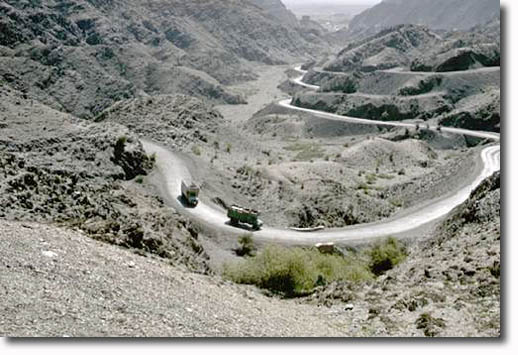
From Soldiers of God: With Islamic Warriors in Afghanistan and Pakistan by Robert Kaplan.
The bus rambled straight ahead on a flat table of increasingly dry earth that bred nothing, it seemed, except a rash of cinder block and mud brick shanties inhabited by refugees. The throngs of people and roadside stalls gradually thinned as the wall of mountains came closer. At the edge of the plain, just past the stone gate with the inscription from Kipling's "Arithmetic on the Frontier", stood the tan battlements of Jamrud Fort, built by the Sikh governor of Peshawar, Hari Singh, in 1836 to defend the entrance to the Pass. It was like a stage set for Gunga Din.
Then, quickly, the earth heaved upward, and what had minutes before seemed like a solitary sandstone wall disintegrated into a labyrinth of scooped-out riverbeds and folds reflecting the dull soldierly hues of gunmetal gray and plankton green. I had the sensation of being trapped ina tunnel. Topping each rise was a slash of red or ocher as the sun caught a higher steeper slope at a different angle. Lifts of cooler air penetrated the bus, momentarily drying my sweat -- my first frresh taste of the mountains after the gauzy heat film of Peshawar. The machine-gun rhythm of Pakistani popular music filled my ears as the winding bed of a Kabul River tributary led to a series of long, slowly rising switchbacks that constituted the heart of the twenty-five-mile-long Khyber Pass.
Disguised as a Pathan in this metal crate hurtling upward toward Afghanistan, I thought it was hard not to be a little impressed with myself. But I had just showered and eaten a hearty breakfast. I doubted that I would feel the same after two weeks of bad food and little sleep.
By themselves, the dimensions of the Khyber Pass are not impressive. The highest peak in the area is under seven thousand feet, and the rise is never steep. What makes the Pass spectacular is sheer scenery, historical association, and a present-day reality every bit as gripping and dangerous as in former epochs. Perhaps nowhere else on the planet are the cultural, climatic, and topographic changes quite so swift and theatrical. In a world of arbitrary boundaries, here is one border region that lives up to the definition.
In the space of forty minutes you are transported through a confined, volcanic nether world of crags and winding canyons, from the lush, tropical floor of India to the cool, tonsured wastes of middle Asia; from a world of black soil, bold fabrics, and rich spicy cuisine to one of sand, coarse wool, and goat meet. And some would add: from a land of subtle, slippery justifications to one of hard, upright decision.
Alexander the Great, accompanied by his teenage Bactrian bride, Roxanne, must have experienced this very sensation as he came down into India (Hindustan) near the Malakand Pass, sixty miles north of here, in the early winter of 327 BC. Some of Alexander's troops, under the command of his most trusted general, Hephaestion, trekked through these same Khyber defiles. So did Babur, the sixteenth-century Mongol king and descendant of Tamurlane, who had lost his father's central Asian kingdom as a young man, but before his death had conquered Kabul and Delhi and founded the great Moghul dynasty. Babur was a poet, whose fantastically detailed memoirs, the Babur-nama, exude a sensitive, lyric intensity that captures the awe and pain of travel in this part of the world. (On finding a cave in the middle of a blizzard in the first days of January 1507, he wrote: "People brought out their rations, cold meat, parched grain, whatever they had. From such cold and tumult to a place so warm, cozy, and quiet!")
Though he conquered India, Babur preferred Afghanistan; his conquest of Kabul in 1504 had marked the turning point in his fortunes. And it was to Kabul, his favorite city, that his body was taken. He lies now under a garden of mulberry trees on the outskirts of the Afghan capital, in a marble monument built in the following century by Shah Jahan, the Moghul emperor responsible for the Taj Mahal. For the handful of journalists and relief workers in Peshawar enamored of such stuff, Babur's marble tomb loomed as the longed-for summit of their Frontier odysseys, where, under the shade of that mulberry arbor, they would one day rest their dirty, fatigued bodies and read Babur's poetry after having witnessed -- they hoped -- the mujahidin conquest of Kabul. "O Babur! dream of your luck when your Feast is the meeting, your New-year the face; For better than that could not be with a hundred New-years and Bairams." Like Babur, some of us measured happiness by how close we were to going up Khyber for the last time.
The British first marched up the Khyber Pass in 1839, on their way to the first Afghan war, which was to end in disaster three years later with the massacre of every solider save one, a Dr. William Brydon, who lived to tell the story. The British came back up the Pass in 1878 and again were forced by the Afghans to withdraw. The graves of British soldiers killed in the second Afghan war lie near the Masjid Mosque by the top of the Pass. Each time, the British lost hundreds of men just fighting their way through the Khyber territory, controlled by the Afridis, a tribal branch of the Pathans who since antiquity have served the function of "guardians of the Pass".
In 1897, the British had to dispatch forty thousand troops to this area just to quell an Afridi uprising and regain control of the Pass. Alexander and Babur also fought pitched battles with the Afridis. It is these tribesmen, numbering over 300,000 in their mud brick redoubts that dot the hills of the Khyber Tribal Agency, who have given the Khyber Pass its allure of danger and epic drama throughout history -- and never more so than in the 1980s.
In The Pathans by Sir Olaf Caroe, the definitive work on the subject, the author provides evidence that the Aparutai, mentioned by the fifth century BC Greek historian Herodotus, are the ancestors of the Afridis of today. (As Caroe writes, the names sound similar when one recognizes that the Afridis, like other Pathans, "habitually change f into p.") The Afridis are also generally thought to have more ancient Greek blood than other Pathans who intermixed with Alexander's soldiers, evinced by their sharp features and fairer complexions. They dress differently too: you can always spot an Afridi by his turban, wrapped tightly with an ostentatious bow around a bulbous red hat, called a kullah.
But these are all minutiae.
What really sets the Afridis apart from other Pathans is their deliciously devious, amoral character -- a legacy of the physical landscape of the Northwest Frontier and the Khyber Pass in particular. Unlike other regions of the Frontier and eastern Afghanistan, the Khyber area has no arable land. Through these poor, barren defiles, conquerors from time immemorial have come to steal the wealth of the subcontinent. So the Afridis learned to play the only card they had: their power to murder, ambush, and in general make life hell for any invading army. What they have essentially said to everyone was: Rather than kill you, all we ask is that you share a certain portion of your wealth with us. And to their fellow Pathans in the Afghan resistance the Afridis' attitude was: You fight the Russians, so they go after you but kill us too. So you must give us something in return. There had been frequent, violent clashes between the mujahidin and the Afridis. The Afridis were bristling with arms. They controlled the weapons trade at Darra, and in addition were supplied with guns by KhAD as a reward for fighting the guerrillas. So it had become more dangerous than ever to trek through Afridi territory on the way into Afghanistan, as I planned to do.
Smuggling, as well as bribes and thievery, was a source of income for the Afridis. A quarter of a century ago the Afridis in the Khyber Agency were among the poorest tribes in Pakistan. They had little to eat and were forced to weave shoes from grass. Their situation improved when they got involved in running Russian consumer appliances from Soviet-occupied Afghanistan into Pakistan. (A smuggled Russian air conditioner cost $300 in Peshawar; an Italian or Japanese one was four to five times the price.) But real fortunes were made with heroin, which, following the Islamic revolution in Iran, became the Khyber Agency's main business. The Afridis set up laborartories in hillside caves, where they organized smuggling caravans to bring the heroin to Pakistani ports. They often bribed police at the various Khyber Pass checkpoints. Unlike other Pathans, the Afridis have managed to keep their fundamentalist beliefs and their livelihood in two separate, airtight mental compartments. A Pakistani government official explained: "To them, nothing is immoral when you are making money." Often an Afridi will interrupt a drug sale if it is prayer time. Afridi merchants always close drug deals with the words: "May God be with you."
The long, buff walls of the British-built Shagai Fort, now manned by the Khyber Rifles, came into view as our bus mounted the first of a series of plateaus. I was not impressed. These Pakistani troops, despite their drums, sashes, and breast-beating tradition earned during the time of the Raj, were not able to hold more than twenty yards on either side of the highway. Beyond that, permission was needed from the heavily armed Afridi tribesmen in order to pass. The real power here lay within the even higher, longer walls of the fortresses that appeared farther up the road: the homes of the wealthiest Afridi khans (large landowners), not a few of whom where implicated in the international drug trade.
Every few miles I saw a military checkpoint, where a Pakistani soldier would mount the bus, cast a quick glance at anyone or anything that looked suspicious, and then wave the bus on. I instinctively looked down and away: Never ever establish eye contact with a border guard. It was one of a reporter's more mundane nightmares out here that he would be pulled off a bus before even entering Afghanistan and be humiliated in the eyes of his colleagues and editors. This happened periodically to journalists in the course of the war, because the attitude of the Pakistani authorities was much more ambivalent than President Zia's open support of the mujahidin suggested. Many in the lower reaches of the Pakistani security services did not share Zia's enthusiasm for the resistance. Even Zia, though he was willing to help the mujahidin, did not want to be seen in the eyes of the Soviets as allowing Western journalists to cross an international border illegally in order to cover the war from the guerrilla side.
February 18, 2006
The Books: "Surrender or Starve : Travels in Ethiopia, Sudan, Somalia, and Eritrea" (Robert Kaplan)
And here is my next excerpt of the day from my library.
My history bookshelf. Onward.
 Next book on this shelf is called Surrender or Starve : Travels in Ethiopia, Sudan, Somalia, and Eritrea by Robert Kaplan.
Yet another one of Kaplan's earlier books which was re-released after his massive success with Balkan Ghosts. Here, unlike The Arabists, I can start to feel the Robert Kaplan STYLE emerging. He's finding his milieu. It's part travelogue - Robert Kaplan is not just a journalist - he is always IN these books as a character. His idol is Rebecca West, whose stupendous book about Yugoslavia in 1939 Black Lamb and Grey Falcon is still a high-water mark in the genre. He is quite open about his regard for her - and that he models his books after her accomplishments. He's also humble enough to say: "I can only ATTEMPT to do what she did ..." Rebecca West is a character in the book she wrote about Yugoslavia - we hear about the breakfasts they had, the people they met on the train ... her own thoughts and perceptions at Kosovo Polje, etc. etc. We learn a ton about the region - we get the history, etc., but it's also almost like a travel diary. Robert Kaplan is damn good at this kind of writing - and in Surrender or Starve he's moving into that territory.
The book is about famine - the causes thereof (which is, of course, never lack of food) - and power. Who's in power? Who controls the food supply? What's the government like? Where do things break down? He travels to the most desolate areas imaginable - horrific refugee camps in the Sudan, Ethiopia ... He looks at the inherent sickness in the whole emergency aid culture ... It's a good book. I recommend it. But then again: I recommend ALL of Kaplan's books.
Here's an excerpt from the beginning of the book. Things covered: the famine in the early 70s in Ethiopia - the fall of the Emperor - and the rise of Mengistu. (This stuff is also told in a BRILLIANT book by a writer I hold above all others - Ryszard Kapuscinski - he wrote a brilliant book about the last emperor of Ethiopia called The Emperor ... but we'll get to that!! Kaplan quotes Kapuscinski all the time, as you will see)
From Surrender or Starve : Travels in Ethiopia, Sudan, Somalia, and Eritrea by Robert Kaplan.
The story began with the 1973-74 famine in Tigre and Wollo. Except for its severity -- an estimated 200,000 peasants starved to death -- there was little that was unusual about this famine. Like the five previous ones that had devastated Ethiopia since Haile Selassie assumed power in 1916, this famine took place in the north; an area that the Amhara emperor had a strategic interest in keeping underdeveloped, on account of Amhara historical conflicts with the Eritreans and Tigreans. A feudal landowning system, an absence of investment, crippling taxation, and drought were the causes of the famine. As far as the palace was concerned, there was nothing to be alarmed about. According to Kapuscinski,
Death from hunger had existed in our Empire for hundreds of years, an everyday natural thing, and it never occurred to anyone to make any noise about it. Drought would come and the earth would dry up, the cattle would drop dead, the peasants would starve. Ordinary, in accordance with the laws of nature and the eternal order of th ings ... none of the dignitaries would dare to bother His Most Exalted Highness with the news that in such and such a province a given person had died of hunger.
In late 1973 there was one difference, however. Between the 1960s famine and the one in the 1970s, television coverage of overseas events finally had come into its own -- encouraged no doubt by the intervening Vietnam War. British reporter Jonathan Dimbleby's film of the famine, The Unknown Famine, of course was not broadcast in Ethiopia, but information about the film filtered back to radicals in Addis Ababa, thereby fostering a strong empathy on their part for the starving peasants up north. A similar bond had eluded Russian revolutionaries until the beginning of this century. In Poland, the convergence of workers and intellectuals into one movement was crucial to Solidarity's initial success. But in Africa, where radicals tend to come from an urban elite that knows, cares, and thinks little about the countryside and the peasants in it, such a development is unusual.
As news of the famine, conveyed by other journalists who followed Dimbleby's trail, reached the streets and campus in Addis Ababa, it had the same effect as the 1905 shooting of marching workers in front of the Winter Palace had on Czar Nicholas II -- the news broke the emperor's spell. The edifice of legitimacy, created by history and tradition, was smashed. What followed was a series of events as drawn out, bloody, and intellectually insane as the Russian and French revolutions, but even more complex. Scholar Bertram D. Wolfe's depiction of revolutionaries in Russia in Three Who Made a Revolution could easily apply to Ethiopia: "With fiercer passion than ever, they fell to engaging in controversies of a minuteness, stubbornness, sweep, and fury unheard of in all the history of politics."
The first phase of the uprising in Ethiopia was known as the "creeping coup". At the beginning of 1974, taxi drivers in Addis Ababa, protesting a rise in gasoline prices, went out on strike. A general strike of all workers followed in March. At the same time, an army mutiny, sparked by a government defeat in Eritrea, was taking place. In Negelle, in the far south of Ethiopia, junior officers arrested their superiors, forcing the generals to eat the same miserable food and dirty water as did the enlisted men. Out of this and other barracks' rebellions came the Dergue (Amharic for committee), a coordinating body of educated junior officers, with representatives from units throughout the country. The uprising began as a class struggle. But, as pointed out by marina and David Ottaway in Ethiopia: Empire in Revolution, the ethnic animosities basic to an empire of great diversity quickly became dominant. Almost as soon as it was formed, the Dergue began to fissure along ethnic lines. Because his ancestry was not wholly Amhara, Mengistu's rise to power was aided by his ability to be seen as a unifying figure.
It was a gradual process. The portrait of one ruler, as so often happens in the Third World, was not abruptly taken down one day from the wall and replaced with that of another. It was as if the picture imperceptibly changed, day by day, a line at a time, during a period of months, until the face of Emperor Haile Selassie was completely wiped out and the face of Mengistu Haile Mariam had emerged from out of the dim background, anonymous and impenetrable; the face of the masses at their most brutal. In the void opened by the absence of democratic institutions and the chaos of revolution, the worst national traits came to the surface.
Mengistu's origin is obscure. By one account, he is the son of a night watchman and a palace servant; by another, the illegitimate descendant of a nobleman and his mistress. Mengistu's complexion is extremely dark, and he is assumed to be part Oromo. During the first years of his rule, his official portrait was touched up to lighten his complexion, so he would appear like an Amhara.
In 1974, Mengistu was a thirty-two-year-old army captain, a graduate of the Holeta Military Academy, which was an institution of no prestige designed for prospective officers whose family backgrounds were neither wealthy nor aristocratic. Like Haile Selassie, Mengistu was short: five feet, five inches. But his reputation was always that of a roughneck; he was constantly getting into fist fights. For eight long years, until the outbreak of the "creeping coup", Mengistu sat behind a desk in a cramped, dusty office in Harar, while serving as an ordnance officer for the Third Army Division -- a typical dead-end job. From this vantage point, noted Rene Lefort in Ethiopia: Revolution Heretique, Mengistu learned how to master the system at its most vicious, petty, and bureaucratic level. Favors, payoffs, and other dirty business regularly crossed his desk. The future author of resettlement and villagization followed Stalin's dictum well: "Paper will put up with anything that is written on it."
The barracks disturbances in early 1974 were perfect opportunities for Mengistu's cunning and thuggishness. Only a true "desperado" could challenge an absolute monarch in a society as violent and secretive as Ethiopia's. At the Dergue's founding meeting in late June 1974, Mengistu was chosen immediately as one of its leaders.
The emperor tried to meet the mutineers' challenge by appointing a new prime minister, who was given a mandate for reform. Meanwhile, Mengistu and the other members of the Dergue worked behind the scenes to unite the faction-ridden armed forces. Haile Selassie was deposed on September 12, 1974; he was driven away from the palace in the back seat of a green Volkswagen and taken to the basement of the Fourth Division headquarters. Two months later, in November, a dispute about the conduct of the war in Eritrea led Mengistu to eliminate his chief rival, General Aman Michael Andom, who was gunned down in his home.
In December, students were dispatched to the countryside, ostensibly to revolutionize th emasses. But the relocation of the students, many of whom were members of the Ethiopian People's Revolutionary party (EPRP), allowed the Dergue to consolidate its power in the cities by forming its own left-wing party, the All-Ethiopian Socialist Movement, known by its Amharic acronym, MEISON. The Dergue then set MEISON agaginst the EPRP.
On August 28, 1975, the English-language Ethiopian Herald announced that Haile Selassie had died the day before of circulatory failure. However, Mengistu is said to have suffocated the eighty-three-year-old deposed emperor with a pillow.
A few weeks later, the Dergue shot contingents of EPRP marchers down in the street. This, as Mengistu no doubt expected, only whetted MEISON's appetite. By early 1976, MEISON cadres were conducting house-to-house searches, killing anyone suspected of belonging to the EPRP.
Within the Dergue, Mengistu continued apace to eliminate rivals. In July 1976, the members of a faction that supported a peaceful solution to the war in Eritrea all were executed. Undeterred, another group, led by General Teferi Banti -- this time calling for democratic reforms -- demanded that Mengistu's power be circumscribed. Mengistu, uncharacteristically, submitted. A few months went by. Then, on February 2, 1977, General Banti and his colleagues were murdered by Mengistu inside the palace. By now, having destroyed the EPRP with the help of MEISON, the Dergue was turning against MEISON itself.
The Russian were very impressed with Mengistu's performance thus far, and a group of East German security police were dispatched to Addis Ababa to advise the emergent Ethiopian leadaer on what to do next. What followed was the Red Terror, which began in May 1977. On May Day eve, soldiers that had been brought into town by convoy machine-gunned to death hundreds of demonstrating students, including many children. During the coming months, dozens of new bodies would turn up on the street every morning; most of them were teenagers who were vaguely connected with revolutionary politics at a time when there was no right side to be on. The victims' families had to pay a fee to the government in order to get the bodies back for burial.
The revolution ground to a halt the next year. The death toll was estimated to be thirty thousand, not including tens of thousands of battlefield deaths. (In Tigre, an insurgency had broken out against the new military rulers, and in Eritrea, Mengistu's uncompromising stance toward the guerrillas resulted in intensified fighting.) Of the 120 members of the original Dergue, only a small fraction were still alive. Compared to the hundreds of political prisoners in jail in Haile Selassie's day, tens of thousands were being held in 1978. Torture reportedly was widespread.
The Darwinian process of revolution had proved efficient and had elevated Mengistu in a very short time from the very bottom to the very top, where he both orchestrated and survived four years of the most violent internecine struggles imaginable. Constantly underestimated by his rivals, he never once miscalculated. The standard of treachery he was judged by, given the paranoia engendered by the revolution, was much higer than that ever applied to Haile Selassie. A Marxist revolution once again had brought an outdated despotism up to a modern standard, with a programmed killer installed in the emperor's palace.
Mengistu belonged to the most lethal class of dictator: the kind not distracted by greed. As with Hitler, Stalin, and Pol Pot, Mengistu was not personally corrupt, and corruption never has been a key element in his style of rule. Apologists for the Ethiopian regime -- and in Europe, especially, there are many - point out that it is more honest and efficient than the previous one. This is certainly true. Mengistu has none of the all-too-human foibles of other Third World rulers, Ferdinand and Imelda Marcos, for example, whose evil was of a lesser variety, one to which the US public could relate. (Is there a more tangible symbol of conspicuous, nouveau riche, middle-class consumption than Mrs. Marcos's fetish for shoes?) This is one reason why even during the height of the famine, the media never bothered much with Mengistu. As a personality he was too austere and his evil too remote for mass audience appeal.
February 17, 2006
The Books: "The Arabists" (Robert Kaplan)
And here is my next excerpt of the day from my library.
My history bookshelf. Onward.
 Next book on this shelf is called Arabists : The Romance of an American Elite by Robert Kaplan.
Ah, Robert Kaplan. He's a guy who pretty much launched a thousand ships in my life. He and Ryzsard Kapuscinski were the ones who started it all. I read Balkan Ghosts and Kapscinski's marvelous Imperium in tandem and ... fuggedaboutit. I was HOOKED. Not only do I find Kaplan's world-weary pragmatism and sometimes rampant pessimism kind of invigorating (how can pessimism be invigorating? I have no idea. But read his books, if you haven't already to see what I mean) - but I also think he's one of the best writers out there, in terms of not only journalism, but human interest stories, travelogue pieces, book reviews. I just eat his stuff UP. He can't be pinned down, either - or, no, that's not accurate. You know where he stands on certain issues, but it sure as hell doesn't line up with any bullshit political party talking-points. He's an environmentalist. He thinks military action is often the only way to bring about peace of any kind. He's worried about overpopulation. He despises communism and totalitarianism. I am now making my way through his Imperial Grunts - his huge book about the American military - and I'm telling you, I wouldn't have any other person as a guide. In my mind, he's the best guide there is. He's got his own way of looking at the world - the Kaplan filter - and you can take it or leave it, but you might as well know what the guy is saying, because he's made correct predictions before. He's scarily prescient. His book The Coming Anarchy should be required reading ... I don't know WHO should be required to read it but I feel like everyone should read it. That book scared the shit out of me. Kaplan's books often scare the shit out of me. I've read them all, and he is one of the few authors where I literally wait with baited breath for his next book. He's pretty much been a one-book-a-year kind of guy since the late 90s, so it's been cool for me - I can get my Kaplan fix on a yearly basis. I like looking at the world through the Kaplan filter. I think my favorite of all of his books is The Ends of the Earth - a spectacular book about his journeys through West Africa, Iran, Pakistan, India, and Southeast Asia - places of "anarchy". Kaplan is one of those guys, one of those few few guys, who takes the long long view. This is one of the reasons why I find him invigorating. If you're a historian, if you study ancient empires rising and falling - as Kaplan does ... then you're going to look at the current struggle a little bit differently. Empires always end. His book Empire Wilderness is his fascinating book about America itself - he travels through America and treats it as though it is a foreign country - He's trying to figure out what is happening in America ... It's kind of a scary book - because - well - change scares me - but I feel comforted knowing that people like him are out there, thinking about this stuff, projecting into the future (good or bad) ...
Anyway, I could go on and on and on about Robert Kaplan. And believe me, I will.
His first book (I think) is Arabists - He became famous with Balkan Ghosts but there were a couple of books before that one. I think Arabists had gone out of print and when Balkan Ghosts hit it so huge, they re-released it. Anyway, it's the story of basically the American diplomat class in the Middle East - how it began with these Protestant missionary types - who wanted to save the heathens ... and then others came ... and more and more ... setting up universities, diplomatic missions from the US State Department blah blah blah ... How were the US "Arabists" different from the "sand-mad Britons"? Kaplan looks at the differences. It's an interesting book, a lot of the history I did not know - but having read every single one of Kaplan's books, and feeling, at times, completely turned ON by his prose - I can feel that he's new at this whole book-writing thing in this one. It feels like a first book. Or maybe a dissertation paper. VERY interesting, though.
Anyway, here's an excerpt from the book - it's about Loy Henderson, Mr. still-controversial Cold War Foreign Service Man.
From Arabists : The Romance of an American Elite by Robert Kaplan.
Unlike the missionaries, Henderson was no idealist. Nor did he, or anyone he was close to, have a vested interest -- as the missionaries certainly did -- in maintaining a personal relationship with the Arabs. Henderson was, however, both a gifted analyst and a quick study, one who was able immediately to place facts about a region previously unknown to him into a conceptual framework that interlocked with situations elsewhere in the world. And it didn't take him long to figure out that after the war with Germany and Japan was over, the Middle East was bent on a cataclysm. He was absolutely certain by 1943 that the intercommunal situation in Palestine was explosive and nearly impossible to solve, and that its shock effects would fissure throughout the Middle East, distorting the region's politics as it already was doing in Iraq. Because he was also certain that after Hitler was defeated, the Soviet Union would become America's worldwide enemy, he thought that the United States had to look at the Palestine problem through the filter of a global struggle against Communism. This necessitated that the US support the side in Palestine that would better strengthen its hand in dealing with the Soviets. For Henderson there was no contest: the Arabs had oil, strategic locations, and numbers. And how many oil wells do the Jews have? Henderson seemed to ask himself. In 1943 this was sheer clairvoyance (even if, as some might assume, Henderson was also motivated by a lack of sympathy for Jews.) By 1947 Henderson would realize that recognition of the State of Israel would buy the United States decades of constant trouble and expense, as well as lead to "the rise of fanatic Mohammedanism" of a kind "not experienced for hundres of years." Could anyone today argue with that?
Henderson would turn out to be wrong about one thing, however: the US could indeed have it both ways, friendship with the Arabs and with the Jews. But not for three decades, as a consequence of Henry Kissinger's shuttle diplomacy and reestablishment of relations with Egypt and Syria in the 1970s, would this become absolutely clear.
In the end, one's attitude towards Henderson is driven by one's perception of how cold-blooded American police needed to be back then. Because Henderson had personally experienced Stalinism to a degree that few of his countrymen had, he had no illusions about the enemy they faced and what he thought it would take to eventually defeat that enemy. Henderson was about as different from the missionaries as one could get. He had no special interest in the Arabs, their language, their culture, or their educational and national aspirations. But he did have strong opinions about where the US national interest in the Middle East lay, and these opinions happened to dovetail perfectly with those of the missionaries. This alignment of goals provided the template for the hybrid Arabist culture that would emerge in the 1950s.
Henderson's analytical skills, his determination and energy, and his willingness -- with the support of his wife, Elise -- to sacrifice much of his personal life on the altar of work and duty resulted in his promotion in 1945. He became the director of the State Department's Near Eastern Affairs office. Henderson's force was felt immediately. When the French government, now controlled by the Free French leader, Charles De Gaulle, began bombing Damascus and other Arab population centers in Syria as a means of retaining control over the Syrian mandate, Henderson went directly to Truman, advising him to force the French to withdraw. Not only, Henderson thought, did French actions mock the spirit of the new United Nations charter, but they threatened to derail the West's relations with Arabs and other Moslems. As Henderson explained to his superiors, Arab hatred of the French would eventually be directed at the entire West and would one day permit the Soviet Union to fill the Great Power void in Syria. This, of course, is exactly what happened.
In early 1946 Soviet troops advanced south to the outskirts of Tabriz in northwestern Iran and were poised to take the city. It was the first crisis in what was to be called the Cold War, and Loy Henderson was ready. It was Henderson who marched into the offices of Undersecretary of State Dean Acheson and Secretary of State James Byrnes, armed with maps to explain how the Soviet troop deployment threatened Turkey, Iraq, and the Iranian oil fields, and prevailed upon the Truman administration to issue a stiff warning to Stalin. Stalin soon pulled back his troops. It was Henderson who, responding to political chaos in Greece later that same year, agitated for a strong US response to prevent a Communist victory there. "The Truman doctrine, which more than any other document served as the blueprint of America's anticommunist empire, took shape in Henderson's office and under his careful direction" as a response to the Greek civil war.
It was in such an atmosphere, with Stalin banging down Greece's door and threatening the northern extremities of Iran, that Henderson confronted the Palestine issue in 1947 and 1948. Henderson, who by now ran NEA in autocratic style and was utterly consumed by the Soviet threat, did everything he could to thwart partition and afterward to thwart US recognition of the part of Palestine awarded to the Jews. Though Marshall and others outside the State Department supported Henderson in this policy, American Jews concentrated their wrath on Henderson alone. "Perhaps Palestine is a new subject for Mr. Marshall. Perhaps he is being briefed by Loy Henderson, the Arabphile [and] striped-trousered underling saboteur," declared Emanuel Celler, a Democratic congressman from a heavily Jewish area of New York City. By the middle of 1948, with Truman fighting for election, Henderson was a political liability that the Democratic presidential candidate could no longer afford. And so for the crime of challenging the conventional wisdom, Henderson was once again exiled, this time to India as US ambassador.
Henderson regretted nothing. He was willing to be publicly branded an anti-Semite if that was the price he had to pay for fulfilling his responsibilities as a Foreign Service officer. Without missing a beat, he immersed himself in India matters. As he had in the Middle East, Henderson arrived in New Delhi soon after India became a major issue. Again Henderson disrupted both conventional wisdom and political correctness by daring to criticize the new nation of India's celebrated leader, Jawaharlal Nehru. Henderson found Nehru "vain, sensitive, emotional and complicated," as well as ungrateful for America's friendship. Even worse, according to Henderson, Nehru's dislike of America had little to do with policy differences but was driven by his British schoolboy-like snobbery regarding America's commercialism and middle-class culture. Henderson also found Indian neutralism dangerous and intellectually dishonest. Such realizations later became commonplace, but Henderson was the first to point them out.
In 1951 Henderson left India to become Ambassador to Iran just as Mohammed Mosadeq was named prime minister, promising to kick the British and their oil interstes out of the country. For almost the next three years Henderson put on a stellar one-man performance in directing US policy toward greater engagement in Iranian affairs and eventually toward overthrowing Mosadeq when his flirtations with the Soviet Union became overt. The Shah's reassertions of power with a strong US presence was thus assured for the next quarter-century, thanks to Henderson, though he took no pleasure in the outcome. He predicted that one day the Iranian people would come to hate America as they did Britain.
The overthrow of Mosadeq led to the creation of the Baghdad Pact, an anticommunist alliance of Near Eastern states to which Henderson was named ambassador in 1955. Henderson was also involved in the Suez, Congo, and other crises. Henderson's last important task in the State Department, as deputy undersecretary of state, was to oversee the reorganization of the Foreign Service in the 1950s, a reorganization that made the service at once more professional and less elite, while laying the groundwork for the true middle-class democratization of the State Department that would occur in the 1980s.
By the end of his career, writes Brands, "peers judged" Henderson "the consummate career officer, a man who did not allow political considerations to color his advice, whose steady advancement owed to solid work and devotion to duty. Subordinates looked up to him as a model of what they might become," particularly because, as Henderson had no children, he adopted a fatherly attitude toward many young Foreign Service officers, seeing them as his heirs.
Loy Henderson, in a sense, invented the political culture of the Foreign Service in the first decades of the postwar era. He was affectionately called Mr. Foreign Service, a title that many of his former colleagues still use when talking about him. While the diplomatic reception rooms on the top floor of the State Department take the names of the Founding Fathers, a large public hall on the ground floor is named after Henderson. Dedicating the hall in 1976, Secretary of State Henry Kissinger lauded Henderon as "the quintessence of what makes our Foreign Service a great and dedicated instrument of national policy."
There could be no greater proof of the immeasurable distance between the State Department and the Jewish state than the fact that the very man who fought hardest to prevent its recognition was thought by his peers to represent the highest standards of their profession. While to Israelis and American Jews Henderson was a "bastard," to Foreign Service officers he was a martyr to public ignorance. Henderson was the classic elitist and insider, who knew popular domestic opinion deserved no place in computing the national interest because the public lacked the facts, the analytical skills, and the living experience overseas that he and his colleagues had in abundance. Wasn't he right -- and all those Jewish intellectuals wrong -- about the true nature of communism?
February 16, 2006
The Books: "Baghdad without a Map" (Tony Horwitz)
And here is my next excerpt of the day from my library. I'm on my history bookshelf.
 Next book on this shelf is called Baghdad without a Map and Other Misadventures in Arabia by Tony Horwitz.
Tony Horwitz is kind of the Dave Barry of "travelogues". He's married to Geraldine Brooks, serious foreign correspondent (I already excerpted her book about Iran) - and for some reason I just love the thought of them together. His books are laugh out loud funny, even if he's writing about a serious topic - and, like Dave Barry does, he often makes himself the unwitting star of his own books. Like: "look at what a goofball I am." If you haven't read his stuff, I highly highly recommend him. He doesn't publish ENOUGH as far as I'm concerned. So Baghdad without a map is the story of him basically tagging along through the Middle East and Africa behind his hot-shot wife - and the adventures and "misadventures" he has. He doesn't have the same access she does - she talks to Prime Ministers - he talks to car salesmen. But he's one of those people - like Dave Barry, or David Sedaris - whose antennae are always tuned in towards "the funny". He sees the absurdity of life. Some of the observations he makes in Baghdad without a map seem so spot ON - but he never sacrifices the humor. Like he describes being on a flight to Iran from London or something. Everyone gets on the plane, everyone is "Western". The pilot announces that they will soon begin the descent to Tehran. And all at once, as one, every woman on the plane starts to drape herself in her burkha. It's not a funny image all on its own, per se ... it's indicative of some of the issues in the Middle East - but it's specific, it's human, and it tells the story way better than some treatise on what Mohammed said about veiling women, or the history of the burkha. Tony Horwitz makes you see it. Women in hip track suits, or chic designer clothes, stiletto heels - suddenly draping themselves, and becoming indistinguishable from one another. The book is full of anecdotes like that. Oh, and he said that after a couple of weeks being in Arab countries, or any Muslim country - where his wife had to put on a veil - the sight of his wife's hair started to arouse him in the worst way. They would come home after a long day to the hotel, she would take off her veil, he would contemplate her hair, and then just attack her.
In the book, he goes to Yemen, Beirut, Cairo, Baghdad, Israel, Libya (now that's a hoot - Libya, in and of itself, is, of course, not funny at all - but read his chapter on Libya - hahahaha), Tehran (he is there during Khomeini's funeral) - and he takes a boat ride in the Persian Gulf.
It was so hard to choose because each chapter is so good - so just promise me you'll give the whole book a shot - I chose a great excerpt from his visit to the Sudan. He goes to Khartoum, piggy-backing with a group of aid workers. And then they all travel, as a group, to southern Sudan. Tony Horwitz is fascinated by the toweringly tall Dinka - Anyway, while in southern Sudan working at a refugee camp - there's an impromptu soccer game - It's one of my favorite incidents in the book.
From Baghdad without a Map and Other Misadventures in Arabia by Tony Horwitz.
We made it back to Muglad in time for a sunset soccer game at a field adjoining the refugee camp. Normally, Kevin and one other aid worker played in the weekly contest, but they had work to do and asked Bart and me to go as substitutes. I was weary from the long day in Babanoosa and wearier still at the sight of the field: a two-hundred-yard expanse of thorn and scrub, with crooked sticks forming a goal at either end. The field was almost as wide as it was long and edged with sand and brambles. An underfed goat grazed at the hundred-yard line.
The teams, twenty to a side, were as irregular as the field. One squad was mostly Dinka, the other included members of a clan called Nuer. Tribal markings were the only way to tell the two groups apart. Dinka men have their six bottom teeth yanked out at the age of eight, and four lines cut across their foreheads at adolescence. The Nuers' faces are marked with six lines and small raised dots. This distinction would no doubt be obvious to an anthropologist. But in fading sunlight, on a playing ground the size of an Iowa cornfield, the players were indistinguishable to me.
When I suggested with pantomime that one team identify itself by disrobing from the waist up, in the American tradition of "shirts and skins", half of the players politely obliged and half didn't, irrespective of which squad they were on. Then a self-appointed referee, who had evidently never played soccer before, tossed a lumpy brown ball in the air and announced that the match had begun.
Tents emptied out and the refugees crowded along the sidelines, shouting and banging on sticks. Adults gathered behind one goal and children behind the other, though neighter group seemed to be rooting for a particular team. The game, after all, was a complete novelty to most of them, as were Bart and I. No sooner had we lined up, on opposing sides, than a deafening roar begagn:
"Khawajja! Khawajja! Khawajja!"
Posted at left wing, the only player I could identify was a Dinka with red sneakers who appeared to be on my side. This was hard to confirm, as everyone crowded around the ball rather than playing in position. The referee stood passively by as the players delivered groin kicks and tackled each other in the thorns.
What the players lacked in finesse they made up for in stamina. After two or three springs down the endless field, I was clutching my stomach and gasping for breath. My teammates, many of whom had recently limped into Muglad with swollen feet and bellies, raced up and down as effortlessly as gazelles across the savannah.
Given the size and condition of the field, scoring should have been impossible. Perhaps to compensate for this, both teams passed over their seven-footers and chosen as goalies two youths who were, by Dinka standards, virtual dwarfs, no taller than I. As the goals were thirty yards wide and the posts lacked crossbeams, even wild kicks sailed past the goalies' arms or over their heads. After twenty minutes of play the score was 10 to 7.
The crowd showed no interest in the scoring, apparently unaware that this was the point of the game. Instead, they were riveted to the miscues, laughing loudly whenever players kicked and missed or let balls roll between their legs. After days spent waiting for rations of sorghum, the soccer game wasn't sport, it was comic relief. And it quickly became clear that Bart and I were the champion clowns, midget men with straight blond hair and pale skin, loping in slow motion behind the fleet, tall Dinka. Each time either of us touched the ball, the cry went up from the sidelines: "Khawajja! Khawajja! Khawajja!"
Deafened by the noise, I dribbled through the thorns until my wind gave out, then looked for the red-sneakered youth -- yelling, pointlessly, "Yo! Dinka in the red!" -- and kicked the ball as hard as I could.
"KHAWAJJA! KHAWAJJA! KHAWAJJA!"
After an hour, the sun sank into the scrub in a blaze of purple and orange, with the score tied at 21. The referee called the game. The other side didn't hear, or didn't care, and rushed down the field, kicking the ball through the posts after our goalie had fled. The referee threw up his hands. The Nuer had won, 22 to 21. And the refugees wandered off through the dark to pick up firewood and cook their sorghum porridge as another band of refugees wandered in.
February 15, 2006
The Books: "Dispatches" (Michael Herr)
And here is my next excerpt of the day from my library. I'm on my history bookshelf.
 Next book on this shelf is called Dipatches by Michael Herr. Michael Herr also wrote Apocalypse Now - or, he was one of the writers. Dispatches is his book about being a foreign correspondent over in Vietnam. But it's not your typical book, written in a typical journalistic style. It's raw-er. It's poetic. It has a kind of of stream-of-consciousness to it that - is very freaky. The sentences are long, they just keep going and going ... some of it sounds hallucinatory. Hunter Thompson went on record saying that the book blew him away, and that the book "put all the rest of us in the shade".
There's historical stuff in the book, background information, a sense of who, what, where, why, when - but the excerpt I've chosen doesn't have any of that. It's just plain creepy.
Here it is.
From Dipatches by Michael Herr.
There were times during the night when all the jungle sounds would stop at once. There was no dwindling down or fading away, it was all gone in a single instant as though some signal had been transmitted out to the life: bats, birds, snakes, monkeys, insects, picking up on a frequency that a thousand years in the jungle might condition you to receive, but leaving you as it was to wonder what you weren't hearing now, straining for any sound, one piece of information. I had heard it before in other jungles, the Amazon and the Philippines, but those jungles were "secure," there wasn't much chance that hundreds of Viet Cong were coming and going, moving and waiting, living out there just to do you harm. The thought of that one could turn any sudden silence into a space that you'd fill with everything you thought was quiet in you, it could even put you on the approach to clairaudience. You thought you heard impossible things: damp roots breathing, fruit sweating, fervid bug action, the heartbeat of tiny animals.
You could sustain that sensitivity for a long time, either until the babbling and chittering and shrieking of the jungle had started up again, or until something familiar brought you out of it, a helicopter flying around above your canopy or the strangely reassuring sound next to you of one going into the chamber. Once we heard a really frightening thing blaring down from a Psyops soundship broadcasting the sound of a baby crying. You wouldn't have wanted to hear that during daylight, let alone at night when the volume and distortion came down through two or three layers of cover and froze us all in place for a moment. And there wasn't much release in the pitched hysteria of the message that followed, hyper-Vietnamese like an icepick in the ear, something like, "Friendly Baby, GVN Baby, Don't Let This Happen To Your Baby, Resist the Viet Cong Today!"
Sometimes you'd get so tired that you'd forget where you were and sleep the way you hadn't slept since you were a child. I know that a lot of people there never got up from that kind of sleep; some called them lucky (Never knew what hit him), some called them fucked (If he'd been on the stick ...), but that was worse than academic, everyone's death got talked about, it was a way of constantly touching and turning the odds, and real sleep was at a premium. (I met a ranger-recondo who could go to sleep just like that, say, "Guess I'll get some," close his eyes and be there, day or night, sitting or lying down, sleeping through some things but not others; a loud radio or a 105 firing outside the tent wouldn't wake him, but a rustle in the bushes fifty feet away would, or a stopped generator.) Mostly what you had was on the agitated side of half-sleep, you thought you were sleeping but you were really just waiting. Night sweats, harsh functionings of consciousness, drifting in and out of your head, pinned to a canvas cot somewhere, looking up at a strange ceiling or out through a tent flap at the glimmering night sky of a combat zone. Or dozing and waking under mosquito netting in a mess of slick sweat, gagging for air that wasn't 99 percent moisture, one clean brath to dry-sluice your anxiety and the backwater smell of your own body. But all you got and all there was were misty clots of air that corroded your appetite and burned your eyes and made your cigarettes taste like swollen insects rolled up and smoked alive, crackling and wet. There were spots in the jungle where you had to have a cigarette going all the time, whether you smoked or not, just to keep the mosquitos from swarming into your mouth. War under water, swamp fever, and instant involuntary weight control, malarias that could burn you out and cave you in, put you into twenty-three hours of sleep a day without giving you a minute of rest, leaving you there to listen to the trance music that they said came in with terminal brain funk. ("Take your pills, baby," a medic in Can Tho told me. "Big orange ones every week, little white ones every day, and don't miss a day whatever you do. They got strains over here that could waste a heavy-set fella like you in a week.") Sometimes you couldn't live with the terms any longer and headed for air-conditioners in Danang and Saigon. And sometimes the only reason you didn't panic was that you didn't have the energy.
Every day people were dying because of some small detail that they couldn't be bothered to observe. Imagine being too tired to snap a flak jacket closed, too tired to clean your rifle, too tired to guard a light, too tired to deal with the half-inch margins of safety that moving through the war often demanded, just too tired to give a fuck and then dying behind that exhaustion. There were times when the whole war itself seemed tapped of its vitality: epic enervation, the machine running half-assed and depressed, fueled on the watery residue of last year's war-making energy. Entire divisions would function in a bad dream state, acting out a weird set of moves without any connection to their source. Once I talked for maybe five minutes with a sergeant who had just brought his squad in from a long patrol before I realized that the dopey-dummy film over his eyes and the fly abstraction of his words were coming from deep sleep. He was standing there at the bar of the NCO club with his eyes open and a beer in his hand, responding to some dream conversation far inside his head. It really gave me the creeps -- this was the second day of the Tet Offensive, our installation was more or less surrounded, the only secure road out of there was littered with dead Vietnamese, information was scarce and I was pretty touchy and tired myself -- and for a second I imagined that I was talking to a dead man. When I told him about it later he just laughted and said, "Shit, that's nothing. I do that all the time."
February 14, 2006
The Books: "Carnage and Culture" (Victor Davis Hanson)
And here is my next excerpt of the day from my library. I'm on my history bookshelf.
 Next book on this shelf is called Carnage and Culture : Landmark Battles in the Rise to Western Power by Victor Davis Hanson.
I've been a fan of Hanson for quite some time, and am very excited he has his own site now, where all his articles are listed, because I won't read his regular stuff on you-know-what. Bummer. Hey, we all have principles, and I have mine - it's a meaningless little boycott, but if we don't act according to our principles then who are we??? Hanson is a good writer, and an even better thinker. He's an incredibly boring public speaker, however - I saw him on Book Notes once and was nearly put into a hypnotic state by the mellifluous MONOTONE of his voice - but his written prose doesn't come across as boring at ALL. He's a lively thinker, a lively writer - and he has the ability to make me understand what was going on, in these intricate battles - from the year 732 or whatever - and not just understand, but hear the crashing of the waves at Salamis, or hear the thundering horse hooves ... I'm not a military historian by any stretch of the imagination, so I, personally, NEED the writer to make me feel like I was there. So I can "get it". Hanson has that in spades.
If you like Victor Davis Hanson and if you like his columns - then I highly suggest you check out Carnage and Culture. The blurb on the back of the book says: "Looking beyond popular explanations such as geography or advanced technology, Hanson argues that it is in fact Western culture and values -- the tradition of dissent, the importance placed on inventiveness and adaptation, the concept of citizenship -- which have consistently produced superior arms and soldiers." And by "superior", Hanson means soldiers capable of the most "carnage". Hanson feels ambivalently about this, as he expresses many times throughout the book - but I think he makes a very compelling case. His book was very controversial when it came out. He makes some very uncomfortable points - along the lines that Bernard Lewis does in his fantastic and important book What Went Wrong?. Actually - the word "uncomfortable" in that last sentence should probably be qualified. It doesn't make ME uncomfortable. I'm just saying that it made SOME people uncomfortable, and there was a lot of weeping and wailing about it . It's only "uncomfortable" if you are unwilling to examine certain historical facts, if you think that politically correct attitudes should not only dominate the present, but also dominate the past, if the whole concept of "victory" makes you feel a little bit ikky and ambivalent ... then this book will make you very uncomfortable. This book also has a bit in common with the massively successful Guns, Germs, and Steel and it makes people "uncomfortable" in the same ways. Different cultures in different regions develop in different ways. DUH. Because of these differences - some cultures have been far more dominant in battle than others. DUH. Hanson theorizes that the West's dominance is not just about superior technology, and geography - but about the actual culture itself. This makes a lot of people nervous - they don't know what he's reeeaaaallly trying to say. Is he trying to say that we shouldn't respect other cultures?? Is he trying to say that it's ALL RIGHT that we massacred such and such and so and so? I don't hear him say ANY of that. But these folks are suspicious of his motives. I see it in a much simpler way. He's a classical historian, and a military historian - not to mention a farmer in California. He looks at 9 battles throughout human history (Salamis, Gaugamela, Cannae, Poitiers, Tenochtitlan, Lepanto, Rorke's Drift, Midway, Tet) and analyzes them. He has come to the conclusion that many Western traditions (like the ones listed above - ones that were not present in, say, ancient Persia) has helped Western armies to be the effective war machines they are today (and always have been). That's it.
I'm going to excerpt a bit from the first chapter where he breaks down the battle at Salamis, - September 28, 480 BC - Greeks against the Persians. 40,000 men drowned that day. It's really hard to contemplate that.
Anyway, here's the section on Persian society and culture at that time. It's long. I found this excerpt online.
From Carnage and Culture : Landmark Battles in the Rise to Western Power by Victor Davis Hanson.
The Persian Empire at the time of the battle of Salamis was huge -- 1 million square miles of territory, with nearly 70 million inhabitants -- at that point the largest single hegemony in the history of the civilized world. In contrast, Greek-speakers on the mainland numbered less than 2 million and occupied about 50,000 square miles. Persia was also a relatively young sovereignty, less than a hundred years old, robust in its period of greatest power -- and largely the product of the genius of its legendary king Cyrus the Great. In a period of not more than thirty years (cs. 560-530 BC), Cyrus had transformed the rather small and isolated Persian monarchy (Parsua in what is now Iran and Kurdistan) into a world government. He finally presided over the conquered peoples of most Asia -- ranging from the Aegean Sea to the Indus River, and covering most of the territory between the Persian Gulf and Red Sea in the south and the Caspian and Aral Seas to the north.
After the subsequent loss of the Ionian Greek states on the shores of the Aegean, the mainland Greeks grew familiar with this huge and sophisticated new empire now expanding near its eastern borders. What the Greeks learned of Persia -- as would be the later European experience with the Ottomans -- both fascinated and frightened them. Later an entire series of gifted politicians and renegade intriguers such as Demaratus, Themistocles, and Alcibiades would aid the Persians against their own Greek kin, and yet at the same time loathe their hosts for appealing nakedly to their personal greed. In a similar manner Italian admirals, ship designers, and tacticians would later seek lucrative employment with the Ottomans. Greek moralists, in relating culture and ethics, had long equated Hellenic poverty with liberty and excellence, Eastern alliance with slavery and decadence. So the poet Phocylides wrote, "The law-biding polis, though small and set on a high rock, outranks senseless Nineveh."
By the time of the reign of Darius I (521 - 486 BC) Persia was a relatively stable empire, governed by the so-called Achaemenid monarchy that oversaw a sophisticated provincial administration of some twenty satrapies. Persian governors collected taxes, provided musters for national campaigns, built and maintained national roads and an efficient royal postal service, and in general left local conquered peoples the freedom to worship their own gods and devise their own means for meeting targeted levels of imperial taxation. To the Greeks, who could never unify properly their own vastly smaller mainland, the Achaemenids' confederation of an entire continent raised the specter of a force of men and resources beyond their comprehension.
What mystified Westerners most -- we can pass over their prejudicial view of Easterners as soft, weak, and effeminate -- was the Persian Empire's almost total cultural antithesis to everything Hellenic, from politics and military practice to economic and social life. Only a few miles of sea separated Asia Minor from the Grreek islands in the Aegean, but despite a similar climate and centuries of interaction, the two cultures were a world apart. This foreign system had resulted not in weakness and decadence, as the Greeks sometimes proclaimed, but ostensibly in relatively efficient imperial administration and vast wealth: Xerxes was on the Athenian acropolis, the Greeks (not yet) in Persepolis. An awe-inspiring impression of Persian power was what Greeks gleaned from itinerant traders, their own imported Eastern chattel slaves, communication from their Ionian brethren, the thousands of Greek-speakers who found employment in the Persian bureaucracy, and random tales from returning mercenaries. The success of the Achaemenid dynasty suggested that there were peoples in the world -- and in increasing proximity to Greece -- who did things far differently, and in the process became far more wealthy and prosperous than the Greeks.
The absolute rule of millions was in the hands of a very few. The king and his small court of relatives and advisers (their Persian titles variously translate as "bow carrier," "spear bearer," "king's friends," "the king's benefactor", "the eyes and ears of the king," etc.) oversaw the bureaucracy and priesthood, which thrived from the collection of provincial taxes and ownership of vast estates, while a cadre of Persian elites and Achaemenid kin ran the huge multicultural army. There was apparently no abstract or legal concept of freedom in Achaemenid Persia. Even satraps were referred to as slaves in imperial correspondence: "The King of Kings, Darius son of Hystapes, says these things to his slave Gadatas: 'I learn that you are not obeying my commands in all respects ...'" (R. Meiggs and D. Lewis, eds., Greek Historical Inscriptions, #12, 1-5). The Achaemenid monarch was absolute and, though not divine himself, the regent of the god Ahura Mazda on earth. The practice of proskynesis -- kneeling before the Great King -- was required of all subjects and foreigners. Aristotle later saw this custom of worshiping men as gods as proof of the wide difference between Eastern and Hellenic notions of individualism, politics, and religion. Whereas the victorious Greek generals of the Persian Wars -- the regent Pausanias in Sparta, Miltiades and Themistocles at Athens -- were severely criticized for identifying their persons with the Greek triumph, Xerxes, when attempting to cross a choppy Hellespont, had the sea "whipped and branded" for "disobeying" his orders.
Legal codes exist in every civilization. Under the Persians, local judiciaries were left in place at Lydia, Egypt, Babylonia, and Ionia -- with the proviso that Achaemenid law superseded all statues, and was established and amended as the Great King himself saw fit. Every man bobbing in the water on September 28 had no legal entity other than as a bandaka, or "slave" of Xerxes -- a concept taken from the earlier Babylonian idea that the individual was an ardu, a "chattel" of the monarch.
Contrarily, in Greece by the fifth century almost all political leaders in the city-states were selected by lot, elected, or subject to annual review by an elected council. No archon claimed divine status; execution by fiat was tantamount to murder; and the greatest vigilance was devoted to preventing the resurgence of tyrants, who had plagued a number of the most prosperous and commercial Greek states in the immediate past. Even personal slaves and servants in Greek city-states were often protected from arbitrary torture and murder. These were not alternative approaches to state rule, but fundamental differences in the idea of personal freedom that would help determine who lived and died at Salamis.
The Persian imperial army was huge and commanded at the top by relatives and elites under oath to the king. At its core were professional Persian infantrymen -- the so-called Immortals were the most famous -- and various contingents of subsidiary heavy and light infantry, supported by vast forces of cavalry, charioteers, and missile troops. In battle the army depended on its speed and numbers. In place of a heavily armed shock force of pikemen that could shatter horsemen and ground troops, Persian infantrymen were often conscripted from hundreds of different regions, spoke dozens of languages, and were armed with swords, daggers, short spears, picks, war axes, and javelins, and protected by wicker shields, leather jerkins, and occasionally chain-mail shirts. Drill, strict adherence to rank and file, and coordinated group advance and retreat were largely unknown. The Greeks' dismissive view about the quality of Persian heavy infantry was largely accurate. Some years later, in the early fourth century, Antiochos, a Greek ambassador from Arcadia, said there was not a man fit in Persia for battle against Greeks. There was no need during the creation of the Persian Empire on the steppes of Asia to field phalanxes of citizen hoplites outfitted in seventy-pound panoplies.
The Achaemenid king was not always perched on a throne overlooking the killing ground -- like Xerxes at Thermopylae and Salamis -- but more regularly fought in a great chariot, surrounded by bodyguards, in the middle of the Persian battle line: both the safest and most logical position whence to issue orders. Greek historians made much of the obvious dissimilarity: Persian monarchs fled ahead of their armies in defeat, while there is not a single major Greek battle -- Thermopylae , Delium, Mantinea, Leuctra -- in which Hellenic generals survived the rout of their troops. Military catastrophe brought no reproach upon the Achaemenid king himself; subordinates like the Phoenicians at Salamis were scapegoated and executed. In contrast, there was also not one great Greek general in the entire history of the city-state -- Themistocles, Militiades, Pericles, Alcibiades, Vrasidas, Lysander, Pelopidas, Epaminondas -- who was not at some time either fined, exiled, or demoted, or killed alongside his troops. Some of the most successful and gifted commanders after their greatest victories -- the Athenian admirals who won at Arginusae (406 BC) or Epaminondas on his return from liberating the Messenian helots (369 BC) -- stood trial for their lives, not so much on charges of cowardice or incompetence as for inattention to the welfare of their men or the lack of communication with their civilian overseers.
In such a vast domain as Persia, there were in theory thousands of individual landholders and private businessmen, but the economic and cultural contrast with fifth-century Greece was again telling. In classical Athens we do not know of a single farm larger than one hundred acres, whereas in Asia -- both under the Achaemenids and later during the Hellenistic dynasties -- estates exceeded thousands of acres in size. One of Xerxes' relatives might own more property than every rower in the Persian fleet combined. Most of the best land in the empire was under direct control of priests, who sharecropped their domains to serfs, and absentee Persian lords, who often owned entire villages. The Persian king himself, in theory, had title to all the land in the empire and could either exercise rights of confiscation of any estate he wished or execute its owner by fiat.
Greece itself had plenty of its own hierarchies concerning property owning, but the difference lay in the posture of a consensual government toward the entire question of land tenure. Public or religiously held estates were of limited size and relatively rare -- comprising not more than 5 percent of the aggregate land surrounding a polis. Property was rather equitably held. Public auctions of repossessed farmland were standard, and prices at public sales low and uniform. Lands in new colonies were surveyed and distributed by lot or public sale, never handed over to a few elites. The so-called hoplite infantry class typically owned farms of about ten acres. In most city-states they made up about a third to half of the citizen population and controlled about two-thirds of all the existing arable land -- a pattern of landholding far more egalitarian than, say, in present-day California, where 5 percent of the landowners own 95 percent of all agricultural property.
No Greek citizen could be arbitrarily executed without a trial. His property was not liable to confiscation except by vote of a council, whether that be a landed boule in broadly based oligarchies or a popular ekklesia under democracy. In the Greek mind the ability to hold property freely -- have legal title to it, improve it, and pass it on -- was the foundation of freedom. While such classical agrarian traditions would erode during the later Roman Empire and the early Dark Ages, with the creation of vast absentee estates and ecclesiastical fiefdoms, the ideal would not be abandoned, but rather still provided the basis for revolution and rural reform in the West from the Renaissance to the present day.
While there were vast state mints in Persia, our sources for Achaemenid imperial administration -- borne out by the later arrival of the looters and plunderers in Alexander the Great's army -- suggest that tons of stored bullion remained uncoined and that there was a chronic stagnation in the Persian economy. With metals on deposit in imperial treasuries, provincial taxes were more often paid in kind as "gifts" -- food, livestock, metals, slaves, property -- rather than in specie, illustrative of high taxes and an undeveloped moneyed economy. One of the reasons for the initial rampant expansion and inflation of the later Hellenistic world (323-31 BC) was the sudden conversion of precious metals stored in the Achaemenid vaults into readily coined money by the Macedonian Successor kings, who, in transforming a command economy to a more capitalist one, hired out thousands of builders, shippers, and mercenaries.
Persian literature -- a corpus of drama, philosophy, or poetry apart from religious or political structure -- did not exist. True, Zoroastrianism was a fascinating metaphysical inquiry, but its reason to be was religious, and thus the parameters of its thought were one with all holy treatises, embedded as it was with a zeal that precluded unlimited speculation and true free expression. History -- the Greeks' idea of free inquiry, in which the records and sources of the past are continually subject to questioning and evaluation as part of an effort to provide a timeless narrative of explication -- was also unknown among the Persians, at least in any widely disseminated form. The nearest approximation was the public inscriptions of the Achaemenids themselves, in which a Darius I or Xerxes published his own res gestae:
The emperor Augustus issued similar proclamations in imperial Rome, but there were still a Suetonius, Plutarch and Tacitus eventually to set the record straight. Just as the Ottomans would later bar printing presses throughout their empire in fear of free expression, the idea of public criticism of the Achaemenids through written documents was literally unknown.
All Persian texts -- whether public inscriptions, palace inventories, or sacred tracts -- concern the king, his priests, and bureaucrats at large, and confine themselves to government and religion. Even if other avenues of public expression had existed, the Persian victory at Thermopylae could not have been portrayed onstage or remembered in poetry without the approval of Xerxes -- and not without Xerxes as chief protagonist in the triumph. The commemoration of the Persian victory in Bactria proves that well enough: "Says Xerxes the king: When I became king, there was within these lands which are written above one which was restless. Afterward Ahura Mazda brought me help. By the favor of Ahura Mazda I smote that land and put it in its place." (A. Olmstead, History of the Persian Empire, 231)
Persian religion was not as absolutist as that in Egypt, inasmuch as the Achaemenids were agents of Ahura Mazda, not divinities per se. Nevertheless, royal power was predicated on divine right, imperial edict was considered a holy act. So the constant refrain of all the Achaemenid kings: "Of me is Ahura Mazda, of Ahura Mazda am I." When Alexander the Great learned to say the same thing, even his most loyal Macedonian lords began to plot either an assassination, a coup, or a return to Greece. Conquered peoples of the Persian Empire like the Babylonians and Jews, however, at the local level were left to worship their own gods. Because no culture in the conquered East had any tradition of religion apart from politics, or even embraced the ideal of religious divinity, most Persian subjects considered the Achaemenid religious-political relationship not any different from their own -- and if anything more tolerant.
That being said, there were numerous castes of holy men who not only enjoyed political power as agents of the king but also sought vast acreages to support their work. The official white-robed magi were employed by the monarchy as religious auditors in public ceremony and to ensure the piety of the imperial subjects. Mathematics and astronomy were advanced, but ultimately they were subject to religious scrutiny and used to promote in a religious context the arts of divination and prophesy. A humanist such as Protagoras ("Man is the measure of all things") or an atheist rationalist like Anaxagoras ("Whatever has life, both the greater and smaller, Mind [nous] controls them all ... whatsoever things are now and will be, Mind arranged them all") could not have prospered under the Achaemenids. Such freethinking in Persia might arise only through imperial laxity; and if discovered, was subject to immediate imperial censure. The classical Greeks were as pious as the Persians, but when conservative citizens rallied to rid their cities of atheistic provocateurs, they first sought a majority decree of the people or at least the semblance of an open jury trial.
If in the past Western historians have relied on Greek authors such as Aeschylus, Herodotus, Xenophon, Euripides, Isocrates, and Plato to form stereotypes of the Persians as decadent, effete, corrupt, and under the spell of eunuchs and harems, the careful examination of imperial archives and inscriptions of the Achaemenids should warn us of going too far in the other direction. The Persian army at Salamis was not decadent or effeminate, but it did constitute a complete alternate universe to almost everything Greek. All things considered, there was no polis to the East. Achaemenid Persia -- like Ottoman Turkey or Montezuma's Aztecs -- was a vast two-tiered society in which millions were ruled by autocrats, audited by theocrats, and coerced by generals.
February 13, 2006
The Books: "We Wish to Inform You That Tomorrow We Will be Killed With Our Families" (Philip Gourevitch)
And here is my next excerpt of the day from my library. I'm on my history bookshelf.
 Next book on this shelf is called We Wish to Inform You That Tomorrow We Will be Killed With Our Families: Stories from Rwanda by Philip Gourevitch.
What a book. What an unbelievable book. If you haven't read it - all I can say is: please. Do yourself a favor: Go out and buy it NOW.
Gourevitch stood in line at the Holocaust Museum in DC in 1994, all the signs of "Never Again" all over the place. As he waited in line for his ticket, he read the New York Times. On the front page (and I'm sure we all remember this image) was a photo of a river clogged with dead bodies. He read, with growing horror, about what was going on. He could not believe his eyes. And in the setting he was in - with "Never Again" shouting at him from all sides - it took on even greater meeting. Oh, never again, huh?? He was a young young guy - 25 years old - but he had already had some stuff published in The New Yorker (he's a HELL of a writer) - so he basically had The New Yorker send him over to Rwanda. This book is the result. It is THE book of the Rwandan genocide. There are stories in here that you will never EVER forget. Hotel Rwanda is based on one of the many stories included in this book. Gourevitch opened the way for others. Now there are many books you can read in your local Barnes & Noble about the genocide - but his was the first.
A haunting book. An infuriating book. A tragic book. It is so good - can't say enough about it.
I'll post an excerpt that always struck me as ... particularly intense. And deep. It also shows you Gourevitch's style here, which isn't like other reporter's styles. He doesn't just report the facts. He goes deeper. You'll see what I mean. He interviews a doctor named Odettet Nyiramilimo - a Tutsi woman, born in 1956. She'd seen a lot of shit, and had somehow survived the 1994 slaughter. But of course - there had been many "dress rehearsals" for genocide - pogrom after pogrom through the years - she grew up with this shit.
But look at what Gourevitch does here.
He's a reporter who is not just about his STORY. He is after ... something else. I don't know why I know that - but it just seems that he notices EVERYthing. He doesn't only pay attention to that which will enhance the STORY he is after. The moment I am speaking of in the following excerpt is really startling - it cracks open the story - It's NOT just a story. It is a human LIFE. Which can never be narrowed down into just a plot-line. Gourevitch is after that something else ... maybe he's after meaning - not just facts - but MEANING - When we are faced with genocide, so often we just want to know WHY?? Or HOW could you do that?? These questions never really can be answered - it's at the heart of the mystery of man's inhumanity to man ... but that's what Gourevitch is after. His book is about Rwanda, yes, but it's also about, in a larger sense, the essential mystery of genocide - and his writing shows that. I love him.
From We Wish to Inform You That Tomorrow We Will be Killed With Our Families: Stories from Rwanda by Philip Gourevitch.
In 1973, after her brother-in-law rejected her, she kept walking, home to Kinunu. She found her father's house empty and one of his side houses burned. The family was hiding in the bush, camping among their banana trees, and Odette lived with them there for several months. Then, in July, the man in charge of the pogroms, Major General Habyarimana, ousted Kayibanda, declared himself president of the Second Republic, and called a moratorium on attacks against Tutsis. Rwandans, he said, should live in peace and work together for development. The message was clear: the violence had served its purpose, and Habyarimana was the fulfillment of the revoltuion.
"We really danced in the streets when Habyarimana took power," Odette told me. "At last, a President who said not to kill Tutsis. And after 'seventy-five, at least, we did live in security. But the exclusions were still there." In fact, Rwanda was more tightly regulated under Habyarimana than ever before. "Development" was his favorite political word and it also happened to be a favorite word of the European and American aid donors whom he milked with great skill. By law, every citizen became a member for life of the President's party, the National Revolutionary Movement for Development (MRND), which served as the all-pervasive instrument of his will. People were literally kept in their place by rules that forbade changing residence without government approval, and for Tutsis, of course, the old nine-percent quota rules remained. Members of the armed forces were forbidden to marry Tutsis, and it went without saying that they were not supposed to be Tutsis themselves. Two Tutsis were eventually given seats in Habyarimana's rubber-stamp parliament, and a token Tutsi was given a ministerial post. If Tutsis thought they deserved better, they hardly complained; Habyarimana and his MRND promised to let them live unmolested, and that was more than they had been able to count on in the past.
The Belgian director of Odette's old school in Cyangugu would not readmit her, but she found a place in a school that specialized in sciences, and began preparing for a career in medicine. Once again, the headmistress was a Belgian, but this Belgian took Odettet under her wing, keeping her name out of the enrollment books, and hiding her when government inspectors came looking for Tutsis. "It was all trickery," Odette said, "and the other girls resented it. One night, they came to my dormitory and beat me with sticks." Odette didn't dwell on the discomfort. "Those were the good years," she said. "The headmistress looked after me, I had become a good student -- first in my class -- and then I was admitted, with some more trickery, to the national medical school in Butare."
The only thing Odette said about her life as a medical student was: "In Butare once, a professor of internal medicine came up to me and said, 'What a pretty girl,' and he started patting my bottom and tried to set up a date even though he was married."
The memory just popped out of her like that, with no apparent connection to the thought that preceded it or the thought that followed. Then Odette sped along, skipping over the years to her graduation and her marriage. Yet, for a moment, the image of her as a young student in an awkward moment of sexual surprise and discomfort hung between us. It seemed to amuse Odette, and it reminded me of all that she wasn't telling me as she recited her life story. She was keeping everything that was not about Hutu and Tutsi to herself. Later, I met Odette several times at parties; she and her husband were gregarious and understandably popular. Together they run a private maternity and pediatrics practice called The Good Samaritan Clinic. They were known as excellent doctors and fun people -- warm, vivacious, good-humored. They had a charmingly affectionate ease with each other, and one saw right away that they were in the midst of full and engaging lives. But when we met in the garden of the Cercle Sportif, Odette spoke as a genocide survivor to a foreign correspondent. Her theme was the threat of annihilation, and the moments of reprieve in her story -- the fond memories, funny anecdotes, sparks of wit -- came, if at all, in quick beats, like punctuation marks.
This made sense to me. We are, each of us, functions of how we imagine ourselves and of how others imagine us, and, looking back, there are these discrete tracks of memory: the times when our lives are most sharply defined in relation to others' ideas of us, and the more private timse when we are free to imagine ourselves. My own parents and grandparents came to the United States as refugees from Nazism. They came with stories similar to Odette's, of being hunted from here to there because they were born a this and not a that, or because they had chosen to resist the hunters in the service of an opposing political idea. Near the end of their lives, both my paternal grandmother and my maternal grandmother wrote their memoirs, and although their stories and their sensibilities were markedly different, both ended their accounts of their lives right in the middle of those lives, with a full stop at the moment they arrived in America. I don't know why they stopped there. Perhaps nothing that came afterward ever made them feel so vividly, or terribly, aware and alive. But listening to Odette, it occurred to me that if others have so often made your life their business -- made your life into a question, really, and made that question their business -- then perhaps you will want to guard the memory of those times when you were freer to imagine yourself as the only times that are truly and inviolably your own.
It was the same with nearly all the Tutsi survivors I met in Rwanda. When I pressed for stories of how they had lived during the long periods between bouts of violence -- household stories, village stories, funny stories, or stories of annoyance, stories of school, work, church, a wedding, a funeral, a trip, a party, or a feud -- the answer was always opaque: in normal times we lived normally. After a while I stopped asking, because the question seemed pointless and cruel. On the other hand, I found that Hutus often volunteered their memories of life's engrossing daily drama before the genocide, and these stories were, just as the Tutsi survivors had said, normal: variations, in a Rwandan vein, of stories you might hear anywhere.
So remembering had its economy, like experience itself, and when Odette mentioned the hand of the professor of internal medicine on her bottom, and grinned, I saw that she had forgotten that economy and wandered into her memories, and I felt that we were both glad of it. A professor had imagined her susceptible and she had imagined that as a married man and her teacher he should know greater restraint. They had each other wrong. But people have the strangest notions as they navigate each other in this life -- and in the "good years", the "normal times," this isn't the end of the world.
February 12, 2006
The Books: "The Decline and Fall of the Roman Empire" (Edward Gibbon)
And here is my next excerpt of the day from my library. I'm on my history bookshelf.
 Next book on this shelf is called The Decline and Fall of the Roman Empire by Edward Gibbon.
It's one of those things where you say ... uh ... SOME DAY I'll get to that. I really SHOULD read that some day. I mean, it's this multi-volume dense famous book about the Roman Empire written in the 18th century. Yeah. I'll get to that some day.
I look at the front page where I always put my name and the date I bought the book - It says "Nov. 2001." I bought it in Nov. 2001 and promptly read the whole thing. It was hard going, and I read other things at the same time, but ... well. It makes total sense. It was Nov. 2001. It makes sense that I would suddenly decide, at that point in time, "Okay. Read this book. GO." Think about it.
I know I can't convince anyone who hasn't read it to read it - it's a huge undertaking and it takes a long long time to finish it. By the way - that Amazon link I provided is actually to an abridged edition - I didn't read an abridged edition. I bought the book at the great second-hand store right down the street from my parents house - a huge dusty hardcover book, with thin crinkly pages, and teeny print. I've gotta be nuts to read a book like that, right? I guess so.
But DAMN. WHAT A READ.
I read it like a bat out of hell. I was in a bad bad way that fall, because of September 11th, of course ... and have never read so many books in such a short time. I should go back and calculate the number of books I tore through in a matter of months. All about empires and Islam and totalitarian regimes and the Crusades ... I remember I had one moment when I went to the Strand to pick up some books on the history of the Muslim world. Because I'm a history buff, I had already read most of Bernard Lewis' stuff, long prior to September 11th, but you know ... there were some holes in my collection that I needed to rectify. So I went to the Strand and I went to the History section. I found the section on the "Middle East". And the shelves were empty. This was in October. The shelves were literally empty. Maybe there was one Koran, and one travelogue from some sand-mad Brit in the early 20th century. But other than that, they were cleaned OUT. I felt a burst of pride for my ... countrymen, my fellow Americans. To those jagoffs out there who think we're stupid, soft, uncurious, and indifferent: I present to you the 12 EMPTY SHELVES in the Strand. Yeah, so maybe a lot of people didn't know the history behind the attacks and what the hell was going on with those terrorists. But what did everyone in New York do? They went to the Strand and bought all the books in sight on the topic. I felt so PROUD of us. All right, so this attack took some of us by surprise. So let's go catch up then. Let's go figure it out. Let's accept the steep learning curve and CATCH UP.
But that's a sidenote.
I was so upset and so ... well, kind of constantly having a panic attack for about 2 months ... that Decline and Fall was a perfect antidote to that. A book about antiquity. A book written in rigorous formal 18th century language. A book still relevant to the events of today. But a HARD book. A CHALLENGING book. Not an "Islam for Dummies" book. It took up so much of my concentration that I found it very very calming to read. Even though it's basically page after page of atrocities.
LM Montgomery, author of Anne of Green Gables and many many others, loved this book and I think read it all the way through 4 or 5 times. She found it very comforting - especially in really bad times. She lived through two world wars, after all.
Here's one of my favorite quotes from her journal about Gibbon and his masterwork:
"I finished 'Decline and Fall' this evening. It is the third time I have read it...It is a monumental piece of work. I know of no historian so coldly impersonal as Gibbon. He seems more like a machine recording history ... This makes for the proper impartiality; but it is also largely accountable for what, after all, must be called the monotony of his style. Almost the only portions of his history in which we get a glimpse of Gibbon himself -- the intellect behind the machine -- are in his famous chapters on Christianity and his sprinkling of sly spicy smutty stories. Naturally these -- the chapters, I mean -- are therefore the most interesting part of the work ... Gibbon doesn't overdo but his smirk rather gives the effect of a Satyr leering suddenly around the columns of Karnak."
The book is stupendous and has the ability to make you feel small and insignificant - your problems amounting to "a hill of beans".
The chapter on Christianity is rightly famous - but I'm going to post an excerpt about the emperor Diocletian. Note: all the footnotes are written by Gibbon (except for one notable exception - you'll see it.) The footnotes are written in the same mildly snarky and very very formal tone of the rest of Gibbon's prose. For some reason, I really enjoy the prose. It flows, it sweeps me along with it (like LM Montgomery said) - and even though it's formal language, I can just sit back and let it take me.
Onward! Diocletian!!
From The Decline and Fall of the Roman Empire by Edward Gibbon.
From the time of Augustus to that of Diocletian, the Roman princes, conversing in a familiar manner among their fellow-citizens, were saluted only with the same respect that was usually paid to senators and magistrates. Their principal distinction was the Imperial or military robe of purple; whilst the senatorial garment was marked by a broad, and the equestrian by a narrow band or stripe of the same honorable color. The pride, or rather the policy of Diocletian, engaged that artful prince to introduce the stately magnificence of the court of Persia. He ventured to assume the diadem, an ornament detested by the Romans as the odious ensign of royalty, and the use of which had been considered as the most desperate act of the madness of Caligula. It was no more than a broad white fillet set with pearls, which encircled the emperor's head. The sumptuous robes of Diocletian and his successors were of silkl and gold; and it is remarked with indignation that even their shoes were studded with the most precious gems. The access to their sacred person was every day rendered more difficult by the institution of new forms and ceremonies. The avenues of the palace were strictly guarded by the various schools, as they began to be called, of domestic officers. The interior apartments were intrusted to the jealous vigilance of the eunuchs; the increase of whose numbers and influence was the most infallible symptom of the progress of despotism. When a subject was at length admitted to the Imperial presence, he was obliged, whatever might be his rank, to fall prostrate on the ground, and to adore, according to the eastern fashion, the divinity of his lord and master.102 Diocletian was a man of sense, who, in the course of private as well as public life, had formed a just estimate both of himself and of mankind: nor is it easy to conceive that in substituting the manners of Persia to those of Rome he was seriously actuated by so mean a principle as that of vanity. He flattered himself that an ostentation of splendour and luxury would subdue the imagination of the multitude; that the monarch would be less exposed to the rude licence of the people and the soldiers, as his person was secluded from the public view; and that habits of submission would insensibly be productive of sentiments of veneration. Like the modesty affected by Augustus, the state maintained by Diocletian was a theatrical representation; but it must be confessed that, of the two comedies, the former was of a much more liberal and manly character than the latter. It was the aim of the one to disguise, and the object of the other to display, the unbounded power which the emperors possessed over the Roman world.
Ostentation was the first principle of the new system instituted by Diocletian. The second was division. He divided the empire, the provinces, and every branch of the civil as well as military administration. He multiplied the wheels of the machine of government, and rendered its operations less rapid but more secure. Whatever advantages and whatever defects might attend these innovations, they must be ascribed in a very great degree to the first inventor; but as the new frame of policy was gradually improved and completed by succeeding princes, it will be more satisfactory to delay the consideration of it till the season of its full maturity and perfection.103 Reserving, therefore, for the reign of Constantine a more exact picture of the new empire, we shall content ourselves with describing the principal and decisive outline, as it was traced by the hand of Diocletian. He had associated three colleagues in the exercise of the supreme power; and as he was convinced that the abilities of a single man were inadequate to the public defence, he considered the joint administration of four princes not as a temporary expedient, but as a fundamental law of the constitution. It was his intention that the two elder princes should be distinguished by the use of the diadem and the title of Augusti; that, as affection or esteem might direct their choice, they should regularly call to their assistance two subordinate colleagues; and that the Caesars, rising in their turn to the first rank, should supply an uninterrupted succession of emperors. The empire was divided into four parts. The East and Italy were the most honourable, the Danube and the Rhine the most laborious stations. The former claimed the presence of the Augusti, the latter were intrusted to the administration of the Caesars. The strength of the legions was in the hands of the four partners of sovereignty, and the despair of successively vanquishing four formidable rivals might intimidate the ambition of an aspiring general. In their civil government the emperors were supposed to exercise the undivided power of the monarch, and their edicts, inscribed with their joint names, were received in all the provinces as promulgated by their mutual councils and authority. Notwithstanding these precautions, the political union of the Roman world was gradually dissolved, and a principle of division was introduced, which, in the course of a few years, occasioned the perpetual separation of the eastern and western empires.
The system of Diocletian was accdompanied with another very material disadvantage, which cannot even at present be totally overlooked: a more expensive establishment, and consequently an increase of taxes, and the oppression of the people. Instead of a modest family of slaves and freedmen, such as had contented the simple greatness of Augustan and Trajan, three or four magnificent courts were established in the various parts of the empire, and as many Roman kings contended with each other and with the Persian monarch for the vain superiority of pomp and luxury. The number of ministers, of magistrates, of officers, and of servants, who filled the different departments of the state, was multipled beyond the example of former times; and (if we may borrow the warm expression of a contemporary), "when the proportion of those who received exceeded the proportion of those who contributed, the provinces were oppressed by the weight of tributes."104 From this period to the extinction of the empire, it would be easy to deduce an uninterrupted series of clamors and complaints. According to his religion and situation, each writer chooses either Diocletian, or Constantine, or Valens, or Theodosius, for the object of his invectives; but they unanimously agree in representing the burden of the public impositions, and particularly the land-tax and capitation, as the intolerable and increasing grievance of their own times. From such a concurrence, an impartial historian, who is obliged to extract truth from satire, as well as from panegyric, will be inclined to divide the blame among the princes whom they accuse, and to ascribe their exactions much less to their personal vices than to the uniform system of their administration. The emperor Diocletian was indeed the author of that system; but during his reign the growing evil was confined within the bounds of modesty and discretion, and he deserves the reproach of establishing pernicious precedents, rather than of exercising actual oppression.105 It may be added, that his revenues were managed with prudent economy; and that, after all the current expenses were discharged, there still remained in the Imperial treasury an ample proision either for judicious liberality or for any emergency of the state.
It was in the twenty-first year of his reign that Diocletian exercised his memorable resolution of abdicating the empire; an action more naturally to have been expected from the elder or the younger Antoninus than from a prince who had never practiced the lessons of philosophy either in the attainment or in the use of supreme power. Diocletian acquired the glory of giving to the world the first example of a resignation106 which has not been very frequently imitated by succeeding monarchs. The parallel of Charles the Fifth, however, will naturally offer itself to our mind, not only since the eloquence of a modern historian has rendered that name so familiar to an English reader, but from the very striking resemblance between the characters of the two emperors, whose political abilities were superior to their military genius, and whose specious virtues were much less the effect of nature than of art. The abdication of Charles appears to have been hastened by the vicissitude of fortune; and the disappointment of his favorite schemes urged him to relinquish a power which he found inadequate to his ambition. But the reign of Diocletian had flowed with a tide of uninterrupted success; nor was it till after he had vanquished all his enemies, and accomplished all his designs, that he seems to have entertained any serious thoughts of resigning the empire. Neither Charles nor Diocletian were arrived at a very advanced period of life; since the one was only fifty-five, and the other was no more than fifty-nine years of age; but the active life of those princes, their wars and journeys, the cares of royalty, and their application to business, had already impaired their constitution, and brought on the infirmities of a premature old age.107
Notwithstanding the severity of a very cold and rainy winter, Diocletian left Italy soon after the ceremony of his triumph, and began his progress towards the East round the circuit of the Illyrian provinces. From the inclemency of the weather and the fatigue of the journey, he soon contracted a slow illness; and though he made easy marches, and was generally carried in a close litter, his disorder, before he arrived at Nicomedia, about the end of the summer, was become very serious and alarming. During the whole winter he was confined to his palace; his danger inspired a general and unaffected concern; but the people could only judge of the various alterations of his health from the joy or consternation which they discovered in the countenances and behavior of his attendants. The rumor of his death was for some time universally believed, and it was supposed to be concealed with a view to prevent the troubles that might have happened during the absence of the Caesar Galerius. At length, however, on the first of March, Diocletian once more appeared in public, but so pale and emaciated that he could scarcely have been recognized by those to whom his person was the most familiar. It was time to put an end to the painful struggle, which he had sustained during more than a year, between the care of his health and that of his dignity. The former required indulgence and relaxation, the latter compelled him to direct, from the bed of sickness, the administration of a great empire. He resolved to pass the remainder of his days in honorable repose, to place his glory beyond the reach of fortune, and to relinquish the theatre of the world to his younger and more active associates.108
The ceremony of his abdication was performed in a spacious plain, about three miles from Nicomedia. The emperor ascended a lofty throne, and, in a speech full of reason and dignity, declared his intention, both to the people and to the soldiers who were assembled on this extraordinary occasion. As soon as he had divested himself of the purple, he withdrew from the gazing multitude, and, traversing the city in a covered chariot, proceeded without delay to the favorite reitrement which he had chosen in his native country of Dalmatia. On the same day, which was the first of May,109 Maximian, as it had been previously concerted, made his resignation of the Imperial dignity at Milan. Even in the splendour of the Roman triumph, Diocletian had meditated his design of abdicating the government. As he wished to secure the obedience of Maximian, he exacted from him either a general assurance that he would submit his actions to the authority of his benefactor, or a particular promise that he would descend from the throne whenever he should receive the advice and the example. This engagement, though it was confirmed by the solemnity of an oath before the altar of the Capitoline Jupiter,110 would have proved a feeble restraint on the fierce temper of Maximian, whose passion was the love of power, and who neither desired present tranquility nor future reputation. But he yielded, however reluctantly, to the ascendant which his wiser colleague had acquired over him, and retired immediately after his abdication to a villa in Lucania, where it was almost impossible that such an impatient spirit could find any lasting tranquility.
102Aurelius Victor. Eutropius, ix. 26. It appears by the Panegyrists that the Romans were soon reconciled to the name and ceremony of adoration.
103The innovations introduced by Diocletian are chiefly deduced, 1st, from some very strong passages in Lactantius; and, secondly, from the new and various offices which, in the Theodosian code, appear already established in the beginning of the reign of Constantine.
104 Lactant, de M. P. c. 7.
105Indicta lex nova quae sane illorum temporum modestia tolerabilis, in perniciem processit. Aurel. Victor [de Caesar, c. 39]; who has treated the character of Diocletian with good sense, though in bad Latin.
[The most curious document which has come to light since the publication of Gibbon's History is the edict of Diocletian published from an incription found at Eskihissar (Stratoniceia), by Col. Leake. This edict, according to Milman, was issued in the name of the four Caesars, Diocletian, Maximian, Constantius, and Galerius. It fixed a maximum of prices throughout the empire for all the necessaries and commodities of life. The preamble insists with great vehemence on the extortion and inhumanity of the merchants and vendors. Among the articles of which the maximum value is assessed are oil, salt, honey, butcher's meat, poultry, game, fish, vegetables, fruit, the wages of laborers and artisans, schoolmasters and orators, clothes, skins, boots and shoes, harness, timber, corn, wine, and beer (zythus). The depreciation in the value of money or the rise in the price of commodities had been so great during the last century that butcher's meat, which in the second century was two denarii the pound, was now fixed at a maximum of eight. An excellent edition of the edict has been published with a commentary by Mommsen, who shows that it was issued in AD 301. Cf Finlay's Hist. of Greece, vol 1. Appendix I. - O.S.]
106Solus omnium, post conditum Romanum Imperium, qui ex tanto fastigio sponte ad privatae vitae statum civilitatemque remearet. Eutrop. ix. 28.
107The particulars of the journey and illness are taken from Lactantius (c. 17), who may sometimes be admitted as an evidence of public facts, though very seldom of private anecdotes.
108Aurelius Victor [de Caesar, c. 39] ascribes the abdication, which had been so variously accounted for, to two causes: first, Diocletian's contempt of ambition; and secondly, His apprehension of impending troubles. One of the panegyrists (vi. 9) mentions the age and infirmities of Diocletian as a very natural reason for his retirement.
109The difficulties as well as mistakes attending the dates both of the year and of the day of Diocletian's abdication are perfectly cleared up by Tillemont, Hist. des Empereurs, tom. iv. p. 525, note 19, and by Pagi ad annum.
110See Panegyr. Veter. vi. 9. The oration was pronounced after Maximian had reassumed the purple.
February 11, 2006
The Books: "From Beirut to Jerusalem" (Thomas Friedman)
And here is my next excerpt of the day from my library.
My history bookshelf. Onward.
 Next book on this shelf is called From Beirut to Jerusalem by Thomas Friedman. This was an important book for me. I remember where and when I was in my life when I read it. I was never into non-fiction. (Can you believe it?? Now I have to FORCE myself to read novels ... for the most part, I am a non-fiction girl). But for whatever reason, I decided to pick up that book and read it. I was in grad school - for acting, of course - and I lived, breathed, ate, dreamt, acting - 24/7. Grad school is a cloister, sort of. So to be reading that in the middle of the cloister was incredible. I had assimilated a lot of the information in the book, of course, because - I remember the civil war in Beirut, just from the news, I know a lot of the events because - you know - they were on the damn news. But this book was the first - it led me to other books, it made me dig deeper, read as much as I could - it led me into other areas - because everything is interconnected when you really start to learn about it - it was the spark that lit the flame, the beginning of my non-fiction journey. I can tell how blown away by it I was because of all the writing in the margins, and all of the underlining. First off - I love his writing. The book is full of memorable anecdotes of a personal nature: the whole "check-point" thing - one of the funniest sections in the book, the golf course outside Beirut, the hostess of the dinner party in Beirut saying to her guests - as explosions rocked the apartment: "So should we wait until after the battle ends to have dessert?"
I'll post a bit from the Beirut section - where Friedman describes the whole Commodore Hotel phenomenon in Beirut. Now I was in grade school and junior high way back then - but even I remembered the name "Commodore Hotel". It had somehow filtered down into the consciousness of even a young girl.
From From Beirut to Jerusalem by Thomas Friedman.
The home of all good Beirut fixers -- not to mention all good Beirut reporters and crooked taxi drivers -- was the Commodore Hotel. Every war has its hotel, and the Lebanese wars had the Commodore. The Commodore was an island of insanity in a sea of madness. It wasn't just the parrot in the bar, which did a perfect imitation of the whistle of an incoming shell, that made the place so weird; it wasn't just the front desk clerk, who would ask registering guests whether they wanted a room on the "shelling side" of the hotel, which faced East Beirut, or the peaceful side of the hotel, which faced the sea; it wasn't the way they "laundered" your hotel bills by putting all your bar charges down as "dry cleaning"; it wasn't even the sign in the lobby during the summer of 82 which read: "In case of shooting around the hotel, the management insists that neither television cameramen nor photographers attemp to take pictures. This endangers not only their lives but those of the guests and the staff. Those who are not prepared to cooperate may check out of this hotel." It was the whole insane atmosphere, an atmosphere that was neatly captured by the cartoonist Garry Trudeau in a series of Doonesbury strips he did about the Commodore during the summer of 82. My favorite shows his character, television newsman Roland Burton Hedley, Jr., calling down to the front desk from his Commodore room.
"Any messages for me?" Hedley asks the desk clerk.
"Let's see ..." says the clerk. "Yes, a couple more death threats. Shall I put them in your box?"
"Yeah, look," says Hedley, "if they call again, tell them I only work for cable."
You did not stay in the Commodore for the quality of its room. The only thing that came with your room at the Commodore was a 16 percent service charge, and whatever you found in the blue-and-gold shag rugs. The lobby consisted of overstuffed couches, a bar, a would-be disco with a tin-sounding organ, and enough bimbos to stock a whorehouse. There was also a Chinese restaurant and an old dining room, where the service was always bad and the food even worse. When the Shiites took over West Beirut in 1984 and imposed a more fundamental regime, the Commodore management was forced to close the bar in the lobby and to open up what became known as the Ramadan Room on the seventh floor. (Ramadan is the Muslim holy month of fasting.) Hotel guests would knock on the Ramadan Room door with all the caution of entering a speakeasy during Prohibition. Yunis, the bartender, would peek out to make sure it wasn't some mullah come to break his bottles, and then let you in. Inside, guests would be sitting in the dark, sipping drinks on the couch, while Fuad, the hotel manager, would be shuffling back and forth uttering his favorite expression: "No problem, no problem."
If you got tired of visiting the battlefront, all you had to do was sit in the Commodore lobby and wait for the front to visit you. One quiet Saturday night in 1984, a large number of journalists were gathered around the bar, getting loose after a day in the field. Yunis was keeping the booze flowing, when suddenly shots rang out from the lobby. The journalists all ducked behind the bar while a band of Druse gunmen poured into the hotel from the front door and kitchen, chasing after a certain gentleman who was apparently cutting in on their drug business. They found him in the lobby and tried to drag him out, but he, knowing what was in store for him, wrapped his arms around the leg of a couch. In order to encourage him to let go, the Druse pistol-whipped him and then pumped some lead into his thigh. Just as this scene was unfolding, my friend David Zucchino happened to come out of the elevator.
"All you saw in the lobby was this poor guy holding on to the couch for dear life, while the gunmen were trying to drag him away; and over at the bar all these little eyes of journalists were peering out from behind the stools," Zucchino recalled. "At the front desk, two gunmen were beating the clerk, who was trying to call Amal for help. But what I remember most was that CBS correspondent Larry Pintak's Dalmatian, which he used to keep tied up to the AP machine in the lobby, got so excited by all the shooting that he broke his leash and started lapping up this guy's blood on the lobby floor. It was disgusting! The gunment finally left and this guy let go of the couch, got up, and sat on a bar stool in shock. Fuad immediately showed up and pronounced, 'No problem, no problem.'"
Why did any sane journalist stay at the Commodore? To begin with, most deluxe hotels in West Beirut had been destroyed during the early years of the Lebanese civil war. But more important, the Commodore's owner, a Palestinian Christian by the name of Yousef Nazzal, who bought this fleabag in 1970 from a pair of Lebanese brothers who needed some fast cash to pay off their gambling debts before their arms were broken, was a genius of catering to journalists. He understood that there is only one thing journalists appreciate more than luxury and that is functioning communications equipment with which to file their stories or television spots. By paying enormous bribes, Yousef managed to maintain live international telex and telephone lines into his hotel, no matter how bad the combat became. In the summer of 82, he once paid someone to slip into the central post office, unplug Prime Minister Shafik al-Wazzan's telex, and plug the Commodore's in its place. Yousef never took politics or life too seriously. He loved to sit on the stiff blue couch in the lobby right around deadline time and listen to the hum of all the telexes going at once -- at a rate of about $25 a minute. He would sneak up behind me and say, "Tom, my boy, some people make a living, other people make a killing."
The other important attribute of the Commodore was that it filled the void left by the defunct Lebanese Ministry of Information. For a "small consideration," also known as baksheesh, also known as a bribe, the Commodore would get you a visa at the airport, a work permit, a residence permit, a press card, a quickie divorce, or a marriage certificate. Hell, they would get you a bar mitzvah, if you wanted it. As long as you had money, you could buy anything at the Commodore. No money, see you later.
Pro-Israeli press critics used to complain that the Commodore was a "PLO hotel". There is no denying that many a Palestinian spokesman hung out there, but when the Israeli army invaded West Beirut, more than a few Israeli officers dined in the Commodore's restaurant and sued it to contact reporters -- the exact way the PLO had. The Commodore lived by the motto: The king is dead, long live the king. I would not be surprised if today a poster of Ayatollah Khomeini is hanging over the reception desk.
February 10, 2006
The Books: "Modern Ireland : 1600-1972" (R. F. Foster)
And here is my next excerpt of the day from my library.
My history bookshelf. Onward.
 Next book on this shelf is called Modern Ireland : 1600-1972 by R. F. Foster.
A massive book with a sweeping scope - it's kind of essential reading for anyone interested in Ireland. My dad told me to read it years ago - and there's so much in it, so much information that it's actually hard to absorb in one sitting. It's a very good book. I agonized over the excerpt to choose. I mean, not AGONIZED ... but you know ... it took some time. Should I go with the famine? Or Parnell? Or Cromwell? Or with Patrick Pearse et al?
I decided to go with the events in Ireland in the late 1700s - a time of great upheaval - well, there was great upheaval everywhere. There was the American revolution, the French revolution - these events reverberated throughout the world. Kind of like the time of revolutions in the 1960s, when every African country seemed to shrug off their colonial masters in the same decade ... a wave of revolutions that could not be stopped. The Irish were very much affected by the events in France - and the revolution-mania brought their own issues, shall we say, their own discontent to the surface. The Catholics must be completely emancipated - and there needed to be a strong government in Ireland - Parliament needed to be reformed - and out of all of this brou-haha a society was formed called the United Irishmen. They were a group of men who were well organized - and also dedicated and strong enough to try to bring about the necessary changes in Irish society. Foster writes: "their history reflects the inspiration, radicalization and disillusionment that the events of the 1790s brought to Irish society at much wider levels." The secretary of the United Irishmen was Theobald Wolfe Tone - his name is probably familiar to you. The United Irishmen wanted equality for Catholics (oh, and most of these guys were Protestants - so there goes the assumption that this whole thing is about religion - it's not - it's about land and power) - but they wanted to work within the existing system (at least originally) - a fact that made Edmund Burke (Mr. Don't Tear Stuff Down!!) approve of their ideas - which was very important. Getting Burke's stamp of approval was a big deal - and, hahahaha, I guess it still is, even though the dude is dead. People still wonder: "Will Edmund Burke approve???" In terms of the United Irishmen wanting reform and emancipation, Foster writes - Burke gave "the intelligent conservative rationate for such a step." I am so skimming the surface of this tumultuous time - but that's the gist of it.
I'm going to post an excerpt involving the United Irishmen and the extraordinary Theobald Wolfe Tone.
I highly recommend this book!!
From Modern Ireland : 1600-1972 by R. F. Foster.
This movement, the vital germ of Irish radicalism, cannot be separated from the general Irish reaction to the French Revolution. Fashionable Irish people had always tended to Francophilia; there was accordingly a wide circulation of literature to do with the early Revolution, and much favorable comment in the newspapers. Trinity College took its characteristic adversarial role, conferring an honorary degree on Burke a few weeks after the publication of his Reflections. As the Revolution gathered momentum, so did celbration of its great occasions. And so did political argument: vehement pamphlets came from the conservative side, to counter republican salvoes. The level of informed opinion was remarkably high on both sides: this discourse indicates a politically literate society, exasperated by the incompetence of a landlord government. Here we can discern some of the impetus behind the early United Irishmen Clubs.
The origin of the Belfast Club may lie in the 1791 celebrations of Bastille Day; the Club was formed the following October. Belfast was notably "French", Dublin less so. But there, too, was an educated middle-class element, and an initial desire to see the men of small property represented in politics -- which could, with the radicalization of events in France and the rise to influence of men like Thomas Addis Emmet,1 move on to ideas of universal male suffrage and complete Catholic emancipation, as well as the secret ballot, payment of MPs and a general range of radical nostrums.
But how and when did the United Irishmen movve from being parliamentary reformers to constitutional revolutionaries? Eventually, their oaths and catechisms would posit a linear historical development. "What have you got in your hand? A green bough. Where did it first grow? In America. Where did it bud? In France. Where are you going to plant it? In the crown of Great Britain." But what should be borne in mind is not only the percussion of events in Ireland from the early 1790s, but also the Presbyterian tradition of libertarian republicanism that long antedated 1775 or 1789. Dissenting ideology is there from the beginning: far more apparent, and far more galvanic, than the vague and shadowy Gaelic nationalism that was taken on board in the late 1790s. The traditions of Enlightenment debate were diffused through Belfast "society" (notably via education in Glasgow); this encouraged the fashion for Paine (seven Irish editions of the Rights of Man between 1791 and 1792) and the full newspaper reports of Convention debates. But deism was never popular, even among the most advanced Belfast United Irishmen. And northern radicals retained a basic dislike of Catholicism, not only because of its counter-revolutionary implications. Despite the belief that the age of religion was over, ancient identifications ran through radical Irish discourse; "the Catholics" were always referred to as a distinct group, if only a political one. Even when they were allies, they tended to be seen as irritatingly obsessive. Consciousness of Catholics qua Catholics remained evident in the discussions even of advanced United Irishmen like Drennan, Russell2, McCracken3 and Neilson4.
Neilson's paper, the Northern Star, appeared from January 1792 and reflects some of the attitudes of Belfast United Irishmen. It could always be relied upon to explain and rationalize the reverses and convulsions of events in Paris through the early nineties -- supporting th execution of the King, as did Tone and Drennan. On domestic issues it trod a more careful path, beginning by advancing political reform and criticizing the violent methods of "those infatuated people called Defenders". It was, inevitably, prosecuted all the same; but its ability to reappear made it a focus of radical energy until it went down for the last time in 1797.
The Star and Tone's enthusiastic views have colored the reputation of Ulster radicalism. But the old siege mentality was still much in evidence in most of the province. Antrim and Down, with very few Catholics and a strong New Light Presbyterian tradition, were radical, the rest of Ulster was not. And though 1792-3 saw a great revival of Volunteering in Ulster, and the summoning of reform conventions supported by many gentry, this should not be simplistically interpreted. Francis Hutcheson's ideas of armed militias to protect civil rights may have been returned to Ulster with interest. But many within the movement specifically declared against republicanism, and aired deeply held worries about Catholic emancipation. Pro-Catholic United Irishmen might argue that Catholics had been "educated to liberty" by association with Protestants, but this was not entirely convincing. Even Drennan, one of the most generously minded, was fatalistic rather than enthusiastic about the process of Catholic rapprochement. "It is churlish soil, but it is the soil of Ireland, and must be cultivated, or we must emigrate."
Belfast radicalism also tended to be cynical about the sister movement in Dublin, which got under way slightly later. By the end of 1792 a renewed and radicalized Volunteer movement seemed about to take off, using tactics and iconography borrowed from the French Revolution; but it was short-circuited after some near-confrontations with the government. Northern Volunteers tended to sneer at the outspoken radical paper sponsored by Emmet and Arthur O'Connor, the Press ("vulgar for the vulgar", according to Drennan). However, in Ulster also Volunteers backed off from confrontation over reform; the revival collapsed slowly from early 1793. Again, the vital development of war with France was instrumental. But even without such an issue, it is doubtful whether infiltration by United Irishmen could ever have succeeded in radicalizing gentry Volunteers to the point of open defiance. Subsequent developments would be accelerated by counter-revolutionary measures brought in by Pitt's wartime administration; frome arly 1794, no longer restrained by their Volunteer allies, clear-sighted United Irishmen saw that conspiracy and elitist organization were the only weapons open to them.
This was as true in Dublin as in Belfast. The Dublin United Irishmen, formed a month after the Belfast Society, began by capitalizing on the current of political feeling that worked to bring Catholics and radicals into a reforming coalition; their rapid polarization is well documented, an advantage to the government of the day as well as to historians of the future. From early on their membership included ex-Volunteers like the irrepressible Napper Tandy and Hamilton Rowan5, as well as members of the politically marginalized professional and business classes, including many textile manufacturers, who stressed the advantages of campaigning for protectionist measures. The working classes were conspicuously absent from the rolls of the Dublin United Irishmen. The aristocratic mavericks came later, though the movement as a whole is inevitably identified with their reputations.
After the United Irishmen's reconstruction in 1794 and the arrest of many of its members, the liberal Francophile middle class were much less prominent in the Society. Their place was taken by glamorous figures like Lord Edward Fitzgerald6, the epitome of radical chic, and Arthur O'Connor7, who translated the ideas of Swift and Molyneux into the rhetoric of the 1790s. Such men had links, personal as well as political, with English radical Whiggery -- Fox, and those to the left of him. They were also closely connected to the provincial network of United Irishmen in Ireland itself: as early as 1793 there were at least nine Clubs in towns like Armagh, Lisburn, Clonmel and Limerick. The influence of men like Fitzgerald stressed the French connection (he had romantically married a supposed daughter of Philippe Egalite) and "breaking the connection" with England -- though it was tacitly admitted that geographical and, by now, cultural propinquity would always necessitate some kind of association. Notions of federalism were being floated even in the late 1790s. Contradictions of this kind within the movement are best expressed by its most famous member, Wolfe Tone.
Tone was brilliantly articulate, and his cleverness, humor and personality have been passed down to posterity through his extraordinarily immediate and entertaining journals. The secret language, self-mockery and in-jokes apparently convey a jocular and lightweight character: "a flimsy man", remarked one contemporary. Certainly his inconsistency and self-advancement have been much stressed, as well as his inability to recognize the sectarian underpinning of all political activity in Ireland, outside the small Francophile intelligentsia. Even in his days as spokesman of the Catholic Committee, he held to the fundamental Irish-Protestant belief that Catholicism was a dying superstition -- though this did not prevent his Argument on Behalf of the Catholics (September 1791) from being a brilliant pamphlet that persuaded many Dissenters that it would be dangerous not to join the emancipation cause.
But Tone's really important quality was his ability to become a dedicated and ruthless revolutionary. From his early days at the Irish Bar, satirically nicknamed "Marat" and mocking his own radical pretensions, he actually came to live out the reality of international conspiracy. Like Irish radical politics as a whole, Tone must be seen as undergoing a fundamental change in 1793-4. The United Irishmen were suppressed in May 1794. While Tone had been quite capable in the early 1790s of casting a line towards the government, praising Grattan and cultivating Irish Whigs, by April 1794 he could produce memoranda for French agents that were radical in a reductionist way.
In Ireland, a conquered and oppressed and insulted country, the name of England and her power is universally odious, save with those who have no interest in maintaining it, such as the Government and its connexions, the Church and its dependents, the great landed property, etc.; but the power of these people, being founded on property, the first convulsion would level it with the dust. On the contrary, the great bulk of the people would probably throw off the yoke, if they saw any force in the country sufficiently strong to resort to for defence. It seems idle to suppose that the prejudices of England against France spring merely from the republicanism of the French; they proceed rather from a spirit of rivalship, encouraged by continued wars. In Ireland the Dissenters are enemies to the English power from reason and reflection; the Catholics, from hatred to the English name. In a word, the prejudices of the one country are directly favorable, and those of the other directly adverse, to an invasion. The Government of Ireland is to be looked upon as a Government of force; the moment a superior force appears it would tumble at once as being neither founded in the interests nor in the affections of the people.
This was the kind of activity that sent him into exile in June 1795, after the government had incriminated a number of United Irishmen in treasonable activity. By then, there was no turning back. Most importantly, in Ireland radical identifications had begun to fuse with nationalism, in the sense that the establishment was defined as English. All ills, in Tone's view, could be traced to the English connection. The idea of native oppressors was not much entertained; they were written off as an oligarchy of collaborators.
"Nationalism" as such had not been part of the original United Irish package. They were internationalist liberals, anti-government rather than anti-English. Even when anti-Englishness took over, they had little time for "ethnic" considerations; recent fashions for traditional music and poetry, and archaeological divinations of the "Celtic" past, seemed to middle-class radicals at best silly and at worst savage. The United Irishmen were modernizers: they appealed, as they themselves put it, to posterity, not ancestors. (Given the way that the ancestors of Belfast radaicals had treated the Gaelic Irish, this was just as well.) They looked to Hutcheson, to Locke, to America, and most of all to France.
1Thomas Addis Emmet (1764-1827): born in Cork; educated at Trinity College, Dublin, Edinburgh and the Continent; called to the Irish bar, 1790; leading counsel for the United Irishmen; took their oath in open court to prove its legality; Secretary to the Society's Supreme Council, 1795; arrested, 1798; attempted to interest Napoleon in an invasion of Ireland, 1802, but came to regret the connection of Irish and French politics; sailed for the USA, 1804; joined the New York Bar; built up a large practice, specializing in pleading for the liberty of escaped slaves. Characterized by Drennan as "possessing more eloquence than energy, more caution than action".
2Thomas Russell (1767 - 1803): born in County Cork; joined the British army, 1782; an original member of the United Irishmen, 1791; contributed to the Northern Star; imprisoned, 1796 - 1802; met Robert Emmet in Paris and given the task of raising Ulster, 1803; arrested in Dublin; tried and hanged at Downpatrick for high treason.
3Henry Joy McCracken (1767-98): born in Belfast of Huguenont descent and into a leading family in the linen trade; an early but not original member of the United Irishmen, 1791; arrested, 1796; took a leading part in planning the 1798 rebellion in the north, while on bail; commanded the County Antrim insurgents; captured on the eve of a projected escape to America, after some weeks in hiding; tried and hanged.
4Samuel Nelson (1761-1803): born in County Down, son of a Presbyterian minister; had made his fortune as a draper by 1790; abandoned business for politics; editor of the Northern Star, 1792; arrested, 1796; released on bail and played a part in preparing the 1798 rising; rearrested and gave "honorable information"; imprisoned and exiled, 1799; favored Union; died in the USA.
5Archibald Hamilton Rowan (1751-1834): born in London; settled in County Kildare, 1784; a founding member of the Northern Whig Club, 1790; joined the United Irishmen, 1791; tried and sentenced for sedition, 1794; escaped to France; the memory of atrocities witnessed during the Reign of Terror made it impossible for him to join any Irish revolutionary enterprise; pardoned, 1803; settled in County Down.
6Lord Edward Fitzgerald (1763-98): born in Carton House, County Kildare; son of the first Duke of Lenster and Emily, daughter of the Duke of Richmond; joined the Sussex militia and served in America, 1779; MP for Athy, 1781; rejoined the army in Canada, 1788; MP for County Kildare, 1790; attracted by revolutionary thought; visited Paris, staying with Tom Paine, 1792; cashiered from the army for toasting the abolition of all hereditary titles; associated with the United Irishmen from their early days but did not formally join the Society until 1796; led a military committtee of the United Irishmen, 1798; captured and mortally wounded in a skirmish in a house in Thomas Street, Dublin.
7Arthur O'Connor (1763-1852): born in Michelstown; educated at Trinity College, Dublin; called to the Irish Bar, 1788; MP for Philipstown, 1792; did not oppose government until 1795; determined to abandon Irish politics and seek an English parliamentary seat, 1796; persuaded to act otherwise by Lord Edward Fitzgerald; joined the United Irishmen; edited the Press; arrested in England, 1798; released, 1803; went to France; appointed a general by Napoleon and married the daughter of Condorcet; grew fiercely anti-clerical, to the extent of deriding the O'Connellite movement for Catholic relief as priest-ridden. Eccentric, churlish, megalomaniac.
February 9, 2006
The Books: "The Arab World: Forty Years of Change" (Elizabeth Warnock Fernea and Robert A. Fernea)
And here is my next excerpt of the day from my library.
My history bookshelf. Onward.
 Next book on this shelf is called The Arab World: Forty Years of Change by Elizabeth Warnock Fernea & Robert A. Fernea.
Catchy title, huh? hahahaha Also the two of them have to have the most complicated names in the history of mankind. I can just HEAR the arguments in the publisher's office. Like - she MUST have her ... is it a maiden name? Is Warnock her maiden name? And knowing what I know of Robert A. Fernea, he probably gave her shit about putting her maiden name on there. hahahahaha (Read on, you'll see what I mean)
So Elizabeth Warlock Fernea .... Warlock? and then he goes for it too - he has to put a middle initial in there, which mucks up the waters - and they have the same last name ... but she is also a Warlock ... I can't keep it straight.
I like this book, sort of - there's a lot of good stuff in it, if you can meander your way around the emotional malarkey. It's huge - it's kind of annoying - there's a sort of mix of history and then personal - The two of them are married, and he's an anthropologist and she's a documentary filmmaker and ... not sure what else ... and they have lived in the Middle East, off and on, for forty years. Or - they spend protracted amounts of time there, and then come back to the States, and teach, or what have you. They describe their various times in the Middle East - using their own personal experiences to show how much things have changed (or not changed, as the case may be). The biggest change has to be Beirut - they lived there in 1956, and then they returned in 1981. A greater change could not even be imagined.
There's a weird dynamic in the book. They share the writing - he does the "serious" stuff, and she does the travelogue stuff ... and she reveals stuff about their relationship that - it's kind of like it belongs in another book. Like, half the time I feel like bitch-slapping Robert A. Fernea for being so condescending to his wife - SHE wrote those sections too. Like, their arguments - and how he will correct her, in public - he sounds like kind of a know-it-all. But ... do I want to be assaulted with an inside look at their RELATIONSHIP or do I want to learn about the goldurn Arab world? The parts where we get an insider's view at their relationship are strangely disturbing and seem like they should be part of another book. Just my opinion!! The two of them are very emotional, and they have a lot of dear friends through the Middle East - my favorite parts of the book are, actually, when we get descriptions of certain areas - Elizabeth Warlock Fernea (hahaha I can't help it) is a LOVELY writer, when she is not describing pissy little fights with her condescending husband ... and she makes me SEE and SMELL and HEAR what she does. She has a gift.
Make no mistake: it's a weird book. It's HUGE too. LIke - the book never ends.
Robert Fernea condescends to his wife across the Middle East. He condescends to her in Marrakesh, he condescends to her on the West Bank ... Nothing she does is ever good enough for him! They sit in a group conversation and she starts to talk, and he cuts her off rudely, telling her what she is missing ... He tells her impatiently to hurry up whenever they go on an outing ... And SHE is writing all of this. Is she proud of the fact that her husband treats her like this? Or is this unconscious? Or is she trying to get back at him? Because I did NOT like him, reading this book. I thought: Oh you pompous ass - and treat your wife better, moron!
Not exactly the look they were going for, I don't think.
Uhm ... oh yeah ... this book is about The Arab World, not the inner workings of the Fernea marriage psychodrama.
I have a whole theory about the two of them (again - a silly distraction from what I think is the real point of their book): They were married in the 50s. I think she was enlightened by the women's movement in the 70s. And so she suddenly wanted to be equal to her husband ... but he was already so condescending and so old-school in his thoughts about her that he couldn't change ... and she, instead, insisted on stuff like her maiden name ... which weakens her case.
Again: did I read this book to analyze the Fernea dynamic? (Sounds like a scientific term) No, I did not. But I find I cannot help myself. They invited me into their little world, and that is what I see!
I'll post a bit from the whole chapter on Beirut. I think Robert A. Fernea taught at the university there ...condescending to his students throughout the 50s. Anyway - they lived there in 1956, and then returned periodically throughout the 60s.
This is Elizabeth Warlock Fernea's voice. I picked it not because it's the most fascinating part of the book - (I would say that the whole section on building the dam on the Nile, and the whole Nubian situation is the most interesting part of the book) - but because I wanted to find an excerpt that showed off what I liked about the book the most: Elizabeth Warlock Fernea's descriptions of nature, and life, and her surroundings. Amazingly, Robert A. Fernea does NOT treat his wife like she is an intellectual moron in this excerpt!
From The Arab World: Forty Years of Change by Elizabeth Warnock Fernea & Robert A. Fernea.
BEIRUT, 1956
Bob Adams arrived, our visas were duly stamped, and before we set off in the University of Chicago Jeep across the desert to Baghdad, we were invited to dine at the summer home of M. Henri Seyrig, the director of the institute. "A simple dinner of native dishes," he said. His messenger offered to drive us to the mountain retreat about Aley.
Dusk was coming down over the sea as we climbed, the setting sun staining the rock ridges pink as we wound around them in the Jeep, shading the oleanders, pink and white, muting the red tiled roofs of the stone houses in the mountain villages. We braked and paused for bleating sheep, for a few cows being chased by a boy in a skullcap and an embroidered shirt, for a procession of women in red dresses, with diaphanous colored veils that spread out behind them in the evening breeze, like halos.
M. Seyrig greeted us on the terrace of his summer house, a man in late middle age, small and compact, dark, and with a gracious manner, an inquisitive eye. After aperitifs, dinner was served by a woman servant in bloomers and embroidered blouse, her hair tied up in one of those evanescent veils, this one purple. A simple meal of native foods, yes -- delicious shawarma, rice, salad.
We sat with M. Seyrig, looking out over the dark valley dotted with rows of tiny flickering lights marking the houses along the terraces we had just climbed. The sea, studded with flecks of foam glimmering white on the black water, seemed scarcely distinguishable from the land. Behind us hung modern canvases by an unfamiliar Parisian painter, great strokes of orange, green, black, and crimson in unexpected combinations, on the walls of the whitewashed summer house. To our right a Maronite cathedral loomed in the dusk, reflecting dim light among shrubs and trees.
The woman in the purple head scarf served dessert: fried bananas in rum. We had thick, strong coffee.
"Yes," murmured M. Seyrig. "This region is ageless in its beauty."
"It is very beautiful." I replied.
What else was there to be said? We were young and impressionable, full of ourselves and our new adventure, our new marriage, our new lives. The vista of hills stretched below us, darkly clotted with fig trees; some aromatic bush vied for sweetness with the fumes of rum from our dessert. The sea washed and foamed far below. The evening posed the possibilities of sensual delights that were almost overwhelming. M. Seyrig seemed part of this setting, so relaxed, so knowledgeable. Perhaps it was the conjunction of ancient splendor, natural beauty, and the modern wall-high swaths of bravura color in the paintings behind us that left us speechless. We were from America, a new world, and all this mixing of old and new seemed unreal, strange, something to experience but hard to feel part of. Yet wonderful. The hills. The fig trees. The cathedral and the modern paintings. The dark-haired woman and the bananas with rum.
BEIRUT 1960, 1964
During the years to come, when we had lived in Iraq and Egypt, Beirut continued to be the closest thing to a visit home. In some ways, we felt a bit ashamed of the fact that we should enjoy American pleasures in Beirut when we were supposed to be involved in the patterns of Arab culture. We admitted to each other that Uncle Sam's hamburger restaurant and its American-style ice cream seemed awfully good -- the first time around on each visit, at least.
But it was more than familiar sights and sounds. Beirut seemed to us a hopeful place, a sign of the future, where the church bells could ring on Sunday, the synagogues fill up on Saturdays, and the calls to prayer from the mosques sound throughout the week. Whenever doubt flickered like a shadow across our lantern-slide images of the great peaceful future of the Middle East, we thought about Lebaonj and Beirut, Switzerland of the Middle East, ancient Phoenician port, where all races and religions mixed, talked, enjoyed a free press and a constitutional government, and made a great deal of money from banking and trade. We saw some hope in all of this. East and West seemed to combine here without perceptible strain.
We said to ourselves that Lebanon felt like America because it shared many of our much vaunted freedoms. Was that true? There was freedom of speech, it seemed. College texts described the Lebanese constitution as a model of religious and ethnic accord. Political asylum was taken for granted. If we felt a sense of relief from just being in Beirut, so did hundreds of others with much better reasons, political exiles from throughout the region.
Beirut provided free trade and the appropriate political atmosphere for high-rolling international capitalism. The two were not unrelated, of course. Business was booming without hindrance; taxes and duties were low. Everyone seemed to carry on his or her affairs without bothering others. The focus was on living well and accumulating the means to do so. As the major trade center of the Middle East, home of international banking and of most foreign concerns who wanted a Middle East location free of government interference, Beirut was needed by all parties, friendly or otherwise.
And so life in this sea-blown oasis seemed assured through long sunny summers and long sunny winters. Foreign experts, exiles, businessmen, and educators came and went, and the future looked bright and full of promise, at least in downtown Beirut.
February 8, 2006
The Books: "Down with Big Brother : The Fall of the Soviet Empire" (Michael Dobbs)
And here is my next excerpt of the day from my library.
My history bookshelf. Onward.
 Next book on this shelf is called Down with Big Brother : The Fall of the Soviet Empire by Michael Dobbs. This is a great book - even if you already know half of the stories in it. I love the set-up of the book, and I love his writing. He uses the totalitarian language from 1984 as the structure of his book - It has four parts: Revolt of the Proles, Revolt of the Machines, Revolt of the Nations, and Revolt of the Party. This is 1984 language. In this book, I discovered one of my favorite anecdotes - that I use all the time - the one about Boris Yeltsin walking into a supermarket in Houston, or something - I think it was somewhere in Texas - this was in 1989 or 90, I believe - and what he saw there - the convenience, the abundance, the cake-makers, the choices - not only blew his mind, but gave him an epiphany. A horrible soul-shaking epiphany. He had been taught that capitalism was evil. But he knew what supermarkets were like in the Soviet Union. And this? Being able to pick and choose, being able to have choices to feed your family? I guess on the plane ride home, he was totally silent, staring out the window. One of the people with him, an assistant or something, asked him if he was all right. He said, with tears on his face, "They had to fool the people ... They couldn't let people travel. They were afraid that people's eyes would open." He realized he had been fooled. That generations of people had been fooled by communist propaganda. Yeltsin never looked back from that Houston supermarket - it was the end of the road for him. He left the Party shortly thereafter. He was disillusioned. He had been lied to. No more Party loyalty. He would throw his hat into the ring and join the struggle for who would be the next leader of Russia.
There are idiots who still believe that communism was a good idea, in theory, only badly executed by evil leaders. People still cling to the idea that socialism is some happy lollipop land where poverty will be eradicated, and the world will all hold hands as one. People who believe in socialism do not understand human nature, pure and simple. It's not that the people running the show were bad - it's that the system ITSELF IS BAD.
Dear idiots: maybe you just prefer to live in a world where Utopia is possible, and the streams will run with bubbly champagne, and a unicorn will graze in your backyard, and there will be food and hope and sunshine and rainbows! Okay - fine - I get fantasies. Believe me, I understand fantasies. Sometimes I fantasize that Cary Grant has come back to life and takes me dancing at Coconut Grove. But just GET that you are choosing to live in a FANTASY WORLD and not the REAL world and do not be surprised when I, and many many others like me, refuse to take you seriously.
Obviously I feel strongly about this. Millions and millions died under the Soviet system - and certain people STILL hold onto the fact that socialism was a good idea, in theory. It makes my blood boil.
Even if you're a history buff and you know the story of the events of the late 1980s, early 1990s - pick this book up.
I'm going to excerpt a bit of the section on Chernobyl. Chernobyl is, of course, the biggest and most horrible example of a Revolt of the Machines in Soviet Union history. The cracks it revealed in the monolithic edifice of the Communist Party ... unprecedented. The damage control attempted by the Party made things worse. Something's rotten in the state of Denmark and now everybody knew.
Here's the excerpt.
From Down with Big Brother : The Fall of the Soviet Empire by Michael Dobbs
Nuclear accidents can occur anywhere, but Chernobyl was a uniquely Soviet catastrophe. It was the almost inevitable consequence of the rapacious attitude toward nature that was an inherent part of the Soviet system of economic development. In the revolutionary mind-set, nature was subordinate to man. "We cannot wait for favors from nature," Soviet propagandists liked to proclaim. "Our task is to take them from her." In the end nature was bound to take its revenge, one way or another.
"The Russian soil was able to support the Communists for fifty years. It can't put up with them much longer," said Adam Michnik, one of the intellectual forces behind the Polish Solidarity movement, referring to Chernobyl and a host of other man-made disasters. "In Poland, in August 1980, it was human beings who went on strike. In the Soviet Union we are witnessing a strike of inanimate objects."
In the immediate aftermath of Chernobyl, the government blamed the disaster on Bryukhanov, Dyatlov, and their subordinates. It was true that they had ignored safety rules and made serious errors of judgment. The investigation showed that the operators had switched off the emergency cooling system to Reactor No. 4 so that it would not interfere with the turbine experiment. They had failed to observe proper shutdown procedures. At a secret trial in July 1987 both Dyatlov and Bryukhanov were sentenced to ten years' imprisonment for "violations of discipline." Four other operators received prison sentences ranging from two to ten years. The prosecution described the defendants as "nuclear hooligans".
By producing a few scapegoats, the court neatly absolved everybody else of responsibility. The verdict deflected attention away from a series of major design flaws in the Chernobyl type of reactor, such as the lack of a containment structure to prevent leaks of radioactivitiy. It turned out that such reactors were chronically unstable at low levels of power, but no one had bothered to inform the operators about this defect. The operators were also unaware that under certain circumstances, the emergency shutdown mechanism could trigger a fatal surge of power. This is precisely what happened at Chernobyl. To have admitted all this at the time would have rarised questions about the whole future of the nuclear power industry. It was much easier to blame "operator error".
The real villain of Chernobyl was not the operators or even the designers of the flawed reactor, but the Soviet system itself. It was a system that valued conformity over individual responsibility, concerned with today rather than tomorrow, a system that treated both man and nautre as "factors of produciton" that could be mercilessly exploited. Eventually something had to break.
The violation of safety procedures was the norm, rather than the exception, in Soviet factories. So too was the obsession with secrecy that deprived the operators of the Chernobyl plant of basic information about the design of the reactor and previous nuclear accidents. But perhaps the gravest shortcoming of the system was the way it suppressed the notion of individual responsibility. The physical bravery displayed by many of the sic hundred thousand "liquidators" who took part in the Chernobyl cleanup efforts - beginning with the operators themselves and the firemen who fought the blaze on the roof of the turbine hall -- was remarkable. Equally remarkable was the moral cowardice that caused otherwise decent individuals to go along with senseless and reprehensible decisions, including a fatal delay in the evacuation of hundreds of thousands of people from heavily contaminated areas. When the Ukrainian Communist Party chief insisted that May Day parades go ahead in Kiev despite the fact that radioactive winds were blowing in the direction of the capital, hardly anyone stood up to protest.
The moral failing was eventually recognized by one of the leaders of the Soviet nuclear industry, academician Valery Legasov, who committed suicide on the second anniversary of the disaster. Shortly before his death he gave an interview in which he complained that technology had been permitted to outpace morality. He explained that the previous generation of Soviet scientists -- men like Sakharov, Kurchatov, and Kapitsa -- had stood "on the shoulders of Tolstoy and Dostoevsky". They had been educated in the spirit of beautiful literature, great art, and a "correct moral sense". But somewhere along the line the connection with Russia's prerevolutionary traditions had been broken. "Soviet man" was technically developed but morally stunted.
"We will not cope with anything if we do not renew our moral attitude to work," Legasov concluded.
The Soviet system made a catastrophe like Chernobyl unavoidable. It then compounded the tragedy by an insistence on secrecy so absurd that it was ultimately self-defeating. The attempted cover-up was all the more grotesque because it came when the rest of the world was in the throes of an information revolution that rapidly revealed the magnitude of the disaster.
February 7, 2006
The Books: "The Rape of Nanking" (Iris Chang)
And here is my next excerpt of the day from my library.
My history bookshelf. Onward.
 Next book on this shelf is called The Rape of Nanking by Iris Chang. An absolutely tormenting book - unforgettable - but truly AWFUL. I had a very very hard time getting through this book, but I really think it's so important for people to read it. Iris Chang, a young author (who sadly committed suicide last year), was determined to get this story, in all its fullness and awfulness, out. Her horror at what she learned, at the stories she heard, breathes through every word on the page.
Chang obviously suffered from clinical depression as well - but I wonder if that was exacerbated by the stories of human monstrosity that she uncovered in her research. I wonder if steeping herself in such evil, in such a blatant example of "man's inhumanity to man" - made her depression run even deeper? Made the sun go out forever, no chance of returning? The Rape of Nanking is so depressing that the so-called HERO of the book is a low-level Nazi, stationed in Nanking, who - with little to no bureaucratic support - walked through the war-torn streets, with a bullhorn, shouting at people to stop the rapes - he personally would break up gang-rapes - walking into the group and throwing people off the girl - He used his position to set up a "safety zone", etc. ...But at the same time he was a true Nazi believer. Like I said - it's a rough book. Humanity at its ugliest. I think it's important that people read this book, obviously.
From The Rape of Nanking by Iris Chang.
To prepare for the inevitable war with China, Japan had spent decades training its men for combat. The molding of young men to serve in the Japanese military began early in life, and in the 1930s the martial influence seeped into every aspect of Japanese boyhood. Toy shops becamse virtual shrines to war, selling arsenals of toy soldiers, tanks, helmets, uniforms, rifles, antiaircraft guns, bugles, and howitzers. Memoirs from that time describe preadolescent boys waging mock battles in the streets, using bamboo poles as imaginary rifles. Some even tied logs of wood on their backs and fantasized about dying as "human bomb", heroes in suicide missions.
Japanese schools operated like miniature military units. Indeed, some of the teachers were military officers, who lectured students on their duty to help Japan fulfill its divine destiny of conquering Asia and being able to stand up to the world's nations as a people second to none. They taught young boys how to handle wooden models of guns, and older boys how to handle real ones. Textbooks became vehicles for military propaganda; one geography book even used the shape of Japan as justification for expansion: "We appear to be standing in the vanguard of Asia, advancing bravely into the Pacific. At the same time we appear ready to defend the Asian continent from outside attack." Teachers also instilled in boys hatred and contempt for the Chinese people, preparing them psychologically for a future invasion of the Chinese mainland. One historian tells the story of a squeamish Japanese schoolboy in the 1930s who burst into tears when told to dissece a frog. His teachder slammed his knuckles against the boy's head and yelled, "Why are you crying about one lousy frog? When you grow up you'll have to kill one hundred, two hundred chinks!"
(And yet with all this psychological programming the story is much more complicated. "There was a deep ambivalence in Japanese society about China," Oxford historian Rana Mitter observes. "It was not all racist contempt, as it was for the Koreans: on the one hand, they recognized China as a source of culture that they had drawn on heavily; on the other, they were exasperated by the mess that China was in by the early twentieth century. Ishiwara Kanji, architect of the Manchurian Incident of 1931, was a big fan of the 1911 Revolution. Many Chinese, including Sun Yatsen and Yuan Shikai, drew on Japanese help and training in the years before and after the 1911 Revolution. The Japanese also sponsored Boxer Indemnity Scholarships and Dojinkai hospitals for the Chinese, and scholars like Tokio Hashimoto genuinely appreciated Chinese culture. Japan's Foreign Office and army experts on China were often very well trained and knowledgeable about the country." This knowledge and tempering, however, would rarely pass down to the ordinary soldier.)
The historical roots of militarism in Japanese schools stretched back to the Meiji Restoration. In the late nineteenth century the Japanese minister of education declared that schools were run not for the benefit of the students but for the good of the country. Elementary school teachers were trained like military recruits, with student-teachers housed in barracks and subjected to harsh discipline and indoctrination. In 1890 the Imperial Rescript on Education emerged; it laid down a code of ethics to govern not only students and teachers but every Japanese citizen. The Rescript was the civilian equivalent of Japanese military codes, which valued above all obedience to authority and unconditional loyalty to the emperor. In every Japanese school a copy of the Rescript was enshrined with a portrait of the emperor and taken out each morning to be read. It was reputed that more than one teacher who accidentally stumbled over the words committed suicide to atone for the insult to the sacred document.
By the 1930s the Japanese educational system had become regimented and robotic. A visitor to one of its elementary schools expressed pleasant surprise at seeing thousands of children waving flags and marching in unison in perfect lines; quite clearly the visitor had seen the discipline and order but not the abuse required to establish and maintain it. It was commonplace for teachers to behave like sadistic drill sergeants, slapping children across the cheeks, hitting them with their fists, or bludgeoning them with bamboo or wooden swords. Students were forced to hold heavy objects, sit on their knees, stand barefoot in the snow, or run around the playground until they collapsed from exhaustion. There were certainly few visits to the schools by indignant or even concerned parents.
The pressure to conform to authority intensified if the schoolboy decided to become a soldier. Vicious hazing and a relentless pecking order usually squelched any residual spirit of individualism in him. Obedience was touted as a supreme virtue, and a sense of the individual self-worth was replaced by a sense of value as a small cog in the larger scheme of things. To establish this sublimation of individuality to the common good, superior officers or older soldiers slapped recruits for almost no reason at all or beat them severely with heavy wooden rods. According to the author Iritani Toshio, officers often justified unauthorized punishment by saying, "I do not beat you because I hate you. I beat you because I care for you. Do you think I perform these acts with hands swollen and bloody in a state of madness?" Some youths died under such brutal physical conditions; others committed suicide; the majority became tempered vessels into which the military could pour a new set of life goals.
Training was no less grueling a process for aspiring officers. In the 1920s all army cadets had to pass through the Military Academy at Ichigaya. With its overcrowded barracks, unheated study rooms, and inadequate food, the place bore a greater resemblance to a prison than a school. The intensity of the training in Japan surpassed that of most Western military academies: in England an officer was commissioned after some 1,372 hours of classwork and 245 hours of private study, but in Japan the standards were 3,382 hours of classwork and 2,765 hours of private study. The cadets endured a punishing darily regimen of physical exercise and classes in history, geography, foreign languages, mathematics, science, logic, drawing, and penmanship. Everything in the curriculum was bent toward the goal of perfection and triumph. Above all the Japanese cadets were to adopt "a will which knows no defeat." So terrified were the cadets of any hint of failure that examination results were kept secret, to minimize the risk of suicide.
The academy was like an island to itself, sealed off from the rest of the world. The Japanese cadet enjoyed neither privacy nor any opportunity to exercise individual leadership skills. His reading material was carefully censored, and leisure time was nonexistent. History and science were distorted to project an image of the Japanese as a superrace. "During these impressionable years they have been walled off from all outside pleasures, interestes or influences," one Western writer observed of the Japanese officers. "The atmosphere of the narrow groove along which they have moved has been saturated with a special national and a special military propaganda. Already from a race psychologically far removed from us, they have been removed still further."
In the summer of 1937 Japan finally succeeded in provoking a full-scale war with China. In July a Japanese regiment, garrisoned by treaty in the Chinese city of Tientsin, had been conducting night maneuvers near the ancient Marco Polo Bridge. During a break several shots were fired at the Japanese in the darkness, and a Japanese soldier failed to appear during roll call. Using this incident as an excuse to exercise its power in the region, Japanese troops advanced upon the Chinese fort of Wanping near the bridge and demanded that its gates be opened so that they could search for the soldier. When the Chinese commander refused, the Japanese shelled the fort.
By the end of July, Japan had tightened its grasp on the entire Tientsin-Peking region, and by August the Japanese had invaded Shanghai. The second Sino-Japanese War was no longer reversible.
But conquering China proved to be a more difficult task than the Japanese anticipated. In Shanghai alone Chinese forces outnumbered the Japanese marines ten to one, and Chiang Kai-shek, leader of the Nationalist government, had reserved his best troops for the battle. That August, while attempting to land thirty-five thousand fresh troops on the docks of Shanghai, the Japanese encountered their first setback. A hidden Chinese artillery emplacement opened fire and killed several hundred men, including a cousin of the Empress Nagako. For months the Chinese defended the metropolis with extraordinary valor. To the chagrin of the Japanese, the battle of Shanghai proceeded slowly, street by street, barricade by barricade.
In the 1930s, Japanese military leaders had boasted -- and seriously believed -- that Japan could conquer all of mainland China within three months. But when a battle in a single Chinese city alone dragged from summer to fall, and then from fall to winter, it shattered Japanese fantasies of an easy victory. Here, this primitive people, illiterate in military science and poorly trained, had managed to fight the superior Japanese to a standstill. When Shanghai finally fell in November, the mood of the imperial troops had turned ugly, and many, it was said, lusted for revenge as they marched toward Nanking.
February 5, 2006
The Books: "Nine Parts of Desire : The Hidden World of Islamic Women" (Geraldine Brooks)
And here is my next excerpt of the day from my library.
My history bookshelf. Onward.
 Next book on this shelf is called Nine Parts of Desire : The Hidden World of Islamic Women by Geraldine Brooks, a foreign correspondent for the WSJ (she's also married to Tony Horwitz - a guy whose books about travel literally make me laugh OUT LOUD ... He wrote a book called Baghdad without a map - which is a complete joy, and which I'll get to later). Nine Parts of Desire is just one of a TON of books I have in this line. A mix of history, political analysis, and anecdotal information - describing the lives in various Islamic regimes. This one focuses on female lives. Each chapter explores a different topic: marriage, war, divorce, sex, career ... Geraldine Brooks, having lived in many of these countries as a correspondent, befriended many women - who let her into their inner sanctum - something that is VERY difficult. It's easier for a female journalist to get behind the veil than a male journalist, obviously. Brooks was invited to private parties, where women took off their veils to reveal slinky designer clothes - where they would drink bootlegged liquor, and sit around and talk about sex. It's a fascinating book.
The title comes from a quote from Ali - the founder of the Shiite sect whose death (I think he died in the 4th century) is still commemorated to this day (you know those pictures we see on occasion of bloody Shiites, marching through streets with blood pouring down their faces? That's the commemoration march for Ali - their founder). Anyhoo - he apparently said something about God creating sexual desire in ten parts - women got nine of those parts and men got one. Which gives you some idea of the FEAR of women inherent in this culture. It's sort of the opposite of the idea that we have (at least, judging from movies in the 1950s - movies like Splendor in the Grass etc - anything to do with teenagers falling in love) - The attitude here is, apparently, that men's sexuality is out of control and it is up to the GIRLS to put a rein on it, and be responsible. Do not expect that the boys will be able to STOP when you say STOP. Because their sexuality is BIGGER than ours (the girls) and it is up to US to control the event. It is the opposite in the Islamic world. Women are seen as so much more sexual than men (they got NINE parts, men only got one!) that women need to be completely controlled, and men need to protect themselves from the wildly out of control lascivious sexual desire of the female - it will threaten to drown him if he does not rein it in.
I will excerpt a section from the chapter entitled: "Politics, With and Without a Vote". It describes a protest organized by 47 Saudi women against the rule that they are not allowed to drive. The last quote in this excerpt never fails to bring a huge lump (of sadness and outrage) to my throat.
From Nine Parts of Desire : The Hidden World of Islamic Women by Geraldine Brooks
Across the border in Saudi Arabia, even the notion of a debate is anathema. Saudi Arabia has virtually no political culture. "We don't need democracy, we have our own 'desert democracy," explained Nabila al-Bassam, a Saudi woman who ran her own clothing and gift store in Dhahran. What she was referring to was an ancient desert tradition known as the majlis, weekly gatherings hosted by members of the ruling family, where any of their subjects were free to present petitions or air grievances. In fact, the majlis was an intensely feudal scene, with respectful subjects waiting humbly for a fefw seconds' opportunity to whisper in their prince's ear.
Nabila told me of a friend who had recently petitioned King Fahd's wife to allow the legal import of hair-salon equipment. Technically, hairdressing salons were banned in Saudi Arabia, where the religious establishment frowned on anything that drew women from their houses. In fact, thriving salons owned by prominent Saudis and staffed by Filipina or Syrian beauticians did a roaring trade. "My friend is tired of having to run her business in secret," Nabila said. But so far she had received no response to her petition. "Petitions do work," said Nabila. "But in this society you have to do things on a friendly basis, like a family. You can ask for things, but you can't just reach out and take things as if it's your right." A rejected petitioner had no choice but to accept the al-Sauds' decision. With no free press and no way to mobilize public opinion, the al-Sauds ruled as they liked.
If there was one thing that Saudi women were prepared to criticize about their lot, it was the ban that prevented them from driving. During the Gulf War the sight of pony-tailed American servicewomen driving trucks and Humvees on Saudi Arabian roads invigorated a long-simmering debate on the issue. The Americans weren't the only women drivers the war had brought. Many Kuwaiti women, fleeing the Iraqi invasion, had arrived in Saudi Arabia unveiled, at the wheel of the family Mercedes.
By October 1990, articles about Saudi women seeking the right to drive had begun appearing in the heavily censored press. Women quoted in these articles said they'd been alarmed to realize that they wouldn't have been able to transport their children to safety as the Kuwaiti women had done. Some raised economic issues, calculating that twenty percent of average Saudi family income was spent on drivers, who had to be fed and housed as well as paid a salary. Saudi had 300,000 full-time private chauffeurs -- a staggering number, but still far short of providing a driver for every Saudi woman who needed mobility. Women without their own drivers could get around only at the whim of husbands and sons. Some proponents of allowing women to drive played the Islamic card, pointing out how undesirable it was for a woman to be forced to have a strange man as part of her household, and to drive around alone with him.
On a Tuesday afternoon in early November, forty-seven women, driven by their chauffeurs, converged on the parking lot of the Al Tamimi supermarket in downtown Riyadh. There, they dismissed their drivers. About a quarter then slid into the drivers' seats of their cars, the rest taking their places as passengers. They drove off in convoy down the busy thoroughfare. A few blocks later, the cane-wielding mutawain of the Committee for the Promotion of Virtue and the Prevention of Vice stopped the cars at intersections, ordering the women out of the drivers' seats. Soon, regular police arrived, and the women asked them to see that they weren't taken off to the mutawain headquarters. There was a scuffle between the mutawain, who yelled that the women had committed a religious crime, and the traffic police, who said the matter was their affair. In the end, the police drove the women's cars to police headquarters with a mutawa in the passenger seat and the women in the back.
The women who had taken part in the demonstration were all from what Saudis call 'good families' -- wealthy, prominent clans with close ties to the ruling al-Saud dynasty. All the women who actually drove were mature professionals who had international drivers' licenses they'd acquired overseas. Many of them were from the faculty of the women's branch of Riyadh university, such as Fatim al-Zamil, a professor of medicine. Others were women of achievement such as Aisha al-Mana, who had a doctorote in sociology from the University of Colorado and headed a consortium of women-owned businesses from fashion to computer-training centers. Even though some of these women didn't normally veil their faces, for the demonstration all wore the covering that leaves only eyes exposed.
Before the demonstration, the women had sent a petition to the governor of Riyadh, Prince Salman bin Abdul Aziz, who was thought to be a fairly progressive member of the ruling family. The petition begged King Fahd to open his "paternal heart" to what they termed their "humane demand" to drive. They argued that women of the prophet's era had ridden camels, the main mode of transportation of their day. The evidence, they wrote in their petition, was there in Islam, "such is the greatness of the teacher of humanity and the master of men in leaving lessons that are as clear as the sunlight to dispel the darkness of ignorance."
While the women were held at the police station, Prince Salman summoned a group of prominent religious and legal experts to discuss what they had done. The legal scholars concluded that no civil violations had occurred, since the women all had international drivers' licenses recognized by Saudi law. The religious representatives found that no moral issues were at stake, since the women were veiled and the Koran says nothing that could be construed as forbidding an act such as driving. The women were released.
In Jeddah and Dhahran, women gathered to plan parallel demonstrations, encouraged by the what they saw as tacit support from the ruling family. But then came the backlash.
Word of the demonstration spread quickly, despite a total blackout of coverage in the Saudi media. When the women who had taken part arrived for work the next day at the university, they expected to be greeted as heroines by their all-women students. Instead, some found their office doors daubed with graffiti, criticizing them as un-Islamic. Others found their classes boycotted by large numbers of conservative students. Soon denunciations spewed from the mosques. Leaflets flooded the streets. Under a heading "Names of the Promoters of Vice and Lasciviousness," the demonstration participants were listed, along with their phone numbers, and a designation of either 'American secularist" or 'communist' after each name. "These are the Roots of Calamity", the leaflets shrieked. "Uproot them! Uproot them! Uproot them! Purify the Land of Monotheism." Predictably, the women's phones began ringing off the hook with abusive calls. If their husbands answered, they were told to divorce their whorish wives, or berated for being unable to control them.
The royal family immediately caved in to the extremists' pressures. Prince Salman's committee's findings were quickly buried. Instead, the government suspended the women from their jobs and confiscated their passports. The security police also arrested a prominent, well-connected Saudi man accused of leaking word of the protest to a British film crew. He was given a grueling interrogation, including a beating, and thrown in jail for several weeks.
The ruling family could have stood by the women on Islamic grounds. What the extremists were doing was entirely contrary to the Koran, which excoriates anyone who impugns a woman's reputation and sentences them to eighty lashes.
But a week after the demonstration Prince Naif bin Abdul Aziz, the interior minister, joined the slanderers. At a meeting in Mecca he denounced the demonstrations as "a stupid act", and said some of the women involved were raised outside Saudi Arabia and "not brought up in an Islamic home." He then read out a new fatwa, or ruling with the force of law, from Saudi Arabia's leading sheik, Abdul Aziz bin Baz, stating that women driving contradicted "Islamic traditions followed by Saudi citizens." If driving hadn't been illegal before, it was now. Naif's remarks got front-page coverage, the first mention of the driving demonstration that had appeared in the Saudi press.
Although I had been in touch with some of the women drivers before the demonstration, none of them would take my calls afterward. They all had been warned that any contact with foreign media would lead to rearrest. All were sure that their phones were tapped and their homes watched. I did get a sad letter, signed simply, "A proud Saudi woman" detailing the "witch hunt" under way. "Fanatics," she wrote "are forcing students to sign petitions denouncing the women." They were "using this incident to demonstrate their strength and foment antiliberal antigovernment and anti-American feelings." Another woman sent me a simple message: "I did it because I want my granddaughters to be able to say I was there."
February 4, 2006
The Books: "When the War Was over: Cambodia and the Khmer Rouge Revolution" (Elizabeth Becker)
And here is my next excerpt of the day from my library.
My history bookshelf. Onward.
 Next book on this shelf is called When the War Was over: Cambodia and the Khmer Rouge Revolution by Elizabeth Becker. This is a massive book. It took me forever to finish it. But it's very good and gives you a HUGE history of that entire region and what happened in Cambodia, and how it came about. The countries in that region are so intertwined - you really get a good overview of the entire history of southeast Asia.
There is so much information in this book it was hard to find one excerpt - but I chose the part where Norodom Sihanouk, the Prince of Cambodia - returned from a world tour, getting support, and found that he was to be pushed aside. This was in 1976.
From When the War Was over: Cambodia and the Khmer Rouge Revolution by Elizabeth Becker.
The revolution did not wait for Sihanouk. Before he finally returned, the united front government he allegedly headed met in Phnom Penh for the last time and on December 14, 1975, adopted a new constitution that acknowledged what had in fact become the law of the land since April 17. It was the front's third (and last) national congress. Its new constitution for the land abolished the monarchy and "reactionary" religion. Sihanouk was now a commoner, and his faith, the faith of his ancestors and his nation, was forbidden. The prince was to play no role in the new government.
All property became "collectively owned"; farms, factories, homes, offices, small fishing craft, tools, and cars were the property of the state. Citizens were divided into three categories: workers, peasants, and soldiers. No others existed. According to the constitution, all they were to do was to work and to defend the country. The system of justice was given cursory treatment; there were to be "peoples courts," which were not defined, and there was a blunt warning that anyone "threatening the popular state" could look forward to the "severest form of punishment".
The government was described as a collective. A state presidium, headed by a chairman and including a first and second vice-chairman, matched the three-member leadership system used by cooperatives. The composition of the Cambodian revolutionary army merited an article of its own. Equality of the sexes was upheld in the constituion, polygamy and polyandry was banned. But above all else, this constitution spoke about work and production. The new national coat of arms was composed of irrigation terraces and factories. Culture was defined as "serving the tasks of defending and building Cambodia into a great and prosperous country." Every worker "has his subsistence fully secure", the constitution said, and unemployment was outlawed in the country renamed Democratic Kampuchea. (Kampuchea is the Khmer name for Cambodia).
There was also no mention of freedom. "The worker, laborer and peasant are the master of the factories, the hands and means of production," but their only right was the right to work.
The country's foreign policy was described as independent, peaceful, nonaligned and neutral. The constitution warned that Democratic Kampuchea was opposed "to all forms of subversion and aggression from outside, whether military, political, cultural, social, diplomatic, or so-called humanitarian" but stated that it was 'full of goodwill" and "firmly determined to maintain close and friendly relations with all countries having common borders with her and with all countries throughout the world, near and far, on the strict basis of mutual respect of sovereignty and territorial integrity."
The constitution did not describe the government as socialist, much less communist. It was extremely simple and, in that sense and most others, it was true to the system the Khmer Rouge adopted. The national anthem, entitled "Glorious April 17" came closer to describing the spirit of the new regime:
Bright red Blood which covers towns and plains
Of Kampuchea, our Motherland,
Sublime Blood of workers and peasants,
Sublime Blood of revolutionary men and women fighters!
The Blood changing into unrelenting hatred
And resolute struggle,
On April 17th, under the Flag of the Revolution,
Flees from Slavery!
Long live, long live Glorious April 17th!
Glorious Victory with greater signification
Than the times of Angkor!
We are uniting to edify
Splendid and democratic new Kampuchea and new society
With equality and justice,
Firmly applying the line of independence,
sovereignty and self-reliance.
Let us resolutely defend
Our Motherland, our sacred Soil
And our Glorious Revolution!
Long live, long live, long live,
Democratic and prosperous new Kampuchea!
Let us resolutely raise high
The Red Flag of the Revolution!
Let us edify our Motherland!
Let us make her advance with great leaps,
So that She will be more glorious and more marvelous than ever!
Sihanouk finally returned at the end of December and on January 3, 1976, promulgated the constitution. It called for an elected "people's assembly," and on March 20, an 'election' was duly held across the country for members of the assembly, who then met for several hours in April. The assembly members were photographed raising their hands to accept unanimously the resignation of the old front government and the request of Prince Sihanouk to retire. A new government was immediately formed. At its head was Pol Pot. Unknown to the outside world, this nomme de guerre was used to conceal the identity of Saloth Sar.
Sihanouk, no longer of use to the regime, was put away, under house arrest at the royal palace.
The days of the united front were over. There was no longer any pretense at including people from all strata of the old society in the new revolutionary regime. Angka no longer courted the monks, intellectuals, or members of the royal family whose names had added prestige and respect to their cause and whose labor had been so instrumental at crucial stages of their revolution. Diplomats from other communist countries, particularly in the Soviet bloc, were more shocked by Sihanouk's "retirement" and the end of the united front strategy than were non-communist nations. They knew how unorthodox and dangerous it was to spurn so early and with such extreme finality those people who had held the respect and admiration of the population. But the diplomats made no public criticisms.
The Khmer Rouge planned to make their mark by surpassing communist orthodoxy as well as more established political behavior. No other communist country had dared attempt such a complete confiscation of property, much less within a year after victory. In theory, socialist revolutions were planned in discrete phases, to prepare the population for gradually giving up their old way of life for a new communist order. The Khmer Rouge began their revolution at a stage most communist countries would consider extreme as a goal, much less a starting point.
The Khmer Rouge adapted the most radical economic examples from communist history -- the overnight industrial revolutions of Stalin and Mao -- as the normal pace for their revolution. And they directed these upheavals through the mysterious Angka. They were still hiding their communist party behind a wall of secrecy. Too impatient to try to win popular support and too cynical, they became tyrants and ruled through terror. Each new directive they issued was accompanied by a new wave of executions and purges to ensure obedience.
Ieng Thirith said the Center never felt it truly controlled the country and that the party felt threatened by scores of enemies trying to rob it of power. First the party blamed the elite of the old society and killed many of them. Then the party launched its version of the socialist revolution, and when the revolution went out of control, the Center began to suspect the men it had appointed as ministers in the government of March 1976. They were arrested and killed. In 1978 the Center went after the powerful zone secretaries and killed many of them. Feeling beseiged, the party initiated "class warfare" in a desperate search for "enemies" and purged peasants and party members alike for not coming from an extremely poor, hence proper, class background, or for associating with an ill-defined enemy class bent on sabotaging the revolution. The Center suspected that the United States, the Soviet Union, and Vietnam had agents within the Cambodian communist party. Purge followed purge, but the "enemy" grew ever more elusive, and ever more pervasive in the party's mind.
The Khmer Rouge were living proof that power does not grow out of a gun. The rifles of the Khmer Rouge destroyed the old power, but those same guns could not in the end create a new power base. That requires a degree of popular support and understanding of the new order that the Khmer Rouge never cultivated or won. They ruled, instead, through violence and terror.
Hannah Arendt, student of revolutions, made this observation years before the Khmer Rouge attempted their ultimate revolution: "To substitute violence for pwoer can bring victory, but the price is very high ... the end will be the destruction of all power."
She described how a complete rule by terror would operate and why it would bring about its own cataclysmic failure. The terrorist regime must first destroy all organized opposition. The people must become "atomized, an outrageously pale, academic word for the horror it implies." They must be separated from each other and forbidden normal ties and relationships, something the Khmer Rouge achieved with the evacuations and cooperative system. Then, she wrote, the people would have to be policed by spies, ubiquitous informers. The Khmer Rouge established a spy system through their national security police service and within the cooperatives. Children were made to inform on parents, comrades on comrades, neighbor on neighbor, to save themselves.
The result, Arendt said, would be a regime where no one could be trusted, a regime of sabotage and subterfuge. In such an environment, economic progress is doomed because terror produces paralysis in society. Waste, of human lives and human production, is the natural product of terror. Eventually the regime is consumed by the increasingly inward quest for the mysterious enemies robbing it of progress and power. It must finally turn on itself.
Arendt concluded: " ... terror turns not only against its enemies but against its friends and supporters as well, being afraid of all power, even the power of its friends. The climax of terror is reached when the police state begins to devour its own children, when yesterday's executioner becomes today's victims."
Arendt was writing in philosophical terms, summing up the experience of Hitler's Germany and Stalin's Soviet Union years before the Khmer Rouge captured Cambodia. She foresaw the consequences of a regime that took revolution by terror to its ultimate extreme -- economic upheaval, purges, failure, and death. And Arendt pinpointed how such a regime would have to enforce its terror -- through atomization.
The effect of the revolution on the people of Cambodia can best be seen through the prism of atomization. That process of breaking down and then isolating society both describes and defines the disease that had infected the Cambodian revolution long before the communist army won in 1975. In their years of obscurity, the Khmer Rouge developed a preoccupation with betrayal that came to be as intense as their appreciation of Cambodia's lost honor. Avenging both became nearly a divine mission. This shaped their choice of an extreme communist ideology and an obsessively secret form for their revolution.
Since they built their party and revolution without the active support or legitimacy of the communist world, much less the Cambodian population, they learned to trust no one. Everything was a secret. Isolation became an asset. It contained a sense of mystery and supported an overblown idea of their own power. Secrecy, distrust, and isolation became the modi operandi of the Khmer Rouge, and spawned their theories of battle and of the ideal society to follow. They believed the "enemy" was everywhere, and extreme measures were their only answers to thwarting and defeating that enemy. Hence their wartime cooperatives were prison fortresses and their soldiers were ordered to fight like kamikazes.
And with victory their vigilance was heightened, not relaxed. They followed Stalin's maxim that class struggle would intensify after victory. Despite their rhetoric, they never trusted "the people" so often extolled in their speeches. When faced with individuals the Khmer Rouge saw only enemies. They saw Cambodia's former society, the ancien regime, as a nest of enemies, and sought to destroy it. All human relationships were suspect. The notion of a personal life, of the rights and feelings of the individual, was denied. Individuals were not loyal to the revolution, only classes were: the peasantry, the soldiers, and the workers.
Family life had to be eliminated. The state had to usurp the authority of the family if it was to survive. The family was the most potent, hence the most feared, of all relationships of the former society. In the countryside the peasant families had had power over the basic decisions the revolution now wanted to make: what kind and how much food would be planted; when and how crops would be marketed; who would work in the fields; who would work at home.
The larger identities of the people were also suspect. The cultural and religious minorities had to abandon their distinctive ways and assimilate. They had to become new Cambodian worker-peasants, or face death. Everyone had to be the same; everyone had to be loyal to the state and to the state alone. Even the Khmer peasantry had to give up its traditions, to become like the proletariat. That meant giving up the peculiarities of village or province, and living the cooperative way of life which had to be uniform throughout the land. All relationships outside that of the individual to the state were discouraged if not outlawed -- from the personal, to the family, to the minotiry, to the traditional provincial life of the minority.
This attack on society was done in the name of purification of a worker-peasant revolution, to protect the communist cadre from the impure elements of the old society and its enemy classes. But the definition of enemy shifted constantly as the party failed to win power and failed to achieve the desired economic miracles. A swing in party politics or a change in revolutionary theory created new categories of enemies. Fear of enemy classes was replaced by fear of enemy elements who had infiltrated the party. Ultimately, no one could be protected, for the party found no one to trust. Angka was on a path of complete self-destruction, complete atomization of society.
February 3, 2006
The Books: "Black Dog of Fate: An American Son Uncovers His Armenian Past" (Peter Balakian)
And here is my next excerpt of the day from my library.
My history bookshelf. Onward.
 Next book on this shelf is a memoir called Black Dog of Fate: An American Son Uncovers His Armenian Past by Peter Balakian. FanTAStic book if you haven't read it. He came out with a new book last year - not a memoir - but still a history of the genocide of the Armenians in 1915 - but this was his first big book. Peter Balakian is a poet, actually. He grew up in the 50s and 60s in Tenafly, New Jersey, and his book is completely eloquent about America at that time - about the struggle to live up to his immigrant parents expectations of him - but also the unbelievable pull of the Beat Generation, and poetry readings, and folk music. But really the book is about the fact that Peter's family came to America, fleeing the Turks - and never spoke about their Armenian past again. (Until he started asking questions as an adult). He grew up knowing that they came from somewhere else, and that their family was a bit different than other families on the block (different because of the food they ate, that his mother didn't work - and rarely left the house, etc.) - but he never had even heard of Armenia - and nobody told him about the genoicide. There is a family tree in the front of the book, and it's a chilling display of what each family went through. 90% of the family members have a death date of 1915. It's just ... it blows your mind. Anyway, this is a book about Balakian's personal discovery of his past, and ... Well. It makes me want to cry. He's a poet. He believes, obviously, in the power of language. In sharing language. He thought, all along, that this was part of his American heritage - Walt Whitman, etc. - and it WAS - but literature and the written language is a huge part of Armenian culture, too - so this is a journey of self-discovery for him. This was his way of honoring his family members - dead and alive - and also his way of speaking the truth - of getting the story OUT.
It's also incredible that when he went to research the genocide - when he first learned about it - there was almost nothing out there about it. He had to send away for books, etc. NOW you can learn about the genocide - there is much more of a universal awareness that this HAPPENED - (there was Hitler's famous remark, when he was planning his own mass murder: "Who remembers the Armenians now?") Well, we remember now.
It's a marvelous book. I highly recommend this one to you. (There's also a wonderful story he tells about taking his Armenian mother to one of Allen Ginsberg's readings in the 50s. Genius.)
Here's an excerpt where Balakian first really discovers what had happened in 1915.
From Black Dog of Fate: An American Son Uncovers His Armenian Past by Peter Balakian.
A few days before I was to leave for my first year of graduate school at Brown, I decided to return to my old job to earn a few extra bucks. Over the weekend, I picked off the bookshelf in my parents' den a book whose spine I had stared at for years. Ambassador Morganthau's Story, published by Doubleday & Page, 1919. It seemed like a book that would get me through the workweek. On Monday, as I stood under the big, arching copper beeches on Knickerbocker Road waiting for the bus to take me to work, I stared at the photograph of Morgenthau used for the frontispiece. A look from the era of Woodrow Wilson: the bifocals, the high forehead, serious eyes, the stylish mustache and goatee. The dignified face of a German Jew who came to America at the age of nine in 1865; who graduated from Columbia Law School at twenty-three and started his own law firm; a Democrat with an old mugwump's idealism. In his youth, Morgenthau worked for the Jewish settlement houses and cofounded the Free Synogogue. Instrumental in the International Red Cross, a passionate supporter of the League of Nations, in 1912 he campaigned for Wilson and later for FDR. By 1913, when Wilson appointed him Ambassador for Turkey, he was a seasoned statesman. An ambassador to a strategic zone of international politics on the eve of the Great War.
It was an amazing fate that landed me in this great headquarters of intrigue at the very moment when the plans of the Kaiser for controlling Turkey, which he had carefully usurped for a quarter of a century, were about to achieve their final success.
By the time the bus came rattling over the potholes of Knickerbocker Road, I was lost in my father's birthplace. Ships moored along the Bosphorus. The water, green, tepid, caique-flecked, the glitter of silver. Terraced clumps of fig and olive trees. The dome of Hagia Sophia, golden, with minarets jutting up. Men in fezzes. Smells of shaslik and sewage in the streets.
The man first sent by the Kaiser to achieve the subjugation of Turkey to Germany was Baron Von Wangenheim, a Prussian autocrat whose ambition typified the new German Empire: "Pan-Germany filled all his waking hours and directed his every action. The deification of his emperor was the only religious instinct which impelled him." He believed Germany was destined to rule the world. Turkey was a strategic place to the European powers; influence in Turkey meant access to the Dardanelles and new commercial markets in the Middle East and central Asia. In the imperialist struggles for domination, a controlling alliance with Turkey also meant being able to check Russian access to the Mediterranean. Germany's Berlin to Baghdad Railway was one symbol of Germany's hope for hegemony in the Near East.
Morgenthau used the phrase of my eighth-grade social studies text -- "the sick man of Europe" -- to describe Turkey, a country that "was in a state of decrepitude that had left it an easy prey to German diplomacy". Abdul Hamid II, who was to be Turkey's last functional ruling sultan, was an unbenevolent despot. He watched his empire begin to crumble as Romania, Serbia, Montenegro, and Bulgaria became autonomous or independent and the empire sank into further financial ruin. Gladstone called Abdul Hamid II the "bloody assassin", because during the last decade of the nineteenth century, the sultan took out his frustration over the diminishment of his empire on his Christian minorities, especially the Armenians.
Following the Russo-Turkish War of 1877-78, which the Russians won, the peace drawn up at San Stefano gave the Russians control of the Armenian provinces of northeast Anatolia and hence the ability to protect the Armenians there from Turkish misrule. But at the behest of Disraeli the lines were redrawn, and the 1878 Treaty of Berlin gave the European powers only a theoretical obligation to protect the Armenians. The very sultan who had been abusing the Armenians again had direct responsibility for protecting them. The setback of the Treaty of Berlin left Armenians frustrated and demoralized but determined to improve their deplorable condition as "infidels" in Turkish society. As the sultan's policy toward Armenians became even harsher in the 1880s and early 1890s, Armenians organized reform movements, most importantly the Hunchak and the Dashnak parties. These groups sought cultural freedom; equality before the law; freedom of speech, press, and assembly; freedom from the unjust tax system imposed on Christians; and the right to bear arms. In the wake of these demands, the sultan became further enraged.
After Armenians were massacred at Sassoun in 1894 for protesting the unequal tax laws for Christians, and more massacres of Armenains occurred throughout the empire, a small group of Armenians seized the Ottoman Bank in Constantinope in August 1896, staging a protest and demanding civil rights. No money was taken or bank property damaged, and after a thirteen-hour bloodless drama, the Armenians exiled themselves on a ship bound for Marseilles. The protest not only failed but resulted in Abdul Hamid accelerating his program of massacring Armenians with secret military forces; by the end of 1896, more than 200,000 Armenians had been killed.
The intensified culture of massacre initiated by the sultan in the '90s went unchecked by the European powers and served as a prologue to what would happen to the Armenians in 1915. By 1908, Abdul Hamid's crumbling reign was brought to an end by a trio of upstarts, Talaat Pasha, Enver Pasha, and Djemel Pasha, who called themselves Ittihad ve Terakki (the Committee of Union and Progress) and were known as the Young Turks. The Young Turks overthrew the old theocracy and promised a new secular nationalism and reform for the empire and its Christian minorities. In 1908, Armenians, anticipating an era of liberty and justice, were celebrating the new regime.
Morgenthau's descriptions of Talaat, Enver, Djemel -- the men who engineered the Armenian Genocide -- fascinated me the way descriptions of Hitler did when I first read about the Holocaust. The leader of the triumvirate, Talaat Pasha, like Hitler, Napoleon, and Stalin, was an ethnic outsider -- a Bulgarian gypsy whose peasant upbringing had not included the "use of a knife and fork". A former telegraph clerk in Edirne, he was forty-one when he came to power.
[He] liked to sit at his desk, with his shoulders drawn up, his head thrown back, and his wrists, twice the size of an ordinary man's, planted firmly on the table ... his fierceness, his determination, his remorselessness -- the whole life and nature of the man [took] form in those wrists.
As Minister of the Interior he was head of the secret police and he also administered the six Armenian provinces in the eastern part of the country.
Jemal Pasha, once a colonel in the Turkish Third Army, at forty-one became Minister of the Marine. In a photo from the Illustrated London News of 1913, he is pictured in his decorated uniform looking bemused.
Enver Pasha, age thirty-two, had been a major in the Turkish Third Army, "a Europeanized dandy," with delusions of Napoleonic grandeur. He had "a clean-cut face, a slightly curled up mustache, a small but sturdy figure, with pleasing manners." He hung pictures of Napoleon and Frederick the Great in his parlor, and "his friends commonly referred to him as 'Napoleonik'." Enver spoke German fluently, worshipped Prussian militarism, and believed he was divinely chosen to reestablish the glory of Turkey. Having spent years as a military attache in Berlin, Enver was the bridge between Turkey and Germany and a tool for Baron Von Wangenheim and the Kaiser, who cultuivated him as a possible instrument for their plans in the Orient.
For more than a decade, Morgenthau noted, the Kaiser and Von Wangenheim had advocated the evacuation of all the Greeks of Smyrna and the surrounding region; the Turks referred to the city as giaour Ismir, or infidel Smyurna. Morgenthau wrote that Pan-Germanism of this period advocated the virtues of deportation, "the shifting of whole peoples as though they were so many herds of cattle." The Germans would practice this in Belgium, Poland, and Serbia during the Great War, but its "most hideous manifestation" would be inspired by Germany and practiced by Turkey on its Armenian population. How prophetic that Morgenthau, a Jew who emigrated from Germany to America in the middle of the nineteenth century, wrote this less than two decades before the next German empire would subject his own people to a 'deportation" that would claim more lives than any other in history.
In 1913, Talaat ordered boycotts against all Greek merchants, and demanded that all foreign establishments dismiss their Greek employees. Morgenthau wrote:
I did not have the slightest suspicions at that time that the Germans had instigated these deportations, but I looked upon them merely as an outburst of Turkish chauvinism ... By this time I knew Talaat well; I saw him nearly every day, and he used to discuss practically every phase of international relations with me. I objected vigorously to his treatment of the Greeks; I told him that it would make the worst possible impression abroad and that it would affect American interests ... Talaat explained his national policy ... if what was left of Turkey to survive, he must get rid of these alien peoples. "Turkey for the Turks" was now Talaat's controlling idea.
My hands were sweating on the faded brown cloth binding. I ran out of the empty bus, down the escalator, down two more flights of stairs, through the turnstile and onto the platform to see an A train sitting with its doors open and aisles packed with strap-hanging commuters. I read standing as the train cut through Manhattan.
The common term applied by the Turk to the Christian is "dog" and in his [the Turk's] estimation this is no mere rhetorical figure; he actually looks upon his European neighbors as far less worthy of consideration than his own domestic animals ... "My son," an old Turk once said, "do you see that herd of swine? Some are white, some are black, some are large, some are small -- they differ from each other in some respects, but they are all swine. So it is with Christians."
In Turkey,
[T]he mechanism of business and industry had always rested in the hands of the subject peoples, Greeks, Jews, Armenians and Arabs. The Turks have learned little of European art or science, they have established very few educational institutions, and illiteracy is the prevailing rule.
I sat sucking the air off the bottom of a Tropicana carton and thinking that the parallels in history are frightening; it was the same with the Third Reich and the Jews. The paradox of dependency and power that existed between the Armenians and Turks was a tinderbox.
Under Islamic Ottoman rule, the"infidel" Christians were excluded from military and civil service and government. They had no civil or legal rights; the Koran was the basis of justice. The Turks
erected the several peopls, such as the Greeks and the Armenians into separate "millets", or provinces. And, they did this not to promote their independence and welfare, but because they regarded them as vermin, and thus not fit for membership in the Ottoman state.
In such a culture, a Christian was forever vulnerable to the arbitrary violence of any Turk: "And for centuries the Turks simply lived like parasites upon these overburdened and industrious people. They taxed them to economic extinction, stole their most beautiful daughters and forced them into their harems."
In Armenia, Greece, and Albania, as well as the areas now comprising Bosnia and Herzegovina and the former Yugoslav province of Macedonia, Turkish officials came each year and took to Constantinople the brightest and strongest male children between the ages of eleven and thirteen, where in the cruelest of ironies they taught them to beat down the cross and die for the crescent as Janissaries of the sultan's personal army.
After my morning pickups at Peralta, Cunard, MOSK, and Norton-Lily, I took a coffee break. I bought a carton of Tropicana orange juice from the woman who wheeled the coffee cart around the eleventh floor at 10:30 and I went to the storage room, a dimly lit bowling alley of a place in which I often wrote poems. It was lined with brown boxes of Xerox paper, manila envelopes, stationery, Scotch tape, mimeograph paper, binders, and all the other things that made offices run in those days before computers. In the narrow space between the stacks of boxes, the silence settled on me.
And then Armenian church came back to me -- not what I learned from the lessons of the Gospels and the Nicene Creed -- but the theatre of it all. The haunting minor keys of the hymns I could still sing in Armenian. The echoes of the deacons and altar boys chanting. The ashy, resinous smell of incense spreading in clouds as the deacon walked into the aisle swinging the silver censer with its chains and bells, and the sound of acolytes shaking gold scepters ringed with tiny bells as the altar curtain opened and closed and we sat and kneeled and stood. When the priest in the high-collared, gold-and-red embroidered robe raised his jewel-studded cross to the congregation we crossed ourselves, and then he disappeared behind the curtain.
What I had learned in Sunday School was this. Armenia emerged from Urartian civilization sometime around the sixth century BC. For a short time Armenia held the status of a world power. (Our Sunday School teachers made sure we knew this.) Under King Dikran II, known as Dikran the Great, who ruled from 95 to 55 BC, Armenia reached the height of its empire, extending north to Transcaucausia, east to the Caspian Sea, west to central Anatolia, and south to Cilicia on the Mediterranean Sea. The Romans under Pompey feared Armenia's power, and Pompey sent the general Lucullus to conquer King Dikran and subjugate Armenia. We were told that the final battle between the Romans and the Armenians was a close one, decided by something like a blocked field goal. Dikran's son, Artavazd II, who wrote plays in Greek and founded a Greek theatre in his court, was kidnapped by the soldiers of Mark Antony, who put Artavazd and his family to death.
At the turn of the fourth century, about AD 301, the Armenian nation officially adopted Christianity, thus making Armenia the first nation to become Christian. Armenian Christianity developed independently from that of Rome and Byzantium. To consummate its cultural identity, in the early part of the fifth century, King Vramshapuh commissioned a monk, Mesrob Mashtots (later sainted) to invent an alphabet, enabling Armenians to read scripture in Armenian which, until then, had been a spoken language. The Armenians thus were freed from their dependence on Greek and Persian for written language.
When Persian King Yesdegrid tried to force Armenia to adopt Zoroastrianism in the fifth century, promising them gifts and honors in return, the Armenian leaders replied: "From this fatih none can shake us, neither angels, nor men, neither sword, fire, water, nor any bitter torturers." So the Persians invaded Armenia with an army of close to a quarter of a million men and teams of elephants, attacking an Armenian army of about 60,000 men, led by Vartan Mamikonian. Saint Vartan -- who I pictured then like Vince Lombardi but with a beard and a sword and a shield -- was killed, but after a long, exhausting war, the Persians, seeing that the beleaguered Armenians refused to give up, finally withdrew. This was 451, and Armenia remained Christian. Armenia's neighbors on the ancient map -- the Cappodocians, Chaldeans, Sumerians, Babyloninans, Scythians, Parthians, Hittites -- were gone, but the Armenians had survived, their religion and their alphabet keeping them unassimilated by their neighbors.
I pictured those wind-bitten stone churches built out of the Armenian highlands of Anatolia, with their wooden belfries prescribed by Ottoman law so that no bell could be heard. I could hear those wooden clappers making a thump like a muffled throat. Then I thought of St. Thomas' Armenian Church in Tenafly, where women in coifed hair and mink coats sat in mahogany pews, their perfume mingling with the incense, as the morning light came through the pale colors of the flat, modern images of Jesus, the Virgin, and the Apostles in the stained-glass windows. The store-bought carpet glowed with the colored light, and the large windows in the Sunday School rooms looked out to the split-level and ranch houses with swimming pools and tennis courts on Tenafly's east hill.
February 2, 2006
The Books: "Dream Palace of the Arabs: A Generation's Odyssey" (Fouad Ajami)
And here is my next excerpt of the day from my library.
My history bookshelf. Onward.
 Next book on this shelf is a fabulous and heartbreaking book called Dream Palace of the Arabs: A Generation's Odyssey by Fouad Ajami. I can't really describe it ... I'll post what's on the back of the book to give you an idea of the topic. One of the things I loved about the book was how it introduced me to an entire world of Arabic poetry and literature that I never even knew existed.
Here's the blurb on the back of the book - there is such a SADNESS in this book - I mean, the sadness is in the title as well, if you think about it - but anyway, here's the blurb:
... a compelling account of how a generation of Arab intellectuals tried to introduce cultural renewals in their homelands through the forces of modernity and secularism. Ultimately, they came to face disappointment, exile, and, on occasion, death. Brilliantly weaving together the strands of a tumultuous century in Arab political thought, history, and poetry, Ajami takes us from the ruins of Beirut's once glittering metropolis to the land of Egypt, where struggle rages between a modernist impulse and an Islamist insurgency, from Nasser's pan-Arab nationalist ambitions to the emergence of an uneasy Pax Americana in Arab lands, from the triumphalism of the Gulf War to the continuing anguished debate over the Israeli-Palestinian peace accords.
Ajami was raised in Beirut. It was damn hard to find an excerpt - but I'll post a bit of his writings on Egypt. I highly recommend this book, sad as it is. The picture of the young "Gulfie" desperate to find a certain book while he is in Cairo - because he knows that when he goes back to his home country - there will be NO chance he coul find the book anywhere - is heartwrenching, and - one of those small human moments that is, at its heart, an indictment of the way things are.
From Dream Palace of the Arabs: A Generation's Odyssey by Fouad Ajami.
A small political-literary storm that broke out in early 1993 and a Syrian-born poet's "open letter" to the Egyptian General Assocation of the Book come close to capturing that unique Egyptian role in Arab cultural life. At the center of this controversy was the celebrated poet Nizar Qabbani. A furor broke out over a poem he had written, "When Will They Declare the Death of the Arabs?" and a campaign was launched to rescind an invitation that the General Association of the Book had issued him to visit Cairo. The literary and political elite stood their ground: The great poet was free to write what he wished, and Egypt's doors would always be open to him. As it turned out, Qabanni had not been able to come. He sent instead an "open letter" from his new home in London, an unabashed letter of gratitude and devotion to the country. It was published in a new, vibrant magazine, al-Qahira, sponsored by the assocation:
My dear friends in the land of Egypt:I can't write of Egypt with neutrality or love her with neutrality. Egypt is my mother: from her I was fed, I drank from her wellsprings, from her I learned how to walk, how to utter my first words. When I arrived in Cairo in the mid-1940s I was but a boy looking for a mother, for a cultural womb. I want to acknowledge that Egypt nursed me, sang over my bed, until I learned how to compose my verse, until I was able in 1948 to publish my first daring poetic collection ... I want to say that Egypt never made a distinction between me and its native sons. Often she took my side and the side of my poems paying no heed to my Damascan ancestry and my Syrian dialect. Egypt had embraced my ancestor, my grandfather, Abu Khalil Qabbani, welcomed him as a pioneer in theatre in the final years of the nineteenth century. And here it is embracing my poetry in the final years of this century. This is but a confirmation of its heritage as a defender of freedom, creativeity, and the creative spirit.
The invitation I received from the General Egyptian Assocation of the Book is not just an ordinary invitation. It is an invitation that carries the scent of Egypt, and the tenderness of Egypt and her eternal devotion to her progteny: I am one of Egypt's children who was not abandoned in the midst of a storm, left to face wind, rain, and the cold of exile. In the midst of the flood stirred up by my recent poem Egypt extended her hand to me from under the water ... Such is the destiny of Egypt since it has been Egypt. It has not been Egypt's way, at any time in its history, to be with the killer against his victim, with the oppressor against the oppressed, with the jailer against the prisoner, with the illiterate against the letters of the alphabet. My dear friends this annual celebration of the book held in Cairo is a victory for those who read over those who kill, for those who know over those who don't, for those who compose beautiful poems over those who make coffins.
The genius of Egypt lies in her artistic and cultural sensibility: the skill of its men and women of letters with narrative, a way with cultural creation in film, soap operas, theatre, political and philosophical argument, and the song. On a recent visit there, in the famed Cairo bookshop Madbuli, where a publishing firm displays and sells its recent titles, in Talaat Harb Square, I saw that indispensable Egyptian role in Arab and Muslim life. A young man from the Gulf was pleading for a book he wanted that was temporarily (so the publisher said) out of stock. It was the young man's last day in Cairo; he was desperate for the book; he had been told that new copies would be available on that day, but the books had not arrived. He offered endless deals for Madbuli's manager. He would pay to have it delivered to his hotel, he would pay in advance, and he would throw in a generous tip, if one of the boys at Madbuli would meet him at the airport with the book. The young Gulfie was from a place of wealth, but he was leaving a city where the gift of the writing and the culture of books had not yet died. (On that very day, there had been a run on every title that the embattled academic and philosopher Nasr Abu Zeid had written.)
There was a cultural seige (of sorts) in Egypt, but the life of letters has deep roots here. It was in Cairo, in the mid-1870s, that two brothers, Salim and Bishara Taqla, Christian emigres from Lebanon, established the daily paper al-Ahram. And it was Egypt that gave two great figures of Arab modernity, Faris Nimr and Yaqub Sarruf, a second chance in the 1880s, after the American missionaries at the Syrian Protestant College (the AUB) dismissed them for their enthusiasm for Darwin and the theory of evolution. The first of these two men rose to become one of the great, wealthy personages of Egypt, the powerful editor of a paper of his own. Faris Nimr lived a long, full, and productive life; he worked at the intersection of politics and journalism until his death in 1951, on the eve of the Free Officers revolt, at the age of ninety-five. He never bothered to hide his devotion to the ways of the West, and the virtues and disclipine of Anglo-Saxon culture, which he wanted to graft onto 'the east'. It was the Egyptian theatre, and the social rhythm that sustained the theatre, that gave the Syrian, Ahmad Abu Khalil Qabbani, the chance to pursue his craft and art in the latter years of the nineteenth century. When a remarkable pair, Farid al-Atrash and his sister Amal, children of the ruling princely family in Jabal Druze in Syria, yearned for a world beyond their confining ancestral land and for careers in music, film, and song, they left their home for Cairo in the 1930s. Farid al-Atrash became one of the most successful crooners and film stars. His sister Amal, using the single stage name of Asmahan and whose career was cut short by a premature death, was one of the great beauties of the age. Her talent with the song fused Arabic and European asthetics, and her films were huge hits. The public could never get enough of her or of the gossip about the men in her life, who included the head of the king's administrative council, a noted film director, and the ex-husband of her closest friend.
The (Western) novel came to Egypt in 1911; the first Egyptian film was made in 1926, and it was made by a woman filmmaker and actress, Aziza al-Amir, who had been raised fatherless and poor. Women's magazines made their appearance in the 1900s. By 1914, there were more than twenty women's periodicals. To come to a possession of a cultural sensibility in the Arab world was to assimilate the artifacts and products of Egyptian creativity. Arabs have not always known what to make of Egypt. The very same men and women from other Arab lands who have been known to be crushed and surprised by Egypt's poverty and squalor on their first encounter with a land that had come to them in film and fiction touched by glamour and magic have been known to recover their poise as they went out againt o savor the graces of that surprising place.
February 1, 2006
The Books: "The Penguin Book of 20th-Century Speeches"
And here is my next excerpt of the day from my library.
My history bookshelf. Onward.
 The second book on this shelf is another favorite of mine called The Penguin Book of 20th-Century Speeches . An AWESOME resource. It's not the "greatest" speeches - in that, there is not editorial control saying: "We approve of THIS person's views, and therefore we include it in the collection, we don't approve of THAT person's views and therefore we do not include his speech ..." For example, there are speeches of Stalin and Hitler included. Chilling. Absolultely chilling. It's good to have the "greatest" speeches as well - for inspiration and for all that feel-good shite - but in terms of learning the truth of history, it's GREAT to have an archive like this one. You can actually, if you read the book straight through, start to feel the march of historic events. Amazing. We've got Patrick Pearse, and Teddy Roosevelt's muckraker speech and Lenin and Lloyd George and Emmeline Pankhurst and Sacco and Vanzetti - Oswald Mosley, Oppenheimer, Kwame Nkrumah, Castro, Bertrand Russell, Neville Chamberlain, FDR, Patton ... etc. etc. Salman Rushdie, JFK, Krushchev, Martin Luther King, Alexander Solzhenitsyn ... You get the idea. It's a terrific book. Here is where you can see the full text of Vaclav Havel's INCREDIBLE speech that he made on January 1, 1990 - which I read to myself, on occasion, if I need an uplifting experience.
I highly recommend this book, obviously.
I will post William Faulkner's Nobel Prize acceptance speech. It's a doozy. An amazing triumphant statement of the role of the artist in the world. It makes me want to cry. I will also print out the excerpt preceding the speech, so you can get the context.
From The Penguin Book of 20th-Century Speeches .
WILLIAM FAULKNER
Stockholm, 10 December 1950
"The agony and the sweat"
When William Faulkner (1897 - 1962), the creator of Yoknapatawpha County and author of As I Lay Dying and The Sound and the Fury, won the Nobel Prize, he bought his first dress suit for the occasion and decided to go to Stockholm for the prize-giving.
At the state banquet, the quiet farmer from Oxford, Mississippi, appeared before a microphone and television camera for the first time and said that he declined to accept the end of man.
I feel that this award was not made to me as a man, but to my work -- a life's work in the agony and sweat of the human spirit, not for glory and least of all for profit, but to create out of the materials of the human spirit something which did not exist before. So this award is only mine in trust. It will not be difficult to find a dedication for the money part of it commensurate with the purpose and significance of its origin. But I would like to do the same with the acclaim too, by using this moment as a pinnacle from which I might be listened to by the young men and women already dedicated to the same anguish and travail, among whom is already that one who will someday stand here where I am standing.
Our tragedy today is a general and universal physical fear so long sustained by now that we can even bear it. There are no longer problems of the spirit. There is only the question: when will I be blown up? Because of this, the young man or woman writing today has forgotten the problems of the human heart in conflict with itself which alone can make good writing because only that is worth writing about, worth the agony and the sweat.
He must learn them again. He must teach himself that the basest of all things is to be afraid; and, teaching himself that, forget it forever, leaving no room in his workshop for anything but the old verities and truths of the heart, the old universal truths lacking which any story is ephemeral and doomed -- love and honour and pity and pride and compassion and sacrifice. Until he does so, he labours under a curse. He writes not of love but of lust, of defeats in which nobody loses anything of value, of victories without hope, and, worst of all, without pity or compassion. His griefs grive on no universal bones, leaving no scars. He writes not of the heart but of the glands.
Until he relearns these things, he will write as though he stood among and watched the end of man. I decline to accept the end of man. It is easy enough to say that man is immortal simplyl because he will endure; that when the last ding-dong of doom has clanged and faded from the last worthless rock hanging tideless in the last red and dying evening, that even then there will still be one more sound: that of his puny inexhaustible voice, still talking. I refuse to accept this. I believe that man will not merely endue: he will prevail. He is immortal, not because he alone among creatures has an inexhaustible voice, but because he has a soul, a spirit capable of compassion and sacrifice and endurance. The poet's the writer's, duty is to write about these things. It is his privilege to help man endure by lifting his heart, by reminding him of the courage and honour and hope and pride and compassion and pity and sacrifice which have been the glory of his past. The poet's voice need not merely be the record of man; it can be one of the props, the pillars, to help him endure and prevail.
January 31, 2006
The Books: "The Collapse of Communism" (NY Times)
And here is my next excerpt of the day from my library.
I have now finished with the first bookshelf - in my kitchen - and have decided to now do excerpts from the books in my History/Biography bookshelf. I'm scared! But I will press on.
The first 3 shelves of this particular bookcase is my "history" section. As will become apparent - it is mainly the history of totalitarian regimes around the globe.
 First book on this shelf is a favorite of mine called The Collapse of Communism - and it's a compilation of every article on the events in Eastern Europe, Central Asia, Russia and China (well - all over, actually) - from The New York Times - from winter 1988 to Summer 1991. We leap around - and because we read the actual articles, and not just a retrospective report on it - we feel like we are once again right in the middle of events. Things were happening almost too quickly for anyone to grasp.
It's a great resource, this book. I reference it all the time. They include, of course, enormous pieces of reportage - front-page articles - but then the editors also include the smaller human interest stories - which really give you a sense of the individuals involved.
It's hard to even choose an excerpt - the book is huge with so much in it ... reportage from all over the world - But I just flipped through and picked out one excerpt - it gives you a real sense of the immediacy of the whole book. It's from an article written on August 23, 1991. It's by Henry Kamm, and he writes from Tallinn, Estonia.
From The Collapse of Communism, by New York Times correspondents round the world - edited by Bernard Gwertzman
The Icons Topple
by Henry KammTallinn, Estonia, Aug. 23 - From late afternoon well into the evening, the people of this capital city did something they said they had never done -- they flocked to Communist Party headquarters; then they stood there and laughed.
They stood in a large arc that constantly renewed itself as men, women and children came and went and stared and pointed at an empty marble pedestal. Until early today, a larger-than-life bronze statue of Lenin had stood there in the familiar rhetorical pose, opposite the entrance to the modern headquarters building.
A crew came this morning and carried out a Government decision to remove the statue in the aftermath of the failure of the coup by doctrinaire Communists against the Government of President Mikhail S. Gorbachev.
"It was done with respect," said Aino Siiak, a retired economist, her voice full of sarcasm. "A crane came; they put a chain around his neck and took the great philosopher away."
While in Lithuania and Latvia, the two other Baltic republics, the Communist Party was virtually outlawed today, Estonians expressed their sentiments through a symbolic act.
"Estonians do things slowly," Mrs. Siiak said. "We have no temperament." The way in which she and many others at the scene gave vent to long-suppressed emotion suggested otherwise. Voices trembled and faces quivered as Estonians recalled their sentiments through the tumultuous days that began with the ouster of Mr. Gorbachev on Monday.