December 31, 2008
2008 Books Read
... in the order in which I finished them, understanding that very often I read many books at the same time. I count re-read books, by the way. I'll include links to any posts or book excerpts I might have done for each book.
If you decide to buy one of these books, and you click on the link I provided - I get a referral payment from that click. So you know. Thanks in advance.
I got more into fiction this year than I have been in a long time. But I like to mix up my reading - although you can tell when I go on a particular tear ... the books stack up in certain sections, the Waugh period, or the Didion period. But I read a lot of NEW fiction this year, a real change for me (which really started last year - a new trend) - and I have really enjoyed it. I also went back and re-visited some old favorites.
1. Londonistan
2. The ABCs of Love, by Sarah Selway. A new writer I am very into. I loved this book. It manages to be funny, clever, and tragic, all on the same page at times.
Here is my essay on that book
3. Stalin: Breaker of Nations
4. Zodiac
5. We Have Always Lived in the Castle
6. Thomas Jefferson: (The American Presidents Series)
7. James Monroe (The American Presidents)
Excerpt from the book here
8. John Quincy Adams: (The American Presidents Series)
9. Andrew Jackson
10. American Presidents: Martin Van Buren
11. Post Captain
Here is my essay on the book
12. Christine Falls: A Novel
I read it in one day when I was delayed for 10 hours at O'Hare.
More on the book here
13. H.M.S. Surprise
My essay on the book here
More here
14. In the Heart of the Sea: The Tragedy of the Whaleship Essex
15. Salvador
16. The Mauritius Command
My essay on the book here
17. Blood Meridian: Or the Evening Redness in the West
My posts on the book here, here, and here
18. After Henry

19. The Sea
My posts on the book here and here
20. The Pornographer
My post on the book here
21. Desolation Island
My post on the book here
22. A Sport and a Pastime: A Novel
My posts on the book here and here
23. That Night

Here is my essay on the beginning of that book.
24. The Fortune of War
25. A Widow for One Year
I touch on Irving's book in my piece about Jeff Bridges
26. Then We Came to the End: A Novel
My posts on this book here and here
READ IT
27. Decline and Fall
My posts on the book here and here
28. Enduring Love: A Novel
My post on the book here
29. Nine Stories
Some of my posts on the stories here, here, here, here, and here
30. The Surgeon's Mate
31. Falling Man: A Novel

32. The Yiddish Policemen's Union
33. Evil Genes: Why Rome Fell, Hitler Rose, Enron Failed, and My Sister Stole My Mother's Boyfriend
34. The Loved One
35. The Writing Class
My post on the book here
36. Inglorious: A Novel
37. The World and Other Places: Stories

Some posts on these stories here and here
38. Tanglewreck
My post on this book here
39. Miami
40. Savage Grace: The True Story of Fatal Relations in a Rich and Famous American Family
41. Where I Was From
42. Srebrenica: Record of a War Crime
43. Hollywood
44. Art Objects: Essays on Ecstasy and Effrontery
Essays on Virginia Woolf, mainly, but there are others. I enjoyed this book. She's very wacko, but that's the main reason I love her.
45. Heartless: The True Story of Neil Entwistle and the Cold Blooded Murder of his Wife and Child
46. Conversations with Joan Crawford
47. A Tale of Two Utopias: The Political Journey of the Generation of 1968
No post on this book (it was too big and I was also deep in final draft of manuscript-mode at the time - no extra energy) - I did bring it with me on my writing retreat in the country.
48. Jimmy Stewart: A Biography
My post on this book (which has a nice comment from the author himself in the comments section) here
49. The Way I Am
50. Oscar Wilde
Some thoughts on this book here
51. Carpe Diem: Put A Little Latin in Your Life
More thoughts on Latin here. Ibid.
52. The Selected Letters of Tennessee Williams, Vol. 2: 1945-1957
53. Who Will Run the Frog Hospital

Excerpt from the book here
54. Vile Bodies
Some thoughts on the book here
55. The Picture of Dorian Gray
Excerpt from the book here
56. Anagrams
57. Rumble Fish
My post on the movie of Rumble Fish here
58. Cal
A book that makes "the Troubles" in Northern Ireland palpably real. You can smell it, touch it, hear it.
I love Ted's recent post on the book (he's been on a McLaverty tear). He writes:
When Cal first works at the farm, he hides in a disused barn for several days to avoid returning to the city. He has no change of clothes and no shower or tub. MacLaverty writes of the condition of his clothes, how they feel against his skin, how he cleans his teeth with cooking salt and soot - with the kind of detail that made me able to smell it the combination of mildew and human sweat, to feel the chafing of damp dirty pants against my legs. They are happening to Cal, but his discomfort is mine. You might think it's silly to exemplify writing that deals with national struggles through description of banalities, but these are the things that turn a literary character into a human being for the time I am reading. The struggles of nations would not be important if they didn't effect the lives of individual people.
59. Twilight (The Twilight Saga, Book 1)
60. The Ghost Map: The Story of London's Most Terrifying Epidemic--and How It Changed Science, Cities, and the Modern World
61. New Moon (The Twilight Saga, Book 2)
62. Political Fictions
63. Fixed Ideas: America Since 9.11
Can you tell she's a real idol of mine?
64. The Giver
65. On The Pleasure of Hating
66. Crush
End this fucking year on a bright note!
Best of the books I read this year:
We Have Always Lived in the Castle, Shirley Jackson
Christine Falls, by Benjamin Black
Blood Meridian, Cormac McCarthy
Desolation Island, Patrick O'Brian
That Night, Alice McDermott
Then We Came To the End, Joshua Ferris
Inglorious, Joanna Kavenna
Oscar Wilde, Richard Ellmann
Vile Bodies, Evelyn Waugh
The Giver, Lois Lowry
2008 tally:
26 books by women
40 books by men
36 fiction books
30 non-fiction
The Books: "The Norton Anthology of Modern and Contemporary Poetry" - H.D.
 Next book on my poetry shelf:
The Norton Anthology of Modern and Contemporary Poetry
The woman's name was Hilda Doolittle. I can't help but think about My Fair Lady when I hear that, and it is difficult for me to really realize that she was born in Pennsylvania and not Liverpool. She spent the majority of her life outside of America, but she was, indeed, American-born. Known as "H.D.", she is another one of those poets who benefited from her friendship (and also, sometimes love-affair with) Ezra Pound (more on Pound here). She had met him early on in America, and once she got to England, he arranged the introductions necessary to get her close to the heart of those with pull and power. Pound was at the center of the literary circles in Europe, and he was instrumental in introducing her into that world. She was also very good friends with Marianne Moore (who I'll get to soon enough) - I think their friendship dated back to college - they both went to Bryn Mawr.

H.D. was at the center of the Imagist movement in poetry, and is thought of as its finest representation. She lived long, however, and died in 1961, so her poetry moved on from its Imagist phase - and her most prolific and successful time as a poet was in the 50s and 60s. Pretty amazing. Her first poems were published in 1913.
When you read even a sketch of her biography, it is amazing the people she intersected with. She had one of those lives. She lived near the center of all of the literary and cultural upheaval of the time. She hung out with Amy Lowell, and Ford Madox Ford. Amy Lowell was responsible for bringing H.D.'s work to America.
H.D. was married, but it didn't work out. She had a long relationship with D.H. Lawrence, before finally settling down with Bryher, a woman - her companion for years, until she died. The two moved to Paris, where they hung out with the literary ex-pat community (I mean, what I would not give for a time machine, to go hang out at one of the cafes or bars with all those poetic ex-Americans whooping it up!), and also got involved in the burgeoning business of film-making, forming a production company. So not only did H.D. hang out with Hemingway and Gertrude Stein, but also Sergei Eisenstein.
As if all of that isn't enough, H.D. suffered a couple of nervous breakdowns and it was recommended to her that she start analysis (a revolutionary idea at the time). She was given the name of a psychiatrist. You know, maybe he could help her out with her problems. That dude's name was Sigmund Freud.
Okay, enough with her personal life which could fill several books.
H.D. had a lifelong love affair with all things classical, and made many pilgrimages to Greece. It was her main inspiration.
Here's a really nice post from Ted about H.D. Some great links to follow with more information about this fascinating talented woman.
Like the rest of the Imagists, H.D. was interested in direct and simple expression (even more so than her contemporaries) - their way of rebelling against the Victorian curlycues and lengthy descriptions. H.D., at times, seems to be experimenting with how few words she can actually use. Pare it down, pare it down. Her early poems have real energy. They almost look like fragments - reminiscent of Emily Dickinson (at least what the poems look like on the page) - and H.D.'s intellectual and emotional obsession with all things Hellenic come into play here. It is almost as though those Imagist poems are fractured statues from ancient Greece - perfect, eloquent, simple, and evocative. H.D.'s idol was Sappho (not hard to imagine why), and her overriding desire was to be overwhelmed (which explains her interest in mysticism later in her life). She wanted the poem to act as an agent, something that would not only transport her, but obliterate her. She seeked transcendence, a state of being that was exalted, high-flung. Not easy to sustain.
I love H.D.'s description of Pound from Glenn Hughes' Imagism and the Imagists. Here, Pound acts like an agent, an old-school theatrical agent or manager, wrestling her into position - pushing her towards the "new" - and even giving her her new and mysterious moniker:
Ezra Pound was very kind and used to bring me (literally) armfuls of books to read ... I did a few poems that I don't think Ezra liked ... but later he was beautiful about my first authentic verses .. .and sent my poems in for me to Miss Monroe [the editor of Poetry magazine]. He signed them for me, 'H.D., Imagiste.' The name seems to have stuck somehow.
H.D.'s poems, stark and simple as they are, reverberate with energy, anguish, and power. She's marvelous.
Here's her poem "Helen", written in 1924.
Helen
All Greece hates
the still eyes in the white face,
the lustre as of olives
where she stands,
and the white hands.
All Greece reviles
the wan face when she smiles,
hating it deeper still
when it grows wan and white,
remembering past enchantments
and past ills.
Greece sees, unmoved,
God's daughter, born of love,
the beauty of cool feet
and slenderest knees,
could love indeed the maid,
only if she were laid,
white ash amid funereal cypresses.
December 30, 2008
The Bard's meme
Got this from Ted.
What was your first introduction to William Shakespeare? Was it love or hate?
I honestly can't remember. Since I've always been obsessed with acting, I imagine my introduction was quite early. It wasn't a literary introduction so much - it was a performance introduction. He was a man of the theatre. I read his stuff looking for monologues, because he counted as "classical". I have always loved Shakespeare. I love the challenge of performing it (it can bring me to my knees!), and I also love reading it out loud, to this day. Other people do yoga. And I suppose I should do some yoga too. But to relax, I read the sonnets out loud. When I was about 12 years old, my parents took me to a production of Twelfth Night at the local university (where I ended up going) and I was transported. Malvolio was such a buffoon! When he descended the stairs wearing the yellow stockings with the blue ribbons, thinking that was what was wanted of him, I almost died laughing. What a pompous ass! The production was marvelous - funny, sexy, and clear as a bell to me, the tween in the audience. When you see a production like that, it makes you want to try to say the words yourself, and make them come as much to life as those actors did.
Which Shakespeare plays have you been required to read?
In my career, I would imagine all of them. I took a couple of Shakespeare courses in college, and we read most of the plays - and the rest were covered by my various acting classes. And now, like I mentioned, I just read them for fun. There isn't one of his plays I haven't read, but I honestly can't remember what I read for class, and what was just for pleasure or preparation. I started this whole Shakespeare project on my blog (here's the Two Gentlemen of Verona piece) and ... well, I would love to get back to it. I had a ton of fun putting that piece together. One thing that I have never done (which was the original point of the Shakespeare project) was read the plays in chronological order.
Do you think Shakespeare is important? Do you feel you are a “better” person for having read the bard?
Of course Shakespeare is important. To say he's "not important" is like dismissing our entire heritage. That would be totally retarded. Of course he's important. And to the second question - I already think it's funny that "better" shows up in the question in quotation marks, which already betrays the bias or insecurity of the person who wrote the quiz. To just blatantly say, sans quotes, "Yeah, I think I'm a better person" is far too assholic to be borne, and so the protective quotation marks are there to keep us all safe. No, I don't think I'm a "better" person. But I do feel grateful and blessed that Shakespeare is in my life, and also that I know him well enough to refer back to him in my mind, in moments of stress or conflict, that I can call upon his plays to provide context to the messes of MY life ... I feel really enriched because I know him. But better? Or, oops, should I say "better"? No. Some of the kindest most loving people I know have never read a play of Shakespeare's. Big whoop. Or should that be "big" whoop? Or big "whoop"? But in all seriousness, I love that I can see a random act of kindness from somebody and immediately go to that line in Merchant of Venice in my head ("how far that little candle throws his beams ... so shines a good deed in a naughty world"). Other people have said things about random acts of kindness ... but no one has said it as well as Shakespeare did in that line.
Do you have a favorite Shakespeare play?
I am partial to As You Like It, Hamlet and Much Ado About Nothing.
How do you feel about contemporary takes on Shakespeare? Adaptations of Shakespeare’s works with a more modern feel? (For example, the new line of Manga Shakespeare graphic novels, or novels like Something Rotten, Something Wicked, Enter Three Witches, Ophelia, etc.) Do you have a favorite you’d recommend?
I love adaptations! I am not a purist. Sometimes, in stage productions, a director has a concept - and it just doesn't work all the way through ... but when the concept really hits it can be exhilarating. I LOVED the recent Macbeth I saw with Patrick Stewart. I didn't think there was possibly a way to make those witches frightening - I've seen the play so many times, I have been a witch myself ... It's usually silly. The Macbeth stuff is gripping, but it's hard to make those witches scary. But this production? Those witches were fucking SCARY. Bra-VO. That probably had a lot to do with the Stalinist concept - and the sense that the witches were the agents of the KGB, or something omniscent ... creatures that could be everywhere at once ... those girls were TERRIFYING. When a concept doesn't work, you can feel the play collapse. I liked Baz Luhrman's adaptation of Romeo and Juliet but he did not deal, sufficiently, with the fact that modern-day gangs would use guns, they would not have sword fights. It was tongue-in-cheek, how he handled it - and I know lots of people liked it, but I didn't. You can't be tongue-in-cheek with Romeo and Juliet. Gangs use guns nowadays. They would not have long-drawn-out fights with swords or knives. I'm not saying you can't transplant the play into a modernday era, but I think you need to deal with that pesky issue in a more honest fashion than he did. The MTV inspired filming is also perfect for that young-teens-in-love story ... but I thought his way of dealing with the fact that there are no guns in the play was a copout. Shakespeare's plays must be dealt with on their own terms. If you try to make Taming of the Shrew into a feminist manifesto (as nearly every production now does), it WILL COLLAPSE. The script does not support your academic and politically correct reading of it. So please, directors, I beg of you. Stop trying. The best "adaptation" of Taming of the Shrew that I ever saw was that one episode of Moonlighting with Cybill Shepard and Bruce Willis sparring around the table in Elizabethan costume. (my favorite clip below) Yes, yes, yes, that is exactly how that text needs to be handled. Taming of the Shrew not only can handle the tongue-in-cheek, but it needs it desperately. If you play it straight, the audience of today will not stand for it. So the asides and snarks are just marvelous in that Moonlighting episode ("If you're a man, you gotta love the 16th century") ... and it makes the play (which is, in actuality, already a play within a play - it is already something totally artificial) perfectly realized. It was absolutely brilliant, a highwater mark in television as far as I'm concerned. Your best bet with that material is to go with a 1930s/40s-era screwball comedy vibe - something that predates the modern gender-definitions (which was also the hot-and-heavy intellectual-and-sexual-sparring vibe captured in the Raul Julia / Meryl Streep version in Central Park - I saw a video of that production, which made Streep a star, and it is, to date, one of the most exhilarating things I have ever seen in my LIFE). But seriously: if you try to make that play into "I am woman, hear me roar" - the text will not support you. So STOP TRYING, GODDAMMIT. The play is good enough on its own. Stop imposing. It doesn't work. Also: the parts that DON'T fit into our modern-day concept of gender are the best parts, the most troubling parts ... don't avoid them, or try to iron them out ... PLAY them for all they are worth.
Thank you.
I know no directors are listening to me, because Taming of the Shrew continues to be a pesky problem, and that's a shame. I really feel that any director who wants to put up that play needs only watch, oh, The Big Sleep or Only Angels Have Wings, or Bringing Up Baby - hell, just watch ANY Howard Hawks movie - and you will be halfway there.
The last exchange in The Big Sleep goes like this:
She: And what about me?
He: You? What's wrong with you?
She: Nothing you can't fix.
I can hear the heads explode in women's studies departments around the country, but that's the whole point. If you watch The Big Sleep and feel that Lauren Bacall is in any way oppressed or victimized, you need to have your head examined.
What’s your favorite movie version of a Shakespeare play?
I loooooooooove the Much Ado About Nothing with Emma Thompson and Branagh and all the rest. More than any other production I have seen of that glorious piece of playwriting - that adaptation captured the sheer joy of the thing. It is a delight.
The best sound in the world
Mum, Bren and I sat downstairs. We were watching It's a Wonderful Life.
From upstairs we heard guffaws - or, more accurately, HOWLS - of laughter from 11-year-old Cashel. He was HOWLING. We laughed just hearing the sound. The howls didn't stop. They kept going. The guffaws, the howls, rang through the house.
Bren went upstairs to see what was going on.
I had given Cashel 4 Marx Brothers movies for Christmas, and Cashel was, at that moment, watching Monkey Business, and rolling around on the bed upstairs, clutching his stomach, howling with laughter. He later came down, his little body so cute in his new blue pajamas, holding his laptop, with the scene cued up that he wanted us to see. It was the scene where Harpo, on the run, finds himself in a puppet show, and he successfully imitates a puppet in order to evade the police.
And then we all were howling, too.
Cashel was doubled over, cackling.
It is the best sound in the world.
He has been such a brave boy the last two weeks. I am so so proud of him.
And so happy that my gift went over well.
Harpo / puppet show clip below.
Happy birthday to Portrait of the Artist as a Young Man

A Portrait of the Artist as a Young Man
Dubliners
But it was Portrait of the Artist which really firmed up his reputation as a writer. Portrait, a book broken up into five long chapters, details Stephen Dedalus' journey from unknowing unthinking participant of life to artist. In order for Stephen Dedalus to put on the wings of Icarus, so to speak, he had to divorce himself from his influences: family, politics, church, language, and country. James Joyce himself wrote:
I will not serve that in which I no longer believe whether it call itself my home, my fatherland or my church: and I will try to express myself in some mode of life or art as freely as I can and as wholly as I can, using for my defence the only arms I allow myself to use - silence, exile, and cunning. ... I do not fear to be alone or to be spurned for another or to leave whatever I have to leave. And I am not afraid to make a mistake, even a great mistake, a lifelong mistake and perhaps as long as eternity too.
Portrait is one of the most self-involved books of all time. Fatherland needed to be jettisoned. So did family. So did church.
It ends with the famous lines:
April 27 Old father, old artificer, stand me now and ever in good stead.
It is that word - "artificer" - that is the clue to the book's power. What is art but artifice? This is not a bad thing in Joyce's lexicon. As a matter of fact, it is the whole point. It is the other things, the things we receive passively but without questioning (nationality, religion, our place in our own families) that are the true artificial entities ... Only art is real.
Then, naturally, 1922 brought the world Ulysses
Portrait is a huge accomplishment in and of itself, and it is best to look at it outside of the influence of Ulysses - because Ulysses is one of those things that casts such a long shadow in every direction - it's hard to see anything clearly. It's like trying to appreciate the other playwrights during Shakespeare's time (everyone besides Marlowe, I mean, who is great enough to be appreciated on his own). How does one get Shakespeare out of the way in order to appreciate the lesser accomplishments of his contemporaries? It's very difficult.
Kinda like that great quote from Bing Crosby, no slouch himself, on his contemporary rival Frank Sinatra: "Frank [Sinatra] is a singer who comes along once in a lifetime, but why did he have to come along in mine?"
Ulysses has the same effect - not just on Joyce's other writing, but on all other writers writing at that time (and they all knew it AS it was happening. Ulysses came out and it was like a bomb went off - the reverberations felt the world around).
I love Portrait of the Artist. I have read it many times, and each time I come to it I find something new. It's one of those books you can grow up with. At times in my life I find Stephen Dedalus frustrating. At other times I find him exciting, illuminating. It seems like the book changes with me. I also feel like I will never get to the bottom of the book. It's much more of a straight narrative than Ulysses (excerpt here) or Finnegans Wake (excerpt here) - but it still has a lot of mystery in it. It's not nonsensical - it's not mysterious for the sake of being mysterious - it's just that it's a deep deep pool. Joyce was beginning his internal journey, the one where he, as a writer, would try to break down what life actually felt like, moment to moment to moment ... For example, in the third chapter of Ulysses (excerpt here), Stephen Dedalus (again the protagonist) goes for a walk on the beach. We have learned in chapter one (excerpt here) that Dedalus has broken his glasses. Joyce does not remind us of this fact in chapter three. As a matter of fact, it never comes up again in the entire 800 page book. He mentions it just once. But in that walk on the beach, all of the sensations come to Dedalus as either blurry images or sound, just the way they would if you had lost your glasses. But Joyce doesn't spell it out, he does not say, "Having lost his glasses, Dedalus saw the world as blurry." Instead, he shows us this, he tries to put us inside that experience with lines like:
The dog's bark ran towards him, stopped, ran back again.
Brilliant. The dog itself is not seen clearly or perceived. But the dog's bark runs towards him, stops, and runs back again.
Ineluctable modality of the visible.
Joyce complained once:
"Why all this fuss and bother about the mystery of the unconscious? What about the mystery of the conscious? What do they know about that?"
Trying to describe and experience "the mystery of the conscious" was what Joyce's life-work was all about.
Here is an excerpt from the masterful Richard Ellman biography of Joyce
:

To write A Portrait of the Artist as a Young Man Joyce plunged back into his own past, mainly to justify, but also to expose it. The book's pattern, as he explained to Stanislaus, is that we are what we were; our maturity is an extension of our childhood, and the courageous boy is father of the arrogant young man. But in searching for a way to convert the episodic Stephen Hero into A Portrait of the Artist, Joyce hit upon a principle of structure which reflected his habits of mind as extremely as he could wish. The work of art, like a mother's love, must be achieved over the greatest obstacles, and Joyce, who had been dissatisfied with his earlier work as too easily done, now found the obstacles in the form of a most complicated pattern.This is hinted at in his image of the creative process. As far back as his paper on Mangan, Joyce said that the poet takes into the vital center of his life "the life that surrounds it, flinging it abroad again amid planetary music." He repeated this image in Stephen Hero, then in Portrait of the Artist developed it more fully. Stephen refers to the making of literature as "the phenomenon of artistic conception, artistic gestation and artistic reproduction," and then describes the progression from lyrical to epical and to dramatic art:
The simplest epical form is seen emerging out of lyrical literature when the artist prolongs and broods upon himself as the center of an epical event and this form progresses till the center of emotional gravity is equidistant from the artist himself and from others. The narrative is no longer purely personal. The personality of the artist passes into the narration itself, flowing round and round the persons and the action like a vital sea ... The dramatic form is reached when the vitality which has flowed and eddied round each person fills every person with such vital force that he or she assumes a proper and intangible esthetic life ... The mystery of esthetic like that of material creation is accomplished.This creator is not only male but female; Joyce goes on to borrow an image of Flaubert by calling him a "god", but he is also a goddess. Within his womb creatures come to life. Gabriel the seraph comes to the Virgin's chamber and, as Stephen says, "In the virgin womb of the imagination, the word is made flesh."
Ellman goes on to discuss Joyce's structural choices for this book - much of it tied up with the fact that Nora (his wife) was pregnant at the time of writing:
His brother records that in the first draft of Portrait, Joyce thought of a man's character as developing "from an embryo" with constant traits. Joyce acted upon this theory with characteristic thoroughness, and his subsequent interest in the process of gestation, as conveyed to Stanislaus during Nora's first pregnancy, expressed a concern that was literary as well as anatomical. His decision to rewrite Stephen Hero as Portrait in five chapters occurred appropriately just after Lucia's birth. For A Portrait of the Artist as a Young Man is in fact the gestation of a soul, and in the metaphor Joyce found his new principle of order. The book begins with Stephen's father and, just before the ending, it depicts the hero's severance from his mother. From the start the soul is surrounded by liquids, urine, slime, seawater, amniotic tides, "drops of water" (as Joyce says at the end of the first chapter) "falling softly in the brimming bowl." The atmosphere of biological struggle is necessarily dark and melancholy until the light of life is glimpsed. In the first chapter the foetal soul is for a few pages only slightly individualized, the organism responds only to the most primitive sensory impressions, then the heart forms and musters its affections, the being struggles towards some unspecified, uncomprehended culmination, it is flooded in ways it cannot understand or control, it gropes wordlessly toward sexual differentiation. In the third chapter shame floods Stephen's whole body as conscience develops; the lower bestial nature is put by. Then at the end of the fourth chapter the soul discovers the goal towards which it has been mysteriously proceeding -- the goal of life. It must swim no more but emerge into air, the new metaphor being flight. The final chapter shows the soul, already fully developed, fattening itself for its journey until at last it is ready to leave. In the last few pages of the book, Stephen's diary, the soul is released from its confinement, its individuality is complete, and the style shifts with savage abruptness.
If you go back and read the book again (or if you haven't read it - and are reading it for the first time), keep in mind the underlying structure. It's subtle - it's all done through metaphor, imagery, and language - but it's there. The development of the soul is never described - it is experienced through Joyce's language choices. This is Joyce's main contribution to literature as we know it. No other writer even comes close to accomplishing what he did - although many imitate him. Many probably imitate him without even realizing who it is they are imitating, that is the level of Joyce's influence. But Joyce was imitating no one. He had many influences - his sense of the tide of literature is encyclopedic - but he knew he was breaking with the past. He didn't break with the past just to be a rebel, or because he thought the past was worthless. On the contrary. He wrote the best way he knew how. He said later, "With me, the thought is always simple." And this is true in the stories of Dubliners, and it's true in the "gibberish" of Finnegans Wake
Remember: Joyce was an Irishman. The Irish language had been stomped out by British imperialism. Whatever language he wrote in, and he wrote in English, he knew that it was not really his own. Joyce wrote:
"Ireland remains the brain of the United Kingdom. The British, judiciously practical and ponderous, furnish the over-stuffed stomach of humanity with a perfect gadget -- the water closet. The Irish, condemned to express themselves in a language not their own, have stamped on it the mark of their own genius and compete for glory with the civilized nations. This is then called English literature."
Joyce also said:
"I'd like a language which is above all languages, a language to which all will do service. I cannot express myself in English without enclosing myself in a tradition."
Portrait, without becoming polemical, without turning itself into Irish nationalistic propaganda (something Joyce had contempt for), describes one Irishman's journey to divorce himself from that tradition. Joyce wrote his books about Ireland, but they were not really FOR Ireland. The funny thing is: Joyce lived most of his life outside of Ireland. But he could not write about anything else. He had a lot of anger towards Ireland. My words there are not really appropriate. Anger? Try rage. The provincial nature of the culture, the priest-ridden social life (Joyce said, "In Ireland, Catholicism is black magic"), the inability of its inhabitants to live freely, to "touch one another" (not just sexually, altlhough he meant that as well) ... He knew he offended his countrymen by telling the truth about what really went on in Ireland, but he didn't care. First of all, he came to the realization at some point that "I can't write without offending people", and he also realized:
"It is not my fault that the odour of ashpits and old weeds and offal hangs round my stories. I seriously believe that you will retard the course of civilization in Ireland by preventing the Irish people from having one good look at themselves in my nicely polished looking-glass.
Rage.
Joyce got in there WITH the language - and made it do what he needed it to do. He said that he would like a language that is "above all other languages". And so he set out to create it. Shakespeare did the same thing. Chaucer did the same thing. This is the level we're at here: Writers who didn't just accept language as it is. Writers who, through their own work, catapulted language to another level. We cannot think about the English language without talking about Shakespeare. Or Chaucer. Joyce, with his status as an Irishman, had a lot of feelings about all of this - because the English language was imposed upon his country. It wasn't imposed on him personally - he grew up speaking English - but it was imposed on his ancestors, and he had internalized that cultural disconnect. This is one of the reasons why he felt that the Celtic revival of his time, and all of the Irish language classes that started popping up again, were so ridiculous. Why would Ireland want to go backwards? Religion and language were the things that were holding Ireland back in the first place. He, unlike Yeats, unlike Synge, unlike the other big writers of that time, had no interest in cavorting with the peasantry in the west of Ireland. Joyce was a city boy, first of all, strictly urban ... and his gaze was turned permanently towards Europe. His first big influence was Ibsen. Dubliners is filled with stories where the characters yearn to get out, to flee ... they stare at the boats in the quays (excerpt here), boats from places like Norway and Argentina (excerpt here), and they know that getting out is their only chance of soul-survival.
Most writers who come from countries who were colonized have these feelings about language - it's a very interesting dialogue. If he COULD express himself fully - it would have to be in some OTHER kind of language (which is where Finnegans Wake came from.) Language ITSELF needed an overhaul. Again - you can count the writers on one hand who actually have this sense about language - and who are actually genius enough to pull it off. Joyce rebelled against that tradition of language, but unlike lesser talents, he didn't rebel against it by ignoring or belittling Shakespeare, or the King James Bible, or Chaucer, all of the great influences on the English language. No. He accepted that tradition, and he took from it what he felt would help him, propel him ... He loved language, and puns, and derivations ... He felt there was a deeper meaning to all of it, something that was quite universal. By retreating into the Irish language, Joyce felt that the Irish were damning themselves to irrelevance.
But he never forgot that English was NOT, in fact, his "native" language. It propelled him forward. It helped him be free of his influences (but not without a struggle), it helped him write from the inside, as opposed to narrate from the outside. This is one of the reasons why you can tell, just by looking at the page, that something is by James Joyce. His stuff doesn't LOOK like other people's stuff. It is instantly recognizable, not just by sound, but by sight as well.
The first chapter of Portrait is told from the point of view of Stephen Dedalus as a small child. Instead of either making the child precocious and able to narrate his own tale (like most writers do when writing from the point of view of children), or just deciding, "what the hell, he's a child, but he will speak with MY voice" ... Joyce opens the book with a cascade of senses, sound, sounds, colors, random comments, strange connections, nursery rhymes ... He was writing AS a child. What it might be like to BE a child. It is an act of ventriloquism.
Once upon a time and a very good time it was there was a moocow coming down along the road and this moocow that was coming down along the road met a nicens little boy named baby tuckooHis father told him that story: his father looked at him through a glass: he had a hairy face.
He was baby tuckoo. The moocow came down the road where Betty Byrne lived: she sold lemon platt.
O, the wild rose blossoms
On the little green place.
He sang that song. That was his song.O, the green wothe botheth.
When you wet the bed first it is warm then it gets cold. His mother put on the oilsheet. That had the queer smell.His mother had a nicer smell than his father. She played on the piano the sailor's hornpipe for him to dance. He danced:
Tralala lala,
Tralala tralaladdy,
Tralala lala,
Tralala lala.
Uncle Charles and Dante clapped. They were older than his father and mother but uncle Charles was older than Dante.Dante had two brushes in her press. The brush with the maroon velvet back was for Michael Davitt and the brush with the green velvet back was for Parnell. Dante gave him a cachou every time he brought her a piece of tissue paper.
The Vances lived in number seven. They had a different father and mother. They were Eileen's father and mother. When they were grown up he was going to marry Eileen. He hid under the table. His mother said:
-- O, Stephen will apologize.
Dante said:
-- O, if not, the eagles will come and pull out his eyes.--
Pull out his eyes,
Apologize,
Apologize,
Pull out his eyes.
Apologize,
Pull out his eyes,
Pull out his eyes,
Apologize.
This type of writing is par for the course now. Joyce's influence was as wide-spread as Marlon Brando's was in the world of acting. If you watch Streetcar now, it may not seem as revolutionary, because that is the style of acting practiced by pretty much everyone now (although without as much talent!). But that is only because of Brando's power and range in those early roles. He set the standard. There were others, of course, but his name will always be attached to that revolution in acting. Joyce's contemporaries - Gertrude Stein, Marcel Proust, Virginia Woolf, and others - were also working in the same vein as Joyce. This was not a singular journey, it was part and parcel of the mood of the time (same with Brando's new naturalistic style of acting).
As the book moves on, Stephen leaves childhood behind, and begins to open his eyes to the world around him. He is not immediately a rebel. On the contrary. He does not know yet that he is an artist. He is still a "young man". He wanders the streets of Dublin arguing about aesthetics and Aquinas with his friends. He resists, for some reason, signing petitions supporting Irish nationalism. The group will never be "for" Stephen Dedalus. Even before he knows who he is, he remains solitary, uncommitted. He will not be a joiner. Although he flirts with it. He becomes deeply religious in one chapter, terrified of the fires of hell (mainly because of his lustful thoughts and his masturbation). The pendulum swings to one side, and Dedalus feels he cannot keep up with his own sinning ... not enough praying in the world will make that sin vanish. The pendulum then swings back, and after the fire of religious piety fades, you get the sense it will never return. Dedalus has left it behind, shedding that self along his journey. He will now be free.
Language must also be jettisoned.
This is clearly shown in the "tundish scene", the most famous episode in the book. It is also (in my opinion) the most overtly angry, although you have to really pay attention ... Joyce requires you, the reader, to do some work here.
-- To return to the lamp, he said, the feeding of it is also a nice problem. You must choose the pure oil and you must be careful when you pour it in not to overflow it, not to pour in more than the funnel can hold.-- What funnel? asked Stephen.
-- The funnel through which you pour the oil into your lamp.
-- That? said Stephen. Is that called a funnel? Is it not a tundish?
-- What is a tundish?
-- That. The funnel.
-- Is that called a tundish in Ireland? asked the dean. I never heard the word in my life.
-- It is called a tundish in Lower Drumcondra, said Stephen, laughing, where they speak the best English.
-- A tundish, said the dean reflectively. That is a most interesting word. I must look that word up. Upon my word I must.
On the surface, that might seem like a benign moment. An intellectual moment. A moment of appreciating the difference of the languages and cultures. But that is a mistake with Joyce. If you take only the surface of it, you will never understand "what the big deal is" about this writer. Seen in its context, the "tundish scene" is one of the angriest moments in all of Irish literature, hell - all of literature, period. So yes, with Joyce, the "thought is always simple". In that scene, the English priest is unaware of the language of the country he actually lives in. It has never occurred to him that there might be another word for the "funnel", and he is fascinated by that prospect. But seen from the other side of the fence, the Irish side, the priest's ignorance of what his own culture has done to the culture it now sits upon, to know that a very fine word, "tundish", has been stomped out of existence ... and to have the priest be unaware of that fact, and also curious about it in mainly an intellectual way ...
It makes the hair on the back of my neck stand up.
Back to Ellman's analysis of the development of Portrait:
The sense of the soul's development as like that of an embryo not only helped Joyce to the book's imagery, but also encouraged him to work and rework the original elements in the process of gestation. Stephen's growth proceeds in waves, in accretions of flesh, in particularization of needs and desires, around and around but always ultimately forward. The episodic framework of Stephen Hero was renounced in favor of a group of scenes radiating backwards and forwards.1 In the new first chapter Joyce had three clusters of sensations: his earliest memories of infancy, his sickness at Clongowes (probably indebted like the ending of "The Dead" to rheumatic fever in Trieste), and his pandying at Father Daly's hands. Under these he subsumed chains of related mometns, with the effect of three fleshings in time rather than of a linear succession of events. The sequence became primarily one of layers rather than of years.In this process other human beings are not allowed much existence except as influences upon the soul's development or features of it. The same figures appear and reappear, the schoolboy Heron for example, each time in an altered way to suggest growth in the soul's view of them. E--- C---, a partner in childhood games, becomes the object of Stephen's adolescent love poems; the master at Clongowes reappears as the preacher of the sermons at Belvedere.2 The same words, "Apologise", "admit", "maroon", "green", "cold", "warm," "wet", and the like, keep recurring with new implications. The book moves from rudimentary meanings to more complex ones, as in the conceptions of the call and the fall. Stephen, in the first chapter fascinated by unformed images, is next summoned by the flesh and then by the church, the second chapter ending with a prostitute's lingual kiss, the third with his reception of the Host upon his tongue. The soul that has been enraptured by body in the second chapter and by spirit in the third (both depicted in sensory images) then hears the call of art and life, which encompass both without bowing before either, in the fourth chapter; the process is virtually compete. Similarly the fall into sin, at first a terror, gradually becomes an essential part of the discovery of self and life.
Now Stephen, his character still recomposing the same elements, leaves the Catholic priesthood behind him to become "a priest of eternal imagination, transmuting the daily bread of experience into the radiant body of everlasting life." Having listened to sermons on ugliness in the third chapter, he makes his own sermons on beauty in the last. The Virgin is transformed into the girl wading on the strand, symbolizing a more tangible reality. In the last two chapters, to suit his new structure, Joyce minimizes Stephen's physical life to show the dominance of his mind, which has accepted but subordinated physical things. The soul is ready now, it throws off its sense of imprisonment, its melancholy, its no longer tolerable conditions of lower existence, to be born.
1 It is a technique which William Faulkner was to carry even further in the opening section of The Sound and the Fury, where the extreme disconnection finds its justification, not, as in Joyce, in the haze of childhood memory, but in the blur of an idiot's mind. Faulkner, when he wrote his book, had read Dubliners and A Portrait; he did not read Ulysses until a year later, in 1930, but he knew about it from excerpts and from the conversation of friends. He has said that he considered himself the heir of Joyce in his methods in The Sound and the Fury. Among the legacies may be mentioned the stopped clock in the last chapter of A Portrait and in the Quentin section.
2 In both these instances Joyce changed the actual events. His freedom of recomposition is displayed also in the scene in the physics classroom in Portrait, where he telescopes two lectures, one on electricity and one on mechanics, which as Professor Felix Hackett remembers, took place months apart. Moynihan's whispered remark, inspired by the lecturer's discussion of ellipsoidal balls, "Chase me, ladies, I'm in the cavalry!" was in fact made by a young man named Kinahan on one of these occasions. In the same way, as JF Byrne points out in Silent Years, the long scene with the deean of studies in A Portrait happened not to Joyce but to him; he told it to Joyce and was later displeased to discover how his innocent description of Father Darlington lighting a fire had been converted into a reflection of Stephen's strained relations with the church.
The end of Portrait fractures. The narrative voice has left us. The story fragments into Dedalus' journal entries. He is now free from family, church, the pull of Ireland ... he is now free to go inward and see where his soul wants to go. The wings of Icarus. It has not been an easy journey. Becoming free never is. But Dedalus now sees that he is an artist, he does not know what that means - he hasn't even created anything yet ... but he is ready ... ready ... for whatever what will come next.
Portrait of the Artist is the launching-off point.
For Ulysses.
Here are the excerpts I posted from each chapter of Portrait:
Happy birthday, Portrait of the Artist as a Young Man. As with most other things, this book is so full of my father for me - that I can't tell where the book ends and my dad begins. He is woven into it. He taught me how to read it. He was there to talk with me about it when I wanted to talk, or ask questions. He showed me how to see.
Joyce, old father, old artificer, stand me now and ever in good stead.
December 29, 2008
On December 28, many years ago:
Two 16-year-old kids went to a record hop. They didn't go to the same school. The dance must have been either church-sponsored or a joint dance between their two schools. He went to a co-ed parochial school, she went to a girl's parochial school -they were both Irish, and Catholic.
There's a picture of the girl around that time, 16 years old, going to another dance, her face lit up with excitement, her hair swooped up in a big early 60s bouffant.
The girl was at the dance only because her best friend was sneaking out of the house to meet her boyfriend, and since the girl had a car, she would act as getaway driver for her best friend. Nice to know that teenage-girl melodramas are never out of style. But once at the dance, the girl found herself being pursued by a nice boy who happened to be there.
The boy had black hair, and a handsome pale face. The girl was a brunette, with freckles, and light blue eyes. They met. They danced.
The boy recklessly offered to give the girl a ride home from the record-hop. After all, isn't that what a gentleman would do? You at least need to make the offer. The girl said, "No, that's okay, I drove here myself." There was a long pause, and then the boy (who had actually ridden his bike to the record-hop, had no car, and had offered her a ride having no idea how he would pull it off if she had said, "Sure") said, "Then - can I have a ride home?"
A couple of weeks later, someone was having a party. The boy was still thinking about the brunette with the freckles and the blue eyes. He, through various manipulations and teenage-boy strategies, made sure that a friend of her friend would get that girl to the party. The girl showed up. There was much flirting going on. It was all very exciting. The girl and her good friend were in one room and they were doing a dance (which, having SEEN the dance myself, looks kind of like the hustle) that they had learned for a Christmas concert at their school. It was an impromptu dance and all kinds of things were actually going on. The girl knew the boy was watching. The girl was pretending she didn't know the boy was watching. It was all very delicious. The girl likes to pretend she is not a show-off, but she's a Leo, she can't help herself. The boy sat off to the side, watching the freckled blue-eyed girl do her hustle-like dance and at the end, he clapped.
We all know what THAT means.
Eight years later, the boy with the black hair and the pale skin and the girl with the brown hair, freckled skin, and blue eyes, were married.
They now have four grown children, and one grandchild (well, two - counting the one who is on its way!)
This past year, on February 18, my parents had their 41st wedding anniversary.
But there's another anniversary we always remember in our family. That's the December 28th anniversary, which was yesterday. That was the day when two Irish-Catholic Massachusetts kids met at a record hop, and danced and laughed, and he pretended he had a car just so he could offer her a ride home.
December 27, 2008
Through the fishtank: Mickey Rourke
Francis Ford Coppola directed Mickey Rourke in Rumblefish in 1983.
In 1997, Coppola put the by-then-fallen Mickey Rourke in The Rainmaker, where he played the sleazy lawyer Bruiser Stone.
There is something about Mickey Rourke's career that loops back in on itself. He reached iconic status very early, he made an impression ... not like other actors make impressions by giving good or detailed performances ... but by having a force of personality that threatened to un-balance the entire picture. And so ... when Rourke started working again, for real, in the late 90s, the smart directors would reference this, would consciously let us in on the secret, the joke. Mickey Rourke could never just slip into a picture, and do a tiny cameo. His presence automatically pulled attention, whether the project could handle it or not. His performance, all of 15 minutes, totally knocks Animal Factory on its side, and I found it to be detrimental to the actual picture. The picture was supposed to be about pasty-faced whiny Furlong. But I kept waiting for his cellmate to come back. The whole movie missed Rourke when he wasn't onscreen, and that is not a good thing when you are only in a film for 15 minutes. But that is Rourke's gift as well as his burden. And like I said, the smart directors would utilize this un-balancing effect of his presence, letting the audience know (at least letting the Rourke fans know): "Yes. We realize it is him. Yes. He is here. We know you remember." Not all actors have that kind of power and presence. Yes, there are stars, and yes, they have iconic status - but there is something different going on with Rourke. Perhaps because the excitement he generated was above and beyond the excitement generated for any other actor in recent memory ... and perhaps because he did "go away" for so long ... It would seem unfair to just try to slip Rourke into a movie, without somehow letting us who care about him have at least a MOMENT to go, "Oh my God. There he is."
Coppola gives us that in the opening shots of Rourke in The Rainmaker.
Perhaps only diehard Rourke fans would notice.
But that's why I'm here. To point out the parallels. To point out the conscious choice of Coppola to reference us back to an earlier Rourke performance. It is a signal, a message, a nod to the power he still generates in an audience that remembers him from the 80s.
If you get it, awesome, then the message is for you. If you don't get it, then nothing is lost. It's just an interesting shot of an interesting character.
But no way would a diehard Rourke fan see the opening moment in Bruiser Stone's office and not think back ... remembering ...
RAINMAKER, directed by Francis Ford Coppola, 1997

RUMBLEFISH, directed by Francis Ford Coppola, 1983

I was also very pleased to see my old boyfriend Dean Stockwell show up in The Rainmaker as the hacking-cough-infested cranky judge who excuses himself from an important meeting "to go to the can". It was lovely to see him again.

The Books: "The Norton Anthology of Modern and Contemporary Poetry" - Ezra Pound
Next book on my poetry shelf:
The Norton Anthology of Modern and Contemporary Poetry
I grew up hearing stories of Ezra Pound - not just the stories of his fascism and his time in a cage in Italy out in the open air, or being indicted for treason or his breakdown - I mean, all that is interesting and fascinating and almost frightening. But Pound was a character in my childhood lexicon because of his support and promotion of James Joyce. His name came up all the time. Ezra Pound. Even the name calls up the rows and rows of books on my father's shelves, and my father's gravelly voice talking to me about these titanic clashes of the 20s and 30s, spearheaded by Pound.
Ezra Pound. The name is an onomatopoeic device. The man was tireless. He didn't just do it for Joyce, he did it for all of the Modernists. He was amazingly generous with new talent. Ferocious in his regard, and relentless. He promoted people until the public really had no choice but to accept the new voices. The relationship with Joyce is fascinating to me - but it is just the tip of the iceberg with Ezra Pound. Pound wasn't a rich man. He couldn't afford to be a Renaissance-era-type benefactor. But he had pull and power. He used his power wisely and well, yanking new writers into the spotlight, forcing them to stand still so that they could be fully regarded. Pound's dictum "make it new" is famous, and perhaps overused now - it is an oversimplification of Pound's general philosophy. Pound was a poet too, of course, but I think his true legacy lies in how he promoted other people. We owe him a great debt for that. His poems are controversial to this day, mainly because of his political beliefs and his eventual insanity. He was an anti-Semite, and worked against the United States openly during WWII. He paid for that, obviously.

Pound's poetry can be dense, difficult - and his contemporaries (like Eliot, Yeats) were conflicted about how good it was. I guess I am, too. Some of it blazes off the page with a truth that sears right through me - there are times (like the poem I post today) when his voice is clear, open, with nothing in between it and the reader. Pound can be awfully clever, and that can act as a smokescreen, or a barrier ... his cleverness ... but when he is NOT clever, when he speaks from the heart - I don't know, I find him to be pretty damn powerful. His engagement seems to me to be with abstractions. I could be wrong about that. I don't know much about Pound - although because he is such a giant figure to my father he resonates for me on that level as well. But it seems to me that Pound had that gift-slash-curse of the insane - which is to inflate abstractions into something almost unlivably austere. It is when people strive to live by their theories - come hell or high water - that they lose their humanity. The great political cataclysms of the 20th century, the genocides and slaughter, can all be somehow explained (again, oversimplifying) by heaving apocalyptic love affairs with theory. Let us take this THEORY of politics and force it into being. Abstractions imposed from above on a living breathing populace. It is amazing how powerful those delusions really are. One of the harbingers of living-by-theory is a belief in utopia (on the left-wing as well as the right-wing side), a true belief that the world can actually be perfected ... and it is my general belief that anyone who talks about utopia is someone to be feared. I've written about that before. Utopians may have the best intentions, but LOOK OUT for people with good intentions. Utopia requires the mess of humanity to be ironed out, eradicated. That is the only way it can work.
Now, again, I'm not a Pound scholar, so I don't want to go too off on a tangent here, because I am not on certain ground. But his insanity was obviously something clinical, a mental illness - but much of its manifestation had to do with the rigidity of abstractions. Rigidity cannot hold. There will be a snap sooner or later. There's controversy too surrounding Pound's eventual retraction of his fascism and anti-Semitism ... but all of that doesn't interest me as much as his poetry does. And even more than his poetry - his BELIEF in people of talent. James Joyce MUST find a wide audience. Pound was a dog with a bone when it came to his contemporaries with talent. My dad loves him for that, and so do I.
I also love Pound because that very tendency towards abstraction - which was so detrimental to his mental health, and led him down some very unsavory philosophical paths - also helped him be a master theorist of verse. He really engaged with poetry (that is also shown in the poem I posted below). He wrestled with it. He tried to divorce himself from his influences. He hated anything that was passively received. Everything must be examined, pulled apart, and evaluated on its own merits. Accept NOTHING at face value. He wrote about writing, he wrote about poets and poetry and what a poem SHOULD be (again with the dogmatic certainty, the pushing towards abstraction - which loves rules) ... and if he couldn't do it himself in his own work, he recognized the genius of others. He was not a bitter Salieri. Or who knows, maybe he was - but the impression I get of him is not of mediocrity, seething at the grandiose talents of his contemporaries. What I get from him is that he understood his poetry to be at the level it was at ... he worked hard at it, he was ambitious ... but his "mediocrity" (and please, I would count my lucky stars if I could be as "mediocre" as Ezra Pound) did not cause him to be ungenerous or stingy. Quite the opposite.
Modernism needed a champion. That champion was Ezra Pound.
He wrote in 1915:
Poetry must be as well written as prose. Its language must be a fine language, departing in no way from speech save by a heightened intensity (ie. simplicity). There must be no book words, no periphrases, no inversions. It must be as simple as De Maupassant's best prose, and as hard as Stendahl's ... Objectivity and again objectivity, and expression: no hindeside-beforeness, no straddled adjectives (as 'addled mosses dank'), no Tennysonianness of speech; nothing - nothing that you couldn't, in some circumstance in the stress of some emotion, actually say. Every literaryism, every book word, fritters away a scrap of the reader's patience, a scrap of his sense of your sincerity.
This was a revolution at the time.
Pound was breaking away from the Victorian stylings of the former generation. His belief was that Yeats was the greatest writer in English (and I can't disagree with him) and it was because of Yeats's emotional yet stark language, its lack of fripperies and embellishments (at least in his later great work) ... its sense that it was something "new". And indeed it was. Yeats began with lots of fripperies, lots of fancy-pants language, and while it always feels sincere - you can sense the struggle in Yeats. You can sense him trying to wrench himself out of the 19th century into the unknown 20th. Pound was instrumental in pushing him in that direction, encouraging him, saying, "yes, yes, yes, THAT way ... THAT is where you need to go ..." If you read Yeats's work in chronological order, the development is startling. It's like you are reading the works of two entirely separate poets. You wonder where that second guy, the guy who wrote poems like "Among School Children" came from. Pound was part of that breaking-free of the past for Yeats.
A fascinating man. There's a new biography
It sits on my father's shelf right now, taking its place beside all the other Pound books.
Pound's politics may have been controversial, and they certainly ruined him (along with a host of other factors). His reputation has not recovered, and maybe it shouldn't. Who knows. It's not my place to worry about Pound's reputation, or to try to explain to annoyed people who ONLY know him for his politics why he is such a giant figure in the world of 20th century literature, and why he must not be discounted. To discount him, to ignore him, is to render the entire Modernist movement opaque. He is too big. He cannot be gotten out of the way.
Here's a poem he wrote that I really like. Any artist must grapple with his influences - either accepting or rejecting. It is a process. Once upon a time I hated Herman Melville. Now I love him. Ironically, after all of this talk about Pound's political rigidity ... what I am struck most in this poem is its flexibility. Its willingness to accept, to change.
His reputation has not surpassed those of his friends whom he championed. Eliot, Joyce, and many many others ... they loom far larger on the literary map, casting shadows that are far longer. But if you look into their journeys on even a superficial level, one name comes up again and again and again.
Ezra Pound.
A Pact
I make a pact with you, Walt Whitman -
I have detested you long enough.
I come to you as a grown child
Who has had a pig-headed father;
I am old enough now to make friends.
It was you that broke the new wood,
Now is a time for carving.
We have one sap and one root -
Let there be commerce between us.
December 26, 2008
RIP Eartha Kitt
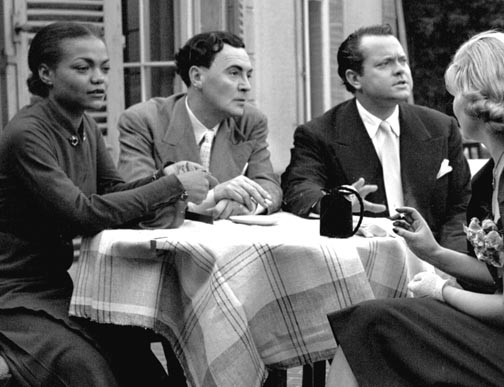
Eartha Kitt, Micheál MacLíammóir, Orson Welles
I'm proud of the fact that two of her songs are on my Top 25 Most Played on my iPod. Nobody like her. NOBODY.
My parents saw her a couple years ago at the Newport Jazz Festival. She wasn't a day over 156 years old.
Also, Mitchell saw her perform and she, at one point, cuddled up on his lap. I adore her.
My two favorites of hers are not her most famous, perhaps, and I had a hard time finding a clip of her performing them on Youtube. But if you don't know them, do yourself a favor and check out her renditions of "Beale St. Blues" and "A Woman Wouldn't Be a Woman". I'd call them two of the best makeout songs of all time, first of all. And again: there's just no one like her. Nobody else would make the choices she makes ... they are so completely hers ... and she makes it all work. Through commitment and specificity.
God, I loved her.
Clip below (insanely weird. The set, the costume, the fact that there is no closeup of her until more than halfway through ... I MISS television like that - it's like a drug trip or a bad dream) ... of her singing "I'm Just an Old-Fashioned Girl".
Watch her gesture and her expression when she sings the words "hers and hers". That's specific. And the big smile at the end kills me. Because she lets us know that she's in on the joke. The joke is on us. Lovely.
We all know her heart belonged to Daddy, but there's a space in my heart reserved for her.
Rest in peace, Eartha. You were one of a kind.
December 24, 2008
"Christmas Day In the Morning" - by Pearl S. Buck

(Amazon link
Christmas Day in the Morning
by Pearl S. BuckHe waked suddenly and completely. It was four o'clock, the hour at which his father had always called him to get up and help with the milking. Strange how the habits of his youth clung to him still. Fifty years ago, and his father had been dead for thirty years, and yet he waked at four o'clock in the morning. He had trained himself to turn over and go to sleep, but this morning, because it was Christmas, he did not try to sleep.
He slipped back in time, as he did so easily nowadays. He was 15 years old and still on his father's farm. He loved his father. He had not known it until one day a few days before Christmas, when he overheard what his father was saying to his mother.
"Mary, I hate to call Rob in the mornings. He's growing so fast and he needs his sleep. If you could see how he sleeps when I go in to wake him up! I wish I could manage alone."
"Well, you can't, Adam." His mother's voice was brisk. "Besides, he isn't a child anymore. It's time he took his turn."
"Yes," his father said slowly. "But I sure do hate to wake him."
When he heard these words, something in him woke: his father loved him! He had never thought of it before, taking for granted the tie of their blood. Neither his father nor his mother talked about loving their children - they had no time for such things. There was always so much to do on a farm.
Now that he knew his father loved him, there would be no more loitering in the mornings and having to be called again. He got up after that, stumbling with sleep, and pulled on his clothes, his eyes tight shut, but he got up.
And then on the night before Christmas, that year when he was 15, he lay for a few minutes thinking about the next day. They were poor, and most of the excitement was in the turkey they had raised themselves and in the mince pies his mother made. His sisters sewed presents and his mother and father always bought something he needed, not only a warm jacket, maybe, but something more, such as a book. And he saved and bought them each something too.
He wished, that Christmas when he was 15, he had a better present for his father. As usual, he had gone to the ten-cent store and bought a tie. It had seemed nice enough until he lay thinking the night before Christmas, and then he wished that he had heard his father and mother talking in time for him to save for something better.
He lay on his side, his head supported by his elbow, and looked out of his attic window. The stars were bright, much brighter than he ever remembered seeing them, and one was so bright he wondered if it were really the star of Bethlehem.
"Dad," he had once asked when he was a little boy, "what is a stable?"
"It's just a barn," his father had replied, "like ours."
Then Jesus had been born in a barn, and to a barn the shepherds and the Wise Men had come, bringing their Christmas gifts!
The thought stuck him like a silver dagger. Why should he not give his father a special gift, too, out there in the barn?
He could get up early, earlier than four o'clock, and he could creep into the barn and get all the milking done. He'd do it alone, milk and clean up, and then when his father went in to start the milking, he'd see it all done. And he would know who had done it.
At a quarter to three, he got up and put on his clothes. He crept downstairs, careful of the creaky boards, and let himself out. The big star hung lower over the barn roof, a reddish gold. The cows looked at him, sleepy and surprised.
"So, boss," he whispered. They accepted him placidly, and he fetched some hay for each cow and then got the milking pail and big milk cans.
He had never milked alone before, but it seemed almost easy. He kept thinking about his father's surprise. His father would come in and call him, saying that he would get things started while Rob was getting dressed. He'd go to the barn, open the door, and then he'd go to get the two big empty milk cans. But they wouldn't be waiting or empty; they'd be standing in the milk house, filled.
The task went more easily than he had ever known it to before. Milking for once was not a chore. It was something else, a gift to his father who loved him. He finished, the two milk cans were full, and he covered them and closed the milk-house door carefully, making sure of the latch. He put the stool in its place by the door and hung up the clean milk pail. Then he went out of the barn and barred the door behind him.
Back in his room, he had only a minute to pull off his clothes in the darkness and jump into bed, for he heard his father up. He put the covers over his head to silence his quick breathing. The door opened.
"Rob!" his father called. "We have to get up, son, even if it is Christmas."
"Aw-right," he said sleepily.
"I'll go on out," his father said. "I'll get things started."
The door closed and he lay still, laughing to himself. In just a few minutes his father would know. His dancing heart was ready to jump from his body.
The minutes were endless - ten, fifteen, he did not know how many - and he heard his father's footsteps again. The door opened and he lay still.
"Rob!"
"Yes, Dad--"
His father was laughing, a queer sobbing sort of a laugh. "Thought you'd fool me, did you?" His father was standing beside his bed, feeling for him, pulling away the covers.
"It's Christmas, Dad!"
He found his father and clutched him in a great hug. He felt his father's arms go around him. It was dark, and they could not see each other's faces.
"Son, I thank you. Nobody ever did a nicer thing--"
"Oh, Dad, I want you to know -- I do want to be good!" The words broke from him of their own will. He did not know what to say. His heart was bursting with love.
"Well, I reckon I can go back to bed and sleep," his father said after a moment. "No, hark-- The little ones are waked up. Come to think of it, son, I've never seen you children when you first saw the Christmas tree. I was always in the barn."
He got up and pulled on his clothes again, and they went down to the Christmas tree, and soon the sun was creeping up to where the star had been.
Oh, what a Christmas, and how his heart had nearly burst again with shyness and pride as his father told his mother and made the younger children listen about how he, Rob, had got up all by himself.
"The best Christmas gift I ever had, and I'll remember it, son, every year on Christmas morning, so long as I live."
They had both remembered it, and now that his father was dead he remembered it alone, that blessed Christmas dawn when, alone with the cows in the barn, he had made his first gift of true love.
December 21, 2008
Maud Gonne: "the pilgrim soul"

Maud Gonne, Irish revolutionary, feminist, radical, and lifelong poetic muse of William Butler Yeats, was born yesterday in 1865. She married John MacBride (after a couple of notorious affairs and illegitimate children). John MacBride was an Irish nationalist who participated in the Easter Rising of 1916 and was executed by firing squad. Although Gonne and MacBride had apparently separated by the time of the Easter Rising, she wore mourning for the rest of her life. She was wedded to Irish nationalism. There was a bit of the death-cult about her.
Conor Cruise O'Brien writes in his memoir about Maud Gonne McBride:
When the husband, whom she loathed, was shot by a British firing squad after the Easter Rising, Madame MacBride - as she now came to be known - attired herself from head to toe in the most spectacular set of widow's weeds ever seen in Dublin, to which she returned from Paris in 1917. Her mourning for Major John MacBride was so intense that it lasted all the remaining years of her life (nearly forty of them), as far as outward appearances were concerned. I still remember her as I first saw her in that garb, about ten years later in Leinster Road, Rathmines. With her great height and noble carriage, her pale beaked gaunt face, and large lustrous eyes, and gliding along in that great flapping cloud of black, she seemed like the Angel of Death: or more precisely, like the crow-like bird, the Morrigu, that heralds death in the Gaelic sagas. That is how I think of that vision in retrospect; at the time I just thought: 'spooky'!
Seamus Heaney writes about the mystical connection W.B. Yeats shared with Maud Gonne (a connection that he had all his life):
And all the while, of course, there was Maud Gonne, "high and solitary and most stern" according to one of the poems about her, "foremost among those I would hear praised" according to another, and "the troubling of my life" according to a famous sentence in his Autobiographies. The passion she inspired - and as readers we experience it more as creative power than erotic need - made her a figure of primary poetic radiance, a Dublin Beatrice, an archetype as much as a daily presence. Nevertheless, Yeats's poetry, his politics and his involvement with the occult received an extra charge of intensity from her day to day reality in his life, and when she appeared in the title role of his subversive play Cathleen Ni Houlihan (1902), another kind of maturity was achieved.
They never married, although Yeats asked her multiple times. Later on in life, he even considered asking Gonne's daughter to marry him.
Yeats and Gonne met in 1889 and he would say later that that was the year that "the troubling of my life began". Yeats wrote 100s of poems for Maud Gonne.
While mainly remembered now as the eternal beloved of Yeats, she had a fascinating life in her own right. It was her birthday yesterday. On my father's shelf in his study is a thick book called MAUD GONNE and I pull it out this morning, snow outside the windows, in honor of her - and, by association, in honor of my father, who used to tell me stories about Yeats and Gonne. He knows everything about these people and when he tells their stories, they come alive. And I find that I have memorized his bookshelves in my mind. "Now wait a minute ... where is that Maud Gonne book??"
Samuel Levenson writes in his book:
No one who knew her in the days of her glory is now alive. But many Irish men and women recall her in her later years as one of Dublin's most extraordinary personalities - part eccentric, part heroine. They remember her as a tall, gaunt woman in black robes speaking on Dublin street corners about her current political or economic obsession. And they have not forgotten the stories they heard from their elders about her unconventional life in Paris, her constant cigarette smoking, the dogs and birds with which she surrounded herself, her affair with a French politician, her illegitimate children, her marriage to Irish patriot John MacBride, and the scandal of her separation from him.Some remember Maud Gonne's activities to house evicted tenant farmers, feed school children, aid political prisoners, find homes for Catholic refugees from Northern Ireland, establish a fully independent Irish Republic, and end partition between Northern and Southern Ireland. Few recall the names of the women's organizations and publications she founded, or the number of times she went to prison. And some confuse her with another tall Ascendancy woman who took up the Irish cause after a fling in Paris - the Gore-Booth girl, who came back with a Polish count named Markievicz. But they all know that the word "maudgonning" means agitating for a cause in a reckless flamboyant fashion.
Maud herself wished to be thought of as an Irish patriot. She was hailed in her lifetime as an Irish Joan of Arc, and would have been happy to be remembered as such for all time. A quarter of a century after her death, controversy surrounds the importance of her contributions to the Irish nation and its people. The scandal that still hovers around her name has grown dim. But it is neither her activities in Ireland's behalf, her unconventionality, nor her striking beauty that give her a place in history. It is, rather, the obsessive pursuit of her by the greatest poet of the era, William Butler Yeats. Her steadfast rejection of his proposals bit so deeply into his soul that he never ceased to fashion glorious poetry about her beauty, her talents, and the mystery of her personality. She was to Yeats what Beatrice was to Dante. And thus, Yeats made her a permanent figure of romance and myth throughout the English-speaking world.

Here is another of Yeats' "Gonne poems":
Aedh wishes for the Cloths of Heaven
by William Butler Yeats
Had I the heavens' embroidered cloths,
Enwrought with golden and silver light,
The blue and the dim and the dark cloths
Of night and light and the half light,
I would spread the cloths under your feet:
But I, being poor, have only my dreams;
I have spread my dreams under your feet;
Tread softly because you tread on my dreams.

On January 31, 1889, Yeats wrote to his friend John O'Leary, after having dinner with Maud:
"She is not only very handsome but very clever. Though her politics in European matters be a little sensational ... It was pleasant however to hear her attacking a young military man from India who was there, on English rule in India. She is very Irish, a kind of 'Diana of the Crossways.' Her pet monkey was making, much of the time, little melancholy cries at the hearthrug ... It was you, was it not, who converted Miss Gonne to her Irish opinions. She herself will make many converts."
On February 3, he wrote to Ellen O'Leary:
"Did I tell you how much I admire Maud Gonne? ... If she said the world was flat or the moon an old caubeen tossed up into the sky I would be proud to be of her party."
And so it began.
"The Arrow", one of the many poems Yeats wrote for Gonne, goes:
I THOUGHT of your beauty, and this arrow,
Made out of a wild thought, is in my marrow.
There's no man may look upon her, no man,
As when newly grown to be a woman,
Tall and noble but with face and bosom
Delicate in colour as apple blossom.
This beauty's kinder, yet for a reason
I could weep that the old is out of season.
Yeats mythologized her. Not just her beauty, but her essence, her soul. Gonne was right. It was a "spiritual union".
Gonne didn't have as clear a memory of their first meeting. At that point, she was far more formidable than he was. He was 23 years old, a young poet, a nobody. She had already lived in Paris, had become notorious, was at the forefront of the new movement that Yeats would eventually help champion.
Gonne's impressions of Yeats in that first meeting:
" ... a tall lanky boy with deep-set dark eyes behind glasses, over which a lock of dark hair was constantly falling, to be pushed back impatiently by long sensitive fingers, often stained with paint - dressed in shabby clothes ..."

They were never not in touch, through their long lives. They wrote long letters to one another, describing their dreams - wondering if the other had dreamt the same thing. In 1908, Gonne wrote to Yeats from Paris:
"I had such a wonderful experience last night that I must know at once if it affected you & how? At a quarter of 11 last night I put on this body & thought strongly of you & desired to go to you.”
Connection across the space-time continuum? They would experiment with it, wondering if the connection could be felt. I often think that unrequited love is far better for art than anything that works out. If Gonne had married Yeats, would he have written all of those poems? If he had ready access to her in a domesticated fashion ... would she have been elevated to such a poetic height? Perhaps Gonne sensed this herself. I don't know. It's not for me to know. All we have is their letters, and his poems.
25 years after that first meeting, Yeats would write:
I was twenty-three years old when the troubling of my life began. I had heard from time to time in letters from Miss O'Leary, John O'Leary's old sister, of a beautiful girl who had left the society of the Viceregal Court for Dublin nationalism. In after years I persuaded myself that I felt premonnitory excitement at the first reading of her name. Presently she drove up to our house in Bedford Park ... I had never thought to see in a living woman so great beauty. It belonged to famous pictures, to poetry, to some legendary past. A complexion like the blossom of apples, and yet face and body had the beauty of lineaments which Blake calls the highest beauty because it changes least from youth to age, and a stature so great that she seemed of a divine race. Her movements were worthy of her form, and I understood at last why the poet of antiquity, where we would but speak of face and form, sings, loving some lady, that she paces like a goddess.
Samuel Levenson writes:
In his recollections, Yeats thought that there was, even at their first meetings, something in Maud's manner that was declamatory, "Latin in a bad sense," and possibly unscrupulous. She seemed to desire power for its own sake, to win elections for the sake of winning. Her goals were unselfish, he recalled, but, unlike the Indian sage who said, "Only the means can justify the end," Maud was ready to adopt any means that promised to be successful.He made two observations, which doubtless owe something to discoveries he made as their relationship progressed:
We were seeking different things: she, some memorable action for final consecration of her youth, and I, after all, but to discover and communicate a state of being ... Her two and twenty years had taken some color, I thought, from French Boulangist adventurers and journlist arrivistes of whom she had seen too much.Yeats remembered Maud Gonne as the herald of the movement to revive Celtic culture. "I have seen the enchanted day / And heard the morning bugles blow," he wrote in his manuscript book.
Jim Dwyer wrote in a recent New York Times article:
Until nearly the end of his days he and Gonne kept an eye on each other. In 1938 he wrote “A Bronze Head” about her frequent appearances at political funerals, a “dark tomb-haunter,” so transformed from the light, gentle woman of his memory.Almost from the beginning she had been a figure of memory. In the opening pages of the 1908 notebook he looked backward: “She said something that blotted away the recent past & brought all back to the spiritual marriage of 1898. She believed that this bond is to be recreated & to be the means of spiritual illumination between us. It is to be a bond of the spirit only.”
A Bronze Head
HERE at right of the entrance this bronze head,
Human, superhuman, a bird's round eye,
Everything else withered and mummy-dead.
What great tomb-haunter sweeps the distant sky
(Something may linger there though all else die;)
And finds there nothing to make its tetror less
i{Hysterica passio} of its own emptiness?
No dark tomb-haunter once; her form all full
As though with magnanimity of light,
Yet a most gentle woman; who can tell
Which of her forms has shown her substance right?
Or maybe substance can be composite,
profound McTaggart thought so, and in a breath
A mouthful held the extreme of life and death.
But even at the starting-post, all sleek and new,
I saw the wildness in her and I thought
A vision of terror that it must live through
Had shattered her soul. Propinquity had brought
Imagiation to that pitch where it casts out
All that is not itself: I had grown wild
And wandered murmuring everywhere, 'My child, my
child! '
Or else I thought her supernatural;
As though a sterner eye looked through her eye
On this foul world in its decline and fall;
On gangling stocks grown great, great stocks run dry,
Ancestral pearls all pitched into a sty,
Heroic reverie mocked by clown and knave,
And wondered what was left for massacre to save.
Here is, perhaps, the most famous poem Yeats wrote for her. It is impossible for me to read this without tears coming to my eyes.
When You are Old
When you are old and grey and full of sleep,
And nodding by the fire, take down this book,
And slowly read, and dream of the soft look
Your eyes had once, and of their shadows deep;
How many loved your moments of glad grace,
And loved your beauty with love false or true,
But one man loved the pilgrim soul in you,
And loved the sorrows of your changing face;
And bending down beside the glowing bars,
Murmur, a little sadly, how Love fled
And paced upon the mountains overhead
And hid his face amid a crowd of stars.

More on the fascinating Maud Gonne here.
December 17, 2008
Rourke on Bruce Springsteen: "He did me such an honor, such a favor."
Great interview with Rourke. I like the part when he gets overheated. There's that weird vulnerability he has in interviews - it's startling because he looks like such a bruiser. The story about Springsteen writing the song that rolls over the final credits is really cool:
You were responsible for getting Bruce Springsteen to write the song for the end credits. How did that happen?
MR: After about six days, I knew something magical was happening on the movie. It gave me the gumption to write Springsteen a letter. I told him we had no money, but we shot it in New Jersey. And we even shot an extra scene in Asbury Park! He wrote back, and then five months later he called and said, “It’s Bruce,” and I said, “Who?”—I think I was on my Vespa—and he said, “Bruce. Springsteen.” I was like, “Oh fuck! Oh! OH!” He said, “I wrote you a little something.”I don’t think Darren had a clue what The Boss was all about. I took him to Giants Stadium—there were like 80,000 people there—and he was like, “Hmmmm, they really like him.” So we go backstage, and Bruce picks up a guitar and plays the [song on an] acoustic guitar for us. It was the first time we heard it, and I was like, he’s got words to it and everything! Man, he really got it. He didn’t see the movie, he’d only read the fucking script, but the song sums up the whole character. He did me such an honor, such a favor.
For some reason, the "he's got words to it and everything!" brings a lump to my throat.
Mickey Rourke
My giant piece is now live at House Next Door.

All my pieces on Mickey Rourke on my site can be found here
December 16, 2008
The magnificent Agnes Moorehead
An in-depth appreciation of Agnes Moorhead (shame on me for forgetting to put her on my list) - and a great interview with Charles Tranberg, the author of I Love the Illusion: The Life and Career of Agnes Moorehead . Not to be missed. Here is a juicy excerpt.
[Moorehead] had actually recalled years later meeting a very precocious Orson Welles as a boy at the Waldorf-Astoria in New York. When she began working with Orson something kept nagging at her–where have I seen him before. Welles was very young still–only in his early twenties and then when thumbing through LIFE magazine she saw a picture of Orson as a child and knew then that was the boy she had once met years before at the Waldorf-Astoria. Himan Brown told me how Aggie and Orson had met later on. Aggie was doing “The Gumps” in New York and the program which was on just before “The Gumps” was this young man with a wonderful voice reciting poetry–it was Orson Welles! Orson would watch “The Gumps” and was fascinated by Aggie. He later said many times that he considered her the best actor he had ever worked with. But he knew that when he launched the mercury theater that he wanted her to be part of it–and she was–the most prominent female member of the Mercury players. It only made sense that when Welles went to Hollywood and made “Citizen Kane” that he would find a part for Aggie. He did as Kane’s mother. It was a small part of only five minutes in length but it was one of the most memorable sequences in the picture and anguished performance as a mother giving up her son because she realized that she and his father couldn’t give him the kind of life he deserved is one of the best in the film.
(The full scene can be seen here)

I also very much liked this comment from Moira, the interviewer:
In reading some of the comments by Aggie’s colleagues about her working methods in building a character, they seem to indicate that she was quite meticulous and specific about her detailed characterizations though she was, as Welles pointed out in an interview once, very willing to accept direction. I’ve noticed that in films such as The Stratton Story, Our Vines Have Tender Grapes and Johnny Belinda, when she plays sympathetic farm women, she is constantly working to do something very specific in a scene, tightening the jars on some fruit that have just been canned, knitting, baking bread, or fingering the scarf that Belinda has come home with after her visit with the doctor. She often does this in such a way that she is also making a non-verbal commentary on the action, and telling more about her character than the words of the script indicates about her concerns, attitudes and the action.
Yes, yes, and YES. Easier said than done.
Definitely go read the whole thing.
Pathos
Yesterday it was balmy and warm. I arrived home from my weekend away at around 5:30 yesterday, and promptly opened up my windows to let in some air. Hope was thrilled. She loves the open windows.
I fell into a deep sleep at around 9:30, wiped OUT. Windows still open, air still balmy.
Hope, after a brief waiting period to show me that she is still boss, jumped up on bed, curled up next to me (BUT NOT TOUCHING ME, GOD FORBID) and went to sleep.
I woke up this morning at my regular 5:30 a.m. It was pitch black in my room. The balmy air had now turned frigid cold. I was cold, sure, but through the darkness, coming up to me from Hope's furry body, was a sound I didn't recognize. A kind of jittery clackety-clack, like rolling teeny dice together in your hand. Did she have ... something in her throat?? I leapt out of bed and turned on the light, in my freezing room.
She looked up at me and it was the sound of her little teeth chattering with the cold! Her little jaw was flapping up and down nervously, like one of those wind-up skull-heads, her teeth clacking against each other ... and it was the most pathetic thing I had ever seen. It cracked my heart. I raced around closing the windows and then scooped her up in my arms, bombarding her with my furnace-level of body heat that I've got going on at all times.
She was NOT happy about that.
Teeth chattering in the night? She'll deal.
But overly insistent closeness? Hope's not having any of it.
I kept saying, "Hope! Your teeth were chattering, honey!"
I realize that, lady. Could ya shut the window, please? Thanks.
The Books: "The Norton Anthology of Modern and Contemporary Poetry" - D. H. Lawrence
Next book on my poetry shelf:
The Norton Anthology of Modern and Contemporary Poetry
A real pioneer in his day, his stuff can seem rather silly now. I never really got into his novels, although my dad tells stories about how, as a youth, he (and his friends) would flip through them, looking only for the dirty parts. Kind of like me with Forever, by Judy Blume. Ahem.
Some of his poems I ADORE - especially the dreaded anthropomorphizing ones (about the sparrow, the one about elephants being slow to mate) ... He finds a metaphor in animal behavior which can sometimes end up in incredibly moving results. I know anthropomorphization drives some people batty, but I think those people need to get a life. Aren't there bigger things to worry about than people projecting their feelings and wishes and hopes onto animals? Lawrence's animal poems are his best. Granted, I haven't read them all, so I am open to persuasion.
There's a lot of what I would call balderdash in his poetry. Like, it is very difficult to not roll your eyes at all that mystical commingling and yearning phalluses and etc. Yeah, we get it, sex is wonderful, we all love to do it. But there's also something really intellectual about Lawrence - he's not really a libertine, not at all ... and so his sex stuff can seem rather labored, like ... he's just thinking about it too damn much. I realize that I say this from the comfy confines of the 21st century and I certainly give him the props for pushing the boundaries of what could be said, what would be allowed to be said, and all that. His books were controversial for decades, and you read them now and you wonder, "Good lord, what is all the fuss about." He's not a down-and-dirty Henry Miller type of guy. He's more airy-fairy than that ... and that's where the rolling-eyes comes in.
I know that Whitman was his main inspiration and you can hear Whitman ringing through the lines of Lawrence. That same high-arched ceiling of SELF SELF SELF ... the awareness of the transcendence of the soul, embodied in the actual FLESH ... all of that. But for some reason, Whitman's poems just have more ... staying power, to use a sexual phrase (a propos in this case).
I don't know much about Lawrence but I do know that he was married to a kind of extraordinary wild woman named Frieda, who was a proponent of the "zipless fuck" decades before Erica Jong came along. Here they are together.

I mean, is that not a brilliant photo?
Tennessee Williams was obsessed with D.H. Lawrence and worked on many plays over his life that had to do with Lawrence and his wife. Some are one-acts, some unfinished full-lengths ... and I know he made a pilgrimage to New Mexico, I believe, on one of his early cross-country journeys, to meet the Lawrences, hoping to get their blessing for his project. You can hear the influence of Lawrence on Tennessee Williams. I think Lawrence may very well be a man of his time and his time only (although, like I said, I am open to persuasion) ... but he casts a very long shadow, and you can hear echoes of his work in other writers even today.
The Beats were influenced by Lawrence. They liked the sense they got from his poems of going "into a zone", where the connections can fly freely and not just literally - where you can "riff". You can see why the Beat guys were drawn to him, with quotes like this one from 1908:
"My verses are tolerable - rather pretty, but not suave; there is some blood in them. Poetry now a days seems to be a sort of plaster-cast craze, scraps sweetly moulded in easy Plaster of Paris sentiment. Nobody chips verses earnestly out of the living rock of his own feeling ... Before everything I like sincerity, and a quickening spontaneous emotion. I do not worship music or the 'half said thing'."
It was Allen Ginsberg who said "first thought best thought" and that's kind of what Lawrence is getting at here.
Here's one of Lawrence's animal poems. I post this because I like it, and I post it because it goes with the "Rikki Tikki Tavi" theme around here these days.
Snake
A snake came to my water-trough
On a hot, hot day, and I in pyjamas for the heat,
To drink there.
In the deep, strange-scented shade of the great dark carob-tree
I came down the steps with my pitcher
And must wait, must stand and wait, for there he was at the trough before
me.
He reached down from a fissure in the earth-wall in the gloom
And trailed his yellow-brown slackness soft-bellied down, over the edge of
the stone trough
And rested his throat upon the stone bottom,
And where the water had dripped from the tap, in a small clearness,
He sipped with his straight mouth,
Softly drank through his straight gums, into his slack long body,
Silently.
Someone was before me at my water-trough,
And I, like a second comer, waiting.
He lifted his head from his drinking, as cattle do,
And looked at me vaguely, as drinking cattle do,
And flickered his two-forked tongue from his lips, and mused a moment,
And stooped and drank a little more,
Being earth-brown, earth-golden from the burning bowels of the earth
On the day of Sicilian July, with Etna smoking.
The voice of my education said to me
He must be killed,
For in Sicily the black, black snakes are innocent, the gold are venomous.
And voices in me said, If you were a man
You would take a stick and break him now, and finish him off.
But must I confess how I liked him,
How glad I was he had come like a guest in quiet, to drink at my water-trough
And depart peaceful, pacified, and thankless,
Into the burning bowels of this earth?
Was it cowardice, that I dared not kill him? Was it perversity, that I longed to talk to him? Was it humility, to feel so honoured?
I felt so honoured.
And yet those voices:
If you were not afraid, you would kill him!
And truly I was afraid, I was most afraid, But even so, honoured still more
That he should seek my hospitality
From out the dark door of the secret earth.
He drank enough
And lifted his head, dreamily, as one who has drunken,
And flickered his tongue like a forked night on the air, so black,
Seeming to lick his lips,
And looked around like a god, unseeing, into the air,
And slowly turned his head,
And slowly, very slowly, as if thrice adream,
Proceeded to draw his slow length curving round
And climb again the broken bank of my wall-face.
And as he put his head into that dreadful hole,
And as he slowly drew up, snake-easing his shoulders, and entered farther,
A sort of horror, a sort of protest against his withdrawing into that horrid black hole,
Deliberately going into the blackness, and slowly drawing himself after,
Overcame me now his back was turned.
I looked round, I put down my pitcher,
I picked up a clumsy log
And threw it at the water-trough with a clatter.
I think it did not hit him,
But suddenly that part of him that was left behind convulsed in undignified haste.
Writhed like lightning, and was gone
Into the black hole, the earth-lipped fissure in the wall-front,
At which, in the intense still noon, I stared with fascination.
And immediately I regretted it.
I thought how paltry, how vulgar, what a mean act!
I despised myself and the voices of my accursed human education.
And I thought of the albatross
And I wished he would come back, my snake.
For he seemed to me again like a king,
Like a king in exile, uncrowned in the underworld,
Now due to be crowned again.
And so, I missed my chance with one of the lords
Of life.
And I have something to expiate:
A pettiness.
Siavash, (Dir. Saman Moghaddam)

The Iran-Iraq War was the longest "conventional" war of the 20th century, dragging on for almost a decade. The slaughter was immense. An entire generation was wiped out. Children volunteered to be martyrs, cannon fodder. The Martyrs Cemetery (perhaps the largest graveyard in the world), south of Tehran, has a fountain that (to this day) runs with red water to show the blood that was shed. Every town has a cemetery like that one, except on a smaller scale. The war touched everyone. The war lasted from 1980 - 1988, and the younger generation - those born in the 80s - have no memory of it, yet it impacts their lives on every level. Everyone has lost a family member, or three or four. The revolution in 1979 was solidified, in terms of bonding the nation together, by the hostage crisis and then the war with Iraq. But imagine if you were a kid born in, say, 1987 ... you have no memory of the revolution, the sacrifices of your parents may seem rather meaningless, especially in light of the hard economic times and the brain-drain that Iran has experienced ever since then. Like every country (hell, this is a human thing, not a national thing) there is a generation gap. The older generation wants the younger to appreciate the sacrifices they made and realize how good they have it. The younger generation wants to do its own thing, and not constantly have to live in a reverence for a past they did not participate in.
Siavash, the powerful and angry film directed by Saman Moghaddam, is all about that. It expresses things which cannot be expressed, easily, in a nation where censorship is still fierce. It asks questions about martyrdom and war, but it also shows that the younger generation - without a war to galvanize them - are left adrift. They want to "do something". They want to show that they are somehow as tough as their parents. But how? Where? There is no outlet. That comes up again and again in the film, and it's not made explicit, but the implication is clear. Siavash, a young man whose father was apparently killed in the war with Iraq (although his body was never found), is a musician, living aimlessly, trying to connect with a father he never knew, angry and introverted. As things start to break down for him over the course of the film, his aggression starts to come out unexpectedly. He, like the young Alexander Hamilton, wishes for a war to clarify his intentions, to fire him up, to make him relevant and a worthy man.

Siavash, played by the beautiful and sensitive Ali Ghorbanzade, is a musician. As the film opens, we see his group prepare for a series of concerts. He is late for the rehearsal because he has gone to visit his father's grave. He kneels by the grave, and, in voiceover, we hear him ask for his father's blessing. It becomes apparent that his mother has shacked up with another man (Siavash only refers to him as "that man"), and that she torments Siavash with how his dead father would disapprove of his bohemian life. Siavash is dying to know the truth. He knows he has chosen a different path from his father. There is no war for him to fight now. He is a musician. That is who he is. He wants his father to know that he is not a "punk", and he wishes his father would give him a sign that he is proud of him. That sign does not come. His mother doesn't help.

Siavash is a troubled young man, fatherless - like so many young people in Iran. His best friend (I loved this actor) tries to talk him about of being so "pessimistic". He wants Siavash to make up with his mother. It is important to not break family ties completely. But Siavash can't let it go. He is haunted by the thought that his father would think him weak, or silly, that he would not be proud of his son. His mother plays on those fears.

At one of his concerts is a young photographer from a woman's magazine, played by the gorgeous and wonderful Hedye Tehrani (she's on my 20 favorite actresses list). She is there on assignment.

After the show, she gets into a confrontation on the sidewalk with a guy who is harassing her. He appears to know her. He is haranguing her about her behavior, and she is screaming at him, "Why don't you leave me alone? I am here for my job - this has nothing to do with you!" Siavash, coming out from backstage, sees the confrontation happening and goes over to see if he can help. I am sure the fact that Ms. Tehrani is so damn beautiful has a little bit to do with his knight-in-shining-armor impulses, but you also get the feeling that he's basically a nice guy. Sweet. He steps in. "Why don't you leave the lady alone?" A fight eventually breaks out, and the harasser runs off into the night, leaving Siavash and the lady alone.
There is immediate chemistry. I love the first scene of their meeting. She obviously is not a shrinking violet, we just saw her shouting at a guy on the street, but she also has a gentleness to her, a sweetness. She senses something in Siavash. His need to protect, obviously, but the way she plays the scene you know that she senses his attraction to her too. Because this is Iran, these things cannot be spoken out loud. In a way, it makes such moments even more powerful, because it has to be done subtly, in behavior and pauses. Not to condone censorship, but I am continuously struck by how much Iranian filmmakers "get away with", making their art, as they do, in a theocratic society. Their first exchange pulses with unspoken feeling. There's humor there, too. You like this woman. You like her because she is kind to Siavash, and you think that maybe he needs that. He needs comfort. His experience of women, so far, has been the treachery of his faithless mother.
Against the laws of the land, Siavash and his friend drive her home. (Her name in the film is also Hedye). She sits in the back and they ask her what was that guy's problem.

She regales them with stories of how they were in college together, and he was obsessed with her. But instead of trying to court her like a normal man would, he instead harassed her, and reported her to the college for not wearing proper "Islamic cover". She got in trouble. He did not. In retaliation, the next day she showed up to class wearing a cardboard box over her head with two holes cut out for her eyes. Siavash and his friend laugh. She still can't see what is funny about it. Ramin (Siavash's friend) says, "I'm in college myself. That is a funny joke." The image of her showing up with a cardboard box over her head is delightfully subversive, really angry, actually - and it makes me love the character. She has gone on after college to become a reporter and photographer, and she would love to interview Siavash about his music. The paper she writes for is called The Women's Weekly and Ramin jokes that he doesn't want to be seen buying a copy of such a paper. She says she will send it to them.
Meanwhile, there is a lot of double entendre going on. The main focus of the scene is the unspoken attraction between Siavash and Hedye. But how, in such a country, do you ask for a girl's phone number? You can't date. You'd be arrested (which eventually happens in the latter half of the movie). She is still taken up with annoyance over her harasser, but she was touched by Siavash standing up for her.
Through a series of coincidences, they see each other again. She interviews him.
Siavash lives in an apartment by himself. The walls are a deep yellow and dark green. He has a fish tank. He sits on his bed playing his guitar, but you can tell his thoughts are elsewhere. On her, on his father. The phone rings, but someone keeps hanging up. He is alone. On the walls of his bedroom, he has a huge collage of gruesome photographs from the war with Iraq. It is a shrine, it is evidence of his obsession. In the middle of the photos of carnage, is a portrait of his mother, vibrant-looking beneath her head-scarf.


The war takes up all of his thoughts. He believes that no one can really know him, unless they know this about him. His friend Ramin tries to talk him out of his depression, tries to keep him calm, but it is not easy. Especially not because Ramin knows something that Siavash does not know: The week before, a bunch of POWs were released from Iraq, and Siavash's father, long-thought dead, was one of them. The POW foundation has contacted Siavash's mother (who has now, of course, moved on and is living in sin with the same man she has been with for 13 years) but no one has told Siavash yet. Ramin is supposed to give the news to Siavash, but he is afraid for his friend's state of mind.
Events begin to intensify. Siavash and Hedye are drawn to one another. There is something sensitive about her. She calls him one night. He has been sitting in his room, brooding. Instead of being chatty or social, she says on the other end of the line, "I can tell something is wrong. Are you okay?" Siavash lashes out back at her, "Are you being a reporter now?" She soothes, "No, no ... I just can tell something is wrong. I have no idea what is the matter, but I do hope you are okay, Siavash."
She's good people.
The man we first saw harassing her on the sidewalk was not just an excuse for an Iranian "meet-cute". He will not go away. He becomes a truly menacing character and you can sense how dangerous he is. He is obsessed with her. She said earlier in the film, "This is what happens when you let the classes mix. We Iranians are not ready for all of that. We haven't been brought up right," a fascinating look at the class divide in Iran, and the issues the upper class feel when confronted with the more traditional (and radical) element in their midst. This guy from college just can't deal with the fact that she has a life, that she has a job, that she does her own thing without bowing down before him, the male. He is in love with her, clearly, but he is so blunted and violent he can't recognize the softness within him. There are more confrontations, and they get worse. He puts her in the hospital.

Siavash comes to visit Hedye in the hospital, and he is so concerned and propietary towards her that she tries to joke him out of it. "Do you want me to get up and walk around so that you can see I am all right?"
Interspersed with all of these dramatic scenes, is footage from the various concerts Siavash and his group give. The music is fantastic. I yearned for a soundtrack. Sometimes melancholy and sentimental, sometimes thrumming and drum beats (reminding me a bit of music to riverdance to) - it is never anything less than riveting. The hairs on the back of my neck rose up, listening to some of this music.


Ali Ghorbanzade, playing Siavash, does not have an easy job here. He has to be sensitive and sweet, but not a drip. He has to spend the entire movie on the verge of tears. He has long shots where he sits in silence staring at his fish tank, holding his guitar. You know, it could have been a parody of itself, the Brooding Young Man Iranian Style. But Ghorbanzade manages to suggest the deep fissures in this young man, the competing interests: the growing love for Hedye (the moment with the rosebuds in the restaurant literally made me catch my breath), his increasing bitterness towards his mother, his feeling of helplessness in the Post-War society he lives in - the feeling that his life means nothing compared to the former generations - and then the chaos of learning that his father is actually alive, and what will THAT mean for him? Ghorbanzade keeps all of these balls in the air with his quiet heartfelt performance.

There are moments when he is up onstage, at the keyboard, playing - and the audience sits out there in the dark - and Hedye sits out there, too - and he manages to show us that he is starting to play just for her. Just having her out there makes him start to feel like a man, it "stiffens the space between his shoulder blades" (thank you, Odets), and gives him pride in his work. These are sexy moments. The music hums and beats, and she stares up at him, a small smile playing across her lips. It's not a gooey-eyed moment of pride, something deeper is going on between these two, and it really shows in the concert scenes.
She learns that his father is now alive and she begs with him to go see his father. She makes him promise. She doesn't say, "I cannot be with a man who doesn't resolve his family issues" - but you get the sense that that is what she is saying. She does it in a way that does not harangue him or belittle him. She knows it's hard. She knows he suffers. But his father is alive. He can't avoid him forever!

Hedye Tehrani has one of the most expressive faces in cinema. She's beautiful in an almost distracting way, but she is so fascinating to watch, because her inner life - whatever it may be - is always playing across her features. She acts between the lines. To say she "acts" is almost incorrect. She lives - onscreen. Sometimes she smiles and there's a beautiful mischief to her, and she's got a temper, and a sense of outrage.

Here, she plays a woman you really like (and that's a change for her, as an actress.) Tehrani, despite her beauty, can come off as rather dour, serious, even bleak. The parts she plays (Fireworks Wednesday - review here, Half Moon - review here, Hemlock - review here) show her fearlessness as an actress. She is not interested in being liked. There is a depressive quality to her. She has played two suicidal women (that I am aware of, I haven't seen all of her movies) - and it really works. You get the sense that this woman goes deep, that she has known despair, she has known loss, and it has cost her. But here she does something quite different, showing her range. She is feisty, smart, kind, and persistent. If there is a woman out there who could deal with Siavash's particular personality, it is this woman.

Their scenes together are a revelation.
The last moment of the film, with its sudden burst of drum-heavy music, is startlingly angry and moving. The flags of Iran flutter in the background, blurry, and in the foreground, we see the flowers on the grave, the flickering candle, and Siavash and Hedye, walking off together. It is not a neat resolution. The Iranian consciousness will be dealing with the fallout from the war with Iraq for years to come. Their losses were acute. The younger generation has inherited a whole different set of problems, and what are they to do with it all? Where are they to go?
The aimlessness and helplessness of the current generation, the feeling that they are lost without the blessing of their ancestors, and yet ... who would wish to bring back such carnage ... is all in the film.

And yet it remains a small intense drama, focused on what happens during one week in the lives of a couple of people.
Siavash came out in 1998, a decade after the end of the Iran-Iraq war. In many ways, it is an anti-war film, although it also honors the dead and those who made the sacrifice. It looks at the unseen consequences of huge world events, and also the haunting that can occur in an entire culture in the wake of such a war.

It is an important film.


December 15, 2008
The Books: "The Norton Anthology of Modern and Contemporary Poetry" - Elinor Wylie
Next book on my poetry shelf:
The Norton Anthology of Modern and Contemporary Poetry
I love her stuff. I am not familiar with the full scope of her work, but what I do know really strikes my fancy. I wonder if A.S. Byatt used her (or at least her verse) as some of the inspiration for the poems Christabel Lamotte writes in Possession

She had a rather scandal-driven life, leaving her first husband and her child to elope with another man, who was also married. She followed her own star, similar to Edna St. Vincent Millay (who comes off rather horribly in the beautiful recent biography of her
The Norton Anthology also compares her to Wallace Stevens, which I think is a more apt analogy than Millay. Wylie writes about objects and the senses and images with an exquisite clarity, almost like she is looking through a microscope - and you just don't know how she can bear to see things so clearly. It is very Wallace Stevens-esque.
Not as well-known now as her contemporaries, she is well worth a look if you haven't read her before.
I haven't read any of her novels.
I love the poem "Incantation". It is what really calls to mind the lesbian poet of A.S. Byatt's great novel Possession - the short little lines (that call to mind what Sylvia Plath's later poems all looked like on the page - "Lady Lazarus", "Daddy", "Fever 103" - see what I mean? - they all have that short box-like structure, each line about 3 or 4 words long - it's rather chilling, even just to look at. It makes the poem look breathless, if that makes sense. I also love how the title of Wylie's poem actually describes what she is attempting in the poem - and she does it through image.
She's a real poet's poet, I think. Her structure is immaculate.
Incantation
A white well
In a black cave;
A bright shell
In a dark wave.
A white rose
Black brambles hood;
Smooth bright snows
In a dark wood.
A flung white glove
In a dark fight;
A white dove
On a wild black night.
A white door
In a dark lane;
A bright core
To bitter black pain.
A white hand
Waved from dark walls;
In a burnt black land
Bright waterfalls.
A bright spark
Where black ashes are;
In the smothering dark
One white star.
December 14, 2008
Snapshot of Emma
The theme continues:
Cousin Emma said to me yesterday, "So, you gonna write about this on your blog? How about calling it 'Snapshots of Emma'. Or how about calling it 'Funny Things Emma Said Today'."
The Books: "The Norton Anthology of Modern and Contemporary Poetry" - William Carlos Williams
Next book on my poetry shelf:
The Norton Anthology of Modern and Contemporary Poetry
For me, William Carlos Williams was one of the poets where my first response to him was of the arrogance of youth: "What the hell is the big deal about a red wheelbarrow? I could write that poem, just string some objects along together, SHEESH." It's the same thing as people looking at the modern art of symmetrical colors or a canvas of white with a small blue circle on it - or whatever and scorning it as "anyone could do that, i could do that." Yes, but
1. You didn't "do that", and
2. It is how these works of art fit into the larger whole that is the interesting and important conversation.
It may not be your cup of tea, and frankly modern art like that is not my cup of tea - but why it was such a radical departure, and where it all came from - is really the conversation to have, not "It sucks" and brushing things off out of hand. William Carlos Williams' poems felt, at first glance, like that. The ones I had to read in my famous poetry class in college were the red wheelbarrow one and the one about the plums in the icebox. And while, let's face it, the poems are so short that I can recite both of them by heart - and I didn't even have to work on memorization - I didn't "get it". I got that the images were beautiful but "is that all there is?" The funny thing is that even now, if the red wheelbarrow poem comes up, a three-dimensional specific image comes into my mind, fully fleshed out, of the rain-wet grass, the wheelbarrow ... Like: even without my working on it, or even thinking about it all that much, the images of that poem LAST. That was mainly William Carlos Williams' point and that was what it was so difficult to grasp as a college student whose favorite poets were Sylvia Plath and Yeats. It may not be your cup of tea but to dismiss something as having no value merely because it is not your cup of tea is ridiculous. Recently, my friend David said to me, "I wish people could understand the difference between 'It sucks' and 'I don't like that'." Exactly.

Ted has a lovely post on William Carlos Williams.
My admiration for William Carlos Williams just grew, as I read more and more poetry - his reputation certainly precedes him, but if you just read a lot of stuff, you start to see his influence EVERYWHERE. It's strange because he is overshadowed in many ways by T.S. Eliot's "The Waste Land" - but in a way I think his influence has been deeper (or at least wider). He's not really a "poet's poet" but it certainly is true that the more you know about him, the actual man, the more interesting the poems get. First of all, he was a doctor his whole life. So there's that. Like Wallace Stevens, he had an actual "career" separate from his poetry. Second of all, his battles with Ezra Pound (and his regard for Ezra Pound) are well-known, and through their broadsides, one against the other, you really start to get a picture of poetry at that time. Especially because they were both American - yet Pound had chosen to live as an expatriate, and Williams scorned ex-pats. He stuck in Rutherford, New Jersey - where he was born - and never moved. He traveled to Europe, of course, but his focus was always on America, on the slang and language of America, and creating something that was "new". Interestingly enough, Ezra Pound's command to poets "Make it new" was somehow not enough for William Carlos Williams - who thought that Pound, and others, by living in Europe - were connecting themselves unnecessarily to a long and dead European tradition ... Williams was I guess what you would call a radical. A real radical. He was a socialist, and that's pretty apparent in a lot of his poems - but his belief that the world could be made anew, totally, goes along with his political views. He went further than Ezra Pound in his theories about "new ness". LIke I said, their battles are essential reading. It's not important to come down on one side or the other ... we all have our personal preferences, but that's the least interesting part about this whole thing. Pound had taken Williams under his wing (as he did with so many other poets), arranging for publication of his work, chatting him up to the powers-that-be, and really highlighting him, pushing him into the spotlight. In this case, the "student" surpassed the teacher - and had his own ideas about things - mainly that poetry should be plain and simple and direct. Williams openly lambasted poets like Pound and Eliot, attacking their ideas directly, and then Pound would respond in kind. It is all very entertaining, but more than that: illuminating. William Carlos Williams DID surpass his teacher ... and his ideas about objects are just fascinating to me. He wrote:
No ideas but in things. The poet does not ... permit himself to go beyond the thought to be discovered in the context of that with which he is dealing ... The poet thinks with his poem.
The red wheelbarrow poem is rightly famous. It goes like this:
The Red Wheelbarrow
so much depends
upon
a red wheel
barrow
glazed with rain
water
beside the white
chickens
To Williams, the divinity, the revelation was in the object itself. He wrote:
The particular thing ... offers a finality that sends us spinning through space.
Williams' poems are separate from autobiography, theory, philosophy, even thought. I find him to be one of the most transcendent poets that is out there. Perhaps it is because I am older now. And I have lost much. So that I can now perceive the glory in simple objects. I can see the life therein. I don't know.
I just know that his work seems more and more relevant and awe-inspiring and interesting the older I get. I go back to him again and again. I wonder how he sees so much. I wonder at his inspiration. I love him, basically.
Here is one of my favorites of his poems. Maybe it's because I hail from the Ocean State, I don't know.
Flowers By the Sea
When over the flowery, sharp pasture's
edge, unseen, the salt ocean
lifts its form - chicory and daisies
tied, released, seem hardly flowers alone
but color and the movement - or the shape
perhaps - of restlessness, whereas
the sea is circled and sways
peacefully upon its plantlike stem.
December 13, 2008
Aero Theatre Mickey Rourke Fest

The Aero Theatre in Santa Monica (a wonderful place, I saw Papillon there) is now hosting a Mickey Rourke Fest.
Day One was a double feature: Pope of Greenwich Village and 9 1/2 Weeks.
Naturally, Michael was there. I asked him to "report" on it for my blog. He agreed, hot shot though he is. My own Mickey Rourke piece is done (it ran to 9 pages, sorry, editor) and should go up next week.
In the meantime, here are Michael's thoughtful comments.
DAY ONE, by Michael
Day One was great. So amazing to see these films, particularly 9 1/2 WEEKS on the big screen. I never had. He's simply stunning. He never looks like he's making choices, like he's "acting", and yet he's completely unpredictable, funny and transparent while also being mysterious. And beautiful, in a broken way.
I agree that part of his genius, like Brando, was his self-destruction, but it's heartbreaking to see how beautiful he was then, how expressive his face was, how he was capable of playing a wealthy stockbroker, while now he can only play criminals, sleazebags and weirdos.
I'm very interested in seeing THE WRESTLER, seeing some old Mickey in the new visage. Thank you for not saying anything about it.
A Book of Days for 1931: December 13
Excerpted from Christopher Morley's A Book of Days: Being a Briefcase packed for his own Pleasure
DECEMBER 13, SUN. 1931He was unwilling that I should leave him; and when I looked at my watch, and told him it was twelve o'clock, he cried "What's that to you and me?" and ordered Frank to tell Mrs. Williams that we were coming to drink tea with her, which we did ... he every night drank tea with her, however late it might be, and she always sat up for him. This was not alone a proof of his regard for her, but of his own unwillingness to go into solitude, before that unseasonable hour at which he had habituated himself to expect the oblivion of repose.
-- BOSWELL, Life of Johnson
See why I love this Book of Days? This ain't no "if you love something set it free" compilation.
20 Favorite Actresses: part 2
If I had to choose, here are my favorite performances of my 20 choices - the performance may not be what they are most famous for, but that's no matter.
Gena Rowlands: Opening Night
Barbara Stanwyck: Ball of Fire
Sissy Spacek: Badlands
Isabelle Adjani: Camille Claudel
Catherine O'Hara: Waiting for Guffman
Rosalind Russell: His Girl Friday
Hedye Tehrani: Half Moon
Marilyn Monroe: Don't Bother To Knock
Madeline Kahn: What's Up, Doc?
Ingrid Bergman: Notorious
Diane Keaton: Something's Gotta Give
Rachel McAdams: Slings and Arrows, season 1
Carole Lombard: My Man Godfrey
Sanaa Lathan: Love and Basketball
Joanne Woodward: Sybil
Julie Christie: Shampoo
Charlotte Rampling: Night Porter
Kate Winslet: Eternal Sunshine of the Spotless Mind
Meryl Streep: Postcards From the Edge
Maggie Cheung: Actress
and the 21st:
Jean Arthur: Only Angels Have Wings
The Books: "The Norton Anthology of Modern and Contemporary Poetry" - Robert Frost
Next book on my poetry shelf:
The Norton Anthology of Modern and Contemporary Poetry
I have always thought that Robert Frost was darker than he is given credit for. His poems sometimes have this cheery homespun wisdom tone, but that's never what moves me about his work. It's there ... but I feel that it's more a defense against madness and darkness. He "goes there" in his poems, the awareness of death, of the other world, of events that we can't understand ... and then he usually does wrap things up with a bit of wisdom, an aphorism, a two-line ending that seems to say that everything is going to be okay. Just pull yourself up by your bootstraps (or Gilstraps), and look at the sunset, and you'll be fine. But I can't forget the rest of the poem, where he hears the quietness of the house around him, or where he is aware that things could get prickly with that neighbor of his, or where he knows the long journey ahead of him before he will arrive home.
There is also the "road not taken" which comes off as rather self-satisfied in a first reading. This man is proud of himself and his choice, it "has made all the difference", the one road he took. Well, bully for you, aren't you special. BUT if you read the poem more carefully, you can see that there really isn't that big a difference between the two roads - they are both "just as fair", and "the passing there had worn them really about the same". So okay what do we get from that? What I get, again, is the sense of Frost erecting a defense against the madness of not choosing. He is the type of man who makes a decision and then erects all the justifications and reasons afterwards. He looks back on the "two roads diverged in a yellow wood" - and what is NOT said is that if you contemplate that the other road might have been better, therein lies madness and doubt. Hence, the self-satisfied tone. He is damned if he isn't going to be pleased with his choice. This is what I mean when I say that I'm not sure he's given enough credit for how uncertain he is in his poems. Sometimes the voice is so SURE, it dispenses wisdom, it tells you what to do (erect a wall because 'good walls make good neighbors'), it knows it is right. But why? Why is it important to be right? The uneasy tension that those kinds of questions creates makes Robert Frost seem very different than his reputation would suggest. I like him better that way. I'm not wacky about people who think they're right, anyway, more often than not they are either just boring people OR they NEED to think they're right, because to contemplate the opposite is just too frightening. Robert Frost puts that tension into all of his poems. It's quite wonderful. But I think sometimes people just see the "wisdom", the folksy advice ... and take it for its surface. To my view, the poems suffer if you read them that way.

Robert Frost said that he didn't like big idea poems - or he didn't like there to be big ideas without actual objects and dirt and shovels and turnips. He also said:
Poetry provides the one permissible way of saying one thing and meaning another. People say, 'Why don't you say what you mean?' We never do that, do we, being all of us too much poets. We like to talk in parables and in hints and in indirections - whether from diffidence or some other instinct.
Frost, in that quote, shows that he is fully aware of what he is doing. He was a master at "saying one thing and meaning another".
His life is a mixture of great joy, determination, lackadaisacal indecision (he dropped out of college multiple times) and unbelievable tragedy. The mid-30s were full of tragedy - his daughter and his wife died in quick succession. In 1940, his son committed suicide and then in 1947 his daughter went mad and was put into an institution. Horrifying. Just reading the bare bones of those events make me shiver. Not to mention the fact that WWII was heating up and exploding at the same time. It must have been unbearable for him.
He won the Pulitzer four times. He had traveled to London with his family and met all the big poets of the day - Pound, Yeats, Amy Lowell. He started getting published, and was quite lucky in that regard. He was well-received. Honored. He made it into the canon during his own lifetime, which is really rare - and lived a long long life, even reading a poem at the inauguration of President Kennedy. This was a man who was born in the 19th century.
The introduction to Frost in my Norton Anthology reads:
Although no poet need do more than Frost did, and few can do so much, he presents, in comparison with other eminent writers of his time, an impressive example of reserve or holding back in genre, diction, theme, and even philosophy. This at times bitter man left his readers poems that they quite simply love; and to love a poem by Frost is to begin, at each rereading of a poem, to hear a voice that does not set aside its task before that task has been performed.
For some reason I have tears in my eyes.
Because Robert Frost is so casually quoted, by high-brow and low-brow, by college professors and cross-stitch wall hangings ... I went back and re-read a lot of his stuff as an adult. I felt I wanted to re-encounter it, see what I felt about him. I knew many of his poems by heart because you have to read them in almost every class you have ever taken, from age 14 to 22. You're like, "Oh God, Road Not Taken AGAIN? If I have to read Stopping By the Woods one more time, I'm cracking skulls ..." It was well worth the trouble to re-read them. There are voices and dialects, and as a New Englander, his landscape and cadences and weather are all as familiar to me as my own neighborhood at home. I love his local-ness, but more than that - I love the complexity there, hidden beneath the folksiness, the too-easy truths spouted forth. I feel a poet needing to assert his truth, not because he knows it is true, but because he fears it is not. And "that has made all the difference" in how I read him.
Here is one of his poems that I love. It weaves a spell of weirdness. It is not what it seems to be. He's just picking apples, right? But ... look at where he goes in the poem.
After Apple-Picking
My long two-pointed ladder's sticking through a tree
Toward heaven still,
And there's a barrel that I didn't fill
Beside it, and there may be two or three
Apples I didn't pick upon some bough.
But I am done with apple-picking now.
Essence of winter sleep is on the night,
The scent of apples: I am drowsing off.
I cannot rub the strangeness from my sight
I got from looking through a pane of glass
I skimmed this morning from the drinking trough
And held against the world of hoary grass.
It melted, and I let it fall and break.
But I was well
Upon my way to sleep before it fell,
And I could tell
What form my dreaming was about to take.
Magnified apples appear and disappear,
Stem end and blossom end,
And every fleck of russet showing clear.
My instep arch not only keeps the ache,
It keeps the pressure of a ladder-round.
I feel the ladder sway as the boughs bend.
And I keep hearing from the cellar bin
The rumbling sound
Of load on load of apples coming in.
For I have had too much
Of apple-picking: I am overtired
Of the great harvest I myself desired.
There were ten thousand thousand fruit to touch,
Cherish in hand, lift down, and not let fall.
For all
That struck the earth,
No matter if not bruised or spiked with stubble,
Went surely to the cider-apple heap
As of no worth.
One can see what will trouble
This sleep of mine, whatever sleep it is.
Were he not gone,
The woodchuck could say whether it's like his
Long sleep, as I describe its coming on,
Or just some human sleep.
December 12, 2008
Rest in peace, Bettie Page

A saucy vivacious beauty who always seemed more comfortable in outdoors shots than interiors, Bettie Page was photographed in all manner of compromising (literally) positions, yet with such a verve and humor that it never seemed she was being taken advantage of. They're campy photos. Fun. She's fearless. You don't look at those photos and worry about her. I like her best when she's rolling in the grass in a leopard skin bathing suit, or cavorting on the beach, digging her toes into the sand.
She walked away from her career as an S&M pinup girl after a brou-haha involving censorship, and she also found God, and it just didn't seem right for her to pose in that manner anymore. But she never downtalked or denigrated her former self (unlike some other performers I can think of. Dear Madge, I'm looking at you. I liked you BETTER in your former dirty-girl incarnation, it was way more honest and forthright than the bad-British-accented persona you have adopted now). She also wasn't afraid to say that she had no idea what people found so erotic in photos of her tied up, it didn't appeal to her at all, but, as always, she did so in a way that didn't alienate her main fan base. Page apparently was a devoted correspondent to her many fans, sending them thank you letters for remembering her so fondly. She did not trash her fans for liking the dirty photos she had taken. She knew that, in general, her fans "got it". So they were turned on by her photos. Isn't sexual desire a natural part of life? It seemed to me that her general attitude towards all of that was, "Well, I'm happy to help out in any way I can!"
Page said once, in a recent interview, that if she could do it all over again, she would probably join a nudist colony. She flat out just felt more comfortable nude than clothed. There was nothing dirty about it for her. Ever.
I have a book of her photographs, edited by pioneer photographer Bunny Yaeger, and I just looked through them this morning, in tribute to Ms. Page. The black bangs, the arched back, the naughty grin ... These are dirty photos, make no mistake about it, but as anyone who enjoys sex knows - there's something innocent about sex as well. It's like playing. It's like being free, going into the dreamworld where you can be anyone you want to be. She captures that.
She did not have a happy life. She was institutionalized for a time, she had multiple mental problems, and ended up poverty-struck, living off of Social Security checks. Despite this, she had a loyal group of fans who still loved her, keeping the flame alive, and she lived long enough to see the Bettie Page Renaissance we are living in right now. Amazingly enough, even when the film The Notorious Bettie Page came out, with the wonderful Gretchen Mol in the lead role, Page refused to be photographed at any of the events surrounding the film. She loved the film, she supported its making ... but she had her mind on her fans, and what it would do to them to see her as an 80-something year old woman. She wanted the fantasy to remain intact for them.
She said “I want to be remembered as I was when I was young and in my golden times. I want to be remembered as a woman who changed people’s perspectives concerning nudity in its natural form.”
The meaning of generosity.

Rest in peace, Ms. Page.
A Book of Days for 1931: December 12
Excerpted from Christopher Morley's A Book of Days: Being a Briefcase packed for his own Pleasure
DECEMBER 12, SAT. 1931Do what thy manhood bids thee do, from none but self expect applause
He noblest lives and noblest dies who makes and keeps his self-made laws.
All other Life is living Death, a world where none but Phantoms dwell,
A breath, a wind, a sound, a voice, a tinkling of the camel-bell.-- SIR RICHARD BURTON, The Kasidah
The Books: "The Norton Anthology of Modern and Contemporary Poetry" - Edgar Lee Masters
Next book on my poetry shelf:
The Norton Anthology of Modern and Contemporary Poetry
Edgar Lee Masters was a lawyer and a poet. He had published a couple of books and biographies (one of Walt Whitman, a poet he admired). He was no slouch. But a major poet? No. That was not his thing. However, he ended up writing a series of poems told from the point of view of the dead of a small town called Spoon River ... and it's called Spoon River Anthology
I can't imagine Edgar Lee Masters would have been known if he hadn't taken on the job of "mimic", or "mouthpiece", whatever you want to call it ... because what happens in these poems is that you begin to hear specific voices, cadences, accents - these people are raw. They have nothing to hide anymore. They are dead, but they plead with us, the living. They plead for understanding, retribution, forgiveness ... They reach out from beyond the grave, trying to either make things right, or be heard, or to defend their horrible actions. None of these people are happy. None of these people are sitting in the blessed light of Jesus. The afterlife is seen as a pretty bleak place, of writhing personalities still torn-up about what happened back on earth. The poems can be tough to read. There is no distance in them. These characters scream at you, "hear me, hear me ..."
Masters imagines his way into another person's psyche, and speaks AS THEM. That is his gift. If he had been writing verse about the beautiful sunset over his town or the way the river looked at dawn or about his childhood memories, we'd never be anthologizing him. Spoon River Anthology put him on the map. I believe it was a success during his lifetime, too. He didn't have to wait (like all the characters in Spoon River Anthology) until after his death to have his say.

I have a personal connection with Spoon River Anthology.
My acting teacher in college (or one of them) had his classes, every year, pick out poems from "Spoon River" to work on. Because each poem is a mini-monologue, with character details - and past history - and objective, and obstacle - they are really good for actors to work on. Making anguish real, or ... what is the objective of this character? To plead for forgiveness? To try to get what REALLY happened across? Whatever it is, you the actor have to make it specific, and you have to make it real. It is NOT easy. But it was gratifying work, and I still remember my "person", poor little cross-eyed Minerva Jones. Trying to make those last two lines real and alive - when you're an 18 year old actress - is NOT EASY.
Minerva Jones
I am Minerva, the village poetess,
Hooted at, jeered at by the Yahoos of the street
For my heavy body, cock-eye, and rolling walk,
And all the more when "Butch" Weldy
Captured me after a brutal hunt.
He left me to my fate with Doctor Meyers;
And I sank into death, growing numb from the feet up,
Like stepping deeper and deeper into a stream of ice.
Will someone go to the village newspaper
And gather into a book the verses I wrote?--
I thirsted so for love!
I hungered so for life!
I mean, this is tragic maudlin stuff. Masters' gift was in capturing all of the griefs and anger and seething resentments of small-town America - but breaking it up into small chunks like that, each one different - so by the end of that book, you have a full tapestry. It really hit a chord at the time. No matter who you are, where you come from, you will find a little bit of yourself in Spoon River Anthology. It might be spread out over 5 or 6 poems - you relate to a little bit of this one, a little bit of that one ... and taken on as a whole, it starts to feel like he has somehow captured all of humanity in it. You recognize people when you read it.
In general, it's not a cozy world-view he has, and the poems are pretty tough to read, especially if you read them all together. I like to break them up. I'll just pick up the book and read one poem, put it down again.
Each poem is a mini-WORLD. Like in a snow globe or something. Only with tragedy. Minute exquisite detail, people are naming names, man, after death - they want us to know WHO did this to them ... the voices, you can hear the old men, young girls, frowsy housewives, mechanics, the local doctor ... It's really an extraordinary accomplishment.
I love the book.
And if any of you out there are acting teachers of beginning actors in the age-range of, oh, 17 to 22 ... consider using Spoon River Anthology as a source of monologues for your class. Or read the book yourself, and assign a poem to each person - based on what you know about that person, what they might need to work on, etc. I would say any younger than 17 would not be good, because of the subject matter of the poems. But it's a great acting exercise, a great way to exercise the imagination of young actors. They are also great to teach what it means by "high stakes". People, in general, don't want to live in a state of "high stakes" all the time, and actors are no different. There isn't a poem in the collection where the stakes are not as high as they can be, and actors need to learn to always go for the highest-stake situation.
I mean, here it is 20 years later, and I still remember "I thirsted so for love, I hungered so for life!"
Here is another poem from Spoon River Anthology:
Elsa Wertman
I was a peasant girl from Germany,
Blue-eyed, rosy, happy and strong.
And the first place I worked was at Thomas Greene's.
On a summer's day when she was away
He stole into the kitchen and took me
Right in his arms and kissed me on my throat,
I turning my head. Then neither of us
Seemed to know what happened.
And I cried for what would become of me.
And cried and cried as my secret began to show.
One day Mrs. Greene said she understood,
And would make no trouble for me,
And, being childless, would adopt it.
(He had given her a farm to be still. )
So she hid in the house and sent out rumors,
As if it were going to happen to her.
And all went well and the child was born -- They were so kind to me.
Later I married Gus Wertman, and years passed.
But -- at political rallies when sitters-by thought I was crying
At the eloquence of Hamilton Greene --
That was not it.
No! I wanted to say:
That's my son!
That's my son!
December 11, 2008
Rikki Tikki Tavi, TV (1975)

Thanks to Melissa - in the comments to this post - I realized that Rikki Tikki Tavi, the cartoon I saw on television when i was 8 years old is on Youtube. It's in three parts. I just watched it again. It's fantastic. And it's just so interesting to me how memory works - that was so so long ago, but the images remain - especially the HORRIFYING moment during the first fight between Rikki Tikki Tavi and Nag when Nag's back flies towards the camera (you forget that you are watching something DRAWN as opposed to something ACTUAL) and for a sickening moment, his cobra markings take up the screen and go psychedelic. That was a horrifying moment for me as a child, as sickening as the moment, years and years later when I saw Vertigo and she emerged from the bathroom and the room went all green and you knew that he was mad. That's what I felt in that moment, as a small child ... that if I looked too long at that image I would go mad. The animals in the garden understood that well, and knew not to look directly at the cobra's eyes ... but those markings - turning colors - filling up the screen - It's one of the scariest moments of movies that I can remember from when I was a wee one. It felt like what happened, when the image went abstract, is that it insinuated itself into my brain. shivers. I remember that so clearly.
I have included that moment below in my screengrabs. You know what is so scary about it? It's gleeful. That's what it is. It reminds me of Pennywise, from Stephen King's It, the chortling cynical clown who ADORES how afraid you are. That's what that cobra marking gone to different colors and filling up the screen reminds me of. It is something scary that thinks it is hilarious how frightened you are.
Also, I did not realize that it was:

I love how Rikki Tikki Tavi moves - how he fluffs out his tail, how he zips around and the tail zips around after him, and it feels like it takes a minute and a half for his tail to catch up.
The animation is superb.
The "set direction" is fantastic. I can feel that house. The Victorian-era lamps and portraits on the walls, the big fat chairs ... and I love the use of close-up foreground to way way background. It makes Rikki Tikki Tavi seem WAY too small to stand up to two angry cobras. He looks positively dwarfed in that house.

God, that was so much fun to watch again. I love reencountering something I loved as a child and find that it holds up!
Grabbed some images off of Youtube.


Promoting my peeps: Michael
Let us turn our minds now to the annual December industry "black list" entitled "10 Best Unproduced Scripts in Hollywood", a list eagerly anticipated by all the power-brokers in Hollywood. The list can be a predictor of future success, sometimes even Oscars, and is usually just a flat-out huge deal for the people "named" on said list.
So on that note: Please go here and go to # 4 on the list.
I wasn't kidding when I said that over the past week my "ex-boyfriends were everywhere". By that I don't mean sending me emails or IMs or calling me in the dead of night, although that has been happening too. No. By that I mean that they are being covered by the national press.
So, onto the business at hand.
First off, Michael, congratulations and all, great news! Yay!
But I guess I'm kind of confused. No, make that, really confused.
I looked at your script synopsis and it all looks really good, and you know my feelings about Kwik Stop, so I'm totally happy for you.
Rah rah, go Michael, all of that.
However, I'm still really confused.
Mainly I am wondering why the script isn't called SHEILA.
Please advise.
Promoting my peeps: Brendan on "The Raunch Hands"
My brother continues with his "42 Greatest Albums" list - and yesterday he launched a review of The Raunch Hands' album - which ... well ... I have mentioned the album before in a post I wrote about albums from my childhood ... It was long-lost, I thought. It was in my parents' collection and we, as children, were OBSESSED with it ... and I won't talk anymore.
I laughed so hard tears streamed down my face, reading it - remembering my childhood - and I also got a lump in my throat. Just the way he describes things and the passion behind his words. Then also, how he envisions us, as children, singing along to this album:
It came out at the height of the Cold War, before social unrest became pigeonholed into long hair and stinky underarms. These guys look like a Skull 'n Bones charter meeting but this is some of the most radical shit ever. They open with 'The Bomb Song' which chronicles a Slavic terrorist group as they keep having to come up with someone new to carry the suicide package.Imagine 3 kids in Toughskins, faces smeared with Oreos gathered around a record player in 1976. Nerf football in the corner. Fisher Price Little People everywhere. They chant in unison, "Mama's aim is bad and the copskys all know Dad so it's Brother Ivanovich's turn to throw the bomb!"
I am CRYING with laughter!
Please go read the whole thing!!
Promoting my peeps: Kerry in "White Christmas"

So White Christmas continues its New York juggernaut, including performing at the NYSE ... and at the moment, my cousin Kerry is pretty much everywhere. Just so you know. It's kind of like those melancholy scenes in Notting Hill when Hugh Grant is trying to forget the lovely Julia and a bus drives by with her face plastered across the side. Not that I'm melancholy. Or trying to forget Kerry.
I'm just saying. She's everywhere. Watch your back.
And Kerry, uhm, not sure if you've noticed but ...

Robert DeNiro appears to have his arm around you.
Just thought you should know. In case you were not aware of it.
Anyone who is coming to New York this holiday season: White Christmas is not a show you want to miss! I saw it last year in Boston and it is a lovely show, beginning to end, funny, smart, heartwarming, and gorgeous, with a heart-stopping number by Kerry in the second act. Jean and I almost held our breath through the whole song, it was just too intense. Chock-full of Irving Berlin songs. What more do you want??
Promoting my peeps: Mitchell: "Santaland Diaries"
Sooner or later, I will be able to promote MYSELF but in the meantime:
Chicago-People! Listen up!
My dear friend Mitchell has returned for (what) the 4th year running (maybe even more) to the Theatre Building to perform in David Sedaris' Holidays On Ice - the hilarious stories of Sedaris' experiences as a Macy's Christmas Elf.
Uhm ...

I find this terrifying. Please look at the Santa mug on the table and tell me you are not scared.
When: Fridays and Saturdays : 9:30 p.m. (ends January 3)
Sundays : 3 p.m. and 7 p.m. (ends January 3)
Thursdays, Fridays, and Saturdays : 7:30 p.m. (ends January 3)
Except December 25 and January 1
Price: $22-$24
Event Phone Number: 773-327-5252
Ticketmaster: 312-902-1500
Box office: 773-327-5252
Mitchell, I'm going to kill you for that photo! I wish I could fly out there and see it!
The Books: "The Norton Anthology of Modern and Contemporary Poetry" - Rudyard Kipling
Next book on my poetry shelf:
The Norton Anthology of Modern and Contemporary Poetry
The great Lucy Maud Montgomery wrote in her journal about Barrack-Room Ballads:
"They are capital -- full of virile strength and life. They thrill and pulsate and burn, they carry you along in their rush and swing, till you forget your own petty interests and cares, and burst out into a broader soul-world ... We can never be quite so narrow again."
I love that. "They thrill and pulsate and burn, they carry you along in their rush and swing ..."
That is pretty much my experience of him as well.

I'm a Kipling fan from way back, from childhood. It was the cartoon version of Rikki Tikki Tavi, shown on television back then, that did me in completely. I saw it when I was, what, 8 years old? I remember it vividly and I LIVED it. Kipling is good for kids. I took his stuff out of the library and read some of it. I liked the adventure of it, the exotic setting ... and I also loved books about animals. So with Rikki Tikki Tavi I was all set. The story opens:
This is the story of the great war that Rikki-tikki-tavi fought single-handed, through the bath-rooms of the big bungalow in Segowlee cantonment. Darzee, the tailor-bird, helped him, and Chuchundra, the musk-rat, who never comes out into the middle of the floor, but always creeps round by the wall, gave him advice; but Rikki-tikki did the real fighting.He was a mongoose, rather like a little cat in his fur and his tail, but quite like a weasel in his head and habits. His eyes and the end of his restless nose were pink; he could scratch himself anywhere he pleased, with any leg, front or back, that he chose to use; he could fluff up his tail till it looked like a bottle-brush, and his war-cry, as he scuttled through the long grass, was: '_Rikk-tikk-tikki-tikki-tchk!_'
I mean, how could you NOT keep reading after such an opening? Even now, re-reading that, it makes me want to pick it up again!
I was haunted by the image of the bird PRETENDING to be wounded in order to lure Nagaina the cobra-wife away from her eggs. I was so frightened by that! I wondered if I would have the courage to behave in such a way if I needed to.
Anyway, Kipling's controversial nature went right over my head as a child and I just loved the stories and the beat of the poems, which reminded me of Longfellow ("hardly a man is now alive who remembers that day and year"). It is compulsively readable stuff. There is much that is distasteful in Kipling's views but to throw him out completely because of that is retarded. I feel sorry for those who feel that way because God what joy they miss! Now, on the flipside, if I walk into your room and find that you have a shrine to Oliver Cromwell on your dresser, then yeah, I will flag you as a nutbag and I will think badly of you. We all have our limits. Kipling's views on Irish independence suck, and obviously I have strong feelings about that issue. But Kipling is a WRITER. He was also a man of his time. As we all are "of our time". To hold that against him is, again, retarded. Shakespeare was of his time. Yeah, let's just write him off, too, because he doesn't line up with our precious 21st century way of thinking. grrrrrr. Yes, Kipling shilled for Empire. So? Every Empire should have such a talented shill!
Orwell's essay on Kipling is not to be missed - and Christopher Hitchens (the heir of Orwell) has also written quite a bit on Kipling. All very interesting stuff for Kipling lovers. It's not about turning a blind eye to the more unsavory aspects of the world Kipling describes. It's about appreciating his talent as a story-teller, first of all, and putting him in the correct context. At least that's what it's about for me.
Besides, anyone who captivated my imagination from before the age of 8 has a "forever" place in my heart because ... well, you never forget those people who sweep you away before you really know who you are, before you worry about things like context and controversy ... when you just like what you like because you like it. It's that simple.
In the end, there are just the stories. The stories remain. You could say to me, "Yeah, but did you know that Kipling did THIS such-and-such awful thing?" Yeah, I know it. But have you read those poems? Have you read the stories?
Both can be true. Both ARE true. I am able to hold more than one idea in my brain at a time, thank Christ, and contradictory opinions do not need to be resolved. SOME do, but not ones like the one I describe. Not for me, anyway. Lots of my favorite writers held views I think abhorrent. So? What am I, the arbiter of morality? Besides, I'd rather not miss out on something WONDERFUL. And I think Kipling is wonderful.
Kipling's work clamors with voices. Shouts, catcalls, different dialects ... You can feel the dust and heat of India in them, the cacophony of accents, the world ... These are not poems in quiet isolation. They rustle, rumble, jostle for position ... Kipling has his ear to the ground.
I will also always love Kipling for the following line, which I would actually remember on occasion in high school, when I felt insecure about not being like other people, or not wanting to go along with the pack ... I had read the story when I was a kid, and it struck a nerve, and these words would come back to me. Actually, they still do. I really find them comforting. They are from Kipling's story "The Cat That Walked By Himself."
The Cat. He walked by himself. He went through the wet Wild Woods, waving his wild tail, and walking by his wild lone.
God, I just think that is marvelous. So it helped explain me to myself. Not that I didn't have friends - I had the best friends! - but to see myself as the cat who "walked by himself" as opposed to some FREAK who didn't want to drink or have sex or the other things going on in high school ... it was really helpful. I am just "walking by my wild lone", and that's my nature. It's okay. It's okay.
Here is one of Kipling's better-known poems.
Shillin' a Day
My name is O'Kelly, I've heard the Revelly
From Birr to Bareilly, from Leeds to Lahore,
Hong-Kong and Peshawur,
Lucknow and Etawah,
And fifty-five more all endin' in "pore".
Black Death and his quickness, the depth and the thickness,
Of sorrow and sickness I've known on my way,
But I'm old and I'm nervis,
I'm cast from the Service,
And all I deserve is a shillin' a day.
(Chorus) Shillin' a day,
Bloomin' good pay --
Lucky to touch it, a shillin' a day!
Oh, it drives me half crazy to think of the days I
Went slap for the Ghazi, my sword at my side,
When we rode Hell-for-leather
Both squadrons together,
That didn't care whether we lived or we died.
But it's no use despairin', my wife must go charin'
An' me commissairin' the pay-bills to better,
So if me you be'old
In the wet and the cold,
By the Grand Metropold, won't you give me a letter?
(Full chorus) Give 'im a letter --
'Can't do no better,
Late Troop-Sergeant-Major an' -- runs with a letter!
Think what 'e's been,
Think what 'e's seen,
Think of his pension an' ----
GAWD SAVE THE QUEEN!
Photo gallery
Just cleared out my cell phone camera gallery. I haven't looked at many of these since I took them and it's funny - they go back almost a full year. Memory lane. My cell phone camera isn't very good but I do like some of these photos because they give the feel of the moment.
From the cell phone camera: Pin the tail
I was basically struck dumb by what I saw on the back of this truck. It was just so omnipresent!!

From the cell phone camera: And the Oscar goes to ...
This is our fourth year going to the Oscar party at Dublin 6 in the Village. You fill out forms at the beginning of the night making your predictions ... It's like a sports bar, only for the Oscars. SO MUCH FUN. Allison and I go every year. It is the most obsessive of nights.


From the cell phone camera: Memoir? Really?
I saw James Frey's Million Little Pieces a couple months ago on a table at Barnes & Noble labeled "Memoirs". Memoirs? But ... wasn't that what that whole brou-haha was about, Barnes & Noble? Shouldn't it be under "fiction"??

From the cell phone camera: Just looking at this makes me nervous all over again!
My manuscript.
I am still a long-hand kind of girl.


From the cell phone camera: "With Papelbon, we'll be unSTOPpable!"
This summer we were in New Hampshire and we had a Dunkin Donuts we went to every day and there was a lifesize cutout of Jonathan Papelbon standing there. There were many many photos taken of all of us with Jonathan Papelbon. The poor locals, sitting and trying to have their coffee ... "Oh God, here come those girls again and they're going to pretend they're on some red carpet with Papelbon while I am trying to have a quiet donut and coffee ..."
Here is Melody cozying up to Pap.

From the cell phone camera: BAM
This is from when I went out to Brooklyn to BAM to see Patrick Stewart in Macbeth. The night was very windy, as I recall - and there were these giant floodlights that made the sides of buildings look eerie, noirish, or futuristic.


From the cell phone camera: O'Hare Day
Stranded in O'Hare for 10 straight hours. I read the entirety of Christine Falls that day. So I may have been sitting in an airport chair by my thwarted gate of departure, but I was really wandering through the misty streets of Dublin in the 1950s.


From the cell phone camera: "Check 1, 2, 3 ..."
Saturday Night Live sound check (for Mariah Carey) at 30 Rock.

From the cell phone camera: Toilet
Allison and I were walking in her neighborhood, the West Village, on a snowy night and we came across a toilet, just sitting on the sidewalk. We have the same sense of humor. It was just so random, sitting there. Allison, of course, had to pretend to sit on it. "Yeah, I need to pee, I'll just squat here on 11th Street and do my business ..."


From the cell phone camera: Christmas is moving closer
I took this last night of the apartment building next door to mine.

December 10, 2008
Snapshots 10 words or less
-- Hope is baffled when I draw the curtains.
-- Hours-long crying jag today. Hours. Satisfying and draining.
-- Reading Anagrams
-- Cannot get enough of "Now" by Everclear. Literally. Constant rotation.
-- Checking the mailbox for rejection slips or acceptances. Nervewracking. Fun.
-- Old flame texted me: "You remind me of Dexter's sister."
-- The ex-boyfriends are killing me these days. They are EVERYWHERE.
-- I became Archie Bunker at 5 a.m. Alex was there.
-- So many movies to see, so little time.
-- Facebook is vaguely evil.
-- Being psychic is inconvenient and disturbing.
The "Byron from Brooklyn"

There is a new biography out about Marlon Brando, the "Byron from Brooklyn") (even though he was from Nebraska): Somebody: The Reckless Life and Remarkable Career of Marlon Brando
I've been dying to read the book and have already flipped through most of it, while standing up, various times at Barnes & Noble. Hopefully, it will counteract the petty bullshit that was Peter Manso's biography (my rant about that here)
20 Favorite Actresses
Where does my heart lie? The meme going around now is 20 favorite actresses. Please go here to see the compilation of links as well as Nathaniel's choices.
I had a hard time with the "all time" part of things because I am obviously not an "all-time" kind of girl ... However, it was fun (and difficult) to narrow the list down. Surprisingly difficult. I didn't worry about the count, just went about choosing my girls and finding photos and when I went to tally up I had over 30.
Regardless. Here is where it stands, at this moment in time.
20 of my favorite actresses in no particular order:
Love these women:




Gena Rowlands, Barbara Stanwyck, Sissy Spacek, Isabelle Adjani, Catherine O'Hara, Rosalind Russell, Hedye Tehrani, Marilyn Monroe, Madeline Kahn, Ingrid Bergman, Diane Keaton, Rachel McAdams, Carole Lombard, Sanaa Lathan, Joanne Woodward, Julie Christie, Charlotte Rampling, Kate Winslet, Meryl Streep and Maggie Cheung.
And can't I please add just one more??

Jean Arthur.
But what about Bette and Joan and Agnes Moorehead and Christine Lahti? What about Patricia Arquette and Lili Taylor? What about Katharine Hepburn? What about Judy Davis?
Let it be, Sheila, let it be.
Other lists:
My New Plaid Pants Emma Thompson - argh - how could I forget her??
El Gringo Argh - Holly Hunter!!
Nick's Picks some of my favorites there too
Peter Lovin' the love for Maggie.
Flickhead's most awesome list leading off with Adjani
Jeremy's list - great images
Ivan's list - I am in love with his. Let's hear it for Jean Arthur
Ed's list makes me wish I could add to mine, although we do have a lot of overlap
Ted's list - some of my favorites there too! That picture of Maggie Smith and Emma Thompson made my day.
Cullen's list He has included Jennifer Coolidge which is enough to make me love him forever
Here is Alex's awesome list
I love Tommy's list - lots of funny ladies, who I think sometimes get short shrift, totally unfairly!
Here is Jonathan's list - he focuses on character actors. Great stuff.
A Book of Days for 1931: December 10
Excerpted from Christopher Morley's A Book of Days: Being a Briefcase packed for his own Pleasure
DECEMBER 10, THURS. 1931Hard is his Lot, that here by Fortune plac'd,
Must watch the wild Vicissitudes of Taste;
With ev'ry Meteor of Caprice must play,
And chase the new-blown Bubbles of the Day.
Ah! let not Censure term our Fate our Choice,
The Stage but echoes back the publick Voice.
The Drama's Laws the Drama's Patrons give,
For we that live to please, must please to live.-- Prologue spoken by MR. GARRICK, Drury Lane, 1747
I love this one.
The Books: "The Norton Anthology of Modern and Contemporary Poetry" - A.E. Housman
Next book on my poetry shelf:
The Norton Anthology of Modern and Contemporary Poetry
At first I didn't get just how sad Housman was. I am not sure how I missed it. I suppose because the verse itself is so perfect, the rhyme scheme immaculate ... and there are funny lines, and the whole thing can come off as rather arch if you don't pay attention. I wasn't paying attention. Then, when I lived in Philadelphia, I was cast as Agnes in a production of Lanford Wilson's wonderful one-act "Ludlow Fair" (excerpt here) and - first of all - Wilson gets the title of his play from one of Housman's poems. The play itself takes place in Queens, New York - so to have it called "Ludlow Fair" is mysterious, never fully explained, and it just gets deeper and more interesting the more you look into it. When I was in that play, I needed to really understand what the hell I was talking about, so I looked into "Shropshire Lad" again, but this time I was doing so not to appreciate the poetry but to understand why the hell Lanford Wilson had called his play that, and why on earth my character would remember that poem almost line for line. There is no right answer. Wilson does not provide the answer. It's like a poem itself, best when not taken too literally. But that was my re-introduction to Housman after reading him in a college poetry class, and I saw so much more there. I was learning how to read poetry, I guess. The rhyme scheme can lull you into thinking that what Housman is talking about is easy for him. But that was my mistake.

Now I know that Housman is one of the bleakest of poets, and was obsessed with death and suicide. One of those tragic Victorian homosexual poets - I will also love him forever because when Oscar Wilde was imprisoned for doing OPENLY what everybody else was doing in PRIVATE, and most of his friends had abandoned him - Housman sent him some books in prison. Bless him.
Housman had an unrequited (mostly) love affair in his youth - and eventually that man left for India, where he eventually married. Housman was devastated. He didn't start writing poetry for realz until he was 30 years old, very rare. He said later, "I did not begin to write poetry in earnest until the really emotional part of my life was over."
OUCH.
Most of his poems do focus on youth - something he was also obsessed by. He did not like many of the contemporary poets of his day, and struggled to stay apart from them. His idols were William Blake and Shakespeare. Housman was attracted to madness, to mad flights of fancy - to a non-literal approach to things. Yeats loved Housman and it is not hard to see why.
Reading his stuff now I am truly baffled at my college-girl response to it as light, arch and rather funny verse. I guess I hadn't had enough heartache of my own yet to perceive Housman's eternal sadness.
Here is what is probably his most famous poem. Breathtaking.
LXII. Terence, this is stupid stuff
‘TERENCE, this is stupid stuff:
You eat your victuals fast enough;
There can’t be much amiss, ’tis clear,
To see the rate you drink your beer.
But oh, good Lord, the verse you make,
It gives a chap the belly-ache.
The cow, the old cow, she is dead;
It sleeps well, the horned head:
We poor lads, ’tis our turn now
To hear such tunes as killed the cow.
Pretty friendship ’tis to rhyme
Your friends to death before their time
Moping melancholy mad:
Come, pipe a tune to dance to, lad.’
Why, if ’tis dancing you would be,
There’s brisker pipes than poetry.
Say, for what were hop-yards meant,
Or why was Burton built on Trent?
Oh many a peer of England brews
Livelier liquor than the Muse,
And malt does more than Milton can
To justify God’s ways to man.
Ale, man, ale’s the stuff to drink
For fellows whom it hurts to think:
Look into the pewter pot
To see the world as the world’s not.
And faith, ’tis pleasant till ’tis past:
The mischief is that ’twill not last.
Oh I have been to Ludlow fair
And left my necktie God knows where,
And carried half way home, or near,
Pints and quarts of Ludlow beer:
Then the world seemed none so bad,
And I myself a sterling lad;
And down in lovely muck I’ve lain,
Happy till I woke again.
Then I saw the morning sky:
Heigho, the tale was all a lie;
The world, it was the old world yet,
I was I, my things were wet,
And nothing now remained to do
But begin the game anew.
Therefore, since the world has still
Much good, but much less good than ill,
And while the sun and moon endure
Luck’s a chance, but trouble’s sure,
I’d face it as a wise man would,
And train for ill and not for good.
’Tis true, the stuff I bring for sale
Is not so brisk a brew as ale:
Out of a stem that scored the hand
I wrung it in a weary land.
But take it: if the smack is sour,
The better for the embittered hour;
It should do good to heart and head
When your soul is in my soul’s stead;
And I will friend you, if I may,
In the dark and cloudy day.
There was a king reigned in the East:
There, when kings will sit to feast,
They get their fill before they think
With poisoned meat and poisoned drink.
He gathered all the springs to birth
From the many-venomed earth;
First a little, thence to more,
He sampled all her killing store;
And easy, smiling, seasoned sound,
Sate the king when healths went round.
They put arsenic in his meat
And stared aghast to watch him eat;
They poured strychnine in his cup
And shook to see him drink it up:
They shook, they stared as white’s their shirt:
Them it was their poison hurt.
—I tell the tale that I heard told.
Mithridates, he died old.
December 9, 2008
Mickey Rourke Ridonk!!
Pretty cashier: "Got a name?"
He pauses. A smile wafts over his lips. Mysterious. Bullshit.
Mysterious stranger replies: "Harley. Harley Davidson."

I love deliciously bad movies. They make the world go round.
A Book of Days for 1931: December 9
Excerpted from Christopher Morley's A Book of Days: Being a Briefcase packed for his own Pleasure
DECEMBER 9, WED. 1931Take especial care that thou delight not in wine; for there never was any man that came to honour or preferment that loved it; for it transformeth a man into a beast, decayeth health, poisoneth the breath, destroyeth natural heat, brings a man stomach to an artificial heat, deformeth the face, rotteth the teeth, and maketh a man contemptible.
-- SIR WALTER RALEIGH, Instructions to Posterity
Too late, bro.
Interviewing Benjamin Black
I cannot get enough of the John Banville / Benjamin Black thing. It makes me think of my father. Banville is one of his favorite writers. He turned me on to him.
Here is Part 1 of a 4-part interview with Benjamin Black. Not John Banville. Benjamin Black.
And here is Part 2.
I love how much FUN he's having. It really shows in those books.
"If you want to write noir fiction, Dublin in the 1950s is just the place for it.” says Benjamin Black.
Here are some of my other posts on Banville / Black:
John Banville / Benjamin Black
It's a theme.
I have recently re-connected with an old boyfriend through Facebook. It's been a lot of fun chatting with him and reminiscing and having Rashomon conversations about our memories. We were catching each other up on our lives. I told him I just finished my first book (YES. I FINISHED IT. IT IS NOW IN MY AGENT'S HANDS. I CAN RELAX FOR, WHAT, TWO SECONDS??? I told her after sending her the manuscript through the mail that I needed to hear when it safely arrived "because I feel right now like I am a parent letting my child take public transportation by themselves for the first time") and he was asking me about it. I told him a little bit about the book.
What was his first comment?
Did he say, "Congratulations on finishing your first book!" ?
No.
Did he say, "I can't wait to buy my own copy!" ?
No.
He said, "Am I in there?"
I am laughing out loud. This has been the general response of the "boys I have known" (at least the ones who know about my book) - I mentioned it in passing here.
Of course Michael is the most obvious example, just because I'm in touch with him on a regular basis and also because he doesn't mind me posting his emails ("I'm a whore" he stated bluntly). Michael is relentless. I love that about him. He's not afraid to be demanding. It's one of our jokes. But it's not just Michael. Another one of the "boys" (now in his 50s, for God's sake), asked me, "So ... will you dedicate the book to me?" I am laughing out loud. The balls! I was like, "Goddammit, NO, I will NOT dedicate the book to you - haven't I given you enough??" He couldn't stop himself. "But ... why not?"
Oh, these men. These men still kill me. If any of them were NOT egotistical about their position in my life I would be bummed out. I really need the comedy of this right now.
I just love that this man I have not been in touch with for years has joined in in the never-ending chorus.
"Will I be in there?"
"Will you call it MICHAEL?"
"Will you dedicate it to me?"
"You need to write a whole book just about your experiences with me. It would be a best-seller." (that one was Michael's.)
I probably should add an essay to the entire mix, explaining this whole ex-boyfriend-as-relentless-and-endearing-egotist theme.
Happy 400th birthday, John Milton

I am a baffled and awe-inspired fan. He has the kind of genius that is best not talked about too much. Just leave it be. Don't try to ask why, or HOW ... (I can't help it: HOW????????) Just accept that in this day and age of mortal man, giants still walk the earth on occasion. JUST ACCEPT IT. Every now and then, once every three or four centuries, a giant walks the earth. DEAL.
Milton was born on this day in 1608. He went to Oxford for a bit - but ended up leaving - and studied, basically, all of human nature and history and mankind on his own. The depth and breadth of his work, and his inquiry, is remarkable. I find myself in a state of blank wordlessness here.
I guess, on a personal note, my own terror of going blind (it's not a "fear" - that is way too mild a word - I wake up screaming from nightmares because of it on a regular basis) makes me feel a strange fearful kinship with John Milton who went blind, and had to dictate his great works to others. He dictated Paradise Lost
What?
Honestly. I go blank. I can't speak.
There are some people who seem to be vessels of a higher being. Whatever you want to call it. You could tie them up, and throw them in a basement for 75 years, and they would STILL scratch out their epic on the basement wall. This is something that cannot be easily explained. It just is.
I'll just end with a poem that ranks among my favorites of all time. My fear of losing my sight is so deep and so profound that it is hard to even admit to, because I feel like it will come true if I speak it out loud. Milton stands before me, as a beacon - of someone this happened to - and yet he persevered. But oh. To live in darkness. To have the world of Paradise Lost in your head ... and to have to wait ... to WAIT ... as someone else takes it down in dictation ... is terrifying.
And so .... echoing this terrifying image of having to WAIT while your head is crammed full of Paradise Lost I'll end with Milton's sonnet to his own blindness.
Sonnet XIX: On His Blindness
When I consider how my light is spent,
Ere half my days, in this dark world and wide,
And that one talent which is death to hide
Lodged with me useless, though my soul more bent
To serve therewith my Maker, and present
My true account, lest He returning chide,
"Doth God exact day-labour, light denied?"
I fondly ask; But patience, to prevent
That murmur, soon replies "God doth not need
Either man's work or his own gifts. Who best
Bear His mild yoke, they serve Him best. His state
Is kingly: thousands at His bidding speed
And post o'er land and ocean without rest;
They also serve who only stand and wait."
I don't care how many times I have read it. It still brings me to tears.
Ms. Baroque has a goosebump-worthy post up right now about Milton's language. Not to be missed.
Here are some quotes I've compiled about (and from) Milton:
"Milton, with the possible exception of Spenser, is the first eccentric English poet, the first to make a myth out of his personal experience, and to invent a language of his own remote from the spoken word." -- W.H. Auden
Milton, even Milton, rankt with living men!
Over the highest Alps of mind he marches,
And far below him spring the baseless arches
Of Iris, colouring dimly lake and fen.
-- Walter Savage Landor
"His harmonicall and ingeniose Soul did lodge in a beautifull and well-proportioned body. He was a spare man ... He had abroun hayre. His complexion exceeding faire - he was so faire they called him the Lady of Christ's College. Ovall face. His eie a darke gray." -- John Aubrey
"Yet for two and a half centuries - even for a 'speaker' like Wordsworth - Milton's virtue was this language, which engaged and developed subjects difficult to combine, moral verities and the created world. The language of speech is not the only, or first, language of poetry. To criticize work in terms strictly irrelevant to it is of little value: a critical act of "brute assertive will", or a prejudice so ingrained as to be indistinguishable, for uncritical readers, from truth itself. With the decline of literacy, Milton, like Spenser, becomes a more difficult mountain to scale, more remote from the 'common reader'. Yet Chaucer and Shakespeare, the only poets in the tradition who are Milton's superiors, both grow and recede in the same way and are not dismissed. They seem more accessible. In the end Leavis's hostility, like Empson's and Richards's in other areas, is to the Christian content of the poems, and in Milton it is obtrusive and central. We read Herbert's and Donne's divine poems even if we are unbelievers: there is their doubt to engage, and the framed drama of specific situations. But Milton will not allow disbelief to go unchallenged: his structures and narratives are not rooted in individual faith but in universal belief. The question of revealed truth raises its head as in no other poet in the language." -- Michael Schmidt, "Lives of the Poets"
Milton! thou should'st be living at this hour:
England hath need of thee: she is a fen
Of stagnant waters: altar, sword and pen,
Fireside, the heroic wealth of hall and bower,
Have forfeited their ancieng English dower
Of inward happiness. We are selfish men;
Oh! raise us up, return to us again;
And give us manners, virtue, freedom, power.
Thy soul was like a Star and dwelt apart;
Thou hadst a voice whose sound was like the sea;
Pure as the naked heavens, majestic, free,
So didst thou travel on life's common way,
In cheerful godliness; and yet thy heart
The lowliest duties on itself lay.
-- Wordsworth
"In Milton the world of Spenser was reconfigured and almost unrecognisable ... What had been reasonable and courteous, a belief in the fact that men of culture and intellect will be able to engage in rational discussion and agree to disagree, had been displaced by faction and sometimes violent intolerance. The moderate had stood down and the fanatic had taken his place, in the pulpit, in Parliament, and on the very peaks of Parnassus." -- TS Eliot
"I take it to be my portion in this life, joined with a strong propensity of nature, to leave something so written to aftertimes, as they should not willingly let it die." -- John Milton
"I have bought a pocket Milton, which I carry perpetually about with me, in order to study the sentiments - the dauntless magnanimity, the intrepid, unyielding independence, the desperate daring, the noble defiance of hardship, in that great personage, SATAN." -- Robert Burns
"He was much more admired abrode than at home." -- John Aubrey
"My mind is not capable of forming a more august conception than arises from the contemplation of this greatest man in his latter days: poor, sick, old, blind, slandered, persecuted: 'Darkness before and danger's voice behind,' in an age in which he was as little understood by the party for whom, as by that against whom, he had contended, and among men before whom he strode so far as to dwarf himself by the distance; yet still listening to the music of his own thoughts, or, if additionally cheered, yet cheered only by the prophetic faith of two or three solitary individuals, he did nevertheless
... argue not
Against Heaven's hand or will, nor bate a jot
Of heart or hope; but still bore up and steer'd
Right onward."
-- Samuel Taylor Coleridge
"True musical delight consists only in apt numbers, fit quantity of syllables, and the sense variously drawn out from one verse to another." -- John Milton
The Books: "The Norton Anthology of Modern and Contemporary Poetry" - Gerard Manley Hopkins
Next book on my poetry shelf:
The Norton Anthology of Modern and Contemporary Poetry
I know very little about Gerard Manley Hopkins, besides a bare-bones biography and a couple of his poems. I know he was against the grain of traditional Victorian poetry, and the way he worked and the way he put words together was quite controversial at the time. He's on "the list" that I always have going on in my head of Things/People I Need To Learn More About. His poems astonish me. They are unbelievable. I'm just sorry I hadn't found them when I was in high school because I think I would have loved them. His Catholic themes, his reaching out to God in the night, his awareness of the pain of life waiting for him ... that was all stuff I would totally have related to as a young Catholic girl. He was a deep thinker, and a man who really struggled with himself. He was drawn to Catholicism, against the wishes of his parents, and was ordained as a Jesuit priest. He had already been writing poetry for years by that point - and he judged his early verse as too worldly and burned it all. His vision of God is that God loves His children, God is always present ... there is an eternal bond between humanity and the eternal, we are not forgotten.

His life seems to be about not just reconciling the two halves of himself - worldly and spiritual - poet and priest - but living with the contradictions. And you know how a lot of people just can't deal with that! It is thought that one must CHOOSE. Hopkins was determined NOT to choose. Couldn't the poet live alongside the priest? Etc. Hopkins is no smiley-faced Christian, however. Pain is everywhere. His understanding of his Catholic faith was that it was one of endurance and anguish. He was a faithful man, but he was not comfortable in his faith. He always felt unworthy - and that sense of unworthiness before God comes through in his poems. It is agony. His poems have a lushness of language that makes it seem (to me) like he almost enjoys that agony. Most Catholics will understand that sensation if they really think about it (or maybe it is the late converts who will understand it best) - it seems part and parcel of the faith. The awareness of the soul being on the rack. Hopkins was homosexual, and this also tortured him at the time. When he was a younger man, he had a great love who obsessed him. He wrote poems, letters (many of which still exist) showing the depths of his obsession. This young man, unfortunately, drowned and Hopkins never really recovered from the loss.
Michael Schmidt writes in his wonderful Lives of the Poets:
At university Hopkins's discipline began: self-denial in the interest of the self. He evokes the effect of religious faith on the imagination. Imagine, he says, the world reflected in a water drop: a small, precise reflection. Then imagine the world reflected in a drop of Christ's blood: the same reflection, but suffused with the hue of love, sacrifice, God made man, and redemption. Religious faith discovers for a troubled imagination an underlying coherence which knows that it cannot be fully or adequately explained. In its liberating, suffusing light, Hopkins could relish out loud the uniqueness of things, which made them "individually distinctive." This he called "inscape" - an artist's term. "Instress", another bit of individual jargon, refers to the force maintaining inscape. Inscape is manifest, instress divine, the immanent presence of the divine in the object.
Hopkins was at war with himself. This is clear in the things that he said and also - just in the shape of his life - you can see it in the main events. Gay relationships at universities were, in many ways, accepted, but to take it further into adulthood meant you became a criminal. So ... what to do? Many men were faced with that tragic choice. Hopkins wrote this about Walt Whitman, and I LOVE it because it shows that he was if not comfortable with his competing contradictory impulses, he was at least aware of how they interacted, and how he responded to them.
I might as well say what I should not otherwise have said, that I always knew in my heart Walt Whitman's mind to be more like my own than any other man's living. As he is a very great scoundrel this is not a pleasant confession. And this also makes me the more desirous to read him and the more determined that I will not.
Amazing.
Hopkins understood, deeply, his own tendencies towards other men, but his feelings about religion (and also, just the time in which he lived) counteracted that. He could not, like Oscar Wilde, decide to live as an aesthete, and push the boundaries of what was acceptable in Victorian life. At least not in his lifestyle. But he DID push the boundaries of what was acceptable in poetry at the time - and I think his stuff is still relevant, it feels breathlessly modern - His word choices are unexpected, and yet never less than perfect. His language does not call attention to itself just to call attention to itself. It seems to be the truest expression of what this difficult tormented man was feeling. Hopkins worked HARD at his poetry. He agonized over every word.
Like I said, I haven't read all of his stuff - and I would love to know more about him. He was a very conscious poet. He wrote:
No doubt my poetry errs on the side of oddness ... I hope in time to have a more balanced and Miltonic style
He wrote a lot about poetry - he had theories, ideas, philosophies ... For example, he wrote to his friend, Robert Bridges, the poet laureate at the time:
"It seems to me that the poetical language of an age shd. be the current language heightened, to any degree heightened and unlike itself, but not (I mean normally; freaks and graces are another thing) an obsolete one. This is Shakespeare's and Milton's practice and the want of it will be fatal to Tennyson's Idylls and plays, to Swinburne, and perhaps to Morris."
Gerard Manley Hopkins' last words were, "I'm so happy ... I'm so happy ..."
This is enough to bring tears to my eyes, knowing the ultimate sadness of his life, and the unrelenting sickness he endured for his last couple of years.
It is that tension - between ultimate "happiness" because of his belief in God, and terrible unhappiness due to the muck of unpredictable life - that makes Hopkins's work so moving.
It's good to read him out loud. He almost reads better when you hear it.
I love him. What the hell, I'll post my favorite of his poems. Those last two lines - my God!!
God's Grandeur
The world is charged with the grandeur of God.
It will flame out, like shining from shook foil;
It gathers to a greatness, like the ooze of oil
Crushed. Why do men then now not reck his rod?
Generations have trod, have trod, have trod;
And all is seared with trade; bleared, smeared with toil;
And wears man's smudge and shares man's smell: the soil
Is bare now, nor can foot feel, being shod.
And for all this, nature is never spent;
There lives the dearest freshness deep down things;
And though the last lights off the black West went
Oh, morning, at the brown brink eastward, springs --
Because the Holy Ghost over the bent
World broods with warm breast and with ah! bright wings.
December 8, 2008
The "rumble fish" ...
... being stared at, during the shooting of the film, by S. E. Hinton, the author.

Speaking of Joyce:
A very interesting article about hearing writers read their own work, and the shock that can come hearing the actual voice.
The British Library has released a CD series of the recordings they have in their archives. Here's an article about it that makes me drool. That National Post article above made me think that Joyce had been included which made me think: "Huh. I have just one question. James Joyce was British? You're opening up a whole can of worms there, boyo. Kinda like the Russian Film Society inviting Jack Palance, a Ukrainian, to one of their awards shows. Not a good idea." But no - this is a collection of American and English writers, reading their own work, being interviewed, etc. Marvelous.
James Joyce has a brawling lilting Dublin voice that seems straight out of a book of stereotypes. Interesting: that the man lived the majority of his life outside Ireland, and yet the brogue remained thick as butter. Not surprising.
(I've put a clip of him reading from Finnegans Wake below the jump. It's TO DIE FOR.)
Here's a post I wrote about Finnegans Wake for anyone who is interested.
Happy birthday, Mary Gordon

Best-selling author Mary Gordon has her birthday today. I am particularly taken by Gordon's essay on James Joyce's "The Dead", which I post here.
Mary Gordon on James Joyce's "The Dead"It begins with a slap in the face. "Lily, the caretaker's daughter, was literally run off her feet."
Well, and did you fall for that one? Literally? Don't you know the difference between literally and figuratively? You're no better than Lily herself, are you? Or perhaps you're not Lily, but the garrulous speaker of the second paragraph, the platitude-spouting fool. "It was always a great affair, the Misses Morkan's annual dance ... Never once had it fallen flat. For years and years it had gone off in splendid style as long as anyone could remember ... Though their life was modest they believed in eating well; the best of everything: diamond-bone sirloins, three-shilling tea and the best bottled stout."
"The Dead" is built around a party, and for most of its duration we, like partygoers, swim in a clamor of voices, not only Gabriel's and the omniscient narrator's. Even Gabriel has many voices. There is the self-conscious Gabriel, the prissy Gabriel, the pompous Gabriel, the affectionate Gabriel, the lustful Gabriel. But many others speak: Miss Ivors, the political nettler; Mr. Browne with his forced jokes; Freddy Malins, who's just a little bit "screwed"; his mother, who tells us everything is "beautiful", including the fish her son-in-law caught in Scotland and had boiled for their dinner by the innkeeper. There is the novelettish voice of such sentences as "Aunt Kate was making frank use of her handkerchief," and the society-page gabble of "the acclamation which followed was taken up beyond the door of the supper-room by many of the other guests and renewed time after time." There is Aunt Julia's voice singing "Arrayed for the Bridal" and Bartell D'Arcy's singing "The Lass of Aughrim." There is the voice of Patrick Morkan, Gabriel's grandfather, imitated by Gabriel: the very model of a stuffy twit when his horse makes a fool of him by walking round and round the statue of the King: "Go on, sir! What do you mean, sir? ... Most extraordinary conduct! Can't understand the horse!"
To add to the tumult, Joyce offers us a series of lists, giving us information we have no need of: things that are only there for the pleasure of their naming. Guests are introduced briefly, for the sound of their names: Mr. Bergin, Mr. Kerrigan, Miss Power, Miss Furlong, Miss Daly. There are the secondhand booksellers on the Dublin quays: Hickey's on Bachelor's Walk, Webb's and Massey's on Aston's Quay, O'Clohissey's in the by-street. And, most important, the meal spread out before us, like Homer's catalogue of ships. Followed by dessert, the sweetmeats joined together by their jumpy integument of "and's".
This is the hubbub of realism, the buzz and Babel of the nineteenth century. Words, words, words, talk talk talk, and in so many voices, such an abundance that of course there must be misunderstandings and mistakes. "The Dead" is chock full of mistakes, beginning with Gabriel's ill-considered joshing of Lily about her beau, to which she replies, "The men that is now is only all palaver and what they can get out of you." Twice, Aunt Julia misunderstands: she doesn't know what galoshes are and doesn't get Gabriel's reference to the Three Graces. Browne repeatedly calls Freddy Malins Teddy and embarrasses the young ladies by telling the kind of joke they don't like. Errors of tone abound. Gabriel takes the wrong tone in responding to Miss Ivors's political challenge, and he mistakes the pressure of her hand for a conciliatory gesture, when it is really a prelude to her standing on tiptoe to whisper into his ear: "West Briton." Aunt Kate offers an ill-considered criticism of the pope's decision to banish women from choirs in favor of young boys, and she is chastised for doing this in the presence of Mr. Browne, who is of "the other persuasion". A conversation about monks sleeping in their coffin is dropped because it is too "lugubrious". And Freddy is ready to pick a fight in defense of a black opera singer whom no one, in fact, has criticized. "And why couldn't he have a voice too? Is it because he's only a black?"
The mistakes and misunderstandings seem to be smoothed over by Gabriel's speech in praise of his aunts and cousin, whom he compliments for their hospitality, their harmoniousness. There is the bustle of leave-taking, when Freddy Malins and Mr. Browne can't make the cabdriver understand them, and everyone shouts directions from the door, only adding to the confusion. Finally, the cab takes off, and upstairs there is the sound of music.
In the quiet surrounded by music, Gabriel sees his wife standing on the stairs. "There was grace and mystery in her attitude as if she were a symbol of something. He asked himself what is a woman standing on the stairs in the shadow, listening to distant music, a symbol of."
We usually think of mistakes as affairs of language, a by-blow of the very separateness that causes us to wish to communicate with one another. But what Gabriel perceives and tries to create in silence -- a woman who is a symbol -- constitutes the central mistake both of his life and of the story. He assumes that the light in her eyes and the color on her cheeks have to do with him, as he will later assume that she has understood his desire for her and shared it. In his silent creation of Gretta -- a creation brought about without a word from her -- Gabriel has misconstrued the woman he has lived beside. Just as the narrator refers to Gretta only as Mrs. Conroy or Gabriel's wife, Gabriel assumes that Gretta's whole identity is connected to him. It is only after she speaks what is in her heart, after she tells her story, that the vision which both takes in and transcends separateness can occur.
She tells him of a boy she knew as a young girl in the West Country, a boy who died for love of her. Afterward, she sleeps. And in this silence, the silence which comes after true speech, Gabriel is transformed from petty if dutiful pedant to a man of vision.
The process happens in stages. He is dully angry, and this anger rekindles his lust. He is jealous. He is ironic. He feels humiliated, seeing himself as far less than the boy who died for her. When he speaks, his voice is "humble and indifferent," the humility and indifference Joyce thought to be the necessary conditions of the true artist. Then he is terrfied at the "impalpable and vindictive being ... coming against him, gathering forces against him in its vague world." He notes that Gretta's not as young as she used to be and feels disgust for the reality of her body, represented by her petticoat string and the limp upper of her boot.
He thinks of his Aunt Julia's impending death, and this thought, born of benevolence, leads him to understand that to be alive is to be in the process of becoming a shade. Tears fill his eyes, and his blurred physical vision allows him to imagine the dead boy -- a shade, to be sure, but standing near, under a dripping tree. Gabriel loses himself, that distinct and separate self by which he has been able to be named. He is among the dead.
"His own identity was fading out into a grey impalpable world: the solid world in itself which these had one time reared and lived in was dissolving and dwindling." What a strange word, the word "reared". What does it imply? That the dead have nurtured the world we think of as the real one as parents "rear" a child, feeding it, sheltering it, educating it, until it is ready to leave them?
Gabriel's vision takes him to the graveyard where the boy is buried. The snow is falling. In the extraordinary last paragraph of "The Dead", the word "falling" is repeated seven times: seven, the theologically magic number, the number of the seven deadly sins, the seven moral virtues, the seven corporal and spiritual works of mercy.
The vagueness of the flickering shades subsides. Gabriel sees the snow on "the crooked crosses and headstones, on the spears of the little gate, on the barren thorns," those singular sharp things asserting, inexorably, their individuality, their separateness from their fellows. But the snow that is falling generally falls on them all alike and muffles their sharpness, their distinctness. "His soul swooned slowly as he heard the snow falling faintly through the universe and faintly falling, the descent of their last end, upon all the living and the dead."
Consider the daring of Joyce's final repetitions and reversals: "falling faintly, faintly falling" -- a triumph of pure sound, of language as music. No one has ever equaled it; it makes those who have come after him pause for a minute, in awed gratitude, in discouragement. How can any of us come up to it? Only, perhaps, humbly, indifferently, in its honor and its name, to try.
And he did it all when he was twenty-five. The bastard.
Brilliant. My dad loved that last line, too.
The weird wonderful look of Rumble Fish

I'm saving up all my big talking for the piece I'm working on about Mickey Rourke - but I saw Rumble Fish in high school (it was the big Matt Dillon - S.E. Hinton collaboration that swept the nation - or at least the early teen female set) and fell in love with it. Rumble Fish is a weird freakin' movie and I only realize that now that I have seen it as an adult. It is truly bizarre. There is not a camera angle that Francis Ford Coppola does not enjoy. It is the simplest of stories, yet the method of storytelling is overly complex and intricate, as though we are watching some abstract intellectual French drama or highly wrought German melodrama.
The film is told with high-angle shots and deep creepy closeups - not to mention the fact that it is in black and white - except for the red and blue fish floating in their tank. The performances are over the top, all operatic and palpitating with tortured-young-man energy (S.E. Hinton's glorious stock-in-trade) - and there are times when it either looks like a noir, with shadows thrown so long they take up entire blocks - or early Sidney Lumet movies, with the jangly jazz music and busy chaotic street scenes. Some of it, with its deeply-inward-looking urban angst and repetitive images of bars (on gates, fire escapes, grates on shop doors), reminds me of The Pawnbroker. It's all rather ridiculous. The soundtrack is insistent, bossy, and omnipresent. BUSY. This movie is BUSY. But when I was a young girl, my heart throbbed to it. The lonely dumb kid, who could be a wonderful person if he was just given the chance ... the loyal yet fiery young teen who is his girlfriend ... and then, of course, the mythological Motorcycle Boy, who haunts the town. He haunts everyone even when he is right there in front of them - because he reminds them of who they are not, he reminds them of their best dreams for themselves, and also their worst fears. He dominated when he was absent, and graffitti declaring that he "reigns" has covered the walls of the city. He dominates now that he has returned, even though he seems to have lost interest in domination altogether.

In many ways, this is THE MOST RIDICULOUS of movies. I guess I love it for that reason. I love the big gesture of it. I love the balls. To make a teen-rumble drama look like a pretentious art-house film. And to have it, strangely, WORK. All I know is it worked for me as a teenager, and even though now I think, "Holy crap, how on earth did they let him get away with this??" it still works. It's over the top, even in its quietest moments. Everyone in the film is chewing up the scenery, playing their parts to the hilt: Laurence Fishburne, Dennis Hopper, Diane Lane, Matt Dillon, Tom Waits, Nicolas Cage, Vincent Spano, Chris Penn ... they stand around in empty landscapes, with the clouds rushing by overhead speeded-up, they sit at counters that look like something out of a 1950s cautionary tale about rebel youths - but in one shot, Dillon and Rourke walk past a movie theatre and Debbie Does Dallas is playing. These boys live in a world that pre-dates the 1960s and the social and cultural upheaval. They are macho, isolated, sensitive and restless.


I saw the entire thing as totally realistic when I first saw it in the movie theatre as a 13 year old girl, or however old I was - it just seemed REAL to me. Perhaps because I was the kind of teenager who lived almost in a dreamworld, where things were fiery and important and "crucial" and life-or-death. I wouldn't have recognized melodrama if you blasted it in my face at point-blank range. Melodrama was just life, man.
Now I see Rumble Fish as high camp. I am more struck by the look of it, the in-your-face camera angles and mood - which somehow highlight, in a strange and abstract way, the quietly intense Method-actor performances going on.
Truly weird. I love it.
Joe Valdez at at This Distracted Globe has more.

A plethora of screengrabs below.


December 7, 2008
A Book of Days for 1931: December 7
Excerpted from Christopher Morley's A Book of Days: Being a Briefcase packed for his own Pleasure
DECEMBER 7, MON. 1931Two evils, monstrous either one apart,
Possessed me, and were long and loath at going:
A cry of Absence, Absence, in the heart,
And in the wood the furious winter blowing.Dear love, these fingers that had known your touch,
And tied our separate forces first together,
Were ten poor idiot fingers not worth much,
Ten frozen parsnips hanging in the weather.-- JOHN CROWE RANSOM, Winter Remembered
Today in history: December 7, 1941


And below the jump, a chilling telegram:
Here is a cool fact about my home state, little Rhode Island:
There is only one newspaper in the United States that comes out on Sunday afternoon, (as opposed to Sunday morning) and that is the local paper for Westerly, (a small town in Rhode Island), called The Westerly Sun.
Because The Westerly Sun comes out at the odd time of 3 pm on Sunday - it was the only newspaper in the entire country to report the bombing of Pearl Harbor, on Sunday, Dec. 7, 1941 - on the day it actually happened. If you look at that NY Times front page, the date, naturally, is December 8, since it didn't go to the presses until the afternoon of December 7.
The Westerly Sun is a teeny little local newspaper ... and it was the FIRST and ONLY one on that day of days.
I am picturing that tiny clapboard newspaper office in Westerly, off route 1 ... a place I have driven by many times ... a newspaper with a miniscule circulation. It is a Sunday morning and the staff of the newspaper, who normally report on school committee meetings and water board issues and the local police beat are all there, on the forefront, putting the front page together on that historic awful day.
The Books: "The Norton Anthology of Modern and Contemporary Poetry" - Thomas Hardy
Next book on my poetry shelf:
The Norton Anthology of Modern and Contemporary Poetry
One of my favorite quotes from Thomas Hardy in regards to writing is something I have thought of, often - in my own work - it reminds me to stay specific, to not worry so much about universal, to let that (and the reader) take care of itself:
"A certain provincialism of feeling is invaluable. It is the essence of individuality, and is largely made up of that crude enthusiasm without which no great thoughts are thought, no great deeds done."
He was criticized often for the "provincialism" of his novels. They took place in a 10-mile radius. He delved deep into that one particular slice of society and never left it or branched out. But DEPTH is as valuable as WIDTH and nobody was deeper than Hardy. I love his novels, although I had to come BACK to them after being forced to read them in high school (here is my post on Tess).
Speaking of Auden, he was obsessed with Thomas Hardy and for over a year read nobody else. It was Thomas Hardy 24/7. Interesting, because on the surface of it they seem very dissimilar. But Auden wrote:
"[I admire his] hawk's vision. his way of looking at life from a very great height ... To see the individual life related not only to the local social life of its time, but to the whole of human history ... gives one both humility and self-confidence."
Hardy is helpful to writers, in general.

The interesting thing is that I think that most people do not understand how anti-establishment he really was. It's difficult to discern at times, merely because he is "in the canon" and revered and all that, but sometimes I wonder: are people reading what he actually wrote? Dude was a radical! The establishment now "claims" him but, like so many other writers in so many other times, they shunned him when he was alive. Thomas Hardy had an epiphany one day that God didn't exist (he wrote about it in a startling poem called 'God's Funeral') - and that's the kind of thing that ruffled feathers then and still ruffles feathers. Hardy believed in larger forces, but he did not name it as God. A priest wrote to Hardy once asking him how the horrors of the world could be reconciled with God's goodness. Hardy replied, in the third person, a chilly little note:
Mr. Hardy regrets that he is unable to offer any hypothesis which would reconcile the existence of such evils as Dr. Grosart describes with the idea of omnipotent goodness. Perhaps Dr. Grosart might be helped to a provisional view of the universe by the recently published Life of Darwin, and the works of Herbert Spencer and other agnostics.
Hardy wasn't fucking around.
Thomas Hardy wrote novels for many years. And at some point, he switched to poetry (although obviously he had been writing verse all along). He felt, eventually, that fiction was a kind of cage - and he went absolutely insane with writing poetry. His "Collected Poems" is over eight hundred pages long. Think of that!
I LOVE his poetry. It's not happy stuff, as a matter of fact I would call it raw, unhappy and bleak. But the language! It can't be beat.
Thomas Hardy was married for many years and it was not a good match. They barely spoke. When she died, he found some things she had written - things that were vicious towards him - her hatred and contempt of him revealed after her death. Regardless of all of this, Hardy never really recovered from her death - and his eulogies for his long-hated wife are some of the most achingly sad and romantic poems in the lexicon. If you didn't know the backstory, you would think this was one of the greatest love stories of all time. And who knows, maybe it was. You also can't ever tell what will inspire you to write. She didn't inspire him to write when she was alive, but after her death, the floodgates of poetry opened. I love his poems to his wife. I ache reading them.
Ezra Pound said, after reading Thomas Hardy's poetry:
"Now there is clarity. There is the harvest of having written twenty novels first."
Here is a poem that kills me.
A Broken Appointment
And marching Time drew on, and wore me numb.
Yet less for loss of your dear presence there
Than that I thus found lacking in your make
That high compassion which can overbear
Reluctance for pure lovingkindness' sake
Grieved I, when, as the hope-hour stroked its sum,
You did not come.
You love not me,
And love alone can lend you loyalty;
-I know and knew it. But, unto the store
Of human deeds divine in all but name,
Was it not worth a little hour or more
To add yet this: Once you, a woman, came
To soothe a time-torn man; even though it be
You love not me.
December 6, 2008
All hail my friend Mark
... for taking a of Hope and turning it into the Obama poster. I didn't even ask Mark to do it but we were all like, "does anyone know Photoshop??" (Here's the whole thread).
Mark just made this:

I LOVE THAT SO MUCH.
Mark - you are such a rock star!!
How Suzy Gilstrap hijacked our evening
This past week Keith Uhlich and Dan Callahan (two writers I very much admire, I link to their pieces often) invited me out to their house in Brooklyn. I have met Keith before when he had me review some films at the Tribeca Film Festival last year for House Next Door but I had never met Dan. It just never worked out. I was really excited. They invited me out there because I'm working on a monster piece about Mickey Rourke (naturally) for House Next Door which should go live next week, before the opening of The Wrestler the following week. They both got screeners of The Wrestler and wondered if I wanted to see it to factor it in to my upcoming piece.
DO I WANT TO SEE THE WRESTLER?
WHAT ARE YOU, INSANE???
Michael's going to be so jealous. I sent him a taunting email about it yesterday.
So we made a plan that I would drive out there. Keith sent me a door-to-door Google map like an awesome host should, and I was all set. I've been driving all over New York these days and it's been fun. Fun figuring it out. I know my way around this city, of course I do, it's my home, but driving is a whole other ballgame. I have loved figuring it out. Someday I'll write a post with my newly learned New York City driving tips. I am kicking ass.
The Google map took me over the George Washington Bridge and down FDR on the east side of the city, which I have never driven on. I know the West Side Highway so well I could drive it with my eyes closed. I think the East River and FDR are even more beautiful. For a brief month - in between apartments - when I was literally homeless, and had had to put my stuff in storage - I stayed with a friend who lived in a fabulous apartment complex on the East River, sticking out into the water. The helicopter launching pad is nearby so there were times when you would look out the window and it would seem like Red Dawn or something. Driving down FDR yesterday brought back that weird in-between month. It's industrial, you've got Harlem to your right, the river to your left, and all you can see stretching down the side of the island of Manhattan is bridges stretching across to Queens and Brooklyn. There are no bridges (except for the GWB) on the Hudson side so the East River has a whole different feeling - much more BUSY. Interesting, because of my Walt Whitman post yesterday where I referenced his poem about the Brooklyn ferry. It was over a century ago that he wrote that, but you look at the east river now and it seems like "same ol' same ol", not too much changes.
I blasted Everclear. It was stop and go traffic for a while, pretty bad, but eventually it cleared up and you really must go fast. If you don't, you are missing out on the whole experience, but also you will be endangering yourself. So I put the pedal down and flew along those curves. I don't know. I suddenly felt light-hearted and excited and happy. I was on my way to Brooklyn to meet up with new friends and I was about to see The Wrestler. I felt happy about my life. I felt like, "I'm doing okay."
At around the entrance to the Brooklyn Bridge, it started raining. It was night now. I made my way through the familiar Brooklyn streets (Keith and Dan live near where my brother and Cashel used to live) and found a parking spot. It was freezing and rainy. Again, that light-hearted buoyant feeling, so rare these days, persisted.
It was great to see Keith and fabulous to meet Dan. It's one of those things where you immediately have 5000 things to discuss and you almost feel like you have to 'catch up', even though you have just met the person, so you can get up to speed. Like, we immediately launched into the most fabulous conversation about actors we not only hate, but who drive us to drink or punch walls, who make us angry. Dan was like, "So who DON'T you like?" This conversation went on for pretty much the whole evening, we kept coming back to it - and we would get so worked up in our hatred that we would be shouting and gesticulating and doing hostile imitations. It was hilarious. It's so funny to hear about the people who drive other people crazy. We were saying things like, "Oh my God, he makes my skin crawl" or "She makes me want to punch someone."
Then, glasses of wine in hand, we settled down to watch The Wrestler. Keith had seen it. Dan and I had not. I was the resident Rourke fanatic so I regaled them with a treatise on the entire trajectory of Rourke's career before we began.
We watched the movie. Not a word was spoken between the three of us the entire time. And that's all I will say about that for now. I need to put it all into the Rourke piece I'm working on.
But we did all have an awesome conversation about it after the movie, which led us on to other things, all interesting, all thought-provoking. They are two film critics so their breadth and scope of knowledge is encyclopedic, but so is mine, in my own little area, so it was a great conversation. Critics we loved, ones we hated and why, Pauline Kael's lingering influence - and also our own tastes.
I am working my way up to Suzy Gilstrap, because seriously - after this long monologue about FDR and Everclear and freezing rain and watching The Wrestler - what this entire night ended up being about was Suzy Gilstrap and I will always think of her when I think of this night. I emailed Keith and Dan this morning saying, "I was laughing about Suzy Gilstrap all the way home ..." Or I think I said, "Suzy Fucking Gilstrap".
It was one of those collective group freakouts that so rarely happens in life, especially between people who don't know each other all that well. I am now thinking of me and Ted freaking out at Harold and Maude before we really were friends. But we sure as hell were friends after THAT and are friends to this day. I date the real beginning of our friendship from that laugh attack we had on the way home. At one point last night I said, with tears, literally tears of laughter in my eyes, "You know, there is very little on earth that is original. But I honestly believe that nobody has ever had this particular conversation before." Dan said adamantly, "Absolutely not."
It all began with a conversation about actresses. Dan's writing is fantastic in this regard (I link to his pieces all the time - his latest Mia Farrow piece, his piece on Carole Lombard - he just "gets" acting and has a terrific eye and also knows how to talk about it - here's an archive of his work - I LOVE his stuff) - so we had a lively discussion.
Dan's favorite actress is Bette Davis. Hands down. He was talking about some of the later television movies she did - pre-stroke - and how he feels they are given short shrift by her biographers, who skip over them, some of which display really nice work. But it's all kind of grouped in one paragraph under the heading "her final years" and he thinks that's unfair.
I said, having NO IDEA what I would be unleashing, "I remember seeing a TV movie with Bette Davis in the early 80s I think, and she played a crotchety airline pilot or something ...Was it called Wings?"
Dan flipped out. "SKYWARD."
I flipped out. "Have you seen it?"
Dan was freaking out. "NO! NO ONE'S SEEN IT. IT'S NOT AVAILABLE ANYWHERE. I HAVE BEEN DYING TO SEE IT."
"I saw it! I remember it vividly!"
Keith was like, "Now ... what was this?"
I said, "It was a TV movie - one of the first things that Ron Howard directed - and it starred Bette Davis and she wore freakin' mechanics' overalls and a little cap and she worked at a small airport - and there was a paraplegic girl who just moved to the town who wanted to be a pilot. And the actress was really paraplegic ..."
Dan interjected, "SUZY GILSTRAP."
I was stunned at the new and beautiful world I had just found myself in. "What??"
"That girl's name was Suzy Gilstrap."
"You know her name??"
"Oh yes! And apparently Bette Davis was like, 'It's not right to get this girl's hopes up that she'll be a real actress' while they were filming. She was pissed about it."
"Suzy Gilstrap?"
Keith said, "Who the hell is Suzy Gilstrap?"
Oh, the questions we ask ourselves, the questions we ask one another. The most important one being: "Who the hell is Suzy Gilstrap?"
I was babbling, so excited, "She had long brown hair and she was in a wheelchair and she was maybe on The Facts of Life, too - but Skyward was her big moment."
Keith went to get his iPhone so he could look her up. Dan and I continued to freak out.
Dan wanted to hear every single detail about Skyward, and I'm not exaggerating: that entire movie lives, in exquisite detail, in my memory (kind of like the Eight is Enough episode that changed my life). I think I was 11 years old when Skyward aired - and I have never seen it since - but I remember scenes, moments, etc. - so I began to act out the entire movie. What was so funny to me was that Dan, who hadn't seen it, was imagining his way into the movie - just from my description of it - and was adding details, asking questions like, "So did her cro-magnon-faced boyfriend have any issues with her being in a wheelchair? Or was it all roses from the first moment?" "So Bette Davis was being tough on her, right? Tough love?"
It was so hilarious.
I was like, "So she's a new girl in town, and her parents ..."
Dan fired at me, "Who played her parents?"
"I can't remember - but I'm sure they were famous TV stars at the time ..."
"Right, right, okay ..."
Keith, engrossed in research about Suzy Fucking Gilstrap on his iPhone, interjected, "Her mother was played by Marion Ross."
Dan and I exploded. "OF COURSE. OKAY. MARION ROSS! MRS. CUNNINGHAM!"
I said, "Who else was in it, Keith?"
Keith replied, "Howard Hesseman ..."
Dan and I exploded. "HOWARD HESSEMAN!"
"Lisa Whelchel ..."
I exploded. "Oh!"
Keith said, "Who is Lisa Whelchel?"
"She played Blair on Facts of Life!"
"Ohhh, so that's the Facts of Life connection!"
"Yes, now I remember her perfectly! She played another girl at the school!"
Dan kept egging me on. "So then what happened??"
I was doing imitations of Bette Davis, in her mechanics overalls, giving tough love to Suzy Gilstrap. "Listen, sweetheart, I won't baby you. When you fly solo, you're up there alone. I don't give a crap that you're in a wheelchair - you're gonna do what I say, you hear me?"
Dan was howling.
Keith had now found an old People magazine article about Suzy Gilstrap and read the whole thing to us out loud. Dan and I couldn't stop talking and interrupting. We, by this point, were in tears from our laughter. Why were we laughing? Is Suzy Gilstrap inherently funny? I have no idea. It was just a collective moment of hilarity that went on for over an hour and EVERYTHING was funny during that time. It got to the point where anytime anyone said the name "Suzy Gilstrap" (and that was all that we were saying. We also always had to say both of her names - she was never just "Suzy", it was always "Suzy Gilstrap") we all would LOSE it.
"So what else was Suzy Gilstrap in?"
We all would burst into laughter.
Keith looked up her career on IMDB. There had been a sequel to Skyward called Skyward Christmas (without Bette Davis) and Dan became obsessed with that one too. "I must see Skyward Christmas!"
I had tears of laughter on my face. "But why? Bette Davis isn't even in it!"
"I DON'T CARE."
The information we got from the People magazine article was extremely helpful, but we also couldn't stop laughing. We heard that Suzy Gilstrap had been paralyzed from a falling branch from a eucalyptus tree. Keith could barely get the words out before bursting into laughter. He said, "This is awful - why am I laughing??"
Dan said, "So she pulled herself up by her Gilstraps!"
She was one of 50 wheelchair-bound girls who auditioned for Skyward.
Dan was like, "God, don't you want to see those audition tapes?"
We kept saying how shocked we were that this movie was not available on DVD - especially because Ron Howard has gone on to such great success.
Keith kept reading. Anson Williams (aka Potsie) wrote the screenplay.
Dan breathed, in a tone of awe and revelation, "Potsie wrote Skyward ..." and we all lost it.
Apparently, there was talk of turning Skyward into a series.
"But," said Dan, "what would it be? Every week she has a new flight or something?"
According to the People magazine article, Suzy Gilstrap was hoping that Skyward Christmas would be a hit because then it would probably become a series. And once that happened, she said she wanted to get her pilot's license.
Dan, once again imagining his way into the story, said in a sad voice, "But Skyward Christmas was not a success, the series never happened, and I wonder if Suzy Gilstrap ever got her pilot's license."
I was in tears of laughter. He was TRULY sad.
We learned from IMDB that Suzy Gilstrap had a couple of credits as "miscellaneous crew" - and when Keith dug a bit deeper - he saw that these were Ron Howard produced films. So he remembered poor little Suzy Gilstrap from many years ago and continued to get her work. Not as an actress, though.
Dan said encouragingly, "But Suzy Gilstrap stayed in film production!"
He was happy about this.
I LOST IT. We were so invested in what had happened to Suzy Gilstrap.
Dan could not believe he was in the presence of someone who had actually seen Skyward (although, alas, I did not see Skyward Christmas, Dan's new obsession) - and he was saying, "Not only have you seen it - but you just ACTED THE ENTIRE THING OUT FOR ME."
Dan kept mentioning how sad he was that he couldn't see Skyward and Skyward Christmas and Keith and I were like, "What is it with you and Skyward Christmas??"
Dan said, "If Skyward Christmas had been a success, then Suzy Gilstrap would be a pilot right now!"
Words cannot describe the hilarity. That that sentence would be said and that we all would know what he was talking about ...
An hour and a half later, we were still howling about Suzy Gilstrap and it was now almost 11:30. Time for me to go. I had a long ride home. They walked me to the door and we were all still kind of hilarious and giggling - and I was laughing about Suzy Gilstrap the whole ride home.
Suzy Fucking Gilstrap. It's probably just a matter of time before I get an email from a humorless person telling me it isn't "nice" to "make fun" of people in wheelchairs. T-minus 10 seconds... here the email comes! But we were not "making fun". The whole conversation just struck a funny-bone-nerve and EVERYTHING that happened was funny. We even found a freaky clip of Suzy Fucking Gilstrap on Youtube, dressed up as a cat, and playing a cassio. We watched it breathlessly, afraid for our lives. What were we looking at?? She had become mythological to us.
Skyward (and yes, Dan, Skyward Christmas) need to be released and we need to have a big screening of it. If not, then we can just invite a ton of people - and I can act out the entire movie for everyone, yet again.
It would be an honor. All for Suzy Gilstrap.
The Books: "The Norton Anthology of Modern and Contemporary Poetry" - Emily Dickinson
Next book on my poetry shelf:
The Norton Anthology of Modern and Contemporary Poetry
I gotta be honest.
EMILY DICKINSON FREAKS ME OUT.
I can't settle into her poems and flip through the pages of her volumes with satisfaction and happiness and enjoyment of the verse. It's all too jagged for me. It's too raw. The long dashes in her lines, the lack of titles, the fact that she wrote all of this with the assumption that they would not be read - so there is a dashed-off immediate quality to almost all of it ... like she would be sweeping the parlor, an entire poem would pop into her brain full-blown about, oh, death, or love, or fear - and she would stop sweeping, jot it down on a scrap of paper she kept in a pocket of her dress, and then go back to sweeping. Like that's what all of her poems feel like to me, and it freaks me out. There is a great mystery surrounding Emily Dickinson (what happened to her? Why did she become a recluse?) and I, for one, hope the mystery is never solved. I enjoy reading the theories, I enjoy speculating ... but I think I like the mystery better.
She CAN'T have really existed, can she?
Here is Ted's post on Emily Dickinson. Ted and I collaborated, years ago, on a show about Joseph Cornell (my post about him here) who made some of his most famous "boxes" for Emily Dickinson (even though she was long dead). The entire cast immersed itself in Dickinson's work, looking at it in a whole new way - trying to see it through Cornell's eyes. Here is one of his most famous boxes, made for Emily Dickinson - it is called "Towards the Blue Peninsula".

The Emily Dickinson boxes usually involve a caged space, like for a parrot, with an open window in the background. He is creating for her a lovely cage. But the window is open, the blue sky is beyond. Has she escaped? The box is haunting.

I went through a big Emily Dickinson phase in high school, even though she freaked me out even then. I remember being devastated once - I think I had asked a guy to the prom and he said no. I had cried for 24 hours. It was a tragedy. Friends called me up to comfort me. I wailed into the night. The next day I was exhausted from all the crying. And I wrote in my journal, "After great pain a formal feeling comes."
HAHAHAHAHAHA
Like, yeah, I think Emily Dickinson might have been talking about something a bit more wrenching than not going to the Prom - but still! I remember vividly the feeling of being washed out, and almost timid and quiet in the aftermath of all the tears - and I realized that I did feel rather "formal". She was right!
But still. It makes me laugh to think of today.
Camille Paglia in her giant book Sexual Personae: Art and Decadence from Nefertiti to Emily Dickinson
Again, she seems virtually impossible to me. I love her for it.
Michael Schmidt wrote, in his wonderful book Lives of the Poets
She sewed her poems into little books and put them away, one after another, in a box, where after her death her sister found them, nine hundred poems "tied together with twine" in "sixty volumes." And it's not an untenable theory that the beloved whom she mourns, departed, may be Christ, the soul's lover, rather than a particular man -- or a particular woman.
Her poems vibrate with pain, feeling, thought, humor. She scares the shit out of me. The emotional life is a vast universe. You don't have to travel widely to "have a life". You don't have to have tons of experiences. You are alive. What does it feel like to be alive? That's the place Emily Dickinson writes from.
Here's a poem.
214
I taste a liquor never brewed --
From Tankards scooped in Pearl --
Not all the Vats upon the Rhine
Yield such an Alcohol!
Inebriate of Air - am I --
And Debauchee of Dew --
Reeling -- thro endless summer days --
From inns of Molten Blue --
When "Landlords" turn the drunken Bee
Out of the Foxglove's door --
When Butterflies - renounce their "drams" --
I shall but drink the more!
Till Seraphs swing their snowy Hats --
And Saints - to windows run --
To see the little Tippler
Leaning against the -- Sun --
December 5, 2008
Good friends, memory
For background, please read this. It's short.
My birthday was last week. As a matter of fact it was on Thanksgiving. Not a great birthday. Sad times. I came back from Rhode Island and opened my mailbox. There was a package there, a padded envelope and the return address was Virginia. I had sent an essay to a magazine based in Virginia and I thought for a second that they had sent it back to me. Even though it wasn't in my own SASE. And if I had been thinking clearly, I would have recognized the handwriting. I was confused, whatever. I came into my apartment and opened the envelope. And pulled out a freakin' Tangy Taffy with a post-it note stuck on it from Betsy.
I have been friends with her since we were 10. Our Tangy Taffy joke dates from when we were 10. I started laughing and crying when I saw that damn piece of candy that my thoughtful friend had seen, randomly, and popped it an envelope immediately to me.
Weirdly, though, Bets, there wasn't a bite out of it!
And it's funny: The post below this one has a clip from Oliver in it. I just read that Diary entry above and realized at the end I babble on about Oliver but I didn't originally post the clip for Betsy. I posted it for Joe Hurley, whose birthday was yesterday, who was a "scruffy Irish dude" I met over 6 years ago, who was (IS) obsessed with Oliver and contacted me out of the blue a couple of days ago, inviting me to his show. He played with his band The Gents at Joe's Pub last night (deets here) and included a bunch of songs from Oliver in his set. He is an Oliver fanatic. When I met him, on Bloomsday, we sat with a group of rowdy insane drunk people (I include both of us in that description) around picnic tables outside a bar on Wall Street and sang the ENTIRE SCORE of Oliver together. I did not know who Joe Hurley was, although he had performed that Bloomsday, so I knew he was a singer. But I did not know what a big deal he was. To me, he was this insanely funny person who led us all in song after the celebration ended, and our private celebration went on for HOURS after the Bloomsday revelries stopped. It was all about Oliver. Joe acted as conductor. It was completely impromptu. I remember I started singing "Where Is Love" and he high-fived me. A high-five for "Where is Love"? I adore nerds. He remembered me from that long ago day and since his show was going to be Oliver-focused he became a detective and tracked me down to invite me - that weird girl wearing an eye-patch in honor of Joyce who knew every word to the Oliver soundtrack. Pretty wild, huh? Unfortunately, I could not go to his show. Sad! Anyway, it was his birthday yesterday, so I posted it in honor of him, another obsessive making his way through the world.
But now I realize that I was posting it for my dear friend Betsy too.
"Gin toddies -- large measures --"
..."no skimping if you please ...
I rough it
I love it
Life is a game of chance
I never tire of it
Lead in a merry dance ..."
Posting this clip for oh, too many reasons to count.
Endearing things Hope does
-- She stretches as she walks. She never stops moving, but her whole body gets long and stretchy, and one leg stretches out in the back, "toes" splayed out, then the other leg.
-- She lies in bed, facing away from me, in a classic passive-aggressive cat pose. When I get up to move or whatever, she looks over her shoulder at me. It's so adorable.
-- When I start to pet her and she is all relaxed, it is like I can almost see her thinking. "Hmm. I like this. I am feeling comfortable right now. That touch feels really good. I'm not sure how much further I should allow her to go. I am concerned about my dignity. I need to keep a LITTLE bit of myself to myself." But then she throws caution to the wind, and rolls over on her back, legs spread open, arms up in the air, giving me full access to her belly. It's hilarious. It never comes right away - she has to talk herself into it.
-- When she greets me at the door. Sometimes she seems to pretend that she's 'over' me, and will start to give herself a random bath at those door-greeting moments, as though to let me know, "I'm not REALLY that happy to see you." But her purrs tell another story.
-- How she sits at the window, ears alert, staring out at the world. I glance into my main room and see her little hunched-up back at my windowsill and laugh out loud.
-- We are now at the point in our relationship where she drapes herself around my head as I sleep. I wake up smothered in fur.
I post this today explicitly for the gentleman who was nice enough to email me and tell me it was "stupid" how much I "anthropomorphized" Hope. It "annoys" him.
You know what's really stupid, sir? Taking the time to email some woman you don't know and be a whiny bitch about how she writes about her cat! Or - not even the email part - but to actually waste the emotional energy to be "annoyed" at someone else's posts about her pet. That's what's truly stupid!
Amazing!
So of course I need to write posts where I anthropomorphize her even MORE. I'm contrary that way!
HOPE IS HUMAN.
The Books: "The Norton Anthology of Modern and Contemporary Poetry" - Walt Whitman
Next book on my poetry shelf:
The Norton Anthology of Modern and Contemporary Poetry
A gorgeous two-volume edition of the Norton Anthology of Modern and Contemporary Poetry - this is really a must-have for poetry lovers. It has pretty much everything you would want, and so then - if you want more, you can just supplement what is already provided in these encyclopedic volumes. I cannot even tell you how many times I go to these books. I never fully put them away. They're always lying around. They are highlight-reels, essentially, of the great poets of the mid-19th to early 21st century ... so if you're a Whitman fanatic, you'll want to grab his actual volumes of poetry, because sometimes it's great to read the poems that AREN'T as famous or anthologized ... you can get a real sense of the entire scope of the man. But these volumes are essential as a starting point.
I'll be sticking in this volume for a good while in my excerpts - there's just so much here, and this is only Volume I - the "modern" volume. The next volume is "contemporary".

I actually don't know that much about Walt Whitman. His lines resonate, and he's obviously a giant figure, but I've never immersed myself in him - the way I have in Auden or Yeats or Plath. It's interesting - I just finished Richard Ellmann's biography of Oscar Wilde
Wilde initiated the conversation by saying, 'I come as a poet to call upon a poet.' Whitman replied, 'Go ahead.' Wilde went on, 'I have come to you as one with whom I have been acquainted almost from the cradle.' He explained that his mother had purchased a copy of Leaves of Grass when it was published; presumably this was in 1868 (Wilde put it two years earlier), when William Michael Rossetti edited a selection of Whitman's poems. Lady Wilde read out the poems to her son, and later, when Wilde had gone up to Oxford, he and his friends carried Leaves of Grass to read on their walks. Whitman, in pleased response, went to the cupboard and took out his sister-in-law's bottle of homemade elderberry wine. Wilde drained without wincing the glass Whitman had filled, and they settled down to consume the rest of the bottle. 'I will call you Oscar,' said Whitman, and Wilde, laying his hand on the poet's knee, replied, 'I like that so much.' To Whitman, Wilde was a 'fine handsome youngster.' Wilde was too big to take on his lap like other youngsters who visited the sage, but could be coddled if not cuddled.
There is just so much in that description! The encoutner goes on. It was not all smiles and adoration. There were disturbing undertones.
The den was filled with dusty newspapers preserved because they mentioned Whitman's name, and Wilde would complain later to Sherard of the squalid scene in which the poet had to write. It was hard to find a place to sit down, but by removing a stack of newspapers from a chair, Wilde managed to. They had much to talk about. Whitman was eager to know about Swinburne, who had long ago been his English advocate and had written the tribute 'To Walt Whitman Across the Sea'. Wilde knew Swinburne well enough to promise to relay Whitman's message of friendship to him. ...Wilde pressed his advantage to ask what Whitman made of the new aesthetic school. Whitman replied with an indulgent smile befitting his sixty-three years, 'I wish well to you, Oscar, and as to the aesthetes, I can only say that you are young and ardent, and the field is wide, and if you want my advice, go ahead.' With comparable politeness Wilde questioned Whitman about his theories of poetry and competition. Prosody was not a subject on which Whitman had ever been articulate, except in relentlessly extolling free verse. He responded with wonderful ingenuousness, 'Well, you know, I was at one time of my life a compositor and when a compositor gets to the end of his stick he stops short and goes ahead on the next line.' He went on unabashed, 'I aim at making my verse look all neat and pretty on the pages, like the epitaph on a square tombstone.' To illustrate, h e outlined such a tombstone with his hands in the air. Wilde treasured the remark and the gesture, and re-enacted them to Douglas Ainslie some years later. But Whitman concluded with impressive simplicity, 'There are problems I am always seeking to solve.'
God, if we could all always see ourselves as being faced with "problems we are always seeking to solve" ... as opposed to feeling that we have the answer, that we know the answer ... it would be a better world. And at least for an artist, it is essential to never be "done". It's like Rainer Maria Rilke's great line: "Live the questions."
After this encounter, Wilde had this to say about Whitman:
He is the grandest man I have ever met in my life. I regard him as one of those wonderful, large, entire men who might have lived in any age and is not peculiar to any people. Strong, true, and perfectly sane: the closest approach to the Greek we have yet had in modern times.
A bit of code there ("Greek"), but everyone would have known to what he had referred. Wilde also said something like, "The kiss of Walt Whitman is still on my lips". Whitman, while troubled by some of the aesthetes' poses, defended Wilde from criticism. I am not sure if the two men, both homosexuals, admitted such a thing openly to one another - I don't know if those words would have even been necessary. Wilde lived openly as a gay man, and Whitman? Well, you need only read his poems with the glorification of the male body, to understand what his tendencies were.
He is a self-involved poet, predicting the confessional poets of the 50s and 60s. He looks inward, and looks to see himself reflected in the outer world. He is one of the first major American poets to really use the "I" in a powerful way. The "I" that speaks in Walt Whitman's verse is not general, or universal, or in any way a character - it is a voice, it is the poet himself. His poems are not abstract, although there is much abstract thought going on within them. The celebration of self - of the "I" - is one of Walt Whitman's greatest contributions. He certainly put America on the map, didn't he??
Again, I really don't know much about the man, so I can't speak to his struggles or his triumphs. I do know that the Civil War (as it was to everyone at that time) was not a far-off struggle, but something that impacted his life personally. He was pro-Union, but he traveled to Washington, to the battlefields as well - and saw the carnage - and felt the agony of BOTH sides. He was obsessed with Abraham Lincoln. He gave lectures on Lincoln after Lincoln's death - here is a ticket stub from one of those lectures I found online!

Whitman was one of those rare things: a poet celebrated and famous during his own lifetime. He was controversial. If you read Leaves of Grass, you can feel the sexual energy behind it. It ruffled feathers.
Whitman did not live a life of tragedy, as Wilde did. I think he might have even been disturbed by how open Wilde flaunted who he was. That wasn't Whitman's thing. He became an elder statesmen of sorts, and one of the ways that America was expressed to the rest of the world at that time. America had always been looked down upon as a place where art couldn't really happen, because everyone in America was so damn industrious, it wasn't set up for artists! That was the cliche. And it actually was true for some time. We didn't have much homegrown literature here for the first century or so of our existence - there was just too damn much to do. In the 19th century that began to change, and voices began to emerge. Voices that were not imitating Europe, or following in that tradition - but voices all their own. The American cadence.
Walt Whitman wasn't the first, but he was certainly the most well-known.
I love his stuff. Some of it I find to be balderdash, I admit ... but I recognize it for the stunning breakthrough that it is. There was nothing like this in American letters before he came along.
There is not neatness to his work, or politeness. It is self self self ... and lots of people get annoyed by that (to this day), but it was the raw material of his life, and it was the only possible way he could create. You read his stuff and you can hear Robert Lowell, Allen Ginsberg, Anne Sexton ... He was so far ahead of his time that he was a complete anomaly. Like: where the heck did he come from?
"Crossing the Brooklyn Ferry" is my favorite of Whitman's poems. It still, to me, expresses the beauty and energy of New York, and, by association, all of America. It is a song of celebration, a lifting-mine-eyes-up evocation of all that is good and beautiful here.
Often poets are silenced by war. Whitman was not. His Civil War poems are some of his best. Here is one. It was written in 1865.
By the Bivouac's Fitful Flame
By the bivouac's fitful flame,
A procession winding around me, solemn and sweet and slow--but first I note,
The tents of the sleeping army, the fields' and woods' dim outline,
The darkness lit by spots of kindled fire, the silence,
Like a phantom far or near an occasional figure moving,
The shrubs and trees, (as I lift my eyes they seem to be stealthily watching me,)
While wind in procession thoughts, O tender and wondrous thoughts,
Of life and death, of home and the past and loved, and of those that are far away;
A solemn and slow procession there as I sit on the ground,
By the bivouac's fitful flame.
The story continues.
Michael: "So I saw your little post on my ego. How come it was so small?"
December 4, 2008
Manhattan Bowling!
New York Daily Photo profiles one of my favorite spots in the city - Bowlmor Lanes. I used to go to school right around the corner from there and we all would congregate there all the time to blow off steam and hurl huge bowling balls down the bluely-glowing lanes. Great place.
Mia Farrow
I meant to link to this after I first read it: Dan Callahan does a fascinating analysis of 5 of Mia Farrow's roles. Not to be missed. I think he nails it.
I love a man with a healthy ridiculous ego
Me: "So I've written two essays about you that I'm sending around now."
Michael: "Only two? Why not three?"
Me: "We dated for six weeks almost 15 years ago."
Michael: "So?"
****
Michael: "So how's the book coming? You know. The one about ME."
Me: "Great, Michael. It's coming along just great."
Michael: "I hope you're calling it MICHAEL."
Me: "No. I don't believe I am."
Michael: "Why not?"
****
This ongoing exchange is making me laugh. I look forward to the next installment.
The Books: "W.H. Auden: Selected Poems" (W.H. Auden)
 Next book on my poetry shelf:
Selected Poems
Auden comes up for me all the time in my life. His words are in my brain. The only other poet I can think of who takes up that much brain-space, who helps me figure out how to say things, is Yeats. (Then there's Shakespeare, too, but any time you put Shakespeare in any kind of a list with other people, he throws the whole thing off-balance). I'll be in some situation and suddenly I'll remember Auden's words "let the healing fountains start ..." (which is from his poem, coincidentally, on Yeats) Or I'll be troubled and remind myself that I need to try to love my crooked neighbor with my crooked heart. (This post about "doing my best" is a great example of that). I know I'm crooked. We all are. But we must love anyway. Or try to.
Then, of course, he has written two lines which - as difficult as they are - are words I actually try to live by. "If equal affection cannot be / Let the more loving one be me." This is a phrase that comes up in my head, what, once, twice a day? I have a hard time picking a favorite anything - but if I had to choose to re-read only one poem for the rest of my life, it would be "The More Loving One". I can honestly say that that poem has helped me in living my life. Again, I need to leave Shakespeare out of this discussion (although probably Auden would want him included
What can I say. Auden is in my brain.

The wonderful Clive James said about Auden:
"The need to find an expression for his homosexuality was the first technical obstacle to check the torrential course of Auden's unprecedented facility. A born master of directness was obliged straightaway to find a language for indirection, thus becoming immediately involved with the drama that was to continue for the rest of his life - a drama in which the living presence of technique is the antagonist."
There is sometimes an almost unbearable tension in Auden's best poems. It seems to be that he is expressing everything, but you ache to hear more, you wonder what else this amazing voice has to say. Like most great artists, what he withholds is almost just as interesting as what he reveals.
Michael Schmidt wrote, "He overshadows the poets of his generation." In the same way that Shakespeare overshadows the other playwrights and poets of his current day. You have to kind of get Auden out of the way to see what else was going on. And there was a lot going on!!
There are too many poems to even talk about, too many that I love and go back to, again and again and again. He comforts me. He expresses the horror I felt on 9/11. He understands terror and despair. He lived in "interesting times", and was responsive to them in his work. Many poets were undone by WWI and WWII. The horror took away their voices. Auden was just the opposite.
Edward Mendelson, who edited this lovely selection of Auden's poems, writes:
"Then, in June 1933, Auden experienced what he later called a 'Vision of Agape'. He was sitting on a lawn with three colleagues from the school where he was teaching, when, he wrote, 'quite suddenly and unexpectedly, something happened. I felt myself invaded by a power which, though I consented to it, was irresistible and certainly not mine. For the first time in my life I knew exactly - because, thanks to the power, I was doing it - what it meant to love one's neighbor as oneself.' Before this, his poems had only been able to celebrate moments of impersonal erotic intensity, which he called 'love'. Now, in the poem 'Out on the lawn I lie in bed,' prompted by his vision, he had praise for everything around him."
I think of this poem as the "vision of agape" poem, even though that is not its title. So so good. I mean: "lion griefs"? I wish I could write like that. Too many good lines to even count. Here is the whole poem. It was the first moment Auden felt he really "broke through" in his work, and you can feel the difference in his poems forever afterwards. Before "vision of agape" he was one type of poet, after "vision of agape" he was another. He had been able to see the universal.
A Summer Night
Out on the lawn I lie in bed,
Vega conspicuous overhead
In the windless nights of June,
As congregated leaves complete
Their day's activity; my feet
Point to the rising moon.
Lucky, this point in time and space
Is chosen as my working-place,
Where the sexy airs of summer,
The bathing hours and the bare arms,
The leisured drives through a land of farms
Are good to a newcomer.
Equal with colleagues in a ring
I sit on each calm evening
Enchanted as the flowers
The opening light draws out of hiding
With all its gradual dove-like pleading,
Its logic and its powers:
That later we, though parted then,
May still recall these evenings when
Fear gave his watch no look;
The lion griefs loped from the shade
And on our knees their muzzles laid,
And Death put down his book.
Now north and south and east and west
Those I love lie down to rest;
The moon looks on them all,
The healers and the brilliant talkers,
The eccentrics and the silent walkers,
The dumpy and the tall.
She climbs the European sky,
Churches and power stations lie
Alike among earth's fixtures:
Into the galleries she peers
And blankly as a butcher stares
Upon the marvelous pictures.
To gravity attentive, she
Can notice nothing here, though we
Whom hunger does not move,
From gardens where we feel secure
Look up and with a sigh endure
The tyrannies of love:
And, gentle, do not care to know,
Where Poland draws her eastern bow,
What violence is done,
Nor ask what doubtful act allows
Our freedom in this English house,
Our picnics in the sun.
Soon, soon, through the dykes of our content
The crumpling flood will force a rent
And, taller than a tree,
Hold sudden death before our eyes
Whose river dreams long hid the size
And vigours of the sea.
But when the waters make retreat
And through the black mud first the wheat
In shy green stalks appears,
When stranded monsters gasping lie,
And sounds of riveting terrify
Their whorled unsubtle ears,
May these delights we dread to lose,
This privacy, need no excuse
But to that strength belong,
As through a child's rash happy cries
The drowned parental voices rise
In unlamenting song.
After discharges of alarm
All unpredicted let them calm
The pulse of nervous nations,
Forgive the murderer in the glass,
Tough in their patience to surpass
The tigress her swift motions.
December 3, 2008
It is always important in life ...
... essential ... to recognize not just the larger blessings, but the smaller ones as well.
I am having such a moment right now.

Rest in peace, Odetta

Folk singer and civil rights activist Odetta is dead at 77. Obituary here.
It's strange. I feel like a part of my own personal history has left the earth, even though I was barely born at the time she was making her big impact. But it trickled down. My mother plays the guitar, and she used to play Odetta songs all the time when we were growing up. We had her records in the house, beat up, scratchy, and earthy as hell. You could feel the energy of the entire world behind those songs. I knew that Odetta really meant something, as a little kid, although I wasn't sure what. I just knew that my parents loved her, and that we heard her music all the time.
Mitchell went to go see Odetta a couple of years ago at the Old Town School of Folk Music and his stories are wonderful. I will re-tell them here, but I hope he can show up today and tell them himself. It was a rainy day and he went to the concert by himself. There weren't that many people there, folks sitting politely at little tables, clapping, but it wasn't a huge crowd. Odetta, a woman nearly 80 years old, sat up on that stage, glasses perched on her nose, so comfortable in her skin that you felt like you were in the presence of something divine, and sang through all her old songs.
I cannot remember the song in question - was it "This Little Light of Mine", Mitchell? Please remind me. I am pretty sure it was something Christian. Anyway, Odetta looked out at the 20 odd people in her audience and said, "We're going to do this one together ..." She was requiring participation. So there was Mitchell, the Jew, sitting by himself, singing at the top of his lungs about the glory of Christ, as Odetta had requested. I am laughing and crying right now. Mitchell was having the time of his life. But the crowd was small enough that people got shy, people weren't really participating. It was a hesitant group. Mitchell found himself the only one singing along. But Mitchell was like, "What, Odetta's gonna ask me to do something and I'm gonna say No? I will TOTALLY obey Odetta, even if she's making me sing about being washed in the blood of Jesus ... I'm IN. IT'S ODETTA, PEOPLE, get your hands together!"
Odetta stopped the song, and gently asked people again for their participation. She wasn't going to go on if everyone wasn't involved. Fearless, beautiful, inclusive. This time, it worked. The small crowd sitting in that small theatre on that rainy day all joined in, clapping and singing along.
It is true, a "force of nature" was Odetta. What a life. Here's a great photo.
I miss her already.
Book covers
I love lists like this: Best Book Designs of 2008.
Gorgeous. Most of these books would stop me in my tracks in a bookstore just from the look of them.
Things that freak Hope out
-- when I yawn. It is absolutely terrifying to Hope. She stares at me like, "What are you DOING??"
-- air freshener, perfume, anything that SPRAYS
-- when I sit at my desk. She DOES NOT LIKE THAT and curls around my ankles, purring nervously, as though begging me to come to bed and stop freaking her out by sitting SOMEWHERE ELSE
-- when I shower. She sits on the bathmat, staring up at me through the shower curtain with accusing eyes
-- when I go to get a new garbage bag - she runs and hides. She knows that I will have to open the bag, and I usually have to whip it in the air to unstick the sides from each other, and Hope hates that so much. Even when I just open the door to where the garbage bags are, she runs away.
-- pens. Anytime, anyplace, Hope is haunted by pens and will do what she can to vanquish her foe. Even if said pen is in my hand. She cannot let any pen have any moment of peace
-- when I make the bed. All that billowing cloth in the air ... No. Hope does not approve.
-- the vacuum is a Balrog from the depths of the earth and that is all there is to it.
The Books: "Power Politics" (Margaret Atwood)
 Next book on my poetry shelf:
Power Politics
I was obsessed with this book of poetry in college. I had just discovered Margaret Atwood. I read The Handmaid's Tale: A Novel

Power Politics was published in 1971, the year before her second book was published, Surfacing
you fit into me
like a hook into an eyea fish hook
an open eye
Ouch. That's all there is on the first page so it's all blank white space with those few words in the bottom right-hand corner. It's scary just looking at it, not to mention the violence and bloodiness inherent in those words. It's a sucker-punch. You think it will go one way - "you fit into me" could be construed as romantic or sexual ... but then she rips the rug out from under you by putting the image of a fish hook into your head.
The whole book is like that.
It's also really important to remember that Atwood put Canadian literature on the map. She is eloquent about what it was like for her in the early days, with her first books. There was no set-up the way there is in the States for new authors. She drove around to bookstores in her own station wagon and gave impromptu readings. There is a literary SCENE in the States ... there wasn't one in Canada until she came along. There were others, of course, she was part of the first wave ... but Power Politics helped make Canada seem important. (Not as a nation ... I know it's important to itself as a nation - I am talking about being perceived as a place where ART happens). Those early Canadian authors were making it up as they went along. They needed to be local. Most good art is local and cannot be removed from the cultural context from which it sprung. Atwood helps explain Canada. Now, Power Politics has nothing to do with Canada. It is a ruthless love poem, from beginning to end, but its relevance to the larger political issues of the day, the gender wars going on, women's rights, all that ... made her voice seem louder than others, and turned all eyes to Canada.
Here is one of the poems in this chilly raging little volume.
He shifts from east to west
Because we have no history
I construct one for you
making use of what
there is, parts of other people's
lives, paragraphs
I invent, now and then
an object, a watch, a picture
you claim as yours
(What did go on in that red
brick building with the fire
escape? Which river?)
(You said you took
the boat, you forget too much.)
I locate you on streets, in cities
I've never seen, you walk
against a background crowded
with lifelike detail
which crumbles and turns grey
when I look too closely.
Why should I need
to explain you, perhaps
this is the right place for you
The mountains in this hard
clear vacancy are blue tin
edges, you appear
without prelude midway between
my eyes and the nearest trees,
your colours bright, your
outline flattened
suspended in the air with no more
reason for occurring
exactly here than this billboard,
this highway or that cloud.
December 2, 2008
Brad Davis: Raw

Brad Davis gives one of the greatest-of-all-time leading man performances in Sybil, as Richard Loomis, the single dad living across the apartment alley from Sybil. Iconic.
In 1959 The Bolshoi Ballet came to New York for the first time. John Martin, the NY Times dance critic had this to say about their performances:
The impact of the Bolshoi has been overwhelming. And it will be something of a calamity if we ever allow ourselves to recover.
Well, Brad Davis' impact on me as Richard Loomis was (and still is) overwhelming and it, too, would be a calamity if I ever recovered. I remember sitting once with Mitchell in some public place, of course, and I casually threw the name "Richard Loomis" into whatever point I was making, and Mitchell spontaneously burst into tears. "You can't just spring Richard Loomis on me like that," Mitchell sobbed. "I need time to prepare."
I am hard pressed to think of a more gentle charming and effective performance than Brad Davis in Sybil. It could have been terrible, schmaltzy. A single dad who puts on mime makeup at night and does street performance? Horrible. But my God, is he good. Without him, the film would not be as effective (although Joanne Woodward and Sally Field and of course the magnificent Charles Lane can't be discounted). I cannot imagine any other actor in that part. Nope. Cannot be done. Marvelous work.
His performance as Billy Hayes in Midnight Express shows his versatility, although there is always, in Davis, an underlying sweetness and vulnerability. He is not hard, although his body is the lean pit-bull body of a compulsive athlete. His soul is soft, his emotions accessible ... He's like James Dean but without the neuroticism. He is a man, a good-looking man, he could never play ugly (his face reminds me of Michael's, my Michael's) - but he is able to suggest 100s of subtle emotions with no words, rage, helplessness, love, shame, fear ... He is one of the most fearless of actors. I miss him to this day. His involvement in gay projects was frowned upon back then, it was thought he was wrecking his career. And in a way, his advisers were right - because his career never really bounced back from Querelle (love that movie) and all of his stage work with gay playwrights. The gay vibe was against him, despite his spectacular acting. Retarded. It's a shame - so much about Brad Davis is a fucking shame.
I saw Midnight Express when I was in high school and it seared me to the bone. I also saw Sybil in high school and fell madly in love with Richard Loomis. As in: the man haunted my dreams, even more than Jake Ryan did. I wanted a Richard Loomis. If I could meet a Richard Loomis, I felt that my life might turn out okay.
His work in Midnight Express is intense from the first moment and never lets up. The opening sequence in the airport in Istanbul is nervewracking. He is so panicked and freaked out that we, the audience, are. We want to tell him to wipe the sweat off his face, take off the creepy sunglasses ... but Billy Hayes was reckless, stupid, and couldn't hide his emotions if you paid him. At least that's how Brad Davis plays it. In the film he is called upon to show humor, grief, rage, physical pain, softness, vulnerability, and it is one of the most physical of parts. He has to leap and fight and writhe on the floor. Brad Davis' body, and his athleticism, is one of his finest assets. He was not a careful actor. He was not a buff dude who spent hours in the gym. (Or who knows, maybe he was - I'm talking about his film persona now). He is a man with a natural grace and beauty, and his strength is used carefully. He is a slight man, wiry and thin, but when he is crossed or angry he can unleash a cyclone. He throws himself into the physical scenes in the same way that William Holden did in his best roles - another great athlete/actor (I wrote about that aspect of Holden here). It is not about showing strength, or throwing a punch that will land and crush your opponent. It is not about displaying your perfection, your muscles, your alpha male personality. It is about being able to throw your body into the fray, with no fear, with trust that it will come out the way you want it to come out ... and also with a dancer's knowledge of how and when to let go. When to keep your control and when to lose it. Brad Davis knew all of that in his bones.
When he beats up the horrible Rifki in the prison - I have moments thinking, "Jesus, Brad, don't hurt yourself." The physical reality is so unpredictable there that you have no idea what will happen next. Fights aren't, in general, neat, with two guys basically SPARRING. This is a messy chaotic scene, and Davis loses himself in it, doing whatever he needs to do to torture Rifki. He's knocking sinks over, slamming his hands on pipes - Davis does not protect himself physically. He throws himself into the requirements of the scene. It ends, of course, with him biting out Rifki's tongue and spitting it out into the air, then writhing around, covered in blood, laughing and screaming and talking to himself, still whirled up in the chaos of his moment. It is one of the truly great mad-man moments in all of cinema. Not once do I feel him "acting". Not once do I feel him aware of the camera and yet - even in the midst of all that is going on in that last blood-soaked moment - Brad Davis the actor is aware that the camera is moving in closer and - just when the camera hits its final resting point - Davis' thrashing stops and he stays still, chest heaving, staring off into the distance, as if trying to remember who he used to be. That's an actor in control of what he is doing, even in the midst of being out of control. He knows when to let it go so the camera can catch the final revelation. It is all done in one take. That is up to Brad Davis to make that flow and work. He has to go from thrashing and laughing and licking up the blood on his lips - to quiet and stern and horrified. He does so without once calling attention to a big actor moment.
He is fantastic.
One of the raw-est performances in American cinema. The movie has its cheesy elements (I do not like the music, and I wish the gay relationship had been handled with a little more grit and reality and not so much soft-focus ... it's a lovely moment but the movie kind of cops out with it, treating it in almost a music-video fashion) ... but Brad Davis is riveting.
A great performance.

It is Richard Loomis I will always love Brad Davis for, but he is unforgettable here as well. Raw.


The Books: "The Harvard Book of Contemporary American Poetry" - Wallace Stevens
A small word about my book excerpts: I have reached the end of my "entertainment biography" shelf. There is more to come in that arena, since I probably buy more entertainment biographies and autobiographies than any other genre (except for, maybe, any book ever written on any US President) ... so I already have a couple of books that I have added to the shelf since I started this whole thing. However, I've already decided - since my bookshelves are always in expansion - that I will not "go back". What I will do is when I eventually get through all of my books in this first round (and please realize I have been doing this since, what, 2005???) - I will go back and start again, genre by genre. There are already probably 30 books of fiction that I have bought and read since I stopped posting on the fiction shelves ... so ... the daily book excerpt will go on in perpetuity is what I am trying to say. I find it comforting.
I am going to move on to a new genre now.
Genres I still haven't covered:
-- regular biography
-- memoirs/letters/diaries
-- sports books (mainly Red Sox)
-- books on writing
-- books about Hollywood
-- interviews with film directors (I have a ton of those)
-- books about Shakespeare, not to mention his plays
-- books about the American theatre scene through the 20th century
-- acting technique books
-- ones that I categorize as "random" but usually get listed under "culture" - books about architecture, the stock market, epidemics, Malcolm Gladwell's stuff
There are probably more I am forgetting.
If you look over on the right-hand nav of my blog, and you scroll down a bit, you will see a section entitled DAILY BOOK EXCERPT and you can see the categories thus far (I will be adding to them).
For now, I am going to move on to my poetry section. It's kind of difficult to figure out how to go about it because I have so many "survey" books, which are actually great - because they compile all the great poems from all the great people ... but how should I handle it? As one book? Pick one poem from a book of 700?? I'll figure it out as I go. I think what I might do is pick out multiple poems from each of these big books - poets that are not covered elsewhere in my shelves. Sheila, stop talking about this so seriously. You sound insane.
Because my knowledge of poets is not as, shall we say, obsessive as my knowledge about movie stars - I'll talk mainly about the poem I choose and why I choose it. I love poets. I'm picky in my tastes, and I'm a "fan" of certain people and always will be. I am also open to new poets. I don't like a lot of new stuff. My favorites are the early 20th century guys - Auden, Yeats, Eliot - but there are some newer poets I love, too.
My poetry books are not well organized. I stack them up hither and thither. So I won't worry about it. I'll just pull them out book by book and figure out what I want to do as I go along.
Hope I have some poetry fans out there!
My first book on the poetry shelf is:
 The Harvard Book of Contemporary American Poetry

A nice big book that covers poets from Wallace Stevens to Rita Dove. One of the things I do NOT like about this book is it includes only excerpts of some poems, instead of the whole poem. Like there is an excerpt of Ginsberg's "Howl". I do not like that. Thankfully, I have those long poems covered in other volumes - so I don't have to suffer.
As I have mentioned multiple times, although I live in a small apartment that is basically a glorified studio - I take pride in my library. I don't think of them as "my books". I think of them as "my library". I am a librarian's daughter after all. When I was a lonely teenager, who had no friends, I used to hide in the local library, and books were my only solace. (Beth? Michele? Mere? Jayne? Betsy? Just wanted to tell you all: We were not really friends. None of you ever understood me. Just wanted to say that publicly.) I use my library for reference all the time. I am happy that I can go look something up and not use the Internet. I love having reference books where I can flip through, looking for what I need. I can pull a book off a shelf, just like my dad did. I can pull up quotes or excerpts if I need them for my work, I can reach out and find Machiavelli or Burke or Artaud or any of those people that might be relevant to something I am writing. So having poems at my disposal in my library is important to me. I love big panoramic books with poems chosen throughout the 20th century, or the 19th, or whatever. Yes, there is a lot of overlap but there's always one or two new things in each book that is a gem.
So. Despite the annoyance that only parts of longer poems are included here - there is much to recommend this book. I wouldn't recommend it to anyone who wants to build up their poetry library. This is more for people who already HAVE a poetry library and want to supplement.

Wallace Stevens is a poet dear to my heart. I love the whole SHAPE of his life. Here's a post I wrote about him on my birthday. Well, I didn't write most of it - just dug through my whole library for quotes about him. See what I mean? LOVE my library. But I just love that Stevens was this amazing poet - sometimes shocking in his clarity and vulnerability - and the entire time he was writing poetry he worked as an insurance salesman in a regular 9 to 5 job, working his way up the ranks of the company until he was vice president. He hated his job but he somehow felt he needed it ... that it, and its soul-sucking deadening atmosphere, somehow made the poetry possible. If he had accepted a more regular poet-type of job (teaching, running workshops) - he felt he would lose the spark of creativity. He basically wrote these un-fucking-believable poems in his spare time and I love him for that.
I have too many favorites to really choose, so I decided to go with "The Course of a Particular". God, it's good. I like how he distances himself from the whole thing by using "one" instead of "I". It is so obvious that he is talking "particularly" about his own particular experience ... but he needs to step back a bit. It gives the poem more universal oomph, although you might think it wouldn't.
The Course of a Particular
Today the leaves cry, hanging on branches swept by wind,
Yet the nothingness of winter becomes a little less.
It is still full of icy shades and shapen snow.
The leaves cry ... One holds off and merely hears the cry.
It is a busy cry, concerning someone else.
And though one says that one is part of everything,
There is a conflict, there is a resistance involved;
And being part is an exertion that declines:
One feels the life of that which gives life as it is.
The leaves cry. It is not a cry of divine attention,
Nor the smoke-drift of puffed-out heroes, nor human cry.
It is the cry of leaves that do not transcend themselves,
In the absence of fantasia, without meaning more
Than they are in the final finding of the ear, in the thing
Itself, until, at last, the cry concerns no one at all.
December 1, 2008
The Books: "Shelley, Also Known As Shirley" (Shelley Winters)
 Next book on my "entertainment biography" shelf:
Shelley: Also known as Shirley
There are so many great Shelley Winters stories (and this is only the first volume of her autobiography - there's another one that follows) but the following is my favorite. I can't even remember where I heard it -maybe from her. I've heard her speak a couple of times. She is exactly what you would imagine. A little bit crazy, insightful as hell, bawdy, funny, and you wish she would never stop talking. The story goes: Shelley Winters is in her 60s. She has already had a long and crazily successful career, but she is now getting old. An up-and-coming director is considering her for a role in a movie and he makes a beginner's mistake - he asks her to audition. You don't ask stars to audition. You have meetings with them, you do lunch, but you don't ask a star to come in and read sides, as though she is a beginner. It is assumed that Shelley Winters knows how to act. That is one of the perks of being a star! Now Shelley Winters was never a dummy or a diva - she liked to WORK (and her career shows that - she was working, and very well, right up to the end), but she did think, "Audition?? What are you, cracked?" She went to meet the director at his office. She was dressed in her normal attire: urban bag-lady with a big floppy hat. She carried an enormous bag over one shoulder. The director was a big fan of hers, "Oh, so excited you're coming to read, Miss Winters, thank you so much ..." Shelley Winters sat down, opened her bag, rummaged around in it for a bit, and pulled out one Oscar statue. Plopped it down on the desk. Then she reached into the bag again, rummaged around again, and pulled out a second Oscar statue. Plopped it down on the desk. Barked, "So. Do I still need to audition?"
Naturally, she got the part. Lessons learned all around. I just love that. At that point, who gives a fuck? She sure didn't. She made her point.
Shelley Winters' autobiography is not as relentlessly entertaining as Lana Turner's (excerpt here) but it's pretty damn close. She didn't have quite the tabloid frenzy surrounding her that Turner did, and much of her career was about, you know, ACTING, so her books have a different focus - but they are just as much fun to read. Shelley Winters gossips like crazy, tells stories, spares no one, and yet also comes across as generous and big-hearted. She always gives credit where credit is due. Even if it's to herself! Winters was an oddball, a kind of gangly big-boned girl with a funny-looking face that could look glamorous in certain lights, but that was not what she was known for. She was known for her blasted-open performances, she was known for her hard work and her disinterest in being liked. That is one of the great gifts of NOT being beautiful. She didn't have to worry so much about pleasing people, she didn't have that problem that so many beautiful people in the business have.

She went about her business, and got some pretty damn great parts, she worked hard, and also played hard. She slept with everyone. She sounds like a riot. If Lana Turner remembers every outfit she ever wore, then Shelley Winters remembers every meal she ever had. The books are full of food! From the tuna sandwiches she had as a kid, to the chocolate milk shakes she would share with her roommate, Marilyn Monroe ... Winters loved food! The books have a zest for life that really comes across. You know that she is telling you conversations word for word that probably never really went down that way ... but it doesn't matter. She's chatting with you, the reader, about what she remembers. Also, she's an entertainer. Like I said, she was no dummy. She knows how to tell a good tale.
David Thomson writes of her in his Biographical Dictionary of Film:
Blowsy, effusive, brash, and maternal, either voluptuous or drab, Shelley Winters is at her best when driven to wonder, "How did a girl like me get into a high-class movie like this?"

The highlights of her career are well-known. But the book is full of everything else, her commitment to the Actors Studio and working on her craft (which never stopped for her), her romances, her fuck buddies, her struggles to either be taken seriously or to NOT be taken seriously, her rehearsal process, how she worked, how she thought about script and character ... These are wonderful books. She's a terrific companion. Crazy, still proud of her triumphs, unafraid to be honest about herself, unafraid also to say, "You know what? I was terrific in that part", and funny as hell. Great anecdotal portraits of other people too - George Cukor, Marlon Brando, John Gielgud, Marilyn Monroe - all of her colleagues and friends and co-workers ... she gives us generous portraits of all of them.
I have written before about the epiphany I had when I was 12 years old after seeing Dog Day Afternoon and East of Eden. Those movies led me on a research frenzy which brought me into contact, very early, with all of those Actors Studio afficianados - Carroll Baker, Paddy Chayefsky, Ben Gazzara, Michael Gazzo, the Strasbergs ... I would pore through the index pages of entertainment biographies looking for mention of James Dean, and that was how I started. I hadn't heard of any of those people at the time I was 12. But by the time I was 13, I felt like I knew them all personally. Shelley Winters' autobiographies were a big part of that journey. I read them both when I was 12, basically looking only for mention of James Dean and Marlon Brando but I got sucked into them in their own right. I had not seen Place in the Sun or Lolita, although I HAD seen Poseidon Adventure and it was amazing to me that that fat woman underwater was the cheesecake blonde in a bathing suit I saw in the photos of the book. But she was. Same person.

Since then, I've read both of the books multiple times. They're a lot of fun. I've actually lost the second volume in my various moves so I will have to rectify that!
You know, Montgomery Clift was apparently dismayed at her performance in Place in the Sun. He thought she was terrible, way too whiny. I think that might be the case of someone being too close to the work to really be able to see it. It is her whininess in Place in the Sun that helps elevate it to the dark American tragedy that it is. Not that anyone deserves to be murdered, but her character is so relentlessly whiny and needy that a strange thing happens to me, the viewer, as I watch that film: I start to want to get rid of her too. Even though she is an innocent, a victim of circumstance! NONE of it is her fault. You'd whine too if some guy knocked you up and refused to deal with it, instead spent his time at the house on the hill, hanging out with the hottie daughter who looks like Elizabeth Taylor! Shelley Winters fearlessly brings out the unpleasant nature of that character, simpering and hovering, with a scarf over her head, getting more and more upset and awful as the film goes on, as her situation deepens its desperation. This is not a woman used to sticking up for herself, this is not a woman who knows how to say, "Look, buddy, you had sex with me, I'm pregnant, deal with yourself!" Let us not forget that Shelley Winters herself, in real life, WAS the type of person who would say, "Listen, jagoff, I'm knocked up and you did it and you're involved whether you want to be or not." So she's ACTING here. This is not who she is. That character does not make open demands. Instead, she stares at him longingly, not saying a word, until he is driven mad by guilt and rage. She NEEDS to be that annoying in order for his actions to make sense. Yes, he is driven by his twisted version of the American dream, and she needs to be out of the way in order for him to ascend ... so there is THAT ... but also, her unpleasantness, her unlikeability, gives the film a startling uneasy tension. I always feel implicated myself when I watch it. Because I find myself thinking like HIM. I find myself thinking, "If only she could just disappear somehow ..." It's upsetting. I don't like MYSELF when I watch that movie, and that's really something. How often do movies do that?

Here is an excerpt from the first volume. Shelley Winters had had some success on the New York stage, and had done some movies. She was making her way. At some point, she was offered the role of Ado Annie in the long-running smash hit Oklahoma. She would be replacing the actress playing the part - always a kind of daunting experience. Winters was back in New York, getting ready to step into the role, and was spending her days studying at the Actors Studio. That's the excerpt I chose today.
Wonderful books. Wonderful actress.

EXCERPT FROM Shelley: Also known as Shirley
The next morning I did have a slight hangover, and although I brushed my teeth five times, I could still taste the onions. I got to rehearsal fifteen minutes late because I couldn't get a cab in the rain. Very New York. I rushed past the St. James Theater doorman and onto the bare stage, tearing off my coat. I was running so fast I almost fell off the stage into the orchestra pit. The stage manager caught me; he was with an assistant stage manager and a rehearsal pianist under a work light. "Miss Winters, I presume," he said. "You're fifteen minutes late; that means you're docked three dollars. A dollar for every five minutes."
That was his opening line to me. Our relationship deteriorated for the next nine months, so you can imagine what his closing line was.
Still trying to establish some kind of rapport, I smiled and said, "That's all right. I'll be making five hundred dollars a week in this show. But from now on I'll be on time."
When I said $500 a week, his face got chalky. He grabbed my arm and whispered tensely, "Don't you tell anyone else in the cast that. Lawrence Langner must have lost his mind."
I pulled my arm away, rubbed it and said, "Listen, Mr. Simon Legree, this show has been running for almost five years. Maybe I'll give it a shot in the arm if you don't break my arm first."
He replied, "Unfortunately you have a run-of-the-play contract, and the understudy who did just beautifully for the past eight weeks is back in the chorus. I'll be damned if I know why they needed you."
"Charming. Would you like to cut my throat now or later?"
Then started the most peculiar rehearsal I've ever had in my life, before or since. The stage manager held the script and read each line as he wanted me to read it - exactly as Celeste Holm had done it nearly five years ago. I was supposed to imitate him imitating her. Whenever he read my cue, I forgot my line because I have this strange habit of having language come out of my mouth as a result of thought. I had been trained by the New Theater School and George Cukor to perform this way, even in a musical comedy: The funniest comedy is when the timing is realistic and natural.
I tried, I really tried. The chalk marks which indicated the sets confused me, and when we got to the songs, the same thing happened. I knew the lyrics backward and forward, but my efforts to mimic him would make me forget them. The rehearsals were a struggle to the death. I thought I would go crazy. So did he.
I called Equity to find out if this was the way new actors were put into established roles, but Equity said, "We can't make artistic decisions for the producers." But what Equity did do for me was to inform the Theater Guild office that I was allowed to rehearse only four hours a day and not at all on matinee days. Happily this schedule allowed me to attend the Actors' Studio almost immediately.
Soon the other understudies began to rehearse with me, thank God. I saw the show every night, and although the music and dancing were wonderful, there was a peculiar robot quality to the acting. I was to find out later that when actors stay in a show as long as five years, eight performances a week, the only way they can survive is to develop a technique whereby they literally turn off their minds at eight-thirty and don't wake up again until eleven-fifteen. All the performances are done by rote, and they don't have to even think about what they are saying or doing. Their brains just take a rest.
When we finally got to the dress rehearsal with the full cast, I really tried to imitate Celeste Holm, but I could no more do it than I could fly without an airplane. Langner and Theresa Helburn and Rodgers and Hammerstein watched my miserable strained rehearsal. It really was terrible. Langner asked me afterward what had happened to that performance I had given at the audition, so I told him the truth. "Mr. Langner, I can't imitate another actress. I don't know how. I have to give it my own interpretation and try to stick as close to the character as the author intended. I want this job, but I just can't do it if I have to imitate someone else."
The producers and writers had an artistic huddle, and then Langner said, in front of the whole cast, the chorus, the ballet and the stage manager, "For the last year the show has been looking very tired. The word of mouth has not been good, and business has been falling off. We have a huge company and thirty stagehands, and we need a great deal of publicity to keep the show alive. That's why we brought Shelley all the way from Hollywood, to try to pep things up. So tomorrow, Shelley, when you go into the show, you do it your way. I'm going to give you another rehearsal with the orchestra, and then I'll take another rehearsal of the scenes you're involved in. And at tomorrow's matinee I want you all to wake up and pay close attention and answer Shelley's line readings because they will be different from what you're used to. And unless you really talk to her, it will throw off your timing." After two weeks of hellish rehearsals, I wanted to hug and kiss him right there in front of everybody.
Then I put everything else out of my mind, and for the next hour I had a wonderful rehearsal with the beautiful music of Oklahoma!, and I sang "I Cain't Say No" in such a funny way that the rest of the cast started to laugh. I think they began to enjoy re-creating their roles, too, because I was different from the girls who had played it during the past five years. Everybody on the stage was enjoying himself.
Rodgers and Hammerstein took me to Sardi's for dinner. Whenever Hammerstein went to the phone or the men's room, Rodgers would tell me that the remarkable thing about Oklahoma! was its music and that I must sing out and be sure the audience heard the lovely melodies. I must sing as loudly as I could. Of course, I agreed. When Rodgers went to the phone, Oscar Hammerstein impressed on me how brilliant the lyrics were and that I must enunciate carefully so that the audience could understand all the funny lines or the show wouldn't work. Never mind trying to sing too much, because the orchestra was playing the melodies anyway. Of course, I agreed with him too.
I went home to my little apartment hotel, confused and tremulous, and wondering what the hell I had gotten myself into. How could I satisfy everybody? Then I remembered what Charles Feldman had whispered in my ear as I was leaving Universal a week before, "When you've got a good director, do as exactly as he says." Lawrence Langner had been a fine director and had created the Theatre Guild and made it the most distinguished theatre company in America. And he had directed me to do it my way. I went to sleep content, resolved to obey my director, who in this case was my producer.
The next day I opened in the matinee. The house was packed with high school kids, probably a benefit or on twofers. Agnes de Mille, the show's choreographer, came into my dressing room before the "half hour" and handed me a bouquet of toy oil wells, which, she said, was the state flower of Oklahoma. This made me laugh, and I stopped being so nervous.
The orchestra struck up the overture, a medley of music which by then was adored throughout the world. I made my entrance in a farmyard scene, bumping into a fence which had not been on the chalk marks that the stage manager had drawn on the bare stage at rehearsal. I kicked the fence and said, "Now, who jest put that darned thing there? It weren't there last night when we was spoonin'." And since this was in character for Ado Annie, the audience screamed with laughter. So did the orchestra and the rest of the cast. I was so encouraged by their laughter that I found every comic nuance I could for my "little hot-pants Ado Annie". The show ran five minutes overtime because of the extra laughs.
As I left the stage, I was flying high, exhilarated with the joy of being in front of a live Broadway audience again who obviously loved and enjoyed me. The stage manager was waiting for me. "Listen, you Method actor," he said, using the word as if it were the worst curse word in the language, "we only want laughs where they've been established. And on matinees the curtain is supposed to come down at five-fifteen, not five-twenty. Or else I have to pay the crew overtime."
The producers and Rodgers and Hammerstein came rushing backstage into my dressing room, saying things like: "Shelley, this is the best show we've had since opening night. The audience is milling around the lobby, buying programs and the records."
And Langner said, "The way you did it today, do it every show, and we'll be back doing capacity business in no time." The stage manager slunk out of the dressing room. They all took me to dinner at Sardi's, but I didn't eat much or drink anything, I was so high and happy. I knew I had another performance in a little while, and I wanted to rest and be fresh.
The Cold War was on in Europe, but it was nothing compared to the Cold War that was going on backstage at the St. James Theater. This went on for the nine months I was in the show. Even so, I came to love Oklahoma! with its beautiful music and ballet. I would stand in the wings opposite the stage manager and watch the show over and over again, especially Agnes de Mille's ballets.