November 30, 2008
Beaker rocking out ... to his own demise
I can't stand it it makes me so happy. I love how, even BEFORE things start to go south, Beaker looks terrified. It's like he knows, somewhere deep down, that this cannot end well.
Actresses
I am reading The Picture of Dorian Gray
From The Picture of Dorian Gray
"This play was good enough for us, Harry. It was Romeo and Juliet. I must admit that I was rather annoyed at the idea of seeing Shakespeare done in such a wretched hole of a place. Still, I felt interested, in a sort of way. At any rate, I determined to wait for the first act. There was a dreadful orchestra, presided over by a young Hebrew who sat at a cracked piano, that nearly drove me away, but at last the drop-scene was drawn up, and the play began. Romeo was a stout elderly gentleman, with corked eyebrows, a husky tragedy voice, and a figure like a beer-barrel. Mercutio was almost as bad. He was played by the low-comedian, who had introduced gags of his own and was on most friendly terms with the pit. They were both as grotesque as the scenery, and that looked as if it had come out of a country-booth. But, Juliet! Harry, imagine a girl, hardly seventeen years of age, with a little flower-like face, a small Greek head with plaited coils of dark-brown hair, eyes that were violet wells of passion, lips that were like the petals of a rose. She was the loveliest thing I had ever seen in my life. You said to me once that pathos left you unmoved, but that beauty, mere beauty, could fill your eyes with tears. I tell you, Harry, I could hardly see this girl for the mist of tears that came across me. And her voice - I never heard such a voice. It was very low at first, with deep mellow notes, that seemed to fall singly upon one's ear. Then it became a little louder, and sounded like a flute or a distant hautbois. In the garden scene it had all the tremulous ecstasy that one hears just before dawn when nightingales are singing. There were moments, later on, when it had the wild passion of violins. You know how a voice can stir one. Your voice and the voice of Sibyl Vane are two things that I shall never forget. When I close my eyes, I hear them, and each of them says something different. I don't know which to follow. Why should I not love her? Harry, I do love her. She is everything to me in life. Night after night I go to see her play. One evening she is Rosalind, and the next evening she is Imogen. I have seen her die in the gloom of an Italian tomb, sucking the poison from her lover's lips. I have watched her wandering through the forest of Arden, disguised as a pretty boy in hose and doublet and dainty cap. She has been mad, and has come into the presence of a guilty king, and given him rue to wear, and bitter herbs to taste of. She has been innocent, and the black hands of jealousy have crushed her reed-like throat. I have seen her in every age and in every costume. Ordinary women never appeal to one's imagination. They are limited to their century. No glamour ever transfigures them. One knows their minds as easily as one knows their bonnets. One can always find them. There is no mystery in any of them: They ride in the Park in the morning, and chatter at tea parties in the afternoon. They have their stereotyped smile, and their fashionable manner. They are quite obvious. But an actress! How different an actress is! Harry! why didn't you tell me that the only thing worth loving is an actress?""Because I have loved so many of them, Dorian."
"Oh, yes, horrid people with dyed hair and painted faces."
"Don't run down dyed hair and painted faces. There is an extraordinary charm in them, sometimes," said Lord Henry.
Speaking of actresses, congrats to my "Fuji apple" of a cousin, Kerry O'Malley, who is babysitting my dear Hope as we speak (I miss her!!) for the spectacular review by Terry Teachout in the Wall Street Journal.
November 29, 2008
Happy birthday, Louisa May Alcott

"November is the most disagreeable month in the whole year," said Meg, standing at the window one dull afternoon, looking out at the frostbitten garden."That's the reason I was born in it," observed Jo pensively, quite unconscious of the blot on her nose.
-- Little Women
, by Louisa May Alcott
Louisa May Alcott was born on this day, in 1832. (I just LOVE that picture of her above. The dress!!) This is perfect, because it was my birthday 2 days ago - and yesterday my whole family came over (aunts, uncles, cousins) and aunt Regina brought me a gift - two old old books (Eight Cousins

To me, Little Women is a perfect book (even with the whole Laurie debacle, and the advent of the German professor which never works for me, to this day) - it is a book I go back to again and again and again - always seeing something new in it, always finding new levels. The characters seem to grow up with me. When I first read it, when I was 10 years old, I was ALL ABOUT JO. And my love affair with Jo continues to this day. She is one of my favorite female characters ever written (it's a tie between Jo March and Harriet the Spy). Jo LIVES. No one can convince me that she is just a fictional character. Nope. You cannot do it.
But as I have grown up, and as I have continuously gone back to the book - the other sisters have come to the foreground - I see myself in all of them. Parts of me are like Amy, parts of me are like Meg, and I would like to think that parts of me are like Beth. But honestly: Jo is the one. Jo is the one I most relate to. She's the artist. The tomboy. The independent wild spirit. The one who is afraid to make the wrong choice. The one who sticks to her guns.
I still am not really reconciled to the fact that she and Laurie did not end up together - HOWEVER, I can see Jo's point. They were like brother and sister. But ... but ... but ... couldn't that have segued into a love thing? The intimacy they have together, the comfort?
When I was a kid, I HATED the professor. With his stupid German accent, and his goofy poetry as he wooed Jo. I resented the fact that he wasn't Laurie. I loved Laurie.
Now I know that Louisa May Alcott was forced by her publishers to marry Jo off. She wanted her to stay single. And if you really think about it, THAT would be much more logical - it makes much more sense that Jo, even with all her passion, and her ability to understand men (in a way that Meg, the one with all the love affairs, doesn't) - would choose to spend her life alone. She would marry her writing. In that day and age, those were the choices. It was the choice Louisa May Alcott herself made. She could not submit to the demands of wifehood and motherhood - it would infringe on her writing. She knew it, even when she was 15 years old, and wrote in her journal:
"I will do something by and by. Don't care what, teach, sew, act, write, anything to help the family; and I'll be rich and famous and happy before I die, see if I won't!"

Alcott grew up in Concord, one of 4 girls, and part of what we would now call an activist family. They were abolitinists. Social reformers. Her mother was a social worker. Her father was an educational philosopher (more on this extraordinary and, frankly, bizarre man here), and had a belief in communal living (Louisa May Alcott wrote some funny pieces about these experiments of her father's, and having to submit to them as a young girl.) Her father (Amos Bronson Alcott - also born on this day) was buddies with Emerson, and part of the Transcendentalist movement. At the time, her father's views on teaching were very controversial: He actually believed that students should enjoy learning. Heaven forbid! He thought that students should be actively involved in their own education, and not just sit back and be passive little drones. Her father thought it was very important to have a beautiful classroom - not just desks and a chalkboard. He poured his heart (and finances) into a school - which ran for a couple of years - but then went under, putting the family at financial risk. Louisa May Alcott eventually, many years later, would be pretty much the sole supporter of her parents. She made a ton of money DURING her lifetime, which is quite rare. Her parents just weren't the money-making types - obviously. As a young teenager Louisa May Alcott had a passionate girlish love of Emerson - a crush, if you will. His intellect, his library that she was allowed to use, whatever ... She adored him.
In 1862, Alcott (as always, determined to make a living - and to contribute financially to her family) traveled to Washington DC as a Civil War nurse. By this point, Alcott had already started getting stuff published - poems, short stories in the Gothic melodramatic vein ... She actually preferred Gothic melodramas to the kinds of books that later would make her name. (She despised Little Women and found the writing of it extremely tedious.) Her experience as a nurse in the Civil War prompted her to publish a book called Hospital Sketches
Little Women was published in 1868 and was an immediate rip-roaring success. The publisher, within only a couple of weeks of its publication, begged Alcott to get to work on a sequel. So Alcott did. Another smash success. Louisa May Alcott had become a star.
Every book she wrote after that was eagerly awaited for by a breathless loving public. Success had, indeed, come - her childish ambitions to be 'rich and famous' came to fruition tenfold ... but 'happy'? Was she happy?
She never married. She ended up taking care of her sister May's daughter - after May died from complications in childbirth. Being a surrogate mother to this young girl was one of the most fulfilling experiences of Alcott's life. She kept writing, kept publishing ... although she began to get more and more ill from mercury poisoning she had received years earlier during the Civil War (she had, like many other Civil War nurses, contracted typhoid fever - and at the time, the proscribed cure was something called "calomel" - a drug laden with mercury).
Near the end of her life, Alcott became active in the suffragette movement. Her father (an extraordinary man in his own right) had always been a feminist himself:

His passion was to see that his four daughters were educated, well-rounded, and part of the intellectual community he lived in. (Some heavy-hitters there - Emerson, Thoreau, etc.) Louisa's father kept detailed diaries during the raising of his 4 girls, chronicling everything about each one of them. His whole thing was early education - the importance of the first couple of years - and again, you don't ever get the sense that he thought this was only good for BOYS. On the contrary. Here's a snippet of a letter Louisa's father wrote to Elizabeth Cady Stanton in 1869, which gives you some idea of who this man was:
Woman is helping herself to secure her place in a better spirit and manner than any we [men] can suggest or devise, it becomes us to take, rather than proffer Consels, readily waiting to learn her wishes and aims, as she has so long, and so patiently deferred to us.
In 1879, Louisa May Alcott was the first woman to register to vote in Concord - for the school committee election. Pretty awesome, huh?
Her beloved father passed away on March 4, 1888. Louisa May Alcott died two days later.
An extraordinary woman.
She didn't care for the book that made her name ... and probably wished that her legacy was different ... but that's okay. It is not for the artist to decide what the audience will react to, what the reader will respond to. She created something with Little Women that transcends the ages, that pierces through the centuries. It is a classic book. And perhaps it's fitting, in a way, that she wrote it for hire, pretty much - it was not her idea, and yet - look at what she was able to create. Look at what she was able to bring out!!
Those 4 girls are immortal.
When I was 16 years old, one of the assignments we had in our Drama class was to do a one-person show - maybe 15, 20 minutes long - based on either a real person from history, or a fictional character - and we had to come into the class as that character, and do a monologue - based on our research - and then take questions from the class - in character. I still remember my core group of friends and their projects: Beth came in as Mae West. She was incredible. She had on a blowsy blonde wig, and wore a tight sparkley dress - and I still remember the shock when Beth started telling us all about birth control options - because Mae West was an early champion of birth control for women. It was awesome. Beth was fearless. Betsy did Paddington Bear (although she has no memory of this! But I SWEAR it is true!!) (and I still remember how one of the questions for Betsy was: "Why don't you eat some of your marmalade?" and Betsy - who despises marmalade - had to dip her hand into the jar, take out a big scoop of it, and eat it - pretending she liked it. Now that's dedication to the acting craft!). Michele did Marilyn Monroe. Unbelievable. Michele was an amazing actress, a natural. She got the sadness beneath the blonde glamour of Marilyn.
And I did Louisa May Alcott.
One of my first forays into the one-person show format ... I did hours and hours and hours of research for a mere 20 minute piece - because I had no idea what questions people would ask, and I had to be ready for anything!
It was great, because I had known nothing about her before that. I had just read Little Women and we had also visited her house in Concord on a family trip (a great thing to do if you are in the area). Orchard House:

Once I learned all this stuff about her, my admiration for her grew. I loved that our birthdays were almost the same. She was a Sagittarius too.

Little Women. Here's the excerpt I posted from it - an excerpt that still, after so many times reading it, brings a lump to my throat.
I don't know if I would call Little Women a great book - but I would say that it is something much better than "great": it is beloved. And that is a rare and precious thing.
Happy birthday, Louisa May!

Speaking of trolls:
2 things:
I spoke with Alex the night before Thanksgiving and we guffawed with laughter about our respective trolls. Did we discuss their views of us? No. Did we discuss the points they made? Absolutely not. Did we rage at their viciousness or howl with angst about their awfulness? No, no, no. What we DID do is howl with laughter about their terrible grammar. Alex was like, "Some person called me a 'tranny-loser' and I decided to just talk to them about their inappropriate use of the hyphen."
Secondly, although this has nothing to do with trolls - except that it strangely affirms what I am doing here - there is this.
Exeunt
The weight of this sad time we must obey;
Speak what we feel, not what we ought to say.
The oldest hath borne most; we that are young
Shall never see so much, nor live so long.
-- King Lear, Shakespeare (spoken by Albany or by Edgar, depending on the version you read. They are the final lines of the play)
My father and I share a love of marginalia. I suppose I inherited it from him. He would pull down one of his books from the shelf and point out to me the markings that so-and-so had made, and what it might mean. At a certain level, marginalia becomes not an annoyance, an intrusion from a bossy reader - but something that makes the book priceless. Like Thomas Jefferson's cross-outs and markings on his draft of the Declaration of Independence.
This morning, at about 5:30, he asked me to look for a book for him. "It'll be on the top shelf. It's a Shane Leslie book." I stared at the shelf, scared that I wouldn't be able to find it. Dad said, "They're all Shane Leslie books up there." Oh, okay, so that makes it a bit simpler. I pulled down the first five books from the shelf. "Open them to the title page and let me see," said Dad. I opened the first one, he took one glance, "Nope, that's not it." Hysterical. He could tell in a second. I opened the second one. Nope. Third one. Nope. Fourth one. Nope. Fifth one ... BINGO.
On the title page of this book (The Passing Chapter) was a quote from King Lear, the one above. Dad showed me how on the page before there was a stamp - someone had stamped the book to show ownership. It was from a Jesuit house (in Ireland) called St. Ignatius (naturally). Okay, so I'm oriented as to what I am looking at. The book was published in 1934, and a Jesuit house obviously had the book in their library.
Now back to the title page.
The quote from Lear sat there beneath the title, in smaller typeface. But it read like this:
The weight of this sad time we must obey;
Speak what we feel and what we ought to say.
The oldest hath borne most; we that are young
Shall never see so much, nor live so long.
Instead of "comma NOT what we ought to say" - the typo made it all one thought, as though one part of the sentence agreed with the other (when it does not, in the original). The original is a sentence of diametrical opposites, it pits one way of being against another. That is the point of the "comma not". But the typo took away the comma and replaced "not" with "and". The typo completely negates the sentiment.
But here is what my dad wanted to show me:
The Jesuit had crossed out the word "and" and had put the word "not" over to the side - in pencil. He hadn't even made it into the book itself before the typo had immediately become apparent to the learned Jesuit, and he had to correct it.
I love that man.
There were markings in pencil through the rest of the book, and my dad (who has given papers on Shane Leslie, and also bibliography and marginalia) had put on the blank first page a list of page numbers where the markings occurred. We looked through those as well. These were more your standard markings - paragraphs marked with an X, sentences underlined (all in pencil) - but it is the stunning correction of a typo and what it all signifies that interests my father, and interests me.
Dad said, "Here's this Jesuit - he hasn't even gotten into the book yet - and he notices a typo on the title page ..."
And not just a typo, but a word-change which totally alters and irons out the original meaning.
It MUST be "not", it cannot be "and". If it is "and" then it becomes a benign toothless saying on a cross-stitch wall-hanging. Nothing threatening, nothing really profound, the equivalent of "I'm okay, you're okay." If it is "not" then it has teeth, it has life, it is a difficult profundity - full of grace and tragedy, and it makes demands on you the reader (or, listener, as Shakespeare would have thought of it). It is a command. It indicts those who feel they must speak "what they ought to say" in hard moments, when the "weight of sad times" buries them. If you speak what you feel "you ought to say" in those moments, then no, you are not "obeying" the weight of sad times. It is when you have the courage to "speak what you feel" in such moments that you can come close to touching divinity, to the eternal. There is much we can never understand, especially those of us who are young, who "shall never see so much", but at least we can decide to not be "polite" in sad times and speak only the accepted words. Even if we are young, we can decide to speak what we feel. And that is what it means to truly "obey".
The Jesuit's note of correction has all of that in it.
It makes my dad's copy of the book an important one.
November 28, 2008
Snapshots
-- Justin came over with his three kids. Cashel and the three kids were playing down the hall and we could hear some ruckus going on. Justin went to check, came back and said, "It's fine. They're just playing Somali Pirates."
-- My father gave each of us a copy of the book he wrote in 1989. He had been keeping the copies for us - not wanting them to get ruined in all of our various moves. But now we each have a copy. Beautiful. Dedicated to my mother, of course. Cashel, good little boy, flipped through the book and said, "When was Ulysses published?" What a sweetie. Talking with the adults, being interested in what was going on. Bless you.
-- Bren, Cash, Siobhan and I went to go see Bolt the night before Thanksgiving. It was great!! So much fun! We all just fell in love with that obese awesome hamster. Great great character.
-- Cashel made me a great card for my birthday. He's a very good artist. I stand there in a real bad-ass pose, and I am wearing a fedora and cracking a bullwhip. I am flanked by two enormous statues - kind of like the lions on the steps of the New York Public Library - only these are two giant turkeys. Above my head is an open book on a pedestal, and it has a question mark on the pages and is called "Untitled". It is addressed to SHEILA O'MALLEY AND THE FUTURE NATIONAL BESTSELLER. I was really touched.
Happy birthday, William Blake

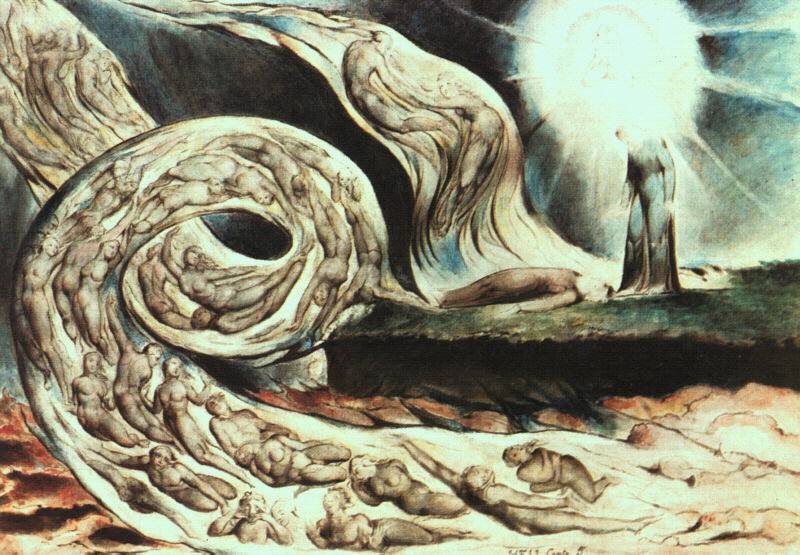
He was a poet (virtually unknown in his own lifetime), and also an engraver (I've put some of his startling work in the extended entry - but if you want to see more of his work, check out this link). He did illustrations for children's books, religious books, volumes of poetry ... and now his stuff is considered priceless.
William Blake was born in 1757 in London, the third of five children. He went to school until he was 14 and then had to go to work. He got a job as an apprentice to an engraver, which is how he ended up making his paltry living. He lived in pretty much poverty for his entire life. He married at 25 the illiterate Catherine Boucher. Blake taught her how to read, and they ended up becoming collaborators in bringing out volumes of his poetry. He did engravings to illustrate his poems. Catherine was the one who bound the books, and got them ready for publication. The entire thing was a joint production. They did all the work themselves.
The two of them never had any children. They were extremely unconventional, and visitors tell of stopping by the Blake house to find the two of them sitting out in their back garden completely naked. Just hanging out, reading, working together, NUDE. They had a whole philosophy about nakedness, and sex, and innocence - that there was nothing dirty about any of that stuff. It actually all was quite holy, and it was human prudery that made celebration of the body a dirty thing.
William Blake had visions. He speaks about them openly and much of his work has a phantasmagorical religious feeling to it. When he was a young boy, he said he looked up into a tree and saw that it was full of winged angels.
His view of God, the Spirit, the Holy Trinity is so inspiring to me. It's vital, it's alive, and it seems to be all about love. There are not too many people I would call "genius" - but Blake I most certainly would.
However - again - William Blake, despite these astonishing works of poetry he put out during his lifetime - died unrecognized.
Now, though, he is considered to be one of the greatest poets in the English language.
He's one of my all-time favorites.
His poem about the little lisping chimney-sweep is in the "canon". If you took any kind of sweeping Poetry 101 course, you probably would have encountered it. I'll post it below. But it's really his long form poems, especially the SPECTACULAR "Marriage of Heaven and Hell", where the guy literally has no equal. None. Blake has no peers.
Here's the one about the chimney sweep, which is an indictment of the society in which he lives, a society that treats its most innocent members with brutality and uncaring indifference. He is a visionary poet, yes, but he did not turn his eyes away from earthly matters. Far from it.
"The Chimney Sweep" - from Songs of Innocence
When my mother died I was very young,
And my father sold me while yet my tongue
Could scarcely cry 'weep! 'weep! 'weep! 'weep!
So your chimneys I sweep, and in soot I sleep.
There's little Tom Dacre, who cried when his head,
That curled like a lamb's back, was shaved: so I said,
"Hush, Tom! never mind it, for when your head's bare,
You know that the soot cannot spoil your white hair."
And so he was quiet; and that very night,
As Tom was a-sleeping, he had such a sight, -
That thousands of sweepers, Dick, Joe, Ned, and Jack,
Were all of them locked up in coffins of black.
And by came an angel who had a bright key,
And he opened the coffins and set them all free;
Then down a green plain leaping, laughing, they run,
And wash in a river, and shine in the sun.
Then naked and white, all their bags left behind,
They rise upon clouds and sport in the wind;
And the angel told Tom, if he'd be a good boy,
He'd have God for his father, and never want joy.
And so Tom awoke; and we rose in the dark,
And got with our bags and our brushes to work.
Though the morning was cold, Tom was happy and warm;
So if all do their duty they need not fear harm.
And here ... for those of you who are interested ... is "Marriage of Heaven and Hell" in its entirety (accompanied by more of Blake's engravings).
Just go with it. Just succumb.
As you can see, the guy was so ahead of his time that he is timeless. He predicts the Beat generation (and Allen Ginsberg was partially responsible for bringing Blake back into vogue), he predicts modernism, he would fit in with the poetry slams of today (except that he is, well, you know - GOOD). He was a man who plumbed his unconscious for material. He brought what was within him OUT. His poetry is the literary version of Van Gogh's Starry Night. Van Gogh was not interpreting the sky. Van Gogh was actually painting what he saw. William Blake is the same way.
Thanks, Blake! Wish I could have visited you and your wife in your back garden, and sat around with you all, nude, drinking tea, and talking about angels.
Here are some quotes by and about William Blake. Enjoy!
"He had no public: he very early gave up publishing in any serious sense. one obvious consequence, or aspect, of this knowledge is the carelessness that is so apparent in the later prophetic books. Blake had ceased to be capable of taking enough trouble." -- F.R. Leavis
Improvement makes strait roads, but the crooked roads without Improvement, are roads of Genius. -- Blake
"I mean, don't you think it's a little bit excessive?"
"The road of excess leads to the palace of wisdom. William Blake."
Pause.
"William Blake?"
"William Blake!"
"William Blake???"
"William Blake!!!"
-- Bull Durham
"I do not condemn Pope or Dryden because they did not understand imagination, but because they did not understand verse." -- William Blake
"The prophetic robe with its woof of meekness and its warp of wrath was forced on [Blake] by loneliness and his modest station in life." -- Robert Graves
"In his youth, [Blake] had a gift of simple and fair speech; but he lost it. Although he could always catch the heavenly harmony of thoughts he could seldom mount them on a fitting chariot of rhythm and rhyme. His fine passages were the direct gift of the Muse, and are followed by lines of other origin." -- Edward Thomas
"It is an honesty against which the whole world conspires, because it is unpleasant." -- T.S. Eliot
"Think of a white cloud as being holy, you cannot love it, but think of a holy man within the cloud, love springs up in your thoughts, for to think of holiness distinct from man is impossible to the affections. Thought alone can make monsters, but the affections cannot." -- Blake
"He is very eighteenth century." -- T.S. Eliot
"The emotions are presented in an extremely simplified, abstract form. This form is one illustration of the eternal struggle of art against education, of the literary artist against the continuous deterioration of language." -- T.S. Eliot on "Songs of Innocence" and "Songs of Experience"
"In America in the late 1940s Allen Ginsberg, interested in Supreme Reality, alone and suffering a 'dark night of the soul sort of,' his lover Neal Cassady having sloped off, and having himself just masturbated, with a volume of Blake before him - 'I wasn't even reading, my eye was idling over the page of "Ah, Sun-flower," and it suddenly appeared - the poem I'd read a lot of times before.' He began to understand the poem, and 'suddenly, simultaneously with understanding it,' he 'heard a very deep earthen grave voice in the room, which I immediately assumed, I didn't think twice, was Blake's voice.' This 'apparitional voice' became his guiding spirit: 'It was like God had a human voice, with all the infinite tenderness and anciency and mortal gravity of a living Creator speaking to his son.' On Ginsberg this 'anciency fathered Howl, though the Blake simulacrum was aided by the hallucinogens popular at the time, the recipe for Part II of the poem including peyote, just as for Kaddish he was assisted by amphetamine injections. 'The amphetamine gives a peculiar metaphysical tinge to things, also. Space-outs.' Blake managed his visions without substance abuse. Ginsberg's appropriation of the poet of innocence and experience did much to promote Blake to the alternative culture of the 1950s and 1960s." -- Michael Schmidt, "Lives of the Poets"
"a completely and uncompromisingly individual idiom and technique ... individual, original, and isolated enough to be without influence." -- FR Leavis
"You cannot create a very large poem without introducing a more impersonal point of view, or splitting it up into various personalities. But the weakness of the long poems is certainly not that they are too visionary, too remote from the world. It is that Blake did not see enough, became too much occupied with ideas." -- TS Eliot
"Romantic writers glorified childhood as a state of innocence. Blake's 'The Chimey Sweeper', written in the same year as the French Revolution, combines the Romantic cult of the child with the new radical politics, whichcan both be traced to social thinker Jean-Jacques Rousseau. It is the boy sweep, rather than Blake, who speaks: he acts as the poet's dramatic persona or mask. There is no anger in his tale. On the contrary, the sweep's gentle acceptance of his miserable life makes his exploitation seem all the more atrocious. Blake shifts responsibility for protest onto us." -- Camille Paglia, "Break, Blow, Burn"
Some of William Blake's extraordinary engravings below:
Christ in the sepulcher guarded by angels - 1805

Whirlwind of Lovers (Illustration to Dante's Inferno)
The Ancient of Days - 1794

Isaac Newton - 1795

November 26, 2008
Today in history: November 26, 1942
Casablanca premiered at the Hollywood Theatre in New York City.
It was not expected to be a long-lasting mythical evocation of the quintessential American ideals we all aspire to, from generation to generation. It was just supposed to be another one of the pro-war propaganda movies the studios were churning out at that time. It went on to win the Academy Award the next year - but again, lots of films win Academy Awards and don't go on to achieve legendary status.
The legend around the film began growing in the late 50s, a couple of years after Bogart's death. The stories about the Casablanca showings at the Brattle Theatre in Cambridge Massachusetts are now famous ... and make me wish for a time machine.
Aljean Harmetz, author of Making of Casablanca, The: Bogart, Bergman, and World War II
Humphrey Bogart died in 1957. The cult of Casablanca was born three months later. If Cyrus Harvey, Jr., was not the father of the phenomenon, he was certainly the midwife. In 1953, Harvey and Bryant Haliday had turned the Brattle Theatre across from, Harvard University into an art cinema. Harvey, who had spent much of his Fulbright scholarship year in Paris watching movies at Henri Langlois's Cinemathique Francaise, programmed the Brattle with European classics and the early films of Fellini, Antonini, Truffaut, and Ingmar Bergman, for whom Harvey and Halliday became the American distributors."At some point, we thought that we ought to bring in some of the American films that hadn't been shown that much," says Harvey. "And my partner and I both thought that the Bogarts were vastly underrated. I think Casablanca was the first one we played. It was my favorite. I thought that Bogart was probably the best American actor who ever lived. And the picture caught on very rapidly. The first time we played it, there was a wonderful reaction. Then the second, third, fourth and fifth times it took off. The audience began to chant the lines. It was more than just going to the movies. It was sort of partaking in a ritual."
Casablanca played at the Brattle for the first time on April 21, 1957. It was so successful with Harvard students that it was held over for a second week. Then the Bogart festivals began, with six or eight of his mopvies playing each semester during final-examination weeks. The festivals would culminate with Casablanca. It was at Harvard that the relevance of Casablanca to a generation that had no relationship to World War II became apparent.
So. Happy birthday to a film that has done so much to shape how we think about ourselves. It has meant different things to different generations - and that's the definition of a good piece of art. If you watch a lot of the other WWII movies made at that time - they seem dated, overblown, propagandistic, and overly simplistic. Not this one. Not this one.
I have a feeling (just a hunch) that if Ilse had not gotten on that plane with Victor - if she had stayed with Rick ... the movie would not be remembered today. It might be still watched, on late-night movie channels, but it would not have taken on that mythical quality. It is the vision of self-sacrifice that taps into our deepest held beliefs and hopes. It is who we hope and aspire to be. It is a noble outlook ... and yet, at the center of the film, is the Rick character, who says he is not good at being noble. If you make a big deal out of your own nobility, then you are just a jackass who thinks way too highly of yourself. But if you quietly, and with no fanfare, do the right thing - abdicate your own wants for a greater cause, practice the art of letting go ... then you truly deserve to be called noble.
Hokey? Sure. Sentimental? Absolutely.
If you're a fan of this movie - enjoy the quotes below!

Billy Wilder says:
"This is the most wonderful claptrap that was ever put on the screen ... Claptrap that you can't get out of your mind. The set was crummy. By God, I've seen Mr. Greenstreet sit in that same wicker chair in fifty pictures before and after, and I knew the parrots that were there. But it worked. It worked absolutely divinely. No matter how sophisticated you are and it's on television and you've seen it 500 times, you turn it on."
Sociologist Todd Gitlin writes:
Casablanca dramatizes archetypes. The main one is the imperative to move from disengagement and cynicism to commitment. The question is why Casablanca does this more effectively than other films. Several other Bogart films of the same period -- Passage to Marseilles, To Have and Have Not, Key Largo -- enact exactly the same conversation. But the Rick character does not simply go from disengagement to engagement but from bitter and truculent denial of his past to a recovery and reignotion of the past. And that is very moving, particularly because it is also associated with Oedipal drama. But there is also a third myth narrative, a story about coming to terms with the past. Rick had this wonderful romance; he also had his passionate commitment. It seems gone forever. But you can get it back. That is a very powerful mythic story, because everybody has lost something, and the past it, by definition, something people have lost. This film enables people to feel that they have redeemed the past and recovered it, and yet without nostalgia. Rick doesn't want to be back in Paris. And the plot is brilliantly constructed so that these three myths are not three separate tales, but one story with three myths rushing down the same channel.
Aljean Harmetz, author of Making of Casablanca, The: Bogart, Bergman, and World War II
I was in elementary school during World War II; I did my part in the war by rolling tinfoil and rubber bands into balls and bringing them to the Warners Beverly Theatre on Saturday mornings. World War II had receded with all its certainties and moral imperatives, leaving muddy flats behind. The world is a cornucopia of grays. I believed the romantic interpretation of Casablanca then -- love lost for the good of the world -- and believe it now. But it is the very ambiguity of Casablanca that keeps it current. Part of what draws moviegoers to the movie again and again is their uncertainty about what the movie is saying at the end ...Casablanca's potent blend of romance and idealism -- a little corny and mixed with music and the good clean ache of sacrifice and chased down with a double slug of melodrama -- is available at the corner video store, but Casablanca couldn't be made today. There is too much talk and not enough action. There are too many characters too densely packed, and the plot spins in a hard-to-catch-your-balance circular way instead of walking a straight line. There is no Humphrey Bogart to allow the audience a permissible romance without feeling sappy. And the studio would insist that all the ambiguity be written out in the second draft.
From Making of Casablanca, The: Bogart, Bergman, and World War II
"Bogart had competence," says Billy Wilder. "You felt that, if that big theatre where you were watching Casablanca caught on fire, Bogart could save you. Gable had that same competence and, nowadays, Mr. Clint Eastwood." But Gable is too heroic for a disillusioned world. Three decades after his death, Bogart still seems modern. "He wore no rose-colored glasses," wrote Mary Astor. "There was something about it all that made him contemptuous and bitter. He related to people as though they had no clothes on -- and no skin, for that matter."

From Making of Casablanca, The: Bogart, Bergman, and World War II
Of the seventy-five actors and actresses who had bit parts and larger roles in Casablanca, almost all were immigrants of one kind or another. Of the fourteen who were given screen credit, only Humphrey Bogart, Dooley Wilson, and Joy Page were born in America. Some had come for private reasons. Ingrid Bergman, who would lodge comfortably in half a dozen countries and half a dozen languages, once said that she was a flyttfagel, one of Sweden's migratory birds. Some, including Sydney Greenstreet and Claude Rains, wanted richer careers. But at least two dozen were refugees from the stain that was spreading across Europe. There were a dozen Germans and Austrians, nearly as many French, the Hungarians SZ Sakall and Peter Lorre, and a handful of Italians."If you think of Casablanca and think of all those small roles being played by Hollywood actors faking the accents, the picture wouldn't have had anything like the color and tone it had," says Pauline Kael.
Dan Seymour remembers looking up during the singing of the Marseillaise and discovering that half of his fellow actors were crying. "I suddenly realized that they were all real refugees," says Seymour.
From Making of Casablanca, The: Bogart, Bergman, and World War II
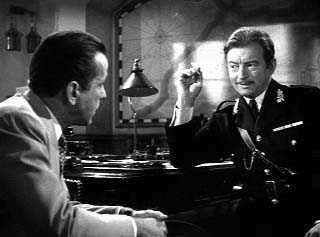
Bogart and Rains admired each other, and that admiration comes through their scenes together. What seems to be a genuine friendship between Rick and Renault takes the sting out of the ending of Casablanca. "My father loved Humphrey Bogart," says Jessica Rains. "He told me so." The cockney who turned himself into a gentleman was unexpectedly compatible with the gentle-born son of a doctor and a famous illustrator who turned himself into a rowdy. "Professional" is the word the people they worked with pin, like a badge, to both men. "Bogart never missed a cue," says script supervisor Meta Carpenter. "He was completely professional." Rains, says assistant director Lee Katz, "was very professional altogether." To the Warner hairdressers, said Jean Burt, Bogart and Bette Davis were "the real pros. They were on time; they knew their lines; they knew their craft."

From Making of Casablanca, The: Bogart, Bergman, and World War II
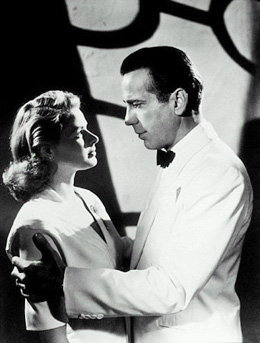
[During shooting] Bogart was snappish and moody. Love scenes were uncharted waters for him. "I've always gotten out of my scrapes in front of the camera with a handy little black automatic," he told a journalist who visited the Casablanca set during production. "It's a lead pipe cinch. But this. Well, this leaves me a bit baffled." The interview is typically frothy and insubstantial as Bogart plays with the idea of becoming a sophisticated lover or a caveman lover. But, even as he jokes about it, his uneasiness is obvious. "I'm not up on this love stuff and don't know just what to do."According to a memoir by Bogart's friend Bathaniel Benchley, before Casablanca began shooting, a mutal friend, Mel Baker, advised Bogart to stand still and make Bergman come to him in the love scenees. Bogart appears to have taken the advice, but his reticence may have been as much innate as calculated. Nearly a dozen years after Casablanca, Bogart told a biographer that love scenes still embarrassed him. "I have a personal phobia maybe because I don't do it very well," he said.
"What the women liked about Bogey, I think," said Bette Davis, "was that when he did love scenes he held back -- like many men do -- and they understood that." Miscast as an Irish horse trainer in Dark Victory, Bogart had tried to make love to Davis, who played his rich employer. Said Davis, "Up until Betty Bacall I think Bogey was really embarrassed doing love scenes, and that came over as a certain reticence. With her he let go, and it was great. She matched his insolence."
However distant Bogart and Bergman may have been from each other in real life, and however uneasy Bogart may have been with Bergman in his arms, their love scenes have the poignancy and passion that Hollywood calls chemistry. "I honestly can't explain it," says Pauline Kael, "but Bogart had that particular chemistry with ladylike women. He had it with Katherine Hepburn in The African Queen and he so conspicuously had it with Lauren Bacall -- who pretended to be a tough girl but really wasn't -- in To Have and Have Not. But he didn't have it with floozy-type girls."
Critic Stanley Kauffmann explains the match between Bogart and Bergman as the resonance of a relationship between brash America and cultured Europe. "She was like a rose," he says. "You could almost smell the fragrance of her in the picture, and you could feel his whiskers when you looked at the screen. It was intangible."

From Making of Casablanca, The: Bogart, Bergman, and World War II
Of the stars, Bergman had the more difficult job. Bogart had only to play a man in love. Foreshadowing without giving away too much, Bergman had to let the audience know that love wasn't enough.ILSA. And I hate this war so much. Oh, it's a crazy world. Anything can happen. If you shouldn't get away, I mean, if something should happen to keep us apart. Wherever they put you and wherever I'll be, I want you to know that I -- Kiss me! Kiss me as though it were the last time.
And Bergman had to hold the audience even when she was saying dialogue that was so richly romantic that it was almost a parody, including, "Was that cannon fire? Or was it my heart pounding?"
Her voice and her face could make almost anything believable. In 1947, several top sound men agreed that Bergman had the sexiest voice of any actress. "The middle register of her voice is rich and vibrant, which gives it a wonderfully disturbing quality," said Francis Scheid. "It's sexy in a refined, high-minded way." "The face is quite amazing," says Pauline Kael. "I think she had a physical awkwardness on the stage and in her early films, but I think somehow that the beauty of her face obviated it. Even in Casablanca, her physical movements are not very expressive. But you didn't really care."

From Making of Casablanca, The: Bogart, Bergman, and World War II
Casablanca started on Stage 12A with the flashback to Rick and Ilsa's romance in Paris. It was an accident that Bogart was required to make love to Bergman almost before he was introduced to her. Originally, production was to start in Rick's Cafe on Stage 8, but the intricate clockwork that matched actors, scripts, stages, and sets had been thrown off because Irving Rapper was two weeks behind schedule on Now, Voyager. Claude Rains didn't finish his role as the wise psychiatrist in Now, Voyager until June 3. Paul Henreid was not free until June 25. So the [Michael] Curtiz movie began with the scene in the Montmartre cafe. The first day, a lovestruck Richard Blaine -- "His manner is wry but not the bitter wryness we have seen in Casablanca" say the stage directions -- pours champagne for himself, Ilsa, and Sam while the Germans march toward Paris and Sam plays, "As Time Goes By".According to Geraldine Fitzgerald, Bogart and Bergman had lunch together a week or ten days before Casablanca started production. "I had lunch with them," she says. "And the whole subject at lunch was how they could get out of the movie. They thought the dialogue was ridiculous and the situations were unbelievable. And Ingrid was terribly upset because she said she had to portray the most beautiful woman in Europe, and no one would ever believe that. It was curious how upset she was by it. 'I look like a milkmaid,' she said.

From Making of Casablanca, The: Bogart, Bergman, and World War II
"I remember," says film critic Pauline Kael, "my friends and I talked about when are the executives going to discover this guy [Humphrey Bogart]. It was early in his career, when he appeared in horror movies and all sorts of stuff that Warners threw at him. We liked him years before he got the leading roles. he was small, but he knew how to use every part of himself. By the late thirties, he was quite in charge of everything in his performance. He had a tension, like a coiled spring. You didn't want to take your eyes off him."In The Maltese Falcon, as Dashiell Hammett's detective Sam Spade, Bogart carried to the right side of the law the wary watchfulness, the cynicism, and the ambiguities that had infused his deadliest killers. "I think it was his very best performance," says Kael, who was twenty years old in 1941 when she saw the movie for the first time. "Because you got a sense of the ambivalances in th eman, and he used all the tensions marvelously physically. I don't think he could have been as good as he was in Casablanca if he hadn't done the Falcon first, because he really discovered his powers in the Falcon. he created more tension in his scenes than he ever had before. And I think afterwards he drew on the qualities he had discovered in himself in the Falcon. So I think it was [John] Huston who brfought those things out. And [Michael] Curtiz benefited from them."...
The arc of Bogart's career at Warner Brothers can be seen in how and when he chose to fight Warner -- and with what success. Bogart was suspended for refusing to play the part of the outlaw Cole Younger in Bad Men of Missouri ... His suspension ended in June 1941, when George Raft, whose career decisions at Warners were unerringly wrong, refused The Maltese Falcon because "it is not an important picture." And what would have happened if Raft had agreed to play Sam Spade? The odds are high that Bogart would have made a breakthrough in some other movie. The disillusionment, stoicism, and weary aloofness that he brought to the screen fit the heroes of a new kind of movie melodrama, film noir, too well to have gone unnoticed ...
Warner Brothers could overuse and misuse its actors. It could dump Van Johnson and Susan Peters in 1942 and let MGM build their careers. But the studio would not have remained in business if it had missed the obvious. The Maltese Falcon had been immensely profitable, and George Raft was becoming more difficult with every role he was offered. In January 1942, Bogart demanded $3,000 a week and the right to do ten guest radio appearances a year. He was given a new contract, starting at $2,750 a week. After six years at Warners, Bogart finally had a star's contract. Warner Brothers was stuck with him for seven years, and the studio began to look for a role that would turn him into a romantic lead.
On February 14, [Hal] Wallis sent a memo to Steve Trilling: "Will you please figure on Humphrey Bogart and Ann Sheridan for Casablanca, which is scheduled to start the latter part of April." Six weeks later, Jack Warner wrote Wallis that George Raft was lobbying him for the role. Wallis held firm and Casablanca had the first of its three stars.

From Making of Casablanca, The: Bogart, Bergman, and World War II
Much of the major work on the Casablanca screenplay was done between April 6, when Howard Koch was assigned to the movie, and June 1, when a revised final script was mimeographed ...Each subsequent script for Casablanca became leaner and sharper, more economical, the scenes rearranged for greater dramatic effect and the speeches polished and clipped. Within the confines of a studio that both Koch and Julie Epstein describe as 'a family", Koch rewrote the Epsteins to give the movie more weight and significance, and the Epsteins then rewrote Koch to erase his most ponderous symbols and to lighten his earnestness.
This kind of survival-of-the-fittest script is unlikely to happen today, when writers, director, and studio executives come insecurely and suspiciously together to make a single movie, the original writer is rarely brought back after his work is rewritten, and screen credit means that someone gets extra money from television and videocassette sales...
At the beginning of May, the Epsteins finished the second section of the script of Casablanca, while Howard Koch turned in his revision of the Epsteins' first act. Earlier, in nineteen pages of suggestions of "Suggestions for Revised Story", Koch had warned:
There is also a danger that Rick's sacrifice in the end will seem theatrical and phony unless, early in the story, we suggest the side of his nature that makes his final decision in character. It would be interesting to have Renault penetrate the mystery in his first scene with Rick when he guesses that the cynical American is underneath, a sentimentalist. Rick laughs at the idea, then Renault produces his record -- "ran guns to Ethiopia", "fought for the Loyalists in the Spanish War." Rick says he got well paid on both occasions. Renault replies that the winning side would have paid him better. Strange that he always happens to be on the side of the underdog. Rick dismisses the implication, but throughout the picture we see evidences of his humanity, which he does his best to cover up.Koch's script of May 11 also deepened Rick's character and underlined the political tensions in subtle ways. For example, Koch makes the man Rick bars from his gambling room -- who was an English cad in the play -- into a representative of the Deutschebank. When the owner of the Blue Parrot offers to buy Rick's Cafe, Koch has added dialogue in which the character played by Sidney Greenstreet also offers to buy Sam, and Rick says, "I don't buy or sell human beings." (In their rewrite of Koch's script, the Epsteins would build on Koch's line by having Greenstreet respond, "That's too bad. That's Casablanca's leading commodity.") If Koch layered the politics rather heavily -- in his version, Victor Laszlo forces Renault to toast liberte, egalite, fraternite -- the Epsteins would remove those speeches in the script of June 1. With delicate balance, Koch managed to hold down the gags while the Epsteins managed to cut out the preaching.

From Making of Casablanca, The: Bogart, Bergman, and World War II
In the Epsteins' first script, Lois is still Lois and Renault's womanizing still has an unpleasant edge. However, the groundwork has been laid for the relationship between Rick and Renault, which may lie as close to the emotional heart of the film as the relationship between Rick and Ilsa. The Epsteins have created a bantering between equals, an admiration at the edges of the frame.RENAULT. I have often speculated on why you do not return to America. Did you abscond with the church funds? Did you run off with the President's wife? I should like to think you killed a man. It is the romantic in me.
RICK. It was a combination of all three.
RENAULT. And what in Heaven's name brought you to Casablanca?
RICK. My health. I came to Casablanca for the waters.
RENAULT. Waters? What waters? We are in the desert.
RICK. I was misinformed.
Says Epstein today: "My brother and I tried very hard to come up with a reason why Rick couldn't return to America. But nothing seemed right. We finally decided not to give a reason at all."
From Making of Casablanca, The: Bogart, Bergman, and World War II
The sixty-six pages of script, labeled Part I TEMP., were mimeographed on April 2. The Epsteins had written the first third of the movie, the section preceding the flashback to Rick and Ilsa's Paris romance. Ilsa and her Resistance-hero husband had come to Casablanca, and at the end of the Epsteins' script, Rick was sprawled drunkenly in his empty cafe, waiting for her to return."That first part was very close to the play," Epstein says. "It was with the second half that we had trouble."
Those sixty-six pages mirror the final movie. The Epsteins even begin with a spinning globe, an animated map, and a description of the refugee trail that leads to Casablanca. Everybody Comes to Rick's took place inside Rick's Cafe, and Rick was the first character to be introduced. The Epsteins start by creating the feel of Casablanca: A man whose papers have expired is short by the police; a pickpocket warns his victims that vultures are everywhere; refugees look up longingly as an airplane brings the Gestapo captain (a few scripts later he was promoted to major) Strasser to Casablanca and lands beyond a neon sign that reads RICK'S. Inside the cafe, a dozen desperate refugees try to buy or sell their way to freedom. Rick is not introduced until page 15, when a hand writes "Okay -- Rick" on the back of a check and the camera pulls back to a medium shot of Humphrey Bogart. And the plot is driven by an invention of the Epsteins: the Letters of Transit were being carried by two German couriers who have been murdererd.
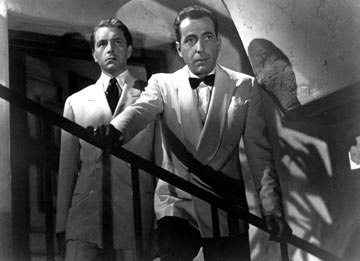
Of the four major characters in Everybody Comes to Rick's, only the noble Victor Laszlo remains essentially the same in the movie. Rick, who in the play is a self-pitying married lawyer who has cheated on his wife, takes on Bogart's persona of wary, hooded toughness. Says Jules Epstein: "Once we knew that Bogart was going to play the role, we felt he was so right for it that we didn't have to do anything special. Except we tried to make him as cynical as possible."
From Making of Casablanca, The: Bogart, Bergman, and World War II
However, there was no mistaking the fact that Casablanca, with its snappy dialogue, eccentric characters, witty cynicism, wary anti-hero and liberal political message was definitely a Warner movie. Casablanca is a less raw and angry melodrama than the studio might have made a few years earlier, but it has the same distrust of authority and suspicion of human nature. America's entry into the war was already softening movies by requiring them to throb with patriotism, but the milieu of Casablanca is still corrupt, and the little people still don't get a fair shake.

From Making of Casablanca, The: Bogart, Bergman, and World War II
Bogart's response to the success of Casablanca was more typically sardonic. He enjoyed telling his fourth wife, Lauren Bacall, how Charles Enfield, the studio's head of publicity, had had the amazing revelation that the actor had sex appeal. Says Bacall, "Bogie would say, 'Of course, I did nothing in Casablanca that I hadn't done in twenty movies before that, and suddenly they discover I'm sexy. Any time that Ingrid Bergman looks at a man, he has sex appeal.'"
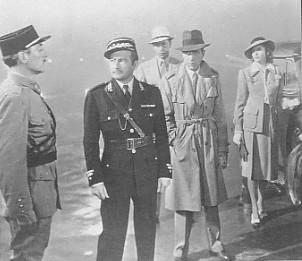
From Making of Casablanca, The: Bogart, Bergman, and World War II
Warner Brothers was the most frugal of the studios, and little was wasted there in 1942. World War II gave the studio's president, Harry Warner, an excuse to pick up nails dropped by careless carpenters. But he had obsessively picked up nails before the war made iron scarce. Casablanca moved onto the French Street created for The Desert Song the day after that film moved off. A few signs and two live parrots turned the French Morocco of heroic freedom fighter El Khobar into the French Morocco of heroic freedom fighter Victor Laszlo. And half a dozen bit players with foreign accents got a full week's work by straddling the two films. More than half of the movies Warners made in 1942 dealt in one way or another with the war, a bonanza for actors who had fled from Berlin or Vienna. Casablanca was filled with those Jewish refugees, many of them playing Nazis.
Film critic Stanley Kauffmann wrote:
"Bogart absolutely encapsulates permissible romance. In this disillusioned, disenchanted world here was a romantic hero we could accept. I think that that disenchantment began with World War I and the emergence of what could be called the Hemingway -- the undeluded -- generation. And I think that that revulsion with the romances and the lies of the nineteenth century and the twentieth century has persisted. There have been plenty of representatives of the lovely bucolic strain of American life on the screen. Bogart was someone urban -- in a sense more jagged and abrasive than Cagney -- who you felt was suffering. Cagney was triumphant. Bogart was tough, but he had sensitivity. Certainly the epitome he stood for was in Casablanca. I was misinformed. That's the twentieth century."
Roger Ebert - who provides the commentary to the DVD (and I highly suggest you check it out, if you haven't already - it's marvelous commentary, true goosebump material from someone who has STUDIED and also LOVED this movie since it first came out) - wrote the following article about Casablanca for his "Great Movies" series:
If we identify strongly with the characters in some movies, then it is no mystery that ``Casablanca'' is one of the most popular films ever made. It is about a man and a woman who are in love, and who sacrifice love for a higher purpose. This is immensely appealing; the viewer is not only able to imagine winning the love of Humphrey Bogart or Ingrid Bergman, but unselfishly renouncing it, as a contribution to the great cause of defeating the Nazis.No one making ``Casablanca'' thought they were making a great movie. It was simply another Warner Bros. release. It was an ``A list'' picture, to be sure (Bogart, Bergman and Paul Henreid were stars, and no better cast of supporting actors could have been assembled on the Warners lot than Peter Lorre, Sidney Greenstreet, Claude Rains and Dooley Wilson). But it was made on a tight budget and released with small expectations. Everyone involved in the film had been, and would be, in dozens of other films made under similar circumstances, and the greatness of ``Casablanca'' was largely the result of happy chance.
The screenplay was adapted from a play of no great consequence; memoirs tell of scraps of dialogue jotted down and rushed over to the set. What must have helped is that the characters were firmly established in the minds of the writers, and they were characters so close to the screen personas of the actors that it was hard to write dialogue in the wrong tone.
Humphrey Bogart played strong heroic leads in his career, but he was usually better as the disappointed, wounded, resentful hero. Remember him in ``The Treasure of the Sierra Madre,'' convinced the others were plotting to steal his gold. In ``Casablanca,'' he plays Rick Blaine, the hard-drinking American running a nightclub in Casablanca when Morocco was a crossroads for spies, traitors, Nazis and the French Resistance.
The opening scenes dance with comedy; the dialogue combines the cynical with the weary; wisecracks with epigrams. We see that Rick moves easily in a corrupt world. ``What is your nationality?'' the German Strasser asks him, and he replies, ``I'm a drunkard.'' His personal code: ``I stick my neck out for nobody.''
Then ``of all the gin joints in all the towns in all the world, she walks into mine.'' It is Ilsa Lund (Bergman), the woman Rick loved years earlier in Paris. Under the shadow of the German occupation, he arranged their escape, and believes she abandoned him--left him waiting in the rain at a train station with their tickets to freedom. Now she is with Victor Laszlo (Henreid), a legendary hero of the French Resistance.
All this is handled with great economy in a handful of shots that still, after many viewings, have the power to move me emotionally as few scenes ever have. The bar's piano player, Sam (Wilson), a friend of theirs in Paris, is startled to see her. She asks him to play the song that she and Rick made their own, ``As Time Goes By.'' He is reluctant, but he does, and Rick comes striding angrily out of the back room (``I thought I told you never to play that song!''). Then he sees Ilsa, a dramatic musical chord marks their closeups, and the scene plays out in resentment, regret and the memory of a love that was real. (This scene is not as strong on a first viewing as on subsequent viewings, because the first time you see the movie you don't yet know the story of Rick and Ilsa in Paris; indeed, the more you see it the more the whole film gains resonance.)
The plot, a trifle to hang the emotions on, involves letters of passage that will allow two people to leave Casablanca for Portugal and freedom. Rick obtained the letters from the wheedling little black-marketeer Ugarte (Peter Lorre). The sudden reappearance of Ilsa reopens all of his old wounds, and breaks his carefully cultivated veneer of neutrality and indifference. When he hears her story, he realizes she has always loved him. But now she is with Laszlo. Rick wants to use the letters to escape with Ilsa, but then, in a sustained sequence that combines suspense, romance and comedy as they have rarely been brought together on the screen, he contrives a situation in which Ilsa and Laszlo escape together, while he and his friend the police chief (Claude Rains) get away with murder. (``Round up the usual suspects.'')
What is intriguing is that none of the major characters is bad. Some are cynical, some lie, some kill, but all are redeemed. If you think it was easy for Rick to renounce his love for Ilsa--to place a higher value on Laszlo's fight against Nazism--remember Forster's famous comment, ``If I were forced to choose between my country and my friend, I hope I would be brave enough to choose my friend.''
From a modern perspective, the film reveals interesting assumptions. Ilsa Lund's role is basically that of a lover and helpmate to a great man; the movie's real question is, which great man should she be sleeping with? There is actually no reason why Laszlo cannot get on the plane alone, leaving Ilsa in Casablanca with Rick, and indeed that is one of the endings that was briefly considered. But that would be all wrong; the ``happy'' ending would be tarnished by self-interest, while the ending we have allows Rick to be larger, to approach nobility (``it doesn't take much to see that the problems of three little people don't amount to a hill of beans in this crazy world''). And it allows us, vicariously experiencing all of these things in the theater, to warm in the glow of his heroism.
In her closeups during this scene, Bergman's face reflects confusing emotions. And well she might have been confused, since neither she nor anyone else on the film knew for sure until the final day who would get on the plane. Bergman played the whole movie without knowing how it would end, and this had the subtle effect of making all of her scenes more emotionally convincing; she could not tilt in the direction she knew the wind was blowing.
Stylistically, the film is not so much brilliant as absolutely sound, rock-solid in its use of Hollywood studio craftsmanship. The director, Michael Curtiz, and the writers (Julius J. Epstein, Philip G. Epstein and Howard Koch) all won Oscars. One of their key contributions was to show us that Rick, Ilsa and the others lived in a complex time and place. The richness of the supporting characters (Greenstreet as the corrupt club owner, Lorre as the sniveling cheat, Rains as the subtly homosexual police chief and minor characters like the young girl who will do anything to help her husband) set the moral stage for the decisions of the major characters. When this plot was remade in 1990 as ``Havana,'' Hollywood practices required all the big scenes to feature the big stars (Robert Redford and Lena Olin) and the film suffered as a result; out of context, they were more lovers than heroes.
Seeing the film over and over again, year after year, I find it never grows over-familiar. It plays like a favorite musical album; the more I know it, the more I like it. The black-and-white cinematography has not aged as color would. The dialogue is so spare and cynical it has not grown old-fashioned. Much of the emotional effect of ``Casablanca'' is achieved by indirection; as we leave the theater, we are absolutely convinced that the only thing keeping the world from going crazy is that the problems of three little people do after all amount to more than a hill of beans.

November 25, 2008
Doing your best
I suppose that life is all about being tested. Some tests are obvious, some not so obvious. I know that I am cagey on my blog about my "real" life - and that is by design. This is why I am very picky about who I "friend" on Facebook so don't take it personally. I am not deliberately deceitful, but I certainly withhold. Especially recently. My blog is for me, essentially, and posting every day keeps me sane. Personal posts have, for the most part, gone by the wayside in the last year, because first of all I am really busy with my off-line writing and also I have no words or no desire to share all here. I think I'm smart. Because every time I write a post expressing uncertainty, someone always swoops in instantly and tries to give you the answer. They do not understand that living in the uncertainty is what I am about, and pondering things, and NOT coming to rock-hard conclusions. I like to leave things open for interpretation. I have learned that a blog is not always the best venue for such things, and I have decided to protect myself from those misunderstandings. I can't afford the energy to be explaining myself right now. And yet I still need to share things here. I still love to talk about movies and books and that passion shines through. It makes it a nice place to hang out. I know that, and I am proud of it. The fact that people still like to show up and read what I write is a blessing to me.
I am being tested right now. My whole family is. It is part of life. It sucks. I feel surrounded by their love and support and Facebook has completely changed my life because I chat with my cousins on almost a daily basis and so every day I get a message of love from one of them, letting me know that we are being thought about, prayed for. A candle was lit for us in Bruges, for example. I weep reading these messages.
A couple of days ago I wrote a post about going to Lydia's baby shower and how, in the middle of the maelstrom, I got a sensation of the goodness of people, how everyone is "doing their best". I do believe that. Perhaps it is because I am wounded right now. Being wounded gives you a different perspective on other people's misbehavior (or so it seems to me). Maybe that frustrated woman in line at the grocery store has a dying husband at home. Maybe that teenager acting out just lost her mother. You just don't know. You don't know. And it is better not to assume. It is better to cut people slack, rather than condemn them for their surface. This is my philosophy.
And so I know what it takes to just get up and keep going, to "do your best", to meet your obligations, to "show up" at events you are going to, to not reject life - but try to accept it. In all its complexities and tragedies. It was such a strong feeling that I got at that shower. Not to mention the fact that, again, I was surrounded by family, who love me, and support me, and are THERE for all of us in this terrible time. It is always in our minds. I meet up with other friends now and sometimes it is forgotten, what I am going through, because life is busy and people have their lives to live. This is not the case now, actually - but it has been. But with my family, it is front and center. As it should be. We hunker down. We put up the barricades. We cling to one another, and we try to be there for each other. The strong protect the weak. That is the way it should be. Not those who are weak perpetually, but to someone who is wounded ... it is good to have protection. To have people looking out for you, cutting some slack. Who know that you freaking out about how you have to get your car inspected is really about something else, and who are gentle with you in your distress, guiding you in the right direction. For example, I know that I am being thought about right now by many. many. people. I can feel it. Perhaps that is the meaning of grace.
The day after I wrote the post about the baby shower, I wrote the post about my 7 weird reading habits. And people started sharing their own habits - we're up to 44 comments now - and early that morning I got the following comment:
That whole commute line is such a crock of unauthentic crap. You're a liar. Poor ugly Shiela. Give me a break. Maybe if you didn't lie, your life would be easier.
I get comments like that from time to time (complete with misspellings of my name - even though my name is the URL so how could you miss it), usually from people who are not regular commenters. It's always people who appear to have been lurking - and sometimes people lurk with love and fear because they don't know how to leap in to the established conversation - but sometimes others lurk with hatred. I have had a couple of those. These are not comments that have to do with some political opinion I've expressed, where I could expect to be abused. These are personal and go right for the jugular. These people have been lying in wait. There aren't many of them but when they hate me they hate me. They judge me. They are obviously not my kind and I don't have people like that in my regular life, so I don't worry about it too much, I just delete their filth and move on. But this one on Monday took me aback a bit. I emailed back and forth with Tracey about it, and my cousin Kerry, and they were properly outraged, mama lions on my behalf. To me, there is something actually satanic in that comment, in its breathless hatred, its obvious glee in expressing it ... but there's also something ridiculous because hyberbole is part of my writing style, and the "chickens and goats" bit was hyperbole. People who are very literal do have a problem with how I write, but again, I don't worry about that too much because you can't please everyone, and I learned very early on that I can only write for myself - and "if you build it, he will come". I attract people who have the same sense of absurd humor, who "get" it. But there are always the holdouts. The ones who play "devil's advocate" on purely personal posts ... like - what? What is so threatening to you that you can't just be in the conversation that is going on rather than trying to dominate? But it happens all the time. I know people don't like uncertainty. I get that. But I won't BE dominated - not by blog commenters anyway who don't know me ... and having deep conversations about all the multi-faceted sides of one issue is how I like to talk. I have found my kind on this corner of the web - some have found me ... you know, it happens naturally. That's the beauty of it. And now those who can't stand uncertainty are outnumbered by those who can tolerate it. This is good. It's a good balance.
This commenter from yesterday has never commented on my site before (not that I can tell anyway) and I imagine their hatred of me is so acute that they would be unable to disguise it in a casual way. Who knows.
But what interests me about the comment is that only the day before I had written my post about realizing that everyone, after all, is just doing their best. It has made me feel gentler towards others, certainly, people who cut me off while driving, for example ... I just don't let those things get to me right now. There's a lot of free-floating rage and hurt out there and it doesn't always come out in helpful or rational ways. I know that is the case with me as well.
And so. What to say. Is that person who left the comment "doing their best"? You know what? I do think so. I really do. There has got to be so much anger there to leave a comment like that, and this person needs a place to put it. I represent something to this person - I don't know what - and the knowing-ness of the comment, the feeling that this person has been reading me a long time and has formed an opinion of me - is very clear to me. This person feels they have me down. And maybe, in their mind, they do.
But it did not escape my notice that just one day after I wrote a post about realizing everyone was doing their best that I would be attacked, from out of the blue. How do I feel now? How do I feel now? Comments like that are meant to diminish, soil, hurt, and demean. They are meant to destroy. I didn't feel on the verge of destruction reading it, because like I said - I've had comments like that before. I was called a "starfucker" once although - please - enlighten me - what star did I fuck and why wasn't I there?? I was called a "stupid cunt" because I wrote openly about a guy I loved. I was told "well, no wonder you're single", after writing a long post about some heartbreak I had had. (It also does not escape my notice that these comments have all been from men who have gone straight to my sexuality or womanliness or my LACK of power as a woman in their insults - in the same way that the commenter from yesterday did by calling me "ugly". These people mean business.) I've also had people get obsessed with me and want to be involved with me personally and while I have made many friends through this blog - it has always happened organically. Lisa, Emily, Bill McCabe, Stevie, Tracey, Tommy, De, Jonathan, Ken, Dan ... you all know who you are. I have recognized that a sycophantish tone in comments is the first warning. That situation will go south and FAST. They will turn on you, look out for the boomerang! I have not been wrong yet.
But I stray from my topic.
I feel that when you are wounded - yes, sometimes you lose perspective, and you find yourself freaking out in line at the bank, or flying into a rage because the printer won't work - but I also feel that you can be more aware of the beauty of life, its fragility and complexity. I do not think it is an accident that that person left that comment on that particular day, when I was feeling fragile and upset. There are larger forces at work out there than any of us can know.
I do not know why that comment came, and I am actually not interested in that person's reasons. Because the whole question seems larger to me.
I declared the day before: people are just doing their best. I am doing my best.
The next day came the test.
It is not always that the test is so immediate. But this is not just about me. This is about whatever twisted hatred this person has that would make them lash out like that.
The typical line is, "If that's your best, then your best ain't good enough." But that's cold comfort when you are wounded, as I believe this person who left that comment is wounded. Maybe no, it ain't good enough, and maybe yes, there are just malevolent people out there in the world who just want to hurt others - I do believe that, too - but here, in this moment, I choose to believe my earlier thesis: that everyone, in general, is just doing the best they can.
Lorrie Moore: Who Will Run the Frog Hospital?
Reading Lorrie Moore's Who Will Run the Frog Hospital
Never read this, one of her novels.
A magnificent excerpt:
We'd started working at Storyland in May, on the weekends, through the Memorial Day rush, until school let ou tin early June. Then we worked six days a week. Up until then we had met during the school week in the cemetery to smoke. Every day we would have what we called a "cemetery lunch". I would clamber up over the hill, past the blue meadow of veronica and flax, past the broken stick-arbor and the Seckel pear, down the gravel path, into the planked swamp and on up to the gravestones, where Sils would be waiting, having arrived from the other end. She lived on a small oaky street that dead-ended into the cemetery (next to which she lived). "Is this street symbolic or what?" Sils would say to anyone who visited. Especially the boys. The boys adored her. She was what my husband once archly referred to as "oh, probably a cool girl. Right? Right? One of those little hippettes from Whositville?" She could read music, knew a little about painting; she had older brothers in a rock band. She was the most sophisticated girl in Horsehearts, not a tough task, but you have to understand what that could do to a girl. What it could do to her life. And although I've lost track of her now, such a loss would have seemed inconceivable to me then. Still, I often surmise the themes in her, what she would be living out: the broken and ridiculous songs; the spent green box of Horsehearts; the sad, stuck, undelivering world.
Ouch.
Pink Martini: "Hey, Eugene"

"Hey Eugene", a song by the band Pink Martini, totally captures a certain kind of experience and environment with such an exactness that it makes me feel like I could have written it. I know I am not alone in that. That exact night hasn't happened to me, but it's close enough!
Not to mention the sad yet comic situation of feeling like you have had a profound experience with a boy and then ... he doesn't call! But the tune of the song is not melancholy (although there may be an undercurrent there - but the main feeling of the song is grooving) - or "oh woe is me" ... It's kind of sexy and chatty and there's a breathlessness to it, like the narrator of the song is trying to remind "Eugene" who she is - member we did that? And member we did that? And member that moment?
Poor Eugene was obviously too drunk to remember much of it. But she keeps trying to jog his memory loose!!
Here are the lyrics to "Hey Eugene":
Hey Eugene do you remember me?
I'm that chick you danced with two times through the Rufus album Friday night at that party
On Avenue "A"
Where your skinhead friend passed out for several hours on the bathroom floor
And you told me
You weren't that drunk, and that I was your favorite Salsa dancer you had ever come across in New York city
Eugene
Eugene
Eugene
I said hello
Eugene
Are you there Eugene
Hey Eugene, then we kissed once we lugged your friend into the elevator and went to write my number on a soggy paper towel
And the car went down
And when we were finished making out we noticed that your skinhead friend was gone. Long gone.
And you looked into my bloodshot eyes and said, "Iis it too soon if I call you Sunday?"
Eugene
Eugene
Eugene
I said hello, Eugene
Are you there, Eugene
I said hello Eugene
Does any of this ring a bell Eugene?
Sigh. Heart-crack.
Pink Martini is a band from Portland, they've been around for years. An interesting mix of people of different backgrounds, with China Forbes as lead vocals - they have had a slow but steady journey. Their group is too largeto play really small venues (and any Youtube clips of them seem to show them playing in huge Hollywood Bowl-type places). They have an entire string section, and bass drums, and cellos and trombones ... Their sound is really cool, sometimes delicate and simple, and then sometimes full-bodied and orchestral. I love them.
Next year, they are playing Carnegie Hall. Gotta put that date on ye olde calendar and see about tickets when the time comes.
And again, I know I'm not the only one to say this - but ... I think I might know Eugene, too! I think I might have even been there that night!
Last year they appeared on David Letterman, performing "Hey Eugene".
Clip below.
The kindness of Farley Granger
Jonathan has a terrific post up about a recent showing at AFI of Strangers on a Train ... Farley Granger was there. Go read the whole thing - and do not miss the clip at the end. Really touching.
Cathy Come Home, 1966
A spectacular review by Jeremy over at Moon in the Gutter.
I love his site.


November 24, 2008
7 weird reading facts about me
Got this from ricki.
1. I am very sensitive to typeface. I will NOT read a book if I find the typeface grating or unfriendly. I have bad eyes, too, so a good typeface is important. Penguin Classics USED to have terrible typeface, small, cramped and smudgey - so I would never buy their books. They have now gone through a redesign - and not only do they have some of the best cover art now (their covers used to be kind of stuffy and precious - but now? Brill!!) Some examples here:


I own a couple of those already - but based only on those gorgeous covers, I want to own Penguin's version!!
So not only have they recommitted themselves to eye-catching and evocative cover but their typeface has gone through an upgrade as well. I like it much better. It flows with the eye. Vintage International has consistently great typefaces. The Modern Library collection has great typeface - especially for long dense books like Middlemarch or Bleak House.
2. I will never leave a book open, face-down. The thought of it makes me shiver.
3. I can count on one hand the times I have been stranded without a book. Actually, there was one time the other night but that was only because I had finished the book I had in my bag earlier that day so when I had an hour to kill later that night, I was reduced to fiddling around with my blackberry and answering emails as the wind whipped across Houston Street, as opposed to losing myself in a book. I ALWAYS have a book on me.
4. I have certain books that are okay for my commute, others not so much. (I usually am reading multiple books at the same time). My commute involves me smashed into a tiny bus, surrounded by illegal immigrants wielding chickens and goats, with loud Spanish radio blaring in my ears. Strangely, I find that reading something difficult really works for me on the commute, something engaging and perhaps way out of the realm of my own life. Like the book I read about what's going on in Darfur. Perfect commute book. But I find that short stories or contemporary fiction is harder to get into in that environment, so it's usually rigorous non-fiction for the commute.
5. I write in pretty much every book I read. I underline passages (how do you think I can pull up quotes so easily for the blog? Because I've marked it for safe keeping!), keep lists of vocabulary in the back blank pages, leave exclamation points or asterisks in the margins next to passages I particularly love. It's compulsive - I don't feel right if I'm reading without also having a pen in my hand.
6. If the book has the following words in the title, or if it even just clear that the book is ABOUT these things, I will buy it sight unseen. My shelves are lined with books I haven't read yet which involve the following topics:
-- ancient silk road
-- Iran / Persia
-- the Caucasus
-- Balkans
-- Ireland
-- Mongolia
-- speculative stock market bubble
-- cults (Jonestown, Manson, Co$, The Family)
-- Alexander Hamilton
I also will buy any book written by the following people:
-- Margaret Atwood
-- John Irving
-- Michael Chabon
-- Lorrie Moore
-- Robert Kaplan
-- Jeanette Winterson
-- Madeleine L'Engle (well, THAT'S done ... boo hoo - but for YEARS before she died it was the case)
-- A.S. Byatt
-- Cormac McCarthy
-- Elinor Lipman
7. I like to read out loud to myself. I find it relaxing. But not just anything. Here are the things I always gravitate to when I feel like reading out loud for an hour or so:
-- Nicholas Mosley's Hopeful Monsters (excerpt here)
-- Jeanette Winterson's The Passion (excerpt here)
-- Nancy Lehman's Lives of the Saints (excerpt here)
-- Susan Daitch's The Colorist (excerpt here)
-- Madeleine L'Engle's Ring of Endless Light (excerpt here)
-- Joy Williams's State of Grace (excerpt here)
-- Margaret Atwood's Life Before Man (excerpt here)
-- Norman Rush's Mating (excerpt here)
These books feel good to read out loud. I also read Shakespeare's sonnets out loud, which almost becomes an act of meditation.
November 23, 2008
Tonight
Curling up in bed under my fleece blanket and watching Barfly, sent to me by my dear Michael. Hope is wreaking havoc in the kitchen, she appears to feel that the kitchen rug is a mortal enemy that must be stalked and crept up on MERCILESSLY. I am tired and a little bit wiped out. I did two loads of laundry yesterday and my sheets are clean and I have on fleece pajamas. I can't do much else. I was hoping to do some editing but I just can't right now. I can get back to work tomorrow. For now, I need to be still and passive. I need to unplug my brain.
Meanwhile, I will leave you with this.
It is important, sometimes, to step outside the whirligig of life, breathe deeply, and then lie under a pillow on the floor, and have a long thorough bath.
Apparently.

Random
This photo makes me insanely happy.

Michael took that photo. The boy I was making out with on a nightly basis with such feverish passion that we wrecked entire rooms, leaving carnage in our wake. You know, the Mickey Rourke fanatic.
Please note that I have a BURN above my left eyebrow. That's because I curled my hair for the show every night with a hot curling iron and got a bit too overzealous.
I just love how the two of us seem caught, in the middle of something else ... almost like we are already famous and the paparazzi are hounding us. I seem more pissed off about it than he does, frankly. He seems to be taking it in stride.
My teeth seem unusually large to me.
Love

I drove over the Brooklyn Bridge this morning. It was my first time. The Bridge is my favorite one in this city of bridges, it has a grandiosity to its architecture and yet a democratic energy with the throngs of people walking across on the walkway, stopping to stare at the harbor stretched out below, the Lady Liberty in view over by the southern corner of Manhattan. I couldn't linger over the beauty, obviously, or I would have plummeted to my death, but I felt a thrill ... a real thrill ... at the sheer size and beauty of the bridge, with the giant towers flanking the ends and the huge swooping cables coming up, coming down ... not to mention the view, which is enough to take your breath away.
I had left plenty of time ... too much, actually, and was an hour early for the baby shower. Brooklyn Heights is so beautiful and quiet, with wooden houses beside brownstones, and dormer windows, and tiny cafes, closed on Sunday morning, and the sound of church bells in the air. I found a parking spot, and grabbed my book and took a walk. I did find a tiny hole-in-the-wall cafe that was open and grabbed a cup of coffee, and then went to sit in the park. It was pretty cold. No one was in the park. I sat on a bench, gloves on, and drank my coffee, reading Who Will Run the Frog Hospital? by Lorrie Moore. It was still early enough that not too many people were out and about.
Then I went back to my car to get my giftbag. As I closed the door, I saw a woman walking down the empty street holding an enormous box with a pink glittery bow. I figured, she's going where I'm going and followed her directly to the shower.
It was held in a gorgeous house, full of light and artwork and beautiful artifacts, gorgeous old books, and everyone was nice and friendly. I hadn't really wanted to go because this has been the raw-est week to end all raw weeks - and I feel exhausted - but this is family. I knew there would be people there who knew what was going on, my sister would be there, and really, when you get right down to it, it's all about showing your love. It's important. There was food laid out, and wine and coffee ... weird to have a glass of red wine at 11:30 a.m., but what the hell. More people came. My uncle Tony and aunt Marianne arrived. They are here in town for the shower but also to go see their daughter Kerry in White Christmas (for, what, the 8th time?) ... a one-two punch. The second I saw Tony in the lobby I lost it and he hugged me and we both started crying. I was so right to come. The love of family. You do what you have to do. You are there for each other. That's just what you do.
My aunt Regina arrived, my sister Siobhan ... so we all stood around talking, and it was just so good to be there, to be with people who love me, and who are there for me. I have the best family.
Lydia was wearing a black knit dress and looked fabulous. From the front you couldn't tell she was pregnant at all. Her friends are really nice, I chatted with many of them ... and then came the gift-opening extravaganza. These teensy onesies on display, these adorable little pajamas, so small you can't believe a human body would ever fit into them ... all these women, beautiful, all of them, some mothers, some not ... all oohing and ahhing and making comments. You know, it's easy (too easy) to get cynical sometimes about such events. I think that's a great mistake. I have done it myself. Or I let my self-pity balloon into something monstrous, which ruins the whole thing for me. It clouds my perspective. But when I looked around the room at all the faces, I just saw love. Love for Lydia, love for Liam, and love for the baby that was soon to make its appearance. Lydia's mother crocheted the baby a beautiful blue and white blanket, and everyone went nuts over it, which then sparked a whole conversation about crocheting, knitting, and crafts, in general.
In that room, I could feel the goodness of people. Almost like a light was emanating from everyone.
Because you know what? In the end, even with all the bullshit and difficulties of life, people, in general, are just doing their best, and it is really important to remember that. I am doing my best right now. It may come out awkwardly, or emotionally, and I may forget to call people back, or need more alone time than I normally do ... but honestly. I am doing my best. I think it is important to cut each other lots of slack. Even if someone appears to be freaking out or over-reacting. Because you know what? Maybe that person is just doing her best.
Longfellow wrote:
Believe me, every man has his secret sorrows,
which the world knows not; and oftimes
we call a man cold, when he is only sad.
And so with all its sham, drudgery and broken dreams, it is still a beautiful world.
Things I've done
The things I've done are bolded. Got this from De. Long day yesterday. Long day today. I've been up for hours already.
1. Started your own blog
2. Slept under the stars
3. Played in a band
4. Visited Hawaii
5. Watched a meteor shower
6. Given more than you can afford to charity
7. Been to Disneyland
8. Climbed a mountain
9. Held a praying mantis
10. Sang a solo
11. Bungee jumped
12. Visited Paris
13. Watched a lightning storm at sea
14. Taught yourself an art from scratch
15. Adopted a child
16. Had food poisoning
17. Walked to the top of the Statue of Liberty
18. Grown your own vegetables
19. Seen the Mona Lisa in France
20. Slept on an overnight train
21. Had a pillow fight
22. Hitch hiked
23. Taken a sick day when you’re not ill
24. Built a snow fort
25. Held a lamb
26. Gone skinny dipping
27. Run a Marathon
28. Ridden in a gondola in Venice
29. Seen a total eclipse
30. Watched a sunrise or sunset
31. Hit a home run
32. Been on a cruise
33. Seen Niagara Falls in person
34. Visited the birthplace of your ancestors
35. Seen an Amish community
36. Taught yourself a new language
37. Had enough money to be truly satisfied
38. Seen the Leaning Tower of Pisa in person
39. Gone rock climbing
40. Seen Michelangelos David
41. Sung karaoke
42. Seen Old Faithful geyser erupt
43. Bought a stranger a meal at a restaurant
44. Visited Africa
45. Walked on a beach by moonlight
46. Been transported in an ambulance
47. Had your portrait painted
48. Gone deep sea fishing
49. Seen the Sistine Chapel in person
50. Been to the top of the Eiffel Tower in Paris
51. Gone scuba diving or snorkeling
52. Kissed in the rain
53. Played in the mud
54. Gone to a drive-in theater
55. Been in a movie
56. Visited the Great Wall of China
57. Started a business
58. Taken a martial arts class
59. Visited Russia
60. Served at a soup kitchen
61. Sold Girl Scout Cookies
62. Gone whale watching
63. Got flowers for no reason
64. Donated blood, platelets or plasma
65. Gone sky diving
66. Visited a Nazi Concentration Camp
67. Bounced a check
68. Flown in a helicopter
69. Saved a favorite childhood toy
70. Visited the Lincoln Memorial
71. Eaten Caviar
72. Pieced a quilt
73. Stood in Times Square
74. Toured the Everglades
75. Been fired from a job
76. Seen the Changing of the Guards in London
77. Broken a bone
78. Been on a speeding motorcycle
79. Seen the Grand Canyon in person
80. Published a book
81. Visited the Vatican
82. Bought a brand new car
83. Walked in Jerusalem
84. Had your picture in the newspaper
85. Read the entire Bible
86. Visited the White House
87. Killed and prepared an animal for eating
88. Had chickenpox
89. Saved someone’s life (maybe. See #64)
90. Sat on a jury
91. Met someone famous
92. Joined a book club
93. Lost a loved one
94. Had a baby
95. Seen the Alamo in person
96. Swam in the Great Salt Lake
97. Been involved in a law suit
98. Owned a cell phone
99. Been stung by a bee
100. Read an entire book in one day
November 22, 2008
Carole Lombard Double feature
last night at the Film Forum.
8 p.m.:

9:45 p.m.:

It did my heart good to see that both shows were sold out. The line was down the block, and last night was a pretty bitter windy night, so to see the throngs huddled up in front of the Film Forum for a Carole Lombard double feature gave me hope for humanity! The old things do not have to die, or suffer in obscurity. They can LIVE forever! I had gotten to the box office as early as I could and scored two tickets, for me and Jen. We met up at a wine bar around the corner, and had some bruschetta and some wine, crammed in in the tiny joint, a buffer of warmth against the cold. Then, tickets clutched in gloved hands, we walked over to the theatre to start our double feature. I've seen both films (although never on the big screen) and Jen had seen neither so I was SO EXCITED for her to experience them. I was lucky enough to score ourselves spots in line close to the front, and just in time, too because people were POURING into that line from every direction. There was an altercation in line. A rowdy group of 22 (or so) year-old boys were behind us, and one dropped his soda and it splashed all over my calves. They all burst out laughing. No apology, nothing. Jen said to them, "An apology is in order." The guy looked at me and said, "I did apologize." Okay, sociopath, how can you say that with a straight face? I said, "Morons." and turned away. Graceful, Sheila, good work!! So basically we were in a fight with people in line. I hate it when that happens. Sorry, boys, it ain't my fault you weren't raised right and don't know how to say, "Oh my gosh, miss, I'm sorry!" It's called good manners. You should try it some time. But we all moved on, and it didn't ruin our night. Jen was getting hot about it, angry, and I was like, "Jen, these people will NOT ruin this night for me!" She stopped, and said, "Okay. Got it. You're right." And then we all were fine.
The place was packed. Sold out. Again: so exciting! Carole Lombard is not forgotten! Or who knows, maybe some of those people had never heard of her before, and this was their first taste of it. That's exciting, too!
The movies just HIT. They WORK. People were HOWLING with laughter at John Barrymore ("I close the iron door on you!" LIke - what??) ... but the real star of the night was My Man Godfrey, which started, after a 10 minute break, at 9:45. What a movie!!
It starts out strong and never lets up.
William Powell is a movie star of the highest order. From the first second you see him in that city dump, with his 5 o'clock shadow, and the intensity of his eyes, you can't look away from him. He does his close-ups the way actors of today do close-ups. He is timeless. He does not have a "style" of acting, he does not come across as old-school ... he comes across as nothing short of real. Not to mention sexy, and powerful and deep. Of course we are supposed to be seeing him through Carole Lombard's wacky eyes from the beginning and she falls in love with him instantly - and so we do, too. Powell plays that perfectly. This is a man with secrets, with regrets ... but we don't know what they are until long into the picture. But he's playing it from the start. God, isn't he something else? MARVELOUS actor. He's got sex appeal, too. It's those eyes.
Carole Lombard basically falls apart over the course of the movie. She is just so into him and she doesn't know how to behave because of it. But there she is, her eyes following him across the room, just DYING because she loves him so much. It's so touching but also so funny. Even in the scenes where she is not the focus, you can see her in the background, trembling with repressed feeling, staring longingly at William Powell. She just plays it so right. She does not sacrifice reality for the comedy - and yet she is never less than 100% HYSTERICAL. In their one-on-one scenes, she can barely concentrate on what he is saying because she is too taken up with drinking him in with her eyes. You want to slap her out of it. FOCUS, Irene ... FOCUS. But she can't! She's in love!
My Man Godfrey perfectly captures the sort of manic-family genre that was so popular in the 1930s, with scripts like The Man Who Came to Dinner and Philadelphia Story and You Can't Take It With You. EVERYONE is insane in these scripts. The family is made up of a bunch of lunatics and eccentrics, and they all wheel through their large houses, following through on every impulse, pursuing their myriad obsessions ... creating a cacaphony of lunacy and hilarity. You can't get a moment to think in such a household. There isn't time. People run in and out of rooms, they suddenly stop and make inappropriately sincere and insane comments, they ruminate on the meaning of life and then immediately skip off to lunch ... and this is all happening with multiple people at the same time. My Man Godfrey is a runaway train of NOISE and dialogue that never lets up. It is relentless.
The audience at the Film Forum last night (yes, obnoxious 22 year olds and all) were HOWLING with laughter from start to finish.
Jen and I at one point were pretty much writhing in our seats (and the seats are really really thin at the Film Forum, none of this super-size seating ... so once you're there, you're kind of trapped, like it's an airline seat) ... tears streaming down our face ... particularly because of Carlo, the "protege", played by the "mad Russian" Mischa Auer, who lives in the house with the family. He was nominated for an Academy Award for his performance. A melancholic and yet manic Italian, who does an ape impression that goes on for what feels like 10 minutes - it gets to the point where everyone in the room is screaming and talking at once, and in the background, you can see Carlo, STILL GOING, being an ape all over the parlor, leaping up and grabbing onto two doors and hanging there in the middle ... as the rest of the scene goes on around him. It's one of the funniest things I've ever seen in my life and I found it difficult to recover. I was still laughing about him three scenes later, it kept coming back to me, and I would find myself in tears all over again. We LOVED Carlo. I mean, come on, who doesn't love Carlo?
A brilliant movie, with not one weak note ... featuring strong performances from everyone. Everyone is at the top of their game.
But in the center of it circle William Powell, with his strong serious face, and Carole Lombard, with her undone-by-love stare ... and it's one of the greatest romances on the screen.

Beautiful night. One of those nights when the city itself - meaning New York - seems to have a sense of camaraderie. We were all in it together, there at the Film Forum, for our double feature ... and we, for that brief couple of hours in time, became one. I love nights like that.
The whole movie is on Youtube - and the Carlo scene can be seen in the clip below - at around the 2:30 mark.
I am still laughing.
A Book of Days for 1931: November 22
Excerpted from Christopher Morley's A Book of Days: Being a Briefcase packed for his own Pleasure
NOVEMBER 22, SUN. 1931A Gentleman having led a company of children beyond their usual journey, they began to be weary, and joyntly cried to him to carry them; which because of their multitude he could not do, but told them he would provide them horses to ride on. Then cutting little wands out of the hedge as nagges for them, and a great stake as a gelding for himself, thus mounted Phancie put metall into their legs, and they came cheerfully home.
-- THOMAS FULLER, The Holy State (1642)
I love that. That is charming. That's the best thing about this "Book of Days for 1931" book. The entries are unexpected, and not always strictly inspirational (although some are). They are interesting ... a commonplace book published.
White Christmas news

A great compilation of photos from the production is in Playbill.
An interview with the cast of White Christmas in Backstage. I love this one comment from Kerry:
Well, it is a showbiz musical in that it's about entertainers who are doing numbers, but it's not self-mocking in the way that so many shows are of this time. We're not making fun of show business.… It's living in the style, as opposed to commenting on it.
How refreshing! And the show does work on that level: a sweet sincere and un-ironic level. It's gorgeous.
November 21, 2008
A Book of Days for 1931: November 21
Excerpted from Christopher Morley's A Book of Days: Being a Briefcase packed for his own Pleasure
NOVEMBER 21, SAT. 1931He did delight to be in the darke, and told me he could then best contemplate. He had a house at Combe, in Surrey, where he had caves made in the earth, in which in summer time he delighted to meditate.
He was wont to say that man was but a great mischievous baboon.
He would say, that we Europeans knew not how to governe our women, and that the Turkes were the only people used them wisely.
He kept a pretty young wench to wayte on him, which I guess he made use of for warmth-sake as King David did, and took care of her in his will.
I have heard him say, that after his booke of the Circulation of the Blood came out, that he fell mightily in his practize, and that twas beleeved by the vulgar that he was crack-brained.
-- JOHN AUBREY, Brief Lives
November 20, 2008
Another frightening thing about Facebook:
... is that same friend also uploads a photo of you and her, backstage, at our college's acclaimed production of Anne of Green Gables. I played Anne Shirley, and she played my arch enemy, Josie Pye.
However, judging from this photo: I am playing a hungover Ma Joad or a stoned-out-of-his mind Yasir Arafat and she is playing a kooky Southern belle getting ready for the spring ball.
We are obviously singing something. And eating candy.
Backstage.
We are ALL ABOUT our hair.

To explain my get-up: I cannot explain the trench coat, but the scarf on my head is due to pin curls (what Mitchell called "the horror and humiliation of pin curls") because I, as Anne, wore a wig, and needed my hair to be pinned down. I looked ridiculous. The chairman of our theatre department and director of the show glanced at me once during a dress rehearsal, me in my pin curls, and she said, "Sheila, you look like a Roman frieze."
So when I was out in public (and this was, although backstage, public - because we were competing in the ACTF with the show - so it was a MADHOUSE backstage) I would put on that stupid scarf.
But still.
I cannot explain the trench coat. Maybe it was cold?
One of the most frightening things about Facebook is:
... old friends from college upload photos from way back then showing you, as a youngun, imbibing far too much underage liquor and wearing inappropriate huge watches in a dank basement.

Despite the OBVIOUS intoxication, and the DESPICABLE hand gestures, I remember that party well. That's me, Mitchell and Mitchell's brother Steven. It was New Year's Eve, we were at my friend Julie's boyfriend's house, and he was playing with his band in the basement all night, and we all hung out down there. And our friend Emily (yes, the "Santa is a racist mothahfuckah" Emily) was cornered in the kitchen by a frightening man who was a BLATANT racist and refused to shake hands with her. It was so obvious and so bizarre. Of course, we were all wasted, but I know a douchebag when I see one!
Speaking of Emily: Mitchell pointed out to me that you can see her hair coming into the photo on the right-hand side. There she is!
Sheila.
Take off the watch.
Also, you are a Virgin of the Highest Order. Why are you posing like Jenna Jameson?
The Books: "Kiss Me Like A Stranger: My Search for Love and Art" (Gene Wilder)
 Next book on my "entertainment biography" shelf:
Kiss Me Like A Stranger: My Search for Love and Art
There's a magic about Gene Wilder. It is hard to describe or pin down, and maybe that's the biggest part of the magic: it can't really be expressed. He came and talked at my school and the man is truly riveting in person, but it's odd the impression he has: he gets laughs where you can't believe there's a laugh. Or he would say something serious, deeply serious, in such an amusing way that we would all burst into laughter - and he said at one point, "This always happens to me. I wasn't trying to be funny right there!" He's funniest when he is most serious. If you think about his best parts - it's not a manic funny energy that he has - it is a desperately serious energy, and when he's in a movie that is worthy of him, like The Producers or Young Frankenstein or all the movies he did with Richard Pryor ... it's pretty near genius. Because not once do you think that what this guy is going through is not serious and real to him. It is so so funny, and yet - the character may as well be in King Lear, that's how high the stakes are.
His book has a little bit too much therapy in it for my taste - and you can tell from the title the sort of book it will be ... but in terms of the choice anecdotes, the moments that make up a good career - he has no equal. For instance, my favorite, when he was basically accosted by Cary Grant:
Silver Streak was a big hit and was chosen as the Royal Performance for the queen of England and the royal family. I couldn't go to London because I was filming The World's Greatest Love at the time, but a month later, when Prince Charles came to visit 20th-Century Fox, I was invited to attend a luncheon in his honor, to be held in the Fox commissary.As I was walking along the small street that leads from the office buildings to the commissary, a taxi pulled up and I heard someone shouting, "Oh, Mr. Wilder! ... Mr. Wilder!" I turned and saw Cary Grant stepping out of the taxi. My heart started pounding a little faster, but I didn't throw up this time, as I did when I met Simone Signoret. Cary Grant walked up to me, and after we shook hands, he said, "I was sailing on the QEII to England with my daughter, and on the second day out she said, 'Dad-dy, I want to see the Silver Streak -- they're showing it in the Entertainment Room.' And I said, 'No, darling, I don't go to movies in public.' And she said, 'Dad-dy, Dad-dy, please - I want to see the Silver Streak.' So I took her to see your film. And then we saw it again the next day, and the next. Tell me something, will you?"
"Of course."
"Was your film in any way inspired by North by Northwest?"
"Absolutely! Collin Higgins, who wrote the film, loved North by Northwest. It was one of his favorites. I think he was trying to do his version of it."
"I thought so," Mr. Grant said. "It never fails! You take an ordinary chap like you or me ... (An ordinary chap like you or me? Didn't he ever see a Cary Grant movie?) ... put him in trouble way over his head, and then watch him try to squirm out of it. Never fails!"
That makes me LAUGH. Cary Grant comparing himself to Gene Wilder - as though they would ever be cast in the same roles. An ordinary chap!! Beautiful!
I think, too, that there is a deep and lonely sadness about Gene Wilder, which sets him apart from most other mainly comic actors. And again, when he is allowed to tap into that in his roles - even if it comes out in a funny way - it's marvelous. He's one of my all-time favorites. I basically just love him.
He was dominated by his mother as a child, and he never felt he could express anger. Ever. (Like I mentioned: lots of therapy in the book.) But what he could do was make his mother laugh. It became his entire reason for living. Interestingly enough, he started out in New York studying at the Actors Studio, with so many others ... and he started to get bit parts in shows, where he always made some kind of impression. I mean, honestly, is there any one like Gene Wilder? I guess you could say he is a "type" but the personality beneath the type is 100% original. He got noticed.
Arthur Penn, a bigwig at the Actors Studio, was filming Bonnie and Clyde and he asked Wilder to do the small (but my God memorable) part of the undertaker who is kidnapped by Bonnie and Clyde, et al. To me, that scene still packs a punch. Isn't he awesome? It was his first movie.

Wilder talks about his experience on Bonnie and Clyde in the book. One of the things I really love about the book is how he lingers on what I would call his "A-ha Moments", when he started to understand the craft, and how to do it ... and it all started mixing together in a big pot in his subconscious. Here is him on Bonnie and Clyde:
My first scene began with Evan and me sitting in the back of her car, supposedly chasing the Barrow Gang. I waited for Arthur Penn to call "Action". Arthur was sitting alongside the camera - out of frame, of course - but not more than five or six feet away from me. As soon as I heard him say, "Action," I started to act. Sounds sensible, doesn't it? But Arthur immediately called out to the camera operator, "Keep rolling," and then he gave me my first revelation of what it means to be an "actor's director". While the camera was rolling, he said, "Gene, just because I say 'Action', doesn't mean you have to start acting - it just means that we're ready. I could see you had something cooking inside, but you weren't ready to act yet. Film is cheap. Keep working on whatever you're working on and start acting when you're ready."The scene went very well.
When we took a break, the assistant director came up to me and said, "Don't get used to what just happened - you're not going to find many directors who work like Arthur."
Oh, and speaking of "A-ha Moments" - when Gene Wilder spoke at my school he told the following story about his response to seeing Charlie Chaplin in The Circus. You could almost say that Gene Wilder got the revelation for his entire career from watching what Chaplin did in that part:
I saw Charlie Chaplin in The Circus at a Chaplin film festival in New York.Charlie has just gotten out of prison (one assumes) and is starving. He wanders onto the circus grounds and sees a father carrying his baby over one shoulder. The baby is holding a huge hot dog. The father - whose back is to Charlie - is talking to the man selling the hot dogs. The father looks back at Charlie once or twice.
Charlie makes the sweetest faces at the little boy, and - just when the father isn't looking - he takes a big bite out of the baby's hot dog. The father turns quickly to Charlie, who immediately stops chewing and makes sweet faces at the baby. When the father turns back to the hot dog salesman, Charlie takes another bite of the hot dog. The father turns around again, suspecting something fishy. Charlie stops chewing and makes wonderful googley faces at the baby.
The acting lesson from this film seems so simple, yet it inspired me for the rest of my career. If the thing you're doing is really funny, you don't need to "act funny" while doing it.
Wonderful stuff. Gene Wilder followed up Bonnie and Clyde with a project he had been working on for a long time with his insane friend Mel Brooks. Originally it was called Springtime for Hitler which, of course, became The Producers.

The Producers put Gene Wilder (and pretty much everyone involved) on the map. Wilder was nominated for an Oscar. It was an insane year for him. He became a giant and important star, and from then on was pretty much a huge playah. You list out some of his movies and you just shake your head, thankfully, that there were people around who knew how to utilize this talent. Thank God. If it were now, would it have happened? The material for wacko people like Wilder is just not as good. Who knows. Mel Brooks obviously was a big part of the whole story, and it's a collaboration that really stands alone. Look at what they did together!
But Wilder was not dependent on just one director after The Producers. He was a commodity. Everyone wanted him. Woody Allen cast him (hilariously) as the dude who falls in love (for realz, yo) with a sheep in Everything You Always Wanted to Know About Sex ... and Wilder, in the book, is so funny about how he made that real for himself. He used his Actors Studio training, and would sit with the sheep, off-camera, staring into her (actually, I think the real sheep was a he) eyes - and finding the beauty there. It's hysterical. He goes into great detail in his book about the look of that sheep's eyelashes, and how - once he really started studying her (him), he saw that those eyes were actually sexy. I am laughing out loud as I type this. But see, that's what sets Wilder apart. He works on these ridiculously comedic parts with a seriousness that serves him. Yes, the result is so so funny ... but for him the "way in" was always through the reality of the moment.

I mean, think about his total FREAK OUT in that first scene of The Producers when he's running around Zero Mostel's office jibbering like a lunatic. That is REAL. That is not just a guy being all antic and high-energy ... It is highly specific. He is not giving us a lot of bluster and sound and fury trying to INDICATE panic ... he really IS panicked. Funniest scene ever.
His collaboration with Brooks gave us some of his most memorable parts - but in the 70s he hooked up with an unlikely partner, Richard Pryer, to make a movie called Silver Streak (which I love so much I can't even tell you). And a new partnership was born. Who would have thought that those two would have such chemistry? It's amazing to watch. I've seen all their movies - I think they made four of them altogether - and it's a friendship captured onscreen, it's like you're watching something real - like watching To Have and Have Not and knowing that Bogie and Bacall were falling in love during the filming of that movie. Watching Silver Streak is to see the birth of that friendship. One of the best movie friendships captured in history.

You just LOVE to see them together. Partly because it's so bizarre and you wouldn't expect it. Pryor seems like such a solitary guy, and Wilder seems so almost surreal ... but together? Manic hilarity. Pryor was so quick, too - he needed a co-star who could keep up. Wilder could MORE than keep up. Most of those films were improvised, and seriously - I still watch some of them now and tears of laughter stream down my face. LOVE THEM.
Gene Wilder's book is rather touchy-feely, but if you can wade through that and get to his series of "A ha moments" about acting, it is well worth it. He's really an original. His career is unlike most other people's and although he seems to have pretty much retired from movies, he is still very active in the theatre, directing, adapting, etc.
I think one of the things that I get about Gene Wilder that a lot of movie stars don't have is that people really love him. Perhaps it's just because he was a widower so young and that generated sympathy for him but I don't think that's it. I think there is something about him in The Producers, and Blazing Saddles and Young Frankenstein and all the rest that people just flat-out love. Big romantic leading men are awesome, too, but sometimes they have a short shelf-life. Gene Wilder's shelf-life is long, long, long, and it's because of that warmth that he brings up in people. You can see it when you bring his name up.
The excerpt I wanted to choose today is kind of famous. Gene Wilder has told it often, and other people who were there have also told the story. I post it here because it's a great story.

It illuminates, for me, what I think of as Gene Wilder's genius. Not everyone is a genius, and I've said it before - I think there are very few genius actors. I think there are a lot of actors with great skill and talent ... but geniuses don't come along that often. I think Gene Wilder is a genius. Not just because of what he is able to do while acting onscreen, although that is a part of it - but because of how he approaches things, how he looks at things, and how he sees things.
He was offered the role of Willy Wonka, and he thought about it, and came up with an idea, a thought, an image ... he didn't go any further than that, but he certainly knew where he wanted to start. It's not in the book. It came from Wilder's own imagination and it's brilliant. It MAKES the movie, in my opinion, and for exactly the reasons Wilder describes. Notice, too, how the director filmed - shot for shot - what Wilder said.
EXCERPT FROM Kiss Me Like A Stranger: My Search for Love and Art
Although I liked Roald Dahl's book Charlie and the Chocolate Factory, I wasn't sure if I wanted to play Willy Wonka. The script was good, but there was something that was bothering me. Mel Stuart, the man who was going to direct the movie, came to my home to talk about it.
"What's bothering you?"
"When I make my first entrance, I'd like to come out of the door carrying a cane and then walk towards the crowd with a limp. After the crowd sees that Willy Wonka is a cripple, they all whisper to themselves and then become deathly quiet. As I walk towards them, my cane sinks into one of the cobblestones I'm walking on and stands straight up, by itself ... but I keep on walking, until I realize that I no longer have my cane. I start to fall forward, and just before I hit the ground, I do a beautiful forward somersault and bounce back up, to great applause."
" ... Why do you want to do that?"
"Because from that time on, no one will know if I'm lying or telling the truth."
Mel Stuart looked a little puzzled. I knew he wanted to please me, but he wasn't quite sure about this change.
"You mean - if you can't do what you just said, you won't do the part?"
"That's right," I answered.
Mel mumbled to himself, " ... comes out of the door, has a cane, cane gets stuck in a cobblestone, falls forward, does a somersault, and bounces back up ..." He shrugged his shoulders. "Okay!"
When I got to Munich - where the filming had already begun - Mr. Stuart showed me the entranceway to "Wonka's Chocolate Factory." I had practiced my forward somersault on a gym mat for three weeks before coming to Munich. The Scenic Department had made three Styrofoam bricks that looked just like cobblestones, which they laid into my entrance walk. That way I wouldn't have to hit the exact same brick with my pointed cane every time we did the scene. On the day they filmed my entrance, I did the scene four times, in just the way that we had planned. Then Mr. Stuart asked me to do just one without the cane. I took a deep breath, swallowed my better instincts, and did the scene without the cane. The next day, David Wolper - the head of the studio - watched the rushes of my entrance. As I was coming out of the commissary after finishing my lunch, Mel Stuart ran up to me.
"He loved it! David loved it!"
"What if he hadn't loved it?" I asked.
"Well, I would have used that take without the cane."
It's not that David Wolper doesn't have good artistic judgment - he does, and he loved what he saw. But if it had been Joe Levine who was bankrolling the film, I think he probably would have said, "What the hell's that guy doing with a cane? Where the fuck does it say that Willy What's-His-Name is a cripple?" I understood better why artistic control is so important to directors.
My Activity Log
It's a diverse group. People use my Search box on my site to look for all kinds of things. I figured I'd give a helping hand where appropriate.
-- Dubliners (here's one)
-- science fiction (good luck with that)
-- The Crucible (weird. I have no posts on that play.)
-- Aristotelian (I love you)
-- Al Pacino Godfather (sadly no)
-- Christian (why do you want to know? Also: LOOK AT MY NAME and take a wild guess)
-- Gallipoli (sadly no)
-- Smith sister murder (I really should write something on that, come to think of it)
-- la dolce vita (I only have this, sorry)
-- syphilis (WTF??)
-- chicago pub (how much time do ya got? This'll have to do for starters)
-- Kirsten Dunst (This is all I came up with, sorry)
-- strip clubs (again: WTF??)
-- pinter (how 'bout this excerpt of my favorite of his plays)
-- Solaris (sorry, no, I just have this)
-- Oxiana (sorry, no, although I adore you for the attempt. This book
-- graham greene (Here you go)
-- prom (what about prom? - to quote Molly Ringwald. Sorry, nothing. I only went to one prom and it was a disaster of the highest order)
-- Hepburn + Clift (hmmm. Very specific. Hope you found something.)
-- lindberg (check your spelling, maybe you'll get better results, pallie. Here's one post you might like.)
-- Teahupoo (Here you go. Strangely enough, considering my confessed ignorance on the entire topic, that post probably generates more random Google traffic to my site than any other.)
-- another woman (I love you - will this do?)
-- bismarck (I love you. This is all I got. Sorry.)
-- Rilla of Ingleside (I love you. Here you go.)
-- you know how to whistle (why, yes I do. Maybe this will whet your whistle)
-- It by Stephen King (Here you go)
-- optimism and depression (Interesting. I have not posted on that topic - but I think this book
-- pheromones (maybe this will do?)
-- blurpy (this is probably what you're looking for)
-- cummings (maybe this?)
-- o'hara (speaking of blurpy ... Here is THE O'Hara post. If you're looking for another O'Hara, you could try this or this)
-- ballet shoes (here you go)
-- heath ledger (let's remember happier days. Here you go)
-- 1984 (here you go!)
-- batman (Maybe this? You're probably looking for my thoughts on the latest one, but frankly, I can barely remember it. It was a let-down, except for the aforementioned Heath Ledger. Sorry to disappoint)
-- country girls (Here you go)
-- obama (good luck with that)
-- mother in law (huh? I'm not married.)
-- machiavelli (Here you go)
-- offside (LOVE that movie. Here is my review)
-- burke (I love you. Here you go)
-- raise high the roof beams (Here you go)
-- leslie van houten (As I have mentioned before, any time that bitch comes up for parole, I notice a spike in traffic to this post, and it is my hope that it is some moronic sympathizer looking for information and they come across THAT.)
-- crying pictures (Not sure - maybe this?)
-- Declaration of Independence (hard to choose when there is so much, but you can start off here)
-- for esme with love and squalor (Bless you. Here you go)
-- Sarah Palin (good luck with that - you really haven't figured out the lay of the land here, have you?)
-- soul ached (hm. PAST tense ... did I say at some point that my soul ACHED, as opposed to ACHE ... I have no idea. Hope you find what you're looking for and that your soul doesn't ache forever!)
November 19, 2008
I'm out of my league in the Mickey obsession
From an email from Michael:
here's one of many stories/anecdotes/observations of Mickey:when i moved to LA for the first time, back in my early twenties, i was renting a piece a shit car from a place called Rent-A-Wreck and i desperately wanted to just BUY my own piece of shit. a friend of a friend of a that kind of thing led me to a purple 50's stunt car from a low-budget movie that the production company was selling for far more than it was worth. but when the woman selling it told me that it was the car Mickey Rourke drove in the movie they just wrapped, i told her i'd buy it, sight unseen. to her credit, she basically told me it was lemon, don't bother, but i said i'd like to take it for a spin. which i did, all by myself, cruising West Hollywood with my mirrored cop glasses on, saying to myself, "i'm sitting in the same place Mickey Rourke sat in, touching the wheel that Mickey touched," soaking in his vibe. later i saw the movie (on video, of course. it was in the mid 90's, his dark days) and it was called FALL TIME. avoid it. it sucks. and Mickey was in his lazy, whispering, touching his lower lip with every line and always wearing sunglasses phase. he needed the paycheck.
have you seen FRANCESCO? Mickey Rourke plays St. Francis of Assisi. yes. you read that right. i don't remember it much but i know Helena Bonham Carter was in it and at one point you can see Mickey's biker tattoo (in the 1200's!).
Ah yes. The 'touching his lower lip on every line' phase. I know it well.
But that's why I love Michael. Because we have that same level of obsessiveness that leads us to things like driving purple stunt cars around wearing cop sunglasses. Or flying to Taos and crashing Dean Stockwell's party. Either one.
Mitchell, I wonder if Helena says "Crockit ... Oim a joooonkie" in that movie?
Sin City tonight.
Also, in other news, slightly braggy: it's kind of awesome when the managing editor of one of the best literary magazines in the country remembers you from when you submitted to them three years ago. Yes, they turned me down, but not after a prolonged and agonizing cut process ... I was getting little slips in the mail every couple of weeks: "You made it thru the first round ...." I finally had to write to them and ask them to come to a decision because they don't accept "simultaneous submissions" and as long as they were considering it I couldn't send it elsewhere - and I really wanted to move on (if they weren't going to take it). The managing editor wrote me a really nice letter (that I still have), singing the praises of the piece but saying they wanted to pass. Okay, fine! I placed it in the next place I submitted to. I KNEW that piece had legs!! Just submitted another piece to her again 2 days ago, and she remembered me. Now, come on. That is something.
I need every little bit of self-propelled confidence I can get.
Beyonce is a superstar

I post this for Siobhan and Mitchell and Jean and all those huge Beyonce fans out there. Her latest video ("Single Ladies, Put a Ring On It") is addictive (the tune, the beat, and then the video itself) and there are a couple of moments that are goosebump-worthy and I'm not sure why.
I will say this: How wonderful it is to see a dance video that shows THE WHOLE DANCER at all times - not cutting between her body parts to give an impression that dancing is going on, but somehow fearful, a la Flashdance of showing the whole girl at the same time. Beyonce - and her two dancers - are shown in full body throughout, and there are times where it actually feels (to me) like it's done in one take. It's not - but the impression is there: that we are seeing a performance, entirely - what the energy and synchronicity of these girls bring to it is NOT from editing or cutting to give an impression ... it is because they worked their asses off on that dance and are performing it brilliantly. I love the black and white, too, and I love the final seconds of the video, where the sound goes away, the song ends, and you can just hear the heavy breathing of the girls, breathless from the major WORKOUT they just went through.
The whole thing feels real to me, in a way that is so rare these days in filmed dance performance - it feels like a moment of live performance was actually captured by the camera. And there are no distractions either - no change of costume, no swirling lights, no set ... It's kind of old school and looks like it could be on Judy Garland's old television show. Just the stark black dancers against the white background - so all you have to look at is the girls performing.
Well done, all around.
Here's a nice review of it at House Next Door - he says what I wanted to say, just expresses it much better!
Video below the jump:
The Books: "Orson Welles: Volume 2: Hello Americans" (Simon Callow)
 Next book on my "entertainment biography" shelf:
Orson Welles: Volume 2: Hello Americans
The second volume of Callow's huge Orson Welles project (excerpt and discussion of the first volume here), this takes us through a chaotic (or, more so than usual) period in Welles' life. He had been brought to Hollywood in the wake of the War of the Worlds brou-haha, and had been referred to left and right as the "boy genius". His first movie - Citizen Kane - which took on William Randolph Hearst, a thing you just didn't do - was a debacle. Time has vindicated the film but nobody saw it when it first came out, because it was not distributed widely. It was buried, for fear of unleashing the wrath of Hearst himself. In this second volume, we see Welles trying to pick up the pieces. He went back to New York and did theatre, he directed his second film - The Magnificent Ambersons - World War II broke out, and he was sent down to Rio de Janiero to film Carnival, as a way of promoting friendship between Brazil and America.

That turned into a complete runaway train, along the lines of Francis Coppola filming Apocalypse Now for two years, with no end in sight. Welles had the time of his life in Brazil, and yet the memos flying back and forth from the studio to Brazil and back speak to the increasing anxiety of the bigwigs at what their "boy genius" was really doing down there. You can start to feel the larger forces of "the industry" at work. Because there is nothing more fun in Hollywood than pulling someone DOWN whom you have once built UP.
Volume II is more upsetting than Volume I, because, in a way, you can feel his demise approaching. And you wonder what that will mean for him, how he will handle it.
He was not just a victim of circumstance, of course. He could be wild and uncontrollable, and many times he didn't understand (or didn't want to understand) the rules of the game. Perhaps he understood the rules, but he had always felt that the rules didn't really apply to him. And for so many years they DIDN'T. I mean, if you spend your teens and early 20s having the most extraordinary journey of anyone ever, where you repeatedly do the impossible and are praised for it, you certainly can't be blamed for having an expectation that the rest of your life will go like that. Orson Welles was a giant man, a big lumbering man - but inside, he could be quite immature. He liked to party, to eat, to drink. He didn't really have discipline, he liked to work when HE wanted to work, and when he wanted to party - well, let's all party. He would have spurts of unbelievable productivity - it's like he never slept - and he had entire productions of things trapped inside his head, so when he would go to direct them - out it would all come. Set design, lighting, costumes, blocking - he had it ALL inside his head. Amazing imagination.

But let's talk about Callow's book for a moment. Volume 1 ends with Citizen Kane in 1941. Volume 2 goes from 1941 to only 1947. It is almost 450 pages long. This gives you some idea of the level of detail Callow goes into that I mentioned before. He seems incapable (and this is not quite a criticism) of discerning what is more important than something else. Volume 2 covers only six years. Orson Welles died in 1985! Of course Callow had to push it to three volumes, but judging from the first two - he might have to push it to 5, 6 volumes. There are times when I do think: "Okay ... I don't need to know anymore about this particular topic, thank you very much ... let's move on ..." But I cannot help but be awed at the amount of work he has done, and, frankly - although I knew the major events of Welles's life, Callow's book shows me that I didn't know the half of it. What happened between is given as much face-time as the big famous moments. I enjoy Callow's thoroughness. One of the reasons I enjoy it is because his writing is so good. You can hear his voice, first of all - it gives the book an almost warm feeling. You are in the presence of a guide, a guide who knows more than you do, but who can spin a yarn in a way that you want to keep listening. Callow analyzes everything. He, an actor, knows that much of what happens in an actor's life is the downtime, so he doesn't skip over it. But still: just know going in: This book is 444 pages long and it covers only six years.
To be honest, I don't care if it does go to 6 volumes. I'd read them all. It is a bit much, excessive, really ... but then again: I think Welles warrants that. It's a singular type of career, its own thing ... nobody else had a journey like his ... there is nothing in it that is similar to anybody else's. And THAT is worth noting at length. Which, God love him, Callow does.
I do think the strength in the books - and why they will last, and why they are important - is because of the analysis of events, not just the telling of them. Callow analyzes things. He looks at Welles's work, and is not such a fan that he cannot discern what doesn't work. But he doesn't ever just stop with "this doesn't work" - he goes into WHY. Now that, for me, is like blood to a vampire. I want MORE of that in these types of biographies, not less.
While Welles was whooping it up in Brazil, he left his film The Magnificent Ambersons in the hands of the editors at the studio, a tragic mistake. Famously, the film was butchered, and all of the existing prints - of Welles's version of it - were destroyed. A horrible loss. One which Welles never recovered from. His spirit was broken, in a way, by that experience.
He went on, though, and made Lady From Shanghai, a film I adore - with his then-wife, the troubled Rita Hayworth (whom he made a blonde).

The excerpt I wanted to choose today (and again: there are so many! I didn't know what to pick!) - has to do with Welles' filming of Jane Eyre, with Joan Fontaine as Jane. Welles played Mr. Rochester. It was a troubled shoot, and it showed one of Welles's weaknesses: he wasn't directing the film, and so all of his energies had to go into his acting - but he found that to be boring and frustrating. It was not in his nature to just be an employee. He was meant to LEAD. So without that "leader" role ... who would he be? The situation at that time, in Hollywood, was not set up to congratulate and reward "auteurs" and the guys who did end up making names for themselves as personal film-makers (John Ford, Howard Hawks, others) - were company men, and able to work within the system. They loved the system. Hawks has said he never did a damn thing he didn't want to do. I believe him. But for Welles, it was more difficult. He had a problem with authority - unless it was him in charge. You can see the ego at work here, the ego that had served him so well up to that point - making it possible for him to break barriers and do the impossible ... but now it's starting to harm him. You can feel it happen in the book. You want to quietly pull him aside and speak with him seriously ... but alas, it is already too late.

Dying for the next volume to be published, Mr. Callow, even if it's a 700 page book about a two-week period. Let's get a move on.
EXCERPT FROM Orson Welles: Volume 2: Hello Americans
Whatever the ill will between Welles and RKO, Hollywood at large had not dismissed him; he was still a huge figure in the landscape. But what to do with him? In 1942, the producer David O. Selznick was planning another of his grandiose literary adaptations; unlike his recent triumphs, Gone With the Wind (1939) and Rebecca (1940), this one was to be drawn from a truly great source, Jane Eyre. He decided that Welles should play Jane's moody employer, Edward Rochester. Welles had known the producer since they had dined together after a performance of Doctor Faustus in 1936, when Selznick had offered him the job of head of his story department. (Welles slyly suggested that his then business partner, John Houseman, might be better at it). As was his wont, Selznick sought to throw every particle of talent he could muster at the project. Jane Eyre was the dream of the English-born director Robert Stevenson, who had been under contract to Selznick for some time without actually making a film for him. His biggest success in America had been Tom Brown's Schooldays; he had just completed a decent and financially productive French Resistance movie, Joan of Paris, for RKO, and was preparing to join the Forces himself, as soon as Jane Eyre was shot. Selznick had equipped him with an army of writers, including Aldous Huxley (not hitherto noted either for his expertise in the work of the Brontes or for his skill as a screenwriter) and John Houseman, now indeed (just as Welles had suggested he should be seven years before) part of Selznick's permanent staff.
Selznick was not, in fact, technically speaking, the producer of Jane Eyre: having packaged the film, he had sold it to Twentieth Century Fox, who appointed William 'Bill' Goetz - another son-in-law, like Selznick himself, of Louis B. Mayer - as producer, but Selznick kept a sharp eye on the production from beginning to end. It was Selznick's idea to cast Orson Welles as Edward Rochester to Joan Fontaine's Jane; he may have hoped that some of Welles's genius would rub off on Stevenson. Such was his regard for Welles's work as a director that he had begged RKO to deposit a copy of Welles's original cut of The Magnificent Ambersons with the Museum of Modern Art in New York, a tantalising prospect that, needless to say, never materialised. Selznick had long admired him as an actor and thought him, with some reason, peerless as a director of dramatised novels on radio; he had vexed Alfred Hitchcock during preparations for Rebecca by constantly referring to the version of the novel that Welles had just made for The Campbell Playhouse: 'if we do in motion pictures as astute a job as Welles did on the radio,' he had told Hitch in one of his celebrated memos, 'we are likely to have the same success the book had and the same success that Welles had.'
From Welles's point of view, Jane Eyre was from the start a questionable enterprise, compromising as it did his status as a so-called quadruple-threat. His profile as producer-director-writer-actor had been perceived by his advisors (and to an extent by him) as being the sine qua non of his reputation. In the end, financial considerations - the money he owed RKO, his alimony, his tax arrears, the extravagance of his lifestyle - demanded that he accept the job, but he and his representatives did everything they could to protect his position. Anxious that Welles might be mistaken for a mere actor, Herb Drake told Look magazine that Welles was only doing Jane Eyre 'in the interest of Uncle Sam's tax department,' demonstrating a dangerous contempt for acting on Welles's part. Perhaps Welles thought that by affecting to despise his job, he would win public sympathy; the opposite is invariably true, as in the case of Marlon Brando's similar statements of some twenty years later. Why should anybody want to pay money to see someone do something for which they have contempt? Welles's attorney Lloyd Wright took issue with Twentieth Century Fox's proposed contract, insisting that 'he must not deviate from his well-earned position, that of a recognised independent producer,' even if he was only to act in the film, and had nothing whatsoever to do with its physical realisation. Wright suggested a credit for him: PRODUCTION DESIGNED BY ORSON WELLES. Merely acting in a film was clearly regarded by Welles and his team as a dire demotion: how could he, who had done every job on a movie, simply take direction from some lesser mortal?
Selznick was aware of the anomaly and, when he wrote to Goetz telling him that he'd like to be present at a forthcoming casting meeting for Jane Eyre, he added, 'I should like also to urge you to have Orson there, because I know few people in the history of the business who have shown such talent for exact casting, and for digging up new people.' There was from the beginning some confusion about exactly what Welles would be doing on the film, a confusion that Welles did nothing to dispel. This was a pattern that would be repeated many times throughout his career: the creation of a suspicion that he might have had something of a guiding hand in the realisation of another director's film. In the case of Jane Eyre, the impression is even more insistent because, in addition to the casting of three of Welles's actors - Erskine Sandford, Eustace Wyatt and the great Agnes Moorehead - two of his key collaborators worked on the film: Bernard Herrmann (a great deal of the music, as it happens, is recycled from Herrmann's score for Welles's radio version of Rebecca); and, no doubt to Welles's considerable displeasure, John Houseman. In the event, Houseman - to the relief of both himself and Welles - was not present at any point during either filming or the pre-production period.
There was an active move on Welles's part, or that of his representatives, to secure a formal credit for him as producer of Jane Eyre, a move that Selznick equally actively resisted. 'I don't believe Orson himself would any more think of taking this credit, once he had all the facts and understood what he might be doing to Stevenson, than he would think of taking directing or co-directing credit,' he wrote to Goetz. 'Actually, direction or co-direction credit would be no more damaging to Stevenson in this case than production credit for Orson, for the latter places Stevenson in the position of simply having carried out Orson's plans, than which nothing could be more inaccurate.' Selznick had already conceded Welles's first billing over Joan Fontaine (an undisputed star since Rebecca), because an acting-only credit would 'reduce' him from his status as a producer-director-actor-writer. For him to have associate producer status would thus be 'a double injustice - to Stevenson, and to Joan's status as a star of the first magnitude ... I do not think that he will want anything that is not his due, as the expense of another man for whom he has professed - very sincerely, I am sure - great admiration.' Interestingly, only a few weeks after sending this to Goetz, Selznick wrote to Joe Schenck of Twentieth Century in very different terms, agreeing to Welles receiving credit as producer, while Fontaine gets first billing. Among the various practical reasons he cites, there is, he says, 'general disbelief' that they would not give first billing to Fontaine, ceding second billing 'to a man who, whatever his prestige, is clearly not in the same category as a star'. Conversely, it was thought absurd to lose the prestige of Welles's name as producer in the credits; in their eyes, his stature was clearly unaffected by the RKO debacle. Stevenson, Selznick continued, was going into the army, so Welles's credit would not damage him; the publicity department, meanwhile, had reported that 'there can be no wide-spread belief that Mr Stevenson is not the director of the film in every sense of the word'. So much for appearances. More significantly from Welles's perspective, Selznick reports that they have just learned that 'Welles did a great more producing on the picture than we had previously known. We have been informed by people from your studio that Mr Welles worked on the sets, changes in the script, in casting, among other things, and that he had charge of the editing.'
All of this is extraordinary, but what is conveyed by the last phrase (my italics) is simply sensational. To edit another man's movie is to cut his balls off, as Welles had better reason than most to know - to edit creatively, that is, rather than merely functionally. In the technical sense, moreover, at this point Welles was scarcely the master of editing that he later became, having only directed Citizen Kane (largely edited in the camera) and The Magnificent Ambersons (on which Welles's editing contribution amounted to precisely three days - and nights - in Miami). And yet: he had charge of the editing. The letter ends: 'please understand that we are in no sense pressing this [the suggestion that Welles should receive a credit as producer], and are extending it purely as a courtesy to 20th Century-Fox.' For whatever reason, it never happened: Welles received no producer credit, and he had to settle for second billing to the star.
On the set, however, he hardly composed himself as a mere actor, according to Joan Fontaine's not entirely objective account. 'Orson Welles was a huge man in 1943. Everything about him was oversize, including his ego,' she wrote in her autobiography, No Bed Of Roses. 'Orson's concern was entirely for Orson: Jane Eyre was simply a medium to show off his talents.' She describes how, on the first day of filming, the cast and crew were assembled at one o'clock; at about four, the stage door suddenly burst open and Welles whirled in, accompanied by his doctor, his manager, his secretary and his valet. 'Orson strode up to a lectern ... placing his script on it and standing before our astonished group, he announced to the director and cast, "Now we'll begin on page four!" ' Stevenson - 'slight, timid, gentlemanly' - was 'suddenly demoted to director-in-name-only.' The journalist Sheilah Graham wrote a profile of Welles during the making of the film, in the course of which she reported that 'Welles has four secretaries, two offices, and is making a government "short" in between takes of Jane Eyre. At the same time he is scripting one broadcast a week and cutting Journey Into Fear. Also,' she added, with casual savagery, 'he is directing the director of Jane Eyre on how to direct.'
It is worth noting that at this stage Welles had never been directed by anyone else on film - indeed, he had hardly been directed by anyone else in any medium, at least since his youthful days at the Gate and the slightly later period with Katherine Cornell and Guthrie McClintic. It must have been a hard adjustment for him, one that he did not handle with grace. It signals the beginning of his essentially awkward relationship with the film community: if you hired him as an actor, you got so much more - more perhaps than you wanted. It is fair to observe that, in this particular case (perhaps unbeknownst to Fontaine), he had been involved in both the screenplay and the casting, so it is hardly surprising that he expected to be treated differently from everyone else. But this behaviour (no doubt exaggerated by Fontaine, though there are plenty of comparable reports, then and later) suggests a childish determination to demonstrate his importance. It also marks the beginning of the long sulk that so often coloured his work in other men's films: they won't let him make his own movies, so he's damned if anyone else is going to enjoy making theirs.
This attitude was not, however, inflexibly maintained: 'Orson couldn't keep up to the position he assumed,' wrote Fontaine. 'He was undisciplined, always late, indulged in melodrama on and off the set.' On one occasion he failed to show up on time for a photo shoot: 'He'd been lying in the bath sulking because I didn't trust him to show up on time.' This aspect of Welles - the infantile tyrant - is widely attested, and coexists with the passionate and high-flown broadcaster, the political writer, the master-craftsman and the inspiring leader. They were all Welles, and the different personae could succeed each other with bewildering speed, or could indeed be on display simultaneously. At the time, Welles was having an affair with Lena Horne, who was singing in a nightclub on Sunset Strip, and he liked to report his wilder activities to Fontaine while they were shooting. (Shorty Chirello, Welles's chauffeur-valet, confided in her that in fact Welles sat in bed every night with a tray, 'which didn't jibe at all with Orson's version of his nocturnal exploits.' For once, Welles's version of his own life may be more reliable than his chauffeur's.) Despite everything, Fontaine realized, he wanted to be liked. Eventually she warmed to him. Moreover, she noted that, despite all Welles's peacock displays, Stevenson quietly and slowly regained the directorial reins. With filming completed, however, he joined the army and Welles was presumably able to assert his authority in the editing suite.
Whatever the truth of this, the film - though certainly dominated by Welles's startling interpretation of the character of Edward Rochster - is not especially Wellesian in style; indeed, to a large extent it is actually opposed to his aesthetic. The very opening of the film, showing a bookshelf laden with great tomes of the past, proudly declares itself a literary adaptation, which might be thought to have been anathema to the radical educationalist in Welles. The film ends with a photograph of a bound copy of the novel with the slogan 'Buy yours in the theatre'. The cinema as a route to literature, not an art form in its own right. If Welles stood against anything as a movie-maker, that was it. The cinematography, by the distinguished cameraman George Barnes (who had just shot Rebecca for Hitchcock), is of great refinement of tone, softly focused, evocative and painterly in a way that Welles and Toland - formerly Barnes's assistant - had utterly set themselves against in Citizen Kane; The Magnificent Ambersons, too, though aspiring to a period look, uses depth of focus and a kind of energy in the camera movements to engage the viewer critically with the way in which the story is being told. Barnes's work in Jane Eyre, by contrast, contrives to create a world in which the viewer can forget that he or she is watching a film and simply marvel at the expressive beauty of the pictures. In his own films, Welles did everything he could to prevent this. It is not a style ideally suited to Welles's talents as a performer. Indeed, it might be argued that Welles's acting is always at its best with the cinematographic style that came to be associated with his name - one of unexpected angles, sudden distortions, epic perspectives (the style Carol Reed adopted for The Third Man, in which Welles gives arguably his finest performance). The performance he chooses to give in Jane Eyre is on the brink of the grotesque, in much the same manner as his aged Kane: curiously doll-like, strapped into corsets, a great beak of a nose imposed on his own, his facial skin pulled back by the gum of his wig. Interestingly, the image he creates is not unlike the one he invented for himself as a thirteen-year-old playing Richard III. He wears the make-up, which reproduces Bronte's 'stern features and a heavy brow ... gathered eyebrows,' like a mask, affecting a highly theatrical, consciously stentorian vocal delivery; his British accent is not that of an English squire, but of an English actor (sometimes tipping over into the lordly Anglo-Irish tones of his youth in the Dublin theatre); it is part of a theatrical gesture. His Rochester is an impersonation, not an interpretation; with Welles, the outside never goes in.
This is by no means to say that the performance is uninteresting; on the contrary, Welles sees the character as a kind of tortured monster, physically strange, clumsy, only half-human. It is exactly the sort of line on the character that another actor, Charles Laughton, might have taken. Had Laughton done so, he might well have created an equally extreme physical life, but he would (at his best) have transfigured the portrait, touching some universal chord, provoking pity as well as terror, giving us the man within. With Welles, the interpretation is an idea, put on (like a suit of armour), very striking, very powerful, but merely a thing manipulated by the actor, and thus incapable of moving us. It betrays, as much of his acting does, the influence of German Expressionism, the most theatrical of all filmic styles. This, his first conscious bid for movie stardom, was not a promising calling card; the gesture is so extreme that he only suffers by comparison with the rest of the acting in the film, which in its straightforwardly realistic manner is excellent, ranging from the childish charms of Elizabeth Taylor and the remarkable skill of the teenage Peggy Ann Garner (as the young Jane), through the stalwart and strikingly accurate character work of Henry Daniell and the human warmth of the Abbey Theatre veteran Sally Allgood, to the uptight vulnerability of Joan Fontaine in one of her best roles. In this company Welles seems distinctly out of place. So, it might be argued, is Edward Rochester, but Welles's massive presence and anguished histrionics have a distinctly unbalancing effect on the film. Jane Eyre was not released till 1944, a long year after Journey Into Fear finally hit the screen in February of 1943; as far as the public was concerned, they scarcely knew what to make of him as an actor. Up to that point Orson Welles's performances on film had consisted of the many-faceted but not necessarily many-layered Charles Foster Kane, and the preposterously corny Colonel Haki. The release of Jane Eyre was something of a moment of truth for him as an actor.
Welles moodily told Robert Stevenson that the notices he received for the performance had been 'the worst accorded to an American actor since John Wilkes Booth'. On the whole, in fact, the reviews were baffled, as well they might have been, though respectfully so. The Hollywood Reporter detected 'certain over-emphases that are occasionally offensively flamboyant and approximate', while Variety noted Welles's 'declamatory delivery'. Only James Agee in the Nation really took the gloves off, describing Welles's 'road-operatic sculpturings of body, cloak and diction, his eyes glinting in the Rembrandt gloom, at every chance, like side-orders of jelly. It is possible to enjoy his performance as dead-pan parody; I imagine he did.' Unkindly Agee adds that he might have enjoyed it himself, 'if I hadn't wanted, instead, to see a good performance.'
Friends were not much more supportive. Welles was not encouraged by receipt of a telegram from Micheál MacLíammóir praising him for his performance of Mr Rochester as Count Dracula, though that sharp little sally has a bit more in it than pure malice. Welles's performance is indeed in his line of tortured monsters, of which his radio Dracula is the most remarkable. The problem is that his desire to provoke pity is a notion, an intellectual ambition: he does not take the steps necessary to effect it in the viewer, such as connecting with his own experience or allowing his imagination to engage at a deep (as opposed to a merely pictorial) level. Welles defended himself on curious grounds: 'There are about eight or nine parts that every individual actor can really play and the Rochester role is one of my eight or nine,' he told an interviewer. 'I don't agree with those sedulous character actors who study and "live" a role for seven months in advance of playing it. If they have to work at it that long, it's a sure thing they aren't fitted for it. They can only ... detract from the true possibilities of the role ... if the role doesn't fit the actor then he's fake no matter if he lived it 100 hours a day, and no matter how great his talent for mimicry. I'm striking a blow for realism.' Realism was not a characteristic that either the press or the public were much inclined then - or ever - to associate with the name of Orson Welles, and his comment suggests that self-knowledge continued to elude him.
My friend Allison
About 10 years ago my friend Rebecca was getting married on Block Island. I worked with Rebecca at an internet site called The Hub (it used to be a channel on AOL, the old AOL) and we had become good friends. A group of New York people (one of whom I knew, and two of whom I knew only slightly) rented a car to drive up to Rhode Island together. It was me, Felicia, John, and Allison. Felicia and I were good friends (she also worked at the Hub). I had met Allison once at a party in Brooklyn at this fantastic loft/warehouse space where Rebecca lived and she and I had taken the subway back into the city together. I remember we talked about religion as we sat waiting for the train. I liked her very much. She was Rebecca's best friend.
So here we all were, on a road trip, connected to each other only through Rebecca.
It's a trip that was so memorable that we all still reference it. We had gotten rooms at one of the big old-fashioned hotels on Block Island. And you just never know what traveling with someone is going to be like, especially people that you don't know all that well. But the four of us just CLICKED. We worked together as a group. We split up the driving. There wasn't one drip in the group. Also, kudos to John. It was three girls and him. We eventually were all tormenting him by throwing references to "tampons" into the conversation, because we would get such a predictable response. He was hilarious - we loved him. "Oh, come on, do we have to talk about THAT stuff?" he'd say as one of us would start raving about our ovulation, just to get a rise out of him.
We took the ferry out to Block Island. It was a rough windy day, and I remember John got us all beers on the ferry and we, being naive, thought it would be awesome to drink them out on the deck, so we all walked out on the deck and - whoosh - our beer foam was lifted bodily off each of our beers and flew, willy nilly, into each other's faces. John's beer foam flew right into my face. It was hilarious - because all of the locals (and what is even more ridiculous - I AM a local) were drinking their beers inside the boat, because they obviously knew the danger of beer-foam-flying ... so they must have watched our naive stumbling outside with some humor. "Watch ... they'll be back inside in 2 seconds ..." Covered in beer foam, the four of us staggered back inside the ferry, laughing hysterically.
It was autumn, which is my favorite time to go out to Block Island. My sister taught out there for a year and my visits to her were in the fall and also the early spring. It's a whole different place out there then than during the tourist season. The ocean was a deep dark blue, and there was that light in the air - the long low autumn light - we were all exhilarated. First of all, to be out of the city on a little road trip, but second of all, because the surroundings were so beautiful.
Our hotel was a big rambling Victorian structure that you can see when you get off the ferry in Block Island. It had an enormous wraparound porch with Adirondack chairs, and the stairways were thickly carpeted and narrow, the lobby filled with gee-gaws and clutter. Felicia and I shared a room, and Allison and John shared a room. Again, hilarious. They didn't even know each other. But I swear - within an hour of our drive, we had become siblings.
Cashel was just a baby at this time - Maria was a friend of Rebecca's too (she also worked at the Hub) - so it was so cool to see Maria and Cashel strolling up Main Street. Or, actually (hard to imagine now), he was probably in his stroller. He was still just a white-haired little chubb-ball at this point, obsessed with cars of any kind (all of which he referred to as "da-bwah" - except for one startling moment when he pointed at a vehicle going by and said clearly, "JEEP.") Cashel lived in Brooklyn at that time, so I saw him almost every weekend.
That night was the rehearsal dinner, that we were not invited to, so we went to a local dive bar - and Rebecca and her husband-to-be ended up joining us there after the rehearsal dinner. It was a crazy joint. Most places in Block Island are. There was a great juke box. And I remember it was that night that Allison and I first really clicked. We were having so much fun. Just with each other. We were like sisters. The place wasn't packed, because it was off-season, and we had this whole area upstairs to ourselves, and we all got pitchers of beer and whooped it up, a happy foursome. At one point, Allison and I started doing some interpretive dance, and once we started, we could not stop. We would make up stories: "Okay, so you're a bitchy girl in high school and I'm a shy girl who wants to be your friend ... GO." And we would act it out to, oh, the Steve Miller song that was playing. It was so stupid and so fun. It was like being a little kid.
And I still find that with Allison - she, my dear beautiful blonde-haired friend of many years now ... when we are together, we can go into a zone of childhood, we are free with each other that way ... It's not a polite grown-up-friend kind of relationship, although of course we have very deep conversations and she has really been there for me in SO many ways over the years. But when I think of the two of us and how we became friends ... doing interpretive pantomime dance in a dive bar on Block Island - acting out various scenarios - for HOURS, guys - HOURS ... it makes so much sense, because in many ways that is still who we are to each other. We give each other that freedom.
Later that night, the four of us were staggering back to our hotel, a little bit worse for the wear, and WAY TOO LOUD for our environment. Someone screamed at us from a nearby house to keep it down. Ooops. Sorry. We are being bad guests.
And I remember for some reason, as we walked down the street, I was pontificating about instances of racism seen on The Real World (shut up, Sheila) - and out of nowhere - I fell. This was a wipeout of epic proportions. One minute I was up, the next I was down. I broke the fall completely with my palms and I skidded on the sidewalk. For the rest of the weekend, I kept referring to "my stigmata". I was feeling no pain, though. As I got back up, Allison (who was laughing hysterically) said, "What happened, Sheila?" I said, "I have no idea. I think I just fell on a crack in the atmosphere." Allison still, to this day, says that to me on occasion. Or she will remind me of it. "Member when you fell on a crack in the atmosphere and got stigmata?" Only in my life would a sentence like that make any sense.
The wedding was outside on a beautiful golden field in the center of Block Island. Cashel wore a blue velvet suit. The memory of him, now a Boy Scout, and 11 years old, is killing me!
The reception was outside, under a tent. There was a huge orange harvest moon, rising up out of the black ocean. The beauty was almost too much. It's like having a too-rich dinner followed by too-many lavish desserts. Too much beauty. We would step out from under the tent and stare up at the moon and just say, "God. Look at that."
Felicia, who is a photographer, had brought her old-fashioned Polaroid camera, and we took many pictures, many of which I still have. For some reason, I so remember one of the photos that I, or someone else, took. Felicia was squatting, she had no shoes on by that point, and she was talking to Cashel. I showed Felicia the picture, and she, a gorgeous black girl with little braids on her head, said, in dismay, "I look like a squatting native." We all still say that phrase. Squatting native! We all howled about it. "No, you don't, Felicia!" "Look at me, with the bare feet and the braids - God! I am totally a squatting native!"
The weekend was so magical it was hard to let it go. Felicia, John, Allison and I were all kind of sad and quiet as we packed up to go home the next morning. Who would we be without each other?? It felt like the four of us had been traveling forever. We NEEDED John there, to talk about girlie things like menstruation and vaginas, just to tease him. "You know what, John?" "What?" "I was just thinking about my vagina ..." "Oh, for God's SAKE!" He would get so embarrassed so of course it was impossible NOT to tease him. Our dynamic as a group was magnificent! The four of us did go out a couple of times after that, trying to recapture the group glory. It was an unlikely group, but it worked. It's not easy to travel with people, either. There always seems to be someone who is too anal, or someone who is too irresponsible and doesn't pick up the slack ... someone who ruins it. But with us four ... we all were equals, hovering and managing and doing what needed to be done.
Most of the best friends I have made in my life - the ones that are still here in my life - are the ones I made between the ages of 10 and 18. Beth, Betsy, Meredith, Michele, Mitchell, Jackie, David, Liz ... these are friends from grade school, high school and college. These are forever people. Once you become a true adult, it seems like it's harder to make friends like that. I, however, have been very lucky. When in Chicago, as a woman in my 20s, I made friends with Ann Marie and Kate - and these women are truly DEAR to me, like they are two of my best friends ... and I met them after I was already "formed", if you will. It's such a blessing. While in Chicago, I also befriended Ted - a man I am still close to, after all these years. I don't know who I would be if I couldn't get together with Ted every couple of months, and drink wine, and talk about ... well ... everything. I cherish all of my friends, and I know I am lucky to have such a great group of them. And the ones I made as an adult have a special place in my heart. Because it means the heart has not atrophied ... it is still capable of letting someone in. You can see the opposite happen with many adults, and I feel very lucky that that has not happened to me. Or perhaps luck has nothing to do with it. I think it might be something I have actually chosen, I'm not sure.
And Allison, from that weekend in Block Island, became one of my closest and dearest friends. There have been times over the years when either she or I will consider leaving New York - and that still might happen - and I get a bolt of stress at the thought of not being able to see her whenever I want.
Our relationship runs the gamut. We love to talk about movies and Celebrity Rehab and Charles Manson and men. We have mentioned to each other that we would like to do more - meaning: read the New York Times, see that something interesting is going on, an exhibit, whatever - and go check it out. We want to go to The Cloisters. We have PLANS, as friends. I cherish that. We have these epic sleepovers at her house (accompanied by her dog Oscar and her cat Charlie) where we climb under the puff on her bed and watch ... whatever ... late into the night. We like to 'show each other' movies. It's one of our favorite things to do. Like, she made me watch The Family Stone, a movie I really had no interest in seeing - but she had seen it and fell in love with it and KNEW I would love it too (she was totally right - Love that movie) so she wanted to see it with me. We are now in the middle of watching Slings & Arrows together - halfway through the third (and final) season. The second I saw the first damn episode, I could barely hold myself back from calling her up immediatley and inviting myself over. She HAD to see this. It's exhilarating to share something you love with someone else - who has the same level of appreciation for things as you do, the same kind of humor.
In 2005, we went to Ireland together for 10 days, and our trip encompassed her birthday (we flew out of New York on her birthday) and mine. The adventures we had were without number, and it was reiterated to me again that we really travel WELL together. When I get serious or antsy, she laughs in my face, lightening the mood (the episode with the blue pen as we landed in Dublin comes to mind). We shared the driving, 50-50, and kind of just went where we wanted to go, and we lingered when we felt like lingering. We ended up sleeping over in Glendalough because it was late and we didn't want to drive out of the mountains in the dark ... we ended up lingering in Kinsale for three days because it was just so pretty there ... we took the train up to Belfast to hang out with Carrie and her husband ... and it all just worked out. We were excellent companions. You never know with travel.
She's a beautiful person, a voracious reader, an intelligent critic (our discussions are awesome), and she's a person where I always want to know what she thinks. Books I read, movies I see ... what will Allison think?
But more than that: I cherish her friendship because when I am with her, I remember what it was like to be 10 years old again.
Happy birthday (belated), Allison.
I love you. You are essential to me.
November 18, 2008
The Books: "Orson Welles: Volume 1: The Road to Xanadu" (Simon Callow)
 Next book on my "entertainment biography" shelf:
Orson Welles: Volume 1: The Road to Xanadu
The first volume of actor/writer Simon Callow's gigantic Orson Welles project. Volume II came out last year, and there will be a third and final volume. I am blown away by what he has done here. I am blown away on so many levels. This is not a surface biography. This does not just deal with events, although it certainly does do that as well, in intimate detail. This is a highly articulate book of analysis, and I just have to say: To anyone who is interested in Hollywood, Orson Welles, the craft of acting, the craft of directing, Shakespeare, the history of America, movies in general ... these books are MUST-HAVES.
There are times when you can tell Callow is so in love with his subject that he goes on for what I think is too long ... but that's part of the beauty of these books. Callow is under a spell. He is under Orson Welles' spell. He does not judge one thing to be more important than another. A play that Orson Welles wrote when he was 14 years old gets just as much face-time as his Voodoo Macbeth, one of the most important moments in American theatre. (Let's not forget that as a mere teenager he published a book - in conjunction with his acting teacher at school, Roger Hill, called Everybody's Shakespeare - Three Plays Edited for Reading and Arranged for Staging

(That's him at school.)
This is probably why there needs to be three volumes.
Nothing gets short-shrift. Callow is not an uncritical eye, let me not paint it incorrectly. This is not a fanboy. This is someone who is obsessed. And I understand obsession. It is not about LOVE. It is about CURIOSITY that will never ever ever end. Even the bad moments, the awkward moments, the failures have their interests ... or, perhaps to a true obsessive, the failures are even MORE interesting, because then the character of the person you are obsessed with can truly be revealed. Who knows. Callow is unafraid to criticize Welles, and he does so in a voice that is truly his own. We all know Simon Callow's acting. He has a distinctive speaking voice, kind of snotty and humorous. You can hear that in the prose here. You know, he'll include an excerpt from one of Welles' schoolboy compositions and say, "This is dreadful stuff, really, but it has good energy." (or something like that). He does not think that by criticizing Welles he is diminishing him. He does not feel he needs to protect or defend Welles. On the contrary. Someone as complex as Welles deserves to be taken seriously, and deserves to have his work be looked at on its merits - without all the myth and legend and brou-haha that normally is erected around it. People tend to be positional about Welles, and that does diminish him. Callow does not go that route (and he is eloquent about his reasons for this in the introduction to the book.) He weighs in everyone else's opinions, but he is trying to get at the whole man, in all his infuriating excess, and shining brilliance and crashing failures. Callow is absolutely wonderful. I cannot get enough of these books and I am dying for volume III to come out. Good work, Mr. Callow. These are MAJOR contributions to the Welles library - major major biographies ... and you deserve every accolade you receive for these extraordinary books.

Much of the Welles story is difficult to put together because he himself was such a teller of tall tales. You know, he went to Morocco when he was 16 years old and the stories he told of his time there, hanging out with a sheik in a freakin' tent and chillin' with the Arabs smoking a hookah pipe in the mountains, stuff like that, have just grown in the telling, and Callow just throws his hands up trying to corroborate some of the stories. All he can do is tell what Welles told, and then get eyewitnesses, if possible ... but a lot of the times he just says, "We'll never know what really happened in Morocco." Then there are times, like his time in Ireland as a teenager (which really is amazing) when he basically strolled into an audition at the up-and-coming Gate Theatre (trying to rival the Abbey) and got a part. Welles made it seem, in his letters home, and then later in his life, that he was given a lead INSTANTLY. That's not quite how it went, but he did, indeed, take the Ireland theatre world by storm as a teenager. He was the toast of Dublin at age 17. Like - what??
But for Welles, truth was never as interesting as fantasy, and he is at his best when he can project himself into his own fantasies - I mean, isn't that what Citizen Kane was all about, and War of the Worlds? If you build it, he will come. But still: Welles always had to embellish, even if the truth was already so fantastical it beggared belief! So Callow wades through all of Welles' elaborations, and tries to put together what really happened in Ireland, etc. He is a detective. This is never about tearing Welles down. This is not about, "See, Welles told us THIS happened, but now we know that THIS is what REALLY happened, so everything that Welles ever did can now be seen as suspect!" I hate that kind of biography. It seems to resent contradiction, it seems to resent life itself, with all its ups and downs. Biographies that praise consistency above all else are terrible. What - is the biographer always consistent in his own life? Does he never contradict himself? Is he not large, does he not contain multitudes? I've had people who read my blog who want to catch me in inconsistencies - it seems to be the #1 reason that some people read blogs. "You said THIS in 2003, and now you say THIS in 2007?" Well, first of all, get a life. And second of all, yes. Because I felt THAT way in 2003, and I feel THIS way in 2007. You've never changed your mind? What the hell is your problem? I am not thrown off by inconsistencies. At least not in a private citizen like myself or like Welles. We do want consistency in public figures, in politicians ... inconsistencies THERE should be analyzed and questioned, since these people are actually trying to LEAD us, and create LAWS, etc. that affect us. But a blogger like myself who writes about boys she kissed in 1988 and movie stars she loves? What is the point of playing "Gotcha" with someone like me? Retarded. The same goes for biographies. I think it is in the inconsistencies that you can actually approach the source of life. That's where the real good stuff is: the gap between reality and fantasy, the gap between what really happened and what we SAY happened: Isn't that when we really can see someone?
I have to say that there were times, reading both of Callow's books, that I actually felt exhilarated, and that is a rare sensation indeed when reading a book. I was exhilarated by the detail, sure ... of these famous events I have already heard so much about - the Cradle Will Rock experience (which John Houseman describes so wonderfully in his own memoirs), the voodoo Macbeth done in Harlem with all black actors in the 1930s - Welles directed it at age 22 - boy was a phenom ... the Mercury Theatre, the War of the Worlds broadcast, the precedent-breaking deal with RKO which led to Citizen Kane ... and I was also exhilarated by how in-depth Callow went! He really tries to understand, not just what happened - but where it came from, and also the source of the success. Why was Welles' voodoo Macbeth so groundbreaking? And let's not just stay on the surface (black actors, Harlem) ... but let's look at his adaptation of Macbeth, what he chose to cut, how he rearranged things (Welles saw Shakespeare not as a great man to be revered and feared - but as a guy who wrote some awesome plays and they could certainly stand to be mucked up with a bit) - and what the adaptation said about where Welles was at that time. What interested him? Let us look at what he chose to cut, and speculate on why he felt that had to go?

Another reason why this massive biography of Orson Welles stands out is because Simon Callow is an actor. He writes like an actor. His concern is not intellectual, he is a man of the theatre - so he knows, in his bones, what an audition is like, what a first night is like, what rehearsals are like - but more than that: what the life of an actor really is all about. It's not fame, obviously, although it seems as though Welles HAD to be famous, there was really no other way. It is also the source of Welles' tragedy. But the life of an actor - trying to bring a text to life, and what that actually DOES to a person who lives that particular life. It's not a regular life. We all know that. It leaves wide swathes of space for creativity and fantasy - it HAS to. It's like the life of a writer which needs to leave wide swathes of space for solitude. Callow knows the camaraderie of being part of an acting company and his writing has ultimate authority. He also is a learned man of the theatre, having played Shakespeare and restoration comedy and every other thing for years - so he is on totally sure ground when he analyzes Welles' own interpretations of classic texts. He has that history at his command, which other biographers do not. Or if they do, it remains intellectual. When Callow says something like (and there's a certain phrase SOMEWHERE in these books that I am looking for, but I can't find it, so forgive the paraphrase), "This is one of the most difficult roles to bring to life in all of Western theatre, and it has sunk many an actor, from Olivier to Gielgud" - you know he speaks from deep experience. Perhaps he worked on that part and it sank him, too. Who knows. I LOVE that aspect of the book.
David Thomson, in his gigantic Biographical Dictionary of Film, has an enormous entry on Welles, and he closes it with:
In his last years, Welles did more commercials, he narrated documentaries, he attempted to launch fresh projects and to complete old ones. He appeared in It Happened One Christmas (77, Doald Wyre), The Muppet Movie (79, James Frawley), and Butterfly (81, Matt Cimber). But none of those matched his provocative role as the wise man in the back row of the theatre in his friend Henry Jaglom's Someone To Love (87). In short, he presided over the special chaos of his life as it closed, apparently seeking help and friends, yet secretly sealed against trespass. His unfinished films are now seeing the light of day - even pieces of It's All True. But so little about the life and work of Welles is all or anywhere near true. He inhaled legend - and changed our air. It is the greatest career in films, the most tragic, and the one with most warnings for the rest of us.

While much of Welles' journey was well-known to me, there was much I didn't know. He was clearly a prodigy of some kind, albeit a messy one. As a young boy, he was already on his way, and he was lucky enough (or persistent enough) to find mentors who could push him further and further along. He was doing summer stock as a teenager, appearing in Shakespeare, and he was also a student at an elite boy's school which had a stellar drama department. Welles remained connected with that school all his life. He did not forget his influences, and he did not forget where he came from (although he also would speak of things in retrospect and always put HIMSELF at the center of everything. It reminds me a bit of how Howard Hawks talked. Every great idea in Hollywood, every unpredictable yet ultimately successful casting decision was originally Hawks' idea. It's kind of endearing. It makes it hell on a biographer, but still: these men were storytellers and artists. If you're looking for literal truth, I don't know why you would look for it in show business and the people who practice it!)
Welles went to Ireland as a teenager, as I mentioned - and became highly involved in the Gate Theatre, which still exists, run by a fascinating guy named Micheál MacLíammóir. Look him up. Guy has as much interest as Orson Welles, and just as intense a reinvention of self. Welles was one of the most self-regarding of all artists, it was about the power of his personality - it always was - and how his voice (no surprise that Welles made his real mark in radio) could bring his personality (and others) to life. MacLíammóir's stories of Welles' first audition for them ("There's an American teenager in the lobby ... he says he wants to audition ... what should I tell him?") are laugh-out-loud funny. MacLíammóir in one of his autobiographies (he wrote several, and rightly so - what a life!!) describes being told about the American teenager in the lobby who was saying he was a lead actor at the Guild Theatre in America (none of it true) and that he wanted an audition. MacLíammóir says sure, send the kid in. In walks Orson Welles. MacLíammóir describes what happened next:
'Is this all the light you can give me?' he said in a voice like a regretful oboe. We hadn't given him any at all yet, so that was settled, and he began. It was an astonishing performance, wrong from beginning to end but with all the qualities of fine acting tearing their way through a chaos of inexperience. His diction was practically perfect, his personality, in spite of his fantastic circus antics, was real and varied; his sense of passion, of evil, of drunkenness, of tyranny, of a sort of demoniac authority was arresting; a preposterous energy pulsated through everything he did. One wanted to bellow with laughter, yet the laughter died on one's lips. One wanted to say, 'Now, now, really, you know,' but something stopped the words from coming. And that was because he was real to himself, because it was something more to him than a show, more than the mere inflated exhibitionism one might have suspected from his previous talk, something much more.
Isn't that absolutely gorgeous?
Here is a photo I found that I love from 1950 - of Eartha Kitt, MacLíammóir, and Welles. The two stayed friends their whole lives. And it wasn't an easy friendship - I suppose it never was with Welles - but they remained colleagues and collaborators til the end.
Welles' journey in the 30s, with the Federal Theatre Project, is well known. He hooked up with another young ambitious guy, John Houseman, and they began to put together projects, the first of which was what is now known as "the voodoo Macbeth" - a Macbeth put on entirely with black actors, mostly non-professional, at a big theatre in Harlem. Welles set the Macbeth in Haiti, with a stage full of crazy voodoo goddesses in headdresses, massive crowd scenes, drum beats - Welles was always about creating an impression, rightly or no. You can see clips of the voodoo Macbeth on Youtube, I think - and I've seen clips of it in the documentary I have about Welles at home. It may be a lot of sound and fury, signifying nothing - all style, no substance - hard to say - but it was a giant hit and it put Welles on the map. White people were flocking to Harlem to see the production. Black people came out in droves. It electrified the New York theatre world. Amazing. If I could have a time machine to go back and see certain productions, "voodoo Macbeth" is in my top 5. (If you must know, Laurette Taylor as Amanda Wingfield in Chicago in 1945 is # 1). But God, to see some of those productions!!
Welles' notoriety grew with the shutting down of The Cradle Will Rock (go read Houseman's memoir for an account - that was the excerpt I posted of his book) - and eventually he and Houseman decided to strike out on their own and form the Mercury Theatre. The Mercury put on stage productions - Doctor Faustus and others - they got a deal for a weekly radio show where they would read classic literature, all adapted by Welles (did the man ever sleep?) - and of course, eventually, the "War of the Worlds" craziness came out of that - which then led to Welles being famous not just in New York but around the world. Hollywood took notice and pretty much air-lifted the entire Mercury Theatre company (Joseph Cotten, Agnes Moorehead, Everett Sloane, and all the rest) to do basically whatever the hell Orson Welles wanted. And what he wanted to do was a fictionalized life of William Randolph Hearst. The envy in Hollywood was intense. Who is this Orson Welles character and why was he given such a deal, while I slog along in my ridiculous contract having to do whatever the studio says?? There was never a lot of good will towards Welles.
Citizen Kane which, naturally, got its props eventually - was barely seen at the time, because William Randolph Hearst sparked a war against the studios, saying that he would instruct every one of his papers to BURY the movie, or ignore it completely ... if it were to go forward. Nobody wanted to alienate William Randolph Hearst. Citizen Kane was given a premiere, but that was pretty much it. It would be decades before anyone could see it again. Amazing. And so Welles made enemies from the get-go, and in a funny way, his career never really recovered its luster - although he would make some pretty damn fine movies (The Magnificent Ambersons comes to mind - although that film was so butchered by the studio that Welles, 40 years later, still couldn't talk about it without welling up with tears. I love that movie, but it is truly a tragedy what was done to it - and, seen in the light of retrospect, you can see the viciousness of the studio heads, sticking it to their young prodigy who had already caused so much trouble ... There is something personal in their attack on Welles. Well, you know how mediocrity hates genius! They set out to destroy him. Welles never really recovered emotionally from what was done to him with Magnificent Ambersons.)
Anyway, there is obviously a lot to talk about when we talk about Welles. And this is only the first volume! The first volume of the book takes us up through the short-lived release of Citizen Kane. I was tormented as to what excerpt to choose! His time in Ireland? Voodoo Macbeth?
The book is so juicy, so unbelievably interesting on every level ... you just let the book fall open and you dissolve into the events on the page, it's that engrossing.

That's a sketch Welles did, around age 13, of a young William Shakespeare. And that leads me into the excerpt.
I decided to go with the excerpt of the Mercury Theatre's famous modern-dress production of Julius Caesar. Again, where the hell is my time machine? It was 1937 when that play went up. A terribly uneasy time in the world at large. The cataclysm was already happening elsewhere, and the mood was very very tense. Welles decided to set Macbeth in fascist Italy. This was not necessarily a new or an original idea, many companies had been doing putting classic works in a fascist European setting - however, many of these were out of New York, and so word would not have reached Welles about them. It appears to have been original to Welles, or perhaps just an expression of the universal mood at the time. Welles' gift was never, by the way, in being original. It was in being able to take the dream that was in his own head and create it out in the world in whatever production he was involved in. He was never strictly an innovator, although much of cinematography as we now know it imitates what was done in Citizen Kane. But much of that was Gregg Toland's contribution, not Welles's. Welles's contribution was in believing in the sheer size of the project, and making it happen. He was a showman of the old school, a PT Barnum, a now-you-see-it-now-you-don't genius. He played tricks. There's a reason why this guy was obsessed with magic for his entire life. Welles had no reverence for Shakespeare. Instead, he had something better: he had love and passion. Shakespeare was just a fellow showman, as far as he was concerned, another practical man of the theatre. Welles chopped scenes up, deleted characters, he rearranged the order if it suited him - pulling things forward when normally they happened at the end, whatever ... You can tell that he would be a movie director, which is more of a non-linear medium (or can be, with its potential for flashback, or dreams, etc.) Welles kept the stage huge and black with billowing black curtains. Most of the characters wore the black military uniforms of Mussolini's jackbooted thugs, and there was an intense air of uneasiness and violence around the production. People were blown away by it. It seemed to speak directly to their time, directly to what was going on in Europe. It took New York by storm. Voodoo Macbeth had been earlier that year - so to then come out so quickly with this Caesar so soon after, so different from the Macbeth, and Welles was only 23 freakin' years old?? Unbelievable. Unprecedented. The voodoo Macbeth was all about the spectacle. It was all about crowd scenes, and traffic control, and creating an impression of madness, noise and controlled chaos. The Caesar was about giant empty cold spaces, and dwarfed human beings - the black of their costumes blending into the black of the drapes - so that their white faces shone out, in a tiny frightening way ... Such a different conception, look, feel ... from what he had done only 8 or 9 months previous.
Here is a series of images from Welles' Caesar, including some of his sketches for the costumes, setting, and lights (he did everything ... the whole production was in his head). I also included a Hirschfeld cartoon of the time.


Callow devotes an entire chapter to Caesar, going into detail Welles' own thought process, his adaptation, the casting of the roles, the rehearsals. It's a 40 page chapter. This is not a book for those who just want the author to get on with it already ... To Callow, there is nothing to "get on with" ... It is the journey. Let us now look at the fascinating composition Welles wrote when he was 10, and see what it might reveal about his concerns. Let us devote an entire chapter to his burgeoning interest in magic and what that signifies. Let us try to piece together his trip to Ireland through letters and diaries and interviews and let us do it over the course of 30 pages. He skips over nothing. Actually, if he skips over anything, it is Welles's personal life - which is actually a lovely change! Welles's personal life was always on the backseat to his career, so it takes a backseat in the book. Good.
The generosity of Callow stuns me. He leaves no stone unturned. He is able to speak about the craft of acting openly, without shame or embarrassment (lots of biographers do not know how to talk about acting - even when their subject was an actor, the writer gets baffled when they try to describe what the subject was doing, you can tell they are out of their league) - Simon Callow takes acting seriously, sure, but he also knows the buffoonery and fun of a rehearsal process and how ridiculous it can be. He knows how to talk about all of it. He takes his obsession to the most logical conclusion (three volumes), and there isn't one page that isn't interesting or illuminating. Bravo, bravo. THANK YOU, Mr. Callow, for these books and I cannot wait for volume III! Get cracking!
EXCERPT FROM Orson Welles: Volume 1: The Road to Xanadu
By 1937, though he didn't go so far as to propose changing the title, he had come to the conclusion that Brutus was very much the central figure of the play. The Mercury, the weekly bulletin that was in effect Welles's mouthpiece, stated: 'As those familiar with the play are aware, Julius Caesar is really about Brutus.' Welles himself added: 'Brutus is the classical picture of the eternal, ineffectual, fumbling liberal; the reformer who wants to do something about things but doesn't know how and gets it in the neck at the end. He's dead right all the time, and dead at the final curtain. He's Shakespeare's favourite hero - the fellow who thinks the times are out of joint but who is really out of joint with his time. He's the bourgeois intellectual who, under a modern dictatorship, would be the first to be put up against and wall and shot.'
He had concluded that the play was 'about' the anguish of the liberal in an age of dictators. This emphasis meant that a great deal of the political complexity of the play was sacrificed in order to focus on one man's dilemma. The version Welles fashioned by no means fulfilled Houseman's claim for the production that 'the stress will be on the social implications inherent in the history of Caesar and on the atmosphere of personal greed, fear and hysteria that surrounds a dictatorial regime' or indeed Welles's own claim at the same time that 'it's a timeless tragedy about Caesarism and the collapse of democracy under Caesarism.' Lepidus was axed entirely; Octavius and Antony downgraded, and the mob, so graphically individualised by Shakespeare, relegated to a largely choric function - in the text, that is.
Its function in the staging was heightened, streamlined; but it became a many-headed hydra, losing the dynamics of individuals in a crowd. 'Here we have true fan psychology,' he told The New York Times. 'This is the same mob that tears the buttons off the coat of Robert Taylor. It's the same mob, too, that hangs and burns negroes in the South, the same mob that maltreats the Jews in Germany. It's the Nazi mob anywhere.' Significantly Welles's version starts, not with the scene analysed by a million schoolchildren ('Hence! Home, you idle creatures, get you home!') but with Caesar silencing the crowd. 'Bid every noise be still!' We are in the presence of the Great from the start; there is no context. Rome is its leaders; a distinctly bourgeois reading of history.
Whatever the interpretation, the result was nothing if not effective; a great deal of the Mercury version, in fact, was devised for no other reason than to generate theatrical excitement. The text gives every appearance of having been shaped to accommodate the production, rather than the other way round. His adaptation is exactly comparable to those reviled eighteenth-century adaptors, Garrick and Cibber, his purposes exactly the same as theirs: to exploit the possibilities of their stage-craft and to fit the play to the temper of the times. 'In drastically cutting the last twenty minutes of the play,' wrote Hank Senber in The Mercury, 'Welles was working to clarify the personal aspects of the tragedy and to liberate the play from such concessions to Elizabethan tastes as drums, alarums and mock battles on stage.' And of course, those things did look and sound ridiculous when the warriors in question were wearing long black leather overcoats and jackboots. Welles certainly wasn't going to lose the stunning effectiveness of the uniforms because some of the play didn't fit. Cut it! The lurid theatricality of the regimes of Mussolini and Hitler was an essential element in choosing the context for the play, and the physical look of the production was absolutely clear in Welles's mind from the beginning. There seems, however, to have been some conceptual confusion. If the play - or at any rate the production - is a critique of Caesarism, what does Antony represent? He, surely, is the demagogue, not Caesar; he's Hitler, he's Mussolini. Is Caesar then Hindenburg? Somewhat defensively, Welles told The Mercury: 'I produced the play in modern dress to sharpen contemporary interest rather than to point up or stunt up present-day detail. I'm trying to let Shakespeare's lines do the job of making the play applicable to the tensions of our time.' It was a general feeling of contemporaneity that he was after; not a blow-by-blow parallel.
His absolute certainty about the physical realisation of the concept made his collaborators' work quite cut and dried. Jeanne Rosenthal wrote: 'Welles dictated very clearly and exactly the kind of look he wanted the production to have, a very simple look, based on the Nazi rallies at Nuremberg. The patterns implied in the Nuremberg "festivals" were in terms of platforms, which were the basis of the scenery, and light which went up or down. The uplight was really taken from the effect the Nazis achieved.' (And which Houseman had used before in Panic.) Welles described his concept of the physical production in The Director in the Theatre Today the following year: 'I wanted to present Julius Caesar against a texture of brick, not of stone, and I wanted a color of red that had certain vibrations of blue. In front of this red brick wall I wanted levels and places to act: that was my conception of the production.' Welles's visual confidence is rare among directors. His own skills as a graphic artist, coupled with his experience in designing and building for the Todd Troupers and the Gate Theatre, made him a daunting prospect for a designer. Young Sam Leve, fresh from triumphs with the Federal Theatre Project and the Yiddish Art Theatre, in his own words 'oozing imagination', found that Welles was uninterested in his suggestions. In order to get them even considered, he had to convey them to Houseman, who might, if he liked them, pass them on, a 'humiliating process' for the young designer, in his own words. However, when Welles asked him for sketches, from the hundreds Leve would produce, on Leve's admission he would unerringly choose the best, dismissing the less good ones: 'Sam, you can do better than that.' The two men were exactly the same age, but as usual Welles immediately and automatically assumed command.
'At the Mercury,' wrote Jean Rosenthal, 'nobody else had any identity for him at all. You were production material. If he liked you, the association could be pleasant. If not, it was injurious. As a director, he approached other talents as he did his gargantuan meals - with a voracious appetite. Your contributions to his feast he either spat out or set aside untouched, or he ate them up, assimilated them, with a gusto which was extraordinarily flattering.' And fun: 'the initial stages of anything with Orson were immensely entertaining, which carried everything along ... he never counted the cost of anything to himself or to anyone else.' Rosenthal, who became one of the crucial figures in the development of American theatre lighting before her early death in the sixties, was keenly aware of the growth of the power of directors, and identified Welles as one of the first to dominate every single aspect of a production. Rosenthal avoided confrontation with Welles, but he never doubted her strength, demanding much of her within a framework of respect. Her final judgment, though, on her work with him is a chilling one: 'I do not think Orson made the utmost use of his collaborators' talent, although he often inspired their achievements. He did make the utmost use of his talents at the beginning, but perhaps his lack of respect for others accounts in some measure for the ultimate dissipation of his multiple talents.'
For the time being, the actors were not complaining. Few of them would have been aware of his psychological baggage. What they saw was a man with very determined ideas putting them into practice with a disarming combination of ruthless drilling and amiable anecdotalising, plus a good deal of horseplay. Exuberant, in some ways still a very young man, almost a boy, he dictated the pace and regularity of work according to his personal mood. 'When he felt like rehearsing, we rehearsed. When he felt like sleeping, we didn't rehearse. If he felt like rehearsing from 11.00 at night to 6.00 in the morning, damn stage hands' overtime, full speed ahead,' according to his then stage manager Howard Teichmann. 'He was a brilliant, inventive, imaginative director ... in a class all by himself. He would sit generally at a table in the centre aisle behind the table, and he would have a microphone on the table. And he would whisper his directions into the microphone. This table also served as his dining table. When he was hungry, he would send people out and they would bring in the steaks and the french fries and the ice cream and pots of coffee a foot and a half high, which he would consume with great relish. And when he was tired, he would say, "All right, children." Now mind you, he was younger than most of the people but we were his children.'
'There was no doubt in anyone's mind that Orson was the big star,' said Teichmann. 'He was a year or two older than I am, and he was slim, with a big head and round cheeks and very boyish. And "boy genius" was a term if he didn't create, he didn't fight it off ... You had to be a certain kind of personality to work with Orson. You either had to worship him or you had to meet him on an equal level, or you had to crumble. And a great many people, you know, would end up with ulcers and he was a great one for giving them. He loved everybody, but, boy, he was tough. "Who me, tough? I'm a pussycat." You know, that was his thing ... he played people off against each other.' His manner was calculated to be humorously high-handed, shouting out admonitions - 'shame on you!' a favourite - if the actor's work wasn't to his liking. He was not averse to having a whipping boy: young William Alland, later famous as the producer of The Creature of the Black Lagoon, and known to movie buffs as the shadowy reporter in Citizen Kane, had, when the Mercury was being set up, more or less thrown himself at Welles's feet, and that's more or less where he stayed, as actor, stage manager, gofer and pimp. Welles would roar his name o ut, abusing and cajoling him. It was good-humoured, but only just: a throw away from bullying. If you weren't on the receiving end, it could be fun; to Peg Lloyd it was cheap: 'he seemed a prep school boy with the cheap humour that preppies have. A genius preppy, that's what he was: the ringleader of the bullies on the corner.'
Rehearsals for Julius Caesar took place, initially, not in the theatre (the stage was still being reconstructed) but in an abandoned movie studio in Fort Lee, New Jersey, 'the place where the movie industry began' in the words of Elliot Reid. Under a couple of worklights, while the incessant rain dripped into strategically placed buckets and the plaster tumbled from the roof, Welles arranged his cast on the platforms which Sam Leve had found in an old Shubert warehouse, and which were the essential element of the set that he and Welles had devised. There were four platforms: the first fourteen foot deep (the downstage playing area), the second a narrow high step, the third an eight foot deep plateau, the last a narrower platform rising to a total height of six and a half foot above stage level; there were two flagpoles on either side of the stage. Within this framework, Welles laboured to create the images that he had in his mind. Despite the great informality with which he worked, the stories and the atmosphere of wild, almost boyish fun that he engendered, he was always straining towards a specific and precise visual notion, what Norman Lloyd (playing Cinna the poet) described as 'the shot'. 'Every scene had to have a production idea. Is it a shot? Is there something interesting in it?' He improvised the physical action, constantly altering the moves to achieve the desired shape; the scene wasn't worked out in advance, in the Reinhardt manner, every eyebrow, every sniffle planned. But the effect was much the same: there was no discussion of character or motivation, simply a dedication to discovering what Brecht had called the 'gestus', or gesture, of the scene.
Debate over his methods constantly raged amongst the company, though rarely to his face. Moody, sardonic Coulouris (who during breaks from rehearsal would throw tennis balls against the wall, muttering 'Be a singer, be a singer! Don't be an actor! Acting's horrible') openly challenged Welles, but he became, Jaques-like, a sort of licensed melancholic within the group. For the most part the actors worked happily at the service of Welles's invention. Nor was he intent simply on imposing his ideas on them. Norman Lloyd reports Welles as saying, 'I may not be able to direct actors very well, but once an actor gives me something, I know how to stage it.' Lloyd himself fretted over the absence of any sort of methodology, feeling that the essence or the truth of the scene was sometimes sacrificed to effect; he was none the less delighted by the opportunities Welles's staging afforded him. Welles's instinctive sense of how to release an actor and a scene in physical movement was the equal of his English contemporary, Tryone Guthrie, with whom he shared a revulsion for dealing with the inner life of the character, or indeed, the actor. 'Your problem!' Guthrie would briskly tell his actors as they wrestled with difficulties of this kind; the phrase could just as easily have come from Welles.
The concomitant of this external, linear approach was that if the scene was effective, it succeeded; if it wasn't, it was nothing. Welles struggled for weeks with scenes which resisted his best efforts; this process continued up to the very opening. One such was the scene in which Cinna the poet is killed by the mob. There was from the start a disagreement between actor an director over interpretation, Welles seeing the poet as a version of Marchbanks, all long hair and floppy ties, Lloyd, playing the part, seeing him rather as the sort of man who wrote letters to The New York Times, a prototypical liberal, brilliantly able to see both sides of the situation, congenitally incapable of deciding between them; Archibald MacLeish, in fact. Lloyd hoped to achieve, as he says, an 'essence'. 'I thought you could say "this is what it is to not take a position." ' Welles quickly gave in over the characterisation, because he was obsessed - 'consumed' is the word Lloyd uses - by an idea of how to stage the scene, a musical, choreographic conception of how to show a mob destroying an innocent man. First of all he needed more lines than Shakespeare had provided, so, after experimenting with improvisation, he drafted in a few from Coriolanus; then he enlisted Marc Blitzstein to orchestrate the voices using a beating drum to indicate the rhythm. Welles rehearsed 'this goddam chanting and boom boom boom' for over three weeks. Sometimes Blitzstein took over; neither of them spent any time on the characters or the acting as such.
As for Welles's own performance, it was a low priority. A stage manager stood in for him throughout rehearsals. The result was that by the time of the dress rehearsal, he had barely acted with his fellow players (which can scarcely have helped them in creating their own performances); nor, never having run the scenes himself, was he very clear about where he should actually be standing. No one knew where he would be coming from or where he would be going to and he was frequently shrouded in darkness. To add to the uncertainty, he was very shaky on his lines, having scarcely uttered them during rehearsals. Throughout his career, on film and on stage, he was never entirely in command of his texts. He was not a quick study and rarely had the time or the inclination to ensure that the words were so securely lodged in his memory that they would spring spontaneously to his lips at the appropriate moment. Fortunately, he had considerable powers of iambic improvisation, and could sonorously if meaninglessly coast along for minutes at a time until a familiar line would, to the relief of the actor who was waiting for his cue, emerge. Since he had not rehearsed the part of Brutus, he had of course no opportunity to explore the character, to experiment with his approach, or to open himself to anyone else's view of his work. He had decided at some earlier time who Brutus was - who his Brutus was - and simply slotted it in to the production. Brutus, he said on several occasions, was above all intelligent (the character description for Marcus Brutus in Everybody's Shakespeare reads: 'he is a fine patrician type, his face sensitive and intellectual'). It was Welles's belief that he had a special gift for playing 'thinking people': not, as he expressed it in an interview with Peter Bogdanovich, 'that they're thinking about what they're saying, but that they think outside of the scene ... there are very few actors who can make you believe they think ... that's the kind of part I can play.'
Happy the actor who knows his own gift. He has at least a chance, given a moderate amount of luck and a shrewd choice of work, of playing straight down the centre of the character to create a vivid and clear image of a particular human being. If he is struggling against type, to express things not in his personal experience or make-up, then he will almost certainly miss the core of the character, however interestingly he may embellish its surface. Though Welles was unquestionably intelligent, the most striking feature of his acting persona is not intelligence but power; he described himself, quite accurately, as 'he who plays the king'. Curiously enough, his portrayals of 'thinking people' often lack intellectual conviction: what he demonstrates is thoughtfulness. Partly this stems from a lack of structure in his own thinking; mostly it derives from the simple technical fact of not having completely mastered the text, and thus the thought. Welles, instead of actually thinking, acts it. It would seem that what really drew Welles to the role of Brutus was not so much his cerebral nature, but rather his nobility: this dark, wild, immature, titanically possessed young man wanted to present himself as the very soul of dignity and responsibility. His method of doing so was - according to his own formula - simply to suppress the ignoble parts of himself. Easy.
This cavalier attitude to his own performance is partly explicable by absorption in other responsibilities; but there is a strong suggestion that he became involved in his other responsibilities in order not to have to immerse himself in his own performance. He didn't want to evolve his performance; he didn't want to talk about it, or think about it. In Lehman Engel's acute words: 'His own performances happened suddenly for good or ill. They were or were not at the very outset.' In none of his utterances on the subject of acting does Welles ever speak of the work that goes into a performance. The assumption is that you can either play the part or you can't; if you can, then that's it: you play it. It is a complex matter: he seemed to want to be acclaimed for his acting, but not to have to work on it. He expected to be acknowledged as a major actor, while insisting that acting wasn't a terribly important thing anyway.
"If we could beat the fire to the top, we might make it home without singeing our toenails."
You're trying to beat the fire to the top??? Alex and Chrisanne drive into the belly of the beast.
November 17, 2008
Snapshots from Today
-- Shoeshine guy called out at a passerby, a middle-aged man with greying hair, "Young man! You are in a sorry situation, my friend!" I glanced at the man's shoes, and saw that they were brown and horribly scuffed. It made me laugh. Excellent and very specific marketing technique by shoeshine guy. I also loved how he called him "young man".
-- I sat in the waiting room of my ob/gyn. She was running 45 minutes behind schedule. The place was packed. There were pregnant women - some alone, some with their husbands, the wait was so long that many people had their laptops out, there was a woman with a small baby boy toddling around the joint, there were single women on cell phones, and there was also a woman who looked like this, reading Cosmo. I pulled out the book I am reading right now - Vile Bodies

-- Facebook is kind of blowing me away right now. I can't believe the people I am reuniting with.
-- I am still working on putting my computer back together. I still need to re-install my iTunes library, which I am avoiding, due to, well, terror. The problem is that half of my songs did NOT come from iTunes, but from my old CD collection, and so the stupid program will not recognize them as MINE. Ridonk. I have to go to "music recovery" and blah blah blah, and hopefully it will be fine but I am avoiding it.
-- I have also been reading the second volume of Tennessee Williams' letters. Amazing. It goes up until 1953, after the failed production of Orpheus Descending and also probably his biggest box-office hit in the theatre - Cat on a Hot Tin Roof. The correspondence between him and Elia Kazan about the scripts and the problems therein have to be read to be believed. These men had TRUST, man, they TRUSTED each other. They could be brutally honest. I am blown away by it all. Kazan would push Williams in one direction, and Williams, a practical man, could be flexible but there came a point when no, he could not. And Kazan was, of course, not a conventional man ... but when their tastes differ, boy, do the sparks fly. Their correspondence is my favorite in the whole book.
-- Starting to watch Year of the Dragon now, with Mickey Rourke as a rumpled prematurely grey cop trying to battle the gangs in Chinatown. I saw it years ago and remember very little of it.
Mickey Rourke homework from Michael
Quoted from one of the many emails that have been flying back and forth:
MUST-SEE MICKEY MOVIES YOU HAVEN'T COMMENTED ON YET (that i'm sure you've either seen or know you should):POPE OF GREENWICH VILLAGE: most guys love this movie and it seems to be THE Rourke movie for most.
RUMBLE FISH
SPUN: good late Rourke. he's billed as a supporting character, but he's actually the lead.
SIN CITY: you may have already commented on this already.MEDIOCRE MICKEY MOVIES YOU SHOULD STILL SEE:
BULLET: i remember thinking this Tupac movie was OK, but i was desperate for a silver-lining.
HOMEBOY which he co-wrote and starred his wife at the time. an interesting performance as a dim-witted boxer.
HARLEY DAVIDSON & THE MARLBORO MAN: campy bad, but if you want to see Mickey try his hand at comedy, worth seeing.GOOD CAMEOS:
THE RAINMAKER as "Bruiser Stone." what a perfect name for late period Mickey.
BUFFALO 66
HEAVEN'S GATEIF YOU GOT NOTHING BETTER TO DO:
DESPERATE HOURS
GET CARTER
DOMINOxo
G.
He's basically annoyed that I am not posting more. I love his kind of judgey parenthetical: " (that i'm sure you've either seen or know you should)" .
It's the "know you should" that kills me.

Sadly, Barfly is not available on Netflix and if you want to buy it on Amazon it starts at 70 bucks. I remember seeing this in the movie theatre and I must see it again. (Naturally I am working on a huge Mickey Rourke project in anticipation of the premiere of The Wrestler on December 17). So I emailed Michael in a panic about the Barfly situation and Michael popped his copy of the CD in the mail this morning.
At least ex-boyfriends are good for something.
I kid.
I've had a tremendously long day involving Actors Equity, gynecology, and almost zero food. Tonight I watch Michael Cimino's Year of the Dragon.

The crucial difference between "avec" and "et"
This post, with its description of a trip to Paris, made me laugh out loud from beginning to end. I was guffawing by the time he took us to the restaurant when he bravely made his order to the waitress, causing much consternation and concern. So funny.
And then there is this:
It must be said that Paris, pound for pound, contains the most undiluted concentration of hilarious crones that I've ever seen anywhere in my life. They are, quite honestly, incredible. On any given afternoon on the streets of Paris, you will witness the most astonishing collection of grotesques, gargoyles, termagents and just plain caricatures than you would believe; this was just at the Marche cafe. I saw things such as an upswept dye-blond beehive-cum-pompadour with half-inch long visible roots, wraparound designer sunglasses, pleather jackets with "NO MERCI" on the back, and high-heel leather boots with a crosshatched rhinestone design. Unfortunately, I saw all of these on the same woman at the same time.
I love him. And I love how, when his error in the wording of his drink order was finally realized, the entire waitstaff was in hysterics. The waitstaff is probably still laughing at the poor American who said "avec" instead of "et", causing such a brou-haha.
A Book of Days for 1931: November 17
Excerpted from Christopher Morley's A Book of Days: Being a Briefcase packed for his own Pleasure
NOVEMBER 17, TUESDAY 1931The road of excess leads to the palace of wisdom.
Prudence is a rich, ugly old maid courted by Incapacity.
He who desires but acts not, breeds pestilence.
A fool sees not the same tree that a wise man sees.
Eternity is in love with the productions of time.
He who has suffer'd you to impose on him, knows you.
Where man is not, nature is barren.
Truth can never be told so as to be understood, and not be believed.-- WILLIAM BLAKE, Proverbs of Hell
Oh, Blake, I love you so.
From Cork to Kinsale
I was working on a piece yesterday that reminded me of something I had written on the blog a couple of years ago, after Allison and I came back from our trip to Ireland. Thought I would post it again with a couple of wee edits.

We were headed for Kinsale. We were very close, only 20 or so miles away. We knew our way to Cork, and after that, all we knew was: we needed to head almost directly south. And there would be Kinsale.
In our dreams.
I was Driver at this point, and Allison was Navigator. It was dark now. It was about 6:00 pm, and I had promised Jimmy at the B&B in Kinsale that we would be there by 7, because he had to leave at 7. Cork, obviously, is a city, and I find that driving in the city is far more stressful than a long inter-county roadway, even with all the roundabouts. So we pretty much promptly got lost. We didn't know where we were, or how to get where we were going, etc. I also had to pee. So I did one of those highly dreaded RIGHT HAND TURNS and we pulled into a gas station.
Allison asked a young guy pumping gas for directions. (One thing: I found, in my experience over there, that the Irish are incapable of giving bad directions. We got absolutely awesome directions from no matter who we asked, but this particular time was particularly good)
The young guy started telling Allison where she needed to go to get to Kinsale, and then almost immediately stopped himself. "My mother's inside - we should wait for her to come out. She's great at directions."
Boy, was she ever.
Allison and I LOVED these people.
This mother was so unbelievably generous with us, she gave us sterling directions, and we didn't realize how sterling they were until we were on the road again, and at every single point when we COULD have got confused, then there would come the landmark she had told us about, with tips on what to do and how to handle it.
"Wait - where are we?"
"Oh ... there's the river and the trees ... she told us we'd see that when we came round the bend ... this is the right way ..."
She even got into our heads, in anticipation of what we might be thinking at any certain point. "Now, you're probably gonna think that you should bear to the left, but that is not the case. Keep goin' straight. Stay firm."
She drew us an awesome map. Her son hung around with us, too, validating his mother. "Yeah, that's right ... then you go through the Tunnel ... right ..."
Oh, and a sidenote about Americans driving in Ireland: a couple weeks before we arrived, two Americans were driving along somewhere in Ireland, blithely on the wrong side of the road, and crashed head-on into a car coming the other way. This is probably not noteworthy at all, as Americans are always driving on the wrong freakin' side of the road all over Europe (there were stickers placed throughout the car reminding us in panicky huge letters to "DRIVE LEFT"), but what made this one kind of funny (and it was mentioned to us time and time again during our travels) was that the car they crashed into was being driven by a Minister of Parliament. Everyone kind of cackled with glee over that one. "Did ya hear about those Americans who crashed into the Minister of Parliament??" Again, it's not funny because the two Americans (in their tiny car) were badly hurt while the Minister of Parliament, in his enormous official car, was untouched. I believe the Americans are still in the hospital.
So the lady we met at the gas pump in Cork was the first person on our journey to tell us about the Americans crashing into the Minister of Parliament. She would not be the last.
We stood by the gas pumps, as she drew her map, all of us chatting up a storm: how did we find it driving on the other side of the road, where have we been, what our plans were. "Oh, you'll love Kinsale. It is very sweet indeed." We also chatted quite a bit about something that she called "the hairy roundabout", which was basically between Cork and Kinsale. She gave us profuse warnings about this "hairy roundabout", and put the fear of God into us. It was south of Cork, and apparently many many many cars have crashed there, it is a notoriously dangerous roundabout, famous all over Ireland, and she made it sound like a shrieking chaos of hell. She reiterated to us endlessly: We had to get ourselves into a certain lane, otherwise we would get stuck in the roundabout forever.
And we followed her instructions to the letter, and lo and behold, we were in Kinsale at 7:01. With poor Jimmy waiting for us at the door. Not too shabby!
As we stood around the car, and she walked us through the directions, another car drove up. She glanced up and waved. Informed us, "That's my husband."
Then another car pulled up to one of the other pumps, she waved to the driver of that car, and informed us, "If I weren't married to my husband, I'd be married to him."
And one by one, all of these various people - her husband, and the guy she'd be married to if she wasn't married to her husband, joined our little coterie and looked at the map, and gave us suggestions, adding detail and contrast to what was already there. We were a small jovial party by Gas Pump # 2.
Our ring-leader woman would introduce us to every new arrival: "These two American girls are trying to get to Kinsale ..."
Every new arrival informed us of the "Americans crashing into the Minister of Parliament". And every new arrival put the fear of God into us about "the hairy roundabout".
More suggestions came in, adding, clarifying, until we had the most specific set of directions EVER GIVEN for a 20 mile drive. She even gave us emotional directions for "the hairy roundabout":
"Just stay calm ... stay calm ... get yourselves in the right lane, and stay calm ..."
Allison and I drove off waving hail and farewell (or should I say Ave atque vale) to all of our new-found friends at the gas station in Cork.
After making our way successfully through the "hairy roundabout" (we did yoga breathing to stay calm, and yes, it was just as bad as she had warned), we started to see signs, finally, for Kinsale. Our destination. We had time constraints. Jimmy needed to go somewhere at 7, and so we needed to reach the B&B before then.
Allison drove us to Kinsale. The road was a two-way road, and yet by US standards, the road was only big enough to for one car. Thankfully, everyone still pretty much drives very small cars over there because an SUV on this road would be an utter disaster. The headlights shrieked up at us through the dark, the road was winding, it was night-time, there were no street lamps, and a line of cars stretched out behind us because we were driving so slowly (Allison: "I'm sorry, I just can't drive any faster than this." Me: "You do what you need to do. They can just wait.") we were a bit stressed.
The "hairy roundabout" had chafed our nerves tremendously.
But then, at last, Kinsale. I could smell the salt air when I rolled down the window, so I knew we were very close. We still needed to find our way to Jimmy's B&B, but from our street map of Kinsale the Town, it seemed like a pretty wee place, not too difficult to navigate.
It was now 6:50.
We immediately found ourselves in the middle of town, which was so adorable that it made my heart ache. I mean, we had heard about the quaintness and the beauty of Kinsale, and I had been there as a young girl, only retained no memory of it, but the reports of its beauty were almost under-played. It is one of the sweetest prettiest places I have ever seen. However, we could not ogle the sights, or the harbor, because we had to find Jimmy. Time was running out.
Randomly, we took a left-hand turn, and as we both glanced to our right, we saw an odd sight. We saw a line of people stretching down the sidewalk, there had to be hundreds of people (not an exaggeration) clustered along the street, all standing in line. But for what?
Allison wondered, "Is that a night-club or something?"
But ... it was only 6:51? A line into a nightclub at 6:51? In Kinsale?
We left that mystery behind us, drove around for a bit, on streets that were teeny, lined with shops, sudden curves, sudden hills, all adorable, but confusing, with no street signs.
At last, we asked a couple of people for directions. True to form, they gave us awesome directions. Directly to Jimmy's door. They knew Jimmy. Of course they did. "Give 'im my best, won't you girls?"
The B&B was right next to a massive Catholic church, and we parked in the church parking lot. It was 7:01. I could see a man standing in the golden glow of lamplight coming out of the open door of the B&B, and cried, "That's Jimmy!" There was a wintry breath in the air, the bite of the nearby water, a different feeling in the air than the windy mountainous energy of Wicklow. The moon was high, and waxing. Beautiful. Soaring above the church.
Allison and I left our bags in the car and ran up the steps of the B&B, apologizing. "I am so sorry - we truly thought we would be here at 7!"
Jimmy, of course, was lovely, kind, understanding. "I know how it is ... time when you're traveling and all that ..."
He said to us, "There's a funeral next door tonight at 7 ... A local guy died, so I'm going to go over to go to the funeral, and I'll be back in about half an hour..."
Good Lord, I felt like an ass. I had assumed he was maybe going out with friends. Instead, he had to go to a funeral. Jesus.
I said, "God, I am so sorry."
"Oh, no problem, Sheila, no problem ... You're fine parked where you are. Why don't you bring your bags in now, so that you won't have to walk through the procession ..."
I wasn't sure what he was talking about, but Allison and I went back to our car, shivering in the night-cold, to grab our bags.
And then came the procession he had told us about.
The "procession" was the huge crowd of people we had seen in the center of town.
We found out later that what happened was: they all gathered at the funeral home, almost the entire town, down on Market Street, and then walked, as a group (hundreds and hundreds of people) up to the church.
Allison and I didn't feel right walking through the funeral procession with our bags, so we stood back, in the shadows, and just watched.
It was cold enough to see everyone's breaths. The hearse had led the way, and then stopped outside the church. The procession, which filled the street in front of the B&B, and then curved away out of sight and down the hill, the procession must have been half-a-mile long, stood quietly, stamping in the cold, hands in pockets, clouds of frosty breath in the air. There were old people, little children, there were couples holding hands, there were teenagers with their parents. Everyone was there. Holding rosary beads, mass cards.
The coffin was lifted out of the hearse, and the pall-bearers lifted it up over their heads, so that it appeared to float through the air, and then they walked it up the long ramp into the lit-up brick church.
The procession didn't move, they had all halted as one to stand watch as the coffin was carried into the church. I could hear prayers being murmured, people crossed themselves. Everything trembled with silence and intensity. Allison and I were frozen to the spot.
We had come across a private moment. The private moment of a small community. Not for outsiders. The inner life of the small town revealed to us, observers. A rarity indeed. We didn't want to intrude, or break it up, or ignore it. We just watched.
When the gleaming coffin had floated its way into the church, the procession started to move. And that's when we really saw how many people there were. The line just kept coming from around the corner, as everyone walked up the steps and into the church for the funeral. More people just kept coming, silently, respectfully, maybe you would hear the chatter of a child here and there, but for the most part ... silence.
Jimmy later told me all about the man who had died. He was only 62, he was a musician, and played with a number of local bands. He knew everyone in town. He hadn't even been sick, but apparently he fell down over the summer, and X-rays revealed that he was riddled with cancer. Nothing to be done at that point, really, and he died in November.
Allison and I kept coming back to it, over the rest of our journey. "Member the funeral in Kinsale?" We felt that we had witnessed something very special, very private. I felt honored to be there, but also a little bit like it wasn't something for us to witness. All we could do was stand back, and be quiet and still. It was a town mourning its dead. With throngs and throngs and throngs of quiet chilly people coming up the hill, around the corner, up the hill, around the corner, up the hill ... in an endless flood.
November 16, 2008
Larry Clarke has "Perfect pitch" at the Roundabout
A revival of David Rabe's Streamers just opened here at the Roundabout, and Larry Clarke (great friend of my brother, and of the entire O'Malley clan in general, not to mention Cashel) plays Sergeant Cokes.

Larry and J.D. Williams
The review is up in the Times. It's a great review. I've been looking forward to seeing it. Larry played the role in a production in Boston at the Huntington that garnered such raves they have brought it to New York.
The review closes with these words:
“Streamers” is not perfectly put together. The play circles its themes for too long and becomes repetitive. And the monologue that closes it, delivered with perfect pitch by Larry Clarke as the gonzo Sergeant Cokes, is overwritten.But this last, rambling speech contains a truth that sheds a hard light on all that has passed. Only the soused Sergeant Cokes, suffering from heart problems, achieves a measure of wisdom about what matters and what doesn’t, given the unpredictable coming and the unavoidable fact of death.
Hearing Richie sobbing, he interrupts his tale of a fatal freak accident to ask what’s wrong. “He’s queer,” Roger answers. Unexpectedly, this bleary-eyed man’s man doesn’t flinch. “Boy, I tell you it’s a real strange thing the way havin’ these heart arrhythmias give you a lotta funny thoughts about things,” he says. “Two months ago — or maybe even yesterday — I’da called a boy who was a queer a lotta awful names. But now I just wanna be figurin’ things out.”
Good for you, Larry. Can't wait to see it.
A Book of Days for 1931: November 16
Excerpted from Christopher Morley's A Book of Days: Being a Briefcase packed for his own Pleasure
NOVEMBER 16, MONDAY 1931Words are wise men's counters - they do but reckon by them; but they are the money of fools.
-- HOBBES, Leviathan
Huh, Hobbes?
Chillax, bro. Honestly. Everything's going to be okay.
I might say to you, in the snottiest tone I can imagine, "Pecunia non olet, Hobbes, okay?" although that might be stretching the sentiment.
I also might reply, "This may be your modus operandi but let me play advocatus diaboli and suggest that, Deo volente, velis nolis, Delenda est Carthago."
And then he would look at me like ... I beg your pardon?
Ave atque vale.
The Books: "The Good, the Bad, and Me: In My Anecdotage" (Eli Wallach)
 Next book on my "entertainment biography" shelf:
The Good, the Bad, and Me: In My Anecdotage
Eli Wallach will be 93 years old on December 7. His career has spanned 50 years. An inspiration to many young actors (including myself), he continues to work, although more sporadically, and he and his wife, Anne Jackson (they have been married since 1948), also do performances together, of scenes and poems interspersed with their humorous banter (they're wonderful together - I've seen the show) - they perform at churches, schools, synagogues, YMCAs, benefits and charity functions ... it's really old-school what they do, almost vaudeville. It's charming.

In 2003, Wallach's agent called him and said that Clint Eastwood (his old colleague) wanted him for a small part in a movie he was directing. Wallach was nervous. He hadn't been in front of the camera in a while, at least not in a major motion picture, and he was old, and nervous about all sorts of things: remembering the lines, and also the possibility that his one scene would be cut (always a fear of any actor who plays only one scene in a film). I love how he describes his experience on Mystic River. It makes me love everyone involved - Eastwood, Kevin Bacon - for the respect they showed this giant figure of the American cinema, and how it all turned out:
I flew up to Boston on a Wednesday knowing nothing of the story or the script. I found that I was to play a liquor store owner. I memorized the three pages of dialogue that were given to me and prepared to act in the scene the following day. On Thursday morning I walked out to the set. Clint greeted me warmly. "I'm happy you agreed to do the cameo," he said, and told me that I'd be playing opposite two wonderful actors - Kevin Bacon and Laurence Fishburne.Clint waited patiently while the scene was lit, then walked over to me and whispered, "Any time you're ready, Eli." Not one word of direction was given. I felt relaxed and happy to be before the camera again. Bacon and Fishburne assured me that my scene would not be deleted in the final cut.
"You give us an important clue to the solution of the crime we're investigating," Kevin Bacon said.
It's a fantastic scene, I remember it well. One of the deals with this cameo was that Wallach would go uncredited, and that his name would not be used in any of the advertising. I think that was a smart move because I know that for those of us like myself - who love Eli Wallach, and who have been watching his movies since they were in their teens, who have the entire scope of his career locked in their brains forever - to suddenly see his twinkling mischievous face in the middle of that dark movie - was a wonderful surprise. It was like seeing an old friend. It really was. I remember feeling the audience around me respond to him. He has a couple of funny moments - not even lines that are funny, but the way he said the lines - and the audience, needing to laugh, was totally with him, every step of the way. It was beautiful to see him up there again.
In the old days of the studio system, character actors would work in movie after movie, essentially playing the same part, and it was very smart - because in that way the audience gets to identify with the person. They immediately think, "Oh. I know him. That's that guy. I love him." It is not a constantly rotating cast of people you've never seen before - there is the familiarity factor. Eli Wallach, in that moment in Mystic River was embodying what that old studio system used to be about. Even if people in the audience didn't know who exactly he was, they recognized him, they knew they had seen him somewhere before, and because of that - they warmed to him immediately.

Eli Wallach was born and raised in Brooklyn. His family was one of the only Jewish families in a primarily Italian neighborhood. I think it's interesting that Wallach played so many fiery Italians, onscreen and on Broadway, and if you think about it - even as a young man, he was an unlikely romantic lead. At least as far as his looks go. He was short, stocky, and not classically handsome. But women testify to his sex appeal time and time again in their own memoirs and autobiographies (Carroll Baker's comes to mind). He smouldered. He was one of those men who treated women with good humor and curiosity - which, naturally, made him a Chick Magnet. He wasn't cool or aloof, but emotional and impulsive - which really goes a long way to explaining his huge hit in Tennessee Williams' The Rose Tattoo (excerpt here) - where he played Alvaro, the hot and fiery truck driver who ends up shacking up with Serafina, the lonely sex-starved mystical widow who speaks mainly in Italian (played by Maureen Stapleton, in the role that made her a star). Talk about unlikely casting!! The story of how Stapleton got that part is one of those situations where an actress, in the audition process, just kept "showing up" - with all her talent and powers at full force - and they really had no choice but to cast her. Even though, on the face of it, she was all wrong. Stapleton had a plain face, a dumpy body, and wasn't seen as a romantic lead in any way, shape, or form. Stapleton said, in regards to her lack of beauty, "People looked at me on stage and said, 'Jesus, that broad better be able to act.'" I love her. God, I would have loved to see her in The Rose Tattoo!!

After Maureen Stapleton won an Oscar for her portrayal of Emma Goldman in Reds (well-deserved), she was asked if it was exciting to be acknowledged for her chops as an actress. She replied, "Not nearly as exciting as it would be if I were acknowledged as one of the greatest lays in the world." So you can see that Stapleton was perfect for Serafina, even if her looks weren't! Hilarious!
Wallach went to college in Texas and it was around that time that he started contemplating being an actor. It was really the only thing he wanted to do. He moved back to New York and studied acting at the famous Actors Studio, which helped him make all the contacts which would really matter to him in his career. He was one of those actors where it just as easily couldn't have happened, as could. He was on the cusp of the change in the acting world. If he had been a studio player in the 30s and 40s, he would have played crotchety small character parts (or, who knows, Bogart - with his shortness and his lisp and his toupee became a leading man - so I suppose anything is possible) ... but in the 50s, things were changing. A new style of acting was being practiced, made famous by people like Montgomery Clift and Marlon Brando. Wallach was a part of that. Not to mention the fact that very early on, he got himself connected to Tennessee Williams, which was one of the most important relationships in his entire career.

Wallach did a bunch of plays in New York, one of the most formative being Tennessee Williams' short haunting play called "This Property is Condemned" (excerpt here). A young vivacious funny actress named Anne Jackson played the female lead (there are only two parts in the play). They hit it off. They hit it off so well that they moved in together (quite ahead of their time, in the 1940s!) and were married the following year. They have been married for 60 years. (So much for the old saying, "Why buy the cow when you get the milk for free" huh?) Amazing. They are good friends. You can feel their friendship when you see the two of them now.
Wallach spent his days studying sense memory at the Actors Studio, and his nights playing small parts on Broadway. There are very funny moments in the book where he talks about trying to meld what he was learning at the Studio with the more practical concerns of being in a show that played 8 times a week. Once, he was so fired up from his own emotional preparation, that he just couldn't wait - and said his line onstage - cutting 14 lines of his co-stars. He was devastated. How do you combine the two - your own needs and the need of the play? He went to Lee Strasberg, his teacher, upset. "I was ready to say my line THEN ... what should I have done?" Strasberg thought a bit and then said, "Wait for your cue." hahahahaha
Eventually, the big break came, with The Rose Tattoo, and he got spectacular reviews, as well as winning the Tony Award for Best Actor. Eli Wallach, the Jewish kid from Brooklyn, was off and running.
He made his screen debut in another one of Tennessee Williams' projects - the highly controversial (as in condemned by the Catholic Church controversial) Baby Doll. This was a screenplay based on Williams' one-act 27 Wagons Full of Cotton (excerpt here). I go into the differences between the two in that post, what was changed, altered. The movie is basically a comedy, albeit with its sicker elements (a grown woman lying in a crib sucking her thumb). In the play, she is obviously mentally disturbed, a stunted person who has the bodacious body of a full-grown woman - so she is treated like a sexual object when obviously, inside, she is about 10 years old. It is truly disturbing. In the play, Baby Doll (or "Flora") is ruined. In the film, she (played by Carroll Baker) is set free. It's still disturbing - obviously disturbing enough to cause the film to be protested widely upon its release ... but to see it now it's hard to imagine what the fuss was about.
Directed by Elia Kazan, they filmed on location (Kazan always liked to do that, he preferred it to using studio sets) - with locals as extras, which gives the film a true sense of place. Tennessee Williams called 27 Wagons a "Mississippi Delta comedy", which gives you some sense of where his mind was at - and I do think that Kazan and his cast (Eli Wallach, Carroll Baker, Karl Malden) do capture that. Karl Malden is a ridiculous cuckolded figure, Carroll Baker is funny and sweet and unconsciously sexy, and Eli Wallach is manipulative and sexy).


Eli Wallach never stopped going back to Broadway, even though his film career had also taken off. He appeared in premiere productions of Teahouse of the August Moon, Mr. Roberts, Tennessee Williams' Camino Real and others.
He was part of the troubled cast for John Huston's The Misfits, and he traveled to the desert of Nevada for the shoot, with his family in tow. I think his daughters were just babies. The shoot ended up being long-drawn-out and very problematic - and Clark Gable would die months after completion. The entire production was shut down so that Marilyn Monroe could recover in the hospital from her exhaustion (brought on by insomnia and addiction to sleeping pills) - and everything was insane and chaotic. A wonderful book has been written about that shoot, called The Making of the Misfits
I think, though, of all the things Wallach will be remembered for, it will be for his participation in the "spaghetti Western" genre - his roles are beloved, and his characters are quoted wildly. Sergio Leone cast him in The Good, the Bad, and the Ugly - probably one of his best-known performances. Wallach had already been cast as a Mexican bandit in The Magnificent Seven, and there are funny stories about Wallach trying to figure out how to ride a horse, and all that, while on location. You'd never know he was a novice. The Good, the Bad, and the Ugly with those crazy close-ups, is a film fan favorite.

Eli Wallach's book is wonderful. It's not self-indulgent or badly written. He knows the power of the anecdote, the ba-dum-ching anecdote. The book is full of them. It's a great mix of the personal and the professional - how he and Anne Jackson, who both had careers, made it work - or, let's say, just endured through it ... Jackson doing plays, Wallach doing movies, trying to raise a family and keep the household going. You really get a sense of the two of them. Funny story: When Baby Doll came out, he and Anne Jackson went to the premiere. Afterwards, he wondered what she thought.
As for my wife's review of the film, Anne sat next to me at the premiere. The moment I played my first scene with Karl Malden, she observed, "Never have two noses filled the screen so completely."
It's a real actor's book, because, in the end, Eli Wallach - with his diverse and sometimes bizarre career - was always all about the acting. He was not a huge star. Not like Brando or McQueen. He had leading roles, and was a "playah", as they say ... but he never was in that heady echelon of actors who become symbols or manifestations of a Zeitgeist, or what have you. So Wallach was always focusing, pretty much, on the job at hand. Each job has its challenges. It is the actor's job to make all of that comprehensible, to face each day with a problem-solving attitude, to look at a scene that might not be working and think to himself, "What can I do to make this happen?" Wallach's book is all about moments like that.
I knew immediately which excerpt I wanted to choose. Tennessee Williams had written a new play in the early 1950s. It was called Camino Real (excerpt here). One of Williams' most difficult plays, it predicts the experimental theatre of the 1960s, embodied by the work of Lanford Wilson (especially in his Balm in Gilead - excerpt here). It's surreal, not a strict linear play - it takes place in an imaginary place, an end of the road kind of place, and the stage is filled with people at all times: the misfits, the beggars and whores of the fringe ... not to mention cameos by fictional characters like Casanova and Lord Byron. These people all hover on "the Camino Real", a way-station for the lost of the world, the lonely ... I love the play. I understand why it is difficult to stage, and difficult for an audience to relate to ... and I actually have never seen it done, more's the pity. But I love it. It also has, in it, my favorite lines that Williams ever wrote:
Make voyages. Attempt them. There's nothing else.
Wallach was passionate about Camino Real. He was cast as the lead - "Kilroy" (as in the grafitti messages of the time). To him, it was the most important project he had ever done, the one he was most passionate about. He turned down the role that Frank Sinatra ended up playing in From Here to Eternity (and won an Oscar for) in order to do Camino Real.
One of the reasons I love the following excerpt is because: Camino Real was not a hit. As a matter of fact, it was a flop. After the great run of hits Williams had written - Glass Menagerie (excerpt here), Streetcar Named Desire (excerpt here), Summer and Smoke (excerpt here) and The Rose Tattoo - all wonderful works, but with a more classical structure - Camino Real was seen as incomprehensible, self-indulgent, whatever. This was the typical story of Williams constantly being judged against his earlier work, as though he was supposed to just continue repeating himself. Williams was too good an artist for that. He is quite eloquent on that point. The critics were never kind to him after the 50s ... everything was like, "Well, this is no Streetcar Named Desire ..." and Williams would respond, "Of course it isn't. I was a younger man when I wrote Streetcar. I'm older now, I have different concerns and interests." God forbid he should try to stretch and grow as an artist. I think time has vindicated Camino Real. It is one of those plays that was ahead of its time. Its failure frightened Williams. He did "go back" to writing more traditional plays after that - Cat on a Hot Tin Roof (excerpt here), Orpheus Descending (excerpt here), Suddenly Last Summer (excerpt here), Night of the Iguana (excerpt here), Sweet Bird of Youth (excerpt here) (I mean, honestly - even just writing all of that out right now gives me goosebumps) ... but I seriously think Camino Real is one of his best. That play haunts me. This past summer the director of the Provincetown Tennessee Williams Theatre Festiva (check out who's on their main page!) contacted me to write something about Camino Real for their catalog (Camino Real was one of the productions they were doing that summer). It was a thrilling opportunity for me, to write about that play for such an esteemed theatre festival!
Anyway, Eli Wallach's section in the book about Camino Real is my favorite part of all.

(That's Wallach and Jackson in a production of Major Barbara).
Onto the excerpt.
EXCERPT FROM The Good, the Bad, and Me: In My Anecdotage
Cheryl Crawford had fallen in love with Camino and was determined to bring it to Broadway, even though it seemed like quite a gamble. Camino was unlike any of Williams's other work. It was a fantasy set in a dirty plaza somewhere below the border. It was filled with gypsies, pimps, panderers, fascist police, and a host of legendary characters: Lord Byron. Margerite Gautier from Camille, the Baron de Charlus, Don Quixote. I was to play the role of Kilroy, an ex-boxer and ex-sailor who first appears at the top of a flight of stairs. On a crumbling wall, there is a message scrawled in chalk: "Kilroy is coming." Kilroy crosses out the word coming and replaces it with here.
I enjoyed working with Kazan; he often used sly means to build tension during rehearsal. One time during a rehearsal, he took me aside and told me to approach a group of strangers onstage. "You're alone and you're scared," he said, "so go on and make friends." Meanwhile, he told the actors playing a motley crowd of peasants, "Ignore this stranger; he's a gringo, and he has bad breath."
Kazan worked long and hard shaping Tennessee's play into a bold and startling fantastic extravaganza. Rehearsals were long and exhausting and yet strangely exhilarating. All of us in the cast felt we were embarking on a trip to a world we had never encountered before. Even though Camino was a fantasy, Kazan told us that the play would be stronger if each role was performed with a sense of truth.
For me, the play was very physically demanding. At one point, I had to jump offstage while police chased me, then run through the audience screaming, "Where the hell is the Greyhound bus depot?" I'd run up one aisle, then down another. People would have to stand to allow me to pass. Then I'd run up to the balcony, enter the box seats, climb over the rail, and jump directly onstage, just like John Wilkes Booth did after he'd shot President Lincoln. Once I was caught by the police, I was ordered to kneel onstage and a clown's hat was clapped over my head. Fastened to the hat were eyeglasses with long string attached to them; the nose was a red Ping-Pong-ball-shaped bulb.
"Light your nose," the policeman would say, and I would press the button to light my nose, which kept blinking on and off as the theater lights went down.
Audiences were puzzled by some of the scenes. And in early previews, many walked out. The play was savagely attacked by the critics. Leading the charge was Walter Kerr, critic for the New York Herald Tribune, who ended his review with a terse sentence: "Williams is our greatest playwright. And this is his worst play."
After the reviews had come out, Tennessee sat down and wrote a letter to Cheryl Crawford, the producer:
Dear Cheryl,
Whenever I talk about you I say, "Cheryl is a great fighter. She's always there when you need her." In China, in the old days, they used to give an old man an opium pipe. I suppose now they just shoot him. I think we should show fight in this situation. I'm enclosing a letter I just wrote to that critic Walter Kerr.
Dear Mr. Kerr,
I'm feeling a little punch drunk from the feared, but not fully anticipated attack at your hands and a quorum of your colleagues. But I would like to attempt to get a few things off my chest in reply. What I would like to know is, don't you see that "Camino" is a concentrate, a distillation of the world and the time we live in?
Mr. Kerr, I believe in your honesty. I believe you said what you honestly think and feel about this play. And I wouldn't have the nerve to question your verdict. But silence is only golden when you have nothing to say. And I still think I have a great deal to say.
Cordially,
Tennessee Williams
I don't believe Kerr ever answered Tennessee's letter. But there's one line in the play that affected Anne and myself so greatly that we decided to adopt it as our motto. "Lately," Lord Byron says, "I've been listening to hired musicians behind a row of artificial palm trees instead of the single pure stringed instrument of my heart. For what is the heart, but a sort of instrument that translates noise into music, chaos into order. Make voyages, attempt them, there's nothing else." Anne and I decided that we would always make voyages and attempt them.
Camino's end came quickly, with a crisp closing notice posted on the backstage bulletin board. We had just completed our fifty-sixth performance. The closing of a play is like a death in the family, and it leaves a deep scar on an actor's ego. I remember packing up all my belongings in the dressing room, then walking out into the rainy night. "Why me?" I thought. I loved the cast, the writing, the direction, but thankfully Camino didn't die. Over the years, many regional theaters have given Williams's fantasy a second chance.
I've never regretted the choice of doing Camino Real instead of From Here to Eternity. To me, Camino was the greatest experience I had in the theater.
November 15, 2008
Snapshots from last week
-- My hard drive crashed. It was totally traumatic. I turned my computer on and was greeted with a sickly blank grey screen, and on it was the image of a small folder with a blinking question mark on it. THAT IS NEVER GOOD. Eventual result: took it to the "Genius Bar" at the Apple store on 5th Avenue, they shipped it off to their Apple repair shop in the wilds of Kentucky or someplace where their oompa loompas could work on it and give me a new hard drive, and I just got it back yesterday, with a spanking new keyboard to boot. It's a total pain in the ass because I have to set everything up again - but I'm just glad it's back in my hands. The guys at the Genius Bar are totally awesome and I would like to marry all of them.
-- Slept over Allison's on Thursday night. We watched an episode of Celebrity Rehab, our favorite show on television, stopping it every 2 minutes to discuss the psychological ramifications of everyone's addiction issues, as well as to discuss our shared lust for Dr. Drew. We love that show. I adore Amber. I really hope she makes it. Gary Busey is insane. Jeff Conway needs to stop whining and take some responsibility. Rod Stewart's son is a total cupcake. Rodney King appears to be a nice man. Jeff Conway's girlfriend is an idiot bottom-feeder of the worst kind. But for me, right now, I am all about Amber.
-- Hope and I have had a big breakthrough in our relationship. It all started when I moved my bed and she started hanging out on the bed with me. But she's not a cuddler and I never knew where she slept. Out in the apartment somewhere, or sprawled out on my windowsill. But suddenly, about 5 nights ago, I woke up at around 3 or 4 am ... because something was different .... Hope had ensconced herself on my pillow, just above my head, curling her body perfectly around my head. Hope!! What are you DOING? I thought you didn't like to cuddle!! Amazing! Now, I could never cajole her into that position myself, she would not tolerate it. She has to choose when she gets on the pillow, and it has to be on her terms. It's a little bit annoying, because my pillow is small and frankly she was pushing my head off of it with her small purring body, but still, I think it is a great sign in our developing relationship. Every night since then, she sleeps there. I wake up in the morning and there she is, draped around my head. Good girl.
-- My parents teach me what marriage is (and should be).
-- The tree went up at Rockefeller Center yesterday. It was a madhouse. I love to see it on the first day it goes up - before the decorations, before anything - because it's surrounded by scaffolding, and workers are climbing all over the scaffolds - so the entire scene looks like an urban version of the barn-raising scene in Witness. It was raining yesterday too so all the workers were wearing huge flapping slickers.
-- Sometimes I catch a glimpse of myself at certain moments and think, "Wow. This behavior could be construed as you being a total asshole." I rarely am a total asshole on PURPOSE and whatever I do, I pretty much do sincerely, rather than for some EFFECT. That being said, at one point this week, I was sitting in the bar at the Plaza Hotel on a rainy afternoon reading a book of Latin and conjugating verbs in my notebook. I'm not even kidding. I was being totally sincere ... Latin is a project of mine right now (having taken 4 (or 3?) years of it in high school, but I want to get back to it. I also come from a family filled with Latin freaks as well as nuns - all of whom straddled Vatican II, but not before they had enough Latin poured into their brains for all time - as should be evidenced by this post from October, 2004, an important time to any Red Sox fan, so Latin was a part of my childhood) ... and I had some time to kill and the rain poured against the tall windows and what the hell, I started conjugating. But I had a couple of moments where I laughed at what I must look like and what an unfriendly observer might think. "That woman over there is such an ASSHOLE." And to that I might reply, "Nil desperandum. This is just my modus vivendi." Or, if I were in a more combative mood, I might reply, "Oderint dum meteant, suckers." Or, more likely, I might just say in a tired tone, "Look, you like to do sudoku in your spare time. I enjoy Latin. De gustibus non est disputandum, mkay?"
November 14, 2008
A Book of Days for 1931: November 14
Excerpted from Christopher Morley's A Book of Days: Being a Briefcase packed for his own Pleasure
NOVEMBER 14, SATURDAY 1931What America imports from Europe is useless to her. It is torn from its roots; and it is idle to replant it; it will not grow. There must be a native growth, not so muc of America as of the modern era. That growth America must will. She has her prophet of it, Walt Whitman. In the coming centuries it is her work to make his vision real.
-- G. LOWES DICKINSON, Appearances (1914)
"Forgive my being silent: after Wilde, I only exist a little."
So wrote André Gide in a letter to Paul Valéry in 1891, after meeting Oscar Wilde in Paris.

The effect Wilde had on Gide, a young man of about 20 at the time, was tremendous and could, ultimately, have destroyed Gide. Wilde's effect was so unbalancing that it took away Gide's voice. He could not write, he could barely think anymore. He trusted nothing, all of the things he thought were true he now saw were not. He did not know which end was up. He had a nervous breakdown, I suppose, although he eventually recovered (obviously. He won the Nobel Prize in 1947) Gide remained a friend of Wilde - although a distant cautious one - until the end. Whatever his tendencies were already (Gide's), they were not 'set' and neither, of course, were Wilde's, who delighted in contradictions. To someone who is a bit more rigid, perhaps, or who is looking for the answer - (not to mention living in a society that requires, expressly, that you not be who you really are) to meet someone who "delights in contradictions" can be a ruinous event. It nearly was for Gide.
Oscar Wilde's epigrams are wonderful, cutting, funny - still surprising - and his plays are still sell-outs over a century after he first wrote them - but I think in many ways we all 'only exist a little" after Wilde, there is still something so brilliant about him that it is hard to get my mind around it. It's inconsistent, at times, and there's some balderdash (the opening paragraph of Dorian Gray for example) - but the body of the work is extraordinary, and the willingness to delve deep into the contradictions of his age (and, of course, of future ages, of our age) and let two things co-exist at the same time STILL strikes me as a bit dangerous. There is STILL something truly subversive about him. (To me, "subversive" is a compliment.) His goal is to upend convention. That's all fun and good when it means curling your hair when everyone else wears it straight ... but how far will one go? How far will society let you take it?
In his contradictions, in the way he closes his epigrams with exactly the OPPOSITE of what you would expect, lies the assumption that all of society's rules and morals are up for interpretation. You can believe in that crap as "true" if you want, but Wilde will stand there, shrugging his shoulders at you languidly, and go on doing what he wants to do, and that could cause outrage in conventional people - because it wasn't so much that he flouted convention, it was that he refused to believe in the reality of those conventions in the first place. Subversive stuff. An example of his epigrams and how they start out one way, and set you up - the reader - into thinking, "Oh yes, I know where we're going" - and then he pulls the rug out, but elegantly, smoothly. Not to mention the fact that the sentiment itself is slightly unbalancing, unsettling ...
To win back my youth ... there is nothing I wouldn't do - except take exercise, get up early, or be a useful member of the community.
If all of society behaved in the way he described here, we would all be lost. But that was part of his point. And that was part of why Gide felt so silenced after meeting him for the first time.
But - on the other hand - there is a kindness in Wilde which cannot be denied. I think people often characterize him as a shallow dandy who was "brought down" into the muck, but I don't find that to be accurate. Yes, he was the promoter of the aesthetic movement, and counseled people on what books to read and how to dress and interior decorate, but it was always for a deeper purpose. Also, anyone that funny could not be shallow. His kindness is not there so much in his early plays, and certainly not there in Salomé, but as a person - he was generous, patient, and unbelievably strong in the face of relentless viciousness. He handled the insults with good humor, skewering his opponents - until he finally came across someone (the damned 9th Marquess of Queensberry, a pox on his soul) who could not be stopped, who had a chip on his shoulder the size of the entire British Isles, and who was determined to "save" his fairy son from further corruption. (Meanwhile, and this I had not known - one of the Marquess' OTHER sons had also been caught in a compromising relationship with another male, and had killed himself - right around the time that Queensberry started harassing Oscar Wilde. So. Imagine. This short angry little man - who, I'm sorry, probably had some "tendencies" himself, his response is so vicious, so out of proportion - had two gay sons, both of whom were living in an openly gay manner, in 1895. TWO sons? Unthinkable! It had to have pushed all this guy's buttons. Not to mention the fact that also right around this time, his second wife had divorced him, claiming publicly that his penis was too small for effective intercourse, and also that he was impotent, that the marriage had remained unconsummated. So. Make of that what you will. His unresolved issues ruined another man's life - a man whose writing I happen to cherish, so I've got zero sympathy for the guy.)

And so Wilde found himself a pawn in a fiery family struggle between father (Marquess of Queensberry) and son (Lord Alfred Douglas). Lord Douglas was no shrinking violet in this, Lord Douglas was the main instigator, pushing Wilde further and further into it, forcing the confrontation, glorying in the fact that his famous lover was "sticking it to dear old Dad". Wilde, too, who had two pretty extraordinary people as parents (look them up. Amazing people.) just did not approve of how the Douglas family treated one another. Lord Douglas would send telegrams to his father, saying stuff like, "You are a silly stupid man" and Wilde would just shake his head and remark, "You shouldn't talk to a parent like that." Imagine the generosity of this. Here he is talking about a man who is threatening to ruin him, who leaves notes under his front door calling him a "sodomite" and every other nasty name in the book, who stages protests outside productions of plays Wilde has written - who is doing everything possible to make Wilde miserable - and here Wilde is, chiding the son for talking to his father in a disrespectful manner. He had class, that's why.
He, a man of exquisite manners and taste, who loved his parents and remained close to his mother all the days of his life (his father passed away much earlier) found himself embroiled in a brou-haha that would ruin him completely. Fate, doom, whatever you want to call it. Wilde was not an innocent bystander in any way... he had invited Lord Douglas into his life and, therefore, by proxy, invited the Marquess into his life who would ruin everything ... but Wilde (unlike Douglas) was not a vindictive person. Wilde knew Douglas could ruin him. Perhaps that was part of the thrill. The beautiful dangerous boy and all that. In reading about Wilde, in reading about all of the literary spats he got into, all of the verbal sparring with current authors of the day - I never feel that he is vindictive. Or cruel. He is clever, and intelligent - and yes, often merciless - but never needlessly cruel.
So to see the cruelty that was heaped upon him at the end ... it's just awful.
It's very rare that a biography can bring me to tears. Patricia Bosworth's biography of Montgomery Clift
I just finished Richard Ellmann's biography of Oscar Wilde 
Now, the last 5 years of Oscar Wilde's life are horrifying enough to make a person tremble and cross herself in fervent thanks that none of it happened to her, but it is Ellmann's deep compassion (not to mention intelligent piecing-together of events, through letters and diary entries) that brought it so vividly before my eyes that I found tears streaming down my face. I know the story of his downfall, I know the series of truly unfortunate events, but not to the detailed extent I do now. The court transcripts are included in the book, the letters written from prison ...
It's one of the most moving books I've ever read.
Ellmann is spectacular (as I already know - since I've read his biography of James Joyce
But more than anything right now, I'm left really sad. Sad for the suffering of a fellow human being in 1897, 1898. I cannot even imagine his torment, and I have tears in my eyes now as I type this out.
So forgive my being silent: after Wilde, I only exist a little.
Today in History: November 14, 1732
On this day in history, the Library Company of Philadelphia (founded by Benjamin Franklin in 1731 - and still open today) hired its first librarian, and opened for "business".
Here is a painting of Benjamin Franklin opening the first subscription library - (painting by Charles Mill):

The Library Company was the brainchild of "The Junto", a group of local merchants and bigwigs in the community, who would gather periodically to talk about philosophy, politics, literature, whatever. Eventually, one of the things that came up in their conversations was the general need for more comprehensive libraries. Naturally having a library of your own at that time was the mark of a successful person, so there were private libraries, mainly in people's homes, and books, in general, were not always easy to come by. So at first, these Junto gentlemen wanted to expand their OWN libraries and thought if they pooled their resources (sharing book seller contacts in America and abroad) they could do that. But eventually, this idea expanded into the thought of creating a subscription library for the entire community.
Here are the "minutes" from the board of directors meeting where that decision was made:
[An] Extract from minutes of the directors of the Library Company of Philadelphia, dated August 31 st ., directed to the President, was read, as follows:Upon motion, ordered,
That the Librarian furnish the gentlemen, who are to meet in Congress, with the use of such Books as they may have occasion for, during their sitting, taking a receipt for them.
By order of the Directors,(Signed) William Attmore, Sec'y.
Ordered, That the thanks of the Congress be returned to the Directors of the Library Company of Philadelphia, for their obliging order.
Gives me goosebumps!
Here's a description of the plan from HW Brands' (not-very-good) biography of Ben Franklin: The First American: The Life and Times of Benjamin Franklin
Private libraries were common enough among men of wealth in the colonies. Franklin had taken advantage of a few himself. Nor were institutional libraries unheard of; these were usually joined to churches or other bodies heavenly bent. A secular subscription library, however, was something new. Subscribers would pool their resources to buy books all would share and from which all might benefit. Franklin floated the idea in the Junto; upon favorable reception he drew up a charter specifying an initiation fee of forty shillings and annual dues of ten shillings. The charter was signed in July 1731, to take effect upon the collection of fifty subscriptions.Franklin led the effort to obtain the subscriptions. At first, in doing so, he presented the library as his own idea, as indeed it was. But he encountered a certain resistance on the part of potential subscribers, a subtle yet unmistakable disinclination in some people to give credit by their participation to one so openly civic-minded. They asked themselves, if they did not ask him, what was in this for Ben Franklin that made him so eager to promote the public weeal. To allay their suspicions, Franklin resorted to a subterfuge. "I therefore put myself as much as I could of sight, and stated it as a scheme of a number of friends, who had requested me to go about and propose it to such as they thought lovers of reading."
Within four months the Library Company had its requisite two score and ten commitments. Compiling the initial book order involved identifying favorite titles and consulting James Logan, the most learned man in Pennsylvania. Logan knew Latin, Greek, Hebrew, French, and Italian and was said to be the only person in America sufficiently conversant with mathematics to be able to comprehend Newton's great Principia Mathematica. Before Franklin's emergence, Logan -- who was thirty years the elder and had been the personal protege of William Penn -- was the leading figure of Pennsylvania letters (and numbers). Naturally Franklin cultivated him as source of advice, patronage, and civic goodwill. Logan listed several items essential to the education of any self-respecting person; between these and the titles Franklin and the other library directors chose on their own, early purchases covered topics ranging from geometry to journalism, natural philopsophy to metaphysics, poetry to gardening.
Louis Timothée, a journeyman in Franklin's shop, was hired as librarian, and a room to house the collection was rented. Franklin and the other directors of the library instructed Timothée to open the room from two till three on Wednesday afternoons and from ten till four on Saturdays. Any "civil gentlemen" might peruse the books, but only subscribers could borrow them. (Exception was made for James Logan, in gratitude for his advice in creating the collection.) Borrowers might have one book at a time. Upon accepting a volume each borrower must sign a promissory note covering the cost of the book. This would be voided upon return of the book undamaged. The borrower might then take out another, building his edifice of knowledge, as it were, one brick at a time.
In 1774, they ended up making their entire library collection available to the first Continental Congress which was gathering in Philadelphia in Sept. 1774.
One of the things I am most impressed by, when it comes to our Founding Fathers, is that - unequivocally - each one of them would sense voids in the community (lack of newspapers, or libraries, or fire departments) and so would go about creating whatever needed to be created to fill that void, on their own. They did not look to others. They did not bitch about how there wasn't such-and-such yet. There are notable exceptions, obviously - they were, after all, men of THEIR day and age, not OURS - but in general: every single of one of them were can-do people. They did things themselves, without waiting. They were NOT like the people described in that excerpt above: the ones who were suspicious of Benjamin Franklin's enthusiasm and civic energy. Alexander Hamilton, working as a lawyer in New York, realized how his job was made so much more difficult because all of the laws in New York were not compiled and written down in one place. So, duh, he sat down and wrote that book. A huge undertaking, but SOMEONE had to do it. Nobody asked him to do it. He just sensed that void, feeling it at work in his own life, on a personal level, so decided to change the situation.
Ben Franklin realized that a public subscription library would be a wonderful thing for the community. And so he set about creating it.
So today in history: the Library Company hired Louis Timothée, as the first public librarian in the United States of America.
My father is a librarian. I cherish this date in history. I post it in honor of him.
Andrei Rublev: "Its barbaric greatness immediately evident ...
... this chronologically discontinuous epic and (largely invented) biography of Russia’s greatest icon painter was a Soviet superproduction gone ideologically berserk" ...
Awesome in-depth article about Andrei Tarkovsky at Book Forum. Two books just came out about Tarkovsky (and I was just flipping through one of them yesterday at the Drama Bookshop) and the article is a review of both books. A controversial figure to this day, Tarkovsky was a man of and outside his time. I find him totally fascinating, as a figure - a symbol - a man who straddles the 20th century of Soviet art - all of that stuff about him is very interesting, and there is obviously MUCH to discuss in his films, although I have to say, having just seen Andrei Rublev, I thought I would scream if I saw another shot where the camera moved slowly from a scene of violence and horror to a scene of some small flower petal or some such thing. It got monotonous. Although, I suppose, that could have been part of his point as well. And I think seeing it on a big screen would most definitely make a difference in how those shots come across to an audience member. They could, possibly, appear majestic and tragic, as opposed to trivial.
Regardless: his work should continue to be considered.
"...you aren't so much trying to describe it as trying to locate it."
Wonderful interview of Seamus Heaney by Dennis O'Driscoll.
One of my favorite excerpts from the interview:
I had no particular gift for writing what were called "compositions", and no particular enjoyment of it. But I do remember a moment, early on at St Columb's, when the topic was "A Day at the Seaside" and I made a connection between the performative student in me and a more inward creature, the writer-in-waiting, if you like. In the middle of the list of usual, expected activities such as diving and swimming, neither of which I could do, I wrote about going into an amusement arcade to escape from a shower and being depressed by the wet footprints on the floor and the cold, wet atmosphere created by people in their rained-on summer clothes. This had actually happened to me, so the image and the recording of it had a different feel. Something in me knew that I was on the right, intimate track - but it took me years to follow up.
And I love his bit about trying to locate it.
A new book is coming out, a compilation of interviews with Seamus Heaney (and he's a wonderful interview, juicy, intelligent - always leaves you with something to chew on). I've seen him read a couple of times, once in a nearly empty classroom at NYU in the middle of the afternoon ... and he's wonderful "live". Just wonderful. Funny, mischievous, and sharp.
My cousin Kerry, the Broadway Diva
A great interview with her in Playbill.
Congrats!
White Christmas opens on Broadway tonight!
November 12, 2008
Hudson
Hudson was my sister Jean's dog. She had him for years, and she counted it out last weekend - he had actually lived with her in nine different places. He was a beautiful black lab, and a member of our family. He came on our vacations with us. He swam in the lake or the ocean, feverishly chasing down sticks. A sweet friendly boy with big soft brown eyes, who would lie in the floor in the living room, wanting to be a part of everything, even as he gassed us out of the room.
He got sick very quickly over the last two weeks. He stopped eating and drinking. You could see the pain dulling his eyes. Even his face looked different, slimmer, more pinched.
Monday, Jean and Pat made the difficult decision to have him put down.
Hudson was sweet, warm, and funny as well. He had a squeaky fish toy that he loved so much that it was almost embarrassing to watch him play with it. He would escape and run through the woods, rolling gloriously in nasty substances. Once he was sprayed by a skunk. Once, he ate an entire blueberry pie that was left on the counter when Jean left the kitchen for 10 minutes. He had a very good life and he was very much loved.
In late September, he served as the ring-bearer in Jean and Pat's wedding. He wore a little pillow on his back like an elephant with the rings tied on with a ribbon. Mimi walked him down the aisle, and we could see his poor tail waving slowly ... first this way ... then a pause ... then that way ... pause again ... so different from his normally frantic wagging ... it showed that he knew it was a happy moment, but it also showed that he didn't know what the hell was going on. At the top of the aisle sat my parents, waiting to walk Jean down the aisle and as Hudson passed he walked right up to them, sniffing them, perhaps looking for a comforting scent in the weird world he now found himself in. But he did a great job. He sat on the grass beside Mimi during the ceremony and Siobhan and I both looked over at him during the service and he was lying there with his mouth WIDE open, panting for breath, but it made him look like he was totally blissed out, in a state of ecstasy. It was hysterical.
We love you so much, Hudson. You were a good good boy.
You saw to it that you stuck around long enough to see Jean happily married to Pat ... and then I guess you knew it was time for you to go.
We miss you already.

The Books: "Lana: The Lady, the Legend, the Truth" (Lana Turner)
 Next book on my "entertainment biography" shelf:
Lana: The Lady, the Legend, the Truth
You know, you can open up George Eliot's Middlemarch and find a gem of language on every page. Not an exaggeration. It's almost overwhelming that book, you want her to slow down ... because her genius is just too much, I am just a mere mortal, George, let me catch up! One of the things I like to do is just flip open Middlemarch to any page and read the first sentence that I see. It's amazing how often it's a really good one.
Well. Lana Turner's autobiography is the same way.
Is this the first time in the history of the planet that Lana Turner was compared to George Eliot? I hope so, because it's about time.
You literally cannot open this book without finding an awesome sentence. I'm not being sarcastic - although there is much to make fun of here as well. But why I think this book is so awesome is its complete and utter lack of irony (which is really quite refreshing) - not to mention its open-faced assumption that we will care about every detail. Of course we do, Lana! You're Lana Turner! Give us the dish! And boy does she ever. I suppose if you only looked at this book thru a cynical lens, you'd find it irritating and self-involved.
YOUR LOSS, cynics, YOUR LOSS.
It IS self-involved. That is the REASON it is so good. Also, I have to ask: Why are you reading the autobiography of a famous film star and looking for calm reasonable detachment? That's YOUR problem.
She appears to remember every outfit she has ever worn, first of all, in head-to-toe detail. She is open about her foolishness in love - and every date she has ever been on is accompanied by the memory of what she was wearing. She cared about being a good actress and improving at her craft. She knew she was lucky to be "discovered" - she was the original "sweater girl" -

and she knew she needed to continue to get better if she would have a long career (and boy did she ever). She couldn't seem to stay out of trouble, though. You want to shout at the pages, "LANA, TRY BEING SINGLE FOR, LIKE, ONE SECOND. JUST TRY." But no, not Lana. She is all about love. And her clothes.
Again, if you're reading my words and assuming I'm making fun of all of this, you've totally got me wrong.
I love this book. I love every single word. There are plenty of "great" books out there that DON'T have an awesome sentence on each page - but this one does. Lana Turner and George Eliot, man, holding hands across the centuries.
Let's do an experiment. I will let the book fall open five times - and I will type the first thing I see each time. Sentence, paragraph, whatevs.
No cheating allowed. I promise to play by the rules.
Ready? Let's go.
Viewers of The Merry Widow may have noticed that all during the picture I wore long gloves or a very wide bracelet, or I carried a fur piece on my wrist. Filming of the picture began only a few days after my suicide attempt, and my slashed wrist remained bandaged for most of the shooting. No one at MGM seemed to doubt that my injury was an accident. I was bouncing back quickly, partly because of my natural resiliency. But I also had help. His name was Fernando Lamas.
That is an absolutely PERFECT paragraph. Beginning writers should study it.
Next.
I wore a full-length white fox coat and a silky white lace dress over a nude-colored slip. Before the ball a limousine drove us to the White House, and we filed into the room where Roosevelt delivered his Fireside Chats to the nation. The President sat behind a desk and greeted each person in turn. Fascinated, I studied his lined, handsome face and the marvelous grin I knew from the newsreels. As I approached I saw a look of recongition in his eyes. He didn't wait for an aide's introduction. He just extended his hand and said, "You are Miss Lana Turner." All I could say was, "Yes, Mr. President." He gave me a long look that seemed to take in everything.
Of course he did, Lana. I adore you.
Next:
Poor Liza (Minnelli) got twenty-one stitches in her leg, and her face was badly scraped from hitting the cement. The messy situation got worse when Sid Luft came home. He wanted to sue me, but Judy well knew that Liza had been sternly warned about the wall and the dog. As for Lex, he was so attached to Pulco that he refused to give him up, and in all fairness, he did have good reasons for wanting Pulco at the house. I'd been receiving some strange threatening letters, some of them worrisome enough to report to the police. And there had been that kidnap threat against Cheryl some years back. I no longer went out publicly as much as I had before, and when I did it would be to someone's home. Seclusion became important to me and Lex, and Acapulco appealed to us more and more.
Look, little Liza, Lana warned you about the wall and the dog, mkay?
Next:
Artie wasn't always surly. Sometimes he actually enjoyed life. One night there was an MGM bash at Earl Carroll's, a nightclub on Sunset Boulevard. Artie played the clarinet in the show, and I performed a dance number from Two Girls on Broadway. Phil Silvers did a comedy turn, and since he had no date, he tagged along with us after the show. At Artie's insistence, we headed home. I made drinks and went off to change. When I came back, Artie and Phil were smoking what they called "reefers". I'd heard of marijuana, of course, but I'd never seen it before. It was associated mainly with jazz musicians. Artie and Phil offered me some, and I said no.
Good for you, Lana. Good for you.
Next and last:
Our next stop was Rio, where we planned to arrive at Carnival time. I wasn't sorry to leave Buenos Aires. Argentina was torn by political strift. It was election time, and there were rough political rallies right in the plaza under our balcony. The Peronista guards would sweep into the crowd with their sabers drawn. It terrified and sickened me to see their battered victims, with blood streaming down their heads. Once, at three in the morning, someone threw a bomb into a service entrance of our hotel. The blast almost shook me and Sara out of our beds. For the rest of the night we sat up, terrified and shaking, in the living room of our suite. In Rio social life was far more pleasant. I had acquaintances there, who invited me to several posh parties. During Carnival the whole city throbbed with the seductive samba beat. We danced long and late. One night someone said, "Let's go into the streets!" Out there we were simply swept off into the crowds. Now it's forbidden, but at that time the men put a little perfumed ether on their handkerchiefs, which would be vaporized by the heat of their bodies. The air was sweet with intoxicating ether fumes. With that and the blaring wild music you just seemed to float on and on. In a seductive black satin halter dress, with flowers in my hair, I danced until dawn.
Of course you did, Lana. I wish I was there.
You know, I thought Don Delillo's supposed masterpiece Underworld was about 400 pages too long - but I wish Lana's book was 400 MORE pages long.
It's the lack of irony, like I mentioned - which gives it such a great zesty and ridiculous voice... and also the lack of self-consciousness. She does not come across as a dingbat, but she does paint herself in this way where you really can see her in all her self-dramatizing chaotic glory. It's self-serving, as all such books are ... but again - if she had laid down irony on top of her defensiveness, or even a sense of detachment or self-awareness- it would have been a terrible book. Here she is, and at times, it seems like she's putting her hands out up to heaven, shrugging at the reader, like, "How on earth can so much happen to one person?" (to paraphrase Cary Grant in Bringing Up Baby) And I, the reader, looking on, feel like saying to her, "Lana, the reason so much happens to you is because you have atrocious taste in men and you leap right into intimacy without thinking: ' Hmmmm ... before I commit myself to this gentleman, let me ponder the ultimate question: will my daughter one day stab this man to death?' Just HOLD BACK a bit before you fall in love again, I beg of you Lana, please!!" But if she held back, she wouldn't be Lana, yo, so you just have to sit back and keep your mouth shut, shaking your head with fondness and yet also a bit of judgment. "Oh, Lana, Lana, there you go again ..."

I haven't even talked about her acting yet! Let me send you over to Alex's wonderful tribute piece - Lana Turner is one of her favorite actresses, and that's a wonderful post about why. Here is another insightful post about Lana Turner - a career deep and strange enough that it certainly deserves a second look.
Her star has faded a bit - she is now seen as a symbol of other things - but I've got to believe that someone whose career lasted that long (she may not have done a gazillion movies a year - but she worked steadily) had a hell of a lot of moxie, ambition, and ... maybe not smarts ... but survival skills. She started out as the "It Girl" because of how she looked in a sweater. "It Girls" are a dime a dozen. If you want to last beyond your big season of being the "It Girl", you need to have more going on than just looks, or luck. Will we ever have a Sienna Miller Blog-a-Thon day? Time will tell.

I am not saying I think Lana Turner is under-rated. I don't. I do think she might be remembered for the wrong reasons, and for those of you who haven't seen her big films, I suggest you go back and have a look. Because she has some damn fine moments when she is used well - when a director "gets" her - and I celebrate that part of her. I really like watching her act. It's a bunch of hoo-hah, really - breathy sleepy-eyed hoo-hah -but that's part of why I like it.
I think Turner is a great example of a woman whose personal life is what she is now remembered for, as opposed to her acting. I love it when people whine about how out of control celebrities are today. Seriously? TODAY they're out of control? Oh, really? Do you have any sense of history? Do you have any grasp on, oh, FACTS? Do you realize how much the studios controlled the publicity of their stars, so most of the really bad stuff was kept from the public? But also, gotta ask: it was better at WHAT point in history? The purer sweeter time of, oh, Fatty Arbuckle? The well-behaved proper time of, uhm, Lana Turner? Like THOSE times?

But oh well, some people just like to live in a fantasy that once upon a time things were BETTER than they are now, because then they always have something to bitch about!! But seriously, I do laugh sometimes when I hear that "now" celebrities are out of control. Dude. Google Lana Turner and check out what HER life was like, mkay? It makes it look like Lindsay Lohan was just blowing off some adolescent steam.

Lana Turner led one of the most exhausting public lives I can think of. I want to plead, Good GOD, woman, lie down!!
Or, you could give her the opposite advice as the wonderful Frank O'Hara does in his poem about her.
Lana Turner has collapsed!
I was trotting along and suddenly
it started raining and snowing
and you said it was hailing
but hailing hits you on the head
hard so it was really snowing and
raining and I was in such a hurry
to meet you but the traffic
was acting exactly like the sky
and suddenly I see a headline
LANA TURNER HAS COLLAPSED!
there is no snow in Hollywood
there is no rain in California
I have been to lots of parties
and acted perfectly disgraceful
but I never actually collapsed
oh Lana Turner we love you get up
(My friend Mitchell has actually done this piece as a dramatic monologue and it is so funny you stop being able to breathe by around line 6. Speaking of which, Ted just wrote a post on Frank O'Hara ...)

Great book. Compulsively readable, far better than many serious works of literature I know, and also a book you can keep going back to, over and over again. I first read it when I was 14 (and I was WAY too young for the salacious nature of much of it!) and have read it probably 6 or 7 times ever since.
So ... lie down, Lana, or get up, Lana, either way, we love you.
Here's an excerpt. I basically just let the book fall open and decided to excerpt whatever I saw first, because it was just too hard to choose.
I just love how she defends herself here, and then starts a new paragraph with 'But I did go out a lot." Again, I'm not making fun of her. I am truly delighted at how, in every moment, she appears to be truthful. Even if the truth of one moment totally contradicts the truth of the moment before. But then, after a paragraph about her going beyond the velvet rope to her table, blowing kisses to people, etc. - she takes the edge off of us thinking she takes herself too seriously by writing, "Silly, I guess, but fun."
Yes, Lana, it IS silly, but fun!
LOVE YOU, LANA, PLEASE GET UP.
Put down Don DeLillo and pick up Lana. DeLillo will be waiting for you when you're done. Lana's book is a must-read.
EXCERPT FROM Lana: The Lady, the Legend, the Truth
On New Year's Day, 1945, I became one of the most highly paid actresses in the world. My new contract paid me $4,000 a week, and by Hollywood ritual that meant it was time to buy a new home. I looked for a place in Bel-Air, a gracious section with handsome estates enclosed by Spanish-style adobe walls or ornate wrought-iron fences and sculptured hedges, and I found a lovely house hidden in the woods overlooking the ninth green of the Bel-Air Country Club. Sometimes golf balls smacked the windows or flew into the pool. Whenever I retrieved one I would fine the player a quarter for going out of bounds. It gives me a chuckle to remember those startled faces.
Now I was dating again. First it was Turhan Bey, an exotically handsome Turkish-Viennese actor. But when things turned serious, he introduced me to his mother, who seemed to dislike me on sight.
Once when I was dancing with Turhan at a party in Beverly Hills, Stephan appeared and tried to cut in. When I glanced at Turhan meaningfully he gallantly stepped aside to let Stephan take his place. I still wore Stephan's engagement ring, a three-carat diamond, which I'd had reset to my taste. Now Stephan told me he wanted it back.
"But it's been reset," I protested.
"I don't care. Give it back!"
He snatched my hand and yanked off the ring, then strode quickly away.
When Turhan saw me standing there, he asked me what had happened. I told him, then excused myself to recover. When I got back from the ladies' room, Turhan wasn't there, but everyone was rushing to the garden.
In the center of a knot of people were Turhan and Stephan, scuffling on the ground. the other guests pulled them apart before they could hurt each other. Thank goodness! But Stephan had dropped the ring and was searching frantically through the shrubbery.
The next day Anita May, who had given the party, called to say that her gardener had found the ring. I recovered it, but the story made the papers. The gossips inflated my connection with Turhan to the level of a grand passion. Those same busybodies linked my name to Rory Calhoun, Robert Hutton, and Frank Sinatra - the mention of Frank's name in this connection showed how little the gossips really knew about any of us. Yes, Frank had been a good friend for years, and I was close to his wife, Nancy. But the closest things to dates Frank and I enjoyed were a few box lunches at MGM. Despite our later differences of opinion about his relationship with Ava Gardner, I always found him warm and especially kind to me.
But I did go out a lot. The war had just ended, and the city was booming again. Affluence was in the air. Developers had bought up acres of land and dotted them with row upon row of small, brightly colored tract homes for returning servicemen. Almost overnight the orange groves and open spaces disappeared under the spreading blanket of suburbs, and the city got its first whiff of smog. But in Beverly Hills, Brentwood, Bel-Air, Holmby Hills set high in the Santa Monica Mountains, prewar glamour and opulence were reborn, with a modern flair. The magnificent homes were palaces of glass that let the light stream in, not the tile-floored haciendas or Tudor manors of the past. Light - that's my strongest impression of that postwar time. After th elong years of blackouts and conservation, the city was adazzle with blazing bulbs, brilliant and glittering and fun.
And the men were home. They seemed to catch your eye everywhere you went, like the first greening after a thaw. How I'd love to dress up and go dancing with a handsome dark man. Ciro's was a favorite haunt. I'd walk up the steps and through the glass door, and pass the velvet rope that barred the less-fortunates. And the headwaiter would spring forward - "Ah, Miss Turner ..." and escort me in.
I had a special table right by the stairs so I could watch the comings and goings. I'd head straight there, never glancing right or left. And then, when I was seated, I'd give the room a long casing, bowing to this one or blowing that one a kiss. Silly, I guess, but fun.
Ciro's was designed for dramatic entrances and exits because a long flight of stairs led down to the tables and dance floor. And at the top of the stairs - that's where the stars stopped, to let everyone see them come in. It was all part of the game. Everyone would stare, and you knew you were making an Entrance.
I'd usually be dressed in something clingy, black or white, sometimes gold, occasionally red. I'd wear diamonds and a fur of some kind draped over one shoulder. Often white fur, my favorite. Maybe ermine or silver fox, the fashionable furs at that time. Or sable. I had beautiful sables. I'd have jewels in my hair, or flowers, and every hair in place.
But talk about an Entrance! Hedy Lamarr holds the record for that. One Entrance she made at Ciro's is a vision I'll never forget.
Hedy was at the height of her beauty, with thick, wavy, jet-black hair. With that stunning widow's peak, her face was magnificent. We all looked up and there she was at the top of those stairs. She wore a cape of some kind up to her chin, and it swept down to the floor. I can't even remember the color of the cape, because all I saw was that incredible face, that magnificent hair - and a huge diamond. The most fabulous solitaire diamond on her forehead, just at the tip of her widow's peak. She was enough to make strong men faint.
How the hell did she keep that diamond on her forehead? Was it pasted on? You couldn't tell. Later, Sidney Guilaroff told me that he had taken jet-black wire, very fine, and woven it into Hedy's hair. He anchored it with a little spot of glue. But that diamond was absolutely real. It was breathtaking.
November 11, 2008
Norma Shearer and George Sanders:
Two appreciations by Dan Callahan, who is such a marvelous writer.
Here is his piece on Shearer - a measured and detailed examination of this controversial star. People hate her, people stick up for her, the gays love her ... Callahan looks at her filmography piece by piece, and attempts an evaluation of her faults and strengths. Wonderfully done.
As a twelve year-old, I vividly remember seeing A Free Soul on Ted Turner's TNT channel and being impressed, for the first time, with the idea of sex for its own sake, which Shearer expresses with total abandon, lounging around Wilfong's passion pit apartment in a half-open robe, sinking back on pillows and commanding, "C'mon . . . put 'em around me," to beckon her dangerous lover. There's a class basis to the hot tensions in A Free Soul, a sense that a well-bred upper-class girl is dying to experience the rougher, more animalistic side of sex. Gable shoves her down on a couch when she starts to high-hat him, growling, "Sit down and take it and like it!"The daring thing about A Free Soul is that it presents a life of nothing but constant, mean sex as an option, and it's the thought of that option that gives the film its unusual charge, even when Shearer-isms begin to rear their ever-tilted head in the last half hour, including a not-to-be-believed "astonished" reaction, complete with popping eyes and hand to mouth, when she finds her father (Lionel Barrymore) stone drunk on the ground; it's as if Shearer is waiting for a silent film title to come on, so she keeps holding and holding and holding this completely ridiculous face. When her hands go to her head here, they become fists, which lets us know that there are actually gradations to her bad-acting spasms.
And:
Shearer's whole life is in Marie Antoinette, and it's the film that meant the most to her. It contains some of her fakest acting, but it also contains the best acting she ever did.
Don't miss it.
And then there's his fantastic piece on the exquisite George Sanders. So good!!
Lewin made use of this ice-cold figure in his version of Oscar Wilde's The Picture of Dorian Gray (1945), where Sanders leaps on all the Wilde epigrams, chews them up, and spits them out at will, speeding up his usual languorous way of talking, which results in a technically dazzling performance. Sanders plays evil mentor to Hurd Hatfield's Dorian, looking down at the floor in excitement and shame as he speaks of temptations and how we must yield to them. As the film goes on, it's clear that Sanders' Sir Henry is all talk and no action; the faster he speaks, the more we feel his frantic heartlessness, his "wit" signaling nothing but emptiness and contempt. Again, there was no other actor of the time who would have had the equipment and the anti-heroic quality for a part like this. Sanders' mysterious and quintessentially Russian despair gave him the guts to play such men full out; paradoxically, it was also his oft-stated indifference to his craft as an actor that gave him untrammeled, unashamed access to the less seemly sides of human character.
Wonderful stuff. I highly recommend both pieces.
November 10, 2008
Another iPod shuffle? Why not. I'm restless.
I had a 4 hour drive today. The shuffle is preserved on the iPod. Hope is happy I am home. She is lying on my pillow, passive-aggressively faced away from me, to show she's not TOO happy to see me.
Long day. Long emotional weekend. Tired. Can't sleep.
The songs from my traffic-ridden drive on the highway:
The Crime of the Century - from the musical Ragtime
Leeds - Indigo Girls
The Jug of Punch - The Clancy Brothers & Tommy Makem
Ride - Liz Phair
All I Really Want - Alanis Morissette
Bigelow 6-200 - Brenda Lee
Outrageous - Britney Spears (yes, yes, we get it already, Brit, you're outrageous)
Born to Run - Bruce Springsteen
Time After Time - Cyndi Lauper
Give Me Your Life - Pat McCurdy
Perfect Young Ladies - from the Broadway musical "The Boyfriend"
Calamari - from the musical "A New Brain"
That's the Way I Remember It - Garth Brooks as Chris Gaines (I was the only person on the planet who loved this album)
Incomplete - Alanis Morissette
Extraordinary Girl - Green Day (this might be my favorite song off the whole amazing album)
Is There Life Out There? - Reba McEntire
Mesmerizing - Liz Phair
Chop Me Up - Justin Timberlake
My Name is Pat (I Play Guitar) - Pat McCurdy
Same Ol' Story - Cyndi Lauper (LOVE IT)
Crazy Little Thing Called Love - Queen
Hotel California - Eagles
Heartache Tonight - Eagles (off the same live album as the song before. Weird.)
My Baby Only Cares For Me - Brian Setzer & His Orchestra
Sway - Dean Martin
I Want You - Elvis Costello
Let It Be Me - Indigo Girls
Mountains of Mourne - The Irish Tenors
Allez-Vous-En - Martha Wainwright
The World That He Sees - Trans-Siberian Orchestra
In Your Honor - Foo Fighters
No One But You - Queen
Poor Little Pierrette - from the Broadway musical "The Boyfriend"
Safety In Numbers - you have got to be kidding me. Also from the Broadway musical "The Boyfriend"
Red Football - Sinead O'Connor (I don't know, it's a tough choice because I love her so much - but this might be my favorite of all of her songs)
New Way Home - Foo Fighters
Tea for the Tillerman - Cat Stevens
Sparkplug Minuet - Mark Mothersbaugh (from the Royal Tenenbaums soundtrack)
Before Me - Pat McCurdy
Take A Look - Liz Phair
Holding My Breath - Hellogoodbye
Firedance - from "Riverdance"
Free Your Mind - En Vogue
It's Never Too Late To Fall In Love - from "The Boyfriend". It's a conspiracy.
I Won't Back Down - Tom Petty & The Heartbreakers
Gonna Leave You - Queens of the Stone Age
Fare Thee Well - Indigo Girls
Defying Gravity - from the Broadway musical "Wicked"
Morning Has Broken - Cat Stevens (the piano!!!)
Happy Feet - Manhattan Rhythm Kings (from The Aviator soundtrack)
Little People - from "Les Miz"
Mr. Bojangles - Nina Simone (brilliant!!)
Take a Chance On Me - from the movie Mamma Mia
Meathook - Tracy Bonham
Mama Said - Metallica (from "Load" - an album I love, much to the chagrin of another brand of Metallica fans)
Soldier Boy - The Shirelles
Tears Dry On Their Own - Amy Winehouse
Finale - End Credits - from the movie "A Star Is Born"
Justice - from the Broadway musical "Ragtime"
John Henry - Bruce Springsteen
Get Out the Map - Indigo Girls
I Can't Give You Anything But Love - Rufus Wainwright
Rock and Roll - Led Zeppelin
Colonel Fraser - Jerry O'Sullivan
Three Babies - Sinead O'Connor
Shitloads of Money - Liz Phair
Unconscious - Pat McCurdy
Somebody Else For a While - Pat McCurdy (LEAVE ME ALONE PAT MCCURDY)
When I Hold You In My Arms - Mike Viola
Mule Skinner Blues - Dolly Parton
Angie - Tori Amos
Baba - Alanis Morissette
Sharks Can't Sleep - Tracy Bonham
My Hero - Foo Fighters
Johnny Sunshine - Liz Phair
Seventy-Five Septembers - Cheryl Wheeler
The Only One - Evanescence
So Long, Frank Lloyd Wright - Simon & Garfunkel
Music - Madonna
I've Got Life - Nina Simone (thank you Mitchell!!)
All Over the World - ELO
All Because Of You - U2
Lindbergh Palace Hotel Suite - Mark Mothersbaugh (from The Royal Tenenbaums soundtrack)
Royalty in Exile - Pat McCurdy (argh!!!)
Turn to Stone - ELO
Disenchanted Lullaby - Foo Fighters
Prologue - ELO (what the hell with the ELO??)
Lonely Summer Nights - Stray Cats
Heaven on Earth - Britney Spears (great song)
You Don't Have to Believe Me - Eric Hutchinson
Sexy Back - Justin Timberlake (I mean, come on, does it get any better)
Empty Sky - Bruce Springsteen
Zoot Suit Riot - Cherry Poppin' Daddies
Completely Blue - Pat McCurdy (the universe is against me)
Ya Had Me Goin - L.E.O.
Van Lear Rose - Loretta Lynn (thank you Mitchell!!)
Another Woman's Man - Joe Tex
John Henry - Bob Gibson
Tonite - The Go-Gos
Give Me a Sign - Dean Martin
You Don't Know What It's Like - Nina Simone
Heaven On their Minds - Judas (from the movie "Jesus Christ Superstar" - I looooove this song)
Boogie Woogie Bugle Boy - The Andrews Sisters
Richard Cory - Simon & Garfunkel
One Of Those Girls - Avril Lavigne
The Sky Is Crying - Stevie Ray Vaughan
Next Time / I Wouldn't Go Back - from the musical "Closer Than Ever" (the 30something of musicals)
Luck In My Eyes - kd lang
I've Been To a Marvellous Party - The Divine Comedy (love him. Guess who gave me this album? PAT MCCURDY. ARGH! He is omnipresent)
My Immortal - Evanescence
Master Crowley's / The Jug of Punch - Joe Burke
Wish Lizst (Toy Shop Madness) - Trans-Siberian Orchestra
Magic - Yipes! (Yipes was the first band of a certain gentleman named Pat McCurdy. ARGH!)
Darlene - The Dreams
Just You, Just Me - Judy Garland
Little Cream Soda - The White Stripes (love love love this song)
Polyester Bride - Liz Phair
I Want You to Want Me - Cheap Trick
Tough Life - Pat McCurdy (say no more. Yes, I have about 500 of his songs on my iPod. It makes Shuffle a ridiculous event.)
Let Me Be There - Olivia Newton-John
Walk This Way - Aerosmith
The American and Florence - from the musical "Chess"
In Pursuit of Happiness - The Divine Comedy
A Sleepin' Bee - Barbra Streisand (never gets old)
That Thing You Do - The Wonders (from the movie "That Thing You Do")
Baby Yes It Does - Nina Simone
Circus - Lenny Kravitz
Something Beautiful - Tracy Bonham
Jolene - Dolly Parton
In the Chapel in the Moonlight - Dean Martin
NYC - from the movie Annie (with Victor Garber and Audra McDonald)
Bells on a Leper - Mike Viola and the Candybutchers
Miss Byrd - Sally Mayes (also from "Closer than Ever")
The Other Guy - Little River Band
C*m on Everybody - Eminem
This Land Is Your Land - Pete Seeger (having Pete Seeger follow Eminem is the #1 joy of shuffle)
Fall Back Down - Mike Viola and the Candybutchers
Let the River Run - Alexandra Billings
Going Through the Big D - Mark Chesnutt
Damn Girl - Justin Timberlake
Falling in love (is Hard On the Knees) - by the ever-florid Aerosmith
The Whole Shebang - Grant Lee Buffalo
Dumb - Nirvana
The Main Event - Barbra Streisand
Wicked Little Town - John Cameron Mitchell from Hedwig and the Angry Inch
World Without you - Beth Hart
Both Sides Now - Dolly Parton with Judy Collins (I like this version better than the original - wonderful!!)
Stranger In a Strange Town - Pat McCurdy (that's it. I'm going to throw myself off a cliff. Buh-bye.)
Finale - from 1776, Broadway musical (goosebumps!!)
Mack the Knife - Bobby Darin
Images of Ophelia

Here is a scene from the great Canadian television series Slings and Arrows. The company of actors is rehearsing Hamlet, and it is not going well. The actress playing Ophelia, Claire, is terrible and nobody knows what to do about it. She is a niece of a board member and nobody can get rid of her. She makes a mockery of Ophelia's mad scene, dancing around, letting daisies drop, singing in a fluttery voice, as though she actually believes this is American Idol. Jeffrey, the loose cannon director, fresh out of a mental institution, stops her during rehearsal.
CLAIRE [as Ophelia]
And will not come again
No no he is dead
Go to thy death bed ...
JEFFREY
Stop. For God's sake, stop.
CLAIRE
What?
JEFFREY
Where is this coming from?
CLAIRE
What?
JEFFREY
This staggering about with your mouth open.
CLAIRE
You're being sarcastic again with me. Please don't be sarcastic with me.
JEFFREY
Actually, I'm not. Sorry.
CLAIRE
Ophelia's mad.
JEFFREY
Right.
CLAIRE
I'm playing her madness.
JEFFREY
And how does staggering about with your mouth open suggest madness?
CLAIRE
I'm not mad.
JEFFREY
Right.
CLAIRE
And I never have been, so I have to simulate it.
JEFFREY
Right.
CLAIRE
I'm using sense memory. I'm remembering what it was like being stoned and I'm using that. I'm disoriented, my head is spinning, I think that's what it's probably like when you're insane.
JEFFREY
Right. Well. It's not. Trust me. That's what it's like when you're stoned.
CLAIRE
Oh, forgive me, I mean no disrespect, but I don't have your experience with insanity.
JEFFREY
Right.
CLAIRE
And this is hard, anyway, because I can't take any meaning from the text. Ophelia's just singing nonsense songs.
JEFFREY
Right. Claire. Claire, Claire, Claire with the hair. Ophelia is a child. She has been dominated by powerful men all of her life and suddenly they all disappear. Her brother goes to France, her father is murdered by her boyfriend and he is shipped off to England. She is alone for the first time, grieving and heartbroken and guilty - because, as far as she is concerned, it is all her fault. She ignored her brother's advice and fell in love with Hamlet and now her father is dead - all because of her - and the pain and the loss and the shame and the guilt, all of this, is gnawing away inside this little child's mind and it comes out as 'little songs'. 'And will he not come again? And will he not come again? No. No. He is dead. My father is dead and I killed him.' 'Kay? Now, let's try it again ... without the Vietnam flashback.
And now: the scene itself:
Hamlet, Act IV, scene 5
LAERTES
How now! what noise is that?
Re-enter OPHELIA
O heat, dry up my brains! tears seven times salt,
Burn out the sense and virtue of mine eye!
By heaven, thy madness shall be paid by weight,
Till our scale turn the beam. O rose of May!
Dear maid, kind sister, sweet Ophelia!
O heavens! is't possible, a young maid's wits
Should be as moral as an old man's life?
Nature is fine in love, and where 'tis fine,
It sends some precious instance of itself
After the thing it loves.
OPHELIA
[Sings]
They bore him barefaced on the bier;
Hey non nonny, nonny, hey nonny;
And in his grave rain'd many a tear:--
Fare you well, my dove!
LAERTES
Hadst thou thy wits, and didst persuade revenge,
It could not move thus.
OPHELIA
[Sings]
You must sing a-down a-down,
An you call him a-down-a.
O, how the wheel becomes it! It is the false
steward, that stole his master's daughter.
LAERTES
This nothing's more than matter.
OPHELIA
There's rosemary, that's for remembrance; pray,
love, remember: and there is pansies. that's for thoughts.
LAERTES
A document in madness, thoughts and remembrance fitted.
OPHELIA
There's fennel for you, and columbines: there's rue
for you; and here's some for me: we may call it
herb-grace o' Sundays: O you must wear your rue with
a difference. There's a daisy: I would give you
some violets, but they withered all when my father
died: they say he made a good end,--
Sings
For bonny sweet Robin is all my joy.
LAERTES
Thought and affliction, passion, hell itself,
She turns to favour and to prettiness.
OPHELIA
[Sings]
And will he not come again?
And will he not come again?
No, no, he is dead:
Go to thy death-bed:
He never will come again.
His beard was as white as snow,
All flaxen was his poll:
He is gone, he is gone,
And we cast away moan:
God ha' mercy on his soul!
And of all Christian souls, I pray God. God be wi' ye.
Exit
LAERTES
Do you see this, O God?
I went a little "insane" myself below. Images of Ophelia through the centuries: actresses who have played her, painters who have painted her ... the erotic ones, the violent ones, the pre-Raphaelite ones, the art Deco ones ... I couldn't stop gathering images. Once I decided to do this post (I've been reading a biography of Oscar Wilde, and most of his painter friends - the pre-Raphaelites and decadent aesthetes all did paintings of Ophelia, so I decided to look some of the paintings up - and as I started digging, I found myself getting further and further into the world and moved out of that late 19th century era and into other eras, until finally I was totally and utterly lost (in the best way) - and figured I would do kind of in imitation of this one I did about images of Moby Dick. I very quickly realized that I, to put it mildly, was NOT the first one with this idea. BOOKS have been written about portrayals of Ophelia in paintings and etchings! I also found many old photographs of actresses who have played the role (including one of Ellen Terry - see if you can pick her out!) - not to mention some more modern 20th century ladies.
I love to see all of the different sensibilities of the artists, and how they see it, how they enter in, what it is that calls to them about this particular character, especially her mad scene and her drowning scene.


November 9, 2008
The relationship in 9 1/2 Weeks
Ultimately, I think it is her sadness that makes the movie. She is sad from the start. She is sad before she met him. She's got a good game-face, and she's gorgeous in a head-turning way, but she's not really living a real life. You can see that in the one interaction she has with a guy who tries to hit on her in the store in Chinatown. He's a goof, yeah, but whatever, he's just trying to make conversation, and she is openly rolling her eyes at him, but it is not quite a successful rejection. She doesn't come across as a dame who knows how to handle the men (like a Lauren Bacall), she's insecure, one of those beautiful women who really can't own it, and has hostility towards men for the attention they give her. It's a subtle moment, and is really just setting up the entrance of Rourke - but I think it's illuminating in terms of her character. She doesn't really enjoy herself. She seems "off" to me. From the start.
And so it is not that he breaks her down. It is that he perceives that she was on that path anyway. That's the kind of woman he wanted. When they run into each other at a street fair, and he appears beside her as she oohs and ahhs over a French silk scarf, he stands right next to her, smiling down at her. There's something about him that moves her, but she has been too dominated and hurt by men in the past to let him "get to her" right away (there is the whole gnarly relationship with her ex-husband ... you can tell that she is the kind of woman who abdicates self in a relationship - Not ALL women do that, but she does ... I think he senses that willingness in her ... he makes it a game for her, with rules, as opposed to some scary passive-aggressive thing, so she can have fun with her already-existing tendencies of self-obliteration ... I don't think she realizes this about herself ... HE sees it, she does not). She walks away from him. He eventually follows her down the street, and takes the silk scarf out of his pocket - he has bought it for her. Her reaction is the key to the movie, I think. (Well, that, and Mickey Rourke's general hot-ness). She is not thrilled, or happy, or even tentative as to who this guy is and why he has done this. She looks tragically sad. It is as though the bottomless pit of need inside her has suddenly been touched, seen, by a total stranger ... and for the first second it seems, maybe, that someone could fulfill her. This is not a happy revelation. I speak from personal experience. After a long life of rejection, loneliness, unfulfilled dreams ... to have someone say, "Yes. I see that. Let me try to make it better" is actually quite awful. Or it can be. It's hard to be happy. (For some of us). It's hard for that character to be happy. He presents her with a gift, out of nowhere, and a look of unbearable sadness comes over her face. That's the key to the movie.
He sets her free. You can see that. But it comes with a price, which he will exact from her, bit by bit, over the course of the film.
It is a silly movie, and I am not, in general, a Kim Basinger fan (my favorite performance of hers is in Nadine, with Jeff Bridges - she's a wonderful and goofy comedienne, she reminds me of Irene Dunne in The Awful Truth in that movie, only with a Southern accent) but what elevates 9 1/2 Weeks from a movie like, oh, hm, let me think, Wild Orchid or the abysmal Another 9 1/2 Weeks where you basically want to tag Mickey Rourke with a stun-gun to put him out of his misery ("Tell me about Elizabeth" he says in the middle of some "erotic" sex scene and you know that he doesn't give a SHIT about "what happened to Elizabeth" - he just wants to get out of there!!) ... is the sadness underneath everything. Yes, it's about sex, but it's about sex that is connected to who we are, dreams, loss, hope ... That sex isn't in a vacuum (like it is in so many movies). It takes place in a larger context.
I know Mickey Rourke scorns this movie, or - no, he seems to have a complicated relationship with it. It made him a GIANT star, the sexiest man in Hollywood - although he had been doing stellar work for some time before that. But when people come up to him on the street, to this day, it is usually 9 1/2 Weeks they reference. He said, in the fantastic interview that appeared in last week's Entertainment Weekly (thank you, Michael), "That was when the whole pretty, sexy thing came about." He had mixed feelings about it. He says, in the interview, "I never saw myself that way, and I ran from it like wildfire. I don't know why. I don't ... know ... why."
Later in the interview, he is asked "if boxing was perhaps a subconscious attempt to destroy the good looks that had made him famous", and Rourke pauses to think. Then says, "There may be some validity to that."
Pauline Kael wrote, in her famous review of 1982's Diner:
[Rourke] has a sweet, pure smile that surprises you. He seems to be acting to you, and no one else.
That's part of the effectiveness of his work in 9 1/2 Weeks and why he is so unsettling to Elizabeth. He smiles at her and appears to close out the rest of the world, smiling at her and no one else. It is her undoing.


All Mickey Rourke stuff here
Happy birthday, Anne Sexton

Poems and quotes from and about her below - in honor of this amazing talent, who pretty much burst fully-formed onto the poetry scene. Kind of incredible. When you read the Complete Poems
I love you the way the oboe plays.
I love you the way skinny dipping makes my body feels.
I love you the way a ripe artichoke tastes.
Yet I fear you,
as one in the desert fears the sun.
True.
True.
This is terrible stuff, the voice of a sentimental undergraduate in a beginning poetry class, not a celebrated prize-winning American poet. It almost embarrasses me to type that out here. So I see there to be a regression in the gift - because her first poems are spectacular, and she wasn't like Sylvia Plath - a precocious academic poetess, getting published in Seventeen magazine when she was still a teenager, and winning prizes, and all that. Sexton was getting married, having kids, and struggling with her sickness.

She was a housewife, mother, and madwoman - who had spent time in mental institutions, and a psychiatrist suggested that maybe she "should write" as a way to get through the darker moments. Maxine Kumin tells the story:
Nevertheless, seven months after her second child, Joyce Ladd Sexton, was born in 1955, Anne suffered a second crisis and was hospitalized. The children were sent to live with her husband's parents; and while they were separated from her, she attempted suicide on her birthday, November 9, 1956. This was the first of several episodes, or at least the first that was openly acknowledged. Frequently, these attempts occurred around Anne's birthday, a time of year she came increasingly to dread. Dr. Martin Orne, Brunner-Orne's son, was the young psychiatrist at Glenside Hospital who attended Anne during this siege and treated her for the next seven years. After administering a series of diagnostic tests, he presented his patient with her scores, objective evidence that, despite the disapproving naysayers from her past, she was highly intelligent. Her associative gifts suggested that she ought to return to the writing of poetry, something she had shown a deft talent for during secondary school. It was at Orne's insistence that Anne enrolled in the Holmes workshop."You, Dr. Martin" came directly out of that experience, as did so many of the poems in her first collection, To Bedlam and Part Way Back.
The first poem Anne wrote, "You, Dr. Martin", reads:
You, Doctor Martin, walk
from breakfast to madness. Late August,
I speed through the antiseptic tunnel
where the moving dead still talk
of pushing their bones against the thrust
of cure. And I am queen of this summer hotel
or the laughing bee on a stalkof death. We stand in broken
lines and wait while they unlock
the doors and count us at the frozen gates
of dinner. The shibboleth is spoken
and we move to gravy in our smock
of smiles. We chew in rows, our plates
scratch and whine like chalkin school. There are no knives
for cutting your throat. I make
moccasins all morning. At first my hands
kept empty, unraveled for the lives
they used to work. Now I learn to take
them back, each angry finger that demands
I mend what another will breaktomorrow. Of course, I love you;
you lean above the plastic sky,
god of our block, prince of all the foxes.
The breaking crowns are new
that Jack wore.
Your third eye
moves among us and lights the separate boxes
where we sleep or cry.What large children we are
here. All over I grow most tall
in the best ward. Your business is people,
you call at the madhouse, an oracular
eye in our nest. Out in the hall
the intercom pages you. You twist in the pull
of the foxy children who falllike floods of life in frost.
And we are magic talking to itself,
noisy and alone. I am queen of all my sins
forgotten. Am I still lost?
Once I was beautiful. Now I am myself,
counting this row and that row of moccasins
waiting on the silent shelf.
Her first poem.

Whether or not you "like this sort of stuff" (and that is the main complaint you hear about Sexton and the other "confessional" poets) is not the point. The point is that the VOICE we meet in "You, Dr. Martin" is confident, strong, and unselfconscious. We know we are meeting the POET, not a persona, or a smokescreen of words and devices. It's not clever. Straight out of the gate, there was nothing between Anne Sexton and her expression of herself. Sylvia Plath's early poems suffer from precocity, they can come off as coy - arch - She was still working to find herself. Wonderful stuff, with some startling lines - but it wouldn't be until 1962, years into her career, when Plath would burst out with her original voice - that you would never ever mistake for anyone else's. Sexton STARTED at that point. Her voice didn't need to be developed, or honed. It came out fully-formed. There was much jealousy between the two, although they were also good friends.
Her life was not easy, she was a wild woman, and she made life hell for her husband, her kids, and anyone who really loved her. A mixture of drink, drugs, and a lifetime battle with mental illness took its toll on her relationships, certainly, but it also took its toll on her writing gift, which you can see in those later poems, which don't just read as hallucinatory or unclear - but as amateur.
Regardless: A remarkable journey. With some WONDERFUL poems.
My father saw her read her poetry in Cambridge, Massachusetts when he was in college. Her poetry readings were more like underground rock shows, with handmade posters, and an electric buzz of excitement running through the mostly-young crowd. They weren't poetry readings, they were events. Anne Sexton was gorgeous, and she would dress the part. When my dad saw her, she wore a bright red dress, slinked her legs around each other (so many of the photos of her have her twining those legs about), and chain-smoked. My dad said she was great, he remembers it well.

My favorite of hers is this one:
LIVE
Live or die, but don't poison everything...
Well, death's been here
for a long time --
it has a hell of a lot
to do with hell
and suspicion of the eye
and the religious objects
and how I mourned them
when they were made obscene
by my dwarf-heart's doodle.
The chief ingredient
is mutilation.
And mud, day after day,
mud like a ritual,
and the baby on the platter,
cooked but still human,
cooked also with little maggots,
sewn onto it maybe by somebody's mother,
the damn bitch!
Even so,
I kept right on going on,
a sort of human statement,
lugging myself as if
I were a sawed-off body
in the trunk, the steamer trunk.
This became perjury of the soul.
It became an outright lie
and even though I dressed the body
it was still naked, still killed.
It was caught
in the first place at birth,
like a fish.
But I play it, dressed it up,
dressed it up like somebody's doll.
Is life something you play?
And all the time wanting to get rid of it?
And further, everyone yelling at you
to shut up. And no wonder!
People don't like to be told
that you're sick
and then be forced
to watch
you
come
down with the hammer.
Today life opened inside me like an egg
and there inside
after considerable digging
I found the answer.
What a bargain!
There was the sun,
her yolk moving feverishly,
tumbling her prize --
and you realize she does this daily!
I'd known she was a purifier
but I hadn't thought
she was solid,
hadn't known she was an answer.
God! It's a dream,
lovers sprouting in the yard
like celery stalks
and better,
a husband straight as a redwood,
two daughters, two sea urchings,
picking roses off my hackles.
If I'm on fire they dance around it
and cook marshmallows.
And if I'm ice
they simply skate on me
in little ballet costumes.
Here,
all along,
thinking I was a killer,
anointing myself daily
with my little poisons.
But no.
I'm an empress.
I wear an apron.
My typewriter writes.
It didn't break the way it warned.
Even crazy, I'm as nice
as a chocolate bar.
Even with the witches' gymnastics
they trust my incalculable city,
my corruptible bed.
O dearest three,
I make a soft reply.
The witch comes on
and you paint her pink.
I come with kisses in my hood
and the sun, the smart one,
rolling in my arms.
So I say Live
and turn my shadow three times round
to feed our puppies as they come,
the eight Dalmatians we didn't drown,
despite the warnings: The abort! The destroy!
Despite the pails of water that waited,
to drown them, to pull them down like stones,
they came, each one headfirst, blowing bubbles the color of cataract-blue
and fumbling for the tiny tits.
Just last week, eight Dalmatians,
3/4 of a lb., lined up like cord wood
each
like a
birch tree.
I promise to love more if they come,
because in spite of cruelty
and the stuffed railroad cars for the ovens,
I am not what I expected. Not an Eichmann.
The poison just didn't take.
So I won't hang around in my hospital shift,
repeating The Black Mass and all of it.
I say Live, Live because of the sun,
the dream, the excitable gift.

"All I wanted was a little piece of life, to be married, to have children.... I was trying my damnedest to lead a conventional life, for that was how I was brought up, and it was what my husband wanted of me. But one can't build little white picket fences to keep the nightmares out." -- Anne Sexton
"Untrammeled by a traditional education in Donne, Milton, Yeats, Eliot, and Pound, Anne was able to strike out alone, like Conrad's secret sharer, for a new destiny. She was grim about her lost years, her lack of a college degree; she read omnivorously and quite innocently whatever came to hand and enticed her, forming her own independent, quirky, and incisive judgments. Searching for solutions to the depressive episodes that beset her with dismaying periodicty, Anne read widely in the popular psychiatric texts of the time: interpretations of Freud, Theodore Reik, Philip Reiff, Helena Deutsch, Erik Erikson, Bruno Bettelheim. During a summer-school course with Philip Rahv, she encountered the works of Dostoevsky, Kafka, and Thomas Mann. These were succeeded by the novels of Saul Bellow, Philip Roth, and Kurt Vonnegut. But above all else, she was attracted to the fairy tales of Andersen and Grimm, which her beloved Nana had read to her when she was a child. They were for her, perhaps, what Bible stories and Greek myths had been for other writers. At the same time that she was being entertained and drawn into closer contact with a kind of collective unconscious, she was searching the fairy tales for psychological parallels." -- Maxine Kumin
"What Sexton suggested to Plath was the force of simple rhyme and simple rhythm, the magic of nursery rhyme darkened by time, of fairy tale where the happy ending somehow doesn't happen. Sexton showed Plath the way, and then Plath died first, stealing a march on her friend, which Sexton resented and envied. Four years Plath's senior, Anne Sexton survived her by twelve years, committing suicide in 1974. But Plath keeps hold of the laurels. There are wonderful things in the Complete Poems of Sexton, published in 1981, but many of them are things we associate, whatever their original source, with Plath, and Sexton's work seems but a footnote to hers." -_ Michael Schmidt, "Lives of the Poets"
"Criticism of 4 of my poems in Lowell's class: criticism of rhetoric. He sets me up with Ann Sexton, an honor, I suppose. Well, about time. She has very good things, and they get better, though there is a lot of loose stuff." -- Sylvia Plath, journal, March 20, 1959
"This then is a phenomenon ... to remind us, when we have forgotten in the weariness of literature, that poetry can happen." -- Louis Simpson on the publication of Anne Sexton's first book of poetry
"For a book or two, she grew more powerful. Then writing was too easy or too hard for her. She became meager and exaggerated. Many of her most embarrassing poems would have been fascinating if someone had put them in quotes, as the presentation of some character, not the author. -- Robert Lowell
"Have rejected the Electra poem from my book. Too forced and rhetorical. A leaf from Anne Sexton's book would do here. She has none of my clenches and an ease of phrase, and an honesty. I have my 40 unattackable poems." -- Sylvia Plath, journal, April 23, 1959
"I hold back nothing." -- Anne Sexton, 1969

"Retyped pages, a messy job, on the volume of poems I should be turning in to Houghton Mifflin this week. But AS [Anne Sexton] is there ahead of me, with her lover GS [George Starbuck] writing New Yorker odes to her and both of them together: felt our triple martini afternoons at the Ritz breaking up. That memorable afternoon at G's monastic and miserly room on Pinckney "You shouldn't have left us": where is responsibility to lie? I left, yet felt like a brown winged moth around a rather meagre candle flame, drawn. That is over." -- Sylvia Plath, journal, May 3, 1959
"Does Sexton imagine any way out of this impasse, any way to escape the debilitating terrors of a consciousness plagued by a conviction of its own evil? One possibility is to replace self-loathing with an open acceptance of evil—even admitting the likelihood that she is 'not a woman'. What is remarkable, however, is not this admission itself but the lively, almost gleeful tone in which it is uttered:
"I have gone out, a possessed witch,
haunting the black air, braver at night;
dreaming of evil, I have done my hitch
over the plain houses, light by light:
lonely thing, twelve-fingered, out of mind.
A woman like that is not a woman, quite.
I have been her kind.
" 'A woman like that is misunderstood,' Sexton adds wryly, but the poem is a serious attempt to understand such a woman--her sense of estrangement, her impulse toward death--by internalizing evil and giving it a voice: a chortling, self-satisfied, altogether amiable voice which suggests that 'evil' is perhaps the wrong word after all. Sexton's witch, waving her 'nude arms at villages going by,' becomes something of value to the community, performing the function Kurt Vonnegut has called the 'domestication of terror.' Unlike Plath's madwoman in 'Lady Lazarus'--a woman at the service of a private, unyielding anger, a red-haired demon whose revenge is to 'eat men like air'--Sexton's witch is essentially harmless. Although she remains vulnerable--'A woman like that is not afraid to die'--she rejects anger in favor of humor, flamboyance, self-mockery. She is a kind of perverse entertainer, and if she seems cast in the role of a martyr, embracing madness in order to domesticate it for the rest of the community--making it seem less threatening, perhaps even enjoyable--it is nevertheless a martyrdom which this aspect of Sexton accepts with a peculiar zest." -- Greg Johnson on Anne Sexton's perhaps most-famous poem, "Her Kind"
Her Kind
by Anne Sexton
I have gone out, a possessed witch,
haunting the black air, braver at night;
dreaming evil, I have done my hitch
over the plain houses, light by light:
lonely thing, twelve-fingered, out of mind.
A woman like that is not a woman, quite.
I have been her kind.
I have found the warm caves in the woods,
filled them with skillets, carvings, shelves,
closets, silks, innumerable goods;
fixed the suppers for the worms and the elves:
whining, rearranging the disaligned.
A woman like that is misunderstood.
I have been her kind.
I have ridden in your cart, driver,
waved my nude arms at villages going by,
learning the last bright routes, survivor
where your flames still bite my thigh
and my ribs crack where your wheels wind.
A woman like that is not ashamed to die.
I have been her kind.
"Once, when I wrote to her about my terror of publishing a second book of poems, she answered: 'Don't dwell on the book's reception. The point is to get on with it--you have a life's work ahead of you--no point in dallying around waiting for approval. We all want it, I know, but the point is to reach out honestly--that's the whole point. I keep feeling that there isn't one poem being written by any of us--or a book or anything like that. The whole life of us writers, the whole product I guess I mean, is the one long poem--a community effort if you will. It's all the same poem. It doesn't belong to any one writer--it's God's poem perhaps. Or God's people's poem. You have the gift-- and with it comes responsibility--you mustn't neglect or be mean to that gift--you must let it do its work. It has more rights than the ego that wants approval.'" -- Erica Jong
"It would be hard to find a writer who dwells more insistently on the pathetic and disgusting aspects of bodily experience." -- James Dickey - the man who wrote "Deliverance", a book that had, if I recall, quite a few "disgusting aspects". I suppose when women write about their bodies it's just grosser to some people. Oh, boo-hoo. I love Dickey's poems, but I do not like this comment of his.
"[Sexton's poems] raise the never-solved problem of what literature really is, where you draw the line between art and documentary." -- Hayden Carruth
"My own struggle with Anne Sexton, for twenty years now, has not been about her subject matter (she is the one who taught me that you can write a poem about anything), but about the blatant deterioration of her talent. Sexton's Complete Poems appeared in 1981, edited by her daughter/literary executor Linda Gray Sexton. This volume includes the eight books Anne Sexton sent to press during her lifetime, as well as one hundred and thirty pages of posthumously published poems. Though fascinating as Sexton documents, the latter are shockingly sloppy and full of over-the-top, bad-trip imagery. This, coupled with the fact that the last three books she did publish (The Book of Folly, The Death Notebooks, and That Awful Rowing Toward God) saw an obvious decline in quality, has made it difficult to come to grips with her complete body of work. It also didn't help that, after her death, her former mentor Robert Lowell wrote that her writing had become "meager and exaggerated." I jokingly refer to Sexton's late period as "Bad Anne." How else to reconcile such slipshod lines as "I flee. I flee. / I block my ears and eat salami" with her amazing early metaphors ("leaves . . . born in their own green blood / like the hands of mermaids") and admissions ("Once I was beautiful. Now I am myself")? It's too painful to think of her simply as a brilliant poet who got bad. And too easy, somehow, to blame it on pills, alcohol, insanity, fame. Better, I recently decided, to think of her as a genius with demons, writing to beat the clock. " -- David Trinidad
"Her delineation of femaleness [is] so fanatical that it makes one wonder, even after many years of being one, what a woman is." -- Mona Van Duyn
"All I need now is to hear that GS [George Starbuck] or MK [Maxine Kumin] has won the Yale and get a rejection of my children's book. AS [Anne Sexton] has her book accepted at HM and this afternoon will be drinking champagne. Also an essay accepted by PJHH [Peter J. Henniker-Heaton], the copy-cat. But who's to criticize a more successful copy-cat. Not to mention a poetry reading at McLean. And GS at supper last night, smug as a cream-fed cat, very pleased indeed, for AS is, in a sense, his answer to me." -- Sylvia Plath, journal, May 20th, 1959
"Her vision of Him as the winner in a crooked poker game at the end of that book [The Awful Rowing Toward God] is a sporting admission of her defeat rather than a decisive renewal of the Christian myth." -- Estella Lauter

"One feels tempted to drop [Sexton's poems] furtively in the nearest ashcan, rather than to be caught with them in the presence of so much naked suffering." -- James Dickey
"NOW: the story about George, J-- and Ann, and the children. An insufferable woman (myself of course) gets involved in the separated family. She thinks G will be fondest of her, tells mad wife (she's sick, I mean, really sick) it is of course Ann, feels very clever. Then finds out, when A's book is accepted, it is really A, gets furious. Calls up society, or gets sociologist friend to call up society for prevention of cruelty for children, never really finds out if they get through. Day in park. Children can't speak, finds herself throwing peanuts to pigeons etc. Ducks, squirrels, children blank-staring and oblivious. Smell bad, girl urinates on bench. I wouldn't be surprised to read tomorrow in the paper how that little girl was killed falling from that roof. Of course she never does read any such thing. Her good will perverted, conditional on pity that would generate from self if G was her lover, when cheated of that, it becomes nasty busybodiness. THE OLYMPIANS. Poor, married poets in Ritz bar. -- Sylvia Plath, jotting down sketches for a story about Anne Sexton, journal, June 15, 1959
Sylvia's Death - by Anne Sexton
for Sylvia Plath
O Sylvia, Sylvia,
with a dead box of stones and spoons,
with two children, two meteors
wandering loose in a tiny playroom,
with your mouth into the sheet,
into the roofbeam, into the dumb prayer,
(Sylvia, Sylvia
where did you go
after you wrote me
from Devonshire
about rasing potatoes
and keeping bees?)
what did you stand by,
just how did you lie down into?
Thief --
how did you crawl into,
crawl down alone
into the death I wanted so badly and for so long,
the death we said we both outgrew,
the one we wore on our skinny breasts,
the one we talked of so often each time
we downed three extra dry martinis in Boston,
the death that talked of analysts and cures,
the death that talked like brides with plots,
the death we drank to,
the motives and the quiet deed?
(In Boston
the dying
ride in cabs,
yes death again,
that ride home
with our boy.)
O Sylvia, I remember the sleepy drummer
who beat on our eyes with an old story,
how we wanted to let him come
like a sadist or a New York fairy
to do his job,
a necessity, a window in a wall or a crib,
and since that time he waited
under our heart, our cupboard,
and I see now that we store him up
year after year, old suicides
and I know at the news of your death
a terrible taste for it, like salt,
(And me,
me too.
And now, Sylvia,
you again
with death again,
that ride home
with our boy.)
And I say only
with my arms stretched out into that stone place,
what is your death
but an old belonging,
a mole that fell out
of one of your poems?
(O friend,
while the moon's bad,
and the king's gone,
and the queen's at her wit's end
the bar fly ought to sing!)
O tiny mother,
you too!
O funny duchess!
O blonde thing!
"I'm hunting for the truth. It might be a kind of poetic truth, and not just a factual one, because behind everything that happens to you, there is another truth, a secret life." -- Anne Sexton

November 8, 2008

When I yawn ...
... and make that little "oh" sound as I yawn, Hope completely flips out. She doesn't seem to connect that yawn sound to ME making it - it seems as though an alien being (invisible) has entered our little room and is tormenting her, taunting her. Her ears shoot up, her eyes bug out, she gets very very flat, and stares around her, trying to find the source of the sound.
It's hilarious.
I need to yawn more often.
A Book of Days for 1931: November 8
Excerpted from Christopher Morley's A Book of Days: Being a Briefcase packed for his own Pleasure
NOVEMBER 8, SUNDAY 1931Non sunt ad coelum elevandae manus nec exorandus aedituus, ut nos ad aurem simulacri, quasi magis exaudiri possimus, admittat. Prope est a te deus, tecum est, intus est. Sacer intra nos spiritus sedet, malorum bonorumque nostrorum observator et custos.
[It is vain to raise hands toward heaven or to beg the sexton to admit us to the ear of the image, as though we might thus be heard the better. God is near thee, he is beside thee, he is within thee. The holy spirit lives inside ourselves, observer and guardian of our good and ill.]
-- SENECA, Epistles
Speaking of Mickey Rourke and the Irish:
Oh were we? Yes, we were. Where were YOU?
In this post about Laurette Taylor and her comeback, MrG and I start to discuss Mickey Rourke in the comments, and the possibility of his giant comeback - which seriously, if it actually happens, will be like a man resurrecting himself from the dead. But we started to talk about what roles would be wonderful - in a perfect world - for him (we were thinking of the stage, primarily). I was leaning towards Tennessee Williams (mainly because of the Laurette Taylor connection) - but MrG brought up O'Neill, which struck me as really insightful - he'd be wonderful in any of O'Neill's rough "plays of the sea", where the characters are rough around the edges, tormented, macho, tender ... all that crap that Rourke has going on in spades, but I have now decided that 10 years from now Mickey Rourke must play James Tyrone in Long Days Journey Into Night - BEAR WITH ME - (excerpt here) - just try to picture it, try to see it, and you will see how brilliant the idea is. Anyway, I'm going to fantasize about it with or without your permission. He couldn't do it now, he needs to be in his 60s ... but the thought of him playing that ruined bear of an actor, a man who sold out his divine talent to perform in TRASH only for the money, a man in denial about his own pain and his own contributions to his family's pain ... a man who can't even deal with the fact that he 'coulda been a contendah' in the theatre, if he had just had the courage to not sell out ... not to mention the man's staunch Irish Catholicism, which Rourke also shares, and the battle with alcoholism ... it's all there.
Well, frankly, it must happen, that's all.
I'm on it.
How else do you get things done in this universe except by putting the idea out there?? (Of course it would be wonderful if I could also do that for my OWN life, as opposed to focusing on what Mickey Rourke should be doing 10 years from now ... but that's besides the point. We all need our fantasies to get us through the dark moments, and I'm going to be fantasizing about an aging Mickey Rourke playing the bitter failed Irish patriarch if that's all right with you.)
The Books: "Jimmy Stewart: A Biography" (Marc Elliot)
 Next book on my "entertainment biography" shelf:
Jimmy Stewart: A Biography
I had misplaced this book and forgot about it - so even though we are now at "T" in the alphabet, I have to swoop back and include this book. I'm too OCD to let it slide.
Marc Elliot appears to be the new bigwig on the block, in terms of serious in-depth entertainment biographies. A couple of years ago, he came out with a detailed huge book about Cary Grant (Excerpt here), and he just came out with a book called Reagan: The Hollywood Years
Here is what I think Elliot's gift is. He does not skimp on the movies themselves of his particular subject - he delves into the meaning of a career, rather than just its surface elements. So - what are the phases of Stewart's career? What did Capra bring out in him? What did Mann? What did Hitchcock? But I think his real gift (and I noticed this in the Cary Grant book too) is in breaking down for us, through meticulous research, all of the business decisions of the powers-that-be that made these men such giant stars (besides their talent, I mean). Elliot is brilliant on contracts and negotiations and the repercussions thereof. That stuff can be rather dry, especially for a fangirl like myself, but it's never dry with him. It becomes THE thing that sets his book apart from other books. Cary Grant had a precedent-breaking deal with a couple of studios - unheard-of at the time. He was basically freelance. How did he do that?? Elliot breaks it down for us, and makes us see just how prescient Grant was - he wasn't just lucky, he was smart - and he does the same thing here with Stewart. Stewart's agent got him a deal for the profits of the films he worked on - which catapulted him up into the highest echelon of salaries. He became a millionaire with that deal. Because the real money isn't in the salary you make as an actor. The REAL money is when you get a piece of the film itself. Actors nowadays all have such deals, it's part of being a star. You produce the film, or you help produce it - you negotiate for a portion of the gross profits. I remember when Jack Nicholson somehow got that kind of deal for himself when he played "The Joker" - not only did he get a portion of the film, but also a portion of all the memorabilia surrounding the film. It made front-page news at the time. That is a gargantuan sum. But back in the 30s and 40s, even though these people were huge stars, they were still, essentially, contract players. Now, naturally, they made a lot of money - but the deals of Stewart and Grant changed the industry. It was a prophecy of things to come, of the studio collapse, of all actors going freelance, and the result being that salaries skyrocketed. When Stewart got the deal for the profits of the film, every actor in Hollywood started pressing their agents to get them similar deals. The pressures on the studio were enormous. "If HE can have that, then I want it, too!"
I love this story that Quincy Jones tells, which is relevant. He and Grant were good friends. Grant came from a poverty-struck lower-class background, and Jones and he clicked on that level - Jones said something like, "The lower class in England was looked down upon like black people were in America - we understood each other." And once, he mentioned to Grant his theory of "horizontal money":
Sometimes I would get into a lot of mixed metaphors. The way I expressed things cracked Cary up because it was so un-British. For instance, I would say, 'I'm getting to the age where I've got to start making some more horizontal money.' He asked me what that meant. I explained, 'Well, when I'm up in the studio conducting, that's vertical money. But when you're at home watching TV and An Affair to Remember comes on, that's horizontal money.' Cary talked about that for years. He told all his friends.
The real money to be made is not the vertical money. That's just you WORKING for your living. But when you lie down to rest, and you STILL make money, then you're in the horizontal bracket, and you're then all set. Very few actors make horizontal money, although it's a little bit better now because of residuals. Although, let's be honest - those only really matter for the stars, the Bea Arthurs and the David Schwimmers and the Julia Louis-Dreyfuss who honestly never have to work again because of their residuals. My friend and I were recently laughing - her husband had a small part on The Sopranos, he appeared in one episode. He recently got a check - a CHECK - for eighteen cents. So that's what residuals are for your basic day-players - so that's not REALLY "horizontal money". My friend's husband was laughing like, "Do I CASH this? This is an insult!" Most actors, even successful ones, still have to hustle to sing for their supper. But people like Stewart and Grant saw the opportunity in that horizontal money - Grant was an independent spirit, he didn't even have an agent, for God's sake - he negotiated that deal for himself! In the 1930s! Unheard of. Stewart had a shark of an agent who did it all for him - but nevertheless there is a similarity in the two men's trajectories, in terms of horizontal money.
So Elliot is really really good on that level. Hollywood opens its secret doors of negotiations when you read him and you start to get a sense of how things actually work.
But he is also good, like I mentioned earlier, in describing the feel of a person's career. Not just "what happened", but what it MEANT. What was Jimmy Stewart's persona? How did it change? What did he mean to people? And how did THAT change? Elliot sometimes falls into the trap of analyzing Stewart's films in terms of how they fit in with Stewart's biography - and I'm not wacky about that because it seems to discount the creative spirit. Meaning, Elliot will say things like, "Stewart was probably attracted to the role because it showed a character who had unresolved issues with his father, and Stewart had those same issues." Uhm, not so fast. How about he was attracted to the role because it was a good part? Acting is NOT an exorcism of personal demons. Or, it can be - but that seems to me to be a byproduct, not a goal. Stewart may have been releasing some demons in some of his best parts (it is apparent that he was) - but the choice to DO the role is often more complex (or simple) than: "Let me work on this because I went through the same thing ..." Acting can be rather mysterious, especially for those who have a gift for it. You don't always know WHY you are attracted to something. It may just feel like a good role and then in retrospect you realize how much it dovetails with your own experience. I'm not saying Elliot is wrong - it just becomes too simplistic at times.

Regardless, his analysis of the development of Stewart's career was really interesting and although I have always loved Stewart, I did not know a lot of his story. Much of this was new to me. I've seen most of his great movies and love him quite a bit, but I didn't know about the subtle change in him over the years, from naive idealist to dark torment ... or I noticed the change from Mr. Smith Goes to Washington to Vertigo but never really thought much about it. Jimmy Stewart was not a sex symbol. Women loved him, but they wanted to mother him. His early roles show that. He has a slow delivery of his lines, deliberate, he doesn't waste his energy. He doesn't push. He was a leading man, but not like Gary Cooper was a leading man, or Cary Grant. He had something different going on.
Capra illuminated the idealist, the man willing to almost destroy himself in pursuit of an idea, a goal - a shining martyr to America ... but how fascinating - you never could have predicted this: Anthony Mann saw something else in Stewart after WWII - and it probably saved his career. Stewart in a Western?

This now seems so obvious, because he made so many good ones - but back in the early 40s that was not the case. Stewart was a small-town guy, totally present-day, a shambling slow-talking sweetheart, maybe a little too naive - but not idiotically so. Mann saw that Stewart could bring a cold intellectual quality to a role, there was something in him that was NOT passionate - and while in certain roles that made him the sweet man that he was, put into another context it could be quite threatening. Mann revived Stewart's career and gave it new life. It's interesting to consider that so many of Stewart's movies that are now seen as classics were not hits at the time. It's A Wonderful Life flopped. Vertigo didn't flop, but it wasn't a success. Stewart was one of those actors lucky enough to live long enough to see the development of television totally revive his career - he was in his twilight years when It's a Wonderful Life started its unstoppable juggernaut on holiday television, and it catapulted him back up into the stratosphere. Same with the film nuts of the 70s and 80s - famous people now - Scorsese and the like - who saw the depth and breadth of his work and ran film festivals of the films he did with Hitchcock or Mann. Stewart did not die in obscurity, only to be re-discovered with the advent of cable television and TCM. It's a Wonderful Life on television made him a huge star all over again.

I know there are so many great moments in Jimmy Stewart's long and illustrious career, but I have to say - that that phone call scene in It's a Wonderful Life is my favorite bit of all. You just ache watching it. So so good.
Elliot is also very interesting on Jimmy Stewart's experiences in WWII and how it changed him forever. Here's a really nice tribute post about Stewart as a pilot - very inspiring (and that looks to be a really nice site, in general. I've been scrolling through his archives and I am very impressed and moved). Jimmy Stewart, post WWII, was darker and more tormented than he had been before. Scorsese writes:
If the prewar Stewart stood for something essentially American, the postwar Stewart stood for something truly universal. It's difficult to think of another American star who remade his own image so thoroughly, or so bravely.
It's a Wonderful Life came out after WWII, and it was thought it would be a huge hit, that the American populace would respond lovingly to its message, after so many years of fear and hardship. But that was not the case. Films after WWII got darker, more overtly political and paranoid, film noir became the next thing, and home and hearth were definitely not what the audiences were responding to. VERY interesting. Stewart realized that after the flop of It's a Wonderful Life and looked about for something to revive him, a new path, something different.
It was directors like Mann or Hitchcock who allowed him to express all of this new stuff - even though he didn't appear in war pictures. Stewart, after WWII, refused to ever appear as a soldier on film. There might have been one or two pictures where he caved on this stated principle of his - but in general, he did not want to be in a movie that depicted war, or glorified it. He had had it. He was a staunch lifelong Republican, he was proud of his service, and he was also proud of his son for serving (his son ended up dying in Vietnam, which shattered Stewart) - but he didn't want to participate in any way in films that glorified war. So he didn't. He also never spoke about his experiences (although the tributes given to him by men who served with him are eloquent and very moving), and whatever it was that had changed him remained private - but we can see the result in the films following WWII. Elliot analyzes the difference in the persona, pre- and post- and I hadn't really thought about it before, but you can really really see it in the films. Thank goodness Stewart had directors who saw something in him other than the aw-shucks idealist, because his career would have been short and boring otherwise. He's wonderful in romantic comedies - I love him in the sweetness of those old movies - but Hitchcock, in the same way he did with Cary Grant, saw something else in Stewart. And look at how different the two men are. You can't really picture Stewart in To Catch a Thief and it's hard to imagine Cary Grant in Vertigo. Hitchcock was brilliant in his perception at what was beneath the glitter in these two huge stars. Hitchcock kept coming back to Stewart. He was honing his own idea of the man, and you can see that in the development of the pictures they made together.


Fascinating.
Jimmy Stewart is a great American actor, and it was really fun for me to get to know him as a person a little bit better. I admire him even more now. I don't think his longevity was an accident. I think he was a practical man, who thought practically about his choices as an actor, and was willing (especially in things like Vertigo) to show himself as weak, human and conflicted. This is not the case of most giant male stars. They get more cautious as they get older (phone for Robert DeNiro, a call for Robert DeNiro) - not Stewart. He got braver ... and braver ... and braver ... and braver ...
Remarkable.

Here's an excerpt from the book about the byzantine negotiations that went in to the making of Philadelphia Story. It shows Marc Elliot's gift for making clear and real the contractual issues and back-and-forth that happens when getting ready to do a movie.
EXCERPT FROM Jimmy Stewart: A Biography
In 1939, Cukor was then hired by Katharine Hepburn to make a movie out of Philip Barry's The Philadelphia Story, a project she and Howard Hughes, her secret investor (and lover), had commissioned Barry to write for her and had taken to Broadway in an attempt to reestablish her popularity. Hayward, meanwhile, who had navigated Hepburn out of her free-fall and anticipated a major comeback with the film version of her smash-hit Broadway vehicle, looked to play the role of fixer for Jimmy as well by getting him a role in what was shaping to be on the most anticipated movies of 1940. If anything could save Jimmy's career, Hayward figured, it was The Philadelphia Story.1
Not that getting the film made was all that easy. Despite The Philadelphia Story's soaring success on stage that made it the talk of the 1939 Broadway season, its New York-based cast of actors and actresses - Joseph Cotten as C.K. Dexter Haven, Tracy Lord's (Hepburn's) divorced first husband, Van Heflin as Macaulay Connor, the sardonic gossip columnist; and Shirley Booth as Macaulay's wisecracking sidekick, Elizabeth Embrie - failed to impress Hollywood when the studios came looking to buy the rights for a film version. Nobody wanted Cotten, Heflin, Booth, and especially Hepburn. When Selznick initially wanted to buy the property as a star vehicle for Bette Davis, Hepburn adamantly refused to sell to him. When MGM wanted it for Joan Crawford, Hepburn again said no. When Warner Bros. wanted it for Ann Sheridan, ditto. When independent film maker Samuel Goldwyn was willing to take Hepburn to get the rights to the play, but only if Gary Cooper were her co-star and William Wyler directed, Hepburn flatly turned him down. She then made it clear to one and all: either George Cukor directed her in the film version of The Philadelphia Story or there was not going to be a movie version.
Finally, Louis B. Mayer put an offer on the table that Hepburn liked - $175,000 for the rights, $75,000 for her to reprise her Broadway performance as Tracy Lord, and George Cukor at the helm. Mayer envisioned Clark Gable, Spencer Tracy (whom Hepburn had not yet met), or Robert Taylor in the role of C.K. Dexter Haven, and in the role of the gossip columnist Macaulay Connor (as a favor to Hayward, after the agent suggested to Mayer he could make the deal happen), James Stewart.
Gable, Tracy, and Taylor all turned down the film, presumably because they each felt it was still too risky a career move to star opposite box-office dud Hepburn. (Besides, Gable was already looking ahead to play Rhett Butler in Gone With the Wind and didn't want to work with Cukor, anyway, who was gay, and who the homophobic Gable believed favored filming female stars over their male co-stars.)2
Jimmy's reactio to being offered the role of Macaulay Connor was, on the other hand, one of pleasant surprise. "When I first read the script," he said later on, "I thought I was being considered for that fellow engaged to Hepburn. But as I read it, I thought to myself, ooh, that reporter part [Connor] is a good one. I'll be happy to play it."
Unfortunately for Jimmy, Grant wanted to play Connor rather than the part he had been offered, of Lord's ex-husband Dexter Haven, believing, although it was essentially a supporting role rather than the male lead, it was better written and funnier. However, as far as Cukor and Hepburn were concerned, Grant had to be her romantic co-star. In the context of the film's re-worked script, so as not to impede too much on the film's romantic track, the role of Connor was reduced to little more than a foil to Grant's star turn as Tracy's disgruntled but still-in-love, once-and-future husband.3
Stewart accepted the role of Connor without hesitation, even after he learned from Hayward how much more money Grant and Hepburn were being paid. Grant, four years older than Stewart and with a far more established screen presence, had become the first actor to successfully overcome the hitherto-ironclad studio salary system in 1936 by not renewing his original five-year deal with Paramount. Instead he signed two nonexclusive multiple-picture deals with Columbia and RKO, and reserved the right to negotiate his fees and percentages on a per-film basis. When Mayer offered him The Philadelphia Story, he agreed to sign on with two conditions. The first was that he be paid $137,500 - twice what Hepburn was getting, figuring correctly that she would make her money on the back end if the film proved a hit. The second was that he receive top billing, to which Hepburn also agreed.
For Mayer, it was a sweet deal, especially considering that for all he was paying for Hepburn and Grant, he had Jimmy under a tight financial rein. He was paying him $3,000 a week, which meant that for the five weeks the film was in production, from July 5 through August 14, Jimmy would earn a total of $15,000. Although he was not happy about the discrepancy in salaries, he also knew he was in no position to complain and said nothing. But he wouldn't forget either when, two years down the line, it would be time to renew his own contract with the studio.
1 Generally credited with resurrecting Hepburn's career, Cukor always claimed to have "discovered" Cary Grant, although Grant had made twenty movies before Sylvia Scarlett, and had developed something of a name for himself playing opposite Marlene Dietrich for Josef von Sternberg in Blonde Venus (1932) and opposite Mae West two times, in Lowell Sherman's She Done Him Wrong (1933) and Wesley Ruggles's I'm No Angel (1933). In 1954, Cukor, at producer Sid Luft's urging, performed another female career resurrection a la Hepburn, this time for Judy Garland, against Warner Bros.' wishes, after she had been released by her contract at MGM, by casting her as the female lead in A Star Is Born.
2 Cukor was hired to direct Gone With the Wind, but was quickly fired at Gable's insistence, replaced by his friend, macho film veteran Victor Fleming.
3 When Grant went to Hepburn to enlist her help to get him the part of Connor, she assured him he could have the role if he really wanted it, but if he were smart, he would listen to Cukor and stick with Haven, a sure-thing Oscar for whatever actor played him. If there was one thing the Oscar-less Grant wanted more than the part of Connor, it was a gold statue from the Academy. Always unsure of himself when it came to casting, Grant went against his own doubting instincts and followed Hepburn's advice, leaving the role of Connor to Stewart. Cukor assured Grant he had made the right choice.
November 7, 2008
Ludicrous (and not so ludicrous) things about Prayer For the Dying

This was the film where Mickey Rourke played an IRA terrorist, haunted by an explosion gone awry, who now wants out of the terror business - but oh, it won't be that easy, will he? There is just one more job for him to complete, and then he will be granted a Visa and a passage to America, and a whole new life. He is tormented, he is torn - but what can he do??
This was also the film that Rourke famously disowned after it came out, saying he had wanted to make a serious movie about "the Troubles" and the director had fucked it all up. Way to make friends, Mickey. But Rourke was never in this thing to make friends. He might be NOW, but that's because he has been deeply chastened and punished by the business that once celebrated him so highly. At the time of Prayer for the Dying, he was at the top of his game. The movie flopped (not a surprise) and Rourke went off on the powers that be. You can almost hear all of the doors shut on him.
So. Onto business.
LUDICROUS THINGS
-- The first shot of the film is of rolling green fields with a lonely grey road snaking through. Then comes a title, and it says: NORTHERN IRELAND. Now, look. That would be like showing a scene of autumn leaves and putting the words NEW ENGLAND up on the screen. Or showing a humid scene of vines twining around trees by a river and putting the words THE SOUTH on the screen. Can you please be more specific? Northern Ireland is a big place. Is it Belfast? Derry? Or - if you don't want to nail it down to a specific town, could you at least choose a county?? There are six counties. Choose one. I beg you. NEW ENGLAND is a big place, you can't just show a road and some trees and say it's NEW ENGLAND, you have to say MASSACHUSETTS (at least! although I'm still not happy with that) - or RHODE ISLAND ... So when I see that it takes place in NORTHERN IRELAND, a place that covers almost 5,500 square miles, I am suspicious. NORTHERN IRELAND is not real in Prayer For the Dying. It's not a real place with distinguishing characteristics like any large region. It's a symbol, it's a code for the ignorant American audience who will nod sagely and say to each other, "Yes, this takes place in NORTHERN IRELAND ... there's a war going on there, you know."
-- Mickey Rourke's hair is not red. He should not have dyed his hair. Plenty of Irish people have brown hair. Go with that. The dye job is distracting. It looks like he didn't rinse properly. And believe me, I know from red hair.
-- What the HELL was going on with Bob Hoskin's character? He does a fine acting job but his character was merely a cog in the creaky plot, with no inner life (except what Hoskins brought to it), no reality - and the dilemma he finds himself in is totally phony and set up by the filmmakers as another code, a symbol ... and then, randomly, in one scene - he beats the SHIT out of this one guy. Now it has been set up that he was in the army, and he's no pacifist priest. The priests in NORTHERN IRELAND are, of course, another breed altogether - more along the lines of Karl Malden in On the Waterfront than a beatific smiling man hearing confession in the light of Jesus. These guys are in the muck, they are political, they take sides. So that's fine. But out of nowhere, Bob Hoskins starts whaling on this one guy with a garbage can cover and - I'm not sure - but it seems like he keeps going until he kills the guy. Bob Hoskins has not been set up as a loose cannon. He obviously has a sense of indignation and a fierce sense of protection towards his church - but ... If you can see that one more blow with the garbage can will clearly KILL a man, wouldn't you stop? He does not. But ... it makes NO SENSE in light of what we know about the guy, and THEN - even more ludicrous - it is never referenced again. Will charges be brought up? Is he wanted for murder? The movie drops the plot like a hot potato and I wonder if there was more that was cut - stuff that would, you know, make that moment make sense!! It also didn't horrify me, or shock me, or make me think deep thoughts like, "My God, the violence we all have in us." No, it made me go, "What the hell was that moment? That was so fake."
-- Alan Bates plays a sneering villain, an undertaker - who is so ruthless he will have his men stab a traitor through the hand with a screwdriver, and smirk to himself as he hears the scream. I don't know. I have friends in Northern Ireland. I know people who are actually affected by events there. There aren't smirking chortling villains. There are some bad and violent dudes of course - but to turn the adversary into a cartoon villain really does the entire situation a disservice. Mickey Rourke, the terrorist, gets to be conflicted and haunted and disgusted. That's good. It's the story of his character and his journey. But in a movie such as this - that is supposedly NOT just a thriller with "bad guys" - having a villain like Bates just makes the whole thing seem dumb.
-- And so I realize very early on: Oh. This actually isn't about NORTHERN IRELAND ... this has nothing to do with The Troubles. This isn't Cal or Some Mother's Son or Name of the Father. This is a stupid Hollywood thriller using the Troubles as its bid to be taken more seriously - and THAT kind of cynicism I can't abide. I remember laughing once with Mitchell about that movie Swing Time, about the jitterbug dance club in Nazi Germany. I hadn't seen it yet. Mitchell has a big problem with movies that use the Holocaust as a plot point, a shorthand ... Like: no. Don't do that. It's too big a world event, it needs to be the center of the movie or don't use it. Mitchell was laughing about Swing Time and he said, "It's basically a heartwarming story about a bunch of German kids who manage to have some fun during the Holocaust." hahahahaha Anyway, this is what I get from Prayer for the Dying. By the final confrontation, which involves a leering ferris wheel, a weeping blind girl, an empty elevator, and an actual countdown until the bomb goes off, I was so over the whole thing. I had given up, obviously - and had issues from the first moment (NORTHERN IRELAND) - but I did hope that there would be SOME dealing with the issues of Northern Ireland - but nope, it's just a starkly drawn stupid thriller all building up to the big "standoff" at the end. But ... but ... this is The Troubles, peeps ... this is an actual real thing happening, with tragic consequences to actual people ... don't make it a SIDELINE. And if you're going to make Rourke a terrorist with a conscience, then REALLY deal with that. REALLY do it. Don't give him a couple of lines like, "I can't sleep at night" or "I hear the screams of children in my dreams" and expect that I will just accept that!!
-- There's a ludicrous moment when Alan Bates, for no apparent reason whatsoever, shows Mickey Rourke how to cremate someone. What do you want to bet that that information will come in useful later in the film??? LUDICROUS.
-- The blind organ player, Bob Hoskins' niece, is a bit much. She's a lamb for the slaughter. I think making her blind was a bit overkill. Again, it seemed like overheated script doctors cooking all of this up. (I know it was based on a novel, but that's neither here nor there.)
-- What the hell was going on with the tiny character Siobhan? She's barely in the film, but she has a moment late in the film - and she has had all of 2 lines (I am not exaggerating) up to that point, and suddenly she does something that totally tips the movie off-balance. Again, maybe she had a larger storyline that was cut - she did seem a bit TOO MUCH with the little she had to do in the film ... and I found myself thinking: what the hell is HER deal? Why is she scowling? What's she got in this thing? What's her angle? Then - BOOM - she shoots someone through the head, but again, I was more caught up in: what the hell is going on? You need to SET UP a moment like that. An audience needs a PAYOFF. If you're going to have a tiny character who has 2 lines shoot her own husband through the head, you need to GIVE ME a little somethin' somethin' to make that moment horrifying. Same as Bob Hoskins killing a man in an alley. What? Where did THAT come from? I'm not saying you have to spell things out, or pander ... but come on, we're talking about character development here. There is NONE in this film. Any character development that was done was done on the actors' own time - and Mickey Rourke, Bob Hoskins and Sammi Davis (as the blind girl) all create real and believable characters - who act and behave BETWEEN the lines ... which is essential because this is the kind of movie that IS its plot.
-- One of my biggest pet peeves about any movie is if it feels like it IS its plot. So boring. I can see the ending a mile away.
NOT SO LUDICROUS THINGS
-- I have read criticism of Mickey Rourke's accent. I totally disagree. "His Irish accent is not good ..." is the general consensus. I think this comes about because the idea we have of a "typical" Irish accent is the southern Irish accent, with its mellifluous lilt and downward-slant on the ending of the line. Now you get different variations in different areas and there are parts in Galway where I almost can't understand what people are saying the accent is so thick. And Dublin has a harder edge than the softer Southern accent - a little bit more hardscrabble, a little bit rougher and clipped ... but all of that is recognizably SOUTHERN Irish accents. Northern Ireland is completely different, and I think Mickey Rourke nailed it. It is as good as it needs to be. The accent is not a fetish, he doesn't make it precious - but to me it sounds very much like a Belfast-area accent - which is very very different from what you hear in the South. In the South, the inflection at the end of a sentence goes down. If you know an Irish person from the South of Ireland, just think about it, and you'll see it's true. It goes down. In the North, the inflection goes up, and kind of hovers there at the end of the sentences - it's like the voice bobs up a notch, and trembles there, staying on the same pitch or higher. It's a subtle difference, I guess, but it's really night and day and when you are in Ireland it is immediately apparent who is from "the South" and who is from "the North". You would NEVER mistake the accents for each other. Mickey Rourke is doing a solid Northern Irish accent - with the kind of coiled sound in the vowels - the dropping off of "th" (listen to how he says "Father" - it's almost like "Fa-her") - what else ... and his voice hovers at the end of a sentence, bobbing on the same pitch or higher as what came before. In the South, you float your voice down, in the North you lob your voice up. (Can you tell I've studied this? I've played more Irish people onstage than I've played American, so sorry for all the technical talk.) I am here to DEFEND MICKEY ROURKE'S ACCENT from the naysayers. They have ONE sound of Irish accents in their head, and his doesn't cut the mustard. Well, like I mentioned earlier, Ireland is a big place - and North is North and South is South and never the twain shall meet - and to my ear, Rourke's accent is SOLIDLY in the North. I think he did a great job.
-- Despite the silliness of the NORTHERN IRELAND title, the opening scene is the masterpiece of the film. It is truly awful, and filmed in a way where you can see the horror unfolding from a distance and you can feel the helplessness of the situation, that something BAD is going to happen you cannot do anything about it.
-- Mickey Rourke is captivating. But then, he can't help it. He's so good, and such a natural, that all he really needs to do is "show up" and you want to watch him. Other actors show their work. Either because their egos are somehow involved, or because they just flat out are not as talented and so their efforts are apparent. You never see Mickey Rourke work. In the ridiculous movies he made in the 90s, where the material is terrible, you still don't see him "working". It's almost worse what you see. You see a man who just doesn't care, who is in it for the money, who has contempt for the project he is in, and can't wait to get home that night and have a drink and fuck his girlfriend. He's lazy. Being that good at something can make you lazy. If you are not challenged, if you are not asked to rise to the occasion, acting can become a huge bore. I am not absolving him - because look, he has a gift, and he threw it away. It makes me sad to see him in those bad movies. But still: even here, in the middle of a dumb thriller, you cannot take your eyes off of him. And he manages to suggest, in BETWEEN the lines, how dangerous this guy is.
-- There are some lovely scenes between him and a prostitute, a bleached-blonde British bimbo who is in charge of keeping an eye on him. In true Mickey Rourke fashion, he treats her with interest and respect - asking her at one point, "Why do you do this?" He doesn't ask in a judgmental way. He's just curious. And when she comes on to him, he pushes her hand away, gently, almost regretfully ... Nope. He cannot have sex with this damaged woman who is a prostitute just so she can support her young daughter. It wouldn't be right. All of this is dreadfully cliche, naturally, but Rourke fills it up, makes it real and interesting.
-- The scene where Sammi Davis, the blind girl, is attacked at night by one of Alan Bates' goons - is truly terrifying. She can't see, she lies in bed in a white slip, Mickey Rourke has just left, she's just had sex for the first time (with him) - and it was tender and sweet ... and suddenly this goombah we've seen earlier in the movie sneaks into her room. He wants to know what it is like to have sex with a blind girl. (Of course we know this because the script pounds us over the head with it, foreshadowing the inevitable confrontation from minute one - YAWN). But her terror is palpable, her eyes flit around wildly - and he's in the room but she doesn't know where - and yes, it's all kind of dumb, and once again - a moment of terror for one of the characters is basically just an EXCUSE for Mickey Rourke to barge back in at the last second and kick some ass, gratifying the stupid popcorn-fed audience - but still: it's a good moment.
-- And whaddya know, after all this, the very last moment of the film brought me to tears. I knew I was being manipulated, and I knew how it would end from very early on in the film ... but it worked anyway. This is mainly because of Bob Hoskins' commitment to his dumb lines, making them real, and Mickey Rourke's unbreakable sense of reality and truth.
So no, I shed no tears for NORTHERN IRELAND during Prayer for the Dying because the filmmakers did not earn that response from me. But Bob Hoskins crying and clutching at Rourke as Rourke lies there with a shining soft light on his face ... Yeah. I'll cry. You got me, ya feckin' bastards.
All Mickey Rourke stuff here
Favorite films A to Z
List your favorite films - one for each letter of the alphabet.
It was harder than it seems! I got stuck on a couple of letters and then there were a couple of letters that were clogged with choices of films and I had to choose.
Anyway, figured I'd make it fun by listing all of my films below - only not naming them directly - just showing a screenshot from the film.
If you MUST peek, I put the answers in the comments section at House Next Door. Fun! Equally as fun to see other people's lists so feel free to add your own!
A

B

C

D

E

F

G

H

I

J

K

L

M

N

O

P

Q

R

S

T

U

V

W

X

Y

Z

Katharine Hepburn interviews poor Chrisanne on the topic "Women In the Workplace"
I am literally SHAKING with laughter watching this video. I have stayed with them as a guest, and this is actually just all in a day's work for them. I can't stop laughing. There is too much funny here to even talk about. "I said DORIS ..." what??? What did you say to Doris Day, Kate? Please tell us.
"Joan Crawford used to walk around Hollywood with a donut on her head and she said, 'Ikky ikky oo oo.' "
Alex, you are insane.
I cannot breathe. Poor Chrisanne!
These two have been together for 30 years.
"Zingy! Zingy! Zingy! Now what were you saying, dear? Touch me."
A Book of Days for 1931: November 7
Excerpted from Christopher Morley's A Book of Days: Being a Briefcase packed for his own Pleasure
NOVEMBER 7, SATURDAY 1931One day Soshi was walking on the bank of a river with a friend. "How delightfully the fishes are enjoying themselves in the water!" exclaimed Soshi. His friend spake to him thus: "You are not a fish; how do you know that the fishes are enjoying themselves?" "You are not myself," returned Soshi; "how do you know that I do not know that the fishes are enjoying themselves?"
-- OKAKURA KAKUZO, The Book of Tea
You tell 'im, Soshi!
Today in history: November 7, 1917
One of the most seismic events of the 20th century: The Russian Revolution.

Look at that gathering of rogues.

I love the grainy old photographs of all of them - they always look so twinkly and jolly, don't they? It's such a dichotomy because honestly a more humorless and nasty bunch has never existed. Stalin's face always seems to be twinkling, as though he is Santa Claus on his day off. And the "social realism" paintings of the guy are so idealized it makes me want to puke. Standing surrounded by children, glimmering and twinkling benevolently. But they ALL look like that to me. Like they are chortling from on high. I say "I love the grainy old photographs" not because it does my heart good to see Trotsky smiling - but because I find them VERY interesting. Especially, as I mentioned, the collective twinkle in the eye. It's propaganda. Very very effective propaganda. Myth-making.

On this day in 1917, the Bolsheviks seized the government buildings and put out a proclamation declaring the new government. There had been a spontaneous uprising in February of the same year, and much upheaval led up to the October Revolution. The Czar had abdicated (unbelievable) - a Provisional Government had been set up (with a mix of the old guard and the new ... well, THAT didn't last long) ... the Bolsheviks, in their power-grab, put out a notice saying that the Provisional Government was no longer.

There was almost no resistance, although a civil war followed.
The Russian Revolution is, along with Cary Grant and the early career of Ralph Macchio, one of my enduring fascinations.
Many reasons why.
First of all: I love politics and history - and whatever the outcome, you would be hard pressed to find a more important moment of political upheaval in the entire 20th century than the Russian Revolution. It changed the world.

Second of all: because it was SUCH a bad idea.
This is the secret in the secret book in 1984
Thirdly: I am fascinated in the Russian Revolution because of the world-wide repercussions of it - and also because I vividly remember the entire edifice cracking apart in the late 80s. I couldn't believe it. I am in that generation that still grew up being afraid of Russia. Come on, I saw Red Dawn and it was real enough at the time for me to tremble at the thought of such a thing actually happening. We were the last generation to grow up with that fear. We have OTHER fears now - but not that one. I grew up during the dying gasps of the Cold War. So - to learn about the BEGINNINGS of such a political movement - something that would be entrenched for the better part of a century - has always been important to me.
And lastly,: cults fascinate me. How do you not only control what people DO but how they THINK? It all comes down to language.
In the early heady days of the Bolshevik takeover - there was something in their twinkly assurance that they could re-make the world through LANGUAGE itself. Imposing a mindset, a correct way of thinking, on a country of millions.

Victor Klemperer, a German Jew who lived in Dresden Germany and witnessed the rise of Nazi power, eventually wrote a book (after WWII and the fall of the Nazis) called The Language of the Third Reich


John Reed's 10 days that Shook the World
Now this is all rather interesting, in retrospect, because it shows the totalitarian mindset actually at work (albeit in a small benign way). The need to control how another person speaks is one of the cornerstones of a totalitarian gameplan. And so if people use different words, words that do not have the stamp of approval from some Bigwig on a Podium - or if they use the "right" words but put them in the "wrong" order it is seen as deeply disturbing. "Wait ... wait ... what is she SAYING?" It was truly interesting. So I would lead off not with a condemnation, but with words of praise for the writing, and people would read NO FARTHER, and jump all over me. "No no no, you have to LEAD OFF with your condemnation of the ideas - you can't just start a post with the words 'John Reed was a good writer' - because THEN what will people think??" Ah, but those are the words of an ideologue, and I am not an ideologue. I'd write a post about the control of language in Communist society, and these dudes would race in, trying to control my language. But these guys considered themselves to be defenders of democracy. It was rich!!

(twinkle, twinkle, glimmer, glimmer, look at our serious comradely rural conversation about serious ideas, we are in accord, we are dear brothers of the spirit. Yeah, right.)
Back to the topic at hand - John Reed: I love first-person accounts of any historical event. I like to feel like I am THERE. What did you smell, see, touch? One of his contemporaries has said, about Reed's writing and journalism, "He couldn't be touched", and he really can't, not in terms of reportage, as well as giving you a sweeping sense that you are there.
Reed prints all of the Bolshevik pamphlets, fliers, announcements - word for word, in facsimile sometimes, so that you can see what it actually looked like - and all of it is in that LANGUAGE of Communism, that deadening blunted-edge language - with no poetry, no humanity in it. It is FROM a collective and TO a collective. I start to drone out into some gray foggy area as I read that stuff, losing my critical mind.
To control a population: you MUST control their language. You MUST show them the "correct" way to speak. There is only ONE meaning of the word "state". There can only be ONE meaning of the word "freedom". So the leaders of the Revolution set out immediately to co-opt the language. Watch any developing revolution anywhere in the world and watch how they start by controlling the language. Look at the group of peole today who want to control the words "marriage", "family", "values". Their desire is to co-opt MEANING, make no mistake about it. Their desire is EXclusive - to shut others out, they want to "own" a word. They are not to be trusted.
George Orwell knew this, of course, and that's where the whole Newspeak thing comes from, in 1984
I find it interesting, and ironic in a horrifying way, that Lenin would say: "While the State exists there can be no freedom; when there is freedom there will be no State."
Look at that language. The language of diametrically opposed clarity. This is not the language of humanity. It is an abstraction. I am not entirely convinced that any of these people truly believed in the Utopia, although it's not always easy to know someone's motivations or beliefs - as people are notoriously unreliable witnesses about themselves. Some of them did - and the gradations were much subtler back then, of socialism, communism, capitalism. Orwell is eloquent on all of this, as are many of the other "converts" - Arthur Koestler is another one. The belief in socialism is also a difficult thing to talk about with those who have entrenched prejudices, but again: I'm talking about history here on the ground-level - NOT the filtered-down present day version where the sides are clearly drawn. In the early days, there was much belief, there was also not a lot of information coming out of Russia, and there was a smokescreen thrown up - for decades - about what was actually happening. Many were duped. I think many were WILLINGLY duped. They went and witnessed the "show trials" of the 1930s and bought the piece of theatre as the truth. "Yes, it's awful, but these people all actually CONFESSED ... so of course they were guilty - otherwise why would they confess?" This is the pampered Western mind at work, and we should be grateful, actually, that we do have a level of incomprehension about that kind of pressure and insanity. But before that - in the teens and twenties - things were not at all as clear as they soon became.
So Lenin makes that statement about the state - but then of course what happened in Russia? The State became everything.
I refuse to just blame this on Stalin's evil - although I do think he was evil - and missing whatever piece it is that makes most of us human. I don't think he was the way he was because his Mummah didn't love him enough, or because he was short. I think there was something in him - a deadly mixture of patience and violence (rare rare rare - most dictators have the violent thing down, but what most of them lack is PATIENCE - Stalin knew how to wait ... sometimes for decades ... to get what he wanted). But I don't think Stalin took an essentially good idea and made it bad. I think it was a terrible idea to begin with.
Check out the picture below - of junkers lounging around in the Winter Palace in the fall of 1917:

From John Reed's 10 days that Shook the World
By this time, in the light that streamed out of all the Winter Palace windows, I could see that the first two or three hundred men were Red Guards, with only a few scattered soldiers. Over the barricade of firewood we clambered, and leaping down inside gave a triumphant shout as we stumbled on a heap of rifles thrown down by the yunkers who had stood there. On both sides of the main gateway the doors stood wide open, light streamed out, and from the huge pile came not the slightest sound.Carried along by the eager wave of men we were swept into the right hand entrance, opening into a great bare vaulted room, the cellar of the East wing, from which issued a maze of corridors and stair-cases. A number of huge packing cases stood about, and upon these the Red Guards and soldiers fell furiously, battering them open with the butts of their rifles, and pulling out carpets, curtains, linen, porcelain plates, glassware ... One man went strutting around with a bronze clock perched on his shoulder; another found a plume of ostrich feathers which he stuck in his hat. The looting was just beginning when somebody cried, "Comrades! Don't touch anything! Don't take anything! This is the property of the People!" Immediately twenty voices were crying, "Stop! Put everything back! Don't take anything! Property of the People!" Many hands dragged the spoilers down. Damask and tapestry were snatched from the arms of those who had them; two men took away the bronze clock. Roughly and hastily the things were crammed back in their cases, and self-appointed sentinels stood guard. It was all utterly spontaneous. Through corridors and up stair-cases the cry could be heard growing fainter and fainter in the distance, "Revolutionary discipline! Property of the People ...."
Here's all the crap I have written about Stalin over the years, if you're interested.

(portraits of the Romanovs ripped off the walls of the Palace and other official buildings)
Robert K. Massie's highwater-mark book Nicholas and Alexandra
In September, the Bolsheviks gained a majority within the Petrograd Soviet. From Finland, Lenin urged an immediate lunge for supreme power: "History will not forgive us if we do not take power now ... to delay is a crime." On October 23, Lenin, in disguise, slipped back into Petrograd to attend a meeting of the Bolshevik Central Committee, which voted 10 to 1 that "insurrection is inevitable and the time fully ripe."On November 6, the Bolsheviks struck. That day, the cruiser Aurora, flying the red flag, anchored in the Neva opposite the Winter Palace. Armed Bolshevik squads occupied the railway stations, bridges, banks, telephone exchanges, post office and other public buildings. There was no bloodshed. The next morning, November 7, Kerensky left the Winter Palace in an open Pierce-Arrow touring car accompanied by another car flying the American flag. Passing unmolested through the streets filled with Bolshevik soldiers, he drove south to try to raise help from the army. The remaining ministers of the Provisional Government remained in the Malachite Hall of the Winter Palace, protected by a women's battalion and a troop of cadets. Sitting around a green baize table, filling the ashtrays with cigarette butts, the ministers covered their scratch pads with abstract doodles and drafts of pathetic last-minute proclamations: "The Provisional Government appeals to all classes to support the Provisional Government --" At nine p.m., the Aurora fired a blank shell, and at ten, the women's battalion surrendered. At eleven, another thirty or forty shells whistled across the river from the batteries in the Fortress of Peter and Paul. Only two shells hit the palace, slightly damaging the plaster. Nevertheless, at 2:10 a.m. on November 8, the ministers gave up.
This skirmish was the Bolshevik November Revolution, later magnified in Communist mythology into an epic of struggle and heroism. In fact, life in the capital was largely undisturbed. Restaurants, stores and cinemas on the Nevsky Prospect remained open. Streetcards moved as usual through most of the city, and the ballet performed at the Maryinsky Theatre. On the afternoon of the 7th, Sir George Buchanan walked in the vicinity of the Winter Palace and found "the aspect of the quay was more or less normal." Nevertheless, this flick of Lenin's finger was all that was necessary to finish Kerensky. Unsuccessful in raising help, Kerensky never returned to Petrograd. In May, after months in hiding, he appeared secretly in Moscow, where Bruce Lockhart issued him a false visa identifying him as a Siberian soldier being repatriated home. Three days later, Kerensky left Murmansk to begin fifty years of restless exile. Trotsky later, in exile himself, scornfully wrote Kerensky's political epitaph: "Kerensky was not a revolutionist; he merely hung around the revolution ... He had no theoretical preparation, no political schooling, no ability to think, no political will. The place of these qualities was occupied by a nimble susceptibility, an inflammable temperament, and that kind of eloquence which operates neither upon mind or will but upon the nerves." Nevertheless, when Kerensky left, he carried with him the vanishing dream of a humane, liberal, democratic Russia.
From distant Tobolsk, Nicholas followed these events with keen interest. He blamed Kerensky for the collapse of the army in the July offensive and for not accepting Kornilov's help in routing the Bolsheviks. At first, he could not believe that Lenin and Trotsky were as formidable as they seemed; to him, they appeared as outright German agents sent to Russia to corrupt the army and overthrow the government. When these two men whom he regarded as unsavory blackguards and traitors became the rulers of Russia, he was gravely shocked. "I then for the first time heard the Tsar regret his abdication," said Gilliard. "It now gave him pain to see that his renunciation had been in vain and that by his departure in the interests of his country, he had in reality done her an ill turn. This idea was to haunt him more and more."
At first, the Bolshevik Revolution had little practical effect on faroff Tobolsk. Officials appointed by the Provisional Government - including Pankratov, Nikolsky and Kobylinsky - remained in office; the banks and lawcourts remained open doing business as before. Inside the governor's house, the Imperial family had settled into a routine which, although restricted, was almost cozy.

Haunting. I know it's me projecting, but it's almost like I can see their terrible fate in their eyes, even in the expressions of the little ones.
From Edvard Radzinsky's book The Last Tsar: The Life and Death of Nicholas II


In his diary, Trotsky, back from the forest, described his conversation with Sverdlov:" 'The tsar is where?'
" 'Shot, of course.' [Imagine Sverdlov's cool triumph when he told Lev to his face that they had torn his favorite bone right out of his mouth; there would be no trial.]
" 'And the family is where?'
" 'The family as well.'
" 'All of them?'
" 'Yes. What about it?' [Again Sverdlov's invisible grin between the lines: "Does the fiery revolutionary Trotsky pity them?"]
" 'Who decided this?' [Fury: he wants to know who dared not consult with him, and so on.]
" 'We all did. Ilich [Lenin] felt we could not leave them a living banner, especially given our trying conditions.' "
Yet when his anger had passed, Trotsky, who during the terrible days of the revolution had said, "We will leave, but we will slam the door so hard the world will shudder," could not have helped but admire this superrevolutionary decision."In essence this decision was inevitable. The execution of the tsar and his family was necessary not simply to scare, horrify, and deprive the enemy of hope, but also to shake up our own ranks, show them that there was no going back. Ahead lay total victory or utter ruin ... The masses of workers and soldiers would not have understood or accepted any other decision. Lenin had a good sense of this," Trotsky wrote.
So, according to Trotsky, it was all decided in Moscow. That was what Goloshchekin negotiated in Moscow!
This is only Trotsky's testimony, however. History recognizes documents - and I foun done. First a clue, from a letter of O.N. Kolotov in Leningrad:
"I can tell you an interesting detail about the topic of interest to you: my grandfather often told me that Zinoviev took part in the decision to execute the tsar and that the tsar was executed on the basis of a telegram sent to Ekaterinburg from the center. My grandfather can be trusted; by virtue of his work he knew a great deal. He said that he himself took part in the shootings. He called the execution a 'kick in the ass', asserting that this was in the literal sense: they turned the condemned to the wall, then brought a pistol up to the back of their head, and when they pulled the trigger they simultaneously gave them a kick in the ass to keep the blood from spattering their uniforms."
There was a telegram! I found it! Even though they were supposed to destroy it. The blood cries out!
Here it is lying before me. One stifling July afternoon I was sitting in the Archives of the October Revolution and looking at this telegram, sent seventy-two years before. I had run across it in an archive file with the boring label "Telegrams About the Organization and Activities of the Judicial Organs and the Cheka," begun on January 21, 1918, and ended on October 31, of the same 1918. Behind this label and these dates lie the Red Terror. Among the terrifying telegrams - semiliterate texts on dirty paper - my attention was struck by a two-headed eagle. The tsarist seal!
This was it. On a blank left over from the tsarist telegraph service and decorated with the two-headed eagle was this telegram: a report on the impending execution of the tsar's family. The irony of history.
At the very top of this telegram, on a piece of telegraph ribbon, is the address "To Moscow Lenin."
Below, a note in pencil: "Received July 16, 1918, 21:22." From Petrograd. And the number of the telegram: 14228.
So, on July 16, at 21:22, that is, before the Romanov's execution, this telegram arrived in Moscow.
The telegram was a long time in getting there, having been sent from Ekaterinburg to "Sverdlov, copy to Lenin". But it was sent through Zinoviev, the master of the second capital, Petrograd - Lenin's closest comrade-in-arms at the time. Zinoviev had sent the telegram on from Petrograd to Lenin.
The individuals who sent this telegram from Ekaterinburg were Goloshechekin and Safrov, another leader of the Ural Soviet.
Here is its text:
"To Moscow, the Kremlin, Sverdlov, copy to Lenin. From Ekaterinburg transmit the following directly: inform Moscow that the trial agreed upon with Filipp due to military circumstances cannot bear delay, we cannot wait. If your opinion is contrary inform immediately. Goloshchekin, Safarov. On this subject contact Ekaterinburg yourself.
And the signature: Zinoviev.

Nov. 7, 1917 NY Times front page article:
Bolsheviki Seize State Buildings, Defying KerenskyPremier Posts Troops in Capital and Declares Workmen's Council Illegal
NORTHERN ARMY OFFERS AID
And Preliminary Parliament, Forced by Rebels to Leave Palace, Supports Him
WOMEN SOLDIERS ON GUARD
Petrograd Conditions Generally Normal Save for Outrages by So-Called Apaches
Bolsheviki Seize State BuildingsNov. 7, Petrograd - An armed naval detachment, under orders of the Maximalist Revolutionary Committee, has occupied the offices of the official Petrograd Telegraph Agency. The Maximalists also occupied the Central Telegraph office, the State Bank and Marin Palace, where the Preliminary Parliament had suspended its proceedings in view of the situation.
Numerous precautions have been taken by Premier Kerensky to thwart the threatened outbreak. The Workmen's and Soldiers' Committee has been decreed an illegal organization. The soldiers guarding the Government buildings have been replaced by men from the officers' training schools. Small guards have been placed at the Embassies. The women's battalion is drawn up in the square in front of the Winter Palace.
The commander of the northern front has informed the Premier that his troops are against any demonstration and are ready to come to Petrograd to quell a rebellion if necessary.
No disorders are yet reported, with the exception of some outrages by Apaches. The general life of the city remains normal and street traffic has not been interrupted.
Leon Trotzky, President of the Central Executive Committee of the Petrograd Council of Workmen's Soldiers' Delegates, has informed members of the Town Duma that he has given strict orders against outlawry and has threatened with death any persons attempting to carry out pogroms.
Trotzky added that it was not the intention of the Workmen's and Soldiers' Delegates to seize power, but to represent to a Congress of Workmen's and Soldiers' Delegates, to be called shortly, that the body take over control of the capital, for which all necessary arrangements had been perfected.
In the early hours of the morning a delegation of Cossacks appeared at the Winter Palace and told Premier Kerensky that they were disposed to carry out the Government's orders concerning the guarding of the capital, but they insisted that if hostilities began it would be necessary for their forces to be supplemented by infantry units. They further demanded that the Premier define the Government's attitude toward the Bolsheviki, citing the release from custody of some of those who had been arrested for participation in the July disturbances. The Cossacks virtually made a demand that the Government proclaim the Bolsheviki outlaws.
The Premier replied:
"I find it difficult to declare the Bolsheviki outlaws. The attitude of the Government toward the present Bolsheviki activities is known."
The Premier explained that those who had been released were on bail, and that any of them found participating in new offenses against peace would be severely dealt with.
The Revolutionary Military Committee of the Workmen's and Soldiers' Delegates demanded the right to control all orders of the General Staff in the Petrograd district, which was refused. Thereupon the committee announced that it had appointed special commissioners to undertake the direction of the military, and invited the troops to observe only orders signed by the committee. Machine gun detachments moved to the Workmen's and Soldiers' headquarters.
In addressing the Preliminary Parliament yesterday Premier Kerensky charged the Military Committee of the Workmen's and Soldiers' Delegates with having distributed arms and ammunition to workmen.
"That is why I consider part of the population of Petrograd in a state of revolt," he said, "and have ordered an immediate inquiry and such arrests as are necessary. The Government will perish rather than cease to defend the honor, security, and independence of the State."
The Preliminary Parliament, in response to the Premier's appeal for a vote of confidence, voted to "work in contact with the Government." The resolution, which originated with the Left, was carried by a vote of 123 to 102, with 26 members abstaining from voting. A resolution offered by the Centre calling for the suppression of the Bolshevikis and a full vote of confidence failed to reach a vote. The Cabinet, however, considers the resolution adopted as expressive of the Parliament's support.
The reported resignation of Admiral Verdervski, Minister of Marine, was denied after the Cabinet meeting. It was stated that all the ministers had agreed to retain their portfolios.
The Bolshevik Chairman of the Petrograd Council of Workmen's and Soldiers' Delegates, realizing that there are more ways than one of acquiring real authority, not only attempted its capture by armed force but also by a far more ingenuous plan, which was disclosed today. He formed a so-called Military Revolutionary Committee of the Petrograd Soviet, and informed the Headquarters Staff of the Petrograd military district that only orders sanctioned by the Military Revolutionary Committee would be executed.
On Sunday night the committee appeared at the staff offices and demanded the right of entry, control and veto. Receiving a natural and emphatic refusal, the military revolutionaries wired everywhere to the general effect that the Petrograd district headquarters were opposed to the wishes of the revolutionary garrison, and were becoming a counter revolutionary centre. This bid for the loyalty of the garrison has so far yielded no definite results, but obviously is extremely dangerous, especially in view of the fact that in the Petrograd garrison discipline is extremely lax.
It is said the Provisional Government intends to prosecute the Military Revolutionary Committee. It should be noted that the All-Russian Executive Committee of the Soviets is backing the Provisional Government. There is a general feeling of reaction against the Bolshevik-ridden Soviets, a feeling completely loyal to the revolution but impatient of disorders.

November 6, 2008
A day of iPod shuffle
I've done this before on days when, for whatever reason, I've been listening to the iPod all day. Waiting in line, at the gym, on the bus, etc. Kept note of the songs that came up on Shuffle. I know. It's FASCINATING, I'm sure - absolutely RIVETING. But with my Top 25 Most Played post - it was really interesting to see other people's playlists! He got to me from my friend Patrick's site - and it was so fun that he played along (and his comments made me laugh out loud - his little "wtf" note - hahaha) I think music and someone's collection is really revealing as to who they are. I mean, isn't that the whole point of the movie High Fidelity? That these things - books, music, movies - really matter? That they are NOT just surface things - but true aspects of someone's character. I totally believe that. Not to say that my propensity for Ashlee Simpson should in any way reveal the true aspects of my character, but I still think it's interesting. I've been jotting down notes all day. Also I have over 4000 songs in my Library but it's weird how it seems like the same people keep showing up. Eventually, if I listened to the damn thing for 2 weeks straight, all the artists would show up ... but anyway ...
Here goes.
Black Horse and Cherry Tree - KT Tunstall
All My Days - Alexi Murdoch (my new favorite song at the moment)
We Shall Overcome - Peter, Paul and Mary (I am not even kidding! I prefer Mahalia Jackson's version, and Pete Seeger's version to this one - but hey, this is a SHUFFLE, so this is what came up.)
Standin in the Rain - ELO
'97 Bonnie and Clyde - Eminem (you know Eminem. Always good for a laugh.)
I Love New York - Madonna (my favorite song off of Confessions on the Dance Floor)
That's When I Crash - Bleu (my new favorite musician)
Night In the City - ELO
Dance 2night - Madonna
The Thing That Should Not Be - Metallica
Torch - Alanis Morrissette
Orchid - Alanis Morrissette (weird. The repetition. Shuffle is weird that way.)
Walking In Your Footsteps - The Police (seriously, this song is such a time-traveler - I hear it and just remember that summer this album came out ... I am transported back in time!)
Come Sail Away - Styx (this song always makes me think now of Alex - whose version of this song is kick-ass - I actually prefer it to Styx's)
Bad Meets Evil - Eminem (I have noticed that my iPod has a crush on two things - Eminem and the soundtrack to the Broadway show Joseph's Amazing Technicolor Dream Coat. It makes no sense.)
Outside Villanova - Eric Hutchinson (thank you, Siobhan, for turning me on to him. I love him!)
All Over Now - Eric Hutchinson (WTF? Two in a row?)
Thank You For The Music - Amanda Seyfried (from The Mamma Mia soundtrack)
Hot Patootie / Bless My Soul (Meatloaf - from The Rocky Horror Picture Show. AWESOME.)
Like It Or Not - Madonna
Walking the Blues - Jack Dupree & Mr. Bear (from one of my favorite compilation albums: Rhythm & Blues 1952 - 1959)
Misery - Green Day (this song reminds me a lot of Pat McCurdy's song "We Made Love", a song I know all too well.)
In Praise Of the Vulnerable Man - Alanis Morrissette (I really like the tune to this song. I'm off and on with Alanis - but I really like this song.)
Going Back to Orleans - Jesse & Buzzy (from another compilation album I love: Stompin' at the Savoy 1955 - 1961)
Johnny Has Gone - Varetta Dillard (more Stompin' at the Savoy!)
Kiss Me Deadly - Lita Ford (hell yes!)
Murder - Ashlee Simpson (sorry. I like her.)
Rent - from the Broadway soundtrack "Rent" (you know, I like a lot of the music but I have to admit, I hear this song - as rockin' as it is - and I think to myself, "You boys ask, 'How we gonna pay last year's rent'? Uhm, you get a fucking job like the rest of us.")
Time Warp - Rocky Horror (I seriously see my entire life flash before my eyes when I hear this song.)
Let's Make Love Tonight - Earl Williams
Why Did You Make Me Cry? - The Cubs (can you tell I love that era of music??)
This Land Is Your Land (live) - Pete Seeger (goosebumps)
I Will Never Let You Go - Jackie Greene (love him)
Super Trouper - Meryl Streep, Julie Walters & Christine Baranski (from the Mamma Mia soundtrack)
Good Morning - Lenny Kravitz (speak of the devil ...)
Do What You Want - Ok Go (along with Bleu, my new favorite group)
It Hasn't Been Long Enough - Eric Hutchinson (okay, so my iPod has a crush on him too apparently)
Don't Cry Baby - Little Jimmy Scott (awesome makeout song)
Sing! Sing! Sing! - Gene Krupa and his orchestra
Tuxedo Junction - Glenn Miller and his orchestra
Coming Back to You - Jennifer Warnes
Stop, Don't Go - Annie Laurie (more "Stompin' at the Savoy")
Mary - Tori Amos
Don't Let It Go - L.E.O. (a sort of joke, started by Mike Viola, Bleu and Andy Sturmer - from Jellyfish - a tribute to ELO ... BRILLIANT.)
Nobody - Sammy Cotton
Shake Me Up, Baby - Little Terry
Oxford Town - Bob Dylan
Searchin' for the Satellites - Bleu
1000 Miles Per Hour - Ok Go (how i love this song)
Mary's Place - Bruce Springsteen
So Long, Dearie - Barbra Streisand from "Hello, Dolly"
Good Woman's Love - New Grass Revival (this album always makes me think of my first boyfriend. We were huge Bela Fleck fans, saw him live a couple of times)
Rockabilly Christmas - Big Bad Voodoo Daddy (I have no explanation ...)
Hello Dolly - cast of the movie Hello Dolly (okay, iPod, that's enough ... I love it, though. Babs bellowing, "I HEAR THEM TINKLE ... I SEE THEM TWINKLE ..." hysterical)
Wednesday - Tori Amos (she's been kind of ... off for me ... for the last 10 years or so ... but I love this one.)
Jungle - ELO (I enjoy running on the treadmill to this one. Please don't ask why. There are many mysteries in life and a woman's heart is deep as the ocean.)
Cyanide - Metallic (from their latest - which I love - and I am so happy about it!)
Fumiyaki - Bleu (my iPod has a conspiracy going on for playing as much Bleu as possible ...)
Billie Jean - Michael Jackson (talk about a time-traveling song!)
It's All Your Fault - Pink (from her latest. I think she has the best voice out there at this moment in time. A perfect rock and roll voice)
Baby I Apologize - ELO
On Any Other Day - The Police (from Regatta de Blanc, my favorite of their albums)
Should I Ever Love Again - Wynona Carr (L0VE HER.)
Fuzzy - Bleu (the conspiracy continues ...)
Rock Bottom - Eminem
One of the Boys - Katy Perry (iPod shuffle helps me keep it real ...)
In the Mood - The Puppini Sisters
What Goes Around / Comes Around - Justin Timberlake
Private Line - L.E.O.
So Much Better - Mike Viola - (this song KILLS ME. It's almost too much. Lyrics here:
You look so much better now that you have found her
So much better with your arms around her
In a world that's all your own
Never spend another night alone
You look so much better with the past behind you
So much better when she sits beside you
Every word is understood
Never knew that you could feel this good
You look so much better
You look so much better
You look so much better
You look so much better in the clothes she gives ya
So much better when you're dancing with her
Every move is crystal clear
From the moment she appeared
You look so much better now that you have found her
So much better with your arms around her
In a world that's all your own
Never spend another night alone
WEEP.
Incomplete - Alanis Morrissette (it's okay, Alanis, everything's going to be okay ...)
Trickle Trickle - The Manhattan Transfer (this album of theirs IS college to me)
Aquarius / Let the sun shine - The Fifth Dimension (I have so many memories wrapped up in this song ... and now I can add the brilliant closing moments of 40 Year Old Virgin to that!)
Nobody But Jesus - Wynona Carr (did I mention that I LOVE HER??)
Here's Love - the big production number from the musical of the same name (written by Meredith Wilson, mainly known as the composer for The Music Man)
World Without You - Beth Hart (just check her out. I beg you.)
I'm No Giant - Tracy Bonham (she's so intense. I adore her.)
Hello Mr. Zebra - Tori Amos (this song feels like it ends before it should end. I want more, Tori. Stop being such a tease!)
Weather Man - Wynona Carr (LOVE HER. This song makes me want to go to church immediately.)
Anna Mae - Brownie McGhee (we're back to the Savoy!)
Forgive Me Baby - the Henry Hayes Orchestra
Guilty Conscience - Eminem (brilliant)
K.C. Loving - Little Willie Littlefield
Hot Stuff - Ashlee Simpson (SO DUMB. I love it.)
Rib Joint - Sammy Price
The Way You Make Me Feel - Michael Jackson
What To Do - Ok Go
All Nightmare Long - Metallica
Let It Will Be - Madonna
Snowman in Tompkins Park - Mike Viola (nobody does heartache like him)
Bliss - Tori Amos
Birmingham Blues - ELO
The Rising - Bruce Springsteen (goosebumps, tears, every time I hear this song - with its slow and powerful build)
Half-Breed - Cher (I mean, honestly. Does it get any better?)
Soldier Boy - The Shirelles
Gimme Gimme Gimme - Amanda Seyfried (from the Mamma Mia soundtrack)
Your World Turns Upside Down - Tracy Bonham
Amy Amy Amy - Amy Winehouse (she's so awesome)
Lord Jesus - the great Wynona Carr
I Let Her Get Away - The Candybutchers
Dark Lady - Cher ("She told me more about me than I knew myself ..." Did she, Cher? Did she really?)
Connection - Elastika (this song IS grad school for me).
The Night Dolly Parton Was Almost Mine - sweet song from the Pump Boys and Dinettes Broadway soundtrack
Future Sex / Love Sound - Justin Timberlake
Voulez Vous - cast of Mamma Mia
Jump - Madonna
So What - Pink (one of the best "nyah nyah nyah" songs I've ever heard)
Angry Dance - from the Billy Elliot soundtrack. My friend Caitlin, proud cousin of Trent Kowalik, one of the kids soon to be appearing as Billy on Broadway, will be happy.
You Know, I Know, You Know - Bleu (okay, okay, we get it, you like Bleu, iPod. So do I)
Not Ready To Make Nice - The Dixie Chicks
The Ol' College Try - L.E.O. (this song tells my whole college experience it seems)
Lost - Katy Perry
La Vie Boheme - from Rent - okay, you know what, guys? If you order something in a restaurant, YOU HAVE TO PAY FOR IT and it's not because "the man" is crushing you down but because IT'S NOT YOURS AND YOU HAVE TO PAY FOR IT. Sigh. I actually LOVE this song, but the sentiment?? GROW UP. I feel like an old crotchety man who grew up in the Depression. GET A JOB, LOSERS! (although any song that sings the praises of Vaclav Havel, one of my idols, is, I suppose, okay by me.) GET A JOB, SLACKERS.
15 Rounds for Jesus - Wynona Carr (OFF TO CHURCH IMMEDIATELY)
Any Place I Hang My Hat Is Home - Audra McDonald
Whenever You're Away From Me - Gene Kelly & Olivia Newton John from Xanadu (Mere, this will always make me think of the two of us doing that crazy tap-dance duet in our movie - I was wearing a Santa hat, and you were wearing your mirrored sunglasses. Andrea and Todd: in love forever!)
Angie - The Rolling Stones. (I seem to recall having some earthquake-inducing makeout shenanigan with Michael at the elf house in Ithaca while this song was playing. It's kind of a slow melancholy song but we went insane and the room looked like a crime had been committed there when the whole thing was done. Then we went out and had Ben & Jerry's and got in a fight about how I hesitated while crossing the street.)
In My Other Life - Tracy Bonham
Make No Mistake - The Candy Butchers
I Don't Know Why - Shawn Colvin (for many years this song was too painful for me to listen to. One of the great things about now being so bitter is that I am able to enjoy this song.)
My Fault - Eminem
Just Leave Everything To Me - Barbra Streisand from Hello Dolly - "Don't be ashamed, girls, life is full of secrets AND I KEEP 'EM!"
My Prerogative - Bobby Brown
You're a Mean One, Mr. Grinch - Brian Setzer and his Orchestra
Girly Worm - Mike Viola (love him for referencing JD Salinger's "Perfect Day for Bananafish" in this song!)
Get Over It - Ok Go
Please Mr. Jailer - Wynona Carr (HAWT)
Hung Up - Madonna. (That's it. Madge has won. I'm joining the Kabbalah.)
Love, Love, Love - Lenny Kravitz
My Boy Flat Top - Boyd Bennett & His Rockets
You Can Leave Your Hat On - Joe Cocker (speaking of my new boyfriend ...)
You Lied - Green Day
Boy From New York City - Manhattan Transfer
Touch-a Touch-a Touch Me - Susan Sarandon, Rocky Horror Picture Show
Don't Stand So Close To Me - The Police (I have a really really good and true story about this song, from a first-hand source. But I'll never tell.)
Rockin' Me - The Steve Miller Band
Outta My Way - Skeletons (Kate, didn't we have some stupid joke about them? Shouting in this weird uptight voice: "SKELETONS"?? What the hell??)
Heebie Jeebies - The Puppini Sisters
Dig Me Out - the great Sleater Kinney
Morning Has Broken - Cat Stevens
Another Woman's Man - Joe Tex
Black Cat - Janet Jackson
Somebody Told Me - The Killers
Amber Waves - Tori Amos
That Ain't Right - Jimmy Crawford
Womanizer - Britney Spears' latest single. Good work, Brit-Brit - hang in there!
Honky Tonk Caboose - Sammy Price
You Talk Too Much - Joe Jones
I Want You To Want Me - Cheap Trick
Get Together - Madonna (I now have a red thread around my wrist. Put a fork in me.)
Hot Rod - Hal Singer & his Orchestra
Give It 2 Me - Madonna (OHMYGOD what do you want from me? My name is now Esther. Are you happy?)
Proud Mary - Ike & Tina Turner
Take the Money and Run - Steve Miller Band
Broken, Beat & Scared - Metallic (with a title like that you know it's a real feel-good song)
I Only Want To Be With You - Bay City Rollers (excuse me? I have no memory of purchasing or even owning this song)
Bungle in the Jungle - Jethro Tull
Lifetime - Beth Hart
I Can Make You a Man - Tim Curry, from Rocky Horror
Chop Chop Ching-a-Ling - The Roamers
Runaway - Del Shannon (I was clearly born in the wrong era).
Honey, Allow Me Just One More Chance - Bob Dylan
Teenage Brain Surgeon - Cherry Poppin' Daddies
A revealing Google Search
Someone just got to my site by typing into Google: "taking a celebrity crush too far."
I beg your pardon?
I have absolutely NO idea what you are talking about at ALL.
The Books: "Send Yourself Roses: Thoughts on My Life, Love, and Leading Roles" (Kathleen Turner)
 Next book on my "entertainment biography" shelf:
Send Yourself Roses: Thoughts on My Life, Love, and Leading Roles
I forget sometimes that Body Heat was Kathleen Turner's debut. How is that possible? Her performance is so strong, so suggestive of the entire history of film noir and femme fatales - it has its own specificity yet it also references every bad dame ever to stroll across celluloid ... She is smokin' hot, and she knows how to use it, but it's more of a long low smoulder than anything more flashy. You ache watching her. The movie is through Bill Hurt's eyes, so that's appropriate. This is a man who smashes through a window just because she's standing there. He MUST have her. Turner walks that line in her performance like an old pro. Another actress would have overdone the sexual-ness, being little more than a cat in heat, and missed that it is the SMOULDER that needs to be there, the long slow boil that will drive a man mad. That's hard to do. Lauren Bacall does it in To Have and Have Not. It requires the ability to be still, to hold back, to have it all be in the eyes.

It was Turner's debut. The mind boggles. In her book, which came out last year, she writes a lot about that shoot, and what it was like for her. She was a stage actress, living in New York. Film-making was a total unknown thing to her. She had done some extra work on a soap opera, I think - that was her only experience in front of a camera. Amazing. So she learned on the job. Most people learn on the job with smaller roles first. Not her. She was learning on the job while playing a lead. That required full body nudity. She had a good head on her shoulders, and it's very interesting to read her version of events, her process. She was such a newbie. The fact that a whole morning would be spent filming a closeup of her fingers tapping on the counter blew her mind ... and she was such a theatre person, she would be thinking, "God, you would never see such a thing on stage ... THIS is what film can give you ..." But still. You never see what a newbie she is in that performance.
Her salary for Body Heat was $30,000. Afterwards, before it came out, she went back to New York and started waitressing again. Her agent and the studio wanted to hold Turner back - didn't want her to be in anything else that might dilute the impact of Body Heat. Now that is a hell of a risk to take. What if Body Heat had flopped? That means she would have stepped out of the business for almost a year - which you just can't do, especially not when you're a young hot woman. You have ZERO time to make your mark ... but Turner, always one for taking risks - you really get that in her book - said, "Okay, cool, I won't do anything until Body Heat comes out." Good thing she didn't because it was like she had come from out of nowhere - this sultry knowing ice-cool yet boiling-hot blonde ... where did SHE come from?? It intensified her impact. But still: remember it was a risk. $30,000 may sound like a lot for one job, but it's really not. Because let's say you made, oh, $5,000 the year before as an actress - in small parts or theatre roles - and then you supplemented your yearly income by waitressing or teaching or whatever. Much of that $30,000 would disappear instantly, already going to pay overdue bills from your years of living below the poverty-line (income-wise, I mean) ... and that's what happened with Turner. She was waitressing in New York, after filming Body Heat, and people would ask her what she was up to, and she'd say, "Yeah, I did this movie ... it hasn't come out yet though." She was about to become a huge star.

I happen to love her in Romancing the Stone. That's another role where she had to, in her performance, reference other performances - it's a genre, a well-known style - the adventure movie, sure, but in the style of old serials, mixed with the delicious 1940s Howard Hawks gender wars with back-and-forth repartee between worthy foes who fight and fuck, basically ... This is not your straight drama or straight comedy. It's a parody, a spoof - as well as a movie that works on its own merits. (Can you tell I love it?) But what I'm trying to get at is, yet again, Turner was playing a reference-point - a certain KIND of part - same as she did in Body Heat, only now she totally switched it up and played the uptight-yet-romantic woman who is totally undone and frazzled and turned on by her encounter with this wild man. You know, the librarian who takes off her glasses. Nothing - NOTHING - would prepare you for Kathleen Turner's versatility from Body Heat. It's really rather amazing. I believe that if she had stayed playing hot temptresses her career would have been about 6 years long. But immediately following Body Heat, she started switching it all up - The Man with Two Brains, Romancing the Stone. Now what, to me, all of this really reveals - is Turner's love for camp. She "gets" it. It's not just a surface imitation - it's an embodiment of a certain style, and the campier the better. Body Heat, seen in this light, could be taken as one of the best camp performances of all time. I actually think that's what Sharon Stone was up to in Basic Instict - ridiculous film, but a deliciously campy performance - which I wrote about here - scroll down to the picture of Stone. I wrote:
I thought Stone gave one of the campiest (in the best way) most specific and fantastic performances of that entire decade. I look at it not as reality - or like she was trying to play a real person - I saw it as high camp - a nod to Jane Greer and Barbara Stanwyck and all the devious film-noir femme fatales. No wonder she became a star. I know she's nuts - but that was a star performance and she was NOT a star when she gave it. That takes balls. Well-deserved success, in my opinion.
It was great to see Turner and Michael Douglas again in War of the Roses - another campy romp. So much fun. They were great together.

There's a BIG-ness to Kathleen Turner. Subtlety is not her strong suit. In a way, she is difficult to cast because of that, but she has been very lucky. Her sex appeal was enormous, and that wasn't an accident (she writes a lot about that in her book) - she worked at it. She describes it as "turning on a tap". She has her insecurities like anyone, and getting naked in front of an entire crew was nerve-wracking (although crews are notoriously the most professional types around - they've seen it all ... they know how to be respectful and create a safe space for the actors to do what they have to do.) But Turner said that she would have her moments, during filming of Body Heat when the cameras were on, and the crew were basically hanging off the balcony holding lights and booms - when she felt like she was in the Coliseum, gladiators battling it out - only it was her sexuality that she had to show. In between takes, she would go back to her trailer and weep. She didn't feel degraded, she makes that very clear - but showing that kind of energy is scary, and usually it's done privately - your husband or your boyfriend gets to see it - and even then it might be nervewracking to let the cat out of the bag. But to do so take after take, in front of a large crowd, was a "raw" experience (her word), and yet she realized very early on that that would be her stock in trade. That was what she had to offer, and it set her apart from other actresses. She wasn't just sexy. She was hot, and when she turned on that tap, people went nuts. She managed to negotiate that aspect of herself very gracefully, I think - and here she is, in her 50s, still trying to negotiate it. Because you see Turner now, and she's heavy (although still gorgeous) - and the memory of that slim burning flame of a woman is still in all of our brains ... a painful thing for many actresses. People can be unforgiving. They don't want to see their sex bombs get older. Turner has certainly experienced that in her life. Not to mention her health problems, her drinking, and her battle with rheumatoid arthritis.
But we don't stop being sexual beings just because we're older (hopefully) - and Turner has been courageous enough to continue to explore that aspect of herself - now on Broadway rather than in films - in The Graduate as Mrs. Robinson (which I saw - not a very good show, but she was a lot of fun and the only one up on that stage who knew how to act in the THEATRE) - and then, spectacularly, as Martha in the highly acclaimed revival of Who's Afraid of Virginia Woolf? I saw that production and it was a high watermark for me, in terms of live performance. She was unbelievable. Her performance stayed with me for days. Christine Ebersole in Grey Gardens was another high watermark for me. I'm trying to think of more - there aren't many. When I was in Ireland as a 12 year old girl, we went to see Ibsen's Doll's House at the Abbey and whoever that Irish actress was playing Nora - she was so blazingly good that I still remember some of her stage business and blocking so many years later. The scene where she desperately dances the tarantella to stop her husband from going to the mailbox? I have goosebumps right now typing this. That woman was out of this world. Acting rarely gets that good. Let's see, who else. I saw Bill Pullman do Edward Albee's The Goat on Broadway - and while I always liked Pullman I hadn't really realized how damn good he was until I saw him onstage. He was fantastic. And that is a hard play. An upper-class man falls in love with a goat that he sees during a drive in the country. This isn't a joke. He looks in that goat's eyes and sees a sexy kindred spirit. He hides his affair from his wife (played beautifully by Mercedes Ruehl) for a while until he can no longer stand it and comes clean. The play was uproariously funny but why it was funny was that Pullman played it all straight. He REALLY was in love, and his heart was torn to shreds because of it. That play could so have fallen flat on its face, but he was so damn good. I haven't forgotten it. Swoosie Kurtz in House of Blue Leaves was a high watermark for me, too. But although I've seen much good theatre, much that I really love - those performances that burn their way into your psyche - are few and far between.

Kathleen Turner as Martha in Who's Afraid of Virginia Woolf is one of the most powerful pieces of live acting I have ever seen. I saw it the week it opened, I think - it was very early on in the run - but I have friends who saw it later in the run and said it was just as intense, just as raw. Ted saw it (am I getting this memory right, Ted??) and as the audience left the theatre, Ted was following behind two women. The crowd dispersed down the sidewalk, and Ted found himself still behind those same two women. Half a block away from the theatre, one of the women suddenly buckled over, and burst into hysterical sobs. A delayed reaction from the play. She and her friend stood out of the way of the flow of traffic, and as Ted passed by, the woman was still out of control, sobbing. By the end of that play, you have been put through the wringer. Not just Turner was great - everyone was great - and Turner was just magnificent in that ensemble setting.

The play is obviously funny. I laugh out loud when I read the script. Turner got a laugh on almost every line - she got laughs where I didn't see laughs. Her delivery was superb. It was JUICY, rich, bitchy, tragic - such a good performance. And then in the last scene of the play, where the secret comes out - she falls apart. Her work was so stunningly real that I couldn't believe that what she had done was actually part of the script, and when I got home, I pulled out the script to see if she had deviated, or if what she had done was actually on the page. And it was. This is the greatest compliment to an actress I can think of. When George comes out with the secret, Martha falls to her knees and her line is, "Oh no!" Now how does one play that? How does one go about playing such a moment? What exactly does one work on?
Meryl Streep tells a great story about the filming of the "choice" moment in Sophie's Choice. It goes a long way towards explaining her "process" (which is good, because she sure as hell can't explain it!). She said that she glanced at the script once, before filming, skipped her eyes over the scene, and never looked at it again until the day of filming. She didn't work on it, or agonize over it. She knew what would be required of her, and with just one glance-over she knew it would rip her heart out - so she didn't think about it at all until the moment came to film it. A moment like that, if your talent is fluid and accessible enough, plays itself. But it does require that you live it. You can't "phone in" a moment like that. A good actress knows when she has to work and when she doesn't. You work on the right things, you don't waste your energy. Streep didn't waste her energy worrying about that scene, knowing, in her heart, that when the time came to film it - her sense of reality and identification and horror would have no choice but to come flowing out.
And that's what I saw when I saw Kathleen Turner fall to her knees and call out, like a character from a Greek tragedy, "Oh, no!" It was a cry of the soul, all that character's grief and loss was in it - the grief of the ages. An amazing moment of live theatre and I still couldn't believe that that "Oh no" was ever stark words on the page because Turner so made it come to life. It was unbearable to watch. It's like when cameras and microphones are shoved into the faces of people who have just lost everything in a fire, flood, tornado. Their lives are ruined. They are bereft. "How do you feel?" shout the reporters. Watching them in their pain feels intrusive, like we should leave them alone - an animal slinking off to the woods to lick its wounds. Turner was a wounded animal in that moment, howling out her pain, and it was embarrassing. I LOVE being embarrassed like that in the theatre, it happens so rarely. Sometimes you're just embarrassed because the play sucks, but embarrassment like what I felt in that last scene of Virginia Woolf comes close to being a truly divine experience. It is the meaning of catharsis.

Turner's book is honest, ballsy, and probably made her some enemies. She tells secrets. But not just on others - she tells secrets on herself, too. But her portrait of William Hurt during Body Heat is complex, she's not afraid to describe their conflicts. He was Mr. Method Man at the time and was really put off by the fact that Turner would be joking around with the crew moments before filming. He didn't get that that was her process - that she didn't want to expend her energy before the camera was rolling. He was annoyed. Turner describes the conflicts straight - you don't get the sense that she holds a grudge, she and Hurt are still good friends - but she has nothing to lose from being really honest. The book is honest as well about her drinking, and how much she came to need it.
And one of the other things that was amazing to me about her performance in Virginia Woolf was how physical it was - dancing, sashaying, falling over the couch, sitting on the floor - and Turner lives in almost constant physical pain from her arthritis. She did what she needed to do to be able to get through the run of that show without hurting herself - but when I think of her physical limitations and remember her falling to her knees, arms outstretched in horror, screaming, "Oh no" tears come to my eyes.
Good for her, man. Good for her.
I have chosen an excerpt from her book about how she campaigned to play Martha. I did not know the backstory to that production - that it was Turner who really made the whole thing happen, basically just by saying over and over to the powers-that-be, "I must play this part. I must play this part." There is a time to be humble, and then there is a time to be bold. "Be bold, and mighty forces will come to your aid." When you are pushing Edward Albee to allow you to bring out a production of a show he has not allowed performed in New York in 30 years, that is NOT the time to be humble. Be bold, and mighty forces will come to your aid.
I remember reading Ben Brantley's review in The NY Times (I wrote about it here) - the one she excerpts so proudly below (and rightly so) - and it was right after reading his review that I ordered tickets. Immediately. "I have to see this."
A funny thing: Turner had read the play in college and was blown away by it. It awakened something in her. She was 20 years old. She knew, "I HAVE to play this part someday." She had it in her head as a goal that she would play it before she turned 50. And I am very interested in how she made it her own. It's not an easy thing to do. It's like making Stanley Kowalski your own. And in many ways, an actor - when faced with that - has to say, "NO. MY version will be THIS ..." It requires a rejection of what has gone before. Not easy to do, especially with these roles that have been indelibly portrayed by others ... it's like you need to give yourself permission to do it your way.
She determined, at the ripe age of 20, that she would play that part when she was 50.
Who's Afraid of Virginia Woolf, starring Kathleen Turner, opened on Broadway in March 2005, almost a year after her 50th birthday. She made her deadline!
EXCERPT FROM Send Yourself Roses: Thoughts on My Life, Love, and Leading Roles
It's More Fun to Play a Bad Girl
I went about getting the role of Martha step by step, because I found her character so compelling from the very first time I read the play. I suppose I chose age fifty as my goal with the idea that she would be past childbearing age. Because the truth is, the play is not really a tragedy unless you know that Martha will never be able to have a child. If she's young enough that it would be possible for her still to hope for a child, then her character is not as deeply tragic as it could, should be. So I had fifty set in my mind. In this day and age, we think in terms of in vitro and other variations on the usual way of becoming pregnant. And we value women for attributes other than motherhood. But I think about Martha in 1960, when the play was set. Life was so different for women then, so much more restricted.
She is intelligent, ambitious, energetic. As she confesses, she worships her father, who was the president of the university. She so desires to please him. Her father has crippled her by not seeing who she is or what she has to offer. She had briefly married "the lawn mower", as they referred to the gardener at the boarding school she attended; that made her a damaged person to her father. If it were today, she could have aspired to be a university president herself, or to some other career of her choosing. That would have given her life a whole new purpose, a whole new meaning. But it's 1960, so her ambitions had to be channeled, funneled, achieved by a man - her father before she was married and thereafter, her husband.
As much as she and George love each other and always have, it's been a terrible disappointment to her that he has shared none of her ambitions and certainly will not be the heir to her father's presidency. After twenty-five years, George is still an associate professor. You have to work hard to fail that much.
And without children, what does she have? She gets to be on committees of faculty wives, to have a spring Easter egg hunt or a Christmas party or crap like that, which means nothing to her. She doesn't have any standing other than as her father's daughter or as her husband's wife. She's not a mother, can't be a baby maker, so she doesn't have that title of respect. Today, we women tend to have more options, not fewer, as we get older. Martha had almost none as she approached her fifties. This time of life that to me is so freeing, to Martha must have been terribly stifling.
So she sits in the empty house day after day and she starts drinking. Which I think many would do, frankly, in that situation. I think I would if i were sitting around with all that ability but no way to see that I could do something fruitful with it, or do something that used my abilities or challenged my mind. It would be dreadful. Anyone would feel defeated or might overeat or drink or do drugs.
Perhaps some exceptional women would have found another private outlet such as writing that they could control on their own. But I think that would be the exception and that they would have been seen as abnormal by the rest of society. Martha chafes at the irrational boundaries, but not in a political way. Her behavior has no boundaries. She has no limits physically or vocally. She just throws herself around without any thought as to the proper behavior.
Poor woman, I started out feeling very angry with her and quite disgusted, and I thought, Oh, stop it! Pull yourself together - this is rubbish. But then more and more I began to empathize with her. This happens to me often with characters. I play so many awful ones. They turn out to be more interesting than the good girls. You always know what a good girl is going to do. You never know what a bad girl is going to do. It's much more fun.
I didn't see the whole film and I've never seen a stage production of Who's Afraid of Virginia Woolf? Knowing always that I wanted to do Martha, I would never willingly want to have someone else's performance in my head. But in my readings of it, I always thought it was extremely funny. I saw big laughs. I never understood why no one spoke of it that way. I like a hard-edged humor, and that's definitely Virginia Woolf to me. The little I saw of the Richard Burton-Elizabeth Taylor film I disliked immensely, but I think that's because it was performed with acceptance of the culture of the time rather than a questioning of it. It seemed to me that their George and Martha were just two drunks screaming at each other and tearing each other apart for a night. I didn't understand this at all. Because my perception reading the play had been so very different.
With most characters, I find I go through stages where I truly dislike them, and then I start to find the reasons for their behavior - then I start to have sympathy for them and then empathy, and then I feel they're totally justified. Somebody says, "How could she do that?"
Because she had to, okay?
And I had to play Martha.
Jumping into the Fear
Fear tries to overtake me when I am between jobs. I had just finished the Broadway run of The Graduate and was looking anxiously to what I would do next. I am inclined to try to overcome fear by jumping right into its face, to do that which I am afraid of doing. I decided to ask directly for what I wanted most - to play Martha.
By the time I was forty-eight, I was on a comfortable standing with most of the major Broadway producers. I'd done enough work that was very good so I could speak with any of them if I wanted to. I set out to get the role I'd been coveting since I was twenty.
Liz McCann has been Edward Albee's producer for years. He doesn't allow anyone else to produce his plays. So I had to get to Liz. Fortunately, she's a great friend of the Nederlanders', who own theaters in which Albee's plays have been produced, and Jimmy Nederlander Jr. is a great friend of mine. I asked Jimmy and his fiancee, Margo MacNabb, also a dear friend, to set up a dinner with Liz and Jay and me. Just social, you know.
During the course of the evening, I told Liz that I wanted Virginia Woolf. "I want Martha," I said. And Liz said, "Well, I don't think that's going to happen." Edward had not allowed the play to be performed in New York since 1975. Liz told me he didn't express any desire to do it; he'd had some readings over the last few years with other actresses but had not approved any of them. And career-wise, he was still writing new plays. The Goat had come out that year. He didn't want to be known just for his old material. All of which was completely understandable.
I pressed on. "Yes, but you have no idea how well I would do this. I really need - no, you really need me to do this." "No, no, no, no" was her response.
I kept after Liz for weeks after that. I want to talk to Edward. I want to meet with Edward. I want to see him. Finally she set up a lunch and the three of us got together. This was before the presidential election in 2004. Edward and I are on the same side politically, and we share a great number of concerns. It was a very interesting, challenging conversation over lunch. The man is absolutely brilliant. We never even got to the play; we just talked politics and everything that goes with that. But I'm told that I became Martha during the course of the lunch.
Finally, as we were leaving the restaurant, Edward said, "All right, what do you want?" I said, "I want to read Martha."
When I met with Edward after that, I said, "Look, I'm funny and we'll get a funny George. I think the dark humor in the play has never been realized." He said, "Oh, you don't?" I said, "No, I don't think anybody's seen it created as the comedy it could and should be." He was skeptical but said, "Oh, fine, right."
So what did I want, he asked again. Again I said I wanted a reading. We agreed to put together the reading.
Then we started desperately thinking of who we would get as George. Bill Irwin's name came up and I thought, Oh, that's brilliant. He is a great comedian and an inspired clown, and talk about your timing - that boy has got it. Yeah, he's got it. He has the clear, clear intelligence that needs to be demonstrated by George. And he'd just played in Albee's The Goat, or Who Is Sylvia? in London for a time. I thought, Oh, this is a stunning idea. There were many other leading actors who wanted this reading, but once Bill's name came up, that was it for me. I said, "Yes, we've got to get him in here."
Next I took the extra step to make sure my own reading would be the best it could possibly be. I got together with Anthony Page, the very talented British director who has done many of Albee's plays, and he worked with us before we did the reading. Anthony later said he thought I looked like Martha, strong and somewhat plain, and unpretentious, as though I'd really lived. Ha! Is that a compliment? At any rate, working with Anthony in advance of the reading was a real plus in my preparation.
When we did our read-through, Edward was there along with the director, the producers, and a number of other people. Edward started laughing soon after we began. And let me tell you something: he doesn't laugh easily.
Now, everyone can see that in this production, there are huge laughs throughout the first act, every three or four lines. In the second act, there are fewer, and the third act, fewer still. But even in the most difficult parts, Albee sets up big laughs that previous productions have not generally made the most of. Even at the very end, when Martha says, "Show me the telegram," and George says, "I ate it." My God, it's a shock laugh, yes. But the physical action of laughing releases a great deal of tension in everyone. It allows you as an actor to build the tension back up again and to keep the audience with you.
That humor is a part of the characters' deep, deep hurt. They make each other laugh and they make each other laugh at themselves. Martha tries something and doesn't pull it off, George caps her, and she appreciates his effort. It's cool. It's part of their relationship. Honestly, I never understood why people didn't understand how funny this was.
At the end of the reading of the first act, Edward came over to me and he said he hadn't seen anything like it since Uta Hagen performed the role. And I said, "Well, thank you. We have two more acts to go. Hold on, baby."
In the break between the first and second act, everybody was just beaming. We were like Cheshire cats. We finished the reading around two in the afternoon. I went home thinking, It'll probably be weeks before we have a decision on whether or not this will be a go. And I was soon to turn my witching age of fifty!
They called at five-thirty that same afternoon and said, "So, do you want it?" I said, "What do you mean, do I want it? What, are you crazy? What the hell have I been saying for the last two years?"
I got the role of Martha just before I turned fifty.
And then I was really scared. I thought, Oh my God - is there a real plan here? It's not all random? All these steps I took really made it happen? No, I do not think it is random. My friends would say I "Kathleen Turnered" it. I can't seem to keep from taking action when I want to get something done, even if I am afraid.
I literally got the shakes once I knew I had Martha. I was terrified that I wouldn't be able to pull off all my boasts. It was a huge undertaking, a huge test.
My last show on Broadway had been The Graduate, which was commercially a huge success but the critics were very tough on the play. Tough on me personally too. Ben Brantley, the New York Times theatre critic, called the play "weary" and my performance as Mrs. Robinson "little more than a stunt," more appropriate for Xena: Warrior Princess than the Broadway stage.
And of course there had been many other jokes about my twenty seconds of nudity onstage. Maureen Lipman, the brilliant British writer, actress, and comedienne, was doing a one-woman show when I was doing The Graduate in London. She sent a letter to one of the newspapers saying that she would be performing her show in glasses and socks so that one may see what a real forty-something-year-old woman looks like. And then she wrote me this note: "My ticket sales went down." The whole thing was a joke. My great friend Maggie Smith was doing Alan Bennett's play Lady in the Van at the time, and she said to Alan, "Kathleen's doing such wonderful business over there, I'm thinking that perhaps in the end scene when the lady rises, we should do that in the nude." She said there was this long pause. And she said, "Alan, I'm joking. I'd look like a Ubangi." It was very funny. Women, you know, don't take this as seriously as men. At least, actresses don't.
But I knew I had some tall mountains to climb to be given a fair evaluation as Martha.
Getting Myself Back
But if I hadn't done The Gradaute, I could never have done Who's Afraid of Virginia Woolf?
One of the problems of having started my career as a younger beautiful woman known for sexuality - a woman whose characters have been sexy, I should say - is that there's an inherent dismissal of her as an individual. It probably extends to beautiful young men, but certainly to young, beautiful women. There's a sense of these women being quite interchangeable, not unique of individually necessary.
These days I face a different hurdle. People assume a woman my age is not supposed to be attractive or sexually appealing. I get very tired of that and relish opportunities to counteract that. Playing the role of Mrs. Robinson, who in her midforties seduces a young man less than half her age, was one of those stereotype-busting choices. But it had a deeper personal meaning to me too.
I started performing in The Graduate at forty-five. Performed it at forty-six in London. We brought it to New York when I was forty-eight. I don't think people in the audience doubted that Mrs. Robinson was capable of seducing Benjamin or that she had the allure, the power, and the sexuality to entrap this much younger man. That's greatly a matter of having the confidence and projecting that confidence to others.
Appearing nude on film was not easy when I was twenty-six in Body Heat; it was even harder when I was forty-six in The Graduate, on the stage, which is more up close and personal than film. After my middle-aged nude scene, though, I unexpectedly got letters from women saying, "I have not undressed in front of my husband in ten years and I'm going to tonight." Or, "I have not looked in the mirror at my body and you gave me permission."
These affirmations from other women were especially touching to me because when I began The Graduate I'd just come through a period when I felt a great loss of confidence, when my rheumatoid arthritis hit me hard and I literally couldn't walk or do any of the things I was so used to doing. It used to be that if I said to my body, "Leap across the room now," it would leap instantly. I don't know how I did it, but I did it. I hadn't realized how much my confidence was based on my physicality. On my ability to make my body do whatever I wanted it to do.
I was so consumed, not just by thinking about what I could and couldn't do, but also by handling the pain, the continual, chronic pain. I didn't realize how pain colored my whole world and how depressive it was. Before I was finally able to control my RA with proper medication, I truly had thought that my attractiveness and my ability to be attractive to men was gone, was lost. So for me to come back and do The Graduate was an affirmation to myself. I had my body back. I was back.
But I still had some other important body work to do to be ready to play Martha. Rheumatoid arthritis eats up your joints. I knew I had to have my right knee replaced in order to physically do the play. And once that was really clear to me - because you don't want to rush into things like replacing joints in your body - I immediately had the surgery. I had only about eight weeks to rehab and get back into shape to do the play.
And I did it. I did it. The surgery probably saved my left knee too because neither of them was very good. Martha could wear cushy padded slippers to cope with the pain in my feet, but she had to be very physical in the fight scenes and her body language throughout the play. It wouldn't have been fair if I'd been unable to go on because of the pain. So I had to have the surgery. But that added a great deal of stress to the already intense stress of taking on Martha.
And so when Virginia opened in New York to great reviews, and when Edward Albee wrote me a very kind note, which I had framed, telling me I made him happy to be a playwright, and when the critic Ben Brnatley apologized in print for underestimating me, for assuming that because I'd made the choice of playing Mrs. Robinson before, I wouldn't be capable of playing Martha now, I wept.
Oh, yes, this felt far better than winning a Tony ever could. Brantley saw exactly the points I wanted people to see, saw that I had been able to communicate with the audience exactly what I had intended. Even better, he really saw Martha.
At 50, this actress can look ravishing and ravaged, by turns. In the second act, she is as predatorily sexy as she was in the movie "Body Heat". But in the third and last act she looks old, bereft, stripped of all erotic flourish.When she sits at the center of the stage quietly reciting a litany of the reasons she loves her dearly despised husband, you feel she has peeled back each layer of her skin to reveal what George describes as the marrow of a person. I was fortunate enough to have seen Uta Hagen, who created Martha, reprise the role in a staged reading in 1999, and I didn't think I would ever be able to see "Virginia Woolf" again without thinking of Ms. Hagen.
But watching Ms. Turner in that last act, fully clothed but more naked than she ever was in "The Graduate", I didn't see the specter of Ms. Hagen. All I saw was Ms. Turner. No, let's be fair. All I saw was Martha.
Aah, I thought to myself, well, now. People can say, "Maybe she was cute or sexy and she took her clothes off then," but they'd have to add, "Just look at what she can do now."
"Yeah, I'd like to order some provolone and mozzarella ...
... and, uhm ... well ... Wow. Cheer up buddy, won't you? Everything is going to be okay."

November 5, 2008
The horsemen of the apocalypse
... have apparently focused on my apartment building. Last night at around 9 pm, an overwhelming sickly smell of gas filled the hallway. We had to cover our faces. My neighbors and I investigated. None of us were cooking. We couldn't tell where it was coming from. But it was frightening - I had candles lit in my apartment and I raced around putting them out fearing that I would explode in a fiery mesh as I watched Prayer for the Dying. It finally got so bad and we couldn't get anyone on the horn (landlord, super) that we called 911. We knocked on people's doors, rousing them from their stupor, and told them the halls were filled with gas. And then we all basically fled into the night, waiting for the firemen to arrive. Thank goodness this time I was not wearing Hello Kitty pajamas and blue sparkley fake eyelashes. I also was not drenched in Sierra perfume. I put poor Hope into her case, and she resisted - turning herself into a desperate starfish as she approached the gaping door of her cage. The only other thing I grabbed was my manuscript - piles and piles of paper - all my edits, all my notes, EVERYTHING ... my whole damn book - it's all on hard copy because I am a Luddite and that is the way I work until the very last moment when I transfer everything to the computer. So I stood on the sidewalk, with Hope's case beside me (she had subsided into the silence of despair and rage), clutching a MOUND of paper in my arms, chatting with my neighbors and basically chillin'. Until the fire trucks arrived and we were surrounded by the stomping macho glory of suited-up firemen, and I once again volunteered myself as a guide, never once letting go of my manuscript - as I took this hot dude brandishing an axe down into the basement so he could investigate, and showed him where the gas smell was the strongest. I flirted shamelessly, although I had on my glasses, sweat pants, no makeup, and not a drop of Sierra. I wish gas would fill up the hallway more often so I could commiserate with hot men wearing industrial outfits.
Turns out the neighbor 2 doors down from us (and he had not answered when we knocked on the door - he was out) must have been cooking and then left - without turning off the oven (gas stoves) - and when the firemen knocked down his door the smell was nauseating. That smell is just not right!!
Poor man returned home in the middle of this to find the street overrun with firetrucks, his entire building out on the sidewalk, holding cats, and manuscripts, and 10 firemen in his apartment. He was chagrined. We forgave him, yet we still let him know that we judged.
All was well, excitement over. Every time the fire department comes to our building I miss them when they are gone. I love how quickly they arrive, I love the banter, I love how huge they are, and I love how I get to hover in the stairwell as they tromp by one by one. I adore the whole ritual. Especially when there is no real danger, of course.
Then today, I come home and it's been raining. I walk into the foyer and there is my super (my "super super" - my hot Latin super who I praised here) and she is totally freaking out because she saw a snake in her apartment. A freakin' snake. What is this, Zimbabwe?? I don't have a problem with snakes - I'm more of a bug-phobe - but I sure as hell don't want to see one slithering down my hallway!
She sprayed it with bug spray until it crumpled and died but not before rearing up like the cobra confronting Rikki Tikki Tavi ("Then inch by inch out of the grass rose up the head and spread hood of Nag, the big black cobra, and he was five feet long from tongue to tail. When he had lifted one-third of himself clear of the ground, he stayed balancing to and fro exactly as a dandelion-tuft balances in the wind, and he looked at Rikki-tikki with the wicked snake's eyes that never change their expression, whatever the snake may be thinking of ...") and flicking its awful tongue at her. Horrifying.
I picked Hope up in my arms, and she was purring so loudly I knew she was aching for some Fancy Feast, and I just thank God that the second horseman of the apocalypse, the snake in the building, was not in MY abode, yet I also know that, if push comes to shove and something like that goes down, Hope would have it covered. She thirsts for blood at all times and it is truly comforting to have a creature like that around.
Tonight? A plague of locusts will swoop down my deadend street.
Happy place
It's been a while since I've added to my "Happy Place" category. I like scrolling through that category from time to time. I find its eclectic nature kind of relaxing. It's bizarre, when looked at as a whole - from Freddie Mercury to Degas to Sam the Eagle to Dean Stockwell, but I really enjoy it. So it's been a while since my last entry. Too long. Today, it's time to break the fast and post some pictures of a long-time "happy place" for me.
Although, in this particular case, I have to be frank and say that "happy" is a euphemism for ... something else. Rowr.


I love his music, too, but this just flat out hurts.
The Books: "The Story Of My Life" (Ellen Terry)

Next book on my "entertainment biography" shelf:
The Story of My Life
This is one of my favorite books in my entire collection, just in terms of it as an object. Second only to the first-edition Ulysses that my dad recently gave to me. The book I have is a second or third edition according to the copyright page (I can't quite tell which) - but either way, the book I own actually came out around the time that it was published. Boy, they knew how to make books back then! The pages are thick and shiny, and you can see the indent of the print on the page. There is a frontispiece of Ellen Terry, and a beautiful title page, with ceremonious curly-cue print. It's a big book, her life was long and full of many events - and scattered throughout are glossy old photographs, etchings, and paintings - of Ellen Terry in all of her great roles. I almost feel strange reading such a book because the book itself is a work of art.
But in terms of the book itself: What a book!!! What a life!!
She writes in simple prosey language, but with an emotionality that shines through. Her character sketches of the people she knew (Tennyson, Oscar Wilde, Shaw, Sarah Bernhardt - the woman knew EVERYONE) are riveting. It's a book that takes its time, too. She doesn't hop and skip over events, she delves in ... to rehearsal processes, and long conversations she had about art, and acting, and Shakespeare. She is interested, primarily, in the work, and the whole book is a long paean to the life of an artist. Anyone interested in acting should definitely read this book - but anyone interested in the entire history of that era should also check it out. The upheavals in art and criticism in England at that time, the pre-Raphaelites, the decadents, the aesthetes ... she was part of that group.
Lewis Carroll (or "Dodson" as she calls him affectionately) adored her and her sisters (not surprisingly) and took this photo of Ellen and her sister Kate.

Ellen Terry was born into a theatrical family. She was third generation "show trash". Her parents were famous comic actors, and they had eleven children - most of whom went into show business as well. Gordon Craig, famous scenic designer, was Terry's illegitimate child. She did not believe in "pushing" her children - whatever they wanted they had to fight for on their own ... but obviously her successes and example rubbed off, as many of them went into the theatre as well. As a matter of fact, the legacy continues. John Gielgud was Ellen Terry's great-nephew. Extraordinary. I love Terry's anecdotes about her children coming to see her perform. Funny stuff:
My little daughter was a severe critic! I think if I had listened to her, I should have left the stage in despair. She saw me act for the first time as Mabel Vane, but no compliments were to be extracted from her."You did look long and thin in your gray dress."
"When you fainted I thought you was going to fall into the orchestra - you was so long."
Ellen Terry describes her own childhood and there are some really funny moments when my 21st century sensibility is gobsmacked by the childrearing practices of the day. Her parents, naturally, had to work at night at the theatre, so they would lock their children in their hotel room and go off to do the show. Some of the children were infants, others only 5 or 6, and in charge of taking care of the little ones. Nothing bad ever happened. Terry describes kneeling on a window seat, looking out into the night, waiting for her parents to return. She has a vivid memory, as most actors do, and she is able to bring that to life in her writing. It's truly wonderful stuff.

Terry, naturally, went on to the stage, because there was really nothing else to do in such a family. She made her debut as a young child in 1856, playing with the great Charles Kean in The Winter's Tale. She traveled with her parents, performing with them at times - but it became clear very early on that light comedy would not be Ellen Terry's forte. She eventually became known as the premiere actress of Shakespeare in England, and that reputation exists to this day. She performed in stock theatre, regional gigs - she was playing major roles in Shakespeare by the time she was 15. As a young woman, she had huge hits - she played Portia in Merchant of Venice in 1875 and it was such a huge hit that it was what she became known for. She re-created the role of Portia many times in her career. Not only was she a star in the theatre world, but she served as muse for the literary types who hovered around her. London was a much smaller place back then (although I suppose the art world is small wherever you go) - and the circles of art intersected. Writers went to the theatre and came home and wrote sonnets to the performances they had just seen. Oscar Wilde, in 1890, wrote a sonnet after seeing Terry play Portia:
PORTIA
to Ellen Terry
I marvel not Bassanio was so bold
To peril all he had upon the lead,
Or that proud Aragon bent low his head,
Or that Morocco's fiery heart grew cold:
For in that gorgeous dress of beaten gold
Which is more golden than the golden sun,
No woman Veronese looked upon
Was half so fair as thou whom I behold.
Yet fairer when with wisdom as your shield
The sober-suited lawyer's gown you donned
And would not let the laws of Venice yield
Antonio's heart to that accursed Jew-
O Portia! take my heart; it is thy due:
I think I will not quarrel with bond.
He also wrote the following poem to her at the Lyceum Theatre:
As one who poring on a Grecian urn
Scans the fair shapes some Attic hand hath made,
God with slim goddess, goodly man with maid,
And for their beauty's sake is loath to turn
And face the obvious day, must I not yearn
For many a secret moon of indolent bliss,
When is the midmost shrine of Artemis
I see thee standing, antique-limbed, and stern?
And yet- methinks I'd rather see thee play
That serpent of old Nile, whose witchery
Made Emperors drunken,- come, great Egypt, shake
Our stage with all thy mimic pageants! Nay,
I am growing sick of unreal passions, make
The world thine Actium, me thine Anthony!
I'm reading Richard Ellmann's majestic biography of Oscar Wilde right now, and he was great friends with the actors of the day - he was trying to become a playwright, first of all, and needed more than anything for one of the star actresses to decide to do his new works (not an easy task) - and he was also always looking for evidence of artifice - not a bad word, in his lexicon - where the surface, the form, completely captured the inner life of beauty. Actors and actresses were perfect examples of this.
Ellen Terry married three times, and her first marriage was to the painter G.F. Watts. This is another example of the circles of art intersecting. Watts had seen all of the Terrys in their various productions - and did many paintings of all of them, the most famous being the ones of Ellen. You'll recognize them.


That last one depicts her as Ophelia in Hamlet (although she had not yet played that role at the time Watts imagined her into it.)
Her performances drew raves, and she eventually crossed the ocean to tackle the American audience and had great triumphs there as well. In 1878, Terry became part of the great Henry Irving's Lyceum Theatre company. She was basically co-producer with him, as well as his leading lady. They were partners for over 20 years, and played every Shakespeare play, multiple times - in London, and also in traveling shows. They were the dynamic duo of the time, an unbeatable team. She made her name (even more so) with some of the roles she performed with Irving. Beatrice in Much Ado About Nothing (one of the best parts for women in the entire Shakespeare canon) was one of her biggest successes. Here she is as Beatrice:

Henry Irving was her dear partner, and friend - and a great inspiration to her. When he died, she found she could not work for a while, because all joy had gone out of the pursuit with him no longer around. She loved him dearly. Listen to this excerpt from her book about him. It makes me want to cry.
Henry Irving is the monument, the great mark set up to show the genius of will. For years he worked to overcome the dragging leg ... he toiled, and he overcame this defect, just as he overcame his difficulty with vowels, and the self-consciousness which in the early stages of his career used to hamper and incommode him.Only a great actor finds the difficulties of the actor's art infinite. Even up to the last five years of his life, Henry Irving was striving, striving. He never rested on old triumphs, never found a part in which there was no more to do. Once when I was touring with him in America, at the time when he was at the highest point of his fame, I watched him one day in the train - always a delightful occupation, for his face provided many pictures a minute - and being struck by a curious look, half puzzled, half despairing, asked him what he was thinking about.
"I was thinking," he answered slowly, "how strange it is that I should have made the reputation I have as an actor, with nothing to help me - with no equipment. My legs, my voice, everything has been against me. For an actor who can't walk, can't talk, and has no face to speak of, I've done pretty well."
And I, looking at that splendid head, those wonderful hands, the whole strange beauty of him, thought, "Ah, you little know!"
Here she is with Irving:

Her correspondence is rightly famous, and she carried on a lengthy one with George Bernard Shaw. After the partnership with Irving ended, Terry became artistic director of the old Imperial Theatre, and wanted to devote their seasons to the new playwrights, such as Ibsen and Shaw. Controversial stuff. The business was not a success - maybe Terry's first failure (besides her marriages) - but the resulting correspondence with Shaw is enough to make me look at it as a ringing success. I love one of the things he wrote to her about playing Shakespeare:
Play to the lines, through the lines, but never between the lines. There simply isn't time for it.
Brilliant. It reminds me of the great anecdote Anthony Hopkins tells about acting in Shakespeare with Laurence Olivier very early on in his career. Hopkins, a melancholic Welshman (is there any other kind) gravitated towards the American style of acting, the "Method" acting of Brando and Clift - and tried to bring all of that to his role in Shakespeare. He was trying to show the subtext, and make it real for himself, etc. etc. not realizing that Shakespeare has already done all of that work and unlike other playwrights - it is all in the language. Olivier coached Hopkins and told him, "The thought is in the line. The only time you pause is at the end of the line where there is punctuation - because that means the thought is over." Don't add more thinking to it. Because the thought is in the line. That is one of the greatest challenges for any actor playing Shakespeare and you can see actors (mainly American) mucking that up time and time again. But I love Shaw's dictum: :"There simply isn't time for it."
Here is Ellen Terry as Lady Macbeth:

Stunningly beautiful, isn't it?
Shaw said about Terry: "Every famous man of the 19th century- provided he were a playgoer- has been in love with Ellen Terry."
She was a great and beloved star. It's interesting - there was a time when Terry had considered giving up the stage, and I think she did stop working for about 1 or 2 years. Her parents were devastated. Hysterical. Other parents are devastated when their children go INTO show business, hers were devastated when she stopped.
From all I have read about her (and she shows up in any biography of that time - her life intersected with so many others) - she comes across as a lovely warm funny and quite formidable person. She was highly unconventional, modern in her attitudes - and yet also part of this ancient trashy enterprise that was the theatre. She was not a glorified prostitute as many of the leading ladies at that time were, with minimal talent, but great beauty to inspire men to lust and dirty thoughts in the midst of the Victorian properness. Ellen Terry was the real deal - an actress and entrepreneur who also had a canny business sense and, along with Henry Irving, helped bring well-produced and insightful productions all across England, ireland and America. She took risks. She had a low tolerance for being bored. And instead of whining about being bored, she would change her life at the first sign of it. When it was time to move on from something (be it an acting role or a marriage), she moved on. She had a "wild nature" (said one of her friends), and she was able to use that wild-ness beautifully in her 50-plus-year career. She did not self-destruct. She did not descend into infamy as so many other actresses of the day did (because theatre was seen as a barely respectable thing to do ... but Terry, being brought up in it, was saved from that attitude. To her, being an actress was the only logical thing she COULD do.)
Her reputation as a great actress remains intact, although no one alive today has seen her perform. She lived long enough to do a couple of silent films, but in general, her retirement was quiet. She lived to the age of 81. She bought a farm in Kent. She loved dogs. She slowly went blind, and eventually succumbed to dementia.


But the love of the populace remained - she was not forgotten. Her fame was still near enough at that point that she was remembered. Her social life was always intense, she was not a recluse or a serious dramatic woman. She was "vivacious" (the word most often used to describe her) and had what can only be described as eternal curiosity about her fellow man and the planet on which she lived. She wasn't "over" anything. She was not a cynic. She did not succumb to sophistication or bored European jaded-ness. There was always something in her that was like a little child, that little child kneeling on the window seat, looking out into the night, and wondering at the beauty of it all.

She must have been something else onstage. How I would love to have seen her.
The book is so PACKED with great anecdotes that I really struggled with which excerpt to pick. I thought I'd go with one where she talks about Irving playing Hamlet. It really gives a feel for the book.
She, of course, had heard of Henry Irving - and even seen him perform - but Hamlet was by far the most ambitious thing he had attempted. Just listen to how she analyzes it, and how she takes us through how great his Hamlet was, step by step. I especially love her observation about how Irving played Hamlet's famous speech to the players. Brilliant!!
She's a wonderful writer.
I had so much fun tracking down all the images for this post.
EXCERPT FROM The Story of My Life
Hamlet was by far the greatest part that he had ever played, or was ever to play. If he had failed - but why pursue it? He could not fail.
Yet the success on the first night at the Lyceum in 1874 was not of that electric, almost hysterical splendor which has greeted the momentous achievements of some actors. The first two acts were received with indifference. The people could not see how packed they were with superb acting - perhaps because the new Hamlet was so simple, so quiet, so free from the exhibition of actors' artifices which used to bring down the house in "Louis XI" and "Richelieu," but which were really the easy things in acting, and in "Richelieu" (in my opinion) not especially well done. In "Hamlet" Henry Irving did not go to the audience. He made them come to him. Slowly but surely attention gave place to admiration, admiration to enthusiasm, enthusiasm to triumphant acclaim.
I have seen many Hamlets - Fechter, Charles Kean, Rossi, Frederick Haas, Forbes Robertson, and my own son, Gordon Craig, among them, but they were not in the same hemisphere! I refuse to go and see Hamlets now. I want to keep Henry Irving's fresh and clear in my memory until I die.
When he engaged me to play Ophelia in 1878 he asked me to go down to Birmingham to see the play, and that night I saw what I shall always consider the perfection of acting. It had been wonderful in 1874. In 1878 it was far more wonderful. It has been said that when he had the "advantage" of my Ophelia, his Hamlet "improved." I don't think so. He was always quite independent of the people with whom he acted.
The Birmingham night he knew I was there. He played - I say it without vanity - for me. We players are not above that weakness, if it be a weakness. If ever anything inspires us to do our best it is the present in the audience of some fellow-artist who must in the nature of things know more completely than any one what we intend, what we do, what we feel. The response from such a member of the audience flies across the footlights to us like a flame. I felt it once when I played Olivia before Eleonora Duse. I felt that she felt it once when she played Marguerite Gauthier for me.
When I read "Hamlet" now, everything that Henry did in it seems to me more absolutely right, even than I thought at the time. I would give much to be able to record it all in detail - but it may be my fault - writing is not the medium in which this can be done. Sometimes I can remember every tone of Henry's voice, every emphasis, every shade of meaning that he saw in the lines and made manifest to the discerning. Yes, I think I could give some pale idea of what his Hamlet was if I read the play.
"Words! words! words!" What is it to say, for instance, that the cardinal qualities of his Prince of Denmark were strength, delicacy, distinction? There was never a touch of commonness. Whatever he did or said, blood and breeding pervaded him.
His "make-up" was very pale, and this made his face beautiful when one was close to him, but at a distance it gave him a haggard look. Some said he looked twice his age.
He kept three things going at the same time - the antic madness, the sanity, the sense of the theatre. The last was to all that he imagined and thought, what charity is said by St. Paul to be to all other virtues.
He was never cross or moody - only melancholy. His melancholy was as simple as it was profound. It was touching, too, rather than defiant. You never thought that he was wantonly sad and enjoying his own misery.
He neglected no coup de theatre to assist him, but who notices the servants when the host is present?
For instance, his first entrance as Hamlet was, what we call in the theatre, very much "worked up". He was always a tremendous believer in processions, and rightly. It is through such means that Royalty keeps its hold on the feeling of the public, and makes its mark as a Figure and a Symbol. Henry Irving understood this. Therefore, to music so apt that it was not remarkable in itself, but merely a contribution to the general excited anticipation, the Prince of Denmark came on to the stage. I understood later on at the Lyceum what days of patient work had gone to the making of that procession.
At its tail, when the excitement was at fever heat, came the solitary figure of Hamlet, looking extraordinarily tall and thin. The lights were turned down - another stage trick - to help the effect that the figure was spirit rather than man.
He was weary - his cloak trailed on the ground. He did not wear the miniature of his father obtrusively round his neck! His attitude was one which I have seen in a common little illumination to the "Reciter", compiled by Dr. Pinches (Henry Irving's old schoolmaster). Yet how right to have taken it, to have been indifferent to its humble origin! Nothing could have been better when translated into life by Irving's genius.
The hair looked blue-black, like the plumage of a crow, the eyes burning - two fires veiled as yet by melancholy. But the appearance of the man was not single, straight or obvious, as it is when I describe it - any more than his passions throughout the play were. I only remember one moment when his intensity concentrated itself in a straight-forward, unmistakable emotion, without side-current or back-water. It was when he said:
"The play's the thing
With which to catch the conscience of the King."
and, as the curtain came down, was seen to be writing madly on his tablets against one of the pillars.
"Oh, God, that I were a writer!" I paraphrase Beatrice with all my heart. Surely a writer could not string words together about Henry Irving's Hamlet and say nothing, nothing.
"We must start this play a living thing," he used to say at rehearsals, and he worked until the skin grew tight over his face, until he became livid with fatigue, yet still beautiful, to get the opening lines said with individuality, suggestiveness, speed, and power.
Bernardo: Who's there?
Francisco: Nay, answer me; stand, and unfold yourself.
Bernardo: Long live the King!
Francisco: Bernardo?
Bernardo: He.
Francisco: You come most carefully upon your hour.
Bernardo: 'Tis now struck twelve; get thee to bed, Francisco.
Francisco: For this relief much thanks; 'tis bitter cold ...
And all that he tried to make others do with these lines, he himself did with every line of his own part. Every word lived.
Some said: "Oh, Irving only makes Hamlet a love poem!" They said that, I suppose, because in the Nunnery scene with Ophelia he was the lover above the prince and the poet. With what passionate longing his hands hovered over Ophelia at her words:
"Rich gifts wax poor when givers prove unkind."
His advice to the players was not advice. He did not speak it as an actor. Nearly all Hamlets in that scene give away the fact that they are actors, and not dilettanti of royal blood. Irving defined the way he would have the players speak as an order, an instruction of the merit of which he was regally sure. There was no patronizing flavor in his acting here, not a touch of "I'll teach you how to do it." He was swift - swift and simple - pausing for the right word now and again, as in the phrase "to hold as 'twere the mirror up to nature." His slight pause and eloquent gesture was the all-embracing word "Nature" came in answer to his call, were exactly repeated unconsciously years later by the Queen of Roumania (Carmen Sylva). She was telling us the story of a play that she had written. The words rushed out swiftly, but occasionally she would wait for the one that expressed her meaning most comprehensively and exactly, and as she got it, up went her hand in triumph over her head. "Like yours in 'Hamlet'," I told Henry at the time.
I knew this Hamlet both ways - as an actress from the stage, and as an actress putting away her profession for the time as one of the audience - and both ways it was superb to me. Tennyson, I know, said it was not a perfect Hamlet. I wonder, then, where he hoped to find perfection!
James Spedding, considered a fine critic in his day, said Irving was "simply hideous ... a monster!" Another of these fine critics declared that he never could believe in Irving's Hamlet after having seen "part (sic) of his performance as a murderer in a commonplace melodrama." Would one believe that any one could seriously write so stupidly as that about the earnest effort of an earnest actor, if it were not quoted by some of Irving's biographers?
Some criticism, however severe, however misguided, remains within the bounds of justice, but what is one to think of the QuarterlyReviewer who declared that "the enormous pains taken with the scenery had ensured Mr. Irving's success"? The scenery was of the simplest - no money was spent on it even when the play was revived at the Lyceum after Colonel Bateman's death. Henry's dress probably cost him about £2!
My Ophelia dress was made of material which could not have cost more than 2s. a yard, and not many yards were wanted, as I was at the time thin to vanishing point! I have the dress still, and, looking at it the other day, I wondered what leading lady now would consent to wear it.
At all its best points, Henry's Hamlet was susceptible of absurd imitation. Think of this well, young actors, who are content to play for safety, to avoid ridicule at all costs, to be "natural" - oh, word most vilely abused! What sort of naturalness is this of Hamlet's?
"O, villain, villain, smiling damned villain!"
Henry Irving's imitators could make people burst with laughter when they took off his delivery of that line. And, indeed, the original, too, was almost provocative of laughter - rightly so, for such emotional indignation has its funny as well as its terrible aspect. The mad, and all are mad who have, as Socrates put it, "a divine release from the common ways of men," may speak ludicrously, even when they speak the truth.
All great acting has a certain strain of extravagance which the imitators catch hold of and give us the eccentric body without the sublime soul.
From the first I saw this extravagance, this bizarrerie in Henry Irving's acting. I noticed, too, its infinite variety. In "Hamlet", during the first scene with Horatio, Marcellus and Bernardo, he began by being very absent and distant. He exchanged greetings sweetly and gently, but he was the visionary. His feet might be on the ground, but his head was towards the stars "where the eternal are." Years later he said to me of another actor in "Hamlet": "He would never have seen the ghost." Well, there was never any doubt that Henry Irving saw it, and it was through his acting in the Horatio scene that he made us sure.
As a bad actor befogs Shakespeare's meaning, so a good actor illuminates it. Bit by bit as Horatio talks, Hamlet comes back into the world. He is still out of it when he says:
"My father! Methinks I see my father."
But the dreamer becomes attentive, sharp as a needle, with the words:
"For God's love, let me hear."
Irving's face, as he listened to Horatio's tale, blazed with intelligence. He cross-examined the men with keenness and authority. His mental deductions as they answered were clearly shown. With "I would I had been there" the cloud of unseen witnesses with whom he had before been communing again descended. For a second or two Horatio and the rest of the world did not exist for him ... So onward to the crowning couplet:
" ... foul deeds will rise,
Though all the earth o'erwhelm them to men's eyes."
After having been very quiet and rapid, very discreet, he pronounced these lines in a loud, clear voice, dragged out every syllable as if there never could be an end to his horror and his rage.
I had been familiar with the scene from my childhood - I had studied it; I had heard from my father how Macready acted in it, and now I found that I had a fool of an idea of it! That's the advantage of study, good people, who go to see Shakespeare acted. It makes you know sometimes what is being done, and what you never dreamed would be done when you read the scene at home.
At one of the audiences I was much struck by Irving's treatment of interjections and exclamations in "Hamlet". He breathed the line: "O, that this too, too solid flesh would melt," as one long yearning, and "O horrible, O horrible! most horrible!" as a groan. When we first went to America his address at Harvard touched on this very subject, and it may be interesting to know that what he preached in 1885 he had practiced as far back as 1874.
"On the question of pronunciation, there is something to be said which I think in ordinary teaching is not sufficiently considered. Pronunciation should be simple and unaffected, but not always fashioned rigidly according to a dictionary standard. No less an authority than Cicero points out that pronunciation must vary widely according to the emotions to be expressed; that it may be broken or cut with a varying or direct sound, and that it serves for the actor the purpose of color to the painter, from which to draw variations. Take the simplest illustration. The formal pronunciation of A-h is 'Ah', of O-h, 'Oh', but you cannot stereotype the expression of emotion like this. These exclamations are words of one syllable, but the speaker who is sounding the gamut of human feeling will not be restricted in his pronunciation by dictionary rule. It is said of Edmund Kean that he never spoke such ejaculations, but always sighed or groaned them. Fancy an actor saying:'My Desdemona! Oh! oh! oh!'"Words are intended to express feelings and ideas, not to bind them in rigid fetters; the accents of pleasure are different from the accents of pain, and if a feeling is more accurately expressed as in nature by a variation of sound not provided by the laws of pronunciation, then such imperfect laws must be disregarded and nature vindicated!"
It was of the address in which these words occur that a Boston hearer said that it was felt by every one present that "the truth had been spoken by a man who had learned it through living and not through theory."
I leave his Hamlet for the present with one further reflection. It was in courtesy and humor that it differed most widely from other Hamlets that I have seen and heard of. This Hamlet was never rude to Polonius. His attitude towards the old Bromide (I thank you, Mr. Gelett Burgess, for teaching me that word which so lightly and charmingly describes the child of darkness and of platitude) was that of one who should say: "You dear, funny old simpleton, whom I have had to bear with all my life - how terribly in the way you seem now." With what slightly amused and cynical playfulness this Hamlet said; "I had thought some of Nature's journeymen had made men and not made them well; they imitated humanity so abominably.
Hamlet was by far his greatest triumph, although he would not admit it himself - preferring in some moods to declare that his finest work was done in Macbeth, which was almost universally disliked.
November 4, 2008
White Christmas coming to Broadway
At last! My cousin Kerry (actress, singer, and faithful Hope-babysitter) has been playing the female lead in Irving Berlin's White Christmas for a couple of seasons now, regionally - in Boston and St, Paul, and finally they are bringing the show to Broadway. Marvelous show. People who live near New York, or who are planning a trip for this holiday season - should get tickets immediately (they will sell out). Great fun for the whole family.
Kerry is awesome in the role.
Check here for the White Christmas photo call at a recent rehearsal.
Tickets are on sale now. Click here for more information. Limited engagement - it opens Nov. 14 and closes Jan. 4, 2009.
Hitler's marginalia (or, to quote Eddie Izzard: "I can't paint this tree right ... I must kill everyone in the world!!")
Marginalia is one of my favorite literary topics - and although when I buy a second-hand book, I make sure that nobody has marked it up beforehand (too distracting) - I do find studies of marginalia to be extremely interesting: the things that famous people underlined, or marked, or things written in the margins of books ... Thornton Wilder's marked-up copy of Finnegans Wake

I write in my books. It's kind of a compulsive habit, I usually read with a pen in my hand. I feel weird without it. It's part of my obsession with holding onto things, a barrier against the oblivion of forgetting. "I must remember this passage ... so I can find it again if I need it". Some books in my collection are more marked up than others. My Sylvia Plath Collected Poems

A small book has come out about Hitler's library

Very interesting what it could, potentially, reveal.
Here is a review of Hitler's Private Library: The Books That Shaped His Life
A Book of Days for 1931: November 4
And so, on election day, here is some useful advice.
Excerpted from Christopher Morley's A Book of Days: Being a Briefcase packed for his own Pleasure
NOVEMBER 4, WEDNESDAY 1931Everybody knows that hot rum and water is sovereign for a cold, but perhaps everybody does not know exactly how the remedy should be applied. You must take it in bed; premature consumption merely wastes the good creature. It should be made as hot as you can drink it, not too sweet, but so strong that you sink back at once on the pillow, resigning the glass to the ready hands of a sympathizing bedside attendant, preferably feminine.
-- GEORGE SAINTSBURY, Notes on a Cellar Book
The Books: "Laurette. The Intimate Biography of Laurette Taylor By Her Daughter" (Marguerite Courtney)
 Next book on my "entertainment biography" shelf:
Laurette. The Intimate Biography of Laurette Taylor By Her Daughter
Laurette Taylor had a long (and rather checkered) stage career - Broadway and regional - starting in 1909 - a career where her really big hit, the thing she was known for was Peg o' my Heart in 1912. It had been a personal triumph. Peg o' my Heart was such a success she became the toast of New York. She was still a kid. Success came very early - and then faded almost just as quickly. But she kept going, she kept trying, kept trying to find the next Peg o' my Heart.

They did a revival of that show, years later, and she was in it ... but she was only grasping at a long-ago glory. Nobody cared anymore.
There is a sadness in Laurette Taylor's face, a wistful longing for ... something ... not fame, not that exactly ... perhaps it was comfort, or respect, or finding a place in the theatre she could call home. She was a heartbreaking character, much beloved and revered ... with demons that took her over from time to time (she was a falling-down black-out drunk), and a certain amount of poetry and mischief that elevated her when she needed it. Or no, not when she needed it. There were decades in there where she could not access her own essence - the thing she needed to bring to the stage ... What she needed was a role. What she needed was THE role to help bring her back to life.
Enter young Tennessee Williams with this new play he had written called The Glass Menagerie.
At the time he entered her life, she was not in good shape. She was forgotten. A lush. A 60-year-old recluse drunk.
Her beloved second husband J. Hartley Manners (who had written Peg o' My Heart) died in 1928 - and she went on what was, for all intents and purposes, a 10-year bender. By the end of that decade, her entire fortune was gone, and everybody who had loved her, who had thought she was going to be the next biggest star, assumed that she must have died.
She was a wild-woman, and one of the most quotable of people. I love reading about her. She sounds like a hoot. I feel like I would have loved to know her.

My favorite Laurette Taylor anecdote (or one of them) is this:
Taylor was in the midst of doing a play, a play which was not a success. Nobody was showing up and it was universally panned. After one of the performances, Taylor went to a party, where I am sure she began to imbibe. She struck up a conversation with a young man, also at the party. They talked for a bit, and then he left, to go mingle. Taylor immediately turned to the hostess and said, "That man walked out on me tonight at the theatre!!"
The hostess, disbelieving, said, "Are you sure? How do you know?"
Taylor snapped, "I sometimes forget a face, but I never forget a back!"
Taylor also described the 10-year drinking binge after the death of her husband as "the longest wake in history."
She was a tough cookie, this one. And yet people talked (and still talk, oh my GOD, do they still talk) about her gift on the stage.
However - after Peg o' My Heart, in 1912, she went on and on and on ... doing bit parts, living in hotel rooms, doing Merchant of Venice in Toledo ... blah blah. A bleak life. Everyone kept thinking she was "making a comeback" - but the expectations were too high. There were many disappointments. This was a woman with a ton of demons. And none of the parts she got really exploited that tormented side of her, that beautiful poetic tragedy she had.
If you see what she actually LOOKS like, you will understand why it might have been a challenge for her to find the role that would really let her shine. She was not beautiful or tall and slim. She was not a leading lady. She was dumpy, a bit plain - but with eyes that glimmered, huge tragic eyes. In her own way, she is stunning, but she was hard to cast. Her "hit" had capitalized on her lilting fresh humorous youth, and when that was gone, she was adrift. Laurette Taylor, a person of Irish descent, was also the one, very very early on, who bemoaned the stereotyping of Irish people on stage. But I'll get to that in a minute.
She has an impish babyish face, she looks like a grinning mischievous cherub. This look was perfect for when she was a young vaudevillian, tap dancing her way through shows, making people laugh ... but as she grew older, as she became middle-aged, as her soul became darker, her looks did not fit her psyche.

Also - and this is just a theory of mine - American theatre had not yet caught up with her. Her gift was wayyyyyyyy ahead of its time. NOW there are so many venues for weird quirky actors - cable TV, independent film, whatever. But then - there was only Broadway and Hollywood. Laurette Taylor did not fit in. She did a couple of silent films, and footage of one of her screen tests does survive ... but again: she needed the role. This was not a generic actress. I mean, no actor is generic, at least no good actor - but she, more than most, needed a role to illuminate her genius. That role was a long time coming.
Throughout the 20s and 30s, Broadway was producing mainly drawing-room comedies, Philip Barry stuff - Kaufman & Hart stuff - all wonderful funny plays - but very very WASP-y, very upper-crust stuff. Laurette Taylor, with her blowsy curls, her blasted-open smile, her snarky wise-cracking mouth, did not fit in with the style of the times.
But all it took was one playwright.
One playwright to, first of all, usher in a new age in American theatre. But also - to write the role, THE role, that Laurette Taylor had been waiting for ... for almost FORTY YEARS.
It is one of the greatest theatrical comebacks of all time.
The script by the unknown playwright was sent to her, and she stayed up all night reading it, and the next morning called her assistant Eloise who had sent it to her, and Taylor was completely jubiliant: "I've found it, Eloise! I've found the play I've been waiting for!"

That playwright was Tennessee Williams, and the role was Amanda Wingfield in The Glass Menagerie - in its inaugural production in 1946.
My acting teacher saw that original production and still talks about it. Nobody who saw it ever forgot it.
People changed the courses of their lives, after seeing Laurette Taylor playing Amanda Wingfield. Jose Quintero, a young kid, who eventually would become one of the most successful theatre directors of his day (and would direct many of Tennessee Williams' plays years later, although he was mainly known as the interpreter of Eugene O'Neill) - saw the first production, when it opened in Chicago, and it made him realize, finally, that he had to go into the theatre.
He says, "I walked all night long. I knew then something had made me feel whole."
God, how I wish I could have seen that performance. It is a watershed, a landmark. But I know that I don't even HAVE to have seen it to undertstand that I am affected by it, to know that it has, to some degree, created the entire landscape of the profession.
None of us stand alone, none of us re-discover the wheel.
We all stand on the shoulders of giants. And Laurette Taylor was one of the biggest giants the American theatre has ever had.
It must have been something else - to see her in that part.

There is no record of what she did. But it's like descriptions from theatregoers centuries ago, telling about David Garrick's Hamlet or his Macbeth. I don't have to have actually seen him act, to know that he was extraordinary, and to love him. Laurette Taylor's work in The Glass Menagerie really means something to me - means something to a lot of people. Great actress.
Lyle Leverich wrote the first half of a biography of Tennessee Williams called Tom: The Unknown Tennesse Williams
Here are some excerpts from Leverich's extraordinary book - about the rehearsal process, about Laurette Taylor in rehearsal. She had not worked in a long time. She was still remembered, by those people who remembered her success in Peg o' my Heart, but she had a bad reputation and everyone was nervous she would fall off the rails before the show opened. During rehearsals, she worried everybody for the first few weeks because she didn't seem to be DOING anything. She wasn't learning her lines - she held her script in her hands - she mumbled, fumbled, and seemed to not project anything, and she certainly wasn't up to par with the rest of the cast in terms of the performance-level. What was she doing? When would she START? They didn't understand her genius. She was percolating, that's all. She was letting the script work on her, rather than working on the script, imagining herself into the dreamspace in her head that was reserved for Amanda Wingfield. She wasn't obedient. Geniuses never are. She followed her own process. And while this is all well and good, it gave the cast and crew of the show some pretty bad moments, because how do you say to someone, "Could you please start ACTING?"
But let me back up a bit.
The cast gathers in New York, and travels together by train to Chicago - to begin rehearsals for Tennessee Williams (or Tom's) new play The Glass Menagerie.
Lyle Leverich writes:
On a cold Saturday, December 16, the company gathered at Pennsylvania Station. Tom and Donald came together. Jane Smith, who shortly before had returned to New York, picked up Margo at her hotel. Eddie Dowling was already at the station with Louis Singer...On the following bitterly cold morning, the troupe disgorged from the train into Chicago's barnlike Union Station. The impression was hardly that of a winning team. With scarcely a nod at one another they scattered in all directions. Laurette's daughter described the occasion, saying Dowling and Singer went off arm in arm, ignoring their tiny star [Laurette Taylor], who stood hesitant and alone on the platform. "Julie, hatless and pinched-looking, flitted by as insubstantial as a puff of steam from any of the locomotives. Tony Ross, a six foot three protest against the cold and early hour, passed somnambulistically. The anxious author, who had forgotten something, dove back into the car and emerged again to feel the bleakness of the station like an unfriendly slap - a dismal portent of his play's reception. Desperately he longed for the sight of a familiar figure and at last saw one." Tennessee recalled the event: " 'Laurette!' I called her name and she turned and cried out mine. Then and there we joined forces." Together they went in search of a taxi. "It was Laurette who hailed it with an imperious wave of her ungloved hand, hesitation all gone as she sprang like a tiger out of her cloud of softness: such a light spring, but such an amazingly far one."
After this inauspicious beginning, rehearsals begin. From the start, they do not go well. Laurette Taylor, who I mentioned earlier, had not been in anything substantial for years. She was a serious drunk - who apparently WASN'T drinking at that moment - but everyone was terrified she would start. She wasn't interested in learning her lines, or trying to get scenes right, she barely had any interest (it seemed) in ACTING. People watched her rehearse, and suddenly everyone started getting very very scared.
Tom may have become aware of the hidden tiger in Laurette, but, like everyone else in the company, he was puzzled by her odd behavior at rehearsal. Using a large magnifying glass, she hovered over her script, peering at it and mumbling her lines - this, while the other actors had memorized their dialogue and were following Dowling's direction. At one point, Eddie was heard to mutter, "That woman is crucifying me," and the nervous Mr. Singer, looking in on one of the rehearsals, cried out, "Eddie! Eddie! You're ruining me!" Laurette's daughter wrote that her mother was simply "up to her old trick of watching the others, seemingly much more interested in them than her own part, neither learning her lines nor her business."Tennessee remembered that Laurette appeared to know only a fraction of her lines, and these she was delivering in "a Southern accent which she had acquired from some long-ago black domestic." He was even more disconcerted when she said she was modeling her accent after his! Tom wrote to Donald Windham, complaining that Laurette was ad-libbing many of her speeches and that the play was beginning to sound more like the Aunt Jemima Pancake hour.
To him, Laurette's "bright-eyed attentiveness to the other performances seemed a symptom of lunacy, and so did the rapturous manner of dear Julie." He was witnessing a characteristic of many of the theatre's great actors who were quick studies but painfully deliberate in their approach to a role. As Laurette's daughter explained, "She seemed blandly unconscious of the discomfort of the others ... Amanda [the role] fascinated her. She could see whole facets of the woman's life before the action of the play and after it was over." This is what her husband had taught her was the test of a good part. "The outer aspect of this inner search concerned her not at all."
But Laurette did not explain herself, she did not say to Dowling the director or Tennessee, "Listen, this is just my process - it's how I work - don't worry, I'll get it, I'll get it." She was a genius and you cannot expect geniuses to behave rationally. Finally Tennessee blows up.
Tom told Donald that he finally lost his temper when Laurette made some trifling changes. He said he screamed, "My God, what corn!" She railed that he was a fool, that she had been a star for forty years and had made a living as a writer which in her opinion was more than he had done. After they had returned from lunch, she "suddenly began giving a real acting performance - so good that Julie and I, the sentimental element in the company, wept."
The rehearsals stumble to a close - many problems with the set design, integration of the music, etc. And Laurette starts to drink, after rehearsals, as the pressure grows. Everybody is grim, scared.
Paul Bowles, the composer, flew out to Chicago to view the dress rehearsal, which was, by all accounts, a complete disaster.
Integrating the scenery changes with Mielziner's light and Paul Bowles's music cues was difficult enough, but, as Bowles recalled, the dress rehearsal was a nightmare. "I flew out to Chicago [and] arrived in a terrible blizzard, I remember. It was horrible. A traumatic experience. And the auditorium was cold. Laurette Taylor was on the bottle, unfortunately. Back on it, really. She had got off it with the first part of the rehearsals but suddenly the dress rehearsal coming up was too much." Laurette was nowhere to be found. Finally she was discovered by the janitor, "unconscious, down behind the furnace in the basement. And there was gloom, I can tell you, all over the theatre because no one thought she would be able to go on the next night."
Tennesee's mother, Edwina, on whom Amanda was based, flies into Chicago for the opening night. Which was December 26, 1944.
Still - on December 26 - things were not set, people were running around like lunatics, a doom-laden atmosphere.
The following is one of my favorite Laurette Taylor stories. I do not know why it touches me so deeply, and brings tears to my eyes, but it does.
On opening night, December 26, Laurette had disappeared again. They were forty minutes from curtain. While Dowling checked with her hotel and restrained Singer from calling the police, Jo Mielziner [the lighting designer] decided to try the basement, as Paul Bowles had. He recalled:"Far down a passage I saw a light and heard the sound of running water. There, in a sort of janitor's storage and washroom, was Laurette Taylor, dressed in a rather soiled old dressing-gown with the sleeves rolled up, bending over a washtub, wringing out the dress that she was to wear in the second act. Her hands and arms were dripping with lavendar dye. I said, 'Laurette, can't somebody do this for you? You should be resting in your room or getting made up.' Her great, tragic, beautiful eyes smiled at me and she said, 'No, it's all done.' The dress was an important costume, a much-talked-about party frock. Early in the production I had assumed that the management would have something specifically designed; but pennies were being pinched to such an extent that the dress had been 'bought off the pile.' At the dress parade the day before, Tennessee Williams had commented that it was far from right, and so Laurette Taylor, on her own, had bought some dye and was trying to remedy matters."
She thrust the soggy clump of costume into Randy Echols' [the production stage manager] hands with the command, "Here, dry this." He met the challenge. "The sweating Echols constructed a dryer of bits and pieces backstage, played lights on it, fanned it, blew on it, went quietly mad."
I love Randy Echols.
And so - curtain-time approaches.
Before the curtain's rise, a small storm-buffeted audience had made it to the theatre, including Chicago's two most formidable critics, Claudia Cassidy and Ashton Stevens. Edwina [Williams] recalled that "everything seemed against the play, even the weather. The streets were so ice-laden we could not find a taxi to take us to the Civic Theatre and had to walk. The gale blowing off Lake Michigan literally hurled us through the theatre door." Too nervous to sit and wait for the curtain, Tom went backstage, only to find the cast and crew even more gripped with fear than he was. Donald Windham arrived and sat next to Edwina...Donald not only recognized Laurette Taylor's Southern accent as Tennessee's but he also felt that she had co-opted a good deal more and had modeled her performance on her careful observation of Tom. "Her sideways, suspicious glances at her children when she was displeased; her silences that spoke more than words; her bright obliviousness to the reality before her eyes when she was determined to show that she, at least, was agreeable, and her childish pleasure in the chance to charm and show off her best features..."
Edwina had not realized that Tom had written a play about HER, about his family, about his torment in regards to his sister who was mad, and eventually lobotomized. Laura is based on his sister Rose.
What Edwina was witnessing was in no real sense an autobiographical account of Tom's family life in St. Louis. It was a transmutation created by the artist who had taken refuge in the identity of Tennessee Williams - for it is true, as critic Frank Rich has said, that "anyone can write an autobiography, but only an artist knows how to remake his past so completely, by refracting it through a different aesthetic lens." For Edwina, the play was more dream than memory - a flux of disordered images of "loss, loss, loss." There could be no avoiding the similarities between Amanda Wingfield's travail and her own ... And there was the pain she had to feel in response to the reminders of Rose on that Christmas night, imprisoned in an asylum, with Laura's malformation acting as a metaphor for her daughter's enveloping madness. Then there was Tom's hope of escape - Tennessee's lifelong illusion - in pursuit of a father in love with long distances.On one occasion, Tennessee said he could not remember his mother's reaction to the play; then on another he said that, as she sat listening to Laurette Taylor reciting her own utterances and aphorisms, "Mother began to sit up stiffer and stiffer. She looked like a horse eating briars. She was touching her throat and clasping her hands and quite unable to look at me." He thought that "what made it particularly hard for Mother to hear is that she is a tiny, delicate woman with great dignity and always managed to be extremely chic in dress, while Laurette Taylor invested the part with that blowzy, powerful quality of hers - and thank God she did, for it made the play."
That night, after the show, the cast and crew sat around waiting for the reviews to come in. Tennessee wanted to go to church, there was a midnight service down the street, but the weather was insane, freezing, a huge storm. And then - one by one, the reviews started coming in - "each more superlative than the last."
Claudia Cassidy said that the play "holds in its shadowed fragility the stamina of success" and she added "If it is your play, as it is mine, it reaches out tentacles, first tentative, then gripping, and you are caught in its spell." Ashton Stevens of the Herald-American called Menagerie "a lovely thing and an original thing. It has the courage of true poetry couched in colloquial prose. It is eerie and earthy in the same breath." He added that fifty years of first-nighting had provided him with few jolts so "miraculously electrical" as Laurette's portrayal and that he had not been so moved "since Eleanora Duse gave her last performance on this planet."
But still - the audience wasn't coming. The houses were small. Cassidy and Stevens began evangelists for the production.
...Claudia Cassidy ... returned for three successive performances ... Ashton Stevens virtually moved into the theatre. Everyone was faced with one of the most heartrending experiences in the theatre: helplessly watching a beautiful, highly praised production slowly expire because of the lack of public response.
This was about the time that theatre-people in New York started to make the trek out to Chicago to see what was going on.
Great playwright William Inge (who was unknown at this point, but a friend of Tennessee's) came out to see it. He describes his response:
"I sat in a half-filled theatre but I watched the most thrilling performance of the most beautiful American play I felt I had ever seen. I had the feeling at the time that what I was seeing would become an American classic...I was expecting a good play, yes, but I didn't know that I was going to encounter a work of genius ... The play itself was written so beautifully, like carved crystal and so it was a stunning experience for me and it shocked me alittle, too, to suddenly see this great work emerge from a person that I had come to know so casually."
Laurette Taylor's performance was being hailed as one of the most extraordinary pieces of acting the world had ever seen. But, as is typical with all great actors, she had huge humility and felt she could not take complete credit.
Laurette Taylor never lost an opportunity to divert the praise that was being heaped upon her to that "nice little guy," Tennessee Williams. She was always quick to remind her admirers that it was he, not she, who had written the lines that gave The Glass Menagerie its special power and beauty. And she told Tennessee, "It's a beautiful - a wonderful - a great play!"For his part, Tennessee Williams always said that, as much as he regarded Laurette Taylor a personal friend, he never ceased to be in awe of her. "She had such a creative mind," he once remarked. "Something magical happened with Laurette. I used to stand backstage. There was a little peephole in the scenery, and I could be just about three feet from her, and when the lights hit her face, suddenly twenty years would drop off. An incandescent thing would happen in her face; it was really supernatural."
What was perhaps most extraordinary about The Glass Menagerie as a theatrical event was the meeting of these two great artists, one ending her career and the other beginning his. On that cold night of December 26, 1944, the convergence of two enormous theatre talents made theatre history. The performance itself became legendary, and the play became a classic in the literature of the American theatre.
The show continues its run in Chicago. Laurette Taylor has become the toast of the town. New York bigwigs fly in to see this new extraordinary show, and to see her performance, in particular. It is unclear at first, whether or not it will move on to New York. New York is the center of the universe. "If you can make it there, you can make it anywhere..." Being a huge success in Chicago was wonderful and gratifying, for this sixty-year-old actress whom everyone had given up on for years. But she knew that ... Manhattan and the theatre audience and theatre critics in Manhattan were other animals altogether. Her anxiety grows.
As much as she was being lionized in Chicago and was enjoying it, Laurette knew the fawning for what it was: skittering leaves in the Windy City. Offstage now, she was becoming bored and edgy and more and more in need of a drink. Tom [Tennessee Williams] felt that what she actually needed was the seclusion of her own apartment and the protection of her young actress friend, Eloise. One who could understand Laurette's quicksilver disposition was Helen Hayes, then in Chicago playing in Harriet. She remembered Laurette saying over and over like an incantation, " 'I'm going to break this witch's curse.' "Hayes said that Laurette was one of her idols and that they had been friends for a long time. "Harriet was closed on Sunday nights, and that was when I saw The Glass Menagerie. The play and Laurette were simply superb. Most nights after work, I would join her and Tennessee (they were very close) and Tony Ross, too, and we would go to their favorite bar. Laurette would order a double scotch, and when she saw my eyes widen, she reassured me that if she ordered a second drink, her deceased husband, Hartley, would come down and gently tap her on the shoulder. Being Irish, she believed that to be perfectly true."
Hayes remembered that Laurette's career had nose-dived and that hers was "a daring comeback attempt at age sixty ... One night the phone was ringing when I returned to my suite at the Ambassador. It was Laurette. 'I can't go on tomorrow,' she said in despair. 'My throat hurts, and I'm losing my voice. If I don't go on, everyone will think I'm drunk. If they say I'm drunk, I will get drunk and stay drunk till I die.' Her cry for help galvanized me." Hayes said that she always carried an electric steam kettle when she went on tour, to which she could add medicine. 'It had been helpful when I came down with bronchitis or laryngitis. I told Laurette I would come right away with the kettle ... I taxied downtown to the Sherman House. I stayed with her through most of the night, making sure she was breathing properly ... the next evening she gave a magnificent performance."
That image kills me. Helen Hayes steaming Laurette Taylor. Jesus.
The buzz around the show grew.
The word had spread to Broadway and Hollywood, and the wagers were on: Would she or would she not make it back? Everyone in the Chicago company was now, by mid-February, plainly nervous. The more Laurette was surrounded by flattery and the excitement of prominent visitors, the greater was the strain on her to keep from joining in the carouse around her. The marvelously witty and stylish actress Ina Claire was in the audience every night, and Tom wrote Audrey: "Everybody stops off here between Hollywood and New York, so our social life is terrific. We've had Helen Hayes, Ruth Gordon, Katherine Helpburn, Terry Helburn, Maxwell Anderson, Mary Chase, Guthrie McClintic Lindsay and Crouse, Raymond Massey, Gregory Peck, Luther Adler and God knows what all! Everybody has been favorable except Maxwell Anderson. He didn't like it."...Katherine Hepburn's enthusiasm for The Glass Menagerie, on the other hand, was such that she went straightway to Metro-Goldwyn-Mayer's Louis B. Mayer, saying that the studio should buy the play, assign George Cukor to direct, cast her as Laura and Spencer Tracy as the gentleman caller, and, above all, to capture on film Laurette's incomparable performance. She was to say later that Amanda Wingfield was Tennessee's "most tenderly observed, the most accessible woman he has ever created."
But the project never came about, and so we will never know what Taylor's performance actually looked like. We can only take the words of all of the people who saw it as truth.
The play finally moves to New York. They uproot from Chicago, the glorious snowy town which had put Tennessee Williams on the map, made him a star, the town that catapulted Laurette Taylor, now a 60 year old woman, back into the limelight, after 40 years.
The pressure on the company is enormous. The show is going to be done at the Playhouse Theatre.

Laurette was well aware that both her disgrace in Alice and her comeback in Outward Bound had taken place on this same Playhouse stage. Across the street was the Cort Theatre, where her career had begun in the title role of Peg O' My Heart. She had much to look back upon, but the present confronting her was virtually unendurable. Back in her apartment, she found that her impulse was not to leave it and to seek escape in alcohol, but she also recognized this as an enemy that could bring upon her a terrible, final disagrace. In the hours before the curtain was to rise, she was under the watchful care of Eloise Sheldon, who had taken time off from her role in Harvey to be close to her.The Glass Menagerie was scheduled to open on Saturday, March 31, Easter eve - a week after Tom's thirty-fourth birthday ... and the day before Laurette's sixty-first. Born a few weeks before Easter and reared in the symbolism of the Christian church, Tom saw this season as a special one, and he used the passage from crucifixion to resurrection as a constant theme in his work.
And so, opening night arrives. Everyone who is anyone showed up. It was a star-studded evening. Every powerhouse in town was in the audience.

That afternoon, there had been a technical run-through and the usual chaotic dress rehearsal. Audrey wrote:I don't remember where the author was that last afternoon but I shan't ever forget sitting in an unairconditioned Playhouse Theatre. There was a frenetic veiling over everything - and everybody. The actors paced nervously before the run-through began. The light technicians tinkered with never-ending light cues and most of them came out just a little bit wrong. Having played their roles for months in Chicago meant absolutely nothing. This was the day of the New York opening. This was it. I kept remembering Liebling's remark, "You're only as good as the night they catch you."Audrey recalled that when Laurette began her opening scene, she seemed under control "but after a few words in recognizable anguish she said, 'I'm sorry, I have to leave the stage. I'm going to be sick.' And sick she was offstage and then returned to try once more, a little whiter." The illness continued all afternoon.
The star of the show throwing up in between scenes was not the only problem during the technical run-through. "Tech"s are long and monotonous, and notoriously very tense. They are 10 hour days. At the end of the day, you do what is known as a "cue to cue". Which is self-explanatory. You run the couple of lines before a music or a light cue, the light cue is then executed, either correctly or not correctly, and then you run it again. Or you move on, if there are no mistakes. There are always mistakes. The actors have had three weeks to perfect their performances. The tech team has to do it in one day.
So The Glass Menagerie, with its musical cues, its projections on a screen in the back, its delicate light cues, was what is known as a "tech-heavy" show. The play relies upon these cues being executed in a sensitive intuitive way - it's PART of the show. It's how Tennessee wrote it. David Mamet's plays, by contrast, are pretty much: 'Lights up. Play happens. Lights out." Very different sensibility. And easier "techs".
Back to the disastrous "tech" on Easter Eve, 1946.
Paul Bowles's sensitive incidental score roared out when it should have sounded(another quote from Audrey Wood) like circus music, away off in the distance of memory. Julie Haydon was trying to keep a stiff upper lip, but her concern for Miss Taylor was considerable. The two men, Eddie Dowling and Tony Ross, may have been scared to death, but they made a brave attempt at pretending they didn't care a damn what day it was.The coproducer, Louis Singer, felt his way over to my side of the otherwise dark, empty auditorium where I was crouched down in my seat. Peering at me through the darkness, he said, 'Tell me - you are supposed to know a great deal about the theatre - is this or is it not the worst dress rehearsal you've ever seen in your life?' I nodded 'Yes.' I was too frightened to try and open my mouth.
During the rehearsal, Randy Echols had placed a bucket in the wings and, except for the two hours that Amanda was onstage, Laurette was leaning over it. Tony Ross later said, "It seemed incredible to us that by curtain time Laurette would have the strength left to give a performance. We went home for a few hours for supper, but Eloise told me Laurette could eat nothing."
In her dressing room, Laurette had placed in front of her a large framed photograph of her [long-deceased] husband, Harley Manners.
Now we are into the final stretch. Curtain time is moments away. The description of what followed is so moving to me that tears blur my eyes as I type it out.
Eloise had [Laurette] dressed by the time of Randy's summons, "Curtain, Miss Taylor!" Tony Ross said that Mary Jean Copeland and Julie had to hlep her to her place onstage. "As the lights dimmed on Dowling at the end of his opening narration and began going up on the dining-room table we could hear Laurette's voice, 'Honey, don't push with your fingers ... And chew -- chew!' It seemed thin and uncertain. Slowly the lights came up full, and as she continued to speak, her voice gained strength. The audience didn't recognize her at first, and by the time they did she was well into her speech, and kept on going right through the applause. They soon quieted down." The bucket stayed in the wings, and "the few minutes she had between scenes, she was leaning over it retching horribly. There was nothing left inside her, poor thing, but onstage - good God! - what a performance she gave!"In the final tableau of the play, with Tom departed, Amanda hovers protectively over a broken, deeply disturbed Laura, symbolizing what Tennessee Williams saw in his own mother: "Now that we cannot hear the mother's speech, her silliness is gone and she has dignity and tragic beauty."
At the end, the audience roared its approval. There were twenty-four curtain calls. As Laurette took her bows, tears streaked down her cheeks and she smiled somewhat tentatively while she held out the pleated frills of her worn blue party dress and curtsied. Her daughter said that she had the look of "a great ruin of a child gazing timorously upon a world she found to be infinitely pleasing."
At length, there were shouts of "Author! Author!" Eddie Dowling came down to the edge of the stage and beckoned Tom to come forward and take his place with the company. The young man who rose from the fourth row, his hair in a crew cut, his suit button missing, looked more like a junior in college than an eminent playwright. Standing in the aisle, he turned toward the stage and made a deep bow to the actors, his posterior in full view of the audience.
From this moment on, there was no turning back for Tom Williams. His prayers and those of his mother had been answered. Now he could give Edwina [his mother] financial independence and freedom from the bondage of her unhappy marriage. To his father's dismay, the little boy who could not put his blocks back in the box exactly as he had found them had become the artist who would rearrange them in a lasting architecture. And now there was no escape save into himself, and no place in the world he could go where he would not be known.
He had become Tennessee Williams.
I think my favorite part of that anecdote is that, in the moment he became a celebrity, in the moment Tom left Tom behind, to become Tennessee, his first act - the first thing he did - was bow to the ACTORS. Not to the audience who had been cheering for him, but to the company of actors who had made this success possible.
Now that is a class act.
Amanda Wingfield would be Laurette Taylor's final role. The play ran from March 31, 1945 - August 3, 1946.
Laurette Taylor died on December 7, 1946.
David Mermelstein writes:
Though she earned stardom playing the title role in "Peg o' My Heart" (1912), Taylor earned immortality much later as Amanda Wingfield in Tennessee Williams' "The Glass Menagerie" (1945). To hear those who saw her tell it, and there are still many who can, Taylor was a supreme conjurer, a mistress of the art that concealed art. Her unaffected portrayal of a struggling matron deludedly soldiering on has been described with awe as something so seemingly ordinary as to defy belief. "It could have been your mother" or "It was as if some woman off the street had stumbled into the theater." Alas, no film or recording of her performance exists. Only the legend survives -- of an old trouper giving what many consider the greatest dramatic performance of the 20th century, just before vanishing.

Martin Landau saw her in Glass Menagerie in New York and said that she "was almost like this woman had found her way into the theatre, through the stage door, and was sort of wandering around the kitchen." It was that real. (People say that about Marlon Brando's performance in Truckline Cafe - his debut. He came down the stairs in his first entrance, eating an apple, and Charles Durning, who saw the show, actually thought it was a stagehand who had wandered onstage, his behavior was so natural and real).
In the great documentary Broadway: The Golden Age (my post on it here) ranks and ranks of people talk about Laurette Taylor's performance as Amanda. It was over 50 years ago now, almost 60 years, and the memory blazes bright and vivid. Nobody ever forgot it.
From a review of the documentary:
“Rise and shine! Rise and shine!”I can hear it now, and in her voice, and so all his life could Tom Wingfield, also known as Thomas Lanier Williams, a/k/a Tennessee Williams, and so, as they talk to Rick McKay, can Gena Rowlands, Uta Hagen, Ben Gazzara, Fred Ebb, Charles Durning, and dozens of others.
Durning says it best: “I thought they’d pulled her in off the street.”
He is talking about, they are talking about, we are talking here about Laurette Taylor (1884-1946), whose performance as Amanda Wingfield. Tom’s mother, Laura’s mother, in the 1945 New York premiere of “The Glass Menagerie” at the Royale Theater on Broadway is and will always remain the American high-water mark of acting that goes beyond acting to be (that is, to seem) no acting at all.
“I saw her five times in ‘The Glass Menagerie,’ ” says the also great Uta Hagen whom we lost only some months ago, “and ten times in ‘Outward Bound.’ ”
“Cabaret” lyricist Fred Ebb saw “The Glass Menagerie” SEVEN times. In one instant that Ebb still carries in his gizzards, Laurette Taylor “turned around and pulled down her girdle, and I have never been so affected by a stage action in my whole life. It made me weep.”
“She could have been my mother,” says Ben Gazzara, speaking of the telephone scene in which a desperate Amanda Wingfield tries to get a female acquaintance to renew a magazine subscription at 5 or 6 o’clock in the morning. “It makes you laugh and cry in the same breath. How do you do that?” says Gazzara. “Only PEOPLE do that. I think we’ve all been striving to be her, one way or another.”
In 2005, Jesse Green wrote in the New York Times:
People, especially actors, who saw Laurette Taylor play Amanda Wingfield in the original production of "The Glass Menagerie" in 1945 typically say it was the best performance ever offered on the American stage. Tennessee Williams compared her radiance in the role (which he had based on his mother) to the "greatest lines of poetry" and mourned that her reputation would be limited to the "testimony and inspiration" of those who saw her. That's mostly true; Taylor appeared in only three films, all silent, and died shortly after leaving the road company of "Menagerie" in 1946. But something of what made her Amanda so memorable was captured by Eileen Darby (1916-2004), a photographer who worked Broadway from 1940 to 1964, producing some of the signal theatrical images of the period: Marlon Brando menacing a thrilled but terrified Jessica Tandy in "A Streetcar Named Desire"; Carol Channing, framed by a halo of hair and feathers, at the top of the Harmonia Gardens stairs in "Hello, Dolly!"Some 250 of these images are featured in "Stars on Stage: Eileen Darby and Broadway's Golden Age," to be published by Bulfinch Press this month; many are included in an exhibition of Darby's work that opened Tuesday at the New York Public Library for the Performing Arts. None is more valuable and unexpected than this series of 12 frames of Taylor in "Menagerie" - a "key sheet" from which the show's press agent might choose a publicity shot. It records one of Amanda's efforts to earn extra money by selling renewal subscriptions to a "magazine for matrons" called The Home-maker's Companion. The action, caught at about one shot every five seconds, is so legibly written on Taylor's face that it can be matched nearly frame by frame to the Scene 3 monologue. Frame 2: "Ida Scott? ... We missed you at the D.A.R. last Monday!" Frame 4: "You're a Christian martyr, yes, that's what you are." Frame 7: "That wonderful new serial by Bessie Mae Hopper is getting off to such an exciting start." Frame 9: "Go take a look in the oven and I'll hold the wire!" Frame 11: "I think she's hung up!" And then, in Frame 12, a fleeting look of betrayal and confusion aimed at the telephone itself: a reminder that Amanda's runaway husband was a telephone man who "fell in love with long-distance."
After Taylor's own husband (her second) died in 1928, she went on a 10-year bender she later called "the longest wake in history." That's on her face, too, and one of the things Darby's photographs so memorably record is a time when Amanda could be played (indeed, could only be played) by a plain, 61-year-old warhorse whose suffering, far from being a disfigurement requiring erasure, was the essence of the gift she brought to the stage.

Laurette Taylor, before she passed away, wrote an essay about acting that is precious to me. It's not often that an actor can actually talk about he or she does, without sounding precious or like they want to be congratulated for their cleverness. But in Taylor's essay, she comes close to actually expressing magic, and yet at the same time, this lady was Irish Catholic, okay? She couldn't be airy-fairy if she tried. I know of what I speak. James Joyce said, "In Ireland Catholicism is black magic." Laurette Taylor here sounds practical, yet full of black magic. It is that very interesting mix that seems to me very particular to the Irish sensibility - the Irish artistic sensibility is what I mean. Laurette Taylor, in her long career, experienced the ups and downs, lows and highs, at a more intense frequency than most. She was not a cynical woman. She didn't have a "well, that's the way life is" bone in her body. She was not a realist. Her fantasies and dreams and hopes are part and parcel of why she turned to the bottle. Reality was too much for her. Reality is too much for a lot of geniuses. But when she was able to harness all of that light and fire and hope and loss ... nobody could touch her. How many performances have you seen where you remember the blocking 60 years later? Not too many. That was what Laurette Taylor did in Glass Menagerie. The gestures revealed the subtext. So often gestures are belabored or planned-out by the actor. "If I take off my hat on this line, this will show what I am really feeling ..." That's good stage-craft, I don't mean to knock it ... but then there are the geniuses ... who cannot HELP but reveal the subtext. The subtext is not some intellectual bit of playwriting - it is IN them, they have embodied it, they have used the rehearsal time to step into that deep pool and LIVE there, so no matter what they do: pick up the phone, pour someone a drink, fix their makeup - it reveals the subtext. My acting teacher in college always used to talk to us actors about finding "the pulse of the playwright". We must always be close to that pulse when we act. Because the job of the actor is twofold: give a good performance and also reveal the play.
Without Laurette Taylor's performance as Amanda, the actual play of Glass Menagerie might not have been revealed. She WAS Tennessee Williams up there. And she didn't plan on that, or tackle it intellectually ... it was just how she worked. She didn't know any other way.
Here is Laurette Taylor's essay about the art of acting:
The Quality Most Needed - by Laurette Taylor
I have been asked to discuss, for the benefit of those who may go on the stage, the qualities which are most important as elements of success. If merely the financial or popular success of a woman star is meant, I should say that beauty is more essential than magnetism. But if by success you mean all that is implied by the magical word Art - success in the sense of Bernhardt, Duse and Ellen Terry are successes - I should say most emphatically the reverse. And I should add that imagination is more important than either.Mere beauty is unimportant; in many cases it proves a genuine handicap. Beautiful women seldom want to act. They are afraid of emotion and they do not try to extract anything from a character that they are portraying, because in expressing emotion they may encourage crow's feet and laughing wrinkles. They avoid anything that will disturb their placidity of countenance, for placidity of countenance insures a smooth skin.
Beauty is not all-important as an asset, even when the star is not anxious to achieve true greatness. Many of our most charming comediennes are not pretty women. Rather, they are women of great charm and personality. I cannot for the moment recall a single great actress who is a beauty. At least not in the popularly accepted idea of what constitutes beauty.
Personality is more important than beauty, but imagination is more important than both of them.
Beauty as I understand it does not mean simple prettiness, but stands for something allusive and subtle. The obvious seldom charms after one has had to live close to it for any length of time. Being all on the surface, there is nothing left to exhilarate, once the surface has been explored. On the other hand, the beauty which emanates from within becomes more enchanting upon close acquaintance. It is constantly revealing itself in some new guise and becomes a continual source of joy to the fortunate persons who have the privilege of meeting it frequently.
That is beauty of the imagination, and that beauty all the really great actresses have.
The case of [Sarah] Bernhardt is as good an example as one would wish. In her youth, especially, she was the very apotheosis of ugliness; still, through the power of her rich imagination that glorified her every thought and act, she held her audiences in the hollow of her hand. It is the strength and richness of her wonderful creative mind tha tmakes it possible for her to present the amazing illusion of youth which she does even today.
It isn't beauty or personality or magnetism that makes a really great actress. It is imagination, though these other qualities are useful.
You see a queer little child sitting in the middle of a mud puddle. She attracts you and holds your interest. You even smile in sympathy. Why? Simply because that child is exercising her creative imagination. She is attributing to mud pies the delicious qualities of the pies which mother makes in the kitchen. You may not stop to realize that this is what is going on in the child's mind, but unconsciously it is communicated to you. It is the quality of imagination that has held your attention ...
We create in the imagination the character we wish to express. If it is real and vital to us in imagination we will be able to express it with freedom and surety. But we must conceive it as a whole before we begin to express it.
There will be those who will disagree with me and say that magnetism presupposes imagination. This is a mistake. Many magnetic actresses are wholly lacking in imagination, their hold upon the public resting chiefly upon personality and charm and beauty. Have you ever gone to a tea party where you met some very magnetic woman who radiated charm, who not only held your attention but exhilarated you until you became impatient to see this scintillating creature on the stage, where you might realize the fullness of her wonder? And have you not felt, when your opportunity came and you saw her on the stage at last, the disappointment of realizing a wooden lady with a beautiful mask for a face, speaking faultlessly articulated lines - an actress who rose desperately to the big moments of her part, and who never for a moment let you forget that it was she, that actress, whom you saw, not the character whom she was portraying? There may have been splendid acting but you were conscious of the fact that it was acting. There was no illusion. She was conscious at the big climax that she was acting this part and that she must reach this climax. She was acting as much to herself as to you.
That is not the art of the great actress.
The imaginative actress builds a picture, using all her heart and soul and brain. She builds this picture not alone for the people out in front but for herself. She believes in it and she makes the people across the footlights believe in it. Unless she has done this she has failed. She must stimulate the imagination of the audience. An actress should not only be able to play a part; she should be able to play with it. Above all, she should not allow anything to stand between her and the thing she is expressing.
How often does an actress play a part so as to leave you with the feeling that you have so intimate a knowledge of the character that you could imagine its conduct in any position, aside from the situations involved in the action of the play? Unless this happens, you feel that after all you have seen a limited portrayal of the character and you realize that though the acting was practically flawless there was something missing. And, in nine cases out of ten, that is because the woman playing the part did not use any imagination. She was entirely bound by the tradition of the theatre. She did everything just as it would have been done by anyone else on the stage. This is fatal.
You feel untouched by the play because it was not made real to you.
The artist looks for the unusual. She watches everyone, always searching for the unusual in clothes, in manner, in gesture. The imaginative actress will even remember that the French have characteristics other than the shrug!
Think of the number of times that there have been Irish plays, of the number of times that the Irish character has been used in the working out of a plot. Yet never, to my knowledge, has an Irishman been played on the stage. (This excepts, of course, Lady Gregory's players and Guy Standing's rendition of a current Irish-American role.) Real Irishmen have never been played. The Irish can be the most melancholy people on the face of the earth, yet the traditional stage Irish have been lilting colleens and joking Paddies.
The most interesting thing to me in acting is the working out of the character itself, the finding of what which is uncommon and the small, seemingly insignificant trait which will unconsciously make an appeal to the audience and establish the human appeal. Too much importance is laid on clothes. In the main, I think that all clothes hamper unless they express the character. Personally, I detest 'straight' parts for that reason. They necessitate the clothes that make me self-conscious - or, rather "clothes conscious".
I want to get right inside the character and act from the heart as well as from the head. That is impossible unless one is free from outside interference.
I think actresses pay too much attention to the tradition of acting. That is a great mistake. It cramps creative instinct. I received a good deal of criticism for my walk in The Bird of Paradise. Some of the critics said I should be taught how to walk across the stage. Of course I paid no attention to that. My walk was the walk of the barefoot Italians who carry loads on their heads, and I had learned it from them. It was certainly not the traditional stage walk, but we are living in a time when simplicity and truth are the watchwords of the theatre. The traditional stage walk would not have fitted the character I played.
The stage has come to a period of simplicity. A few years ago the direct attitude adopted by the younger actresses of today toward their roles would have been considered ridiculous. The changes have been positive but subtle, and the actress without concentration has been unable to discern them. They are the ones who are still sparring for time in their emotional scenes, using the traditional tricks to express grief, joy, surprise, chagrin; and they wonder why they are sitting at home without engagements. They cannot comprehend that the very little basket of tricks which made them the idols of a few years ago fails utterly to get results today ...
The time has come when we may as well realize that we can no longer give a filmy portrayal of emotion and pad it out wiht stereotyped pieces of "business". The younger actresses of today express the elemental emotions as the elemental person would express them in real life. There is no such thing as a compromise in the logical development of a character in order to make a theatrical effect ...
Too few actresses follow their instinct. I think instinct is the direct connection with truth.
It is not enough to know just what you are to do yourself in the action of a piece; you must know also the exact relation you must bear to every other character in the play.
For instance, take the business of dying. You must in your imagination realize not only the fact that you are dying but the effect which your death will have on every character related to your part. You know that you are not dying and the audience knows it, but in your imagination you must really believe you are. The business of dying becomes actual to you; also, you compel the audience to believe in you by the very sincerity of your attitude.
This trait is really remarkable in Maude Adams. Recall her work in Chantecler. Without her tremendous imagination to gild her impersonation, this frail little woman would have been hopeless in the part. Yet through her marvelous richness of imagination she produced the illusion of bigness that many women better fitted physically could not have done.
One would never say that Maude Adams is beautiful, in the sense that she is pretty or has a beautiful physique; but she has charm, magnetism and imagination. These three make a beauty that transcends mere beauty.
Beauty, personality, and magnetism are not important in the equipment of a star, when compared to the creative faculty of imagination. The first three qualities are valuable adjuncts, and no one should sneeze at them. But you might get along without the slightest beauty and little or no personal magnetism if you were generously endowed with the imaginative mind.

I haven't even talked about the book! Her daughter Marguerite Courtney wrote this life of her mother, and I consider it to be essential reading. Not only does it detail Laurette Taylor's journey (with honesty, freshness, and specificity) - but it gives a snapshot of an American theatre scene that no longer exists. Courtney obviously loves her mother, but this is not the ravings of a fangirl. She tells it like it is. Wonderful book. Since my post has been all about Glass Menagerie, I will choose an excerpt from when she was playing in Peg o' My Heart and had become a star. The great stage actress Sarah Bernhardt was her idol - and this excerpt has to do with the two of them meeting.
I find Bernhardt's first-impression assessment of Laurette Taylor fascinating and quite prophetic. She saw in Taylor, who was, at that time, playing in a comedy - known for how funny she was - a "tragique actress". She saw. She saw the sadness - and basically saw Amanda Wingfield in her, although Amanda would not come into Taylor's life for another 40 years. Fascinating. Very intuitive of Bernhardt. And her prophecy that Taylor would be "the foremost actress" of America was right on - only her timeline was off by 35 years. Amazing.
Great book.
EXCERPT FROM Laurette. The Intimate Biography of Laurette Taylor By Her Daughter
By November, 1913, Laurette had broken the record for continuous performances. Maude Adams was the previous title-holder with three hundred performances as Lady Babbie in "The Little Minister" in 1897. Laurette was growing restive. Peg was "all right for a starter" she said but she hadn't worked all these years for success to have it imprison her forever in one role. She was, as Burns Mantle put it, "threatened with the curse of popularity".
She would as soon have joined the waxwork figures of Eden Musee as let her fame rest with "Peg". Her admiration was for the innovators, like Alla Nazimova who introduced Ibsen's plays to New York. "There was courage," said Laurette, "courage of one who was willing and able to tread unknown paths." Sarah Bernhardt was her idol. Playing a young man in "L'Aiglon" at the age of fifty-five with astounding success, triumphing in a dozen roles of every variety. "I studied Bernhardt," said Lauette; "no, not studied her, I drank her in."
There was no question in Laurette's mind which course she was going to pursue in the theatre.
Laurette's first meeting with the great French tragedienne was unpropitious. Bernhardt was playing scenes from her successes at the Palace Theatre in the spring of 1913. As a publicity stunt a high-powered press agent sought three prominent Broadway actresses to walk on with her in a scene from "Phedre". Only Laurette and Marguerite Clark, then starring in "Prunella" accepted. A stenographer in the agent's office was recruited at the last minute as the third "prominent actress". The three women were pinned into ill-fitting robes over once-pink tights; wreathes of enormous pink roses were placed on their heads, and on their feet shapeless gilt sandals. Then they were taken to the great one's dressing room. The ailing Bernhardt apparently had not even bothered to inquire as to the identity of the two young actresses or what they were playing in New York, but on meeting Laurette a spark of interest lit for a moment behind the curiously slanted, catlike eyes.
"Tragic actress?" she asked in English.
"No, madame. Comedienne."
Bernhardt looked puzzled, muttered something in French, then swept her hand across Laurette's eyes. "Non - non!" she said emphatically. "Tragique actress!"
The brief appearance of Phedre's handmaidens was as near farcical as the costumes, but Laurette remembered only the matchless thrill of "walking on" with Bernhardt, the weight of those "divine bones" leaning on her arm as the procession slowly made its way to Phedre's throne.
A week later Bernhardt sent word to the Cort that she would like to see Laurette's play. Because of Madame's daily matinees a special performance of "Peg" was arranged for eleven o'clock in the morning. A souvenir program was printed in French, an armchair placed in the aisle. At the sight of the chair Bernhardt had a tantrum, insisting on sitting in an aisle seat; there, bright-eyed and eager as a child she waited for the curtain to rise. Thus, for the immortal Sarah, Laurette played her immortal "Peg".
At Bernhardt's specific request not a line of publicity was given to the event. Over her signature had been issued a bewildering number of statements on everything from the health value of lemon juice before breakfast to the plight of the immigrant. Witnessing Laurette's Peg the French actress seemed to touch bedrock in publicity quicksands. She wrote in an article syndicated all over the country:
One young artist in New York has not allowed herself to be blinded. She has worked hard and is still working, although she is already a very agreeable comedienne, possessing humor, emotion, and a rare thing for her age - power. I speak of Laurette Taylor who will become within five years the foremost actress of this country ... All aspirants for the stage should take this young actress as their model.
Three years later, on another farewell tour, Bernhardt again asked to see Laurette play. This time she was grievously ill and, because of the ailing leg, forced to use a wheel chair. To permit her to retire backstage between acts, the two sets of "The Harp of Life" were moved from the Globe to the Empire where she was playing. The performance was given at one p.m. This time there was no embargo on press or public and the audience came by special invitation. It was one of the most brilliant professional assemblages in New York theatre history.
Due to difficulties in getting Madame's wheel chair in and out of the box, prolonged retirements backstage to sip hot milk and rest, the second act was not finished until almost six o'clock. Bernhardt stayed in her place until the audience had left, then asked the company to play the last act. But there wasn't time. She thanked the cast, patted Laurette's cheek, and was wheeled off to prepare for her evening performance.
Asked what it was like to play for Bernhardt, Laurette said, "It was like playing to royalty and a little child."
Bernhardt was Laurette's lodestar, the great inspiration of her acting life. "But I could never be a Bernhardt," she once said. "There just isn't enough of me."
November 3, 2008
The dark side of fame: Mickey Rourke
4-part interview with Mickey Rourke below.
Riveting.
One of the things that strikes me is the long-percolating faith of his former colleagues and friends, and how they all seem so so eager to talk about him in a positive way again - because even 5 years ago, it would have been too early. Now is the time. Alan Parker, Eric Roberts - and the guy named Carl Montgomery (he killed me!) - who was the proprietor of the Marlton Hotel, where Mickey Rourke first lived when he moved to New York. Montgomery was a theatre buff, and he sensed Rourke's hunger - and just had a sense about him - "I truly thought he was going to be the best actor of his generation" - so he started to lend Rourke (who was totally uneducated about acting) biographies - which is how Rourke learned about Brando, Clift, the Actors Studio. So Montgomery, now an old man, is interviewed - and you can sense his loyalty to Rourke - especially in the moment when he talks about watching one of the movies Rourke made during his bad years - "You almost felt embarrassed for him, they were all so bad ..." But these people ... they remember ... and it is like, even with the number of bridges this guy burned - and not just burned - but blew up into a fireball in the middle of the night - there is a place for him. They remember. They remember. Roberts was like, "Yeah, he's had plastic surgery and that made him look a little weird - but now the surgery has relaxed a little bit - and I think he's going to blow our minds."
I am also struck by Rourke's gentleness (all of his parts have that gentleness in them - even though he usually plays tough guys - the way he moves a strand of hair off of a girl's face - a more delicate gesture you cannot imagine - and that gentleness and sensitivity seem very much genuine in him, it's an essence thing, rather than an acting thing) and by the fact that he is STILL a mess. I relate to that. Because yes. Messes are made. But what can be done with what remains? The damage was done. Long ago. Can't be undone. No amount of self-help stuff will get rid of it. But perhaps now ... perhaps now ... it can be used. Like my acting teacher Doug Moston said, "I am a big fan of sublimation. Take your pain and make it sublime."
The most stunning moment for me is when the interviewer asks, in regards to Carre Otis, his ex-wife, "Do you think you'll get over her?"
Rourke replies, "Probably not." Just watch how he says it, how he looks after he says it, the way he takes a drag, then the little grin - and it's got everything in it - he knows he's dramatizing, but there's truth in it, too - he's not self-pitying, just telling it like it is. But it's also riveting in that way that he has - that movie star's awareness of the impact he has on an audience ... yet it doesn't feel played. It's not pretty, but then, nothing is pretty with Rourke.
Do you think you'll ever get over her?
Probably not.
And that's the way life is sometimes. That is the hand that is dealt.
Riveting. I can't take my eyes off the guy.


A Book of Days for 1931: November 3
Excerpted from Christopher Morley's A Book of Days: Being a Briefcase packed for his own Pleasure
NOVEMBER 3 TUESDAYHow ruinous a farm hath man taken, in taking himself! How ready is the house every day to fall down, and how is all the ground overspread with weeds, all the body with diseases; where not only every muscle of the flesh, but every bone of the body hath some infirmity; every tooth in our head such a pain as a constant man is afraid of, and yet ashamed of that fear. How dear and how often a rent doth man pay for his farm! He pays twice a day, in double meals, and how little time he hath to raise his rent! Every day is half holiday, half spent in sleep.
-- JOHN DONNE, Devotions (1624)
“It took me an hour or so to get back into my own metre”
Elizabeth Bishop wrote that to Robert Lowell, after reading one of his poems. An amazing symbiotic relationship - the two influencing one another, loving one another - while living separate lives. I am most interested in how the work affected each other. Lowell was much more famous in his own day than Elizabeth Bishop was - although now I am SO pleased to see that she is having a bit of a renaissance, she is one of my favorite poets.
Bishop and Lowell kept up a correspondence for the 30 years of their friendship, and while some have already been published (in a collection of Bishop's letters

They never married. Lowell had many lovers, and a wife, Bishop stayed with one woman for many many years (sadly, this woman committed suicide - yet another plot-point in the tragic story that was Bishop's outer life). But theirs was a soulmate kind of connection. Lowell did ask her to marry him, and her cooler head prevailed. It seems, though, that they were each other's "perfect reader". Every writer needs one. Not a critic, not a gushing fan ... but someone who is able to really hear not just the words, but the intent. Who can speak to the theme, the greater picture. I recently read one of my pieces out loud to Rachel and Mitchell - it was one I had been struggling with. As we settled in for my reading, Rachel said, "What do you want us to be listening for?" Now THAT is a good reader. It helped me to focus my own intentions and goals - and it helped me to think about the piece in a larger way, so that I could work on that LARGER element, not just the language or the progression of events.
Bishop and Lowell were two very different poets - it is hard to imagine their rapport. She was solitary, with a tiny literate following. She wrote about fish houses and the beach and small moments. He upended his psychology, pouring passion and unrequited feeling into his poems. They worked FOR one another, over decades.
It was a highly passionate relationship, and you ache reading some of their letters.
William Logan writes, in the NY Times piece:
Their admiration even made them light fingered — they borrowed ideas or images the way a neighbor might steal a cup of sugar. Lowell was especially tempted by this lure of the forbidden, using one of Bishop’s dreams in a heartbreaking poem about their might-have-been affair, or rewriting in verse one of her short stories. They were literary friends in all the usual ways, providing practical advice (the forever dithery and procrastinating Bishop proved surprisingly pragmatic), trading blurbs, logrolling as shamelessly as pork-bellied senators (Lowell was adept at dropping the quiet word on her behalf). There was a refined lack of jealousy between them — that particular vice never found purchase, though in letters to friends they could afford the occasional peevish remark about each other. The only time Bishop took exception to Lowell’s poems was when, in “The Dolphin” (1973), he incorporated angry letters from his ex-wife Elizabeth Hardwick — “Art just isn’t worth that much,” Bishop exclaimed. She flinched when poets revealed in their poems too much of themselves, once claiming that she wished she “could start writing poetry all over again on another planet.”These poets, in short, inspired each other. Lowell always seems to be stuffing her newest poem into his billfold, so he can take it out later like a hundred-dollar bill. Bishop saw immediately how strange and even shocking “Life Studies” (1959) was (its confessional style caused as violent an earthquake in American poetry as “The Waste Land”); but he noticed something more subtle, that she rarely repeated herself. Each time she wrote, it was as if she were reinventing what she did with words, while he tended to repeat his forms until he had driven them into the ground, or driven everyone crazy with them. Bishop was loyal enough to admire, or pretend to, even Lowell’s mediocre poems.
If Lowell and Bishop often seem to love no poems more than each other’s, as critics perhaps they were right. A hundred years from now, they may prove the 20th century’s Whitman and Dickinson, an odd couple whose poems look quizzically at each other, half in understanding, half in consternation, each poet the counter-psyche of the other. Their poems are as different as gravy from groundhogs, their letters so alike — so delightfully in concord — the reader at times can’t guess the author without glancing at the salutation.
Here's a post I wrote about Elizabeth Bishop - and I included in it what I consider to be her greatest poem - "The Moose".
I am very much looking forward to reading the entire correspondence of Lowell and Bishop.
The Books: "Elizabeth" (J. Randy Taraborrelli)
 Next book on my "entertainment biography" shelf:
Elizabeth
When I was a kid, I saw National Velvet multiple times - probably at my cousins' house. That's where I remember watching most of the old movies that I remember from childhood. All the Shirley Temple movies, Frankenstein, the Buster Keaton movies, The Secret Garden (starring my main man Dean Stockwell), and other classics. Channel 56 out of Boston always ran such movies in the afternoon (at least that's how I remember it), and so we'd be hanging out in their den downstairs, and watch these old movies. I guess when you only have a couple of channels to choose from - and not a constant bombardment of kids' shows on one network devoted to children - you watch whatever happens to be on. So that's how I was exposed to those movies. I'm not sure if TCM had been around at the time, we would have CHOSEN that channel, as kids. Not when there were so many more contemporary choices. But as it was, there were afternoon movies, in black and white, and we would watch those. You know how some of the things you saw as a kid stay in brain with far more vividness than a show you watched last week? I remember Secret Garden perfectly - it's almost like the whole movie has stayed encapsulated in my brain, preserved. Same with National Velvet. I have always loved the 'sports movie' formula - even as a little kid. The underdog, the training montage, the triumph over adversity ... and National Velvet just works on all of those levels. The wonderful and haunting Black Stallion came out when I was 10 or 11 years old, and I remember my mother driving me and my brother to see it in East Greenwich. Could that be real? I don't know - I just remember it. We did not go see the movie in our hometown. We had to TRAVEL. And of course you know that for Rhode Islanders, any drive longer than 5 minutes requires you to pack a lunch and some reading material for the long long drive. It was a big deal. I loved Black Stallion (I still do!) and I remember my mom telling me that the old guy playing the trainer was also the young guy in National Velvet. Obviously, Rooney was chosen, in part, as a tribute to that old horse-race movie ... and I remember being gobsmacked that that was the same person!

When I saw National Velvet, I had no sense of who Elizabeth Taylor was in the grand scheme of things. I didn't think that way, as a child. I just enjoyed the movie, and related to her character. It would be years before I saw Place in the Sun and Suddenly Last Summer and Cat on a Hot Tin Roof and Who's Afraid of Virginia Woolf?. My first encounters with most of those old movie stars was through their WORK, not their reputation. Katharine Hepburn in Little Women. I had no idea who she was, or how important she was - but Little Women was a movie I loved so much that I wanted it to be played on a constant loop every weekend so that I could keep experiencing it.
Elizabeth Taylor was a child star. She had a dominating mother, and Elizabeth's career basically supported the whole family. She was a workhorse. Similar to what Dean Stockwell experienced (they were in the same studio school), except that when Stockwell said to his mother, at age 16, "I don't want to do this anymore, I don't want to renew my contract," she was like, "Sure, no problem, do what you have to do." Taylor was not granted such leniency, although she may have never said what she wanted in no uncertain terms like Stockwell did. Taylor did what she was told to do (and her extended adolescence probably has a lot to do with how dominated she was as a kid, how hard she had to work). She was a precocious beauty - even her baby pictures look like little glam shots, and she's just sitting there in her diapers and a white dress. But the face. The face is startling. Lots of cute babies don't grow up to be gorgeous adults. But Taylor wasn't just "cute". She was startlingly beautiful, black hair, white skin, violet eyes, and eyelashes a foot long.

Taraborrelli has written a lot of celebrity biographies. He is not a good writer. But he writes bestsellers. With someone like Taylor, her personal life necessarily takes the focus, because ... seriously ... there is so much to focus on there! I'm interested in it because it makes her interesting - but as always I'm more interested in the acting side of things. Who was she as an actress? Yes, she obviously had great beauty at a very early age (always a good thing if you're in show business), and she also had a natural gift. If you see her in National Velvet now, her acting would fit in into any children's movie today. It's fresh, spontaneous, endearing, and kids relate to her. She's wonderful. It's a natural ability - much like Stockwell's. You see the movies Stockwell made as a little kid - even his debut (Anchors Aweigh) - and you feel like you are looking at a real child - not a precocious actor-child who has spent his entire free time in tap class and elocution workshops. In general, I don't like child actors - but when one comes along that seems fresh and real, it can be remarkable. Taylor had that.
Taraborrelli skips over the acting stuff and everything - EVERYTHING - has to do with her personal life. I yawned my way through the book, eager for any anecdote that showed her as an actress, someone who knew what she was doing, or who struggled - whatever the case may be ... And there are some anecdotes like that, but they are few and far between. The focus is on her many marriages, basically - and by the end of the book, the focus switches to her great and tireless charity work. Books like this sell like hotcakes, but they aren't really my cup of tea. I like things a bit more serious. I suppose it's hard, sometimes, to be serious about Elizabeth Taylor - although I believe she will get her due someday. She played some great roles. But that's neither here nor there. Like I said earlier, Elizabeth Taylor's personal life was always more notorious than her acting ... you just can't help but focus on it. It took center stage. She was a tabloid queen. She married multiple times. She was widowed as a young woman. She stole Debbie Reynolds' husband Eddie Fisher right out from under Reynolds' nose. (Taylor and Reynolds are friends now. They did a TV movie together in 2001 called These Old Broads, and Reynolds has said that all they would do, between takes, was sit and dish on Eddie Fisher, laughing about him. Ouch!! Old broads indeed.) Taylor married and divorced Richard Burton twice. He was the love of her life. She was condemned personally by the Vatican for her shenanigans during filming Cleopatra in Rome. Her life was tabloid fodder. She nearly died during the filming of Cleopatra and only an emergency tracheotomy saved her life. She had children. She was best friends and soulmates with Montgomery Clift, and it broke her heart to see what happened to him over his life. They had nicknames for each other, and she always felt that if Clift hadn't been gay, the two of them would have married. There was an affinity there.

Kevin McCarthy describes (and it's horrifying) the car accident that crushed Montgomery Clift's face. He was driving away from a party at Elizabeth's house and smashed into a tree. Elizabeth Taylor saved his life:
Suddenly I looked in my rearview mirror and I saw that Monty's car was coming much too close to my car. I got the idea he was going to play one of his practical jokes - he was going to give my car a little nudge. He never did bump my car, but I had the feeling he might, so I put my foot on the gas and went a little faster. Monty's car seemed to be almost on top of me. I wondered if he was having a blackout. I got frightened and spurted ahead so he wouldn't bump me. We both made the first turn but the next one was treacherous. We were careening now, swerving, and screeching through the darkness. Behind me I saw Monty's carlights weave from one side of the road to the other and then I heard a terrible crash. A cloud of dust appeared in my rearview mirror. I stopped and ran back. Monty's car was crumpled like an accordion against a telephone pole. The motor was running like hell. I could smell gas. I managed to reach in the window and turn off the ignition, but it was so dark I couldn't see inside the car. I didn't know where Monty was. He seemed to have disappeared.I ran and drove my car back and shone the headlights into Monty's car. Then I saw him curled under the dahsboard. He'd been pushed there by the force of the crash. His face was torn away - a bloody pulp. I thought he was dead.
I drove back to Elizabeth's shaking like a leaf and pounded on the door. "There's been a terrible accident!" I yelled, "I don't know whether Monty's dead or alive - get an ambulance quick!" Mike Wilding and I both tried to keep Elizabeth from coming down to the car with us but she fought us off like a tiger. "No! No! I'm going to Monty!" she screamed, and she raced down the hill.
She was like Mother Courage. Monty's car was so crushed you couldn't open the front door, so Liz got through the back door and crawled over the seat. Then she crouched down and cradled Monty's head in her lap. He gave a little moan. Then he started to choke. He pantomimed weakly to his neck. Some of his teeth had been knocked out and his two front teeth were lodged in his throat. I'll never forget what Liz did. She stuck her fingers down his throat and she pulled those teeth. Otherwise he would have choked to death.
None of her behavior there surprises me. Yes, she was gorgeous, pampered, spoiled, and willful. But she was also loyal, earthy, fearless, with a huge heart. It's not either/or.
And now she is the grande dame of charity work, beloved by many - in fact, just recently (I can't remember where) I read a story about Taylor - who rarely leaves her home now. She is wheelchair bound. But on occasion, she will have her driver take her down to a local gay bar near her house - where they love her (of course) - and her pictures are on the wall, and she knows everyone - and she'll wheel her way into the joint and have an apple martini, as the gay boys hover around her, adoring her. I love that image.
She was one of those people who burned really bright while it was "her turn", and never really flamed out - but the years showed on her in a more unforgiving way than on other actresses. Her weight was ridiculed, her hair was ridiculed, she was lampooned for getting fat ... the jokes about her over the years have been very cruel. I suppose that's the price you pay for being such a giant icon, and having your image emblazoned in our heads for all time - as a young slender woman, more beautiful than it is possible to even imagine.

She does seem to have a very good sense of humor about herself. Member when she was on General Hospital for a bit? I remember watching one of those Bloopers shows, and there was a series of clips from General Hospital, of her big serious melodramatic entrance - and how she could barely get through it without busting up laughing. She'd make it halfway across the room and then start howling (have you heard her really laugh? It's voracious, loud, spontaneous ... it's a great laugh. The laugh of a woman who loves sex - a generous laugh). Or she'd make it through 1 or 2 lines and you could FEEL her losing it, struggling to sit on the laughter - and at one point, she broke out of character and said, "I'm sorry, can we start again? I never knew how to act" and the whole place just erupted into laughter. I like her for not taking herself too seriously.
She campaigned hard to play Eliza Doolittle in My Fair Lady, and one of the great alternative-history fantasies I have is imagining Richard Burton as Henry Higgins and Liz as Eliza Doolittle. It certainly wouldn't have been the play that Shaw wrote originally - but I think it would have been amazing to watch!! Taylor felt intimidated by Burton's smarts. She always thought he wanted her to be better-read, more well-versed in the cultural touchstones that he knew so well. I mean, the man had entire Shakespeare plays in his head at all times. I just think that dynamic would have been so interesting in the Henry Higgins/Liza Doolittle roles.
Taraborrelli obviously loves Elizabeth Taylor, but I think he loves her too much. He protects her, in his writing, and his fanboy tendencies come out in his asides. Obviously if you are going to write a biography of someone, you have to have some interest in that person - you have to want to spend time with that person, and want to illuminate their character and their journey for the masses. But it's a fine line. The best biographies do not "weigh in" on their subject. Good or bad. Peter Manso's giant tome on Brando is basically a smear book, and Taraborrelli's book on Taylor is pro-Taylor propaganda. These books obviously sell, they just don't interest ME all that much.
Louis Bayard reviewed the book for The Washington Post and he writes:
The only way a movie-star bio can attain lasting value (and virtually none of them do) is to document the actor's intersection with some lasting work of art, as Lee Server accomplished in his take on Robert Mitchum. For Taraborrelli, self-appointed chronicler of the Kennedy women and Princess Grace, the movies are just coffee breaks in the full-time disinterring of ancient gossip: Nicky-Mikey-Eddie-Dickie. We learn that Taylor's most lauded performance, in "Who's Afraid of Virginia Woolf?," was fueled by alcoholic marital rages with Richard Burton, but we learn next to nothing about her best work, which, in my opinion, came 15 years earlier, before Burton ever infected her with the desire to be an ektress.Check her out sometime as the wealthy love interest in "A Place in the Sun," George Stevens's film transcription of the Theodore Dreiser classic An American Tragedy. You'll find a pitch-perfect study of an entitled young woman undone by desire. Her love scenes with Montgomery Clift are almost painful in their eroticism, and a biographer who was curious about such things might wonder why Taylor could generate more on-screen heat with a gay man than she ever did with Burton. There's something to be said here about artifice yielding truth and truth yielding artifice and the drowning of a small talent in the shoals of high culture and the pitfalls of having double eyelashes. There is, yes, a book to be written about Elizabeth Taylor and the cultural phenomenon she represented. It's just not the book that J. Randy Taraborrelli has written. Or had any intention of writing.
I love that. I do believe that what he says is true. There is a book to be written about Taylor. Not just the tabloid stuff, because, come on, that's been done to death. We all know all of that. But what she represented ... and what her journey says about the Hollywood studio system, and also the roles that she got ... Taraborrelli only focuses on the biography. He knows no other way. When he writes about Who's Afraid of Virginia Woolf, where Taylor gives a fearless insane performance as Martha, he is out of his element - all he can talk about is the backstage stuff - that's all that interests him and when it comes time to talk about the movie itself, he falls back on, "Film critics generally agree it is her best work ..." He can't just say it himself, he doesn't have the confidence (or the interest). Whatever, it might be her best work, but let's get back to the divorces and marriages and divorces!!

I did find a really nice anecdote in the book - something I had not been aware of (staged readings she did in New York with Burton) ... and so that's the excerpt I chose.
EXCERPT FROM Elizabeth
In the summer of 1964, Elizabeth Taylor found herself working in a very different venue for her, the theater. Philip Barton had asked if she would participate with Richard in a literary evening at the Lunt-Fontaine to raise funds for his American Musical and Dramatic Academy of New York. The program, titled "World Enough and Time", involved the Burtons reading excerpts from the works of D.H. Lawrence, Shakespeare, Elizabeth Barrett Browning, Edwin Markham, and, oddly but maybe also appropriately, John Lennon of the Beatles. Elizabeth rehearsed for two weeks; she had a tough time with it. Some of the Burtons' friends felt that there was an ulterior motive to Elizabeth's work on the stage at this time. She was always very aware of the kind of education she had at MGM, and it never bothered her much ... until she was with Burton. She then found herself in some ways feeling intellectually inferior. "I never mind being wrong with Richard because I learn from him and he never treats me like an idiot," she would later write. "He makes me feel an intellectual equal of his, which, of course, I am not."
"He was Higgins and she was Eliza," said Richard's good friend Joe Sirola. "In other words, here's a woman not terribly educated, not a great actress, didn't know the classics, any of that. And here she meets a guy, this theater star, who understood all the classics, could recite them back to you, this great actor. I always sensed that she didn't feel she was his match, intellectually. And the poetry and all of that was sort of trying to compensate, at least that's how I viewed it at the time."
It's also true that Elizabeth was often afraid of boring Richard. She and a tutor of the children's were walking on a beach in Puerto Vallarta once, and she was talking about her marriage to Richard and how much she loved him. She said, "But I'm afraid I'm going to lose him. I think I bore him. I don't think I'm smart enough." It was a stunning admission.
"It had to be tough on her," says Sirola. "I mean, to the world she was this great star. Privately, she had these insecurities about her value to Richard."
On the big night, she walked onto the stage swathed in pleated white silk, with emerald-and-diamond earrings and a delicate spray of white buds in her hair. It was a star-studded audience that included Carol Channing, Lauren Bacall, Montgomery Clift, and Beatrice Lilly. Elizabeth had barely started when she flubbed her lines. "Oh, I'll have to begin again," she said apologetically. "I screwed it all up." Richard quipped, "This is funnier than Hamlet" - which probably did little to assist her. Still, from then on, the audience was with Elizabeth as the underdog in the production. Her reviews the next day were generally positive.
Also at this time, Elizabeth was writing the second of her four books, Elizabeth Taylor: An Informal Memoir. (The first had been the children's book Nibbles and Me). "Even our fights are fun - nothing placidly bovine about us," she wrote of Burton. "Richard loses his temper with true enjoyment. It's beautiful to watch. Our fights are delightful screaming matches, and Richard is rather like a small atom bomb going off - sparks fly, walls shake, floors vibrate." When writing about the possibility of his cheating on her, she noted, "I would love him enough to love the hurt he might give me and be patient. I have learned that pride is very bad, the kind of pride that makes you say, 'I won't tolerate that.'"
At the end of the year, the Burtons filmed another movie together, their third, The Sandpiper. Elizabeth hadn't been in front of a camera in two years, having decided to devote her time to her husband and his career. Also, she would later explain, she could not obtain insurance from a studio due to her many health issues. "I didn't think I could get a job," she said, "so I grabbed The Sandpiper and let them pay their million dollars." She also noted that she never thought the film would be "an artistic masterpiece". Work of art or not, once Elizabeth was back in front of the cameras on a soundstage, she couldn't have been happier. The movie began in Big Sur, and ended in Paris. All of Elizabeth's children were there with her, including Maria (who had undergone a remarkable rehabilitation by this time, and who also had her own governess and nurse).
After a day of filming, Elizabeth and Richard would customarily have drinks together at the bar of the Lancaster Hotel. One evening, as the Burtons relaxed, three people rushed into the bar, two women and a man. The man began taking photographs and, before Elizabeth and Richard knew what was happening, rushed off. One of the women then began speaking in German, her words tumbling out quickly as she frantically motioned toward her friend. Suddenly, it hit Elizabeth: The woman's friend was Maria's birth mother. "Is this [she said the woman's name]?" Elizabeth asked. "Yes, this is her," admitted her friend. "I'm going to interpret for her." Elizabeth and Richard then realized that Maria's mother had been brought to them for a tabloid photo opportunity. Taylor was enraged. "You're no friend of hers," she screamed at the woman. "You're a journalist. And I'm going to kill you if you don't get out of here, now!"
"No. I am a friend of hers," the woman protested.
"Leave!" Richard bellowed. The woman ran from the room, leaving Maria's distressed natural mother with the Burtons. Elizabeth took her by the arm and urged her to sit.
Luckily, the Burtons' trusted attorney and good friend, Aaron Frosch - who spoke German - happened to be coming by the hotel to meet with them. Slowly the story unfolded. Apparently the editor of a gossip magazine in France had contacted Maria's natural mother in Germany and told her that the Taylors wanted to have a face-to-face meeting with her. She believed them, and that's why she was in France. Actually, it was all a ruse so that the publication could obtain photographs of Maria's poor natural mother in the same room with her rich adopted mother for a sensational story.
"Elizabeth felt awful about it," said Marie Bentkover. "She realized that these people's lives were forever changed by having an association with her. Elizabeth and Richard bought the woman a plane ticket so that she could return to Germany."
The next morning found the Burtons back on the set of The Sandpiper. Elizabeth had chosen Vincente Minnelli, who had guided her when she was still in her teens in two of her most successful early films, Father of the Bride and Father's Little Dividend, to direct the film, in which Elizabeth portrays an artist who has a complicated affair with an Episcopal minister, played by Richard. Elizabeth had wanted Sammy Davis Jr., whom she had recently befriended in New York, to essay the role of the man she leaves for the Burton character, but producer Martin Ransohoff felt the idea was "too ahead of its time, though it surely would have caused quite a sensation having Taylor and Davis involved in a romance on the screen in the 1960s." Future action star Charles Bronson ended up with the role.
When The Sandpiper was finally released in 1965, fans stormed Radio City Music Hall in New York for the premiere, to see Elizabeth on the screen for the first time in two years. The movie's theme, "The Shadow of Your Smile" became a hit record for Tony Bennett and remains a popular standard even today. The film was a box-office smash, bringing in more than $10 million. If nothing else, it validated the commerciality of its stars because, in truth, the movie suffered from a weak story that an even weaker script could not overcome. Despite brisk ticket sales, the Burtons knew they had made what Elizabeth referred to as "a real turkey". When she received one lone good review for her performance in it, she quipped, "How dare that writer! I'm suing for libel."
November 2, 2008
A Book of Days for 1931 (Christopher Morley)
Christopher Morley was a journalist and essayist who is probably mainly known for his passion for Sherlock Holmes, but it was a long and fruitful career (speaking of Ginger Rogers, he wrote Kitty Foyle
I have a copy of it, swiped from an old bookcase upstairs in my parents' house (Mum, Dad, if you miss it - just know that I have it) and I love it. It was published in 1931, and there is a quote a day. Now these are not quotes along the lines of "If you love something set it free" (because if they were, I would have to plunge the book into the fire and laugh as I watched it burn). These are quotes from a diverse group - from DH Lawrence to Emily Dickinson to William Hazlitt to fragments from etiquette books. Some are funny, some are touching. It's a glimpse into an intellectual world far more rigorous than our own, and I find the whole thing quite bracing. I'm also pleased when we overlap (on the rare occasion that we do) - and Morley has chosen I quote that I love. Makes me feel like a smarty-pants, I'll tell you that.
His quote for yesterday, November 1:
Besides the autumn poets sing,
A few prosaic days
A little this side of the snow
And that side of the haze.A few incisive mornings,
A few ascetic eyes -
Gone Mr. Bryant's goldenrod,
And Mr. Thomson's sheaves.Perhaps a squirrel may remain,
My sentiments to share.
Grant me, O Lord, a sunny mind.
Thy windy will to bear!
-- EMILY DICKINSON, November
The quote for today, November 2 (to give you an idea of the eclectic nature of the whole thing, I'm in heaven):
Remember the nightingales which sing onely some moneths in the spring, but commonly are silent when they have hatch'd their egges, as if their mirth were turned into care for their young ones. Yet all the molestations of Marriage are abundantly recompensed with other comforts which God bestoweth on them who make a wise choice of a wife.-- THOMAS FULLER, The Holy State (1642)
November is my birthday month. It is my month altogether. Dibs on November.
Things I've seen since Friday

Titanic lifejacket slash mirror

Sunday in the park with ...

Chessboard

China clogs

Oscar Wilde in the parlor alongside my leather jacket

This bust scared me in the night.

Player piano

Cash register

Statue labeled "Maternity"

My own face at sunrise

Glass-enclosed cherub

The breakfast room

Viewfinder on the boardwalk before the sun came up - FREEZING - so windy it nearly knocked me over