September 11, 2009
In memory: Michael J. Pascuma Jr.

A couple of years ago, I participated in the the 2,996 project: a tribute to the victims of the terrorist attacks on September 11, 2001. You signed up and you were assigned a name, at random, of one of the people killed on September 11, 2001. I was assigned Michael Pascuma. I wrote the following post about him. I had never heard of Michael Pascuma, and did my best to find articles and tributes to him on various victims' tributes sites. Since then, I have heard from two of his three children (who are adults) - Michael and Melissa - and we have corresponded a bit. Today, I find myself thinking, like I am sure I will every year, of the Pascuma family.
Here is the post I wrote, in tribute of a man taken too soon.

Michael Pascuma, Jr., center, with his family on a recent vacation. Left to right are his son Michael, wife Linda, daughter Melissa, and son Christopher.
I cannot pretend to know Michael Pascuma - and in some ways, even writing this tribute has felt presumptuous. I can't comprehend the loss the Pascuma family feels - but I will say this: I can't imagine that another September 11 will go by without me thinking, specifically, of Michael J. Pascuma - and Linda Pascuma - and Michael, Melissa, and Christopher Pascuma.
Newsday article:
Michael J. Pascuma
Broker didn't sweat 'the small things'
April 19, 2002
Every Tuesday morning, Michael J. Pascuma Jr. of Massapequa Park would take a short stroll from the American Stock Exchange to meet colleagues for a breakfast conference at Windows on the World atop the World Trade Center.
"They would conduct business and maybe later tell a few jokes," recalled his daughter, Melissa Pascuma, a fourth-grade teacher at the Shaw Avenue Elementary School in Valley Stream.
Pascuma, 50, worked as an independent stock trader with his father at their firm, MJP Securities. Both held seats on the exchange. The senior Pascuma, 93, still works as a trader at the exchange. Shortly before the terrorist attack. MJP merged with another firm and is now called Harvey, Young & Yurman.
Pascuma's daughter said that immediately after the first plane struck the north tower, her brother, Michael, reached their father by cell phone. "I have to get out of here. There's a fire," were the last words he said to his family. The trendy restaurant was located on the 107th floor of Tower One. Pascuma's remains were discovered shortly after the disaster, and a memorial service was held at St. Rose of Lima Church in Massapequa.
"My father had the most amazing sense of humor," said Melissa Pascuma. "He thoroughly loved telling jokes to the family and his friends. He was constantly generous with everyone around him, and he enjoyed every single day of his life."
She said her father was fond of chatting online with friends and was an avid golfer. "He never worried about the small things. He knew what mattered," she said.
Pascuma's wife, Linda, said, "My husband was a wonderful family man who was very much loved and appreciated by everyone."
The couple would have been married 27 years on Sept. 21. Linda Pascuma called the entire family "Disney-O-Philes." "For the past seven years at Easter time, we'd all go to Disney World for 10 days," she said. A friend served as travel agent and also went along on the trips. The annual event also included her sister's family, bringing the fun-seeking entourage up to about a dozen members, recalled Linda Pascuma.
"Sometimes when my husband got a little bored with things, he'd go off to play golf while we went on the rides and things," she said. "But it always was a trip we'd talk about all year."
Pascuma, who grew up in Richmond Hill, never attended college but as a young man learned the ins and outs of stock trading from his father, still a well-known figure in financial circles who remembers the stock market crash of 1929.
Besides his wife and daughter, both of Massapequa Park, Pascuma is survived by his sons, Michael, a college student at Sacred Heart University in Fairfield, Conn.; Christopher, a Massapequa High School student; and his parents, Michael and Ada, of Richmond Hill.
--Bill Kaufman (Newsday)
I went to the memorial sites where people who knew the victims could leave tributes and I came across the following message:
You will be missed. Thank you for all of your kindness. I will miss being your customer. Anne Boudreaux (New Orleans, LA )
There were many messages I found from family members, childhood friends ... but this one in particular really struck me: "I will miss being your customer." How many businessmen can say that there will be those left behind who will say, "I will miss being your customer."? That is integrity.
Other people from Mr. Pascuma's life left tributes (some on this site and some on others) - and here are some personal memories of him. By all accounts, Mr. Pascuma was a humorous caring individual, who went out of his way to make other people feel comfortable, who enjoyed his family to the utmost, worked hard, played hard.
Childhood friend Al Husni:
"I will always remember growing up with Michael. Playing ball, hanging out at PS66 with Michael, Chris, Latz, and the rest of the gang. His sense of humor, his gentleness, will never be forgotten by myself or those who knew him."
Childhood friend Robert A. Maltempo:
"I grew up across the street from Michael, moving away from Richmond Hill at the age of twelve. I will always remember the good times we had and what a wonderful father Michael had (he treated me like his son). I remember playing ring-a-leevio until dark, seemingly every evening, at P.S. 66. I remember Billy Speckman and also another friend of mine and Mikes, named Michael (I'm butchering his last name) Krachunis) who lived next door to Michael. Had many, many wonderful times growing up with Michael...his basement that was full of miniature/toy construction equipment, the NY ranger games his family took us to, a row boat trip with Michael's father singing "Michael Row the Boat to Shore" while Mike and I struggled with the oars.
George Moeser tells some really beautiful stories about Michael Pascuma:
I met Michael Pascuma through my sister Jean Barone back in the 1980's when my (now) ex-wife and I visited her and her (now) ex husband Tommy Barone during a Christmas holiday. We attended a party hosted by the family that owned the Mermaid Restaurant. Of all the people we met at that party in Massapequa Park, Michael was the standout. He was and still remains one of the nicest most genuine people I have met in this life. His warmth, demure and canny sense of humor along with that winning smile of his were a true reflection of great soul, something that can not be faked, learned or acquired.He and his wife opened his home to us as if he had known us all his life. I met his father and talked about his horses. His wife Linda and Bianca became friends. Later that week we met him for a visit to the exchange where he worked, but I didn't know there was the dress code and said he could take Bianca inside and I would wait. Michael thought for a moment then said, "Come on in with me, it will does these guys good to shake them up a little bit." As we went on to the floor, all three of us were pelted with spit-balls and hoots laughter from the men and women working there, all in good natured fun. One of the keenest impressions I got about Michael was that you could sense the friendship and admiration his coworkers felt for him. He later told me, to his knowledge I was the only person in the history of NYSE to walk the floor in a cowboy hat and blue jeans.
The irony for me in learning of his tragic and untimely death was that he took Bianca and I to the Windows on the World Restaurant for lunch that day. I still have the photo Bicana and myself with the Manhattan backdrop taken by Michael. I have another of him and I on the train with him pretending to pick my pocket in an exaggerated pose, this great smile stealing the scene. Later in the week he met us for lunch again, this time to the Carnegie Deli. He didn't want us to miss what he called the best corn beef sandwich on the planet - It was.
When we returned to Tucson, he would sometimes call the Boss Shears, the hair salon Bianca and I owned. Pretending to be a first time customer, he would ask if we took late appointments, saying he would have to fly in from New York. The receptionist would ask Bianca and I if we wanted a late appointment. And one or the other of us would ask what time. Then Michael would ask to speak to one of us, and I would recognize his voice instantly. He would laugh and say he might be able to catch the red-eye, get his haircut and fly back in time for work, but would bring two corn beef sandwiches from Carnegie as a tip for staying late.
Over the years we would fly back to New York on the holidays or a family function. Each time Michael and I saw each other again, it wasn't as if years had past but only days since our last laugh, shared antidote or exchange of impressions.
Years later I was divorce, my sister was also divorced, and had moved to Brooklyn. She and I became estranged and I lost contact with her friends from Massapequa Park. My ex wife kept in touch with my sister Jean and Bianca continued to exchange Christmas card with the Pascuma family, but I lost touch. It was years later when I asked how he was doing that I learned he had died in the 9/11 attack on the Twin Towers. That he died at the very same place where he and I had shared laughter over a meal was deeply moving to me. My eyes filled with tears and I prayed the Lord to bless him and keep him in all his ways. I still do.
On April 22, 2005, Michael Pascuma's daughter Melissa had a baby girl whom they named Madison Michael. It would have been Michael Pascuma's first grandchild.
Melissa wrote to her father on Sept. 12, 2005:
Daddy, I miss you more and more each day, month and year. I would do anything to get a tight hug from you, hear your laugh, or hear one of your jokes. There are very few children in this world that have an amazingly exceptional father. I am so thankful I happen to be one of them. You held our family together and were the kindest, most generous human being that lived. You did not deserve this. You are a grandpa now. She carries the name of a hero, Madison Michael. Love you endlessly, Your princess
Michael Pascuma's son Michael (on this page) wrote:
Tomorrow is Christmas Eve and will be Madison's first. You should be here sharing this with us in more than just spirit. I wish there was something I could do because I would in a second! There is so much that we never got to do or say and I would do anything for 1 more minute. I was in Miami this past weekend and saw more Ferraris than ever before and I didn't have you to call. For a split second I thought call Dad and then realied that can never happen again. I will never forget all the times we did share and will cheerish those forever. I miss all the things we used to do together and wish we could play one more round of golf. I would even take just being able to hear one more joke and hear your laugh. I miss and love you so much and I'm getting to upset to continue writing.
The NY Times Portraits of Grief piece on Michael J. Pascuma says:
Golf was Michael J. Pascuma Jr.'s consuming passion. He played every Saturday with a group of friends from work, at courses all over Long Island. He watched golf endlessly on television.Michael, 50, immersed himself in everything, whether it was golf, his family in Massapequa Park or his work as a stockbroker on the American Stock Exchange. Work and family were entwined: he and his 92- year-old father, Michael J. Pascuma Sr., possibly the oldest broker in the United States, had their own firm, M.J.P. Securities, which recently merged with Harvey, Young & Yurman.
"You would think it was a stressful job, but he was never stressed," said his 23-year- old daughter, Melissa Pascuma, whom he called his little princess. He also had two sons, ages 20 and 17. "As soon as he came home, he detached from it and his family was No. 1."
My husband, Michael J. Pascuma, Jr., was an only child. Michael worked with his father on the American Stock Exchange. His father is still employed there at 93 years old. His mother is 89.He was very well liked and a very respected Stockbroker. He was a very fair and honest person. He had a great sense of humor. He loved telling jokes or playing pranks at work.
He also loved playing golf. He played every Saturday with friends. He had started to travel a little to play on different courses.
Most importantly, Michael was a great father. He had three children, a daughter and two sons. His children loved him. He never fought or got mad at them. He would do anything for them. His sons enjoyed playing golf with him. He never worried about the small things. He loved life and appreciated everything he had. He knew what was important. If they made a mistake or if there was a problem he would always say it didn't matter as long as everyone was healthy.
We struggle every day without him and he is truly missed by his family, friends and co-workers.
A laughing kind hard-working family man. Someone I would have loved to get to know.
Amityville Record
September 26, 2001
Michael Pascuma knew he had a great dad. Over the years, he had never heard his dad raise his voice or lose his temper, and he always knew he was there for him and his brother and sister and mother if they ever needed him.
But it wasn’t until Michael Pascuma had a chance to work with his dad at the New York Stock Exchange that the younger Michael realized that his father was a person who treated everyone with respect and kindness.
"Even the man at the truck where he picked up his coffee and newspaper in the morning knew him by name and knew how he took his coffee," said Michael Pascuma. "I saw that everyone liked him and liked to be around him."
Michael Pascuma Jr., 50, died Tuesday morning, September 11 as terrorists crashed two commercial jetliners into the Twin Towers in New York City. He was having breakfast at Windows on the World as he did every Tuesday morning.
"When I heard that a plane had hit the Towers, I didn’t think much about my husband’s safety," said Linda Pascuma. "I knew he worked in the area and occasionally had breakfast at the Windows on the World but thought ‘what are the chances of his being there just as the planes hit?"
That misplaced sense of security was quickly shattered as Linda Pascuma received an urgent call from her son Michael who is a student at Sacred Heart College in Connecticut. "He knew my husband’s schedule because he had worked with him over the summer and knew that on Tuesday morning, every Tuesday morning, he and the other members of the firm met for breakfast there." The young Michael had called his father on his cell phone after the first plane hit. It was a brief, ten second conversation before the phone lines went dead, but his son managed to get one, final plea out: "I told him to get out of the building," said his son.
But like the thousands of others who perished in that cruel attack, Michael Pascuma Jr. perished. Unlike many of the other families, however, the body of Michael Pascuma was recovered and identified.
Linda Pascuma said that is the result of the intervention of the Sacred Heart of Jesus.
"Whenever I go on a long trip, I take a small statue of the Sacred Heart of Jesus that my grandmother gave to me," said Linda Pascuma. "For some reason that morning, when I left the house to drive my husband to the station, I grabbed the statue and took it with me. I believe it was because my husband was the one who needed him that day."
After watching the horrific pictures of the attack on the television, Linda Pascuma thought her husband’s body would never be found and she prayed. "I told the Sacred Heart that if my kids have to go through this to please allow us to have some closure. I didn’t want them to have to live in limbo, always wondering."
Her prayers were answered and the Pascuma’s were able to lay Michael Pascuma Jr. to rest last week.
Linda and Michael Pascuma would have shared their 27th wedding anniversary Friday. The couple met through friends and made a life together in Massapequa, raising their family here. Michael Pascuma worked for NJP Securities, which merged recently with Harvey, Young and Yurman.
She described him as a man who never worried about small things and who enjoyed life. "He would always say to me that I shouldn’t worry about the small things that didn’t matter. He played golf every week; we went on vacations together to Disney World and he even got a chance recently to drive a race car. He was a wonderful husband and a wonderful father."
In addition to his wife and his son Michael, Michael Pascuma Jr., is survived by his other son Christopher and his daughter Melissa, as well as by his father Michael Pascuma Sr., and his mother Ada.
His daughter is engaged to be married next year, a family event that will bring both joy and sorrow to the family, undoubtedly. "My daughter will be married and not have a father to walk her down the aisle," said Linda Pascuma who added that she’s angry and outraged by the attacks.
"My husband was murdered by these people. I am angry because our system let him down. Not one, but two airplanes were hijacked from the same airport. In an effort in this country to be nice to everyone, we didn’t keep our own people safe."
The anger comes in waves, replaced by sorrow and grief. In the next moment, Linda Pascuma cries a little and apologizes. She says that she asks only that people know that her husband was a good man and a good father and that his wife and his children loved him dearly and will miss him terribly.
"We want everyone to know that," she said. "Just that."

(photo took by me, at the Tiles for America display - on the corner of 7th Avenue South and 11th Street)
September 9, 2009
The Two Days That Came Before
September 9
Early evening.
I rushed to meet my sister Siobhan for a drink. We were convening at Astor Bar, one of my favorite places in the city (sadly, it is now something else. Still a cool club, but not my Astor Bar). It's in a central location, it was close to Siobhan's job - it was also right around the corner from where 2 of my cousins lived - so it was a great "let's meet there" spot. Especially if it was early in the evening. After 10:30, there would be a line down the block, so we avoided it then - but to start off a night? It was perfect. Astor Bar was the O'Malley-family jumping-off point.
I was dressed up, I remember. Long tight skirt, high heels - and I was hurrying, as quickly as I could, across 4th Street. I was late.
And I only remember how warm it was because - in my hurrying - I basically started sweating, and my powder dissolved off my face. Which bummed me out. I remember stopping in an empty doorway, popping out my compact, checking out the damage, and thinking: "Ah well. Tonight is too hot for powder then."
Strange. The things that remain.
Astor Bar had an upstairs bar with a big window, looking out on Bleecker Street. There was also a downstairs bar, shadowy, rather decrepit with peeling ceilings, and cavernous red leather booths, extremely atmospheric and dark - I loved it down there. The upstairs bar, though, was the good meeting-spot because you had a view of all the comings and goings up and down Bleecker - with 2 tables in the window, high bar stools - and then room for about 6 or 7 stools at the small curved bar. As I hurried past this window, I saw Siobhan, in a sun dress with a pleated skirt, sitting at one of the tables in the window.
Then - in the next moment - as I entered, 5,000 things happened at once. Each thing clear, distinct, set apart, and remembered perfectly - like a flickering newsreel in my mind. Sometimes I yearn for vagueness, for the softening of edges ... Clarity of memory is great, but it can also make you haunted.
I pulled the door open.
In a flash second, I saw a guy sitting at the bar with a couple of other people - My eyes just quickly glanced over him - and I saw that it was a guy I had met at a party the year before - and we had had so much fun together at said party that when this guy said good-bye to me, he said, "Where the hell have you been all my life?" New York quickly became unimaginable without one another in it. It was a true meeting of the minds, a recognition. A strange and unmistakable feeling. Like: "Wow ... I know you ... you're just like me ... I know you ..." He and I had a riotous time together at that party (as a group we all played charades, non-stop, for 4 straight hours...and then there was a trivia game invented - which we played for another 2 hours). We took a walk through Soho together at 3 in the morning, talking, laughing, the world was our playground, we could have kept talking forever.
I stumbled home from that party at 6 a.m., signed on only to find that he had already emailed me, obviously the second he returned home from the party - the time-stamp on his email was 5:45 in the morning - and he raved about how glad he was to have met me. And how he and I just "ruled" together.
And so began a rather intense epistolary friendship. Very 19th century. Apparently it is my stock-in-trade. (Never again.)
I probably don't need to even explain that I fell completely in love with this guy within 10 minutes of talking to him. But, truth be told, our behavior that night of the charades was more along the lines of separate babies reaching out to each other from separate shopping carts in the aisles at grocery stores ... or the sudden intimacy between romping dogs at Washington Square Park ...
It wasn't a grown-up "oh, yes, I have feelings for this man" kind of thing. It was more like we looked at each other, like babies reach out to each other, in recognition. I looked at him and saw my own kind.
For various reasons, it was not meant to be.
On September 9, I had not seen him since the charades night a year and a half earlier - and then suddenly - there he was. Perched on a bar stool at Astor Bar.
So what did I do? I proceeded to behave like a complete and utter jackass.
Reminds me of this quote from Nancy Lemann, one of my favorite authors:
It is always remarkable when someone sees your soul to a better degree than you see it yourself. You could count the people who see your soul on one hand. Others might know you but they would forget; their knowledge of you was like a weak and undisciplined thing. But that wasn't so with him. He didn't forget. It stuck in his mind. He had seen a kindred soul. he had seen it long ago. She only saw it now. But she was stricken with it. Suddenly she had identified him. There was the man she loved. As a result, she proceeded dementedly to behave as if the opposite were true.
That's it exactly. I was so thrilled to see this man again that I "proceeded dementedly to behave as if the opposite were true."
I completely ignored him, pretending blithely that I hadn't seen him. I was a terrible actress in that moment, although I thought I would win an Oscar for how much I DIDN'T KNOW HE WAS THERE. I swept by his crowd - and went straight for Siobhan, made a bee-line, pretending to be oblivious - and yet inside I was thinking, insanely: It's him, it's him ...
Siobhan and I greeted each other, big hug, "hi hi hi" - and I immediately hissed at her, like a criminal on the run, "So and so is here. That is so and so. But don't. Look. Now." You know. Junior high coming back in a kneejerk moment of panic. I was in a "riot of feeling" and didn't know how to be casual and say, "Hi! How are you?"
As I stalked by him, making a beeline to my sister, I felt him see me. His entire posture changed. He sat up poker-straight, his head turned my way. It was like a Discovery Channel moment. Animals in the wild, alert, ears turned up and out.
I knew he had seen me, and yet I made this elaborate pretense that I was oblivious to his presence until I could get myself together to say to him, casually, "Hi there! How are you!" I was acting like an ASS.
It continues to be strange to me that this entire dance of awareness and avoidance would be so technicolor-vivid to me - I remember the body language, pauses, how he tilted his head. And not only that first moment, but the whole rest of the night. I remember exchanges we had later word for word ... The entire night is preserved perfectly in my memory, a fly drowned in amber.
It would be the last time (for a long long time) that I would be in a group of people and be able to talk about normal things, everyday things, movies, archaeology, theatre, life, poetry.
And so the conversation we had that night stands out for me almost like a museum-piece.
All is preserved. Especially from that moment when I first walked in, saw him, ignored him, he saw me, and I walked by ... pretending to not see him. How he sat up straight and watched me pass - how I leant in to my sister and hissed at her "That's him, that's him..." - how I could feel him watching me like a hawk, waiting for an "in".
Finally, he could no longer stand the wait, and he yelled - yes, he YELLED, across the space at me - causing a dead silence to descend over the bar:
"WHY ARE YOU IGNORING ME?"
I still laugh when I think of that.
Why do I laugh? Because in that loud unafraid moment, he called me on my BULLSHIT. He didn't let me get away with the charade of "Oh my God, I didn't see you when I first came in! You're here?? Wow, what a coincidence!!" He KNEW I was ignoring him, and he YELLED that at me across the bar.
I just find that so funny.
That's why I fell for the guy, I think.
So I saw him and feigned surprise. Like a very very very bad actress.
"Hi there! Wow! You're here??"
He was staring at me with excitement, adrenaline and also deep scorn. He stated, "You walked right by me."
"Uh ... sorry ... I didn't see you ..." I said lamely, my cheeks warm and flushed.
I knew he had busted me, and I knew that he knew I knew ... and it all seemed hilarious and beautiful. I loved that he had busted me, actually. It made me feel safe, for some reason. Like: he knew I was acting like a jackass, and that the reason why I didn't say Hi to him right away was because I was having a "riot of feeling" - but judging from his posture change, and his behavior the rest of the night, he too had a "riot of feeling" at the sight of my face ... and so he saw that I was afraid, that I was protecting myself for a second ... and he busted me on it, with such humor - with no judgment - it seemed like everything was going to be okay.
This is how it was. I walked away from the night - coming home at about 2 o'clock in the morning, thinking to myself, 'Wow. Everything's going to be okay, I think."
Siobhan and I merged our evening with him and his small group of friends - and we sat, and talked, all of us - in that beautiful way that some conversations have - vigorous, up, down, people interjecting, fights breaking out, random bursts of laughter, blurting inappropriate statements, one person rising to the forefront with everyone else listening, someone else chiming in fluidly with their interpretation, either adding or detracting ... It went on and on and on and on and on. You know those kinds of conversations? They're very rare, actually. This one stood out.
At one point, Siobhan and I were being entertained by one member of the group, a guy who we still laugh about to this day. All he needed to do was light his cigarette, and we would burst out laughing. And with my lunatic peripheral vision (which was on overdrive that night), I saw that my crush was sitting down the bar, watching us. Not speaking, not joining in, just watching us talk to his friend. And suddenly he exploded to the person sitting next to him, "Are those two women the most gorgeous women you've ever seen in your life?"
I don't say this to be vain. I just say this because it happened. It made me feel like a million BUCKS, I tell ya!
When we said goodbye to each other, he and I, we had a repeat of our good-bye on the night we met, only it was deeper and a bit more tormented. It kind of sucks to be confirmed in your fabulous first impression of someone, and still not be able to have them. He hugged me like he never wanted to let me go, and he kept saying my name into my neck. It was a spectacle. I loved it, but at the same time, I had to pry him off of me.
Afterwards, Siobhan and I walked through the warm night to our respective subways, still laughing and laughing and laughing about certain moments. We had cried off our eye makeup with laughter.
September 10
I emailed him first thing that morning and wrote, "Just wanted you to know how great it was to see your face again. Makes me feel good to know that there are people like you on this planet."
I had never written him such a thing before. I had never acknowledged any of that. But the night had been so amazing that I needed to let him know. And so I did.
A part of me waited for a response from him all that day, but another part of me thought: "It's really not about getting a response. He should know that I think he makes the world a better place just by being in it ... regardless."
September 10 was a Monday. I had gotten no sleep because of the romping the night before. But I felt wide awake, alert, my mind swirling with images and random bursts of laughter from the shenanigans of the night before. I felt so happy, I felt excited, too. My journal entry for that day is barely controlled hysteria and joy. "I'm happy, God, I'm so happy right now!"
I had spent some time doubting my strong response to him on the charades night. I thought: "What is my problem - that I would be so blown away by this guy - just because he played charades with me for four hours?" I felt a bit pathetic. Then - running into him again - I realized: Well. Obviously there's some huge connection between us. Huge. And a romance is not meant to be, clearly, but that doesn't mean that there isn't this understanding ... some sort of wordless understanding between us.
It was exhilarating.
Monday night, I went home to my brand-new apartment. On September 4, my roommate Jen and I had moved into a new place. We had not had our phone hooked up yet, we had not had our TV hooked up yet. It eventually took us a month and a half to finally get a phone, because of the chaos. Our entire kitchen was still in boxes - we had barely unpacked.
I came home on the night of September 10 to our new abode. All windows opens. Cross-breeze. A beautiful night.
My heart was still singing from my hours-long evening with charades-man.
Jen was there, arranging her room - getting accustomed to the new space. We both had bedrooms facing East. The gleaming World Trade Center was visible above the Hoboken skyline.

(photo I took of our view from my bedroom)
Jen and I ended up laying down on her bed, our feet dangling off the sides, looking out at the Manhattan skyline. And I told her the entire story of the night before. "You're never gonna guess who I ran into last night and who I hung out with for 4 hours..."
Being a wonderful girlfriend, she asked me 598 questions, and we talked about it to our hearts content. "So then ... he turned ... and he looked at me like this ... and then he said THIS thing ... and when we hugged goodbye he said THIS..." You know, your basic girlie convo. I re-enacted a couple of the body language moments, so she could get the full picture. Great great fun.
But it makes me uneasy to remember it now.
It was about 10 pm ... and Jen (she and I were not just roommates, but dear dear friends) said that she was afraid she was going to have trouble getting to sleep that night - because it was a new place and all. And would I mind reading out loud to her? Maybe that would help her go to sleep ...
She had never asked such a thing before. It was a strangely intimate moment. I love reading out loud, love it love it love it ... and she said, "Just pick out a book you like - I don't care ..."
I was excited. I went into my room - where, of course, the first thing I had organized had been all my books. My CLOTHES were still in boxes, but my books were on display. I thought: "Hmmm. Let me pick out something good ... what do I want to read to her ... what do I want to read to her..."
Out of nowhere, I picked out Paul Zindel's The Pigman - which is one of my favorite books ever. A book for teenagers, yes ... I read it in 8th grade ... but its charm and humor has never palled. That was one of those life-saving books I read at an all-important time - when everything seems dark and grim (re: junior high) - and that book, about 2 freakish outsider kids who befriend a weird little old man who collects china pigs, made me realize I wasn't alone. That there were other freaks like me out there, that life could be beautiful, that you could have a possibility of joy in life ... even though everything around you basically sucks.
That is what The Pigman is about.
So we curled up on her bed, with the summery night wind blowing through the dark window, and I read a couple of chapters out loud to her.
Such a strange and intimate thing to do.
We never did it again. That was the only time.
And The Pigman ended up not being the best choice - because it is laugh-out-loud funny at times, and Jen kept guffawing like a mad woman, instead of falling asleep. I had a hard time getting through certain paragraphs, because I was shaking with laughter. I kept being unable to go on, and so my laughter would make her start to laugh, and the whole thing disintegrated into a guffaw-fest.
As I read it, with tears of laughter in my own eyes, I kept interrupting myself and saying, "God, I haven't read this in years ... this is so fun ... I remember reading this in Ireland at a B&B when I was 14 and laughing so loudly that my mother had to come down and tell me to be quiet ... I need to read this whole book again ..."
I got through about three chapters. Things started to quiet down.
Jen finally murmured, "Okay. I think I can fall asleep now."
I tiptoed out of her room, turned the light off, and went into my new room. There was something heightened and tight in my heart. Sometimes I get too excited. My experience of things can get pretty intense. I can't sleep. I lie in bed, going over and over and over things that excite me, obsessively.
And that's what I did that night, after writing in my journal feverishly about the Astor Bar meeting with my love-at-first-sight friend.
I lay in bed, for hours, the darkness in front of my eyeballs, re-living that moment when I first walked into Astor Bar ... and he sat up straight in his chair ... and followed me with his eyes ... and his voice booming across the bar, "WHY ARE YOU IGNORING ME..." It was on eternal replay ... I didn't know why it pleased me so much, but it had some intense and perfect aesthetic which I found so satisfying.
And the other replay was the entirety of the book The Pigman and how much I had enjoyed sharing that book with Jen, in our new windy apartment.
Thinking to myself over and over in the darkness, as I slipped off into oblivion: I really must read that book again someday ...
January 20, 2009
Scanning Tuesday
I took this photo maybe 3 years ago at the Tile Memorial to 9/11 here in New York, and just came across it and thought I would post it today. I think it's kinda perfect.

September 11, 2008
In Memory: Michael J. Pascuma, Jr.
A couple of years ago, I participated in the the 2,996 project: a tribute to the victims of the terrorist attacks on September 11, 2001. You signed up and you were assigned a name, at random, of one of the people killed on September 11, 2001. I was assigned Michael Pascuma. I wrote the following post about him. I had never heard of Michael Pascuma, and did my best to find articles and tributes to him on various victims' tributes sites. Since then, I have heard from two of his three children (who are adults) - Michael and Melissa - and we have corresponded a bit. I knew when I signed up that it would be an intense experience - and today, I find myself thinking, like I am sure I will every year, of the Pascuma family.
Here is the post I wrote, in tribute of a man taken too soon.
Michael Pascuma, Jr., center, with his family on a recent vacation. Left to right are his son Michael, wife Linda, daughter Melissa, and son Christopher.
I cannot pretend to know Michael Pascuma - and in some ways, even writing this tribute has felt presumptuous. I can't comprehend the loss the Pascuma family feels - but I will say this: I can't imagine that another September 11 will go by without me thinking, specifically, of Michael J. Pascuma - and Linda Pascuma - and Michael, Melissa, and Christopher Pascuma.
Newsday article:
Michael J. Pascuma
Broker didn't sweat 'the small things'
April 19, 2002
Every Tuesday morning, Michael J. Pascuma Jr. of Massapequa Park would take a short stroll from the American Stock Exchange to meet colleagues for a breakfast conference at Windows on the World atop the World Trade Center.
"They would conduct business and maybe later tell a few jokes," recalled his daughter, Melissa Pascuma, a fourth-grade teacher at the Shaw Avenue Elementary School in Valley Stream.
Pascuma, 50, worked as an independent stock trader with his father at their firm, MJP Securities. Both held seats on the exchange. The senior Pascuma, 93, still works as a trader at the exchange. Shortly before the terrorist attack. MJP merged with another firm and is now called Harvey, Young & Yurman.
Pascuma's daughter said that immediately after the first plane struck the north tower, her brother, Michael, reached their father by cell phone. "I have to get out of here. There's a fire," were the last words he said to his family. The trendy restaurant was located on the 107th floor of Tower One. Pascuma's remains were discovered shortly after the disaster, and a memorial service was held at St. Rose of Lima Church in Massapequa.
"My father had the most amazing sense of humor," said Melissa Pascuma. "He thoroughly loved telling jokes to the family and his friends. He was constantly generous with everyone around him, and he enjoyed every single day of his life."
She said her father was fond of chatting online with friends and was an avid golfer. "He never worried about the small things. He knew what mattered," she said.
Pascuma's wife, Linda, said, "My husband was a wonderful family man who was very much loved and appreciated by everyone."
The couple would have been married 27 years on Sept. 21. Linda Pascuma called the entire family "Disney-O-Philes." "For the past seven years at Easter time, we'd all go to Disney World for 10 days," she said. A friend served as travel agent and also went along on the trips. The annual event also included her sister's family, bringing the fun-seeking entourage up to about a dozen members, recalled Linda Pascuma.
"Sometimes when my husband got a little bored with things, he'd go off to play golf while we went on the rides and things," she said. "But it always was a trip we'd talk about all year."
Pascuma, who grew up in Richmond Hill, never attended college but as a young man learned the ins and outs of stock trading from his father, still a well-known figure in financial circles who remembers the stock market crash of 1929.
Besides his wife and daughter, both of Massapequa Park, Pascuma is survived by his sons, Michael, a college student at Sacred Heart University in Fairfield, Conn.; Christopher, a Massapequa High School student; and his parents, Michael and Ada, of Richmond Hill.
--Bill Kaufman (Newsday)
I went to the memorial sites where people who knew the victims could leave tributes and I came across the following message:
You will be missed. Thank you for all of your kindness. I will miss being your customer. Anne Boudreaux (New Orleans, LA )
There were many messages I found from family members, childhood friends ... but this one in particular really struck me: "I will miss being your customer." How many businessmen can say that there will be those left behind who will say, "I will miss being your customer."? That is integrity.
Other people from Mr. Pascuma's life left tributes (some on this site and some on others) - and here are some personal memories of him. By all accounts, Mr. Pascuma was a humorous caring individual, who went out of his way to make other people feel comfortable, who enjoyed his family to the utmost, worked hard, played hard.
Childhood friend Al Husni:
"I will always remember growing up with Michael. Playing ball, hanging out at PS66 with Michael, Chris, Latz, and the rest of the gang. His sense of humor, his gentleness, will never be forgotten by myself or those who knew him."
Childhood friend Robert A. Maltempo:
"I grew up across the street from Michael, moving away from Richmond Hill at the age of twelve. I will always remember the good times we had and what a wonderful father Michael had (he treated me like his son). I remember playing ring-a-leevio until dark, seemingly every evening, at P.S. 66. I remember Billy Speckman and also another friend of mine and Mikes, named Michael (I'm butchering his last name) Krachunis) who lived next door to Michael. Had many, many wonderful times growing up with Michael...his basement that was full of miniature/toy construction equipment, the NY ranger games his family took us to, a row boat trip with Michael's father singing "Michael Row the Boat to Shore" while Mike and I struggled with the oars.
George Moeser tells some really beautiful stories about Michael Pascuma:
I met Michael Pascuma through my sister Jean Barone back in the 1980's when my (now) ex-wife and I visited her and her (now) ex husband Tommy Barone during a Christmas holiday. We attended a party hosted by the family that owned the Mermaid Restaurant. Of all the people we met at that party in Massapequa Park, Michael was the standout. He was and still remains one of the nicest most genuine people I have met in this life. His warmth, demure and canny sense of humor along with that winning smile of his were a true reflection of great soul, something that can not be faked, learned or acquired.He and his wife opened his home to us as if he had known us all his life. I met his father and talked about his horses. His wife Linda and Bianca became friends. Later that week we met him for a visit to the exchange where he worked, but I didn't know there was the dress code and said he could take Bianca inside and I would wait. Michael thought for a moment then said, "Come on in with me, it will does these guys good to shake them up a little bit." As we went on to the floor, all three of us were pelted with spit-balls and hoots laughter from the men and women working there, all in good natured fun. One of the keenest impressions I got about Michael was that you could sense the friendship and admiration his coworkers felt for him. He later told me, to his knowledge I was the only person in the history of NYSE to walk the floor in a cowboy hat and blue jeans.
The irony for me in learning of his tragic and untimely death was that he took Bianca and I to the Windows on the World Restaurant for lunch that day. I still have the photo Bicana and myself with the Manhattan backdrop taken by Michael. I have another of him and I on the train with him pretending to pick my pocket in an exaggerated pose, this great smile stealing the scene. Later in the week he met us for lunch again, this time to the Carnegie Deli. He didn't want us to miss what he called the best corn beef sandwich on the planet - It was.
When we returned to Tucson, he would sometimes call the Boss Shears, the hair salon Bianca and I owned. Pretending to be a first time customer, he would ask if we took late appointments, saying he would have to fly in from New York. The receptionist would ask Bianca and I if we wanted a late appointment. And one or the other of us would ask what time. Then Michael would ask to speak to one of us, and I would recognize his voice instantly. He would laugh and say he might be able to catch the red-eye, get his haircut and fly back in time for work, but would bring two corn beef sandwiches from Carnegie as a tip for staying late.
Over the years we would fly back to New York on the holidays or a family function. Each time Michael and I saw each other again, it wasn't as if years had past but only days since our last laugh, shared antidote or exchange of impressions.
Years later I was divorce, my sister was also divorced, and had moved to Brooklyn. She and I became estranged and I lost contact with her friends from Massapequa Park. My ex wife kept in touch with my sister Jean and Bianca continued to exchange Christmas card with the Pascuma family, but I lost touch. It was years later when I asked how he was doing that I learned he had died in the 9/11 attack on the Twin Towers. That he died at the very same place where he and I had shared laughter over a meal was deeply moving to me. My eyes filled with tears and I prayed the Lord to bless him and keep him in all his ways. I still do.
On April 22, 2005, Michael Pascuma's daughter Melissa had a baby girl whom they named Madison Michael. It would have been Michael Pascuma's first grandchild.
Melissa wrote to her father on Sept. 12, 2005:
Daddy, I miss you more and more each day, month and year. I would do anything to get a tight hug from you, hear your laugh, or hear one of your jokes. There are very few children in this world that have an amazingly exceptional father. I am so thankful I happen to be one of them. You held our family together and were the kindest, most generous human being that lived. You did not deserve this. You are a grandpa now. She carries the name of a hero, Madison Michael. Love you endlessly, Your princess
Michael Pascuma's son Michael (on this page) wrote:
Tomorrow is Christmas Eve and will be Madison's first. You should be here sharing this with us in more than just spirit. I wish there was something I could do because I would in a second! There is so much that we never got to do or say and I would do anything for 1 more minute. I was in Miami this past weekend and saw more Ferraris than ever before and I didn't have you to call. For a split second I thought call Dad and then realied that can never happen again. I will never forget all the times we did share and will cheerish those forever. I miss all the things we used to do together and wish we could play one more round of golf. I would even take just being able to hear one more joke and hear your laugh. I miss and love you so much and I'm getting to upset to continue writing.
The NY Times Portraits of Grief piece on Michael J. Pascuma says:
Golf was Michael J. Pascuma Jr.'s consuming passion. He played every Saturday with a group of friends from work, at courses all over Long Island. He watched golf endlessly on television.Michael, 50, immersed himself in everything, whether it was golf, his family in Massapequa Park or his work as a stockbroker on the American Stock Exchange. Work and family were entwined: he and his 92- year-old father, Michael J. Pascuma Sr., possibly the oldest broker in the United States, had their own firm, M.J.P. Securities, which recently merged with Harvey, Young & Yurman.
"You would think it was a stressful job, but he was never stressed," said his 23-year- old daughter, Melissa Pascuma, whom he called his little princess. He also had two sons, ages 20 and 17. "As soon as he came home, he detached from it and his family was No. 1."
My husband, Michael J. Pascuma, Jr., was an only child. Michael worked with his father on the American Stock Exchange. His father is still employed there at 93 years old. His mother is 89.He was very well liked and a very respected Stockbroker. He was a very fair and honest person. He had a great sense of humor. He loved telling jokes or playing pranks at work.
He also loved playing golf. He played every Saturday with friends. He had started to travel a little to play on different courses.
Most importantly, Michael was a great father. He had three children, a daughter and two sons. His children loved him. He never fought or got mad at them. He would do anything for them. His sons enjoyed playing golf with him. He never worried about the small things. He loved life and appreciated everything he had. He knew what was important. If they made a mistake or if there was a problem he would always say it didn't matter as long as everyone was healthy.
We struggle every day without him and he is truly missed by his family, friends and co-workers.
A laughing kind hard-working family man. Someone I would have loved to get to know.
Amityville Record
September 26, 2001
Michael Pascuma knew he had a great dad. Over the years, he had never heard his dad raise his voice or lose his temper, and he always knew he was there for him and his brother and sister and mother if they ever needed him.
But it wasn’t until Michael Pascuma had a chance to work with his dad at the New York Stock Exchange that the younger Michael realized that his father was a person who treated everyone with respect and kindness.
"Even the man at the truck where he picked up his coffee and newspaper in the morning knew him by name and knew how he took his coffee," said Michael Pascuma. "I saw that everyone liked him and liked to be around him."
Michael Pascuma Jr., 50, died Tuesday morning, September 11 as terrorists crashed two commercial jetliners into the Twin Towers in New York City. He was having breakfast at Windows on the World as he did every Tuesday morning.
"When I heard that a plane had hit the Towers, I didn’t think much about my husband’s safety," said Linda Pascuma. "I knew he worked in the area and occasionally had breakfast at the Windows on the World but thought ‘what are the chances of his being there just as the planes hit?"
That misplaced sense of security was quickly shattered as Linda Pascuma received an urgent call from her son Michael who is a student at Sacred Heart College in Connecticut. "He knew my husband’s schedule because he had worked with him over the summer and knew that on Tuesday morning, every Tuesday morning, he and the other members of the firm met for breakfast there." The young Michael had called his father on his cell phone after the first plane hit. It was a brief, ten second conversation before the phone lines went dead, but his son managed to get one, final plea out: "I told him to get out of the building," said his son.
But like the thousands of others who perished in that cruel attack, Michael Pascuma Jr. perished. Unlike many of the other families, however, the body of Michael Pascuma was recovered and identified.
Linda Pascuma said that is the result of the intervention of the Sacred Heart of Jesus.
"Whenever I go on a long trip, I take a small statue of the Sacred Heart of Jesus that my grandmother gave to me," said Linda Pascuma. "For some reason that morning, when I left the house to drive my husband to the station, I grabbed the statue and took it with me. I believe it was because my husband was the one who needed him that day."
After watching the horrific pictures of the attack on the television, Linda Pascuma thought her husband’s body would never be found and she prayed. "I told the Sacred Heart that if my kids have to go through this to please allow us to have some closure. I didn’t want them to have to live in limbo, always wondering."
Her prayers were answered and the Pascuma’s were able to lay Michael Pascuma Jr. to rest last week.
Linda and Michael Pascuma would have shared their 27th wedding anniversary Friday. The couple met through friends and made a life together in Massapequa, raising their family here. Michael Pascuma worked for NJP Securities, which merged recently with Harvey, Young and Yurman.
She described him as a man who never worried about small things and who enjoyed life. "He would always say to me that I shouldn’t worry about the small things that didn’t matter. He played golf every week; we went on vacations together to Disney World and he even got a chance recently to drive a race car. He was a wonderful husband and a wonderful father."
In addition to his wife and his son Michael, Michael Pascuma Jr., is survived by his other son Christopher and his daughter Melissa, as well as by his father Michael Pascuma Sr., and his mother Ada.
His daughter is engaged to be married next year, a family event that will bring both joy and sorrow to the family, undoubtedly. "My daughter will be married and not have a father to walk her down the aisle," said Linda Pascuma who added that she’s angry and outraged by the attacks.
"My husband was murdered by these people. I am angry because our system let him down. Not one, but two airplanes were hijacked from the same airport. In an effort in this country to be nice to everyone, we didn’t keep our own people safe."
The anger comes in waves, replaced by sorrow and grief. In the next moment, Linda Pascuma cries a little and apologizes. She says that she asks only that people know that her husband was a good man and a good father and that his wife and his children loved him dearly and will miss him terribly.
"We want everyone to know that," she said. "Just that."
(photo took by me, at the Tiles for America display - on the corner of 7th Avenue South and 11th Street)
September 10, 2008
Tribute of light
This is the view outside my bedroom window right now.


Souls in the sky.
Cuimhnigh,
a Mhaighdean Mhuire róghrámhar,
nár chualathas trácht ar éinne
riamh a chuir é féin
faoi do choimirce
ná a d'iarr cabhair ort
ná a d'impigh d'idirghuí
is gur theip tú air.
Lán de mhuinín asat, dá bhrí sin,
rithimse chugat, a Mhaighdean
na maighdean is a Mháthair.
Is chugatsa a thagaim,
is os do chomhair a sheasaim,
i mo pheacach bocht atuirseach.
Ó a Mháthair an Aonmhic,
ná diúltaigh do m'urnaithe
ach éist leo go trócaireach agus
freagair iad. Ámen.
The two days that came before
September 9, 2001
Early evening.
I rushed to meet my sister Siobhan for a drink. We were convening at Astor Bar, one of my favorite places in the city (sadly, it is now something else. Still a cool club, but not my Astor Bar). It's in a central location, it was close to Siobhan's job - it was also right around the corner from where 2 of my cousins lived - so it was a great "let's meet there" spot. Especially if it was early in the evening. After 10:30, there would be a line down the block, so we avoided it then - but to start off a night? It was perfect. Astor Bar was the O'Malley-family jumping-off point.
I was dressed up, I remember. Long tight skirt, high heels - and I was hurrying, as quickly as I could, across 4th Street. I was late.
And I only remember how warm it was because - in my hurrying - I basically started sweating, and my powder dissolved off my face. Which bummed me out. I remember stopping in an empty doorway, popping out my compact, checking out the damage, and thinking: "Ah well. Tonight is too hot for powder then."
Strange. The things that remain.
Astor Bar had an upstairs bar with a big window, looking out on Bleecker Street. There was also a downstairs bar, shadowy, rather decrepit with peeling ceilings, and cavernous red leather booths, extremely atmospheric and dark - I loved it down there. The upstairs bar, though, was the good meeting-spot because you had a view of all the comings and goings up and down Bleecker - with 2 tables in the window, high bar stools - and then room for about 6 or 7 stools at the small curved bar. As I hurried past this window, I saw Siobhan, in a sun dress with a pleated skirt, sitting at one of the tables in the window.
Then - in the next moment - as I entered, 5,000 things happened at once. Each thing clear, distinct, set apart, and remembered perfectly - like a flickering newsreel in my mind. Sometimes I yearn for vagueness, for the softening of edges ... Clarity of memory is great, but it can also be a torment.
I pulled the door open.
In a flash second, I saw a guy sitting at the bar with a couple of other people - My eyes just quickly glanced over him - and I saw that it was a guy I had met at a party the year before - and we had had so much fun together at said party that when this guy said good-bye to me, he said, "Where the hell have you been all my life?" New York quickly became unimaginable without one another in it. It was a true meeting of the minds, a recognition. We recognized one another. A strange and unmistakable feeling. Like: "Wow ... I know you ... you're just like me ... I know you ..." He and I had such a riotous time together at that party (we all played charades, non-stop, for 4 straight hours...and then there was a trivia game invented - which we played for another 2 hours) - no one could beat the two of us at trivia. We took a walk through Soho together at 3 in the morning, talking, laughing, the world was our playground, we could have kept talking forever.
Anyway - it was one of THOSE kinds of nights. I woke up the next day, signed on, and he had already emailed me, obviously the second he returned home from the party - the time-stamp on his email was 5:45 in the morning - and he raved about how glad he was to have met me. And how he and I just "ruled" together.
And so began a rather intense epistolary friendship. Very 19th century, only with the 20th century twist of email.
I probably don't need to even explain that I fell completely in love with this guy. Within 10 minutes of talking to him. And he with me. But, truth be told, our behavior that night of the charades was more along the lines of separate babies reaching out to each other from separate shopping carts in the aisles at grocery stores ... or the sudden intimacy between romping dogs at Washington Square Park ...
It wasn't a grown-up "oh, yes, I have feelings for this man" kind of thing. It was more like we looked at each other, like babies reach out to each other, in fellow feeling. I looked at him and saw my own kind.
But alas. For various reasons, it was not meant to be.
However - we maintained this epistolary thing - writing, sharing quotes, sharing poems - and we continue to communicate about literature, poets, writers, etc. There are certain things I only want to share with him. I know he'll "get" it. It's that kind of thing.
So on September 9 - I had not seen him since the charades night a year and a half earlier - and then - there he was. Perched on a bar stool at Astor Bar.
So what do I do? I proceed to behave like a complete and utter jackass.
Reminds me of this quote from Nancy Lemann, one of my favorite authors:
It is always remarkable when someone sees your soul to a better degree than you see it yourself. You could count the people who see your soul on one hand. Others might know you but they would forget; their knowledge of you was like a weak and undisciplined thing. But that wasn't so with him. He didn't forget. It stuck in his mind. He had seen a kindred soul. he had seen it long ago. She only saw it now. But she was stricken with it. Suddenly she had identified him. There was the man she loved. As a result, she proceeded dementedly to behave as if the opposite were true.
That's it exactly. I was so thrilled to see this man again that I "proceeded dementedly to behave as if the opposite were true."
I completely ignored him, pretending blithely that I hadn't seen him, I swept by his crowd - and went straight for Siobhan, made a bee-line, pretending to be oblivious - and yet inside I'm thinking, insanely: It's him, it's him ...
Also- I had a moment of being totally bummed out (in that small flash of time during my cross to Siobhan) that I had sweated off my face powder.
Siobhan and I greeted each other, big hug, "hi hi hi" - and I immediately hissed at her, like a criminal on the run, "So and so is here. That is so and so. But don't. Look. Now." You know. Typical girl stuff.
I was suddenly 14 years old.
As I had stalked by him, making a beeline to my sister, I felt him see me. His entire posture changed. He sat up straight, it was like he was ... It was like a Discovery Channel moment. Animals in the wild, alert, ready to pounce.
I knew he had seen me, and yet I made this elaborate pretense that I was oblivious to his presence until I could get myself together to say to him, casually, "Hi there! How are you!" I was acting like an ASS.
It continues to be strange to me that this entire dance of awareness and avoidance would be so technicolor-vivid to me - I remember the body language, pauses, how he tilted his head, I remember exchanges we had later word for word ... The entire night is preserved perfectly in my memory, a fly drowned in amber.
The old world was about to sink away, forever. But of course we didn't know that. It would be the last time (for a long long time) that I would be in a group of people and be able to talk about normal things, everyday things, movies, archaeology, theatre, life, poetry.
And so the conversation we had that night stands out for me almost like a museum-piece.
I look at that night with longing, with sadness, and with fondness. Because we could not be faulted for not knowing what was coming our way. We were consumed with our own private pleasures, talking, innocently, joyously, laughing, drinking, interrupting each other ... as the murderers moved into position.
The sword of Damocles over our heads.
So all is preserved. Especially from that moment when I first walked in, saw him, ignored him, he saw me, and I walked by ... pretending to not see him. How he sat up straight and watched me pass - how I leant in to my sister and hissed at her "That's him, that's him..." - how I could feel him watching me like a hawk, waiting for an "in".
Finally, he could no longer stand the wait, and he yelled - yes, he YELLED, across the space at me - causing a dead silence to descend over the bar:
"WHY ARE YOU IGNORING ME?"
I still laugh when I think of that.
Why do I laugh? Because in that loud unafraid moment, he called me on my BULLSHIT. He didn't let me get away with the charade of "Oh my God, I didn't see you when I first came in! You're here?? Wow, what a coincidence!!" He KNEW I was ignoring him, and he YELLED that at me across the bar.
I just find that so funny.
That's why I fell for the guy, I think.
So I saw him and feigned surprise. Like a very very very bad actress.
"Hi there! Wow!"
He was staring at me with tremendous excitement and also deep humorous scorn. He stated, "You walked right by me."
"Uh ... sorry ... I didn't see you ..." I said lamely, my cheeks warm and flushed.
I knew he had busted me, and I knew that he knew I knew ... and it all seemed hilarious and beautiful. I loved that he had busted me, actually. It made me feel safe, for some reason. Like: he knew I was acting like a jackass, and that the reason why I didn't say Hi to him right away was because I was having a "riot of feeling" - but judging from his posture change, and his behavior the rest of the night, he too had a "riot of feeling" at the sight of my face ... and so he saw that I was afraid, that I was protecting myself for a second ... and he busted me on it, with such humor - with no judgment - it seemed like everything was going to be okay.
That's another vibe that was so present that night, and this is not retrospect talking. This is how it was. I walked away from the night - coming home at about 2 o'clock in the morning, thinking to myself, 'Wow. Everything's going to be okay, I think."
Nothing would be okay. Ever again. At least not in the same way. The world will never be the same again for me. I may have a night like that again, a night of innocent pleasures, and free laughter, and beautiful moments of connection ... but it will always, now, be in the context of the world that was born 2 days later. It makes a difference.
Siobhan and I merged our evening with charade-guy's night (he was with a group of friends) - and we sat, and talked, all of us - in that beautiful way that some conversations have - vigorous, up, down, people interjecting, fights breaking out, random bursts of laughter, blurting inappropriate statements, one person rising to the forefront with everyone else listening, someone else chiming in fluidly with their interpretation, either adding or detracting ... It went on and on and on and on and on. You know those kinds of conversations? They're very rare, actually. This one stood out.
At one point, Siobhan and I were being entertained by one member of the group, a guy who we still laugh about to this day. All he needed to do was light his cigarette, and we would burst out laughing. And with my lunatic peripheral vision (which was on overdrive that night), I saw that charade guy was sitting down the bar, watching us. Not speaking, not joining in, just watching us talk to his friend. And suddenly he exploded to the person sitting next to him, "Are those two women the most gorgeous women you've ever seen in your life?"
I don't say this to be vain. I just say this because it happened. It made me feel like a million BUCKS, I tell ya!
When we said goodbye to each other, he and I, we had a repeat of our good-bye on the night we met, only it was deeper and a bit more tormented. It kind of sucks to be confirmed in your fabulous first impression of someone, and still not be able to have them. He hugged me like he never wanted to let me go, and he kept saying my name into my neck. It was a spectacle. I loved it, but at the same time, I had to pry him off of me.
Afterwards, Siobhan and I walked through the warm night to our respective subways, still laughing and laughing and laughing about certain moments. We had cried off our eye makeup with laughter.
September 10, 2001
I emailed charade guy first thing that morning. I said, "Just wanted you to know how great it was to see your face again. Makes me feel good to know that there are people like you on this planet."
I had never written him such a thing before. I had never acknowledged any of that. But the night had been so amazing that I needed to let him know. And so I did.
A part of me waited for a response from him all that day, but another part of me thought: "It's really not about getting a response. He should know that I think he makes the world a better place just by being in it ... regardless."
September 10 was a Monday. I had gotten no sleep because of the romping the night before. But I felt wide awake, alert, my mind swirling with images and random bursts of laughter from the shenanigans of the night before. I felt so happy, I felt excited, too... And this isn't just me adding stuff on because of what day it ended up being. My journal entry for that day is barely controlled hysteria and joy. "I'm happy, God, I'm so happy right now!"
In case you haven't guessed, I'm not normally a chipper cheery Pollyanna type. Darkness is easier for me. But the Astor Bar night made the pendulum swing in the other direction.
I had spent some time doubting my strong response to him on the charades night. I thought: "What is my problem - that I would be so blown away by this guy - just because he played charades with me for four hours?" I felt a bit pathetic. Then - running into him again - I realized: Well. Obviously there's some huge connection between us. Huge. And a romance is not meant to be, clearly, but that doesn't mean that there isn't this understanding ... some sort of wordless understanding between us.
It was exhilarating.
That night, I went home to my brand-new apartment. On September 4, my roommate Jen and I had moved into a new place. We had not had our phone hooked up yet, we had not had our TV hooked up yet ... which ended up being an enormous issue later. We saw the entire thing happen with our own eyes, and yet ... we had no TV coverage - we had no perspective except our first-hand experience - and we had no phone. It took us a month and a half to finally get a phone, because of the chaos. Our entire kitchen was still in boxes - we had barely unpacked.
I came home on the night of September 10 to our new abode. All windows opens. Cross-breeze. A beautiful night.
My heart was still singing from my hours-long evening with charades-man. (I'm pretty easy to please.)
Jen was there, arranging her room - getting accustomed to the new space. We both had bedrooms facing East. The gleaming World Trade Center was visible above the Hoboken skyline.
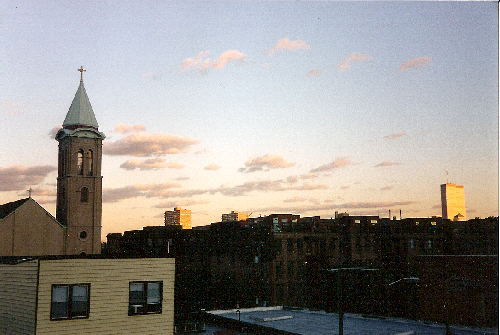
(photo I took of our view from our apartment)
Jen and I ended up laying down on her bed, our feet dangling off the sides, looking out at the Manhattan skyline. And I told her the entire story of the night before. "You're never gonna guess who I ran into last night and who I hung out with for 4 hours..."
Being a wonderful girlfriend, she asked me 598 questions, and we talked about it to our hearts content. "So then ... he turned ... and he looked at me like this ... and then he said THIS thing ... and when we hugged goodbye he said THIS..." You know, your basic girlie convo. I re-enacted a couple of the body language moments, so she could get the full picture. Great great fun.
But it makes me uneasy to remember it now.
It was about 10 pm ... and Jen (she and I were not just roommates, but dear dear friends) said that she was afraid she was going to have trouble getting to sleep that night - because it was a new place and all. And would I mind reading out loud to her? Maybe that would help her go to sleep ...
She had never asked such a thing before. I love reading out loud, love it love it love it ... and she said, "Just pick out a book you like - I don't care ..."
I was excited. I went into my room - where, of course, the first thing I had organized had been all my books. My CLOTHES were still in boxes, but my books were on display. I thought: "Hmmm. Let me pick out something good ... what do I want to read to her ... what do I want to read to her..."
Out of nowhere, I picked out Paul Zindel's The Pigman - which is probably one of my favorite books ever. A book for teenagers, yes ... I read it in 8th grade ... but its charm and humor has never palled. That was one of those life-saving books I read at an all-important time - when everything seems dark and grim (re: junior high) - and that book, about 2 freakish outsider kids who befriend a weird little old man who collects china pigs, made me realize I wasn't alone. That there were other freaks like me out there, that life could be beautiful, that you could have a possibility of joy in life ... even though everything around you basically sucks.
That is what The Pigman is about.
So we curled up on her bed, with the summery night wind blowing through the dark window, and I read a couple of chapters out loud to her.
Such a strange and intimate thing to do.
We never did it again. That was the only time.
And The Pigman ended up not being the best choice - because it is laugh-out-loud funny at times, and Jen kept guffawing like a mad woman, instead of falling asleep. And I had a hard time getting through certain paragraphs, because I was shaking with laughter.
As I read it, with tears of laughter in my own eyes, I kept interrupting myself and saying, "God, I haven't read this in years ... this is so fun ... I remember reading this in Ireland at a B&B when I was 14 and laughing so loudly that my mother had to come down and tell me to be quiet ... I need to read this whole book again ..."
Interjecting my reading with these random little Pigman memories.
Jen finally murmured, "Okay. I think I can fall asleep now."
I tiptoed out of her room, turned the light off, and went into my new room. There was something heightened and tight in my heart. Sometimes I get too excited. Or ... let's just say - my experience of things can get pretty intense. I can't sleep. I lie in bed, going over and over and over things that excite me.
And that's what I did that night, after writing in my journal feverishly about the Astor Bar meeting with my love-at-first-sight friend.
I lay in bed, for hours, the darkness in front of my eyeballs, re-living that moment when I first walked into Astor Bar ... and he sat up straight in his chair ... and followed me with his eyes ... and his voice, "WHY ARE YOU IGNORING ME..." It appeared to just be on replay ... I didn't know why it pleased me so much, but it had some intense and perfect aesthetic which I found so satisfying.
And the other replay was the entirety of the book The Pigman and how much I had enjoyed sharing that book with Jen, in our new windy apartment.
Thinking to myself over and over in the darkness, as I slipped off into oblivion: I really must read that book again someday ...
In praise of firemen
If you read Ree (the Pioneer Woman), you know that she has a "retarded brother" (I'm just quoting her, remember!) Her "Mike stories" are some of the best in her entire repertoire - funny and touching. And today, her story of Mike and the firemen made me cry. Quite a propos, considering what day it is.
Thank you to all the firemen out there. I appreciate you because you will pull my sorry ass out of a burning building, even if I am wearing Hello Kitty pajamas and especially if I am doused in 'Sierra' perfume.
And thank you, Ree, for the touching tribute. I needed to hear it.
February 2, 2008
A tour of my bulletin board
My visitor pass to the World Trade Center. I took classes there. Expiration date 8/19/2001.

A tour of my bulletin board
Photo taken by me - on a 3rd grade field trip to New York City. I was standing on the deck of the boat, by the way, with Keith M. We both remember ut, standing together, looking up at the Statue of Liberty, having a flirty conversation of the 9-year-old variety.

December 31, 2007


2007 Year in Pictures
Revolutionar War-era soldier browsing through 9/11 exhibit, NY Historical Society


November 25, 2007
As promised
The redcoat-ed Revolutionary War-era soldier perusing the 9/11 exhibit at the New York Historical Society.

September 12, 2007
Community memorial
I went to a free concert yesterday - in the rain - held in honor of the policemen who lost their lives on 9/11. It was the police force's band - and a flag was at halfmast above them - and all the musicians were cops, in their dress blues ... There weren't too many people there, due to the rain - but those of us who were, huddled under umbrellas, were certainly happy to be there. There were lots of cops, tons of cops, milling around - watching, taking pictures, chatting with their musician buddies. Cops holding trombones, cops holding drumsticks or flutes ... It wasn't a dirge-like affair, it had some lightness to it. Let us not make a fetish of our pain. But let us always remember. That was what the concert was like.
Here they are setting up.

And then I went to the firehouse in Hell's Kitchen, the one decimated by the attack - in terms of firefighters killed - and left a flower outside. I wasn't the only one who had thought of that. Flowers heaped up outside.

And some dude stood there, in a kilt, playing bagpipes in the rain.
Then I came home, made dinner, and watched Dune.
Because life goes on. We survive. We don't just survive. We flourish. We have private concerns, we invest in our personal lives, we do stupid shit just because we enjoy it. We have fun. We DON'T walk around remembering it at every second. Because you know why? We're stronger than that. Did the Pearl Harbor generation obsess on how much to memorialize the event every year? No. You know why? Because they were too busy - with war, with life back home, with life in general - to obsess on all the wrong things. They were made of stronger stuff.
And so should we be.
As long as you know what it is to be human, you know that you will have no danger of "forgetting". YOU are in charge of that. Even if you live in an area that does not have a nice parade, or a nice memorial - or if you feel like you're the only one who is taking the time to remember ... why spend precious moments bitching about it? Form a parade then. Why spend precious moments bitching that everyone around you isn't commemorating the day like you think they should? (Meanwhile: it is very dangerous to assume that something isn't happening just because you can't see it. How do you know that that woman sitting in a bar with her friends having cocktails on 9/11 didn't lose someone that day 6 years ago and she just needs to go out and laugh and LIVE? Or how do you know that she didn't have her own private way to remember, lighting a candle in church, or saying a prayer, or whatever? Something you can't see? Be very very careful when you judge only on what you see. So often you will be wrong. To quote Longfellow, one of my favorites of his: "Believe me, every man has his secret sorrows, which the world knows not; and oftimes we call a man cold, when he is only sad.")
So if you feel that remembrance is lacking in your area? Create something then. Create your own memorial. Put out a call to veterans in the area. See what they would like. Create something to honor the dead, be a leader. I don't know. Figure it out. Isn't that what we Americans are supposed to do? Figure shit out on our own?
And THAT is the best way we can remember.
Something like this. As I'm sure you all know, we don't have a goddamn memorial here in New York yet. For Christ's sake. Do not even get me started on that bullshit. And so those in neighborhoods have been creating their own.
Life goes on.
Yet we always remember.
tribute in light
Last night: after a day of crazy rain, it was foggy. The city, in its nighttime glamour, was smudged across the Hudson, a charcoal smudgy drawing. I walked down to the end of my street at around 10:30 to see what I could see of downtown Manhattan.
It was dim ... barely discernible ... but it was there. A trembly dim beam of light, cutting up through the smudged charcoal fog.


September 11, 2007
september 12, 2001

SEPTEMBER 12, 2001
It was 10:30 in the morning. The tunnels were closed. I was in Hoboken. This will be a story about the facts because even now I cannot put into words what those days were like. The whole town sat outside at Frank Sinatra Park all day, with the view of downtown Manhattan. Smoke still poured up into the sky. I had a mask. Lots of people did. I had just moved into a new apartment - 9 days before - and I still had stuff at my old apartment. We weren't moved in at all. We had no television, no phone, no computer. To have none of those things on a day like September 11 put us back into the 19th century. It would be a month before I saw the actual footage of that day. It would be a month before the phone company had enough time to deal with us. We were cut off. We didn't need to "watch the footage" since we saw the whole thing first-hand. On September 12, I didn't know what else to do - I couldn't go anywhere - I couldn't sit in front of the television - there was going to be a blood drive later that afternoon (a police car trolled through the streets of Hoboken, and a cop had shouted out to the town the time and place through a bullhorn) - and I was planning on going to that. In the meantime, I walked over to my old apartment to get the last remaining things. Nothing was normal. I wasn't in a panic, but nothing was normal. I grabbed whatever I had to grab and left. A block away I passed an Irish bar, a place I'd never been. It was open. There were people inside. So I went in. People were drinking. It was 11 am, and normally it would be winos sitting belly-up at that time of day, but not on September 12. The bartender was a nice-looking guy who reminded me of all of my cousins. That type of Boston Irish with black hair, pale skin, blue eyes and a bit of pudge. He was around my age. Everyone was soft and friendly with one another in those days. The individual had disappeared, in a way. We were all one. So if you saw someone struggling, you stopped and asked if they were okay. You were kind. He was kind to me, when I sat down. Kindness like that has to do with being aware that the other person is probably going through a trauma, just like you are. It's not random kindness. It's being gentle with the human race, because it's been through a lot. The bartender was kind to me like that. There was more to it when he said, "How are you?" He really wanted to know.
I ordered a beer. There were a group of guys at the end of the bar. Many were on their cell phones. Cell phone coverage was still spotty that next day - I hadn't spoken to my parents yet, my sister Siobhan who was downtown when it happened - I knew she was okay, after running away from the collapse - she walked 80 blocks north to my cousin Liam's ... but I hadn't spoken to anyone, seen anyone. I think my friend Beth might have randomly gotten through to me - or maybe it was Betsy - but cell phone connections were a huge problem. I had gotten word out, via email (I went to a Kinko's on September 11 ... because I had no computer at home, no phone working nothing) - , that I was all right, and word passed on to those who knew me - The same thing happened with word about Siobhan, who was MIA for a couple of hours and we all knew that she worked on the same block as the towers.
I sat and had my beer. The bar was dark, mahogany, gleaming taps, Irish flags, the sun outside streamed towards the front windows - but stopped there. The interior of the bar was shadowy, dim ... the sunlight didn't make it in somehow. I talked with the bartender. Conversations in those days always went like:
"Are you okay?"
"Is everyone you love okay?"
"What happened to you yesterday?"
"Where were you when it happened?"
Stories told, stories shared. It's what we do, us humans. It's what we've always done.
Still, to this day - when I meet someone new - and we have any extended conversation - a "getting to know you" conversation - 'where were you on september 11" inevitably comes up. We are still working through it, still interested, still need to tell and listen.
I was there. Were you there? Where were you? Did you know anyone? How are you?
So he and I did that. Where were you? Are you okay? Are your friends okay? He said he came to open the bar at 10 am because he knew people would need it today. He told me he was getting married in a month. I teared up. Humanity.... pushing forward. He would still get married. Life was, indeed, going to go on. I took a wild guess, based on his looks, and said, "Are you guys doing pre-Cana and everything?" He started laughing and said, "I need to write a book about my experiences at pre-Cana." We both started laughing - to laugh felt so odd, so ... ALIVE ... I said, "Tell me some stories." So he did. In that dark bar on a bright morning. I still remember the stories of some of the other couples he met at pre-Cana, and the counselors - and how goofy they were - how un-cool. "Like you would hope the church could find people who were, you know, sort of COOL to show how cool marriage is ... but no, we get these goofballs ...:" Laughing, again. I wanted to keep laughing. It felt so fucking good. "But you know," he said, shrugging, a philosopher like all good bartenders, "It's what you do." Meaning: follow tradition. If you're Catholic, that's what you do. "Yes," I said, "It's what you do."
The conversation was soft and lovely and kind. A wash of gentle water, easy, gentle. We assumed the BEST about each other. We gave each other the benefit of the doubt. We assumed that the other person was doing his or her BEST in life, rather than the opposite, assuming that other people are morons, and NOT doing their best - which is so often how interactions work in "normal" life. He met me assuming I was good and kind. I listened to him talk assuming he was honest and nice. I remember it so clearly, that conversation about pre-Cana.

Behind me, pacing in the dark bar, was a guy on his cell phone. He had obviously gotten through to someone. Finally. I only heard snippets.
"So he called you? ..... When? .... Had he gone downstairs yet? .... What time was that? Yeah ... he called me when the first plane hit ... I told him to fucking get the hell out of there ... So he was on his way out when he called?"
Snippets. Fragments of a story. A life.
A man missing. Like so many people were missing in those days. Every empty wall covered in "HAVE YOU SEEN THIS PERSON?"
I heard the pain in the cell phone guy's voice. But he was trying to keep it together. It was almost like when you know you need to cry, but you feel you can't - and what happens to your voice when you're holding all of that back. It gets tight, like a wire, rigid - but occasionally what's going on inside you betrays you. There's a waver in the voice, or you take a deep shaky breath ... and there's a tsunami there. Hovering above your head. Waiting for an opening.
Cell phone guy was trying to figure out what had happened to a friend. I assume it was a friend. His friend was in the second tower. He had called someone after the first plane hit the other building. No one had seen him since.
So little time had passed since the day before - and there was still sooooo much hope in those days that THRONGS of people would be found. You'd have to have been here to remember that hope. It's hard to imagine myself back to those days now. Like I said. The destruction was so total. Yet still there was hope.

The bartender had moved on to deal with other customers, and Cell Phone guy paced behind me, holding back his pain - talking on the phone. But I felt like I got the full throttle of his pain. I wasn't even looking at him. He was behind me. But the pain in his voice - "hidden" behind the matter of fact language and the "so what are we going to do" practicality - hit me in the back. It was almost a physical thing. I felt it like a physical thing, not an emotional one. I sat and drank my beer. Closed my eyes. Listening to the snippets from behind me. And the pain was coming. I could feel it.
I put my head down into my hands.
And sat that way for a long time.
Until I felt a soft touch on my shoulder. I turned, and it was Cell Phone Guy. No longer on the phone. He had dark circles under his eyes, a backwards baseball cap, he looked like anybody. Nondistinct. A regular old jocky Hoboken guy. But I can see his face now in my mind's eye.
He said, "Are you okay?"
I said, because that was the kind of day it was, "I'm feeling your pain." Such a silly cliche - such a Bill Clinton cliche - but if you take away the cliche, if you forget the cultural silliness of that statement - and hear how I said it ... I was saying it literally. I meant it literally.
And maybe it was because I was a stranger. Maybe it was because I'm a woman. I was the only woman in that bar. Maybe it was a mixture of those things, I don't know. But when I said that, I saw Cell Phone Guy's face contort into a horror-mask, a grimace of agony - he couldn't even speak - the emotions were so strong and horrifying he couldn't even be with them. It was like a Tragedy Mask. No tears, though. No tears. I reached out and grabbed his hands, tight, in my own - and he stood there - taking it, allowing it - and I remember then something happening in him, something collapsing. He didn't burst into tears, or start sobbing - but his whole posture changed, his shoulders went down, his head dropped, his arms lost their rigidity - he just sunk into it. Into what was beneath. I don't know who was missing. I don't know their relationship. I don't need to know. He was grieving.
His head was down on his chest and I still had his hands in mine, and he said, "He was in the tower. Someone talked to him about 10 minutes before it collapsed and he was still up on his floor."
No words.
He kept talking. "I keep trying to get through to local area hospitals - maybe he was taken there - maybe he's alive somewhere - but you know - you can't get through to anyone."
"I know."
He was gripping onto my hands. It was like that was the only remaining tension in his body. Everything else had gone slack. His head down, his shoulders soft and collapsed, but he was holding onto me for dear life.
His phone rang then. A feeble signal getting through. He leapt back into action, dropping my hands and clambered to get to the phone to his ear - and then he was back to pacing, and sharing fragments, and trying to get things done.
I left the bar maybe half an hour later. The bartender and I said our good-byes and I wished him much much happiness in his married life. He said thank you. In a normal time, I would have left without finding Cell Phone Guy but this was not a normal time. He was sitting in the back, at a table, with some friends - and they were all on their cell phones. I went over there, he saw me coming - and stood up - this strange heartbreaking openness washing all over his face. I reached out for his hands and said, "I hope you find him."
He nodded, tightly, controlled. A moment of great dignity and honor. Acknowledging my words. Keeping himself all together.
And I turned to go and suddenly he leapt across the space between us and grabbed me in his arms and held me so tight that my jaw bumped against his chin, and I was all squished up in his embrace.
It was a quick one. Over in 3 seconds. He grabbed me, got me into a body lock, suffocated the breath out of me, like - he wanted to kill me - he wanted to crush me - and then let me go.
Neither of us were in tears. But there was a fullness between us.
A fullness that can only occur, in such moments, between strangers.

February 11, 2007
Sunny Saturday afternoon, Feb. 2007
Corner of 7th Ave and Greenwich.
These are just a couple of the tiles on the fence (tiles created by people all over the country) ... which stretches off down the block ... a mosaic ... this memorial has been there for years now, without one tile being stolen.
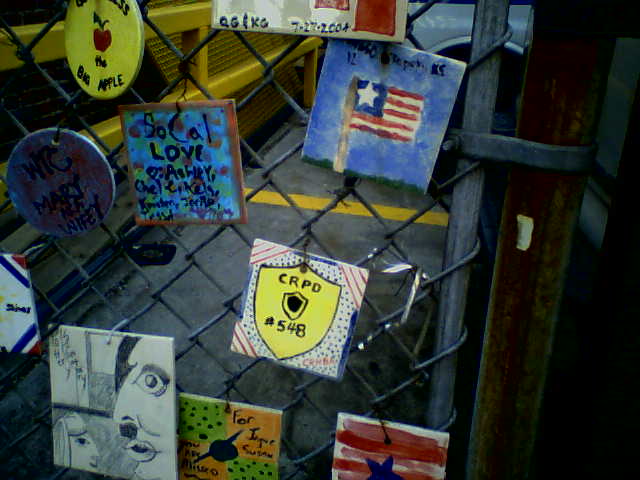
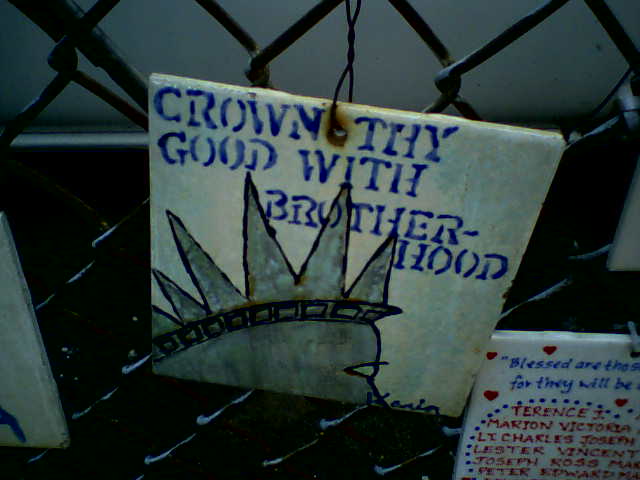
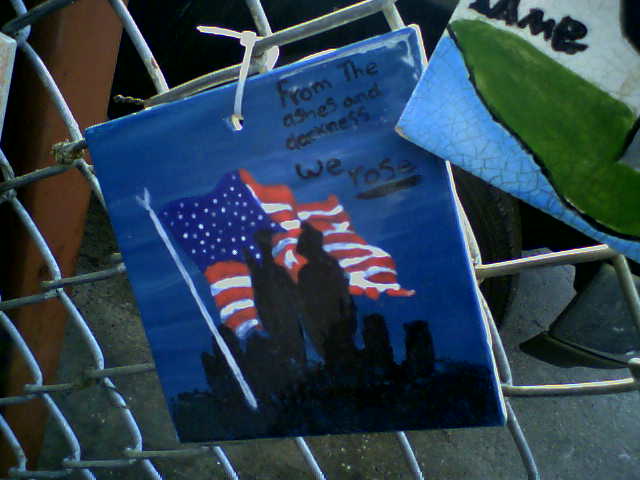
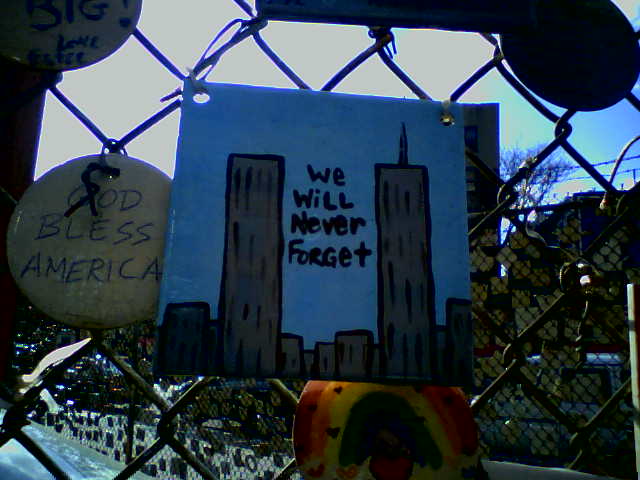
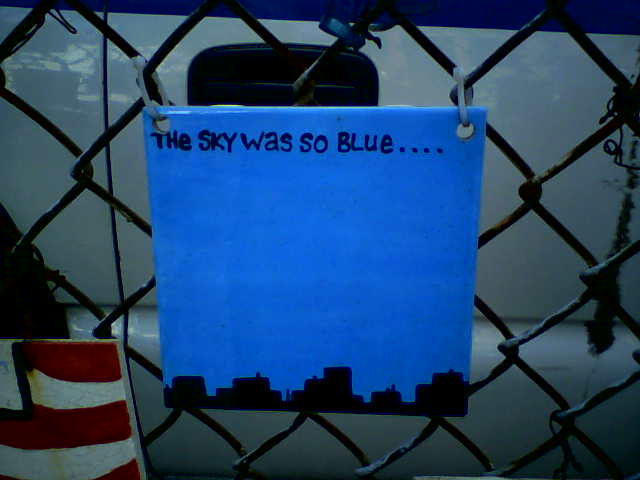
September 19, 2006
and a little child will lead them ...
New York, in those crazy weeks afterwards, became a patchwork of remembrance - it was like the city itself had become an enormous collage, or a roughly done papier mache sculpture - taped togther - the fence outside St. Paul's jammed with flowers and patches and letters and drawings, the missing persons posters EVERYWHERE - some professionally done, others much more hand-made, the posters overlapping - everywhere you looked, the drawings and letters from people all over the world plastered up and down the walls in Penn Station, the side wall of Ray's Pizza - I walk by there now and I know it's years later, so I should be used to those posters being gone - but I can't help it. That red wall (almost off-screen over to the left) just aches with emptiness now and all I can see when I look at it, like a mirage, ghosts, are all the posters, all the faces, the words Have you seen me, have you seen me, last seen on, last seen ... Ray's Pizza became a kind of pilgrimage - once you could get below 14th Street. I remember standing there the day I volunteered at the Salvation Army - this was on the 14th - with my surgical mask on, my eyes burning from the chemicals and smoke still in the air, standing by that red wall, scanning all the faces, the faces, people lighting candles, but pretty much what we all were doing - was just standing there. Looking. You had to look. You had to look at every face. Even if you had already seen the same poster 100 times already in the last 2 hours. It was an obligation. You must look.

All of that came up for me when I read the following:
... Don't miss this post.
Thank you, Joe.
September 12, 2006
"For the falling man"
For the Falling Man - by Annie Farnsworth
I see you again and again
tumbling out of the sky,
in your slate-grey suit and pressed white shirt.
At first I thought you were debris
from the explosion, maybe gray plaster wall
or fuselage but then I realized
that people were leaping.
I know who you are, I know
there's more to you than just this image
on the news, this ragdoll plummeting—
I know you were someone's lover, husband,
daddy. Last night you read stories
to your children, tucked them in, then curled into sleep
next to your wife. Perhaps there was small
sleepy talk of the future. Then,
before your morning coffee had cooled
you'd come to this; a choice between fire
or falling.
How feeble these words, billowing
in this aftermath, how ineffectual
this utterance of sorrow. We can see plainly
it's hopeless, even as the words trail from our mouths
—but we can't help ourselves—how I wish
we could trade them for something
that could really have caught you.
September 11, 2006
The 2996 Project: Michael J. Pascuma
2,996 is a tribute to the victims of the terrorist attacks on September 11, 2001.
Each of us who signed up for the 2,996 Project will pay tribute to a single victim- we were assigned a name, randomly. (List of victim names and participants here. You can click through and read the other tributes.) I have post-dated my post - so that it will stay at the top through Sept. 12, 2006. (Apparently the volume of traffic has been way too high so you cannot access the original site at this moment - Here is the mirror site. Even though it's difficult, I HIGHLY recommend clicking through and reading as many tributes as you can. Eventually, as I read them all, through my tears, all I became aware of was a blinding white light of love.)
I am paying tribute to Michael J. Pascuma.
Update: I had been unable to find a photograph of Mr. Pascuma online, although I did look. I have since come across this article about him - and here is a picture of the entire Pascuma family:
Michael Pascuma, Jr., center, with his family on a recent vacation. Left to right are his son Michael, wife Linda, daughter Melissa, and son Christopher.
It has been quite an experience spending the last couple of days researching this man. I cannot even pretend to know him - it feels so presumptuous - and in some ways, even writing this tribute has felt presumptuous. I did not know this man - and I can't even comprenend the loss that family feels (look at that photo - can't you feel the threads of connection between all of them?) - but I will say this: I can't imagine that another September 11 will go by without me thinking, specifically, of Michael J. Pascuma - and Linda Pascuma - and Michael, Melissa, and Christopher Pascuma.
If any of you ever come across this post - please know that I did my best. And also know that it was truly an honor to 'get to know' Michael, even in this small way.
Newsday article:
Michael J. Pascuma
Broker didn't sweat 'the small things'
April 19, 2002
Every Tuesday morning, Michael J. Pascuma Jr. of Massapequa Park would take a short stroll from the American Stock Exchange to meet colleagues for a breakfast conference at Windows on the World atop the World Trade Center.
"They would conduct business and maybe later tell a few jokes,” recalled his daughter, Melissa Pascuma, a fourth-grade teacher at the Shaw Avenue Elementary School in Valley Stream.
Pascuma, 50, worked as an independent stock trader with his father at their firm, MJP Securities. Both held seats on the exchange. The senior Pascuma, 93, still works as a trader at the exchange. Shortly before the terrorist attack. MJP merged with another firm and is now called Harvey, Young & Yurman.
Pascuma's daughter said that immediately after the first plane struck the north tower, her brother, Michael, reached their father by cell phone. "I have to get out of here. There's a fire,” were the last words he said to his family. The trendy restaurant was located on the 107th floor of Tower One. Pascuma's remains were discovered shortly after the disaster, and a memorial service was held at St. Rose of Lima Church in Massapequa.
"My father had the most amazing sense of humor,” said Melissa Pascuma. "He thoroughly loved telling jokes to the family and his friends. He was constantly generous with everyone around him, and he enjoyed every single day of his life.”
She said her father was fond of chatting online with friends and was an avid golfer. "He never worried about the small things. He knew what mattered,” she said.
Pascuma's wife, Linda, said, "My husband was a wonderful family man who was very much loved and appreciated by everyone.”
The couple would have been married 27 years on Sept. 21. Linda Pascuma called the entire family "Disney-O-Philes.” "For the past seven years at Easter time, we'd all go to Disney World for 10 days,” she said. A friend served as travel agent and also went along on the trips. The annual event also included her sister's family, bringing the fun-seeking entourage up to about a dozen members, recalled Linda Pascuma.
"Sometimes when my husband got a little bored with things, he'd go off to play golf while we went on the rides and things,” she said. "But it always was a trip we'd talk about all year.”
Pascuma, who grew up in Richmond Hill, never attended college but as a young man learned the ins and outs of stock trading from his father, still a well-known figure in financial circles who remembers the stock market crash of 1929.
Besides his wife and daughter, both of Massapequa Park, Pascuma is survived by his sons, Michael, a college student at Sacred Heart University in Fairfield, Conn.; Christopher, a Massapequa High School student; and his parents, Michael and Ada, of Richmond Hill.
--Bill Kaufman (Newsday)
"He knew what mattered."
As I did my research on this man - one of the things that kept coming up was how he didn't sweat the small stuff, he was all about appreciating what he did have, "he knew what mattered". I went to the memorial sites where people who knew the victims could leave tributes and I came across the following message:
You will be missed. Thank you for all of your kindness. I will miss being your customer. Anne Boudreaux (New Orleans, LA )
There were many messages I found from family members, childhood friends ... but this one, from a customer, struck me: "I will miss being your customer." How many businessmen can say that there will be those left behind who will say, "I will miss being your customer."? That is integrity.
Other people from Mr. Pascuma's life left tributes (some on this site and some on others) - and here are some personal memories of him:
Childhood friend Al Husni:
"I will always remember growing up with Michael. Playing ball, hanging out at PS66 with Michael, Chris, Latz, and the rest of the gang. His sense of humor, his gentleness, will never be forgotten by myself or those who knew him."
Childhood friend Robert A. Maltempo:
"I grew up across the street from Michael, moving away from Richmond Hill at the age of twelve. I will always remember the good times we had and what a wonderful father Michael had (he treated me like his son). I remember playing ring-a-leevio until dark, seemingly every evening, at P.S. 66. I remember Billy Speckman and also another friend of mine and Mikes, named Michael (I'm butchering his last name) Krachunis) who lived next door to Michael. Had many, many wonderful times growing up with Michael...his basement that was full of miniature/toy construction equipment, the NY ranger games his family took us to, a row boat trip with Michael's father singing "Michael Row the Boat to Shore" while Mike and I struggled with the oars.
George Moeser tells some really beautiful stories about Michael Pascuma:
I met Michael Pascuma through my sister Jean Barone back in the 1980's when my (now) ex-wife and I visited her and her (now) ex husband Tommy Barone during a Christmas holiday. We attended a party hosted by the family that owned the Mermaid Restaurant. Of all the people we met at that party in Massapequa Park, Michael was the standout. He was and still remains one of the nicest most genuine people I have met in this life. His warmth, demure and canny sense of humor along with that winning smile of his were a true reflection of great soul, something that can not be faked, learned or acquired. Ias I said, I grew up in the City, the street smart He was the kind of rarity thatHe and his wife opened his home to us as if he had known us all his life. I met his father and talked about his horses. His wife Linda and Bianca became friends. Later that week we met him for a visit to the exchange where he worked, but I didn’t know there was the dress code and said he could take Bianca inside and I would wait. Michael thought for a moment then said, “Come on in with me, it will does these guys good to shake them up a little bit.” As we went on to the floor, all three of us were pelted with spit-balls and hoots laughter from the men and women working there, all in good natured fun. One of the keenest impressions I got about Michael was that you could sense the friendship and admiration his coworkers felt for him. He later told me, to his knowledge I was the only person in the history of NYSE to walk the floor in a cowboy hat and blue jeans.
The irony for me in learning of his tragic and untimely death was that he took Bianca and I to the Windows on the World Restaurant for lunch that day. I still have the photo Bicana and myself with the Manhattan backdrop taken by Michael. I have another of him and I on the train with him pretending to pick my pocket in an exaggerated pose, this great smile stealing the scene. Later in the week he met us for lunch again, this time to the Carnegie Deli. He didn’t want us to miss what he called the best corn beef sandwich on the planet—It was.
When we returned to Tucson, he would sometimes call the Boss Shears, the hair salon Bianca and I owned. Pretending to be a first time customer, he would ask if we took late appointments, saying he would have to fly in from New York. The receptionist would ask Bianca and I if we wanted a late appointment. And one or the other of us would ask what time. Then Michael would ask to speak to one of us, and I would recognize his voice instantly. He would laugh and say he might be able to catch the red-eye, get his haircut and fly back in time for work, but would bring two corn beef sandwiches from Carnegie as a tip for staying late.
Over the years we would fly back to New York on the holidays or a family function. Each time Michael and I saw each other again, it wasn’t as if years had past but only days since our last laugh, shared antidote or exchange of impressions.
Years later I was divorce, my sister was also divorced, and had moved to Brooklyn. She and I became estranged and I lost contact with her friends from Massapequa Park. My ex wife kept in touch with my sister Jean and Bianca continued to exchange Christmas card with the Pascuma family, but I lost touch. It was years later when I asked how he was doing that I learned he had died in the 9/11 attack on the Twin Towers. That he died at the very same place where he and I had shared laughter over a meal was deeply moving to me. My eyes filled with tears and I prayed the Lord to bless him and keep him in all his ways. I still do.
On April 22, 2005, Michael Pascuma's daughter Melissa had a baby girl whom they named Madison Michael. It would have been Michael Pascuma's first grandchild. Imagine what a grandfather this man would have been.
Melissa wrote to her father on Sept. 12, 2005:
Daddy, I miss you more and more each day, month and year. I would do anything to get a tight hug from you, hear your laugh, or hear one of your jokes. There are very few children in this world that have an amazingly exceptional father. I am so thankful I happen to be one of them. You held our family together and were the kindest, most generous human being that lived. You did not deserve this. You are a grandpa now. She carries the name of a hero, Madison Michael. Love you endlessly, Your princess
That's the thing that gets you about these horrible losses. The loss itself is horrific - but as life moves on, the loss continues to reverberate in those who are left behind. Madison Michael will not know her grandfather.
Michael Pascuma's son Michael (on this page) wrote:
Tomorrow is Christmas Eve and will be Madison's first. You should be here sharing this with us in more than just spirit. I wish there was something I could do because I would in a second! There is so much that we never got to do or say and I would do anything for 1 more minute. I was in Miami this past weekend and saw more Ferraris than ever before and I didn't have you to call. For a split second I thought call Dad and then realied that can never happen again. I will never forget all the times we did share and will cheerish those forever. I miss all the things we used to do together and wish we could play one more round of golf. I would even take just being able to hear one more joke and hear your laugh. I miss and love you so much and I'm getting to upset to continue writing.
"I didn't have you to call." I am so so sorry.
Here is the NY Times Portraits of Grief piece on Michael J. Pascuma:
Golf was Michael J. Pascuma Jr.'s consuming passion. He played every Saturday with a group of friends from work, at courses all over Long Island. He watched golf endlessly on television.Michael, 50, immersed himself in everything, whether it was golf, his family in Massapequa Park or his work as a stockbroker on the American Stock Exchange. Work and family were entwined: he and his 92- year-old father, Michael J. Pascuma Sr., possibly the oldest broker in the United States, had their own firm, M.J.P. Securities, which recently merged with Harvey, Young & Yurman.
"You would think it was a stressful job, but he was never stressed," said his 23-year- old daughter, Melissa Pascuma, whom he called his little princess. He also had two sons, ages 20 and 17. "As soon as he came home, he detached from it and his family was No. 1."
My husband, Michael J. Pascuma, Jr., was an only child. Michael worked with his father on the American Stock Exchange. His father is still employed there at 93 years old. His mother is 89.He was very well liked and a very respected Stockbroker. He was a very fair and honest person. He had a great sense of humor. He loved telling jokes or playing pranks at work.
He also loved playing golf. He played every Saturday with friends. He had started to travel a little to play on different courses.
Most importantly, Michael was a great father. He had three children, a daughter and two sons. His children loved him. He never fought or got mad at them. He would do anything for them. His sons enjoyed playing golf with him. He never worried about the small things. He loved life and appreciated everything he had. He knew what was important. If they made a mistake or if there was a problem he would always say it didn't matter as long as everyone was healthy.
We struggle every day without him and he is truly missed by his family, friends and co-workers.
He sounds like an amazing man, with a heart as big as the ocean. A laughing kind hard-working family man. Someone I would have loved to get to know.
Rest in peace, Michael J. Pascuma - and my sincerest condolences to the Pascuma family.
The Names
I have spent my day with all the names. Reading all the tributes. Weeping for people I never met. Putting faces to names. It has been a profound experience. There was more to this day - another narrative going on at the same time - but I will save that for a later day. For now, all I am conscious of ... are all of those names.
And so I must post again Billy Collins' poem "The Names". It has been on my mind all day. I am tear-drenched, exhausted. And this is why we need our poets. Poets don't always fulfill this role - but when they do? We need them. Or let me just say: I need them.
In loving memory of all of those names.
Billy Collins, former poet laureate, wrote "The Names" in the wake of September 11 and read it during a special joint session of Congress in New York on September 6, 2002.
This is what poets laureate are for.
The Names
Yesterday, I lay awake in the palm of the night.
A soft rain stole in, unhelped by any breeze,
And when I saw the silver glaze on the windows,
I started with A, with Ackerman, as it happened,
Then Baxter and Calabro,
Davis and Eberling, names falling into place
As droplets fell through the dark.
Names printed on the ceiling of the night.
Names slipping around a watery bend.
Twenty-six willows on the banks of a stream.
In the morning, I walked out barefoot
Among thousands of flowers
Heavy with dew like the eyes of tears,
And each had a name --
Fiori inscribed on a yellow petal
Then Gonzalez and Han, Ishikawa and Jenkins.
Names written in the air
And stitched into the cloth of the day.
A name under a photograph taped to a mailbox.
Monogram on a torn shirt,
I see you spelled out on storefront windows
And on the bright unfurled awnings of this city.
I say the syllables as I turn a corner --
Kelly and Lee,
Medina, Nardella, and O'Connor.
When I peer into the woods,
I see a thick tangle where letters are hidden
As in a puzzle concocted for children.
Parker and Quigley in the twigs of an ash,
Rizzo, Schubert, Torres, and Upton,
Secrets in the boughs of an ancient maple.
Names written in the pale sky.
Names rising in the updraft amid buildings.
Names silent in stone
Or cried out behind a door.
Names blown over the earth and out to sea.
In the evening -- weakening light, the last swallows.
A boy on a lake lifts his oars.
A woman by a window puts a match to a candle,
And the names are outlined on the rose clouds --
Vanacore and Wallace,
(let X stand, if it can, for the ones unfound)
Then Young and Ziminsky, the final jolt of Z.
Names etched on the head of a pin.
One name spanning a bridge, another undergoing a tunnel.
A blue name needled into the skin.
Names of citizens, workers, mothers and fathers,
The bright-eyed daughter, the quick son.
Alphabet of names in a green field.
Names in the small tracks of birds.
Names lifted from a hat
Or balanced on the tip of the tongue.
Names wheeled into the dim warehouse of memory.
So many names, there is barely room on the walls of the heart.
September 1, 2006
View
This was the view from our kitchen in Hoboken.
Get ready for it. I am still never ready for it.
May 13, 2006
The rose tattoo: Part 1
This story is typical. Many of my friends who were here at that time have similar stories. Articles were even written about such things. But this is my version of the story. I haven't written before about my frustration with the one-upmanship I sense in a lot of people when they tell their stories from that day, and from that time ... "Oh yeah? Well, this is what happened to ME" ... etc. It just seems inappropriate, considering the topic. We all have stories to tell. This is mine.
I was trapped in Hoboken for the couple of days following the day. I haven't written about those days - but maybe someday I will. The people I met, the ... the way it was ... Surreal is one of the words that really comes, when I try to call up the feeling in Hoboken during those days.
Then Friday. September 14. The tunnel was back open for traffic. Maybe it was time to go back into the city, and go to work. Maybe it was time to start up life again.
But oh. How odd the feeling. How almost wrong.
It must be said that things did not feel "normal" here for months. Slowly but surely you would start to see reassuring signs of normal life ... people eating at sidewalk cafes, people walking and laughing ... even such moments as seeing two people laughing seemed like an enormous triumph back then. Literally everything else was put on hold for months. I'm just trying to set up the unreality of September 14. If months later life still felt stilted, and different from Before ... then September 14 was truly Surreal Land. Crisis Mode. Panic Mode. Survival Mode. What have you. People were still hoping for rescues from the wreckage. The 14th was the day of President Bush's visit to Ground Zero so there was, in general, a really panicked and yet focused energy in the city. Panicked and also focused? How can that be? I don't know but that's what it was like. Fighter jets swooped around the periphery of the city all day. So it felt extremely safe ... but it also felt extremely precarious. The way it must feel in other war-torn countries all the time. We in Manhattan were enormous targets. And so we needed to be protected. Those fighter jets swooping by were alarming - because no other airplanes were in the sky yet. All commercial aircraft travel was stopped for three days ... and the eeriness of having no planes flying over Manhattan was palpable. You didn't even NOTICE how often planes fly overhead until there were none. The skies were blazingly empty. And now, I have to say, even years later - I am much more attuned to the air traffic overhead. I hear the planes. I am aware when they go by. My ears prick up if one sounds like it's "too low".
So September 14th was an eerie quiet day, except for the occasional roar of a fighter jet. These were the days of the Missing Person posters. The pictures, the smiling faces, the defining characteristics (which always slayed my heart: "Scar on stomach." "Mole on lower back." Like ... there is such despair in these descriptions. There is an open acknowledgement that whatever will be found of this person, this beloved wife, daughter, family member, will be a fragment. And yet there is also such courage in these minute descriptions. The survivors, those searching for their beloved, know that they must be SPECIFIC, in this identification process, even though their hearts have shattered. They must be HELPFUL, and provide as much information as they can. And so they did. Over and over and over, plastered across every wall in Manhattan. "Topaz ring on pinky finger." "Birthmark on right side of forehead." "Scar on collarbone." "Braces on upper row of teeth." "Tattoo of rose on left hip.") ... and crowds of people standing before every Poster they passed. You had to look. It seemed like you were OBLIGATED to look. The faces called out from their snapshot blur. "Look. Look at me." You could not go from Point A to Point B without looking at 20 posters. I have some pictures of those walls of posters. Hard to look at now. And eventually ... at some point in October ... in one fell swoop ... all the posters disappeared. You never see any remnants of them now. Gone. As painful as it was to have to constantly walk by walls of smiling (now dead) faces ... it was even more painful to have the posters NOT be there.
Smoke still billowed up into the air from downtown, and when the wind changed - everyone over in Hoboken felt it. Our eyes stung, our throats hurt - there was a reason we all had surgical masks in our backpacks.
I went to my busstop that morning. I did not at all feel ready to get back into a normal routine ... I was still in Surreal Land and not ready to come out. But there I was, putting one foot in front of the other. Instead of going to the busstop I normally went to, on 7th ... I went to the one on 9th ... which was the busstop I had gone to on the morning of September 11, for no particular reason ... but it was just odd that I would have broken my routine on that day, of all days. On September 14, I woke up early, and walked over to 9th Street, and now - in looking back on it - I think I can see that I not only was unwilling to go back into the routine I had Before, I knew that nothing could "go back" to being the way it was. So Before that day I had always waited for the bus on 7th. But on that day, on the day it happened, I had been at 9th. So from then on out, I would wait for the bus at 9th Street.
My heart was in my throat. Unlike many others, I was not in Manhattan on that day - I had been trying to get into Manhattan when they closed all the tunnels and turned all our busses around. I know we all felt trapped. And there were those in Manhattan who were trapped, in reverse, and could not get home. My friend's husband basically hitched a ride back to Jersey in some guy's motorboat on September 11. People with boats were basically just motoring over to lower Manhattan, and picking people up there ... all on their own. It brings a lump to my throat, even today. "You need a ride back to Jersey? Hop on!" Dust-covered financial executives clambering onto the deck of a motor boat, trying over and over and over again to get through to their wives, their husbands, on cell phones.
The entire city had not yet bounced back into autonomous individuals, wrapped up in our own private concerns. Everyone just talked to each other. You would turn to the person sitting next to you and say, "How you doin'? You holding up?" Strangers conversed. We all had horror stories - it wasn't so much about sharing horror stories yet. It was more about a truthful: How are you? You doing okay? Hang in there. The bus was filled with conversations like that. Many of us were going into the city for the first time since that day, and you could sense the anxiety. Instead of just sitting alone with the anxiety, which is what you normally do in this town where we are all on top of each other, you would share it. You would blurt out to your seatmate, "I'm feeling so anxious right now." And your seatmate would say, "Yeah, me too. It's so weird, right?" The guy sitting next to me on the bus was a pudgy young guy, in his early 30s, wearing a baseball hat. He had black circles under his eyes. As we approached the causeway - the causeway where we all saw the second plane hit the World Trade Center - my anxiety started to affect my breathing. I wanted to shout, "STOP THE BUS. Lemme off. I'm not ready for this!" Pudgy-baseball boy turned to me and said, "This is kind of freaky, huh?" I said, "Totally. I'm quietly freaking out right now." No separation between us. A two-way flow of energy. We were together. I said, going right to the heart of the matter (that was also what it was like in those days following - everyone just went right to the heart of the matter), "You okay?" Unlike normal life, where when someone asks, "How are you doing?" you are EXPECTED to say, "Fine" - in those heightened days - the question "How are you doing?" was actually a valid question. You actually wanted to know how someone was doing. It was a heart-of-the-matter question, not just bullshit politeness where you are expected to LIE, even if you are NOT doing okay. He said, "My best friend's missing." "Oh my God. I'm so so sorry." He said, "Yeah. I'm going to meet his mom - who's arriving this morning at Port Authority - and we're gonna go around to all the hospitals. See if we can find him." "Oh God. Good luck." Those were the days when you still could believe that there might be some injured unidentified person at a hospital somewhere.
We approached the entrance to the Tunnel. Now nobody on the bus began jibbering like a lunatic - or openly panicking - but the FEELING was there, you could tell. Everyone was just gritting teeth, hanging on, sucking it up, and moving forward. We will not be stopped. It is just a Tunnel. It is OUR city. And we are going to go back into OUR city.
Over the entrances to the Tunnel - 3 in all - were massive American flags. I had never seen them up there before - maybe they had always been there, but I had never perceived them. It was so so reassuring to see them. Especially because the entrance to the Tunnel was swarming with National Guardsmen, cops, and military vehicles. Every vehicle was being stopped. There was a sense of, again, panicked focus. Everyone buckling down, doing what needed to be done.
We entered the gleaming Tunnel, and as we moved slowly through - I closed my eyes. I don't really get that freaky feeling going underwater that some people do - I try not to think about it - but that day was different. Every moment felt precarious. We had seen those towers come down. We had watched planes crash into the gleaming glass. Those were the days of bomb scares, and the Brooklyn Bridge being threatened, and it felt like, at any moment, anything could happen. Because ... 3 days before ... something unthinkable had occurred. Everyone had to readjust their assumptions about reality. Again, those who live in war-torn countries already have a much better grasp on the ephemeral nature of steel and brick, they know that nothing is forever, they know that at any second the air around you can burst into flame. Well, we were now learning that first-hand.
Basically, what I'm trying to say is is that I started to feel a bit of panic as we descended into the tunnel. It was like a gleaming coffin. At any second it could blow up. OR - even worse ... for the 3 minutes that we were underwater, something horrible could happen up on land ... the Empire State Building could blow up, a suicide bomber could detonate Port Authority ... what would happen during those 3 minutes of being out of contact with the above-water world?? I just wanted to get to the other side. Just get me to the other side. Get me to the other side. Get me to the other side. Get me to the other side.
And I know this sounds weird and far-fetched (but just wait ... September 14 is just beginning) - but the moment we left the world behind and entered the tunnel, Pudgy Baseball Cap man reached out and took my hand. His hands were ice-cold, and yet also sweaty. The man was not well. I could feel his broken heart through his hand. Somehow I knew that he didn't reach out for my hand because he sensed I needed it. He reached out for my hand because he needed it. He could not be alone in that moment. He needed human contact.
I know in my heart (at least now I know it) that this man's best friend was never found. Or at least he wasn't found in any hospital. This man's best friend was dead. Killed either in the collapse of the building, or when the planes first hit. Entire medical teams had set up tents along the West Side Highway, thinking that soon they would be overrun with injured. A friend of mine volunteered in those tents, making coffee and sandwiches for the doctors and nurses. And nobody ever showed up. The tents remained empty. The doctors and nurses would stand outside, staring downtown at the mushroom cloud coming up from where the towers used to be, smoking cigarettes, pacing, and waiting. Waiting for all the bloody people to come. Nobody came. So now I can look back and I know that the poor mother who had just taken a bus to Port Authority, in order to wander around the city with her son's best friend, looking for their missing person ... never got her son back. But on that morning, on that morning of panic and focus and energy ... I still had hope. We all did. It had only happened three days before. People could TOTALLY still be alive in that wreckage. People could TOTALLY be in a coma at St. Vincent's and just be waiting to be identified! Tattoo of rose on left hip.
I have no idea if Pudgy Baseball Cap man was embarrassed about reaching out for me. I don't think so. I don't think he went over it in his mind: "Should I ...? Is it totally weak or pathetic-looking if I want to hold her hand ...?" I think he just did it. It was not weak. It was strong. It was a moment of humanity in the middle of those crazy days. I held his hand, his sweaty clammy hand, and closed my eyes, and just waited for the tunnel to end.
Once we shot out on the other side - he let my hand go. And then - totally as one - we both turned all the way around, to peer out the window for the spire of the Empire State Building. It was instinctive. So strange. It was like we were one being. Neither of us had said to the other, "I am just scared that something is going to explode while we are under water" but obviously it had been on his mind too. There was the spire, the beautiful spire, looking foreshortened from our perspective at the Lincoln Tunnel. It was just an odd moment - how he let go of my hand - and then, like we had choreographed it, we both turned around in our seats, and looked up, up, up.
He glanced at me and grinned in a pale kind of way, a grin that didn't reach his bleak eyes, and said, "It's still there."
"Yup. It's still there."
As we got off the bus, I said, "I really hope you find your friend."
"Thanks a lot."
And off he went. I was alone now. I missed him already.
Part II to come.
March 21, 2006
The Books: "Taliban: Militant Islam, Oil and Fundamentalism in Central Asia " (Ahmed Rashid)
And here is my next excerpt of the day from my library.
 Next book on the shelf is Taliban: Militant Islam, Oil and Fundamentalism in Central Asia by Ahmed Rashid. This book came out in 2000 and did not make a splash at all - I guess because most Americans didn't care about what was going on in Afghanistan until it affected them. After September 11, you could not find this book on the shelves. It was perpetually out of stock. It was re-released in a massive paperback edition after September 11 - and now you see it everywhere. Rashid is a journalist from Pakistan - and he writes in his introduction that this book was "21 years in the making". All of his experience and work life had been leading up to this moment. He's a go-to guy. He shows up in books as an expert in many other books about the area - Robert Kaplan interviews him all the time, Christopher Hitchens - all of those guys who have been determined to explain that whole area and its history to us use him as their main guide. His name comes up all the time. I bought this book after reading Kaplan's book At the Ends of the Earth - where he shows up in the chapters on Pakistan. Ahmed Rashid is a wonderful journalist - he truly does honor to his profession.
Here's a section from chapter 2 - which kind of explains the culture of the Taliban.
From Taliban: Militant Islam, Oil and Fundamentalism in Central Asia by Ahmed Rashid
In March 1995, on the northern edge of the Dashte-e-Mango -- the Desert of Death -- plumes of fine white dust rose in the air above the narrow ribbon of the battered highway that connects Kandahar with Herat, 350 miles away. The highway, built by the Russians in the 1950s skirted through the brush and sands of one of the hottest and most waterless deserts in the world. After years of war, the highway was now rutted with tank tracks, bomb craters and broken bridges, slowing down the traffic to just 20 miles an hour.
The Taliban war wagons -- Japanese two-door pick-ups with a stripped-down trunk at the back open to the elements - were streaming towards Herat laden with heavily armed young men in their bid to capture the city. In the opposite direction a steady flow of vehicles was bringing back wounded Taliban lying on string beds and strapped into the trunk as well as prisoners captured from the forces of Ismael Khan who held Herat.
In the first three months after capturing Kandahar, the Taliban had broken the staleate in the Afghan civil war by capturing 12 of Afghanistan's 31 provinces and had arrived at the outskirts of Kabul to the north and Herat in the west. Taliban soldiers were reluctant to talk under the gaze of their commanders in Kandahar so the only way to learn something about them was to hitch lifts along the road and back again. In the confines of the pick-ups where a dozen warriors were jam-packed with crates of ammunition, rockets, grenade launchers and sacks of wheat, they were more than eager to share their life stories.
They said that since the capture of Kandahar some 20,000 Afghans and hundreds of Pakistani madrassa students had streamed across the border from refugee camps in Pakistan to join Mullah Omar. Thousands more Afghan Pashtuns had joined them in their march northwards. The majority were incredibly young - between 14 and 24 years old - and many had never fought before although, like all Pashtuns, they knew how to handle a weapon.
Many had spent their lives in refugee camps in Baluchistan and the NWFP provinces of Pakistan, interspersed with stints at imbibing a Koranic education in the dozens of madrassas that had sprung up along the border run by Afghan mullahs or Pakistan's Islamic fundamentalist parties. Here they studied the Koran, the sayings of the Prophet Mohammed, and the basics of Islamic law as interpreted by their barely literate teachers. Neither teachers nor students had any formal grounding in maths, science, history, or geography. Many of these young warriors did not even know the history of their own country or the story of the jihad against the Soviets.
These boys were a world apart from the Mujaheddin whom I had got to know during the 1980s -- men who could recount their tribal and clan lineages, remembered their abandoned farms and valleys with nostalgia, and recounted legends and stories from Afghan history. These boys were from a generation who had never seen their country at peace -- an Afghanistan not at war with invaders and itself. They had no memories of their tribes, their elders, their neighbors nor the complex ethnic mix of peoples that often made up their villages and their homeland. These boys were what the war had thrown up like the sea's surrender on the beach of history.
They had no memories of the past, no plans for the future while the present was everything. They were literally the orphans of the war, the rootless and the restless, the jobless and the economically deprived with little self-knowledge. They admired war because it was the only occupation they could possibly adapt to. Their simple belief in a messianic puritan Islam which had been drummed into them by simple village mullahs was the only prop they could hold on to and which gave their lives some meaning. Untrained for anything, even the traditional occupations of their forefathers such as farming, herding or the making of handicrafts, they were what Karl Marx would have termed Afghanistan's lumpen proletariat.
Moreoever, they had willingly gathered under the all-male brotherhood that the Taliban leaders were set on creating, because they knew of nothing else. Many in fact were orphans whoh had grown up without women - mothers, sisters or cousins. Others were madrassa students or had lived in the strict confines of segregated refugee camp life, where the normal comings and goings of female relatives were curtailed. Even by the norms of conservative Pashtun tribal society, where villages or nomadic camps were close-knit communities and men still mixed with women to whom they were related, these boys had lived rough, tough lives. They had simply never known the company of women.
The mullahs who had taught them stressed that women were a temptation, an unnecessary distraction from being of service to Allah. So when the Taliban entered Kandahar and confined women to their homes by barring them from working, going to school and even from shopping, the majority of these madrassa boys saw nothing unusual in such measures. They felt threatened by that half of the human race which they had never known and it was much easier to lock that half away, especially if it was ordained by the mullahs who invoked primitive Islamic injunctions, which had no basis in Islamic law. The subjugation of women became the mission of the true believer and a fundamental marker that differentiated the Taliban from the former Mujaheddin.
This male brotherhood offered these youngsters not just a religious cause to fight for, but a whole way of life to fully embrace and make their existence meaningful. Ironically, the Taliban were a direct throwback to the military religious order that arose in Christendom during the Crusades to fight Islam -- disciplined, motivated and ruthless in attaining their aims. In the first few months the sweeping victories of the Taliban created an entire mythology of invincibility that only God's own soldiers could attain. In those heady early days, every victory only reinforced the perceived truth of their mission, that God was on their side and that their interpretation of islam was the only interpretation.
Reinforced by their new recruits, the Taliban moved north into Urozgan and Zabul provinces which they captured without a shot being fired. The marauding Pashtun commanders, unwilling to test their own supporters' uncertain loyalty, surrendered by hoisting white flags and handing over their weapons in a mark of submission.
March 11, 2006
The Books: "The Saudis: Inside the Desert Kingdom" (Sandra Mackey)
And here is my next excerpt of the day from my library.
 Next book on the shelf is The Saudis: Inside the Desert Kingdom by Sandra Mackey. Sandra Mackey, a journalist, lived in Saudi Arabia in the late 1970s, early 80s - her husband was there in Riyadh, a doctor on staff at the King Faisal Specialist Hospital. Because of the restrictions on her because of her sex, only allowed to be there because she was a dependent of her husband, Mackey was undercover. She wrote under multiple male pseudonyms, and had to hide her true identity. It's a really interesting story: how she was able to even GET stories - when she wasn't supposed to be a journalist in the first place. But she was there at a certain point of transition in Saudi Arabia (transition? How about total and utter UPHEAVAL) because of the oil boom - that she was able to see this culture wrenching itself into the 20th century, awkwardly, badly at times. We all are aware of the surface realities of Saudi Arabia. This book didn't really tell me anything I didn't know, but it did add perspective and historical context to some of those realities. If you want to get a start on understanding how things work, and WHY - this is a very good place to start. Mackey, at times, takes on a perspective similar to that of Elias Canetti's - she, as a total outsider (and Saudi Arabian social life is pretty much nonexistent - it was nearly impossible for her, as a Westerner, to get close to any of the Saudis she knew on an every day basis - it's not like there were weekly Happy Hours in Riyadh where Mackey could mingle, and get an idea of what was REALLY going on, and people's RESPONSES to the oil boom, and the upheaval, and yadda yadda - it is a closed society, so she had quite a struggle) - But anyway, in the same way that Elias Canetti, after all his research into crowds and how crowds behaved throughout history - felt comfortable enough to generalize about certain cultures - based on his observations - so does Mackey. This is not about stereotyping. It is about the expression of a reality we all can point to, and say exists. Canetti looks at German culture (his own culture) and asks questions like: What is important to a German? What does being in a crowd provide a German that is different than, say, a Bushman in the Kalahari Desert? We are NOT all the same ... a German sees the world differently than an African Bushman ... and WHY?? Mackey not only writes about the history of Saudi Arabia - and all of that is very interesting - but she goes to great lengths to talk about the actual psychology of the kingdom itself, and its residents. How do their minds WORK - it's not just nature that forms us, it's nurture - so what is the psychology like there? How is the family structured? And how do they deal with pride, or guilt, or humor, or insecurity? Of course there are things that all human beings have in common, regardless of the culture they were born into - we experience fear, pain, bodily functions, we laugh ... But the psychology of a Saudi citizen is going to be different than the psychology of a Chinese person, or a person from Russia. Mackey talks a lot about this.
I'm going to excerpt a bit from her chapter on the Bedouin. Again, probably nothing new here to anyone - still, it's interesting.
From The Saudis: Inside the Desert Kingdom by Sandra Mackey.
The legendarily tough and fiercely independent nomads of the Arabian Peninsula are called Bedouins, a French derivative of an Arabic word meaning "an inhabitant of the desert." For centuries the Bedouins alone dominated the vast, empty wasteland of the Arabian Peninsula. Through civilization after civilization, it was the Bedouin with his superhuman ability to survive who not only controlled but characterized the desert.
Nowhere in the world was there such a continuity as in the Arabian desert. Here Semitic nomads ... must have herded their flocks before the Pyramids were built or the Flood wiped out all traces of man in the Euphrates valley. Successive civilizations rose and fell around the desert's edge ... Egypt of the Pharaohs; Sumeria; Babylonia; Assyria; the Hebrews; the Phoenicians; Greeks and Romans; the Persians; the Muslim Empire of the Arabs, and finally the Turks. They lasted a few hundred or thousand years and vanished; new races were evolved and later disappeared; religions rose and fell; men changed, adapting themselves to a changin world; but in the desert the nomad tribes lived on, the pattern of their lives but little changed over this enormous span of time.*
The Bedouin lived on almost nothing. What meager cash he did scrape together came from transporting goods across the desert or selling camels to those who did. Camels were the mainstay of the Bedouin. They were transport, commerce, and, when they died, food. Uniquely suited to the desert, a camel could go without water for five days in summer and twenty-five in winter. For its owners, it provided milk for food, dung for fuel, and urine for hair tonic or a bath to keep the flies away from the baby. The Bedouins survived the ravages of nature in tents woven by the women from the odorous hair of family goats. Meat from their sheep was the staple of their diet. To increase their life-sustaining herds, tribe raided tribe under sacred rules that spoke of medieval forms of fidelity and warfare.** They had nothing except a great sneering pride in who they were.
And then it all changed within a few short years. The Bedouins became victims of mechanization. After the First World War, the products of technology -- cars, airplanes, and radio -- undermined the Bedouins' advantage in the desert. No longer could a Bedouin tribe stage a raid against those who sought to control it and then disappear unpursued into the desert. No longer were the Bedouin tribes able to blackmail governments for their good behavior, levy tolls on travelers, or extract tributes from villages. But above all, mechanical transport destroyed the Bedouin economy. No longer was there any demand for their only cash crop, camels. Yet the Bedouins still survive. Continuing to live in tightly knit grouips of family and tribe, they drift in and out of Saudi Arabia's towns and cities, an object of public scorn.
For centuries in hundreds of towns such as al-Hotghat, the mud-walled settlement in Wadi Hanifa, the town Arabs were traders whose only contact with the Bedouins was in pursuit of commerce. In the coffee houses, there was endless ridicule of the Bedouin for everything he did, including the way he prayed. Yet the emotional intensity of the desert nomad irrefutably imposed its ideals on the towns. Urbanized Saudis look back on the Bedouin and endow him with almost superhuman traits that transform him into an idealized giant. But at the same time, Saudis of the city, especially the young and educated, delight in poking fun at the Bedouin, especially in the presence of a Westerner, and calim that they themselves never step foot outside the limits of the city. In the age of petroleum, the Bedouin is both the archetypal hero and comic buffoon of Saudi society. This conflicting set of attitudes, the Bedouin as hero and the Bedouin as fool, is another of the many conflicts within the Saudi psyche. Psychologically, the Bedouin represents to the present-day Saudi what the Western cowboy folk hero represents to an American. And like Americans, the Saudis have created from the Bedouin, idealized as a desert warrior, a powerful prototype that influences their value system and their patterns of behavior. No matter how much the various geographic regions of Saudi Arabia may differ or how far a Saudi is removed from the desert, the Bedouin ethos is the bedrock of the culture.
Just how many Bedouins are left in Saudi Arabia is an open question. A study done in the early 1980s suggested that perhaps 5 percent of the Saudi population remains wholly nomadic. But this figure is grossly misleading. A Bedouin can no longer be defined by a nomadic lifestyle. The demarcation line between the sedentary and the nomadic population is fluid, for the Bedouins themselves can be nomadic, seminomadic, or settled. It is the strength of the Bedouin mentality that is important for the classification of a Saudi as Bedouin or a town Arab rather than the way he lives. Under this critierion, the Bedouin constitute a significant part of the Saudi population.
How well have the Bedouins adjusted to the age of development in Saudi Arabia? There are Bedouins working in the oil fields, in business, and in the bureaucracy, and there are Bedouins still herding camels. There are Bedouins living in the heart of Riyadh and there are Bedouins still living in tents. Most Western academicians claim that the Bedouins have not adapted well to modernization, are trapped between their traditional past and the unknown future, and survive economically on government handouts. On one level all this is true. The Bedouins have been deeply affected by modernization. There is an ongoing struggle to merge the material benefits of modernization with the Bedouins' traditional lifestyle. Although they travel by plane now, the Bedouins still have a nomadic attitude about the amount and kinds of luggage they carry. When a Bedouin gets on an airplane, he checks battered suitcases, cardboard boxes, and his bedroll. As compartment luggage, he carries a cloth sack filled with food and his portable cooking stove.
For those Bedouins who still choose to live in tents, the clutter of development has moved into their camps. Before the oil boom, a nomadic family's spartan belongings consisted of coffee pots, cooking utensils, some rugs on which to sleep, and a few articles of extra clothing. The Bedouin family now has sewing machines, radios, insulated coolers, aluminum cots, and garishly painted tin trunks imported from Yemen. Abandoned campsites are no longer marked by the blackened stones of the campfire but are littered with punctured tires, empty oil drums, plastic bags, and rusting tin cans.
But on another level, the Bedouin psyche is less torn by development than that of the town Arabs. The Bedouins are so secure in their perception of themselves that they have an amazing ability to accept the things they choose from development and reject the rest. Every day I saw Bedouins manipulate their environment to suit their desires. A graphic example of this occurred along one of the valleys west of Riyadh. As we crested a rise on the roadless desert, Dan was forced to swerve our NIssan Patrol sharply left to avoid a dump truck creeping up the other side. Below, an army of trucks and heavy earth-moving equipment was loudly chewing at the desert floor between massive steel towers that would carry high power lines to villages throughout the valley. In the midst of all this construction activity, a lone figure stood serenely. It was a Bedouin, his leathery feet stuck in traditional sandals, his ragged gutra dropping down the back of his loose, soiled thobe, his staff clutched in his horny hand. Oblivious to the noise around him, he stood watch over his flock of Nejdi sheep, pulling at the spotty vegetation that had survived the onslaught of progress.
Of all the Saudis, the Bedouins are the least willing to interact with Westerners. There was seldom any banter between Bedouins and Westerners in the souqs, and Bedouin camps in the desert were armed fortresses closed to outsiders. Yet even if the Bedouins refused to accept foreigners, they did accept the most advanced medical treatment as a matter of course. One of the most interest aspects of being associated with the tertiary care center for Saudi Arabia was seeing the cross-section of people who came through the hospital. Every day I could observe the Bedouins interacting with modernization on the most personal level. I often saw veiled women, their hands patterned and painted with henna, abaayas covering their loudly striped polyester dresses, squatting outside the door of the x-ray department, waiting for a CT scan. But it was the time I spent in an isolated Bedouin camp to celebrate a tribal member's recovery from a kidney transplant that confirmed in my mind that the Bedouins have emotionally survived the oil boom better than is generally acknowledged.
It was seven o'clock in the morning when those of us invited to the camp excitedly gathered at the gate of the hospital. All of us realized that this was special, for few Westerners ever had the opportunity to enter a Bedouin camp. Mohammed, our guide, arrived in a new Chevrolet Caprice, which he probably had purchased with a government grant to dig a well or with a bonus from the National Guard, where he served as a part-time soldier. With him in the lead, our little caravan proceeded north out of Riyadh, through Darma, northwest into the province of Gasim, on through obscure towns and settlements, and out into the high northern desert. After four hours, the Chevrolet abruptly turned off the road, seemingly in the middle of nowhere, and bounced across the rough terrain. As we crested a sandy incline, the camp spread out before us. A long, black goat-hair tent open in the front, through which goats were wandering in and out, stood at the center. In front a campfire burned, warming the traditional coffee pot. Scattered across the camp area was a collection of Toyota and Datsun pickups and a square canvas tent. As we pulled to a stop, old and young men, some with ammunition belts strapped across their chests, veiled women, and a multitude of children tumbled out of the tents to greet us. The men of our party were escorted toward the big tent while we women were separated out and taken to the smaller tent. There we were entertained by the camp women and all the children. In the ritual of hospitality, a small handleless cup of pale green coffee spiced with cardamon was thrust in my hand as soon as I was seated on a machine-made Oriental rug imported from Bulgaria. A boy of about four, thick yellow mucous running from his nose, shly reacahed into an aluminum tin buzzing with flies and pulled out a sticky date, which he thrust at me in his dirty hand. I gingerly took the date, passed its sand-coated skin across my lips, and chewed its sweet meat. I was intensely curious about life in the camp. From where I sat I was able to look out through a slit where the sides of the tent joined. Directly in my life of vision was the men's tent. Through its open front, I saw the men sitting in a circle while a young man in his late teens moved from one to the other poruing coffee from an obviously new brass pot of the kind the Saudis imported in great quantities from Pakistan. Leaping out of this montage was a roll of paper towels imported directly from the West, which dangled from the side of the tent on a strand of rope.
By midafternoon, the lamb roasting in an oven made from an oil drum buried in the sand was done. The men lifted the meat up on heavy metal skewers and laid it on a metal tray that was at least two feet in diameter. Dining was reserved for the guests. When we were joined by the Western men, the Bedouin women disappeared. With great ceremony, our hosts set down before us a great steaming tray of lamb and rice. Only the choicest pieces of meat were presented. There were tender neck joints and large chunks of the leg, and lying on top of the wrinkled stomach with its fuzzlike villi was the skull with the brain encased. Loaves of flat Arabic bread were handed around, which we used to scoop up the rice and lamb from the communal plate. It was one of the best meals I have ever eaten. When we finished, the tray was removed and taken to the Bedouin men in the main tent. When they finished, their scraps went to the women.
The Bedouin women reentered the guest tent carrying piles of quilts and mattresses made from cotton wadding, which they rolled out on the ground so we could rest. With the goats temporarily shooed away, I reclined on a square bolster pillow and talked to the women hidden behind their veils. I asked the wife of the transplant patient how her husband happened to know about the availability of transplant surgery. obviously puzzled about my lack of knowledge of basic facts, she said, "From his brother. He had a transplant at the Military Hospital last year." Sitting in that tent, looking out on the patient, his brother who had donated the kidney, and the young, brihgt, highly trained Western surgeon who was comfortably talking with them, I thought that out of the boom decade the Bedouins may have survived the best. Perhaps it is because in the tumultuous days of Saudi Arabia's awakening to the outside world, the Bedouins never doubted their superiority. When the Westerners came with their machines and their different way of life, the Bedouin was able to gather in a share of the new consumer goods purchased with government money. He could choose to send his sons to school and on into the modern economy, or he could choose, without shame, to remain what he had always been - a Bedouin,
Clustered in family or tribe, the Bedouins refuse to surrender to outside authority. Their support can be bought but their loyalty is achored in the family. In the past, each desert family was alone, separated from the rest of society by the sparseness of the vegetation needed to support the animals on which their very lives depended. From this isolation in family units there developed over many centuries an intense feeling that an individual had no protection beyond that of the family. Of the various values the Bedouins have bestowed on modern Saudi Arabia, the primacy of the family is among the most important.
Saudis live in large extended families. It is one of their significant differences from Western culture that, for the Saudis, the concept of individuality is absent. A Saudi seems himself in the context of his family and, to a lesser degree, the tribe. His duty is never to himself but to the group. Within the family, there is a strong sense of patrilineal descent, for a man is considered to be a descendant only of his father and his paternal grandfather but never his mother or maternal grandfather. He belongs only to his father's group, which claims his entire, undivided loyalty. This is why the most sought-after marriages are first cousin marriages between children of brothers. By sharing the same grandfather, the all-important group solidarity is ensured.
*Wilfred Thesiger, Arabian Sands
** The system of chivalry is believed by some to have been carried to Europe from the Arabs during the Crusades.
March 9, 2006
The Books: "What Went Wrong?: The Clash Between Islam and Modernity in the Middle East" (Bernard Lewis)
And here is my next excerpt of the day from my library.
My history bookshelf.
 Next book on the shelf is What Went Wrong? : The Clash Between Islam and Modernity in the Middle East by Bernard Lewis. Oh boy. The thought police are gonna be all over me for this one!! hahaha
Anyway, Bernard Lewis has been out there, writing books on Islam and the Muslim world for many years - and he, of course, catapulted to national prominence (on a wider more populist level) following September 11, when his expertise was sorely needed. The whole "Why are these people so mad???" question is addressed, over and over and over again, in this book. It's a quick read, not too in-depth - it is meant to address a wide populace- not a select group of scholars. Muslim History 101. A very good quick reference book for the shelves. It's also good because Lewis has great affection for his topic - which gives his tone and his points a certain weight. He is truly sad it has come to this. But he's not surprised. Because of the history involved.
I highly recommend this book.
From What Went Wrong? : The Clash Between Islam and Modernity in the Middle East by Bernard Lewis.
At the peak of Islamic power, there was only one civilization that was comparable in the level, quality, and variety of achievement; that was of course China. But Chinese civilization remained essentially local, limited to one region, East Asia, and to one racial group. It was exported to some degree, but only to neighboring and kindred peoples. Islam in contrast created a world civilization, polyethnic, multiracial, international, one might even say intercontinental.
For centuries the world view and self-view of Muslims seemed well grounded. Islam represented the greatest military power on earth -- its armies, at the very same time, were invading Europe and Africa, India and China. It was the foremost economic power in the world, trading in a wide range of commodities through a far-flung network of commerce and communications in Asia, Europe, and Africa; importing slaves and gold from Africa, slaves and wool from Europe, and exchanging a variety of foodstuffs, materials, and manufactures with the civilized countries of Asia. It had achieved the highest level so far in human history in the arts and sciences of civilization. Inheriting the knowledge and skills of the ancient Middle East, of Greece and of Persia, it added to them several important innovations from outside, such as the use and manufacture of paper from China and decimal positional numbering from India. It is difficult to imagine modern literature or science without the one or the other. It was in the Islamic Middle East that Indian numbers were for the first time incorporated in the inherited body of mathematical learning. From the Middle East they were transmitted to the West, where they are still known as Arabic numerals, honoring not those who invented them but those who first brought them to Europe. To this rich inheritance scholars and scientists in the Islamic world added an immensely important contribution through their own observations, experiments, and ideas. In most of the arts and sciences of civilization, medieval Europe was a pupil and in a sense a dependent of the Islamic world, relying on Arabic versions even for many otherwise unknown Greek works.
And then, suddenly, the relationship changed. Even before the Renaissance, Europeans were beginning to make significant progress in the civilized arts. With the advent of the New Learning, they advanced by leaps and bounds, leaving the scientific and technological and eventually the cultural heritage of the Islamic world far behind them.
The Muslims for a long time remained unaware of this. The great translation movement that centuries earlier had brought many Greek, Persian, and Syriac works wihtin the purview of Muslim and other Arabic readers had come to an end, and the new scientific literature of Europe was almost totally unknown to them. Until the late eighteenth century, only one medical book was translated into a Middle Eastern language -- a sixteenth century treatise on syphilis, presented to Sultan Mehmed IV in Turkish 1655. Both the choice and the date are significant. This disease, reputedly of American origin, had come to the Islamic world, from Europe and is indeed still known in Arabic, Persian, Turkish, and other languages as "the Frankish disease". Obviously, it seemed both appropriate and legitimate to adopt a Frankish remedy for a Frankish disease. Apart from that, the Renaissance, the Reformation, the technological revolution passed virtually unnoticed in the lands of Islam, where they were still inclined to dismiss the denizens of the lands beyond the Western frontier as benighted barbarians, much inferior even to the more sophisticated Asian infidels to the east. These had useful skills and devices to impart; the Europeans had neither. It was a judgment that had for long been reasonably accurate. It was becoming dangerously out of date.
September 25, 2005
The Baltimore Boys
Speaking of Ruben (the friend I mentioned in this post), I thought I would re-post the story of how he and I met. It's quite extraordinary, and it still has a little whiff of unreality to it, when I look back on it. I still kind of can't believe that I did what I did - it was unprecedented, a huge risk (if you think about what COULD have happened) ... and yet ... it all made sense in those crazy days.
We are still friends. I can't even explain how grateful I am for that, and how grateful I am for Ruben.
The first time I left New York City after September 11 was for a weekend in Baltimore at the end of September. I was going to visit 2 guys I had never met before in my life. But we had become friends in an online flirty kind of way, in the summer before September 11. I felt no fear, NONE, as I went to meet these strangers. I was aware of no danger. My friends thought I was insane. "What do you know about these guys? Who are they? What are their phone numbers? Call me every day while you're down there..." Etc.
Well, suffice it to say - that they were 2 of the loveliest men I have ever met, and they treated me like a refugee from a war-torn country. Which, indeed, I was. At that time.
One of them, Ruben, is still a good friend of mine, and comments on this blog often (his moniker is Wutzizname). I will ALWAYS have a soft spot in my heart for these guys. I went down there on the train, and I was - to put it mildly - a mess. I didn't want to leave New York. I was still not sleeping. The city had not recovered. By the end of September, we were into the Time of the Funerals. Every day there were funerals. The drones of bagpipes filled the air at all times - replacing the screams of sirens on September 11. I can't explain it. I had not recovered - nothing was normal.
I almost didn't go down to Baltimore, because I felt too much anxiety leaving my city. What if something else happened? I couldn't not be there! If an explosion was going to happen, then dammit - I wanted to be exploded too. It's MY city, Goddammit. I would look at the skyline every morning, and get this overwhelming sense of its vulnerability, its fragility ... And somehow I felt like if I could just stay nearby, nothing would happen to it. Leaving felt precarious.
My 2 new online friends were voices of calm and reason. All of America was affected by what happened that day. But I was their friend from New York City, and they assured me that everything was going to be all right, and when I got down to Baltimore, they would show me around, they would take me out to dinner, they would take care of everything. No worries, no worries, no worries ...
I am still amazed that these guys came into my life. I called them "my Baltimore Boys".
Our encounters before September 11 (the two of them are best friends) were online chats, IM messages, and a couple phone conversations. Benign, flirty, whatever ... On the morning of September 11, when I finally was able to check my email (since no phones worked, email became my primary contact with the outside world) - I saw that both of them had emailed me about 5 or 10 minutes after the first plane hit. Actually, everyone in my entire life who was near a computer emailed me in the first 5 or 10 minutes after the first plane hit. But their emails definitely struck me, because they were, in essence, strangers to me ... but there they were, sending me concerned (and yet calm-sounding) emails to their new friend. I can't explain how much that moved me. It didn't move me so much that first day but in the days that followed ... I became more and more attached to both of them. I would even say that I felt a bit clingy. Why them? I do not know. But there they were - stalwart email friends - sending me multiple supportive emails a day - "hang in there ... we will get through this ... how you holding up? ... we're all upset ..." ... and I just started clinging to them both in my heart.
When one of them invited me down for the weekend, I said Yes with no hesitation.
Everything felt very unreal.
On the day I was to leave, I had an extended anxiety attack. I was taking the Path to 33d Street and then walking over to Penn Station to take the train out of town. At every second, I thought I'd turn back. I felt I could not leave the city yet. The whole damn island of Manhattan felt like an illusion. While I was in Baltimore, the entire place could be liquidated. My home ... my home ... my family ... my sister ... my brother ... Cashel ... all of them were there ... I could not be separated from them ...
But I got off at 33rd Street and made my way to the stairs up to the street. My breath was always high up in my throat in those days. The station was packed with people. It was a Friday afternoon, your regular rush hour.
And suddenly - with no warning - NONE - everyone started to run. People were screaming. There was a mad RUSH for the stairs. I had no idea what had happened. What was happening? But I was part of that crowd - and the second the movement began, the crowd movement, I started to run too. Something was going to explode, something was in the subway station ... There must be a REASON why everyone is running, right?? (By the way, this was not the only time that this happened to me in the month following September 11. It happened 4 or 5 times actually - a crowd response to some invisible panic button ... Crazy days.)
People were pushing and shoving, frantically, to get out of the station up to the street. I had my bags for the weekend. I couldn't catch my breath.
It was completely catching. The panic.
And I emerged onto the nightmare of the street - it's a block away from the Empire State Building - you have to crane your neck way way back to see the spindle - and there had been some sort of bomb scare. Which is probably highly normal for the Empire State Building - but in those late September days of 2001 - nothing seemed more fragile, more courageous, more precious and easily destroyed - than the Empire State Building. I would stare at it from my kitchen window in Hoboken, the only building in Manhattan visible to me. At least now it was the only building I could see. I used to be able to see the twin towers, but now ... there was just one building left. The Empire State Building looked ENORMOUS. A huge target.
The streets were blocked off around the Empire State Building. Cops and National Guardsmen were literally everywhere. I am not exaggerating. It felt like we were under siege. A war zone. As many military folks as civilians. The crowd (of which I was a part) was running this way - that way - panicked - trying to get away from the building, running towards the building - shouting at the cops, "WHAT'S GOING ON?" The cops were hollering at the crowd - "GET BACK. GET BACK."
You have to remember the context of those days.
I started running across 34th Street, holding my suitcase. People were running, all around me. Some were running, as they were talking on their cells. The sound of sirens filled the air. As I ran, I kept looking back over my shoulder at the Empire State Building's spindle ... it looked so fragile you could snap it. I was WILLING it to still exist.
This all probably sounds really crazy. But there was such a crowd dynamic in New York in those days. At any moment, the crowds on the sidewalk were liable to start running. For no reason.
Oh, and randomly - in the middle of this crowd panic - something very very strange happened.
A woman grabbed onto my hand. I was literally running towards Penn Station. I was completely convinced that the Empire State Building was going to explode behind me ... like in a movie. So a woman grabbed onto me. Stopped me. I looked at her with my crazy eyes.
And she said something so unbelievably incomprehensible to me - that I had to ask her to repeat it. She was speaking in English, do not get me wrong, but in that moment, what she said was so absurd, so out of place, that I could not, for the life of me, understand what she was saying.
Here is what she said:
"Do you have any idea where I could buy a Boggle game?"
I'm not kidding.
We're in the middle of a Midtown-wide Bomb Scare, and she's looking for Boggle.
It was only later that I was able to laugh about this. I did an imitation of the moment later for my friend Jen and we were crying with laughter. My insane running, looking over my shoulder, etc., and then this calm oblivious woman basically asking me to point her in the direction of Toys R Us.
I said, "Huh?"
She said, smiling, unaware somehow of the crowd running at her from the direction of Broadway, "Can you tell me where I might find a game of Boggle?"
I should have said, "Up your ass, lady. Why don't you try there?"
But I pointed wildly uptown, and screamed, as I ran away from her, "THERE'S A TOYS R US ON THE CORNER OF 45TH AND BROADWAY - TRY THERE..."
Absurd.
Those days were so absurd.
Penn Station in those days was one of the most mournful places on earth. You walked down the huge corridor to get to the terminal, and the walls were, first of all, lined with National Guardsmen and women who all looked about 12 years old, holding massive rifles. Second of all, the walls were plastered with notes from all over the world. And commuters and passersby would stop to read the notes. People were always weeping in that corridor. I would weep in that corridor. I think I read every note, over those weeks. There were notes from entire classrooms of 2nd graders in Tulsa, there were notes from fire departments the world over ... clumsy English spelling from a fire department in Germany ... there were notes from individual people, "Hang in there..." "We love you" "We will not forget" - there were letters in every language imaginable. Some were written by little kids who obviously had just learned how to write. So their sentiments were blunt. "I am very sad about the dead people. My dad says it's okay to cry though." Stuff like that. It was a corridor of mourning. A corridor lined with the National Guard, and filled with crying people.
My God.
So the panic was still going on, as I entered Penn Station. I felt like I was making a getaway from a war zone, being air-lifted out of Nigeria or something. Everything dissolving into chaos behind me.
Now mind you: This was just an anxiety attack I was having. New York was still there when I got back. The Empire State Building was still there when I got back. But everything was messed up in my head, I couldn't sleep - no one could - It felt like we were on the brink of utter destruction. It was only September 28.
I got on the train, my breathing high in my chest, and everything in me was saying: Don't go. Don't go. If the Empire State Building explodes, you will want to be here. You will want to be here for your city.
But ... the train pulled away from the station ... and I was off. I felt insane. Wild-eyed.
Boggle? What?
When we emerged into New Jersey, I could see the whole of the city spread out to my left, glimmering, and tragic. The gaping hole of lower Manhattan hurt me, like an actual wound. It doesn't really anymore, but it did then. And I stared at that spindle of the Empire State Building, the tallest building, in the center of the island ... teetering ... It looked so ... small. It looked like - wow, it would take absolutely nothing to get rid of that building! And I stared at it, craning my neck backwards, tears running down my face, until I couldn't see it anymore.
I arrived in Baltimore to meet these 2 strange men, in this state of mind.
We had never met. We knew what we all looked like, pictures had been exchanged ... but nothing else.
And these men were my heroes. They still are.
They came to get me at the station. I was nervous, and literally trembling. I could not play anything cool. If I had been going to visit them in July, it would have been a very different vibe. Ready for some flirty-flirty, yadda yadda ... but now? I was a mess. There they were - tall and strong, walking towards me - and Ruben, dear Ruben, just held his arms open. I walked right into them, and he hugged me like he wanted to shield me from all harm. I have never felt so safe in my life.
They took care of me. They showed me the sights. They listened to me talk. They were sensitive. I couldn't talk about anything else. And I needed to have the TV on at all times, in case something happened. They were fine with that. They introduced me to their friends as "our refugee". They gave me (why?? I have no idea!! I was a stranger to them!!) 2 days away from the stench of death and the bomb scares. They were kind enough to take me in. I was, to put it mildly, NO FUN to be around. This was not a whoo-hoo kind of weekend. I was jumpy, and tearful, and needy, and a little bit insane. They expected nothing from me. They just wanted to take care of me, and give me some time away. They were thrilled to be able to do that for me.
Writing this down, I realize it doesn't make all that much sense.
But I'll alway be grateful to my Baltimore Boys for their kindness to me during that weekend. I will never ever forget it.
And one of them has remained a true friend. For which I am also very grateful.
They weren't really meeting "the real Sheila" that weekend. Who I was that weekend is not who I am normally, obviously. I couldn't stop shaking, all through our first dinner out - I sat at the Mexican restaurant, shivering, as though they had the AC on full blast. I kept saying, "God, would they turn the AC down?" The Baltimore Boys said that the AC wasn't on at all, actually. But I couldn't stop shivering. Then I said I wanted to go to a bar where they had a TV, because I had to make sure nothing had happened to the Empire State Building. They did whatever I wanted. "You need a TV, darlin'? Okay, then, we'll take you to a TV."
These men were miracles to me.
I remember lying on Ruben's bed in his dark cave-like apartment, staring at his glowing blue lava lamp for about 30 minutes. Ruben left me alone to do that. Member that, Ruben? The lava was floating around, in its cool blue light, and it looked so peaceful, so deep ... I lost myself in contemplating it. I thought about nothing. I worried about nothing.
When I returned to New York a day and a half later, I came back into Penn Station at about 9 o'clock at night. It was rainy and dark.
And the sadness of the city hit me like a wall. It wasn't MY sadness, per se. I didn't own any more sadness than anyone else. It was like there was a wall of grief around the city. And I was stepping back into that atmosphere. I am telling you: I could feel it the second I got off the train. The sadness wasn't just in the air, or between the molecules ... it WAS the air.
September 12, 2005
Flight 93
I watched The Discovery Channel's The Flight That Fought Back last night. The story is obviously well known. I know the names of all of those people as though they were friends of mine. Jeremy Glick. Todd Beamer. Mark Bingham. Sandy Bradshaw. CeeCee Lyles. Louis Nacke. Tom Burnett.
If you get a chance to see this program ... I honestly can't recommend it highly enough. I really can't speak about it with any eloquence - all I can say is: you've got to see it.
September 10, 2005
The blinding blue of that morning
There was already something a little off about that morning.
I was running late. Normally I am on the bus, on my way into Manhattan from Hoboken, at 8:45, 9 am. But that morning, I was 20 minutes behind. Because I was late, I decided to walk two blocks north, and pick up the bus at 9th and Washington as opposed to 7th and Washington. Washington is the main drag in Hoboken. Washington is 3 blocks west of the Hudson, but the brownstones lining the street block any view of Manhattan. If you walk east on the numbered streets in Hoboken, you can see the Hudson and a glimpse of Manhattan (the Chelsea area) at the end of the street, but that is it. We were completely unaware, as we gathered at the busstop, that an enormous jet had plowed its way into the WTC.
As has been described ad nauseum, it was a stunning day. A real fall day. Saying "not a cloud in the sky" is not a euphemism or an exaggeration. It is the truth. The buildings of Washington Street cast long shadows in the morning, long chilly shadows, but the day was bright and blindingly sunny.
I am such a creature of habit in the mornings. I am also barely awake. But I had taken an unfamiliar route, I had veered off course, I had chosen 9th instead of 7th, so ... Well, for me, it made a difference. I could walk down 7th Street in Hoboken with my eyes closed and never ever trip on the buckling sidewalk. Not so on 9th.
I never walked up to 9th, but that morning I did for some reason.
I was 3/4 of the way through Catch-22, a book I had never read before, much to the amazement and chagrin of ... THE WHOLE DAMN WORLD. I come from a long line of Catch-22 worshippers, so I finally picked it up.
I mention this only because this is a post about what I remember on that morning. And it's weird what you remember. Or what grows in significance later, when you look back on it. I remember that I had my nose in Catch-22, standing in the long chilly shadows on Washington Street, at 8:45 in the morning ... wondering, in the back of my mind: Where the hell is the bus?
Full disclosure: I do not wear a watch. So I can put together the timing of the events on my side of the river only through deductive reasoning. I left my house at 8:30, late for me. I arrived at the bus stop, at 8:45 or thereabouts. I was on the causeway before the Lincoln Tunnel when the second plane hit. Puzzle pieces.
I began to read. Standing on the curb.
Busses during rush-hour, in Hoboken, come one after the other after the other. If you wait 3 or 4 minutes for a bus, it feels like a long time. And if 6 or 7 minutes go by, then you know something is up.
So 6 or 7 minutes went by.
Desultory conversations broke out between my fellow commuters. "I wonder where the bus is." "I should call work ... I'm gonna be late." People stepping off the curb, peering down to the left, squinting for busses. "Maybe there was an accident in the Tunnel," I heard. Then someone arrived at the bus-stop, and I heard her inform a couple of people, "I guess a plane hit the World Trade Center." This was second-hand news. She was not hysterical, just reporting a possible reason for the slow-down of busses.
This was, even though we had no idea of the scope or the magnitude, disturbing to hear. In the same way that anything bad is disturbing news, if you have a heart beating in your chest. A massive earthquake in Turkey or South America. You take a moment to think, "Oh God. How awful. How awful." Fellow human feeling. Some kid shoots up his school across the country. You take a moment: "Oh my God, how terrible ... I hope people weren't too hurt." Hearing about the plane generated a response on that level, for the most part. Perhaps it was a bit more intensified because it was just across the river, but also: we couldn't SEE anything yet. People watching on television across the country (and the world) had way more perspective on the events than those of us who were right there. We had no idea what was happening right across the Hudson. We couldn't see it. We, as human beings, have a need to SEE. I know that the first thing I did when I finally was let off the damn bus 40 minutes later, still in Hoboken, the first thing I did was run, as fast as I could, down to the water, so that I could see what was happening. I HAD TO SEE.
So not being able to see what was going on just across the river was ... disturbing. Everybody got thrown off. People dropped their change. Strangers broke out into conversation.
I assumed, as many people assumed, that this was probably a (as I called it in my mind) "JFK Jr. Situation". An inexperienced pilot, a small plane ...
If I had actually contemplated it, and tried to be logical, then I would have soon come to the conclusion that that guess made no sense whatsoever. JFK Jr. was flying over the ocean, on a foggy black night, with no instrument training, flying only by what he SAW, which was a wall of black. How in the world could someone MISS the World Trade Center when they are the tallest things on the landscape, dwarfing all else, and visible from miles away? My "JFK Jr." guess made no sense.
But again: I wasn't sitting there trying desperately to figure it out. I had a moment of: "Oh God. I hope nobody was hurt! That is terrible!" and then went back to Catch-22.
It sounds so callous. But we had no information, and no visuals, even though it was happening just across the river.
I did notice, (again, in a desultory casual way) that everybody was on their cell phone. And that nobody was actually speaking into the cell phone. I didn't make anything of it. It was only later when I realized that that was the beginning of the being-unable-to-use-our-phones phenomenon. Everybody knows somebody who worked in those buildings. Everybody was trying to get through to them, and say, "What happened? Are you okay?" And already, at that early time, before the second plane, people's phones had stopped working. Obviously because, like I said, the rest of the country probably had a better view of what was going on in Manhattan than the majority of us actually here did. And everybody across the country picked up the phone.
And still ... the bus wasn't coming. I don't know how long we waited. 10 minutes maybe. 15. And then a bus came. We all piled on, gratefully. At last! We're off to work!
In my memory, the bus lumbered down Washington very very slowly. It seems like we were in slo-mo, but that could just be retrospect coloring the memory. I am not sure what was true, what was not, but I felt like we were chugging along at a horse-and-buggy pace. Why?
Maybe we were actually going slow, because the driver, in contact with the officials at Port Authority, knew something that we, the riders, didn't. Of course, I didn't think this at the time. I was too busy reading Catch-22, and trying not to think about the horrible-ness of a plane crashing into a skyscraper. I was sure some people had died.
A woman sitting behind me had miraculously gotten through to her boyfriend on the phone, who was home, watching CNN, and trying to tell her what was going on. The second plane had not hit yet.
She hadn't yet transformed into the correspondent for the entire bus, as she would do, moments later. She was speaking quietly, privately, trying to figure out, with her boyfriend what was going on. "So ... what kind of plane was it? Do you know? Is anyone hurt? Yeah, well, there's a ton of traffic on the causeway ... we're completely stopped."
Others were engrossed in trying to dial their cell phones. Some people were zoned out as though nothing was out of the ordinary.
As the bus chug-chug-chugged along Washington, towards 14th Street (and the edge of Hoboken), where it would then take a left, and then a right ... to head onto the causeway leading into the Lincoln Tunnel, I dealt with my own sense of "Something's not quite right about this morning" by reading my book.
I remember the whole Catch-22 part of this morning so vividly because that would be the last pleasure-reading that I would do for well over a year to come.
When I finally felt that I could read again (I mean, read a book just for pleasure, and not just read books by Bernard Lewis, Fouad Ajami, Robert Kaplan, and Sandra Mackey) - I picked up Catch-22 again, and tried to figure out where I had left off on that blindingly blue morning. The book suddenly held even more significance than it had before. Catch-22 has always had a mythical glow around it, for me, because of my father's love of it, my uncles' love of it, my friend Rich's love of it... but when I picked it up again, all I could see was the morning of September 11, being stuck on that causeway, before we knew what was happening, what was going to happen, that the world, as we knew it, was about to die.
I went to go pick up where I had left off in the book, feeling ... a deep sense of oddness inside me. "Where I had left off in the book" meant: Where people started screaming and we saw a pillar of flame in the sky ... That was when I put down my book. For good. Or, at least, for a year.
I hadn't remembered where I left off, so I figured it out through deductive reasoning along these lines: "Okay, so I remember the episode described in THIS chapter, so I clearly read THIS ..." (flip ahead) "Okay, I KNOW I didn't read THIS episode, none of it looks familiar, so I must have stopped before THIS ..." (flip back) And in this way I finally narrowed it down to the exact sentence where I put the book down. (I'm freaky like this.)
And, without any unnecessary commentary from me, let me just say, that when I re-read the last paragraph I had read before putting the book down on the morning of September 11, I put the book down again and didn't pick it up for months.
I was not ready for pleasure-reading yet.
I also was astonished at what I had been reading on the bus, having no idea what was coming, having no idea how prophetic it would be, having no idea ... having no idea ...
Listen:
Chapter 36 The Cellar Nately's death almost killed the chaplain. Chaplain Shipman was seated in his tent, laboring over his paperwork in his reading spectacles, when his phone rang and news of the mid-air collision was given to him from the field. His insides turned at once to dry clay. His hand was trembling as he put the phone down. His other hand began trembling. The disaster was too immense to contemplate. Twelve men killed -- how ghastly, how very, very awful! His feeling of terror grew. He prayed instinctively that Yossarian, Nately, Hungry Joe and his other friends would not be listed among the victims, then berated himself repentantly, for to pray for their safety was to pray for the death of other young men he did not even know. It was too late to pray; yet that was all he knew how to do. His heart was pounding with a noise that seemed to be coming from somewhere outside, and he knew he would never sit in a dentist's chair again, never glance at a surgical tool, never witness an automobile accident or hear a voice shout at night, without experiencing the same violent thumping in his chest and dreading that he was going to die. He would never watch another fist fight without fearing he was going to faint and crack his skull open on the pavement or suffer a fatal heart attack or cerebral hemorrhage. He wondered if he would ever see his wife again or his three small children. He wondered if he ever should see his wife again, now that Captain Black had planted in his mind such strong doubts about the fidelity and character of all women. There were so many other men, he felt, who could prove more satisfying to her sexually. When he thought of death now, he always thought of his wife, and when he thought of his wife he always thought of losing her.
It was at this moment that ... someone screamed ... everyone looked up ... around ... the screams caught on ... we looked out towards the city ... and saw the fireball erupt into the blue air. There was no context for this event. We didn't know what had happened. We saw it happen, but ... there was no processing. It happened in front of our eyes.
Then came screams. Hysteria. The girl who was miraculously already on an open phone line with her boyfriend, elected herself reporter, so she stood up and started hollering out to all of us, what her boyfriend was saying, her boyfriend watching CNN:
"That was a second plane --- a second plane -- My boyfriend said a second plane just flew into the other tower."
This is when, for the first time, I thought of my sister. Who worked a block away from the towers, which were now both on fire. Black smoke filled the air. Screams through the bus. Panic. People were jumping up and down. Crying. Screaming with frustration at how their phones would not work.
Then. For the first time. Terror. Not just anxiety, or worry. But terror. I felt that I was going to die at any minute. All bets were off on that particular day.
I started praying outloud ... I was not alone ... many people were praying ... as we all feverishly kept trying to use our cell phones. My prayer became all one word:
hailmaryfullofgracethelordiswiththeeblessedartthouamong
womenandblessedisthefruitofthywombjesusholymary
motherofgodprayforoursinsnowandatthehourofourdeathamen
hailmaryfullofgracethelordiswiththeeblessedartthouamong
womenandblessedisthefruitofthywombjesusholymary
motherofgodprayforoursinsnowandatthehourofourdeath
amenhailmaryfullofgracethelordiswiththeeblessedart
thouamongwomenandblessedisthefruitofthywombjesusholy
marymotherofgodprayforoursinsnowandatthehourofourdeath
amen...
Dial, hang up, dial, hang up, dial, hang up .... hailmaryfullofgrace....
Underneath the established prayer, with memorized words, was another prayer.
let siobhan be okay let siobhan be okay let siobhan be okay let siobhan be okay let siobhan be okay let siobhan be okay let siobhan be okay let siobhan be okay let siobhan be okay
Meanwhile, traffic still was not moving. And that girl who had an open phone line became our eyes and ears, reporting to the rest of the bus what was happening. She just shouted out to the rest of us what her boyfriend was seeing on television. I will never, if I live to be 110, forget that girl.
I know now that within 5 minutes after the second plane hit (or an extraordinarily short amount of time, let's put it that way) all access in and out of the city was shut down. All tunnels closed.
And then, slowly, our bus drove itself over the median strip, turned itself around, and drove us all back into Hoboken.
People were screaming, crying, jumping up and down, completely freaking out.
It seemed 5 million years ago since I had categorized the unknown magnitude in my mind as "a JFK Jr. Situation". Obviously, America was under attack.
But all the other stuff, all the stuff I live with on a daily basis now (the rage, the foreign policy perspective, the interest in global happenings, the voracious hunger for knowledge) - none of that stuff was going through my mind on that morning. I was just trying to call my sister. My parents. My brother. My other sister.
And praying.
It was such a beautiful day. Remember what a beautiful day it was? Startlingly beautiful: Blue sky, no clouds, beaming sun ... the city across the river looked benign, peaceful, ordinary.
Every time I go over that causeway, to this day, I remember September 11. I stare out at the city skyline, in all its different moods, and remember that blindingly blue awful morning.
September 7, 2005
Prepare
Got off the bus at the end of my street. It was dark. I started towards the corner and then saw something out of the corner of my eye. Looked up. My breath caught in my throat.
There - above the building - beamed the two columns of light.
I had forgotten.
Not about the anniversary ... but that they would be coming. The light beams.
I can't describe my emotion when I saw them. There they were again, shining up into the black, until they were nothing, dissolving into space.
I can see them from my window. They're visible when I lie my head on my pillow. I remember that from last year. But the beams weren't there last night. And tonight ... here they are.
What they mean is death. Death of thousands. I look at the silvery beams and can almost see the souls there. What they mean is remembrance. They are also telling us to prepare. It's not the anniversary yet. The anniversary is still a couple days off. But today - here are the beams. A harbinger. A message. "Remember what approaches. Remember what's coming. Remember."
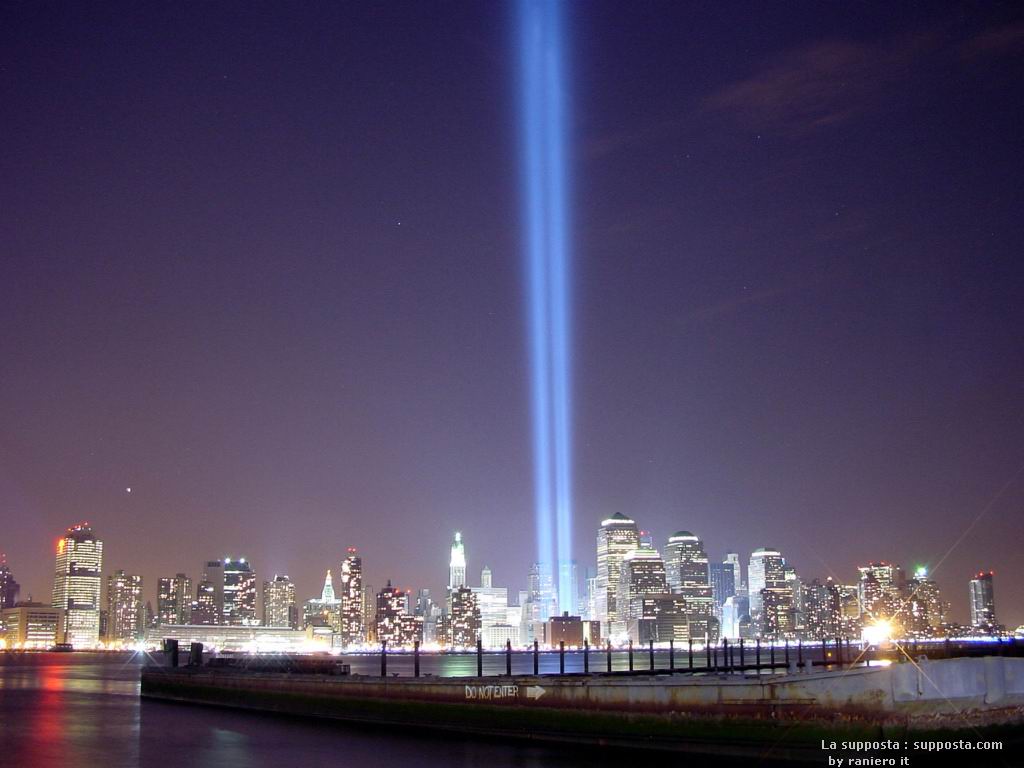
June 22, 2005
The ferry
For 2 years, I took a class every Monday night at the World Trade Center, in the North Tower. The ritual was: I would take the A train downtown, get off at Chambers Street, walk a couple blocks, and cross the massive courtyard to enter the building. I loved it down there, mostly because it was foreign to me - I never spent a lot of time down on Wall Street and it is a whole different world down there. The streets feel like canyons. People struggle to open doors against the wind tunnel effect. But then you emerge onto that courtyard - open, expansive, abstract - with the towers screaming up into the empty sky above you, and you just know that there's no other place in the city like it. Something about the landscape around the World Trade Center, wide-open, concrete, extremely PLANNED, reminded me of DeChirico's eerie paintings, paintings that had haunted me since I first encountered them in Mrs. Franco's humanities class in high school. Of course, the urban landscape down at the World Trade Center was always packed with people, and DeChirico's paintings are always frighteningly empty - except for a long human shadow coming from around the corner, or teeny people in the far distance, dwarfed by the urban structures around them.
The World Trade Center was a part of my everyday life. I knew the security guards, especially one in particular who I really liked. I knew the guy in the coffee shop downstairs, who had my coffee ready for me by the time I got to the counter, having memorized what I liked within 2 days. I could make my way through that Concourse to the underground PATH station in my sleep. My class ended at 10, I think, or 9:45 ... If we got out on time, then I would race down through the echoey Atrium (again, like a DeChirico painting - especially late at night - with the amphitheatre style marble steps, and the massive indoor palms - and everything glass - but since it was nighttime, all you saw was darkness all around you, strange reflections ... an odd space, pregnant with meaning) - burst out through the doors, and tear down to the Hudson, where I would pick up the last ferry to Hoboken. If my class went a little late, then I would miss the ferry, and have to walk through the echoing empty Concourse - with the mannequins in the windows at the Gap standing still, all the lights off in the stores, nobody around, empty escalators running, me the only figure on them, smiling at the 8th security guard I saw at the bottom ... and, of course, racing to catch the train when I heard it coming in, so that I wouldn't have to sit in the bowels of the World Trade Center, in that echoing station by myself. Other random late-night folks were usually milling about, too. This was, after all, the financial district. People worked crazy hours.
But my main goal was to get out of class promptly so I could have the pleasure of taking the ferry.
The station for the ferry was outside the spectacular Atrium, and it was a floating tented dock in the Hudson. You got to it by walking on this metal ramp. As you stood in line to buy a ticket for the ferry, the entire dock bobbed up and down on the small waves of the Hudson. You could see the lights of Jersey across the way. Especially you could see this enormous lit-up clock - south of Jersey City, not sure what town it was in - Bayonne, maybe? When I say "enormous", I mean that it is probably 10 stories tall. Maybe Mr. Bingley knows how big it is. You can easily see the time from all the way across the river. A couple of different ferries used the floating dock - one from Hoboken and the other from further south down the Jersey shore. You could see them leave their docks from across the river, and start to cross the water to get us. I always found that strangely exciting. Seeing my ferry set out from Hoboken, small, making its way south, getting larger, larger ... until there it was ... smacking up against the side of the floating dock. Normally, because I love the night, and I love wind, and I love water ... I wouldn't wait in the enclosed part of the floating dock. I would buy my ticket, walk back up the ramp onto the walkway that runs all around the periphery of the bottom of Manhattan ... and stare out into the Hudson. I loved that part of my night. Even if it was freezing, I would choose to brave the elements. The splashing water against the side of the island of Manhattan, the strange achey creaking sounds that the dock made as it floated up and down ... those were pretty much the only sounds. Way over there, on the river-side of the trade center, you didn't really hear much traffic. It was just the sound of the water, maybe the wind, or raindrops ...
I have such peaceful memories of those few minutes, squeezed into a busy day ... my quiet time, my thoughts roaming free, but there was a mellowness to it, too. There was something soft about how my thoughts felt in my own head, after a long day, ready to go home and go to bed.
Odd. And again, made even more odd by the imposing buildings towering over us. It's a landscape built for people. It is meant to be crowded. It only makes sense if it's crowded. I suppose if I worked there, I would have a whole different experience of the place - I would experience it as a packed madhouse, filled with busy people going through turnstiles, and constant rivers of human beings, moving this way and that. I've temped in massive office buildings before, and I know what rush hours are like. But I was always at the World Trade Center on off-hours, so my memories of it are quieter, echoey ... They have to do with silence ... and ... I'm trying to express this right. You know how some landscapes, whether man-made or natural, seem to just have so much meaning, in their very structure? Like: if you look at the Grand Canyon and you are indifferent, or unchanged ... then frankly something is wrong with you. Not that you should have a particular experience ... not that it should "fill you with awe" ... No. There is no required response. But SOME thing should happen to you. The landscape is trying to tell you SOMEthing. When I first saw the Grand Canyon, I actually felt something akin to deep and powerful despair. I couldn't take it in. Just trying to SEE IT made me feel that I never could really see it. There was no way I could comprehend the entirety of the thing, its massiveness, just the FACT that it is THERE is hard to deal with. The experience of looking filled me with hopelessness. I eventually got used to the size, the scope ... or, no, that's not the right way to say it. I managed to deal with it in small doses. I gave myself a lot of time to just stand there and stare. My point is is that there are certain places on this planet that seem to have some kind of message, or some kind of import ... if you can only listen closely enough. I have felt the same thing on the Mall in Washington DC. Like: something is going on here. A cigar is not just a cigar. There is MEANING in the architecture, everything i see has a message for me ... The World Trade Center, the Atrium, the Concourse, the floating dock ... all of that stuff, on my Monday nights, felt like that for me. I never got used to it. I never was "over" it. I never strolled through there, not noticing where I was. This may sound like retrospective romanticizing, but I assure you it is not. I have the diary entries for my Monday evenings for over 2 years to prove it. It was almost as though the class I was taking was incidental, and not really important. The REAL thing to learn was from the concrete, and the space, and the quiet down there at that time of night.
The ferry would pull up, always with the same cute guys running it ... I got to know their faces too, over those 2 years. They would open the gate, take our tickets, say "Hey, what's up ..." to the 10 of us who were waiting to get home across the river.
For the most part (especially if it was drizzly, or snowing, or cold) everyone would sit in the downstairs area, the enclosed area of the boat.
I don't think I sat down there once. I always trudged up to the roof. I COULD NOT GET ENOUGH of it up there. I soaked it up. The wind in my face, all that stuff ... I just loved it up there, and wished the boat ride were longer. I love being out on the water anyway, it reminds me of being a kid, and going out in the motorboat at Lake Sunapee, and how exhilarating it is to travel on water ...
If nobody else was up there (and usually it was empty), I would lie down on my back across two of the benches, and stare up at the empty black sky - waiting for us to pull away. Because when we pulled away, and did a kind of ferry 3-point-turn, suddenly the glittering towers would swoop into my view blotting out the rest of the sky - and they were right overhead, they were so close. I would get vertigo. The boat would sweep around, the towers would sweep around, and everything seemed enormous and fluid - hard to tell if it was the boat that was moving away from the island, or if it was the island that was moving away from the boat. Then, I would watch the towers recede out of my view.
3 minutes later, we would pull up to the docks in Hoboken, with the same cute guys opening up the gate to let us off ... and I would trudge through the station up to the street, to grab a cab home. My warm bed.
Somehow, if I took the train home, I didn't get the same sense of release, freedom, openness, joy ... as when I took the ferry. The ferry ride had the feeling of a "crossing", in the mythicological sense. I know there are people who take the ferry every day, and they may be used to it, and may have no idea why I got such a kick out of it - but I never got used to it. I think part of it had to do with the fact that it was night-time, too. A quieter more reflective time, contemplative, people giving up the rush of the day.
I still have my World Trade Center identity card, which I needed in order to get into the building. My name's printed on it, and the expiration date is 8/19/01.
May 30, 2005
Today in history
May 30, 2002. The cleanup of Ground Zero was completed.
Original estimates of the clean-up time were way off, which is not surprising, due to the level of devastation. Cleanup finished way way ahead of schedule.
I was there that day, for the ceremony, which began at 10:29 a.m., which was when the second tower collapsed. Words can't describe the energy present down there at Ground Zero on that morning. To be in a massive crowd, with not one person speaking, no bustling, no murmurs, nothing to break the quiet. Quiet in New York City? Is that possible? It was deadly quiet that morning during the cermony. There were no speeches, nothing. No words at all. Just a deep sense of solemnity, and a bell ringing to commemorate the moment.
I stood in the crowd, around what had been - only months before - a smoking hole in the ground - with unbelievable destruction. You could smell it in the air from across the river - the burning smell of death. The cleanup had happened with amazing dispatch, bucking all of the estimates. Like: damn, dudes, they just got the job DONE.
September 12, 2004
Tribute of light
I could see the two beams of light from downtown Manhattan last night, when I lay my head down on my pillow. Gave me such an odd feeling. Melancholy, reflective, yet ... somehow ... there was hope there, too.
The tribute of light seemed to me to be the hopeful resonance of a community remembering its loss. A community that mourns without making a fetish out of their pain.
A country that fetishizes its pain is an unhealthy one. I do not wish that for America. Actually, I don't wish that for anyone!
We will mourn, we won't forget, we will pour columns of light up into the night sky every year - as a remembrance of what was once there, as a remembrance of all the lives lost, all the innocent lives ... but we will not huddle over our pain, nurturing it, coddling it - until it morphs into something monstrous. We can see the results of such pain-nurturing all around the globe today. (Perhaps coming off of Rebecca West's Black Lamb and Grey Falcon has helped me to see what can happen when an entire nation fetishizes its pain, and purposefully keeps its injuries from healing.)
Pain, when you have been injured, is a logical response.
But - and I can only speak from personal experience - when the injury is dwelled on, protected, guarded fiercely, horrible transformations can occur. Then, the pain - which was once a logical response - turns into an obsession, a hateful obsession. Example: a garden-variety heart-break can twist your soul into something hard. You know - like a love affair breaks up. Your heart breaks. I'm the type who resists the so-called healing properties of time. "No. MY HEART IS BROKEN, DAMMIT." I nurture the ache, I huddle over it, I protect it, I defend it, I refuse to be helped.
The pain has become a monster. The pain is now ruling my life, as opposed to just being an emotion I am experiencing.
This is what I mean when I say - I do not wish that our nation should make a fetish out of its own injury.
I hope you get what I'm saying here, and that you don't think I'm saying, "Get over it."
Yesterday I was woken up to the mournful sound of bagpipes in the air. The memorial ceremonies had already begun. I went up onto the roof with my coffee, and stared at the glimmering truncated skyline. Sending my energy down to the lower end, knowing the crowds had gathered there ...
I had my watch with me, which was an odd experience. I realized the unbelievable SHORT-ness of 20 minutes - the 20 minutes in between the 2 planes ... Jesus Christ. The unforeseen horror of that 2nd plane. Of course, the first plane hitting was a nightmare too ... but that 2nd plane ...
What had appeared to be just an awful aviation accident of some kind, at least from our perspective in those 20 minutes before the 2nd plane came, turned into the impending apocalypse. We were under attack. Where is the next plane? What is happening? We are all gonna die. I still remember the screams filling the air on my trapped bus, as we watched that second plane hit, and saw that orange fireball fill the air. We were screaming. My sister ... my sister ... my God. My Holy God. 20 minutes. Boggles the mind.
So I had my own little private memorial service on the roof.
The rest of the day, I bustled about ... errands, a couple hours of writing, a long phone call with dear friend Mitchell, and a great evening with my friend Jen.
And then - I came home in a cab. The dude drove so dangerously that I refused to pay ... and yelled at him, in a freaked-out way, for the entire ride: "Hey, man, what the hell??? Jesus CHRIST, THAT'S A RED LIGHT ... What's the hurry, asswipe? SLOW DOWN!!" - Yes. I called him "asswipe." Let me introduce to you my inner-child who, apparently, is a 13 year old boy. But his driving was so reckless that I felt I had no choice. Anyone who plays hard and fast with my life is an asswipe, as far as I'm concerned.
But anyway - during my frightening cab ride home - late at night - I suddenly saw, behind me, the thick columns of light shooting up into the sky ...
Something happened to me when I saw them. (Even though I was about to die, because of the asswipe's horrible driving skills)
What happened was - my energy went inward. I guess, my energy became prayer-ful. I hope that doesn't make me sound like an asswipe myself. You know, there's an extroverted daylight energy, a conscious energy, I'd call it the public face, the sociable side of our personalities. And then there's the other energy, the reflective, the contemplative, the philisophical, the emotional ... where one sits with the mystery, the uncertainty, the feelings ...
And so I was SO GLAD to see those columns of light. So glad - because you know why? They gave me the reminder (not that I need one - that's not what I'm saying) ... It was the reminder: Move away from the conscious energy now ... get into the contemplative energy. It is right and proper that one should be reflective on this day. To honor the dead, to honor the wound we have received. Life goes on, football games happen, there are beers to drink, conversations to have, huge bursts of laughter ... but there they were. Soaring up into the sky. And they were there, if anybody felt like having a reflective moment, it was something to focus on - they were a monument, the expression of the feelings of the community made visible.
There was an Italian feast day of some kind in Hoboken - and I'm not like others who seem to think it inappropriate to have gatherings like that on the anniversary of Sept. 11. Like - when is the cut-off date? When would it NOT be inappropriate?
Besides - I think the fact that life goes on - (which is not the same thing as forgetting) but that LIFE GOES ON - is not awful, and un-feeling, but it's a fucking MIRACLE, quite frankly - and indicative of the HEALTH of our spirits. We have not made a fetish out of our pain. We can go out and enjoy LIFE still. We are still looking towards LIFE, we are not in love with death, in love with our own injury.
Anyway, that's just my opinion.
The bagpipes began my day. I was woken up by the traditional sound of mourning and I felt oddly comforted by the sound. I felt surrounded by a community, an invisible community of people - all of whom had their focuses pouring into one place, on this anniversary.
And the columns of light ended my day. A spectacular reminder of what we have lost, a focus-point for our feelings of loss, grief, absence ... silent, white, enormous ... soaring up infinitely until the white dissolved into the black.
September 10, 2004
"I started with A"
Billy Collins, former poet laureate, wrote "The Names" in the wake of September 11 and read it during a special joint session of Congress in New York on September 6, 2002.
The Names
Yesterday, I lay awake in the palm of the night.
A soft rain stole in, unhelped by any breeze,
And when I saw the silver glaze on the windows,
I started with A, with Ackerman, as it happened,
Then Baxter and Calabro,
Davis and Eberling, names falling into place
As droplets fell through the dark.
Names printed on the ceiling of the night.
Names slipping around a watery bend.
Twenty-six willows on the banks of a stream.
In the morning, I walked out barefoot
Among thousands of flowers
Heavy with dew like the eyes of tears,
And each had a name --
Fiori inscribed on a yellow petal
Then Gonzalez and Han, Ishikawa and Jenkins.
Names written in the air
And stitched into the cloth of the day.
A name under a photograph taped to a mailbox.
Monogram on a torn shirt,
I see you spelled out on storefront windows
And on the bright unfurled awnings of this city.
I say the syllables as I turn a corner --
Kelly and Lee,
Medina, Nardella, and O'Connor.
When I peer into the woods,
I see a thick tangle where letters are hidden
As in a puzzle concocted for children.
Parker and Quigley in the twigs of an ash,
Rizzo, Schubert, Torres, and Upton,
Secrets in the boughs of an ancient maple.
Names written in the pale sky.
Names rising in the updraft amid buildings.
Names silent in stone
Or cried out behind a door.
Names blown over the earth and out to sea.
In the evening -- weakening light, the last swallows.
A boy on a lake lifts his oars.
A woman by a window puts a match to a candle,
And the names are outlined on the rose clouds --
Vanacore and Wallace,
(let X stand, if it can, for the ones unfound)
Then Young and Ziminsky, the final jolt of Z.
Names etched on the head of a pin.
One name spanning a bridge, another undergoing a tunnel.
A blue name needled into the skin.
Names of citizens, workers, mothers and fathers,
The bright-eyed daughter, the quick son.
Alphabet of names in a green field.
Names in the small tracks of birds.
Names lifted from a hat
Or balanced on the tip of the tongue.
Names wheeled into the dim warehouse of memory.
So many names, there is barely room on the walls of the heart.
The Falling People
I found this article - "Falling Bodies, a 9/11 Image Etched in Pain" intensely painful to read ... but I also felt compelled to finish it.
It wrenches up the soul to think of the people who fell, or who jumped. It haunts me. As I know it haunts many others. It horrifies me, in such a deep I'm-an-infant-having-a-nightmare kind of way, that my brain tries to protect me from getting near enough to it to contemplate.
One horrible anecdote:
Police helicopter pilots have described feeling helpless as they hovered along the buildings, watching the people who piled four and five deep into the windows, 1,300 feet in the air. Some held hands as they jumped. Others went alone. As the numbers grew, said Joseph Pfeifer, a fire battalion chief in the north tower lobby, he tried to make an announcement over the building's public address system, not realizing it had been destroyed."Please don't jump," he said. "We're coming up for you."
Almost instinctually on Sept. 11, people recognized that they had an unfortunate view into an intensely private matter, an unseemly intrusion not just into someone's death, but into the moment of their dying. American broadcast networks generally avoided showing people falling. A sculpture that depicted a victim, known as "Tumbling Woman," was removed from display at Rockefeller Center after one week.
Some commentators later remarked that those who had fallen had made one brave final decision to take control of how they would perish. Researchers say many people had no choice. Witness accounts suggest that some people were blown out. Others fell in the crush at the windows as they struggled for air. Still others simply recoiled, reflexively, from the intense heat.
God rest their innocent souls.
August 7, 2004
The Baltimore Boys
I had a terrible dream last night that something happened to the Empire State Building. Overnight, it was as though an earthquake had happened - only a very neat earthquake - which opened up an abyss down the side of the building, separating the parts from one another.
It was mysterious why this had happened. But New Yorkers woke up, and everybody noticed it.
And panic ensued immediately. New York woke up in panic mode.
I was clinging to something, very high up - staring at the opened crack down the side of the building - knowing it meant something very very bad. But it was mysterious. It was like the monoliths in 2001, or the lights suddenly appearing over Mexico City in Signs. Something's happening. Something already has happened.
As I said, I was very high up, above the streets - and I could hear everyone screaming below. The air filled with screams.
Just like on September 11. That's one of the things I remember about that day. The air filled with screams.
The first time I left New York City after September 11 was for a weekend in Baltimore at the end of September - I was going to visit 2 guys I had never met before in my life. But we had become friends in an online kind of way, in the summer before September 11. I felt no fear, NONE, as I went to meet these strangers. There was no danger. I was aware of no danger. My friends thought I was insane. "What do you know about these guys? Who are they? What are their phone numbers? Call me every day while you're down there..." Etc.
Well, suffice it to say - that they were 2 of the loveliest men I have ever met, and they treated me like a refugee from a war-torn country. Which, indeed, I was. At that time.
One of them is still a good friend of mine, and comments on this blog often. I will ALWAYS have a soft spot in my heart for these guys. I went down there on the train, and I was - to put it mildly - a mess. I didn't want to leave New York. I was still not sleeping. The city had not recovered. By the end of September, we were into the time of funerals. Every day there were funerals. The drones of bagpipes filled the air at all times - replacing the screams of September 11. I can't explain it. I had not recovered - nothing was normal.
I almost didn't go down to Baltimore, because I felt too much anxiety leaving my city. What if something else happened? I couldn't not be there! If an explosion was going to happen, then dammit - I wanted to be exploded too. It's MY city, Goddammit.
My 2 new online friends were voices of calm and reason. All of America was affected by what happened that day. But I was their friend from New York City, and they assured me that everything was going to be all right, and when I got down to Baltimore, they would show me around, they would take me out to dinner, they would take care of everything. No worries, no worries, no worries ...
I am still amazed that these guys came into my life. I called them "my Baltimore Boys".
On the day I was to leave, I had an extended anxiety attack. I was taking the Path to 33d Street and then walking over to Penn Station to take the train out of town. At every second, I thought I'd turn back. I could not leave the city yet. The whole damn island of Manhattan felt like an illusion. While I was in Baltimore, the entire thing could be liquidated. My home ... my home ... my family ... my sister ... my brother ... Cashel ... all of them there ... I could not be separated from them ...
I got off at 33rd Street and made my way to the stairs up to the street.
The station was packed with people. It was a Friday afternoon, your regular rush hour.
And suddenly - with no warning - NONE - everyone started to run. People were screaming. There was a mad RUSH for the stairs. I had no idea what had happened. What was happening? But I was part of that crowd - and the second the movement began, the crowd movement, I started to run too. Something was going to explode, something was in the subway station ... There must be a REASON why everyone is running, right??
People were pushing and shoving, frantically, to get out of the station up to the street. I had my bags for the weekend. I couldn't catch my breath.
It was completely catching. The panic.
And I emerged onto the nightmare of the street - it's a block away from the Empire State Building - you have to crane your neck way way back to see the spindle - and there had been some sort of bomb scare. Which is probably highly normal for the Empire State Building - but in those late September days of 2001 - nothing seemed more fragile, more courageous, more precious and easily destroyed - than the Empire State Building. I would stare at it from my kitchen window in Hoboken, the only building in Manhattan visible to me. At least now. I used to be able to see the twin towers, but now ... there was just one building left. The Empire State Building looked ENORMOUS. A huge target.
The streets were blocked off around the Empire State Building. Cops and National Guardsmen were literally everywhere. I am not exaggerating. It felt like we were under siege. The crowd (of which I was a part) was running this way - that way - panicked - trying to get away from the building, running towards the building - shouting at the cops, "WHAT'S GOING ON?" The cops were hollering at the crowd - "GET BACK. GET BACK."
You have to remember the context of those days.
I started running down 34th Street, holding my suitcase. People were running, all around me. Some were running, as they were talking on their cells. The sound of sirens filled the air. As I ran, I kept looking back over my shoulder at the Empire State Building's spindle ... it looked so fragile you could snap it. I was WILLING it to still exist.
This all probably sounds really crazy. But there was such a crowd dynamic in New York in those days. At any moment, the crowds on the sidewalk were liable to start running. For no reason.
Oh, and randomly - in the middle of this crowd panic - something very very strange happened.
A woman grabbed onto my hand. I was literally running towards Penn Station. I was completely convinced that the Empire State Building was going to explode behind me ... like in a movie. So a woman grabbed onto me. Stopped me. I looked at her with my crazy eyes.
And she said something so unbelievably incomprehensible to me - that I had to ask her to repeat it. She was speaking in English, do not get me wrong, but in that moment, what she said was so absurd, so out of place, that I could not, for the life of me, understand what she was saying.
Here is what she said:
"Do you have any idea where I could buy a Boggle game?"
I'm not kidding.
We're in the middle of a Midtown-wide Bomb Scare, and she's looking for Boggle.
It was only later that I was able to laugh about this. I did an imitation of the moment later for my friend Jen and we were crying with laughter. My insane running, looking over my shoulder, etc., and then this calm oblivious woman basically asking me to point her in the direction of Toys R Us.
I said, "Huh?"
She said, smiling, unaware somehow of the crowd running at her from the direction of Broadway, "Can you tell me where I might find a game of Boggle?"
I should have said, "Up your ass, lady. Why don't you try there?"
But I pointed wildly uptown, and screamed, as I ran away from her, "THERE'S A TOYS R US ON THE CORNER OF 45TH AND BROADWAY - TRY THERE..."
Absurd.
Those days were so absurd.
Penn Station in those days was one of the most moving and mournful places on earth. You walked down the huge corridor to get to the terminal, and the walls were, first of all, lined with National Guardsmen and women who all looked about 12 years old. Second of all, the walls were plastered with notes from all over the world. And commuters and passersby would stop to read the notes. People were always weeping in that corridor. I would weep in that corridor. I think I read every note, over those weeks. There were notes from entire classrooms of 2nd graders in Tulsa, there were notes from fire departments the world over ... clumsy English spelling from the fire department in Germany ... there were notes from individual people, "Hang in there..." "We love you" "We will not forget" - there were letters in every language imaginable. Some were written by little kids who obviously had just learned how to write. So their sentiments were blunt. "I am very sad about the dead people. My dad says it's okay to cry though." Stuff like that. It was a corridor of mourning. Lined with people in military dress, and filled with crying people.
My God.
So the panic was still going on, as I entered Penn Station. I felt like I was making a getaway from a war zone, being air-lifted out of Nigeria or something. Everything dissolving into chaos behind me.
Now mind you: This was just an anxiety attack I was having. New York was still there when I got back. The Empire State Building was still there when I got back. But everything was messed up in my head, I couldn't sleep - no one could - It felt like we were on the brink of utter destruction. It was only September 28.
I got on the train, my breathing high in my chest, and everything in me was saying: Don't go. Don't go. If the Empire State Building explodes, you will want to be here. You will want to be here for your city.
But ... the train pulled away from the station ... and I was off. I felt insane. Wild-eyed.
Boggle? What?
When we emerged into New Jersey, I could see the whole of the city spread out to my left, glimmering, and tragic. The gaping hole of lower Manhattan hurt me, like an actual wound. It doesn't really anymore, but it did then. And I stared at that spindle of the Empire State Building, the tallest building, in the center of the island ... teetering ... It looked so ... small. It looked like - wow, it would take absolutely nothing to get rid of that building! And I stared at it, craning my neck backwards, tears running down my face, until I couldn't see it anymore.
I arrived in Baltimore to meet these 2 strange men, in this state of mind.
We had never met. We knew what we all looked like, pictures had been exchanged ... but nothing else.
And these men were my heroes. They took care of me. They showed me the sights. They listened to me talk. They were sensitive. I couldn't talk about anything else. And I needed to have the TV on at all times, in case something happened. They were fine with that. They introduced me to their friends as "our refugee". They gave me (why?? I have no idea!! I was a stranger to them!!) 2 days away from the stench of death and the bomb scares. They were kind enough to take me in. I was, to put it mildly, NO FUN to be around. This was not a whoo-hoo kind of weekend. I was jumpy, and tearful, and needy, and a little bit insane. They expected nothing from me. They just wanted to take care of me, and give me some time away. They were thrilled to be able to do that for me.
Writing this down, I realize it doesn't make all that much sense.
But I'll alway be grateful to my Baltimore Boys for their kindness to me during that weekend. I will never ever forget it.
And one of them has remained a true friend. For which I am also very grateful.
They weren't really meeting "the real Sheila" that weekend. Who I was that weekend is not who I am normally, obviously. I couldn't stop shaking, all through our first dinner out - I sat at the Mexican restaurant, shivering, as though they had the AC on full blast. Then I said I wanted to go to a bar where they had a TV, because I had to make sure nothing had happened to the Empire State Building. They did whatever I wanted. "You need a TV, darlin'? Okay, then, we'll take you to a TV."
These men were miracles to me.
Nothing was normal. We all clung to one another, and for a couple of days at least, I was away from it. I needed to get away.
When I returned to New York a day and a half later, I came back into Penn Station at about 9 o'clock at night. It was rainy and dark.
And the sadness hit me like a wall. It wasn't MY sadness, per se. I didn't own any more sadness than anyone else. It was like there was a wall of grief around the city. And I was stepping back into that atmosphere. I am telling you: I could feel it the second I got off the train. It was in the air, between the molecules ... it WAS the air.
I have no idea why I just wrote all of this. Oh yeah. Because of my dream about the crack-up of the Empire State Building.
I can't wait for this fucking convention to be OVER.
June 14, 2004
The two days that came before
Yesterday - I had some moments free, after my houseguests had departed in a flurry of "Bye"s ... and I was writing. Which means - I let my mind off its leash. And it roams about, picking, choosing, peeking into doors, etc.
I was also burning a little white sage, I had the ceiling fan on, and I was drinking coffee.
And crystal-clear - one of the things that floated through my brain was the exact events of both September 9 and September 10, 2001.
They weren't quite ordinary days, strangely enough. A couple of kind of stand-out things happened on those two days, things I wanted to remember at the time, to savor. And so I wrote them down, in great detail. Scribbling late into the night of September 10 and the early morning of September 11 ... unaware.
I am obsessed with those two days. The two days that came before.
Already, the machinery of destruction was in motion. The plans were final, terrorists moving into position, while we were going about our business, innocently, enjoying the early autumn days, wrapped up with private concerns.
I only remember how warm those days were because on the early evening of September 9 I was rushing to meet my sister Siobhan for a drink. We were convening at Astor Bar, one of my favorite places in the city. It's in a central location, it was close to Siobhan's job - it was also right around the corner from where 2 of my cousins lived - so it was a great "let's meet there" spot. Especially if it was early in the evening. After 10:30, there would be a line down the block, so we avoided it then - but to start off a night? It was perfect. Astor Bar was the O'Malley-family jumping-off point.
I was dressed up, I remember. Long tight skirt, high heels - and I was hurrying, as quickly as I could, across 4th Street. I was late.
And I only remember how warm it was because - in my hurrying - I basically started sweating, and my powder dissolved off my face. Which bummed me out. I remember stopping in an empty doorway, popping out my compact, checking out the damage, and thinking: "Ah well. Tonight is too hot for powder then."
Strange. The things that remain.
Astor Bar has an upstairs bar with a big window, looking out on Bleecker Street. There's also a downstairs bar, shadowy, rather decrepit with peeling ceilings, and cavernous red leather booths, extremely atmospheric and dark - I love it down there. The upstairs bar, though, was the good meeting-spot because you had a view of all the comings and goings up and down Bleecker - with 2 tables in the window, high bar stools - and then room for about 6 or 7 stools at the small curved bar. As I hurried past this window, I saw Siobhan, in a sun dress with a pleated skirt, sitting at one of the tables in the window.
Then - in the next moment - as I entered, 5,000 things happened at once. Each thing clear, distinct, set apart, and remembered perfectly - like a flickering newsreel in my mind. Sometimes I yearn for vagueness, for the softening of edges ... Clarity of memory is great, but it can also be a torment.
I pulled the door open.
In a flash second, I saw a guy sitting at the bar with a couple of other people - My eyes just quickly glanced over him - and I saw that it was a guy I had met at a party the year before - and we had had so much fun together at said party that when this guy said good-bye to me, he said, "Where the hell have you been all my life?" New York quickly became unimaginable without one another in it. It was a true meeting of the minds, a recognition. We recognized one another. A strange and unmistakable feeling. Like: "Wow ... I know you ... you're just like me ... I know you ..." And he and I had such a riotous time together at that party (we all played charades, non-stop, for 4 straight hours...and then there was a trivia game invented - which we played for another 2 hours) - no one could beat the two of us at trivia. We were unbeatable together. It was a fever of connection. We took a walk through Soho together at 3 in the morning, talking, laughing, the world was our playground, we could have kept talking forever.
Anyway - it was one of THOSE kinds of nights. I woke up the next day, signed on, and he had already emailed me, obviously the second he returned home from the party - the time-stamp on his email was 5:45 in the morning - and he raved about how glad he was to have met me. And how he and I just "ruled" together.
And so began a rather intense epistolary friendship. Very 19th century (only with email.)
I probably don't need to even explain that I fell completely in love with this guy. Within 10 minutes of talking to him. And he with me. But, truth be told, our behavior that night of the charades was more along the lines of separate babies reaching out to each other from separate shopping carts in the aisles at grocery stores ... or the sudden intimacy between romping dogs at Washington Square Park ...
It wasn't a grown-up "oh, yes, I have feelings for this man" kind of thing.
It was more like we looked at each other, like babies reach out to each other - I looked at him and saw my own kind.
He said later the same was true for him. "She's like me. She's crazy, she's like me."
But alas. For various reasons, it was not meant to be.
However - we maintained this epistolary thing - writing, sharing quotes, sharing poems - and we continue to communicate about literature, poets, writers, etc. There are certain things I only want to share with him. I know he'll "get" it. It's that kind of thing.
So on September 9, 2001 - I had not seen him since the charades night a year and a half earlier - and then - there he was. Perched on a bar stool at Astor Bar.
So what do I do? I proceed to behave like a jackass.
Reminds me of this quote from Nancy Lemann, one of my favorite authors:
It is always remarkable when someone sees your soul to a better degree than you see it yourself. You could count the people who see your soul on one hand. Others might know you but they would forget; their knowledge of you was like a weak and undisciplined thing. But that wasn't so with him. He didn't forget. It stuck in his mind. He had seen a kindred soul. he had seen it long ago. She only saw it now. But she was stricken with it. Suddenly she had identified him. There was the man she loved. As a result, she proceeded dementedly to behave as if the opposite were true.
That's it exactly. I was so THRILLED to see this man again that I "proceeded dementedly to behave as if the opposite were true."
I COMPLETELY ignored him, pretending blithely that I hadn't seen him, I swept by his crowd - and went straight for Siobhan, made a bee-line, pretending to be oblivious - and yet inside I'm thinking, insanely: It's him, it's him ...
ALSO - I had a moment of being totally bummed out (in that small flash of time during my cross to Siobhan) that I had sweated off my face powder.
Siobhan and I greeted each other, big hug, "hi hi hi" - and I immediately hissed at her, like a criminal on the run, "So and so is here. That is so and so. But don't. Look. Now." You know. Typical girl stuff.
I was suddenly 14 years old.
As I had stalked by him, making a beeline to my sister, I felt him see me. His entire posture changed. He sat up straight, it was like he was ... It was like a Discovery Channel moment. Animals in the wild, alert, ready to pounce.
I knew he had seen me, and yet I made this elaborate pretense that I was oblivious to his presence. Until I could get myself together to say to him, casually, "Hi there! How are you!" I was acting like an ASS.
It continues to be strange to me that this entire dance of awareness and avoidance would be so technicolor-vivid to me - I remember the body language, pauses, how he tilted his head, I remember exchanges we had later word for word ... The entire night is preserved perfectly in my memory, a fly drowned in amber. Part of it is because of the fun we had - a night for the books - but the other part of it is the date.
The old world was about to sink away, forever. I look back on that night and it might as well have occurred in 1962, that's how far away it seems.
It would be the last time (for a long long loooong time) that I would be in a group of people and talk about normal things, everyday things, movies, archaeology, theatre, life, poetry. 2 days later, all other topics of conversation ceased to exist for a good year and a half. Even now - it is rare that a gathering will occur without "September 11" or "the towers" being mentioned. At least once.
And so the conversation we had on September 9 stands out for me.
Almost like a museum-piece.
I look at that night with longing, with sadness, and with fondness. Because we could not be faulted for not knowing what was coming our way. We were consumed with our own private pleasures, talking, innocently, joyously, laughing, drinking, interrupting each other ... as the murderers moved into position.
The sword of Damocles over our heads.
So all is preserved. Especially from that moment when I first walked in, saw him, ignored him, he saw me, and I walked by ... pretending to not see him. How he sat up straight and watched me pass - how I leant in to my sister and hissed at her "That's him, that's him..." - how I could feel him watching me like a hawk, waiting for an "in".
Finally, he could no longer stand the wait, and he yelled - yes, he YELLED, across the space at me - causing a dead silence to descend over the bar:
"WHY ARE YOU IGNORING ME?"
I still laugh when I think of that.
Why do I laugh? Because in that loud unafraid moment, he so called me on my BULLSHIT. He didn't let me get away with the charade of "Oh my God, I didn't see you when I first came in! You're here?? Wow, what a coincidence!!" He KNEW I was ignoring him, and he YELLED that at me across the bar.
I just find that so funny.
That's why I fell for the guy, I think. That kind of thing.
So I saw him and feigned surprise. Like a very very very bad actress.
"Hi there! Wow!"
He was staring at me with tremendous excitement and also scorn. "You walked right by me."
"Uh ... sorry ... I didn't see you ..." I said lamely, my cheeks warm and flushed.
I knew he had busted me, and I knew that he knew I knew ... and it all seemed hilarious and beautiful. I LOVED that he had busted me, actually. It made me feel safe, for some reason. Like: he knew I was acting like a jackass, and that the reason why I didn't say Hi to him right away was because I was having a "riot of feeling" - but judging from his posture change, and his behavior the rest of the night, he too had a "riot of feeling" at the sight of my face ... and so he saw that I was afraid, that I was protecting myself for a second ... and he busted me on it, with such humor - with no judgment - it seemed like everything was going to be okay.
That's another vibe that I got that night of September 9 - which ... almost makes me stop dead in my tracks when I think of it.
I walked away from the night - coming home at about 2 o'clock in the morning, thinking to myself, 'Wow. Everything's going to be okay, I think."
Nothing would be okay. Ever again. At least not in the same way. The world will never be the same again for me. I may have a night like that again, a night of innocent pleasures, and free laughter, and beautiful moments of connection ... but it will always, now, be in the context of the September 11 world. It makes a difference.
Siobhan and I merged our evening with charade-guy's night (he was with a group of friends) - and we sat, and talked, all of us - in that beautiful way that some conversations have - vigorous, up, down, people interjecting, fights breaking out, random bursts of laughter, blurting inappropriate statements, one person rising to the forefront with everyone else listening, someone else chiming in fluidly with their interpretation, either adding or detracting ... It went on and on and on and on and on. You know those kinds of conversations? They're very rare, actually. This one stood out.
When we said goodbye to each other, he and I, we had a repeat of our good-bye on the night we met, only it was deeper and a bit more tormented. It kind of sucks to be CONFIRMED in your fabulous first impression of someone. He hugged me like he never wanted to let me go. I pried him off of me.
But still - it didn't ruin the giddy tenor of the night.
Afterwards, Siobhan and I walked through the warm night to our respective subways, still laughing and laughing and laughing about certain moments. We had cried off our eye makeup with laughter.
I emailed "the guy" the next day. It was September 10. I said, "Just wanted you to know how great it was to see your face again. Makes me feel good to know that there are people like you on this planet."
I had never written him such a thing before. I had never acknowledged any of that. But the night had been so amazing that I needed to let him know. And so I did.
A part of me waited for a response, but another part of me thought: "It's really not about getting a response. He should know that I think he makes the world a better place just by being in it ... regardless."
September 10 was a Monday. I had gotten no sleep because of the romping the night before. But I felt wide awake, alert, my mind swirling with images and random bursts of laughter from the shenanigans of the night before. I felt so happy, I felt excited, too... And this isn't just me adding stuff on because of what day it ended up being. My journal entry for that day is barely controlled hysteria and joy. "I'm happy, God, I'm so happy right now!" Stuff like that.
In case you haven't guessed, I'm not normally a chipper cheery Pollyanna type. Darkness is easier for me. But the Astor Bar night made the pendulum swing in the other direction.
I had spent some time doubting myself, doubting my strong response to this guy on the charades night. I thought: "What the hell is my problem - that I would be so blown away by this guy - just because he played charades with me for four hours?" I felt a bit pathetic at times. Then - running into him again - I realized: Well. Obviously there's some huge connection between us. Huge. And a romance is not meant to be, clearly, but that doesn't mean that there isn't this understanding between he and I.
It was validating. Exhilarating.
That night, I went home to my brand-new apartment. On September 4, my roommate Jen and I had moved into a new place. We had not had our phone hooked up yet, we had not had our TV hooked up yet ... which ended up being an ENORMOUS issue, after the 11th. We saw the entire thing happen with our own eyes, and yet ... we had no TV coverage - we had no perspective except our first-hand experience - and we had no phone yet. It took us a month and a half to finally get a phone, because of the chaos. Our entire kitchen was still in boxes - we had barely unpacked.
I came home on the night of September 10 to our new abode. All windows opens. Cross-breeze. A beautiful night.
My heart was still singing from my hours-long evening with charades-man. (I'm pretty easy to please.)
Jen was there, arranging her room - getting accustomed to the new space. We both had bedrooms facing East. The gleaming of the World Trade Center visible above the Hoboken skyline.
Jen and I ended up lying down on her bed, our feet dangling off the sides, looking out at the Manhattan skyline. And I told her the entire story of the night before. "You're never gonna guess who I ran into last night and who I hung out with for 4 hours..."
Being a wonderful girlfriend, she asked me 598 questions, and we talked about it to our hearts content. "So then ... he turned ... and he looked at me like this ... and then he said THIS thing ... and when we hugged goodbye he said THIS..." You know, your basic girlie convo. Great great fun.
But it makes me uneasy to remember it now.
It was about 10 pm ... and Jen (she and I were not just roommates, but dear dear friends) said that she was afraid she was going to have trouble getting to sleep that night - because it was a new place and all. And would I mind reading out loud to her? Maybe that would help her go to sleep ...
She had never asked such a thing before. I love reading out loud, love it love it love it ... and she said, "Just pick out a book you like - I don't care ..."
I was excited. I went into my room - where, of course, the first thing I had organized had been all my books. My CLOTHES were still in boxes, but my books were on display. I thought: "Hmmm. Let me pick out something good ... what do I want to read to her ... what do I want to read to her..."
Out of nowhere, I picked out Paul Zindel's The Pigman - which is probably one of my favorite books ever. A book for teenagers, yes ... I read it in 8th grade ... but its charm and humor has never palled. That was one of those life-saving books I read at one of those all-important times - when everything seems dark and grim (re: junior high) - and that book, about 2 freakish outsider kids who befriend a weird little old man, made me realize I wasn't alone. That there were other freaks like me out there, that life could be beautiful, that you could have a possibility of joy in life ... even though everything around you basically sucks.
Again - this isn't an interpretation in hindsight, based on what happened the following day.
That is what The Pigman is about.
So we curled up on her bed, with the summery night wind blowing through the dark window, and I read a couple of chapters out loud to her.
Such a strange and intimate thing to do.
We never did it again. That was the only time.
And The Pigman ended up not being the best choice - because it is laugh-out-loud funny at times, and Jen kept guffawing like a mad woman, instead of falling asleep.
As I read it, with tears of laughter in my own eyes, I kept interrupting myself and saying, "God, I haven't read this in years ... this is so fun ... I remember reading this in Ireland at a B&B when I was 14 and laughing so loudly that my mother had to come down and tell me to be quiet ... I need to read this whole book again ..."
Interjecting my reading with these random little Pigman memories.
Jen finally murmured, "Okay. I think I can fall asleep now."
I tiptoed out of her room, turned the light off, and went into my new room. There was something heightened and tight in my heart. Sometimes I get too excited. Or ... let's just say - my experience of things can get pretty intense. I can't sleep. I lie in bed, going over and over and over things that excite me.
And that's what I did that night, after writing in my journal feverishly about the Astor Bar meeting.
I lay in bed, for hours, the darkness in front of my eyeballs, re-living that moment when I first walked into Astor Bar ... and he sat up straight in his chair ... and followed me with his eyes ... and his voice, "WHY ARE YOU IGNORING ME..." It appeared to just be on replay ... I didn't know why it pleased me so much, but it had some intense and perfect aesthetic which I found so satisfying.
And the other replay was the entirety of the book The Pigman and how much I had enjoyed sharing that book with Jen, in our new windy apartment.
Thinking to myself over and over in the darkness, I really must read that whole book again ... until finally I fell asleep.
May 12, 2004
Flashback of a Flight Crowd
Ramble. Follow me if you dare.
So I go out into the muggy grey streets to get some lunch. I am very very busy today, and I'm traveling down to Princeton tonight to see a friend, and so I'm kind of frazzled, and my shoulders ache.
In order to calm myself down, I have been listening to "The First Cut is the Deepest" on an endless loop. Believe it or not, it helps.
So anyway, I emerge onto 7th Avenue - just in time to see a taxi cab explode into a fireball down the block.
It was absolutely horrifying. You just don't see stuff like that every day. Things bursting into flames. At least not in New York City.
I didn't know it was a taxi cab until 5 minutes later - which felt like an eternity - because for one brief ice-pick-in-the-shoulder-blades moment - I thought that it had finally happened, my worst nightmare, the thing that I am shocked has not happened yet: a radical Muslim blowing himself up in some crowded area. I mean, nobody knew - I walked outside into the immediate aftermath. Firetrucks weren't even there yet.
The streets were packed with lunch-hour people, and everyone started freaking out. People started running. Some were running away from the flames, others were running towards the flames, to see what had happened.
The smoke was black and thick and the flames created a literal wall across 38th Street. I can't even tell you how crowded that street is, I can't even tell you how awful it looked.
I admit I went into a panic, for about ... 10 seconds. Which felt like an eternity. I didn't know which way to go. I didn't know which way would be safe. I started north, but then ... stopped ... No ... I should maybe go south ... took a couple steps ... and in the middle moments of indecision, I stood on the sidewalk, staring at the flames, wondering what I should do.
Within literally 5 minutes, the fire trucks arrived. God bless the FDNY. Also, the street was completely blocked off by cops almost instantly. God bless the NYPD. I don't know how they do it.
I heard some woman say (in the middle of my panicked: let's go north/let's go south dance), "A cab exploded."
Maybe it was overheated? I have no idea.
It was horrible, seeing those flames raging out of control along the street. Terrifying. I walked over there, and the cab was literally a blackened shell, all the windows blasted out, and the hood was scarred and blackened, and completely blown off. The thought of people being in that inferno was ... just so terrifying. I always identify. That's the thing. And that's what makes New York mentally exhausting for me. I have no separation. I cannot help but look at that horrible blackened cab and imagine one of my family members in there. I shiver. I shiver at the horrible-ness.
And that one moment of the north/south dance reminded me (and not in an intellectual way - but on a gut-level) of my first day back in Manhattan after September 11. It was that Thursday, I think. Or maybe it was Friday. I had been blockaded off in Hoboken for a couple of days, and then decided to make the trip in, and see if I could make it to work.
Now there is so much else to tell about those days - and maybe someday I will do it - so much, so much ...
But what I really remember is getting to work ... (the feeling in Manhattan was indescribable. And whenever you looked downtown you could see the plumes of smoke, and every single available wall space EVERYWHERE was covered in Missing Persons pictures ... The same was true in Hoboken, of course.)
And nobody did any work. We all just sat around and told our stories, and hugged each other, and cried, and asked if everyone's loved ones were okay, and listened to the news on the radio ...
The book Crowds and Power that I just finished talks about the phenomenon of "flight crowds": huge groups of people who suddenly, for whatever reason, start to run.
And ... I was just sitting at my desk, which looked out onto 7th Avenue, and all I can say is that my consciousness was not an individual consciousness on that day, my consciousness was MUCH wider, and seemed to encompass the energy of every single person living on the island of Manhattan. Perhaps that's the intensified feeling that being in danger will give you. I was not just myself, I was 100% aware of every single person around me in a 3-mile radius.
If one person made a sudden move 10 blocks away, I feel like I would have picked up on it.
From my desk, I couldn't even see down onto the street, I'm too high up, but suddenly, somehow, I just knew that something was going on down there. I stood up, peered out, and the street below was FILLED with people. Cars still were not running in Manhattan at that point - or maybe they were, I don't know - but people were not limiting themselves to the sidewalk. As a matter of fact, everyone was crowding their way into the middle of the street. Away from the buildings.
Without a second thought, I grabbed my stuff and ran for the stairs. I wasn't the first one, either. It felt like - psychically - spontaneously- all at once - everyone in my office, everyone in a 5 block radius, actually - stood up and started running.
Why? No reason.
It was a flight crowd.
We get down on the sidewalks, nobody can move, everyone is staring up, up, up ... looking looking looking for the danger ... terrified - I heard some security guard mention something about, "Oh, we had a bomb scare..." About 6 or 7 people standing near the security guard heard the words, "bomb scare" - I was one of them - and I stepped forward and said, "What? Bomb scare?"
Meanwhile, though, it was like things were spreading by ESP.
The entire crowd could not have heard the words "bomb scare" but it was like - I can't explain it - it spread by osmosis - and suddenly the static crowd turned into a fluid crowd. No longer content to huddle on the sidewalks, murmuring questions, everyone started running - myself included - in the same direction, for some reason. We all started running south, down 7th Avenue.
I remember thinking: Jesus. If any of these buildings explode - no way will we escape. 7th Avenue isn't wide, like Park Avenue - we were trapped in a funnel.
Maybe this sounds silly and melodramatic now. But taken in the context of those terrible days, it makes total sense. Our city was still burning, and it was still a "rescue and recover" mission at that point. It was a horror.
I then went to my favorite Irish pub and drank for about 3 hours, talking with my friend the bartender. It was 10 o'clock in the morning, when I arrived.
Every office in the neighborhood had emptied out because of multiple bomb scares, apparently, so when I walked into the bar, it was as packed as if it were a Friday night. With this wacko end-of-the-world gaeity. I drank and drank and drank, and yet - weirdly - the alcohol didn't really affect me at all. I didn't feel drunk.
When I finished drinking, I walked down to 14th Street, and volunteered at the Salvation Army for the rest of the day. My eyes burning because of the air down there. Tears in my eyes, as homeless people walked up to the volunteers and gave us paper cups, or a blanket. I mean, obviously rich people were coming up, too, having bought a truckload of bottled water to donate, and stuff like that - but it was the people who obviously had NOTHING to give - and who still came up and gave stuff - which KILLED me. KILLED me. There was one little old black man, in filthy clothes, who came over to our area, stood in line for 25 minutes, all to give us one small bottle of Poland Spring.
You just can't even talk about stuff like that.
May 7, 2004
Man's best friend
Perhaps you've seen this before, perhaps not - but I wanted to link to it - a slideshow tribute of all the tireless rescue dogs at Ground Zero in the wake of September 11. I clicked on it casually, from Tim Blair, and 2 or 3 slides in, I couldn't look away, I was just overwhelmed with emotion.
I remember seeing some of those dogs, walking with their owners beside them, down the West Side Highway "to work" in the morning - meaning the steaming hole in lower Manhattan. Crowds lined the highway, to cheer all the firemen, rescue workers, ambulances driving by. We made signs, we stood there for 2 hours, screaming, crying, holding up the signs, shaking people's hands - it was one of the most incredible mornings of my life. We wore masks on our faces, our eyes sometimes burned with the smell when the wind changed. And these PEOPLE, these dusty people walking by, driving by ... Words fail.
And we saw a couple of the dogs stroll by, too, stepping jauntily on their leashes.
They were a part of the rescue effort, too, in those days immediately following, when there was still hope that there would be survivors. We cheered the dogs, too. We cheered them like crazy, reaching out to pet them as they walked by.
This slideshow is a tribute to them.
January 22, 2004
The hoax of "debriefing"
Fantastic article in The New Yorker on grief and trauma counseling. I have quite a bit to say about this but not a lot of time at the moment.
The article discusses, with the context of September 11, the trend of grief counseling - grief counselors rushing to the scene of the trauma, to de-brief those who witnessed it, to try to head off any debilitating Post Traumatic Stress Disorder.
There was a WONDERFUL essay in The New York Times about a year ago - which I did print out - I'll have to dig it up out of my files to quote from it - but it was called "In Praise of Repression". The title certainly caught my eye, because I, like so many others, have been taught, by our culture more than anything else, that repression of anything is bad. Unhealthy.
The author, cannot remember her name, said something like, "In the immediate wake of September 11, there were 5 grief counselors for every traumatized person. That image alone is something I am going to need to repress."
In the last couple of years - I would say since September 11 - I have come to the conclusion that repression of terrible events is not only NOT bad, but it can be the psyche's way of healing itself. This is not always the case, and there are certainly some people who become so debilitated by their trauma that they can no longer function, they start drinking heavily, they abandon their families, whatever. They are unaccustomed to having strong emotions of any kind, and so they freak out. But in the New York Times piece - follow-up had been done a year later, with many of the survivors of the catastrophe, and they found that those people who successfully "repressed", who did not continuously re-live that day, were the ones who had a high quality of life, who had survived psychologically. People re-committed themselves to their families, people became workaholics, people played golf like maniacs. These are coping mechanisms, yes, but they are coping mechanisms on the side of LIFE. What good does it do to keep talking about it, keep reliving it?
Dredging up the pain, re-living memories (especially very soon after the event) is not only not helpful, but can be quite damaging.
Read the article in The New Yorker - I thought it was incredible. I'll have more to say about it, when I have time.
December 21, 2003
Level Orange
Dean has a great post about the "high security" level, and the people out there who take a cynical and snark-ish view of the government keeping us informed.
Whether or no the Level Orange protects the populace (of course it doesn't!) - whether or not the government has everything under control (of course they don't!) -
What would you have them do? What is your alternative plan? Do you have one? Or do you just love to have any opportunity to bitch and moan? Dean takes the snarks to task. Maybe color-coded warnings have nothing to do with anything, and it is a bad idea, and the government shouldn't do it - but sorry, folks: that is the only plan on the table right now. If you're gonna bitch, which is your right, then at least have something else to add, at least say: why don't we do it THIS way? Otherwise, you're just whining the same old story.
I never think that the federal government is going to be perfect. What world do these people live in? Just a world where everything is seen through the cynic's filter, that's all.
I, for one, am glad to know when the security levels change, although nothing in that information alters my own personal behavior. I don't get MORE jumpy, or MORE suspicious ... Nothing like that. I live in New York City, for Christ's sake. I am always jumpy, always suspicious ... and have been so even before September 11. You won't last long in this town if you don't have a healthy level of suspicion.
The bitch-fests are boring and unproductive if they do not offer an alternative.
December 19, 2003
So is there a threat or not?
US intelligence says NYC is threatened, at the moment, by an upcoming terrorist attack - perhaps a female suicide bomber.
But "New York police officials say they knew of no credible threat to the city, site of the Sept. 11, 2001 attack on the World Trade Center by hijacked airliners."
Guys, are you communicating with one another? Why such divergent versions?
Also - the feel of that sentence I posted above struck me. It sounds passive to me. "...attack on the World Trade Center by hijacked airliners" is very different from saying "airliners hijacked by terrorists."
The sentence construction makes it sound like the airliners did the attacking all on their own.
Maybe I'm just being paranoid. After all, I am living with an imminent and credible threat on my life. It does something to the brain.
I don't mean to make light. But God. Every time we New Yorkers get news that we are in danger, we just have to throw our hands up. What can we do? We can move - but you know what? WE DON'T WANT TO. This is our home. Dangerous or no.
November 19, 2003
Memorials
"On Nov. 19, 2003, the Lower Manhattan Development Corporation announced eight finalists in the competition to design a permanent memorial at the World Trade Center."
I'm not sure which one I like best. (Not that the deciding committee asked me what I thought!!)
The "Suspending Memory" one struck a chord - it somehow seems to capture the vastness of what occurred that day ... and not just the vastness, not just the collapse of the buildings and the beginning of a war, but the loss of innocent human life.
I think I have to agree with Michele here, and say that "Garden of Lights" is my favorite.
I think maybe because there is something abstract about it, something heightened ... (as opposed to a garish memorial like this one - Yuk.)
Also: the darkness appeals to me, personally.
When I go to remember the dead, I don't want to be in a big echoey flourescent-lit hall, with grey carpeting.
I want it to be a space of contemplation, a space of meditation, a space where loss can be expressed, let out. Where people can come who were NOT here on that day, and feel that they have mourned too, grieved too.
September 12, 2003
Good-bye New York
My brother Brendan is an actor and a musician. As well as being a father! He has just made the move to LA, as of yesterday. I miss him already.
He, in commemoration of his time here in New York, wrote a song called "Good-bye New York". It was also significant because he was flying out on September 11. I asked him to send me the lyrics, and I asked him permission to post them, because they are very moving. I think my favorite line, the one that kills me, is "I could hate all of their brethren, But that's not how we do it In this town."
I haven't heard the tune yet, so if I can get some mp3s from him, I will link to them here too.
Good-bye New York
by Brendan O'Malley
Soon I will be
Taking my last train
It's mainly in the evening
That it can all seem in vain
When the pain
Is raining canes on you
But you don't have
Your legs no more
You've got to make your exit
Before slipping out the
Backstage door
So floor it, honey
Unpop that fucking cork
Let's celebrate
Good bye, New York
They may've made
Mountains of your buildings
They made you walk the bridges home
They made you grieve
In tiny boxes
Filled with bugs and
Shit and foam
They blackmailed you
With severed heads
They made unreasonable demands
Without humor, without mercy
Too much tension, too
Much torque
Good bye, New York
I could close my heart
Off to them
Write them off or back them down
I could hate all of their brethren
But that's not how we do it
In this town
They have to wait til Paradise
We exalt our virgins now
Or were they really after raisins?
Either way, I'd have shown them how
From Grand Army Plaza up to Harlem
Flies a scarred and angry stork
Cries, "It is today. They are forgiven-
Here's a new America baby
Say hello - Good bye, New York."
Woah
I am a bit blown away that the Wall Street Journal put me into their Best of the Web for yesterday. I am honored. Humbled.
And everybody's letters and comments have touched me deeply.
It was good. Yesterday was a rough day, for many of us, but it was good to connect with so many.
September 11, 2003
That's all
That is all for today.
My back aches. My eyes hurt. I have been hunched over the keyboard for hours.
I have a birthday party tonight. A good friend of mine has a birthday on September 11 (some of her photographs are in the FABULOUS book "Here is New York" - a book of photographs taken in New York that day, some by professional photographers, some from people with throw-away cameras ... an amazing book ... for those of us who want to SEE - who want to remember what we SAW). Anyway. She was on the Brooklyn Bridge when the first tower collapsed, and she took the two pictures which ended up in the book at that moment. She is a photographer by trade. She said, "The only thing I knew to do in that moment, in that awful moment, was take a picture. It was automatic. I knew: 'THIS I can do.'"
Anyway. She is having a party because, after all, life still exists, even on this anniversary of death. It will be good to get together with friends, have a drink, sit back, smile, listen to others, maybe even have a laugh.
I just want to say thank you to everybody who has written to me today ... everybody who has left comments ... I have been in contact with an enormous community all day, as I sit alone at my desk ... I have not felt alone all day. It is extraordinary.
I also want to send out my love to my brother Brendan ... who flew to Los Angeles today. I was thinking about him all day, too. Flying on today, of all days. Peace peace peace.
Love to everybody. God bless.
We will never forget. And, to take a cue from Ben Kepple, not only will we never forget, but we say: Never again.
We will not forget what was done to us that day.
God's press conference
The Onion came out with the following piece in the weeks following September 11, 2001. I am sure most of you read it at that time.
God Angrily Clarifies "Don't Kill" Rule
I am still unable to read the last couple of paragraphs without breaking down.
Sometimes it is the comedians of the world who know how to respond, who know what to do, what find exactly the right thing to say. This is an example.
September 12, 2001
Still. Even after everything. It is hard to believe that this greeted us on our newsstands the next day.
Holy mother of God.
There was already something a little off ...
about that morning.
I was running late. Normally I am on the bus, on my way into Manhattan from Hoboken, at 8:45, 9 am. But that morning, I was 20 minutes behind schedule. Because I was late, I decided to walk two blocks north, and pick up the bus at 9th and Washington as opposed to 7th and Washington. Washington is the main drag in Hoboken. Washington is 3 blocks west of the Hudson, but the brownstones lining the street block any view of Manhattan. We were completely unaware, as we gathered at the busstop, that an enormous jet had plowed its way into the WTC.
As has been described ad nauseum, it was a stunning day. A real fall day. Saying "not a cloud in the sky" is not a euphemism or an exaggeration. It is the truth. The buildings of Washington cast long shadows in the morning, long chilly shadows, but the day was bright and blindingly sunny.
I am such a creature of habit in the mornings. I am also barely awake in the mornings. But I had taken an unfamiliar route, I had veered off course, I had chosen 9th instead of 7th, so I felt a bit more aware of my surroundings than I would have otherwise. I could walk down 7th Street in Hoboken with my eyes closed and never ever trip on the buckling sidewalk. Not so on 9th.
I was 3/4 of the way through Catch-22, a book I had never read before, much to the chagrin of ... THE WHOLE DAMN WORLD. I come from a long line of Catch-22 worshippers, so I finally picked it up.
I mention this only because this is a post about what I remember on that morning. And it's weird what you remember. Or what grows in significance later, when you look back on it. I remember that I had my nose in Catch-22, standing in the long chilly shadows on Washington Street, at 8:35 in the morning, 8:40, 8:45 ... wondering, in the back of my mind: Where the hell is the bus?
I do not wear a watch, so I can put together the timing of the events on my side of the river only through a series of guesses. I left my house at 8:30, late for me. I arrived at the bus stop, at 8:45 or thereabouts.
I began to read. Standing on the curb.
Busses during rush-hour, in Hoboken, come one after the other after the other. If you wait 3 or 4 minutes for a bus, it feels like a long time. And if 6 or 7 minutes go by, then you know something is up.
So 6 or 7 minutes went by.
Desultory conversations broke out between my fellow commuters. "I wonder where the bus is." "I should call work ... I'm gonna be late." People stepping off the curb, peering down to the left, squinting for busses. "Maybe there was an accident in the Tunnel," I heard. Then someone arrived at the bus-stop, and I heard her inform a couple of people, "I guess a plane hit the World Trade Center." This was second-hand news. She was not hysterical, just reporting a possible reason for the slow-down of busses.
This was, even though we had no idea of the scope or the magnitude, disturbing to hear. In the same way that anything bad is disturbing news, if you have a heart beating in your chest. A massive earthquake in Turkey or South America. You take a moment to think, "Oh God. How awful. How awful." Fellow human feeling. Some kid shoots up his school across the country. You take a moment: "Oh my God, how terrible ... I hope people weren't too hurt." Hearing about the plane generated a response on that level, for the most part. Perhaps it was a bit more intensified because it was just across the river, and also: we couldn't SEE anything yet. We, as human beings, have a need to SEE. I know that the first thing I did when I finally was let off the bus 40 or so minutes later, still in Hoboken, the first thing I did was run, as fast as I could, down to the water, so that I could see what was happening. I HAD TO SEE.
Not being able to see what was going on just across the river was disturbing and everybody got thrown off. People dropped their change. Strangers broke out into conversation.
I assumed, as many people assumed, that this was probably a "JFK Jr. Situation" (as I called it in my mind). An inexperienced pilot, a small plane ... an accident.
If I had actually contemplated it, and tried to be logical, then I would have soon come to the conclusion that that guess made no sense whatsoever. JFK Jr. was flying over the ocean, on a foggy black night, with no instrument training. He tried to see where he was going (a huge mistake for a pilot), and couldn't because he was looking at a wall of black. But how in the world could someone MISS the World Trade Center on a bright morning? When they are the tallest things on the landscape, dwarfing all else, and visible from miles away? My "JFK Jr." guess made no sense.
But again: I wasn't sitting there trying desperately to figure it out. I had a moment of: "Oh God. I hope nobody was hurt! That is terrible!" and then went back to Catch-22.
It sounds so callous. But we had no information, and no visuals, even though it was happening just across the river.
I did notice, (again, in a desultory casual way) that every person had a cell phone to their ear. And I also noticed that nobody was actually speaking into the cell phone. I didn't make anything of it. It was only later when I realized that that was the beginning of the being-unable-to-use-our-phones phenomenon. Everybody knows somebody who worked in those buildings. Everybody was trying to get through to them, and say, "What happened? Are you okay?" And already, at that early time, before the second plane, people's phones had stopped working.
It must be said that the rest of the country (and the world) had a better view of what was going on in Manhattan than the majority of us actually here did. They were watching on television. They saw what was going on. We were a mile away and we couldn't see shit.
Finally, a bus came. We all piled on, gratefully. At last! We're off to work!
In my memory, the bus lumbered down Washington very very slowly. It seems like we were in slo-mo, but that could just be retrospect coloring the memory. I am not sure what was true, what was not, but I felt like we were chugging along at a horse-and-buggy pace. Why?
Maybe we were actually going slow, because the driver, in contact with the officials at Port Authority, knew something that we, the riders, didn't. Of course, I didn't think this at the time. I was too busy reading Catch-22, and trying not to think about the horrible-ness of a plane crashing into a skyscraper.
A woman sitting behind me had miraculously gotten through to her boyfriend on the phone, who was home, watching CNN, and trying to tell her what was going on. The second plane had not hit yet.
She hadn't yet transformed into the correspondent for the entire bus, as she would do, moments later. She was speaking quietly, privately, trying to figure out, with her boyfriend what was going on. "So ... what kind of plane was it? Is anyone hurt? Yeah, well, there's a ton of traffic on the causeway ... we're completely stopped."
Others were engrossed in trying to dial their cell phones. Some people were zoned out as though nothing was out of the ordinary.
As the bus chug-chug-chugged along Washington, towards 14th Street (and the edge of Hoboken), where it would then take a left, and then a right ... to head onto the causeway leading into the Lincoln Tunnel, I dealt with my own sense of "Something's not quite right about this morning" by reading my book.
I remember the whole Catch-22 part of this morning so vividly because that would be the last pleasure-reading that I would do for well over a year to come.
I came to a certain paragraph in Chapter 36, read it through, and it was then that the bus filled up with screams. I looked up, wildly, just in time to witness the explosion that filled the air behind us. The second plane. May I live a million years and never see such a sight again.
Screams. Hysteria. The girl, already on an open phone line with her boyfriend, stood up and started shouting out to all of us what her boyfriend was saying, her boyfriend watching CNN:
"That was a second plane --- a second plane -- My boyfriend said a second plane just flew into the other tower."
This is when, for the first time, I thought of my sister. Who worked a block away from the towers, which were now both on fire. Black smoke filled the air. Screams through the bus. Panic. People were jumping up and down, plastered against the windows on the Manhattan side of the bus. Crying. Screaming with frustration at how their phones would not work. "GodDAMMIT, why can't I get a signal?"
It seemed 5 million years ago since I had categorized the unknown magnitude in my mind as "a JFK Jr. Situation". America was under attack.
But all the other stuff, all the stuff I live with on a daily basis now (the rage, the rage, the rage at them and what they did) - none of that stuff was going through my mind. I was just trying to call my sister. My parents. My brother.
And praying.
Dialing.
I started praying outloud ... I was not alone ... many people were praying ... as we all feverishly kept trying to use our cell phones. My prayer was all one word:
hailmaryfullofgracethelordiswiththeeblessedartthouamong
womenandblessedisthefruitofthywombjesusholymary
motherofgodprayforoursinsnowandatthehourofourdeathamen
hailmaryfullofgracethelordiswiththeeblessedartthouamong
womenandblessedisthefruitofthywombjesusholymary
motherofgodprayforoursinsnowandatthehourofourdeath
amenhailmaryfullofgracethelordiswiththeeblessedart
thouamongwomenandblessedisthefruitofthywombjesusholy
marymotherofgodprayforoursinsnowandatthehourofourdeath
amen...
Dial, hang up, dial, hang up, dial, hang up .... hailmaryfullofgrace....
Underneath the established prayer was another prayer.
let siobhan be okay let siobhan be okay let siobhan be okay let siobhan be okay let siobhan be okay let siobhan be okay let siobhan be okay let siobhan be okay let siobhan be okay
It would be hours before Siobhan contacted my parents. She fled from the collapsing buildings, with her sweatshirt over her head, running from the careening wall of dust and debris. She then walked 80 blocks to my cousin Liam's, and was finally able to email Mum and Dad that she was okay. Until then, we waited. No one's cell phones worked. The bus ended up turning around (the tunnel closed) and we all disembarked as quickly as we could, running home, running down to the water, running. I stood with my friend Jen at the water's edge and watched the buildings collapse. Screams filling the air, Jen and I holding onto each other, as tight as we could. A man beside me in a grey suit fell to his knees, howling with grief.
But there I will stop. That morning is still too much with me, late and soon. It is hard to write about it honestly.
I want to get back to Catch-22.
When I finally felt that I could read again (I mean, read a book for pleasure) - it was months later, maybe a year. Fiction seemed irrelevant for a long long time. But, tentatively, I thought maybe I could get into it again, maybe it was time to start living again. I remembered that the last fiction I had been reading was Catch-22, and so I picked it up again. First thing I did was try to figure out where I had left off on that blindingly blue morning. It was painful for me. Even just flipping through the pages made me remember being trapped in that bus on the causeway, with fire filling the air across the water.
Catch-22 has always had a mythical glow around it, for me, because of my father's love of it, my uncles' love of it, it is an O'Malley favorite ... but now ... I picked it up again, and all I could see was the morning of September 11, before we knew what was happening, what was going to happen, that the world, as we knew it, was about to die.
I went to go pick up where I had left off in the book, feeling odd. Almost callous. "Where I had left off in the book" meant to me: Where people started screaming and we saw a pillar of flame in the sky ...
I hadn't remembered where I left off, so I figured it out through reasoning along these lines: "Okay, so I remember the episode described in THIS chapter, so I clearly read THIS ..." (flip ahead) "Okay, I KNOW I didn't read THIS episode, none of it looks familiar, so I must have stopped before THIS ..." (flip back) And in this way I finally narrowed it down to the exact sentence where I put the book down. (I'm freaky like this.)
And, without any unnecessary commentary from me, let me just say, that when I re-read the last paragraph I had read in Catch-22 on the morning of September 11, I put the book down again thinking, "Nope. Nope. Not ready." Eventually I would be, but at that point, I was not.
I also was astonished at what I had been reading on that bus, having no idea what was coming towards us through that blindingly blue sky. But Catch-22 seemed to know.
Chapter 36 The Cellar
Nately's death almost killed the chaplain. Chaplain Shipman was seated in his tent, laboring over his paperwork in his reading spectacles, when his phone rang and news of the mid-air collision was given to him from the field. His insides turned at once to dry clay. His hand was trembling as he put the phone down. His other hand began trembling. The disaster was too immense to contemplate. Twelve men killed -- how ghastly, how very, very awful! His feeling of terror grew. He prayed instinctively that Yossarian, Nately, Hungry Joe and his other friends would not be listed among the victims, then berated himself repentantly, for to pray for their safety was to pray for the death of other young men he did not even know. It was too late to pray; yet that was all he knew how to do. His heart was pounding with a noise that seemed to be coming from somewhere outside, and he knew he would never sit in a dentist's chair again, never glance at a surgical tool, never witness an automobile accident or hear a voice shout at night, without experiencing the same violent thumping in his chest and dreading that he was going to die. He would never watch another fist fight without fearing he was going to faint and crack his skull open on the pavement or suffer a fatal heart attack or cerebral hemorrhage. He wondered if he would ever see his wife again or his three small children. He wondered if he ever should see his wife again, now that Captain Black had planted in his mind such strong doubts about the fidelity and character of all women. There were so many other men, he felt, who could prove more satisfying to her sexually. When he thought of death now, he always thought of his wife, and when he thought of his wife he always thought of losing her.
Sublime dark
Many others are linking to Auden's poem about "hate for hate's sake". Very a propos.
I would like to print "The More Loving One", my favorite Auden poem, and I think, one of my favorite poems of all time.
The More Loving One
Looking up at the stars, I know quite well
That, for all they care, I can go to hell,
But on earth indifference is the least
We have to dread from man or beast.
How should we like it were stars to burn
With a passion for us we could not return?
If equal affection cannot be,
Let the more loving one be me.
Admirer as I think I am
Of stars that do not give a damn,
I cannot, now I see them, say
I missed one terribly all day.
Were all stars to disappear or die,
I should learn to look at an empty sky
And feel its total dark sublime,
Though this might take me a little time.
From the 104th Floor
A poem by Leda Rodis (age 14). Thank you so much, Val, for posting it. I know just what she means when she says:
It's funny
what you notice:
a pen rolling across the floor
my screen saver flicker and go off
a picture of you
and me
at Coney Island.
(via Beth)
"How dare they"
The Barefoot Kitchen Witch has written an emotional post which has brought tears to my eyes.
September 9, 2003
ABBA and The Man in the Dusty Grey Boots
In the wake of September 11, a couple of shows opened on Broadway, very very September 10th kind of shows. "Mamma Mia", the musical written around the songs of ABBA, and a revival "Noises Off", the show by Michael Frayn, the door-slamming farce
Completely incongruous (I felt, originally) with the mood in New York at the time.
Mood. What anineffective word. There was no "mood" in Manhattan. We weren't in a bad "mood", or a sad "mood". What was going on for us had nothing to do with emotions at all. An entire city of millions of people was walking around in shock. For months. People cried openly in public, women, men, on the bus, on the sidewalk. Sometimes someone would approach and say, "Are you okay?", but usually not. Because everybody else was also staggering down the sidewalk with that same look of terror, grief, and shock ... And the smoke never seemed to stop rising from downtown. In my memory, lower Manhattan kept burning well into November.
So these two wacky shows opened ... and an amazing thing happened: They both became massive hits.
Anyone with a sense of history and human nature will not be surprised by this. People wanted to escape, yes, but the successes of these shows went deeper than that.
People, in their trauma, needed to be reminded that there were still good things on the planet. Things like joy, and hope, and the possibility of human connection. People (myself included) clung to moments of softness, of man's humanity to man.
The spectacle of the selflessness, courage, and love for humanity displayed by the NY fire department (and all of the other firemen, from around the country, who raced to Manhattan to help), and the NYPD and the rescue workers was overwhelming. Overwhelming evidence of man's essential goodness. At the exact same moment of the display of carnage and hatred, we also were witness to some of the most moving displays of GOODNESS the world has ever seen.
I remember in the week directly following September 11, before the adrenaline had stopped racing through my heart, before anything outside of the events of that terrible day started taking up space in my brain again, I was standing in line at a CVS in Hoboken, and a fireman was in line behind me. In his full firemen get-up. His boots were caked with grey dust. The grey dust of the rubble at the WTC.
In the weeks after September 11, the months, firemen were treated like the biggest rockstars in the world. Mick Jagger and a fireman could be walking down 6th Avenue together, and the crowds would mob the fireman.
Again, this, to me, in those desperate dark days, was evidence of man's essential goodness. It was evidence of Americans' goodness as well. People around the world think of us as shallow, light, soft. People around the world don't know us at all.
The vibe at the CVS, with this dusty fireman standing there, buying some bottled water and a snack, was one of hushed stillness. We were in the presence of "it". There he was. He was one of those guys. One of those amazing people who run INTO a burning building as everybody else runs OUT. If I were trapped in a burning room, he would race in, scoop me up in his arms as though I were a little girl, and pull me out to safety. Or, he at least would do his damnedest to pull me out to safety. And he might DIE, he might lose his OWN life, in the attempt to save mine.
There is enough distance between September 11 and now that my ruminations may seem ... simplistic, or overly obvious. But directly in the wake of that awful day, all of this had a vibrant pulsing reality. I read every single tale I could about the heroism of the firemen that day, every last stinking word, because, piled up, it continued to give me hope. I continued to force myself to believe that, in the words of Anne Frank, "people are really good at heart".
The firemen, the men in the dusty grey boots, were the ones who gave that to me. To all of us.
And that's what I felt, in line at the CVS. I felt all of us having those thoughts, those emotions towards this stranger, this man with the grey dusty boots.
I wanted to say something to him. I didn't know what to say. "Thank you"?? That seemed so ... inadequate. After September 11, we had to find a whole new language, to express gratitude. Love. Hope. Humanity.
As is probably obvious, as I stood there in line, my consciousness bombarded with the awareness of the firefighter nearby, I was in tears. But I was holding back, too ... I was trying to keep it together.
If I had done what I felt like doing, I would have turned to this stranger, burst into sobs, taken his dirty hands in mine, and kissed the dusty palms, the fingers. Held his hands against my face. That's what I wanted to do. Instead, I just looked over at him.
He saw my tears, he took it all in, and then he just nodded. Calmly. He nodded, accepting the ... what should I call it ... I guess it would be the "love" that I was throwing at him. He just accepted it. No emotion. Just a calm nod.
The thing with firemen, the thing that makes them so extraordinary, is that they really don't think that what they do is a big deal. Or if they do, then it doesn't manifest itself as arrogance. They respect the foe of Fire too strongly to have big heads about it. They are logical men. Men who stay calm in the face of chaos, men who maintain their reasoning abilities as the walls burn down around them. In a very strong sense, despite their immense humanity, these men have ice water running in their veins. They better! How could they do such a job otherwise?
I don't want a soft gushy sentimental type who weeps when he sees a sunset breaking in my door with an axe. Or if he does well up at the beauty of the sunset, I want him to do that on his day off. When he's in charge of saving my ass, I want a cold logical big man stomping through the flames, with a cool head. A guy who can successfully IGNORE his emotions (of terror, panic) long enough to get me the hell out of there.
And that's how this fireman nodded at me. Other people around him were swirling masses of emotions, and feelings. Not just me. He stayed calm. It is in his blood to do so. But there was kindness in the way he looked at me, in how he nodded.
Afterwards, I went into the park across the street, sat on a bench, put my head in my hands, and wept. It was like a prayer, that crying, those tears. I was so full of rage and grief, but I also was bombarded by the goodness of people ... the goodness of people seemed so bright to me in those days (perhaps because everything else was so dark) that I felt like I needed protective goggles at times. I was thanking that dusty fireman, I was thanking God for him, and for all the other men like him, I was mourning what had happened ... I was a wreck.
This is an unbelievably long tangent. I began this post wanting to talk about humor and joy, and those two random Broadway shows that opened in the wake of 9/11 ... I just wanted to describe how it was, here in New York ... during that terrible autumn.
When "Mamma Mia" opened, on October 18, 2001, Ben Brantley, one of the main reviewers for The New York Times was there. Ben Brantley is not an idiot. He is able to call a spade a spade. In general, I find that he uses his position of immense power wisely and well. He can make or break a show (sidenote: that is WAY too much power for one reviewer!!). But he is a very good writer, a very good reviewer. He's fair.
I kept the review he wrote for "Mamma Mia" (and I know I kept the one for "Noises Off", too, but I can't find it at the moment).
I just read the review right now, right before I began writing this post, and that is why I had to tell the story of the fireman in the CVS.
The tone of the review completely brings back those surreal traumatized "post" days. Ben Brantley is a human being, a New Yorker. His position as a theatre critic didn't separate him from the masses THAT much. Yes, he must try to be objective, but NOBODY could be objective then.
And actually, I don't know if "Mamma Mia" would have become such a smash hit if it had opened before September 11.
Listen to Ben Brantley's criticisms, the flaws he was willing to overlook:
The choreography is mostly stuff you could try, accident-free, in your own backyard. And the score consists entirely of songs made famous in the disco era by the Swedish pop group Abba, music that people seldom admit to having danced to, much less sung in their showers....If you take apart "Mamma Mia", ingredient by ingredient, you can only wince. It has a sitcom script about generations in conflict that might as well be called "My Three Dads". The matching acting, perky and italicized, often brings to mind the house style of "The Brady Bunch".
OUCH.
At any other time, Brantley may have taken these embarrassing elements, these critiques, and based his entire review on them. The whole show might have been painted in that bad-review brush.
But the review is glowing. There's a reason that I kept it. Listen to what else Brantley says:
It is a widely known if seldom spoken truth that when the going gets tough, the tough want cupcakes. Preferably the spongy, cream-filled kind made by Hostess. Actually, instant pudding will do almost as well; so will peanut butter straight from the jar. As long as what's consumed is smooth, sticky and slightly synthetic-tasting, it should have the right calming effect, transporting the eater to a safe, happy yesterday that probably never existed. Those in need of such solace -- and who doesn't that include in New York these days?-- will be glad to learn that a giant singing Hostess cupcake opened at the Winter Garden Theatre last night. It is called "Mamma Mia".
Brantley describes the clumsy stupid plot, the "lurid" costumes, the "smirkiness" of it all, but none of that seems to matter to him. The show made him laugh, made him tap his feet, made him forget his troubles ... and that was enough for him. He recognized a necessary catharsis when he saw it, and he needed nothing else to give the play a glowing review. I guess I am so used to tired cynical reviewers, reviewers who have forgotten what exactly it means to be an AUDIENCE. For FUN.
Here's where he starts to really talk about what this clearly GOOFY show made him feel, how it really was all about identification:
"Mamma Mia" often suggests a world in which everyone is the star of his or her own music video, the kind you can create at those small karaoke sound stages at amusement parks.Crucial to the emotional punch and appeal of these moments is that the singers are not the hothouse exotics of MTV in their overblown sci-fi settings. Every character in the show, as presented here, could pass for normal at a suburban cookout. Which makes the return of Donna and the Dynamos, in finned and ruffled disco drag for Sophie's pre-wedding party, a rousing apotheosis.
They're what they were and what they are at the same time, with acknowledgements of joints that now creak and backs that catch in pain. But the hedonistic spirit is still defiantly present in their voices. And I remembered a middle-aged friend describing the cathartic value of lip-synching to the disco standard "I will Survive" shortly after she broke up with her husband.
Although many of the performers in "Mamma Mia" have voices of considerable power, the show still creates the beguiling illusion that you could jump onstage and start singing and fit right in.
Similarly, Anthony Van Laast's choreography, which includes a fantasy sequence in scuba gear, never looks studied, though of course it is. In the party numbers, you have the impression of the kind of synchronized exuberance that sometimes spontaneously settles onto a dance floor shared by the same people for a long time. It is also reassuring to see an ensemble of so many varied body types. Again, the idea is that they could be you or me.
Brantley closes his review with the following anecdote, which still brings tears to my eyes today.
Reading over it, I realize why I have held onto this, a review of a show I have not seen, for two years now.
[Ms. Kaye's] courtship bid to the adamantly single Bill (Mr. Marks), in which she sings "Take a Chance On me", is the most charming number in the show.Unbidden, the audience starts clapping along happily with that one. By that point, you've surely realized that whether you're conscious of it or not, you've been listening to Abba music all your life. Mr. Andersson's and Mr. Ulvaeus's hook-driven, addictively tuneful melodies have been heard, in some form, in many an elevator, dentist's office, and supermarket aisle.
They're the sort of songs that seem to belong to some hazy collective memory. And it's amazing how much cumulative emotional clout they acquire here...
"Mamma Mia" manipulates you, for sure, but it creates the feeling that you're somehow a part of the manipulative process. And while it may be widely described as a hoot by theatergoers embarrassed at having enjoyed it, it gives off a moist-eyed sincerity that is beyond camp.
The woman who accompanied me to "Mamma Mia" wore hard-edged black and an air of weary skepticism. At one point, she hissed irritably at me, "I hate the 70s." That was early, though. When the curtain calls came, she was openly weeping and laughing at herself for doing so.
My whole being responds to that; Yes. Yes. Yes. That is why we go to the theatre, that is why we care about theatre, and movies. For that reason. Because sometimes, randomly, you get to connect. You, through a play or a movie, CONNECT. To the rest of the earth, to every other person on the planet. Like E.M. Forster commanded: Only connect.
I can't describe how that occurs, and Ben Brantley was obviously pleasantly surprised that it had occurred for him during "Mamma Mia" of all things - but that's the thing. You never know when such a miracle will occur.
What interests me, what I am noticing right now ... is the strangeness, the apt-ness, of me remembering the man in the dusty grey boots as I read that theatre review from two years ago. How strange.
For me, he is the subtext of every damn line in Brantley's review.
And who can describe why that might be ... I don't know. I just know it's so.
That PBS special
Allison got her hands on a copy of the PBS special about the building of the WTC and the Port Authority before it aired and we watched it last week. Parts of it was quite fascinating and informative. I did not know the full history of the Port Authority, and its switch of priorities, when it got itself into the real estate business. All very interesting.
But the special made me ANGRY. ANGRY ANGRY ANGRY. (Here's the transcript)
You could play a drinking game watching it. Actually, that would make the whole thing more watchable. Here's what you do: Take a drink every time you hear the word "hubris". You would be SMASHED before the first hour was out.
The implication was that those buildings were asking for it. They were asking for it even before they were built. We were asking for it. You know what happens to people who have hubris! The Greeks taught us that! Hubris is punished!
The way all of the "experts" talked, September 11 was a done deal from Day One of the project 30-something years ago. They were talking as architects. They spoke abstractly.
They spoke of symbols. They spoke of globalization (and they all took the position, as if there were no possible fair-minded question about it, that globalization was a bad thing). They spoke of symbols of globalization. They spoke of hubristic symbols of globalization.
One of them particularly got on my nerves. He was talking about blueprints and floor plans, but he smirked the entire time. His political views had been vindicated by the downfall of those buildings. The entire experience of September 11 was, for him, a morality tale, an aesop's fable, a symbolic fairy tale, an allegory.
Kudos to you if you are able to float so loftily above the dirt and grime of REAL EVENTS, and see everything in an abstract way, see everything as a symbol. Great for you for being able to be so cut off. Not all of us can do that, and I, for one, do not WANT to do that. Those buildings were part of my skyline. I took classes there. I went there every week. I knew the security guards, and the woman who sold me orange juice. I took the Path train into the buildings. They were not SYMBOLS. There was nothing abstract about them. They were buildings in downtown Manhattan, filled with people.
During the section where they talked about September 11 ...
Well, I went through a couple of things.
I realized how we never ever see the footage anymore. Footage of those planes going in, of people plummeting, has disappeared. I mean, I know this with my mind, obviously, but to really realize how those images have vanished, how ... I have lost touch with ... the horror of the visual ... So again ... after so much time ... watching ... I re-lived what happened that day. I re-discovered it. Not with my mind. But in my body. That familiar cold horror. No tears. Horror way too deep for tears. Rage. The people falling, one, then another, then another ... somersaulting through the empty air. Husbands, wives, sons, daughters, aunts, uncles.
Growing anger, anger that got bigger after seeing the images. No wonder they have disappeared. GOD forbid that Americans get angry. We have to stay passive, we have to crumple up handkerchiefs in agony, we have to blubber and mourn the loss. But righteous anger is to be avoided. Americans cannot be trusted to handle their anger. Anger is BAD, right? Anger is NEGATIVE. We have to try to understand WHY, we have to try to see the other side's point of view.
Well, you know what? I do see the other side's point of view, and I hate their point of view. It's like that great Dennis Miller quote from his recent HBO special: "You know what? I hated religious fanatics who wanted to murder me on September 10, okay?"
"Understanding" is not the key to everything. You can understand something and hate it with all your heart just the same. As a matter of fact, the MORE I understand the reasoning of the thugs on those planes, and the ideology behind them, the MORE I hate them.
Seeing those images again made me outraged at those of us who chide others to get over it. I am stunned that anyone could ever look at the carnage on that footage (and I saw the whole damn thing with my actual eyes) - and somehow ... not be changed. Get OVER IT? What? Are you out of your goddamned freaking mind? What is the MATTER with you?
There were shots of the air filled with paper. The ripped and torn pieces of paper raining down on Manhattan.
Maria and Cashel, out in Brooklyn, later that day, found a piece of paper, burnt around the edges, on the ground in Prospect Park.
That paper drifted everywhere. When the wind changed, scraps of paper floated out onto the Hudson, floated over the Brooklyn Bridge, floated all the way out down Flatbush ... Relics of the offices that were no longer. Offices that were there at 8:00 am, and now ... nothing. Gone. The towers ... gone? How could they be ... gone? What? No ... No. That can't be. They can't be gone.
Where is my sister? Is she all right? Was anyone in the office where I took classes? Carla? Karen? Where are they?
What?
This isn't a symbol. This isn't abstract. This is real.
I may sound like I'm speaking too simplistically, or too emotionally, but if you saw the PBS documentary, and you feel the same way I do, then you will understand. I wanted to shake them all. I wanted to bludgeon a couple of them, especially Mr. Smirking "We paid for our hubris" architect.
William Langewiesche, a journalist, said about the rainfall of paper:
In all cases, an office fire is many things burning -- partitions, carpets in particular, computer cases -- but paper. Mostly paper. And if you look at the dynamics of the collapse, what you find is that in both cases it was the paper fire that was sustained long enough, because of the amount of paper in there, to cause the steel to weaken, to cause the collapse and the hammering down in both cases. I mean, paper on that day was a constant presence. It rained down on the city, as if in mockery of the kind of business that was done at the Trade Center. "Here, have some of the paper." And it burned, and it brought the buildings down.
Now let's look at that quote again. "It rained down on the city, as if in mockery of the kind of business that was done at the Trade Center."
"As if in". "As if in". Three little one-syllable words, but they can be so dangerous, when put in the wrong hands. Like the hands of Mr. Langewiesche.
"As if in mockery of the kind of business that was done at the Trade Center."
There's so much that is wrong with that.
First off, Mr. Langewiesche is making an editorial comment, albeit in an esoteric above-the-fold way, letting us know what he, personally, thinks of "the kind of business that was done at the Trade Center".
Here's the deal, Mr. L: Paper burns. There was a massive fire from the jet fuel. The paper ignited. The paper flew over the city of Manhattan. THAT is what happened.
But the entire documentary had a subliminal message of "as if in..." throughout.
It had this feel:
The buildings rose. As if in defiance against a world who hated what they stood for.
The steel beams were hauled into the sky during construction, as if in consort with the forces of globalization, reaching its tentacles around the world.
The architects took a lunch break. As if in mockery of the starving masses working the sweat shops in Outer Mongolia.
Jesus Christ. (I mean, obviously, I made all that up, but the entire PBS special should have been called "As If In".)
A cigar is never just a cigar to some people. Burning paper was not just burning paper. The paper burned in mockery at the kind of business that was done at the Trade Center.
I am outraged at those who hold those views. Outraged. Outraged that they remain so detached. Also, that they are proud of their detachment. They are proud of their removal from passion, from emotion. They are more interested in their own clever-ness, in their own phrasology, than in allowing any impact of that day to hit.
Pete Hamill was good. I liked him. He's a real New Yorker. I met him once, and liked him very much. He's an old-school journalist, a real guy. He would never say something so snobby, so stupid, so ... heartless, as "as if in mockery".
Am I making too big a deal?
I do not think so. We speak how we think. Which is why I am often a splutteringly inarticulate freak. I wish I could be more articulate, I wish I could put what is in my heart into words with more eloquence, more grace, but after seeing that documentary I thank GOD that I do not talk like those architectural boneheads.
Jeff Jarvis talks about the "The PBSification of 9.11" here. This goes along with the piece I posted earlier by Chris Hitchens.
Jarvis writes:
Far, far worse, Burns shows, more than once, the most horrifying images from that day, the ones that haunt me most: people falling more than 100 stories from the top of the towers, people fleeing from death to death. Most shows about 9.11 have had enough sense and empathy and civility not to show that and certainly not to dwell on it. But this show has no human heart and apparently sees nothing wrong with setting the deaths of real people to background music.: For it's not the people who matter. It's the agenda.
After seeing the now-disappeared-from-public-view footage of September 11, after seeing, again, innocent people choosing to fling themselves into the abyss ... a "tribute", making September 11 into a day of tributes to those who died seems, I am sorry, inadequate. It is only PART of the picture. It is too soggy. We need resolve. We need to "stiffen up".
"I fear that we have awakened a sleeping giant and filled him with a terrible resolve." said Admiral Isoroku Yamamoto on December 7th, 1941. We are nothing without "terrible resolve" after an attack such as that.
We need to remember. Not to dwell, not to sink into victimhood, cherishing our wounds. No. We need to remember, because we will need our anger to get through the tough times ahead. We will need to remember what was done to us, in order to face the challenges. Are we up to it?
Judging from those soggy drips on PBS, no, we are not.
It's indicative of how detached and enraging the special was that the person who seemed the most moved, the most devastated by what happened on September 11, was Philippe Petit, the guy who walked the tightrope in between the two buildings.
Actually, no, there was one other guy as well, a man I have seen interviewed before: Leslie Robertson, the engineer of the buildings. He, to me, seems like a ruined man. There is pain in his eyes that will never go away. It hurts me to look at him. Here's one of the things he said, during the special:
"I-- I have to tell you, I didn't know whether the buildings were empty or whether there were tens of thousands of people in them. I just had no idea. And I was-- I was totally devastated by the fact that all those people were in there and this building that I had designed was perhaps falling on them. The buildings were not so important to me. I-I'm good at buildings, but people are another matter. It was a terrible event. Absolutely terrible."
Now that is language I can understand. A human response.
But back to high-wire man. Here is one of the things Philippe said:
"My love for the towers was in my relation with them -- not as an overall appreciation almost in an architectural sense: my love was for their life they were alive. Not many people know that. The people who build them know that. They were vibrating with the passage of a cloud over the sun, difference of temperature, the wind. And the skeleton was actually making noise. I discovered that. And at times the towers were asleep, hibernating. And at times they wake up and they cry and they almost -- yell for help. I think I loved them from the inside. I didn't find them beautiful and interesting at first sight. But as I get to know them -- as I found out that to build those two monolith you had to had a group of insane designer -- architect -- structural engineer -- builders, hundreds of them for years it became something to love. I love their strength and their arrogance, somehow. They were so overlooking the skyline of New York. Somehow anything that is giant and manmade strikes me in an awesome way and calls me. And I cannot see the highest towers being built without wanting to celebrate their birth, right there."
And here is what he said about September 11.
"I was upstate New York when I heard of the towers being destroyed. A side of me was not believing it. It was a very strange blend of feelings. One was the sorrow, the horror at witnessing human life being obliterated for no reason like that. And I felt something beyond words. I felt almost an alive part of me being squeezed to nothing, being extracted, an evisceration almost. It's an interesting question, when you saw those two giant towers collapse almost cleanly on themself: Where did they go? I have read in some architecture article that they were made mostly of air -- if you consider the space between the solid molecules, the steel, the concrete, the glass, the aluminum -- there was a lot of air. Was mostly air, actually. And they disappeared. It was--. "Where did they go" was part of the disbelief that I was feeling. Because how you can make 200,000 tons of steel disappear? It's unbelievable."
Yes. I agree. It was unbelievable. It is still unbelievable. I still stare at the event in incomprehension. I try to wrap my brain around it. It is hard to grasp. It doesn't get any easier.
It is not that I judge those who have decided to move on. Of course not. Everyone moves on. I have moved on. I miss the old skyline, but I am getting used to the new view. I don't like it, but I have adjusted.
I am talking about those people who have wrenched that horrible event into some symbolic gesture, showing how we were rightly punished for our hubris, that we had it coming all along.
Here is another quote from William Langewiesche: "One of the surprising things, you could call it almost a sad poetic justice, is that the only buildings that were completely destroyed by this collapse were the buildings that carried the Trade Center label, buildings One through Seven. No other buildings, with the exception of the small Orthodox church there that dissolved, were destroyed. And every building that carried the label, died."
Read that again.
And then read it again.
Mr. Langewiesche: "Sad poetic justice?"
Shame on you.
Shame. On. You.
September 8, 2003
Patriotism
An inspiring and cut-through-the-nonsense post from Jeff Jarvis, about patriotism. Patriotism transcends politics, labels, affiliations.
September 11 changed me. As it changed all of us.
Do not get me wrong: I have "felt" like an American before. Every time I vote, every time, I take a moment to thank God I live in a country where I can do this. Even before September 11. I remember the bicentennial celebrations, when I was a kid. I remember being very proud of our country, and overwhelmed with pride at the onslaught of red, white, and blue at that time. I was brought up by two parents who were HIGHLY into the American Revolutionary war, so I grew up with a reverence for those times, for the founding fathers, for how it all happened. I knew the story. I loved the story.
But on September 11, I became an American.
I am an American before I am anything else.
Jeff Jarvis writes, eloquently:
Patriotism is much bigger than politics. And the definition of patriotism is no longer in the hands of the politicians and pundits. After 9.11, it is in our hands, for we are all Americans and we are all targets on this new battlefield. We know what it means to be patriotic and it has very little to do with partisanship or politics. We know the price of patriotism.Patriotism means defending the principles of America over politics. Patriotism means being willing to protect those principles where and when its necessary. Patriotism means defending your children and your neighbors against those who would attack us because we are American. Patriotism means being willing to go it alone even when your former friends (read: Europeans) snipe at you. Try that on as a new definition.