October 31, 2008
Yet another cousin in the news!
My cousin Meredith (with a cameo by my uncle Tim) is featured in a Boston Globe article about Halloween costumes.
Go, Meredith! You can read more on Meredith here. She's 13? When did THAT happen??
It's Cashel's birthday today!

I spoke to him last night.
"So, Cash, are you excited about your birthday tomorrow?"
Brief pause.
"It's daunting."
"It is?"
"Yes! I have less than 24 hours left of being 10 years old!"
"That is pretty scary."
"It's daunting!"
I know it's daunting, but I also know that our little man is up to the challenge. In many ways, it seriously does seem like only yesterday that I made my way to Beth Israel Hospital in New York, and sat in the waiting room with my parents and Maria's parents, waiting to hear the news. Then Brendan came out, in his scrubs, rolling a little tupperware tub-like thing, with a small curlycue wrapped-up creature in it, with huge staring eyeballs - and Brendan whispered, "It's a boy!" and we all flipped OUT. And now that small curlycued creature is telling me his birthday is DAUNTING.
Oh, and I asked him what he was going to be for Halloween.
"Cash, what are you going to be for Halloween?"
"The economy."
I NEED PICTURES.
Look out! Charlie Manson's in the chimney!
Here is a Halloween story. I have told it before, but it's too good to not tell again. A Halloween story set in the roller-coaster landscape of San Francisco, where I lived for a brief 2 months. This was right before my brief 3 month sojourn in Los Angeles.
I was all about brief sojourns for a while.
I lived in San Francisco with my boyfriend, who had gotten a job at a big corporate law firm. We had uprooted our entire lives in Philadelphia, drove across the country ... I had never even been to California. I'm an East Coaster. I'm a Rhode Islander, for God's sake. I missed my family. I was 22 years old, or something like that.
The boyfriend had been working in the public defender's office in Philadelphia, and while it was grueling, upsetting, and not-well-paid work, it was what he really wanted to be doing, what turned him on about law. But then came the massive school loans - and so he took the corporate job - and felt like he made some Faustian deal ... he worked 85 hour weeks, I had no job at the time ... he and I were also breaking up as quickly and as messily as we POSSIBLY could ...
All in all, the sojourn in San Francisco was a disaster.
In the middle of all of this came Halloween. Halloween in San Francisco is basically treated like a national holiday. I've never seen Halloween celebrated so ferociously, with such commitment. It's like the Gay Pride here in New York. EVERYONE is in costume, costumes which have been lovingly prepared for months in advance.
My boyfriend and I were invited to a Halloween party, hosted by one of the other lawyers. I would have rather just wandered the streets, staring at the spectacle, but whatever. I joined the boyfriend at the party.
Boyfriend went as Atlas. His costume consisted of tank top, sweat pants, and he carried a balloon globe on his shoulders.
I went as Lynette (aka Squeaky) Fromme, one of Charles Manson's freak followers, who also attempted to assassinate President Ford, and is in prison to this day.
I like sick costumes. I like to dress up as someone who actually existed. A person from history. Someone messed up, complicated, someone I can embody. I enjoy having people look at me askance on Halloween and get mildly angry that I am being "disrespectful". That's my goal when I dress up, to have some Playboy bunny tell me I'm being disrespectful.
I didn't shave my head, but I wore a beret - like she did in the earlier days - and drew an X on my forehead - and wore a long flowing black cape. She and her good buddy Sandra Good would hang around outside the courthouse, the two of them wearing capes, like messengers of death with sweet little-girl faces. Squeaky Fromme is obviously insane, but Sandra Good always struck me as the more dangerous one.
But the REALLY sick part of the costume was the sign I made.
I got a huge piece of cardboard, and enlarged that wild-eyed picture of Charles Manson - the famous one. I'm sure you know it.

So I made it HUGE. And then wrote under it, in red marker: "CHARLIE'S CHRIST." (That was Squeaky's whole thing.) And then on the other side I wrote in huge jagged letters: "PRESIDENT FORD - WATCH YOUR BACK."
I'd probably be arrested for such a costume today.
The responses he and I got as we walked through the streets - I wish I had a photo of it. He staggered beside me, back bent, head down, with the globe on his shoulders. Every time I looked over at him, tears of laughter would stream down my face. But then there I was, stalking along beside him, carrying this insane and violent sign - with a big black X on my forehead ... I remember people pointing and laughing at Atlas, calling out to him from across the street, "Hang in there, man!" or "Thanks for holding the world up for us!" But I got responses of much wider variety. Some people stopped and stared. One guy (who happened to be dressed as Spock, which just added to the humor of it all) came running over to me, and pretended to bow to me. But it was SPOCK. And then there were people who were downright pissed off. Or scared of me. Hysterical: some dude with a fake knife coming out of his neck, and blood seeping out onto his shirt - being freaked out by ME.
We got to the lawyer Halloween party which was a big ol' yawn. Most of the women-lawyers just had on Playboy bunny ears, or were dressed vaguely as sluts, or something - You know, the kind of costume designed to get you laid.
But there was Little Miss Scary Freak Squeaky Fromme. Drinking wine like a lunatic, and watching all the hot young lawyer-esses hit on my soon-to-be-ex-boyfriend. I said to him later, "That one chick who told you she wanted to lend you a book she liked ... she's gonna be the first one to make a move on you when I'm out of the picture." He scoffed at this. "I am SO not interested in her. Stop it. No, she won't." But heh heh heh, I was right. The second I moved to Chicago, she pounced. He turned her down, but still. Do not underestimate women's intuition about other women. I'm rarely wrong.
And she was the one, too, who kind of got pissed off at my costume.
"That's not funny," she scolded me. I already could smell the competition coming off of her ... she wanted my boyfriend ... she didn't like me already ...
"I never thought it was funny," I said. "This isn't a joke to me."
"You know that that whole Manson family actually started here in San Francisco." she informed me snottily.
"Yes. A freak show like that WOULD start in San Francisco, wouldn't it." (She was originally FROM San Francisco, so she didn't like that at all.) Meanwhile, in my mind, all I'm thinking is: It's not the costume you don't like. It's ME. You want to get your paws on my man. Well, okay, babe - I'm gonna be in LA soon, and you'll have your chance...
She kept staring at my sign, as though it were hypnotic. "That's just ... SO not funny." she kept saying.
Oh, get over it, lady.
The party was, to put it mildly, very lame. My boyfriend and I both agreed. So we left. And wandered the streets. We had a blast, doing only that.
A couple of days later - Boyfriend was trying to get his fireplace to work, in his new apartment. But the flue wouldn't stay open, or something ... not sure what was the problem - but we ended up taking my CHARLIE'S CHRIST poster off the stick, and putting it up in the chimney. I can't remember WHY we did this, or even if it was a working fireplace ... Maybe he wanted to air it all out, I don't know - but the CHARLIE'S CHRIST poster fit perfectly up there, and held the flue open, and all was well.
We promptly forgot all about it.
I moved to Los Angeles. He stayed in San Fran. I then moved to Chicago. He stayed on in San Fran. He lived in that apartment for another year, and finally met another woman (whom he is now married to) - and he moved in with her in some other apartment.
I never thought about the CHARLIE'S CHRIST poster. I was busy making a tear through Chicago, I couldn't even really remember that dark autumn when I was racing up and down the coast of California, trying to find my own life. But then one day - I remembered it. Wait a sec ... what ever happened to that poster? We put it up the chimney for whatever reason ... did we ever take it out again?
Or ... my God ... did we leave it there ... only to be found by the next tenants? Who would have had NO IDEA that this was part of a Halloween costume ... they might think it was ... real ... a relic of some kind ...
I pictured the scene. A nice young couple, moving their stuff in ... They've got their IKEA furniture, they've got pasta in glass jars, they have a cat, they have a nice stereo system ... You can see them, can't you? And he decides to open up the flue, but something's up there ... he's not sure what it is ... He reaches up, and slowly draws out my insane poster ... with the massive Charles Manson photo ... the feverish warning to Gerald Ford ...
If you found something like that in your chimney, wouldn't you be completely freaked out???
Many years later, I asked my ex-boyfriend: "Do you remember if you ever took that Charles Manson thing out of the chimney?"
Funny how memory works. He didn't know what I was talking about at all.
"Charles Manson? Chimney? What? I was Atlas for Halloween? What?"
No memory.
This tells me that that poster was left behind in that apartment when he moved out. Who knows ... maybe it's there still!
Happy birthday to John Keats
Keats was born on this day in London, 1795. "Ode to Autumn" is perhaps my favorite of his - but today, for his birthday, I will post: "Ode on Melancholy". And below the poem are a bunch of compiled quotes - from Keats and about Keats. He brings up strong reactions in people. Many adore, many think something is lacking ... but all give him the props. I particularly love the quote I found from Robert Graves.
Ode on Melancholy
1.
No, no, go not to Lethe, neither twist
Wolfs-bane, tight-rooted, for its poisonous wine;
Nor suffer thy pale forehead to be kiss'd
By nightshade, ruby grape of Proserpine;
Make not your rosary of yew-berries,
Nor let the beetle, nor the death-moth be
Your mournful Psyche, nor the downy owl
A partner in your sorrow's mysteries;
For shade to shade will come too drowsily,
And drown the wakeful anguish of the soul.
2.
But when the melancholy fit shall fall
Sudden from heaven like a weeping cloud,
That fosters the droop-headed flowers all,
And hides the green hill in an April shroud;
Then glut thy sorrow on a morning rose,
Or on the rainbow of the salt sand-wave,
Or on the wealth of globed peonies;
Or if thy mistress some rich anger shows,
Emprison her soft hand, and let her rave,
And feed deep, deep upon her peerless eyes.
3.
She dwells with Beauty - Beauty that must die;
And Joy, whose hand is ever at his lips
Bidding adieu; and aching Pleasure nigh,
Turning to poison while the bee-mouth sips:
Ay, in the very temple of Delight
Veil'd Melancholy has her sovran shrine,
Though seen of none save him whose strenuous tongue
Can burst Joy's grape against his palate fine;
His soul shall taste the sadness of her might,
And be among her cloudy trophies hung.

"One song of Burns is of more worth to you than all I could think of for a whole year in his native country. His Misery is a dead weight on the nimbleness of one's quill ... he talked with Bitches, he drank with blackguards, he was miserable. We can see horribly clear in the works of such a Man his whole life, as if we were God's spies." -- John Keats on Robert Burns
"Shelley was a volatile creature of air and fire: he seems never to have noticed what he ate or drank, except sometimes as a matter of vegetarian principle. Keats was earthy, with a sweet tooth and a relish for spices, cream and snuff, and in a letter mentions peppering his own tongue to bring out the delicious coolness of claret. When Shelley in Prometheus Unbound mentions: "The yellow bees in the ivy-bloom", he does not conjure up, as Keats would have done, the taste of the last hot days of the dying English year, with over-ripe blackberries, ditches full of water, and the hedges grey with old man's beard. He is not aware of the veteran bees whirring their frayed wings or sucking rank honey from the dusty yellow blossoms of the ivy." -- Robert Graves
"On the whole, I do not like Keats. His poems are, in reality, too full of beauty. One feels stifled in roses ... There is little in Keats' poems except luscious beauty -- so much of it that the reader is surfeited." -- L.M. Montgomery
"These are the pure Magic. These are the clear vision. The rest is only poetry." -- Rudyard Kipling on John Keats and Samuel Coleridge
"He'd planned to become a surgeon, but he realized his real vocation was poetry, and in the spring of 1818, he published his first major long poem Endymion. And then he set out on a hike through the countryside with his friend Charles Brown. Wordsworth was one of Keats's favorite poets, and he knew that Wordsworth had been inspired by walking around England, so Keats decided to do the same that summer.
Keats was a London boy. He had never seen the mountains. He had never seen a waterfall. He wrote letters back to his brother about the wonderful things that he saw, but gradually on his hike he realized he was no Wordsworth, that he did not want to write about scenery. He hated descriptions. He was more interested in the people whom he saw along the way. He was fascinated by the peasants who walked barefoot on the roads, carrying their shoes and stockings so they would look nice when they got to town. He saw an old woman being carried along the road in a kind of a cage like a dog kennel, smoking a pipe.
He came back to London and learned that the reviews of his last book of poetry, Endymion, were coming in and critics had written ferocious attacks on him. He was crushed. And his brother had come down with a serious case of tuberculosis. His brother died in December, and by the end of that year, John Keats had contracted tuberculosis himself. He would die three years later, in 1821. It was in those last three years of his life that he wrote most of his greatest poems." -- Garrison Keillor
"He ramped through [Spenser's[ Fairie Queen ... like a young horse turned into a Spring meadow." -- Cowden Clarke, a friend of Keats
"The imagery he chose was predominantly sexual. Poetry for him was not a philosophical theory, as it was for Shelley, but a moment of physical delirium." -- Robert Graves
"... miserable self-polluter of the human mind."-- Shelley
"I look upon fine phrases as a lover." -- John Keats
"Keats as a poet is abundantly and enchantingly sensuous, but the question with some people will be, whether he is anything else." -- Matthew Arnold
"The three great narratives, rich in detail, idealized characterization, and gothic elements, inspired poets, painters and musicians later in the century. The Pre-Raphaelites in particular drew sustenance from them. 'The Eve of St. Agnes' radically reconfigures resources of tone and characterization that Keats adapted from Chaucer to Shakespeare. Romeo and Juliet was not far from his hand when he wrote the poem. And his phrasing owes Shakespeare a debt. Cymbeline suggests the way Madeline's bedchamber is made solid before our eyes. Keats does not imitate his masters: he has assimilated them. The odes - 'To a Nightingale,' 'On a Grecian Urn', 'To Autumn', and the lesser 'To Psyche' and 'On Melancholy' -- are incomparable. The charge that he 'lacked experience' is fatuous; nor are they 'merely sensuous'. They are the step beyond moral romance to the romance of feeling itself, feeling as subject, the 'true voice'." -- Michael Schmidt, "Lives of the Poets"
"I have loved the principle of beauty in all things." -- John Keats
" ... a sensuous mystic." -- Louis MacNeice
"Keats was short-sighted. He did not see landscapes as such, so he treated them as painted cabinets filled with interesting objects ... His habit was to allow his eye to be seduced from entire vision by particular objects ... He saw little but what moved: the curving, the wreathing, the slanting, the waving - and even then, it seems, not the whole object is in motion but only its edge, or highlight." -- Robert Graves
"Keats's yearning passion for the Beautiful is not a passion of the sensuous or sentimental poet. It is an intellectual and spiritual passion." -- Matthew Arnold
"Milton had an exquisite passion for what is properly, in the sense of ease and pleasure, poetical luxury, and with that, it appears to me, he would fair have been content, if he could, so doing, preserve his self-respect and feeling of duty performed." -- John Keats
This Grave
contains all that was Mortal
of a
Young English Poet
Who
on his Death Bed
in the Bitterness of his Heart
at the Malicious Power of his Enemies
Desired
these words to be engraved on his Tomb Stone
"Here lies One Whose Name was writ in Water."
-- Keats' epitaph
"Poetry should strike the reader as a wording of his own highest thoughts, and appear almost a remembrance." -- John Keats
More on John Keats' short life here
October 30, 2008
I hate that dummy
Yes - what the man says is true:
Apparently, kids who saw this during prime-time in 1978 got the shit scared out of them so badly they still have this nattering ventriloquist's voice stuck in their head to this day.
Yes.
That is my life there he's talking about.
I just watched it again and while it's not quite as scary as it was back on that awful night when I was assaulted by that trailer for the first time in the middle of a Disney movie or something while innocently sitting on the couch in my feetie pajamas eating Rice Krispies - there are one or two moments that still fill me with a revulsion and an inner kind of panic. When his upper lip curls up when he says the word "bed" (AWFUL. It's the first moment his top lip moves), and how his eyes roll back at the end ... but you know that he - or IT - is still "in there".
1978 comes rushing back.
I hate that dummy.
The costume montage
I'm going out of town tomorrow, so I thought I would post my montage of costumes thru-the-years, like I always do.
These are the photos that exist. I do remember other costumes but I lack evidence.
Here's a photo of my brother and me. I am a bunny rabbit. He, obviously, is a clown. The height of his hat is taller than his actual body. My mom made both of those costumes.

Here I am as a flapper. This is during my junior high years, my Eight is Enough pariah years. My best friend and I were obsessed with the 1920s. We loved flappers. We had seen Bugsy Malone. We were HOOKED. So we dressed up as flappers. Sadly, though, the neighborhood mothers, opening the doors to trick-or-treaters - all assumed that we were hookers. I don't know. I think it's PERFECTLY obvious that I am a flapper!!! This was my last year trick-or-treating.

Now we move on to college, when it becomes cool to dress up again. Here I am at a party with my college boyfriend. I was a blind mute French beggar. The sign around my neck says "J'ai faime!" (Quoi??)
My boyfriend didn't wear a costume. JUST KIDDING.
He dressed up as a nerd.
Here we are at the start of the party, costumes intact, the illusion complete.

And here we are a couple hours, 2 makeout sessions, and many underage beers later.
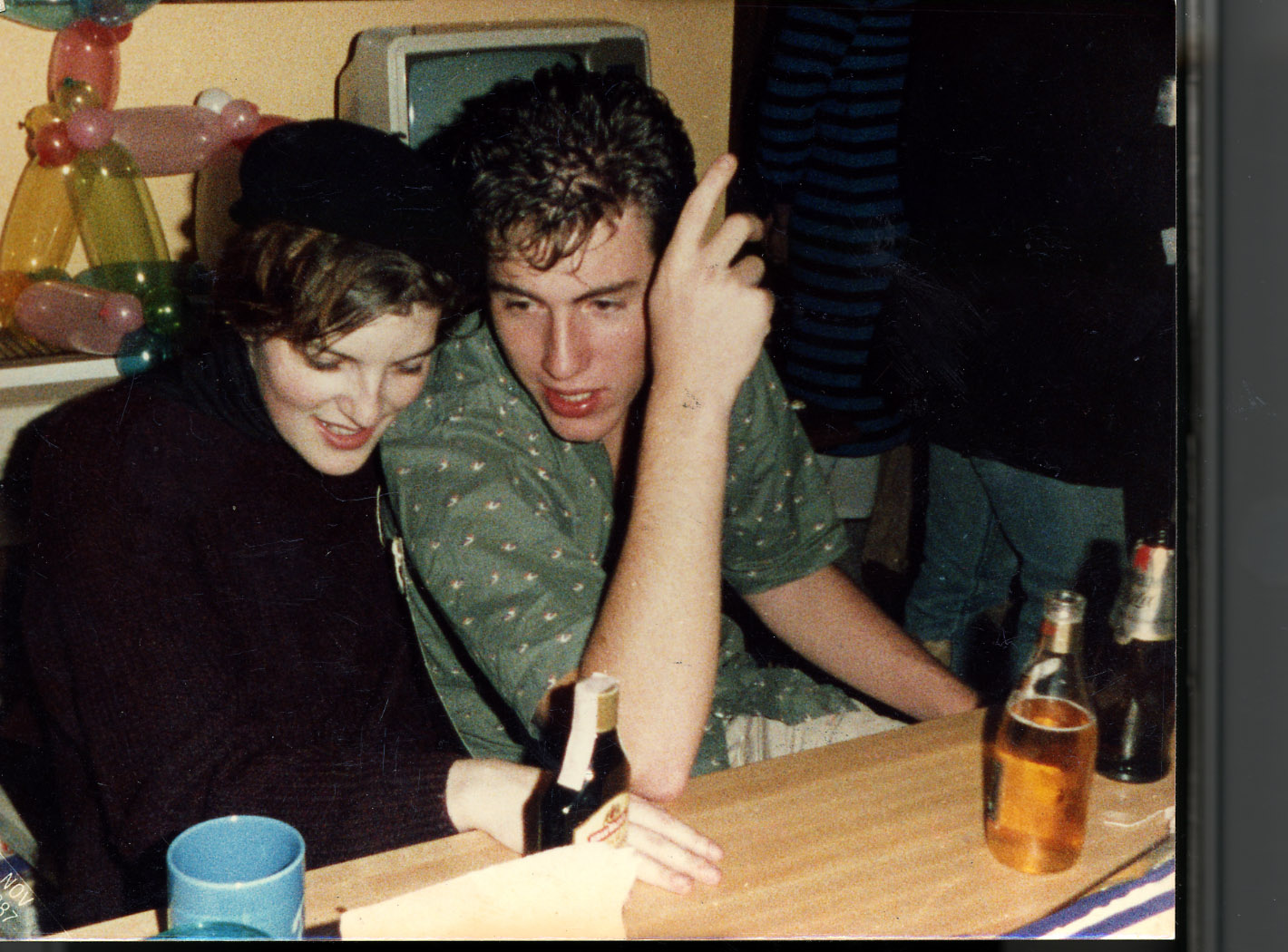
Costumes not so pristine now. I love that picture.
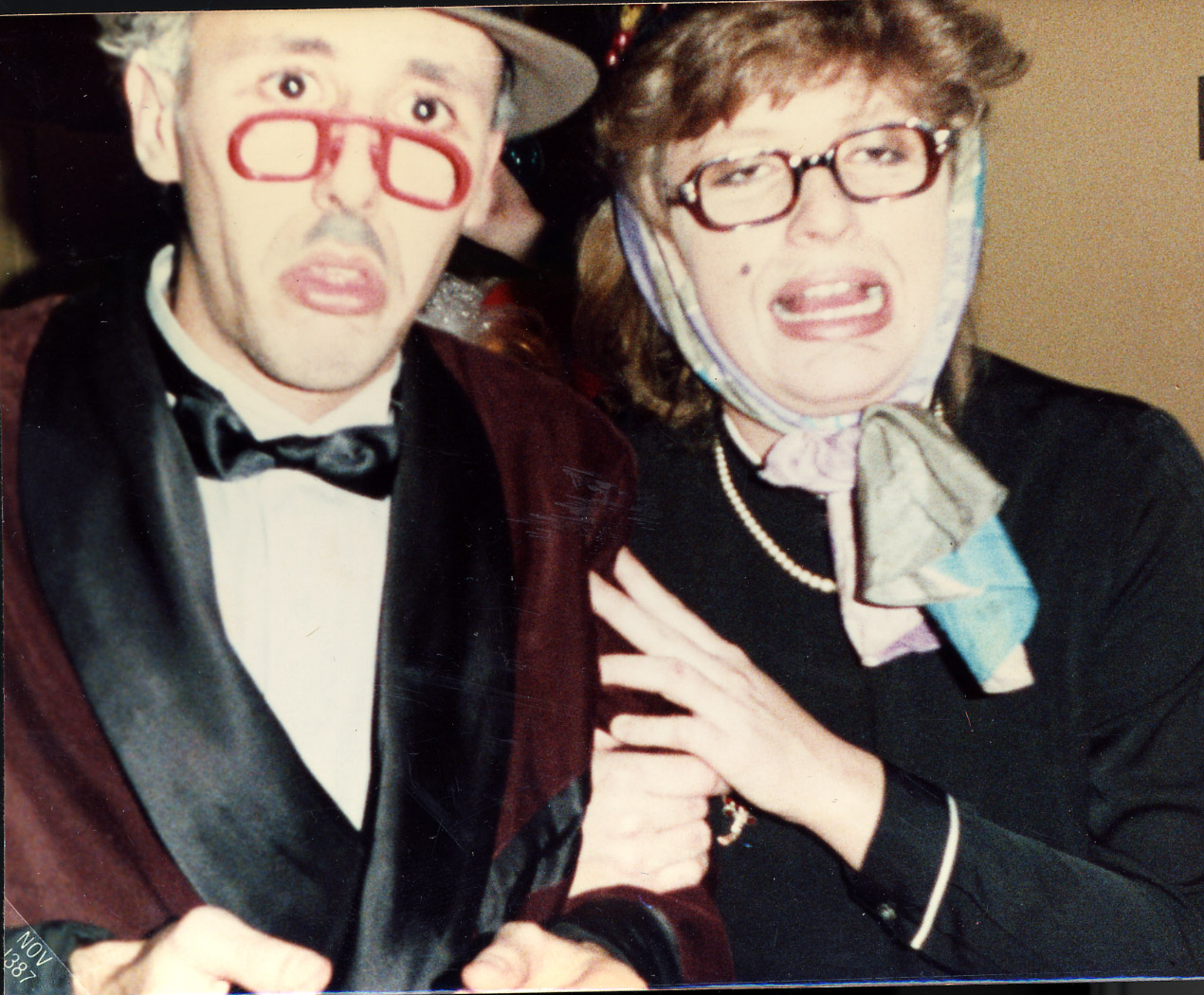
At that same party - my friends Jackie and Mitchell dressed up as Jackie's grandparents - who were FAMOUS to all of us. Chester and Millie. It was like one word. Chester and Millie, Chester and Millie. They died within days of one another. Truly devoted to each other. Anyway, as a tribute - Jackie and Mitchell dressed up (or should I say channeled) Millie and Chester. Here they are.
This is one of my favorite pictures of all time. Look at Mitchell's EYES! He is completely in character. I am also particularly amused by Jackie's mouth. Like: what is Millie saying to Chester? Is she calming him down? I hope so, cause he looks a little worried.
A year later, Mitchell and I joined forces and dressed up as Andy Warhol and Edie Sedgwick. Again, the expression on Mitchell's face in this photo KILLS me. He looks so bored, so arrogant, so OVER it.

A couple years after that - while we were living in Chicago - Mitchell and I got invited to a Halloween party. The whole Woody Allen-Soon Yi thing had just exploded, so we dressed up as Woody Allen and Mia Farrow. Please note that:
1. Mitchell is carrying Crime and Punishment
2. He is using photos of Geisha girls as a bookmark
So wrong. So funny.
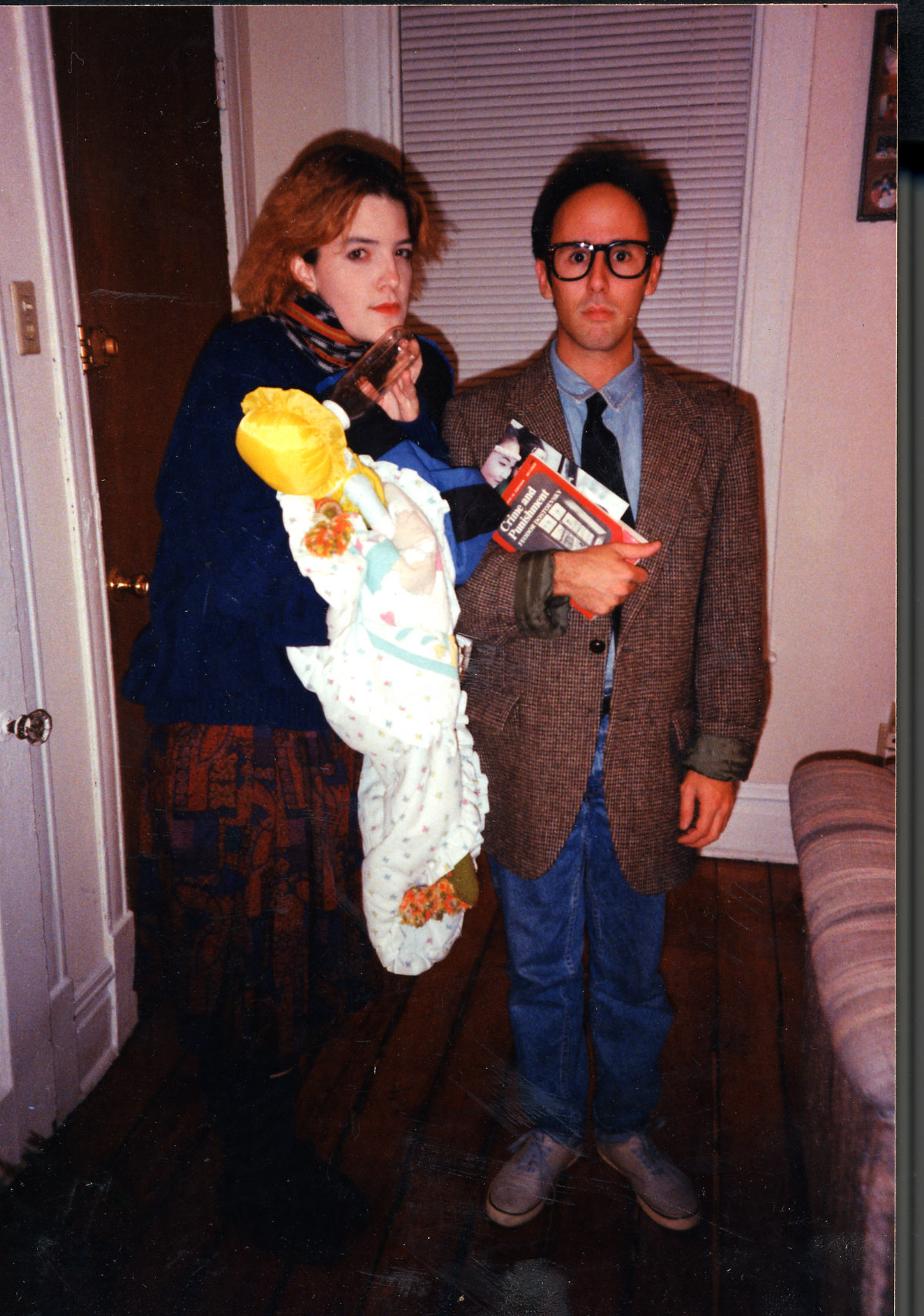
The weirdest thing about it was that when we arrived at the party, NOBODY ELSE WAS IN COSTUME. We had somehow missed the memo that it was a "formal" party - so everyone's in black suits and cocktail dresses and we show up looking like that. They weren't even enough of a COSTUME to protect us. It just appeared that we were slobs who didn't know how to go out in public.
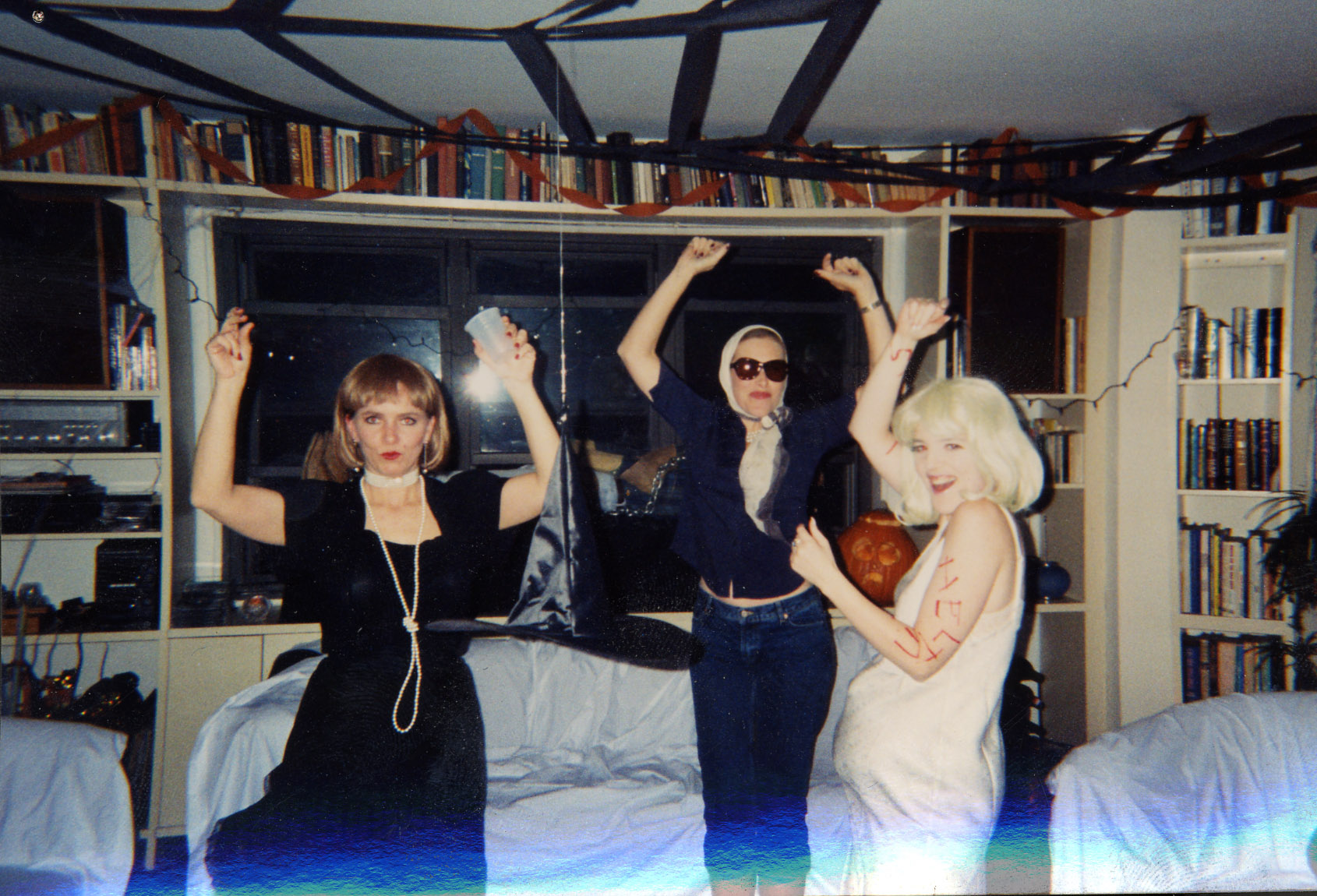
A couple years ago, I was invited to a Halloween party where we had to dress up as someone who was actually dead. A person from history, what have you.
So yeah. I'm evil.

I have written "Helter Skelter" all over my arms and legs with red marker.
To make matters even more evil, I rode the subway to the party dressed like that. I had a huge pregnant belly as well. I got on the F train from Brooklyn, took it to 47th Street, and then walked through the crowds to the apartment where the party was which was on the east side. I was freezing. Now, it was Halloween night, so I certainly was not the only one in costume. I saw witches and warlocks and Playboy bunnies and Medusae and a couple of Chuckies and Buzz Lightyears. I sat on the subway surrounded by daemons from the deep. But there was something different about my costume. I was a walking crime scene. People looked at me once, grimaced and looked away, before glancing back to see if I really was who I seemed to be.
OR, even better, they just stared at me, shaking their head slowly in judgment and disapproval.
Here's the side view of my pregnant belly as I dance with Jackie Kennedy and Mrs. Al Capone.
A couple of years earlier, along the same lines, I had gone to a Halloween party as Squeaky Fromme. It is obviously a theme. No pictures exist of that costume, but I still remember it fondly.
For Halloween ...
... a montage of pin-ups.
Love it. Can't decide my favorite although I am partial to Phyllis Coates flying through the air on the diagonal.
That screening of Diner
So I recounted some story I got off of a documentary about a screening of Diner - and now I read that James Wolcott was there at that screening back in 1982. Exciting!
Yup. The love for Diner rolls on.
I got together with Ted last night and we had a great talk about the movie. Ted was raving about Kevin Bacon and how good he was ... I forget the exact word Ted used for Bacon's performance. Was it my third glass of wine that has obliterated the memory? Ted loved, in particular, the scene where Kevin Bacon stages his own death early in the movie, tipping the car over and lying dead and bloody for his friends to come upon him.
I love when Bacon gets wasted (well, he's wasted through the whole thing) and punches out the Wise Men in the nativity scene on the church lawn. It's so absurd.
But then I love the counterpoint scene of Bacon sitting by himself in his apartment, shouting out the answers to a television quiz show questions. "HERODOTUS. HERODOTUS." or "THOREAU." He gets very little joy out of being right, he's more contemptuous of the ones who didn't get the answer than anything else ... but I just love how Bacon plays that scene. You realize: Huh. This guy has some gifts I hadn't seen before. He's sharp, quick, not just a self-destructive mess. I wonder what happened to him. I wonder why he is so lost.
That's all because of how Bacon plays it.
Well, and how it's written, of course.
Wolcott writes:
At first the movie didn't quite click. The rhythms seemed disjointed, the staging of the fake car wreck didn't quite work, there was a sense that we might be witnessing yet another Americanized version of Fellini's I Vitelloni gone askew, but then came the diner-booth scene where the characters converged and fell into place and the hilarious argument over the sandwich escalated into a guy spat and from then on Rourke and his smooth moves seemed to contour the entire movie to the bittersweet fade.
Diner fans - go read Wolcott's piece.
Today in history: October 30, 1938

From Simon Callow's Orson Welles: Volume 1: The Road to Xanadu
Focusing on the device of an interrupted programme, he dared to attempt a verisimilitude that had rarely been essayed before. The apparent breakdowns in transmission, the desperate irruptions of dance music, the sadly tinkling piano were all held longer than would be thought possible. The actors too were galvanised into startlingly real and precisely observed performances. Frank Readick as Carl Phillips, the reporter on the spot who describes the invasion and then collapses dead at his mike, had listened over and over again to a recording on the explosion of the Hindenburg air balloon from a year or two before and exactly imitated the original commentator's graduation from comfortable report through growing disbelief to naked horror. Using skills honed on The March of Time, the show became, until about its halfway point, a brilliantly effective transposition of the original novel, sharp enough to make even the most sceptical listener wonder, however idly, how Americans might react to the unprecedented event of an invasion, not from Mars, of course, but from Europe - from Germany or perhaps even from England.

The vividness of the dramatisation stems from its imitation of the newscasts whose bulletins so frequently concerned events ominously gathering in Europe. Neither Koch nor Houseman nor Welles intended any serious parallel, of course; they were simply trying to liven up a dull book, using what was all around them, on the air and in the papers.What no one at all could have predicted was that anyone might have thought that an actual invasion from Mars was being reported. There was no attempt to conceal the fact that the listener was hearing a dramatisation of a novel, from the beginning of the programme, with its standard announcement ('CBS present Orson Welles and the Mercury Theatre on the Air in a radio play by Howard Koch suggested by the H.G. Wells novel The War of the Worlds') and the appropriately but conveniently chilling introduction from Welles, taken with only small modifications from the novella: 'We know now that in the early years of the twentieth century this world was being watched closely by intelligences greater than man's but as mortal as his own ... [who] regarded this earth with envious eyes and slowly and surely drew their plans against us. In the thirty-eighth year of the twentieth century came the great disillusionment.' Only towards the end of this introduction does Koch start the process of relocation. 'It was near the end of October. Business was better. The war was over. More men were back at work. Sales were picking up. On this particular evening, October 30, the Crossley service estimated that 32 million people were listening in on radios ...' So the programme is clearly framed as a broadcast within a broadcast. Then comes the neatly devised sequence of weather report, musical interlude (from the non-existent Hotel Park Plaza in downtown New York), news flash about peculiar explosions, more music, more announcements, rambling interview with Professor Pierson, head of the Observatory at Princeton (a gruff and bumbling and highly recognisable Welles), followed by the brilliant on-the-spot reporting sequences.
It was at this point (8.12 p.m. according to Houseman) that the crucial event occurred which precipitated the subsequent panic. The programme that had freed up the slot which gave the Mercury access to the air waves at all was the massively popular Edgar Bergen and Charlie McCarthy show, that most improbable of radio successes, featuring a ventriloquist and his anarchic dummy. Just under a quarter of an hour into the programme, the monocled dummy, his operator and the assembled zanies including Mortimer Snerd, Effie Klinker, Ersel Twing, Vera Vague and Professor Lionel Carp, were given a rest while a vocalist trilled. Immediately, and rather depressingly for the vocalist in question, a large proportion of the listeners would reach for their dials, and twiddle until they found something more congenial, usually returning to the dummy after a few minutes. On the night of 30 October 1938, 12 per cent of Bergen and McCarthy's audience, twiddling away, suddenly found themselves listening, appalled, to a news report of an invasion, by now well under way, by Martians ...

By now a small but significant portion of the audience (with heavy concentration in the New Jersey area) were in a state of high hysteria. The Mercury audience had effectively doubled from its usual 3.6 per cent of the total audience (Bergen and McCarthy had a regular listenership of 34.7 per cent) to six million. Before the programme was even halfway through, the CBS switchboard was jammed with demands for verification, as were switchboards all over the country (Koch reports an operator who very properly replied to a question as to whether the world was coming to an end, 'I'm sorry, we don't have that information here.') Other listeners assumed that the broadcast was the unvarnished truth needing no verification ... The nature of radio, whose unique appeal to the audience's imagination Welles and his collaborators had so brilliantly exploited in their earlier broadcasts, made the Martian broadcast horribly convincing ...Terrified listeners who had called CBS angrily threatened violence against Welles and the company on discovering that they were victims of what seemed to them to be a malicious hoax ... Reporters besieged the building; when they could get through by telephone, they asked Welles or Houseman how they felt about the many deaths the broadcast had caused. Bewildered, frightened and genuinely remorseful, with no means of checking what the reporters were telling them, they could only protest the innocence of their intentions. Columbia were very nervous and steeled themselves for the legal actions which duly followed. They put out hourly disclaimers, affirming the fictional nature of the broadcast. The planned official midnight Hallowe'en broadcast, in which ghosts were to figure prominently, was cancelled ...
Welles himself was palpably shaken by the furore he had unleashed.

In a newsreel interview with assembled pressmen, he apologises, unshaven and boyish, for the distress unwittingly caused. He has the attitude of a repentant schoolboy, big-eyed, serious-mouthed, frightened and exhilarated at the same time: circumspect, but nervously ready to burst out laughing. He says, his voice nervously high-pitched and slightly adenoidal, that the only anxiety they had before the broadcast was that it might have been boring, his only thought as he came off the air that he hadn't given a very good performance. It was planned simply as a Hallowe'en joke, he says, ('I'd every hope people would be excited, just as they are in a melodrama') and he certainly would never do anything like it again. He is charming, but shifty, not quite sure whether he'd got off without any more serious penalties. (Legal actions were filed against both CBS and the Mercury; all failed.) Later, Welles became more articulate about the incident. 'The most terrifying thing,' he
told the Saturday Evening Post 'is suddenly becoming aware that you are not alone. In this case the earth, thinking itself alone, suddenly became aware that another planet was prowling around.' He had another theory, too: 'the last two generations are softened up because they were deprived in their childhoods, through mistaken theories of education, of the tales of blood and horror which used to be part of the routine training of the young. Under the old system the child felt at home among ghosts and goblins, and did not grow up to be a push-over for sensational canards. But the ban on gruesome fairy tales, terrifying nursemaids and other standard sources of horror has left most of the population without any protection against fee-fi-fo-fum stuff.' This second theory seems very personal: the need to embrace demons; the necessity of healthy terror and - presumably - guilt.The War of the Worlds incident, though giving rise to an extraordinary event, and revealing some remarkable aspects of America in 1938, was one of the most purely fortuitous events of Welles's career. His personal responsiblity for it is negligible, beyond having directed it with great flair. Houseman precisely analyses the skill of the production, especially its slow build-up of tension; but most of the people who had been frightened by it had only joined the programme a third of the way through, so they were never subject to that manipulation. Nor was Welles responsible for the adaptation. He later attempted to claim authorship for the script, but there is a great deal of entirely conclusive evidence on the contrary ... There is, moreover, no evidence that the programme was planned as the devilishly clever Hallowe'en prank that it seemed to be. Describing the programme as a practical joke was an idea improvised on the spot as a sop to the panic released during the broadcast. Nor was there a conscious attempt to play on fears of a European invasion. The fact is that Welles had barely thought about the programme, being wholly occupied until the very last minute by his losing struggle with Danton's Death.
Welles was praised for having his finger on the pulse of his times, and for being the conman of the century, able to make anybody believe anything. The truth is that he was more surprised than anyone at what had happened, and extremely irritated by it ... For Welles in October 1938, the immediate result of the broadcast was notoreity. People who had never been to the theatre, who had never so much as read a review and who would never have dreamed of consciously tuning in to the Mercury Theatre of the Air, suddenly knew who he was. And not just in America: the news of the panic flashed round the world, where the incident was held up (particularly in Europe) as proof, if any were needed, of the ingrained idiocy of Americans. 'America today hardly knows whether to laugh or to be angry,' scoffed the London Times. 'Here is a nation which, alone of the big nations, has deemed it unnecessary to rehearse for protection against attack from the air by fellow-beings on this earth and suddenly believes itself - and for little enough reason - faced with a more fearful attack from another world.' It was left to the more popular end of the market to report on Welles himself: the Daily Express piece was headed HE'S A LAD. Recapitulating favourite yarns it hailed him as 'America's best villainous radio voice,' whose 'ha-ha's and hee-hee's are adored by millions.' The Star (STORMY WELLES) offered a more sober assessment: 'he has had a career almost as remarkable as his broadcast ... making history at the Mercury Theatre, New York.' The Evening News was also more interested in his theatrical reputation: 'by his energetic direction and ruthless manhandling of the classics, he has made his theatre, the Mercury, the liveliest in New York ... the broadcast has set the seal on his reputation as the enfant terrible of the New York stage.' It had entirely done that, though its most important effects were to come.

Excerpt from my diary, my senior year in high school:
Then we threw darts and sang the score of The Music Man. He said, "Hey! I have a tape of The Fantasticks!" And he went rummaging around for it but instead he found another tape - with a coo of delight. "Oh! I know! Want to hear War of the Worlds?" I'd heard of it, knew what it was about, knew it was Orson Welles, but had never heard it - so I said yes. Brett put the tape in (he loves it) - then he went around turning off all the lights in his room except for a tiny one on his bedside table.
Then he said, "Okay - get on the bed."
Then he climbed on the bed beside me and we listened to it. We pretended it was real. We pretended that we were a married couple in the 1920s and just normally listening to the radio - and then that comes on. It was SO MUCH MORE FREAKY that way. I convinced myself that I totally believed it. It was really fun.
Then when they announced that it was a recording, we both started screaming and laughing and rolling around, going, "I can't believe that!!!"

October 29, 2008
Happy birthday, Mr. Tony!
Today is Mitchell's birthday. One of my dearest friends in the world. We met (officially) when I was 18 and he was 19, although he knew OF me before that time, and basically stalked me through the Wakefield Mall, hiding in a potted plant outside of Cherry Webb & Torraine. We were destined to be friends. And when it happened, when we clicked, we very quickly became insufferable to pretty much anyone who knew us. It was as though NOBODY HAD EVER BECOME FRIENDS BEFORE since THE DAWN OF TIME. We would literally hold hands and SKIP through the lobbies of our college campus. We were out of control. We fell in love. And we're still in love. He's one of my best and dearest friends.
Our adventures are beyond number. Yes, he ripped Jackie's brown wool leg-wraps, and that was a bitter pill for both of us to swallow. But we moved on. We are all still friends. After college - David, Maria, Jackie, Mitchell and I all ended up in Chicago together. To say we "wreaked havoc" is to misuse language.
But why the title of this post?
That is an old old OLD joke (and it has spawned many other jokes) from when we all first met in college. So it's ancient history yet it is the gift that keeps on giving.
Mitchell was calling his mother at work. I can't remember where she worked - but it was a situation where an intercom would announce the call (Mitchell, do I have this right?) - as in: "Millie, your son's on line 2." So Mitchell, naturally, could never call and just say it was him. He made up names, identities - so that his mother would be called to the phone for "Mr. Zamboni on line 3." (This spawned another game where we would try to come up with the most ridiculous names and it always had to be in the context of a business call. "Mr. Slingback Pump is on line 2." "Yes, can I tell him who's calling?" "Mr. Shrimp Marsala is returning his call." Mitchell and I STILL play this game.)
But one day, Mitchell found himself unable to think of a name under fire. "May I tell her who is calling?" asked the secretary?
Brief horrifying pause where Mitchell went blank, and he then said, "Mr. Tony."
Mr. TONY?? That's the best you can do? Mitchell was like, "I couldn't think of anything! And out came 'Mr. Tony'!"
Of course his mother was now used to this rigmarole, and she came to the phone, picked it up and said, "Fuck you, Mr. Tony."
"Mr. Tony" has so entered the lexicon of our friendship that it is hard to remember where it all started. Everyone is Mr. Tony. Mr. Tony is ubiquitous. It is helpful if you give yourself an adenoidal sound to your voice and an uptight British accent. "Yes, hello, this is Mr. Tony." You can even draw out the "Mr" for extra fun.
How "Mr. Tony" eventually gave birth to "Mrs. Barney" will have to be left for another day.
So, my dear Mr. Tony, I have known you before I knew who I was. You knew who I was. You knew me at my worst, my best. And we're still here. ("A to Z!")
Happy birthday, spacetwin.



The Books: "Life Is a Banquet" (Rosalind Russell)
 Next book on my "entertainment biography" shelf:
Life Is A Banquet
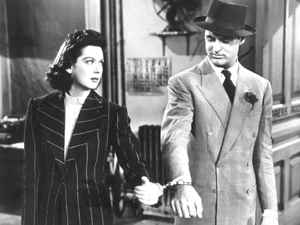
Marvelous book. Laugh-out-loud funny, touching inspiring, serious - with awesome character sketches (her sister Duchess will live on in my memory FOREVER) and just a real joie-de-vivre feeling. You like her SO much. She seems like a great dame. Made good friends, kept them for life, had a great relationship with her husband, had a rocky road of a career (she was one of those actresses "hard to place") - but had the great good fortune to NAIL it in one or two crucial roles in films that will live on forever. She made her mark, man. Imagine a world without His Girl Friday, or imagine that film with any other actress in it. Noooo!!
Her autobiography was published after she had finally succumbed to cancer. She had lost both of her breasts, she was weakened to the point of needing oxygen, a wheelchair ... and yet still: every day, she would dress up, in a lovely suit, and have lunch (with martinis) with her husband. Her husband of 35 years or something like that - Freddie Brisson. They were set up by Cary Grant, who was the best man at their wedding in 1941.
Freddie wrote a prologue to her book. He writes:
After she died I found a petition she had tucked away in her prayer book. It said in part, "Keep my mind free from the recital of endless details; give me wings to get to the point. Seal my lips on aches and pains. They are increasing, and love of rehearsing them is becoming sweeter as the years go by."
Freddie writes of their courtship. Rosalind gave him a HELL of a hard time. He would call to ask her out, and her maid would answer the phone, and he would hear Rosalind bellowing in the background: "Tell him I'm out!!" hahahaha But he was persistent. The two of them went to the races, they went out dancing until 2 o'clock in the morning ... but still. She held him off. She was Hollywood's "Bachelor Girl", after all. She had a great career, and a great life. It would have to be a prrreeeety damn good offer for her to give that up ... and she knew that. She put Brisson through his paces.
Listen to his story of his proposal:
The first time I proposed, she didn't accept. I persisted. "I'm going to write your mother and ask for your hand." And I did. "There's no way I'm going to get rid of you, is there?" Rosalind finally said, laughing. But when she gave up, she gave up on her own terms. "I don't like any of these proposals after you've had an evening out. I'm not interested in that nonsense. If you want to propose, then come around at seven o'clock in the morning, and put a white handkerchief on the ground and kneel down and ask for my hand."At seven o'clock the next morning Roz at last accepted.
The two of them were faithfully married from 1941 to 1976, when she passed away.

Rosalind Russell, in her book, comes off as a person who had her head on straight. Much of that could probably be attributed to her family, and the values they instilled in her. It was a humorous eccentric family, full of siblings ... all powerhouses ... full of accomplishment and lunacy. They were a family who loved to laugh. You can see that in her face. Her face is made for laughter. She comes off as a loyal person. If she was your friend, she was your friend for life. She was quite a clotheshorse and was also responsible for launching the careers of a couple of up-and-coming designers. James Galanos was one of them. He was her dressmaker and stylist for decades.
Her husband, Freddie Brisson, writes in the introduction a story that brings tears to my eyes:
In 1960, after she had the first mastectomy, Rosalind went to [James] Galanos. He says it was the only time he ever saw her break down. She had come to his office, very crisp, very businesslike. "I'm going to tell you something nobody in the world knows except Freddie and my doctor. I've had my breast removed, and I want to keep it quiet. So long as I can be active, I don't want to be thought a freak, I don't want people looking at me in person or on the screen and wondering about my sex life." (You have to consider the era. Women had not yet begun to go public about their mastectomies.)"I want you to start thinking in terms of how I can now be dressed," Rosalind said to Jimmy, and then she began to take her clothes off. She started to cry, and he saw that she could hardly lift her left arm, it was so swollen, and he broke down too. From that day forward, he specially designed every piece of her clothing, and neither he nor his fitter ever told a soul.

She was an actress, not a glamour girl or a starlet. She could never play an ingenue. She was too much of a wisecracker. Her face was too angular to be considered naive or youthful or even, in certain angles, beautiful. Even as a toddler, she looks like she's about to bark out some snarky comment. She had to grow into herself before Hollywood really knew where to place her. I love journeys like hers. It gives hope to all of the odd ones out there, the misfits, the ones who don't conform - not because they don't WANT to, but because they flat out CAN'T. She was one of those.

The book sparkles with life. For example, often in autobiographies like these - the childhood sections come off as schmaltzy or cliched in some way. It's hard to write believably about childhood. You have to be specific. Get rid of the golden mist of nostalgia before you try to do it.
But listen to one of Russell's stories:
We children would be up on the third floor -- we had a billiard room there; my father played billiards, not pool, and to this day I can shoot so well, people think I must have earned my living at it -- playing games and racketing around over my mother's head, while she sat downstairs doing those name tapes. We had turned an alcove on the third floor into a bowling alley, and we also had a pool table.My poor father, he never made a bet in his life, he didn't approve of betting, and he brought up a bunch of gamblers. After he died those of us who were still in school used to come home at different hours -- sometimes just for weekends -- and there was always a crap game going in my father's library. My mother permitted it, and stayed to supervise. The dice were going all the time, and I remember arriving late one Friday night and having a chum of one of my brothers, a young man who didn't know I was a member of the family, warn me against the Russells. "Do you know those people?" he whispered. "Be careful, they're all sharp shooters."
And in the background my relatives were yelling, "Get your money up, get your money up, it;s all cash here ..."
Now I don't know about YOU, but I want to hang out at the Russell house.
"Do you know these people?" hahahahahaha
A terrific book all-around. Read it, that's all.
Here's an excerpt that has to do with His Girl Friday. Listen to how smart she is about acting, process, directing. She is totally in charge. Just let her GO. Prepare the space for her, and let her GO.
Clip from His Girl Friday below.
EXCERPT FROM Life Is A Banquet
The next morning, going into New York on the train with my brother-in-law, Chet La Roche, and most of the people who had been at dinner the night before, everyone had his own copy of the New York Times, and we were all reading, and it said in the New York Times that Rosalind Russell was to play this part in a picture called His Girl Friday. Then it said the names of all the women who'd turned the part down. Howard Hawks, who would be directing, had tried to get Ginger Rogers, Irene Dunne, Jean Arthur; he'd asked every leading woman in town before Harry Cohn had stuck him with me. (I was told later that Cohn had asked Hawks to go up to Grauman's Chinese Theatre and take a look at The Women, but I don't think he ever went.)
Anyway, coming down from Fairfield, I didn't dare look up from the paper. I kept thinking about all these people saying, "Oh, how marvelous."
I arrived back in California in a bad mood, and California was in the middle of a heat wave. I'd built my first swimming pool, a salt-water pool (you just dumped salt in, but you had to have special pipes), and it was about a hundred and seven degrees outside, and I was supposed to go down and see Hawks, but I kept brooding about being humiliated in the New York Times, and before I went to Columbia, I jumped in the pool, got my dress and hair all wet, and then went and sat in Hawks' outer office.
I was always so sassy, it seems to me, so unattractive, now that I think about it.
Hawks came out, did a triple take, and ushered me inside.
"You didn't want me for this, did you?" I said. (Besides being sassy, I was forever assaulting some guy -- Bill Powell, Howard Hawks -- with the news that he really hadn't wanted me.)
"It'll be all right," Hawks said. "You'll be fine. Nonw go to Wardrobe and tell them I'd like you in a suit with stripes, rather flashy-looking."
"Okay, Mr. Hawks, goodbye," I said. "I'll see you later."
His Girl Friday was to be a remake of The Front Page, a story about the newspaper business. Columbia had bought the property from Howard Hughes, who'd already made it once with Pat O'Brien and Lee Tracy as the reporter and editor. It had been Hawks's idea to change the Hildy Johnson character into a woman.
We'd been shooting two days when I began to wonder if his instructing me that my suit should be kind of hard-boiled-looking was the only advice I was going to get from Mr. Hawks.
He sprawled in a chair, way down on the end of his spine, and his eyes were like two blue cubes of ice, and he just looked at me.
After the second day I went to Cary Grant. "What is it with this guy? Am I doing what he wants?"
"Oh, sure, Ross," Cary said. (All the English call me Ross.) "If he didn't like it, he'd tell you."
"I can't work that way," I said. I went over to where Hawks was sitting. "Mr. Hawks," I said, "I have to know whether this is all right. Do you want it faster? Slower? What would you like?"
Unwinding himself like a snake, he rose from his chair. "You just keep pushin' him around the way you're doin'," he said. I could hardly hear him but I could see those cubes of eyes beginning to twinkle.
He'd been watching Cary and me for two days, and I'd thrown a handbag at Cary, which was my own idea, and missed hitting him, and Cary had said, "You used to be better than that," and Hawks left it all in. It's a good director who sees what an actor can do, studies his cast, learns about them personally, knows how to get the best out of them. You play the fiddle and he conducts. I think filming the scene is the easiest thing. It's preparing for it, rehearsing with it, trying to get at the guts of it, trying to give it meaning and freshness so that the other actor will relate to you and think of you as his mother or his wife or his sister, rather than just reciting lines, that's the actor's real work. A good director knows how to help you with it.
A good director also knows when not to direct. Nobody ever tried to direct Gable. They let Gable be Gable. I don't mean that he wouldn't take direction, but when he walked in with the gun and the uniform, and he'd just been over the top, what more could anybody do about that? Gable was the same sitting on the sidelines as he was when he got up and played the scene, and nobody wanted him to be anything else. People like Gable, Wayne, they're personalities, and a personality is an asset, you don't destroy it or mess with it.
Grant was different; he wasn't just a personality, he could immediately go off into a spin and become any character that was called for. He was terrific to work with because he's a true comic, in the sense that comedy is in the mind, the brain, the cortex. (Every actor you play with helps you or hurts you, there's no in between. It' s like tennis, you can't play alone or with a dead ball; and a lot of pictures fail right on the set, not in the script, where they say it starts. A group of actors and a director can wreck a good script; I've seen it happen.)
Cary loved to ad lib. He'd be standing there, leaning over, practically parallel to the ground, eyes flashing, extemporizing as he went, but he was in with another ad-libber. I enjoyed working that way too. So in His Girl Friday we went wild, overlapped our dialogue, waited for no man. And Hawks got a big kick out of it.
Then I started worrying that all this noisiness and newsroom high spirits might seem too chaotic to a watcher, and one night after we were finished I again went to Hawks. "I'm afraid," I said, "that audiences won't follow us."
"You're forgetting the scene you're gonna play with the criminal," Hawks said. "It's gonna be so quiet, so silent. You'll just whisper to him, you'll whisper, 'Did you kill that guy?' and your whispering will change the rhythm. But when we're with Grant, we don't change it. You just rivet in on him all the time."
Everybody in the world talks to me about that picture, though it happened in 1940 and they couldn't get another actress to do it. I've had so many indifferent directors, the kind who didn't prepare, didn't do their homework, faked their way through (and the actor is really the victim of the director), but I've been good with good directors, and for me to get Cukor and Hawks in rapid succession was terrific.
(That an actor needs not only decent direction, but decent material goes without saying. You're home free if you get material that holds you up. George Burns, who won the Academy Award for his part in The Sunshine Boys, told me it didn't even feel like work, playing that Neil Simon script - "The stuff is so funny, the words he uses, the way he puts it together." Being given good material is like being assigned to bake a cake - I might as well add baking to the other similes, tennis, violin playing, I've hauled in here - and having the batter made for you. It's all there, you only have to pour it in the pan, get the oven going at 350 degrees, and you're home free, everybody says you're a master cook.)
Hawks was a terrific director; he encouraged us and let us go. Once he told Cary, "Next time give her a bigger shove onto the couch," and Cary said, "Well, I don't want to kill the woman," and Hawks thought about that for a second. Then he said, "Try killin' 'er."
And once Cary looked straight out of a scene and said to Hawks (about something I was trying), "Is she going to do that?" and Hawks left the moment in the picture -- Cary's right there on film, asking an unseen director about my plans.
Today in history: October 29, 1929

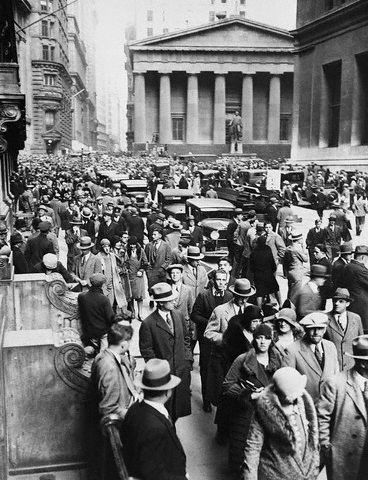
Stock prices virtually collapsed yesterday, swept downward with gigantic losses in the most disastrous trading day in the stock market's history. Billions of dollars in open market values were wiped out as prices crumbled under the pressure of liquidation of securities which had to be sold at any price.There was an impressive rally just at the close, which brought many leading stocks back from 4 to 14 points from their lowest points of the day.
From every point of view, in the extent of losses sustained, in total turnover, in the number of speculators wiped out, the day was the most disastrous in Wall Street's history.
-- NY Times, October 29, 1929
Or, to put it another way:
"My shares, which on Monday I bought,
Were worth millions on Tuesday, I thought.
So on Wednesday, I chose my abode,
In my carriage on Thursday I rode,
To the ballroom on Friday I went,
To the workhouse next day I was sent."
-- Anon., c. 1720, on the collapse of the Mississippi Company in France
October 29, 1929, a compilation.
"Sooner or later a crash is coming, and it may be terrific."-- Roger Babson, September 5, 1929, speaking before his Annual National Business Conference

All speculative bubbles go through four stages, each with its own internal logic. The first stage, which is sometimes referred to as the "displacement", starts when something changes people's expectations about the future -- a shift in government policy, a discovery, a fabulous new invention. A few well-informed souls try to cash in on the displacement by investing in the new vehicle of speculation, but most investors stay on the sidelines. The early investors make extremely high returns, and this attracts the attention of others. Next comes the boom stage, when prices are rising sharply and skepticism gives way to greed. The sight of easy money being made lures people into the market, which keeps prices rising, which, in turn, attracts more investors. Eventually, those upstanding citizens who haven't joined in the festivities feel left out. Not just left out. They feel like fools. If their daughter's boyfriend, who does nothing all day but sit around and play with his computer, can make fifty thousand dollars on his America Online stock, why can't they? Boom passes into euphoria. Established rules of investing, and often more common sense, are dispensed with. Prices lose all connection with reality. Investors know this situation can't last forever, and they vie to cash in before the bubble bursts. As Charles Kindleberger, an MIT economic historian, wrote in his book Manias, Panics, and Crashes: A History of Financial Crisis, "Speculation tends to detach itself from really valuable objects and turns to delusive ones. A larger and larger group of people seeks to become rich without a real understanding of the processes involved. Not surprisingly, swindlers and catchpenny schemes flourish." Finally, inevitably, comes the bust. Sometimes there is a clear reason for the break; sometimes, the market implodes of its own accord. Either way, prices plummet, speculators and companies go bankrupt, and the economy heads into recession. A few months later, everybody looks back in amazement, asking: "How did that happen?"-- John Cassidy, "Dot.con: How America Lost Its Mind and Money in the Internet Era
" (excerpt here)

Until the beginning of 1928, even a man of conservative mind could believe that the prices of common stock were catching up with the increase in corporation earnings, the prospect for further increases, the peace and tranquility of the times, and the certainty that the Administration then firmly in power in Washington would take no more than necessary of any earnings in taxes. Early in 1928, the nature of the boom changed. The mass escape into make-believe, so much a part of the true speculative orgy, started in earnest.-- John Kenneth Galbraith, "The Great Crash 1929
"

"There is no cause for alarm. The high tide of prosperity will continue."-- Andrew W. Mellon, late September, 1929

Some of those in positions of authority wanted the boom to continue. They were making money out of it, and they may have had an intimation of the personal disaster which awaited them when the boom came to an end. But there were also some who saw, however dimly, that a wild speculation was in progress and that something should be done. For these people, however, every proposal to act raised the same intractable problem. The consequences of successful action seemed almost as terrible as the consequences of inaction, and they could be more horrible for those who took the action.A bubble can easily be punctured. But to incise it with a needle so that it subsides gradually is a task of no small delicacy. Among those who sensed what was happening in early 1929, there was some hope but no confidence that the boom could be made to subside. The real choice was between an immediate and deliberately engineered collapse and a more serious disaster later on. Someone would certainly be blamed for the ultimate collapse when it came.
-- John Kenneth Galbraith, "The Great Crash 1929
The rich man's chauffeur drove with his ears laid back to catch the news of an impending move in Bethlehem Steel; he held fifty shares himself on a twenty-point margin. The window-cleaner at the broker's office paused to watch the ticker, for he was thinking of converting his laboriously accumulated savings into a few shares of Simmons. Edwin Lefevre (an articulate reporter on the market at this time who could claim considerable personal experience) told of a broker's valet who made nearly a quarter of a million in the market, of a trained nurse who cleaned up thirty thousand following the tips given her by grateful patients; and of a Wyoming cattleman, thirty miles from the nearest railroad, who bought or sold a thousand shares a day.-- Frederick Lewis Allen, "Only Yesterday: An Informal History of the 1920's
", published in 1932
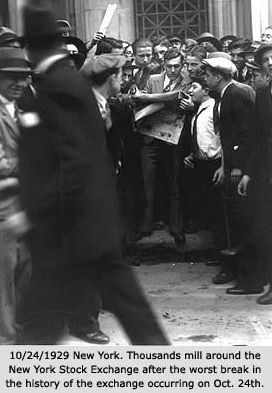
Thursday, October 24, is the first of the days which history -- such as it is on the subject -- identifies with the panic of 1929. Measured by disorder, fright, and confusion, it deserves to be so regarded. That day 12,894,650 shares changed hands, many of them at prices which shattered the dreams and the hopes of those who had owned them. Of all the mysteries of the stock exchange there is none so impenetrable as why there should be a buyer for everyone who seeks to sell. October 24, 1929, showed that what is mysterious is not inevitable. Often there were no buyers, and only after wide vertical declines could anyone be induced to bid.The panic did not last all day. It was a phenomenon of the morning hours. The market opening itself was unspectacular, and for a while prices were firm. Volume, however, was very large, and soon prices began to sag. Once again the ticker dropped behind. Prices fell further and faster, and the ticker lagged more and more. By eleven o'clock the market had degenerated into a wild, mad scramble to sell. In the crowded boardrooms across the country the ticker told of a frightful collapse. But the selected quotations coming in over the bond ticker also showed that current values went far below the ancient history of the tape. The uncertainty led more and more people to try to sell. Others, no longer able to respond to margin calls, were sold out. By eleven-thirty the market had surrendered to blind, relentless fear. This, indeed, was panic.
Outside the Exchange in Broad Street a weird roar could be heard. A crowd gathered. Police Commissioner Grover Whalen became aware that something was happening and dispatched a special police detail to Wall Street to insure the peace. More people came and waited, though apparently no one knew for what. A workman appeared atop one of the high buildings to accomplish some repairs, and the multitude assumed he was a would-be suicide and waited impatiently for him to jump. Crowds also formed around the branch offices of brokerage firms throughout the city and, indeed, throughout the country. Word of what was happening, or what was thought to be happening, was passed out by those who were within sight of the board or the Trans-Lux. An observer thought that people's expressions showed "not so much suffering as a sort of horrified incredulity." Rumor after rumor swept Wall Street and these outlyinhg wakes. Stocks were now selling for nothing. The Chicago and Buffalo Exchanges had closed.
-- John Kenneth Galbraith, "The Great Crash 1929

We were crowded in the cabin
Watching figures on the Board;
It was midnight on the ocean
And a tempest loudly roared."We are lost!" the Captain shouted,
As he staggered down the stairs."I've got a tip," he faltered,
"Straight by wireless from the aunt
Of a fellow who's related
To a cousin of Durant."At these awful words we shuddered,
And the stoutest bull grew sick
While the brokers cried, "More margin!"
And the ticker ceased to tick.But the captain's little daughter
Said, "I do not understand --
Isn't Morgan on the ocean
Just the same as on the land?"-- anonymous poem, published in "The Literary Digest", August 31, 1929

On Sunday [October 27] there were sermons suggesting that a certain measure of divine retribution had been visited on the Republic and that it had not been entirely unmerited. People had lost sight of spiritual values in their single-minded pursuit of riches. Now they had had their lesson.Almost everyone believed that the heavenly knuckle-rapping was over and that speculation could be now resumed in earnest. The papers were full of the prospects for next week's market.
Stocks, it was agreed, were again cheap and accordingly there would be a heavy rush to buy. Numerous stories from brokerage houses, some of them possibly inspired, told of a fabulous volume of buying orders which was piling up in anticipation of the opening of the market. In a concerted advertising campaign in Monday's papers, stock market firms urged the wisdom of picking up these bargains promptly. "We believe," said one house, "that the investor who purchases securities at this time with the discrimination that is always a condition of prudent investing, may do so with utmost confidence." On Monday the real disaster began.
-- John Kenneth Galbraith, "The Great Crash 1929
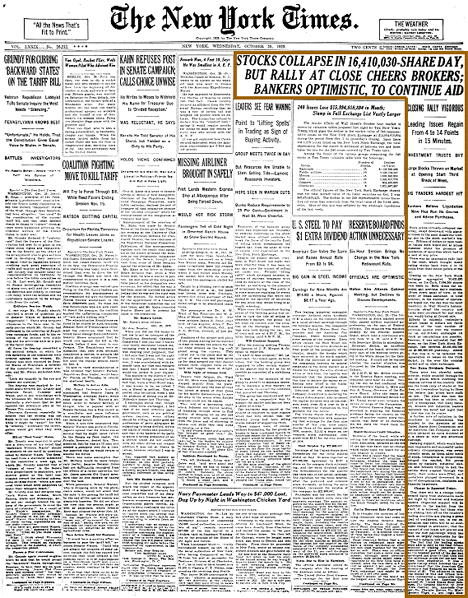
On September 3, 1929, by common consent, the great bull market of the nineteen twenties came to an end. Economics, as always, vouchsafes us few dramatic turning points. Its events are invariably fuzzy or even indeterminate. On some days that followed -- a few only -- some averages were actually higher. However, never again did the market manifest its old confidence. The later peaks were not peaks but brief interruptions of a downward trend.-- John Kenneth Galbraith, "The Great Crash 1929

The singular feature of the great crash of 1929 was that the worst continued to worsen. What looked one day like the end proved on the next day to have been only the beginning. Nothing could have been more ingeniously designed to maximize the suffering, and also to insure that as few as possible escaped the common misfortune. The fortunate speculator who had funds to answer the first margin call presently got another and equally urgent one, and if he met that there would still be another. In the end all the money he had was extracted from him and lost ...The Coolidge bull market was a remarkable phenomenon. The ruthlessness of its liquidation was, in its own way, equally remarkable.
-- John Kenneth Galbraith, "The Great Crash 1929

Transcript from Senate Hearings, April - June, 1932:Senator Couzens: Did Goldman, Sachs and Company organize the Goldman Sachs Trading Corporation?
Mr. Sachs: Yes, sir.
Senator Couzens: And it sold its stock to the public?
Mr. Sachs: A portion of it. The firm invested originally in 10 per cent of the entire issue for the sum of $10,000,000.
Senator Couzens: And the other 90 percent was sold to the public?
Mr. Sachs: Yes, sir.
Senator Couzens: At what price?
Mr. Sachs: 104. That is the old stock ... the stock was split two for one.
Senator Couzens: And what is the price of the stock now?
Mr. Sachs: Approximately 13/4.

Until 1928, stock exchange prices had merely kept pace with actual industrial performance. From the beginning of 1928 the element of unreality, of fantasy indeed, began to grow. As Bagehot put it, "People are most credulous when they are most happy." People bought and sold in blissful ignorance. In 1927 the number of shares changing hands, at 567,990,875, broke all records. The figure then rose to 920,550,032.Two new and sinister elements emerged: a vast increase in margin-trading and a rash of hastily cobbled-together investment trusts. Traditionally, stocks were valued at about ten times earnings. During the boom, as prices of stocks rose, divident yields fell. With high margin-trading, earnings on shares (or dividend yields), running at only 1 or 2 percent, were far less than the interest of 8-12 percent on loans used to buy them. This meant that any profits were on capital gains alone. Over the past 125 years of American history, divident yields have averaged 4.5 percent. The figures show that, whenever the divident yield sinks to as low as 2 percent, a crack in the market and a subsequent slump is on the way. That had been true of the last two bear markets before 1929 came, and investors or market analysts who studied historical performance, the only sure guide to prudence, should have spotted this. There were indeed some glaring warnings. Radio Corporation of America, which had never paid a divident at all, and whose earnings on shares were thus zero, nonetheless rose from 85 to 420 points in 1928. That was pure speculation, calculated on the assumption that capital gains would continue to be made indefinitely, a manifest absurdity. By 1929 some stocks were selling at fifty times earnings. As one expert put it, "The Market was discounting not merely the future but the hereafter."
-- Paul Johnson, "A History of the American People
" (excerpt here)

Among the speculators' favorites during the 1920s were issues like Wright Aeronautics, Boeing, and, especially, Radio Company of America (or Radio, as it was then known), which was the most glamorous and fastest-growing corporation of the 1920s. Commercial radio was a revolutionary medium that shrunk the country like nothing before it, and Radio was the major player in the industry; it both manufactured radio sets and provided the programming they transmitted. In 1921 it's stock hit a low of 11/2. Thereafter, it climbed steadily until 1927, when it headed for the stratosphere. In April 1929, Radio hit a high, after adjusting for stock splits, of 570. During the stunning ascent, old-timers shook their heads in disbelief. Despite its rapid growth, Radio had never paid a cent in dividents, and many of its shareholders were professional gamblers. In October 1929, the stock lost 75 percent of its value. It recovered a bit during 1930, but then collapsed again, and remained collapsed for the rest of the decade. Despite the strong growth of commercial radio, RCA's stock didn't recover its April 1929 level until 1964 -- thirty-five years later.-- John Cassidy, "Dot.con: How America Lost Its Mind and Money in the Internet Era

On Monday, October 21, for the first time, the ticker-tape could not keep pace with the news of falls and never caught up. In the confusion the panic intensified (the first margin calls had gone out on the Saturday before) and speculators began to realize they might lose their savings and even their homes. On Thursday, October 24 shares dropped vertically with no one buying, speculators were sold out as they failed to respond to margin calls, crowds gathered on Broad Street outside the New York Stock Exchange, and by the end of the day eleven men well known in Wall Street had committed suicide. Next week came Black Tuesday, the 29th, and the first selling of sound stocks in order to provide desperately needed liquidity.Business downturns serve essential purposes. They have to be sharp. But they need not be long because they are self-adjusting. All they require on the part of governments, the business community, and the public is patience. The 1920 recession had adjusted itself, helped by Harding's government cuts, in less than a year. There was no reason why the 1929 fall should have taken longer, for the American economy was fundamentally sound, as Coolidge had said. On November 13, at the end of the immediate four-week panic, the index was at 224, down from its peak at 452. There was nothing wrong in that. It had been only 245 in December 1928 after a year of steep rises. The panic merely knocked out the speculative element, leaving sound stock at about their right value in relation to earnings. If the recession had been allowed to adjust itself, as it would have done by the end of 1930 on any earlier analogy, confidence would have returned and the world slump need not have occurred. Instead the market went on down, slowly but inexorably, ceasing to reflect economic realities -- its true function -- and instead became an engine of doom, carrying into the pit the entire nation and, with it, the world.
-- Paul Johnson, "A History of the American People

So long sad times
Go long bad times
We are rid of you at last
Howdy gay times
Cloudy gray times
You are now a thing of the past
Happy days are here again
The skies above are clear again
So let's sing a song of cheer again
Happy days are here again
Altogether shout it now
There's no one
Who can doubt it now
So let's tell the world about it now
Happy days are here again
Your cares and troubles are gone
There'll be no more from now on
From now on ...
Happy days are here again
The skies above are clear again
So, Let's sing a song of cheer again
Happy times
Happy nights
Happy days
Are here again!
-- recorded in late 1929 - it became the #1 hit of 1930. In the new context of 1930 the song lyrics drip with sarcasm.
October 28, 2008
"We all know most marriages depend on a firm grasp of football trivia."

"Do you ever get the feeling that there's something going on that we don't know about? "

"Boog, the bet was 'touch your pecker' not 'pecker in popcorn'."

"What is she ... twelve?"
"She'll be twelve."

"That's what you get for going out with 11th graders. Their brains aren't developed yet."
"Yeah, but her tits were."
"Uh-uh. Falsies."
"Were they?"
"First-hand info."
"Aw, shit."

"Elise's mother's on the phone. How's she doing?"
"The guys think it could go either way."
"Either way. Okay."

"You sonofabitch ... You're a virgin."
" .... Technically."
"Boy, you've got a lot to learn."

Pauline Kael on Diner, 1982:
A wonderful movie, set in Baltimore, around Christmas of 1959. A fluctuating group of five or six young men in their early 20s hang out together; they've known each other since high school, and though they're moving in different directions, they still cling to their late-night bull sessions at the diner-where, magically, they always seem to have plenty to talk about. It's like a comedy club-they take off from each other, and their conversations are all overlapping jokes that are funny without punch lines. Conversations may roll on all night, and they can sound worldly and sharp, but when these boys are out with girls, they're nervous, constricted, fraudulent, half crazy. Written and directed by Barry Levinson, DINER provides a look at middle-class relations between the sexes just before the sexual revolution, at a time when people still laughed (albeit uneasily) at the gulf between men and women. It isn't remarkable visually but it features some of the best young actors in the country: Mickey Rourke, Ellen Barkin, Daniel Stern, Kevin Bacon, Steve Guttenberg, Paul Reiser, and Timothy Daly.
This is one of those rare moments when a critic actually had something to do in a tangible way with a film's success. And not just success - but its survival, its existence. The fact that we have it and were able to see it can be traced, in part, to Kael's review.
I can think of an example of this from the theatre world, when Ashton Stevens championed this new-fangled dreamy play Glass Menagerie written by a newcomer with a weird name, Tennessee Williams. It had opened in an ice-coated Chicago and had not found an audience. Stevens had seen the play and knew something amazing was happening here. Not just in Laurette Taylor's once-in-a-century performance - but in the play itself. It MUST survive. Stevens felt it MUST survive - this small delicate piece of nostalgia. So he hammered away in his columns, begging the Chicago populace to brave the wintry blast and go see it. Celebrities from New York and Los Angeles started flying in to Chicago, or stopping off via train, to see the show. It was one of those moments that happens once in a lifetime - it really COULDN'T happen more than that - because work, in general, just isn't usually that good. But here it was ... and Stevens went to town, drumming up an audience. It worked. That play could have closed in Chicago for good, changing American theatrical history as we know it. Tennessee would obviously have gone on - he had already had a couple of flops - he was the ultimate survivor - and perhaps his "time" WOULD have come later, if it hadn't come with Menagerie - but we'll never know that. It happened the way it happened. The cast, crew, composer (Paul Bowles) ... everyone was working at the top of their game ... but Stevens is a huge part of that story.
When the studio execs first saw Diner, they didn't want to release it at all. Nobody got it. There were no stars in it. Nothing seemed to happen. Diner was going to be shelved. Paul Reiser, who played the mooch Modell ("You gonna finish that?") says in a behind-the-scenes documentary I watched:
There's a story that Barry always told afterward when the movie came out, how executives didn't know what to do with it, the studio guys, and they watched a rough cut of it, a screening, and they said, 'Look, like that scene in the diner when they're arguing about the sandwich - why doesn't he just give him the sandwich and get on with the story?' And Barry said, 'Because there is no story. That is the story. The fact that they're hocking each other for 15 minutes over a sandwich is the story.'
In the middle of this back-and-forth with the studio, someone showed a copy of it to Pauline Kael. At this point, there wasn't even a release date. It couldn't be seen anywhere. Not in New York, Los Angeles or anywhere else. But she wrote a glowing review in The New Yorker - of a film that no one, at that moment, could see.
Ellen Barkin, who plays Beth, the suffering wife of Shrevie, the music fanatic, says:
They didn't want to release it at all and I think it was only released out of embarrassment. They thought, how do we have a movie sitting here that Pauline Kael says is so great, and we're not releasing it ... So let's throw it out there.
And so they did. It certainly wasn't a blockbuster, and it didn't make a ton of money, but you would be hard pressed to find a bad review of the film. And not only that, but it has just grown in stature over the years, for all sorts of reason. It was the launching of the career of Barry Levinson, first of all, and the first of his Baltimore movies. Like Steve Guttenberg says, "Every city would be lucky if it could have a biographer like Barry." But it has also grown in stature because of the long careers that virtually everyone involved has gone on to. It's remarkable. These were all young guys, starting out, green ... they all talk about being terrified at the beginning because they barely knew what they were doing. They also talk about the "green"-ness of Barry and how he would forget to say things like "Action" and "Cut" ... they were newbies. But every single name in that picture has gone on to amazing success. Ups and downs, sure, but look at the longevity and diversity of these people. They are ALL still around. Tim Daly, Daniel Stern, Kevin Bacon, Paul Reiser, Ellen Barkin, Steve Guttenberg and, of course, Mickey Rourke. Remarkable.

Posted, naturally, in the Mickey Rourke category
"Death has come to your little town, Sheriff. Now you can either ignore it, or you can help me to stop it."
Ed Copeland on John Carpenter's Halloween, which turned 30 years old last Saturday.
And Jeremy shares some screenshots from Halloween (some of them which give me a chill of remembering just looking at them. It's always the most BENIGN image that freaks me out, more so than any gore or bloodshed. The laundry on the line? TERRIFYING.)
More in my own personal "book of laughter and forgetting"
Prologue here, in which Michael remembers more than I do, an unheard-of situation in my personal experience.
Me to Michael in response to first email:
What??? I had already seen Johnny Handsome? What am I, on crack? I remember EVERYTHING ... how could I have forgotten?? I was probably just so aware of your smokin' hottiness next to me ... could that be it? ... I am mortified. I wonder what else I have forgotten. Horrifying.
Michael in response:
yes, you completely forgot a lovely afternoon in which we watched JOHNNY HANDSOME together. i feel that Pat may have been there with us, in that uncomfortable apartment with that weird, fey drug addict dude with the dark eyes. i remember lots of cat hair or dog hair, but we watched it. we may have justified watching it for the Southern accents, i don't know, but we watched it all right. i think the assumption that you were distracted by my "hotness" is accurate, though, and i'm willing to forgive you.
Believe it or not, the "dog hair cat hair" detail actually does spark something in my memory, as well as the fey drug addict who eventually became so bizarre that Pat and Michael fled into the night to find other lodgings.
To quote Inspector Clouseau in one of my favorite moments in the entire Pink Panther series: "Yes, it's all coming back to me now ......" (crash ... bang ... boom ...)

Haunted libraries
Just in time for Halloween - a charming piece about ghosts in libraries in the Northeast. I like the sound of this ghost who is said to haunt the Peabody Institute Library in Danvers:
The ghost of an old man sits in a reading room of this 1892 building. Some say he has shushed people talking loudly.
hahahaha Good for you, ghost.
Then, this awesome tidbit from a library in New Jersey:
Phyllis the library ghost was so active at one time that the staff issued her a library card. Jean Hill, a volunteer in the Local History Room, remarked that Phyllis “was not put on our computer with the rest of us mortals, but her card is always available should she choose to use it.” Beginning in 1974, employees started seeing an apparition moving through the front rooms of the building, which was the Vealtown Tavern during the Revolutionary War. The ghost is said to be that of Phyllis Parker, the innkeeper’s daughter, who suffered a nervous breakdown when her boyfriend, a British spy, was hung in 1777 and delivered to the tavern in a coffin. The fireplace in the former reading room was a focal point for phenomena. Another Local History Room volunteer, Eileen Luz Johnston, wrote a 46-page booklet about the spook titled Phyllis—The Library Ghost? in 1991. One of the last known Phyllis sightings took place in November 1989, when a 3-year-old boy saw a lady in a long, white dress in the reading room and said hello to her.
(Speaking of haunting, check out Jonathan's latest in his month-long "October Kill Fest" - an essay about the role of the witch in horror films and fairy tales - It's Witchcraft!)
The Books: "Ginger: My Story" (Ginger Rogers)
 Next book on my "entertainment biography" shelf:
Ginger: My Story
This is my kind of celebrity memoir. It is juicy, gossipy, defensive, and full of sentences like, "I need to set the record straight". In her Introduction, she uses the words "pernicious rumors". She wants to tell her story from HER side, and she just babbles (entertainingly) on and on for almost 400 pages, and you just can't put it down. There is an invisible audience of critics in her mind, reading it, and she writes to them. "Yes, I had a lot of marriages. So what? I loved being married." You know, when you live in the public eye for your whole life, you probably get used to having people (that you know and don't know) weigh in on your behavior - be it professional or personal - and she's internalized that. She can't help herself.
A lot of the book has a "I know what you're going to say, but let me explain" tone. I happen to despise that kind of writing when it's done by bloggers - I've written about it before. I despise it because I fell into that trap in my early days as a blogger, when I suddenly had a lot of readers, many of whom found my love of movies to be irritating. (Don't ask. These people are now long gone - well, one or two hangers-on). But anyway, I found my writing to be going in that defensive direction - starting paragraphs with, "Now, I know what you're going to say ..." Everything needed to be qualified, adjusted. I was constantly acknowledging the people who found me irritating. Terrible writing!! It drove me crazy. And Beth emailed me at one point, mentioning that tendency of mine, and telling me it weakened my writing. She basically was like, "Just say what you want to say!" My first feeling when I read her email was defensive ... but in the next moment, I realized: She is 100% right. I don't like writing this way, anyway. So I consciously got rid of that tendency. Having been through that, I notice it in others, I suppose ... and to me, at least with bloggers, it makes the blogger seem WAY too self-important. As though they have THRONGS of people weighing in at all times ... and although that FEELS true, it really isn't, come on, let's be honest. (Reminds me of the funny cartoon Larry just posted on his site.) Just write your opinion, let people criticize - answer in the comments if you want - but don't muddy up your writing with "Now I know that some of you out there feel ..." caveats.
HOWEVER. When it comes to giants of the film industry - that kind of thing is just a joy to behold. I know it's biased. That's the whole point to reading memoirs of famous movie stars. I WANT bias. I WANT them to stick up for themselves, and tell their side, and set the record straight ... That's why I think Lana Turner's autobiography is seriously one of the best out there. Try to put that book down. TRY. And if anyone had the "public" weighing in on her behavior - it was that one!!
So Ginger sets forth to dispel the "pernicious rumors", to talk back to her critics, to tell it like it REALLY was - and all of that makes for a beautifully entertaining, sometimes funny read. She's likable. I read this book years ago, when it first came out, and there was much about Ginger Rogers that I did not know. My bad!
I grew up poring over the pages of TV Guide for any sign that a Fred Astaire-Ginger Rogers movie was playing. I ADORED them. It seemed to be from a different world. Still in the same century I was living in, but boy, nothing was recognizable to me. Where were those big nightclubs with shiny floors and flowing curtains? Even their voices sounded different. Nobody talked like Fred Astaire in MY world. They seemed ancient - not to mention in black and white - but also so exciting, and beautiful, and I never ever got sick of seeing those movies (it's been almost 40 years now, and I'm STILL not sick of seeing them.)

When I was 11 years old, my drama teacher (Jan Grant, let's give the props) had us all write a report on someone who inspired us from movies or theatre. I wrote my report on Fred Astaire. I remember how hard I worked on that thing. I must have taken books out of the library. I set about to write down Fred's entire journey - with his sister Adele, etc. - and I remember my dad saying to me, gently, "I think what Jan is looking for is not the biography, Sheila - but what he means to you." I have tears in my eyes. He was trying to help me focus. I don't think I took it that way at the time, because I was really proud of my essay - with its "Fred Astaire was born on a cold dark day" details ... but I did take his advice, and spent the last 10 pages of the thing talking about why he was so great, and which movies of his I loved, and why, etc. etc. Thank you, Dad.
My first experience of Ginger Rogers was those movies, and for years I had no idea - ZERO - NONE - NADA - that she was such a heavy-hitting actress as well. One of the big female stars of RKO. It was Rogers, Katharine Hepburn and Irene Dunne - there's a documentary about those three and their competition included in the special features of my Bringing Up Baby DVD. It's fascinating. They each had a niche, they dominated the industry, but they were also pitted against one another.

Rogers got her start in vaudeville as a teenager, did a couple of movies, and then appeared on Broadway in a musical called Girl Crazy. Fred Astaire didn't do the choreography but he was hired to help out. This was how they met. Girl Crazy made Ginger Rogers a Broadway star. With the power of that success behind her, she signed a contract with Paramount, but then got out of it (I love all the contractual stuff - I've mentioned that before. I love to hear the business side of things) - and signed with RKO. It was under the auspices of RKO that Fred Astaire and Ginger Rogers made their many many films together. They were the biggest stars in the world. Those movies came at a time when America really needed them. And also - they were unlike the other musicals at the time ... those two completely revolutionized that tired genre (it was already tired!) and made it something new and fresh. Not to mention the cinematography ... If you watch the filming of those dance scenes, you can see that the camera glides and flows WITH the couple, at the same time that we always see both of them in the screen at the same time. I wish I wish I wish that musicals today would stop it with the jumpcuts and Flashdance-inspired fragmented filmmaking - and just let us see the dancing, dammit. Astaire said about Rogers: "Ginger had never danced with a partner before. She faked it an awful lot. She couldn't tap and she couldn't do this and that ... but Ginger had style and talent and improved as she went along. She got so that after a while everyone else who danced with me looked wrong."
The thing I guess I didn't know about Ginger was that she was primarily an actress. After a decade of musicals, she made the unpopular decision to stop for a while and do straight drama. It paid off. She won an Academy Award for Best Actress for her performance in Kitty Foyle. If you've seen the film (or any of her other straight dramas), you know how good she was. (And I'm sure De could speak to all of this far better than I could. She's probably the biggest Ginger Rogers fan that I know!)

Ginger Rogers was one of those people who was known, primarily, for one thing. She was extremely fortunate - and also had a magic about her that came out when dancing with Astaire that still is money in the bank. Like, you can cash in that check for centuries. Actresses dream of "hitting" something like that - not just being successful - but tapping into something "magic" ... and she did.
But my favorite stories in her chatty defensive funny book are about her struggles to either be taken seriously, or her lobbying for parts that nobody was thinking of her for, because of her reputation for being an actress for musicals.
Garson Kanin, in his chatty awesome book Hollywood tells the story of Ginger Rogers campaigning HARD to play Queen Elizabeth in John Ford's Mary of Scotland ... and it just really moves me, because she knew, in her heart, how good she would be, but she also knew she had to prove it. She was a gigantic star. Didn't matter. Not everybody can play everything. You have to PROVE it to the powers-that-be and proving it takes a lot of guts. Because, more often than not, you are facing a group of people who basically don't see you for the part, don't want you for the part ... it is an unwelcoming atmosphere from the get-go. I talked about this a bit when I mentioned Camryn Manheim's journey as an actress and how she had to SHOW the client that she could be a mechanic, even though they had it in their heads that they wanted a man for the part. Guts. It is my belief that those who become most successful are not necessarily the most talented - but those who do not CAVE in moments such as that. Those who do not CHOKE but "show up", 100%.
So although Ginger Rogers' book is chock-full of great stuff, I chose the excerpt that had to do with her trying to get the part of Queen Elizabeth, because THAT is why Ginger Rogers' career spanned 50 years, I am convinced. She didn't even GET the part. Doesn't matter in the slightest. It's the attitude I am talking about.
30 years later, Ginger Rogers said to Garson Kanin, "They should have given me that part. I would have been sensational."
I agree.
I've also included a clip below from Top Hat.
EXCERPT FROM Ginger: My Story
At a dinner party one evening, I cornered Pan Berman. "Pan," I said, "I know you're producing Maxwell Anderson's Mary of Scotland and that Kate Hepburn is starring. I've also heard that John Ford is directing. Now, Pan, you have tested everybody under the sun but Shirley Temple or me for the role of Queen Elizabeth. Why not let me test for the role?"
"You?" interrupted Mr. Berman. "Why would you want to play the role of such an embittered woman?"
"Oh, come on, Pan, you know I want to get out of those soft chiffon dresses and play something that has some starch in it."
"Dear Ginger," he said, patiently patting me on the shoulder. "You should be glad you do what you do so well. Why don't you just stick to your high-heeled slippers and be happy?"
With that, he gently brushed me off with a smile.
With that, I determined to devise a plan.
I called Leland Hayward. "You're my agent, why don't you talk to Berman about my playing the role of Elizabeth? He won't listen to me."
"Why don't you corner John Ford?" suggested Leland. "Catch him at the commissary during lunch."
I rarely went into the commissary while filming - unless I had to be there for a conference; I preferred to have lunch in my dressing room. Since I wasn't filming, I decided to follow Leland's suggestion. I found out the day and time that the tests were to be made and I went into the commissary. As Ford and some of his camera crew were leaving, I went up to him and told him what I wanted. I knew if I showed up as Ginger Rogers, I wouldn't get to first base. However, if I appeared under a false name, all made up as Elizabeth, the test I made would be judged only on the basis of my performance. John Ford loved a practical joke, and the idea of fooling Pan Berman tickled his funny bone. "Sounds terrific. Call me at home and we'll figure it out."
I called Leland with the good news and told him I thought I should pretend to be British so I'd even have the right accent. Leland loved the idea, and we decided I would become "Lady Ainsley." Listen, if I was going to be British, I might as well go all the way and be an aristocrat! Leland called Pan and told him he had a visiting British actress who might be talked into taking the role.
I got in touch with Mel Berns in makeup and Edward Stevenson in wardrobe. They were both sworn to secrecy. A lot of painstaking detail went into this charade; among other things, I had to get a studio pass under my pseudonym, Lady Ainsley.
The day of the test, I wore clothes different from any I had been seen in before, donned a brunette wig, and put a turban around my head. At the studio, I didn't go through the automobile gate but headed for the Gower Street door. The Gower Street entrance was the first test of my disguise. Studio pass in hand and my British accent at the ready, it worked like a dream. I galloped to Mel Berns's chair and he went to work. First, a plastic skull cap was put over my head. It reached down to my eyebrows, and created the appearance of a very high forehead. Later, a faithfully designed eighteenth-century wig was put over the skull cap. The period makeup for Elizabethan times was a ghostly white, for men as well as women. You can't imagine how this white stuff changed my features. Mel gave my eyes a beady look by creating a narrowness around them and painted a slit-like mouth over my full lips. Eddie Stevenson found a period costume with the full regalia of queenly dress, including a huge stiff ruffle around my neck. If clothes make the woman, then I felt like the real Queen of England! As far as knowing that the queen was Ginger, I didn't think even Lelee would have recognized me.
Leland played his part well, too; he phoned John Ford and gave him the lowdown on my character. Lady Ainsley had been playing Shakespearean roles for the past five years on the London stage where her name was well known. While her husband, Lord Ainsley, was on safari in Africa hunting lions, Lady Ainsley had accepted an invitation from Mary Pickford to stay at Pickfair for a fortnight. Though she was uninterested in making an American movie, Lady Ainsley was persuaded to do the test as a lark. She was a great admirer of John Ford's films, and would enjoy meeting Katharine Hepburn.
John Ford ate it up. Leland then advised John to call Pan Berman and give him the story. "If he doesn't buy it, tell him to call me, and I'll convince him."
When the time came for me to test, I casually strolled onto the stage in this fantastic regalia and felt ten feet tall! Hiding behind character makeup was a new experience for me. Three other women in courtly costumes stood on the set waiting for the camera test. One of them was Anita Colby, a very good friend of my mother's and mine. Each of the ladies-in-waiting curtsied as the assistant director introduced them to "Lady Ainsley". Even Anita bowed; I could hardly wait to tell Lela. I moved off to the test stage and made a grand entrance. No one recognized me. The entire crew stepped aside deferentially, giving me a wide berth. The rumor was that Lady Ainsley was doing this test as a favor to John Ford. I had a ball fooling all the folks I'd worked with month after month. There's nothing Hollywood loves more than a bona fide title, and Lady Ainsley had one ... or so they believed.
John Ford came onto the set and went right to me. He played it straight but I could see the twinkle in his eye.
"Lady Ainsley, we have never met. However, I have seen you perform. I was in London eighteen months ago."
"Perhaps you saw me with Maurice Evans in As You Like It," I answered in my high-toned British accent.
"Yes, that must be it. My, that's wonderful makeup you're wearing. No one could possibly recognize you," he said audibly, and then, lowering his voice so only I could hear, whispered, "I had to tell Hepburn who you are. She'd kill me if she found out later, and I've got to make this film with her."
Katharine Hepburn came onto the stage dressed in her Mary costume. "Miss Hepburn, this is Lady Ainsley," announced the director. Kate looked at me as one does at an adversary.
"Hello," she managed. Kate looked at me again with an indescribably expression.
John placed us for the test and gave the signal, "All right. Camera, action. Don't just sit there. Talk to each other."
We were seated in high-backed oak chairs and a large mahogany table stood in front of us. I turned to Kate, and in my best British accent I said, "I've enjoyed watching your performances very much, Miss Hepburn."
Although everything looked normal above the table, below decks Kate swung her leg back and kicked me in the shins. Her expression was unchanged as she muttered in a stage whisper, "You 0#%&*$!! Who do you think you're fooling?"
I was surprised by her outburst and looked to see if the sound boom was in place. If her remarks had been recorded, that would spoil the whole deal. Luckily, it was a silent test. I bit my tongue to keep from answering back. My composure was slipping, but somehow I managed to offer another weak-tea type compliment. Her look was that of the cat ready to pounce on the canary, and I was the canary. History was reversing itself. "Mary" was going to behead "Elizabeth"!
Ford broke the spell. "Look to the left, then turn to the right. Just keep talking to each other." I moved my mouth as though speaking, as Kate continued to glare at me.
"Thank you, Lady Ainsley," said Ford. "As soon as the other tests are over, I'll come into your dressing room."
I got up slowly from my chair, and turned to Kate. "Thank you, Miss Hepburn," I said through clenched teeth. "Thank you very much."
As I headed for the portable dressing room, I ran smack into my old buddy Eddie Rubin. Eddie wasn't in on this ruse as he hadn't been around when this idea was hatched. He looked right at me as if I was a stranger and let me pass. I waited for the bomb to explode over my disguise. But nothing happened until John Ford burst into the room and said in a loud voice, "Lady Ainsley, thank you so much for your time and trouble. I knew we interrupted your holiday, but in a day or two, we'll get back to you. Leland Hayward is representing you - correct?"
"Yes, that's right, Mr. Ford."
"Good. I will speak with Leland after we see the test. Your Shakespearean ability is known to us, but we needed to see how you photographed opposite Miss Hepburn. Mr. Berman and I will be seeing this footage sometime late tomorrow afternoon. Thank you again." And he disappeared.
I returned to my dressing room, got out of the Renaissance clothing, and then went over to Mel Burns to get the makeup removed. I slipped out of the studio without being detected, and when I reached home, I called Leland to describe the events. He roared at hearing how Kate had kicked me.
A couple of days later Leland called and told me Pan had seen the tests and liked them. Now he wanted them reshot in sound. My ruse was really snowballing!
Alas, someone leaked the story, and the next day Louella Parsons's column was devoted to the Lady Ainsley incident. Lolly sharply criticized me for spending the company's money on a practical joke. Louella loved to give me the "raspberry" whenever she could. Hedda Hopper, on the other hand, seemed to like me, and I liked her. I think this was because she secretly thanked Lelee for not accepting a job offer with the Los Angeles Times. They then offered it to Hedda - and the rest is history. But Louella was another story. Unfortunately, I was not Carole Lombard, who could get away with anything. Louella called it a "practical joke", but in my heart, it was serious. I wanted that part so much I could taste it. And I had no other way of getting a test for the role.
I raced to the telephone to call Berman's house, and spoke with his wife, Vi. She told me Pan had not seen the morning paper because he had gone to the races at Santa Anita early that morning. Shortly thereafter, a friend called and asked me to the races ... at Santa Anita. To go or not to go, that was my dilemma. What if I ran into Berman? I decided to take the risk of bumping into him. With twelve thousand people at the races, that wasn't very likely.
So far, so good! I was standing near the betting window with my friend when I heard a familiar voice behind me. "You little devil! You know, young lady, you really had me going." I turned to face Pan Berman. "That was the best trick ever pulled on me. I had no idea that you were that 'lady' I saw on the screen. I never would have guessed it was you!"
I laughed and suggested that I do a second test. To his great credit, Pan Berman wasn't the least bit angry. His sense of humor about this was far better than anyone could have expected. But I didn't get the second test and I didn't get the part. The role of Elizabeth was given to Florence Eldridge. Maybe it was just as well, because the film wasn't favorably reviewed by the public. And if I had played the role of Elizabeth, both the studio and the public would probably have laid their complaints at my door!
October 27, 2008
The strip scene in 9 1/2 Weeks
Believe it or not, I think this scene was a difficult one to pull off effectively, at least in terms of the goals of the film. I do want to talk more about the film and the fine line the whole damn thing walks (which Adrian Lyne, to put it mildly, is NOT able to capture in some of his other "Oooh, graphic sex" films) ... but for now let's talk about the strip scene. He turns on Joe Cocker's "You Can Leave Your Hat On" and she strips for him, as he sits back, eating popcorn and enjoying her.
What's sexy about it (and this is not the case with a couple of the other more sexual scenes in the film) is that you really feel that these are two characters going through this - not just bodies and attitudes. Often in movies, when it comes time for the characters to have sex - the soundtrack comes on, the lights go down, and these characters become Olympic athletes of the sexual variety. The fact that they are people - who might have feelings about getting naked, or whatever - vanishes (in movie-land, anyway). In 9 1/2 Weeks - which is risky material any way you look at, and could have ended up being just a joke - or soft-core stuff like Wild Orchid - Lyne (and Rourke and Basinger) do not lose sight of the MEAT of the film - which is the relationship between these two. And - (and this is key) - NOT just his controlling of her (although that becomes more and more paramount as the film goes on). But his growing affection and love for her. Actually, that affection is there from the start, which makes him so off-putting (and yet sexy) in his first couple of scenes. He stands too close. He smiles intimately at her like he already knows her. Guy could come off as a creep, but he obviously senses a receptivity in her, a willingness ... and he plays her like a violin. But again: it is NOT just his controlling interest, it is not just his "let me feed you and infantilize" you attitude that comes out over the course of the film. 9 1/2 Weeks is mainly her battle, her battle to stay present, to ask herself questions like, "How far am I willing to go?" ... but by the end, we realize that it was his battle as well. This is a damaged individual. Look at his closet. I would see a closet like that and run screaming into the night. No, just kidding. But it's an interesting character detail, never really dwelled upon, just showed - and we are left to make up our own mind about it. All we need to know about the guy is what his closet looks like, and also the moment that he fills up with emotion at the very end right at the moment that he says the words, "My mother ..." Mickey Mickey Mickey, why are you so brilliant. A lesser actor would only be interested in playing the cool aloof part of the character, because it's safer that way.
Like I said, a film like this could end up being rather silly, and there are silly moments in it - some intentional, some not intentional. Having sex is sexy while you're doing it - but if you put a camera on two people going at it, it can look rather amusing. When the two of them have sex in the rainy stairwell - I know THEY'RE turned on, but to me, it's a funny scene. Not like goofy or dumb, but funny - because in that moment, those two people are totally focused on having sex, dammit, and it's just ridiculous! Actors have the same insecurities that real people do about all of this, so sometimes - as a defense mechanism against that - you can see male actors playing it "cool", like they'll never ever lose their cool - even in mid-sex ... Mickey Rourke is not playing that here, although in their "game" scenes, he definitely takes the lead, and loves taking the lead. But - what he never forgets to play - the element he never forgets to add into the pot - is HIS growing feeling for this woman. When he says at the end, "There have been a lot of girls ... but none I reacted to this way ..." I believe him. Not totally - it's a very unbalancing moment, and his performance is the most unbalancing thing in it, that's why it's great - but because of how he has played other moments (laughing at her jokes, being playful, moments of just BEING with her - when they're cooking in her kitchen, stuff like that) - I buy it. It costs him a lot to say it. And you know (or at least I know) that, in the life of this man, this is the most open he will ever get. This was his chance. She will have other chances. He will not. NONE of this is said, and that's why I think the film works.
I don't think it's a great film, but for me, it does work - and it's that strangely unsettling mix of fondness and cool control that makes it work.
So imagine the strip scene being played in Wild Orchid fashion (only without the plumped-out cheeks): a cool-as-ice man, smirking on the sidelines, as he watches a woman push past her comfort zone. A cool man who would never "lose it", who is always wound up tight, but without ever showing the effort. He would look on as she stripped, maybe he would have one eyebrow raised - that's as close as he would come to showing arousal. He would hold back, withhold ... and cackle with interior joy at her abandon.
That's not what is being played here and that's why the scene is so good, I think. I feel like they're a couple, first of all. This strip scene didn't happen on their first night together. It would have had a much different feeling if it had happened earlier in the timeline. This is at the halfway mark. She doesn't have to be coaxed or cajoled (although she does have a couple of cute freakout moments at the beginning) - and he is into it - not in a "Oooh, look at how much control I have over this woman" way ... but in a "Holy shit, I am the luckiest man alive" way. He's playing that. Some of the other sex scenes are played slowly - lingered over to an almost fetishistic degree - this one is not. They are having a blast.
And he's doing some very unexpected fun things as he's watching her. It's hard to have any focus on yourself in a scene where a woman is taking her clothes off. How do you compete? He does. This is not a scene where it's all about HER (even though it is) - HE is an essential part of making the whole thing work.
Just by watching.
And not just by watching. But HOW he watches.
(Screenshots and clip below. Check out what he does at around the 2:10 - 2:13 mark ... that's the kind of thing I mean).


"Let it not come by word of mouth..."
Today is Sylvia Plath's birthday. Seems weird to wish her a "happy" birthday. Much of this post will be familiar to regular readers. As always, I hone it, from year to year - adding links, taking things away. But it's a day I feel I need to honor regularly - just because of how much her poems have meant to me.

That's a sketch she did of her own hands. She found drawing very relaxing. She would lose herself in it, and spent most of her honeymoon in Spain (a place she found almost unbearably upsetting - Ted Hughes, her husband, wrote a poem many years later called "You Hated Spain") huddled over a sketch pad. She drew the streets, the fruit baskets, the fishing boats. Was there pleasure in it for her? I don't know. I think it was a way to unhinge her brain for a moment, lose herself in the moment - where all she could do, all she was able to do, was just copy what she saw. She didn't have to find the right word, or struggle with the poetry muse ... she just had to sit down and copy what she saw. Ted Hughes wrote a poem, too, about her drawing.
In honor of the birthday of this eventually astonishing poet (she didn't start out that way, although she was certainly precocious - but NONE of her early work could prepare you for what her work became in the last 2 years of her life - it's like another PERSON came out of her ....) - I have dug up some wonderful old photographs of her. She was a chameleon. She was an all-American girl. She was a bleached blonde beach-blanket-bingo girl. She was an academic prodigy. She was a depressive who had survived a suicide attempt her junior year in college. She was the woman who married the big brash English outdoorsman, and suddenly found herself fishing, and hunting, and tromping through the woods in galoshes. Who was she? I have no idea. But you can take a look at all the photographs and see how startling are the transformations. This is not just about the passage of time, and someone looking different as they grew older ... this really seems to be about a shedding of selves (like she writes in Lady Lazarus, in one of my favorite lines: "my selves dissolving, old whores petticoats") -
I look at the picture of the bodacious blonde at the beach:

This was from her summer of recovery from her suicide attempt in college. She spent months in an institution - and then went back to Smith to finish out her education. When summer came - she bleached her hair. Her mother Aurelia Plath was shocked. She pretended to be supportive - but deep down, she wanted a conventional daughter. I have read enough about that woman to feel totally comfortable in weighing in with a judgment like that. Sylvia tormented herself trying to be conventional (many of her problems arose from what she felt was expected from her - as a daughter, as a wife, as a woman, in general) - and bleaching her hair was part of a necessary rebellion. Also, she started having sex. Left and right. Willy nilly. No more good 1950s girl. That "be a good girl" thing had nearly killed her. Her doctor at the time encouraged this rebellion, and taught her about birth control, so she could at least have sex safely. This was a revelation to Sylvia. She was a very sexual person, passionate, kind of wild actually. You know, the thing is - any type of artist is usually, to some degree, on the fringe of polite society - even if they are well-behaved, merely because they have chosen to make their living at art. The strict rules on women at that time were fetters around Sylvia's wrists. NOT CARING what people thought of her - was one of the biggest breakthroughs in her life. NOT CARING if people whispered, "She's a slut." And they did. Especially when she got to England on her Fulbright. Tapping into her REBEL, into her "I just don't care" persona was really important - but ultimately, it didn't matter at all. Because once she got married and once she had kids - these old conventional "roles" started constricting her again (she writes about it extensively in her poems) ... It seemed that there was an incompatability: between the poetess and the woman. Could she be a wife and ALSO a poet? What were the expectations of her? It did not help matters (although she might have thought it would) that she married not just another poet - but one of the most important up-and-coming poets in England - a man who eventually (years later) would be Poet Laureate. Like - Ted Hughes was a big deal. And he was on his way to becoming a big deal when Sylvia met him. How can two poets tryiing to make their names live together? Would they compete? To quote Meryl Streep in Postcards from the Edge, in regards to her competitive mother, "I couldn't compete with you, Mother. What if somebody won??"
Ted Hughes insists (and he has also written extensively about it) that he did not expect a good polite 1950s wife at all. When he first met Sylvia at a party - they both were drunk - and they basically found themselves in an empty room - making out ferociously. Sylvia bit his cheek so hard she drew blood. They were married 4 months later. THIS was their beginning. There was no nice good-girl 1950s courtship. They didn't go out for sodas and a drive-in. No. They were bohemians, for God's sake. They were poets. People like that don't live by society's rules, nor should they. (Especially if the rules are stupid.) But Ted, in some of his later poems, has described how baffled and hurt he was - after their marriage - when Sylvia suddenly got writer's block. She had writer's block for an agonizing year, year and a half - directly after their wedding. Hmmmm, coincidence? I think not. It seems apparent that Sylvia was so terrified of doing BETTER than her husband that ... everything shut down. She then tried to be the perfect housewife - and ... Ted, again, was hurt and confused by this. Where is that wild poetess? Where is my crazy American girl who shouts out lines of Chaucer to the cows? Why is she in the kitchen, tears running down her face, trying to bake pies? I mean ... what has happened??
Then I look at the picture of her with her two kids (taken a month or so before she committed suicide):

Her mother took that photograph during her fateful visit to her daughter. Sylvia was living in England - and her husband Ted Hughes had just left her for another woman. Comparing that photograph to the blonde bikini one - it;s hard to believe it's the same person. Perhaps there's something similar in the smile - there's something phony in both smiles, to my eye. Anyway, I find it fascinating - perusing the photos of Sylvia Plath.
Not nearly as fascinating as her poems themselves which have never lost their power - no matter how times I have read them.
I have gone through a bunch of Plath phases - and I am sure I will go through more. I continue to re-visit her work, every couple of years ... and re-read all those 1960-1963 poems again - sometimes in order - sometimes muddling it up - and every single time, even though I always have different responses, and sometimes one poem suddenly seems THE BEST when a couple years before it was another poem that was obviously HER BEST - but anyway, every single time I read those poems from her last 3 years, they take my breath away. They're no picnic, especially if you read them chronologically. If you read them chronologically - you can feel her get manic - in October of 62 - and she starts cranking out 2, 3, sometimes 4 poems a day. These were not pot-boilers, folks. These poems are now taught in colleges. These are the poems that would make her name. She wasn't just scribbling out insane manic fantasies - these are highly intricate, passionate, unbeLIEVable poems. Then there is a brief falling away for a month - December ... she was still writing, but obviously it was the calm before the storm. Then January and February 1963 came along - and it was the coldest winter London had ever had - and her pipes froze - and she had no help, and two young babies - and things started getting worse and worse in her mind. And her art kicked in yet again - with ferocity and power. She would write these poems at 4 in the morning - her only time to herself. You can feel the wheels start cranking again - in January, February - she wrote some of her best poems then. They are more frightening, however, than the October poems. She is beginning to embrace the idea of death ... Death is always a factor in Plath's poems, but it takes on a new form in those last couple of poems. It is no longer just a fantasy, death is no longer a dream-lover in the night ... or a mysterious figure behind the curtain ... she is now making plans. The rage of October (which gave us such poems as "Daddy", and "Poppies in October", and the entire bee-keeping sequence) is now gone. And you can feel a chilling resolve creep into her work. She is getting ready to go.
I have interspersed the photos of Plath I found with some of my favorite of her poems.
In honor of her birthday, here's one that she actually wrote about her upcoming birthday - in 1962. She wrote this poem, now one of her most well-known, on Sept. 30 1962 ... right before the blast of creativity and rage that would fuel her through that painful next month. Sylvia always had a fatalistic thing with birthdays:
A Birthday Present
What is this, behind this veil, is it ugly, is it beautiful?
It is shimmering, has it breasts, has it edges?
I am sure it is unique, I am sure it is what I want.
When I am quiet at my cooking I feel it looking, I feel it thinking
'Is this the one I am too appear for,
Is this the elect one, the one with black eye-pits and a scar?
Measuring the flour, cutting off the surplus,
Adhering to rules, to rules, to rules.
Is this the one for the annunciation?
My god, what a laugh!'
But it shimmers, it does not stop, and I think it wants me.
I would not mind if it were bones, or a pearl button.
I do not want much of a present, anyway, this year.
After all I am alive only by accident.
I would have killed myself gladly that time any possible way.
Now there are these veils, shimmering like curtains,
The diaphanous satins of a January window
White as babies' bedding and glittering with dead breath. O ivory!
It must be a tusk there, a ghost column.
Can you not see I do not mind what it is.
Can you not give it to me?
Do not be ashamed--I do not mind if it is small.
Do not be mean, I am ready for enormity.
Let us sit down to it, one on either side, admiring the gleam,
The glaze, the mirrory variety of it.
Let us eat our last supper at it, like a hospital plate.
I know why you will not give it to me,
You are terrified
The world will go up in a shriek, and your head with it,
Bossed, brazen, an antique shield,
A marvel to your great-grandchildren.
Do not be afraid, it is not so.
I will only take it and go aside quietly.
You will not even hear me opening it, no paper crackle,
No falling ribbons, no scream at the end.
I do not think you credit me with this discretion.
If you only knew how the veils were killing my days.
To you they are only transparencies, clear air.
But my god, the clouds are like cotton.
Armies of them. They are carbon monoxide.
Sweetly, sweetly I breathe in,
Filling my veins with invisibles, with the million
Probable motes that tick the years off my life.
You are silver-suited for the occasion. O adding machine-----
Is it impossible for you to let something go and have it go whole?
Must you stamp each piece purple,
Must you kill what you can?
There is one thing I want today, and only you can give it to me.
It stands at my window, big as the sky.
It breathes from my sheets, the cold dead center
Where split lives congeal and stiffen to history.
Let it not come by the mail, finger by finger.
Let it not come by word of mouth, I should be sixty
By the time the whole of it was delivered, and too numb to use it.
Only let down the veil, the veil, the veil.
If it were death
I would admire the deep gravity of it, its timeless eyes.
I would know you were serious.
There would be a nobility then, there would be a birthday.
And the knife not carve, but enter
Pure and clean as the cry of a baby,
And the universe slide from my side.

That's a picture of Sylvia from 1953 - right before her first suicide attempt. She was living with her mother - and her mother made her take shorthand classes and typing classes (again: there is something evil about that. That very same attitude is why Barbra Streisand has always had such long nails. People laugh at those nails, or make fun of Babs for them ... but I see them, and I love them. Because to her - those nails meant freedom. Her mother was negative about Barbra's actual goals - she wanted to have a normal daughter - so she signed her up for typing classes. In rebellion, Babs grew her nails to extraordinary length so that even if she wanted to learn how to type - she couldn't physically do it because the nails got in the way. So when I see those nails now - on a 60 something year old woman - I smile. It's a reminder.) There is a story here: of the mother who truly DOESN'T love her daughter. She doesn't. Not really. She wants ANOTHER daughter. She is proud of Sylvia's accomplishments, and Sylvia responds in kind - bombarding her mother with letter after letter listing all of her triumphs and victories - sometimes 3 letters a day ... it's too much. Sylvia, at the end of her life, was starting to come to terms with the relationship with her mother and how toxic it was for her. She writes, quite blatantly, in her journal, "I can never live near my mother again." Her mother comes to visit in Oct. 1962, right after Ted has moved out - to be with Assia Wevill, the woman with whom he had been having an affair. Sylvia was tormented by having her mother see her in such a weak moment. To her, it was unforgivable. She wrote her poem "Medusa" about that experience - which is, you know, shocking in its hatred, and anger. But again: poets who live by society's rules and play well with others are usually not poets to be reckoned with. Sylvia coming to terms with her rage was part of her finding her voice.
"The Moon and the Yew Tree" was written in 1961 - and is considered a breakthrough - by those who have studied Plath's work. In it - she finds some of that cold clear eerie imagery - that she will write about until the very end. She looks out her window and sees a moon, a church, and a black yew tree. It is a beautiful image - and yet ... in the poem ... it becomes a harbinger. Of death, doom.
And personally - I think the first line of this poem is one of her best lines ever.
The moon and the yew tree
This is the light of the mind, cold and planetary
The trees of the mind are black. The light is blue.
The grasses unload their griefs on my feet as if I were God
Prickling my ankles and murmuring of their humility
Fumy, spiritous mists inhabit this place.
Separated from my house by a row of headstones.
I simply cannot see where there is to get to.
The moon is no door. It is a face in its own right,
White as a knuckle and terribly upset.
It drags the sea after it like a dark crime; it is quiet
With the O-gape of complete despair. I live here.
Twice on Sunday, the bells startle the sky ----
Eight great tongues affirming the Resurrection
At the end, they soberly bong out their names.
The yew tree points up, it has a Gothic shape.
The eyes lift after it and find the moon.
The moon is my mother. She is not sweet like Mary.
Her blue garments unloose small bats and owls.
How I would like to believe in tenderness ----
The face of the effigy, gentled by candles,
Bending, on me in particular, its mild eyes.
I have fallen a long way. Clouds are flowering
Blue and mystical over the face of the stars
Inside the church, the saints will all be blue,
Floating on their delicate feet over the cold pews,
Their hands and faces stiff with holiness.
The moon sees nothing of this. She is bald and wild.
And the message of the yew tree is blackness -- blackness and silence
Little Fugue
The yew's black fingers wag:
Cold clouds go over.
So the deaf and dumb
Signal the blind, and are ignored.
I like black statements.
The featurelessness of that cloud, now!
White as an eye all over!
The eye of the blind pianist
At my table on the ship.
He felt for his food.
His fingers had the noses of weasels.
I couldn't stop looking.
He could hear Beethoven:
Black yew, white cloud,
The horrific complications.
Finger-traps--a tumult of keys.
Empty and silly as plates,
So the blind smile.
I envy big noises,
The yew hedge of the Grosse Fuge.
Deafness is something else.
Such a dark funnel, my father!
I see your voice
Black and leafy, as in my childhood.
A yew hedge of orders,
Gothic and barbarous, pure German.
Dead men cry from it.
I am guilty of nothing.
The yew my Christ, then.
Is it not as tortured?
And you, during the Great War
In the California delicatessen
Lopping off the sausages!
They colour my sleep,
Red, mottled, like cut necks.
There was a silence!
Great silence of another order.
I was seven, I knew nothing.
The world occurred.
You had one leg, and a Prussian mind.
Now similar clouds
Are spreading their vacuous sheets.
Do you say nothing?
I am lame in the memory.
I remember a blue eye,
A briefcase of tangerines.
This was a man, then!
Death opened, like a black tree, blackly.
I survive the while,
Arranging my morning.
These are my fingers, this my baby.
The clouds are a marriage of dress, of that pallor.
The Bee Meeting (this is one of the poems in her famous "bee sequence" - which she cranked out at 1 or 2 a day, during October of 1962.)
Who are these people at the bridge to meet me? They are the villagers ---
The rector, the midwife, the sexton, the agent for bees.
In my sleeveless summery dress I have no protection,
And they are all gloved and covered, why did nobody tell me?
They are smiling and taking out veils tacked to ancient hats.
I am nude as a chicken neck, does nobody love me?
Yes, here is the secretary of bees with her white shop smock,
Buttoning the cuffs at my wrists and the slit from my neck to my knees.
Now I am milkweed silk, the bees will not notice.
They will not smell my fear, my fear, my fear.
Which is the rector now, is it that man in black?
Which is the midwife, is that her blue coat?
Everybody is nodding a square black head, they are knights in visors,
Breastplates of cheesecloth knotted under the armpits.
Their smiles and their voices are changing. I am led through a beanfield.
Strips of tinfoil winking like people,
Feather dusters fanning their hands in a sea of bean flowers,
Creamy bean flowers with black eyes and leaves like bored hearts.
Is it blood clots the tendrils are dragging up that string?
No, no, it is scarlet flowers that will one day be edible.
Now they are giving me a fashionable white straw Italian hat
And a black veil that molds to my face, they are making me one of them.
They are leading me to the shorn grove, the circle of hives.
Is it the hawthorn that smells so sick?
The barren body of hawthon, etherizing its children.
Is it some operation that is taking place?
It is the surgeon my neighbors are waiting for,
This apparition in a green helmet,
Shining gloves and white suit.
Is it the butcher, the grocer, the postman, someone I know?
I cannot run, I am rooted, and the gorse hurts me
With its yellow purses, its spiky armory.
I could not run without having to run forever.
The white hive is snug as a virgin,
Sealing off her brood cells, her honey, and quietly humming.
Smoke rolls and scarves in the grove.
The mind of the hive thinks this is the end of everything.
Here they come, the outriders, on their hysterical elastics.
If I stand very still, they will think I am cow-parsley,
A gullible head untouched by their animosity,
Not even nodding, a personage in a hedgerow.
The villagers open the chambers, they are hunting the queen.
Is she hiding, is she eating honey? She is very clever.
She is old, old, old, she must live another year, and she knows it.
While in their fingerjoint cells the new virgins
Dream of a duel they will win inevitably,
A curtain of wax dividing them from the bride flight,
The upflight of the murderess into a heaven that loves her.
The villagers are moving the virgins, there will be no killing.
The old queen does not show herself, is she so ungrateful?
I am exhausted, I am exhausted ---
Pillar of white in a blackout of knives.
I am the magician's girl who does not flinch.
The villagers are untying their disguises, they are shaking hands.
Whose is that long white box in the grove, what have they accomplished, why am I cold.
Fever 103 (another Oct. 1962 poem)
Pure? What does it mean?
The tongues of hell
Are dull, dull as the triple
Tongues of dull, fat Cerebus
Who wheezes at the gate. Incapable
Of licking clean
The aguey tendon, the sin, the sin.
The tinder cries.
The indelible smell
Of a snuffed candle!
Love, love, the low smokes roll
From me like Isadora's scarves, I'm in a fright
One scarf will catch and anchor in the wheel.
Such yellow sullen smokes
Make their own element. They will not rise,
But trundle round the globe
Choking the aged and the meek,
The weak
Hothouse baby in its crib,
The ghastly orchid
Hanging its hanging garden in the air,
Devilish leopard!
Radiation turned it white
And killed it in an hour.
Greasing the bodies of adulterers
Like Hiroshima ash and eating in.
The sin. The sin.
Darling, all night
I have been flickering, off, on, off, on.
The sheets grow heavy as a lecher's kiss.
Three days. Three nights.
Lemon water, chicken
Water, water make me retch.
I am too pure for you or anyone.
Your body
Hurts me as the world hurts God. I am a lantern ---
My head a moon
Of Japanese paper, my gold beaten skin
Infinitely delicate and infinitely expensive.
Does not my heat astound you. And my light.
All by myself I am a huge camellia
Glowing and coming and going, flush on flush.
I think I am going up,
I think I may rise ---
The beads of hot metal fly, and I, love, I
Am a pure acetylene
Virgin
Attended by roses,
By kisses, by cherubim,
By whatever these pink things mean.
Not you, nor him.
Not him, nor him
(My selves dissolving, old whore petticoats) ---
To Paradise.

The Couriers (written in Nov. 1962)
The word of a snail on the plate of a leaf?
It is not mine. Do not accept it.
Acetic acid in a sealed tin?
Do not accept it. It is not genuine.
A ring of gold with the sun in it?
Lies. Lies and a grief.
Frost on a leaf, the immaculate
Cauldron, talking and crackling
All to itself on the top of each
Of nine black Alps.
A disturbance in mirrors,
The sea shattering its grey one -
Love, love, my season.

I think the following poem is the saddest she ever wrote. Now who can ever say what is in the mind of another - and it is always a dangerous thing to read too much into these poems (at least in a biographical way). They are, after all, art. But I believe that one of the reasons she killed herself is to spare her children a mother whose face was "a ceiling without a star". Not that that excuses her actions. But she wrote this poem in January of 1963, 2 weeks before she put her head in the oven. I find this poem nearly unreadable in its sadness. Yet - wonderful writing as well.
Child
Your clear eye is the one absolutely beautiful thing.
I want to fill it with color and ducks,
The zoo of the new
Whose names you meditate ---
April snowdrop, Indian pipe,
Little
Stalk without wrinkle,
Pool in which images
Should be grand and classical
Not this troublous
Wringing of hands, this dark
Ceiling without a star.
Sylvia Plath and Ted Hughes - newlyweds. Happier days. What a gorgeous couple they were.
And this is the last poem that Sylvia Plath completed. It's chilling, yes, but standing alone - as a poem - I think there's a lot to talk about here, a lot of stuff - not just biographical.
The line "her blacks crackle and drag" is fantastic genius-level imagery with major staying power. "Her blacks crackle and drag." (And yes ... let me just throw a shout-out to Paul Westerberg - who has also recognized the genius imagery in that line.) It's scary. "Crackle"? "Drag?" All kinds of very frightening images come to mind in those two simple words ... and the internal rhyme of "blacks" and "crackle" make it seem even more eerie. She completed her last poem (below) on February 4, 1963. She killed herself on February 11.
Edge
The woman is perfected.
Her dead
Body wears the smile of accomplishment,
The illusion of a Greek necessity
Flows in the scrolls of her toga,
Her bare
Feet seem to be saying:
We have come so far, it is over.
Each dead child coiled, a white serpent,
One at each little
Pitcher of milk, now empty.
She has folded
Them back into her body as petals
Of a rose close when the garden
Stiffens and odors bleed
From the sweet, deep throats of the night flower.
The moon has nothing to be sad about,
Staring from her hood of bone.
She is used to this sort of thing.
Her blacks crackle and drag.
Let us not do a disservice to this great artist and see her only in terms of her self-inflicted end. Let us look at her art, please. Let us focus on that. If we can remove the context of her life from the poems; what is left? What do we see? What about those words, huh? What about her WORK?
Other posts I have written about Plath:
The so-called villainy of Ted Hughes
Plath's writer's block of 1959-1960
In which Michael, an ex-boyfriend, remembers more than I do
Mitchell has always referred to me as "the Homer in our group of friends", due to my propensity to write everything down and to retain EVERYTHING. I have a tendency to shock my friends with my memory about THEIR lives. I not only retain my own life, but everyone else's as well.
When it comes to my ex-boyfriends, I sometimes feel like I carry around ALL the memories for both of us, which is not entirely fair of me, it's just a perception I have.
Cut to a couple weeks ago. I am starting my Mickey Rourke obsession and I write a piece on Johnny Handsome, which I hadn't seen.
Last night, I get an email from Michael, one of my ex-boyfriends. I dated him for 6 weeks over 10 years ago, yet we have remained in touch, and good friends. Michael has gone on to great success - and I included the movie he directed (and also wrote and starred in) - Kwik Stop - in my under-rated movies series. I'm proud of him. In 2006, he came and stayed with me for a week, and while the whole week was full of talk - we also had a great conversation, on the roof, about "what we remembered". I love that crap. The world can be a howling wilderness. It is so nice to be reminded that you are specific to someone, that YOU are held in THEIR brain ... it gives substance to the intangible. It means a lot to me.
SO. There is the preamble for the hysterical email I received last night.
He and I haven't talked in a couple of months and suddenly an email from him comes in.
I read it and started laughing.
I wrote him back and asked him permission to post it on the blog, because it is too funny a joke on myself NOT to share. When I asked him if I could post it, he replied,
of course you can quote my email (i'm a whore).
more soon.
#1 Mickey fan
I am laughing out loud.
So here is Michael's email entire.
And remember that I had made this huge deal on my site out of not seeing Johnny Handsome:
ok.
so i just read most of your posts on Mickey and as you already know, i worship the man. more than Travolta. in fact, it's always been a joke amongst my friends that i could go on for hours about his career and how important he is, etc., and for nearly a decade, i was still renting all those straight-to-video pieces of garbage for a glimmer of the former man (Another 9 1/2 Weeks, Bullet, Thursday, etc) and hoping for a comeback in Animal Factory or The Pledge or even Get Carter and finally, yes, Sin City, but The Wrestler seems to be the film to finally put our man back on top.So.
what's this bullshit that you NEVER saw Johnny Handsome before? uh, excuse me, but i distinctly remember showing it to you in Ithaca, at that first apartment Pat & i were staying at, one cloudy Sunday afternoon, talking throughout, pointing out his genius, especially the scene in which he takes off the bandages. how could you forget any precious moment with me?
I have no reason to doubt Michael's memory - although, in my defense, I have NO memory of this - and that is so so weird to me, because like I said - I remember everything. I thought I remembered EVERYTHING about our relationship. That's the whole point of the damn cup I stole. But somehow, I did NOT remember him showing me Johnny Handsome and "pointing out his genius" to me "one cloudy Sunday afternoon". Not only that - but the movie itself has VANISHED from my memory. That is so weird. I remember word for word dialogue from 8 is Enough episodes that aired in 1979 and I don't remember Johnny Handsome, a movie starring my favorite actor? Was I on crack? Was I so overwhelmed by Michael's presence that I wasn't thinking straight? What the hell?
Perhaps it will come back under hypnosis.
So now I am getting a taste of my own medicine. Someone remembers MORE than I do. Very odd. And also - I have been SO busted on my "Ohmygod I have not seen Johnny Handsome" statements and I just love it when that happens. It's so funny to me. I love picturing Michael reading that post and being like, "What the hell is her problem? Yes, she DID see Johnny Handsome. BAH HUMBUG."
Fact-checked by an ex.
So, yeah. I guess I DID see Johnny Handsome, lo those many years ago, as the clouds rolled in from the north, sitting next to my boyfriend, as he pointed out moments he loved, a movie that clearly means a lot to him. But as far as I'm concerned NONE of it remains in my brain. I'll just have to trust him that it happened.
I revel in the novelty of this experience.
October 26, 2008

Hope's psychological realities
When Hope came to live with me, my bed was up underneath my big window. The window has a wide wide sill and that is, naturally, her favorite place to be. I discovered very early on that Hope was not a cuddler, and she never slept in the bed with me. She would sleep on the window sill, hunched up like a Cornish hen, her ears black silhouettes like a little bat in the night. I would sometimes try to drag her into bed with me, to see how she would tolerate it, but no. She would ENDURE it for 2 seconds and then wriggle away to go back to the window. I eventually just let her be.
Then, last weekend, horrors: I moved my bed. I took it out from under the window and placed it across the room against the wall - with no window any where near. I like to lounge about in my bed, surrounded by my books and my laptop. It is my hangout place. Back when the bed was by the window, Hope would sit next to me - only ON THE WINDOWSILL - not on the bed - which was, perhaps, too much of a separation anxiety for Hope, being 2 feet away from the great outdoors, as opposed to her nose up against the screen.
But now that the bed has moved ... hmmmm, not to make too big a deal out of it ... but Hope now hangs out on the bed with me. She still likes her spot in the window (she is there right now) - but she also climbs up on the bed while I am there, and goes into a blissful kneading of the blankets with her paws, and then flops across the pillows, lounging like a pasha. She even lets me pat her belly. Her purrs fill the room.
So. Not to totally anthropomorphize, but obviously Hope made a choice when the bed moved. She actually DID want to be close to me (which is in evidence at other times when she follows me from room to room) ... and so she chose to forsake the window for long stretches of time so that she could be close to me. Not on my lap, but near enough for ... comfort? Togetherness?
A cat's heart is as deep as the ocean.

I have no explanation
3 p.m. Stopped for gas on 95 South at a rest area. I said to gas attendant, "Fill it up with regular, please." He was a short Hispanic man, as short as he was wide. He said, "Someone like you - beautiful woman - beautiful car - should only buy SUPER because YOU are Super!" I started laughing - and he pointed at the directions on the gas tank - and where it said, "Lift nozzle", he said - pretending to read it out loud, "If beautiful woman drives up, she get 50% off." He was basically overwhelming me with compliments. As I drove off, I called out the window, "Thank you!" and I heard his voice come back, "Bye bye, beautiful lady!"
5:15 pm Drove to a home-goods store near my house to stock up on this rose oil I have recently discovered for my oil-burning lamp. I bought it at this same store - I had gone in there just looking for incense a couple of days ago. It is run by a very nice family from China (I got their whole life story in the 10 minutes I was there.) The younger woman pointed out a lamp to me and told me why it was so good. She was a brilliant saleswoman. I bought it. So now - I need to re-stock on the rose oil I like. I walked in and now it was the father, sitting behind the counter. I went right to the counter and picked up a big bottle of rose oil. We started chatting about my new lamp. I told him how much I liked it and how I am a huge fan. The bottle of oil was $20.33. I gave him $25.00 and he handed me back the five saying, "You beautiful. You pay me 33 cents later."
5:30 I stopped off at the wine store to get a bottle of wine. The guy in front of me in line was Italian and telling the man behind the counter about how he's from Italy and they had their own secret recipe for whatever drink it was back home in Italy and he was going to make it for the holidays. He wasn't being noticeably a pain in the ass, but he certainly was not hurrying up the end of the conversation even though I was in line behind him. Then he walked off and I went up to the counter. The fat balding Italian man behind the counter smiled at me, and I said, "How are you?" He said, "Much better now, beautiful."
I considered asking him for a discount, just to see what I could get away with, wielding my newfound beauty that had been stunning men of all accents up and down the eastern seaboard in the last 2 hours. I have no explanation. I had been crying yesterday, so I looked a wreck. I was wearing sunglasses, my hair in a messy ponytail, I had on a baggy Red Sox T shirt, black leggings and a big bulky sweater. I didn't look as bad as this:

but I was pretty darn close.
However, for a brief 2 and a half hours, I was the most beautiful woman in the world, apparently.
It was nice. Made the day full of smiles.
October 25, 2008
Oct. 25: "We few, we happy few ..."
If we are mark'd to die, we are enow
To do our country loss; and if to live,
The fewer men, the greater share of honour.
God's will! I pray thee, wish not one man more.
By Jove, I am not covetous for gold,
Nor care I who doth feed upon my cost;
It yearns me not if men my garments wear;
Such outward things dwell not in my desires:
But if it be a sin to covet honour,
I am the most offending soul alive.
No, faith, my coz, wish not a man from England:
God's peace! I would not lose so great an honour
As one man more, methinks, would share from me
For the best hope I have. O, do not wish one more!
Rather proclaim it, Westmoreland, through my host,
That he which hath no stomach to this fight,
Let him depart; his passport shall be made
And crowns for convoy put into his purse:
We would not die in that man's company
That fears his fellowship to die with us.
This day is called the Feast of Crispian:
He that outlives this day, and comes safe home,
Will stand a-tiptoe when the day is named,
And rouse him at the name of Crispian.
He that shall see this day and live t'old age,
Will yearly on the vigil feast his neighbours,
And say "To-morrow is Saint Crispian":
Then will he strip his sleeve and show his scars
And say "These wounds I had on Crispin's day."
Old men forget: yet all shall be forgot,
But he'll remember with advantages
What feats he did that day. Then shall our names,
Familiar in his mouth as household words
Harry the King, Bedford and Exeter,
Warwick and Talbot, Salisbury and Gloucester,
Be in their flowing cups freshly remembered.
This story shall the good man teach his son;
And Crispin Crispian shall ne'er go by,
From this day to the ending of the world,
But we in it shall be remembered;
We few, we happy few, we band of brothers;
For he today that sheds his blood with me
Shall be my brother; be he ne'er so vile,
This day shall gentle his condition:
And gentlemen in England now abed
Shall think themselves accursed they were not here,
And hold their manhoods cheap whiles any speaks
That fought with us upon Saint Crispin's day.
-- Henry V (Act IV, scene iii)
Two film versions of this magnificent speech below. (The music in the Kenneth Branagh version is brilliant, I think. The speech is so good you don't really need to add too much to it ... but in that case, the music works. Also - watch how he builds it. You keep thinking it can't get more intense ... and yet it does. And, in the Olivier version - i remember vividly my acting teacher in college talking about how Olivier did this speech, especially his last vocal moment, when he says 'day' and catapults his voice up and up and up the scale - it is odd, artificial, and yet also completely fearless and specific. Nobody could pull off a vocal stunt like that except Olivier. )
Harold Clurman and Clifford Odets: Film Noir
Clurman and Odets, old colleagues from the Group Theatre, were reunited in 1946 (at least professionally - they were good friends in real life) to do the film Deadline at Dawn.

I was asked to write a review of Deadline at Dawn for the great site Noir of the Week - and so I did (I was VERY interested to see the only film that Harold Clurman - great man of the theatre - ever directed - not to mention the fact that it was written by Clifford Odets!)
It's a two-part review:
October 24, 2008
Diary Friday
I posted this one a couple of years ago. It is from my junior year in high school. I am in love with someone. The first sentence of this journal entry makes me laugh out loud.
NOVEMBER 14
I am going to Donkey Ball tomorrow at 7:30. It's a wicked fun thing where the classes compete by playing basketball on donkeys. I've never been but everyone's making such a big deal about it. It'll be fun. The band'll be there. [I was in love with DW, band president - so naturally I suddenly became a huge band afficianado.] Now I didn't know that when I bought tickets. This just makes it all the more great. I can't wait!
If you can stand it, I've got a few more DW tidbits for you! And I'm not sorry! [Who ya talkin' to, Sheila?] School is so fun now. Everything goes by so fast. Suddenly it's 4th period French. He's always in there before me. Today, though, he was right behind me. I always recognize his voice. Anyway, I came into the room and put my stuff on my desk. DW brushed past me to get to his desk. I hopped up on my desk and sat there swinging my feet. DW came by to throw something away and as he walked by, he glanced down at me and said, "I saw you at the game on Saturday, Sheila." (in a joking accusing way). My heart started going 5 million beats a milli-second. [Wow. That's so specific.] And I said, "Well, I saw you too!" That was the best I could come up with spur of the moment. I am a dumbass. Then as he walked by again, I started singing, "Duh- duh - duh - duh - deduh! Duh duh duh duh duh duh ..." [What are you retarded, Sheila? I have no idea what that song is supposed to be.] Hearing that, he immediately stopped and looked at me. Okay, I suppose I did sing it cause I knew he would hear. Anyway, he started to his desk, singing his jazzy part. [Again with the jazzy?] I almost died. He's so musical. Really nice deep voice. I felt like throwing myself on him and saying, "You are such a good sax player!" Of course I didn't. [Glad you didn't. Also: y'know what, Sheila Teenager? You're musical too. You have a terrific singing voice. Don't make him out to be God. You're pretty awesome yourself. Just thought you should know.]
Anyway, after class - DW walked out in front of me. God, is he tall - I love it - It's getting easier and easier to just talk to him - it comes more natural. I have inklings sometimes about him, but they're embarrassing to say. [And saying "I'm going to Donkey Ball tomorrow at 7:30" ISN'T embarrassing?] He is always looking over at me. Anyway, I said, "DW!" He stopped and sort of twisted his body to look back at me. [Notice the detail. I noticed EVERYTHING. And I remember EVERYTHING. Body language, how someone stands, turns, their glances, their slight grins - Especially with guys I am crazy about. Their body language is usually emblazoned on my brain like a newsreel. I can still see how the boy I loved when I was 11 tilted his head to the side when he was writing at his desk, etc. etc. A strange phenomenon. And it was in full-blown mania stage with this DW character.] What does he see when he looks at me? Does he see anything? [Er - I hope so. You do, after all, take up space, and are made up of matter. It's not like you're a little ghostie and you call out his name - he turns around and there's nothing there!] I trotted up to catch up to him and we walked along together.
[Please try to read my first comment to DW without guffawing.]
"Is it too late to buy a donkey ball ticket?"
[I am shaking with laughter.]
He said, "Nope!" Very confident voice - not chipper - but ... he looked very - pleased, sort of. Happy. Because I was talking to him? Oh God, Sheila. SHUT UP. Anyway, I said, "Can I buy one at lunch?" "You sure can!" I love him! I love his voice! I love the way he walks, talks, smiles at me, holds his books.
Then I turned and flew lightly down the stairs to Math. When the break bell rang, I ran to meet Mere so we could go to lunch together. I assaulted her with: "LET'S GO TO DONKEY BALL! AHHHH!" [Sheila, what the hell is up with your whole Donkey Ball obsession?] Poor Mere was depressed because of BB and I was so up up up! I saw her face, sobered up and said, "Okay. Sorry. I'm serious now." I tried to keep a straight face, but a smile exploded through, which then got Mere laughing.
We went into the lunch room. There, sitting at one table, with a big donkey ball sign [I swear, if you say "donkey ball" one more time, I'm gonna kick your ass.] was DW! I had a heart attack. I attacked Mere, crying, "Oh, let's get tickets! Let's get tickets!" Mere nodded wearily. "Okay. Okay." [hahahahaha "wearily" ] She leant me some money [Good Lord. She leant me money FOR DONKEY BALL TICKETS? That is above and beyond the call of friendship duty] and I casually strolled over. [Sheila, you couldn't be casual if you tried.] He was sitting - sort of languidly - his long legs jutted out, and I came up. He glanced up, saw me, and smiled -- real smile - I love his smile - I mean, it's like trying to describe how I feel when I'm acting. I can't say it, or describe it. I just do it. I gave him the money for our tickets and he handed me the change, saying, "Thank you, ma'am! Tell all your friends!"
I can't -- I just can't -- I can't tell you how I feel!! But I know how I feel, even though I can't say it.
9 1/2 Weeks:

A couple things:
1. The Manhattan in 9 1/2 Weeks is one that I recognize, and that is not always the case when it comes to the representation of my fair city in film. I am thinking of Unfaithful, another of Adrian Lyne's films, where the streets of Soho look art decorated to death, an idea of itself, rather than the genuine article. Perhaps that was appropriate for Unfaithful, but here in 9 1/2 Weeks, we can see the Manhattan of Midnight Cowboy and other gritty 1970s films. Perhaps not quite as disgusting as the Manhattan of Taxi Driver, but still: the greyness, the random glimpses of humanity, the long long vistas of crazy avenues, the cabs that barrel along looking just as ready to kill you as pick you up ... and the general frenetic air of things like Chinatown and street fairs ... all of this ring true. The opening section of the film, as the beginning credits start, shows Kim Basinger strolling through the streets of New York to her job (at the Spring Street Gallery which means Soho) ... and seriously this woman must have the longest walk to work since my great-great-grandpappy struggled through 10 feet of snow to get to school every day and he liked it. Hasn't she ever heard of subways? She appears to live on the Upper West Side and so she walks 70 odd blocks to work? Also, she strolls under grimy overpasses, walks down roads that look like Broadway, crosses over on side streets, narrow and wet ... Does she cover all 5 boroughs in her morning commute or what exactly is going on here? Maybe that's how she stays so slim. She walks 20 miles to work every morning even though Manhattan is only 13.4 miles long. Anyway. Ridiculousness of her morning walk aside ... Lyne takes the time to show a New York that appears to not have a mask on. A woman with curlers stands on the sidewalk, waiting for her dog to pee, looking annoyed - but not at all concerned that she is out in public in her curlers. Garbage men hoot and holler at Basinger as she walks by. Things are seen and then vanish - which is just what it is like when you walk through Manhattan on any given day. I liked that part of the film ... that even with all its sexual shenanigans - it seems place-able. It seems like it happens in the real world - not some Art Deco soft-core version of New York. (There are a couple of exceptions to this in the film which I'll get to later in some other post. This is just a preliminary post.)
2. I liked how - in the first half of the film - both Rourke and Basinger are, more often than not, filmed from at a distance, with things passing in front of their faces, or a pane of glass in between them and the camera, reflections going by ... Basinger strolls through a street fair, and we see glimpses of her - through the displays of scarves and necklaces, and the bubbles floating through the air. We see Rourke too, and he is also partially hidden by foreground objects or people. It gives a voyeuristic feeling to the film - and yes, I do think that was deliberate - BUT - more than that, it dovetails with what I observed in my first comment: This is New York City, a crowded metropolis. You rarely look at anything without other things in the way. You look up at the spire of the Empire State Building, and there are 10 buildings in between you and it. You look at a sign across the street, and it comes to you in flashes because of passing busses, or garbage trucks, or just the throngs of people. It is a city that seems to keep you at a distance - but at the same time, it beckons you, "Come closer ... come closer ... the only way you will ever really get to know me is if you come really close ..." 9 1/2 Weeks captures perfectly that distant yet intimate feeling in the streets of New York ... and places its characters firmly in that environment. It is not just about them. It is about them navigating their way through the world, with all kinds of things in the way - even just things like a display of necklaces - so that whatever it is that is facing them cannot, yet, be seen directly. Nothing comes off as whole. You have to make sense of the fragments.
This is not wholly successful in the film and there are times when it flat out does not work ... but if you notice by the end of the film - when Basinger finally cracks - we see her head-on. We see him head-on. She stands in his main room, looking at him. Nothing in the way. And he stands in the doorway looking at her, nothing in the way there either. And it's unbearable. They can't be with it - neither of them can ... and so it ends.
I may be reading more into this than is there, but I don't think so.
Some screenshots illustrating all of this below.


October 23, 2008
Don't mind me, Lady. Just doin' my own thing. Where's the Fancy Feast?
Normally when I come home after a long day, Hope is standing right at the door, purring so loudly that I worry for her emotional state of mind. I pick her up and she literally snuggles, purring like crazy, and while I realize that it is really about the possibility of a Fancy Feast meal, I like to think she is happy to see me.
BUT - sometimes - once in a blue moon, I walk in the door and the small purring machine is NOT waiting for me. My hallway (if you can call it that) is empty and barren. She is nowhere to be seen. I have to admit I have a moment of loneliness when this occurs, I miss being greeted like that, so I call out, "Hope?" No response. I check the sink. She's not there. "Hope?" I call out again, like a jealous lover. I move into the apartment, still no furry purring creature ...
... and I walk into my main room and this is what I see.

She is so in the midst of doing her own thing, sleeping so deeply that even when I pet her she barely stirs ... and it just cracks me up because it makes me realize that I do not have a pet, really. I have a roommate. I love that. I love when she just goes ahead and does her own thing - although sometimes it is amusing when she follows me from room to room, even deciding to urinate when I decide to urinate ... like: Hon, you don't need to sync up your bladder with mine, seriously, just chillax ... but I love it best when I see her splayed out in some napping pose like that and can't even be bothered to greet me at the door.
Of course once she realizes I'm home, she becomes a pest and a half, due to the impending Fancy Feast ritual.
Literary Couples
Got this question from Ted:
“Name a favorite literary couple and tell me why they are a favorite. If you cannot choose just one, that is okay too. Name as many as you like–sometimes narrowing down a list can be extremely difficult and painful. Or maybe that’s just me.”
I am not limiting myself to romantic couples. I am thinking in terms of pairs.
John and Alma Summer and Smoke, (excerpt here). The play itself has some problems, and it is certainly not as well-known as Tennessee Williams' more famous plays - but the love story of John and Alma burns right through me. It is his most tragic relationship ... because you know, if the universe were a FAIR one, these two would be together. And nothing at all can be right in the world as long as it didn't work out between the two of them. I can't read this play without weeping. I have lived it.
Joe Kavalier and Sam Clay. The Amazing Adventures of Kavalier & Clay
Max and Eleanor. Hopeful Monsters (excerpt here) A British boy, a German-Jewish girl, fighting across war-torn Europe to be together ... and they don't even know why ... they just know that the world is somehow balanced between them, they teeter on a tightrope wire over the abyss - and somehow ... whatever else happens, Europe being swallowed up by fascism and dictatorship ... their love must survive. Whatever form it takes. The form is irrelevant. Amazing relationship.
Nelson Denoon and unnamed narrator. Mating (excerpt here). I honestly can't go into it at this time. All I know is - these people live, and if it is life and death to THEM whether or not they get back together, then it is life and death to me too.
Beverly and Derek Life Without Friends
Aubrey & Maturin. The Master & Commander series (excerpt here) Their relationship spans so many books and it never gets old, never seems stale - or like it's schtick. These people were obviously very alive to Patrick O'Brian - I never feel him getting into a rote-mode with them, they are difficult complex men - polar opposites in some ways ... and as they get older, their differences just become more entrenched, rather than softening at the edges. Yet there is obviously something in each one that the other relies upon - and gets from him like no other. They are intellectually curious 19th century men, and their relationship is one I treasure. You want them never ever to stop talking to one another.
Jo and Laurie. Little Women
Jane Eyre and Mr. Rochester. Jane Eyre
Gillian and the djinn. "The Djinn in the Nightingale's Eye
Johnny Wheelright and Owen Meany. A Prayer for Owen Meany
Valancy and Barney. The Blue Castle
Romeo and Mercutio Romeo and Juliet
ROMEO
I dream'd a dream to-night.
MERCUTIO
And so did I.
ROMEO
Well, what was yours?
MERCUTIO
That dreamers often lie.
ROMEO
In bed asleep, while they do dream things true.
MERCUTIO
O, then, I see Queen Mab hath been with you.
She is the fairies' midwife, and she comes
In shape no bigger than an agate-stone
On the fore-finger of an alderman,
Drawn with a team of little atomies
Athwart men's noses as they lie asleep;
Her wagon-spokes made of long spiders' legs,
The cover of the wings of grasshoppers,
The traces of the smallest spider's web,
The collars of the moonshine's watery beams,
Her whip of cricket's bone, the lash of film,
Her wagoner a small grey-coated gnat,
Not so big as a round little worm
Prick'd from the lazy finger of a maid;
Her chariot is an empty hazel-nut
Made by the joiner squirrel or old grub,
Time out o' mind the fairies' coachmakers.
And in this state she gallops night by night
Through lovers' brains, and then they dream of love;
O'er courtiers' knees, that dream on court'sies straight,
O'er lawyers' fingers, who straight dream on fees,
O'er ladies ' lips, who straight on kisses dream,
Which oft the angry Mab with blisters plagues,
Because their breaths with sweetmeats tainted are:
Sometime she gallops o'er a courtier's nose,
And then dreams he of smelling out a suit;
And sometime comes she with a tithe-pig's tail
Tickling a parson's nose as a' lies asleep,
Then dreams, he of another benefice:
Sometime she driveth o'er a soldier's neck,
And then dreams he of cutting foreign throats,
Of breaches, ambuscadoes, Spanish blades,
Of healths five-fathom deep; and then anon
Drums in his ear, at which he starts and wakes,
And being thus frighted swears a prayer or two
And sleeps again. This is that very Mab
That plats the manes of horses in the night,
And bakes the elflocks in foul sluttish hairs,
Which once untangled, much misfortune bodes:
This is the hag, when maids lie on their backs,
That presses them and learns them first to bear,
Making them women of good carriage:
This is she--
ROMEO
Peace, peace, Mercutio, peace!
Thou talk'st of nothing.
MERCUTIO
True, I talk of dreams,
Which are the children of an idle brain,
Begot of nothing but vain fantasy,
Which is as thin of substance as the air
And more inconstant than the wind, who wooes
Even now the frozen bosom of the north,
And, being anger'd, puffs away from thence,
Turning his face to the dew-dropping south.
I think Mercutio is the best part in that play.
Charlotte and Wilbur. Charlotte's Web
It is not often someone comes along that's a true friend and good writer. Charlotte was both.
The Books: "'Tis Herself: A Memoir" (Maureen O'Hara)
 Next book on my "entertainment biography" shelf:
'Tis Herself: A Memoir
Maureen O'Hara was one of those "old" movie stars that I grew up knowing about because of the yearly showing of Miracle on 34th Street on television, as well as my absolute obsession with Parent Trap. God, how I loved that movie. I wanted to be in it, I wanted to live it, I wanted to go to that camp, I wanted a British accent, and I wanted to wear little yellow sunsuits. Maureen O'Hara, with her flaming red hair and SLAMMING body (so soft and voluptuous in the early 50s - in Parent Trap transformed into a veritable zigzag of curves accentuated by bullet bras that would put your eye out), was so much fun in that movie, and I, as a little kid watching it on TV, thought: "Oh, it is so OBVIOUS that she still loves her husband!!" I liked her temper tantrums, her sort of self-righteous attitude - because it was so obvious that underneath it she was as soft and vulnerable as anyone. That was, unbeknownst to me at the time, the major element of O'Hara's appeal (well, that and the red hair, green eyes, and slamming body): the temper-y hothead, untameable, a shrew, a wild lion ... but what all of that is hiding is a soft womanly heart. If you could tap into it, and access it, you'd be the luckiest man alive. The other reason she was an actress who was familiar to me was because of, of course, The Quiet Man. Beloved by many, but beloved in particular by Irish Americans (as evidenced by my conversation with Eamonn at the Ice Bar in Dublin). When I saw ET, I felt like the smartest person in the world because I recognized that clip of the kiss in the wind from Quiet Man: that wasn't just some old movie, it was a movie I knew by heart! I loved one of my father's comments about Quiet Man, and he said this, oh, 20 years ago, but for some reason I remember the jist of it perfectly: "It has the best fight scene I've ever seen, and when I first saw it I really thought it was about 20 minutes long. It involves the whole town and goes over the fields ... and when every time I see it, it feels like the fight scene gets shorter and shorter. But I still remember the first time I saw it and I couldn't believe how long that fight scene was!" I am sure you all know the fight scene I mean. It makes me laugh just thinking about it.
In the years to come, I would watch many more of Maureen O'Hara's pictures - filling in all of the many blanks (she made 5 films with John Ford - and a bunch with John Wayne - she has said, "He [Wayne] was my best friend for 40 years.") - and had her struggles with Hollywood, like most successful actresses did. She felt she was not considered for really dramatic parts, and that they were trying to pigeonhole her. Of course that was true - and her role in The Quiet Man is the ultimate pigeonhole - fiery untamed Irish lassie - but she found a way to work the system, and be okay with it. She really was a "fiery" woman. I love the stories about her battles with John Ford - who, obviously, felt very strongly about his own Irish-ness.

O'Hara would sashay onto the set, and they'd basically do "Irish schtick" together, for the crew - and it was Ford's way of asserting, "I'M IRISH, I'M IRISH, LOOK HOW IRISH I AM, I CAN GO TOE TO TOE WITH MAUREEN" - and O'Hara knew that that was what he was doing, and that was what was expected of her - but at the same time, when he pissed her off she would let him have it. A fascinating relationship.
But she was one of those people who fought to hold her ground, who did contractual battles, and battles with studio execs - she wasn't a cringing violet, who felt lucky to just be working. For example, when she signed on to do Parent Trap, it was in her contract that she would have top billing. She was the leading lady of the picture and a huge star. When she eventually saw the poster, it said:
Hayley Mills and Hayley Mills
in
THE PARENT TRAP
Starring MAUREEN O'HARA and BRIAN KEITH
O'Hara went ballistic. She knew that Walt Disney had decided to ignore her contract and promote Hayley in the double role (basically calling attention to the revolutionary split-screen filming that they had done to make her appear as twins). O'Hara complained - and it started moving up the chain of command - 'take it to this person', 'take it to SAG' ... and to actually take on Disney was not (then or now) a pleasing prospect. Is this the hill you want to die on? O'Hara never worked for Disney again. Which is a shame, because I think she was the perfect Disney leading lady. But that was who she was. Do NOT take advantage of her, and more than that: don't betray her. That ad campaign for Parent Trap put Disney in breach of Maureen's contract - but they obviously knew that they held all the cards and whatever fight she wanted, she would not win.

Her autobiography is full of great anecdotes like that. She was a canny businesswoman - protective of herself and her interests ... and eager to show all that she could do, even if Hollywood wanted to pin her down. Her stories of battling the studios (and hell, I love crap like that - I love the stories of Bette Davis and Marilyn Monroe - and all of those people who really stood up for themselves in that environment) are fasciating - a real glimpse into a world that no longer exists, but with much relevance to young actresses today.
Maureen O'Hara was born into an eccentric arts-loving family who lived in Ranelagh, a suburb on the outskirts of Dublin. (My last trip to Dublin I stayed in Ranelagh.) Her mother also was a crazy redhead, and O'Hara grew up surrounded by jokes, laughter - an Irish cliche, basically. But she remembers it all as warm, beautiful, and joyous - a wonderful beginning for life. Her parents were into opera, football, fashion (her mother was, apparently, a clotheshorse - and brought the young Maureen shopping with her) - her mother was also an actress and a singer. Maureen knew quite early that acting was what she wanted to do - and she got some jobs on the radio, and what amounts to summer stock - she was only 13, 14 years old ... but finally, she got serious enough to begin studying for real. At 14, she auditioned for the famous Abbey Theatre in Dublin and was accepted - it was there that she really began to learn how to be an actress. Things were on fast-forward for her, when you read about it. Everything seems to proceed in a logical fashion. Of course she would be approrached to do a screen test. Of course she would resist at first - what about being a stage actress? Then of course she would come to her senses and go to London for the screen test. And of course Charles Laughton would see the screentest and be struck dumb by her eyes, he was so struck by her that he put her under his own personal contract. And the rest is history. Maureen O'Hara was one of the most successful stage actresses in Ireland (winning prizes left and right) by the time she was 15 years old, and when she went to Hollywood, under the wing of Charles Laughton, started off playing leads. Pretty incredible. No working her way up the ladder. Her book details that journey in humorous prose. You really like her. She seems very personable, with a temper you admire, and a seriousness about the work that is undeniable. Her desire to be a good actress is supreme.

She was an actress MADE for the invention of Technicolor. She's a gorgeous woman, even in black and white ... but what sets her apart from other gorgeous women? Her coloring. The red hair, pale skin, and green eyes ... It's almost like Technicolor was developed FOR her. That first glimpse of her in Quiet Man depends on the colors.

Maureen O'Hara retired from acting in the70s and in many way her post-acting career has almost been more interesting. She married a pilot - Charles Blair- who was killed in a plane crash in 1978. He had a long history with Pan Am, and in his wake, she managed his company - Antilles Airboats, traveling the world, promoting the excitement and possibilities of aviation. She eventually became President and CEO of the company (the first female CEO of an airline) - and lives, to this day, down in the Virgin Islands. She is one of those go-to gals for aviation fanatics around the world, because of the history she has seen in that industry. She supports and promotes aviation museums, the restoration of air boats and other classic aircraft, and the keeping of that history. She donated her husband's Sikorsky VS-44A plane (nicknamed "Queen of the Skies") to the New England Air Museum - and a friend of mine who is a freak about all things aviation gave me a postcard of the plane which is on my bulletin board. A Spruce Goose, indeed. She's done a couple of films in the 90s - coming out of retirement - and she is a very old woman now. Almost 90. She maintains her connections with all the different worlds she inhabited - Irish, filmmaking, aviation ... a truly interesting woman.
Oh, and let's not forget the groundbreaking moment when O'Hara became an American citizen (while maintaining her Irish citizenship) in 1946 and she put up a stink about being referred to as a "British subject":
There must have been a thousand questions on their standard questionnaire. After I completed it, I went and took the exam. I must have passed because I was then sent before a woman, ann officer of the court, who instructed me to raise my right hand and forswear my allegiance to Great Britian. FULL STOP!Forswear my allegiance to Britain? I didn't know what she was talking about. I told her, "Miss, I'm very sorry, but I cannot forswear an allegiance that I do not have. I am Irish and my allegiance is to Ireland." She looked at me with consternation for a moment and then said, "Well, then you better read these papers." She handed me back the stack of papers I had filled out before my exam. I perused them and was stunned to see that on every page where I had written "Irish" as my former nationality, they had crossed it out with a pen and written "English".
I told the woman, "I'm terribly sorry, but I can't accept this. It's impossible for me to do. I am Irish. I was born in Ireland and will only do this if I am referred to as an Irish citizen." She seemed perturbed that I would break the routine of the allegiance ceremony, and said, "I can't do that. You'll have to go to court to obtain the order for me to do it."
"Fine," I said. "When shall I go back to court?" I didn't have to come back. I did it right then and was taken straight to the courtroom. No attorneys were allowed in the courtroom with me, only my two witnesses. I stood in front of the judge, whose name I can't remember, and listened as the clerk explained why I was there before the court. Then I told the judge, "I am Irish. I will not forswear allegiance to Great Britain because I owe no allegiance to Great Britain. I was born in Dublin, Ireland."
The judge and I then went into a very long discussion of all of Irish history. He challenged my assertions. We kept going over it and over it, back and forth, but I wouldn't give an inch. I couldn't. Finally he said, "We're going to have to find out what Washington thinks." He instructed the clerk, "Check Washington and see what they consider a person like Miss O'Hara." The clerk left the courtroom and returned shortly after that. He told the judge, "Washington says she is a British subject." I was furious and told the judge, "I am not responsible for your antiquated records in Washington, D.C." He promptly ruled against me.
I had no choice but to thank him and tell the court, "Under those circumstances, I cannot accept nor do I want to become an American citizen." I turned to walk out of that courtroom, but having the kind of personality that I do, thought I couldn't give up without taking one last crack at him. I was halfway out of the courtroom when I turned back to him and said, "Your Honor, have you thought for one moment about what you are trying to force upon and take away from my child and my unborn children and my unborn grandchildren?" He sat back and listened intently as I went on, "You are trying to take away from them their right to boast and brag about their wonderful and famous Irish mother and grandmother. I just can't accept that."
He'd had enough. The judge threw his hands up and explained, "Get this woman out of here! Give her anything on her papers that she wants, but get her out of here!" The clerk moved in my direction and I simply said, "Thank you, Your Honor."
I didn't know at that time that my certificate of naturalization had already been created, and that they had listed my former nationality as English. Sometime between that date and the date when I was called to be sworn in as an American citizen, they changed my certificate in accordance with the order of the court. Where my former nationality was printed, they had erased "English" and typed over it "Irish". On the back of this document it states that "the erasure made on this certificate as to Former Nationality 'Irish' was made before issuance, to conform to petition. Name changed by order of the court." It is signed by the U.S. District Court.
This was the first time in the history of the United States of America that the American government recognized an Irish person as being Irish. It was one hell of a victory for me because otherwise I would have had to turn down my American citizenship. I could not have accepted it with my former nationality being anything other than Irish, because no other nationality in the world was my own.
A scandal arose in the wake of this, when incorrect reports came out that she had challenged the court during the ceremony in which the oath of allegiance was taken. Judges across the land wrote terrible things about Miss O'Hara, and the federal judge who had presided over that particular allegiance ceremony said that Miss O'Hara was a liar, and that the incident never happened.
He was correct that the event did not happen in his courtroom, but very wrong that it didn't happen at all.
The implications of the decision to list Maureen O'Hara as "Irish" were widespread - and crossed the Atlantic. O'Hara writes:
Apparently, the Irish government was unaware that its citizens were being classified as subjects of Great Britain. On January 29, Prime Minister Eamon De Valera issued the following statement:We are today an independent republic. We acknowledge no sovereignty except that of our own people. A fact that our attitude during the recent war should have amply demonstrated. Miss O'Hara was right when she asserted she owed no allegiance to Britain and therefore had none which she could renounce.
The prime minister then dispatched his envoys to Washington, D.C., where the Republic of Ireland formally requested that this policy be changed. The policy was changed, and my stand had paved the way for every Irish immigrant to the United States, including my own brothers and sisters, to be legally recognized as Irish from that day forward.
Pretty amazing.
Her autobiography (written with a little bit of help) is lovely. It came out in 2004, which is exciting - because what a long life she has lived! What scope - so you can really get a sense of it in her book. You can hear her voice. There are times when it seems she is leaning towards you, the reader, to whisper a secret. It is not a distant voice, or a cold voice. It's chatty and argumentative (still - I love that - she's like, "I know that everyone SAID I had an affair with John Ford, but I am here to tell you I did not, and all of you boys are barking up the wrong tree." You tell 'em, Maureen!) - charming, passionate, logical, and funny.
I highly recommend it. I recommend it for aviation fans, too. Some good anecdotes here about Howard Hughes, not to mention her later years when she devoted her life to aviation.
The excerpt I chose today just HAD to be about The Quiet Man because you know what? I can't resist.

Watch her smarts as an actress here, in the following excerpt. Not just smart about acting, but smart about script analysis: how she knew what the most important scene in the picture was, and if she nailed THAT, the rest of the picture would flow. That's important - an important mark of a good actress - to not just be worried about her closeups, and her crying scenes - but about the STORY being told. Watch how she goes back to the source material, to look for clues on how to play that scene. Love that.
I also love her version of the famous "whisper" at the end of Quiet Man - what did she whisper? (I wrote about that moment here). In the last shot, the two of them stand together, waving out at the road, laughing, beautiful - and she leans over and whispers something to him. Watch Wayne's reaction. Ha!!! The whisper obviously gets a rise (literally) out of Wayne because in response he chases her back to the house, and, presumably, to bed at the end of the picture. What did she say??
EXCERPT FROM 'Tis Herself: A Memoir
The single day that it did rai was just when Mr. Ford needed it. Right after the scene where Duke and I kiss in the windy cottage and I hit him, there is the sequence in which I run from the cottage, cross a stream, and then fall as the rain and wind storm about me. That was real rain in the scene. The rest of the rain in the picture came from rain machines. The wind actually blew me down in that scene, but I kept going because Mr. Ford always made it clear to his actors that "You do not stop acting no matter what happens in a scene until I say cut. I am the director,"
I loved Mary Kate Danaher. I loved the hell and fire in her. She was a terrific dame, tough, and didn't let herself get walked on. As I readied to begin playing her, I believed that my most important scene in the picture, the one that I had to get just right, was when Mary Kate is in the field herding the sheep and Sean Thornton sees her for the very first time. There is no dialogue between them. It's a moment captured in time, and it's love at first sight. I felt very strongly that if the audience believed it was love at first sight, then we would have lightning in a bottle. But if they didn't, we would have just another lovely romantic comedy on our hands. It had to be perfect, and the script provided me with a little inspiration, but not enough. Sean's line to Michaeleen - "Hey, is that real? She couldn't be" - didn't quite give me what I needed. I found a passage in Walsh's story that hit the mark, and I used it as motivation for how I would play the scene:
And there leaning on a wall was the woman. No ghost woman. Flesh and blood or I have no eyes to see. The sun shining o nher red hair and her scarf green as grass on her shoulders. She was not looking at me. She was looking over my head on the far side of the pool. I only saw her over my shoulder but she was fit to sit with the Mona Lisa amongst the rocks. More beautiful by fire and no less wicked. A woman I never saw before, yet a woman strangely familiar.
The scene comes off so beautifully. Mr. Ford brilliantly kept the camera stationary and had me walk slowly down and out of the frame instead of following me as I walked away. It's one of my favorite shots in the movie, and, if you have never noticed it before, it's worth watching the movie again just to see it.
Of course, the scene that everyone always asks me about is the scene with Duke and me in the cemetery. Most of the Quiet Maniacs, those who keep the film in its cult-classic status, tell me that this is their favorite scene. It's the sequence on the bicycle when Sean and Mary Kate escape Michaeleen's watchful eye. We run into the cemetery and it begins to rain. As thunder chases me under the arch, Duke takes his coat off and wraps it around me to keep me dry and warm. The rain drenches us and his white shirt clings to his body and becomes translucent. In that moment, we are truly together in each other's arms, and we kiss. It is sensual, passionate, and more than any other scene we ever did together displays the on-screen eroticism of the Wayne and O'Hara combination.
There were two parts to that scene. The first part we had to get in one take or Mr. Ford would have strung us up by our toes. It's everything that happens right up to the embrace and kiss. We had to get it in one take because our clothes were sopping wet when we finished. If we missed it, then our costumes would have to be cleaned, dried, and ironed. Our hair would have to be washed, dried, and reset. Makeup would have to be reapplied. These things take hours and hours and cost thousands and thousands of dollars for each take. We got it in one.
Once we were drenched and part one was in the can, we could focus on the kiss. But Mr. Ford rarely allowed more than a couple of takes, and I think we got that one in two. Why is the scene so erotic? Why were Duke and I so electric in our love scenes together? I was the only leading lady big enough and tough enough for John Wayne. Duke's presence was so strong that when audiences saw him finally meet a woman of equal hell and fire, it was exciting and thrilling. Other actresses looked as though they would cower and break if Duke raised a hand or even hollered. Not me. I always gave as good as I got, and it was believable. So during those moments of tenderness, when the lovemaking was about to begin, audiences saw for a half second that he had finally tamed me - but only for that half second.
Mr. Ford did not make Duke perform the kiss over and over, as I've read. The suggestion has been that Mr. Ford was living, through Duke, the experience of kissing me. Not in this scene, although I do believe John Ford longed to be every hero he ever brought to the screen. He would have loved to live every role John Wayne ever played. He would have loved to be Sean Thornton. His vivid stories - of riding with Pancho Villa or his longing to be a great naval hero or an Irish rebel - were all fantasies of being men John Ford could never be in life, yet desperately wanted and needed to be. He was a real-life Walter Mitty, years before Thurber gave Mitty literary life.
Visually, there are so many magnificent sequences in the film, like the windy kiss in White O'Morn when Mary Kate is caught cleaning the cottage. That scene was shot in Hollywood, and Mr. Ford used two large wind machines to blow our clothes and my hair for the effect. These were two large airplane propellers on a stand that Mr. Ford controlled by sending hand signals to an operator. Once again, it was a scene tailor-made for Duke and me. He pulls me away from the door and kisses me as I struggle to break free. He tames me for that half second, and I kiss him back, but then follow up with a hard blow across the face for the offense.
Now let me tell you what really happened with that slap. That day on the set, I was mad as hell at Duke and Mr. Ford for something they had done earlier in the day. My plan was to sock Duke in the jaw and rally let him have it. But Duke was no fool, and he saw it coming, he saw it in my face. So he put his hand up to shield his chin, and my hand hit the top of his fingers and snapped back. My plan backfired and my hand hurt like hell. I knew I had really hurt it and tried to hide it in the red petticoat I was wearing. Duke came over and said, "Let me see that hand. You nearly broke my jaw." He lifted it out of hiding; each one of my fingers had blown up like a sausage. I was taken off the set and sent to the local hospital where it was X-rayed. I had a hairline fracture in one of the bones in my wrist, but in the end got no sympathy. I was taken back to the set and put to work.
While one is working on a motion picture, it's natural to get mad at the others from time to time. I almost found myself in John Ford's barrel while we were shooting the Innisfree horse-race sequence down on the beach. The scene again required the use of wind machines during one of my close-ups. But instead of the wind machine blowing my hair away from my face, Mr. Ford put the machine behind me and blew my hair forward. Well, at that time I had hair like wire. It snapped and snapped against my face. The wind was blowing my hair forward and the hair was lashing my eyeballs. It hurt, and I kept blinking. Mr. Ford started yelling at me and insulting me under his breath: "Keep your goddamn eyes open. Why can't you get it right?"
He kept yelling at me and I was getting madder and madder. I finally blew my lid. I put my two hands down the side of the cart and yelled, "What would a baldheaded old son of a bitch like you know about hair lashing across your eyeballs?"
The words had no sooner left my mouth than I was nearly knocked off my feet by the sound of a collective gasp on the set. No one spoke to John Ford that way. There was absolute silence. No one dared move, speak, or even breathe. I don't know why I did it. He made me mad and I just blew my stack. Immediately, I thought, Oh my God. Why didn't I keep my bloody mouth shut? He's going to throw me off the picture. After years of waiting to make The Quiet Man, I was sure I was about to be tossed off the set. I waited for the explosion. I waited without moving a muscle and watched as Mr. Ford cased the entire set with his eyes. He looked at every person - every actor, every crew member, every stuntman - and he did it fast as lightning. I could see the wheels in his head turning. The old man was deciding whether he was going to kill me or laugh and let me off the hook. I didn't know which way it would go until the very moment that he broke into laughter. Everyone on the set collapsed with relief and finally exhaled. They followed Mr. Ford's lead and laughed for ten minutes - out of sheer relief that I was safe. Then we went on and shot the scene.
But in the end the old man got the last laugh. He and Duke agreed to play a joke on me. To do it, they chose the sequence where Duke drags me across town and through the fields. I bet you didn't know that sheep dung has the worst odor you have ever smelled in your life. Well, it does. Mr. Ford and Duke kicked all of the sheep dung they could find onto the hill where I was to be dragged, facedown, on my stomach. Of course, I saw them doing it, and so when they kicked the dung onto the field, Faye, Jimmy, and I kicked it right back off. They'd kick it in, and we'd kick it out. It went on and on, and finally, right before the scene was shot, they won, getting in the last kick. There was no way to kick it out. The camera began to roll and Duke had the time of his life dragging me through it. It was bloody awful. After the scene was over, Mr. Ford had given instructions that I was not to be brought a bucket of water or a towel. He made me keep it on for the rest of the day. I was mad as hell, but I had to laugh too. Isn't showbiz glamorous?
And the sequence itself is perfect for Duke and me. I fight him the entire way, but he won't have it. I swing at him, so he kicks me in the rear. In the end, he tosses me at the feet of Red Will and wins my dowry, and I concede. But the audience knows that he only thinks he has tamed me for good.
One thing I have always loved about John Ford pictures is that they are full of music. Whether it's the Sons of the Pioneers or the Welsh Singers, you know that eventually someone is going to sing in the movie. I was thrilled on The Quiet Man because it was finally my turn. I sang "Young May Moon" in the scene with Barry Fitzgerald, and, of course, "The Isle of Innisfree". I first heard that melody when played by Victor Young at John Ford's home in 1950, and I thought it was beautiful. When we returned from Ireland, John Ford, Charlie Fitz, and I wrote the words that I sang in the movie.
We finished filming in Ireland in early July, and returned to Hollywood to complete the interiors. Half the picture was shot there. Naturally, some of the "Irish Players" had to come back with us, and I was blessed that Charlie and JImmy were among them. I now had my two brothers living with me in America. The interiors were completed at the end of August, and Mr. Ford went right to work editing his movie. When I went in to see the film at Argosy, Duke was there, having just seen it. I walked into the office and he ran over to me, picked me up, and spun me around. He said, "It's wonderful, and you're wonderful." But Herbert Yates of Republic had a different reaction. He wanted The Quiet Man to be no more than a certain length. Ford's version was more than a few minutes over that, and Yates told him to cut the picture further.
But Ford was far too smart for him. When The Quiet Man was previewed to distributors and theater operators at Republic, Mr. Ford instructed the projection operator to stop the projector at the precise length that Yates had requested. Of course, Ford hadn't cut the film at all, and so the screen went black right in the middle of the fight-sequence finale. The audience went wild and demanded that the projector be turned back on. Mr. Ford cued the operator and the fight sequence continued. The audience rose to their feet and cheered when it was over. Old Man Yates wasn't about to touch it after that, and Mr. Ford was allowed to keep his extra ominutes.
There is only one fitting way to end our discussion of The Quiet Man, and that's with a whisper. No matter what part of the world I'm in, the question I am always asked is: "What did you whisper into John Wayne's ear at the end of The Quiet Man?" It was John Ford's idea: it was the ending he wanted. I was told by Mr. Ford exactly what I was to say. At first I refused. I said, "No. I can't. I can't ay that to Duke." But Mr. Ford wanted a very shocked reaction from Duke, and he said, "I'm telling you, you are to say it." I had no choice, and so I agreed, but with a catch: "I'll say it on one condition - that it is never ever repeated or revealed to anyone." So we made a deal. After the scene was over, we told Duke about our agreement and three of us made a pact. There are those who claim that they were told and know what I said. They don't and are lying. John Ford took it to his grave - so did Duke - and the answer will die with me. Curiosity about the whisper has become a great part of the Quiet Man legend. I have no doubt that as long as the film endures, so will the speculation. The Quiet Man meant so much to John Ford, John Wayne, and myself. I know it was their favorite picture too. It bonded us as artists and friends in a way that happens but once in a career. That little piece of The Quiet Man belongs to just us, and so I hope you'll understand as I answer:
October 22, 2008
More on Mickey:

More on Mickey Rourke at clarkblog - an extensive piece about the actor.
Excerpt:
For my money, he never burned brighter than in The Pope of Greenwich Village, an immensely enjoyable character-driven story elevated into the mythic by Rourke's magnetic presence. He stars as a struggling NYC restaurateur so desperate to make a buck that he foolishly steals from the mob. He's loose and fun and tense and frantic all at once -- an embodiment of the city itself. Rourke's amazing work here is matched on every level by Eric Roberts, never better anywhere, as his weak-willed and shifty cousin. In the shot above, Rourke's playing stick ball while dancing a dreamlike lilt to Frank Sinatra's "Summer Wind." It's always this scene that springs to mind first whenever I think back to this film.
And:
That pale, sometimes ruddy but always soft face is gone. But as a washed-up and battered wrestler still struggling for glory, it's a face that fits the role. Look beyond the rebuilt cheekbones, the suddenly lantern-sized jaw, the plastic pug nose and Cro-Magnon brow, and there they are: that unforgettable pair of wounded, human eyes.
Speaking of Pope of Greenwich Village, here's an essay about it by one of my favorite film bloggers out there.
Jeremy writes:
Twenty eight year old Mickey Rourke was on absolute fire in 1984. It didn’t matter that he hadn’t had a major hit yet or wasn’t even a household name, nearly every critic and fan was laying down odds that this guy was the rightful heir to Al Pacino and Robert De Niro. Searing, intense and beautiful, Rourke had just floored many people with his triple shot of Body Heat (1981), Diner (1982) and Rumble Fish (1983) and it looked like he was getting ready to absolutely explode. Watching him today in The Pope Of Greenwich Village, I still feel the same way I do when I see Brando in On The Waterfront or Pacino in Serpico. It is that performance that comes in every great actors career, when everything falls into place and there is something nearly sacred in their work. I’ll take Mickey’s relatively un-acclaimed work as Charlie in The Pope Of Greenwich Village over almost any Oscar winning work you care to name…he was my guy back in the mid eighties and he is still my guy today.
Yes.
And ... you knew this was coming right? I just set up a Mickey Rourke Category. I can't believe it, actually ... that the Mickey Rourke I so admired 20 years ago ... is actually walking amongst the living again ... enough that I feel safe enough to resurrect my interest in him.
More thoughts on him to come. It's been a lot of fun and strangely moving to watch his movies again - because somehow - in him - I see my OWN journey ... I fell in love with his acting when I was, what, 19 years old? What time does to us all. I am aware of that when I see Rourke now.

"Purple Rain" redux

My brother Brendan, among his many talents and being a great dad, is also a fantastic writer.
He is writing a series of essays on his blog now about great albums. It has been so so fun to watch what he picks, and what he has to say about it.
His latest is on Prince's Purple Rain and his writing gave me chills. It also made me want to put on Purple Rain immediately to listen to it again. (That was one of those albums which I pretty much listened to DEATH back then. I rarely listen to it now. Perhaps it's time for a resurgence).
People can, of course, get very personal about the music they love - and Brendan is one of the most passionate music fans I know. I had him write an essay about the first time he heard "Smells Like Teen Spirit" in France - he had told me that story so many times, and it's just so exciting to me.
Anyway - please go read Bren's essay on Purple Rain ! It brought back SO many memories!!
The Books: "The Time Is Ripe: The 1940 Journals of Clifford Odets"
 Next book on my "entertainment biography" shelf:
The Time Is Ripe: The 1940 Journal of Clifford Odets

Clifford Odets (playwright in the 30s and 40s - inspiration to Arthur Miller, Tennessee Williams, a generation of playwrights - and he inspires still (although some of his plays have dated badly) kept a journal throughout his tumultuous life. His plays mean the world to me. I was in a production of Golden Boy in Chicago, and his language, of all the great playwrights, is one of the funnest to chew on. It's meaty, poetic, streetsmart, idealistic, tough, hard-boiled, soft underbelly - it's evocative so much of a time and place (you can usually FEEL the Great Depression in his work ... that world is IN the language) - and it's not easy for modern actors to get that language right. It's not NOW. It's not strictly THEN either. But if you have a line like (one of my favorites of his): "Don't give me ice when your heart's on fire!" - you cannot - you MUST not - say it with a wink at the audience, you must NOT add any sense of irony to it ... you must find it within yourself to really feel and mean "Don't give me ice when your heart's on fire" - or you will just sound like a big fat phony up onstage. And worse than that, a condescending phony. Clifford Odets, as a playwright, really reveals falsity in actors ... You can't hide, or do any tricks when you're in an Odets play. You have to be comfortable with that language, make it your own, and you have to fill up the inner life with whatever needs to be there - so that that language feels organic. Nobody SINKS an actor like Clifford Odets. We've got lines in his plays like:
We got the blues, Babe -- the 1935 blues. I'm talkin' this way 'cause I love you. If I didn't, I wouldn't care ...
Or
You won't forget me to your dyin' day -- I was the first guy. Part of your insides. You won't forget. I wrote my name on you -- indelible ink!
Or this, from the same scene = I love this line:
So I made a mistake. For Chris' sake, don't act like the Queen of Romania!
Or
Yes, yes, the whole thing funnels up in me like a fever. My head'll bust a vein!
Or
A sleeping clam at the bottom of the ocean, but I'll wake you up. I'm through with the little wars: no more hacking, making a pound in a good day. Like old man Pike says, every man for himself nowadays, and when you're in a jungle you look out for the wild life. I put on my Chinese good luck ring and I'm out to get mine. You're the first stop!
Or this famous exchange from Golden Boy:
JOE. What did he ever do for you?LORNA. [with sudden verve] Would you like to know? He loved me in a world of enemies, of stags and bulls! ... And I loved him for that. He picked me up in Friskin's hotel on 39th Street. I was nine weeks behind in rent. I hadn't hit the gutter yet, but I was near. He washed my face and combed my hair. He stiffened the space between my shoulder blades. Misery reached out to misery --
JOE. And now you're dead.
LORNA. [lashing out] I don't know what the hell you're talking about!
JOE. Yes, you do ...
This is tough stuff. It requires 100% authenticity. It's easy to make it a cliche - the hard-boiled mugs of the 1930s - but if you miss out on what is underneath - these people's real fire and dreams - you got nothin'. Sylvester Stallone has credited Clifford Odets as a major influence on his own writing, and you can hear echoes of it in Rocky and even more so in Paradise Alley - a movie I adore (that will be next up in my Under-rated Movies series) - which takes place in the early years of the 20th century, and the SCRIPT. That's one of the few movies where I thought: "I need to get my hands on that script. I want to see that language on the page." It's fantastic!
Clifford Odets was catapulted into fame in the early 30s with his play Waiting for Lefty (excerpt here. He became a resident playwright with the influential Group Theatre (although they didn't believe in him at all at first - but the success of Waiting for Lefty changed things). It hadn't even been, strictly, a Group Theatre production - it was put together for a benefit night to support a Communist magazine - it was one piece in a long night of agitprop. But it hit to such a degree that it was one of THOSE moments in American theatre - a watershed moment ... God, for a time machine to have seen that play in its first incarnation in 1935! Wendy Smith in her comprehensive book about the Group Theatre Real Life Drama
To Kazan, seated in the auditorium waiting for his cue, the response was "like a roar from sixteen-inchers broadside, audience to players, a way of shouting, 'More! More! More! Go on! Go on! Go on!'" Swept up by the passion they had aroused, the actors were no longer acting. "They were being carried along as if by an exultancy of communication such as I have never witnessed in the theatre before," wrote [Harold] Clurman. The twenty-eight-year-old playwright was awed by the emotional conflagration he'd ignited. "You saw theatre in its truest essence," Odets remembered years later. "Suddenly the proscenium arch of the theatre vanished and the audience and actors were at one with each other."As the play mounted to its climax, the intensity of feeling on and offstage became almost unbearable. When Bobby Lewis dashed in with the news that Lefty has been murdered, no one needed to take an exercise to find the appropriate anger - the actors exploded with it, the audience seethed with it. They exulted as Joe Bromberg, playing the union rebel Agate Keller, tore himself loose from the hired gunmen and declared their independence: "HELLO AMERICA! HELLO. WE'RE STORMBIRDS OF THE WORKING-CLASS ... And when we die they'll know what we did to make a new world!"
"Well, what's the answer?" Bromberg demanded. In the audience, as planned, Odets, Herbie Ratner, and Lewis Leverett began shouting "Strike!" "LOUDER!" Bromberg yelled - and, one by one, from all over the auditorium, individual voices called out, "Strike!" Suddenly the entire audience, some 1,400 people, rose and roared, "Strike! Strike!" The actors froze, stunned by the spontaneous demonstration. The militant cries gave way to cheers and applause so thunderous the cast was kept onstage for forty-five minutes to receive the crowd's inflamed tribute. "When they couldn't applaud anymore, they stomped their feet," said Ruth Nelson. "All I could think was, 'My God, they're going to break the balcony down!' It was terrible, it was so beautiful." The actors were all weeping. When Clurman persuaded Odets to take a bow, the audience stormed the stage and embraced the man who had voiced their hopes and fears and deepest aspirations. "That was the dram all of us in the Group Theatre had," said Kazan, "to be embraced that way by a theatreful of people."
"The audience wouldn't leave," said Cheryl Crawford. "I was afraid they were going to tear the seats out and throw them on the stage." When the astounded stage manager finally rang down the curtain, they remained out front, talking and arguing about the events in a play taht seemed as real to them as their own lives. Actors and playwright were overwhelmed and a little frightened by the near-religious communion they had just shared. Odets retreated to a backstage bathroom; his excitement was so intense he threw up, then burst into tears. The dressing room was hushed as the actors removed their makeup. They emerged onto 14th Street to find clusters of people still gathered outside, laughing, crying, hugging each other, clapping their hands. "There was almost a sense of pure madness about it," Morris Carnovsky felt.
No one wanted to go home. Sleep was out of the question. Most of the Group went to an all-night restaurant - no one can remember now which one - and tried to eat. Odets sat alone: pale, withdrawn, not talking at all. Everyone was too dazed to have much to say. It was dawn before they could bring themselves to separate, to admit that the miracle was over.
There had never been a night like it in the American theatre. The Group became a vessel into which were poured the rage, frustration, desperation, and finally exultation, not just of an angry young man named Clifford Odets, but of every single person at the Civic Rep who longed for an end to personal and political depression, who needed someone to tell them they could stand up and change their lives. The Group had experienced the "unity of background, of feeling, of thought, of need" Clurman had said was the basis for a true theatre: during his inspiring talks at Brookfield, at the thrilling final run-through of Connelly, in some of the best performances of Success Story. Never before had they shared it with an entire theatre full of people, never before had it seemed as though the lines they spoke hadn't been written but rather emerged from a collective heart and soul. Theatre and life merged, as Clurman had promised they could.
Waiting for Lefty changed people's ideas of what theatre was. More than an evening's entertainment, more even than a serious examination of the contemporary scene by a thoughtful writer, theatre at its best could be a living embodiment of communal values and aspirations. Theatre mattered, art had meaning, culture wasn't the property of an affluent, educated few but an expression of the joys and sorrows of the human condition as they could be understood and shared by everyone.

Waiting for Lefty made Clifford Odets a star in New York, and in the circles of the American Left - and while the Group Theatre had been devoted to developing new work, and fostering playwrights who could speak to the NOW, they had missed out on the genius in their midst. They ended up putting on many of his plays - which are now considered classics of the American theatre: Awake and Sing (excerpt here), Paradise Lost (excerpt here), Golden Boy (excerpt here) - just to name a few. He was the voice of the Great Depression, of the angry radical, the Jewish New Yorker, the downtrodden, the hopeful. Odets was a Zeitgeist kind of guy. It's one of the reasons why he found his later career so strenuous and difficult ... when you tap into a Zeitgeist of a certain time and place (and not just tap into it - but give voice to it) it can be nigh on impossible to translate that into another time/place. That's what happened to him. Also, how do you compete with such blazing early success? I love all of Odets' plays - not just his famous 1930s plays - I love Big Knife (excerpt here), I love Country Girl (excerpt here), I love The Flowering Peach (excerpt here)... but his time, his PLACE, was the mid-1930s. And that's IT. Without context, Odets' work does not translate. HIs writing does ... but these are, necessarily, "period" pieces, although at the time of their first productions they were the most relevant new thing anyone had ever seen. There's a similarity here to William Inge, although his themes and style are quite different. He was the biggest playwright of the 1950s. He was a Neil Simon, a Tony Kushner - in terms of the HITS that he had. But outside of the stifled conventional atmosphere of the 50s - where young people bucked up against the social and sexual conventions of the older generation - his work doesn't travel. You can't REALLY update William Inge. You have to place those plays in the 50s. They don't travel.

Without understanding that context of Odets, his plays may seem ... trite, or small, or naive. His theme is how the individual man can maintain his dignity, his human worth, in the middle of a capitalist society. He has written lines like, "Is life written on dollar bills?" WORTH has nothing to do with money ... but when you have no money, it sure as shit is difficult to remember that. His plays in the 30s insist upon human dignity, but also (like in Golden Boy) insist on the fact that there is compromise, and tragedy. This is where he can seem, to modern eyes, a bit naive - but it is essential to place him in his context.

But what remains (for me anyway) is not so much the thematic elements, the snapshot of urban life in the 30s - but the language. Odets' language!! It's raw, it's poetic, and it's not realistic. I like to read his plays out loud, just to myself - that language is fun fun fun to say.
Harold Clurman wrote about Odets:
Odets wrote some of the finest love scenes to be found in American drama. An all-enveloping warmth, love in its broadest sense, is a constant in all Odets' writing, the very root of his talent. IT is there in tumultuous harangues, in his denunciations and his murmurs. It is by turns hot and tender. Sometimes it sounds in whimpers. It is present as much in the scenes between grandfather and grandson in Awake as in those of Joe and Lorna in Golden Boy. It is touchingly wry in Rocket. This explains why these scenes are chosen by so many actors for auditions and classwork.

The Group Theatre lasted for only a decade. By the end of it, much of the original mission had been smoothed over - and they were hiring "outside" people for roles, as opposed to relying on the ensemble, and there were many other issues. People wanted out. And the world was changing, too - the Group had some really rough times at the end, where they couldn't seem to "hit it" as they had earlier in the decade. Had they just run their course?
Clifford Odets wrote a play called Night Music, and it is, I think, one of his best. It has Saroyan elements - a sort of magical middle-of-the-night quality - and there is much of it that I feel Lanford Wilson was inspired by, later in the 60s - even though his characters in Balm in Gilead are the dregs of society. But Odets - by having his play full of people - there has to be 40, 50 characters in that play - similar to Wilson - and these denizens of the night streets, the people who only come out at 2 a.m. ... the floating snippets of conversation, fragments heard, all operating in order to highlight the lonely journey of the two leads towards each other - really reminds me of Wilson. Night Music is an ambitious play and I would love to see it done more. It's funny, it's touching, it has great characters - and it's one of those plays that take place in only one night - a crazy night when nobody gets any sleep, and everyone appears to be homeless, looking for something in the crazy 3 a.m. hour. This would be the last play put on by the Group Theatre. It was 1940. Elia Kazan was the male lead. I believe Harold Clurman directed. It was a production and a half - a giant stage, tons of characters ... and for many different reasons, the play was a huge flop. It was the end of the Group Theatre. They had really needed a hit, and had hoped Night Music would be it. I somehow think that Night Music COULD have been a hit. It is not a dreary play, there are not awkward plot elements like some of Odets' earlier stuff - he keeps it light and funny and romantic. Seems like a sure thing to me. But for whatever reaon (and Clifford had many opinions about it) - the play failed to find an audience.
It was over. The grand experiment in American theatre was over. The ensemble members would scatter to the four winds. Some would find their way to movie stardom (like John Garfield, Elia Kazan) - others would eventually become the premiere acting teachers in this country (Lee Strasberg, Stella Adler, Sanford Meisner, Bobby Lewis). Many of them were impacted by the Hollywood blacklist, due to their Communist associations in the past - and also just guilt by association. Odets went to Hollywood and started writing screenplays. His journey is told in the Coen brothers' Barton Fink. Odets never found his stride in Hollywood - he had a similar sensibility to F. Scott Fitzgerald - he was an artist and he couldn't seem to protect himself properly from the mercenary demands, and ... he was always left with the feeling of: "Is this all there is?"
Not a happy man.
In 1940, during the rehearsal and failed production of Night Music, Clifford Odets kept a journal. That journal has been published and it is now certainly a classic of its kind, essential reading for anyone who is an artist, for struggling actors, playwrights - whatever - When I was in grad school, I didn't know one person who hadn't read it. It's AMAZING and it makes you want to ... oh ... I don't know ... run out and be an artist! Have every part of your life reflect your commitment to your art! LIVE TO THE FULLEST. Etc. Odets was obviously not having the best year in 1940 - so he was not at the top of the world ... Much of the diary describes late nights at jazz clubs, troubled rehearsals during the day, and evenings when he would lose himself in his beloved Beethoven (boy, is he eloquent on Beethoven) - to try to regroup. It's a rather wandering type of journal - as any journal would be ... and on every single page there is something to "take away". Almost none of it has to do with to-do lists or what he did that day. He is trying to work out his own artistic problems in the pages of his journal - his issues with "form" and character and subtext ... at times he's like a dog with a bone - an entire week he devotes to talking about "form", and what that means for him as a playwright, and how Beethoven teaches him about form.
It's a wonderful book. I cannot recommend it highly enough. I pick it up all the time - it's one of my constant books, something I dip into, just open it up and whatever page it falls on there will be some gem, something that helps me to go deeper, to contemplate, to struggle, to strive.

He is about to go into his long decline - which is sad, because he has such fire and energy here. In 1944, he made his directorial debut with None but the Lonely Heart - starring Cary Grant. This was the second part Grant was nominated for an Oscar for - mainly because of the big crying scene at the end. (The fact that Grant would not be nominated - then or now - for his performance in His Girl Friday - is just indicative of how silly those awards can be!!)

Odets and Grant were friends until the very end - and Odets had a particularly sad end. The guy had a long way to fall, and boy, did he fall. Grant would lend him money, or go and sit with him and talk and laugh and try to help his friend. None but the Lonely Heart is obviously Odets-ian - the themes, the compromises (it's always about choosing money or love, choosing money or humanity) - but what's really interesting about it is how great it LOOKS. The MOOD of the movie is really the reason to see it. It has an almost Fritz Lang-ish feel to it, eerie, melancholy, big empty urban streets, the alienation of urban life made manifest in the dark cobblestones - it's a great looking movie.
But The Time is Ripe gives us just a glimpse - a glimpse of a working man of the theatre in 1940 - working on one particular play - and, as Stanley Kauffman has said in response to the book - Odets comes off as "bursting, struggling, impatient, agonizing, egocentric, limited ... generous ... eager to understand his society, even more eager to be the best dramatist that his times and his talents would allow."
I consider The Time is Ripe to be required reading. Not only is it interesting about Odets himself - but it is interesting about America, and cultural issues, and Marxism, and Stalin, and the big thought of Russia - and all of those elements of the Left at that time - here they are, on paper. As always, Odets was a man of his time. He embodied it. Thank God he could write. He might have been just another propagandist, but you cannot argue with the power of those early plays. Yes, he has a point of view. What good artist doesn't? But as I mentioned before: what really remains, what he has left us, is those WORDS.
Here's an excerpt.
EXCERPT FROM The Time Is Ripe: The 1940 Journal of Clifford Odets
Thursday, February 22, 1940
This is the time for opening the play. Harold gave the cast a brief line run-through, but I stayed at home, sleeping, resting, lounging it out against my slowly constricting nerves. Restless, finally, I jumped into the roadster and rode out to Sunnyside to take Bill and Lee to dinner. I chattered away, quite calm, really, to that peculiar point of indifference which comes from having done all that one can do in a situation. We rode into New York and had dinner across the street from the theatre, at Sardi's. A lot of the people who are going across the show were eating dinner there - it was like running the gauntlet. Stella Adler was there with a party, smoke-eyed and neurotic - usually when you are dying she is more dramatic about the event than you are! Finally I pushed my way through a lot of well-wishing people and went over to the theatre. The cast was in fine shape, quietly making up in their own rooms; no noise, no excitement backstage, things routine and orderly.
The audience was no better or worse than the usual opening night crowd. If anything they were an edge more respectful. Harold I had met outside the theatre for a moment - he was white and tired and was going to see a musical comedy, true to his habit of never attending an opening. I, on the other hand, get a kind of perverse spiteful pleasure from attending an opening. I saw none of the critics but shook hands with several friends.
The performance of the play was tip-top - the cast had never been better. The play suffered from what had always been wrong with it because of a certain lack in the direction - a lack of clear outlining of situations, a lack of building up scenes, a certain missing in places of dramatic intensity. But none of these things was enough to do vital harm to a beautiful show, smooth, powerful and yet tender, fresh, moving, and touching, with real quality in all the parts. But I could see during the first act that the audience was taking it more seriously than it deserved; and I knew that the old thing was here again - the critics had come expecting King Lear, not a small delicate play. It all made me very tired, but at the end I thought to myself that it didn't matter, for the show was more or less what I intended; it was lovely and fresh, no matter what the critics said. And I knew, too, that if another and unknown writer's name had been on the script, there would have been critical raves the next day.
People surged backstage after the curtain - they all seemed to have had a good time. There were the usual foolish remarks from many of them - "Enjoyable, but I don't know why," etc., etc. Also, a good deal of insincere gushing from a lot of people who would like nothing better than to stick a knife in your ribs. God knows why!
I invited some people down to the house for a drink. Along came the Eislers, Kozlenkos, Bette, Julie [John] Garfield, Boris Aronson, old Harry Carey and his wife, Morris and Phoebe later, Harold, Aaron Copland and Victor [Kraft[, Bobby Lewis and his Mexican woman, etc. etc. We drank champagne, Scotch when the wine ran out, smoked, filthied up the house, listened to some music. Then they went and I dropped into bed, dog-tired, unhappy, drunk, knowing what the reviews would be like in the morning. In and out I slept, in and out of a fever - all of modern twentieth-century life in one day and a night.
Friday, February 23, 1940
The biggest shock I have experienced since the auto crash in Mexico a year ago was the reviews of the play today. Perhaps it was the serious lack of sleep which kept me so calm and quiet. I wanted to send the Times man a wire telling him I thought his notice stupid and insulting, but I gave up that idea after a while. Equally distressing to me was the attitude at the office, an ugly passivity. They are quite inured there to the humdrum commercial aspect of doing a play this way - close if the notices are bad.
My feelings were and are very simple. I feel as if a lovely delicate child, tender and humorous, had been knocked down by a truck and lay dying. For this show has all the freshness of a child. It was Boris A. who called the turn. He said, "This show is very moving to me, a real artwork, but I don't think they will get its quality - it is not commercial."
In the morning I cashed fifteen thousand dollars worth of the baby bonds I hold. I thought to spend it on advertising, to keep the show open, etc., but by the time I finished at the office in the afternoon it was easy to see the foolishness of that; the show costs almost ten thousand a week to run.
So, friend, this is the American theatre, before, now, and in the future. This is where you live and this is what it is - this is the nature of the beast. Here is how the work and delight and pain of many months ends up in one single night. This is murder, to be exact, the murder of loveliness, of talent, of aspiration, of sincerity, the brutal imperception and indifference to one of the few projects which promise to keep the theatre alive. And it is murder in the first degree - with forethought (perhaps not malice, perhaps!), not second or third degree. Something will have to be done about these "critics", these lean dry men who know little or nothing about the theatre despite their praise of the actors and production. How can it happen that this small handful of men can do such murderous mischief in a few hours? How can it be that we must all depend on them for our progress and growth, they who maybe drank a cocktail too much, quarreled with a wife, had indigestion or a painful toe before they came to see the play - they who are not critics, who are insensitive, who understand only the most literal realism, they who should be dealing in children's ABC blocks? How can the audience be reached directly, without the middleman intervention of these fools?
I think now to write very inexpensive plays in the future, few actors, one set; perhaps hire a cheap theatre and play there. Good or bad, these "critics" must never be quoted, they must not opportunistically be used. A way must be found to beat them if people like myself are to stay in the theatre with any health and love. Only bitterness results this way, with no will or impulse for fresh work. The values must be sorted out and I must see my way clearly ahead, for I mean to work in the American theatre for many years to come.
I have such a strong feeling - a lovely child was murdered yesterday. Its life will drag on for another week or ten days, but the child is already stilled. A few friends will remember, that's all.
October 21, 2008
I guess I should feel honored ...
... that Hope feels so comfortable with me.

Of all the things going on here, I find her wide open bug-eyes the most alarming.
I did rearrange my entire apartment this weekend - by myself - which involved me lugging mattresses and bed frames and box springs and entire stacks of books and an entire bookcase across rooms. If it was traumatic for me, I can't imagine what it was like for her. She crouched in the corner, staring at the new layout with suspicion and terror, as though the very room were alive.
Welcome to the fold
If you read The Pioneer Woman with regularity, then you know about her brother Mike and you know how he feels about firemen. So her latest post - detailing the gifts that have been pouring in from random strangers around the country killed me. I nearly lost it when I got to the handwritten notes. "I'm so proud to have you as a brother in the fire service"??? Are you trying to KILL me?
"the loneliness of the long-distance literary editor"
A piece that is of great interest to me now in my life (and I had somehow missed it although James Wolcott is one of my regular destination pitstops on the Web): Long-distance literary editors and the whole process of editing, in general. Wolcott takes, as his launching-off point, a couple of tributes to editors, now dead, and the magazines they worked for. But I liked, mostly, the thoughts on editing - from Wolcott and the excerpt he chose to share.
It reminds me of the relationship Maxwell Perkins had with F. Scott Fitzgerald, and here is just a brief excerpt of the giant letter Perkins wrote to Fitzgerald after getting the manuscript of The Great Gatsby
The other point is also about Gatsby: his career must remain mysterious, of course. But in the end you make it pretty clear that his wealth came through his connection with Wolfstein. You also suggest this much earlier. Now almost all readers numerically are going to be puzzled by his having all this wealth and are going to feel entitled to an explanation. To give a distinct and definite one would be, of course, utterly absurd. It did occur to me though, that you might here and there interpolate some phrases, and possibly incidents, little touches of various kinds, that would suggest that he was in some active way mysteriously engaged. You do have him called on the telephone, but couldn't he be seen once or twice consulting at his parties with people of some sort of mysterious significance, from the political, the gambling, the sporting world, or whatever it mayb be. I know I am floundering, but that fact may help you to see what I mean ... I wish you were here so I could talk about it to you for then I know I could at least make you understand what I mean. What Gatsby did ought never to be definitely imparted, even if it could be. Whether he was an innocent tool in the hands of somebody else, or to what degree he was this, ought not to be explained. But if some sort of business activity of his were simply adumbrated, it would lend further probability to that part of the story.
Editing is not easy. It is certainly not easy to edit your own work, and I have found that it sometimes takes me MONTHS of stepping away from something before I can even look at something I have written with anything even resembling clarity. Distance is great. Reading what you have written out loud is invaluable. But when that outside eye comes ... Boy. If it's someone you trust, then you had best listen.
I had written a piece I felt was perfect. I don't know, the piece just flowed, as far as I was concerned. I worked hard on it, editing, chopping it up, rearranging things - and I really felt that there was nothing more I could do with it. I sent it to my agent just to get her feedback, and we talked on the phone about it. She said one thing, "It feels like the piece has three climaxes."
The light broke in on my head. I resisted her words, vaguely, because I fear change, and it would mean totally re-thinking the whole thing ... but once I realized that I had been building the narrative to not one, but three climaxes - I realized, well, obviously, three is too many. How about just focusing on ONE, Sheila? So I chopped that poor thing up some more, honing in on just the one. It made the piece infinitely better. Maybe the two other climaxes could be their own stand-alone pieces, who knows. But I honestly can't imagine I would have, all on my own, realized that flaw in the piece. Maybe I would have - you never know, I have a good eye ... but sometimes that outside first-impression eye from someone you trust is the only thing you really need.
More agent and editor talk from my friend Cara.
Favorite photos
I love this post (I love that site in general). I love it because of the photos she chooses to share, and how she talks about why she loves them. She loves "gents surrounded by ladies", she loves any photo with a year in it, she loves photos of trios, she loves photos of "snooty Edwardian women", she loves photos with old radios or old appliances in them.
Who can say why we love the things we do. The "why" is not interesting. What is great is the FACT of the love, and how it is expressed and shared. It's why I love her site so much.
So in the spirit of that. These are not my favorite photos, per se, but they are representative of the themes and images I am compulsively drawn to.
I like photos of women from the 20s wearing furs, little hats, and cute strappy shoes.

I like photos of little ragamuffin children working in factories at the turn of the last century.


I like any photo that involves an old-fashioned kitchen. I love to see old toasters and percolators and eggbeaters and refrigerators with rounded edges.


I like photos of old-fashioned (but brand new then) gleaming cars.

I like photos of Rosie the Riveter women working on assembly lines during WWII.


I like photos of women floating underwater.


I like photos of Coney Island, back in the day.


I love photos of Ziegfeld girls.


I love photos of old movie palaces.

Any photo involving an aviatrix is dear to my heart.

I love photos that involve: sailors or guys with slicked ducktails, girls with curled hair, a floor smudged with cigarette ash, Coke bottles on the table, an integrated crowd (as an added bonus) and a dance floor.


Make sure you go check out her favorites - the images she has in her collection is extraordinary!
"O tell me all about Anna Livia!
I want to hear all about Anna Livia. Well, you know Anna Livia? Yes, of course, we all know Anna Livia. Tell me all. Tell me now. You'll die when you hear."-- Finnegans Wake
, James Joyce
A wonderful post from one of my favorite bloggers about Finnegans Wake, which he calls "one of history's freakish cul-de-sacs", (I love that).
Like Patrick, I have read Finnegans Wake - in increments - and mainly outloud to myself. In my opinion, it reads much better out loud - you can hear it - because Joyce, being nearly blind himself, was mostly all about the sound of things. He experienced the world not visually, but aurally ... and the music of Finnegans Wake, because that is what it is, is in what it sounds like.
I was in grad school, a rigorous environment already - and I found, while I was in school, that I only gravitated towards mostly difficult works. My brain was used to difficulty (and I've never been one who thinks "it's an easy book" is the highest of compliments anyway) so while I was in school, and already tremendously strapped for time, I found myself reading difficult things like Leviathan

Then, as now, I was a morning creature - waking up at 5:30 a.m. to have quiet alone time before charging off to school where I would be busy until 11 o'clock at night, with barely time to grab a granola bar for lunch. I would sit on the couch in the living room, and read out loud to myself (quietly, because I had a roommate) - drinking my coffee - and sometimes taking notes, underlining things that struck me. I could only do a couple of pages a day. That was fine for me. I felt no pressure. I didn't try to read it like a regular book.
I had, of course, already read all of Joyce's other stuff - multiple times - "The Dead"


There is always a 'code' in Joyce, he loved codes and symbols and secret messages - and while there is always much for me to learn with Ulysses, that first time, with the help of my dad, I cracked the code. I got it. Once I could see what he was doing, it was seriously like Alice in Wonderland going through the magic locked door into the Queen's garden of roses. Not that the language is that opaque, it's really not - certainly it's not the mysterious dreamspace language of Finnegans Wake - but it's way more fun to figure out what Joyce was attempting so that you can then just relax, and stop struggling. ("The Oxen of the Sun" chapter in Ulysses is a perfect example of what I am talking about. It is, by far, the most difficult chapter of the book - with language that predicts Finnegans Wake - and it was the only time where I felt, within 1 or 2 pages, "Yeah, uh-huh, so I am obviously not QUALIFIED to read this." And I still feel that way, to some degree - I am not a linguist, so I can't say what Joyce is up to 9 times out of 10 - but with the help of my dad, I saw what Joyce was doing - and so it stopped being a foggy mystery, a wall of incomprehensible language - and suddenly became, oh, one of the most genius things I have ever read in my life. Not because it was difficult - but because it was complex and had an inner structure that I couldn't really see until I adjusted my own vision. I was really pleased when I received an email from a graduate student in Ireland, telling me that he had tripped over my post about the "Oxen of the Sun" episode, and it had really helped him crack the code for himself. I MUST give the props to my dad for that, because he was a big reason why I could figure it out. "Okay, so that's a chapter about birth. So look for nine sections ... everything's about NINE in that chapter..." etc.)
Finnegans Wake (excerpt and essay here) makes Ulysses seem easy, like a dime-store novel. But to me, that is the fun of it. Ironically (or, not so ironically) Joyce considered it his most accessible book. Joyce did not worry about his audience (of course he didn't - he went 17 years in between books!!) - but he felt that Finnegans Wake was almost populist in nature, made up of folklores, myths, oral history, legends ... Anyone could understand it. (Of course "anyone", at least in the Western world, was way more educated back then - Greek, Latin, all of that was par for the course in primary education ... so the frame of reference was much larger). Nora (Joyce's wife) looked at one of his pages of gobbledygook language and said, "Why can't you write a book that people would want to read?"
However, she - a rough uneducated girl from Galway - said, after his death, when reporters continually brought up Ulysses to her:
"What's all this talk about Ulysses? Finnegans Wake is the important book."
I can't say I enjoyed Finnegans Wake (although once I got into it I actually found the whole thing to be a hoot. Seriously. A HOOT.) Joyce famously said about Ulysses:
The pity is the public will demand and find a moral in my book — or worse they may take it in some more serious way, and on the honor of a gentleman, there is not one single serious line in it.
And you know, the more I read Joyce, the more I see what he was talking about. He obviously took his work seriously, agonizing over commas, and stuff like that ... but regardless of his giant reputation in the canon of 20th century literature - and the shadow he casts forward and back ... I always find there to be a silliness in his work, a lightness (this is actually not the case in The Dubliners, which feel like straight-up social realism to me - you can feel the influence of Ibsen there, Joyce's favorite writer) ... but I find the books to be ABOUT nothing. There is no "theme", no "message" and if you try to pin it down you will certainly miss the whole of it. Ulysses and Finnegans Wake are not their plots (thank God - because what the hell happens in those books??) ... they are their language.
To quote Samuel Beckett, who had this to say about Finnegans Wake:
You cannot complain that this stuff is not written in English. It is not written at all. It is not to be read. It is to be looked at and listened to. His writing is not about something. It is that something itself.
And once I surrendered, once I let JOYCE lead, and stop trying to lead the book myself ... the language took over, filling my head with sounds and echoes and reverb ... silly, juvenile, audacious, pointless - yet fun. Because it was fun for Joyce.
E.M. Forster gave a series of lectures on "the novel" and devoted a great deal of time to Melville's Moby Dick. He closed his lecture with words I find appropriate for Joyce as well, and Finnegans Wake in particular:
Moby Dick is full of meanings: its meaning is a different problem. It is wrong to turn the Delight or the coffin into symbols, because even if the symbolism is correct, it silences the book. Nothing can be stated about Moby Dick except that it is a contest. The rest is song.
And speaking of song: Patrick also has a link to James Joyce reading from Finnegans Wake.
October 20, 2008
The Books: "As I Am: An Autobiography" (Patricia Neal)
 Next book on my "entertainment biography" shelf:
As I Am: An Autobiography
This is one of those rare books where my response to it was, "Dear God, it's me, Sheila. Could you please give Patricia Neal a break? Hasn't she had enough??" The bare bones of her life story are enough to make my blood run cold - because so much of what happened to her was random, the luck of the draw. It's a great fear of mine - to be incapacitated by something like a stroke - something where my mind has gone, and I have to rebuild it ... where I am still in there, but my body won't behave. It's terrifying. Not to mention being (like Patricia Neal was) pregnant! But there's so much more to this fantastic book than just the story of her stroke and her incredible recovery (which had as much to do with pure grit and willpower than anything else). It's beautifully written - emotional and in-the-moment ... The things that hurt her once still seem to hurt her, the experiences she had as a young woman still seem real to her ... Patricia Neal is not "over" it, she doesn't come across as distanced in any way - and yet at the same time, I don't get that ikky sense that I get from some biographies that she has an axe to grind. No, what I get is that Neal - as a wonderful actress - is able to do the same thing in her writing that she can do as an actress: imagine herself into another world, this time her past - and re-experience it. You FEEL what she feels. You can't believe what this woman has gone through.
And what an actress.

Life is unfair. That's one of the things I get from this book (although I have plenty of evidence before my own eyes to realize that) ... and much of what life is has to do with how you RESPOND to the SHIT that happens to you.
I think Neal's book is fantastic. It's fantastic about acting, and her career - moments where she had breakthroughs, troubled moments with directors, whatever ... and it's also fantastic about the real-life aspects: love affairs, life, motherhood, grief, religion, career ... It's quite a book, and I love the title. You really feel, by the end of the book, that you have been through the wringer with her - and that she has truly earned the right to say the words, "As I Am." It was hard-won, that peace with herself, hard hard won ... She had to scrape and claw for so much, she had to climb herself back to health, she had to insist to herself that life, after all, was worth living. The story of her recovery from her stroke brings tears to my eyes. It's terrible. She describes lying in bed, being unable to think of the words for things ... saying things like "coliseum" when she means "cigarette" ... and also stuff like shitting the bed, but being unable to move, and weeping, as the nurses come to clean her up, humiliated, devastated.

Roald Dahl, her husband, was not a warm man. There was something off about him. He told Patricia Neal he loved her twice in their whole marriage. But his response to her stroke - what we would call now as "tough love" - is much of why she recovered. Well, that and the neurosurgery team at the hospital. But when Neal came home, she was on her own. Dahl refused to baby her. If it took her 45 minutes to button her blouse, then it took her 45 minutes. He would not help. They would have enormous battles, and she would be screaming at him - only she still couldn't remember the words for things (horrifying - it just gives me chills) - so she'd be shouting gibberish, trying, trying, to remember the word for, oh, "son of a bitch" or "I hate you".
Prior to marrying Roald Dahl, Neal - early in her career - had been cast in The Fountainhead with Gary Cooper.

Gary Cooper was a married man, but he was also a famous philanderer. He had great respect for his wife, Rocky, and always stopped his affairs before they went too far. Rocky knew all about them, and I have no idea what it was like for her - but the two of them seemed good companions. Cooper needed to be married, having a homelife was very important to him - and Rocky loved her position in society as his wife. It was a tradeoff. Cooper and Neal had an affair. Neal was not a floozy, not really, and she fell so in love with Gary Cooper that she counts him as the great love of her life. Really the only man she ever loved. Her entire book ends with her going out to lunch with Rocky, and the two of them talking about Gary, and Rocky seeming to understand what it was that Neal had lost (after all, she loved him too) - and it felt good for the two of them to sit there and reminisce about him. Rather extraordinary, huh? Neal writes:
This was the one man I loved passionately, the one I had fought to get. But the bond of his marriage was stronger than our passion. And I was forced to submit to that. I am now grateful that I did. If I had not married Roald Dahl, I would have been denied my children, even my life, because he truly saved me and I will be forever grateful to him for that.
Complicated. Life is not simple.
In 1963, Patricia Neal played Alma, the earthy humorous housekeeper in Hud. How I love that performance. Her scenes with Paul Newman should be studied by anyone who is interested in acting. THAT is how it's done, peeps. Obstacle, objective, decisions being made on the fly, impulses followed or ignored, subtext stronger than text ... So so good. Neal won the Oscar for Best Actress.

The year before, her 7-year-old daughter Olivia had died, unexpectedly, from measles encephalitis. Neal was still struggling, at the time of filming Hud, with an almost baffled sense of grief, how do you incorporate such an event into your life, how on earth do you go on?? Watching her as Alma is a true testament to the power of art as some kind of healing force. She is not "playing" her own biography here. Alma is a tough Texas woman, with some miles on her, a divorce in her past, and yet a philisophical attitude which allows her to hang out with tough men and be one of them. Despite her housekeeper status. It's a marvelous portrayal - three-dimensional in its scope and a constant surprise. Her grief about her daughter was somehow mysteriously channeled into that performance ... It was like Neal needed to lose herself in her work, and boy, did she ever.
In 1965 she had a debilitating stroke. Actually, she had three strokes - which left her in a coma. It was thought she would never come out of it. She was 39 years old. A long road to recovery followed, and she credits much of it to Roald Dahl, who shouted at her until she could do nothing else but fight back. He would not let her be weak. Whatever issues they had in their marriage (and who knows, maybe Dahl sensed all along that he was her second choice) it did not stop Dahl from insisting that she get strong. If she had to hate him in the process, then maybe that would be good for her, motivational.
Neal describes sitting and watching the Academy Awards in 1965 - post-stroke - where, if she hadn't been incapacitated, she would have been there to present the award to the Best Actor - it was her spot, because she had won the award the year before. Audrey Hepburn gave out the award in her place, and Neal - still sick, still unable to form or remember words - had the expectation that Hepburn would at least acknowledge her - would say something nice about her, to remind the audience, "This should have been Patricia Neal presenting ..." but Hepburn didn't say a word. Just gave out the award. Neal flipped out. She and Dahl were sitting on the couch at home, and Neal started shouting at the television, expressing her anger at being so forgotten and ignored. It hurt her. But because of the stroke, what came out was gibberish - she couldn't remember any words for anything - but the sentiment was clear.
Dahl took that as a wonderful sign. That Neal had a memory of something outside of her own sickness, and was invested enough in it to be pissed off ... He thought that was great. A sign of health. Being able to say, "Goddammit, that is so UNFAIR" is a sign of mental health (I've often thought so ... when we stop having the ability to rail at the unfair-ness of things, we lose a lot of our fire ...). I think Dahl was on to something - and perhaps he didn't really love her (sure doesn't sound like it) - but perhaps it was that very DISTANCE from her, the fact that he could remain separate from her, and see her clearly, that he didn't feel the need to hover over his poor darling, cooing over how sick she was ... that made him such a great and enormous help in her recovery.
She was offered the role of Mrs. Robinson in The Graduate (amazing to contemplate, huh?) - but she turned it down, feeling that it was still too close to her stroke. Neal rebuilt her life. She worked with a speech therapist, she worked with neurologists ... and she came back. When she returned to work, in The Subject Was Roses, she was again nominated for an Academy Award.
As I Am is one of my favorites in this particular genre: entertainment autobiography ... It palpitates with real feeling, and is very specific. She remembers people - Kazan, Cooper ... and she also, frankly, comes off as someone I would love to know. A real person. Whose life has been a true journey. Who had shit thrown at her - time and time again - and she survived it. Not without a lot of fighting and a lot of grief - and one nervous breakdown - but she survived.

Her memories of Gary Cooper are so tender that it makes my heart crack ... and I often wonder, in my own life, what is left in me to give someone else ... after my great and failed love. My guy said to me, in a song he wrote for me, "You'll always be my great lost love." Thanks for nothing, pal. No, just kidding. But it really resonated with me, her journey. And how she tells it like it is. She does not spare Dahl in many respects. He had an affair with her best friend - which was what finally ended their 30-year marriage. He laughed in her face when she told him her heart was broken. I don't think he ever really recovered from his daughter dying ... it made him twisted and mean. So Neal just tells it like it is. BUT she does not throw out ye olde baby with ye olde bathwater. Dahl MADE her get well, MADE her recover, on her own, from the strokes that should have killed her. And so, like she says, she owes him her LIFE. Pretty amazing.
I chose an excerpt today that really moves me. In 1959 Patricia Neal was cast in the play Miracle Worker, being directed by Arthur Penn. She was a big enough star at that point that she was hurt that she was not offered the role of Annie. She played Helen's mother. BUT: Neal took the role, knowing that she needed to work - rather than not work - and yes, her ego took a blow ... but I love her grace here, and also her honesty. It was not easy to back off and not be the star. But she did.
EXCERPT FROM As I Am: An Autobiography
It was April in 1959 when I heard from Arthur Penn, the director. He was casting William Gibson's The Miracle Worker, about the young Helen Keller. Everyone knew it was bound to be one of the biggest hits of the season and the vehicle of a lifetime for the actress who played Annie Sullivan, Helen's teacher.
The only problem was, Arthur was not offering me that part. He thought I would be wonderful as Helen's mother. It was not a starring role, but I hadn't done a play in the United States in four years or a film in three. I was in no position to command the star spot and I knew it. I could fantasize all I wanted, but if I was to keep working I would have to go with what was offered.
The star of Miracle Worker was Anne Bancroft. Like me, Anne had left Hollywood and returned to New York to make a new start. I first saw her at The Studio and admired her as an actress. Later I got to know her socially at the Strasberg parties. She was great fun and I liked her very much. Our paths were destined to cross many times.
We were in rehearsal only a few days when Anne and Arthur invited me for a drink. Arthur asked me quite candidly if I resented not playing the star role. I was equally candid. I admitted that I did, indeed, find it tough to step down, but I was trying my damndest to do it graciously. They breathed sighs of relief. Both of them thanked me for being honest and assured me they knew how difficult it was. I can truthfully say that the fact that I adored Anne and Arthur helped. I felt better than I had in days for having gotten it out. It was one of the happiest companies I ever worked with. It also afforded me a reunion with Phyllis Adams, of my pavement-pounding days. Phyllis was now married to George Jenkins, our set designer.
Near the end of rehearsals I saw Fred Cox, our producer, in the auditorium with a man and a woman. I couldn't see their faces from the stage, but the man kept waving at me. Finally I walked down the aisle to see who he was.
"Do you recognize me?" he asked with a tinge of wickedness. "We met in Chicago."
I searched the familiar face for a name.
"I'm the fellow you told not to go into show business."
"Oh yes," I said, nodding. "Michael ..."
Fred helped me out. "Nichols."
The woman with him, of course, was Elaine May.
I had gone six weeks without my family and we were just beginning out-of-town previews in Boston when Roald arrived with the girls. I could not wait to see my babies, and as they got off the elevator, I bellowed my welcome. Olvia looked at me with fright and Tessa let out a terrified wail. They obviously had no idea they were coming to see me and, in fact, did not seem to know why I had been absent from their lives for so long. I was annoyed with Roald for this oversight, but later, when all was well and we laughed it off, I scolded myself for making too much of it.
Eventually Roald came to the show. Following the performance, Arthur appeared at my dressing room. He was shaking with anger. "He's quite a fellow, that husband of yours. He doesn't think we have much of a play. Of course, he gave us his recommendations. We'd appreciate it if you'd see that he doesn't come again."
I was humiliated. And so angry that when Roald came backstage, I seethed. "This has nothing to do with you. Will you keep your fucking nose out of my business and let me make my own enemies!" We did not speak again about the progress of the play.
The Miracle Worker opened on October 19, 1959. Our reviews were as great as everyone hoped. Especially for Anne and little Patty Duke, who played Helen.
I got pregnant on opening night. Obviously Roald did not hold grudges.
Patty was older than the six-and-a-half-year-old Helen she portrayed on stage. I used to take her home with me and she was the perfect guest, completely charming and gracious. She loved to read stories to the girls, who adored her. Her visits spurred Olivia's pestering to come and see Mummy act for the first time. I arranged for Sonia to take her to a matinee but asked that she kept in the lobby during my first scene, fearing my frantic screams for my stage child might set up a howl from my own. After the performance, she looked at me very seriously and said, "I loved you, Mummy. You were jolly good." At that moment I didn't mind that Anne had gotten all the reviews. I had just gotten the most important notice of my life.
October 19, 2008
Introducing Jan the Actress

Steve Buscemi's Animal Factory, a screen adaptation of Eddie Bunker's book about being in prison (Bunker also wrote the screenplay), came out in 2000. Willem Dafoe and Eddie Furlong starred. The rest of the cast is full of New York regulars, people you would recognize from the independent film world, Buscemi's world.
It's about a young privileged kid (Decker) who finds himself in prison for dealing marijuana and having to survive, suddenly, a rough institutional life. Willem Dafoe plays Earl, a guy who has been in the prison for a long time, someone who has learned to work the system, bribe the guards, get revenge to keep people in line - and in general bend the rules to get his needs met. Dafoe is bald, which just accentuates his odd face - and his body, in this film, is hard as a pit bull's. He looks terrifying. But then you realize he's actually not. Or maybe he is. Who knows. All we know is is that he sees Decker and, for whatever reason (it even seems opaque to him at times) decides to protect him. Maybe it's a fatherly impulse. Or maybe it's a remembrance of what it was like to be "outside". Everyone in the prison has been basically "in the system" since they were juveniles. But the Eddie Furlong character actually lived in the "real world", and brings with him a whiff of that. Dafoe gives him Demons (Dostoevsky's book), saying, "Read it. You'll like it. It's a new translation." I admit I rolled my eyes at that one. Okay, okay, he's educated and weird. I got it.
There's nothing really new in Animal Factory. We've seen it all before. It has elements of Shawshank Redemption (older veteran, younger white-collar guy), although the prison in Animal Factor isn't as golden-lit with care-bear sentimentality as Shawshank. It's the real deal, and feels much more authentic. There's the older jaded man, the younger innocent ... there's the father on the outside (played by John Heard) who is trying to get his son out ... Seymour Cassel plays a prison guard who has basically befriended the Dafoe character - they've both been at the prison for the same amount of time.
I saw the film when it first came out in very (very) limited release. I saw it at the Angelika Theatre, here in New York, in a 50-seat theatre. About 25 people were there. So I watched the movie, and I found it a little bit boring (although Dafoe is good, always fun to watch) - and I find Eddie Furlong, at times, hard to take. Sometimes he's good, but sometimes he just seems lost as an actor. Animal Factory revolves around his journey, becoming "institutionalized", and he, the actor, didn't seem up to it. There are some horrifying scenes of violence, a prison strike, riot guards, and a various cast of characters to fill up the screen. It's okay. Willem Dafoe always seems more like someone from commedia dell arte (with apologies to Mitchell) than a realistic world. Even in gritty movies, there is something mannered about him - a lot of it has to do with what he looks like. He has said it himself. I think he said something once like, "I look like a woodcut", and that's pretty much the size of it. His face isn't one thing, it's a blank slate almost - or a mask - that the audience can project things onto. He looks rather severe. But when he cracks a smile, it's so mischievous you want to join in the fun. And here, he has a quiet strength - he's like a coiled spring. Territory is there to be defended. You are never safe. He's been "in" long enough that he's at home in prison, but there are always threats to the alpha dog. Dafoe is good. His job in this film is to look at Eddie Furlong and feel a dawning tenderness towards someone for the first time in eons. And that wasn't really an easy job with Furlong not giving him much to work on. Dafoe is playing that relationship as it should be played.
All in all, it was a pretty typical movie.
But there's one character named Jan the Actress, a transvestite who is Eddie Furlong's cellmate in the first half of the film. The entire movie takes off when Jan the Actress enters. You miss her when she's gone. She only has three short scenes, and you keep waiting for her - it throws the movie off balance. You think she will be more important, mainly because you just want to see her again. At least that was my experience.
She lies on her bottom bunk, in full makeup, smoking, with big hard biceps - she's wearing a sleeveless vest with a lacy bra underneath - and she calls Eddie Furlong "sugarplum", and yet there's more of a big brother-ly (or sisterly) aspect to it. You don't feel like she's going to rape Eddie Furlong or insist on anything scary. She just reads magazines, likes to gossip - makes psychological statements about other inmates ("When he first got in here, he was the most dysfunctionary man I have ever seen ..") - and basically shoots the shit. She is definitely a queen, but more of an East Village circa 1983 queen: tough, brutal, sweet on the outside, hard as nails inside. The role could have been offensive. Roles like this always can be. If it seems as though the filmmakers or the actor is condescending to the part, and using it as a punchline (cue St. Elmo's Fire with the gay character who just HAS to be drinking a frilly pink drink when we see him - it's a kind of shorthand which is just another word for bigotry) - then it's not good. I'm not against cliche. Cliches exist in life. All of the characters in Sopranos were cliches - but they seemed real, too. I'm a cliche, you're a cliche - we each have our little box that we could be nailed down into with a couple of key phrases. But that's not what makes up good acting (or good script writing). What makes up good acting is a feeling that what you are looking at is real. Sometimes the reality means so fully embodying the cliche that audience members will gasp to one another, "I know someone just like that!!" It's accurate, yet it is not just its surface.
Jan the Actress is tough. She talks about wanting to become a butterfly and fly to "Paris France" where she can sit on a "motherfucking cherry blossom tree" and watch all the "pretty people". "And I can say to the pretty boy waiting on me - 'Mama, go get me a caffe latte and a jelly donut' ..." But then when Furlong asks him how he should handle a certain situation, Jan gets pissed. "How should you handle it? You get a fucking knife, that's how you handle it. You won't survive in here, sugarplum, if you don't look after yourself. How should you handle it ... Jesus Christ."
Jan the Actress is nobody's fool, although she puts on a flirty act, just to survive. In prison, identities harden - you have to project a SELF, as hard as you can, as a message that you are someone not to be fucked with. Jan the Actress has done that, with her flamboyant outfits, her long green acrylic nails, her movie magazines, and her language - which has a whiff of Blanche Dubois in it.
The actor playing the part is riveting. He has one moment after his long monologue about Paris, France - when you can suddenly hear the clang of a door shutting, and something happens on his face - something primal ... It's like after years of being incarcerated (you have no idea what this guy has done to get imprisoned, but you know he's going to be there for a long long time) he suddenly feels the sound of a door clanging shut. And locking. After going off into a rambling monologue (and the actor is great - I have no idea if that was scripted, but the monologue is ridiculous - yet heartfelt - "I'll see all the pretty places and people will take me to pretty places and they'll be polite to me and I'll walk down the fucking Champs Elysee and I'll be in Paris France ..." You know, he's articulate in a way, but not neat or poetic about it ... and the actor plays it perfectly) ... so after going off into a rambling monologue, it is as though the sound of a door clanging shut affects him. He doesn't wince, or cringe ... he barely looks sad ... It's like he feels the sound. That's all. He feels the sound. That sound is in him. He ain't never getting out.
Jan the Actress disappears halfway through the movie when Eddie Furlong is moved to another cell and I never quite recovered from her absence. It ruined the rest of the movie for me, because every scene then became about (for me): "Will Jan show up?" as opposed to, "I wonder how this whole father-son relationship is going to end ..." She tipped the movie over. She couldn't help it. Her acting was that good.
The credits at the beginning of the movie had been brief and simple - with only Dafoe's and Furlong's name of the actors - so I waited at the end of the movie to see who Jan the Actress had been played by.
Was she familiar? Did her voice ring a little bit familiar to me? Haven't I seen her before?
I was stunned - literally - my jaw dropped - when I saw the credit roll by:
JAN THE ACTRESS ............. Mickey Rourke
What???
THAT was Mickey Rourke? So suddenly it became not just the best part of the movie - but an exciting moment of possibility, of wondering ... will he ... will he work again?? I haven't written much about him, mainly because I find it to be a painful topic. His work didn't just mean a lot to me back in the late 80s - he was really IT, as far as I was concerned. I didn't sleep after watching Angel Heart. He raised the bar for all of us - anyone who was interested in acting got fired up after watching him. So I did have that strange feeling of personal connection to Mickey Rourke. To watch him back out of the arena, on purpose, was painful for me. I've liked other actors since - I was VERY excited when Russell Crowe arrived on the scene (and the response to him, in actor circles anyway - was similar to the response to Rourke) ... but Rourke was the one back then, and you never forget those people who show you the way back then. I would watch some of his movies in the 90s and finally I just stopped, because it was too painful.
So to see that Jan the Actress was Mickey Rourke ... and how good she had been, how much she made the movie ... and that it would turn out to be Rourke, the guy from back then, I just felt strangely exhilarated about it. Moved. Like I wanted to write him a letter or something and tell him how much I had missed him. It was so good to see him. Because he was so in CHARGE of that thing. And now that I know it's him, he's completely recognizable - the voice, the phrasing, the eyes, the mouth ... totally Rourke, unmistakable. But he was channeling something else as Jan and it is never less than 100% convincing. And not just convincing - because hell, Dafoe is convincing, and I wasn't waiting with baited breath for HIM to come back onscreen - but exciting. Addictive. Palpable with reality. Riveting - you can't look away.
Buscemi had taken a risk and called Rourke, offering him the part. Rourke read the script, and was confused. You want me to play HER? He couldn't see it. Buscemi said yes - he wanted him for Jan. So Rourke said he would do it. It was a low-budget film, of course, and Rourke worked for one or two days only. It had been a long time since Rourke had had a job that excited him. He went shopping for Jan's clothes, which is so amusing - imagining Rourke trying on bras and such. From what I understand, and what I can glean (because Rourke, like all the greats, doesn't really talk about HOW he does what he does) ... in the time before filming, Rourke started dreaming his way into the part. He saw Jan as someone who was totally institutionalized - had been in juvie as a teenager and just graduated to hard-time incarceration. It was a process of assimilation for Jan - at first you fight against the bars, then you accept them, and finally - life is like you're just living in a slightly seedy hotel (where the doors are locked at night). You are institutionalized. That's what Rourke wanted to convey. He also decided (who knows why) to have no front teeth as Jan - so he went to his dentist and had his dentist remove his front bridge. (This makes me want to cry. I love actors. Who knows why Rourke wanted to have no front teeth, but he did - "I thought it would be an interesting aspect to the character" - and had his dentist do this huge procedure so that Rourke ACTUALLY had no teeth during filming). Rourke was nervous. He had never played such a part before. He's such a macho kind of guy, and he knew he needed to break the ice with playing this type of part. He would have no rehearsal for the film, he'd have to show up and start shooting - so to ease into it, so to speak, he flew across the country to get to New York in character. This wasn't a stunt, or a game to him ... It was a practical solution to the situation of having no rehearsal. He just didn't want to have to have the first time he put on those clothes out in front of people to be on the set, right before shooting a scene, when his nerves would be up. So, toothless Mickey Rourke, wearing a sleeveless vest, with a bra strap hanging down, and a full face of makeup, boarded the plane at LAX. Hysterical. But it did the trick. By the time he walked on that set, he WAS Jan. He also loved working with Buscemi, who is also an actor, and so Rourke felt good in his hands - safe.
Jan the Actress is a glorified cameo but he dominates that whole movie.
Rourke's main problem over the years (well, he had many problems) - but the main problem was that no one would insure him for the run of a film. And as long as he kept insisting on boxing - even during shooting - then there was no way that a director or producers would take a risk with someone who could come back with a broken nose and ruin their continuity. So he stopped being insure-able. There were other issues - mainly how bored he had become with acting (the mark of a true genius), how tedious it was, and how he had done a couple of jobs just for the money and it had really damaged him. Because this guy was serious about acting. This wasn't just a guy who fell into it. He worked, studied, devoted himself to the kind of acting he wanted to do. So to have mercenary concerns really hurt him, and it made him feel like never going back to work again. Not to mention the slow transformation of his face over the 90s - into something barely recognizable. He had been punched in the face so many times that they had to rebuild the cartilage in his nose (a la Michael Jackson) by taking parts of his ear and whatnot. His doctors told him he needed to stop. He also started having short-term memory problems. "I could remember what happened 20 years ago, but couldn't remember yesterday." On top of all this, he had major money problems - addiction problems - and a tempestuous relationship with his wife, involving arrests for domestic abuse (charges later dropped) and a messy divorce that he did not recover from (emotionally, I mean). She walked out on him and Rourke lost it. (I'm talking about all of this like I know him. Sorry. I know that can be obnoxious. But whatever, I've read a lot. I've been following Rourke's career - on AND off - since 1987 or whenever it was Angel Heart came out). He has said, 10 years later, that he would still get back together if she wanted it. But anyway, in the wake of the divorce began the whole chihuahua obsession - I think he has 8 of them now - and he walked off the set of a movie because his chihuahua was not allowed. All of this stuff hit the news ... Rourke, now out of the business for 14, 15 years - still got headlines. For all the wrong things, it seemed ... but he was not forgotten. His work still had an impact.
When Sin City came out, suddenly there was a Rourke resurgence, which I found very very exciting. I was almost afraid to hope for it (to quote Cashel, when he prays: "Dare I hope???") because it would just be too awful if he fell off the rails again. I mean, awful for him, certainly - but awful for me, too, as a giant fan. Rourke started doing interviews again, and I was amazed by his softness, sweetness, and how the scary image he had built up in the 90s was not at all the whole truth. He was honest about his face, and how it had to be rebuilt from getting punched one too many times - he was honest about the boxing, and about how he had alienated so many people in Hollywood with his attitude that he really had to prove it to them that he was worthy of their trust. He said in one interview, "Look. Lots of people treated me like shit - but when you don't work for 14 years, you have to take responsibility for the fact that you made one or two mistakes." He was asked once if he regretted any of it, and he said, "I regret all of it." But, he added, "I'm being given a second chance." He had wanted to start working again in the mid-90s - but that was around the time when he found that no one would insure him. He turned down some very famous roles (most famous being Bruce Willis' part in Pulp Fiction). He has kept his peace about the missed opportunities "because I don't want to hurt anyone's feelings anymore". He's a Roman Catholic, very devout, and he is what I would call a true eccentric. He's NUTS. But his energy in interviews, albeit nuts (you know, stroking a chihuahua in his lap as he answers questions, wearing sunglasses, chain-smoking) is utterly sincere. He knows he's good. He knows he blew it - but it seemed like those were the choices he had to make back then. He and Sylvester Stallone are friends and Stallone would advise him during the rough years, saying - "You have to be able to think of this as a business as well as art ... you need to toughen up a bit ... It's okay that it's a business - you can still do your art ..." But Rourke had never found that balance. He, like Meryl Streep's character in Postcards From the Edge, doesn't want life to imitate art, he wants life to be art. And so he is the classic case of someone who was chewed up and spit out. As tough as he is, he didn't have a thick skin. That's probably why he's so phenomenal as an actor.
So back in 2000, sitting in the darkened empty theatre in New York, years before this Rourke Renaissance happened (or appears to be on the cusp of happening, anyway, fingers crossed) ... I saw his name go rolling by and I found myself thinking, "Oh, God. Please let him come back."


The Books: "Marilyn and Me" (Susan Strasberg)
 Next book on my "entertainment biography" shelf:
Marilyn and Me
There is much to say here, about the smothering psychodrama of the Strasberg family - and the introduction of Lee Strasberg's most famous student - Marilyn Monroe - as practically an adopted daughter into the family.
Lee Strasberg had been one of the founding members of the Group Theatre in the 30s. It soon became clear that his gift was not in acting or in directing - but in teaching, and theorizing. People came to him for help with scenes - he was a close student of the Stanislavksy "system" (known, in its American version, as "the Method") - and he put his own spin on it very early on, by introducing what is known as "affective memory" [corrected!] into the pot.
"Sense memory" is when you, the actor, concentrate on creating, say, a coffee cup full of coffee. You work at it with your hands, you try to feel the weight of the cup, you try to feel the heat emanating, you try to create for yourself the smell of coffee. These exercises are meant to unleash the actor's creativity and imagination. The point of acting is to come alive under imaginary circumstances and for some actors that takes practice. Strasberg was always fascinated by those who did it anyway, who did it easily - who did it naturally, with no training. What was it in, say, Eleanora Duse - or Paul Muni - that was so authentic? Duse is famous for blushing on stage when a blush was called for (it was George Bernard Shaw who first noticed it and commented on it, how it seemed to him to be the purest example of imagination and creativity he had ever seen). Her sense of reality and being in-the-moment was so intense, so unshakeable, that she would blush. On cue. No one alive today has seen "Duse's blush" - any audience member from her time is now long dead - and yet the impression it made has remained famous, and you will still hear people reference "Duse's blush".

Strasberg wondered if such authenticity (which came natural to the geniuses of the world - the Duse's, the Brando's) could be taught. Could an actor train his concentration so that the world of the play would be so real that all kinds of involuntary things (like a blush) could be possible? The "affective memory" exercise that Strasberg developed is the most controversial aspect of the Method, and I have pretty mixed feelings about it (mainly because it didn't work for me). You go back in time (in your mind) to re-create a memory, something from your past ... trying to not just think about it, or remember it intellectually - but re-live it. This is not meant to be a general experience, a re-hashing of an old familiar narrative from your life - that would do you no good as an actor. The point is to use that concentration you have been training - on creating coffee cups and taking a shower and a hot humid day - in the services of resurrecting that old memory - but you do not do it by focusing on the emotions of the old memory, you do it by focusing on the sensory details. For example, one day when you were 6 years old, a phone call came, and your mother answered, and the news arrived that your beloved grandmother had died - and it was your first moment of grief, loss, fear, whatever ... It was an important moment. For "affective memory", you don't go straight for the jugular, and think about your grandmother dying. No. You focus on how the light looked on the kitchen tile that day, and the smell of breakfast on the stove ... the shoes your mother was wearing, the sound of the telephone ring ... and through focusing on those sensory details, you can get closer to the actual source of the memory. Because, of course, our bodies remember sensoral details better than it remembers actual information. You touch a hot stove once, you never do it again, to use an obvious example. Much of this is at a primitive level, an animal level ... but we, as complex intellectual creatures, tend to distance ourselves, or we forget ... But to quote Metallica: "the memory remains" - not in the brain, but in the sensoral apparatus at our disposal. I have been in classes where everyone is doing an "affective memory" at the same time and it is literally like sitting in the main room of a psych ward. People babble, weep, moan, talk out loud - some people freak out so badly they have to stop the exercise. Just because it never worked for me is not to say that it is not a useful exercise, or that some people were really set free by it. Actors are not cookie-cutters. We are all different.
For me, I certainly could do the exercise. It wasn't that I was blocked or anything like that. I could re-create anything. I live in a fantasy world half the time, anyway, this shit is old hat to me. The problem (for me) came when I had to "use" it in my acting. As an exercise it was fine, but I never seemed to use it when I was actually onstage acting. Now, much of the purpose of sense memory and effective memory IS just for training. It helps you hone your skills, it's a craft, you have to practice - it's like practicing giving yourself permission to enter an imaginary world. Sense memory helps you do that, and it also helps you to be specific, as opposed to general. Actors who are good are good because of all kinds of reasons - but actors who are bad all have one thing in common: They are GENERAL. Generality is death to good acting. But people working on sense memory DURING a scene had a tendency to look like they were in a fog, they were unable to connect with their scene partner, they were so busy creating the damn sound of rain on the windows. It had a tendency to look belabored. I would rather be an actor who is not, perhaps, transported to another dimension by a sense memory exericse - but is able to listen and talk in a believable manner onstage. However: it doesn't have to be either/or. It actually shouldn't be either/or. I ended up basically just using sense memory as strictly a training exercise - like practicing meditation ... which can be difficult. It was a way to leave the workaday everyday world, and surrender to the moment. It was about giving myself permission to be a little kid again. Again: this is not to say my experience is right. It was just my experience. Judging other people's acting processes is, to me, a little bit like judging how other people have sex. There cannot be a more pointless and idiotic way to spend your mental energy. If it works for someone, who are you to say it shouldn't? What kind of an arrogant insecure son-of-a-bitch are you anyway? But you see that a lot. Young actors, perhaps not as knowledgeable as they should be, try to assert their own process as THE way to do things. I have noticed this, too, with my friends who have become mothers. Other mothers can't just be like, "I do things THIS way with my baby - maybe that would work for you ..." They have to be like, "I do things THIS way with my baby, and if you DON'T do it that way, then you are abusive and selfish." It's retarded. So because Spencer Tracy didn't consciously sit around using sense memory, that means he's somehow lesser? How fucking condescending. You use it if you NEED it. But there can be a rigidity in acting training - because it's such an uncertain pursuit - there are no guarantees - and so actors (some actors) want to believe that there is only one way to do things, and if they could just "do it right", then all the glory in the world will follow.
There are also teachers out there who are charlatans - of the New Age Deepak Chopra variety - who insist that THEIR way is the only way, if you follow THEM you will succeed ... It's almost like a cult. Like, if you decide to switch teachers, or stop taking class altogether, it's seen as you leaving the fold, going beyond the pale. Acting careers, like any other, have pressures, and people are looking for the magic bullet, the golden goose, whatever it is.
My process usually involves music (I always have a "mix tape" for whatever show I'm in ... stuff that gets me into the world of the play) - and then just practical concerns - like learning my lines, and doing what the character does, whatever that may be. I like things like costumes ... they help set me free and launch me into another person's psyche as opposed to my own. Things like shoes are very important. How you walk, and how your feet feel ... it's something palpable, tangible. And then, I'm a huge fan of what I call the "Bang Bang You're Dead" school of acting. I go into that a bit here, in my piece on William Holden. Meaning: when a little kid is playing cops and robbers and shouts at his friend, "BANG BANG YOU'RE DEAD", the other little kid will launch into a swandive of death more convincing than any seasoned actor could ever hope to accomplish. There is no gap between impulse and action, there is no questioning of "how" to do it ... You know that you have to die, and you have been shot, and so you throw your body into the void. Much of acting is remembering what it was like to be a child playing make-believe (at least it is for me) - when you are unselfconsciously in the world you have created ... and so much of my process involves doing whatever I have to do to get into that state. This (for me) never involved sense memory. Or, maybe I'm stating it too strongly. There were moments, yes, when it came in useful. Working on Summer and Smoke, and doing a scene that happens on a hot humid night, where the air sits there like soup, making you sluggish and tired. I would use sense memory for that ... to create the sensation of humidity, and still thick air. Often, though, it seemed to me that it came easier if I would just give myself the cue, the "Bang Bang Youre Dead" cue - only this time it was, "Hot Humid Night - GO" ... and, because I'm a human being, aware, and open, my senses would jump into action. I remember humidity. I didn't need to turn myself inside out to get there. However, that could just be a matter of practice and talent ... You don't always need to turn yourself inside out (and I very much disliked teachers who were suspicious of ease. Those people have a vested interest in you, the student, being in their thrall, of needing them ... so they keep you weak. They don't like ANYTHING to come easy.)
All of this is to say that Lee Strasberg was THE teacher of "The Method" for 20, 30 years - and even with the controversies, having ringing endorsements from people like Al Pacino did much to maintain his mystique (and the mystique of the Actors Studio- with which Strasberg was forever linked - as though they were one and the same).
Lee Strasberg remains a controversial figure (and his third and last wife Anna Strasberg even more so_, a very important man in American theatrical history, but there is no "official" version of him. Some people hated him, some loved him, some felt liberated by his teaching (Ellen Burstyn), some felt stifled. There is no right answer here.
But when we get into the Marilyn Monroe connection, things get even more murky. I have read both of Susan Strasberg's books (Marilyn and Me and Bittersweet) - and I have to say: they make me feel stifled. Susan Strasberg, daughter of Lee and Paula Strasberg, was an actress. Because of who her parents were (and Paula had been an actress in the Group Theatre - she became Lee Strasberg's second wife - they had two children) - it was expected that she would go into the theatre, but it was also expected that she would study with her father, join the Actors Studio, take that route. They were unbelievably pushy parents. Or, Paula was pushy ... a very ambitious woman, bloated with her own thwarted dreams ... Paula was an acting coach herself (and she ended up having a very close relationship with Monroe - which caused all sorts of problems on movie sets - with Monroe deferring to PAULA'S judgment as opposed to the director's) ... and she wanted her daughter to thrive. However, I can't help but get the sense that she wanted her daughter to thrive on HER terms. She didn't REALLY want Susan to be free and independent. Whatever Susan had as an actress (and she had a pretty fine run!) would be OWNED by her parents. Just the thought of that makes me a little sick to my stomach.

Lee Strasberg was, famously, a very remote man. He was cut off, somewhere deep inside, and while he obviously had a gift of insight into acting - and into other people's processes - he wasn't as good with his own family. The house was always full of actors, all toadying up to Lee, and Susan grew up in that heady atmosphere, a little dark-haired girl on the sidelines, watching movie stars suck up to her father. Would there be room in that for HER? The thought of breaking free of her parents was unthinkable. They were too powerful. However, Susan started studying at the Actors Studio. Of course that meant that she was studying with her father - which, naturally, would make her freeze up ... If he treated her like he treated the other students (pushing at them, shouting at them, slicing through their defenses) ... how would she take that home with her? How would that affect their relationship? But even with these struggles, Strasberg started working. Very early. She got the role of Anne Frank in the Broadway production - she was just a teenager - and it was a giant smash hit. She was the toast of Broadway. Here's a picture of Susan from that time - and you can see, smiling above her - the mouth of Marilyn Monroe - one of the oddest things to see - because Marilyn Monroe is always the focus of any photo she is in. But here - in this case - she is not. It's Susan Strasberg's night.

She went on to minor success - playing Millie Owens in Picnic (a part with which I have many fond memories myself) and other roles.

Meanwhile, though, Marilyn Monroe had latched on to Lee Strasberg (and the feeling was mutual). Marilyn Monroe had moved to New York at the height of her career with two goals in mind: 1. To nab Arthur Miller and 2. To study with Lee Strasberg at the Actors Studio. Monroe and Shelley Winters were great friends, and Winters had suggested that the Studio would be a good no-pressure place (ha!) for Monroe to go to work on her acting. She could take classes, have private sessions with Lee. Monroe would probably never get the chance to work on Nora in Doll's House (although I think she would have been wonderful in the part) - but there at the Studio she could.

Monroe dedicated herself to her classes at the Studio, and Strasberg very early on had some kind of connection to her. Perhaps he was enamored at the thought that this glamorous movie star had chosen him. Perhaps he was a little bit in love with her. Perhaps he had a Svengali complex. I think there was all of that going on. His devotion to Marilyn Monroe became paramount. He was more devoted to her than he was to his own children (at least that is how Susan and Johnny - the Strasberg's son - felt). Both of them had artistic ambition and dreams ... why couldn't their famous father stay focused on THEM?

Marilyn Monroe became ensconced in the Strasberg household. She and Lee would have hours-long sessions in his study, and she would emerge, unsteady on her feet, drained from weeping, and ready for a drink. Boundaries were blurred. Monroe slept over (as a matter of fact, she slept in the same room as Johnny - who was a 16 year old boy at the time - can you imagine the sexual confusion of that situation for him?) John, though, years later, would remember very movingly his first impressions of her, the biggest movie star in the world:
The first time I met her I remember she came out of the living room and Pop said, "This is my son," and my first impression of her was that she was different from most of the people who came to the house. I'd watch all these people trading their most human qualities, betraying themselves for success at all costs, to become rich and famous, and afterward, when it was too late, they'd realize they had lost the best part of themselves along the way, but she, she was like me. When I looked into her eyes, it was like looking into my own, they were like a child's eyes. I was still a child. You know how children just look at you. My feeling was she had less ego or was less narcissistic than most of the actors who never really bothered with me. She was just another person to me, another one from that world I felt cut off, excluded, from. She was nicer, real simple, no makeup, and she really looked at me as if she saw me. It wasn't that I wanted people to look at me, but I knew the difference when she did. I knew everyone said she was the sexiest, most sensual woman in the world. Not to me. I thought there was something wrong with me for not feeling that from her. I'd felt it from other women who came to the house. I was pretty sexually frustrated then. She was so open, so loose, and her sensuality as such was so totally innocent, nothing dirty in it at all, and the first time it was just like talking to an ordinary person, only realer than most who came into the house in those days. She was quiet, too, I remember, like an animal is quiet, and I was like that too, survival tactics. She seemed smart, but not in an educated way, instinctively smart, nobody's fool.
They had a special bond. She had a special bond with Susan as well, they were practically like sisters. They would sleep in in the mornings, lying in Susan's bed, talking about boys and makeup and life. As Susan Strasberg started getting important parts in plays that were truly relevant, Monroe was proud and happy for her - but jealous as well - since she had never been given the chance to do anything that would be "important". Monroe, like most brilliant comediennes and sex bombs, yearned to be taken seriously. Her relationship with the Strasbergs was deep, complex, disturbing to read about, and, frankly, a mess. Everyone was just trying to get their needs met. But her presence in the family messed up an already strained dynamic.

Monroe looked to Strasberg as a father figure, and if there were any sexual shenanigans (who knows, just speculating) Paula looked the other way. Paula insinuated herself into Monroe's life, becoming a constant companion. She, in lieu of Lee, would travel with Marilyn, going on her shoots with her, to work on the part privately, and have private sessions. Directors HATED her. They HATED her. She would stand behind them as they shot the scene, and the director would call "Cut" and Marilyn would not look at the director to see if it was good, she would glance over the director's shoulder to Paula. An insufferable situation. Paula Strasberg was banned from many sets. She was seen as interference. She got in the way of Marilyn doing good work - as opposed to the other way around. It was almost like (and this is my interpretation from all the reading I've done) that Paula's presence made Marilyn doubt herself. Marilyn was a huge talent. Yeah, she had problems memorizing lines (she probably was dyslexic) and had other issues ... but dammit, she knew how to be a movie star. Come on. She created that all on her own without the help of Paula Strasberg. In a cynical sense, I can see that Lee and Paula saw Marilyn as a possible gravy train (and the debacle with Marilyn's estate - a controversy to this day - is indicative of what perhaps they had hoped to happen). Lee Strasberg made his living through acting teaching. He was not a director, he was not an actor. So he wasn't a wealthy man. Marilyn Monroe was loaded, and willing to pay.
But I think, too, there was something in Marilyn that was, perhaps, weaker than other actresses - who also need to be coddled and told they are wonderful, etc. Marilyn Monroe yearned to be seen as a real actress, and Lee Strasberg, unlike most of the folks in Hollywood, saw it in her. He saw potential unlike anything he had ever seen before. I do think that part of it was genuine for him. He made her work on Anna Christie and Shakespeare. He made her work on Molly Bloom's monologue at the end of Ulysses. He saw that Marilyn Monroe had a natural ability - rare indeed - to project herself, her personality, her soul - out into the open. Most actors need to be taught to do what she did naturally.
Regardless: the Strasberg involvement in Monroe's life was intense. It makes me stifled to read it. By the end of Marilyn's life, she was trying to cut the cords. It was not easy. It is never easy to change a dance step. To say to someone who is convinced that you need them: "Yeah, thanks, I got it now. I can do it on my own." Especially when there is a financial element to the relationship. They depended on Marilyn financially.
Anyway, books have been written about all of this. You could obviously look at it through many different lenses. Arthur Miller was furious at the Strasbergs for taking advantage of Marilyn, as he saw it. John Huston was like, "If I ever see that black bat [meaning Paula Strasberg] on my set ..."

The book Marilyn and Me is Susan's story - of trying to survive in that environment and carve out her own place. Even though her work was good and she was getting great reviews ... it didn't seem to win her parents' approval. They would drop everything if Marilyn called. And Marilyn - never a woman with rock-hard boundaries - seemed to not realize how much damage she did ... she couldn't help herself. She also loved the Strasbergs (all 4 of them, not just Paula and Lee). She loved them as the family she never had.
But boy. What a mess.
You can't wait for Susan and Johnny to move out and get on with their OWN lives. Interestingly enough, Marilyn seemed to sense that as well. She had a big sister role to the two younger Strasbergs, and sometimes (with her sensitivity) could see what the situation was clearer than any insider could. John Strasberg (who has gone on to be an amazing director and teacher - I took a workshop with him and he blew me away) tells a beautiful story about Marilyn, one of my favorites:
I think I was talking about cars to Mother and Father. You know how I loved cars. I'd just come home and it was going to be my eighteenth birthday. I'd wanted to come for that.Mother and Father hadn't wanted me to come. "Why don't you wait till the end of the year?" Well, i'd already been kicked out of college. They didn't know yet.
When I'd gone off at the airport, I'd turned to Mother and said, "For two cents, I won't go." Nobody gave me the two cents, but I'd meant it. What I'd wanted to do was work. I'd wanted to work from the time I was fifteen, and they were always against any effort on my part to be strong or independent. I remember how much I resented it. "You don't have to work, we'll take care of everything," undermining me.
So I was talking about cars, no one was listening, and Marilyn was there and out of the blue said, "Why don't you take my car, Johnny?"
I thought I hadn't heard her right, and I said, "What?" She had remembered the summer before, in California, I'd had that Chevy I'd rented. God, I loved that car, a '57 Bel Air silver Chevy, and she had the Thunderbird.
She continued, "I've got the Ford Mustang the corporation gave me, and Arthur and I have a car. That one's just sitting in the garage, we don't use it."
I was stunned. I couldn't believe she meant it.
Mother and Father were horrified; they didn't like it at all. I don't know if it felt like too much to give me or if they were worried about my driving in my state of mind, but they objected strenuously. "He's too young. Maybe later, Marilyn. You don't have to. It's impossible, he can't afford it, it could be dangerous."
Marilyn just said, "Well, don't worry about any of that, it's in the corporation's name, so I'll take care of the insurance."
I'll never forget that ... There were so few, so very few people who were generous like that. Especially to me, who couldn't do anything for her.
I think that car saved my life.
It was a family, what can you say. A makeshift one, with all kinds of weirdness - described by Susan. When Susan was in Anne Frank on Broadway she was 16, 17 ... and she started an affair with the married Richard Burton, who was also on Broadway at the time. It was her first love. Paula Strasberg was Susan's mother. Instead of being either scared for her daughter, or judgmental - she was thrilled. What a great opportunity for her daughter - to lose her virginity to one of the biggest stars of the stage! I mean, I'm coarsening it - but Paula was so excited - had Burton over to the house, let him sleep in Susan's bed, and made sure that Susan was well-versed in all things birth control. Paula was a woman who, in the 30s, had been a blonde buxom fraulein-type girl, a committed Socialist, and a good actress. Years would destroy her. She was obese by the 50s, and dressed only in black, with a black scarf draped over her head like a bubushka. She had had dreams, of course, she had been at the forefront of the American theatre for a brief decade and life seemed to pass her by. She had married the ultimate acting coach ... and who knows ... I think there were a lot of issues there. If you read books about the Group Theatre, you meet Paula as one kind of person ... then you read the books about Marilyn Monroe, and another person entirely emerges. She was despised by those who loved and cared about Monroe. She was like a leech, a bloodsucker ... and she restricted access to Monroe, isolating Monroe from the world. You had to go through her. So who knows - I don't feel qualified to weigh in on who Paula actually was - I can only guess.
But Susan Strasberg experienced her mother as bossy, intrusive, strangely passive around her husband, and a woman who was full of mystical thoughts about signs, messages, portents ... She had a sense of destiny. Marilyn Monroe came along, and it was the most exciting thing that had happened to the family.
Susan loved Marilyn Monroe. She considered her to be her best friend.
Here are the two of them, sitting in one of Lee Strasberg's classes.

But it must have seemed kind of like a dream - those years of the 50s into the 60s ... those years when Marilyn Monroe came to stay with us ... She was such a big star. Such a troubled woman. I happen to think she was a wonderful actress - but there was something in the Strasbergs that, yes, made her go deeper into her work - but also stymied her, made her stuck. I don't take the condescending snotty view that Marilyn Monroe working on Shakespeare is silly because why would she ever be cast in such plays? That's the whole point of training. That's the whole point of the Actors Studio, actually: a place where you can work on things outside of commercial considerations. But like I mentioned: all the boundaries got blurred, and Monroe started being nervous about making a choice in her acting, ANY choice, without running it by the Strasbergs first.
Must have been quite an ego trip for them, but that may be a cynical interpretation.
Marilyn and Me is not well-written. It is the definition of conventional prose, which makes me believe that Susan wrote every word. If it was better written, I might suspect she had some outside help. The text is interspersed with long bits where people who knew Marilyn tell what they remembered - Susan Strasberg had obviously gone around getting people on tape for the purposes of the book. The anecdotes are fascinating. Actually, the whole book is fascinating. The picture that emerges of Marilyn Monroe is absolutely 100% three-dimensional. She was not an evil witch-woman who stole Strasberg's parents. It was like Monroe went back to her years in the foster care system, and joined the family for a time. She was clearly a grownup but she was a good friend to the two young ones, too. She was a movie star, completely in control of her persona, absolutely in love with her own fame ... but she was also a woman who still woke up from nightmares of her time in the orphanage ... and who dreamt, wistfully, of being in a play like The Diary of Anne Frank - of having the critics and the public ACCEPT her as a serious actress.
Monroe said to Susan Strasberg once:
“Being a most serious actress is not something God has removed from my destiny as He chooses to destroy my chances of being a mother. It’s therefore my perogative to make the dream of creative fulfillment come true for me. That is what I believe God is saying to me and is the answer to my prayers.”

This has been an unearthly long entry, but I obviously have a lot of thoughts about the Strasbergs. I have been studying them, as a family, since I was 12 years old and decided that the Actors Studio was where I needed to be. My main response to the book (besides the revelatory anecdotes about Marilyn) is: Sheesh. Thank God I wasn't in that family.
Here's an anecdote from when Marilyn first started taking classes with Lee.
EXCERPT FROM Marilyn and Me
Pop and Marilyn decided that she would observe at the studio, work with him at home, sit in on the private classes and eventually do the exercise work and scenes with the other students. Observer privileges at the studio were a courtesy that was extended to foreign or already established actors. Some came once, like Laurence Olivier; others came often.
My father had gone out of his way for both known and unknown artists before, if they were needy, financially or emotionally, and if they were talented. He said that often the depth of the emotional problem was correspondent to the degree of talent. He was fascinated with the transmutation of antisocial behavior into creative work. Because of this, he was accused of doing therapy. One student and friend remarked, "Lee, you should have been a therapist."
He shook his head. "Why, darling? I have more freedom in my work."
He sent numerous actors to psychiatrists, and many doctors sent their patients to class because they felt his work helped theirs in analysis.
He felt Marilyn had to go into therapy before he could work with her. She'd seen doctors before only on a hit-and-run basis, emergency room therapy with no continuity. Now she agreed to commit on a long-term basis.
After a day of teaching, my dad was usually too exhausted to talk, and even when he wasn't exhausted, he wasn't exactly a magpie. Now, three times a week after work he and Marilyn disappeared into the living room. Soon I'd hear laughing or weeping, sometimes an outburst of anger, a diatribe against her studio or someone who'd betrayed her trust. She was very unforgiving during these bouts, it was all ablack and white for her. People were either for her or against her, there was no middle ground. If she even suspected they were against her, and she could be very suspicious, she'd go wild. I don't know if "those bastards ... sons of bitches ..." and so on were ever told off in person, but if they were, I doubt they would have ever forgotten it. And she didn't stutter once.
Her scatological language fascinated me. My parents rarely cursed in private. You didn't say certain words in public, it just wasn't done. Others could do it, but we didn't except my brother, who refused to obey the unspoken rules. "Hypocrites!" he'd yell at my parents. "Goddamned hypocrites!"
Marilyn's vocabulary included words I'd never ever heard of, and she wielded them like a sailor, with no embarrassment. She had quite a temper when she lost control. It didn't faze my father, perhaps because he was always battling his own prodigious rage, which more than matched hers. He seemed to have a calming effect on her. Her tirade would evaporate and, as if nothing had occurred, they'd be speaking quietly about very personal matters - men, her mother, her feelings of worthlessness or hopelessness. It was such a stark contrast to the way she behaved with me. I could hardly believe it was the same woman.
When I overheard snatches of these sessions I'd get excited with a sense of being part of something forbidden. As if I were a sieve, I'd feel her emotions run through me. If she cried, tears came to my eyes.
On the other hand, I was ambivalent about the tenderness I heard in my dad's voice as he consoled her. When I'd gone to my father to talk about something personal in my life - my fights with Mother, my need for more freedom, a young man I'd been dating who never called me any more - he closed up. "Darling, I'm not concerned with that except as it relates to the work." It was true, mine weren't life-or-death problems, but they felt that way to me, and he acted as if they were so trivial he couldn't be bothered. I wanted to cry out to him, "I don't care about the work. I'm young, I want to have a good time. I don't want to suffer or be in pain, I want you to help me. I want you to hold me." The words lodged in my throat, and I couldn't say anything.
Another thing confused me - given that my middle name was confusion. It confused me to observe the attention and time my father devoted to Marilyn. It began to dawn on me that there was some connection between them that went beyond the work. She was so different from the classic actresses he spoke of with glowing admiration, the actresses he admired - Rachel, the great French tragedienne, whom I looked like; Eleonora Duse, whom he'd seen and whom he believed was the greatest actress that had ever lived. He advocated willpower and structure and discipline. Marilyn seemed such an unlikely disciple. Her work and life seemed the antithesis of everything he stood for to me. Was he in love with her? I didn't think so. But he was practically a stranger to me. In some ways our entire family were intimate strangers. I wondered if my mother was jeaous of the time he gave to Marilyn.
"She's not your father's type, you know," Mom confided.
"My type is Jennifer Jones, that dark-haired, fair-skinned beauty," Pop affirmed.
"It's her talent he loves," Mother assured herself. "She's so incredibly talented." Then she wondered whether I should darken my hair and eyebrows for a more glamorous look. Eventually I did and, when I saw the photos of myself, dark and dramatic, I realized with a shock that I resembled a young Jennifer Jones.
Someone who'd known Pop from the Group Theatre days was reminiscing to me: "There were two things we knew about Lee. He loved baseball and Alice Faye." Alice Faye was a blonde like Marilyn, like my mother. Maybe my father didn't have a type.
Even when Marilyn wasn't physically present, she often monopolized the conversation. My father was unaccustomedly verbal about her. After dinner one night he told us, "She has this phenomenal sensitivity, her instrument is incredibly responsive. Despite the bad mannerisms and habits she may have acquired in Hollywood, and with all the abuse she was subjected to, they haven't touched what is underneath. It's difficult because you have to look past what she looks like to see what's hidden. She had to hide it or she'd have been too vulnerable to survive, and she's so eager and willing, as if she's a flower that's been waiting all this time for someone to water her."
There was this strange constriction in my throat as he continued. Was it boredom, or was it resentment? He never talked about me with that look in his eyes. He wasn't finished either; he went on to say, "After Marlon, she has the greatest talent, raw talent, that I've ever come across, except in her it's just not at all developed. But she has the desire. And if she has the discipline, the will, she can do it."
Early one evening Marilyn had finished a particularly grueling session wtih Pop. We were waiting for dinner, which we ate around six-thirty, and she'd borrowed some of my makeup to fix up her face because she'd been crying. She was unusually relaxed and pleased about whatever they'd done. We were in my bedroom and I sprawled on my bed, watching her apply my rouge and mascara, the only makeup I used.
As she began to talk to me, she seemed to be talking to herself, too. Her voice was hushed but clear. "I thought your father would be so forbidding, I was terrified the first time I was alone with him in there. But he wasn't scary at all. Gadge [Elia Kazan, the director], a lot of people told me he was scary, but I think they just didn't want me to see him. Susie, the best thing that ever happened to me was when your father took me seriously. I've always wanted for people to see me, not the actress, the real person. Your daddy does. He treats me like I'm a human being. I was so sick of being treated like a poster babe or a broad out there. Everybody laughed when I said I wanted to play Grushenka in The Brothers Karamazov, like I was a dummy. They were the dummies. If they'd bothered to read the book, they'd know she was this sensual girl, a barmaid. I could really have played her."
She turned to look at me. "You know why I make fun of myself? So I'll do it before they do. That way it's not so bad, doesn't hurt so much. It's either commit suicide or laugh." She had this pensive look on her face, as if she were figuring something out.
Daylight was fading fast, and she switched on the lamp near the mirror. "And you know, since your daddy's given me his stamp of approval, other people are suddenly changing their tune. Only I'm not sure they believe it like he does."
Inside I was dying. I'd been one of those people who'd looked down at her aspirations. Thank God she couldn't read my mind.
In a stream of consciousness her voice flowed on. "I worked with this woman in California for years. She taught me, educated me, like your father, gave me books to read, but even she thought I was a dummy. He doesn't, and the most important thing is, with your father for the first time I feel it's OK to be me, the whole kit and caboodle, you know, the whole mess.
"I never dared to even think about it before - who's got time to think when you gotta survive? But now I want to be an artist, pardon the expression, a real actress. I don't care about the money and the fame, although I'm not knocking it, but like the man says, 'Life's not written on dollar bills,' right? Since I came here to New York, I feel I'm accepted, not as a freak, but as myself, whoever the hell that is. I'm kind of just finding out."
She was so open, her face flowing with fervor and longing. I felt glad for her, and I wondered if this was what my father was drawn to - this longing of hers.
She turned off the makeup light, and then, almost as if she'd made a discovery, she continued, "You know, for the first time in a long time I feel that something good is going to come out of my life ... and I'm beginning to think that the something good is me. I know your father's really going to help me. You don't know how lucky you are." I assumed she meant to have a father like that, and I was a little embarrassed on general principles and just nodded agreement.
It was dark in the room now, and we sat, unable to see each other's faces, lost in our own thoughts. Faint notes of some lyrical strains of flute music drifted in the air. The sweet-sour aroma of red cabbage and brisket made my mouth water.
Listening to her had reminded me of this story about an agent who sold a producer on this actress, saying she'd stop the show if he cast her. On opening night she did stop the show and got a standing ovation. The agent turned to the producer triumphantly. "You see, I told you she was great, and now I believe it."
Marilyn seemed like the agent before the ovation, hoping for the best yet not convinced.
It amazed me that she was so much older, had achieved so much, yet she was just as insecure as, maybe even more insecure than, me. She had won my complete admiration for one thing: she wasn't scared of my father, not even a little bit. I determined I'd watch her closely so I could learn her secret.
Today in history: October 19, 1781

The surrender at Yorktown, which ended the American Revolutionary War.
Day before:
General Lord Charles Cornwallis to General George Washington, October 18, 1781
I agree to open a treaty of capitulation upon the basis of the garrisons of York and Gloucester, including seamen, being prisoners of war, without annexing the condition of their being sent to Europe; but I expect to receive a compensation in the articles of capitulation for the surrender of Gloucester in its present state of defence.I shall, in particular, desire, that the Bonetta sloop of war may be left entirely at my disposal, from the hour that the capitulation is signed, to receive an aid-de-camp to carry my dispatches to Sir Henry Clinton. Such soldiers as I may think proper to send as passengers in her, to be manned with fifty men of her own crew, and to be permitted to sail without examination, when my dispatches are ready: engaging, on my part, that the ship shall be brought back and delivered to you, if she escapes the dangers of the sea, that the crew and soldiers shall be accounted for in future exchanges, that she shall carry off no officer without your consent, nor public property of any kind; and I shall likewise desire, that the traders and inhabitants may preserve their property, and that no person may be punished or molested for having joined the British troops.
If you choose to proceed to negociation on these grounds, I shall appoint two field officers of my army to meet two officers from you, at any time and place that you think proper, to digest the articles of capitulation.
(Check out the full correspondence in the days leading up to the 19th)
Cornwallis had realized that aid would not come in time - and after two days of bombardment - he sent a drummer out into view, who apparently beat the rhythm of: "STOP! LET'S TALK!!!" A British officer high in rank came forward, was blindfolded and taken to George Washington (who was on his last legs himself).
The surrender document had already been drawn up, with Washington dictating the terms. Oh - here are the Articles of Capitulation.
Over 7,000 soldiers surrendered at Yorktown. The war was over.

The story is that as the defeated army marched away, the song "The World Turned Upside Down" was played. I did a quick Google search and there are lots of defensive people out there who feel the need to shout out into the wilds of the Internet, "There is NO evidence that 'The World Turned Upside Down' was played at that moment ..." Ha. I love freaks who take sides in meaningless historical debates like this. I adore them. We are all geeks cut from the same cloth. But still. It's a good story, I think. There are a couple of versions of said song (which has, by itself, a long interesting history). Here is one of the versions:
If buttercups buzz'd after the bee,
If boats were on land, churches on sea,
If ponies rode men and if grass ate the cows,
And cats should be chased into holes by the mouse,
If the mamas sold their babies
To the gypsies for half a crown;
If summer were spring and the other way round,
Then all the world would be upside down.
Dr. James Thacher, who served in the Continental Army, is one of our eyewitnesses of the capitulation, and he published his version of events a couple of years later, the relevant passage being:
"At about twelve o'clock, the combined army was arranged and drawn up in two lines extending more than a mile in length. The Americans were drawn up in a line on the right side of the road, and the French occupied the left. At the head of the former, the great American commander [George Washington], mounted on his noble courser, took his station, attended by his aides. At the head of the latter was posted the excellent Count Rochambeau and his suite. The French troops, in complete uniform, displayed a martial and noble appearance; their bands of music, of which the timbrel formed a part, is a delightful novelty, and produced while marching to the ground a most enchanting effect.The Americans, though not all in uniform, nor their dress so neat, yet exhibited an erect, soldierly air, and every countenance beamed with satisfaction and joy. The concourse of spectators from the country was prodigious, in point of numbers was probably equal to the military, but universal silence and order prevailed.
It was about two o'clock when the captive army advanced through the line formed for their reception. Every eye was prepared to gaze on Lord Cornwallis, the object of peculiar interest and solicitude; but he disappointed our anxious expectations; pretending indisposition, he made General O'Hara his substitute as the leader of his army. This officer was followed by the conquered troops in a slow and solemn step, with shouldered arms, colors cased and drums beating a British march. Having arrived at the head of the line, General O'Hara, elegantly mounted, advanced to his excellency the commander-in-chief, taking off his hat, and apologized for the non-appearance of Earl Cornwallis. With his usual dignity and politeness, his excellency pointed to Major-General Lincoln for directions, by whom the British army was conducted into a spacious field, where it was intended they should ground their arms.
The royal troops, while marching through the line formed by the allied army, exhibited a decent and neat appearance, as respects arms and clothing, for their commander opened his store and directed every soldier to be furnished with a new suit complete, prior to the capitulation. But in their line of march we remarked a disorderly and unsoldierly conduct, their step was irregular, and their ranks frequently broken.
But it was in the field, when they came to the last act of the drama, that the spirit and pride of the British soldier was put to the severest test: here their mortification could not be concealed. Some of the platoon officers appeared to be exceedingly chagrined when giving the word "ground arms," and I am a witness that they performed this duty in a very unofficer-like manner; and that many of the soldiers manifested a sullen temper, throwing their arms on the pile with violence, as if determined to render them useless. This irregularity, however, was checked by the authority of General Lincoln. After having grounded their arms and divested themselves of their accoutrements, the captive troops were conducted back to Yorktown and guarded by our troops till they could be removed to the place of their destination."
One of my favorite sites, Boston 1775, describes the blame-game that ensued, following the capitulation, between the British generals.
I have put a strategic military map from 1781 below the fold. On it you can see the positions of the British Army commanded by Cornwallis - you can see the American and French forces commanded by Washington - and check out the French fleet comin' down the pike - under Count de Grasse!! The last-minute cavalry charge!
And here is a story - (perhaps it's apocryphal, or an out-and-out fabrication - but I love it nonetheless and I will continue to do my part to spread word of this story far and wide) of Benjamin Franklin's response to the news of the surrender. He was, of course, in Paris at the time, setting the world on fire with his homespun wisdom, bacchanalian propensities, chess-playing abilities, fur-lined hats, and his dazzling ways with the ladies. The vision he presented to the world of what liberty, American-style, looked like. An international celebrity.
Word came to France of the decisive American victory, and the complete surrender to George Washington in Yorktown. Franklin attended a diplomatic dinner shortly thereafter - and, of course, everyone was discussing the British defeat.
The French foreign minister stood, and toasted Louis XVI: "To his Majesty, Louis the Sixteenth, who, like the moon, fills the earth with a soft, benevolent glow."
The British ambassador rose and said, "To George the Third, who, like the sun at noonday, spreads his light and illumines the world."
Franklin rose and countered, "I cannot give you the sun or the moon, but I give you George Washington, General of the armies of the United States, who, like Joshua of old, commanded both the sun and the moon to stand still, and both obeyed."
Map found here in this awesome collection - I could get lost in there forever.
October 18, 2008
Hope as Marilyn Monroe
Speaking of Marilyn Monroe:
We all know the famous photographs that Bert Stern took of Monroe near the end of her life, where she rolled around naked in white sheets.

Bert Stern recently re-created that photo shoot for NY Magazine with Lindsay Lohan.

Well.
Bert Stern is not done with the recreations.
Cue Hope.


The Books: "Marilyn: Her Life in Her Own Words : Marilyn Monroe's Revealing Last Words and Photographs" (George Barris)
 Next book on my "entertainment biography" shelf:
Marilyn: Her Life in Her Own Words : Marilyn Monroe's Revealing Last Words and Photographs
George Barris claims that these were the last photographs of Mariliyn Monroe before she died. Bert Stern claims that his photos (the ones of Marilyn lying naked in bed, drinking champagne) are the last photos of Marilyn Monroe. Neither are correct. There was actually another photo shoot that was her last. The competition to be the "last" with Marilyn is intense ... her last moments, the phone calls, the meetings, have been narrowed down to the second ... as though something in the banal could reveal her state of mind, or her intention. The 'myth' of Marilyn can obscure her. I have always loved Marilyn Monroe, and while, of course, the "myth" affects me - it's like osmosis - you can't really help it ... I have always been interested in getting beyond the myth. Not so much in terms of knowing her biographical details (which will always be murky with Monroe) - that doesn't interest me as much - but in understanding her as an actress: her struggles, her commitment, what she was good at, what she knew she had to work at - her fights with the studio, her negotiating power and how she used it - her work at the Actors Studio and what that was all about for her ...
Since I first saw Marilyn Monroe on television in Some Like It Hot, I've thought: "Who the hell is that luscious woman and why is she so damn FUNNY??" Her funniness can often be skated over, as can her dramatic ability - just because of her looks, and the va-va-voom nature of her persona. I mean, I know it's understood that she was a marvelous comedienne, but still: I think the "myth" tends to override everything else, until it is hard to believe that this was, you know, a real woman, an actress, a person like any other. The myth had already begun when she was alive. She was the biggest female star in the world. An international phenomenon.
The pressure began very early to have her appear in certain kinds of parts ... and the studio often punished her by putting her in projects unworthy of her - not only unworthy of her talent, but unworthy of her stature as a giant star. There were those in power who thought she was a whore who just got lucky. Now, not everyone felt this way. She had powerful friends. She knew how to shmooze and get what she needed. And once you were a trusted ally of Monroe, you were a trusted ally forever. There were agents and directors who went to bat for her, who tried to protect her ... but, once you look at the whole of her life - and the decisions she made - you begin to realize that the myth of Marilyn - as one of the greatest victims of all time - was actually nothing of the sort. Sure, she had some bad things happen to her (again, I'm talking career-wise), some hard knocks - but once you delve into the details, you really can see her as a businesswoman, her own career manager - playing hardball with the big boys. She was no victim. I've always been a bit annoyed by that characterization of her.
At the height of her career, she refused to do a couple of pictures, because she didn't like the material. She was put on suspension, as though she were a recalcitrant child. She didn't care. She moved to New York City at that time, and started taking acting classes at the Actors Studio. I am trying to imagine one of our most giant stars behaving in that way today. How refreshing it would be! She knew she needed to grow as an actress, and there was no way she could do so if she relied on the studio to put her in challenging projects. So she took charge. In the mid-50s, the Studio was THE place to be - having turned out stars such as Marlon Brando, Paul Newman, and others. Monroe put herself on the line, her reputation, knowing that there were those in the Studio who sneered at her ("big movie star trying to be a serious actress ...") - and began to study, taking acting classes, doing scenes, working on Eugene O'Neill and others. At the same time, she formed her own production company - another thing relatively unheard of at that time. An actress trying to have control over her own destiny? Who does she think she is? She should be grateful that we let her act at all! Make no mistake: that vibe was present in the studio, and it was reflected in her low-balled salary and the projects they put her in.
She gave a press conference in New York, announcing her move to New York and the creation of her new production company. The joint was mobbed, photographers and journalists clamoring to the microphones to shout questions at her. She was quite open about how unhappy she was in Hollywood, and had no hesitation in saying so. She said she didn't like the projects that had been coming her way - she wanted people to know she was more than just her body and her glamorous image - she wanted people to know that she was a real actress. She announced that she wanted to develop The Brothers Karamazov for the screen. One of the reporters called out, "Do you even know how to spell Dostoevsky, Marilyn?" Look at that. Look at that open contempt. This was something Marilyn faced every day. So she must have been used to it because she replied calmly, "Have you read the book? There's a character in it named Grushenka - she's a real seductress - and I think it would be a great part for me." Marilyn, you've got more class in your pinky toe than any of those folks looking down on you, and her calm (yet pointed) response to the reporter is one I really admire. "Have you read the book?" That's really all you need to say to some bigot who tries to put you down.
Unfortunately, her "Grushenka" never came to fruition - but I share that anecdote because it shows Marilyn's business smarts. She always had it. She was one of those rare rare stars who is chosen by the public to be famous. I've written my theories about such people before - the Julia Roberts-es, the Tom Cruise-es, There is something indestructible about the fame of these people (well, until one of them leapt on a certain couch and made history). But let me get back to my point: You can feel when the industry is trying to MAKE a star. The best example I can think of is when Vanity Fair put Gretchen Mol on their cover 10-odd years ago.

Mol obviously had powerful people behind her, and everyone wants to be the one to take credit for finding "the next hot thing". But the backlash from that cover ("who does she think she is?" "Who the hell is Gretchen Mol and why are her hardened nipples staring at me from the magazine rack??") was acute. Her WORK had not yet even been seen in a wide way, and so the cover was perceived (by many in the industry as well as by the public) as pushy, too-much-too-soon (even Mol has said that about the cover - her career was delicate, she had done a couple of indie movies, and the level of scrutiny the cover brought her was WAY too much) - She hadn't even done any movies yet that had any real kind of buzz (out in the larger world, I mean, outside the boundaries of Hollywood) ... and so trying to CREATE the buzz backfired. (Sometimes that ploy will work, but Mol, a lovely actress, is really representative of how it can NOT go over well). The question on the Vanity Fair cover was a mistake, in my opinion: "Is she Hollywood's next 'It' girl?" The answer came back - from Hollywood and the public (who had never heard of Mol, and many of her movies weren't even playing in most cineplexes in America - it was strictly an "insider's" cover) - a resounding "No."
But with someone like Julia Roberts: her fame took even her own agent by surprise. Yes, she was being groomed for good stuff ... she had been nominated for Best Supporting Actress in Steel Magnolias (Julia now says that she sees that as one of those polite "welcome to the business" nominations - as opposed to anything with more fire behind it) - and she was already playing leads. But she was on location for Sleeping With the Enemy when Pretty Woman opened - she hadn't even done publicity for the film!! It wasn't thought that it would be necessary. Can you imagine?? Pretty Woman had its opening weekend, and Roberts, on location in South Carolina, had no idea the BROU HAHA that had broken loose. This is pre-Internet days, pre-blackberry days ... If you were out of town, you were most decidedly out of town. Her agent called her and said, "Do you have any idea what is happening right now?" When Roberts came back to Hollywood after her shoot, she was the biggest box-office star in the world. It was a true Cinderella story. And it was the PUBLIC who did that, the PUBLIC who screamed, "WE WANT MORE OF HER." It took the industry by surprise. Best kind of fame.

I want to make it clear that I am not really talking about "talent" here. There are plenty of fantastic actresses out there who are doing work superior to Julia Roberts. What I'm talking about is fame. And whether or not you like Julia Roberts is irrelevant to what actually happened to her back in the early 90s. It was one of those rare rare things: a public-driven phenomenon. It's not that Gretchen Mol is less of an actress. It's that the industry was trying to create something with her before it was time, before she had "the role", before she had even "hit". Julia Roberts "hit" all on her own. The amount of good will that that generated towards Julia Roberts is still in evidence today. That's what I mean when I say there is something "indestructible" about that kind of fame. If you play it right, you can ride that wave for a long long time.
If you look at some of the choices Roberts made in the wake of her stardom - it's incredible. She, like Monroe, was unhappy with all of the Pretty Woman II scripts she was being offered. So she didn't make a movie FOR TWO YEARS. I mean, the balls!! She had made Dying Young and Sleeping with the Enemy - but these were both filmed before the firestorm of the opening of Pretty Woman. Both films opened on the heels of Pretty Woman, which gave the illusion that they were now "Julia Roberts Pictures" - but they weren't - not yet. The Julia Roberts acting in those films was unaware that the genie in the bottle was about to be released. In 1991, the year after Pretty Woman came out, she was Tinkerbell in Hook which amounted to maybe a week of work - but other than that, she stopped working immediately following her giant breakthrough. This is unheard of. But I think Roberts was smart. Probably at the time it felt crazy to her, and I know that her agent was pulling her hair out, begging Roberts to get back to work - to do something - ANYTHING - to remind the public of why they had loved her so much in Pretty Woman. But Roberts remained firm. I'm convinced that that is one of the reasons she is still such an enormous star. She's her own person. She would not be manipulated. From very early on, she refused to do nude scenes. Even in Pretty Woman, where you would think it would be par for the course, she refused. Contract negotiations were stalled because Roberts refused to take her top off. No, no, no, she would not do it. Garry Marshall obviously wanted her badly enough that he caved. They compromised - she did one scene in her panties, so there is the impression that she is nude, but she actually is not. To this day, Roberts has never done a nude scene. But the important thing about this whole story is that before she was famous she knew her limits, and she wasn't afraid to say "no". In such a soulless world as Hollywood, where people are willing to do anything, anything, to be famous - even if it means contradicting their own ideals for themselves - this is rare. And I think that, too, goes a long way towards explaining the Julia Roberts phenomenon. People GET that about her. To be clear (yet again): I don't think doing nude scenes is a bad thing, and I don't judge anyone who makes that choice. I was nude onstage once. Whatever, it was important to the part. I didn't have to spout lines that told the audience I was a manipulative trashy person with ZERO boundaries. The nudity did it all for me. It was great. Embarrassing at first, but eventually no big deal. I like Shelley Winters' quote about nudity: "I think on-stage nudity is disgusting, shameful and damaging to all things American. But if I were 22 with a great body, it would be artistic, tasteful, patriotic and a progressive religious experience." hahahaha But Roberts didn't feel right about it, and she stuck to her guns.
I happen to love Julia Roberts, and I know she has her detractors. My point in all of this, though, is to demonstrate the power and strength of a star who is chosen by the public, as opposed to by the industry. There's just something untouchable about that kind of fame.
This is what happened to Marilyn Monroe, who started out as a starlet in a line of starlets, indistinguishable from any of the rest. Of course what WAS distinguishable was her drive, her desire to be not only famous but GOOD, to be a "real actress". Her performance in Don't Bother to KNock (my review here) is proof that Marilyn was not just whistling into the wind with her ambition, there was real talent there, and a real capability for true dramatic expression. But that was not what was wanted of her. What "hit" with the public was her giggly bubbly sex goddess, the kind-hearted innocent woman who also had the body of a pin-up. Powerful directors pulled her out of obscurity and gave her small things to do ... Asphalt Jungle, All About Eve ... and somewhere along the line the publicity department at the studio decided to put their power behind this new blonde starlet, and they went into overdrive, putting her in photo shoots that appeared in Life magazine - and the fan mail started pouring in. People loved her. Who knows what they sensed ... but they wanted more. When the nude photos she had done earlier in her life came to light, a shitstorm erupted. It was scandalous, horrible - and many of those in charge at the studios wanted her to apologize, to be contrite. Marilyn refused. She made a statement acknowledging that yes, that was her in the photos, and no, she wasn't sorry, because her rent had been due and she had no money, and she was desperate. This was not at all what the studio bigwigs wanted her to say - but imagine their surprise - the public overwhelmingly supported her. The publicity department was bombarded with sacks and sacks of mail from all over the world - women AND men (that was another key element of her appeal: women loved her and wanted to be like her, men desired her and wanted to protect her - if you have that kind of cross-gender appeal, then it is your OWN fault if you don't capitalize on it - because it is rare rare rare - Julia Roberts has the same thing) - and the letters all said the same thing: "We love this girl!" Her honesty shone through. People respect honesty. What Monroe's detractors had hoped would be her downfall (you know, the ones who had the sneering, "She's just a whore who got lucky" attitude) ended up being one of her biggest triumphs. THAT'S the power of a public-driven stardom. The industry was ready to cut her loose. As far as they concerned, she was a dime a dozen. But she wasn't. In Marilyn Monroe's case, the public ALWAYS knew better than the industry.
George Barris, the author of this book, interviewed Marilyn extensively and took the famous photos of Marilyn playing in the surf in Santa Monica, drinking champagne, cavorting on the beach in an orange bathing suit. Monroe had only a month or so left to live. She had already been fired from Something's Got to Give, and was eloquent about what she thought had happened. She comes off, here, as lucid, sweet, and determined. I feel like any book about Marilyn Monroe has to be taken with a grain of salt - there is soooo much to gain by saying, "Hey, I spoke with Marilyn Monroe and here is what she said" - that I am suspect of mostly everything. But this is a beautiful volume, glossy, Marilyn's words on various topics interspersed with Barris' photographs. I love the Barris photographs because many of them feel candid. It seems like he just turned his camera on her and "caught" her, behaving. She's wearing a little bit of eye makeup, but nothing much else. She jumps and laughs and seems to be talking right at the camera, at times ... They have a wonderful vibe, and capture, to me, what I feel is Monroe's essence. Yes, she was damaged, and insecure, and frightened, and (ironically) sexually frigid. All of that is true. But she was also a nature-loving beach girl, a woman who was funny, and who loved funny people. Also: she LOVED the camera, and the camera LOVED her. (I wrote a post called Marilyn and the Camera which has some great quotes from photographers who had worked with her). She was beyond being photogenic. She was magic, and she created that magic for herself. It was like a button was pushed in her when that camera was pointed her way, and she came to life. It was what she did. It made her happy, and you can tell that that is true in the photographs Barris took of her that day on the beach.


Barris keeps the narration to a minimum. Occasionally he interjects with explanatory footnotes, but most of the text is Marilyn speaking. She talks about her childhood, her mentally ill mother, her marriage as a teenager, Joe DiMaggio, her acting, John Huston, the nude calendar, etc. etc. Again, a grain of salt is needed here ... but even that being said, this is a beautiful book. A coffee table book, I guess - and the photos are haunting. You can hear her laughter mixed with the crashing surf.

I chose an excerpt where Marilyn talks about various different topics, nothing too deep or personal ... just her own preferences in life.
EXCERPT FROM Marilyn: Her Life in Her Own Words : Marilyn Monroe's Revealing Last Words and Photographs
On Aging: Women as they grow older should take heart. They've gained in wisdom. They're really silly when they are twenty.
Carl Sandburg, who's in his eighties - you should see his vitality, what he has contributed. Why, he could play the guitar and sing at three in the morning - I like him very much.
On Food, Fragrance, and Flowers: I love food as long as it has flavor. It's flavorless food I can't stand. I usually have a steak and a green salad for my dinner, also for breakfast when I'm really hungry. I keep away from pastries - I used to love them, and ice cream, too. I skip all desserts unless it's fruit. I just don't like the taste of pastries As a kid I did, but now I hate it - and as for candy, I can take it or leave it, usually leave it. But I love champagne - just give me champagne and good food, and I'm in heaven and love. That's what makes the world go round.
I like different scents of perfume, beside Chanel No. 5.
My favorite flower is the delphinium. Roses, any color, are [among my] favorites, too.
On Traveling: I like getting there, not the actual traveling itself. I've never been to Italy, but I love Italians. Paris I hear is a marvelous plae - the city of lights. It must be beautiful; I hope someday to go there and all these other exciting places.
I've traveled to England, Korea, Japan, and Mexico. I've been to Canada, too - when I made the film River of No Return, in 1953. We were on location in the Canadian Rockies and Banff. Did you know I almost drowned in the Bow River, when the icy torrent dragged me downstream? I also tore a ligament in my ankle when I tripped over a rock in the river. They had to put me in a cast for ten days when my ankle swelled badly. Now I can laugh about it, but it wasn't funny then. Imagine, this was my contact with nature - poor little me. A big-city girl, drenched, half drowned, and crippled, crushed by the wilderness. But if you remember the picture, I rode a log raft down the rapids. It sure was beautiful country. Oh, yes, how can I ever forget Canada?
On Television and Movies: The only time I watch television is for the news program or for a good movie. I'm not what you'd call a TV fan. I was going to do Somerset Maugham's Rain - the Sadie Thompson role. I find it an exciting one, but the deal fell through. I wanted Lee Strasberg, my drama coach, to direct me in it, but NBC wanted an experienced TV director. I think it can be an exciting movie for the big screen - I believe in movies. Everyone should get out of their house once in a while - not just sit around with their socks on.
On Acting and Actors: When anyone asks me for advice on how to become an actress, the only advice I feel qualified to give is only through my own experience. So here goes: Always be yourself. Retain individuality; listen to the truest part of yourself. Study if you can. Get a good teacher. Believe in yourself. Have confidence, too.
I have favorite motion-picture stars, like everyone else. You know who mine are? My favorite is Marlon Brando. I mean, really, I believe we'd be an interesting combination. I've said that about Marlon for a long time, but we haven't found the right story. Can you imagine us on the big screen? I hope something happens soon.
Greta Garbo, I've never met her. It really bugs me when I miss one of her films on TV. Oh, if you could only get me to meet her! I've also heard wonderful things about Jeanne Eagels and Laurette Taylor. And the one they called the Blond Bombshell: Jean Harlow. Kay Kendall was a great comedian. She was really talented.
I would have loved working with Gerard Philipe, the handsome French star - his films I've been told were a huge success in France, as were his stage plays. I was told he wanted to make films with me. Oh, what a shame we never got the opportunity. We would have made an interesting team. What a shame. He was so young to die; he was thirty-six. He had been ill and apparently died of a heart attack.
On Marilyn: Those things the press has been saying about me [are fine] if they want to give the wrong impression. It's as simple as all that. I'm not interested in being a millionaire. The one thing a person wants most in life is usually something basic money can't buy. I'm not the girl next door - I'm not a goody-goody - but I think I'm human.
October 17, 2008
The reason to see Angel Heart
Yeah, the atmosphere.
Yeah, the exquisite filming of objects.
Yeah, the people in it.
It's a true collaboration, the entire team were old friends, who had already worked together many times. You can feel it in the film. Not only does it look great, but it feels like it was a blast to make it.
But you know, there's only one reason to really see the movie.

"I know who I am ... I know who I am ... I know who I am! ... I know who I am ... I know who I am ... I know who I am ..."
You keep thinking he will stop, that he is "done", that there are no more depths of grief for him to explore.
But you're wrong.
Where you think he will stop, he keeps going.
An extraordinary talent.
The atmosphere of Angel Heart
Angel Heart was filmed, for the most part, on location in New York and Louisiana. Even the interior shots - like the hotel room where Rourke and Bonet have crazy bloody sex, and Charlotte Rampling's red-walled apartment - were actual rooms in actual buildings, not sets. Of course they were dressed up for the film, but they were already existing spaces. Filming in this way is highly difficult. You have to squeeze your camera crew in, you have to make room for equipment, you can't just knock down walls (although it has been done), it limits your choices. That's why Parker likes to work that way. He likes the limits. In some of the scenes, there was only room for a cameraman, Parker, and the cinematographer (Michael Seresin). That's why the film has such a sense of reality. You can smell New Orleans. You can feel the wet. You are in humid air. Your fingertips are grimy. These are not sets. This is real. When they needed to re-vamp something for the purposes of their film, they did. For example, the scene where Rourke meets up with DeNiro in the huge church in New Orleans - that was a deserted church that was still very much intact with the stained glass windows still there, all the pews, etc. But the rest of it was completely dilapidated. So the film crew went in there and put in a gleaming tile floor, re-created an altar, put up a bank of candles, etc. It ended up being a blessing (even though it was a pain in the ass) because getting permission to film in actual working churches (especially for a movie that is, uhm, about the freakin' devil) is very challenging.
Location scouts are crucial. Parker and Seresin and the scouts traveled all over New Orleans to look for perfect places. And then it was up to Seresin to make it pop off the screen, to ooze with atmosphere, to insist upon the audience's psyche: "I am real. You are here."
The atmosphere of the film, with its voodoo craziness and occult presence, is the best of the sensibility that I would call "campy". "Camp" is not just drag, or divas. It is also an over-the-top immersion in something that might seem artificial. It is investment, total 100% investment, in the surface of things. Plumbing the depths of meaning in what something looks like.
That's the atmosphere of Angel Heart.


The objects of Angel Heart
The wonderful Armin Ganz was the art director of Angel Heart. Alan Parker had used him before in Birdy. Ganz had a long successful career as a set decorator (he was nominated for an Oscar for Tucker) - and if you look at his bio you can see many "period" pieces on it: mid-20th century Americana was his milieu. Robert Franco and Leslie Pope (both Oscar-nominated artists) were the set decorators for Angel Heart. The art director is in charge of the whole look of the picture (or, the cinematographer is REALLY the one in charge) - and the set decorators are the ones who fill the apartments with knick-knacks, period-appropriate calendars, family photos, whatever. They are the ones in charge of atmosphere. They are the ones who will butt in and say, "There were no milk cartons then. There were only milk bottles." They are the nitpickers. They research the period exhaustively (if it's appropriate, I mean) and make sure, to the best of their abilities, that there are no glaring errors. Like someone writing with a ballpoint pen in 1941, for example (ha. If you've seen Angel Heart recently you'll get the reference). The way the lamps were, what the clocks were like ... they're in charge of all that.
(I like to focus on how objects are filmed, how they are handled in films.)
For Angel Heart there was, again, multiple layers going on at the same time. It takes place in 1955. And while it is a movie about the devil, and supernatural evil exerting its influence on us here on earth - Alan Parker never wanted to film it in the style of a horror movie. He always wanted to keep it in the cliched world of the crumpled gumshoe, the tough-talking Sam Spade guy, trying to put his case together. It just happened that the devil was involved. Because Parker made that conscious choice, the art direction and set decoration followed suit. There should be no "clue" that this will be a supernatural story about the occult. The objects in the film should reflect the period and yet at the same time comment on it, and work with the audience expectations that, oh yes, they know what kind of movie this is, because they had seen it before ...
Nothing should grate or pull you out of it. So that - in those startling supernatural scenes - with the elevator grate sliding open, and the scary black-shrouded woman walking up the spiral staircase - images clearly out of a surreal non-realistic world - should come as a surprise, and be even more terrifying. Because here in our everyday world, we don't see things like that, and so we don't know how to interpret it.
The juxtaposition works wonderfully, I think. The atmosphere of the film is truly creepy. Through the objects we see, the coffee pots, the crumpled cigarette packs, the key rings and newspapers ... we think we know where we are. Not just in terms of time and place, but in terms of what movie we are in. We have seen this before, in every lonely detective story ever made. And so there's a kitschy feeling to some of it - which appears to me to be deliberate. With some films, the kitsch is not deliberate - and those are the films that "wear" their "period" like a self-conscious costume. "Oh, look at me, using an old-fashioned percolator with marcelled hair! Aren't I cute? Weren't people so cute back then??" It's condescending. Kitsch doesn't necessarily have to be phony. In Angel Heart, I feel like it is giving us clues, breadcrumbs through the forest, sometimes leading us astray. We see the old-fashioned cars and garter belts and think: "Oh yes, oh yes, I know where I am." The kitsch here is appropriate - because it serves as a misleading signal. By the time we realize we are in the middle of a really fucking scary story about Mephistopheles - and not a cute little period-piece movie - it's too late. We can't escape.
The cinematographer (Michael Seresin) is also responsible here - for choosing to cut-away from closeups of faces to objects ... at times when it seems odd, pulling you out of the action, distancing you ... and he should be congratulated. I think it helps to create a really haunting atmosphere, yet beautiful and seductive at the same time.


The faces of Angel Heart

Risa Bramon was the casting director for Angel Heart. She also cast Something Wild, Jacob's Ladder, True Romance, all of Oliver Stone's pictures, Flirting With Disaster (if there was an Academy Award for "casting", she should have won it for that film), Flesh and Bone and many many others.
Casting is not just about reaching out to the giant movie stars, or finding co-stars appropriate to the giant movie star who has already signed on. Casting is about finding the right woman to play the hatcheck girl who has one line, or the closeups of various people in crowd scenes, the little girl sitting on the steps in one scene, everyone. The faces of a film help us into its atmosphere, its world. People like Howard Hawks, working as he did within the studio system, would try as much as he could to fill his crowd scenes with actual people who seemed like they actually LIVED in that world (as opposed to hopeful starlets and professional extras). It gives his films a sense of reality that many others at that time do not have. Witness To Have and Have Not (my post about it here - look at some of those faces - they appear indiginous to the world of the movie, not the world of Hollywood) or witness Only Angels Have Wings (here is my post on the first 10 minutes of that movie - launching us headfirst into that world, and look at the faces ... Look at the people Hawks found to fill up his screen.) It makes what we are looking at seem authentic, as opposed to re-created.
Casting directors have different jobs for different movies. If you're casting something like The Matrix, you will not have the same considerations as if you were casting Dog Day Afternoon. Often, it is just about the look. People are cast for their looks, I mean that is obviously the case ... and it is always better to find someone who already IS that part, who already has it in them ... than to cast potential. Stallone has talked about the casting of the original Rocky and how important it was: first of all, the budget was low, so that limited their choices (which ended up being a blessing). But second of all, he cast people who "already had it in them". Burt Young didn't have to turn himself inside out to find Paulie. He already had it in him. Just put him into the right context, turn the camera on, and get out of the damn way.
Often, a casting director will take a risk that pays off. A dear friend of mine is a successful casting director here in New York. Years ago, she had seen a fabulous one-woman show by an unknown actress named Camryn Manheim. Because of her weight, Manheim had obviously had a rough time getting cast in things ... so Manheim did the best she could, either struggling in obscurity, doing whatever job she could get ... or, finally, writing something of her own to perform. It was a hit. But again, Manheim is fat - and let's remember: it's not easy for THIN people to get work, so you can imagine the struggle for someone like Manheim. People just didn't think of Manheim when they were casting certain things - even if the part didn't necessarily call for a thin person to play it. Anyway, my friend saw her one-woman show and thought, "This chick is amazing. I need to start calling her in for things."

So she did. Any job that came up (my friend casts commercials) that she thought Camryn would be good for, she'd call her in to audition. Nothing happened. But it's a long process. You aren't going to hit a home run on the first try, so my friend kept working at it. Eventually, a commercial came along that required a car mechanic to be working on a suspended car. The mechanic would be standing, the car overhead, the mechanic's head inside the guts of the car - and then the mechanic would duck down, show his (of course it would be a he, right?? Aren't all mechanics "he"??) face, say his lines, etc. A simple commercial, albeit a national one (that's where all the money is, booking a national commercial). My friend got the idea to call Camryn in for it. Naturally, the producers and the client had envisioned a man for the part. They hadn't said as much, but it was implicit. My friend decided to pretend that she DIDN'T know it was supposed to be a man - and while yes, she called in as many big burly guys that she had on her books - she also set Manheim up with an audition (without revealing to the client that she had done so, without warning them, "Now ... I'm going to call in a woman for this ..."). My friend could just SEE Manheim in mechanics' overalls, hidden in the car, and then the surprise on the reveal of her face - that it was a woman. She thought she would be perfect for it. On the day of the audition, the casting office filled up with big burly guys, wearing battered jeans, tool belts, and boots. Sitting amongst them, was Camryn Manheim, going up for the same part. Ha!! I love it. My friend ran the casting session, ushering each actor in to the room with an introduction to the producers and clients - and so, with no fanfare, no preparation, she opened the door, and said, "Next up - Camryn Manheim." And Manheim walked into the room. After a day of seeing only men, there was naturally a weird vibe in the air, but Manheim set herself up in front of them, the camera started rolling, she started working on the imaginary car in the air, saying her lines, and she nailed it. She booked the commercial. It had taken a courageous risky casting director to see beyond the stereotype, and think, "Yeah, yeah, I know - big burly guys are mechanics ... but I know that Manheim would be GREAT here ... so let's just throw her before the client and see what happens ..." Non-traditional casting sometimes takes a risk like that, because people do have a picture in their mind of what a part should look like: she should be a blonde, he should have a mustache, the guy should be fat, he should be white ... whatever. There are some parts that obviously call for traditional casting. Driving Miss Daisy is the story of a black chauffeur and a white rich woman. That's the story. But sometimes a story does NOT call for a specific racial aspect ... why can't the best friend by Asian? Why can't the associate at the law firm be gay? Why can't that couple be interracial? Why can't these things exist outside of the plot?? That's my favorite kind of casting: a person who just happens to be gay, a person who just happens to be black ... Our identifiers, our separateness from others, is not the whole story. But again: sometimes it takes someone taking a RISK to make such casting decisions a reality. And of course - if Camryn Manheim had gone into that casting room and bombed, they wouldn't have hired her. You, as the actor, have to "show up" - even MORE so than an actor who is "perfect" for the part. You have to SHOW them that you can do it. You have to open up their minds to other possibilities. Manheim did so. She walked in there and she WAS that mechanic. She wasn't "given" that part. She TOOK it.
Having just seen Angel Heart again a couple of nights ago (get ready for a Mickey Rourke kick. If I had had a blog in the late 80s, it would have been all Mickey Rourke all the time) I was struck by a lot of different things - and I'll write more about it ... but right now, I find myself thinking about all of the faces in that film. Not just of the leads (although their faces are burned in my brain as well) but of every single person who ever shows up on screen in that film. Alan Parker, when he films on location, always holds open casting calls for the locals - and, as much as he possibly can, fills up the smaller parts with people who either have no acting experience but look perfect for the role, or people who are stars in the local community theatre, and can do a specific part that Parker needs. The boys tap dancing in the streets in Angel Heart were actually a group of boys Parker saw in New Orleans, tap dancing on the street, so he put them in the movie, and they become very important thematically. The obese sweaty guy who plays the cop investigating all the murders was a New Orleans local. He's fantastic. The woman who works in the voodoo shop behind the counter had ZERO acting experience but she has a very important scene (mainly of exposition) with Mickey Rourke, and she nailed it. Apparently, too, Rourke was very kind to her, sweet and inclusive, making her feel comfortable. She's terrific. The job of a casting director in this type of film - with diverse locations (New York and Louisiana) as well as a two-pronged theme (the typical detective story in the Raymond Chandler genre mixed with the occult) is very specific. Parker didn't want too many known faces in the film. Rourke, DeNiro and Bonet were enough - well, and Charlotte Rampling, although her face-recognition-factor to American audiences was not as strong (and even Bonet was an odd choice. She was very young and the star of the most wholesome sitcom in television history. To cast her as a writhing voodoo goddess was non-traditional and out-of-the-box thinking at its finest and most brave). For all of the rest, Parker wanted unknowns.
And so, as I watch the film, still as powerful today as it was to me the first night I saw it in college with all of my friends (and we all FLIPPED OUT about it and went out to Bickford's afterwards and talked about Rourke deep into the night), what strikes me now is the faces that fill up every frame.
It helps give the film its stamp of odd authenticity, its slightly off-kilter reality. These are not "horror film" faces, they are locals who appear to inhabit the world Parker is trying to convey. And what the faces do, ultimately, is to create a world that serves to highlight best the work of the leads. Rourke, especially. He navigates a strange space here, trying to understand, trying to see ... and without all of the startling and individual faces that were cast to make up the rest of the film, his work would not have been showcased as it should have been. As it is: he seems the most human, the most open, the least opaque ... everyone else appears to be holding on to secrets and demons (and again: this is a matter of CASTING right ... some people's faces just LOOK odder than others) ... and Rourke appears to be an open book. Of course, in light of what his character eventually realizes about himself over the course of the film, it was a perfect choice. Because he is has the biggest secret of all. It's so big he doesn't even know he HAS a secret.


The Books: "Timebends: A Life" (Arthur Miller)
 Next book on my "entertainment biography" shelf:
Timebends: A Life
This is truly bizarre. Today happens to be Arthur Miller's birthday. His is the next book on the shelf. So happy birthday, Arthur Miller.
When Timebends came out, in 1987, I remember there being mixed reviews. I think mainly folks were expecting salacious revelations about Marilyn Monroe - and the book decidedly does not deliver on that score. But why does it not deliver? Because Marilyn Monroe was not some unearthly sexual goddess to Arthur Miller. She was a real girl, sweet, troubled, innocent, lovely - and she was his wife. He does not take us into their bedroom, and he does not "explain" her. She can't be "explained" by one person alone, and it is not up to Miller to interpret her for us. The Marilyn sections of the book are very lovely - I loved the picture of her that emerged ... but it's certainly not the whole book, it is not even the context in which the entire book is placed. It is an event, like any other ... something that made up a good deal of his emotional life for some time, as well as his creative life (as he tried to write material that would show the world she was a "real actress"). (Once upon a time I put together a giant post called "The Making of The Misfits" - filled with photos and book excerpts about that troubled film-shoot. The whole thing really had began as Miller's desire to write something he felt Marilyn could do, something worthy of her.) But in general, the Marilyn in the book is revealed as a real person, maybe more beautiful than most, certainly more famous ... but a woman with anxieties, quirks, and a lovely sense of humor and intellect that he found captivating.

Additionally, there is a lot of politics in the book (which is also not surprising) - and in many ways it gives a grand sweeping look at the journey of the American Left from the 30s to the 50s ... well, and yes, into the 60s - but by then many of the definitions had changed. Miller was from New York, and had grown up going to see productions at the Group Theatre, that bastion of the American Left, and had been gobsmacked by Clifford Odets' fiery language, and the vision that theatre could be somehow relevant and revolutionary. His compassion for the downtrodden, the persecuted, the forgotten masses could be seen as radical (and it certainly was at the time) - yet at the same time he had great contempt for the Soviet system of oppression and censorship, and worked hard through his life to support the persecuted writers in the Soviet bloc. And while he had seen the downside to American capitalism in his own family misfortunes, he was also amazed during the groundbreaking production of Salesman in Beijing in 1983 - which took China by storm. I actually remember some of the news reports about that production trickling down to me in junior high. I had read Salesman by then, so I knew of it ... but that production can be seen, in certain lights, as a watershed moment in China's cultural history. People went NUTS for Salesman in China. They had gone NUTS for Salesman in America in the 1940s and there, 50 years later, in a Communist country, they went nuts again. Even more nuts. Miller was amazed by the response. The curtain would go down at the end of the production, and Chinese men in suits would be hugging one another in the aisles, weeping. Amazing. It had spoken to them, to their experience, their hopes and dreams - another culture, another political system - none of that mattered. The message of Salesman, of the inherent dignity of man, despite his financial success, had a deep deep resonance for the Chinese. Salesman traveled, in other words. John Updike shares an interesting anecdote about Miller, which, I think, might surprise some people who just brush Miller off as a radical:
I went to the Soviet Union [in 1964] for a month as part of a cultural exchange program ... I came way from that month ... with a hardened antipathy to communism ...There was something bullying egocentric about my admirable Soviet friends, a preoccupation with their own tortured situations that shut out all light from beyond. They were like residents of a planet so heavy that even their gazes were sucked back into its dark center. Arthur Miller, no reactionary, said it best when, a few years later, he and I and some other Americans riding the cultural-exchange bandwagon had entertained, in New York or Connecticut, several visiting Soviet colleagues. The encounter was handsomely catered, the dialogue loud and lively, the will toward friendship was earnest and in its way intoxicating, but upon our ebullient guests' departure Miller looked at me and said sighingly, "Jesus, don't they make you glad you're an American?"
Miller's family lost everything in the stock market crash, and so their situation was quite reduced. I believe they moved to Brooklyn, a huge downward step, off the island, so to speak, and Miller was a young child, but very much remembers the stress and fear of that time. Much of his memory would be put to use later on when writing Death of a Salesman - the tenement buildings, the change of Brooklyn from a more rural area to something crowded and fetid ... Not to mention the fact that he did have an uncle who was a salesman, a brash funny and vaguely pathetic man - an early prototype for Willy Loman.
I did not go into Timebends with any specific expectation like some people did. I didn't think, "He had BETTER talk about Marilyn Monroe for 300 pages straight!" Or "He had BETTER dish on how he felt about Kazan and the HUAC - if he doesn't? I will HATE the book" ... or etc. etc. I found some of it didactic and rather humorless, and much of his political sections were boring and preachy ... but you move through them and then get on to the business of theatre. To Miller, it all was one. You can tell that in his plays as well. His plays always have a "message", some social, political, or cultural message ... and it is that reason that they can sometimes seem didactic in a way that Tennessee Williams' plays never do. It's interesting: they were contemporaries, the two giant stars of the American stage, the two men (with O'Neill and Odets in the generations before paving the way) who brought an American voice and an American perspective where before there had been none. Much of the Broadway fare in the early years of the 20th century, up into the 1920s, was written by Americans, sure, but they took as their inspiration the works of Noel Coward, or Shaw, or other Europeans. It was not a truly American art-form. Vaudeville was, but not the mainstage of the Broadway theatres. That began to change with O'Neill - and Odets ... two wildly different playwrights with different perspectives ... but they cleared the space for what would happen in the 40s, and 50s - when out came playwrights like Miller, and Williams, and Inge, and Saroyan. These playwrights are American to the core. It is a voice I am talking about, a sensibility - it is its own thing, and these guys helped put American on the map, at least in a theatrical sense.

Miller's book details his own part of that historic moment in our cultural life.
It has since come to light that Miller and his last wife - Inge Morath, a photographer - had a child who had Down's Syndrome, and Miller was so horrified and embarrassed that he put the child in an institution and never saw him again. He never even acknowledged the child's existence. For decades. Inge Morath would go to visit her son, but it was a horrible situation. The child is now a man, and many of Miller's old friends have reached out to him - but Miller himself never did. And there's not a word of this in Timebends, which is truly chilling. The daughter he had with Morath - Rebecca - is now a director, actress, writer - and wife of Daniel Day-Lewis - and Miller showers her with praise and love in Timebends. The story about the Down's Syndrome child came out this past year - so reading Timebends in the 80s, you'd never ever know that this giant THING was missing. Miller had some major demons going on, obviously, and I do wonder what price he paid (psychologically, I mean) in keeping this huge thing a secret. His last play was Finishing the Picture (2004) and it was (obviously, if you know Miller's life) the story of the making of The Misfits, with its star actress going deeper and deeper into madness and incomprehensibility, as the hard-drinking macho cast and crew wait for her to appear, so that they can "finish the picture". Miller was 90 years old, and there he is ... going back in time to a moment when maybe he thought he could "save" someone ... going over it and over it (as he had done before, in his play After the Fall) ... maybe in doing so he thought he could change his own past. He died before the revelation came out about his abandoned son, so naturally there has been MUCH chatter on the airwaves about it. For my part, it makes me look at his work in a different way: the evocations of fathers and sons, so common in his work ... the passing on of the torch, so important in all matters of family and mortality ... what do we pass on? What have we, as men, as fathers, made of ourselves? What can I give to my son? What do I have to give? There is a whole new way to look at these existential questions now. It's awful, but I wonder if a lot of his torment and didacticism came from the fact that he had done this awful thing and he felt the need to hide it.
The excerpt I share below is giant, so sit back, and get ready. It is the story of the making of Death of a Salesman, and it is not only my favorite section in the book - but perhaps my favorite section of ANY book. He's an elegant writer, not too emotional, but his memories of that time in his life are intense and you really get the sense that he was pushing himself THROUGH something, he was dreaming himself into a space where he could find his voice and share it. Not an easy thing to do. He had already had one success - All My Sons ... but with Salesman he went deeper. It was profound for him. I will not re-cap his thoughts here - they are all below.
But the elements of this story resonate for me, and have for years, ever since I first read it:
-- his experience of seeing Streetcar Named Desire for the first time, and what it said to him, what it did to him ... It basically gave him permission. To go big, to go huge, to be relevant and important ... not to imitate Williams, that could not be done, they were different men ... but to stop being microscopic and go into the macro-level. (His giving-of-the-props to Williams here is incredibly generous. Because he could very easily have taken the credit himself for what happened to American theatre in the 1940s ... Salesman was as huge a phenomenon as Streetcar ... but he doesn't. He hands that to Williams.)
-- his feeling that he needed to build a shack with his own hands to write the play (he didn't know why he had to, but he knew he did ...) Here he is in front of the shack, many years later.

-- the fact that he would finish work on the play after a long day, and find that he had been crying all day ... without even realizing it
-- Kazan signing on to direct - a huge deal. (And Kazan's response to reading the play for the first time ... gulp ...)

-- finding their Willy Loman. The story of Lee J. Cobb - who was really too young for the part, he was the contemporary of Arthur Kennedy who played his own son ... but how Cobb basically insisted that the part was his and his alone.
-- then - the UNBELIEVABLE story of the moment in rehearsal when Lee J. Cobb "got it". I have goosebumps right now just thinking about it.
-- and then: opening night ... and what happened in that theatre that night.


It is a magnificent story, from beginning to end, and one I treasure. It feels, in a weird way, like it belongs to me. In the same way that I feel that the signing of the Declaration of Independence belongs to me, or that Walt Whitman belongs to me, or that the first walk on the moon belongs to me. These are stories that make up our culture, our history ... and they are part of me, mine.
At the end of Death of a Salesman, Willy's wife Linda says what are probably the most famous lines in the entire play:
Don't say he's a great man. Willy Loman never made a lot of money. His name was never in the paper. He's not the finest character that ever lived. But he's a human being, and a terrible thing is happening to him. So attention must be paid. He's not to be allowed to fall into his grave like an old dog. Attention, attention must finally be paid to such a person.
And so it has.
EXCERPT FROM Timebends: A Life
Already in the sixties I was surprised by the common tendency to think of the late forties and early fifties as some sort of renaissance in the New York theatre. If that was so, I was unaware of it. I thought the theatre a temple being rotted out with commercialized junk, where mostly by accident an occasional good piece of work appeared, usually under some disguise of popular cultural coloration such as a movie star in a leading role.
That said, it now needs correction; it was also a time when the audience was basically the same for musicals and light entertainment as for the ambitious stuff and had not yet been atomized, as it would be by the mid-fifties, into young and old, hip and square, or even political left and middle and right. So the playwright's challenge was to please not a small sensitized supporting clique but an audience representing, more or less, all of America. With ticket prices within reason, this meant that an author was writing for his peers, and if such was really not the case statistically, it was sufficiently so to support an illusion that had a basis in reality. After all, it was not thought particularly daring to present T.S. Eliot's The Cocktail Party on Broadway, or Laurence Olivier in a Greek tragedy, or Giraudoux's The Madwomen of Chaillot, or any number of other ambitious works. To be sure, such shows had much shorter lives than the trash, but that was to be expected, for most people would much rather laugh than cry, rather watch an actor being hit on the head by a pig bladder than by some painful truth.
The net of it all was that serious writers could reasonably assume they were addressing the whole American mix, and so their plays, whether successfully or not, stretched toward a wholeness of experience that would not require specialists or a coterie to be understood. As alienated a spirit as he was, O'Neill tried for the big audience, and Clifford Odets no less so, along with every other writer longing to prophesy to America, from Whitman and Melville to Dreiser and Hemingway and so on.
For Europe's playwrights the situation was profoundly different, with society already being split beyond healing between the working class and its allies, who were committed to a socialist destiny, and the bourgeois mentality that sought an art of reassurance and the pleasures of forgetting what was happening in the streets. (The first American plays I saw left me wondering where the characters came from. The people I knew were fanatics about surviving, but onstage everyone seemed to have mysteriously guaranteed incomes, and though every play had to have something about "love", there was nothing about sex, which was all there was in Brooklyn, at least that I ever noticed.) An American avant-garde, therefore, if only because the domination of society by the middle class was profoundly unchallenged, could not simply steal from Brecht or even Shaw and expect its voice to reach beyond the small alienated minority that had arrived in their seats already converted to its aims. That was not the way to change the world.
For a play to do that it had to reach precisely those who accepted everything as it was; great drama is great questions or it is nothing but technique. I could not imagine a theatre worth my time that did not want to change the world, any more than a creative scientist could wish to prove the validity of everything that is already known. I knew only one other writer with the same approach, even if he surrounded his work with a far different aura. This was Tennessee Williams.
If only because he came up at a time when homosexuality was absolutely unacknowledgeable in a public figure, Williams had to belong to a minority culture and understood in his bones what a brutal menace the majority could be if aroused against him. I lived with much the same sense of alienation, albeit for other reasons. Certainly I never regarded him as the sealed-off aesthete he was thought to be. There is a radical politics of the soul as well as of the ballot box and the picket line. If he was not an activist, it was not for lack of a desire for justice, nor did he consider a theatre profoundly involved in society and politics, the venerable tradition reaching back to the Greeks, somehow unaesthetic or beyond his interest.
The real theatre - as opposed to the sequestered academic one - is always straining at the inbuilt inertia of a society that always wants to deny change and the pain it necessarily involves. But it is in this effort that the musculature of important work is developed. In a different age, perhaps even only fifteen years later, in the sixties, Williams might have had a more comfortably alienated audience to deal with, one that would have relieved the pressure upon him to extend himself beyond a supportive cult environment, and I think this might well have narrowed the breadth of his work and its intensity. In short, there was no renaissance in the American forties, but there was a certain balance within the audience - a balance, one might call it, between the alienated and the conformists - that gave sufficient support to the naked cry of the heart and, simultaneously, enough resistance to force it into a rhetoric that at one stroke could be broadly understandable and yet faithful to the pain that had pressed the author to speak.
When Kazan invited me up to New Haven to see the new Williams play, A Streetcar Named Desire - it seemed to me a rather too garishly attention-getting title - I was already feeling a certain amount of envious curiosity since I was still unable to commit myself to the salesman play, around which I kept suspiciously circling and sniffing. But at the same time I hoped that Streetcar would be good; it was not that I was high-minded but simply that I shared the common assumption of the time that the greater the number of exciting plays there were on Broadway the better for each of us., At least in our minds there was still something approximating a theatre culture to which we more or less pridefully belonged, and the higher its achievement the greater the glory we all shared. The playwright was then king of the hill, not the star actor or director, and certainly not the producer or theatre owner, as would later by the case. (At a recently televised Tony Awards ceremony, recognizing achievement in the theatre, not a single playwright was presented to the public, while two lawyers who operated a chain of theatres were showered with the gratitude of all. It reminded me of Caligula making his horse a senator.)
Streetcar - especially when it was still so fresh and the actors almost as amazed as the audience at the vitality of this theatrical experience - opened one specific door for me. Not the story or the characters or the direction, but the words and their liberation, the joy of the writer in writing them, the radiant eloquence of its composition, moved me more than all its pathos. It formed a bridge to Europe for me, to Jouvet's performance in Ondine, to the whole tradition of unashamed word-joy that, with the exception of Odets, we had either turned our backs on or, as with Maxwell Anderson, only used archaically, as though eloquence could only be justified by cloaking it in sentimental romanticism.
Returning to New York, I felt speeded up, in motion now. With Streetcar, Tennessee had printed a license to speak at full throat, and it helped strengthen me as I turned to Willy Loman, a salesman always full of words, and better yet, a man who could never cease trying, like Adam, to name himself and the world's wonders. I had known all along that this play could not be encompassed by conventional realism, and for one integral reason: in Willy the past was as alive as what was happening at the moment, sometimes even crashing in to completely overwhelm his mind. I wanted precisely the same fluidity in the form, and now it was clear to me that this must be primarily verbal. The language would of course have to be recognizably his to begin with, but it seemed possible now to infiltrate it with a kind of superconsciousness. The play, after all, involved the attempts of his son and his wife and Willy himself to understand what was killing him. And to understand meant to lift the experience into emergency speech of an unashamedly open kind rather than to proceed by the crabbed dramatic hints and pretexts of the "natural". If the structure had to mirror the psychology as directly as could be done, it was still a psychology hammered into its strange shape by society, the business life Willy had lived and believed in. The play could reflect what I had always sensed as the unbroken tissue that was man and society, a single unit rather than two.
By April of 1948 I felt I could find such a form, but it would have to be done, I thought, in a single sitting, in a night or a day, I did not know why. I stopped making my notes in our Grace Court house in Brooklyn Heights and drove up alone one morning to the country house we had bought the previous year. We had spent one summer there in that old farmhouse, which had been modernized by its former owner, a greeting card manufacturer named Philip Jaffe, who as a sideline published a thin magazine for China specialists called Amerasia. Mary worked as one of his secretaries and so had the first news that he wanted to sell the place. In a year or two he would be on trial for publishing without authorization State Department reports from John Stewart Service, among a number of other China experts who recognized a Mao victory as inevitable and warned of the futility of America continuing to back her favorite, Chiang Kai-shek. Amerasia had been a vanity publication, in part born of Jaffe's desire for a place in history, but it nevertheless braved the mounting fury of the China lobby against any opinion questioning the virtues of the Chiang forces. At his trial, the government produced texts of conversations that Jaffe claimed could only have been picked up by long-range microphone as he and his friends walked the isolated backcountry roads near this house. Service was one of many who were purged from the State Department, leaving it blinded to Chinese reality but ideologically pure.
But all that was far from my mind this day; what I was looking for on my land was a spot for a little shack I wanted to build, where I could block out the world and bring into focus what was still stuck in the corners of my eyes. I found a knoll in the nearby woods and returned to the city, where instead of working on the play I drew plans for the framing, of which I really had very vague knowledge and no experience. A pair of carpenters could have put up this ten-by-twelve-foot cabin in two days at most, but for reasons I still do not understand it had to be my own hands that gave it form, on this ground, with a floor that I had made, upon which to sit to begin the risky expedition into myself. In reality, all I had was the first two lines and a death - "Will!" and "It's all right. I came back." Further than that I dared not, would not, venture until I could sit in the completed studio, four walls, two windows, a floor, a roof, and a door.
"It's all right. I came back" rolled over and over in my head as I tried to figure out how to join the roof rafters in air unaided, until I finally put them together on the ground and swung them into position all nailed together. When I closed in the roof it was a miracle, as though I had mastered the rain and cooled the sun. And all the while afraid I would never be able to penetrate past those first two lines. I started writing one morning - the tiny studio was still unpainted and smelled of raw wood and sawdust, and the bags of nails were still stashed in a corner with my tools. The sun of April had found my windows to pour through, and the apple buds were moving on the wild trees, showing their first pale blue petals. I wrote all day until dark, and then I had dinner and went back and wrote until some hour in the darkness between midnight and four. I had skipped a few areas that I knew would give me no trouble in the writing and gone for the parts that had to be muscled into position. By the next morning I had done the first half, the first act of two. When I lay down to sleep I realized I had been weeping - my eyes still burned and my throat was sore from talking it all out and shouting and laughing. I would be stiff when I woke, aching as if I had played four hours of football or tennis and now had to face the start of another game. It would take some six more weeks to complete Act II.
My laughter during the writing came mostly at Willy's contradicting himself so arrantly, and out of the laughter the title came one afternoon. Death Comes for the Archbishop, the Death and the Maiden quartet - always austere and elevated was death in titles. Now it would be claimed by a joker, a bleeding mass of contradictions, a clown, and there was something funny about that, something like a thumb in the eye, too. yes, and in some far corner of my mind possibly something political; there was the smell in the air of a new American Empire in the making, if only because, as I had witnessed, Europe was dying or dead, and I wanted to set before the new captains and the so smugly confident kings the corpse of a believer. On the play's opening night a woman who shall not be named was outraged, calling it "a time bomb under American capitalism"; I hoped it was, or at least under the bullshit of American capitalism, this pseudo life that thought to touch the clouds by standing on top of a refrigerator, waving a paid-up mortgage at the moon, victorious at last.
But some thirty-five years later, the Chinese reaction to my Beijing production of Salesman would confirm what had become more and more obvious over the decades in the play's hundreds of productions throughout the world: Willy was representative everywhere, in every kind of system, of ourselves in this time. The Chinese might disapprove of his lies and his self-deluding exaggeration as well as his immorality with women, but they certainly saw themselves in him. And it was not simply as a type but because of what he wanted. Which was to excel, to win out over anonymity and meaninglessness, to love and be loved, and above all, perhaps, to count. When he roared out, "I am not a dime a dozen! I am Willy Loman, and you are Biff Loman!" it came as a nearly revolutionary declaration after what was now thirty-four years of leveling. (The play was the same age as the Chinese revolution.) I did not know in 1948 in Connecticut that I was sending a message of resurgent individualism to the China of 1983 - especially when the revolution it had signified, it seemed at the time, the long-awaited rule of reason and the historic ending of chaotic egocentricity and selfish aggrandizement. Ah. yes. I had not reckoned on a young Chinese student saying to a CBS interviewer in the theatre lobby, "We are moved by it because we also want to be number one, and to be rich and successful." What else is this but human unpredictability, which goes on escaping the nets of unfreedom?
I did not move far from the phone for two days after sending the script to Kazan. By the end of the second silent day I would have accepted his calling to tell me that it was a scrambled egg, an impenetrable, unstageable piece of wreckage. And his tone when he finally did call was alarmingly sober.
"I've read your play." He sounded at a loss as to how to give me the bad news. "My God, it's so sad."
"It's supposed to be."
"I just put it down. I don't know what to say. My father..." He broke off, the first of a great many men - and women - who would tell me that Willy was their father. I still thought he was letting me down easy. "It's a great play, Artie. I want to do it in the fall or winter. I'll start thinking about casting." He was talking as though someone we both knew had just died, and it filled me with happiness. Such is art.
For the first time in months, as I hung up the phone, I could see my family clearly again. As was her way, Mary accepted the great news with a quiet pride, as though something more expressive would spoil me, but I too thought I should remain an ordinary citizen, even an anonymous one (although I did have a look at the new Studebaker convertible, the Raymond Lowery design that was the most beautiful American car of the time, and bought one as soon as the play opened). But Mary's mother, who was staying the week with us, was astonished. "Another play?" she said, as though the success of All My Sons had been enough for one lifetime. She had unknowingly triggered that play when she gossiped about a young girl somewhere in central Ohio who had turned her father in to the FBI for having manufactured faulty aircraft parts during the war.
But who should produce Salesman? Kazan and I walked down Broadway from the park where we had been strolling and talking about the kind of style the production would need. Kazan's partnership with Harold Clurman had recently broken up, and I had no idea about a producer. He mentioned Cheryl Crawford, whom I hardly knew, and then Kermit Bloomgarden, an accountant turned producer, whom I had last seen poring over Herman Shumlin's account books a couple of years before when Shumlin turned down All My Sons. I had never seen Bloomgarden smile, but he had worked for the Group Theatre and Kazan knew him, and as much because we happened to have come to a halt a few yards from his office building as for any other reason, he said, "Well, let's go up and say hello." When we stood across the desk from him and Kazan said he had a play of mine for him to read, Bloomgarden squeezed up his morose version of a smile, or at least a suggestion of one he planned to have next week.
This whimsical transforming of another person's life reminds me of a similar walk with Kazan uptown from a garage on Twenty-sixth Street where he had left his old Pontiac to be repaired. He began wondering aloud whom he should ask to head a new acting school to be called the Actors Studio, which he and Clurman and Robert Lewis and Cheryl Crawford were organizing. None of these founders was prepared to run the place, Kazan, Clurman, and Lewis being too busy with their flourishing directing careers, and Crawford with her work as a producer. "Lee Strasberg is probably the best guy for it. He'd certainly be able to put in the time." In due course Strasberg became not only the head of the Actors Studio but also its heart and soul, and for the general public its organizer. So his work there was made possibly by his having been unemployable at the right moment. But that, come to think of it, is as good a way as any to be catapulted into world fame.
Willy had to be small, I thought, but we soon realized that Roman Bohnen and Ernest Truex and a few other very good actors seemed to lack the size of the character even if they fit the body. The script had been sent to Lee Cobb, an actor I remembered mainly as a mountainous hulk covered with a towel in a Turkish bath in an Irwin Shaw play, with the hilarious oy vey delivery of a forever persecuted businessman. Having flown himself across the country in his own two-engine airplane, he sat facing me in Bloomgarden's office and announced, "This is my part. Nobody else can play this part. I know this man." And he did indeed seem to be the man when a bit later in a coffee shop downstairs he looked up at the young waitress and smiled winsomely as though he had to win her loving embrace before she could be seduced into bringing him his turkey sandwich and coffee - ahead of all the other men's orders, and only after bestowing on his unique slice of pickle her longing kiss.
But while I trusted his and Kazan's experience, I lacked any conviction of my own about him until one evening in our Grace Court living room Lee looked down at my son, Bob, on the floor and I heard him laugh at something funny the child had said. The sorrow in his laughter flew out at me, touched me; it was deeply depressed and at the same time joyous, all flowing through a baritone voice that was gorgeously reedy. So large and handsome a man pretending to be thoroughly at ease in a world where he obviously did not fit could be moving.
"You know - or do you? -," Lee said to me one day in Bloomgarden's office a week or so before rehearsals were about to begin, "that this play is a watershed. The American theatre will never be the same." I could only gulp and nod in silence at his portentousness - which I feared might augur a stately performance - and hope that he would make Willy come alive anyway.
But as rehearsals proceeded in the small, periodically abandoned theatre on the ratty roof of the New Amsterdam on Forty-second street, where Ziegfeld in the twenties had staged some intimate revues, Lee seemed to move about in a buffalo's stupefied trance, muttering his lines, plodding with deathly slowness from position to position, and behaving like a man who had been punched in the head. "He's just learning it," Kazan shakily reassured me after three or four days. I waited as a week went by, and then ten days, and all that was emerging from Lee Cobb's throat was a bumpy hum. The other actors were nearing performance levels, but when they had to get a response from Lee all their rhythms slowed to near collapse. Kazan was no longer so sure and kept huddling with Lee, trying to pump him up. Nor did Lee offer any explanation, and I wondered whether he thought to actually play the part like a man with a foot in the grave. Between us, Kazan and I began referring to him as "the Walrus".
On about the twelfth day, in the afternoon, with Eddie Kook, our lighting supplier, and Jimmy Proctor, our pressman, and Kazan and myself in the seats, Lee stood up as usual from the bedroom chair and turned to Mildred Dunnock and bawled, "No, there's more people now ... There's more people!" and, gesturing toward the empty upstage where the window was supposed to be, caused a block of apartment houses to spring up in my brain, and the air became sour with the smell of kitchens where once there had been only the odors of earth, and he began to move frighteningly, with such ominous reality that my chest felt pressed down by an immense weight. After the scene had gone on for a few minutes, I glanced around to see if the others had my reaction. Jim Proctor had his head bent into his hands and was weeping, Eddie Kook was looking shocked, almost appalled, and tears were pouring over his cheeks, and Kazan behind me was grinning like a fiend, gripping his temples with both hands, and we knew we had it - there was an unmistakable wave of life moving across the air of the empty theatre, a wave of Willy's pain and protest. I began to weep myself at some point that was not particularly sad, but it was as much, I think, out of pride in our art, in Lee's magical capacity to imagine, to collect within himself every mote of life since Genesis and to let it pour forth. He stood up there like a giant moving the Rocky Mountains into position.
At the end of the act, Del Hughes, our sweet but hardheaded, absolutely devoted, competent stage manager, came out from a wing and looked out at us. His stunned eyes started us all laughing. I ran up and kissed Lee, who pretended to be surprised. "But what did you expect, Arthur?" he said, his eyes full of his playful vanity. My God, I thought - he really is Willy! On the subway going home to Brooklyn I felt once again the aching pain in my muscles that the performance had tensed up so tightly, just as in the writing time. And when I thought of it later, it seemed as though Lee's sniffing around the role for so long recapitulated what I had done in the months before daring to begin to write.
The whole production was, I think, unusual for the openness with which every artist involved sought out his truths. It was all a daily, almost moment-to-moment testing of ideas. There was much about the play that had never been done before, and this gave an uncustomary excitement to our discussions about what would or would not be understood by an audience. The setting I had envisioned was three bare platforms and only the minimum necessary furniture for a kitchen and two bedrooms, with the Boston hotel room as well as Howard's office to be played in open space. Jo Mielziner took those platforms and designed an environment around them that was romantic and dreamlike yet at the same time lower-middle-class. His set, in a word, was an emblem of Willy's intense longing for the promises of the past, with which indeed the present state of his mind is always conflicting, and it was thus both a lyrical design and a dramatic one. The only notable mistake in his early concept was to put the gas hot-water heater in the middle of the kitchen, a symbol of menace that I thought obvious and Kazan finally eliminated as a hazard to his staging. But by balancing on the edges of the ordinary bounds of verisimilitude, Jo was stretching reality in parallel with the script, just as Kazan did by syncopating the speech rhythms of the actors. He made Mildred Dunnock deliver her long first-act speeches to the boys at double her normal speed, then he doubled that, and finally she - until recently a speech teacher - was standing there drumming out words as fast as her very capable tongue could manage. Gradually he slacked her off, but the drill straightened her spine, and her Linda filled up with outrage and protest rather than self-pity and mere perplexity. Similarly, to express the plays' inner life, the speech rate in some scenes or sections was unnaturally speeded or slowed.
My one scary hour came with the climactic restaurant fight between Willy and the boys, when it all threatened to come apart. I had written a scene in which Biff resolves to tell Willy that the former boss from whom Biff had planned to borrow money to start a business has refused to so much as see him and does not even remember his working for the firm years ago. But on meeting his brother and father in the restaurant, he realizes that Willy's psychological stress will not permit the whole catastrophic truth to be told, and he begins to trim the bad news. From moment to moment the scene as originally written had so many shadings of veracity that Arthur Kennedy, a very intelligent citizen indeed, had trouble shifting from a truth to a half-truth to a fragment of truth and back to the whole truth, all of it expressed in quickly delivered, very short lines. The three actors, with Kazan standing beside them, must have repeated the scene through a whole working day, and it still wobbled. "I don't see how we can make it happen," Kazan said as we left the theatre that evening. "Maybe you ought to try simplifying it for them." I went home and worked through the night and brought in a new scene, which played much better and became the scene as finally performed.
The other changes were very small and a pleasure to make because they involved adding lines rather than cutting or rewriting. In Act I, Willy is alone in the kitchen muttering to himself, and as his memories overtake him the lighting brightens, the exterior of the house becomes covered with leaf shadows as of old, and in a moment the boys are calling to him in their youthful voices, entering the stage as they were in their teens. There was not sufficient time, however, for them to descend from their beds in the dark on the specially designed elevators and finish stripping out of their pajamas into sweaters and trousers and sneakers, so I had to add time to Willy's monologue. But that was easy since he loved talking to himself about his boys and his vision of them.
The moving in and out of the present had to be not simply indicative but a tactile transformation that the audience could feel as well as comprehend, and indeed come to dread as returning memory threatens to bring Willy closer to his end. Lighting was thus decisively important, and Mielziner, who also lit the show, with Eddie Kook by his side, once worked an entire afternoon lighting a chair.
Willy, in his boss's office, has exploded once too often, and Howard has gone out, leaving him alone. He turns to the office chair, which in the old days was occupied by Frank, Howard's father, who had promised Willy shares in the firm as a reward for all his good work, and as he does so the chair must become alive, quite as though his old boss were in it as he addresses him: "Frank, Frank, don't you remember what you told me? ..." Rather than being lit, the chair subtly seemed to begin emanating light. But this was not merely an exercise in theatre magic; it confirmed that we had moved inside Willy's system of loss, that we were seeing the world as he saw it even as we kept a critical distance and saw it for ourselves.
To set the chair off and make the light change work, all surrounding lights had to dim imperceptibly. That was when Eddie Kook, who had become so addicted to the work on this play that his office at his Century Lighting Company had all but ceased operations, turned to me and said, "You've been asking me why we need so many lights. [We were using more than most musicals.] The reason is right there in front of you - it takes more lights to make it dark." With fewer lights each one would have to be dimmed more noticeably than if there were many, each one fractionally reduced in intensity to create the change without apparent source or contrivance.
Salesman had its first public performance at the Locust Street Theatre in Philadelphia. Across the street the Philadelphia Orchestra was playing Beethoven's Seventh Symphony that afternoon, and Kazan thought Cobb ought to hear some of it, wanting, I suppose, to prime the great hulk on whom all our hopes depended. The three of us were in a conspiracy to make absolutely every moment of every scene cohere to what preceded and followed it; we were now aware that Willy's part was among the longest in dramatic literature, and Lee was showing signs of wearying. We sat at either side of him in a box, inviting him, as it were, to drink of the heroism of that music, to fling himself into his role tonight without holding back. We thought of ourselves, still, as a kind of continuation of a long and undying past.
As sometimes happened later on during the run, there was no applause at the final curtain of the first performance. Strange things began to go on in the audience. With the curtain down, some people stood to put their coats on and then sat again, some, especially men, were bent forward covering their faces, and others were openly weeping. People crossed the theatre to stand quietly talking with one another. It seemed forever before someone remembered to applaud, and then there was no end of it.
October 16, 2008
"Top 25 Most Played Songs"
The best thing about the iPod playlist "Top 25 Most Played" is that you can't hide who you are when you look at it. All is revealed. You may wish you were the kind of person who listened to Igor Stravinsky enough that he would show up on your Top 25 Most Played - but unless you are, organically, the kind of person who listens to Stravinsky on a daily basis - he will not be in your Top 25 Most Played. If you want your music to give off some kind of specific impression meant to impress others - if you want someone to think you're cool, or eclectic, or deep, or if you scoff at music made by 'the man' - if any of these things are an issue for you, then don't let anyone look at your Top 25 Most Played. Just keep it under wraps. If you're not comfortable with people knowing that you listen to "Day Dream Believah" so often that it makes it into your Top 25, then I suggest just not mentioning it. The Top 25 Most Played playlist never lies. It shows you to yourself. It can surprise you.
In the interest of full disclosure - here is my utterly bizarre (and quite revealing) Top 25 Most Played.
I'm kind of amazed that there isn't more Foo Fighters or Eminem on there ... but I guess not. The Top 25 Most Played DOES NOT LIE.
So here it is, here I am, in my unvarnished glory:
(Also, in your iTunes Library you can see how many times each song has been played in your library ... and I will go even further with my revelations today and say that: my #1 song - in terms of times-played - is so far beyond every other song numerically that I don't know if other music could ever catch up. Maybe someday I'll try to figure out why I listened to that song on an endless loop for a good month and a half, but not right now. I will say that it was NOT because it was Christmastime, and it had to something to do with one of my ex-es Michael - but I am honestly not sure what, exactly.)
Anyway, here is my list:
SHEILA'S TOP 25 MOST PLAYED SONGS ON IPOD IN DESCENDING NUMERICAL ORDER:
25. "Dead!" - My Chemical Romance
24. "Son of Sam" - Elliot Smith
23. "A Woman Wouldn't Be A Woman" - Eartha Kitt
22. "Rock Me" - Liz Phair
21. "Keep The Customer Satisfied" - Simon & Garfunkel
20. "I Don't Know What It Is" - Rufus Wainright
19. "Big Wheel" - Tori Amos
18. "Too Much Love Will Kill You" - Queen
17. "Heaven on Earth" - Britney Spears
16. "SexyBack" - Justin Timberlake
15. "It is Love" - Hellogoodbye
14. "21 Things I Want In a Lover" - Alanis Morissette
13. "Christmas Is the Time to Say I love You" - SR-71
12. "My Prerogative" - Britney Spears' cover of the Bobby Brown classic
11. "Cream" - Prince
10. "Aint That a Kick In the Head" - Dean Martin (speaking of which ...)
9. "Stars and Planets" - Liz Phair
8. "Gimme More" - Britney Spears
7. "Mr. Blue Sky" - ELO
6. "Les Champs-Elysees" - Joe Dassin
5. "Beale St. Blues" - Eartha Kitt
4. "A Little More Love" - Olivia Newton-John
3. "Kashmir" - Led Zeppelin
2. "Enter Sandman" - Metallica
1. "All I Want for Christmas Is You" - Mariah Carey
UPDATE: It occurs to me that songs can be grouped into constants and time-and-place songs.
For example, "Enter Sandman" and "Cream" are constants and kind of have been ever since I first heard them in the dark dawn age of time.
But other songs on the list signify to me a specific time and place and for whatever reason - my mood dictated me to that song and that song alone.
A couple of observations:
"It is Love" and "Beale St. Blues" will always remind me of going to Taos to stalk and meet Dean Stockwell. Those songs were in constant rotation. Happy sexy songs, I think.
"Les Champs-Elysees" is the song that plays over the final credits in Darjeeling LImited and it pulled my heart up out of my chest the first time I heard it - so powerfully - that I couldn't even wait to get home and go to iTunes to find it. I had to stop off at a music store and buy the entire soundtrack IMMEDIATELY upon exiting the theatre. The song still transports me ... but there was a time there when i was so into it that I made an entire playlist of just that song so that I wouldn't have to keep pressing "Rewind".
"Mr. Blue Sky" is what I turn on when I need to escape the world a little bit and enter my favorite fantasy which no, I will not share. But "Mr. Blue Sky" is a big part of it. I don't even need to work to get into the mood, when I hear the song, I "go there". My entire fantasy pops up around me, three-dimensional. Which is a little bit scary because a commercial is using "Mr. Blue Sky" right now, so if I hear it out in public I have a Pavlovian response.
And like I mentioned: Mariah Carey's modern Christmas classic was (and I'm baffled by it, it makes no sense) the song I turned to a couple of autumns ago, after Michael left (after staying with me) and I was all worked up. Sometimes I listened to the song and wept. Sometimes I listened to it and laughed. I would zone OUT when it was on ... and I have to say that that is still true. But in the month after his visit - it was all Mariah all the time. To such a degree that she has been #1 in the Top 25 Most Played ever since. No one will ever be able to catch up. I think Michael would guffaw, knowing that I turned to THAT song after his departure. He'd be like, Sheila ... WHAT???
Don't knock it if it works.
The Books: "The Groucho Letters: Letters from and to Groucho Marx"
 Next book on my "entertainment biography" shelf:
The Groucho Letters: Letters from and to Groucho Marx

When I was a senior in high school, I started dating someone. He had gone to my high school, but he was 3 years ahead of me, so at that time - he was already graduated from high school and a couple of years out into the world. So yeah, baby, I was 16 years old dating a dude who was 19. Hells yeah! The drama nerd takes the lead over her contemporaries in the cafeteria!
And so it is ironic that Groucho Marx would come up on ye olde bookshelf today: Yesterday I posted about Steve Martin. My boyfriend back then reminded me of Steve Martin, even down to what he looked like. He had the same long lean angular body, the same thick hair, the same serious face that could look, when he was performing, completely surreal. But it was more than that. His sense of humor was very similar - absurd yet traditional - surreal yet goofy - and he, too, was an ambitious actor and stand-up, who was already pursuing his dream when he was in high school. He wore hi-top sneakers when he was my date to the Prom, he would take me to old-movie nights at the campus theatre - where I was introduced to the glory of black-and-white films ... and he also made it his business to school me in all things Marx Brothers.
I had a free period in the middle of the day, and my boyfriend lived right down the street from the high school, so I would go over to his house, and he would put in a VHS tape of Marx Brothers movies. And yeah, we would make out, too, and stuff like that, and then I would adjust my blouse and go back to Chemistry class. But mainly, he just wanted me to see all the Marx Brothers movies. We would watch the movies, and occasionally he would pause the tape and rewind so I could watch a bit again, and he could say to me, "Watch the timing here - watch how perfect it is ..." It was so much fun.

A couple of years ago, I reconnected with him - which was a miracle in and of itself - our breakup had been a smashup of apocalyptic proportions, involving all of our friends, and what felt like the entire high school. People I didn't even know, people from other grades, came up to me and said, "Man, I heard about the breakup ... how are you doing?" Insane. For a brief terrible moment, I became one of those girls who was the 'star' of her high school, merely because of her chaotic personal life.
It was so good to see him again, still crazy after all these years.
Miraculously, he came out with a book a couple of years ago - on the history of vaudeville. It is called No Applause--Just Throw Money: The Book That Made Vaudeville Famous
Actually, come to think of it, it wasn't miraculous at all that that old high school boyfriend would go on to write a history of vaudeville (from a libertarian perspective, I might add). One of the most beautiful things for me, about the success he has now achieved, is that it is not at all a surprise - remembering the boy he was. The boy who, at 19, made me watch all the Marx Brothers movies, because he was horrified I hadn't seen them. Who didn't just watch the Marx Brothers ... he STUDIED the Marx Brothers. The boy who was, even then, encyclopedic on vaudeville - knew all the names, all the anecdotes ... and I remember the feeling, back then, that to him - WC Fields, and the Marx Brothers, and Mae West, etc. etc. were as vital and important to him as modern-day movie stars. Even more important, because they were the pioneers.
So it seems apt that the day after I write about Steve Martin (and I had been thinking about my high school boyfriend the entire time I wrote it) - I would come to this wonderful collection of letters from AND TO Groucho Marx. The best thing about this book is that it is a two-sided replication of his lifelong correspondence with people. So we don't just get his letters TO E.B. White or Howard Hughes - we see what these luminaries wrote back to him.
Not surprisingly, the letters are hysterical. They rollick along, and you just feel like you are in the presence of one of the wittiest men who ever lived.

Groucho Marx was not educated, at least in terms of having gone to school. He realized that this was a lack, something he needed to rectify, so he set about to make up for it by becoming extremely well-read. I love the following letter he wrote to Peter Lorre, of all people, in 1961, but look at the topic!
Dear Peter:
It was very thoughtful of you to send me a book explaining James Joyce's "Ulysses". All I need now is another book explaining this study by Stuart Gilbert who, if memory serves, painted the celebrated picture of George Washington which hangs in the Metropolitan Museum. I realize that there is some two hundred years' difference in their ages, but any man who can explain Joyce must be very old and very wise.You disappeared rather mysteriously the other night, but I attribute this to your life of crime in the movies.
Best to you both.
Regards,
Groucho
hahahahahaha It's short, to the point, and is perfection personified. All of his letters are like that. Funny, but not obnoxiously so. I would call them more witty, than out-and-out funny. He was a generous man, a well-brought-up man, who kept up his letter-writing with a variety of people - always polite, always funny, always self-deprecating.
It is a lovely book and has recently been re-released in a nice new volume, a paperback, that you can find at Barnes & Noble. It was originally published in 1967 and I have a second-hand hard copy, but thanks be - someone decided to put it out again.
It's really fun to sit and read through these letters. Groucho is an elegant and humorous companion. No huge revelations here, just joy and wit. I also like the book because it is not arranged chronologically, with letters flying hither and thither to various correspondents. The book is arranged via correspondent - so you get the full set of letters between him and E.B. White - even if they span over many years. So you can get a sense of the relationship, of the continuity. Smart move on the editor.
The excerpt I chose today is his correspondence with T.S. Eliot.
EXCERPT FROM The Groucho Letters: Letters from and to Groucho Marx
FROM T.S. ELIOT
26th April, 1961
Dear Groucho Marx,
This is to let you know that your portrait has arrived and has given me great joy and will soon appear in its frame on my wall with other famous friends such as W.B. Yeats and Paul Valery. Whether you really want a photograph of me or whether you merely asked for it out of politeness, you are going to get one anyway. I am ordering a copy of one of my better ones and I shall certainly inscribe it with my gratitude and assurance and admiration. You will have learned that you are my most coveted pin-up. I shall be happy to occupy a much humbler place in your collection.
And incidentally, if and when you and Mrs. Marx are in London, my wife and I hope that you will dine with us.
Yours very sincerely,
T.S. Eliot
P.S. I like cigars too but there isn't any cigar in my portrait either.
June 19, 1961
Dear T.S.:
Your photograph arrived in good shape, and I hope this note of thanks finds you in the same condition.
I had no idea you were so handsome. Why you haven't been offered the lead in some sexy movies I can only attribute to the stupidity of the casting directors.
Should I come to London I will certainly take advantage of your kind invitation and if you come to California I hope you will allow me to do the same.
Cordially,
Groucho Marx
January 25, 1963
Dear Mr. Eliot:
I read in the current Time Magazine that you are ill. I just want you to know that I am rooting for your quick recovery. First because of your contributions to literature and, then, the fact that under the most trying conditions you never stopped smoking cigars.
Hurry up and get well.
Regards,
Groucho Marx
23rd February, 1963
Dear Groucho Marx,
It seems more of an impertinence to address Groucho Marx as "Dear Mr. Marx" than it would be to address any other celebrity by his first name. It is out of respect, my dear Groucho, that I address you as I do. I should only be too happy to have a letter from Groucho Marx beginning "Dear T.S.E." However, this is to thank you for your letter and to say that I am convalescing as fast as the awful winter weather permits, that my wife and I hope to get to Bermuda later next month for warmth and fresh air and to be back in London in time to greet you in the spring. So come, let us say, about the beginning of May.
Will Mrs. Groucho be with you? (We think we saw you both in Jamaica early in 1961, about to embark in that glass-bottomed boat from which we had just escaped.) You ought to bring a secretary, a public relations official and a couple of private detectives, to protect you from the London press; but however numerous your engagements, we hope you will give us the honor of taking a meal with us.
Yours very sincerely,
T.S. Eliot
P.S. Your portrait is framed on my office mantelpiece, but I have to point you out to my visitors as nobody recognises you without the cigar and rolling eyes. I shall try to provide a cigar worthy of you.
16th May, 1963
Dear Groucho,
I ought to have written at once on my return from Bermuda to thank you for the second beautiful photograph of Groucho, but after being in hospital for five weeks at the end of the year, and then at home for as many under my wife's care, I was shipped off to Bermuda in the hope of getting warmer weather and have only just returned. Still not quite normal activity, but hope to be about when you and Mrs. Groucho turn up. Is there any date known? We shall be away in Yorkshire at the end of June and the early part of July, but are here all the rest of the summer.
Meanwhile, your splendid new portrait is at the framers. I like them both very much and I cannot make up my mind which one to take home and which one to put on my office wall. The new one would impress visitors more, especially those I want to impress, as it is unmistakably Groucho. The only solution may be to carry them both with me every day.
Whether I can produce as good a cigar for you as the one in the portrait appears to be, I do not know, but I will do my best.
Gratefully,
Your admirer,
T.S.
June 11, 1963
Dear Mr. Eliot:
I am a pretty shabby correspondent. I have your letter of May 16th in front of me and I am just getting around to it.
The fact is, the best laid plans of mice and men, etc. Soon after your letter arrived I was struck down by a mild infection. I'm still not over it, but all plans of getting away this summer have gone by the board.
My plan now is to visit Israel the first part of October when all the tourists are back from their various journeys. Then, on my way back from Israel, I will stop off in London to see you.
I hope you have fully recovered from your illness, and don't let anything else happen to you. In October, remember you and I will get drunk together.
Cordially,
Groucho
24th June, 1963
Dear Groucho,
That is not altogether bad news because I shall be in better condition for drinking in October than I am now. I envy you going to Israel and I wish I could go there too if the winter climate is good as I have a keen admiration for the country. I hope to hear about your visit when I see you and I hope that, meanwhile, we shall both be in the best of health.
One of your portraits is on the wall of my office room and the other one on my desk at home.
Salutations,
T.S.
October 1, 1963
Dear Tom,
If this isn't your first name, I'm in a hell of a fix! But I think I read somewhere that your first name is the same as Tom Gibbons', a prizefighter who once lived in St. Paul.
I had no idea you were seventy-five. There's a magnificent tribute to you in the New York Times Book Review Section of the September 29th issue. If you don't get the New York Times let me know and I'll send you my copy. There is an excellent photograph of you by a Mr. Gerard Kelly. I would say, judging from this picture, that you are about sixty and two weeks.
There was also a paragraph mentioning the many portraits that are housed in your study. One name was conspicuous by its absence. I trust this was an oversight on the part of Stephen Spender.
My illness which, three months ago, my three doctors described as trivial, is having quite a run in my system. The three medics, I regret to say, are living on the fat of the land. So far, they've hooked me for eight thousand bucks. I only mention this to explain why I can't get over there in October. However, by next May or thereabouts, I hope to be well enough to eat that free meal you've been promising me for the past two years.
My best to you and your lovely wife, whoever she may be.
I hope you are well again.
Kindest regards,
Groucho
16th October, 1963
Dear Groucho,
Yours of October 1st to hand. I cannot recall the name of Tom Gibbons at present, but if he helps you to remember my name that is all right with me.
I think that Stephen Spender was only attempting to enumerate oil and water colour pictures and not photographs - I trust so. But, there are a good many photographs of relatives and friends in my study, although I do not recall Stephen going in there. He sent me what he wrote for the New York Times and I helped him a bit and reminded him that I had a good many books, as he might have seen if he had looked about him.
There is also a conspicuous and important portrait in my office room which has been identified by many of my visitors together with other friends of both sexes.
I am sorry that you are not coming over here this year, and still sorrier for the reason for it. I hope, however, that you will turn up in the spring if your doctors leave you a few nickels to pay your way. If you do not turn up, I am afraid all the people to whom I have boasted of knowing you (and on being on first name terms at that) will take me for a four flusher. There will be a free meal and free drinks for you by next May. Meanwhile, we shall be in New York for the month of December and if you should happen to be passing through there at that time of year, I hope you will take a free meal there on me. I would be delighted to see you wherever we are and proud to be seen in your company. My lovely wife joins me in sending you our best, but she didn't add 'whoever he may be' - she knows. It was I who introduced her in the first place to the Marx Brothers films and she is now as keen a fan as I am. Not long ago we went to see a revival of "The Marx Brothers Go West", which I had never seen before. It was certainly worth it.
Ever yours,
Tom
P.S. The photograph is an oil portrait, done 2 years ago, not a photograph direct from life. It is very good-looking and my wife thinks it is a very accurate representation of me.
November 1, 1963
Dear Tom:
Since you are actually an early American, (I don't mean that you are an old piece of furniture, but you are a fugitive from St. Louis), you should have heard of Tom Gibbons. For your edification, Tom Gibbons was a native of St. Paul, Minnesota, which is only a stone's throw from Missouri. That is, if the stone is encased in a missile. Tom was, at one time, the light-heavyweight champion of the world, and, although outweighed by twenty pounds by Jack Dempsey, he fought him to a standstill in Shelby, Montana.
The name Tom fits many things. There was once a famous Jewish actor named Thomashevsky. All male cats are named Tom - unless they have been fixed. In that case they are just neutral and, as the upheaval in Saigon has just proved, there is no place any more for neutrals.
There is an old nursery rhyme that begins "Tom, Tom, the piper's son," etc. The third President of the United States first name was Tom ... in case you've forgotten Jefferson.
So, when I call you Tom, this means you are a mixture of heavyweight prizefighter, a male alley cat and the third President of the United States.
I have just finished my latest opus, "Memoirs of a Mangy Lover". Most of it is autobiographical and very little of it is fiction. I doubt whether it will live through the ages, but if you are in a sexy mood the night you read it, it may stimulate you beyond recognition and rekindle memories that you haven't recalled in years.
Sex, as an industry, is big business in this country, as it is in England. It's something everyone is deeply interested in even if only theoretically. I suppose it's always been this way, but I believe that in the old days it was discussed and practiced in a more surreptitious manner. However, the new school of writers have finally brought the bedroom and the lavatory out into the open for everyone to see. You can blame the whole thing on Havelock Ellis, Krafft-Ebing and Brill, Jung and Freud. (Now there's a trio for you!) Plus, of course, the late Mr. Kinsey who, not satisfied with hearsay, trundled from house to house, sticking his nose in where angels have always feared to tread.
However I would be interested in reading your views on sex, so don't hesitate. Confide in me. Though admittedly unreliable, I can be trusted with matters as important as that.
If there is a possibility of my being in New York in December, I will certainly try to make it and will let you know in time.
My best to you and Mrs. Tom.
Yours,
Groucho
3rd June, 1964
Dear Groucho,
This is to let you know that we have arranged for a car from International Car Hire (a firm of whom we make a good deal of use) to collect you and Mrs. Groucho at 6:40 p.m. on Saturday from the Savoy, and to bring you to us for dinner and take you home again at the end of the evening. You are, of course, our guests entirely, and we look forward to seeing you both with great pleasure.
The picture of you in the newspapers saying that, amongst other reasons, you have come to London to see me has greatly enhanced my credit in the neighbourhood, and particularly with the greengrocer across the street. Obviously I am now someone of importance.
Ever yours,
Tom
Happy birthday, Eugene O'Neill
Today is the birthday of American playwright Eugene O'Neill.
He made his New York debut - with a one-act play presented in a night of three one-acts - at the new Playwrights Theatre - on 139 Macdougal Street, in Greenwich Village. It was the first season for this new theatre. The evening of one-acts were:
The Game, by Louise Bryant (ahem)
King Arthur's Socks, by Floyd Dell
Bound East for Cardiff, by Eugene O'Neill. (I posted an excerpt of this play here)
O'Neill was completely unknown at the time. He went on to write some of the most influential American plays ever written - he won 4 Pulitzer Prizes - and he is the only American playwright to win the Nobel Prize. His work is untouchable, as far as I'm concerned. Nobody else even comes CLOSE.
In 1916, the Playwrights Theatre was formed by a group of young artists - they all were up in Provincetown on vacation - and they built the Playwrights Theatre on a wharf.

They called themselves the Provincetown Players. They did everything, they were a true ensemble.
When the idyllic summer ended (and you can see Warren Beatty's version of all of this in Reds) - the Provincetown Players relocated to Greenwich Village (where many of them lived already) - and opened up their theatre on Macdougall.
This was the beginning of Eugene O'Neill's career. He got enough of his short plays produced over the next 4 years - that his reputation began to grow - until finally Beyond the Horizon, his first full-length, opened on Broadway in 1920.
In the premiere of Bound East for Cardiff - O'Neill played the "second mate" which is basically a walk-on. He had one line:
"Isn't this your watch on deck., Driscoll?"
O'Neill's father, James, had been an actor, very popular, very successful, touring about with popular plays of the day. Long Day's Journey Into Night was autobiographical. Eugene O'Neill was raised Irish Catholic, and his rejection of the faith devastated his father - just like in the play. O'Neill's father was also an alcoholic (like James Tyrone) - and has also given up a career as a Shakespearean actor for a part in a very commercial (but worthless) production called Monte Cristo. James Tyrone is haunted by the great Shakespearean actor he could have been ... and so was O'Neill's dad. Like Mary Tyrone, O'Neill's mother in real-life was a morphine addict. Just like in the play, she became addicted to morphine after an incompetent doctor proscribed it to her following a difficult childibrth. Jamie is modeled after O'Neill's real-life brother, an alcoholic whoremonger who was basically a huge failure at whatever he tried to accomplish. Eugene had an older brother named Edmund - who had died when he was a baby. In the play, the baby who died is named Eugene. Like Edmund, Eugene O'Neill sailed for years, living a restless peripatetic constantly-broke life. He took odd jobs. O'Neill was also not what you would call a hearty man with a hearty constitution. He was fragile, and eventually got tuberculosis. He spent 6 months in a sanatorium for treatment - turberculosis was a very dangerous disease.
O'Neill was a man with demons, make no mistake. His plays are all personal, all drawing from his own life, but it was as though he held off on family matters until the very end ... it was too dangerous, too frightening to even face. There's a reason why Long Day's Journey is so relentless, so depressing, so spectacular. It had been boiling up in him for decades.
On Sunday, Aug. 13, 1916 - A.J. Philpot, a journalist for the Boston Globe wrote a piece about the Provincetown Players - and mentioned Eugene O'Neill - the first moment of recognition of this great great writer:
Many people will remember James O'Neill who played "Monte Cristo." He had a son - Eugene O'Neill - who knocked about the world in tramp steamers - and saw life "in the raw," and thought much about it. He is one of the Players, and he has written some little plays which have made a very deep impression on those who have seen them produced here.
"some little plays". Amazing, right?? Knowing what was coming? Knowing the impact that O'Neill would eventually have?
Here's a photograph of O'Neill at Sea Island Bend (photographer: Carl van Vechten)

O'Neill, due to ill health, was unable to attend the Nobel Prize banquet in honor of him (in 1936) ... but he wrote his speech out, and had James E. Brown read it for him. Here it is in its entirety, but I liked this part especially:
This thought of original inspiration brings me to what is, for me, the greatest happiness this occasion affords, and that is the opportunity it gives me to acknowledge, with gratitude and pride, to you and to the people of Sweden, the debt my work owes to that greatest genius of all modern dramatists, your August Strindberg.It was reading his plays when I first started to write back in the winter of 1913-14 that, above all else, first gave me the vision of what modern drama could be, and first inspired me with the urge to write for the theatre myself. If there is anything of lasting worth in my work, it is due to that original impulse from him, which has continued as my inspiration down all the years since then - to the ambition I received then to follow in the footsteps of his genius as worthily as my talent might permit, and with the same integrity of purpose.
Of course, it will be no news to you in Sweden that my work owes much to the influence of Strindberg. That influence runs clearly through more than a few of my plays and is plain for everyone to see. Neither will it be news for anyone who has ever known me, for I have always stressed it myself. I have never been one of those who are so timidly uncertain of their own contribution that they feel they cannot afford to admit ever having been influenced, lest they be discovered as lacking all originality.
No, I am only too proud of my debt to Strindberg, only too happy to have this opportunity of proclaiming it to his people. For me, he remains, as Nietzsche remains in his sphere, the Master, still to this day more modern than any of us, still our leader. And it is my pride to imagine that perhaps his spirit, musing over this year's Nobel award for literature, may smile with a little satisfaction, and find the follower not too unworthy of his Master.
Beautiful. Beautiful.
Oh, and naturally, because I must:

Eugene O'Neill wrote Long Day's Journey Into Night (what a title) in 1939, but it was never performed in his lifetime. His wife remembered the summer he wrote it. He would stay in his study all day working, and emerge in the evening, with his eyes puffed up and red from weeping. He wrote and wept. He wept and wrote. All day long, in his study, emerging as though from a nightmare every night, before going back in to face it every day. And damn, you can tell that from the language in that play that he had ripped out a piece of his own heart in writing it. An astonishing and painful exorcism has taken place. It's a bleak play. If you find the hope in it, lemme know, would ya?
On his twelfth wedding anniversary with his wife Carlotta, O'Neill gave her the script of the play with this note:
For Carlotta,
on our 12th Wedding Anniversary
Dearest: I give you the original script of this play of old sorrow, written in tears and blood. A sadly inappropriate gift, it would seem, for a day celebrating happiness. But you will understand. I mean it as a tribute to your love and tenderness which gave me the faith in love that enable me to face my dead at last and write this play, write it with deep pity and understanding and forgiveness for all the four haunted Tyrones.These twelve years, Beloved One, have been a Journey into Light, into love. You know my gratitude. And my love!
Gene
Tao House
July 22, 1941
The haunted Tyrones. O'Neill knew what it would take to get that story out of him. Naturally, he put it off. A couple of his plays (Moon for the Misbegotten and Long Day's Journey) had their major ground-breaking productions after O'Neill's death. It is not that his success was posthumous, that is obviously not the case ... but his stature has just grown over the years. To me, even with the Tennessee Williams' and the Arthur Miller's ... he is THE American playwright. In many ways, his work paved the way for the others.
So happy birthday, "Gene". Thank you for "facing your dead" at last, and putting that to paper.

EXCERPTS FROM O'NEILL'S WORK
Moon of the Caribees
Bound East for Cardiff
The Long Voyage Home
In the Zone
Ile
The Iceman Cometh
Anna Christie
Long Day's Journey Into Night
October 15, 2008
The Books: "Born Standing Up: A Comic's Life" (Steve Martin)
 Next book on my "entertainment biography" shelf:
Born Standing Up: A Comic's Life
If I had been in college in the late 70s as opposed to in grade school, I would have been a Steve Martin fanatic. As it was, as a 10 year old, 11 year old - his fame and importance trickled down to my level ... There was enough in his adolescent humor that would appeal to a child - but there was a sophistication there as well that made me feel that he was really for grown-ups. There was a danger to him. He seemed smart, but in a way that sometimes seemed off-putting ... he didn't chat with his audience, he didn't do casual banter ... he was on some other plane. Yet he was also the biggest goofball on the planet, skipping around giant stages with an arrow through his head playing a banjo. He was truly riveting. I had heard of him, of course. Everyone had heard of him. But it was like he came from out of nowhere back then. A new show called Saturday Night Live had aired ... and sometimes I was allowed up that late to see it ... and sometimes this crazy guy hosted it and he would wear an arrow through his head. Or he would play the banjo. Or make balloon animals. I didn't understand him. But I didn't need to understand him. If I had been in college, like I said, I would have understood him on a deeper level - the true anarchy (and yet laser-sharp specificity) of his brand of humor ... but as a kid, I understood anarchy. I understood how hilarious this guy was. He seemed like an emissary from another dimension. There was an element to his humor that made it seem like he was making fun of the audience. Or, was it just that some of it was beyond me so it came off that way? And what the HELL WAS GOING ON WITH THAT ARROW? He was a big big deal, and even though I, as a child in Toughskins riding my bicycle to the corner store, was not his target audience - his fame reached me.
In the next couple of years would come The Jerk (an old favorite of mine), and other movies - but I always liked his standup best ... and now with Youtube, you can watch some of that concert footage. Uhm .... Steve? It is truly bizarre. Surreal art at its height. With a slapstick undertone. His humor is truly his own. Yes, he references Bill Cosby and Richard Pryor - the giant standups at the time ... but he has added his own damn thing here ... It stands alone. And please watch his body language. Mixed with that startling white suit ... the body language comes off as genuinely odd. (And watch what he does with his hands from about the 1:01 mark to the 1:05 mark). It is a great mistake to think that Steve Martin was "just" being a "wild and crazy guy". No, he wasn't. Everything was planned. Everything. And what he does with his hands there, a variation on the larger theme, is hysterical ... He is taking the big crazy movements and penning them up in a tiny bottle, so they come out small and squashed. So while the overall impression here is one of insanity, and "anything goes" ... at the bottom of it is a meticulous planning spirit. He knows exactly what he is doing in every single moment he is on that stage.
I'm not sure that I got that about him, when I was little. I remember seeing him on The Tonight Show, on roller skates, doing his "King Tut" number and it was so damn funny, I loved him so much, and the "King Tut" song became a favorite in the grade-school set, featured in many a talent show in the Multi-Purpose Room ... after all, the whole "King Tut" thing was a cultural event like a bomb going off in my generation. At least that's how I remember it. Suddenly, everything was about ancient Egypt. Steve Martin's number tapped into that universal consciousness, and made fun of it, sure - but also honored it. He wasn't really a cynical presence ... not really ... I found cynicism scary when I was little. It seemed threatening. There was very little (read: zero) contempt in his humor ... which also set him apart from some of his contemporaries. But boy was he subversive. I couldn't tell what he was actually doing half the time - his process was opaque - HE HIMSELF was opaque in his act - it was not confessional, or even observational humor ... it was something else altogether. Like Salvador Dali.
Perspective would come later. But at the time, as a little kid, all I knew was that there was this new guy named Steve Martin and he seemed to be everywhere. I "got" it, but I didn't get it. He didn't scare the shit out of me like Richard Pryor did - appreciation for Pryor would come later, when I could handle it ... but Martin was daunting, in a way. In the late 70s, I was 11 years old, on the cusp of being a teenager, on the cusp of being part of that larger culture ... and I would get a whiff of things from "over there" ... on the side of grown-up land ... things I wasn't "ready" for yet, but that were almost in my grasp. Steve Martin, in his white suit, with a balloon wrapped around his head, seemed to be the gatekeeper.

Years passed. The white-hot flame of the Steve Martin phenomenon faded a bit, and he started making movies. Many of them were good. Some were not so good. It was hard to remember, at times, that once upon a time this man was playing packed stadiums, dancing around in a pharoah's turban. It was in the past. I never thought to myself, "I wonder why he doesn't do standup anymore." It never even occurred to me, which is odd - in retrospect - because those are the kinds of things that always occur to me. It's not like I forgot. It just receded into the distant past and I accepted this new movie-star Steve Martin, and went to see his movies, and laughed, and recited lines afterwards, and that seemed to be that.
Later, much later, Steve Martin started writing novels. I was curious. I loved his witty intellectual pieces of satire in The New Yorker, and loved him, in general. So I picked up Shopgirl
The way it is written is what is unconventional about it. The "voice" of the book (and that whole "voice" concept will come up again and again in the book - you'll even see it in the excerpt below) struck me right away. This is not a casual in-the-moment voice. Of course not. It's Steve Martin. Steve Martin's genius had to do with his distance from things - hard to explain (but he does a great job of it in his memoir). He is not in the thick-and-thin of life ... he stands slightly to the side. That's what the voice of this delicate little book sounds like. I loved the voice. It is (not to give anything more away) completely omniscient - which might seen a bit heavy-handed for such a tiny little love story. But Martin uses it very consciously. It is how the story NEEDS to be told. I love the sound of the book. There are times in the thick-and-thin of life, the unfairness of events, the up and down of fortune ... when I also yearn for an omniscient voice.
And it occurs to me that what I have been trying to describe in Steve Martin's standup is a certain brand of omniscience. He is not sharing himself, he does not say, "A funny thing happened to me today ..." He stands back, way way way back, and circles above the earth, and at that perspective - not just some things are absurd, but everything is absurd. Yet in Shopgirl
Saturday night usually offers a spontaneous get-together with the other Habitat workers in a nearby bar. If that doesn't happen, which this night it doesn't, Mirabelle is not afraid to go to a local bar alone, which this night she does, where she might run into someone she knows or nurse a drink and listen to the local band. As she sits in a booth and checks the amplifiers for Jeremy's signature stencil, it never occurs to Mirabelle to observe herself, and thus she is spared the image of a shy girl sitting alone in a bar on Saturday night. A girl who is willing to give every ounce of herself to someone, who could never betray her lover, who never suspects maliciousness of anyone, and whose sexuality sleeps in her, waiting to be stirred. She never feels sorry for herself, except when the overpowering chemistry of depression inundates her and leaves her helpless. She moved from Vermont hoping to begin her life, and now she is stranded in the vast openness of L.A. She keeps working to make connections, but the pile of near misses is starting to overwhelm her. What Mirabelle needs is some omniscient voice to illuminate and spotlight her, and to inform everyone that this one has value, this one over here, the one sitting in the bar by herself, and then to find her counterpart and bring him to her.
So, as always, Steve Martin knew exactly what he was doing when he "chose" the voice in which to tell Shopgirl
Steve Martin knocked my socks off with Shopgirl
He has also said that the Ray character (the one he ended up playing in the lovely movie of his book) is really the closest he has ever come to playing himself. Which is truly illuminating. Ray is cold, cut off, and yet, like most of us, wants human companionship. He wants it on his terms. He sees the lovely delicate girl behind the glove counter and begins to court her. She is way too young for him, but at a certain level of life, what does that matter? Ray is wealthy. Mirabelle is a failed artist who is a shopgirl and lives in a tiny apartment. It's not that he showers her with gifts, a la Pretty Woman. This is not a Cinderella story. He quietly insinuates himself into her life, but without ever seeming like a user, or creepy. He sees something in her. His interest in her is genuine. He has no intention of going the long haul with her, but for the time being, she is a nice companion. Mirabelle is in hiding. She is lost. Quiet, narrow, uptight. There is damage there, somewhere. Ray can't see it at first. By the time he does see it, it is too late. Mirabelle has been shattered by their love affair.

To see Martin in this role is to realize how limiting some of his film work has been. Seeing him in Disney-sponsored pater familias parts just never really worked for me (although I did like him in Parenthood - because there was an underbelly of anxiety and anger in that guy ... it seemed to fit with Martin's energy) ... I think Shopgirl is some of his best acting work. You've never seen such a Steve Martin. He's humorless, but not totally cold. He looks at Mirabelle, and he has enough distance from her (which ends up being the downfall) that he can see her, he can be that omniscient voice. But omniscience comes with responsibility ... Bah, I'm making the book sound preachy and drippy. It is not at all. It is a short spare volume of character development, quiet fragments, and perfect details. I am so admiring of him as a writer.
So I was beyond excited last year when Martin came out with a memoir of his time as a standup called Born Standing Up: A Comic's Life
It was, hands down, my favorite book I read last year.
Steve Martin details, step by intellectual step, the development of his style. It was not organic for him, ever. He was someone who had a lot of interests, who was incredibly geeky, but who wasn't really good at anything. He is quite honest about that. He wasn't really funny, he wasn't the best actor ... but he was fortunate enough, very early on, to find some mentors who basically fostered his geeky interests ... and so Steve Martin percolated. Over the years. As a child, his family moved right down the street from Disneyland - and it was that that changed his whole life. He got a job at the Magic Shop on Main Street, and so began his intense training in magic tricks. He was a teenager, behind the counter, entertaining tourists with magic tricks, and honing his craft.

He watched professional magicians, memorizing their moves. Most of the stuff he did early on, he stole. He lifted people's entire acts from them wholesale and recreated them, not realizing how bad that really is. He was just trying to learn. He started getting gigs - at local veterans' associations and the like ... and he would do magic. He kept copious meticulous notes (which he recreates in facsimile in his book) - he knew when something didn't work, so he would make note of it, to correct it the next time.
Leave out unncessary jokes, change patter for sq. circle, relax, don't shake.
I find these things, replete with misspellings, in shaky teenage-boy handwriting, very moving. He knew he was working on something, but he just wasn't sure what yet.
Martin writes in the book:
But there was a problem. At age eighteen, I had absolutely no gifts. I could not sing or dance, and the only acting I did was really just shouting. Thankfully, perseverance is a great substitute for talent.
He was obsessed with things, and he didn't know why. He was obsessed with the banjo (he couldn't play, although he practiced like crazy), he was obsessed with magic, he was obsessed with balloon animals, he was obsessed with language ... It's an amazing book because you can see how everything he did later on was 100% deliberate. He didn't think, "Hey, wouldn't it be funny if I played the banjo?" He played the banjo because he had been obsessed with the banjo since he was 10 years old. Everything - everything - went into what would eventually become his act. But that was years in the making.
He got jobs in summer stock which was great for building confidence. He started mixing comedy in with magic ... but he realized instantly what worked and what didn't. He was like a mad scientist, or an alchemist, hovering over a bubbling cauldron. If I throw THIS in, will it work? Nothing was accidental. Everything was there for a purpose.

The book is fascinating - one of the best I have read about what is usually called the creative process. Everyone is different, and everyone has a mind that works in its own way ... so this is Steve Martin's excavation of his own mind, and how disparate elements came together ... slowly, adding this in, taking that out ... until he not only "broke through" - but shot upwards, into the stratosphere of entertainment. His shows grew. He had an underground following, strictly bootleg. Kind of like Metallica's early years, when their fame grew by the passing around of cassette tapes - because they weren't getting any radio play. Amazing. Johnny Carson took notice. He had him on The Tonight Show. And that was that. No turning back. Carson was unbelievably generous with up-and-coming comics and appearing on The Tonight Show was evidence that you had arrived. Steve Martin never was out of character. He did not sit and banter. He glowered, sneered, broke into hysterical silent laughter, danced like crazy - jiggling his body this way and that - always in his immaculate white suit which truly made him look like an escapee from a lunatic asylum. Someone who had once been a banker who tripped off the rails. He was like no one else. Lorne Michaels took notice. By that point, Martin was playing stadiums. It frightened him. The crowds were too big. He remembered the one night he was told 3,000 people were out there. He was like, "What?" Used to playing small clubs, he didn't know how his act would survive in such a huge arena. Then he was on the cover of Rolling Stone.

And the next time he asked someone, "How many people are out there tonight" he heard the unreal answer come back, "22,000."
Martin's breakdown of how he made it work, how he adjusted his act to fit the circumstances - all are a great tribute to his intellect, his smarts, his perseverance. He acted SO INSANE yet there he was buttoned-up in a suit like a Jehovah's Witness on your doorstep.
Martin writes:
I cut my hair, shaved my beard, and put on a suit. I stripped the act of all political references, which I felt was an act of defiance. To politics I was saying, "I'll get along without you very well. It's time to be funny." Overnight, I was no longer at the tail end of an old movement but at the front end of a new one. Instead of looking like another freak with a crazy act, I now looked like a visitor from the straight world who had gone seriously awry.
One of my favorite tidbits of information is about the famous white suit and how that came to be.
I worried about being seen at such distances - this was a small comedy act. For visibility, I bought a white suit to wear onstage. I was conflicted because the white suit had already been used by entertainers, including John Lennon. I was afraid it might seem derivative, but I stayed with it for practical reasons, and it didn't seem to matter to the audience or critics. The suit was made of gabardine, which always stayed fresh and flowed smoothly with my body. It got noticed in the press because it was three-piece, which appeared to be a symbol of conservatism, but I really wore the vest so my shirt would stay tucked in my pants.
Amazing. A practical choice, made to solve a problem (he needed to be visible on the stage in those giant stadiums) turned into an iconic looking-glass image of the counterculture.


Steve Martin, at the height of his standup fame, walked away. He has never looked back. Time and place, perhaps. He knew to throw in the towel when people would HOWL with despair, rather than overstay his welcome. That took guts. His is not a normal talent, it is not an ingratiating talent. It is his and his alone. He loved the audiences, yes, the energy in those arenas had to be amazing (you can feel it in the clips of concert footage) ... but eventually the energy came to be too much, he felt that his act started becoming "automatic" and that was death to him. He needed to shake things up again, walk away, and see what else was out there.
Here's an excerpt. This is from his years in college. Watch how methodical Martin is here, showing us the step by step process of his obsessions, and how that developed his mind and his ideas about what he thought was funny. He is the most intellectual of comics.
Best book of 2007.
EXCERPT FROM Born Standing Up: A Comic's Life
I continued to attend Long Beach State College, taking Stormie-inspired courses in metaphysics, ethics, and logic. New and exhilarating words such as "epistemology", "ontology", "pragmatism" and "existentialism" - words whose definitions alone were stimulating - swirled through my head and reconfigured my thinking. One semester I was taking Philosophy of Language, Continual Rationalism (whatever that is; what, Descartes?), History of Ethics, and to complete the group, Self-Defense, which I found especially humiliating when, one afternoon in class, I was nearly beaten up by a girl wearing boxing gloves. A course in music appreciation focused me on classical music, causing me to miss the pop music o my own era, so I got into the Beatles several years late. I was fixated on studying, and even though I kept my outside jobs, my drive for learning led to a significant improvement from my dismal high school grade average. I was now an A student. I switched to cotton pants called peggers, because I had vowed to grow up and abandon jeans. My look was strictly wholesome Baptist.
A friend lent me some comedy records. There were three by Nichols and May, several by Lenny Bruce, and one by Tom Lehrer, the great song parodist. Mike Nichols and Elaine May recorded without an audience, and I fixated on every nuance. Their comedy was sometimes created by only a subtle vocal shift: "Tell me Dr. Schweitzer, what is this reverence for life?" Lenny Bruce, on the records I heard, was doing mostly nonpolitical bits that were hilarious. Warden at a prison riot: "We're giving in to your demands, men! Except the vibrators!" Tom Lehrer influenced me with one bizarre joke: "My brother Henry was a nonconformist. To show you what a noncomformist he was, he spelled his name H-E-N-3-R-Y." Some people fall asleep at night listening to music; I fell asleep to Lenny, Tom and Mike and Elaine. These albums broke ground and led me to a Darwinian discovery: Comedy could evolve.
On campus I experienced two moments of illumination, both appropriately occurring in the bright sun. Now comfortable with indulging in overthinking, I was walking across the quad when a thought came to me, one that was nearly devastating. To implement the new concept called originality that I had been first introduced to in Showmanship for Magicians, and was now presenting itself again in my classes in literature, poetry, and philosophy, I would have to write everything in the act myself. Any line or idea with even a vague feeling of familiarity or provenance had to be expunged. There could be nothing that made the audience feel they weren't seeing something utterly new.
This realization mortified me. I did not know how to write comedy - at all. But I did know I would have to drop some of my best one-liners, all pilfered from gag books and other people's routines, and consequently lose ten minutes from my already strained act. Worse, I would lose another prime gag I had lifted, Carl Ballantine's never-fail Appearing Dove, which had been appropriated by almost every comic magician under the age of twenty. Ballantine would blow up a paper bag and announce that he was going to produce a dove. "Come out flyin'!" he would say. Then he would pop the bag with his hands, and an anemic flutter of feathers would poof out from the sack. The thought of losing all this material was depressing. After several years of working up my weak twenty minutes, I was now starting from almost zero.
I came up with several schemes for developing material. "I laugh in life," I thought, "so why not observe what it is that makes me laugh?" And if I did spot something that was funny, I decided not to just describe it as happening to someone else, but to translate it into the first person, so it was happening to me. A guy didn't walk into a bar, I did. I didn't want it to appear that others were nuts; I wanted it to appear that I was nuts.
Another method was to idly and abstractedly dream up bits. Sitting in a science class, I stared at the periodic table of the elements that hung behind the professor. That weekend I went onstage at the Ice House and announced, "And now I would like to do a dramatic reading of the periodic table of the elements. Fe ... Au ... He ..." I said. That bit didn't last long.
In logic class, I opened my textbook - the last place I was expecting to find comic inspiration - and was startled to find that Lewis Carroll, the supremely witty author of Alice's Adventures in Wonderland, was also a logician. He wrote logic textbooks and included argument forms based on the syllogism, normally presented in logic books this way:
All men are mortal.
Socrates is a man.
___________________________________________Therefore, Socrates is mortal.
But Carroll's were more convoluted, and they struck me as funny in a new way:
1. Babies are illogical.
2. Nobody is despised who can manage a crocodile.
3. Illogical persons are despised.
___________________________________________Therefore, babies cannot manage crocodiles.
And:
1. No interesting poems are unpopular among people of real taste.
2. No modern poetry is free from affectation.
3. All your poems on the subject of soap bubbles.
4. No affected poetry is popular among people of taste.
5. Only a modern poem would be on the subject of soap bubbles.
___________________________________________Therefore, all your poems are uninteresting.
These word games bothered and intrigued me. Appearing to be silly nonsense, on examination they were absolutely logical - yet they were still funny. The comedy doors opened wide, and Lewis Carroll's clever fancies from the nineteenth century expanded my notion of what comedy could be. I began closing my show by announcing, "I'm not going home tonight; I'm going to Bananaland, a place where only two things are true, only two things: One, all chairs are green; and two, no chairs are green." Not at Lewis Carroll's level, but the line worked for my contemporaries, and I loved implying that the one thing I believed in was a contradiction.
I also was enamored of the rhythmic poetry of e.e. cummings, and a tantalizing quote from one of his recorded lectures stayed in my head. When asked why he became a poet, he said, "Like the burlesque comedian, I am abnormally fond of that precision which creates movement." The line, with its intriguing reference to comedy, was enigmatic, and it took me ten years to work out its meaning.
Hope's new love
No, it is not the sink.
When I first brought Hope home, I bought her a scratching post. You know, one of the kinds that is covered in carpet. Hope couldn't have been less interested in it. I sprinkled cat nip on it, and that seemed to get her attention ... but she was not going to the scratching post to do her business. She ignored it completely, and set about tearing the shit out of my bathmat, my rug, and my sweaters which hung over the back of my desk chair.
I was at my wits' end.
I wept about it.
I pleaded with Hope.
I cajoled. I would pick her up and go place her right next to the scratching post, and put her paw on it, trying to give her some subliminal hint, like: "You know that scratching thing you do? Do it here!" But she would look up at me with confused and vaguely contemptuous eyes, like: "Lady, why are you manipulating my paw like that? I have no idea what is going on, and please remember: I don't speak English so you're just BABBLING as far as I'm concerned."
A month or so ago, I dropped Hope off at my cousin Kerry's. I had to go out of town unexpectedly and had no idea when I would return home. Kerry welcomed Hope with open arms (this had been Hope's second sleepover).
When I finally came back to New York to pick Hope up 7 or 8 days later ... I walked into Kerry's apartment and saw Hope lying on a torn-to-shreds cardboard scratching post. Only it was more like a scratching runway, lying horizontally. Hope was surrounded by carnage. She looked satiated, insane. Her claws gleamed sharp in the sunlight. I was amazed. "I gotta get me one of those!"
So I did.
And yes, my apartment is now a shredded-cardboard wreck that I have to continuously sweep up ... but Hope is obsessed - OBSESSED - with her cardboard runway, and actually yowls if I pet her while she is on it, or go to try to pick her up. "Noooooo noooooo please do not separate me from my true love!"
She has no more interest in tearing up my bathmat or my carpet (although she is still VERY interested in swallowing entire Netflix envelopes whole) ... and goes to TOWN on her cardboard runway. Tyra Banks would be so proud. Sometimes she just perches on top of it, haunches tucked underneath her, like a watchful Cornish hen.
But yeah. I would say, from the look in her eyes, and her body language, that the new scratching post is a success. I'm almost embarrassed for her. I want to tell her to hide her heart a little bit more, to not show her passion for the cardboard scratching post ... at least not so openly ... because she might get rejected. Save a LITTLE something for yourself, Hope!
Hope ignores me.
She is happy.

October 14, 2008

It is indeed nice ...
... when a thing becomes official.
(Scroll down to Barbara Clark).
It's been a nutso couple of months, I'll tell you.
Snapshots from my weekend away
These were the elements. Golden light, foliage ablaze, a green river, sunlight and shadow, a stone patio, steam rising off the river at dawn, the stillness of dusk.
Not to mention the work I got done during the day and the Paul Newman marathons at night.

(Golden tree, the river below)

(a troubling thought)

(steam rising at dawn)

(sundial)

(sunset)

(the lawn)

(the dining room area)

(a post on the lawn - created by pushing marbles and broken pieces of china into wet cement and then leaving it to haren)

(the woods)

(all of my gadgets ... working at the same time)

(the patio where I did my work ... spreading it all out on the stones. At around 1 p.m. the sun would hit it directly and then I'd have to move ... but from about 7:30 am to 1, that was where I was)

(stone steps)

(view up the river)

(the kitchen)

(the nearby levy - there is a log stuck on the very edge of the abyss - and you can see a heron stretching its wings, sitting on the end of the log)

(colored glass on the porch)
Nothing like a cat stretching ...
... to make you feel that all is right with the world.
I especially love how her "fingers" are splayed out in the photo below. It makes me laugh to see how vehemently she is stretching. Her paw must not remain compact and balled-up ... she must let each "finger" be free from the others ...
Hope is stretching to the very ends of the earth.

The Books: "Dino: Living High in the Dirty Business of Dreams" (Nick Tosches)
 Next book on my "entertainment biography" shelf:
Dino: Living High in the Dirty Business of Dreams
David Thomson, in his Biographical Dictionary of Film
Nick Tosches' Dino: Living High in the Dirty Business of Dreams is one of the great showbiz biographies. Its research is not just thorough, but lunatic, and perverse - for, plainly, Dean Martin had led a life indifferent or averse to recollection, accuracy, or fact. Dino is brilliant on the Lewis-Martin assocation, and inspired in its evocation of the drift, the haze, the numbing futility of being Dino, or being alive.
Tosches' book, while it covers all the details it needs to cover (Dean Martin's start as a singer, his immigrant upbringing - he didn't speak a word of English until he was 6 years old - his meeting with Jerry Lewis and how their particular brand of lunacy made them two of the biggest stars in the world, the breakup with Lewis, and Martin's surging off into a solo career - his friendship with Frank Sinatra and the other Rat Pack boys - his sketchy friendships with underworld characters - his marriages - particularly to Jeanne, the woman who stood by him until the end, even after they divorced - his family-man lifestyle - his highly successful television show - the "roasts" - the tragic death of his son - an event that Martin never recovered from - and then, suddenly, Dean Martin walking away from it all) - does not stop there. The details are just the jumping-off point for Tosches' deeper ruminations, all embodied in the persona of the man that we know of as Dean Martin. You get a great overview of Martin's journey, what it was that made him so special (as a comedian and also a singer - not to mention his potential as a dramatic actor - you need only to see Rio Bravo to understand how good he could be) ... but Tosches is up to something else in his book. It weaves a spell. It ends up being about the entirety of American life in the 20th century - its glory, its seedy side, its reliance on the energy of immigrants - the development of television and what that would really mean to the culture at large - the boomtown of Las Vegas, a truly grown-up playland in the middle of a desert ... the criminal element married to the legit element ... bootlegging and movie stars, poker games and Sunday School ...
Tosches goes deep into the metaphoric resonances of our lives, our experiences as a collective ... and then ... he goes even deeper than that - into an ongoing meditation of what it is to be a human being, the most sophisticated of animals ... and yet the most tragic, with our awareness of our own mortality. What does it mean to live one's life KNOWING that it will end? How does that form us? How does it develop us? We are not cookie-cutters - everyone deals with the reality of death in different ways.
Tosches sees something in Dean Martin - that he had an awareness of death on a cellular level ... it is not intellectual with him, it is known, and understood ... and it was that that distanced him from, well, everyone. No one really knew Dean Martin (according to Tosches). He remained apart. That was one of the reasons why he could be so unbelievably funny. He hovered above the action, seeming to react to it off the cuff, and you wondered (or at least I do, when I watch him): what exactly is he doing that is so funny? It's hard to point to it - it's especially hard to point to it when you are falling off the damn couch with laughter. His humor is subtle, sophisticated, reactive, and deeply human. I would imagine that he was always that funny - and it wasn't Jerry Lewis, per se, who brought it out of him (although you'd never know that from listening to Jerry talk!) ... It was that Dean Martin reacted to whatever person he was standing beside - with gentleness, acceptance, and a ribald sense of the absurd. He made fun of himself, but he never came off looking like just a clown. He was, along with George Burns, the ultimate straight man. It's hard to do with Dean Martin does. Or - it was easy for him ... but what he does cannot be taught. You have it, or you don't. Being a good straight man is having gold in the bank. There's probably one genius a generation in that particular field of show business. It's that difficult and that subtle.

I don't know if Dean Martin would even recognize himself from Tosches' majestic melancholy book ... but like I said, Tosches is up to something different here than a straight biography. It is a rumination on darkness (you can tell that from the title), it is a contemplation of America itself, and the intersection of show business and the underworld. It is a deeply philosophical book, and if you go into it looking for something more traditional, you will be deeply confused. Just give up your expectations. There are other biographies of Martin out there, but this is the one to read. Not just because Tosches really gets Martin's talent and is able to describe it (although that is true as well) ... but because it is spectacular writing. Writing so thick and good you want to scoop it up with a spoon.
Here's an example of the kind of prose that makes up the whole book:
His schoolmates had never really known him. Even his loving familiy could not tell for sure what lay within this kid who moseyed around among them with a hat on, singing. There was a pin-tumbler sidebar lock on his guts that no one could pick. That was just the way he was, and it was just the way he always would be. Unlettered and rough-cut, Dino possessed both wiles and wisdom beyond his years - anyone trying to fuck with his mind or his body or his soul found this out forthwith. But the wisdom served by those wiles was an annihilating wisdom. It was the wisdom of the old ways, a wisdom through which the seductions of reason and love and truth and all such frail and flimsy lepidoptera would in their seasons emerge and thrive, wither and die. The sum of Dino's instincts had to do with the old ways, those ways that were like a wall, ways that kept the world lontano, as the mafiosi would say: distant, safely and wisely at bay. That was how he liked it: lontano, like the flickering images on the theater screen that gave him pleasure as he sat alone, apart from them and unknown to them, in the dark.Those close to him could sense it: He was there, but he was not really there; a part of them, but apart from them as well. The glint in his eye was disarming, so captivating and so chilling at once, like lantern-light gleaming on nighttime sea: the tiny soft twinkling so gaily inviting, belying for an instant, then illuminating, a vast unseen cold blackness beneath and beyond. The secret in its depth seemed to be the most horrible secret of all: that there was no secret, no mystery other than that which resides, not as a puzzle to be solved or a revelation to be discovered, but as blank immanence, in emptiness itself.
There was a picnic in Beatty Park. Roozy had gotten hold of an eight-millimeter movie camera, and they were all going to be in pictures. No one who saw that movie ever forgot it. The camera captured the silent laughter of the Crocettis and the Barrs. It followed Dino's friends back and forth as they ran and fumbled, threw and jumped in a makeshift football game. There was merriment everywhere, but there was no Dino. Then the camera scanned to the right, to a tree off in the distance, and there he was by himself under the tree, away from it all, caught unawares and expressionless, abstractedly toying with a twig, sort of mind-whittling it. That was Dino, all right; the Dino inside the Dino who sang and swore and loafed and laughed.
He was born alone. He would die alone. These truths, he, like every punk, took to heart. But in him they framed another truth, another solitary, stubborn stone in the eye of nothing. There was something, a knowing, in him that others did not apprehend. He was born alone, and he would die alone, yes. But in between -- somehow -- the world in all its glory would hunker down before him like a sweet-lipped High Street whore.
This, obviously, is not a regular book. Tosches sprinkles the book with Italian words, it is as though he is trying to imagine himself into Martin's psyche - not an easy thing to do on a normal day - because Martin was resistant to analysis and to self-reflection. He did not talk about what he did. He just did it.
His singing came easy to him. And that's one of the things that really gets me about Martin ... the beautiful smoothness of not only his voice, but his persona. His solo songs on his television show are works of art. He sits on the edge of a desk, staring into the camera, and sings. He doesn't overdo anything. Simplicity like that, the ability to not do too much is deeply vulnerable. He does not protect himself, he lets himself be soft, open, and connected to us. His voice would make you swoon - and that's what he wants. In a way, his was the most generous of the talents of the Rat Pack crowd ... it was a direct communication with his audience, in a way that was singular and set apart. Who knows if he knew how much he was loved, and if that made a difference to Dean Martin, and his experience of being Dean Martin. Nick Tosches surmises that it did not make a difference, that Dean Martin had something in him - an existential loneliness, a solitary mindset - that kept him from joining the world at large. Regardless of whether that is true or not, watching Dean Martin sing is to be in the presence of true grace, in my opinion. You can relax. You can be with him. He demands nothing from you except that you enjoy your own life while you are here. It's remarkable. Baffling, almost. Generosity of that sort in a performer, without the accompanying subtext of "Love me, love me, love me" is so rare as to be almost unheard of.

The couple of times that Martin got a chance to really act (The Young Lions, Rio Bravo) showed that when he put his mind to it - he could move out of his comfort zone. This man was such a giant and easy talent that his comfort zone was obviously enormous - he could be funny, he could be sentimental, he could be absolutely insane, he could do a "ba-dum-ching" line like nobody's business - he could do slapstick, gentle situation comedies, he was sexy - This is not a man who had a narrow path in which he operated. But outside of that enormous comfort zone was the realm of dramatic acting, ensemble acting ... It is hard to say what was going on inside of Dean Martin when preparing for these roles, but we only need to listen to the people who knew him, who had hired him, directors, co-stars ... who reference what a good person he was, what a collaborator, no bullshit, and also how hard he worked.

Here is the section in Tosches' book where Howard Hawks speaks of the entire experience of Dean Martin being cast in Rio Bravo (his best performance as an actor):
"I hired him," Hawks remembered, "because an agent wanted me to meet him. And I said, 'Well, get him around here at nine o'clock tomorrow morning.' The agent said, 'He can't be here at nine.' So he came in about ten-thirty, and I said, 'Why the hell couldn't you be here at nine o'clock?' He said, 'I was working in Las Vegas, and I had to hire an airplane and fly down here.' And that made me think, 'Well, my Lord, this guy really wants to work.' So I said, 'You'd better go over and get some wardrobe.' He said, 'Am I hired?' And I said, 'Yeah. Anybody who'll do that ought to get a chance to do it.' He came back from wardrobe looking like a musical-comedy cowboy. I said, 'Dean, look, you know a little about drinking. You've seen a lot of drunks. I want a drunk. I want a guy in an old dirty sweatshirt and an old hat.' And he said, 'Okay, you don't have to tell me any more.' He went over, and he came back with the outfit that he wore in the picture. He must have been successful because Jack Warner said to me, 'We hired Dean Martin. When's he going to be in this picture?' I said, 'He's the funny-looking guy in the old hat.' 'Holy smoke, is that Dean Martin?'"Dean did a great job. It was fun working with him. All you had to do was tell him something. The scene where he had a hangover, which he did in most of the scenes, there was one where he was suffering, and I said, 'Look, that's too damn polite. I knew a guy with a hangover who'd pound his leg trying to hurt himself and get some feeling in it.' 'Okay, I know that kind of guy,' he said. 'I can do it.' And he went on and did the scene with no rehearsal or anything."
For some reason, that makes me want to cry. "Okay, I know that kind of guy." He was an actor who was willing to listen, to give things a shot - even if they were scary or new to him - and who showed up when he needed to show up (by 'show up' I don't mean being on time, or being actually present - I mean "showing up" - with all your concentration and focus being put on the job at hand). Because Dean Martin was a guy to whom things came easy ... being put in a position where he might not know what to do or how to do it ... was daunting. He didn't do it often. There are stories of him before going to shoot The Young Lions and saying to a friend, "I'm so scared. I'm so scared." So what did Martin do? To deal with those nerves? He went and talked with Marlon Brando, his co-star, just to get some tips on ... you know ... how to act. Brando was generous with him, telling him to always make sure he was listening - to not plan too far ahead, to try to stay in the moment - and above all else: LISTEN. I love Brando's generosity there, but I also love that Martin, a GIANT star, knew that he was a bit out of his element, and instead of struggling in silence, or trying to fake it - hoping we would buy it - OR not even realizing he was out of his element, and doing a bad job blithely - thinking it was awesome ... Martin went privately to talk to the greatest actor at the time, and said, "Hey, man, can you help me out?"
That's a pro.
Another thing that I love Dean Martin for is how he put his own career on the line when Marilyn Monroe was fired from Something's Got to Give - a movie he was co-starring in. This was in the last couple of months of Monroe's life, and large forces were at work in the studio (which was in the process of collapsing) - and Monroe was one of the ones who took the fall. Martin had signed on to do the picture with Monroe, and when he heard she had been fired, he walked off the picture. Nothing anyone said could dissuade him. The big-wigs begged, pleaded, cajoled, threw money at him. Nope. Nope. Nope. It was a PR nightmare for everyone involved ... the studio knew Monroe was beloved by the public, and it did its best to paint a picture of her as a drugged-out mess ... regardless of whether or not that was the truth ... and so they needed Martin to shut the fuck up, and be a good team player, and continue on to do the movie with Lee Remick - the replacement. But Martin would not budge.

He had been friends with Monroe for years, obviously - but more was going on than that. Marilyn Monroe was still one of the biggest stars in the world. Yes, she had some problems, but didn't we all? Martin was kind to those who were weaker (in whatever ways). Monroe was a damaged girl, sure, but she was box office gold, and he was going to do the movie with her, or with no one. Martin put the studio execs in a hell of a spot. I love him for it. In Marilyn: The Last Take
Snyder approached Martin, who was still in golf clothes from a noon game at the Los Angeles Country Club. "Dean, I think they've fired Marilyn," Snyder said."What?" Martin said.
"Then Dean had his assistant run to the production to verify the story," Snyder remembered.
A few minutes later, the assistant was back. "Yep," he said. "Monroe has been fired and Lee Remick's going to be your leading lady."
Martin put his putter down, grabbed his coat and headed for the Fox parking lot. Snyder walked part of the way with him. "Whitey, I made a contract to do this picture with Marilyn Monroe," Martin said. "That's the deal; the only deal. We're not going to be doing it with Lee Remick or any other actress."
When Martin arrived home half an hour later, Vernon Scott, the Hollywood reporter for United Press International, coaxed a brief interview out of him. Martin told Scott that he had walked off the set and didn't plan to return. "I have the greatest respect for Miss Remick as an actress," Martin continued. "But I signed to do this film with Marilyn Monroe."
Shortly after 6 pm, the UPI wires broadcast this bulletin: "Dean Martin quit the Twentieth Century-Fox film because Marilyn Monroe was fired."
... Dean Martin never elaborated on his reasons for putting his career and his future on the line for Monroe, but it was typical of a man whose on-screen image as an easygoing good guy was identical to his off-screen persona. An ex-prizefighter and ex-cardsharp, Martin had been laboring in a steel mill when he began singing nights and weekends in small clubs. After he teamed up with frenetic comedian Jerry Lewis in 1946, he assumed the role of a handsome, not-so-bright straight man. The Martin and Lewis partnership endured for ten years, eleven films and a thousand appearances in nightclubs.
When the partnership collapsed in the mid-fifties, many Hollywood producers thought Maritn wouldn't survive as a solo act. But half a dozen number-one hits, including "Volare" and "Memories Are Made of This", smoothed his way to film and television superstardom. In 1958, his role in Some Came Running opposite fellow "Rat Packers" Sinatra and MacLaine proved his value as a dramatic star.
However predictable, Martin's loyalty to Monroe was far from popular. "Nasty sayings were scrawled on his dressing-room door," production secretary Lee Hanna remembered. "By insisting on Monroe, it seemed as if the film would shut down for good - with the loss of one hundred and four jobs."
Hedda Hopper warned the actor in her Los Angeles Times column. "The unions are taking a dim view of Dean Martin's walkout," Hopper wrote. She quoted a union official as saying, "Dean's putting people out of work at a time when we are all faced with unemployment." ...
Levathes, who flew back to Los Angeles on Sunday, was determined to change Martin's mind but, just in case, had Ferguson begin drafting a $5.6 million lawsuit "for breach of contract".
The three-hour meeting among Feldman, Levathes, Frank Ferguson, Martin and Herman Citron was an exercise in frustration. The executives were determined to sell Remick to the increasingly skeptical actor.
When Feldman tried to verbally recap Martin's "rejection of Remick," Martin interrupted him, saying, "I didn't turn down Miss Remick. I simply said that I will not do the film without Marilyn Monroe. There is a big difference between the two statements."
Levathes countered, "What kind of position does that put our investment in?"
Martin answered, "That's not a fair question to ask me. I have no quarrel with anyone."
Levathes forged ahead. "We think Miss Remick is of adequate stature," he said. "After all, she has appeared with Jack Lemmon [in Days of Wine and Roses] with James Stewart [in Anatomy of a Murder], and with Glenn Ford [in Experiment in Terror]."
Martin patiently explained that he had taken the role mainly because "the chemistry between Miss Monroe and myself was right." The actor also said that the whole point of Something's Got to Give was Martin's desertion of his new bride, Cyd Charisse, for Monroe, which was something which wouldn't happen, Martin said, "with Lee Remick."
The production chief disagreed. "This story is a warm situation in which the husband, with his children, loved his former wife, but was caught in an embarrassing position because he had remarried," said Levathes. "This is not the case of a man who chucks one woman for a sexpot."
Martin shook his head.
The situation went round and round, a total impasse. It was never resolved. It might have been, had Monroe lived, there were rumblings that she would be re-instated - but it was not meant to be. She died in August, 1962, a mere 2 months after she had been fired. In those crazy last months, as her friends fell away (and as she fired her staff, left and right, trying to get rid of the sycophant suckers all around her) - Dean Martin stood up for her. He put his career and reputation on the line.
He could not be swayed.
Tosches, in his book, seems interested most of all in that part of Dean Martin that could not be swayed. It was that element of Martin's character that drove his friend Frank Sinatra up the wall. Sinatra (at least in Tosches' version) always needed more from Martin than Martin could give. Sinatra was baffled and hurt when Martin decided to stop performing (in the middle of a tour!) - how could he just walk out? How could he not realize his obligations - not just to the tour but to their friendship? Martin did not recognize those obligations. He was done. His heart had been shattered by the death of his son. All he wanted to do in his old age was sit on the couch and watch Westerns on television. And that's what he did.
But that implacable element of Martin's personality was always there - it was what made him such an acutely funny and perfect straight man ... it was what made him a heartbreaker to the women who loved him ... and it was what made him a star.
The excerpt I chose today from Tosches' brilliant book has to do with the Martin-Lewis dynamic, particularly their first live shows - which were legendary. Martin and Lewis would take the show out into the parking lot - and the entire audience at a nightclub would follow them outside, and watch as the two of them went absolutely insane in the parking lot - messing with cars, valet drivers, chasing each other - whatever - these were electric shows. No record of them exist. But that's okay. There's no record of Edmund Kean playing Richard III or Shylock, either. Doesn't mean I don't believe it was a great performance - just because I personally didn't see it. What happened between the two of them in the live shows was one-for-the-ages ... and it transferred to radio, to television, to movies ... in an unstoppable juggernaut. An amazingly successful collaboration - and Tosches, in that way that he has - a prose styling all his own - really is able to capture what it was in that dynamic that was so resonant, so deep.

Below the jump, I have included an image of the bill the famous night in Atlantic City, 1946, when Jerry Lewis and Dean Martin met. Jerry Lewis was doing impressions, and Dean Martin was singing. There they are on the bill - their names separate - having no idea (although it became apparent immediately) what they would be to one another.
I have also included below the jump one of my favorite clips from Dean Martin's TV show: him and John Wayne singing "Everybody Loves Somebody Sometime". Those two guys loved each other, that is obvious - I love how funny Wayne is, how generous Martin is with Wayne's funniness - giving him the props when deserved - and also how he sets Wayne up to look like a million bucks. Not that that is difficult - Wayne was another guy who seemed comfortable wherever he was ... but watch how Martin HANDS the entire sketch to Wayne, letting Wayne be the funny one, letting Wayne take it away. It's glorious!! (I love what Wayne does with his body and his face at around the 1:20 mark ... it makes me laugh out loud. So stupid!!) But even with the silliness of it, even with the goofball nature of these two big swaggering guys singing a love song to one another - not to mention the fact that John Wayne - John Wayne! - is LIP SYNCHING ... there's a beauty here, a real slice of Americana ... the innocence and pleasure of our entertainment, the thing that more jaded cultures sneer at us for ... the open-faced enthusiasm of who we can be, at our best ... something that I will never feel shame about. I think it is our greatest asset. And here it is - in Wayne and Martin - writ large.
And finally, I will end this post on Dean Martin - one of my favorite entertainers of all time - with some words from my brother Brendan. Brendan has a way of capturing what it is, what it really is, about a performer ... the essence - not just in who the performer is - but the response the performer engenders in an audience - and I love his words here.
I remember seeing the Dean Martin roasts and being scared, like a drunk friend of a drunk uncle had showed up unannounced at a dinner party and started shoe-horning everyone into singing along to perverted folk songs. I didn't know what he was famous for and those roasts seemed to hint that he didn't really know why either.Then, years later as a grownup, I heard "Ain't That A Kick In the Head" in some movie, or in a bar. That's really all you need to do...just listen to that song a few times in a row. It all seems like a joke. Then you start to hear how well he sings the song. Then you realize that someone could have completely fouled the song up. It isn't a very good song, actually. Think about all the classic standards. Everybody does 'em. But is there another famous version of that song? If there is, I haven't heard it.
How does he turn a mediocre song around? He doesn't sound all that invested in the heartbreak aspect of it, there isn't irony dripping all over the place. I still can't quite place what makes the song work so well. But I'm going to try:
His presence and personality are so evident that you don't even need the song. He has sung the song out of existence. All you want to do is hear him make a rumble in his throat and roll his eyes about how much trouble a broad can be. You also somehow realize that no broad ever caused him too much trouble. He causes them trouble. And they love it.
It is almost a taunt. What could be a stupid jokey brushoff of heartache turns into a come-on. It is a magic trick.
Another thing that strikes me about Dean Martin is that you get the sense that he would have behaved exactly the same had he been a truck driver, a grocer, a whatever. Most of the other stars of that era seem to have been transformed in some way by fame and what came along with it. This guy could have strolled around the streets of Rome with his jacket over his shoulder and 10 bucks in his pocket and it would make no difference to him.
The most underrated of all time.


EXCERPT FROM Dino: Living High in the Dirty Business of Dreams
The Desert Inn was still several months away from opening when Dean and Jerry arrived in September 1949. The Flamingo was still the jewel of that stretch of Highway 91 that came to be called the Strip. The Rex Cigar Store, the Jungle Inn, the 500 Club, the Riviera - the great and gaudy neon cathedral of the Flamingo was all these joints exalted. Here, married by God and by state, anointed in the blood of Bugsy Siegel, Unterwelt and American dream lay down together in greed.
Martin and Lewis by now were among the beloved of that dream, embracing and embraced by the spirit of a post-heroic, post-literate, cathode-culture America. The Flamingo was the pleasure dome of the new prefab promised land: a land of chrome, not gold; of Armstrong linoleum, not Carrara marble; of heptalk, not epos of prophecy.
Martin and Lewis were the jesters of that land. Time magazine, then as always the cutting edge of lumpen-American mediocrity, the vox populi of the modern world, celebrated the dazzling appeal of their hilarity. The heart of their audience, the nightclub clientele whose reduction to a quivering mass of thunderous yockers Variety attested again and again, was sophisticated, white-collared, and well-heeled. The sophisticated, white-collared, and well-heeled New York Times itself, in an article published while Martin and Lewis were in Las Vegas, hailed their "refreshing brand of comic hysteria," their "wild and uninhibited imagination".
And yet, these few years later, the nature of that appeal is as alien and as difficult to translate as the language, syntax, and meter of Catallus. There are no films or tapes of their nightclub act. Only secondary fragments have survived to be judged: glimpses of routines reworked for pictures, such as the "Donkey Serenade" scene in My Friend Irma, and for pale renderings on radio; a few rare kinescopes of television broadcasts, none of them predating 1952. Those fragments convey almost nothing of the dazzling appeal of that hilarity proclaimed in contemporary accounts. And yet the howling laughter present in many of those fragments, in the radio shows and television performances, all done before live spectators, is unanswerable. Those spectators, who had lined up for free shows at network studios, were not the same urbane nightclub-goers who howled at the Copacabana or Chez Paree or the Flamingo. Their sense of yockery was perhaps homelier; but, on the other hand, it was less primed by booze. Jerry was right: Martin and Lewis appealed to everyone. But why?
"Let us not be deceived," the New York Times had declared in April 1947, while Dean and Jerry had been playing at the Loew's Capitol; "we are today in the midst of a cold war." Now, in September 1949, while they were in Las Vegas, President Truman, the first president to have a televised inauguration, revealed that the Soviet Union had set off an atomic-bomb explosion. A week later, on October 1, Chairman Mao Tse-tung would formally proclaim the Communist People's Republic of China. In January, Truman would order the development of the hydrogen bomb. Six months later, United States ground troops would invade South Korea. "Let us not be deceived" -- but America wanted nothing more than to be deceived. Martin and Lewis gave them that: not laughter in the dark, but a denial of darkness itself, a regression, a transporting to the preternatural bliss of infantile senselessness. It was a catharsis, a celebration of ignorance, absurdity, and stupidity, as meaningless, as primitive-seeming, and as droll today as the fallout shelters and beatnik posings which offered opposing sanctuary in those days so close in time but so distant in consciousness.
Those days were the beginning of the end of timelessness. Homer's Odyssey spoke throughout the ages; Kerouac's American odyssey, On the Road, would have a shelf life, and would prove after a handful of years more outdated and stale than Homer after thousands. But like the detergent on the shelf in that other supermarket aisle, it was for the moment new and improved; and that is what mattered. And that is why the dead-serious pretensions of Kerouac today seem so droll while the comedy of that same necrophiliac era seems so unfunny.
Dean, of course, had no use for any of this shit. He did not know the new and improved from the old and well-worn. Homer, Sorelli the Mystic: it was all the same shit to him. The Trojan War, World War II, the Cold War, what the fuck did he care? His hernia was bigger than history itself. He cared as much about Korea as Korea cared about his fucking hernia. He walked through his own world. And that world was as much a part of what commanded those audiences as the catharsis of the absurd slapstick; and it would continue to command, long after that catharsis, like a forgotten mystery rite, had lost all meaning and power. His uncaring air of romance reflected the flash and breezy sweet seductions of a world in which everything came down to broads, booze, and money, with plenty of linguine on the side. There was a beckoning to join him in the Lethe of the old ways' woods that appealed to the lover, the menefreghista, the rotten cocksucker, the sweet-hearted dreamer in everyone.
Mickey Cohen, a brutal killer who "got kind of friendly with him," said that "Dean would've been in the rackets if he didn't have the beautiful voice that he has. He probably would've ended up a gambling boss somewhere. I'd say Dean had the perfect makeup to be a racket guy, although he is a little too lackadaisical, if you know what I mean."
Love was Dean's racket. The traits he shared with the Fischettis and the Anastasias - that lontananza, that dark self-serving moralita - were never far beneath the surface of whatever sweet spell he meant to cast. Whatever talent he had, whatever he worked at, whatever was God-given and whatever manufactured, that much, that darkness beneath the spell, was immanent and intractable and ever-there.
Frank Sinatra, who had sung at the Nacional during the Havana yuletide gathering of 1946, was a malavita groupy, a scrawny mama's boy who liked to pretend he was a tough guy. He cultivated the company of, and catered to, men such as the Fischettis. But it was Dean, so aloof and yet seemingly so kindred, to whom those men themselves were drawn.
"They loved him," Jerry said. "But they knew that he wasn't the one to talk to on a business basis. He had his way of getting that clear to them. I would say he was the most brilliant diplomat I've ever known. I used to hear things like 'Talk to the Jew,' 'Talk to the kid,' 'Talk to the little one.' "
October 13, 2008
Counterfeit

A fascinating in-depth article about To Live and Die in LA. It's really a character study, an examination of the character of Chance ... and how the movie itself is a counterfeit ... a phony standing in for the real thing (in its art direction, music, color scheme) ... Friedkin pushing our limits, seeing how much we will accept. I've always thought it was under-rated but Michael's fantastic article made me want to go back and take yet another look I'm a big fan of the film.
I post this photo for Bren, Jean, and Siobhan.
They will know why.

Bren: "Careful driving in those things. You might pop the trunk."
Waiting for the Great Pumpkin
I love a retreat where the written instructions involve putting up a "deer gate" at night.
I got a ton of work done - I'm amazed at myself - and even had a nice crying jag (a good one, not a sad one) when I spread it all out and saw just how much I have really accomplished. I had to just take a moment and acknowledge myself, and say, "Good JOB, Sheila ... good JOB" because all along I have been feeling harassed and "behind". I am a harsh taskmaster ... too harsh. It's delusional. Instead of delusions of grandeur, I have delusions of incompetence. I have got a hell of a lot done under the worst possible circumstances. Kudos. I don't allow myself those small moments of what I would call "communion" - because everyday life can be so rushed, and I get bogged down. But that's what a retreat is for. I could revel in things, and also get to work. I did both.
It took some mental space and quiet and new surroundings for me to realize it. It felt really really good.
I sat on the patio, in my pajamas, with the golden glow in the trees around me, a pot of coffee in the kitchen, and worked for hours. I did yoga in the huge stone-floored living room with my yoga mat and my DVD popped in to the GIANT television. At night I listened to the fish flopping about in the dark river, and the crickets, and watched much of the Paul Newman marathon going on on TCM. I watched Sweet Bird of Youth, Hud, Cool Hand Luke, Somebody Up There Likes Me and Until They Sail (the only one I hadn't seen - and I loved it). But I had put in so much good work - from 7 am to about 4 ... that I felt I had earned my leisure time.
Then on Saturday night I drove towards town to go to a county fair, where there were pumpkin catapults, animals in pens, and a maze through the corn fields. It was sunset time, and the place was packed. The light was like something out of a heavenly atmosphere - although the shadows were as long and thin as a DeChirico (the chilly totalitarian energy of his paintings is not the energy I felt that night - but just the startling length of the shadows). But one pumpkin on the ground, a squat small pumpkin, threw a shadow that was 40 feet long - that's how low the sun was. Things BLAZED to life - everything looked magical - people, tractors, pigs, pumpkins ... I had so much fun. I launched a pumpkin into the sunset, I watched the pumpkin catapult, screaming "WHOO HOO" as the pumpkins flew through the air, and I almost kidnapped a pig.
The light!


(Full set here)
October 10, 2008
Diary Friday
Member Diary Friday? My desire to "do" Diary Friday comes in waves. Sometimes I am drawn to the high school journals, sometimes to the junior high school journals (even more mortifying) and sometimes - rarely - I am drawn to later entries, when I am a grownup (supposedly). This one I have posted before - and it is not from high school.
I'm going on a private writing retreat this weekend, where I will have lots of space and time for contemplation ... and those journals from my time in Chicago as a woman in my mid20s have a lot to do with what I am working on these days. So, in honor of my own needs, and what I want to focus on ... here is an entry from my time in Chicago.
It is fascinating to me how little I remember about certain things ... but thank God for journals (or - sometimes it's a blessing and a curse. Sometimes things should be forgotten) - but in the case of today's entry, I am so glad I wrote it down in such detail (even though I started to feel anxious just reading it. Holy crap.) But there is quite a bit here that made me laugh out loud, and also that made me filled with this weird fondness of remembrance. Like: wow. How on earth did THIS all work out? It seems so up in the air during this entry (that's because it is), so anxietal ... and yet it did end up 'working out'.
So the background is - I'm living in Chicago, I've been there for less than a year - and in a production of Golden Boy. I met M. that summer (he probably needs no introduction for regular readers) - he got my phone number - and we went out. Sparks flew immediately. But ... were we dating? How could I even tell? We didn't go out to dinner or to a movie. We met up at pool halls and bowling alleys. I was absolutely crazy about him ... but I have to say, my emotions were based on very little information (except my pheromonal response to him which was basically like a nuclear incinerator). He drove me INSANE.
Just to skip ahead in the story: M. was in my life in a major way for 11 years. He was one of the steadiest of friends, and my relationship with him ended up being (in retrospect mostly) one of the deepest of my whole life. But to judge from the beginning of it? You would NEVER know that that would be the case. It seemed to be just a case of hormones run amok. Not that there's anything wrong with that - but it still amazes me how connected we eventually were. Like on an ESP level. He crawled through my window every other night one summer because he seemed to have an aversion to doors, doorbells, and calling me ahead of time. He seemed to know what I needed, which naturally would fluctuate from day to day ... but he just went with it. It was such an important energy for me to discover in a relationship. I had never had it before. He is the star of my journals for a good 5 or 6 years.
I guess I had forgotten how unsure the whole thing was in the beginning (which is the focus of today's entry). I am now looking back on it with the retrospective knowledge that this guy would become one of my most important friends ever. But at the time? He was this unknown - and I was completely nutso about him ... in an out of control pheromonal way that made me feel crazy. We went on a couple of "dates" - to be honest I can't remember much - I know it's all in the journals though - and I realized pretty early on that this guy was WILD. This was not going to be a "dinner and a movie" kind of thing. But I was so fine with that - because I was not in a relationship-y place at ALL.
Anyway. My third date with M. was insane - involving a pool hall, "good gumbo", a towed car, and me lending M. 120 bucks to free his vehicle out of the car jail. I didn't know M. that well at all - but whatever, I leant him the money - even though that was probably most of what I had in the bank at that point. And to be honest - there was another layer to it. I had a method to my madness. If I leant him the money - that was a thread of connection between us. He, being who he was, would feel obligated to pay me back. We'd have to see each other again.
Yes, I am tricky. And yes, it paid off. I was no dummy.
I constantly felt overwhelmed when I was with him. I was just so into the guy. But I constantly struggled with the fact that maybe I shouldn't be? Should I not show it? How can I hide the fact that the man turns me into a PUDDLE??? We clicked so intensely on that level that I found it hard to concentrate on things a day after seeing him ... like my job, and answering phones, and everyday duties. We had only been out 3 or 4 times. I was a maniac.
Anyway - this entry describes the night where I went to the improv club where he always hung out (he's an improv comedian) - and he paid me back the money I had leant to him.
I know. A life-altering experience, right? The world shifted on its axis!
Reading this over now, I am amazed I was able to tolerate my own intensity - my God, listen to me! I'm an intense person. Or - I'm a sensitive person. Meaning - a tiny breath of wind could conceivably blow me over if I'm in the right space. Like I said elsewhere - I never (even in all the years I knew M.) was "over" him. I never took him for granted, and I never didn't felt my knees go weak when I laid eyes on him after not seeing him for a day. I also found him to be endlessly fascinating. Just as a human specimen. And he eventually figured this out about me ... and it was okay by him. It didn't bother him. As a matter of fact, the last time I saw him - in 2003, he said to me, "You can't spend your whole life making a study of me." You wanna bet??
But here -in this entry - only the 4th time I was ever in his presence - it was all still totally tippity unbalanced scary ... I read this and felt it all over again.
Oh, and a cool and weird thing: I was re-reading this this morning - and all of the peripheral people in this entry, every single one of them, all of his friends - they are all famous now. Names you would recognize. I saw many of them just win Emmys, and mill about on the huge stage, accepting awards. At the time I knew them, I was just the "hovering chick" of one of their good friends. They were just kids. 26 year old guys who happened to be extraordinarily funny.
But I'm amazed at how I dissect these moments. It's exhausting and yet I very much admire my analysis. I don't know if I would do that now.
SEPTEMBER
Friday ended up being another "no show" night [for Golden Boy - which was not, sadly enough, a hit. Sometimes we played to 5 people. We would cancel shows if less than 5 people showed up. Horrific.] It broke my heart. I felt crushed. After - when not one soul in this huge city showed up - we all kind of wandered around in a daze, comforting each other. I felt like my heart was cracking. Amelia started cleaning the dressing rooms like a maniac. "I need to do this!" Everyone sat in morbid silence. David went home to Maria. Bryan asked me, "Where'd David go?" "Home. After all, he is a newlywed." Bryan got this very stricken lonely expression. "At least he has someone to go home to."
Eventually, it was just a handful of us - Bobby included - sitting around, reading the stray NY Times lying around. Michael came downstairs, took one look at all of us and said, "Let's get out of here. This is depressing."
So we all went out for Mexican.
D.V. was crying in the darkened theatre and nurturing Earth Mother Kenny was sitting with him. We left word where we would be and took off.
We all had margaritas and a hell of a lot of food. We tried to shake the morose mood. The alcohol helped. There was live music. Bobby seemed to cheer up a little.
We (me, Bobby, Paulie, and Kenny) shared a cab home. It was 10:30 or so. We were standing on the sidewalk, waiting for a cab. Kenny glanced at his watch, made an exclamation of surprise - and said, "You guys - you guys -" and then in perfect Poppa cadences and accent said, "Come. We bring him home. Where he belong." [This was one of his lines in the show. Hahahaha] It was hysterically funny - it was 10:30 - exactly when the show would have ended - it also gave me a pin prick of sadness.
The cab dropped me off at home.
I threw on a little black dress, my bleached jacket - and applied RED lipstick, fire engine red. And I was off again, to catch another cab north to the Wrigleyside. [I am amazed at myself. I used to start my evenings at 11 pm. That would be unheard of now. Or - I'd have to be REALLY in love with someone.]
It's funny. I really am like Becca Thatcher now. [That is the funniest reference ever. I was SO into "Life Goes On" at that moment in my life - it was a burning obsession.] I never was before. Nerves would hold me back from action. They never ever stop me from doing something I want to do now. God! Never!
So I was pretty nervous in the cab. For a couple of reasons and on a couple levels. It all goes back to my expectations and worries about how gorgeous guys behave. Especially when you meet a gorgeous guy on his turf. Up until now, I have managed to meet him on neutral ground. It makes a big difference. But I was prepared for the worst. Which is totally strange because M. has exhibited none of the "gorgeous asshole" signs. He has never treated me that way. But still. Here I was - cruising alone to the Wrigleyside (at least I had a mission - retrieving my money - that grounded me somehow. I wasn't going expressly to see him.) [God forbid you should just want to see him!!] So I kept imagining the worst - him being annoyed I was there, him being condescending to me - and I told myself - "If it's like that - then just get my money - and GO."
Thru this whole thing with M. so far - I have preserved my sense of self. Thank God. If there's one thing I need - it's my self.
But he's not interested AT ALL in playing games. In fucking with me. He's into the NOW of it all. What we do and how we are together is just what he likes and wants. Neither of us get freaked out - and it's strange to me and strange to him.
Also - and this is very weird - I have no desire to call him. None! It's very freeing. And - at this point - I wouldn't be surprised if he did call me. And if the desire strikes to call him, I will. But until then - I don't even think about it. I'm too busy. It's just one of those things that IS. Its existence is solid and tangible - and FINE, just the way it is. No need to monkey with it.
I am dropped off at the Wrigleyside [this was a bar - with an improv club on the second floor].
Oh yes - one thing I was rather apprehensive about - but also curious and eager, too - was the prospect of Rob being there. [This made me laugh out loud. I was SO worried about this. Rob was also a comedian - and I think I had gone out on one date with him - the chemistry wasn't there, even though he was nice and funny ... but I was so terrified, on some level, that Rob and M. would start talking to each other, and comparing notes. It's not like I was cheating on either one of them - I was a free agent - but I was so afraid that I would be hanging out with M. and Rob would be there or whatever. It's so ridiculous. Also - no way on EARTH would M. ever talk to Rob about me - even if he knew we had gone out. M. was a gentleman. The soul of discretion. Way more discreet than I was. Anyway - the whole Rob vs. M. thing was tormenting to me - and yet I also totally enjoyed it, I loved the confusion - after 3 years of sterile monogamy.] I actually kind of wanted Rob to be there - the more chaos I invite into my life the better. I want to have adventures. I want my nights to be a series of bizarre encounters, embarrassing sizzling gaffes, of run-ins, of intrigue, of espionage.
So I kind of hoped to see him. See what would happen. Roll with the punches. Embrace anarchy.
I was in a state of alertness. I felt powerful, edgy - but not tense. [Oh, really, Sheila? You're not tense? Okay.] Just ALERT.
The Wrigleyside was wall to wall people. [The place was always pretty much packed 100% with improvisers. It was an insane place. So much fun.] The noise was deafening. I could barely get into the place. Everyone was screaming and roaring and DRUNK. The jukebox was deafening. The bartenders looked frazzled, and were in states of constant motion. I stood there, scanning the crowd, conscious all the while of the fact that I could be being watched - M. could be there somewhere. Where was he?
Also - another word about M. [I have probably written 150,000 words about M. over the years. He is the star of the journals - more so than anybody else - even guys I was madly in love with. Nobody fascinated me like M.] He's not devious - in that kind of self-conscious way. That kind of elaborate ACT that some guys put on and call a personality. (It's always the gorgeous ones, because they know they have power, and they know they will always be forgiven - because of their beauty) Guys like that hold back, they distance themselves, they veil their eyees, they make sure they always look cool and aloof. M. does NOT behave this way. Not once has he pulled a cool or aloof act. He is who he is. He's not tricky. Or cruel. He's honest - but he's not cruel. He's a good person. He really is. [I knew this from the moment I laid eyes on him onstage. And I wasn't wrong.]
Throngs. I started elbowling my way through, looking for him. The place was so packed that I did have a moment of thinking, "What if I can't find him? What if he's already left?"
There's something very precarious and exciting about the Wrigleyside. [Oh God. That is an embarrassing statement. Sheila - it's a BAR. That's it.] It always feels like something is about to happen. And something always does happen to me when I go there. Nature abhors a vacuum - so even those 15 seconds of looking for M. in the crowds felt fraught with expectancy. Any second, some insane person is going to charge over to me and change my life. Demand to know me. Demand to be known by me. Whatever.
Quick, Sheila. Find him quick.
Finally, I caught sight of him [see - it's so silly - but I feel all nervous just re-living this right now!] - sitting over in the corner in the front of the bar - against the wall. Bandana on that gorgeous head. God. He was talking to some people, nodding, listening ... with that listening look in his eyes ... that serious innocent look.
I saw him. I didn't charge right over (as, undoubtedly, Becca would). [HA!!! Becca became my Model for Living.] I did a couple things at once. [Watch how I dissect this. I am giving myself a heart attack here ...] I know I smiled - in anticipation and excitement for whatever was about to come next - I took a deep cleansing breath - to get "cool" - and keep my power.
[Funny thing: I was the one who did the "cool and aloof" thing in this relationship. I totally thought it was necessary - because I felt like M. had so much power over me ... but turns out, it was just me being scared, trying to protect myself - and, on occasion, just being a total ASS. When I look back on this - I think: maybe all those gorgeous guys out there pretending to be cool and aloof - are actually scared little boys inside, trying to protect themselves? Maybe they're just assholes - I know many of them are ... but still ... I find it interesting that I wrote all that stuff about how I liked that M. wasn't cool or aloof ... and there I was, trying to get "cool and aloof".]
But before I did all that - I quick quick quick flitted my eyes over who he was talking to. One person had long hair and I wanted to make sure he wasn't coming on to some girl when I went over. I felt no jealousy or anything like that. It was a totally practical thought. Well, no, it was just a guy with long hair - and I realized that he was basically talking to his fellow team members [Improv clubs usually have "teams" - people who constantly work together. M.'s "team" were made up of the funniest guys in Chicago. Their shows were un-fucking-believable.] Instantly, I deemed it safe to go over. I didn't give it a second thought. Over I went.
I am "specifically brave". M. is Claude Collier, and I am Mary Grace. [References to "Lives of the Saints" - my favorite novel at that time. I adore it still. "Specifically brave" was a phrase used to describe the volatile nutso Mary Grace - a woman who left men in "crumpled heaps" about the town. A real heartbreaker. And Claude Collier was the kind-hearted heavy-drinking INSANE lead of the novel ... an indelible character.]
I have begun to walk through the world - my world - like I belong in it. I have forever tiptoed thru my life - apologizing left and right - for merely taking up space. No more. I belong here. This is MY world.
My heart was POUNDING. [So much for being "cool"!!] I elbowed my way towards him - he still hadn't seen me - he was talking and listening - talking vigorously with 2 others - the big big black-haired guy with glasses from his team (very very good - they're all very very good) - and the long-haired boy. And here I come! What's it gonna be, M? Scorn or pride? Are you gonna blow me off or welcome me? I love this shit.
His face makes me laugh.
Then he saw me - and his face totally lit up in excitement and joy. [Seriously: I re-read this this morning and sighed in relief. I'm reading about my own damn life - but I didn't remember any of this ... and I found myself thinking: "Oh God, I hope he's nice to her. She sounds so fragile to me!" Yeah. That's yourself you're talking about, Sheila.] Any anxieties I may have had just dissolved when I saw how happy he was to see me, and how open and welcoming his face was.
He had this huge smile. "Hey! Hi!"
"Hi, doll."
"I didn't think you were gonna show." he said.
I held out my hand for my money. [HA! Nothing like cutting to the chase. I have never been a "romantic" person - and I appreciated M. because ... he didn't try to romance me. Romance kinda makes me itch. I love LOVE itself - but romance? I can barely keep a straight face.] He reached into his shirt pocket and slapped me a wad of cash. He looked so happy to see me.
Guys can be so different when they're with their friends - and I did not encounter this - he was the same person.
I interrupted the guy conversation - just by walking over - and M's face lit up in recognition and we had this whole exchange with very few words that ended with him giving me a bunch of money. His 2 friends had no idea what was happening, who I was [I hadn't formally met any of them yet - although I had seen them perform a bazillion times] - or why M. was paying me. The 2 of them sat back - staring at me with curiosity. Also staring at M. With this look of: "Who is she? What is happening?" I glanced at them - and their faces were so expressive I started laughing.
I really think that - outside of improv - they lead - well, M. said it - "lame circles" of lives - they hang out at the Wrigleyside and get drunk. [And now they parade up and down red carpets on both coasts, clutching trophies, giving soundbites to entertainment reporters. Amazing!] And here I come - this brand new face - a GIRL too - they're such a macho group, no women - they were staring at M. sending him eye-telegraphs: "Who is this? Who is this? Who is this?" I felt like a celebrity.
I think M. was mostly relieved that I had shown up so that he would no longer have to be under the burden of debt. He fumbled so quickly for the money. "I even kept it in another pocket - separated from my other money - cause otherwise I'd just spend it."
A. - the big black-haired guy - when M. finally introduced us, he said, "Hi. I'm A., and I'm an 8th of a ton." - this was a phrase much repeated over the night. But anyway. A. was the most blatant starer. Once he got over the surprise of this chick in a black minidress coming straight up to M. and being paid - he was full of questions. He wanted to know - and instantly - exactly what our entire story was. He bombarded me with questions.
How did he come to owe you money?
How did you guys meet?
Where was the car towed from?
What? Now - how?
What? Tell me it again?
He kept saying, "Now let me get this straight. You leant this man money?"
A. contemplated the entire situation very seriously, checking me out the whole time, trying to get a line on the whole thing, glancing over at M. to see how he was behaving. The other guy - J. - proceeded to sing a song very loudly, right in my face, trying to get my attention. Then N. came over - he's another absolutely talented guy on the team. He and M., for me, are the best. M. loves N. so much - it is obvious every time he mentions him - Just the thought of the guy makes N. laugh. "The guy inherently knows what is funny." said M.
So M. introduced us (he actually was very good about introducing me this time - he did it right away) - I shook hands all around. I had a moment of awkwardness. Now that I got my $ - should I leave? [Can you imagine how rude and weird that would have been? But that's my dysfunction. I don't tolerate awkwardness well. If I feel it - I disapear in a pouf of smoke. Leaving confused men behind me, going: "Where the hell did that girl go?" Thank God M. was patient with this weirdness of mine.] Does he want me to leave? [Yeah, that happy expression on his face says: "Please leave, Sheila." Sheesh. I was retarded. Or maybe just a quarter tard.]
But then I thought - Fuck it. I'm staying. I ordered a beer. I told M. that no one had shown for our show. His reply: "Ouch." We talked about his show - it had gone really well. M. and N. sat and discussed it - and it was wonderful to listen in. They're so fucking good at it - they respect the form so totally - and they respect each other - they're all about structure - they know that structure serves them rather than limits them. They work together. They talked - about split-second missed moments - and also times when they read each other's minds.
M. loves N. It's obvious onstage and it's obvious off. He trusts him totally. "I knew you could see what I was doing." I drank my beer. I didn't say a word. They were all very welcoming to me, though - very inclusive. Even though there wasn't a woman in the bunch.
M. informed us all that for the next 5 days he was going to be going through an intensive detox. [I'm laughing out loud. Even though it's not really funny] He said, "No drinking, no smoking, and no eating. Just drinking water" and taking this herbal medicine he's really into. "My body needs a purge. It really does."
I said, "Why? You don't feel good?"
"No, y'know? I don't. I'm wrecking myself. So I bought all these herbs from my acupuncturist ---"
A. interrupted. "Your what?"
"My acupuncturist."
"YOUR ACUPUNCTURIST?"
"Yeah, my acupuncturist."
"You have an acupuncturist?"
M.'s eyes can be so serious, so inward-looking. And also, open. He's apocalyptically sexy, I think. [Ha! He's so sexy it's like the end of the world!] We all sat there and discussed acupuncture, making fun of it. The whole thing was like a comedy routine - M. being serious, all of us busting on him. M. is very into it, and would seriously defend it. N. thinks M. is crazy - as far as buying all those herbs goes. N. said, "Fine, if you want to get taken by some pseudo-guru in Oak Park ..." This made M. laugh. God. The laugh. [See what I mean? Overwhelmed by him.]
M. was dreading not smoking. A. started calling M. "Johnny Detox".
At one point, I was standing up against the wall - and A. and M. were both on bar stools. I was drinking my beer, cool as a cuke. There was a lull in the conversation. M. glanced at me, and then didn't look away. He was just STARING at me. With something very kind in his eyes. Something soft. A. was alert as an eagle, watching the whole thing.
M. said, "You're beautiful, you know that?" Reached out and ran his finger along my jaw. Slowly. Then he said to A., "Isn't she beautiful?" He looked back at me, cupped my chin and jaw in his hand. "Isn't this a beautiful girl?"
The whole thing - the action of it - the tenderness - was almost too much to deal with. I couldn't respond. I just stood there and took it.
A. said, "She's blushing."
I was. My face was hot. But weird. I felt beautiful for the first time. Cause of how he was looking at me. [And that's love, folks]
M. kept touching my chin - my jaw line - ran his finger up my jaw bone - ear to chin - said to A., "Look at that. God. Look at that." [I have no memory of this. It's like I'm a racehorse he's assessing or something] I felt mortified - but also GREAT. I didn't move. I just let him examine my jaw to his hearts' content. I was totally alive in this moment. [That sentence chokes me up.] That moment: his touch, the look in his eyes, the sound of his voice, A. watching ... Believe it or not, M. was not intoxicated either.
Eventually I got me a bar stool. M.'s eyes kill me. Gotta say it. He was very into detox-ing and kept talking about it. He was dreading it but committed to it. He has this admiration for his acupuncturist - "a phenomenal man" - and suddenly - I wasn't paying attention - M. nudged me and gestured to a plastic cup of liquid put down in front of me. He said, "That was sent over you from Nancy." ! [I think that Nancy is ... actually, I have no idea. It has something to do with that Rob person. But I don't know why I wrote an enormous exclamation point there.] I stared at the drink blankly. Sniffed it. Sure enough - it was that same drink she had sent over the night I met Rob. Holy shit. [so dramatic - ha - I have no idea why it's so dramatic]
Meanwhile, M. became seriously intrigued by what was going on - interested and confused by me - "You know Nancy?"
I nodded. My face was hot. He's got eagle eyes. I avoided him - looked around for Nancy - and there she was - at the other end of the bar - smiling and waving Hello to me. I smiled and waved Hello - but I didn't see Rob with her - however, I suddenly felt very very peculiar. It was a huge gesture on her part - ultimately friendly, I believe, but it had the strange flavor of: "Remember Rob? Remember Rob, while you're over there talking to M." And I know that it will get back to Rob that I was at the Wrigleyside with M. [And this I remember: yes, it did get back to Rob that I was "hanging out with M". Next time I saw him, Rob was all: "YOU LIKE HIM BETTER THAN ME!" I finally had to be blunt and say, "Yes. I do like him better than you." Strangely enough, even after that, Rob and I remained friends. Funny funny guy who looked just like Montgomery Clift. Scary good-looking. Hysterically funny.]
So that was bizarre and gave me heart palpitations.
The evening raged on.
At some point I found myself laughing absolutely hysterically with A. He was roaring - he asked me all about myself - what I did - I mentioned Golden Boy - he said, "Hey, you guys got the Critics Choice, didn't you?" I said, "Yup. Didn't bring in an audience though." At one point I told him to fuck off (I'm so shy) - and we made each other laugh.
M. was totally the same person in the bosom of his friends as he is alone with me. Me being there didn't cause him a conflict in his personality. He doesn't split himself like that. He is who he is - with no pretense. In a kind of fearful way, I expected him to be totally different with his friends. Guys do that. And suddenly you feel like an orphan if you're going out with a guy like that. But I should have known better. M. wouldn't be like that. Pretense doesn't fit with his personality.
I had somehow gotten quite quite drunk. All of these people, including the bartender, bought me drinks. I only paid for one beer. So the drunkenness snuck up on me. And that drink from Nancy - sweet as candy but lethal - pushed me over the edge. When I came home I lay in bed, and the room whirled about me. Anyway, I sat on the stool - feelin' sexy, and carefree, and enjoying life. Next to big galumphy M.
Oh - I caught a snippet of a conversation - they all play basketball together - a raging argument occurred about some play - some controversial game they had had - much dispute. M. kept saying, "I totally dogged you. No question about it. Yes, what you say is also true. But STILL. I dogged you." M. then told this story about when he was in high school, playing basketball, and being courted by colleges - all of these colleges vying for him - I started to listen very carefully - watching his face very carefully. He doesn't talk about himself a lot. So I fill in the blanks.
Or, wait. No I don't.
I accept the blanks.
[Sorry, but I think that's a bit profound. And THAT is why we lasted so long.]
I'm very intrigued. Very moved by him. Crazy, huh. My talent for obsession. [Some things never change.]
M. was standing against the front window. I was sitting, talking to A. There was a pause, and M. said, very pointedly, "Nice legs." My crossed legs in the black tights. "Nice legs." he said again. Then to A.: "Aren't they nice?" [Again, with the racehorse assessment behavior.] Poor A. Trying to be like, "Yes. Nice legs." and still be polite.
We still, though, by this point, had had no real physical contact. It is uncanny. Whatever it is between us is all right. I think, too, in looking back, that I went into that bar - with my paranoias - afraid he'd blow me off - that the whole thing would be a smouldering agonizing event full of hot silences and twitchy neuroses (a word: when have I ever experienced this with M.? Never.) So anyways, I was so determined that the night wouldn't go like that that, at first, I think I was giving off the vibes of aloofness. Not cold aloofness - I'm never chilly - but behind my little wall. My casual "Hey, what's up" wall. I would have loved to just fall upon him and hug him - but I felt the need to not do that. At first. However. I think he wanted to hug and kiss me - it was all over his face when he first saw me - it was in his body language, how he said, "Hey!" He's very unconflicted, and unafraid. So I ended up being the one discouraging him touching me, discouraging him warming up to me. At first. Because it's scary to be on someone else's turf, so completely. But - as usual - I was the one with that attitude. Not him.
So he didn't lunge at me - not for a while - but at the first opening that I gave him, the first softening up of my body language - he did. Then he was hugging me, and yanking me to his side, and all that. It was like we were both feeling each other out, protecting ourselves, circling around each other ... reading subliminal messages, all the while just wanting to hug each other.
Hugging and kissing can be quite complicated (at least if I'm involved in it). [HAHAHAHA]
So we were all talking in a big group. M. said something - the conversation swirled on - but I stopped to ask M. something about his comment. He leaned forward to hear me better - his forehead wrinkles in thought, his serious blue eyes - those listening eyes full of light - intense - and suddenly - with our tiny one on one exchange - he took the sky diving leap. He came across the crowd and wrapped me up in his arms. [Thank GOD he was strong enough to deal with me. I was a mess! So afraid! He could handle it. He also didn't take any of it personally. He knew that my weirdness didn't mean I didn't like him. He knew it meant just the opposite.] He squeezed beside me on my stool - engulfing me in his big eyes. Announced, "Ah. This is much better." Kissed me on the forehead for a very long time. Incredibly sweet. M. noticed A. watching this whole thing. Grinned. I informed A., "I'm good gumbo." (I was drunk.) M. threw back his head and laughed - then bellowed to the entire bar, "YES, BOYS. THIS IS GOOD GUMBO. SHEILA IS GOOD GUMBO. MM-MM." Smacked his lips.
A. was baffled by the dynamic between M. and me. Kept asking us questions.
Oh, this was really funny - M. wanted to sit on my lap [which is so ridiculous - the guy had to be 200 pounds - ] - so we worked it out - he draped his body on my lap - in a way that we could have our arms free, to drink our beers. We weren't kissing or anything, just hanging out, sharing space, being totally happy with it. A. checked the both of us out - looking from M. to me and back. Finally A. said, "Do you guys want to ... talk to each other? ..... Or anything ... like that ...?" [A. was such a funny person. Still is.] It was like A. was giving us suggestions for behavior - trying to help us out - because we hadn't said 2 words to each other in the whole time I was there. It appeared to A. that we were sitting there silently - which was true. But M. and I exist on another level, an existence level, a telepathic level. What you see with us is NOT what you get. [I had known this guy 2 months as I wrote this way. Amazing the confidence with which I believe all of this. And even stranger: I was right. I wasn't just a stalker crazy girl projecting stuff onto this guy ... He really was all that. Hmm. Weird.]
But A. was making a joke - seeming kind of - concerned - anxious to help M. and me interact with each other.
M. and I said, in response, simultaneously: "Oh, we're fine."
M. then said, "That's not what we're about."
And I said at the same time, "We don't really talk."
Which completely threw M. into a tailspin. It was hilarious. I felt that M. and I were saying the same thing - but suddenly M. pulled back from me and said to me, "What do you mean? We talk." He was annoyed. Defending himself as though I were saying something bad about him.
I said, "Yeah, we talk - but it's not like I know one damn thing about you or you know one damn thing about me. That's what I meant." (A. is watching this whole thing like a ping-pong match.)
M. had perplexity and seriousness in his eyes. "Well - I think we exist more in the present."
And I said - because I didn't want him to feel defensive - we are in agreement - I said, "I know we do. I love it."
He gave me that look he had given me that pool playing night - that searching piercing look - trying to see into me. Then he stated, "You're lying."
I said, in the emphatic way that I have - "M. I am TOTALLY not lying."
It was important to me that he knew it. Because that living in the present thing is EXACTLY what I value in him - and what I need right now. I don't want it to be anything else.
He kept giving me that searching look - and then apparently was satisfied that I was telling the truth. He said, "Okay." Then he yelled, "So don't give me that We Don't Talk crap!"
And at that point, I believe he took my entire nose in his mouth. We were back to normal.
I said, "So what are you gonna do during detox?"
"Sleep."
The stopping of smoking is the most incomprehensible thing to him. Even more than the drinking. "I can't imagine not smoking, Sheila. It's gonna be so fucking hard." This detox is inherently temporary. I asked him if he had any desire to quit permanently. He said he did, but not now. He can't fathom life without cigarettes. He also knows, though, that he feels like hell most of the time.
A. said something to M. that gave me a chill. He said, "You realize, buddy, that we aren't gonna see 30."
M. balked at that and started talking feverishly about acupuncture and herbs and energy systems. He has the constitution of a 60 year old man. That's when A. said, "Herbs won't do it, Johnny Detox."
They're a scary crowd. On the edge. In their 20s. Reckless. Out of control. They love each other dearly - and deal with each other on a very honest level. But they rage. They rage. On the edge.
M. was going to go home and go to sleep, begin his Detox hell. He is crazy. But he is cute cute cute.
I am drawn to him in such a STRONG way. His face just kills me.
He told me about setting the money aside in his room for me. "I had to keep it separate from my other money - Like: This money is NOT MINE."
He said, "I told you I was good for it, didn't I?"
"Yeah, you told me."
He gave me a massive hug which nearly cracked my ribs. He looks at me with friendliness and no fear. Maybe a little bit of confusion. But ultimately warm. He likes me.
He kissed me. His friend of the present moment. And then he went home to bed. And I caught a cab and went home. Drunker than I realized. I realized my drunkenness only when I got off the stool.
But it was a fun night.
Really fun. The touch of his fingers on my jaw bone. No pressure though. I'm, by nature, a hyper person. But I am comfortable with this non-hyper thing that we are inventing for ourselves. And so far, it's all been okay. I would not be surprised if more adventures were to come our way - but I also would not be surprised if I never saw him again.
The Books: "My Lucky Stars: A Hollywood Memoir" (Shirley MacLaine)
 Next book on my "entertainment biography" shelf:
My Lucky Stars: A Hollywood Memoir
Wonderful book! It might be my favorite of Shirley MacLaine's (although granted I have not read her latest). It's a book of anecdotes and character studies - all the people she worked with and who made an impression on her in her many years in Hollywood. The portrait she paints of Peter Sellers is something that will stay with me always. What an odd complex depressive yet beautiful man. And Anthony Hopkins. Fascinating. Difficult. Emotional. She spends an entire chapter on Frank Sinatra, there's an entire chapter on the entire shoot of Terms of Endearment (a very very difficult shoot) - and she is just in her best form here, throughout. She's not a "surface" kind of person, obviously, and the anecdotes she chooses to share really illuminate the person in question (at least through her eyes - it's her version of, say, Richard Harris, or Frank Sinatra). She does not pull her punches. She's honest. She's telling it like she sees it. She does not spare Debra Winger, and yet somehow it doesn't come off as bitchy. It comes off more as baffled. Like: how on earth am I supposed to deal with this person? But when someone, even someone like Winger, does something extraordinary - or is able to project their particular genius onscreen - MacLaine is more than willing to give the props. MacLaine comes off as the real deal: an insightful intuitive person, someone who knows who she is, but is also willing to grow and learn and be surprised.

She tells one of my favorite stories about Jack Nicholson, an actor I truly love. Not only do I just love his acting - I just flat out love his whole career, his attitude, his vibe, his energy - whatever you want to call it. When he shows up at the Oscars, wearing sunglasses, I am thrilled. He brings an aspect of anarchy to everything he does ... and yet there's an integrity there, a seriousness about the work ... He has such a fine reputation. He has been in the business his whole life, practically, and so one of the things he does on every set is to befriend EVERYONE. The lady who makes the sandwiches, the grip, the gaffer, his drivers, the makeup woman, the coffee guy, the lowly PAs ... they all become his best friends. He knows everyone by name. It's not a game with him, he's not "playing" them. It's that ... the movie set is his home - probably more so than any real home he actually has. And so whereever he is - he creates a family. He is notorious for this. The stories about him abound. Gifts he gave to the random woman who set up the craft table, because they shared a joke one morning ... whatever ... He's kind. He's generous. He knows a movie is a collaboration - and although he is usually the biggest star in whatever picture he is in - he knows he's not in it alone. So Jack Nicholson probably has more friends than anyone on earth, if you think about it. He knows everyone. He is about personal relationships. I love that about him and I think it shows in his work. But anyway, back to MacLaine's story about Nicholson - which is my favorite. Because of the vague air of anarchy that floats around him, I think it sometimes can be overlooked what a professional he is, and how seriously he takes the work. Yeah, it should be fun, but if you're goofing off or not focusing when you should ... out comes the roaring tiger. The shoot of Terms was pretty chaotic- and the responsibility for that lies with the director, as always. He is the one who sets the tone, who protects the actors from the chaos behind the scenes, who keeps things moving forward, under control. At the time of this anecdote, Jim Brooks had totally lost control of his own movie. Here's the story from the Terms shoot:
When Jack Nicholson arrived back to shoot his scene, he sensed there was trouble. Jack is a master of the intuitive. His nose started to twitch. He was like an animal perceiving a negative vibration - a monstrous dynamic in our midst.When you've been around our business as long a Jack had, you grasp the dynamic on the set immediately.
I could see he didn't like it. The crew was operating in a disjointed, fragmented way ... taking too long ... arguing over inane things. Jim was slightly wild-eyed, but looking for a way to use the chaos. The dynamic was insinuating itself, working its destruction.
We were doing the kitchen scene, where Jack had pages of dialogue describing what it was like, as an astronaut, to walk on the moon. Then he noticed the camera crew was not together. The prop guy was late with the food we were supposed to eat in the scene and no one was in charge. The dynamic permeated the set as though it had a personality and an intention. It became an invisible being who was about to jeopardize Jack. Jack was up for practical jokes regardless of how bizarre, but not for the dynamic of unprofessionalism. I sat across from him, watching the buildup of an explosion. Suddenly his eyes narrowed as he did a quick sweep-of-a-look around the set. He was ready to work and they weren't.
"Hey," he yelled. "Motherfucker - hey!"
Suddenly he slammed his fists onto the top of the kitchen table with a violence that literally shook the set. The crew froze; no one moved. Everyone had been put on notice and they knew it. Then Jack collected himself. He smiled that devil smile. I could feel the dynamic shrink away.
Jack's is not a petty temperament. When he is threatened or angry, he can be truly impressive. His repressed violence is nothing to trifle with, certainly not to be manipulated. And he's not in the same class with those who tinker with danger, as Jim does. Jack is real danger - class-A danger - smiling danger. The kind that renders a crew paralytic. The kind that makes your blood run cold because he's willing to pay the price. Which is what happened that morning. And from that flashing moment on, the set was reborn into a professional unit inspired to make a movie the way it should be made.
I believe it.
The book is full of gems like that.
Her relationship with "The Rat Pack" (they called her "the Mascot") makes up a huge part of the book - and it's really fun reading, but also not exactly what you would think. The dynamic of that group - Sinatra, Sammy Davis, Dean Martin ... was not always pleasant, there was some serious misogyny going on, they protected MacLaine and accepted her, but she also knew when it was "boy time" and she wasn't wanted - but I was mostly interested in the dynamic between Sinatra and Martin. Wow. An entire book could be written about what was going on there between those two men. Martin walked away, was able to walk away ... Sinatra never was. He had to hold on. That was all he was about. So perhaps there was something elusive in Martin - that aspect of him that could walk away, of his own free will, from performing - that drove Sinatra up a wall. I don't know. Sinatra could be a son-of-a-bitch (that's no surprise) but he could also be the most generous man in the world. When MacLaine came to Hollywood to do Some Came Running - originally in the script, it was Sinatra's character who died in the end. But Sinatra, with that strange intuition he had at times, said in some script meeting - "No. Let the kid die." (He always called MacLaine "the kid"). "No. Let the kid die. If you let her die, she'll get the nomination." And that is exactly what happened. Pretty amazing, right? Somehow he sensed that it would be better for the story if "the kid" died (he was right) - and he also sensed that if MacLaine was the one to die, she'd get nominated (he was right). Anyway, I really loved all the Rat Pack information ... as upsetting as some of it was.


MacLaine was one of those rare women who, first of all, was not seen in a sexual way by these guys - but she also wasn't in any way, shape, or form, a prude. She was not a big drinker, and she always had great discipline about how much sleep she got a night, and things like that ... but she also loved to have a good time. They taught her how to play poker. She would clean up after them (they were all pigs). They would tease her. They would be big brother-ly towards her. They didn't just tolerate her, they loved her. She was friends with all of them forever. It was Dean Martin she really loved (as a matter of fact, she convinced herself for about one month - that he was the love of her life. She KNEW it. He was IT. Of course he wasn't - and Martin knew that, too - but that is just indicative of how strong her feelings were for him. She looked at him and, just like Sinatra, felt that there was only so far she could "get in there" and it captivated her.) They were dear friends - but not intimate friends. Martin wasn't really intimate with people in that way. But I've put one of my favorite photos EVER below the jump ... which kind of captures the MacLaine - Martin friendship ... and it makes me smile every time I see it.
In 1955, MacLaine appeared in Artists and Models, directed by Frank Tashlin - the second-to-last of the Dean Martin-Jerry Lewis movies. MacLaine had grown up loving Dean Martin and Jerry Lewis so this was a thrill for her - but what was not so thrilling was realizing that the team was pretty much breaking up, during the course of the movie. It broke her heart.

The excerpt I chose today has to do with MacLaine's fascinating impressions of Dean Martin. As anyone who's read me for a while knows, I have a low-level obsession with Dean Martin (nothing approaching the Cary Grant, Stalin or Dean Stockwell level - but obsession nonetheless) ... and MacLaine's words here are riveting to me. Because nobody really knew Dean Martin (but we'll get to him in a bit - when we arrive at Nick Tosches' startlingly brilliant book about Martin) ... and so MacLaine doesn't try to explain him, or psychoanalyze him - not really. She just describes what she saw, in the man that she knew.
And she tells one of my favorite stories about Martin (him calling the cops ... look for it.)
Well done. I love this book.

EXCERPT FROM My Lucky Stars: A Hollywood Memoir
Dino Crocetti - Dean Martin - had been born into an environment where the Mob resided as neighborhood characters. In Steubenville, Ohio, he discovered the rackets early and he loved to bet on anything that moved. After school he'd make the rounds of pool rooms, cigar stores, and gambling dens. His offhand stories of the old days captivated me.
I asked him about Vegas and Bugsy Siegel, who dared to build the Flamingo Hotel and make it the first grand establishment for gambling, before anyone else was there.
Dean smiled. "Guess who was in the pit opening night, dealing blackjack?" he asked.
"Who?" I asked.
"Me!"
He told me about some of the Mob characters, his stories making it clear they were "not gentlemen", but he was protective of my knowing too much about such people.
Over the years I saw that Dean was not impressed with the Mob. He grew up with them, and therefore, he shared many of their Old Country traits - privacy of thought and feeling that no one dared to violate, an emotional detachment from the world and everything in it, an unspoken belief in a Catholic God who would forgive even the most heinous crime through confession. But, in his soul, Dean didn't want to run with the Mob. I always felt he didn't even like them. He didn't come when they called. Instead, he played gin, or drank, or did card tricks, or tried out new material for his act on whoever else happened to be around.
For them and everyone else, Dean was a menefreghista, one who simply did not give a fuck.
I did not know all this when I first met Dean. My initial impression was of a man who basically wanted to be left alone. He was nice to everyone; he just didn't want "nice" to go on too long. Often there would be parties at his home on Mountain Drive, where he and Jeanne lived with their seven children. Three of the kids were Jeanne's and four were Betty's - Dean's first wife. Dean didn't particularly want to be involved in the upbringing of the children. He told me he felt inadequate, and his own emotional blocks prevented communication anyway. Whenever Jeanne asked him to have a stern talk with one of the children, Dean would take the child into his den and say, "I have nothing to say, but please tell your mother I bawled you out, okay?" The child would comply and sometime later would get a new car.
Dean insisted on being home every night for dinner with his children. It was a ritual that gave him the Old Country feeling that he was the head of the household and connected to his children's future.
Much of his humor on the set revolved around things that happened in what he called the "big hotel". He said he'd try to count them all, but he never learned to count that high. He said he had to eat standing up because he had "screwed himself out of a seat" at the table. His family humor gave the impression that his was an emotionally volatile, rough and tumble, interconnected Italian family. It might have been that, but Dean wasn't a part of it.
Even when Jeanne had dinner parties attended by the most interesting people in town, Dean would usually just go to his room and watch television. More than once he retired to his den and called the cops, saying there was a party at his house and it was getting too noisy. Once I lost my pearls at one of their dinner parties. I wandered around looking for them and ended up in Dean's den. He was watching television while his guests were having dinner. He said I could sit down. I did and he told me he felt shy about not being educated and ashamed of his limited vocabulary and his lack of political and social knowledge. "I can't understand what the hell they're talking about down there," he said. "So I don't want them to know I feel dumb." He then launched into some new material for his club act, which was so funny I laughed until I felt like I had a hernia! Dean was terrified of the intimacy required to carry on a conversation, so he inevitably segued into comedy routines.
That was what I found the most intriguing aspect of Dean. When a man fears intimacy, I'm interested. I try to open him up. It didn't happen when we worked on Artists and Models; that came later.
On that first film with Dean I was awestruck at his and Jerry's antics. Even though there was always tension underneath, they seemed to share a compulsive need for the experience of creating and playing to an audience. Perhaps the tension fed that need, or maybe they were simply performers to the core and their world inevitably became a stage.
They careened around the Paramount lot on their motorized golf carts, clanging bells and tooting horns, stopping for a beautiful young starlet to cross the street as they drew a crowd by teasing her into red-faced embarrassment.
If they had an interview with a newspaper reporter, they might cut the tie of a man and perhaps set it on fire, or curl up like a baby in the lap of a woman reporter and suck her thumb. Nothing was out of bounds. They'd flop into cars driven by strangers and scream bloody murder that they were being kidnapped. Dean would light a cigarette with his solid gold lighter, blow out the flame, and toss the gold lighter from the window as though it was a used match. Someone, I noticed, always retrieved it for him.
There were custard pies thrown in the face, butter pats splattered on ceilings, golf clubs and balls slung around like children's toys. There was Jewish deli in Jerry's dressing room, and antipasto in Dean's; visiting musicians with sheet music of new song ideas, comedy writers who realized that the Martin and Lewis heyday was producing moments of genius that should be recorded, and the inevitable producers, directors, and agents who attended to the needs of the talented team Americans would never see the likes of again. The agents, Herman Citron and Mort Viner, were also my agents at MCA, so in many ways I felt part of a new family ... a family that defied every value I had been brought up with. I had been schooled in a WASP middle-class environment, to say nothing of having been brought up to respect authority in the world of ballet. It was beyond my comprehension that Dean and Jerry could be so freewheeling as to play practical jokes on one of the studio heads and get away with it. Y. Frank Freeman was a southern gentleman with white hair and a hospitable manner. When Dean and Jerry spontaneously made him the brunt of their humor in the commissary during lunch hour, I watched with openmouthed astonishment.
Because he was the president of Paramount, he often entertained big, established stars at lunch meetings - Gloria Swanson, Audrey Hepburn, and Marlon Brando among them. I think he was proud to be seen escorting the likes of Marlene Dietrich or Anna Magnani through the tables to the executive dining room.
Whenever Dean and Jerry spotted such an event, the potential for deprecating humor was too much for them to pass up.
Their favorite rap was to stop Freeman and "visiting stars" in the midst of the big room and pose as inmates in a prison. "We don't need to eat this slop," they'd yell at Y. Frank while smearing butter all over his suit. (Butter was a big prop for their comedy). They'd then pick up their food with their hands (lamb chops, tuna salad - it didn't matter), squeeze it through their fingers and throw it around the table. Freeman would hover in gentlemanly shock, waiting for their next move. Marlene or Magnani would take a discreet step backward, careful not to provoke inclusion, leaving Y. Frank directly in the line of fire. That's when Dean and Jerry would really let him have it. One routine was their favorite.
"Okay," they'd say. "So you've called us all here. Tell the people why."
Freeman's mouth was painted open by now, causing speechlessness. The diners were just as nonplussed. They watched in shock.
"Why?" Dean and Jerry would yell.
"Because," said Dean and Jerry in unison, "because you all are fired!"
Everybody would laugh, including Y. Frank, because they were secretly acknowledging his power.
Jerry would then stuff french fries up his nose or throw spinach in Dean's face and tell him he should have washed that morning. Dean would shove cold cuts into his mouth and wag them like a huge flopping tongue. Marlene or Magnani would no doubt long for the Old Country as they smiled in abject terror, wondering when and how they'd be included in the insanity.
Then Dean would take Freeman by the arm and, like a Dutch uncle, lead him out of the commissary saying, "We simply don't like your attitude in here - you are fired." Jerry would bring up the rear and both would kick Freeman out the door. "Wash up, collect your pay - and we'll take care of the girls," they'd yell.
Marlene and Magnani had been around show business, but never like this.
By now the commissary would be in bedlam at the preposterousness of it all. There were two respected, dignified international icons stranded in the middle of the dining room while the boss of the studio had been kicked out by brash American upstarts. How would this routine end?
"One more thing," Dean would yell out at Freeman. "This studio is filthy. There're cigarette butts all over the place." (He'd light a cigarette with his gold lighter, take a puff, throw the cigarette down, crunch it out, and again throw the lighter away.) "Everywhere I look, cigarette butts!" Jerry came from behind like a spastic monkey. "And have our cars washed immediately," he'd screech. "In fact, have all our cars washed."
The commissary would applaud. Dean and Jerry knew this was their exit. They'd gallantly make their way back to the screen goddesses, open their arms, and lead the by now amused beauties to the executive dining room.
I would sit tongue-tied at the sheer audacity of it all. I'd never seen people behave like that. In my world there had been an inferred censor. A silent alarm that instantly sounded caution. I couldn't do what I had just seen Dean and Jerry do, not in a million years. The irreverence - the disrespect - the outrageous disregard for form and social appropriateness ... Where had I been all my life? This stuff was great! It got laughs, it loosened people up, they didn't take their precarious jobs so seriously - how could they? I'd not met that many Italians and Jews. The ethnic ethos of their comedy was what made Y. Frank squirm. He was from my part of the world. Him I understand. But him was no fun.
Later Freeman would offer Dean and Jerry money just to be quiet for one lunch hour. They'd turn him down, and Freeman would willingly offer himself up on the altar of their zaniness yet another time.
I guess that was it in a nutshell. When you went that far out on a limb, you were successful. If you pulled your punches, you sucked dirt.
Dean and Jerry were my primary education in spontaneous, Katzenjammer antics to let off steam, avoid ulcers, and touch the muse of comic insanity bubbling in each of us.
I observed the havoc Dean caused, however, by sometimes being funnier than his partner. Dean would come to work throwing away comedy lines that you could barely hear. When someone would say, "Huh?" he'd repeat it. A laugh would come, which he would top, then another laugh, then he'd top that until he was on a roll. Soon the entire set was engulfed in the more sophisticated, quirky, literal humor of Dean's words, which revealed the peculiar slant he had on any given situation. His humor was not as physical as Jerry's, although it could be - especially with his hands. Dean's hands were the size of ham hocks, with fingers that curled inward. He had broken several fingers boxing and they were strong from working in the steel mills. His hands encompassed so much space that it was easy for him to palm cards when he was a blackjack dealer. He could deal from the middle, the bottom, or wherever, and never be detected. He entertained me between set-ups with sleight-of-hand card tricks. In between the tricks he'd lob in his funny lines as though he was testing new material. People would crowd closer so as not to miss any of his subtleties.
October 9, 2008
Book questions:
I got this from my good friend Ted . Naturally I had to go overboard and provide links (to my own blog), and I can never ever answer a question with only one choice. I refuse.
What was the last book you bought?
No idea. Probably some out-of-print dusty book at a second-hand store having to do with the shenanigans of the paparazzi during the old studio system. I honestly don't remember.
Name a book you have read MORE than once
There are only a couple of books I go back to compulsively and read just for the sheer fun of it, of experiencing the book again:
The Blue Castle
Possession: A Romance
Hopeful Monsters
A Ring of Endless Light
Lives of the Saints
A Tale of Two Cities
Mating
The Pigman
Harriet the Spy
Until I shuffle off my mortal coil, I just know that I will never say "That is the LAST time I read The Pigman (or insert whatever title I just listed)..."
Has a book ever fundamentally changed the way you see life? If yes, what was it?
As ridiculous as this might sound, Baby Doll
I also must mention Ballet Shoes
How do you choose a book? eg. by cover design and summary, recommendations or reviews
All of the above. I picked Hopeful Monsters because I liked the cover - and that is so scary to me - because it's one of my all-time favorite books - What if I hadn't liked the cover?? I'm into impulse buys ... and much of that has to do with the look and feel of a book. The typeface is also VERY important. There are off-setting typefaces ... and welcoming typefaces. Important to me (especially because my eyes are so bad. I really can't afford to strain or squint).
I also love books that have to do with the intellect mixed with romance and sex. A rather rare combo - but essential for me. Hopeful Monsters, Mating, Possession, Goldbug Variations
I am also a FAN of certain authors and will buy whatever they write, regardless. I will buy anything written by Margaret Atwood, AS Byatt, Jeanette Winterson, Nancy Lemann, Norman Rush (well, the man's written 2 books and he's gotta be 80 years now, so I'm letting that one go), John Irving, Michael Chabon, Joy Williams, Mary Gaitskill, Annie Proulx, John Banville (or Benjamin Black) ... So. Sign me up for any of these peeps. Don't like all their work and sometimes I go a decade (or two, right Margaret Atwood?) without liking one of their damn books. Doesn't matter. That, to me, is the definition of a fan. I'm IN.
I have sometimes bought books based on reviews - but that's usually for non-fiction books.
If any of my siblings tell me to read a book, I will do so. If Allison, Kate, David, or Mitchell tells me to read a book, I will do so. If Ted tells me to read a book, I will do so. I'm picky about who I take recommendations from.
Do you prefer Fiction or Non-Fiction?
No preference. I have moods and I go with the mood. 2006 was a non-fiction year. Last year, I started reading more fiction than I had in years. This year has been really all about the fiction - and I've been adventurous too - reading books recommended to me, or that I've read blog-posts about.
What’s more important in a novel - beautiful writing or a gripping plot?
"Gripping" plots don't really do that much for me all by themselves. Without the beautiful writing of Jane Eyre (excerpt here), the "gripping plot" would be tedious and melodramatic. I'm not a big plot girl anyway. I mean - what exactly happens in The Shipping News (excerpt here)? Sure, there are some events ... but it's the WRITING that hooks me, and it's the writing that makes me ache. But I've never been a really either/or girl, and I am sure I can find many exceptions to what I've just said. But if I had to say - I'd say give me beautiful writing. Or, hell, not even "beautiful" writing ... the writing in Ulysses (excerpt here) is not necessarily beautiful but it knocks me on my ASS.
Most loved/memorable character (character/book)
Quoyle, The Shipping News
Sydney Carton, Tale of two Cities
John and Lorraine, The Pigman
Nelson Denoon, Mating
Phoebe Caulfield, Catcher in the Rye
Pretty much everyone in Adventures of Kavalier and Clay - I was so so sad to put that book down
And #1, no contest, none whatsoever:

Which book or books can be found on your nightstand at the moment?
War and Peace

What was the last book you’ve read, and when was it?
My cousin Mike (who - shameless O'Malley plug - is premiering in the new series starring Christian Slater My Own Worst Enemy next week - tune in!!) sent me a box of books randomly last week - awesome books like Ingrid Bergman's autobiography, and other things like that - bought at a second-hand bookstore ... and one of the books was called Conversations with Joan Crawford
Have you ever given up on a book half way in?
The Silmarillion
And I SHOULD have given up on Don DeLillo's Underworld
But beyond that, I can't really think of a book I've put down. I have a hard time with giving up once I've started, even if the book annoys me. You know, like the book I read about the fall of the Roman Empire - where the author referred to things like the "military complex" and also how certain Emperors liked to "work out" (I'm not even kidding) ... but dammit, I stuck it out.
Dumb! But whatever. I'm stubborn. I recently read another book which was about the black plague, but within 2 pages I realized it would be Bubonic Plague for Dummies ... and I was bummed to be treated as though I were a halfwit, but I still stuck it out. Boring, though. I thought I knew nothing about the Black Plague, outside of the Decameron and crap like that ... but turns out, I know WAY more than that book assumed I did ... There are a couple of new books out about the plague I do want to read.
I recently had a hard time finishing The Yiddish Policemans Union
The Books: "Dance While You Can" (Shirley MacLaine)
 Next book on my "entertainment biography" shelf:
Dance While You Can
Dance While You Can came out in the early 90s. Now it can't be said that MacLaine ever really had a dry period - that's one of the amazing things about her career. She has said that she started to play "character parts" (meaning: NOT leading ladies, NOT romantic leads) early - most women hold on to their leading lady status as long as they can ... then they go into a blackout period of about 10 to 15 years - and emerge, as older women, ready to play character parts. (That is, if the actress is successful in the first place). MacLaine was nothing if not practical. She always was. It's her dance training. She was the kind of person who dreamt as a child of one thing and one thing only: to be a prima ballerina. So she studied, spent every night in dance class - as a kid! - and actually went quite far in developing herself. But in her late teens, she came to the painful realization that she just was not good enough. She would never get out of the corps, and that was not the life she wanted for herself. So she "switched" to acting. This is a decision so hard to make that many people in her position put it off and put it off until it is too late. The business is full of bitter sad people who just didn't live the life they WANTED to live. Not MacLaine. She gutted it out, let the dream of dancing go (although not entirely, of course), and changed track. But her career is full of such moments - and it was a conscious decision, in her 30s, to start playing the "character" parts ... She wasn't afraid to play older than she was, she wasn't afraid to play eccentrics, she would rather WORK than try to hold on to her status as a leading lady. This is a rare thing. You can see the success of it in her career.

She was nominated for an Oscar time and time again. Shirley MacLaine has vanity, just like the rest of us - she keeps her body in shape, she cultivates herself, she always looks fabulous when you see her out in public - but on screen? She didn't care. Like the scene at the end of Terms of Endearment in the hospital, when you can see she hasn't dyed her hair and her dark roots are showing, and she looks like hell. This isn't an affectation, this isn't playing "ugly" - this is dedication to the reality of whatever character she is playing. She knew that longevity resided in character parts. Leading ladies have a shelf life. Character actors are forever.

Dance While You Can is primarily an investigation into family relationships - MacLaine's relationship with her parents, as well as her daughter Sachi ... not always smooth sailing ... but full of lessons learned. And so MacLaine, focusing on Postcards for the entirety of the book, with its entire plot having to do with family, and dealing with parental expectations, and old regrets, and all that family CRAP ... makes sense. MacLaine tries to make amends in the book to her daughter Sachi - who spent much of her childhood in Japan, at an international school, and MacLaine cannot forgive herself for "abandoning" her there. She doesn't "know" her daughter, in many ways.
In 1990, she appeared in Postcards from the Edge with Meryl Streep. She was lifelong friends with Debbie Reynolds and so the chance to 'play her' was really fun for MacLaine ... not to mention the fact that she had never worked with Streep.

And here (in the excerpt below) her practicality comes to the fore again. MacLaine is an odd and interesting mix of humility (a true dancer's mindset) and confidence. When she finally won an Oscar for Terms of Endearment after a million nominations she said in her acceptance speech, "I deserve this." She knows she's a good actress. And the Terms set was a notoriously tempestuous one, and Debra Winger and she did not (to put it mildly) get along. But whatever happened offscreen stayed offscreen - or that particular brand of tension and fear of the other was translated into the sparks-flying too-intense mother-daughter relationship. Whatever alchemy was going on, it doesn't matter. MacLaine had made it through and triumphed. It's one of my favorite MacLaine performances. But my point here is that MacLaine does not have a shrinking ego, and she is not intimidated easily. She's worked with Hitchcock, Frank Sinatra, Jack Lemmon, Billy Wilder, Anne Bancroft - great great people. She knows she's good. She knows she's fortunate, too, but she knows she's good.
I set it up this way because MacLaine has told the story in the excerpt below before - about how, during her first scene with Meryl Streep in Postcards ... she thought she was doing fine, then they went and watched the dailies - and she realized how much Meryl Streep was acting her off the screen. Her description of that moment is interesting - and there's much to discuss. It sounds as though Meryl Streep is in her own little world, creating her character, not really interacting with MacLaine - just doing her own brilliant thing individually. Is that right? What about collaboration? HOWEVER: if you think about the relationship of mother and daughter in Postcards - and how they talk OVER each other, without ever really hearing ... how each character is so wrapped up in her own ego and her own needs that all she sees in the other is an obstacle ... you can see that (as always) there was a method to Streep's madness. MacLaine and Streep work differently. MacLaine is a good actress of the old school. She doesn't walk around in character offscreen, she doesn't try to dredge up her own emotions ... she tries to work strictly within the confines of the script and the character. To great results. Streep has said that all of her accents and stuff like that are not so much being prepared - but being overly prepared. She needs so much "permission" to play a part and feel that it is authentic that she OVER-prepares. She has laughed at how much she prepared for the one Irish-dancing scene in Dancing at Lughnasa - she trained with an Irish step-dancer for, like, 6 months. Is it necessary?? Well, it is for her. Every actress is different. Streep also does not make a big show out of being in character always ... but I have to say: Streep is one of the most inarticulate actresses out there, in terms of her own process. It's like DeNiro. These people just do not know how to talk about acting. They DO it. Streep said, when she came and talked at my school, "To me, talking about how I work is almost like talking about what I feel when I kneel in church and pray. It's just not in the realm of language. I know why I pray - but could I describe it?" Streep is not being self-important here. She is being on the level. Her work is secret, and somewhat magical (in my opinion).
So anyway - MacLaine and Streep - together now ... They have met the day before. But MacLaine felt that Streep was already in character - she kept calling her "Mommy" ... and this threw MacLaine off. Would she never get to know Streep herself?
And how perfect that kind of dynamic is for the particulars of Postcards, isn't it? Isn't the mother so afraid of being "shown up" by the daughter? And isn't the daughter sulkily afraid of "showing up" the mother? Streep has said in interviews that Shirley MacLaine was one of her favorite actresses growing up. She loved her diversity (singing, dancing, comedy, tragedy), and she loved her grace with her own fame. She was an idol of Streep's. So what do you want to bet (even though Streep doesn't talk about her own work) that Streep OVER-prepared (yet again) ... in order to feel she had "permission" to even go toe to toe with one of her idols. But Streep's process is so fluid you don't notice all of that. You know work has been done, obviously, but you're not sure exactly in what area.

So MacLaine's feeling of bafflement and also - that familiar feeling you get as an actor when you realize: "Holy shit. My scene partner is WALKING AWAY with this scene." is so human to me, so endearing. And I love how she talks about Streep - almost like she's a creature from another planet who needs to be studied under glass.
Good collaboration in acting is not about having a "You, first" attitude. It cannot be polite. You have to stake your claim in the scene, and if you're lucky - your scene partner can hold her own.
The first scene shot with the two of them together is a scene beloved by Postcards fans (of which I am one): the one where MacLaine comes to pick up Streep after her first day of work and they drive home in the car. Streep guzzles down M&Ms, MacLaine babbles on about Louis B. Mayer and work and also how her daughter needs to be more grateful for what she has ... and Streep makes snarky under-her-breath comments. They speak simultaneously the entire time. It's a tour de force - on BOTH sides - but what I love about the excerpt below is how MacLaine realized - at age 55, or however old she was - that, in the face of Meryl Streep - she needed to step up her game.
And isn't that exactly what is going on in Doris' mind in that film? That she needs to step up her game so she won't "lose" to her daughter?
Oh, and the relevant clip is below. The scene MacLaine describes is at the 7 minute mark. It's one of my favorites from the film. I love to watch the scene only focusing on Streep, and then rewinding and only focusing on MacLaine. Brill.
EXCERPT FROM Dance While You Can
Meryl and I took our places in the front seat of the car. I quickly ran through the dialogue in my head. I knew Mike was a stickler for having precise rhythm with the words. He had a way of being so diplomatically kind with his insistent and correct discipline. He was an artist who had been hard on himself for years and, feeling happier lately, he had seemed to come to terms with his artistry and his desire to believe he was a man of great decency. I liked him a lot. I think he was feeling the same way about himself.
The cameras rolled (there were three of them), the process screen behind us cranked up, and Mike quietly yelled "Action".
There I was, playing a long scene with a woman I considered to be one of the great actresses in the world. I was required to play everything looking straight ahead, because I was driving the car. I couldn't look into Meryl's face. I couldn't really see what she was doing. I had all of the lines. She simply reacted. I knew she was eating M&M's as I spouted my dialogue. I heard her well-orchestrated chuckles and grunts in response to what I was saying, which seemed appropriate to her character and the scene. I knew she was wearing sunglasses to shield herself from the harsh world outside of the rehab clinic, and I could feel her seem to tolerate the colorful "mother's" dialogue as I plowed through the threepage scene, all of which, I thought, was written to enhance the character I was playing. I was wrong.
When I went to the "dailies" the next day, Meryl had, in my opinion, acted me off the screen. She seemed able to find comic nuances that I never dreamed were there, perfectly legitimate to her character and to the scene, without disturbing the balance. The woman was brilliant; and for the first time in my life, I felt that I was possibly outclassed.
This would be a new experience for me. She made me feel competitive, which I was uncomfortable with. I liked being friends with my fellow actors. I had always acted with people before. This felt like an exercise in simply staying in the race. Then i realized she wasn't even acting really; she was living the part of the daughter, who was suffering from comparison with the mother.
So as the days and our work progressed, we developed a relationship based on mutual respect and admiration. Because she was living her part, I can't say that I got to know her. For me it was an experience of hands-on observation of the seminal process of actually becoming a character; something I never wanted to do myself.
My working relationships with Anne Bancroft, Audrey Hepburn, Debra Winger, Shirley Booth, Dame Peggy Ashcroft, Sally Field, Olympia Dukakis, Dolly Parton, Daryl Hannah, Julia Roberts, Teri Garr, and many other fine actresses carried with them a certain personal intimacy, something of ourselves, apart from what we were playing.
With Meryl, I never had the pleasure of actually knowing her. But she happened to come along at a time in my life when I could recognize such a phenomenon as that of not being able to meet and know a part of myself. I couldn't seem to "get in there" far enough to know her as my daughter as well as she seemed to be able to know me as her mother. Central to my role, of course, was precisely the kind of self-centered unawareness of others that would naturally shut out any intimate understanding of another person. So perhaps I was more on the mark than I seemed to myself, but it was Meryl's vision and definable secrets in our screen relationship that belonged exclusively to her and that allowed her to forgive, and accept, and admire, and ultimately, to love that mother. She was able to mine the gold of our on-screen relationship as a one-person expedition, reaping the profits to her satisfaction and needing no one else to accomplish it. She was a magnificent one-woman band, playing and orchestrating her emotional instrument, oblivious to the fact that some of the rest of us felt as though we were acting alone. Perhaps that is the destiny of a real genius. Or put another way, perhaps that is the true meaning of channeling. When one channels divine talent, one is connected only to the source of it, and the physical presence of those who are also in attendance is irrelevant. A channeler puts aside the conscious mind and surrenders to another identity. That's the phenomenon I saw in Meryl.
Meryl could do what she does whether anyone else existed or not. Her thrill in acting seemed to come from abdicating her own identity completely and becoming someone else. It was an identity decision I had never been able to make, nor did I want to. But, as I worked with her, the mystery of why and how she did it filled my days with confused wonder. Was the basis of her ability founded on complete knowledge of surrendering herself or complete detachment from who she was? Or was she a consummate technician who had researched her character thoroughly?
Since I had become such an ardent student of consciousness and inner reality, she served as an archetypical example for me. To me, acting itself had become a metaphor for life. We could each choose how we would approach our own truth, much in the same way we approached our roles. We were both blessed and cursed with the canvas of freedom we had at our disposal. We could make our illusion any reality we chose. And the million choices open to us with each character were open to us in our own lives as well. We could play with each other or we could play alone. We could believe our inner fantasies and make them work for us in the "real" world, or we could believe only in the objective world and, as a result, feel the inner isolation of emptiness. Of course, one was not mutually exclusive of the other. The trick was how to balance the two.
October 8, 2008
I'm not sure if Hope is aware ...
that I still can actually see her when she is in this predicament ... She seems to feel she is invisible and her "hiding" is successful. So when I poke my finger in there at her, she is truly ALARMED that someone KNOWS WHERE SHE IS! But ... but ... isn't the inside of this paper bag my whole world? Isn't it the beginning/middle/end of existence? How can it be that the outside world continues to rotate ... when I am so CLEARLY invisible??

Letters of Ted Hughes ...
 A fascinating review in The New York Times on a book I have been dying to read:
the massive collected letters of Ted Hughes
I've wanted to read it since it came out, for obvious reasons. And then Ms. Baroque was reading it, and posting about it - and I ate her posts up like a lunatic. This is when it wasn't even out in the States yet, I believe! Ms. Baroque posted on February 11, 2008: "Well, please allow me to say this now. It’s still the first half of February, and this is my book of the year." And then of course there was this post of hers , also referencing Hughes' collected letters - which I found shattering. Shattering to consider his position in all of that, but then shattering, too, to think of what will be "left" in me, of my personality, when life has finished with me. What will be "intact"?
I love to read people's letters, and Hughes - with his implacable persona for so many years - his participation in the psychodrama of Plath's poems, his hovering presence over everything - has always been a mysterious man. Mysterious not just because he desired and demanded privacy after the personal madness of the 60s and all of the events therein - but mysterious because he was so vilified and demonized (to this day) ... that there is no possible way he could ever defend himself. Why try? It was a personal matter between two highly volatile people, and if she hadn't committed suicide, it wouldn't have resonated in the larger culture at all. So Hughes paid MORE than a price for simple infidelity ... not to mention the absolute horror of what went down a couple of years later with his lover Assia and their daughter. Now. This is not to say that Hughes does not bear some responsibility for, you know, enjoying the company of unstable women ... there is definitely that. But isn't all of that just a bit overkill? We can never know Hughes' private agony, we can never experience it as our own ... and while yes, I am curious to read the letters from those mad years ... I am more curious to read the collection as a whole.
For example, in a letter to Anne Sexton, he began discussing favorable reviews and some of the dangers of them. And his words to Sexton are: “They separate you from your devil, which hates being observed.” Wow. Wow. Wow. This reminds me of Ellen Burstyn's workshop (which I go into in this post, as well as in the comments section) having to do with the "shadow side", and the great lengths that the shadow side will go to to avoid being revealed. Any time you see overtly fake acting you can bet that it's either a complete and utter lack of talent ... or it is the shadow-side trying to hide itself, throwing up a smokescreen of bad-acting to throw everyone off the trail. This is a deep conversation, and perhaps here is not the place ... but that comment to Sexton blew me away. The devil hates being observed. I think lots of things - like writer's block - and other types of artistic struggles - have their origins in some kind of demonic interference.
And then, the review in the Times closes with a ringing endorsement from Hughes of Plath's final searing poems - put together by him after her death in the collection Ariel. Donald Hall, another poet, had expressed reservations about the Ariel poems, thinking they were too "sensational to be first-rate".
Here is Hughes' response to Hall:
“Whatever you say about them, you know they’re what every poet wishes he or she could do. When poems hit so hard, surely you ought to find reasons for their impact, not argue yourself out of your bruises.”Incredible.
Can't wait to read the book. Here's a link to the review again
.
Johnny Handsome: The meaning of the face
I watched Johnny Handsome last night, a movie I had not seen - spurred on by my brother's comments about the film in the comments-section to this post about Mickey Rourke. What is extraordinary about this film (besides its dark pessimistic noir atmosphere) is the fact that it focuses on Rourke's face. Rourke plays a guy who was born with a genetic cranial defect, with a huge bump on his forehead, and a cleft palate ... He looks like a monster. From the get-go, this guy had three strikes against him. The world turned away from him in disgust, and so he responded in kind. In this way, it reminds me so much of George Cukor's A Woman's Face, starring Joan Crawford in one of her best performances (my review of it here). Crawford plays a woman who was badly disfigured with scars across her face. She is used to seeing people recoil when they look at her. It's not as easy as: "If you're beautiful, you're good, if you're ugly, you're bad" ... what happens when the world itself judges you, based on your appearance, and you internalize that reaction? These films are about psychology, more than their plot-points. Crawford's character gets a chance at some plastic surgery, to fix her face ... but it is only after her face is flawless and beautiful that things start to get REALLY interesting in Cukor's film. Because ... the scar was not just skin-deep. It went all the way to the heart of her psyche. So even though she is beautiful now, her expectations of the world (it will reject me, find me disgusting) still linger.

I wrote in my review:
Watch how she always, even after the operation, protects the right side of her face. She still seems to feel that the scar is there. And Crawford plays it so well that there were times when I could still see the scar, even though her skin was smooth and clear. The scar was inside. She still felt it, and therefore, so did I.
In Johnny Handsome, Rourke's character spent his childhood in foster care and orphanages. He naturally graduated to a life of crime. He lives in the shadows, in the underbelly, he is the kind of person you would look at and cringe away from. He is not just disfigured on the outside - he carries around with him (in his posture, his attitude) an expectation of disgust.
So when he gets a second chance at life - through the compassion of an ambitious doctor (played by Forest Whittaker) who thinks he can "fix" his face ... things are not so simple. He goes through a series of operations ... he works with a speech pathologist ... and eventually ... the work is complete. He now emerges looking like Mickey Rourke, circa 1989.
But what is truly haunting, in watching this film now, with its focus on Rourke's beautiful tough-guy face, pale and open, is to know what would eventually happen to Rourke's face, in the following decade. It would be ruined - from boxing matches, and horrible corrective surgery. His face now almost looks like the face of Rourke's at the start of Johnny Handsome, battered, brutal, put-together-with-tape ... it is a MASK. The first shot of Johnny Handsome is a dark noir-inspired shot - a busy rain-drenched street in New Orleans, blurry neon, crowded sidewalks ... with Johnny Handsome strolling through the middle of it, midshapen, sullen, smoking a cigarette, head hunched down, Rourke brilliantly showing how his character desperately tries to be invisible, to protect innocent onlookers from having to deal with his ugliness. He strolls towards the camera, shadows, neon ... and we know it's Rourke, we know it because he's the star of the film, but we cannot tell it is him. The couple of shots I have already seen of The Wrestler, Rourke's new movie, with him walking down the street - have eerie echoes with that earlier work - except now it is not a makeup job, with prosthetics on his forehead and nose ... It's real. It's one of those amazing art-imitating-life-imitating-art moments ... something that Rourke, with his uncanny brilliance, is naturally tapping into. Katrina Longworth, reviewing the film, writes:
Darren Aronofky’s handheld camera follows Mickey Rourke from behind for the first several scenes of The Wrestler. It’s apparently impossible for contemporary directors to use this technique without someone suggesting that they ripped it from a Dardenne film, but its use in The Wrestler feels very different from its use in, say, L’Enfant: it doesn’t produce the same sense of a tension that could break if the camera ever allowed its subject to get too far away. In fact, several times, the camera just stops while Rourke keeps moving, allowing us to appreciate the full physicality of the actor’s performance long before we ever see his face. There must be a cerebral component to the way Rourke approached becoming aging wrestler Randy “The Ram” Robinson, because otherwise I doubt he’d have been able to so deftly navigate the character’s expansive emotional arc while still nailing all the jokes. But this performance goes way beyond the brain, or the precision with which Rourke transformed his appearance, or even the naturalism with which he performs the wrestling choreography. This is a performance that seems to start and end in the cardiovascular system, making everything Rourke actually does seem effortless. As if he’s just breathing it.
His physicality is one of the things that has always been so striking about him (we're back in the realm of Kazan's "acting is psychology turned into behavior" lesson) ... and while there is an odd grace about him, he seems uncomfortable with that grace, and determined to stuff it down and hide it. It makes him riveting to watch. He is uncomfortable with certain aspects of himself (aren't we all?) and so he walks that line in his films, his own emotions surprising him, angering him, ambushing him. He's the real deal. He's not "acting" tough. He fucking IS tough. But his hands have a strangely feminine quality to them - watch how he touches things that don't require roughness or forcing ... watch how he touches a coffee cup handle, or puts his hand on a woman's face ... these things that allow him to be gentle, and his hands look like the softest things in the world. Such a strange and beautiful contrast ... Mickey Rourke's body IS his canvas. Actors are in the business of transformation, of course ... we've got the accents, the funny noses, the costumes ... but with Rourke none of that is material. Whatever shift goes on in this actor, whatever transformation happens, goes on at the cellular level. To say that this is rare is to misstate what the word "rare" even means.

Mickey Rourke is an important actor, one of the most important of his generation, and his deliberate dovetailing of his personal story with his work (perhaps that is why he turned down the Bruce Willis part in Pulp Fiction - too close?) ... is one of the things that sets him apart, puts him on a Brando-level, a Garland-level. What is Rourke and what is not? That is a question that ceases to matter when we see him in his best roles.
There's a goosebump-inducing scene in Johnny Handsome when the bandages are finally taken off, and Rourke is allowed to go look at his new face.
Words cannot describe the transformation of emotions that goes over him as he stares at his reflection (yet another entry in my "Man in the Mirror" post-to-come). He is astonished, he can't believe it, he touches his face, he looks serious, bludgeoned ... but then light starts to dawn, and with that light, comes tears ... Tears that are not comfortable for him, he's not a "crier" ... but the pain that he has gone through having been 100% rejected by the world starts to come out ... and yet he is smiling, too ... but the smile looks like a wince ... It's almost like a tiny bruise on the skin of an apple, and when you cut the apple open you see that the bruise goes all the way to the core. That's what that smile-slash-wince reminds me of. It makes you ache to look at. At one point, he looks back at himself, and breaks out into laughter, touching his face delicately with his fingers, saying, amazed, 'I feel like I still have a mask on ..."
It's an unbelievable moment of truth, captured on screen.
Mickey Rourke is back. And his work in Johnny Handsome takes on even more resonance now, it is almost as though his own life has become the movie in reverse. He the actor may still "feel like he has a mask on". His face is no longer the face it was, and we can't help but be haunted by that memory, looking at him now ... and yet ... it is what it is within that truly matters. It is what it is inside that now may have a chance to express itself, regardless of the battered remains of his face.
Johnny Handsome is not so handsome anymore, but that could not be less relevant.

The Books: "Out On a Limb" (Shirley MacLaine)
 Next book on my "entertainment biography" shelf:
Out on a Limb
This is the book that tipped her over the edge onto a whole other level of wide-spread cultural consciousness. Out on a Limb was 15 weeks on the NY TImes bestseller list and still, to this day, probably makes her more money a year than she ever made from her films. It was a Bridge Across Forever-type book, or a Secret-type book. It hit. I wonder if there were intimations beforehand of how huge this book was going to be. It must have been very gratifying for MacLaine to realize that what she had to say really resonated with millions of people. It's her third book, I believe - and this is the one where she talks about her investigation into reincarnation and past lives, a spiritual quest. It came out in 1983. It was a smash hit. An Academy-Award winning actress is obviously a person with some level of fame - but this kind of Deepak Chopra-Jonathan Livingston Seagull brand of fame was different.

Thankfully, she kept her sense of humor about it all (appearing as herself in the Alfred Brooks comedy Defending Your Life, for example, where she plays a hostess at the "Past Lives Cafe" ... she had her own thoughts and feelings and beliefs, but she wasn't afraid to make fun of it as well, or to lighten the mood.)
Out On a Limb is not, strictly, autobiography - and she comes right out and says it. Certain characters have been made up, some people have been melded together ... it's not meant to be a literal representation ... it's about a quest, a series of questions, and some experiences she had - in Stockholm, England, Malibu ... that made her really question where she came from, and what she thinks happens after we die. She's made characters "composites" ... but you'd never know (in my opinion) from the way she wrote the book. Gerry, for example, emerges as a totally real and believable character. David ... another one. Cat ... the woman who calls MacLaine in a teasing voice, "Fickle Fame Lady" - "Hey, good morning, fickle fame lady!" At first, MacLaine is put off by the words, as well as the tone ... is she being made fun of? But soon she realized ... wait a minute ... my relationship with my own fame IS fickle ... I've always had to 'go off' and be anonymous for long stretches of time in order to balance out the public life I have to leave ... so "fickle fame lady" is ACCURATE. Anyway, whether or not these people are composites - I don't care. MacLaine knows how to write them so that they come to life.

It becomes not so much an investigation into what her beliefs can do for her ... but a journey that has its own rules, it takes her where IT wants her to go, and along the way, she has to make choices: Do I want to take this next step? Some of it is not easy for her - and she writes about that eloquently. She's just as good with the struggle as she is with the moments of breakthrough.
I suppose it would be typical of me to weigh in on my own beliefs as compared to hers, but yeah, I'm not about that on this here blog. Especially not in a post such as this one. It's really not my place, anyway. What do my beliefs matter? They're mine. Hers are hers. So? (On a side note, I find it kind of funny when someone - a new reader - enters into my Search box on my site stuff like: "Christian" "Is Sheila a Christian" "religion" "religious beliefs" "Christian" ... it's all the same IP address and I can sense the increasing desperation and frustration in their Search terms. "God", "baptism", "Jesus Christ", "the light of the world" ... I know they'll come up with nada, (well, actually, now they won't - they'll come to this post! Hooray!) so that's why it's rather funny - similar to the people who put the following Search terms into the box: "Iraq" "Bush" "abortion" "war" "Obama" ... I know these people are going to come up with slim pickins, but some of them seem ferociously determined to find out my view on the issues - which, again, strikes me as bizarre. I mean, take one look at my site. There are pictures of James Dean everywhere, why are you trying to find out my views on abortion? People are weird, that's all. But most of all, I see the "is Sheila a Christian" question. Seems REALLY important to some people to know the answer! First of all: wow. Why do you want to know? You seem actually nervous about it - like: there's so much on this site: book reviews, movie reviews, personal stories ... Yet you need to know the answer to THAT before you continue reading? Is that what's going on? Second of all: LOOK AT MY GODDAMN NAME and take a wild guess at what my religious upbringing was. Third of all: do you want to know the answer so that you know how to listen to me, so that you know how to categorize me? If that is the case: then I have nothing but contempt for you. If you're just curious, then that's cool - although I highly doubt it. You should listen to me because you like my voice - and you should NOT listen to me if you DON'T like my voice. If it's a litmus test thing you're looking for, then ... well. That's just sad. Many Christians are wonderful writers. I read many sites written by Christians. Not because of their beliefs, for God's sake, but because of the writing skill. Plenty of Christians are douchebags as well as horrible writers. So I don't read those people. I have no litmust-test in regards to lifestyle/outlook/surface trappings/political convictions ... But maybe the nervous-Search-term-nellies only feel comfortable with someone AFTER they know the person's religion ... but again: I have no respect for that point of view either. UPDATE: Interesting: my friend Ted is now reading Middlemarch and has put some of his thoughts about the book in this post here. There is a bit of synchronicity - in his thoughts and mine. Ted writes:
'If someone's nature is not like mine it cannot be good.' I think that is the saddest opinion one can hold.
Me too.
The real question, for me, in terms of Shirley MacLaine is: can she write? Yes, she can.

Here's an excerpt I love. It's actually not one of the more "out there" excerpts ... but for some reason, it stuck with me the most.
I just think that the details she chooses to share - in evoking her parents - are perfect. I can just see them. They pop off the page and come to life. Good writing is usually local, meaning: it is not generalized. Good writing rarely uses assumptions or shorthand. MacLaine takes the time here to describe her parents - in ways that are localized. They are hers.
And if you read the excerpt, you'll see that one of the specific descriptions of her mother is echoed by one of the photos of her here. I couldn't believe it when I found the photo and had to immediately scoop it up - "that's her mother! She's 'channeling' her mother!". I am sure it was an unconscious imitation of her mother ... or maybe it's a coincidence ... but after spending some time with Shirley MacLaine in this book, you're never quite comfortable brushing something off as a "coincidence". Nevertheless, whatever it all "means", it did strike me and I thought it was cool.
But tell me her parents don't come alive in the following excerpt!
EXCERPT FROM Out on a Limb
I leaned over and turned on the tub faucet. Warm water always made me feel better. Often, no matter where I was in the world, a tub of warm water could change my spirits into happiness.
Now as I simply held my hands under the warm flow I began to feel more relaxed.
I sighed to myself, climbing into the hot VitaBath soap suds. I thought of my mother. She loved hot baths, too. I remembered how she'd sit in the tub and just think. I always wondered if she might be thinking about how to get out ... how to get out of her life. It seemed as though everything Mother did, she did for Dad. And after him, for her children. It was the same story with everyone else's mother, I guess. Her cooking was punctuated by deep sighs. Often she would manage to burn something, and then she would have to wring her hands. Her lovely hands were the most expressive part of her. I always knew how she felt by watching her long, slim fingers, for they never stopped twisting or being busy with something around her neck or wrists. She was either fiddling with a high-necked sweater (wool against her skin bothered her) or toying with her silver chains. I understood that she enjoyed the sensuality of the chains slipping through her fingers. But there was a contradiction because I sometimes felt she would choke herself out of frustration. I wanted to understand the contradiction, scream for her to clarify what she was feeling - but when she reached a certain pitch of desperation, before I could sort out my own thinking, she'd launch into another project like peeling potatoes or making scotch cakes.
Dad knew that Mother had wanted to be an actress, so he said that most of what she was doing was a performance. The two of them, in fact, were like a pair of vaudevillians. I thought I remembered Dad saying something about wanting to run away with a circus when he was fourteen. He loved railway cars and traveling and said that he felt he wouldn't even have needed make-up to play a clown. And he hd a way of commanding attention like no one I've seen before or since. He usually did it with his pipe. Regardless of where he sat in a room, it became the center. His chair would become a stage and his friends or family, the audience. He'd crook one leg over the other, pick up his pipe and knock it against the heel of his shoe, as though he were bringing a meeting to order. A tiny chunk of ash would spill from the bowl of his pipe onto the carpet beneath him.
The roomful of people would by now be uneasily watchful. Then he'd sigh deeply, uncrook his leg, grunt a little, and proceed to bend over to determine what to do about the ash. This was the master attention-getter. Would he pick it up? Would he gently squeeze the hunk of ash between his fingers so he wouldn't crush it into powder? Or would he rifle for a matchbook cover in the top drawer of his little pipe stand beside his chair and scoop it up? It never occurred to anyone watching to go to his rescue. This was a scientifically manipulated exercise of such commanding expertise that it would have been like rushing to the stage to help Laurence Olivier recover a prop he had purposely dropped.
Usually Dad picked the ash up with the matchbook cover. However, in mid-bend, out of he corner of his eye, he would spot a piece of lint on the shoulder of his jacket. With the pipe in one hand, matchbook cover in the other, the focus of attention on the ashes, he would slowly but surely proceed to flick any discernible flecks of lint he could find while everyone in the room waited on the fate of the ashes. His complete capture of attention accomplished, he was a happy man. If, however, no one paid any attention, Dad would get unmercifully drunk.
Mother would usually get up and go to the bathroom, returning after she sensed that Dad's act had run its course, to suggest a nice hot piece of apple pie that she had baked herself. In striding toward the kitchen maybe she'd bump into a piece of furniture which would produce a startled gesture of sympathy from whoever was closest. Meanwhile Dad would suck on his pipe, drink slowly from a glass of scotch and milk, not moving, knowing that Mother had successfully stolen his thunder, trying to understand that every play must have more than one central character. No wonder Warren and I became actors: we learned from the best.
Mother had done a Little Theater play once, all about a mother who went slowly bananas. Rehearsals took her away from the house at least four nights a week. So Dad began to complain that he never had hot meals waiting for him anymore and that there was dust on the mantelpiece. He teased Mother, said that she was becoming a replica of that "bitch" she was playing in that "damn fool play" and warned her that conditions at home were slowly deteriorating. Little by little Mother began to succumb to his pressure. Her gracefully chiseled nose pinched up when she tried to express herself and her speech patterns became erratic. Soon she agreed that she had become the character and therefore it wasn't worth it. So she quit the play. She had bought Dad's propaganda, and come back home to tend her family.
Growing up, I too did what was expected of me. I wore standard white blouses, unscuffed saddle oxford shoes, bobby sox rolled down over nylon stockings, and pleated skirts that I neatly tucked under me when I sat down. I brushed my hair one hundred strokes every night and I finished my homework and I might have been Football Queen if my boyfriend hadn't gotten sick the day the team made their nominations and screwed up my chances. I had a bright-new-penny smile for everyone and never allowed myself to get overtly angry at anybody, because you could never tell where the crucial popularity vote might come from during the next election for Prom Queen. I went on hayrides but wouldn't do more than kiss. I was a good student but only because I learned how to cheat well. I had real "school spirit", wore the school colors at all times and when I heard the roll of the school drums before a ballgame my heart would pop with pride. I spent a lot of time after school smoking and carousing in cars with boys ... always teasing but never going all the way because Mother had said I should be a virgin when I got married, since my husband would know if I wasn't. Still, I had to sneak around, because Mom and Dad were more worried about my reputation than what I might actually be doing.
I laughed a lot, mostly out of tenseness, as a kind of outlet for suppressed feelings that often bordered on hysteria. Laughter was a life saver to me. But apparently it upset people too. My friends took to calling me "Silly Squirrely" because I laughed at most anything. They thought I was happy-go-lucky and my "carefreeness" was a topic of conversation. They said I was "such a nut" which I accepted as a compliment at first until I began to realize there was really something wrong. One day in the hallway I was holding hands with Dick McNulty. He told me a joke and I began to laugh. But I couldn't stop and with a kind of theatrical glee that I didn't want to control I began to scream with laughter. I laughed and laughed until the principal came and ordered the nurse to take me home. Dad and Mom only wanted to know why I had been holding hands in the hall. They didn't seem to be interested in why I was laughing so hard.
Dick McNulty was the first boy I ever loved. Three years later he was killed in Korea.
October 7, 2008
A 50-year marriage: "Laughter and lust"
3 photos (below the jump) from the extensive Vanity Fair slideshow made up of photos from Patricia Bosworth's personal collection. Patricia Bosworth is a playwright and author, longtime member of the Actors Studio, and biographer of Montgomery Clift - excerpt of her magnificent here). There are two images in particular that really struck me: the one of Newman and Woodward putting their handprints in the cement outside of Grauman's ... You can see how the faces around them are vaguely serious, maybe even bureaucratic ... but the two of them are howling with laughter. It almost seems to be a private moment. Speaking of private moments: the second image in the slideshow I love with the passion of a burning supernova - is the two of them dancing together at home. Goofballs. But look at the fun they're having!
Bosworth's article about Newman in Vanity Fair can be read here. Small excerpt:
The first time I saw Paul Newman he was dancing with Marilyn Monroe. It was the summer of 1959 at a noisy Actors Studio party in New York’s Greenwich Village. I had just passed my audition and was being introduced to everyone as a new member by the Broadway producer Cheryl Crawford, one of the Studio’s heads.Nobody was paying me much attention—understandably, since they were all watching a barefoot Marilyn, in a skintight black dress, undulate around the living room with Newman, lithe and sinewy in chinos and T-shirt.
They seemed to be dancing with such rapture; they both kept changing rhythms and sometimes they walk-stepped to the beat. They didn’t dance for very long—maybe three minutes—but what a hot, pulsing three minutes it was! They broke apart, Marilyn gave a giggle and a curtsy, and Newman bowed and moved directly past me through the crowd to get a beer.
Speaking of the Actors Studio, there is also a link in the slideshow to one of my favorite pictures of Newman ever (it's one that shows up in many of the books I have at home) - the one of him in class at the Actors Studio, 1955.


The Books: "Don't Fall Off the Mountain" (Shirley MacLaine)
 Next book on my "entertainment biography" shelf:
Don't Fall Off the Mountain
I wonder if Shirley MacLaine is bad at anything. I'm sure she is - and so she doesn't spend her energies in those areas ... or who knows. Maybe she just works her ass off (I know that is true ... this woman works. It's her dance training. Those people have discipline, man. You could be decapitated and still not miss a dance class.) She's written a ton of books - some new age ones, and others autobiographies - and they're fantastic. She's a writer, too. Not just chattering about her life to a ghost writer and having an editor whip it into shape ... She IS a writer. She talks about her writing process (when she "feels" the muse, and when she doesn't, where she needs to be, what her office needs to be like - all very writer-ish concerns - She knows it isn't EASY - unlike some people who say what are possibly the most insulting words in the history of the English language: "I could write a great book if I only had the time." Uh-huh. So the only difference between you and, say, Hemingway, is HE HAD THE TIME?) MacLaine knows writing is a craft, like any other, so she works at it. MacLaine has said that even in childhood, spending so much time at the dance studio, she also knew she was a writer. Anyway, this is just to say I adore her books. Sometimes they're a bit kooky for me - but they are ALWAYS sincere. They represent a woman who has truly been on a journey ... of self-discovery, and questions, and curiosity ... Compare this to the condescending tone of Ms. Paltrow's GOOP ("My life is great because I'm not passive") ... and you will see such a difference. MacLaine has none of that snotty "I'm more enlightened" thing going on. Maybe she does now, but hell, the woman is 300 years old. I hope I can be a little bit snotty at age 300 about what I feel I have learned. What I like about her stuff is that she is honest. She doesn't come off as perfect or enlightened in her books. She comes off as ... human. Making mistakes, hurting people by accident, having to make amends ... looking back on some of her choices with regrets ... trying to be okay with who she was when she was younger ... It's my type of memoir. (And I'm lucky because she's written, what, 26 memoirs??)

Her stories about her childhood (you know, with her younger brother, Warren freakin' Beatty) are very touching. She sensed, very early on, that her mother had a lot of thwarted dreams and so she poured all of that unexpressed creativity into her children - and when they became famous (and MacLaine always felt that the two of them HAD to become famous, in order to fulfill their parents' dreams for them) ... it was as though their parents were living THROUGH them. On her death bed, Shirley's mother expressed to Shirley her envy ... that Shirley was living the life SHE wanted to have lived ... and in a strange way, it was a relief for MacLaine to hear that ... because she had always sensed it. Her parents sound like wonderful people.

MacLaine was a dancer. That was her training. She had weak ankles, which was a big problem for her ... but she learned to work around it. She was a gypsy from the get-go. Her life would be in a dance studio. MacLaine is very eloquent about her "gypsy" background (and for those of you who don't know - "gypsy" refers to the kids who sing and dance and make up the chorus lines in every musical ever made ... They are ready to go on at a moment's notice, they take dance classes all week, they audition, they go from job to job ... and nobody in the business has the reputation that a true "gypsy" has. Chorus Line is all about that. It's not about being a star. It's about fitting in to that chorus line. Easier said than done. Gypsies have the best discipline of anyone in the business.) MacLaine never fell off the tracks, in terms of her lifestyle, or her fame. Her gypsy roots is what she attributes that to. Well, that and being raised well.

MacLaine moved to New York as a teenager and began making the rounds. She got some jobs as a sort of hostess - You know, new refrigerators would be on display in some conference center, and they would hire pretty girls to stand by the appliances and greet customers and show off the new features. MacLaine found herself traveling around by train with a bunch of crazy hard-drinking refrigerator salesmen. She has said, "I was the only virgin on that train." But soon she started getting dancing jobs. Her big break was getting a job in the chorus line of Pajama Game in 1954.

It was a big deal for many reasons: One, it was partly choreographed by Bob Fosse. MacLaine ended up (later) being one of the few dancers who could really master his asymmetrical S-curve twisted-sexuality type of dancing. It is not easy, and you see lots of Fosse-Lite on Broadway right now, and dammit, it is not the same thing. Watch Ann Reinking in All That Jazz, watch Liza in her concert Liza with a Z (choreographed by Fosse) - and you can see what it's supposed to look like.


MacLaine ended up forging a great and lifelong relationship with Fosse. Second of all, this was the first moment where MacLaine was given some things to do - outside of the chorus. Nothing big ... but lines, bits ... George Abbott and Jerome Robbins directed, and the producer was Hal Prince. These are giants.
MacLaine was only in the chorus. But she also understudied Carol Haney's part.
What happened to MacLaine has now passed into theatrical legend. It is the primary dream of every understudy to have something happen to her like happened to MacLaine. In a way, it is unprecedented. MacLaine jokes that the reason she believes in destiny so much is because of what happened to her during Pajama Game. Makes a lot of sense. You couldn't ask for a more perfect situation. And it wasn't just that MacLaine had a good night ... it's that she had a good night and someone important HAPPENED to be in the audience that night. And not only that night - but the random night a couple months later when MacLaine went on again - someone big was in the audience AGAIN. Extraordinary. Oh - and she hadn't even had had a rehearsal, people. She understudied Carol Haney's part on paper, but there wasn't an understudy rehearsal ... so she learned the part from peeking out of the wings at Haney doing it. Unbelievable.
One of the greatest stories in American theatre.
So that's the excerpt from MacLaine's lovely book that I chose. (Oh, and below the jump - see the Playbill from that original production in 1954. You can see MacLaine's name listed on the Understudy page, in tiny print ... and I also like the air raid warning at the top of the main cast list.)
And watch how she thinks on her feet in the excerpt below ... realizing she needed to slow down, to give the audience a chance to laugh. To be able to continue to think in the midst of a high-pressure situation ... is the mark of a true pro.


EXCERPT FROM Don't Fall Off the Mountain
On May 9, 1954, The Pajama Game opened in New York to rave reviews both for the show and for Carol. She had been a choreographer's assistant for years, but now the public thronged to the stage door, clamoring for a glimpse of the brilliant performer they had discovered "overnight". She was singled out as the musical-comedy find of the decade.
It looked very much as though I, on the other hand, would be chorus girl of the century. Four nights passed. I still hadn't had an understudy rehearsal, but whenever I wasn't onstage I watched Carol from the wings, trying to learn the part even though I doubted I would ever need to know it. Only four days after the opening and already I was deeply depressed. I was in another hit! More weekly paychecks, enervating security, and monotony.
After the first Wednesday matinee I went back to the apartment to fix dinner for Steve. Whil we were eating I had a phone call from one of the producers of Can-Can, which had been running about two years. He offered me a job as understudy to his lead dancer.
"We know you must realize," he said, "that nothing will ever keep Haney from going on in Pajama Game, and our girl is out every now and then."
I asked him to let me think it over.
While we finished eating, I discussed it with Steve, who felt that if being in another long run was more than I could take, then I should leave Pajama Game immediately. I agreed, and before leaving for the theater I wrote my notice, intending to turn it in that night. Running late, I rushed for the subway and would have done better walking. The train got stuck in its tunnel, and I arrived at the theater panting, late by half an hour.
Hal Prince and his co-producer, the late Bobby Griffith, were pacing the sidewalk at the stagedoor entrance, wringing their hands.
"Where have you been?" they asked.
"Gee, I'm awfully sorry. The subway got stuck, but I'll hurry. Anyway I don't go on till the middle of the first act."
"That's what you think! HANEY BROKE HER ANKLE THIS AFTERNOON AND YOU'RE ON RIGHT NOW!"
I was carrying my notice in my hand. I stuffed it back into my purse. The world spun around four times - one for each time I had watched Carol do the part. A horrible thought jumped into my mind and kept running: I know I'll drop the derby in "Steam Heat", I know I'll drop the derby in "Steam Heat".
"Steam Heat" opened the second act and it was the show stopper - a song-and-dance number for a trio of two men and a girl. The routine called for a derby to be tumbled, thrown, spun, and juggled throughout the number.
They hustled me to Carol's dressing room. I asked someone to call Steve. I shook so hard that someone else had to put the makeup on my face. (I was sure to drop the derby.) A wardrobe woman zipped up my first-act costume and it fitted. Relief. Then came the shoes. Disaster. Her size four wasn't even big enough for my big toe. I rushed to the basement where I always dressed and found a pair of my own black tennis shoes. They didn't go with the costume, but if the audience was looking at my feet I was in big trouble anyway.
Above me I heard the audience stamping, impatient because the curtain hadn't gone up.
John Raitt, the leading man, was learning the words to my songs in case I forgot them, and Eddie Foy, Jr., one of the co-leads, was so nervous that he was throwing up in his dressing room.
I raced up and waited in the wings as the stage manager walked out before the curtain and gestured for attention.
"Ladies and gentlemen," he said. "Te management regrets to announce that Miss Carol Haney will not be performing tonight. Her role will be performed by a young lady named Shirley MacLaine. We hope you will enjoy the show."
His last words were drowned out as the audience set up a terrific boo. Many people rose and made straight for the box office to get their money back. Chaos. Hal Hastings, the conductor, stared up from the pit, a shaken man. He had no idea what key I sang in, or even if I sang at all, but resolutely he raised his baton. The musicians straightened in their chairs, and on cue they struck up the overture to try to drown out the hubbub that was still coming from the audience.
In the middle of the overture, Steve rushed in, and for a moment he just stood there, looking like a zombie.
He reached for my hand. "This should teach you patience," he said. "And remember - most people don't get this break in a whole lifetime, so, for everybody who waits, make the most of it."
Then, muttering the actors' good luck, "Merde," he pat-patted me on the fanny and went out to join the audience. His napkin from dinner was trailing from the pocket of his jacket.
The overture ended. I had to go to the bathroom so badly I was afraid to walk.
The curtain went up.
Taking a deep breath, I made it safely to center stage. From the corner of my eye I could see the cast lined up in the wings, watching. A hush came over the audience. They seemed to understand how I felt. The most important people in show business were out there. They had come to see Carol Haney, but I was onstage instead. I took another breath and spoke the first line. My high, raucous voice blasted in the ears. The line was supposed to get a laugh. It didn't. Just as I began the second speech, they laughed at the first one. I hadn't waited long enough, hadn't given them time. Just because I was ready didn't mean they were. I slowed the tempo of my delivery and soon we were on the same beat. I felt them relax, en masse, and I did too. There is nothing worse than an audience that's afraid for a performer. Suddenly the flow of communication that I had longed for all my life was there. It wasn't the applause and laughter that fulfilled me; it was the magnetism, the current, moving from one human being to the others and back again, like a giant pendulum. I was in time with the audience, no longer at odds with it.
John Raitt sang "Hernando's Hideaway" for me, and I remember how strange Carol's song sounded in someone else's voice. For weeks I had been hearing the lines and songs in her voice, and now it took a combined effort to accomplish what she had done alone.
Then came the opening of the second act and "Steam Heat". Carol's black tuxedo fitted me and even the derby, custom-made for her head, was fine.
The muted trumpet sounded in the orchestra pit as the curtain opened on the number that had already become a classic in musical comedy. The three of us held our opening positions until the applause of recognition had died down. I held my breath, feeling the weight and texture of the derby on my head, wanting to practice juggle the opening trick one more time.
In unison we danced our way to the footlights, threw our derbies into the air, and caught them simultaneously. The audience clapped again. Maybe I would get through it after all. The trumpet led the orchestra to a crescendo in a swinging wail and the theatre seemed to rock. Each trick went perfectly. Then the music stopped: time for the piece de resistance. We would execute it in silence.
Our backs were to the audience. In unison, we rolled the derbies from our heads, spilled them down our arms, flipped them high into the air and caught them at the last moment before the audience could figure out how it was done. Then it happened. I dropped my derby. There was a gasp from the audience. The derby crashed to the stage and rolled to the edge of the orchestra pit, where it mercifully decided not to fall in. Because my back was to the audience and because I just didn't realize that I wasn't in the chorus any more, I didn't think about controlling my reaction.
"Shit!" I muttered to myself, thinking that only the other two dancers could hear it.
The first three rows gasped again, and the word spread through the theater. Well ... I thought. I come all this way, wait all this time, and now ... what a way to end!
I rushed to the footlights, picked up the derby, put it on, shrugged a sort of apology to the audience, and finished the number. I remember little else. I can't remember whether or not they clapped after the routine, and I barely remember the rest of the second act.
The curtain rang down on the show and then up again for curtain calls.
The audience stood. They cheered - and threw kisses. I felt as though a giant caress had enveloped me. The cast backed off, formed a semi-circle around me,m and applauded.
I stood there alone, wearing the black-and-white convict-striped pajama jacket that matched Eddie Foy's convict pants. I reached out, beckoning the cast to close in around me and share the applause, but they only backed off more and left me in the center to bask. I was overwhelmed with loneliness. When you've trained as a ballet dancer you are trained to be part of a team. You devote your talent to being a link that makes up the chain. You don't think in terms of being different or special. The desire lurks underneath, but you continually suppress it. And so with the night I went on in Pajama Game everything changed. I was out in front of the chain and I felt lonely, and yet at the same time I felt so much that I belonged. The curtain rang up and down to prolonged applause. I knew I could step out of the line and be myself any time I wanted to now, I belonged to myself and from then on I would have to devote all of me to developing that self the best way I knew how. No more blacked-out front teeth and Servel ice makers. Everything had changed. A higher level of hard work, toil, and struggle was necessary now. Talent was nothing but sweat.
I returned to my dressing room to collapse. Steve was waiting. "We have a lot of work to do," he said. "Your drunk scene in the second act was phony, so the first thing is to take you out and get you drunk. Then you'll know what it's all about." Smiling, he wiped the perspiration from my face. "By the way - you were great."
"Was I really?"
"To them, yes. But you still have a long way to go."
"Thanks," I muttered, resenting him for not letting me rest on my laurels.
"By the way, that 'shit' was very quaint. I guess you can take the girl out of the chorus, but you can't take the chorus out of the girl. I've just talked to Hal Prince. Haney will be out for three weeks. Now let's go get drunk."
The second night I was on for Carol I met another man who helped change the course of my life. Although I didn't know it then, eventually I would have to fight him in court as well as in arenas that had nothing to do with the judiciary. The words he spoke were the words every young American female supposedly longs to hear.
"Miss MacLaine," he said, "my name is Hal Wallis, and I'm prepared to offer you a movie contract. In Hollywood."
He had come backstage after the show and was waiting for me when I emerged from the dressing room.
Hal Wallis ...
What I saw was a well-dressed man of clearly more than average prosperity, slightly hunched, with cagy, calculating eyes, and a face like a suntanned pear. I knew the name; I knew he was a big producer. But I couldn't bring myself to swoon.
"Aren't you the one who makes all those movies with Dean Martin and Jerry Lewis?" I asked.
"Yes. I discovered them, too."
"Too?"
"Yes. I just discovered you. I was in the audience tonight."
"You mean you want me to be one of those girls who run up and down the stairs in a yellow sunsuit?"
"Does some other color sunsuit - ah - suit you better?"
It was only a first taste of what was to come.
At Wallis's suggestion, Steve and I met him later. I was wearing my blue jeans, which matched Steve's and we met him at the Oak Room of the Plaza Hotel to discuss his proposal.
The headwaiter, doubtless alerted for this or a similar breach, let us and our blue jeans in, and steered us toward a table in the corner, where Wallis, swallowing his concern for appearances and flashing a jaundiced grin, rose to greet us.
After drinks we had soup, salad, thick juicy steaks, baked potatoes, and Cherries Jubilee. But Wallis was content to nibble on Ry-Krisp, and as the conversation progressed, I understood why. He had a very special feeling for his forty-odd million. He couldn't bear to part with a dime of it.
What he was offering me was a seven-year contract with loan-out privileges - most of the privileges being his. After scooping up the last of the Cherries Jubilee, Steve and I decided it would be best to let the offer hang until we could find an agent to represent me. We also wanted to see if there would be other offers.
We thanked Wallis for the dinner and went up to the apartment to work on my drunk scene.
It doesn't take theatrical agents long to smell where the new flesh is. Waiting on my doorstep were men from three different agencies. If I'd tried to see the same men in their offices a week earlier, Id never have gotten beyond the elevator. Watching Steve handle them, I wondered how I, or any young girl, could ever have coped with all this alone. I relied on him for everything.
While continuing to stave off Wallis, with Steve's help I concentrated on improving my performance in The Pajama Game. Every night after the show, Steve rehearsed me, bringing in some of his director friends for their advice and criticism. He also found me a reliable agent, one who was not part of an all-consuming corporation, and he saw to it that representatives of every major Hollywood studio came to watch my performance.
They came and they watched, and I wondered why they even bothered. When they talked to me, I found they were interested in only two things:
1. What were my measurements?
2. Would I pose for cheesecake?
Not one of them made me a concrete offer. That left only Wallis, the man with the nose of a bloodhound.
I asked Hal Prince for his advice. "Don't go to Hollywood now," he said. "You don't have enough experience. Stay on Broadway and do a few more shows first."
"In the chorus?"
"It doesn't matter. Go to Hollywood now and you'll never be heard from again."
My new agent worked out a deal slightly different from the contract Wallis had offered, one that would bind me only five years instead of seven.
I signed with Wallis.
Hal Prince lamented: "You'll be sorry."
Carol Haney returned to the show; I went back to the chorus and waited for Hal Wallis to call me to Hollywood.
Two months later Carol came down with a terrible case of laryngitis and was unable to speak. Once again I went on for her, and once again there was someone special in the audience - this time a representative of Alfred Hitchcock.
He came to my dressing room after the show. "Mr. Hitchcock is looking for a suitably fey creature to play the lead in his next picture, The Trouble With Harry," he said. "I think you will do just fine."
"Me? But I already have a contract with Hal Wallis," I wailed.
"Mr. Hitchcock knows that. He would like you to meet him in his suite at the St. Regis tomorrow. If he likes you, he can work something out with Wallis."
October 6, 2008
The Books: "Vivien: The Life of Vivien Leigh" (Alexander Walker)
 Next book on my "entertainment biography" shelf:
Vivien: The Life of Vivien Leigh
I had seen Gone with the Wind as a kid, and while it's not my favorite movie, it certainly made an impression. One of the things I remember (at least in terms of my response to the film - so we're talking about me as a 10 year old, probably) is that I got so frustrated and hurt FOR Scarlett that Rhett wouldn't take her at her word. That he was so skeptical of her sincerity. Especially the scene when she was crying about Melanie on her deathbed - and she tries to comfort Ashley - and Rhett, naturally, puts a cynical spin on her actions. As a grown woman, I can now see Rhett's point ... but as a kid, I wanted to scream at Rhett, "BELIEVE HER. She really DID love Melanie and she really IS comforting Ashley!" So I guess the movie did get affect me, to some degree. It's enjoyable, and there are some moments that rival the best moments in any movie ever (the long shot of the road filled with Civil War dead and dying, the burning of Atlanta, the hospital scene) - but as you can see, I think the best parts of this film are the larger epic moments ... historical moments. The soap opera tangled-web relationships part of the movie just doesn't do it for me. The plot feels bossy - one of those plots that cannot leave well enough alone and has to keep cackling to itself, "Let me throw THIS at the characters and see how they handle it!" I can understand its stature in American movies - it's just that I personally am not in love with it. I think the story of the MAKING of the movie is better than the movie itself (how many directors did the damn thing have?? - not to mention the "discovery" of its young star - Vivien Leigh).

Of course it was only a couple of years later (in my life) when I saw East of Eden and everything changed, in terms of my perspective (story at 11) - and naturally I saw Streetcar Named Desire as often as I possibly could. Thank God for late-night television and channel 56. That movie was so real I could smell Stanley's sweat, and the suffocating stink of overblown flowers, and garbage, and rain water. To think that that was the same actress who flounced around unconsciously (and annoyingly, to me) in Gone with the Wind was hard to get my head around. What had happened to her?

Many people said that the film Streetcar was superior to the original stage production (which starred Jessica Tandy as Blanche) ... and I think some of that did have to do with Leigh's powerful interpretation of the role (which she had also played on stage). Or ... interpretation might be too intellectual a word. She wasn't natural in the part, the way Brando was in his ... It was almost like she flitted about nervously on the surface of the part, hoping to avoid the revelations therein, and Blanche's inevitable end ... and I think that is actually a perfect way to go about Blanche - the woman who is so insistent on NOT remembering certain things, that she snaps ... Life itself is too treacherous for this woman to survive it ... not because she is fragile, necessarily ... but because she is sensitive. The world is not kind to its most sensitive members. I didn't know how close the role of Blanche was to Vivien Leigh - I didn't know of her own mental instability, her terror of growing old, her endurance of ECT treatments, her fear of losing her womanliness ... but she was able, with Kazan's great help, to tap into all of that in her portrayal. Pretty amazing.
I still think it's hard to look at anybody else other than Brando in that film. Roger Ebert has written about the delicate moment when Brando picks up a piece of fluff, in the middle of a scene. To compare that with his brutish manners and overall boarishness is to see a true genius at work - someone who didn't say "No" to any of his impulses. Unfortunately, I see a lot of actors who have played Stanely - say "no" to things that they do not consider to be "Stanley-ish". In other words: they judge the character, they condescend (they don't know that that's what they are doing - but oh yes, they are - they consciously LIMIT Stanely, by saying, "Oh, Stanley wouldn't do that ..." Brando did whatever the hell he felt like doing, including noticing a tiny bit of fluff and plucking it off a sweater with almost a crook-ed pinkie - an elegant careful gesture ... No limits on Stanley.) So you know. Who can compete? Everyone is good in that film, particularly Karl Malden ... but Vivien Leigh burns with a nervous brightness that at times is unbearable to watch. You want to just put her in bed, and gently rub her forehead, telling her that everything is going to be okay. Even in her "gay" moments, there is fear flicking at her heels ... and Leigh portrays that brilliantly. It's not that it doesn't seem like it's acting ... it DOES seem like it's acting - but that is perfect for the role as well.

Alexander Walker's book focuses mainly on the marriage between Laurence Olivier and Vivien Leigh - an oftentimes stormy yet long-lasting deep relationship. They were clearly in love, and Leigh (always a bit of a fantasist - which created many of her problems later in life) had dreams of she and Olivier being considered the new "Lunt-Fontaine". Things didn't quite work out that way, and Walker documents the various breakdowns and miscarriages and problems in the marriage to such a degree that I actually found it boring. Life is more than marriage. But perhaps for Leigh she found it difficult to balance her marriage with her ambitions ... especially because she was married to a man generally considered the greatest damn actor alive! Not that her star needed shining ... she was a superstar forevermore from her performance as Scarlett O'Hara ... but she was not a satisfied person. In many ways, there is some truth to that "queer divine dissatisfaction" phrase from Martha Graham's famous letter to Agnes DeMille:
There is a vitality, a life force, a quickening that is translated through you into action, and because there is only one of you in all time, this expression is unique. If you block it, it will never exist through any other medium and be lost. The world will not have it. It is not yours to determine how good it is; nor how it compares with other expressions. It is your business to keep the channel open. You do not even have to believe in yourself or your work. You have to keep open and aware directly to the urges that motivate you. Keep the channel open. No artist is ever pleased. There is no satisfaction whatever at any time. There is only a queer divine dissatisfaction; a blessed unrest that keeps us marching and makes us more alive than the others.
After years of dissatisfaction myself, I am not sure I can say what the hell is so "divine" about it, Martha, although I would concede that it is "queer", and my unrest could barely be referred to as "blessed" - but REGARDLESS. There is much in that famous oft-quoted (TOO OFTEN) paragraph that rings true. I thought of it this morning when I was getting ready to write this post, and thinking about Vivien Leigh and her journey. She had great good fortune. Much of what happened to her was right place-right time kind of stuff, although she did have powerful peopl in her corner from the beginning. She also knew what she had to work on as an actress, and set herself the task of working on it. Her great good fortune did not make her lazy. But within her, there was an eternal feeling of "queer divine dissatisfaction" - which ended up gnawing away at her, leaving her a shell of a woman by the end. At least that is the portrait painted in this biography. You wonder what it is that makes her so frightened. And yet I really relate to her in many ways, especially in her fears of growing older and being forgotten. She was so beautiful it took people's breaths away ... yet she wanted to be known as more than just a pretty face. Yet when she began to grow older, she really started to lose her mind, and needed incessant reassurance she was still beautiful. It is thought she had bipolar disorder, and she also was very ill a lot of the time - with tuberculosis - which caused her to be laid low for months at a time. It was a turbulent existence.
But for quite some time, she and Olivier were the premiere cosmopolitan actor-y couple in the world, living it up for the camera, onscreen and off. They were fish-out-of-water in Hollywood (although there was a huge British" colony there) - and there are great stories of the two of them, early on, doing movies for the first time, trying to reconcile their stagecraft with what was needed for the medium of the movies.

(I love love love that photo.)
The impression I am left with, from Walker's book, is an unfortunate one. She comes off as spoiled, impossible, headstrong (not always in a good way) and mentally ill. I wanted to choose an excerpt that highlighted her strengths, rather than her weaknesses (because I'm all about that ... what are good at?? I also love moments of "first success" in someone's life) - so I chose an excerpt from her first big play in London, a costume drama called The Mask of Virtue. This was pre-Hollywood, pre- GoneWith the Wind, pre-Olivier, pre Korda ... The Mask of Virtue was the vehicle - even more so than Gone with the Wind that ended up making stardom possible. Because without Mask of Virtue, there would have been no Hollywood, no GWTW. Leigh was young and full of ambition ... yet she was cast mainly because she looked right, and the costumes would just highlight her beauty. It was a star part: a double-role ... and Leigh worked very very hard, even though it was apparent from early on that she was in over her head in many ways. Many people, though, do not recognize, "Oh. I am in over my head. I need help." Leigh did. Yes, the costumes and wigs helped her with her part ... it created a certain look, and her beauty was of that show-stopping breathless kind ... the Elizabeth Taylor kind ... so there was THAT, but Leigh worked hard on her acting as well. Here she is in Mask of Virtue:

At the same time, though, the reviews she got at the time were so over-the-top with praise (she was the newest "great actress") that it unbalanced her for YEARS. The pressure it put on her was extraordinary. She knew that she was NOT a great actress (yet) ... but from that early debut she had to live up to it. And she flat out couldn't.
Vivien Leigh is not high on my list on favorite actresses ... She just doesn't do it for me. Her work never gets under my skin. I enjoy some of it, and I admire some of it, but that's not the same as love. However, her journey as an actress is fascinating and I highly recommend the book ... first of all, to young actors - because it has everything in it (early success, personal problems, a later surge, and a commitment to WORK - not just being a star), to anyone interested in acting, and also to film buffs ... because her path crossed all the greats ... For a brief time there, even with her "queer dissatisfaction", she was the biggest star in the world, in the highest-grossing movie of all time. Pretty heady stuff for a young woman from England.

Here's the excerpt (oh, and Vivian had not yet changed the "a" in her name to an "e" - she was already married as well, to a man named Leigh Holman - which is where her stage last-name came from):
It is interesting to consider, as well, that Leigh was, even with all her experience, unable to "fake" anything. She just didn't have it in her. Her husband (Olivier) did. He was a craftsman, and was able to take his characters far far into the abysses of their lives ... without going mad himself. Leigh always had blurred boundaries, which caused her a lot of problems with some of her roles. You can see a bit of that beginning here - with Mask of Virtue - yet she was obviously cast perfectly, and protected by her fellow cast members. But the excerpt is prescient.
EXCERPT FROM Vivien: The Life of Vivien Leigh
Meanwhile, Aubrey Blackburn was still urging his production chief, Basil Dean, to take up Vivian's option. As it was in his own interest to demonstrate the demand for the girl, he reacted promptly to a telephone call from a West End impresario, Sydney Carroll.
'I'm putting on a play for Jeanne de Casalis ... The Mask of Virtue. I need a girl for the ingenue role. Anyone you can send me? Doesn't have to act ... must be pretty.'
The casting director said at once, 'Vivian Leigh.'
Gliddon, in due course, presented the opportunity of 'an important role' to his client, tactfully suppressing the news of how few demands it would make on her.
In Sydney Carroll's office there were already four other girls waiting, all dressed in black to show off their youthful looks. The part was that of a young eighteenth-century prostitute who is presented as a girl of unblemished reputation and rank in order to compromise a French aristocrat. The dramatist Ashley Dukes had adapted it from the German of Carl Sternheim, who in turn had lifted it from a conte by Diderot (and much later, in 1945, it would form the basis of the Robert Bresson-Jean Cocteau film Les Dames du Bois de Boulogne).
Though the girl's was not the leading role, it was one that would grip the audience and to say that the actress 'didn't have to act' was a considerable misstatement. She had to suggest how her real love for the victim of the cruel joke chastened and redeemed her. Perhaps Sydney Carroll's opinion of what was needed revealed more about his own limitations than it did about the part he was casting. Carroll was a man of conceit and power, something of a Svengali in London theatrical management since he liked to assume total influence over those he put under contract.
He did several jobs, which nowadays would constitute a clear conflict of interest. For some years he had been the Sunday Times theatre critic and he still wrote a column for the Daily Telegraph and Morning Post while running his own theatre management. He had a talent for 'discovering' actresses to whom he could be a theatrical godfather - and sometimes something closer. As he was not a well-favoured man, this too was a test of protegee's ambitions.
His producer on The Mask of Virtue was Maxwell Wray, a former dialogue director for Korda - in those days, London theatre and cinema was a very small world. He was a pliable man, which is how Carroll liked things; but the latter was surprised when Wray, who had strolled out to inspect Gliddon's candidate, returned and said, 'If Vivian Leigh's the girl at the end, then as far as I'm concerned the part's cast.'
Gliddon saw Carroll's face show surprise at being preempted. Hastily he said, 'You met her yourself, Sydney, at The Green Sash. You gave her your card. You must remember what Charles Morgan said about her.' Carroll, mollified by the feeling that he had already passed a good opinion on Vivian, said, 'Bring her in.'
'I remember him sitting back in his office chair, just looking at this beautiful girl,' Gliddon says. 'He was smitten - and Vivian knew it. She did her usual spell-binding act and in what seemed an amazingly short time Sydney Carroll her at £10 a week, subject to a satisfactory audition. She got more than the job - she got Sydney Carroll round her little finger.'
Carroll made only one immediate demand on her, a small one, but it signified the proprietorial interest he was already taking in her. He didn't like her first name. ' "Vivian" - it's neither one thing nor the other. It'll confuse people. They won't know if you're a man or a woman. Will you agree to spelling it "Vivien"?'
'I changed my name again today,' she told her husband that evening. To Holman 'Vivien Leigh' seemed an even more distant being, a different woman from the one he had married. A world he did not understand or have much use for had been gradually separating his wife from him and now, as if to register their apartness, it had changed her name for life.
Vivien looked so young and inexperienced at the audition that even Sundey Carroll began to doubt whether this virtual child understood that the part she was to play was, in the euphemism then employed, 'a woman of easy virtue'. Not wishing to embarrass her, he prevailed on the actress Liliian Braithwaite, fortuitously encountered at lunch, to plumb the extent of Vivien's knowledge of life. 'Sydney,' said this emissary, after a discreet tete-a-tete on the Ambassadors' empty stage, 'put your mind at rest. Miss Leigh is married and already has a child.'
As Vivien read for Sydney Carroll and Maxwell Wray, their anxiety shifted from moral to technical grounds. Her voice was clear and crisp enough, but small in volume and thin in tone. When she raised it, she tended to go shrill. But there was a month's rehearsal - time to work on her voice. And with the right lighting and positioning, she was certain to look dazzling: her movements, her grace, the period costumes and her youth ensured that. Sydney Carroll knew the extra sensation that the 'discovery' of a virtually unknown actress would impart to his production. As he told her that she had the part, he invited her out to dinner to tell him more about herself.
She acquired one characteristic habit on the rounds of West End restaurants and supper-clubs while Sydney Carroll was presenting her as 'his' discovery. He had a fondness for asking for something special, something not on th emenu, something perhaps coming into season. Invariably, he ordered that dish - it was a way of making it recognized that he was knowledgeable and exacting. John Gliddon noticed how Vivien soon began quizzing the maitre d'hotel instead of going straight to the bill of fare. 'What she couldn't have, she wanted,' was Lady Lambert's comment in later years, referring to Vivien's attraction to the 'all but engaged' Leigh Holman. What was within the gift of others, she wanted even sooner. Young Vivien had a ruthlessness that drove straight to the point in things large and small.
She also had a realistic view of her own limitations and this, as well as Sydney Carroll's obvious fondness for her company, probably reprieved her in those first few weeks of rehearsals for The Mask of Virtue. It was a small cast: Lady Tree, Jeanne de Casalis and Frank Cellier (as the Marquis) were all accomplished players. Vivien was a tremulous beginner. They took pity on her. The play's construction as a chamber drama fostered a working intimacy between them all. They generously guided Vivien through the passages where her inexperience was shown up painfully. For two-thirds of the way, her role was relatively straightforward, personifying the putative chastity and purity that are used as bait for the nobleman; but the last third, when her duplicity is exposed, was much more taxing. Prostrating herself before the angry man, who is threatening to shoot her, she has both to beg forgiveness and declare that her love for him is genuine.
The intelligence with which she read her lines might well have seen her through, but the muted appeal of her naturally small voice caused the audience to come to her, to lean towards her, so to speak, so as not to miss a word. Almost without trying, she invited them into her confidence, thus concentrating their attention, while those virginal looks which had perturbed the play's producers excited their sympathy.
In later years, however, Vivien was the first to admit that she had been very lucky in the direction she received from Maxwell Wray and her fellow players.
'Every day during the three-week rehearsal they nearly fired me because I was so awful. I remember someone saying at the Ivy restaurant: "She'll have to go - she is terrible." I was lucky enough to wear a lovely pink dress, a lovely black dress and a wonderful nightdress ... but I didn't know what to do ... One of the women in the play had to say to me, "I shall not make many demands on you," and I said, "Not more than the gentleman, I'm sure," and it brought the house down and I never knew why. I was that much of an ass. I suppose, though, I must have had some sort of timing to get the laugh.'
That was the naive side of Vivien, which some of her school friends had noticed: oddly, although she had a notable sense of often randy humour, she kept her professional innocence for quite a time - as one of her later films was to show.
Those who knew Vivien best have given accounts which suggest that her part in the play was a triumph of personality over performance - allied to the expectancy that Sydney Carroll had created over the preceding weeks. John Gliddon was present. 'The play itself wasn't of much interest. But Vivien charmed everyone. The second act curtain went up and there she sat as the prostitute charming the old man. She charmed the whole audience. You could feel her charm come over the footlights.' Oswald Frewen agreed, though he waited for a week or so before going to see 'the Vivling', as he affectionately nicknamed the 'dear little creature'. He found her deficient in exposing her own frailties - 'She had to cry two times and she could not do so convincingly, looking merely bored - or even asleep! - when she laid her head on the table to weep.' But he found her 'natural sweetness and loveliness' coming across strongly - and so, apparently, did everyone else.
By the end of the evening, the promise that Sydney Carroll had hyped, to use a modern idiom, had been converted into what Harol Conway, the Daily Mail's theatre critic, called the next morning, 'one of the biggest personal ovations a newcomer has had on the London stage for quite a long time.'
The following forty-eight hours gave shape to Vivien's fortunes and ambitions for years to come. Her parents and her husband had been in the first-night audience on 15 May 1935, and all of them, accompanied by friends, made up a table at the Florida, a fashionable night-club, until the first editions came off the Fleet Street presses. Vivien didn't need to strain her eyes in the dim lights of the night-club in order to discern her triumph - it was writ in headlines. The critics praised her without exception and the reporters succeeded in extracting a news angle from her 'discovery,' so that it ran both in the review columns and on the news pages. A very powerful combination.
'New 19-year-old Star,' cried the Daily Mail. Harold Conway hadn't waited for his enthusiasm to cool. He had gone straight to Vivien's dressing-room to report (and create) the phenomenon. 'A new young British star ... arose on the British stage last night with a spectacular suddenness which set playgoers cheering with surprised delight ... In a difficult leading costume role, her exceptional beauty and assured acting set the experienced first-night audience excitedly asking each other who this unknown actress was.' The praise in the other papers was pervasive and unanimous. A sense of exhilaration was created by headlines and sub-heads like 'New Star to Win All London' ... 'Young Actress's Triumph' ... 'Actress Is a Discovery'.
The interviews with Vivien which began appearing in the papers show the manner in which the Press then, as now, could wish celebrity on someone, irrespective of whether the facts justified the extravagant myths that are manufactured. Indeed a sudden discovery such as hers engenders a carefree attitude towards the facts by reporters pressed for time or misled by their own myth-making. Thus Vivien, just six months short of her twenty-second birthday, discovered that the newspapers preferred her to be nineteen; that, although she had attended RADA for a few months only, she had apparently won 'the gold medal' there; that she had a father in the Indian Cavalry (true in a limited sense); and that she had appeared at the Comedie Francaise. All this, given the years subtracted from her real age, added an element of precocious achievement to what was certainly a 'discovery', but as yet no more.
By breakfast time, the reporters from London's three evening newspapers had converged on the house in Little Stanhope Street, knocking on the door and ringing the bell. Again, the competitiveness of their respective newsrooms urged the reporters on to new angles.
Vivien very willingly consented to be interviewed and photographed, and, judging from the published results, she spent a very busy morning in quick changes of clothes and equally breathless opinions.
According to the paper's sophistication and readership, she was arranged to conform to the required view of her: curled up in the corner of a sofa in homely comfort; sitting on a pile of cushions vaguely suggestive of a harem; clad in a light white summer frock with her bare legs well to the fore; playing a ukelele, that favourite instrument for the outdoor girl of the times; and with hat, purse, unseasonable fur cape and dark town suit - probably the paper borrowed the photograph - holding little Suzanne in her arms, every inch the sophisticated matron of her Mayfair residence.
Under creative pressure from deadlines, other aspects of Vivien were now given a glaze of plausibility instead of strictly reflecting the truth.
Leigh Holman must have winced on reading that 'My husband does not object to me being on the stage ... In fact his belief in my ability has always been an inspiration.' She was asked about her ambitions: not just the ones she had for herself, but also the ones she was cherishing for Suzanne, who was only nineteen months old at this time. Vivien's reply makes it sound as if she were recapitulating her own life in terms of the hopes she held out for her child. 'I believe that Suzanne is going to be an actress too. I hope she will go on the stage when she gets older and I am going to see that she is taught languages.'
The question of Vivien's motherhood understandably came up again and again - despite the fact that, if the papers' first estimate of her age had been correct, she would have had to have given birth to Suzanne at the age of seventeen and a half and been married to Leigh Holman at sixteen and a half at the very least! But achieving fame and motherhood at an undeniably early age gave an allure of unconventional feminism in keeping with the ideal of the 1930s woman who excelled in independent enterprises - flying, golfing, car-racing and so on - which didn;'t necessarily challenge their menfolk's hegemony too sharply. Acting was another such 'safe' area. 'Married and Has Daughter' (or some such variant) was often the second deck of the headlines announcing Vivien's triumph.
Margaret Lane had her report in the Daily Mail headlined 'Combing Marriage with a Career ... YOU CAN BE HAPPY'. It wasn't simply 'fame in a night' that Vivien had acquired, she wrote. She had 'other things to manage', such as 'a husband; house in Mayfair; small staff of servants; an eighteen-month-old daughter.' Winding up a clockwork pig kept Suzanne absorbed, Vivien found herself quoted as saying, 'It was a very arduous regime. I had to leave the house by six or seven every morning when I was filming and part of the time I was rehearsing and playing at the theatre as well. I had to run the house by a sort of correspondence course with my housekeeper - I'd leave her a note last thing at night about the baby and the next day's meals, but I'd be gone before she got up in the morning. Then she'd leave me notes before she went to bed which I'd get when I got home late at night. There simply wasn't any leisure, and my husband and I hardly saw each other at all. That was rather awful, of course, but he was as much interested in my acting as I was, and was very nice to put up with it.'
One of the editorial writers even used these views as a text for a sermon on what would today be called women's rights. It is doubtful whether an increasingly resentful Leigh Holman would have sympathized with it. As one curtain rose publicly and dramatically on Vivien, another seemed to be dropping between him and his wife.
Sydney Carroll had sent Alexander Korda two tickets for The Mask of Virtue, following it up with a telephone call to alert him to Vivien's West End debut. But if Paul Tabori, an early biographer of Korda, is to be believed, the appearance of the film magnate in Vivien's dressing-room after the curtain was a fluke - the last and perhaps greatest stroke of luck for her. Tabori's anecdote has doubtful aspects to it - he says 'one of the film critics' sent Korda the tickets and he writes as if Korda had not yet met her. But there are plenty of ironic parallels in the film world to the spectacle of Korda lazily working his way through supper at the Savoy Grill, along with Joseph M. Schenck, head of United Artists, and only remembering his theatre appointment when the play was half over. He and his American companion got there, says Tabori (who had the story from Korda's financial advisor Monty Marks), in time for only the last few scenes. But Vivien's looks so stunned them - the story continues - that Korda and Schenck held an impromptu conference as to which of them should go backstage and try to sign her up. Korda got first try - and won. However, the neatness of this tale is its own undoing. Korda had indeed said to John Gliddon, 'Come and see me tomorrow.' (He pointedly excluded Vivien; he was not going to let her charm him.) But it was far from cut and dried. Besides Vivien, Gliddon alone knew that 'The only film contract in England she would sign was with Korda - she had told me so.' But he certainly wasn't telling this to Korda.
Her ultimatum was influenced by her annoyance over Basil Dean's delay in taking up her Associated British Pictures option. She felt his lack of interest to be 'demeaning'. Gliddon did not see it this way.
'Actually, this decision saved her career,' says the agent. If Dean had taken up the option, she would have been bound to a company which was provincial minded and had no links with America - United Artists was then distributing Korda's films in the States. 'In all likelihood, Vivien would have been offered a run of cheap little parts in cheap little films. She'd have rebelled pretty soon and got herself a bad reputation in the business.'
October 4, 2008
Compilations:
For those of you out there as moved as I am by the passing of Newman, here are some compilations of links:
Jim Emerson at the Sun Times has three links to in-depth tributes (and yeah, my piece at House Next Door is one of them ... what do you want from me?) ... and if you haven't been reading Roger Ebert's various tributes, you really need to do yourself a favor. There are multiple links ... just follow the links in Emerson's post.
And at GreenCine Daily - the Newman motherlode.
The Siren's tribute
The Self-Styled Siren brings her usual eloquence, passion, and specificity to her Newman tribute. Man, I love this woman's eye for things. I know I have a pretty good eye ... but she helps me see things ... in post after post after post after post ... She's such a fine writer, first of all, but there's something about her attitude and perspective that helps me open myself up to her point-of-view - whatever it may be. I always think: "Hmm. Wonder what the Siren thinks of this." Not that I don't know my own mind ... but what a joy it is to spend some time in the presence of such a thoughtful, learned, and excited writer.
One quote from her tribute:
Charm is a learned technique for an actor. Either you choose not to use it, as the Siren presumes Delon has chosen, or you can only bring it out when the stars align, like Brent, or you learn to project it despite your real personality. Newman seems to have been a wonderful man in real life, but that's irrelevant to his talent. The things he was able to bring to the screen came from his dedication to acting, not the Good Fairy Merryweather hovering over his cradle.
Amen, sister!
"Now I don't know how fast Volvo station wagons are supposed to go ...
... and at 170 miles an hour your front and rear crumple zones aren't gonna do you much good ..."
David Letterman's tribute to Paul Newman is funny, charming, and moving. Clip below.
"All I smell is raw power and speed ..."
hahahahahahahaha
And the compilation of clips made me cry. Rufus! Leonard Cohen!
One of my favorite actors weighs in:
He lived and he acted like he drove ... a lot of passion, no false moves, taking chances but always under control.
Not for nothin', Mr. Hackman, but when you say in regards to Newman: "His acting was so real it hurt" ... I could say the same thing about you.
October 3, 2008
Sam Mendes remembers

This is one of the most moving personal remembrances of Paul Newman I have yet read - it's by Sam Mendes who directed Road to Perdition.
I am not sure why I have found it the most moving - I've read them all ... but I believe it is because it is so specific. I love the bit about Newman standing on his hands to entertain the kids in the cast (at age 76) and bringing in steak sandwiches for the cast to try. Right after breakfast.
And then there's this:
There was another occasion when we were rehearsing and I offered to hang by and pick him up in my car. So my driver stopped, and I told him we were picking up Paul Newman, and he got nervous — visibly nervous. So then Paul got in the car and suddenly, having driven very normally until this point, my driver takes off like an absolute lunatic at 80 miles an hour through the center of Chicago! Because in his book he’s not only driving Paul Newman the movie star but also Paul Newman the race-car driver. And Paul’s just sitting there calmly reading the front page of the New York Times. He perused the paper very casually as we were ducking and diving through the center of Chicago. And we finally screeched to a halt and Paul put down his paper and looked over his little specs and just said, “Nice driving.” He knew exactly what the driver was doing — showing off. Paul must have gotten that all the time.
The Seagull on Broadway
On January 20 of this year, I bemoaned the fact that I did not have a private jet to zip over to London to see the latest production of The Seagull, starring Kristin Scott Thomas as Arkadina which sounded so delectable and brilliant - the reviews were universal raves, the kind that emanate across the Atlantic. It doesn't happen with all plays - but it happened with that one.
Well, it's now come to Broadway - with a couple of cast changes - but it is essentially the same production. It only plays through December 21 so I have to scare up the cash (not an easy thing right now) to go see it. Some productions are once-in-a-lifetime opportunities - like seeing Christine Ebersole in Grey Gardens. This is one of those moments.
Ben Brantley's review just came out and it's one of those goosebumpy reviews that makes me realize: Okay, better buy a ticket NOW because once the entirety of New York reads that review they'll all want tickets as well. It's a thoughtful examination of what works in the play and I also like his thoughts on Chekhov:
As willfully idiosyncratic as Chekhov’s characters are, they are all cut from the same nubbly cloth of exasperated loneliness and misfired intentions. Chekhov’s work sees the human condition as an exercise in frustration that is both comic (“Ha! They can’t get what they want”) and tragic (“Sob! They can never get what they want”). And he works both sides of that equation more successfully than any playwright.
I also was excited to read this bit about the actress playing Nina:
Ms. Mulligan’s delectably dewy but determined Nina is just the girl to rouse him from his lethargy. More than any actress I’ve seen, she captures the raw hunger within Nina’s ambition, the ravening vitality as well the vulnerability. This is no mere fluttery sacrificial seagull. There’s a reason that the mother-fixated Konstantin falls in love with her.
Such a hard part. I've seen the play many times, and I have to say: I have never seen a good Nina. Natalie Portman was terrible in the production in Central Park - she just did not know how to use her instrument (her acting talent, I mean) in that context ... it couldn't be big enough, sad enough, pathetic enough ... She is skilled in film-acting, but she failed miserably on a stage where she needed to project - not just her voice, but her spirit and energy - out to the cheap seats. Not only that - but the matter of interpretation is always difficult with Nina - but you have to "interpret" it - you can't just say the lines and hope the play fills in the rest for you. Nina goes through a shattering journey. She is destroyed. Yet ... "I am a seagull" ... she survives. Her innocence is tarnished forever, and she also has realized that she does not have the talent that she burns to have ... she can never be a Duse. It's a terrible revelation. Tough part. I am excited to see this Nina - because Nina has the potential to be the most wrenching memorable person in the play ... if played well!!
And here is Brantley on Kristin Scott Thomas - as Arkadina - the manipulative scene-stealing mother/big star in the play ... her performance was hailed so strongly in the British production that it basically just seemed UNFAIR that I couldn't see it:
Ms. Scott Thomas’s performance is funnier, sadder and braver than it was in London. Arkadina’s fears of fading away assume an almost clownish aspect as she scampers coquettishly to show she could play a girl of 15 or literally grovels in self-abasement before Trigorin. Striking grandly theatrical postures from the age of Duse and Bernhardt, this Arkadina knows that the only way to get attention in life is to be larger than life. Ms. Scott Thomas draws her with a vividness that is equally free of mercy and malice.
"equally free of mercy and malice". Pretty damn fine observation there.
I loved this photo of the production because to me - her pose (speaking of Duse or Bernhardt) looks like something you would see in an old daguerrotype ... of a production at the old Yiddish theatre in New York ... or one of those smoky vaudeville houses where occasionally a play of substance would be put on ... What I am trying to say is that her attitude in the photo below is not modern. Nor should it be. This is an actress from the 19th century. As Arkadina is.

October 2, 2008
"You did pretty good, I think."
Alex has told me this story before but it never ceases to move me.
Mike - a child - saw and understood.
"That I survived the first film I did was extraordinarily good fortune. I mean, I had dogs chasing me down the street. I was wearing this tiny little Greek cocktail dress—with my legs!"
Beautiful in-depth tribute to Paul Newman by Danny Miller.
(One of my favorite bits in the tribute is about the famously bad The Silver Chalice - Newman's first film. Newman was still apologizing for it at the end of his life. "Hi, my name is Paul Newman, and I'd like to apologize for The Silver Chalice. Hahahaha But anyway, I love that Newman remembered, word for word, one of his terrible reviews for that film. Any actor knows that you always remember the bad reviews - man, those words stick - and I find it endearing that even after 10 Oscar nominations, 1 win, and 1 Lifetime Achievement Award (not to mention all the OTHER decorations), and decades of super-stardom - Newman STILL remembered the vicious line from the terrible review so many years before.)

(Paul Newman in "The Silver Chalice")
The Books: "Buster Keaton: Tempest in a Flat Hat" (Edward McPherson)
 Next book on my "entertainment biography" shelf:
Buster Keaton: Tempest in a Flat Hat
I loved coming back to the house on Cape Cod on a drizzly day, and seeing Cashel curled up in a chair with his laptop on his lap, watching Buster Keaton movies. "Auntie Sheila, Buster Keaton always looks like this," he called out to me - and I looked at him, and Cashel pulled a long solemn face. Cashel (although he is becoming a mini-mogul, so I shouldn't make too many generalizations) wasn't looking at those movies as a piece of nostalgic Americana, or as "movies back then" ... or as museum pieces ... He sat there in his chair, watching, and laughing so hard that his belly shook like a bowlful of jelly. So that, in the end, is all that really matters. Scholars can opine, critics can tell us what to look for and weigh in with judgements ... but a small boy wiping tears of laughter off his face in the summer of 2007 over Buster Keaton movies is the biggest stamp of approval I can think of.

Coming out of vaudeville (a family tradition), Keaton performed with his parents as a small boy (already showing a great penchant for acrobatics and pratfalls) - before launching off on his own. Getting into movies was not a natural leap for him - he wasn't sure what this brand new medium would be all about and how he could fit into it ... which is one of those wonderful ironies of life. Keaton has become one of the greatest directors of all time, and his movies - a couple in particular - are regularly ranked as the best movies of all time ... and in many ways, Keaton, more than anyone, understood the silent era - and used it to its fullest effect. He really stands alone and apart. He's on some other weird plane - I don't know how to describe it: truly funny, unbelievably inventive, yet with this strange keen of sadness through all of it - real sadness, not kitschy vaudeville pantomime sadness ... It's hard to pin down. And then of course there's his athleticism. Nobody can touch him there. I mean, all those silent comedy stars were amazing athletes - they had to be - but Keaton was on another level. He had the fearlessness about him of all the top athletes (you know, the "let me pause in mid-air" type athletes) - the types who move first, think later. There are great stories about the day his crew filmed the famous house-falling-on-Buster scene and the camera man had to cover his eyes, he couldn't look. Many of the crew felt the same way. They felt: I can't sit here and watch a man be killed ... on camera ... Buster, that is effed up.
Akbar Abdi is one of Iran's biggest current-day comedic actors (he has said, "I am the Tootsie or Mrs. Doubtfire of Iran" because one of his biggest hits The Snowman involves him dressing up in drag in order to get a Visa. The film has been banned for pretty much EVER by the Ministry of Culture - but no matter ... bootleg DVDs have made sure that everyone is Iran has seen The Snowman!) Robin Wright, US writer and journalist, interviewed Abdi and asked him who his favorite actor or director was. To Abdi the answer was easy:
It's probably Buster Keaton. For him, humanity is important. He cares about the other side of the coin. Sometimes when I've seen his films or biography I've actually broken into tears because I see a similarity between us. He was a very lonely person. And usually comedians know sadness better than others
The appeal crosses centuries, cultural lines ... it's extraordinary, I think.

James Agee's four-part essay on silent comedy actors ("Comedy's Greatest Era") in Life magazine was a watershed moment - first of all, for film criticism, but also it started, single-handedly, a resurgence of interest in those "quaint" silent comedies ... which, naturally, could not just be easily rented or seen at that time - in the days before private VCRs or even late-night television. Movie houses began running silent comedy festivals, the houses were packed ... If you haven't read Agee's essay, I cannot recommend it highly enough. He profiles the work of Chaplin, Harold Lloyd, Buster Keaton - and one more whose name escapes me ... and I figured I'd post some of Agee's eloquent words on Keaton, because he can say it all way better than I can:
Very early in [Keaton's] movie career friends asked him why he never smiled on the screen. He didn't realize he didn't. He had got the dead-pan habit in variety; on the screen he had merely been so hard at work it had never occurred to him there was anything to smile about. Now he tried it just once and never again. He was by his whole style and nature so much the most deeply "silent" of the silent comedians that even a smile was as deafeningly out of key as a yell. In a way his pictures are like a transcendent juggling act in which it seems that the whole universe is in exquisite flying motion and the one point of repose is the juggler's effortless, uninterested face.Keaton's face ranked almost with Lincoln's as an early American archetype; it was haunting, handsome, almost beautiful, yet it was irreducibly funny; he improved matters by topping it off with a deadly horizontal hat, as flat and thin as a phonograph record. One can never forget Keaton wearing it, standing erect at the prow as his little boat is being launched. The boat goes grandly down the skids and, just as grandly, straight on to the bottom. Keaton never budges. The last you see of him, the water lifts the hat off the stoic head and it floats away.
hahahahahaha One of my favorite scenes in a movie ever.
Here is Agee again:
Much of the charm and edge of Keaton's comedy, however, lay in the subtle leverages of expression he could work against his nominal dead pan. Trapped in the side-wheel of a ferryboat, saving himself from drowning only by walking, then desperately running, inside the accelerating wheel like a squirrel in a cage, his only real concern was, obviously, to keep his hat on. Confronted by Love, he was not as deadpan as he was cracked up to be, either; there was an odd, abrupt motion of his head which suggested a horse nipping after a sugar lump.Keaton worked strictly for laughs, but his work came from so far inside a curious and original spirit that he achieved a great deal besides, especially in his feature-length comedies. (For plain hard laughter his nineteen short comedies -- the negatives of which have been lost -- were even better.) He was the only major comedian who kept sentiment almost entirely out of his work, and he brought pure physical comedy to its greatest heights. Beneath his lack of emotion he was also uninsistently sardonic; deep below that, giving a disturbing tension and grandeur to the foolishness, for those who sensed it, there was in his comedy a freezing whisper not of pathos but of melancholia. With the humor, the craftsmanship and the action there was often, besides, a fine, still and sometimes dreamlike beauty. Much of his Civil War picture The General is within hailing distance of Mathew Brady. And there is a ghostly, unforgettable moment in The Navigator when, on a deserted, softly rolling ship, all the pale doors along a deck swing open as one behind Keaton and, as one, slam shut, in a hair-raising illusion of noise.
Perhaps because "dry' comedy is so much more rare and odd than "dry" wit, there are people who never much cared for Keaton. Those who do cannot care mildly.
I have certainly found that to be the case among film fans. People line up in Chaplin camps or Keaton camps ... I myself never felt the pressure to choose, they both seem so different to me ... not alike at all ... but then there is the matter of personal taste, like Agee says ... and those who just don't care for him. But those who do care tend to be fanatics. Funny how that happens.
I always find his cameo in Sunset Boulevard, as one of the "waxwork" dummies who come to play poker with Norma Desmond once a week - one of the eeriest of all of the famous cameos. To know that that's him. And there he is - STILL with that serious face - performing for an audience who might not even know who he is ... inhabiting that character with a dour solemnity that is Keaton through and through ... it kills me.

I haven't spoken at all about McPherson's book yet!! It was sent to me by a person who reads my blog - it's a slim little book and there are moments where it feels almost like a student paper, awkward cliche-ridden prose - BUT - it is the detailed analysis of all of the films that elevates the book. That's what you need in a book like this. Maybe sketch in Keaton's backstage journey - his deals with studios, his quest for independence - his successes as an independent filmmaker - all of that is important, contextually ... but I really like McPherson's focus on the films themselves: the shootings thereof, the problem-solving, the successes, the not-so-successes.
Highly recommended. Perhaps it would be too simplistic for true Keaton fans - but for those of you not all that familiar with the huge body of his work, and where to even begin ... this book would be a good place to start. It's almost like a Keaton survey course ... I haven't seen all of Keaton's films, and there is much here that has "gone on my list" ... as in: MUST see that someday. I chose an excerpt that has to do with the filming of the movie called Seven Chances (you know, with the big rocks rolling down the hill).

I love this particular excerpt because it shows Keaton solving a problem. Knowing there IS a problem, first of all, and then figuring out a way to solve it.
Also, I have included the clip of Seven Chances from Youtube (THANK YOU YOUTUBE) so you can follow along ... with the excerpt. His gift as an athlete is what I am really aware of, watching that clips ... but there's so much more. I love the excerpt because it shows how Keaton realized (through an audience preview) what was missing - and went about creating what needed to fill the gap ... and the result is the endless avalanche of rocks - which just is so damn funny!
EXCERPT FROM Buster Keaton: Tempest in a Flat Hat
Buster was sweating in the dark. It was the second preview of Seven Chances and, like the first, it was deathly quiet. They had a dud. From the start, Buster hadn't liked the story. McFermott, the co-director, was gone after two weeks, sacked on budgetary grounds; he had spent unwisely in what was likely an already unsympathetic environment. Buster had shot the opening in two-strip Technicolor, hoping the novelty would improve a lackluster film. He had brought in the brilliant Snitz Edwards, a short, sulky, putty-faced comedian, to play the lawyer. He had thrown in a special effect or two; in fact, Buster's favorite moment in the film was the 'drive" Jimmie takes from the country club to Mary's house. Buster gets into his 1922 Mercer Raceabout and grabs the wheel; the background dissolves from one location to the other - he then gets out. (Lessley matched Buster and the car using surveying instruments). There were even a few unexpected crashes and collisions (a minor leitmotif of Buster encountering out-of-frame obstacles). But he knew the film essentially would ride on the last act - the great bridal chase, when the buttoned-up stage comedy would finally cut loose.
Buster strides down an empty street on his way to Mary's. Unbeknownst to him, a flock of brides follows, taking in reinforcements from side streets. A succession of progressively higher camera shots reveals the massive parade of veils behind him. At the last possible minute, Buster turns around - and takes off.
The bridal wave threatens to engulf Buster. No helpless jazz babies here: these are strong, smart gals, determined as hell. Like a force of nature, they overturn football games and flatten cornfields. They commandeer streetcars and hijack construction cranes. A bricklayer is building a wall. One by one, the passing brides remove a brick, for bashing purposes; once the pack is gone, there is no wall. The sequence is a testament to indomitable female will, in all its complex glory. (The women weep when they think they've killed Buster, then - seeing him alive - leap to finish the job.) Along the way, the groom is beset by bees, barbed wire, and a bull - and almost shot by duck hunters - before being driven into the hills.
In the theater, the chase was getting a few laughs - nothing too loud, but an encouraging chuckle here and there. Keaton cut an amusing figure in his leggy sprint, coattails flying, and he had put to good use the choreographic lessons of Cops. (There is even a moment when Buster falls in step with some marching patrolmen; at the sight of the brides, however, they scatter like mice.) Then, just as the film was fading out on Buster being chased down a hill and into the sunset - a lame ending, if ever there was - the audience sat up and roared. What was that? Keaton and his men repaired to the studio, and ran the finale in slow motion. Then they saw it. As Buster scampers down the slope, brides in tow, he kicks up a rock, which begins to roll. dislodging a few more rocks - as the scene fades, he has three small rocks tumbling after him. The audience laughed, thinking Mother Nature had joined the chase.
And so Gabourie went to work making 1,500 rocks out of wire frame and papier-mache. Some would be no bigger than baseballs; others would weigh over 400 pounds. The biggest were eight feet around. The crew went to the High Sierras and found a long ridge with a grade greater than 45 degrees - to ensure a fast roll. At the sound of a starter's pistol. Gabourie would begin releasing the boulders in a pre-arranged sequence; once they were rolling, it was up to Buster to dodge them. Lesley would keep cranking, come what may.
So instead of a fade-out, the momentum builds. The bit with the bricks and the cranes was just a prelude to what is arguably the most athletic four minutes in film. High in the mountains, the hunters and the hunted part ways, as the brides go to head Buster off at the pass. Keaton speeds along the ridge, jumps a gap, and leaps from a cliff to the top of a thirty-foot-tall tree the moment it is felled by a lumberjack. He rides the tree down, gets up, and sprints off. He flies along another high ridge, which ends in a steep sandy slope. Without breaking stride, he throws himself down the slope, head high over heels, turning front flip-flops the whole way down. Towards the bottom, he somersaults through a clump of rocks - which begin to roll - before catching his feet under him and scampering full tilt down the hill. Now in a boulder field, the dodging begins. Tiny Buster - ever-nosing downhill at impossible speeds - is caught in a bona fide avalanche. He thinks he can find safety in a tree, then behind a giant rock, but gravity is relentless, like a freight train, and at the bottom of the hill are those brides! Buster grinds to a halt. Which is the worse fate? The rocks continue their assault, and Buster dances in and out of rolling death. Rocks fly over, under, to the left and right, as Buster hurdles, weaves, and hits the ground - occasionally getting clobbered. When 500 brides meet 1,500 boulders, the brides scatter, clearing the descent for Buster. On level ground, he is a horizontal blur as he broad-jumps a horse (pulling a buggy), dives under a truck, and crosses some railroad tracks (barely missing a train). He pulls up to Mary's house, only to get his coat stuck on the front gate, which he drags off its hinges and up to the door. Buster collapses across the threshold.
The unwavering momentum, the breathless athleticism, the symphonic pacing, the impossibly sustained thrill - the sequence is a masterpiece. Words cannot do justice to the sweeping cinematography, the fully-loaded (often rolling) frame - running hills, distant horizons, clumps of brush, shadows, and boulders, and one driven, little man. Then comes the inspired ritard. Buster learns he has arrived too late; the hour has passed. Hope is crushed. The girl wants to know whether they'll be married anyway, for richer or for poorer. Doesn't Buster think they'll be happy? Buster shakes his head, no. Ha! Then he explains: without the money, he's off to jail, and he won't share that shame. He walks outside. He looks towards the church, then rushes inside. The watch is wrong - according to the bell tower, they have seconds to spare! - thus he and Marry marry just in the nick of time.
The rockslide rescued the picture - for while not as big as The Navigator, it was a definite hit - but for most of his life, Buster would claim Seven Chances was his worst effort. (In the 1960s, he didn't feel it even merited re-release; he was happy enough to let it remain unseen.)
The accidental brilliance of the last-minute avalanche only reaffirmed Schenck's faith in Keaton's freewheeling, freeform style. Nothing kills a laugh like a scientist - or a script. Bsuter and his boys were fools in the funhouse, guests by courtesy of the management, who knew jokes were best caught unawares, where you least expected. Buster kept all the funny business in his head; he never wrote any of it down - when needed, he'd just sit on the floor and give the sequence a good mental chew. Later in his life, Buster would work out gags by shuffling pennies - stand-ins for people - to the music of the radio, which helped set the tempo.
But the best comic marinade, Buster found, was baseball. Before long, a suspicious number of professional ballplayers wound up on the Keaton payroll. As of Sherlock, Jr., Byron Houck, a former pitcher for the Philadelphia Athletics, was running the second camera. Around the same time, a talented slugger named Ernie Orsatti went to work as a prop man. In a few years his involvement would be only part-time; in his other, in-season job, he played outfield for the St. Louis Cardinals. (In 1928, Oratti would go straight from playing in the World Series to working on a Keaton shoot.) If the crew got stuck on a busted gag - and couldn't find a way out of the rut - there was no use crying about it; they played ball. (Everyone, that is, but round Jean Havez, who served behind the plate as umpire). Moviemaking and ballplaying seemed very much alike; neither was a job one would take seriously.
Keaton's best features have that boys-at-the-sandlot attitude - a sense of play, of athletic bravado, of rough-and-tumble one-upmanship. Keep filming no matter what: Buster will dust himself off, drain the water from his ears, bounce back to fight another day. You don't get a dry run on a dangerous stunt - accidents are too likely, and injuries make for timid participants - and so you just do it in one take, counterintuitive and impossible though it may seem. These were not typical chest-beating tough guys, but guys simply having too much fun to do things any other way. They might butt heads in the thick of it - games have winners and losers, after all - but they were a team through and through. From each man's individiual sense of ownership to the unit's blurry, pragmatic division of labor, the Keaton Studio was a remarkable collective. As Bruckman remembered years later, "It used to be our business. We acted in scenes, set up scenery, spotted lights, moved furniture - hell, today even the set dresser with paid-up dues can't move a lousy bouquet."
And thus the golden age of the small, streamlined independent studio. Having a dedicated, salaried unit made for cheap, easy retakes and inserts - the essential crew was always on call - and because the studio used its own sets and equipment (as opposed to renting them), post-production tinkering was only a matter of another reel of film. Even off the lot, shooting remained relatively simple. A cop or two might be dispatched for crowd control - gratis - as would any necessary firemen. At the end of the day, Buster recalls making sure each was handed an extra's check, usually for about $10. Railroads readily lent their services and equipment, too, as long as Ketaon left the company name on the side of the cars. The business of 1025 Lillian Way was a world unto itself - a lost world, as Bruckman points out. Soon, industry shooting schedules wouldn't make allowances for afternoons of baseball.
October 1, 2008
Advice:
"If you're playing a poker game and you look around the table and can't tell who the sucker is, it's you."
-- Paul Newman

"It's their rink, it's their ice, and it's their fuckin' town. But tonight we got our fans with us!"
Kim Morgan, in her typically great way, remembers Slap Shot.
A pure sports film, Slap Shot encompasses all aspects of the game: It’s about the team, it's about the coaches, it's about the towns, it's about the politics and, with almost transcendent gusto, it's about the dirt. Hilariously vicious dirt that boasts some of cinema’s most toxic lines -- lines I can’t repeat here. And it boasts the greatest use of that Maxine Nightingale song -- a tune that shouldn't be allowed in any other motion picture ever again. I can only picture cold busses, booze, rust brown flairs, Newman's fur trimmed leather jackets and Strother Martin while hearing this song -- and that's how it should be.

David Edelstein shows ...
... yet again ... why he is one of my favorite writers out there.
Newman didn't use those eyes promiscuously, as jeepers-creepers peepers. He hooded them, slit them, closed them tightly in pain. When open, they were sky blue with a milky haze. You could get lost in them; you could also see that he was sometimes lost behind them. Trim, smooth, chiseled, pretty, Newman was physically our most wide-open movie star, yet on one level he was also our most unfathomable.

Paul Newman as "Hud"
Read Edelstein's whole piece.