September 30, 2008

Happy birthday, Truman Capote!
Today is the birthday of one of my favorite writers - Truman Capote.

Truman Capote has been one of my many life-long obsessions - so forgive my autistic knowledge of this man - his life, and his work and his emotional journey. Also - I just had to go out and find all the great photos of him, and post them here. People LOVED to photograph this man (at least in his early wunderkind days) - and all of them are online, which is so exciting. So I've found some of my favorites, to post them here for you.
Example:
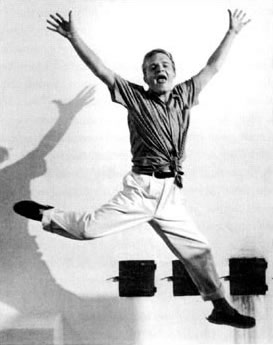
Most of my generation only remembers Truman (his Public Persona, I mean), from his appearances on various talk shows, mainly Johnny Carson, when he was a bloated guy with a high lisping voice who was vaguely embarrassing to watch - At least I felt that way. He was obese, he had face lifts, he wore a white Panama hat, he was kind of grotesque. I didn't know that he was basically caricaturing himself by then - which is always death to an artist of any kind.
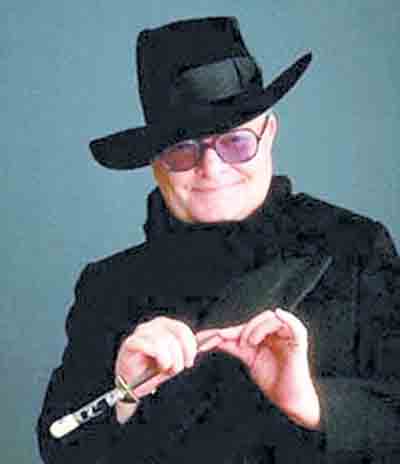
But he was stuck. He had horrendous writer's block at the very end - which tormented him. The end of his life was full of despair. It's wrenching to read about
But as a youngun? As the new writer in town? He was a golden boy. He was a creature like Thomas Mann had written about. The golden-haired child-man who led others to do naughty naughty things, and then pled innocence. Photographers lined up to capture this guy.
See what I mean?

Hard to realize just how provocative those photos were back then. Especially because he was openly gay. And not just "openly gay" - but openly PRISSY and gay - which some people find unforgivable. Fine, be gay ... but ... do you have to be so ... GAY about it?? Can't you just PRETEND to be straight so I don't have to feel so ... ikky? Truman, even back in the early 40s, didn't put on an act for the straight world. He didn't turn himself inside out to make people feel comfortable with his gayness. He just was who he was. If people felt uncomfortable, then that was THEIR problem. He was prissy, he lisped, he flounced about like a Southern belle - AND he happened to be a kick-ass writer with a literary voice that no one could forget.
I still remember the impact that The Grass Harp
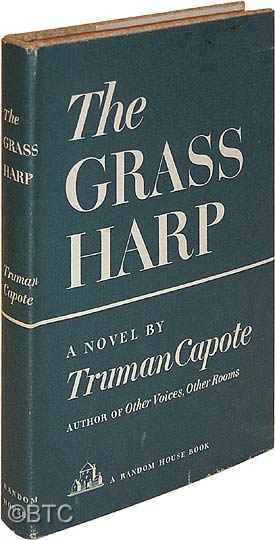
I was too young then to really understand regrets, or loss - the way I understand them now - but his elegaic writing in that story touched some deep universal chord in me - the part of me that is HUMAN, and not just an age on a timeline. There was a kind of soul-growth spurt that happened to me when I read that sad beautiful story. I still have a real fondness for it.
(Excerpt here)
His first book, published in 1948, was Other Voices, Other Rooms

Just to add to the controversy - here is the "author photo" that appeared sprawled across the back of the book:
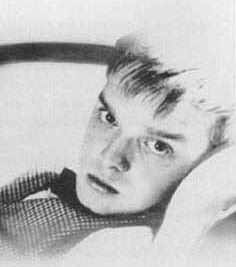
hahahahaha Truman! Please! It caused an outrage. A stir. (Tennessee Williams, down in Key West, had heard about it - and wrote letters referencing it) People loved it. People hated it. People TALKED about it, and that was what Truman cared about. Truman had talent - yes - but he understood the whole 15 minutes of fame thing long before Andy Warhol came along. Truman wanted to be FAMOUS as well as being a good writer. He wasn't one of those writers who holed themselves up in their apartments (at least not until In Cold Blood when he disappeared off the face of the earth for almost 5 years - he said later that writing that book nearly killed him.) ... But before In Cold Blood he was out at every party, he hung out with the rich and famous (at least until the huge debacle at the end of his life when he alienated all of them in one fell swoop)
This photo is just ... kind of says it all, don't it?
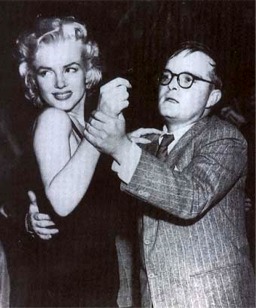
Look at how he's holding her wrist!!! Like - hold her HAND, Truman. But also - look at how sweet she is. The two of them were actually very good friends and he wrote one of my favorite pieces about her, which appears in the gorgeous collection Music for Chameleons
(Excerpt here)
He was the darling of New York. He wasn't just friends with celebrities - whose wealth is a rather transitory thing. He became friends with REAL rich people. The international tycoon types. The Onassis types. He was invited to all of the "society" parties.
And one day - he read a little snippet in the newspaper about an entire family who had been slaughtered in their own home ... and something sparked in him ... He spoke to the folks at The New Yorker - he wanted to do a piece on how such a brutal murder would affect the small town ... He went to Kansas - and basically did not emerge from that nightmare for another 5 or 6 years. The result, of course, was the great great In Cold Blood.
(Excerpt here)
More on In Cold Blood in a bit.
Once that book stopped taking up every second of his life (he was never really the same again, after writing it) ... he was ready to re-enter New York society, with a bang.
And he threw a party that is still famous. It was called The Black and White Ball, and he threw it for Katherine Graham - who he didn't even really know.
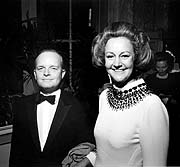
She wrote in her autobiography (which I've read): "I was truly baffled as to why I was the guest of honor. But it seemed really important to Truman ... so I said yes."
Odd. It was, many people say who care about this stuff, the "party of the century".
Everyone had to come wearing masks, and everyone had to dress in black and white. Truman had just finished In Cold Blood - or maybe he had just returned from Kansas - not sure - but he needed to let off steam, he needed to shake off In Cold Blood which had literally taken over his life. So he threw this party - where everyone who was anyone showed up.
Here's Candice Bergen at the party:

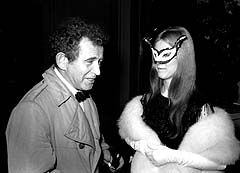
Here's Norman Mailer and his wife - hahahaha
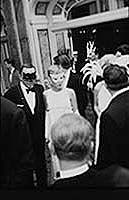
Here's Mia Farrow and Frank Sinatra- who had just gotten married:
People jostled to get invited. People sucked up to Truman. He was in his glory. But even then - he had the oddest mix of desire and contempt when it came to the rich. He wanted to hang out with them - but he had contempt for them as well. On some level, I think he knew that they would drop him like a hot potato the second his friendship became inconvenient. He knew that his friendships with these people were were pretty one-sided: Truman was there to entertain, to keep things light and amusing. The second he started falling on hard times later in life, they stopped tolerating his company.
Perhaps all those rich people just liked the cache of having a literary star at their parties - it made their parties seem more ... substantial. Maybe they really did like him. But I don't think so. And I don't think Truman liked them all that much, either. He saw right through them. Only he kept that to himself, and let the rich people think that he bought their game, that he was fooled, that he did not see the essential shallowness beneath their facade. When he finally came out and wrote about them and their pettiness, their stupidity - they could not and would not forgive him. One chapter of his book was published - and set off a shitstorm through the international rich set - all of whom had welcomed Capote into their midst.
(Excerpt here)
He never finished that book.
(By that point in his life, long after In Cold Blood, Truman had actually lost a lot of what had made him a success in the first place ... and that was his compassion for others. His ability to love his fellow man, and to try to step into their shoes and describe for us, the reader, what it is "like" to be that person. By the 1960s, drugs and drinking had taken hold ... and Truman was angry. He wrote about his former friends with bitchy - but spot-on - RAGE. He had NO compassion for THEM. He could find it in his heart to be compassionate for Dick Hickock and Perry Smtih even though they had committed such a heinous crime. But he was NOT compassionate for the fat Upper East Side cats. He unleashed his wrath on them, and it was like a bomb going off in international society.)
Truman Capote found himself bereft, and alone. He never recovered from that shattering of his world, even though he said over and over, "I'm a writer! What did they think I did in my spare time? I observed life - and I wrote about it!" They did not forgive him for telling the truth. Years later, when Gerald Clarke wrote his tremendous biography of Capote - there were people who refused to be interviewed for the book becaue they were STILL seething at Truman's "betrayal".
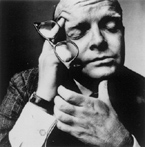
I'm going to post something I wrote a long time ago on this blog - which ended up being published elsewhere. It's called "Fairy on the Prairie", and it's about the writing of In Cold Blood which is pretty much on my Top 10 favorite books ever written. Certain books come and go on that list - titles get bumped off - moved on - but not In Cold Blood. There are a couple of others that never get bumped off - Harriet the Spy, Wrinkle in Time, Catch 22. These are great great books.
I'm proud of the piece I wrote on Truman.
Before we get to that, though, I would like to share my favorite photo of Truman Capote. It's done by the great photographer Irving Penn. I like it because - it's not the "carefree" look of his golden-boy self - which was a pose, to some degree. It's not the provocative just-got-out-of-bed look he sported as an early writer - which was also a pose. And it's not a photograph from his later years, which just really hurt me to see.
Irving Penn had photographed Spencer Tracy, famously, boxed up in a corner. (That was one of Penn's "things" - he put famous people into corners of rooms and photographed them. Strangely effective.)
Look. Amazing photo of Spencer. Look at the EXPRESSION on his face.

Penn took basically the same photograph of Truman - boxed him up in a corner. I looked for a larger version of the photo - a clearer one - but couldn't find it. This is the best I could get.
There is something about this photo that not only haunts me, but strikes me as deeply painfully TRUE. The oversized coat, it makes him look so small and frail. The cramped quarters, the walls pressing in. Now, I did not know Truman Capote, and it is not for me to say who is the "real" Truman Capote - but something about the look on his face in this photo, its flat blank-eyed stare, the gaze is a bit confronting, but also - so accepting of himself, of the soul behind those eyeballs - something about it lands for me. I feel that I am getting a glimpse not of a personality, a famous person ... but someone's soul. I feel the same way about the Spencer Tracy photograph - so I don't know what that's about, and I'm sure it has all to do with Irving Penn's gift. It's extraordinary to me.

And now. Onto In Cold Blood, and my old post about him. There may be some repeats of information here.
Happy happy birthday, dear dear Truman.

Truman Capote said later that if he had known what he was getting into, when he traveled down to Kansas ("a fairy down on the prairie") to write a piece on the murder for The New Yorker, then he never would have gone. He went to Kansas only 2 weeks after the murders took place. The killers had still not been found, the community was in an uproar of suspicion and paranoia. Capote's main interest was to do a long profile of the townspeople, how regular church-going farmers handled such a disaster. Little did he know what the book would eventually be! The project took up years of his life. He had to wait for the executions of the 2 murderers, in order to complete his book. So he waited, and waited. Appeal after appeal ...He was unable to write anything else. Nothing else interested him. He was a man obsessed, in the grip of his obsession for years. His health was ruined. His friends were sick of hearing about the Clutter family. He tried to take vacations with his long-time partner, and would just drink, and try to sleep, and have fits of despair. He thought those boys would never be executed, he thought he would be in limbo forever. Yet - the morbidness of his entire life being on hold because of commuted death-sentences in Kansas - the morbidness of trying to go on, when really all you want is for those 2 boys to be killed - so that YOU can go back to YOUR life ... This selfish attitude (necessary for the project) took a huge toll on him. It felt inhuman.
Finally - there were no more appeals and Capote traveled to Kansas, to watch the execution. Hickock and Smith had asked him to be there. In the intervening years, he had interviewed the 2 killers numerous times. Their first-person descriptions of their own sorry lives make up important parts of the book. Capote became their conduit to the outside world. Hickock would draw self-portraits of himself and send them to Capote. Capote was playing a double-edged game here. He became "the listener", the one who would sit and ask them questions, and nod understandingly. The 2 of them got addicted to his concern. Yet Capote was horrified by most of what he heard. He wasn't without pity for these men, who had pretty much been beaten like dogs from the second they were born - and yet Capote hadn't had an easy road either, and HE hadn't killed anyone in cold blood. He had grown up with alcoholics, he had been abandoned by his father, his parents were ashamed of having a "fairy" for a son, he was sent to military school - can you imagine how awful that must have been for him? Capote may have acted like a cream-puff but that man was cold and hard as steel inside. He had to be.
Capote needed quotes, he needed access, he needed to enter into the psychologies of these 2 men. He was able to paint the graphic picture of the Clutter family through interviews with people who knew and loved them. But the Clutters were no longer around to speak for themselves. Hickock and Smith were alive for a couple of years, so he visited them often. On his way out of Death Row, he would feel the urge to vomit. It would take him days to recover, emotionally, from these macabre "visits". And he said, later, that he never recovered from the "shattering" experience of watching the two men hang. The letters he wrote to friends afterwards are nearly incoherent. Watching how hard the hanging body clings to life, watching the kicking feet, the flailing, the letting-go of bodily functions ... Capote was really never the same man again.
And he then sat down and wrote the book like a bat out of hell.
Truman Capote always thought that he had a "great book" in him. This mythical "great book" haunted his dreams, he would lie awake at night aching with ambition, dreaming about this great book ... He didn't think In Cold Blood was his masterpiece. He looked back on the experience of researching that book and writing it as a grim one, an almost universally unpleasant and grueling experience. I've read all of Capote's books. I love that guy's writing style. I even read his unfinished work - the 2 chapters of the novel he was working on when he died. He claimed to have it almost finished, but the rest of it (if it even existed) was never found. The 2 chapters are okay - it's a gossipy bitchy look at high-class New York society. It's merciless. It's very funny. Nobody is spared. Human beings are seen in their worst lights. Everyone is selfish, cynical, out for themselves ... It is quite funny, but it's very very mean. He was nearing the end of his life, and he had been abandoned by most of his friends. His outlook was not good, he was addicted to drugs, filled with anxiety and loneliness ... The 2 chapter are his way of lashing out at all those people who left him, who tossed him out with the trash. Hence, the mean-ness.
The thing in the rest of Capote's writing that, for me, sets him apart is his undeniable love of humanity. His tenderness. His ability to SEE people, with all their flaws - and to see them as beautiful. Much of his best writing is all about nostalgia, wistfulness, yearning for childhood ... Yes, it is sentimental, but it also has a depth of sadness beneath it, a grief ... which elevates it from mawkishness.
In Cold Blood taps into something else. In Cold Blood doesn't fit into either of the Capote categories: the bitchy mean queen telling all the nasty secrets of his high-class friends, or the lonely sweet man filled with hurtful nostalgia for childhood.
It was something completely new. For him, and for us. I don't even know if I can describe it. All I can say is - he never accomplished such a thing again. His writing never seemed so effortless again. You read that book and you feel like if you cut ONE WORD, the entire thread will unravel. It is so tight.
The other thing I had forgotten from the biography is Capote's personal experience leaving his home-environment of ritzy New York City (where there were lots of "fairies"), and venturing into the Kansas prairies to investigate a murder. Capote was openly gay. He wasn't a macho gay, either. He didn't try to blend in, or act straight, or hide his gayness. He was a small rotund man, who wore wide white hats, spoke with a lisp, fluttered about like Blanche DuBois, and literally said things like, "I declare!"
He took one of his best friends, Harper Lee (yes - THAT Harper Lee) as a co-researcher. She was much more "normal"-acting, and was able to blend in a bit more. She could get people to talk to her, because she seemed like one of them.
But Truman Capote was so relentless, and not only so relentless, but so committed to justice, so committed to discovering what had happened in the Clutter household, that people started opening up. The people in the town started competing about who had had him over for dinner the most times. Alvin Dewey, the head of the investigation, a tough gruff 3 pack a day smoker, eventually counted Truman as a valued partner. Truman was there when Dewey got the call that the 2 murderers had been picked up in Las Vegas, AND that they were still wearing the boots with the distinctive soles (that had left footprints - If the 2 hadn't confessed, the boots alone would have convicted them). Truman was standing right there, with Dewey's wife, listening to Dewey hear the news.
The people of Kansas, who had never met a person like Capote in their lives, who were Bible-Belt ranchers and farmers, took him into their homes, their families, their hearts. Without them, the book would not have been written.
It is a massive accomplishment.
Truman Capote went to his grave thinking that his "great book" remained unwritten. I beg to differ.
The Books: "Elia Kazan: A Life" (Elia Kazan)
 Next book on my "entertainment biography" shelf:
Elia Kazan: A Life
I met Elia Kazan once. It was in 1999 and I was working on a show at the Actors Studio (in a backstage capacity). It was a production of Awake and Sing, by Clifford Odets, (excerpt here) and it had had its original Broadway production in 1935 under the auspices of the influential Group Theatre (formed by Harold Clurman, Lee Strasberg and Cheryl Crawford). The Group was committed to socially relevant drama, the development of new plays, and the creation of an acting ensemble along the lines of the Moscow Art Theatre. As opposed to being an actor who has to turn himself into a commodity, and sell himself from job to job ... the Group would be a place where actors had a permanent home (and salary, of course - no small thing in any time, but a huge thing in the midst of the Great Depression) and had a vested interest in the actual acting company (something which could not exist in the more capitalistic structure of the rest of Broadway, where you came in, did your job, and left). Most countries have some kind of national theatre. America never has. The Group gave it their best shot - and while they only lasted a decade, the reverberations of the Group are still felt today. Out of the Group Theatre came Lee Strasberg, Stella Adler, Sanford Meisner, John Garfield, Franchot Tone, Morris Carnovsky, Clifford Odets and Elia Kazan- to name just a few. Many of them became the primary teachers of the new style of acting that swept the country in the 40s and 50s - and were responsible for creating the Actors Studio, a safe haven where people could come and work and learn - without the stresses of commercial considerations. It is free. All you have to do is be a member. You have to audition to get in. But once you're in, you're in for life. There is a direct line from the Group to the Actors Studio - and while Kazan was always a controversial figure (first, because of his overweening ambition and ruthlessness - which he ascribes to his Greek-Turkish beginnings, and his experience as a member of a hard-working conniving immigrant family ... and secondly, because of his behavior in front of the HUAC, a shadow which - in my opinion - unfairly tainted his reputation forever) he was highly instrumental in both of these organizations (although the Actors Studio, to this day, tries to deny Kazan's part in its formation ... it's like they want to just ignore how important he was or something.)
Awake and Sing is the story of a raucous Jewish family living in the Bronx during the Great Depression - it ran for 184 performances and was a big hit - the people in the play talked like the people in real life! It was a revelation at the time, when playwrights like Kaufman & Hart and Philip Barry (awesome as they are) dominated the stage.
Elia Kazan had not performed in the original Awake and Sing. His big moment in Odets had come a year earlier when he was part of the sensation that was Waiting for Lefty (he was the one who began the call to "Strike") - and later, he played Kewpie to great success in Paradise Lost - but as I mentioned earlier, the Group was an ensemble. Everyone worked on every production, to some capacity. Kazan garnered his nickname "Gadge" from the word "gadget" - because he was your go-to guy if you needed something fixed - whatever it was. The stage curtain won't close! Gadge'll fix it. This scene isn't working! Let's talk to Gadge - he'll have ideas. The publicity for this play SUCKS! Gadge will make sure the problem is rectified. In many ways, "Gadge" was far too big a personality for an ensemble setting. He always bucked under that sort of discipline. The group dynamic was never for him, although he was a superb collaborator.

But the consensus-building that has to happen in any effective group, as well as the submission to a Leader (which turned out to be Lee Strasberg) ... Kazan didn't do well with any of that. Not to mention the fact that his Communist activities, sincere as they were, eventually (and quickly) soured for him - because the Communist Party wanted to own the Group Theatre, wanted to plan their season, and critique their choice of plays ... "No, this play is too bourgeois", etc. ... and Kazan just flat out did not like that. Don't tell us what art we should put up.
In Awake and Sing, circa 1999, Anne Jackson (wife of Eli Wallach) played the lead, the matriarch. My job in the show was basically as her "girl Friday". I ran lines with her, I got her tea, I ran errands, I sat in the audience at every rehearsal, I tried to make her life easier, whatever she needed. I guess I was also a "Gadge", in terms of my role with Anne Jackson. Katherine Wallach (Eli and Anne's daughter - or, one of their daughters) played the romantic lead. Really nice woman, very laidback, humorous, I very much liked her energy. A guy I had dated for about 2 seconds was in the show, and he played the wild-card wise-cracking guy who was in love with Katherine's character. The rest of the cast was filled with Actors Studio legends. The show wasn't particularly good, but God, I loved the atmosphere.
It opened in the late fall - November. The Actors Studio was renting a theatre on 42nd Street for some reason (normally all of their shows were put on at their church/performance space on 45th Street - where they had been located since the 50s) - and rehearsals, which had started at the Studio, then moved into the new theatre. The production was a big deal for the Studio, far more elaborate than many of their other productions ... and it was rumored that Kazan would attend. He was quite ill by this point, and almost completely deaf - but he was a good friend of one of the actors in the show (the father, coincidentally, of the dude I had dated for 2 seconds) - and due to Kazan's early connection with the show, and the continuum feeling of the Group to the Studio to now ... made it very exciting that he might show up.
Kazan's contributions to the theatre (as opposed to film) are too great to name. He directed more plays than movies - his resume is astonishing. He was responsible for ground-breaking productions of plays by Arthur Miller. He was the main interpreter of Tennessee Williams. An interesting combination of personalities there. Tenneessee: a sensitive gay man from the south, and Elia, a fiery macho Greek-American, born in Istanbul. A tough scrappy immigrant. But I've said it before here, and I'll say it again: I think that without Elia Kazan's strong sensitive guidance, Williams' plays might have crumbled into fairy dust. Inconsequential. Now the writing was all there - Kazan said that all along - that when he first read the scripts, they were complete. Done. Ready to go. (This is extremely rare, by the way, when you're working on a new play. But Williams' plays arrived on Kazan's doorstep perfect). But Williams' plays have so much to do with artifice, and the fragility of memories ... that if you get a director who tries to deal with the delicacy TOO much, or if you get a director who just suffuses the entire play in a certain mood of nostalgia then the plays don't add up to much. But Kazan always went for the jugular. He grounded the things, yet he also elevated them into theatricality, highlighting the symbolism of the plays, making them manifest, tangible. Kazan brought out the animal passion in Williams' plays - knowing that the other stuff would take care of itself, or could be handled through lighting and music. But the acting needed to be visceral, real, taut ... Williams' plays burst onto the scene like an emissary from another planet. American theatre has never truly recovered. Any playwright who comes after now has to deal with the bar that Williams (and, by association, Kazan) set.
Kazan took those plays, already perfect, and heightened the reality of them - made the reality dramatic - and turned them into American icons. Kazan always said that good acting was "turning psychology into behavior" - and frankly he was a master at it (not as an actor - he was quite limited as an actor - he has said, "I was like a violinist who could only play 2 or 3 notes" - but as a director and dramaturg). He understood psychology on an almost cellular level and to "turn it into behavior" was the actor's job, but he set up an atmosphere where such miracles became commonplace. It was easier for some (Marlon Brando - whose entire talent was turning psychology into behavior - he did it naturally - Kazan has said he never directed Brando. All he had to do with Brando was get the hell out of the way) - but to this day nobody can touch Kazan for the consistently great and memorable performances he got out of actors. Like James Dean falling down his father's chest, holding up the money and letting it fall ... That is a prime example of "turning psychology into behavior". Psychology would have led Dean to perhaps tears ... you know, he's sad his father doesn't love him, etc ... but it was Dean's sudden genius that led him to try to press the money into his father's chest, and when he didn't get a reaction, to slowly collapse, like a broken swooning bird. It takes the moment and turns it theatrical.

I have written before about when I first saw East of Eden at the age of 12 - it went off like a bomb through my psyche. I can say without exaggeration that it changed the course of my life. Not immediately - but all roads lead to that movie. I don't even think now (in retrospect) that it is Kazan's best - but at the time, when I was 12, already interested in acting - it showed me something I had never seen before. It wasn't that I found the story touching, or the acting good (although all that was true as well) - it was that it galvanized me, for the first time. It put me in action. If the action wasn't as dramatic as running away and joining the circus, it was still action. I set about on a course of trying to learn everything I could about Kazan, Dean, and - once I learned about it - the Actors Studio. It became a vortex, almost - or some kind of swirling motion in my life - where everything revolved around it. I was hooked. Forever. And look at me now. I'm middle-aged now. And look at what I write about on my blog almost non-stop. It started then - one random night when I was babysitting and I watched East of Eden. It's a direct line.
It wasn't just about having a crush on James Dean. I wanted to know how that type of acting had come about - who was responsible for it??? - and so of course I read everything I could get my hands on about Kazan (or "Gadge", as I called him in my mind - because, you know, we were just BFFs by that point) ... I loved the Kazan stories. I tried to picture myself in his hands, as an actress. What would be my struggles? What small helpful thing would he whisper in my ear to help me nail a moment? What was he like? The later controversies meant nothing to me ... if anything, it just made me sad that he was so hated, because I had such affection for his work itself. It had changed me. I would never look at movies (or acting) the same way again.
I know I'm talking a lot about myself in this post, but whatever, Kazan brings it out of me. (I also think it's funny when people have made "God, you're so self-centered - don't you care about what's happening in Abu Gharib??" comments on my blog in the past. Uhm, yeah. I am self-centered. Blogging is probably the most self-centered hobby that one can have. It is WHY I do it because I enjoy talking about what interests me. Is that your only comment?? Or do you have something else to say that, you know, makes sense? No?) Kazan is part of the warp and weft of my life - he was there when I first "got it", when I realized what I wanted to do with my life, when I discovered the passion ...
So to think that I might be about to meet the man ... Ack. I don't do well in those situations. I saw Gena Rowlands on the street once. She is my favorite actress of all time. I did not approach. In fact, I slinked around behind her like a stalker, watching her every move, memorizing her shoes, her bag, her sunglasses ... but I would have needed to have a bone marrow transplant in order to stroll up to her and ask for her autograph. I just can't do it. (Or ... I can ... but only if you PUSH me to it, like the time I whored myself out for The Rock's autograph.)
I was scared, though. What do you say to someone like Kazan? "I can't describe how much your work has meant to me." "You opened my eyes to art, to the craft of acting ..." "You are part of the warp and weft of my very existence." Loony tunes.
At the same time, during the entire rehearsal process, hanging out at the Actors Studio, lying across the chairs during a long tech rehearsal, running out to the corner deli for a coffee, sitting backstage in the dark listening to the run-thru going on ... I'd have these moments of - almost like my vision went from microscopic to macroscopic ... My perception would pull way way way back and I'd suddenly realize where I was, who I was hanging out with (people who knew Kazan well, who considered him a friend), and also just ... how casual it all was ... I would forget, from time to time, where I was ... and suddenly, I'd have one of those telescope moments and I'd think of that 12 year old girl, imagining herself into the Actors Studio in its heyday - with Paul Newman, Marilyn Monroe, Carroll Baker, Shelley Winters, Marlon Brando ... and I'd get overwhelmed. Even though I was just a glorified stage manager and not a lead actress, I'd tear up. "Sheila. You did it. That 12 year old girl saw this. She knew it would happen. She was planning for it ... and here you are!"

Kazan's autobiography came out in 1988 and it is a massive tome - heavy and thick as a biography of Napoleon. It's enormous. My friend Shelagh (who I also met through the Actors Studio, who is a director) has said that any time she feels stuck in her work, or like she needs a breakthrough in how she's thinking about a certain script or problem ... she'll pick up Kazan's autobiography and open it randomly, to any page, and just read. It's that full of insight and wisdom. Naturally, most of the press that the book got circled around the "naming names" controversy and Kazan's apologia for it - but that makes up a tiny tiny section of the book. The rest of it is a treatise on the creative life, on script analysis, on the actors he knew and worked with ... The stature of the book has just grown in years. It's not that Kazan will ever be able to shake off the controversy ... but the autobiography is now, generally, considered to be a highwater mark in the genre and rightly so. You can't believe how much is in it. I found him to be refreshingly honest, as well. Honest about his infidelities, about his problems as a director - how he found his way ... and also refreshingly humble about his successes. He will not take credit for On the Waterfront - or at least he won't take credit for Brando. The best moments in that film (the glove moment, the taxi cab) were Brando's inventions ... and Kazan always gives credit where credit is due.

The same with Tennessee Williams. Kazan did not "create" those plays - the productions were legendary ... but Kazan is always clear that the writing was there from the moment he got the scripts. All he had to do was create the correct environment and production design - and cast well - in order to bring the script to life.
The book is a masterpiece, it really is.
Awake and Sing opened on a snowy night in December. I had been at the theatre all day, running errands, taking care of Anne Jackson, running out to grab her a sandwich, whatever ... and then it was time for the show. The audience slowly came in - brushing off the snow, stamping their feet ... There was a feeling of anticipation and excitement in the air. The audience that night was mainly made up of Actors Studio luminaries. Ellen Burstyn was there (and she remembered me from the workshop I had taken with her - woman was amazing ... I had been one face in that class of 30 people and she remembered me - astonishing) - Paul Newman and Joanne Woodward were there - Harvey Keitel showed up - it was all really fun and exciting to mingle around in the lobby with these people. But the question on my mind (and everyone else's) was: will Kazan show??
5 minutes before the curtain went up, Kazan entered the lobby. He was surrounded by good friends, who hovered around him, and had obviously made sure he had gotten there intact (he was incredibly old and frail) ... He was holding onto a friend's arm, and he had a strange little smile on his face ... as though he knew (to his dismay) that he would be the center of attention ... couldn't help that ... and because it was a relatively cool crowd (I was so not cool, but I tried to take my cue from others) ... people either left him his space, or went over to say a casual, "Hi, Gadge, how are you tonight?" I wasn't in that league at all. I've been around famous people before - hell, there are famous people in my family - I'm not all that gobsmacked by famous people in and of themselves ... but the second I saw Kazan, my knees almost went. I'm serious - I felt a dip in my energy, a swoon, like I was going to go down just at the sight of him. I couldn't take it. I just STARED at him ... and there was something about his age, and his disorientation (did he even know where he was?) that cut through me like a hot laser and I couldn't take it ... I left the premises and went sneaking backstage to see if Anne needed anything before the curtain went up.
I sat in the audience during the show. Kazan was in the front row. He was quite deaf, so I'm not sure how much he heard (there were definitely "projection" problems in the show ... you couldn't hear a lot of the actors). I could barely keep my eyes on the stage. I kept glancing over at him. He was a small hunched figure, so reduced from his virile masculinity that marked him at the height of his career, and it just killed me to see him. I wasn't pitying him ... it was just that I looked at him and was conscious of how much his work has meant to me, and how it impacted me ... and I didn't know how to deal with it. I sat there with tears streaming down my face in the dark - not because of Awake and Sing, but because of that small old man in the front row.
Kazan! Holy Christ!!
After the show, there was a reception in the lobby, with cheap jugs of wine and plastic cups. The cast joined the party, and it was like an old-timey reunion there ... with Newman chatting with Anne Jackson, Eli Wallach was there to see his wife and daughter perform ... I basically hung around on the sidelines, gulping down the glorified grape juice that was being served ... and tried to keep my knees from trembling. Kazan was standing over to the side with his friend who had been in the production (and the friend's son - who had also been in the production - the guy I had dated for 2.3 seconds) ... and that was my chance. Sheila. Don't be an ass. You can't be within 5 feet of Elia freakin' Kazan and not say something to him. Even if it comes out awkward and weird, that would be better than saying nothing. Don't be an ass. This isn't about fawning over him. This is about acknowledging him TO HIS GODDAMN FACE for what he has meant to you. Do it! Do it!
(In a humorous aside, when I went to Taos last fall to basically stalk Dean Stockwell on his home turf - I went through a similar thing. Stevie and I were at the art gallery opening - where Stockwell's work was being shown - and everyone was hanging out outside, there was a band playing, Stockwell was dancing, it was awesome - but ... but ... I so wanted to have my picture taken with Stockwell ... I had already been introduced to him ... and there were plenty of other people there who would politely ask if they could have their picture taken with Stockwell and he was gracious in complying ... so why couldn't I??? Thank GOD for Stevie. Stevie literally - literally - pushed me over towards Stockwell ... grabbed my camera and said, "Mr. Stockwell, could I take a picture of you with my friend Sheila??" Stockwell said, "Sure", put his arm around me, and Stevie took the picture. And I wasn't a pain in the ass, and Stockwell wasn't annoyed ... he was gracious, I was polite ... it was part of being a celebrity, and he was very cool with it. But still: it's not easy for me!!)
So without getting myself together, without calming myself down, I walked over to the threesome in the corner of the lobby: Kazan, old guy who was his friend, young guy who was the dude I dated ... and the dude I dated glanced at me, really friendly, and said, "Hi, Sheila!" I said, "Hi" - dude I dated turned to Kazan and said, loudly, "Elia, this is Sheila O'Malley." Kazan reached out his hand to me, and I took it - and found myself saying, "Thank you. Thank you so much for your work." I don't think I spoke loud enough. Kazan held onto my hand, shaking it, and his eyes were not locked onto my eyes - his eyes were staring at my mouth, trying to lipread. He looked a little bit disoriented. I hoped that my energy at least made it clear what I was saying, But I wasn't sure ... He just shook my hand, in an obligatory manner, and watched my mouth speak.
I then backed off - not wanting to just hang on to the periphery ... especially because Kazan seemed rather overwhelmed, like he was in his own little world ... and I wasn't a part of it ... everyone else there that night was an old friend ... and I just felt really aware of his age, and his struggling to keep up ... It had been a huge production to get him out, on that blizzardy night ... he didn't just hop in a taxi by himself and come to the Studio ... so I backed off, made my rounds to say goodbye to the cast (I would see them all the next night anyway) and went out into the snowy night. There was an empty doorway a couple of doors down ... and I went and sat on the steps, out of the snow, put my head in my hands, and cried. It felt good to finally let it all out. Enough of hanging out and drinking Julio Gallo from the jug and pretending I'm "over" the fact that Elia Kazan, the man responsible for so much in my own life, is standing just over there. It was good to relax. I cried for about 15, 20 minutes, and then got myself together and trudged through the gathering snow to catch my bus home.
Kazan died 3 years later.

I wanted to choose an excerpt that shows his smarts about acting, and what it was that actors need. I decided to go with the following - which, in keeping with the tone and theme of my post, is an Actors Studio-themed excerpt - having to do with the Group, the Method - and all of the different teachers who came out of the Group ... having all interpreted the Method in their own particular ways.
Elia Kazan: A Life
The Group Theatre came apart in 1936, reassembled in an altered form in 1937, dissolved completely in 1940. It was then that the actors and directors out of that experience began to teach what they'd learned. Today, as I write this, there are schools of acting everywhere proclaiming variants of a central viewpoint, the Method. By a curious irony, the rebels of the thirties and forties have become the establishment of the day. No one says, "You have it or you don't" now; they say, "Come to me, I'll make you a star."
Nearly every star today is claimed by one acting teacher or another; there are long lists of their "pupils" in the trade paper. It's difficult to have a conversation with Robert Lewis without hearing him mention Henry Winkler, an old pupil, or drop the name of Meryl Streep, a more recent one. It's a natural pride; architects point to their buildings. But now the thing is out of hand. Colonel Sanders of Kentucky Fried Chicken fame is dead; his place of business continues franchised, a syndication. Lee Strasberg is dead; his place of business continues. The right to speak his name is bought - at a fat price.
There are yards of books that will instruct the beginning student on how it's done, and how it has been done. Read all about it! The Stanislavki system made easy! I have a shelf of these manuals, but I've found that information rarely helps an actor; training does. Even those books written by close friends have bored me, although perhaps that was mostly because I've spent so many years listening to dogma on the subject. I cannot believe that an actor should be instructed while sitting in a comfortable chair listening to a "guru". The last class I taught (I mean the last, for I shan't teach again), I didn't let the actors sit down for two hours. They did the exercises I chose on their feet and found this exhilarating. The sight of actors perched row on row as magistrates passing verdicts on one another's work raises my hound hairs. When I hear the phrase "master class", I want to vomit.
Today when I'm consulted by an eager newcomer about whom to "go to for help", I generally answer that I can't offer advice unless and until I know more about him - which I make damned sure I don't have time to do. I shudder at the thought of giving quick counsel on the Art of the Theatre, on what will "get you there". Yes, the experience of other actors and directors can be communicated and does help, but on the whole it's better for a young actor, driven by a strong desire, to stumble, fall, pick up, come on again, so find his way. What I do sometimes say is that choosing a teacher is like settling on a lover, one size doesn't fit all. Strasberg, the most famous and financially successful teacher of our day, helped some people - Al Pacino and Ellen Burstyn swear by him. Other, equally excellent actors abominate him. Stella Adler, a spirited and flamboyant teacher who emphasizes characterization and role interpretation rather than emotional recall, came to her class the morning after Lee died and ordered them all to stand. "A man of the theatre died last night," she announced. For one minute, the members of her group, a large one, stood, some with heads bowed, all silent. Then Miss Adler ordered them to sit and said, "It will take a hundred years before the harm that man has done to the art of acting can be corrected."
This certainly seems excessive, and I don't know precisely what Stella was referring to. I think she might finally admit, with some nudging, that she learned a great deal from Lee in the Group's first years. I can speak for myself, despite the negative impressions I formed more recently, I owe Lee a great deal and owe to the movement Harold and he started, the Group Theatre, everything. Because I was an actor - and could not possibly have been one without their help or outside their theatre - I've learned never to be afraid of actors, so I've never treated them, when I was making films, as counters in a game to be moved about as I pleased. I've never wished them struck dumb, always opened myself to their imaginations and benefited from their suggestions. I've been able to remain undisturbed by the questioning that other directors resent. Even with the novels I've been writing - if they had one special quality, it's that the dialogue sounds as if it were spoken. I learned from having been an actor.
I do have differences with my old friends and associates. No one who came out of the Group and now teaches does it precisely the same way or with the same emphasis. Sanford Meisner, Robert Lewis, Stella Adler, and Paul Mann have all helped actors become artists. I know for the best of reasons; I've worked with "their" actors in films. But they are each extremely individual in their work and I've heard all four scorned by their own kind. Acting teachers tend to disparage each other's methods, and I've thought I detected here and there a hint of jealousy of Strasberg's financial success. As in other human endeavour in the arts, there is a fascinating variety. But despite that, the teachers I've mentioned make the same basic emphasis, which is fundamental: Experience on the stage must be actual, not suggested by external imitation; the actor must be going through what the character he's playing is going through; the emotion must be real, not pretended; it must be happening, not indicated.
That's our word for heresy: To indicate is the cardinal sin of acting. Yet even this is open to question. Some great actors imitate the outside and "work in" from there. Laurence Olivier, for one. Larry needs to know first of all how the person he's to play walks, stands, sits, dresses; he has to hear in his memory's er the voice of the man whom he's going to imitate. I lived across the street from him at the time I was directing his wife, Vivien Leigh, in the film of A Streetcar Named Desire, and would often drop over to see him. Larry was working with Willy Wyler on Sister Carrie and, as ever, concentrating on what might seem to 'us" to be insignificant aspects of his characterization. I remember pausing outside a window late one Sunday morning and, undetected, watching Larry go through the pantomime of offering a visitor a chair. He'd try it this way, then that, looking at the guest, then at the chair, doing it with a host's flourish, doing it with a graceless gesture, then thrusting it brusquely forward - more like Hurstwood that way? - never satisfied, always seeking the most revealing way to do what would be a quickly passing bit of stage business for any other actor.
Including for us, of the Group. We would work on the actor's disposition at the time of the visit, what Hurstwood feels toward his guest and what he wants to accomplish in the scene that's to follow. Having determined these - no, I'll put it correctly: Having expereinced these, that is to say, having found them within ourselves, we'd trust that the detail of how the chair is offered would take care of itself.
Does it? Not always. Which way is better? As in all art, both. There is content and there is form. The artistry is in the passion; it is equally in the way the passion is expressed. Perhaps the problem we have to deal with is how to create an expressive form within which the spontaneous life, the one that yields the unexpected, the dazzling surprise, is free to work. The greatest actors are known for giving the same performance a little differently each night - but it is the same performance in all essentials. Both techniques are important: turning your emotional resources on and off, this way and that, while at the same time directing the cunning of your body to the most telling external behavior.
The technique of exhuming intense buried passions by arousing associations, what is known as "emotional recall" is no longer esoteric. We know all about Proust's madeleine and what it engendered. We are familiar with the glandular behavior of Pavlov's dog. To believe that true acting centers around that psychological trick - a teacher's delight in showing off, because it never fails to impress beginners - tends to make acting a competition as to which actor can produce the greatest emotional show. That is not important, nor is it the Method, which is concerned with the reason the character is on stage and what he wants to - and is able to - do there within the circumstances of the scene. The people of the Actors Studio are often criticized, as were the Group actors, for reducing acting to a display of emotional fireworks rather than playing the scene correctly within its true limits.
The problem of form is still the problem and applies as much to the insides as it does to the externals. Emotions differ; they have different qualities; they are part of a characterization; they are specific. We don't feel alike, nor do we all always feel at top pitch. "In life" most of us conceal our feelings, don't want them to be seen; many actors I know, especially Lee Strasberg's pupils, brandish these emotions as if they were the only true measure of talent. The basic problem of artistic control is the problem of having the emotion and giving it its most appropriate expression. This problem cannot be slighted in acting any more than it can be in painting or music. The great Russian directors of their classic period - before the Revolution fell to earth - Vakhtangov, Meyerhold, and even, at the end of his days, Stanislavski, were dealing with this problem: form.
I recently staged an adaptation of the Oresteia with a cast made up of actors from the Actors Studio, and although they were devoted and worked hard, although they were attractive people for whom I felt affection, they had, almost without exception, poor speech. It was, and still is, parochial and even ethnic, "off the streets," perfect for On the Waterfront. The unconscious premise of all too many of them was: If I have the emotion, that is all I need. They'd been trained by Lee Strasberg. I watched some who had very small parts, walk-ons, prepare in a daze for minutes before they entered, then do nothing original on stage. Al the people who came out of the Group still have to answer the challenge put to them so often, with justice: Why have American actors not succeeded in the classics? Why have these plays, the greatest in our libraries, been left to the English for realization? There is much work for actors in this country.
Much work for directors too. I've twice tried to deal with a "classic" and both times failed disastrously. The plain fact is that I've had no training or experience to prepare me for such a task. There was no tradition here in this country from which I might have learned, not in my time. There surely must be some way of combining what the Group had with the glories of a stage devoted to the verse plays of the great dramatists.
One final word on this subject. There is a power the actual experience genuinely felt by an actor has that, when merely simulated or cleverly suggested, it does not have. You can see it in the greatest performances: Raimu, who, in The Baker's Wife, looked less like an actor than like a baker, but whose enacted humiliations, those an aging man will encounter when he's in love with a young woman, were so truly felt they shook me. Garbo in Camille, unsurpassable. What is her mystery? Her self. Judy Garland, at the end of her life, giving you flashes (by lightning, Hazlitt might have added, as he did of Kean) of her own life's pain when she sang the pop-blues. Caruso and Callas, he with that great theatric voice, hers with one often criticized, both offering depth that made you forget any flaw. Bessie Smith, who made a league of all the down-and-outers in our society, sang for them all and for her race as well. Brando, naked of soul in On the Waterfront, the best performance I've ever seen by a man in films because it had all the tenderness and delicacy in love scenes that you could not have expected. And all those others: Anton Chekhov's nephew Michael, Walter Huston in The Treasure of the Sierra Madre, Lee Cobb in Death of a Salesman before he "improved" his performance. And that great old Japanese actor Takashi Shimura in Kurosawa's To Live. Those are some of the treasures of my life. You would name others. Now ask yourself why these performances - or your own list - live on in your memory, and others, equally praised, equally famous, do not.
My own opinion is that they do because the actors - whether by technique or by accident - gave you pieces of their lives, which is certainly the ultimate generosity of the artist, and they did it unabashed. You were the witness to a final intimacy. These artists spoke to your secret self, the one you hide. They offered you more than cleverness or technique: they gave you the genuine thing, the thing that hurt you as it thrilled you.
What made these distilled experiences awesome and unforgettable is that in these cases, a kind of fear is aroused - not in them but in you as you watch - a fear that may be the ultimate respect you, the viewer, can give in return. You find yourself unsure of what is going to happen next - or in the end. Will they last it out, will they come through? As in life, there are likely to be surprises that discomfort you. All leading men and women should have something unpredictable and dangerous about them. You should be anxious about what they might do; it could get out of hand. Didn't Bogart have this? And Bette Davis? Will the leading man make love to his leading lady or will he strike her - Cagney. Who can plumb the mystery of Greta Garbo? She doesn't yield, she doesn't make friends, she's not after your approval, not ever. Yes, there should be a persisting menace, even in heroes. They should be the opposite of housebroken, only partly tamed, not quite civilized. Immoderate.
Sitting out front or before your screen, you realize you're witnessing a real event, one more real than life, for in "life" there are the limits of civilization - the police, for instance. In art there should be none. You should not know what the outcome will be. You watch apprehensively - as you did Martin Scorsese's Raging Bull, which Bobby DeNiro played. In the company of those performers you should not feel safe, any more than you do walking through a Harlem slum street at night if you're white, or driving over an African savannah in an open jeep as the sun sets and the predators begin to stir. You feel the immediacy that you experience when you watch a terrible encounter in life or read the first act of Richard III. You wish for the best, but you're not sure it will come to pass. You hope, as you do when you enter Lear, that this greatest of the old men of the world will come out of his daze, even for a flash at the end - as Lear does - and for that instant see his life and the world clearly. When that happens, your own life has grown. What's happened to people on stage or on the screen has happened to you.
That is the kind of acting to which I aspired.
September 29, 2008
Life's a hustle
It's been a long day. To tell you the truth, I feel a little bit drained, and beaten up. Exhausted, yet kind of nervy and alert. My worst possible combination.
So I'm going to watch:

Tribute not up yet. We're working on it ...
I have immersed myself in Newman tributes today (including this one - with which I have a personal connection ... not to mention the fact that Newman's hot salsa is the only kind of salsa I buy). It makes me crazy to see so many of these movies again. I haven't seen Cool Hand Luke (according to the barflies in Cheers "the sweatiest movie ever made") in years ... or Butch Cassidy or Mr. and Mrs. Bridge (a personal favorite, as excruciating as it is). So I pulled out The Hustler tonight. Not only is Newman in it, but Jackie Gleason is one of my favorite people to ever walk the planet. Humphrey Bogart said that acting (good acting) should be "six feet back in the eyes". No matter what Gleason did - comedy, drama, farce, or variety shows - it was "six feet back in the eyes". He just makes me happy, that's all. To know he existed. He seems rather impossible, doesn't he? But there he is, a force of nature. I walk by his semi-silly statue every day outside of Port Authority in Times Square, and while I look upon it as kind of like the Rocky statue (like: let's not pretend it's Michelangelo's David, mkay?) - it still makes me happy to see it. Because it's a daily reminder that such impossible creatures as himself did actually walk the damn planet.
The Verdict - "Maybe, maybe …"

Marvelous appreciation of one small moment in The Verdict by Stephen Metcalf.
But the scene I kept coming back to sets up the whole film. It's hardly noticeable. Newman is intent on bedding a fellow barfly played by Charlotte Rampling. He buys her dinner the night before voir dire, and for the first time in the film, we come up close to Newman's face. The deep-set mask of middle-aged failure softens. Watch Newman here, ye who would be actors; study him. Where does this come from? "See, the jury believes. The jury wants to believe." The lines are almost inconsequential. But Newman is giving us evidence that Galvin is still alive. "It is something to see. I have to go down there tomorrow and pick out 12 of them. All of them—all their lives—say, 'It's a sham, it's rigged, you can't fight city hall. But when they step into that jury box … you just barely see it in their eyes. Maybe, maybe …" Rampling leans imperceptibly forward. "Maybe what?" And Newman exhales—just a little—putting a lifetime of defeat into that exhale, and suddenly Frank Galvin is talking about himself. "Maybe I could do something right."
September 28, 2008


East of Eden screentest
James Dean: "Kiss me."
Paul Newman: "Can't here."
Paul Newman screentested for the role of Aron, James Dean's goody-two-shoes older brother in East of Eden. Dean was already cast. Newman was up-and-coming, trying to find his spot in the increasingly huge shadow cast by Marlon Brando (and in certain photos he looks uncannily like Brando). Needless to say, Newman was not cast in East of Eden - but here's the screentest.
I find the dynamic fascinating to watch. And Newman's laugh - that sort of devilish masculine laugh - was something he wasn't asked to use in his acting for, oh, the first 15 years of his career. He was in the 1950s tradition: the angst-y Method-y emoting school of acting - which is all well and good, but it wasn't his thing. I mean, it was - in that his work always has a disciplined and focused sense of character and motivation - and his creation of physical stimuli (drunkenness, his broken foot in Cat on a Hot Tin Roof, or heat - Long Hot Summer, Cat) is 100% in the Method tradition. But that laugh ... that laugh of a bad boy up to no good, but he's so charming about it you forgive him everything ... that is HIM ... and it wasn't until the 60s and 70s that he got a chance to really let loose. No more angst. Just cool (sometimes icy) guys, with rakish rebellious personalities sans angst. These guys weren't rebellious in the 1950s tradition, of Rebel Without a Cause or The Wild Ones ... the lone angry individual against an establishment interested in convention above all else. These guys were rebellious in a more free-wheeling cocky way, guys who fucked, drank, drove fast, swore, ate voraciously, burped, connived, charmed, manipulated ... He played men who were true to their own natures. It took him a while to find that dynamic, and to find the roles that would let him express it ... believe me, it was there in his earliest roles - but the style of acting was different, and the expectations put on him were different.
He would never be "another Brando". He didn't need to be.
Just being Paul Newman ended up being more than enough.
September 27, 2008
Newlyweds
20 some-odd years ago, I ripped a page out of some magazine which had a photo of Paul Newman and Joanne Woodward on it. It's a photo of them when they were newlyweds. I think I was sitting in a dentist's waiting office when I saw the photo and I grabbed it then and there. I still have it. It is STILL taped to the inside of my closet door - and has been, in whatever apartment I live in, wherever I have hung my hat over the years ... It's just an image I adore, there is something indefinable about it ... calming, logical, comfortable ... I just like the two of them so much, too ... so this obviously staged yet still somehow natural and breezy morning-at-home shot has a feel of reality to it, of a caught moment.
I am shocked I was able to find it online - it took some digging, but there it was.
I'm working on a larger tribute piece for Paul Newman right now - for this actor who will be sorely missed - not just by me, but - judging from the 50 pages of comments at the BBC site - from fans around the world. He was truly loved.
Rest in peace. And my thoughts go to his wife, his kids, his friends, his colleagues ... everyone who knew him.
And so let's look back at them then ... just married ... two young actors starting out together.
I have looked at this photo so often and so deeply that I feel I can smell the eggs he is cooking. I want her pants. I love that kitchen. The photo still speaks to me. It's not static. It's a world. It's alive. I can hear the clatter of the pan of the stove. I can feel the affection between them, yet look at how they are separated - doing different things. It's an atypical kind of shot ... rather remarkable. Not just because it's him who is cooking ... but just the attitudes of both of them ... their connection and yet their separate-ness.
It's one of those photos that cajoles you to join it ... and then makes you envious that you are not there ...
And, for me, it keeps telling a story. Maybe that's why I like to have it around.
Recently, Paul Newman was asked the secret to his long marriage. He gave what I consider to be the best answer I have ever heard on that particular topic: "Laughter and lust."
Interesting that the word "love" didn't show up at all. Laughter and lust. My kind of guy.
Rest in peace.

September 26, 2008
The vagaries of genius
Yeah: I always thought Mickey Rourke was a genius - in the truest purest sense of the word - from the first time I saw Angel Heart. Or - let's say: I'm not into the whole "next Brando" thing because I believe actors are originals ... Brando was Brando, Rourke is Rourke ... but in terms of the level of the gift - so far and beyond what his peers are bringing to the table ... Yes. I have always put Rourke in that pantheon. His backing out of the scene left the way clear for Russell Crowe to take over ... and yet Rourke, by his very absence, continues to dominate. Isn't that always the way.
In Diner, he is a delight to watch. Brando-ish in his inventive-ness, his freedom, his specificity. That over-the-top yet totally-connected Method-y performance ("Kid," he says, with a wry already tired smile, when he discovers his best friend is still a virgin, "you gotta lot to learn ...") is still startling and juicy to watch today. Rourke had an internal mechanism that kept him from pushing too much ... and he also had a fearless non-literal approach to things which make certain moments POP off the screen (like pouring the sugar down his throat). I am still excited watching him work.

He's the genuine article - and even his straying from the path of his own talent is essential to understanding him, it was a true impulse (although frustrating for those of us who love him), it came from the depths of his soul. He's not a careerist. Brando never was either. They get lost. They get distracted. They do other things. Life is long. Life is messy. Not a straight line. These men are so gifted that they are careless with that gift ... the genius is so innate that they don't treasure it - why should they? It's like having blue eyes, why congratulate yourself for it? Or, more on point, the acting talent of those two men can be seen as being akin to having perfect pitch or a photographic memory or being a prodigy of some kind. Being that good at something is not always accompanied by an overflowing feeling of gratitude and humility. No. That is the provenance of the more mediocre folks, who KNOW how lucky they are, who maybe are not as good at whatever it is... they have to work harder for lesser results - so they hover over what they have and are thankful (or bitter, depending on the person). Whatever it is: they are CAREFUL with whatever small gift they have been given. Geniuses are notoriously clumsy and careless with their own brilliance because it comes so easily to them (we're moving into Salieri/Mozart territory here) ... At times it seems like the gift (for whatever it is) comes from outside of themselves - it's almost like an accident - and so while it may be irritating to see someone throw a career out the window - it is part and parcel of the journey of these types of people (throughout history, I might add).
Rourke's 5 minute cameo in The Pledge is one of the most powerful pieces of acting I have ever seen - hands down - it was almost unwatchable in its intensity, I looked away at one point to give that character his privacy with his own grief ... the camera seemed too invasive, the pain he was experiencing too acute (more like agony) to be witnessed - and while I thought that movie was quite good - it is only his scene that I really remember.
I don't think too many people are "geniuses" at acting. I think people sometimes hit a genius moment by being cast in a perfect part at the perfect time. I think there is a kind of on-again off-again relationship with genius (which is typical in other disciplines as well). I also think there is skill, and perhaps a gift of imagination, and craftsmanship (all wonderful things) - but only a few people (Duse, Rowlands, Brando, Judy Garland at times) are maestros. Untouchable in their authenticity. Rourke is one of them. I saw it from the start.
Can't wait to see The Wrestler.
Go read the whole thing - pretty wonderful analysis, I think.
I just had to put in my two cents about The Pledge which is not mentioned in the piece.

I've been a fan for over 20 years now! It hasn't always been easy - I've had to watch a lot of crap, not to mention soft-core p0rn (some of it rather enjoyable - but still, a bit sad because it was HIM doing it).... but that's okay. Once I love you, I love you for good. I rarely "turn" on someone - especially not because of private or personal behavior which spills out into tabloid fodder. I don't care about any of that. I care about Pope of Greenwich Village and Diner and Angel Heart and The Pledge and Sin City. It's the GIFT I cherish. Regardless.
It's about time you got the props you deserve.
Hmmm.
I guess today is "John" Day on my blog. That was a complete coincidence.
More Johns (some of which I have written about):
-- John Ford (post)
-- John Tyler
-- John Steinbeck (post)
-- John Mayer
-- John the guy I dated and wasn't very nice to (post)
-- John Jacob Astor
-- Jonathan Papelbon ("With Papelbon, we're unstoppable!") (post)
-- John McCain
-- John Stamos (post)
-- Johnny Cash (post)
-- John Garfield (yum)
-- John Irving (post)
-- John Adams (post)
-- John Lennon
-- John Belushi (post)
-- King John
-- John Gribbin (post)
-- John Grisham
-- John Patrick Shanley (post)
-- John Lithgow
-- John Cougar Mellencamp (Ahem)
-- John Hughes (post)
-- John Dean
-- John Travolta (post)
-- John Carradine
-- John Locke (post)
-- John Millington Synge (post)
-- John F. Kennedy
-- John Keats (post)
-- John Ashbery
-- John McGahern (post)
-- John Glenn
-- John Banville (post)
-- John Henry (post)
-- John Wayne (post)
And then of course there is this - an O'Malley favorite for long car rides:
John Jacob Jingle-heimer Smith
His name is my name too
Whenever I go out
The people always shout
THERE GOES JOHN JACOB JINGLE-HEIMER SMITH
NA NA NA NA NA NA NA
Jonathan Swift: Still scary after all these years
A post about a teacher, a student, and Gullivers Travels that moves me so much. I was riveted.
I can't begin to guess at what is going on with that student who was so upset at Gulliver's Travels - it truly is not my place to guess - but I get that her fear and agitation is genuine, and in some ways I see myself in her. The response to literature is raw, personal ... there is no distance or barrier - and you can psych yourself out (especially in a class situation with the group dynamic) into feeling it is "inappropriate", that something is wrong with you - that you have such a response. After all, you look around your class and it seems like everyone else is just chilling out, not freaking about the text at all. (This may be untrue ... because you never can tell what goes on inside a human being ... that bland person sitting at the desk beside you may be having just a personal response as you are, except they have a better "game face").
Anyway, regardless: lovely post by a blogger I adore visiting, just to see what she's thinking about.
Here's a post I wrote about Gulliver's Travels, a book I re-read recently.
And here's something I wrote about Swift, a favorite of mine.
John Milton is turning 400
And so many venues in New York (and, I assume, elsewhere) are getting ready to celebrate and pay tribute. I will definitely need to check out the exhibit at the Morgan Library (opening in October) - and I just love this entire article about the extravaganza being planned at the Williamsburg Art & Historical Center. First of all, it's launching with a costume ball this Saturday. But the center has put together a multi-floored exhibit - of paintings and sculpture - honoring Milton, inspired by Milton - some connections more vague than others - the article states (and this made me laugh):
With the exception of some lovely abstractions by Ms. Nii, who was an acclaimed painter before she bought the bank building and became a full-time arts administrator, most of the paintings are at the visionary/fantastical end of the spectrum. To judge from them alone, you might guess that “Paradise Lost” was a poem that involved the ingestion of psychedelic substances and that made particular mention of giant eyeballs and naked female breasts.
The beautiful thing about all of this, though, is that interpretation is still alive and well ... which speaks volumes for the original Paradise Lost. When you no longer feel that it is your right to "interpret" - then a work can be considered dead. Fine, have it be a museum piece, under glass ... and let its relevance fade. I am really looking forward to seeing the art - and while I am sure some of it will annoy me (I'm not really into modern art) - I am looking forward to experiencing Paradise Lost through multiple eyes (or should I say multiple "giant eyeballs"). The thought of that really excites me.
I am a Milton fan - and his "sonnet to his blindness" is, along with Auden's "The More Loving One" - my favorite poem of all time. I don't just love the writing. I feel altered when I read it. Sometimes I stay away from it - because I just can't deal with the implications of it - what it seems to demand, and ask, and tell ... it's like looking directly at the sun.
When I consider how my light is spent,
Ere half my days, in this dark world and wide,
And that one Talent which is death to hide,
Lodg'd with me useless, though my Soul more bent
To serve therewith my Maker, and present
My true account, least he returning chide,
Doth God exact day-labour, light deny'd,
I fondly ask; But patience to prevent
That murmur, soon replies, God doth not need
Either man's work or his own gifts, who best
Bar his milde yoak, they serve him best, his State
Is Kingly. Thousands at his bidding speed
And post o're Land and Ocean without rest:
They also serve who only stand and waite.
Jesus Mary and Joseph, Milton, are you trying to kill me??
Not to mention the fact that the man was completely blind when he wrote Paradise Lost. He DICTATED the thing to his daughter. Goosebumps.
Here's a wonderful article about Milton in The New Yorker.
I am really looking forward to the exhibition in Williamsburg. I kinda want to show up there on Saturday night and watch the people arrive, all in costume. Should be pretty fantastical!!
Some quotes about Milton below:

"Milton, with the possible exception of Spenser, is the first eccentric English poet, the first to make a myth out of his personal experience, and to invent a language of his own remote from the spoken word." -- W.H. Auden
Milton, even Milton, rankt with living men!
Over the highest Alps of mind he marches,
And far below him spring the baseless arches
Of Iris, colouring dimly lake and fen.
-- Walter Savage Landor
"His harmonicall and ingeniose Soul did lodge in a beautifull and well-proportioned body. He was a spare man ... He had abroun hayre. His complexion exceeding faire - he was so faire they called him the Lady of Christ's College. Ovall face. His eie a darke gray." -- John Aubrey
"Yet for two and a half centuries - even for a 'speaker' like Wordsworth - Milton's virtue was this language, which engaged and developed subjects difficult to combine, moral verities and the created world. The language of speech is not the only, or first, language of poetry. To criticize work in terms strictly irrelevant to it is of little value: a critical act of "brute assertive will", or a prejudice so ingrained as to be indistinguishable, for uncritical readers, from truth itself. With the decline of literacy, Milton, like Spenser, becomes a more difficult mountain to scale, more remote from the 'common reader'. Yet Chaucer and Shakespeare, the only poets in the tradition who are Milton's superiors, both grow and recede in the same way and are not dismissed. They seem more accessible. In the end Leavis's hostility, like Empson's and Richards's in other areas, is to the Christian content of the poems, and in Milton it is obtrusive and central. We read Herbert's and Donne's divine poems even if we are unbelievers: there is their doubt to engage, and the framed drama of specific situations. But Milton will not allow disbelief to go unchallenged: his structures and narratives are not rooted in individual faith but in universal belief. The question of revealed truth raises its head as in no other poet in the language." -- Michael Schmidt, "Lives of the Poets"
Milton! thou should'st be living at this hour:
England hath need of thee: she is a fen
Of stagnant waters: altar, sword and pen,
Fireside, the heroic wealth of hall and bower,
Have forfeited their ancieng English dower
Of inward happiness. We are selfish men;
Oh! raise us up, return to us again;
And give us manners, virtue, freedom, power.
Thy soul was like a Star and dwelt apart;
Thou hadst a voice whose sound was like the sea;
Pure as the naked heavens, majestic, free,
So didst thou travel on life's common way,
In cheerful godliness; and yet thy heart
The lowliest duties on itself lay.
-- Wordsworth
"In Milton the world of Spenser was reconfigured and almost unrecognisable ... What had been reasonable and courteous, a belief in the fact that men of culture and intellect will be able to engage in rational discussion and agree to disagree, had been displaced by faction and sometimes violent intolerance. The moderate had stood down and the fanatic had taken his place, in the pulpit, in Parliament, and on the very peaks of Parnassus." -- TS Eliot
"I take it to be my portion in this life, joined with a strong propensity of nature, to leave something so written to aftertimes, as they should not willingly let it die." -- John Milton
"I have bought a pocket Milton, which I carry perpetually about with me, in order to study the sentiments - the dauntless magnanimity, the intrepid, unyielding independence, the desperate daring, the noble defiance of hardship, in that great personage, SATAN." -- Robert Burns
"He was much more admired abrode than at home." -- John Aubrey
"My mind is not capable of forming a more august conception than arises from the contemplation of this greatest man in his latter days: poor, sick, old, blind, slandered, persecuted: 'Darkness before and danger's voice behind,' in an age in which he was as little understood by the party for whom, as by that against whom, he had contended, and among men before whom he strode so far as to dwarf himself by the distance; yet still listening to the music of his own thoughts, or, if additionally cheered, yet cheered only by the prophetic faith of two or three solitary individuals, he did nevertheless
... argue not
Against Heaven's hand or will, nor bate a jot
Of heart or hope; but still bore up and steer'd
Right onward."
-- Samuel Taylor Coleridge
"True musical delight consists only in apt numbers, fit quantity of syllables, and the sense variously drawn out from one verse to another." -- John Milton
"I cannot praise a fugitive and cloistered virtue, unexercised and unbreathed, that never sallies out and sees her adversary, but slinks out of the race where that immortal garland is to be run for...that which purifies us is trial, and trial is by what is contrary." -- John Miltom
The Books: "John Huston: A Biography" (Axel Madsen)
 Next book on my "entertainment biography" shelf:
John Huston
Axel Madsen (who died last year) is one of those writers I envy. I would love that kind of career. He wrote in-depth biographies of John Jacob Astor, the Marshall Fields, Billy Wilder, Simone de Beauvoir, Coco Chanel ... the list goes on and on. The man had a wide scope of interests and he poured his focus into whatever subject he had at hand ... what a marvelous way to spend your life and career. He's a very good writer, too. There's a straight-forward-ness to his prose, a lack of judgmental pooh-poohing (a common failing in many biographers), and a real understanding of the topic. He understood context, and is, at all times, interested in providing that for his readers. To understand John Jacob Astor, we must understand the world he lived in. The bigger picture. Madsen is marvelous at that.
His biography of John Huston came out when Huston was still alive. Interestingly enough, it came out before Prizzi's Honor (wherein Huston became the oldest person ever to be nominated for a Best Director Award - he was 79) - and also before his swan song, James Joyce's The Dead - a project he had dreamt about since he was a young man). So it's strange to read the book - without those fantastic at-the-end-of-the-day elements ... When Madsen wrote the book, Huston seemed to be in the true twilight of his years. And he was, age-wise, but he was about to burst back into popularity and fame - not to mention the fact that his daughter, Anjelica, hit it HUGE (finally) in Prizzi's Honor - and won an Oscar for her performance.

John Huston directed both his father (Walter Huston) and his daughter (Anjelica) in Oscar-winning performances - making the Huston family a dynasty like no other. Not even the Barrymores had Oscars in every generation. Also: to be directed by your father, or by your son ... into an Oscar-winning performance ... Pretty amazing. The last chapter of Madsen's book is lovely, with an elegiac tone ... Who could be faulted for not realizing that Huston had one last burst of creativity and power in him? The man was old. He directed The Dead hooked up to an oxygen tank. Extraordinary.
I love, too, that Huston had been trying for years to direct James Joyce's Portrait of the Artist as a Young Man, one of his favorite books. He lived in Ireland for huge chunks of his life, Anjelica was born and raised there ... and his desire to see James Joyce turned into cinema was always there for him. But, naturally, James Joyce is a hard sell. The fact that The Dead was Huston's final project is so moving to me. It was a true labor of love. Everyone knew it would be his last film. And the theme of the film - of all of us "becoming shades", of moving "westward" into death, or accepting mortality ... was palpably real on the set of the movie. Anjelica has spoken about it eloquently. It was one of those rare moments in filmmaking when the experience OF making something absolutely mirrors the true essence of the thing being made. That rarely happens.

The film The Dead, of course, can't compete with the source material - which is one of the most interior pieces of literature ever written ... but Huston gave it his best shot - and there are a couple of moments (particularly the one when the old auntie sings an Irish tune) when Huston found a way to tell the interior moment visually ... It's a different medium. You can't have a voiceover come in and drone, "Here is what this moment means." (although plenty directors do that, and it's awful, unimaginative, insulting to audiences). So how do you express what happens inside Gabriel when he hears the old auntie sing? How do you show that?
The passage in "The Dead" is so subtle that you might even miss it. It's not a grand climax. It's not cathartic. It's tiny.
A murmur in the room attracted his attention. Mr. Browne was advancing from the door, gallantly escorting Aunt Julia, who leaned upon his arm, smiling and hanging her head. An irregular musketry of applause escorted her also as far as the piano and then, as Mary Jane seated herself on the stool, and Aunt Julia, no longer smiling, half turned so as to pitch her voice fairly into the room, gradually ceased. Gabriel recognised the prelude. It was that of an old song of Aunt Julia's - Arrayed for the Bridal. Her voice, strong and clear in tone, attacked with great spirit the runs which embellish the air and though she sang very rapidly she did not miss even the smallest of grace notes. To follow the voice, without looking at the singer's face, was to feel and share the excitement of swift and secure flight.
By the end of the story - with its vision of flying westward over Ireland, watching the snow falling on fields and cemeteries and the "dark mutinous Shannon waves" - that moment when Aunt Julia sings, with its sudden startling vision at the end of taking flight - is like a gong has sounded at the bottom of the ocean. The end of the story, and Gabriel's revelation, is predicted in that moment. Huston was brilliant in how he solved the problem of making that moment real to a viewer - who may not be familiar with the short story. Because, let's be honest: if you just stay on the surface, then the moment of Aunt Julia singing isn't all that important. If you just film the surface of it - an old Irish lady dressed in lace singing on a snowy night - you could end up with a scene either frightfully sentimental or tediously boring. Huston understands "The Dead", and Huston understands the deeper themes flowing through the thing, and so he chose that moment to make them manifest. Slowly, slowly, slowly, as she sings, he begins to insert quiet still shots of objects throughout the house - unused, in closed-up rooms, we have moved out of the primary room where all the action is, and the camera seems to wander around the empty house - all the while we hear the old auntie singing. Everything is filmed in a dark soft glow, often with the snow falling outside the window. We see a lace doily on a table. Pictures in frames. A silver-handled hairbrush. All of the objects we accumulate through our lives. Things we love, things we cherish - things that have meaning. Perhaps the objects have been passed on by those who are now dead, who are "shades" - but while we are here on this earth, these objects have meaning and utility. I can't even describe how effective this moment is in the film. The only way I can describe it is to imagine an ineffective or too-obvious handling of the scene: for example, a close-up of Gabriel deep in thought, perhaps tearing up in the eye ... In other words: focusing on the event itself in a literal way - or a way that focuses only on the emotions it supposedly brings up in Gabriel - as opposed to going for broke, and actually bringing a symbolic and deeply spiritual moment into life - which is what "The Dead" is all about. Huston moves his directing eye away from the literal - and into the metaphysical ... He focuses on inanimate objects as opposed to the human lives gathered in the parlor ... and in that way he comes very very close to actually articulating James Joyce's thoughts in that section of the story. Brilliant.

Huston's career was extraordinary, starting out as a writer, and then segueing into directing. Yeah, if you want to be a director, you can't do any better than directing The Maltese Freakin' Falcon as your first picture. My God! Because of his background as a writer, he was always so so good with structure - he was such an intelligent man, a voracious reader, someone brought up in a storytelling tradition, someone who knew how to tell a story.
I chose an excerpt today about the filming of Beat the Devil - which has become a cult classic - but at the time was nearly incomprehensible to reviewers (as well as the cast members themselves. Bogart hated the film.) I love Beat the Devil - it reunites Bogart and Peter Lorre, it has exotic To Catch a Thief locations ... it makes no sense ... you really feel that the entire thing was an improvisational romp, no end goal in sight. You also feel, in ways that you don't in other location movies, that the actors are all having a blast after-hours. Their hangovers are sometimes apparent, Bogart's especially. They seem cranky (but in a funny way), and the characters are broad and absurd. It's not a remake of Maltese Falcon, but it references it left and right, in a winking-at-the-audience kind of way - I mean, with Peter Lorre and Bogart walking down the street, what else are you going to do? The film has grown in stature over the years, and many people adore it. It's that true delight: a 100% silly movie. It has no pretensions whatsoever, it does not try to be serious in the last 10 minutes ... nothing it has is unearned. It's SILLY and I actually wish there were more truly silly movies made. Like Smokey and the Bandit. Or Ocean's 11. Movies like these really have their shit together - in ways that many more serious movies do not, because the serious movies are trying to make points, or be relevant, or have some specific effect on an audience. But gloriously silly movies? They know who they are, they know what they want to attempt, they don't try to do much. This is harder than it looks!
Beat the Devil was a crazy shoot - with writers being fired left and right - and Truman Capote being flown in to fix the script, and joining the mega-macho atmosphere of Huston and Bogey. Bogart was hostile towards Capote until Capote beat him in an arm-wrestling match. Bogart's response to his defeat, "I was beat by a fairy!" From that day forward, they were friends - Bogart got a kick out of Capote, and Capote loved teasing and flirting and queening it up right in Bogart's face because he knew it made Bogart uncomfortable. Bogart would shake his head and laugh ... and all was right with the world. But Capote came in and basically put his own Breakfast at Tiffany's spin on the script - which was totally inappropriate and didn't fit at all ... but it gives the whole thing a lunatic atmosphere of fantasy and daydreaming and madcap hilarity that is hard to describe unless you've seen it. I highly recommend it - it's a lot of fun!

The excerpt I chose today is the one that deals with Beat the Devil. Axel Madsen has a nice specific style, and it makes me want to read all of his books.
EXCERPT FROM John Huston
John suggested they get Truman Capote to work up a new script. "Instead of trying to do Casablanca and Maltese Falcon over again we'll make a picture with heart and humor." Capote, who was in Rome anyway, was hired, as was the new Italian sensation, Gina Lollobrigida, for the part of Bogey's wife. Legend has it that Bogey cabled his agent to the effect that Lollobrigida at least was not flat. In reality he was not, as he said, "a tits man" and Bogart and Lollobrigida never got along too well.
While Capote began working on the script, and Robert Morley joined the cast, John went to the hills above Amalfi in the Bay of Salerno where he wanted to shoot the picture. The production was headquartered at Ravello's Palumba Hotel, which had only one telephone.
When Bogey flew down, John was there to greet him at the Naples airport. Bogart climbed into John's rented limousine and the Neapolitan driver started the climb toward Ravello. The chauffeur was a man who apparently hated to make decisions, for at a fork of the road, he chose to go neither left nor right, but straight into a three-foot wall. Bogey crawled out of the wrecked car with two loose teeth and a split tongue. John was unharmed. "Drove us smack through the wall," he said, shaking his head. "The Italians are an amazing people, eh, kid?"
While Bogey had his teeth fixed Capote came down. He left his pet raven in Rome and when the bird refused to talk to him on the telephone, the writer got John's permission to go back to Rome to see if the raven was ill or just sulking.
When Angela and Robert Morley arrived in their stately car, having driven all the way from London, the production manager told them Capote was in Rome, Huston in Naples, and Bogey at the dentist. A few days later, however, everyone was there, including Capote, whose raven had died, and a cable went off to Mrs. Selznick to join Beat the Devil. Jennifer Jones had originally agreed to do the picture without reading the story because it was to be directed by John, with Bogey as her co-star. She arrived in Ravello to find she was to play an English girl wearing a blond wig and married to an Englishman.
As Capote remembers the writing assignment, "John and I decided to kid the story, to treat it as parody. Instead of another Maltese Falcon, we turned it into a wild satire on this type of film."
Morley remembers Capote writing the script page by page and reading it aloud to the assembled cast, page by page every morning. "He never seemed to manage to write very much on any one day, but then as we didn't film very much either, it didn't matter," says Morley. "The dialogue was at least always mint fresh."
"We sort of lost Helvick's novel along the way," admits Huston. "But we had a helluva lot more fun making the new version."
The evenings at Ravello were given over to poker and the main victims of John's and Bogey's hands were Capote, who lost 200,000 lire to them, and John's photographer pal Robert Capa, hired to do special photo layouts. "Capa was the worst poker player in the world," says Huston. "Even worse than Capote. He didn't cost us anything. We won his salary back each night."
John was inevitably the target of a number of David Selznick memos. David now devoted himself to his wife's career and although he had no business in Beat the Devil began firing off wires from New York. After the third memo, John sent back his answer, numbering the sections "Page 1", "Page 2" and "Page 4". The rest of the Selznick correspondence was largely concerned with what happened to page 3.
But even from New York, David managed to interfere. One day Hubert de Givenchy arrived from Paris, saying he had been summoned by Selznick to redesign Miss Jones's wardrobe. In one evening, he and his assistants fashioned the cotton dummies, wrote down all measurements. The next morning the Givenchy task force had disappeared. As Morley remembers it somewhat laconically, "Miss Jones played her role dressed entirely in white. The Story was that Givenchy produced the toiles of her dresses for the fitting and that they were mistaken by David for the finished product."
Peter Lorre joined the cast. He had not been in a film for six years, was still recovering from a lengthy illness, and had to be given special consideration on the set. The character he played was both saintly and sinister - a German from Argentina who has changed his name to O'Hara but pronounces it O'Horror.
In the script Capote improvised day by day, Bogart and his wife, Lollobrigida, are on board a ship sailing for British East Africa; their traveling companions are Morley and his gang of uranium swindlers, and a creative liar, Jennifer, turns up, married to a bogus British lord (Edward Underdown). Then there's a shipwreck ... With her fractured English, Lollobrigida had a hard time understanding the humor of the script - and of her director - but Bogey had to admit she was a trooper. She was always punctual, went to bed early, and arrived on the set groomed and alert.
Work with The Monster was Bogey's delight again. The unit called Bogart "Mr. President" in deference to his status as bankroller. "Having money in the film makes matters a trifle confusing for the other players," he said. "They never know whether I'm speaking as actor or executive. No one takes much notice, anyway."
Morley's considered opinion on that score was that actors should only take money out of pictures, never put money in. "Actors take themselves too serious," Morley said. "When approaching a part I incline to the principle once put forward by A.E. Matthews. There were only three questions: 'How much?' 'When do we start?' and 'Where?'" Heaving his portly frame into a chair, he added that his own future would be safe in 3-D movies.
As filming progressed, John got the idea that the Ravello monastery, founded in 1300, was just the background they needed for several scenes. With the monks' permission, generators and camera were moved in for shots of rough wooden tables and long rows of simple iron beds. Some of the monks looked as if they didn't quite believe it when Jennifer and Gina walked in - through a door which no woman had passed in over six hundred years. Part of the monastery had to be "decloistered" before actors and technicians were allowed to enter, and reconsecrated when the filming was over. Bogey thought it a big laugh to be shooting a movie called Beat the Devil in a monastery.
To keep everybody cheerful, Huston rented a small freighter and for a day off invited everybody to sea. Somehow they teased Jennifer into climbing the mast. Almost at the top, she lost her nerve and climbed down again. John besought her to try again. After an argument, she left in a speedboat. Hours later, she returned, ready for a second try, but John declined her offer. "When the sun went down they decided to turn the boat around and sail for home," Morley wrote in his memoirs. "To the surprise of everyone except the captain, who had presumably worked out that the time taken in any direction must equal the time taken on the return journey where the same route is followed, we didn't get to bed till six in the morning. Meanwhile, there was nothing to eat or drink. All work stopped for two days, in protest."
Judo wrestling was a setside pastime, with diminutive Capote claiming he could pin down Bogart from behind with one hammer lock and Bogey confiding to Huston he would actually squash Capote "like a bug on the wall" anytime. While talking to Morley one day after a scene, Bogart suddenly felt his arm being pulled up behind his back. He winked at Morley and began to groan. The pressure increased and Bogey let out a real howl and managed to twist himself around to see his assailant. Capote was nowhere in sight. It was John trying the armlock.
The villagers of Ravello took a liking to the movie people. Here was their own "Lollo" caricaturing herself. Here, every morning soon after seven, Hollywood's Humphrey Bogart rode the main street to work on a donkey. When John injured his back, he rode in a sedan chair to the location for several days.
John and Bogey loved to discuss each other. "Work gives John a sense of power," Bogey would say, "although sometimes he just lays in bed and lets them come to him. If you want to get him roused tell him something that appeals to his sense of justice or courage. 'I'm against anybody,' he says, 'who tries to tell anybody else what to do.' John often used to speak of the influence his father had on him. One day when John was a boy, his father took him walking in the woods. It was spring and everything was in bud. Suddenly his father seized a stick and started beating the tree with it. 'I'm trying to stop spring,' he roared. John never forgot.
"Risk, action, and making the best of what's around is what makes him tick. When he isn't; actually on the set, he sees his surroundings as a forest of windmills, bottles, women, racehorses, elephants and oxen, noblemen and bums."
John underlined their differences. "I'm a notoriously bad husband - not like you, Bogey - morbidly faithful to each of your wives. I'm a much better father than I am a husband." Bogart took his acting seriously and said he worked hard. John declared, "I hate people who claim to be hard-working. Anyone with brains doesn't have to work hard all the time." He advised Bogey to amass a fortune of twenty million so he could live properly. "My life span would probably be lengthened if I had that much," Huston sighed. "It's only trying to make twenty million that cuts short a man's years. Spending it would be healthy."
Visitors aarrived at Ravello and John's Italian assistant threatened tourists and locals alike to make them appear in a crowd scene. "I've never seen such an example of slave labor," John commented, shooting the scene.
After pickup interiors in London, Huston flew to Los Angeles to edit Beat the Devil for a United Artists release. It was funny to be staying at the Beverly Hills Hotel when Los Angeles had been his home since childhood, but the Kohners, the Wylers, and the Bogarts were there to see to it that he didn't get into too much mischief.
Beat the Devil courted - and achieved, disaster. When it was released in March 1954, Bogey called it "a mess". In self-defense, John said, "The formula of Beat the Devil is that everyone is slightly absurd." Posterity was to be kinder to the fluke classic. Wrote Pauline Kael a decade later, "Beat the Devil is a mess, but it's probably the funniest mess - the screwball classic - of all time. It kidded itself, yet it succeeded in some original (and perhaps dangerously marginal) way of finding a style of its own."
September 25, 2008
Nothing worse than "going out into the world without a single book"

A new biography of Oscar Wilde is coming out called Oscar's Books, by Thomas Wright - and I am frothing at the mouth to get my grubby little paws on it. Brenda Maddox reviews it in The Literary Review and the review brought me to tears. It's very resonant for me right now, for various reasons ... books ... and what they mean to my family ... and how books, and the reaching out for a book in a dark moment is sometimes all you have to hang onto ... and also: it is a good sign, a sign of health, of life ... If you can still read, you are still alive. Not just surviving but alive. It is tremendously important.
Maddox writes:
Among the humiliations Wilde suffered after being sent to prison were not only compulsory silence - prisoners were forbidden to speak to one another - but deprivation of books. All he had in his cell at Pentonville, apart from his bed (a plank laid across two trestles), were a Bible, a prayer book and a hymnal. When at last his sympathetic MP won him permission to have more books, Wilde nominated Pater's The Renaissance along with the works of Flaubert and some by Cardinal Newman. These were allowed, but only at the rate of one a week. Moved to Reading Gaol, he found himself under a more sympathetic prison governor. His book request lists after July 1896 show him developing an interest in more recently published titles, including novels by George Meredith and Thomas Hardy. Wilde later said that he also read Dante every day in prison and that Dante had saved his reason.
God.
2nd US President John Adams once wrote a letter to his son John Quincy, giving him a word of advice: "You will never be alone with a poet in your pocket", and - speaking from my own experience - it is true. I am never alone if there is a book somewhere near me.
So Wilde felt unhinged without his books. Where did they go? Who would he be without them?
Unbelievably moving to me.
To read a biography of Wilde focusing on his library is spectacularly exciting to me, and I wish it were out NOW.
The books that the world calls immoral are books that show the world its own shame.
-- Oscar Wilde
Maddox writes:
When he was discharged in May 1897, he was not allowed to take his accumulated books with him and faced what he called the horror of 'going out into the world without a single book'. But friends rallied round. Entering the hotel room in Dieppe where he was to begin his exile, he found it full of books furnished by his friends and he broke down and wept.
I feel ya, dawg. I'm weeping right now just thinking about it.
Blankets, pillows, warm clothes? Pshaw. Canned goods? Leave 'em at the door.
If I go into exile, send me all my books, please.
September 24, 2008


The brilliance of Polish film posters
I know I've written about them before - but here's another post with some more images. I was inspired by House of Mirth and Movies to look through this archive of images from the golden age of Polish film posters and pick out some of my favorites. The images are startling, non-literal, and so completely different from our American sense of film posters that they stop me in my tracks. There are very few faces on them, very few images of stars. The posters here are up to something entirely different. They make you think. They make you stop a second and ponder them.
I've posted some of my favorites below - without saying what film it is for. You can guess some of them, from the names on the posters ... My favorite of all time is for The Getaway. And the poster for Bridge on the River Kwai makes me want to cry for some reason. Brilliant.
But let's start with a poster of one of my favorite movies ever:

More below.


Happy birthday, F. Scott Fitzgerald!
So you see that old libel that we were cynics and skeptics was nonsense from the beginning. On the contrary we were the great believers.F. Scott Fitzgerald was born on this day in 1896 in St. Paul, Minnesota!-- F. Scott Fitzgerald, "My Generation"
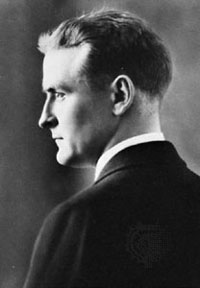
Fitzgerald was one of those writers I liked right away, even though I read most of his stuff when I was 15, and was forced to for school. I clicked with his books, for some reason. I credit a lot of that to my 10th grade teacher, Mr. Crothers. His love of The Great Gatsby
I already had a fascination with flappers (ahem. Obviously.) Not sure where the fascination came from. I think it might have had something to do with seeing Bugsy Malone on TV when I was about 12. Member that movie? Jodie Foster and Scott Baio as little kid gangsters and gangster molls? Driving cars with their feet like the Flintstones? I absolutely loved that movie, and I loved Jodie Foster's spit curls, and her costumes ... I remember, too, in junior high I did a whole paper on the 1920s for history class. I remember including photographs of flappers, and photographs of the cars they had ... I would insert stuff like this through the text:

I knew all about prohibition, I knew the music ... Oh, and I just remembered a couple other reasons why the whole "jazz age" thing fascinated me long before I encountered Fitzgerald: one of my favorite books growing up was Cheaper by the Dozen
All the time I was idealizing her to the last possibility. I was perfectly conscious that she was about the faultiest girl I'd ever met. She was selfish, conceited and uncontrolled and since these were my own faults I was doubly aware of them. Yet I never wanted to change her. Each fault was knit up with a sort of passionate energy that transcended it. Her selfishness made her play the game harder, her lack of control put me rather in awe of her and her conceit was punctuated by such delicious moments of remorse and self-denunciation that it was almost - almost dear to me ... She had the strongest effect on me. She made me want to do something for her, to get something to show her. Every honor in college took on the semblance of a presentable trophy.-- F. Scott Fitzgerald, "The Pierian Springs and the Last Straw" - a story written when he was an undergraduate
And lastly - when I was about 11, I remember my parents taking me to see a production of The Boyfriend up at the local university and I was swept away by it. The costumes, the music, the craziness ... I loved the charleston. I loved the whole fantasy of that era.
So when Great Gatsby came along, I was ready to just LIVE in the pages of that book.
F. Scott Fitzgerald (or - Francis Scott Key Fitzgerald) was born in St. Paul Minnesota in 1896. He went to Princeton, and afterwards joined the army. Somewhere in here, he sold his first story ... and when he was only 23 years old he wrote and published his first novel: This Side of Paradise

People projected their own desires onto him, their ideals for who they wanted to be. He was glamorous, urbane, free of societal conventions ... He lived the life others wanted to live.
And yet, he wrote: "What people are ashamed of usually makes a good story."
That is courage. That kind of honesty. So inspiring to me.
In 1922, he wrote in a letter to Maxwell Perkins at Scribners: "I want to write something new -- something extraordinary and simple & intricately patterned."
Such a young man. Such a broad and deep vision.
Around this time, he married Zelda Sayre who hailed from Montgomery, Alabama.

Girls, for instance, have found the accent shifted from chemical purity to breadth of viewpoint, intellectual charm and piquant cleverness ... we find the young woman of 1920 flirting, kissing, viewing life lightly, saying damn without a blush, playing along the danger line in an immature way - a sort of mental baby vamp ... Personally, I prefer this sort of girl. Indeed, I married the heroine of my stories. I would not be interested in any other sort of woman.-- Interview with F. Scott Fitzgerald, in January, 1921
She was the yin to his yang, she was the perfect partner in crime for that particular decade ... she did not give a damn. She was the Clara Bow for the literary set. She was who they were talking about when they talked about "jazz babies". The original flapper.
Look at their wedding portrait. I just love it.

They had their wedding reception at Chumley's, a former speakeasy and literary hangout at 86 Bedford Street, which is still there. It's the same now as it was then: no signage, nothing to say it's there. You have to know where it is. 86 Bedford, baby! 86 those plates, and let's get the hell out of here.
So Fitzgerald and Zelda married. They lived their relationship in public. They created personae, they acted parts, they showed up at places looking amazing, they relished in their own publicity. They kept massive scrapbooks of their clippings from the gossip pages. They were partners in all of this. Partners in self-promotion and self-absorption.
Here's a page from their scrapbook:

Zelda and Scott were like the Billy Bob Thornton and Angelina Jolie of their day. Exhibitionists, putting their own craziness on display, loving and living to shock others, having massive crockery-throwing fights in public, also having clutching make-out sessions in public ... It all was about being famous. But underneath all of that, there was this kindred spirit thing happening. You can't be in love with someone who NEEDS to be famous and not have the same need yourself. Or, you can, but it'll go bust. The two of them were in sync in those first years - it was like they were the same person.
Neither of them was ever the one to say, "Okay. Time for bed now." They were a couple with no brakes.
I've always known that, any girl who gets stewed in public, who frankly enjoys and tells shocking stories, who smokes constantly and makes the remark that she has "kissed thousands of men and intends to kiss thousands more," cannot be considered beyond reproach even if above it ... I fell in love with her courage, her sincerity and her flaming self respect and its these things I'd believe in even if the whole world indulged in wild suspicions that she wasn't all that she should be ... I love her and that's the beginning and the end of everything. You're still a catholic but Zelda's the only God I have left now.-- F. Scott Fitzgerald, in a letter to a friend
They would have drinks at the Plaza Hotel, and she would dance on the table. She would leap into fountains, fully dressed. She bucked convention. Just for the hell of it. She was the life of the party (while it lasted). She was wild. Just wild. F. Scott Fitzgerald was inspired by her, she was definitely a muse of some kind. He would read her diaries, he hoarded the letters she wrote to him, he was completely wrapped up in her glow. Zelda is a fascinating (and ultimately tragic) character in her own right. A girl who was completely unprepared to do anything useful in her life - pampered and indulged by her family who thought she was nuts (and it is probable that much of her "mania" that was so captivating early on was actually an ominous sign of things to come), she basically set her sights on New York. She had the misfortune of marrying a man seen as the bright literary light of his generation - a misfortune because she had literary aspirations as well (uhm, echoes of Courtney Love?). Here is a small sketch she wrote about Montgomery Alabama, where she grew up. It is obvious she can write. Not like her husband, but she can definitely write.
There exists in Montgomery a time and quality that appertains to nowhere else. It began about half past six on an early summer night, with the flicker and sputter of the corner street lights going on, and it lasted until the great incandescent globes were black inside with moths and beetles and the children were called into bed from the dusty streets ... The drug stores are bright at night with the organdie balloons of girls' dresses under the big electric fans. Automobiles stand along the curbs in front of open frame houses at dusk, and sounds of supper being prepared drift through the soft splotches of darkness to the young world that moves every evening out of doors. Telephones ring, and the lacy blackness under the trees disgorges young girls in white and pink, leaping over the squares of warm light toward the tinkling sound with an expectancy that people have only in places where any event is a pleasant one. Nothing seems ever to happen.
There's a nice descriptive romantic quality there. She had talent. Only she had no discipline. None. F. Scott Fitzgerald, while a frenzied party-man, a heavy drinker, a guy who stayed out all night every night, had great discipline. He worked at his craft. He worked hard at writing. He was always writing, and honing, and editing. Maybe he was hungover, but his writing was his JOB. Zelda had none of that. She couldn't focus her energies. She was threatened by his success. She wanted a piece of that pie for herself. She also ended up resenting how he used her and her thoughts and sometimes even her words to become a success.
But ... well, we all know what ended up happening to Zelda. I don't know her diagnosis - but judging from some of her episodes, it had to be pretty bad. This was not a case of clinical depression. It was psychosis. While they lived in Paris, she got it into her head that she needed to be a ballerina. She began to study. She became obsessed. Soon, she was dancing for 6, 7, 8 hours a day. But she was in her early 30s by this point ... way too old to be a prima ballerina. But Zelda didn't care. Apparently, too, she was a terrible dancer. Friends who visited the couple in Paris told stories (in letters, and later, to biographers) of arriving for their visit, and Zelda would greet them at the door in a tutu and ballet shoes. She would dance for them. Awfully. These stories are excruciatingly painful to read. Look at her wedding portrait. Her young wild face, those tiger eyes. It's just sad to think of her end. It really is. It must have been unbearable.
Who knows where the madness came from, or if the wildness of her behavior in her youth (jumping in fountains, etc.) were early warning signs - things people ignored and forgave her for, because she was young and free. Who knows. I read a biography of Zelda Fitzgerald
But for about 5 or 6 years, the two of them were on top of the world. They had youth in their favor.


The Great Gatsby was published in 1925. Fitzgerald worked his ass off on this book - and was tormented throughout the process. He wrote, and re-wrote, and re-wrote - holding off his editor, Maxwell Perkins, as long as possible. It was a precious book to him, a deeply personal book, and he feared he had not succeeded.
Perkins' long letter back to Fitzgerald, after he finally received the manuscript, gives me chills. I won't print it in its entirety - it's too long - but it's an amazing insight into the book, and also ... into Fitzgerald the Writer. The guy had an innate gift, yes, but he also was this major craftsman.
Here are some excerpts from Perkins' initial letter:
I think you have every kind of right to be proud of this book. It is an extraordinary book, suggestive of all sorts of thoughts and moods. You adopted exactly the right method of telling it, that of employing a narrator who is more of a spectator than an actor: this puts the reader upon a point of observation on a higher level than that on which the characters stand and at a distance that gives perspective. In no other way could your irony have been so immensely effective, nor the reader have been enabled so strongly to feel at times the strangeness of human circumstance in a vast heedless universe. In the eyes of Dr. Eckleburg various readers will see different significances; but their presence gives a superb touch to the whole thing: great unblinking eyes, expressionless, looking down upon the human scene. It's magnificent!I could go on praising the book and speculating on its various elements, and meanings, but points of criticism are more important now. I think you are right in feeling a certain slight sagging in chapters six and seven, and I don't know how to suggest a remedy. I hardly doubt that you will find one and I am only writing to say that I think it does need something to hold up here to the pace set, and ensuing.
He then goes on to list a couple of pages of specific criticisms. Beautiful to read. It's really just amazing literary analysis is what it is.
One of the criticisms is this:
The other point is also about Gatsby: his career must remain mysterious, of course. But in the end you make it pretty clear that his wealth came through his connection with Wolfstein. You also suggest this much earlier. Now almost all readers numerically are going to be puzzled by his having all this wealth and are going to feel entitled to an explanation. To give a distinct and definite one would be, of course, utterly absurd. It did occur to me though, that you might here and there interpolate some phrases, and possibly incidents, little touches of various kinds, that would suggest that he was in some active way mysteriously engaged. You do have him called on the telephone, but couldn't he be seen once or twice consulting at his parties with people of some sort of mysterious significance, from the political, the gambling, the sporting world, or whatever it mayb be. I know I am floundering, but that fact may help you to see what I mean ... I wish you were here so I could talk about it to you for then I know I could at least make you understand what I mean. What Gatsby did ought never to be definitely imparted, even if it could be. Whether he was an innocent tool in the hands of somebody else, or to what degree he was this, ought not to be explained. But if some sort of business activity of his were simply adumbrated, it would lend further probability to that part of the story.
After a couple more paragraphs, Perkins writes:
The general brilliant quality of the book makes me ashamed to make even these criticisms. The amount of meaning you get into a sentence, the dimensions and intensity of the impression you make a paragraph carry, are most extraordinary. The manuscript is full of phrases which make a scene blaze with life. If one enjoyed a rapid railroad journey I would compare the number and vividness of pictures your living words suggest, to the living scenes disclosed in that way. It seems in reading a much shorter book than it is, but it carries the mind through a series of experiences that one would think woudl require a book of three times its length.The presentation of Tom, his place, Daisy and Jordan, and the unfolding of their characters is unequalled so far as I know. The description of the valley of ashes adjacent to the lovely country, the conversation and the action in Myrtle's apartment, the marvelous catalogue of those who come to Gatsby's house -- these are such things as make a man famous. And all these things, the whole pathetic episode, you have given a place in time and space, for with the help of T.J. Eckleburg and by an occasional glance at the sky, or the sea, or the city, you have imparted a sort of sense of eternity. You once told me you were not a natural writer -- my God! You have plainly mastered the craft, of course; but you needed far more than craftsmanship for this.
Now that's the kind of letter you want from your editor.
The Great Gatsby was not the phenom that This Side of Paradise was. Reviews were mixed. Only posterity would put Gatsby in the canon.
Zelda had her first breakdown in 1930. Fitzgerald's drinking problem went to another level. He was devastated by her illness, and he was devastated by what was obviously a slacking off in his success. It's tough when you become a mega-star at 23. Anything that follows is sure to be a letdown. Fitzgerald needed to support himself, so he started cranking out short stories for the big mags at the time ... stuff that paid the bills but left him feeling empty.
F. Scott Fitzgerald died of a heart attack at 44, leaving an unfinished novel The Last Tycoon
Like I said, last year I re-read The Great Gatsby. It was like running into an old childhood friend. I read it in three days. (It felt much much longer in high school.) I was shocked and moved by how much I had remembered. The huge eyes of Doctor T.J. Eckleberg ... I remember the intense class discussion about what those eyes symbolize. The green light at the end of the dock, obviously. And there were parts that I actually remembered word for word, because of how, exactly, Mr. Crothers (my teacher) taught the book.
I remember the huge discussion about the following part of the book:
Suddenly she threw the cigarette and the burning match on the carpet."Oh, you want too much!" she cried to Gatsby. "I love you now -- isn't that enough? I can't help what's past." She began to sob helplessly. "I did love him once -- but I loved you too."
Gatsby's eyes opened and closed.
"You loved me too?" he repeated.
I remember Mr. Crothers pointing out that section to us, and talking about how that was the snap in Gatsby, that was the dream dying in Gatsby, that was the inner conflict of the entire book encapsulated in two sentences:
Gatsby's eyes opened and closed. "You loved me too?" he repeated.
Fitzgerald does not describe the snap. He does not have to. Fitzgerald does not talk about Gatsby's dream of Daisy, his fantasy of Daisy, at least not in that pivotal moment. All he does, all he does, is tell us that Gatsby's eyes opened and closed. And in that moment, a man's dream dies.
Phenomenal.
I would have missed that, in high school, if Mr. Crothers hadn't dwelt on it so specifically, and it all came back rushing back when I re-read it.
I might say that Mr. Crothers was the best teacher I have ever had. Period. He taught me how to write. Plain and simple. And you know how he taught me? I wrote a paper in his class. I got a D. My first D in my whole life. Panic ensued. Deep depression. Writer's block. I wrote another paper. I got a D+. Next paper: C-. Next paper: I got a straight C. It was a very proud moment. And with every paper, agonizingly, I got better and better and better. Until finally, light broke through, and I was able to construct a damn paper. I wrote consistently A-level papers in college directly because of what Mr. Crothers taught me.
This post is a ramble. Mr. Crothers, if he read this, would be thinking: "Sheila, where's the thesis statement??"
So here it is:
I had forgotten the stature of Fitzgerald's opus. I had forgotten how superb it was. Or: if I remembered it, it was in a taken-for-granted kind of way. Like: "Oh yeah, that's a great book. One of the best books of the 20th century. Whatever." I had forgotten the level of the accomplishment. I had forgotten how moving it is.
Reading it as an adult gave me a whole new perspective on it as well.
When I read it at age 15, I was completely on the side of Nick, the narrator: The relatively innocent and honest bystander, looking on at the decadence of Daisy and Jordan and Gatsby, trying not to judge (like he says on the first page of the book), and trying to come out of the situation unscathed. But by the end of the book, Nick is changed. And so are we, whether we like it or not.
But now, reading it as a grown woman, with a couple of failed love affairs in my rear view mirror, I found myself entering the story through the eyes of Gatsby. I could see myself in parts of him. It KILLED me. I understood Gatsby, suddenly. Carrying a torch for years, infusing everything with significance, poetry, choosing the dream-world over reality.
It is only NOW, after reading it from an adult perspective, that I can truly understand why the book is seen as such an epic human tragedy. An American tragedy.
Now I understand. Now I understand.
Those first pages are so extraordinary, so exquisitely written, they cannot be improved upon.
In my younger and more vulnerable years my father gave me some advice that I've been turning over in my mind ever since."Whenever you feel like criticizing any one," he told me, "just remember that all the people in this world haven't had the advantages that you've had."
He didn't say any more, but we've always been unusually communicative in a reserved way, and I understood that he meant a great deal more than that. In consequence, I'm inclined to reserve all judgments, a habit that has opened up many curious natures to me and also made me the victim of not a few veteran bores. The abnormal mind is quick to detect and attach itself to this quality when it appears in a normal person, and so it came about that in college I was unjustly accused of being a politician, because I was privy to the secret griefs of wild, unknown men. Most of the confidences were unsought -- frequently I have feigned sleep, preoccupation, or a hostile levity when I realized by some unmistakable sign that any intimate revelation was quivering on the horizon; for the intimate revelations of young men, or at least the terms in which they express them, are usually plagiaristic and marred by obvious suppressions. Reserving judgments is a matter of infinite hope. I am still a little afraid of missing something if I forget that, as my father snobbishly suggested, and I snobbishly repeat, a sense of the fundamental decencies is parcelled out unequally at birth.
And after boasting this way of my tolerance, I come to the admission that it has a limit. Conduct may be founded on the hard rock or the wet marshes, but after a certain point I don't care what it's founded on. When I came back from the East last autumn I felt that I wanted the world to be in uniform and at a sort of moral attention forever; I wanted no more riotous excursions with privileged glimpses into the human heart. Only Gatsby, the man who gives his name to this book, was exempt from my reaction -- Gatsby, who represented everything for which I have an unaffected scorn. If personality is an unbroken series of successful gestures, then there was something gorgeous about him, some heightened sensitivity to the promises of life, as if he were related to one of those intricate machines that register earthquakes ten thousand miles away. This responsiveness had nothing to do with that flabby impressionability which is dignified under the name of the "creative temperament" -- it was an extraordinary gift for hope, a romantic readiness such as I have never found in any other person and which it is not likely I shall ever find again. No -- Gatsby turned out all right at the end; it is what preyed on Gatsby, what foul dust floated in the wake of his dreams that temporarily closed out my interest in the abortive sorrows and short-winded elations of men.
Reading that makes me want to put down my pen forever.
So does the last sentence of the book:
So we beat on, boats against the current, borne back ceaselessly into the past.
And here, in his essay "Early Success", written in 1937, Fitzgerald writes:
The uncertainties of 1919 were over - there seemed little doubt about what was going to happen - America was going on the greatest, gaudiest spree in history and there was going to be plenty to tell about it. The whole golden boom was in the air - its splendid generosities, its outrageous corruptions and the tortuous death struggle of the old America in prohibition. All the stories that came into my head had a touch of disaster in them - the lovely young creatures in my novels went to ruin, the diamond mountains of my short stories blew up, my millionaires were as beautiful and damned as Thomas Hardy's peasants. In life these things hadn't happened yet, but I was pretty sure living wasn't the reckless, careless business these people thought - this generation just younger than me ...The dream had been early realized and the realization carried with it a certain bonus and a certain burden. Premature success gives one an almost mystical conception of destiny as opposed to will power - at its worst the Napoleonic delusion. The man who arrives young believes that he exercises his will because his star is shining. The man who only asserts himself at thirty has a balanced idea of what will power and fat have each contributed, the one who gets there at forty is liable to put the emphasis on will alone. This comes out when the storms strike your craft.
The compensation of a very early success is a conviction that life is a romantic matter. In the best sense one stays young. When the primary objects of love and money could be taken for granted and a shaky eminence had lost its fascination, I had fairy years to waste, years that I can't honestly regret, in seeking the eternal Carnival by the Sea. Once in the middle twenties I was driving along the High Corniche Road through the twilight with the whole French Riviera twinkling on the sea below. As far ahead as I could see was Monte Carlo, and though it was out of season and there were no Grand Dukes left to gamble and E. Phillips Oppenheim was a fat industrious man in my hotel, who lived in a bathrobe - the very name was so incorrigibly enchanting that I could only stop the car and like the Chinese whisper: "Ah me! Ah me!" It was not Monte Carlo I was looking at. It was back into the mind of the young man with cardboard soles who had walked the streets of New York. I was him again - for an instant I had the good fortune to share his dreams, I who had no more dreams of my own. And there are still times when I creep up on him, surprise him on an autumn morning in New York or a spring night in Carolina when it is so quiet that you can hear a dog barking in the next county. But never again during that all too short period when he and I were one person, when the fulfilled future and the wistful past were mingled in a single gorgeous moment - when life was literally a dream.

Look out, Winter Garden
My friend Sean joins the Broadway cast of Mamma Mia tonight after touring with the show for what now feels like a decade and a half. He and his boyfriend Guy (Guy of the "purple signs") have just moved to New York and I have not had a chance to see either of them yet - due to the fact that I have been out of town for two weeks - and also that the second they hit town they began to search for an apartment to buy (and my God, is that a full-time occupation - I think they found one though) - and also Sean has been full-time rehearsing for his Broadway debut. But September 24th - tonight - is the night he goes on ... and I'm really excited for him.
I stole this picture from his Facebook. Because that's what I'm all about these days. Theft and dishonesty.

I just loved it - the excitement in the picture, and the anticipation of the big moment which is now, finally, HERE.
Congratulations, Pastor Sean! Break a leg!
September 23, 2008
My friend Luisa - at last!
Luisa (whispered to me): "I want to be on your blog."
Me: (protesting) "I've written about you before!"
Luisa (whispering, scratching the wall quietly in a vaguely disturbing and frightening manner): "But I want to be on it more."
I still can't stop laughing about that.
Luisa: jewelry designer (see her work here) slash therapist. She has a store (Argentum Designs) - and the jewelry she designs is called Argentum Jewelry. Ever since I've known her - she has made jewelry. It's really cool stuff - stones, and metal and beach glass ... and they're also instantly recognizable as a Luisa Design.
Luisa has been a friend since college. She is the one who said, on an infamous hungover morning in college, that her badly behaved dog was her "bear to cross". Mitchell and I sat on the couch, hungover, as Luisa wandered through her apartment, looking tragic and under-slept, muttering about her "bear to cross". We were, frankly, too afraid to say, "Uhm ... don't you mean 'cross to bear'?" Better to just leave things unsaid. I still say "bear to cross" on an almost daily basis.
Luisa makes the best ice coffee in the world. To quote my brother: "This ice coffee tastes like candy!!"
Luisa, calling out from the kitchen, "MAMA'S IN THE KITCHEN!"
One day, we all sat out on the back porch of Luisa's condo, looking through the boxes and boxes of beads that Luisa uses to make her jewelry. Jackie, for some reason, became "Bead Lady" - and did improvisational monologues about each bead she pulled out, making shit up as she went along, about Incan temples and voodoo rites symbolized in the bead ... She pulled out one bead, glanced at it, and then looked up and stated bluntly, "This bead pre-dates Christ."
Luisa and Mitchell, doing voiceovers for Luisa's small frail dying cat - using a small passive-aggressive voice: "Oh, don't mind me don't mind me ... I'm dying." "You guys go ahead ... don't worry about me ... I'm dying ..."
STAHZANDMOONZ .... stahs annnnnd mooooooonz .... If I am remembering correctly, Luisa dated a girl once who was really into "stars and moons". If it had a star and a moon on it? This girl loved it. Luisa came to visit us in Chicago so we went to a store (the Alley on Belmont, if you must know) to find a present for the girlfriend ... and Luisa said bluntly as we entered the store, "All I'm looking for is stars and moons ..." The joke stuck with us and now it has, of course, morphed beyond all recognition. It must be said in a long-drawn-out Rhode Island accent, with nary an "R" in sight - and you must not be able to understand one word. "Allz I care about is STAHHHHHHHHHHHZ NNNNND MOOOOOOOOOOOONZ ..."
Once upon a time, Luisa, Mitchell and I went out for Thai food in Chicago on a blustery rainy night. Luisa commented upon the blue and white china cup (with a neat little cap) that we drank coffee from - and said, "God, my mom would love something like this for her china closet." And I couldn't stop myself. I shoved my blue and white china cup in the pocket of my raincoat and, after we paid the check, walked out with it. I literally couldn't resist. We got half a block away from the restaurant, walking into the driving rain, before I came clean. "Uhm ... Luisa ..." She glanced at me and I slowly opened my raincoat to show her my stolen goods. We all flipped OUT and started running as fast as we could - Luisa screaming, "I can't believe you did that!!!" And to this day, that little blue and white china cup sits in Luisa's mother's china closet. Horrible. But funny.
Recently, I was trying to talk to her seriously and I realized, halfway thru my impassioned monologue, that Luisa was more focused on trying to neatly position her drinking straw around her own eyetooth. I am still laughing about it. We were crying. I was pleading, "Luisa, I'm trying to tell a serious story ..." Luisa (with the straw hanging off of her eyetooth) said, "Yeah, yeah, I know, but look how cool this is ... It fits perfectly!"
Luisa: "Okay, I'm going to bed now. I have a movie I want to watch."
Me: "What movie?"
Luisa: "The Painted Veil."
(Brief pause.)
Me: "I don't understand."
Sung to the tune of "Jack and Diane":
... lyrics by Siobhan:
Oh yeah their love goes on and on
Jean and Patrick ... and even Hudson

The Marianne Influx
Mitchell: "So there are - what - 4 Mariannes in your family? So basically I'm calling everyone I meet Marianne - because the odds are, I'll get it right more often than I'll get it wrong."
The tall ones
Emma and Rachel (to me): "We're the tall cousins."
Emma: "But you can stand with us, shorty."
A phone call:
Katy (my best friend when I was 8 and 9 years old): "It's so hysterical - a really good friend of mine LOVED that show Yes Dear and is still really sad that it's off the air - so we just had your cousin Mike call her to say Hi."
Mike shouting into the cell phone on the dance floor.
128 North, 95 South ...
Me: "Poor Emma asks for simple directions and she gets a dissertation on the complicated development of the freeway system in and around Boston."
A helpful tip
All you need to do to whip the O'Malley/Sullivan cousins into a veritable frenzy is to blast "Pour Some Sugar On Me".
Happy groom
Pat: "My face hurts from smiling so much. I'm serious. I wish I could stop smiling just to give my face a rest, but I can't!"
Another reference to my blog
Uncle Tony (after making some off-color remark): "Now I don't want to see that on your blog come Monday! I don't want The Sheila Variations to report that!"
James Frey redux
My cousin Mike and I re-enacted the James Frey-Oprah standoff for Mitchell and my cousin Matt.
Me as Oprah: "Was the dentist scene real?"
Mike as James Frey: "Well, you know, there were some parts of it that were .... Oh hell. No. I made the whole thing up."
Me as Oprah: (deep breath, turn away, blink rapidly, nod a couple of times as though trying to accept the unthinkable)
"I'm too old for this crap"
Rob: "I'm 40 now. I'm getting too old to dance like a maniac."
An hour later, I glanced across the dance floor, and saw Rob whipping around someone's Pashmina as though he were a matador, and then gyrating like a Solid Gold Dancer, surrounded by a circle of people howling with laughter.
Bridget in LA
Cousin Bridget: "I love LA. I don't understand LA but I love the climate. I live in the hills and I'm really into gardening. I mean, I'm growing goddamn cantaloupes right now."
Appropriation
Mitchell: "I was just telling your cousin Kerry how I completely appropriated a relationship with her. 'Well, you know, I'm really good friends with Kerry O'Malley ....' "
Blog-post request
Cousin Tim: "Sheila, I want you to write a blog-post about how responsible I am being right now. I want you to write an entire fucking ESSAY about how COUSIN TIM is the one who has his shit together at this moment in time."
Matt has a way with words
Cousin Matt: "I'd like a Jameson's please."
Bartender: "Sorry, we don't have Jameson's."
Cousin Matt: "How about some Bailey's? Do you have Bailey's?"
Bartender: "Nope. No Bailey's."
Cousin Matt: "Clearly, you are poorly equipped for an O'Malley wedding."
"An agony of trance"
Friend Ernie's reading of "Byzantium" and discussion of Yeats and Irish poets in general. Beautifully done.
September 22, 2008
September 17, 2008
Speaking of cousins
DEAR COUSINS: Here's the link to DA BIG COUSIN POST.
You'd never know by the photo that the air that day in Times Square was a hot messy humid polluted SOUP. I wasn't even in New York that day - but the humidity and soupiness had spread to where I was, so I can only imagine adding in the exhaust and the noise and the dirt of Times Square. So there's da cousin, in long white gloves and a fur-lined Christmas dress, looking sparkley and fresh and as though it's December and she's in a winter wondahland.
Kerry was taking care of Hope and I went over to her apartment the day after the Broadway on Broadway extravaganza to pick Hope up and hang out for a bit. It was good to see Kerry. At one point, I welled up with tears ... and slowly, compassionately, without saying a word, Kerry pushed a tissue box across the table at me. I went to grab a kleenex from it and saw that the tissue box looked like this:

And I just lost it. I am still laughing about it. It was just the way she pushed the tissue box at me, nodding comfortingly, like she was Tyra Banks or something ... but THAT was on the box. It was brilliant.
And during one of the Hope drop-offs, we were standing on the sidewalk, both holding our keys, and I looked down and saw that we both had the same keychain:

Seriously, it's a problem.
Anyway, congrats cuz - for looking like a million bucks in the SOUP that was Times Square that day. Rock on.
September 16, 2008
Signs
I saw the sign
and it opened up my eyes
I saw the sign
Noone's gonna drag you up
to get into the light where you belong
I saw the sign
I saw the sign


September 15, 2008
Tribute to da cousins
O'MALLEYS
Liam - the oldest of the O'Malley cousins. A classic old-school gentleman, with his porkpie hat, and black suit. He's a Rat Pack kind of guy, who still listens to records on vinyl (because, of course, why wouldn't you?) He is encyclopedic on music (get him talking about the Beatles or the Kinks - He wrote 2 posts on my blog about the Kinks - here's one, and here's the other and be prepared to be educated), pop culture, books, and anything that is, well, interesting. He and I are reading War and Peace right now. He is far ahead of me but I am loving reading this with him. He really cares about his family. He is there, solid, a rock, you can lean on him. Lydia, Liam's wife, has been in my family for years. A beautiful serene and amusing woman - she has this way of just making everything all right just by showing up. She and Liam are a true pair. It makes me happy to see them together. Her stories of doing set design on everything from indie films to television to big blockbusters have kept us entertained for eons. She is pregnant now - with their first child - and it's all very exciting.
Mike - my cousin Mike is uproariously and inappropriately funny. He is a common sense kind of guy (just like his father) and has a way of cutting straight to the heart of the matter. When he asks, "How are you?" he really wants to know the answer. If you lie to him, he will know it. He also has taught me about generosity because my cousin Mike is one of the most generous people I have ever met. If you say to him, "Please give me the shirt off your back, I need it" he will not hesitate. He is a rock. He is someone I have gone to in some of my darkest moments and he also provides a continuity ... He has known me always. Please tune in to the new Christian Slater series to see my cousin Mike in action. Lisa - my cousin Mike's wife is a beautiful person, a perfect counterpoint for the Tasmanian devil that is Mike. She is stable, funny, capable, and a true grown up. She has accepted the crazy life of her husband as her own and provides a warm and open space whenever any of us come to visit. I love her. They have 3 children - amusing specific little beings with three of the most Irish names ever born to man.
Marianne - Marianne was my true compadre growing up. We are one year apart. We went through everything together - puberty, family deaths, romance, marriage ... I have watched her grow and blossom over the years into the stupendous woman she is now. She is so much her mother's daughter it's not even funny. She just shows up, when the going gets tough ... she's right there, she'll do anything - cook you something, hold your hand, make you laugh, or send you a nice email in a dark moment. I don't see her enough but I can always feel her there. Marianne is married to Jimmy - just an awesome friendly NICE man ... (being 'nice' is so underrated!) - and they have two rambunctious CUTIE little boys.
Kerry - In the last 10 years or so, Kerry and I have become true friends. We were not always close - for various reasons - having to do with our ages and also not seeing each other enough, but now - all that has washed away. We probably chat, on average, once a day - at least in the comments of my blog, but also thru email and phone conversations. She, like her brother Mike, knows the true meaning of generosity. Over this past weekend, we needed a couple of favors from Kerry ... it's hard to ask someone to do something for you ... but when we got over it, and called her - she was right there. "Tell me what I need to do." Family. That's what you do. It's tribal. Kerry has that tribal thing in spades. I treasure her friendship. Make sure you check in with Brotherhood to see Kerry in action!
Bridget - Bridget has taken on vaguely mythical status due to her absence and the continued promise that she will appear - but she rarely does. Yet she is always on our minds. It's like waiting for Godot. "Will Bridget come?" "Is Bridget coming?" "Did Bridget RSVP?" Bridget is the treasured daughter of uncle Jimmy (my godfather - who passed away way too soon) and even though she is almost like an urban legend at this point - her humor and love are really why she has taken on such a status with all of us. We want her there. We love her, and we always hope she will show. I will never forget the day of Mike's wedding when, once again, we all were like, "Is Bridget coming? Did Bridget RSVP? Will she be here?", as we all milled about in the hotel lobby, when suddenly a gleaming black car pulled up in the drive, the door opened - and a slinky leg appeared ... black strappy heels. Then Bridget unfolded herself from the car, in a floor-length fabulous red gown ... she had taken the car service from her mother's house (over an hour away) ... and we all rushed at her as though we were the paparazzi and she were Angelina Jolie. She is important to us.
Rachel - What you need to get about Rachel is that she is, hands down, the funniest person I know. In a family full of professional actors and comedians, RACHEL is the funniest. It's not that she has one-liners, or ba-dum-ching punch lines. It's her delivery. She is a true delight, a beautiful person - who lives in Southie and, perhaps, always will - she loves it, despite all the shenanigans and controversies involving parking spaces and snow plows. For an infamous year, she worked for Martha Stewart - and i still have a Martha refrigerator magnet from Rachel's reign there. Rachel is glamorous, too - a beautiful babe - and I always look forward to seeing her. With my cousins, it is easy to just get to the heart of the matter. There may be small talk, but it never ever FEELS small.
Matt - for many years, Matt (Rachel's brother) was this huge mystery to me because he was just a little boy during the time I was in high school and college - and my main memory of him was of Matt misbehaving in an apocalyptic and totally memorable way during one Thanksgiving at my grandmother's. Matt is now about 8 feet tall, and is studying classical guitar. He's rather brilliant, and has his father's dry wit and demeanor. I saw him for the first time in years at Mike's wedding (which was years ago) and i was amazed at the tall strapping man beside me - could this be the same boy who misbehaved at Thanksgiving and had to be banished to my grandmother's bedroom? I look forward to getting to know him better. He's also, like everyone in my family, committed to the family. He's flying in this weekend ... and it's very very exciting.
Marianne - Yes, two Mariannes in one family! Marianne is the daughter of my uncle Joe - who also was taken from us way too soon. Joe died when I was about 10 or 11 years old - and I didn't really understand what my dear cousin was going through at that time. We were best friends. Her family would come to visit our family and we would spend the entire day at the beach. I have the pictures to prove it. This is us, age 11, jumping off the diving board at my uncle jimmy's. It captures our relationship perfectly. She was a little bit more worldly-wise than I was (she reminds me of Jodie Foster) - and so she taught me:
1. how to put on a bra
2. how to practice kissing by using your pillow
3. how to prepare for getting my period ... the emotional issues, pad vs. tampon, failsafe ways to avoid accidents - she filled me in on it ALL.
In many ways, Marianne is a raw nerve. Every time I spend with her is intense and real. The last time I saw her was in 2003 when I took a bus up to her town in Maine and spent a weekend with her and her husband Paul. Marianne had slipped on the ice and broken her ankle -but we still managed to go to the lighthouse that Longfellow liked to visit, and for the most part, stayed holed up in her apartment - with Paul plying us with food and wine, as she and I sat in the living room, talking, crying, and listening to the Monty Python album, singing "Every sperm is sacred" at the tops of our lungs. She and Paul have two children now - absolutely delicious little butterballs who look like composite portraits of both Marianne and Paul. Motherhood seems to suit her.
Tim - Marianne's brother. Tim is, along with Rachel, one of the funniest people I know in real life. He is a LUNATIC. Gorgeous as a movie star, covered in tats ... he is also, like all the O'Malley men, a standup guy, who shows up when the going gets rough. I come from good stock. Good county Mayo stock. Tim and my brother lived together in Brooklyn for a while - and he was a huge part of Cashel's life when Cashel was a baby. He's still a huge part of Cashel's life. Brendan and Timothy now live within walking distance of one another in LA. Tim can be big trouble. He makes us laugh so hard that sometimes we are asked to leave public venues. He's awesome.
Ian - I haven't seen Ian in a couple of years myself - but Siobhan has seen him quite a bit. He is a smart, sensitive person - who is starting to make a living for himself with his band. Siobhan bartends and sometimes she'll look up and there will be Ian and his posse. Ian was a terrific little boy - sweet and intelligent - and he and my father had a special bond. Ian is another stand-up type of guy - who knows that family is the most important thing. He will be there for you if you need him. He's done with college now, and striking out on his own, and I am sure whatever he gets up to will be fascinating. He's an O'Malley man, after all.
Emma - Ian's younger sister. I wrote a bit post about her here, in honor of her 16th birthday. Emma is now in college, and slim and beautiful as a supermodel. A tall thin Irish glass of water. She is creative, hilarious, intense, and a beautiful human being. I don't see her enough but now that she is going to college in Manhattan I hope to see her more. Siobhan tells a funny story about getting off the train once, and emerging onto a street which had been blocked off because a movie was being filmed there. She tried to make her way down the street - only to be stopped by a PA (production assistant), wearing a headset and a little mike - and the PA was starting to say to her, "Excuse me, miss, the street's blocked off" - and then Siobhan realized: Oh my God, it's Emma - and the PA (Emma) realized Oh my God, that's Siobhan - and much hilarity ensued. Emma is a PA on her summer vacation, policing the streets of the city. Look out, Manhattan.
Grace - In true Irish fashion, I have a cousin who is barely in grade school yet. Grace is my uncle Tom's daughter - and she is smart, funny, runs around wearing a tutu in public, and is unable (as of yet) to pronounce the letter "R" correctly. Apparently, she said to my aunt Regina, in a vaguely defensive and combative manner, " 'R's are the enemy. They are not in my schedule." Like: get off my back about the letter R, thankyouverymuch. She is a beautiful fierce little creature, and I can't wait to see her grow and develop.
Henry - Henry is Grace's younger brother who is just a baby. So the O'Malley cousins span from mid-40s to diaper-wearing butterballs. Henry is a small square solid human being who kills us all with his cuteness. Grace is a good older sister, and Henry will have nothing to fear as long as Grace, the girl who has declared war on the letter "R", is around.
SULLIVANS
Nancy - the oldest of the Sullivan side of cousins. Nancy always had a glow of glamour and grownup-ness to all of us, when we were kids. She wasn't that much older than us - but she was applying to college when I was just a freshman in high school, so that is a huge age difference. Nancy is deep, friendly, sensitive, and fun to be around. She went to Princeton (Brooke Shields was in her class) - and was always tremendously intelligent, hard-working, and dedicated. She was a big runner. She played piano in recitals and took her lessons seriously. Anything she did, she put her all into it. She is now married to a wonderful and funny man, with 4 kids, and living in Texas. I don't see her enough.
Susan - Susan was one of my kindred spirits growing up. She was a year older than me - and Christmas and Easter and our family vacations in New Hampshire shimmered with excitement because SHE would be there. The adventures we have had together are beyond number. We have laughed so hard, as children, that we literally pissed our pants and had to hang our undies out to dry. Anything Susan did, I wanted to do. I have recently realized just how many books Susan introduced me to - when we were kids. If she read it, I read it. And in that way, I was introduced to Jane Langton, the Gone Away Lake books, Enid Blyton, and oh, so many more. We spent hours upon hours together as kids, and I treasure all of those memories. She became a news anchor and now lives in Ohio with her husband - and they have a beautiful big farmhouse, and she seems to be happy.
Ken - Ken and my brother were kindred spirits growing up - and they had a long-running project called "The Mad Killer" - where they would stage increasingly violent attacks by a serial killer on the loose, and capture it with a Polaroid camera. The rest of us were all extras in this ongoing series. I was murdered in cold blood in the back of a grocery store in Sunapee, New Hampshire. The Mad Killer climbed over walls, traveled via outboard motor, crept through trees ... He used guns, knives, and also throttled people with his bare hands. My brother and Ken both still have The Mad Killer Polaroids - and they are family favorites. Ken was an outstanding athlete - a true natural. He just had that thing that all great athletes have. Hand-eye coordination, grace, and an ease with the game. Watching him play a Little League game was sometimes like watching Ted Williams in embryo. He was truly gifted. He's funny in a kind of quiet way - he makes me laugh. He is married to Suzanne - a true powerhouse, who sews her own clothes, bought a piano for 20 dollars on eBay, and basically can do anything. They have three awesome children.
Kathleen - Kathleen and my sister Jean were kindred spirits. My childhood photo album is filled with pictures of the two of them, little pipsqueaks, playing and hanging out on random sunny patios, surrounded by Fisher Price toys. She is kind, sensitive, deep, and is continuing the family tradition by being a librarian. She got married a couple of years ago - to an awesome man and they have a son - a small apple-cheeked cutiepie. Every year, my aunt Geddy throws a "cousin brunch" around Christmas - where as many of us who are able gather, for food, talk, and a Yankee swap. Bringing a boyfriend or a girlfriend to the cousin brunch is a rite of passage - and rather frightening for the boyfriend/girlfriend in question. But if you pass the test, you're in! Kathleen's boyfriend (now husband) came to the cousin brunch for the first time in 2004. We all had to bring gifts for the Yankee Swap - and he brought the Boston Globe from October 28, 2004. I'll let you deduce what was on the front page. Suffice it to say, it was the most fought after gift at that particular Yankee Swap - and we loved him from that moment on. If you're in with the cousins, you're IN!
Lisa - She's up there with one of the funniest people I have ever known. We were BFFs growing up - even with the horrible blot of a certain family trip to Sturbridge Village. We survived! She is smart, a good listener, and has a really graceful way of taking the edge off intense moments by making a joke that will have us all in tears of laughter. She is married to Rob - a man who is so funny that he seems actually dangerous at times ... like, you can't look at him in solemn moments because it could be fatal. His dancing at family weddings has become legendary. Apparently, at my cousin Cecily's wedding (which I could not attend) - at one point he was doing a Cossacks-style Russian dance - squatting and jumping back up - arms crossed - in the middle of a cheering circle of people. He is crazy! Lisa and Rob have three (NOT TWO, THREE) sons. I get excited whenever I get to hang out with the two of them.
Kelly - Kelly is warm, kind, funny, and has three children - a baby boy and two of the cutest little daughters you will ever see. They are usually in identical outfits, little plaid skirts and black velvet tops, and they are usually carrying My Pretty Ponies around. I asked one of them what she wanted for Christmas, and she replied shyly, "Anything that is pink and sparkley." Pink and sparkley - got it! Kelly seems to treat life's little bumps in the road with humor and grace. She is a comforting presence. Always.
Jay - I still find it hard to believe that my tiny baby cousin Jay, last seen staggering around in diapers and a Red Sox T-shirt - is now a pilot. I see the pictures of him sitting at the controls for various giant airplanes, in his white uniform, and I think: "Do they let small babies become pilots? Who is that tall handsome Irish-looking man flying that plane? Is that Jay??" Jay has made a wonderful life for himself, and is married to a beautiful girl - and they have two cute sons - who are usually seen in Red Sox T-shirts themselves.
Meredith - Meredith makes me laugh. I sometimes lose track of how old she is - 12?? Is that right? She's got big curly locks, a beautiful freckled face, and a wonderful and funny demeanor. She is so much younger than the rest of the cousins, but that has never held her back from feeling like she belongs. Yes, all of her cousins are adults, but what does THAT matter? She is sweet, funny, and a good person - and I look forward to seeing what she will do next.
Matt - Matt is someone I cherish - and I don't see him enough - but man, what a nice person he is. Kind, caring, a good listener, funny ... and with a memory like an elephant. He remembers things about our collective childhood that have vanished (for me) into thin air. He holds it all. He is a toweringly tall man ... and really has the best of his father and his mother in him. He has married a woman we all love dearly - she's just a superstar, basically. Funny, bubbly, supportive ... they are a great pair.
Cecily - Cecily and Siobhan were BFFs growing up and are still close now. Cecily is beautiful, funny - and one of my favorite memories is at Siobhan's album-release party, when Cecily (a wonderful musician and singer herself) joined Siobhan on the stage to do back-up singing. There were the two cousins - onstage at a club in lower Manhattan - wonderful!! Cecily recently got married - and is about to have a baby any day now.
Owen - A tall sweet funny man - committed to family (I don't think he's missed one of the "cousin brunches" - or as well all call it: DA BRUNCH) and to being there for his family. He's a musician, covered in piercings and tats - and has been dating the sweetest funniest girl for a couple of years now (they get married in a couple of weeks!) - We just LOVE her - again, she showed up at Da Brunch one year - and participated in the Yankee Swap, and was just awesome. We're a tribal sort of family, and I know it can be kind of intimidating to meet us all at the same moment. But she fit right in. I'm so glad the two of them found each other and I'm so sorry I won't be able to attend their wedding.
Olivia - She's another one that I sometimes can't get used to her being, well, a grown-up. There's a big age difference between us - so for years, she was a little kid, and I was a college student, or whatever ... but now here she is, a college graduate - we're friends on Facebook - and she has developed into a warm and caring young woman, just as funny as her siblings (Matt, Cecily, Owen) - and just as committed to family. She is flourishing in her life, and I look forward to seeing whatever she will get up to next.
I am terrified that I have missed someone. I keep counting it out on my fingers.
September 11, 2008
In Memory: Michael J. Pascuma, Jr.

A couple of years ago, I participated in the the 2,996 project: a tribute to the victims of the terrorist attacks on September 11, 2001. You signed up and you were assigned a name, at random, of one of the people killed on September 11, 2001. I was assigned Michael Pascuma. I wrote the following post about him. I had never heard of Michael Pascuma, and did my best to find articles and tributes to him on various victims' tributes sites. Since then, I have heard from two of his three children (who are adults) - Michael and Melissa - and we have corresponded a bit. I knew when I signed up that it would be an intense experience - and today, I find myself thinking, like I am sure I will every year, of the Pascuma family.
Here is the post I wrote, in tribute of a man taken too soon.

Michael Pascuma, Jr., center, with his family on a recent vacation. Left to right are his son Michael, wife Linda, daughter Melissa, and son Christopher.
I cannot pretend to know Michael Pascuma - and in some ways, even writing this tribute has felt presumptuous. I can't comprehend the loss the Pascuma family feels - but I will say this: I can't imagine that another September 11 will go by without me thinking, specifically, of Michael J. Pascuma - and Linda Pascuma - and Michael, Melissa, and Christopher Pascuma.
Newsday article:
Michael J. Pascuma
Broker didn't sweat 'the small things'
April 19, 2002
Every Tuesday morning, Michael J. Pascuma Jr. of Massapequa Park would take a short stroll from the American Stock Exchange to meet colleagues for a breakfast conference at Windows on the World atop the World Trade Center.
"They would conduct business and maybe later tell a few jokes," recalled his daughter, Melissa Pascuma, a fourth-grade teacher at the Shaw Avenue Elementary School in Valley Stream.
Pascuma, 50, worked as an independent stock trader with his father at their firm, MJP Securities. Both held seats on the exchange. The senior Pascuma, 93, still works as a trader at the exchange. Shortly before the terrorist attack. MJP merged with another firm and is now called Harvey, Young & Yurman.
Pascuma's daughter said that immediately after the first plane struck the north tower, her brother, Michael, reached their father by cell phone. "I have to get out of here. There's a fire," were the last words he said to his family. The trendy restaurant was located on the 107th floor of Tower One. Pascuma's remains were discovered shortly after the disaster, and a memorial service was held at St. Rose of Lima Church in Massapequa.
"My father had the most amazing sense of humor," said Melissa Pascuma. "He thoroughly loved telling jokes to the family and his friends. He was constantly generous with everyone around him, and he enjoyed every single day of his life."
She said her father was fond of chatting online with friends and was an avid golfer. "He never worried about the small things. He knew what mattered," she said.
Pascuma's wife, Linda, said, "My husband was a wonderful family man who was very much loved and appreciated by everyone."
The couple would have been married 27 years on Sept. 21. Linda Pascuma called the entire family "Disney-O-Philes." "For the past seven years at Easter time, we'd all go to Disney World for 10 days," she said. A friend served as travel agent and also went along on the trips. The annual event also included her sister's family, bringing the fun-seeking entourage up to about a dozen members, recalled Linda Pascuma.
"Sometimes when my husband got a little bored with things, he'd go off to play golf while we went on the rides and things," she said. "But it always was a trip we'd talk about all year."
Pascuma, who grew up in Richmond Hill, never attended college but as a young man learned the ins and outs of stock trading from his father, still a well-known figure in financial circles who remembers the stock market crash of 1929.
Besides his wife and daughter, both of Massapequa Park, Pascuma is survived by his sons, Michael, a college student at Sacred Heart University in Fairfield, Conn.; Christopher, a Massapequa High School student; and his parents, Michael and Ada, of Richmond Hill.
--Bill Kaufman (Newsday)
I went to the memorial sites where people who knew the victims could leave tributes and I came across the following message:
You will be missed. Thank you for all of your kindness. I will miss being your customer. Anne Boudreaux (New Orleans, LA )
There were many messages I found from family members, childhood friends ... but this one in particular really struck me: "I will miss being your customer." How many businessmen can say that there will be those left behind who will say, "I will miss being your customer."? That is integrity.
Other people from Mr. Pascuma's life left tributes (some on this site and some on others) - and here are some personal memories of him. By all accounts, Mr. Pascuma was a humorous caring individual, who went out of his way to make other people feel comfortable, who enjoyed his family to the utmost, worked hard, played hard.
Childhood friend Al Husni:
"I will always remember growing up with Michael. Playing ball, hanging out at PS66 with Michael, Chris, Latz, and the rest of the gang. His sense of humor, his gentleness, will never be forgotten by myself or those who knew him."
Childhood friend Robert A. Maltempo:
"I grew up across the street from Michael, moving away from Richmond Hill at the age of twelve. I will always remember the good times we had and what a wonderful father Michael had (he treated me like his son). I remember playing ring-a-leevio until dark, seemingly every evening, at P.S. 66. I remember Billy Speckman and also another friend of mine and Mikes, named Michael (I'm butchering his last name) Krachunis) who lived next door to Michael. Had many, many wonderful times growing up with Michael...his basement that was full of miniature/toy construction equipment, the NY ranger games his family took us to, a row boat trip with Michael's father singing "Michael Row the Boat to Shore" while Mike and I struggled with the oars.
George Moeser tells some really beautiful stories about Michael Pascuma:
I met Michael Pascuma through my sister Jean Barone back in the 1980's when my (now) ex-wife and I visited her and her (now) ex husband Tommy Barone during a Christmas holiday. We attended a party hosted by the family that owned the Mermaid Restaurant. Of all the people we met at that party in Massapequa Park, Michael was the standout. He was and still remains one of the nicest most genuine people I have met in this life. His warmth, demure and canny sense of humor along with that winning smile of his were a true reflection of great soul, something that can not be faked, learned or acquired.He and his wife opened his home to us as if he had known us all his life. I met his father and talked about his horses. His wife Linda and Bianca became friends. Later that week we met him for a visit to the exchange where he worked, but I didn't know there was the dress code and said he could take Bianca inside and I would wait. Michael thought for a moment then said, "Come on in with me, it will does these guys good to shake them up a little bit." As we went on to the floor, all three of us were pelted with spit-balls and hoots laughter from the men and women working there, all in good natured fun. One of the keenest impressions I got about Michael was that you could sense the friendship and admiration his coworkers felt for him. He later told me, to his knowledge I was the only person in the history of NYSE to walk the floor in a cowboy hat and blue jeans.
The irony for me in learning of his tragic and untimely death was that he took Bianca and I to the Windows on the World Restaurant for lunch that day. I still have the photo Bicana and myself with the Manhattan backdrop taken by Michael. I have another of him and I on the train with him pretending to pick my pocket in an exaggerated pose, this great smile stealing the scene. Later in the week he met us for lunch again, this time to the Carnegie Deli. He didn't want us to miss what he called the best corn beef sandwich on the planet - It was.
When we returned to Tucson, he would sometimes call the Boss Shears, the hair salon Bianca and I owned. Pretending to be a first time customer, he would ask if we took late appointments, saying he would have to fly in from New York. The receptionist would ask Bianca and I if we wanted a late appointment. And one or the other of us would ask what time. Then Michael would ask to speak to one of us, and I would recognize his voice instantly. He would laugh and say he might be able to catch the red-eye, get his haircut and fly back in time for work, but would bring two corn beef sandwiches from Carnegie as a tip for staying late.
Over the years we would fly back to New York on the holidays or a family function. Each time Michael and I saw each other again, it wasn't as if years had past but only days since our last laugh, shared antidote or exchange of impressions.
Years later I was divorce, my sister was also divorced, and had moved to Brooklyn. She and I became estranged and I lost contact with her friends from Massapequa Park. My ex wife kept in touch with my sister Jean and Bianca continued to exchange Christmas card with the Pascuma family, but I lost touch. It was years later when I asked how he was doing that I learned he had died in the 9/11 attack on the Twin Towers. That he died at the very same place where he and I had shared laughter over a meal was deeply moving to me. My eyes filled with tears and I prayed the Lord to bless him and keep him in all his ways. I still do.
On April 22, 2005, Michael Pascuma's daughter Melissa had a baby girl whom they named Madison Michael. It would have been Michael Pascuma's first grandchild.
Melissa wrote to her father on Sept. 12, 2005:
Daddy, I miss you more and more each day, month and year. I would do anything to get a tight hug from you, hear your laugh, or hear one of your jokes. There are very few children in this world that have an amazingly exceptional father. I am so thankful I happen to be one of them. You held our family together and were the kindest, most generous human being that lived. You did not deserve this. You are a grandpa now. She carries the name of a hero, Madison Michael. Love you endlessly, Your princess
Michael Pascuma's son Michael (on this page) wrote:
Tomorrow is Christmas Eve and will be Madison's first. You should be here sharing this with us in more than just spirit. I wish there was something I could do because I would in a second! There is so much that we never got to do or say and I would do anything for 1 more minute. I was in Miami this past weekend and saw more Ferraris than ever before and I didn't have you to call. For a split second I thought call Dad and then realied that can never happen again. I will never forget all the times we did share and will cheerish those forever. I miss all the things we used to do together and wish we could play one more round of golf. I would even take just being able to hear one more joke and hear your laugh. I miss and love you so much and I'm getting to upset to continue writing.
The NY Times Portraits of Grief piece on Michael J. Pascuma says:
Golf was Michael J. Pascuma Jr.'s consuming passion. He played every Saturday with a group of friends from work, at courses all over Long Island. He watched golf endlessly on television.Michael, 50, immersed himself in everything, whether it was golf, his family in Massapequa Park or his work as a stockbroker on the American Stock Exchange. Work and family were entwined: he and his 92- year-old father, Michael J. Pascuma Sr., possibly the oldest broker in the United States, had their own firm, M.J.P. Securities, which recently merged with Harvey, Young & Yurman.
"You would think it was a stressful job, but he was never stressed," said his 23-year- old daughter, Melissa Pascuma, whom he called his little princess. He also had two sons, ages 20 and 17. "As soon as he came home, he detached from it and his family was No. 1."
My husband, Michael J. Pascuma, Jr., was an only child. Michael worked with his father on the American Stock Exchange. His father is still employed there at 93 years old. His mother is 89.He was very well liked and a very respected Stockbroker. He was a very fair and honest person. He had a great sense of humor. He loved telling jokes or playing pranks at work.
He also loved playing golf. He played every Saturday with friends. He had started to travel a little to play on different courses.
Most importantly, Michael was a great father. He had three children, a daughter and two sons. His children loved him. He never fought or got mad at them. He would do anything for them. His sons enjoyed playing golf with him. He never worried about the small things. He loved life and appreciated everything he had. He knew what was important. If they made a mistake or if there was a problem he would always say it didn't matter as long as everyone was healthy.
We struggle every day without him and he is truly missed by his family, friends and co-workers.
A laughing kind hard-working family man. Someone I would have loved to get to know.
Amityville Record
September 26, 2001
Michael Pascuma knew he had a great dad. Over the years, he had never heard his dad raise his voice or lose his temper, and he always knew he was there for him and his brother and sister and mother if they ever needed him.
But it wasn’t until Michael Pascuma had a chance to work with his dad at the New York Stock Exchange that the younger Michael realized that his father was a person who treated everyone with respect and kindness.
"Even the man at the truck where he picked up his coffee and newspaper in the morning knew him by name and knew how he took his coffee," said Michael Pascuma. "I saw that everyone liked him and liked to be around him."
Michael Pascuma Jr., 50, died Tuesday morning, September 11 as terrorists crashed two commercial jetliners into the Twin Towers in New York City. He was having breakfast at Windows on the World as he did every Tuesday morning.
"When I heard that a plane had hit the Towers, I didn’t think much about my husband’s safety," said Linda Pascuma. "I knew he worked in the area and occasionally had breakfast at the Windows on the World but thought ‘what are the chances of his being there just as the planes hit?"
That misplaced sense of security was quickly shattered as Linda Pascuma received an urgent call from her son Michael who is a student at Sacred Heart College in Connecticut. "He knew my husband’s schedule because he had worked with him over the summer and knew that on Tuesday morning, every Tuesday morning, he and the other members of the firm met for breakfast there." The young Michael had called his father on his cell phone after the first plane hit. It was a brief, ten second conversation before the phone lines went dead, but his son managed to get one, final plea out: "I told him to get out of the building," said his son.
But like the thousands of others who perished in that cruel attack, Michael Pascuma Jr. perished. Unlike many of the other families, however, the body of Michael Pascuma was recovered and identified.
Linda Pascuma said that is the result of the intervention of the Sacred Heart of Jesus.
"Whenever I go on a long trip, I take a small statue of the Sacred Heart of Jesus that my grandmother gave to me," said Linda Pascuma. "For some reason that morning, when I left the house to drive my husband to the station, I grabbed the statue and took it with me. I believe it was because my husband was the one who needed him that day."
After watching the horrific pictures of the attack on the television, Linda Pascuma thought her husband’s body would never be found and she prayed. "I told the Sacred Heart that if my kids have to go through this to please allow us to have some closure. I didn’t want them to have to live in limbo, always wondering."
Her prayers were answered and the Pascuma’s were able to lay Michael Pascuma Jr. to rest last week.
Linda and Michael Pascuma would have shared their 27th wedding anniversary Friday. The couple met through friends and made a life together in Massapequa, raising their family here. Michael Pascuma worked for NJP Securities, which merged recently with Harvey, Young and Yurman.
She described him as a man who never worried about small things and who enjoyed life. "He would always say to me that I shouldn’t worry about the small things that didn’t matter. He played golf every week; we went on vacations together to Disney World and he even got a chance recently to drive a race car. He was a wonderful husband and a wonderful father."
In addition to his wife and his son Michael, Michael Pascuma Jr., is survived by his other son Christopher and his daughter Melissa, as well as by his father Michael Pascuma Sr., and his mother Ada.
His daughter is engaged to be married next year, a family event that will bring both joy and sorrow to the family, undoubtedly. "My daughter will be married and not have a father to walk her down the aisle," said Linda Pascuma who added that she’s angry and outraged by the attacks.
"My husband was murdered by these people. I am angry because our system let him down. Not one, but two airplanes were hijacked from the same airport. In an effort in this country to be nice to everyone, we didn’t keep our own people safe."
The anger comes in waves, replaced by sorrow and grief. In the next moment, Linda Pascuma cries a little and apologizes. She says that she asks only that people know that her husband was a good man and a good father and that his wife and his children loved him dearly and will miss him terribly.
"We want everyone to know that," she said. "Just that."

(photo took by me, at the Tiles for America display - on the corner of 7th Avenue South and 11th Street)
September 10, 2008
Tribute of light
This is the view outside my bedroom window right now.


Souls in the sky.
Cuimhnigh,
a Mhaighdean Mhuire róghrámhar,
nár chualathas trácht ar éinne
riamh a chuir é féin
faoi do choimirce
ná a d'iarr cabhair ort
ná a d'impigh d'idirghuí
is gur theip tú air.
Lán de mhuinín asat, dá bhrí sin,
rithimse chugat, a Mhaighdean
na maighdean is a Mháthair.
Is chugatsa a thagaim,
is os do chomhair a sheasaim,
i mo pheacach bocht atuirseach.
Ó a Mháthair an Aonmhic,
ná diúltaigh do m'urnaithe
ach éist leo go trócaireach agus
freagair iad. Ámen.
The two days that came before
September 9, 2001
Early evening.
I rushed to meet my sister Siobhan for a drink. We were convening at Astor Bar, one of my favorite places in the city (sadly, it is now something else. Still a cool club, but not my Astor Bar). It's in a central location, it was close to Siobhan's job - it was also right around the corner from where 2 of my cousins lived - so it was a great "let's meet there" spot. Especially if it was early in the evening. After 10:30, there would be a line down the block, so we avoided it then - but to start off a night? It was perfect. Astor Bar was the O'Malley-family jumping-off point.
I was dressed up, I remember. Long tight skirt, high heels - and I was hurrying, as quickly as I could, across 4th Street. I was late.
And I only remember how warm it was because - in my hurrying - I basically started sweating, and my powder dissolved off my face. Which bummed me out. I remember stopping in an empty doorway, popping out my compact, checking out the damage, and thinking: "Ah well. Tonight is too hot for powder then."
Strange. The things that remain.
Astor Bar had an upstairs bar with a big window, looking out on Bleecker Street. There was also a downstairs bar, shadowy, rather decrepit with peeling ceilings, and cavernous red leather booths, extremely atmospheric and dark - I loved it down there. The upstairs bar, though, was the good meeting-spot because you had a view of all the comings and goings up and down Bleecker - with 2 tables in the window, high bar stools - and then room for about 6 or 7 stools at the small curved bar. As I hurried past this window, I saw Siobhan, in a sun dress with a pleated skirt, sitting at one of the tables in the window.
Then - in the next moment - as I entered, 5,000 things happened at once. Each thing clear, distinct, set apart, and remembered perfectly - like a flickering newsreel in my mind. Sometimes I yearn for vagueness, for the softening of edges ... Clarity of memory is great, but it can also be a torment.
I pulled the door open.
In a flash second, I saw a guy sitting at the bar with a couple of other people - My eyes just quickly glanced over him - and I saw that it was a guy I had met at a party the year before - and we had had so much fun together at said party that when this guy said good-bye to me, he said, "Where the hell have you been all my life?" New York quickly became unimaginable without one another in it. It was a true meeting of the minds, a recognition. We recognized one another. A strange and unmistakable feeling. Like: "Wow ... I know you ... you're just like me ... I know you ..." He and I had such a riotous time together at that party (we all played charades, non-stop, for 4 straight hours...and then there was a trivia game invented - which we played for another 2 hours) - no one could beat the two of us at trivia. We took a walk through Soho together at 3 in the morning, talking, laughing, the world was our playground, we could have kept talking forever.
Anyway - it was one of THOSE kinds of nights. I woke up the next day, signed on, and he had already emailed me, obviously the second he returned home from the party - the time-stamp on his email was 5:45 in the morning - and he raved about how glad he was to have met me. And how he and I just "ruled" together.
And so began a rather intense epistolary friendship. Very 19th century, only with the 20th century twist of email.
I probably don't need to even explain that I fell completely in love with this guy. Within 10 minutes of talking to him. And he with me. But, truth be told, our behavior that night of the charades was more along the lines of separate babies reaching out to each other from separate shopping carts in the aisles at grocery stores ... or the sudden intimacy between romping dogs at Washington Square Park ...
It wasn't a grown-up "oh, yes, I have feelings for this man" kind of thing. It was more like we looked at each other, like babies reach out to each other, in fellow feeling. I looked at him and saw my own kind.
But alas. For various reasons, it was not meant to be.
However - we maintained this epistolary thing - writing, sharing quotes, sharing poems - and we continue to communicate about literature, poets, writers, etc. There are certain things I only want to share with him. I know he'll "get" it. It's that kind of thing.
So on September 9 - I had not seen him since the charades night a year and a half earlier - and then - there he was. Perched on a bar stool at Astor Bar.
So what do I do? I proceed to behave like a complete and utter jackass.
Reminds me of this quote from Nancy Lemann, one of my favorite authors:
It is always remarkable when someone sees your soul to a better degree than you see it yourself. You could count the people who see your soul on one hand. Others might know you but they would forget; their knowledge of you was like a weak and undisciplined thing. But that wasn't so with him. He didn't forget. It stuck in his mind. He had seen a kindred soul. he had seen it long ago. She only saw it now. But she was stricken with it. Suddenly she had identified him. There was the man she loved. As a result, she proceeded dementedly to behave as if the opposite were true.
That's it exactly. I was so thrilled to see this man again that I "proceeded dementedly to behave as if the opposite were true."
I completely ignored him, pretending blithely that I hadn't seen him, I swept by his crowd - and went straight for Siobhan, made a bee-line, pretending to be oblivious - and yet inside I'm thinking, insanely: It's him, it's him ...
Also- I had a moment of being totally bummed out (in that small flash of time during my cross to Siobhan) that I had sweated off my face powder.
Siobhan and I greeted each other, big hug, "hi hi hi" - and I immediately hissed at her, like a criminal on the run, "So and so is here. That is so and so. But don't. Look. Now." You know. Typical girl stuff.
I was suddenly 14 years old.
As I had stalked by him, making a beeline to my sister, I felt him see me. His entire posture changed. He sat up straight, it was like he was ... It was like a Discovery Channel moment. Animals in the wild, alert, ready to pounce.
I knew he had seen me, and yet I made this elaborate pretense that I was oblivious to his presence until I could get myself together to say to him, casually, "Hi there! How are you!" I was acting like an ASS.
It continues to be strange to me that this entire dance of awareness and avoidance would be so technicolor-vivid to me - I remember the body language, pauses, how he tilted his head, I remember exchanges we had later word for word ... The entire night is preserved perfectly in my memory, a fly drowned in amber.
The old world was about to sink away, forever. But of course we didn't know that. It would be the last time (for a long long time) that I would be in a group of people and be able to talk about normal things, everyday things, movies, archaeology, theatre, life, poetry.
And so the conversation we had that night stands out for me almost like a museum-piece.
I look at that night with longing, with sadness, and with fondness. Because we could not be faulted for not knowing what was coming our way. We were consumed with our own private pleasures, talking, innocently, joyously, laughing, drinking, interrupting each other ... as the murderers moved into position.
The sword of Damocles over our heads.
So all is preserved. Especially from that moment when I first walked in, saw him, ignored him, he saw me, and I walked by ... pretending to not see him. How he sat up straight and watched me pass - how I leant in to my sister and hissed at her "That's him, that's him..." - how I could feel him watching me like a hawk, waiting for an "in".
Finally, he could no longer stand the wait, and he yelled - yes, he YELLED, across the space at me - causing a dead silence to descend over the bar:
"WHY ARE YOU IGNORING ME?"
I still laugh when I think of that.
Why do I laugh? Because in that loud unafraid moment, he called me on my BULLSHIT. He didn't let me get away with the charade of "Oh my God, I didn't see you when I first came in! You're here?? Wow, what a coincidence!!" He KNEW I was ignoring him, and he YELLED that at me across the bar.
I just find that so funny.
That's why I fell for the guy, I think.
So I saw him and feigned surprise. Like a very very very bad actress.
"Hi there! Wow!"
He was staring at me with tremendous excitement and also deep humorous scorn. He stated, "You walked right by me."
"Uh ... sorry ... I didn't see you ..." I said lamely, my cheeks warm and flushed.
I knew he had busted me, and I knew that he knew I knew ... and it all seemed hilarious and beautiful. I loved that he had busted me, actually. It made me feel safe, for some reason. Like: he knew I was acting like a jackass, and that the reason why I didn't say Hi to him right away was because I was having a "riot of feeling" - but judging from his posture change, and his behavior the rest of the night, he too had a "riot of feeling" at the sight of my face ... and so he saw that I was afraid, that I was protecting myself for a second ... and he busted me on it, with such humor - with no judgment - it seemed like everything was going to be okay.
That's another vibe that was so present that night, and this is not retrospect talking. This is how it was. I walked away from the night - coming home at about 2 o'clock in the morning, thinking to myself, 'Wow. Everything's going to be okay, I think."
Nothing would be okay. Ever again. At least not in the same way. The world will never be the same again for me. I may have a night like that again, a night of innocent pleasures, and free laughter, and beautiful moments of connection ... but it will always, now, be in the context of the world that was born 2 days later. It makes a difference.
Siobhan and I merged our evening with charade-guy's night (he was with a group of friends) - and we sat, and talked, all of us - in that beautiful way that some conversations have - vigorous, up, down, people interjecting, fights breaking out, random bursts of laughter, blurting inappropriate statements, one person rising to the forefront with everyone else listening, someone else chiming in fluidly with their interpretation, either adding or detracting ... It went on and on and on and on and on. You know those kinds of conversations? They're very rare, actually. This one stood out.
At one point, Siobhan and I were being entertained by one member of the group, a guy who we still laugh about to this day. All he needed to do was light his cigarette, and we would burst out laughing. And with my lunatic peripheral vision (which was on overdrive that night), I saw that charade guy was sitting down the bar, watching us. Not speaking, not joining in, just watching us talk to his friend. And suddenly he exploded to the person sitting next to him, "Are those two women the most gorgeous women you've ever seen in your life?"
I don't say this to be vain. I just say this because it happened. It made me feel like a million BUCKS, I tell ya!
When we said goodbye to each other, he and I, we had a repeat of our good-bye on the night we met, only it was deeper and a bit more tormented. It kind of sucks to be confirmed in your fabulous first impression of someone, and still not be able to have them. He hugged me like he never wanted to let me go, and he kept saying my name into my neck. It was a spectacle. I loved it, but at the same time, I had to pry him off of me.
Afterwards, Siobhan and I walked through the warm night to our respective subways, still laughing and laughing and laughing about certain moments. We had cried off our eye makeup with laughter.
September 10, 2001
I emailed charade guy first thing that morning. I said, "Just wanted you to know how great it was to see your face again. Makes me feel good to know that there are people like you on this planet."
I had never written him such a thing before. I had never acknowledged any of that. But the night had been so amazing that I needed to let him know. And so I did.
A part of me waited for a response from him all that day, but another part of me thought: "It's really not about getting a response. He should know that I think he makes the world a better place just by being in it ... regardless."
September 10 was a Monday. I had gotten no sleep because of the romping the night before. But I felt wide awake, alert, my mind swirling with images and random bursts of laughter from the shenanigans of the night before. I felt so happy, I felt excited, too... And this isn't just me adding stuff on because of what day it ended up being. My journal entry for that day is barely controlled hysteria and joy. "I'm happy, God, I'm so happy right now!"
In case you haven't guessed, I'm not normally a chipper cheery Pollyanna type. Darkness is easier for me. But the Astor Bar night made the pendulum swing in the other direction.
I had spent some time doubting my strong response to him on the charades night. I thought: "What is my problem - that I would be so blown away by this guy - just because he played charades with me for four hours?" I felt a bit pathetic. Then - running into him again - I realized: Well. Obviously there's some huge connection between us. Huge. And a romance is not meant to be, clearly, but that doesn't mean that there isn't this understanding ... some sort of wordless understanding between us.
It was exhilarating.
That night, I went home to my brand-new apartment. On September 4, my roommate Jen and I had moved into a new place. We had not had our phone hooked up yet, we had not had our TV hooked up yet ... which ended up being an enormous issue later. We saw the entire thing happen with our own eyes, and yet ... we had no TV coverage - we had no perspective except our first-hand experience - and we had no phone. It took us a month and a half to finally get a phone, because of the chaos. Our entire kitchen was still in boxes - we had barely unpacked.
I came home on the night of September 10 to our new abode. All windows opens. Cross-breeze. A beautiful night.
My heart was still singing from my hours-long evening with charades-man. (I'm pretty easy to please.)
Jen was there, arranging her room - getting accustomed to the new space. We both had bedrooms facing East. The gleaming World Trade Center was visible above the Hoboken skyline.
(photo I took of our view from our apartment)
Jen and I ended up laying down on her bed, our feet dangling off the sides, looking out at the Manhattan skyline. And I told her the entire story of the night before. "You're never gonna guess who I ran into last night and who I hung out with for 4 hours..."
Being a wonderful girlfriend, she asked me 598 questions, and we talked about it to our hearts content. "So then ... he turned ... and he looked at me like this ... and then he said THIS thing ... and when we hugged goodbye he said THIS..." You know, your basic girlie convo. I re-enacted a couple of the body language moments, so she could get the full picture. Great great fun.
But it makes me uneasy to remember it now.
It was about 10 pm ... and Jen (she and I were not just roommates, but dear dear friends) said that she was afraid she was going to have trouble getting to sleep that night - because it was a new place and all. And would I mind reading out loud to her? Maybe that would help her go to sleep ...
She had never asked such a thing before. I love reading out loud, love it love it love it ... and she said, "Just pick out a book you like - I don't care ..."
I was excited. I went into my room - where, of course, the first thing I had organized had been all my books. My CLOTHES were still in boxes, but my books were on display. I thought: "Hmmm. Let me pick out something good ... what do I want to read to her ... what do I want to read to her..."
Out of nowhere, I picked out Paul Zindel's The Pigman - which is probably one of my favorite books ever. A book for teenagers, yes ... I read it in 8th grade ... but its charm and humor has never palled. That was one of those life-saving books I read at an all-important time - when everything seems dark and grim (re: junior high) - and that book, about 2 freakish outsider kids who befriend a weird little old man who collects china pigs, made me realize I wasn't alone. That there were other freaks like me out there, that life could be beautiful, that you could have a possibility of joy in life ... even though everything around you basically sucks.
That is what The Pigman is about.
So we curled up on her bed, with the summery night wind blowing through the dark window, and I read a couple of chapters out loud to her.
Such a strange and intimate thing to do.
We never did it again. That was the only time.
And The Pigman ended up not being the best choice - because it is laugh-out-loud funny at times, and Jen kept guffawing like a mad woman, instead of falling asleep. And I had a hard time getting through certain paragraphs, because I was shaking with laughter.
As I read it, with tears of laughter in my own eyes, I kept interrupting myself and saying, "God, I haven't read this in years ... this is so fun ... I remember reading this in Ireland at a B&B when I was 14 and laughing so loudly that my mother had to come down and tell me to be quiet ... I need to read this whole book again ..."
Interjecting my reading with these random little Pigman memories.
Jen finally murmured, "Okay. I think I can fall asleep now."
I tiptoed out of her room, turned the light off, and went into my new room. There was something heightened and tight in my heart. Sometimes I get too excited. Or ... let's just say - my experience of things can get pretty intense. I can't sleep. I lie in bed, going over and over and over things that excite me.
And that's what I did that night, after writing in my journal feverishly about the Astor Bar meeting with my love-at-first-sight friend.
I lay in bed, for hours, the darkness in front of my eyeballs, re-living that moment when I first walked into Astor Bar ... and he sat up straight in his chair ... and followed me with his eyes ... and his voice, "WHY ARE YOU IGNORING ME..." It appeared to just be on replay ... I didn't know why it pleased me so much, but it had some intense and perfect aesthetic which I found so satisfying.
And the other replay was the entirety of the book The Pigman and how much I had enjoyed sharing that book with Jen, in our new windy apartment.
Thinking to myself over and over in the darkness, as I slipped off into oblivion: I really must read that book again someday ...
In praise of firemen
If you read Ree (the Pioneer Woman), you know that she has a "retarded brother" (I'm just quoting her, remember!) Her "Mike stories" are some of the best in her entire repertoire - funny and touching. And today, her story of Mike and the firemen made me cry. Quite a propos, considering what day it is.
Thank you to all the firemen out there. I appreciate you because you will pull my sorry ass out of a burning building, even if I am wearing Hello Kitty pajamas and especially if I am doused in 'Sierra' perfume.
And thank you, Ree, for the touching tribute. I needed to hear it.
The Books: "Unfinished Business: Memoirs: 1902-1988" (John Houseman)
 Next book on my "entertainment biography" shelf:
Unfinished Business: Memoirs: 1902-1988
One of the best memoirs ever written.
John Houseman's career kind of beggars belief ... you look at it as a whole and think: "Excuse me?" And not only that, but he knows how to write. His book is, at times, painfully revealing (his tortured relationship with Orson Welles being the main theme) - and then, at other times, funny, invigorating, interesting ... His career spans the entire 20th century, practically - and there is no one story - there are many many stories here. He is one for the history books. His partnership with Orson Welles was legendary. Just that would be enough to make him famous forever. But after the split with Welles, he went on to produce many notable films - as well as acting in many films - as well as winning an Oscar for his work in 1973's The Paper Chase. HE won an Oscar as an actor - NOT Orson Welles! (Welles got an Honorary Oscar - you know, the Academy's way of saying, "Sorry, dude, we fucked up back then!" - and he also won an Oscar for the screenplay of Citizen Kane which he shared with Herman Mankiewicz - but no Oscar for an actual performance. Houseman won one.)

The rift between the friends was never really healed. So all of that is certainly enough for one life - but no - Houseman went on to teach at Juilliard, in one of the many shake-ups at that institution. Juilliard re-vamped its curriculum, updating it, and hired Houseman to head up the new acting department. One of his "things" in life was to help train American actors to be able to compete with the British, in terms of technique, vocal craft, meticulous character-building ... His students, many of them, have become Oscar winners in their own right. And Tony winners (Ms. Lupone!). He taught everyone. He was feared, and also admired. Houseman was also responsible for forming "The Acting Company" - made up of Juilliard grads - who tour the country in repertory (and still do).
Houseman, in his memoir, comes off as rather sad ... a lonely man, perhaps overshadowed a bit at first by his admiration for Orson Welles' young brash brilliance. The two took New York by storm. It's hard to even list what they did - because it starts to sound ridiculous ... When did they ever sleep? First: they were both employed by the Federal Theatre Project, one of the many aspects of the New Deal, to keep actors/stagehands/directors/costume designers - working during the economic downturn. Orson was like a kid in a candy store. He was a prodigy - and was in his late teens when he started working in New York. His "voodoo Macbeth" was the first production he headed up - an ambitious controversial (as always) project - using non-professional actors (all black) - setting Shakespeare's Scottish play in Haiti. There are clips from that performance in existence - and while a lot of it seems to be smoke and mirrors (lots of loud crazy music, lighting effects, a crowded stage) - Welles made his name with that play. He became the wunderkind of New York theatre. How do you make non-professional Negro actors say the words of Shakespeare? How is it possible? Welles believed anything was possible. Shakespeare was not for the elites. It was for everyone. The voodoo Macbeth was a giant hit - and, in an unprecedented way, a cross-over hit - pulling in a diverse audience. Unheard of at that time. Blacks and whites poured into the theatre in Harlem, sitting together in the house, cheering and clapping. The show was a "phenom". It turned Welles, overnight, into a huge playah. John Houseman, too, was employed by the Federal Theatre Project - and he and Welles found a kinship in one another ... the idea that theatre should be relevant, in-your-face, exciting, and immediate. I may be getting the chronology messed up here, so forgive me - but they partnered up on many productions, under the auspices of the Federal Theatre Project. One was a modern-day dress of Julius Caesar - which directly commented on the situation brewing in Europe at that time - Mussolini, Hitler, Stalin - It's one of those productions I would give anything to go back in time to see.

Houseman and Welles were partners - Houseman was older, more experienced (he was also an immigrant, with a much harsher background than Welles) - but there are times, in his book, when Houseman comes off as almost completely under some sort of spell. Welles was willful, strong, and hypnotic - everyone agrees.
The breakthru (or the first breakthru) for the two of them came with the fabled production of Marc Blitzstein's musical The Cradle Will Rock. The story of that play has been told time and time again - and Tim Robbins' movie of the same name is a very nice evocation of that entire event ... but suffice it to say that the play itself was controversial (in true 1930s Clifford Odets style - it was about everyday Americans struggling against the crushing power of the state - it was a celebration of unions, and labor organization - and it reads as a cunning and sometimes witty piece of agitprop. Certainly not up to Odets' level - but above a lot of the other pamphleteering masked as theatre that was going on at that time). It's a musical - almost no dialogue - it feels like an opera, at times, mixed with vaudeville. The characters are broad - with names like Reverend Salvation and Mr. Mister ... symbols, archetypes ... and it's a story of corruption, corporate greed, and the "little guy" standing up for himself. The story of The Cradle Will Rock (I mean, the story of the first production of it) is one of the great moments in American theatrical history. I would put it up there with the first time Waiting for Lefty was performed - when the audience all started to yell STRIKE STRIKE STRIKE with the actors ... and Laurette Taylor's performance in The Glass Menagerie when it opened in freezing Chicago. Moments when the theater became not just entertainment - but something larger - something community-driven ... the barrier between actor and audience completely dissolved. (I chose the excerpt having to do with The Cradle Will Rock from Houseman's book - so the full story can be read there. Goosebump time. Oh, for a time machine).
Heres' Marc Blitzstein - author and composer of The Cradle Will Rock - in rehearsal for the show that would become so notorious:

But The Cradle Will Rock was just the beginning for Houseman and Welles. The notoriety they received, the press - was too good to be true - so they decided to forge out on their own, seize the day, and form their own theater company. The Mercury Theatre was the result.
And yeah, you know that whole War of the Worlds brou-haha? That came the following year. I mean, seriously guys, how can you keep topping each stunt?

The War of the Worlds mania translated then into Hollywood - with the entire Mercury Theatre company being put under contract - and Welles being given an unprecedented "anything you want" deal at RKO - which royally pissed the entire Hollywood community off. Who the hell is this Orson Welles? Who is this guy who comes from New York with not a film credit to his name and suddenly gets final cut on his picture? Orson Welles never really ingratiated himself with Hollywood - and much of it can be traced back to that first deal with RKO, which seemed so unfair to the rest of the industry. Well, and of course, the result of that deal was eventually Citizen Kane. The mind boggles. BUT it is important to go back in time and realize just how badly that film went over. It basically took on William Randolph Hearst - and you just didn't do that. Not if you were in the film industry. You toadied up to him. You flattered him. He was one of the most powerful men in America - his newspapers could make or break you ... so he set out to break Orson Welles. And he pretty much did. The film was blacklisted, and never really even officially released - not in wide distribution anyway.

RKO didn't feel they could risk being blacklisted by William Randolph Hearst.
Anyway, the stories just go on and on.
Houseman's book is full of gems, and full of insight ... It's a great theatre person's book - because it's honest, it's about the work, and it's about the loneliness that can come with this kind of career. The sort of let-down ... the feeling that maybe you didn't "show up' to the best of your ability ... and Houseman's relationship to Orson Welles incapsulates all that. The irony is that Orson Welles was meant to work alone ... and Houseman was meant to work in a collective. It just took them a while to figure that out. Houseman was always looking for a family ... a group ... and Orson did not do well (to put it mildly) in groups.
The story of their relationship is a sad one. You wish they would patch things up. But oh well - both of them have other fish to fry. And their careers were really FORMED together. There would be no Orson Welles without John Houseman (although Welles might disagree). Houseman was the producer. Houseman was the one who made Welles' zaniness possible because he provided a stable backdrop. Houseman solved problems. He had the thankless job of putting it all together - behind the scenes ... Welles needed him. Houseman got off on being needed, obviously. Many of the passages here read like a love story, a man thwarted. That very well may have been the case.
Their relationship is one of the all-time great American partnerships. It still just blows me away what they were able to accomplish, as a team.

Houseman's book is indispensable - not just for the electric 1930s years - but for his later years, working, and acting, and directing ... looking for a life that, ultimately, makes sense. I am particularly partial to his heartbreaking performance as Gena Rowlands' cold ungiving father in Woody Allen's Another Woman. To see him play a scene with my favorite actress - to watch his age-spotted face - and to know that his career spans the 20th century ... it's just really moving to me.

Below, is a giant excerpt about what happened with The Cradle Will Rock. An "epoch" in New York theatre history, and an important moment in the cultural history of America at large. Amazing. God, i wish I had been there.
Oh, and how much do I love Jean Rosenthal's journey below??? Seriously, I love that woman. The picture of her circling the block in the back of a truck, perched on top of a piano she bought for 10 dollars, waiting for the word that "the show will go on" ... I just love her.
Many people who were there that historic night said it was the most exciting theatrical production they had ever experienced in their lives.
EXCERPT FROM Unfinished Business: Memoirs: 1902-1988
The next day, June 15, a dozen uniformed WPA guards took over the building in force. Project members arriving to sign in found their theater sealed and dark. The Cossacks, as they came to be known, guarded the front of the house and the box office; they hovered in the alley outside the dressing rooms with orders to see that no government property was used or removed. This included scenery, equipment, props and costumes: Howard da Silva, who attempted to retrieve his toupee (purchased with federal funds) had it snatched from his head at the stage door and confiscated. But there was one place in the building from which the Cossacks were excluded - the pink powder room in the basement, which now became headquarters in the fight to save The Cradle. Here we lived for the next thirty-six hours, sustained by food and drink brought in by well-wishers from the outside, for we were afraid to leave the theater lest the Cossacks prevent us from returning. Our telephones had not been cut off and we made the most of them.
The authorities had notified the organizations which had bought our previews that these were cancelled. We called them back and urged them to show up in full force. They needed no urging, for most of our advance sales were to organized theater parties of the Left - young and generous and eager to participate in the excitement which the stage alone seemed to offer them in those uncertain times. We were determined to keep the faith with them and the authorities were determined that we should not.
In fact, Orson and I had been so busy asserting our integrity that we hadn't given much thought to the problems of performance. Members of our orchestra had already been notified by their union that, if they wished to perform under the management of Houseman and Welles, they must sign new contracts at full union scale for rehearsal with a two-week guarantee of performance. Since neither Welles nor I had five cents to our names, this was out of the question. The next morning Actors' Equity, in a special meeting of its board, reached a similar decision. Our actors were forbidden to appear for us on stage unless they too were paid in full for three weeks of rehearsal.
We felt betrayed and defeated. We could give a show without scenery and costumes and, if need be, without an orchestra - but not without actors. Marc's despair at this point was ghastly to behold. He who had come within a day of seeing his work presented by the director, the conductor and performers of his choice, amid elegant setting, in a Broadway theater, with a cast of sixty and an orchestra of twenty-eight, had seen these gifts snatched from him one by one, until, now, he was back where he had started a year ago. And the unkindest cut of all came with the realization that the final, fatal blows had been dealt him by those very unions in whose defense the piece had been written.
On June 6, the temperature in New York was in the upper 80s. Midday found us in the powder room, still blithely announcing the opening of The Cradle. We summoned an agent - a small, seedy man in a black felt hat who specialized in distressed theaters. He had a long list of available houses. Five hours later, their number had shrunk to zero. It was mid-summer and not one was available. Every half-hour or so he would look up from the phone we had put at his disposal at our secretary's desk under the lavender mannequin and announce that we had a theater. And each time, a few minutes later, it would turn out not to be so. Once, early in the afternoon, we closed a deal for a house only to discover, as we were about to take possession, that its management was deep in a dispute with the Stagehands' Union and that we would have to cross a picket line to get in. After that the man in the black hat was ordered from the powder room in disgrace. He stayed on, unnoticed, making futile calls and, occasionally, trying to attract our attention.
By midafternoon the press had begun to collect in our powder room. They were invited to wait while we held an emergency meeting in the ladies' toilet next door. Jean Rosenthal (back on the Project after her tour with Leslie Howard) had been sent out with a $10 bill and instructions to acquire a piano. She called to say that she had got one (a battered upright) and what should she do with it? We told her to hire a truck, load the piano onto it, then call for further instructions. After that we turned to face the press - Orson radiating confidence, I looking worried and Marc, recovered from his state of shock, looking pale but determined and eager for martyrdom. We told them that The Cradle Will Rock would be presented that night, as announced, even if Marc had to perform it alone on a piano and sing all the parts. When they inquired where this tour de force would take place we suggested they stay around and find out. Then we went up to talk to the actors who were still waiting, sitting and lying around in the darkened auditorium under the disapproving glare of the Cossacks. I told them of our decision and explained the fine legal point we had evolved in the ladies' toilet: that while they were forbidden by their union to appear on stage, there seemed to be no interdiction against their playing their parts from any other position in the theater. "There is nothing to prevent you from entering whatever theater we find, then getting up from your seats, as U.S. citizens, and speaking your piece when your cue comes," we told them.
Their reaction was mixed. The stalwarts, Will Geer, Howard da Silva and the rest of the non-relief 10-percenters, were enthusiastic. Others - especially our older members and the predominantly Negro chorus - were understandably reluctant to risk the loss of the small weekly income that alone kept them and their dependents from total indigence through a quixotic gesture for a cause which they did not really understand or altogether approve. On these (on the chorus especially) we were careful to exert no pressure or moral suasion. Each had his own personal problems and each must do what seemed sensible or right, regardless of collective or personal loyalty. Amid applause and tears we returned to the powder room, where Archibald MacLeish in a white linen suit had now appeared. The man in the black hat was still in his corner, looking glum and intimidated, and Jean Rosenthal was on the phone again. She reported success: after standing on the corner of Broadway and 37th Street, in the heart of the garment district, for forty minutes, propositioning New Jersey trucks headed home across the river, she had found one, hired it by the hour with its driver and loader and hoisted the piano aboard. Now, what should she do? "Keep riding around," I said, "and call in every fifteen minutes for orders."
Around seven Orson and I came out through the stage door and gave our personal assurance that the show would go on - "Somewhere! Somehow!" By now, sensing excitement, a considerable crowd had assembled on 39th Street; they formed little indignant knots, between which members of the City Projects Council circulated, distributing handbills:
YOU MAY BE NEXT!
At 7:20, as the swelling crowd began to get restless, several of our actors appeared on the sidewalk and offered a brief preview of the show to come. With their shadows lengthening in the early summer twilight, Hiram Sherman sang "I Wanna Go ter Honolulu" and Will Geer (veteran of many a union picnic and hootenanny) enacted one of Mr. Mister's more repulsive scenes.
Meanwhile, inside the theater, the gloom deepened. In the pink powder room a hopeless silence had fallen, broken only by the uneven whir of a single fan that barely stirred the stale air of the overcrowded basement. It was 7:30 - a half-hour from curtain time; our piano, with Jean Rosenthal on top of it, had been circling the block for almost two hours and the driver was threatening to quit. Clearly, this was the end. After all our big talk, for lack of a theater, The Cradle would not be performed - on this or any other night.
It was then that the miracle occurred. The man in the black felt hat, the down-at-heel theatrical real-estate agent, rose from his corner and moved towards the stair. In the doorway he paused, turned and spoke. It was an exit speech, uttered in a weak, despondent tone. No one, later, could remember exactly what he said, but the gist of it seemed to be that since there was nothing more he could do, he might as well go home. Only he still didn't understand what was wrong with the Venice Theater. With a sigh he turned and started up the stairs. He was already halfway up when he was seized, turned, dragged down, shaken, and howled at. What was he talking about? What Venice Theater? He then explained in a flat, aggrieved voice that for three hours he had been offering us a theater that was open, empty, available, reasonable, unpicketed and in every way suitable to our requirements - but that none had listened to him. He held a rusty key in his hand which, he assured us, would admit us to the Venice Theater on Seventh Avenue at 58th Street at the cost of $100 for the night. The key was snatched from him and he was paid with money borrowed from members of the press.
Within seconds, Abe Feder, our lighting director, was in a cab, headed uptown. Jean Rosenthal, reporting for orders for the fourth time, was told to route her truck at full speed up Seventh Avenue. She got there first and four firemen from the hook-and-ladder station next door helped her to break into the abandoned theater and hoist the piano up onto its deserted stage. Meantime Orson and I went upstairs where our cast was patiently sitting in the auditorium under the disapproving glare of the Cossacks. We told them we had found a theater and invited them to accompany us uptown.
We went out into 39th Street, informed the audience of our move and, since our adopted theater was three times larger than our own, suggested they each invite one or more friends. On the way uptown - a distance of twenty-one city blocks - our audience trebled. They arrived by cab, by bus, by subway and on foot - 2500 of them, including Mrs. Flanagan. A few of our own people stayed behind in the theater, signed out and went quietly to their homes. Others who remained in doubt were willing to risk the voyage; they entered the Venice Theater and took their seats, not knowing whether they would take part in the performance as spectators or performers. Howard da Silva made a final attempt to recapture his government toupee, failed, rushed home to get his own, could not find it, and still managed to be one of the first to arrive on 58th Street. Lehman Engel, our conductor, was among the last to evacuate the Maxine Elliott. Two of the Cossacks, sweating gently in the early summer heat, must have been surprised to see him leaving the buiding in a large overcoat, but failed to search him. If they had, they would have found, clasped against his stomach, the piano and vocal score of The Cradle Will Rock.
By 7:50 the Maxine Elliott was dark. Only a few guards and workmen remained to patrol its emptiness. Orson and I left with Archie MacLeish in someone's white Nash roadster with never a look back at the building in which we had prepared three shows together and opened two. Driving up Broadway through the light summer traffic, MacLeish seemed troubled; he was afraid we were going too far in our insubordination, yet he was reluctant to abandon us. Besides, there was a strong smell of history in the air which he was unwilling to miss.
There were no ticket-takers that night, no ushers and no program. We had changed our curtain-time to 9 p.m. but by 8:40 there was not an empty seat in the house; in defiance of the Fire Department, standees were beginning to clog the back of the theater and the side aisles.
At 9:01, like partners in a vaudeville act, Orson and I made our entrance "in one" in front of a shabby curtain that depicted Mount Vesuvius smoking above the Bay of Naples. We thanked our audience for making the long voyage uptown and related the full history of The Cradle Will Rock. We were not subversives, we insisted, but artists fulfilling a commitment. We told them how the show would have looked and sounded and described the characters they would not be seeing. In conclusion, "We now have the honor to present - with the composer at the piano - The Cradle Will Rock." As we left the stage, the curtain rose on Marc Blitzstein sitting pale, tense but calm at our eviscerated piano.
The Cradle starts cold, without an overture. Behind us, as we dashed into the house, we could hear Marc's voice, setting the scene:
followed by a short vamp that sounded harsh and tinny on our untuned upright.
Then an amazing thing happened. Within a few seconds Marc became aware that he was not singing alone. To his strained tenor voice, a faint, wavering soprano, had been added. It took Feder's hand-held spotlight a few seconds to locate the source of the second voice: it came to rest on the lower stage-right box in which a frail girl in a green dress with red-dyed hair was standing glassy-eyed, stiff with fear, only half-audible at first in that huge theater but gathering strength with every note. It is almost impossible, at this distance in time, to convey the throat-catching, sickeningly exciting quality of that moment or to describe the emotions of gratitude and love with which we saw and heard that slim green figure. Her name was Olive Stanton; she had been cast as "the Moll" almost by default and I knew that she was entirely dependent on the weekly check she was receiving from the WPA.
Years later Hiram Sherman wrote to me: "If Olive had not risen on cue in that box I doubt if the rest of us would have had the nerve to stand up and carry on." But she did - and they did.
The next character to appear was a bit-actor known as "the Gent". Once again Marc was preparing to speak his lines and once again they were taken out of his mouth by a young man with a long nose who rose from his seat somewhere in the front section of the orchestra and addressed the girl in the stage box.
Hello, baby!
MOLL
Hello, big boy.
GENT
Busy, baby?
So a scene which, three nights before, had been played in atmospheric blue light, under a prop lamppost, downstage right, was now played in the middle of a half-lit auditorium, by two frightened relief workers standing 30 feet apart. From then on it was a breeze.
Nothing surprised the audience or Marc or any of us after that, as scenes and numbers followed each other in fantastic sequence from one part of the house to another. Blitzstein played half a dozen roles that night, to cover for those who "had not wished to take their lives or, rather, their living wage, into their hands." Other replacements were made spontaneously, on the spot: Hiram Sherman, word-perfect, took over for the Reverend Salvation, whose unctuous part he had never rehearsed, and later repeated this achievement, from an upper box, in the role of Professor Scoot, "an academic prostitute". Scenes were played, at first, wherever the actors happened to be sitting so that the audience found itself turning, as at a tennis match, from one character to another and from one part of the house to the other. Then, as the act progressed and their confidence grew, the actors began to move around, selecting their own locations, improvising their actions, while instinctively communicating with each other from a distance. No one later remembered all that happened. But I do recall that Mr. Mister, Editor Daily and the Mister children sang and danced "I Wanna Go ter Honolulu" in the same center aisle in which Mr. Mister and his stooges later played their big bribery scene. Mrs. Mister did her big scene upstairs in a balcony loge from which she wafted down imaginary "donations" to the Reverend Salvation, who stood in the orchestra floor at the head of the aisle with his back to the stage facing the audience, as did Ella Hammer later for her "Joe Worker" number. Our black chorus - all twenty-eight of them - sat clustered in the third or fourth rows, surrounding Lehman Engel, where they presently provided another of that evening's memorable moments.
Just before leaving 39th Street I had made a last round of the theater, thanked the members of the chorus for their loyalty and urged them not to take any unnecessary chances. It was all the more startling, therefore, in Scene Three, to hear the Reverend Salvation's booming pieties:
Peace is a wonderful thing!
answered by an "Amen" reverently intoned by two dozen rich Negro voices. Without rising, taking their beat from Lehman Engel, they sang like angels. Melting into the half-darkness of the crowd, they were not individually indistinguishable, and this gave their responses a particularly moving quality.
Another surprise came when Marc suddenly became aware that, instrumentally, he was no longer performing alone. Of the twenty-eight members of Musicians' local 802, not one was to be seen that night at the Venice - but one was clearly heard. Somewhere, high up in the balcony, Rudy, the accordionist, sat hidden among the audience with his instrument open on his knees, playing along with his composer in passages where he felt it would help.
During the intermission the crowd milling around the jammed lobby and spilling out onto Seventh Avenue was agitated and happy but not overexcited. They kept meeting friends and inquiring how they got there and telling each other how splendid it all was. It took a long time to get them back inside - which was just as well, for Marc was limp with exhaustion.
The second act went like a house afire. The "inflammatory" scenes of The Cradle Will Rock occur cumulatively, towards the end. And then, finally, the showdown: Larry Foreman confronting Mr. Mister and his Liberty Committee in the crowded night court. Only this night they were all on their feet, singing and shouting from all over the theater as they built to their final, triumphal release:
When you can't climb down, and you can't sit still;
That's a storm that's going to last until
The final wind blows ... and when the wind blows ...
The Cradle Will Rock!
There were no "bugles, drums and fifes" that night - only Marc's pounding of an untuned piano before a wrinkled backdrop of the Bay of Naples. As the curtain fell and the actors started to go back to their seats, there was a second's silence - then all hell broke loose.
It was a glamorous evening and the cheering and applause lasted so long that the stagehands demanded an hour's overtime - which we gladly paid. We made the front page of every newspaper in the city and ran for eleven performances at the Venice Theater to packed houses. Then the entire cast returned to the Maxine Elliott where, under WPA regulations that limited absences to twelve days, the Federal Theater had to take them back.
September 9, 2008
In Cold Blood:
Truman Capote in Holcomb, Kansas.
I thought I had seen all the photos from that time in Capote's life, but I certainly haven't seen that one. I love it. Here's a big post I wrote on Capote. His time in Kansas fascinates me - not to mention the toll that writing In Cold Blood had on him. He was never the same again.

Excerpt from In Cold Blood:
Dewey fitted a key into the front door of the Clutter house. Inside, the house was warm, for the heat had not been turned off, and the shiny-floored rooms, smelling of a lemon-scented polish, seemed only temporarily untenanted; it was as though today were Sunday and the family might at any moment return from church. The heirs, Mrs. English and Mrs. Jarchow, had removed a vanload of clothing and furniture, yet the atmosphere of a house still humanly inhabited had not thereby been diminished. In the parlor, a sheet of music, "Comin' Thro' the Rye", stood open on the piano rack. In the hall, a sweat-stained gray Stetson hat - Herb's - hung on a hat peg. Upstairs in Kenyon's room, on a shelf above his bed, the lenses of the dead boy's spectacles gleamed with reflected light.The detective moved from room to room. He had toured the house many times; indeed, he went out there almost every day, and, in one sense, could be said to find these visits pleasurable, for the place, unlike his own home, or the sheriff's office, with its hullaballoo, was peaceful. The telephones, their wires still severed, were silent. The great quiet of the prairies surrounded him. He could sit in Herb's parlor rocking chair, and rock and think. A few of his conclusions were unshakable: he believed that the death of Herb Clutter had been the criminals' main objective, the motive being a psychopathic hatred, or possibly a combination of hatred and thievery, and he believed that the commission of the murders had been a leisurely labor, with perhaps two or more hours elapsing between the entrance of the killers and their exit. (The coroner, Dr. Robert Fenton, reported an appreciable difference in the body temperatures of the victims, and, on this basis, theorized that the order of execution had been: Mrs. Clutter, Nancy, Kenyon, and Mr. Clutter.) Attendant upon these beliefs was his conviction that the family had known very well the persons who destroyed them.
During this visit Dewey paused at an upstairs window, his attention caught by something seen in the near distance - a scarecrow amid the wheat stubble. The scarecrow wore a man's hunting cap and a dress of weather-faded flowered calico. (Surely an old dress of Bonnie Clutter's?) Wind frolicked the skirt and made the scarecrow sway - make it seem a creature forlornly dancing in the cold December field. And Dewey was somehow reminded of Marie's dream. One recent morning she had served him a bungled breakfast of sugared eggs and salted coffee, then blamed it all on "a silly dream" - but a dream the power of daylight had not dispersed. "It was so real, Alvin," she said. "As real as this kitchen. That's where I was. Here in the kitchen. I was cooking supper, and suddenly Bonnie walked through the door. She was wearing a blue angora sweater, and she looked so sweet and pretty. And I said, 'Oh, Bonnie ... Bonnie, dear ... I haven't seen you since that terrible thing happened.' But she didn't answer, only looked at me in that shy way of hers, and I didn't know how to go on. Under the circumstances. So I said, 'Honey, come see what I'm making Alvin for his supper. A pot of gumbo. With shrimp and fresh crabs. It's just about ready. Come on, honey, have a taste.' But she wouldn't. She stayed by the door looking at me. And then - I don't know how to tell you exactly, but she shut her eyes, she began to shake her head, very slowly, and wring her hands, very slowly, and to whimper, or whisper. I couldn't understand what she was saying. But it broke my heart, I never felt so sorry for anyone, and I hugged her. I said, 'Please, Bonnie! Oh don't, darling, don't! If ever anyone was prepared to go to God, it was you, Bonnie.' But I couldn't comfort her. She shook her head, and wrung her hands, and then I heard what she was saying. She was saying, 'To be murdered. To be murdered. No. No. There's nothing worse. Nothing worse than that. Nothing.'"


The Books: "Kate Remembered" (A. Scott Berg)
 Next book on my "entertainment biography" shelf:
Kate Remembered
The publication of this book was an event. It seemed to come from out of nowhere. It appeared only 13 days after Miss Hepburn's death, so it seemed a bit iffy to me at first, like: Was this just thrown together and published to capitalize on her death? But no - it was by A. Scott Berg - one of the great biographers of our day (if you do nothing else, you must read his book about Lindbergh!) - and so that told me that something else was afoot here ... something special. He had been friends with Katharine Hepburn for 20 years - she had come into his life peripherally when he was working on his biography of Maxwell Perkins, and then even more so when he was working on his biography of Samuel Goldwyn (excerpt here). Eventually, a friendship of sorts developed. One that grew and deepened with time. He met her in 1983 and was friends with her until the end. At some point, it seemed to Berg that he realized that she was using him as a sounding-board, she would reflect on things in her life that she never did before (at least not in public) ... Maybe because she trusted him as a writer. Maybe because she knew she needed someone to get down her philosophy on life, her side of things ... and he was the man to do it. Who knows. It was a mysterious relationship - even to Berg ... but for whatever reason, she "let him in". There's a fascinating section where he reports a long conversation they had about Spencer Tracy's alcoholism. Now Katharine Hepburn was quite a dogmatic opinionated person. She was one of those people who got uncomfortable with other people's weaknesses and would say things like, "Just pull yourself up by your bootstraps and keep going ..." She had zero tolerance for complaining, and she had a dictum for everything. Berg reports how bossy she was. He's a grown man but she's telling him that - how he makes the tea is all wrong - you have to boil the water this long, and you have to dip the tea bag this long - or the whole thing is wrong ... Like that kind of bossiness can be so insulting because it assumes that ... the simplest of things have only ONE way to be done. My first boyfriend was like that. He hovered around me, telling me how to cut vegetables, how to pump gas, the correct way to towel off after going for a swim (I'm not even kidding) ... If you're a doormat in any sense of the word, you will be run over by such people. They will make you lose confidence in yourself. Berg had a lot of patience and also, as a writer, was fascinated by Hepburn ... and by what it was in her that couldn't leave other people alone. She had HER way of doing things, and all else was a deviation. It could be exasperating - but Berg writes about in such a funny and compassionate way. As a writer (especially a biographer) - he is trained to look at such small moments as indicative of larger psychological truths. He doesn't presume to explain Katharine Hepburn. For the most part, he lets her explain herself. So back to Tracy's alcoholism - there's one night when Hepburn and Berg are sitting in her apartment in New York. It's late. They have been talking for hours. Things are getting quiet and open ... and they begin to talk about Spencer Tracy's drinking. Berg hears all the stories - of how abusive Tracy was to her, how she put up with it, protecting him from himself and others - and sees a classic enabler situation. And suddenly, Kate, who never ever liked to seem unsure, asked Berg, "Why do you think Spence drank?" Berg takes a deep breath and talks for two pages - an in-depth analysis of his bystander's opinion. What demons Tracy had, how it played out in his drinking and in his relationship to Hepburn ... For once, Hepburn does not interrupt, or correct, or argue. She just sits there, listening. At the end, nobody speaks, and Hepburn finally realizes she must go to bed. She gets up to leave the room, without a word, and before she exits - she turns to him and says, "You need to write all that down."

I think Berg had a sense that over the course of the friendship, she chose him to be the one to write about her. She knew he was writing it all down - and I can't remember how the arrangement came about - but she asked him to hold back on publishing anything until after her death. He agreed. What a situation! I think, to the end, Hepburn was interested in how she was portrayed - and she knew that whatever was in Berg's book would be okay by her. It would counter-act all of the more salacious books that she knew would be coming in the wake of her death (and they have). I am so curious as to how Berg worked with his publishing company - preparing the manuscript - and then holding it - for how long? ... Had it gone to print, were books sitting in a warehouse somewhere, waiting for the news that Hepburn had passed away?
He visited her up until her death. It's weird: she kind of disappeared there, at the end ... My copy of Philadelphia Story has a documentary in the special features, a long interview with Hepburn - following her around in her life - she's in her 80s, I believe ... Her life split between Fenwick (the family home in Connecticut) and her apartment in New York. She paints, she plays bridge with her remaining sibling, she has the same assistant she's had for years ... she is still quite vital. But the decline, when it came, was quick. We didn't hear much more about her. Berg's picture of her during those last years is heart-wrenching. Her mind began to go. Her memory lagged. She would sit in silence at dinner parties she would throw, and it seemed that she was retreating to someplace deep within her own past. She no longer participated. She began to get frazzled. Hepburn? Frazzled? It's a strangely painful image. Katharine Hepburn has been a part of my life for ... well ... my whole life. She's always been there. On Golden Pond came out when I was in junior high and she blew me away. She was not a cowering old lady appaering in small character parts. She still dominated. So to hear of her old and thin and pinched and frazzled is hard. At one point, she called Berg up and said, "I'd like to say goodbye." Berg knew what she was doing, and a part of him resisted. He loved her. Yeah, she's old, but you never are "over" something like that. "Oh well, it's her time to go!" Like - who would act like that? Berg noticed that she had reverted to an almost completely childlike state, her skin stretching smoothly across her face, her eyes emerging, alive and sparkling, like a little kid. She lost the dogmatic edges she had always maintained. She was fading, and she knew it.

The book was frustrating to many. It seemed too quiet, too un-eventful - but I liked it for that reason. It is not strictly a biography. It leaps from present to past. It tells some stories from Hepburn's life, but then it also tells the stories of Berg's personal experiences with her. I was riveted by it all. Her character, her personality, is not an easy one. Berg does not spare her. Yet at the same time, he writes of her with love. We all have foibles and flaws and quirks, and we can only hope that we will find friends who will be kind with us. Forgiving.
I chose an excerpt today that has to do with the beginning of Hepburn's movie career. She had giant success very early on - she was being "groomed" - and it paid off. She wasn't like anyone else. Not just because she wore pants but just because ... she was who she was. Hepburn always knew there would be a place for her in Hollywood, and sometimes she had to create it for herself ... shoving herself back into the game, even when nobody seemed to want her ... It was an act of faith and will, her career. Not to mention "horsepower" (which is the answer she gave to Scott Berg when he asked her why she survived so long in such a brutal career.)

Hepburn won an Oscar (Best Actress) for her role in Morning Glory - a relative newcomer to the scene. It set up her expectations. She was in for some rough times in the late 30s, but early on - she could do no wrong. Morning Glory, Little Women, Alice Adams ... amazing. She was a true contendah.

Here is the excerpt. Berg weaves in his current-day conversations with Hepburn - letting us know her own remembrances of that earlier time. The whole book is like that. It's Hepburn commenting on her own life ... so naturally, you can take it with a grain of salt ... but there is time enough to be "objective" about Hepburn ... In the moment following her death, Berg's memoir appeared - and while it was definitely not the sycophancy of a fanboy - it was deeply loving and respectful, and it fulfilled a need at that time. You don't come across movie stars like Kate Hepburn every day.
And man, I love the last anecdote.
EXCERPT FROM Kate Remembered
While Christopher Strong rather quickly crashed and burned, Hepburn garnered wonderful notices, securing her position as a headliner. That, the new star just as quickly realized, carried certain responsibilities. With even the smaller studios cranking out movies every month, some as many as two a week, Hepburn realized that if she wanted to remain at the head of the pack of actors, she would have to take charge of her career - to the extent of scouting and securing the best possible material for herself.
"I usually don't look through people's desks," Hepburn told me one afternoon - somewhat disingenuously, I thought - "but one day I saw this thing on Pan Berman's desk." The thing was a script called Morning Glory, which was based on a play by a popular writer named Zoe Akins, and Pandro S. Berman was a twenty-seven-year-old assistant to David Selznick, then starting his own prestigious career as a motion-picture producer. Hepburn had taken an immediate shine to him and simply walked off with the script, telling Berman's secretary that she would be back for her appointment with the producer.
"This must have been written for me," she said to Berman when she returned to his office not two hours later. Few could deny her appropriateness for the part - that of a stagestruck girl from New England who comes to New York in quest of an acting career, stringing along a lover or two, then becoming an overnight sensation when she takes over for the star of a play who has walked out on opening night. No, Berman told her, it had been written, in fact, for Constance Bennett, a silent-screen actress who had just made a "comeback" at the age of twenty-seven in What Price Hollywood? (which George Cukor had directed just before A Bill of Divorcement). This film was to be directed by her costar, Lowell Sherman (who had successfully appeared as an actor in another work by Zoe Akins). "Hollywood was an even smaller town than Broadway," Miss Hepburn realized. She spent the next several days meeting everybody connected to this production, talking up this "thrilling" screenplay ... until she convinced them that she was "born to play this part".
The company rehearsed for a week, then shot the entire film in seventeen days. And, Hepburn recalled, director Lowell Sherman never appeared on the set before nine-fifteen or after five-thirty. Although he was alcoholic and dying of cancer of the throat, Sherman put everything he had into this picture, keeping the entire cast (which included such veterans as C. Aubrey Smith and Adolphe Menjou) constantly engaged and amused. Hepburn's young romantic interest in the film was Douglas Fairbanks, Jr., with whom she became close friends. Although it was ultimately cut from the picture, Hepburn and Fairbanks, Jr. performed the balcony scene from Romeo and Juliet, filming it before a small audience that included Doug's father and stepmother, the Fairbankses. Kate confessed it was one of the few times in her life she had stage fright.
Hepburn gave a remarkable performance in Morning Glory, one praised for revealing new dimensions as an actress and for bringing originality to potentially trite material. In truth, Hepburn would confess, she had borrowed heavily from another actor in delineating her role. Ruth Gordon had appeared in a play called A Church Mouse, in which she spoke in a monotone at a fast clip, conveying both eagerness and nervousness. Hepburn "copied her totally" in playing this heroine, Eva Lovelace - who was determined to become "the finest actress in the world." Stolen acting tricks or not, Hepburn proved completely winning and became one of the studio's prime assets.
Meantime, David Selznick - who had a penchant for translating classic works of literature into motion pictures - had been developing a pet project, one featuring another Yankee with artistic yearnings, Little Women. He had been through several bad versions of the Louisa May Alcott novel about the four March sisters growing up in Concord, Massachusetts, before he assigned a husband-and-wife team to tackle it anew. In four weeks Sarah Y. Mason and Victor Heerman wrote a shooting script, one with a role that seemed to be written for the new queen of the RKO lot.
"I would defy anyone to be as good as I was in Little Women," Kate Hepburn would say of her portrayal of Jo March. "They just couldn't be, they really couldn't be, because I came from the same general atmosphere, enjoyed the same things. And I'm sure Louisa May Alcott was writing about herself and that kind of behavior that was encouraged in a New England girl; and I understood those things. I was enough of a tomboy myself; and my personality was like hers. I could say, 'Christopher Columbus! What richness!' and believe it totally. I have enough of that old-fashioned personality in myself. Coming from a big family, in which I had always been very dramatic, this part suited my exaggerated sense of things." David Selznick agreed, and he recruited George Cukor to direct Hepburn a second time.
Based on the earlier scripts, Cukor had resisted the project, thinking the material was frilly and sentimental. Selznick insisted that he read the Alcott novel, with all its hardships of the Civil War era playing in the background of the lives of the March women. Cukor later told me, as I reported to Kate during one of our dinners, that reading the source material had completely turned him around. "Oh, that's such bunk!" she said. "I'm telling you that man never read that book." I replied that he told me she would say exactly that; and she said, "So, he didn't deny it. I'm telling you George Cukor never read that book. But that didn't matter. We had a wonderful script to work with, one that was really true to the spirit of the novel."
Director and star bickered throughout the production - never about personal matters, only the material - in a collegial manner that brought them closer together. More often than not, Kate would get her way by either throwing her own New England background in his face or by reminding him, "You haven't read the book." The only time Cukor genuinely got mad at her on the set was the day she had to run up a flight of stairs carrying some ice cream while wearing a costume for which they had no duplicate. He repeatedly urged her to be careful not to spill on the dress, and finally said, "I'll kill you if you do." As though preordained, she did - and Kate burst into laughter. Cukor slapped her across the face and screamed, "You amateur!" running her off the set. She spent the rest of the day vomiting.
Hepburn enjoyed playing with her entire cast - which included Spring Byington as "Marmee" and the great character actress Edna May Oliver as Aunt March. Kate's "sisters" included Frances Dee as Meg, Jean Parker as Beth, and Joan Bennett as Amy, her costumes having to be redesigned to conceal her pregnancy. But from that luminous cast, it was Hepburn's portrayal as joe that shone in the public eye. In less than a year she had become more than a Hollywood leading lady. She was a star.
At a time when the Depression was hardening Hollywood's edge - with movies about gangsters and tap-dancing gold-diggers - RKO suddenly had a big hit on its hands with this modest piece of counter-programming, a family drama full of family values. The film had its share of pain and reality, but its success sprang from the lives of characters the audience cared about. When the six-year-old Academy of Motion Picture Arts and Sciences announced its best pictures of the year, Little Women was among the ten nominations. Katharine Hepburn was nominated as Best Actress - though not for the same picture. She got shortlisted for Morning Glory.
Hepburn forever believed she was nominated for the wrong movie, that her work in Morning Glory was "very good" but that it was "tricked up, charming, mugging." In Little Women, however, she said, "I gave what I call the main-course performance, not a dessert." After much consideration, Hepburn chose not to attend the award ceremony, in the Fiesta Room of the Ambassador Hotel on the night of March 16, 1934. That night Will Rogers presented all the golden statuettes, whose new nickname of Oscar was starting to spread beyond the industry. After announcing that Cavalcade was the Best Picture and Charles Laughton was Best Actor, Rogers pronounced Katharine Hepburn that year's Best Actress.
The Academy Awards conflicted Hepburn from the very outset of her career, beginning with her believing that somebody so young and new to the game couldn't possibly win. There was more to it than that. Indeed, even after she was told she was won, Hepburn said she wanted to release a statement saying she did not believe in awards - "or some asinine answer like that." In truth, she later admitted, "mine was really bogus humility, because I was genuinely thrilled to win."
From that first nomination, Hepburn vowed never to attend the Academy Awards ceremony, a vow she was not proud of. "I think it is very noble for the people who go and lose, and I think it is very ignoble of me to be unwilling to go and lose," she confessed. "My father said that his children were so shy because they were afraid they were going to a party and they were not going to be either the bride or the corpse. And he may be right. I can't think of a single, logical defense of someone who occupies a position in the industry that they refuse to go to the biggest celebration that that industry has to offer. I think it's unpardonable, but I do it ... I have no defense."
At the same time, Hepburn added, she believed the industry and the public at large exaggerated the importance of the prize. A lot of it, she insisted, is luck and timing. "If you have a very good part," she said, "you have a very good opportunity ... and sometimes you can shine in a dull year. But honestly," she added, "if you give an award-worthy performance, you know it. And I do think I'm terribly self-indulgent in refusing to appear." When I asked Kate in 1982 where her Oscars were, she could not say, other than that she had given them to a museum in the Empire State Building. "I mean, if I don't go to the ceremony," she explained, "I can't very well put them on my mantelpiece, can I? I simply have no right to."
Having risen to the top of her new profession in little more than a year, Hepburn still felt she had plenty to prove. Triumphant on the West Coast, she told her studio bosses that she wanted to return to New York, to the theater. She thought she could take Manhattan by storm by appearing in a new play called The Lake. RKO would not release her, unless she agreed to make one more picture before leaving. Star and studio found themselves stale-mated, until Kate had the nerve to say she would appear in a movie called Spitfire. Feeling capable of anything, she said she would star as the heroine - an uneducated, barefooted tomboy, an Ozarks faith healer named Trigger Hicks. She demanded $50,000 for four weeks of work plus $10,000 for each day beyond that. Hepburn gave it her all (and collected $60,000 for her efforts) and had banked enough good will with the critics to escape virtually unscathed.
The few who ever saw Spitfire rank it among the worst movies Katharine Hepburn ever made. The star felt the same, later chastising herself by saying, "The few times I did something for the money, it was mediocre material, and I did mediocre work." While Kate kept few photographs of herself on display around any of her homes, a picture of her as Trigger Hicks remained for years in a place of prominence just outside her bedroom at Fenwick. "A reminder," she told me with an arch of an eyebrow. "Trigger keeps me humble."
September 8, 2008

The Books: "Tracy and Hepburn: An Intimate Memoir" (Garson Kanin)
 Next book on my "entertainment biography" shelf:
Tracy and Hepburn: An Intimate Memoir
Garson Kanin, screenwriter, director, raconteur, husband of Ruth Gordon, author (did the man ever sleep?) was dear friends with both Spencer Tracy and Katharine Hepburn - not only were they friends, but they worked together often. Kanin wrote this book in 1971 - and apparently Hepburn was furious. Such a private person she was ... to have her dear friend up-end her life like that, and write in such an intimate gossipy way about her life .. She considered it a betrayal. I can't remember if she ever forgave him or not. I'd have to look that up. While I can certainly see her point, and there are moments of the book that make me cringe (imagining that I am Hepburn, reading it) ... some of the anecdotes are worth their weight in gold. Kanin is a brilliant anecdotalist (his book Hollywood is one of the all-time great books about Hollywood - gossipy, hilarious, insightful ... it's a tribute to all of the people he worked with, or knew - you know, people like Garbo, Chaplin, John Barrymore, Sophia Loren ...) Kanin knows how to write, that's clear - his style is casual, not belabored. He knew he was living in amazing times, and he needed to write about it. Spencer Tracy was such a close-lipped gentleman about all aspects of his life - so some of the glimpses we get of him here are just riveting. Especially the glimpses of him as an actor. He's the man who famously said, in response to the question, "What advice would you give young actors?" - "Learn your lines and don't bump into the furniture." This was not a man who talked about his craft, or who intellectualized it ... he just did it and he was one of the most brilliantly natural actors we have ever had in this country. Marlon Brando said he was either bored by most acting, or he felt envious - like when he watched Montgomery Clift - his direct rival. But he only watched two actors so that he could learn from them - he watched two actors so that he could study them - and they were Cary Grant and Spencer Tracy. Tracy (very much like Brando) didn't talk a lot about what he did or how he did it. A genius really can't describe his process. Kanin also gets quotes from his peers - other actors, like Cagney and Bogart - to talk about what it was that made "Spence" so good. Spencer Tracy could also be the biggest son-of-a-bitch who ever walked the earth, and all of his friends say that, too. Kanin doesn't go into the bedroom with Tracy and Hepburn, thank God - I don't know if I want to know THAT much (however - with Bogie and Bacall is another story!! I want to hear everything!) ... but he does give an "intimate memoir" look - not just at their dynamic off-screen (which is fascinating) - but who they were as actors. This, to me, is why the book is invaluable (as pissed off as Hepburn was by it).

I struggled to choose which excerpt, there are so many good sections. One of my favorites has to do with the shoot of Suddenly Last Summer (speaking of Montgomery Clift) - and Hepburn was appalled at how Clift was treated. Clift was still in recovery from the accident that ruined his face and nearly killed him, and he was struggling, in every way. Joe Mankiewicz (the director) and Sam Spiegel (the producer) were openly impatient with him, and there were rumors that Clift would be replaced. He wasn't, but the whole thing created a tense atmosphere on the set. Hepburn could be selfish, she could be annoying, she could be egotistical, but she could never be cruel, and she thought Mankiewicz and Spiegel were cruel - to an actor who was in pain and maybe needed a little lovingkindess to get through the shoot. Here's what happened next:
On her last day of shooting, Mankiewicz came to her and said, "That's it."She asked, "Are you sure?"
"Quite sure."
"There's nothing more you're going to need me for?" she asked. "No looping, no pick-up shots, no retakes?"
"I've got it all, Kate," said Mankiewicz, "and it's great. You're great."
"You're sure," she persisted, "that I'm absolutely finished in the picture?"
Mankiewicz grinned his characteristic grin, and said, "Absolutely, Kate. What is all this?"
"I just want to leave you," said Kate, "with this." Whereupon, she spat.
(Precisely where she spat and how she spat, depends on the version one hears. Hers or Joe's, or one of the assorted onlookers'. There is no disagreement, however, as to the fact that she spat.)
She turned, picked up her belongings, and left the set. As she was packing in her dressing room, the phone rang. Sam Spiegel.
"May I see you for a few minutes, Katharine, please?" he asked.
"Certainly," said Kate. "I was coming over, anyway."
"Good."
In his office, she found a grim judge sitting behind the desk.
Spiegel looked at her gravely, and said, "I have heard that you behaved very badly on the set to Joe."
"I behaved very well," said Kate, "while we were making the picture. This was later. If I behaved badly, it was on my own time. Not yours."
"Just the same, "said Spiegel, "I'm shocked. I always thought you were a lady."
"You're going to be more shocked in a minute," she said. "I think you behaved very badly toward Monty. He's a tremendous young actor and he's in a jam and instead of helping him, you tortured him. He's been tortured enough. And this is what I think of you." And she spat again.
I believe it. You know why I believe it? Because of that bit about her making absolutely sure that the shoot was over before she spat at everyone involved. Her professional considerations never totally went out the window.
But I have to say, my favorite anecdote in the entire book has to do with Katharine Hepburn playing Coco Chanel on Broadway. It was a musical, for God's sake. Hepburn was not a young actress, it was in the 1960s - so here she was, taking this enormous risk, at her age ... I just love her for it. I'm not surprised - because she was all about that, but still: I love it. Here she was, taking singing classes and dance classes - knowing that she needed to develop a whole new skill set in order to get through the run of that show.

But the following anecdote just shows, to my mind, her sense of will, her fearlessness, her potential obnoxiousness - and yet how she made it all all right ... she made it seem like those guys would be doing her a favor, and she would SO appreciate it .... It's a great story.
EXCERPT FROM Tracy and Hepburn: An Intimate Memoir
Kate arrived in New York to prepare for the commencement of Coco rehearsals. She took part, almost immediately, in every department of the production: casting, scenery, costumes, choreography, lighting, make-up, wigs, sound, and, of course, the theater itself.
Experienced professionals know how important the latter element can be, and insist that plays have failed because they were in the wrong theater; too large or too small, or simply not right.
In her long experience, Kate has played virtually every size and shape of theater, but was anxious to become acquainted with the one that had been booked for Coco: the Mark Hellinger on West Fifty-first Street.
Alan Lerner's attachment to it was understandable. His My Fair Lady had occupied it for the longest run in the history of the American musical theater up to that time.
His and Freddie Brisson, Michael Benthall, and Michael Bennett took Kate over to see it a few days after she reached New York.
After walking about on the stage studying the auditorium and walking about the auditorium studying the stage, Kate announced, "It's a fine theater. Perfectly fine, but we can't use it. What else is available?"
The management was speechless. Theaters, especially sizable ones suited for musicals, are not easy to come by in the shrinking world of Broadway. Moreover, the deal for the theater, with its complex terms, had taken months to arrange. The idea of changing theaters was out of the question, but, clearly, the matter would have to be talked out.
Finally Brisson said, "What are you talking about?"
"What's the matter with you people?" Kate responded. "Can't you see anything?"
"Like what?" asked Alan.
"Across the street," said Kate, patiently. "They're beginning the construction of a skyscraper."
"You mean where the Capitol Theater used to be?" asked Alan.
"I don't know," she said. "Right there, across the road - they're excavating now. It means two things - that this theater is going to be very hard to get to, and what's more, it's going to be impossible to play the Wednesday matinee - I don't care how good we are, we can't compete with riveting."
Michael Benthall tried a joke. "Well, we'll just have to be pretty riveting ourselves, won't we?"
Kate said, "Do you mean to tell me there's no other theater in New York? One that isn't right next door to a construction site?"
The discussion continued. Everyone (probably including Kate) knew that they were committed to the Mark Hellinger Theatre, but Kate wanted to make her point.
As it happened, she was correct on both counts, and had, indeed, been the only one to foresee the difficulties ahead.
The Mark Hellinger turned out to be extremely difficult to get to, and the Wednesday matinees were nightmares, or perhaps it is more correct to say daymares.
The company did its best to work against the noise of the neighboring enterprise, but large sections of the audience, particularly those on the left side of the house and toward the rear, had a tough time.
Kate, as Coco, had several numbers in the first act: "The World Belongs to the Young," "Mademoiselle Cliche de Paris", "On the Corner of the Rue Cambon," and "The Money Rings Out Like Freedom," that she was able to belt out successfully, even against the racket. But toward the end of Act One, came a delicate scene with the memory of Coco's father (projected on a screen behind her) during which she sang the moving title song, "Coco".
At the first matinee, Kate found it impossible to perform the number properly in the overwhelming presence of the noise from across the street.
The following Wednesday, she rearranged her schedule, and left for the theatre an hour early. She went directly to the Uris construction site, found the supervisor's trailer, and asked to see him. He was out on the structure somewhere, but Kate made the matter seem so urgent that an assistant led her out onto the job.
Wearing the mandatory hard hat, she found herself facing the supervisor.
"Look here," she shouted, "My name is Katharine Hepburn, and I work across the street."
The astonished supervisor gaped at her. "Holy Smoke!" he said. "What the hell are you doing up here?"
"I have to talk to you," said Kate.
"What?"
"I have to talk to you," she shouted.
"Okay. Come on down. Watch your step. How the hell did you get up here, anyway?"
In the supervisor's trailer, he smoothed his hair and asked, "Can I give you a cup of coffee, Miss Hepburn?"
"Sure," she said, "but I want more than that out of you."
"Go ahead."
"Well, look," she said. "I know you've got to build this building but - on the other hand - we've got to give a show over there - I know we can't ask you to stop - but at least you can help us out - if you want to."
"How?"
"There's one main spot," Kate explained carefully. "It's my 'Coco' number. You know. With papa."
"Oh, sure," he said, mesmerized. (Hepburnized?)
"Well, on Wednesdays," Kate continued, "that number starts at three-oh-five and goes on until about three fourteen - so just for that little piece of time - couldn't you possibly hold the hammers?"
"Well, Jeez, I don't know, Miss Hepburn," said the supervisor.
"Sure you could," urged Kate. "Give them a coffee break or something. I'll pay for the coffee."
"Yeah," he said, "but who'll pay for the time? You know what these guys get, don't you?"
Kate gave him The Hepburn Look, and said softly, "You can do it if you want to."
He took a deep breath, and said, "I don't know, but lemme see what I can figure out here."
"You're sweet," said Kate, and went across the street to make up.
At 3:05 that afternoon, as the introduction to her soft number began, the world outside fell suddenly silent. The audience may not have been aware of the abrupt change, but everyone connected with the Coco company was. The dancers, the singers, the orchestra, and the crew. Some of those who were momentarily free stepped out into the street to see what had happened.
Up and down the structure they saw the workers signaling for silence and looking at their watches. At 3:14 P.M. the applause for the number was all at once augmented by all hell breaking loose across the street.
In the darkness of the scene change, Kate was able to allow the radiant smile, which she had kept hidden in her rib cage, to burst forth on her face.
She went over to thank the men after the matinee, but their day's work had ended, so she made a special trip over the following day to clamber all over the job, thanking her new friends. So it went for week after week. Every Wednesday afternoon at the specified time, the construction gang gave Kate a gift of silence.
Then came the afternoon when a Consolidated Edison crew, not connected with the Uris construction, turned up on the corner to make a cable repair. At 3:05, when the building work stopped, the uninformed Con Edison crew continued.
Whereupon, from every part of the structure, the shouts came raining down.
"Hey, hold the noise, you guys!"
"Shut up down there! Katie's on!"
"Hey, what's a matter with you bastards? Don't you know Katie's doing her number?"
"Quiet!"
In addition to the hollering and yelling, an ad hoc committee went dashing over to enforce the admonition.
At the end of the matinee, Kate was handed a note from the supervisor, explaining that the short burst of noise at the beginning of her number was " ... not us, but that crazy Con Edison which we have now straightened out."
September 7, 2008
Judy Garland: "Battle Hymn of the Republic"
Judy fans will know immediately what clip I have posted below - will know the year, the circumstances ... Mitchell was the one who first showed me this clip, years ago, and he actually made me watch it once with the sound down, just so he could show me how eloquent and simple she was in her gestures and singing expression ... There are moments when (if you watch it with the sound down) - you could almost believe that she was just speaking. Hard to imagine any of the young singers who contort their faces to get the sound out today being so quiet and simple and at ease with their own instrument.
The clip speaks for itself.
It's one of the most moving things I have ever seen, and I can only imagine what it was like to be there live. Garland was one of those rare singers who could fill up with emotion as she sang - without the throat constricting. It's remarkable, and I would imagine it was a mix of a gift of flexible and strong vocal cords - as well as an act of will. She will get the song out.
Here ... her sense of will ... takes on an almost life-or-death intensity which makes it difficult to watch at times. She is struggling against so much - her own emotion, the free-floating emotion that had to be present in the audience at that time, and the larger national sense of grief and loss ... But she keeps going.
It will not change the world. She is not a statesman. She is not a Nobel Peace winner. She is not a diplomat, an ambassador, a senator, or poet laureate. She is a singer. So in such a moment ... there is only one thing she can possibly contribute. A song.
Thank God it was on live television so that we can still watch it now.
I am in awe. I am also struck by how awkward she is, physically, and how much that works for her. Her gestures are sharp, choppy - she randomly hugs herself - flings her arm in the air ... and none of it feels planned. It's almost scary (but I know I am only saying that because we know how overly managed most singers are today ... they have TEAMS of people to make sure they never look awkward and to hide those "flaws" that actually might make them brilliant and original). Garland is not doing anything here - except living that song - and pouring her emotion into her voice and letting it out. The gestures were all from her heart - completely her own - and give the performance a ragged realism which still, after so many times watching it, has the potential to shock me.
(Alex has some more thoughts here.)
Film noir feline
When Hope hides under my bed (because, you know, the world is full of scary phantom noises and ephemeral movements that only a feline can see - which is why she freaks out for no apparent reason) ... and I can see her head peeping out from beneath ... sometimes she reminds me of Joan Crawford quivering in the closet in Sudden Fear, with bands of lights striking across her face ... the rest of her in shadow.


The Books: "The Making of the African Queen: Or How I Went to Africa With Bogart, Bacall and Huston and Almost Lost My Mind" (Katharine Hepburn)
 Next book on my "entertainment biography" shelf:
The Making of the African Queen: Or How I Went to Africa With Bogart, Bacall and Huston and Almost Lost My Mind
This isn't strictly a biography and really should be catalogued in what I call my "Making Of" section - where I have books about the "making of" this or that movie But oh well - I wanted to keep Hepburn's books all together. This book is hysterical. So much fun. If you love African Queen, you must read it! Written in Hepburn's choppy sometimes silly style - almost breathless - she takes us through every step of the filming of that movie. It was ground-breaking at the time. If you think about it, African Queen COULD have been filmed in America ... in the same way that Gunga Din, which takes place in Afghanistan and India, was filmed in America. Most of the action takes place on the boat ... do a little rear projection of a river ... pop in some shots of a jungle ... and there you are in Africa. But John Huston loved to go on location. He was an easily-bored adventurer, and loved to set himself sometimes insurmountable challenges. He also loved to hunt big game. So Africa was where the entire cast and crew went. The location was mainly in what was then known as "The Belgian Congo" - on the Ruiki River outside Ponthierville. It was a wild west type situation. There was nothing set up for them, no studio, no accommodations - they had to figure it out as they went. The best part of the whole shoot is that in order to get to the location, every day the cast and crew had to take a barge down the river (in the same way that Charlie Allnut and Rose Sayer had to travel down the river). Hepburn learned very early on that she needed to take care of herself. There was no studio there, no "handlers" ... She became her own dressmaker, her own hairdresser (the dampness of the air wreaked havoc with her hair, she had to figure out herself what to do with it) ... As the only woman on the set, she also had to figure out her own dressing situation. There were no dressing rooms. There wasn't even a mirror. So Kate found a full-length mirror in one of the huts they were staying in, and every day - when they would all trek down the river - she would carry that mirror, in the barge, to set up in the jungle ... so she could deal with her costume, her hair, whatever she needed. This is one of my favorite photographs of Katharine Hepburn ever:
Ah, the glamour of Hollywood.
Hepburn did not know Bogie very well at the time, and didn't know Lauren Bacall at all (who came along for the entire shoot) ... but they became best friends over the course of the shooting. There's a very funny story of Hepburn and Bacall strolling into one of the huts, on their first day in Africa, and then coming running out screaming at the top of their lungs because the place was overrun by red ants. The bugs were an issue. On her first night there, Bacall walked into the bathroom and saw a huge scorpio on the wall. She freaked OUT. Bogart came in and killed it and then gave her a very stern talking-to (this is in one of Bacall's autobiographies). Basically saying, "Baby, (his pet name for her) this can't go on. We're in Africa and there are going to be huge bugs. No more screaming. Suck it up." Bacall sucked it up. There are photos of her, in her pajamas, sitting and having coffee with Bogart on the porch of their tiny hut - and she looks cool and glamorous and like she belongs in Africa. She saw many huge bugs, and never screamed about one again. Hepburn tells a great story about feeling like she had to throw up and running to the latrine, only to find a huge black snake curled around the port-a-potty toilet. You know, it was insane. And in the middle of all this insanity, they had to film a movie.

Hepburn tells great stories about John Huston (one of my favorites which is in the excerpt below), and how he seemed to be in it for the experience, not just for the making of the movie. This drove Hepburn a little bit batty, because she wanted to have script conferences, and guidance from her director. Huston didn't really work that way - but as you can see (in the excerpt below) it's not because he wasn't focused on the details. He was more focused on the details than anyone on that set - even Hepburn - and when he honed in and told her what he wanted from her in the part ... well, she basically could do no wrong after that. Just do what he said. Appearances can be deceiving. Huston was a big brash crazy man, who stayed up all night, drinking, gambling ... but when it came time to make decisions for the film, he had a laser-sharp focus. It took Hepburn a bit of time to realize that. She was frustrated with him putting her off, and not wanting to chat with her ... but, as you can see, he was up to something else. He said one or two key things ... and then just left it to percolate with Hepburn, knowing that her talent would do the rest. That is the mark of a great actor's director. Don't say too much, goddammit.

Bogart hated Africa. He rolled his eyes at Huston's passion for this experience. He wanted to be home in California. He missed his boat (Bogart was a committed sailor). He missed ... civilization, frankly. He basically endured the shoot - which is so amazing when you see the end results. He looks like he was born in Africa. Charlie Allnut looks and acts like a native. But Bogart hated adventure, hated getting dirty, hated not having amenities ... He was a crank. Hepburn loved him.
Her book is indispensable. She knew she was having an experience of a lifetime, and so when she was asked to put her thoughts into book-form, she leapt at the chance. Her memories - of standing in the tiny barge, gripping her full-length mirror, her hair up in curlers - surrounded by swarms of bugs ... are just wonderful, and to me it really adds to the lunatic enjoyment of that film to know the circumstances under which it was shot.
I also have to say: I loved how Hepburn is so open about the whole bathroom issue. There were no real toilets, just open latrines in the middle of the jungle ... that had to be shared by the entire cast and crew. Hepburn looked around on her first day on location and immediately thought of "bowel movements" (hahaha) and how she was going to negotiate all of this. She writes something like, "Bowels may not be the most polite topic, but they are extremely important."

Here's an excerpt. This is early on in the shoot. It ends with my favorite anecdote of John Huston as a director. Hepburn got along with a lot of people, she was not a prissy actress - she was game for pretty much anything, even falling off a brontosaurus skeleton ... but Huston made her nervous at first. She feared her own performance would be lost in the sheer drama of going to Africa. Would he be her director? Would he be able to help her play a scene (should she need the help)? Any time she tried to pull him aside to talk about the script, he would say, "Tomorrow, honey ... let's talk tomorrow ..."
Finally, a breakthrough in the relationship:
EXCERPT FROM The Making of the African Queen: Or How I Went to Africa With Bogart, Bacall and Huston and Almost Lost My Mind
It's hard to say anything about the natives and whether they work hard and how they were treated and what was their situation here or there. It goes from good to bad. As we go - they go. There are tremendous problems of which we have not the vaguest comprehension. Then or now. A real lack of education is a tough thing to combat. And the country is so big and transportation is so difficult. It's tough too on the whites who moved out there to supposedly earn a fortune on coffee. They had paid a tremendous price and lost. The country is like a great sponge - it finally absorbs you. Eventually you will get malaria or you will get dysentery and whatever you do, if you don't keep doing it, the jungle will grow over you. Black of white, you've got to fight it every minute of the day.
The day was clear - we started work. This meant that the five autos and trucks carried us in loads the three and a half miles through Biondo to the edge of the Ruiki River. There we unloaded everything. Carried it down the hill onto the raft or onto the Queen or onto the administrator's launch. Then we went by these boats two and a half miles or so up the river to our working location. There we unloaded the first day, as we were to shoot on land. The rest of the time we were shooting on the Queen or on the various fake parts of the Queen which had been built on the raft - the "mock-ups" as I said before. It was easier to photograph us this way, as the Technicolor camera was huge and we needed lights and reflectors and with sound we have to have a lot of room and a lot of people. If we were doing a shot on the raft where the boat was supposedly moving, the raft would be towed by the administrator's launch and the African Queen. As I've explained, the Ruiki River is very curving - the raft very unwieldy - a big square. When the raft was towed too fast, the pirogues underneath used to fill up with water and we'd start to sink. Or we'd be going around a curve and the raft would not follow around the curve but would continue in a straight line toward the bank and its dense overhanging foliage. John would scream - Bogie and I would jump - and the boiler would be tipped over, or nearly. The canopy would be torn off. The camera or lamps or whatever was caught by the overhanging shrubbery on the banks. Or we would be going along nicely - hit a submerged log and catch on it. Or the sun would go in. Or it would rain. The hysteria of each shot was a nightmare. And there was always the uncertain factor of Bogie and me and whether John thought we'd done a scene well. Or the engine on the Queen would stop. Or one of the propellers would be fouled by the dragging rope. Or we would be attacked by hornets. Or a stray pirogue would suddenly appear in the shot. If it was a stationary shot there were many of the same problems but also the question of whether the sound had picked up the generator noise. Technical problems galore and no chairs - no dressing rooms - no toilet - hot ginger ale and fruit juice and beer - the problem of sending out lunch for forty people. This became Betty Bogart's department and a wonderful job she did. But the lunch might be very late, for we had to send one of our two launches down to pick it up and often needed them in the shot. Sometimes when we were working in the middle of the stream we couldn't tie up for hours. The men solved this problem with great ease - but it was a bit tough on the ladies ...
However --
Making The African Queen was great fun. John Huston - Bogie and Betty and Peter - were great fun to be with. And the location in Africa was a first for all of us.
The temperature in both Uganda and the Belgian Congo is always about eighty to eighty-five degrees. Almost on the Equator. Nothing ever dried.
The weather is beautiful. A clear blue sky which can cloud over very quickly in a most ominous fashion. And it pours rain. To hell with the actors. Protect the camera! Protect the sound! Then just as suddenly - it will clear. It will shine. And, having scurried for shelter, we would unscurry ourselves and get on with the work. But unfortunately the ground, after a rain, was immediately soft mud.
Now, speaking of mud - the very first scene to be shot was burying my brother - the preacher - Robert Morley - on a hillside. I hesitated ... Remember, I was still the wardrobe woman. Vi Murray wouldn't arrive until the third day of shooting.
The clothes I carried in an aluminum trunk, and then hung them on hangers on whatever tree was available.
"Kneel down, dear," said John Huston.
"I'll be filthy," I answered.
"Yes, dear - kneel down - I think it would be a good idea if you knelt down next to the grave and planted a rose."
Good grief, I thought.
He had decided to bury Robert in the most difficult spot, all the way up a hill - slip - slip - slide up it - down it. The front of the linen skirt - a light light washed-out tan - would get mud on it. What a mess. Fool directors. Impractical to a moronic degree.
"What are you going to do about that hat brim, Katie?"
"What?"
"Fix the hat brim, dear - it's dripping. It's covering your face."
"Yes," I answered, "but it's the damp that's dipping it - it's losing its shape and ..."
"Yes, that's what I mean. Fix it," he said.
I looked at the makeup man, George Frost. "What can we do?"
"Starch?"
"Are you kidding? Where?"
Yes, where? I thought. I thought.
"I know - rice water - sticky - Just a minute, John."
George and I headed for the jungle - we could see smoke rising from somewhere - a hut? Yes. We knocked - went in - there it was, the inevitable pot of rice boiling away - the basic diet of the Congo. We pointed - held out money - bought it - we let it boil low and sticky, then patted the liquid into the brim. By now the sun was out again - we let the hat dry. It worked! Down the hill we ran.
"John, it works! The brim is stiff! Hurry!"
We got the shot. Buried Morley without a ruffle. Fine day's work. I took the clothes back to the camp and the mud brushed out so that you noticed nothing. After that when I was wearing the hat we carried rice. And - thank heaven, the wardrobe woman, Vi Murray, had finally arrived. She did have to work under very primitive conditions, heating her iron by filling it with hot coals. The material of which my suit was made was a heavy sort of fake linen. It never showed the dirt. You could not tell whether it was wet or dry. Brilliant Doris Langley Moore. A great designer! Just as important - she had common sense.
The eating of lunch. I had a can with a top. In it I carried a cut-up pineapple. I opened the can. Bees would swarm from nowhere. I'd leave the can with dripping around the top and move off about fifty feet and eat my slice while the bees had their sip. I did this not because of the food - that was O.K. But the dish problem gave me pause. I saw them wash off the dishes in the Ruiki and hand them to the new customer. I eat things unwashed. And I eat things which have dropped on the floor. But here I thought twice. Stick to the pineapple and English tinned biscuits and cookies.
I had no dressing room. To change, if the administrator's launch wasn't handy, I'd go off into the trees. As for the bathroom, Betty and I would go off into the trees. Often pursued by the curious natives, whom we would shoo away. Finally I thought I really should have a decent dressing room. They built me a hut on its own private raft. But dragging it, a square, up the river proved to be totally impractical - That Katie! After a few times it was abandoned.
The only horror after the first day's work, besides the difficulty of getting up the river to the location, the hat and the minor personal discomforts, was the discovery on the second day of work that we didn't have sufficient cable to keep the generator boat far enough upriver so that we couldn't hear it. It had to be at least three bends away unless the Queen's engine was covering it. This caused no worry to John, but it nearly gave Sam a stroke. I don't blame him. John and saving money didn't mix. John was happy to wait for cable - gave him time to use his hunting license. What an irresponsible child - poor Sam.
It was during this pause that John came one morning to my hut.
“May I have a cup of coffee?”
“Yes, of course – what?”
“Well – I don’t want to influence you. But incidentally … that was great, that scene, burying Robert. And of course you had to look solemn – serious … Yes, of course – you were burying your brother. You were sad. But, you know, this is an odd tale – I mean, Rosie is almost always facing what is for her a serious situation. And she’s a pretty serious-minded lady. And I wondered – well – let me put it this way – have you by any chance seen any movies of – you know – newsreels – of Mrs. Roosevelt – those newsreels where she visited the soldiers in the hospitals?”
“Yes, John – yes – I saw one. Yes.”
“Do you remember, Katie dear, that lovely smile - ?”
“Yes, John – yes – I do.”
“Well, I was wondering. You know, thinking ahead of our story. And thinking of your skinny little face – a lovely little face, dear. But skinny. And those famous hollow cheeks. And that turned-down mouth. You know – when you look serious – you do look rather – well, serious. And it just occurred to me – now, take Rosie – you know – you are a very religious – serious-minded – frustrated woman. Your brother just dead. Well, now, Katie – you’re going to go through this whole adventure before the falls and before love raises its … Well, you know what I mean – solemn.
“Then I thought of how to remedy that. She’s used to handling strangers as her brother’s hostess. And you ‘put on’ a smile. Whatever the situation. Like Mrs. Roosevelt – she felt she was ugly – she thought she looked better smiling – so she … Chin up. The best is yet to come – onward ever onward … The society smile.”
A long pause.
“You mean – yes – I see. When I pour out the gin I – yes – yes – when I …”
“Well,” he said, getting up to go. He’d planted the seed. “Think it over .. Perhaps it might be a useful …”
He was gone.
I sat there.
That is the goddamndest best piece of direction I have ever heard. Now, let's see ...
Well. he just told me exactly how to play this part. Oh-h-h-h-h, lovely thought. Such fun. I was his from there on in.
September 6, 2008
Thank you, Mrs. Franco
Images that recall and reflect one another. Moments like this always makes me grateful for Humanities class in 11th grade in high school. It makes me notice things ... to this day. I looked up at the clouds and saw that girl from the painting.

(photo I took of clouds above my apartment)

("Ecstasy", by Maxfield Parrish)
And then there are moments ...
... when I truly question the wisdom of sharing such a small space with ... well ... frankly, a zombie from the black lagoon.

(Please notice the DAMAGED copy of Walk to Remember on the floor beside ... well ... the damn zombie I share my apartment with.)
Hope asks:
Dear God, when will it rain?

She also asks: Dear God, why have you placed me in a position where I can look out into the backyard and watch other cats - FREE CATS - have sex openly in broad daylight? Why do you torment me? I yowl to the high heavens when I see all the sex happening right before my eyes, but still. You keep me behind this screen. Why is all this sex around me and yet I do not get to partake?
I ask the same two questions that Hope asks.
God is resolutely silent on both counts.
Off to do laundry.
The Books: "Me: Stories Of My Life" (Katharine Hepburn)
 Next book on my "entertainment biography" shelf:
Me : Stories of My Life
If there was an editor within a 10-mile radius of Katharine Hepburn's manuscript for this book, you would never know it. It's full of dashes, interruptions - "Let me tell you about - oh no, wait, I forgot - let's go back a bit, I need to set up the story ..." The whole book reads like that. It's not a criticism, really, just an observation. To be honest, I loved the choppy feel of the book, and it seems to me she probably wrote it in 2 days. It sounds like Hepburn. Smart, sassy, intelligent, and rather full of herself. I love the title. ME. I mean, that's classic Hepburn. Her whole life revolved around what she needed and wanted, what she felt she needed to do next - she had no obligations to anyone else - no children, no husband (for the most part) ... Her life was a self-sustaining organism. This is one of the reasons that her career, and its longevity, really stands alone amongst her peers. She was making good movies, where she was a LEAD, well into her senior years. Meryl Streep is on that track, but not too many other women are. It was not for Hepburn to fade into smaller character parts. She was just too damn BIG for that. And she knew it.

There is a story that early on in her life, when she had just moved to New York, and was an understudy, she was invited to listen to a talk given by Harold Clurman, who was starting to think of creating a sort of national theatre, along the lines of the Moscow Art Theatre. (His talks would eventually lead to the influential Group Theatre being formed). Clurman talked to the crowd of actors - some established, others, like Hepburn, unknown - about his plans and ideas and many people were enraptured. In Wendy Smith's comprehensive book about the Group Theatre Real Life Drama
"The ideas Clurman propounded were intoxicating, but not everyone was convinced. An oft-told story concerns a pretty young understudy who attended a few meetings with her friend Eunice Stoddard. Asked what she thought of the Group Idea, she replied, ‘This may be all right for you people, if you want it, but you see, I’m going to be a star.’ Then, as always, Katharine Hepburn knew what she wanted."
She was not an obedient person. She took huge risks. She managed her own career. She knew when it was time to throw in the towel in Hollywood and go back to New York. And what did she do when she got back to New York? She helped along Philip Barry's development of The Philadelphia Story which she played on Broadway. But again: she didn't just stop there. Her boyfriend was Howard Hughes at the time, and he (Mr. Business-Man Smarty-Pants) advised her to purchase the rights to The Philadelphia Story - that way, when "they" made the movie, she'd HAVE to be in it. It would be a bargaining chip with the big-wigs in Hollywood who had labeled her "box office poison". Nowadays, every actress has her own production company. Every actress makes it her business to search out material that she should do, and, if possible, buy the rights to it. It's power. It's a business decision. But actresses of Hepburn's day and age did not behave that way. The studio system was not set up to reward independence like that. But Cary Grant set himself free, very early on, and so did Hepburn. What had been a career disaster (all of the flops, following her Oscar-winning performance) was turned into an advantage. When it came time to do Philadelphia Story, she was basically a mogul. She chose the director, she chose her co-stars (well, she didn't get first choice - she had wanted Spencer Tracy, even though this pre-dates their relationship) ... she was back on top. But she engineered it.

Her career was her own creation. Now, she had much help along the way - directors like George Cukor - who made it his business to promote her, and film her in the best light possible. She had many people in her corner. But Hepburn did not recognize obligations to anyone but herself. Later on in her career, she realized that she was "afraid of" Shakespeare. Well, this must not be allowed to stand! So she ended up doing theatrical productions of Shakespeare's plays all over the world. Her notices weren't all that good, but Hepburn wasn't doing it to be congratulated. She was doing it so that she would keep learning and growing as an actress. She worked her butt off. There is an arrogance to that kind of dedication. She didn't waste her time on concern for others. She kept her eye on the ball. That is what is required to be a star of her magnitude.
Her book is not chronological. It's all over the place. I love it, though. I love her bullet-point type of writing, where she can boil a person down into a few words. For example, here she is on John Wayne:
From head to toe he is all of a piece. Big head. Wide blue eyes. Sandy hair. Rugged skin - lined by living and fun and character. Not by just rotting away. A nose not too big, not too small. Good teeth. A face alive with humor. Good humor I should say, and a sharp wit. Dangerous when roused. His shoulders are broad - very. His chest massive - very. When I leaned against him (which I did as often as possible, I must confess - I am reduced to such innocent pleasures), thrilling. It was like leaning against a great tree. His hands so big. Mine, which are big too, seemed to disappear. Good legs. No seat. A real man's body.And the base of this incredible creation. A pair of small sensitive feet. Carrying his huge frame as though it were a feather. Light of tread. Springy. Dancing. Pretty feet.
Very observing. Very aware. Listens. Concentrates. Witty slant. Ready to laugh. To be laughed at. To answer. To stick his neck out. Funny. Outrageous. Spoiled. Self-indulgent. Tough. Full of charm. Knows it. Uses it. Disregards it. With an alarming accuracy. Not much gets past him.
He was always on time. Always knew the scene. Always full of notions about what should be done. Tough on a director who had not done his homework. Considerate to his fellow actors. Very impatient with anyone who was inefficient. And did not bother to cover it up ...
And with all this he has a most gentle and respectful gratitude toward people who he feels have contributed very firmly to his success. His admirers. He is meticulous in answering fan mail. Realistic in allowing the press to come on the set. Uncomplicated in his reaction to praise and admiration. Delighted to be the recipient of this or that award - reward. A simple man. None of that complicated Self-Self-Self which seems to torment myself and others who shall be nameless when they are confronted with the Prize for good perforrmance. I often wonder whether we behave so ungraciously because we really think that we should have been given a prize for every performance. And are therefore sort of sore to begin with. Well, as I began - he is a simple and decent man. Considerate to the people who rush him in a sort of wild enthusiasm. Simple in his enjoyment of his own success. Like Bogie. He really appreciates the praise heaped upon him. A wonderful childlike, naive open spirt.
As an actor, he has an extraordinary gift. A unique naturalness. Developed by movie actors who just happen to become actors. Gary Cooper had it. An unselfconsciousness. An ability to think and feel. Seeming to woo the camera. A very subtle capacity to think and express and caress the camera - the audience. With no apparent effort. A secret between them. Through the years these real movie actors seem to develop a technique similar to that of a well-trained actor from the theatre. They seem to arrive at the same point from an entirely different beginning. One must unlearn - the other learns. A total reality of performance. So that the audience does not feel that they are watching. But feel a real part of what is going on. The acting does not appear acting. Wayne had a wonderful gift of natural speed. Of arrested motion. Of going suddenly off on a new tack. Try something totally unrehearsed with him. H e takes the ball and runs and throws with a freedom and wit and gaiety which is great fun. As powerful as is his personality, so too is his acting capacity powerful. He is a very very good actor in the most highbrow sense of the word. You don't catch him at it.

Now, excuse me, but has anyone ever described John Wayne so accurately, and with so much love? I suppose a nitpicky editor would have cleaned up that section, ironed out the choppy prose, put in some complete sentences - but so much would have been lost in the translation. To my mind, John Wayne just emerges ... as a real and true man, through her words. I love how she includes "spoiled" and "self-indulgent" in her list of characteristics ... because it gives it the whiff of reality. Nobody is perfect. Thank God. And I love her self-knowledge about being "sore to begin with" because she believes she should win EVERY prize. Now that is some honesty.
The whole book reads like that and it can get rather disorienting because you are waiting for, uhm, a full sentence ... so I didn't read it straight through. I would pick it up, leaf through it, read the section on Little Women or Lion in Winter, read her section on Jed Harris, or Cukor ... and then put it down again. It's still a book I go to, often.

I really thought about what excerpt I wanted to post today. Her tributes to her friends are just lovely. Howard Hughes, Laura Harding, George Cukor ... her descriptions of some of the shenanigans on movie sets are terrific, and funny ... but I chose to go with a real workman-like excerpt, because that is one of the things I most admire about Miss Hepburn (which I go into in more detail in the 5 for the Day piece I wrote.) There came a point in her career when it became apparent that her voice was a huge problem. It all came to a head when she was doing The Millionairess on Broadway:

Hepburn knew she needed to work on it, so she did. Like a child. She was an established movie star at that point, but her voice was bad. She would not be able to make it through the run of the show. She panicked. She worked. She changed her approach - which is another reason why I think her career was so long. What I love about her is that she never stopped working. She was never done. The woman had an ego as big as a pharaohs ... but somewhere underneath that, she knew that the actual job at hand ... was a job, with challenges ... and often she needed to rise to the occasion. She didn't rest on her laurels. Ever.
EXCERPT FROM Me : Stories of My Life
There is seldom a way to explain what are the things that hurt one deeply. They are usually quite foolish. Some little hope or pride - like my singing, for instance - or the size of my eyes.
When I was a kid, I always hoped that someone would say, "What beautiful eyes you have." The wolf said that to Grandma, but no one ever said it to me.
Or: "What a pretty voice. I heard you singing and ..." Well, singing is another thing.
Marcia Davenport, Russell Davenport's wife, saw the movie of The Little Minister, and she said, "Was that your voice, singing through the woods?"
"Yes - yes, Marcia, it was." That was 1935 or '36.
"Well, I think that you should do something about it."
"Oh," I said. "I'm not very musical. I mean, I studied. I studied the violin once. For two years with a sweet man. Monsieur Beauchemin. I was ten or twelve, I suppose. I ... I ... well, I just wasn't any good. I imagined that I would be, but I just dwindled away, gave it up. Just couldn't do it."
"No, I don't mean that you should take up the violin again. I mean singing. Have you ever studied voice?"
"Oh yes - I mean talking." I've struggled with that with Frances Robinson-Duff. You'll remember that she had a system of blowing at a lighted candle to force the air to come from the diaphragm. Anyway, I felt her diaphragm - but I couldn't make mine do it. We'd sit there blowing away. I did this for years. I'm not complaining. She gave me the greatest gift any teacher can give. She gave me her interest; she stimulated my imagination and she gave me confidence. But blow I couldn't. And I lost my voice when I played. For years.
The worst times, The Warrior's Husband - then about twenty years later, The Millionairess by George Bernard Shaw. Both parts where I was using a lot of shouting. It was new to me when it happened in The Warrior's Husband, 1932. I was using a low pitch, trying to be masculine. Finally it got so bad that it was nip and tuck whether I'd begin to miss performances. Dad sent me to a throat man in Hartford, Dr. William Dwyer. He told Dad that I would never be able to have a career, that my vocal cords were covered with nodules and that I was in a serious mess.
"Just don't tell her that," said Dad. "Don't say a word." Bill Dwyer didn't.
Well, the play was coming to an end and I was on my way to Hollywood and my nodules calmed down.
The Lake wasn't that sort of strain. There I nearly lost my mind but not my voice. Jane Eyre - The Philadelphia Story - Without Love - As You Like It - no trouble. Then The Millionairess. I pitched that louder and wilder than I could sustain and I began to have trouble. We'd opened in London. After about six weeks or so I began to get hoarse, then worse and worse. At the end, I never talked at all offstage. Just wrote notes.
We closed to take it to America. We had the summer off. Several months. Then in the fall, two dress rehearsals with an audience. My voice immediately went. Two performances!
Lawrence Langner said, "We'll postpone the opening."
"Oh bunk," I said in despair. "What's the point? I'll either die or I won't die. I've had a whole summer off. What's the point of kidding ourselves? Keep a-going, going. The question is, when comes 'gone'?"
We opened. We'd been a smash in London. Our advance in New York was almost sold out for ten weeks and that was all we were playing. I struggled through that opening - half-strangled. It was difficult. The notices were O.K. Naturally, with such a limited range vocally my performance hadn't the thrill and abandon required. No ring. So the play suffered and I certainly suffered. No zing. And it was a story about a woman of great zing.
What to do - what to do.
I went to a theatrical doctor. They are the only ones who realize that you absolutely have to go on no matter what, if you're an actor, or die onstage. "Well, Miss Hepburn, you're all wound up, aren't you? Why don't you just take a little drink and relax ..."
"My God ... take a drink! I can't take a drink ... my God! My mind would go. Don't you know anyone - any teacher - someone - some help - I've got a whole company ... I've got to keep going. There must be something ... someone ..."
"Well, there's a man named Alfred Dixon. Why don't you ..."
By this time I was spending the weekends up at Columbia Presbyterian hospital, contemplating jumping out the window - anything - anything - "I can't ..."
"What have you got to lose?" said Bobby.
"Well, send for him."
Bobby Helpmann, Sir Robert, was the Egyptian Doctor in The Millionairess and he was my friend. Bobby came in the door of my hospital room. With him came a man - not tall, not short - inclined to be hefty. Fat, really. Big head - eyes far apart - big face. Sitting in bed, in despair, I thought, Well, he's not going to save my life ...
"I'm Alfred Dixon ..."
"Yes - so - what do you teach in a case like this? What can you do?" I was antagonistic, hopeless.
He tried to explain what he thought had caused my extreme hoarseness, and his method of voice projection. Something about dogs and panting. Good grief, I thought. Desperate, that's what I am - I'm desperate and you're talking about panting dogs. I want to die. I want to dive out that window and die. He's a big, pompous ass and I just wish he'd leave me to suffer.
I could hardly bother to listen. I was defeated. "Thank you. I'll think it over."
He left. Bobby stayed for a bit. But as I couldn't talk, he too left. And I sat there staring at space. Tomorrow another week would begin ... agony ...
I left the hospital to go back to my house. I was really low. Down - down ... What to do? Monday. Six days to Sunday. Then I began to think. Don't be a hysterical ass. Try it. I called Alfred Dixon.
"I'd like to see you. Now - if possible."
"O.K. - 1 p.m."
"No, I'll come to you." Make the effort. Go to him. His atmosphere.
I went to Thirty-sixth Street. Shabby building, I thought defensively, a bit grubby. The pupil before me left. I went in. Immediately he started with a group of exercises. The central idea of the whole thing was to get off the vagus nerve, which - when one is excited, scared, as actors are most of the time - makes one tighten up one's neck and throat and stop the natural flow of air from the diaphragm through a relaxed passage. My tendency had apparently always been to grab with my throat. Right off, I understood what he was talking about. I'd sure Duff and that bloody candle were the same idea in essence, but at that point in life I didn't get the message. I suppose I was too occupied with my own adorable self. Now, just about to drown, I could feel that somehow it made sense. And it relaxed me. I stayed an hour. I felt better. Now I'm sure that I didn't actually - I mean - I wasn't actually any better as far as my enraged vocal cords were concerned. But my mental attitude had changed. Instead of cowering, waiting for disaster, I was trying to find a path - a hole - a ray - a way out. I was going forward, not floating. I was swimming. Against the tide, but swimming.
Every day I went to him. I understood more and more. And although I did not get better, I did not get worse. And I began to realize that if I could do it this way, I would not get worse. I could control it. Not it - me. And I maintained my status quo - just. I had a positive attitude. I kept afloat. And ...
But I must go back. I was telling you about Marcia Davenport and singing.
So she said, "Why don't you study a bit? Your voice is pleasant."
You can imagine how pleased I was at that.
What should I do?
"Well, I think that I might be able to get Sam Chotzinoff to take you as a pupil."
He was a very important music critic and he was married to Pauline Heifetz. I used to go there once or twice a week. It was a world of which I was totally ignorant. Toscanini used to have dinner there. Toscanini! The Chotzinoff children - two boys - would peek at me as I was singing and sometimes would solemnly compliment me. "You sang well today, Miss Hepburn." Then I would walk out of the brownstone - he lived west of the park in the Sixties - feeling musical. But of course it didn't last, because I wasn't - I mean, I wasn't musical. I sang a song in Without Love, the Philip Barry play turned into the Donald Ogden Stewart movie of the same name - "Parlez-moi d'Amour" - not bad - but not good enough. Oh dear - why can't I be a singer? I can see myself just letting go and the most glorious sounds come out. But only in my imagination. Why ... why ... a block - I think it - I can't do it. Tennis the same. Painting the same. Why, oh why! Not enough talent, that's the problem. But so hard to swallow that.
You're just not good enough, my dear.
Who said that?
I said that: I'm your common sense.
September 5, 2008
An ode to E.B. White and a very special teacher
I post this every year at the beginning of the school year, in honor of all the teachers out there. Many of my friends are teachers, my sister is a teacher ... and it is also in honor of anyone who cares about little kids, their emotional well-being, and teaching them how not to just survive - but flourish - whatever their struggles may be.

An Ode to EB White, and a Very Special Teacher
I have a friend who grew up in a nightmare, surrounded by poverty, chaos, abuse. He and his siblings clung to one another through it all, and they have emerged intact: healthy beautiful people. But they were brought up in an abusive and reckless nuthouse.
And this post is an ode to a teacher. A teacher who saved my friend's life. When I say this I am quite serious, although she did not drag him from out of a burning house, or leap in to save him from drowning. No. What she did was she recognized the light within him, and she made it her business to protect it, and nurture it. She made it her business to make sure that that bright light survived.
If that's not saving someone's life, then I don't know what is.
My friend is extremely intelligent. His parents did not value this in him. On the contrary, it threatened them. To add to all of this, my friend, from a very young age, knew he was "different" from other boys. Somehow. How many other boys would stay home from school and put hot-rollers into their sister's Cher-doll's hair? How many other boys could recite Meet Me in St. Louis? How many other boys lip-synched to Barbra Streisand albums? He couldn't put a name to what was different because he was just a little boy. But he knew it was there.
The teasing he got, from within his family and at school, was brutal. Teasing of this kind has one goal and one goal only: to crush what is different. The difference in him was like a scent and other kids could smell it. So they set out to destroy it. Which is why he would stay home from school, playing with his sister's Barbies.
The little boy reached the 2nd grade. He had already learned some very hard lessons. He had already experienced cruelty, betrayal, terror. The end of this story could have been a terrible one. All of the cards were stacked against this person.
He might never have gotten out, were it not for his 2nd grade teacher.
I cannot remember her name, but I will hold a place in my heart for her forever. I did not meet this "little boy" until college when we became fast friends, but to my view, this 2nd grade teacher was directly responsible for the fact that this little boy went to college (the first one in his family to do so!), that this little boy broke the pattern of abuse in his family, that this little boy got the hell OUT and said NO to what seemed to be his logical fate.
This 2nd grade teacher read E.B. White's Stuart Little to the class.
And my friend, then 7 years old, had what can only be described as a life-changing experience, listening to that book.
Stuart Little is a mouse, born to human parents. Everyone is confused by him. "Where the heck did HE come from?" My friend, a little boy who was so "different" he might as well have been a mouse born to human parents, a little boy who was, indeed, smaller than everybody else in the class, listened to this book, agog, his soul opened up to it, and it changed his life.
First of all: for the first time, he really got reading. By this I mean the importance, and the excitement, of language. Language can create new and better worlds in your head. Language is a way out. To this day, my friend is a voracious reader. I will never forget living with him while he was reading Magic Mountain. We lived in a one-room apartment, and so if I wanted to go to sleep and turn the lights off, my friend would take a pillow into the bathroom, shut the door, curl up on the bathmat, and read Magic Mountain long into the night.
I believe that this voraciousness is a direct result of that 2nd grade teacher reading Stuart Little to the class. If that had not happened, and if it hadn't been that particular book, my friend might not have gotten OUT, might not have gone to college, might not have been the big reader that he is today. It was that significant.
Stuart Little is "different". Just like my friend was "different". In hearing the words of that story, my friend rose above the pain, the loneliness, the torture, the fear, and realized that there were others out there who were "different" too. And that different was GOOD!
And here was the major revelation: Stuart Little's small-ness ends up being his greatest asset. That which seemed like the biggest strike against him is not at all in the end! My friend, in his 7-year-old epiphany, embraced his size. Small didn't mean "weak". Not at all.
Somewhere, in his child-like soul, he knew he was gay although he did not have a word for it. It wasn't a sexual orientation so much, at that time, but a sensibility. He wasn't like the other kids. He didn't know yet what that would mean for him, in his life, but it certainly isolated him in school. And it isolated him at home. And so, hearing about the adventures of Stuart Little, my friend realized that this life that he was living right now , the narrow circle of poverty and pain, did not have to be his life. He suddenly knew, for the first time in his life, that everything was going to be okay.
As the teacher read the story to the class, my friend had the intense sensation that the teacher was reading it directly to him, and only to him. It was such a strong feeling that he was able to describe it to me, vividly, years and years later. The rest of the class fell away, and it was as though she had singled him out, she was trying to give him a message of some sort, through the words of E.B. White. That book was for him, and for him alone.
By the time high school came around, my friend had learned that wit was the best defense against teasing. His humor, his sarcasm became his armor, but it also became the way he made friends. In a very short time, he acquired what can be only be referred to as bodyguards, high school football players, who thought he was hilarious, and who protected him in the locker room, pushing anyone off who tried to mess with him.
My friend had a close circle of friends, all witty, artistic, interesting people, and these friends pushed him to apply to college, because they all were applying to college. And so he applied to college. He got in. He went to college. He graduated. He graduated college!
Years later, many years after college, he ran into that 2nd grade teacher in a breakfast restaurant in Rhode Island.
She (a teacher to the core) recognized him immediately, even in his adult-ness. She said, "My goodness - it is so wonderful to see you! I have heard so many wonderful things about what you are up to - how are you??"
They talked for a while. He caught her up on his life, she listened and supported him. She still was invested in what had happened to that small special boy she had taught many many years before.
And then, in a burst of open-ness, my friend said to her, kind of blowing it off, laughing at himself, "You know ... this is kind of silly ... but I want to tell you that ... I remember so vividly you reading Stuart Little to the class. It had a huge impact on my life ... and ... I know it's crazy and everything, but at the time, I truly had the feeling that you were reading it just to me."
She looked at him then, smiled, and said, "I was."
"only particulars, with feeling ..."
A beautiful intellectually rich post about writing - especially the rendering of physical objects. I'm thinking I need to get Louise Bogan's journal, just based on some of the excerpts:
The month, the time of day; children are coming indoors from roads bordered by orchards heavy with apples, into rooms with looped-back curtains, and old mirrors.
Simple, clear, alive.
The Books: "Katharine Hepburn" (Barbara Leaming)
 Next book on my "entertainment biography" shelf:
Katharine Hepburn
Barbara Leaming churns them out, man! This biography of Katharine Hepburn is so detailed it practically begins with the pilgrims in the Mayflower. Leaming saw (apparently) that one of the keys to Hepburn's great success is the family from which she sprung - so the first, God, 8 chapters, focus on Hepburn's grandparents and parents - mainly Hepburn's extraordinary mother. It's no secret that Hepburn was born into old-school New England stock - and Leaming goes into great detail with the characters of her parents - their personalities, their activism, their parenting skills (there's a great story about Hepburn's mother. There was an enormous hemlock tree in the front yard of the Hepburn home in Hartford. Kate loved to climb high up into the branches, and hang out up there. Peacefully. She loved it. Apparently, a neighbor in the next yard saw Kate perched up high, and called over to Kate's mother: "Kate is up way too high!" Kate Hepburn's mother replied, "Sh. Don't scare Kate. She doesn't know it's dangerous."

Her parents were unconventional and yet not at all Bohemian - an interesting mix at that time. Her mother was a suffragette, and a campaigner for birth control. The Hepburn children grew up in a busy affluent household, with lots of chatter, and lots of focus on accomplishments. The Hepburn girls were thoroughbreds, all of them. Katharine Hepburn's brother Tom, however, was a tortured person - who killed himself. Katharine discovered his body, hanging in the garret. The family did not deal with it at all, according to Leaming (and many other sources). The pain was so great that they did whatever they could to block the whole thing out, especially Hepburn - who could not forget seeing him hanging there. I don't know what Tom's issue was - and Hepburn seems to have realized that something might have been "off" - but Hepburn's parents created a wall of plausible deniability around them (a totally understandable reaction) - insisting that they did not see it coming. It really shattered the family.

Hepburn was not one of those starlets who seem to come from nowhere. She was not Marilyn Monroe, an orphan waif who needed to become a star - in order to make up for what she lacked in family. Hepburn's family was dominant, and their house - Fenwick - in Connecticut - was an escape for her. The damn house literally floated away during the hurricane of 1938 ... but they rebuilt in the same spot, only making it a little bit higher, to escape a hurricane in the future. When Hepburn was an old woman, she did maintain an apartment in New York, but she mainly lived out at Fenwick. This woman (unlike so many others in Hollywood) had ROOTS. That was part of her vaguely blueblood appeal.

Leaming's style is slapdash, in my opinion. Paragraphs are sometimes one sentence long. She reports conversations word for word - as though they are fact (something that always is a red flag for me in biographies ... how do you know they said that? Were you there??) The book was a NY Times bestseller - and there is much here to satisfy the more salacious crowd ... but it's mainly a portrait of a woman making her own way, making her own choices, and a woman to whom work was always paramount. I have my own theories about her relationship with Spencer Tracy - which I can't base on anything except all the reading I've done and a gut feeling (which is, after all, worthless - because what do I know?) - but there is a part of Leaming that seems to take certain things at face value, and I'm not sure if that's the correct approach here. There was so much publicity and management surrounding the Tracy-Hepburn romance ... and it is difficult to separate the truth from the lie (or the elaboration). Especially because neither of them really talked about it. Tracy was notoriously silent on the matter (he had all this other stuff going on, being married, being an alcoholic, what a tortured man) ... and Hepburn was, too. Even in her own autobiography, Tracy (as her lover) gets only a paragraph or two. She talked quite a bit about working with him, and the movies they did ... but their love affair? The mouth is zipped. My theory (which, again, is worthless - so take it for what it's worth, which is nothing) is that the love affair between them was mainly a platonic one ... a sort of kindred spirit type thing ... and that Hepburn saw the torture in Tracy and made it her business to shield him from the harsher realities of life, and to be his punching bag. Not literally, but emotionally. The stories of how he treated her are legendary - and enough people seem to corroborate it ... and Hepburn took it. She writes in her book Me: "I have always known how to deal with cranky men." Tracy was the crank to end all cranks ... and I believe it gave Hepburn joy to make him laugh, let him be happy - if only for a moment ... and she also protected him (until her death). Whatever he was, whatever he went through - she wouldn't reveal it. But I never got a sex vibe from the two. More of a deep and enduring love - that can't be explained or even talked about. And maybe it lasted so long because it had to be intermittent, because he had other obligations. After Tracy's death, Tracy's family reached out to Hepburn - and long-lasting friendships formed - with Tracy's kids, his wife ... (their affair had been an open secret - when Tracy died at Hepburn's cottage, it was Hepburn who called Tracy's wife to inform her) So it was obviously a complicated situation - but I believe that Hepburn was such a workaholic, and so damn ambitious - that any kind of conventional 24-hour relationship would not suit her. I mean, she dated Howard Hughes, for God's sake. A man who would suddenly vanish for months on end without a word. No skin off Hepburn's nose - she was BUSY. She couldn't have a man who needed too much from her. On the flip side, Hepburn turned down work so that she could be with Spencer Tracy when he needed her. So who knows. None of us can know. One theory out there is that Hepburn was gay (perhaps Tracy was, too) - and the entire thing was a performance to shield them from the dreaded rumors of being "queer". I think the evidence does point to Hepburn being, at least, bisexual ... and I do think she loved Tracy ... and it fed something in her, a wellspring, a part of her that needed to be nurturing and maternal ... but it was always part-time, and that suited her, too. I don't know. I'm just running my mouth off. I find the two of them fascinating - and the most interesting thing about them is NOT what was going on off-screen - but the chemistry they had on onscreen. I never EVER get sick of watching the two of them spar onscreen. Wonderful.
Another romance that Hepburn had was with famously crotchety director John Ford, he of the eyepatch, who directed her in Mary of Scotland. Hepburn, as she said, did very well with cranky men. She did not take the crankiness personally, she did not cower, she strolled right into the thick of it - and tried to make the crank laugh, or lighten up. More often than not, they did. She was irresistible that way. Ford was another tortured married Catholic ... and an interesting thing about it is: Dudley Nichols, who wrote Bringing Up Baby, also wrote Mary of Scotland and had witnessed the Ford/Hepburn dynamic. John Ford would rage at her, and she would laugh in his face, until Ford broke down and he would laugh. Or Ford would stomp off in a temper tantrum, and Hepburn would breezily make a joke that would lighten the mood. It inspired Nichols. He based the dynamic of Susan and David in Bringing Up Baby - she with the careless breezy certainty of herself - and he with the cranky muttering - on John Ford and Katharine Hepburn.

The excerpt I chose today from this sprawling book has to do with John Ford and the filming of Mary of Scotland.
Don't get me wrong - I did like the book ... but it seemed rather, let's see, lightweight to me - she also says the same thing 20 times in a row, using different words ... It's a characteristic of her writing that gets rather tiresome ... Like: ONCE IS ENOUGH, LEAMING!! I say this as someone who does that as well in her writing - so I am prone to noticing it. She also seems to have an aversion to the word "said" - and tries to be creative - Kate "crows" and "barks" and "insists" and "roars" ... To me, as a writer, I think you should not be afraid of just writing "she said". Clean, simple, and not editorial. She just SAID it, she didn't CROW it!!

I love the story about Ford telling Hepburn to direct one of the scenes in the film. Hepburn tells it too, in her book ... it's a great story.
Here's the excerpt.
EXCERPT FROM Katharine Hepburn
Kate called John Ford wayward and odd, and loved him for those very qualities. He was the sort of man - she said - who played a joke on someone but didn't wait for the outcome. Most people would stick around to watch the victim trip over the rope, but not Ford. Kate laughed that this characteristic, which seemed very Irish, had driven her absolutely mad.
In letter and private conversations, when they knew no one was listening, she called him Sean, the Irish version of his name. Kate always knew that no matter what she did, she would remain close to Sean's heart. Yet she could never predict with certainty his reaction to anything.
She learned that their first day on the set of Mary of Scotland, February 25, 1936. Kate had a 9 a.m. call on Stage 9, but Ford had asked the company to assemble an hour before.
It was not Ford's way to appear on a set and tell actors exactly what he wanted. Instead, he would gather cast members for coffee and conversation. After looking over the set for a few minutes, he might ask one of the actors to read a few lines informally. At this point, Ford never asked the actor to move here or there - just to read and get a feel for the material. Then he might ask another player to chime in; and then, when there was (in the words of John Wayne) "a good feeling about the scene," Ford would summon the cameraman.
"What do you think about this?" Ford would say gently. "Run through it again, fellows."
With only a work light, the actors would read the lines again. After consultation with the cameraman, Ford might make a few suggestions. Asked whether he could do something, an actor's natural response was to say, "Sure."
Working in this manner, Ford - who tended to throw out lines from the screenplay, and invent terse dialogue of his own - usually took about an hour to set up a scene.
Ford's acute sensitivity notwithstanding, actors were terrified of him, and with good reason. He had a stiletto tongue. He was known to single out an actor and pick on him throughout a production. He was famous for reducing tough guys like Victor McLaglen and John Wayne to tears. In a flat voice, he would attack, mock, and humiliate actors until they groveled: "D'ya know, McLaglen, that Fox are paying you $1200 a week to do things that I can get any child off the street to do better?" Or he would roar through a megaphone: "When does your contract come up for renewal?" This appeared to be malice, but close friends saw it as painful insecurity; Ford had a need to test people.
Ford's unwillingness to give specific instructions forced actors to hang on his every word and gesture. The dark glasses made him especially difficult to reaad. For all the camaraderie and good feeling, an undercurrent of fear permeated his sets. Actors waited for Ford to jump on them; not even a close personal friend was exempt from being designated his patsy. Actors who worshipped Ford - and most did - dreaded being "put on ice"; the slightest infraction on or off the set might cause him to ignore a man for years without explaining why.
Quite often, no one but Ford seemed to recognize the offense that caused a fellow to be banished. And no one could anticipate when Ford might acknowledge his presence again. Even a close friend like John Wayne once suffered that fate for reasons Wayne claimed not to comprehend. Ford, asked why he had put this or that man on ice, was likely to insist nothing of the sort had occurred. He enjoyed making people wonder.
With actresses he tended to be courtly and courteous; he affected a rare old-world formality. If a man used vulgar language in front of a woman, Ford, supersititous about such things, would instantly banish him from the set. Yet at times he could hardly conceal his own lack of pleasure in directing women. He was a man's director and proud of it. He always seemed more comfortable with the boys.
Paradoxically, while actresses raved about Ford's ability to practice a kind of thought transference, they found him hard to communicate with. His cutting, sarcastic manner frightened and intimidated even those against whom it was not overtly directly.
Kate Hepburn's brash behavior that day was unprecedented on a Ford set. When the director arrived to prepare a scene in Mary of Scotland's chambers, Kate, in a white neck ruff, was sitting with her feet up on a table, smoking an Irish clay pipe. She seemed to imitate Ford's nervous manner of chewing on a pipe stem. All about her, the actresses who played the other Marys in the film - Mary Seton, Mary Livingston, Mary Beaton, and Mary Fleming - puffed on clay pipes of their own.
Ford appeared not to notice. To Kate's perplexity and fascination, he pointedly ignored the little tableau she had arranged. Pipe smoke wafted through the set, but he said not a word about it.
Yet it did throw him.
"Now, I tell you what I want you to do in this first scene," he began, most uncharacteristically. Anyone who had made a film with Ford before - and that excluded Kate - would have known he would never open a day's work like that. Somehow Kate's presence had altered his work rhythm. Accustomed to inspiring fear and awe in his actors, he seemed grimly intent on showing no response to her playful insurrection.
Eventually the pungent smoke made one actress sick, and she dashed off the set. Even then, Ford refused to mention it. Determined to provoke some reaction, Kate blithely pulled on her clay pipe long after the others had stopped. But by 6:05 p.m., when the day's fifth scene was completed, not once had the director acknowledged the pipe-smoking Mary.
For all that, to those who had worked often with Ford and knew him best, he seemed a different man in Kate's presence. Ordinarily, at lunchtime, he would disappear to a portable dressing room, where he took off his shirt, undid his belt, and snoozed for about forty-five minutes. Then a prop man would bring him a large dish of ice cream. But on Mary of Scotland, Ford regularly presided over a big noisy table in the RKO commissary. Kate, in jodhpurs, sat at his side.
They joked, sang, told stories, baited, teased, and insulted each other mercilessly. Ford and his group employed ridicule to test a man's character. Cameraman Joe August, screenwriter Dudley Nichols, actor Harry Carey and other of Ford's cronies treated Kate like one of the boys, and she appeared to love it.
"You're a hell of a fine girl," Ford assured her. "If you'd just learn to shut up and knuckle under you'd probably make somebody a nice wife."
He watched her as though she were a little freckle-faced Irish girl. Kate's fearlessness, her relish for trading barbs, enchanted him. He marveled that she could take abuse as well as dish it out. He loved that she was irreverent and violently opinionated. He respected her intelligence and thirst for knowledge about every aspect of filmmaking.
His usual formality with women disappeared. He seemed less guarded. He egged her on. He could not get enough of her chatter. He lapped up her perpetual optimism and enthusiasm.
When a woman in a picture hat and white gloves approached the table to shake Kate's hand, Ford muttered, "So you won't shake hands with me, eh?"
"I had a clean glove on," said the visitor, a writer for one of the fan magazines.
Kate roared with delight: "I've been trying to think of a crack as mean as that for weeks!"
"Listen, Katharine," said Ford, who appeared to have slept in his clothes. "I'll play you a round of golf."
"For a hundred dollars a hole!" Kate shot back.
"All right, for a hundred dollars a hole. And if you lose, you'll agree to come to this studio at least one day dressed like a woman."
"And if I win," she countered, "will you agree to come to the studio at least one day dressed like a gentleman?"
Ford turned to the screenwriter. "Listen, Dudley, let's put that unhappy ending back on this picture. Let's behead the dame after all."
"Yes, sir," Nichols replied.
"And let's do it right now!" said Ford.
Director and actress discovered that they shared a passion for golf. They both played very quickly; and before long, after a day's filming they were regularly driving his dilapidated two-seater Ford roadster to the California Country Club. Ford detested the ostentation of a fancy car, and kept two sets of golf clubs in the rumble seat amid piles of script pages and eucalyptus leaves.
He adored Kate's competitiveness. They both made a great game of their fierce rivalry on the golf course. He loved pretending to be furious when she beat him.
One afternoon, Ford was on the green in two and had a three-foot putt.
"You concede this!" he barked.
"Putt it out," insisted Kate, never one to concede anything.
Ford glared at her - and missed. The ball rolled about a foot and a half beyond the cup. He tried to tap it back and missed again. Instead of a par, he got a double bogey.
The director picked up his putter and hurled it fifty or sixty feet.
"If I were you," Kate crowed, "I'd use an overlapping grip to get those distances."
He had enormous faith in her abilities. There was astonishment at RKO when Ford - notorious for his insistence on making every last artistic decision himself - encouraged Kate to direct a scene in Mary of Scotland. If anyone had doubted her impact on the man, Ford's willingness to turn over the reins provided all the proof necessary.
It happened on Friday, April 10, 1936, when they were shooting the tower scene between Mary of Scotland and her lover, the Earl of Bothwell. Suddenly Ford cursed in exasperation: "This is a goddamn lousy scene!" He hated scenes with too much dialogue, and this had more than most. In such cases, his inclination was to rewrite - or rip out the pages and proceed as though they had never existed.
"Do you want to shoot it or just drop it out of the picture?" he asked Kate.
"It's the best scene in the picture!" she challenged him.
"You think so?"
"Yes, I do."
'Well, if you like it so much, why don't you shoot it?" he growled. Without another word, he retrieved his filthy old felt hat and marched off.
That had certainly never happened before; and at first, people had no idea how to react.
On the one hand, Kate figured Ford just wanted to call her bluff; on the other, she was very touched that he believed she could do it. In either case, it was vitally important that she direct the scene - and do it well. She turned to Joe August, who had worked with her on Sylvia Scarlett. An impish man who at times seemed almost totally inarticulate, his nickname was Quasimodo. In conversation, he tended to communicate with pantomime and sound effects rather than words. He had the reputation of being one of the best cameramen in the business.
"Joe, will you stay?" Kate implored.
He agreed, as did Fredric March; whereupon Kate directed for the first and last time in her career.
September 4, 2008

Why I love my father
Because he's fascinated by the fact that I have set up a store on Amazon and enrolled in their Affiliate Program ... and he wants to know, on a monthly basis, how much I have made. He thinks it's great.
I told him last night that one particular post of mine, back in 2003, about Alice in Wonderland - gets a ton of Google Search traffic for some reason ... so I went back and put in links to Alice in Wonderland and Through the Looking Glass into that old post - and since I did that, I have sold probably one or two copies of those books a day. Isn't that extraordinary?
So basically my blog has now become profitable.
But I told my dad last night about the Alice in Wonderland thing and how successful it was, and his response was,
"Good girl, good girl."
Oh, my heart.
Speaking of "Portraits From Serbia":
Every time a handsome man comes up to me and asks me what I am reading, it is never something cool, like a Patrick O'Brian book, or Dostoevsky, or something like "The History of Fenway Park" - something I would feel no problem handing over for examination. No. I am never reading a book like that in public - or if I am, that's not when handsome men approach me. It's always when I'm reading a book about Srebenica with a human skull lying in the weeds on the front cover. "Uhm ... yeah ... I'm reading about genocide on this hot summer day. Hi, my name is Sheila."
OR - even worse - I am reading a book with a title like: "You Can Be Special Because You Already Are."
It's like clockwork. Handsome man on subway, in pub. "What are you reading?"
oh for christ's sake I think ... yet again I have a book with Hitler on the cover, or Stalin, or a huge swastika or a photo of a mass grave ... OR it's a book like "He's Not That Into You". DAMMIT.
There's actually a funny comedy sketch in here somewhere.
The man sees the pile of skulls in the Killing Fields, emblazoned across my book, and backs slowly away ... sorry he asked the question.
No, I'm just kidding. I actually have had some great conversations with strangers - because I am always reading in public - and more often than not it is some book about the Balkans or Central Asia or the Aral Sea drying up ... and sometimes the person asking "what are you reading?" is interested in those topics, too and has something interesting to add.
But I still find it amusing.
"What are you reading?"
"Death and Destruction in World War II."
"What are you reading?"
"Ethnic Cleansing in the Balkans: Then and Now."
"What are you reading?"
"Dictators Through the Millennia."
"What are you reading?"
"Act Like a Happy Little Flower And Let the Miracles Come To You."
Sigh.
Why I love my mother
Talking to her last night.
Me: "I'm in Hoboken right now. I wanted to buy a book. Any book. I haven't bought a book in about 2 months, trying to save money, but today I just had to."
Mum: "What did you buy?"
Me: "Portraits From Serbia."
Mum: (bursts into laughter)
Not that there's anything inherently funny about Serbia. I guess you just had to be there.
This is akin to my "Tajikstan" moment during Trivial Pursuit which everyone in my family still makes fun of me about. Stretching my leg after a run, leaping into the game, saying casually (and guessing correctly): "Uhm .... Tajikstan?"
Again, maybe you had to be there.
But my family reading this will understand.
Mum: "What did you buy?"
Me: "Portraits From Serbia."
Mum: (bursts into laughter)
The Books: "A Lotus Grows In the Mud" (Goldie Hawn)
 Next book on my "entertainment biography" shelf:
A Lotus Grows in the Mud
I have Annika to thank for making me pick up this lovely book. I want to give it to all my friends - mainly my women friends, because so much of what she has to say is her perspective on being a woman, and negotiating career/family/kids/romance ... but there is much to satisfy anyone here, anyone who is a fan of her work. But for me, the real gold of this book (and you can tell by the unconventional title that she chose) - is her more philosophical sections, where things in her career dovetailed with things in her "real" life ... or where her romances went sour, and she tried to figure it all out ... or issues with her father, or being a child ... It's a deeply honest and beautiful book. Not all that well-written, I suppose, but it is so genuine that that just does not matter. It feels to me like she wrote every word, and that she thought about every word. She has something to share. It's not just about what she has learned, but what she feels she has to pass on, as a woman with experience and some mileage in the highest echelons of Hollywood. This book put me into a trance, almost. It made me go inward. I felt reflected in it, I felt "seen", and I also felt an acute sadness and loneliness that I am where I am right now. But her book made that all seem okay. She's all about the mess, she's all about the journey itself ... nothing is too neat, and she always (to me, anyway) seems to be fully alive - whether she's giving an award at an awards show, or chatting on the red carpet ... She just seems like a person. Now what is it about her - the go-go dancing flower child of the 60s - that could survive, and so well, in such a cutthroat atmosphere as Hollywood? That is the surprise of her story. That is what makes her unique. So many other little go-go dancing flower children made 1 or 2 movies that fit into the mood of the time ... and that was it. Not her. Look at the longevity. It's remarkable. I loved the book.
I am not often in a gentle mood ... and by gentle I mean: being kind and loving to myself, forgiving, open ... I am a much harsher person, and I cut myself on my own sharp edges. Annika reported that this book had made her cry - and she had also done a big Goldie Hawn Festival on her site ... so on a whim one day I picked it up. I have always adored Goldie Hawn - I have a long history with her ... which I'll get to in a minute. Hawn doesn't seem concerned with "how" she should be writing her book. It's not quite chronological. She has tiny chapters in between the bigger chapters with anecdotes pulled out of her life - people she's met, things her father said to her that really made an impact - little stories and life lessons. She doesn't start with "I was born a cold dark day", she barely writes it in a linear fashion ... she does tell a story, it's not just "Here's how awesome I am, look at all my wisdom, let me talk in milk-drenched platitudes AT you ..." Maybe a more cynical reader would see the book that way, but I didn't at all. It really struck a nerve with me. It's one of those books I am actually grateful to have read. It didn't just provide me with insight into Goldie Hawn's journey (which is interesting in and of itself - I've always been a fan) ... it helped me see deeper into my own life. She's so gentle. And like I said, being gentle with myself is almost uncharacteristic for me. My friend David said to me once, "You are a lethal companion to yourself," and he is right. I am a harsh taskmaster, and I cut myself ZERO slack. Even when I should be more kind. I am kind to others, and I do my best to have compassion, but for the most part - I reserve NONE of that for myself. I'm with Annika: parts of her book made me cry. I would put it down after certain sections and find myself crying, my head in my hands, letting the tears come, trying not to judge them (what I do is I immediately search myself for "self-pity" when I cry ... which can be good, because nobody likes someone who is self-pitying ... but sometimes you just need to have a good cry.) Sometimes you need to 'allow' yourself to feel sad about things that are unfair, things you ahve lost ... sometimes you need to let yourself off the hook and not be so ROUGH on yourself. I've talked before about the people who are obsessed with others who "whine". It doesn't matter what your complaint is. If you DARE to shed a tear about your own plight, you're "whining". You're gang-banged, and you shed a couple of tears about it - and people say you are "whining". This is a toxic attitude for me - perhaps because I have a little bit of that myself, I hate whiners ... but when it is taken to the next level, it can be truly dangerous for me. It means I cut myself off from feeling things. This is the kind of voice that is in my own head, and while, yes, it has also helped me to be an upstanding citizen, and aware of my responsibility to work well with others and not be an energy vampire. Being on the watch for "whining" can be good - but all the time? That means you live in a harsh unforgiving world where you can never mess up, you can never give yourself a moment - just a moment - to feel bad, to bemoan your fate, to honestly say, "You know what? This SUCKS." I prefer to have friends who have a bit more give in them .. they help me balance out my own starkness. They help me be loving to myself. They help me to stop and smell the roses.
I just re-read what I wrote, and it occurs to me that my response - the fact that I am writing about myself and not Goldie Hawn - is perhaps a great compliment to the book. And I think that that was Hawn's goal. She writes a lot about her relationships with men, and men in general. She has some unconventional attitudes, ones that reflect my own ... and she writes about it in such a loving thoughtful way ... it never comes off as proselytizing. Much in her relationship with Kurt Russell has to do with constantly letting him go. Freedom is a big deal to her. The two of them have each other, they are a true team ... but he's a wild boy, and she's a bit wild herself ... and neither of them feel the need to stay joined at the hip. They take vacations separately (something I will definitely do when I am in a couple - I'm so independent and I need a ton of solitude just to stay balanced. Charles and Anne Lindbergh always took one vacation a year separately. They did things together as a family - but then there was one vacation where she went her way, he went his ... They did not enjoy the same things for leisure time, and it took a while of struggling - of her mainly being unhappy and not doing what she wanted to do - before the couple worked it out - and so Anne would go sit in a shack on the beach for a week and write in her journal and take long walks, things her husband found unbelievably boring, and he would go climb around lava pools in Hawaii ... and then they would come back together. Monogamy can be stifling (to some people). Hawn feels that way, too. She doesn't believe that human beings are naturally monogamous - and that her relationship requires a lot of breathing space to continue to work. I love her attitude. It's very comforting to me ... because I've said things like "monogamy can be stifling" before and it is as though I have said, "I enjoy boiling little puppies." Goldie Hawn has made her own way, and it seems to me that she has come to a point in her life where her choices make sense to her. I mean, you see pictures of the two of them, or you see them together at awards shows - and there's a glow there.

In the book she writes that one of the things she and Russell like to do is to get on their bikes, no plan, no map, nothing, and just go ... for hours ... letting themselves get totally lost ... maybe stopping for a swim, getting back on, sometimes being lost for hours ... letting it go. To me, it's a nice metaphor for life itself - that it is the journey that is the most important.
Goldie Hawn describes her earliest years in New York, when she got jobs as a go-go dancer. She would show up at random bars, there would be basically a box in a corner of the bar - she would stand on the box, and go-go dance for the customers. This led to some pretty sketchy situations, and she was a true innocent. At least in terms of experience. But she also had a good head on her shoulders, and two parents who had raised her right ... so she wasn't one of those little waifs who get lost in the Big City with no home to go to ... She lay in her apartment, with cockroaches racing across the wall (she could hear them clicking all through the night - so gross), tears streaming down her face, but she also could call her mother and tell her how frustrated she was, or scared ... and her mother would give her advice. Hawn is a family kind of person.

I have always been a huge fan of her acting. I first became aware of her in her heyday - with movies like Foul Play (God, I LOVE that movie), and Seems Like Old Times (adore it!) and Private Benjamin - which was, in a career of many turning points, a huge turning point. Hawn was Executive Producer. She is a pioneer. The clout that she had after Private Benjamin (not just because the movie was a smash hit and she got nominated for Best Actress - but because of her producer experience) was massive. Now the woman already had an Oscar, she won one early on in her career for Cactus Flower:

She had had a diverse resume - television and movies and TV specials ... she was a beloved American star, but "Executive Producers" were mainly men. This was an unprecedented deal. It was so exciting, at the time. There is a glass ceiling, make no mistake - but much less so now, and part of it is because of Hawn's breakthrough in that arena ... it was a big cultural moment; women in Hollywood, blah blah blah ... and the fact that the film was so successful in every possible way - really opened the doors for other women.
Because of her blonde cutesy attitude, she was often underestimated (also, because of her dance background) - but very early on there were a couple of key people who saw something in her - perhaps a kookiness, a true comedienne was in there ... and so she got a leg-up over the others. And things began to happen. It was (and still is, I guess) a rather messy career. That's one of the reasons I like it. I still feel her in there. She doesn't seem overly managed - she never has. And a film like Seems Like Old Times - put her where she needed to be - it's kind of a throwback to the screwballs of the 1930s, and if there's anyone who I think would "fit" back then, it would be Hawn. She is so. so. funny. But she also can be touching, vulnerable, angry, embarrassingly dizzy (her saying to Eileen Brennan in Private Benjamin: "See, I did join the army, but I joined a different army. I joined the one with the condos and the private rooms." She says that ridiculous line without breaking a smile, without winking to us the humor ... It's just so damn funny.)

She's a lovely actress, someone I truly admire, and my only regret is that we don't see more of her. She's due for a Diane Keaton-esque role, a la Something's Got to Give. I would love to see her come back out into the forefront, where I think she belongs. I'm also pleased for her that her book was so successful.
Like I mentioned earlier: when I read it, I was in a gentle mood ... or perhaps it helped put me into a gentle mood. It made me think about my own life, the angels I have met - those who helped me, believed in me ... and how such people are always with me. It made me think about my boyfriends, and what I want from a man, my dreams, basically ... and it made me really think about my own role in all of this ... how important perspective is. Crucial. It is not often just what happens to us in life - but how we choose to interpret it - that makes the difference. Hawn is a person who needs a lot of quiet alone time, sitting and writing in her journal. It helps her equilibrium. I related to that as well. I love her, what can I say.

The following excerpt doesn't have anything to do with her career, but it does show the feel of the book, its point of view and attitude ... and it's really why I cherish the book.
I'm so glad I read it. I've given it to a couple of girlfriends as gifts ... I pick it up and leaf through the pages and feel, again, a gentleness of mood come over me. Don't be so hard on yourself, Sheila. Try to be a little more kind to yourself. Look at your motives, take the time to ask the questions ... be rigorous with yourself, but don't be unkind.
Here is the excerpt. Goldie Hawn is maybe 18, 19 years old ... she is living in New York City, working as a go-go dancer, and kind of scared all the time. She's still just a teenager ... her parents trust her, and have faith in her ... but she is not sure if she will be okay. Her go-go dancing has brought her to some pretty sketchy venues. What will it all be for? I just love the story she tells here, and how she tells it.
EXCERPT FROM A Lotus Grows in the Mud
Talking to my mother on the telephone later that night, I am in my kitchen making a piece of toast. "I dunno, Mom," I say, pulling a plate from the cupboard as I rest the telephone in the crook of my neck, "maybe I should just come home. I mean, New York is great and everything and I love my new apartment, but I think maybe it's time to come home."
Watching the toaster to make sure it doesn't burn the bread, all of a sudden the lights go out and the line goes dead. The toaster glows red but then fades. "Mom? Mom? Mom? Are you there? What happened?"
It is pitch-black. Putting down the telephone, I peer out the window and gasp when i see not a single light in any of the windows across the street. Only the car headlights illuminate the street. Feeling my way to the cupboard under the sink, I retrieve a flashlight and wander through my apartment and into the hallway. All my neighbors are standing around.
"What happened? Why did all the lights go out?"
"We dunno. Do you have lights?"
"No. Is there a fire? Did something happen?"
"Looks like the whole block's out. I can't see a light on anywhere."
"Oh my God, the elevator! Is someone stuck in there? I can hear shouting."
I run downstairs to the lobby and find Ernie the doorman lighting a candle.
"Ernie, what happened?"
"Looks like a blackout. The whole of New York is out. It's inky out there."
"I think someone's stuck in the elevator," I told him.
"I know. I just called the fire department."
I walk out into the street and look around in wonder. I have never been in a blackout before. Looking up, I realize that the Empire State Building is in darkness, something I have never seen before.
Wandering back into the lobby, I see Ernie has been joined by others from our building. They are listening to a transistor radio. "What's going on?" I ask.
"It's a massive blackout, honey," a woman tells me. "It's affected the whole northeast coast, right up into Canada. They reckon there are thirty million people in the dark."
"Oh no! Do you mean there are people trapped in buildings?"
"Yes, honey, right up in the Empire State Building."
"Oh my God!" I cry, my hand to my mouth. "I told two strangers to go up there tonight."
"And on the subway," Ernie pipes in, his ear to the radio.
"None of the stoplights are working, so the traffic's at a standstill," a man I don't know tells me.
I go out into the street again, craning my neck to look up at all the buildings shrouded in darkness. Everyone seems so calm. The people who live in my building are all talking to each other for the first time. Jilly's is crammed with strangers sitting around candles, talking and sharing and connecting. Nobody can get home, so they have just stopped where they are. It feels like we are on the safest island in the world, and all of man's foibles, all our anxieties, aggressions and fears, have melted away for one night.
"Isn't this awesome?" I tell Eddie, the dry cleaner.
"Sure is, Goldie. I've lived here all my life and I ain't seen nothing like this."
"Isn't that old Mrs. Krokovitch?" I say with surprise, pointing to a grey-haired woman standing talking to someone else across the street.
"Oh my God, you're right!" he says. "She hasn't unlocked that front door of her apartment in ten years. Wow, this night is really something!"
I run back up to my apartment to find my roommates drifting in from their auditions or from Phil Black's dance class. They are half giddy and half hysterical.
"Did you see the moon?" asks Anita.
"I know," says Susan. "I've never seen it so big."
"And how about the stars?" says Roberta. "It feels like I've never seen them before."
We run around and light the candles as more and more friends arrive on our doorstep. "Okay, I guess the party's at our house!" I laugh as I bring some glasses in from the kitchen.
"Well, you're the only people we know who live in a three-story walk-up!" Eddie cries, holding up a bottle of scotch as he waltzes in.
We finish lighting the candles, relishing their flickering light. Someone strums on a guitar and another rolls a joint. My front door is wide open, and, suddenly, standing there are the two guys I met in the dry cleaner's earlier this morning.
"Hi, Goldie! Sorry to crash this party," they say in unison.
"Hi! Oh, thank God you're okay! Come on in, this is great. I thought you might be stuck at the Empire State."
"We didn't get there yet," one says. "And 888 Eighth Avenue was the only address we knew in the whole city!"
"Welcome!" I say, and happily fix them a drink.
Other friends and strangers arrive with bottles of liquor or tins of food. People empty their refrigerators, and they bring transistor radios so we can listen to some music. We create our very own nightclub - partying together by the golden glow of candlelight.
I stay up all night, chatting and laughing with my two new friends. Sitting cross-legged on the floor, we share joy and friendship, touching and laughing and telling our secrets. We have no judgment, no history. We are just three people, united in the moment and enjoying the freedom of it. They don't push themselves on me, or try to take advantage. We have a closeness and an honesty that completely restores my faith in humanity.
At dawn, I eventually crash. I wake to find these two guys I have only just met sleeping on my pillow. My apartment is littered with people still making love or staring out the window, marveling at the tentative first light of morning. Reaching out, I switch off the table lamp, which tells me the power is back on. The blackout is over; the moment has passed. But this beautiful, magical experience, this perfect night, will forever mark my heart.
September 3, 2008
A walk I WON'T remember
Sometimes I feel a burning need to see Walk to Remember. I have written a 35,000 word essay on that film which can be seen, in all its mortifying glory, here. I decided tonight - I must see it NOW - what do I need? I need to see that movie NOW. NOW. NOW. NOW. So I stopped off at the echoingly empty Blockbuster and bought a copy. I came home, took a shower, slathered myself in Pacifica French Lilac body butter, played with Hope for a while (who follows me from room to room, purring so loudly that it's almost embarrassing) and then settled in, to pop in the movie that I NEEDED to see. NOW.
Only to find that I have bought a damaged copy. A staticy fluorescent line shivers across the screen at all times.
Why oh why doesn't Blockbuster have an immediate delivery service, like a pizza joint? If they did, I would call them right now and shriek, "I'M DESPERATE. Send up Walk to Remember NOW!!!"
Dammit.
I'm more disappointed than I should be.
Maybe I should watch Center Stage instead ...which has a similar appeal but isn't QUITE the cheeseball extravaganza that Walk to Remember is ... it won't QUITE satisfy the need. Because Walk to Remember holds a very very special place in my heart - a teensy niche - reserved only for it (thank GOD - because if it took up any more space in my heart I'd be truly embarrassed) - but sometimes, like a heroin addiction, the need comes over me ... and only one thing will satisfy.
Blockbuster sold me a bad copy.
Someone will PAY for this.
Twentieth Century clip:

As accompaniment to the post below this one - here is the opening sequences of Howard Hawks's brilliant Twentieth Century:
It just makes me LAUGH - every second: it's broad, it's specific, it's completely ludicrous ... yet in that world, everyone takes everything seriously - and that's why it's so funny.
The Books: "Howard Hawks: The Grey Fox of Hollywood" (Todd McCarthy)
 Next book on my "entertainment biography" shelf:
Howard Hawks: The Grey Fox of Hollywood
Howard Hawks is my favorite director (one of my big posts on him here), and this book is fantastic. It's enormous, only true obsessives need apply ... but it's one of those towering biographical accomplishments that sets the bar. If you want to write about "the grey fox" now, you had better come up with some other angle, because McCarthy here has covered it all - and in a light confident prose that I found totally readable. Wonderful book. The thing about Howard Hawks is: the guy told tall tales, man. You read his interviews and he's a raconteur - a great anecdotalist ... but sometimes you think, "Oh come on, dude, you're putting it on a little thick ..." Kind of like catching a fish that becomes bigger with every telling of the tale. I find that endearing about him. It's what storytelling is all about. But a biographer needs to look at the tall tales and sort out the truth from the elaboration. Howard Hawks, in interviews, comes off as a know-it-all (and not entirely in a bad way ... again: think of the fisherman who caught the biggest fish ever) - and he is responsible for all of these great things happening. "I was the one to suggest this ... and I made history ..." "I was the first one to see the potential in so-and-so ..." "That famous line in the movie was suggested by me ..." Everything works out for the best in Howard Hawks' world, and it's because HE made the suggestion. I've seen clips of him being interviewed, and a more charming man you cannot imagine. Kind of crusty, crotchety, macho - never wanting to make a big deal out of his art, he probably wouldn't even call it art ... but at the same time, you get how proud he is of the work he has done. He's a mixed bag. He seems baffled by being taken too seriously - and at the same time, he wants everyone to know how influential he was. I saw a clip of him and he was talking about how much the French, in particular, love and revere him - even more than his own countrymen. This was true for decades, when his star kind of faded ... in the 60s and 70s ... and the whole "auteur theory" of filmmaking came into vogue, and the old studio guys were kind of dissed by the up-and-coming directors. I mean, not really ... but there was a definite feeling in those years of breaking free of the shackles of the studio system (which were all assumed to be bad) and re-making cinema in a more independent vein. That is all well and good, but to throw the baby out with the bathwater ... In recent years, there's been a reversal ... I wonder how much of that has to do with the burgeoning movie-watching technology, every house with a VCR (well, I'm showing my age there) ... and many many movies available to be watched - from the silents to the Michael Bay malarkey. In the 60s and 70s, probably many people had not even seen many of Hawks' movies ... unless they were on TV, or there was a special revival night at a local theatre ... They just weren't available to be seen. Now they are. So we, a movie-going public, can revel in what those studio guys did ... and I'm sorry, but to assume that because Howard Hawks or George Cukor or John Ford worked under the studio system their work is somehow lesser, or that they were just "doing a job" as opposed to expressing their precious auteur point of view ... That's retarded. I would call Howard Hawks an auteur. I would call John Ford an auteur. You can't look at their films and NOT see their point of view all over it. Hawks had different concerns than Cukor. Cukor had a different style than Ford. These guys were highly individualistic ... and in a way the studio system helped them to do that. You have a woman's picture? You call Cukor. You have a Western? Get Ford on it. You have a romantic comedy or an action picture? Get Hawks.

But back to the French and Hawks:
Hawks, in a way, for many years, was the bastard child of film-making ... forgotten, ignored ... certainly not given the props he deserved. Hard to imagine, now that his star has risen so defiantly to take its place among the all-time greats. Hawks was so good that he was not taken seriously (one of the many ironies of Hollywood). Perhaps it looked too easy. He was versatile - and sometimes THAT can be held against you, too. Hawks did screwball comedies, adventure movies, Westerns ... did this guy have a point of view or was he just really workmanlike, and able to pull it off? It was the French, in the 50s, who discovered his work - and took it seriously, catapulting him into the realm of high-end playahs. Men whose work was really about something, a reference point for the newcomers. References to Hawks abound in French films of that period, in Godard's work in particular. In Contempt (1964) a scene occurs in front of an enormous poster for Hawks' film Hatari.

In Breathless, Jean Seberg quotes Faulkner - who, of course, wrote The Big Sleep (the screenplay) - and Jean Paul Belmondo dreams of being Humphrey Bogart. Godard was obsessed with American gangster movies - Hawks' Scarface being one of the first classics in that genre.

The French films, at that time, while fully reveling in the new freedom of the cinema, kept their eye on the past as well ... and Hawks was their guy.
Hawks was grateful for the attention of the French. They pretty much stood alone in their regard for Hawks for about 2 decades. Not that Hawks wasn't respected and Bringing Up Baby wasn't loved in America, it was ... but when you hear the French directors talk about Hawks you realize that something else was going on with them. Hawks was NOT "just" a director of popular movies to them. He was a high-end storyteller, directing movies with deep cultural themes, each with his own personal stamp of style and mood ... Hawks laughed about some of their theories ... there was one French critic who write an entire thesis practically about Cary Grant scrambling around in the dirt after the dog in Bringing Up Baby and what it all meant on a cultural level. The critic saw so much more in that moment than Hawks did (Hawks just thought it was funny to put Grant in jodhpurs and have him crawl through the bushes) ... and Hawks often wondered what the hell was going on in France that they would examine his work so closely - but we owe them a great debt, for keeping the flame alive until the rest of us could catch up.
The first time I saw Twentieth Century, Hawks' first big screwball comedy with Carole Lombard and John Barrymore - from 1934 - I felt a little goosebumpy within the first 10 minutes - especially after the first appearance of Barrymore lying on the rug writing with a FEATHER PEN ... because I realized, immediately, "Okay. This film is funny on a whole other level." From the first scene in the big theatre where they're rehearsing ("Now, listen. You're in America now. And the people in the Old South do not yodel.") - the mood is so madcap, so ludicrous ... and it's all played to perfection - that you pretty much start laughing instantly and you never stop until the end. The film is a miracle. A miracle of sustained chaos. You can't believe they all get away with it. John Barrymore is OUT OF CONTROL. He was of course a big TRAGIC actor, that was his trademark - so to see him here, parodying himself, essentially - is just brilliant. He is so funny that "side-splitting" is kind of not an exaggeration. What a nincompoop that guy is. But so typical of Hawks: to create a male character all puffed up in his own ego, his own accomplishments ... completely unselfconscious in how RIDICULOUS he is ... and then to watch him become completely undone in his interactions with the pesky little lady critter who will not play by his rules. Hawks, of course, loved the war of the sexes ... his sensibility was essentially kind ... Women in his films are insane, headstrong, insolent ... but without that one edge that makes them unlikeable. You love these girls. And the men do, too, but oh boy, do they try to make that little lady settle down and give him - the almighty man - his due. It's hilarious. The men and women in his films are equal sparring partners. They need one another ... but they fight against dominance by the other tooth and nail. The women always win. Because that's the way it should be (in Hawks' view). Look OUT, fellas, if a lady sets her sights on you. You might as well just lie down and take it ... because there's no way you could stop that locomotive. Even Jean Arthur wins in Only Angels Have Wings ... because that toin-coss in the last moment shows that he doesn't want to let her go, even after all of his cranky rejection of her. He can't do without her. He won't ASK her to stay, it's not in his nature ... but he lets her know she is wanted. Jean Arthur is put through her paces, man, in that movie - it's one of the most brutal in Hawks's repertoire of women learning to play by men's rules ... She MUST not be a wuss, or too girlie ... that will not fly in that environment. It's hard for her. She struggles. Unlike Susan Vance, the madcap heiress in Bringing Up Baby, who goes for her man like a circus trainer trying to cage a lion (or a leopard) ... Jean Arthur realizes very quickly that that kind of behavior will not fly with the flyer Geoff Carter. God, I love that movie. I love the sexual tension, and I love the craziness that people expreience when they go through love in Hawks's movies. All of this makes for hilarity. Hawks loved taking a so-called dignified man and watching him unravel as he fell in love against his will. Twentieth Century came out in 1934 - it's early Hawks, at least early in terms of screwball - and in only a couple of years he would hone his craft and make Bringing Up Baby, His Girl Friday, Only Angels Have Wings, The Big Sleep, To Have and Have Not - masterpieces. ALL of them. Extraordinary.
Hawks was interested in being a Svengali. He knew the type of woman he wanted for his films - someone like his wife, a stylish no-nonsense woman named Slim ... who drank like a man, swore like a man ... but never lost her femininity. He thought Lombard had potential in this arena: a beautiful platinum blonde, who was quite coarse in her humor, really one of the boys (Hawks loved women who could hang out with the boys ... really ladylike women do not fare well in his films) - Lombard had to ride a horse in one film. She was not comfortable on a horse, but she did what she had to do to get through the shoot. At the end of the day, she clambered down off the horse, announcing, "This entire day has been like a dry fuck." Men, naturally, love women like that - especially if they look like Lombard ... Nobody likes a priss. Hawks saw that in Lombard and leapt on it. It wouldn't be until a couple of years later when he discovered Betty Bacall, and put her under his own personal contract, that he found the girl who could be molded exactly as he wanted her. How she moved, walked, smoked, smiled ... He coached her through everything. Unfortunately for Hawks, his "creation" fell in love with her co-star in To Have and Have Not and he lost control of her almost immediately. How dare she??
A complex bag, Mr. Hawks, and someone whose work I completely treasure. I never get sick of his movies.
Todd McCarthy leaves no stone unturned in this big respectful (yet even-handed) biography ... and it is well worth reading. The panorama of 20th century moviemaking is in it.

Today, I chose an excerpt having to do with the development and filming of Twentieth Century. Notice Hawks' anecdotal style in the quotes below. It's not off-puttingly arrogant, but - he's the smartest, he had the ideas, he "got" the others ... I find it endearing, and if you hear him actually speak (there are many clips available), you find him compulsively likeable, and you just want him to keep talking and telling stories forever.
I love the story about the "kicking scene" in Twentieth Century, one of the funniest moments in the movie. And notice how McCarthy gently corrects Hawks' version of events. He does that throughout the book - but unlike Peter Manso in his bitchy book about Brando (excerpt here) ... McCarthy doesn't come off as a snot. He comes off as a man who has done his homework. At the same time, we really get a glimpse of how amazing Hawks was with actors (an undeniable fact) - how he treated Barrymore differently from Lombard ... how each had different challenges, and Hawks would adjust his approach. He was a master.
EXCERPT FROM Howard Hawks: The Grey Fox of Hollywood
The director kept pushing the writers beyond the point where they might have gone on their own. "I remember when we'd finished the script, they figured we were all done," said Hawks. "I said, 'Now we start on new, different ways of saying the same thing.' We had more fun for three days just twisting things around. I asked them, 'How do you say this - "Oh, you're just in love"?' Ben [Hecht] came up with 'You've broken out in monkey bits,'" (not realizing he had already used the line in A Girl in Every Port). The general pattern was for the men to sit around swapping lines, with Billy Rose, a former world champion in a shorthand competition, scribbling them down and a secretary typing them up at night. When they got a good idea locked in, Hecht would disappear to write it while Hawks and MacArthur played backgammon. "They taught me how to play. We would work for two hours and play backgammon for an hour. I started winning from them so they got together and decided that when I was their partner they'd lose so that I would always be on the losing end of it. They were so gleeful about this, but I saw what they were doing. If I threw a six and a three and I wanted a six and a four, I'd move it six and four. They never noticed. I won about $40,000 in IOUs from them and they never knew why the hell they were losing."
Before he left Nyack, Hawks helped his friends get their project with Billy Rose off the ground. Rose was determined to stand Broadway on its ear by producing a giant spectacle the likes of which had never been seen. Supposedly, it was Hawks who suggested that the most impressive backdrop for such a show would be a circus, while MacArthur offered that the world's most dramatic plot was Romeo and Juliet. Voila, Rose's extravaganza would put two rival circus families against one another, and Jumbo, which would finally open at the old Hippodrome in 1935, was born.
With a solid first draft in hand, Hawks returned home, where his critical challenge was convincing John Barrymore to play the part. The matinee idol of the 1920s and the most famous Hamlet of his generation. Barrymore had already begun his descent into broad self-caricature and erratic, alcoholic behavior. He wasn't a major box-office name but he was still a star, the key to Harry Cohn's desire to make the picture. Barrymore had had a tempestuous affair with Mary Astor shortly before she married Howard's brother Kenneth, but Hawks had never met the actor before heading up to his imposing mansion to tell him about the story and the role. As Hawks related it, when the actor asked why Hawks wanted him for the part, Hawks said, "It's the story of the biggest ham on earth, and you're the biggest ham I know." Barrymore accepted at once and considered it "a role that comes once in a lifetime," deeming the film his favorite of the sixty-odd pictures in which he appeared.
Carole Lombard, who was born in Fort Wayne, Indiana, not far from Goshen,w as Howard Hawks' second cousin. But even though she had moved to California at age six and worked for Allan Dwan in 1921, when he and Hawks were close, Hawks had never seen much of her, and he suspected, on the basis of her lackluster screen credits to date, that she was probably a bad actress. However, much as had happened with Ann Dvorak, Hawks saw Lombard "at a party with a couple of drinks in her and she was hilarious and uninhibited and just what the part needed." It is with Lombard that Hawks truly began "discovering" young actresses, shaping their screen personalities and fashioning what became known as "the Hawksian woman," an independent type with a mind of her own who would stand up to men and was not content "to sit around and wash dishes". Appropriately enough, Hawks's career as a Svengali commenced on a picture depicting the very same sort of relationship between a dominant man and a woman he remakes into a star. Just as significantly, it was the first time Hawks dared to pit a virtual beginner against an accomplished veteran in two equal leading roles; just as it would in later years, with Bogart and Bacall, and Wayne and Clift, Hawks's gamble paid off. It is a tribute to his directorial control and brilliance with actors that he could simultaneously handle the chore of keeping John Barrymore in line, which many directors were unable to do, and help Carole Lombard find the key to liberate her own personality on the screen, clinching her career from then on.
Still, there was a problem: the twenty-five-year-old former Mack Sennett bathing beauty was petrified at the prospect of acting opposite the screen's aging Lothario, not to mention carrying a picture with him. Fortunately, the problem was confronted head on and solved on the first day of rehearsals. Hawks often asserted that his famous private bit of direction to Lombard regarding how she should handle Barrymore took place on the first day of shooting, but the celebrated "kicking" scene in the train was not actually filmed until the third week of production, by which time Lombard was very much in the groove of her performance. In rehearsal, however, in a precise reflection of the predicament of her character, Lombard was initially very stiff, "emoting all over the place. She was trying very hard and it was just dreadful," explained Hawks. Barrymore was patient with her but at one point "began to hold his nose". Becoming concerned, Hawks asked the actress to take a walk with him. "I asked her how much money she was getting for the picture. She told me and I said, 'What would you say if I told you you'd earned your whole salary this morning and didn't have to act anymore?' And she was stunned. So I said, 'Now forget about the scene. What would you do if someone said such and such to you?' And she said, 'I'd kick him in the balls.' And I said, 'Well, he said something like that to you - why don't you kick him?' She said, 'Are you kidding?' And I said, 'No.'" Hawks's parting remark was, "Now we're going back in and make this scene and you kick, and you do any damn thing that comes into your mind that's natural, and quit acting. If you don't quit, I'm going to fire you this afternoon." The direction worked, and Lombard's natural spirited quality came through unchecked in her performance. Hawks claimed, "She never began a picture after that without sending me a telegram that said, 'I'm gonna start kicking him.'"
With Barrymore reporting two hours late on the first day, filming began on February 22, 1934, with the scene of the telephone conversation between Oscar Jaffe and the detective, played by Edgar Kennedy. Lombard began work the next day with scenes in Lily Garland's dressing room, and sound man Edward Bernds confirmed that the actress was entirely on top of her role from the moment she started shooting. "She was great from the first day," he recalled. Given a tight twenty-one-day schedule, the film was made virtually in sequence, except for the theater scenes, which were bunched together early in the shoot. Hawks had selected Joseph August, the cinematographer of his first two pictures, The Road to Glory and Fig Leaves, to man the camera, and production rolled along slightly behind until the third week, when the interplay of the rapid-fire drawing-room scenes between the two leads required so much rehearsal and refinement that filming fell five and a half days behind. But Hawks was trying something new, and everything depended upon the precise timing of the dialogue delivery, which made it "a completely high-pressure picture," in Hawks's view. "It isn't done with cutting or anything. It's done by deliberately writing dialogue like real conversation: you're liable to interrupt me and I'm liable to interrupt you - so you write in such a way that you can overlap the dialogue but not lose anything. It's just a trick. It's also a trick getting people to do it - it takes about two or three days to get them accustomed to it and then they're off. But you must allow for it in your dialogue with just the addition of a few little words in front, 'Well, I think -' is all you need, and then say what you have to say. You have to hear just the essential things. But if you don't hear those in a scene, you're lost. You have to tell the sound man what lines he must hear and he must let you know if he does. This also allows you to do throwaways - it keeps an actor from hitting a line too hard and it sounds funnier." Hawks eventually found that his actors sometimes spat out their dialogue so fast that even he didn't understand it.
Although Hawks said he lost one day of shooting because Barrymore was drunk, the star was generally a model of dedication and cooperation, offering to work two days for free to make up for his delinquency, knowing his lines, and helping the director plan the onstage sequences. Barrymore devised his own Kentucky Colonel disguise for the scene in which he sneaks into the Twentieth Century and improvised the very funny bit in which, once safely inside his compartment, he elongates his nose putty and concludes by picking his nose. After the rocky beginning, Barrymore became Lombard's biggest fan and supporter, giving her tips and rehearsing with her at length until Hawks was satisfied. After this high point, however, Barrymore's HOllywood career went into a steep decline. On his next picture, Hat, Coat, and Glove, RKO was forced to suspend production when the actor couldn't remember his lines, and the deliberate self-caricature of Twentieth Century sadly degenerated into a general run of helpless self-parodies through the last seven years of his career. Hawks's own comportment was reserved, as usual. "The word that comes to mind is austere," said sound man Edward Bernds, who later became a director himself. "He didn't go in for camaraderie with the crew. He didn't even seem to be directing, he never seemed to have conferences with the actors. Hawks seemed to take a well-played scene for granted. He took it in stride. He expected it. For Hawks, every scene had to be perfect, he wanted it to be perfect from beginning to end."
September 2, 2008
Marilyn Monroe's filing cabinets

(Photo of Marilyn Monroe performing for the troops in Korea - on my fridge)
To those of you out there steeped in Marilyn Monroe lore, you will know about her two filing cabinets immediately. If you say to a Marilyn Monroe fanatic, "I wonder about those two filing cabinets ..." they will nod, knowingly, and say, "Yeah, I've always wondered about them, too." No need to explain further.
The cabinets mysteriously disappeared after her death (like so many other things - her journal, some letters, blah blah). I always blamed Peter Lawford who had been sent on a cleaning-up mission to her house. But others thought DiMaggio had removed it - wanting to protect her posthumously ... Theories abound.
But the filing cabinets have now re-emerged - full of .... STUFF.
Frank Sinatra had advised her to put all of her stuff under lock and key, get some sort of system going - a filing system ... and so she did. When I first heard that the "two filing cabinets" had been found, my heart seriously skipped a beat. I have been wondering about those cabinets since ... what ... college?? In a similar vein, if I suddenly heard that "The journals from Sylvia Plath's last two years have been found" - I would seriously have to hold myself back from stabbing the person next to me out of sheer excitement. Because yeah. That's what I do when I get excited. I stab strangers.
But there are things that have been "lost" ... and I have always wondered about those filing cabinets, wondering what the hell that sleazebag Peter Lawford did with them and if they would ever turn up.
Vanity Fair has the story of those two filing cabinets from Marilyn Monroe - and more than that has an enormous archive of slideshows of the things found in those filing cabinets: letters she wrote, handbags, receipts, photos, fan mail, prescriptions ... the list goes on forever. I haven't even begun to look through all of the slideshows (there must be hundreds of slides) ... but I am just lost in all of it. I've pulled out a couple of images that really struck me - but the investigation continues.
The filing cabinets have been found. Unbelievable.
Some images below:

(Letter from Monroe to Lee Strasberg, Elia "Gadge" Kazan and Cheryl Crawford - heads of the Actors Studio)

(Green dice)

(A clear handbag that seriously has made me want to cry with envy. I want it.)

(This was Marilyn Monroe's favorite photo of herself. She's in a jeep during her trip to Korea to perform for the troops. She always kept the photo in her purse. When she changed purses, she would move the photo to the new purse. On the back she had written: "I like this one the best". That's the best image I could find of that photo ... I actually have it in a calendar at home, made up entirely of images of Marilyn Monroe's visit to Korea ... but couldn't find a bigger one online. However: you can see Marilyn's writing across the back:)


(Marilyn's hand-written recipes)

(This one just amazed me. It's Joe Dimaggio's shaving kit. I guess I love objects. When I went to the Hamilton exhibit at the NY Historical Society I was most taken with his desk.)

(Marilyn Monroe's personal stationery)
Take a look at the phenomenal new archive of stuff here - and the latest issue of Vanity Fair hits the stands tomorrow in New York and across the nation later this week.
The Books: "My Name Escapes Me: The Diary of a Retiring Actor" (Alec Guinness)
 Next book on my "entertainment biography" shelf:
My Name Escapes Me: The Diary of a Retiring Actor
I know some people were disappointed by this book because there doesn't seem to be much in it. It's just a year in the life of Alec Guinness, his diary entries from his 82nd year. So not much is going on. He has lunches with old friends, he goes to mass and writes about the sermons (he was a devout Catholic), he and his wife enjoy their pets ... sometimes he goes in to London for public appearances ... he comments on the news a little bit ... So I think some people felt the book to be a little thin.
I loved it. I love to read people's diaries, though - it's one of my favorite kinds of books ... and when you read someone's diary, you have to let go of looking for a narrative. You have to succumb to the everyday ups and downs we all experience, that may seem random, or chaotic. It's interesting to me that Guinness chose to publish a book this way ... with such an incredible career, I would love to hear more about it (from his perspective) - his working life, how he worked on a part, his experiences with different directors, all that - but this is not the book for that. I guess I knew that going in, so I wasn't disappointed.
My Name Escapes Me is also honest, in a really refreshing way. Guinness obviously just handed over his diaries as they were ... and let the not-so-flattering stuff remain. Or - it's not that it's not flattering, it's that it's so honest about himself it sometimes is like a punch in the stomach. "How I regret myself so often," he writes. He writes about his Catholic faith, the masses, his contemplations on Holy Days. He seems to really be hard on himself at times (he's rude to a woman sitting next to him in church for whatever reason and he is so upset about his behavior he has to write about it later in his diary: "I feel like I ruined Palm Sunday for both of us.") I love that kind of honesty. Wow.

So while I would love to read, you know, a real biography of the man - this is a quiet intellectually satisfying read ... and you get glimpses of who Alec Guinness was as an actor. He's not sure if he will ever act again (at the time of this diary) - but there are moments when thoughts about it start percolating up again. It's like he can't help it. Someone mentions to him a possible opportunity - not even concrete yet - and he can't help it: his imagination starts to go. That's the kind of excerpt I chose. I like to see how it's not even a question of the opportunity being real or not ... that's the whole thing when you're an actor. You have to prepare for an audition and you have to want it. It takes time. You can't just throw it together. I just like how automatic it is for him here in this excerpt ... showing that he has lived his entire life in service to this craft, and there are some things that just come, you don't have to work at it. He has been an actor long enough that he knows the questions to ask about the part (to ask to himself, I mean ... investigative questions) ... and his curiosity is alive and well.

Alec Guinness gave what I feel is one of the best performances by a male actor in the history of cinema in Bridge on the River Kwai. I'd put it up there with any of Brando's greatest moments. And I just love in the excerpt below, how ... even despite himself .... his imagination starts going. He has no other choice.
Look at how he imagines himself into that part. Look at how DETAILED it is. Look at how before-sleep mental meanderings can be some of the most essential work that an actor does. John Strasberg (son of Lee Strasberg) told us in his classes, "Always leave room for dreams. Create a dream-space around the character. Inhabit your own dream."
This is the kind of thing Strasberg was talking about.
EXCERPT FROM My Name Escapes Me
Sunday 19 November
Holy Communion was brought to the house this morning for M. There is always a special good feeling about this; a particular domestic blessing. I was scared the dogs would be unwelcoming with loud barks but they were absolutely quiet.
Yesterday evening Keith Baxter for dinner, who bravely risked my attempt at an Irish stew. It was O.K., but hadn't enough white pepper. Always difficult to know what to drink with it. Whiskey, for preference, I think, but I didn't offer that as Keith was to drive home. So we settled for champagne throughout the evening and it worked admirably. Not what you could call Potato Famine fare.
Keith asked me what my reaction would be if offered Friar Laurence in a production of Romeo he is thinking of. I said, which is sadly true, that I'd be fearful of being able to learn so many lines; also that the long speech the Friar has at the end, when he tells the assembled cast and the audience all that they have witntessed in the past two hours, is very tedious. I have seen weary actors trying to look interested and astonished at all the revelations and failing desperately. However, after I had gone to bed I had one of my somewhat insane fancies.
In a half-awake state I saw Fr. L. dressed correctly (for once) as a Franciscan, entering with his cowl pulled over his head. According to the lines it is first light, pre sun-up, and he is alone. He might appear as a rather sinister figure - Death perhaps, with a pruning knife instead of a scythe. He carries, of course, his osier basket of wild flowers and herbs. He starts with the rather pretty speech, in rhyming couplets, about the good and baleful properties of various flowers (and curiously enough, of stones) before he is joined by Romeo. He doesn't see Romeo to begin with but, picking up a flower, says, 'Within the infant rind of this weak flower / Poison hath residence and medicine power.' The speech ends with the words, 'Full soon the canker death eats up that plant,' and Romeo says, 'Good morrow, father!' Laurence acknowledges this with a blessing, 'Benedicte.' That is the moment, I think, when he should throw back his cowl and appear as the ordinary man he is. (I have written to Keith suggesting half a dozen actors who would be revealed satisfactorily, rather than me.) There is more to the part than I had realized.
In today's Observer is a large photograph of a youngish man wearing pyjamas and looking sleepy. No explanation. After some thought I realized it was a still of me in the film of Priestley's Last Holiday.
A few days ago, somewhere, there was an equally large photo from the dismaying A Passage to India. Again it was me, in Hindu garb, and underneath it said it me as Aziz. Not at all. Aziz was played by the admirable, young, handsome Indian actor Victor Banerjee. It seems the only press photographs we can rely on are of the Princess of Wales in gym work-out clothes. Aziz, of course, is a Muslim.
Wednesday 22 November
To London yesterday for a day and a night. Matthew came down to hold the fort here. Bank, a haircut, household shopping. Lunched alone at Wilton's, wolfing an excellent Sole Colbert.
In early evening to a friend's flat where I made my long overdue confession to a holy ad illuminating priest. It was a memorable experience which gently sponged away all my recent irascibility, anxieties and spiritual turmoil. Perhaps kneeling at a dining-room table is more relaxing than the upright coffin of an elaborately carved confessional. It would be good to think that from now on I shall spread only sweetness, light and understanding, but I fear I know myself too well. The bad habits of a lifetime, when tackled head on, seem only to bend, not break.
Dined with Alan B. National Gallery talk and wonderment over the palace drama which has riven the nation - in my opinion into the knowing and observant quarter of the population on one side, and the moist-eyed lovers of popular entertainment on the other. It is a series that is likely to run and run.
Thursday 23 November
A grey day. I have been thinking about Friar Laurence; or, rather, not about Fr. L. in particular but more to do with the prescience Shakespeare shows in some of the plays. Is it deliberate, accidental or wholly unconscious? Probably just the way his mind worked. In Macbeth, of course, it is deliberate. The first encounter with the witches contains an evil prophecy; their appearance brings to the surface his vaulting ambition, which possibly he hasn't fully recognized until then.
In Antony and Cleopatra, at the beginning of the play, the Soothsayer tells Charmian's future by reading her hand. He says, 'You shall outlive the lady whom you serve.' Charmian's comment on that is, 'O excellent! I love long life better than figs.' At the end of the play the Clown brings Cleopatra a basket of figs in which are nestled the asps which will kill her, and a few minutes later will kill Charmian.
I like to think the same actor played the Soothsayer and the Clown. It would make a good double, as well as working on the audience's unconscious memory of figs and death.
September 1, 2008
Today in history: September 1, 1939
Germany invaded Poland.

Hitler's speech on Sept. 1, 1939, from Berlin:
To the defense forces:The Polish nation refused my efforts for a peaceful regulation of neighborly relations; instead it has appealed to weapons.
Germans in Poland are persecuted with a bloody terror and are driven from their homes. The series of border violations, which are unbearable to a great power, prove that the Poles no longer are willing to respect the German frontier. In order to put an end to this frantic activity no other means is left to me now than to meet force with force.
German defense forces will carry on the battle for the honor of the living rights of the re- awakened German people with firm determination.
I expect every German soldier, in view of the great tradition of eternal German soldiery, to do his duty until the end.
Remember always in all situations you are the representatives of National Socialist Greater Germany!
Long live our people and our Reich!

Hitler reviews the troops in Warsaw, early October, 1939.
Excerpt from Viktor Klemperer's stunning diary I Will Bear Witness: A Diary of the Nazi Years, 1933-1941
September 3, Sunday afternoonThis torture of one's nerves ever more unbearable. On Friday morning blackout ordered until further notice. We sit in the tiny cellar, the terrible damp closeness, the constant sweating and shivering, the smell of mold, the food shortage, makes everything even more miserable. I try to save butter and meat for Eva and Muschel, to make do myself as far as possible with still unrationed bread and fish. This in itself would all be trivial, but it is all only by the way. What will happen? From hour to hour we tell ourselves, now is the moment when everything is decided, whether Hitler is all-powerful, whether his rule will last indefinitely, or whether it falls now, now.
On Friday morning, September 1, the young butcher's lad came and told us: There had been a radio announcement, we already held Danzig and the Corridor, the war with Poland was under way, England and France remained neutral. I said to Eva, then a morphine injection or something similar was the best thing for us, our life was over. But then we said to one another, that could not possibly be the way things were, the boy had often reported absurd things (he was a perfect example of the way in which people take in news reports). A little later we heard Hitler's agitated voice, then the usual roaring, but could not make anything out. We said to ourselves, if the report were even only half true they must already be putting out the flags. Then down in town the dispatch of the outbreak of war. I asked several people whether English neutrality had already been declared. Only an intelligent salesgirl in a cigar shop on Chemnitzer Platz said: No - that would really be a joke! At the baker's, at Vogel's, they all said, as good as declared, all over in a few days! A young man in front of the newspaper display: The English are cowards, they won't do anything. Ad thus with variations the general mood, vox populi (butter seller, newspaper man, bill collector of the gas company etc. etc.) In the afternoon read the Fuhrer's speech. It seemed to me pessimistic as far as the external and the interal position were considered. Also all the regulations pointed and still point to more than a mere punitive expedition against Poland. And now this is the third day like this, it feels as if it has been three years: the waiting, the despairing, hoping, weighing up, not knowing. The newspaper yesterday, Saturday, vague and in fact anticipating a general outbreak of war: England, the attacker - English mobilization, French mobilization, they will bleed to death! etc., etc. But still no declaration of war on their side. Is it coming or will they fail to resist and merely demonstrate weakness?
The military bulletin is also unclear. Talks of successes everywhere, reports no serious opposition anywhere and yet also shows that German troops have nowhere advanced far beyond the frontiers. How does it all fit together? All in all: Reports and measures taken are serious, popular opinion absolutely certain of victory, ten thousand times more arrogant than in '14. The consequence will either be an overwhelming, almost unchallenged victory, and England and France are castrated minor states, or a catastrophe ten thousand times worse than '18. And the two of us right in the middle, helpless and probably lost in either case ... And yet we force ourselves, and sometimes it even succeeds for a couple of hours, to go on with our everyday life: reading aloud, eating (as best we can), writing, garden. But as I lie down to sleep I think: Will they come for me tonight? Will I be shot, will I be put in a concentration camp?
Waiting in peaceful Dolzschen, cut off from the world, is particularly bad. One listens to every sound, watches every face, pays attention to everything. One learns nothing. One waits for the newspaper and can make nothing of it. At the moment I do tend to think that there will be war with the great powers.
At the butcher an old dear puts her hand on my shoulder and says in a voice full of tears: He has said that he will put on a soldier's coat again and be a soldier himself, and if he falls, then Goering ... A young lady brings me my ration card, looks at me with a friendly expression: Do you still remember me? I studied under you, I've married into the family here. -- An old gentleman, very friendly, brings the blackout order: Terrible, that it's war again - but yet one is so patriotic, when I saw a battery leaving yesterday, I wanted more than anything to go with them! No one is outraged by the Russian alliance, people think it is brilliant or an excellent joke - Vogel's optimism (yesterday: We've almost finished off the Poles, the others won't stir themselves!) is to our benefit in coffee, sausage, tea, soap etc. -- Is this the general mood in Germany? Is it founded on facts or on hubris?
The Jewish Community in Dresden inquires whether I want to join it, since it represents the National Association of Jews locally; the Confessing Christians inquire whether I shall remain with them. I replied to the Gruber people that I was and will remain Protestant, I would not reply to the Jewish Community at all.
Note how on September 1 the Fuhrer declared lasting friendship with Russia in two words. Is there really no one in Germany who does not feel a pang of conscience? Once more: Machiavelli was mistaken; there is a line beyond which the separation of morality and politics is unpolitical and has to be paid for. Sooner or later. But can we wait until later?

Excerpt from William Shirer's Berlin Diary: The Journal of a Foreign Correspondent, 1934-1941
BERLIN, AUGUST 31 three thirty a.m.Tonight the great armies, navies, and air forces are all mobilized. Each country is shut off from the other. We have not been able today to get through to Paris or London, or of course to Warsaw, though I did talk to Tess in Geneva. At that, no precipitate action is expected tonight. Berlin is quite normal in appearance this evening. There has been no evacuation of women and children, not even any sandbagging of the windows. We'll have to wait through still another night, it appears, before we know. And so to bed, almost at dawn.
BERLIN, September 1
At six a.m. Sigrid Schultz - bless her heart - phoned. She said: "it's happened." I was very sleepy - my body and mind numbed, paralysed. I mumbled: "Thanks, Sigrid," and tumbled out of bed. The war is on!
later
It's a "counter-attack"! At dawn this morning Hitler moved against Poland. It's a fragrant, inexcusable, unprovoked act of aggression. But Hitler and the High Command call it a "counter-attack". A grey morning with overhanging clouds. T he people in the street were apathetic when I drove to the Rundfunk for my first broadcast at eight fifteen a.m. Across from the Adlon the morning shift of workers was busy on the new I.G. Farben building just as if nothing had happened. None of the men brought the extras which the newsboys were shouting. Along the east-west axis the Luftwaffe were mounting five big anti-aircraft guns to protect Hitler when he addresses the Reichstag at ten a.m. Jordan and I had to remain at the radio to handle Hitler's speech for America. Throughout the speech, I thought as I listened, ran a curious strain, as though Hitler himself were dazed at the fix he had got himself into and felt a little desperate about it. Somehow he did not carry conviction and there was much less cheering in the Reichstag than on previous, less important occasions. Jordan must have reacted the same way. As we waited to translate the speech for America, he whispered: "Sounds like his swan song." It really did. He sounded discouraged when he told the Reichstag that Italy would not be coming into the war because "we are unwiling to call in outside help for this struggle. We will fulfil this task by ourselves." And yet Paragraph 3 of the Axis military alliance calls for immediate, automatic Italian support with "all its military resources on land, at sea, and in the air." What about that? He sounded desperate when, referring to Molotov's speech of yesterday at the Russian ratification of the Nazi-Soviet accord, he said: "I can only underline every word of Foreign Commisar Molotov's speech."Tomorrow Britain and France probably will come in and you have your second World War. The British and French tonight sent an ultimatum to Hitler to withdraw his troops from Poland or their ambassadors will ask for their passports. Presumably they will get their passports.
Later. Two thirty a.m. - Almost through our first blackout. The city is completely darkened. It takes a little getting used to. You grope around in the pitch-black streets and pretty soon your eyes get used to it. You can make out the whitewashed curbstones. We had our first air-raid alarm at seven p.m. I was at the radio just beginning my script for a broadcast at eight fifteen. The lights went out, and all the German employees grabbed their gas-masks and, not a little frightened, rushed for the shelter. No one offered me a mask, but the wardens insisted that I go to the cellar. In the darkness and confusion I escaped outside and went down to the studios, where I found a small room in which a candle was burning on a table. There I scribbled out my notes. No planes came over. But with the English and French in, it may be different tomorrow. I shall then be in the by no means pleasant predicament of hoping they bomb the hell out of this town without getting me. The ugly shrill of the sirens, the rushing to a cellar with your gas-mask (if you have one), the utter darkness of the night - how will human nerves stand for that long?
One curious thing about Berlin on this first night of the war: the cafes, restaurants, and beer-halls were packed. The people just a bit apprehensive after the air-raid, I felt. Finished broadcasting at one thirty a.m., stumbled a half-mile down the Kaiserdamm in the dark, and finally found a taxi. But another pedestrian appeared out of the dark and jumped in first. We finally shared it, he very drunk and the driver drunker, and both cursing the darkness and the war.
The isolation from the outside world that you feel on a night like this is increased by a new decree issued tonight prohibiting the listening to foreign broadcasts. Who's afraid of the truth? And no wonder. Curious that not a single Polish bomber got through tonight. But will it be the same with the British and French?

SEPTEMBER 1, 1939
by W.H. Auden
I sit in one of the dives
On Fifty-second Street
Uncertain and afraid
As the clever hopes expire
Of a low dishonest decade:
Waves of anger and fear
Circulate over the bright
And darkened lands of the earth,
Obsessing our private lives;
The unmentionable odour of death
Offends the September night.
Accurate scholarship can
Unearth the whole offence
From Luther until now
That has driven a culture mad,
Find what occurred at Linz,
What huge imago made
A psychopathic god:
I and the public know
What all schoolchildren learn,
Those to whom evil is done
Do evil in return.
Exiled Thucydides knew
All that a speech can say
About Democracy,
And what dictators do,
The elderly rubbish they talk
To an apathetic grave;
Analysed all in his book,
The enlightenment driven away,
The habit-forming pain,
Mismanagement and grief:
We must suffer them all again.
Into this neutral air
Where blind skyscrapers use
Their full height to proclaim
The strength of Collective Man,
Each language pours its vain
Competitive excuse:
But who can live for long
In an euphoric dream;
Out of the mirror they stare,
Imperialism's face
And the international wrong.
Faces along the bar
Cling to their average day:
The lights must never go out,
The music must always play,
All the conventions conspire
To make this fort assume
The furniture of home;
Lest we should see where we are,
Lost in a haunted wood,
Children afraid of the night
Who have never been happy or good.
The windiest militant trash
Important Persons shout
Is not so crude as our wish:
What mad Nijinsky wrote
About Diaghilev
Is true of the normal heart;
For the error bred in the bone
Of each woman and each man
Craves what it cannot have,
Not universal love
But to be loved alone.
From the conservative dark
Into the ethical life
The dense commuters come,
Repeating their morning vow;
'I will be true to the wife,
I'll concentrate more on my work,'
And helpless governors wake
To resume their compulsory game:
Who can release them now,
Who can reach the dead,
Who can speak for the dumb?
All I have is a voice
To undo the folded lie,
The romantic lie in the brain
Of the sensual man-in-the-street
And the lie of Authority
Whose buildings grope the sky:
There is no such thing as the State
And no one exists alone;
Hunger allows no choice
To the citizen or the police;
We must love one another or die.
Defenseless under the night
Our world in stupor lies;
Yet, dotted everywhere,
Ironic points of light
Flash out wherever the Just
Exchange their messages:
May I, composed like them
Of Eros and of dust,
Beleaguered by the same
Negation and despair,
Show an affirming flame.


The Girl In the Sneakers; dir. Rasul Sadr Ameli

1999's The Girl in the Sneakers was directed by Rasul Sadr Ameli, a native of Isfahan, Iran - who also directed 2002's award-winning Man, taraneh, panzdah sal daram (I am Taraneh, I am 15 Years Old) starring Taraneh Alidoosti, the wonderful mischievous bushy-eyebrowed actress I first encountered in the Fireworks Wednesday (my review here). Sadrameli has a background in journalism, and it shows in the films of his I have seen. Unlike Jafar Panahi, another Iranian film-maker I'm a huge fan of - who takes his movies out into the streets of Tehran (my review of The Circle here), liking the reality it provides, avoiding interior dramas ... Sadr Ameli is mainly concerned with the interior. Meaning: the family. The private lives of families in Iran. His films (and I've only seen a couple) focus on the dramatic moments in our lives (dare I say "melodramatic"?) when we come up against our families' expectations of us ... as opposed to what WE want. And naturally, because this is a film from Iran, Sadr Ameli mainly focuses on the plight of women, and the restrictions placed on women's lives. I suppose when you are talking about Iran, you actually can't get too melodramatic. It's all just a matter of degrees. The personal is political takes on a whole new meaning. Even in something as potentially fluffly as The Girl in the Sneakers, about a 15 year old girl in love with a boy she met in the park takes on vast social and cultural importance, shining a spotlight onto how unfair the situation is, and how, ultimately, ridiculous. But to say it is "ridiculous" is, in a way, condescending - in the same way that I find the making fun of Turkmenistan's former president Saparmurat Niyazov to be a dangerous thing to do, because yes, his behavior was often ludicrous - but it had serious and long-lasting influence on the people who have to live there. I wrote about that here in my post about Niyazov 5,000,000 years ago. The young heroine of Girl in the Sneakers, who moons about the streets of Tehran, trying to get in touch with her boyfriend, hiding from the police (because, you know, teenage romance is just. that. serious, goddammit... we need the POLICE to monitor a walk in the park) becomes symbolic. So much of the films in Iran takes on symbolic meaning, and perhaps some of that is unwarranted. Sometimes a spade is just a spade. But the Iranian filmmakers know what they are up against, they know the problem, and many of them are in the strange situation of having much more fame worldwide than in Iran - because their movies aren't allowed to be showed there. Kind of like Vaclav Havel having his plays in repertory around the world but NOT in his native land. Films made under such conditions have a gravitas that cannot be denied. They cannot be separated from the context under which they are made.

I love films from Iran, and have kind of gotten into a groove with them, where not everything is seen as some huge symbol of something else ... I can sit back and look at it as a story. A story from another culture, yes, but that's part of the interest in these films.
If Hemlock (my review here) is a Lifetime Movie of the Week, and Fireworks Wednesday is a bleak version of Desperate Housewives, then Girl in the Sneakers is definitely an ABC Afterschool Special. I could imagine teenage Iranian girls watching this and feeling totally validated, and "seen" and "heard". It even looks like an ABC Afterschool Special (although, granted, the copy I saw was a horrible video transfer and looked pretty bad). It tells the story of 15-year-old Tadai (played sensitively by Pegah Ahangarani), a young teenage girl who has met a boy in the park, and they have fallen in love. It is a teenage kind of love, passionate, out of control, and nobody's parents approve of the situation. As a matter of fact, the film opens with Tadai being called up by the Vice Squad, and brought in for interrogation about her behavior. Tadai is not appropriately submissive or sorry in this situation. For example, the policeman asks her if she has ever been to the boy's house - and she says, "No" followed by a long pause, and then adds, "Not yet." Tadai is not a floozy. She is a young girl having her first experience of love, and she is angry at her parents. She has fallen into a bit of a depression, can't eat, can't sleep ... and there's a horrible scene that made me truly angry - where they have to go to court to prove her innocence and she is taken off down a chilly tiled corridor with a nurse who examines her to see if she is a virgin (she is). But the humiliation of that ... And then the nurse emerges with her into the crowded courtroom, announcing to everyone, "This girl is a virgin." It's disgusting. But what is amazing about the beginning scenes of the movie is how casually it is all presented. It's like a documentary. The "drama" isn't pumped up - it already is dramatic ... and it doesn't feel "staged", you really get the sense that you are looking at something real.

Tadai's parents have descended into a minor war about the raising of their daughter, and there are scenes at home of Tadai's younger brother watching television, trying to drown out the sound of his parents' screaming upstairs. Neither of them want to take the blame for their daughter's behavior ... and I suppose they are truly worried for her. They aren't evil. Her mother says to her, 'You can't be so trusting, Tadai. The world will not be kind to you." There is some good advice in that.
Which Tadai proceeds to completely ignore, in true 15 year old style. Tadai is dying to talk to her new boyfriend, and there are numerous scenes throughout the film of her calling, hanging up when his mother answers, or having someone else call for her to see if she can get through (teenage love is the same wherever you go) ... she slowly becomes exhausted in her quest to get in touch with him. After all, he has had some issues with his parents as well. At one point, his father gets on the phone when Tadai calls and he tells her, "If you call this house again, I will lodge a complaint against you." Because in such a world, the state is involved in a micro-managing level with people's personal lives ... and so to be reported ... How on earth could she defend herself? She hangs up, scared, distraught.

Her parents no longer trust her to walk to and from school by herself, so either her mother or her father drives her. Tadai sulks in the passenger seat, as her mother lectures her, trying to tell her that her father loves her, he's just worried, and it's not so bad having your own personal chauffeur, now is it? Tadai is itching to get to a payphone. She is dropped off for school, and goes up to meet with a group of her friends, chattering and blabbing on the sidewalk like a group of pubescent magpies. Tadai's face is noticeably glum, but she tries to hide it, because whatever is going on with her is private. She's not a silly girl. Now her crush on this boy will obviously pass, and etc., but you can't tell a 15-year-old that!! Whatever she is going through is forever! And this is no "crush". This is love! But she doesn't seem like the type of girl to blab about it with her friends.

There is a scene later one when Tadai calls up a friend. She needs to talk. She needs to get advice, but also to just share what's happening with her. Her friend makes the mistake of saying, "Could we maybe talk in 2 or 3 hours? I'm cooking my first meal and I'm afraid it will burn." Tadai, who is not always pleasant, not always good, gets angry. She ends up telling her friend to 'go to hell' - Tadai!! Take a step back! - and her friend is angry, too ... Tadai is, in typical teenage fashion, making choices based on impulse and emotion, and so slowly things start to unravel for her, leaving her alone and having to survive by her wits. Things do not go well.
She runs away from home. The film is really the story of her 24 hours living on the streets of Tehran. She sells a necklace so she has some cash, which she mainly spends on phone cards to call the boy. But he isn't there. Ever. He will be gone for a couple hours. He's not home now. He was here but now he's gone. Don't call again.
She sleeps on a park bench. She meets a couple members of the underclass in Tehran, the beggars and gypsies and whores who are there but mainly invisible to those in the middle class. For the most part these people (especially one woman, who is obviously a prostitute - although it is never said) are kind to Tadai. But her mother's nervous advice from the beginning of the film hangs over the action. She gets into cars with random men, hitching a ride (and let's not forget that it is illegal for a single woman to be in a car with a man not her relative - not to mention a MINOR). We want to shout at her to stop!

She tries to check into a hotel, but is turned away - she's too young, she's a girl, she's by herself. She keeps trying to call her boyfriend and as the day drags on, she wilts. She begins to get desperate. Crying out to her new friend (the prostitute), 'I need to talk to him! Where is he? Why won't he come??" The prostitute, naturally, is a bit more worldly-wise about such matters, and there is an indication (rather disturbing) that she may be interested in our young heroine to put her into service, and maybe collect her pay. To induct her into prostitution, that is. There are many clues along these lines ... things said by other characters ("You're young to be starting out on that ..." says the newsstand owner) ... and Tadai hovers on the brink.

We feel that, we feel the danger of her situation ... but Tadai seems to be too self-obsessed (or, no, not self-obsessed ... obsessed with her boyfriend) to realize what these people may want to do to her.
Things build up to a crisis.
I won't reveal what happens. I will just say that Girl in the Sneakers, even with its rather ham-fisted approach to such matters, is effective ... and you know, when 15 year old girls are examined in a backroom of a courthouse to see if she has a hymen and then it is announced to the world ... well, maybe a ham-fisted approach is the most appropriate! But what I like about this film is that it keeps its focus. (That's one of the main reasons it reminds me of an ABC Afterschool Special - I mean, besides the focus on teenagers and their problems). The film doesn't try to do so much, it keeps its eye on the ball - Sadr Ameli keeps his camera focused on the beautiful face of his lead actress ... and that is our story. There is no big meltdown or sweeping violins ... but we are left with a sad resigned feeling, and yet ... we definitely also feel that the girl in the sneakers is going to be okay.
Because in the last moment of the film she makes a choice, which - to me - was unexpected, and yet deeply right.
Instead of being victimized, she chose.
And so maybe, like all of us, in Iran or not it doesn't matter ... she will survive her first fiery passion of love, she will not drop off the grid (as it seems like might happen) ... she will go home to her parents, finish school, and maybe find a life for herself that makes sense. She is 15. The love she has for her boyfriend is not built to last, although that doesn't take away from her agony in the middle of it.

Over the course of the film, she has become wise. That's what a little heartache will do.
When she sees her boyfriend in the park, she flips out and starts running towards him. The prostitute, eyes lined with kohl, looking on, mutters to herself, "Don't hurry, you fool" ... meaning: don't let him see how much you love him. Hold a little bit back for yourself.
But we can't learn those lessons until we make those mistakes.

In its own small way, The Girl in the Sneakers is quite profound (in the same way that I remember vividly those ABC Afterschool Specials when I was growing up). It took the issues seriously, it put itself on the ground level with the problem, not condescending or taking a "this too shall pass" attitude which is off-putting to teenagers ... and it created a character we could invest in.
I am still left with the image of Tadai, draped in her veil and trenchcoat, teetering along on the curb (she likes to walk on the edge, like a tightrope), her white sneakers making their way tentatively along the narrow path. Her dream (and she admits that it is crazy) is to walk from one side of Tehran to the other, ONLY walking on the very edge of the curb. A nice metaphor, not too overdone ... and it also emphasizes, through the sneakers, that this girl is really just a child, and not to forget that.
Be kind to the child. Let her have her experience. She'll be okay in the end.
At least I hope she will.


The ba-dum CHING of Tropic Thunder

There's a moment in Tropic Thunder when a tiny baby, probably 2 or 3 years old, is thrown off of a high bridge (like the one over the River Kwai) and you get a glimpse of the small body cartwheeling down through the air. I laughed so hard at that image that I almost didn't recover. It's near the end of the film, and so that was good - because I couldn't settle down after it ... and, judging from the ongoing guffaws around me, nobody else could either. Tears were streaming down my face. I can't remember the last time I lost it like that at a current-day comedy.
If you can make me laugh at a baby being thrown off a bridge, if you can create a comedic context where something like that is hilarious - you done good.
There's so much else that is funny about this movie - Tom Cruise is freakin' brilliant ... it's not just a bald wig and makeup giving him pimples and a yukky beard ... He is inhabiting that horrible person. He's doing so with a relish. Brilliant. Love to see him like that, loose and nuts and powerful and MAD.
But it's the baby flying through the air that really nailed for me how funny this movie really is. Usually something like that is a "gag", or - it's there to push the envelope, to see how far everyone can go and still remain funny. That's part of comedy ... finding the line, and either walking that line or leaping over it. But you have to be really gifted (George Carlin, Lenny Bruce) to leap over that line. Otherwise, you end up seeming like an attention-whore ... if it doesn't have intelligence behind it, or a POINT ... well, I just tune you out. But that baby flying off the bridge (and the scene that leads up to that moment - which is HILARIOUS) is not a "gag" - it ends up seeming like an inevitability ... like there was only one way for Stiller's character to get out of that jam, and that was by throwing that baby off the bridge. And yes, the image - of the small body cartwheeling through the air at top speed, is funny in and of itself - so we all burst out laughing - but at the same time, our laughter had that intensity where you know what you are laughing at is kind of awful ... It's my favorite kind of laugh, and Tropic Thunder is all about that.
Robert Downey Jr. has been around since I was a teenager. And to see him really have his moment now, as a middle-aged man ... I don't know. It kind of brings tears to my eyes. I'm happy for him. I've always liked him but Two Girls and a Guy - kind of a dumb movie - made me realize the depths unplumbed in this guy - and not just that, but the sheer acting chops. Yes, in that stupid movie! The last shot of the film - with him (and, finally, Heather Graham) is, to me, what good acting and real acting is all about. I always knew he was talented and watch-able, but it was watching Two Girls and a Guy when I thought: He's not just talented. He is a fine actor. Not too many people out there would be capable of doing what he did in the last shot of Two Girls and a Guy ... It's more like watching a PLAY, where things have to happen spontaneously, and also "on time" (as opposed to a film, where you go out of sequence - you do your crying scene before lunch, and then you do your happy scene after lunch) ... but Downey Jr. is so in control of his instrument (actor-talk), and so deeply sensitive ... that he is able to act in that film as THOUGH it is a play. That's the requirement. There is no cutaway to give the actor time to "get ready" for that last moment, he has no private time to prepare. It all happens in one shot. And he modulates it perfectly. The long shot starts out in one mood and then moves to another ... with no music cues, no "tricks", no closeups ... Robert Downey Jr. is in charge. In the same way that an actor in a PLAY is in charge. Amazing moment in film acting. Like I said, I've always loved Robert Downey Jr., but it was watching that moment that made me realize I admire him, he has a gift.
And as far as I'm concerned ... starting with Zodiac last year (he's so amazing in it) ... he is just really hitting his stride right now, and it looks FUN, doesn't it? Doesn't it seem like he's having fun? Downey Jr. always seemed tortured to me ... but now ... the main thing I get from him now is a real enjoyment of the craft of acting, an enjoyment of his own talents, and being psyched that he's in such good projects. I mean, what he does in Tropic Thunder is RIDICULOUS ... and also hilarious. When he shouts out, in his honky-tonk blaxploitation accent: "Hell, EVERYBODY'S gay some of the time!" ... I just lost it. Like: what? What are you TALKING about?
More to say about the movie ... but suffice it to say, I loved it.
I love any movie that makes me cry with laughter. Especially if the tears of laughter come at the image of a small Burmese baby catapulting through the air off a bridge. That's beyond the pale. I love it. You've earned my laughs, by that point. It's not there for shock value. It makes total sense within the plot, and it's also horrifyingly inevitable (from the first minute I saw that baby I had a sense he was up to no good) ... and so you did what you needed to do to make the payoff of that moment. So many comedies today don't want to do the necessary work ... they only want the payoff. They only value the "ching" and they ignore the "ba-dum". Well, everyone knows that there can be no "ching" without the "ba-dum" set up. You NEED the "ba dum"!! Tropic Thunder doesn't race around trying to get points with unearned "chings". The film has all the "ba dums" it needs. Also, you can't have a "ba dum" and then not follow it up with the "ching"! Don't skimp on the "chings"!! If you set it up with a "ba dum", you had BEST have a "ching", even if it's two hours later.
Nothing better than a movie that knows it owes us something ... in terms of intelligence, structure, smarts, surprise - and delivers.
I loved it.