April 30, 2009
Inappropriate hilarity that could not be stopped.
In college, I was in a production of Lanford Wilson's The Rimers of Eldritch (excerpt here). It is a grim bleak play about a bunch of hopeless people.
I was in it with Mitchell, Brooke, Nancy, other dear friends. I'm still very proud of that show, and what we were able to create. Great experience.
However.
We had a photo call after one of the productions. All of the photos I have of that show are from that night. And Brooke and I, who played best friends (teenage girls), were possessed by a DEMON of laughter, of the laughing-in-church kind and we could not stop. We would get it together for one particular shot, and the second the camera clicked, we would EXPLODE in laughter again. We got in trouble, for God's sake! We got yelled at! "Girls, we have a lot to get through - can you keep it together?"
We could NOT. It ended up not even being funny. It was more like agony. We would determinedly not look at each other, but we could FEEL one another peripherally ... I could see Brooke's shoulders shaking, and I would LOSE it which would set her off. The bad thing about all of this (or, one of the bad things) is that it was one of those shows where everyone was onstage at the same time. So even if the focus wasn't on us, we were in the background, so not only were we ruining our own shots, we were ruining other people's (which was much much worse). We laughed, I am not kidding, for four hours straight. We cried rivers of tears. We had to have our makeup redone. We were unbelievably unprofessional.
The joke began in this way: The play, as I mentioned, is grim and dark. Nobody in the play is happy. It is a terrible story. So there's that. It's not like we could somehow turn our laughter into something that would work for the photos. We were totally TRAPPED. We played Patsy and Lena, two bored high school girls in the 1950s in a little dust-bowl Bible Belt town. Brooke played Patsy, a restless "fast" girl, a bit of a slut in those days, she put out ... and she had big dreams for herself. She was gonna get OUT of that town. (Keep dreamin', sister.) I played her kind of dumpy sidekick, Lena, who was a much more conventional person. She had a boyfriend, and that was important to her ... she wants to get married and have kids, settle down in the town ... but she also has deep THOUGHTS about things and wants to SHARE it with her boyfriend, who, frankly, couldn't care less, and basically tries to date-rape her every time they go out. Lena, of course, is a virgin (unlike Patsy), and wants to be one on her wedding night (typecasting. Well. At the time). Her dreams for herself are so different from the reality. There are awful wrestling-match scenes between the two of them, where she would be trying to talk about the universe or God and he's putting his hand down her blouse. But this is the guy for her. Lena is not the type to flirt around, or find someone more suitable. She'll marry him. And in a year or two she will be as grim and judgmental as all the other women in the town.
Meanwhile, Patsy is falling in love ("love") with an aimless trucker who comes through town, who seems glamorous, like he could take her somewhere, take her out of the town ... but she's going to sleep with him, get pregnant, and in the process trap him and herself.
Okay, so there's the setup. BLEAK.
Brooke and I had been friends for a year or so when we did Rimers, but Rimers solidified our bond. To this day, if we find ourselves at a bar picking out songs on the jukebox, Brooke will glance at me and say, "We are totally Patsy and Lena right now."
So the joke during photo call, which began innocently but then ballooned into a laughing fit that annoyed pretty much EVERYONE was that during the scenes when we weren't in focus, but were in the background, we started joking that the two of us would be boozing it up like two blowsy whores - so the characters in focus would be doing their thing, but in the background would be a blurry image of the two of us, teenage bobbysoxers, clinking glasses, or rubbing our breasts lasciviously at the camera or bending over to take it up the ass as we winked grotesquely at the camera - all SO not in the world of Rimers ... and finally, we couldn't stop. We found it so hilarious that we were totally overtaken. We would stand in the background of scenes, arms clenched across our stomachs, trying to hold it in while the photos of the other actors were taken. Tears streamed down our faces. We were reprimanded repeatedly. We begged for mercy. "I'm so sorry - we can't stop!!"
So now. I have those Rimers photos. I am amazed at how much we were able to keep it together. Each photo represents about 4 or 5 tries from the photographer to get us in between wild guffaws. But she ended up getting the shots she needed.
At the end of the night, the costume designer wanted stills of each character in their costumes, so there was one photo taken of me, in my dress, and then Brooke and I had to stand together and get our picture taken. These last photos were not about acting, it was only about the dresses we were wearing, so we were able to let it out a little bit. We weren't playing a scene. In the first one, I am obviously blurry, I am moving on by, completely undone by the hilarity I am trapped in. In the second one, you can see that we are both a bit blurry, and I look, frankly, insane. A demon has overtaken me and it has worn me OUT.
I love these pictures. The birth of a lifelong friendship.


"Nobody has the time to be vulnerable to each other."
The faces of Faces.


April 29, 2009
"These moments are so alive and spontaneous, it's difficult to believe that 'Faces' was entirely scripted; though the actors were given great freedom when it came to their gestures and motivations, there was virtually no improvisation on set."
A great review by Dana Stevens of John Cassavetes' Faces, a movie I've never written about (my bad, entirely) - and the latest Criterion Collection release. I have the Cassavetes box set, so I don't really need to buy the latest (the box set is truly deluxe, with enough special features to take up a week of your life - great stuff).
I saw Faces when I was about 15, and I had never seen anything like it. I was disturbed by it, thought about it for days. What did it mean? Who WERE those people? Why didn't they settle the hell DOWN, and stop dancing and laughing for one goddamn second, because they obviously were all so sad and angry!!
It was one of those moments in my life where I see a movie "too soon" - I was too young to get the adult emotions on display - I was too young to understand what I was watching - and it was the best possible thing for my development. A small leap forward, a bit of a tesseract. I saw Dog Day Afternoon "too soon" - and my entire mindset shifted about what I wanted to do with my life: "I have no idea what that was all about ... but I sure as shit know I want to be a part of it."
Faces was like that for me. An unforgettable groundbreaking film.

Wonderful review - read the whole thing.
And watch Faces, if you haven't already.
Additionally, if your only experience of John Marley (late father of Ben Marley) is his unforgettable scene with the horses' head in The Godfather, then you need - yes, NEED - to see him here.
April 28, 2009
"Merrily We Go To Hell" (1932)

Normally I try to get my thoughts organized before writing a review, and I do want to write something more formal about Merrily We Go To Hell (starring Sylvia Sidney and Fredric March) - but I'm going to make an exception, and just write something off-the-cuff for my first impressions. It seems important in this case. So I hope you can follow.
Merrily We Go To Hell is a fantastic film, my favorite so far from the Pre-Code Collection. It has superb acting (not just from the two leads, who seriously could not be better) - but the rest of the supporting cast. It's one of those ensemble pieces where everyone, everyone, shows up 100%. Some of these people have very small parts (including a pre-fame Cary Grant), or only one or two scenes, but everyone makes such an indelible impression, you totally GET these people, that you never feel lost, or like you are in some "general" atmosphere. These people LIVE, and occasionally they stroll onscreen, say a couple of lines, and stroll off, and you never forget them, even if you haven't seen them for the last hour. George Irving, who plays Mr. Prentice (Sylvia Sidney's father) is in the film in the beginning, and then a good hour passes before we see him again. But his character is so solidly and evocatively created (God bless those character actors, man, they knew what they were doing) - that my response when I saw him again was, 'Oh! Hi, Mr. Prentice - how are you? What have you been up to?" He is REAL.
The film is another example of one that has the courage of its convictions. It doesn't wimp out. Even the ending (which I would not dream of revealing) is not a compromise. It may seem to be on the face of it, but - to quote Roger Ebert in his review of Stranger Than Fiction - it is the characters' compromise, not the compromise of the script. Because we, as human beings, don't always behave in a noble fashion, and we don't always do the right thing. "Happy" is subjective. You may look at a married couple and think, "God, I could never be happy in a marriage like that!" But to then take the leap and say, "So they must NOT be happy because I personally cannot understand the dynamic" is narrow-minded. What works for you may not work for everyone. Merrily We Go To Hell doesn't take a simple or easy way out. It also doesn't take an unnecessarily hard way out, the script doesn't feel too bossy or mechanical ... I truly felt I was watching actual events unfold.
This is not easy material, and much of it could tip over into melodrama, but due to the acting of Sidney and March (My God, are they both good) - it never does. This is a portrait of a real marriage, between two real and flawed people ... nobody is all-good or all-bad ... and there are deep deep compromises to be made. When does pride become something you hide behind? When does pride force you to make self-destructive choices because you are afraid of looking weak or giving in?
Another thing that is so wonderful about the acting of the two leads is the transformation they both go through over the course of the film. As we know, films are not filmed in sequence (not usually anyway), it's not like a play - where the actor can go through things sequentially ... In a film, you might shoot the last scene on the first day of filming. So the actor needs to be in charge of the gradations of whatever transformation the character has to go through. "Okay, so this is the last scene - I am now a heroin addict, I am on my last legs, I am devastated ... GO." You may START the film as a fresh-faced young schoolgirl and end it as a crack whore ... but you don't film the transformation in sequence.
Sylvia Sidney and Fredric March (I am filled with so much admiration for him - I have always loved him, he is an exquisite actor - but here he is particularly fantastic. I would say he predicts the future of film acting with this performance. The Method actors of the 50s ... that's what I saw in his work) start the film one way and end it another. It's all perfectly modulated. Nothing jars, or makes you go, "Why the hell would she do THAT? Only in movies does someone act like that." It is real.
Sylvia Sidney is an actress I have always loved, although I had never seen this performance. My first encounter with her, actually, was in an episode of thirtysomething in the early 90s. She played Melissa's grandmother who wanted to hand off her dressmaking business to Melissa before she passed. It was a fantastic performance by a little wrinkled old lady, who reminded me a lot of my O'Malley grandmother: a real DAME, nobody's fool, lives her own life, a matriarch, and in everybody's business. Mitchell, of course, was like, "Oh, that's Sylvia Sidney - she was huge in the 1930s."
She is a very special actress.
She vibrates with real feeling. You can see her breath catch in her throat, and spontaneous tears come to her eyes. There is always a laugh at the back of her voice. You absolutely fall in love with her. She is one of the greatest and most sympathetic of movie leading ladies. Beautiful, yes, but not in an alienating freak-of-nature way. She looks like a real person. She has a couple of moments in this film that are as good as it gets, in terms of acting. There's one painful scene later on where she gets drunk (very out of character for her) - and you just ache for her, because you know she's making choices out of heartbreak and desperation, and you want to intervene. I would say that the great romantic leading ladies - from then to now - all have one thing in common: You see their pain and you want to intervene. Not all leading ladies have that, and not all leading ladies should have that ... For example, I never worry about Angelina Jolie (and I'm a huge fan of her acting). She's got something different going on, a different dynamic with the camera and the audience. But Sylvia Sidney is such a sympathetic woman - and not a doormat - let me make that clear - she is not a tear-soaked downtrodden little lady - just a heartbroken wife trying to survive the disappointments being handed to her ... And so she gets drunk, and there's a moment where she staggers through her apartment - laughing and weeping at the same time. It is an extraordinary bit of physical and emotional acting. I felt like I was watching Gena Rowlands. This is great stuff. It's brave. It's not on-the-nose, or literal. It is an emotional expression ... a physicalized representation of a breakdown, with drunkenness added onto it. Sidney nails it. Not only is it moving to watch, but it's actually exciting.
That's how I felt watching the scenes between Sylvia Sidney and Fredric March: I felt excited. In a way that is very rare for me, with movies. I can enjoy movies, get into them, even love some of them ... but the movies that excite me really stick out. Where I get goosebumps as I realize just how much the actors are really "going there" ... and how much of that is for ME, specifically. If they don't "go there', then I won't "get" the film.
So. Actors. Do YOU have the courage of your convictions?
Can you enter a story like this where you might not come off looking so good or admirable? Can you, as one of my acting teachers said once, just "do what the character does"?
Fredric March has a moment at the end of the film where he says the line, "You're lying" twice in a row. I have a lump in my throat right now as I type this. My heart broke with how damn FINE he was in that moment, as an actor. A lesser actor would have pushed, would have shouted the words, "You're lying" - or he would have modulated himself in a technical way - saying the first "You're lying" in a soft voice, and then shouting the second one. We've all seen that kind of acting. In my opinion, it means the actor has one eye out on US, in the audience. His focus is split. He is in the scene, but he is also thinking, "Hmmm, what is the most effective way for them to 'get' this." Now, that is not a bad concern, in and of itself - it is important that audiences "get" things, but there are times - and the "You're lying" repetition is one of them - where you need to NOT worry about HOW to do it ... you just need to DO it. You need to enter the story, and listen to your scene partner, and let things hit you as they come.
It is a terribly tragic scene, and tears flooded my eyes, but then - with Fredric March's repeat of "You're lying" - I realized that what I was watching was not just a highly effective scene in a movie - but an actor truly REACTING to something in a real and spontaneous manner. He literally could not take in what the other person was saying. He refused to accept it. It could not be true. No. "You're lying." The other person went on talking, and then Fredric March said again, "You're lying." He didn't raise his voice. If you heard both of those versions of "You're lying" you might be hard-pressed to tell them apart. But to see March go through what he goes through in that moment ... to watch the news being given to him sink in ... It's breathtaking. Breathtaking acting.
One of the best examples of "Keep it simple, stupid" that I can think of.
Stella Adler, famous acting teacher, said (and this is probably her most well-known statement), "The talent is in the choice."
Lots of people don't like that statement of hers, and argue with it. That talent can reside in all kinds of things ... not just the CHOICE the actor makes. But I'm with Adler on this one. Fredric March, as he was memorizing his lines, or reading the script, knew that he had to say "You're lying" twice. I don't know his work process or how he worked, but whatever mysterious thing he did to prepare himself for that scene - led him to let it all go, not be technical, not over-think it ... and not to "play" it at all. He is IN the moment. And THAT is a "choice", and again: picture another actor who might have realized "Hm. This is my big moment in the film. Let me plan out how I will say it so that everyone will see that this is my big moment." So the talent IS in the choice. Fredric March's "choice" (conscious or no) led him to say those lines the way he did ... and words cannot express how wonderful and how awesome he is. I am writing a lot about his acting right now - but in the moment of watching that scene, all I thought was, "Oh my God. Jeffrey. [that's his character's name] Jeffrey. I am so so sorry. You have been a douchebag, but I am also so so sorry for what has just happened." My heart broke for him.
That is entirely due to how Fredric March played those two lines of "You're lying."
I have more to say about this film, but obviously it has really really touched me.
Not to be missed.
Top-notch acting. Top notch.

April 27, 2009
Marshall, Will and Holly are rockin' out
It's strange. It's like a dream come true. I'm really into Everclear (as should be obvious - ahem, ahem, ahem - 'tis a juggernaut that shows no sign of stopping) and for some reason I did not have a copy of their The Vegas Years
Just as an example:
They cover the damn theme song to "Land of the Lost".
You can hear the original here. If you are a certain age, you can recite it by heart, and you also know where the dinosaur-roar comes in, and it fills you with a nostalgia for wearing Keds, a T-shirt dribbled with popsicle-juice, and the sound of crickets on a summer night as you race around the backyard with your siblings.
So to hear a full-on rockin' version of that song by Everclear has totally made my ... week? Life? Whatevs. I'm a simple girl, and I have simple pleasures.
The song itself is so short, there's basically one verse, one chorus. We get the set up - about the "routine expedition", etc., and then they fall down the waterfall to "the land of the lost" and that's the end of the song.
Everclear builds the momentum, until finally - it is as loud and rough and exhilarating as any of their regular songs - and it amazes me that nobody has covered it before now.
Well. Pat McCurdy did, but that is only to be expected. Of course he did.
But right now, I'm all about Everclear, and the screaming guitars, and Arthur Paul Alexakis, singing as though it is the greatest punk rock song of all time.
And you know what? It kind of is.
Marshall, Will and Holly
On a routine expedition
Met the greatest earthquake ever known
High on the rapids it struck their tiny raft
And plunged them down a thousand feet below
To the Land of the Lost
(repeat ad nauseum)
"How many real adult times have you been in love?"
From Diverting Devotion
NANCY. My turn. How many times have you been in love?HENRY. Real times?
NANCY. You've faked being in love?
HENRY. No, but "real" can be a very murky thing for people when it comes to love. There's high school love, which, when people are going through it, they think it's real, but then you look back and all it is, is just ... puberty juice. Then you got your basic college-love illusion, where feelings are blown way out of proportion by the fact that you can have sex somewhere other than a car.
NANCY. Some people experience real love at that age.
HENRY. At that age people are in love with the idea that they're in love. They like how it makes them feel grown up. Then they're crumbled when it ends because they realize it wasn't a real adult love. (Beat) I'm gonna say that real adult love happens when two people who have been completely devastated by either of these delusions try to make a go of something new. When two formerly heartbroken folks make a choice to pursue new feelings for new people armed with the knowledge of how much it could waste them. That's love. Knowing the risk. Knowing it could blow up and wreck you. But still diving in.
NANCY. Henry, you're avoiding the answer.
HENRY. What?
NANCY. How many real adult times have you been in love?
HENRY. Oh. Zero.
NANCY. That's depressing. Drink.
April 26, 2009
One of the great things about being in the theatre
... is that you get to see your best friends dressed up like this on a regular basis.

April 25, 2009
Empty
A really good friend of mine said that on her first date with the man who is now her husband, at one point they were sitting on the couch and they had two glasses of soda on the table in front of them, and for some reason, she looked at them and it occurred to her, "Two. There are two there. I never thought there'd be two." It amazed her to see two glasses. In retrospect, maybe it is like her soul knew her own future - that this unknown man on the date with her - would be the one for her, would be her mate, her husband, father to her children. I don't think she ever thought she would get married. And that is why the fact that there were two glasses really got her attention. Look at that. There are two. I never ever thought there'd be two.
I have had such moments myself, and BOY did I end up NOT marrying the man in question. So I am wary of them now.
You invest objects with meaning, and suddenly you start having specific expectations of a specific result. Which, in my experience, leads to heartache. It's hard though (especially if you are one as me, who tends towards the cosmic view). I'm not big on fate, or destiny or any of that crap. It's just that ... it's just that ... things line up sometimes and start to make an unbearable sense. I realize that this is a part of mental illness, having things just click-click into perfect place, got it ... but that doesn't change the fact that this shit happens to me all the time. I write about it all the time. Or, no, not all the time. But certainly recently.
I have this thing with empty chairs. I rarely sit down and have dinner at my table, it's not my thing. Well, first of all, I don't have a table, so that might be a factor. I do have two kitchen chairs, given to me by Barry, my dad's best friend. They are awesome vintage chairs, with red leather seats, and curved chrome sides. I love them. Very comfortable. I look forward to the day when I have the room to actually show them off. In a sunny vintage breakfast nook, for example, or in an old-school bar area, like I'm living in a Thin Man movie. I sit in one of them sometimes. Hope will jump up in my lap. I'll put my feet up on the other chair, the empty one, and Hope and I will have a nice quiet time together.
In bad moments, the empty chair haunts me. Or, no, not haunts me. Taunts me. Sometimes I want to throw it out the window. Which would be dumb because I live on the first floor and what's the point of that.
Most of the time I don't think about it. It's just a chair. Sometimes I sit in one, sometimes I sit in the other. Nobody ELSE is supposed to be sitting there.
The other day I was sitting in a park in lower Manhattan, having a snack, and chilling out in the middle of a long stressful day. It's been beautiful spring-like weather here, not too warm, not too cold - but with a zest in the air itself. The park is surrounded by trees exploding in white blossoms, and on a windy day the air looks like it is full of snow. There are green metal benches all along the periphery of the park, which is where I normally like to sit, but on that sunny day there were no spots available. There are also little green wrought-iron tables in the park, with little green-painted chairs around them. Sometimes people gather around them for study groups, or lunch. There was a little table available with three chairs. I sat in one of the chairs, put my bag down on one of the other chairs, and just sank into a state of total stillness. Trying to relax, breathe, clear my head. Lots of stress this week! Long long days. I was just enjoying the sun on my face, and the white blossom snowfall around me, and the sight of New Yorkers lying on a small patch of grass in bikini tops, reading, drinking lemonade, whatever.
And suddenly my eye caught the empty chair facing me. The chair's back was to the Hudson, and it seemed, to me, as though someone had just left it. Or was about to sit in it. I don't know, it appeared to be waiting.
This was a spontaneous observation. I didn't reach for it. The object itself suggested that to me. A presence, either just left or approaching.
Got a small prickle on my spine, that yeah, was exciting, it's been a while, but also pricked with dread. To quote that great song from Closer Than Ever, "I've been here before."
But no. I haven't. Not here. Not specifically here. No.
Then, as though pulled to it, I glanced at my bag. My big empty journal was visible, peeking out. I still carry it around, in case I suddenly feel like starting to write. So far I haven't, but that's okay. Must have it there anyway, if the urge to start describing this ongoing narrative comes over me spontaneously.
So it was an odd triangular moment, there in the sun with the green grass and the gleaming Hudson River, and objects that seemed as though they were trying to tell me something.
An empty chair. A blank journal.
I wanted to see into the future. See what those pages might hold. Who might be sitting in that chair. If anyone.
But so far those objects ain't talkin'.


"The Cheat" (1931)

Blue Velvet has nothing on the perversity shown in 1933's The Cheat, starring Tallulah Bankhead.
There will be spoilers in this review.
Elsa Carlyle (played by a throaty-voiced Tallulah Bankhead) is married to Jeffrey Carlyle (played by Harvey Stephens). We get from the first scene in the yacht club that Elsa is a bit wild. She likes to gamble. She has a reputation for taking risks. She sits at the table with the high rollers and is reckless with her bets. Jeffrey is a young up-and-coming businessman, who hasn't yet made his millions, but he is close! He works hard, he is late to the party at the yacht club, and - from a brief conversation he has with an acquaintance before he enters the party - we know that he and Elsa have been married for about four years, and they are still very much in love, and all of his guy friends tease him about it. Like, Jeffrey enjoys "hanging out" with his wife. They go out to dinner, they go dancing, there is still a heat between them (portrayed very realistically in the film - no euphemism). It's actually kind of nice. You don't get the feeling that Jeffrey is a sap, or a weakling, following around his hot-to-trot wife. No. He has some backbone, he knows who she is, and he loves being the one that she has chosen. From Elsa's side (played very nicely by Ms. Bankhead), we can see, too, that she is madly in love with her husband. She is very tender with him, and sexually responsive - he kisses her and she melts, all that kind of thing.

Okay, so within five minutes the entire relationship is set up.
But why is this movie so EFFED UP???? Seriously, this thing is perverse, yo, and you have to see it to believe it.
Here's a first example. The movie opens with a swank party at a yacht club. It's some sort of fundraiser, hosted by a notorious local gentleman named Hardy Livingstone (of course that's his name) - played with stiff creepiness by Irving Pichel. He is not a very good actor and here he seems totally out of his depth, but somehow that just adds to the creep-factor. He is stiff, his arms hang at his sides uselessly, like he has no idea how to actually ACT the part of this leering Lothario ... so its not good acting, but in the end it just makes him seem like a cut-off psychopath and you want to tell Elsa to run for the hills. Not to mention the fact that he spends most of the damn movie in a Japanese kimono.
Dude is a freak.
But anyway, back to the perversity at the heart of this movie: in the first scene, he's in a tuxedo (he saves his kimono for later), and he is asked to make a welcoming speech to all the wealthy folks attending the fundraiser.
His first line of the speech is something like, "I suppose anything I say right now will seem rather banal ..." And there is a snicker around the table, and one guy calls out, "Careful, there are ladies present!" and someone else says, "Nice word!"
What I am trying to say is that the movie opens with a joke about anal sex - in the midst of a chi-chi fundraiser. Laughter runs around the room, and Livingstone, the creep, continues, "As I said, it might be banal ..." Another burst of knowing laughter. It takes a dirty mind to hear the word "banal" and immediately think of assholes - but that is what the movie does. Everyone in the scene is in on the joke. It's not a "code". It's out in the open.
The moment also sets up his character - a lascivious jaded guy who has traveled the world, and we overhear him saying later, at the same party, how "Oriental women" are the perfect kind of woman. "Not that they are slaves, but they totally understand submission."
Mkay, douche.
The movie takes no time heating up into its weirdness. Because Elsa overhears the "oriental woman" comment from the local douche while sitting at the blackjack table, she makes a reckless bet. She loses $10,000. Her husband is unaware of this, although we do see him later chiding her on her over-spending. So it is already an issue in their marriage, her lack of frugality, so we know that just going to her husband and saying, "Can I have $10,000?" is not an option. Jeffrey, again, is set up as a man with a backbone, and he seems like a real husband. He's trying to help her see that they need to hang on just a bit longer, and save, because soon these big deals might come through, and they will then be all set. But for now? Cant we cut back a little, dear?
But Elsa, wild girl, can't cut back. She overhears the Oriental women are not slaves comment, it gets her goat, and she makes a crazy bet. It is arranged that she will pay the money back the following day, and she is pretty troubled. She has no idea where she will get it.
Livingstone, in his stiff-armed douchebaggery, smells the desperation on her, and naturally he is drawn right to it. He comes up to her and there is some casual banter, and you can see that she (of course, because she's played by Tallulah) is a woman who knows how to handle men. She's got the banter down, she has an air of plausible deniability, and yet she also projects a smouldering kind of wild sexuality. In the beginning of the film, we feel that she is in charge of all of that.
By the end of the film, it has all been taken away.
She pays a huge price.
In her conversation with Livingstone, he invites her to come back to his place. She says sure. We have not yet seen her interact with her husband, so it's not clear what exactly her deal is. She is not a crazy woman - she is not playing her like an out-of-control lush. She's a dame. Old-school.
So the two go down to the dock in the moonlight (beautifully filmed, on location) and get in his boat and motor away.
Cut to Livingstone's house, the interior. It is enormous and grandiose. He has two Japanese butlers in kimonos and we see them racing around in a panic because the master has come home soon. Livingstone walks in with Elsa. She oohs and ahhs over the house. She has extravagant tastes herself. Livingstone, though, has a special room he wants to show her. Oooh, you're such a sexpot, Livingstone, with your flaring nostrils and stiff-armed lack of charm. He slides open two Japanese-style doors and they enter a room which is like something from out of Sho Gun. In the middle of the room is a table, and there's a metal cannister at the side, and smoke emerges from it. This will become important (in an absolutely horrifying moment - I couldn't BELIEVE the movie actually "went there") later - but at the time I thought it might be a tea pot or something. Elsa glances at it and smiles. "Do you smoke opium here?" The banter continues. He opens up a door to the side and there is an enormous many-armed statue of some God of Destruction, and there's a closeup of Elsa's face as she takes in the image. It disturbs her. Something, some alarm bell, goes off. But sadly, she ignores it.
Let me talk a bit about Tallulah Bankhead.

She's wonderful here. She's got the stoop-shouldered posture of Jean Harlow, and she also reminds me of Patricia Neal a little bit. My cousin Mike has always thought that Patricia Neal reminded him very much of our grandmother - the beloved "Mummy Gina" - and he's right. Seeing pictures of my grandmother as a young glamorous laughing woman calls to mind these images, of the slim fashionable stoop-shouldered ladies of the past. Not to mention the throaty smoker's voice. There's something about Tallulah that could never seem young. I am sure she was a child at some point, but she probably had a middle-aged soul from the beginning. There's a jutting quality to her chin and her nose that gives her a slightly peaked look. Beautiful, of course, but individual and very much herself. In The Cheat, Tallulah Bankhead is required to go through hell. There is a Doll's House quality to the character's journey: an ever-increasing tightness of the ties that bind, much of it having to do with money - and women's lack of power over their own money (the slightly political underbelly to the film). It is never explicitly stated: Doesn't it suck that women have to look to men to control their money? But it doesn't need to be explicitly stated. It is there. Elsa is a smart woman. Yes, reckless. But not a dummy. Not a stupid spoiled child. If she wasn't 100% reliable on her husband for money, then she might have actually had a chance to develop some financial skills on her own. But the situation as it is set up in society at that time (for many - not all, now - but for many) keeps women down. It's all about money. Once you have your own cash, your head can clear a little bit, you can look around and think, "Huh. What do I want to do with my life?"
In a way, this is a very radical film.
Tallulah Bankhead starts the film as a breezy dame, although not shallow. Her love for her husband is deep and sweet. And yet there is an inequality there, due to the financial situation. Jeffrey is not a control-freak, and he certainly wants to give Elsa a nice life, he also hesitates to share with her his financial worries - but he knows that they are in this thing together. Can't we cut back, darling?
By the end of the film, Bankhead has experienced such horror that who knows what the long-lasting effects will be. She will be marked forever by her encounter with Livingstone, and Bankhead plays that transformation like a tiger in a cage. She is marvelous.

Livingstone then brings Elsa over to a cabinet he has against the wall. He wants to show her something. He has been talking about his experiences with women around the world. She banters back. But the banter stops when he opens the cabinet. There are three shelves inside. The middle shelf is empty. The top and bottom shelves are filled with dolls, each one in a different costume (we see geishas, and Indians and frauleins - you get the picture - "it's a small world after all"), and each doll is on a little square stand. It is very creepy. Livingstone explains that each doll represents a specific conquest. He enjoys commemorating the moment, I guess. Douche. He takes out one of the dolls to show Elsa, and he points out that on each of the stands he has put his "brand". To show ownership. Like he's a rancher branding a cow.
Elsa tries to joke about it. She doesn't feel implicated yet. Okay, maybe she IS an idiot. I'd be out of there so fast.
Eventually, Livingstone takes her back to the yacht club, and poor Jeffrey stands on the dock watching Elsa and Livingstone emerge from the boat. The shot itself is particularly gorgeous - with the moonlight and the sparkling waves and the silhouettes.
Jeffrey is a little concerned (wouldn't you be?) but Elsa is so breezy and casual, her loyalties so obviously lie with him, that he relaxes a bit. He does say to her, "Livingstone does not have a good reputation with women." Elsa grabs onto him, laughing. "Do you think I want him? I love you!"
There is a hot scene of the two of them embracing alone on the dock.
The Code, as it solidified, expressly stated that no one kiss could last over three seconds. (Hitchcock got around this, famously, in Notorious, by having Cary Grant and Ingrid Bergman kiss for 3 seconds, pull away, speak, whisper, kiss again for 3 seconds, pull back ... in a scene that is at once hot and also totally neurotic.) But here, in The Cheat, no such constraints are placed on the lovemaking behavior of their lead couple. He has his hands on her face, cupping down onto her throat - it is passionate. Sort of a lovely moment of a still-hot marriage. In the slightly jaded world in which these two operate, where all men have a little sumthin-sumthin' on the side ... Jeffrey is a misfit. He still loves his wife, and wants her desperately. Judging from her passionate response to him, she feels the same. It's nice. A nice element to this FREAK-FEST of a movie. He's not a dupe, she's not a slut ... she's wild, he's conservative - but they love each other. As people, yes - there are scenes where they discuss money and other marital issues - but also as lovers.
Okay, so things start to go south for Elsa pretty quick.
There's that $10,000 gambling debt she owes. Dude's coming to collect the next day. But because of a brief conversation she and Jeffrey have, where he says they need to cut back and conserve until his deals come through, she doesn't feel like she has the power to ask him for that kind of money. She begs for more time from the collector, and he gives it to her. It's only another 24 hours though. She is going to have to figure out something fast.
Meanwhile, she is on the fundraising committee for some charity, and they are hosting a fair, as well as a big gala event. Livingstone (creep) is hosting the event and it is going to be an all-Japanese theme. Dude needs to get a life.
After the fair, the ladies' committee counts out the money. There is $10,000 there. Hm. Coincidence? And they give it to Elsa, for safekeeping, until they can deposit it in the bank the following Monday. Hm. Smart move?
Meanwhile, Livingstone has set his sights on Elsa. He shows up at the fair, "randomly", to give her a lift home. She is breezy and unconcerned. Whatever. She knows how to handle men, right?
Livingstone takes her back to his place instead, and back into that creep-fest Sho Gun room. He wants to show her something. He has his two Japanese houseboys run off to fetch this thing. It is a glorious jewel-encrusted dress from Siam, I believe. Real jewels. And yes, the ridiculous huge crown that I posted earlier. Elsa oohs and ahhs over it, not realizing that he means it for her. He finally gets to the point and says he wants her to wear it at the gala event the following event. She says, Oh no, I couldn't possibly. He insists, nostrils flaring. The glittering of the jewels is too much for her to resist. Uh-oh, Elsa. A guy like this never ever GIVES anything without expecting something in return. She accepts.
At home Elsa is still worried about her money situation. The wad of cash in the safe haunts her. But she still has a moral code. If she used that money, that isn't hers, to pay off a gambling debt ... that is a path she doesn't want to go down. There are no lines at this point to suggest this. It is all in Tallulah Bankhead's peaky concerned little face. What is she to do?
That night she and Jeffrey go out to eat at a little Italian restaurant. A mutual friend comes over to say hello, of course teasing Jeffrey about how much time he wants to spend with his own wife. Jeffrey laughs. He is not ashamed that his favorite companion is his delicious little wife. In the middle of this conversation, the friend gives Jeffrey an insider-trading tip - basically to place your money on such-and-such a stock, because it's going to skyrocket the following day. It is basically a done deal. You can see Elsa listening to this, wondering ... wondering if she dared ...
You just know this will end badly.
The next scene shows Elsa, holding the wad of cash gathered from the charity event, sitting in the office with the mutual friend. She wants to place it all on that stock he mentioned, and please don't mention this to Jeffrey.
Maybe things will work out? Elsa is a gambling addict, obviously. She believes in her own good fortune, all evidence to the contrary. She could double her money, pay off all her debts, and Jeffrey won't have to know a thing about it.
Somehow I don't think things will go that way though.
Later that night she and her husband are getting ready to go to the Japanese ball. Poor Jeffrey is wearing a ridiculous costume that makes him look like a community-theatre actor trying to play the King of Siam, and Elsa says to him, "Close your eyes - I want to show you what I'm wearing." She emerges from her dressing room wearing the jewel-encrusted dress and gown. He is gobsmacked by it and immediately realizes that the jewels on it are real. "Where did you get this, darling?" She says, breezily, "Livingstone leant it to me." Jeffrey (wise man) does not like this at all. Elsa cajoles him out of sulking. It means nothing, darling, it was just a nice gesture, he wanted it to be worn, that's all, no need to get concerned.
Elsa, you may be wise in SOME ways of handling men, but you have to realize that men know other men better than WOMEN know men - and so Jeffrey knows what Livingstone is up to better than you do.
But we all have our own journeys and mistakes to make.
The Japanese gala is a spectacular bit of film-making. The costumes, the geisha girls, the Japanese dancers, the decor ... hundreds of people. It's marvelous. Elsa circulates through the crowd in her ridiculous get-up, as Livingstone smirks at her from afar. She runs into a couple of her fund-raising friends, and one of them says something about how glad they are that the money is with Elsa, until it can be deposited. Elsa flashes on her financial troubles. You start to feel the net tightening. Almost as heavily as that damn rocket-launcher crown she's wearing.
At one point, she's called to the phone.
She goes into a private room and answers the phone.
Ahem.

We then cut to that mutual friend who gave the stock-tip. He is in his office, and he is a madman. Pacing and panicked. Immediately you think (although you knew it was coming): Uh-oh. Uh-thefuck-oh. He babbles at her, insanely, how the stock has plummeted, millions lost, all her money lost, all his money lost, etc. She stands by the desk and you can feel her entire life collapse around her. Tallulah (ridiculous getup notwithstanding) plays the shit out of this scene. It is a classic example of the old-school style of acting - big on gesture that illuminates emotional truth. Nothing casual about it. It's not over-acted, it's not MELOdramatic - after all, the stakes are incredibly high in this story. Her reaction is appropriate. I actually started getting afraid for her.
Livingstone, in his damn kimono, slips into the room unseen while she is having this conversation, and he overhears the whole thing. He sees his chance. She hangs up, and she can barely stand by this point. She grips onto the side of the desk, as though she is about to collapse. He is at her side. "I heard your situation ..." he sneers. He then offers to give her a check to cover her debts. She, by this point, is going in and out of a faint, and can't think straight. She tries to resist. No, no ... she suddenly feels the ties around her wrists, her ankles, her soul ... If she says Yes to the offer, what will he want in return? Duh. She asks that question. He says (creepy), "I just want you to be a little bit nicer to me." Hmmm. He says, "And come over to my house to spend the night with me." Elsa, just like Nora in Doll's House begins to weigh all of her terrible options. Would a night with Japanese-Douchebag be so bad, if she can clear this debt off her soul without Jeffrey knowing? But what about Jeffrey? You really get, in this scene, the faithfulness and loyalty at the heart of this little wild woman.
Again, with the pre-Code movies' willingness to be complex.
Elsa is not "bad". She is wild and impetuous and comfortable with her sexuality. She is ALSO a good and loyal wife.
Two years later, women would need to be split off into compartments. Good ones over here, bad ones over here. No, no, no, women, you cannot be both.
Finally, tragically, Elsa sees no other way out of her bind. She says she will accept Livingstone's offer. She knows what this will mean. Her soul (finally) realizes the snake she is dealing with, and she recoils from him. But once she says Yes, there is no real way out.
The next day, Elsa paces round in her room, unraveled. That night she must go to Livingstone's to "pay him back".
In the middle of this, Jeffrey enters, excited. His big deals have gone through successfully, and they are now rich. He whirls her around. "Let's travel, let's take a year off, let's relax a little bit!" You get (from Bankhead's performance, which I think is very effective) that she will not go back to her wild gambling ways. She has been chastened, she has learned her lesson. It's never gotten this bad before, she's never had a debt that could not be repaid before. In the middle of Jeffrey's exhilaration she bursts out, sobbing, "Jeffrey, can you give me $10,000?" Jeffrey stops. He asks her why. The truth comes pouring out that she has a gambling debt from the yacht club and she can't pay it back, she's so sorry, she'll never do it again, sorry, sorry, but Jeffrey, please save me ...
Then comes a subtly awful moment. I gasped when I heard it, because I could feel the trap even more intensely. Jeffrey says, "I know all about it, darling. The gentleman stopped by my office yesterday to collect. So I paid it off."
Wonderful, right? (In terms of the script being effective.)
So then ... oh no ... she still needs $10,000. She needs to pay Livingstone back, so she can get out of THAT situation. But how to tell Jeffrey that?
It's a nice nice little moment in the script. The light at the end of the tunnel receding, further and further away.
Elsa, good for her, good little woman, throws herself on her husband's mercy, knowing that she may lose him forever, and bursts out again, "Jeffrey, I still need $10,000! Please don't ask me why - I just need it!"
Jeffrey eventually does write her a check, but you can see ... you can see the doubt growing. Will that poison their relationship?
Now we come to the 20 minutes of the film where the gloves really come off. I couldn't believe The Cheat had the nerve to actually go there. It didn't make threats it couldn't follow through on. It is an absolutely harrowing 20-minute bit of film.
That evening, Elsa goes to Livingstone's house. Before she gets there we see him, kimono-ed up, thinking he's about to get lucky, stands alone in his Sho-Gun room. He holds a doll, obviously a hand-crafted doll wearing the costume that Elsa had worn to the Japanese gala. He stands, staring at it, and it is truly awful. You want to intervene and tell Elsa to screw the debt, do not enter that house, run home before you even get there!

Then, ceremoniously, Livingstone opens that smoking cannister at the end of the table, and pulls out a brand, like you would use on a cow. Slowly, he moves the brand closer to the little pedestal the doll is on, and - with a singeing awful sound - he presses the brand into the pedestal. Smoke bursts forth. He pulls the brand back and then stares at his handiwork. Slowly, he walks to the cabinet against the wall and opens it up. The empty second shelf looms, and he, smiling, puts the doll on that shelf, standing alone. Closes the doors.
It is at this moment that the Japanese house-boy lets Elsa into the room.
Livingstone is all sexed up and ready to go. It is played quite blatantly. There is no euphemism about what he expects.
She comes in, and, quivering with fear yet also determined, hands him the check as payment. This pushes him over the edge. "That wasn't a loan. That was a GIFT," he seethes, starting to get, well, dangerous. She stands strong. "No. I must pay you back. There it is. All of it. Our deal is off."
But Livingstone decides to take what he wants anyway. A struggle ensues. This is no carefully-choreographed domestic struggle. She slaps him across the face at one point, and it's wild, it looks unrehearsed.

At this point, I had no idea which way events would go. I was on the edge of my seat, I'm not kidding. I was actually scared.
The fight gets so out of control that Livingstone realizes she means business, that he cannot "have" her, and so he stops, and says, with terrifying stillness, something along the lines of, "Fine. You won't spend the night with me? I will put my mark on you so you will always know I own you."
My mind sort of split off when he said that ... no ... no ... he's not going to ... is he?
But yes. He goes to the smoking cannister, and takes out the red-hot brand. She sees what's coming at her, and tries to run (she's fantastic - no melodrama here, just action and re-action) - but he blocks her way.
And does Livingstone brand her?
Damn straight he does.
He presses the brand into the skin of her breast, right over her heart.
Now how they show the branding is horrifying, because they don't actually show it. It's not AS fucking awful as the hot-pot-of-coffee-thrown-in-face from The Big Heat (I cringe just thinking about it) - but it's pretty damn close ... because until the last second you don't believe that Livingstone will go through with it. But he does. He holds the brand down onto her skin and Tallulah Bankhead - an actress with major freakin' GUTS - doesn't just scream, but howls. Her head thrown back, making a sound like a wounded animal. It's not an "actress" scream. It is a wrenching squealing scream.
This is not filmed headon, but the way they film it makes it even worse.
I won't give any more of the moment away, but all I can say is Holy shit.
Now THAT'S a movie that has the courage of its convictions.
There's still about half an hour to go in The Cheat, but I'll leave off here.
Suffice it to say, the way it works out is complex, and left me uneasy. It is not clear what it "means". There is no clear moral. You have to think about it, talk about it.
At the center of it is a kick-ass performance by Tallulah Bankhead.

I am still freaked out by The Cheat.
Some screengrabs below.


"what a beautiful song. everybody who listens to it gets so happy"
So says a commenter on the Youtube clip below of the dreamy Joe Dassin singing his classic song "Les Champs Elysees", a song that I have listened to probably once a day since I first discovered it (it played over the ending credits of The Darjeeling Limited). I know it's a famous and beloved song but I had never heard it before.
It's rare that something hits me at such a primal level as that song did. Sitting in the movie theatre, watching the credits roll, hearing that song for the first time, my heart reached up out of my chest, trying to meet the music halfway, yearning towards it, grasping ... I wanted the feeling that was contained in that music. I wanted to capture it, live in it, own it. I knew immediately I needed to hear it again. And again. And again. I couldn't get home fast enough to download it off of iTunes.
And since then it has been on almost eternal repeat.
What is it in this song? I think the Youtube commenter kind of nails it. But when you listen to it in the middle of a maelstrom of sadness, as I have been over the last year or so, it is not too insistently happy. It does not make a demand of you that you 'cheer up', which is insulting when you are grieving and dark. It speaks to wherever you are at. It incorporates sadness, somehow that bittersweet or nostalgic feeling of joy that is now past, is in the melody. It doesn't insist that you forget or move on. You can just BE when you listen to it.
And whenever I listen to it - whenever - without fail - it brings me to another place. Stops me in my tracks, and then propels me forward.
I treasure the song.
Found two awesome clips of Joe Dassin performing this song. I love the first one - which is more obviously live than the second one- just him and his guitar and his beautiful open face.
So glad this song came into my life.
It has really really meant a lot to me over the harrowing last year.
It has reminded me, at times, that joy still does exist. You cannot get to it now, and that is okay. But we'll still be here when you're ready to join us again. Take your time, take your time.
Tracking Hope's emotional experience
One of my favorite moments that we share is when she is in the right mood, sleeping on my pillow, and I go to rub her belly, and she thinks about it for a second and then basically launches her entire body into a massive stretch, involving every muscle in her body. Her "fingers" splay out, her "toes" stretch - it is an awesome privilege that she trusts me so much to allow it.
Then of course sometimes, mid-stretch, she gets a little nervous like, "Oh no. Am I allowing her to see too much? I am too vulnerable right now, emotionally ... Is it okay? Or ..."
It's like her mind splits. Her body is still stretching but her face suddenly becomes conscious and alarmed.
I have been in exactly the same situation before in my life. I relate, Hope, honey, it's okay.
I happened to catch such a moment with my camera the other day.
1. Glorious uninhibited stretch
2. Sudden realization, while stretching, of her own precarious emotional vulnerability


April 24, 2009
Uhm ... Tallulah?
How you doing?
You need to ... talk about anything? Or ... are you all set?
Because frankly I'm a little concerned.

April 23, 2009
Happy birthday to the Bard!
Today is (supposedly - at least it's the agreed-upon date) the birthday of William Shakespeare. April 23, 1564.

One of the things I think about when I think about Shakespeare, or one of the things that inevitably comes into my mind, is my late great teacher Doug Moston, who died in 2003 (check out the comments there, too - I don't know any of those people, but they all had worked with Doug at one time or another and found their way to my post. Beautiful). Moston (an awesome awesome teacher) was responsible for getting Shakespeare's first folio
Modern versions of Shakespeare, modern editors ironed out his punctuation, regularizing it, etc. But ... in a lot of cases, the modern editors are looking at these plays as academic texts, works of literature - as opposed to scripts meant for actors to play. If you have the plays in facsimile (ie: how they looked in the first folio) - you can see an even deeper level of Shakespeare's intent as a playwright. Modern editors sometimes have added exclamation points, which I find a bit insulting. An exclamation point is an editorial comment - it says: "Here's how to say this line". It's directorial, mkay? You are saying, with that punctuation: "The emotion behind the line should be THIS." Shakespeare used very little "emotional" punctuation marks in his work. Almost none. He used periods and commas, and that's pretty much it. I don't want some EDITOR to tell me how to play Lady Macbeth.
Let's do a little compare and contrast, shall we?
A couple years ago I wrote about working on a monologue during the time Michael was staying with me, and we talked about it, and it is now known between us as "twixt clock and cock" monologue from Cymbeline. I had the folio by me on the bed - and I wanted to compare it to the Riverside Shakespeare version - and check it out. Line by line. Fascinating. (And yes - "f" are "s"s in the folio. You get used to it after a while.) Here is how the two stack up, side by side. I'll comment after.
Riverside Shakespeare version:
False to his bed! What is it to be false?
To lie in watch there and to think on him?
To weep 'twixt clock and clock? if sleep charge nature,
To break it with a fearful dream of him
And cry myself awake? that's false to's bed, is it?
Folio version:
Falfe to his Bed? What is it to be falfe?
To lye in watch there, and to thinke on him?
To weepe 'twixt clock and clock? If fleep charge Nature,
To breake it with a fearfull dreame of him
And cry my felfe awake? That's falfe to's bed? Is it?
Let's look at the differences. The first "false to his bed" in the monologue is NOT an exclamation in the folio -although it appears in the Riverside as an exclamation. In the folio it is a QUESTION. Enormous difference, in terms of the playing of it! Also - in terms of the MEANING. What is Imogen DOING here? What is she actually saying?
My interpretation is: when it's a question, she - after reading his letter - is still trying to process what her husband just said to her. She is still in a state of shock, where she must just repeat what she just heard. "False to his bed?" She's stunned, disoriented. She can't believe this has happened. Whereas, with an exclamation mark, like in Riverside - she immediately jumps to the anger and the hurt. She is pissed, and defending herself. "False to his bed!" (Subtext: the NERVE of that guy!)
But no - the folio has it as a question. HUGE difference.
Also, the last line:
In the Riverside, it's all one sentence - with commas added.
"that's false to his bed, is it?"
It's all one thing, one thought. In the folio - it's more choppy. "That's false to his bed? Is it?" Her thought process is still erratic (Olivier was right: the thought is IN THE LINE.) ... so she's asking one question: "That's false to his bed?" Then she realizes she is not done, and questions again: "Is it?"
To me - the folio is MUCH more plain, in terms of emotion. You can feel Imogen's processing of the betrayal - in the punctuation. In the Riverside, it's ironed out a bit - modernized. And so the thought itself has been changed. Tsk tsk tsk.
That's false to his bed? Is it?
I prefer that one.
Let's move on.
In the same way that Shakespeare does not overdo it in terms of exclamation points and emotional punctuation, there are no stage-directions in his plays (as written) except for: Enter and Exeunt. (Of course there is a notable exception from Winters Tale, which my sister Siobhan has called "the funniest stage direction ever": Exeunt pursued by bear.) But for the most part, Shakespeare put all of the stage directions INTO the language. Fascinating. If someone needs a torch to see through the darkness, Shakespeare will have the character say something along the lines of, "I can't see. It's too dark. Hand me that torch." The action ("hand me"), the props ("torch"), the motivation ("I can't see"), everything, is all in the language. Modern playwrights would add a stage direction to fill in the blanks: Horatio picks up a torch and squints through the darkness. See the difference? Although it's funny, I knew a playwright once who took the cue from Shakespeare, merely because she had been burned so many times with productions of her plays not being true to her intent. She said, "I have learned that if you want a character to be drinking a cup of coffee during the scene, if you think it is crucial to your plot that your character be drinking coffee - as opposed to tea, or as opposed to not drinking anything at all - you have to have the character say, 'I am going to have a cup of coffee' or something thereabouts. It has to be in the language, not in the stage directions- because then they can't cut it."
Shakespeare's plays, back in the day, were not extensively rehearsed. There wasn't much planning out beforehand. There was a troupe of well-trained actors who could learn things quickly, and knew, basically, how to project their voices, how to fight with swords, and how to play make believe. And because paper was expensive and scarce, they wouldn't be given the whole script - they would only be given their part. Imagine!! So you have to fit it in to the whole, you have to know how to do that. That's where the word "role" comes from: each part was written out on a "roll" of paper, and so you would be handed your "roll" to learn. Moston, as an experiment in classes, would do the same thing ... he would have parts written out on "rolls" and you would have to get up with other actors ... and try to make the scene happen, the way they did back in the day. I mean, people make jokes about Shakespeare's "O! I am slain!"s at the end of sword fights, but if you think about it: that is a stage direction. That is telling the actor (who might not have the whole play at his disposal) Okay. Die now. Those actors at the Globe were pros, man, they knew how to do crap like that ... You see "O I am slain" and you know: Yup. Time to die. Shakespeare doesn't write as a stage direction: Elaborate sword fight. Macbeth eventually dies. Everything you need to know (as an audience member, and as an actor playing it) is in the language of the play. Marvelous.
I am so grateful that I studied under Doug Moston, that I worked on Shakespeare, using the folio as opposed to modern versions of the script.
In honor of the Bard, here is a huge post, made up mostly of excerpts from other people.
But first - let's look at what the facsimile looks like, what you will get if you look at the folio:

Awesome!!
I'll start with a wonderful excerpt from the book Will in the World: How Shakespeare Became Shakespeare
Here he discusses Midsummer Night's Dream. One of the cool things about Midsummer is that, of all of his plays, it is the one where scholars have been unable to find a souce for it. Shakespeare did not invent plots, he used stories that were already in existence. But scholars believe that Midsummer may very well be the only one of his plays directly from his imagination.
By 1595, Shakespeare clearly grasped that his career was built on a triumph of the professional London entertainment industry over traditional amateur performances. His great comedy [Midsummer] was a personal celebration of escape as well as of mastery. Escape from what? From tone-deaf plays, like Thomas Preston's A Lamentable Tragedy, Mixed Full of Pleasant Mirth, Containing the Life of Cambises, King of Persia, whose lame title Shakespeare parodied. From coarse language and jog trotting meter and rant pretending to be passion. From amateur actors too featherbrained to remember their lines, too awkward to perform gracefully, too shy to perform energetically, or, worst of all, too puffed up with vanity to perform anything but their own grotesque egotism. The troupe of artisans who perform "Pyramus and Thisbe" -- the weaver Nick Bottom, the bellows-mender Francis Flute, the tinker Tom Snout, the joiner Snug, the tailor Robin Starveling, and their director, the carpenter Peter Quince -- are collectively an anthology of theatrical catastrophes.The laughter in act 5 of A Midsummer Night's Dream -- and it is one of the most enduringly funny scenes Shakespeare ever wrote -- is built on a sense of superiority in intelligence, training, cultivation, and skill. The audience is invited to join the charmed circle of the upper-class mockers onstage. This mockery proclaimed the young playwright's definitive passage from naivete and homespun amateurism to sophisticated taste and professional skill. But the laughter that the scene solicits is curiously tender and even loving. What saves the scene of ridicule from becoming too painful, what keeps it delicious in fact, is the self-possession of the artisans. In the face of open derision, they are all unflappable. Shakespeare achieved a double effect. On the one hand, he mocked the amateurs, who fail to grasp the most basic theatrical conventions, by which they are to stay in their roles and pretend they cannot see or hear their audience. On the other hand, he conferred an odd, unexpected dignity upon Bottom and his fellows, a dignity that contrasts favorably with the sardonic rudeness of the aristocratic spectators.
Even as he called attention to the distance between himself and the rustic performers, then, Shakespeare doubled back and signaled a current of sympathy and solidarity. [Note from Sheila: It occurs to me that this is what Christopher Guest accomplished in Waiting for Guffman. Anyone who has been an actor has suffered through shows like that one. Most of us have done loads of community theatre. You can scoff at it, and scorn it ... and there's a lot to scorn. But Christopher Guest approaches it with affection. Which is why I think that movie is so wonderful. Yes, we laugh at those people, but we love them too. Okay, back to Will.] As when borrowing from the old morality plays and folk culture, he understood at once that he was doing something quite different and that he owed a debt. The professions he assigned the Athenian artisans were not chosen at random -- Shakespeare's London theatre company depended on joiners and weavers, carpenters and tailors -- and the tragedy they perform, of star-crossed lovers, fatal errors, and suicides, is one in which the playwirght himself was deeply interested. In the period he was writing the "Pyramus and Thisbe" parody, Shakespeare was also writing the strikingly similar Romeo and Juliet; they may well have been on his writing table at the same time. A more defensive artist would have scrubbed harder in an attempt to remove these marks of affinity, but Shakespeare's laughter was not a form of renunciation or concealment. "This is the silliest stuff that ever I heard," Hippolyta comments, to which Theseus replies, "The best in this kind are but shadows, and the worst are no worse if imagination amend them." "It must be your imagination, then, and not theirs," is her rejoinder (5.1.207-10) -- the spectators' imagination and not the players' -- but that is precisely the point: the difference between the professional actor and the amateur actor is not, finally, the crucial consideration. They both rely upon the imagination of the spectators. And, as if to clinch the argument, a moment later, at the preposterous suicide speech of Pyramus --
Approach, ye furies, fell.
O fates, come, come,
Cut thread and thrum,
Quail, crush, conclude and quell
(5.1.273-76)-- Hippolyta finds herself unaccountably moved: "Beshrew my heart, but I pity the man" (5.1.279).
When in A Midsummer Night's Dream the thirty-year-old Shakespeare, drawing deeply upon his own experiences, thought about his profession, he split the theatre between a magical, virtually nonhuman element, which he associated with the power of the imagination to lift itself away from the constraints of reality, and an all-too-human element, which he associated with the artisans' trades that actually made the material structures -- buildings, platforms, costumes, musical instruments, and the like -- structures that gave the imagination a local habitation and a name. He understood, and he wanted the audience to understand, that the theatre had to have both, both the visionary flight and the solid, ordinary earthiness.
That earthiness was a constituent part of his creative imagination. He never forgot the provincial, everday world from which he came or the ordinary face behind the mask of Arion.
I think that's kind of a beautiful analysis of that play.
Additionally, I'm going to post a couple of quotes from a book I positively adore: Michael Schmidt's Lives of the Poets
What's really great about this book (a survey of English-language poets, from Richard Rolle of Hampole to Les Murray - quite a wide span of time) - but what's great about it is that Michael Schmidt is not an academic. He has nothing to do with academia. He is a publisher, and a reviewer. He is a poetry fan. He doesn't write from the dusty halls of a university, and he is not trying to impress. He chooses poets he loves, and tells us why he loves them and why he thinks so-and-so is important. It's a wonderful book, really accessible.
How he deals with Shakespeare is especially interesting. Because this book spans so much time, Shakespeare is just another name on a long long long list ... and yet ... of course ... he overshadows pretty much everything. His shadow even goes backwards, so that the poets that came just before him don't stand a chance either. It's very interesting.
In Michael Schmidt's view, the poet whose legacy suffers the most is Ben Jonson. Here is what he has to say about that:
Jonson suffers one irremediable disability: Shakespeare. Alexander Pope underlines the point in his Preface to the Works of Shakespeare (1725): "It is ever the nature of parties to be in extremes; and nothing is so probable, as that because Ben Jonson had much the more learning, it was said on the other hand that Shakespeare had none at all; and because Shakespeare had much the most wit and fancy, it was retorted on the other, that Jonson wanted both. Because Shakespeare borrowed nothing, it was said that Ben Jonson borrowed everything."In the plays the proximity of Shakespeare does Jonson the most harm, though he writes plays so different from his friend's that they seem distinct in kind and period. Part of that difference is Jonson's poetic balance, deliberate artistry: he knows what he wants to say and has the means of saying it, no more or less. He speaks for his age, while Shakespeare speaks for himself. Jonson's art is normative, Shakespeare's radical and exploratory. In Jonson there's structure and gauged variegation, in Shakespeare movement and warmth. Coleridge disliked the "rankness" of Jonson's realism and found no "goodness of heart". He condemned the "absurd rant and ventriloquism" in the tragedy Sejanus,staged by Shakespeare's company at the Globe. At times Jonson's words, unlike Shakespeare's, tend to separate out and stand single, rather than coalesce, as though he had attended to every single word. His mind is busy near the surface. He is thirsty at the lip, not at the throat....
Dryden's criticism is telling at one point: Jonson "weaved" the language "too closely and laboriously" and he "did a little too much Romanise our tongue, leaving the words he translated almost as much Latin as he found them." Dryden ends with the inevitable verdict: "I admire him, but I love Shakespeare."
The following excerpts are from Schmidt's chapter on Shakespeare.
When drama began to be printed, blank verse was an ugly medium. Printers did their best to set it out prettily but got little enough thanks for their labors. Not wholly unconnected with this, some of my predecessors harbored bad feelings about William Shakespeare. About the work and the way it broke upon the world. Not about the man, born in the same year as Marlowe yet somehow seeming his junior an dhis apprentice. The great painter William Turner once said of Thomas Girtin, who died at twenty-seven, "Had Tommy Girtin lived, I should have starved." But Girtin died, Marlowe died; and Turner lived, Shakespeare lived. Laurels are awarded accordingly.
Poems vs. the plays - here's what Schmidt has to say:
The greatest poet of the age -- the greatest poet of all time, for all his corruptions -- inspires in publishers and in other writers a kind of vertigo. For Donald Davie Shakespeare represents "a vast area of the English language and the English imagination which is as it were 'charged', radio-active: a territory where we dare not travel at all often or at all extensively, for fear of being mortally infected, in the sense of being overborne, so that we cease to speak with our own voices and produce only puny echoes of the great voice which long ago took over that whole terrain for its own." This is true of the plays. But had Shakespeare produced only the epyllia, the Sonnets and the occasional poems, we'd have a much more proportioned view of him, smaller in scale than Jonson, Donne, Spencer and Marlowe. The poems are excellent, but it is the language and vision of the plays that dazzles. The slightly absurd scenario of Venus and Adonis, the excesses of Lucree and the unevent brilliance of the Sonnets would not by themselves have changed the world. Venus and Adonis was, it's true, Shakespeare's most successful poem. By the time he died, ten editions had been published, and six followed in the two decades after his death. There was money in that large, bossy, blowsy goddess almost eating alive the pretty lad. Nowadays it is read because it is by Shakespeare. And Lucree, with its cruel eloquence, its harsh tracing of one of the most brutal tales of rape in the classical repertory, while better balanced and constructed, touches unreflectingly on matters that require a less restrained psychology than the poet can provide...This is a story about poetry, not drama or literal prostitution; the plays I'll leave to someone else. I'm concerned with "the rest", a handful of works that the poet took most seriously; the epyllia Richard Field published, the 154 Sonnets and "The Phoenix and the Turtle". I could add songs from the plays, but once you dip into a drama, where do you stop? A monologue is like an aria, a description can be like a whole pastoral or satire. And which songs are Shakespeare's, which did he pull out of Anon.'s bran tub? Two Gentlemen of Verona, Love's Lavours Lost, A Midsummer Night's Dream, The Merchant of Venic, Much Ado About Nothing, As You Like It, Twelfth Night, Hamlet, Measure for Measure, Cymbeline, A Winter's Tale and The Tempest all include detachable songs, but the plays snared them and that's where they belong.
Shakespeare is so much at the heart -- is the heart -- of this story that even by skirting around him we take his measure. Apart from his genius, Shakespeare had some real advantages. The world for him was new, as it had been for Chaucer. There were the navigators' discoveries, there was the rising power of the monarch, new industry, new learning.
Here Schmidt talks about the mystery hidden within the Sonnets:
The Sonnets have attracted a critical literature second in vastness only to that on Hamlet, and so various that at times it seems the critics are discussing works entirely unrelated. They contain a mystery, and the critic-as-sleuth is much in evidence. Unlike sonnets by his contemporaries, none of these poems has a traced "source" in Italian or elsewhere; most seem to emerge from an actual occasion, an occasion not concealed, yet sufficiently clouded to make it impossible to say for sure what or whom it refers to. Setting these veiled occasions side by side can yield a diversity of plots: a Dark Lady, a Young Man, now noble, now common, now chaste, now desired, possessed, and lost. All we can say for sure is that desire waxes and wanes, time passes. Here certainly, the critic says, are hidden meanings; and where meanings are hidden, a key is hidden too. Only, Shakespeare is a subtle twister. Each sleuth-critic finds a key, and each finds a different and partial treasure. A.L. Rowse found his key, affirming that Shakespeare's mistress was the poet Emilia Lanyer (1569 - 1645), illegitimate daughter of an Italian royal musician and also an intimate of the astrologer Simon Forman, who gives a brief picture of a brave, cunning operator. Her 1611 volume of poem includes ten dediocations and cleverly celebrates the Dowager Countess of Cumberland, the poet's particular quarry, in company with Christ and biblical heroines. The words she attributes to Eve are the first clear glimmer of English feminism in verse. Eve may -- almost innocently -- have handed Adam the apple, but Adam's sons crucified, in the bright light of day and reason, Jesus Christ. "This sin of yours hath no excuse, or end."There is a further mystery: Who is "the only begetter of these ensuing sonnets Mr. W.H." to whom the poet (or the publisher?) wishes "all happiness and that eternity promised by our ever-living poet"? The T.T. who signs the dedication is Thomas Thorpe, publisher-printer in 1609 of the poems: W.H. may have been his friend, who procured the manuscipt, or Shakespeare's lover, or a common acquaintaince - William Herbert, Earl of Pembroke? Henry Wriothesley, Earl of Southampton (dedicatee of the two epyllia)? William Hervey, Southampton's stepfather, getting the poet to encourage his stepson to marry? Much passionate energy is expended on a riddle without a definitive answer. Thomas Thorpe was a mischievous printer. I suspect he knew what he was doing: no title page in history has been more pored over.
You can tell Schmidt is a publisher, right?
Here's more on the Sonnets:
There is not a linear plot to the sequence of the sonnets. Ther are "runs", but they break off; other "runs" begin. Is it a series of sequences, or a miscellany of them? Some editors reorder the poems without success. Sonnets 1 - 126 are addressed to a young man or men; the remainder to a Dark (-haired) Lady. There may be a triangle (or two): the beloveds perhaps have a relationship as well. The poems are charged with passionate ambiguities.Those who read the poems as a sonnet sequence were for a long while baffled. The Sonnets were neglected, or virtually so, until 1780, when they were dusted down and reedited. They did not immediately appeal, but gradually, during the 19th century, they caught fire -- fitfully, like wet kindling. Wordsworth, Keaths, Hazlitt, and Landor failed to appreciate them. Those who love them properly are fewer than those who enjoy them. Those who love them properly are fewer than those who enjoy arguing about them. W.H. Auden argues (credibly) that "he wrote them ... as one writes a diary, for himself alone, with no thought of a public." T.S. Eliot suggests that like Hamlet they are "full of some stuff that the writer could not drag to light, contemplate, or manipulate into art. And when we search for this feeling, we find it, as in the sonnets, very difficult to localise." Now the public clambers over them, prurient, with several dozen authoritative guides.
And now (you can sense reluctantly) Schmidt talks about the plays.
Drama could be profitable: this discovery coincided with "the coming into the field of the first pupils of the new grammar schools of Edward VI", men who did not resent or distrust commerce and entrepreneurship. A new class of "mental adventurers", the classically educated sons of merchants, made the running. Marlowe was the son of a cobbler, Shakespeare of a prosperous glove maker of Stratford-on-Avon, where the poet was born in 1564. Both were provincials, one educated at the grammar school at Stratford, the other at King's School, Canterbury. They were harbingers of the social change that would culminate in the Commonwealth.One of Shakespeare's advantages was an apparent disadvantage. He was not university-trained. "When Shakespeare attempts to be learned like Marlowe, he is not very clever." That is part of the problem with his epyllia. But Ford Madox Ford reminds us that he had "another world to which he could retire; because of that he was a greater poet than either Jonson or Marlowe, whose minds were limited by their university-training to find illustrations, telles quelles, from illustrations already used in the Greek or Latin classics. It was the difference between founding a drawing on a lay figure and drawing or painting from a keen and delighting memory."
Sidney advises: "Look in thy heart and write." In the Sonnets, Shakespeare takes Sidney's counsel without the platonizing the great courtier intended. The heart he looks into is singularly complex and troubled, and the poems he writes from this impure "I" are as full of life as the plays.
I'll let Puck's words that end Midsummer close this post. They seem appropriate:
If we shadows have offended,
Think but this, and all is mended,
That you have but slumber'd here
While these visions did appear.
And this weak and idle theme,
No more yielding but a dream,
Gentles, do not reprehend:
if you pardon, we will mend:
And, as I am an honest Puck,
If we have unearned luck
Now to 'scape the serpent's tongue,
We will make amends ere long;
Else the Puck a liar call;
So, good night unto you all.
Give me your hands, if we be friends,
And Robin shall restore amends.
Came across a very fun article which lets you know only a couple of the phrases (and words) invented (or co-opted) by Shakespeare :
Eaten out of house and home
Pomp and circumstance
Foregone conclusion
Full circle
The makings of
Method in the madness
Neither rhyme nor reason
One fell swoop
Seen better days
It smells to heaven
A sorry sight
A spotless reputation
Strange bedfellows
The world's (my) oyster
And don't forget:
Be not afraid of greatness: some are born great, some achieve greatness, and some have greatness thrust upon them.
Thanks, Bill, for your greatness. Maybe you were born to it. Maybe you achieved it. Maybe it was thrust upon you. Or maybe Christopher Marlowe wrote all the plays, and you just get all the credit. I doubt it, but who knows. Thanks anyway. And happy birthday.
Recommended reading:
April 22, 2009

"I was auditioning for Chewbacca."
Alex, You kill me. And I love the ending of that ridiculous story. Sometimes revenge is sweet.
More thoughts on narrative
I finished Lynn Darling's Necessary Sins.
And now I find myself thinking, yet again, about narrative.
I am not sure if essay writers and memoir-writers admit how competitive they may feel about laying claim to the narrative of their lives. I will have to look into that, it's a really interesting topic to me. Getting there first, saying, "No. THIS is how it happened." I would like to read more on the subject. Because while the writer writes in a subjective mode ("this is how it was for me"), what he or she is really doing is placing a flag in the ground, and saying, "This now is truth." And you may have your version, but I'm the one who wrote the damn thing down, didn't I?
Here's an example of what I mean from my own life.
Necessary Sins made me think of this, and so many other things, because Lynn Darling, in essence, stole another woman's husband. This is the guilt that lies at the heart of their relationship, the sense that any mess that befalls them afterwards is somehow just punishment for that first necessary sin. The ex-wife doesn't play into it much, except peripherally, and I am sure she has her version of the story, but again: Lynn Darling laid claim. Not to the whole thing, of course, but that is irrelevant. Once it is written down, it becomes the narrative, and anything that comes afterwards must either rebut that original story, agree with it, or ignore it altogether. The written-down story becomes the focal point. Darling doesn't write from that place, at least not consciously, her tone is regretful, fearful, and mostly panicked. Yet in the end it was the right thing - for her and her husband, anyway. The three children from his former marriage emerge as frightening adversaries in her goals for happiness, and some of the most touching parts of the book are the sections when she suddenly finds herself alone with the three of them, baffled at how to entertain them, how to even look them in the eye. It is a compelling story.
Additionally (and here is a spoiler, although I hesitate to call such a shattering life-event a spoiler - I just know it took my breath away when it came):
The youngest child from the first marriage is a boy named Adrien. He is about four years old when his parents' marriage breaks up, and Lynn Darling writes about him in a way that makes him leap off the page. He is an amazing character, that 4 year old boy, and much of it really moved me. His perceptions, his sensitivity, and yet also - his 4-year-old-ness. You know how little kids can cut right to the heart of the matter, they haven't learned how to filter. But Adrien, additionally, has an emotional maturity, which many little kids don't. He somehow understood, deep down, the complexity of the situation - everyone's side, not just one side - and he tried to "take care" of everyone.
3/4 of the way through the book, I learned that Adrien, at age 11, was killed in a car crash. I had not seen it coming, I did not know any of the story beforehand, and I had to put the book down for a while. It was too tragic, too awful.
But I have mixed feelings about the whole thing (which, I believe, is one of the strengths of the book, and why I highly recommend it). Adrien was not her son. Now obviously she ended up being his father's second wife, so naturally she would have to have some kind of relationship. She was the step-mom. She can lay claim to that. It was the "laying claim" to Adrien's death (merely by writing about it - just want to be clear) that made me suddenly wonder about that first wife, Adrien's mother, and how she felt about it. There is pretty much no talk about how the two sides of this shattered family ended up working things out (one of the flaws of the book, I might add. It's a big missing piece, and in a book that tells so much truth, I really think it needed to "go there" as well.) Now there are clues - Becky (the first wife) calls Lynn to tell her that Adrien has been hit by a car - and could Lynn please contact Lee? So there's that clue. There is obviously contact, and an admission of Lynn into Becky's radar. But other than that, not so much.
Writers are not ethical people. Not in that way, anyway. The desire to tell all, to tell the truth, and to put your voice out there - to be the one whose voice is heard - does not necessarily line up with nice-pretty-Norman-Rockwell sentiments. I get that. In a way, writers are like grave-robbers. "I'm gonna go in there and find out what's there and I am gonna be the one to write it."
I have been learning that myself over the past couple of years, working on my book. Truth above all else. Truth not just about what I see, but truth about myself. It's hard work. It really really helps to not worry about what "people will think", what "so-and-so will feel when she reads it", and all of those other civilized concerns.
These are the things that went through my mind as I read Lynn Darling's chapter on the death of her stepson Adrien.
Not only that but it's one of the things in the forefront now that I have finished the book. It is, essentially, a love story. Lee Lescaze has died, and his death was terrible, and painful, and long-drawn-out. It was difficult for me to finish the book. But I felt, during those last chapters, a strange peace and space opening up inside me ... like she was saying what I, so far, have been unable to.
I have not yet laid claim to my own narrative.
Yet I was somehow able to appreciate the fact that someone else, in her own life, got there before me and put it into words. That is the great power of writing and storytelling, in general.
But again, there is an uneasiness at the heart of the book (something that Darling acknowledges and brings up again and again) - due to how her relationship began. It is her narrative. That is the way it went for her.
I had a good conversation with Allison a while back about narrative, and I was getting pretty righteous in my views - MY narrative doesn't look like other people's, and for women there is a VERY set narrative and I fit into NONE of that ... Our narrative is biological as well ... and goddammit, I cant fit into THAT either ... but I loved Allison's response. This is what good friends are for. She said, "Sheila, everyone's narrative is different." There are times when I insist upon my own isolation, my own "difference" - this is merely indicative of old patterns, going back to - God, when I was a small small child - so much of it is kneejerk, and I need my good friends to slap me out of it.
The other thing that has been going on, which was brought up by Darling's book (as well as a lot of offline experiences I've been having recently) - is the weirdness I feel as I approach keeping a journal again. I am so out of practice, and I am not sure even why I am writing. At the same time, I feel a strange superstition about writing - because I don't know "the ending" yet to this particular tale. And I feel despair (before the fact) at investing any time at all to writing about it - if the ending is going to be just same ol' same ol'. On an even stranger level (and this is where it gets almost mentally ill): I feel like I must hold off on writing about this until I know "the ending". The uncertainty of it is too much. I mean, it's awesome in the moment - but it's nothing I want to capture. Funny thing is, if you know what you're looking for - then that is ALL my blog has been about recently. For months. I'm only writing about one thing. I've said it before: I dislike coyness - in myself and others - and I do not say this to be coy. I say it to be honest about where I am at, and my tentativeness in terms of narrative at this moment.
Perhaps other people don't worry about such things, and will read a post such as this and think, "Jesus, lady, just chill out and live your life."
Ah, but if you think that, then you are not me. You are also not a writer. I have been this intense and superstitious and analytical since before I was even really conscious.
I have kept much of this kind of commentary off my blog because it is quite revealing, and I have tried to protect myself from the mean stupid comments of the "Jesus, lady, chill out and get laid" brigade. But I have no more interest in protecting myself (from what? Jagoffs at their keyboard? Please.) - and it also seems less precarious than it has in the past. I am not invested in a certain persona so much anymore - I can feel that shedding away ... there is no time anymore for that kind of game.
However, on the flipside: Darling's book has called all kinds of things into question. How I feel about narrative, how I feel about my own and others and how we intersect - and what the hell is happening with this ongoing story, and how I can interpret it?
One of the things I am present to is that there is this part of me, like I mentioned in the beginning of the post, that gets competitive with the story. I will be the one to tell it. And so therefore, I get to own it. I have lost much in this life. I have loved men and had to let them go. I have grasped too hard and watched them disappear. That is my narrative. (My literary conceit, to quote David). And that is the story I have to tell. There is a part of me that has always felt that if I could just write it down, capture what happened, there would be a sense of freedom with the story itself. No longer would it trap me, or stifle me. But I would feel like: ahhh, I got that OUT and I am proud of it and now let's see if it can live out in the world and if other people would like to read it. That has happened with my essays before. I have had true transformations of how I have actually FELT about a particular story once I wrote it all down.
But what happens when you are mid-story? You can't own it yet. There is nothing to own. The sands shift beneath your feet. If you place a flag THERE, it will be relatively meaningless tomorrow. Alice and the fawn, remember? When you enter "the wood where things have no name", then there is nothing to claim, nothing to say, "This is mine". You are nameless. You don't even know the name for "wood", or yourself, or the fawn beside you.
Part of the stress that I feel (at times) is that I already want to own this story. I wonder how I will eventually tell it. I wonder what title I will give it. I even try out opening sentences. My cousin Mike gave me a potential title. But it is not time yet. Not time.
My blank journal pages tell me it is not time.
Lynn Darling wrote her book about her love affair when it was time. And the feelings of the first wife about this woman who stole her husband are unknown to me. Not to mention the feelings she may have about the memoir written by said woman, who now lays claim not just to her own narrative - but to the MAN himself. I know Lee Lescaze now through Lynn Darling's eyes. That is HERS. She gave it to me. She OWNS it.
That's the power of being a writer, and believe me when I say it can be daunting.
Do you want to own this?
Or do you want to live it?
Well. I'm a writer. I want to do both.
April 21, 2009
It appears to be a theme
"Oh, whatever, nothin' doin' ... just reading my book here ... don't mind me ... It's not like I'm aware that you're watching or anything ... oh no ... I'm just busy reading ..."

More of the same
"Oh ... I'm sorry ... you have a camera? I didn't realize ... I'm just sitting here reading my book ... I had NO IDEA that someone was watching ..."

"Torch Singer" (1933)

One of the things that strikes me about the pre-Code movies I've seen is that the endings leave you, at times, with an unfinished feeling. You think, Huh. Yeah, everyone's smiling, and 'things worked out', but how the hell is this going to go? The moral order has been tipped so far off to the side that you wonder if it's ever going to right itself. And even with a "happy" ending, you can't forget the pain and suffering you have seen, and you know, because you're a human being, that things can't just work out sometimes.
It makes me think, strangely, of the last sentence of Jane Austen's Sense and Sensibility. After all of the pain and suffering and love lost, the two sisters pair up in marriage to two suitable men, and we're supposed to be thrilled about it. I, for one, cannot forget Marianne's suffering, and I also cannot forget the suffering of the cad Willoughby. That's part of what the ending of the book has in it, even with the clanging of the wedding bells. And for some reason, I think Austen was aware of that, and so the last sentence of the book is a masterpiece of negative language used to express a positive happy ending. Look:
Between Barton and Delaford there was that constant communication which strong family affection would naturally dictate; and among the merits and the happiness of Elinor and Marianne, let it not be ranked as the least considerable, that, though sisters, and living almost within sight of each other, they could live without disagreement between themselves, or producing coolness between their husbands.
That's a happy ending? With words tumbling all over each other, words like "least", "almost", "without", "disagreement, and "coolness"? That is one cautious happy ending.
Sense and Sensibility was Austen's first book, so perhaps she was not, as yet, in charge of her effects and that unbelievably ambivalent language was unconscious on her part, but I don't think so.
Marriage sometimes comes at the end of a long hard road, of loneliness, pain and loss. You may be happy to finally be "protected" by having a mate, but you can't just forget the man you REALLY wanted, and what it was like to nearly die for love of him.
So I am not left with a ringing sense of triumph and joy. I am left with a chastened almost crouching feeling of, "Sheesh, they made it through that one, okay! Some of us aren't so lucky!"
The pre-Code movies make me feel like that, and Torch Singer, from 1933, starring the wonderful Claudette Colbert, has an ending that almost feels like it comes at the end of a marathon. All you can do at that point is lie down, pant for breath, check your pulse, and make sure that you are still among the living. If you think of the ending of Bringing Up Baby, with the crashing of the dinosaur, and the gymnastics on the scaffolding, and then the sudden embrace before the ending-music bursts forth - you can see the difference in sensibility. Yes, Torch Singer is a melodrama and Bringing Up Baby is a comedy, but the same principle applies. Although the moral order of the world is completely up-ended by Susan Vance's screwball energy in Bringing Up Baby, we understand to not worry about it TOO much, even though she fells dinosaur skeletons just by walking into the room. We don't worry about it because she is obviously insane and we are meant to laugh at her. She doesn't MEAN to up-end the moral order. And Cary Grant is just trying to keep up with her (all the while he is running away from her at top speed). So the audience can relax, we can guffaw at these two people, and we can't wait for them to get together. The world will go on turning. They aren't challenging how we look at things, or the way things are.
Torch Singer does. And it challenges so much that the happy ending leaves me uneasy.
I find it refreshing. I also find refreshing how supposedly "bad" characters are treated in an egalitarian fashion, and we can see where they are coming from, they are not sneering villains - they are people who may have made some bad choices, and so have ended up in a particular kind of life ... but they are not held up for scorn. At least not to the audience. We can see other characters scorn them (this happens quite a bit in Torch Singer - and also in Hot Saturday, come to think of it - when the larger community shuns one of its members), but since we are on the inside with this scorned character, our main response is: God, it's unfair how such people are treated, isn't it?
Now THAT is something that really WILL upset the moral order. (And rightly so, I might add. I'm always on the side of more compassion.)
If I can look at a smelly homeless man lying on the subway, taking up four seats that could be used by other people, and not judge him, or roll my eyes in contempt at him, but instead feel bad for his circumstances, well, then, I think that makes the world a better place. I do not always succeed at this, let me just say, but I think it is a worthy personal goal, and living where I do I am challenged in this manner almost every day.
Torch Singer was filmed in 1933. The Code was coming, and bad girls would need to be punished, black people knew their place, gay people would be turned into vicious stereotypes, and a host of other dictums would be in place.
Sally Trent, played by Claudette Colbert (and I'm sorry, but isn't she just delicious? She is terrific here), is seen in the opening scenes of the film as a shy broke young woman (she doesn't have enough money for her cab fare) going to a Catholic hospital, where we see a woman emerging with a baby in her arms. Okay, maternity hospital. The nun at the front desk stamps on Sally's card 'FREE CLINIC PATIENT'. Okay, so we understand everything in the first five minutes. Nothing is said, it is all done in images, concise, evocative. She is an unwed mother. I was interested to see how it would be handled.
Again, there is no euphemism here. Life is presented, as it is, and people speak of things that, a year later, would be unspeakable. Now it's not that anyone is blase, and "over it", and Sally Trent doesn't have feelings of guilt and shame for being knocked up by some dude who isn't there with her - she does - we are still in the world we recognize, our world, but there is a lack of inhibition in how these issues are presented. Sally goes in to talk to the Mother Superior of the hospital.

A brief aside: I'm Catholic, obviously, and I grew up with great-aunts who were nuns. Nuns were a part of my life growing up. I remember my dad saying once, "I don't understand why nuns are seen as funny. All the nuns I had as teachers were pretty wonderful." Nuns get a bad rap. I get that there are some pretty bitchy nuns out there, but it is always nice to see the opposite portrayed as well. Because then we move out of the world of too-easy stereotype and into something that is more in the grey area of life, where most of us reside. Some nuns suck, others are compassionate and wonderful. The Mother Superior in Torch Singer has seen it all. Her job in life is to help unmarried pregnant girls have their babies. If they want the children to be adopted, she handles that. If they want to keep the baby, then more power to them. That's what a Catholic maternity hospital is for. Mother Superior interviews Sally (and it's a wonderfully played scene, by both actresses), and the nun asks for the name of the father. Sally refuses to say, refuses to the point that she gets up to leave the room. Mother Superior, I am sure with her own thoughts and feelings about the man who has left this poor woman before her pregnant and unprotected, stops Sally from leaving. Her job is not to judge. Her job is to help the women. I don't know - it's subtle, and that's one of the reasons I liked the scene so much. Her priorities are clear. Sally, hesitant, sits back down and we see what the Mother Superior is writing on the patient card, in the slot where it says "Father":

Sally has the baby, and there is even a wrenching-to-watch labor scene, where she thrashes about in the bed, weeping, and calling out for "Mike", as a couple of nurses and the doctor look on, worried and sad for her.

To imagine this scene in a movie even a year later is unthinkable, although there are exceptions. I think of the wonderful Penny Serenade, a movie I love, and all of the things it handles openly and with sensitivity: marriage, sex, miscarriage, infertility, adoption ... It's really an adult movie. I love it, the compassion it has for people who have tough things happen to them, and are forced to make tough choices. But, on the flip side, Irene Dunne in Penny Serenade, while obviously a working single girl, wise to the ways of men (the way she handles Cary Grant's request that he come upstairs the first night he walks her home, for example), is not as beyond-the-pale as Claudette Colbert eventually is in Torch Singer. To have compassion for a married woman who loses her baby when she is injured in an earthquake and then is unable to have any children at all is - well, I do not want to say it is par for the course, because there are those who say "God has His ways" or "It's all in God's plan" in the face of any tragedy, and that can be horribly insensitive. God doesn't want me to be a mother? Suck on this, church lady, and take your 'compassion' elsewhere. But what I am saying is that Irene Dunne in Penny Serenade is "protected" by the institution of marriage. The sex she has is legal, the baby she has in her belly is accepted as part of marriage. She's shielded. Claudette Colbert in Torch Singer is not. She is an unwed mother. The father is nowhere to be found. She is a chorus girl, who was wooed and bedded by a rich-boy from Boston, who has since gone on business to China, leaving her to deal with the situation. Her only recourse is to find work, again, as a chorus girl, but now she has an infant at home, no man, and how will she survive? To have compassion for the wayward is where true character is revealed. It's a different focus, and Torch Singer doesn't hold back from any of those implications.
Look at how she behaves now. You still like her? You still feel for her? Well, watch what she does HERE. How do you feel now? Do you still ache for her pain? How much will we accept from our wayward daughters before we cut them loose?
Torch Singer does pendulum-swing into schmaltz here and there, but not too much. It pretty much stays on target, and Colbert's terrific performance has a lot to do with that. The script has what I would call some "bossy" elements, forcing the characters to do such and such, unrealistic, very plot-heavy ... but the acting is so good that I forgive it. It's really Colbert's movie, but everyone around her is excellent as well.
Her financial stress eventually becomes so acute that she is evicted from her apartment. Desperately, she goes to the unknown father's wealthy family and begs them to take the child. Since the snooty aunt she speaks to has never even heard of her before, "How do I know your claims are to be believed" - she is shown the door. There is no work for a tired chorus girl (we see shots of Colbert's feet walking down the sidewalk in heels and, nice touch, there are band-aids on her ankles. Really nice moment. This woman has been walking for DAYS, looking for work). Finally, she can no longer survive, and she brings her beloved baby girl back to the Catholic hospital to give her up for adoption. The goodbye scene with the one-year-old girl is, yes, melodramatic, with close-ups of Colbert's glistening tears, but I have to say, it is tremendously effective, and it does not feel "acted" to me. It seems that whatever is going on with Colbert is coming from a very real place. The baby, of course, is just a baby, and is behaving as babies do. Occasionally the baby says something like "Ba-ba" - and reaches out to touch her mother. She's behaving spontaneously, as all babies do, and Colbert takes all of that behavior into consideration, reacting to it, responding. She is not just waiting for her closeup, she is actually dealing with the moving-breathing reality of the little creature in front of her. It's really good work.
After the grim beginning of this film, we then see Colbert's character make the choices that will define her life. She gets a job as a torch singer and eventually gets the attention of a Lothario-type who offers her a position in his swanky nightclub. Since she has given up her child, there is nothing left for her now, she has no pride left, nothing to hold onto. If she could do THAT, then why shouldn't she sleep with the men who want her? She does. Her reputation plummets, she becomes notorious, and yet at the same time, her career skyrockets. She is beyond the pale, she is no longer a part of respectable society, and her friends reflect that. She finds herself surrounded by giggly platinum-blonde girls who drink all day long, and smoking cheeseballs who all want to sleep with her. I suppose she feels that that is what she deserves.
But Colbert doesn't play this transformation in a self-pitying way. She keeps her cards close to her chest. She doesn't show us too much. What we see is a woman who has shuffled off the past, and is now fully living in oblivion. It is essential that she not give herself quiet time or time for reflection, because then all she will see will be the daughter she gave up. This is just my interpretation, because again, none of that is expressly shown in the script. And instead of sitting back judging the bad girl, I ache for what she is running from. I know it will catch up with her sooner or later.

I have more to say about this movie, and I will, but for now I continue to work my way through the pre-Code collection, and I'll speak more on it when I've seen them all.
"I've had eighteen straight whiskies, I think that's the record . . ." -- Dylan Thomas' last words
A famous place.


April 20, 2009
The sweetness of life
Please do not look at this photo before reading the text.
Years ago, I was out to dinner in New York with some friends - Kate, Jon (her boyfriend at the time) and somebody else I am not remembering. It was a summer night, we were at a steak house, the wine flowed, and we were having a ball. The conversation flowed across the table, fast and furious.
Kate and I were talking about something at one point, and focused on each other. Jon started talking, too, and at first I thought he was talking to the other person at the table, so I didn't listen. But gradually, through my own talking, I began to hear that he was talking in a high voice, kind of a snooty upper-class voice, and he had been going on and on for some time, and what he was saying went something like this:
"I just feel that people focus too much on 'sweetness' these days ... that all they care about is sweetness, sweetness, sweetness ... I do not understand the obsession with sweetness ... It is as though people only care about 'sweetness' ... There is nothing else that matters to them ... it is all just about SWEETNESS ..."
What the HELL are you babbling about, Jon? And what is your sudden ISSUE with sweetness? Also, what the hell is going on with your VOICE?
It finally got our attention (as it was meant to all along), and we turned to him, and saw him sitting there, as he had been all along, like this.

From Cork to Kinsale, or: The best directions ever given
I have written before about Allison and me trying to get from Cork to Kinsale, and we were under time constraints, and then receiving the best most detailed directions in my life, from basically a group of people at a gas station in Cork. Here's the piece.
In going through a shoebox of photos, I actually found the kick-ass written directions that that woman wrote out for us.
I love how the "hairy roundabout" she warns us of really does look truly HAIRY in her drawing of it.

The elements of comedy
You only need a couple of things.
1. Cousins. Me (with camera), my brother, and my cousin Timothy
2. A cap
3. A scarf
4. A pair of orange sunglasses.
5. Way too much time on our hands.
Slam-dunk combo.
Go.


The bulkhead: Part 3
I prefer to be up HERE, rather than up on the bulkhead.
I would like to stay always right here.

The bulkhead: Part 2
Oh my gosh, now I get why I'm up here!
Isn't it the funniest thing in the world?


Halloween
Strange photos. This was in the middle of Mitchell and me becoming such good friends that we actually annoyed the rest of the theatre department. They were all like, "God, whatever, with you two skipping down the hallway." We could not believe our luck: that we had discovered one another! We were absolutely inseparable. We also felt like, "Why is everyone annoyed that we are friends?" Too funny. It was all so dramatic.
Speaking of dramatic, here we are at a Halloween party (we're obviously not dressed up, for once) - and we all seem to be crammed into the corner of the kitchen - and look at the random dude with the checkered face - and somehow, these photos make it seem like something very dramatic and cinematic and possibly DISTURBING is going down.
Meanwhile, we're just goofing around. But the photos look like something else is happening.
Mitchell and I don't care about our surroundings, and those people behind us are actually our friends, but we are all about each other.


April 19, 2009
A famous photo in the O'Malley family photo album
This is a photo of (from left to right) my cousin Liam, me, and my cousin Mike. Liam and Mike are brothers. I am the small cousin interloper. I have obviously been propped up on the couch, and I have no idea what is happening in my life, in general, because, you know, I'm just a baby. Liam and Mike have been placed on either side, and the funniest thing about this photo - well, there are many funny things.
1. We are all in COMPLETELY DIFFERENT WORLDS. Someone is obviously telling us to smile, but only one of us is obeying.
2. Our basic personalities HAVE NOT CHANGED. If you took a picture of the three of us today, you very well may get the same exact photo.
I adore this picture.


Candid
I loved having my picture taken while reading a book. My actress-self began early. So did my reading.
"Oh, look at me ... I'm just sittin' here ... reading a book ... oh, what?? There's a camera pointed at me? Really?? I hadn't noticed!"

Uh-oh
I can tell how bossy I am being.
Sorry, Bren. Thanks for loving me anyway.
I still dress like that. So does Brendan. No, just kidding.
Jean is one month old at the time this photo was taken - and she's going to have a baby any day now. Amazing!!


Hot Saturday (1932)

Hot Saturday, starring Cary Grant (with Randolph Scott in a smaller part), is one of the films included in my absolutely yummy Pre-Code collection that I just bought. Pre-Code films can shock even today, and you realize what the crackdown did on morality (and other things) only a year later. The way Hot Saturday ends would never have flown in 1934, but the ambiguity and (it must be said) right-ness of the ending (as disturbing as it potentially is), is classic pre-Code storytelling. Not lascivious, no, but human and flawed and kind of complex. It definitely has the potential to tip over the prevailing moral order. It says, "Well, look, small-minded gossips, you actually don't know everything, and maybe these two will be happy in the end. I wouldn't bet on it, but they have a better shot than you nitwits. And, actually, you all - with your gossip and cold-heartedness and cruelty come off looking MUCH worse than the woman who spends the night with a guy without being married." In certain eyes, this is dangerous stuff! No, the bad girl must be punished and chastened, and the good man must be unambiguously good, and she must be "redeemed" through pairing up with him. This was the world according to the Code.
But in pre-Code movies, bad-ness is allowed to exist (without overt commentary telling the audience, "This is bad, do not admire this") and sometimes (horrors) it is not punished, but rewarded. The really interesting thing about Hot Saturday is that our heroine is NOT bad, but she does something that gives her the appearance of being bad, and that is enough for the small-minded world she lives in to shun her completely. She is beyond the pale. The only compassion she gets is from her bumbling useless father. The girl in the film who is supposedly a "good" girl is actually a nasty mean bitch, who also is seen making out with various men in cars, and in one scene she actually has a hickey on her collarbone, this in 1932 - but despite her bad behavior, she's got a good game face and she sails beneath the radar. This is a cutting and concise comment on how appearances are everything in this world. And maybe YOU buy that bullshit, but I sure don't. Our lead girl is a free spirit, yes, she likes to have fun on Saturday nights, dancing and having some bootleg cocktails, and she is intrigued by the bad boy, but she is also a responsible bank teller, a good daughter who hands over most of her paycheck to her parents, and she doesn't sleep around. But she's the one who takes the fall because what she has done LOOKS so bad.
Now some of my favorite movies are "Code" movies - as a matter of fact most of them are. Under the strict Code, movies like Only Angels Have Wings, Bringing Up Baby, His Girl Friday (Cary Grant much?) were able to be made, and they crackle with double entendre and sexual energy. But just watch those pre-Code films, and you can see the difference. Like Baby Face, starring Barbara Stanwyck, from 1933 (my thoughts on that here).
I know there's a lot of nostalgia for the Code, but I think it is important to realize (if you have actually read the Code, and what the Code says) that the good movies made under the Code were made DESPITE the Code, not because of it. I cannot remember who said that first, I checked my archives and couldn't find it - so I say it here with apologies to the person who came up with it. I agree with you (whoever you are) wholeheartedly. Those movies in the 30s and 40s are not good BECAUSE of the Code, they are good DESPITE it. Read the Code. See what they wanted to restrict. It's not just sex. There are some nasty nasty things in that Code, so be nostalgic for it at your own peril.
It took slippery conniving directors like Howard Hawks and Raoul Walsh and Michael Curtiz to get in as much sexual stuff as they could, hoping it would go by the censors (like the huge searchlight swooping through the sky in Casablanca, after Bogie and Bergman kiss up in his room. There's a cut to that searchlight, which indicates - you know - passage of time ... Uh-oh. Sex? The Code office was savvy enough to realize what Curtiz was trying to do, so they insisted that Bogie and Bergman be wearing the same clothes when the film cuts back to the two of them. But seriously, the message is clear. They fall into a clinch, the film cuts away, we see an enormous phallic beam of light swooping through the sky, telling us: time is passing, sex is being had ... before cutting back. But again: this was Curtiz's tricky way of telling the story he wanted to be told, while still dealing with the censorship issues).
That's one of the reasons why the Code movies can have such an electric charge. (Similar to the films coming out of Iran today. There is so much the film-makers are not allowed to say, and yet, through tricks and maneuvers, sometimes turning themselves inside out to get their point across, they are able to tell their story. And many of the films from Iran I so admire have never screened in Iran itself, because the morality police read lascivious or lewd messages into everything. Anything nuanced is a threat. Human issues such as suicide, illicit teenage romance, infertility, the second-class position of women, temporary-marriage (ie: fuck buddies, I don't mince words), have I mentioned the second-class position of women?, infidelity, and the fact that women are not allowed to go to soccer games are controversial to the point of being forbidden, and many of those films were not shown in Iran proper although all Iranians have seen them now, thanks to the Internet and bootleg DVDs and other such awesome inventions. I recently found out that a couple of universities in Iran have banned my site from being seen on the computers in the computer library - this from an Iranian film student who wrote me to tell me and he had somehow hacked his way in so he could read my reviews - and I would imagine that it's because of how much I have written about Iranian film. Stay strong, film students. You've got a good industry there, much to be proud of, and I will keep giving the shout-outs. All of this is one of the reasons why so many Iranian films are about children - and, wonderful as some of those films are, it is a sign that the film-makers flat out have decided not to fight the fight directly, but go at it from the side. Children of Heaven, one of my favorite movies in the last 20 years, is about two kids, siblings ... but somehow, in the midst of a rather innocent story, the film is able to make huge statements about the class divide in Tehran, and other important things. Tricky, tricky, and it gives the film a weight that it might not otherwise have.)
Some of the lines in Code movies are truly dirty, and you don't need to have a dirty mind (like I do) to pick up on it. It's blatant. Like Shakespeare is blatant. I had a great acting teacher who taught a class in Shakespeare and he said to us, "If you think the line isn't sexual, that means you just haven't figured it out yet." Same with Code movies, and you have to believe the Censors were morons to not pick up on it. I mean, Hepburn and Grant have an exchange in Bringing Up Baby where he says to her, "Where's my bone?" and she replies, "It's in the box." Apparently, Hepburn and Grant, no dummies, could barely get through those lines without laughing and hours of shooting-time were lost because they kept cracking up.
But pre-Code didn't use much euphemism. They went right at it. Things exist that may not be approved of by the matronly Church ladies who monitor everyone else's behavior, but that doesn't mean that they shouldn't be shown. Movies aren't meant to be Aesop's Fables or a Sunday School lesson. Sometimes "bad" girls AREN'T punished. Sometimes they actually get what they want. It's amazing to see.
I have more to say about Hot Saturday, including some observations about this example of early Cary Grant (outside the leering influence of the Mae West movies he appeared in early on) ... and it's fascinating. Truly wonderful.
Screenshot below of his first appearance, the most notorious Lothario in town, living in sin with some woman right under everyone's noses.

April 18, 2009
Big Joan, Little Joan
Yesterday was really rough. I feel like I made it home just in time before everything fell apart. Recovering today. This morning I read a little bit more of Necessary Sins by Lynn Darling. Again, I am amazed that I randomly felt the need to read this book, something that would never have appealed to me on the face of it.
At that point I hadn't found a way to reconcile the young woman I had been, with her delight in courting chance, and the mother I'd become, with her urge to preserve, to connect. More and more the past was something that embarrassed me, as if I had to disown the girl I'd been to ensure the reality of the woman I had become. There had been so many masquerades. Was this just another, the middle-aged mother: earthbound, rooted, the one who found heaven in her daughter's face? Which one was real?The answer, as the painter Joan Mitchell knew well, was both.
Mitchell was a painter who thrived in the New York art scene of the fifties, one of the few women to hold her own among the crazy, wild, and brilliant men who dominated the world of Abstract Expressionism. She herself was a hell-raiser, a loud and argumentative woman, a scene maker, a passionate lover, a mean drunk. And yet her paintings are deeply meditative, thoughtful conversations between a questing soul and the mysteries of shape and color. About a year before she died, she was asked about her brash public persona and how it related to her work. "There are always two of me," she said. "There was big Joan and little Joan." Big Joan, she said, was the one who went out to knock down the doors and put up a fight. Little Joan was quiet and shy and liked to stay at home. "Big Joan took care of Little Joan. She made it safe for Little Joan to stay home and paint."
Joan Mitchell was sixty when she said this. It takes a long time to understand that the girl you once were, the one guaranteed to fuck up your life, was also the one who saved it.
Maybe she did know what she was doing. Last night I became convinced that the persona I have built up over the years has actually been the cause of my entire distress, and the losses I have suffered. I still have my doubts, but in the light of morning I can quote Joan Armatrading, "I am open to persuasion."


As Lynn Darling wrote in Necessary Sins:
He offered me the chance to connect the dots between my public and private selves, maybe even to find bedrock.
The thought is almost unthinkable for me. It's so foreign. Connect the dots? Sorry, I don't speak that language. In my life, men have fallen in love with either one persona or the other ... Big Sheila or Little Sheila, never both. Well, except for Michael, but boy's ego is big enough, don't you think? It may be too late to integrate the two, and maybe integration ain't all it's cracked up to be. And so I, too, need a man who can help me connect the dots. So perhaps Lynn Darling and Joan Mitchell had it right all along. That there will be side-by-side selves ... always ... hopefully not doing battle with one another, one side shaming the other, or one side trying to dominate the other ... but working together.
I'm working on it.
Carrie said, when giving us directions in Belfast:
"So keep an eye out for the chicks with guns - then take a right."
In other cities, you are told to look for the Starbucks, or the Mobile station, or the crumbling Druid ruin or the third stoplight. In Belfast, it's "chicks with guns".
Chicks with guns, then take a right? No problem. We'll be there in 10 minutes.

Today in history: April 18-19, 1775: "I set off upon a very good Horse"
On the night of April 18, into April 19, in 1775, Paul Revere made his famous ride.
The spring of 1775 was a tense time. Prominent Bostonians were under constant threat of arrest from the British, and many of them - to avoid this - moved their families to outlying communities. However, two of the main patriotic leaders (Benjamin Church and Joseph Warren) stayed in Boston. Paul Revere did as well, and kept a close eye on British movements through that spring. Revere was trusted as a messenger, he knew everybody.
In mid-April, Revere started to notice some ominous signs: mainly that the British ships were taken out of the water, to be worked on, repaired. He could sense that something was coming. He felt the British were preparing for some kind of attack.
Revere went to Concord on April 16 (most of the weaponry was stored there) and warned the leaders of that community that the British were preparing something, they were up to something, and if they were going to strike, they would most definitely try to seize the weapons stash in Concord. So the people of Concord went to work, hiding their store of weapons in barns, cellars, swamps, etc. (Like I mentioned: Paul Revere was trusted. He knew everybody. If you're interested, read the excerpt I posted of Malcolm Gladwell's fascinating analysis of Paul Revere - and Gladwell's comparison with the far less successful messenger on that very same night - William Dawes.)
So. April 16. Revere returned to Boston from Concord, and met with other revolutionary leaders, and that is when they came up with the "one if by land, two if by sea" warning system. Revere knew they needed a way to have some advance warning about which route the British were going to take when they finally did attack.
By land? Or by sea?
So, Revere set up the system: Signal lanterns would be placed in the belfry of Old North Church (the steeple can be seen across the Charles River). If two lanterns were hung, then the British would be crossing the Charles by boat. If one lantern was hung, then the British would choose to attack using a land route.
"One if by land, two if by sea."
The plan was put in place just in time. On April 18, in the early evening, a stable boy came to Paul Revere, telling him that he had overheard some British soldiers discussing the upcoming attack, and that it was planned for early the next morning. The stable boy knew who to bring this information to, and that was Paul Revere. (Again, check out Gladwell's analysis of Paul Revere's personality. Really interesting.)
Revere, on receiving this urgent piece of information, knew he had to get the warning out (and that he especially had to warn John Hancock and Samuel Adams who, at that time, were hiding out in Lexington).
So off he went on his now legendary ride (here's a cool map of the route he took). Revere took the water route out of Boston, rowed across the Charles, and galloped through the communities north of Boston sounding the alarm. (Medford, Charlestown, Lexington, Concord.) Because of Paul Revere, the British had completely lost the element of surprise. When they came to attack, they found the rebellious colonists waiting for them everywhere, ambushing them left and right, from behind stone walls, hiding behind trees ...
An interesting tidbit (this is why I love this time in American history - yeah, the events themselves are really cool ... but it's details like the following one that really have me hooked, like a crack addict):
In his hurry to depart, Revere forgot to bring along pieces of cloth to wrap the oars of his boat. The purpose of the cloth would be to muffle the sound of the oars cutting through the water. The Somerset (the British man-of-war) was at anchor, right there in the harbor. Paul Revere had to row right by them, and so any sound at all would have alerted the crew, and if Revere was busted, the whole jig would be up. Revere was in a bit of a pickle ... standing by his boat, trying to figure out how he could improvise ... could he take off his stockings? Tie them around the end of the oars?
One of the boatmen involved in helping Revere make this crossing came to the rescue. He ran to his girlfriend's house and asked her for her petticoat. One can only imagine her startled response to the nighttime demand at her door from her beau: "Please, dear. It's 10 pm, and I need you to take off your petticoat, give it to me, and don't ask me ANY questions about it!!" But apparently, this girl, whoever she was, complied - took off her petticoat, handed it over, and Revere used it to wrap up the ends of his oars.
I love that woman, whoever she is. You're part of this story, dear, even though your name has not been passed down through the ages.
So. In honor of this great moment in American history -here is Henry Wadsworth Longfellow's celebrated poem "Paul Revere's Ride". And below that, I am posting an old essay I wrote about babysitting Cashel - which is relevant to this date in history. A couple years ago, I read the Cashel piece on a radio program, which was a pretty cool experience - and reading over the piece today makes me nostalgic for when Cashel was so little!!
But back to the poem: I know large swaths of it by heart ... I grew up hearing it. I'm an East Coast girl, most of my family is from Boston. So all of these places in the poem are places I had been to many times as a child, and not just a tourist ... but just because we lived near them. That piece of history felt very real to me. The poem is thrilling to me - because of the story it tells, of course, but also because of its rollicking perfect rhythm, you can feel the suspense, you can feel the urgency, the whole thing ends up sounding like the clatter of horses hooves galloping through the night. It's meant to be read out loud. Try it for yourself!! The last stanza is beyond compare. "For borne on the night-wind of the Past ..." I mean, come ON!! I love, too, how Longfellow includes the bit about the "muffled oar". These things pass on into folk tales at some point, a local mythology, and that's part of the reason why I love it.
April 18, 1775. A great day in American history. "The fate of a nation was riding that night." One of my personal favorite stories of the American revolution.
Paul Revere's Ride
- by Henry Wadsworth LongfellowListen my children and you shall hear
Of the midnight ride of Paul Revere,
On the eighteenth of April, in Seventy-five;
Hardly a man is now alive
Who remembers that famous day and year.
He said to his friend, "If the British march
By land or sea from the town to-night,
Hang a lantern aloft in the belfry arch
Of the North Church tower as a signal light,--
One if by land, and two if by sea;
And I on the opposite shore will be,
Ready to ride and spread the alarm
Through every Middlesex village and farm,
For the country folk to be up and to arm."
Then he said "Good-night!" and with muffled oar
Silently rowed to the Charlestown shore,
Just as the moon rose over the bay,
Where swinging wide at her moorings lay
The Somerset, British man-of-war;
A phantom ship, with each mast and spar
Across the moon like a prison bar,
And a huge black hulk, that was magnified
By its own reflection in the tide.
Meanwhile, his friend through alley and street
Wanders and watches, with eager ears,
Till in the silence around him he hears
The muster of men at the barrack door,
The sound of arms, and the tramp of feet,
And the measured tread of the grenadiers,
Marching down to their boats on the shore.
Then he climbed the tower of the Old North Church,
By the wooden stairs, with stealthy tread,
To the belfry chamber overhead,
And startled the pigeons from their perch
On the sombre rafters, that round him made
Masses and moving shapes of shade,--
By the trembling ladder, steep and tall,
To the highest window in the wall,
Where he paused to listen and look down
A moment on the roofs of the town
And the moonlight flowing over all.
Beneath, in the churchyard, lay the dead,
In their night encampment on the hill,
Wrapped in silence so deep and still
That he could hear, like a sentinel's tread,
The watchful night-wind, as it went
Creeping along from tent to tent,
And seeming to whisper, "All is well!"
A moment only he feels the spell
Of the place and the hour, and the secret dread
Of the lonely belfry and the dead;
For suddenly all his thoughts are bent
On a shadowy something far away,
Where the river widens to meet the bay,--
A line of black that bends and floats
On the rising tide like a bridge of boats.
Meanwhile, impatient to mount and ride,
Booted and spurred, with a heavy stride
On the opposite shore walked Paul Revere.
Now he patted his horse's side,
Now he gazed at the landscape far and near,
Then, impetuous, stamped the earth,
And turned and tightened his saddle girth;
But mostly he watched with eager search
The belfry tower of the Old North Church,
As it rose above the graves on the hill,
Lonely and spectral and sombre and still.
And lo! as he looks, on the belfry's height
A glimmer, and then a gleam of light!
He springs to the saddle, the bridle he turns,
But lingers and gazes, till full on his sight
A second lamp in the belfry burns.
A hurry of hoofs in a village street,
A shape in the moonlight, a bulk in the dark,
And beneath, from the pebbles, in passing, a spark
Struck out by a steed flying fearless and fleet;
That was all! And yet, through the gloom and the light,
The fate of a nation was riding that night;
And the spark struck out by that steed, in his flight,
Kindled the land into flame with its heat.
He has left the village and mounted the steep,
And beneath him, tranquil and broad and deep,
Is the Mystic, meeting the ocean tides;
And under the alders that skirt its edge,
Now soft on the sand, now loud on the ledge,
Is heard the tramp of his steed as he rides.
It was twelve by the village clock
When he crossed the bridge into Medford town.
He heard the crowing of the cock,
And the barking of the farmer's dog,
And felt the damp of the river fog,
That rises after the sun goes down.
It was one by the village clock,
When he galloped into Lexington.
He saw the gilded weathercock
Swim in the moonlight as he passed,
And the meeting-house windows, black and bare,
Gaze at him with a spectral glare,
As if they already stood aghast
At the bloody work they would look upon.
It was two by the village clock,
When he came to the bridge in Concord town.
He heard the bleating of the flock,
And the twitter of birds among the trees,
And felt the breath of the morning breeze
Blowing over the meadow brown.
And one was safe and asleep in his bed
Who at the bridge would be first to fall,
Who that day would be lying dead,
Pierced by a British musket ball.
You know the rest. In the books you have read
How the British Regulars fired and fled,---
How the farmers gave them ball for ball,
From behind each fence and farmyard wall,
Chasing the redcoats down the lane,
Then crossing the fields to emerge again
Under the trees at the turn of the road,
And only pausing to fire and load.
So through the night rode Paul Revere;
And so through the night went his cry of alarm
To every Middlesex village and farm,---
A cry of defiance, and not of fear,
A voice in the darkness, a knock at the door,
And a word that shall echo for evermore!
For, borne on the night-wind of the Past,
Through all our history, to the last,
In the hour of darkness and peril and need,
The people will waken and listen to hear
The hurrying hoof-beats of that steed,
And the midnight message of Paul Revere.

Paul Revere himself wrote of that time (it's such a cliffhanger, with people threatening to "blow his brains out" every other second):
In the Fall of 1774 and Winter of 1775 I was one of upwards of thirty, cheifly mechanics, who formed our selves in to a Committee for the purpose of watching the Movements of the British Soldiers, and gaining every intelegence of the movements of the Tories.We held our meetings at the Green-Dragon Tavern. We were so carefull that our meetings should be kept Secret; that every time we met, every person swore upon the Bible, that they would not discover any of our transactions, But to Messrs. HANCOCK, ADAMS, Doctors WARREN, CHURCH, and one or two more.
About November, when things began to grow Serious, a Gentleman who had Conections with the Tory party, but was a Whig at heart, acquainted me, that our meetings were discovered, and mentioned the identical words that were spoken among us the Night before. . . . We removed to another place, which we thought was more secure: but here we found that all our transactions were communicated to Governor Gage. (This came to me through the then Secretary Flucker; He told it to the Gentleman mentioned above). It was then a common opinion, that there was a Traytor in the provincial Congress, and that Gage was posessed of all their Secrets. (Church was a member of that Congress for Boston.) In the Winter, towards the Spring, we frequently took Turns, two and two, to Watch the Soldiers, By patroling the Streets all night. The Saturday Night preceding the 19th of April, about 12 oClock at Night, the Boats belonging to the Transports were all launched, and carried under the Sterns of the Men of War. (They had been previously hauld up and repaired). We likewise found that the Grenadiers and light Infantry were all taken off duty.
From these movements, we expected something serious was [to] be transacted. On Tuesday evening, the 18th, it was observed, that a number of Soldiers were marching towards the bottom of the Common. About 10 o'Clock, Dr. Warren Sent in great haste for me, and beged that I would imediately Set off for Lexington, where Messrs. Hancock and Adams were, and acquaint them of the Movement, and that it was thought they were the objets. When I got to Dr. Warren's house, I found he had sent an express by land to Lexington—a Mr. Wm. Daws. The Sunday before, by desire of Dr. Warren, I had been to Lexington, to Mess. Hancock and Adams, who were at the Rev. Mr. Clark's. I returned at Night thro Charlestown; there I agreed with a Col. Conant, and some other Gentlemen, that if the British went out by Water, we would shew two Lanthorns in the North Church Steeple; and if by Land, one, as a Signal; for we were aprehensive it would be dificult to Cross the Charles River, or git over Boston neck. I left Dr. Warrens, called upon a friend, and desired him to make the Signals. I then went Home, took my Boots and Surtout, and went to the North part of the Town, Where I had kept a Boat; two friends rowed me across Charles River, a little to the eastward where the Somerset Man of War lay. It was then young flood, the Ship was winding, and the moon was Rising. They landed me on Charlestown side. When I got into Town, I met Col. Conant, and several others; they said they had seen our signals. I told them what was Acting, and went to git me a Horse; I got a Horse of Deacon Larkin. While the Horse was preparing, Richard Devens, Esq. who was one of the Committee of Safty, came to me, and told me, that he came down the Road from Lexington, after Sundown, that evening; that He met ten British Officers, all well mounted, and armed, going up the Road.
I set off upon a very good Horse; it was then about 11 o'Clock, and very pleasant. After I had passed Charlestown Neck, and got nearly opposite where Mark was hung in chains, I saw two men on Horse back, under a Tree. When I got near them, I discovered they were British officer. One tryed to git a head of Me, and the other to take me. I turned my Horse very quick, and Galloped towards Charlestown neck, and then pushed for the Medford Road. The one who chased me, endeavoring to Cut me off, got into a Clay pond, near where the new Tavern is now built. I got clear of him, and went thro Medford, over the Bridge, and up to Menotomy. In Medford, I awaked the Captain of the Minute men; and after that, I alarmed almost every House, till I got to Lexington. I found Messrs. Hancock and Adams at the Rev. Mr. Clark's; I told them my errand, and inquired for Mr. Daws; they said he had not been there; I related the story of the two officers, and supposed that He must have been stopped, as he ought to have been there before me. After I had been there about half an Hour, Mr. Daws came; we refreshid our selves, and set off for Concord, to secure the Stores, &c. there. We were overtaken by a young Docter Prescot, whom we found to be a high Son of Liberty. I told them of the ten officers that Mr. Devens mett, and that it was probable we might be stoped before we got to Concord; for I supposed that after Night, they divided them selves, and that two of them had fixed themselves in such passages as were most likely to stop any intelegence going to Concord. I likewise mentioned, that we had better allarm all the Inhabitents till we got to Concord; the young Doctor much approved of it, and said, he would stop with either of us, for the people between that and Concord knew him, and would give the more credit to what we said. We had got nearly half way. Mr Daws and the Doctor stoped to allarm the people of a House: I was about one hundred Rod a head, when I saw two men, in nearly the same situation as those officer were, near Charlestown. I called for the Doctor and Daws to come up;—in an Instant I was surrounded by four;—they had placed themselves in a Straight Road, that inclined each way; they had taken down a pair of Barrs on the North side of the Road, and two of them were under a tree in the pasture. The Docter being foremost, he came up; and we tryed to git past them; but they being armed with pistols and swords, they forced us in to the pasture;—the Docter jumped his Horse over a low Stone wall, and got to Concord. I observed a Wood at a Small distance, and made for that. When I got there, out Started Six officers, on Horse back, and orderd me to dismount;—one of them, who appeared to have the command, examined me, where I came from, and what my Name Was? I told him. He asked me if I was an express? I answered in the afirmative. He demanded what time I left Boston? I told him; and aded, that their troops had catched aground in passing the River, and that There would be five hundred Americans there in a short time, for I had alarmed the Country all the way up. He imediately rode towards those who stoppd us, when all five of them came down upon a full gallop; one of them, whom I afterwards found to be Major Mitchel, of the 5th Regiment, Clapped his pistol to my head, called me by name, and told me he was going to ask me some questions, and if I did not give him true answers, he would blow my brains out. He then asked me similar questions to those above. He then orderd me to mount my Horse, after searching me for arms. He then orderd them to advance, and to lead me in front. When we got to the Road, they turned down towards Lexington. When we had got about one Mile, the Major Rode up to the officer that was leading me, and told him to give me to the Sergeant. As soon as he took me, the Major orderd him, if I attempted to run, or any body insulted them, to blow my brains out. We rode till we got near Lexington Meeting-house, when the Militia fired a Voley of Guns, which appeared to alarm them very much. The Major inquired of me how far it was to Cambridge, and if there were any other Road? After some consultation, the Major Rode up to the Sargent, and asked if his Horse was tired? He answered him, he was--(He was a Sargent of Grenadiers, and had a small Horse)—then, said He, take that man's Horse. I dismounted, and the Sargent mounted my Horse, when they all rode towards Lexington Meeting-House. I went across the Burying-ground, and some pastures, and came to the Revd. Mr. Clark's House, where I found Messrs. Hancok and Adams. I told them of my treatment, and they concluded to go from that House to wards Woburn. I went with them, and a Mr. Lowell, who was a Clerk to Mr. Hancock. When we got to the House where they intended to stop, Mr. Lowell and my self returned to Mr. Clark's, to find what was going on. When we got there, an elderly man came in; he said he had just come from the Tavern, that a Man had come from Boston, who said there were no British troops coming. Mr. Lowell and my self went towards the Tavern, when we met a Man on a full gallop, who told us the Troops were coming up the Rocks. We afterwards met another, who said they were close by. Mr. Lowell asked me to go to the Tavern with him, to git a Trunk of papers belonging to Mr. Hancock. We went up Chamber; and while we were giting the Trunk, we saw the British very near, upon a full March. We hurried to wards Mr. Clark's House. In our way, we passed through the Militia. There were about 50. When we had got about 100 Yards from the meeting-House the British Troops appeard on both Sides of the Meeting-House. In their Front was an Officer on Horse back. They made a Short Halt; when I saw, and heard, a Gun fired, which appeared to be a Pistol. Then I could distinguish two Guns, and then a Continual roar of Musquetry; When we made off with the Trunk.
As I have mentioned Dr. Church, perhaps it might not be disagreeable to mention some Matters of my own knowledge, respecting Him. He appeared to be a high son of Liberty. He frequented all the places where they met, Was incouraged by all the leaders of the Sons of Liberty, and it appeared he was respected by them, though I knew that Dr. Warren had not the greatest affection for him. He was esteemed a very capable writer, especially in verese; and as the Whig party needed every Strenght, they feared, as well as courted Him. Though it was known, that some of the Liberty Songs, which We composed, were parodized by him, in favor of the British, yet none dare charge him with it. I was a constant and critical observer of him, and I must say, that I never thought Him a man of Principle; and I doubted much in my own mind, wether He was a real Whig. I knew that He kept company with a Capt. Price, a half-pay British officer, and that He frequently dined with him, and Robinson, one of the Commissioners. I know that one of his intimate aquaintances asked him why he was so often with Robinson and Price? His answer was, that He kept Company with them on purpose to find out their plans. The day after the Battle of Lexington, I met him in Cambridge, when He shew me some blood on his stocking, which he said spirted on him from a Man who was killed near him, as he was urging the Militia on. I well remember, that I argued with my self, if a Man will risque his life in a Cause, he must be a Friend to that cause; and I never suspected him after, till He was charged with being a Traytor.
The full letter can be read here.
ONE IF BY LAND: An afternoon with Cashel
We colored for a while. As we waited for the pizza to arrive. Cashel commanded me to draw a house. So I did. Cashel was basically the architect and the interior designer. Telling me what he wanted to see.
"Put a playroom in the attic."
"But Auntie Sheila -- where are the stairs??"
I drew the bathroom, and the mere sight of the toilet caused Cashel to dissolve into mirth. Yes. Toilets are hilarious.
I drew a spiral staircase which blew Cashel away. "That's so COOL." Then I drew the living room. I said, "I think there needs to be a picture on the wall. Or a portrait. Whose picture should be on the wall, you think?"
Cashel said bluntly, "Einstein."
Okay, then. Einstein. So I drew this little cartoon of Einstein, with the crazy hair coming up, and Cashel said seriously, with all of his knowledge, "That really looks like Einstein."
We ate our pizza together, talking about stuff. Star Wars, Ben Franklin. Cashel informed me, "Ben Franklin discovered lightning."
Cashel is a wealth of information. Randomly, he told my parents that Vincent Van Gogh never sold a painting while he was alive, but that after he died, he became famous.
I read him a story. It was from the book of "Disney stories" which I had given him for his birthday. He loves it. He pulled it out of the bookshelf, and I said, "Oh! I gave that to you!" Cashel said, a little bit annoyed, "I know that."
He had me read the story of the little mouse who hung out with Ben Franklin, and basically (in the world of Disney) was the inspiration for all of Ben Franklin's famous moments. Cashel would shoot questions at me. "Why is Ben Franklin's hair white?" "Well ... he's old now. But also, in those days, men wore powdered wigs." Cashel's little serious face, listening, sponging this all up. Probably the next day he informed his friends that men in the olden days wore powdered wigs. He's that kind of listener, that kind of learner.
Then he put on his Obi Wan Kenobi costume which Grandma Peggy made him for Christmas. A long hooded brown cloak ... and he hooked his light saber into his waist, and galloped off down the hall. A mini Jedi knight.
I had him pick out three stories to read before bedtime. He sat beside me, curled up into me, looking at the pictures as I read to him. The last one we read was Longfellow's poem "Paul Revere's Ride". This poem was a favorite of ours, when we were kids. My dad would read it to us, and even now, when I read the words, I hear them in my father's voice. A magical poem. The way my dad read it to us (along with Longfellow's help) made us SEE it. The clock tower, the moon, the darkness ... the sense of anticipation, of secrecy, of urgency. It was thrilling. So I love that this is being passed on to Cashel! I've never read the poem outloud before, so I had one of those strange moments of the space-time continuum bending, me stepping into my father's shoes, Cashel 5 years old beside me, feeling the ghost of my own 5 year old self listening.
I also remember how Brendan and I used to chime in gleefully: "ONE IF BY LAND, TWO IF BY SEA!" And Cashel did the same thing. I paused before that moment in the poem, glanced down at him, and he screamed out, "ONE IF BY LAND, TWO IF BY SEA!"
There was also a subtlety of understanding in Cashel. For example, I read this part:
And lo! as he looks, on the belfry's height
A glimmer, and then a gleam of light!
He springs to the saddle, the bridle he turns,
But lingers and gazes, till full on his sight
A second lamp in the belfry burns.
And Cashel exclaimed, in a sort of "Uh-oh" tone, "They're comin' by sea!!" Now the words don't actually SAY that, but he remembered the "one if by land two if by sea" signal, and puts it all together. That's my boy!
I remembered the first lines from memory:
Listen my children and you shall hear
Of the midnight ride of Paul Revere,
On the eighteenth of April, in Seventy-five;
Hardly a man is now alive
Who remembers that famous day and year.
Again, those are just words on the page. But to me, they are filled with the echoes of my father's voice.
Cashel and I, as we went through the poem, had to stop many times for discussions.
There was one illustration of all the minute-men, hiding behind the stone walls, with a troop of Redcoats marching along, walking straight into the ambush. Cashel pointed at it, and stated firmly, "That's the civil war."
"Nope. Nope. That is actually a picture from the American Revolutionary War."
Cashel pondered this. Taking it in. Then: "The minute-men were in the civil war." But less certain. Glancing up at me for explanation.
"Nope. The minute-men were soldiers in the American Revolution. Do you know why they called them that?"
"Why?"
"Cause they were farmers, and regular people ... but they could be ready to go into battle in a minute."
Again, a long silence. Cashel filed this away for safekeeping. He forgets nothing.
"So ... Auntie Sheila ... what is the difference between the Revolutionary War and the Civil War?"
Woah. Okay. This will be a test. How to describe all of that in 5-year-old language. I mean, frankly, Cashel is not like a five-year-old at all. But still. Everything must be boiled down into its simplest components.
"Well. America used to be a part of England, and the American Revolutionary War was when America decided that it wanted to be free ... and Americans basically told the Brits to go home." Uh-oh. Brits? This is an inflammatory term. I corrected myself. "America told Great Britain that it wanted to be its own country. And the Civil War ... " Hmmm. How to begin ... what to say ... I know it was about more than slavery, but I decided to only focus on that one aspect. Economic theory and regional cultural differences would be too abstract. "In those days, Cashel, black people were slaves. And it was very very wrong. Can you understand that?"
He nodded. His little serious face.
"And the people in the South wanted to keep their slaves, and the people in the North said to the people in the South that they had to give up their slaves. And they ended up going to war. And eventually all the slaves were free."
Cashel accepted this explanation silently. Then he pointed back to the Paul Revere poem. "Read." he commanded.

April 17, 2009
Abandoned
I saw a link to the painting (below the jump) on the wonderful Mental Multivitamin's site at the end of March, and I haven't been able to get it out of my mind.
It's by German painter, Max Klinger.

More Rhode Island love
I am missing Rhode Island right now. I want to be back there.
Here is the lighthouse at Watch Hill, winter sunset-time.

You know ...
she's just lying there under her favorite blanket, thinking some deep thoughts.

Lord knows what I will do when the weather finally gets hot and I have to put the red fleece blanket away. Hope will be devastated.
Another one of Hope's quirks:
She enjoys perching on my printer right beside my desk, but she only sits there when I am sitting at the desk at my laptop. Because, you know, it's all about closeness. She, and her "Listen, lady, I don't need you, just give me more Fancy Feast and leave me alone" don't fool me! She sits on the printer, her front arms curled up beneath her so she looks like an amputee, and she stares at me with unblinking eyes that, frankly, freak me out.
But the quirk is: I am not allowed to pet her while she sits on the printer. She finds touch UNBEARABLE when she is there. When she's lying on the bed or on the floor, I can basically pet her to my hearts content, she sprawls out on her back revealing her belly to me, I can make her stretch her arms and she just GOES with it, every muscle stretching, her "toes" all splayed out, I can do anything to her when she's on the bed, she loves it, her purrs thunder through the room.
But while on the printer? NO TOUCHING, I BEG OF YOU.
I reach out and she recoils, standing straight up, staring at my hand, like, "WHAT. ON EARTH. do you think you're doing?"
I'm just petting you, Hope, chill out.
But don't you see that I am on the printer right now? And don't you know, doesn't everybody know, that I must not be touched while up here? Isn't it obvious why?
Well, actually Hope, no, I'm a bit confused as to why.
I reach out to pet her again, because I enjoy tormenting her, and she backs up, horrified, and leaps off the printer to go and sulk in the corner.
She's so weird.
This is intense, man
Excerpt from Necessary Sins by Lynn Darling. Lee Lescaze has left his wife, his three children, and moved in with Lynn, his mistress. She has lost her position at the Washington Post. The two of them barely know each other, truth be told. He's the big-wig, she's the former "Style" writer. He's much older than she, there's a father-figure aspect to the whole thing, which makes her aware of her own immaturity, even though she's 30 years old. She lives in a tiny apartment, with ice cream in the freezer, and no proper cookware. She suddenly looks around wondering what the hell she has done. Work is unbearable, for both of them, although his position remains intact. They buy some second-hand furniture together. They buy a parrot. They drink martinis. They learn, for the first time, how to fight with each other. Things are awkward. Their relationship began in stolen passionate moments, now they are in the muck of the everyday, and pretty much everyone on the planet is annoyed with them.
Work made Lee tense, withdrawn. He was grumpy and hard to like. The time he spent with his children, whom I was not yet allowed to meet, was usually a disaster. He would come back angry and unwilling to admit it, which in turn angered me: I was sick of trying to guess his moods. "Great," he muttered, as he disappeared into the Sports section of the paper. "My children, my mistress, my boss, they all hate me."One night Lee went out to a black-tie dinner, the fortieth birthday party of one of his closest friends at the paper. He came home very late and very drunk, so drunk he could barely walk, or talk for that matter. He needed to be undressed and put to bed, but I didn't understand that. Instead, I watched him coldly as he stood swaying in the doorway, a look of dopey curiosity on his face. His eyebrows arched the way they did when he was about to say something light and witty, but something short-circuited, and suddenly he fell, rather gracefully under the circumstances, flat on his face, his tuxedo starkly elegant against the scuffed planked wood of the floor.
The next day he slept late, and I left the house early, determined to find fresh sorrel leaves. I had recently bought a cookbook, my first, and in it I had come across a beautiful photograph of cream of sorrel soup, green and elegant in a gilt-edged cream-colored bowl. I had never even heard of sorrel. I can't explain it now - I couldn't explain it then - but I had this idea that if I could just make the perfect bowl of cream of sorrel soup, then I would be the kind of person who could fit in to this new life, I would be competent and know the things it was important for adults to know.
When Lee finally woke up, red-eyed and unshaven, I was in the kitchen struggling with a pot lid, a large domed thing that had long ago lost the little knob on top, making its removal from a hot skillet an operation for the nimble and the brave. He left the house without a word, which was all right, since I wasn't speaking to him.
But as soon as he was gone, I missed him. I had wanted to be revolted, to find in this sorry sodden mess of a man the wick to my indignation and regret. Instead I saw something else. I saw how hard this year had been, not for me, but for him, how much it had cost him, how terrible the bonfire that was burning all around him. Then I wanted him back, to hold him and comfort him, to apologize for not understanding. But I didn't know where he had gone.
He came back about twenty minutes later, with a small brown paper bag. Inside was a wooden knob and a screw, and before long he had fixed it to the pot lid. I was charmed; in my world, broken things stayed broken, until you threw them away.
That's when I knew that neither one of us was leaving, that we would fight and the walls would stand. I knew this, not in the way that you know you love someone, but in the way you learn, for the first time, that you are finally in a place from which you will not walk away.
It's been over twenty years since that morning in the kitchen. Everything has changed and most of it is gone. But I still have that lid, and the wooden knob still holds.
April 16, 2009
For me:
... receiving this 
Show up, pay attention, tell the truth, and ....
Maybe it's because nothing is normal now ... so anything that happens is going to occur to me as important and necessary ("this is exactly what I need!!"), or maybe it's just because my life has always been a literary conceit and things always seem to line up according to some invisible plan, with the perfect thing coming to me at the perfect time ... or maybe it's because I have the tendency of a Textbook Manic to see everything in a grandiose "everything makes sense" way, dovetailing threads of sense and perfection all centering on me alone... maybe a mix of all three, but what has been happening lately defies description.
As I have said repeatedly: Someday I will tell this story.
My cousin Mike actually sent me a funny potential-title for the story I will eventually write about all of this - I will not share the title here, at least not yet, since it seems like bad luck. Even if the title ends up not working for THIS still-unfolding story, I must keep it in mind for something else. But there is a story here, a big one, and since everything is on fast-forward and I am basically just trying to keep up with events, I can't really write about any of it yet. It is not in my nature to be coy, and it is also not in my nature to let things percolate, but that is what I am learning right now, and it is not easy, very annoying, and at times I feel like I am having a full-on nervous breakdown. At the same time, I am productive and busy, with only occasional moments of spinning-out into mania (you know, blasting a crazy email at Michael over an imagined insult, etc.) I am sleeping well, I am working out, I haven't had a piece of bread since mid-January and that alone appears to have caused me to lose 20 pounds without even working at it. I miss bread, there are times when I want to gnaw off my own arm pretending it's a French roll, but now that I've cut the cord, there's no going back. More to do, and I am doing it, with fits and starts, and insecurities and all the rest ... but the most important thing is nothing is stagnant right now. Nothing.
There is a bittersweet aspect to all of this, I suppose, because it seems like it has all happened too late. Too late to make a real difference. (The lesson of Tess of the D'Urbervilles?) Also too late to share with the one person who would have appreciated it the most. But the bittersweet-ness is also part of the experience. I guess that's what it means to be a grownup.
Recently, for the first time in a long long time, I picked up a journal. I haven't really kept a journal since 2002, I guess. I started my blog in October of 2002, and that started to take care of the writing impulse, when I got sick of stewing in my own experience privately, and just succumbed to the emotional exhibitionist that I have always been. But since January, I have started thinking about keeping a journal again. The blog is a performance-art piece, frankly, and I pick and choose what I reveal. It's a difficult concept for some people to get, but whatever, it serves a need in me, obviously. What I write offline (in my book, in essays) is very different from what goes on here, and while I may seem to be very open, I am actually the opposite of an open book. My itch to start writing personally and in private again (for me, I mean, not for publication) came over me in January, and I haven't been writing every day - not even close. Maybe once a month I'll pick up the journal and jot down some thoughts. It is scattered, stream-of-conscious. I feel no pressure to explain, or catch my journal up to date. It is present-tense. Immediate. I don't worry about narrative (for the first time in my stupid life I am not worrying about narrative). It's kind of weird to be writing in a journal again. I feel rusty, almost shy. Anyone who's ever kept a journal with any regular basis will probably know the weird feeling of which I speak. The journal is a book, that's all, a blank book ... but I look at it sometimes, hesitantly, thinking, "Okay ... do I want to share this?" Not just with the book, of course, although the book does seem like a real listening entity (Anne Frank knew what she was about when she named her diary "Kitty") but with myself.
For me, when I write something down, that's when it is real. I have always been that way. And maybe if I hold off on writing about all of this, I will ... what? Stave off the inevitable disappointment? Keep myself in the hovering space I am in now, where everything is still just a potential, as opposed to an actuality? I am not against actuality, but actuality brings its own sadness and loss. When everything is almost there, you feel like anything at all is possible. And, it must be said, with as little self-pity as possible: I am not really used to actuality. My dreams (in general) remain theoretical, unrequited, palpable (at times) to myself only. To have one of those dreams actually burst forth on this plane of existence - and take shape in the real world - to materialize? Sounds great, right? But since it's all kind of new to me, it brings a sort of panic and exhilaration that I am just trying to be with, work with. So writing this stuff down before it becomes actual - is, what, a way of remembering for my future self what it was like BEFORE the chips fell where they may? It's a chilling thought, because I am so used to disappointment (cue violins), and I steel myself for heartbreak without thinking about it. This is a Pavlovian response, and it comes from years of life experience that I will not discount or scorn, and I am working with it, doing my best to acknowledge it (yes yes hi, I see you) but move on anyway.
My friend David said to me recently, "Even with everything that has happened, you still are like ..." and he made a "gimme gimme" gesture with his hands. Like: Bring it on. Whatever it is. Bring it on.
I gotta be insane.
And the weirdest and most unsettling thing about writing in my journal right now is that (it's hard to write about this without sounding self-pitying, so whatever, I'm going to stop worrying about it.) ... so anyway, I write a paragraph in my journal, and this has happened a couple of times now, especially in the last couple of months, and I will become conscious of the blank pages ahead of my entry, and - like I used to do in high school, when I would be so wrapped up in some melodrama and I wondered frantically WHAT WILL THE FOLLOWING MONTHS BRING??, I flip through the blank pages, almost fearfully, looking at their clean white emptiness, and I wonder ... holy shit, what will I be writing on these pages? What will I be saying in, say, August?
And the amazing thing is: I have no effing idea. Things are that up in the air. It has been years since I have had such an awareness of the unknown, of the possibility, of the truth that seriously, Sheila, anything can happen.
That has always been true, by the way, but in my 30s, I just was flat out unaware of it. Things settled, got rigid (much of this was my own fault, I retracted from experience itself). So the overall LOOK of my life did not change. I did not get married, I did not have a huge relationship, I did not star in an independent film, I did not become an op-ed columnist, I did not suddenly find myself working the poles at Scores. Any of those things would have been a break from the ordinary - the placid surface of life. But when I step back (and that's one of the things that's going on right now - I have lost the ability to "step back" - that's what happens when things start accelerating) - all I can see is the sameness of it all. Compared to my friends who are buying houses in the suburbs, and having children, and changing jobs, and all of that. Comparisons are odious, and thankfully whatever envy there has been has been expressed - but also, you realize, in talking to your friends: You know, no matter what the outer circumstances, it's all the same shit. We're all in the thick of it. You may have what I want, but I also have some things that you want. And thank goodness we're friends, basically, and can talk about this stuff.
But again, I don't like to write from too far back in perspective, because it can make me sound too new-agey (which I abhor), or too "over it", as in "We all die, solar systems collapse, suns burn out, seas dry up, life is meaningless", and who the hell wants to read that shit. I don't like to have too much perspective when I write, I guess is what I am saying - because it makes your writing general. You start to use the royal "we", and even worse, you use it with utter certainty, as though you alone have the perspective to talk about all of humanity. "We all feel that ..." "We all go through such things ..." It is a terrible habit in writing, one of my biggest pet peeves - I have fallen into it myself. I am so attuned to it now that I notice immediately when the impulse comes up in me to say "we" when I write. Hmmm, I feel like saying 'we' right now ... What would happen if I replaced 'we' with 'I' ... Hmmm, much better, more personal, braver ... It happens without fail. When I feel like writing "we", I am hiding.
Christopher Hitchens has written about this from time to time, and I love his words on it, and try to keep them in mind. Whenever he sees some writer using "we" with regularity, his first response is (of course) a contrarian, "Don't presume to speak for me." But then again, I'm a contrarian, too. I dislike it when someone presumes to speak for me. "As women, we feel ..." Yeah, I'm a woman, I don't feel that way, so don't presume to speak for me. "As women, we are brilliant at multitasking." No, I'm not. I turn down the radio as I approach a toll booth. I can't talk on the phone and cook at the same time. Disaster will befall me. "As women, we know that shopping is a potential cure-all for the blues." No. I hate shopping. I like to get in, get out. Shopping actually CAUSES the blues for me. "As women, we can get frustrated when our hubbies care more about the football game than about being there for us." First of all, don't ever say the word "hubby" to me again, let's just get that straight. Second of all, if my boyfriend tried to engage me in a deep meaningful conversation about our relationship in the middle of an October Red Sox game, I very well might break up with him, because he is obviously retarded and doesn't get it. Anyway, you get the point. All this "we" business makes me cranky. I'm a woman. I don't give a shit about baking cupcakes, crafts, scrapbooks, handbags or window treatments. I don't judge you if you're into that stuff, more power to you, but the assumption that all women must be into that stuff because "we as women" all are like that, I am not down with in the slightest. So what does that make me? I have the same genitalia as Martha Stewart, but am I less of a "real" woman? Don't presume to speak for me. It is insidious. It is also, much worse sin in my eyes, bad writing. I am with Christopher Hitchens on this one (as with so much else) 100%.
My desire to not get too far back from what is going on now is part of the tension of the whole experience. This is one of the lessons from my life which I have never really had a chance to put into practice, but I am trying now. When you only see things as cosmic (as I am wont to do), and everything making sense, and "oh my God, isn't it perfect how this has unfolded" - when it all becomes the Big Picture (tm) you begin to assign meaning to things (and even if you're right, you don't want to assign meaning too early) - OR you start to believe that things should work out according to the plan you've got going on in your head ... and that if it DOESN'T unfold in just that particular way, then something is very very wrong. This is where I have been shattered in the past. It's a terrible habit, and I think it comes, to some degree, from being a cerebral person, a brain-focused person ("We, as women, usually lead from the heart ..." No. We don't.), and vaguely uncomfortable with the physical world. Just bein' honest here.
"But ... but ... it seemed so perfect," I have said to myself in the past.
Well, maybe it was. And maybe it still is. But the outcome wasn't what you hoped for.
Ouch. Tough lessons.
Everything comes back to Ellen Burstyn's 4 rules for acting (which can also be 4 rules for life):
1. Show up
2. Pay attention
3. Tell the truth
4. Don't be attached to the outcome
I wrote my thoughts on that here, so I will not repeat myself. All I will say is that these days I fluctuate from one to the other, being challenged, confronted - on every score. Wait - am I really showing up right now? What can I do to be more present? Oops, totally getting attached to the outcome now ... take a step back. Wait, wait, things are happening too fast ... am I paying attention? Pay attention, Sheila! Doh, just felt like gilding the lily, or just felt like putting forth my PERSONA as opposed to my real self ... just tell the truth, Sheila, tell the truth.
I am the definition of high-maintenance, and I'm actually starting to be a little bit okay with that. Finally.
I mentioned here that I haven't been able to read since February. I have had a book in my bag since I was 7 years old, so it's been kind of upsetting, and very odd. Thankfully, I've had a ton else to occupy my attention but not reading has felt wrong. I broke the ice with the book Mike sent me, which was very good for me, because it wasn't a straight narrative (again with the narrative??) - but pictures and fragments and snippets - very much like my experience of life right now. I could slide into that story, it didn't make too many demands on me to focus ... It was working on a subliminal level with my own life, it dovetailed perfectly. That's obviously what I need right now.
I often wonder how this winter and spring will look to me by next year, but again, that way danger lies.
I'm trying to get back into reading other blogs now (not easy, nothing really holds my interest), and the other day I came across this post on Book Slut, a favorite site of mine, which I haven't been able to visit for a while. That essay about Necessary Sins
Not up my alley, first of all - since I don't know about the people involved, and I'm not a big memoir person (unless I'm already wildly into the person, like Joan Didion - I'll read a grocery list if it's written by her). But for whatever reason, that piece on Book Slut really caught my eye, in a way that is rare in my experience. In general, I "listen" to Book Slut (Jessa and her other writers) about books ... we seem to be in sync, in terms of taste and interest. They have led me to incredible books I would not have picked up otherwise (lots of first novels, which I normally stay away from - but if Book Slut recommends it, I'll probably read it).
The post on Necessary Sins ends with:
Her affair with Lescaze derails her career at the Post. And at 29 and 30 years old, she’s still lodged in the persona she’s constructed around herself: “a tatterdemalion creature composed of bits and pieces of old rock songs and half-remembered lyrics: hard-drinking, fast-driving, lawless, and irresponsible.” It’s hard thing to do, to shake the idea that “passion was perfect because it was unconnected to the real world, because it overwhelmed, at least for the moment, everything you were meant to be or were supposed to do, conferring the exuberant license of a snow day.” It’s especially hard if you’re a ambitious self-doubter and scared as hell about being an actual adult in the world.According to her, it takes falling in love, getting married, having a child to shed these ideals. And it’s not entirely convincing that Darling does so all the way: “I didn’t know how to be married now that I was a mother, just as I didn’t know how to be a writer, or a woman for that matter.” Early on in the book, she refers to the Style section as “a study in the triumph of personality over character.” In Darling’s case, it’s not clear which wins out.
Before I even finished reading, I had purchased the book.
Again, do I really need to read something like this now? Is this where I need to go? I don't know what about it called to me, but I needed to have it.
What interested me about the book in the piece on Book Slut was twofold:
-- the sexual aspect of the book. My kind of content. I love honesty in that realm.
-- the part of the book that focuses on "the persona she’s constructed around herself" - a concept that has particularly frightening and palpable resonance for me right now
Maybe a part of me thought about the book I just wrote, and my hope that I was honest, and open, and fair. Not just to the old boyfriends, but to myself. It is the kind of writing I love to do, the kind of writing that is hardest. But I honestly don't know. It's honestly not my kind of book at all.
A memoir of grief? A wife writing about her husband of many years who just passed away? A great love affair, remembered?
I gotta be insane.
I am reading it. Being pulled into it against my will. It's a small book, not too long or dense, and I imagine I will finish it. Even though every fiber of my being is telling me to put it down. Put it down.
I feel strangely named by the book, in a way that hollows me out. I do not get a warm fuzzy feeling of recognition, like I do with some books, where I read about shenanigans and smile with nostalgia, like, "Oh, hey, I was like that in my 20s too!" No, no, because who she was in her 20s exacted a PRICE later, a price that, at times, was too high to pay. That 20 year old - she was playing for keeps. But how could she know that? How could she know the price that would be paid by the 30 year old for her folly? That these things are forever, dammit. The same thing happened to me. I can't write about it, but now (after reading this book) I know I need to. Necessary sins. And yet, it was Darling's great love. It was her great love. There was a ruthlessness in what those two did to be together, and was it worth it? She asks that question. She sits with it. But at the same time, it seems like the least important question of all.
The sexual aspect of the book is, indeed, wonderful, and she captures beautifully the time when you and all of your friends are still virgins and you have conversations about what "it will be like", and if it's important to "be in love", and what will change after we have "done it". It's not as spectacular a book as, say, Year of Magical Thinking - Darling is not the writer that Didion is, but boy, are there passages here ... Passages where I am tugged along, knowing it's leading me into some pretty treacherous waters, but the prose flows so beautifully, so emotionally, that I can't stop reading.
It's making me cry.
Not for her loss, although I can feel her loss vibrating through every word. This man saw her. This man saw past the carefully-created persona, and instead of saying, "No thanks, I want no part of that", he waited - he waited - for her to calm down enough so that she - she - could come out to play.
In the middle of all of this, lives were ruined. And dreams also came true.
I'm not done with it yet, and I have moments where I need to put it down. I can feel the tears start to come, the kind of tears that make me know I'll be down for the count in a matter of moments.
Last night I read this. It is absolutely chilling how much I relate.
We didn't flirt - not in the way I defined it, anyway, hiding behind double entendres and practiced gestures, skipping between provocation and retreat, hoping to be followed but never found. Flirtation was the best of games, and I had always loved to play it with proper men like him, rubbing against their rectitude the way a yearling rubs the downy fuzz from his antlers against the bark of a tree. But this was foreign country to me. I felt no urge to conquer, no combustible alloy of anger and desire, no lie at the heart of it, none of the hollow druglike urgency that desire induced.Instead we talked, and drank, and drank some more until it grew late and looking deep into each other's eyes, we called for the check. Back on the street we smiled and said good night and got into separate cabs. What did he want? What did I?
It was not a question I had ever needed to ask myself. Desire in its own right had always been enough. Until then I was entranced by the mere possibility of passion, the way it created its own reality, set in motion by the beauty of a man's forearm when he rolled up his sleeves or the way he raked his fingers through his hair. For such gestures, Virginia Woolf wrote, one falls in love for a lifetime. Or at least for a night. I loved the way the heart just turned and suddenly there was someone you wanted more than anything - or just as suddenly wanted no longer. I couldn't understand why anyone ever got married. Passion was perfect because it was unconnected to the real world, because it overwhelmed, at least for the moment, everything you were meant to be or were supposed to do, conferring the exuberant license of a snow day. In some obscure way I knew it was an escape of sorts, a balm for anxiety and a way to delay the future, but that had never seemed like much of a drawback.
Now Lescaze had come along and screwed the whole thing up. I had tried to turn him into a character in my latest fantasy, but he refused to play the part. He didn't have the kind of vanity that puffs up in the presence of admiration. I had tried to turn myself into a character he would find fascinating, but that hadn't worked either. He seemed to look right through my attempts with a kind of amused patience, as if waiting for me to simply settle down and be myself. As if he had seen the good in me and was just waiting for me to see it too.
That was the difference between him and all the others, I realized finally. He offered me the chance to connect the dots between my public and private selves, maybe even to find bedrock. And heart in throat, I took it.
I remember the image from Margaret Atwood's Cat's Eye, of Grace's mother with the bad heart: it was like an apple with a bruise that goes all the way through. I can no more get rid of my life story, and its long-lasting effect on me, than I can get rid of my freckles. Nor would I want to. There are bruises, wounds, injuries. Stuff left over, stuff left behind.
I have spent the last decade (almost) of my life trying to not think about the "injuries" too much, because, frankly, 1998-2002 wore me out. Wore me DOWN is more like it. So I retracted, armored up, and tried not to sit around inspecting myself for how much damage had actually been done. I wiped my hands, and thought, "Phew ... I'm still here ... Moving on."
Then why, 8 years later, would I read Necessary Sins and feel, almost tangibly, the bruise going to the very heart of the apple and all the way through to the other side?
But maybe, in the end, none of that matters.
It would be a miracle if it ended up not mattering. It would be a fucking miracle if the fact that the bruise goes all the way through the apple doesn't matter one little bit. I have tears in my eyes as I type this. It would be the "substance of things hoped for", and even now, I retract, feel the anger coming up, the armor, against such thoughts. I write in my journal tentatively, detailing a little bit of this going on, a little bit of that, not giving too much away, even to myself.
Alice and the fawn, remember?
The best part of the fast pace right now is I honestly don't have too much time to think about all of this.
Just have to wait and see. The blank pages of the journal loom at me, white, flipping ahead through them, dauntingly empty. And I wonder if Mike's title-idea will end up being the right one for this particular still-unfolding story. Regardless, I'll use it anyway. Somewhere. I close the book.
Try not to be attached to the outcome.

April 15, 2009
"Don't try to cream the ball. Just make contact."
A wonderful and moving roundtable discussion over at Quiet Bubble about baseball, and, primarily, books about baseball (who does baseball lend itself to literature?) - but of course everyone basically ends up talking about themselves, and their fathers, and their childhood memories. (Or, to quote Walter at one point: "That was some deep-dish memoir, summertime love, fervent and reverent detail, and mental food to relish and savor.") Indeed.
Glad to see Underworld get a shoutout (obviously I was not a fan of that book but the opening 50 pages is as good as it gets, in terms of baseball writing - and I've read a lot of baseball writing) ... as well as the references to Howards End, James Earl Jones, Damn Yankees, and George Carlin.
A long leisurely read, wonderful.
I got the quote in the title of this post from one of the participants in the discussion (Wally Holland), whose high school varsity baseball coach said that to him at practice one day, and reading it this morning, it zinged through me. It feels like truth. Or, whatever, it feels like what I need to hear right now.
"Don't try to cream the ball. Just make contact."
Again, that echo of Howards End.
She need trouble him with no gift of her own. She would only point out the salvation that was latent in his own soul, and in the soul of every man. Only connect! That was the whole of her sermon. Only connect the prose and the passion, and both will be exalted, and human love will be seen at its height. Live in fragments no longer. Only connect, and the beast and the monk, robbed of the isolation that is life to either, will die.
I can barely read that famous passage without welling up with tears.
Baseball fans, fans of reading, fans of good talk: definitely go read the whole thing.
Wow. A boring nosy meme
I've written a lot of long posts recently. I'm wiped out. So. A weird meme.
1. What color is your toothbrush?
Let's start this thing off on the most inane level. Blue and white.
2. Name one person who made you smile today.
DBW
3. What were you doing at 8 am this morning?
Shower
5. What is your favorite candy bar?
Kit-Kat. I don't eat them anymore though.
6. Have you ever been to a strip club?
Yup.
7. What is the last thing you said aloud
"Hope, you just ate. Please chill out."
8. What is your favorite ice cream?
Chocolate
9. What was the last thing you had to drink?
Coffee
10, Do you like your wallet?
Sure. I don't get caught up in bags/purses/wallets/clutches ... I buy my wallets from the bargain bin at TJ Maxx.
11, What was the last thing you ate?
Egg white omelette I made.
12, Have you bought any new clothing items this week?
No.
13, The last sporting event you watched?
Sox.
14. What is your favorite flavor of popcorn?
Not a big popcorn fan but if I do eat it, no butter. Nothing fancy.
15. Who is the last person you sent a text message to?
Pat, maybe? I don't know. I don't text much.
16. Ever go camping?
Yes. I camped nonstop for two months. Which kinda turned me off camping forever.
17, Do you take vitamins daily?
Yes.
18, Do you go to church every Sunday?
Not every Sunday, but yeah, I try to make it. I like mid-week masses the best.
19, Do you have a tan?
Never.
20,Do you prefer Chinese food over pizza?
No.
21, Do you drink your soda with a straw?
I don't really drink soda. If I do, I drink ginger ale, and no, I would never drink soda with a straw.
22, What did your last text message say?
I don't know. Stop asking me about text messages.
23, What are you doing tomorrow?
Work out, write, big lunch thing I have to go to.
25, Look to your left, what do you see?
My printer
26, What color is your watch?
This meme is full of assumptions. I don't wear a watch.
27, What do you think of when you hear Australia?
To be honest, the first thing I think of is big scary spiders. Sorry, Australia. I actually have always wanted to go there.
29, Do you go in at a fast food place or just hit the drive thru?
I don't eat fast food.
30. What is your favorite number?
I don't have one.
31. Who’s the last person you talked to on the phone?
My brother?
32. Any plans today?
Editing. Walk on the Hudson. Getting together with Jen tonight. We have much to discuss.
33. How many states have you lived in?
Six or seven.
34. Biggest annoyance right now?
Learning patience.
35, Last song listened to?
Get Up (Bleu). Yeah, I'm not over it yet.
36.Can you say the alphabet backwards?
No.
37. Do you have a maid service clean your house?
No. My apartment is two rooms. If I needed a maid to clean it, I would basically be a douchebag.
38. Favorite pair of shoes you wear all the time?
Black Converse. Yeah, I'm 10.
39. Are you jealous of anyone?
I guess so. I have worked hard to not be so, though. Julia Roberts and I are almost exactly the same age, and yeah, if I think about it, I could be like: what the hell??? But I don't all that much. Different journeys, embrace my own, recite The Desiderata ad infinitum.
40. Is anyone jealous of you?
I have no idea. I hope so.
41. Do you love anyone?
Yes, my God, many people.
42. Do any of your friends have children?
Okay, is this meme directed at tweens? Most of my friends have kids.
43. What do you usually do during the day?
Not a goddamn thing. I lie around and eat Kit-Kats.
44, Do you hate anyone that you know right now?
Nope. Hatred is not allowed, in general. I have contempt for lots of people, mainly certain politicians and such, but hate? Waste of energy. Okay, maybe I hate Michael Vick. Yes, I do hate Michael Vick. I wish him nothing but physical suffering and anguish. Hell is too good for that motherfucker.
45. Do you use the word ‘hello’ daily?
I'm more of a "Hi" kind of girl.
46. What color is your car?
Black
47. Do you like cats?
Hope, what do you think?
48. Are you thinking about someone right now
Nope.
49, Have you ever been to Six Flags?
A bazillion times. I wish there was a Six Flags right down the block.
50. How did you get your worst scar?
By leaping out of a tree when I was about 9 years old, and landing on a rock on my left knee. My left knee is really really ugly, with this big white scar on it.
April 14, 2009
“There fell upon the ear the most terrible noise that human beings ever listened to—the cries of hundreds of people struggling in the icy cold water, crying for help with a cry we knew could not be answered.”
- Ruth, "Titanic" survivor
On the night of April 14, 1912, the RMS Titanic of the White Star Line hit an iceberg in the North Atlantic and sank, killing 1,517 people (the mind still boggles), due to there not being enough lifeboats for all the passengers (and numerous other perfect-storm conditions).
I have a couple of friends (phone call for Hunter, paging Hunter) who are absolutely obsessed with Titanic, and people who are obsessed with the entire Titanic story are among my favorite obsessives on the planet. I love obsessives, even if they are obsessed with things I don't give a hoot about. I love people who are INTO things. I personally don't crochet, but if you are obsessed with it and have crochet books and crochet magazines and patterns scattered about you at all times, I'm in. I can't remember when I found out Hunter's encyclopedic knowledge of all things Titanic, but once I did, I realized very very quickly that I was in WAY over my head and I should just stop, admit when I am in the presence of a master, and let Hunter fly. I know a tiny bit about the story, trivial bits, but my attempts to contribute to the conversation were pathetic. Considering what I was dealing with. I would say, thinking I was really being smart, "So that dude who somehow survived and was basically pilloried for doing so ---" Hunter cut me off. "Bruce Ismay. He was Managing Director, and his father actually created the White Star Line." There was a brief pause and then we both BURST into laughter.
Mmmkay. I'll shut up now. And from that point on, I got Hunter talking about Titanic as much as I could.
People who are really into that story are a little bit cuckoo, and I love them for it.
For me, it is not so much the sinking of the ship that is the horrifying thing to contemplate (although that is definitely awful) - it is the aftermath (described so vividly in the title of this post by "Ruth"), with 1,500 people thrashing about in that freezing water, miles and miles from anywhere - with lifeboats full (or half-full) of people bobbing nearby, listening to the sound of the death throes. To me, that is the part my soul cringes away from, not even allowing myself to imagine it.
Thomas Hardy (love his novels, but might love his poetry even more) wrote a poem about Titanic called "The Convergence of the Twain". That title gives me a chill of dread just looking at it. "Convergence". And then "twain". One object, two objects ... converging.
An amazing and terrifying poem.
I have nothing else to add, I am no Hunter, but I did want to take a moment to acknowledge what happened on this day in history.

The Titanic

The iceberg
The Convergence of the Twain
by Thomas Hardy
I
In a solitude of the sea
Deep from human vanity,
And the Pride of Life that planned her, stilly couches she.
II
Steel chambers, late the pyres
Of her salamandrine fires,
Cold currents thrid, and turn to rhythmic tidal lyres.
III
Over the mirrors meant
To glass the opulent
The sea-worm crawls-grotesque, slimed, dumb, indifferent.
IV
Jewels in joy designed
To ravish the sensuous mind
Lie lightless, all their sparkles bleared and black and blind.
V
Dim moon-eyed fishes near
Gaze at the gilded gear
And query: "What does this vaingloriousness down here?"...
VI
Well: while was fashioning
This creature of cleaving wing,
The Immanent Will that stirs and urges everything
VII
Prepared a sinister mate
For her - so gaily great -
A Shape of Ice, for the time far and dissociate.
VIII
And as the smart ship grew
In stature, grace, and hue,
In shadowy silent distance grew the Iceberg too.
IX
Alien they seemed to be:
No mortal eye could see
The intimate welding of their later history,
X
Or sign that they were bent
by paths coincident
On being anon twin halves of one august event,
XI
Till the Spinner of the Years
Said "Now!" And each one hears,
And consummation comes, and jars two hemispheres.

Dear cousin Mike:
Thank you so much for the nervous breakdown you gave me last night. Which then led to illumination.
I really needed it.
Love,
cousin Sheila
It all began a month ago when I mentioned casually that I haven't been able to read in a couple of months. I was going okay there for a while, and was halfway through the Nureyev book, when suddenly I put it down in February and have been unable to pick up anything since. I'm kind of upset about it, but I can't force myself to read. There's also so much else going on. I am able to read my own work (thank God), and there's been lots of activity in THAT area, so at least I've had some intellectual stimulation, even though it's only from myself.
One of the things about my cousin Mike is that you can't say anything to him without him immediately providing a possible solution. Even if that's not what you're looking for. Seriously, don't share anything if you don't want a solution.
"I've lost 20 pounds, but I need to kick up my weight loss program."
"Here's a colon cleanse. Do it now."
"I'm bored. I have nothing to do."
"Write me something. Here are the parameters. GO."
"I'm so in love, I can't concentrate!"
"Go carve 'Sheila Hearts So-and-So' on a tree in Central Park and then get back to work."
"Gosh, my hands are cold."
"Let me Fed-Ex you some mittens."
You have to be careful what you tell him!
So when I mentioned that I haven't been able to read, Mike's noggin went click-click-click, and three days later I come home to an Amazon package at my door. I was confused. Had I ordered something? I opened it. It looked like a catalog for a museum show. There was a note from Mike included: "This'll get you reading again. Love, Mike." He is off the charts, isn't he?
I sat down and flipped through the book. It is called Important Artifacts and Personal Property from the Collection of Lenore Doolan and Harold Morris, Including Books, Street Fashion, and Jewelry

I didn't read it right away. I put it down. But last night, feeling a bit of that old melancholy approaching like the shadow from a cloud, I picked it up.
An hour later I put it down, and lay in bed, with tears rolling down my face. Hope tiptoed around me, concerned, purring.
Basically, what Shapton has done - is create a relationship between two people (and we see their photographs throughout the book, they are real people - only this is all a trompe l'oeil, they've been hired to embody these main characters) - which has crashed and burned after a couple of years, and the conceit of the book is that all of their shared possessions and photographs (and the memories therein) are now being held for auction, and the book is the auction catalog. "Lot 1001, Lot 1036" - and we see the photographs of the items, and we get a brief description.
There isn't any editorializing in this format, because of course why would there be? It's a catalog. But you don't need editorializing ("he loved her so much, she loved him so much") because it's all there, in the items. An entire relationship. How it started, how it blossomed, the turns it took ...
And since you know, from the beginning, that these are "artifacts" of a relationship that is now dead, each item is suffused with nostalgia, pain ... because sadness bleeds backwards. You wish it wouldn't but it just seems to work that way. It colors everything, even the joy. You look back on a happy beginning, and your heart aches because you know it won't last, and all you can see are the tough times that are ahead of you. But, we had so much hope back then! But, we loved each other so much! What happened? How could it just ... end??
And sometimes it is not just the relationship ending that you mourn. It is all the STUFF, all the THINGS you have accumulated as a couple ... each one with a memory, something important attached to it... your relationship is IN the "things".
I have a piece of beach glass, no bigger than a baby tooth ... a relic from a great love I had, so far the greatest love (see how I say "so far"? I live in hope) ... and there have been times when I have been so paranoid about losing that stupid piece of beach glass that I have actually carried it on my person. I have moved past that, thank God, and now it sits in a little china bowl I have on my dresser - with the rest of my beach glass collection - buried in other glass, just part of a larger whole ... not called out or highlighted in any way. He knew I collected beach glass, so he gave it to me. All of my beach glass is OCEAN beach glass, but this was from Lake Michigan, so he thought it would be good to add some variety to the collection. Everything else is salt water, which is me - the girl from the Ocean State. But there's one piece in there that is freshwater beach glass, from the man who grew up in the Midwest. It is the smallest piece of beach glass I have, barely a chip, and now I know I would be fine if I "lost" it, but still. It's there. A relic. An artifact. Of the swoon I had for this man, this great love in my past.
If I were to put together a catalog of my love affair with that man, there wouldn't be much to sell. A Swatch. Some letters. A cartoon he drew of him and me. A refrigerator magnet. And a tiny chip of freshwater beach glass. But again: the SIZE of the love is not reflected in the amount of STUFF accumulated.
Leanne Shapton's beautiful book calls to mind all of those memories, all of those thoughts. It's hypnotic. You stop thinking, "Wow, this is such a clever idea" on around page 3, and you just enter the story. You watch these two people meet, pursue each other, fall in love, meet each other's families ... all through their objects, mind you ... and then, slowly, again like the shadow from a cloud, you start to watch it break down. It is impossible to read this little volume and not think about your own life and loves and losses. And what each relationship would "leave behind" in terms of artifacts ... what you would put on the auction block for each one, and what you would declare as its value. The chip of beach glass is priceless. I'm just saying.
It's actually a very confronting book.
Damn her.
And damn you, Mike.
Back in the dark ages of my life, I had a first boyfriend. I had had a couple of trial runs in high school and college, but then - at age 20, 21, "he" came along. I had actually known him for about 4 or 5 years at that point, we were good friends, and suddenly, one summer, hmmm, we were hanging out all the time, and hmmmm, we spent our days off together, and hmmm, is he pursuing me??
Yes, he was! We fell in love and that was that for the next four years. My first boyfriend. When that thing crashed and burned, man, it crashed and burned. Unbelievably, we are still good friends. But that took some doing. It took years. We were unable to have any contact for YEARS.
In my recent scanning frenzy, which was what I did in lieu of reading, and it was also my way to let in memories without having them kill me - I came across a lot of old photos of us. It was good to look at them. I posted some of them here, and beautifully - he was looking at them, too - and even commenting. So the sorrow doesn't bleed backward forever. It may take years, but what I am eventually left with - is the joy. And that, to me, is a miracle. It hasn't happened with all of the old loves, but it's happened with a couple of them, and I am strangely grateful. Also proud. I don't think it's an accident that these men who loved me once still want to be connected to me. I know that I have something to do with it. Not everything, of course, but something. I am aware that it speaks well of me, and I try to feel good about that. You know, small miracles.
Some of the scanned photos I hadn't looked at in years. And I was in a place in January where I could really look, where I could really let my mind go back, in a way that wouldn't shatter my present-day moment. It was incredible for me. The best possible way to handle the maelstrom I was in.
For example, he was there to share triumphs with me. Proud and beaming and at my side.

In the photo below, we are at the beach, the summer we started dating. This photo was taken the day after I lost my ...... something. Hmmm ... where did it go, I wonder?

The following photo is one that would have caused me psychic agony way back when, in the aftermath. Because it so captures our love, and who we really were to each other. It still touches me now, to look at it. Not that I carry a torch, oh my God, no, but ... to acknowledge that it happened, it was good that it happened, it wasn't a mistake, the relationship wasn't a mistake ... we loved each other to death. Out of all of the photos I have of us as a couple, this is the one that captures US.

And now I can look at it with no pain. As a matter of fact, it makes me smile. That was real. It happened. The sorrow that came later has washed back with the tide. The psychotic break involving the broken-down van in Los Angeles is now a funny story, something to revel in, share. It's a good story. It has turned into narrative.
Leanne Shapton's book made me think about all of this.
The other thing it made me think about is all of the artifacts I no longer have. When we broke up, I had a hatbox overflowing with our artifacts. We spent the first year of our relationship in a long-distance situation, because he was in law school in Philadelphia. There was no email. Or, Al Gore was probably using email, and busy inventing the Internet, but WE didn't have email. So we wrote letters in long-hand. Long long love letters. Pages long sometimes. Filling each other in on our week, but also just talking about how much we missed each other, and how great it would be to see each other on spring break, or whatever. There were other things in that hatbox. Fortunes from fortune cookies that seemed prophetic. Photos. Pressed flowers. Playbills and theatre tickets. Movie stubs. Our entire relationship was in that hatbox. When we broke up, it became far too painful to look through that stuff (where did it go?? How could THAT have ended?), but I couldn't get rid of any of it.
I moved to Chicago with zero possessions. All I brought with me was a suitcase of clothes and that hatbox. I am not exaggerating. I lived in my first apartment, with my cat Sammy, and my life began in Chicago, and I was dating people, and having the best time of my life, careening through the midnight streets of the Windy City. I had bad moments when I missed that old boyfriend. We had stayed in contact at first - and it became a strange issue with timing.
My friend Brooke had said to me, as a warning, "You're gonna be sad first - and he's gonna seem fine. That's going to hurt. But then, look out, as you start to recover, he's gonna start to get sad." She was right. It's not that me doing better made him feel sad and he wanted me to keep being sad - no, I will not assign a petty motive to someone else's emotional experience. It was that we were on different timelines, perhaps men and women in general are ... that's just the way it goes ... and it happened just like she said. It was like rolling waves coming in. I was sad, I started to get better, then he got sad, and it went that way, undulating, for a while.
I was in Woodland Hills, California, in the immediate aftermath of our breakup, losing my mind, in an utter and complete panic about what had happened. And he was fine. He was dating lots of people, and he actually seemed relieved to be out of our relationship - which absolutely crushed me, yet because Brooke (my more worldly experienced friend) had warned me ahead of time that that would probably be the case, I wasn't surprised. Then, when I landed on my feet in Chicago, and promptly began making out with every man in a 5-mile radius, my old boyfriend started breaking down. It started hitting him what had happened, that this was really OVER, and I would get these terrible voice mail messages from him, where he didn't even sound like himself. And I was in a whole new world, with hickeys on my neck, and showing up at my temp job in the same clothes from the day before, and now it was me who didn't relate.
It was all going according to plan.
Maybe a year later, I was starting to fall in love with someone else (beach glass man) and suddenly that hatbox full of relics started haunting me. But not in the way it used to haunt me. I started to look at it like, "Why am I keeping all of that crap? Is it holding me back?"
And then one day, I will never forget it, I sat down on my floor and went through the whole thing. Piece by piece. I read all the letters. I looked at all the Playbills. I picked up all the movie stubs. I sobbed from beginning to end, tears streaming off my face in an Alice in Wonderland manner. Then something snapped, and I picked up the whole hat box, walked down the back stairwell into the alley below, over to the dumpster, threw the entire thing in - not saving ONE PIECE - and walked back upstairs, still sobbing. I cried and cried and part of me kept thinking, "It's still down there ... I can still go retrieve it if I want ..." The call to go get that hatbox was so strong that I left the house and went to a movie. I had to white-knuckle the rest of the day (and night, I might add) ... until the next morning, when I knew ... the trash had been picked up. It was gone. It was gone. I felt panic, on some level. Like: what have I done??? I so wanted to have that hatbox back.
I actually wish I had it now. Not because I am holding on, but because I am older now, and I have come to love my artifacts (beach glass) and it's okay to have them around. I can incorporate them into my life now. My past is a PART of me, and whatever man comes into my life now will obviously have to deal with that, we're not kids anymore, we're not struggling to define ourselves ... we're adults. A piece of beach glass given to me 15 years ago won't threaten anything now. But back then I didn't know that. That hatbox was holding me back. If I was going to fall in love again, I needed to have it be GONE.
As a writer, these artifacts and relics have become precious to me. Much of writing is like acting, or a sense-memory exercise, where you can re-enter your own past with precision. Stuff like old journals and letters can really help jumpstart the process if you need it.
But I will not scorn my younger self who needed to throw away those artifacts. She knew what she was doing, in that moment, and if I regret the loss now, that's just part of life. Again, loss is to be incorporated with the present-day. There is no other way. If you buck against loss, if you resent it, if you wish that it didn't happen or that if it didn't have to be ... then you are in some way an undeveloped personality. I have that in me, I know that. I have that tantrum-toddler inside of me that screams, "WHY DOES IT HAVE TO BE THIS WAY?" But as an adult, if you LIVE in that place, if that is primarily where you operate from, then you are still a child. Not only that, but you are closed to possibility, to future ... and you also steel yourself for the next disappointment. You are only aware of the possibility that all things will end ... even at the hopeful beginning.
That way danger lies.
I am nothing if I cannot hope for things. I am nothing if I cannot succumb, yet again, to the pull of love. I will be truly lost if I give that up. If I let my toddler tantrum shove her way to the forefront.
An interesting coda to all of this:
About 4 years ago, I came home to a package at my door.
No, it was not Mike sending me mittens.
The package was addressed to me in handwriting I know so well that if I came across it in freakin' Kazakhstan, I would know that my old boyfriend was in the vicinity. We don't send each other things, so it was all very curious. I opened it, and a small leather-bound book fell out. It was a small journal that we (my first boyfriend and myself) must have bought at a flea market - it had a lock on it, and it was embossed with the words "Lest We Forget" - and we filled it with all of our private jokes as a couple. I have no memory of buying that book. I have no memory of the book itself. Some of the jokes in the book are completely forgotten by me - but some just blazed off the page, as funny as they were the day we decided to write it down. I read the book from cover to cover - with entries in his handwriting, entries in mine - and laughed so hard and so loud that I am shocked the police were not called. I was DYING.
I am usually the one with the good memory. My friends know this about me so they come to me with questions about their own lives. "Who was I dating again in the spring of 1993?" "Uhm, let me think ... my hair was short at that time, I was a receptionist, so that means you were dating the Xerox repair salesman from the South side." "Thank you." So it's always shocking to me when someone remembers something I don't. (A recent example). I love it when that happens. It's like fragments of my own life are handed back to me on a platter, and I wonder what else I have forgotten. What else is out there?
My first boyfriend sending me the "Lest We Forget" book was handing me back huge fragments from my life that I had forgotten - and perhaps would NOT have forgotten if I hadn't thrown out that hatbox. (But again, no regrets. We do what we need to do in the moment we need to do it. Let's move on.) Enormous landscapes of humor and activities and vacations we had and things we loved came back to me - fully formed. It was one of the best surprise gifts ever.
Now of course, we have email, so we spent the next couple of days HOWLING with laughter over email over all of these old jokes, now 20 something years in the past. Truly extraordinary.
An artifact.
On the auction block.
Lest we forget.
Last night, feeling the familiar melancholy approach, the neediness, the anticipation of disappointment that always comes for me at such times ... I picked up Mike's gift.
I lay in bed, with Hope curled around my head, and started reading.
How could Mike know? How could he know, from across the country, what I needed? And unlike someone who sends a gift of, say, a self-help book, something with a title like: Women Who Love Beach Glass and The Men Who Let Them or Hitachi Withdrawal in 12 Steps: A Daybook or Learn To Pretend There's More Than Love That Matters (and Get a Cat, too) ... he sends me a book that is an auction catalog, something completely contrived and created by Leanne Shapton - an amazingly innovative person - detailing the beginning middle and end of a relationship through the objects accumulated.
How to fall in love again knowing that everything you accumulate, with excitement and joy in the present moment, could one day be on the auction block? How do we do that?
It is the human condition.
I don't know HOW to do that, but I know I MUST do that.
The morning is grey, but I no longer feel melancholy. Leanne Shapton's riveting book has infiltrated itself into my life already, re-arranging the set pieces, and making me see that no, I have no choice. Not only will I move forward, but I will also - come hell or high water - make art out of it. Whichever way it goes.
Thanks, Mike.
And damn you.
April 13, 2009
Happy birthday, Seamus Heaney

I went to hear him read at NYU about 10 years ago. We sat in the auditorium at NYU, and the laughter never stopped - it was completely due to his own commentary, his own way. He recited his own poems with no notes, no papers, all memorized, the beautiful lilt of his voice ... and after he finished reciting one of his poems, he would immediately start to talk about it, in the most prosaic and amusing way. His personality was what impressed itself upon me. I could fall in love with such a man.
And so, it is his birthday today. For more information on this amazing artist, check out his biography here (that's on the Nobel Prize site). He won the Nobel Prize in 1995.
His Nobel lecture (also included in his book The Redress of Poetry is astonishing. It's quite long, but so worth it. I read it years ago, and immediately had to print it out to put into my 'commonplace book'. It's beautiful, heartfelt, political, and evocative.
I was brought up with Seamus Heaney's poems. My dad loved his work, and for Christmas would usually give me one of Heaney's books - either of his poetry, or of his criticism (which is also phenomenal).
I remember Jean and I returning from Ireland from visiting Siobhan (this was in the late 1990s) and telling my dad about our stop at Clonmacnoise. We had gone there as a family way back when, and we had wanted to see it again. We had pulled off the highway on our way back to Dublin from Galway to walk around Clonmacnoise, and it was great because it was November, so nobody was there, and we shared memories of our first time there, when we all were kids.
The moment Jean and I said the word "Clonmacnoise" to my dad, my dad stood up, walked over to the bookshelf, pulled down a book and read out loud Seamus Heaney's goosebump-inducing poem about the legend of Clonmacnoise (This is my favorite of Heaney's poems and whenever I read it silently, I hear it in my dad's gravelly voice):
The annals say: when the monks of Clonmacnoise
Were all at prayers inside the oratory
A ship appeared above them in the air.
The anchor dragged along behind so deep
It hooked itself into the altar rails
And then, as the big hull rocked to a standstill,
A crewman shinned and grappled down the rope
And struggled to release it. But in vain.
'This man can't bear our life here and will drown,'
The abbot said, 'unless we help him.' So
They did, the freed ship sailed, and the man climbed back
Out of the marvellous as he had known it.
Ahhh. God, it never fails to get me. "Out of the marvellous as he had known it." A strangely sad poem. At least I find it sad. I have had my own experiences of "climbing back out of the marvellous" and it's always a bit sad.
(I wrote about the Clonmacnoise legend a bit here. But the poem pretty much tells the whole story. I'll just repeat what I said before: for me, the entirety of Seamus Heaney's power and magic as a poet is in the last line of that poem. It's simply breathtaking.)
And lastly, I am going to post his poem "Digging". It is one of his earlier efforts, but he refers to it often as the moment he really became a poet. It is a poem I have gone to often in the last couple of years, as I have struggled with the drudgery of my manuscript, or the work I need to do to get the damn thing done.
The subject of the poem is a cliche: Son will choose a different path from father - perhaps this choice will not be understood - but son knows he must go his own way. You can feel how young he is in the poem.
But oh, what a lovely and moving poem it is. Yes, Mr. Heaney, you do dig with your pen. You do. And for that I am very grateful.
Digging
Between my finger and my thumb
The squat pen rests; snug as a gun.
Under my window, a clean rasping sound
When the spade sinks into gravelly ground.
My father, digging. I look down
Till his straining rump among the flowerbeds
Bends low, comes up twenty years away
Stooping in rhythm through potato drills
Where he was digging.
The coarse boot nestled on the lug, the shaft
Against the inside knee was levered firmly.
He rooted out tall tops, buried the bright edge deep
To scatter new potatoes that we picked
Loving their cool hardness in our hands.
By God, the old man could handle a spade.
Just like his old man.
My grandfather cut more turf in a day
Than any other man on Toner's bog.
Once I carried him milk in a bottle
Corked sloppily with paper. He straightened up
To drink it, then fell to right away
Nicking and slicing neatly, heaving sods
Over his shoulder, going down and down
For the good turf. Digging.
The cold smell of potato mould, the squelch and slap
Of soggy peat, the curt cuts of an edge
Through living roots awaken in my head.
But I've no spade to follow men like them.
Between my finger and my thumb
The squat pen rests.
I'll dig with it.
April 12, 2009
"I can't stand people. I hate them. Do you hate them?" "No. But I seem to feel better when they're not around."

"Kwik Stop" on iTunes; (Michael Gilio: director, writer, actor)

Kwik Stop, written and directed by (as well as starring) Michael Gilio is now available for renting (or purchase) on iTunes. I meant to write a thing about this when it happened in December, but that was when everything started going to shit, and I couldn't.
I included Kwik Stop in my Under-rated Movies thing I used to do. Here is my review. I recommend the movie with no hesitation. Follow all the links in that review, to see the words of the bigwigs who championed this small film - Roger Ebert, Charles Taylor. Great stuff.
In recent months, things have sort of heated up for Michael, intensifying and accelerating, due to his inclusion on the famous "black list" of 10 Best Unproduced Scripts in Hollywood (and his script won't be "unproduced" for long)!
Anyone who is a regular reader knows who Michael is to me.
I haven't been writing personal essays lately. All of that has been going into my offline work, and my book. But ... I'm in the mood today.
Michael is a man who has a permanent place of affection in my heart. Indelible ink. I will never get rid of him, and I am thankful. He is a true gentleman, honest as the day is long, he's also a pain in the ass, a brat, and a kick-ass disco dancer. Obviously.

We met when we were both in a play in Ithaca - an insane out-of-town experience which we still laugh about to this day (I also shared what I think of as "my best day" with him. Perfection). Early on, within a couple of days of dating, we discovered that we share a passion for the films of John Cassavetes. We felt like we were members of a sacred and bizarre little sect that nobody else understood. We talked about Cassavetes and his muse, Gena Rowlands, for hours. We still do such things, finding things in common, shared obsessions, and plumbing the depths of them (uhm, Mickey Rourke?) We didn't date for long, only a couple of months, but that was it. We are friends for life.
It's kind of funny (and interesting) when you get to a place with an ex-boyfriend where you have no boundaries (Examples abound). It's rare. (I think my friend Cara knows exactly what I am talking about). I wouldn't want it with all of my ex-boyfriends, because it can be kind of annoying, but for whatever reason, Michael and I just have no bullshit. It is a true connection. You know, he came to New York and crashed on my floor and we talked or didn't talk for hours on end. The connection existed when we dated, and it exists now still. In a different form, but no less welcome and awesome.

Here is an example of a conversation we had recently. This is how it went:
Me: I'm old-fashioned. I need him to make the first move.
Michael: It's not old-fashioned. It's a test of character. And don't sleep with him on the first date, but then you already know that.
Me: Iron-clad rule. As you may remember.
Michael: Good.
We lost touch for a couple of years after I moved away from Chicago. I was in grad school, he was busy ... we lived in different cities ... there was no Facebook ... if you wanted to get in touch with someone you had to pick up the damn phone. When September 11th happened, he called Mitchell to get my new phone number, and left me multiple messages on that first day of trauma ... which, of course I did not get. When I finally picked up all of my messages when my phone worked again, and I heard the 70+ messages I received on that one day (I'm not kidding ... it was a voice mail system I paid for, so there was unlimited space) ... I felt like my heart would burst. And there was Michael's voice, a couple of different calls over that day and the next. "I have no idea why you would be down in the financial center, because you're an actor ... but ... just call me ... okay? I'm sure you're fine, but just call me." Major phone problems for a couple of days, I could not get through to anyone, but he kept trying until I was able to call him back a couple days later. Friends for life, man.

One of the main things I recall, is my last night in Chicago, before taking off to New York to start my new life here. It was a soft quiet end-of-summer night. I lived a couple blocks from Wrigley Field with Mitchell. A beautiful tree-lined peaceful street.
My last night before I left, before I ripped up my Chicago roots and moved back east, was full, and sad, and rich. I went out to dinner with my core group of friends. Michael had been invited but he couldn't show. He had been vague in his refusal: "Maybe I'll be able to make it ... I might be done in time ..." Uhm, Pisces? I knew that this probably meant I wouldn't see him before I left. But there was too much else to be glad about, to be thankful for, to have regrets. I had had a nice goodbye with M., my main flame in Chicago. I had just come off a terrible illness, with a fever of 103, and I had spent a couple of days recuperating at M.'s apartment, and we watched TV and hung out, and ordered in food, and by the end of that time, I certainly felt better, but I also knew that I was ready to leave M. as well. It was good. Everything happened in the right way. No loose ends.
On my last night, we all sat around outside at a restaurant, and had pizza, and beer, and talked. Everyone at the table told their favorite Sheila story from Chicago. (And there were many.) We laughed until we cried. Sometimes we just cried. A beautiful acknowledgment, and a perfect way to close. Close it up. It was achingly difficult for me to leave Chicago, but I had to. Saying goodbye to my community of friends was painful. But we did it the right way. We didn't rush it, or pretend it wasn't happening, or try to smooth over the moment with trite, "Oh, we'll all still be friends". Of COURSE we'll all still be friends, but it cannot be denied that the dynamic will change.
Our night ended, and we all parted ways. Mitchell and I came home. Ann Marie was with us, too. It was so quiet. There was a melancholy in the darkness, a piercing bittersweetness ... but there was also joy. The kind of joy that is unbearable. We sat on the front porch, drinking grape ginger ale ... why do I remember that? I don't know. I never drink grape ginger ale but for some reason that night I was ... and every time I see a big ol' bottle of it at Pathmark I think of my last night in Chicago.
Ann and I sat on the front steps in the dark. We were quiet. We were going to see each other early early the next morning, since she was helping me pick up my rent-a-car at, oh, 5 oclock in the morning. There was just the darkness, and the quiet. I wanted to soak everything in, imprint every single physical sensation onto my brain. Forever. My wind chimes. God, those wind chimes. The thick grass of the front yard. The plaintive Meows of my insistent codependent cat Samuel. He could not BELIEVE that I was sitting outside, RIGHT IN HIS PLAIN VIEW THROUGH THE WINDOW ... and he couldn't come out and join.
And you know what? I think I did a good job with "soaking everything in", because I remember every sensory detail. I can close my eyes and conjure up that street, that night, the feel of the soft night air on my skin, the taste of the grape ginger ale ...
The street was empty, but at some point, I became aware of a lone figure approaching. He was in shadow, dark, but I knew ... I knew it was Michael. He had come to see me off. At midnight.
I was barefoot, I jumped up and ran down to meet him, my heart in my throat, my soul on the OUTSIDE of me ... We hugged and hugged and hugged, and Ann Marie quietly slipped away to leave us alone.
Michael and I had stopped dating about a year prior to this point, but that was no matter. There was a powerful thing to say good-bye to here. We both knew it. I was so glad he showed. So glad. It just made everything perfect, complete, a closed circle. No ragged edges for my departure. And we sat on my front porch, and we drank grape ginger ale, and we talked about ... I can't even really remember. Not too many words were said, actually. What was said was brief and tender and poignant. We kissed for what felt like an eternity. Lost in each other. I felt looked after, cared for, like ... things were okay. It was okay I was leaving. It was hard, but it was okay.
And seeing him strolling towards me in the darkness, showing up after the crowd had dispersed ... showing up for his own private good-bye ... It was good and right. Maybe Michael knew that a group event, a group dinner, wouldn't have been appropriate for the two of us. We could never have said what we needed to say in that environment, we could never have completed our own little special circle.

No matter how long it has been ... how many years has gone by ... when I hear from him, I get that same sensation of when I caught a glimpse of his shadowed figure coming towards me on that last night, and I leapt up and ran to him in my bare feet. Unafraid to show him my joy, unafraid to let him know how happy it made me that he had come ... I didn't have to hide my intensity with him, I never did. I still don't. I had a crazy freakout recently about something that had happened on Facebook, I made it mean something that it wasn't (and I will be honest: I was not in my right mind at the time - this was in January) - and with anyone else I might have suffered in silence, tailspinning into insecurity. But with him, I blasted him a CUH-RAZY email saying, "Why did you do what you just did on Facebook? It hurt my feelings, yo - please don't do that to me - talk to me - this is insane - I'm really hurt!" Poor Michael. But - unlike most of the ex-boyfriends I have known, instead of belittling me, or ignoring me, or rolling his eyes, he said, "Woah! Slow down!" It had been a complete misunderstanding, and he let me know, in no uncertain terms, that he would never do what I had thought he did (and of course, if I had been thinking straight, I would have known that ... but I couldn't think straight then. Raw nerve) - and he said that I was obviously sensitive right now because of obvious reasons, but I needed to relax, and everything would be okay.
There is a cuh-razy about me. I spin off. I get manic. And being able to BE that (and I do work to not be like that all the time, but sometimes I can't help it), and not be punished or cut loose - but also to be talked off the ledge by a calm and invested friend ... I was so glad I had said something. Even though it just revealed my own craziness to me (and to him) ... It was a relief to be told, "No. You just made that up. You're fine. We're good. Relax, dear."
To say I "need" that kind of energy is to understate what the word "need" means.
It's also reciprocated. He emailed me recently - February - just a regular touching-base "How you doing" email, and I didn't respond. Things were going on with me, real-life stuff, book stuff, other stuff, and I became a bad and negligent correspondent. Michael emailed me again, and I thought, frenzied, "Oh yeah ... gotta email him back ... make a note of it ..." And then forgot to email him back. Finally, he sent me an email to my regular email as well as to my Facebook page, saying, blatantly, "Why are you ignoring me??? What do I have to do to get you to respond?" Oops. Emailed him back immediately. "Sorry, sorry, sorry!"
No standing on ceremony. No politeness. Friends.

This has felt good to write.
So, to re-cap:
Kwik Stop: AVAILABLE ON ITUNES. Go rent or purchase it now. And again: my review here.

Skyline at sunset
Empire State Building catching the last dying gleam.

April 11, 2009
One-word day

Rain.
Haircut.
Taxes.
Yoga.
Writing.
Screenplay.
Church.
Cassavetes.
Laundry.
Bleu.
Cooking.
Hope.

Happy birthday to Christopher Smart

Christopher Smart - a poet born on this day in 1722 - spent over 10 years of his life in mental institutions. He suffered from a form of religious hysteria. He would drop to his knees in public and pray to God. Seems a rather harmless form of madness to me. He was a highly educated man - and his poems have a Blakean ecstasy to them - and are very difficult to pin down or even talk about. While "inside" - he wrote the poem below to his cat Jeoffry. It is one of my favorite poems of all time. I never get tired of it. Can't you just see Jeoffry? Isn't his cat-ness just perfectly captured? I think it's a perfect poem to reflect on during Holy Week. Isn't the glory of God so present in the innocent creatures of the earth, who are - unlike human beings - always being themselves? I love it, too, because I can SEE that cat ... from the 1700s. It could be any cat today.
Hmm. I have one in mind.

For she can creep

For every family had one cat at least in the bag.

For she is tenacious of her point.

For every house is incomplete without her and a blessing is lacking in the spirit.

For she purrs in thankfulness, when God tells her she's a good Cat

For she is the tribe of the Tiger

For she can set up with gravity which is patience upon approbation.

For she counteracts the powers of darkness by her electrical skin and glaring eyes.
For I Will Consider My Cat Jeoffry
For I will consider my Cat Jeoffry.
For he is the servant of the Living God duly and daily serving him.
For at the first glance of the glory of God in the East he worships in his way.
For this is done by wreathing his body seven times round with elegant quickness.
For then he leaps up to catch the musk, which is the blessing of God upon his prayer.
For he rolls upon prank to work it in.
For having done duty and received blessing he begins to consider himself.
For this he performs in ten degrees.
For first he looks upon his forepaws to see if they are clean.
For secondly he kicks up behind to clear away there.
For thirdly he works it upon stretch with the forepaws extended.
For fourthly he sharpens his paws by wood.
For fifthly he washes himself.
For sixthly he rolls upon wash.
For seventhly he fleas himself, that he may not be interrupted upon the beat.
For eighthly he rubs himself against a post.
For ninthly he looks up for his instructions.
For tenthly he goes in quest of food.
For having consider'd God and himself he will consider his neighbour.
For if he meets another cat he will kiss her in kindness.
For when he takes his prey he plays with it to give it a chance.
For one mouse in seven escapes by his dallying.
For when his day's work is done his business more properly begins.
For he keeps the Lord's watch in the night against the adversary.
For he counteracts the powers of darkness by his electrical skin and glaring eyes.
For he counteracts the Devil, who is death, by brisking about the life.
For in his morning orisons he loves the sun and the sun loves him.
For he is of the tribe of Tiger.
For the Cherub Cat is a term of the Angel Tiger.
For he has the subtlety and hissing of a serpent, which in goodness he suppresses.
For he will not do destruction, if he is well-fed, neither will he spit without provocation.
For he purrs in thankfulness, when God tells him he's a good Cat.
For he is an instrument for the children to learn benevolence upon.
For every house is incomplete without him and a blessing is lacking in the spirit.
For the Lord commanded Moses concerning the cats at the departure of the Children of Israel from Egypt.
For every family had one cat at least in the bag.
For the English Cats are the best in Europe.
For he is the cleanest in the use of his forepaws of any quadruped.
For the dexterity of his defence is an instance of the love of God to him exceedingly.
For he is the quickest to his mark of any creature.
For he is tenacious of his point.
For he is a mixture of gravity and waggery.
For he knows that God is his Saviour.
For there is nothing sweeter than his peace when at rest.
For there is nothing brisker than his life when in motion.
For he is of the Lord's poor and so indeed is he called by benevolence perpetually--Poor Jeoffry! poor Jeoffry! the rat has bit thy throat.
For I bless the name of the Lord Jesus that Jeoffry is better.
For the divine spirit comes about his body to sustain it in complete cat.
For his tongue is exceeding pure so that it has in purity what it wants in music.
For he is docile and can learn certain things.
For he can set up with gravity which is patience upon approbation.
For he can fetch and carry, which is patience in employment.
For he can jump over a stick which is patience upon proof positive.
For he can spraggle upon waggle at the word of command.
For he can jump from an eminence into his master's bosom.
For he can catch the cork and toss it again.
For he is hated by the hypocrite and miser.
For the former is afraid of detection.
For the latter refuses the charge.
For he camels his back to bear the first notion of business.
For he is good to think on, if a man would express himself neatly.
For he made a great figure in Egypt for his signal services.
For he killed the Ichneumon-rat very pernicious by land.
For his ears are so acute that they sting again.
For from this proceeds the passing quickness of his attention.
For by stroking of him I have found out electricity.
For I perceived God's light about him both wax and fire.
For the Electrical fire is the spiritual substance, which God sends from heaven to sustain the bodies both of man and beast.
For God has blessed him in the variety of his movements.
For, tho he cannot fly, he is an excellent clamberer.
For his motions upon the face of the earth are more than any other quadruped.
For he can tread to all the measures upon the music.
For he can swim for life.
For he can creep.
It is a good and blessed thing to be hated by "the hypocrite and the miser". If those two types hate you, you know you're doing something right on this planet.
Allen Ginsberg counted Smart as one of his main influences - which shows you how far Smart's verse was able to travel. The guy wasn't just ahead of his time. He was timeless.
Quotes about Christopher Smart:
"Christopher Smart wrote A Song to David in a lunatic asylum, and when his collected poems were published in 1791, it was omitted as 'not acceptable to the reader'. This poem is formally addressed to David - Smart knew that he was no madder than King David had been, and a tradition survives that he scrabbled the verses with a key on the wall of his cell." -- Robert Graves
"I do not think he ought to be shut up. His infirmities were not noxious to society. He insisted on people praying with him; and I'd as lief pray with Kit Smart as anyone else. Another charge was that he did not love clean linen, and I have no passion for it." -- Dr. Johnson
"It is not impossible that when Smart is judged over the whole range of his various productions - conventional in form as well as unconventional, light and even ribald as well as devotional, urbane or tender as well as sublime - he will be thought of as the greatest English poet between Pope and Wordsworth." -- Donald Davie
"Pope's 'Messiah' is not musical, but Smart's 'Song to David', with its pounding thematic words and the fortissimo explosion of its coda, is a musical tour de force." -- Northrop Frye
"Smart goes where Gray could not: enthusiasm and vaticism overflow from a full if troubled spirit. He is not an imitator even in his translations, which hold the original in a form and language that make no concessions. He feels and conveys the force of the poetry he admires. His intuition is attuned to a broad tradition, not caught in the rut of convention. Marcus Walsh calls Smart's mature style 'mannered, religiose, and self-conscious' - and each becomes a positive critical term, for together they produce a 'homogenous' style that 'unifies' - the crucial word - 'a number of divergent influences.' It is the paradoxical combination of influences, biblical and classical, and the disruptions his imagination registers, that make him outstanding and eccentric. Learning and accidents of biography deliver him from the bondage of Augustan convention into the sometimes anarchic, vertiginous freedom of Jubilate Agno and the originality of the Song to David. He has few heirs". -- Michael Schmidt
April 10, 2009
Diary Friday: going to church in Ireland
In honor of the upcoming Easter weekend, I'm going to post a couple other excerpts from my travel journal, of our time in Ireland as a family. I am 13 years old at this point. We were on Achill Island for a bit, off the west coast of Ireland, and we were there for Easter. Going to church was a huge deal.
But I'll back into it with a couple of the previous entries.
Please keep in mind: 13 years old. I now think of it as "post-Skyward", but still: 13.
I am in IRELAND, and here is what I choose to write about.
WESTPORT, IRELAND
These are some of the fashions here: tight jeans and black and gold leather pumps, grey pinstriped blazers, tube tops, jackets that go below the hips, mini-skirts (black velvet), dotted white tights, red velvet crushed boots, Adidas sneakers, tight-tight-tight spray-painted-on jeans are EVERYWHERE. No one has baggies. [Ed: I am assuming that I am talking about baggie jeans here, which were all the rage in the States at this time. Thank God that trend passed.] They also love bobby socks here, especially with mini skirts. No one has top siders or loafers. [That whole preppy thing was OUT OF CONTROL at my school. I never got into it, so I am sure the lack of top siders on the Emerald Isle was quite a relief.] The girls wear maroon, silver, yellow leather pumps. They seem to be very influenced by the English [Ed: Uhm... what, Sheila? You're 13. What are you talking about??]. All that punk stuff started in England, and it seems to be very big here too. [Oh please, shut up.] Tight jeans are the thing to wear here. White sneakers (yippee) are also popular. Minidresses too, like I've seen in Seventeen. All the girls wear kilts, bobby socks, and black leather Mary Janes shined like a mirror.
ACHILL ISLAND, IRELAND
The towns over here are not towns. Just villages on hills, with like one store and a butcher. The people seem really nice, though. Two boys on bikes literally led us to our B&B. This B&B is called Connaught House. CONNAUGHT, MUNSTER, LEINSTER, ULSTER, MEATH.
My room has a wonderful view of fields, little houses, and then the ocean. There are lots of peat bogs here, and we might be able to cut some peat!!!!!!! [Wow. You're a geek.] Soon we're going downtown to look around. But I don't feel like it because I am SO COLD!!!!! IT'S FREEZING!!!!!
Later:
The walk was ok. It certainly warmed me up. We saw a field of sheep and the babies were the cutest things I have ever seen. All white, with black heads. Siobhan "baaahed" at them all. [Siobhan was 4. The image of her, in Ireland, is a favorite family memory.]
We might go to church tonight but I don't want to because everyone here dresses up SO much for church and all I have is this plaid skirt that looks like it comes from the 50s. And all the girls wear Mary Janes and I only have my saddle shoes. [Saddle shoes? What are you, Lucy Van Pelt?]
I wonder how Mere and Betsy and Beth and Kate are. OH I MISS THEM SO MUCH!!!!!
Just thinking about living on this island makes me sick. No t.v., one school, not knowing about fashions. [Oh my God, that is so embarrassing. NOT KNOWING ABOUT FASHIONS? This from a girl wearing SADDLE SHOES??? I am so sorry, lovely people of Achill Island, for my judgment.] All they have here is Irish knit sweaters and skirts. I mean, clothes aren't everything but I want to know something about what is in and what isn't. [Okay, this is getting even more embarrassing. This is awful.]
Our house has the most WONDERFUL living room [I sound schizophrenic. Achill Island BAD, oh wait a minute Achill Island GOOD] with a fire, the softest fur rug in front of it and a HUGE tv. [Hm. I seem to recall you mentioning in the paragraph above this one that the people on the island didn't HAVE tv. Hmmm.] We watched "David Copperfield" all afternoon, and now we are going for a drive up a mountain. This is a very mountainous island.
The old couple who own the B&B are so nice. The old man is so funny, so nice. He said to my father that he looked like Kojak from behind. He has been to America and he said that the sand in Florida was so hot that you could "fry a rasher on it". He also asked us if Rhode Island was very close to Houston!!
[For some reason, the first line of this next entry made me laugh OUT LOUD when I was reading it this morning.]
ACHILL ISLAND, THURSDAY
Last night we watched "Father Damien - the Leper Priest" on TV with Ken Howard. He is SO good. I had already seen the movie before though. [That's the kicker. I had seen FATHER DAMIEN - the effin' LEPER PRIEST twice???]
Today we are going to visit a man's peat bog, and then we are going to look up some old crosses, etc.
I washed my hair this morning, and washed my face, and rubbed in face cream and put on mascara. [Extremely important to list my morning skin ritual, apparently.]
I am getting really sick of the same old breakfast every day. But Dad says that there is this coffee shop in Dublin called Bewley's or something where they sell delicious donuts and jelly pastries, etc. [Sniff, sniff. Bewley's ... one of my favorite pitstops ... now no more ...] My mouth is watering already!
Tomorrow we're going to church.
I should have brought my curling iron.
Dovetail
Someone helped me yesterday. He barged into my issues, my insecurities, my waffling, spoke the truth, in no uncertain terms, and cleared a bunch of stuff away so that I could see the path. I obviously needed it, because I can get bolluxed up, all by myself in my own head. And he said it in a way that didn't belittle me, but made me go: "Oh. It's all very obvious. Here is what I need to do. Of course. Of course this is what I need to do. I am terrified, but I will do it anyway." The best part of it was that I knew it all along. Just needed the push. I feel I must mention that other friends have pushed me, too, in this respect. Friends and family members. Pretty much everyone. "Sheila, don't be an idiot. Do it." I can be stubborn in my neuroses. It's where I am comfortable. I cling to them. Not a pretty admission, but the truth. This is what happens when you are alone too much, and you do your best to, you know, stay honest and in the game ... but certain things start to seem inarguable. You start to believe that "this is the way things are." But they aren't. It's just what you've become used to.
And that is what he said to me yesterday, akin to a slap across the face. It was not gentle. It did not concede ground. It did not give credence to my weaknesses, my insecurities. It acknowledged them, but it gave them no importance or room to breathe. No. No. This is what you do. Do it now.
Suddenly, exhilaration, fear, panic, all of those great things ... making me literally go weak in the knees.
Took a fevered walk along the Hudson (gorgeous day yesterday), iPod blaring in my ears, and the first song that came on in the blessed Shuffle was "Get Up", by Bleu.
A moment of dovetailing. The universe. Flowing in. The words seeming to come from somewhere else, not just Bleu - but from "it", the grand scheme out there, and also, perhaps, from myself. And from him.
"Get Up" - by Bleu
Where were you the other night?
We coulda used you in the fight
Oh, and everybody said to say "Hi".
We all were wonderin' when you were gonna stop by.
Oh, I know ya had a little bad luck
But didn't anybody tell you everyone does?
Get up
You're just in a slump
Get up
You're stuck in a rut
Get up
Before you lose touch
Get up
Don'tcha think you've had enough?
You gotta stop beatin' yourself up
Oh, I know how much you like to play rough
But if ya don't allow the scabs to heal, they scar up
Don't you know I've heard it all before?
So don'tcha leave your sad excuses outside my door
Get up
You're just in a slump
Get up
You're stuck in a rut
Get up
Before you lose touch
Get up
Can't you see no matter what I do
I just can't seem to get my shit together without you
Get up
You're just in a slump
Get up
You're stuck in a rut
Get up
Before you lose touch
Get up
(You can listen to it here). It is best played really loud, and it is best played as you walk through a blazing spring day, the white caps on the Hudson to your right, with long-dormant plans and schemes and hopes surging through your whole damn body.
Happy birthday to "The Great Gatsby" - which came out today, in 1925

First edition of "The Great Gatsby"
1940 letter from F. Scott Fitzgerald to editor Maxwell Perkins (who had edited The Great Gatsby
Would the 25-cent press keep Gatsby in the public eye - or is the book unpopular? Has it had its chance? Would a popular reissue in that series with a preface not by me but by one of its admirers - I can maybe pick one - make it a favorite with classrooms, profs, lovers of English prose - anybody? But to die, so completely and unjustly after having given so much!
That letter brings tears to my eyes.
Fitzgerald died a couple of months after writing that letter. He would not see The Great Gatsby enter the canon, although we all know that it did. He would not see it become "a favorite with classrooms, profs, lovers of English prose" - and not just them, but "anybody" who reads the damn thing. As far as he was concerned, he died "unjustly after having given so much". His masterpiece had been forgotten.
The editing process of The Great Gatsby is legendary, a story in and of itself, with Maxwell Perkins ushering Fitzgerald through the process. One of the things I love about the letters back and forth between these two men is how much it shows the craftsman-side of Fitzgerald. How much of a real writer he was. I suppose this isn't much of a revelation, but when you get the backstage side of things - when you see how much he thought about it, and worked at it - things that seem so effortless in that slim perfect volume - it's extraordinary. Especially now when I am in an editing process myself. It's interesting: there's something magical about The Great Gatsby. It flows. It seduces. It has, perhaps, the most perfect opening in literature.
In my younger and more vulnerable years my father gave me some advice that I’ve been turning over in my mind ever since.“Whenever you feel like criticizing any one,” he told me, “just remember that all the people in this world haven’t had the advantages that you’ve had.”
He didn’t say any more, but we’ve always been unusually communicative in a reserved way, and I understood that he meant a great deal more than that. In consequence, I’m inclined to reserve all judgments, a habit that has opened up many curious natures to me and also made me the victim of not a few veteran bores. The abnormal mind is quick to detect and attach itself to this quality when it appears in a normal person, and so it came about that in college I was unjustly accused of being a politician, because I was privy to the secret griefs of wild, unknown men. Most of the confidences were unsought—frequently I have feigned sleep, preoccupation, or a hostile levity when I realized by some unmistakable sign that an intimate revelation was quivering on the horizon; for the intimate revelations of young men, or at least the terms in which they express them, are usually plagiaristic and marred by obvious suppressions. Reserving judgments is a matter of infinite hope. I am still a little afraid of missing something if I forget that, as my father snobbishly suggested, and I snobbishly repeat, a sense of the fundamental decencies is parcelled out unequally at birth.
And, after boasting this way of my tolerance, I come to the admission that it has a limit. Conduct may be founded on the hard rock or the wet marshes, but after a certain point I don’t care what it’s founded on. When I came back from the East last autumn I felt that I wanted the world to be in uniform and at a sort of moral attention forever; I wanted no more riotous excursions with privileged glimpses into the human heart. Only Gatsby, the man who gives his name to this book, was exempt from my reaction—Gatsby, who represented everything for which I have an unaffected scorn. If personality is an unbroken series of successful gestures, then there was something gorgeous about him, some heightened sensitivity to the promises of life, as if he were related to one of those intricate machines that register earthquakes ten thousand miles away. This responsiveness had nothing to do with that flabby impressionability which is dignified under the name of the “creative temperament.”—it was an extraordinary gift for hope, a romantic readiness such as I have never found in any other person and which it is not likely I shall ever find again. No—Gatsby turned out all right at the end; it is what preyed on Gatsby, what foul dust floated in the wake of his dreams that temporarily closed out my interest in the abortive sorrows and short-winded elations of men.
Nothing needs to be added or subtracted. Nothing jars. We are in the presence of a master. We can relax.
To see the work that went into getting the thing right, the anxiety, the dread, the constant editing and parsing - how hard Fitzgerald was on himself, and yet how he didn't let that stop him ... He was an artist. And by that I mean, he had both sides of the coin (as all great artists must): He had transcendent creativity, high-flung, imaginative, but he also had a cool calculating eye and could look at his work objectively. Many artists have either one quality or the other ... but the artists who have both? Now nothing in life is a done deal, and I know many great artists who have both sensibilities in spades - and nobody has ever heard their name. There is no guarantee that you will find your audience. F. Scott Fitzgerald, after all, did not live to see The Great Gatsby become what it is today. He had published his first novel at the age of 23, and had become a phenom, a symbol of the zeitgeist, the jazz age ... and he wrote a wonderful essay about the dangers of early success, and what that can do to an artist. Anything that came afterwards (even his masterpiece) would be judged as Lesser Than. "Well, sure, Gatsby is good, but it's not ..."
But time passes, and things change.
The zeitgeist shifted, the Jazz Age passed, and Gatsby rose in stature. Sadly, Fitzgerald wasn't around to see that. He can join the ranks of many great writers, Melville for one, who did not live long enough to see their greatness acknowledged by the world at large.
Regardless: he was a highly intuitive and sensitive artist, in touch with the universal, a keen of sadness through the human experience, and he was also a cold-blooded editor of his own prose. Ruthless.
Example, here is part of a letter he wrote to Maxwell Perkins, during the editing process of Gatsby:
After six weeks of uninterrupted work the proof is finished and the last of it goes to you this afternoon. On the whole it's been very successful labor.(1) I've brought Gatsby to life.
(2) I've accounted for his money.
(3) I've fixed up the two weak chapters (VI and VII).
(4) I've improved his first party.
(5) I've broken up his long narrative in Chapter VII.
Goosebumps. I am not saying that I am in the process of writing the next Great Gatsby, but I am saying that over the last couple of months, being forced to take a cold hard look at what I have created, there is an exhilaration of getting into that zone. The work zone. Where what you have created is precious, sure, and some things must not be mucked with ... but some things need to be clarified, adjusted, or gotten rid of altogether. This is hard work. Heartbreaking work at times.
Romulus Linney, playwright, gives advice to his writing students: "You must always be ready to kill your darlings."
A terrible thought, but one that every writer would do well to keep in mind.
If you find yourself holding onto something really really hard, there is a good chance that it is a "darling", and you need to let it go. There is no reason that the "darling" can't work elsewhere, in another piece ... but if it doesn't work with what you are doing right now, then you must be ready to kill it.
And you must be willing to hear, from a trusted editor, that that certain thing needs to go. (I am careful who I show my work to. That may sound odd to say, since I write every day here on the blog - but that is a different process.) Additionally, when I have written personal essays here and have gotten vicious responses - sure, they hurt sometimes - who wants to be called a "stupid cunt"? But I never EVER would edit my writing because of a comment like that from a random driveby stranger who seems to have a viscerally negative response to not just my writing, but who I am. I would never take those comments to heart. Never. I take my advice from people who understand my intent, and who understand my writing. I talk about the "ideal reader". I have a couple in mind. These are not people who love everything I do, these are people who can say, "Okay, I totally see what you're going for here - but I think you could say it in a paragraph, rather than two pages." Or "No, no, don't break up the narrative at this point - you have too much momentum right now, maybe move that explanation part earlier - so that when you get to the climax there's no interruption." These are helpful comments. Not, "Maybe you need to get laid" Or "Wow, enough with the TMI". Or "God, no wonder why you're single. Stupid bitch." Ahhh, blogging.
But to quote a friend, "If someone feels the need to take the energy to call you a 'stupid cunt', then you are obviously doing something very right."
Enough about me. Let's return to what is really important.
The Great Gatsby was published in 1925. Fitzgerald worked his ass off on this book - and was tormented throughout the process. He wrote, and re-wrote, and re-wrote - holding off his editor, Maxwell Perkins, as long as possible. It was a precious book to him, a deeply personal book, and he feared he had not succeeded.
Perkins' long letter back to Fitzgerald, after he finally received the manuscript, gives me chills. I won't print it in its entirety - it's too long - but it's an amazing insight into the book, and also ... into Fitzgerald the Writer. The guy had an innate gift, yes, but he also was a major craftsman.
Here are some excerpts from Perkins' initial letter:
I think you have every kind of right to be proud of this book. It is an extraordinary book, suggestive of all sorts of thoughts and moods. You adopted exactly the right method of telling it, that of employing a narrator who is more of a spectator than an actor: this puts the reader upon a point of observation on a higher level than that on which the characters stand and at a distance that gives perspective. In no other way could your irony have been so immensely effective, nor the reader have been enabled so strongly to feel at times the strangeness of human circumstance in a vast heedless universe. In the eyes of Dr. Eckleburg various readers will see different significances; but their presence gives a superb touch to the whole thing: great unblinking eyes, expressionless, looking down upon the human scene. It's magnificent!I could go on praising the book and speculating on its various elements, and meanings, but points of criticism are more important now. I think you are right in feeling a certain slight sagging in chapters six and seven, and I don't know how to suggest a remedy. I hardly doubt that you will find one and I am only writing to say that I think it does need something to hold up here to the pace set, and ensuing.
He then goes on to list a couple of pages of specific criticisms. It's an amazing literary analysis.
One of the criticisms is this:
The other point is also about Gatsby: his career must remain mysterious, of course. But in the end you make it pretty clear that his wealth came through his connection with Wolfstein. You also suggest this much earlier. Now almost all readers numerically are going to be puzzled by his having all this wealth and are going to feel entitled to an explanation. To give a distinct and definite one would be, of course, utterly absurd. It did occur to me though, that you might here and there interpolate some phrases, and possibly incidents, little touches of various kinds, that would suggest that he was in some active way mysteriously engaged. You do have him called on the telephone, but couldn't he be seen once or twice consulting at his parties with people of some sort of mysterious significance, from the political, the gambling, the sporting world, or whatever it may be. I know I am floundering, but that fact may help you to see what I mean ... I wish you were here so I could talk about it to you for then I know I could at least make you understand what I mean. What Gatsby did ought never to be definitely imparted, even if it could be. Whether he was an innocent tool in the hands of somebody else, or to what degree he was this, ought not to be explained. But if some sort of business activity of his were simply adumbrated, it would lend further probability to that part of the story.
After a couple more paragraphs in this vein, Perkins writes:
The general brilliant quality of the book makes me ashamed to make even these criticisms. The amount of meaning you get into a sentence, the dimensions and intensity of the impression you make a paragraph carry, are most extraordinary. The manuscript is full of phrases which make a scene blaze with life. If one enjoyed a rapid railroad journey I would compare the number and vividness of pictures your living words suggest, to the living scenes disclosed in that way. It seems in reading a much shorter book than it is, but it carries the mind through a series of experiences that one would think would require a book of three times its length.The presentation of Tom, his place, Daisy and Jordan, and the unfolding of their characters is unequalled so far as I know. The description of the valley of ashes adjacent to the lovely country, the conversation and the action in Myrtle's apartment, the marvelous catalogue of those who come to Gatsby's house -- these are such things as make a man famous. And all these things, the whole pathetic episode, you have given a place in time and space, for with the help of T.J. Eckleburg and by an occasional glance at the sky, or the sea, or the city, you have imparted a sort of sense of eternity. You once told me you were not a natural writer -- my God! You have plainly mastered the craft, of course; but you needed far more than craftsmanship for this.
Now that's the kind of letter you want from your editor.
The Great Gatsby was not the phenom that This Side of Paradise was. Reviews were mixed. Only posterity would put Gatsby in the canon.
Happy birthday to a great American novel. No, Scott. In 1940, your book hadn't "had its chance". Your time would come. I'm just sorry you weren't around to see it.
Not only does Gatsby have one of the most perfect openings in all of literature, it also has one of the most perfect endings.
And as I sat there brooding on the old, unknown world, I thought of Gatsby’s wonder when he first picked out the green light at the end of Daisy’s dock. He had come a long way to this blue lawn, and his dream must have seemed so close that he could hardly fail to grasp it. He did not know that it was already behind him, somewhere back in that vast obscurity beyond the city, where the dark fields of the republic rolled on under the night.Gatsby believed in the green light, the orgastic future that year by year recedes before us. It eluded us then, but that’s no matter—to-morrow we will run faster, stretch out our arms farther. . . . And one fine morning——
So we beat on, boats against the current, borne back ceaselessly into the past.
After so many readings, it still has the power to take my breath away.
"Yours, yours, yours" - Kerry O'Malley as Abigail Adams
Yes, yet another O'Malley cousin rockin' the planet.
My dear cousin (and friend) Kerry will be playing Abigail Adams in the Paper Mill Playhouse's upcoming production of 1776.
A wonderful interview with Kerry here about the project.
Good job, Kerry. You do us New Englanders proud.
Can't wait to see it.
Saltpeter. Pins.
April 9, 2009


Happy birthday, Jackie!

In honor of Jackie's birthday - which is today. We have been dear friends since college.
Random quotes and fragments from our long long friendship:
-- "Where is the delivery boy with that fabric morgue??"
-- After college, we both got jobs working on an assembly line at a local factory. One of my fellow assembly-line workers had gone to high school with me, and she gave me this look when I first walked onto the factory floor and said, "What the hell are you doing here? Didn't you go to college??" Jackie would come pick me up at 5 o'clock in the morning, so we would be able to take our places "on the line" at 6 a.m. It was very bleak. Afterwards, we go out and have some beers at a local tavern. We referred to ourselves as "Paula and Lynette" (you know, from Officer and a Gentleman). A strange in-between time for us - aimless, not worried about having to make plans yet. And oh, the stories of that factory!!
-- "I had to wear 40 fuckin' corsets on that shoot. 40 fuckin' corsets."
-- "I was married to that Nazi bastid for 30 years and I got NOTHIN'."
-- The infamous M., my crazy old flame, calls my house - Jackie picks up. What I love about this exchange, is that they just both went with the game. Ba-dum-ching.
Jackie: "Hello. Tony's Pizza Palace."
M.: "I'd like a Sheila to go."
Jackie: "And what would you like on that?"
M.: "Nothing."
-- "Beneath the bad haircut and the 2 dollar jeans beats a heart of gold." (Jackie, defending one of her old boyfriends to her skeptical friends)
-- "Are those .... your tents? Tell 'em Mrs. Baaaaarney sent ya...... They'll know." (I seriously need to write up the story of Mrs. Barney one day. It is humor on an almost apocalyptic level. We were on an island in the St. Lawrence Seaway and we were actually told, via messenger the next day, from people on ANOTHER island, if we could please keep it down in the future. That was how loud we all were laughing.)
-- We did a production of My Cup Ranneth Over (excerpt from play here) - one of my favorite college productions I ever did. And, like, 40 people saw it. Major great memories working with Jackie.
-- At an open mike with her in Chicago. We sang as a duo. A fuse blew - and the entire bar was plunged into darkness. We were there with M., my guy - my grumpy curmudgeonly guy. There were all these musicians there, with guitars that needed to be plugged in, the microphones didn't work - no electricity - so the open mike came to a stop - Mayhem ensued. M. yelled thru the dark at the organizer, "Hey, there's an a capella group over here!!!" Being helpful. I had a MAJOR heart-crack. So Jackie and I made our way to the stage - PITCH BLACK - the place was packed - people were still drinking - the cash register happened to be an old-fashionied manual one - so you could hear the pounding of the keys - and Jackie and I sang our entire repertoire, a capella, until the lights came back on. One of the most magical nights of my entire time in Chicago. You could have heard a pin drop in that place while we were singing.
-- We dressed up in terrible bridesmaid dresses in college for a Halloween party and went as "The Sweeney Sisters".

-- Our Sunday night dates when I first moved to Chicago: We would walk down the street to My Pie - and we would have a mug of beer each, and share a pizza. My favorite pizza joint in Chicago. Then we would walk back to her place and pull the TV out of the closet (she kept it in there for the majority of the time) - to watch Life Goes On - a show we were completely addicted to.
-- "He ripped my brown wool leg-wraps."
-- Oh. The carnage we caused.
-- All the men we dated. The HOURS of conversation about them. Meeting up for coffee, or drinks .. to talk about this or that man. Supporting each other. Laughing. Crying. Whatever. Just there for each other. I was there on the day she kind of "discovered" that she loved Stuart, the man who is now her husband. A magical freezing day. They weren't even dating yet ... but something shifted that day. Something shifted. She and Stuart are very happy, and have two children.

-- I sang at their wedding. It was an honor.
-- During our time on the factory assembly line, we got a job - for one night only - as lingerie models, at a private party. This is another story I need to write some day. Only with Jackie would I be a lingerie model at some random house somewhere ... we both rebelled against wearing any nightgown with "empire waists" - we both have big boobs, and "empire" does not work well for us. We actually got into fights with the organizer of the thing, standing there in our underwear in the back room, looking at some flowy empire-waisted nightmare, and both of us saying, "No. I am not wearing that." We were the only two models there - so the organizer was effed, basically. We tried to put a layer of IRONY over the whole experience, so that we could survive it with our souls intact - but it was not easy, man. It was all very Flashdance. By day? She works on an assembly line. By night, she rocks an empire-waisted naughty nightie and tries to keep her soul intact!
-- Jackie and Mitchell came to a Halloween party dressed as Jackie's grandparents, Chester and Millie. (Click below the fold to see the image.)That is one of my favorite photos of my friends EVER. TAKEN. Look at the anxiety in Mitchell's eyes. Chester doesn't know WHAT is going on, and he feels a little bit out of his comfort zone. And look at Jackie's face. Her mouth is open. Her hand pats Chester's arm comfortingly. She is so obviously soothing Chester. "It's all right, dear, it's all right ..."
-- Jackie said to me once, when I was torturing myself about having three dates on one day, "You are a burning icon in the Chicago sky."

-- One night Jackie and I decided to walk to the beach, in Rhode Island, to see the sunrise. It was a 7 mile walk. This is a story I NEED to write as an essay. It's an entire novel, what happened on that damn walk. It was the longest walk ever, and when we reached the beach - on that cold night - it was still HOURS before sunrise.
-- We were the first to come upon a drunk driving accident once, on a lonely country road, at midnight. We saw a car on its side. It had obviously been coming from the opposite direction, came into our lane, went up on the field embankment, and flipped. It was freaky to be the first ones there. We clearly heard someone moaning in the car. Jackie went running up to one of the dark houses ... and banged on the door, shouting for them to call for an ambulance. Within minutes, the entire fire department, police department, and EMT staff came screaming out of the country dark.
Jackie and I ended up standing up on a nearby grassy knoll, watching the entire thing. There was a wasted fat gentleman standing up in the car - which was on its side. So he was standing, with his feet on the passenger window, banging against the driver-window which was now above his head. His belly was protruding and hard - a serious beer gut. He looked like he was trapped in a fish tank. He could have not only fucking killed someone, but he could have killed US. If we had come around that corner 15 seconds earlier, he would have smashed right into us. So I have no sympathy for him. He's lucky he's alive. Another car came along, and decided to stop and watch - because the whole road was blocked off. Two really cute and friendly college guys stood and watched, and ended up joining Jackie and me on the grassy knoll. MUCH flirting then occurred. We were shamelessly flirting at the scene of a drunken car accident. Jackie and I roared about this later. The EMTs finally got the guy out of the car - and he put up a struggle - A policeman scolded him, saying, "You need to do what we say, sir." And fat-drunk man uttered these now-mythic words - "I hear ya, trooper!" He said it in a jolly tone, a cooperative tone, a buddy-buddy tone. Also, let's add on the Rhode Island accent. "I heah yah, troopah!" To this day, Jackie and I still use "I heah ya, troopah" in normal everyday conversation. "I mean, I'm just really upset right now ... do you hear what I'm saying?" "I heah yah, troopah."
-- We got to have an enormous stage fight that opened the show of Edwin Drood. I actually got to flip Jackie over a ledge, and she plummeted down through the air. (A mattress was placed at the bottom - out of sight of the audience - for her to land). We rolled down stairs together. We stamped on each other's feet. We shouted obscenities - in thick Cockney accents. We chased each other up and down the aisles. We pulled each other's wigs. It is the most fun I've ever had on stage. And the ending was always the best. When I just grabbed onto her (in a highly rehearsed way, of course) and flipped her over the ledge. Also, we were dressed up in mid-19th century Music Hall get-ups - with huge feathers coming out of our heads, and flashy petticoats, and heaving bosoms, and sillks and taffetas - slutty-looking (those Music Hall girls were often prostitutes) and yet - with some of the charm of the era. Not showing EVERYthing. We were circus horses. So the two of us - in our Music Hall outfits, and outlandish makeup - beating the crap up out of each other. GLORIOUS!!!
-- "Jeremy, wipe your wicked ass." No way can I ever explain that quote - give context - how it came about. It is unexplainable. But I am STILL laughing about it. It needs to be said in a nasal priggish voice, vaguely British: "Jeremy, wipe your wicked ass." The words "wicked ass" must be RELISHED, too - give them more emphasis than the other words. You judge the ass as being "wicked" - yet you also find the "wicked"-ness of the ass strangely titillating.
-- Morning after a wine-drenched debauched night in college. Jackie, Brooke and I lay in my bed. Aching with our hangovers, not talking, We were HURTING. Jackie slowly opened her eyes, perceived her condition for a silent moment, and then stated, flatly, "You could tap my liver and feed communion to a small Catholic church."
Great friend. One of my best friends in the world.

I love you, Jackie!!! Happy birthday!
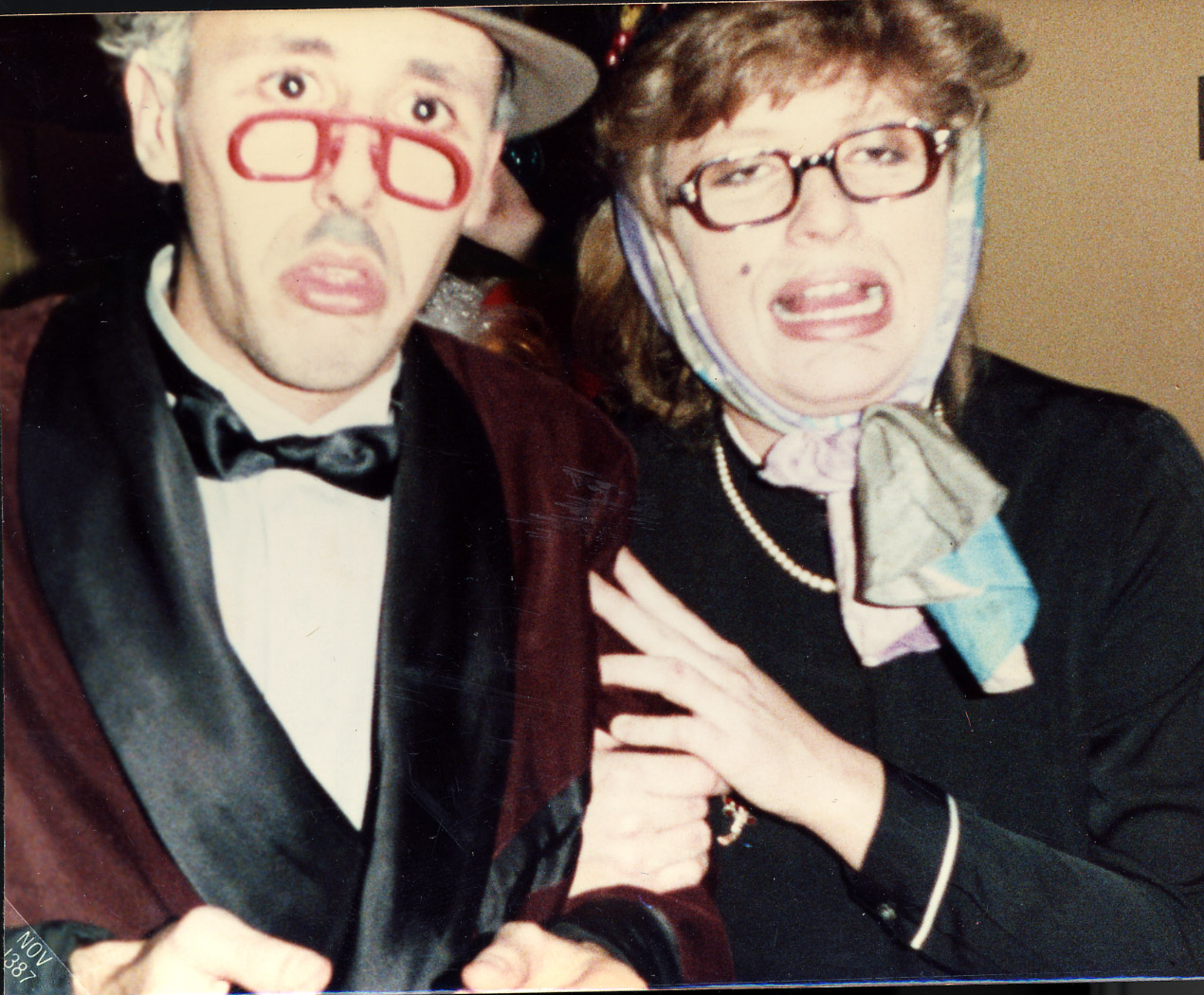
Chester and Millie. Millie: "Eeeeeeverything's going to be okay, dear ..."

Time to re-visit Nancy, the harassed mentally unbalanced wife of a Red Sox shortstop
Just in time for the startup of baseball season. I did want to do a part 2 to this series, to check in with Nancy's hellatious progress through the streets of Boston. Stay tuned.
Oh, and I took these pictures of myself with my computer before I figured out how to basically turn the photo around so the "B" in the Red Sox hat isn't backwards. So let's just pretend that we are staring at a woman through the looking glass, so out of control and mentally unstable, that even the "B" turns around.
For now:
Nancy is married to a Red Sox shortstop. A dude who is now at the top of his game. At the top of the game, in general. He has become a celebrity. He's good-looking. One of the untouchables. One of the Gods.
Nancy was completely unprepared for what would happen when they moved to Boston. Or - she thought she was prepared, but nobody can prepare you for such a paparazzi onslaught. She's also a drunk. She thinks she just "drinks socially", at least that's what she always says, but it is impossible to "drink socially" when you live in Boston and you are the wife of a famous Red Sox shortstop. She is caught out, here, there, everywhere, drunk, sloshy, by herself, getting in and out of cabs. Her behavior becomes increasingly erratic. Her husband does press conferences, asking the press to back off, because obviously "my wife is shy". This does not stop the bloodhounds. They smell her weakness. They stalk her everywhere. She does time in a rehab. When she comes out, after a couple of months, a barrage of photographers wait for her at the gate.
She is a PR nightmare for the Red Sox front desk. She tells reporters to "screw themselves". She says things at press conferences like, "I can't stand baseball. I prefer football. I hate baseball players even more than I hate baseball itself." She doesn't bond with the other Red Sox wives. She called one of them a "nitwit" at a charity function.
She's slowly being driven insane by the flashbulbs of the cameras.
Here are some photos detailing the disintegration of her personality.
Nancy, coming out of O'Reilly's Cask and Flagon at 1:30 in the morning.

Nancy, stumbling out of Maxwell's Pub at half past midnight.

Nancy, staggering out of Lucky's Tavern, at 1:30 in the afternoon.
Someone from the Providence Journal took this photograph of Nancy at Fenway Park on July 31 - at the moment that her husband hit a grand slam. This was her response.

Later that night, she was caught by the Boston Globe, drinking by herself at Fitzgeralds.

Needless to say, when she heard the cameras clicking, she was not happy.
On August 2nd, her husband hit another grand slam. She slept through it, in the stands.

Then someone woke her up and told her about her husband's grand slam. This was her response.

The next day, she was besieged on the streets of Boston wherever she went.

Naturally, she did not handle it well.

Not at all well.

It's a long day for Nancy.

She's screaming something along the lines of: "I don't give a crap about grand slams! If it was a touchdown, maybe I'd give a shit."

And things go downhill from there. Quickly.

On August 4th, Nancy offers a meek apology to the press. She is wasted. She slurs the word "sorry". That afternoon, her husband hits a home run. Nancy is in the stands. This is her response.

I don't think Nancy is cut out to be the wife of a major league star. She just doesn't understand the rules of the game.
April 8, 2009
"The Babies Got The Blues" (director: Rachel Hamilton)
My friend Rachel Hamilton shot a short documentary last year, about the Delta Blues Museum's Arts and Education Program in Clarksdale, Mississippi - a fascinating community of blues musicians, committed to passing on the torch of the blues to the younger generation.
Great stuff.
Click below to watch the two parts. About 15 minutes all in all.
I love it when the little boy says, "Not all day. Sometime we gotta go home!"
Wonderful job, Hamilton.
When love goes wrong? Nothing goes right. We all know that.

Clip of Jane Russell and Marilyn Monroe singing "When Love Goes Wrong" in Gentleman Prefer Blondes below the jump (I've been listening to Marilyn's Greatest Hits today, I find them relaxing).
I love when the va-va-voom section of the song kicks in. Yum. It seems like we're in for a melancholy ballad, but then, hey, look, the girls keep their spirits up after all.
And watch Marilyn dance with a little kid - and somehow make it not be a dirty weird moment. It's happy. Cute.
Another example of how you don't have to do too much to get your point across. To tell the story. The choreography is simple, yet perfect. They're in traveling suits and hats and gloves. A little shimmy from both of them can make your knees go weak.
So sexy. So good together.
C'est vrai, c'est vrai! Touche!
Slate's Culture Gabfest:
Thanks to Dana Stevens, film critic at Slate, (who referenced my piece on Mickey Rourke in her look at his career and comeback) for choosing my blog as her weekly pick in Slate's Culture Gabfest. If you listen to the audio, too, you can hear her endorsement of my site at around the 36 minute mark. I'm very moved by her words.
I've been reading her reviews for a long time. Thank you so much, Dana. And thank you for protecting my site, for a while, from those who might not understand what I do (I get a lot of those folks, as you can probably imagine).
But thank you, also, for deciding to go ahead and endorse my site anyway. And of course it happens to be on a day when I post my iPod shuffle. Chock-full of Brit-Brit. I stand proud.
Something's going on. Something's happening. Something's coming.
That's all I'm gonna say right now.
Just because ...
... at no point is it NOT right to take a moment to appreciate your dead boyfriend.

Hi, honey? How have you been? Lookin' good there! As always.
(For the newcomers: that is the bust of Alexander Hamilton, on Boulevard East, in Weehawken. I took that photo.)
Dawn iPod shuffle.
I've had a weird night. Up since 4 a.m. So let's move on to the music that's been going on from ye olde iPod since I woke up. Look, my neighbors have loud sex two or three times a day. More power to them. I am so happy they get along so well. But it makes me not as worried about, you know, making a PEEP that might disturb them.
"Waterloo" - ABBA
"Secure Yourself to Heaven" - Indigo Girls
"You Know I'm No Good" - Amy Winehouse (yes, honey, I know, but I love you anyway)
"Gimme More" - Britney Spears (it begins with the immortal words, "It's Britney, bitch." One of the most psychotic songs I've ever heard. I adore it.)
"Political Science" - Randy Newman - I love that Jackie covered this song in her cabaret. Perfect!! "Boom goes London, Boom Par-ee ..."
"Life Is a Buffet" - Pat McCurdy ("Life is a buffet, eat like a pig," he instructs us. Or, said another way: Give names, check in.)
"A Horse Named Bill" - The Raunch Hands - my entire childhood, my whole family, is in this entire album. "Ill be a great sharpshooter!" "In the teeth or in the fingers?" I played this album for my first boyfriend when we first started dating. He didn't like it. Should have broken up with him right there.
"After You've Gone" - Rufus Wainwright at Carnegie Hall (with an overblown cameo by Lorna Luft. Chill with the vibrato, Lorna. Thanks.)
"Stranger" - Billy Joel. This album will always make me think of Dad.
"Candy Shop" - Madonna. Dear Madonna, this is a catchy song, but just remember: Malawi is NOT a candy shop. It is an actual country, inhabited by actual PEOPLE. Mkay, hon?
"Leather" - Tori Amos. I remember this song blowing me away when I first heard it in the early 90s. It seemed so subversive. I am older now. Still love the song, but what she's describing is well-trod ground to the older Sheila. Sure, leather, whatevs, Tori, you were saying ...?
"Empty Man" - Pat McCurdy. Last time I saw Pat, I informed him, during a conversation about iPods, "The weird thing about the iPod is that suddenly your music comes up in constant rotation." He said, "That's kind of annoying." "I know, right?"
"Shame" - Eurythmics. One of my favorites of their songs.
"Fireworks" - The Original Memphis Five
"Ants Marching" - Dave Matthews & Tim Reynolds. This is from the vaguely self-indulgent double-album of a live concert the two gave - all acoustic - at Luther College. Some of it is just flat out not good - but some of the live versions - this song in particular, as well as "Crash" - I actually prefer them to the versions we hear on the radio. There's such life and joy in them. Great guitar too.
"I Don't Come From No Monkey" - Pat McCurdy. hahahaha See what I mean? Annoying!! Get off my iPod, McCurdy.
"All My Only Dreams" - The Wonders
"You Never Get What You Want" - Patti Griffin. What a freakin' voice.
"I Can't Believe I'm Not a Millionaire" - The Puppini Sisters. Genius. "I had a Pop-tart insteeeeead ..." Me too, girls. I hear ya.
"When Your Lover Has Gone" - Frank Sinatra. Take me there, Frank. It's 5 a.m. Thanks.
"Just Don't Give a Fuck" - Eminem. Pretty funny having this song follow the one before. That's the genius of iPod shuffle.
"Both Sides Now" - Dolly Parton. Absolutely brilliant version of this song. I'm sick of that song, in general - but she has revitalized it for me COMPLETELY.
"Does Anybody Out There Even Care" - Lenny Kravitz
"I Will Follow" - U2 (goosebumps)
"Rock & Roll" - Eric Hutchinson
"I Can't Get No Satisfaction" - Britney Spears. I know a lot of people were horrified that she would cover this song. Whatever. I think it's kind of brill.
"Hand In My Pocket" - Alanis Morrissette
"Cold Day In Hell" - Tracy Bonham
"Future Love Paradise" - Seal. This song always makes me think of Alec - a boyfriend of mine in college (you know - the nerd in my Halloween photos). We lost touch for a couple years, and then - the day after New Year's Eve one year, when I was back in Rhode Island, he tracked me down and invited me to come visit him in Boston, where he was living at the time. I have no idea why this time with him would stay in my mind so vividly after all these years - all we did was go out to eat, catch up, hang out at his apartment talking, and making out, and then, the next morning - we blasted this song by Seal, and danced around in his living room. Not talking. Just dancing. It was magical. Then I took a cab to Logan, and flew back to Los Angeles where I was living. And I've never been in touch with him since. Kind of amazing.
"Workin' For a Living" - Huey Lewis and the News.
"In A Little While" - Wynonna Carr
"Poor Man's House" - Patti Griffin. Goosebumps. One of my favorites off this album.
"Chirochacho" - Kumusha (they were the wonderful marimba band playing at Dean Stockwell's art show in Taos. Stevie bought us both copies of the CD. Here's a picture I took of Stockwell talking and laughing with one of the band members.)
"Just Leave Everything To Me" - Barbra Streisand. Love it. "If you want your liver tested, glasses made, cash inVESTED ...."
"Sorry" - Madonna. Great song. I love this whole album in general.
"The Chauffeur (Blue Silver)" - Duran Duran. What an absolutely RIDICULOUS song. Indefensible, really. I love every note.
"Hanging Tree" - Queens of the Stone Age
"Stumbling In the Dark" - Pat McCurdy. Again, Pat? Really? Get the hell off my iPod. "I think her name was Sheila - or maybe it was Sharon ..." Excuse me, but no, my name is clearly SHEILA.
"Stay Up Late" - Talking Heads. I love them. Love this song in particular.
"Goodbye Mr. Ed" - David Bowie
"Star-Spangled Banner" - Whitney Houston, Super Bowl. Definitive.
"Rock Lobster" - The B-52s. This will forever say "high school" to me, and remind me of the entire crowd of kids at a dance falling down to the floor at the end of the song before bursting back up again. We would go into a zone of MANIA when this song came on. And then, of course, Beth and I would run over to cool our sweaty red-tomato Irish faces against the tiled walls. In public. We did this in public. Amongst our peers.
"I Don't Need Anything But You" - Annie and Daddy Warbucks (Broadway recording)
"One Day I'll Fly Away" - Nicole Kidman
"Lucky" - Radiohead. I listened to this album one too many times, I think. Kind of like the time I put too much French dressing on my salad when I was, oh, 14, and I've never been able to stomach it since. I love Radiohead but I over-listened to this album. It's hard for me to hear it now.
"Thank You For the Music" - Amanda Seyfried (from Mamma Mia soundtrack)
"Sound Of My Own Voice" - Mike Viola and the Candybutchers. Heartcrack.
"LoveStoned / I Think She Knows" - Justin Timberlake. You're speakin' my language, JT. From my perspective, I think he knows, too.
"If You Love Me, Let Me Know" - Olivia Newton-John
"Buzz Buzz" - Brian Setzer. Blackberry? Hitachi? Uh, can you describe the buzz, sir?
"Ain't It the Life" - Foo Fighters
April 7, 2009
Relief
Walked into a bar last night to meet a friend, and saw baseball on all the giant TV screens.
I sometimes feel like I don't quite fully exist during the off-season, because it seems like something is missing. I can't put my finger on it. What is it ... what is missing ...
Oh, that's right. Baseball on giant television screens in every bar you pass.
I don't feel totally myself until it all starts up again.
And by myself, I mean this girl, with this particular shirt.

Nothing has changed. Which is also, strangely, a relief, in this world of flux and upheaval.
So let's play ball.

Testing one two

Me: Is this thing on, you think?
Cousin Mike: It's always on. That's how we got made.
Speaking of Cousin Mike, and things "always being on" because that's how we got made, let's not forget those big moments that life can sometimes provide.
And if I'm not mistaken, Varitek told Mike that he had thrown a strike.
You know. Life can be an amazing thing. Nice to have an "always on" mindset where you can appreciate it as it is happening. I'm trying.
Because this is not a dress rehearsal.


April 6, 2009
That first entrance in "Stagecoach"

Girish's fascinating post about "narrative synthesis" includes a discussion of John Wayne's first appearance in John Ford's Stagecoach, one of my favorite "first appearances" of all time.
Make sure to read the whole thing, but Girish writes:
John Wayne's first appearance in the film, unusual because it takes us by surprise, forsaking Ford's customary style for a second by dollying in for a close-up, the camera not even able to maintain perfect focus as it lunges forward.
It is that slight flaw - the camera blurring out for a bit because it moves in too fast - that truly makes this one of the most memorable moments in American cinema.
Not to mention the fact that John Wayne was not yet a movie star when he made Stagecoach, although he had been working in films for quite some time by that point. Stagecoach was his breakout, and seriously - with his first appearance in the film, it is not hard to understand why.
If I tried to break down what he was doing in these 2.5 seconds, I could probably write 20 pages about what I see. But ultimately, what he is doing is simple, open, unbelabored, and free. It doesn't look like work, it doesn't look planned. It looks real.
What he had as an older man in his later roles, he has here, before he was even known, before his "persona" was set.
His essence could not be killed, manipulated, or cheapened. And (most interesting to me) it was there from the beginning. It didn't NEED stardom to bring it out. He had it already. He happened to become a star, but here he is - in his first appearance in Stagecoach, not a star yet ... and it is all there already. Everything that would carry him through his long career. His personality, his machismo, his handsomeness, his unselfconsciousness with gesture (nobody beats John Wayne in that department- nobody), and then - with that last little spontaneous change of expression as the camera pulls right into his face - the vulnerability. It still has the power to take my breath away, what he does in that last second. Like - what?
He had a gift for this stuff. He knew (on some level beyond words, I'm sure) in that moment: "Okay, the camera is at point-blank range now - so don't keep the face closed, don't act, but also don't hold back, open open open it up ... "
Whoosh - open, sesame.
It's a gut-level understanding of what a closeup is. Watch how he does it.
And it is the vulnerability that makes John Wayne the slam-dunk that he is. Without it, those moments we love so much (the closeup in the trading post in The Searchers, the last moment in The Searchers with his arm crossed over his chest - uhm, the whole effing performance in The Searchers) would not be possible. The toughness, the stoicism, the man-of-action, the bold gestures ... all of those things are essential to explaining his appeal. But that small glitch of vulnerability, humanity - that comes at the very end of that first closeup in The Stagecoach - still surprises me, and still makes me think: Who the hell is this guy? I want to see more.
With that particular blend of qualities, he was (or "is" - because doesn't he still seem so alive? Look at that little breath he takes there at the end) as rare as they come.
The closeup in Stagecoach always reminds me of this beautiful paragraph from Peter Bogdonavich's book Who the Hell's in It: Conversations with Hollywood's Legendary Actors
To me, Duke had always seemed slightly out of breath, as though he hadn't yet caught up on the last twenty years, not to mention the last twenty minutes. Both [John] Ford and [Howard] Hawks truly loved him, of course, and even knowing him a little, as I did, it was pretty difficult not to like him. All this, and a lot more, obviously communicated itself to the public -- still the top American star more than seventy years since his beginning. His visual legacy has defined him as the archetypal man of the American West -- bold, innocent, profane, idealistic, wrongheaded, good-hearted, single-minded, quick to action, not given to pretension, essentially alone, ready for any adventure -- no matter how grand or daring; larger, finally, than life or death.
First appearance in Stagecoach below. It's subtitled - but I chose it because it hones in on the closeup itself - the moment I'm talking about. One of my favorite moments in American cinema and it lasts maybe 2 seconds long. That's all it takes.
Dying dreams
Allison and I went to MOMA yesterday to see the current photography exhibit going on: Into the Sunset: Photography's Image of the American West. We both love photography. There were some old favorites on display (Dennis Hopper's "Double Standard", for example - a photograph I love dearly), but lots of new things, and it was interesting - there were a couple of photographers I found myself drawn to, and it almost became a game. At one point, I thought - "Well, I obviously like so-and-so's work a lot - his stuff is continuing to CALL to me from the wall."
One photo, by William Gedney, was my favorite in the entire exhibit. I stared at it for maybe 15 minutes. I can't say what I was thinking or feeling, but I do know that my mind unhinged from itself, and floated off into memories, dreams, reflections. The photo seemed to not just be itself, but something else. It wasn't didactic, like many of the photos were - trying to "make a comment". It just was what it was, but the implications were enormous, and very emotional for me. I entered the photo, but not just that - it kind of ushered me into my own past, my own dreams for myself, and what it's like when ... well. Things don't work out, basically.
It took me some digging on this rainy thundery morning but I found it. I discovered an enormous online archive of Gedney's stuff - huge - and as I started browsing, I again got lost - in my own thoughts and memories. Some of the images I actually recognize, but many were new to me. He's unbelievable. He's got that late 50s-early-to-mid-60s sensibility that really resonates with me. The culture on the cusp of something. Dennis Hopper's stuff has that too. The "old" world still visible, the coffee shops and late-night diners - the milk bottles on the stoop ... but change is coming up from below. William Gedney made many trips across the country during that time, and many of his photos are of migrant workers, protests, Native Americans ... and a lot of it is just ... OBJECTS. Which is obviously my favorite kind of photograph. Cars at the curb, 1955. A house with a porch at night. An advertisement. There's something psychotic at work in some of these photos, and I can't put my finger on it.
Anyway, what can I say. I'm in love.
The photo that captivated me so much during the exhibit is below the jump.
It's what started the whole thing. I've been thinking about it all night and all morning. I'm okay (to all my protective worrywarts out there), just a bit ... thoughtful, maybe.
It seems to have something to say to me personally.

"Now about this stupid fish."
Dan Barry's Modern Love column yesterday: "Just One Last Swirl Around the Bowl".
A man undone by the spectacle of his daughter's dying fish.
April 5, 2009
''My mind was blown. It wasn't punk rock. It wasn't heavy metal. It just stood by itself. I didn't know what it was, but I knew it was a mighty thing.''
That's Flea, bassist for Red Hot Chili Peppers, on the first time he heard Metallica, who were just inducted into the Rock and Roll Hall of Fame, in a show that honestly makes me want to kill myself because I wasn't there. Eminem was there too to introduce Run-DMC, another inductee. Eminem and Metallica in the same place at the same time? Are you kidding me? (Oh, and Wanda Jackson gets the props, too? FINALLY? Another favorite of mine? Heaven!)
And why am I strangely happy, as though it has something to do with me, that Jason Newsted joined Metallica onstage for "Master of Puppets" and "Enter Sandman"? Sheila, you do not know these people. It is not a personal victory for YOU.
And yet ... and yet ... it is. If you're a Metallica fan, you'll get it.
And how psyched is Robert Trujillo right now? (Especially after the sort of awkward touchy-feely beginning of his time with Metallica with Hetfield crying at the table about his abandonment issues as they all drank bottled water.)
And how bummed is Dave Mustaine.
I've been listening to Metallica for, what, 20 years? Almost non-stop? They're in every playlist I make, they're always in rotation.
They make me want to cry, and they make me want to punch someone in the face. It's all good.
My brother wrote a goosebump-y piece about what Metallica's so-called "black album" means to him. I consider it a must-read, and that's not just because I'm related to him.
I read that NY Times article 4 times in a row, trying to imagine myself into that auditorium. Also, Hetfield giving props to Thin Lizzy? Effing cool.

(I realize that being inducted into the Rock and Roll Hall of Fame is akin to winning an Oscar. It's not a testament of true value. Some of my favorite actors have never won an Oscar. Phone call for Mr. Bridges and Mr. Grant. But still: the description of the HOF show and the validation and the excitement was catching to me.)
Posts I want to write, but haven't yet
-- something on Joan Blondell
-- a post on 30something, the TV series
-- something on John Cassavetes (that'll be a big one. I've put it off for five years now)
-- a post about the last 5 minutes of Two Girls and a Guy, which, I'm not kidding, has what I feel is some of the best acting I have ever seen in a movie ever. I need to go moment to moment with it. Not wacky about the rest of the movie, but that last 5 minutes should be studied by anyone who wants to be an actor.
-- my damn "man looking in mirror" post. FOR GOD'S SAKE
-- the story of my one night as a lingerie model (with my friend Jackie). One of the funniest and most bleak stories ever - but I need to be in the mood to write it
-- a post about Joanne Woodward
-- a look back at the early work of Kurt Russell
You know. I've got ideas.
My offline writing is very time-consuming right now. It's all I do.
So this stuff will have to wait, although I yearn to start that Two Girls and a Guy post immediately, or at least start accumulating screen grabs. Maybe later this week.
What it's like when your good friends read your blog
My friend Allison sent me an email recently about one of my posts. She knows the backstory, of course, as friends do - she knows all of the stuff surrounding the little I reveal here - and so she needed to know more. Part of her email read:
i looked for some clue as to your emotional state in the placement of commas. i was convinced that there was some code embedded in your words...like those satanic messages black sabbath and ozzy ozbourne burned into their LPs which could only be heard if you spun the record backwards.
I am still laughing out loud. I called her and we were guffawing on the phone about this.
Allison said, "Don't you remember that, with Ozzy?"
"Of course I do!"
Allison said, "I remember feeling afraid to even TRY it, when I was a kid, because I really felt like I would be inviting the Devil into my life."
I am shaking with laughter as I type this. The fact that she would read my blog in that manner was so funny and the whole capper was Allison saying, "Yeah, I read that post and thought - Maybe if I hold the computer up to a mirror and read it that way I'll see what she's really saying?"
We're going to MOMA today to see some photography. I'm excited. Haven't been there in a while. And I can fill her in. I can give her the embedded satanic messages in person.
April 4, 2009
KGB Bar: Red Hen Press poetry reading
Last night, I met up with Ted at the KGB Bar in the East Village, to hear my friend Ernie read from his book Sixty Sonnets (I reviewed it here). The book was published by the Red Hen Press, so three other "Red Hen Press" authors were reading as well - two poets and one novelist. It's been a long time since I've been to KGB Bar, and it was good to be back. To quote Anne Shirley, that place has "scope for imagination". Of course all the walls are a deep red. You know. Soviet.
It was a great turnout, tons of people, wine, lots of things to buy - books - and then of course there was Ernie, in a suit ("Forgive me for being dramatically over-dressed," he said when he began his reading), strolling around passing out tchatchkes with E-verse Radio on them (his brand), and also cool memorabilia that he has created for his book. I walked out of there with my bag overflowing with key chains, stickers, and, very cool, a beer bottle - labeled Sixty Sonnets - with a rolled-up piece of paper inside, with one of the poems on it. Message in a bottle. When the editor at Red Hen Press introduced Ernie she said, "It's funny because Ernie ... well, he's kind of a hustler ... and that's nice to see in a poet." Meanwhile, there was Ernie strolling around passing out E-verse keychains and working the room, basically illustrating her point.
It was wonderful to see Ted, too, who is so deeply buried in schoolwork right now that it is tough to find time to see him! It was good for him to take a break - and it was a great New York kind of night: free, first of all, with wine, and interesting people, and we also got seats at a table in the corner, which was good, because it was so packed a lot of people had to stand.
Ernie read from his collection, and also read some poems that will be in his next collection - some of them I have already read, but it's always cool to hear someone read their own work. To see where they go with it, how they put themselves into it, what they choose to emphasize.
One of the things I love about Ernie's work is how funny it often is. How suddenly light-hearted and ridiculous. I mean, how many poets dedicate a poem to Ray Harryhausen?? "I always feel sorry for the monsters," confessed Ernie. Poetry readings can often be solemn precious affairs. This one was not. It was a blast.
Afterwards, Ted and I went and chatted with Ernie for a bit, congratulating him, and we talked a bit about my review of Ernie's book. I was joking, "I was laying it on thick, don't you think? 'As JAMES JOYCE once said ... SO DOES ERNIE.'" We were all laughing. Ernie said, "Seriously - the comparisons you put in there were killing me! I was also compared to Michael Jackson in the same week. James Joyce and Michael Jackson." "You can die in peace now. But you know I meant every word."
And so I did.
Then Ted and I went out to go grab a bite, not an easy prospect at 8:30 p.m. on a Friday night in the East Village. We tried a couple of our favorite joints, only to find them packed, with a half-hour wait ... and finally we walked up to 11th Street to our favorite tapas place. Ted used to have annual birthday bashes there, and it's an awesome place. We couldn't believe there was a table free, but there was, right up by the front window. You have to go down a couple of steps to enter the place, and one of the best parts about it is its decor. The entire ceiling is draped in fishing nets, strung with blue and red lights. The waiters are knowledgeable, fast, and uniformly sweet. Great wine. Ted and I have our favorite tapas to get (why fix it if it ain't broke) so we ordered a bunch, and then settled in for some good conversation (shouted above the music).
I was a bit manic yesterday, for various reasons, and I had had a good hour where all I did was cry and laugh at the same time ... I had to get up and walk around the block and cry and laugh like a crazy person, circling Chelsea Market - and my hair was huge and wild - I had tried to calm it down but there was wind yesterday so when I walked into the poetry reading, I felt like I looked as though I had just leapt off my Harley. "Yo, what up, Red Hen peeps ... got my bike outside ... good to see you." It was good to not be manic, you know, all by myself, in my apartment - I talked Ted's EARS OFF - but he talked my ears off, too.
It was really really fun. Yesterday was a very good day.
Some pictures below. Of course, once the events in question started - I stopped taking pictures - which means, yet again, that I have photos only of PLACES, not of people. But during the poetry reading, even though lots of people were taking pictures, I just wanted to be "in" it, and not trying to capture it.


April 3, 2009
"You blow it tonight, girl, and it's keggers with kids all next year. "
I loved every word of Edward Copeland's look back on Heathers. Must-read.

April 2, 2009
I realize that this is a photo of me
... so I don't want to be misunderstood ...
but I just love this person, douchebag that she is.

I declare a new law
... that every person, regardless of race, creed, or color, should be REQUIRED to provide a full astrological chart to anyone, upon introduction. I don't care if it's the deli guy who makes you coffee. If you say, "Hey, what's your name?" he MUST reply, "I'm Sayid, and I'm a Capricorn with Virgo rising."
You could report him to the Astrology Police if he did not comply.
It would make things so much easier.
April 1, 2009
Bobby Darin: "Michael Row That Boat Ashore"
Now I can't be sure, I'll have to check my copious notes on the subject, but this clip below might be one of the hottest things I've ever seen.
It is also one of my favorite clips in the history of the Judy Garland show.
He's just intense.
An acting teacher of mine once said, "Every scene is either 'Fuck' or 'Fight'. Make a choice." He's talking about objective there, not necessarily plot, or anything literal. The calmest quietest scene in the world could be a "fight" scene, and a scene with zero nudity, no kissing, could be a "fuck" scene. I loved that. "Fight or Fuck. Choose."
And I look at Darin performing there, and sometimes I feel the fight in him, sometimes the fuck - I fluctuate in what I perceive when I view the damn thing. Regardless, it's just hot to watch.
The fist by his side. How he claps. His clenched jaw. How he engages the huge chorus - but there's coiled anger there, too. He is sitting on a world of impulse. It's seriously an intense performance.
And wait until the last moment! Boy ain't done til he's done.
If equal affection cannot be, yadda yadda
April is National Poetry Month. In years past I would post a poem a day with involved thoughts about each poet. I must have been cracked.
I can't even think about poetry right now, it's too much of a potential landmine (soooo .... naturally, I am going to a poetry reading on Friday night at KGB Bar - honestly, Sheila, what are you DOING?) - but regardless. I've written about Auden's "The More Loving One" before. Sometimes the poem has acted as a life raft (right after 9/11), sometimes it's been more like ... an ark ... I stow away the stuff on it that I NEED when the bad times hit ... so I will be able to retrieve them later. Other times it's been too painful and enraging for me to even LOOK at the damn thing ... although I have to say, that last line, man ... the last line does tend to soften the blow. It's that last line that is the gentlest, that allows for those of us who are wild in our grief, or in our melancholy or rage, for those who cannot see the stars anymore and are not ready to chirp cheerfully, "Everything happens for a reason!" or whatever other pat bullshit statement you want to make ... it allows us to be where we ARE, no pressure to come out yet ... and of course it is unthinkable that one day you will find the "total dark sublime" ... but give it time. Give it time. I am in tears. There are times when I have read the poem and I think to myself "NONE of this is true to me right now ... And screw EVERYONE who tries to make me see the bright side of the goddamn hell I am in - I'm not READY for that" ... but the last line ... The last line understands.
Favorite poem? Seems like an irrelevant question.
Talking about it ruins it anyway.
But I did want to post the poem, in honor of this month of poetry (something I do look forward to every year) and just leave it at that.
The More Loving One
by W.H. Auden
Looking up at the stars, I know quite well
That, for all they care, I can go to hell,
But on earth indifference is the least
We have to dread from man or beast.
How should we like it were stars to burn
With a passion for us we could not return?
If equal affection cannot be,
Let the more loving one be me.
Admirer as I am
Of stars that do not give a damn,
I cannot, now I see them, say
I missed one terribly all day.
Were all stars to disappear or die,
I should learn to look at an empty sky
And feel its total dark sublime,
Though this might take me a little time.

Happy (belated) birthday, Ann Marie

Ann Marie and I became pretty much instant-friends in 1993, and within, oh, one or two weeks, complete lunacy took over our lives. We would sit in her car talking about the Anne of Green Gables books - she was the only person I knew who was AS conversant in the entire series as myself. Infamous moment - we were talking about Anne of Windy Poplars, and we were remembering the little boy Anne befriends, the one who lives in a shack in the woods with his stern scary father. I am now not remembering which of us said the following line, so Ann, remind me - but anyway, the two of us sat in her car talking about the little boy - and one of us said, "I can't remember his name - what was his name?" And the other one of us said, "I know his dog's name was Carlo."
I AM DYING.
We were HOWLING with laughter and we STILL say that line. "I know his dog's name was Carlo."
Instant friends from that point on.
Another moment from that same conversation, still talking about Anne of Windy Poplars (and again, this was early in our friendship - maybe a week in!) - and we were talking about the school play that Anne gets involved in, and all of the family psychodramas that come up, with the Pringle family - and Ann Marie worked herself up into a frenzy just thinking about it. And here is how that part of the conversation went:
Ann (all angry and emphatic): "And let me tell you, Miss Jen Pringle, with the cool green eyes - that you cannot and WILL not steal the spotlight from I'm sorry but I cannot remember the other girl's name --"
Me: (interrupting flatly) "Sophy Sinclair."
Again: DYING.
It was as though we had met a longlost friend from childhood. Yes, we should have been friends when we were 8, but we weren't, so we immediately began to make up for lost time.
The adventures we have had have been without number.
Once we drove by a guy's apartment and stopped on the street to stare at it. This was not just a guy I was interested in, or stalking in a mild manner. This was a guy I had been involved with for a year at that point. I had basically seen him the day before. I have no idea what prompted us to go sit and stare at his apartment, but anyway, we were very nervous that he would basically walk down the street, and totally bust us, freakin' sitting in a parked car staring up at his window ... and there was a hilarity in both of us about that. The light was on in his front room. Ann said (and she was dead serious): "See, that looks like that light was left on when he went to bed, he forgot to turn it off."
How can you tell that from just looking at the lamp through the window??? We still laugh about that, it's actually a beautiful (and nuts) symbol of a good friendship. "Look, I know it's insane, but I am still willing to analyze the quality of the light through a window, if you need me to do that."
We performed at Milwaukee Summer Fest together (you know: "Give names. Check in.") For four days, we were treated like mega-stars. I'm not sure, but I think it might be the most fun I have ever had.
Here we are, with Pat, our "give names, check in" friend (and, briefly), employer. Huh. That's weird. That's our BOSS in the photo booth with us. Yet neither of us seem to feel the need to put in an urgent call to HR complaining of a hostile workplace. Mainly because there is no HR. Also, we're both laughing. Anyway.
Give names. Check in. That's all you have to do.

We were extras in a series of Huey Lewis videos, based on the old American Bandstand show, with scaffolds surrounding the stage, covered in people, dancing, hanging out, etc. Huey Lewis and his band played live for, oh, about six hours. It was incredible. When they would mess up a lyric, we'd have to start over. It felt like the entire rockabilly community of Chicago and Milwaukee was there, gyrating around on scaffolds, wearing their own glasses and wardrobe, because, you know, none of us dressed like we were in the contemporary world, anyway. Yes, my hair was pouffed up into this huge bouffant thing, but I could wear my own glasses for the shoot, since, uhm, they were prescription, they were mine, but they were also so retro that I looked like I had stepped out of an actual American Bandstand broadcast, just by standing there) - and we danced around on scaffolds as Huey Lewis played - LIVE - below. Again: so much fun.

It was one of those spontaneous events, too, where you had no time to plan, you just had to say Yes. Ann Marie heard the call go out on the radio that morning - "Extras wanted for day-long Huey Lewis shoot" - and called me immediately, freaking out. Huey Lewis was my first concert, don't you know, and Ann Marie loved him too. "Sheila, we have to go - they just want us to show up at the radio station in early 60s clothes." "YES. LET'S GO RIGHT NOW."
She came to pick me up within 20 minutes and we were off to the radio station. It was great because it was impulsive and we both just "propelled ourselves into the blazing star" of the experience.
We have been friends for years, and she is tremendously dear to me. A truly wonderful woman, humorous, giving, smart ... and she's there for you when you need her.
Below are some of my favorite "Diary Friday" entries about Ann Marie - including an experience that ranks as my favorite random experience of ALL. TIME. Stuff like that happens when we're together, and the beauty of it is: she's the kind of friend who really GETS the beauty of such moments, too.
Happy birthday, dear friend. Thank you for all the times you have "propelled yourself into the blazing star" with me. You're the best.

Look, I know his dog's name was Carlo, but that's as far as I'm willing to go.
November
I remember events by my outfits. That night, at Pat, was a blue denim and black mini-skirt kind of night. I had a feeling re: M.; by this point I totally believed he would be there. I sat for the first set with Ann and she came back after going to the bathroom ("doing a sweep" for M.) and said, "Let your heart SING!"I went back to sit with him. I felt like I was shooting out light from beneath my skin. I was so happy!
Pat had me sing with him. The intro to that song pulls my heart up and out of my body. He makes me feel like I could fly. If only I could run fast enough.
After the show, everyone was heading to the Emerald Queen, all of us exiting together. Pat was leaving too. I made M do the velociraptor for Pat.
M. did NOT want to do his velociraptor for Pat, and I made him. Afterwards, M. was just wincing about it. "Pat McCurdy was having none of my velociraptor."
We all had this HYSTERICAL walk over to the Emerald Queen. M and I, our arms around each other, were lurching across Lincoln Avenue. It was 1:30 in the morning, and a huge crowd of us had been set loose. Gus Kapinsky was leapfrogging over parking meters, one after the other after the other. We made M. watch him do this.
Still stuck on Pat's clear animosity towards him, and Pat's indifference to his velociraptor, M. stood on the curb and pretended he was about to leap off and commit suicide. "I'm gonna jump!" he screamed.
No cars in sight. Long empty black street. Street lights changing from green to yellow to red with no cars there.
Suddenly M. announced bluntly, "A velociraptor can go 75-80 miles an hour" and he took off. Other Lounge Ax people heading to the Emerald Queen, some in 2s, others in larger groups, saw him gallop by, and started laughing, pointing. "Look! It's Dinosaur Boy!"
Voices echoing. Cold.
M. was a velociraptor. He peered hungrily into the windows of a car pulling out of a lot.
I was laughing so hard I thought I might need medical attention.
M. said to me after, "When I move my body - people laugh."
Thinking of the velociraptor, the spontaneous jazz dances, the circus horses, the ostrich running through my apartment, I had to agree.
At one point, at the Emerald Queen, some Sinatra song came on and M. suddenly leapt up and made a spectacle of himself with an impromptu jazz dance. A crowd surrounded him, roaring with laughter. Ann and I were mopping off tears. There were actual people watching, but M. was performing for an imaginary crowd, which was my favorite part. Also, he and I had literally been in the middle of a conversation, there hadn't even been a lull, and he responded, mid-sentence, to the call of the music.
M. turned to me suddenly, later, and said, "You wanna see my circus horse?"
You really have to ask?
The place was packed with people and suddenly M. pranced through the crowd, and all I can say is he WAS a circus horse down to the expression in his damn eyeballs.
I heard people murmuring, "What's going on" as M. high-stepped around me. He became himself for a second to explain to me what he did physically to become a horse (he had a theory about it) and then he became a horse again.
Ann turned around in the middle of all this and saw him high-stepping by. She watched him for a moment and then slowly looked to me for an explanation. Her expression was priceless.
I said quietly, "He's a circus horse."
She nodded, accepting this. "Oh."
M. said to me, word for word, "You and me - we laugh. We hang out with each other and we laugh. Know what I mean? It makes me happy. I like laughing with you. For too long I've lived my life like that Pat song about being artistic. I don't want to do that anymore. I like being happy."
And then - 2 weeks later - came my birthday extravaganza, held during a Pat show at Lounge Ax.
Ann Marie basically decorated the bar. She is so incredible. There was a huge bunch of balloons ("Here. Arrange these in a festive manner," she ordered Lady Elaine).
(Ed: This is so hostile but there was another Pat fan whom she and I did not like, who was a bit crazy, and obsessed with McCurdy in a kind of stalkerish way - not in the ultra COOL and sophisticated way that ANN and I were obsessed with Pat McCurdy- and basically this stalker-fan's nose and his chin almost touched - so Ann Marie and I called him "Lady Elaine" after the puppet on Mr. Rogers, because we felt there was a resemblance. We did not call him "Lady Elaine" to his face, but we would blatantly refer to him as such, "Wow, look at how Lady Elaine is hovering around Pat..." "Loved Lady Elaine's crazy air guitar during 'Knock Things Over'" So the image of Ann Marie ordering "Lady Elaine" to arrange balloons in a "festive manner" ... It's STILL funny to me, Ann bossing Lady Elaine around)
Ann Marie baked cupcakes, brought candy. It was a total extravaganza. Everyone knew it was my birthday. I wore my mermaid dress and a black choker. (Ed: How embarrassing - but I warned you up front! Every diary entry during the "magic time" is accompanied by a description of my clothes)
I went to find M. and he was sitting at the bar, so cute, waiting for me. I was so happy to see him I was high on him. We were a happy couple. We are a happy couple.
I pointed to all the balloons, arranged by Lady Elaine. "Those are for me."
He asked me how my actual birthday was and I told him pretty bad and that I had cried on the train. He was hurt by this news. "You cried on your birthday?"
Then he said, "I thought about you on your birthday. I thought about calling you, but ..." and he stopped himself with this very inward-look on his face. He had no word of excuse, he looked confused at his own behavior. "I don't know why I didn't."
I said, "You should have! Of course, at the first sound of your voice I would have dissolved into tears."
We laughed at that.
I asked him how his Thanksgiving was and he said, "It was all right," but with such an evident edgy look of misery and anxiety in his eyes. He cannot mask his emotions. I responded to the look on his face, not his words. "Not good, huh."
He shrugged and then said, "Well - clearly I have issues."
I couldn't help myself. I burst into laughter right in his face. He has assimilated me! Me, always talking about "issues". He looked truly confused, like, "What did I just say?" - and I kept laughing, and then he began YELLING at me, "No! No! I don't have issues. I have PROBLEMS. I don't have issues. I have PROBLEMS."
Ann Marie wrote me a fairy story for my birthday. I was living in such a euphoric state. Everything was perfect. Ann also gave me flannel sheets! Bless you, Ann!! I love them. She went totally nuts for my birthday. She is an incredible party planner.
I had raved to M. about how I wanted flannel sheets, and he told me I had to get some. So I showed them to him, all excited. "Look, M.! Flannel sheets!" He was cute - kind of withdrawn, but smiling, shy, kind. "Hey! You just told me you wanted some!"
Half of our conversations are about objects and their faults or virtues: bureaus, incense, coffee makers, coffee tables, banana pickers jackets, new blue jeans, veal parmesan sandwiches, his special mattress he had as a teenager, etc.
I loved it that M. would get all puffed up like a peacock because he was "the guy with Sheila". He would pretend there was an imaginary crowd around him and he'd say in a very over-it casual tone, "Yeah - I'm with her. It's no big deal. I'm just with her."
M. told me his mother said his haircut made him look like a "jackass".
We left the bar with a huge fanfare because of all my gifts and balloons.
Pat had had me sing, and had also led the entire place in singing happy birthday to me.
M. helped me carry some of my stuff out. Ann said he was behaving "very husbandly" which is so true. He was loaded down with all my gifts, and I was keeping him waiting as I said good-bye to everyone five times. He was grumbling about it, and impatient.
"I have to say good-bye to Ann Marie!"
"Didn't you already do that?"
"Yeah, but not for the last time!"
He sat in the car, exhaling frustration as I flew around hugging everyone and saying goodbye to Ann Marie 10 times.
We released all of my balloons into the air outside of Lounge Ax. They floated up over the Biograph and disappeared into the black.
I climbed into the car with M., this person I have known for almost 2 years now, and we peeled away from the curb.
November
Ann Marie and I had an adventure. Casey (one of Ann's friends from work) won a party at the Beaumont. Ann was invited and so was I, by association. We both felt out of it but we decided to go.
There was a major snowfall. We drove around looking for parking for 45 MINUTES.
The bar was jam-packed for the first Bulls game. Everyone was shrieking, "4-PEAT! 4-PEAT!" People, it's the first game! Stop re-hashing the future! Can you let the season happen, please?
Ann's British friend Trevor stood at the bar, the whole place erupting into insanity over some play or other, and Trevor yelled at the top of his lungs in his British accent, "GOD BLESS AMERICA!" This made Ann and I laugh very hard.
Ann Marie and I were so into each other that we found it difficult to be social with others. We were pretending to be gorillas, picking bugs off of each other and then eating them. We began discussing patty cake games, and of course we had to try them out and see what we remembered.
And that was that. We patty caked FOREVER. Ann Marie literally had bruises on her hands the next day.
We lost the words in the middle of Miss Mary Mack - at the same time - a big blank overcame the both of us at the same time. But we got Coke and a Smile down to perfection. We couldn't stop. People kept craning their necks over to look, because it sounded like some kind of fight was going on with all that slapping.
Ann Marie said, totally business-like, "I'll call my sister tonight for those Miss Mary Mack words." Then she had to stop herself and say, "Ann Marie, what are you talking about?"
Finally we left, having made a spectacle of ourselves as always.
Big beautiful snowstorm.
Then came a once-in-a-lifetime event:
There was a bouncer at the door. Very chunky, no neck, flat top, He-Man Action Figure. He spoke to us and Ann and I were both immediately aloof.
"Hey, what was that hand thing you girls was doin'?"
Hand thing? Believe it or not, we didn't know what he was talking about. We looked at each other, confused, and he went on, imitating our patty-caking, "You know!"
Light dawned on us. "Oh! That!"
Ann confessed to this person, this stranger, "We can't remember the words to Miss Mary Mack though."
He said, "I do!"
So ... he sang the words for us (with gusto too) and Ann and I patty-caked to his accompaniment. We made him do it 6 times.
It was so wonderful, so hilarious, so joyful: the snow coming down, our hands stinging, tears of laughter in our eyes, patty-caking on the sidewalk with his tough-guy voice singing:
"Miss Mary Mack Mack Mack
All dressed in black black black
With silver buttons buttons buttons
All down her back back back"
He kind of bounced up and down as he sang, too. I will never forget it! Totally classic!
"I hate to ask you this," Ann or I would say to him, breathless, "but could you do that one more time?"
All of his friends walked by during this insane time, and made fun of him mercilessly, but we couldn't stop. I felt that if we didn't keep going the spell would be broken, and Ann and I would be dressed in rags, and the bouncer would turn into a pumpkin or a mouse.
Finally we left, calling good-bye to our momentary soulmate joyously. It made us both so HIGH. We raved about it the whole way home.
And Jim arrived from London yesterday. He's staying with me and Mitchell.
Ann, Mitchell and I dragged Jim and his jet lag along to go see Pat. Ann and I are getting so juvenile and it's got to stop. We decided to "go glam", so she came over to primp with me. She had on this navy blue flowing thing with brass buttons (just like my eggplant flowing thing). I had on this long green blazer and flowing pants.
We were scurrying about like lunatics.
Jim and Mitchell were down the hall in Mitchell's room talking, but also listening to our girly blither from the bathroom. Mitchell informed Jim bluntly, "They're 7."
And at that moment, as if on cue, came the sounds of Miss Mary Mack from the living room.
JAN TO MARCH, FRAGMENTS
Joe: "Member in Pulp Fiction --"
Ann: "No, see now, that was Sheila."
Ann: "Is that the one where your hair is different?"
Me: "No, that's your fantasy."
Me: "I'm just gonna be myself--"
Ann: "I think you should. Of course, if you need to be married ..."
Me: "I think M. knew he could show up and I would let him know I wanted him to be there --"
Ann: "Or you'd blatantly ignore him like that night at the Wrigleyside."
Fragments from M.'s improv show
"Thank you, Gore Vidal."
"Gash - Like a Wound - is offended."
"I wish I was a deformed midget.
Mitchell: "Something has happened that I keep forgetting."
Me: "Isn't it great that M. is back in my life?"
Ann: "I think it's totally great, even though you know this is only going to lead to haikus and humidifiers."
Snippets from M.'s improv show
"I usually save an extra seat for the Narrator."
Roy, the Idiot Man-Child from the Service Station
"You're not even a zoologist!"
"Of course, we need to park on a street where there is a raging fire." - Me and Ann
Fragments - from M.'s improv show
"Leave some room, John!"
"I like working with pigs!"
"You're gonna have to wear an eyepatch!"
"Well, that will make you more three-dimensional." - Me (weaving a web of lies with Ann Marie)
"You sent the man 30 haikus. I don't think he'll mind if you come to a couple of his shows." - Ann
Me to M.: "I have a kinder-whore appeal ... or at least so I've been told."
Joey, talking to the television, as we watched 30something: "These are nice people, Susannah. They want to like you because they love Garry."
From the party 12/10/94
"These Oreos are insanely delicious." - Joey
"You just never know what will happen with broccoli." - Me
"I just kicked a pig." - Ann
Heard simultaneously by Ann:
Me: (with a mouth full of food) "I have an eating disorder."
Mitchell: "I can honestly say I've never slept with ----- oh, wait --- yes, I have."
George and Ann, providing dialogue to an old movie, with the sound turned down:
George: "That's why your dancing frustrates me - because I can't move!"
Ann: "Well, don't you think I understand that? I mean, look at my eyebrows!"
Me to M. (and I was dead serious): "It would totally not surprise me if I disappeared into a white slavery sex ring at some point."
Me to Mitchell (about M.): "Isn't he so sweet?"
Mitchell: "He is. He is sweet." Long pause. "He's a lunatic."
Mitchell: "The improv jam is pushing all my buttons."
Mitchell to me: "If you say 'improv jam' one more time, I'm going to scream at the top of my lungs."
Ann: "I was thinking about your life the other day ..."