June 25, 2010
"Listen now, you corpses ..." Filming A Bridge Too Far

William Goldman, screenwriter, recounts in his book Adventures in the Screen Trade
Eight o’clock is coming nearer and nearer and things seem as if they’re starting to break. Everything’s got to work because there’s no time to go back and do things over but the weather seems as if it’s going to be clear enough to shoot and now Redford’s in position and the stunt men portraying German soldiers are climbing high in the girders of Nijmegen Bridge, roping themselves in, not for safety but because that’s what the Germans did there in their final defense, and then the signal comes that all the stunt men are secured and you can begin to see the confidence flowing into [Richard] Attenborough, because there can’t be anything wrong on this shot, he’s thought so much about it, covered it from every angle the mind of man can come up with, and as crew members come running up to him with last-minute questions he’s snapping back the answers crisp and fast, “Is the machine gun nest all right like that?� and “Yes, fine� from Attenborough without a pause, and this questioner runs off while another comes up, going, “Will you see the sentry box emplacement in this shot?� and the immediate “We will, thank you,� takes care of that and “Have the Sherman tanks been positioned properly?� and Attenborough quick takes a look, and says, “The Sherman tanks are splendid as you have them,� and now an assistant director comes up behind with, “The corpses, Sir Richard,� and even though that’s not a complete question, Attenborough knows precisely what to say and he says it, “The corpses must keep their eyes shut at all times, all corpses will be visible in this shot,� and that cry echoes along the bridge as the assistant takes a megaphone and shouts to the extras playing dead Germans, “Corpses – listen now, you corpses – all corpses will keep eyes shut at all times while the cameras are rolling – you got that? – not one bloody blink from one bloody corpse and that’s final!� and shooting time is almost on us now, and the rain is going to hold off, and now another assistant runs up, asking, “What about the smoke pots?� and Attenborough, on top of his game, replies, “You may start the smoke pots now, thank you very much,� and right then, this trusted aide comes roaring up, excitedly saying, “What about the jeeps in the orchard, sir?�
I was standing by Attenborough and for a moment his eyes glazed over and he had to be thinking that suddenly the world had gone mad or was the world sane and the mistake his – had he forgotten – forgotten something vital? He was standing on a freezing bridge – what orchard? what jeeps? Was there some part of the shot that he’d neglected, something involving an orchard and jeeps, and here he was, with smoke pots going and, high in girders, guys hanging and a star ready to shoot and 275 people waiting but this question must be answered because what if it ruins the shot and if the shot’s lost a million dollars are lost and –-then he smiles very sweetly to his aide and said, “We will not require jeeps in the orchard at all, thank you so much for reminding me.� This, it turns out, referring to the last half of a later scene to be shot afterward, the first half having been shot the day before, all this in another location, and what this trusted aide had done was pick this particular moment to inquire if Attenborough’s camera angle for this future sequence would require the placement of jeeps in the distant background in order to match what had been done before.
The weather held, the shooting on the bridge went quickly, the last major disaster had been averted. As we left the bridge, there was a genuine feeling of exultation.
Attenborough was cheery as usual, no more whistling needed that day. Later, perhaps, but not then. There are always “laters� lurking in the lives of film directors, jeeps in the orchard that need tending to.
June 22, 2010
"I was always a cartoonist in my mind. But then something happened." An interview with director Ben Barnes:
When I was in LA, I went to a screening of God Damn King Kong, a short film directed by LA-based director Ben Barnes. It starred my brother Brendan O'Malley, who also wrote the script. It's a beautiful and absurd piece of work, funny and haunting. It stayed with me. With the voiceover, and the images of a lonely man walking the streets of Los Angeles, it called to mind James Ellroy, and the noir world his characters inhabit, the alienation mixed with the surrounding beauty of the waving palm trees and the deep neon lights on the strip. It's tough work getting over a dame.
Ben Barnes was kind enough to submit to some questions from me about his process as a director.
SOM: Can you tell me a little bit about your background? How did you get started as a filmmaker?
BB: I was a cartoonist from an early age. I did some political cartooning in high school and switched over to strip cartooning my senior year. I went to college and had a daily strip for two years called Despot Theatre. I even self-published a book of them, with a run of something like 500. They sold at the campus bookstore. I think it sold out in about two weeks. But around that same time I was getting tired of being limited by what I could draw. I always wanted to create more than my capabilities as an illustrator.
But right up until the end of my sophomore year I'd never even thought of being a filmmaker. I never saw myself as that. I was always a cartoonist in my mind. But then something happened and I took time off from college and enrolled in some classes at Pittsburgh Filmmakers. I made a few 8mm films and thought there was something there, so I finished my degree back at Kent State and shoveled out a small fortune for a masters in film production at the University of Miami. Then I drove out to LA.
SOM: Your Fish Out of Water series is so funny, so well-done. [Clips: Joyride, The Nightmare, Movie Night.] You take a serious realistic tone to what is an absurd situation: a young man whose best bud is basically a PUPPET of a fish. Can you talk about that project and its successes?
BB: Don't let Joyride fool you. The guy in the backseat is also a lead, and the story is of both of them and fish as friends and roommates.
There have been a lot of near successes with Fish; a lot of attention from the cartoon network and Adult Swim, plenty of near-deals, etc. But for the most part, it's just what Joel Huggins and I have done on our own with the series, that's what you see. There was also an online journal years ago, with pictures and lots of writing. It's been around for years.
SOM: Your video for "Why" is amazing. Who is the man with the arrows? Was he involved in the car wreck? He is obviously in a distraught state already as he approaches the accident. I loved how mysterious it was, violent, tragic.
BB: It was just an image that popped in my head; and the nice things about music videos is that they don't have to be elaborated upon too much. The budget probably wouldn't have allowed for much more elaboration anyway. I just loved the actor, John Walcutt, and thought it would be something I wanted to do with him. As far as the meaning or concept, it really just had to do with what I was going through emotionally at the time in my life.
SOM: How did you get that effect with the arrows? His performance is terrific.
BB: The arrow effect is by Garett Zunt, my production designer on the last two WHY? videos. He made an apparatus that fit under the man's jacket.
SOM: What is the process for shooting music videos? Do you have a relationship with certain bands, where they come to you for new projects?
BB: I shot some performances for WHY? back in early '08 for dublab, then Yoni got in touch with me about doing a video after seeing my other work. That led to the Shoeing Horses video and that went well, so they asked to work with me again when their next album came out. They are one of my favorite bands ever, so it was exciting to be able to work with them. I don't think a lot of people get to make videos for their favorite bands, so for all the other creative things that have been a struggle, I try to keep small, awesome things like that in mind.
SOM: How did God Damn King Kong develop?
BB: Brendan and I met at Jeffrey Tambor's workshop back in 2008. He really liked the first piece I went up with, about the first porn magazine I ever stole, and introduced himself then. Some time later he went up with a bizarre Tennessee Williams-like piece that at the time people either dug or were roundly confused by, which is often a sign of quality. Brendan had asked me to make a music video with him, which I didn't want to do at all, so I countered by asking if he'd want to make a film based on that piece. I think we originally called it "Squirrels". That was a year ago. We set out to rewrite it and work it into something to film. The original piece was written in direct address to a woman presumably in the room, but we eventually changed it to be a letter to an ex, dictated to camera. We tried not to look at the lines head-on, if that makes any sense, but we'd add or subtract lines based on some sort of off-angle gut reaction. We did little to no improv, from what I remember. What was on the page is on the screen.
SOM: The look of the film reminded me a lot of the noir-ish nighttime quality of Barbet Schroeder's Barfly, something about the light. There's a loneliness there, and I wondered how you thought about that, going into the project. Could you talk a little bit about how you achieved that look?
BB: My longtime DP Mathew Rudenberg split duties. He shot the more complicated scenes like the bar and I shot most of the simpler scenes, like the kitchen. We shot and re-shot this thing so piecemeal, it was often just me and Brendan. I kind of feel like there's a dog's breakfast of film looks in this piece, so it's a relief that you aren't horrified. The filming was protracted over a 9-month period and shot with two different cameras, two different DPs, which I think augments the disjointed nature of the writing. but it was more by circumstance than intention. We had no money, so we had to shoot with what was available when we could. I think the loneliness is what holds each scene together, more than consistent cinematography.
SOM: What camera did you use? Was there any artificial lighting?
BB: We shot on the Canon 5D Mark II and the RED; and we did use lights for any interiors and the occasional exterior.
SOM: What was your process as a director for filming the picture? Did you rehearse? Did things develop as you went along, in terms of what you wanted to shoot, or did you have a gameplan from the get-go?
BB: I usually had specific shots or images for each scene, which then changed depending on the location. The idea was to have one shot for each scene/location, which we started to futz around with the more we started shooting. Since the shoot took place over such a long time period, things like the car wash and the last shot with the cereal would pop in my head as the film took shape. With this film, it was a lot harder to know when the right take happened. There was the oblique angle approach as I mentioned, and we shot almost every take eight or nine times. The one time we got it in the first take, when Brendan is crying, the camera was out of focus! So we had to reshoot that later on. Brendan and I are big fans, if we aren't always the biggest practitioners, of "cutting deep" a concept from the workshop: the deeper the cut, the more risked, the better a performance will be.
SOM: Could you explain what "cutting deep" is?
BB: "Cutting deep" in acting, or even just creating, tends to mean making a choice that has more riding on it, puts you out of your comfort zone, a deeper investment and connection. Sometimes Jeffrey [Tambor] will even liken it to the the childhood add-on "...and I mean it!" It also has elements of cutting through what's holding you up, making you hesitate.
Brendan and I were working on that scene with the lines like "We were going to set fire to the bottom of the ocean and all that" and were having trouble getting it right; the first way we'd shot it he's reserved, or it was in voice over or something. And we were figuring out what was wrong. Brendan asked what acting style I hated, and I replied, "Showy, overly emotional" or something to that effect and we immediately were like, "That's it!" And later we added an insert shot with that drawing to motivate the piece of paper. It was a real mish-mash.
SOM: How'd you come up with the title?
BB: The title is the last two words in the stage piece that Brendan performed. "God Damn" really loud, then softly to himself, "King Kong." That and that alone sold the entire performance for me. We got rid of it once it became a letter, but then when we were brainstorming what the piece of paper says in that scene, Melody Garren, who plays Annette, proposed "God Damn King Kong". And then it just took off from there.
SOM: The inclusion of the woman in the film, the one being addressed, is interesting, and adds a dream-like quality to the whole thing. I liked how haunted he was by her, and how that was made manifest by her presence. Did you go into it knowing you wanted her there, or did it originally start out as just the man talking, to himself and to us, all the way through?
BB: It was only after we'd shot a lot of the direct-address stuff that I started really wanting to see a lot more of what Brendan was describing, so we threw in a couple shots, first a memory with the inflatable mattress and then later examples of her continued haunting of his life. Of course, through that process we ended up with the emotional climax of the film and one of my favorite shots I've ever done in that fire helmet roof shot.
SOM: How much footage did you end up having? How do you decide what to keep, what to lose? Did you edit as you went?
BB: We shot a few more things than are in there, and we shot some scenes that we ended up reshooting, but for the most part we kept every scene in that we shot. I basically picked each take I liked the most, and if I like parts of one and parts of another, I found coverage to splice the two together. We had a scene of him at a storage locker looking at old photos that just had things wrong with them, like very subjective memories which we ended up not filming. Here's the only one I got done before I scrapped that idea.

SOM: The one shot of the man on the roof, at night, with the green lights blurry in the background, is gorgeous. Where did you film that?
BB: I filmed it on my garage roof with just a light panel to front-light it. Behind Brendan is sunset blvd right by the stadium entrance. The fire is rubber cement in terra cotta pots.
SOM: Who would you count as your main influences?
BB: One of my favorite films from my obsessive film phase was Woody Allen's Stardust Memories, which was his 8 1/2. I love that film, and it's kind of fun to have an unpopular film or one that's overlooked as one of your favorites. There's no posters of that film in any dorms to make you feel less special. Anyway, as far as God Damn King Kong is concerned, I think there's a pretty solid connection in retrospect.
In general, I would say Bloom County has a huge influence on me. Films like Eraserhead, Jesus' Son... Don Herzfeldt's recent work has been overwhelming. It's hard to say what you love and what influences you. I obscenely love almost everything the Coen Brothers have ever done but I don't see it popping up in my work.
Ben Barnes's short film God Damn King Kong:
God Damn King Kong from Ben Barnes on Vimeo.
Ben Barnes started out as an award-winning cartoonist, before moving on to directing. His shorts have screened at the South by Southwest film festival in 2008, 2009 and 2010, and also at the Montreal Just for Laughs festival in 2009. He's a well-known director of music videos, working with Peter Bjorn & John, Busdriver and Coheed & Cambria. His latest video, for WHY?, was recently written up in the LA Weekly. The LA screening series A Dublab Labrat Matinee often features his work, as does Pitchfork, Stereogum, Les InRocks, the RES Screening Series, Derek Waters’ LOL at the UCB Theater, and MTV. Ben belongs to the production collective The Masses. You can read more about Ben, and see more clips of his work, at his website.
May 25, 2010
Jafar Panahi's release: "A moral victory"
Geoffrey Cheshire, expert in Iranian cinema, writes a great piece about the release of Jafar Panahi.
It just so happens that Panahi's imprisonment coincided with the Cannes Film Festival (although there may be more than coincidence at work here). If the regime in Iran was hoping to send a hard-edged message to the international film community about their willingness to imprison one of their country's biggest stars, it certainly backfired. What with Abbas Kiarostami's already high profile (he, who was Panahi's mentor and collaborator on Panahi's first international success), and Kiarostami's closeness with Juliette Binoche (she who was featured on the Cannes 2010 poster), not to mention his own film, Certified Copy, premiering at Cannes, and starring, among other actresses, Binoche - Panahi's imprisonment was bound to take center stage at the Festival. Panahi had been invited to sit on the Jury, and when he could not attend, a chair was left open for him, throughout the proceedings with his name on it, a potent and constant reminder of what was going on in Iran. Panahi's presence haunted Cannes. Kiarostami made statements. Binoche made statements. Everyone made statements. Binoche won Best Actress at Cannes for her role in Kiarostami's film, and held up a sign saying "JAFAR PANAHI" when she won, stating that she hoped he would be able to attend next year.
This is one of those instances when the "klieg-light" response to injustice, especially towards a fellow artist, has paid off in spades. Panahi's imprisonment back in March received publicity, yes, but having the entire worldwide artistic community come into one place, at one time, during the Cannes Film Festival, helped galvanize and solidify the voices of protest. An unintended consequence of the Iranian regime's timing.
There is much we still don't know, and much that will still be revealed. Being released on bail obviously means that there is some expectation that there will be a trial, but that is far from a done deal. As always, I wonder about the conversations in the halls of power in Tehran over the last month or so. Their public comments have been impenetrable and yet also defensive (as in: we in the West have initiated a "propaganda" campaign against Iran, and somehow it is our fault, like we have somehow misunderstood the situation, and etc.) All typical stuff, not surprising in the slightest. That's how they have been playing the game for decades.
As I mentioned in, I think, my first post on Panahi's imprisonment, injustice of this kind requires secrecy, which no longer exists in our global world of international communication. So there's THAT, first of all, and the Iranian regime has tried to stem the tide of information, but they can't. If you follow any Iranian Twitter feeds (as I do), then you know that these people are screaming, on a minute-to-minute basis, about what is going on. They use pseudonyms and block their locations, and do all of this at great personal risk. And then there is the international community, all gathered in one place, at Cannes, and there wasn't one important piece published about Cannes during the festival that did not somehow mention Panahi. This stuff is really important. The drumbeats soon become deafening. The Panahi conversation became dominant, which is what anyone focusing on injustice anywhere hopes for.
Panahi's decision to go on hunger strike, and then make sure it became public knowledge by getting the word out to people who could spread the word further, was a gamble that should be recognized. He was (is) willing to die for the cause of freedom and artistic integrity. The Iranian regime did not call his "bluff". Not this time, anyway. They caved.
Their attempts to save face in the last two days are laughable, but also understandable, from a political standpoint. Whatever, Mr. Panahi is out of jail now, and hopefully recuperating at home with his wife and family.
The fight will go on. To quote Jamsheed Akrami, film professor in New Jersey, quoted in the article by Geoffrey Cheshire, this is "a moral victory", but triumphalism will not do here, when the situation is still so serious for so many others who are not celebrities.
But Panahi is a symbol. And symbols are important. They are not everything. Only totalitarian governments and fascist-minded people think symbols are everything. But Panahi's release is an important concession of moral ground (ground I don't believe Iran held in the first place, but I'm trying to see it from their perspective). This was a huge and public concession. The regime blinked.
And so, as always, we have to see what will happen next.
First photo of Jafar Panahi after release from prison.
Panahi's first message on his Facebook page came this morning, about an hour ago:
I'm freed and beside my family and I believe more and more that : Cinema is Cinema.
Welcome home.
May 24, 2010
Jafar Panahi to be released on bail
I'm so happy to hear this.
More here. Apparently he is going to be released today.
May 23, 2010
"To put that scenario in its proper context, compare the regime's blackout of Mr. Panahi's films in Iran to the klieg-lit response of the outside film world:"
An overview of the Jafar Panahi situation, a very nice opinion piece (and I'm not just saying that because the writer linked to me.)
May 22, 2010
Binoche and Kiarostami
Great interview from Cannes with Iranian director Abbas Kiarostami about his latest film, Certified Copy, starring, among others, Juliette Binoche.
I loved this part:
My next film is going to be a road movie too. In my film “Ten on 10,� I explain why I have these driving scenes. I feel good in a car. And the car is one of the locations where you feel the least the presence of a camera. Spielberg’s “Duel� is one of the most memorable films for me — it may remind of Hitchcock but I like it even more than Hitchcock’s films. If you locked me in a car with a camera, and maybe an actor too, I wouldn’t protest. I would promise not to come out of the car. So who knows — if I go back to Iran and get into trouble that’s what I can suggest to them: Don’t put me in a cell, put me in a car.
Kiarostami is still based in Iran, although he knows his films never stand a chance on passing the censors there. He has been a huge vocal supporter of Jafar Panahi, calling for Iran to release him.
Update on that front: Panahi is still on hunger strike, but apparently he was allowed to see his wife on Thursday, and there is going to be a bail hearing today. Things are actually looking up. I cannot imagine that the international attention his imprisonment has received is not a factor. Still a frightening situation, but there are glimmers of hope right now for Mr. Panahi - at least getting released on bail. More information here.
Another update: Not too much new information here, except for the opening paragraphs:
Tehran's prosecutor general has asked the Islamic revolutionary court to reconsider the continued detention of the celebrated Iranian film-maker, Jafar Panahi, raising hopes that he may quickly be freed.A high-profile international campaign calling for Panahi's release has drawn the support of leading figures in the arts and politics. According to some reports a bail hearing could take place as early as this weekend and could free Panahi until his trial.
We're all watching.
And thank you, Bruce, for reminding me of another imprisoned Iranian filmmaker Mohammad Nourizad, who was imprisoned last December, and was sentenced in April to over 3 years of prison and 50 lashes, for writing critical letters to the new government. Because the new government is so unbelievably sensitive that they can't bear critiques. Oh boo-hoo mullahs. Nourizad was beaten so badly that his eyes were injured, perhaps permanently. He is also on hunger strike, with others, including Panahi.
Panahi is the symbol. The international star.
The one whose chair was left empty for him at Cannes.
But there are others. Many many others. Let us hold out hope for them as well.
May 19, 2010
"Finally, I swear upon what I believe in, the cinema: I will not cease my hunger strike until my wishes are satisfied." - Jafar Panahi

Iranian director Jafar Panahi, who was invited to be on the jury at Cannes, is obviously not present, due to his imprisonment. A chair has been left open for him at Cannes, a clear statement of solidarity and support of the absent director. Abbas Kiarostami made a powerful statement in support of Panahi while at Cannes (to add to the open letter he wrote to the officials in Iran following Panahi's imprisonment). There has been little to no word of Panahi for two months. On May 3, some of the biggest names in Hollywood signed a petition calling on Iran to free Panahi. Iranian opposition leader Mir Hossein Musavi went to visit Panahi's family (photos here), part of a push from opposition leaders to show solidarity with those imprisoned in the roundup.
And then yesterday came the horrible news that Panahi has gone on hunger strike.
He released a statement to Abbas Baktiari, director of Pouya Cultural Center, and it has been posted on the Facebook group Free Jafar Panahi. I am devastated by this news.
Declaration of Jafar Panahi
I hereby declare that I have been subject to ill treatment in Evin prison.
On Saturday May 15, 2010, prison guards suddenly entered our cell, n° 56. They took us away, my cell mates and I, made us strip and kept us in the cold for an hour and a half.
Sunday morning, they brought me to the interrogation room and accused me of having filmed the interior of my cell, which is completely untrue. Then they threatened to imprison my entire family at Evin and to mistreat my daughter in an unsafe prison in the city of Rejayi Shahr.
I have eaten and drunk nothing since Sunday morning, and I declare that if my wishes are not respected, I will continue to abstain from drinking and eating. I do not want to be a rat in a laboratory, victim of their sick games, threatened and psychologically tortured.
My wishes are :
- The possibility to contact and see my family, and the complete assurance that they are safe.
- The right to retain and communicate with an attorney, after 77 days of imprisonment.
- Unconditional liberty until the day of my judgment and the final verdict
- Finally, I swear upon what I believe in, the cinema : I will not cease my hunger strike until my wishes are satisfied.
My final wish is that my remains be returned to my family, so that they may bury me in the place they choose.
May 8, 2010
"He's just too damned enjoyable." - Quentin Tarantino on Howard Hawks
Reading David Thomson's really interesting and entertaining (and, at times, self-indulgent) book (rumination, really) about Hollywood, The Whole Equation: A History of Hollywood

Here's an excerpt about Howard Hawks:
You can argue that [Fritz] Lang never appreciated the golden nature of his Hollywood, just as he never grasped (or was impressed by) the nature of America. But Howard Hawks is his obverse: a man insouciant about where he worked, yet equally confident that in any factory or range he would recreate his world and vision. Hawks made many films touched by darkness, yet taken as a whole his work is more than golden. It is a paradise. This is not just because of the optimistic, fantasizing vision of men and women; it's because Hawks sees movies as a garden of delights, a playground, a way of holding back mortality even. Hawks was a man who rode in his own aura of success and happiness, as much as Lang was forever cornered by darkness and dismay. He was also a natural businessman and a lifelong winner. As Quentin Tarantino put it, "He's just too damned enjoyable."After the great success of his flying picture The Dawn Patrol (1930), Hawks made a directing deal with First National for $25,000 a picture (the results were The Criminal Code, on loan, The Crowd Roards, and Tiger Shark). His rate jumped up when Goldwyn gave him $60,000 to do Barbary Coast, which turned out to be one of his duller efforts. By the late thirties, he had a new contract with RKO for $130,000 a year.
Part of that deal was the undying Bringing Up Baby, where the blithe sublimity of the picture makes a pretty contrast with its financial turmoil. With Cary Grant hired in for $75,000 and Katharine Hepburn at $72,500 (plus 5 percent of the gross from $600,000 - $750,000 and 7.5 percent after that - a lady, but a careerist, too), the picture was budgeted at just over $767,000. After all, it was a small comedy to be filmed entirely on sound stages. But Hawks fell in love with its rare madness and fussed no end to get the dream just right. RKO did not stop him. There were overages for the stars (they ended up taking $120,000 each) and the picture finally went over $1 million.
But it did disappointing business from the start. Hawks guessed that it was because there was no one normal in the film (though the leopard is like most leopards you meet). Today that is regarded as the brilliance of the film. Still, it did only $715,000 domestically, with another $390,000 from foreign. The studio lost money (after the marketing costs), and it was a principal reason why Katharine Hepburn was labeled "box-office poison".
As a result, Only Angels Have Wings and His Girl Friday (both at Columbia) were done a touch more modestly. They are masterpieces of the factory system, in which there is a kind of exultant, enclosed bliss to the pictures, as if to say how blessed we are to be shut up in this kind of factory. The newsroom in Friday, the South American airfield in Angels are both cloud-cuckoo island settings (patently fabricated) for Hawks's dream of how he wanted the world to be. But they are also containers of some of the best, subtlest talk and interaction ever put on the American screen.

Here's a post I wrote about the opening sequence in Only Angels Have Wings.
May 6, 2010
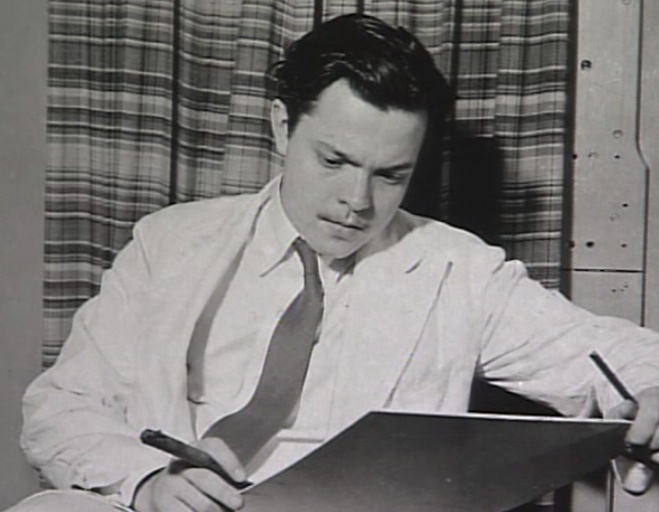
Happy birthday, Orson Welles

Much of the Welles story is difficult to put together because he himself was such a teller of tall tales. You know, he went to Morocco when he was 16 years old and the stories he told of his time there, hanging out with a sheik in a freakin' tent and chillin' with the Arabs smoking a hookah pipe in the mountains, stuff like that, have just grown in the telling. Then there are times, like Welles's sojourn in Ireland as a teenager (which really is an amazing story) when he basically strolled into an audition at the up-and-coming Gate Theatre (which had set itself as a rival to the dominant Abbey) and got a part. Welles made it seem, in his letters home, and then later in his life, that he was given a lead INSTANTLY. That's not quite how it went, but he did, indeed, take the Ireland theatre world by storm as a teenager. He was the toast of Dublin at age 17. This cannot be disputed. The truth is crazy enough without embellishment.
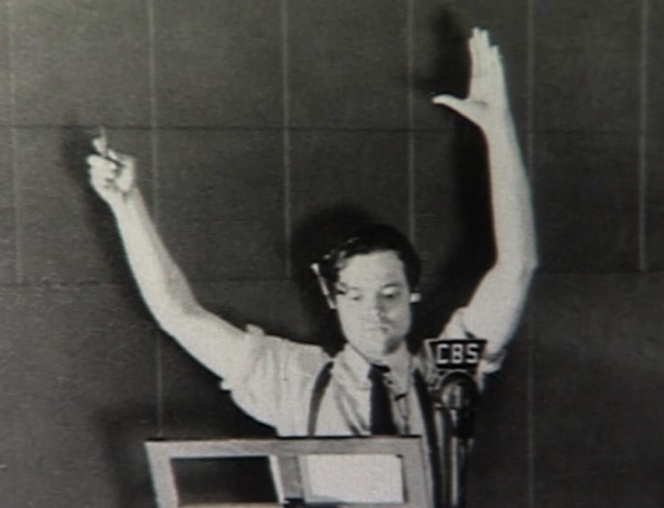
But for Welles, truth was never as interesting as fantasy, and he is at his best when he can project himself into his own fantasies. Isn't that what Citizen Kane was all about, and War of the Worlds? If you build it, he will come. "Here is my fantasy/nightmare/dream. I request that you participate in it, willingly or no." Welles was an old-fashioned showman, a purveyor of tricks, and then (in the case of War of the Worlds) acting baffled and "aw, shucks, sorry I freaked you all out" when he was found out. It was brilliant.
Then there is the famous Cradle Will Rock experience (which John Houseman describes so wonderfully in his own memoirs), the voodoo Macbeth done in Harlem with all black actors in the 1930s (which Welles directed at age 22), the Mercury Theatre, the War of the Worlds broadcast, the precedent-breaking deal with RKO which led to Citizen Kane ... and then, of course, the craziness of the newspaper war Hearst launched against Welles and RKO because of Citizen Kane, virtually killing the film. Not to mention the following events, the tragedy of the botched Magnificent Ambersons, Welles's insane time in Rio during World War II, and etc. etc.
Simon Callow's two-volume biography (and there will, apparently, be a third volume, and I'm waiting for it like a lunatic) is fantastic (if, perhaps, a bit TOO detailed, and I can't believe I'm saying that, but Callow is so obsessed with his subject that he devotes 10 pages to analyzing a paper Welles wrote as a schoolboy. I appreciate obsession, don't get me wrong, and God forbid if I ever wrote a book about Dean Stockwell or Mickey Rourke or Gena Rowlands - because I find literally everything about these people interesting. Give me a grocery list scribbled by them, and I'd include it in the book. So I sympathize with Callow). Regardless, one of the spectacular things about Callow's biography is this level of detail, yes, but also the theatrical background from which Callow comes. He doesn't just list events. He talks about them in their artistic context. People who don't know about Welles may just think of "War of the Worlds" or "Citizen Kane" when they hear his name. But there is so much more. Callow analyzes Welles's production values, his script adaptations, Callow is unafraid to criticize Welles, and he does it as a fellow actor/director. I love that aspect of the books. Why was Welles' voodoo Macbeth so groundbreaking? And Callow doesn't just stay on the surface of that incredible event (black actors, mostly non-professional, the Great Depression, Harlem location), but Callow looks at Welles's adaptation, what he chose to cut, how he rearranged things, and whether or not, in Callow's estimation, it was successful. Welles saw Shakespeare not as a great man to be revered and feared - but as a guy who wrote awesome plays that could certainly stand to be mucked up with a bit. Callow then uses said adaptation to make theories about where Welles was at that time. What interested him? Let us look at what he chose to cut, and speculate on why he felt that had to go?

David Thomson, in his gigantic Biographical Dictionary of Film, has an enormous entry on Welles, and he closes it with:
In his last years, Welles did more commercials, he narrated documentaries, he attempted to launch fresh projects and to complete old ones. He appeared in It Happened One Christmas (77, Doald Wyre), The Muppet Movie (79, James Frawley), and Butterfly (81, Matt Cimber). But none of those matched his provocative role as the wise man in the back row of the theatre in his friend Henry Jaglom's Someone To Love (87). In short, he presided over the special chaos of his life as it closed, apparently seeking help and friends, yet secretly sealed against trespass. His unfinished films are now seeing the light of day - even pieces of It's All True. But so little about the life and work of Welles is all or anywhere near true. He inhaled legend - and changed our air. It is the greatest career in films, the most tragic, and the one with most warnings for the rest of us.
Welles was clearly a prodigy of some kind, albeit a messy one. As a young boy, he was already on his way, and he was lucky enough (or persistent enough) to find mentors who could push him further and further along. He was doing summer stock as a teenager, appearing in Shakespeare, and he was also a student at an elite boy's school which had a stellar drama department. Welles remained connected with that school all his life. He did not forget his influences, and he did not forget where he came from (although he also would speak of things in retrospect and always put HIMSELF at the center of everything. It reminds me a bit of how Howard Hawks talked. Every great idea in Hollywood, every unpredictable yet ultimately successful casting decision was originally Hawks' idea, according to Hawks. It's kind of endearing. It makes it hell on a biographer, but still: these men were storytellers and artists. If you're looking for literal truth, I don't know why you would look for it in show business and the people who practice it!)
Welles went to Ireland as a teenager, as I mentioned - and became highly involved in the Gate Theatre, which still exists, run by a fascinating guy named Micheál MacLÃammóir. Look him up. Guy has as much interest as Orson Welles, and just as intense a reinvention of self. Welles was one of the most self-regarding of all artists, it was about the power of his personality - it always was - and how his voice (no surprise that Welles made his real mark in radio) could bring his personality (and others) to life. MacLÃammóir's stories of Welles' first audition for them ("There's an American teenager in the lobby ... he says he wants to audition ... what should I tell him?") are laugh-out-loud funny. MacLÃammóir in one of his autobiographies (he wrote several, and rightly so - what a life!!) describes being told about the American teenager in the lobby who was saying he was a lead actor at the Guild Theatre in America (none of it true) and that he wanted an audition. MacLÃammóir says sure, send the kid in. In walks Orson Welles. MacLÃammóir describes what happened next:
'Is this all the light you can give me?' he said in a voice like a regretful oboe. We hadn't given him any at all yet, so that was settled, and he began. It was an astonishing performance, wrong from beginning to end but with all the qualities of fine acting tearing their way through a chaos of inexperience. His diction was practically perfect, his personality, in spite of his fantastic circus antics, was real and varied; his sense of passion, of evil, of drunkenness, of tyranny, of a sort of demoniac authority was arresting; a preposterous energy pulsated through everything he did. One wanted to bellow with laughter, yet the laughter died on one's lips. One wanted to say, 'Now, now, really, you know,' but something stopped the words from coming. And that was because he was real to himself, because it was something more to him than a show, more than the mere inflated exhibitionism one might have suspected from his previous talk, something much more.
Isn't that absolutely gorgeous? "He was real to himself ..."
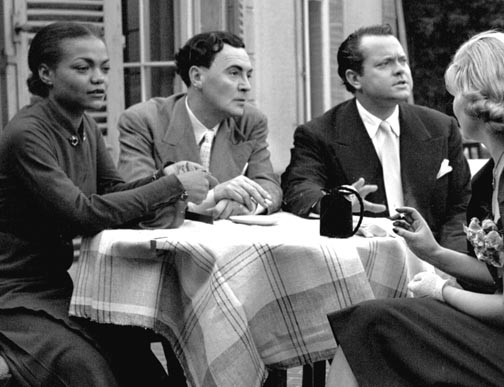
Here is a photo I found that I love from 1950 - of Eartha Kitt, MacLÃammóir, and Welles. The two stayed friends their whole lives. And it wasn't an easy friendship - I suppose it never was with Welles - but they remained colleagues and collaborators til the end.
Welles' journey in the 30s, with the Federal Theatre Project, is well known. He hooked up with another young ambitious guy, John Houseman, and they began to put together projects, the first of which was what is now known as "the voodoo Macbeth" - a Macbeth put on entirely with black actors, mostly non-professional, at a big theatre in Harlem. Welles set the Macbeth in Haiti, with a stage full of crazy voodoo goddesses in headdresses, massive crowd scenes, drum beats - Welles was always about creating an impression, rightly or no. You can see clips of the voodoo Macbeth on Youtube, I think - and I've seen clips of it in the documentary I have about Welles at home. It may be a lot of sound and fury, signifying nothing - all style, no substance - hard to say - but it was a giant hit and it put Welles on the map. White people were flocking to Harlem to see the production. Black people came out in droves. It electrified the New York theatre world. If I could have a time machine to go back and see certain productions, Welles's "voodoo Macbeth" is in my top 5. (If you must know, Laurette Taylor as Amanda Wingfield in Chicago in 1945 is # 1).
Welles' notoriety grew with the shutting down of The Cradle Will Rock (go read Houseman's memoir for an account - that was the excerpt I posted of his book) - and eventually he and Houseman decided to strike out on their own and form the Mercury Theatre. The Mercury put on stage productions - Doctor Faustus and others - they got a deal for a weekly radio show where they would read classic literature, all adapted by Welles (did the man ever sleep?) - and of course, eventually, the "War of the Worlds" craziness came out of that - which then led to Welles being famous not just in New York but around the world. Hollywood took notice and pretty much air-lifted the entire Mercury Theatre company (Joseph Cotten, Agnes Moorehead, Everett Sloane, and all the rest) to do basically whatever the hell Orson Welles wanted. And what he wanted to do was a fictionalized life of William Randolph Hearst. The envy in Hollywood was intense. Who is this Orson Welles character and why was he given such a deal, while I slog along in my ridiculous contract having to do whatever the studio says?? There was never a lot of good will towards Welles.
Citizen Kane which, naturally, got its props eventually - was barely seen at the time, because William Randolph Hearst sparked a war against the studios, saying that he would instruct every one of his papers to BURY the movie, or ignore it completely ... if it were to go forward. Nobody wanted to alienate William Randolph Hearst. Citizen Kane was given a premiere, but that was pretty much it. It would be decades before anyone could see it again.
And so Welles made enemies from the get-go, and in a funny way, his career never really recovered its luster - although he would make some pretty damn fine movies (The Magnificent Ambersons comes to mind - although that film was so butchered by the studio that Welles, 40 years later, still couldn't talk about it without welling up with tears. I love that movie, but it is truly a tragedy what was done to it - and, seen in the light of retrospect, you can see the viciousness of the studio heads, sticking it to their young prodigy who had already caused so much trouble ... There is something personal in their attack on Welles. Well, you know how mediocrity hates genius! They set out to destroy him. Welles never really recovered emotionally from what was done to him with Magnificent Ambersons.)

That's a sketch Welles did, around age 13, of a young William Shakespeare.
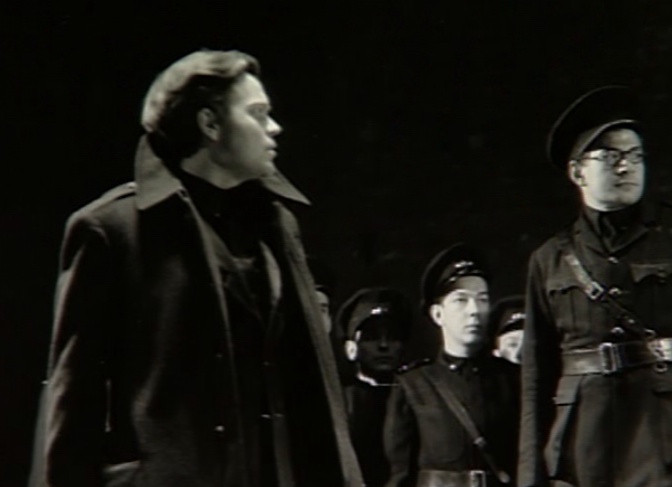
In 1937, the Mercury Theatre put up a now-famous (and famous almost instantly) modern-dress production of Julius Caesar. Again, where the hell is my time machine? It was a terribly uneasy time in the world at large. The cataclysm was already happening elsewhere in Europe, and the mood was very very tense. Welles decided to set Julius Caesar in fascist Italy. This was not necessarily a new or an original idea, many companies had been doing putting classic works in a fascist European setting - however, many of these were out of New York, and so word would not have reached Welles about them. It appears to have been original to Welles, or perhaps just an expression of the universal mood at the time. Welles' gift was never, by the way, in being original. It was in being able to take the dream that was in his own head and create it out in the world in whatever production he was involved in. He was never strictly an innovator, although much of cinematography as we now know it imitates what was done in Citizen Kane, with the deep-focus, and the shot angles. But much of that was Gregg Toland's contribution, not Welles's. Welles's contribution was in believing in the sheer size of the project, and making it happen. He was a showman of the old school, a PT Barnum, a now-you-see-it-now-you-don't genius. He played tricks. There's a reason why this guy was obsessed with magic for his entire life, and even put together a magic show in Hollywood with an all-star cast, including his future wife Rita Hayworth. Welles had no reverence for Shakespeare. No, he had something better: he had love and passion. Shakespeare was just a fellow showman, as far as Welles was concerned, another practical man of the theatre. Welles chopped scenes up, deleted characters, he rearranged the order if it suited him - pulling things forward when normally they happened at the end, whatever ... You can tell that he would be a movie director, which is more of a non-linear medium (or can be, with its potential for flashback, or dreams, etc.) With Julius Caesar, Welles kept the stage huge and black with billowing black curtains. Most of the characters wore the black military uniforms of Mussolini's jackbooted thugs, and there was an intense air of uneasiness and violence around the production. People were blown away by it. It seemed to speak directly to their time, directly to what was going on in Europe. It took New York by storm. Voodoo Macbeth had been earlier that year - so to then come out so quickly with this Caesar so soon after, so different from the Macbeth, and Welles was only 23 ' years old. Unbelievable. Unprecedented. The voodoo Macbeth was all about the spectacle. It was all about crowd scenes, and traffic control, and creating an impression of madness, noise and chaos. The Caesar was about giant empty cold spaces, and human beings dwarfed by the surrounding atmosphere, the black of their costumes blending into the black of the drapes so that their white faces shone out, in a tiny frightening way, as though they had pin-spots on them at all times. Such a different conception, look, feel ... from what he had done only 8 or 9 months previous.
Here is a series of images from Welles' Caesar, including some of his sketches for the costumes, setting, and lights (he did everything ... the whole production was in his head). I also included a Hirschfeld cartoon of the time.


Callow devotes an entire chapter to Caesar, going into detail Welles' own thought process, his adaptation, the casting of the roles, the rehearsals. It's a 40 page chapter. This is not a book for those who just want the author to get on with it already. To Callow, there is nothing to "get on with". It is the journey. Let us now look at the fascinating composition Welles wrote when he was 10, and see what it might reveal about his concerns. Let us devote an entire chapter to his burgeoning interest in magic and what that signifies. Let us try to piece together his trip to Ireland through letters and diaries and interviews and let us do it over the course of 30 pages. He skips over nothing. Actually, if he skips over anything, it is Welles's personal life - which is actually a lovely change! Welles's personal life was always on the backseat to his career, so it takes a backseat in the book. Good.
Callow leaves no stone unturned. He is able to speak about the craft of acting openly, without shame or embarrassment (lots of biographers do not know how to talk about acting - even when their subject was an actor, the writer gets baffled when they try to describe what the subject was doing you can tell they are out of their league). Simon Callow takes acting seriously, sure, but he also knows the buffoonery and fun of a rehearsal process and how ridiculous it can be. He knows how to talk about all of it. He takes his obsession to the most logical conclusion (three volumes), and there isn't one page that isn't interesting or illuminating.
Get cracking on volume III, Callow. I demand it.
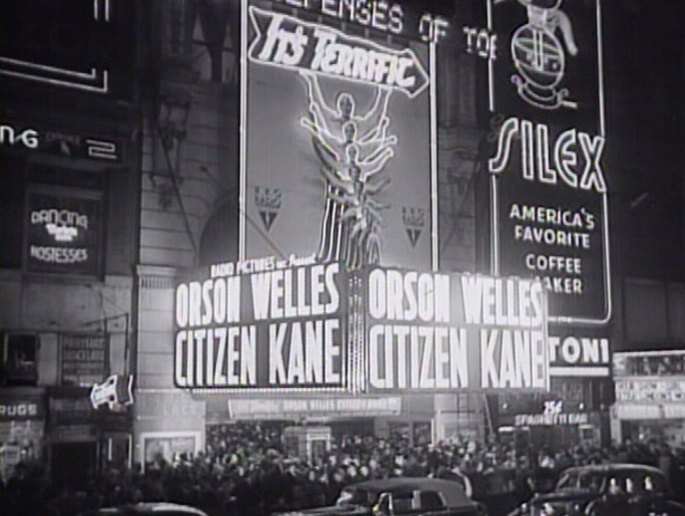
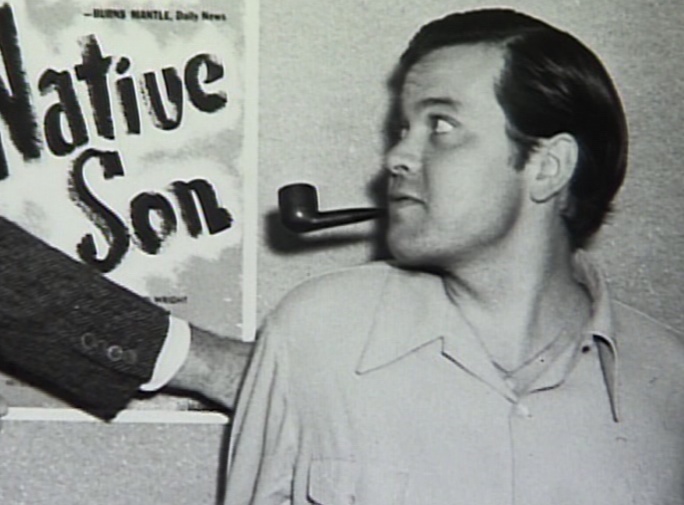
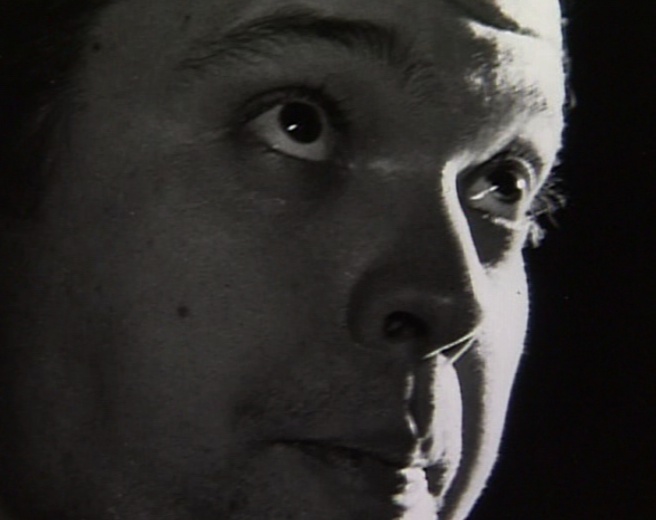
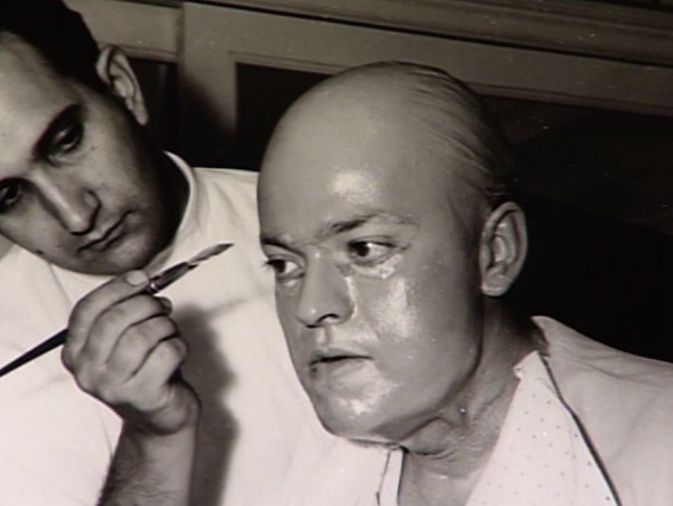
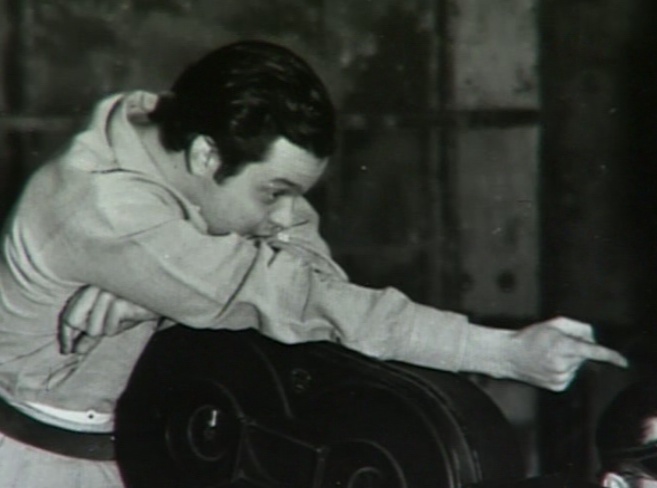
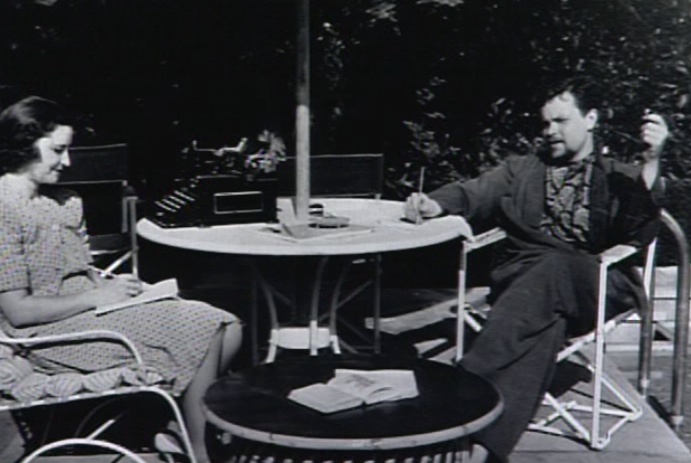
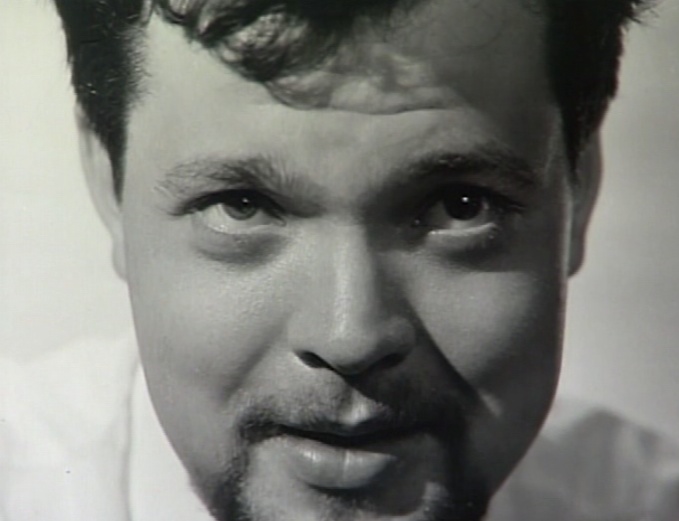
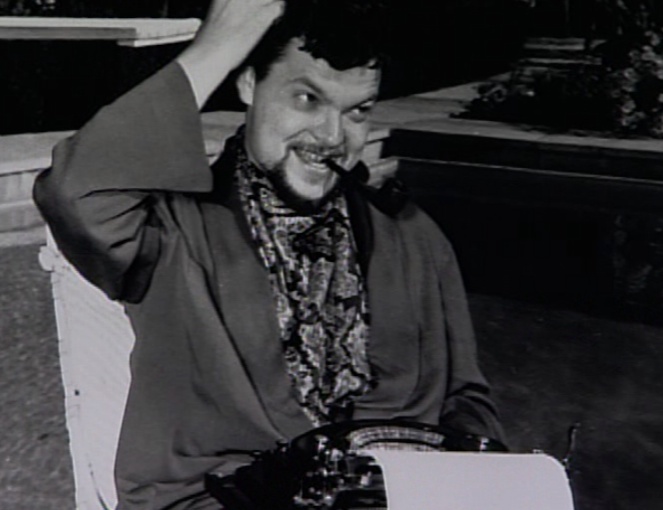
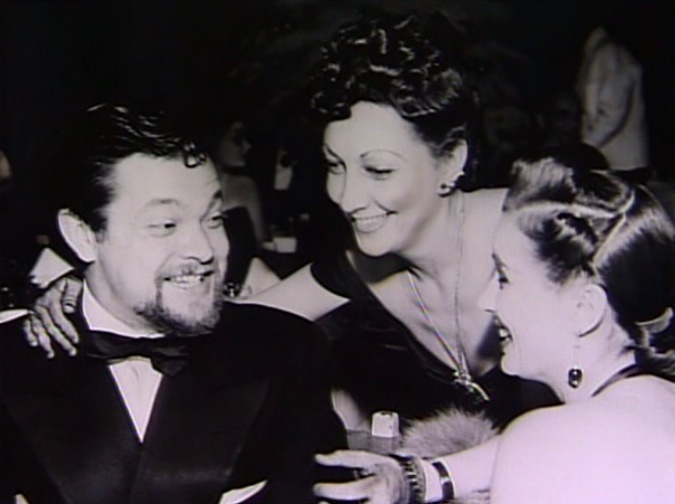
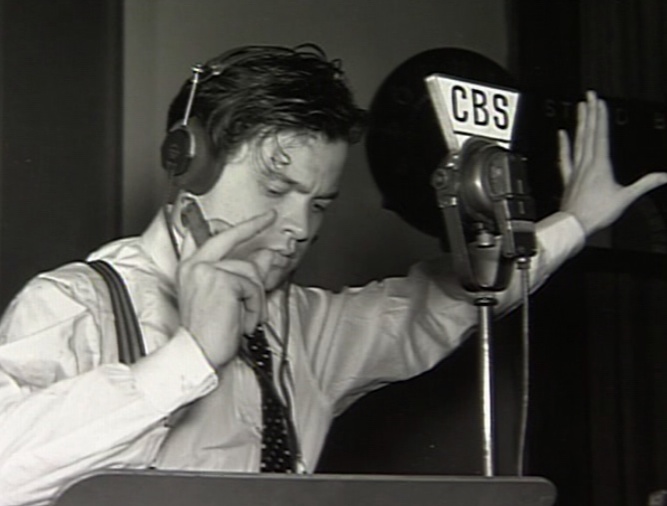
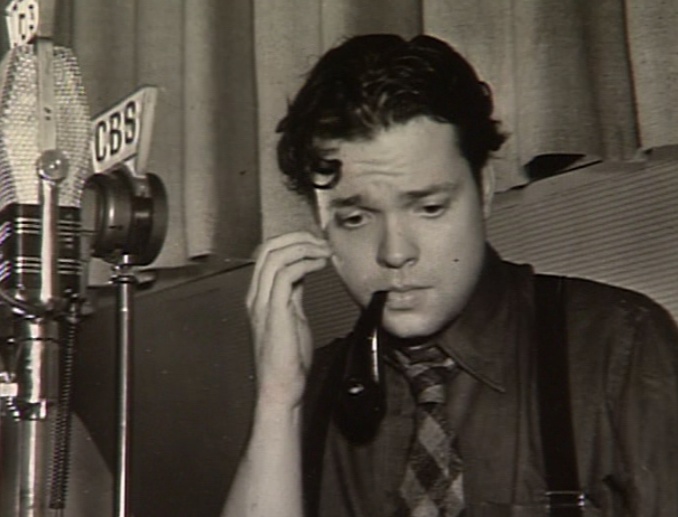
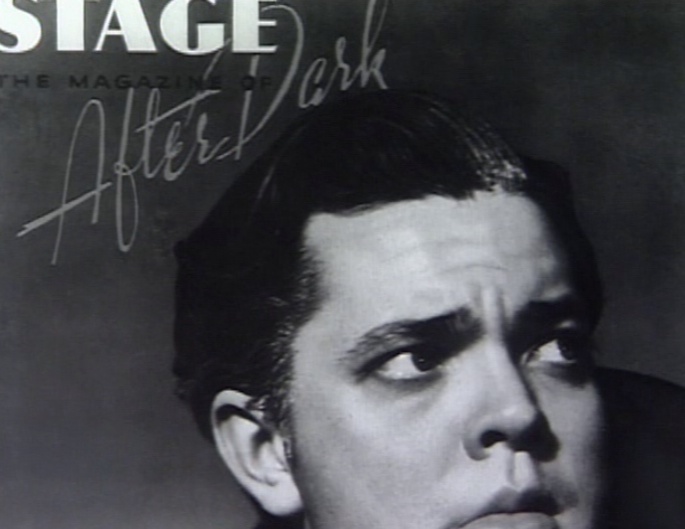
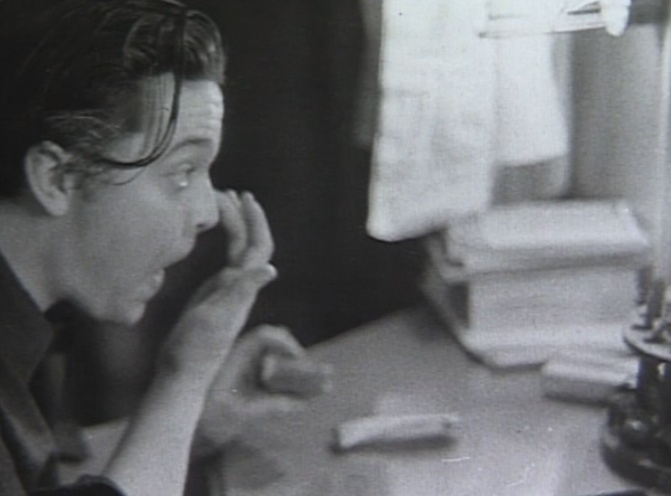
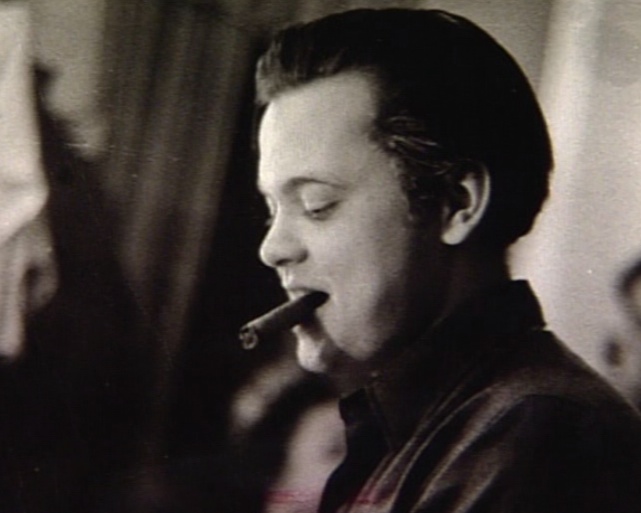
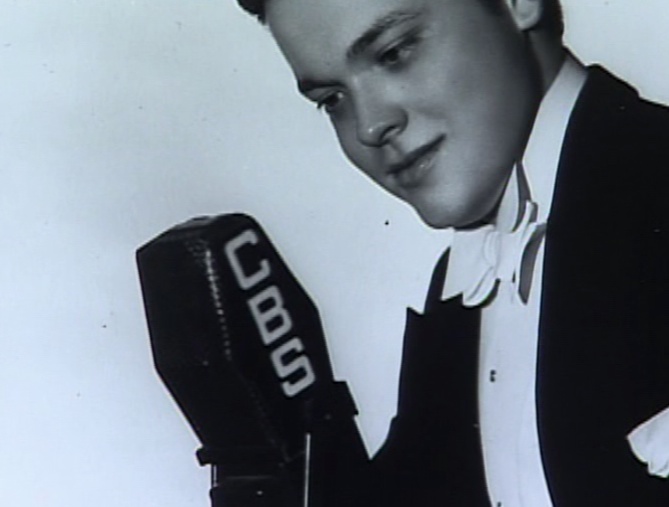
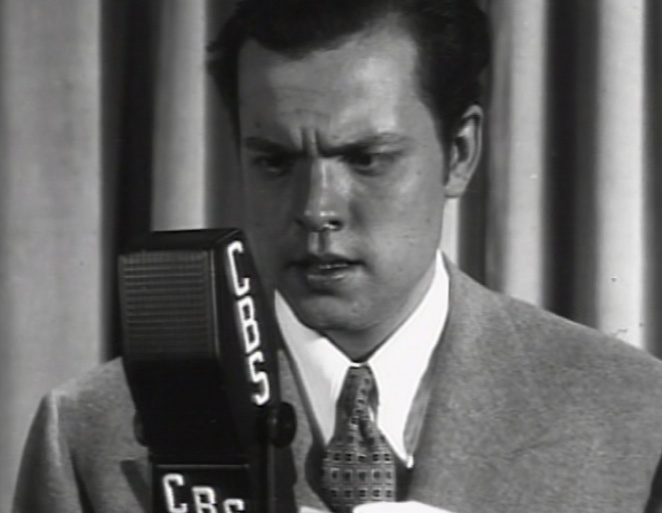
In honor of Orson Welles, one of our most complex and tragic cinematic figures, here is Callow's writing on Julius Caesar, from 1937. And a big montage of young Orson from his New York days, into the Citizen Kane days below the jump.
Happy birthday, Orson!
EXCERPT FROM Orson Welles: Volume 1: The Road to Xanadu
By 1937, though he didn't go so far as to propose changing the title, he had come to the conclusion that Brutus was very much the central figure of the play. The Mercury, the weekly bulletin that was in effect Welles's mouthpiece, stated: 'As those familiar with the play are aware, Julius Caesar is really about Brutus.' Welles himself added: 'Brutus is the classical picture of the eternal, ineffectual, fumbling liberal; the reformer who wants to do something about things but doesn't know how and gets it in the neck at the end. He's dead right all the time, and dead at the final curtain. He's Shakespeare's favourite hero - the fellow who thinks the times are out of joint but who is really out of joint with his time. He's the bourgeois intellectual who, under a modern dictatorship, would be the first to be put up against and wall and shot.'
He had concluded that the play was 'about' the anguish of the liberal in an age of dictators. This emphasis meant that a great deal of the political complexity of the play was sacrificed in order to focus on one man's dilemma. The version Welles fashioned by no means fulfilled Houseman's claim for the production that 'the stress will be on the social implications inherent in the history of Caesar and on the atmosphere of personal greed, fear and hysteria that surrounds a dictatorial regime' or indeed Welles's own claim at the same time that 'it's a timeless tragedy about Caesarism and the collapse of democracy under Caesarism.' Lepidus was axed entirely; Octavius and Antony downgraded, and the mob, so graphically individualised by Shakespeare, relegated to a largely choric function - in the text, that is.
Its function in the staging was heightened, streamlined; but it became a many-headed hydra, losing the dynamics of individuals in a crowd. 'Here we have true fan psychology,' he told The New York Times. 'This is the same mob that tears the buttons off the coat of Robert Taylor. It's the same mob, too, that hangs and burns negroes in the South, the same mob that maltreats the Jews in Germany. It's the Nazi mob anywhere.' Significantly Welles's version starts, not with the scene analysed by a million schoolchildren ('Hence! Home, you idle creatures, get you home!') but with Caesar silencing the crowd. 'Bid every noise be still!' We are in the presence of the Great from the start; there is no context. Rome is its leaders; a distinctly bourgeois reading of history.
Whatever the interpretation, the result was nothing if not effective; a great deal of the Mercury version, in fact, was devised for no other reason than to generate theatrical excitement. The text gives every appearance of having been shaped to accommodate the production, rather than the other way round. His adaptation is exactly comparable to those reviled eighteenth-century adaptors, Garrick and Cibber, his purposes exactly the same as theirs: to exploit the possibilities of their stage-craft and to fit the play to the temper of the times. 'In drastically cutting the last twenty minutes of the play,' wrote Hank Senber in The Mercury, 'Welles was working to clarify the personal aspects of the tragedy and to liberate the play from such concessions to Elizabethan tastes as drums, alarums and mock battles on stage.' And of course, those things did look and sound ridiculous when the warriors in question were wearing long black leather overcoats and jackboots. Welles certainly wasn't going to lose the stunning effectiveness of the uniforms because some of the play didn't fit. Cut it! The lurid theatricality of the regimes of Mussolini and Hitler was an essential element in choosing the context for the play, and the physical look of the production was absolutely clear in Welles's mind from the beginning. There seems, however, to have been some conceptual confusion. If the play - or at any rate the production - is a critique of Caesarism, what does Antony represent? He, surely, is the demagogue, not Caesar; he's Hitler, he's Mussolini. Is Caesar then Hindenburg? Somewhat defensively, Welles told The Mercury: 'I produced the play in modern dress to sharpen contemporary interest rather than to point up or stunt up present-day detail. I'm trying to let Shakespeare's lines do the job of making the play applicable to the tensions of our time.' It was a general feeling of contemporaneity that he was after; not a blow-by-blow parallel.
His absolute certainty about the physical realisation of the concept made his collaborators' work quite cut and dried. Jeanne Rosenthal wrote: 'Welles dictated very clearly and exactly the kind of look he wanted the production to have, a very simple look, based on the Nazi rallies at Nuremberg. The patterns implied in the Nuremberg "festivals" were in terms of platforms, which were the basis of the scenery, and light which went up or down. The uplight was really taken from the effect the Nazis achieved.' (And which Houseman had used before in Panic.) Welles described his concept of the physical production in The Director in the Theatre Today the following year: 'I wanted to present Julius Caesar against a texture of brick, not of stone, and I wanted a color of red that had certain vibrations of blue. In front of this red brick wall I wanted levels and places to act: that was my conception of the production.' Welles's visual confidence is rare among directors. His own skills as a graphic artist, coupled with his experience in designing and building for the Todd Troupers and the Gate Theatre, made him a daunting prospect for a designer. Young Sam Leve, fresh from triumphs with the Federal Theatre Project and the Yiddish Art Theatre, in his own words 'oozing imagination', found that Welles was uninterested in his suggestions. In order to get them even considered, he had to convey them to Houseman, who might, if he liked them, pass them on, a 'humiliating process' for the young designer, in his own words. However, when Welles asked him for sketches, from the hundreds Leve would produce, on Leve's admission he would unerringly choose the best, dismissing the less good ones: 'Sam, you can do better than that.' The two men were exactly the same age, but as usual Welles immediately and automatically assumed command.
'At the Mercury,' wrote Jean Rosenthal, 'nobody else had any identity for him at all. You were production material. If he liked you, the association could be pleasant. If not, it was injurious. As a director, he approached other talents as he did his gargantuan meals - with a voracious appetite. Your contributions to his feast he either spat out or set aside untouched, or he ate them up, assimilated them, with a gusto which was extraordinarily flattering.' And fun: 'the initial stages of anything with Orson were immensely entertaining, which carried everything along ... he never counted the cost of anything to himself or to anyone else.' Rosenthal, who became one of the crucial figures in the development of American theatre lighting before her early death in the sixties, was keenly aware of the growth of the power of directors, and identified Welles as one of the first to dominate every single aspect of a production. Rosenthal avoided confrontation with Welles, but he never doubted her strength, demanding much of her within a framework of respect. Her final judgment, though, on her work with him is a chilling one: 'I do not think Orson made the utmost use of his collaborators' talent, although he often inspired their achievements. He did make the utmost use of his talents at the beginning, but perhaps his lack of respect for others accounts in some measure for the ultimate dissipation of his multiple talents.'
For the time being, the actors were not complaining. Few of them would have been aware of his psychological baggage. What they saw was a man with very determined ideas putting them into practice with a disarming combination of ruthless drilling and amiable anecdotalising, plus a good deal of horseplay. Exuberant, in some ways still a very young man, almost a boy, he dictated the pace and regularity of work according to his personal mood. 'When he felt like rehearsing, we rehearsed. When he felt like sleeping, we didn't rehearse. If he felt like rehearsing from 11.00 at night to 6.00 in the morning, damn stage hands' overtime, full speed ahead,' according to his then stage manager Howard Teichmann. 'He was a brilliant, inventive, imaginative director ... in a class all by himself. He would sit generally at a table in the centre aisle behind the table, and he would have a microphone on the table. And he would whisper his directions into the microphone. This table also served as his dining table. When he was hungry, he would send people out and they would bring in the steaks and the french fries and the ice cream and pots of coffee a foot and a half high, which he would consume with great relish. And when he was tired, he would say, "All right, children." Now mind you, he was younger than most of the people but we were his children.'
'There was no doubt in anyone's mind that Orson was the big star,' said Teichmann. 'He was a year or two older than I am, and he was slim, with a big head and round cheeks and very boyish. And "boy genius" was a term if he didn't create, he didn't fight it off ... You had to be a certain kind of personality to work with Orson. You either had to worship him or you had to meet him on an equal level, or you had to crumble. And a great many people, you know, would end up with ulcers and he was a great one for giving them. He loved everybody, but, boy, he was tough. "Who me, tough? I'm a pussycat." You know, that was his thing ... he played people off against each other.' His manner was calculated to be humorously high-handed, shouting out admonitions - 'shame on you!' a favourite - if the actor's work wasn't to his liking. He was not averse to having a whipping boy: young William Alland, later famous as the producer of The Creature of the Black Lagoon, and known to movie buffs as the shadowy reporter in Citizen Kane, had, when the Mercury was being set up, more or less thrown himself at Welles's feet, and that's more or less where he stayed, as actor, stage manager, gofer and pimp. Welles would roar his name o ut, abusing and cajoling him. It was good-humoured, but only just: a throw away from bullying. If you weren't on the receiving end, it could be fun; to Peg Lloyd it was cheap: 'he seemed a prep school boy with the cheap humour that preppies have. A genius preppy, that's what he was: the ringleader of the bullies on the corner.'
Rehearsals for Julius Caesar took place, initially, not in the theatre (the stage was still being reconstructed) but in an abandoned movie studio in Fort Lee, New Jersey, 'the place where the movie industry began' in the words of Elliot Reid. Under a couple of worklights, while the incessant rain dripped into strategically placed buckets and the plaster tumbled from the roof, Welles arranged his cast on the platforms which Sam Leve had found in an old Shubert warehouse, and which were the essential element of the set that he and Welles had devised. There were four platforms: the first fourteen foot deep (the downstage playing area), the second a narrow high step, the third an eight foot deep plateau, the last a narrower platform rising to a total height of six and a half foot above stage level; there were two flagpoles on either side of the stage. Within this framework, Welles laboured to create the images that he had in his mind. Despite the great informality with which he worked, the stories and the atmosphere of wild, almost boyish fun that he engendered, he was always straining towards a specific and precise visual notion, what Norman Lloyd (playing Cinna the poet) described as 'the shot'. 'Every scene had to have a production idea. Is it a shot? Is there something interesting in it?' He improvised the physical action, constantly altering the moves to achieve the desired shape; the scene wasn't worked out in advance, in the Reinhardt manner, every eyebrow, every sniffle planned. But the effect was much the same: there was no discussion of character or motivation, simply a dedication to discovering what Brecht had called the 'gestus', or gesture, of the scene.
Debate over his methods constantly raged amongst the company, though rarely to his face. Moody, sardonic Coulouris (who during breaks from rehearsal would throw tennis balls against the wall, muttering 'Be a singer, be a singer! Don't be an actor! Acting's horrible') openly challenged Welles, but he became, Jaques-like, a sort of licensed melancholic within the group. For the most part the actors worked happily at the service of Welles's invention. Nor was he intent simply on imposing his ideas on them. Norman Lloyd reports Welles as saying, 'I may not be able to direct actors very well, but once an actor gives me something, I know how to stage it.' Lloyd himself fretted over the absence of any sort of methodology, feeling that the essence or the truth of the scene was sometimes sacrificed to effect; he was none the less delighted by the opportunities Welles's staging afforded him. Welles's instinctive sense of how to release an actor and a scene in physical movement was the equal of his English contemporary, Tryone Guthrie, with whom he shared a revulsion for dealing with the inner life of the character, or indeed, the actor. 'Your problem!' Guthrie would briskly tell his actors as they wrestled with difficulties of this kind; the phrase could just as easily have come from Welles.
The concomitant of this external, linear approach was that if the scene was effective, it succeeded; if it wasn't, it was nothing. Welles struggled for weeks with scenes which resisted his best efforts; this process continued up to the very opening. One such was the scene in which Cinna the poet is killed by the mob. There was from the start a disagreement between actor an director over interpretation, Welles seeing the poet as a version of Marchbanks, all long hair and floppy ties, Lloyd, playing the part, seeing him rather as the sort of man who wrote letters to The New York Times, a prototypical liberal, brilliantly able to see both sides of the situation, congenitally incapable of deciding between them; Archibald MacLeish, in fact. Lloyd hoped to achieve, as he says, an 'essence'. 'I thought you could say "this is what it is to not take a position." ' Welles quickly gave in over the characterisation, because he was obsessed - 'consumed' is the word Lloyd uses - by an idea of how to stage the scene, a musical, choreographic conception of how to show a mob destroying an innocent man. First of all he needed more lines than Shakespeare had provided, so, after experimenting with improvisation, he drafted in a few from Coriolanus; then he enlisted Marc Blitzstein to orchestrate the voices using a beating drum to indicate the rhythm. Welles rehearsed 'this goddam chanting and boom boom boom' for over three weeks. Sometimes Blitzstein took over; neither of them spent any time on the characters or the acting as such.
As for Welles's own performance, it was a low priority. A stage manager stood in for him throughout rehearsals. The result was that by the time of the dress rehearsal, he had barely acted with his fellow players (which can scarcely have helped them in creating their own performances); nor, never having run the scenes himself, was he very clear about where he should actually be standing. No one knew where he would be coming from or where he would be going to and he was frequently shrouded in darkness. To add to the uncertainty, he was very shaky on his lines, having scarcely uttered them during rehearsals. Throughout his career, on film and on stage, he was never entirely in command of his texts. He was not a quick study and rarely had the time or the inclination to ensure that the words were so securely lodged in his memory that they would spring spontaneously to his lips at the appropriate moment. Fortunately, he had considerable powers of iambic improvisation, and could sonorously if meaninglessly coast along for minutes at a time until a familiar line would, to the relief of the actor who was waiting for his cue, emerge. Since he had not rehearsed the part of Brutus, he had of course no opportunity to explore the character, to experiment with his approach, or to open himself to anyone else's view of his work. He had decided at some earlier time who Brutus was - who his Brutus was - and simply slotted it in to the production. Brutus, he said on several occasions, was above all intelligent (the character description for Marcus Brutus in Everybody's Shakespeare reads: 'he is a fine patrician type, his face sensitive and intellectual'). It was Welles's belief that he had a special gift for playing 'thinking people': not, as he expressed it in an interview with Peter Bogdanovich, 'that they're thinking about what they're saying, but that they think outside of the scene ... there are very few actors who can make you believe they think ... that's the kind of part I can play.'
Happy the actor who knows his own gift. He has at least a chance, given a moderate amount of luck and a shrewd choice of work, of playing straight down the centre of the character to create a vivid and clear image of a particular human being. If he is struggling against type, to express things not in his personal experience or make-up, then he will almost certainly miss the core of the character, however interestingly he may embellish its surface. Though Welles was unquestionably intelligent, the most striking feature of his acting persona is not intelligence but power; he described himself, quite accurately, as 'he who plays the king'. Curiously enough, his portrayals of 'thinking people' often lack intellectual conviction: what he demonstrates is thoughtfulness. Partly this stems from a lack of structure in his own thinking; mostly it derives from the simple technical fact of not having completely mastered the text, and thus the thought. Welles, instead of actually thinking, acts it. It would seem that what really drew Welles to the role of Brutus was not so much his cerebral nature, but rather his nobility: this dark, wild, immature, titanically possessed young man wanted to present himself as the very soul of dignity and responsibility. His method of doing so was - according to his own formula - simply to suppress the ignoble parts of himself. Easy.
This cavalier attitude to his own performance is partly explicable by absorption in other responsibilities; but there is a strong suggestion that he became involved in his other responsibilities in order not to have to immerse himself in his own performance. He didn't want to evolve his performance; he didn't want to talk about it, or think about it. In Lehman Engel's acute words: 'His own performances happened suddenly for good or ill. They were or were not at the very outset.' In none of his utterances on the subject of acting does Welles ever speak of the work that goes into a performance. The assumption is that you can either play the part or you can't; if you can, then that's it: you play it. It is a complex matter: he seemed to want to be acclaimed for his acting, but not to have to work on it. He expected to be acknowledged as a major actor, while insisting that acting wasn't a terribly important thing anyway.

April 30, 2010
Free Jafar Panahi
News not looking good on the Jafar Panahi front. He was arrested on March 1, and has been in prison ever since. His wife has been quite vocal about his heart condition, and also that she has been denied access to him. The Iranian regime hopes to bully him into silence, through intimidation and incarceration. It is an outrage. Iranian film-makers and artists have been courageously calling for his release, and now a group of Western filmmakers have added their voices to the mix.
Read the petition here, with signatures.
I have written about Jafar Panahi quite a bit here, my love for his films, and my concern for his welfare since he has been arrested. I won't even get into my rage.
If you're on Facebook, there is a group called Free Jafar Panahi, and it's filled with links and up-to-date information, as well as suggestions of what you might be able to do to help. Publicity is essential. Bullies prefer to operate in private. Spotlights are essential to shaming those involved. Panahi originally was arrested for other "crimes", not having to do with his films (uh-huh, yeah, right - he shoplifted when he was a teenager? He cheated on his taxes? Uh-huh), and now apparently they've gone back and said, "Oh, yeah, we actually DID arrest him for the films he has made, and also the film he was ABOUT to make."
As Panahi did so wonderfully in Offside (my review here), there is a temptation to laugh at the small-minded fascist attitudes of those who have imprisoned him, but the situation really is too serious for that. These people aren't messing around.
A petition like this will not be the "Abracadabra" that Panahi needs, but it certainly doesn't hurt.
April 11, 2010
What the radio sees: Wong Kar-Wai's In the Mood for Love

There were a couple of shots in Shutter Island (I am thinking of one in particular in Ben Kingsley's office) that made me ache for directors who know what to do with the camera. It was so specific, so emotionally charged - attention-getting, yes, but in service to the story. A beautiful sweep from one face to the other. Typical Scorsese (with, naturally, a little help from cinematographer Robert Richardson)- I feel like I could pick his camera shots out of a lineup. The camera moves are highly editorial, but not in the jagged-jumpcuts-handheld tradition which has overtaken every movie, whether it is appropriate or not. An elegantly moving camera is something I prize, and it is only when you see a shot like the one in Kingsley's office in Shutter Island when you realize that it is practically a lost art.
Wong Kar-Wai's In the Mood for Love is a master-class in how to move the camera. Every shot is full of interest and mystery, the frame crammed with details that threaten to overwhelm the viewer. You can't look at it closely enough. It DEMANDS attention, but not in a way that seems bossy or clever: it demands attention because it is an element in telling the story. Film is a visual medium. How things are framed, looked at, seen are (or should be) an important part of the story-teller's tools.
The two characters in In the Mood for Love (Mrs. Chan, played by Maggie Cheung and Mr. Chow, played by Tony Leung) are not openly emotional or expressive as human beings. Their feelings are buried, and it is a film of great longing and yearning. The camera, moving slowly, deliberately, sweeping from one side to the other, reflects that. So, too, does the sense that you get that the camera is peeking at the two characters. It peeks over the backs of booths at a restaurant, peers down dark narrow hallways to the glimpses you get in the room at the end, it peeks through mirrors, and grates, and in every single shot there is some sort of interference.

When they ride in a cab, they are seen through the outside window, so the reflections of neon swoop up over their faces. Even in simple shots (Mrs. Chan at work, doing her regular duties), she is seen through the glass of the office, or seen only in part, around a corner. A head-on clear shot is very rare in In the Mood for Love, so when you see one you know it means something. It is not just a film-maker using it to be efficient. It is saying: "This is different from all the other shots. Pay attention."

Shots double back on themselves, and repeat, sometimes in reverse. The dark stairway of the apartment building is seen with people going up, going down, and sometimes we get shots of empty spaces: hallways with doorbells, long corridors, with no people in the shot - and for me this helped create the sense that the two main characters, married, are surrounded by a cramped world of gossip and people listening behind closed doors. Even empty spaces are potent traps. Nowhere is safe. Sometimes Wong Kar-Wai will use the same setting, but in different times and moods, so that you cannot believe you are looking at the same window frame, the same kitchen, the same stairwell.
It is rare that the camera is static in In the Mood for Love, but it doesn't have the frenetic "let me just keep cutting back and forth to try to create the story in the editing room" feeling that so many films now have. He already HAS the story. The word "mood" is in the title. That's key. This is certainly a mood piece, and the gorgeous top-notch soundtrack is essential to the film's impact. But so, too, is that slowly moving nosy camera, stalking the characters through alleys, peeking at them from behind corners, never seeing them wholly, just their parts, fragments.

Part of the fragmentary approach also means that we don't see them entirely, and much of the angles are at mid-riff level, so what we get is shot after shot after shot of people's middles: when they stand up, their heads leave the frame, and we watch their torsos interact. It's strangely gorgeous. It worked on me in multiple ways.

One was: In the Mood for Love is about the music (the soundtrack is superb. as I mentioned), and it takes place in the 1960s, so the radio was paramount. There are multiple shots of radios, in every space, every setting, and it's rare that there is not music in the background. This may be me going out on a limb, but one thought that occurred to me was that the entire film was from the RADIO'S point of view. We saw what the radio saw. If it was placed in the living room, and people were talking down the hall in the kitchen, then the camera was placed in the dark living room and we peeked down into the lighted room in the distance. When people stood up, the camera didn't move, because the RADIO doesn't move. We are at the radio's level, which is around the waist-line. The radio is omnipresent in the film (although subtle, it works ON you, rather than presenting itself blatantly), so I wondered if the entire thing was seen from within that box of music in every space. I haven't read reviews of In the Mood for Love, or critical analysis pieces, so I may totally be stating the obvious here, and people may think, "Duh, of COURSE the film is from the point of view of the radio - that's the whole point!" - and if so, then Yay! I feel very smart!

The other thought I had was about love itself. The movie is about love. Yearning and longing. Unrequited feelings, and being unable to act upon them. When you love intensely, and then you lose that love, often when you look back upon that person, you do not remember them "whole". You remember how they smelled. Or you remember what their mouth was like. Their wrists. You remember that dress she wore that day. Or how he crossed his legs. They come to you in fragments. That is how memory works. Emotions often come to us through the senses, not through narrative, and so In the Mood for Love sees its main characters as their parts, without (somehow) seeming like all the camera is doing is objectifying their bodies. The camera lingers and pans and passes back and forth, the "eye" capturing the perfection of Cheung's curves, or the brooding handsomeness of Leung's face, and the overall effect is that we are seeing them as they saw one another. Epitomes of beauty. Of what they most desire. This is a difficult feat to pull off. Camera moves like that can end up de-personalizing the human beings in the frame. In the Mood for Love is top-heavy with unexpressed emotion, and the camera shows that. The characters ache. We ache with them.

Along with that, when you are in love, what is more powerful than the telephone? Wanting your love to call, waiting for the call, receiving the call, aching for the call ... Phones are filmed with that kind of resonance here, and they dominate. They never just look like themselves. A simple practical object. They look like stand-ins for something else, emotion, love, hopes. The worst possible object to have in your vicinity when you are madly in love with someone is a phone that is VEHEMENTLY not ringing.

There is a distancing narrative device at the start and finish of the film, with white words on a black page, as though the entire thing has just been a story. As indeed it is. There are no "I"s in this narrative. Only "she" and "he". This, to me, also dovetails with the experience one has in looking back on a great lost love. It helps to try to distance yourself from the fresh pain of it, to look at it as a story, like any other, and not a defining event of loss which shaped you forever. The words on the page say that "he", when looking back on the past, saw the events as "blurred and indistinct", the comforting oblivion of time passing. Not healing all wounds, but softening the edges, putting them in the past, not the present. In the Mood for Love, throughout, sees the characters with "something in the way", at all times, even if it is just another passerby, or a house-plant - because memory often acts in this manner, and this film is one of the most nostalgic films of all time. Nostalgia is tough. If you lay it on too thick, your audience will gag on the syrup. But if you are honest with it, and come at it from a place of pain and understanding, it can be a slam-dunk. In the Mood for Love has almost no sentiment in it (or I should say "sentimentality"), and the emotion is held back, agonizingly, leaving space for us, the viewers out in the dark, to feel FOR them.
Collage of screengrabs below the jump, illustrating some of the things described here, although if you haven't seen the film, you really must. It is a work of art.
Look for the repeats of certain images. Look for the dreamy use of color (totally specific - nothing in the frame is an accident). Look for the radio's POV, seeing people's waists, heads cut off. Look for mirrors, fracturing the images. Look for the fragments, the shadows in the foreground, and the way objects are filmed in a talismanic way, investing them with all kinds of significance. Look for all the interference. We rarely see them clearly. We want to peek through curtains, pull back the drapes, crawl out from under the bed at one point, to get a full look at what is going on. It is a perfect example of content dictating form. Or at least informing form. There is emotion here, but it is not intellectual. It is felt, viscerally, from the wonderful performances of the Bogart and Bacall of China, Tony Leung and Maggie Cheung, but also from how that camera follows them around, incessantly, sneakily, aching to get the full picture.


March 23, 2010
Tim Burton at MoMA

MoMA has a giant (and I mean giant) exhibit up right now devoted to the work of Tim Burton, and any time I've walked by there since the exhibit went up (especially on weekends) there is a line around the block. Not exaggerating. People lined up outside and around the block. I love Tim Burton but that line was always daunting to me. Should I go join it? My friend then told me that she got free tickets, and would I like to go? We went yesterday afternoon, and while it was a mob scene at first (which was a bit annoying because you couldn't get close to the things on the walls, to read the little placards - the crowd was often 5 people deep at any given spot) - but eventually it thinned out a bit, and we were able to wander around to our hearts' content, going from wall to wall, lingering (I love to linger in musuems). It's a comprehensive exhibit, involving artwork, metal sculptures, films, figures used in his animation, and also things like posters he designed when he was a kid, and some of his early sketches from high school and college. The exhibit is organized chronologically, so, ideally, you can start from beginning to end to watch his evolution. We really didn't do it that way, due to how crowded it was. We were just looking for open spots in the mayhem.
Most of the things on the wall were sketches, things literally ripped out of notebooks - you could see the tears in the pages, and as I moved along, I really got the sense of an obsessive mind at work. These are, essentially, doodles. But there were also specific sketches for all of his films, characters and settings, some of them more elaborate than others - watercolors, etc., while some were just pencil sketches. There were also items from some of his films on display - the angora sweater Johnny Depp wore in Ed Wood, the burnt wooden figures from the beginning of Charlie and the Chocolate Factory - and then glass cases with recognizable small figures from his animated features (I loved looking at these - they were exquisite grotesque caricatures).
A couple of things I took note of that I really liked: His handwriting is very childlike, even recently, and there were hand-written notes on scripts he had written, and notes for characters. There was a character sketch of Edward Scissorhands, written in long-hand, that read like a personal ad. "Edward has pale skin and intense eyes. He enjoys creating ice sculptures." One of his notes for Beetlejuice said something like: "This must be a very human story." You can feel his creative mind at work. How specifically he thinks of things, how his vision operates. I also loved that while he obviously makes use of high-end technology, this is a guy who passes people hand-written notes. I can't picture Tim Burton texting. There was a long note to Johnny Depp about a moment he wanted in Charlie and the Chocolate Factory, a line he wanted to add, and he wondered how Johnny Depp would feel about said line and if that seemed okay to him? If Johnny liked the line, he'd make sure to add it into the script. A hand-written note to Johnny Depp. I really like that mix of old-school and new-fangled machines that Tim Burton has always embodied. Even with Alice in Wonderland, there was often a sense that you were looking at something real. The Red Queen's meeting room, for example, and the tea party in the woods - Obviously computers are generating some of it, but there is a tangible sense of reality to it - and I loved seeing Tim Burton's hand-written notes for this stuff, up on the wall at MoMA.
There was also a very moving display of a children's book he had written when he was 17 years old. It was about a monster, a big pink dragon-like creature. Burton, as a teenager, had sent it to the Walt Disney company (ironically), asking for feedback (and obviously for help). A copy of the letter Tim Burton had written to the company had obviously been unearthed. It was hand-written, ballpoint pen, with a spelling error ("layed" for "laid"), and he basically said, Here is something I have written. Is this something you would like? Amazingly, an editor at Walt Disney wrote back to him. And there the letter was on the wall, above the glass case containing said children's book, and it was such a generous letter - you can see why Tim Burton kept it forever. The person who received the manuscript obviously saw something in Burton, and took the time to respond, specifically. She thanked him for the book and gave him some notes. The first one was that the plot seemed to be "derivative of Dr. Seuss", but she said it in a way that wasn't crushing, or like "Don't even try, CHiPs". She was just making an observation, which hopefully would be helpful. Her second note was something like (and I wish I had written down her exact wording): "Knowing that you don't have professional tools at your disposal, I have to say that your illustrations are extraordinary, and I think you will go very far in whatever you want to do. You have a gift, and I suggest you keep at it." Something totally awesome like that. Encouragement of a young artist. It's so important. Tim Burton wasn't created in a vacuum. Teachers can be so instrumental in telling a student, "Keep going ... keep going ..."

Some of the random sketches on the wall were so funny that you could hear people guffawing across the room, while looking at them. It was a really fun atmosphere. A congenial comedic vibe. I had a couple of moments with other random people there, when we'd all be looking at the same sketch, and laughing about it. For example, there was a very simply drawn cartoon, with a title scrawled above it: The Snail Who Wanted to be a Ballet Dancer. The drawing was of a snail, and out of the snail's "head" came a thought bubble, and in the thought bubble were two leaping figures doing a pas de deux. The caption read: "Vladimir dreamed of being a ballet dancer but he couldn't because he had no legs." This kind of thing strikes my funny bone. Its absurdity, its simplicity. I kept coming back to it, because the humor kept satisfying me.
There were screens on the walls, too, playing early animated sketches, and also (gloriously) horror movies he had filmed with his friends when he was in college. There was one where there was a talking bloody head in a garbage can, and a poor boy was trying to deal with it, what should he do? He picks up the head and throws it off to the side, and then you get a shot of the head, lying on the ground, eyes open, still talking.

The exhibit runs through April 26, and I'm not sure if they plan on taking it on the road, to other museums, but I highly recommend it (great for kids, too - I wish Cashel had been with me) - and don't let the crowds get you down. If you wait it out, you'll feel the ebb and flow of the throngs, and while it was a madhouse when we first walked into the exhibit, that changed, and left us in a more open space, where we could linger, and get close to the images.

A portrait of an artist who has a truly personal vision, a guy who has been working on the same themes and images for years - you can see versions of his later work as early as his college years when he started to find his legs as an artist - the exhibit is a great tribute to one of our most personal filmmakers working today. A guy who could have been just an antisocial nerd, you really get the sense of his isolation in a lot of these drawings, but who translated his obsessions/dreams/nightmares into art.
Well worth seeing.
Below the jump, there's a video from MoMA about the exhibit, with a great interview with Burton.
March 18, 2010
Bahman Ghobadi: No One Knows About Persian Cats

I read this dispatch from SXSW with great interest: a review of the new film No One Knows About Persian Cats, and cannot wait to see it. The film premiered at Cannes, winning a Special Jury Prize, and tells the story of two indie rock musicians in Tehran, searching for a way to make their art, without, you know, imprisonment.
Negar and Askan's search for underground musicians through windy roads, basements, secret practice spaces is fascinating. At each stop, these real-life musicians play their music as the pair listen in, studying to see what and who will work with their band. These scenes often incorporate montages of Tehran street life. One of the most interesting segments concerns a rap group meeting on a floor of an unfinished building, and overlooking the city the group raps about class struggle in Tehran.
Awesome. Ghobadi is a definitely someone to watch. I adored his film Half Moon (my review here. Also, if you are interested, I mentioned in one of my posts about Jafar Panahi that you cannot get to my site in Iran, I imagine due to the amount of time I have devoted to Iranian cinema, and the powers-that-be have figured out a way to block certain sites from public viewing. If you look at that post for Half Moon, check out the comment from Hossein, who hacked through the firewall. I get emails quite often from inventive Iranian computer-geeks, who are able to see my site at an Internet cafe, or their computer lab - anyway, it's very moving, in an awful way. Really makes you see the importance of art there, and what it represents.) It seems with this latest Ghobadi is continuing on his exploration of the role of music in Iranian life (Ghobadi is Kurdish, born and raised in Iran, and so his Kurdish identity is even more of a potent issue - since the persecution of the Kurds has been so extreme - the real subject of Half Moon - a must-see).
One of the good things about living where I do is that if a film gets distribution of any kind, I am almost guaranteed that it will be playing in my vicinity. I am REALLY looking forward to this one.
March 16, 2010
Jafar Panahi Update
Iranian filmmaker Jafar Panahi remains in prison, even though he has not been formally charged with anything. His wife (who was also arrested in the original roundup at Panahi's house - and was released a week later) says she has not been allowed to see him, and is being kept in the dark about the whole thing. Story here. 50 Iranian filmmakers have written an open letter calling for Panahi's release.
March 10, 2010
"My heartfelt wish is that artists no longer be imprisoned in this country because of their art and that the independent and young Iranian cinema no longer faces obstacles, lack of support, attention and prejudice."
Abbas Kiarostami, perhaps the most famous of Iranian directors working today, has published an open letter in a Tehran newspaper calling for the release of Jafar Panahi (and also Mahmoud Rasoulof) - two filmmakers incarcerated in the last couple of weeks. Kiarostami is known for his difficult and artistic films, and he is famous round the world (Tarantino is a huge fan - but then, most directors are). In this open letter, he calls out the powers-that-be to let these two artists go - but he also gives a fascinating perspective on how Iranian cinema works (ie: the insiders and the outsiders). Kiarostami has made peace with the fact that he will always be an outsider. His films have been banned in Iran for years. He makes films about things like suicide (Taste of Cherry) - a taboo topic - and that film also intimates that the lead character is gay, and that may be the cause of his yearning for death. (My review here.) According to Kiarostami, Panahi was different - he was trying to work WITHIN the system. This is a heartbreaking situation if you look at in terms of nationalism and HOME. Both of these filmmakers do their country proud. They have helped create a national cinema that is admired the world over. Anyone who watches a film from Iran (even the more schlocky ones) can sense the energy and drive that is in their movie industry - and it is mainly because of filmmakers like Kiarostami and Panahi, the pioneers.
There are those who say, in what I think of as a cavalier manner, "Well, just leave Iran - go make movies elsewhere." People who say such things have no sense of what it means to have a home, or they haven't really thought it through. Perhaps they are biased against Iran, and so think: "Jesus, I wouldn't want to live there - get the hell out." This is a cold-hearted and (in my view) moronic way to think. These people are artists and their country, their HOME, rejects them. How easy would it be for YOU to just get up and leave everything you've ever known, the place you've grown up in, where your family is, support system - even your HEART ... So many of these people are not interested in making blockbuster stupid action flicks in Hollywood. They want to make movies about what concerns THEM, and that is ... Iran and its people. If they cut themselves off from that wellspring, then where would they create from? What would be replaced? These are LOCAL artists, with an international reputation. They want to make films from their own country. They should be allowed to do so.
Read Kiarostami's full letter (in translation) here.
March 6, 2010
Tarantino re-imagined

Go read more about Ibraheem Youssef, graphic designer, who has an ongoing Tarantino movie posters series.
Youssef's work ultimately is a re-imagining of how to represent Tarantino's well-known tales, and the images end up making me think deeply about the films themselves. Amazing how movie posters do have the potential to do that. These are particularly good. I love the one for Kill Bill vol. 2. Think about it. It's perfect. This artwork is a stark reminder of how unimaginative so many movie posters are, with Photoshopped floating giant heads, and no sense of environment or story. These are awesome. Go check out Matt's post about them.
March 5, 2010
Some more details on Jafar Panahi's arrest
From Iranian film expert Jamsheed Akrami. Akrami says:
Jafar Panahi’s films, The Circle, Crimson Gold, and Offside, have been all banned in Iran and for the past four years he has not been allowed to make a new movie. Now I guess he is also barred from touching a camera in the confines of his own house. As you know he’s been barred from leaving the country as well when his passport was confiscated last fall.
As is obvious, the Iranian people rarely keep quiet about such injustices, even under immense pressure and strain. The regime is losing its grip, and these strong-arm tactics are indicative of how weakened their position is. It's a very touchy regime, and they do not like the sense that the world is watching them. It's uncomfortable, isn't it, when enlightened people don't let you oppress your own people without telling you you basically suck. The situation is quite serious, and I am hopeful as well that Panahi will soon be released (it's too much of a spotlight right now to be endured, the regime is feeling that pressure, which is good), but that does not change Panahi's dilemma as an artist, whose hands have been tied by his own country. He cannot make his art, he cannot travel, he cannot do anything. The election of this past year (the subject of the film he was making illegally, apparently) caused a blow-up in the population of extraordinary power (similar to the student protests a couple years back), and the repression has been strong in the aftermath of those events. Newspapers, journalists, intellectuals, student activists - all have felt the lash of reprisal. Panahi is one of many. But he is an important symbol, a high-profile one, beloved by the hated West, and it's one of those situations where the fact that the one you are trying to repress is so loved and supported elsewhere - becomes intolerable. Vaclav Havel felt a similar strange dynamic - prison time in his own land, fame in the rest of the world. Regimes are RIGHT to be frightened of their writers and artists. But still: it's a tense time. I hope he is released soon.
March 4, 2010
Update on Jafar Panahi
His wife and daughter have been released - Panahi is still detained. More here. It's hard at times to get a feel for the truth, because official reports (and sometimes personal reports) are unreliable, due to censorship and also the fact that people "talking" are taking their lives into their hands. But it appears that Panahi was at work on a new film that was threatening:
Media reports said Panahi was arrested for making a film about the unrest which rocked the Islamic republic after the June 12 disputed re-election of President Mahmoud Ahmadinejad.Panahi was producing "an anti-regime film with his colleagues but the security apparatus vigilantly discovered their moves and they were arrested," said leading conservative news website Tabnak.
Opposition website Rahesabz echoed the report and said: "Intelligence officials said Panahi and a movie crew were making an unauthorised film about the incidents linked with the election at his home."
But his son, Panah Panahi, has denied the reports.
And on Tuesday, Tehran prosecutor Abbas Jafari Dolatabadi said Panahi was not arrested for political reasons or because he is an artist. He was "accused of some crimes and arrested with another person following an order by a judge."
Well, isn't that convenient. It's not that he's political or an artist, it's because of OTHER crimes. Uh-huh.
Very glad his wife and daughter are out. Fingers crossed for Mr. Panahi. And selfishly, I am thrilled to hear about his new film. It's been a long time since Offside, a long time for us fans to wait. The very fact that the regime is trying to stop him from proceeding means he's hit the sweet spot. Paying a big price, though.
Iranian filmmaker Jafar Panahi arrested

Sad news (and, sadly, not surprising): Iranian director Jafar Panahi has been arrested in Iran, along with his wife and daughter. The arrest went down at his home in Tehran, where he was hosting a dinner party (and all of the other partygoers were arrested as well). Iranian media is not reporting the arrest (small wonder - not to mention the fact that Panahi's films are banned in his homeland - doesn't mean Iranians don't see his films, though - thank you, Internet, thank you, bootleg DVDs), and we only know that Panahi has been detained from a quote from his son on opposition leader's Mir Hossein Moussavi's website. This is not Panahi's first arrest, he has always been in trouble. His films depict life on the streets in Iran with a gritty sense of reality and anger that, naturally, upsets the status quo and the theocratic bullies who watch over the public. His main interest is in the second-class status of women in Iran, something he obviously feels passionate about, since it is the topic of all of his films.
I am a huge fan of Panahi's work - I love its energy, its absurdity (he is mostly dangerous because he LAUGHS at the restrictions placed on women, he LAUGHS at how stupid all of the rules are), its courage - and this news truly saddens me. Panahi has said in interviews that one of the main reasons why all of his films are set, mainly, out in the streets of Tehran (as opposed to quiet domestic dramas), is that because of censorship in Iran, women must be shown veiled at all times in films, even though for the most part when women are in their private homes, with their husbands and children, off come the veils. And Panahi does not like LYING, or HAVING to lie, when he makes a film - he refuses to compromise. If a woman comes home to her own home, and takes off her veil as she hangs out with her family, then you should be able to show that. Since it is not allowed, Panahi makes all of his films take place outdoors, in the gritty blinding light of Tehran - and he mainly shoots on the fly, using non-actors, and real-life settings. He flies under the radar as much as possible, at least during filming, using guerrilla tactics and deception to get the shots he needs, without having to involve the appropriate authorities, who always feel he is up to no good. His films are world-famous and highly decorated, yet no Iranian can go into a movie theatre in their own country and see one of his films. Due to a rule from the Motion Picture Academy that no film can receive an Oscar nomination that hasn't been screened for at least a week in its country of origin, Panahi's powerful awesome films have not received the nominations they so justly deserve, despite the pleading letters written by movie execs here in the States to the various Ministry of Culture bozos in Iran to please give the film at least a short screening, so that it can be considered for an Oscar.
Panahi is someone I obviously am very fond of (he comes off beautifully in interviews, he's a true artist), and love all of his work dearly. It means a lot to me. This is not about me - but I do want to mention that my site, because of its large section on Iran and Iranian cinema in general - is blocked from being seen in Iran. That shows you how terrified the regime is. My site? Like I have any influence? My traffic is okay, but minimal. But still: I review as many Iranian films as I can get my hands on, and so Iranians are blocked from seeing my measly little site. But I have gotten emails from film students and film buffs and teenagers from Iran who have the the ingenuity to hack through firewalls or whatever the hell is the technical issue, to be able to read the reviews I have written of the films from their country. One kid sat at his computer lab and tried to call up my URL, but got a "forbidden" message, and somehow got around it. Look out for the nerds and techno-geeks, mullahs. They are way smarter than you. I have received emails from these Iranians who get through to my site to tell me that Panahi does not exaggerate, this is what it is like for them, please get the message out. These are voices that touch me to my very core. Panahi speaks FOR THEM, and in this day and age of technology, his films literally cannot be held back and "disappeared". EVERYONE in Iran has seen "Offside" - so much so that the year after it came out around the world, to rave reviews, and not seen ONCE in Iran - groups of women in Iran showed up at soccer stadiums around the country - which they are not allowed to enter (the theme of Offside) - and stood beside the front gates, holding up signs saying "We don't want to be OFFSIDE". Incredibly moving.
His message does get through and therefore he is intensely threatening to the powers-that-be.
COINCIDENTALLY: New Yorkers, listen up:
At the end of March, BAM is running a short series called Muslim Voices: The Female Perspective. Panahi's 2006 film Offside (my favorite film of that year, bar none) is playing on March 29. It is a perfect opportunity to show your support for this jailed artist, a man whose films will live long after the theocratic regime in Iran has, hopefully, passed. Panahi has said that he wants his films to live on, that hopefully the message to future generations will be: "This is how we lived once."
I've only reviewed two of his movies here on my site - but take a look at his list of titles, and check them out (Offside, The Circle, Crimson Gold, The White Balloon). Go to Netflix, order them. He's not just an important voice (although he is that), and beloved to Iranians - but an innovative exciting filmmaker, with the courage of his convictions.
My review of Jafar Panahi's The Circle.
My review of Jafar Panahi's Offside
And if you're in New York, consider going to see Offside at BAM on March 29. I will certainly be there.

Various Panahi clips (films, interviews, award ceremonies) below the jump:
February 28, 2010
Speaking of Bong Joon-Ho...
as I just was, take a look at this: Edmund Mullins has a very nice post up on Black Book about Bong Joon-Ho, and also some thoughts on Bong's latest release. This is all because of a retrospective that BAM is now hosting, looking over Bong Joon-Ho's career, certainly one of the most successful in South Korean film history.
I spent all of last week at BAM, blizzard or no blizzard, going to press screenings for BAM's upcoming Rotterdam Film Festival (look for my round-up on House Next Door in the next couple of days. I saw 14 movies in 4 days - good times!) - but looks like (along with their March Montgomery Clift film fest), I'll be trekking out to BAM to take a look at some of Bong Joon-Ho's other work (only one day left), plus his latest - Mother - which sounds phenomenal. (Incredible trailer included in Mullins's piece.)
November 13, 2009
The theme is Cassavetes

John Cassavetes has been everywhere the last week (not to mention on my wall, but then that's always been true). Alex and I watched Opening Night while she was here (she had never seen it). She said to me, "You know what I feel like seeing right now? Woman Under the Influence." I said, "I have it!!" Which then began a conversation about other Cassavetes films, and where it was revealed that she had never seen Opening Night. Well, this must not stand! And we MUST watch it together! It was all quite perfect because Alex was in town for a Broadway audition - and Opening Night is, of course, about an actress, and her struggles (mild word) to play a particular role. Gena Rowlands is magnificent here, but then so is everyone. We had a great time watching it. It took us about five hours because we had to keep pausing the film to talk about it, or to dig through my various Cassavetes film books to look for details about how he shot such and such a scene, or how Joan Blondell handled his process, etc.
Awesome time. That movie puts me through the wringer. I find it hard to get through by myself, actually. I need company to watch that movie.
Then there were a couple of Facebook conversations about Cassavetes (I can't get off Facebook these days), which seemed rather coincidental.
And now I read this lovely piece, and learn that November 11 was the day that Shadows, Cassavetes' first film (as a director) was screened in Manhattan. The birth of the independent film movement in America? Perhaps. Elbert Ventura talks about how Shadows came to be (a well-known story to Cassavetes fans), but also about that mythical "first version", and the controversy surrounding it. One of the details I really liked in the article was that after the "first version" was shown and it got a hostile reaction, Cassavetes decided to re-do it. Ventura writes:
Cassavetes held no truck with Hollywood convention. His movie is elliptical, uninhibited, even at times cruel. Cassavetes and his actors aren't afraid to have their characters act in unlikable ways, as when the siblings torment a square suitor waiting on a primping Lelia. But that's not to say that Cassavetes was hostile to the viewer—far from it. In fact, Cassavetes said the reason he tinkered with the original was because of that cool audience response to the first version. In other words, he listened to the test-screening crowd. Cassavetes would later call the first version "a totally intellectual movie and therefore less than human." What he wanted more than anything was to connect with those people sitting in the dark.
As difficult as his movies sometimes can be, I do think that Cassavetes' love of the audience is something not talked about much. He obviously didn't have one eye on them at all times, and wasn't interested in "pleasing" them, ie: filming films that would live up to audience expectations, and show them things they had seen before. Cassavetes was not interested in comfort. He seemed to not only abhor it, but not understand it at all, especially in art. Whatever the reason, I very much liked the added perspective of Cassavetes realizing something was wrong with that first version. It shows a discerning mind. He didn't say, "Look, you all just didn't GET it. You didn't GET what I was trying to do, and screw you!" Above all else, the man wanted engagement. Not pleasure, perhaps, but engagement. If the audience wasn't engaged, then that was on HIM to remedy.
Cassavetes himself said:
The [shortcomings of the first version] came as a shock, a shattering admission of our own ineptness. It would have been easy to side with those few who refused to believe the film was anything but marvelous, for it is one weakness that all human beings are prone to. It would have been easier just to call it a day, to wrap up the criticisms and say that those who didn't understand are idiots and that we weren't trying to impress anybody. However, it is my belief that films can educate, enlighten, entertain and give people release from their hidden fears, their individual terrors, their prejudices. For me, it is imperative that we [filmmakers] sustain our integrity as far as it can reach, because the position of leading and being listened to involves a responsibility that must be responded to. Otherwise, the man lives with the knowledge that he is a fake. It would be impossible, for me personally, to have people think I am ethical and pure and to know inside me that I am a fraud. It would make me live with the fear of time, the fear that I would waste the only life that I have.
(Quote from Cassavetes on Cassavetes
Shadows was a watershed moment, and it also holds up in subsequent viewings, despite its roughness and amateur acting. The film has a feel to it, an energy that cannot be faked or manufactured. As always, you feel you are looking at something real. The Criterion Collection Cassavetes collection is well worth it, tons of extra features, a booklet, all the fixings.
On November 11, 1959, Shadows was screened at the Fashion Industries Auditorium at 225 West 24th Street. 50 years ago.
August 20, 2009
The great Boris Karloff bowling scene from "Scarface"
... directed by Howard Hawks. This is for Peter Nellhaus.
It's a wonderful sequence, spare and violent, ominous and yet elegant - not one shot too many, a perfect mix of mess (the sound of the bowling alley mixed with the crowd with the strange eerie whistling going on over it - the whistle that we now know means some bad shit is going to go down) and clarity. You don't need to say too much or do too much to create an entire event. Story, story, story. Those old-time movie directors, secret auteurs though they all may have been (and I believe they were), never spoke in terms of art, although they obviously made art. They all talk in terms of STORY. Even down to the philosophy of the closeup, which Howard Hawks was quite eloquent about. There aren't many closeups in his films. A closeup really meant something back then. Yes, it is the most efficient way to shoot a scene sometimes, but it's not always the best, in terms of emotion. If you hold your closeups back, and use them sparingly, then they really have some impact. The first closeup of Katharine Hepburn in Bringing Up Baby comes almost 20 minutes into the picture. It's the first closeup of anyone in the picture. Unheard of today, especially for a star of Hepburn's magnitude. But when it first comes, that shot is meant to be subjective, or, editorial - it almost reads as an aside to the audience, like in the days of Shakespeare. You rarely see that kind of spareness with closeups nowadays, because a lot of film directors come from the television world, which is the world of closeups (and it makes sense there, with the small screen, and the limited format) - but it's really wonderful to get into the groove of the old pictures, and realize how much they tell, without either banging you over the head with it, or leaving too much to the imagination so that the event becomes murky. In Scarface, Hawks gets it all just right.
Yes, the film is violent in an almost documentary fashion. But Hawks had a lot of fun here, with themes and motifs and symbols. The film is so full of X-es that I eventually stopped looking for them. They are in shadow on the wall, an X on Ann Dvorak's back made by her dress straps, and more. It's a motif that works on mutliple levels. It could be a cross (the shadows from the windows), which adds a troubling layer of potential martyrdom and noble suffering to the picture, and to the depiction of Tony. But here's Hawks to Peter Bogdanovich on all of those X'es:
In the papers, in those days, they'd print pictures of where murders occurred and they always wrote "X marks the spot where the corpse was." So we used Xs all through the film. When anyone connected with the picture thought up some way of using an X, I'd give him a bonus.
The theme is visible in the props, costumes, lighting design and motif of the film, but not in the dialogue at all. It works on you, as opposed to insisting itself on you.
And here, in the bowling scene, Hawks manages to get an "X" in the middle of the action, hidden, totally in context, so it works on multiple levels. He just bowled a strike. X means strike. But we also know what else it means, and so we know his days (even seconds) are numbered. X is about to mark his corpose. It reminds us of what is really going on. Brilliant.
The Boris-Karloff-bowling scene in Scarface is a masterpiece of storytelling, just in terms of the shots chosen for this short scene. There are about 15 shots all told. That's all you need. You don't need to do too much else as a director - at least not if you are confident of the EVENT you are trying to portray.


August 13, 2009
"Audrey Wilder's Recipe for the Perfect Martini"
(as told to Cameron Crowe, in his book-length interview with Audrey's husband, Billy Wilder
"I use a bitters bottle ... and I do it by eye. I pour enough vodka for one or two martinis, then add the vermouth. These days Billy likes Ketel One vodka. Noilly Prat vermouth is the key. I use seven or eight drops, stir, and pour it. Originally we drank gin martinis. The martinis that Garbo drank were gin. After the war, vodka crept in. We started using vodka. But originally it was gin."
Billy Wilder met his wife Audrey when he was directing The Lost Weekend (1945) starring Ray Milland. Cameron Crowe asked Billy how they met:
CC: Do you remember the first time you met Audrey, your wife?BW: She was under contract to Paramount, and I was a director. They sent her to the set to play a small part as a hatcheck girl. I said, "Stand here, hand him [Ray Milland] his hat." I was directing a scene in Lost Weekend where Ray Milland goes into a nightclub and he gets boozed. And then he also sees a purse lying next to him, belonging to a lady who belonged to a man. And he steals some money from that thing, because he has got no money, and they get him, they catch him. The strongman, you know, in the nightclub. Then I saw the arm of the hatcheck girl come in, with the hat of Ray Milland. They throw him out, then they take the hat and throw it out with him too. And I only saw the arm, and I fell in love with the arm.
They were married for 53 years. He died in 2002. Two awesome photos of the Wilders below the jump.


August 5, 2009
Conversation with Howard Hawks
Peter Bogdanovich: [Cary] Grant is a much more vulnerable character [in Only Angels Have Wings] than any of the other leading men in your pictures.
Howard Hawks: Much more sensitive. Bogart rode right over it. [John] Wayne will get, not maudlin, but corny. You have to watch him on that, and you have to watch out for Grant being oversensitive. You had to watch out for Bogart being insensitive. You're on a tightrope with a lot of those things - but they're all so good that it isn't much of a problem. I had to go over to Wayne once and say, "What are you trying to do - play Uncle Tom's Cabin, for God's sake? C'mon ..." "OK, OK," he said, "I was just trying to get something in the scene," and I said, "Well, this is one of those scenes where you don't try to get anything in. Just say the lines and get on out." And he said, "All right, all right - don't go on talking. I've quit talking - you quit talking." All he really wants to do is try to make a better scene.
Conversation with Alfred Hitchcock:
Peter Bogdanovich: But you never watch your films with an audience - don't you miss hearing them scream?
Alfred Hitchcock: No. I can hear them when I'm making the picture.
August 2, 2009
Cocktails with Luis Buñuel:
From Luis Buñuel's autobiography My Last Sigh
Connoisseurs who like their martinis very dry suggest simply allowing a ray of sunlight to shine through a bottle of Noilly Prat before it hits the bottle of gin. They claim that the making of a dry martini should resemble the Immaculate Conception, in which the generative power of the Holy Spirit is said to have pierced the Virgin's hymen like a ray of sunshine through a window - leaving it unbroken. Another crucial recommendation is that the ice be so cold and hard that it won't melt, since nothing's worse than a watery martini. Let me give you my personal recipe, the fruit of long experimentation and guaranteed to produce perfect results. The day before your guests arrive, put all the ingredients - glasses, gin and shaker - in the refrigerator. Use a thermometer to make sure the ice is about twenty degrees below zero (centigrade). Don't take anything out until your friends arrive; then pour a few drops of Noilly Prat and half a demitasse spoon of Angostura bitters over the ice. Shake it, then pour it out, keeping only the ice, which retains a faint taste of both. Then pour straight gin over the ice, shake it again, and serve. After the dry martini comes one of my own modest inventions, the Buñueloni, best drunk before dinner. It's really a takeoff on the famous Negroni, but instead of mixing Campari, gin, and sweet Cinzano, I substitute Carpano for the Campari. Here again, the gin - in sufficient quantity to ensure its dominance over the other two ingredients - has excellent effects on the imagination. I've no idea how or why; I only know that it works.
May 31, 2009
I love this shot
(I do not post this in any way to comment on the character of my OWN weekend, which has not been "lost" in any way ... I just loved Billy Wilder's choice here.)

May 27, 2009
More thoughts on 'The Insider'

There's a look to The Insider that I love. It's all deep greens and blues and blacks with no bright colors whatsoever in the palette. No yellows or oranges or fiery reds. But blacks with blues bleeding into it, white skin (Russell Crowe has never looked so pasty), and a sort of sickly green color - the kind of green you see under glaring flourescent lights. When there is a shot of warmth, it is noticeable. There's a scene where Al Pacino and his wife (played by the wonderful Lindsay Crouse in what could have been a thankless role, but she injects the entire thing with reality) are on vacation on the beach. It is dusk. The waves are a deep green, and the sky a heavy thunderous grey. Pacino is out on the beach trying to get a signal on his cell phone. He stands in the water. He is in black, the dark green waves come in around him, the sky is enormous and heavy and dark. It is a bleak scene. He comes back inside, and his wife is in the kitchen, and you can see out the front windows right onto the beach - the greens and greys and darkness right there - but the inside of that house glows with a golden warmth. It is startling. I realize, watching, "Wow. This is the first warm moment I've seen." That soft buttery yellow of the light has been absent from the entire film, and only when it shows up, briefly, do I get a sense of how much I have missed it.
That is smart art direction, cinematography. This is a movie whose every shot, every frame, dovetails into the larger themes of risk, personal responsibility, fear, ambition, and loss. If you know the story you want to tell, and you know the look you need to tell that story, then you cannot afford to even have an extra, seen briefly in a crowd scene, to be wearing a bright red dress, or a yellow raincoat. Everyone is in black, or dark blue. Michael Mann, with his background in Miami Vice, an entire television series that (in a groundbreaking manner) created a look and feel and vibe - hugely influential - so that each episode was like a mini-movie, is an artist. The colors chosen carefully, the atmosphere, the set direction ... Obviously Michael Mann has not invented these things, but it is his sensibility that I am appreciating right now. Never has his artistry been more apparent than in The Insider.
The actors bring their own thing to the picture. But each one (down to Debi Mazar, Philip Baker Hall, Gina Gershon, Colm Feore) bring their specific sensibility to bear, not pulling focus, but doing their job - completely unselfconscious, no actor-y flourishes ... these are people and we are getting to know these people, and the camera just happens to be there to capture it. Of course this is all an illusion. Every shot is planned, every actor is carefully chosen, every scene is mapped out - but the illusion is that we are watching something spontaneous. We are in that newsroom. We are on the bus with Debi Mazar, or in the courtroom in Mississippi. Nobody pulls focus. Michael Mann was smart to cast real character actors in every single part in that film except for the three leads - so we've got some serious heavy-hitters like Rip Torn - doing what is basically a walk-on, and Oscar-nominated Lindsay Crouse in "the wife" part, and Bruce McGill as the Mississippi lawyer, in what I consider to be a movie-stealing scene.


November 19, 2008
The Books: "Orson Welles: Volume 2: Hello Americans" (Simon Callow)
 Next book on my "entertainment biography" shelf:
Orson Welles: Volume 2: Hello Americans
The second volume of Callow's huge Orson Welles project (excerpt and discussion of the first volume here), this takes us through a chaotic (or, more so than usual) period in Welles' life. He had been brought to Hollywood in the wake of the War of the Worlds brou-haha, and had been referred to left and right as the "boy genius". His first movie - Citizen Kane - which took on William Randolph Hearst, a thing you just didn't do - was a debacle. Time has vindicated the film but nobody saw it when it first came out, because it was not distributed widely. It was buried, for fear of unleashing the wrath of Hearst himself. In this second volume, we see Welles trying to pick up the pieces. He went back to New York and did theatre, he directed his second film - The Magnificent Ambersons - World War II broke out, and he was sent down to Rio de Janiero to film Carnival, as a way of promoting friendship between Brazil and America.

That turned into a complete runaway train, along the lines of Francis Coppola filming Apocalypse Now for two years, with no end in sight. Welles had the time of his life in Brazil, and yet the memos flying back and forth from the studio to Brazil and back speak to the increasing anxiety of the bigwigs at what their "boy genius" was really doing down there. You can start to feel the larger forces of "the industry" at work. Because there is nothing more fun in Hollywood than pulling someone DOWN whom you have once built UP.
Volume II is more upsetting than Volume I, because, in a way, you can feel his demise approaching. And you wonder what that will mean for him, how he will handle it.
He was not just a victim of circumstance, of course. He could be wild and uncontrollable, and many times he didn't understand (or didn't want to understand) the rules of the game. Perhaps he understood the rules, but he had always felt that the rules didn't really apply to him. And for so many years they DIDN'T. I mean, if you spend your teens and early 20s having the most extraordinary journey of anyone ever, where you repeatedly do the impossible and are praised for it, you certainly can't be blamed for having an expectation that the rest of your life will go like that. Orson Welles was a giant man, a big lumbering man - but inside, he could be quite immature. He liked to party, to eat, to drink. He didn't really have discipline, he liked to work when HE wanted to work, and when he wanted to party - well, let's all party. He would have spurts of unbelievable productivity - it's like he never slept - and he had entire productions of things trapped inside his head, so when he would go to direct them - out it would all come. Set design, lighting, costumes, blocking - he had it ALL inside his head. Amazing imagination.

But let's talk about Callow's book for a moment. Volume 1 ends with Citizen Kane in 1941. Volume 2 goes from 1941 to only 1947. It is almost 450 pages long. This gives you some idea of the level of detail Callow goes into that I mentioned before. He seems incapable (and this is not quite a criticism) of discerning what is more important than something else. Volume 2 covers only six years. Orson Welles died in 1985! Of course Callow had to push it to three volumes, but judging from the first two - he might have to push it to 5, 6 volumes. There are times when I do think: "Okay ... I don't need to know anymore about this particular topic, thank you very much ... let's move on ..." But I cannot help but be awed at the amount of work he has done, and, frankly - although I knew the major events of Welles's life, Callow's book shows me that I didn't know the half of it. What happened between is given as much face-time as the big famous moments. I enjoy Callow's thoroughness. One of the reasons I enjoy it is because his writing is so good. You can hear his voice, first of all - it gives the book an almost warm feeling. You are in the presence of a guide, a guide who knows more than you do, but who can spin a yarn in a way that you want to keep listening. Callow analyzes everything. He, an actor, knows that much of what happens in an actor's life is the downtime, so he doesn't skip over it. But still: just know going in: This book is 444 pages long and it covers only six years.
To be honest, I don't care if it does go to 6 volumes. I'd read them all. It is a bit much, excessive, really ... but then again: I think Welles warrants that. It's a singular type of career, its own thing ... nobody else had a journey like his ... there is nothing in it that is similar to anybody else's. And THAT is worth noting at length. Which, God love him, Callow does.
I do think the strength in the books - and why they will last, and why they are important - is because of the analysis of events, not just the telling of them. Callow analyzes things. He looks at Welles's work, and is not such a fan that he cannot discern what doesn't work. But he doesn't ever just stop with "this doesn't work" - he goes into WHY. Now that, for me, is like blood to a vampire. I want MORE of that in these types of biographies, not less.
While Welles was whooping it up in Brazil, he left his film The Magnificent Ambersons in the hands of the editors at the studio, a tragic mistake. Famously, the film was butchered, and all of the existing prints - of Welles's version of it - were destroyed. A horrible loss. One which Welles never recovered from. His spirit was broken, in a way, by that experience.
He went on, though, and made Lady From Shanghai, a film I adore - with his then-wife, the troubled Rita Hayworth (whom he made a blonde).

The excerpt I wanted to choose today (and again: there are so many! I didn't know what to pick!) - has to do with Welles' filming of Jane Eyre, with Joan Fontaine as Jane. Welles played Mr. Rochester. It was a troubled shoot, and it showed one of Welles's weaknesses: he wasn't directing the film, and so all of his energies had to go into his acting - but he found that to be boring and frustrating. It was not in his nature to just be an employee. He was meant to LEAD. So without that "leader" role ... who would he be? The situation at that time, in Hollywood, was not set up to congratulate and reward "auteurs" and the guys who did end up making names for themselves as personal film-makers (John Ford, Howard Hawks, others) - were company men, and able to work within the system. They loved the system. Hawks has said he never did a damn thing he didn't want to do. I believe him. But for Welles, it was more difficult. He had a problem with authority - unless it was him in charge. You can see the ego at work here, the ego that had served him so well up to that point - making it possible for him to break barriers and do the impossible ... but now it's starting to harm him. You can feel it happen in the book. You want to quietly pull him aside and speak with him seriously ... but alas, it is already too late.

Dying for the next volume to be published, Mr. Callow, even if it's a 700 page book about a two-week period. Let's get a move on.
EXCERPT FROM Orson Welles: Volume 2: Hello Americans
Whatever the ill will between Welles and RKO, Hollywood at large had not dismissed him; he was still a huge figure in the landscape. But what to do with him? In 1942, the producer David O. Selznick was planning another of his grandiose literary adaptations; unlike his recent triumphs, Gone With the Wind (1939) and Rebecca (1940), this one was to be drawn from a truly great source, Jane Eyre. He decided that Welles should play Jane's moody employer, Edward Rochester. Welles had known the producer since they had dined together after a performance of Doctor Faustus in 1936, when Selznick had offered him the job of head of his story department. (Welles slyly suggested that his then business partner, John Houseman, might be better at it). As was his wont, Selznick sought to throw every particle of talent he could muster at the project. Jane Eyre was the dream of the English-born director Robert Stevenson, who had been under contract to Selznick for some time without actually making a film for him. His biggest success in America had been Tom Brown's Schooldays; he had just completed a decent and financially productive French Resistance movie, Joan of Paris, for RKO, and was preparing to join the Forces himself, as soon as Jane Eyre was shot. Selznick had equipped him with an army of writers, including Aldous Huxley (not hitherto noted either for his expertise in the work of the Brontes or for his skill as a screenwriter) and John Houseman, now indeed (just as Welles had suggested he should be seven years before) part of Selznick's permanent staff.
Selznick was not, in fact, technically speaking, the producer of Jane Eyre: having packaged the film, he had sold it to Twentieth Century Fox, who appointed William 'Bill' Goetz - another son-in-law, like Selznick himself, of Louis B. Mayer - as producer, but Selznick kept a sharp eye on the production from beginning to end. It was Selznick's idea to cast Orson Welles as Edward Rochester to Joan Fontaine's Jane; he may have hoped that some of Welles's genius would rub off on Stevenson. Such was his regard for Welles's work as a director that he had begged RKO to deposit a copy of Welles's original cut of The Magnificent Ambersons with the Museum of Modern Art in New York, a tantalising prospect that, needless to say, never materialised. Selznick had long admired him as an actor and thought him, with some reason, peerless as a director of dramatised novels on radio; he had vexed Alfred Hitchcock during preparations for Rebecca by constantly referring to the version of the novel that Welles had just made for The Campbell Playhouse: 'if we do in motion pictures as astute a job as Welles did on the radio,' he had told Hitch in one of his celebrated memos, 'we are likely to have the same success the book had and the same success that Welles had.'
From Welles's point of view, Jane Eyre was from the start a questionable enterprise, compromising as it did his status as a so-called quadruple-threat. His profile as producer-director-writer-actor had been perceived by his advisors (and to an extent by him) as being the sine qua non of his reputation. In the end, financial considerations - the money he owed RKO, his alimony, his tax arrears, the extravagance of his lifestyle - demanded that he accept the job, but he and his representatives did everything they could to protect his position. Anxious that Welles might be mistaken for a mere actor, Herb Drake told Look magazine that Welles was only doing Jane Eyre 'in the interest of Uncle Sam's tax department,' demonstrating a dangerous contempt for acting on Welles's part. Perhaps Welles thought that by affecting to despise his job, he would win public sympathy; the opposite is invariably true, as in the case of Marlon Brando's similar statements of some twenty years later. Why should anybody want to pay money to see someone do something for which they have contempt? Welles's attorney Lloyd Wright took issue with Twentieth Century Fox's proposed contract, insisting that 'he must not deviate from his well-earned position, that of a recognised independent producer,' even if he was only to act in the film, and had nothing whatsoever to do with its physical realisation. Wright suggested a credit for him: PRODUCTION DESIGNED BY ORSON WELLES. Merely acting in a film was clearly regarded by Welles and his team as a dire demotion: how could he, who had done every job on a movie, simply take direction from some lesser mortal?
Selznick was aware of the anomaly and, when he wrote to Goetz telling him that he'd like to be present at a forthcoming casting meeting for Jane Eyre, he added, 'I should like also to urge you to have Orson there, because I know few people in the history of the business who have shown such talent for exact casting, and for digging up new people.' There was from the beginning some confusion about exactly what Welles would be doing on the film, a confusion that Welles did nothing to dispel. This was a pattern that would be repeated many times throughout his career: the creation of a suspicion that he might have had something of a guiding hand in the realisation of another director's film. In the case of Jane Eyre, the impression is even more insistent because, in addition to the casting of three of Welles's actors - Erskine Sandford, Eustace Wyatt and the great Agnes Moorehead - two of his key collaborators worked on the film: Bernard Herrmann (a great deal of the music, as it happens, is recycled from Herrmann's score for Welles's radio version of Rebecca); and, no doubt to Welles's considerable displeasure, John Houseman. In the event, Houseman - to the relief of both himself and Welles - was not present at any point during either filming or the pre-production period.
There was an active move on Welles's part, or that of his representatives, to secure a formal credit for him as producer of Jane Eyre, a move that Selznick equally actively resisted. 'I don't believe Orson himself would any more think of taking this credit, once he had all the facts and understood what he might be doing to Stevenson, than he would think of taking directing or co-directing credit,' he wrote to Goetz. 'Actually, direction or co-direction credit would be no more damaging to Stevenson in this case than production credit for Orson, for the latter places Stevenson in the position of simply having carried out Orson's plans, than which nothing could be more inaccurate.' Selznick had already conceded Welles's first billing over Joan Fontaine (an undisputed star since Rebecca), because an acting-only credit would 'reduce' him from his status as a producer-director-actor-writer. For him to have associate producer status would thus be 'a double injustice - to Stevenson, and to Joan's status as a star of the first magnitude ... I do not think that he will want anything that is not his due, as the expense of another man for whom he has professed - very sincerely, I am sure - great admiration.' Interestingly, only a few weeks after sending this to Goetz, Selznick wrote to Joe Schenck of Twentieth Century in very different terms, agreeing to Welles receiving credit as producer, while Fontaine gets first billing. Among the various practical reasons he cites, there is, he says, 'general disbelief' that they would not give first billing to Fontaine, ceding second billing 'to a man who, whatever his prestige, is clearly not in the same category as a star'. Conversely, it was thought absurd to lose the prestige of Welles's name as producer in the credits; in their eyes, his stature was clearly unaffected by the RKO debacle. Stevenson, Selznick continued, was going into the army, so Welles's credit would not damage him; the publicity department, meanwhile, had reported that 'there can be no wide-spread belief that Mr Stevenson is not the director of the film in every sense of the word'. So much for appearances. More significantly from Welles's perspective, Selznick reports that they have just learned that 'Welles did a great more producing on the picture than we had previously known. We have been informed by people from your studio that Mr Welles worked on the sets, changes in the script, in casting, among other things, and that he had charge of the editing.'
All of this is extraordinary, but what is conveyed by the last phrase (my italics) is simply sensational. To edit another man's movie is to cut his balls off, as Welles had better reason than most to know - to edit creatively, that is, rather than merely functionally. In the technical sense, moreover, at this point Welles was scarcely the master of editing that he later became, having only directed Citizen Kane (largely edited in the camera) and The Magnificent Ambersons (on which Welles's editing contribution amounted to precisely three days - and nights - in Miami). And yet: he had charge of the editing. The letter ends: 'please understand that we are in no sense pressing this [the suggestion that Welles should receive a credit as producer], and are extending it purely as a courtesy to 20th Century-Fox.' For whatever reason, it never happened: Welles received no producer credit, and he had to settle for second billing to the star.
On the set, however, he hardly composed himself as a mere actor, according to Joan Fontaine's not entirely objective account. 'Orson Welles was a huge man in 1943. Everything about him was oversize, including his ego,' she wrote in her autobiography, No Bed Of Roses. 'Orson's concern was entirely for Orson: Jane Eyre was simply a medium to show off his talents.' She describes how, on the first day of filming, the cast and crew were assembled at one o'clock; at about four, the stage door suddenly burst open and Welles whirled in, accompanied by his doctor, his manager, his secretary and his valet. 'Orson strode up to a lectern ... placing his script on it and standing before our astonished group, he announced to the director and cast, "Now we'll begin on page four!" ' Stevenson - 'slight, timid, gentlemanly' - was 'suddenly demoted to director-in-name-only.' The journalist Sheilah Graham wrote a profile of Welles during the making of the film, in the course of which she reported that 'Welles has four secretaries, two offices, and is making a government "short" in between takes of Jane Eyre. At the same time he is scripting one broadcast a week and cutting Journey Into Fear. Also,' she added, with casual savagery, 'he is directing the director of Jane Eyre on how to direct.'
It is worth noting that at this stage Welles had never been directed by anyone else on film - indeed, he had hardly been directed by anyone else in any medium, at least since his youthful days at the Gate and the slightly later period with Katherine Cornell and Guthrie McClintic. It must have been a hard adjustment for him, one that he did not handle with grace. It signals the beginning of his essentially awkward relationship with the film community: if you hired him as an actor, you got so much more - more perhaps than you wanted. It is fair to observe that, in this particular case (perhaps unbeknownst to Fontaine), he had been involved in both the screenplay and the casting, so it is hardly surprising that he expected to be treated differently from everyone else. But this behaviour (no doubt exaggerated by Fontaine, though there are plenty of comparable reports, then and later) suggests a childish determination to demonstrate his importance. It also marks the beginning of the long sulk that so often coloured his work in other men's films: they won't let him make his own movies, so he's damned if anyone else is going to enjoy making theirs.
This attitude was not, however, inflexibly maintained: 'Orson couldn't keep up to the position he assumed,' wrote Fontaine. 'He was undisciplined, always late, indulged in melodrama on and off the set.' On one occasion he failed to show up on time for a photo shoot: 'He'd been lying in the bath sulking because I didn't trust him to show up on time.' This aspect of Welles - the infantile tyrant - is widely attested, and coexists with the passionate and high-flown broadcaster, the political writer, the master-craftsman and the inspiring leader. They were all Welles, and the different personae could succeed each other with bewildering speed, or could indeed be on display simultaneously. At the time, Welles was having an affair with Lena Horne, who was singing in a nightclub on Sunset Strip, and he liked to report his wilder activities to Fontaine while they were shooting. (Shorty Chirello, Welles's chauffeur-valet, confided in her that in fact Welles sat in bed every night with a tray, 'which didn't jibe at all with Orson's version of his nocturnal exploits.' For once, Welles's version of his own life may be more reliable than his chauffeur's.) Despite everything, Fontaine realized, he wanted to be liked. Eventually she warmed to him. Moreover, she noted that, despite all Welles's peacock displays, Stevenson quietly and slowly regained the directorial reins. With filming completed, however, he joined the army and Welles was presumably able to assert his authority in the editing suite.
Whatever the truth of this, the film - though certainly dominated by Welles's startling interpretation of the character of Edward Rochster - is not especially Wellesian in style; indeed, to a large extent it is actually opposed to his aesthetic. The very opening of the film, showing a bookshelf laden with great tomes of the past, proudly declares itself a literary adaptation, which might be thought to have been anathema to the radical educationalist in Welles. The film ends with a photograph of a bound copy of the novel with the slogan 'Buy yours in the theatre'. The cinema as a route to literature, not an art form in its own right. If Welles stood against anything as a movie-maker, that was it. The cinematography, by the distinguished cameraman George Barnes (who had just shot Rebecca for Hitchcock), is of great refinement of tone, softly focused, evocative and painterly in a way that Welles and Toland - formerly Barnes's assistant - had utterly set themselves against in Citizen Kane; The Magnificent Ambersons, too, though aspiring to a period look, uses depth of focus and a kind of energy in the camera movements to engage the viewer critically with the way in which the story is being told. Barnes's work in Jane Eyre, by contrast, contrives to create a world in which the viewer can forget that he or she is watching a film and simply marvel at the expressive beauty of the pictures. In his own films, Welles did everything he could to prevent this. It is not a style ideally suited to Welles's talents as a performer. Indeed, it might be argued that Welles's acting is always at its best with the cinematographic style that came to be associated with his name - one of unexpected angles, sudden distortions, epic perspectives (the style Carol Reed adopted for The Third Man, in which Welles gives arguably his finest performance). The performance he chooses to give in Jane Eyre is on the brink of the grotesque, in much the same manner as his aged Kane: curiously doll-like, strapped into corsets, a great beak of a nose imposed on his own, his facial skin pulled back by the gum of his wig. Interestingly, the image he creates is not unlike the one he invented for himself as a thirteen-year-old playing Richard III. He wears the make-up, which reproduces Bronte's 'stern features and a heavy brow ... gathered eyebrows,' like a mask, affecting a highly theatrical, consciously stentorian vocal delivery; his British accent is not that of an English squire, but of an English actor (sometimes tipping over into the lordly Anglo-Irish tones of his youth in the Dublin theatre); it is part of a theatrical gesture. His Rochester is an impersonation, not an interpretation; with Welles, the outside never goes in.
This is by no means to say that the performance is uninteresting; on the contrary, Welles sees the character as a kind of tortured monster, physically strange, clumsy, only half-human. It is exactly the sort of line on the character that another actor, Charles Laughton, might have taken. Had Laughton done so, he might well have created an equally extreme physical life, but he would (at his best) have transfigured the portrait, touching some universal chord, provoking pity as well as terror, giving us the man within. With Welles, the interpretation is an idea, put on (like a suit of armour), very striking, very powerful, but merely a thing manipulated by the actor, and thus incapable of moving us. It betrays, as much of his acting does, the influence of German Expressionism, the most theatrical of all filmic styles. This, his first conscious bid for movie stardom, was not a promising calling card; the gesture is so extreme that he only suffers by comparison with the rest of the acting in the film, which in its straightforwardly realistic manner is excellent, ranging from the childish charms of Elizabeth Taylor and the remarkable skill of the teenage Peggy Ann Garner (as the young Jane), through the stalwart and strikingly accurate character work of Henry Daniell and the human warmth of the Abbey Theatre veteran Sally Allgood, to the uptight vulnerability of Joan Fontaine in one of her best roles. In this company Welles seems distinctly out of place. So, it might be argued, is Edward Rochester, but Welles's massive presence and anguished histrionics have a distinctly unbalancing effect on the film. Jane Eyre was not released till 1944, a long year after Journey Into Fear finally hit the screen in February of 1943; as far as the public was concerned, they scarcely knew what to make of him as an actor. Up to that point Orson Welles's performances on film had consisted of the many-faceted but not necessarily many-layered Charles Foster Kane, and the preposterously corny Colonel Haki. The release of Jane Eyre was something of a moment of truth for him as an actor.
Welles moodily told Robert Stevenson that the notices he received for the performance had been 'the worst accorded to an American actor since John Wilkes Booth'. On the whole, in fact, the reviews were baffled, as well they might have been, though respectfully so. The Hollywood Reporter detected 'certain over-emphases that are occasionally offensively flamboyant and approximate', while Variety noted Welles's 'declamatory delivery'. Only James Agee in the Nation really took the gloves off, describing Welles's 'road-operatic sculpturings of body, cloak and diction, his eyes glinting in the Rembrandt gloom, at every chance, like side-orders of jelly. It is possible to enjoy his performance as dead-pan parody; I imagine he did.' Unkindly Agee adds that he might have enjoyed it himself, 'if I hadn't wanted, instead, to see a good performance.'
Friends were not much more supportive. Welles was not encouraged by receipt of a telegram from Micheál MacLÃammóir praising him for his performance of Mr Rochester as Count Dracula, though that sharp little sally has a bit more in it than pure malice. Welles's performance is indeed in his line of tortured monsters, of which his radio Dracula is the most remarkable. The problem is that his desire to provoke pity is a notion, an intellectual ambition: he does not take the steps necessary to effect it in the viewer, such as connecting with his own experience or allowing his imagination to engage at a deep (as opposed to a merely pictorial) level. Welles defended himself on curious grounds: 'There are about eight or nine parts that every individual actor can really play and the Rochester role is one of my eight or nine,' he told an interviewer. 'I don't agree with those sedulous character actors who study and "live" a role for seven months in advance of playing it. If they have to work at it that long, it's a sure thing they aren't fitted for it. They can only ... detract from the true possibilities of the role ... if the role doesn't fit the actor then he's fake no matter if he lived it 100 hours a day, and no matter how great his talent for mimicry. I'm striking a blow for realism.' Realism was not a characteristic that either the press or the public were much inclined then - or ever - to associate with the name of Orson Welles, and his comment suggests that self-knowledge continued to elude him.
November 18, 2008
The Books: "Orson Welles: Volume 1: The Road to Xanadu" (Simon Callow)
 Next book on my "entertainment biography" shelf:
Orson Welles: Volume 1: The Road to Xanadu
The first volume of actor/writer Simon Callow's gigantic Orson Welles project. Volume II came out last year, and there will be a third and final volume. I am blown away by what he has done here. I am blown away on so many levels. This is not a surface biography. This does not just deal with events, although it certainly does do that as well, in intimate detail. This is a highly articulate book of analysis, and I just have to say: To anyone who is interested in Hollywood, Orson Welles, the craft of acting, the craft of directing, Shakespeare, the history of America, movies in general ... these books are MUST-HAVES.
There are times when you can tell Callow is so in love with his subject that he goes on for what I think is too long ... but that's part of the beauty of these books. Callow is under a spell. He is under Orson Welles' spell. He does not judge one thing to be more important than another. A play that Orson Welles wrote when he was 14 years old gets just as much face-time as his Voodoo Macbeth, one of the most important moments in American theatre. (Let's not forget that as a mere teenager he published a book - in conjunction with his acting teacher at school, Roger Hill, called Everybody's Shakespeare - Three Plays Edited for Reading and Arranged for Staging

(That's him at school.)
This is probably why there needs to be three volumes.
Nothing gets short-shrift. Callow is not an uncritical eye, let me not paint it incorrectly. This is not a fanboy. This is someone who is obsessed. And I understand obsession. It is not about LOVE. It is about CURIOSITY that will never ever ever end. Even the bad moments, the awkward moments, the failures have their interests ... or, perhaps to a true obsessive, the failures are even MORE interesting, because then the character of the person you are obsessed with can truly be revealed. Who knows. Callow is unafraid to criticize Welles, and he does so in a voice that is truly his own. We all know Simon Callow's acting. He has a distinctive speaking voice, kind of snotty and humorous. You can hear that in the prose here. You know, he'll include an excerpt from one of Welles' schoolboy compositions and say, "This is dreadful stuff, really, but it has good energy." (or something like that). He does not think that by criticizing Welles he is diminishing him. He does not feel he needs to protect or defend Welles. On the contrary. Someone as complex as Welles deserves to be taken seriously, and deserves to have his work be looked at on its merits - without all the myth and legend and brou-haha that normally is erected around it. People tend to be positional about Welles, and that does diminish him. Callow does not go that route (and he is eloquent about his reasons for this in the introduction to the book.) He weighs in everyone else's opinions, but he is trying to get at the whole man, in all his infuriating excess, and shining brilliance and crashing failures. Callow is absolutely wonderful. I cannot get enough of these books and I am dying for volume III to come out. Good work, Mr. Callow. These are MAJOR contributions to the Welles library - major major biographies ... and you deserve every accolade you receive for these extraordinary books.

Much of the Welles story is difficult to put together because he himself was such a teller of tall tales. You know, he went to Morocco when he was 16 years old and the stories he told of his time there, hanging out with a sheik in a freakin' tent and chillin' with the Arabs smoking a hookah pipe in the mountains, stuff like that, have just grown in the telling, and Callow just throws his hands up trying to corroborate some of the stories. All he can do is tell what Welles told, and then get eyewitnesses, if possible ... but a lot of the times he just says, "We'll never know what really happened in Morocco." Then there are times, like his time in Ireland as a teenager (which really is amazing) when he basically strolled into an audition at the up-and-coming Gate Theatre (trying to rival the Abbey) and got a part. Welles made it seem, in his letters home, and then later in his life, that he was given a lead INSTANTLY. That's not quite how it went, but he did, indeed, take the Ireland theatre world by storm as a teenager. He was the toast of Dublin at age 17. Like - what??
But for Welles, truth was never as interesting as fantasy, and he is at his best when he can project himself into his own fantasies - I mean, isn't that what Citizen Kane was all about, and War of the Worlds? If you build it, he will come. But still: Welles always had to embellish, even if the truth was already so fantastical it beggared belief! So Callow wades through all of Welles' elaborations, and tries to put together what really happened in Ireland, etc. He is a detective. This is never about tearing Welles down. This is not about, "See, Welles told us THIS happened, but now we know that THIS is what REALLY happened, so everything that Welles ever did can now be seen as suspect!" I hate that kind of biography. It seems to resent contradiction, it seems to resent life itself, with all its ups and downs. Biographies that praise consistency above all else are terrible. What - is the biographer always consistent in his own life? Does he never contradict himself? Is he not large, does he not contain multitudes? I've had people who read my blog who want to catch me in inconsistencies - it seems to be the #1 reason that some people read blogs. "You said THIS in 2003, and now you say THIS in 2007?" Well, first of all, get a life. And second of all, yes. Because I felt THAT way in 2003, and I feel THIS way in 2007. You've never changed your mind? What the hell is your problem? I am not thrown off by inconsistencies. At least not in a private citizen like myself or like Welles. We do want consistency in public figures, in politicians ... inconsistencies THERE should be analyzed and questioned, since these people are actually trying to LEAD us, and create LAWS, etc. that affect us. But a blogger like myself who writes about boys she kissed in 1988 and movie stars she loves? What is the point of playing "Gotcha" with someone like me? Retarded. The same goes for biographies. I think it is in the inconsistencies that you can actually approach the source of life. That's where the real good stuff is: the gap between reality and fantasy, the gap between what really happened and what we SAY happened: Isn't that when we really can see someone?
I have to say that there were times, reading both of Callow's books, that I actually felt exhilarated, and that is a rare sensation indeed when reading a book. I was exhilarated by the detail, sure ... of these famous events I have already heard so much about - the Cradle Will Rock experience (which John Houseman describes so wonderfully in his own memoirs), the voodoo Macbeth done in Harlem with all black actors in the 1930s - Welles directed it at age 22 - boy was a phenom ... the Mercury Theatre, the War of the Worlds broadcast, the precedent-breaking deal with RKO which led to Citizen Kane ... and I was also exhilarated by how in-depth Callow went! He really tries to understand, not just what happened - but where it came from, and also the source of the success. Why was Welles' voodoo Macbeth so groundbreaking? And let's not just stay on the surface (black actors, Harlem) ... but let's look at his adaptation of Macbeth, what he chose to cut, how he rearranged things (Welles saw Shakespeare not as a great man to be revered and feared - but as a guy who wrote some awesome plays and they could certainly stand to be mucked up with a bit) - and what the adaptation said about where Welles was at that time. What interested him? Let us look at what he chose to cut, and speculate on why he felt that had to go?
Another reason why this massive biography of Orson Welles stands out is because Simon Callow is an actor. He writes like an actor. His concern is not intellectual, he is a man of the theatre - so he knows, in his bones, what an audition is like, what a first night is like, what rehearsals are like - but more than that: what the life of an actor really is all about. It's not fame, obviously, although it seems as though Welles HAD to be famous, there was really no other way. It is also the source of Welles' tragedy. But the life of an actor - trying to bring a text to life, and what that actually DOES to a person who lives that particular life. It's not a regular life. We all know that. It leaves wide swathes of space for creativity and fantasy - it HAS to. It's like the life of a writer which needs to leave wide swathes of space for solitude. Callow knows the camaraderie of being part of an acting company and his writing has ultimate authority. He also is a learned man of the theatre, having played Shakespeare and restoration comedy and every other thing for years - so he is on totally sure ground when he analyzes Welles' own interpretations of classic texts. He has that history at his command, which other biographers do not. Or if they do, it remains intellectual. When Callow says something like (and there's a certain phrase SOMEWHERE in these books that I am looking for, but I can't find it, so forgive the paraphrase), "This is one of the most difficult roles to bring to life in all of Western theatre, and it has sunk many an actor, from Olivier to Gielgud" - you know he speaks from deep experience. Perhaps he worked on that part and it sank him, too. Who knows. I LOVE that aspect of the book.
David Thomson, in his gigantic Biographical Dictionary of Film, has an enormous entry on Welles, and he closes it with:
In his last years, Welles did more commercials, he narrated documentaries, he attempted to launch fresh projects and to complete old ones. He appeared in It Happened One Christmas (77, Doald Wyre), The Muppet Movie (79, James Frawley), and Butterfly (81, Matt Cimber). But none of those matched his provocative role as the wise man in the back row of the theatre in his friend Henry Jaglom's Someone To Love (87). In short, he presided over the special chaos of his life as it closed, apparently seeking help and friends, yet secretly sealed against trespass. His unfinished films are now seeing the light of day - even pieces of It's All True. But so little about the life and work of Welles is all or anywhere near true. He inhaled legend - and changed our air. It is the greatest career in films, the most tragic, and the one with most warnings for the rest of us.
While much of Welles' journey was well-known to me, there was much I didn't know. He was clearly a prodigy of some kind, albeit a messy one. As a young boy, he was already on his way, and he was lucky enough (or persistent enough) to find mentors who could push him further and further along. He was doing summer stock as a teenager, appearing in Shakespeare, and he was also a student at an elite boy's school which had a stellar drama department. Welles remained connected with that school all his life. He did not forget his influences, and he did not forget where he came from (although he also would speak of things in retrospect and always put HIMSELF at the center of everything. It reminds me a bit of how Howard Hawks talked. Every great idea in Hollywood, every unpredictable yet ultimately successful casting decision was originally Hawks' idea. It's kind of endearing. It makes it hell on a biographer, but still: these men were storytellers and artists. If you're looking for literal truth, I don't know why you would look for it in show business and the people who practice it!)
Welles went to Ireland as a teenager, as I mentioned - and became highly involved in the Gate Theatre, which still exists, run by a fascinating guy named Micheál MacLÃammóir. Look him up. Guy has as much interest as Orson Welles, and just as intense a reinvention of self. Welles was one of the most self-regarding of all artists, it was about the power of his personality - it always was - and how his voice (no surprise that Welles made his real mark in radio) could bring his personality (and others) to life. MacLÃammóir's stories of Welles' first audition for them ("There's an American teenager in the lobby ... he says he wants to audition ... what should I tell him?") are laugh-out-loud funny. MacLÃammóir in one of his autobiographies (he wrote several, and rightly so - what a life!!) describes being told about the American teenager in the lobby who was saying he was a lead actor at the Guild Theatre in America (none of it true) and that he wanted an audition. MacLÃammóir says sure, send the kid in. In walks Orson Welles. MacLÃammóir describes what happened next:
'Is this all the light you can give me?' he said in a voice like a regretful oboe. We hadn't given him any at all yet, so that was settled, and he began. It was an astonishing performance, wrong from beginning to end but with all the qualities of fine acting tearing their way through a chaos of inexperience. His diction was practically perfect, his personality, in spite of his fantastic circus antics, was real and varied; his sense of passion, of evil, of drunkenness, of tyranny, of a sort of demoniac authority was arresting; a preposterous energy pulsated through everything he did. One wanted to bellow with laughter, yet the laughter died on one's lips. One wanted to say, 'Now, now, really, you know,' but something stopped the words from coming. And that was because he was real to himself, because it was something more to him than a show, more than the mere inflated exhibitionism one might have suspected from his previous talk, something much more.
Isn't that absolutely gorgeous?
Here is a photo I found that I love from 1950 - of Eartha Kitt, MacLÃammóir, and Welles. The two stayed friends their whole lives. And it wasn't an easy friendship - I suppose it never was with Welles - but they remained colleagues and collaborators til the end.
Welles' journey in the 30s, with the Federal Theatre Project, is well known. He hooked up with another young ambitious guy, John Houseman, and they began to put together projects, the first of which was what is now known as "the voodoo Macbeth" - a Macbeth put on entirely with black actors, mostly non-professional, at a big theatre in Harlem. Welles set the Macbeth in Haiti, with a stage full of crazy voodoo goddesses in headdresses, massive crowd scenes, drum beats - Welles was always about creating an impression, rightly or no. You can see clips of the voodoo Macbeth on Youtube, I think - and I've seen clips of it in the documentary I have about Welles at home. It may be a lot of sound and fury, signifying nothing - all style, no substance - hard to say - but it was a giant hit and it put Welles on the map. White people were flocking to Harlem to see the production. Black people came out in droves. It electrified the New York theatre world. Amazing. If I could have a time machine to go back and see certain productions, "voodoo Macbeth" is in my top 5. (If you must know, Laurette Taylor as Amanda Wingfield in Chicago in 1945 is # 1). But God, to see some of those productions!!
Welles' notoriety grew with the shutting down of The Cradle Will Rock (go read Houseman's memoir for an account - that was the excerpt I posted of his book) - and eventually he and Houseman decided to strike out on their own and form the Mercury Theatre. The Mercury put on stage productions - Doctor Faustus and others - they got a deal for a weekly radio show where they would read classic literature, all adapted by Welles (did the man ever sleep?) - and of course, eventually, the "War of the Worlds" craziness came out of that - which then led to Welles being famous not just in New York but around the world. Hollywood took notice and pretty much air-lifted the entire Mercury Theatre company (Joseph Cotten, Agnes Moorehead, Everett Sloane, and all the rest) to do basically whatever the hell Orson Welles wanted. And what he wanted to do was a fictionalized life of William Randolph Hearst. The envy in Hollywood was intense. Who is this Orson Welles character and why was he given such a deal, while I slog along in my ridiculous contract having to do whatever the studio says?? There was never a lot of good will towards Welles.
Citizen Kane which, naturally, got its props eventually - was barely seen at the time, because William Randolph Hearst sparked a war against the studios, saying that he would instruct every one of his papers to BURY the movie, or ignore it completely ... if it were to go forward. Nobody wanted to alienate William Randolph Hearst. Citizen Kane was given a premiere, but that was pretty much it. It would be decades before anyone could see it again. Amazing. And so Welles made enemies from the get-go, and in a funny way, his career never really recovered its luster - although he would make some pretty damn fine movies (The Magnificent Ambersons comes to mind - although that film was so butchered by the studio that Welles, 40 years later, still couldn't talk about it without welling up with tears. I love that movie, but it is truly a tragedy what was done to it - and, seen in the light of retrospect, you can see the viciousness of the studio heads, sticking it to their young prodigy who had already caused so much trouble ... There is something personal in their attack on Welles. Well, you know how mediocrity hates genius! They set out to destroy him. Welles never really recovered emotionally from what was done to him with Magnificent Ambersons.)
Anyway, there is obviously a lot to talk about when we talk about Welles. And this is only the first volume! The first volume of the book takes us up through the short-lived release of Citizen Kane. I was tormented as to what excerpt to choose! His time in Ireland? Voodoo Macbeth?
The book is so juicy, so unbelievably interesting on every level ... you just let the book fall open and you dissolve into the events on the page, it's that engrossing.
That's a sketch Welles did, around age 13, of a young William Shakespeare. And that leads me into the excerpt.
I decided to go with the excerpt of the Mercury Theatre's famous modern-dress production of Julius Caesar. Again, where the hell is my time machine? It was 1937 when that play went up. A terribly uneasy time in the world at large. The cataclysm was already happening elsewhere, and the mood was very very tense. Welles decided to set Macbeth in fascist Italy. This was not necessarily a new or an original idea, many companies had been doing putting classic works in a fascist European setting - however, many of these were out of New York, and so word would not have reached Welles about them. It appears to have been original to Welles, or perhaps just an expression of the universal mood at the time. Welles' gift was never, by the way, in being original. It was in being able to take the dream that was in his own head and create it out in the world in whatever production he was involved in. He was never strictly an innovator, although much of cinematography as we now know it imitates what was done in Citizen Kane. But much of that was Gregg Toland's contribution, not Welles's. Welles's contribution was in believing in the sheer size of the project, and making it happen. He was a showman of the old school, a PT Barnum, a now-you-see-it-now-you-don't genius. He played tricks. There's a reason why this guy was obsessed with magic for his entire life. Welles had no reverence for Shakespeare. Instead, he had something better: he had love and passion. Shakespeare was just a fellow showman, as far as he was concerned, another practical man of the theatre. Welles chopped scenes up, deleted characters, he rearranged the order if it suited him - pulling things forward when normally they happened at the end, whatever ... You can tell that he would be a movie director, which is more of a non-linear medium (or can be, with its potential for flashback, or dreams, etc.) Welles kept the stage huge and black with billowing black curtains. Most of the characters wore the black military uniforms of Mussolini's jackbooted thugs, and there was an intense air of uneasiness and violence around the production. People were blown away by it. It seemed to speak directly to their time, directly to what was going on in Europe. It took New York by storm. Voodoo Macbeth had been earlier that year - so to then come out so quickly with this Caesar so soon after, so different from the Macbeth, and Welles was only 23 freakin' years old?? Unbelievable. Unprecedented. The voodoo Macbeth was all about the spectacle. It was all about crowd scenes, and traffic control, and creating an impression of madness, noise and controlled chaos. The Caesar was about giant empty cold spaces, and dwarfed human beings - the black of their costumes blending into the black of the drapes - so that their white faces shone out, in a tiny frightening way ... Such a different conception, look, feel ... from what he had done only 8 or 9 months previous.
Here is a series of images from Welles' Caesar, including some of his sketches for the costumes, setting, and lights (he did everything ... the whole production was in his head). I also included a Hirschfeld cartoon of the time.
Callow devotes an entire chapter to Caesar, going into detail Welles' own thought process, his adaptation, the casting of the roles, the rehearsals. It's a 40 page chapter. This is not a book for those who just want the author to get on with it already ... To Callow, there is nothing to "get on with" ... It is the journey. Let us now look at the fascinating composition Welles wrote when he was 10, and see what it might reveal about his concerns. Let us devote an entire chapter to his burgeoning interest in magic and what that signifies. Let us try to piece together his trip to Ireland through letters and diaries and interviews and let us do it over the course of 30 pages. He skips over nothing. Actually, if he skips over anything, it is Welles's personal life - which is actually a lovely change! Welles's personal life was always on the backseat to his career, so it takes a backseat in the book. Good.
The generosity of Callow stuns me. He leaves no stone unturned. He is able to speak about the craft of acting openly, without shame or embarrassment (lots of biographers do not know how to talk about acting - even when their subject was an actor, the writer gets baffled when they try to describe what the subject was doing, you can tell they are out of their league) - Simon Callow takes acting seriously, sure, but he also knows the buffoonery and fun of a rehearsal process and how ridiculous it can be. He knows how to talk about all of it. He takes his obsession to the most logical conclusion (three volumes), and there isn't one page that isn't interesting or illuminating. Bravo, bravo. THANK YOU, Mr. Callow, for these books and I cannot wait for volume III! Get cracking!
EXCERPT FROM Orson Welles: Volume 1: The Road to Xanadu
By 1937, though he didn't go so far as to propose changing the title, he had come to the conclusion that Brutus was very much the central figure of the play. The Mercury, the weekly bulletin that was in effect Welles's mouthpiece, stated: 'As those familiar with the play are aware, Julius Caesar is really about Brutus.' Welles himself added: 'Brutus is the classical picture of the eternal, ineffectual, fumbling liberal; the reformer who wants to do something about things but doesn't know how and gets it in the neck at the end. He's dead right all the time, and dead at the final curtain. He's Shakespeare's favourite hero - the fellow who thinks the times are out of joint but who is really out of joint with his time. He's the bourgeois intellectual who, under a modern dictatorship, would be the first to be put up against and wall and shot.'
He had concluded that the play was 'about' the anguish of the liberal in an age of dictators. This emphasis meant that a great deal of the political complexity of the play was sacrificed in order to focus on one man's dilemma. The version Welles fashioned by no means fulfilled Houseman's claim for the production that 'the stress will be on the social implications inherent in the history of Caesar and on the atmosphere of personal greed, fear and hysteria that surrounds a dictatorial regime' or indeed Welles's own claim at the same time that 'it's a timeless tragedy about Caesarism and the collapse of democracy under Caesarism.' Lepidus was axed entirely; Octavius and Antony downgraded, and the mob, so graphically individualised by Shakespeare, relegated to a largely choric function - in the text, that is.
Its function in the staging was heightened, streamlined; but it became a many-headed hydra, losing the dynamics of individuals in a crowd. 'Here we have true fan psychology,' he told The New York Times. 'This is the same mob that tears the buttons off the coat of Robert Taylor. It's the same mob, too, that hangs and burns negroes in the South, the same mob that maltreats the Jews in Germany. It's the Nazi mob anywhere.' Significantly Welles's version starts, not with the scene analysed by a million schoolchildren ('Hence! Home, you idle creatures, get you home!') but with Caesar silencing the crowd. 'Bid every noise be still!' We are in the presence of the Great from the start; there is no context. Rome is its leaders; a distinctly bourgeois reading of history.
Whatever the interpretation, the result was nothing if not effective; a great deal of the Mercury version, in fact, was devised for no other reason than to generate theatrical excitement. The text gives every appearance of having been shaped to accommodate the production, rather than the other way round. His adaptation is exactly comparable to those reviled eighteenth-century adaptors, Garrick and Cibber, his purposes exactly the same as theirs: to exploit the possibilities of their stage-craft and to fit the play to the temper of the times. 'In drastically cutting the last twenty minutes of the play,' wrote Hank Senber in The Mercury, 'Welles was working to clarify the personal aspects of the tragedy and to liberate the play from such concessions to Elizabethan tastes as drums, alarums and mock battles on stage.' And of course, those things did look and sound ridiculous when the warriors in question were wearing long black leather overcoats and jackboots. Welles certainly wasn't going to lose the stunning effectiveness of the uniforms because some of the play didn't fit. Cut it! The lurid theatricality of the regimes of Mussolini and Hitler was an essential element in choosing the context for the play, and the physical look of the production was absolutely clear in Welles's mind from the beginning. There seems, however, to have been some conceptual confusion. If the play - or at any rate the production - is a critique of Caesarism, what does Antony represent? He, surely, is the demagogue, not Caesar; he's Hitler, he's Mussolini. Is Caesar then Hindenburg? Somewhat defensively, Welles told The Mercury: 'I produced the play in modern dress to sharpen contemporary interest rather than to point up or stunt up present-day detail. I'm trying to let Shakespeare's lines do the job of making the play applicable to the tensions of our time.' It was a general feeling of contemporaneity that he was after; not a blow-by-blow parallel.
His absolute certainty about the physical realisation of the concept made his collaborators' work quite cut and dried. Jeanne Rosenthal wrote: 'Welles dictated very clearly and exactly the kind of look he wanted the production to have, a very simple look, based on the Nazi rallies at Nuremberg. The patterns implied in the Nuremberg "festivals" were in terms of platforms, which were the basis of the scenery, and light which went up or down. The uplight was really taken from the effect the Nazis achieved.' (And which Houseman had used before in Panic.) Welles described his concept of the physical production in The Director in the Theatre Today the following year: 'I wanted to present Julius Caesar against a texture of brick, not of stone, and I wanted a color of red that had certain vibrations of blue. In front of this red brick wall I wanted levels and places to act: that was my conception of the production.' Welles's visual confidence is rare among directors. His own skills as a graphic artist, coupled with his experience in designing and building for the Todd Troupers and the Gate Theatre, made him a daunting prospect for a designer. Young Sam Leve, fresh from triumphs with the Federal Theatre Project and the Yiddish Art Theatre, in his own words 'oozing imagination', found that Welles was uninterested in his suggestions. In order to get them even considered, he had to convey them to Houseman, who might, if he liked them, pass them on, a 'humiliating process' for the young designer, in his own words. However, when Welles asked him for sketches, from the hundreds Leve would produce, on Leve's admission he would unerringly choose the best, dismissing the less good ones: 'Sam, you can do better than that.' The two men were exactly the same age, but as usual Welles immediately and automatically assumed command.
'At the Mercury,' wrote Jean Rosenthal, 'nobody else had any identity for him at all. You were production material. If he liked you, the association could be pleasant. If not, it was injurious. As a director, he approached other talents as he did his gargantuan meals - with a voracious appetite. Your contributions to his feast he either spat out or set aside untouched, or he ate them up, assimilated them, with a gusto which was extraordinarily flattering.' And fun: 'the initial stages of anything with Orson were immensely entertaining, which carried everything along ... he never counted the cost of anything to himself or to anyone else.' Rosenthal, who became one of the crucial figures in the development of American theatre lighting before her early death in the sixties, was keenly aware of the growth of the power of directors, and identified Welles as one of the first to dominate every single aspect of a production. Rosenthal avoided confrontation with Welles, but he never doubted her strength, demanding much of her within a framework of respect. Her final judgment, though, on her work with him is a chilling one: 'I do not think Orson made the utmost use of his collaborators' talent, although he often inspired their achievements. He did make the utmost use of his talents at the beginning, but perhaps his lack of respect for others accounts in some measure for the ultimate dissipation of his multiple talents.'
For the time being, the actors were not complaining. Few of them would have been aware of his psychological baggage. What they saw was a man with very determined ideas putting them into practice with a disarming combination of ruthless drilling and amiable anecdotalising, plus a good deal of horseplay. Exuberant, in some ways still a very young man, almost a boy, he dictated the pace and regularity of work according to his personal mood. 'When he felt like rehearsing, we rehearsed. When he felt like sleeping, we didn't rehearse. If he felt like rehearsing from 11.00 at night to 6.00 in the morning, damn stage hands' overtime, full speed ahead,' according to his then stage manager Howard Teichmann. 'He was a brilliant, inventive, imaginative director ... in a class all by himself. He would sit generally at a table in the centre aisle behind the table, and he would have a microphone on the table. And he would whisper his directions into the microphone. This table also served as his dining table. When he was hungry, he would send people out and they would bring in the steaks and the french fries and the ice cream and pots of coffee a foot and a half high, which he would consume with great relish. And when he was tired, he would say, "All right, children." Now mind you, he was younger than most of the people but we were his children.'
'There was no doubt in anyone's mind that Orson was the big star,' said Teichmann. 'He was a year or two older than I am, and he was slim, with a big head and round cheeks and very boyish. And "boy genius" was a term if he didn't create, he didn't fight it off ... You had to be a certain kind of personality to work with Orson. You either had to worship him or you had to meet him on an equal level, or you had to crumble. And a great many people, you know, would end up with ulcers and he was a great one for giving them. He loved everybody, but, boy, he was tough. "Who me, tough? I'm a pussycat." You know, that was his thing ... he played people off against each other.' His manner was calculated to be humorously high-handed, shouting out admonitions - 'shame on you!' a favourite - if the actor's work wasn't to his liking. He was not averse to having a whipping boy: young William Alland, later famous as the producer of The Creature of the Black Lagoon, and known to movie buffs as the shadowy reporter in Citizen Kane, had, when the Mercury was being set up, more or less thrown himself at Welles's feet, and that's more or less where he stayed, as actor, stage manager, gofer and pimp. Welles would roar his name o ut, abusing and cajoling him. It was good-humoured, but only just: a throw away from bullying. If you weren't on the receiving end, it could be fun; to Peg Lloyd it was cheap: 'he seemed a prep school boy with the cheap humour that preppies have. A genius preppy, that's what he was: the ringleader of the bullies on the corner.'
Rehearsals for Julius Caesar took place, initially, not in the theatre (the stage was still being reconstructed) but in an abandoned movie studio in Fort Lee, New Jersey, 'the place where the movie industry began' in the words of Elliot Reid. Under a couple of worklights, while the incessant rain dripped into strategically placed buckets and the plaster tumbled from the roof, Welles arranged his cast on the platforms which Sam Leve had found in an old Shubert warehouse, and which were the essential element of the set that he and Welles had devised. There were four platforms: the first fourteen foot deep (the downstage playing area), the second a narrow high step, the third an eight foot deep plateau, the last a narrower platform rising to a total height of six and a half foot above stage level; there were two flagpoles on either side of the stage. Within this framework, Welles laboured to create the images that he had in his mind. Despite the great informality with which he worked, the stories and the atmosphere of wild, almost boyish fun that he engendered, he was always straining towards a specific and precise visual notion, what Norman Lloyd (playing Cinna the poet) described as 'the shot'. 'Every scene had to have a production idea. Is it a shot? Is there something interesting in it?' He improvised the physical action, constantly altering the moves to achieve the desired shape; the scene wasn't worked out in advance, in the Reinhardt manner, every eyebrow, every sniffle planned. But the effect was much the same: there was no discussion of character or motivation, simply a dedication to discovering what Brecht had called the 'gestus', or gesture, of the scene.
Debate over his methods constantly raged amongst the company, though rarely to his face. Moody, sardonic Coulouris (who during breaks from rehearsal would throw tennis balls against the wall, muttering 'Be a singer, be a singer! Don't be an actor! Acting's horrible') openly challenged Welles, but he became, Jaques-like, a sort of licensed melancholic within the group. For the most part the actors worked happily at the service of Welles's invention. Nor was he intent simply on imposing his ideas on them. Norman Lloyd reports Welles as saying, 'I may not be able to direct actors very well, but once an actor gives me something, I know how to stage it.' Lloyd himself fretted over the absence of any sort of methodology, feeling that the essence or the truth of the scene was sometimes sacrificed to effect; he was none the less delighted by the opportunities Welles's staging afforded him. Welles's instinctive sense of how to release an actor and a scene in physical movement was the equal of his English contemporary, Tryone Guthrie, with whom he shared a revulsion for dealing with the inner life of the character, or indeed, the actor. 'Your problem!' Guthrie would briskly tell his actors as they wrestled with difficulties of this kind; the phrase could just as easily have come from Welles.
The concomitant of this external, linear approach was that if the scene was effective, it succeeded; if it wasn't, it was nothing. Welles struggled for weeks with scenes which resisted his best efforts; this process continued up to the very opening. One such was the scene in which Cinna the poet is killed by the mob. There was from the start a disagreement between actor an director over interpretation, Welles seeing the poet as a version of Marchbanks, all long hair and floppy ties, Lloyd, playing the part, seeing him rather as the sort of man who wrote letters to The New York Times, a prototypical liberal, brilliantly able to see both sides of the situation, congenitally incapable of deciding between them; Archibald MacLeish, in fact. Lloyd hoped to achieve, as he says, an 'essence'. 'I thought you could say "this is what it is to not take a position." ' Welles quickly gave in over the characterisation, because he was obsessed - 'consumed' is the word Lloyd uses - by an idea of how to stage the scene, a musical, choreographic conception of how to show a mob destroying an innocent man. First of all he needed more lines than Shakespeare had provided, so, after experimenting with improvisation, he drafted in a few from Coriolanus; then he enlisted Marc Blitzstein to orchestrate the voices using a beating drum to indicate the rhythm. Welles rehearsed 'this goddam chanting and boom boom boom' for over three weeks. Sometimes Blitzstein took over; neither of them spent any time on the characters or the acting as such.
As for Welles's own performance, it was a low priority. A stage manager stood in for him throughout rehearsals. The result was that by the time of the dress rehearsal, he had barely acted with his fellow players (which can scarcely have helped them in creating their own performances); nor, never having run the scenes himself, was he very clear about where he should actually be standing. No one knew where he would be coming from or where he would be going to and he was frequently shrouded in darkness. To add to the uncertainty, he was very shaky on his lines, having scarcely uttered them during rehearsals. Throughout his career, on film and on stage, he was never entirely in command of his texts. He was not a quick study and rarely had the time or the inclination to ensure that the words were so securely lodged in his memory that they would spring spontaneously to his lips at the appropriate moment. Fortunately, he had considerable powers of iambic improvisation, and could sonorously if meaninglessly coast along for minutes at a time until a familiar line would, to the relief of the actor who was waiting for his cue, emerge. Since he had not rehearsed the part of Brutus, he had of course no opportunity to explore the character, to experiment with his approach, or to open himself to anyone else's view of his work. He had decided at some earlier time who Brutus was - who his Brutus was - and simply slotted it in to the production. Brutus, he said on several occasions, was above all intelligent (the character description for Marcus Brutus in Everybody's Shakespeare reads: 'he is a fine patrician type, his face sensitive and intellectual'). It was Welles's belief that he had a special gift for playing 'thinking people': not, as he expressed it in an interview with Peter Bogdanovich, 'that they're thinking about what they're saying, but that they think outside of the scene ... there are very few actors who can make you believe they think ... that's the kind of part I can play.'
Happy the actor who knows his own gift. He has at least a chance, given a moderate amount of luck and a shrewd choice of work, of playing straight down the centre of the character to create a vivid and clear image of a particular human being. If he is struggling against type, to express things not in his personal experience or make-up, then he will almost certainly miss the core of the character, however interestingly he may embellish its surface. Though Welles was unquestionably intelligent, the most striking feature of his acting persona is not intelligence but power; he described himself, quite accurately, as 'he who plays the king'. Curiously enough, his portrayals of 'thinking people' often lack intellectual conviction: what he demonstrates is thoughtfulness. Partly this stems from a lack of structure in his own thinking; mostly it derives from the simple technical fact of not having completely mastered the text, and thus the thought. Welles, instead of actually thinking, acts it. It would seem that what really drew Welles to the role of Brutus was not so much his cerebral nature, but rather his nobility: this dark, wild, immature, titanically possessed young man wanted to present himself as the very soul of dignity and responsibility. His method of doing so was - according to his own formula - simply to suppress the ignoble parts of himself. Easy.
This cavalier attitude to his own performance is partly explicable by absorption in other responsibilities; but there is a strong suggestion that he became involved in his other responsibilities in order not to have to immerse himself in his own performance. He didn't want to evolve his performance; he didn't want to talk about it, or think about it. In Lehman Engel's acute words: 'His own performances happened suddenly for good or ill. They were or were not at the very outset.' In none of his utterances on the subject of acting does Welles ever speak of the work that goes into a performance. The assumption is that you can either play the part or you can't; if you can, then that's it: you play it. It is a complex matter: he seemed to want to be acclaimed for his acting, but not to have to work on it. He expected to be acknowledged as a major actor, while insisting that acting wasn't a terribly important thing anyway.
November 14, 2008
Andrei Rublev: "Its barbaric greatness immediately evident ...
... this chronologically discontinuous epic and (largely invented) biography of Russia’s greatest icon painter was a Soviet superproduction gone ideologically berserk" ...
Awesome in-depth article about Andrei Tarkovsky at Book Forum. Two books just came out about Tarkovsky (and I was just flipping through one of them yesterday at the Drama Bookshop) and the article is a review of both books. A controversial figure to this day, Tarkovsky was a man of and outside his time. I find him totally fascinating, as a figure - a symbol - a man who straddles the 20th century of Soviet art - all of that stuff about him is very interesting, and there is obviously MUCH to discuss in his films, although I have to say, having just seen Andrei Rublev, I thought I would scream if I saw another shot where the camera moved slowly from a scene of violence and horror to a scene of some small flower petal or some such thing. It got monotonous. Although, I suppose, that could have been part of his point as well. And I think seeing it on a big screen would most definitely make a difference in how those shots come across to an audience member. They could, possibly, appear majestic and tragic, as opposed to trivial.
Regardless: his work should continue to be considered.
October 2, 2008
The Books: "Buster Keaton: Tempest in a Flat Hat" (Edward McPherson)
 Next book on my "entertainment biography" shelf:
Buster Keaton: Tempest in a Flat Hat
I loved coming back to the house on Cape Cod on a drizzly day, and seeing Cashel curled up in a chair with his laptop on his lap, watching Buster Keaton movies. "Auntie Sheila, Buster Keaton always looks like this," he called out to me - and I looked at him, and Cashel pulled a long solemn face. Cashel (although he is becoming a mini-mogul, so I shouldn't make too many generalizations) wasn't looking at those movies as a piece of nostalgic Americana, or as "movies back then" ... or as museum pieces ... He sat there in his chair, watching, and laughing so hard that his belly shook like a bowlful of jelly. So that, in the end, is all that really matters. Scholars can opine, critics can tell us what to look for and weigh in with judgements ... but a small boy wiping tears of laughter off his face in the summer of 2007 over Buster Keaton movies is the biggest stamp of approval I can think of.

Coming out of vaudeville (a family tradition), Keaton performed with his parents as a small boy (already showing a great penchant for acrobatics and pratfalls) - before launching off on his own. Getting into movies was not a natural leap for him - he wasn't sure what this brand new medium would be all about and how he could fit into it ... which is one of those wonderful ironies of life. Keaton has become one of the greatest directors of all time, and his movies - a couple in particular - are regularly ranked as the best movies of all time ... and in many ways, Keaton, more than anyone, understood the silent era - and used it to its fullest effect. He really stands alone and apart. He's on some other weird plane - I don't know how to describe it: truly funny, unbelievably inventive, yet with this strange keen of sadness through all of it - real sadness, not kitschy vaudeville pantomime sadness ... It's hard to pin down. And then of course there's his athleticism. Nobody can touch him there. I mean, all those silent comedy stars were amazing athletes - they had to be - but Keaton was on another level. He had the fearlessness about him of all the top athletes (you know, the "let me pause in mid-air" type athletes) - the types who move first, think later. There are great stories about the day his crew filmed the famous house-falling-on-Buster scene and the camera man had to cover his eyes, he couldn't look. Many of the crew felt the same way. They felt: I can't sit here and watch a man be killed ... on camera ... Buster, that is effed up.
Akbar Abdi is one of Iran's biggest current-day comedic actors (he has said, "I am the Tootsie or Mrs. Doubtfire of Iran" because one of his biggest hits The Snowman involves him dressing up in drag in order to get a Visa. The film has been banned for pretty much EVER by the Ministry of Culture - but no matter ... bootleg DVDs have made sure that everyone is Iran has seen The Snowman!) Robin Wright, US writer and journalist, interviewed Abdi and asked him who his favorite actor or director was. To Abdi the answer was easy:
It's probably Buster Keaton. For him, humanity is important. He cares about the other side of the coin. Sometimes when I've seen his films or biography I've actually broken into tears because I see a similarity between us. He was a very lonely person. And usually comedians know sadness better than others
The appeal crosses centuries, cultural lines ... it's extraordinary, I think.

James Agee's four-part essay on silent comedy actors ("Comedy's Greatest Era") in Life magazine was a watershed moment - first of all, for film criticism, but also it started, single-handedly, a resurgence of interest in those "quaint" silent comedies ... which, naturally, could not just be easily rented or seen at that time - in the days before private VCRs or even late-night television. Movie houses began running silent comedy festivals, the houses were packed ... If you haven't read Agee's essay, I cannot recommend it highly enough. He profiles the work of Chaplin, Harold Lloyd, Buster Keaton - and one more whose name escapes me ... and I figured I'd post some of Agee's eloquent words on Keaton, because he can say it all way better than I can:
Very early in [Keaton's] movie career friends asked him why he never smiled on the screen. He didn't realize he didn't. He had got the dead-pan habit in variety; on the screen he had merely been so hard at work it had never occurred to him there was anything to smile about. Now he tried it just once and never again. He was by his whole style and nature so much the most deeply "silent" of the silent comedians that even a smile was as deafeningly out of key as a yell. In a way his pictures are like a transcendent juggling act in which it seems that the whole universe is in exquisite flying motion and the one point of repose is the juggler's effortless, uninterested face.Keaton's face ranked almost with Lincoln's as an early American archetype; it was haunting, handsome, almost beautiful, yet it was irreducibly funny; he improved matters by topping it off with a deadly horizontal hat, as flat and thin as a phonograph record. One can never forget Keaton wearing it, standing erect at the prow as his little boat is being launched. The boat goes grandly down the skids and, just as grandly, straight on to the bottom. Keaton never budges. The last you see of him, the water lifts the hat off the stoic head and it floats away.
hahahahahaha One of my favorite scenes in a movie ever.
Here is Agee again:
Much of the charm and edge of Keaton's comedy, however, lay in the subtle leverages of expression he could work against his nominal dead pan. Trapped in the side-wheel of a ferryboat, saving himself from drowning only by walking, then desperately running, inside the accelerating wheel like a squirrel in a cage, his only real concern was, obviously, to keep his hat on. Confronted by Love, he was not as deadpan as he was cracked up to be, either; there was an odd, abrupt motion of his head which suggested a horse nipping after a sugar lump.Keaton worked strictly for laughs, but his work came from so far inside a curious and original spirit that he achieved a great deal besides, especially in his feature-length comedies. (For plain hard laughter his nineteen short comedies -- the negatives of which have been lost -- were even better.) He was the only major comedian who kept sentiment almost entirely out of his work, and he brought pure physical comedy to its greatest heights. Beneath his lack of emotion he was also uninsistently sardonic; deep below that, giving a disturbing tension and grandeur to the foolishness, for those who sensed it, there was in his comedy a freezing whisper not of pathos but of melancholia. With the humor, the craftsmanship and the action there was often, besides, a fine, still and sometimes dreamlike beauty. Much of his Civil War picture The General is within hailing distance of Mathew Brady. And there is a ghostly, unforgettable moment in The Navigator when, on a deserted, softly rolling ship, all the pale doors along a deck swing open as one behind Keaton and, as one, slam shut, in a hair-raising illusion of noise.
Perhaps because "dry' comedy is so much more rare and odd than "dry" wit, there are people who never much cared for Keaton. Those who do cannot care mildly.
I have certainly found that to be the case among film fans. People line up in Chaplin camps or Keaton camps ... I myself never felt the pressure to choose, they both seem so different to me ... not alike at all ... but then there is the matter of personal taste, like Agee says ... and those who just don't care for him. But those who do care tend to be fanatics. Funny how that happens.
I always find his cameo in Sunset Boulevard, as one of the "waxwork" dummies who come to play poker with Norma Desmond once a week - one of the eeriest of all of the famous cameos. To know that that's him. And there he is - STILL with that serious face - performing for an audience who might not even know who he is ... inhabiting that character with a dour solemnity that is Keaton through and through ... it kills me.

I haven't spoken at all about McPherson's book yet!! It was sent to me by a person who reads my blog - it's a slim little book and there are moments where it feels almost like a student paper, awkward cliche-ridden prose - BUT - it is the detailed analysis of all of the films that elevates the book. That's what you need in a book like this. Maybe sketch in Keaton's backstage journey - his deals with studios, his quest for independence - his successes as an independent filmmaker - all of that is important, contextually ... but I really like McPherson's focus on the films themselves: the shootings thereof, the problem-solving, the successes, the not-so-successes.
Highly recommended. Perhaps it would be too simplistic for true Keaton fans - but for those of you not all that familiar with the huge body of his work, and where to even begin ... this book would be a good place to start. It's almost like a Keaton survey course ... I haven't seen all of Keaton's films, and there is much here that has "gone on my list" ... as in: MUST see that someday. I chose an excerpt that has to do with the filming of the movie called Seven Chances (you know, with the big rocks rolling down the hill).

I love this particular excerpt because it shows Keaton solving a problem. Knowing there IS a problem, first of all, and then figuring out a way to solve it.
Also, I have included the clip of Seven Chances from Youtube (THANK YOU YOUTUBE) so you can follow along ... with the excerpt. His gift as an athlete is what I am really aware of, watching that clips ... but there's so much more. I love the excerpt because it shows how Keaton realized (through an audience preview) what was missing - and went about creating what needed to fill the gap ... and the result is the endless avalanche of rocks - which just is so damn funny!
EXCERPT FROM Buster Keaton: Tempest in a Flat Hat
Buster was sweating in the dark. It was the second preview of Seven Chances and, like the first, it was deathly quiet. They had a dud. From the start, Buster hadn't liked the story. McFermott, the co-director, was gone after two weeks, sacked on budgetary grounds; he had spent unwisely in what was likely an already unsympathetic environment. Buster had shot the opening in two-strip Technicolor, hoping the novelty would improve a lackluster film. He had brought in the brilliant Snitz Edwards, a short, sulky, putty-faced comedian, to play the lawyer. He had thrown in a special effect or two; in fact, Buster's favorite moment in the film was the 'drive" Jimmie takes from the country club to Mary's house. Buster gets into his 1922 Mercer Raceabout and grabs the wheel; the background dissolves from one location to the other - he then gets out. (Lessley matched Buster and the car using surveying instruments). There were even a few unexpected crashes and collisions (a minor leitmotif of Buster encountering out-of-frame obstacles). But he knew the film essentially would ride on the last act - the great bridal chase, when the buttoned-up stage comedy would finally cut loose.
Buster strides down an empty street on his way to Mary's. Unbeknownst to him, a flock of brides follows, taking in reinforcements from side streets. A succession of progressively higher camera shots reveals the massive parade of veils behind him. At the last possible minute, Buster turns around - and takes off.
The bridal wave threatens to engulf Buster. No helpless jazz babies here: these are strong, smart gals, determined as hell. Like a force of nature, they overturn football games and flatten cornfields. They commandeer streetcars and hijack construction cranes. A bricklayer is building a wall. One by one, the passing brides remove a brick, for bashing purposes; once the pack is gone, there is no wall. The sequence is a testament to indomitable female will, in all its complex glory. (The women weep when they think they've killed Buster, then - seeing him alive - leap to finish the job.) Along the way, the groom is beset by bees, barbed wire, and a bull - and almost shot by duck hunters - before being driven into the hills.
In the theater, the chase was getting a few laughs - nothing too loud, but an encouraging chuckle here and there. Keaton cut an amusing figure in his leggy sprint, coattails flying, and he had put to good use the choreographic lessons of Cops. (There is even a moment when Buster falls in step with some marching patrolmen; at the sight of the brides, however, they scatter like mice.) Then, just as the film was fading out on Buster being chased down a hill and into the sunset - a lame ending, if ever there was - the audience sat up and roared. What was that? Keaton and his men repaired to the studio, and ran the finale in slow motion. Then they saw it. As Buster scampers down the slope, brides in tow, he kicks up a rock, which begins to roll. dislodging a few more rocks - as the scene fades, he has three small rocks tumbling after him. The audience laughed, thinking Mother Nature had joined the chase.
And so Gabourie went to work making 1,500 rocks out of wire frame and papier-mache. Some would be no bigger than baseballs; others would weigh over 400 pounds. The biggest were eight feet around. The crew went to the High Sierras and found a long ridge with a grade greater than 45 degrees - to ensure a fast roll. At the sound of a starter's pistol. Gabourie would begin releasing the boulders in a pre-arranged sequence; once they were rolling, it was up to Buster to dodge them. Lesley would keep cranking, come what may.
So instead of a fade-out, the momentum builds. The bit with the bricks and the cranes was just a prelude to what is arguably the most athletic four minutes in film. High in the mountains, the hunters and the hunted part ways, as the brides go to head Buster off at the pass. Keaton speeds along the ridge, jumps a gap, and leaps from a cliff to the top of a thirty-foot-tall tree the moment it is felled by a lumberjack. He rides the tree down, gets up, and sprints off. He flies along another high ridge, which ends in a steep sandy slope. Without breaking stride, he throws himself down the slope, head high over heels, turning front flip-flops the whole way down. Towards the bottom, he somersaults through a clump of rocks - which begin to roll - before catching his feet under him and scampering full tilt down the hill. Now in a boulder field, the dodging begins. Tiny Buster - ever-nosing downhill at impossible speeds - is caught in a bona fide avalanche. He thinks he can find safety in a tree, then behind a giant rock, but gravity is relentless, like a freight train, and at the bottom of the hill are those brides! Buster grinds to a halt. Which is the worse fate? The rocks continue their assault, and Buster dances in and out of rolling death. Rocks fly over, under, to the left and right, as Buster hurdles, weaves, and hits the ground - occasionally getting clobbered. When 500 brides meet 1,500 boulders, the brides scatter, clearing the descent for Buster. On level ground, he is a horizontal blur as he broad-jumps a horse (pulling a buggy), dives under a truck, and crosses some railroad tracks (barely missing a train). He pulls up to Mary's house, only to get his coat stuck on the front gate, which he drags off its hinges and up to the door. Buster collapses across the threshold.
The unwavering momentum, the breathless athleticism, the symphonic pacing, the impossibly sustained thrill - the sequence is a masterpiece. Words cannot do justice to the sweeping cinematography, the fully-loaded (often rolling) frame - running hills, distant horizons, clumps of brush, shadows, and boulders, and one driven, little man. Then comes the inspired ritard. Buster learns he has arrived too late; the hour has passed. Hope is crushed. The girl wants to know whether they'll be married anyway, for richer or for poorer. Doesn't Buster think they'll be happy? Buster shakes his head, no. Ha! Then he explains: without the money, he's off to jail, and he won't share that shame. He walks outside. He looks towards the church, then rushes inside. The watch is wrong - according to the bell tower, they have seconds to spare! - thus he and Marry marry just in the nick of time.
The rockslide rescued the picture - for while not as big as The Navigator, it was a definite hit - but for most of his life, Buster would claim Seven Chances was his worst effort. (In the 1960s, he didn't feel it even merited re-release; he was happy enough to let it remain unseen.)
The accidental brilliance of the last-minute avalanche only reaffirmed Schenck's faith in Keaton's freewheeling, freeform style. Nothing kills a laugh like a scientist - or a script. Bsuter and his boys were fools in the funhouse, guests by courtesy of the management, who knew jokes were best caught unawares, where you least expected. Buster kept all the funny business in his head; he never wrote any of it down - when needed, he'd just sit on the floor and give the sequence a good mental chew. Later in his life, Buster would work out gags by shuffling pennies - stand-ins for people - to the music of the radio, which helped set the tempo.
But the best comic marinade, Buster found, was baseball. Before long, a suspicious number of professional ballplayers wound up on the Keaton payroll. As of Sherlock, Jr., Byron Houck, a former pitcher for the Philadelphia Athletics, was running the second camera. Around the same time, a talented slugger named Ernie Orsatti went to work as a prop man. In a few years his involvement would be only part-time; in his other, in-season job, he played outfield for the St. Louis Cardinals. (In 1928, Oratti would go straight from playing in the World Series to working on a Keaton shoot.) If the crew got stuck on a busted gag - and couldn't find a way out of the rut - there was no use crying about it; they played ball. (Everyone, that is, but round Jean Havez, who served behind the plate as umpire). Moviemaking and ballplaying seemed very much alike; neither was a job one would take seriously.
Keaton's best features have that boys-at-the-sandlot attitude - a sense of play, of athletic bravado, of rough-and-tumble one-upmanship. Keep filming no matter what: Buster will dust himself off, drain the water from his ears, bounce back to fight another day. You don't get a dry run on a dangerous stunt - accidents are too likely, and injuries make for timid participants - and so you just do it in one take, counterintuitive and impossible though it may seem. These were not typical chest-beating tough guys, but guys simply having too much fun to do things any other way. They might butt heads in the thick of it - games have winners and losers, after all - but they were a team through and through. From each man's individiual sense of ownership to the unit's blurry, pragmatic division of labor, the Keaton Studio was a remarkable collective. As Bruckman remembered years later, "It used to be our business. We acted in scenes, set up scenery, spotted lights, moved furniture - hell, today even the set dresser with paid-up dues can't move a lousy bouquet."
And thus the golden age of the small, streamlined independent studio. Having a dedicated, salaried unit made for cheap, easy retakes and inserts - the essential crew was always on call - and because the studio used its own sets and equipment (as opposed to renting them), post-production tinkering was only a matter of another reel of film. Even off the lot, shooting remained relatively simple. A cop or two might be dispatched for crowd control - gratis - as would any necessary firemen. At the end of the day, Buster recalls making sure each was handed an extra's check, usually for about $10. Railroads readily lent their services and equipment, too, as long as Ketaon left the company name on the side of the cars. The business of 1025 Lillian Way was a world unto itself - a lost world, as Bruckman points out. Soon, industry shooting schedules wouldn't make allowances for afternoons of baseball.
September 30, 2008
The Books: "Elia Kazan: A Life" (Elia Kazan)
 Next book on my "entertainment biography" shelf:
Elia Kazan: A Life
I met Elia Kazan once. It was in 1999 and I was working on a show at the Actors Studio (in a backstage capacity). It was a production of Awake and Sing, by Clifford Odets, (excerpt here) and it had had its original Broadway production in 1935 under the auspices of the influential Group Theatre (formed by Harold Clurman, Lee Strasberg and Cheryl Crawford). The Group was committed to socially relevant drama, the development of new plays, and the creation of an acting ensemble along the lines of the Moscow Art Theatre. As opposed to being an actor who has to turn himself into a commodity, and sell himself from job to job ... the Group would be a place where actors had a permanent home (and salary, of course - no small thing in any time, but a huge thing in the midst of the Great Depression) and had a vested interest in the actual acting company (something which could not exist in the more capitalistic structure of the rest of Broadway, where you came in, did your job, and left). Most countries have some kind of national theatre. America never has. The Group gave it their best shot - and while they only lasted a decade, the reverberations of the Group are still felt today. Out of the Group Theatre came Lee Strasberg, Stella Adler, Sanford Meisner, John Garfield, Franchot Tone, Morris Carnovsky, Clifford Odets and Elia Kazan- to name just a few. Many of them became the primary teachers of the new style of acting that swept the country in the 40s and 50s - and were responsible for creating the Actors Studio, a safe haven where people could come and work and learn - without the stresses of commercial considerations. It is free. All you have to do is be a member. You have to audition to get in. But once you're in, you're in for life. There is a direct line from the Group to the Actors Studio - and while Kazan was always a controversial figure (first, because of his overweening ambition and ruthlessness - which he ascribes to his Greek-Turkish beginnings, and his experience as a member of a hard-working conniving immigrant family ... and secondly, because of his behavior in front of the HUAC, a shadow which - in my opinion - unfairly tainted his reputation forever) he was highly instrumental in both of these organizations (although the Actors Studio, to this day, tries to deny Kazan's part in its formation ... it's like they want to just ignore how important he was or something.)
Awake and Sing is the story of a raucous Jewish family living in the Bronx during the Great Depression - it ran for 184 performances and was a big hit - the people in the play talked like the people in real life! It was a revelation at the time, when playwrights like Kaufman & Hart and Philip Barry (awesome as they are) dominated the stage.
Elia Kazan had not performed in the original Awake and Sing. His big moment in Odets had come a year earlier when he was part of the sensation that was Waiting for Lefty (he was the one who began the call to "Strike") - and later, he played Kewpie to great success in Paradise Lost - but as I mentioned earlier, the Group was an ensemble. Everyone worked on every production, to some capacity. Kazan garnered his nickname "Gadge" from the word "gadget" - because he was your go-to guy if you needed something fixed - whatever it was. The stage curtain won't close! Gadge'll fix it. This scene isn't working! Let's talk to Gadge - he'll have ideas. The publicity for this play SUCKS! Gadge will make sure the problem is rectified. In many ways, "Gadge" was far too big a personality for an ensemble setting. He always bucked under that sort of discipline. The group dynamic was never for him, although he was a superb collaborator.

But the consensus-building that has to happen in any effective group, as well as the submission to a Leader (which turned out to be Lee Strasberg) ... Kazan didn't do well with any of that. Not to mention the fact that his Communist activities, sincere as they were, eventually (and quickly) soured for him - because the Communist Party wanted to own the Group Theatre, wanted to plan their season, and critique their choice of plays ... "No, this play is too bourgeois", etc. ... and Kazan just flat out did not like that. Don't tell us what art we should put up.
In Awake and Sing, circa 1999, Anne Jackson (wife of Eli Wallach) played the lead, the matriarch. My job in the show was basically as her "girl Friday". I ran lines with her, I got her tea, I ran errands, I sat in the audience at every rehearsal, I tried to make her life easier, whatever she needed. I guess I was also a "Gadge", in terms of my role with Anne Jackson. Katherine Wallach (Eli and Anne's daughter - or, one of their daughters) played the romantic lead. Really nice woman, very laidback, humorous, I very much liked her energy. A guy I had dated for about 2 seconds was in the show, and he played the wild-card wise-cracking guy who was in love with Katherine's character. The rest of the cast was filled with Actors Studio legends. The show wasn't particularly good, but God, I loved the atmosphere.
It opened in the late fall - November. The Actors Studio was renting a theatre on 42nd Street for some reason (normally all of their shows were put on at their church/performance space on 45th Street - where they had been located since the 50s) - and rehearsals, which had started at the Studio, then moved into the new theatre. The production was a big deal for the Studio, far more elaborate than many of their other productions ... and it was rumored that Kazan would attend. He was quite ill by this point, and almost completely deaf - but he was a good friend of one of the actors in the show (the father, coincidentally, of the dude I had dated for 2 seconds) - and due to Kazan's early connection with the show, and the continuum feeling of the Group to the Studio to now ... made it very exciting that he might show up.
Kazan's contributions to the theatre (as opposed to film) are too great to name. He directed more plays than movies - his resume is astonishing. He was responsible for ground-breaking productions of plays by Arthur Miller. He was the main interpreter of Tennessee Williams. An interesting combination of personalities there. Tenneessee: a sensitive gay man from the south, and Elia, a fiery macho Greek-American, born in Istanbul. A tough scrappy immigrant. But I've said it before here, and I'll say it again: I think that without Elia Kazan's strong sensitive guidance, Williams' plays might have crumbled into fairy dust. Inconsequential. Now the writing was all there - Kazan said that all along - that when he first read the scripts, they were complete. Done. Ready to go. (This is extremely rare, by the way, when you're working on a new play. But Williams' plays arrived on Kazan's doorstep perfect). But Williams' plays have so much to do with artifice, and the fragility of memories ... that if you get a director who tries to deal with the delicacy TOO much, or if you get a director who just suffuses the entire play in a certain mood of nostalgia then the plays don't add up to much. But Kazan always went for the jugular. He grounded the things, yet he also elevated them into theatricality, highlighting the symbolism of the plays, making them manifest, tangible. Kazan brought out the animal passion in Williams' plays - knowing that the other stuff would take care of itself, or could be handled through lighting and music. But the acting needed to be visceral, real, taut ... Williams' plays burst onto the scene like an emissary from another planet. American theatre has never truly recovered. Any playwright who comes after now has to deal with the bar that Williams (and, by association, Kazan) set.
Kazan took those plays, already perfect, and heightened the reality of them - made the reality dramatic - and turned them into American icons. Kazan always said that good acting was "turning psychology into behavior" - and frankly he was a master at it (not as an actor - he was quite limited as an actor - he has said, "I was like a violinist who could only play 2 or 3 notes" - but as a director and dramaturg). He understood psychology on an almost cellular level and to "turn it into behavior" was the actor's job, but he set up an atmosphere where such miracles became commonplace. It was easier for some (Marlon Brando - whose entire talent was turning psychology into behavior - he did it naturally - Kazan has said he never directed Brando. All he had to do with Brando was get the hell out of the way) - but to this day nobody can touch Kazan for the consistently great and memorable performances he got out of actors. Like James Dean falling down his father's chest, holding up the money and letting it fall ... That is a prime example of "turning psychology into behavior". Psychology would have led Dean to perhaps tears ... you know, he's sad his father doesn't love him, etc ... but it was Dean's sudden genius that led him to try to press the money into his father's chest, and when he didn't get a reaction, to slowly collapse, like a broken swooning bird. It takes the moment and turns it theatrical.

I have written before about when I first saw East of Eden at the age of 12 - it went off like a bomb through my psyche. I can say without exaggeration that it changed the course of my life. Not immediately - but all roads lead to that movie. I don't even think now (in retrospect) that it is Kazan's best - but at the time, when I was 12, already interested in acting - it showed me something I had never seen before. It wasn't that I found the story touching, or the acting good (although all that was true as well) - it was that it galvanized me, for the first time. It put me in action. If the action wasn't as dramatic as running away and joining the circus, it was still action. I set about on a course of trying to learn everything I could about Kazan, Dean, and - once I learned about it - the Actors Studio. It became a vortex, almost - or some kind of swirling motion in my life - where everything revolved around it. I was hooked. Forever. And look at me now. I'm middle-aged now. And look at what I write about on my blog almost non-stop. It started then - one random night when I was babysitting and I watched East of Eden. It's a direct line.
It wasn't just about having a crush on James Dean. I wanted to know how that type of acting had come about - who was responsible for it??? - and so of course I read everything I could get my hands on about Kazan (or "Gadge", as I called him in my mind - because, you know, we were just BFFs by that point) ... I loved the Kazan stories. I tried to picture myself in his hands, as an actress. What would be my struggles? What small helpful thing would he whisper in my ear to help me nail a moment? What was he like? The later controversies meant nothing to me ... if anything, it just made me sad that he was so hated, because I had such affection for his work itself. It had changed me. I would never look at movies (or acting) the same way again.
I know I'm talking a lot about myself in this post, but whatever, Kazan brings it out of me. (I also think it's funny when people have made "God, you're so self-centered - don't you care about what's happening in Abu Gharib??" comments on my blog in the past. Uhm, yeah. I am self-centered. Blogging is probably the most self-centered hobby that one can have. It is WHY I do it because I enjoy talking about what interests me. Is that your only comment?? Or do you have something else to say that, you know, makes sense? No?) Kazan is part of the warp and weft of my life - he was there when I first "got it", when I realized what I wanted to do with my life, when I discovered the passion ...
So to think that I might be about to meet the man ... Ack. I don't do well in those situations. I saw Gena Rowlands on the street once. She is my favorite actress of all time. I did not approach. In fact, I slinked around behind her like a stalker, watching her every move, memorizing her shoes, her bag, her sunglasses ... but I would have needed to have a bone marrow transplant in order to stroll up to her and ask for her autograph. I just can't do it. (Or ... I can ... but only if you PUSH me to it, like the time I whored myself out for The Rock's autograph.)
I was scared, though. What do you say to someone like Kazan? "I can't describe how much your work has meant to me." "You opened my eyes to art, to the craft of acting ..." "You are part of the warp and weft of my very existence." Loony tunes.
At the same time, during the entire rehearsal process, hanging out at the Actors Studio, lying across the chairs during a long tech rehearsal, running out to the corner deli for a coffee, sitting backstage in the dark listening to the run-thru going on ... I'd have these moments of - almost like my vision went from microscopic to macroscopic ... My perception would pull way way way back and I'd suddenly realize where I was, who I was hanging out with (people who knew Kazan well, who considered him a friend), and also just ... how casual it all was ... I would forget, from time to time, where I was ... and suddenly, I'd have one of those telescope moments and I'd think of that 12 year old girl, imagining herself into the Actors Studio in its heyday - with Paul Newman, Marilyn Monroe, Carroll Baker, Shelley Winters, Marlon Brando ... and I'd get overwhelmed. Even though I was just a glorified stage manager and not a lead actress, I'd tear up. "Sheila. You did it. That 12 year old girl saw this. She knew it would happen. She was planning for it ... and here you are!"

Kazan's autobiography came out in 1988 and it is a massive tome - heavy and thick as a biography of Napoleon. It's enormous. My friend Shelagh (who I also met through the Actors Studio, who is a director) has said that any time she feels stuck in her work, or like she needs a breakthrough in how she's thinking about a certain script or problem ... she'll pick up Kazan's autobiography and open it randomly, to any page, and just read. It's that full of insight and wisdom. Naturally, most of the press that the book got circled around the "naming names" controversy and Kazan's apologia for it - but that makes up a tiny tiny section of the book. The rest of it is a treatise on the creative life, on script analysis, on the actors he knew and worked with ... The stature of the book has just grown in years. It's not that Kazan will ever be able to shake off the controversy ... but the autobiography is now, generally, considered to be a highwater mark in the genre and rightly so. You can't believe how much is in it. I found him to be refreshingly honest, as well. Honest about his infidelities, about his problems as a director - how he found his way ... and also refreshingly humble about his successes. He will not take credit for On the Waterfront - or at least he won't take credit for Brando. The best moments in that film (the glove moment, the taxi cab) were Brando's inventions ... and Kazan always gives credit where credit is due.

The same with Tennessee Williams. Kazan did not "create" those plays - the productions were legendary ... but Kazan is always clear that the writing was there from the moment he got the scripts. All he had to do was create the correct environment and production design - and cast well - in order to bring the script to life.
The book is a masterpiece, it really is.
Awake and Sing opened on a snowy night in December. I had been at the theatre all day, running errands, taking care of Anne Jackson, running out to grab her a sandwich, whatever ... and then it was time for the show. The audience slowly came in - brushing off the snow, stamping their feet ... There was a feeling of anticipation and excitement in the air. The audience that night was mainly made up of Actors Studio luminaries. Ellen Burstyn was there (and she remembered me from the workshop I had taken with her - woman was amazing ... I had been one face in that class of 30 people and she remembered me - astonishing) - Paul Newman and Joanne Woodward were there - Harvey Keitel showed up - it was all really fun and exciting to mingle around in the lobby with these people. But the question on my mind (and everyone else's) was: will Kazan show??
5 minutes before the curtain went up, Kazan entered the lobby. He was surrounded by good friends, who hovered around him, and had obviously made sure he had gotten there intact (he was incredibly old and frail) ... He was holding onto a friend's arm, and he had a strange little smile on his face ... as though he knew (to his dismay) that he would be the center of attention ... couldn't help that ... and because it was a relatively cool crowd (I was so not cool, but I tried to take my cue from others) ... people either left him his space, or went over to say a casual, "Hi, Gadge, how are you tonight?" I wasn't in that league at all. I've been around famous people before - hell, there are famous people in my family - I'm not all that gobsmacked by famous people in and of themselves ... but the second I saw Kazan, my knees almost went. I'm serious - I felt a dip in my energy, a swoon, like I was going to go down just at the sight of him. I couldn't take it. I just STARED at him ... and there was something about his age, and his disorientation (did he even know where he was?) that cut through me like a hot laser and I couldn't take it ... I left the premises and went sneaking backstage to see if Anne needed anything before the curtain went up.
I sat in the audience during the show. Kazan was in the front row. He was quite deaf, so I'm not sure how much he heard (there were definitely "projection" problems in the show ... you couldn't hear a lot of the actors). I could barely keep my eyes on the stage. I kept glancing over at him. He was a small hunched figure, so reduced from his virile masculinity that marked him at the height of his career, and it just killed me to see him. I wasn't pitying him ... it was just that I looked at him and was conscious of how much his work has meant to me, and how it impacted me ... and I didn't know how to deal with it. I sat there with tears streaming down my face in the dark - not because of Awake and Sing, but because of that small old man in the front row.
Kazan! Holy Christ!!
After the show, there was a reception in the lobby, with cheap jugs of wine and plastic cups. The cast joined the party, and it was like an old-timey reunion there ... with Newman chatting with Anne Jackson, Eli Wallach was there to see his wife and daughter perform ... I basically hung around on the sidelines, gulping down the glorified grape juice that was being served ... and tried to keep my knees from trembling. Kazan was standing over to the side with his friend who had been in the production (and the friend's son - who had also been in the production - the guy I had dated for 2.3 seconds) ... and that was my chance. Sheila. Don't be an ass. You can't be within 5 feet of Elia freakin' Kazan and not say something to him. Even if it comes out awkward and weird, that would be better than saying nothing. Don't be an ass. This isn't about fawning over him. This is about acknowledging him TO HIS GODDAMN FACE for what he has meant to you. Do it! Do it!
(In a humorous aside, when I went to Taos last fall to basically stalk Dean Stockwell on his home turf - I went through a similar thing. Stevie and I were at the art gallery opening - where Stockwell's work was being shown - and everyone was hanging out outside, there was a band playing, Stockwell was dancing, it was awesome - but ... but ... I so wanted to have my picture taken with Stockwell ... I had already been introduced to him ... and there were plenty of other people there who would politely ask if they could have their picture taken with Stockwell and he was gracious in complying ... so why couldn't I??? Thank GOD for Stevie. Stevie literally - literally - pushed me over towards Stockwell ... grabbed my camera and said, "Mr. Stockwell, could I take a picture of you with my friend Sheila??" Stockwell said, "Sure", put his arm around me, and Stevie took the picture. And I wasn't a pain in the ass, and Stockwell wasn't annoyed ... he was gracious, I was polite ... it was part of being a celebrity, and he was very cool with it. But still: it's not easy for me!!)
So without getting myself together, without calming myself down, I walked over to the threesome in the corner of the lobby: Kazan, old guy who was his friend, young guy who was the dude I dated ... and the dude I dated glanced at me, really friendly, and said, "Hi, Sheila!" I said, "Hi" - dude I dated turned to Kazan and said, loudly, "Elia, this is Sheila O'Malley." Kazan reached out his hand to me, and I took it - and found myself saying, "Thank you. Thank you so much for your work." I don't think I spoke loud enough. Kazan held onto my hand, shaking it, and his eyes were not locked onto my eyes - his eyes were staring at my mouth, trying to lipread. He looked a little bit disoriented. I hoped that my energy at least made it clear what I was saying, But I wasn't sure ... He just shook my hand, in an obligatory manner, and watched my mouth speak.
I then backed off - not wanting to just hang on to the periphery ... especially because Kazan seemed rather overwhelmed, like he was in his own little world ... and I wasn't a part of it ... everyone else there that night was an old friend ... and I just felt really aware of his age, and his struggling to keep up ... It had been a huge production to get him out, on that blizzardy night ... he didn't just hop in a taxi by himself and come to the Studio ... so I backed off, made my rounds to say goodbye to the cast (I would see them all the next night anyway) and went out into the snowy night. There was an empty doorway a couple of doors down ... and I went and sat on the steps, out of the snow, put my head in my hands, and cried. It felt good to finally let it all out. Enough of hanging out and drinking Julio Gallo from the jug and pretending I'm "over" the fact that Elia Kazan, the man responsible for so much in my own life, is standing just over there. It was good to relax. I cried for about 15, 20 minutes, and then got myself together and trudged through the gathering snow to catch my bus home.
Kazan died 3 years later.

I wanted to choose an excerpt that shows his smarts about acting, and what it was that actors need. I decided to go with the following - which, in keeping with the tone and theme of my post, is an Actors Studio-themed excerpt - having to do with the Group, the Method - and all of the different teachers who came out of the Group ... having all interpreted the Method in their own particular ways.
Elia Kazan: A Life
The Group Theatre came apart in 1936, reassembled in an altered form in 1937, dissolved completely in 1940. It was then that the actors and directors out of that experience began to teach what they'd learned. Today, as I write this, there are schools of acting everywhere proclaiming variants of a central viewpoint, the Method. By a curious irony, the rebels of the thirties and forties have become the establishment of the day. No one says, "You have it or you don't" now; they say, "Come to me, I'll make you a star."
Nearly every star today is claimed by one acting teacher or another; there are long lists of their "pupils" in the trade paper. It's difficult to have a conversation with Robert Lewis without hearing him mention Henry Winkler, an old pupil, or drop the name of Meryl Streep, a more recent one. It's a natural pride; architects point to their buildings. But now the thing is out of hand. Colonel Sanders of Kentucky Fried Chicken fame is dead; his place of business continues franchised, a syndication. Lee Strasberg is dead; his place of business continues. The right to speak his name is bought - at a fat price.
There are yards of books that will instruct the beginning student on how it's done, and how it has been done. Read all about it! The Stanislavki system made easy! I have a shelf of these manuals, but I've found that information rarely helps an actor; training does. Even those books written by close friends have bored me, although perhaps that was mostly because I've spent so many years listening to dogma on the subject. I cannot believe that an actor should be instructed while sitting in a comfortable chair listening to a "guru". The last class I taught (I mean the last, for I shan't teach again), I didn't let the actors sit down for two hours. They did the exercises I chose on their feet and found this exhilarating. The sight of actors perched row on row as magistrates passing verdicts on one another's work raises my hound hairs. When I hear the phrase "master class", I want to vomit.
Today when I'm consulted by an eager newcomer about whom to "go to for help", I generally answer that I can't offer advice unless and until I know more about him - which I make damned sure I don't have time to do. I shudder at the thought of giving quick counsel on the Art of the Theatre, on what will "get you there". Yes, the experience of other actors and directors can be communicated and does help, but on the whole it's better for a young actor, driven by a strong desire, to stumble, fall, pick up, come on again, so find his way. What I do sometimes say is that choosing a teacher is like settling on a lover, one size doesn't fit all. Strasberg, the most famous and financially successful teacher of our day, helped some people - Al Pacino and Ellen Burstyn swear by him. Other, equally excellent actors abominate him. Stella Adler, a spirited and flamboyant teacher who emphasizes characterization and role interpretation rather than emotional recall, came to her class the morning after Lee died and ordered them all to stand. "A man of the theatre died last night," she announced. For one minute, the members of her group, a large one, stood, some with heads bowed, all silent. Then Miss Adler ordered them to sit and said, "It will take a hundred years before the harm that man has done to the art of acting can be corrected."
This certainly seems excessive, and I don't know precisely what Stella was referring to. I think she might finally admit, with some nudging, that she learned a great deal from Lee in the Group's first years. I can speak for myself, despite the negative impressions I formed more recently, I owe Lee a great deal and owe to the movement Harold and he started, the Group Theatre, everything. Because I was an actor - and could not possibly have been one without their help or outside their theatre - I've learned never to be afraid of actors, so I've never treated them, when I was making films, as counters in a game to be moved about as I pleased. I've never wished them struck dumb, always opened myself to their imaginations and benefited from their suggestions. I've been able to remain undisturbed by the questioning that other directors resent. Even with the novels I've been writing - if they had one special quality, it's that the dialogue sounds as if it were spoken. I learned from having been an actor.
I do have differences with my old friends and associates. No one who came out of the Group and now teaches does it precisely the same way or with the same emphasis. Sanford Meisner, Robert Lewis, Stella Adler, and Paul Mann have all helped actors become artists. I know for the best of reasons; I've worked with "their" actors in films. But they are each extremely individual in their work and I've heard all four scorned by their own kind. Acting teachers tend to disparage each other's methods, and I've thought I detected here and there a hint of jealousy of Strasberg's financial success. As in other human endeavour in the arts, there is a fascinating variety. But despite that, the teachers I've mentioned make the same basic emphasis, which is fundamental: Experience on the stage must be actual, not suggested by external imitation; the actor must be going through what the character he's playing is going through; the emotion must be real, not pretended; it must be happening, not indicated.
That's our word for heresy: To indicate is the cardinal sin of acting. Yet even this is open to question. Some great actors imitate the outside and "work in" from there. Laurence Olivier, for one. Larry needs to know first of all how the person he's to play walks, stands, sits, dresses; he has to hear in his memory's er the voice of the man whom he's going to imitate. I lived across the street from him at the time I was directing his wife, Vivien Leigh, in the film of A Streetcar Named Desire, and would often drop over to see him. Larry was working with Willy Wyler on Sister Carrie and, as ever, concentrating on what might seem to 'us" to be insignificant aspects of his characterization. I remember pausing outside a window late one Sunday morning and, undetected, watching Larry go through the pantomime of offering a visitor a chair. He'd try it this way, then that, looking at the guest, then at the chair, doing it with a host's flourish, doing it with a graceless gesture, then thrusting it brusquely forward - more like Hurstwood that way? - never satisfied, always seeking the most revealing way to do what would be a quickly passing bit of stage business for any other actor.
Including for us, of the Group. We would work on the actor's disposition at the time of the visit, what Hurstwood feels toward his guest and what he wants to accomplish in the scene that's to follow. Having determined these - no, I'll put it correctly: Having expereinced these, that is to say, having found them within ourselves, we'd trust that the detail of how the chair is offered would take care of itself.
Does it? Not always. Which way is better? As in all art, both. There is content and there is form. The artistry is in the passion; it is equally in the way the passion is expressed. Perhaps the problem we have to deal with is how to create an expressive form within which the spontaneous life, the one that yields the unexpected, the dazzling surprise, is free to work. The greatest actors are known for giving the same performance a little differently each night - but it is the same performance in all essentials. Both techniques are important: turning your emotional resources on and off, this way and that, while at the same time directing the cunning of your body to the most telling external behavior.
The technique of exhuming intense buried passions by arousing associations, what is known as "emotional recall" is no longer esoteric. We know all about Proust's madeleine and what it engendered. We are familiar with the glandular behavior of Pavlov's dog. To believe that true acting centers around that psychological trick - a teacher's delight in showing off, because it never fails to impress beginners - tends to make acting a competition as to which actor can produce the greatest emotional show. That is not important, nor is it the Method, which is concerned with the reason the character is on stage and what he wants to - and is able to - do there within the circumstances of the scene. The people of the Actors Studio are often criticized, as were the Group actors, for reducing acting to a display of emotional fireworks rather than playing the scene correctly within its true limits.
The problem of form is still the problem and applies as much to the insides as it does to the externals. Emotions differ; they have different qualities; they are part of a characterization; they are specific. We don't feel alike, nor do we all always feel at top pitch. "In life" most of us conceal our feelings, don't want them to be seen; many actors I know, especially Lee Strasberg's pupils, brandish these emotions as if they were the only true measure of talent. The basic problem of artistic control is the problem of having the emotion and giving it its most appropriate expression. This problem cannot be slighted in acting any more than it can be in painting or music. The great Russian directors of their classic period - before the Revolution fell to earth - Vakhtangov, Meyerhold, and even, at the end of his days, Stanislavski, were dealing with this problem: form.
I recently staged an adaptation of the Oresteia with a cast made up of actors from the Actors Studio, and although they were devoted and worked hard, although they were attractive people for whom I felt affection, they had, almost without exception, poor speech. It was, and still is, parochial and even ethnic, "off the streets," perfect for On the Waterfront. The unconscious premise of all too many of them was: If I have the emotion, that is all I need. They'd been trained by Lee Strasberg. I watched some who had very small parts, walk-ons, prepare in a daze for minutes before they entered, then do nothing original on stage. Al the people who came out of the Group still have to answer the challenge put to them so often, with justice: Why have American actors not succeeded in the classics? Why have these plays, the greatest in our libraries, been left to the English for realization? There is much work for actors in this country.
Much work for directors too. I've twice tried to deal with a "classic" and both times failed disastrously. The plain fact is that I've had no training or experience to prepare me for such a task. There was no tradition here in this country from which I might have learned, not in my time. There surely must be some way of combining what the Group had with the glories of a stage devoted to the verse plays of the great dramatists.
One final word on this subject. There is a power the actual experience genuinely felt by an actor has that, when merely simulated or cleverly suggested, it does not have. You can see it in the greatest performances: Raimu, who, in The Baker's Wife, looked less like an actor than like a baker, but whose enacted humiliations, those an aging man will encounter when he's in love with a young woman, were so truly felt they shook me. Garbo in Camille, unsurpassable. What is her mystery? Her self. Judy Garland, at the end of her life, giving you flashes (by lightning, Hazlitt might have added, as he did of Kean) of her own life's pain when she sang the pop-blues. Caruso and Callas, he with that great theatric voice, hers with one often criticized, both offering depth that made you forget any flaw. Bessie Smith, who made a league of all the down-and-outers in our society, sang for them all and for her race as well. Brando, naked of soul in On the Waterfront, the best performance I've ever seen by a man in films because it had all the tenderness and delicacy in love scenes that you could not have expected. And all those others: Anton Chekhov's nephew Michael, Walter Huston in The Treasure of the Sierra Madre, Lee Cobb in Death of a Salesman before he "improved" his performance. And that great old Japanese actor Takashi Shimura in Kurosawa's To Live. Those are some of the treasures of my life. You would name others. Now ask yourself why these performances - or your own list - live on in your memory, and others, equally praised, equally famous, do not.
My own opinion is that they do because the actors - whether by technique or by accident - gave you pieces of their lives, which is certainly the ultimate generosity of the artist, and they did it unabashed. You were the witness to a final intimacy. These artists spoke to your secret self, the one you hide. They offered you more than cleverness or technique: they gave you the genuine thing, the thing that hurt you as it thrilled you.
What made these distilled experiences awesome and unforgettable is that in these cases, a kind of fear is aroused - not in them but in you as you watch - a fear that may be the ultimate respect you, the viewer, can give in return. You find yourself unsure of what is going to happen next - or in the end. Will they last it out, will they come through? As in life, there are likely to be surprises that discomfort you. All leading men and women should have something unpredictable and dangerous about them. You should be anxious about what they might do; it could get out of hand. Didn't Bogart have this? And Bette Davis? Will the leading man make love to his leading lady or will he strike her - Cagney. Who can plumb the mystery of Greta Garbo? She doesn't yield, she doesn't make friends, she's not after your approval, not ever. Yes, there should be a persisting menace, even in heroes. They should be the opposite of housebroken, only partly tamed, not quite civilized. Immoderate.
Sitting out front or before your screen, you realize you're witnessing a real event, one more real than life, for in "life" there are the limits of civilization - the police, for instance. In art there should be none. You should not know what the outcome will be. You watch apprehensively - as you did Martin Scorsese's Raging Bull, which Bobby DeNiro played. In the company of those performers you should not feel safe, any more than you do walking through a Harlem slum street at night if you're white, or driving over an African savannah in an open jeep as the sun sets and the predators begin to stir. You feel the immediacy that you experience when you watch a terrible encounter in life or read the first act of Richard III. You wish for the best, but you're not sure it will come to pass. You hope, as you do when you enter Lear, that this greatest of the old men of the world will come out of his daze, even for a flash at the end - as Lear does - and for that instant see his life and the world clearly. When that happens, your own life has grown. What's happened to people on stage or on the screen has happened to you.
That is the kind of acting to which I aspired.
September 26, 2008
The Books: "John Huston: A Biography" (Axel Madsen)
 Next book on my "entertainment biography" shelf:
John Huston
Axel Madsen (who died last year) is one of those writers I envy. I would love that kind of career. He wrote in-depth biographies of John Jacob Astor, the Marshall Fields, Billy Wilder, Simone de Beauvoir, Coco Chanel ... the list goes on and on. The man had a wide scope of interests and he poured his focus into whatever subject he had at hand ... what a marvelous way to spend your life and career. He's a very good writer, too. There's a straight-forward-ness to his prose, a lack of judgmental pooh-poohing (a common failing in many biographers), and a real understanding of the topic. He understood context, and is, at all times, interested in providing that for his readers. To understand John Jacob Astor, we must understand the world he lived in. The bigger picture. Madsen is marvelous at that.
His biography of John Huston came out when Huston was still alive. Interestingly enough, it came out before Prizzi's Honor (wherein Huston became the oldest person ever to be nominated for a Best Director Award - he was 79) - and also before his swan song, James Joyce's The Dead - a project he had dreamt about since he was a young man). So it's strange to read the book - without those fantastic at-the-end-of-the-day elements ... When Madsen wrote the book, Huston seemed to be in the true twilight of his years. And he was, age-wise, but he was about to burst back into popularity and fame - not to mention the fact that his daughter, Anjelica, hit it HUGE (finally) in Prizzi's Honor - and won an Oscar for her performance.

John Huston directed both his father (Walter Huston) and his daughter (Anjelica) in Oscar-winning performances - making the Huston family a dynasty like no other. Not even the Barrymores had Oscars in every generation. Also: to be directed by your father, or by your son ... into an Oscar-winning performance ... Pretty amazing. The last chapter of Madsen's book is lovely, with an elegiac tone ... Who could be faulted for not realizing that Huston had one last burst of creativity and power in him? The man was old. He directed The Dead hooked up to an oxygen tank. Extraordinary.
I love, too, that Huston had been trying for years to direct James Joyce's Portrait of the Artist as a Young Man, one of his favorite books. He lived in Ireland for huge chunks of his life, Anjelica was born and raised there ... and his desire to see James Joyce turned into cinema was always there for him. But, naturally, James Joyce is a hard sell. The fact that The Dead was Huston's final project is so moving to me. It was a true labor of love. Everyone knew it would be his last film. And the theme of the film - of all of us "becoming shades", of moving "westward" into death, or accepting mortality ... was palpably real on the set of the movie. Anjelica has spoken about it eloquently. It was one of those rare moments in filmmaking when the experience OF making something absolutely mirrors the true essence of the thing being made. That rarely happens.

The film The Dead, of course, can't compete with the source material - which is one of the most interior pieces of literature ever written ... but Huston gave it his best shot - and there are a couple of moments (particularly the one when the old auntie sings an Irish tune) when Huston found a way to tell the interior moment visually ... It's a different medium. You can't have a voiceover come in and drone, "Here is what this moment means." (although plenty directors do that, and it's awful, unimaginative, insulting to audiences). So how do you express what happens inside Gabriel when he hears the old auntie sing? How do you show that?
The passage in "The Dead" is so subtle that you might even miss it. It's not a grand climax. It's not cathartic. It's tiny.
A murmur in the room attracted his attention. Mr. Browne was advancing from the door, gallantly escorting Aunt Julia, who leaned upon his arm, smiling and hanging her head. An irregular musketry of applause escorted her also as far as the piano and then, as Mary Jane seated herself on the stool, and Aunt Julia, no longer smiling, half turned so as to pitch her voice fairly into the room, gradually ceased. Gabriel recognised the prelude. It was that of an old song of Aunt Julia's - Arrayed for the Bridal. Her voice, strong and clear in tone, attacked with great spirit the runs which embellish the air and though she sang very rapidly she did not miss even the smallest of grace notes. To follow the voice, without looking at the singer's face, was to feel and share the excitement of swift and secure flight.
By the end of the story - with its vision of flying westward over Ireland, watching the snow falling on fields and cemeteries and the "dark mutinous Shannon waves" - that moment when Aunt Julia sings, with its sudden startling vision at the end of taking flight - is like a gong has sounded at the bottom of the ocean. The end of the story, and Gabriel's revelation, is predicted in that moment. Huston was brilliant in how he solved the problem of making that moment real to a viewer - who may not be familiar with the short story. Because, let's be honest: if you just stay on the surface, then the moment of Aunt Julia singing isn't all that important. If you just film the surface of it - an old Irish lady dressed in lace singing on a snowy night - you could end up with a scene either frightfully sentimental or tediously boring. Huston understands "The Dead", and Huston understands the deeper themes flowing through the thing, and so he chose that moment to make them manifest. Slowly, slowly, slowly, as she sings, he begins to insert quiet still shots of objects throughout the house - unused, in closed-up rooms, we have moved out of the primary room where all the action is, and the camera seems to wander around the empty house - all the while we hear the old auntie singing. Everything is filmed in a dark soft glow, often with the snow falling outside the window. We see a lace doily on a table. Pictures in frames. A silver-handled hairbrush. All of the objects we accumulate through our lives. Things we love, things we cherish - things that have meaning. Perhaps the objects have been passed on by those who are now dead, who are "shades" - but while we are here on this earth, these objects have meaning and utility. I can't even describe how effective this moment is in the film. The only way I can describe it is to imagine an ineffective or too-obvious handling of the scene: for example, a close-up of Gabriel deep in thought, perhaps tearing up in the eye ... In other words: focusing on the event itself in a literal way - or a way that focuses only on the emotions it supposedly brings up in Gabriel - as opposed to going for broke, and actually bringing a symbolic and deeply spiritual moment into life - which is what "The Dead" is all about. Huston moves his directing eye away from the literal - and into the metaphysical ... He focuses on inanimate objects as opposed to the human lives gathered in the parlor ... and in that way he comes very very close to actually articulating James Joyce's thoughts in that section of the story. Brilliant.

Huston's career was extraordinary, starting out as a writer, and then segueing into directing. Yeah, if you want to be a director, you can't do any better than directing The Maltese Freakin' Falcon as your first picture. My God! Because of his background as a writer, he was always so so good with structure - he was such an intelligent man, a voracious reader, someone brought up in a storytelling tradition, someone who knew how to tell a story.
I chose an excerpt today about the filming of Beat the Devil - which has become a cult classic - but at the time was nearly incomprehensible to reviewers (as well as the cast members themselves. Bogart hated the film.) I love Beat the Devil - it reunites Bogart and Peter Lorre, it has exotic To Catch a Thief locations ... it makes no sense ... you really feel that the entire thing was an improvisational romp, no end goal in sight. You also feel, in ways that you don't in other location movies, that the actors are all having a blast after-hours. Their hangovers are sometimes apparent, Bogart's especially. They seem cranky (but in a funny way), and the characters are broad and absurd. It's not a remake of Maltese Falcon, but it references it left and right, in a winking-at-the-audience kind of way - I mean, with Peter Lorre and Bogart walking down the street, what else are you going to do? The film has grown in stature over the years, and many people adore it. It's that true delight: a 100% silly movie. It has no pretensions whatsoever, it does not try to be serious in the last 10 minutes ... nothing it has is unearned. It's SILLY and I actually wish there were more truly silly movies made. Like Smokey and the Bandit. Or Ocean's 11. Movies like these really have their shit together - in ways that many more serious movies do not, because the serious movies are trying to make points, or be relevant, or have some specific effect on an audience. But gloriously silly movies? They know who they are, they know what they want to attempt, they don't try to do much. This is harder than it looks!
Beat the Devil was a crazy shoot - with writers being fired left and right - and Truman Capote being flown in to fix the script, and joining the mega-macho atmosphere of Huston and Bogey. Bogart was hostile towards Capote until Capote beat him in an arm-wrestling match. Bogart's response to his defeat, "I was beat by a fairy!" From that day forward, they were friends - Bogart got a kick out of Capote, and Capote loved teasing and flirting and queening it up right in Bogart's face because he knew it made Bogart uncomfortable. Bogart would shake his head and laugh ... and all was right with the world. But Capote came in and basically put his own Breakfast at Tiffany's spin on the script - which was totally inappropriate and didn't fit at all ... but it gives the whole thing a lunatic atmosphere of fantasy and daydreaming and madcap hilarity that is hard to describe unless you've seen it. I highly recommend it - it's a lot of fun!

The excerpt I chose today is the one that deals with Beat the Devil. Axel Madsen has a nice specific style, and it makes me want to read all of his books.
EXCERPT FROM John Huston
John suggested they get Truman Capote to work up a new script. "Instead of trying to do Casablanca and Maltese Falcon over again we'll make a picture with heart and humor." Capote, who was in Rome anyway, was hired, as was the new Italian sensation, Gina Lollobrigida, for the part of Bogey's wife. Legend has it that Bogey cabled his agent to the effect that Lollobrigida at least was not flat. In reality he was not, as he said, "a tits man" and Bogart and Lollobrigida never got along too well.
While Capote began working on the script, and Robert Morley joined the cast, John went to the hills above Amalfi in the Bay of Salerno where he wanted to shoot the picture. The production was headquartered at Ravello's Palumba Hotel, which had only one telephone.
When Bogey flew down, John was there to greet him at the Naples airport. Bogart climbed into John's rented limousine and the Neapolitan driver started the climb toward Ravello. The chauffeur was a man who apparently hated to make decisions, for at a fork of the road, he chose to go neither left nor right, but straight into a three-foot wall. Bogey crawled out of the wrecked car with two loose teeth and a split tongue. John was unharmed. "Drove us smack through the wall," he said, shaking his head. "The Italians are an amazing people, eh, kid?"
While Bogey had his teeth fixed Capote came down. He left his pet raven in Rome and when the bird refused to talk to him on the telephone, the writer got John's permission to go back to Rome to see if the raven was ill or just sulking.
When Angela and Robert Morley arrived in their stately car, having driven all the way from London, the production manager told them Capote was in Rome, Huston in Naples, and Bogey at the dentist. A few days later, however, everyone was there, including Capote, whose raven had died, and a cable went off to Mrs. Selznick to join Beat the Devil. Jennifer Jones had originally agreed to do the picture without reading the story because it was to be directed by John, with Bogey as her co-star. She arrived in Ravello to find she was to play an English girl wearing a blond wig and married to an Englishman.
As Capote remembers the writing assignment, "John and I decided to kid the story, to treat it as parody. Instead of another Maltese Falcon, we turned it into a wild satire on this type of film."
Morley remembers Capote writing the script page by page and reading it aloud to the assembled cast, page by page every morning. "He never seemed to manage to write very much on any one day, but then as we didn't film very much either, it didn't matter," says Morley. "The dialogue was at least always mint fresh."
"We sort of lost Helvick's novel along the way," admits Huston. "But we had a helluva lot more fun making the new version."
The evenings at Ravello were given over to poker and the main victims of John's and Bogey's hands were Capote, who lost 200,000 lire to them, and John's photographer pal Robert Capa, hired to do special photo layouts. "Capa was the worst poker player in the world," says Huston. "Even worse than Capote. He didn't cost us anything. We won his salary back each night."
John was inevitably the target of a number of David Selznick memos. David now devoted himself to his wife's career and although he had no business in Beat the Devil began firing off wires from New York. After the third memo, John sent back his answer, numbering the sections "Page 1", "Page 2" and "Page 4". The rest of the Selznick correspondence was largely concerned with what happened to page 3.
But even from New York, David managed to interfere. One day Hubert de Givenchy arrived from Paris, saying he had been summoned by Selznick to redesign Miss Jones's wardrobe. In one evening, he and his assistants fashioned the cotton dummies, wrote down all measurements. The next morning the Givenchy task force had disappeared. As Morley remembers it somewhat laconically, "Miss Jones played her role dressed entirely in white. The Story was that Givenchy produced the toiles of her dresses for the fitting and that they were mistaken by David for the finished product."
Peter Lorre joined the cast. He had not been in a film for six years, was still recovering from a lengthy illness, and had to be given special consideration on the set. The character he played was both saintly and sinister - a German from Argentina who has changed his name to O'Hara but pronounces it O'Horror.
In the script Capote improvised day by day, Bogart and his wife, Lollobrigida, are on board a ship sailing for British East Africa; their traveling companions are Morley and his gang of uranium swindlers, and a creative liar, Jennifer, turns up, married to a bogus British lord (Edward Underdown). Then there's a shipwreck ... With her fractured English, Lollobrigida had a hard time understanding the humor of the script - and of her director - but Bogey had to admit she was a trooper. She was always punctual, went to bed early, and arrived on the set groomed and alert.
Work with The Monster was Bogey's delight again. The unit called Bogart "Mr. President" in deference to his status as bankroller. "Having money in the film makes matters a trifle confusing for the other players," he said. "They never know whether I'm speaking as actor or executive. No one takes much notice, anyway."
Morley's considered opinion on that score was that actors should only take money out of pictures, never put money in. "Actors take themselves too serious," Morley said. "When approaching a part I incline to the principle once put forward by A.E. Matthews. There were only three questions: 'How much?' 'When do we start?' and 'Where?'" Heaving his portly frame into a chair, he added that his own future would be safe in 3-D movies.
As filming progressed, John got the idea that the Ravello monastery, founded in 1300, was just the background they needed for several scenes. With the monks' permission, generators and camera were moved in for shots of rough wooden tables and long rows of simple iron beds. Some of the monks looked as if they didn't quite believe it when Jennifer and Gina walked in - through a door which no woman had passed in over six hundred years. Part of the monastery had to be "decloistered" before actors and technicians were allowed to enter, and reconsecrated when the filming was over. Bogey thought it a big laugh to be shooting a movie called Beat the Devil in a monastery.
To keep everybody cheerful, Huston rented a small freighter and for a day off invited everybody to sea. Somehow they teased Jennifer into climbing the mast. Almost at the top, she lost her nerve and climbed down again. John besought her to try again. After an argument, she left in a speedboat. Hours later, she returned, ready for a second try, but John declined her offer. "When the sun went down they decided to turn the boat around and sail for home," Morley wrote in his memoirs. "To the surprise of everyone except the captain, who had presumably worked out that the time taken in any direction must equal the time taken on the return journey where the same route is followed, we didn't get to bed till six in the morning. Meanwhile, there was nothing to eat or drink. All work stopped for two days, in protest."
Judo wrestling was a setside pastime, with diminutive Capote claiming he could pin down Bogart from behind with one hammer lock and Bogey confiding to Huston he would actually squash Capote "like a bug on the wall" anytime. While talking to Morley one day after a scene, Bogart suddenly felt his arm being pulled up behind his back. He winked at Morley and began to groan. The pressure increased and Bogey let out a real howl and managed to twist himself around to see his assailant. Capote was nowhere in sight. It was John trying the armlock.
The villagers of Ravello took a liking to the movie people. Here was their own "Lollo" caricaturing herself. Here, every morning soon after seven, Hollywood's Humphrey Bogart rode the main street to work on a donkey. When John injured his back, he rode in a sedan chair to the location for several days.
John and Bogey loved to discuss each other. "Work gives John a sense of power," Bogey would say, "although sometimes he just lays in bed and lets them come to him. If you want to get him roused tell him something that appeals to his sense of justice or courage. 'I'm against anybody,' he says, 'who tries to tell anybody else what to do.' John often used to speak of the influence his father had on him. One day when John was a boy, his father took him walking in the woods. It was spring and everything was in bud. Suddenly his father seized a stick and started beating the tree with it. 'I'm trying to stop spring,' he roared. John never forgot.
"Risk, action, and making the best of what's around is what makes him tick. When he isn't; actually on the set, he sees his surroundings as a forest of windmills, bottles, women, racehorses, elephants and oxen, noblemen and bums."
John underlined their differences. "I'm a notoriously bad husband - not like you, Bogey - morbidly faithful to each of your wives. I'm a much better father than I am a husband." Bogart took his acting seriously and said he worked hard. John declared, "I hate people who claim to be hard-working. Anyone with brains doesn't have to work hard all the time." He advised Bogey to amass a fortune of twenty million so he could live properly. "My life span would probably be lengthened if I had that much," Huston sighed. "It's only trying to make twenty million that cuts short a man's years. Spending it would be healthy."
Visitors aarrived at Ravello and John's Italian assistant threatened tourists and locals alike to make them appear in a crowd scene. "I've never seen such an example of slave labor," John commented, shooting the scene.
After pickup interiors in London, Huston flew to Los Angeles to edit Beat the Devil for a United Artists release. It was funny to be staying at the Beverly Hills Hotel when Los Angeles had been his home since childhood, but the Kohners, the Wylers, and the Bogarts were there to see to it that he didn't get into too much mischief.
Beat the Devil courted - and achieved, disaster. When it was released in March 1954, Bogey called it "a mess". In self-defense, John said, "The formula of Beat the Devil is that everyone is slightly absurd." Posterity was to be kinder to the fluke classic. Wrote Pauline Kael a decade later, "Beat the Devil is a mess, but it's probably the funniest mess - the screwball classic - of all time. It kidded itself, yet it succeeded in some original (and perhaps dangerously marginal) way of finding a style of its own."
August 22, 2008
To Have and Have Not: atmosphere
This is a continuation of my post about Only Angels Have Wings and the rich atmosphere set up in the first 10 minutes.
Now in To Have and Have Not, another Hawks movie, we're in Martinique. The hotel, the bars, the streets, the casinos in Martinique ... it's the same old Warner Brother's "tropical" set you've seen in a million different movies. There are a couple of shots (where the shootout happens in the bar) where you could swear you were watching Casablanca, especially because there's Humphrey Bogart and Marcel Dalio (who played the croupier in Casablanca) - and while there is no Sydney Greenstreet, you still watch thinking: hmmm. This looks AWFULLY familiar. It even starts with the image of a map - although there are no trailing lines of refugees like in Casablanca. But still. Same opening device. Same bar with stairway up the side like at Rick's, same upstairs hallway, same columned foyers where shootouts happen. Same bullshit ceiling fans, random "natives", swaggering sailors, Venetian blinds ... and it's fake fake fake. It's delightful! True make-believe. These guys, these directors, were masters. They were all directing films using the same damn sets ... and you even recognize some of the extras ... but it's the atmosphere created that is distinct. They just knew how to set up scenes and moments ... so that the entire place breathes to life. We KNOW we are not looking at Martinique, but who the hell cares about Martinique? It's not a documentary. Howard Hawks always filled his screen with action ... the random woman dancing by herself in the crowded bar, the drummer sitting back and then deciding he wants to join in the music, the people standing bellyup to the bar ... it doesn't matter that it was the same bar in a million other movies. Because it's the story that is paramount. Story story story. Who cares if you have a custom-made bar, or who cares if you travel to Martinique to film on location if the movie itself is shit? I don't mean to set this up as an either/or kind of conversation, because "either/or" usually isn't my game. It's just that when I look at To Have and Have Not, and I watch the same fake bunches of bananas go by that I saw in a million other movies, when I see that there is barely a pretense of making the bars look any different from the bar in Casablanca ... and when I realize that it doesn't matter ... I am a happy happy viewer. Keep it simple. Keep it simple. Hawks knew how to do that like nobody's business.


May 30, 2008
Happy birthday, Howard Hawks!

He's my favorite director. Not only has he directed some of my favorite films of all time, but you look at his run of hits in the 30s and 40s (and beyond - but that was his real heyday) - and it rivals other directors' entire bodies of work over their entire lives. How on earth did that happen? Amazing.


Sometimes I think of the comments that Wes Anderson gets about his films sometimes, along the lines of: "When is he going to stop making films about privileged disturbed siblings? It's like he's OBSESSED with childhood or something!" As though obsession is somehow a bad or a weird thing. On the contrary: a director with one over-riding obsession (besides directing, I mean - I am talking thematically here) is actually doing his job. You may not like the film, you may not relate to the particular theme in question - but to suggest that being obsessed with one thing is somehow not right for a director - that a director should have more range, a director shouldn't limit himself to one theme ... is to completely misunderstand not only the history of films and directors, but to misunderstand what the job actually is. Hitchcock didn't make an endless variety of films with a million different themes. He created indelible characters, different from film to film - but the basic concerns are the same, and carry the label "Hitchcockian". It is immediately recognizable as his own. He didn't have five million obsessions. He had one or two that he kept working on, over and over and over, in film after film. So to those folks who demand variety, who get sick of Woody Allen always doing films about neurotic Upper West Side people, or (fill in the blank) seem to me to be mistaking personal taste for critical value. It's a common thing that happens - it happens with me all the time, it happens with everyone. You may find Woody Allen's movies and characters annoying - that's fine, that's a personal taste - but to suggest that because he focuses on the same demographic with the same neuroses his work is somehow lesser ... well, sorry, that's retarded. A director is not just a craftsman who knows where to put the camera. Directors have personalities, styles, and interests, just like any other artist. John Ford, George Cukor, Martin Scorsese, Ingmar Bergman ... these people are unmistakably individual. You would never mistake a John Ford film for a George Cukor film, and vice versa. It's funny that the "auteur theory" of filmmaking came along after the giants of the craft in the 30s and 40s ... guys who, yes, worked under the studio system but you could never ever say that these guys were slaves, that they were somehow "not allowed" to express their own vision of the world. What? Auteur shmauteur, these guys were GIANTS, and their films are extremely personal. You can see what John Ford cares about when you watch his films. Same with Howard Hawks. And one of the things that those who interviewed them say (like Bogdonavich) - is that all of them were relatively self-deprecating, you would never catch them being self-important about the job. Bogdonavich would ask questions, and more often than not, he'd get, 'Well, you just have to tell the story" as an answer ... These guys thought simply, directly, and about STORY ... not about expressing themselves or anything like that. However: express themselves they did. And better than anyone.
Howard Hawks did not make a million different movies with countless themes. He basically made the same movie over and over again with different characters (sometimes even borrowing lines from film to film. "I'm hard to get. All you have to do is ask me." That line appears in To Have and Have Not and Only Angels Have Wings but there are many other examples). You can list Howard Hawks' themes (or obsessions) on one hand. The camaraderie of men in a purely masculine setting: war, early aviation, science, ranching ... The element of the female and how she has to keep up with the guys if she wants to be accepted. The equal footing of male and female - and the rat-a-tat-tat repartee back and forth. Woman giving as good as she got. The woman going toe to toe with the man. Being as "insolent" (his direction to Lauren Bacall in her debut in To Have and Have Not) as the man. And the man either getting baffled and confused in the face of the formidable female (Cary Grant in Bringing Up Baby, Gary Cooper in Ball of Fire) ... or getting cranky and even more macho when the girl is around (Cary Grant in Only Angels Have Wings, John Wayne in Rio Bravo). Either way, it is a meeting of the MINDS. Howard Hawks was interested in equality - not in a political way, or a social way - but on a personal one to one basis. Hawks has said that the women he always liked were women who could hang out with the guys and not have their delicate sensibilities ruffled. He liked to hunt, fish, play poker, drink ... and he liked a woman who could do all of those things, too - but still be ladylike. He didn't like floozies. No, no. He liked DAMES. You know what I mean? DAMES. Rosalind Russell in His Girl Friday was a DAME. Jean Arthur in Only Angels Have Wings is KIND of a dame, but then she realizes, over the course of the film, that she has fallen in love with Cary Grant, and - as happens to so many of us when in love - she falls apart spectacularly. All of her strength and self-assurance flies out the window, and she becomes, well, GIRLY. She cries, for example, a big no-no in Howard Hawks' lexicon. Her task, over the film, is to put all of that aside - without sacrificing her womanliness - and love the man in question without stepping into any kind of traditional gender-assigned role. Be a woman, but don't be a weakling. Be brave, be stoic, but also be sexy and FUN. Hawks liked FUN girls. He didn't like drips. Drips don't do well in his films at all. The men wouldn't tolerate it.
The big thing in Hawks' films: Men would prefer (if it weren't for that whole sex thing) to hang out only with each other. They would rather be in the company of a man than a woman, because the rules are understood ("Who's Joe?") - and you don't have to explain yourself, etc. etc. Women muck up men's serious business. But of course ... you want to sleep with women. And of course sometimes you actually fall in love with one of the pesky creatures. And then what do you do? Hawks was versatile enough to look at this issue through multiple lenses. For example, in Bringing Up Baby and Ball of Fire - he looks at it through a sheerly comedic lens. The men in those films are intellectuals, stiff, humorless, and rigid. Which is why it is so hilarious when they start to fall apart and unravel because of a woman. A WOMAN!! They might not have the macho bluster that the men in Hawks' more macho films have - but they still feel that women are, well, rather silly, and it is best if they keep out of men's business. But oh, these men meet their matches - in Susan Vance (played by Katharine Hepburn) and Sugarpuss O'Shea (played by Barbara Stanwyck). These women refuse to stay out of men's business. They set their eye on the prize and will not be swayed ... and even when the poor men BEG them to go away, they blithely refuse. In those films, it is the man who is in the more typically female role - the passive, the resistant ... and it is the women who are the powerhouses. It's hilarious to watch. Nobody has ever portrayed the war of the sexes with so much love, humor, and creativity. It's a war, sure, but isn't it a lovely war?? Wouldn't we rather fight that war than not? That was Hawks' view.
Here's a long piece I wrote about "The Howard Hawks Woman". He was directing at the height of strong female portrayals in the movies. Despite the salary power and star power of female stars now, we have a long way to go to see as many awesome intelligent funny sexy obnoxious female characters as we did back in the 30s and 40s. There were truly giants in those days!
I adore him. And I never get sick of his films.
Happy birthday, Howard Hawks!
May 29, 2008
In closeup: La Passion de Jeanne d'Arc

Here is Roger Ebert's review of La Passion de Jeanne d'Arc (1928; dir. Carl Dreyer) which is one of the most startling and wrenching films I have ever seen in my life:
You cannot know the history of silent film unless you know the face of Renee Maria Falconetti. In a medium without words, where the filmmakers believed that the camera captured the essence of characters through their faces, to see Falconetti in Dreyer's ``The Passion of Joan of Arc'' (1928) is to look into eyes that will never leave you...Dreyer had been given a large budget and a screenplay by his French producers, but he threw out the screenplay and turned instead to the transcripts of Joan's trial. They told the story that has become a legend: of how a simple country maid from Orleans, dressed as a boy, led the French troops in their defeat of the British occupation forces. How she was captured by French loyal to the British and brought before a church court, where her belief that she had been inspired by heavenly visions led to charges of heresy. There were 29 cross-examinations, combined with torture, before Joan was burned at the stake in 1431. Dreyer combined them into one inquisition, in which the judges, their faces twisted with their fear of her courage, loomed over her with shouts and accusations.
If you go to the Danish Film Museum in Copenhagen you can see Dreyer's model for the extraordinary set he built for the film. He wanted it all in one piece (with movable walls for the cameras), and he began with towers at four corners, linked with concrete walls so thick they could support the actors and equipment. Inside the enclosure were chapels, houses and the ecclesiastical court, built according to a weird geometry that put windows and doors out of plumb with one another and created discordant visual harmonies (the film was made at the height of German Expressionism and the French avant-garde movement in art).
It is helpful to see the model in Copenhagen, because you will never see the whole set in the movie. There is not one single establishing shot in all of ``The Passion of Joan of Arc,'' which is filmed entirely in closeups and medium shots, creating fearful intimacy between Joan and her tormentors. Nor are there easily read visual links between shots. In his brilliant shot-by-shot analysis of the film, David Bordwell of the University of Wisconsin concludes: ``Of the film's over 1,500 cuts, fewer than 30 carry a figure or object over from one shot to another; and fewer than 15 constitute genuine matches on action.''
What does this mean to the viewer? There is a language of shooting and editing that we subconsciously expect at the movies. We assume that if two people are talking, the cuts will make it seem that they are looking at one another. We assume that if a judge is questioning a defendant, the camera placement and editing will make it clear where they stand in relation to one another. If we see three people in a room, we expect to be able to say how they are arranged and which is closest to the camera. Almost all such visual cues are missing from ``The Passion of Joan of Arc.''
Instead Dreyer cuts the film into a series of startling images. The prison guards and the ecclesiastics on the court are seen in high contrast, often from a low angle, and although there are often sharp architectural angles behind them, we are not sure exactly what the scale is (are the windows and walls near or far?). Bordwell's book reproduces a shot of three priests, presumably lined up from front to back, but shot in such a way that their heads seem stacked on top of one another. All of the faces of the inquisitors are shot in bright light, without makeup, so that the crevices and flaws of the skin seem to reflect a diseased inner life.
Falconetti, by contrast, is shot in softer grays, rather than blacks and whites. Also without makeup, she seems solemn and consumed by inner conviction. Consider an exchange where a judge asks her whether St. Michael actually spoke to her. Her impassive face seems to suggest that whatever happened between Michael and herself was so far beyond the scope of the question that no answer is conceivable.
Why did Dreyer fragment his space, disorient the visual sense and shoot in closeup? I think he wanted to avoid the picturesque temptations of a historical drama. There is no scenery here, aside from walls and arches. Nothing was put in to look pretty. You do not leave discussing the costumes (although they are all authentic). The emphasis on the faces insists that these very people did what they did. Dreyer strips the church court of its ritual and righteousness and betrays its members as fleshy hypocrites in the pay of the British; their narrow eyes and mean mouths assault Joan's sanctity.
For Falconetti, the performance was an ordeal. Legends from the set tell of Dreyer forcing her to kneel painfully on stone and then wipe all expression from her face--so that the viewer would read suppressed or inner pain. He filmed the same shots again and again, hoping that in the editing room he could find exactly the right nuance in her facial expression. There is an echo in the famous methods of the French director Robert Bresson, who in his own 1962 ``The Trial of Joan of Arc'' put actors through the same shots again and again, until all apparent emotion was stripped from their performances. In his book on Dreyer, Tom Milne quotes the director: ``When a child suddenly sees an onrushing train in front of him, the expression on his face is spontaneous. By this I don't mean the feeling in it (which in this case is sudden fear), but the fact that the face is completely uninhibited.'' That is the impression he wanted from Falconetti.
That he got it is generally agreed. Perhaps it helps that Falconetti never made another movie (she died in Buenos Aires, Argentina, in 1946). We do not have her face in other roles to compare with her face here, and the movie seems to exist outside time (the French director Jean Cocteau famously said it played like ``an historical document from an era in which the cinema didn't exist'').
To modern audiences, raised on films where emotion is conveyed by dialogue and action more than by faces, a film like ``The Passion of Joan of Arc'' is an unsettling experience--so intimate we fear we will discover more secrets than we desire. Our sympathy is engaged so powerfully with Joan that Dreyer's visual methods--his angles, his cutting, his closeups--don't play like stylistic choices, but like the fragments of Joan's experience. Exhausted, starving, cold, in constant fear, only 19 when she died, she lives in a nightmare where the faces of her tormentors rise up like spectral demons.
Perhaps the secret of Dreyer's success is that he asked himself, ``What is this story really about?'' And after he answered that question he made a movie about absolutely nothing else.
It is Dreyer's use of close-ups, and, as Ebert points out, the lack of any establishing shots that make the film so terrifying and emotional to watch. There are times when you literally do not know where you are. And this reflects the unbelievable intensity of Joan of Arc's experience as she is interrogated. The faces of the actors are flawed, there appears to be no pancake makeup on anyone. There is one scene where Joan sits, tormented by the questions, listening to who knows what in her own head, and a fly buzzes around her face, sometimes landing on her neck, her forehead. It is unbelievably real. A lesser director would have chosen other shots, where there is no fly. But Dreyer was up to something else here.
The heads LOOM at you, throughout the film. It is captivating - in the best and worst sense of the word, meaning: you cannot look away, but you also feel trapped. You yearn to escape, to flee from that dungeon space ... but because Dreyer does not set up the scene so that you know where the exits are, you have no idea where you would go. He makes you lose yourself in the faces.
I watched the film with no sound (there is no sound anyway) - but there is a version of the film with music as well. Both versions are amazing - but I highly recommend watching it with no sound first. There is a ton of dialogue, of course - since it's an interrogation scene - but there are very little subtitles. You get the whole story from the expressions on the faces, and the behavioral tics captured by the camera. I must borrow a thought from Cocteau (lifted from Pauline Kael's review) because it is completely accurate, and reflects my own experience: Without any background sound, the film takes on a comfortless blasted-open atmosphere - you cannot hide from it - and you begin to get the sense (and this is where it gets mystical, unlike any other film I have ever seen) that you are actually looking at a historical event, you feel like you are watching a film that was made before film was invented. It's that real, that unfettered. The modern world (despite the fact that we are watching a film - filmed by cameras) does not seem to exist. Without sound, The Passion of Joan of Arc ranks as the most powerful film ever made.
And Falconetti's performance cannot, in any way shape or form, be over-stated. It is one for the ages. It takes on a mythic proportion that has rarely been seen in film, before or since.
Pauline Kael writes:
One of the greatest of all movies. The director, Carl Dreyer, based the script on the trial records, and the testimony appears to be given for the first time. (Cocteau wrote that this film "seems like an historical document from an era in which the cinema didn't exist.") As the five gruelling cross-examinations follow each other, Dreyer turns the camera on the faces of Joan and the judges, and in giant close-ups he reveals his interpretation of their emotions. In this enlargement Joan and her persecutors are shockingly fleshly - isolated with their sweat, warts, spittle, and tears, and (as no one used makeup) with startlingly individual contours, features, and skin. No other film has so subtly linked eroticism with religious persecution. Maria Falconetti's Joan may be the finest performance ever recorded on film. With Silvain as Cauchon, Michel Simon, Andre Berley, Maurice Schutz, and the young Antonin Artaud - as Massieu he's the image of passionate idealism. The staging, and the cinematography by Rudolph Mate, are in a style that suggests the Stations of the Cross. The film is silent but as you often see the (French) words forming you may have the illusion that you've heard them.
In the early years of film, many directors, who came from the theatre and vaudeville, filmed the movies from a theatrical perspective - long shots, lots of action, where you can see everyone at the same time, identical to what you see on the stage. D.W. Griffith understood the power of the new medium, though, and moved the camera in on his actor's faces - he knew that film, unlike theatre, had the potential to be a purely psychological experience (not that there is not psychology in the theatre - it's just that the form demands something larger, something that can be seen all the way in the cheap seats). But a closeup is psychological. It is internal. It is the equivalent of a Shakespearean soliloquy. Whatever is going on there is a one-on-one exchange between the character and the audience. We are privileged to get that close. It was THE breakthrough in early films. It changed everything.
Carl Dreyer, while not the first to move his camera in that close, took it to a level which can be called almost psychologically disorienting ... and you begin to wish he would pull back, so that you could get a break. But if Joan of Arc doesn't get a break, then neither should you in the audience. Close-ups have never been used to such a shattering effect.
That's the only way to describe the film. Shattering.

Screenshots below from this extraordinary film.


May 28, 2008
More on Pollack
And yeah ... I'm linking to this because James Wolcott from Vanity Fair quoted my post extensively ... and I'm having a bit of an awestruck moment about it.
I love that Pollack's acting is getting the props, in the posts I'm seeing around the web.
May 27, 2008
Rest in peace, Sydney Pollack

Rest in peace, Sydney Pollack. I'll miss knowing he's around. He was one of the old guard. One of those old guys - like Redford, Beatty, Nicholson - who re-made the Hollywood studio system into their own image. Pollack's films are some of the most successful of all time.
A graduate of the Neighborhood Playhouse, and Sanford Meisner's teaching, Pollack always brought that sense of moment-to-moment unpredictable reality to his films (and to his acting, let's not forget) that is such a trademark of "the Meisner technique". You can see it at work. Acting is sometimes (sometimes!) just as simple as listening and talking. That was what Meisner was all about - training actors how to do that, and how to do it in the moment.
While some of his films did nothing for me (Sabrina (correction), Out of Africa) - there are others that I count as dearest to my heart. Movies I adore, and can watch repeatedly. I love Absence of Malice. I love They Shoot Horses, Don't They?. I love Tootsie. And yes, I love The Way We Were - even in its too-obvious set-up of opposing viewpoints mixed with romance. I just like the details of the performances, frankly, and that, in my view, is what Sydney Pollack was best at capturing. The way Bill Murray's character is set up and framed in Tootsie - I mean, that's what I'm talking about. Bill Murray had to perform it, and he did so brilliantly - but it's Pollack's sensibility that really highlighted him, and Murray is so important to the success of that film (even though he's only in a couple of scenes). He becomes crucial. Pollack always understood details like that. Kim has posted the clip from Tootsie with the great scene between Dustin Hoffman and Sydney Pollack as his exasperated pissed-off at-the-end-of-his-ropes agent. There's not a moment there that isn't real and also funny. So so good. "Nobody wants to pay money to watch a play about people living next to chemical waste! If they want to see that, they can go to New Jersey!"

Speaking of his acting: his performance in Husbands and Wives is a comedic tour de force. I LOVE it. There are certain performances which are so meaty ... so ... rich ... that I feel like I could almost love being at a Renaissance Fair so that I could eat the performance with my bare hands, licking my chops. It's THAT good. That's what his performance does for me in Husbands and Wives. It is SO slimy, so unself-aware - like: suddenly that guy is talking about yoga and sprouts and stupid TV movies and how fun they are? Does he realize how ridiculous he seems? Well, no, he doesn't. Because he is the kind of guy who can justify ANY behavior in himself, because he is always right. And that girl he dates, that ridiculous girl (I would say that her performance is a slam-dunk "10 minute Oscar" ... "I just adore cous cous!" "Knowing your astrological sign is CRUCIAL . I cannot stress this enough!!") Watching Sydney Pollack drag his new-age hippie girlfriend out of the party of snotty intellectuals is one of the funniest and most embarrassing scenes I have ever seen - and she fights him as though it's the final scene in Deer Hunter. Like - it is life or death. She is in the jungle in 'Nam, as far as she's concerned, not an upscale driveway in Westchester. Pollack is so so funny here, so exasperated and mortified ... talking to himself at the wheel of his car, "What am I doing? I gotta be crazy - what am I DOING?" His only moment of real self-awareness.
I just love his performance in Husbands and Wives - it's an all-time favorite of mine from Woody Allen's films, in general.
Seriously. It's so funny and so detailed and so alive that I want to eat the damn thing with my hands.
I will miss knowing he's around. I love that old guard.
Knowing that he's gone makes me miss Mitchell, who is sailing along the African coast on a cruise ship as we speak. I want to talk with him about Sydney Pollack. We always just loved him so much.
Rest in peace, Sydney Pollack. And thank you thank you thank you.
April 14, 2008
Only Angels Have Wings: the atmosphere in the first 10 minutes of the film
Only Angels Have Wings is not just a great movie because of the marvelously macho (and almost unbearably cranky) performance of Cary Grant. It's not just great because of the scintillating sexy romance between Cary Grant and Jean Arthur. It's not just great because of all of the spectacular (to this day) flying sequences. It's not just great because of the supporting cast, full of classic character actors - Thomas Mitchell, Richard Barthelmess, in a comeback - and then a young and wonderful Rita Hayworth in one of her first major roles.
All of these things do, of course, make the film great.
But if you watch the first 10 minutes, when the ship pulls into the port of Barranca - and you are immersed in the crazy third-world environment of some Latin American country (unnamed, of course) - it is the details and the reality that Howard Hawks puts into those first 10 minutes that elevates the film from something that could be either mawkish, cliched, or over-the-top, into an almost-documentary film milieu.
Hawks has said that all of those pilots were based on people he once knew. Howard Hawks flew planes (his brother was killed flying a plane). Hawks knew these people. He did not populate this film with extras from "Central Casting". He seemed to actually find Mexican and Latin peasants to populate the crowd scenes. There's a bustle and unselfconsciousness to the extras in this film (the kind of thing which is way ahead of its time). It's like Lumet's use of extras, it's a very modern sensibility, where people look like real people, of the actual ethnicities being portrayed.
Jean Arthur, the showgirl, gets off the boat - staring around her at the chaos - the bunches of bananas going by, the girls dancing, the little kids begging, the tables with tacos for sale, things she can't even interpret yet ... and she starts wandering, not realizing (at first) that two guys are following her. We learn very soon that they are two of the "fliers" who work at Cary Grant's small airport - and so they are reckless, and fearless, and macho - just like all of those guys were (and had to be). But before she realizes she is being followed, she just wanders around. And Hawks appears to let his camera just sit ... and people appear to be just behaving as they would if there were no camera there - and let me tell you - with huge crowd scenes, full of extras, that is no small feat. Only Angels Have Wings works on a documentary-level, and even though you know that what you are looking at is a set - and that those people are paid to be in the movie ... it doesn't seem like it. The illusion is total and complete. Hawks starts it out in the streets, and so we always feel the entire world that is surrounding these guys - we always feel the jungle pressing in on them - and also how ODD they are, in that environment. They were daredevils, they died every other day trying to deliver the mail via plane thru mountain passes, they were completely "other", in comparison to the townsfolk around them. The first 10 minutes sets that up perfectly. It sets up everything. Jean Arthur's "game"-ness - she's not a silly woman, a girlie-girl, who needs protection. She can take care of herself. She peeks into saloons, and stares around her, grinning like crazy, loving it.
The film would not work without the first 10 minutes. If the film started with Jean Arthur's first entrance into Dutchie's bar - without that prelude of her wandering the streets - we would not feel that we were looking at a world, rather than a movie.


March 18, 2008
RIP Anthony Minghella

Wow. Did not see this one coming. Shocking. My first thought was of Truly, Madly, Deeply and how much I love that movie.
I was not (to put it mildly) a fan of The English Patient -- but I must give props of the largest order to Minghella for directing one of my favorite movies of all time: Truly, Madly, Deeply.

Truly, Madly, Deeply is almost radioactive in my mind ... it is like I have to stay clear of it ... until I feel prepared to deal with it again. The story of Truly, Madly, Deeply is excellent - thought-provoking, the script is fantastic - with well-drawn characters, complex and simple scenes, beautifully written - comedy, grief, love - the acting is superb, and the direction is funny, warm, open, and accessible. It was his first film. Bravo. Minghella, in his casting of the film, the way he films her in his flat, the way he films the whole thing, creates a complete three-dimensional world that we, the audience, feel privileged to get to visit, even for a short while. It's a world that breathes. Even just thinking about that movie gets me all worked up.
I posted about Truly, Madly, Deeply here. If you haven't seen it, all I can say is: do yourself a favor. You are in for such a treat! Such a deep and wonderful treat.

Rest in peace. A sad loss.
"Mark, let's have dinner."

Mark Rydell, director of "The Cowboys", and his star, John Wayne
Mark Rydell was about 30 years old when he directed (and produced) The Cowboys. It was 1972. John Wayne had been making pictures since the 20s. He had been a star for decades. Not just a star, but an icon. A legend. Rydell was a Jewish kid from the Bronx who had directed a couple of episodes of Gunsmoke and, I think, 2 feature films. What would the experience be like?? Would John Wayne run all over him? How on earth would he direct John Wayne? There are a couple of great stories about the filming of this marvelous movie (and I also love Rydell's image of John Wayne sitting, on break, trying to eat his lunch, while all the kids who were in the movie climbed over him "as though he was a monkeybar ..." They loved and trusted him that much.) - but here's one of my favorite stories. It reveals John Wayne as the honest and true artist that he is. Humility is at the heart of it. And self-knowledge. Like I said to Alex once, when we were watching some clip he did - a commercial for the Red Cross - and I was totally struck (yet again) by him, and I demanded of Alex, almost angry about it, "Does the man ever lie?" Alex replied immediately, in a flat no-nonsense voice, "No." Nope. Didn't think so.
Here's one of Mark Rydell's many moving memories of what it was like to direct John Wayne in The Cowboys. (Oh, and I have Dan and DBW to thank for basically forcing me to see this movie. Kinda like when it became generally known on the blog, back in 2004 or whatever, that I had never seen Ball of Fire. Readers showed up and INSISTED I check it out - and it's now one of my favorite all-time movies! So thanks, guys!) This is an anecdote about the filming of the beginning of the cattle drive - obviously a complicated shot, with horses and herds of cattle and camera equipment, and extras and cowboys and stunt doubles ... not to mention John Wayne.

Chaos.
I'll just let the anecdote speak for itself. It brings a lump to my throat, and the last bit leaves me barely able to speak or even type. That's what John Wayne does to me.
So. Here's Mark Rydell on what happened on that day.
And we had 1500 head of cattle. And there's an interesting story of the first angry moment that I had with John Wayne. I was sitting up on the head of a crane. We had 9 cameras, and we were shooting this scene which had to do with starting the cattle drive. And in the background of this 1500 head of cattle, we had all the families of the kids, and all the kids are in position getting ready to start this cattle drive, and being said goodbye to by their parents. And John Wayne was seated on his horse about 50 feet in front of me and I was facing all these cattle on the top of the crane, and the scene begins with him riding over to Roscoe Lee Browne who was sitting on the top of this six-up that he had to drive, and the dialogue, if I remember correctly, is he says, "Are you ready, Mr. Nightlinger?" and he says, "Ready when you are", or something like that. And you know, you don't start 1500 head of cattle by saying, "Go". What happens is, you have to push the cattle in the rear and they move and they push the cattle in front and sometimes it takes 5 minutes for them to be going. So I didn't roll the cameras because I didn't want to waste film until the cattle were moving. There was an enormous amount of cattle. This was really a remarkable production achievement, with Wayne riding past hundreds and hundreds of heads of cattle, all which had to be handled. It was quite a complicated procedure that required a lot of attention. So Wayne decided it was time to go - so he rode up - I hadn't even started rolling the cameras yet - so he rode up to Roscoe and said, "Are you ready, Mr. Nightlinger?" Well, of course, I hadn't even rolled the cameras yet. So I lost my temper. I stood up on the crane and said, "Don't you ever do that. Go back to your spot. I'll tell you when we're going to roll our cameras, I'll tell you when 'Action' is!" and as I was talking to him, I was thinking: what a stupid thing for me to do, to yell at John Wayne, in front of all these kids and all these people, it was humiliating. And I was really sorry, but I had stuck my neck out - and I was right, by the way. And he knew I was right. He went back to his place, did the scene, got in his car - it was the end of the day - and drove into town. All of the crew came over to me one by one to shake my hand, as if to say goodbye, because they thought I would be fired for having contested John Wayne in any way whatsoever. And the Ravetch's were there, and they were horrified, and I got in the car with them to drive back to our production office in Santa Fe, and I was just mortified with guilt for having done this! And they kept saying, "Why did you do that?" And I kept saying, 'I just lost my temper!" And we got back to the production office and there were four calls from John Wayne. And I thought, this is it. I'm fired. I'll be on my way back to Los Angeles in a moment and one of John Wayne's former directors will be down here to take over the picture. So I finally got up my courage and I called him. And he said, "Mark, let's have dinner." And I thought, 'Okay, there's the kiss of death." So we met, and, by the way, there was nothing more remarkable than the experience of going to dinner in Santa Fe with John Wayne, who was 6'5" and an icon. He walked into the restaurant and the place gasped! We sat down for dinner and I am waiting for the axe to fall, for him to say, 'Son, you're a nice guy, but I think we're going to be better off with a better director." You know, I was waiting for that horrifying moment! Which never came, by the way. And he proceeded to tell me that I treated him the way John Ford treated him. I had yelled at him, and he was very impressed that I had the courage to tell him off. He knew that I was right, and he was wrong. Even though it was something I certainly never should have done, he was impressed that I had the courage to do it. And he called me "Sir" from that day forward, and for the rest of the 102 days we shot this picture. And that's the kind of guy he was.

February 26, 2008
Sorcerer

I watched Sorcerer last week - my own wee at-home tribute to the great Roy Scheider.
The film was pretty much dead on arrival when it opened in 1977. Friedkin had been riding a high wave with The French Connection and The Exorcist - the American auteur thing was spiralling out of control (but damn, it created some damn fine films in that decade) - and Friedkin was one of the biggest examples of the new trend. You see any picture of him in the 70s and he's wearing Ray Banz and a long silk scarf like he's some French aesthete strolling through Los Angeles. With Jeanne Moreau, his wife, on his arm.
Sorcerer was filmed on location - insanely. For example: less than 5 minutes of it takes place in Jerusalem - so dammit, they went to Israel. Unbelievable costs escalated. They filmed on location in the jungles of the Dominican Republic - as well as in the streets of New Jersey. There were 2 or 3 scenes that took place in Paris, so of course they all went to France. It was out of control. Also, to make matters worse for the money-men in Hollywood - there was only one "name" in it - Roy Scheider (who was at the top of his game in the 70s). The rest of the actors were foreigners - much of the film is in subtitles. What?? Every step of the way was a fight for Friedkin - who had complete creative control and went nuts with his power. Friedkin had won the Best Director Oscar for French Connection, surprising many - so he basically did what he wanted to do. Hang the budget. Hang the money guys. What do THEY know. The director was king.
Little did Friedkin know that yes, the director WAS king, but a very new kind of director was about to be born. At the very same time his crew was hurtling around the globe filming 2 minute scenes in one country, 3 minute scenes in another ... a little geeky dude nobody really thought much of - at least not in comparison to the bigwigs of the day (Peter Fonda, Coppola, Scorsese) - was making a movie up in the Bay Area about robots and some kind of intergalactic war or some such shit. Who knows. Who cares. Robots? Whatever.
Sorcerer was finally completed. Trailers were put together. The money-dudes and the powers-that-be still thought, when they looked at The Sorcerer - what the hell is this. Nobody is gonna want to see this. It rains for 90% of the picture. We have subtitles. No stars except for Scheider. It's bleak. It ends on a horribly inevitable note.
The little geek from the Bay Area had completed his movie as well, and it was decided to run the initial trailer for The Sorcerer during the first screenings. History was about to change.
In Peter Biskind's Easy Riders, Raging Bulls: How the Sex-Drugs-and-Rock 'N' Roll Generation Saved Hollywood (marvelous book) - Biskind describes what happened during the first screenings of the stupid sci-fi robot movie:
The Sorcerer trailer Bud Smith cut played in front of Star Wars at the Chinese Theatre. Says Smith, "When our trailer faded to black, the curtains closed and opened again, and they kept opening and opening, and you started feeling this huge thing coming over your shoulder overwhelming you, and heard this noise, and you went right off into space. It made our film look like this little, amateurish piece of shit. I told Billy [Friedkin], 'We're fucking being blown off the screen. You've got to see this.'" ...Friedkin went with his new wife, French actress Jeanne Moreau. Afterward, he fell into conversation with the manager of the theatre. Nodding his head toward the river of humanity cascading through the theater's doors, the man said, "This film's doing amazing business."
"Yeah, and my film's going in in a week," replied Billy nervously.
"Well, if it doesn't work, this one'll go back in again."
"Jesus!" Friedkin looked like he had been punched in the stomach. He turned to Moreau, said, "I dunno, little sweet robots and stuff, maybe we're on the wrong horse." A week later, Sorcerer did follow Star Wars into the Chinese. Dark and relentless, especially compared to Lucas's upbeat space opera, it played to an empty house, and was unceremoniously pulled to make room for the return of C3P0 et al.
"Maybe we're on the wrong horse ..."
They were. Sorcerer was an enormous bomb. It was barely seen at all. Star Wars mania swept away everything in its path. The monetary losses were astronomical for Sorcerer. It was over. It would take years for Friedkin to recover.
The thing about Sorcerer is: you must see it outside of that context. Or, it's interesting to know the context in which it opened - like: TOTALLY wrong time for a movie like that to open. 1972? It might have been a massive hit. But 1977? Not a chance. The pendulum was shifting.
But I happen to think - and I know I'm not alone - that Sorcerer is not only Billy Friedkin's masterpiece, but it's a masterpiece in general. Friedkin has a gift ( a GIFT, I tell you) of creating action sequences that feel so real they are almost disorienting. Action sequences just aren't done like that now. It's rare, anyway - there are exceptions. I am thinking of the famous car-chasing-train sequence in The French Connection (clip here). And even more astonishing to me - the car chase on the freeway - going the OPPOSITE direction of oncoming traffic - in To Live and Die in LA (you can see snippets of it in the teaser/trailer here) - that's gotta be one of the greatest action sequences I have ever seen. I find myself whirling into a tailspin when I watch it - thoughts coming fast and furious, making no sense .... "how on earth did they do this ... oh fucking SHIT look out ... is this really happening? how did they do it? AHHH, look out ..." It's exhilirating. You realize - when you see sequences like that - how much we miss when things are too computerized. I am not anti-technology - but to see that sequence in To Live and Die in LA puts every CGI experience I have had to shame. It's fucking AWESOME, is what it is.
Friedkin's sense of reality - however it was he created it - doesn't just apply to action sequences - although he really can't be topped in that regard. In general, when things happen in Friedkin's movies, it looks like they are really happening. For example, there's a scene in Sorcerer where the workers at the oil field in the nameless Latin American country start to riot - because of the explosion that had happened - and they start to storm one of the military trucks in the area. It is a terrifying scene - there aren't a lot of cuts - so you really feel like what you are looking at is actually happening. It's like the big crowd scenes outside the bank in Dog Day Afternoon (clip here). To me, those people don't feel like extras. They feel like a fucking CROWD. A crowd that could, at any moment, morph into something dangerous and violent. And it's done in lots of long shots, and helicopter shots ... it's not created in the editing room (or not entirely) - it feels like we are looking at an EVENT.
Sorcerer - even with its implausible moments - always feels like an EVENT. It's gripping. The acting is uniformly awesome. The action sequences are beyond reproach - so much so that a couple of them are nearly unwatchable. I get too nervous. Roy Scheider is amazing.
It's a masterpiece. It just came out in the wrong year.
It used to be very hard to find - but now with Netflix, you can get it easily. I can't recommend it highly enough if you haven't seen it.
The entire plot circles around 4 guys - on the run from crimes in other countries - who end up in this rainy jungly Latin American country - and they take a job where they have to transport 6 boxes of nitroglycerine through terrible terrain - seriously, if you hit a bump in the road (and there are barely any roads at all in the fictional country) - the whole thing will blow up. So the two trucks set out - to reach their destination ... and the journey of the nitro across the country - and all the obstacles and fear and problem-solving and desperation - make up the whole film.
I was watching it last week, and at one point I got up to get a drink or something - and I found myself tiptoeing into my kitchen. I did it without thinking - and tiptoed around getting my glass out of the cupboard and opening the fridge - and it suddenly occurred to me, 'Why the hell am I tiptoeing?"
And then I realized why: I didn't want the nitro to blow up.
You know, the nitro that doesn't really exist because it's only in a movie. Whatever - I TIPTOED, DAMMIT.
Below - you'll see not only the most stunning sequence in the film - but one of the most stunning action sequences in any film. EVER. It's up there with the crowd dragging the boat over the mountain in Fitzcarraldo - where you know you are watching something totally extraordinary, a once in a lifetime event (trailer here). In the scene from Sorcerer below, there are a couple of long shots where it convinces you: they are really doing this.
Basically it's a monsoon. They're in a truck. They come to a bridge. They need to cross it. Nitro is in the back of the truck. And just watch what happens - and watch how it is done. No fakery here. We're looking at something that is really happening. However they 'did it', however they made it occur - I don't know ... but the illusion is complete. Unbelievable.
January 11, 2008
Directors
Looking thru this montage made me really happy. Everyone busy, working, creating. Face after face after face. Well done.
November 26, 2007
Maurice Jarre - a Tribute to David Lean

In honor of David Lean's upcoming 100th birthday, in 2008, Milan Entertainment has released a special edition DVD/CD of a tribute concert which was recorded live at the Barbican Center in London in 1992, a month after David Lean's death. Maurice Jarre, French composer, composed the scores to 4 of David Lean's films: Doctor Zhivago, Lawrence of Arabia, Ryan's Daughter, and Passage to India, and he conducts the Royal Philharmonic Orchestra in the David Lean tribute. Jarre was a very close friend to Lean, and you can feel his emotion at certain points of the concert, the sense of loss for his friend, and the focus it takes to keep his mind on the job at hand. It's very moving to watch. The concert was recorded live, so obviously that means: one take, no do-overs, and they only had 7 cameras. It is extraordinary how those 7 cameras actually feel like 20, with the angles and perspectives provided throughout the concert. It is beautifully done, and I'm so pleased that this treasure is now available to the public.
The special edition DVD has audio commentary by Mr. Jarre. He talks about the work it took to pull the concert off, they only had two rehearsals, and he also reminisces about his association with David Lean, and what it was like to work on these extraordinary pictures with him. You get wonderful glimpses into how David Lean worked. Maurice Jarre said that Lean taught him perfectionism.
Maurice Jarre started out in France, and did quite well, and it was the score he composed for Sundays and Cybele which attracted the attention of Hollywood. It was nominated for Best Score. Sam Spiegel, mogul extraordinaire, honed in on Jarre as the man who should compose the score to his upcoming picture, Lawrence of Arabia. The interesting thing about this was that the music for Sundays and Cybele only made up about 10 minutes of the film, and there were only a couple of instruments involved. And here he was, being asked to compose (at very short notice) over 2 hours of music, for a 100-piece orchestra! But Spiegel knew an artist when he heard one. I love the idea of Jarre rising to the challenge, saying "Yes" to this unbelievable opportunity. There were all kinds of issues involved with hiring him, since the score was going to be recorded in London, and Spiegel was concerned that he already had too many "foreigners" involved in the picture, and Hollywood wouldn't take kindly to that. Additionally, the British government would not provide a subsidy for the recording unless a British person conducted the orchestra. Jarre didn't mind that. The job was big enough to keep him occupied. However, when Adrian Boult, the British conductor, was brought in for the rehearsal, and Jarre explained to him how recording for a film works, how you have to keep an eye on the chronometer, and an eye on the screen - as well as conducting the orchestra - a look of panic came over Boult's face. He said, "I don't know how to do that!" Eventually, Jarre ended up conducting the orchestra, except on the film credits Adrian Boult is listed as the conductor, in order to get the British subsidies. However, when the record was released of the score, Jarre was listed as the conductor. And nobody noticed or said a word about it, that two people apparently conducted that score. And Boult never conducted a note!
The collaboration between Lean and Jarre was highly successful, and Jarre won three Oscars, for Lawrence of Arabia, Doctor Zhivago (I can hear that score in my head now!) and A Passage to India. Jarre describes Lean's way of working, his theory of music in film. They were very much in sync, which is why it was such a fruitful working relationship. Lean did not believe that music should underline the events. Jarre said that only very rarely did Lean go in that direction. He was more interested in having music that showed what could not be showed visually. And isn't that the best kind of score? The most memorable? I am always annoyed by music that merely underlines what I already see. For example, Jarre describes the moment in Lawrence of Arabia when the little boy is out in the desert, all alone, staring around him. And then, on the far horizon, he sees a small black dot, and slowly the black dot approaches ... until you get that great shot of the two figures coming towards each other across the sandy panorama. It's magnificent. And the music swells to an almost unbearable crescendo, it's goosebump time! Jarre said that David Lean said to him, "We need something here that tells us what the little boy is feeling." This is Jarre's favorite kind of composing.
Another example of this (and it was one of my favorite stories in the interview Christian Lauliac does with Jarre which is also included in the special edition disc) is the Indian statue sequence in Passage to India, when Judy Davis, inhibited Victorian lady, comes across a garden of almost pornographic Indian statues. She is overwhelmed, something is stirring inside of her - it's pleasing, but it's also terrifying - since she has no context for the experience. She stares around, seeing the naked breasts and undulating figures, getting more and more disturbed, until finally about 5 monkeys descend on her, from a nearby tree - causing her to flee. That's the end of the sequence. There's not a word of dialogue. Judy Davis' acting brings you partway there, the cinematography fills in some of the blanks, but it is the music, in the end, that completes the picture. Lean had wanted there to be 1,000 monkeys leaping out of the tree, but there was only money for 5. So he said to Maurice Jarre (and I love this line): "You have to give me the missing monkeys with your music." And that's exactly what Jarre did.
The concert itself is broken down into 7 parts: the introductory "Remembrance", the "Ryan's Daughter" suite, the "Passage to India" suite, the "Doctor Zhivago" suite, a special piece of music composed by Jarre for David Lean's wedding, the "Passage to India: Garden of Statues" (where Jarre and the orchestra demonstrate how music is recorded for film, with the chronometer and the sequence projected on the wall behind), and finally, the "Lawrence of Arabia" suite. Throughout each, scenes from the film appear, but for me, the best part of the whole experience was watching Jarre himself. He was so focused, so marvelous, and he reminisced that because it was a David Lean tribute, many of the musicians brought not just their talent that day, but their hearts. It shows.
Jarre says, in the interview with Christian Lauliac, in regards to working with David Lean, "I am very careful to go in the same direction as him."
What a beautiful statement of the nature of artistic collaboration.
Maurice Jarre - a Tribute to David Lean includes:
DVD:
Full concert (also with audio commentary by Maurice Jarre)
35 minute interview with Maurice Jarre
Filmographies and biographies of Maurice Jarre and David Lean
Essay by film critic Christian Lauliac on the careers of both men
CD:
Full concert
July 31, 2007
RIP Michelangelo Antonioni
I'm with Keith: What the hell???
Michelangelo Antonioni:
"My habit of shooting rather long scenes was born spontaneously on the first day of filming Ceonaca di un Amore. Having the camera fixed to its stand immediately caused me real discomfort. I felt paralysed, as if I were being prevented from following closely the one thing in the film that interested me: I mean, the characters. The next day, I called for a dolly, and I began to follow the characters till I felt the need to move on to another exercise. For me, this was the best way to be real, to be true ... I have never succeeded in composing a scene without having the camera with me, nor have I ever been able to make my characters talk in accordance with a pre-established script ... I needed to see the characters, to see even their simplest gestures."
Excerpt from David Thomson's film encyclopedia:
Antonioni's world of sentimental and metaphysical dismay ought to include just such a figure as himself: a man of vast intellectual sensibility and artistic aspiration; a film director capable of stripping people down to fragile skins that can hardly brush against one another without pain; but a visionary of emotional alienation, so morbidly convinced of the apartness of people that he sometimes ends by photographing figures in a landscape. In short, within a brief time span he veered from psychological exactness to abstraction. For if his suspicions of human dissolution are sound, then films are only an absurd response to the fretful human instinct for self-expression. Even if one cannot always share Antonioni's torment, it has been an engrossing, if humorless, prospect to see him gradually immolate himself with doubts. He is his own character, turned away from us, speechless at what has been lost. As Monica Vitti sighs near the end of La Notte: "Each time I have tried to communicate with someone, love has disappeared."
And this, too:
The enigmas in Antonioni's work are as subject to time as monuments are to erosion, and the achievements of some films can offset or explain the apparent, or early, limits of others. For example, The Passenger helped us see the longing for escape and space in L'Avventura, and illumined the persistence of life at the end of L'Eclisse. I suspect that Antonioni's best films will continue to grow and shift, like dunes in the centuries of desert. In that process, if there are eyes left to look, he will becomes a standard for beauty.
Rest in peace. Here's the NY Times obit
More: Reverse Shot's essay on Antonioni

That's my favorite shot from Blow-up - a movie where every shot is great
July 30, 2007
RIP Ingmar Bergman
Crap.
A compilation of links but I'm sure the tributes will be far and wide. Keith has some screenshots here. I can't believe it. I mean, he was 89, but still. Remarkable. A remarkable artist. Here's the one post I've written about a Bergman film - bah. Dont know what else to say at the moment. I'll ponder it. Ponder what he has given us and what we have lost. 4-page obit in the Times
May 16, 2007
John Ford anecdotes

I watched The Searchers last night - with the commentary track from Peter Bogdonavich on - his commentaries are always so awesome. Searchers fans, I highly recommend checking it out (if you haven't already). And the good thing is is that Bogdonavich knew John Ford and John Wayne - he interviewed them both extensively, he made a documentary about Ford - etc. So his comments are insightful, and he gives anecdotes you might otherwise never hear of.
Anyway, here are some funny stories:
John Ford was notoriously cranky. Even frightening. Bogdonavich said you could tell if he liked you - but it was always very subtle. Because the guy was such a crank, and could turn on you at any moment if you pushed things too far. (The love of his life was Katharine Hepburn - and apparently the dynamic between her and Cary Grant in Bringing Up Baby was based on her and Ford - She could joke him out of his crankiness. She didn't take the crankiness personally. She knew he was a bully, and she didn't let it bother her. She didn't cower in fear like everybody else did. John Ford was so tough that he even brought John Wayne - John Wayne! - to tears once. Here's another story along those lines. He liked to keep people off-balance. He liked to withhold himself - his approval - just to mess with people's heads. He could be that mean. And he and Wayne were friends! So imagine how he treated his enemies!)
Bogdonavich said that Ford was very intimidating. You had to really get yourself together before speaking with him - and organize your comments - because otherwise he'd bark at you, "Get to the point!" or whatever. Bogdonavich describes the night his documentary on Ford was first played. This was in Los Angeles in the early 70s. And Wayne was there, and Howard Hawks - all the old GIANTS. John Ford was cranky throughout, he was embarrassed by the fuss. You know ... you could never catch the guy being self-important, or self-congratulatory. But anyway - the documentary went over well - Ford's reputation was on the ascendant in the 70s, mainly because of the younger generation of film-makers (like Bogdonavich and others) - who considered him a master. The Searchers didn't have the reputation then that it has now - of a masterpiece, in general - and certainly one of Ford's best films. Anyway, after the screening, Bogdonavich went over to Ford, kind of nervously. He didn't know what to say. He said, "So, Jack ... what did you think?" Ford barked, "You did okay even though you had the most boring subject imaginable." And that might have been that. Bogdonavich laughed, and the moment was about to end - but Ford then reached out, took Bogdonavich's hand in a firm grip, didn't let go - and said, "Thank you." Now from the little I know of Ford, a moment like that has to be earned. And you should thank your lucky stars that he is letting you in a bit. Because it happened once a decade, not everybody was given the key to the castle. But that one moment - the "Thank you" - after all the bluster and self-deprecation - was all the praise that Bogdonavich ever needed.
Another funny anecdote:
Bogdonavich was hanging out at John Ford's place. This was in the 70s. Ford was a bit deaf - but he sometimes pretended he was deafer than he was, just to make people more uncomfortable, and to have the fun of watching them scream their innocent comments louder and louder. Ford was kind of a sonofabitch in that way. Intimidating. So Bogdonavich said to Ford, "It's Duke's birthday next week. I'm thinking of getting him a present - maybe a book or something." Ford barked, "HUH?" In a way that made Bogdonavich know that ... uh oh ... trouble's ahead. So Bogdonavich repeated his sentence to Ford, only louder. "It's Duke's birthday next week. I'm thinking of getting him a present - maybe a book or something!" Again, Ford barked, "HUH?" Uh-oh. Apparently, he made Bogdonavich repeat that sentence 3 or 4 times - until Bogdonavich was literally screaming, feeling like a total idiot. So the last time - Ford barks, even more annoyed, "HUH?" And Bogdonavich shouts at the top of his lungs: "IT'S DUKE'S BIRTHDAY NEXT WEEK. I'M THINKING OF GETTING HIM A PRESENT. MAYBE A BOOK OR SOMETHING." Ford took this in, and then said, grumpily, "He's already got a book." hahahaha And Bogdonavich said he fell down laughing.
"He's already got a book."
There's more to be said about the actual filming of The Searchers - I do want to write more about that - fascinating observations ... but those Ford anecdotes are classic.
What a crusty old pirate.
And what an artist. The technique with him is hidden. Bogdonavich helped me to see that. People often say that Ford never moved his camera. But that's not actually true. He moved it quite a bit - but so subtly that you, the audience member, barely notice it. It does not call attention to itself. It always has a point. Wayne walks into the room and the camera moves in with him. So the camera IS Wayne. It tells us, in no uncertain terms, who to look at ... but it doesn't tell us what to feel, or how to think about it. It is a kind of artistry that is so sure, so certain ... that can be easily dismissed ... because it seems too easy. Bogdonavich's observations about Ford's work as a director really made me see that movie in a new and alert way. So much fun.
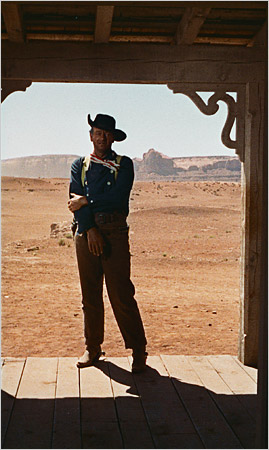
Oh - and one last thing: see how John Wayne is standing there? That's from the famous last shot of The Searchers. The pose - with the one arm holding the other - was quite distinctive, and so un-John-Wayne-like that Bogdonavich once asked him about it. "You know how you stand in the doorway in that last shot? And how you have your arms? Was that on purpose? Did you choose that pose, or ..."
And John Wayne's answer is enough to bring tears to my eyes. He said, "I knew a guy who stood like that all the time. And the pose always seemed so lonely to me. I thought it would work well in that last shot."
Jesusmaryandjoseph.
"The pose always seemed so lonely to me ..."
The consciousness of his artistry, his genius ... that he chose that particular pose on purpose - for that reason ...
Brilliant. Brilliant.
UPDATE: The Shamus has been doing a whole series of posts on Duke - definitely go over there and check them all out. I'll link to this one in particular.
March 29, 2007

March 8, 2007
Ramblings on Billy Friedkin
Great picture of him here - kind of noir-ish. And that photo has set my mind a-rambling.
I have been watching Billy Friedkin movies before I even knew who the guy was.
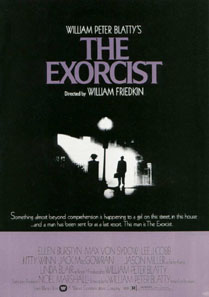
The Exorcist basically ruined my childhood.
It wasn't until I read Easy Riders, Raging Bulls that I learned about this guy's journey - which is fascinating - it kind of incorporates the entire 70s-autuer-director journey - all in one man's life.
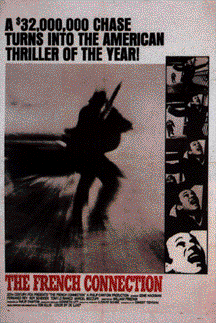
I recently saw again The French Connection (it was my first Netflix movie - I will always look on it fondly for that reason, no just kidding) - and you know, you hear so much about these movies, they're referenced so often - that sometimes you forget. You forget how good they are, or how influential ... we've now seen so many spectacular car chases that perhaps the one in French Connection seems (in memory) not so cool, or memorable ... You take it for granted. "Oh yeah, whatever. Gene Hackman. Famous car chase with elevated train. Yeah." That is - you take it for granted until you see it again. (here is the famous car chase scene on YouTube - it starts with Popeye Doyle basically commandeering some dude's car and taking off with it ... although, if you haven't seen the movie - I beg you not to just watch the chase on You Tube. Rent the damn movie - it's so good!!) There is a reason why this chase is remembered, revered, imitated. You can't beat it - for its reality, rawness, and sheer gripping excitement. This isn't a car chase where you have to adjust your expectations, and by that I mean: if you see a movie from the 50s, 40s, 30s, whatever - and you see a fist fight, or you see a love scene ... if you are passively expecting a bloody realistic gory Raging Bull type fight, you'll be disappointed. If you're expecting to see naked writhing bodies, you'll be disappointed. So in order to not only accept these old movies, but LOVE them - you have to get into the world of that time. Accept their conventions. Don't be all baffled because movie styles or acting styles are different. Adjust, for God's sake.
But that car chase in French Connection still - to mind - stands as one of the greatest car chases of all time. Nothing looks orchestrated. There are certainly no special effects involved. The lighting is grim, that kind of blinding wintry sun that New York gets sometimes - the kind of sunlight that points out the urban decay, the grime. Popeye Doyle is driving like a bat out of hell - and it seems completely real. There is nothign "cartoonish" about this chase. You fear for his life, you fear for the passersby who stop and stare. Sometimes you are looking at the street from Hackman's perspective behind the wheel - and that is truly nervewracking - and sometime (like in that great and now classic shot) you get far enough back to see the train racing along the elevated tracks, with the car barreling along beneath. UnbeLIEVable. Audacious, really. That's one of the words that always comes up for me when I think of Billy Friedkin. Audacious. To say: I want to do a car chase - where a car chases an elevated train - trying to stay beneath the train above him on the tracks - with passersby - and oncoming traffic - and busy daylight New York streets ... that is some audacious shit. I love it.
Audacious can be good. Audacious can also be self-destructive. This ended up being the case for Friedkin - but there's something really attractive to me about his audaciousness ... I root for him. The dude was nominated for, what, 10 Oscars? Even Sorcerer - which was pretty much a financial disaster - and the end of Billy Friedkin's Golden Boy period - was nominated for an Oscar. I find Friedkin fascinating and always have. If you look at pictures of him in the 70s, he wears a long white scarf, a leather jacket, and big Jim Jones-ish Ray Banz ... stalking around like he owns the world. And for a brief period there, he did. He could name his price. I love that he's still around, though. And his career has been no slouch since his heyday. I mean - To Live and Die in LA was one of the best films of the 80s - I loved that movie. Friedkin survives!

Here is one of my favorite anecdotes about Friedkin.
He had been struggling to make Sorcerer (a movie that was so expensive that it required mergings of conglomerations and corporate backings and complicated financing to just finish it ... and then of course - it opened and barely made back any of that money - this was the death knell for Friedkin - it was too big a bomb to let him off the hook) - but Friedkin, to this day, says that Sorcerer is the favorite movie of his career. He can "bear" to watch it. It was one of those massive projects that got away from its director - a typical thing that happened in the 70s - and sometimes it worked out well (Apocalypse Now) and sometimes it was a debacle (Heaven's Gate is first on that list, naturally - it's rare that one movie brings down an entire studio around its own disaster ... but also Sorecerer). The auteurs gone nuts!!
Anyhoo. Sorcerer finally opens in 1977. Friedkin was nervous about it. Nervous about how it would do. The first time the preview for The Sorcerer played in a movie theatre - Bud Smith (the editor who had cut the preview, put it together) went to go see it. It was playing before the headline movie ... another little movie that opened in 1977 ... one that nobody thought would do all that much, because it was so "out of sync" with the style of the rest of the movies at that time ... you know, it was a little independent movie called Star Wars.
Here's the response from the Friedkin team (this is an excerpt from the marvelous Easy Riders, Raging Bulls, linked to above):
The Sorcerer trailer Bud Smith cut played in front of Star Wars at the Chinese Theatre. Says Smith, "When our trailer faded to black, the curtains closed and opened again, and they kept opening and opening, and you started feeling this huge thing coming over your shoulder overwhelming you, and heard this noise, and you went right off into space. It made our film look like this little, amateurish piece of shit. I told Billy, 'We're fucking being blown off the screen. You've got to see this.'"Friedkin went with his new wife, French actress Jeanne Moreau. Afterward, he fell into conversation with the manager of the theatre. Nodding his head toward the river of humanity cascading through the theater's doors, the man said, "This film's doing amazing business."
"Yeah, and my film's going in in a week," replied Billy nervously.
"Well, if it doesn't work, this one'll go back in again."
"Jesus!" Friedkin looked like he had been punched in the stomach. He turned to Moreau, said, "I dunno, little sweet robots and stuff, maybe we're on the wrong horse." A week later, Sorcerer did follow Star Wars into the Chinese. Dark and relentless, especially compared to Lucas's upbeat space opera, it played to an empty house, and was unceremoniously pulled to make room for the return of C3P0 et al.
A new era had begun.
But Friedkin is still here.
February 27, 2007
Black Snake Moan
Wow. That's a helluva review by one of my favorite critics. I think I'll have to see it. The poster, which is everywhere right now, didn't appeal to me ... although I love Ricci, Jackson and Timberlake (ha, quite a trio). I thought Hustle and Flow was amazing - brave - riveting - Terrence Howard is, to my mind, one of the best actors working today - and the film had some acting as good as acting gets. And I credit a lot of that to Craig Brewer, the director - and how he filmed it. The moments don't look planned. It looks like you are looking at things really happening - and that's when stuff is exciting, that's where certain types of actors can thrive. Actors who know their craft, who know how to play scenes out from beginning to end - who understand arc, who've got that fire in the belly, and some intelligence in how they approach their roles. Without the films of the 70s, films that looked like they were really happening - films that were interested in the grit, the rawness, the realness of life - actors like DeNiro, Pacino, Hackman, Duvall might not have had their chance. It was the perfect moment - the perfect melding of acting style and directing style. A zeitgeist moment. 99% of directors are control freaks and too scared to let go of the reins that much. But the ones who do? Sometimes it can result in crap, sure, but sometimes it can result in pure movie magic. That last scene in Hustle and Flow when he bursts back into the apartment and kisses his long-term crack-ho - that big juicy sexy kiss??? No - it's more than sexy. It's romantic. And to see a moment like that - of pure romance - in an environment like that ... It just killed me. Yay - I found a screenshot of it.
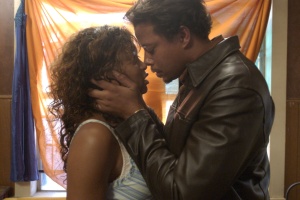
I had no idea it was coming, didn't see it coming at all - and the impact of it pretty much knocked me flat. I couldn't believe the love that was there. The love. And what a kiss like that means to people in such circumstances. What a kiss means to a woman like that. I have a lump in my throat just thinking about it. Amazing moment. Having read Berardinelli's review of Black Snake Moan - I am now really excited to see it.
January 18, 2007
Thoughts on "Rocky Balboa"
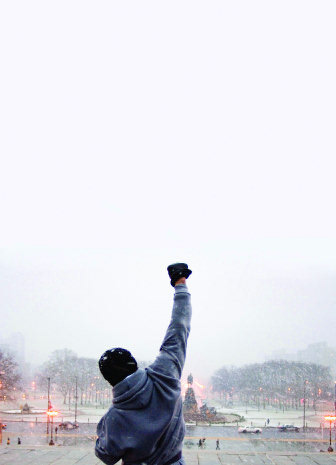
When Jen and I emerged from the movie last night into the cold night - we were so jazzed up and so exhilarated that we talked a mile a minute as we charged across the city to our subway stop. We talked and talked and talked - about Rocky, and Stallone, and the franchise itself (which we both just love), and the movie, and why it was good, and why it worked ... and at one point I exclaimed, in all my excitement, "Oh my God! I have boose gumps right now!"
Boose gumps.
That kind of sums up the entire experience for me, so I figured I'd start out with that.
And Jen made a great comment, too. At one point, the two of us sat in our seats, huddled together, holding ourselves back from clapping and screaming like lunatics, cheering Rocky on, just letting out some of our adrenaline, and also clutching Kleenex because the scene before that one had been a tear-jerker. We were beside ourselves. Later Jen said, "You know what? He didn't make that movie for himself. Or to prove he still 'got it'. Or anything like that. Member the moment when we were all huddled together, clapping, and losing our minds? He made that movie for those people."
Now. There is so much else to say about this very insightful point.
This movie, as far as I was concerned, had almost an absence of ego. Which is so surprising when you consider how much ego there COULD have been in such a venture. Even the ending credits ... which I won't give away ... just had this wonderful sense of ... non-self-importance, of playfulness, of celebration, of openness and ... It wasn't a movie that over-thought itself. It was a movie made for those of us who loved Rocky Balboa, and those of us who followed his journey, through movie after movie. Behind this film was a generosity of spirit. Behind this film was an acknowledgement of the fact that he, Stallone, had created something that resonated for YEARS with people who were fans of the franchise.
Stallone did not blow us - the giggly happy clapping cheering "Go, Rocky!" fans - off. He did not sell us out. He did not come back with an overblown bloated movie that made us embarrassed to have liked the franchise in the first place. That was my original fear when I heard about the "new Rocky". I was afraid it would be bad. I was afraid that I would be sad for him. I was afraid that I would be sad for Rocky, and sad that Stallone didn't just leave well enough alone.
How little faith I had.
Stallone is one of the oddest success stories in Hollywood. He is someone for other entrepreneur artists to emulate, to learn from. Nobody gave this guy jack SHIT until he showed his stuff, on his own. He IS Rocky Balboa (however, the funny thing is is if you hear him in interviews, he's way more articulate than Rocky - which is a reminder that he is actually, you know, ACTING.) He has created a character. A character he knows, inside out ... but it's not, strictly, HIM. He is not playing himself.
Stallone has ALWAYS played to his strengths. I don't think he gets enough credit for that. He doesn't try to show his versatility (although he has way more versatility than he gets credit for - Copland?). Stallone is very smart. He knows who he is, and who his persona is - and he hasn't made TOO many errors with it. And so his mis-steps are forgiven and forgotten. Sam, one of my great teachers, said to me once, "Self-knowledge is one of the most important aspects an actor can have." Know what you can do. And then DO it. Whether or not anyone asks you to do it. DO it. Nobody asked Stallone to create Rocky. He just went ahead and DID it. He knew he could "hit it" with that part. That was HIS part.
And his canniness as a screenwriter is also way under-rated.
Obviously, not totally under-rated. Rocky was highly decorated (nominations as well as awards) in 1976 - and Stallone became the third person to be nominated for acting and writing in the same year. (The other two were Charlie Chaplin and Orson Welles. Yeah. Uh-huh. THAT'S the kind of company this guy keeps.)
So now onto this latest film and why it didn't just exceed my expectations - but satisfied me on the deepest fangirl level.
-- Let's start with the title. Stallone is freakin' smart. He didn't title it Rocky VI. I think it started out with that as the title - but at some point along the way, it became Rocky Balboa. This is so right. It's not about Rocky topping himself, or going beyond, or any of the other things that that number would have suggested. He definitely has to push himself, and go up to his limits in this movie - but the REAL story is about Rocky Balboa realizing - that there is unfinished stuff in his life - "stuff in the basement" - stuff he needs to get out. It's not about beating an opponent. It's not even about winning. It's about getting back to who he really is. The title is perfect. Very smart.
-- I need to talk about Stallone's acting in this movie. He's not trying to show he's a tough guy - or that he's still 'got it'. You know how embarrassing that can be. Think Michael Douglas being married to Gwyneth Paltrow in that silly movie, and how ridiculous that was. Especially because the age difference was never referenced, or even brought up. We're supposed to just believe that a 22 year old girl would marry a man like that. For love. Cary Grant never ever made such a stupid mistake. He never opened himself up to that ridicule. Even when he made Charade - he was VERY concerned with the age difference. He spoke with Stanley Donen a lot about it - and wanted to make sure that it was SHE who did the pursuing. He knew it just wouldn't look right for a man his age to be pursuing a girl who was so much younger. (Never mind what he did in his personal life. That's irrelevant to this conversation.) And so the movie works - because there is this bemused understanding, from his side, that - "wow, I am WAY too old for this girl ..." It's self-knowledge (we're back to that again.) Michael Douglas just wanted us to swallow the fact that he got to marry Gwyneth Paltrow. He didn't want us to question it, because his own personal ego is wrapped up in the fact that he's still 'got it'. See what I mean? There's a lack of self-knowledge there which has hurt Michael Douglas in some of his choices. Again: I'm not talking about his personal life, which has nothing to do with his PERSONA, and how it is perceived.
And so Stallone did everything right in this movie. He didn't pump himself up. He didn't film himself lovingly, or with soft-focus anxiety. He didn't push the romance. I was SO glad he was smart enough to have it just be a friendship, a helper, a supportive woman. Maybe it WILL develop into a relationship, maybe not ... but the actual journey of the film is about Rocky Balboa stopping living in the past, and embracing the present. The woman in the film is a symbol of that. He's starting to come out of his shell.
But there would have been something wrong about seeing Rocky in a romance at this point. Stallone would have opened himself up to all kinds of criticism - for setting himself up to look too good (think about the criticism Barbra got for her nails in Prince of Tides - vicious. Directors have to be really careful about stuff they also act in. Especially in Stallone's case - where he also writes the stuff. If it looks too much like a vanity project, people can tell.)
Stallone went for the grit. He remembered what the whole franchise was about. He remembered what we loved about it. The local color, the rattling subway, the smoking sidewalks, the meat hanging in windows ... Rocky running by ... a local boy ... at heart. And Rocky Balboa embraces that.
There were moments where I felt like - my life flashed before my eyes. I have grown up with this franchise. I can't remember a time (literally) when I have not "known" Rocky Balboa. It's IN me. And so I have nostalgia. And I'm okay with that. And what I LOVE is that ... Stallone is okay with that too. I have nostalgia for Adrian. For that scene in the pet shop. For her glasses. For the scene in the ice rink. I feel like I was there. I can recite some of those scenes by heart. I KNOW these people. And Stallone, in this latest movie, gave it all to me. Without sentimentality. We revisit all the spots. We see Rocky in his familiar surroundings. We get a couple of blurry flashbacks of Adrian (poetically done - blurry and sometimes black and white - not literal) and I felt like: Oh God. It is so good to see her again.
There was one line in the movie that I thought was a bit too ... cheesy I guess ... but only one. Other than that, the script was fantastic. It was funny, unexpected, powerful - surprisingly emotional - it was all about the characters - really low on plot - which was good - and some of my favorite moments were the subtle ones.
Scenes to look for, in terms of how well-written and simple they are - and also how efficient and expedient - his scenes ALWAYS propel the movie along. There is NO FAT on his movies. Spielberg should take a page out of Stallone's book. When you think you are done with editing - edit MORE out. Faster is better. Shorter is better. Always. It is never the case that it is BETTER to say something in 2 pages that you could also say in 2 lines.
Scenes to look for:
-- the scene in the dog pound. It's so simple you might even miss it. But seriously: watch for the gentle humor of it, the verbal banter back and forth and also ... what the scene is actually about. It's not about Rocky getting a dog. It's about Rocky bonding with the kid. However. What they are both doing in the scene - is talking about the dog. That's good writing. It's not on the nose. There's no soundtrack cueing you how to feel. There's no closeups where it's bashed over your head: LOOK! THEY'RE BECOMING FRIENDS! Nope. What we see is Rocky and the kid trying to pick out a name for the dog. Beautiful work. All around. Beautifully written and beautifully acted.
-- The scene between Rocky and son on the street outside Rocky's restaurant. Jen said afterwards, "Now that is good parenting!"
All I can say is: My God. Watch Stallone when he says, "I just want to be involved..." and watch his gesture with his hands when he says that. Acting really is that simple. It told me everything I needed to know. About the character - Rocky's blunt honesty, his emotional maturity, his willingness to just say what's going on with him - and also - there's just something raw about it. That, for me, was always the appeal of that first Rocky. Its willingness to be raw. Its rawness was the whole thing. I mean - the way it ended! So not what would be expected. Stallone did not create this character originally to just be a winner, a big ol' champion. He created a MAN. Who didn't always win. Or at least - he didn't win in the obvious ways. He lost the match - but he won his battle within himself, and he won the girl.
THAT is the beauty of this franchise at its best - and the beauty of the last "chapter".
It never loses sight of the character. Or of why we loved him in the first place.
I may just be speaking for myself - but I don't think that Rocky was so loved just because he kicked people's asses. That was maybe why guys loved Rambo - but that's not what Rocky was about. He was human - people related to Rocky. What was awesome about that character was his underdog status, of course - how hard he had to work for everything he got - and also ... that heart, that big big messy raw open heart. I mean: "I LOVE YOU ADRIAN!" Seriously. I still can't watch that scene without being totally covered in boose gumps.
And Stallone does not make the mistake of thinking that we need to see him win. We need to see Rocky's struggle. We need to see his obstacles. We need to invest in his training (and, come on, awesome training montage with the song that I could sing in my sleep. Oh - and written by a Rhode Islander, thank you very much). We don't need to look at his opponent and think: "Rocky is TOTALLY gonna kick some ass." We need to look at his opponent and think: "Hm. I'm kinda scared for Rocky." We need to BELIEVE that once again Rocky has to go down into that basement, that dark place where he keeps his ambition, his fire, his drive ... and stand up. Stand up and fight.
Other scenes/moments to look for:
-- Before the big match in Vegas - Rocky is surrounded by paparazzi, and I can't remember the exact line - but they're all shouting questions at him, and he says (but not with ego - again, the no ego thing) - "I guess they say it ain't over til it's over." Something like that. And one of the reporters jokes, "Is that a saying from the 80s?" Joking about his age. And Stallone says, "I think it might be from the 70s." I can't explain WHY it is so funny - the way he says it - but it got a HUGE laugh. Beautiful.
-- There's a moment where Stallone is in the meat locker with Paulie (Paulie!!!) - and he's talking about the fact that he might want to fight again ... nothing big ... no big deal ... just local fights ... because he's still got some stuff ... "down in the basement" ... that he has to deal with. Paulie is trying to talk him out of it. "YOU'RE NUTS. YOU'RE 60! YOU'RE NUTS!" And Stallone has this monologue where he kind of explodes - not in a big actor-y way - it was totally real. He starts talking about how hard it is ... how he didn't think life was supposed to be so hard ... and during this monologue, Stallone suddenly gets choked up. And you know, there's something devastating about a man that big getting choked up. A man who is not used to crying, and so when the tears come up - they freak him out and must be suppressed immediately. When Ed Harris gets choked up in Apollo 13 it has the same effect on me in the audience. It feels like my heart might burst. Sometimes actors cry and we in the audience feel nothing. Perhaps because it seems too "actor"-y. Actors know how to cry and so sometimes the tears seem cheap, too easily come by. And therefore not really human. And here's another great acting lesson: If the actor tries to suppress the tears - then those in the audience will get the catharsis. The audience will cry. Sometimes I cry watching an actor cry (Gwyneth Paltrow breaking down in Sylvia comes to mind. When she starts weeping, I cry, too. Perhaps because her character is normally so tearless and brittle, so when she breaks down I feel like I get the release too). But when an actor is desperately trying not to cry ... it can be so effective. Because it seems real, it seems like life.
The scene ended and Jen silently handed me a napkin. And we both sat there mopping the tears off of our faces, and having the time of our lives.
The soundtrack to the movie was perfect. Subtle. Underneath scenes. But not in a cloying way, not too much. When the "training montage" came we got the burst of music - the music we all know - and it just felt so right, so familiar, so ... perfect ... The movie earned that. It didn't assault us with it from the get-go.
Intensity builds at the end - in a crescendo - and I hadn't read too many reviews that gave away the ending, and how it all comes out - so I just didn't know what the outcome would be. The theatre we saw it in wasn't packed - but people were definitely cheering and clapping - you could feel the urgency and stress in the air - Jen started punching the air a bit, during the fight. You were living the scene, rather than watching it. Like all great fight scenes in boxing movies. The fight just works. It works on every level it needs to work. It works on the level of plot - it needs to come to that in the story, and it does. It all feels inevitable and right. It works in terms of character - the journey of Rocky with his son, with Paulie, with his opponent. All of these elements are there in that fight. So we are invested. It is not an empty action sequence. It is not a done deal that Rocky will win. And also, at this point in his life - what is winning? THAT'S what the movie is about.
Here is how that last fight would go if Stallone was trying to still prove something or prove that he still 'had it' or was still a bad-ass:
He would have set up his entrance into the ring differently. He would have had it be ominous. Like: Uh oh. This upstart young heavyweight champion don't know what's about to hit him! Uh oh! Which would have been embarrassing. Because all we're feeling out in the audience is: Rocky, you're 60. Please be careful. Stallone knows we're feeling that and so his entrance into the ring ... and the music that Paulie chose for his entrance music ...
I won't give it away but it's a PERFECT choice.
Let me just say: that in my humble opinion Sylvester Stallone has ended this franchise in a perfect way with not one jangly off-key note.
Even through the credits (stay to the end, people. Stay to the end.) That last moment, if you love the Rocky series like I love it, is truly boose gump worthy.
I tracked down a review Roger Ebert wrote of the first Rocky. It's obviously written long after it had come out - maybe it was for his "great movies" series - but it just captures the feeling of this franchise (at its best) perfectly. Boose gumps. Read it below the jump.
Rocky
By Roger Ebert / January 1, 1976
She sits, tearful and crumpled, in a corner of her little bedroom. Her brother has torn apart the living room with a baseball bat. Rocky, the guy she has fallen in love with, comes into the room.
"Do you want a roommate?" she asks shyly, almost whispering.
"Absolutely," says Rocky.
Which is exactly what he should say, and how he should say it, and why "Rocky" is such an immensely involving movie. Its story, about a punk club fighter from the back streets of Philly who gets a crack at the world championship, has been told a hundred times before. A description of it would sound like a cliche from beginning to end. But "Rocky" isn't about a story, it's about a hero. And it's inhabited with supreme confidence by a star.
His name is Sylvester Stallone, and, yes, in 1976 he did remind me of the young Marlon Brando. How many actors have come and gone and been forgotten who were supposed to be the "new Brando," while Brando endured? And yet in "Rocky" he provides shivers of recognition reaching back to "A Streetcar Named Desire." He's tough, he's tender, he talks in a growl, and hides behind cruelty and is a champion at heart. "I coulda been a contender," Brando says in "On the Waterfront." This movie takes up from there.
It inhabits a curiously deserted Philadelphia: There aren't any cars parked on the slum street where Rocky lives or the slightest sign that anyone else lives there. His world is a small one. By day, he works as an enforcer for a small-time juice man, offering to break a man's thumbs over a matter of $70 ("I'll bandage it!" cries the guy. "It'll look broke"). In his spare time, he works out at Mickey's gym. He coulda been good, but he smokes and drinks beer and screws around. And yet there's a secret life behind his facade. He is awkwardly in love with a painfully shy girl (Talia Shire) who works inthe corner pet shop. He has a couple of turtles at home, named Cuff and Link, and a goldfish named Moby Dick. After he wins forty bucks one night for taking a terrible battering in the ring, he comes home and tells the turtles: "If you guys could sing and dance, I wouldn't have to go through this crap." When the girl asks him why he boxes, he explains: "Because I can't sing and dance."
The movie ventures into fantasy when the world heavyweight champion (Carl Weathers, as a character with a certain similarity to Muhammad Ali) decides to schedule a New Year's Eve bout with a total unknown -- to prove that America is still a land of opportunity. Rocky gets picked because of his nickname, the Italian Stallion; the champ likes the racial contrast. And even here the movie looks like a genre fight picture from the 1940s, right down to the plucky little gymnasium manager (Burgess Meredith) who puts Rocky through training, and right down to the lonely morning ritual of rising at four, drinking six raw eggs, and going out to do roadwork. What makes the movie extraordinary is that it doesn't try to surprise us with an original plot, with twists and complications; it wants to involve us on an elemental, a sometimes savage, level. It's about heroism and realizing your potential, about taking your best shot and sticking by your girl. It sounds not only cliché¤ but corny -- and yet it's not, not a bit, because it really does work on those levels. It involves us emotionally, it makes us commit ourselves: We find, maybe to our surprise after remaining detached during so many movies, that this time we care.
The credit for that has to be passed around. A lot of it goes to Stallone when he wrote this story and then peddled it around Hollywood for years before he could sell it. He must have known it would work because he could see himself in the role, could imagine the conviction he's bringing to it, and I can't think of another actor who could quite have pulled off this performance. There's that exhilarating moment when Stallone, in training, runs up the steps of Philadelphia's art museum, leaps into the air, shakes his fist at the city, and you know he's sending a message to the whole movie industry.
The director is John Avildsen, who made "Joe" and then another movie about a loser who tried to find the resources to start again, "Save the Tiger." Avildsen correctly isolates Rocky in his urban environment, because this movie shouldn't have a documentary feel, with people hanging out of every window: It's a legend, it's about little people, but it's bigger than life, and you have to set them apart visually so you can isolate them morally.
And then there's Talia Shire, as the girl (she was the hapless sister of the Corleone boys in "The Godfather"). When she hesitates before kissing Rocky for the first time, it's a moment so poignant it's like no other. And Burt Young as her brother -- defeated and resentful, loyal and bitter, caring about people enough to hurt them just to draw attention to his grief. There's all that, and then there's the fight that ends the film. By now, everyone knows who wins, but the scenes before the fight set us up for it so completely, so emotionally, that when it's over we've had it. We're drained.
November 15, 2006
The Hitchcock Blog-a-Thon!
Today is the long-awaited Hitchcock Blog-a-Thon
Here are a bunch of posts by other stellar bloggers - but just click around, you'll find more!
A marathon reviewing of the works of Hitchcock. I am in awe. Just keep scrolling. You'll see all of his reviews. Also, he's hosting the Blog-a-Thon - so you can see a compilation of people's posts at the bottom here.
More:
Sigh. Gorgeous. However, that is just ONE post. Go here and keep scrolling. So much good stuff.
A beautiful post of movie posters. How much do I want the third one down. The blue one. Ohmygod, gorgeous.
Focusing on To Catch a Thief. Really interesting thoughts there, all around.
Focusing on Grace Kelly. Funny:
Kelly and Grant had chemistry. He's always very Cary in his timing and delivery: "Not only did I enjoy that kiss last night," he tells Kelly with his usual mock inflections, "but I was awed by the efficiency behind it." And she warms up to his touch, losing her haughty demeanor as she takes delight in outing Grant as "The Cat," who is supposedly robbing the houses of the rich along the French Riviera: "I've never caught a jewel thief before. It's so stimulating!"
Edward Copeland: What if George Bailey had Vertigo?
Oh - and please: Hitchcock fans out there!! Share your own favorites!
The Hitchcock Blog-a-Thon: My Entry
More posts in the Hitchcock Blog-a-Thon here. I've been having so much fun reading them.
So here's mine. I decided to elaborate on some earlier posts I have written about one of my favorite movies ever made: Notorious.
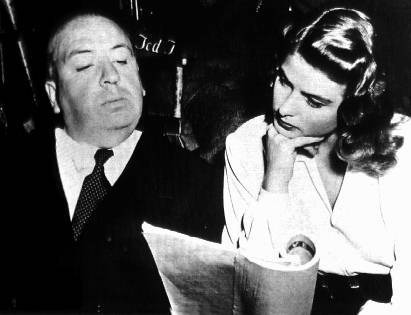
Top 5 moments in Alfred Hitchcock's Notorious - according to me:
1. The kiss between Cary Grant and Ingrid Bergman.
At the time this was the longest movie kiss in cinematic history. They had to keep breaking the kiss up to get around the censors. The censorship committee decreed that no screen kiss could last longer than 3 seconds. But Hitchcock made sure that their lips never touched for longer than 3 seconds - so if you put a stopwatch to it (and the censorship committee did) you would find that they were never over the time limit. But then they would pull back, nuzzle, speak against each other's mouths, kiss again for 3 seconds ... and repeat the whole thing. It's amazing - very very sexy. It's also REALLY neurotic. I love the underlying neurosis in this scene - it makes it so Hitchcock-ian. You can just tell that despite their desire for one another they are SO not trusting of each other.
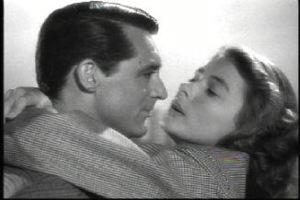
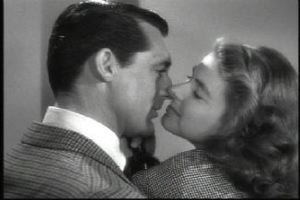
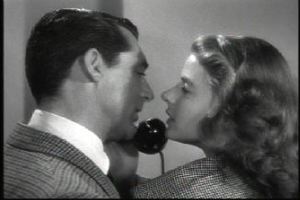
I love Roger Ebert's observations about Grant in this scene:
Look, for example, at his famous kissing scene with Ingrid Bergman in Hitchcock's "Notorious" (1946). In the movie, they are in love with each other, but Grant is a U.S. intelligence official trying to convince Bergman to marry Claude Rains, the leader of a postwar Nazi spy ring.Hitchcock's shot begins on a balcony overlooking Rio. Grant begins to kiss Bergman, and as they stay in each other's arms, they move slowly inside, where Grant picks up the telephone and makes a call, still holding her and kissing her, and then he guides them toward the door while she breathlessly makes dinner plans and he smiles rather remotely at her and then leaves, saying "goodbye" with an ironic smile.
This is the kind of scene that perfectly captures what was unique about Grant as a movie actor. He had the kind of handsome charm and sex appeal that made him completely convincing as a romantic leading man, but mere seduction never seemed very high on his list of priorities in the movies. He and his characters often had hidden agendas, secrets they were more interested in than love itself.
Yes. Watch his face at the door when he says good-bye to the literally swooning with lust/love Bergman. Watch that distant little smile. It's fascinating. Not at all what you expect, or want.
2. When Claude Rains looks up slowly at his evil Nazi mother and says, "I am married to an American agent."
First of all - I read someone describe Claude Rains as an "impeccable actor". I could not agree with this more. Is he ever false? Is he ever not perfect in whatever it is he is trying to portray? Is he not one of the best actors to ever practice the craft? I SO value him. Casablanca would NOT work without him ... but neither would Notorious. Think of all of his most famous parts. He, PERSONALLY, makes movies better ... just by being in them. Hitchcock's camera angle at the moment I am describing here in Notorious, the "I am married to an American agent" certainly enhances the emotional meaning of that moment. Hitchcock shoots him from above. We just see the top of Rains' head at first, he is looking down, troubled, we cannot see his face. In a way he is hiding from his Nazi shrew of a mother. But then he has to come clean. The camera does not move. Rains does. He slowly lifts his head so we can see the flat deadened acceptance on his face. Rains doesn't have an over-acting bone in his body. We all should be so simple, so real.
3. The frenzied sequence in the wine cellar during the party with an increasingly panicked Ingrid Bergman standing guard, and Cary Grant snooping around.
I saw Notorious last year on the big screen - and this scene was even more suspenseful in that environment. I could sense people around me putting their hands over their eyes, a woman 2 rows ahead of me gasped LOUDLY when the bottle fell ... And if you watch the movie again - please just watch the change in expression on Cary Grant's face as he watches the bottle fall. It's gone in a flash (the expression) - but I swear that half of the suspense in that scene is because of how well these two PLAY it. Watch the flash of horror on his face when he realizes it is too late. And that that bottle WILL fall. Marvelous.
4. The scene where Ingrid Bergman realizes her husband and his mother have been slowly poisoning her.
She's sitting in the chair ... across the room from them ... and she looks with dawning horror at the two little teeny cups of coffee ... and ... Well. seriously. Acting doesn't get any better than her freakout right here. She is tormented. You can feel her literally being killed, from the inside out. Go, Ingrid.
5. The entire last scene: Cary Grant finally coming to rescue her ... and then the long long descent down the stairway.
I've seen this movie more times than I count (I even considered going into rehab to wean myself) - and the scene never fails to catch me right in the throat. Moment to moment to moment.
-- Cool trivia about that last descent down the staircase: The staircase was not long enough for Hitchcock. He wanted the staircase to feel, literally, endless for that scene - to build the tension. But if they just slowly descended the staircase - they still reached the bottom with a couple of lines left over to say. So here was Hitchcock's solution: as they descended - if you notice the background behind Rains' head in the shots - Hitchcock had them go down the same stretch of stairway 2 or 3 times - so that it would FEEL longer. It's seamless in the film - unless you're looking at the blurry background you would never notice that for the first part of the scene they are not actually going anywhere. A beautiful example of how inventive Hitchcock was, how much he was able to create an illusion.
I wrote a long piece about that scene alone - so, in honor of Mr. Hitchcock, the man of the day, I will post it here. I focus on Cary Grant - but let's never ever forget - that it was Hitchcock who first saw the darkness beneath that handsomeness, and perceived that ... audiences would be disturbed, disoriented, by seeing Cary Grant in cranky cruel parts. Hitchcock intuited that there is always a bit of envy towards people as beautiful as Grant ... and so there is some pleasure in watching him suffer (huddling in a corn field, etc.) It's unspoken, but it is there. Hitchcock was brilliant for exploiting that. And I just cannot picture another actor as Devlin. The courage of Grant is rather amazing if you think about it. Grant had a lot to lose. But was willing to risk it, for Hitchcock.
So here are my thoughts on the last scene in Notorious and why Cary Grant is not just a great movie star, but a great actor.

In the last scene of Notorious, Ingrid Bergman lies in bed, trapped in the house of her Nazi husband. She is being slowly poisoned by Nazi-man (Claude Rains) and by his terrifying evil Fraulein mother. Bergman lies in bed, coming in and out of consciousness due to the poison, the sleeping pills - Cary Grant has come to rescue her - finds her in this state - and he tries to keep her awake, he dresses her so that they can leave that terrible mansion - and he also, in his tortured way declares his love for her.
He has been cruel, distant, misogynistic, etc., throughout the rest of the film - but the genius of it is that Cary Grant (and Hitchcock, of course) lets us in on the secret: Devlin (the character) is actually not a cruel or distant man at all - he is only cruel and distant because underneath all of that, he is vulnerable, too vulnerable, and he needs her too much. Cary Grant's performance is a show-and-tell masterpiece. He shows us everything, but he tells us NOTHING. WE can see the truth, but Devlin cannot. WE can look at him and see the vulnerability, but Devlin thinks he's invulnerable, and that he can't be hurt.
What the character DOES in the film is obvious: he throws her to the wolves, he hates her for her whorish past, he feels threatened by the fact that she is kind of a slut (or, uhm, nympho) - it's not JUST that he wants her to be untouched, it's that he feels ... deeply nervous about how he will measure up (again, this is never stated, but it's all there), he despises her on some level - mainly because of his own insecurities - he is insecure about her sexual experience, and punishes her emotionally for it - he refuses to believe that she can change her drunky-drunk Slutterson ways. But clues are dropped, along the way, that this guy is tormented about her, and actually loves her. Loves her so much that he can't bear it. There is no happiness for this man in love. Love does not bring peace. It's too painful. Too threatening. The clues are along the lines of "If a tree falls in the forest and no one is there to hear it ..." Devlin is unaware of the clues he is leaving behind. He thinks he has covered his tracks (emotionally, I mean.) But it's all there: He treats her like a whore, except when she is out of his presence, and then he gets very very touchy about any slights on her honor, he gets very protective of her. He defends her character to his fellow secret agents ("I don't think she's that kind of woman!"), and yet - refuses to defend her when she begs him to, in person. ("Did you tell them I'm not the kind of girl for this sort of work??")
In the last scene, he helps her to sit up, her head is flopping back. The lighting is spectacular: the pillow behind her head is blazing white, and her face is completely in the glow of the light. But he - he is a dark silhouette, he remains in the shadow. The only time he is fully lit in the final scene of this film is when the 2 of them emerge from the bedroom, and begin the descent down the stairway. And if you see the film again: LOOK at how different his face is when he steps out into the brightness with her.
Here it is:
He looks, in that last section of the scene, during the descent down the staircase - he looks, for the first time, like a complete man - like he has joined the land of the living. He looks ... alive. Alert. With no barrier between himself and his own emotions. He is clear. He is strong. He is certain. He loves her. She is his. He will save her. He will get her down the stairs. He is thankful that he did not wait too long. He will save her, even if it means losing his own life. All of that is in that face when he emerges from the bedroom with her in his arms. Amazing acting job. The transformation.

For the rest of the film, he's uptight, guarded, his eyes are cynical, he never smiles (except when he's pretending, at the party). This guy is a sourpuss. He's intimidating. You want him to lighten up, loosen up ... but for his own secret reasons he cannot. Some woman did a number on him once upon a time. Something. He is damaged goods. But somehow, Cary Grant creates this character without completely alienating us in the audience. Despite the fact that he is a bastard to her! And Notorious is obviously on "her" side - the film sympathizes with Ingrid Bergman - she is the heroine, the victim - and yet - he is not villainized.
Hitchcock knew we would come to the film with preconceived notions about Cary Grant (from movies like Bringing up Baby and Holiday) - and he set about to deliberately mess with our expectations. Devlin is the darkest Cary Grant has ever been. This is a guy who is starving for love, and the only reason he resists it is because he needs it too much. The brilliance, of course, of all of this - is that that is only implied, never ever said.
Back to the last scene:
He sits with her on the bed, her face ablaze in the light, and he is a shadow-man, a black-cut-out silhouette.
He holds her. She whispers, "Why have you come ..."
He whispers, "I had to see you one more time ... so I could tell you I love you ..."

He has never said he loved her, and earlier on in the film, she makes reference to the fact that their love affair is very interesting, because he doesn't love her. He tries to weasle out of it, saying, "Actions speak louder than words..."
So the "I love you" in this last scene is not like other "I love yous" in films. There's no swelling music, no climactic moment - there's not a feeling that this "I love you" is a victory. It's more hard-won, more tragic. It's an "I love you" between two adults who have been damaged and chastened by life's hard lessons. This is a grown-up movie.
She is, again, falling in and out of consciousness - but when she hears those words - when she hears him whisper, "I love you" - tears come to her eyes (Bergman is absolutely spectacular in this film, especially in the last scene) - she says, "You love me? Why didn't you say so before?"
He holds onto her, says into the side of her cheek, "I was a fat-headed guy ... full of pain."
The entire scene is done in surreptitious whispers, which adds to the insecure feeling of it, the secretive-ness, the neuroses - this isn't a normal love scene. She's in the light, he's in the dark. These two people are all messed up, basically. I don't feel hopeful about their future together, really - even though they drive away in the same car. Whatever happened next, they'd have a difficult path as a couple. Being grown-up and being in love is tough.
If you want to know why Cary Grant is not just a great movie star, but a great actor - watch him say that "fat-headed guy" line. It's really more that he does nothing (like Claude Rains in the "I am married to an American agent" moment). Grant just says it - simply - with no self-pity, no self-importance, no ego, no attitude - he just says it. He is admitting something. He opens the door. The door of his heart. And the eyes ... his eyes ...
Richard Schickel writes about Cary Grant as Devlin:
As Devlin the counterspy Grant is cool, brusque, competent -- with an almost sadistic edge of cruelty about him. At the start it is clear that his assignment is distasteful to him -- recruiting and running an amateur, and a woman at that. And what a woman she is. Ingrid Bergman's Alicia is not only the personally loyal, if politically disapproving, daughter of a convicted Nazi spy, she is also a nymphomaniac and an incipient alcoholic, unstable to the point of explosiveness. And emotionally needy, pathetically so. "Why won't you believe in me, Devlin -- just a little bit," she begs at one point. And our shock at seeing Bergman violate her previously pristine image, degrading herself in her need is, like Grant's charmless manipulativeness, one of the things that makes this movie so superbly unbalancing. She is, in [Pauline] Kael's terms the pursuer, he the pursued, but in the movie's own terms that is less significant than the neurotic force-field it wants to set up between them.In effect, Devlin is forced to become her lover in order to calm her down enough to do her job, which is to insinuate herself into the home and circle (in Rio de Janeiro) of Alexander Sebastian, who is played by Claude Rains, in one of that actor's most delicious roles, as the only master spy in the history of the genre who is hag-ridden by his mother (yet another piece of pathology to reckon with)...
What Devlin does not count on is that he will fall genuinely in love with Alicia. Or that Sebastian will ask her to marry him. And that there is no way out of the match if she is to complete her mission.
What neither she nor the audience has counted on is Devlin's neurosis, which now comes to the fore.
He thinks she accepts the situation too easily; her attitude fits all too well with what he knows of her earlier promiscuity; and with all the fears and suspicions of women in general which she had almost made him forget.
He turns petulant as a jilted schoolboy, reaching levels of mean-spiritedness that from any leading man would startle an audience, but which from Cary Grant are almost devastating. Hitchcock and Hecht (the writer) have now stripped him bare of his protective image as they previously did Bergman.
The resolution of Notorious requires not just the restoration of moral order, but the rebalancing of psychological equilibrium as well. And what dark intensity this brings to the normally routine process of sorting out a spy drama's strands. One feels that if one of the Brontes had attempted an espionage story it would have turned out something like this.
With Notorious we come closer to the heart of Grant's darkness -- as close as he would allow us to come. There were two decades left to his career, but only once -- and then again for Hitchcock -- would he risk anything like this exposure. Something assuredly was lost by the reticence. And yet one can scarecely blame him. Self-revelation is a terrible trial for anyone; it is especially so for an actor, whose instrument is his person; most of all for an actor like Grant, who so carefully and deliberately created a screen character that was as much a fantasy to him as it was to his audience, in which he could comfortably hide himself, or whatever of himself -- that is to say, the Archie Leach who had been -- that still existed.
Maybe Cary Grant would have allowed Howard Hawks to mess about with his image. But not too many other directors. Grant was careful, cautious. But not with Hitchcock.
An extraordinary film, an extraordinary partnership.
September 28, 2006
This is for Michael
He'll know why. Here is a note from John Cassavetes to Ray Carney, who - to Cassavetes fans - needs no introduction.*
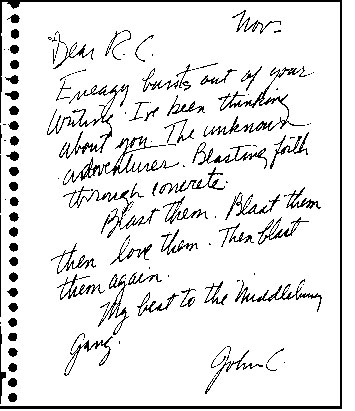
Years and years later, long after Cassavetes has died, here's a note to Ray Carney from Gena Rowlands.
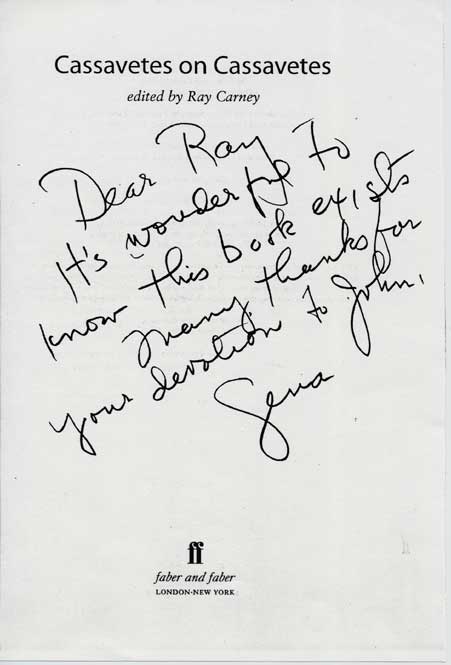
* Dude is quite controversial and not very well liked by the Cassavetes camp right now, for obvious reasons, but - as a fan - I think that his books on Cassavetes are indispensable.
September 25, 2006
Screen captures!
From Kwik Stop of course.
Had a great talk with Mitchell last night ("I am so glad you put up those photo booth pictures - because my friends now can see what I looked like when I had hair") - and we laughed about the moment when Mitchell lectured Michael and me about why Liza Minelli was great. I remember it clearly - Michael and I were on the couch at Mitchell's, and Michael even remembers what Mitchell SAID. Almost word for word. We were probably being snarky about her, and Mitchell was not having any of it. "Okay, so here's the deal with Liza, mkay?" We shut up and listen. We were afraid for our lives, basically.
Meanwhile: I'm going to see Liza Minelli in Vegas in October. With Alex. So there's some sort of full circle insanity at work. Mitchell: your lecture, lo those many years ago, had an effect. Even when she was a bloated tick, IN MY PRESENCE, I remembered your words.
I love this. It kinda says it all. Also, it's really moving (in a sad way, in a way that brings up a feeling of intense loss) when it's "the morning after" and the room has lost its magic and whimsy - and has become just another cheesy motel room. That transition is really well done in the film.
This scene below is so messed up because of the context - where they are, and what they are in the middle of doing when they start to have sex on the bed. It's like: Guys. That is not. your. room. Go home!
Love this moment. It's brief - not dwelled on, or explained ... but it just captures her entire emotional experience. Love it.
September 20, 2006
Because it's now become a joke
Some screen shots from Kwik Stop - the movie: Rent it, chappies!
I love this one. It's Lucky's inspiration (sad sack that he is - dude, were you CHRISTENED Lucky? I don't think so. You ain't foolin' nobody) in his rear view mirror.

Look at her. I love her. I love her plastic ballies. And I love the full ashtray on the dashboard. You just know that that car smells like shit.
And I adore this next one for my own personal reasons.
Gorgeous!!
I just love everything about this shot below. The lighting, the look on her face, the glimmery gold watch ... everything.
This one is really cool, I think. I like the underwater lighting. That kind of sickly flourescent light that makes skin look diseased and tired.
For some reason, I just love this one. The greenish light, the spontaneous feel to it, and the strange vulnerability on his face.
And this is my favorite screen capture of all. I mean, this whole scene is so gorgeous - it's painful, true, beautiful - but just this shot of her - with her smudged mascara, and the sunset light on her face ... It's perfect, and that's final.
June 23, 2006
Happy birthday, Bob Fosse!
How much do I love this picture of Fosse. With the cigarette hanging out. So old-school.

I found this great link online (click on it to make it bigger) - called "A Step-by-Step Tour Through the Moves of Bob Fosse". It details his slinky anti-gravity counter-intuitive completely recognizable style.
See photo below? Immediately recognizable as Fosse. UPDATE: My cousin Kerry told me that the photo below is actually NOT Fosse - but Ann Reinking's Fosse-esque choreography for Chicago. So ... er ... it may be "immediately recognizable" as Fosse but ... er ... it's NOT Fosse. (I wrote a bit about Ann Reinking further below in the post.) Thanks, Kerry!
Again:
Check out how the hands go. It's opposite of what is expected. Same with the way the bodies lean out like a flat board. It's off kilter. It's sexy, but in a kind of sick way.
And here he is directing Liza in the film of Cabaret:
Liza was one of the quintessential Bob Fosse dancers. When you watch her in her prime - doing that choreography - you are witnessing perfection.

Here he is with Gwen Verdon, his wife. Their insane marriage was immortalized, by Fosse, in All That Jazz. I love this picture.
Verdon had this to say about Fosse: "I was a great dancer when he got hold of me, but he developed me, he created me."
So many dancers have similar memories of him.
Ann Reinking ... who was brilliant in his All That Jazz ... basically holds the legacy to the Fosse style. She was already an incredible dancer when he got hold of her ... but he transformed her, morphed her, twisted her - Phenomenal to watch.
He was a brilliant film director as well. All That Jazz comes pretty close to greatness in my opinion. Star 80 is fantastic, with some great acting by Eric Roberts - but it's a bit too unrelentingly dark for my taste. Cabaret is amazing - but, to me - All That Jazz is one of the most audaciously personal films ever made. He films his own death. He fantasizes about it. He enacts it. But ... the film isn't self-indulgent at all. Or ... it is so blatantly self-indulgent that we verge on genius here. Genius as in: indulging in his own fantasies to such a degree that most people never allow. He just GOES there. It's brutal. He imagines his own death as an opera, with a cast of thousands. There's a beautiful woman in white (Jessica Lange) beckoning him on. This was his daily life, the siren song of death always in his ears.
Not a happy man. But he had work to do - and he did it.
More information about him here.
Quite a legacy.
May 30, 2006
Howard Hawks
It's Howard Hawks' birthday today. My #1 favorite director of all time. I have more I want to compile - he's just so huge to me - but for now - here are some choice quotes.
To me, he's the all-time greatest movie director. No one else even comes close.

"When Wayne saw Clift the first time he said, 'Howard, think we can get anything going between that kid and myself?' I said, 'I think you can.' After two scenes he said, 'You're right. He can hold his own, anyway, but I don't think we can make a fight.' I said, 'Duke, if you fall down and I kick you in the jaw, that would be quite a fight. Don't you think so?' He said, 'Okay.' And that was all there was to it. We did it that way. It took us three days to make Montgomery Clift look good enough to be pitted against Wayne because he didn't know how to punch or move when we rehearsed."
-- Howard Hawks on filming Red River (Hawks had seen Clift onstage in New York in a Tennessee Williams play "You Touched Me" - based on the marriage of Mr and Mrs DH Lawrence- an interesting marriage to say the least. This was when movie directors still gave a shit about the stage, and realized that the best actors were there - and he didn't forget Clift - A couple years after seeing the play, Hawks offered him the role in Red River. Clift said no. Perhaps intimidated by the material, by how different it was from the normally elegant and tormented things he had done. Hawks persisted. It paid off.)
(Howard Hawks, John Wayne, Joanne Dru on location for Red River)
"Cary [Grant] was so fun on this picture [Bringing Up Baby]. He was fatter, and at this point his boiling energy was at its peak. We would laugh from morning to night. Hawks was fun too. He usually got to work late. Cary and I were always there early. Everyone contributed anything and everything they could think of to that script."
-- Katharine Hepburn
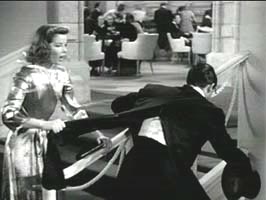
(Hepburn and Grant in Bringing Up Baby)
From Cary Grant by Richard Schickel:
Hawks liked to reverse things, to do the simple opposite of what the audience expected of actors, of a comic situation. Hepburn, for example, had previously done a certain amount of noble suffering and a certain amount of romantic dithering, too. He thought the business of making her not merely headstrong, but entirely thoughtless would be funny. "I think it's fun to have a woman dominant ..." Hawks would drawl in that off-hand way of his. Same way with Grant. "Such a great receiver," the director was heard to murmur years later. Why not take that air of not being all present and accounted for that he had shown here and there in his work and develop it into the core of a comic character.But it was not in Hawks' nature, or Grant's either, to let the matter rest there. There may be something sympathetic about a nebbish, but there is nothing funny about him. So they added a certain crankiness to Grant's character - a crabby, exasperated, put-upon quality. After all, the man was a scientist, a rationalist, when he wasn't being distracted. What, logically, would be his response to the sheer impracticality and heedlessness of Hepburn's character when the full import of their consequences to him dawned? Obviously, it would be fuming fury, suppressed only by the demands of propriety (so many of her assaults on him occured in public, a golf course, a nightclub, her aunt's dinner table, a police station) and politeness (she was, after all, a woman, and he could vaguely remember from childhood that you were supposed to be polite to them, even protect them, as they were 'the weaker sex.')
Well, this was splendid. This was even historic. Grant would use this comically-stated balefulness often in the future.
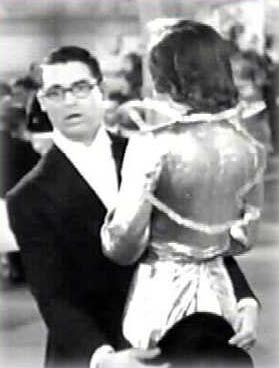
That picture makes me laugh every time I look at it. He is so horrified and so TRAPPED in his own life.
I wrote a big long post on Hawks' views on women and the gender wars.
From Cary Grant by Richard Schickel:
And it was perhaps only Hawks who could have got him to don the absurd goucho pants and oversized panama hat -- soignee on the way to camp - that he wears in Only Angels Have Wings. He is the ramrodder of an air service flying the mail out of the banana port of Barranca, through a mountain pass with the worst weather in the socked-in history of movie aviation to ... somewhere or other. Talk about your Hawksian group! They are old and young, smart and dumb, brave and brave (even the cowardly interloper is only misunderstood). They have built a barrier against the outside world otu of overlapping dialogue and Hawks' much-vaunted 'professionalism', which consists of doing whatever job is at hand and not counting the cost, let alone sentimentalizing it.

(Howard Hawks and Jean Arthur, on the set of Only Angels Have Wings)
From Cary Grant by Richard Schickel:
In short, [His Girl Friday is a tour de force for both Grant and Hawks, a testing of their limits. Could Hawks quick-march a comedy so fast that no one stopped to think about the stench of the sinkholes we were being hustled past (there is the tragic murderer about to face the gallows hereabouts, and more municipal corruption that one dare contemplate)? Yes, he could. And Grant? Could he keep his frenzy concentrated, never let it deteriorate into something we might understand as unattractive desperation? Yes, he could. When he throws out his front page to accommodate news of a murderer's escape and alleged capture by his newspaper, he is capable of ordering Hitler and the war in Ethiopia banished to the comic page, but ordering the story about chickens retained on page one. "That's human interest," he cries, and we must indulge him. His single-minded devotion to the awful standards of tabloid journalism is a form of innocence of other-worldliness, the flip and noisy side of his devotion in Bringing Up Baby's intercostal clavicle, not to be understood as anti-social or mean-spirited. In a way, this was his ultimate test: cou;ld he make even charmlessness charming? Yes, he could.
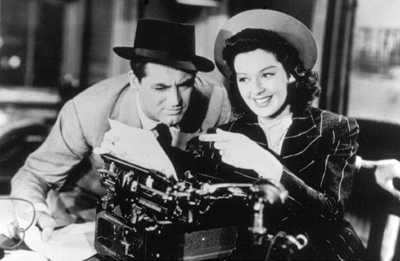
(Grant and Rosalind Russell in His Girl Friday)

Howard Hawks, Humphrey Bogart, Delores Moran, and Walter Brennan - during the filming of To Have and Have Not.

Bacall and Bogart in The Big Sleep
Shivers.
Look at that list of films. And even with all of that - which would be enough to put him in the history books forever - it's just the beginning.
May 13, 2006
David Thomson: Pedro Almodóvar

(I'll see any movie Almodóvar does. Love him!!)
Thomson writes:
"Almodóvar was one of the most welcome explosions of the eighties and a sign of the new Spain. Whereas Carlos Saura (nearly twenty years older than Almodóvar) made intensely measured and psychologically reflective films, with the innate secrecy of someone raised under the Franco regime, Almodóvar is excessive, garish, outlandishly inventive, and irrepressible. He is openly gay, devoted to sexual confusion, and eternally committed to the chance of love. His mode is satiric yet generous and free from moralizing. He has remarked on his debt not just to Hitchcock, Wilder, Buñuel, but to Frank Tashlin. Indeed, there is a cartoonlike abandon and delirium in his best films and a complete faith in the torrential subconscious. But his generous, affectionate nature is all his own."
From David Thomson's The New Biographical Dictionary of Film : Expanded and Updated
Essay on Pedro Almodóvar
David Thomson: Woody Allen

"Allen's development in the eighties, his rate of work, and the sophistication of narrative were all seemingly devoted to ideas and attitudes against the grain of that decade. Yet Allen's audience relied on urban yuppies, and his films only fostered that group's self-satisfaction. He has tried darker views -- in Stardust Memories and Crimes and Misdemeanors -- and he has become very skilled with extensive, seething social contexts in which one piece of behavior is made more complex by the doings of others. He has fascinating ideas and ambitions as a screenwriter. Yet which Allen film challenges or threatens us, or burns into our memories? The films may run together - are we certain where that joke or this meeting occurred? Sometimes the context is so large as to be blurred, escape and slipperiness become more facile. There is something in Allen that always makes fun of ego, privacy, and obsession, and so with all his proclaimed inwardness he seems fearful of letting characters possess large inner lives. He makes many cameos of loneliness, but these are too often cute snapshots rather than tributes to an intractable condition.
But who else in American film provokes such arguments? And if Allen now faces a crisis because of his own behavior, we should recollect how smart and resourceful he is. Perhaps his indefatigable unconscious mind knew he needed trouble and disruption. That does not seek to excuse any damage he has done. But suppose real damage could become his subject - as opposed to wisecracks about it? If Allen could be persuaded to quit his own films as actor and work more sparingly, with unmistakable lead actors (as opposed to a stock company of guest shots), then there is still a chance that he could create something close to gravity. For he is the most inquiring dramatist at work in American film. He could yet be the kind of writer desperately needed by Coppola, Scorsese, and so many others.
By the end of the twentieth century, it was clear that Allen's fecundity was chronic -- though economics and his break with producer Jean Doumanian were further threats to the automatic one-film-a-year routine. Or was it that the routine, the momentum, kept Allen from proper examination of his work? Had habit overwhelmed the chance of art? It seemed to me that there was a wave of restored excellence -- Everyone, Harry, and Celebrity -- which came close to a really novel and brave scrutiny of modern reputation. But then Woody darted away into his own cuteness.
So there's too much - or too little reflection. Still, there are Annie Hall, The Purple Rose of Cairo, Radio Days, Deconstructing Harry. That's four brilliant films that no one else could have dreamed of. And that's what it's all about."
From David Thomson's The New Biographical Dictionary of Film : Expanded and Updated
Essay on Woody Allen
David Thomson: Robert Aldrich

Aldrich hails from Cranston, Rhode Island, by the way!
Here is a bit from Thomson's essay on him:
"Kiss Me Deadly is still one of the best, and most surprising American films of the 1950s, a lucid transformation of pulp Spillane into a vicious insolent allegory of violence, corruption, and forbidding futures in America. Did overbearing producers and more restrictive censorship push Aldrich into a disciplined and even ironic evocation of brutality? Did the cheerfulness of the fifties allow such glittering darkness to slip through?"
From David Thomson's The New Biographical Dictionary of Film : Expanded and Updated
Essay on Robert Aldrich
April 19, 2006
That solves that
An impatient producer visited the set of a movie being directed by legendary film director John Ford.
The producer shouted at Ford: "You are two weeks behind schedule!! This is an outrage!"
John Ford picked up the script, ripped out 20 pages, and barked back, "Now we're two weeks ahead of schedule."
December 7, 2005
Funny story
Howard Hawks and William Faulkner were good friends. They liked to go hunting and fishing together. One day they were planning a hunting trip, leaving from Hawks' amazing house up in the mountains - and Clark Gable called. Howard Hawks and Clark Gable were good friends as well. Gable said, "What you doin'?" Hawks said, "Going hunting - want to join?" Gable said sure, he would be right over.
The three of them set off.
During the journey, the talk turned to literature.
Gable said (and he was not a literature guy, as will become obvious, shortly), "So Bill - who do you think are the best writers today?"
Faulkner replied, "Hemingway. Willa Cather. John Dos Passos." Then he added, jokingly, "And myself, of course."
Gable said, lit up with interest and excitement, "Mr. Faulkner, you write?"
There was a long pause.
Faulkner said, "Yes. And what do you do, Mr. Gable?"
October 3, 2005
Tim and Dawn
I haven't written an entire post about the genius that is The Office (the British version) - which I really need to. It's on the list.
Other things on the list:
-- The Rookie and what it has to say about marriage. (That one will be similar to this one - only I will focus more on the male side of the marriage equation. That's gonna be a big post. I need to gear up for it.)
-- the book The Pigman - and what it means to me (this was sparked by a conversation I had with my sister Jean this weekend - she's reading it to her class - so many memories) "The ghost of Aunt Ahra", The Marshmallow Kid, the exploding Egyptian eyeball, etc.
-- Crash - argh. Need to write about that movie.
-- the coffee cup I stole from a diner in Ithaca, New York, and why I did it, and how I still have it
-- and The Office
Ricky Gervais. I mean. The dude is ... I don't care where he got the idea, who he is, if he's never acted before, whatever it is ... he is absolutely a genius. He created, wrote, directed, blah blah blah The Office with his partner in crime Stephen Merchant. Gervais' performance as David Brent reminds me so much (except it's funnier) of William H. Macy in Fargo. The psychological observations he's making ... about this kind of person ... are so spot on, so embarrassing, so perfect - and he executes them with such unselfconsciousness - that you often have to look away in embarrassment. But then you always look back.
Add on to that how FUNNY the whole thing is.
I guess you either get it or you don't. The Office (the Brit version) has become a kind of a litmus test for me. If someone says, "Oh my God, I love The Office and I love Ricky Gervais..." then chances are I'll be able to hang out with that person. It's a sense of humor thing. If someone "gets" that kind of humor - then I will probably relate to them. You know those people who don't find Monty Python funny? Well, call me a snob, whatever, but I do think a wee bit less of such people. Sorry. It's the truth. Or at least I think: Huh. I wonder if I'll get along with them then?? I'm not saying the type of humor in The Office is obscure or esoteric - but it certainly isn't everyone's cup of tea. You need to be able to tolerate a certain amount of discomfort to get into The Office, because the humor is so relentless, kind of brutal, and there's no let-up.
For example.
David Brent is the boss in an office. I don't even know how to begin to describe his personality. He basically just wants to be loved. But this manifests itself in intense narcissism - and ... he is constantly embarrassing himself by trying to be too cool, or be something he's not. He is so so so threatened by anyone who comes in from the outside and seems like they are trying to take his spot. A guy comes in to give a team-building seminar, for example, and David Brent CANNOT let the guy lead the class - because he just needs eveyrone to know that he already knows all the team-building concepts and he could teach the class himself. It's excruciating to watch, but also so so so so so funny.
Then there is the famed office party. Everyone is in costume. This good-looking guy, who is actually David's boss (someone who David is very threatened by) comes as John Travolta in Saturday Night Fever, and does a pretty damn fine imitation of John Travolta for the office. Everyone clapping, cheering, laughing.
David Brent cannot BEAR to be "shown up" like this. He immediately denigrates the dancing ... and says somethign like, "Yeah, that was fine ... but you rehearsed it ... I do a more spontaneous style ... mixing in MC Hammer with blah blah blah ..." It's so transparent that you get embarrassed for him. (But somehow, and this is the genius: You don't despise him. This is not a bad guy. He is not malicious. He just wants to be loved and applauded.)
Anyway - he decides to do an impromptu dance for the office. Immediately following the very successful John Travolta imitation.
Watch how everyone in the office slowly start to get more and more uncomfortable as they realize what is happening .... And the cut-away shots to people looking on ...
It is howlingly funny. And awful.
This is my Desktop wallpaper by the way:

I watched the two-hour Office special which closed the series yesterday (thanks, Allison!!) - and cried - all over again - at Tim and Dawn finally getting together. FINALLY.
i do not know why the last 15 minutes of this series moves me so deeply and strikes me as so damn profound - but it does.
Her face as she approaches Tim, the tears, the intense look in her eyes ... his start of surprise as he realizes what is happening, that she has come back ... their startled body language as they kiss for the first time ... the way he stands still for a second, as the kiss begins, then accepts that it is really happening and moves his hand up to her face ...
It just fills my heart. Makes me sad and happy all at the same time.
Beautifully played.
Breaks my heart. I want to have a moment like that again.

September 7, 2005
Happy birthday ...
... to Elia Kazan.
He's a man whose work has given me more than I can even possibly describe. I have spent my life pretty much studying his movies, ever since I saw East of Eden when I was 12 years old.
His involvement in The Group Theatre in the 1930s helped launch him as a director - even though he was primarily an actor with the Group. Harold Clurman, one of the founders of the Group, said to a young Elia: "You may have a talent for the theatre, but it's certainly not for acting". That ended up being quite true, although Kazan did get some very good roles with the Group (here is a picture of him from that time):

Kazan said later of himself as an actor: "As an actor, I was like a violin that could only play 2 or 3 notes."
But as a director? Fuggedaboutit!
He was so eager, and so ambitious, and so committed to the Group Theatre - that he would do anything for them: he built sets, printed flyers, ran props - no job too small. Apparently, too, he was always the fix-it guy - he could fix anything, he was always prepared to fix anything that was broken - and so this gave him the nickname (that stuck to him for a lifetime) of "Gadget". Or, even shorter: "Gadg". People just called him that. "Gadg." I love that that nickname came from that crucible of experience in the Group Theatre. I knew about the name "Gadget" even when I was a teenager, because I had already started to tear through biographies of anyone who had ever been associated with the Actors Studio (he had helped found it) ... and "Gadg" was a name that came up all the time.
Kazan was always a controversial guy. The most lasting controversy was the "naming names" controversy (I still remember Amy Madigan glaring at him from the audience at the Oscars. Whatever, babe. Good for Meryl Streep, and Steven Spielberg, and the others who got the hell over themselves and stood up for that man. Stood up for his enormous contribution to their community.) But my point here is that Kazan was always a kind of controversial guy. That particular one just became the most notorious. But he always ruffled feathers. He never minced words. He was passionate, outspoken, fiery, and driven. Man, was he driven. He always went his own way. He had a wife he loved. He cheated on her mercilessly, and openly. His own behavior broke his own heart. He didn't know why he did it. But he couldn't be faithful. He wrote about it very openly in his awesome autobiography. He made a lot of enemies from how he treated Molly (a respected person in the theatre in her own right). His tactics as a director are now very well-known. And obviously - whatever it was he did with the actors - could be magic.
I know all the controversies. They all just make him 100% more interesting to me.
And besides all of that personal-life garbage - there are his MOVIES.
Streetcar. East of Eden. On the Waterfront. !!! I love Baby Doll, too - such a funny movie - with a great performance by Eli Wallach.
Here are some quotes from Ebert's review of On the Waterfront - Kazan here is talking about Brando's performance as Terry Malloy:
``If there is a better performance by a man in the history of film in America, I don't know what it is,'' Kazan writes in his book. If you changed ``better'' to ``more influential,'' there would be one other performance you could suggest, and that would be Brando's work in Kazan's ``A Streetcar Named Desire'' (1951). In those early films, Brando cut through decades of screen mannerisms and provided a fresh, alert, quirky acting style that was not realism so much as a kind of heightened riff on reality. He became famous for his choices of physical gestures during crucial scenes (and as late as ``The Godfather,'' he was still finding them--the cat in his lap, the spray gun in the tomato patch).
Another quote:
And look at the famous scene between Terry and his brother, Charley (Rod Steiger), in the back seat of a taxi. This is the ``I coulda been a contender'' scene, and it has been parodied endlessly (most memorably by Robert De Niro in ``Raging Bull''). But it still has its power to make us feel Terry's pain, and even the pain of Charley, who has been forced to pull a gun on his brother. Here is Kazan on Brando:`` ... what was extraordinary about his performance, I feel, is the contrast of the tough-guy front and the extreme delicacy and gentle cast of his behavior. What other actor, when his brother draws a pistol to force him to do something shameful, would put his hand on the gun and push it away with the gentleness of a caress? Who else could read `Oh, Charley!' in a tone of reproach that is so loving and so melancholy and suggests the terrific depth of pain?''

More from Ebert:
The best scenes are the most direct ones. Consider the way Brando refuses to cooperate with investigators who seek him out on the docks, early in the film. And the way he walks around on the rooftop where he keeps his beloved pigeons--lithe and catlike. Steiger is invaluable to the film, and in the famous taxi conversation, he brings a gentleness to match Brando's: The two brothers are in mourning for the lost love between them.
Amazing. If you read the script, that scene in the back of the cab is pretty on-the-nose. But what those two actors brought to it - with Kazan's help - cannot be measured. Actually, let me clarify that: Kazan never ever ever took credit for anything that Brando did. Now THAT is rare. Anything that Brando did that was genius (like pushing the gun away) came from his own talent. Kazan never took credit for it. He knew that all you needed to do when you directed Brando was to get the hell out of the way.
Ebert ends his review with:
``On the Waterfront'' was nominated for 11 Oscars and won eight. Ironically, the other three nominations were all for best supporting actor, where Cobb, Malden and Steiger split the vote. Today the story no longer seems as fresh; both the fight against corruption and the romance fall well within ancient movie conventions. But the acting and the best dialogue passages have an impact that has not dimmed; it is still possible to feel the power of the film and of Brando and Kazan, who changed American movie acting forever.
Yup. That's about the size of it.
Kazan's contributions to the theatre (as opposed to film) are ... too great to name. He directed more plays than movies - his resume is astonishing - and he helped make Tennessee Williams (and Stanley Kowalski) a household name. He was responsible for ground-breaking productions of plays by Arthur Miller, Williams ...
He was the main interpreter of Tennessee Williams. An interesting combination of personalities there. Tenneessee: a sensitive gay man from the south, and Elia, a fiery macho Greek-American, born in Istanbul. An immigrant. A tough scrappy immigrant. But I've said it before here, and I'll say it again: I think that without Elia Kazan's strong sensitive guidance - Williams' plays might have crumbled into fairy dust. Inconsequential. Now the writing was all there - Kazan said that all along - that when he first read the scripts, they were complete. Done. Ready to go. (This is extremely rare, by the way, when you're working on a new play. But Williams' plays arrived on Kazan's doorstep perfect). But Williams' plays have so much to do with artifice, and the fragility of memories ... that if you get a director who tries to deal with the delicacy TOO much, or if you get a director who just suffuses the entire play in a certain mood of nostalgia (sounds like the most recent production of Glass Menagerie with Jessica Lange went that route) ... then the plays don't add up to much. But Kazan always went for the jugular. Kazan brought out the animal passion in Williams' plays - knowing that the other stuff would take care of itself, or could be handled through lighting and music. But the acting needed to be visceral, real, taut ... Williams' plays burst onto the scene like an emissary from another planet. American theatre has never truly recovered. Any playwright who comes after now has to deal with the bar that Williams (and, by association, Kazan) set.
Kazan was the only director who really understood Tennessee Williams.
He took those plays, already perfect, and heightened the reality of them - made the reality dramatic - and turned them into American icons.
Here is an excerpt from Kazan's autobiography about the NY production of Streetcar, which introduced Marlon Brando to the world.
Jessica Tandy was already a celebrated actress. Marlon Brando was practically unknown. Kazan noticed which way the wind was blowing during rehearsals, and it concerned him on many levels. Basically what was happening was that Marlon Brando was acting Jessica Tandy off the stage. EASILY. When the two of them were on stage, you only looked at one of them, and it wasn't Tandy you were loooking at. Without breaking a sweat, Brando stole the show right out from under her. Jessica Tandy fought to keep her ground (which, actually, is perfect for the theme of the show and for the character of Blanche Dubois), but Kazan's main concern was that Blanche would turn into a laughable character. Kazan was worried that the audience, because of Brando's undeniable stage presence, and the electricity of his acting, would completely side with Stanley, and not have any sympathy for Blanche at all.
The balance of the play was off.
Anyway, there's the setup. Here's what Kazan has to say about it. And also Tennessee Williams comes by to drop in his two cents:
But what had been intimated in our final rehearsals in New York was happening. The audiences adored Brando. When he derided Blanche, they responded with approving laughter. Was the play becoming the Marlon Brando Show? I didn't bring up the problem, because I didn't know the solution. I especially didn't want the actors to know that I was concerned. What could I say to Brando? Be less good? Or to Jessie? Get better? ...Louis B. Mayer sought me out to congratulate me and assure me that we'd all make a fortune ... He urged me to make the author do one critically important bit of rewriting to make sure that once that "awful woman" who'd come to break up that "fine young couple's happy home" was packed off to an institution, the audience would believe that the young couple would live happily ever after. It never occurred to him that Tennessee's primary sympathy was with Blanche, nor did I enlighten him ... His misguided reaction added to my concern. I had to ask myself: Was I satisfied to have the performance belong to Marlon Brando? Was that what I'd intended? What did I intend? I looked to the author. He seemed satisfied. Only I -- and perhaps Hume [Cronyn, Tandy's husband] -- knew that something was going wrong ...
What astonished me was that the author wasn't concerned about the audience's favoring Marlon. That puzzled me because Tennessee was my final authority, the person I had to please. I still hadn't brought up the problem, I was waiting for him to do it. I got my answer ... because of something that happened in the Ritz-Carlton Hotel, across the hall from my suite, where Tennessee and Pancho [Tennessee's companion at the time] were staying. One night I heard a fearsome commotion from across the hall, curses in Spanish, threats to kill, the sound of breaking china ... and a crash ... As I rushed out into the corridor, Tennessee burst through his door, looking terrified, and dashed into my room. Pancho followed, but when I blocked my door, he turned to the elevator still cursing, and was gone. Tennessee slept on the twin bed in my room that night. The next morning, Pancho had not returned.
I noticed that Wiilliams wasn't angry at Pancho, not even disapproving -- in fact, when he spoke about the incident, he admired Pancho for his outburst. At breakfast, I brought up my worry about Jessie and Marlon. "She'll get better," Tennessee said, and then we had our only discussion about the direction of his play. "Blanche is not an angel without a flaw," he said, "and Stanley's not evil. I know you're used to clearly stated themes, but this play should not be loaded one way or the other. Don't try to simplify things." Then he added, "I was making fun of Pancho, and he blew up." He laughed. I remembered the letter he'd written me before we started rehearsals, remembered how, in that letter, he'd cautioned me against tipping the moral scales against Stanley, that in the interests of fidelity I must not present Stanley as a "black-dyed villain". "What should I do?" I asked. "Nothing," he said. "Don't take sides or try to present a moral. When you begin to arrange the action to make a thematic point, the fidelity to life will suffer. Go on working as you are. Marlon is a genius, but she's a worker and she will get better. And better."
It puts a lump in my throat - Tennessee's prescience, his "let it go" attitude. "When you begin to arrange the action to make a thematic point, the fidelity to life will suffer."

Kazan took that advice. That's why those plays had such an impact. The impact still reverberates today.
I met Elia Kazan once, he showed up at a production at the Actors Studio that I was involved in. It was an Odets play- Awake and Sing - which Kazan had acted in in its original incarnation, during the early 1930s. And suddenly ... there he was.
There had been a rumor that he would show, but by that point in his life, he was pretty much a shut-in. Very elderly, very frail. It was not expected that he would come. But he did.
His walk was very slow, very halting, there were people hovering around him, helping him.
I looked at his craggy face, so well-known to me, so familiar, and thought ... Jesus. Jesus Christ. There is Elia fucking Kazan.
This man's work means ... more to me than I can even put into words.
It was like laying my eyes upon one of my idols.
No, it wasn't LIKE that. It WAS that. I saw this small old old man walk in, and I saw one of my true idols. One of my true inspirations in life. One of the people who is responsible for me making the choices I have made in my life.
Clifford Odets, the long-dead playwright, had been one of Elia Kazan's best friends. To those of you who might not know: Clifford Odets is one of our great American playwrights - and his involvement with the Group Theatre was what catapulted him into fame. Anyone see the Coen brothers' film Barton Fink? That's based on Odets' self-imposed "exile" in Hollywood, trying to make a living as a screenwriter.
Odets has been dead for many years. And Kazan came out, on that cold winter night in New York City, to see the production of the show he had helped bring to life so many years ago.
Kazan was almost completely deaf by this point. He sat in the front row.
There was a party afterwards, with cheap wine in paper cups, the snow falling outside the window. And everyone stood around, trying to pretend they wanted to talk to each other, when really - all anyone was aware of was Mr. Kazan.
Eventually, I just had to ... I didn't care ... I had to just go over and speak to him. I would never forgive myself if I didn't. I would never get this chance again. I'm not normally a person who goes up to stars and says, "Thank you for your work". There's something in me that just respects their privacy too much. But with Kazan I threw all that out the window. I knew he was deaf, and probably would have no idea what I was saying - but I just needed to thank him. That's all. Just needed to say "thank you" to this man who has done so much for me, so so much ...
So I just sidled over there, he was standing with a guy I had dated for about 2 seconds, and that guy's father. My friend's father was an actor and director - he was probably in his late 70s, early 80s - who had been friends with Kazan all his life. I hovered there on the edge, for a second, waited for the pause, and then held out my hand to Mr. Kazan. He took it. I shook his hand, gently, and said, "Thank you for your work, Mr. Kazan. Thank you. So so nice to meet you, Mr. Kazan" - and he, very old, just shook my hand, and stared at my mouth, stared at the shapes my mouth made, trying to see what I said.
And that was that. I let him be, after that. I let go of his hand, and backed away.
Enough. Let the man go.
I was so wiped out from meeting him, and from his age, and from the searching way he stared at my mouth, trying to figure out what I was saying ... wiped out from basically what he means to me and that there I was, in my life, with an opportunity to MEET him ... but that confused look in his eyes when he took my hand, the confused way he stared at my mouth ... I don't think he got my message ... I was so wiped out from all of this that when I left, I huddled in an empty stoop, out of the falling snow, and bawled like a wittle wittle baby.
One of the all-time greats he was.
Happy birthday, Gadget.
June 28, 2005
Happy birthday to ...
Mel Brooks!
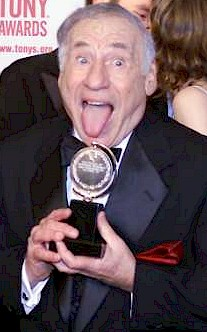
I love the following stories about Mel Brooks, told by Gene Wilder when he came to my school.
Gene Wilder, a young actor, was in some show on Broadway, kind of a big break. Forgive me, can't remember what it was. One night, after the show, a knock came on his dressing room door. He opened it, and there was Mel Brooks, a man he did not know. Chit-chat ensued, and Brooks then told him about a project he had in his mind that he would like to do ... and he immediately thought of Gene Wilder for one of the leads. The project was called Springtime for Hitler. This is all so amusing, in retrospect because ... NOW we know how funny The Producers is, NOW "Springtime for Hitler" is recognized as absolutely hilarious ... but ... then? The way Wilder told the story was so funny. Like: who is this nutty small Hobbit-like man who wants me to star in his movie called SPRINGTIME FOR HITLER?? Still, the two of them hit it off. Gene Wilder told him that he would love to read the script, whenever it was ready.
THREE YEARS proceeded to go by. Not a word from Brooks. Nothing. Nada. Wilder continued on with his career, doing plays in New York. Life goes on. He didn't yearn for Springtime for Hitler to come to fruition ... he basically put it out of his head, and never thought about it.
Then - Wilder was doing some OTHER play, it had been 3 years since the original encounter, and again, a knock came on his dressing room door one night after the show. Wilder opened the door, and there stood Mel Brooks. Mel said, "You didn't think I'd forgotten, did you??"
hahahaha And at that point, he had a completed script, and it was now called The Producers and the rest is history.
The other story I like about Mel Brooks, told by Gene Wilder, is this:
Wilder wrote Young Frankenstein, and despite the fact that Brooks only directed stuff that HE wrote, he agreed to take on the project. Apparently, this took some doing. But Wilder and Brooks were very good friends by this point, and finally Brooks said sure, he would direct.
The two then began to have script conferences at Wilder's apartment. (They lived only a couple of blocks away from each other). Apparently, these "script conferences" often degenerated into shouting matches. Creative differences.
There was one particular time when Brooks, disagreeing with Wilder over something, absolutely FLIPPED OUT. Screaming, carrying on, until finally he stormed out of Wilder's apartment, slamming the door behind him.
5 minutes later, Wilder's phone rang. Wilder picked up. "Hello?"
Mel Brooks said, in a calm quiet voice, "Who on earth was that maniac who just left your apartment? I could hear the screaming from down here! What a lunatic, sheesh, you need to be more careful about who you let into your home ..."
So it's Mel Brooks' birthday today. I would imagine he is going through a rather tough time right now, since the death of his wife, Anne Bancroft.
It must be a sad time for him. Meanwhile - the movie version of The Producers musical is being filmed AS WE SPEAK ... how exciting for Mel, right? But I feel for him. It can't be easy to continue on after such a loss.
So happy birthday, Mel! Thanks for the years and years and YEARS of laughter.
"Put ... the candle ... back..."
"Shut up, I'm having a rhetorical conversation."
"Not many people know it, but the Fuhrer was a terrific dancer."
"You have exactly ten seconds to change that look of disgusting pity into one of enormous respect!"
"How could this happen? I was so careful. I picked the wrong play, the wrong director, the wrong cast. Where did I go right?"
"I'm tired of men always coming and going, going and coming and always too soon."
"Follow me, faggots!"
"DESTINY! DESTINY! NO ESCAPING DEATH FOR ME! DESTINY! DESTINY! NO ESCAPING DEATH FOR ME!"
"Igor, would you give me a hand with the bags?" "Certainly, you take the blonde and I'll take the one in the turban."
"If science teaches us anything, it teaches us to accept our failures, as well as our successes, with quiet dignity and grace."
Please add more of your favorite Mel Brooks-isms in the comments ...
March 22, 2005
Close Encounters stories - Part 2
Part 1 is here.

Here's the second story:
At the Spielberg seminar, we spent (of course) quite a bit of time on Close Encounters. Spielberg told the story of the meteor shower (in Part 1), and also said that it had always been his dream, or fantasy, or deepest hope - whatever - that whenever there was some kind of "close encounter" between the human race and another race - that it would be a benign meeting. That was the entire point of the film, really - and why I think it works so well - it taps into something primal, something deeply felt and is "the substance of things wished for". I mean, sure Independence Day is fun and all (and hello, I cannot wait for War of the Worlds) - but there is a deeper and more childlike part of all of us, the part that stares up at the sky and wonders what is up there - that treats what is unknown as a curiosity, not as a threat. That's one of the main impressions I get from the wondrous faces of all the scientists (led by Truffaut!) in that last scene. What is coming out of that ship might kill them, might vaporize them - it is completely unknown. And yet they deal with their fear not by blowing the unknown aliens away, but standing there, watching, agog. It's very moving. This was what Spielberg set out to portray.
He talked about working with John Williams, the composer, and how he wanted the music in Close Encoutners to be another character. Equal to the lead actors. Not music that is added on, not mood music - but a CHARACTER. In only one other film (Jaws) does music in a Spielberg film take on such a life of its own.
Spielberg said that, for whatever reason, he wanted it to be 5 notes. (If you haven't seen Close Encounters, then there is absolutely no hope for you. See snob post .) He kept saying that to Williams: "It needs to be 5 notes. It needs to be 5 notes." (This is what I mean when I say that alongside the pragmatic moviemaking craftsman, is this childlike imagination. Why 5 notes? He didn't question it or second-guess it. It WAS 5 notes.)
Williams said, "Couldn't it be 7 notes? Something a bit longer?"
Spielberg said he just knew in his gut that it had to be 5 notes, and not 7. He said something like, "I just felt like 5 notes would be much more like a HELLO. And 7 notes would suddenly sound like a melody. I didn't want a melody. I wanted a greeting."
Beautiful, huh? So Williams came up with the 5 notes that we all can hum at any moment. Hum it right now! I know you can!!
Williams and Spielberg spent months in the recording studio (before they even started shooting - which is a reversal of the normal process) coming up with the musical communication between the mother-ship and the scientists. The growing complexity, the same underlying theme ... They both knew that it needed to progress: from the equivalent of toddler's blunt speech to a far more sophisticated level of language.
Spielberg's vision, dream - was that the people most equipped to deal with such a close encounter - were the scientists, the dreamers, the ones who could try to get on the wavelength of the aliens - as opposed to try to dominate them. It was the scientists who could do this.
In the beginning of the seminar at my school, Spielberg talked about his childhood, of course. His parents divorced when he was a kid, which was a wrenching change for him - but up until then, he had a very happy time. His mother was a concert pianist, and his father was a computer scientist.
During the conversation about Close Encounters, my cheese-ball Dean of the Program (Lipton) made an observation - something which took Spielberg completely by surprise. I still remember the goosebumps rising up on my arm. To see someone realize something about his work ... something that he didn't even know was there ...
Cheeseball said to him, "It occurred to me the last time I watched this film - as I was doing research for tonight - Your mother was a musician. Your father was a computer scientist. And how do the scientists communicate with the spaceship? Through music made on their computers."
I have this seminar on tape - so I can see in close-up what I was only able to sense in the room at the time. You can see this observation land. It lands - and then he recovers for a second, grinning, "You know, I would love to say that that was all conscious, and that I planned that - but honestly - I had no idea ... until this very moment ...!"
The subconscious at work. Amazing. Everyone started laughing, because Spielberg was laughing - but he said to Lipton afterwards: "Thank you so much for that observation. Thank you so much. I had no idea that that's what I was trying to get at. I had no idea. Thank you."
Close Encounters stories - Part 1
Steven Spielberg came to my school and gave a seminar. Many of you have probably seen the damn thing on television, and have probably seen a red-headed pale-faced chick among the faces in the crowd. That was me. No, just kidding. You can't see me at all. But I was there.
Spielberg was incredible with us, and amazing to meet. It's so true what they say about him - that he retains this child-like sense of things (at the same time being completely pragmatic, in terms of movie-making, and also a technician and craftsman) - but his imagination and his sense of: "What would it be like IF..." (the thing that all kids have when they play make-believe, and which so many adults lose) - is completely intact. He was amazing. He was funny, humble, really smart, he had on a baseball cap, he had come in from the Hamptons for the seminar, some of his kids were in the audience ... He is obviously STEVEN FECKIN' SPIELBERG, but he does not seem divorced from reality.
Jim Lipton (cheese-ball, I know) asked questions about Spielberg's early childhood, and about his parents.
One of Spielberg's earliest memories is of his father waking him up "in the middle of the night", hurriedly, saying, "Get up - put your clothes on - we're going out." Spielberg was 4 or 5 years old, very little. Sleepily, Steven put his clothes on, and followed his father out to the car. He kept asking his dad, "What time is it?" His dad never gave him an exact hour, just: "It's the middle of the night." They got in the car, drove a bit to this big open field. And there were all these people in the field (you will remember this exact scene from Close Encounters - Richard Dreyfuss hurriedly waking up his family and racing them out to the cliff, where a bunch of other people were waiting to see if the UFOs would reappear) - and Speilberg's dad put down a picnic blanket, and lay down on it with his son. They stared up at the sky, and a meteor shower began. Steven Spielberg remembers this as one of the most pivotal moments of his career, because it was in that moment that he first got the sense of awe in terms of what was beyond the earth, and also he just KNEW, inside, that "we were not alone". Of course these themes would be pivotal in Spielberg's art.
I've got one more story about that interview with Steven Spielberg, and what was revealed (not only to us - but to Spielberg himself!) - in regards to Close Encounters, and how the reverb of that movie just goes on and on and on ...
It was very cool.
Next story coming shortly ...
March 3, 2005
Lars von Trier: What a jackass
I've ALWAYS thought so, and I've always despised his films (and been highly suspicious of the smug "Well, if you don't like it, you don't get it" response to his films here in the States), but now it is confirmed. The man is a jackass.
Good for John C. Reilly for walking off the film. Good for him.
And Von Trier's statement sounds like it could have been taken from our collective review of "The Gates":
In my view the political and social content of the film is so important that it would be sad if it could be rejected or ignored merely by referring to the 'donkey problem', as it was called in the papers. You might say that this renders the death of the donkey in conjunction with the making of the film meaningless; however, you may still rejoice in the fact that it escaped slaughter.
Oh, put a cork in it, phony.
What the fuck are you talking about? Yeah, I do "rejoice" that the donkey "escaped slaughter". Forgive me, but I do. And you're an idiot.
Obviously, I have no objectivity when it comes to Lars von Trier. I have despised him ever since I saw Breaking the Waves, when everyone else on the planet appeared to fall before his feet, declaring how amazing that film was, what a wonderful message, how uplifting, how incredible, how "human" ... Huh? What movie did those people see? That movie made me see red. The loving response to it made me see red. It's a rare movie that can do that. I'm not really a see-red kind of girl, but Breaking the Waves FORCED me to break the pattern of a lifetime and actually see RED.
I hate his movies. I hate the sense of superiority that DRIPS off of him. I hate, too, that his sense of superiority (towards all of us and anyone else besides him who has the AUDACITY to make movies) is based on HIGHLY mediocre work. I hate his smug assumptions. It's rare that a movie makes me as angry as Breaking the Waves did. I'm sure Mr. von Trier would assume, smugly, that that meant the movie worked. That it "disturbed" me, the "ramifications" haunted me, the "dialectical juxtopisition of the blah blah blah bullshit" reverberated in my soul.
Uh - NO. I saw the film. I thought Emily Watson and whatshisname were incredible, in terms of their acting. I thought a lot of the handheld camera stuff was really cool. But by the end ... when I realized what Lars von Trier was actually saying ... I wanted to KILL HIM.
That movie said: "This is what love is. This is what true love is. Look at what this woman is willing to do to show her husband she loves him." And the more I thought about that, the angrier I got. And the more confused.
Everyone who loved it appeared to decide, for some unfathomable reason, that the film had a feminist message. Huh? Did the people who say that actually SEE the film?
Maybe it was a "feminist" message, but not MY kind of feminism. Lars von Trier must subscribe to the female-as-victim-martyr brand of feminism. I also thought, when I watched that movie, "Wow. He HATES women." I thought the critics who loved the movie (and praised it as feminist) were completely DUPED (sorry - I know that's insulting. But it's true.) I felt like anyone who said that this film was in ANY way positive towards women were duped.
Let me say one thing just so I'm clear: I am not saying that films should be "pro-woman". I don't care about that as long as it tells a damn good story. Women are as variable as men. They should be able to show all sides of the human character, just like men do. So if Breaking the Waves had just been a flat-out story of this couple and what happened to them, and how THEY worked out THEIR relationship - I would have NO problem with it. But that's not what it was, and that is NOT how it was greeted and heralded.
So yeah. I think the fawning press who called this a pro-woman movie were duped.
All I got from that film was von Trier's contempt for women. Contempt. The true glory for womankind? The true fulfillment of promise for females? Lies in being a victim. Well, I don't find glory in victimhood and I don't find inherent goodness in being a victim. Maybe some brainwashed dupes looked at the blood-stained sprawled-out once-innocent character of Emily Watson and thought: "Oh my gosh, she is a feminine icon" - but I saw the tragedy of an abusive codependent relationship. That movie lifted up the AGONY of the Emily Watson character into some kind of message - "This is what you do when you love someone." And therefore: she is a heroine.
Ah yes. The character is a heroine because intellectually she is a simpleton who ends up getting gang-raped to please her husband. Yes - praise God - this is feminism, Lars von Trier style! She's my idol. If my husband asked me to be gang-raped just so I could tell him sexy stories, sure I would do it ... because THAT IS LOVE.
Fuck. You.
I'm obviously having some sort of Pavlovian response. I see the name "Lars von Trier" and I feel like hurling axes at the wall or something.
Phony.
January 28, 2005
Movies Billy Wilder wanted to make - but never did
Okay, so you probably know that Billy Wilder directed Spirit of St. Louis, starring Jimmy Stewart as Charles Lindbergh.
Wilder and Lindbergh were friends, of a sort. Stewart is way too old to play Lindbergh, in my humble opinion, but he still does a wonderful job. (The movie don't quite work, though ... not sure why ... It just doesn't work, really). Jimmy Stewart was 19 when Lindbergh flew across the Atlantic, and remembers listening to the radio broadcast, that Lindbergh had taken off ... and he remembers sitting in his father's hardware store, taking a model airplane and making it fly on Lindbergh's projected path over his father's globe. He also went into the Air Force himself in WWII, in part because of Lindbergh's inspiration. (WHY ON EARTH IS ALL OF THIS STUFF IN MY BRAIN?? I literally have no idea why my brain retains the smallest details of JIMMY STEWART'S BOYHOOD EXPERIENCES. But mine is not to reason why.)
Anyway, I've posted before Billy Wilder's description of what he would have LIKED to do with Spirit of St. Louis - HIS idea for how to frame the story. But he knew to even suggest it would mean that Lindbergh would withdraw the project. So he held his tongue. Anyway, here's the movie Wilder WANTED to make.
Another very well-known fact is that Billy Wilder and Cary Grant were friends for many many years. And yet, oddly, Cary Grant never appeared in any Wilder movie. Even though, Cary Grant seems MADE for a Billy Wilder picture, and Billy Wilder had written role after role after role (Humphrey Bogart's part in Sabrina, for example) with Grant in mind. Here's Wilder's description of all of that. Cary Grant's elusiveness never hurt their friendship ... and yet still, it is one of those "what-if" situations. What IF Cary Grant had said Yes? Billy Wilder never cried over spilt milk ... and he ended up making Tony Curtis basically DO a Cary Grant imitation for most of Some Like it Hot as his indirect tribute. He adored Cary Grant.
But Cary Grant worked with only a couple of directors. He was not a trusting man. He had no agent, and had chosen to not wed himself to any one studio. He was extremely wary of having anyone mess with his image ... and Hitchcock was pretty much the only one he trusted completely.
Fascinating.
Anyway, in all of the stuff I have read of Billy Wilder, Cary Grant's name comes up again and again and again. "And he would have been great in THIS part ... and I wrote THAT part for him ..."
That was why Wilder and Humphrey Bogart didn't get along (to put it mildly) during the filming of Sabrina. Bogart KNEW that that part was meant for Cary, that he was second choice, and that pissed him OFF. (Would piss me off, too!! Not a good situation, not a confidence-builder ... to know you're second choice).
So, in one of my favorite art-of-filmmaking books - Conversations with Wilder, where Cameron Crowe sat down with Billy Wilder over the course of a couple of months, and asked him a billion questions about all of his movies ... Billy Wilder talked about Cary Grant.
And - he said that until they were old men together, Wilder kept trying to get Cary Grant to act again. Cary Grant had long retired, and Wilder kept sending him scripts "with grey-haired old guys in them". The answer was always NO.
Wilder had a fantasy of the ULTIMATE movie he wanted to do, starring Cary Grant. He had the entire thing shot in his head. And Cary Grant, because he was Cary Grant, never would have grown out of the part, even though he was 60 years old. He was always a leading man.
So anyway, here is the first 10 minutes of Billy Wilder's dream-movie, the movie he always wanted to do, but never did, starring Cary Grant:
-- It takes place during the Crusades.
-- There is a long sweeping shot through the muddy streets of a medieval town. Something is obviously about to happen, much activity.
-- A series of shots of the men of the town putting on coats of armor. Buckling up, raising flags, putting on helmets, getting the swords ready ... Okay. So we get the picture. The men are going off to the Crusade.
-- Another series of shots ... showing the men of the town locking their wives into chastity belts. They all have huge keys, their wives are crying, pleading not to be locked up, also not to go away ... but the men are firm. Their wife must be protected! She must be locked up! So a series of shots ... throughout the town ... lock, lock, lock, lock, lock, lock, lock. (You got it? A montage.)
-- Then, leaving their crying locked-up wives behind them, the men all leap onto their horses and, holding up flags and swords and shields, gallop out of town.
-- The camera follows the horses through the town, the galloping, the mud flying ... and as the horses pass by, out of frame, the camera rests on a small storefront. Unassuming. Medieval. And on a small sign by the door are the words: "Locksmith". And the camera slowly pans by the window, and we see the locksmith at work at his table inside. The locksmith is Cary Grant.
heh heh heh heh
God. It's so witty, so clever ... I think that's why I love Wilder movies, and Lubitsch movies ... all those old guys, from the golden age of Hollywood. The WIT. Where do ideas come from? Who knows. The idea fairy. I have no idea. But I love Billy Wilder's idea ... and I also love that even as a frail man, close to death, he got all excited, telling Cameron Crowe about his "dream movie", and how the first 10 minutes would go.
December 21, 2004
More Lumet Appreciation: On working with Quincy Jones
I am in love with pretty much every single person in this anecdote.
Sidney Lumet:
The Pawnbroker had as complex a score as I've ever worked on.In the opening sequence, Sol Nazerman, a Jewish refugee from Germany, is sitting in a suburban backyard, soaking up the sun. His sister asks for a loan so she and her family can take a vacation in Europe that summer. To Nazerman, everything about Europe is a cesspool. He says, "Europe! It's rather like a stink, as I remember."
The next sequence shows him driving into New York City, to his pawnshop in Harlem.
Those two scenes set up the conception of the score. Earlier, I had said that The Pawnbroker was about how and why we establish our own prisons. At the beginning of the movie, Nazerman is encased in his own coldness. He has tried desperately to feel no emotion, and he has succeeded. The story of the movie is how his life in Harlem breaks down the wall of ice with which he has surrounded himself.
The concept of the score was "Harlem triumphant!" -- that the life, pain, and energy of his life there forced him to feel again.
I decided I wanted two musical themes: one representing Europe, the other Harlem. The European theme was to be classical in its nature, precise but rather soft, a feeling of something old. The Harlem theme, by contrast, would be percussive, with lots of brass, wild in feeling -- containing the most modern jazz sound that could be created.
I started looking for a composer. I first approached John Cage. He had a record out at the time called Third Stream, classical music handled with jazz instrumentation and rhythms. He wasn't interested in doing a movie score. Then I met with Gil Evans, the great modern jazz composer and arranger, but found it tough to get through. Next, I approached John Lewis of the Modern Jazz Quartet, but I felt he didn't really like the movie when I showed it to him.
Then someone suggested Quincy Jones. I knew some of his jazz work from records he'd made on a big-band tour of Norway. We met. It was love at first sight. His intelligence and enthusiasm were inspiring. I found out that he'd studied with Nadia Boulanger in Paris, which meant that his classical background was firm. He gave me other records of his, many on obscure labels. He'd never done a movie score, but that made him even more interesting to me. Very often, because of the nature of the work, composers develop their own set of musical cliches when they've done too many pictures. I thought his lack of movie experience would be a plus.
I showed him the movie. He loved it. We went to work.
Talking about music is like talking about colors: the same color can mean different things to different people.
But Quincy and I found that we were literally talking the same language in music. We laid out a musical plot that was almost mathematical in its precision ... we moved in steps from the European theme to the final total dominance of the Harlem theme. At midpoint in the picture, they were equally balanced.
It was a magnificent score, and the recording sessions were the most exciting I've ever been to. Because it was Quincy's first movie score, the band that turned out for him rivaled Esquire's All-Star Jazz Band. Dizzy Gillesbie, John Faddis (a mere child at the time) on trumpet, Elvin Jones on drums, Jerome Richardson on lead sax, George Duvivier on bass ... the names kept pouring into the recording studio. Dizzy had just come back from Brazil, and for one music cue he suggested a rhythm that none of us, including Quincy, had ever heard before. He had to sing it with clucks, gurgles, and glottal stops until the rhythm sections could learn it. Quincy looked as happy as any man I'd ever seen.
Usually, when we finish recording a music cue, we stop and play it back against the picture. But the level of inspired playing from this band was so high that I told Quincy not to interrupt it. We'd play it back at the end of the day. Nobody even asked for the obligatory 10-minute break every hour. We played right through.
At the end of five three-hour sessions spread over two days, we played it against the picture. It was immediately apparent: Quincy had made a major contribution to the movie.
More Lumet Appreciation: On the importance of the score
Sidney Lumet:
The only movie score I've heard that can stand on its own as a piece of music is Prokofiev's "Battle on the Ice" from Alexander Nevsky. I'm told that Eisenstein and Prokofiev talked about it well before shooting began and that some of the composing was started before shooting. Supposedly, Eisenstein even edited some of the sequence to accommodate the score. I have no idea whether these stories are true. Even when I hear the music on a record today, I start remembering the sequence visually. The two, music and picture, are indelibly linked: a great sequence, a great score.
More Lumet Appreciation: On Al Pacino in "Dog Day Afternoon"
A great story about a great moment in a great movie. Whatever. Read on, Macduff.
Sidney Lumet:
One of the most difficult acting scenes I've ever encountered was on Dog Day Afternoon.About two-thirds of the way through the movie, Pacino makes two phone calls: one to his "wife" and lover, who's at a barbershop across the street, and the second to his "real" wife, in her home.
I knew Al would build up the fullets head of steam if we could do it in one take. The scene took place at night. The character had been in the bank for 12 hours. He had to seem spent, exhausted. When we're that tired, emotions flow more easily. And that's what I wanted.
There was an immediate problem. The camera only holds a thousand feet of film. That's a bit over eleven minutes. The two phone calls ran almost fifteen minutes. I solved it by putting two cameras next to each other, the lenses as close together as was physically possible. Naturally, both lenses were the same ... When camera 1 had used about 850 feet, we would roll camera 2 while camera 1 was still running. I knew that there would be an intercut of the wife somewhere in the final film, which would allow me to cut to the film in camera 2. But Al would have acted oiut the two phone calls continuously, just as it happened in real life.
I wanted Al's concentration at its peak.
I cleared the set and then, about five feet behind the camera, put up black flats so that even the rest of the physical set was blocked out. The propman had rigged the phones so the off-camera actors could speak into phones across the street and Al would really hear them on his phone.
One more thing occurred to me. One of the best ways of accumulating emotion is to go as rapidly as possible from one take to the next. The actor begins the second take on the emotional level he reached at the end of the first take. Sometimes I don't even cut the camera. I'll say quietly, "Don't cut the camera -- everybody back to their opening positions and we're going again. OK from the top: Action!" By the way, I always call "Action" in the mood of the scene. If it's a gentle moment, I'll say "Action" just loud enough for the actors to hear me. If it's a scene that requires a lot of energy, I'll bark out, "Action!" like a drill sergeant. It's like a conductor giving the upbeat.
I knew a second take would mean a serious interruption for Al. We'd have to reload one of the cameras. Reloading a magazine of film can be quite disruptive ... The whole process, done at top speed, takes two or three minutes, enough time for Al to cool off. So I put up a black tent to block off both cameras and the men operating them. We cut two holes for the lenses. And I had the second assistant cameramen (there are three men on a camera crew: operator, focus puller, and second assistant) hold an extra film magazine in his lap, in case we needed it.
We rolled.
As camera 1 reached 850 feet, we rolled camera 2. The take ended. It was wonderful. But something told me to go again. Camera 2 had used only about 200 feet.
I called out gently, "Al, back to the top, I want to go again."
He looked at me as if I'd gone mad. He'd gone full out and was exhausted. He said, "What?! You're kidding!"
I said, "Al, we have to. Roll camera."
We rolled camera 2. It had about 800 feet left. Meanwhile, behind the camera tent, out of Al's sight, we reloaded camera 1. By the time camera 2 had used 700 feet (close to eight minutes into the take), we started the reloaded camera 1.
By the end of the second take, Al didn't know where he was anymore. He finished his lines, and, in sheer exhaustion, looked around helplessly. Then, by accident, he looked directly at me. Tears were rolling down my face because he'd moved me so. His eyes locked into mine and he burst into tears, then slumped over the desk he'd been sitting at,
I called, "Cut! Print!" and leapt into the air.
That take is some of the best film acting I've ever seen.
More Lumet Appreciation: On costume
Love this anecdote. LOVE IT.
Sidney Lumet:
Nothing helps actors more than the clothes they wear. Ann Roth is an amazing costume designer. She can take the most everyday clothes and turn them into some sort of contribution, to both the actor and the picture.On Family Business, Sean Connery came into rehearsal after having been with Ann for a clothes fitting. He looked happy. I asked him how it had gone. "She's bloody marvelous," he said. "She's given me the whole bloody character now."
That's the greatest compliment an actor can give.
It's the equivalent of saying, "We're all making the same picture."
More Lumet Appreciation: On locations/art direction for "The Pawnbroker"
An interesting story about The Pawnbroker. This element worked on me subliminally when I saw the film. I love how conscious all of it is, behind the scenes. No accidents.
Sidney Lumet:
To talk about art direction in black-and-white movies is to talk about something extinct. But it was exciting while it lasted. Dick Sylbert's work on The Pawnbroker was superb. This was a picture about creating our own prisons. Starting with the pawnshop itself, Dick created a series of cages: wire mesh bars, locks, alarms, anything that would reinforce a sense of entrapment.The locations were picked with this in mind. The supposedly wide-open spaces of suburbia at the beginning of the picture were cut up by fences clearly delineating each house's 125-foot frontage.
For the critical scene where Rod Steiger tells Geraldine Fitzgerald of his guilt at being alive, we found an apartment on the West Side of Manhattan that overlooked the New York Central railroad yards. Throughout the scene you can see and hear freight cars being shunted from track to track. That kind of visual and auditory corroboration of a scene's context is invaluable.
If you remember, The Pawnbroker is about a Holocaust survivor. Tormented by guilt at having lived, and having gotten out. The freight cars out the window of that rickety apartment were a perfect and haunting touch. Even here in America, in NYC, the sound of those freight trains followed this character wherever he went.
More Lumet Appreciation: On locations/art direction for "The Wiz"
Any The Wiz fans out there? Really interesting stuff here. I loved that movie when I was a kid - and even hearing about Lumet's struggles wiht it doesn't take away my affection for the movie.
You can almost learn more from what DOESN'T work than what DOES.
Sidney Lumet:
Sometimes a scenic concept gets lost in execution. The idea I had for The Wiz was that reality could be turned into an urban fantasy. We could use real locations but treat them in such a way that the locations would become truly fantastical. But I came to grief on the first location scouting trip. I wanted the Cowardly Lion to be discovered at -- where else? -- the New York Public Library, Forty-Second Street and Fifth Avenue. Tony Walton, Albert Whitlock and I stood across the street, gazing at the building, for four hours. Whitlock is one of the foremost matte-painting and special-effects cameramen in the business. He was a master at combining painted glass backgrounds with live foreground action. "Albert, when a door opens, can we see sky behind it, rather than the interior of the building?" I would ask. The answer was no. Every idea I had to fantasize that building was, Albert told me, impossible. Slowly my heart sank. We finally decided to build the set in the studio. Then more and more studio work was added to what had originally been a heavy location picture. Fantasy took over to such a degree that the urban quality was lost.In the most expensive sequence, to be shot at the World Trade Center, we never figured how brutal the wind could be when it was channeled between those two towers. They formed a natural wind tunnel. The hats of the male and female models were very important in establishing "attitude". And the hats wouldn't stay on because of the wind. Pins didn't work. Bands around the back of the head didn't work. Finally, the bands were placed under the chin. The hats stayed on, but the look was ruined.
From large to small, I felt the concept going out the window.
It was my own fault. I simply didn't know enough technically to master all departments, particularly special effects. Even though I had very good people in charge, there were just too many departments that were going their own way. I could feel the visual approach leaking out of my hands like water through my fingers.
It happens.
More Lumet Appreciation: On art direction
Sidney Lumet:
In The Morning After, we looked for exapnses of high color. No color was excluded, but we wanted one color to dominate each scene. Jane Fonda's room swere various shades of pink... For the title sequence, I found a series of walls, yellow, red, brown, blue, and just had Fonda walking dejectedly past them. Buildings were deep blue, baby pink, any strong color. Los Angeles can provide an endless supply of that kind of color.On other pictures, I've wanted a hodgepodge. For Q & A and Dog Day Afternoon, everything had to feel accidental -- no planning, no color control. On both pictures, I told the art director and the costume designer not to consult with each other. I wanted no relationship between the sets and the costumes. Whatever happened happened.
More Lumet Appreciation: On the camera work in "Dog Day Afternoon"
Sidney Lumet:
Dog Day Afternoon. Victor Kemper, photographer...The first obligation was to let the audience know that this event had really happened. Therefore, the first decision made was that we use no artificial light. The bank was lit by fluorescents in the ceiling. If we had to supplement the light because of focus problems, we simply added more flourescents. Outside, at night, all the light came from the enormous spotlights of the Police Emergency van on the scene. The bounce light reflecting off the white-brick-and-glass exterior of the bank was bright enough to illuminate the faces of the people facing the bank. .. And for the improvised scenes in the street and in the bank, I used two and sometimes three hand-held cameras to reinforce the documentary feel.
More Lumet Appreciation: On the camera work in "Prince of the City"
For all you Prince of the City fans out there - this should be very interesting. Let me know what you think, if you picked up on any of this subliminally.
Sidney Lumet:
Prince of the City. Andrzej Bartkowiak, photographer. Photographically, this was one of the most interesting pictures I've done. Going back to its theme (nothing is what it appears to be), I made a decision: We would not use the midrange lenses (28 mm through 40 mm). Nothing was to look normal, or anything close to what the eye would see. I took the theme literally. All space was elongated or foreshortened, depending on whether I used wide-angle or long lenses. A city block was twice as long or half as long, depending on the choice of lens.In addition, Andrzej and I laid out a very complex lighting plot. At the beginning of the movie, the leading character, Danny Ciello, was completely aware of everything around him. As events became more complex, as he lost more and more control over them, his moral crisis deepened. He knew he was being forced into a corner where he would have to betray his friends. His thoughts and actions became more focused on himself and his four police partners.
In the first third of the movie, we tried to have the light on the background brigher than on the actors in the foreground. For the second third, the foreground light and the background light were more or less balanced. For the last third, we cut the light off the background. Only the foreground, occupied by the actors, was lit. By the end of the movie, only the relationships that were about to be betrayed mattered. People emerged from the background. Where something took place no longer mattered. What mattered was what took place and to whom.
I made another decision that seems important to me. Except for one instance, I never framed a shot so the sky was visible. The sky meant freedom, release, but Danny had no way out. The only shot that had sky in the frame was practically nothing but sky. Danny is walking on the Manhattan Bridge. He clumbs up a catwalk overlooking the rails of the subway that runs between Brooklyn and Manhattan. He is contemplating suicide. By now that's his only possible freedom, his only possible release.
More Lumet Appreciation: On the camerawork in "The Morning After"
I really dig The Morning After. Anyone else? First off - HELLO??? JEFF BRIDGES? I think that guy is, perhaps, the best actor working today. And he is - well, he's a huge star obviously - but he's relatively unsung. In comparison with other giants. But he's just fantastic. His role in The Morning After is one of the reasons why I love him.
Sidney Lumet:
The Morning After. Andrzej Bartkowiak, photographer. Living in Los Angeles was part of the debilitating influence on the character played by Jane Fonda. I wanted all color exaggerated: reds redder, blues bluer. We used filters. Behind the lens are little slots where frames about two and a half inches by three and a half inches can be inserted. These frames and slots can hold pieces of glass or gelatin that are colored to various specifications. When we could see the sky, Andrzej would add a blue filter that covered only the sky. The sky came out bluer. Every color was reinforced in this way. One day, because of smog and clouds at the end of the day, the sky had an orange haze. Andrzej turned the scene into the color of an Orange Julius hot dog stand.These filters have some drawbacks. They limit camera movement, since you don't want the blue sky filter to bleed into the white building or the actor's face. But used judiciously, they can be very helpful.
More Lumet Appreciation: On the camerawork in "Network"
I love these anecdotes about the cinematography because - half of this stuff works on an audience in a subliminal way (at least in Lumet's films). He does not make a splashy use of style. He likes it to be "invisible" - and yet most definitely THERE. It makes me see these movies in a different way, and look for clues.
Sidney Lumet:
Network. Owen Roizman, photographer. The movie was about corruption. So we corrupted the camera.We started with an almost naturalistic look. For the first scene between Peter Finch and Bill Holden, on Sixth Avenue at night, we added only enough light to get exposure. As the picture progressed, camera setups became more rigid, more formal. The lighting became more and more artificial. The next-to-final scene -- where Faye Dunaway, Robert Duvall, and three network gray suits decide to kill Peter Finch -- is lit like a commercial. The camera setups are static and framed like still pictures. The camera had become a victim of television.
More Lumet Appreciation: On Murder on the Orient Express
Funny stuff here. Movie stars vs. theatre stars - very unexpected.
Sidney Lumet:
A charming thing happened at the first reading of Murder on the Orient Express. Five stars of the English theatre were appearing in the West End at the time -- John Gielgud, Wendy Hiller, Vanessa Redgrave, Colin Blakely, and Rachel Roberts. Sitting with them were six movie stars: Sean Connery, Lauren Bacall, Richard Widmark, Tony Perkins, Jacqueline Bisset, and Michael York; Ingrid Bergman and Albert Finney bridged both worlds.They began to read. I couldn't hear anything. Everyone was murmuring their lines so quietly they were inaudible.
I finally figured out what was happening. The movie stars were in awe of the theatre stars; the theatre stars were in awe of the movie stars. A classic case of stage fright.
I stopped the reading and, saying that I couldn't hear a thing, asked them to please talk to one another as if we were at Gielgud's house for dinner. John said he'd never had such illustrious guests to dinner, and off we went.
More Lumet Appreciation: On Ingrid Bergman
Mitch Berg? You out there? Knowing your love for Ingrid Bergman I posted this very cool and short anecdote for you. Bergman rocks.
Sidney Lumet:
In Murder on the Orient Express, I wanted Ingrid Bergman to play the Russian Princess Dragomiroff. She wanted to play the retarded Swedish maid. I wanted Ingrid Bergman. I let her play the maid.She won an Academy Award.
I bring this up because self-knowledge is important in so many ways to an actor.
More Lumet Appreciation: On Kate Hepburn and going to dailies
Here's great story about Katherine Hepburn.
By the way - in case you don't know - "going to dailies", or "going to rushes" means seeing the day's shooting at the end of that day. Some directors won't allow actors to "come to rushes" because the director fears that the actor will get self-conscious, or be too hard on himself, or start to change things, etc. "Going to rushes" is a nerve-wracking experience - and can shake your confidence. On a vain note - seeing yourself projected up onto a screen is very unnerving, no matter how much experience you have. All you see are your own flaws. "Does my nose look like that? Why didn't someone tell me that I am completely obese? I LOOK HORRIBLE." Some actors refuse to go to rushes, others always go to rushes. Harrison Ford, for example, has no problem going to rushes. He is such a craftsman, such a collaborator - He can watch the rushes and KNOW what small adjustments he might need to make, in order to make the character clearer, in order to serve the story. But he's a rare bird.
Okay, so onward. Here's an anecdote about Hepburn:
Sidney Lumet:
At the end of rehearsal [for Long Day's Journey], just before shooting, I gathered the actors to tell them about my shooting system and habits and to find out if there was anything they needed during shooting that we could provide. At this session, I said to them, "And by the way, you're all invited to rushes."As we were leaving, Kate called me aside. "Sidney," she said, "I've gone to rushes of practically every picture I've ever made. But I won't be coming to these rushes. I can see how you work. I know Boris's work [Boris Kaufman was the cameraman]. You're both dead honest. You can't protect me. If I go to rushes, all that I'll see is this" -- and she reached under her chin and pinched the slightly sagging flesh -- "and this" -- she did the same thing under her arms -- "and I need all my strength and concentration just to play this part."
Tears sprang to my eyes.
I'd never seen an actor with such self-knowledge and such dedication, trust, and bravery.
She was breaking habits of thirty years because she knew they would interfere with the job. That's a giant.
More Lumet Appreciation: On Kate Hepburn
Alex - listen up!!! I LOVE this story. Because it shows why, I believe, Kate Hepburn was not only such a massive star but a truly great actress.
Sidney Lumet on working with Katherine Hepburn:
Because they are often the reason that a picture gets financed, actors tend to get spoiled. I hate those large trailers. I've seen trailers that are literally converted buses ... All of this is dangerous in two ways: it costs a lot of money that doesn't wind up on the screen; and even without meaning to, the stars begin to get a sense of power that can hurt their work.Hepburn would never stoop to that level. She had, however, been a dominant factor in her own career. This was during her time at Metro, in the 30s and 40s. Most stars were in abject fear of Louis B. Mayer, but not Kate. She somehow created her own material. I don't know if she commissioned Philip Barry to write The Philadelphia Story for her, but she owned the rights.
When we first met, on Long Day's Journey, she was living in John Barrymore's former house in Los Angeles. I stepped through the doors of what seemed to me a fifty-foot living room. She stood at the opposite end of the room and started toward me. We'd covered about half the distance when she said, "When do you want to start rehearsal?" (No "Hello" or "How do you do?") "September nineteenth," I said. "I can't start till the 26th," she said. "Why?" I asked. "Because then," she said, "you'd know more about the script than I would."
Funny, charming, but she meant it. It was perfectly all right with me if she knew more about the character. After all, she was going to play it, and I had a lot of other things to think about. But the challenge was unmistakable, and I could see trouble down the road.
The solution was to leave her alone. Though she had played great roles, nothing could compare with Mary Tyrone for psychological complexity, physical and emotional demand, and tragic dimension.
During the first three days of rehearsal I said nothing to her about Mary Tyrone's character. I talked at length with Jason [Robards], who'd played his part before, with Ralph [Richardson] and Dean [Stockwell], and of course we talked about the play.
When we finished the run-through reading on the third day, there was a long pause. And then, from Kate's corner of the table, a small voice called out, "Help!"
From then on, the work was thrilling. She asked, she told, she fretted, she tried, she failed, she won. She built that character stone by stone.
Something was still tight about the performance until the end of the second week. There's a moment in the script when her youngest son, trying to cut through her morphine haze, screams at her that he's dying of consumption. I said, "Kate, I'd like you to haul off and smack him as hard as you can." She started to say that she couldn't do that, but the sentence died halfway out of her mouth. She thought about it for 30 seconds, then said, "Let's try it." She hit him. She looked at Dean's horrified face, and her shoulders started to shake. She dissolved into the broken, frightened failure that was so important an aspect of Mary Tyrone. The sight of that giant Hepburn in such a state was the personification of tragic acting.
When the Greeks said tragedy is for royalty, they were only saying that tragedy was for giants.
There was no tightness ever again. Kate was soaring.
I am in tears. I love that story. God bless her. And God bless him for knowing that he had to "let her alone" and find her own way. I probably don't need to tell you how rare that is with directors!
More Lumet Appreciation: On Stars
This reminds me of something Arthur Miller said about "stars". What is a star? What makes up a star? When he worked with Clark Gable on The Misfits, he thought about it a lot - because he had such admiration for Gable's power and skill, but he also couldn't quite describe WHAT it was that made Clark Gable so ... powerful, so necessary. Miller said something about Gable being like a lion at the circus. The lion is there to perform. But the lion is still damn dangerous. Gable gave that mixed vibe that all stars have: the beauty of the lion, the fascination of the wild animal, but also the feeling that this beast is not controllable, and you had better just get the hell out of the way.
Sidney Lumet:
The problem of integrating the very strong personal qualities [of stars] with the character the star is playing is a fascinating one.If you've got a major star, you've got that strong personal quality seeping through in every performance. Even with as fine a character actor as Robert DeNiro, DeNiro himself comes out. Partially it's because he uses himself brilliantly. As I said earlier, the actor's only instrument is himself. But I think it's more than that. There's a mysterious alchemy between star and audience. Sometimes i'ts based on the physical beauty or sex appeal of the star. But I don't believe that it's ever just one thing. Surely there were other women as attractive as Marilyn Monroe or men as handsome as Cary Grant (though not many). Al Pacino tries to suit his looks to the characters -- a beard here, long hair there -- but somehow it's the way his eyes express an enormous rage, even in tender moments, that enthralls me and everyone else. I think that every star evokes a sense of danger, something unmanageable. Perhaps each person in the audience feels that he or she is the one who can manage, tame, satisfy the bigger-than-life quality that a star has. Clint Eastwood isn't really the same as you or me, is he? Or Michelle Pfeiffer, or Sean Connery, or you name them. I don't really know what makes a star. But the persona that jumps out at you is certainly a most important element.
More Lumet Appreciation: On William Holden in "Network"
This story about William Holden kills me. Great stuff.
Sidney Lumet:
The most moving example of how much of themselves actors must pour into a character happened on Network. William Holden was a wonderful actor. He was also very experienced. He'd done 60 or 70 movies by the time we worked together, maybe more. I noticed that during the rehearsal of one particular scene with Faye Dunaway, he looked everywhere but directly into her eyes. He looked at her eyebrows, her hair, her lips, but not her eyes. I didn't say anything. The scene was a confession by his character that he was hopelessly in love with her, that they came from very different worlds, that he was achingly vulnerable to her and therefore needed her help and support.On the day of shooting we did a take. After the take, I said, "Let's go again, and Bill, on this take, would you try something for me? Look into her eyes and never break away from them." He did. Emotion came pouring out of him. It's one of his best scenes in the movie. Whatever he'd been avoiding could no longer be denied. The rehearsal period had helped me recognize this emotional reticence in him.
Of course, I never asked him what he had been avoiding. The actor has a right to his privacy; I never violate his private sources knowingly.
December 17, 2004
Lumet Appreciation Day: on gaining the confidence of actors
Sidney Lumet:
Howard Hawks was once asked to name the most important element in an actor's performance. His answer was "confidence". In a sense, that is really what's been going on during rehearsal: the actors are gaining confidence in revealing their inner selves. They've been learning about me. I hold nothing back. If the actors are going to hold nothing back in front of the camera, I can hold nothing back in front of them. They have to be able to trust me, to know that I "feel" them and what they're doing. This mutual trust is the most important element between the actor and me.I worked with Marlon Brando on The Fugitive Kind. He's a suspicious fellow. I don't know if he bothers anymore, but Brando tests the director on the first or second day of shooting. What he does is to give you two apparently identical takes. Except that on one, he is really working from the inside; and on the other, he's just giving you an indication of what the emotion was like. Then he watches which one you decide to print. If the director prints the wrong one, the "indicated" one, he's had it. Marlon will either walk through the rest of the performance or make the director's life hell, or both. Nobody has the right to test people like that, but I can understand why he does that. He doesn't want to pour out his inner life to someone who can't see what he's doing.
At the same time they're learning about me, I'm finding out things about the actors. What stimulates them, what triggers their emotions? What annoys them? How's their concentraion? Do they have a technique? What method of acting do they use? The "Method" made famous at the Actors' Studio, based on the teaching of Stanislavsky, is not the only one. Ralph Richardson, whom I saw give at least three great performances, in theatre and film, used a completely auditory musical system. During rehearsals of Long Day's Journey Into Night, he asked a simple question. Forty-five minutes later I finished my answer. (I talk a lot). Ralph paused a moment and then sonorously said: "I see what you mean, dear boy: a little more cello, a little less flute."
I was, of course, enchanted. And of course, he was putting me down, telling me not to be so long-winded. But we talked in musical terms from then on: "Ralph, a little more staccato." "A slower tempo, Ralph."
I subsequently found out that when he appeared in the theatre, he played a violin in his dressing room before a performance as a warm-up. He used himself as a musical instrument, literally.
I heard Sidney Lumet tell that Ralph Richardson anecdote in a workshop I took with him ... and I will never forget it. What a lovely story. One of my favorites about the mysterious craft of the actor.
"I see what you mean, dear boy: a little more cello, a little less flute."
Lumet Appreciation Day: On how style dictates casting
Sidney Lumet: - He's talking about Prince of the City here:
I wasn't sure whether we were in drama or tragedy territory. I knew I wanted to wind up somewhere between the two, leaning towards the tragic.Tragedy, when it works, leaves no room for tears. Tears would have been too easy in that movie. The classic definition of tragedy still works: pity and terror or awe, arriving at catharsis. That sense of awe requires a certain distance.
It's hard to be in awe of someone you know well. The first thing affected was casting. If the leading role of Danny Ciello was played by DeNiro or Pacino, all ambivalence would disappear. By their nature, stars invite your faculty of identification. You empathize with them immediately, even if they're playing monsters. A major star would defeat the picture with just the advertising.
I chose a superb but not very well known actor, Treat Williams. This may have defeated the commerciality of the movie, but it was the right choice dramatically.
Then I went further. I cast as many new faces as possible. If the actor had done lots of movies, I didn't use him. In fact, for the first time in one of my pictures, out of 125 speaking parts, I cast 52 of them from "civilians" -- people who had never acted before. This helped enormously in two areas: first, in distancing the audience by not giving them actors with whom they had associations; and second, in giving the picture a disguised "naturalism", which would be slowly eroded as the picture went on.
Speaking of audiences identifying with stars - and sometimes that's a good thing, but sometimes it's not the best thing for the picture: Gary Cooper was offered the role of CK Dexter Haven in Philadelphia Story. He was the biggest star in the world at that time. Cary Grant was huge as well, but Grant used to talk about how, when he was starting in Hollywood, he could practically see Gary Cooper's thumbprints over any script sent to him - because naturally, Cooper was offered everything first. People made entire careers out of playing roles that Cooper turned down.
Anyway: Gary Cooper was offered the role of CK Dexter Haven.
He turned it down. It killed him to turn it down. He knew this script was special, and it was a special project, looking to be a hit. Why did he turn it down? Because he had the self-knowledge to understand that if he, the biggest star and sex-symbol in the world were cast in this play which is basically a love-triangle, it would upset the balance of the thing.
An audience, seeing Gary Cooper, immediately would KNOW that he would get the girl in the end. And Philadelphia Story depends on the audience being not too sure which guy Tracy would end up picking - You have to see the charms of BOTH, you have to see why she would choose Jimmy Stewart - it cannot be a clear choice for her. Both options have to have their possibilities - so you can feel Tracy's struggle.
But you put Gary Cooper in a movie? The choice is made the second he walks on the screen. Merely because of all the associations he brings. He will get the girl.
I love Cooper for knowing himself and his power as a star well enough to turn down a role like CK Dexter Haven. That, to me, is why he was so great.
Lumet Appreciation Day: on power
Sidney Lumet:
The director, because he says "Print", has a lot of power. But the results are best when he doesn't have to use it.
Lumet Appreciation Day: Faye Dunaway in "Network"
This is one of the coolest stories I have ever heard. Alex? Mitchell?? You're gonna love this one.
Sidney Lumet:
When we did Network, Paddy Chayefksy knew what he wanted. [He wrote the script] After all the difficulties in getting the picture OK'd, I knew he was in no mood for any rewrites demanded by stars. I'd heard, too, that Faye Dunaway could be difficult. (This turned out to be totally untrue. She was a selfless, devoted, and wonderful actress.)As always, if there's a potential problem, I like to bring it out in the open before we begin. So I made an appointment to see her. Crossing the floor of her apartment, before I'd even reached her, I said, "I know the first thing you're going to ask me: Where's her vulnerability? Don't ask it. She has none." Faye looked shocked. "Furthermore, if you try to sneak it in, I'll get rid of it in the cutting room, so it'll be wasted effort." She paused just a second, then burst out laughing. Ten minutes later I was begging her to do the part. She said yes.
She never tried to get sentimental in the part, and she took home an Academy Award.
Lumet Appreciation Day: actors and writers
Sidney Lumet:
Sometimes the relationship between actors and writers gets very testy indeed. As the director, I have to be very careful here. I need them both. Most writers hate actors. And yet stars are the keys to getting a picture approved by a studio. Some directors have enormous power, but nobody has the power of one of the top stars. If the star demands it, any studio will drop the writer in less than thirty seconds -- and the director too, for that matter. Most of the time, I've done enough work ahead of time so that this sort of crisis never arises. I'll come to an agreement with the writer before an actor has been approached, and I'll usually have a thorough discussion with the star about the script before we decide to go ahead.These experiences vary. Most actors, despite Hitchcock's pronouncement, are very bright. Some are superb on script. Sean Connery, Dustin Hoffman, Jane Fonda, Paul Newman are wonderfully helpful. One can gain a lot by listening to them.
Pacino isn't terrifically articulate, but he's got a built-in sense of the truth. If a scene or a line bothers him, I pay attention. He's probably right.
Lumet Appreciation Day: working with the writer
Sidney Lumet:
What do I owe the writer? A thorough investigation and then a committed execution of his intentions.What does the writer owe me? The selflessness that Frank Pierson showed on Dog Day Afternoon or that Naomi Foner showed on Running on Empty.
Naomi is a fine, talented, and original writer. Somehow she fell in love with a scene that, to me, was her only bad idea in the whole movie. The young boy, played by River Phoenix, comes into a strange house, sits down at the piano, and begins to play a Beethoven sonata. Eventually he notices that he is being watched by a young girl, about his age. In the script, he segues into boogie-woogie piano music.
I explained to Naomi why I thought it was a bad idea. There was a feeling of pandering to the audience: See, he's not really an egghead – he likes jazz, just like you and me. I've seen the same scene as far back as Jose Iturbi tickling the ivories in some remote Gloria Jean movie or Jeanette MacDonald singing swing in San Francisco. Naomi fought for it, so I decided to leave it in to see how it played in rehearsal.
When I began to stage the scene, River asked if we could cut that bit. He felt false playing it. I saw Naomi pale. We started to talk about it. River told Naomi with great simplicity and earnestness how it compromised his character. (It was enchanting to see this 17 year old arguing with a serious writer twice his age.) Finally I suggested we try it for a few days to see if there was a value to it.
At the end of rehearsal, Naomi came over to me. She said she didn't mind if I had to stretch to accommodate the scene, but she couldn't bear to see River turning himself inside out to make it work.
She loved the scene, but she said, "Let's cut it."
Here's 2 things about this fantastic and revealing anecdote:
-- It makes me wish that River Phoenix could hear me from the Beyond when I scream: YOU ASSHOLE FOR KILLING YOURSELF. YOU ASSHOLE. I miss that boy. Never more so than when I watch Running on Empty.
-- Romulus Linney, major playwright, was the head of the playwriting division at my grad school. I was in the acting school, but many of my friends were in the writing program, so I would hear about their classes, his lectures, etc. And one of the best pieces of advice I have ever heard for writers - and it's so deep, so powerful that I feel like I can NEVER stop learning it - came from Romulus Linney.
My friend Liz (who is an incredible playwright - she could be the next Shanley, and that's no joke - she's great) was in his class. One of her plays was being discsussed in the class. Linney honed in on a small exchange of lines - he thought it should be cut, for whatever reason. He explained why. Liz loved those lines, was very attached to them, thought they needed to be there, and argued her case. Linney listened. He gave back his counter-point. Liz fought for them. Those lines were precious to her. Linney correctly guessed that the lines were perhaps too dear to her.
And here is what he said to her, "As a writer, you must be brave enough to kill your darlings."
Just think about that for a while.
Naomi Foner, in that excerpt above, was courageous enough to kill one of her darlings. The moment didn't work. It was a dear moment to her, but it didn't work. I'm tellin' ya, having worked with many playwrights on brand-new plays - this ability to "kill your darlings" is so rare that I have only seen one writer able to do it. And, whaddya know, it was the most talented writer of the bunch.
"As a writer, you must be brave enough to kill your darlings."
A Sidney Lumet Extravaganza
I was very excited to hear the news that this year Sidney Lumet will receive an honorary Oscar "brilliant services to screenwriters, performers and the art of the motion picture."
To give you an idea of the scope of this guy's accomplishments - the first film he ever directed was 12 Angry Men, mmkay? He had worked for years in television before that, in the hey-day of the 50s, when television was live. When you would work with actors like Paul Newman, Jimmy Dean, Dean Stockwell, and on and on and on ... when television was really exciting, and when they shot these scripts like plays. Everyone had stage backgrounds, everyone came from the theatre. The biggest TV series was Playhouse 90. The great Arthur Penn (or maybe I should say the once-great? I mean, whatever, the guy directed Bonnie and Clyde, so that's enough for me) came from Playhouse 90. The great Paddy Chayefsky (a writer for the theatre) came and worked for Playhouse 90. Exciting times. Sidney Lumet, a wunderkind-kid in his 20s, got his start there.
And then he gets an opportunity to direct 12 Angry Men. With ... oh ... you know ... HENRY FUCKING FONDA and LEE J. FUCKING COBB. Lumet was 33 years old. This launched his career.
But the list goes on and on and on, proving that 12 Angry Men was not a fluke, or beginner's luck.
The Fugitive Kind, starring Brando and the astonishing Anna Magnani.
Long Day's Journey Into Freakin' Night.
The Pawnbroker. (One of the most incredible acting jobs by Rod Steiger you will ever see in your life.)
Murder on the Orient Express. What? COME ON.
Dog Day Afternoon. That's the movie that made me want to be an actor.
I have to scream this next one - forgive me:
NETWORK!!!!
The Verdict. (Some of Newman's best and subtlest work.)
The Morning After.
And one movie - which - (no matter how much the movies on my own personal "Best Movies Ever Seen" list shifts about) - is ALWAYS in my top 5: Running on Empty.
But still. There's more to the list. These are beloved movies. This man is beloved. I've actually met him a couple of times, and he is just as funny and whip-smart as you would imagine. He's manic. He is notorious for bringing in films UNDER budget and AHEAD of schedule. He shoots like a bat out of hell, sometimes doing 3 or 4 locations a day. He believes in filming movies FAST. He has had "final cut" from very very early in his career - something almost unheard of for a young man. But he refuses to do films if he doesn't have final cut. Many of the films he makes are outside the studio system. He pleases himself. Many studios didn't want to touch movies like Dog Day Afternoon, or Network. Lumet would find the financing on his own and go ahead and make the movies anyway.
Actors who work with Lumet rack up the Oscars, you will notice.
He brings out the best in everybody.
He is 80 years old, and is currently filming something new. Of course.
I am very happy that this hard-working man is being honored by the Academy (it's funny, too, because the real "establishment" in Hollywood has never known what to do with him - in the same way they don't know what to do with Scorsese, and other outsiders. Brian DePalma, etc.)
Lumet hates the whole "auteur" thing, too. He is a true collaborator. He is most definitely the "boss" of his pictures, and he gets the final say, but he consistently surrounds himself with people who will bring out the best in him. He loves the collaborative thing, coming from the theatre.
People who work with Lumet typically take enormous pay cuts. They don't care. They work for scale wages. It doesn't matter. Nick Nolte, when he got the role in Q & A pretty much agreed to do it for nothing. He didn't give a crap.
Sidney Lumet has written one of the best books on film-making that I am aware of: Making Movies. It's invaluable. It's invaluable for anyone involved in the film-making process - actors, editors, directors, cameramen ... He covers it all. I particularly love the book because of the anecdotes. The stories told (like the first time he met Katherine Hepburn before they started shooting Long Day's Journey) give me the chills and make me proud to be part of that profession.
I am going to post some of my favorite excerpts from his book throughout the day. I hope there will be a lot for everyone to enjoy. It's interesting to hear someone talk about HOW they got to a final result. And also how NOTHING is accidental in movie-making. You may not even NOTICE half of the things the director does (lighting choices, camera moves) - but it's all there to add (hopefully) to the story.
Hope you enjoy the excerpts below. There will be more to come.
Lumet Appreciation Day: the "rubber-ducky" school of drama
Sidney Lumet:
In the early days of television, when the "kitchen sink" school of realism held sway, we always reached a point where we "explained" the character. Around two-thirds of the way through, someone articulated the psychological truth that made the character the person he was. [Paddy] Chayefsky and I used to call this the "rubber-ducky" school of drama: "Someone once took his rubber ducky away from him, and that's why he's a deranged killer." That was the fashion then, and with many producers and studios it still is.I always try to eliminate the rubber-ducky explanations. A character should be clear from his present actions. And his behavior as the picture goes on should reveal the psychological motivations. If the writer has to state the reasons, something's wrong in the way the character has been written.
Lumet Appreciation Day: On dialogue
Sidney Lumet on dialogue - If you think of his movies, there's always a lot of talking in them. One of the greatest examples is "Network". Sidney Lumet, unlike many other directors, does not shy away from a lot of dialogue - Here he explains why:
Dialogue is not uncinematic. So many movies of the 30s and 40s we adore are constant streams of dialogue. Of course we remember James Cagney squashing a grapefruit into Mae Clarke's face. But does that evoke more affectionate memory than "Here's lookin' at you, kid"? God know Chaplin trying to eat corn on a mechanized feeder in Modern Times is a great sight gag. But I don't think I've ever laughed harder than when, at the end of Some Like it Hot, Joe E. Brown says to Jack Lemmon, "Well – nobody's perfect."
Lumet Appreciation Day: being "the boss"
Sidney Lumet:
So how independent am I? Like all bosses – and on set, I'm the boss – I'm the boss only up to a point. And to me that's what's so exciting. I'm in charge of a community that I need desperately and that needs me just as badly. That's where the joy lies, in the shared experience. Anyone in that community can help me or hurt me. For this reason, it's vital to have the best creative people in each department. People who can challenge you to work at your best, not in hostility but in a search for the truth. Sure, I can pull rank if a disagreement becomes unresolvable, but that's only as a last resort. It's also a great relief. But the joy is in the give-and-take. The joy is in talking to Tony Walton, the production designer on Prince of the City, about the theme of the movie and then seeing him come up with his expression of that theme.Hiring sycophants and servants is selling the picture and myself short.
Yes, Al Pacino challenges you. But only to make you more honest, to make you probe deeper. You're a better director for having worked with him.
Henry Fonda didn't know how to fake anything, so he became a barometer of truth against which to measure yourself and others.
Boris Kaufman, the great black-and-white cinematographer, with whom I did eight movies, would writhe in agony and argue if he felt a camera movement was arbitrary and unmotivated.
God knows, I'm not arguing for a contentious set. There are directors who think they have to provoke people to get the best work out of them. I think this is madness. Tension never helps anything. Any athlete will tell you that tension is a sure way of hurting yourself. I feel the same way about emotions. I try to create a very loose set, filled with jokes and concentration. It sounds surprising, but the two things go together nicely. It's obvious that good talents have wills of their own and these must be respected and encouraged. Part of my job is to get everybody functioning at his best.
Lumet Appreciation Day: What is the movie about?
Sidney Lumet:
Having decided, for whatever reason, to do a movie, I return to that all-encompassing, critical discussion: What is the movie about? Work can't begin until its limits are defined, and this is the first step in that process. It becomes the riverbed into which all subsequent decisions will be channeled.The Pawnbroker: How and why we create our own prisons
Dog Day Afternoon: Freaks are not the freaks we think they are. We are much more connected to the outrageous behavior than we know or admit.
Prince of the City: When we try to control everything, everything winds up controlling us. nothing is what it seems.
The Fugitive Kind: The struggle to preserve what is sensitive and vulnerable both in ourselves and in the world.
12 Angry Men: Listen
Network: The machines are winning.
Long Day's Journey Into Night: I must stop here. I don't know what the theme is, other than whatever idea is inherently in the title. Sometimes a subject comes along, and as in this case, is expressed in such great writing, is so enormous, so all-encompassing, that no single theme can define it. Trying to pin it down limits something that should have no limits. I am very lucky to have had a text of that magnitude in my career.
Lumet Appreciation Day: why he accepts a movie
Sidney Lumet:
There are many reasons for accepting a movie. I'm not a believer in waiting for "great" material that will produce a "masterpiece". What's important is that the material involve me personally on some level. And the levels will vary.Long Day's Journey Into Night is everything one can hope for. Four characters come together and leave no area of life unexplored.
However, I once did a picture called The Appointment. It had fine dialogue by James Salter, but a dreadful story line that had been handed to him by an Italian producer. I presume Jim needed the money. The picture had to be shot in Rome. Until then, I had been having great difficulty in finding out how to use color. I'd been brought up on black-and-white movies, and almost all the movies I had made until then were in black and white. The two color movies I had done, Stage Struck and The Group, had left me dissatisfied. The color seemed fake. The color seemed to make the movie even more unreal. Why did black and white seem real and color false? Obviously, I was using it wrong or -- much more serious -- not using it at all.
I had seen a movie of Antonioni's called Red Desert. It had been photographed by Carlo Di Palma. Here, at last, was color being used for drama, for furthering the story, for deepening the characters. I called Di Palma in Rome, and he was available for The Appointment. I happily accepted the picture. I knew that Carlo would get me through my "color block". And he did.
That was a perfectly sensible reason to do the movie.
December 3, 2004
I feel a bit disloyal saying this
because I'm a huge Robert Altman fan, and I would watch a 6 hour long infomercial if it was directed by that man.
But ... The Company? Huh?
About 20 minutes in, I just succumbed. I realized that it wasn't actually a MOVIE (as in: plot, characters, etc.) but ... more of a tone-piece, a collage, about what it was like to be in a ballet company. I'm a huge fan of movies about dancers (I'm a Fame fan from wayyyyyy back ... and please - Center Stage?? Cheesy. But GENIUS) ... and I love Altman ... and the movie pretty much came and went without me having a chance to see it... but ... to me, it added up to a whole lotta ... nothin'. The dancing is incredible - and it appears that Altman pretty much just filmed a rehearsal process for a specific ballet, it all looks almost documentary-esque. I love that kind of shite.
But ... no plot. Nothing.
Neve Campbell dances a brilliant pas de deux outside at ... Grant Park? It starts to rain, there is wind ... she is a genius ... people are blown away ... she has "arrived" ... Next scene: we see Neve Campbell coming home to her clattery cozy Chicago apartment, she takes off her earrings, she looks gorgeous, but tired ... she lies down on the bed ... she puts her hands over her eyes and begins to sob.
No explanation.
Now: a word about this. I understood why she was crying ... or, I could guess. There have been times when I have come home from some successful evening, particularly an evening where a show I was in went well, and I specifically did very well, and felt really good about my work -- and the emotions have been so heightened and intense that I would come home and cry. I get that. Totally. The adrenaline of being on stage is intense. A lot of times there's a huge let-down when it's over. Also, there's something piercing and poignant and very very rare about those nights when life really is as magical as it is in your dreams. Life isn't meant to be lived like that ... or who knows, maybe it is, but I sure as hell haven't figured out the secret.
So I related to Neve in that moment ... but ... it didn't add up to anything. It didn't help me understand the character, who seemed a bit bland. It just looked like random crying.
The best scene was when, during a rehearsal, one of the dancers gets injured. It happens so quickly and cleanly ... all you hear is this awful POP sound ... and a dancer is on the ground. But she's not writhing about in agony - nothing. She sits there, with this look of blankness on her face. She knows. She knows it's bad. Her career is over. And ... the other dancers stand around the margins, not going to her, nothing ... just watching ... There by the grace of God ... It's a cold world. She is carried off stage, and rehearsal starts up again. The fragility of the human body ... in a flash, someone's dream dies. Great scene.
So, no. Nothing happens. There's a ballet company. Run by Malcolm MacDowell, who is supposed to be an Italian-American, and didn't even ATTEMPT to do an American accent. Lazy. Come on. It wouldn't have mattered if there hadn't been a whole scene where he is honored by some Italian-American organization for his contributions to the community, blah blah. But anyway - there's a company. They rehearse. They go to class. They have a day off. Neve Campbell plays pool and looks hot, in a smudgy kind of way. She gets a boyfriend. The company rehearses. They do a world premiere. The end.
As a big fan of movies having to do with the dance world ... once I surrendered, once I realized the rules (This movie has NO PLOT SO STOP WAITING FOR ONE) ... it wasn't half-bad. The dancing itself was exquisite.
But it left me feeling a bit ... bleh.
September 27, 2004
Just seeing the name "John Cassavetes"
... gives me chills. There's something about it, for me. "Cassavetes". What John Cassavetes, the film director, represents to me ... what kinds of doors he opened up in my mind ... his collaboration with Peter Falk, Ben Gazzara, many others ... Those movies, those movies he directed ... I freakin' LOVE them. Not everybody in 'my' field wants to become a Lindsey Lohan, or even wildly outrageously famous and HOT. Some people look to those like Gena Rowlands (Cassavetes' genius wife) as their idols. I'm one of those people.
This article is a gold-mine. John Cassavetes, renegade film director (and also actor - of course - Dirty Dozen, Rosemary's Baby, etc.), and his wife Gena Rowlands (otherwise known as "Sheila's Favorite Actress") are discussed here, in great depth - because of the release of Cassavetes' films in DVD.
There's a guy out in California - an ex-boyfriend - who was my partner-in-crime in terms of the Cassavetes obsession. We had a brief and intense relationship, and I always think of him when Cassavetes' name comes up. I loved that guy. Anyway, I read the article and immediately wanted to pick up the phone. But I've lost track of him ... sadly.
However - I am sure he has seen this article. I am sure of it. And I am sure that when he saw it, he thought of me, too.
So in a funny way, we are connected.
If you don't know Cassavetes' directing work, take a look at this article. It gives some great background.
It was his fierce idealism and relentless optimism that helped make him a legend. He was also difficult, unyielding, chaotic - He drank like he was on a mission of obliteration - He aged almost as though it were on speeded-up film, he lived such a wacked-out life. But those MOVIES. Especially Opening Night. That one is my favorite. One of my favorite movies ever, actually.
The last paragraph of the article made a lump rise in my throat.
The hostility Cassavetes inspired has always puzzled me. Like Orson Welles, he didn't always play well with others and he didn't make all that much money for the movie industry. The other reason for the discomfort, I think, is that he called himself an artist. Many critics prefer their art with subtitles or not at all. Cassavetes dared to believe that art and movies were not mutually exclusive, and he never gave up on the movies' capacity to move us, to make us feel, to connect us to the world and to other people. It says something about our age that it actually comes as a shock to hear him talk with such frank sincerity about his films as art, which he does in a French television interview included in the Criterion box set. For him, art was never a dirty word; it was a reason for living, the animating pulse.
God. I need to pull out some of his old films again. I have them all on VHS.
September 2, 2004
Billy Wilder - America
On arriving in America
I first saw America from the Aquitania. We were delayed half a day, we were up in the harbor. It was a snowing winter night. I stayed with my brother in his little house on Long Island. In the morning when I got up, I looked out the window. It was still snowing. And there was a big, black, stretch Cadillac. Out comes a young boy with a stack of newspapers and he deposited one on the front doorstep. The weather was bad, and the newspaper boy's family was driving him in that big car. But to me, I thought, "What kind of country is this?" Newspapers delivered by Cadillac! It was stunning! I liked it. I loved it.
Billy Wilder - "Ace in the Hole"
On his film "Ace in the Hole" - which did not get a good response from the audience - It tells the story of a newspaper man who basically makes his career on the tragedy of a young man he writes about - it's a comment on journalism, morality issues, therein - Kirk Douglas stars. It was a big bomb, and yet - it's a very very good movie. Spike Lee wanted to remake it. It has huge relevance to our times now, with the paparazzi out of control:
I was hoping that it would find an audience.... An they didn't get it at all, lots of them. Some discerning critics lauded it up and it was their favorite picture of mine. But many at the time did not want to face that people are sensation-grabbing, and any time you see an accident, you know, you see people coming and staring at it. They love to see ... to see. They can be smug about Princess Di and the paparazzi, but then they sit in the theater and say, "All right, entertain me." But this was not exactly the entertainment they wanted to see.
Billy Wilder - on William Holden
On structure in the movies - also on William Holden
I always tell myself that I will do a picture that is interesting character-wise, not just something atmospheric. The atmosphere, that I photograph. But I am careful to find an original set if I can, an original erection of that set, so that I know where I'm going to put the camera already. I write with the camera, but not too much. The picture succeeds because of the story, the characters, and the actors. I'm not looking for an original camera move that doesn't go with the story ...[William] Holden was very good. Physically, he was first-class. He was wonderful, for instance, in a picture like Sabrina. He had that scene where he sees Sabrina downstairs on some steps leading into the garden. By this time he knows it's Sabrina; he'd given her a ride to his own home. Now he sees her down below, in that wonderful white dress that was sort of glowing in the dark. And he says, "Sabrina!" and he jumps over the five steps, over the railing.
Now I, like an idiot, I said, "That's very good, Bill, but could you drop a little slower." And he tried, but he could not do it, because he's got the weight of his own body. But he always had the joke with me: "I know, I know ... you want it exactly like this, but a little slower."
Billy Wilder
Heh heh, I love this.
I don't like pictures where you can take half an hour out and it's only better.
Billy Wilder - on Audrey and Marilyn
On Audrey Hepburn and Marilyn Monroe, 2 of his most famous and beloved leading ladies:
I had a special little niche for Givenchy. He did the clothes for Audrey Hepburn. There was always that style, you know. Of course she did not wear the clothes when she was with her father washing cars [at the beginning of Sabrina]. She was barefoot. So that I have distance, you know. She has some way to go there. So when she wore the clothes that she brought from Paris, Givenchy kind of gets all the fireworks...Givenchy was one of the best. And he kind of felt the girl she was - underneath that dress. And that was Audrey Hepburn. She was simple, but stunning ... She had first-class taste...
Marilyn was not interested in costumes. She was not a clotheshose. You could put anything on her you wanted. If it showed something, then she accepted it. As long as it showed a little something.
Billy Wilder - on the Marx Brothers
On the Marx Brothers
We had an idea of doing a Marx Brothers picture set against the background of the United Nations. They were the four representatives of a republic. And that is always good, because the Marx Brothers were at their best against a very serious, pompous background. They were very good in A Night at the Opera because it's very pompous, the opera. They were also quite good at the race track in Day at the Races. But other things they did, they were not so good because there was nothing good to poke at. I wanted to do a Marx Brothers picture, but then Chico died, and Harpo was very, very unstable. But Groucho was a genius, absolutely a fabulous, fabulous man. They were at Metro. The movie would have been a combination of at least six of their top stars of the early sixties. Zeppo was the leading man. Zeppo as lead was incredible, absolutely incredible. When you went to see A Night at the Opera, you were not disappointed. Thalberg was very smart, you know, because he treated it like a serious picture.
Billy Wilder
On audiences:
I kind of think that overall, audiences are pretty smart. Sometimes they are a little cruel; sometimes they are too nice to you. But as soon as you say, "I don't give a damn whether they come to see me or not, what's the next picture?" -- then there is no next picture. If you do something that is totally artificial, that is unbelievable, it might be good for the plotting, but you don't want to see "plots". You want to see stories develop. Overall, I think audiences are much smarter than what they are getting. Mostly, they are being talked down to.
Billy Wilder - more on Marilyn
More on Marilyn Monroe in Some Like It Hot, and who she was as an actress and a star
She had a kind of elegant vulgarity about her. That, I think, was very important. And she automatically knew where the joke was. She did not discuss it. She came up for the first rehearsal, and she was absolutely perfect, when she remembered the line. She could do a 3-page dialogue scene perfectly, and then get stuck on a line like, "It's me, Sugar"... But if she showed up, she delivered, and if it took 80 takes, I lived with 80 takes, because the 81st was very good ...She had a feeling for and a fear of the camera. Fright. She was afraid of the camera, and that's why, I think, she muffed some lines. God knows how often. She also loved the camera. Whatever she did, wherever she stood, there was always that thing that comes through. She was not even aware of it.
Billy Wilder - more on Marilyn
Wilder on Marilyn Monroe, again - and for the record, they had a very rocky relationship - and after Seven Year Itch, Wilder swore that he would never work with her again. Thank God he got over it, because their next partnership brought us Some Like it Hot. He disliked her unprofessionalism, but he always always gave her props. By that I mean, he always gave her credit, never belittled her. He was honest about how her shenanigans drove him nuts, but when push came to shove, she was Marilyn freakin' Monroe, and she was a light-source, and he knew it. I love how he keeps saying, "she instinctively knew where the laugh was." A rare gift - can't be taught.:
I never knew what Marilyn was going to do, how she was going to play a scene. I had to talk her out of it, or I had to underline it and say, "That's very good" or "Do it this way." But I never knew anybody who ... except for a dress that blows up and she's standing there ... I don't know why she became so popular. I never knew. She was really kind of ... She was a star. Every time you saw her, she was something. Even when she was angry, it was just a remarkable person. A remarkable person, and in spades when she was on the screen. She was much better on the screen than not on the screen.
Billy Wilder "Make it true"
I love this quote. It reminds me of one of Hamlet's pieces of advice to the players: "whose end, both at the fist and now, was and is to hold as ?twere the mirror up to nature". Hold the mirror up to nature. That's really the job. That's IT.
I just always think, [in terms of his own films] "Do I like it?" And if I like it, maybe other people will come and like it too. Maybe it's gonna get some good reviews, maybe they're gonna come. But I never ... I never go with the wave, you know. Now it's catastrophes, right? They have floods, they have cars, they have buses. Bah. It's just absolutely -- just no dialogue. And some are pretty good. Like, for instance, this thing Die Hard. It was a good picture. I liked that. But I just think, a picture has to have something new. It has to have something that they don't see every day, but recognize as the truth ...Make it true, make it seem true. And don't have something, even in a farce like Some Like it Hot that isn't true.
Billy Wilder
On humorists:
The real humorist is always sad. You'll find that people who are trully funny never laugh about their own jokes. They just let it go, they let it pass.
Billy Wilder on Jack Lemmon
Here's a long quote from Billy Wilder on the genius of Jack Lemmon. Genius indeed.
Jack Lemmon was my Everyman. And he could do everything, except carry a love interest to the extreme, to kissing and the precoitus thing. That is very difficult, because people could then laugh. He's very good. It's not a fault. It's his quality. He would surprise me too. He would come to the set in the morning, almost all made up, at 8:30 am, on the stage where I am working. He was figuring out how he would do the scene. He was almost made up and he would say, 'Last night, Felicia [Lemmon's wife] and I were running th elines and a wonderful idea came up.' Then he tells me the idea, and I would go --" [shakes his head] "And he would say, 'I don't like it either.' And he left the stage, finished his makeup, played the scene beautifully, and never brought it up again. He did not force it in his voice, and he did not ask everyone to listen to his great idea which was not all that great. Somebody else would fight me, and I would have to say, 'It's no good, because it leads someplace else.' Not Lemmon. There was a little bit of genius in everything he did.
Billy Wilder on Double Indemnity
[Barbara Stanwyck] was just an extraordinary woman. She took the script, loved it, right from the word go, didn't have the agent come and say, "Look, she's to play a murderess, she must get more money, because she's never going to work again." With Stanwyck, I had absolutely no difficulties at all. And she knew the script, everybody's lines. You could wake her up in the middle of the night and she'd know the scene. Never a fault, never a mistake -- just a wonderful brain she had...And then there was an actor by the name of Fred MacMurray at Paramount, and he played comedies. Small dramatic parts, big parts in comedies. I let him read it, and he said, "I can't do that." And I said, "Why can't you?" He said, "It requires acting!" I said, "Look, you have now arrived in comedy, you're at a certain point where you either have to stop, or you have to jump over the river and start something new." He said, "Will you tell me when I'm no good?" [Wilder nods; a partnership is born.]
And he was wonderful because it's odd casting.
Billy Wilder on "Nobody's Perfect"
... maybe one of the most famous last-lines in movie history. Wilder tells how he and his writing partner came up with it.
The final scene of Some Like it Hot, we wrote on a weekend in the studio. We just did not have it. We had the guys escaping, jumping into the motorboat of Mr. Joe E. Brown. And a little dialogue between Marilyn Monroe and Tony Curtis. And then we came to the unmasking, when Jack Lemmon says, "You know I cannot marry you because ... I smoke." And finally he takes that wig off and says, "Look, I'm a man." Now we needed a line for Joe E. Brown and could not find it. But somewhere in the beginning of our discussion, Iz [Diamond] said, "Nobody's perfect." And I said, "Look, let's go back to your line, 'Nobody's perfect'. Let's send it to the mimeograph department so that they have something, and then we're going to really sit down and make a real funny last line."We never found the line, so we went with "Nobody's perfect". The audience just exploded at the preview in Westwood ...
It's always very difficult for me to say, "This is my line and this is his," always, except of course I have to give him credit for "Nobody's perfect". Because that's the thing they jump on, and I say, "That was a temporary line, suggested by Mr. Diamond." And it wound up to be our funniest last line. I was asked by many people, "What is going to happen now? What happens now to Lemmon, what happens to his husband?" And I always said, "I have no idea." "Nobody's perfect." Leave it up there on the screen. You cannot top that."
Billy Wilder
Across the restaurant, a man waves insistently at Wilder.
Cameron Crowe: Is that a friend of yours?
Billy Wilder: No. I don't have friends that have shirts like that.
Billy Wilder
He talks about Marilyn Monroe
It's very difficult to talk seriously about Monroe, because she was so glitzy, you know. She escaped the seriousness somehow; she changed the subject. Except that she was very tough to work with. But what you had, by hook or crook, once you saw it on the screen, it was just amazing. Amazing, the radiation that came out. And she was, believe it or not, an excellent dialogue actress. She knew where the laugh was. She knew.
Billy Wilder
"Which is the best picture I have ever seen? My answer always is Battleship Potemkin by Eisenstein."
Billy Wilder
Very funny story about previews
I'll tell you my best story, which has something to do with previews. We were previewing Ninotchka, and Lubitsch took the writers along too, in Long Beach. And they are outside in the lobby there, a stack of cards, with the audience invited to put down their thoughts. So the picture starts playing, and it plays very well. Now Lucitsch takes the cards, a heap of the cards, doesn't let anybody else touch them. We get into the big MGM limousine. We turn the light up. Now, so, he takes the preview cards and he starts reading. "Very good...brilliant ..." Twenty cards. But when he comes to the 21st card, he starts laughing as hard as I ever saw him laugh, and we say, "What is it?" He keeps the cards to himself; he does not let anybody even look. Then, finally, he calms down a little and starts reading. And what he read was -- I have the card -- "Funniest picture I ever saw. So funny that I peed in my girlfriend's hand."
Billy Wilder
Billy Wilder makes a great point here about too-obvious symbolism in movies:
If you do a picture like George Stevens -- he did that very famous picture A Place in the Sun. Now, there is a district attorney in that picture who limps. I talked to somebody and said, "It's a very fine picture, but he did not have to make justice itself limp." That was too allegorical. That was not good.
Billy Wilder
Wilder on director Ernst Lubitsch - his main inspiration as a director of comedy.
[Lubitsch] realized that if you say two and two, the audience does not have to be told it's four. The audience will find it themselves; let the audience find the joke. There was always an innuendo, in setting up situations, and you were rewarded by the laugh of the people who added it up.
Lorne Michaels should take note.
Billy Wilder
Wilder on Cary Grant's elusiveness, in terms of appearing in one of his pictures. Wilder also discusses Cary Grant's legendary stinginess with money:
I had Cary Grant in mind for 4 of my pictures. He was a friend of mine, and I liked him enormously, and he liked me. But he was apprehensive, he did not want to be in new hands. He always played almost the same part. He had to because, you know ... Clark Gable, if he's not Clark Gable, if he has a beard and he does that Irish Republican picture, Parnell [1937], nobody wants to see it. You see? You did not even know there was such a picture. Gable always has to be Gable. He must be Gable. Just the situations are different, the characters a little bit different. Same with Cary Grant, who slipped through my net every time...I wanted him to play the part that Gary Cooper played in Love in the Afternoon. It would have been wonderful, right? "Cannot do it ... please don't. Don't persist. Look, I like you, Wilder, but I cannot explain it. I just ... the wrong signals come up in me."...
He loved my movies. He called me after Some Like it Hot and congratulated me that [Tony] Curtis had done a wonderful imitation. [Member how Tony Curtis mimics Cary Grant through his entire romance with Marilyn Monroe.]
No, Grant was very nice, he was absolutely great. But he was a very, very peculiar man, and he was very stingy. Stingy, Mr. Cary Grant. We had a dinner party at our apartment, and then after dinner we went to my den, where I have my radio and my television. I started playing for him a recording by a German composer, a medieval hymn of instruments and of voices...It was very strong and very loud. So he sits there, and he says, "How much is your loudspeaker? How much is your phonograph?" So, knowing how stingy he is, I say, "A hundred and eleven dollars." So he calls his wife, "Barbara! This machine here! We are crazy, we are crazy. We paid two hundred and fifteen!" [Laughter]...
He was a very good friend. My disappointment was professional disappointment, never personal...
Now, just to finish the story about the phonograph. He says, "Now, tell me, those two loudspeakers. Tell me, are they included in the hundred and eleven dollars?" And I say, "No, they were extra." He says, "How much?" "Six-fifty apiece." "Barbara!!! Barbara!!!" [Laughter.] He was absolutely ... [shakes head with wonder.] I've never seen it, but I understand he had a room in the basement that was filled with gold cigarette cases. He would buy them and throw them down there. A pile of gold. Very very nice guy otherwise...
I did not know him very well, but I saw him all the time. The two of us were on the board of directors of the Pasadena museum ... We would go there for the meeting and have lunch. He only came there for the lunch... because he didn't have to pay for it. [Laughs.] It's all right. On him it was becoming. It went with his chaqracter. If he had also been very generous, then that would kind of disturb me. Too perfect.
That last observation is, perhaps, my favorite part of that whole anecdote - and why I think Wilder was such a good director. He liked contradictions, and he didn't like "perfect". ("Nobody's perfect", after all...)
Billy Wilder
Wilder on Jack Lemmon, one of his favorite actors to work with:
His first day on a sound stage, with George Cukor directing, he's all revved up. He rattles down half a page of dialogue, rararaaumphrara, and then there's "Cut" and he looks at Cukor. Cukor comes up to him and says, "It was just wonderful, you're going to be a big big star. However ... when it comes to that big speech, please, please, a little less, a little bit less. You know, in the theater, we're back in a long shot, and you have to pour it on. But in film, you cut to a close-up and you cannot be that strong." So he does it again, less. And again Cukor says, "Wonderful! Absolutely marvelous, now let's do it again, a little bit less." Now after ten or eleven times, Mr. Cukor admonishing him "a little less", Mr. Lemmon says, "Mr. Cukor, for God's sake, you know pretty soon I won't be acting at all." Cukor says, "Now youre' getting the idea."
Billy Wilder
(These are all taken from the book Conversations with Billy Wilder by the way, written by Cameron Crowe.)
Tom Cruise is a thinking actor. He makes it look effortless. For example, Rain Man. It took several years for everyone to realize that the roles could have been switched. That is a movie I would have liked to have seen -- the crazy guy is the good-looking one. The ease in which he handles the hardest roles ... Tom Cruise, he's like Cary Grant. He makes the hard things look simple. On film, Cary Grant could walk into the room and say "Tennis anyone?" like no one else. You don't value the skill until you see a less skilled actor try to same thing. It's pure gold.
(Wilder and Cary Grant were friends for many many years. Wilder, til the end of Grant's life, was trying to get Cary Grant in his films. Grant, for his own private reasons, continuously said no. I'll post more quotes on that later. The Humphrey Bogart role in Sabrina had been turned down by Cary Grant, which was why Bogart was so cranky during the whole shoot. He knew that he was second-choice.)
Billy Wilder
"I graduated from the worst high school in Vienna. The students were either retarded or they were crazy geniuses."
August 19, 2004
Billy Wilder
A great interview with him about film noir.
One of my favorite books, at least in the realm of the art of film-making, is Cameron Crowe's wonderful book Conversations with Billy Wilder. Wilder was always famously honest, if even a little bit cranky in interviews - something that I find very charming and refreshing.
If it's a dumb question, he says, "That's kind of a dumb question."
Or like this excerpt from the interview: "So you see, it is not that I am tossing up and down in my bed like Goethe conceiving art, and wind is playing in my hair, and I plan it all out to the last detail. No."
Heh.
I love Wilder's words on the counter-intuitive casting of Fred MacMurray in Double Indemnity:
He has to be seduced and sucked in on that thing. He is the average man who suddenly becomes a murderer. That's the dark aspect of the middle-class, how ordinary guys can come to commit murder. But it was difficult to get a leading man. Everybody turned me down. I tried up and down the street, believe me, including George Raft. Nobody would do it, they didn't want to play this unsympathetic guy. Nor did Fred MacMurray see the possibilities at first. He said, "Look, I'm a saxophone player. I'm making my comedies with Claudette Colbert, what do you want?""Well, you've got to make that one step, and believe me it's going to be rewarding; and it's not that difficult to do." So he did it. But he didn't want to do it. He didn't want to be murdered, he didn't want to be a murderer.
Wilder made all kinds of films - famous comedies ("Some Like it Hot" being the most obvious example, but there are so many more) - but then, on the flipside he made these film-noir classics. Double Indemnity. Sunset Boulevard.
An incredible man, incredible director.
June 10, 2004
An Elia Kazan Bombardment
-- with more to come. (You might want to read this post, then scroll to the bottom, and come back up.)
Elia Kazan, great theatre and film director, great interpreter of plays, just ... all around incredible artist (he directed the films Streetcar Named Desire, On the Waterfront, East of Eden, Baby Doll, Splendor in the Grass, to name just a few - Very few directors have ever had such a streak of success as Elia Kazan) Anyway, Kazan has written one of my favorite books, at least in the genre of "let me tell my life story because I am a celebrity".
He has written his life story, and it's just called A Life.
The book is a touchstone for me. It is enormous. It is filled with characters whom I almost regard as old friends, weirdly, or at least people that I know:
-- John Garfield
-- Clifford Odets
-- Marlon Brando
-- James Dean
-- Marilyn Monroe
-- Kazan himself ...
and he can tell a yarn. He certainly can.
I have bombarded you with quotes below. And I will continue to do so.
On Elia Kazan
I met Elia Kazan once. It was at a production of the Actors Studio - an organization he had helped form in the late 1940s. It still exists.
I couldn't believe it when I saw him walk in. There had been a rumor that he would show, but by that point in his life, he was pretty much a shut-in. It was not expected that he would come. But he did.
He was quite old by then, and quite infirm. There were people hovering around him, helping him.
I looked at his craggy well-known face and thought of ... Jesus. Jesus Christ. There is Elia Kazan.
This man's work means ... more to me than I can even put into words.
It was like laying my eyes upon one of my idols.
No, it wasn't LIKE that. It WAS that. I saw this small old old man walk in, and I saw one of my true idols. One of my true inspirations in life. One of the people who is responsible for me making the choices I have made in my life.
It was an Odets production, too. A production of Awake and Sing, which Kazan had been involved in (not as a cast member) in its original incarnation, during the early 1930s.
To those of you who might not know: Clifford Odets is one of our great American playwrights - and his involvement with the Group Theatre was what catapulted him into fame. Fame which didn't really last the length of the Depression.
Anyone see the Coen brothers' film Barton Fink? That's based on Odets' self-imposed "exile" in Hollywood, trying to make a living as a screenwriter.
Odets and Kazan were great great friends, and great great collaborators.
Odets is long dead. And Kazan came out, on that cold winter night, to see the production of the show he had helped bring to life so many years ago. Kazan was almost completely deaf by this point. He sat in the front row.
I couldn't look at him without feeling all this emotion in my throat.
I knew everyone in the cast - Anne Jackson, Katherine Wallach and others, and had worked for the production. And so there was a party afterwards, with cheap wine in paper cups. And everyone standing around, trying to pretend they wanted to talk to each other, when really - all anyone was aware of was Mr. Kazan.
All I did was shake his hand and say, "So so nice to meet you, Mr. Kazan" - and he, very old, just shook my hand, and stared at my mouth, stared at the shapes my mouth made, trying to see what I said.
I was so wiped out from meeting him, and from his age, and from ... basically what he means to me ... and here I am, in my life, with an opportunity to MEET him ... I left, sat down on an empty stoop, and bawled like a wittle wittle baby.
Kazan - on knowing he could be a good director
Below, Kazan discusses his early days as an actor ... before he got the directing bug. He became convinced that he could solve the problems of plays way better than the directors he worked for. He ended up being right ... nobody was better at interpreting the plays of Tennessee Williams and Arthur Miller than Elia Kazan.
Also: in the following excerpt, Kazan makes the statement about acting which is repeated AD INFINITUM - by acting teachers, actors, directors, playwrights - It has become gospel. Any time you see any really riveting acting, you are seeing Kazan's definition of it.
And his definition is, of course, extremely simple: "Acting is turning psychological events into behavior."
It was all about BEHAVIOR. You can't just sit and have an interior intense moment. It has to be SEEN. This is harder than you think.
Sam, my great acting teacher, repeats that Kazan-ian phrase probably once a class.
"Remember. Whatever is going on with you psychologically, has to be turned into behavior..." Behavior, behavior, behavior - based on psychology.
You could probably come up with 5,000 examples from movies of this.
The way Bogie barks at Sam: "PLAY IT", with his head turning jerkily to the side a bit. Something is going on there, psychologically, with him. Bogie makes sure that we SEE it. His torment is not just torment - it is turned into physical behavior.
Again, this may sounds like it's simple and easy - but that's why so few actors are truly truly good. Also - since so many actors now expect to only do television and movies - where they can rely on closeups - this emphasis on "behavior" is not as pronounced. And is why so many TV actors completely SUCK when they decide to "try out" Broadway. They have relied on closeups for wayyyyy too long, and are not used to turning stuff into behavior that an audience, that someone in the back row, can SEE.
Etc. Anyway, here goes with the excerpt.
I believed that I could take the kind of art Osgood Perkins exemplified [Ed: A very successful actor of the day - not a Method actor - more old-school - but apprently quite wonderful] -- externally clear action, controlled every minute at every turn, with gestures spare yet eloquent -- and blend that with the kind of acting the Group was built on: intense and truly emotional, rooted in the subconscious, therefore often surprising and shocking in its revelations. I could bring these two opposite and often conflicting traditions together, as they should be brought together.Acting is more than a parade of emotionalism, and it's more than gesturing appropriately and manipulating the voice. It is also more than a series of deft and clever bits of stage 'business'. It is -- or should be -- a human life on stage, that is to say, behavior. Total, complex, and complete.
Nor is direction what the Group directors seemed to think it is, a matter of coaching actors. It is turning psychological events into behavior, inner events into visible, external patterns of life on stage...
A deaf man should be able to tell from what he sees before him on stage the human event in all its complexities and subtleties.
Kazan on Harold Clurman
Harold Clurman was one of the founders of the Group Theatre. I am posting these chronologically - which means that you're going to get them backwards. Perhaps start at the bottom and scroll up.
Anyway: Elia Kazan was a HUNGRY young man - he vaguely wanted to be an actor - but the Group didn't take him on as an actor. He basically invited himself along on their summers away - and made himself useful, and also made himself a nuisance. He was stage manager, he was a delivery boy, he ran around, he built sets, he listened to lectures ... He became so useful to the Group that they eventually gave him the nickname that would stick to him for the rest of his life: "Gadget", or "Gadg" for short. When Robert DeNiro or Marin Scorsese talk about him, they usually call him "Gadg".
Anyway, Harold Clurman, after watching "Gadg" work on some acting scene in a class, called him aside - and gave him advice which ended up being wonderfully prophetic, and which Kazan never forgot.
"You may have a talent for the theatre, but it's certainly not for acting". -- Harold Clurman. How right he was.
Kazan on scripts
"One must do one's best and at a certain point say, 'I've done all I can. I'm not going to make this better.'
I've noticed that the best pieces of writing for the theatre I've known are complete at birth. The first draft had it -- or didn't. In both Streetcar Named Desire and Death of a Salesman, I asked the author for no rewriting, and rehearsals didn't reveal the need for any. Those plays were born sound. The work, the struggle, the self-flaggelation -- had all taken place within the author before he touched the typewriter. usually when there is a lot of tampering and fussing over a manuscript, there's something basically wrong to begin with."
-- Kazan
Kazan on one of the reasons for the Group Theatre
The Group Theatre lasted for 10 years - the 1930s.
"Idealism was our only answer to the Great Depression. Comradeship buffered us in a society many of us, for one reason or another, considered hostile. The Group was possible because it came at a time of hardship, it offered dignity and faith to young actors, but also because there was no alternative - no soap operas, no TV films, no big budget commercials, no voice-over quick-bucks."
-- Kazan, member of the Group Theatre
Kazan on the forming of the Group Theatre, and its leader - Lee Strasberg
Again, for those of you who do not know: Lee Strasberg is primarily remembered as a great acting teacher - by those who studied with him. Many people think he was extremely damaging to actors. No one agrees. And that's okay, you don't need agreement in a matter as subjective as this.
Strasberg was the mentor of Al Pacino - He really nurtured Pacino's gift. Pacino looked upon him as a father. And then - Strasberg's first job as an actor came very late in his life, when he got to play that GREAT scene with Pacino in The Godfather Part II. He played Hyman Roth. Member the scene? It is very poignant to watch - because their real relationship completely spills over onto the screen. Strasberg and Pacino, a father and son relationship - unbelievably tender - unbelievably supportive with one another.
Strasberg. An extremely controversial figure. I should write about him someday.
I studied with his son - Johnny Strasberg. An experience I will NEVER FORGET. He looks exactly like his father, exactly. Maybe I'll tell about that someday too.
Okay - so here is Elia Kazan - describing one of the "summer workshops" the Group Theatre held. They would go out of town as an ensemble, to a farm in Connecticut or whatever - and work on the plays for the upcoming season. Lee Strasberg was in charge of directing.
"In the next few days, I was to discover that this unyielding remoteness was habitual with Lee. He carried with him the aura of a prophet, a magician, a witch doctor, a psychoanalyst, and a feared father of a Jewish home. He was the center of the camp's activities that summer, the core of the vortex.
Everything in camp revolved around him.
Preparing to direct the play that was to open the coming season, as he had the three plays of the season before, he would also give the basic instruction in acting, laying down the principles of the art by which the Group worked, the guides to their artistic training. [Ed: Strasberg was passionate about the teachings of the great Russian director Stanislavsky. He believed Stanislavsky wanted the truth to come from WITHIN the actor, as opposed to working just on the outside of the character. Apparently, by the end of his life, Stanislavsky gave all that up, and said to actors, in a tired voice, "Just be charming." Ha!!! But he is responsible for what is the Americanized version of his "system" - which we call the Method. Lee was a fanatic about the Method.]
He was the force that held the thirty-odd members of the theatre together, made them 'permanent'. He did this not only by his superior knowledge, but by the threat of his anger.
On the morning of December 7, 1941, when Pearl Harbor was sneak-bombed by the Japaneses, Admiral Ernest King was quoted: 'Well, they've got themselves into a war. Now they need a son of a bitch to fight it.' He was speaking of his government and meant himself. Sometimes only a tough, unyielding man can do a job that's for the good of all. Admiral King was necessary after Pearl Harbor, and Lee Strasberg was necessary that summer in 1932. He enjoyed his eminence just as the admiral world. Actors are as self-favoring as the rest of humanity, and perhaps they only way they could be held together to do their work propoerly was by the threat of an authority they respected. And feared.
Clearly Lee thought so. He had a gift for anger and a taste for the power it brought him. No one questioned his dominance -- he spoke holy writ -- his leading role in that summer's activities, and his right to all power. [Ed: It was this very quality in Lee - the power-hungry "my way or the highway" energy - this quality which had helped the Group to cohere in the early 30s - that eventually helped bring about its downfall.] To win his favor became everyone's goal. His explosions of temper maintained the discipline of this camp of high-strung people. I came to believe that without their fear of this man, the Group would fly apart, everyone going in different directions instead of to where he was pointing.
I was afraid of him too. Even as I admired him.
Lee was making an artistic revolution and knew it. An organization such as the Group -- then in its second year, which is to say still beginning, still being shaped -- lives only by the will of a fanatic and the drive with which he propels his vision. He has to be unswerving, uncompromising, and unadjustable. Lee knew this. He'd studied other revolutions, political and artistic. He knew what was needed, and he was fired up by his mission and its importance."
-- Elia Kazan
Kazan - a notorious womanizer - on falling in love with Molly - his wife
"I didn't know I was capable of that kind of feeling. The corniest love songs sounded to me like responsible reporting."
-- Kazan
Kazan
"I learned one technique of behaving that, in time, would help me. Observe a writer at a gathering of intellectuals. You will believe what everyone else does: that he is a perfectly friendly and agreeable fellow. Then read what he writes about the affair. You'll find that he saw things you didn't and had reactions you didn't suspect. I acquired this technicque from my waiter's job: to be a zealous listener, observe people sharply, form a private opinion -- at the time often hostile and envious -- but keep it all concealed."
-- Kazan
Kazan
"The only good basis for a film or a play is a central character who's split, where there is a conflict within him and within the author about him. 'Ambivalence' is the essential word."
-- Elia Kazan
March 31, 2004
A favorite anecdote
An impatient producer (is there any other kind) visited the set of legendary film director John Ford.
The producer said to Ford: "You are two weeks behind schedule!! This is an outrage!"
John Ford then picked up the script, ripped out 20 pages, and barked back, "Now we're two weeks ahead of schedule."
September 29, 2003
From Kazan: The Master Director Discusses His Films
One of the many film-making books I have on my shelf is Kazan: The Master Director Discusses His Films. Perhaps this is only a book that an obsessed cinephile like myself would love, or perhaps not.
It is a book-long interview with Kazan, going over each one of his films, a chapter devoted to each. In-depth discussions of his relationships with various DPs, his development of each script, his feelings about the performances he was able (or unable, in some cases) to get. The interviews in this book were done in the early 70s.
What this book proves to me is: Whatever Elia Kazan does not know about directing isn't worth knowing.
To my taste, his main contribution to the "scholarship" of acting/directing, was this simple statement: "Acting is turning psychology into behavior."
I remind myself of this constantly, if I am struggling with a part, with a choice I need to make in anything I am working on...
Remember: Turn your psychology into behavior.
Too many actors stay in the psychological. I have fallen into that trap myself.
Kazan always reminds us that everything must be SEEN. Psychology MUST be turned into behavior. Which is why the scene in the park in On the Waterfront is so rightfully famous. (Kazan discusses it in-depth in the excerpt I will post, momentarily)
Marlon Brando and Eva Marie Saint are obviously falling in love, in a very hidden un-spoken way. Yet somehow, we must SEE their feelings ... even if they have no words to express what is going on. Brando was the kind of actor who understood that kind of stuff instinctually, and so what did he do? Eva Marie Saint drops her glove. He picks it up for her, and they continue walking, and he does not give the glove back. They stroll along, and he fingers the glove, stroking it, and then he tries it on.
The moment is breathtaking. To this day, it is one of the most honest and startling moments I have ever seen in a film.
She wants to get away from him, because she is a good Catholic girl, and also because he is the enemy of her family. She should not be seen with him.
He can feel that she wants to get away, but he wants to keep talking with her ... so he kidnaps her glove, so that the conversation will be prolonged.
But even deeper than that, there is this sensuality in how he touches that glove, in how he tries ON the glove (it literally made my toes curl when I first saw it as an adolescent - I wanted to BE that glove).
With her, he can let out his sensitive side. He can be vulnerable. So him trying on the glove ALSO has the connotation of a man allowing himself to express his "feminine" side.
But again: the genius of the scene is its subtlety. It does not bang you over the head. it does not scream at you, "DO YOU GET IT??"
Another thing I find so extraordinary about these interviews, is Kazan's humility. He definitely takes credit where credit is due, but if it wasn't his idea, he never takes credit for it. He obviously LOVES actors, and is a little bit in awe of them. Of what a genius actor can do.
Here are some excerpts from the chapter dedicated to On the Waterfront. Interview questions are in bold. And I've added emphasis to some of Kazan's words because ... well, because it's my blog!
Since Waterfront is such a classic example of your work, I'd like to go into detail with you as to how you approach each directorial choice, from idea to release print. We've already talked about the script, so let's move on to the cast.
I had a problem right away. The actors had to be in the same league as the scenery. They had to be as real as the Hoboken locations. You rarely get that with actors. I was very close to the Actors Studio then. I not only started it, I was still teaching there. I had guys like Rod Steiger, Eva Marie Saint and a whole bunch of others. They were more people than they were actors. Rod Steiger looked like somebody in a hurry, that's all.
After finding leads who would look like they belonged on the New Jersey waterfront, I had to surround them with bit players who would also look real. The problem, of course, was the Screen Actors Guild. That was murder. I don't know what arrangements we finally made with SAG in the end, but there weren't many of their people around. So I was able to use a lot of real longshoremen.
The next problem was getting actors out into the cold, which was not as easy as it sounds. A couple of days I had to go to the hotel and pull Brando out by the hand. It was not only zero degrees on the waterfront, but the north wind was blowing off the Hudson and the actor's faces, therefore, without makeup became like the real thing.
In casting the major roles what were you looking for? What was the essence of Terry Malloy for you?
He wants opposing goals, ambivalence. He was at war within himself. He's the only character that's that way in the whole picture. That was crucial. Brando was that. He had so much shame in him – from God knows what. He had the ability to project the inner struggle of conscience. That's the essence of the story, Terry's inner conflict. It had to genuinely be there in the actor playing the part. Another fellow whom we considered and whom I like and who was ready to accept the part was Frank Sinatra. He would have been brilliant.
Did you always look for the essential quality of the characters in the actors themselves?
Unless the character is somewhere in the actor himself you shouldn't cast him. The person has got to have the essential qualities, the mainstream in him. Otherwise you fake and never get a truly good performance.
With the priest played by Karl Malden I was looking for the ability to believe and advocate certain simple, clear values. Karl couldn't stand sophisticated distinctions. I started him off, and I knew him intimately. I still do; he's a close friend of mine. I knew that Karl was that guy. What do priests really know about life? The waterfront priests know more, but they're still dealing in absolute right and absolute wrong. Karl deals that way too.
With Rod Steiger you could just smell it. You could look at him and say, "Here is a guy who is going to make it." I just smell the soul and see what the hell is there.
Eva Marie Saint was a true-blue girl who didn't think she was pretty, didn't think much of herself. Her role was crucial. If I hadn't found a truly innocent, devoted girl, a girl who had something in her that resembled the simplicity and faith that well-brought-up Catholic girls have, I'd have been in trouble. I'd seen Eva in a play in which I didn't think she was exceptional, but I thought her quality was exactly right for Edie. It turned out I was right.
There's always some luck in casting. You make guesses based on your personal, subjective responses to people. Sometimes those guesses turn out good, sometimes they don't. Nevertheless, I think it's crucial to cast people who inside all the fronts and manners and agreeabilities and adaptabilities are like the characters you are casting.
You do the same thing with the smaller roles?
Yes, to whatever degree possible. Like the old actor, John Hamilton, who played Eva Marie Saint's father. I'd known him for a long time from around the street. There was this sense in him of I'm a failure. I'm not going to make it. So much goodness and so much pain.
What was your next step after the cast was set?
I had three readings at the Actors Studio with all the actors who had speaking parts. I made all of my basic, general observations to each of the leading players … I warned them that it was going to be rough on location and cold. Mostly I said general things like no makeup, but I also told each of them what to work on in their part. It was valuable.
Can you tell me more about the process of the reading?
Before each scene I would tell the actors involved the kind of place where I intended to play it, such as a rooftop. Then I would have them read it, just to relate to each other, just to listen to each other. Listening is awfully important in the theatre, but it's even more important in films. More often than not you're photographing a person listening. If a scene is good, what little is being said has an effect on the person listening, particularly in On the Waterfront, where the whole point of Brando's character was that not only was he inarticulate but that he was only semi-conscious, that he was unaware or only partly unaware of the struggle going on inside himself.
Listening is more than just hearing the words; it's a total process. You not only listen with your ears but you take in the person's intention. You listen in the deepest sense of the word. It's a total response to the person, not only to what he says, but to what he's trying to do, what he means. I stress that a lot. Very often in my movies you will see people being photographed who are not talking.
Can you describe the process from one reading to the next?
The second reading had to do more with my introduction to what their main objectives were. I would do just enough to get them going on the right track. You don't tell them each station nor all the curves along the way. You don't tell them the ambiguities or the temporary reversals. But you put them on the right track so they're doing the right thing. I would make the reading start casually and then say, "You see, this is what you want and because" and so on.
Would you fit that into the "spine" for them?
I wouldn't do it up front because that is revealed increasingly as it goes along. There are things each day that reconfirm the original goal, the original objective that I set for them. You must never go faster than they are. You never feed them more than they can eat and digest. You should never talk about the significance of the movie. That is the result of all the other factors being right and has nothing to do with their performances. The significance is a result of their performance. Drawing charts is a dangerous thing. It becomes a lesson in logic, everything must fit into that. It can make a performance very mechanical. But you sure as hell better know where you're going.
In other words, you may do it for yourself whether you do it for the actors or not.
I do do it for myself. I used to take copious notes. But I always acted very offhand about that because what you're trying to do is wake up that element in the actor. You reach into him and find the spine in him and arouse that and get him to enjoy playing that. That's very important – get him to enjoy playing that.
But if you say the spine is so and so and this is related, and the actors take notes, watch out. As soon as an actor starts to write a lot, you're in trouble. He shouldn't write, he should just begin to behave the right way, and like behaving that way.
For example, when Brando began to enjoy Saint's innocence and find it attractive; instead of putting him off, he began to like it. At the same time it made him feel guilty. His behavior followed automatically without my saying anything.
The worst thing you can do is say to an actor, "What you're doing is this and that's right. Now keep doing that." Don't do that. They're doing it already. That's very ticklish. You're dealing with behavior, not cognition. Once you've got it going in the actor it's amazingly solid. They don't lose it. If he or she finds the behavior strain in them awakened, you don't call attention to it. It's very bad to do that. You are careful not to get them to put it into words for themselves. I saw a lot of brilliant guys in the theater when I was a stage manager make great speeches. They should have published the speeches instead of putting the show on. Directors show off a lot, it's a terrible thing. If you could direct a whole movie without a word of direction, you'd be better off because then the actors would be doing it spontaneously.
Sometimes, like in the taxi cab scene, which I get so much credit for, I didn't do anything. I read it once, but the scene is so good, the personal intentions in it are so clear, and the actors are so gifted, that I did nothing. The actors knew it all. It's so human and so basic.
Was there any scene you had difficulty with in the reading?
A key scene in which it was essential to get things going right was the one in the pool hall at the beginning.
You had to get across the fact that Terry and Johnny Friendly liked each other. It may seem like an insignificant scene, but if you don't get all the relationships going correctly at the outset, the rest of the picture is meaningless. I had to stress over and over again that Johnny likes Terry. He likes his stupidity, he likes the fact that he's agreeable, that he was a fighter. He finds him cute, he likes his inarticulateness. He's physically fond of him, he likes his muscles. That came out very well in the moment when Lee Cobb got a headlock on Brando and horsed around with him. You also have to make it very clear that Terry likes Friendly, too. He's grateful to him. So when the break between them comes, it's a break between two friends.
Do you tell the actors those things at the reading?
Yes, I would tell them quite a bit, but you don't have to tell them too much because when you say the right things, they are very stimulating to a good actor. When you start talking too much, it's usually because you're floundering around and don't know yourself.
The values in Waterfront are extremely clear. All I had to do was call these very intelligent men and women's attention to what was already there. I also did another thing. In a hopefully casual way, I took them aside and talked more generally about what the problems were. I did that with Brando, for instance, and he got a tremendous impetus from that.
Do you ever play the actors off against each other, using the private things you know about them?
I'm very sly about those things. I'm not ducking your question, but I don't really like to talk about that too much. What I do is talk to the actors about each other, not their acting but their personal lives.
I'll bring something up before an actor plays a scene, something seemingly off-handed about the other actor in the scene.
For instance if I want Brando to do something, I'll say, "Look how thin Eva Marie is." Or I might call attention to her costume. "She looks perfect today; she looks just like a little Catholic schoolgirl." That may wake him up to something about her. A director doesn't have to do much, but you have to do things that go to the core of the actor's problem.
Once I called attention to Steiger's camel hair coat – a brilliant touch which, by the way, Steiger thought up.
When you're working with pros like Brando, Steiger, and Cobb, do you ever run into the difficulty of an actor saying, "Oh, man, don't give me that director shit!"
They've never said that to me, though I imagine they must have felt it at times. Brando might negate something I suggested, but he would not ignore the basic principle I was aiming at. He might not like my idea, but then he would do something else that was better. A director should never feel that he has to win an argument. Not everything you say is going to be right. But hopefully everything you say is going to be stimulating. And if one thing doesn't work, go right back two minutes later with something else. You don't have to win. You don't have to be the boss man.
Can I push your memory and ask you to pick a scene that you recall from On the Waterfront and describe the process of getting the actors to reach the moments you had worked out on your own?
There's a scene where Edie comes across the roof looking for Terry. He has a pole with which he's making the pigeons fly in a certain pattern. There's hardly anything in the text at all. She just wants to talk to him. We know that she's come for a purpose. I made her intention clear to Eva. We also know certain constraints Edie has. I made those clear to her as well. Brando's mystic and mysterious personality helps with that because he's not immediately reachable. I counted on that without calling her attention to it.
I made clear to Brando how guilty Terry feels in relationship to Edie. I only had to say it once. It's obvious in the script, and he was very aware of it anyway.
I tired, then, to give him something to do that would make Terry not immediately accessible to her without him having to "act" it. So he has a pole and he's guiding the pigeons around. When she walks over and wants to talk to him, he sees that she's there to tell him something important but that it is hard for her to speak. He could avoid the confrontation, which he'd rather do, by talking about hawks and playing with pigeons.
I didn't have time to make explicit to Brando that his dialogue about hawks was like telling Edie, "Don't judge a man by what he does in this terrible city, because it's a question of survival here." Brando knows that and if you make it too clear it becomes obvious and corny. The whole scene works off his avoiding a conversation by playing with the birds. As the scene goes along, they move over to the cage and then I point out to her that as he handles the other birds and offers her an egg, things happen.
Actually there's a little boy in the scene as well.
Yes, Terry's able to avoid her further with the little boy. She finds him charming because of the way he plays around with the kid. And when Terry offers the egg, she can feel the sensitivity, the goodness in him. One thing which is bewildering her, which I pointed out only once, is that on the one hand he's rough, dumb, and crude and on the other hand, he's so gentle withal. Brando has that within himself. Again, you don't have to tell him to be both crude and gentle. You've cast the role right so the guy's got it. You don't have to tell her anything either.
I directed the scene by using the business that Budd Schulberg had written, which is the offering of the egg, the way he handles the bird – which Brando liked to do – by his lack of shyness with the boy, which contrasted with his shyness with her, and by giving the boy a tough 10-year-old attitude that girls are somehow inferior, and by accentuating the boy's role in the scene. Actually I directed the boy more than I did either of the leads. You have the scene almost doing it for you by the business you've set up. You know very clearly what values you want but when you don't have to stress them you don't.
In a scene like that how do you define Brando's objectives?
My God, you don't have to define them. They're obvious.
His objective is that he wants the girl to like him, and he also feels guilty about her brother. If you talk too much about the guilt, you play that which you don't want to play. That was the damnedest movie because I did a lot of talking for a while at the beginning, but I did very little afterwards because the movie sort of played itself.
But clearly the objective can't be to be guilty.
No, I didn't say that. I said he feels that. You have to distinguish between what a character feels and what he's trying to do. What you stress is that you want to get close to her, get together with her, get her to like you. But you don't even stress that too much because it's all in there, and if you stress it too much you take away from the naturalness that Brando had. Really and truly once I set up the business with the pole and the boy and the egg, the scene played itself. Terry's able to stay with Edie, remain at her side and still avoid the confrontation. That's how you get the ambivalence in the scene played out.
This is the kind of scene you see a lot where someone wants something but can't move towards it directly.
The best kind of scene is where what they want – the object – is present. So it's not just a matter of speech.
The object, the girl, is there. He wants a look from her, he wants understanding from her, a certain tone of voice. The way to avoid her is there in the business.
And then it almost plays itself.
That's why sometimes in the scenes that are best directed, the actors will say, "You didn't do anything in that scene." But you did. You put that pole there, you chose the roof. You made him put the egg actually in her hand.
One of the nice things in the scene is after he gives her the egg and she looks at it. Then I told Eva, "Look at him." I didn't have to tell her what she feels. If I had, she would have tried to show me that he was sweet and you'd get terrible stuff. How can you look at a pigeon's egg and then look at the boy who gave it to you and not play it right? You can't.
So you've done the emotional direction by giving the actors physical actions. That's the way I always work. I was brought up as an actor in the Stanislavsky Method. This has to do with objectives, with conscious emotions and objects, objects, objects.
Did you know what you wanted ... in the cab scene?
What I wanted was to show the moment when a man suddenly thinks of what he could have been, like everybody does at some point in their lives. I wanted Terry to be reproachful, but gentle.
If it were just reproach you'd get, "You son of a bitch, I could have been a champ!" But if you say this to your brother, then you do it mournfully, and it's moving. I did have that much in mind. Brando and I thought so much alike in those days. We were so similar in our tastes and feelings that there were a lot of times when he did what I wanted right off the bat, and often he did it better than I thought it could possibly be. He's a genius. He's the only actor I've ever worked with whom I would say that about. And his genius was profound because it had to do with humanity and not mere brilliance.
You described watching Laurence Olivier work. You said he'd sit there and pick up an ashtray and say, "No, that's not right."
Then he'd pick it up with one hand, pick it up with the other, pick it up with both hands …
What is that kind of precise moment-to-moment external, physical work all about?
Brando never did two takes quite the same because he knew he had to be alive on each take. Olivier's system, in those days at least, was exactly the opposite. In a sense, he was directing himself. If he did the externals correctly, they would mean what he wanted them to mean. Hopefully, if he did them correctly, he would also feel correctly. There is something to the behaviorist kind of approach.
I'm explaining something to you, right?
If I do it sitting forward, there is some suggestion that I'm anxious for you to understand. If I do it lying back, there's some suggestion that you can take me in an offhand way and that I'm showing off. Or if I squirm around, it suggests that I want to get this interview over with. Every position means something. Once you start to think that way, there are values in it.
My problem, being the kind of director that I am and working with the kind of actors I work with, is to put those things in so they influence the actor without his knowing it…To the actor I only stress his objective.
My objective right now is to get you to tell me everything you can about directing. If I were setting it up, I might put you in a different kind of chair.
No, not you might, you do. You control the externals, just as much without my knowing it. The externals are essential. In other words, the form means a lot. I'm a formalist as well as I am the other. I think the ideal director uses both. With a guy like Brando it was easy. And you don't just do it with props. You use everything.
For example, remember when he comes back from testifying, he walks down a row of extras and they all snub him? I chose extras that he didn't like. So when he walked by them he played it as if, "The hell with them. I'm glad I did it." That's using the externals.
Let's go back to the specifics of the film. The first scene is the introduction on the dock. There's a very wide shot, which you hold on for a long time.
The point of the introduction is that the whole waterfront, which is wide and enormous, is in the grip of one fist, one little clique, one little clubhouse. I could have put the entire scene inside the office. But I did it this way because it dramatized what I thought was the situation there. So it wasn't casual. It was a specific choice I made.
In the next scene Terry has to set up Joey Doyle. His objective, I suppose in the simplest terms, is to get Joey up on the roof.
No, it's to carry about his boss's orders. Can you see what happens the moment you state it that way – all the feelings that get evoked by your choice of objective? The feeling that he's not himself, a feeling that he belongs to somebody else, a feeling that he wants his boss's approval, a feeling that he's tied up in a situation that he has no choice about.
I told Brando the objective, but that alone is not enough. How you dramatize the other elements of the scene is through picturization, and that has to do with the art of cinema rather than the art of directing actors.
In the introduction the actors come out of the cabin in single file and walk to a certain point. Terry goes one way and the rest go another. Before they go, Friendly claps Terry on the back. Watch the way Brando walks – he did it himself – in sort of an abashed way, his head down. N
Next I cut directly to a high-angle shot. Brando is on the ground holding a pigeon and he shouts, "Hey, Joey." The reason I did that was to dramatize that Terry had suddenly made a decision: "I'm going through with it." But I wanted to show that he wasn't comfortable, that he was straining against it. By shooting down on him from a high angle, the point comes across automatically. That's picturization. That's cinema.
I made the mistake of oversimplifying the objective. How do you get beyond the text so that you can conceptualize a scene in a richer way?
Part of it is to leave the instinctive part of yourself alive. Behave like an artist, not like a bookkeeper. Don't be a guy that's right. Don't be a professor, be an artist. You get on the set and you see this little boat house and you say, "Yeah, that's it." I don't know why. Maybe later you'll figure out exactly why you responded that way. And above all don't tell anyone.
I wasn't thinking about telling the actors or even about how you shoot it. Rather, I'm talking about the concept – that this is a scene about Brando acting out orders from his boss as opposed to it being about his getting Joey up on the roof. As you said, it evokes all kinds of feelings.
Don't evoke those feelings. Don't go into complications. Not to the other person or yourself. By the way, one good idea is better than two good ideas. As a matter of fact, one good idea is better than three brilliant ideas. Get it down to one good idea. Don't try to play several things in a scene – things in an actor that are ambivalent – get them objects that suggest it. Or make the scene work in a way that reveals it. Don't try to do two things in every moment. If you want ambivalence, do one thing and then later do an opposite thing. Don't complicate it. Make one strong, simple statement. This is the least ambivalent movie I ever did.
The scene in the taxi. You may not have had to articulate the ambivalences as clearly for yourself, but they were all there.
But one way or another everything's played out. Terry says, "What you did to me. What I could have been." He actually says that, I've done other movies where things were not said at all.
The next scene in Waterfront is when Terry hears the news that Doyle is dead. It's a terribly important moment. It is the first blow of shame to hit Terry.
I started on the sneering faces of Two Ton Tony Galento and Tami Mauriello and panned over to Terry. He just stands there. Brando doesn't have to act much because of the contrast between his face and theirs. Again, you set it up so that the sequence of pictures tells the story. The fact that Brando does act brilliantly is gravy. But if a lug had been in his place, we'd still have made the point through the contrast of images. I'm telling my inner story all the time.
When an actor becomes terribly aware of the objective, there may be a tendency to leap at it.
It's worse than a tendency. There's a danger that he'll play it inhumanly – mechanically. You're telling the inner story through external things, which is what directing is. Directing is turning psychology into behavior. If you don't do that, all you have is people walking around feeling…
In the scene in the pool hall where Terry comes in to protest…
He doesn't know what he wants to say, that's another thing that's important. Protest is an intellectual word and suggests knowledge. All Terry wants is to be reassured. I wanted to make him not a bright guy. It's very, very important that someone who's not used to thinking is made to think, who's not used to feeling anything like guilt is made to feel something like guilt. That scene is critical.
Another thing that is important is that on that level of humanity people do not know their objectives. Most of us don't know what we're doing until after we've done it. Then we may psychoanalyze ourselves. But in life very often we respond angrily or we cajole, we scold, we insist, and it just suddenly comes out of us. Sometimes with actors who are not as good, when they're not giving me what I want, I tell them what it is.
When Terry's sent by the hoods to spy on a union meeting in the church basement, the church is attacked. He grabs Edie and rescues her. That begins their courtship. They walk, he sits on a swing in a children's park, and they talk. In terms of your homework, the justifications …
You've done all that by now because you had a scene between them before. The rest of it is done by the fact that the hoods bang on the windows, that Terry sees her, and you tell him to grab her and pull her out.
Terry and Edie met the day after Joey's murder. There's a scene on the docks, the shape-up. Mac, the foreman, starts giving out assignments. At the end he throws the tags in the air. Everyone races to grab one like sharks in a feeding frenzy. Terry and Edie meet over a tag.
It's a big shock to see the sister of someone whose death you've caused…Edie's in physical danger, and he doesn't want her to suffer. Before the hoodlums showed up, his attitude all through the church scene showed that he wasn't impressed with the union leaders or the priest. You also feel that part of his attitude is an act – not an act exactly – but it's the way that character, Terry, was brought up to think. I had to be careful there, because all you had to do was glare at Brando a few times and he got defensive.
Did the problem ever arise where you had to prevent the actors from playing the end of the scene at the beginning?
Always. You always have to be aware of that danger. There has to be a sense of discovery in a scene. The scene is in the script because the character couldn't get to where he is at the end except for that scene happening. Just the fact that he has to pull her out of physical danger there does a lot.
Also, he has to handle that girl, touch her.
The whole idea – nothing you have to explain to Brando, although I did – was these girls are either whores or they are virgins. A good girl you don't fool around with and the other girls are bums. That doesn't mean the good girls are angels or anything. But they're virgins when they marry. The guys look up to them for that reason. He relates to her in that way. When he can't stand the sight of that decent girl being subjected to physical danger, he rescues her. But he's also playing out his guilt. It's like he's making up for what he's done to her brother. I don't remember if I explained that to Brando or not, but it's so obvious it doesn't need much explaining. It's not that the script's obvious, but it's played out very carefully in steps.
But in terms of not playing the end of the scene before you get to it – I'll go back to the scene in the taxicab during which Terry clearly makes a discovery.
A lot of that, Jeff, has to do with starting right. Remember I told you about the first couple of readings? You make them listen a lot. I'm looking at you and I'm listening to you. I'm taking you in. I'm not playing my action. I'll take it off you, see what you've got to say. How do you feel about that?
Just fine. My question is, When does Terry discover that Charlie has been using him, wrecking his life? Does it really happen in the scene, or is Terry just facing up to it and talking about it for the first time?
The conversation is awakened by what happens in the scene. But it's not really a discovery in the scene. That would be false. That he's a failure is always in the bottom of Terry's heart and stomach. By the way, all Brando's behavior and disposition in the first part of the film is that of a man who's a failure, who's scornful of himself. There's a conscious sense of guilt not only from the fact that he helped murder somebody but he also feels guilty with respect to his own potential, which he had betrayed all through his life. It makes the conversion much stronger when you stress that.
Let's go back to the opening courtship scene between Terry and Edie.
I think if he hadn't rescued her from that violence, she wouldn't have walked with him. That's what I mean about the script being well-constructed.
But then I had to somehow answer the question as to why she stays with him. Edie knows that from the point of view of propriety and public opinion, she shouldn't. Even though she wants to. He wants to keep her with him, but he doesn't want to exert any force. He wants to approach her gently. That was a time when Brando saved me. Eve dropped her glove by accident, and he picked it up and put it on his own hand. I could never have thought of that. When she reached for her glove, he got there first so she had to stay with him. At the same time, he could play it cool, as though he didn't know he was keeping her. Also, there are all kinds of sexual overtones implicit in the gesture.
How would you state the objectives in that scene?
You can say that you're trying to get her to like you or you're trying to apologize to her. But there's a case, I think, where you find it exists without articulation, because of the circumstances, because of the past, because of who he is and who she is. If they just sense it, you don't have to say it and it's better not to. I'm very leery of stating objectives.
I had to find some way to bring them together and hold them together despite the fact that she would not necessarily like him and would not necessarily like to be seen in his company. I made them walk in a way that reflects that.
In the beginning of the scene they're not close to each other. Another thing I did was put it in a playground. The setting returns them to a state of innocence. When the hoods started hitting the windows of the church, it again arouses his shame and guilt. I took them to a place where those kinds of feelings would exist least – in a park, a playground. That's why he sits on the swing.
What did you want the scene to say?
That they are brought together overcoming her reluctance and also his. With Edie there is an object, he is able to express, however indirectly, his shame. In a sense, he confesses to her without ever saying a word. His behavior says, "God, I'm sorry about your brother."
Is that something you would ever say to Brando?
I might have told him, "You want her to know that you're not a monster, that you're sorry about her brother." Often as soon as I would do that, he would cut me off. When he heard enough, he'd walk away. I knew he'd gotten it. It was obvious. And he would start to behave naturally.
Was that scene played as written? It feels so real, as if invented on the spot.
There are two things operating.
First, I always try to move actors through scenery not in front of it, so they actually touch things. If they're in front of everything, the scenery might as well be a painted backdrop.
And second, Brando does something special. Sometimes it drives you nuts. He never says a line the same way twice. He changes the rhythm so the other person is forced to listen, sometimes frantically, to see what is being said. He is, in a sense, marginally improvising everything. He keeps a certain element – ten percent perhaps – of improvisation in every scene with my encouragement. When he did it too much, as he did in some other people's pictures, he was a pain in the ass. But when we worked together, he kept it within limits and it always gave his scenes a feeling of surprise, of being alive.
The other actors felt emboldened to improvise as well. If he said something unusual, they'd answer in kind, and I'd let it go as long as it stayed within the intentions of the scene.
All of the scenes are close to "as written" but no scene is exactly as written. What is writing? In movies saying the precise dialogue is usually not that crucial. I try to stick pretty close. I protect everything essential, and usually I protect the text, but if he hit a prop at different times in different takes, I didn't say that on this word you must touch this object.
Edie plays a brief scene with her father then goes back to Terry up on the roof. They do the business that we talked about before with the birds. He invites her for a drink and takes her to a bar. They sit at a table, and he tells her his history. Right in the middle of it he stops and says, "…But what am I runnin' off at the mouth for? What do you care…?"
Brando did that. It was not in the script, and it was not my idea. It's brilliant, a sudden flash of life. He's so in it.
It's a spontaneous articulation of Terry's inner life – the mixed feelings he has and the sense of not being worth much.
Yes, that is it. You hit it on the head. He's full of shame. He's betrayed his whole life.
Why are you smiling?
Because you only got half of it. It's interesting that you got, "What do you care?" There's another part which is …
Of course. He's saying, "Please care."
It's telling that Brando would do that. He was always hoping that people would care about him.
It's the most dead-on kind of flirt.
Yeah, except he did it well and unexpectedly. I don't think even he expected to do it. If a thing like that is planned, it can be terrible. It's very interesting when you reverse your directions in a scene, even for a minute. The whole scene is about his wanting her to care, then he says, "I don't care if you care."
He goes on talking about the dog-eat-dog world, how nobody cares about anybody. They dance, and then a huge guy comes in and tells Brando that Friendly wants him.
What's good about that scene is the end of it when Terry and Edie have to go through a wedding party to get out the door. I don't know why it's good. I don't know why I thought of it. That movie is well-directed. It really is.
We haven't talked about Karl Malden yet. He is, in some ways, a much simpler character than the others.
I believe I got what I wanted. It's been misunderstood a lot. I was born Greek Orthodox, and when we moved to New Rochelle there was no Greek Orthodox church. My father was religious, as some businessmen are. He made me go to Catholic church and catechism school. I hated it. I went to confession once, and I really resented it. I had a lot of dealings with Catholics, and I've always had it in for them a little bit, although I like a lot of Catholic people and have lots of Catholic friends. I thought their religion was simplistic, mechanical, and slightly hypocritical.
Anyway, I wanted Father Barry, the priest Malden played, to be a rigidly ethical man who in any circumstance would always tell you what is right. I knew Malden as well as I knew anybody, and he had that quality. Priests are like that in those working-class communities. I would talk to myselk and say, "That's the way the priest should be." When I got Karl, there wasn't much more directing to do.
It's funny because you said before that you hate cigarettes as a prop.
It doesn't tell much. Eating tells more.
Father Barry smokes all the time.
That's to make him a waterfront priest. The man on whom his character is based smoked a lot and drank a lot of beer.
How did you help out newcomers like Eva Marie Saint on this picture?
You make sure the actor doesn’t feel that he's being judged. You stay on his side of the camera, sometimes physically during rehearsal, but spiritually at all times. You make him feel like a friend who is helping you solve problems, which is in fact what he's doing…
Another thing that is very important is to bring the crew and the actors together. There's usually a terrific barrier between them. Brando was great with that. He liked the crew better than the producer and the other dignitaries. You get the crew and the actors kidding around at lunch on the first day, and by the second day they're all friends working toward the same goals. The director's personality sets the tone for all that. It's one thing I do well.
In Waterfront I have the feeling that maybe even from take to take you would throw a new stimulus into the environment.
I always did that. But when you're shooting in an environment that's functioning irrespective of you, you cannot control everything. Cars drive by. There are noises all around you. You have to try to make an asset out of everything that could possibly be a difficulty.
We're talking about the scene where the sling drops on Dugan and kills him. At the end of the scene Malden makes his "Christ in the shape-up" speech.
That's the most criticized moment in the picture because the body looks as if it's ascending to heaven under the guidance of an officer of the Catholic Church. It looks like some sort of symbolism, and I suppose it inevitably is. No one believes me, but I had no idea when I shot it, that the scene would look symbolic. I was naïve not to think so, but the truth is that's the way you take a dead body out of the hold of a ship. You can't carry it up the narrow steel ladders.
The scene ends with the black guy giving Joey's jacket back to Edie, the one Dugan had been wearing.
Poor working-class people never throw anything away. In cold weather a good warm garment is a valuable thing. And it's a token. He's actually saying, "Here, he'd want you to have this."
That's played in a three-shot; then the black guy walks out, and Terry and Edie stay in the frame. What you are left with most is the confusion and conflict in Terry, though he doesn't seem to be doing anything.
What is so good about that moment is that it makes the audience try to read him just like you're doing now. It's important that the central figures in a drama never be totally clear. You should try and figure them out. When you're casting, talking to an actor and you can't quite figure out what he or she is thinking, it's usually a good sign. It's a quality that all the really good movie actors have. In drama and in life there are many moments when you're bewildered. Bewilderiment is a very dramatic thing – you don't know what will come of it, which way it will turn. All Brando had to do was look at Eva, and she brings out his guilt.
When Terry kisses Edie you feel the utter desperation of a young man in love. It's like he wants to swallow her.
People like Terry Malloy are by prejudice, by training, and by the brutalized society that they are brought up in taught that sex and love are separate. Making love is something you do to a girl, not with a girl. Terry never felt any love for anybody before. He was always on guard, and the macho thing is to put everyone down. What you say is true. Brando's got that quality in him, and also Eva arouses it. She makes you feel tender and concerned about her. You hope she's going to be all right.
Terry is a desperado, a tough. He even says to Father Barry that she's the only good thing that's ever happened to him. She is a repository for his goodness. If she will kiss him, if she will love him, then he must be a good guy.
That's absolutely true. I couldn't say it as well.
Later, Terry is up on the rooftop with his pigeons. A cop is there as well. Terry spots him and says to the kid, "Jimmy, suppose I knew something, say a mug somebody put on somebody … you think I should turn him in?" He says, "A cheese-eater! You're kidding!" Then Terry goes over to the cop, and the cop does a beautiful con job on him, working on him to testify before the Crime Commission. He follows Terry to the pigeon coop and sets up the scene in the taxicab. He says, "Didn't I see you fight in the Garden one night … against a fellow called Wilson…?"
That was a beautiful piece of writing. I get a lot of credit for that scene and the one in the cab, and I had nothing to do with either. One thing which I can take some credit for is that you feel that Terry partly knows he's being conned. That's another ambivalence of Brando's. I saw it and encouraged it. Some other actor would have just played Terry as dopey. Brando never made the character dumber than he was, he never condescended or patronized the character. He's a terrific artist.
Then you cut to a scene where Friendly, surrounded by his cronies, puts Charlie on the spot. He says, in effect, "Go handle your brother." When Charlie says he can't, Friendly replies, "You can't have it both ways."
I set the scene up like a kangaroo court – absolute silence – with Friendly and his thugs just waiting to see what Charlie would do.
The next scene is the famous one in the cab, and you've already disclaimed any responsibility for it.
There was no way to ruin that cab scene. All you had to do was get those two guys saying those lines. The only thing that was added was a sound Brando made, something like, "Oh, Charlie, oh, Charlie." That was really a terrific contribution.
We had a lot of trouble that day because we were supposed to shoot it with rear projection.
Sam Spiegel might be good on story construction and script, but as a mechanical producer he was often delinquent. When we got to the set, there was no rear projection equipment. So Boris Kaufman, the cameraman, suggested putting a venetian blind in the back of the cab and shooting straight into the back seat. Then on the sides of the frame, he caught a piece of the windows and had flickering lights going by.
Actually it was a blessing because if you had seen the street outside we would have had to have more street noise. But it was a really desperate day. It took most of the morning to solve the goof on the rear projection. Then there was another problem.
Brando was being psychoanalyzed while we were shooting the picture. One of our understandings was that I would let him off at four o'clock so he could go to his analyst.
So the last shot I did that day was Rod Steiger's close-up and I read Terry's lines to him. Steiger was good enough to do it, but he never forgave me. He thought I treated Brando better than I did him. I sure as hell did! But it didn't hurt. I knew I would only be on him for a few reactions, and I had promised Brando anyway.
Sometimes it's important for a director to withdraw himself a little bit. If you've got the characters going good and then you talk about it, they get to thinking about satisfying you instead of playing the scenes. I was smart enough that day or troubled enough by my technical problems not to do anything. Steiger never got enough credit for something he did brilliantly. Throughout the scene you feel an older brother's concern for his younger brother. At the end of it you feel Charlie's sadness because he feels his brother has condemned himself and that he, himself, has been put in an awful spot. Steiger is very touching in that scene. If he has done anything better, I have not seen it.
In a way it's a shame that it all worked so well because it would have been interesting to ask you how you went about getting that scene.
I think it's more interesting to realize that I didn't do anything. That it was set in motion long before. That they were aware of the elements in the scene, which were that you have to make your brother do something that he doesn't want to do and your brother is in danger. Steiger knew all that without my telling him. And Brando knew everything. How Brando understood that emotion – having to do with his dignity, the fact that he could have been something – I don't know. When he said, "Oh, Charlie", the melancholy and depth of pain were just terrific.
Part of that feeds off the fact that Charlie has pulled a gun. Terry puts his hand on it.
He did it so gently. It looked like he was putting his hand on his brother's arm. That was beautiful. I could never have told him to do something as good as that. They were both tremendously talented.
In the following scene Terry breaks into Edie's apartment. She's cowering on the bed dressed in a white slip.
My wife used to hate those slips. She said, "You keep putting women in white slips. What have you got about white slips?" … Actually I always did like white slips.
Terry slams through the door and she says, "Get away from me." He says, "Edie, I need you to love me. Tell me you love me." She replies, "I didn't say that I didn't love you. I said stay away from me." He kisses her, and while they embrace, there's a call from off screen … He runs out, and she follows him. They discover Charlie's body hanging on a hook.
I wanted to get across the brutalization – he's just meat.
Was it written that way?
No, that was my idea. There was a hook in the wall there. That was some night. The crew was going to leave Spiegel. They called him a Jew bastard to his face. They were a largely Catholic crew, and they couldn't stand Spiegel's chiseling pettiness. They were going to kill him. If it wasn't for me, they were all going to go home…
Was it particularly difficult to work when everyone around you is ready to kill?
No, they were a nice bunch of guys. Also, I felt the same way about Spiegel. That side of him was intolerable. It was a tough picture to do, though, and I don't blame Spiegel as much in retrospect as I did then. After 7 or 8 weeks of that cold, everybody's nerves were on edge.
A number of things are striking in that scene. First, you show Charlie hanging on that hook in an enormous wide shot. He's in the corner of the frame, and as a truck pulls by, the headlights reveal him. You look and think, "Is that what I thought it was?" Secondly, what Terry does when he sees Charlie hanging there is amazing. He barely touches him. He puts his hands on the wall on either side of him and leans toward him but doesn't look at him.
The idea of not taking him down, the fact that there's nothing you could do, really gives you the sense that it's all over.
When Terry lifts him off the hook, he drapes Charlie's hands around his own neck. It's like an embrace.
All that stuff is Brando. He's so full of feeling.
Edie pleads with Terry to get out of town, go inland, get a job on a farm or something. He won't go. "You always said I was a bum. Well, not anymore. Don't worry. I'm not going to shoot anybody. I'm just going to get my rights." All through the picture she'd begged Terry to do the right thing. Now that she's in love with him and he's determined to dowhat is right, she switches over and tells him to watch his own ass, be expedient.
That was part of the intention. She's concerned about him now, so she wants to save him. Remember, Edie was born and raised on the waterfront. She knows he's going to get it. But the more significant part of it is how he changes. What he's done has made a man out of him.
There's one thing that I stress a lot that many authors and directors disagree with me about. They may be right. I may be wrong, and I say that truthfully.
I put a great stress on the idea that in a good film or play the protagonist changes. He's not the same at the end as he was at the beginning. Tennessee Williams disagreed strongly. He said it was the "drama" that I'd learned in my lefty days. That it's an emotional correlative of the political notion that, "Now I see."
But I do believe that events cause people to change, that heroes are made by events as much as events by heroes, and that in difficulty a person gets stronger, harder and more resolute. I myself have only learned from pain. I never learned anything the other way. So the significant thing to me was that Terry said, "No, I'm going down and get what's coming to me."
This takes us to the last scene in the picture. Terry bellows at Friendly, "I'm glad what I done … I was rattin' on myself all them years and didn't know it, helpin' punks like you against people like Pop and Dugan…"
That's where the parallel people have tried to draw between my HUAC testimony and Terry's falls short. I never felt that.
I always felt my situation had values on both sides. I was always wavery about it – informing on your peers is not an easy thing to do. In making Waterfront I drew from what I had been through in my life. It's what any artist does. But I never meant any parallel between Terry and me because the issue in the film is terribly clear. The corrupt union bosses were brutalizing and exploiting their fellows. It wasn't even another class. And they knew they could count on the code of silence to protect them. Terry was right to smash it.
You have mentioned a number of times how much you love Brando as a man and an actor, how his sensibility was so much like yours. He seemed like a perfect extension of you. That scene could have been terribly melodramatic. What makes it work is all the physical and emotional pain revealed by Brando's performance. Despite the fact that the issues are simple, he pays very dearly, and we feel for him.
That's right. I believe in courageous acts, but when you perform courageous acts, you often get the stuffing kicked out of you, and you've got to be ready to take it. You may not come out of the beating the same man. When he yells, "I'm glad what I done" to Friendly. That was an important choice. It made it into a real political act. I made him proclaim it to the world. That was the way I felt.
You had Friendly and his cronies on the same little houseboat where the picture started. Terry's on the gangplank between that house and the pier. Behind him the rest of the workers start to assemble, watching.
In a sense the fate of the waterfront is being decided. By doing it that way Friendly can't back off.
Friendly goads Terry to get him onto his turf, and finally he charges. He and Friendly fight. When Terry starts to win, Friendly calls for his gorillas, and they stomp the hell out of him. You did most of that action off camera around the corner of the house.
You gather that's important, don't you? Not only because it suggests more than showing the violence, but it's shot from the point of view of the jury. The other workers are more than an audience. They're going to make a choice. The victor is going to be the leader of the union.
Edie and Father Barry show up with a couple of longshoremen. Terry's lying there, semi-conscious in a pool of his own blood. Father Barry gives him a snow job, and we watch as Terry makes his decision. He says, "Get me on my feet." His physical acting is superb.
Sensational.
1953 – 2003 HAPPY ANNIVERSARY, to ON THE WATERFRONT
Here is an entry from my old blog, which seems appropriate, today. I wrote it in honor of the 50th anniversary of On the Waterfront. It became a long ramble about what inspired me as a kid, what those old films meant to me, who I looked up to, which giants had shoulders I tried to clamber onto:
So this year is the 50th anniversary of On the Waterfront.
On the Waterfront, as everyone knows, (and if you don't, then you SHOULD, and if you haven't seen that film: then shame on you! Go and rent it NOW) was filmed entirely on location in Hoboken, NJ, where I now live. Hoboken was, obviously, quite a different town in 1953. It was a rough place. There were over 200 unsolved murders in one year, around that time. My friend who works at City Hall in Hoboken told me that. It was an anarchic place, a hard-bitten place, a place of poverty. Right across the river from New York City, but it might as well have been Detroit.
Hoboken is now completely over-crowded, with an average of 3 bars per block, it's over-built, buildings going up everywhere (but they haven't built more parking lots, so anyone who has a car in Hoboken is completely screwed, quite frankly.)
Hoboken is the kind of place where, on a Friday night, if you walk down Washington Street, you are bombarded with the mating rituals of early 20-somethings who are drunk. Girls who all look alike (like all the girls on "The Bachelor") strutting down the street in their regulation-black, all shrieking on their cell phones, saying things like, "Well, we waited for you at the Black Bear … where ARE you?" In grating voices, where everything, even statements of fact, come out as questions.
The real Hoboken-ites, the locals, the people who grew up there, have been pushed further and further to the periphery of this town. There is a lot of class resentment.
It's a big Italian town. (Obviously. Frank Sinatra grew up here.) You can still find little off-the-beaten-track Italian restaurants, (you have to venture off Washington Street) where the food is phenomenal, the waiters all clearly were born and raised in Italy proper, and the red wine comes in a basket, and you don't have wine glasses, you have little chunky clear-glass cups.
But the I-have-my-first-job-in-Manhattan-and-my-parents-bought-me-an-SUV-for-my-graduation-from-the-Fashion-Institute crowd has taken over. The parking spaces in Hoboken were designed for small cars. The SUVs take up two and a half spaces. Again, I look at the double-parking, sometimes triple-parking, and thank the good Lord I do not have a car in this town.
Anyway. Tangent over. What I really want to talk about is On the Waterfront. Let me set up the day for you all.
Yesterday, I went into Manhattan to have lunch with an old flame.
My relationship with this man only lasted six weeks, and it was a long time ago, but it had a huge impact on both of us. (He's the one who took the photo of me at the top of this new blog - the one where I'm running through the field.) He and I would hang out endlessly at diners, all hours of the day or night, drinking coffee, eating stacks of pancakes, and talking about John Cassavetes. Who we revered. And Marlon Brando. And Gena Rowlands. And Elia Kazan. He and I dressed exactly alike. Flannel shirts and corduroy pants. Mod-grunge. It was that kind of relationship.
So here he is. In Manhattan. We were trying to decide what we wanted to do, and he said, "Well, seeing as it is you and me, I think we should find a nice diner." So that's what we did. We went to the Moonlight Diner on 23rd and 9th, and ate a stack of pancakes, we drank bottomless cups of coffee, and talked about Cassavetes. Among other things. It was great. I love it when things don't change. I haven't seen this guy in years, although he did call me on September 12, 2001, to make sure I was okay. I heard from people on that day who I haven't heard from since the first George Bush was president.
It means the world to me that some things stay the same. I would be lost without continuity.
Then he and I took a meandering walk through Chelsea, my arm hooked through his arm, and talked about our careers, and what we're excited about, and what we're afraid of. He goes back to LA tomorrow. So we said goodbye. It wasn't all that bittersweet, although I had thought it might be.
I made my way back to Hoboken. The day was beautiful. Sunny, bright, but with a crisp wind. The streets of Chelsea were nuts … pedestrians clogging the crosswalks, bicycles zipping through traffic, everybody in their tanktops, and sunglasses.
I got out of the PATH train and started up Washington, when I ran into John, my friend from City Hall. I haven't seen him in a year or so. "Hi, John! How are you? What's up? Blah blah blah…"
He said immediately, "Have you heard of Budd Schulberg?"
Hmmm. Sounds incredibly familiar. I know that name. "Uh … writer, right? Wait a sec … I know that name…"
"He wrote On the Waterfront."
"Oh! Right! Of course!"
"He's in Hoboken right now. For the 50th anniversary of On the Waterfront. They're doing a TV special about it, so he's doing a walking tour of all the locations of the movie."
"You're kidding me!"
"He's right around the corner. Want to go join the tour?"
Do I want to go meet Budd Schulberg???
Nah, I got a lot of stuff to do. I have laundry, and I have to go check my emails.
Of course I want to go join Budd Schulberg's walking tour of Hoboken, on the 50th anniversary of On the Waterfront!
John and I turned onto 1st Street to go join the crowd.
There were news cameras, a tall guy holding a massive boom, and reporters clustered around the edges, scribbling into their notebooks. And in the center of it all was this little old man, the man who wrote the screenplay for the movie that changed everything. I cannot imagine my own life without On the Waterfront. It's like Citizen Kane. Or Star Wars. Or Easy Rider. Our world has been irrevocably changed because somebody made those movies.
Budd Schulberg is 89 years old now. He walks with a cane. He has a shock of white hair, and a warm smiley face. Not too many wrinkles. Just around the eyes. I took one look at his face and got very very moved. I'm moved right now just writing about it. He wrote that script. He was responsible for that script. He is a great man. A great great man.
I saw On the Waterfront in junior high school, when I first started getting serious about being an actress.
My passion was the Actors Studio. The characters of that place were as real to me as my contemporaries. Elia Kazan was real to me. James Dean. Shelley Winters. Harold Clurman. Marlon Brando. I read everything I could get my hands on.
I was 15 years old and read Harold Clurman's great book The Fervent Years, about the Group Theater in the 1930s. I read both of Shelley Winters' hilarious autobiographies, which are basically one long name-drop. I read Carroll Baker's autobiography (merely because she had been in one notorious Kazan film: Babydoll, and I wanted to hear her anecdotes about him).
I watched all of those old movies, wishing I could seep my way into the screen, and be on those sets, live in that time. I watched Rebel without a Cause countless times. I watched Streetcar Named Desire. I was obsessed with East of Eden. I rented Baby Doll. I watched Place in the Sun (one of the greatest movies of all time).
Mike Nichols says that when he is getting ready to shoot a new film, one of the ways he prepares, is to watch Place in the Sun. It is obvious why. You must remind yourself constantly of the greatness of others, and learn from their greatness. Standing on the shoulders of giants.
Place in the Sun is generally described as a "perfect film". Not too many films are. There might be a great movie, with one boring extraneous scene. Or some great performances with a so-so script. There might be a great story, with mostly great acting, but one actor who is not so good throws off the whole thing. Standards for perfection are set very high, as they should be. Mike Nichols wants to be in the company of those who did everything right. He wants to look at Place in the Sun and remind himself of what WORKS on film. A film where every note is in tune, where every element also contains the super-structure of the whole, where every smaller part works together with the larger part, where nothing goes wrong. The music is right, the script is right, the acting is right, the telling of the story is right, the production value is right (and not just right, but part of the theme of the piece), and … above all of that, is the "magic" factor. Which you can never plan for or manufacture. Everything may be in place, everything may look right and perfect, but there is no magic. Everything, while very well done and appropriate, somehow does not add up to a magical whole. This is the Holy Grail for film directors, Mike Nichols included. A Place in the Sun is not only filled with perfectly-tuned elements, but when all of it is added up, you get magic.
Anyone who wants to work in film (actors, directors, writers, cinematographers, costume designers) should study that movie. Obsessively. If you do not, then … I would say that you're not as serious about your work as you should be. Mike Nichols taught me that.
All of these anecdotes LIVED in my mind as a hungry ambitious adolescent actress. I didn't care as much about contemporary actors. My real gods were back in the 1940s and 1950s.
Then, when I was 13, I saw Dog Day Afternoon while I was babysitting. (I was probably way too young to have seen that movie! I didn't get a lot of it. The sex-change operation thing went completely over my head. But what I did get was the power of Al Pacino's performance.)
Now how can I talk about this … I don't need to fear hyperbole, because the impact Dog Day Afternoon had on me was so profound that I truly was a different person after seeing it. It was that big. That film changed my life forever. One indication of how the film affected me is: I actually considered writing a letter to the real character, the guy Al Pacino's character was based on, now in prison. I wanted to write to him. I don't know what I wanted to say, but I just knew I wanted to do something. That character LIVED.
The soul does not grow in a linear step-by-step way. There are events in life that quantum-leap you forward, skipping steps, skipping phases, your soul suddenly expands to three times its former size. Watching Dog Day Afternoon was one of those moments for me. A soul-growth moment. It actually hurt. I walked around for days, aching. Now I look back on it and see that that was a growing pain. My soul had done a quantum-leap, in one evening, and it hurt. I would press down on my chest with my hand, trying to comfort my own heart.
Al Pacino was new to me at that point. I, of course, had not seen The Godfather films. I would have been 10 years old. So I watched his performance in growing … horror. And identification. I could not believe my own eyes. I immediately went out and did a little research on the guy, and learned that he was also from the Actors Studio. I felt myself nod like a wise sage, when I got this information: "Of course that's where he's from. Of course." His background was the same mythical background as my other idols: Marlon Brando, Elia Kazan, James Dean.
Dog Day Afternoon marks, for me, the moment when I got serious about acting. As a life-choice. As a life's work. As an art-form. As a craft to devote my entire life to. This was not just having fun in the high school play, and loving applause. This was what I wanted for my future. I wanted, someday, to be able to act like Al Pacino in Dog Day Afternoon. And for that, I needed to get my ass to the Actors Studio. I want to do THAT kind of work. It seemed of a piece with Brando in On the Waterfront, James Dean in Rebel, Montgomery Clift in Place in the Sun. It was the same kind of acting. It looked like life. But not in a boring every-day-life kind of way. It looked like life lived large. It was unpredictable . It was never about the words being said. It was all about what was going on underneath. It was intensely theatrical. And so real it could clutch at your heart and make it difficult for you to breathe.
I wanted to be in the ranks of those people so badly that it ruined my appetite. I had never before experienced need like that, ambition, ruthless ambition.
Dog Day Afternoon lit the fire beneath me.
Over 15 years later, I got accepted into the master's program at the Actors Studio.
On our first day of orientation, we all sat in a large circular room, where eventually we would have workshops with teachers such as Ellen Burstyn, Marilyn Fried (sister of Marty Fried, a guy who was famous in my mind … a huge character in all of the autobiographies of Actors Studio people from the 1950s), luminaries of the Actors Studio. The adrenaline in that room was so intense that I thought I might have a heart attack. Our dean (James Lipton – or should I say: Will Farrell?) told us he wanted each of us to stand up and tell why we were here. What had led us to this point. What was our path.
When it was my turn, I stood up, and told about babysitting, and watching Dog Day Afternoon.
To me, it was an equation as simple as A to B.
So ANYWAY:
All of this was racing through my mind as I stared at Budd Schulberg. How much his work meant to me, how much that film meant to me, how formative it was, and how … much a part of me that kind of work is. And there he is: 89 years old, being honored and acknowledged, walking around the streets of Hoboken, telling stories about the shooting of that film. "Yes, and here is where we…"
Everyone clustered around him, leaning in to hear him, he was very soft-spoken.
We were standing on the very corner where they had filmed the famous taxi scene. (Maybe the most famous scene of all time! "I coulda' been a contender. I coulda been somebody." By the way: watch that scene again. People imitate that moment, but they imitate it incorrectly. Brando was a larger genius than can even be understood. When people imitate it, they put the emphasis on "been" in the second part of the line. "I coulda' been a contender. I coulda BEEN somebody." Fine. You could interpret it that way. But that's not what Brando does. Brando speaks the line with this emphasis: "I coulda been SOMEbody." Said with that emphasis, the line moves out of self-pity. And into tragedy. It's not about what might have BEEN, it is about the SOMEBODY he never got a chance to be.)
One woman asked Budd, "Did you have any idea when you were filming that scene how incredible it would be? How important it would be?"
Budd, with a warm smile, said immediately, "Absolutely not."
Everybody burst into laughter. The reporters scribbled manically.
Budd said, "You can't. You just can't work that way. You just have to work at getting the job done. We had to move on to the next location right away, after shooting that one, and we didn't have much time, so we just shot it, packed up, and hurried on to the next place."
Unbelievable.
A guy who was in the crowd, an old man, stepped forward and said, "I played the taxi driver in that scene."
The taxi driver has no lines, if you recall. You just see his face, his eyes, looking into the back seat at the family drama unfolding. The town of Hoboken had said to Elia Kazan and crew, "Sure, you can film all over Hoboken if you want, but you have to use locals as extras." And that's what they did.
Kazan was one of the first directors to shoot stuff entirely on location, rather than on a movie-lot, he also was one of the first directors to scope out locations beforehand, make friends with the people in the town, and hire up locals to play background. As opposed to hiring aspiring actors to be the background. That is one of the reasons why On the Waterfront still holds so much WEIGHT. All of those dock-workers at the end are real dock-workers. They are not actors. It makes all the difference in the world. The faces of those men … actors, in general, do not have faces that look like that.
So here steps forward this Hoboken local guy, who was not an actor, who Kazan had chosen to be the taxi driver. There he was!
Everyone stood back to beam at him, to smile up at this little old man, who once upon a time, had participated in the filming of that great movie. Budd Schulberg looked at him, and nodded vigorously, remembering.
"You only see the taxi driver's eyes in that scene," Schulberg said. "We wanted it that way. But yes, of course I remember you."
The taxi driver guy had an ear-to-ear smile. I felt like weeping. It was a very powerful moment.
Hoboken has changed so much that the guy who was leading the tour, a guy from City Hall, had to keep reminding us: "Here is where they shot that scene … of course, at that time, the waterfront was all docks … there was no park, or fountain…"
After the walking tour of Hoboken, with Budd Schulberg, I floated home. Mind racing. It was a beautiful gift. To see him, to be in his presence, and to be reminded of that film. I think it's about time I saw it once again.
Kazan
One of my first great acting teachers, Kimber Wheelock, used to reference a Kazan quote all the time:
Kazan was once asked why he had left acting to become a director. Kazan replied, "As an actor, I was like a violin that could only play 2 or 3 notes."
Kimber used this as an example to us: KNOW who you are. KNOW your instrument. The greatest asset an actor can EVER have is NOT talent, but self-knowledge.
Kazan was able to look at his talent (and he obviously had a gift ... anyone who ever saw him act never forgot it) - and say, "I do not have a good enough range to really make it. I might as well find something else to do."
Along those lines, here is a quote from Elia Kazan:
"I don't have great range. I am no good with music or spectacles. The classics are beyond me. . . . I am a mediocre director except when a play or film touches a part of my life's experience. . . . I do have courage, even some daring. I am able to talk to actors. . . . to arouse them to better work. I have strong, even violent, feelings, and they are assets."
A moment of silence...
for the passing of Elia Kazan.
One of the all-time greats.
Every actor, every director worth his salt, owes him an enormous debt of gratitude.
I will do a tribute to him perhaps tomorrow ... I have tons of books by and about him on my shelves.
I saw "On the Waterfront" when I was 12 years old. The impact it had on me cannot be measured. Cannot be expressed.
I am quite sad. What a great great man and artist.