June 14, 2010
"Last November a young woman tried to snatch my purse on the street. I punched her out until the cavalry arrived. Most fun I’ve had in years."
An excerpt from an interview with Katherine Dunn in The Paris Review. She has a new short story in this edition of The Paris Review, and if you follow Dunn's career, then you know this is a huge event. People have been Twittering and Facebook-ing about it for days. A short story! Light from the caves! We are members of a strange intense cult, Katherine Dunn fans. There's an excerpt of the story on the Paris Review site, but I refuse to read a word until I buy the issue and can read the whole thing.
Here is what I wrote, a while back, about Geek Love
 Geek Love
The less said about this book the better.
All I can do is tell you to read it. But don't ever say that I didn't warn you.
I read it years ago when I was living in Philadelphia and quietly having a nervous breakdown that didn't show to the outside world. I was sitting on my front porch when I finished Geek Love. We lived in Mt. Airy, surrounded by forest preserves and mountain bike trails, a lushness of green only twenty minutes outside the city proper. Trees overhung the porch, the trees pressed up against our house from all sides, the street was misty and quiet. I had a big mug of cold coffee next to me. The coffee had been hot when I came out onto the porch but I was near the end of the book and so I sat there reading, struck dumb and still by the ending, not taking one sip from the cup next to me. At the last sentence of the book, I burst into tears. That's only happened to me a couple of times at the end of a book. Sometimes I'll mist up ... get moved in an intellectual way ... but a bursting into sobs is something that has rarely happened. Geek Love pierced through the armor I had erected to shield me from how depressed I was, how sad, how lonely, and it wasn't just about me, and what I was going through ... it was about Olympia and Arturo and the unforgettable cast of characters in the book. To me, Geek Love is a book about love (obviously, with that title), but it's also about flaws, and freaks (literal and emotional), and emotional blackmail that can twist a soul already hardened by the world's rejection. Our outer surface so rarely reflect our inner worlds. What does it mean to be ugly? Empirically ugly? As in, you make your living as a freak in a freak show? What does love mean then? Inside we may be pure and clean. But outside we present a horrifying visage to the world. Beneath all of this, keens love. Love eternal, love good, love that burns so hot that it is indistinguishable from pain. My boyfriend came home from his run and found me lying on the wicker couch on the front porch, drenched in tears. I don't think I stopped crying, not really, for a good 2 days after finishing that book. I have never picked it up since.
It's like a strange little club - those of us who have read the book. It's a bit of a litmus test. If someone says, "I loved Geek Love" ... I am immediately drawn to that person, like a moth to the flame ... who are you, it says something about you that THAT would be your favorite ... One of the falling-in-love moments I had with the great love of my life was during a "what books do you love" conversation. I said, casually, "I don't think I've ever cried harder when a book ended than when I finished Geek Love." He looked at me as though I had struck him. He seriously did a double-take. But then didn't say anything for a while. He wasn't a big "let me share with you every thought that goes through my head" type of guy. He was a bit shyer than that. The conversation went on. I had noticed his response but didn't really "get" it ... and later, a couple of people came over and joined us, interrupting our tete a tete - and he said to me, privately, underneath the chatter of the other people, "I don't think I've ever met anyone who also has read that book."
It meant something to him that I had read it and loved it. It meant something about who I am.
It's that kind of book.
One of the most assaultive books I have ever read. With prose you could cut with a knife. A truly original voice.
I can't even bring myself to give a plot summary.
Here's an excerpt from the beginning of the book.
EXCERPT FROM Geek Love
Now Crystal Lil holds the phone receiver clenched against her long flat tit while she howls up the stairwell, "Forty-one!", meaning that the red-haired, zit-skinned, defrocked Benedictine in room Number 41 has another phone call and should come running down the three flights of stairs and take this intruding burden off Lil's confused mind. She puts a patented plastic amplifier against the earpiece when she answers the phone and turns the knob on her hearing aid to high and screams, "What! What!" into the mouthpiece until she gets a number back. That number she will shriek up the mildewed staircase until someone comes down or she gets tired.
I am never sure how deaf she is. She always hears the ring of the pay phone in the hall but she may pick up its vibration in her slipper heels. She is also blind. Her thick, pink plastic glasses project huge filmy eyes. The blurred red spurts across her whites like a bad egg.
Forty-one rattles down the stairs and grabs the receiver. He is in constant communication with acquaintances on the edge of the clergy, cultivating them in hopes of slinking back into his collar. His anxious muttering into the phone begins as Crystal Lil careens back into her room. She leaves the door open to the hallway.
Her window looks onto the sidewalk in front of the building. Her television is on with the volume high. She sits on the backless kitchen chair, feels around for the large magnifying glass until she finds it on top of the TV, and then leans close, her nose scant inches from the screen, pumping the lens in and out before her eyes in a constant struggle to focus an image around the dots. When i come through the hall I can see the grey light flickering through the lens onto the eager blindness of her face.
Being called "Manager" explains, for Crystal Lil, why no bills come to her, why her room is free, and why the small check arrives for her each month. She is adamant in her duties as rent collector and enfeebled watchdog. The phone is part of the deal.
When Crystal Lil howls, "Twenty-one!", which is my room number, I stop by my door to grab the goat wig from its nail and jam it onto my bald pate before I take the single flight of stairs in a series of one-legged hops that is hard on my knees and ankles but disguises my usual shuffle. I pitch my voice high and loud, an octave into the falsetto. "Thank you!" I shriek at her gaping mouth. Her gums are knnobby and a faintly iridescent green - shiny where the teeth were. I wear the same wig when I go out. I don't trust Lil's blindness or her deafness to disguise me completely. I am, after all, her daughter. She might harbor some decayed hormonal recognition of my rhythms that could penetrate even the wall of refusal her body has thrown up against the world.
When Lil calls, "Thirty-five!" up the stairwell, I wobble over to the door and stare one-eyed through the hole drilled next to the lock. When "Thirty-five" comes hurtling down the staircase, I get an instant glimpse of her long legs, sometimes flashing bare through the slits in her startling green kimono. I lean my head against the door and listen to her strong young voice shouting at Lil and then dropping to its normal urgency on the phone. Number Thirty-five is my daughter, Miranda. Miranda is a popular girl, tall and well shaped. She gets phone calls every evening before she leaves for work. Miranda does not try to disguise herself from her grandmother. She believes herself to be an orphan named Barker. And Crystal Lil herself must imagine that Miranda is just one more of the gaudy females who trail their sex like slug slime over the rooms for a month at a time before moving on. Perhaps the fact that Miranda has lived here in the big apartment for three years has never penetrated to Lil. How would she notice that the same "Thirty-five" always answers the call? They have no bridge to each other. I am the only link between them, and neither of them knows me. Miranda, though, has far less reason to remember me than the old woman does.
This is my selfish pleasure, to watch unseen. It wouldn't give them pleasure to know me for who I am. It could kill Lily, bringing back all the rot of the old pain. Or she might hate me for surviving when all her other treasures have sunk into mold. As for Miranda, I can't be sure what it would do to her to know her real mother. I imagine her bright spine cringing and slumping and staying that way. She makes a gallant orphan.
We are all three Binewskis, though only Lily claims the name. I am just "Number Twenty-one" to Crystal Lil. Or "McGurk, the cripple in Twenty-one". Miranda is more colorful. I've heard her whispering to friends as they pass my door, "The dwarf in Twenty-one," or "The old albino hunchback in Twenty-one."
I rarely need to speak to either of them. Lil puts the rent checks in a basket just inside her open door and I reach to get them. On Thursdays I take out the garbage and Lily thinks nothing of it.
Miranda says hello in the hall. I nod. Occasionally she tries to chat me up on the stairs. I am distant and brief and escape as quickly as possible with my heart pounding like a burglar's.
Lily chose to forget me and I choose not to remind her, but I am terrified of seeing shame or disgust in my daughter's face. It would kill me. So I stalk and tend them both secretly, like a midnight gardener.
May 18, 2010
The Shark-Infested Custard, by Charles Willeford

Jump suits, as leisure wear, have been around for several years, but it's only been the last couple of years that men have worn them on the street, or away from home or the beach. There's a reason. They are comfortable, and great to lounge around in - until you get a good profile look at yourself in the mirror. If you have any gut at all - even two inches more than you should have - a jump suit, which is basically a pair of fancied up coveralls, makes you look like you've got a pot-gut. I've got a short-sleeved blue terrycloth jump suit I wear around the pool once in a while but I would never wear it away from the apartment house. When I was on the force and weighed about 175, I could have worn it around town, but since I've been doing desk work at National, I've picked up more than twenty pounds. My waistline has gone from a 32 to a 36, and the jump suit makes me look like I've got a paunch. It's the way they are made.
That paragraph comes early on in the novel The Shark-Infested Custard
It's chilling.
The Shark-Infested Custard tells the stories of four guys living in Miami. They have become friends because they all live in the same singles-only apartment complex. Proximity is their only bond. The book switches narration between the four guys, and because the book starts off with Larry, it sets the tone. Larry is an ex-cop. He now works security. He seems pretty normal, but the jump suit paragraph is the giveaway that something's not quite right with this guy. Hank is a representative for a drug company, selling pharmaceuticals to local doctors, and he's so good at what he does that he works very little to keep himself going. He is a ladies' man of a particularly brutal kind, and all of the other guys look up to him. He can find tail anywhere. Eddie is an airline pilot, and he is dating a widow, who maybe is not as young as he would like her to be. But he gets something out of the relationship. She is so devoted to him, always there for him. Maybe he does want out, maybe he can find something better, but he's not exactly searching. Then there is Don, a Catholic who is having problems in his marriage, and has moved out. He is a silverware salesman, he has a 10 year old daughter (and he seems to have no feelings about her whatsoever, except that he doesn't want his wife to "win" and get custody of her), and he can't get a divorce, because of his religious convictions. These mismatched gentleman hang out together, play pool, have cocktails, and their banter is so alienating that I could barely pay attention to it. I am biased against such men, with good reason. If you meet one in real life, your best bet is to just be kind, pleasant, smile and nod, and then walk away, soul and spirit intact. Such men have a scent, and women would do well to learn to recognize that scent and stay far far away from such individuals. It's not that they are in a state of arrested development, that's not it at all. It's not that they are boorish or openly violent. It's much worse than that. It's that they are narcissists, and other people don't actually seem quite real to them. They have gotten away with this for a long time, because they have developed very convincing acts of being "normal", but make no mistake: they are not.
I was first alerted to Charles Willeford's books in the comments section to this post, on psychopaths and morality, and ordered The Shark-Infested Custard immediately.
By switching points-of-view, Willeford keeps the reader guessing and on edge. I was afraid of Larry almost instantly because of his jump suit monologue. It's one of those things that an FBI profiler would have picked up on immediately, or a homicide detective, alert to the vagaries of psychology, and what is normal and what is not. Larry doesn't seem like a bad guy, not at all. He's just a bit flat, in his response to things, but I justified that FOR him, in my head, at first: "That's probably because he was a cop ... he's seen a lot ... he can't afford to get all worked up." This was merely a defense mechanism on my part. (I love that Willeford is able to create characters that I, as a reader, feel I must defend myself against. That's pretty powerful and rare.) So I tried to make excuses for Larry at first. Someone like Larry actually counts on responses like that one of mine. He counts on people to make excuses for him, it is a perfect smokescreen for the lackings in his emotional makeup. But again, and here is Willeford's strength: None of this is spelled out. First-person narration tosses you into someone else's point of view, relentlessly. You have to figure it out as you go.
The second section of the book, much longer, is from Hank's point of view. Now I had gotten to know Hank from the first section, seen him through Larry's eyes, and I found him to be rather scary and amoral. He picks up a girl who is clearly only about 13 years old at the drivein, merely to win a bet he had with the other guys. He seems to have no qualms about this illegal and despicable behavior. "So? She's a girl. I just picked her up. Pay up." He has no moral code, clearly. This is, at least, what I got about him from Larry's point of view. Like I mentioned, though, that "jump suit paragraph" was scarier than any of Hank's actual actions, and was a clue that if these guys were sociopaths of some kind, Larry was off-the-charts, Larry was the one who was beyond the pale. He didn't have to do anything wrong or bad to clue me in. Hank you could actually work with. Maybe. But Larry? If you ever meet a Larry? It would be best to just turn around and walk away, without looking back.
Hank's section of the book does not pick up where we left off with Larry. It takes an entirely different direction, and obviously takes place some time after the events of the first section, and Hank doesn't mention those events at all. He instead tells the story of his encounter with a woman named Jannaire, and how obsessed he was with her, and how it turns out she was married (at least she seems to be) and her husband is now trying to kill Hank. So. I kept WAITING, through the second section, for Hank to at least acknowledge the horrifying events described by Larry in the FIRST section, with the 13 year old girl, and the man in the jump suit, and all the rest ... but Hank doesn't bring it up at all.
Here, here, is where we can tell we are in the presence of a great writer. Charles Willeford very carefully crafts this multi-voiced crime novel so that the reader is placed in a constant state of imbalance and un-ease. It was a truly de-stabilizing experience. The lack of judgment (mentioned in the comment by Bruce, who recommended the book) is one of the key reasons why the book is so effective. By the end, I felt like I was in a belljar of amoral reality. No one spoke up and said, "This is wrong", or "God, we're douchebags, aren't we" and why would they? That wasn't true for them. They were all behaving according to their own codes. The one man in the group who has some semblance of normal human emotions such as regret, empathy, guilt - is clearly the worst off. You don't envy him. You don't think, "If only they could all be like him." When one operates in a world where the norms are skewed, then it is nearly impossible to keep your own compass pointing where you want it to point. This is one of the reasons why how you choose your friends, the boundaries you set with people, your understanding of what you can tolerate, and what you cannot, is so important. You have to know what you are letting into your life. Don, the only one of the group who seems to have normal responses to things, loses his bearings because of the company he keeps. Well, shame on Don. Part of being a grownup is knowing when to protect yourself from the corruption of others.
Hank says, in regards to Larry:
Larry had a literal mind, and although I knew him well enough by now to know that he would and did take many things literally, it was a characteristic that one never gets used to completely. His interpretation of movies, for example, was maddening. He was unable to grasp an abstract conception. When we discussed Last Tango in Paris, he claimed that the reason Brando's wife had purchased identical dressing gowns for her husband and her lover was because she got them on sale. This absurd, practical interpretation of the identical dressing gowns makes Larry seem almost feminine in his reasoning, but there was nothing effeminate about him. He was tough, or as the Cubans in Miami say, un hombre duro - a hard man.
This one paragraph made me realize how unreliable a narrator Larry was, at least in regards to himself, and suddenly the chilling jump suit paragraph made total sense.
I also wouldn't have pegged Hank as someone even capable of such a sensitive and perceptive analysis, but that just exacerbated my feeling that Larry was another kind of animal entirely, an "other", a true sociopath, walking out among the living.
Willeford's gift is in switching voices and narrative styles as the book goes on, and The Shark-Infested Custard starts with such a terrible event, something that would ruin the lives of anyone even semi-normal, and the mere fact that 200 pages go on without anyone ever mentioning it again tells you the creepy realm we are in here. But karma's a bitch, isn't it, and eventually "that night" does come up again, and the veil of agreed-upon silence is shattered, with terrible consequences. Reading the book, however, I didn't know that "that night" would come up again, and so I succumbed to their creepy view of the world, where something "like that" can happen, and make almost no dent on how you live your life, how you see yourself, how you consider your soul and spirit. There is no searching of conscience, no questioning: "If I am capable of that, then what does that mean about me ..."
Larry, Hank, Eddie and Don end up seeming like visions from out of a nightmare, the kind of guys you warn your daughters about, certainly, but also the kinds of men that you want to always be on guard for. Because they are out there. And when they look at you, they do not see you. They see a mirror. If it is a flattering reflection, they like you and flatter you back. (This is why such men can be addictive, because they throw themselves into that type of intimacy - but only if they are receiving a flattering reflection - Your job is to be their flattering mirror. Nothing else.) But if you do not play by their rules, and if you return to them an unflattering reflection, if you resolutely cannot be someone else's gleaming mirror of flattery, due to temperament or lack of interest, then look out. Such individuals can be brutal when they are forced to realize that their projected self hasn't "snowed" everyone. Look out. Run for cover.
As Robert Hare, one of the top researchers on psychopaths, explains in his groundbreaking book on the subject, Without Conscience: The Disturbing World of the Psychopaths Among Us
Psychopaths are generally well satisfied with themselves and with their inner landscape, bleak as it may seem to outside observers. They see nothing wrong with themselves, experience little personal distress, and find their behavior rational, rewarding, and satisfying; they never look back with regret or forward with concern. They perceive themselves as superior beings in a hostile, dog-eat-dog world in which others are competitors for power and resources. Psychopaths feel it is legitimate to manipulate and deceive others in order to obtain their "rights," and their social interactions are planned to outmaneuver the malevolence they see in others.
The Shark-Infested Custard is 260 pages long, a streamlined book, no fat on it whatsoever, but the experience is harrowing, relentless, with no "hey wait a minute, guys, let's take a step back" voice anywhere in sight. These guys would laugh at such a voice. They wouldn't even get it. You know that such people exist on the planet. Maybe you've met one or two of them. I know I have. But to spend so much time with them here, in their airless belljar, where they do not question their own actions, because why would they? - where they don't seem to have any experience of other people as being "real", is like something out of a nightmare.
I was thrilled when the book ended, when I could put it down, and remind myself, thankfully, that I have a moral compass, that I believe in empathy, that I have good friends who can keep me on track if I lose my way.
Willeford is a master unbalancer.
April 5, 2010
Alice through the ages
A really fun and interesting post about Alice in Wonderland, and the fanfic it generates, and the different interpretations Lewis Carroll's book has engendered. I especially liked this bit:
The Tea Party Is Mad, Not the Hatter. Well, he might be crazy, it’s just that Lewis Carroll never called him the Mad Hatter, in all the pages of Alice in Wonderland, just the Hatter. The name of the chapter is The Mad Tea Party, but it’s popular usage that elided the “Mad� to oft-referred to character, with a back story of its own. “Mad as a hatter� is an old expression, derived from the mercury used to cure hatbands. It’s just not an association that is Carroll’s. The Disney movie posters got it wrong, but Woolverton had that detail right: Depp is only called “the Hatter.�“Really, now you ask me, “ said Alice, very much confused, “l don’t think—“
“Then you shouldn’t talk,� said the Hatter.
“It’s the stupidest tea-party I ever was at in all my life.�
Here's a piece I wrote about Johnny Depp as the Hatter.
Thanks to James Wolcott for the link.
April 1, 2010
Ex Libris
Alex Beam, a wonderful writer, writes about "the psychology of the bookplate" in Yale Alumni magazine. My father's collection of books had some very nice bookplates (I actually would love to get some custom-made bookplates, in line with my retro way of thinking), and he would explain what the bookplate represented, and who the people were. (The copy of Ulysses that he gave to me is a prime example, with an absolutely gorgeous bookplate.)

Yale has a big collection of bookplates, which you can see here in a slideshow. Wait til you see what Charles de Gaulle had made as a bookplate. Wow! I find this stuff very emotional. I love it because I love artifacts, things where you can actually sense the person who owned them (the whole point of a bookplate in the first place - you put that bookplate in there and say: This is MINE.) - and I also love it because it reminds me of my father. These bookplates now act as relics - of a bygone age, certainly - when books had more value as objects - but also of the people who lived in other times. If you click through that Yale slideshow, you see there are as many types of bookplates as there are people. Some are graphic masterpieces, they could be posters - others feature poems that warn against "stealing" the book - The bookplate acts as a marker, a claim of ownership, so look out, thieves!
When I was little, really little, maybe 4 years old, my parents gave me some bookplates for me to put in my books. I wouldn't even remember this, except that I have one of the books, with that bookplate still in it, and my attempt at writing my own name on the plate.
The book is Peter Rabbit by Beatrix Potter. It is a hard cover, and is literally falling apart. The cover is no longer attached to the rest, but I have somehow kept it together through all the years. It has been with me since I first left home, decades ago, and have kept track of it through my various treks around the country. It's been in all of my apartments.
The bookplate gives me a strange feeling, not altogether pleasant. I don't truck with nostalgia much these days, at least not as far as my former selves are concerned, and so I am sure there is some discomfort because of that. But I look at my handwriting, and I have to admit, I get a sort of vast sensation inside.
A sense of continuity. The hand that wrote that name in the bookplate is the hand that is typing right now. Again, not altogether pleasant, but certainly interesting and I would say - valuable. It's good to feel a sense of continuity through your life, all your different times and selves.
It's also good to know that some things never change. These days I write my name and the date of purchase in every single book I own. It's a ritual. I have been doing this for years, so I can glance at a book and see immediately "where I was at" when I bought it. But that impulse to leave my mark, to say "this is mine", was there from the beginning, of course encouraged by my father, who was the same way.
Thanks, Alex Beam, for the reminder.

March 13, 2010
Memoirs, Tennessee Williams

Published in 1975, Tennessee Williams's Memoirs
I wonder sometimes, how much of the cruising was for the pleasure of my cruising partner's companionship and for the sport of pursuit and how much was actually for the pretty repetitive and superficial satisfactions of the act itself. I know that I had yet to experience in the "gay world" the emotion of love, which transfigures the act into something beyond it. I have known many gays who live just for the act, that "rebellious hell" persisting into middle life and later, and it is graven in their faces and even refracted from their wolfish eyes. I think what saved me from that was my first commitment being always to work. Yes, even when love did come, work was still the primary concern.
Now I think that's kind of lovely. Really well put, with, as per usual with Williams, a really disturbing sense of alone-ness and isolation on the outskirts of his lyricism ("wolfish eyes", "graven in their faces"). The book is full of such passages, and I suppose if you have no desire to hear about the sex life of a famous person - let alone the gay sex life of a famous person - then the book may be rather tiresome. I don't feel that way. You can write a book that is one gay orgy after another, and if you write it well I'm in. It's not the experience that is important and unique - because it's not - but how someone puts it into words. As Fran Leibowitz so potently said once, "Being unpopular in high school is not just cause for book publication." True, true. Williams, even when just dashing things down off the cuff in his journal, is strikingly eloquent, and poetic. He can't help himself. His writing is never twee, it has muscle behind it, real heart, real power.

Williams is honest in how difficult he finds it to talk about his work. He believed that the work speaks for itself (as indeed it does), but the brief snippets and glimpses he gives are vastly illuminating. His journals are filled with mini pep-talks he gives to himself. The main refrain is to "endure". Endurance, endurance. Williams battled nerves his entire life, and also believed, from a very early age, that something was wrong with his heart. It has never been determined that Williams had a cardiac condition, but he lived under the spectre of sudden heart failure from the time he was a college student (and maybe younger). He put it up to too much coffee. He would wake up in the middle of the night with his heart racing a mile a minute. The cards were stacked against this man. The key, for him, was endurance.
Williams wrote his memoirs knowing that he had long lost his "critical darling" status. He hadn't had a hit since the 1950s. Critics became increasingly savage towards his work. He couldn't do anything right. They wanted him to be the same playwright who had written Glass Menagerie, etc., but that discounts the fact that an artist, if he's lucky enough to live long, will grow and change. Williams gradually began to move away from realistic plays (although his first hit, Glass Mengaerie, with its narration and other elements, was far from "realistic"), and these plays (Camino Real and others) hold up VERY well. They seem contemporary and relevant today. But in the 50s, people were baffled. He would not be "allowed" to experiment. Williams wasn't experimenting for the hell of it. He had great integrity as an artist. Art saved his life. He took it very seriously. Art, for him, was worthless unless it was an attempt to describe how he experienced reality, and that, necessarily, changed, as he grew and changed. The pain of being rejected by the critical establishment who had once so embraced him vibrates through the pages of Memoirs. Williams has enough of an ego, however, to be angry at the rejection as well. And stubbornness. No matter what, he would never ever write "for" them. He hadn't written Glass Menagerie FOR them, and he wouldn't write anything else with the sole purpose of getting back into their good graces.
As a matter of fact, he states in Memoirs that the only thing he ever wrote for monetary reasons is the very memoir that he is in the process of writing. At the time of the writing, his play Small Craft Warnings (a play I love - excerpt here) had opened on Broadway and was not doing well. To boost ticket sales, he agreed to play "Doc" for five performances and give a series of QAs after the performances. His first time since college on the stage. A rather humiliating circumstance, especially in light of his reputation. One of the greatest American playwrights of the 20th century having to do a "trick" to boost ticket sales. Interspersed with his memories, are present-tense sections where he discusses the progress of Small Craft Warnings, as well as the stop-start progress of his play Out-Cry, a truly genius piece of work, also known as The Two Character Play (excerpt here). Neither play is going well. Williams's critics keep drumming it into his head: you've lost it, you've lost it, you've lost it ... but that old refrain "endurance" still works for him. He can only write what he can write.
Yesterday I was alarmed by a state of confusion at the New Theatre. Honest to God, I couldn't tell the interval from the end of the first show. I mean I came out of the men's dressing room when I heard the applause for the first act curtain. My "fluffs" were alarming, too. And if the back of the house had been filled - it wasn't for either performance - I doubt that I would have been audible much of the time.The problem seems to be breath. I let the end of a sentence fall because the breath runs out.
And yet I got good hands. I guess there is something about me that is recognizable as something about "Doc" - regardless of whether all that I say is heard.
It is imperative that the show complete the summer. It must, it will. I think the production of Out Cry may hinge upon my demonstration to draw again and to keep a show that received "mixed reviews" running for five months, which is, I mean would be, quite a prestigious accomplishment and a help with the big one.
God, the pressure. "It must, it will."
You're never "done" in this life. You are never "all set". Especially not if you are an artist committed to whatever project you are doing in that moment, and not just repeating past successes. Of course, the productions of Glass Menagerie and Streetcar and Cat on a Hot Tin Roof, and all the others - round the world since the first productions - helped give Williams some financial stability. But financial stability isn't everything. If the critics, and the audience, continue to reject your new work - it is shattering. Williams was not a blushing flower, when it came to his work. His correspondence is fascinating to read, because you can see how FIRM he was, how he was willing to compromise up to a certain point, but then there was a point where no, he had to have the final say. Because he wrote the damn thing. The whole thing about the revisions to Cat on a Hot Tin Roof being the most notorious example, with a titanic fight between Kazan and Williams, and Kazan winning the battle (the production went with Kazan's version) but Williams winning the war (the published version having both Kazan's AND Williams's versions, with a long explanatory essay from Williams about how he still preferred his own version).
There is something a bit dashed-off about the book. I wonder if it was even edited. Or if he even looked at the pages before sending them off. He is open about his drug use. His brother had committed him to a hospital in the late 60s, and Williams still seems shaky here. The 60s were his bad decade. Frank Merlo, his partner of 7 years died of cancer.
As long as Frank was well, I was happy. He had a gift for creating a life and, when he ceased to be alive, I couldn't create a life for myself.
Frank Merlo had been a patient and easy-going guy, who was a companion for Williams, a lover, all that, but he also helped organize Williams, something Williams desperately needed. Merlo could handle it. He did it with little to no ego. Williams is always leaving typewriters in hotels, losing manuscripts in taxis, forgetting where he put his stash of money - every day is a comedy of errors with Williams. An absentminded man. With a tendency towards agoraphobia. Merlo took the edge off. He loved him, stayed with him, and also booked his plane tickets, made sure he packed properly, kept the bad friends away, managed Williams's sensitive personality. Williams's description of Merlo's last days are very upsetting. If you have watched someone die a slow death, then you know that restlessness that comes at the very end, so difficult to bear and witness. You want the loved one to have ease, comfort, peace, but the restlessness persists. The tide rolling in.
The morning after my return I visited Frankie at Memorial. He was now receiving oxygen from a bedside tank. I stayed on that day and it was a dreadful vigil for me to keep. He would not stay in his bed for more than a minute or two. He kept staggering out of it and sitting for a couple of minutes in the chair. Then staggering back to the bed."Frankie, try to lie still."
"I feel too restless today. The visitors tired me out."
"Frankie, do you want me to leave you now?"
"No, I'm used to you."
He had, during my vigil that day, been transferred from the ward to a private room - which he doubtless recognized as a room to which he was removed to die.

Frank Merlo
Along with these memories of his personal life, there are, of course, many anecdotes about the great actors and directors with whom he crossed paths. Williams's writing, while poetic, is not ornate. He does not mince words.
In Chicago the first night, no one knew how to take [Glass] Menagerie, it was something of an innovation in the theatre and even though Laurette [Taylor] gave an incredibly luminous, electrifying performance [as Amanda Wingfield], and people observed it. But people are people, and most of them went home afterward to take at least equal pleasure in their usual entertainments. It took that lovely lady, Claudia Cassidy, the drama critic of the Chicago Tribune, a lot of time to sell it to them to tell them it was special.She said Laurette ranked with [Eleonora] Duse.
Eventually, though, Menagerie was a startling success, which success I attribute in large part to Laurette. She was, as I have said many times, a gallant performer; I still consider her the greatest artist of her profession that I have known. I wrote a tribute to her, on her death, in which I said that it is our immeasurable loss that Laurette's performances were not preserved on the modern screen. The same is true of Duse and [Sarah] Bernhardt, with whom Laurette's name belongs.
I also wrote that there are sometimes hints, during our lives, of something that lies outside the flesh and its mortality. I suppose these intuitions come to many people in their religious vocations, but I have sensed them equally clearly in the work of artists and most clearly of all in the art of Laurette. There was a radiance about her art which I can compare only to the greatest lines of poetry, and which gave me the same shock of revelation as if the air about us had been momentarily broken through by light from some clear space beyond us.
If there is a heaven, and if I can create my own heaven, then it will be a place where I can go back in time to that theatre in Chicago in the icy winter of 1944 and see that first production of Glass Menagerie.

Laurette Taylor as Amanda Wingfield
My sense of him in his Memoirs is of a man who knows he doesn't have much time left (he would be dead in 1983), and who is now desperate, desperate, to get back to his rightful position. But without having to compromise the type of writing he wants to do. His belief in his craft is stunning, when you think of the decade and a half of FLOPS he had been through. I don't even know if I would call it "belief", actually, which implies something intellectual. It's not that he believed in his work (although that is true). It is that for him there was no other choice.
That is courage.
To keep putting pencil to paper ... in the face of an overwhelming chorus of critical voices (and flagging box office sales) telling you, "No, no, no, we don't want THAT from you ... why don't you write something like you USED to write?"
I continue to believe that Williams, ultimately, will have the last laugh. It is a mind-boggling body of work, when looked at it as a whole. It continues to grow in stature, making more successful commercial playwrights of the same era look flaccid, and trite. William Inge was more timely, in many ways, a true voice of the 1950s, but his plays have dated badly (as wonderful as the writing usually is). Similar to Clifford Odets who I believe is one of the best writers of dialogue this country has ever known, but his plays cannot be transported out of the 1930s. That decade is their anchor, their context. Williams's plays are not as easily placed in a specific time, and therefore they don't feel married to a certain era. Not in the slightest. And the later plays? The ones that were flop after flop after flop? Well, there is some amazing stuff there, and perhaps during Williams's lifetime, with a success that playwrights can only dream of in the 40s and early 50s, such later plays, with a different voice and outlook - maybe they could never have survived. They suffered by comparison. But now, with the gift of perspective, and distance, they don't suffer as much. They stand on their own as excellent plays, difficult, challenging, recognizably Williams (I could pick a sentence written by him out of a lineup in a dark alley) - and it doesn't matter so much that they AREN'T Glass Menagerie, etc. Plays like The Milk Train Doesn't Stop Here Anymore (excerpt here), Kingdom of Earth (excerpt here), Small Craft Warnings, The Gnädiges Fräulein (excerpt here) ... I wouldn't call these "major" plays. They aren't Menagerie, or Streetcar, or Cat, but even saying that to me feels ungenerous and ridiculous. If a playwright could write just ONE play as great as Cat on a Hot Tin Roof (Williams's favorite of his plays, he considered it his best - Tommy Lee Jones, who played Brick, agrees with Williams) then that should be enough for one lifetime. But Williams just kept pumping them out, deep tormented funny plays with awesome characters that now live large in American culture forever. Stanley Kowalski. Big Daddy. Amanda Wingfield. Miss Alma. Blance Dubois. I mean, these were all in his head. So no, the later plays are not "major", but they are certainly nothing to sneeze at, and again, I think with perspective they start to take on their own form and shape, they don't cower so much in the shadow of those earlier masterpieces.
But at the time of the writing of the Memoirs, Williams could not know that. He could just continue to endure. And by "endure", he meant "work".
Work!! - the loveliest of all four-letter words, surpassing even the importance of love, most times.
I am inclined to agree with him.
His memories of his tragic sister Rose are truly terrible, and I wince through the reading of them. You can feel his pain. It seems to me that Williams, naturally a very shy man, expressed what he needed to about his life in his plays. They are the true documents, the only real autobiography. Now, of course, we have the amazingly edited volumes of his letters, the diaries, all of this extemporaneous material, which adds depth, shading, understanding ... but still: none of it EXPLAINS the work. The work stands alone. If you want to understand this man, you will not find the answers in his letters. You will find it when you read The Glass Menagerie. But what a gift it is, to also have his own words, in the same way that it would be such a gift to have, oh, Shakespeare's diary, or letters, or something. Nothing on this earth (heaven or earth, Horatio) could ever explain Hamlet or Macbeth, but how awesome would it be to hear the MAN speaking? Williams obviously found his sister Rose to be an almost unbearably painful topic. It is a wound that never healed. It is the wound from which he wrote. All plays begin and end with Rose. But let me not take away from his extraordinary powers of creation and imagination. I do not mean to say that his plays are disguised autobiographies - no. But what happened to his sister Rose, her madness, her lobotomy, her tragedy, is what made HIM possible. What a terrible thought. Williams was haunted, literally haunted by this. That he got out and she didn't. And not just that she didn't get out, but that she would be so completely destroyed. He writes in his Memoirs about something that had happened back in the 30s, when he and Rose were kids, both still living at home. This story comes from 40 years in the past, but the pain in this passage, the pain that remains:
Then there was the wild weekend Mother and Dad had gone to the Ozarks, I believe, and Rose and I were alone in the house on Pershing. That weekend I entertained my new group of young friends. One of them got very drunk - maybe all of them did - but this particular one got drunker than all of us put together and he went up on the landing, where the phone was, and began to make obscene phone calls to strangers.When our parents returned from the Ozarks, Miss Rose told them of the wild party and the obscene phone calls and the drinking.
I was informed by Miss Edwina [Williams's mother] that no one of this group should ever again enter the house...
After she had tattled on my wild party ... I went down the stairs as Rose was coming up them. We passed each other on the landing and I turned upon her like a wildcat and I hissed at her:
"I hate the sight of your ugly old face!"
Wordless, stricken, and crouching, she stood there motionless in a corner of the landing as I rushed on out of the house.
This is the cruelest thing I have done in my life, I suspect, and one for which I can never properly atone.

Memoirs is a jagged read, moving from far past tense to present-tense within paragraphs at times, and you can feel his decline in capability. Many paragraphs end with ellipses, as though you can feel him trailing off, unsure what the point of writing the memoir is ... when his plays can't even get off the ground. I remember when Jack Nicholson got his Lifetime Achievement Award at the Oscars some years back and he joked at the beginning that there was something weird about the award, "because it has a feeling of the shroud about it." Williams seems to have that sense here, too. Writing a memoir is meaningless to him without plays that can be put up, without an audience that will appreciate, without critics that try to understand.
Haphazard as a lot of it is, it stands as a monument to the sheer willpower and pigheadedness of this great playwright, a man who made his success early (although he wasn't as young as Odets was, or Fitzgerald - he was in his 30s), and continued on ... continued on with his work ... even as his audience disappeared. Williams has almost no self-pity, it is one of his defining characteristics as a writer. He stated again and again that he had never written a "victim" in his life. He saw Blanche, Alma, as white-hot survivors, as characters who, through their sheer intensity of feeling, could teach the rest of us drabber souls a thing or two about living. He writes in Memoirs:
I realize how very old-fashioned I am as a dramatist to be so concerned with classic form but this does not embarrass me, since I feel that the absence of form is nearly always, if not always, as dissatisfying to an audience as it is to me. I persist in considering Cat my best work of the long plays because of its classic unities of time and placer and the kingly magnitude of Big Daddy. Yet I seem to contradict myself. I write so often of people with no magnitude, at least on the surface. I write of "little people". But are there "little people"? I sometimes think there are only little conceptions of people. Whatever is living and feeling with intensity is not little and, examined in depth, it would seem to me that most "little people" are living with that intensity that I can use as a writer.Was Blanche a "little person"? Certainly not. She was a demonic creature, the size of her feeling was too great for her to contain without the escape of madness. And what about Miss Alma? Was she a "little person"? Certainly not.
When Williams complains, it comes across as angry, and determined, and also, at times, confused, hurt. But not self-pitying. He is a good companion, even here, when you can feel how reduced he is, how fragilely he clings to his position.
Memoirs also contains what may very well be the saddest line Tennessee Williams ever wrote:
You see, I was still capable of falling in love in the sixties.
That is classic Williams. A clear open statement, with that friendly little "You see" at the beginning, disarming you for the hari-kiri move that is coming. You wonder how he could bear it. And then I wonder how I can bear it. All I know is, if he could bear it, then I certainly can, and spending time with him helps me see that, over and over again.
Not to mention getting a glimpse into how he worked, how he thought about his work, and the openness of his struggles with his process.
Tennessee Williams fans, I highly recommend the Memoirs, messy as they are. As with so much else of his work, it has great reverb beyond his time. Born in 1911, in Columbus, Mississippi, his life almost spans the entire 20th century. It continues to reveal itself, unfold, it's a never-ending encounter, for which I will always be grateful.
February 16, 2010
First editions
I ate up this interview with Matthew Haley, a books and manuscript specialist, greedily, with a spoon! None of this is news to me. I grew up with a book collector father. He was highly knowledgeable, an expert in his chosen area of books, and I remember him opening a certain rare book to the copyright page, and showing me, in the random codes there (the descending numbers you see, for example), what that meant, and why it meant that this particular book was special. It's fascinating stuff to me. Does a signed copy mean it is worth more? Not necessarily. What's the difference between a first edition and a first printing? How does one put value on a book? What makes it valuable? Haley knows his stuff.
Here's Haley on inscriptions (one of my favorite topics), and how they can affect the value of a book:
Similarly, nearly all first editions are worth more if they’re signed, but this is probably less true of modern books. A lot of authors today do lengthy signing tours and appearances and that sort of thing, so the number of signed copies is not especially small.Other authors are much less inclined to sign anything, so obviously their signatures are more sought after. Famously, Harper Lee, who wrote “To Kill a Mockingbird,� didn’t sign very much. The value of a signature may vary, but I can’t think of any situation in which an author’s signature has caused a book to be worth less.
Inscriptions can help or hurt the value of a first edition. I would say that “To Ben, Ray Bradbury� would perhaps be very slightly less desirable than just “Ray Bradbury.� But “To my dear friend Ben� is a little bit of an improvement, and “To my dear friend Ben, who inspired me to write this book� is much better!
Fascinating details on first editions of Harry Potter, and how J.K. Rowling's name was first listed as "Joanne Rowling", later adjusted, so that editions are considered more valuable. A really interesting section on Oscar Wilde, and why his plays are so sought after (when plays, in general, are not valuable, as objects). Having just read Oscar's Books, by Thomas Wright), I felt a familiarity with that topic: Wilde loved limited editions, numbered copies, so they are very rare, not to mention the fact that his books were always beautiful. He worked hard on the content, naturally, but he felt that the form (the colors, the typeset, the cover) was equally as important. He sent a note to an American publisher of one of his books:
The type seems crisp and clean. I suppose it is as black as one can get? Perhaps a shade thicker would be well.
In the same vein, he wrote another letter to an American publisher, which shows you, again, his attention to detail, and how much the details mattered to him. Even more than typos, it sometimes seems.
Why, oh! why did you not keep to my large margin - I assure you that there are subtle scientific relations between margin and style, and my stories read quite differently in your edition.
He was very sensitive to aesthetics - and for that reason, his books are often mini works of art, just in terms of the binding, the artwork, and the look and feel of it.
I was fascinated by Haley's comment on dust jackets. Again, this is well-trod ground for me, growing up with the father I had. Dust jackets, and the presence of them, can exponentially up the value of a book, in extraordinary ways. Haley gives a startling example:
That’s one thing we haven’t addressed, the value of dust jackets, which is huge. It makes a massive difference. In a recent sale here at Bonham’s, we had two copies of “The Great Gatsby,� one with a dust jacket which we sold for $180,000 and one without which we sold for $3,000. That tells you how much value is in the dust jacket.In the early days, dust jackets were literally “dust jackets,� kept on books in bookstores to keep them from getting dusty. Originally dust jackets were just typography on dull-colored paper. When people took a book home, the jackets were often discarded.
From the 1920s on, as publishing houses started employing designers and artists to produce decorative dust jackets, they used the jacket to market their books. Some people began to embrace the idea of keeping dust jackets on their books, but old habits die hard, so many people continued to dispose of their books’ dust jackets. That’s one reason why they are so rare.
The Great Gatsby, first edition, is one of those Holy Grail books in book collecting, and the fact that a copy with the dust jacket went for literally a hundred thousand dollars plus more than a copy without the dust jacket is a perfect illustration of the situation.
Definitely go read the whole thing.
February 11, 2010
Titan: The Life of John D. Rockefeller, Sr., by Ron Chernow

In his introduction to his massive Titan: The Life of John D. Rockefeller, Sr.
How could one write about a man with such a fetish of secrecy? In the existing literature, he came across as a gifted automaton at best, a malevolent machine at worst. I couldn't tell whether he was a hollow man, deadened by the pursuit of money, or someone of great depth and force but with eerie self-control... Like many moguls of the Gilded Age, Rockefeller was either glorified by partisan biographers, who could see no wrong, or vilified by vitriolic critics, who could see no right. This one-sidedness has been especially harmful in the case of Rockefeller, who was such an implausible blend of sin and sanctity. I have tried to operate in the large space between polemics and apologetics, motivated by the belief that Rockefeller's life was of a piece and that the pious, Bible-thumping Rockefeller wasn's simly a cunning facade for the corporate pirate. The religious and acquisitive sides of his nature were intimately related. For this reason, I have stressed his evangelical Baptism as the passkey that unlocks many mysteries of his life.
In this, as in so much else in this great accomplishment, Chernow is successful. I knew very little about Rockefeller the man. I know something about his legacy, but I wasn't aware of the extent of it. I worked at 30 Rock, but I didn't know the full story behind it (and that was more his son's doing than his). I was unaware that the University of Chicago really came into being because of Rockefeller. His philanthropies are vast, all-encompassing, he appears to be everywhere, once you start to look into it, and that was a part of him I did not know about. The book was a revelation in many ways. Chernow is, naturally, a writer I love, his stupendous biography of Alexander Hamilton will be the benchmark through which all biographies of Hamilton now must filter themselves. It is too big to be ignored. Hamilton was long overdue for another look-see, after centuries of demonization, and I suppose there are some similarities there with Rockefeller, a similar case. Chernow does not burden his book with a partisan outlook, which would lessen its impact. If you are the partisan, and you are convinced that Hamilton was some kind of devil, then of course you will be dismayed to read that Chernow does not share your view. But his writing does not come off as defensive, it comes off as persuasive. He just has, flat out, thought about it in a deeper way. I am thinking now of Willard Sterne Randall's biography of Thomas Jefferson (he also wrote one on Hamilton). Randall didn't just believe that Jefferson did not have sex with Sally Hemings, he is determined to "rescue" Jefferson from all charges that he did, and the book really suffers from it, because it starts to feel like Randall is afraid of something, that there is something he does not want to face. He is a partisan. He has an opinion. It seems important to him that ONE thing be true over ANOTHER thing. So no matter what your opinion is, it becomes clear that Randall has a blind spot.
I like the biographer who can deal with all sides of his subject's personality. Good, bad, ugly, none of it needs to be defended, just do your best to describe and contextualize. The good thing about Chernow's book on Hamilton was its willingness to see Hamilton's "bad" side, the side that was already torching up his own life, that self-destructive streak that Hamilton had. He flourished when he was aware of his enemies. Chernow does not try to explain this away, or defend it, as though it's a playground brawl. But he does provide a deeper and more thorough context of Hamilton's background and influences, so that these actions may come into a clearer light. It's magnificent. It's a book that makes you think, because the author himself has thought so deeply, so widely, and he is not afraid of what he might find.
Chernow takes this approach again with John D. I learned a lot reading it, not just about Rockefeller, but about the time in which he lived, the economy, the religious revivals, the post Civil War speculative economic craziness, not to mention the rapacious form capitalism took at that time. Chernow, as he mentioned, takes Rockefeller's Baptist upbringing as the key, the "Rosebud", to John D. Rockefeller. Those hostile to religion in any form will balk at some of Chernow's conclusions, I suppose, and there will be those who cannot look past many of Rockefeller's sneaky (and, frankly, unethical) actions - and will only see his religious fervor as a hypocritical stance (pious with one hand, greedy with anotehr). Chernow, ever the philosopher, does not see it as two separate things. He dovetails them. There is a through-line here, a "key" to a personality. Chernow makes the point that most tycoons of that day, whatever their humble backgrounds, usually "upgraded" to an Anglican Church when they made their wealth, because those churches were for the rich. It was a status symbol to belong to them. Religious feeling was not as important as status, and this was true for most of them. Not so Rockefeller. He grew up a poor backwoods Baptist, and he kept going to the same Baptist church for 50 years, sometimes bankrolling their entire payroll for a year, or two, so that they could keep going. A jaundiced view of this would also be appropriate, but you would have to make as good a case for your side as Chernow does for his. He analyzes much of the preaching being done at that time in the Baptist church, and how there was no shame, inherently, in wealth. But the point of wealth was to give most of it away. If you hold onto it, you will be judged, you will be in a state of sin. Rockefeller, as his millions grew, couldn't give his money away fast enough, and it's fascinating, just fascinating, to watch the development of his philanthropies, and how they started out as one thing, ie: promoting his pet causes (spread the Baptist religion, education for blacks, the temperance movement) and ended up another: widespread non-denominational humanist causes, such as medical research, the creation of libraries, etc.
Chernow does not (as many biographers before him) see all of this "do-good" activitity as evidence of Rockefeller's guilty conscience for some of his business practicies. It is all of a piece with his Baptist upbringing. If you have wealth, give it away.
Chernow writes:
Though generally reserved, Rockefeller developed convivial habits in church that lingered for life, and it bothered him when people marched off right after the Sunday service. "There ought to be something that makes the church homelike," he insisted. "Friends should be glad to see each other and to greet strangers." Even in later years, when huge swarms of people congregated at the church door to glimpse the world's richest man, he would still clasp people's hands and bask in the glow of familial warmth. The handshake acquired symbolic meaning for him, for it was "the friendly hand extended to the man who doesn't know that he is wanted [that] brings many a one into the church. This early feeling about handshaking has stayed with me. All my life, I have enjoyed this thing that says: 'I am your friend.'"
Rockefeller was not ostentatious with his wealth, like so many of his contemporaries. I grew up in Rhode Island. Take a stroll down mansion row in Newport sometime, and take a gander at the "summer cottages" of the Gilded Age, places that practically dwarf Versailles (I had my prom at one of those monstrosities!), to get a look at how these people lived. Rockefeller was not one of them. He tended to buy property and then just move into the house that was already on it, sometimes not even buying new furniture, just taking the house "as is". Very strange and interesting.
Chernow is obviously adept at making economic realities of different times comprehensible to a lay reader like myself. Hamilton's creation of the first national bank is complicated stuff. I get it, though. Chernow's writing remains elegant, clear, and concise. These are not books for economists or experts. They are books written for you or me, and without dumbing-down all of the dizzyingly complicated forces that created the wealth that Rockefeller acquired, Chernow leaves no stone unturned.
The story of Rockefeller's father, a virtual con-man, one of those guys who drove around the wild countryside selling "elixirs" that would cure everything from gas to cancer, a polygamist as well, was fascinating! It goes a long way to explain Rockefeller's lifelong stance as a staunch family man, transparent in his love for his wife. He never sold his father down the river, and did quite a bit of retroactive storytelling, I am sure there was a lot of shame there as well, but much of his early years - the prodigy at the office, the meticulous keeping of personal accounts (which he passed on to his children), the careful choosing of an appropriate wife (pious, gentle, faithful) was certainly a reaction to the crazy-making atmosphere he grew up in, with a long-suffering mother and an absent philandering father. Fascinating stuff.
The story of Standard Oil, and how it came about, is of course well-known, but I knew none of it. I did not know that it was in refineries that Rockefeller made his fortune, and, through a perfect storm of current events, the domination of the railroads that really sealed the deal, in terms of his monopoly. These are well-trod-over events, but the book does not feel like a rehashing. It is an honest look at the free-for-all of the time, and how even very early on Rockefeller made enemies, by buying up companies to freeze the rivalry, to make his empire complete. This obviously eventually caught up with Rockefeller, in the great anti-trust cases of the early 20th century, but by that point Rockefeller's wealth was so diversified, so expansive, that nothing could touch it. Not really.
Chernow is also an insightful psychologist. He looks at the evidence, and makes up his own mind. His only preconceived notion about Rockefeller was that he was a "sphinx", as mentioned. He didn't come into the project with a bias either way. He doesn't take the stance that Rockefeller was misunderstood, and all good, or that he was as bad as everyone said he was. There is hostility towards capitalism itself that can feed into books such as this one, but Chernow, with his lifelong focus on economics (along with this one and the Hamilton masterpiece, he has written books on the "house of Morgan" and the Warburgs) doesn't look at wealth, and the acquisition of it, as something inherently suspicious. The Rockefeller book is stronger for it. He doesn't shy away from the controversies in which Rockefeller was embroiled (the key one being the "railroad rebates" situation, which would haunt Rockefeller the rest of his days), and I was amazed, as I read this massive book, that I was able to keep all of it straight in my head. This is to Chernow's credit. If I can be made to understand the "railroad rebates" situation, then Chernow has done his job.
A fascinating portrait of an American legend, surrounded by controversy and mystery. He was not a forthcoming man, he did not give interviews, he was completely blindsided by the "muckraking" journalism of the early 20th century, and his response was always to maintain his silence. He did not realize that the world had changed, and that transparency would eventually be required of CEOs, as much as possible. He did not understand the growth of a certain kind of business journalist, who expected to be kept informed on business decisions, and would leave no stone unturned trying to find out the truth. Rockefeller kept his "neither confirm nor deny" stance far past the point where it was healthy or good for his business. He was an old man by that point. Keeping his counsel had always worked before, when he dominated his corner of the world. But times changed. The silent sphinx who was literally never seen (was there a secret exit from his house in New York? Why was he never seen going to work? Journalists tormented themselves trying to just "see" the guy) had to accept the fact that in this new environment ... he could no longer play the sphinx. It would be his downfall.
I loved all of the characters who intersected with Rockefeller, not to mention his family, his children, their children. Chernow brings them to life. Nelson, of course, and John Jr. (a really fascinating guy, and I am in LOVE with his wife - Abby Aldrich - a Rhode Islander) - but even more so, all of Rockefeller's various business associates and partners - Frederick Gates, for example, in charge of dealing with Rockefeller's charities. But that is just one example.
A huge life, with many different aspects, and while the book is 700 pages long, I could not put it down. As with all good biographies, it is not just about its main subject. It is about the world that created that particular subject. It is a sweeping and detailed examination of post Civil War America, of the importance of double-entry bookkeeping, of the discovery of oil in Western Pennsylvania, of the various speculative booms and how from the start Rockefeller set up his business to be a LONG term venture, not a short term, the development of the mid-West (I always associate Rockefeller with New York City, since his name is so prominent here, but that was just my ignorance - he started in the mid-West, and always considered that his true home), the burgeoning technology of the time, in terms of railroads, oil drills, refineries (not to mention the invention of the automobile, which changed everything), and the economic realities of depressions, recessions, booms, and falls. It does not shy away from some of the horrible consequences of Rockefeller's actions (the Ludlow Massacre in Colorado being the main one), and it becomes clear that John Sr., in passing the torch to John Jr., had, in many ways, assured that the Rockefeller name would grow and change with the times. John Sr. was incapable of handling the Ludlow situation with the same grace (albeit hard-won) that John Jr. did. It was a terrible situation, a war, really, but the torch had been passed. John Jr. felt the weight of that. In many ways, he wanted to be an imitation of his father, but he didn't have the constitution for it. He had a lot to prove. He had an uphill battle.
In the final chapters of the book, when Rockefeller is now a doddering old man (he was determined to live until he was 100), his progeny take over, and their impact on the legacy of Rockefeller cannot be counted. One small example: Rockefeller, a strict Baptist, was never into art collecting, as so many of his contemporaries were. It seemed a decadent and worldly pursuit. However, his son, John D. Jr., carrying on the business, also had a passion for art (he bought a priceless collection of Japanese jade he fell in love with, and wrote an apologetic letter to his father about it, knowing his father would not approve) - and he was a great patron of the arts. BUT, John Jr. was contemptuous of modern art, completely disgusted by the whole thing. On the flipside, his wife, Abby, loved modern art, and it was a bone of contention between them. Reading about their arguments, I want to tell John Jr. to please chillax, but one of the fascinating byproducts of this argument is described here by Chernow. This was all news to me, which is embarrassing, since I live here, this is my home, I should know this stuff. But I am glad I know it now!
Chernow writes:
The greatest friction between Junior and Abby arose over the subject of modern art, which exposed fundamental differences in their personalities. Junior seemed to be unnerved by the outlaw, bohemian side of modern art, its free experimentation with form and content. While he was stubbornly mired in the past, as if escaping the strife associated with his father's career and the Ludlow Massacre, Abby embraced change and responded to the freedom and spontanaeity of the new European art. She was enamored of German Expressionist paintings, with their bold colors, grotesque themes, and nightmarish sensuality. When she began to collect such works, Junior found them raw and harshly unappealing... For once heedless of her husband's wishes, Abby joined with Lillie P. Bliss and Mary Sullivan in 1929 to found the Museum of Modern Art (MoMA), which provided an outlet for the talents of many wealthy New York women. It was a brave act at a time when most Americans still sneered at such artistic innovation. At first, the museum rented gallery space in the Heckscher Building before moving to a West Fifty-third Street house owned by the Rockefellers. Even as the museum grew in popularity, Junior kept up his deprecating tone. "I showed Papa the pictures and the gallery today," Abby wrote to Nelson, "and he thinks that they are terrible beyond words, so I am somewhat depressed tonight." Filling the breach left by his father, Nelson was named chairman of the museum's Junior Advisory Committee in 1930 - he was only twenty-two and still in his last semester at Dartmouth - and ended up as its president.Notwithstanding his hatred of modern art, Junior became the museum's chief benefactor, donating a total of six million dollars in endowment grants and land. So considerable was the Rockefeller largesse behind MoMA that one historian has written that "since the beginning" it has "been a Rockefeller responsibility, a protectorate, one might almost say."
This is what wealth can do, if you're the kind of person who wants to give it away. You can create something like MoMA because YOU have a PERSONAL interest in the new-fangled modern art. I was fascinated by that aspect of the Rockefeller legacy.
Titan is a grand accomplishment. I am so glad I read it.
February 9, 2010
Beware of Pity, by Stefan Zweig

I have Joan Acocella to thank for me even hearing of this great book. Her essay, "Quicksand", on Stefan Zweig, was included in the compilation of her work that I read last year, Twenty-eight Artists and Two Saints
Stefan Zweig is a familiar name to me, mainly because of his intersections with Joyce. He is one of those writers who was famous during his lifetime (he had to hide from his fans in Austria, he was that big there), but I knew nothing about the man until I read Acocella's essay (which was actually the foreword of the latest edition of Beware of Pity
In 1941 Zweig and Lotte emigrated to Brazil, where they (and Zweig's income) would be safe from harm. Zweig also thought that in multiethnic Brazil he would find a happy, supranational society like that of the Austro-Hungary of his imagination. At first he seemed to adjust fairly well. He and Lotte settled in Petropolis, in the mountains outside Rio. He started a biography of Montaigne. He acquired a little dog, who, he wrote to Friderike, had won second prize in a beauty contest. He and the dog took walks every day, and he gazed at the fabulous vistas. But they were not his vistas; those were in Europe, being overrun by killers. On the night of February 23, 1942, he wrote a note of thanks to the people of Brazil and a salute to his friends: "May it be granted them yet to see the dawn before the long night! I, all too impatient, go on before." Then he and Lotte took an overdose of barbiturates. The next morning, they were found dead, in their bed, holding hands.
Whether or not the Austro-Hungarian Empire really was what Zweig thought it was is, in the end, irrelevant. It was the fantasy for him, the safe zone, the place of his childhood, his identity. Having that disappear, and having something so monstrous rise all around him directly following, was shattering.
He was a journalist and essayist, primarily, and Beware of Pity is a remarkable foray into fiction. Published in 1938, it takes place in a couple of years leading up the assassination of the Archduke in Sarajevo. Zweig knows that he is now writing about a world that has disappeared forever (some may say "thank GOD", but that was not Zweig's view). The downfall of Empire is in it, although it is never explicitly mentioned. If you want a portrait, sleepy and full of meaningless ritual propping up an edifice that is already crumbling, of the Austro-Hungarian Empire right before its fall, Beware of Pity would be an amazing place to start. Although it is, essentially, a domestic tale, a kind of effed-up twisted drawing-room romance of horror (Jane Austen on crystal meth), surrounding it is the world at large, the military maneuvers and gleaming by-rote ritual that seems to give an order and continuity to a crazy world. Zweig knows what is coming, and so do we, which is what gives the book such a creepy pallor.
Beware of Pity has a framing device, which distances us from the immediacy of the narration (part of Zweig's brilliance here). The narrator in the first chapter informs us straightaway:
The following story was related to me almost entirely in the form in which I here present it.
This narrator tells us of how he met a certain Anton Hofmiller at a restaurant in Vienna in the year 1937. The narrator (unnamed) writes:
Future historians of our epoch will one day record that in the year 1937 almost every conversation in every country of this distracted Europe of ours was dominated by speculation as to the probability or improbability of a new world war. Wherever people met, this theme exercised an irresistible fascination, and one sometimes had a feeling that it was not the people themselves who were working off their fears in conjectures and hopes, but, so to speak, the very air, the storm-laden atmosphere of the times, which, charged with latent suspense, was endeavouring to unburden itself in speech.
Our narrator learns that this man Hofmiller "won the Order of Maria Theresa in the war". Hofmiller and the narrator end up walking home from the restaurant together, and Hofmiller ends up confiding in the narrator that he does not see himself as a hero, he is incapable of accepting that he is heroic in any way, because of one specific experience he had in his life. Hofmiller asks the narrator:
I wouldn't mind telling you the whole story straight here and now... Have you time? And it wouldn't bore you, would it?
The narrator accepts, and then informs us:
... we paced up and down the now deserted streets far into the night. I have only made a few changes in his narrative ... changing the names of people and places. But in no instance have I added anything essential of my own invention, and it is not I but the man who lived the story who now narrates it.
The next chapter begins in the voice of Hofmiller, as he "related" this tale, years after the fact. This is a 19th century device, certainly (although one also thinks of the framing devices that Shakespeare sometimes used, reminding the audience that what they were seeing was a play within a play), and it seems to highlight Zweig's passion for journalism (which would require one to interview people and relate their tale back to a reader), but it is the topic of Hofmiller's tale that belongs firmly in the 20th century, and makes Beware of Pity one of the most important books of its time (and ours). It is shocking that it is not more well-known, but Zweig's reputation has suffered since his death, and he has fallen into obscurity (which is almost total, here in the United States. He is much more well-known in Europe, where you can read his stuff in the original, and not wait for translations). Joan Acocella has done us all a great service of bringing this author to the forefront. Beware of Pity has some clunky plot elements, but it is not its plot. It is a psychological masterpiece, unlike anything else I have ever read.
Hofmiller's story begins with a desultory description of his life in a small garrison town.
In November, 1913, the year when my story opens, some order or other must have passed from one department to another, for before you could say Jack Robinson our squadron was transferred from Jaroslau to another small garrison town on the Hungarian frontier. It is of no importance whether I call the little town by its right name or not, for two buttons on a uniform could not more closely resemble each other than does one Austrian provincial garrison town another. In one as in the other the same military establishments: barracks, a riding-school, a parade-ground, an officers' mess, and in addition three hotels, two cafes, a patisserie, a wine-bar, a dingy music-hall with faded soubrettes who, as a side-line, most obligingly divide their attentions between the regular officers and the volunteers. Everywhere soldiering entails the same busily empty monotony; hour after hour is mapped out in accordance with inflexible, antediluvian regulations, and even one's leisure does not seem to offer much in the way of variety. In the officers' mess the same faces, the same conversation; at the cafe the same games of cards and billiards. Sometimes one is amazed that the good God should trouble to give the six or seven hundred roofs of a little town of this sort the background of a different sky and a different countryside.
He grew up in the military, went to military school, has never been outside of his regiment. He is invited to a party at a local rich man's house, which is a welcome break from routine. The Kekesfalva home is a giant monstrosity standing on acres and acres of land, with a turret at the top (which ends up factoring horribly in the story), where all can be seen for miles around should you stand up there. Hofmiller, a naive youth, having grown up in the cloister of the all-male military world, is in awe of the grand house, and quite disoriented at the fact that there are women present. He is especially aware of Ilona, Kekesfalva's beautiful niece, and trembles when he is close to her. There is such softness and suppleness in the female body, he doesn't know how to handle it. The evening moves on, and he relaxes a bit, and then realizes, with horror (he is a very correct young fellow, never wanting to commit a breach of etiquette), that he never asked Edith, Kekesfalva's teenage daughter, to dance. It seems to him like a horribly rude thing, so he immediately goes to rectify this. She is sitting on the edge of the room, and he walks over to her, bows, and asks her to dance. The response he gets is horrific:
So I bowed again, my spurs jingling softly as I said: 'May I have this dance, gnädiges fräulein'What now happened was appalling. The bowed head and shoulders jerked backwards, as though to avoid a blow; the blood came rushing to the pale cheeks; the lips, parted the moment before, were pressed sharply together, and only the eyes stared fixedly at me with an expression of horror such as I had never before encountered in my whole life. The next moment a shudder passed through the whole convulsed body. With both hands she levered, heaved herself up by the table so that the bowl on it rocked and rattled; and as she did so some hard object, either of wood or metal, fell clattering to the ground from her chair. She continued to hold on with both hands to the swaying table, her body, light as a child's, still shaking all over; yet she did not run away, she clung more desperately than ever to the heavy table-top. And again and again that quivering, that trembling, ran through her frame, from the contorted, clutching hands to the roots of her hair. And suddenly there burst forth a storm of sobbing, wild, elemental, like a stifled scream.
Good grief, lady, if you don't want to dance with the guy, why don't you just say so?
Turns out, that, unbeknownst to poor Hofmiller, young Edith Kekesalva is crippled, with braces on her legs, and so by asking her to dance, he has committed an unpardonable gaffe. When he realizes his error, he is horrified. Horrified first of all that he has been so clumsy and idiotic, but later, the feeling of remorse is overwhelming, he cannot bear the thought that he, unknowingly, hurt somebody. He tries to rectify it the following day by sending Edith flowers.
Strange things start to stir in Hofmiller's heart in the days following the party at the Kekesalva's. He gallops his horse with his regiment, and suddenly becomes aware of the turret at the big house, and knowing that Edith sometimes goes up there to look around, feels suddenly, strangely guilty, at the fact that he is healthy, when she is not. How dare HE gallop by her house? How dare he hurt her even further?
Hofmiller is invited to come visit Edith, and he leaps at the chance. He can make it up to her.
Zweig is brilliant in the ways he makes Edith an annoying and querulous character, at times pathetic, at times aggressive. It plays on the reader's preconceptions about "invalids", and how invalids should be grateful and retiring. They should not "use" their illness as an excuse, they should not try to guilt us into things. But naturally, they do. Edith seems sweet and young, a true victim, but slowly, through Hofmiller's interactions with her, her other sides are seen. Tantrums, the way she artfully guilts people into doing her bidding, but all with tears in her eyes, so that she sits behind a cloud of plausible deniability. She says things like, "Don't you think I wish I could walk? Do you think I enjoy this?"
By the end of the book, the perverted truth is that Edith gets off on her invalid status, she needs it, otherwise she couldn't be the dominant force in the room. She wouldn't know what to do with herself if she were healthy. But all of this is presented in a sneakily creepy fashion, with Hofmiller getting more and more tied to this girl, and this household, through his own sense of pity for Edith. The title should give us a clue as to what Zweig thinks about pity.
Acocella writes:
In Beware of Pity, what feels true are the scenes in which we are shown the futility of pity. This is a horrible lesson; it is also what makes the book radical and modern.
Hofmiller has become a man (he believes), a man with a soul and a moral compass, for the first time in his life, because the pity he feels for Edith has brought him out of himself. It is a glorious sensation, debasing at times, but even the debasing provides a kind of swandive into deep feeling for others. He believes that the pity he feels is its own reward, and the fact that he can help Edith bear up under her illness, and give her some moments of forgetfulness through playing chess with her, making her laugh, he feels that that will be a good deed. He does not see the trap he has set for himself. He does not understand that Edith is not what she presents herself to be.
Slowly, she emerges as one of the most grotesque characters I can ever remember encountering. She plays on Hofmiller. She is smarter than everyone else. She knows she "has" them, because their pity enslaves them. She knows how to keep people on her side. She throws a tantrum, and then writes Hofmiller a pleading letter, begging him to understand how hard it is for her. Hofmiller is putty in her hands. He is not in love with her. He does not realize that he is playing with fire. He is too in love with his own ongoing experience of pity for another human being. He must get his fix. Zweig writes about his journey with an urgency that is in direct contrast to the complacent sleepy army boy in the first chapter. Gratitude is a drug. He feels that he has transformed the Kekeslava household. This is not delusional on his part. The family overwhelms him with gratitude, with how much he is "helping" poor Edith bear her horrible illness.
Slowly, inevitably, it starts to become smothering. Expectations are involved. Pity comes with a promise. If Hofmiller doesn't show up at their house at the appointed time, they send a messenger looking for him. The whole household gets involved. The chauffeur, the maid ... When Hofmiller arrives, his favorite cigarettes are laid out for him. He is an honored guest.
What he cannot see, at first, is how much HE is getting out of it. He feels selfless, for the first time, but he is actually doing all of this for selfish reasons, because of what it gives HIM. Zweig's view is deeply cynical, and puts all kinds of things like charity and do-gooders into sharp relief, making you see it in a potentially new and disturbing way. It is a relentless book, brutal, with events racing horribly to a disastrous conclusion. Hofmiller becomes insufferable. He feels that he holds the whole world, in its pain and misery, in his heart. He, alone, has feelings for others.
Hofmiller says:
All of a sudden, too, I found I could no longer stand the ribald jokes in the officers' mess at the expense of clumsy or awkward comrades; ever since I had realized in the person of the weak, defenceless Edith the torture of helplessness, I was revolted by any act of brutality and moved to pity by any form of helplessness. Countless trifling things that had hitherto escaped my attention I now noticed, ever since chance had squeezed into my eyes those first hot drops of sympathy; little, simple things, but each of them with the power to move and stir me deeply. It struck me, for instance, that the woman at the tobacconist's shop where I always bought my cigarettes held the coins that I handed to her remarkably close to the thick lenses of her spectacles, and I was immediately troubled by a suspicion that she might be suffering from cataract. The next day, I thought, I would ask her about it very tactfully and perhaps ask Goldbaum, our regimental doctor, to be so kind as to examine her. Or it occurred to me that the volunteers had of late been pointedly cutting that little red-haired chap K., and I remembered having seen in the newspaper (how could he help it, the poor lad?) that his uncle had been sent to prison for embezzlement; I made a point of sitting by him in the mess and entered into a lengthy conversation, immediately perceiving from his look of gratitude that he knew I was doing it simply to show the others how unsporting and caddish their behaviour was. Or I would put in a word for one of my troop whom the Colonel had ordered four hours' fatigue duty.Again and again, day after day, I found fresh opportunities for indulging, trying out, this passion that had suddenly possessed me. And I said to myself: from now on, help anyone and everyone so far as in you lies. Cease to be apathetic, indifferent! Exalt yourself by devoting yourself to others, enrich yourself by making everyone's destiny your own, by enduring and understanding every facet of human suffering through your pity. And my heart, astonished at its own workings, quivered with gratitude towards the sick girl whom I had unwittingly hurt and who, through her suffering, had taught me the creative magic of pity.
The decay of Empire is in that passage. The downfall of certainty, which is why Zweig must be considered a modernist, although much of his perception is involved with looking back, longingly.
Edith's doctor, a Dr. Condor, arrives to examine his patient, and begins to perceive, almost immediately, that things are different, now that Hofmiller is in her life. He, however, sees it differently than the rest of the family, who think of it as a godsend. Edith seems so much better, doesn't she? Isn't it wonderful to hear her laugh, to see her look forward to things? Condor is a man whose own sense of compassion is so deep that he married a patient of his, a blind woman whom he had promised to regain her sight. When he failed, he could not live with it, and so married her instead. Yet, despite this, he sees the danger, where Hofmiller sees none. He offers Hofmiller this warning, in a private talk:
'[Pity] is a confoundedly two-edged business. Anyone who doesn't know how to deal with it should keep his hands, and, above all, his heat, off it. It is only at first that pity, like morphia, is a solace to the invalid, a remedy, a drug, but unless you know the correct dosage and when to stop, it becomes a virulent poison. The first few injections do good, they soothe, they deaden the pain. But the devil of it is that the organism, the body, just like the soul, has an uncanny capacity for adaptation. Just as the nervous system cries out for more and more morphia, so do the emotions cry out for more and more pity, in the end more than one can give. Inevitably there comes a moment when one has to say, "No", and then one must not mind the other person's hating one more for this ultimate refusal than if one had never helped him at all. Yes, my dear Lieutenant, one has got to keep one's pity properly in check, or it does far more harm than any amount of indifference - we doctors know that, and so do judges and myrmidons of the lawn and pawnbrokers; if they were all to give way to their pity, this world of ours would stand still - a dangerous thing, pity, a dangerous thing! You can see for yourself what your weakness has done ... You take on yourself a confounded amount of responsibility when you make a fool of another person with your pity. An adult person must consider, before getting himself mixed up in such a thing, how far he's prepared to go - there must be no fooling about with other people's feelings ... Pity - that's all right! But there are two kinds of pity. One, the weak and sentimental kind, which is really no more than the heart's impatience to be rid as quickly as possible of the painful emotion aroused by the sight of another's unhappiness, that pity which is not compassion, but only an instinctive desire to fortify one's own soul against the sufferings of another; and the other, the only kind that counts, the unsentimental but creative kind, which knows what it is about and is determined to hold out, in patience and forbearance, to the very limit of its strength and even beyond. It is only when goes on to the end, to the extreme, bitter end, only when one has an inexhaustible fund of patience, that one can help one's fellows. Only when one is prepared to sacrifice oneself in doing so - and then only!'
Hofmiller resists this message.
Most people resist this message. I myself resisted when I first read it. I realized, as I read on, that my resistance (as so often happens) came from recognition. An awful recognition of self in those words. I could not deny it. I know that feelings. Like I said, gratitude is a drug. Drugs disorient. It is hard to understand what is happening when one is under the sway of pity and gratitude. Reading this book dovetailed in a startling way with my thoughts on generosity and reciprocity, which I have written about at length. Generosity without expectation of reciprocity is nothing but an empty gesture, hoping that you will be filled by the gratitude of others. This is why you see so many perpetually cranky people who work in the social services industry. Not all of them, let us not forget, but many of them. Generosity without expectation of reciprocity creates martyrs. Long-suffering "look how much I do for others" kind of people. The kind of people who are cranky, always, because people are not grateful ENOUGH. "Don't they see how much I do for them??"
Beware of Pity is allll about that.
Acocella writes:
That analysis of compassion is one of the book's foremost contributions, but any psychoanalyst could have done it. What only Zweig could have created are the scenes between Hofmiller and Edith: the concrete, subtle, and hair-raising enactments of ambivalence, hers as she vacillates between appealing to his pity and asking for his love, his as he is torn between solicitude and recoil. Late in the novel, during one of his visits, she finds his attentions insufficient. She starts to have one of her first, and to allay it, he places his hand on her arm ... [She] moves his hand to her heart and begins caressing it:There was no avidity in this fervent stroking, only serene, awe-struck bliss at being allowed at last to take fleeting possession of some part of my body ... I enjoyed the rippling of her fingers over my skin, the tingling of my nerves - I let it happen, powerless, defenceless, yet subconsciously ashamed at the thought of being loved so infinitely, while for my part feeling nothing but shy confusion, an embarrassed thrill.The image of Hofmiller standing there awkwardly as Edith fondles his captured hand, the sheer, no-exit suffocation of the situation: the great psychologists of love (Stendahl, Flaubert, Tolstoy, Turgenev) never went further than this. The scene combines their moral knowledge with a kind of neurotic, subdermal excitement reminiscent of Schnitzler, a friend of Zweig's and another legatee of Freud. Nothing in the book is more striking than its sustained, morbid tension: the nervous laughter, the drumming fingers, the moments of happiness that convert in an instant to fury and grief, with the cutlery suddenly thrown onto the plates. Like Hofmiller, the reader is dragged down, by the neck.
Indeed.
Neuroses have never been so clearly put out, so undefended, so selfish and self-involved, so damn blind that the cataclysm cannot be seen approaching.
One of the chilling results of the book is that Edith, a housebound tormented teenage girl, someone we should sympathize with, becomes, with the haunting "tap-tap-tap" of her cane coming down the hall (slowly we begin to dread hearing that sound), a ghoul out of a fairy tale. We want to tell Hofmiller, "Run for your life. Get out. So you hurt her feelings by asking her to dance. You apologized. That's it. You owe her NOTHING else." My heart grew colder and colder towards this woman as I read. I grew more and more impatient with her, until I actively despised her, and wanted to smack her across her entitled little whiny face.
The book brings out the ugly. It is like the skin has finally broken, the poison allowed to come to the surface. Considering the fact that Zweig wrote this in Vienna, in 1937-38, it is not difficult to see the metaphor at work here. The awfulness of it, the fever, the buildup, the tension ... Edith, a living girl in a garrison town, only comes alive when she knows she dominates others, through the powerful emotion of their pity.
Zweig acts like a scientist here, placing the human race, and this one aspect of it (its supposedly healing and good capacity for compassion and empath) under a microscope. He does not like what he sees.
Brilliant book. Brutal.
February 8, 2010
Winter's Tale, by Mark Helprin

Mark Helprin's Winter's Tale
Helprin writes in sometimes a lush prose about New York City, making it seem like a Never-Never-Land of beauty and possibility. His writing reminds me so much of Walt Whitman's, with its sweeping observations about things like crowds, and sunrise, and bridges. Walt Whitman's "Crossing Brooklyn Ferry" has to be an enormous influence on Helprin, with not only its everyday images of commuters on the ferry, staring at the city, but also its vision of time and the future, Walt Whitman squinting into the space-time continuum for those who will follow him.
Closer yet I approach you,
What thought you have of me now, I had as much of you - I laid in my stores in advance,
I consider’d long and seriously of you before you were born.
Starting this book was a daunting experience. First of all, it is almost 800 pages long. Second of all, it comes so highly recommended by my friends Ted and Mitchell (and everyone who has read it also says stuff like, "It's one of my favorite books of all time") that it's intimidating to leap in. Thirdly, I have owned it for YEARS, so it's one of those "perpetually unread" books on my shelves that end up kind of haunting me, looking at me like, "So. You ever gonna deal with me or what?" And fourthly: I haven't read a novel since 2008. Fiction has been really challenging for me. Reading itself has been challenging for me, since my nervous breakdown last year. But fiction has seemed self-indulgent (for the first time in my life). It held no appeal. Well, thankfully, that is all over now. I'm back. Sheila's back!!
My taste in literature has always been towards the books that challenge. I've written about "beach reads" before, and how it is assumed that people want to read "easy" books on the beach, and while that may be true for the general population (it must be!), it is not true for me (and for many other people I know). When I have time (as I did in January on the Island), I gravitate towards the big, the difficult. Only the difficult truly engages me in a type of forgetfulness and fantasy that I look for in fiction. Winter's Tale is not challenging in the same way that, oh, Ulysses is, but it is challenging in the way that War and Peace is. It's big. It's comprehensive. It's deeply thoughtful. You cannot skim it. It demands things OF you. YOU must succumb to IT. There are probably a hundred main characters, and you leap around, from one to the other, and slowly, as each page turns, you start to feel the tapestry of the book, the interconnections, and it's one of the most exhilirating reads I have had in a long time, for that reason. It's rare that a book gives me actual goosebumps. This one did. It's similar to the last page of The Shipping News, which slayed me and left me in a puddle on the ground the first time I read it. I resisted even reading it, because I didn't want the book to end, and it's one of those moments in literature which is rare nowadays, when the style is much more ironic, with writers resisting the grand gesture. The scope of the book expanded, the scope of its emotional impact, Proulx did not let me off the hook, she forced me to go there. She forced me to realize what it was I had REALLY been reading, in that quirky weird story of Newfoundland and wind and misfits and miscreants. She forced me to see the theme. She was brave enough to state her theme, and to do so in the last page of the book? Balls. True balls.
Quoyle experienced moments in all colors, uttered brilliancies, paid attention to the rich sound of waves counting stones, he laughed and wept, noticed sunsets, heard music in rain, said I do. A row of shining hubcabs on sticks appeared in the front yard of the Burkes' house. A wedding present from the bride's father.For if Jack Buggit could escape from the pickle jar, if a bird with a broken neck could fly away, what else might be possible? Water may be older than light, diamonds crack in hot goat's blood, mountaintops give off cold fire, forests appear in mid-ocean, it may happen that a crab is caught with the shadow of a hand on its back, that the wind be imprisoned in a bit of knotted string. And it may be that love sometimes occurs without pain or misery.
That's an ending that you need to earn. Annie Proulx does.
Helprin does as well.
In the beginning chapters in the book, he tosses all of the balls into the air. It takes almost 800 pages for all of them to land. What ends up happening, as a reader, is that you get sucked in, here, there, you get captivated by the scenes you are presented with, and from time to time, you remember: "Oh yes. This is in reference to the gold carriers from chapter 3." "Oh yes. This is about the horse again." "Oh yes. Now we go back to the Penn family." Helprin doesn't miss a beat. There is no episode that drags, no character that jars. I was thinking a bit of Don Delillo's failed masterpiece Underworld, and how he must have been thinking (on some subconscious level perhaps) of Winter's Tale, and that that was the kind of story he wanted to tell. Multiple characters and times, huge span, and, underlying it, a deeply thought-out rumination on America, New York, and the time in which we live. There are times when Delillo is deeply successful, but overall the book did not work for me. The opening sequence, the baseball game, is as good as it gets, in terms of writing, and the book never quite lives up to that opening, which was a disappointment to me (I love Don Delillo). I believe he was going for the same effect as Helprin, and Delillo is an incredible writer, which just goes to show you how difficult the task Helprin set before him, and how 100% successful he is on every count. It is not self-indulgent, it does not overly complicate things, it does not go off on tangents: each episode dovetails back into the whole, and although the whirling white cloud wall may not be mentioned for pages at a time, you always feel its smothering presence. You never stop wondering about it. What is it?? And what might be out there, in the world, that is working on me, without me even realizing it? Don't we all have a whirling cloud wall, to some degree? Helprin makes the bold move of having it be an actual physical phemonenon, not some collective unconscious fantasy, but the real deal. There IS a cloud wall around Manhattan. There always has been. Sometimes it recedes, sometimes it surges forth (usually around the turn of centuries and millennia, apparently), but it is always there. Why?
What are we, as a culture, not paying attention to?
Winter's Tale examines those questions. To Mark Helprin, the universe is a place of wonder and pain, where things make sense. Not in a neat tied-up kind of way, but in Vaclav Havel's sense of it, when he said:
Hope is definitely not the same thing as optimism. It is not the conviction that something will turn out well, but the certainty that something makes sense, regardless of how it turns out.
It is a redemptive view, but difficult. Everything happens for a reason, or so the idiots say, but what is the reason? Could it be bigger than anything we had ever imagined? Helprin believes that nothing goes away. In a classical sense, his is a conservative viewpoint (strip the current-day meaning of that word, if possible, although that means basically going back to Edmund Burke to get what I mean when I say that word). Things may be destroyed, and that is a shame, but nothing goes away. The fact that two forgotten people at the end of the 19th century met and fell in love is not nothing, even if nobody remembers them at the end of the 20th century. Such an emotion, such an experience, is like matter, which cannot be destroyed. It affects us today. Love cannot be destroyed. It exists, in between the molecules, in the atmosphere, adding to the collective experience of the human race. THIS is what Mark Helprin is about. In the same way that certain landscapes hold the memory of what happened there, wars, battles, fires, even if there is no record of the cataclysm, the human race holds the memory of all who have managed to love, connect, grow, live well, transcend, even in the midst of the worst horrors. It is not nothing. In Mark Helprin's world, these things, events, past history, don't just live in a metaphorical way, as in "she will live on forever in our hearts" - no, it is much more literal than that. They ACTUALLY live.
He takes as his canvas New York City, and one of the greatest gifts of the book is that it has made me see where I live in a new way. Now I am one of those people who loves history, and is always looking for evidence of the city that once was here, and now is no longer. I even remember some of it, because the changes have been so drastic in the last 20 years. I love the ghost-signs on the sides of old buildings, the old-fashioned signage which is quickly disappearing from the landscape, the beauty of the buildings built a century ago, and how our gleaming skyscrapers may be awe-inspiring, but they can't hold a candle to those old buildings, in their ornate glamour and poetry. There is a world running alongside the current world, even in New York where things are torn down and built up repeatedly, where you can get glimpses, where it is not just as though you are looking through a glass at another era, but where the other era seems to swim up from the depths towards you, and stands side by side with the modern world. Sorta like Kate & Leopold, if you will. Winter's Tale takes place in a space where such things are possible.
Like I mentioned, Helprin's vision of the world (at least in this book) is, ultimately, redemptive, but not without a price. The book was written in 1983, so the "1999" section was about the, at that time, near-future. It's not a futuristic book, it doesn't read that way, and much of the world in 1999 resembles the world in 1899, although the "towers" are mentioned (not by name). There are a couple of interesting moments when you realize, wow, 1983 ... For example: in one of the sections about the major newspaper rivalry going on in Manhattan, one of the papers is described as having offices in all of these major countries, including "The Soviet Union". Who could have predicted that a mere six years after Winter's Tale was written there would be no "Soviet Union" anymore? Additionally, the 1999 in Winter's Tale is curiously devoid of computers, although one is mentioned, except that it is more of a giant government-owned information database, and you have to drive to Connecticut to access it, and it costs millions of dollars to operate it. None of this anachronizes the book, however, because it all does seem to take place in a sort of time-out-of-time, or, more accurately, a river of time, where you dip into one era, dip into another, and it's not so important to recognize your own time, or what Helprin "got right" or "didn't", because that's not where the power of the book lies.
One of the best parts of Winter's Tale is that it gave me "scenes" unlike anything I have ever seen in any book, in life, in theatre, movies. So specific, so fantastical, that they could only have come from the expansive imagination of one man. Here are some of the things I have never seen before, but now I have, thanks to the magic of Mark Helprin's pen:
-- a white whirling cloud wall around Manhattan, with waves breaking against it
-- Peter Lake sleeping in a little compartment above the Grand Central Station green ceiling of stars
-- Meeting of thieves in the underground water tunnels of New York City
-- A white stallion galloping through a vaudeville burlesque theatre
-- Handmade human-catapult contraption made to vault two people over a raging river in Yellowstone
-- Train frozen in the snow
-- Drift of snow spanning the Hudson River, 1000 feet high. People have to climb up and over the drift, like an ice-climber on Everest, just to get through. On the top of the wall, New York can be seen in the distance
-- The Hudson River frozen over completely, with thousands, hundreds of thousands, of tents pitched across the ice
-- The Short Tails Gang, terrifying, murderous, all on ice skates, chasing Peter Lake, down the frozen Hudson River
-- Legions of consumptive people, all sleeping on their rooftops, trying to freeze the disease out of their lungs
These are just a few examples. Each section of the book had some indelible image to implant in my brain forevermore. I will never forget the "Lake of the Coheeries", the frozen (in terms of it being winter, and in terms of it being frozen in time) town north of New York. I will never forget the raucous "oyster bar", populated by thieves and prostitutes, in an underground cavern somewhere beneath the streets of Manhattan. I will never forget the image of the "machine display" in Madison Square Garden, the pistons and gears and mechanical motions that catapulted Peter Lake into the knowledge that he was a mechanic. I will never forget the stone bathtub at the Penn mansion where Peter Lake and Beverly would embrace and swim, before the fever overtook her and she was done for the night. I am forever grateful to Mark Helprin for showing me these things from his beautiful dreamspace, because now they are mine. Forever.
They are not nothing. Nothing goes away. Even things of the mind, the imagination, the dream, are important information to have as we try to navigate our way through the world.
There is more to say. The prophetic nature of the book, in terms of September 11th, has not really been addressed, and I don't remember it being mentioned in the wake of that awful day, at least not in the same way that E.B. White's essay was, repeatedly, with its dread-making phrases of vision and prophesy:
The city, for the first time, in its long history, is destructible. A single flight of planes no bigger than a wedge of geese can quickly end this island of fantasy, burn the towers, crumble the bridges, turn the underground passages into lethal chambers, cremate the millions. The intimation of mortality is part of New York now: in the sound of jets overhead, in the black headlines of the latest edition.
E.B. White wrote those chilling words in 1948.
In the wake of September 11th, I heard them quoted again and again. He was right. He was right. Mark Helprin was right, too, in more ways than one (he got the destruction wrong by one year - he put it in 2000, not 2001), but I didn't see his book bandied about in the same way as E.B. White's essay. For whatever reason, his deeply beautiful and haunting poem to New York City escaped resurrrection.
But it remains indestructible.
As the city does. Which appears to me to be one of Helprin's messages. Burn it down, go ahead. You will not destroy what is here. You can destroy the buildings but ultimately New York, like all cities, is an idea before it is a place, and ideas, like matter, cannot be destroyed. As a New Yorker, as someone who loves this place, his book brought me to tears of love, which is a very strange thing, and a very beautiful thing. It is not every day that a writer comes along who reminds you to love your home. To look around and value not just what it is, but what it has been, what it started out as, and what it will always be.
Manhattan, a high narrow kingdom as hopeful as any that ever was, burst upon him full force, a great and imperfect steel-tressed palace of a hundred million chambers, many-tiered gardens, pools, passages, and ramparts above its rivers. Built upon an island from which bridges stretched to other islands and to the mainland, the palace of a thousand tall towers was undefended. It took in nearly all who wished to enter, being so much larger than anything else that it could not ever be conquered but only visited by force. Newcomers, invaders, and the inhabitants themselves were so confused by its multiplicity, variety, vanity, size, brutality, and grace, that they lost sight of what it was. It was, for some, one simple structure, busily divided, lovely and pleasing, an extraordinary hive of the imagination, the greatest house ever built.
A masterpiece of the 20th century.
January 1, 2010
2009 Books Read
A pathetic showing when you consider how much I normally read (2008, 2007, 2006, 2005), but whatever, I did what I could. I did not read a book, not one word, from about March to August. Or, that's probably wrong - I am already remembering 2009 wrong. I know I didn't read at all from January until about March. Then I had a small burst, which abruptly fell off in around June and then months passed before I read again. It is very strange to not be reading. But here is my paltry tally for 2009.
1. Necessary Sins
2. Twenty-eight Artists and Two Saints: Essays (Vintage)
3. Vanity Fair's Tales of Hollywood: Rebels, Reds, and Graduates and the Wild Stories Behind the Making of 13 IconicFilms
4. Cults in Our Midst: The Continuing Fight Against Their Hidden Menace
5. Public Enemies: America's Greatest Crime Wave and the Birth of the FBI, 1933-34
6. The Complete Persepolis
7. Young Stalin (Vintage)
8. Important Artifacts and Personal Property from the Collection of Lenore Doolan and Harold Morris, Including Books, Street Fashion, and Jewelry
10. Life with My Sister Madonna
11. 700 Sundays
12. The Lucifer Effect: Understanding How Good People Turn Evil
13. Nureyev: The Life (Vintage)
14. Without Conscience: The Disturbing World of the Psychopaths Among Us
I was hoping to finish (or re-finish) Crime and Punishment this year, one of my favorite books, and a perfect jumping off point from Robert Hare's groundbreaking work. I have 40 pages to go and I just couldn't get it done. I've lost my mojo.
November 4, 2009
Crossing the Kalahari
I've written about Norman Rush's book Mating
I think the first time I read it, I was so upset by the ending (and I hesitate to say too much, because the book actually ends on a cliffhanger sentence - and up until that point, you have no idea which way it will go - and I wouldn't dream of ruining it) - but anyway, the first time I read it, the second to last section, called "Strife" - was so upsetting to me I don't think I even really processed what was happening. All I knew was that this relationship I had come to care so much about was being destroyed. It hurt to read. I wanted to shake Nelson Denoon out of his spell. I was totally on her side. I believe the second time I read the book, I had a similar response to the "Strife" section. I was still feeling that Denoon's remoteness, his conscious severing of their bond, seemed totally cruel, out of the blue, and man, what a waste. Couldn't he see what he was throwing away? But the third time I read it, ah, the third time, something else happened to me as I was reading that "Strife" section, and it seemed so new to me, that I couldn't believe I had actually read it before. Was this section even IN the book the last two times? How could I have MISSED what was REALLY going on? Suddenly, I could see what was happening (and it's funny - if I read the book again, I'm sure I'll have yet another response to this section - it's a crucial section, the key to the whole thing) - I was still upset that this relationship was crumbling, and in such an awful way - but ... I felt something larger, something more important, hovering on the outskirts of all the talk about the relationship. I wasn't sure what it was, but it seemed crucial. It seemed to actually have NOTHING to do with this one relationship, but a real struggle between man and his own mortality, and also man and God. And this, oh this, was NOT something that the narrator could stand. Fine, cheat on me, I don't care. Smack me upside the head. I'll deal with it. Shut me out of your heart, fine, that's fine. But have a religious experience that shows you the face of God in the middle of the desert? Oh no no NO, this cannot stand. She believes he has gone mad. He believes he has finally found his sanity. It is irreconcilable.
And of course, he would have this epiphany of eternity while stranded in the desert. The desert that he feels he knows, and has conquered to some degree. But suddenly, in my last reading, I saw that there was something lacking in her. In HER. She could not "go there" with him. She does not respect that which cannot be KNOWN. I mean, it's interesting from an anthropological standpoint, but to live with it? To live with the knowledge that there is so much that CANNOT be known? It's not just that she finds this intolerable, but that she also has contempt for it. She doesn't RESPECT it, and in my last reading of the book, that was ALL that I could see in the Strife section. I wanted to shake HER, and say, "Just let him have his epiphany, please! Why can't you just ACCEPT it? You're ruining EVERYTHING."
Now that is a great book that can give me two polar opposite responses in two separate readings.
"Strife", the section, reminds us - especially us cerebral types - that there is so much you cannot know. To some of us, this is intolerable.
Briefly some backstory: (and some of the details are lost to me): Nelson Denoon is a brilliant controversial anthropologist, who has created a "utopia" (look out) in the middle of the Kalahari Desert, in Botswana. He thinks that two things could free Africa from the poverty and disease it struggles under: solar energy, and the economic freedom of women. So he has created a solar-powered utopia, where women have all the power - and he presides over the whole thing like a benevolent dictator, advising, standing back, suggesting, organizing. Our unnamed female narrator (it's a first-person book) is an anthropologist as well, stranded in Africa, after her dissertation turned out to be a bust. She is sort of at odds, wondering what to do with her life, being vaguely promiscuous and hanging out in the capital of Gaborone, disgusted with her lack of purpose and drive. She feels cursed, academically. She feels mediocre. To make a long long story short, she encounters Nelson Denoon (a legend to her, already) at a party in Gaborone, and - on multiple levels she is drawn to him. Her soul reaches out to his, all that jazz - BUT it's more complicated than that. She feels somehow that he can help her. Help her with what? Her career? Yes, possibly. He is an anthropologist who is actually DOING something OUTSIDE of academia - she wants in. However, she is not allowed in. The project is for Africans only. Her presence would not be welcome there. Denoon disappears from the party, after haranguing a group of men in the back about socialism and solar power and economics - and the narrator can't stop thinking about him. She must get to him. She is not invited, remember. And nobody knows the way to this utopia (which is called Tsau). It's in the middle of a featureless desert. But where? There must be food drop-offs, right? Could she bribe someone in the World Food Program to drop her off with the maize and sorghum? She runs into dead-ends everywhere. What Denoon has created is on the edge of the law, and nobody wants to take responsibility for it. The government, the volunteers, even the missionaries - who basically know everything there is to know about what goes on in Botswana. She starts to become desperate. She MUST get to Tsau. She is now operating under instinct only. She has had one or two brief intense conversations with Denoon, an intimidating very busy guy. He has told her, point-blank, "No. I don't need your help at Tsau. It would be quite awkward if you came. The project is still in the beginning stages, and I really need to protect it from outside influence." Our narrator takes this in, fine, fine, I understand, but begins to make her plans to cross the desert anyway, to look for this mythical female utopia. It's so inappropriate! He doesn't WANT you there, hon!
She doesn't care. She NEEDS to be there. She needs to be there because
1. She has a huge crush on him, and something in her needs him - it's pheromonal
2. She wants to know how things work in this world, and she wants to get close to the sources of power - Denoon is a source of power, and also INFORMATION - she is all about INFORMATION
3. She's ready to actually up the ante in her own career. Enough with being marginal and safe. She wants a little danger.
Her trek across the desert gives her a little more than she bargained for, even with her strenuous planning. She puts together a map, based on her various conversations with people who have heard about Tsau and think they know where it is. She buys two donkeys. She is going to walk there, because there are no roads to Tsau, basically. She also needs to keep her expedition a secret. A foolhardy thing to do when you are about to set off on a dangerous mission. If she died out there, she would die without a trace, and no one would know where she had disappeared to. But she doesn't want her expedition to somehow be foiled by those in power who don't want her out there. There are "wells" that are marked throughout the desert, certain deserted outposts, where you can have pitstops and get water. She has marked those clearly. She is terrified of lions. She takes precautions. It is important to remember that this is not some silly indoor-girl heiress starting out blindly into the wild. Our narrator has just spent 18 months in the bush, by herself, working on her dissertation. She has lived in Africa now for a couple of years. She's not an idiot. She takes all the precautions you should take, and she is familiar with the risks. She is used to living outside, to camping, and she estimates that her journey will take her four days (if Tsau is where it is supposed to be, that is). It ends up taking her "six-plus or seven-plus days" - she begins to lose track of time, and a day or so is lost in her memory.
This is early on in the book. We know she is driven to see what the hell Nelson Denoon is up to out there in the desert. We also know that she is not quite sure what it is she is doing.
Her expedition is an entire section in the book. Norman Rush (very much like his narrator) doesn't skip over anything. Every moment of that terrible expedition is spelled out - her disintegrating mental capacity, the soul-destroying work she has to do to get a mere cupful of water out of this rusted well, her fears, her worries about going to the bathroom, her concerns for the donkeys she has bought, etc. But more than that: it is experiential. And Rush lets his writing be experiential too. I live that expedition with her.
It becomes a metaphor for love, without ever explicitly saying so. What are we willing to do for love? How far are we willing to go? If we know what it is that we NEED (not want, but NEED) - are we courageous enough to pursue it? To risk our lives for it?
At some point during her harrowing journey, she realizes, "This is the stupidest thing I have ever done, and if I die, no one will feel sorry for me, and rightly so." It's like people who die trying to climb Mount Everest. It's sad for their families, of course, but it's not a tragedy, because you have no business being up there in the first place. Be glad you died doing something you love! This is the life of an adventurer.
The most interesting part, now, about this whole expedition section, is that if she had really been paying attention, the fact that Nelson Denoon would have experienced a psychic crack after a week alone in the desert would not have surprised her. Because she experienced it too. It's just that she processed it differently, created a different narrative for HER experience. But it's there all along. Her capacity for understanding and connection is there - it's just that she gives it a different name.
And THAT is their tragedy.
Here are some excerpts from her expedition:
A Brief Mania
...
On the second day the terrain changed. There were long dips and rises. I let the boys graze liberally anytime they seemed inclined. Around noon I had my first phenomenological oddity, having to do with light. It came suddenly. There was a surplus of light. I felt I was getting too much light, despite the fact that I was wearing sunglasses that were practically black. The sky was cloudless. An irrational sign or proof that there was too much light was that I thought I could detect a barely visible flicker in the sky just above the horizon. I tried to push this whole subject out of my consciousness, but it persisted. I thought it might be low blood sugar speaking, so I ate some raisins. Peculiar ideation about light continued.
My sunglasses began to feel heavy and irritating. They were preventing something significant from happening. I developed the conviction that they were keeping me from seeing the real colors of the Kalahari and that this was hazardous for me. I would be in danger unless I recharged my sense of the real colors of things by taking my glasses off at some regular interval. I yielded to this notion, mainly in order to exhaust it, but each time I pushed my glasses up onto my forehead I had a stronger sense of some suppressed vibration going on in the landscape which I would be able to see clearly if I looked more intently and for a longer period the next time. This is brain chemistry, I said, and squatted down and hung my head between my knees. I got up, pulled the visor of my kepi down tight, put my glasses back on, and thought about the hunchbacks of Kang.
I was then all right for twenty minutes, until the mania came back reformulated as the proposition that if I actually got rid of my sunglasses, and only if, I would be able to see the true and fundamental color of nature. I was to understand that what we perceive as beautiful individual colors are only corruptions and distortions of the true color of reality, which is ravishing and ultimate and apprehensible only in extremely rare circumstances. This was not a question of hallucination. It was analogous to dream knowledge, but different: I knew that for some reason at some deep level I was doing this to myself. But still I was tempted to act. I said aloud things like This is about self-injury, This is about self-worth, What are we to ourselves? and other pop-psych trash. The experience was strange in every way. Was I trying to get myself to turn around and go back to Kang before it was too late, because navigating in the Kalahari without sunglasses is one thing for Bushmen who have presumably been adapting their vision to a surplus of light for millennia and another thing for a lakhoa already in a state of anxiety? On any trip like mine there's a point of no return. So was this some ideational response to the fact, which I was already having to fight to repress, that I was over my head? Had my brilliant unconscious chosen the one thing that if discarded would virtually disable me for making the long trip to Tsau but be manageable for a quick retreat back to Kang and safety? I think what broke the grip of this mania on me was firstly just hearing my own voice, whatever it was saying, and, secondly, remembering reading about someone who had been lost in the Kalahari and survived it reporting that he had had to get past a point when he experienced the desert as an organism or totality trying to get him to become part of it, as in surrender to it. This would make my sunglasses mania an analog of the feeling people lost in the Arctic get that they would be more comfortable if they took off their caps and mittens. The mania left, also suddenly, and we went on uneventfully.
That night I did everything right. I wore myself out collecting enough wood for a ring fire, got us all set up inside it, went into my tent, and closed my eyes, and immediately there were lions in the neighborhood. There may have been only one. I heard a roar like no other sound on earth. I felt it in my atoms. This is my reward for taking precautions, was my first thought.
I made myself emerge. I peered around. My boys were standing pressed together and shaking pathetically. I looked for glints from lion eyes out in the dark but saw nothing. Everything I did I managed to do with one hand on the flap of my tent.
Again I went through my lion lore. Lions roar only after they've eaten, for example. The paradox is that ultimately I slept better that night than I had the night before. I fell asleep clutching my bush knife.
In the morning I found it hard to eat. There was terror in me. I could die in this place, it was clear.
I dawdled breaking camp because I wanted to give any lions there were a head start at getting torpid. Lions are torpid during the day, was a key part of my lore package.
Music
Anyone who thinks crossing the Kalahari by yourself is boring is deluded. It's like being self-employed in a marginal enterprise: there's always something you should be doing if your little business is going to survive. For example, you should always be lashing a stick around of you through the thicker grass to warn snakes to get back. But this isn't enough, because there are adders, who pay no attention to noise and just flatten themselves when they hear you coming, the better for you to step on them: so you have to be persistent about watching where you walk. Then you have to be careful not to walk directly under tree limbs without looking keenly to see if there are mambas or boomslangs aloft. You also have to keep resetting your level of vigilance, because your forearm muscles, the extensors in particular, begin to burn, the lashing motion being one you're totally unaccustomed to. In addition to which there is the sun to be careful about. I was keeping myself smeared with something I bought for three pula at Botschem that was supposed to be a strong sunscreen, but I was turning red in strips and patches anyway. And you have to be watchful for ticks. In only one way was I in luck and that was in regard to dehydration. This was mid-April, that is to say mid-autumn, and perfect walking weather. In summer you could expect to lose about three pounds of water in a day of walking in the full sun.
You do need mental self-management, though, as I'd already partially learned, to get through solitudes like the Kalahari successfully. Fear itself is not enough to fully sustain and occupy you. On the whole I think I did well, which would have amazed certain lightweight women at the American embassy whose name for me, I learned much later, was Party Lights, based on their interpretation of my way of life - lifestyle to them, no doubt - in Gabs.
I was nervous and so were my animals, postlion. I stumbled on singing as a means of calming them down. I was singing for myself, initially, and then noticed that it seemed to help the boys too, especially Mmo. This is ridiculous, but they seemed to prefer complete songs to fragments of songs strung together with humming. I discovered how few songs I knew in full and how few songs of the ones I did know I knew more than one verse of. I think I must have a more complete sense of my total song inventory than anyone else has of theirs, except for professional singers. I know roughly which songs I know only the choruses of. I know which songs I know but discovered I couldn't stand to sing in the desert, You Are My Sunshine being a prime example of a song I loathed suddenly to which I had never had any objection previously. And there are other songs you have sung only halfheartedly in the past which in the desert suddenly give you peace and seem indispensable, like Die Gedanken Sind Frei. You are astonished at the number of separate songs that have gotten fused together in your mind in some manner that makes it impossible to separate them, a la What do you want for breakfast my good old man? What do you want for breakfast my honey my lamb? Even God is uneasy say the bells of Swansea. And what will you give me say the bells of Rhymney? And there were songs I knew in full and perfectly but which I had no recollection of ever paying attention to when they were popular, like Heart of Glass, now a favorite of mine forever. Songs help when you're under duress, which is undoubtedly why the Boer geniuses of cruelty forbid people in solitary confinement to sing.
I was singing so continuously that I began to find I disliked it when I stopped - I disliked that ambience. I was briefly an aide in a nursery school for neglected children, and the best-adapted, happiest, and smartest children in the place were three sisters who had been taken from a mother who kept them chained to a radiator so they would be safe while she was out circulating, and who when I asked them what they did all the time when they were alone said We sang. The inspiriting effect my singing had on my animals was not an illusion, and it reminds me now of the period when I was feeling depressed at how commonplace and rudimentary my dreams were compared to Denoon's. He claimed to dream infrequently, but when he did, his dreams were like something by Faberge or Kafka in their uniqueness. He would have noetic dreams, and when they were over he would be left in possession of some adage or precept that tells you something occult or fundamental about the world. One of these was the conviction he woke up with one morning that music was the remnant of a medium that had been employed in the depths of the past as a means of communication between men and animals - I assume man arrow animal and not ducks playing flutes to get their point across to man. Living with me made him more provisional about his dreams, especially after I compared one of his adages to a statement some famous surrealist was left with after dreaming, which he thought important enough to print up: Beat your mother while she's still young. I would always make Denoon at least try to reduce his insights to a sentence or two. The fact is I laugh at dreams. They seem to me to be some kind of gorgeous garbage. I have revenge dreams, mainly, in which I tell significant figures from my past things like You have the brains of a drum. On I sang.
Is it absurd to be proud of your dreams, or not? Denoon was.
Poetry let me down. I elided into poetry from time to time and discovered that I knew a lot of it. My attitude toward rhymed poetry changed utterly. Respect was born. Except for Dover Beach there was almost nothing unrhymed in my inventory. I know quite a lot of Kipling. I know some Vachel Lindsay. Finally one stanza of Elizabeth Bishop got hold of me and kept inserting itself between pieces of other poems, truculently. It maddened me both by its tenacity and by what it said: Far down the highway wet and black, I'll ride and ride and not come back. I'm going to go and take the bus, and find someone monogamous. I used opera to drive this way.
Serious Trouble
Serious trouble began on the fourth or fifth day out. It happened because I was doing a thing I had been warned not to do in the desert: I was reviewing my life.
September 22, 2009
Thinking of Quoyle

The National Book Award is celebrating its 60th anniversary this year, and there's an awesome blog set up to commemorate this, with authors writing up reviews of the Award-winners for each year. It's such a treasure trove of content and I am making my way through it slowly, trying not to read too much in one sitting.
Annie Proulx's The Shipping News
Here is the entry from the National Book Award blog on Shipping News, with two wonderful essays - one from Bob Shacochis (I love his memories of Proulx, of that crazy time in both of their lives), and one from Mark Sarvas of The Elegant Variation, one of my daily blog-reads.
Not to be missed.
I wonder if I will ever read it in its entirety again. It is so representative to me not only of a certain time in my life, a certain season, but also my family, and what it means to be a part of my particular family (my parents finally got so frustrated with my not reading The Shipping News
Powerful. Some books are just like that. They act as a kind of converging point, where all aspects of life dovetail. A book that seems personal. Not only were you reading it at a time that you remember very well, but the book itself seemed to have something specific to say to you - to YOU, specifically!
And here, with a clarity I can barely be with right now, is a section from the first chapter of The Shipping News:
At the university he took courses he couldn't understand, humped back and forth without speaking to anyone, went home for weekends of excoriation. At last he dropped out of school and looked for a job, kept his hand over his chin.Nothing was clear to lonesome Quoyle. His thoughts churned like the amorphous thing that ancient sailors, drifting into arctic half-light, called the Sea Lung; a heaving sludge of ice under fog where air blurred into water, where liquid was solid, where solids dissolved, where the sky froze and light and dark muddled.
God almighty. Nobody like Proulx. I would recognize her writing in a dark alley.
Make sure you read the two essays about Shipping News.
September 14, 2009
Tour of bookshelves: The bookshelf on the south wall
This one handled the spill-over of fiction, and then I went full-on to my favorite books in my collection: all of my movie books, and then also my young adult books. That takes up the majority of the space.
The bookshelf in its entirety.

Top shelf. The end of the fiction. W to Y.

My entertainment biographies. I love that Duse sits next to Eminem. Now there's a pairing.

My "making of" books, a quickly growing collection.

Two exquisite awesome books sent to me by Pioneer Woman.

My over-sized art and movie art books.

My movie books.

Up to the top of the next shelf. Now we begin my awesome extensive YA collection!


Memoirs

Letters/Journals

Travelogues

Film criticism

Tour of bookshelves: The barrister bookshelf
My really only antique piece of furniture, this exquisite barrister bookcase is my most prized possession. I would definitely not feel right filling this with battered Stephen King paperbacks. I "save" this bookshelf for either my nice books - gifts from my father, and his friend Barry, my ever-growing Library of America collection, reference books, and then other things - like all my Joan Didion books. Although they are just paperbacks, they are precious to me. They keep me moving, keep me working. I keep them separate. For their good juju.
There's a randomness to the collection here. But that is good and right.
Every book in this precious shelf is dear to me. Not just as a book, but as an OBJECT.
The barrister bookshelf.

Library of America.

My collection of the American Presidents Series. I love these books.

Anne Fadiman. Joan Didion. My idols.

Books from Dad.

My nice hardcovers that I have collected over the years.

A collector's item worth God knows how much. Given to me by Barry, Dad's best friend. It's an original lithograph of Tennessee Williams by Everett Raymond Kinstler - signed by Williams himself - with a note to Barry on the back from Mr. Kintsler. A precious item.

Poetry.


Letters/Journals of Tennessee Williams - exquisite books

Reference / Shakespeare

All my LM Montgomery journals.

Tour of bookshelves: The bookshelf on the east wall
This is my biggest bookshelf. I thought: Okay, let's just load it up with all of my nonfiction and fiction. The heavy-hitters. Let's not try to cram them into the smaller shelf on the south wall, where they would have to be separated out, due to lack of space.
We ready?
Here we go.
Here is the damn shelf in its entirety.

That slimmer middle shelf is for my DVDs, so we'll save that for another day. I decided to put the nonfiction on the left hand side, fiction on right hand side.
So let's begin.
Top shelf, left-hand side:
History (world)

Second shelf:
More world history. Robert Kaplan and Ryzsard Kapusinski side by side. That strikes me as beautifully right.

Third shelf:
More world history

Fourth shelf:
Biography

Fifth shelf:
Biography

Founding Fathers biographies

Sixth shelf:
American history

Last shelf:
I started with adult fiction here.


Now to the top of the next shelf. Adult fiction continuing on, shelf after shelf after shelf.


To be continued.
Tour of bookshelves: The kitchen bookshelf
I wanted my major collection to be in my study, easy access. So. What to do with the random orphan bookshelf in the kitchen?
Just to give you an idea of my thought process: My life may be a mess but my books are always organized.
The organization works for me, although it may be a bit OCD for others. It is important to choose the RIGHT PLACE for a book, because if I shelve it with the wrong genre - I might never remember where it is. For example: Mark Twain's Innocents Abroad. It's not a memoir. It's not fiction. It's not "personal essays". It's really a travelogue, and I do have a travelogue section. I love good travel writing. But ... would I remember that I had shelved it in that section? I honestly spent about 20 minutes considering this conundrum. I finally decided: Okay, I probably will not remember that it's there if it's in that section, so let's just shelve it with TWAIN in adult fiction, alongside Huckleberry Finn and Tom Sawyer (although technically, those are kids books - but again, I had to make some decisions there. I decided to put Twain in with the adults - and I decided to shelve Innocents Abroad, a book I LOVE and reference often - with Twain in fiction). I had a lot of that going on. I had to make compromises like that.
But let's take a look at my organizational process. Maybe you book-lovers will relate. I am sure you will!
Here, roughly, are the "genres" I located in my vast collection:
-- History (world)
-- History (American) - I like to keep all that together
-- Biography
-- Entertainment biography - I like to keep these separate - so that Duse isn't next to Einstein. It just makes it easier to find stuff.
-- Founding Fathers biographies - they are a genre unto themselves
-- Adult fiction
-- Young adult fiction
-- Children's books (separated into picture books and kids books. So Giving Tree and When the Sky Is Like Lace are separated from Tales of a Fourth Grade Nothing)
-- Picture books
-- Art books (photography, artists, movie posters)
-- what I call "making of" books. "The making of" Casablanca, "making of" Rebel Without a Cause, Cleopatra
-- Books on film directors. Not biographies. Analyses of the directors' body of work
-- Film criticism
-- Memoirs
-- Letters/Journals (I love reading people's letters - I keep these separate from "memoirs" since it's really not the same thing)
-- Erotica - Anais Nin, Story of O, collections (these, clearly, must not be on top shelves beyond reach)
-- Travel writing (there is some overlap here. Paul Theroux's books could also be shelved with "history" - so could Naipaul's books - but I decided to put them under "travel")
-- Essayists - Orwell, Fitzgerald, Joan Didion - I love essays
-- Poetry
-- Reference books (Bartlett's, dictionaries)
-- Shakespeare (he is his own genre)
-- True crime
-- Books about cults
-- Religion
-- Science (I always keep these next to my religious books - always have. Figure let the books battle it out on the shelves)
-- Sports
-- What I call "events". These don't qualify as world history, although many of these books describe events that have world historical impact. By "events" I mean: books about one specific event: Into Thin Air, When Bobby Fischer Went to War, Salt, my books on the bubonic plague, stuff like that. I love this section. It's very eclectic.
-- Politics (mainly Christopher Hitchens and P.J. O'Rourke)
-- Current American history - terrorism, 9/11
-- books about contemporary American culture (Malcolm Gladwell classifies)
-- totalitarian/fascist philosophy (something that some of the recent protesters would do well to familiarize themselves with, so they don't get CONFUSED about the actual definitions of these words)
-- history of theatre
-- acting technique books
-- plays, plays plays
I am probably missing some. But these are my main "genres".
So I decided to fill the kitchen bookshelf with the stuff I don't need to look at at all times. True crime, sports, science, religion, "events" ... It's a gorgeous bookshelf, 100% random, but these are books I hold dear.
The bookshelf:

Top shelf:
True crime/Cults/Mind control:

Science/Religion:

Contemporary American culture:

Sports

Hitchens/O'Rourke - a genre unto themselves

"Events":

My nightmare shelf

Theatre history:

Totalitarian/Fascist philosophy:

Plays:


Again, room to grow. Beauty.
Tour of bookshelves: The three-shelf in my hallway
I knew I didn't want this particular shelf to have books I wanted to look at all the time. I also wanted to avoid (however) a sense of RANDOM-ness. My thing now is organization, simplicity, and ease. So what should go into this bookshelf in my hallway?
It's important to remember where I came from. An apartment that was basically two rooms, and my books completely overwhelmed me. They were EVERYWHERE. It was a situation that became totally unmanageable. Not only do I have my library to contend with, but I have things like collector's editions of Life magazine (I always buy those), and favorite Vanity Fairs, and then my huge collection of Interview magazines, which I can't seem to get rid of. In my old apartment, I had no room to bascially REVEL in my collections. They were shoved into boxes in all of my closets. I never looked at them. EVER. I'm not an indiscriminate pack-rat. I'm not a hoarder, for example. I don't have a lot of random stuff lying around, things that don't mean anything to me that I keep for no apparent reason. That's not my thing. I live a spare life. Everything I own (and have kept) is tried and true. I have a small wardrobe, clothes I wear all the time. I do have a ton of shoes, but whatevs, I'm a girl, that's par for the course. But my books? Every one is part of a whole. It's a LIBRARY, for God's sake. And my collector's edition magazines, and my years of Interview mags is part of that library. It hurt me to live in a place where I basically couldn't enjoy my own meagre possessions.
The way Mike and David built this bookcase was perfect for what I wanted to do. There are two small top shelves, and then a really tall bottom shelf, where I could stack my magazines, and photo albums (another thing I didn't have room to display in my old place, where every surface space available was taken up by books).
So here is my organizational thought process:
Top shelf:
Random funny books that could be classified as "bathroom reading". For me, bathroom reading is my Latin vocabulary book. Don't judge. Also my zodiac books. Funny silly books that don't really fit in anywhere else.
I also put what I call my "political philosophy" books here. Leviathan, The Prince, Aristotle, Plato.
Second shelf:
I call this the "Samuel French" shelf. Best part is that there is room to grow.
Bottom shelf:
Photo albums, all of them.
My Interview magazines. BEAUTIFUL! I love old-school Interview, when it was huge and unwieldy, and I am so glad now that I didn't decide to throw them out in my old place when I had no room for them.
Top shelf:
Funny random books.

Political philosophy books:

Second shelf:
The Samuel French shelf.

Bottom shelf:
Photo albums. Interview magazines. Beauty.


Tour of bookshelves
I had a busy weekend. There was:
-- grocery shopping
-- a three-hour phone call with cousin Mike about my script
-- hours and hours of writing - I probably wrote for 8 hours, all told, over the weekend
-- then, somehow, miraculously, in the middle of all of this, I decided to organize my bookshelves
Since the party when my friends basically came over and set up the apartment of their debilitated friend, and everyone tackled the 30 boxes of books that had sat against the wall since I moved in on July 1, I have done nothing with the books. I am focusing on healing. Trying to keep moving forward. Cauterizing the wound. Not much time left over for homemaking. The first step was to get those books out of the damn boxes, and my awesome posse handled that at my party. People set up a chain, and passed the books up to Kerry, on a chair. I had decided to not worry about order at this point. The priority was to get those books unloaded. Poetry next to radical Islam, I didn't care. Lauren Bacall next to self-help. Didn't matter. So since then ...
Well. I am operating under a deficit of energy right now. There is an anvil on me. I don't walk up bright-eyed and bushy-tailed ready to tackle the day. It's hard for me. It's been hard for me. So my books have stayed in the random order from the barn-raising. Which isn't really a problem, right now, since I'm not reading.
But for whatever reason, I suddenly just STARTED on Saturday. What it required was EXTENSIVE, and I went at it methodically, slowly, tolerating the chaos, knowing that eventually it would be over. The good thing about it was there was a CLEAR point of no return, which I really need. It was a daunting task. I had to take ALL the books out of the shelves. Organize them into piles on the floor - because the books had been put away any which way, it was impossible to find anything, so I set them up on the floor in ever-growing piles, leaving the worrying about alphabetization and Dewey Decimal organization for later. For now, I had to locate ALL my true crime books and gather them together. I had to locate ALL my scripts and put them in the same area. Etc. The piles grew over the weekend, flowing out of the study into my kitchen. My kitchen was filled with piles of books. If anyone had looked at my apartment it would have looked INSANE, but it was crazily organized to my eyes. It just happened that the bookshelves were now empty and all the books were on the floor, but I knew where the biographies were, where the history was, where the young adult stuff was - I knew exactly what each pile signified. It's not like I could re-organize shelf by shelf, because there was NO organization, and I have over 3,000 books. Everything had to come out.
Because my shelves are now too high for me to reach the top two shelves (glorious) I had to give some thought to how I wanted to place my books. I didn't want, say, my founding fathers biographies on those top two shelves, because I dip into those all the time for my blog and my other writing, My entertainment biographies, too. They all had to be easy access.
So I came up with a plan, that - well, it may end up not working out - but it's too late now! I plotted it out, which books should go where, calculating what each shelf could hold, and the likelihood that I would need to look in said book on any kind of regular basis.
My mother bought me a little step ladder, so of course I can get any book I want, if necessary, but comfort and convenience is key.
That was Saturday. All the books came out.
I took breaks, to talk with Mike for hours, taking notes. Then I wrote until 3 in the morning. Woke up at 7 a.m. on Sunday, and wrote for another five hours. Surrounded by UTTER CHAOS, piles and piles of books, with thin corridors through them for me to walk through.
Oh, and I fell on Saturday. It was a cataclysmic event and I am sure I frightened my neighbors. I have bruises everywhere now. I had a stack of books in my hand, and I was headed to the corner where the "events" books were (I'll get to that in a minute - my genres are, shall we say, specific!) - there were tiny curving thin corridors between the books on the floor I needed to make my way through, through the precariously piled stacks of books. I lost my footing, and down I went. It was an event that could not be stopped. A chain reaction occurred. I could not recover. I tried to, but down I went. The stack of books I was holding went flying in a million directions, and of course wherever they landed, they knocked down an existing stack of books. And then there was my fall. I fell across Fiction and Biography, plowing into the stacks like an avalanche. Six piles of books were obliterated, Maud Gonne toppling into Margaret Atwood, and it took me an hour to undo the damage.
Hope has not recovered emotionally from the entire weekend.
I wrote all night in a fever on Saturday. Woke up, made coffee, wrote for hours more.
Then basically just STARTED and put all the books away. It took me hours.
But like I said, once I passed the point of no return ("I think we've just passed it"), there was no going back. Once I had piles of books filling two rooms completely (not exaggerating) I knew that this was an unlivable situation. I dug deep, and found the moral fortitude to complete my task.
So let's take a tour of my bookshelves, shall we?
September 8, 2009
Good God.
I'm not kidding when I say I felt light-headed with a mixture of anxiety and envy when I saw these photos of Neil Gaiman's bookshelves. It hurts. I love my new bookshelves, love love love, and I am still not used to their pristine beauty and the scope of them. But that? That is the ideal. Not to mention the coziest chair known to man and a happy kitty-cat. Heaven on earth.
Thanks, Peri, for the link!
August 24, 2009
Toooo many books
Other good moments from the barn-raising, all having to do with the unloading of my book collection:
-- David said, at one point, "Is this a really vulnerable moment for you? Everyone seeing all of your books?" It WAS. I have lived like a hermit for 10 years. To have people all in my stuff was strange ... but also beautiful.
-- Becca saw the Twilight books lined up. Becca is 10. She was only allowed to read the first two books. She has to "wait until I'm older" before she can read the others. I commiserated with her about that. "Is it okay that you have to wait until you're older?" I asked. She shrugged and smiled. "It's okay."
-- Liz stood by the bookshelves, dumping books onto the shelf - and pulled one out. "This is one of my favorite books!" she cried - holding it out. Prayer for Owen Meany.
-- Sheila, sitting in a chair, reaching down into a box at her feet and plopping books on the shelf. Pulled out one slim volume, and cried, "Oh, I LOVE Carl Dennis!!" Sheila's a poet. I love Carl Dennis too.
-- Kerry, standing on a chair, was unloading a bunch of books, and kept saying, "I need to come over here and you need to write down a list of books I have to read - There are so many here I want to just TAKE." She pulled out Colin Thubron's The Lost Heart of Asia (a book I looove) and read the back cover and then started flipping through it. I noticed her deep interest. "That's a wonderful book," I said. She said, already deeply engrossed, "I have to read it."
--I was standing unloading some books, Maria was standing nearby. I found my stack of V.C. Andrews books - and all I had to do was hold out If There Be Thorns to her for her head to explode. "OH MY GOD," she shouted, her whole life flashing before her eyes. Hahahahaha
-- Becca asked me sweetly if she could borrow the first Harry Potter book. Are you kidding? Little sweetie pie with glasses and red toenails asking me if she could borrow one of my books? I had to hold myself back from shoving the entire collection at her.
-- Later, all the books put away, we were sitting in the study, and Maria was glancing around at all the work we had done, and she said, slowly, "You know ... I guess I never realized ... just how many books you actually have." Me neither! I've never seen them all in one place! They've always been higgledy-piggledy shoved in every available space I have ... but to see two walls of books really brings it home, the collection we were dealing with.
-- Kerry, muttering to herself, standing on a chair, "I really want to keep all the LM Montgomery books together ..." I love these people.
-- Kerry, picking up my "fan book" of Quantum Leap. This was after she had unloaded my Quantum Leap DVDs in a neat row on a shelf. She said, "Okay, Sheila, this Quantum Leap thing is making me nervous ..." She doesn't know the half of it ...
-- David, shouting, holding a beer, "Where do I put the Bible?"
-- Liz, putting away stacks of Samuel French scripts - suddenly talking about all of the scripts she has at her house, and how she has no room for them anymore. She is thinking of donating them to a local high school or college, and I think that's a really good idea.
-- Emma, 12 years old, flipping through Emma, by Jane Austen. Maria (her mother) said to me, "We just saw that movie Becoming Jane and Emma has been wanting to read some Jane Austen." I said, dragging a box into the other room, "Do you want to borrow it, Emma?" I caught Emma throw her mother a glance, like, "Mom ... can I?" I don't know why, but remembering that glance still makes me well up with tears. Mothers and daughters.
-- Me, declaring, "I don't want any books in my bedroom. My bedroom is for sleep and moisturizing and loving. I'm sick of sleeping surrounded by 5,000 books." So my friends all silently trotted out, carrying the piles of books far away from my love den. So funny.
-- Kerry, standing on a chair, calling out to me, "Does it matter that the biography of George Washington is next to this book about Irish fairies?" "NO!" I shouted.
-- Carson, the other 12 year old, sitting seriously in a corner looking through I Am the Cheese. School starts in a week, and she had finished her summer reading, so she didn't want to take the book (although I offered) - her workload is about to kick in and she didn't want to add to it. But she wanted to know everything about it. "So it's like a spy thing? The government killed his parents?" she asked, her eyes wide and interested.
I live in a small un-social world. People haven't come over to my apartment because my apartments have been too small. My books are mine and mine alone. My dad always approved, and would give me suggestions on how to organize and how to handle my burgeoning collection. But I walk a narrow path, and nobody "comes over". It's partly because that's the way of the world, in an urban environment, where we're separated (in some cases by a river!) - and although it was a little bit anxiety-provoking to have my entire book collection (erotica and all) upended for my friends to see - it was also kind of effing glorious, I have to say.
My books seem different now. They've been handled, seen, pored over, commented on. My life opened up to the world. That is a good thing.
August 10, 2009
Book designs
Great piece about book designs - and how certain covers come to be, not to mention the runners-up for particular covers. I love the analysis included of the different designs, thoughts from the designers themselves, etc. It's all a process. Love this stuff. Mitchell - you'll note they discuss Ron's book!
One of the designers says (and I loved this):
“It’s a little like navel-gazing talking about killed work,� says freelance designer Paul Sahre. “It’s such a part of what you do that putting it out there and going, ‘See, look how great this was,’ or ‘Aren’t I a victim?’ is kind of terrible.’� Most of the time, he thinks, “you end up at some better place after something gets killed.�
July 26, 2009
Top 10 worst beach reads
And by "worst" I mean:
1. I haven't been to the beach all summer. Not really.
2. No matter what I read, it seems to become unbearable at some indefinable point. I keep trying to pick something benign, but right now there is no such thing
3. I still can't FINISH a book. Not possible. So I get through one chapter here, one chapter there, and am finally exhausted by how personal everything seems. I read the style section of the newspaper or a comic strip and it seems like a personal attack.
4. I realize that that is one of the definitions of insanity: you take the laugh track on sit coms personally, like people are laughing at YOU, etc. So yes, to the person who emailed me anonymously (although I know who it is) telling me that I should "stop being mysterious" because it makes me "sound crazy" - you're right! What an astute diagnosis. Thanks for your concern, and I hope if you ever have a rough time of it that someone is as kind to you as you have been to me. You don't TRY to be crazy. You try NOT to be crazy. I can't help it that my own book collection ambushes me.
5. I don't like the concept of "beach reads" anyway. The assumption that EVERYONE wants something light and fluffy in the summer. When I go on vacation I usually bring something big and heavy that I have been avoiding reading during the bustle of life and now can devote some time to. I get that a lot of people love more light reading in the summer, and yay for you, but I choose very carefully what I bring "to the beach" (even though I don't go to the beach these days) and it's usually something huge and classic and arduous - because I have more brainspace on vacation to devote to something like War and Peace or The Red and the Black or some huge detailed biography of De Toqueville or something. These are my "beach reads".
Thanks to cousin Mike for the idea for this post. And for everything else.
Top 10 Worst Beach Reads That You Don't Read at the Beach Because You Don't Even Go to the Beach and You Keep Trying to Not Be So Crazy But You Can't Help It Because Sometimes Life is Just Like That and Hopefully It's All a Phase But You're Not Holding Your Breath and Besides At Least You Can Still Read Your OWN Writing Which is the Most Important Thing Right now, In Terms of the Work That Needs To Be Done and You Tried To Read These Books But You Can't Seem To Finish Them and You Find It Alarming and Frankly Unfair That There Is An Ambush In a Book About Peter Lorre, Although You Do Want to Say That These Are All Obviously Fine Books
1. Cults in Our Midst: The Continuing Fight Against Their Hidden Menace
2. Beware of Pity
3. A Cinema of Loneliness: Penn, Kubrick, Scorsese, Spielberg, Altman
4. The Crack-Up
5. Young Stalin (Vintage)
6. A Mencken Chrestomathy: His Own Selection of His Choicest Writing

7. The 1928 Book of Common Prayer

8. Story of O
9. The Lost One: A Life of Peter Lorre
10. Sestets: Poems
July 22, 2009
Faber & Faber: brilliant book covers for 80 years.
A beautiful slideshow. Two of my favorites here, but they're all startling.


June 15, 2009
What a difference a week makes
I am now in a whole new landscape. Passing through a crucible. It will inevitably leave me "lesser than", I know that much from life, and it can't be helped. Can't be gone around, must be gone through. For now, all feels "flat, stale and unprofitable", which is a byproduct of losing magic and leaving the dreamspace - which only gets more wrenching the older I get - but this part too must be gone through, not skipped over.
Trying to read again. Not easy! I had to put down Fitzgerald's The Crack-Up - I had brought it with me to LA, and tried to read it, but it's too much for me right now. My mind kept skipping away from it.
My comment on "operating from scarcity" in this post brought forth a beautiful comment from "Mark" in this post which gave me goosebumps, and made me pull out Wind, Sand and Stars
But now, it is as though I never read it. It is occurring to me as something totally new and fresh.
My attention span is not what it once was, but I'll stick it out and see how far I get. Still only in the first chapter, but I came across the following extraordinary passage:
And yet we have all known flights when of a sudden, each for himself, it has seemed to us that we have crossed the border of the world of reality; when, only a couple of hours from port, we have felt ourselves more distant from it than we should feel if we were in India; when there has come a premonition of an incursion into a forbidden world whence it was going to be infinitely difficult to return.Thus, when Mermoz first crossed the South Atlantic in a hydroplane, as day was dying he ran foul of the Black Hole region, off Africa. Straight ahead of him were the tails of tornadoes rising minute by minute gradually higher, rising as a wall is built; and then the night came down upon these preliminaries and swallowed them up; and when, an hour later, he slipped under the clouds, he came out into a fantastic kingdom.
Great black waterspouts had reared themselves seemingly in the immobility of temple pillars. Swollen at their tops, they were supporting the squat and lowering arch of the tempest, but through the rifts in the arch there fell slabs of light and the full moon sent her radiant beams between the pillars down upon the frozen tiles of the sea. Through these uninhabited ruins Mermoz made his way, gliding slantwise from one channel of light to the next, circling round those giant pillars in which there must have rumbled the upsurge of the sea, flying for four hours through these corridors of moonlight toward the exit from the temple. And this spectacle was so overwhelming that only after he had got through the Black Hole did Mermoz awaken to the fact that he had not been afraid.
Wow.
April 22, 2009
More thoughts on narrative
I finished Lynn Darling's Necessary Sins.
And now I find myself thinking, yet again, about narrative.
I am not sure if essay writers and memoir-writers admit how competitive they may feel about laying claim to the narrative of their lives. I will have to look into that, it's a really interesting topic to me. Getting there first, saying, "No. THIS is how it happened." I would like to read more on the subject. Because while the writer writes in a subjective mode ("this is how it was for me"), what he or she is really doing is placing a flag in the ground, and saying, "This now is truth." And you may have your version, but I'm the one who wrote the damn thing down, didn't I?
Here's an example of what I mean from my own life.
Necessary Sins made me think of this, and so many other things, because Lynn Darling, in essence, stole another woman's husband. This is the guilt that lies at the heart of their relationship, the sense that any mess that befalls them afterwards is somehow just punishment for that first necessary sin. The ex-wife doesn't play into it much, except peripherally, and I am sure she has her version of the story, but again: Lynn Darling laid claim. Not to the whole thing, of course, but that is irrelevant. Once it is written down, it becomes the narrative, and anything that comes afterwards must either rebut that original story, agree with it, or ignore it altogether. The written-down story becomes the focal point. Darling doesn't write from that place, at least not consciously, her tone is regretful, fearful, and mostly panicked. Yet in the end it was the right thing - for her and her husband, anyway. The three children from his former marriage emerge as frightening adversaries in her goals for happiness, and some of the most touching parts of the book are the sections when she suddenly finds herself alone with the three of them, baffled at how to entertain them, how to even look them in the eye. It is a compelling story.
Additionally (and here is a spoiler, although I hesitate to call such a shattering life-event a spoiler - I just know it took my breath away when it came):
The youngest child from the first marriage is a boy named Adrien. He is about four years old when his parents' marriage breaks up, and Lynn Darling writes about him in a way that makes him leap off the page. He is an amazing character, that 4 year old boy, and much of it really moved me. His perceptions, his sensitivity, and yet also - his 4-year-old-ness. You know how little kids can cut right to the heart of the matter, they haven't learned how to filter. But Adrien, additionally, has an emotional maturity, which many little kids don't. He somehow understood, deep down, the complexity of the situation - everyone's side, not just one side - and he tried to "take care" of everyone.
3/4 of the way through the book, I learned that Adrien, at age 11, was killed in a car crash. I had not seen it coming, I did not know any of the story beforehand, and I had to put the book down for a while. It was too tragic, too awful.
But I have mixed feelings about the whole thing (which, I believe, is one of the strengths of the book, and why I highly recommend it). Adrien was not her son. Now obviously she ended up being his father's second wife, so naturally she would have to have some kind of relationship. She was the step-mom. She can lay claim to that. It was the "laying claim" to Adrien's death (merely by writing about it - just want to be clear) that made me suddenly wonder about that first wife, Adrien's mother, and how she felt about it. There is pretty much no talk about how the two sides of this shattered family ended up working things out (one of the flaws of the book, I might add. It's a big missing piece, and in a book that tells so much truth, I really think it needed to "go there" as well.) Now there are clues - Becky (the first wife) calls Lynn to tell her that Adrien has been hit by a car - and could Lynn please contact Lee? So there's that clue. There is obviously contact, and an admission of Lynn into Becky's radar. But other than that, not so much.
Writers are not ethical people. Not in that way, anyway. The desire to tell all, to tell the truth, and to put your voice out there - to be the one whose voice is heard - does not necessarily line up with nice-pretty-Norman-Rockwell sentiments. I get that. In a way, writers are like grave-robbers. "I'm gonna go in there and find out what's there and I am gonna be the one to write it."
I have been learning that myself over the past couple of years, working on my book. Truth above all else. Truth not just about what I see, but truth about myself. It's hard work. It really really helps to not worry about what "people will think", what "so-and-so will feel when she reads it", and all of those other civilized concerns.
These are the things that went through my mind as I read Lynn Darling's chapter on the death of her stepson Adrien.
Not only that but it's one of the things in the forefront now that I have finished the book. It is, essentially, a love story. Lee Lescaze has died, and his death was terrible, and painful, and long-drawn-out. It was difficult for me to finish the book. But I felt, during those last chapters, a strange peace and space opening up inside me ... like she was saying what I, so far, have been unable to.
I have not yet laid claim to my own narrative.
Yet I was somehow able to appreciate the fact that someone else, in her own life, got there before me and put it into words. That is the great power of writing and storytelling, in general.
But again, there is an uneasiness at the heart of the book (something that Darling acknowledges and brings up again and again) - due to how her relationship began. It is her narrative. That is the way it went for her.
I had a good conversation with Allison a while back about narrative, and I was getting pretty righteous in my views - MY narrative doesn't look like other people's, and for women there is a VERY set narrative and I fit into NONE of that ... Our narrative is biological as well ... and goddammit, I cant fit into THAT either ... but I loved Allison's response. This is what good friends are for. She said, "Sheila, everyone's narrative is different." There are times when I insist upon my own isolation, my own "difference" - this is merely indicative of old patterns, going back to - God, when I was a small small child - so much of it is kneejerk, and I need my good friends to slap me out of it.
The other thing that has been going on, which was brought up by Darling's book (as well as a lot of offline experiences I've been having recently) - is the weirdness I feel as I approach keeping a journal again. I am so out of practice, and I am not sure even why I am writing. At the same time, I feel a strange superstition about writing - because I don't know "the ending" yet to this particular tale. And I feel despair (before the fact) at investing any time at all to writing about it - if the ending is going to be just same ol' same ol'. On an even stranger level (and this is where it gets almost mentally ill): I feel like I must hold off on writing about this until I know "the ending". The uncertainty of it is too much. I mean, it's awesome in the moment - but it's nothing I want to capture. Funny thing is, if you know what you're looking for - then that is ALL my blog has been about recently. For months. I'm only writing about one thing. I've said it before: I dislike coyness - in myself and others - and I do not say this to be coy. I say it to be honest about where I am at, and my tentativeness in terms of narrative at this moment.
Perhaps other people don't worry about such things, and will read a post such as this and think, "Jesus, lady, just chill out and live your life."
Ah, but if you think that, then you are not me. You are also not a writer. I have been this intense and superstitious and analytical since before I was even really conscious.
I have kept much of this kind of commentary off my blog because it is quite revealing, and I have tried to protect myself from the mean stupid comments of the "Jesus, lady, chill out and get laid" brigade. But I have no more interest in protecting myself (from what? Jagoffs at their keyboard? Please.) - and it also seems less precarious than it has in the past. I am not invested in a certain persona so much anymore - I can feel that shedding away ... there is no time anymore for that kind of game.
However, on the flipside: Darling's book has called all kinds of things into question. How I feel about narrative, how I feel about my own and others and how we intersect - and what the hell is happening with this ongoing story, and how I can interpret it?
One of the things I am present to is that there is this part of me, like I mentioned in the beginning of the post, that gets competitive with the story. I will be the one to tell it. And so therefore, I get to own it. I have lost much in this life. I have loved men and had to let them go. I have grasped too hard and watched them disappear. That is my narrative. (My literary conceit, to quote David). And that is the story I have to tell. There is a part of me that has always felt that if I could just write it down, capture what happened, there would be a sense of freedom with the story itself. No longer would it trap me, or stifle me. But I would feel like: ahhh, I got that OUT and I am proud of it and now let's see if it can live out in the world and if other people would like to read it. That has happened with my essays before. I have had true transformations of how I have actually FELT about a particular story once I wrote it all down.
But what happens when you are mid-story? You can't own it yet. There is nothing to own. The sands shift beneath your feet. If you place a flag THERE, it will be relatively meaningless tomorrow. Alice and the fawn, remember? When you enter "the wood where things have no name", then there is nothing to claim, nothing to say, "This is mine". You are nameless. You don't even know the name for "wood", or yourself, or the fawn beside you.
Part of the stress that I feel (at times) is that I already want to own this story. I wonder how I will eventually tell it. I wonder what title I will give it. I even try out opening sentences. My cousin Mike gave me a potential title. But it is not time yet. Not time.
My blank journal pages tell me it is not time.
Lynn Darling wrote her book about her love affair when it was time. And the feelings of the first wife about this woman who stole her husband are unknown to me. Not to mention the feelings she may have about the memoir written by said woman, who now lays claim not just to her own narrative - but to the MAN himself. I know Lee Lescaze now through Lynn Darling's eyes. That is HERS. She gave it to me. She OWNS it.
That's the power of being a writer, and believe me when I say it can be daunting.
Do you want to own this?
Or do you want to live it?
Well. I'm a writer. I want to do both.
April 18, 2009
Big Joan, Little Joan
Yesterday was really rough. I feel like I made it home just in time before everything fell apart. Recovering today. This morning I read a little bit more of Necessary Sins by Lynn Darling. Again, I am amazed that I randomly felt the need to read this book, something that would never have appealed to me on the face of it.
At that point I hadn't found a way to reconcile the young woman I had been, with her delight in courting chance, and the mother I'd become, with her urge to preserve, to connect. More and more the past was something that embarrassed me, as if I had to disown the girl I'd been to ensure the reality of the woman I had become. There had been so many masquerades. Was this just another, the middle-aged mother: earthbound, rooted, the one who found heaven in her daughter's face? Which one was real?The answer, as the painter Joan Mitchell knew well, was both.
Mitchell was a painter who thrived in the New York art scene of the fifties, one of the few women to hold her own among the crazy, wild, and brilliant men who dominated the world of Abstract Expressionism. She herself was a hell-raiser, a loud and argumentative woman, a scene maker, a passionate lover, a mean drunk. And yet her paintings are deeply meditative, thoughtful conversations between a questing soul and the mysteries of shape and color. About a year before she died, she was asked about her brash public persona and how it related to her work. "There are always two of me," she said. "There was big Joan and little Joan." Big Joan, she said, was the one who went out to knock down the doors and put up a fight. Little Joan was quiet and shy and liked to stay at home. "Big Joan took care of Little Joan. She made it safe for Little Joan to stay home and paint."
Joan Mitchell was sixty when she said this. It takes a long time to understand that the girl you once were, the one guaranteed to fuck up your life, was also the one who saved it.
Maybe she did know what she was doing. Last night I became convinced that the persona I have built up over the years has actually been the cause of my entire distress, and the losses I have suffered. I still have my doubts, but in the light of morning I can quote Joan Armatrading, "I am open to persuasion."


As Lynn Darling wrote in Necessary Sins:
He offered me the chance to connect the dots between my public and private selves, maybe even to find bedrock.
The thought is almost unthinkable for me. It's so foreign. Connect the dots? Sorry, I don't speak that language. In my life, men have fallen in love with either one persona or the other ... Big Sheila or Little Sheila, never both. Well, except for Michael, but boy's ego is big enough, don't you think? It may be too late to integrate the two, and maybe integration ain't all it's cracked up to be. And so I, too, need a man who can help me connect the dots. So perhaps Lynn Darling and Joan Mitchell had it right all along. That there will be side-by-side selves ... always ... hopefully not doing battle with one another, one side shaming the other, or one side trying to dominate the other ... but working together.
I'm working on it.
April 17, 2009
This is intense, man
Excerpt from Necessary Sins by Lynn Darling. Lee Lescaze has left his wife, his three children, and moved in with Lynn, his mistress. She has lost her position at the Washington Post. The two of them barely know each other, truth be told. He's the big-wig, she's the former "Style" writer. He's much older than she, there's a father-figure aspect to the whole thing, which makes her aware of her own immaturity, even though she's 30 years old. She lives in a tiny apartment, with ice cream in the freezer, and no proper cookware. She suddenly looks around wondering what the hell she has done. Work is unbearable, for both of them, although his position remains intact. They buy some second-hand furniture together. They buy a parrot. They drink martinis. They learn, for the first time, how to fight with each other. Things are awkward. Their relationship began in stolen passionate moments, now they are in the muck of the everyday, and pretty much everyone on the planet is annoyed with them.
Work made Lee tense, withdrawn. He was grumpy and hard to like. The time he spent with his children, whom I was not yet allowed to meet, was usually a disaster. He would come back angry and unwilling to admit it, which in turn angered me: I was sick of trying to guess his moods. "Great," he muttered, as he disappeared into the Sports section of the paper. "My children, my mistress, my boss, they all hate me."One night Lee went out to a black-tie dinner, the fortieth birthday party of one of his closest friends at the paper. He came home very late and very drunk, so drunk he could barely walk, or talk for that matter. He needed to be undressed and put to bed, but I didn't understand that. Instead, I watched him coldly as he stood swaying in the doorway, a look of dopey curiosity on his face. His eyebrows arched the way they did when he was about to say something light and witty, but something short-circuited, and suddenly he fell, rather gracefully under the circumstances, flat on his face, his tuxedo starkly elegant against the scuffed planked wood of the floor.
The next day he slept late, and I left the house early, determined to find fresh sorrel leaves. I had recently bought a cookbook, my first, and in it I had come across a beautiful photograph of cream of sorrel soup, green and elegant in a gilt-edged cream-colored bowl. I had never even heard of sorrel. I can't explain it now - I couldn't explain it then - but I had this idea that if I could just make the perfect bowl of cream of sorrel soup, then I would be the kind of person who could fit in to this new life, I would be competent and know the things it was important for adults to know.
When Lee finally woke up, red-eyed and unshaven, I was in the kitchen struggling with a pot lid, a large domed thing that had long ago lost the little knob on top, making its removal from a hot skillet an operation for the nimble and the brave. He left the house without a word, which was all right, since I wasn't speaking to him.
But as soon as he was gone, I missed him. I had wanted to be revolted, to find in this sorry sodden mess of a man the wick to my indignation and regret. Instead I saw something else. I saw how hard this year had been, not for me, but for him, how much it had cost him, how terrible the bonfire that was burning all around him. Then I wanted him back, to hold him and comfort him, to apologize for not understanding. But I didn't know where he had gone.
He came back about twenty minutes later, with a small brown paper bag. Inside was a wooden knob and a screw, and before long he had fixed it to the pot lid. I was charmed; in my world, broken things stayed broken, until you threw them away.
That's when I knew that neither one of us was leaving, that we would fight and the walls would stand. I knew this, not in the way that you know you love someone, but in the way you learn, for the first time, that you are finally in a place from which you will not walk away.
It's been over twenty years since that morning in the kitchen. Everything has changed and most of it is gone. But I still have that lid, and the wooden knob still holds.
April 10, 2009
Happy birthday to "The Great Gatsby" - which came out today, in 1925

First edition of "The Great Gatsby"
1940 letter from F. Scott Fitzgerald to editor Maxwell Perkins (who had edited The Great Gatsby
Would the 25-cent press keep Gatsby in the public eye - or is the book unpopular? Has it had its chance? Would a popular reissue in that series with a preface not by me but by one of its admirers - I can maybe pick one - make it a favorite with classrooms, profs, lovers of English prose - anybody? But to die, so completely and unjustly after having given so much!
That letter brings tears to my eyes.
Fitzgerald died a couple of months after writing that letter. He would not see The Great Gatsby enter the canon, although we all know that it did. He would not see it become "a favorite with classrooms, profs, lovers of English prose" - and not just them, but "anybody" who reads the damn thing. As far as he was concerned, he died "unjustly after having given so much". His masterpiece had been forgotten.
The editing process of The Great Gatsby is legendary, a story in and of itself, with Maxwell Perkins ushering Fitzgerald through the process. One of the things I love about the letters back and forth between these two men is how much it shows the craftsman-side of Fitzgerald. How much of a real writer he was. I suppose this isn't much of a revelation, but when you get the backstage side of things - when you see how much he thought about it, and worked at it - things that seem so effortless in that slim perfect volume - it's extraordinary. Especially now when I am in an editing process myself. It's interesting: there's something magical about The Great Gatsby. It flows. It seduces. It has, perhaps, the most perfect opening in literature.
In my younger and more vulnerable years my father gave me some advice that I’ve been turning over in my mind ever since.“Whenever you feel like criticizing any one,� he told me, “just remember that all the people in this world haven’t had the advantages that you’ve had.�
He didn’t say any more, but we’ve always been unusually communicative in a reserved way, and I understood that he meant a great deal more than that. In consequence, I’m inclined to reserve all judgments, a habit that has opened up many curious natures to me and also made me the victim of not a few veteran bores. The abnormal mind is quick to detect and attach itself to this quality when it appears in a normal person, and so it came about that in college I was unjustly accused of being a politician, because I was privy to the secret griefs of wild, unknown men. Most of the confidences were unsought—frequently I have feigned sleep, preoccupation, or a hostile levity when I realized by some unmistakable sign that an intimate revelation was quivering on the horizon; for the intimate revelations of young men, or at least the terms in which they express them, are usually plagiaristic and marred by obvious suppressions. Reserving judgments is a matter of infinite hope. I am still a little afraid of missing something if I forget that, as my father snobbishly suggested, and I snobbishly repeat, a sense of the fundamental decencies is parcelled out unequally at birth.
And, after boasting this way of my tolerance, I come to the admission that it has a limit. Conduct may be founded on the hard rock or the wet marshes, but after a certain point I don’t care what it’s founded on. When I came back from the East last autumn I felt that I wanted the world to be in uniform and at a sort of moral attention forever; I wanted no more riotous excursions with privileged glimpses into the human heart. Only Gatsby, the man who gives his name to this book, was exempt from my reaction—Gatsby, who represented everything for which I have an unaffected scorn. If personality is an unbroken series of successful gestures, then there was something gorgeous about him, some heightened sensitivity to the promises of life, as if he were related to one of those intricate machines that register earthquakes ten thousand miles away. This responsiveness had nothing to do with that flabby impressionability which is dignified under the name of the “creative temperament.�—it was an extraordinary gift for hope, a romantic readiness such as I have never found in any other person and which it is not likely I shall ever find again. No—Gatsby turned out all right at the end; it is what preyed on Gatsby, what foul dust floated in the wake of his dreams that temporarily closed out my interest in the abortive sorrows and short-winded elations of men.
Nothing needs to be added or subtracted. Nothing jars. We are in the presence of a master. We can relax.
To see the work that went into getting the thing right, the anxiety, the dread, the constant editing and parsing - how hard Fitzgerald was on himself, and yet how he didn't let that stop him ... He was an artist. And by that I mean, he had both sides of the coin (as all great artists must): He had transcendent creativity, high-flung, imaginative, but he also had a cool calculating eye and could look at his work objectively. Many artists have either one quality or the other ... but the artists who have both? Now nothing in life is a done deal, and I know many great artists who have both sensibilities in spades - and nobody has ever heard their name. There is no guarantee that you will find your audience. F. Scott Fitzgerald, after all, did not live to see The Great Gatsby become what it is today. He had published his first novel at the age of 23, and had become a phenom, a symbol of the zeitgeist, the jazz age ... and he wrote a wonderful essay about the dangers of early success, and what that can do to an artist. Anything that came afterwards (even his masterpiece) would be judged as Lesser Than. "Well, sure, Gatsby is good, but it's not ..."
But time passes, and things change.
The zeitgeist shifted, the Jazz Age passed, and Gatsby rose in stature. Sadly, Fitzgerald wasn't around to see that. He can join the ranks of many great writers, Melville for one, who did not live long enough to see their greatness acknowledged by the world at large.
Regardless: he was a highly intuitive and sensitive artist, in touch with the universal, a keen of sadness through the human experience, and he was also a cold-blooded editor of his own prose. Ruthless.
Example, here is part of a letter he wrote to Maxwell Perkins, during the editing process of Gatsby:
After six weeks of uninterrupted work the proof is finished and the last of it goes to you this afternoon. On the whole it's been very successful labor.(1) I've brought Gatsby to life.
(2) I've accounted for his money.
(3) I've fixed up the two weak chapters (VI and VII).
(4) I've improved his first party.
(5) I've broken up his long narrative in Chapter VII.
Goosebumps. I am not saying that I am in the process of writing the next Great Gatsby, but I am saying that over the last couple of months, being forced to take a cold hard look at what I have created, there is an exhilaration of getting into that zone. The work zone. Where what you have created is precious, sure, and some things must not be mucked with ... but some things need to be clarified, adjusted, or gotten rid of altogether. This is hard work. Heartbreaking work at times.
Romulus Linney, playwright, gives advice to his writing students: "You must always be ready to kill your darlings."
A terrible thought, but one that every writer would do well to keep in mind.
If you find yourself holding onto something really really hard, there is a good chance that it is a "darling", and you need to let it go. There is no reason that the "darling" can't work elsewhere, in another piece ... but if it doesn't work with what you are doing right now, then you must be ready to kill it.
And you must be willing to hear, from a trusted editor, that that certain thing needs to go. (I am careful who I show my work to. That may sound odd to say, since I write every day here on the blog - but that is a different process.) Additionally, when I have written personal essays here and have gotten vicious responses - sure, they hurt sometimes - who wants to be called a "stupid cunt"? But I never EVER would edit my writing because of a comment like that from a random driveby stranger who seems to have a viscerally negative response to not just my writing, but who I am. I would never take those comments to heart. Never. I take my advice from people who understand my intent, and who understand my writing. I talk about the "ideal reader". I have a couple in mind. These are not people who love everything I do, these are people who can say, "Okay, I totally see what you're going for here - but I think you could say it in a paragraph, rather than two pages." Or "No, no, don't break up the narrative at this point - you have too much momentum right now, maybe move that explanation part earlier - so that when you get to the climax there's no interruption." These are helpful comments. Not, "Maybe you need to get laid" Or "Wow, enough with the TMI". Or "God, no wonder why you're single. Stupid bitch." Ahhh, blogging.
But to quote a friend, "If someone feels the need to take the energy to call you a 'stupid cunt', then you are obviously doing something very right."
Enough about me. Let's return to what is really important.
The Great Gatsby was published in 1925. Fitzgerald worked his ass off on this book - and was tormented throughout the process. He wrote, and re-wrote, and re-wrote - holding off his editor, Maxwell Perkins, as long as possible. It was a precious book to him, a deeply personal book, and he feared he had not succeeded.
Perkins' long letter back to Fitzgerald, after he finally received the manuscript, gives me chills. I won't print it in its entirety - it's too long - but it's an amazing insight into the book, and also ... into Fitzgerald the Writer. The guy had an innate gift, yes, but he also was a major craftsman.
Here are some excerpts from Perkins' initial letter:
I think you have every kind of right to be proud of this book. It is an extraordinary book, suggestive of all sorts of thoughts and moods. You adopted exactly the right method of telling it, that of employing a narrator who is more of a spectator than an actor: this puts the reader upon a point of observation on a higher level than that on which the characters stand and at a distance that gives perspective. In no other way could your irony have been so immensely effective, nor the reader have been enabled so strongly to feel at times the strangeness of human circumstance in a vast heedless universe. In the eyes of Dr. Eckleburg various readers will see different significances; but their presence gives a superb touch to the whole thing: great unblinking eyes, expressionless, looking down upon the human scene. It's magnificent!I could go on praising the book and speculating on its various elements, and meanings, but points of criticism are more important now. I think you are right in feeling a certain slight sagging in chapters six and seven, and I don't know how to suggest a remedy. I hardly doubt that you will find one and I am only writing to say that I think it does need something to hold up here to the pace set, and ensuing.
He then goes on to list a couple of pages of specific criticisms. It's an amazing literary analysis.
One of the criticisms is this:
The other point is also about Gatsby: his career must remain mysterious, of course. But in the end you make it pretty clear that his wealth came through his connection with Wolfstein. You also suggest this much earlier. Now almost all readers numerically are going to be puzzled by his having all this wealth and are going to feel entitled to an explanation. To give a distinct and definite one would be, of course, utterly absurd. It did occur to me though, that you might here and there interpolate some phrases, and possibly incidents, little touches of various kinds, that would suggest that he was in some active way mysteriously engaged. You do have him called on the telephone, but couldn't he be seen once or twice consulting at his parties with people of some sort of mysterious significance, from the political, the gambling, the sporting world, or whatever it may be. I know I am floundering, but that fact may help you to see what I mean ... I wish you were here so I could talk about it to you for then I know I could at least make you understand what I mean. What Gatsby did ought never to be definitely imparted, even if it could be. Whether he was an innocent tool in the hands of somebody else, or to what degree he was this, ought not to be explained. But if some sort of business activity of his were simply adumbrated, it would lend further probability to that part of the story.
After a couple more paragraphs in this vein, Perkins writes:
The general brilliant quality of the book makes me ashamed to make even these criticisms. The amount of meaning you get into a sentence, the dimensions and intensity of the impression you make a paragraph carry, are most extraordinary. The manuscript is full of phrases which make a scene blaze with life. If one enjoyed a rapid railroad journey I would compare the number and vividness of pictures your living words suggest, to the living scenes disclosed in that way. It seems in reading a much shorter book than it is, but it carries the mind through a series of experiences that one would think would require a book of three times its length.The presentation of Tom, his place, Daisy and Jordan, and the unfolding of their characters is unequalled so far as I know. The description of the valley of ashes adjacent to the lovely country, the conversation and the action in Myrtle's apartment, the marvelous catalogue of those who come to Gatsby's house -- these are such things as make a man famous. And all these things, the whole pathetic episode, you have given a place in time and space, for with the help of T.J. Eckleburg and by an occasional glance at the sky, or the sea, or the city, you have imparted a sort of sense of eternity. You once told me you were not a natural writer -- my God! You have plainly mastered the craft, of course; but you needed far more than craftsmanship for this.
Now that's the kind of letter you want from your editor.
The Great Gatsby was not the phenom that This Side of Paradise was. Reviews were mixed. Only posterity would put Gatsby in the canon.
Happy birthday to a great American novel. No, Scott. In 1940, your book hadn't "had its chance". Your time would come. I'm just sorry you weren't around to see it.
Not only does Gatsby have one of the most perfect openings in all of literature, it also has one of the most perfect endings.
And as I sat there brooding on the old, unknown world, I thought of Gatsby’s wonder when he first picked out the green light at the end of Daisy’s dock. He had come a long way to this blue lawn, and his dream must have seemed so close that he could hardly fail to grasp it. He did not know that it was already behind him, somewhere back in that vast obscurity beyond the city, where the dark fields of the republic rolled on under the night.Gatsby believed in the green light, the orgastic future that year by year recedes before us. It eluded us then, but that’s no matter—to-morrow we will run faster, stretch out our arms farther. . . . And one fine morning——
So we beat on, boats against the current, borne back ceaselessly into the past.
After so many readings, it still has the power to take my breath away.
March 18, 2009
Reunited
Opening couple of paragraphs of a certain book I just received in the mail.
It had rained every day since Grandma arrived in London. Every single day. Not the nice fat sort of rain that makes gentle plopping noises on your rainhat, or umbrella if you happened to have one, which Grandma hadn't as she'd left it on the overnight bus from Yorkshire, but the nasty thin sort of rain that runs down your nose and the tops of your Wellington boots and makes your hair stick out all over the place, especially if it's curly, which Grandma's was.In fact it was the sort of weather you wouldn't turn a dog out in, if you liked dogs that is, which Grandma didn't anyway.
Grandma sighed deeply as she gazed out of the window. "Just think," she said gloomily, "if I hadn't done my ankle in at the Over 60's do, I would be visiting strange new places on the Cook's Coach and Paddle Boat Mystery Tour, instead of sitting here staring at this awful rain."
She handed a curler to Mother, who was trying to set Grandma's hair, which Father said stuck up like steel wool after Mother had cleaned the inside of the oven with it.
"And if daft Betty from the shop hadn't shoved half a box of soap flakes all over the dance floor, I wouldn't have slipped in the first place."
"Or if she'd kept you off the vicar's homemade wine," Father murmured.
Grandma ignored him.
If you've followed along on my site, you will recognize - from a few of the plot points - what book this is
I have not read it since I was probably 10 years old, but I remembered that opening paragraph almost word for word. I used to love to read it out loud because obviously I understood it but there was enough about it that was different from my own life ("soap flakes", "vicar") that made it seem delightfully British, and I adored that. I have been looking through the book at the illustrations and most of them I remember well. Illustrations by Laurence Hutchins. Very funny caricaturish drawings - almost like Doonesbury.
Who knows why I get separation anxiety when I realize I do not have a certain book from my childhood in my possession, but I do, and thanks to Amazon, I can get these books for a penny a pop. It's brill. It's hardcover too - with the same cover I remember as a kid. Even better.
March 16, 2009
Ernest Hilbert: "Sixty Sonnets"
Scorn not the Sonnet; Critic, you have frowned,
Mindless of its just honours ...
-- William Wordsworth, "Scorn Not the Sonnet"
Believe me, Billy, I do not scorn the sonnet.
I have been a sonnet fan since I first discovered poetry in high school. There was something about the "rules" aspect of sonnets that I, in my OCD propensities, found comforting. Oh, you just have 8 lines first - and the rhyme scheme is abbaabba, easy - then you have 6 lines, and you can rhyme it cdcdcd, or a number of other schemes, and if you just follow the rules, you have a sonnet, right? Right, Sheila, right.
I share all of this basically to say that the sonnet, to me, was always the most interesting of poetry forms, and there was something in it - the strictness of it - that seemed to set poets (good ones, anyway) free. Some of my favorite poems of all time are sonnets: John Milton's "On his Blindness", first and foremost, "Ozymandias", by Shelley, too many to count by Shakespeare, and I also have a soft spot for Edna St. Vincent Millay's sonnets.
The sonnet is perhaps seen as old-fashioned now, but I'm one of those weirdos who doesn't think "old-fashioned" is necessarily an epithet. It's wonderful to see what contemporary people can do with the old forms, and it is that which keeps something alive, fresh, tangible - as opposed to something in a dusty museum case.
Ernest Hilbert, well-known poet, and beloved editor of a poetry newsletter called E-verse Radio which I have been receiving since the late 1990s, has come out with his breathtaking first collection of poetry, called Sixty Sonnets
Some of the poems made me laugh out loud. Some made me cringe in recognition - even down to the place-names. Astor Bar. Ouch! Bellevue! Ouch! The world he describes is one I have inhabited. And some brought tears to my eyes.
Here is what I think is special and remarkable about Hilbert's work: His vocabulary can be daunting, as can his various frames of reference. You wonder if there is anything this man doesn't know. You, as the reader, must be prepared to leap from ancient Greece to the East Village in one or two lines, and you had better be familiar with the Oresteia as well as Metallica ... otherwise you will be lost. But none of this comes off as too-clever, or coy. It is truly an expression of who Hilbert is, the breadth and depth of his curiosity and interests, and how his mind works. It is a quicksilver mind, generous and open and humorous and also somehow conservative, in its way, as well - with a respect for all that has passed, the voices that chorus around him, the history of literature. Even with the giants of the past, like Auden and Eliot, Hilbert can say, in one of the sonnets in the collection:
So thank God for gin, whiskey, and lager,
Publisher's parties. Let the critics rail.
Too much chat of gyres, grails, gods, Rose, or Rood
Will leave a young man questing for the door.
Another thing that has struck me about his poetry, since I first started reading it back in the late 90s, is how often it includes some kind of genuine sucker-punch. I can't tell you how many times I end up in sudden tears, reading his stuff. I get lulled into a rhythm, I am taken with the imagery (Hilbert's images are often arresting), and maybe one image reminds me of Moby Dick, so I think a little bit about that, another image makes me remember some bacchanalian night I had once at Astor Bar when I tripped down the steps in my sandals and couldn't find the bathroom ... and then, in the last stanza, he rips my heart out. I don't know how he does it, but it happens repeatedly.
If I had to analyze it (and apologies, I know how to review movies - but I feel a bit out of my depth here) I would say that what Hilbert pulls off here is what James Joyce pulls off in the astonishing last four paragraphs of The Dead. That's what it feels like: the consciousness going from microscopic to macroscopic, moving from detail to universality - and there is pain and loss and grief in the transfer, because it is in those moments that we become aware of our mortality. But, very important: there's not only loss being expressed. And that's one of the things I think is sometimes missing in the understanding of what Joyce does in those last four paragraphs, and I think is essential to understanding Hilbert's work, too: ultimately, it's about love. It's not a love that is cozy, or domestic. It's a love that is rather searing, almost unbearable, hopeless, really, because it comes out of acute self-awareness. Just like Gabriel, at the end of The Dead, has his tragic realization of how connected he is to all of mankind (even "the shades"), and this realization only comes about because he is face to face, for the first time, with how little he knows about his wife, so does Hilbert, after dragging us through the boozy alleys of New York, making us drink more pints than we want to, showing us the loneliness and noise that can infiltrate your head at 3 a.m., step back, at the end, and almost shake his head, humorously, about how much he loves it all.
My love, we know the universe must bend
Until it ends, entropy will labor
Until all is cold and flat, that stars close
Across icy gulfs, suns crash.
-- from Hilbert's sonnet "Love Poem"
It's the "My love" there that sets Hilbert apart from many of his contemporaries, who perhaps remain a bit cooler, aloof, embodying the too-cool-for-you energy of the day.
Hilbert's is a true voice, distinct, individual (and, full disclosure, I know Ernie, so I know what he sounds like - but that's not what I am referring to here), with something to tell us, something he needs to share, and maybe feels he should hold off on divulging, but by the end of each sonnet, he can't help it, and out it all comes. You just need to sit back and get out of the damn way.
Before long
I will try to remember what happened.
Memory is just a haunting of ghosts,
And the night is crushed below like eggshell.
-- from Hilbert's sonnet "Corned Beef Hash and Two Eggs Over Easy, Coffee"
Another thing great about this collection is the humor in it, the characters who emerge: the dude who falls off bar stools ("One second he's there, then he's gone from view"), the lonely single girl, looking back on her collection of dolls as a young girl ("Donny who pines for his lost Marie"), and many more. I love these people. I love the specificity in which they are drawn, how Hilbert tells us just one or two things about them, and, in a flash, an entire human being erects itself before our very eyes. It is my favorite kind of writing. Spare, elegant, and yet not at all afraid of the "ba-dum-ching" ending, or the absurd details that make up life sometimes.
Adam Kirsch, author of The Modern Element: Essays on Contemporary Poetry is excerpted in a blurb at the beginning of Sixty Sonnets, and he writes:
Hilbert has an appetite for life equal to his taste in literature: a rare combination in an age of dissociated sensibility.
This, to me, expresses that "sucker punch" thing I described earlier, because Hilbert's stuff is the opposite of "dissociated", and perhaps I am used to the "dissociation" of our current crop of writers, and that is not my thing, it is not what I respond to, although I often can appreciate the cleverness of the devices. Hilbert comes from a classical background, his knowledge of poetry is encyclopedic, huge, and often that kind of knowledge comes off as either precocious or tiresome insider-information (if you look at, say, the earliest poems of Sylvia Plath, where she basically wants to show the reader how smart she is, and how much she knows about, well, everything). But in these sonnets, Hilbert incorporates it all, leaving out nothing, letting the Golden Fleece sit beside Suzanne Vega, and I just feel happy to be going along for the ride.
He raises a pint, not only to his crazy friends sitting at the Astor Bar with him, or suffering through their hangovers at a local diner the next morning, but to all of the poets who have gone before, Hilbert's emotional and intellectual history.
According to Wordsworth, Shakespeare "unlocked his heart" with the "key" of the sonnet.
So, too, has Ernie Hilbert.
Read more about Hilbert and Sixty Sonnets. You can also listen to Hilbert read some of his work here. Hilbert's bio here.
Purchase Sixty Sonnets
March 10, 2009
Books I have found, a book I still need to find
The invention of the Internet (thanks, Al Gore!) has changed my book-buying life. Once I figured out (and since I'm a Luddite it was relatively recently - my dad was way ahead of the curve on this one, as a book collector) that you could scan Amazon and other book sellers for out-of-print and hard-to-find books, through all of the used bookstores that also sell on Amazon ... well. My life has become a Trixie Belden novel, tracking down the books I once loved and ordering them. I'm a collector, too. I need to OWN these things. Which is why my bookshelf situation is so dire right now, but hey, some people collect cars, others collect shoes ... I collect books.
There are times when I'm bored and I'll suddenly start to think: "Okay, okay ... so what else ... what ELSE haven't I found ..." and I'll scan my memory as a child. Some pretty amazing books have emerged from my mind in this manner. Suddenly I'll remember - "Holy shit - Sarah and Katie - I LOVED that book!" With a couple of clicks through Amazon, and I find that SOMEONE is selling it. Amazing! Five days later, I have a battered paperback in my hand of a book I once adored, and barely remember.
Some of the books I have found:
Into the Dream
The summer sleigh ride,
When the Sky is Like Lace
The mystery of Lonesome Manor
Louly
Luvvy and the Girls.
The aforementioned Sarah and Katie.
NOW.
There is one book I remember from my childhood, and I cannot remember the title, the author, or anything about it. I think there were illustrations, but I can't be sure. I believe, too, that I read other books by this same author. I can even see where it was at my local library, what shelf it was on ... but I can't remember, alphabetically, what that shelf was. I think it might have been early on in the alphabet ... like F or G ... but again, I can't be sure.
Maybe this will sound familiar to someone out there.
It tells the story of a wacky British family who all live in the same "townhouse" in London. There's a mother, father, some kids, and crazy relatives - all there together. When the book opens it is raining. Not such a big deal in England, but this rain just won't stop. It rains so much that the "townhouse" - with the entire wacky British family inside - lifts up from its foundation and floats off down the street. The "townhouse" ends up in the South Pacific ... and they have many adventures along the way, and I believe cannibals are involved at one point, as well as a desert island, and other craziness. I remember the book being very funny, with great characters - and the father being all proper and flustered, as his damn house floated away.
I have looked and looked for this book, but without a title or an author, I'm stuck. I have Googled crazy things like "children's book, British house, floating away ..." and come up with nada.
That's the main book I'd love to find right now.
Until another one comes up from out of the memory bank, and I focus on THAT.
I WILL find this book. I thought I would never find When the Sky is Like Lace, and the journey of remembering that book and finally owning that book was a years-long affair. I have patience. All of this may seem rather pathetic, but gimme a break. I only have a duck and five books, what more do you want from me.
But I do wonder if any of the voracious readers out there remember such a book.
February 28, 2009
Joan Acocella: "Twenty-Eight Artists and Two Saints"
Joan Acocella has been a staff writer for The New Yorker for I don't know how many years, and I am just now starting to pay attention to her. She writes mainly about dance (her dance columns are amazing - and I don't go to see much dance, but it's a testament to her writing that I always read her column anyway) - but on occasion covers other topics too. My first encounter with her was in 1998, when she wrote a massive piece on Mikhail Baryshnikov for The New Yorker called "The Soloist". It's one of the best personal profiles The New Yorker has ever run, and certainly one of the best profiles I've ever read, period. It was over 20 pages long. It was brilliant.
She's an amazing writer. Her stuff is quite eclectic, perhaps delicate, and so there isn't the mass appeal of someone writing about movie stars or something like that - but she can't be beat as an author. I don't know her background, she has mentioned that she was basically a dance fan - it wasn't her vocation at first, she was a writer, but she found her "niche", almost by accident and she's been writing about dance for years. It is obviously her calling.
Finally, a collection of her essays over the years has been released in a wonderful edition called Twenty-eight Artists and Two Saints: Essays
It's been marvelous to get to know her better as a writer, first of all, and to realize the sheer DEPTH of her knowledge, not just about dance, but about many things. She is the kind of essayist and journalist I most admire. I can kind of get that her area of expertise is the early 20th century and the birth of modernism. She knows what she's talking about. The lives intersect - Joyce and Freud and Nijinsky and Stefan Zweig - and you get the sense that she is writing about a time that is still fully alive for her, a vibrant frightening time of upheaval for European artists. She's marvelous.
Many of the essays in the book, of course, focus on dance. There is a huge essay on Nijinsky. The Baryshnikov essay is included. She has essays on Suzanne Farrell, Balanchine, Lincoln Kerstein, all the giants of 20th century ballet. But also, delightfully (for me - who is just getting to know her) - she also has in-depth essays on authors of that period, too, some whose names I have heard of - but many whose work I don't know at all. Joseph Roth. Heard of him, knew nothing about him, never read him. I must rectify that immediately. Stefan Zweig. When I get back into fiction, Beware of Pity
As I read some of the essays, I realized I had read one of them before as well - her review of a biography of Lucia Joyce, Joyce's daughter. I had referenced Acocella's article here, in my annoyed blog-post about it.
One of the themes that emerges, as I read her work all together, is her interest in the business of art, how artists do what they do, how they compromise and sacrifice, and what it takes, psychologically. For some it is easy, for others it is torment. There are no easy answers. Acocella wants to examine the process. She is fascinated by people's processes. Some are delighted by fame, others hounded by it. To say one is right and the other wrong is to place a highly simplistic value system on something that is quite complicated - the diversity of human personality. I love her perspective.
There's an entire essay on the phenomenon known as "writer's block", and she recounts some of the most well-known stories (Ralph Ellison, primarily - what a tragedy - but others, too - Fitzgerald, Eugenides - the terror of the "second novel"). I think a lot of my affinity for Acocella is that, obviously, I agree with her point of view. She is more interested in the work, than in the explanations or psychologizing placed on motivation, etc. Her essay on Nijinsky (which is, actually, a book review of a psychiatric history of the poor doomed dancer) is a masterpiece in this regard. I love her focus.
I also love her for making my reading list longer, for introducing me to huge gaps in my education, and I am always grateful when someone does that, and with such elegance and wit.
I can't even count the times I have put down the book and just let myself THINK about what she just wrote. There's something very satisfying about it. These are not just profile pieces, but intellectual analyses, and I find myself getting very worked up thinking about all of it.
Just a smattering of her startlingly eloquent and funny and moving paragraphs below:
From "A Fire in the Brain", her essay on Lucia Joyce, the mentally ill daughter of James Joyce:

Many people are brilliant, and from that you may get one novel, as Zelda Fitzgerald did. But to write five novels (Scott) or seventeen (Nabokov) - to make a career - you must have, with brilliance, a number of less glamorous virtues, for example, patience, resilience, and courage. Lucia Joyce encouraged obstacles and threw up her hands; James Joyce faced worse obstacles - for most of his writing life, publishers ran from him in droves - but he persisted. When the critics made fun of Zelda's novel, she stopped publishing; when Scott had setbacks - indeed, when he was a falling-down drunk - he went on hoping, and working.
From "Blocked", her essay on writer's block:

A story that haunts the halls of The New Yorker is that of Joseph Mitchell, who came on staff in 1938, wrote many brilliant pieces, and then, after the publication of his greatest piece, "Joe Gould's Secret," in 1964, came to the office almost every day for the next thirty-two years without filing another word. In a series of tributes published in The New Yorker upon Mitchell's death, in 1996, Calvin Trillin recalled hearing once that Mitchell was "writing away at a normal pace until some professor called him the greatest living master of the English declarative sentence and stopped him cold."There are many other theories about Mitchell. (For one thing, "Joe Gould's Secret" was about a blocked writer.) It is nevertheless the case that, however much artists may want attention, getting it can put them off their feed, particularly when it comes at the beginning of their careers. That may have been the case with Dashiell Hammett.
From "True Confessions", her beautiful profile of Italian modernist Italo Svevo (whose life was changed from an encounter with James Joyce):

Svevo simply did not have enough certainty to join the ranks of Balzac and Zola. His world was not theirs, the world of causes - social, historical, economic - but something almost causeless, the mal du siecle, in its turn-of-the-century form: the crippling of action by thought, the erasure of the present by the future (fantasy) and the past (remorse). Bad as his circumstances are, Alfonso's main problem is internal. He cannot seem to do anything; he is too self-conscious, too busy watching himself. Like Joyce and Proust soon afterward, Svevo had discovered the subject of the twentieth-century novel, the self-imprisonment of the mind, but he didn't know how to write anything but a nineteenth-century novel.
From "Quicksand", her riveting portrait of Stefan Zweig:

Zweig, like many bold writers, posed himself problems that he could not always solve. In such cases, one has to ask oneself what feels true, what feels false, on the page. In Beware of Pity, what feels true are the scenes in which we are shown the futility of pity. This is a horrible lesson; it is also what makes the book radical and modern.
I knew very little about Zweig, although he does show up in Joyce biographies, because they met on a couple of occasions. His life was absolutely hair-raising, and Acocella has made me want to read everything this man ever wrote.
From "The Frog and the Crocodile", Acocella's review of the recent publication of letters between Simone de Beauvoir and Nelson Algren, a man who gave Beauvoir her first orgasm at 39 (take THAT, Sartre - I think my brother would agree), and who reduced the world's foremost feminist into a puddle of need and desire. Good on him. The hottie American proletariat and the prickly French intellectual. A tragic story, though - of missed connections and futile feelings - and when Beauvoir died in the 80s she was buried wearing a ring that Algren gave her in the 1950s, a ring she had never taken off. Pretty wild stuff. Here is the doomed pair, with another woman (who was also one of Sartre's mistresses):

But anyway, I love Acocella here.
When The Second Sex was published, in 1949, Frenchwomen had had the vote for only five years. If Beauvoir's mind, as her detractors claim, was swamped with "masculinist" ideas, those were the only ideas around at the time. If she omitted to tell her public about her lesbian experiences, to do otherwise would have been fatal to the reputation of any woman writer of that period. (Beauvoir's critics should also take another look at her defense of lesbianism - a whole chapter - in The Second Sex. For 1949, that was brave.) It is possible that the best writers on social injustice - certainly the most moving - are those who grew up when the injustice in question was not viewed as a problem, and who therefore say things that get them in trouble, later, with holders of more correct views, views that the earlier writers gave birth to. I am thinking of Abraham Lincoln's pre-Civil War statements on the inferiority of Negroes, so decried by recent historians. It is one thing to free a people whom you regard as equal. But what does it take to free a people whom you have been trained to regard as inferior, and who, by your standards, are inferior? It takes something else, a kind of imagination and courage that we do not understand.In the recent flap over Beauvoir we see again what might now be called Philip Larkin syndrome: the insistence on the part of modern critics that celebrated authors' lives be as admirable as their books. In the case of Beauvoir one might answer, "Do as she said, not as she did." (That, in fact, is the title of an article that Deirdre Barr was oved to write for the Times Magazine in response to the outrage over the revelations in her biography and in the Letters to Sartre.) But even if we did as she did, we wouldn't be doing so badly. After all, she did not move to Chicago, and her reasons were not just Sartre but also her career, her place in the literary life of Paris. If that career was tied up with her servitude to Sartre, good writing has sprung from more humiliating conditions. And, of course, the relationship with Sartre helped to germinate The Second Sex. The affair with Algren, so sexual, and therefore so searing, may have released her knowledge of the condition of women, but, whatever her denials, the knowledge was certainly there before.
From "Becoming the Emperor", a wonderful essay on another writer I knew very little about, Marguerite Yourcenar, author of Memoirs of Hadrian

Before she left Europe, Yourcenar had deposited a trunk in storage at a hotel in Lausanne. She had been trying for years to get it back, and one day in 1949 it arrived. Opening it, she looked first for some valuables, but they had vanished. All that was left was a bunch of old papers. She pulled her chair up to the fireplace and started pitching things in. Then she came upon the drafts of a novel about Hadrian that she had begun when she was twenty-one and had later put aside. At the sight of those pages, she said, her mind more or less exploded. It is hard to understand how she managed to produce Memoirs of Hadrian in two years. In a bibliographical note appended to the novel, it takes her seventeen pages to list the sources she consulted (mostly at Yale) in order to make her account factually correct: ancient texts by the score; histories in English, French, and German; treatises on archaeology, on numismatics. Then, there was the matter of writing the book, but she said that she composed it in a state of "controlled delirium". She recalled a train trip she took at the time:Closed inside my compartment as if in a cubicle of some Egyptian tomb, I worked late into the night between New York and Chicago; then all the next day, in the restaurant of a Chicago station where I awaited a train blocked by storms and snow; then again until dawn, alone in the observation car of a Santa Fe Limited; surrounded by black spurs of the Colorado mountains, and by the eternal pattern of the stars. Thus were written at a single impulsion the passions on food, love, sleep, and the knowledge of men. I can hardly recall a day spent with more ardor, or more lucid nights.Clearly, she was simply ready to write this novel, as she had not been at twenty-one. She herself said that the crux was time: "There are books which one should not attempt before having passed the age of forty." She was forty-five when she went back to Hadrian.
From "A Hard Case", her essay on Primo Levi, an author I adore. She reviews a biography of Levi that she basically finds annoying, for reasons that I find a lot of biographies annoying. The essays should be read in its entirety, she obviously loves Levi - but here is a bit where she gets her Irish up:

As for his life, the position she [the biographer in question] takes is roughly that of a psychotherapist of the seventies. She's okay. We're okay. Why wasn't he okay? Why did he have to work all the time? Why didn't he take more vacations? And how about getting laid once in a while? She records that as a teenager he mooned over various girls, but whenever he got near one he blushed and fell silent. "What was this?" Angier asks. "Can anyone ever say?" I can say. Has Angier never heard of geeks? They are born every day, and they grow up to do much of the world's intellectual and artistic work. One wonders, at times, why Angier chose Levi as a subject - she seems to find him so peculiar. And does she imagine that if he had been more "normal" - less reserved, less scrupulous - he would have written those books she so admires?
From "European Dreams", her essay on Joseph Roth:

One of the remarkable things about Roth's early writing is its political foresight. He was the first person to inscribe the name of Adolf Hitler in European fiction, and that was in 1923, ten years before Hitler took over Germany. But what makes his portrait of the Nazi brand of anti-Semitism so interesting is that it was done before the Holocaust, which he did not live to see. His treatment of the Jews therefore lacks the pious edgelessness of most post-Holocaust writing on the subject. In one of his novels of the 1920s - the best one, Right and Left - which opens in a little German town, he says that in this place most jokes began, "There was once a Jew on a train," but on the same page he narrows his eyes at Jews who ignore such jokes. In an essay of 1929, he speculates comically on why God took such a special interest in the Jews: "There were so many others that were nice, malleable, and well trained: happy, balanced Greeks, adventurous Phoenicians, artful Egyptians, Assyrians with strange imaginations, northern tribes with beautiful, blond-haired, as it were, ethical primitiveness and refreshing forest smells. But none of the above! The weakest and far from loveliest of peoples was given the most dreadful curse and most dreadful blessing" - to be God's chosen people. As for German nationalism, he regarded it, at least in the twenties, mainly as a stink up the nose, a matter of lies and nature hikes and losers trying to gain power. He was frightened of it, but he also found it ridiculous.
And two excerpts from "After the Ball Was Over", her gorgeous essay on Vaslav Nijinsky:

What we need to know about Nijinsky is not what was on his mind but how he transformed this material into art - how this tongue-tied introvert managed to become not only a great, eloquent, and (by all accounts) surpassingly glamorous dancer but also the first modernist choreographer in the history of ballet. In other words, we need a psychology of creativity. And that is exactly what most psychobiographers do not concern themselves with. Creativity - the thing that actually distinguishes their subject from the rest of humankind and therefore needs explaining - is to them a given. They work backward from there, to libido and aggression, the things that in no way distinguish their subjects from the rest of humanity.
Amen, sister!
And:
Whatever Nijinsky was in reality, he is by now a legend, a major cultural fact, and not just because of his extraordinary story but because of the way that story ties in with certain critical issues in ballet. Ballet's relationship to time - the fact that the repertory, unanchored by text, is always vanishing, just as the dance image on the stage is always vanishing - forms a large part of the vividness and poignance of the art. We are always losing it, like life, and therefore we re-create it, mythologize it, in our minds. Nijinsky's life - his rapid self-extinction and the disappearance of his ballets - is like a parable of that truth. If dance is disappearance, he is the ultimate disappearing act. Accordingly, he is held that much dearer. If many people today still believe that he was the greatest dancer who has ever lived, that is partly because there are so few records of his dancing.
And finally, from her masterpiece essay on Baryshnikov, "The Soloist":
What has made Baryshnikov a paragon of late-twentieth-century dance is partly the purity of his ballet technique. In him the hidden meaning of ballet, and of classicism - that experience has order, that life can be understood - is clearer than in any other dancer on the stage today. Another part of his preeminence derives, of course, from his virtuosity, the lengths to which he was able to take ballet - the split leaps, the cyclonic pirouettes - without sacrificing purity. But what has made him an artist, and a popular artist, is the completeness of his performances: the level of concentration, the fullness of ambition, the sheer amount of detail, with the cast of the shoulder, the angle of the jaw, even the splay of the fingers, all deployed in the service of a single pressing act of imagination. In him there is simply more to see than in most other dancers.

She's a fine fine writer and I look forward to the rest of the collection.
February 4, 2009
One.
Hard to pick one answer for each. Got this from Ted.
One book you’re currently reading: I am only reading one. I cannot read fiction right now. I can barely read, if you want to know the truth, but I do what I can. I am now reading Nureyev: The Life
One book that changed your life: Harriet the Spy
One book you’d want on a deserted island: My Riverside Shakespeare
One book you’ve read more than once: Just one? I'll go with Mating
One book you’ve never been able to finish: "Never"? I don't like that word. Most books I CHOOSE not to finish because they effing SUCK. Like that Nicholas Sparks book I tried to read in Ireland, whichever one it was. So far, I have "never" been able to finish War and Peace
One book that made you laugh: Scoop
One book that made you cry: Geek Love: A Novel
One book you keep rereading: Helter Skelter
One book you’ve been meaning to read: Villette

One book you believe everyone should read: "Everyone"? I don't know about that. I'm not really that bossy. But I think if you haven't read Crime and Punishment
Grab the nearest book. Open it to page 56. Find the fifth sentence…
In many ways Rudolf was better suited at that time to the Bolshoi's broad bravado style, which has always lacked the Kirov's refinement.
Well, clearly.
February 3, 2009
Books.
The situation has reached critical mass. I have cleared out books I don't need or want anymore (two boxes full) to make room for new purchases, and it's now just a hopeless situation. No more re-org. No more clearing-out. Everywhere I look are stacks of books. It's better than stacks of laundry or stacks of garbage, I admit. Sometimes it's rather cozy and it's always a stimulating atmosphere. I've lived here for six years now and I still feel a little sigh of pleasure when I walk into my apartment. It's a perfect little space and I love it.
But the books have now taken over. Hope and I cower in the corner, outnumbered. And I am no longer willing to get rid of any to make space. No. The point is to get more space.
Nothing to do now but move. I'm working on it.


January 30, 2009
Gargoyles in Chicago
More Chicago pics - since I know so many of you out there are from there, or have lived there.
Photographs of the fantastical library downtown with the huge green gargoyles.
My dad had a long correspondence with a book collector in Ireland (well, he had many long correspondences with many book collectors in Ireland) - and this one guy had said that he had a collection of postcards of libraries in America. You can't say something like that to my dad without him running with it. This book collector said that to my father in 1981, and there was never a town that my father went to, after that time, that he didn't try to procure a postcard of the local library to send to this guy. We would laugh about this poor man in County Kerry, being like, "Jesus Mary and Joseph, enough with the postcards!" But I'm sure he loved them.
I never did get a postcard of the Chicago library - and just personal photographs would not do for the collector - they had to be postcards ... but I did give my dad these pictures nonetheless.
An amazing building.


January 28, 2009

December 31, 2008
2008 Books Read
... in the order in which I finished them, understanding that very often I read many books at the same time. I count re-read books, by the way. I'll include links to any posts or book excerpts I might have done for each book.
If you decide to buy one of these books, and you click on the link I provided - I get a referral payment from that click. So you know. Thanks in advance.
I got more into fiction this year than I have been in a long time. But I like to mix up my reading - although you can tell when I go on a particular tear ... the books stack up in certain sections, the Waugh period, or the Didion period. But I read a lot of NEW fiction this year, a real change for me (which really started last year - a new trend) - and I have really enjoyed it. I also went back and re-visited some old favorites.
1. Londonistan
2. The ABCs of Love, by Sarah Selway. A new writer I am very into. I loved this book. It manages to be funny, clever, and tragic, all on the same page at times.
Here is my essay on that book
3. Stalin: Breaker of Nations
4. Zodiac
5. We Have Always Lived in the Castle
6. Thomas Jefferson: (The American Presidents Series)
7. James Monroe (The American Presidents)
Excerpt from the book here
8. John Quincy Adams: (The American Presidents Series)
9. Andrew Jackson
10. American Presidents: Martin Van Buren
11. Post Captain
Here is my essay on the book
12. Christine Falls: A Novel
I read it in one day when I was delayed for 10 hours at O'Hare.
More on the book here
13. H.M.S. Surprise
My essay on the book here
More here
14. In the Heart of the Sea: The Tragedy of the Whaleship Essex
15. Salvador
16. The Mauritius Command
My essay on the book here
17. Blood Meridian: Or the Evening Redness in the West
My posts on the book here, here, and here
18. After Henry

19. The Sea
My posts on the book here and here
20. The Pornographer
My post on the book here
21. Desolation Island
My post on the book here
22. A Sport and a Pastime: A Novel
My posts on the book here and here
23. That Night

Here is my essay on the beginning of that book.
24. The Fortune of War
25. A Widow for One Year
I touch on Irving's book in my piece about Jeff Bridges
26. Then We Came to the End: A Novel
My posts on this book here and here
READ IT
27. Decline and Fall
My posts on the book here and here
28. Enduring Love: A Novel
My post on the book here
29. Nine Stories
Some of my posts on the stories here, here, here, here, and here
30. The Surgeon's Mate
31. Falling Man: A Novel

32. The Yiddish Policemen's Union
33. Evil Genes: Why Rome Fell, Hitler Rose, Enron Failed, and My Sister Stole My Mother's Boyfriend
34. The Loved One
35. The Writing Class
My post on the book here
36. Inglorious: A Novel
37. The World and Other Places: Stories

Some posts on these stories here and here
38. Tanglewreck
My post on this book here
39. Miami
40. Savage Grace: The True Story of Fatal Relations in a Rich and Famous American Family
41. Where I Was From
42. Srebrenica: Record of a War Crime
43. Hollywood
44. Art Objects: Essays on Ecstasy and Effrontery
Essays on Virginia Woolf, mainly, but there are others. I enjoyed this book. She's very wacko, but that's the main reason I love her.
45. Heartless: The True Story of Neil Entwistle and the Cold Blooded Murder of his Wife and Child
46. Conversations with Joan Crawford
47. A Tale of Two Utopias: The Political Journey of the Generation of 1968
No post on this book (it was too big and I was also deep in final draft of manuscript-mode at the time - no extra energy) - I did bring it with me on my writing retreat in the country.
48. Jimmy Stewart: A Biography
My post on this book (which has a nice comment from the author himself in the comments section) here
49. The Way I Am
50. Oscar Wilde
Some thoughts on this book here
51. Carpe Diem: Put A Little Latin in Your Life
More thoughts on Latin here. Ibid.
52. The Selected Letters of Tennessee Williams, Vol. 2: 1945-1957
53. Who Will Run the Frog Hospital

Excerpt from the book here
54. Vile Bodies
Some thoughts on the book here
55. The Picture of Dorian Gray
Excerpt from the book here
56. Anagrams
57. Rumble Fish
My post on the movie of Rumble Fish here
58. Cal
A book that makes "the Troubles" in Northern Ireland palpably real. You can smell it, touch it, hear it.
I love Ted's recent post on the book (he's been on a McLaverty tear). He writes:
When Cal first works at the farm, he hides in a disused barn for several days to avoid returning to the city. He has no change of clothes and no shower or tub. MacLaverty writes of the condition of his clothes, how they feel against his skin, how he cleans his teeth with cooking salt and soot - with the kind of detail that made me able to smell it the combination of mildew and human sweat, to feel the chafing of damp dirty pants against my legs. They are happening to Cal, but his discomfort is mine. You might think it's silly to exemplify writing that deals with national struggles through description of banalities, but these are the things that turn a literary character into a human being for the time I am reading. The struggles of nations would not be important if they didn't effect the lives of individual people.
59. Twilight (The Twilight Saga, Book 1)
60. The Ghost Map: The Story of London's Most Terrifying Epidemic--and How It Changed Science, Cities, and the Modern World
61. New Moon (The Twilight Saga, Book 2)
62. Political Fictions
63. Fixed Ideas: America Since 9.11
Can you tell she's a real idol of mine?
64. The Giver
65. On The Pleasure of Hating
66. Crush
End this fucking year on a bright note!
Best of the books I read this year:
We Have Always Lived in the Castle, Shirley Jackson
Christine Falls, by Benjamin Black
Blood Meridian, Cormac McCarthy
Desolation Island, Patrick O'Brian
That Night, Alice McDermott
Then We Came To the End, Joshua Ferris
Inglorious, Joanna Kavenna
Oscar Wilde, Richard Ellmann
Vile Bodies, Evelyn Waugh
The Giver, Lois Lowry
2008 tally:
26 books by women
40 books by men
36 fiction books
30 non-fiction
December 11, 2008
From the cell phone camera: Memoir? Really?
I saw James Frey's Million Little Pieces a couple months ago on a table at Barnes & Noble labeled "Memoirs". Memoirs? But ... wasn't that what that whole brou-haha was about, Barnes & Noble? Shouldn't it be under "fiction"??

From the cell phone camera: O'Hare Day
Stranded in O'Hare for 10 straight hours. I read the entirety of Christine Falls that day. So I may have been sitting in an airport chair by my thwarted gate of departure, but I was really wandering through the misty streets of Dublin in the 1950s.


November 25, 2008
Lorrie Moore: Who Will Run the Frog Hospital?
Reading Lorrie Moore's Who Will Run the Frog Hospital
Never read this, one of her novels.
A magnificent excerpt:
We'd started working at Storyland in May, on the weekends, through the Memorial Day rush, until school let ou tin early June. Then we worked six days a week. Up until then we had met during the school week in the cemetery to smoke. Every day we would have what we called a "cemetery lunch". I would clamber up over the hill, past the blue meadow of veronica and flax, past the broken stick-arbor and the Seckel pear, down the gravel path, into the planked swamp and on up to the gravestones, where Sils would be waiting, having arrived from the other end. She lived on a small oaky street that dead-ended into the cemetery (next to which she lived). "Is this street symbolic or what?" Sils would say to anyone who visited. Especially the boys. The boys adored her. She was what my husband once archly referred to as "oh, probably a cool girl. Right? Right? One of those little hippettes from Whositville?" She could read music, knew a little about painting; she had older brothers in a rock band. She was the most sophisticated girl in Horsehearts, not a tough task, but you have to understand what that could do to a girl. What it could do to her life. And although I've lost track of her now, such a loss would have seemed inconceivable to me then. Still, I often surmise the themes in her, what she would be living out: the broken and ridiculous songs; the spent green box of Horsehearts; the sad, stuck, undelivering world.
Ouch.
November 24, 2008
7 weird reading facts about me
Got this from ricki.
1. I am very sensitive to typeface. I will NOT read a book if I find the typeface grating or unfriendly. I have bad eyes, too, so a good typeface is important. Penguin Classics USED to have terrible typeface, small, cramped and smudgey - so I would never buy their books. They have now gone through a redesign - and not only do they have some of the best cover art now (their covers used to be kind of stuffy and precious - but now? Brill!!) Some examples here:


I own a couple of those already - but based only on those gorgeous covers, I want to own Penguin's version!!
So not only have they recommitted themselves to eye-catching and evocative cover but their typeface has gone through an upgrade as well. I like it much better. It flows with the eye. Vintage International has consistently great typefaces. The Modern Library collection has great typeface - especially for long dense books like Middlemarch or Bleak House.
2. I will never leave a book open, face-down. The thought of it makes me shiver.
3. I can count on one hand the times I have been stranded without a book. Actually, there was one time the other night but that was only because I had finished the book I had in my bag earlier that day so when I had an hour to kill later that night, I was reduced to fiddling around with my blackberry and answering emails as the wind whipped across Houston Street, as opposed to losing myself in a book. I ALWAYS have a book on me.
4. I have certain books that are okay for my commute, others not so much. (I usually am reading multiple books at the same time). My commute involves me smashed into a tiny bus, surrounded by illegal immigrants wielding chickens and goats, with loud Spanish radio blaring in my ears. Strangely, I find that reading something difficult really works for me on the commute, something engaging and perhaps way out of the realm of my own life. Like the book I read about what's going on in Darfur. Perfect commute book. But I find that short stories or contemporary fiction is harder to get into in that environment, so it's usually rigorous non-fiction for the commute.
5. I write in pretty much every book I read. I underline passages (how do you think I can pull up quotes so easily for the blog? Because I've marked it for safe keeping!), keep lists of vocabulary in the back blank pages, leave exclamation points or asterisks in the margins next to passages I particularly love. It's compulsive - I don't feel right if I'm reading without also having a pen in my hand.
6. If the book has the following words in the title, or if it even just clear that the book is ABOUT these things, I will buy it sight unseen. My shelves are lined with books I haven't read yet which involve the following topics:
-- ancient silk road
-- Iran / Persia
-- the Caucasus
-- Balkans
-- Ireland
-- Mongolia
-- speculative stock market bubble
-- cults (Jonestown, Manson, Co$, The Family)
-- Alexander Hamilton
I also will buy any book written by the following people:
-- Margaret Atwood
-- John Irving
-- Michael Chabon
-- Lorrie Moore
-- Robert Kaplan
-- Jeanette Winterson
-- Madeleine L'Engle (well, THAT'S done ... boo hoo - but for YEARS before she died it was the case)
-- A.S. Byatt
-- Cormac McCarthy
-- Elinor Lipman
7. I like to read out loud to myself. I find it relaxing. But not just anything. Here are the things I always gravitate to when I feel like reading out loud for an hour or so:
-- Nicholas Mosley's Hopeful Monsters (excerpt here)
-- Jeanette Winterson's The Passion (excerpt here)
-- Nancy Lehman's Lives of the Saints (excerpt here)
-- Susan Daitch's The Colorist (excerpt here)
-- Madeleine L'Engle's Ring of Endless Light (excerpt here)
-- Joy Williams's State of Grace (excerpt here)
-- Margaret Atwood's Life Before Man (excerpt here)
-- Norman Rush's Mating (excerpt here)
These books feel good to read out loud. I also read Shakespeare's sonnets out loud, which almost becomes an act of meditation.
November 4, 2008
Hitler's marginalia (or, to quote Eddie Izzard: "I can't paint this tree right ... I must kill everyone in the world!!")
Marginalia is one of my favorite literary topics - and although when I buy a second-hand book, I make sure that nobody has marked it up beforehand (too distracting) - I do find studies of marginalia to be extremely interesting: the things that famous people underlined, or marked, or things written in the margins of books ... Thornton Wilder's marked-up copy of Finnegans Wake

I write in my books. It's kind of a compulsive habit, I usually read with a pen in my hand. I feel weird without it. It's part of my obsession with holding onto things, a barrier against the oblivion of forgetting. "I must remember this passage ... so I can find it again if I need it". Some books in my collection are more marked up than others. My Sylvia Plath Collected Poems

A small book has come out about Hitler's library

Very interesting what it could, potentially, reveal.
Here is a review of Hitler's Private Library: The Books That Shaped His Life
October 23, 2008
Literary Couples
Got this question from Ted:
“Name a favorite literary couple and tell me why they are a favorite. If you cannot choose just one, that is okay too. Name as many as you like–sometimes narrowing down a list can be extremely difficult and painful. Or maybe that’s just me.�
I am not limiting myself to romantic couples. I am thinking in terms of pairs.
John and Alma Summer and Smoke, (excerpt here). The play itself has some problems, and it is certainly not as well-known as Tennessee Williams' more famous plays - but the love story of John and Alma burns right through me. It is his most tragic relationship ... because you know, if the universe were a FAIR one, these two would be together. And nothing at all can be right in the world as long as it didn't work out between the two of them. I can't read this play without weeping. I have lived it.
Joe Kavalier and Sam Clay. The Amazing Adventures of Kavalier & Clay
Max and Eleanor. Hopeful Monsters (excerpt here) A British boy, a German-Jewish girl, fighting across war-torn Europe to be together ... and they don't even know why ... they just know that the world is somehow balanced between them, they teeter on a tightrope wire over the abyss - and somehow ... whatever else happens, Europe being swallowed up by fascism and dictatorship ... their love must survive. Whatever form it takes. The form is irrelevant. Amazing relationship.
Nelson Denoon and unnamed narrator. Mating (excerpt here). I honestly can't go into it at this time. All I know is - these people live, and if it is life and death to THEM whether or not they get back together, then it is life and death to me too.
Beverly and Derek Life Without Friends
Aubrey & Maturin. The Master & Commander series (excerpt here) Their relationship spans so many books and it never gets old, never seems stale - or like it's schtick. These people were obviously very alive to Patrick O'Brian - I never feel him getting into a rote-mode with them, they are difficult complex men - polar opposites in some ways ... and as they get older, their differences just become more entrenched, rather than softening at the edges. Yet there is obviously something in each one that the other relies upon - and gets from him like no other. They are intellectually curious 19th century men, and their relationship is one I treasure. You want them never ever to stop talking to one another.
Jo and Laurie. Little Women
Jane Eyre and Mr. Rochester. Jane Eyre
Gillian and the djinn. "The Djinn in the Nightingale's Eye
Johnny Wheelright and Owen Meany. A Prayer for Owen Meany
Valancy and Barney. The Blue Castle
Romeo and Mercutio Romeo and Juliet
ROMEO
I dream'd a dream to-night.
MERCUTIO
And so did I.
ROMEO
Well, what was yours?
MERCUTIO
That dreamers often lie.
ROMEO
In bed asleep, while they do dream things true.
MERCUTIO
O, then, I see Queen Mab hath been with you.
She is the fairies' midwife, and she comes
In shape no bigger than an agate-stone
On the fore-finger of an alderman,
Drawn with a team of little atomies
Athwart men's noses as they lie asleep;
Her wagon-spokes made of long spiders' legs,
The cover of the wings of grasshoppers,
The traces of the smallest spider's web,
The collars of the moonshine's watery beams,
Her whip of cricket's bone, the lash of film,
Her wagoner a small grey-coated gnat,
Not so big as a round little worm
Prick'd from the lazy finger of a maid;
Her chariot is an empty hazel-nut
Made by the joiner squirrel or old grub,
Time out o' mind the fairies' coachmakers.
And in this state she gallops night by night
Through lovers' brains, and then they dream of love;
O'er courtiers' knees, that dream on court'sies straight,
O'er lawyers' fingers, who straight dream on fees,
O'er ladies ' lips, who straight on kisses dream,
Which oft the angry Mab with blisters plagues,
Because their breaths with sweetmeats tainted are:
Sometime she gallops o'er a courtier's nose,
And then dreams he of smelling out a suit;
And sometime comes she with a tithe-pig's tail
Tickling a parson's nose as a' lies asleep,
Then dreams, he of another benefice:
Sometime she driveth o'er a soldier's neck,
And then dreams he of cutting foreign throats,
Of breaches, ambuscadoes, Spanish blades,
Of healths five-fathom deep; and then anon
Drums in his ear, at which he starts and wakes,
And being thus frighted swears a prayer or two
And sleeps again. This is that very Mab
That plats the manes of horses in the night,
And bakes the elflocks in foul sluttish hairs,
Which once untangled, much misfortune bodes:
This is the hag, when maids lie on their backs,
That presses them and learns them first to bear,
Making them women of good carriage:
This is she--
ROMEO
Peace, peace, Mercutio, peace!
Thou talk'st of nothing.
MERCUTIO
True, I talk of dreams,
Which are the children of an idle brain,
Begot of nothing but vain fantasy,
Which is as thin of substance as the air
And more inconstant than the wind, who wooes
Even now the frozen bosom of the north,
And, being anger'd, puffs away from thence,
Turning his face to the dew-dropping south.
I think Mercutio is the best part in that play.
Charlotte and Wilbur. Charlotte's Web
It is not often someone comes along that's a true friend and good writer. Charlotte was both.
September 25, 2008
Nothing worse than "going out into the world without a single book"

A new biography of Oscar Wilde is coming out called Oscar's Books, by Thomas Wright - and I am frothing at the mouth to get my grubby little paws on it. Brenda Maddox reviews it in The Literary Review and the review brought me to tears. It's very resonant for me right now, for various reasons ... books ... and what they mean to my family ... and how books, and the reaching out for a book in a dark moment is sometimes all you have to hang onto ... and also: it is a good sign, a sign of health, of life ... If you can still read, you are still alive. Not just surviving but alive. It is tremendously important.
Maddox writes:
Among the humiliations Wilde suffered after being sent to prison were not only compulsory silence - prisoners were forbidden to speak to one another - but deprivation of books. All he had in his cell at Pentonville, apart from his bed (a plank laid across two trestles), were a Bible, a prayer book and a hymnal. When at last his sympathetic MP won him permission to have more books, Wilde nominated Pater's The Renaissance along with the works of Flaubert and some by Cardinal Newman. These were allowed, but only at the rate of one a week. Moved to Reading Gaol, he found himself under a more sympathetic prison governor. His book request lists after July 1896 show him developing an interest in more recently published titles, including novels by George Meredith and Thomas Hardy. Wilde later said that he also read Dante every day in prison and that Dante had saved his reason.
God.
2nd US President John Adams once wrote a letter to his son John Quincy, giving him a word of advice: "You will never be alone with a poet in your pocket", and - speaking from my own experience - it is true. I am never alone if there is a book somewhere near me.
So Wilde felt unhinged without his books. Where did they go? Who would he be without them?
Unbelievably moving to me.
To read a biography of Wilde focusing on his library is spectacularly exciting to me, and I wish it were out NOW.
The books that the world calls immoral are books that show the world its own shame.
-- Oscar Wilde
Maddox writes:
When he was discharged in May 1897, he was not allowed to take his accumulated books with him and faced what he called the horror of 'going out into the world without a single book'. But friends rallied round. Entering the hotel room in Dieppe where he was to begin his exile, he found it full of books furnished by his friends and he broke down and wept.
I feel ya, dawg. I'm weeping right now just thinking about it.
Blankets, pillows, warm clothes? Pshaw. Canned goods? Leave 'em at the door.
If I go into exile, send me all my books, please.
July 25, 2008
Images of Moby Dick ...
Some are the famous Rockwell Kent illustrations (I have the copy of the book with those images in it - and more haunting images you will never see! He has created the looming leviathans of nightmares) ... others are from other versions of the book ... book covers, artist renditions, etc.
I love to see all of the different viewpoints of the artists. Everyone is trying to capture - or imagine themselves into - a single event. There's something beautiful about that. (Reminds me of this post I did way back when.)


July 24, 2008
War and Peace: An entire society ...

...described in one paragraph:
Part Four: Chapter IIIOn the 3rd of March all the rooms of the English Club were full of the hum of voices, and the members and guests of the club, in uniforms and frock-coats, some even in powder and Russian kaftans, were standing meeting, parting, and running to and fro like bees swarming in spring. Powdered footmen in livery, wearing slippers and stockings, stood at every door, anxiously trying to follow every movement of the guests and club members, so as to proffer their services. The majority of those present were elderly and respected persons, with broad, self-confident faces, fat fingers, and resolute gestures and voices. Guests and members of this class sat in certain habitual places, and met together in certain habitual circles. A small proportion of those present were casual guests - chiefly young men, among them Denisov, Rostov, and Dolohov, who was now an officer in the Semyonovsky regiment again. The faces of the younger men, especially the officers, wore that expression of condescending deference to their elders which seems to say to the older generation, "Respect and deference we are prepared to give you, but remember all the same the future is for us." Nevitsky, an old member of the club, was there too. Pierre, who at his wife's command had let his hair grow and left off spectacles, was walking about the rooms dressed in the height of the fashion, but looking melancholy and depressed. Here, as everywhere, he was surrounded by the atmosphere of people paying homage to his wealth, and he behaved to them with the careless, contemptuous air of sovereignty that had become habitual with him.
From War and Peace
July 21, 2008
The new Brideshead and the whole Waugh thing in general
Really interesting article about the so-far-unsuccessful attempts to bring Evelyn Waugh's various books to the screen (big and small). I remember the Brideshead miniseries - anyone who was alive at that time HAD to be aware of it - it was kind of like the Roots miniseries. Unless you were freakin' Amish, you were at least aware that it was going on.
I've been on a Waugh kick lately. Hadn't ever read anything by him, and now I am making my way through all of his stuff. Read Scoop, Decline and Fall and The Loved One. Next one I think will be Vile Bodies. I love him.
Now here is what I remember from the mini-series of Brideshead: Jeremy Irons slouching around in white linen. A melancholy. There was a homoerotic thing going on that I did not pick up on ... but I did get a sort of dissipated energy from everyone involved - showing the decay of that world, of course, and etc. I remember the settings - the white colonnades and the gardens and all that.
So THAT has been my impression of Evelyn Waugh. No wonder I never read him. I'm not saying the mini-series wasn't good - i watched every second of it and was mildly obsessed with the languid sulky-eyed Anthony Andrews ... but it seemed a bit, well, ponderous. Precious, in that very English way (Eddie Izzard makes fun of those kinds of movies. "What is it, Sebastian? I'm arranging matches." Etc.)
Imagine my surprise when I picked up Scoop (excerpt here), and found myself laughing so hard in public that I frightened other people on the bus. Imagine my surprise when I read Decline and Fall (excerpt here) and found myself MOPPING the tears of laughter off of my face at a couple points. And imagine my surprise when I read The Loved One and found myself in a satire of Hollywood as biting and ridiculous as anything that Fitzgerald ever wrote about show business.
I have not read Brideshead Revisited yet, and it is that image from the miniseries of dissipated white linen and tubercular love affairs that has kept me away, but now that I know the true character of Evelyn Waugh's prose, I will definitely read it.
I loved this observation from the article above:
The essence of Waugh is his economy of style. He is Hemingway bearing a bumbershoot. The writing may be far more Latinate, but it's every bit as efficient. "It is the cinema which has taught a new habit of narrative," Waugh wrote in 1948. Like Hemingway, he learned from the movies the value of the camera-eye view: the description that takes in without belaboring.What makes the books either so relentlessly funny, acidly sharp, or both is a simple equation: the more outlandish the situation or personage, the more precise and lucid the writing. Waugh's true cinematic equivalent is Howard Hawks, not Merchant-Ivory. Each is a master of pace and control: moving things right along and never getting in the way of his material.
Yes!! Howard Hawks, not Merchant-Ivory. Howard Hawks could have filmed Scoop (and in a way, he did - with His Girl Friday and its frenetic insane observations about the newspaper business) - and could have not only reflected the PACE of the book (that's what really surprised me about Waugh - how fast his books move ... I guess because that mini-series from my childhood seemed to go on forever!) but the humor and the absolute absurdity of the situations the characters find themselves in. (Like Cary Grant bemoans in Bringing Up Baby: "How could so many things happen to one person??" That's very Evelyn Waugh-ish!)
Another very good observation about the film adaptations of Waugh's stuff which I think is quite perceptive:
Waugh's Hollywood sojourn exemplifies the basic problem with movie adaptations of his work. Without exception, Waugh's heroes are outsiders - as he was in California. Each novel's capacity for comedy or tragedy comes from its hero's being at variance - whether as a Catholic, innocent, or bounder - with the society around him.The Waugh adaptations all plant themselves firmly on the inside, reveling in the dense social knowingness that comes of membership in an Oxford college, Pall Mall men's club, or aristocratic family. Ultimately, Waugh's books are about a search for redemption. Waugh adaptations are about decor.
It's that outsider thing that I've written about before, with Waugh (he, as a gay man, was the ultimate outsider) putting a total outsider smack-dab into the middle of a world whose rules he does not understand. It is not a full-immersion experience, his books ... because we always have one eye at how ABSURD these people are behaving. It's a subtle difference in tone and outlook, but it seems to me to be an extremely important element in how his books are filmed.
That's why the Howard Hawks suggestion is so superb, I think. (And, I don't know ... I've seen the previews, and the new Brideshead looks very drippy and British and all "Sebastian, I'm arranging matches ..." but I'll hold off until I see it.)
July 16, 2008
Master and Margarita as graphic novel
Fantastic idea - and take a glimpse at the artwork by Andrzej Klimowski. WOW. Beautiful!
Here's my favorite image from that slideshow.

Just looking at it gives me the creeps, remembering that awful cat in the book and how much I wanted to kick him under the streetcar.
Some of my thoughts on this great great book here - but I definitely need to check out the graphic novel. I am intrigued.
(via Book Slut)
July 11, 2008
Books:
Bren: re-reading Kavalier and Clay
Jean: reading The End of the Affair, and also Milkweed by Jerry Spinelli
Dad: reading The Far Side of the World (he finished Treason's Harbor)
Siobhan: reading White Noise
Cashel: reading The Egypt Game (thank you, Lisa!!) ("I really relate to those kids!" raved Cash)
Me: finished The Loved One by Evelyn Waugh, finished Evil Genes by Barbara Oakley, finished The Writing Class by Jincy Willett - and now I am 250 pages in to War and Peace - trying to catch up with my cousin Liam!! It's such a huge book but it's really quite easy to read. The SIZE is daunting but once you start it's hard to put down. To imitate Cashel: I really relate to poor Princess Marya. Loving it.
Cashel on Frankenstein:
"I read Mary Shelley's Frankenstein and every other WORD was 'melancholy'. The melancholy sky, the melancholy smile ... EVERYTHING was 'melancholy'! And it was 200 pages before he built the monster!"
So, Mary, could you dial down the melancholy, please? A 10 year old in 2008 is bored by the repetition. Thanks.
June 5, 2008
The changeability of Manhattan: Winter's Tale, by Mark Helprin
I'm reading Winter's Tale
I am so busy now with my own projects that I don't have much time for reading - I've got enough on my plate with family stuff, bridesmaid dresses, crying jags, writing marathons, Trinidadian caretaking involving frankincense, and emails/texts from my ex-boyfriends jostling for position in the Sheila Ex-Boyfriend Lexicon: "Is it ME that's the most important?" "Is it ME?" I am not even kidding. Important to remember that I love men with healthy egos. I have gotten these emails and texts independently of one another. These are not men in touch with one another. They don't even know each other. But I got two in the last week alone. I love those men. But honest to God. My plate is full, boys, without RANKING you in importance for my eventual autobiography, but I'll get to it. I promise.
But I started Winter's Tale and I'm not even going to begin to talk about it yet. I'm scared. Hold me. I'm only 3 chapters in. It is weaving a spell - there is some cloud wall around Manhattan - the marshes of Bayonne are populated with a strange kind of primitive man ... and there's a thief named Peter Lake - and a scene that blew my freakin' socks off that takes place in a huge reservoir tank - a den of thieves - I held my breath the entire time - BUT - I am not ready to talk about it yet - except to just mention that I'm reading it and ... and I'm really really excited. What is it ABOUT? No, wait, don't tell me. WHAT IS THAT WHIRLING CLOUD WALL? No, don't tell me!!!
I know a lot of what is reaching out to me in this book is the New York it depicts, and what it has to say about New York. This is my home. I am tied to my home. I love my home. Mark Helprin, in his majestic narrative, seems to capture some of the ... je ne sais quois ... of New York. Along with the fin de siecle. And the trompe l'oeil. And the aricoverts. As well as Leslie Caron.
Here is a brief paragraph. But it immediately made me think of something - my daily looking-right ritual - and if I have my camera on me, I capture it ... whatever it is that I see:
The next morning, Peter Lake saw the city through different eyes, as he would from then on whenever he awoke. It was never the same from one day to the next. Dark, close, smoky afternoons; oceans of rain; autumn days clearer than crystal paperweights; sunshine and shadow - no one city existed.
You got that right.


May 28, 2008
Decline and Fall, by Evelyn Waugh
 Decline and Fall
Decline and Fall takes the same absurdist manic tone as Scoop, skewering everything in sight. Everyone in the book is absolutely RIDICULOUS. Their names are preposterous. There is a character named "Sir Alastair Digby-Vaine-Trumpington", for example. In Scoop, it was the foreign press - in Decline and Fall Waugh takes aim at education (and, indirectly, class issues in England - public school vs. private, accents, all that complicated hierarchical stuff). First we meet Paul Pennyfeather, who is studying at Oxford, and is basically expelled for "indecent behavior" - but it's totally not fair because it was only the appearance of indecent behavior. He truly was an innocent victim of circumstances! He wasn't running across the Quad "without his trousers on" as a prank- he truly had lost his pants! But no matter. Off he goes with a blemish on his record. He gets a job teaching German and music at a Welsh boarding school (despite the fact that he cannot speak German and he cannot play music) and finds himself immersed in the manic ridiculous life of an all-boys boarding school. The other teachers are all insane in one way or another, fallen priests and compulsive womanizers - the headmaster is a lunatic with enormous prejudices against the Welsh - and Paul, surprisingly enough, finds that he doesn't need to know German or music in order to teach those subjects. Waugh, as always, with all of his humor, is quite a social critic - some of his observations come close to the anger of Swift, although Waugh always seems to take a more absurd tone, making everyone in the world (except for Paul Pennyfeather) seem on the verge of some sort of hilarious mental collapse, but it's okay, because the world keeps on turning! Don't worry so much, chaps!
Waugh has a "what's the use" fatalism to much of his work - very typical, I suppose, to his generation at that time and the crowd he ran with - so beneath Paul Pennyfeather's experiences is a vaguely sad and baffled attitude ... like: what on earth is the use? What on earth can the use of ANY of this be?
To repeat what Cecil Beaton said of Evelyn Waugh: "His abiding complex and the source of much of his misery was that he was not a 6 foot tall, extremely handsome and rich duke." Waugh's books are so funny that people will look at you strangely if you read them in public because you will be unable to control your laughter. But they are not in any way, shape, or form - "light", or "shallow". There is this undercurrent of unease in them ... I suppose that's much of what an "absurdist" sensibility is all about (at least that is true in the theatre, and I imagine so in literature). Waugh sees things.
Here is a description of Paul Pennyfeather's first day teaching class at the boarding school:
Dumb with terror, he went into his own class room.Ten boys sat before him, their hands folded, their eyes bright with expectation.
"Good morning, sir," said the one nearest him.
"Good morning," said Paul.
"Good morning, sir," said the next.
"Good morning," said Paul.
"Good morning, sir," said the next.
"Oh, shut up," said Paul.
At this the boy took out a handkerchief and began to cry quietly.
"Oh, sir," came a chorus of reproach, "you've hurt his feelings. He's very sensitive; it's his Welsh blood, you know; it makes people very emotional. Say 'Good morning' to him, sir, or he won't be happy all day. After all, it is a good morning, isn't it, sir?"
"Silence!" shouted Paul above the uproar, and for a few moments things were quieter.
"Please, sir," said a small voice - Paul turned and saw a grave-looking youth holding up his hand - "please, sir, perhaps he's been smoking cigars and doesn't feel well."
"Silence!" said Paul again.
The ten boys stopped talking and sat perfectly still, staring at him. He felt himself get hot and red under this scrutiny.
"I suppose the first thing I ought to do is to get your names clear. What is your name?" he asked, turning to the first boy.
"Tangent, sir."
"And yours?"
"Tangent, sir," said the next boy. Paul's heart sank.
"But you can't both be called Tangent."
"No, sir, I'm Tangent. He's just trying to be funny."
"I like that. Me trying to be funny! Please, sir, I'm Tangent, sir; really I am."
"If it comes to that," said Clutterbuck from the back of the room, "there is only one Tangent here, and that is me. Any one else can jolly well go to blazes."
Paul felt desperate.
"Well, is there any one who isn't a Tangent?"
Four or five voices instantly arose.
"I'm not, sir; I'm not Tangent. I wouldn't be called Tangent, not on the edge of a barge pole."
In a few seconds the room had become divided into two parties: those who were Tangent and those who were not. Blows were already being exchanged, when the door opened and Grimes came in. There was a slight hush.
"I thought you might want this," he said, handing Paul a walking stick. "And if you take my advice, you'll set them something to do."
He went out; and Paul, firmly grasping the walking stick, faced his form.
"Listen," he said. "I don't care a damn what any of you are called, but if there's another word from any one I shall keep you all in this afternoon."
"You can't keep me in," said Clutterbuck; "I'm going for a walk with Captain Grimes."
"Then I shall very nearly kill you with this stick. Meanwhile you will all write an essay on 'Self-indulgence.' There will be a prize of half a crown for the longest essay, irrespective of any possible merit."
From then onward all was silence until break. Paul, still holding the stick, gazed despondently out of the window. Now and then there rose from below the shrill of the servants scolding each other in Welsh. By the time the bell rang Clutterbuck had covered sixteen pages, and was awarded the half crown.
To me, Evelyn Waugh has perfect pitch.
And then there is the aforementioned monologue by Dr. Fagan, headmaster of the Welsh boarding school. I just think it's so hysterical that he harbors such contempt for the Welsh people despite his surroundings - and he is unashamed yet a part of him must realize how inappropriate it is because he wanted to publish "a little monograph" on his feelings about the Welsh but he was afraid it might make him "unpopular in the village". hahahaha Yeah - ya think?? Anyway, listen to Dr. Fagan go on and on and on to poor Paul Pennyfeather who cannot get awy.
"I often think," he continued, "that we can trace almost all the disasters of English history to the influence of Wales. Think of Edward of Carnarvon, the first Prince of Wales, a perverse life, Pennyfeather, and an unseemly death, then the Tudors and the dissolution of the Church, then Lloyd George, the temperance movement, Non-conformity and lust stalking hand in hand through the country, wasting and ravaging. But perhaps you think I exaggerate? I have a certain rhetorical tendency, I admit.""No, no," said Paul.
"The Welsh," said the Doctor, "are the only nation in the world that has produced no graphic or plastic art, no architecture, no drama. They just sing," he said with disgust," sing and blow down wind instruments of plated silver. They are deceitful because they cannot discern truth from falsehood, depraved because they cannot discern the consequences of their indulgence. Let us consider," he continued, "the etymological derivations of the Welsh language...."
But here he was interrupted by a breathless little boy who panted down the drive to meet them. "Please, sir, Lord and Lady Circumference have arrived, sir. They're in the library with Miss Florence. She asked me to tell you."
"The sports will start in ten minutes," said the Doctor. "Run and tell the other boys to change and go at once to the playing fields. I will talk to you about the Welsh again. It is a matter to which I have given some thought, and I can see that you are sincerely interested. Come in with me and see the Circumferences."
What??
The poor Doctor. This is the man who, in a moment of joy and hopefulness, goes off on a huge monologue about how he "doesn't understand his own emotions". Like - hope enters his heart, anticipation of something pleasant, sheer simple enjoyment of the sunshine and the grass and being alive, and he literally cannot understand what the feeling actually is.
I am in love with Evelyn Waugh. So glad I'm playing catch-up now.
And this is a first novel? Damn him.
May 25, 2008
Then We Came To The End by Joshua Ferris
 I finished Then We Came to the End
And I'm still gobsmacked by the plural narrator and how perfect it is.
Here's an excerpt.
Marcia Dwyer became famous for sending an e-mail to Genevieve Latko-Devine. Marcia often wrote to Genevieve after meetings. "It is really irritating to work with irritating people," she once wrote. There she ended it and waited for Genevieve's response. Usually when she got Genevieve's e-mail, instead of writing back, which would take too long - Marcia was an art director, not a writer - she would head down to Genevieve's office, close the door, and the two women would talk. The only thing bearable about the irritating event involving the irritating person was the thought of telling it all to Genevieve, who would understand better than anyone else. Marcia could have called her mother, her mother would have listened. She could have called one of her four brothers, any one of those South Side pipe-ends would have been more than happy to beat up the irritating person. But they would not have understood. They would have sympathized, but that was not the same thing. Genevieve would hardly need to nod for Marcia to know she was getting through. Did we not all understand the essential need for someone to understand? But the e-mail Marcia got back was not from Genevieve. It was from Jim Jackers. "Are you talking about me?" he wrote. Amber Ludwig wrote, "I'm not Genevieve." Benny Shassburger wrote, "I think you goofed." Tom Mota wrote, "Ha!" Marcia was mortified. She got sixty-five emails in two minutes. One from HR cautioned her against sending personal e-mails. Jim wrote a second time. "Can you please tell me - is it me, Marcia? Am I the irritating person you're talking about?"Marcia wanted to eat Jim's heart because some mornings he shuffled up to the elevators and greeted us by saying, "What up, my niggas?" He meant it ironically in an effort to be funny, but he was just not the man to pull it off. It made us cringe, especially Marcia, especially if Hank was present.
In those days it wasn't rare for someone to push someone else down the hall really fast in a swivel chair. Games aside, we spent most of our time inside long silent pauses as we bent over our individual desks, working on some task at hand, lost to it - until Benny, bored, came and stood in the doorway. "What are you up to?" he'd ask.
It could have been any of us. "Working" was the usual reply.
Then Benny would tap his topaz class ring on the doorway and drift away.
How we hated our coffee mugs! our mouse pads, our desk clocks, our daily calendars, the contents of our desk drawers. Even the photos of our loved ones taped to our computer monitors for uplift and support turned into cloying reminders of time served. But when we got a new office, a bigger office, and we brought everything with us into the new office, how we loved everything all over again, and thought hard about where to place things, and looked with satisfaction at the end of the day at how well our old things looked in this new, improved, important space. There was no doubt in our minds just then that we had made all the right decisions, whereas most days we were men and women of two minds. Everywhere you looked, in the hallways and bathrooms, the coffee bar and cafeteria, the lobbies and the print stations, there we were with our two minds.
There seemed to be only the one electric pencil sharpener in the whole damn place.
We didn't have much patience for cynics. Everyone was a cynic at one point or another but it did us little good to bemoan our unbelievable fortunes. At the national level things had worked out pretty well in our favor and entrepreneurial cash was easy to come by. Cars available for domestic purchase, cars that could barely fit in our driveways, had a martial appeal, a promise that, once inside them, no harm would come to our children. It was IPO this and IPO that. Everyone knew a banker, too. And how lovely it was, a bike ride around the forest preserve on a Sunday in May with our mountain bikes, water bottles, and safety helmets. Crime was at an all-time low and we heard accounts of former welfare recipients holding steady jobs. New hair products were being introduced into the marketplace every day and the glass shelves of our stylists were stocked with tidy rows of them, which we eyed in the mirror as we made small talk, each of us certain, there's one up there just for me. Still, some of us had a hard time finding boyfriends. Some of us had a hard time fucking our wives.
Some days we met in the kitchen on sixty to eat lunch. There was only room for eight at the table. If all the seats were full, Jim Jackers would have to eat his sandwich from the sink and try to engage from over in that direction. It was fortunate for us in that he could pass us a spoon or a packet of salt if we needed it.
"It is really irritating," Tom Mota said to the table, "to work with irritating people."
"Screw you, Tom," Marcia replied.
The book packed an unexpected punch. I was surprised at how moved I was "when I came to the end".
May 23, 2008
Then We Came To The End by Joshua Ferris
I'm reading Then We Came to the End
May 13, 2008
Culture snapshots and emotional snapshots
-- I'm reading A Widow for One Year
-- Thank you, dear Siobhan, for introducing me to the amazing pleasures of L.E.O. - I cannot get enough of them right now. (Website here) Mike Viola and the Candybutchers are pretty much a required course if you are an O'Malley - kinda like the Foo Fighters - you at least have to give them a chance ... otherwise we won't take you seriously. It's kind of non-negotiable. Sorry. Anyway, L.E.O. is sheer liquid joy floating through the atmosphere. The song "Make Me" is my current fave. (Explanation of what L.E.O. is here)
-- Thinking a lot about Jeff Bridges these days. More later.
-- Went to a screening last week of Mongol, the sweeping Russian epic about Genghis Khan. Big plush press screening room on 57th Street, it was great. Everyone (myself included) blackberrying throughout the film, stepping outside to take a phone call, whatever ... and also scribbling on notepads throughout ... totally different atmosphere from seeing a movie out in the real world, but fun and interesting. My review will be on House Next Door eventually - I'll point you that way when it launches.
-- Totally consumed by something I'm working on now. It's causing me a lot of stress, there are not enough hours in the day, but I find a deadline ultimately very freeing.
-- Oh, guess who I heard from randomly (God bless Facebook) ... the guy I gave a photograph of my eyeball to for Valentine's Day 'lo those many years ago. Hysterical. It was good to catch up. I didn't bring up the eyeball. It's still too embarrassing.
-- I miss all of my friends right now.
-- Cashel wears a fedora to school now. He calls it his "trademark".
-- Allison's going to Italy for 10 days with her aunt to take a vacation in Tuscany on a horse farm. She's going to be riding horses the entire time. I'm so happy for her, although I will miss her.
-- Thank you, Hitachi. From the bottom of my heart: THANK. YOU.
-- Oh, and I'm also reading Patricia Neal's autobiography
-- I crossed 2 or 3 pretty major things off my To Do list which have been haunting me. I actually cried when I crossed the last one off. It had been tormenting my mind, and giving me stress dreams.
-- Watched Stranger Than Fiction last night for, oh, the 10th time, and had to mop the tears off my face at the end. Slowly it's becoming one of my all-time favorite movies. ("You're never too old for space camp, dude.")
-- Last week I said the following sentence to Patrick, "My fallopian tubes are unfurling." Patrick still has not recovered.
-- My entire consciousness is now consumed by the bridesmaid dress I will wear in September.
-- I find office supplies immensely relaxing.
May 1, 2008
That Night, by Alice McDermott: The beginning
 I'm now reading That Night
McDermott often writes from the point of view of an innocent bystander, usually a member of a huge sprawling family of the Irish Catholic variety - so even if you were not a first-hand witness to an event, it doesn't matter. You tell the story of Uncle Jimmy driving the car over the wall as though you were there. Stories are passed down, hardening into narrative. She's so so good at getting that feeling of Boston Irish Catholic diaspora. I can't think of anyone who comes close to "getting it right" - without being twee, or annoying, or full of "oh, I long for the leprechauns of the auld country" like so many Irish-American writers succumb to. It's nauseating. McDermott writes about families who still have the breath of turf around them, they're one generation removed, grandmothers have brogues, etc. I think she's full of truth. That Night takes place in what would seem to be a stultifying suburb atmosphere, early 60s, cusp of Vatican II 60s, and kids roam the streets (the book is told in retrospect by a little girl, now a grown woman, who was truly peripheral to the main events) - and the mothers chat over the fences, and the fathers come home smelling of cigarettes, with slicked down hair. (I love the fathers. Man, does Alice McDermott "get" that kind of father. It's hard to describe. You just know it when you see it. I recognize my entire family, the Buddy Holly glasses, the cigarettes, the little kids leaping through sprinklers, all the Polaroids from my childhood, yes - even this one - in her descriptions of fathers. It's poignant.)
But a while back (and I cannot find the comment even though I looked) I was writing about something - it must have had to do with "openings" of books, as in - how they start, and how challenging they are to write. And Jon, a friend of mine, made a comment that a while back, in a writing class, a teacher had given That Night as an example of a first-rate beginning. I'm halfway through the book right now, but I did want to share the opening - because, man, Jon's teacher was right.
I highly recommend That Night (and all of McDermott's stuff).
Hard to NOT keep reading after something like this. It is a stunner of a beginning. Goosebumps.
EXCERPT FROM That Night
That night when he came to claim her, he stood on the short lawn before her house, his knees bent, his fists driven into his thighs, and bellowed her name with such passion that even the friends who surrounded him, who had come to support him, to drag her from the house, to murder her family if they had to, let the chains they carried go limp in their hands. Even the men from our neighborhood, in Bermuda shorts or chinos, white T-shirts and gray suit-pants, with baseball bats and snow shovels held before them like rifles, even they paused in their rush to protect her: the good and the bad - the black-jacketed boys and the fathers in their light summer clothes - startled for that one moment before the fighting began by the terrible, piercing sound of his call.
This is serious, my own father remembered thinking at that moment. This is insane.
I remember only that my ten-year-old heart was stopped by the beauty of it all.
Sheryl was her name, but he cried, "Sherry," drawing out the word, keening it, his voice both strong and desperate. There was a history of dark nights in the sound, something lovely, something dangerous.
One of the children had already begun to cry.
It was high summer, the early 1960s. The sky was a bright navy above the pitched roofs and the thick suburban trees. I hesitate to say that only Venus was bright, but there it was. I had noticed it earlier, when the three cars that were now in Sheryl's driveway and up on her lawn had made their first pass through our neighborhood. Add a thin, rising moon if the symbolism troubles you: Venus was there.
Across the street, a sprinkler shot weak sprays of water, white in the growing darkness. Behind the idling motors of the boys' cars you could still hear the collective gurgle of filters in backyard pools. Sheryl's mother had already been pulled from the house, and she crouched on the grass by the front steps saying over and over again, "She's not here. She's gone." The odor of their engines was like a gash across the ordinary summer air.
He called her again, doubled over now, crying, I think. Then he pitched forward, his boot slipping on the grass, so it seemed for a second he'd be frustrated even in this, and once again ran toward the house. Sheryl's mother cowered. The men and the boys met awkwardly on the square lawn.
Until then, I had thought all violence was swift and sure-footed, somehow sleek, even elegant. I was surprised to see how poor it really was, how laborious and hulking. I saw one of the men bend under the blow of what seemed a slow-moving chain, and then, just as gracelessly, swing his son's baseball bat into a teenager's ear. I saw the men and the boys leap on one another like obese, short-legged children, sliding and falling, raising chains that seemed to crumble backward onto their shoulders, moving bats and hoes and wide rakes that seemed as unwieldy as trees. There were no clever D'Artagnan mid-air meetings of chain and snow-shovel, no eye-to-eye throat grippings, no witty retorts and well-timed dodges, no winners. Only, in the growing darkness, a hundred dumb, unrhythmical movements, only blow after artless blow.
I was standing in the road before our neighbor's house, frozen, as were all the other children scattered across the road and the sidewalk and the curbs as if in some wide-ranging game of statues. I was certain, as were all the others, that my father would die.
Behind us, one of the mothers began to call her husband's name, and then the others, touching their throats or their thighs, one by one began to follow. Their thin voices were plaintive, even angry, as if this clumsy battle were the last disappointment they would bear, or as if, it seems to me now, they had begun to echo, even take up, that lovesick boy's bitter cry.
April 21, 2008
A Sport and a Pastime, by James Salter
 It's been years since I read this classic novel, but it's been on my radar again - ever since Larry wrote an evocative post about reading James Salter's memoir (I mention Larry's post here - sadly, the link to his site no longer works). Anyway. Haven't written much (at all) about James Salter - I came to him late, and I didn't come to him through A Sport and a Pastime
It's hard to describe what he does as a writer, and why it is so good and so singular ... maybe I'll look around for some reviews to see if I can clarify it, if someone else managed to say it perfectly. Even to say "he's a good writer" is absurd. It would be like saying, "Cormac McCarthy can write, bro!" Well, yeah. But ... Methinks we need to create a different definition of "writer" for guys like McCarthy and Salter. Comparing the two may seem rather insane - because there is really nothing similar about them ... McCarthy catapults us into the genocidal American past, and Salter evokes a gentle dying world in the present. Where events happen that form us - but so quickly that they are gone in a second ... leaving us marked, but also somewhat dazed ... did that really happen? But I feel now like I would recognize a Cormac McCarthy sentence if I bumped into it in a dark alley - and the same with Salter's language. I read Salter and there are times when I get that same feeling I got when I was reading Blood Meridian: Oh God ... this is too deep, too deep ... I can't slow down enough to really contemplate it ... must keep moving ...
And then by the end of the book you find yourself flattened. LIKE A BUG. SMUSH. Never to recover 100%. Writers like that sneak up on you. They work their magic subtly. It's not that they do not want to be noticed: their writing is nothing if not startlingly attention-getting. It's that they do not want to be congratulated. Their concentration lies somewhere else entirely.
I read Light Years a million years ago (uhm, light years ago) - and immediately picked up A Sport and a Pastime which is another book that made me almost uneasy. They're quiet books, no noise or chaos ... but there is something at the heart of them that is unbearably sad. I think it was the sense of looking back on a time when you were most alive ... looking back from a more dim drab present ... the sense of loss ... of unrecoverable vitality ... I'm making him sound bleak, and that's about right, but the language is so beautiful, and so simple - so simple - that the bleakness almost feels like a betrayal when it comes. He describes a snowfall so perfectly that you are transported into its beauty and then he jujitsus you with some bleak empty sentiment. Never too proud of himself, never elaborating, always simple and clear. That's the key to his genius. Most of his sentences are short.
My friend Jon wrote in the comments section of my blog:
First of all, "Light Years" is probably one of the best books I've read in the past five years--and is certainly on my "Top Something" list. I was a wreck after reading that. The scene where Ned comes back to his empty house after seeing Ibsen's "The Master Builder?" I think I had a slight heart attack while reading that. Unbelievably powerful. That whole book is like a column of light, each sentence almost literally like a tiny, multi-faceted diamond, shining such focused rays in eternal directions. And I've been meaning to read more of him ever since--can't believe how long I've gone without actually doing it. Onward.
And I responded:
I am so thrilled to read you were as blown over by Light Years as I was. There were quiet moments in the book (like at the end, with the turtle in the woods) where I felt so ... Basically what I want to say is: the book stunned me, and sometimes it was a barely pleasant sensation ... Like, it affected me PERSONALLY. I'm almost afraid to read it again. He is SUCH a good writer.
So I decided to go back and re-read A Sport and a Pastime (I still don't feel ready to look at Light Years again, especially now when my equilibrium is hanging by a thread on a moment-to-moment basis - but if you're reading me, and you like book recs, etc. - all I can say is: READ Light Years. My God!!)
And I come across passages of such simplicity and beauty that I want to grab Salter by the collar and say, "DIVULGE YOUR SECRETS." I wish I could write like this.
A Sport and a Pastime takes place in provincial France ("the real France" as the main character keeps saying) in the 1960s. A Yale dropout hooks up with a French girl. That's it. No big plot machinations. But the imagery, the language ... Again, I can feel myself skimming the surface of it ... it's almost TOO good ... too good to absorb in one sitting. He's deceptively simple. In almost the manner of Hemingway. If you just skim the surface, you'll miss most of it. But Hemingway doesn't let you off the hook, and divulge the subtext ... or when he does? You'll know it. Salter is the same way. He's describing a soccer stadium here. That seems to be all that is going on. But no no no. The deeps he sounds in his writing ...
Four in the afternoon. The trees along the street, the upper branches, are catching the last, full light. The stadium is quiet, some bicycles leaning against the outer wall. I read the schedule once again and then go in, turning down towards the stands which are almost empty. Far away, the players are streaming across the soft grass. There seem to be no cries, no shouting, only the faint thud of kicks.It is the emptiness which pleases me, the blue dimensions of this life. Beyond the game, as far as one can see, are the fields, the trees of the countryside. Above us, provincial sky, a little cloudy. Once in a while the sun breaks out, vague as a smile. I sit alone. There are the glances of some young boys, nothing more. There's no scoreboard. The game drifts back and forth. It seems to take a long, long time. Someone sends a little boy to the far side to chase the ball when it goes out of bounds. I watch him slowly circle the field. He passes behind the goal. He trots a while, then he walks. He seems lost in the journey. Finally he is over there, small and isolated on the sideline. After a while I can see him kicking at stones.
I am at the center of emptiness. Every act seems purer for it, easier to define. The sounds separate themselves. The details all appear. I stop at the Cafe St. Louis. It's like an old school room. The varnish is worn from the curve of the chairs. The finish is gone from the floor. It's one large, yellowing room, huge mirrors on the wall, the same size and position as windows, generous, imperfect. Glass doors along the street. Wherever one looks, it seems possible to see out. They're playing billiards. I listen without watching. The soft click of the balls is like a concert. The players stand around, talking in hoarse voices. The rich odor of their cigarettes ... They're never there in the daytime. It's very different with the morning light upon it, this cafe. Stale. The billiard table seems less dark. The wood is drawing apart at the corners. It's quite old, at least a hundred years I should think, judging from the elaborate legs. Beneath the pale green cloth which is always thrown over it, the felt is worn, like the sleeves of an old suit.
"Monsieur?"
It's the old woman who runs the place. False teeth, white as buttons. Belonged to her husband probably. I can hear them clattering in her mouth.
"Monsieur?" she insists.
Exquisite. Just perfect.
And then there's this bit of observational genius:
The three or four gilded youths of the town, too, slouched on the divans. I know them by sight. One is an angel, at least for betrayal. Beautiful face. Soft, dark hair. A mouth like spoiled fruit. Nothing amuses them - they don't talk until somebody leaves, and then they begin little laughing cuts, sometimes calling over to the barman. The rest of the time they sit in boredom, polishing the gestures of contempt. The angel is taller than the rest. He has an expensive suit and a tie knotted loosely at the neck. Sometimes a sweater. Soft cuffs. I've seen him on the street. He's about seventeen, and he seems less dangerous in the daylight, merely a bad student or a boy already notorious for his vices. He's ready to start seductions. Perhaps he even says it's easy, and that women are simple to get. To believe is to make real, they say. A chill passes through me. I recognize in him a clear strain of assurance which has nothing to imitate, which springs forth intact. It feeds on its own reflection. He looks carefully at himself in the mirror, combing his hair. He inspects his teeth. The maid has let him undress her. She hates him, but she cannot make him go. I try to think of what he's said. He has an instinct for it. He is here to hunt them down, to discover the weaklings. I don't know what he feels - the assassin's joy.
The less said about such writing the better, I think. To analyze it or point out elements that work would be to ruin it. It's perfect, as is. And I'm thinking: A chill ran through you?? A chill runs through me, Mr. Salter, every time I pick up one of your damn books!
It's been almost 20 years since I read this book and I'm still just stunned by it.
April 10, 2008
The Pornographer, by John McGahern
 I'm tearing through The Pornographer
But it is not that simple, of course it isn't. And my response to Josephine, and Michael's response to her ... perhaps might be indicative of our own personal truths, our own sense of boundaries, etc ... but I imagine that McGahern is going for a deeper point here. About intimacy and the inability to connect. Sex feels like connection, and it actually is connection. But when two people are having two separate experiences -during the act of making love - then that's a problem. Actually to call it "making love" is a misnomer. If one person is "making love" and the other person is "having sex" you're gonna have some issues. Josephine is 38 years old, and a virgin. She is highly competent at her job, and she loves it. Michael writes porn stories for a magazine, and hides that fact from everyone. When she discovers the truth, at first she is intrigued. But as they get deeper involved, and he starts pushing her away, she becomes convinced that it is the writing of the porn that has ruined his soul for love. He needs to give it up. And looking at Michael's coldness, his ability to detach - regardless of the consequences - I don't know, maybe Josephine has a point. Michael doesn't sit back and write his porn stories with detachment, they work him up ... as they are meant to work the reader up. But what is he ultimately left with? McGahern does not take a judgmental stance towards porn, or those who love it. He is quite egalitarian, which I like. He's a male writer who can write about women (not all of them can, many of the great male writers suck at trying to write women) ... Women are not monolithic to McGahern, they are not "other" (that's my main beef with a lot of male writers and how they write about women - I'm looking at YOU, Don DeLillo) ... they may be mysterious to the gentlemen involved with them, but they are not so completely beyond the pale in terms of their life experience. Josephine is a nightmare to read - the story, after all, is totally from Michael's point of view. We only feel his increasing sense of entrapment (and this chick sets her sights on him instantly ... I guess that's what happens when you take a 38 year old virgin's virginity ...)
She's pushy. She's demanding. She is immediately in love with him. Michael senses the danger, he senses that Josephine's power 'comes from outside' - meaning: there is a hollowness there, and when he rejects her, as he WILL do, she will be destroyed, because she has built him up as her only reason for being. Michael can sense, from afar, how Josephine is creating a relationship with him out of wholecloth - even though he only wants to take her to pubs, and go back to his place. Doing "date" things, like going to the movies, or doing things during the day ... he's not into that. She keeps pushing him. I ache for her. I ache with embarrassment for her. I want to tell her to back off. She mentions her two friends, two American girls, and Michael can sense the HOURS of girl-talk that has been devoted to him. Michael's no dummy. He knows how women operate. He knows how they make shit up because they want it to be true.
But he got more than he bargained for with Josephine, who will not disappear so easily. This isn't a Fatal Attraction story. She doesn't go off the rails (at least not yet) ... but it's hypnotic, in the fact that I can't wait for her to disappear, I can't wait for Michael to go back to his real life, which consists of doing nothing but writing porn, wandering the streets aimlessly on his days off, picking up girls, having sex, moving on ... Like: why do I want him to go back to that? And yet - I certainly couldn't "approve" of him accepting Josephine - it couldn't work! His coldness amazes even me, and I actually think it's something to be proud of. He does not lead her on. He says straight off, "I am attracted to you, and I want to have sex with you. That's not love." She doesn't understand that at ALL. He reiterates the point. He knows he has to break it off. She gets all excited when she's with him, she can't stand it when he needs "a day off" - like, she wants to be with him all the time. Meanwhile, Michael is in the middle of a family crisis - with his beloved aunt dying, and all of that stuff going on ... he needs SPACE. "I'll see you this weekend," he says to Josephine, after their date on Tuesday. She is dismayed. "All that time without seeing you?"
Frankly, I want to slap her upside the head.
But let me be clear: I want to slap her upside the head because I'm embarrassed, yes, and I want her to protect herself more, play it cool, not be so openly needy ... but then I look at my life, where I have played it cool to such an extent that I am alone, I have hidden my neediness from men so well that they think I don't need them or even really like them, frankly. So who is better? Should Josephine go MY way? Why, cause it's been such a ringing success for me?? Honestly.
What button is being pushed by reading about a woman actually saying, "I love you. I want to be with you. I want to be IN your life ... i don't want to just be the girl you get a drink with and then go home and screw ... I want to be part of your life ..." ?
I don't know, but SOME button is being pushed.
At the same time, I think Michael has been perfectly clear with her - and if any guy ever says to me, "I think we need to take a break" I will know what that means, and I will walk away, and never look back. But that's not Josephine. She will not give up so easy. She fights for it. She is annoying, yes, and we see her through Michael's eyes - which is a distortion ... but I admire the fight.
Be careful what you wish for? Yes, but also the maxim could be: Be careful who you sleep with ... you might awaken a monster. I said that to the doppelganger, lo, those many years ago, in the horrible 2002 aftermath: "Guess you just flirted with the wrong girl, huh. Lesson learned." He gave me the weirdest look, almost like I had slapped him, and nodded and said, "Yeah. I guess so."
And yet I never lose sight of Michael's journey, too - in the book. I yearn for his freedom, I yearn for her to just ... go away. Life (and love) is never that simple.
Bravo, Mr. McGahern.
Here's a killer excerpt. The last paragraph knocked me on my ass. I still haven't gotten up.
"We only know each other a few weeks, and things are happening far too fast for me. I'm fond of you," I could hear the lie slithering on the surface of thin ice. "But I'm not in love with you. I want us to call a halt, for a time anyhow, to these regular meetings.""I see you have it all worked out, just like one of your plots."
"I haven't it all worked out, but I want to give it a rest. We'll drop it for a month or so and see how we feel then. And for that time both of us are free."
"But I love you ...."
"If you love me, then surely you can do that much for a month."
"You're letting nothing through and you can really swing them."
"Swing what?"
"Reasons. Figures. You have it all figured out, haven't you? There's hardly need to even talk."
"I want to rest it for a month," I said doggedly.
"It'll be no different in a month."
"We'll see."
"I feel I have enough love for the both of us to begin with. It's that horrible stuff you're writing that has you all twisted and unnatural. I'd care so much for you. There's so many other decent natural things you could do."
"I suppose I could run a health food shop or a launch on the Shannon River," I said angrily.
"You don't understand. I love you. I only want the best for you."
'Well then, the best for me is that we agree not to see one another for a month."
"I don't suppose there's any use suggesting that we go back to your place and talk about it."
"No. There's no use. You know what that'll lead to, and we'll be only deeper and deeper in."
"There was a time when you were anxious enough for that," it was her turn to be angry.
"We both were. I'll get a taxi for you or I'll walk you home. Whichever you prefer."
"Walk me home," she said.
"I'm grateful, even flattered by your love. But you can't do the loving for the both of us," I said to her at the gate.
"O boy," she said bitterly. "I waited long enough to sure pick a winner," and I shook her hand and left before she began to cry.
I too had stood mutilated by another gate, believing that I could not live without my love; but we endure, as the first creature leaving water endured, having first tried to turn back from the empty land. Having drunk from the infernal glass we call love and knowing we have lived our death, we turn to love another way, in the ordered calm of each thing counted and loved for its impending loss. We learn to smile.
April 9, 2008
The Pornographer, by John McGahern
I'm reading The Pornographer


Here's an interesting post about McGahern, thoughts about who he was as a writer, and what he meant.
Anne Enright, winner of the Booker Prize last year for The Gathering 
I find being Irish quite a wearing thing. It takes so much work because it is a social construction. People think you are going to be this, this, and this. I can't think of anything you might say about Irish people that is absolutely true. John McGahern was an immensely angry, dangerous, and subversive writer. But he was domesticated by the Irish academy incredibly fast. There's the idea of the "authentic Irish" that he keys into.
Subversive not like peep-show subversive. But subversive as in revolutionary. He said what nobody wanted him to say. Which was the truth, as he saw it, about life on the ground in Ireland. He was sacked from his job. His first novel was banned in Ireland. Eventually, they came around - and he was more famous in Ireland than he ever was abroad (although, in the wake of his death, that has much changed). He is one of Ireland's greatest all-time writers. His stuff is haunting. He uses a gentle pen - nothing firebrand-ish about him. You lose track of where you are when you are reading his books, the atmosphere is so all-encompassing. And for the most part, it seems like he is just describing what happened ... The depths of his books are not immediately apparent. He does not make a big obvious deal about his themes. But they are there, and they resonate in the reader long long after you finish the book. I mean, the silence of that house in Amongst Women
Thomas Hardy, who was also accused of being "provincial" - and writing about the same 10 square miles of ground - had this to say:
"A certain provincialism of feeling is invaluable. It is the essence of individuality, and is largely made up of that crude enthusiasm without which no great thoughts are thought, no great deeds done."
And then a quote from photographer Henri Cartier Bresson, who had this to say about photographing Marilyn Monroe:
She's American and it's very clear that she is - she's very good that way - one has to be very local to be universal.
Both of these quotes seem to me to be applicable to John McGahern, and his particular and specific power as a writer. He is Irish. His books could not take place anywhere else. You can hear the brogues in his language (much more than you can in, say, Banville's stuff). McGahern writes in a brogue. And yet by being "very local" he has become "universal". And his stuff, which has a "certain provincialism" also becomes "the essence of individuality". You cannot remove his people into other lands, and have them retain the same sense of truth. Ireland is a character in his books, although it is rarely mentioned. LIke I said, he does not dwell, he does not use a giant hammer to make his points ... and in that way, he is the most subversive writer of them all. Because it is hard to pinpoint exactly what it is he is doing or saying - and so he drove the officals mad! "We KNOW this is subversive, dammit ... but we don't know WHY!! He's up to no good, that's clear!"
I mean, sometimes it is obvious why - he was very open about sex and writing about sex - and just look at the title of this book!! Hugely confrontational! The Pornographer? In 1970s Ireland? What are you, nuts? You can't say that!!
But he does.
In The Pornographer
My uncle saw his own state as the ideal, and it should be the goal of others to strive to reach its perfect height. For me to disturb its geometry with any different perspective would be a failure of understanding and affection.
Wow.
Michael tells no one what he does for a living. It's vague. He's a "writer". He had a failed love affair which seems to have made an impact. He asked her to marry him, she said no. And now he is left in the lonely quiet aftermath.
Here's an excerpt - a connection being made between the ritual of the mass and the ritual of sitting down to write. Of course, sitting down to write porn. Ah, McGahern. I love your subversive self.
There was no sound when I opened the door of the house and let it close. Nor was there sound other than the creaking of the old stairs as I climbed to the landing. I paused before going into the room but the house seemed to be completely still. I closed the door and stood in the room. Always the room was still.The long velvet curtain that was drawn on the half-open window stirred only faintly. A coal fire was set ready to light in the grate. The bed with damaged brass bells stood in the corner and shelves of books lined the walls. Books as well were piled untidily on the white mantel above the coal grate, on the bare dressing table. Beside the wardrobe a table lamp made out of a Chianti bottle lit the marble tabletop that had been a washstand once, lit the typewriter that rested on a page of old newspaper on the marble, lit an untouched ream of white pages beside it. I reflected as I always did with some satisfaction after an absence that the poor light of day hardly ever got into this room.
I washed and changed, combed my hair, and washed my hands again a last time before going over to the typewriter on the marble, and started to leaf through what I had written.
We used to robe in scarlet and white how many years before. Through the small window of the sacristy the sanded footpath lay empty and still between the laurels and back wall of the church, above us the plain tongued boards of the ceiling. It seemed always hushed there, motors and voices and the scrape-drag of feet muffled by the church and tall graveyard trees. Kneelers were no longer being let down on the flagstones. The wine and water and hand linen had been taken out onto the altar. The incessant coughing told that the church was full. The robed priest stood still in front of the covered chalice on the table, and we formed into line at the door as the last bell began to ring. When it ceased the priest lifted the chalice, and we bowed together to the cross, our hearts beating. And then the sacristy door opened on to the side of the altar and all the faces grew out of a dark mass of cloth out beyond the rail. We began to walk, the priest with the covered chalice following behind.
Among what rank weeds are ceremonies remembered, are continued. I read what I had written, to take it up. My characters were not even people. They were athletes. I did not even give them names. Maloney, who was paying me to write, effectively named them. "Above all the imagination requires distance," he declared. "It can't function close up. We'd risk turning our readers off if there was a hint that it might be a favourite uncle or niece they imagined doing these godawful things with"; and so Colonel Grimshaw got his name and his young partner on the high wire joined him as Mavis Carmichael.
This weekend the Colonel and Mavis were away to Majorca.
"Write it like a story. Write it like a life, but with none of life's unseemly infirmities," Maloney was fond of declaring. "Write it like two ball players crunching into the tackle. Only feather it a little with down and lace."
I am not sure what is to come - I'm really looking forward to the book.
April 8, 2008
The Sea, by John Banville
Another excerpt from The Sea
The following excerpt made me say "Wow" out loud when I finished it. Wow.
After dinner Miss Vavasour clears the table in a few broad fanciful passes - she is altogether too good for this kind of menial chore - while the Colonel and I sit in vague distress listening to our systems doing their best to deal with the insults with which they have just been served. Then Miss V. in stately fashion leads the way to the television room. This is a cheerless, ill-lit chamber which has a somehow subterranean atmosphere, and is always dank and cold. The furnishings too have an underground look to them, like things that subsided here over the years from some brighter place above. A chintz-covered sofa sprawls as if aghast, its two arms flung wide and cushions sagging. There is an armchair upholstered in plaid, and a small three-legged table with a dusty potted plant which I believe is a genuine aspidistra, the like of which I have not seen since since I do not know when, if ever. Miss Vavasour's upright piano, its lid shut, stands against the back wall as if in tight-lipped resentment of its gaudy rival opposite, a mighty, gunmetal-grey Pixilate Panoramic which its owner regards with a mixture of pride and slightly shamed misgiving. On this set we watch the comedy shows, favouring the gentle ones repeated from twenty or thirty years ago. We sit in silence, the canned audiences doing our laughing for us. The jittering coloured light from the screen plays over our faces. We are rapt, as mindless as children. Tonight there was a programme on a place in Africa, the Serengeti Plain, I think it was, and its great elephant herds. What amazing beasts they are, a direct link surely to a time long before our time, when behemoths even bigger than they roared and rampaged through forest and swamp. In manner they are melancholy and yet seem covertly amused, at us, apparently. They lumber along placidly in single file, the trunk-tip of one daintily furled around the laughable piggy tail of its cousin in front. The young, hairier than their elders, trot contentedly between their mothers' legs. If one set out to seek among our fellow-creatures, the land-bound ones, at least, for our very opposite, one would surely need look no further than the elephants. How is it we have allowed them to survive so long? Those sad little knowing eyes seem to invite one to pick up a blunderbuss. Yes, put a big bullet through there, or into one of those huge absurd flappy ears. Yes, yes, exterminate all the brutes, lop away at the tree of life until only the stump is left standing, then lovingly take the cleaver to that, too. Finish it all off.You cunt, you fucking cunt, how could you go and leave me like this, floundering in my own foulness, with no one to save me from myself. How could you.
"A chintz-covered sofa sprawls as if aghast" ...
Wow.
My other post about The Sea
UPDATE: I just finished the book. I didn't see the Miss Vavasour connection coming AT ALL. Has anyone else read the book? Did you guess? I literally said, "Oh my God" out loud when the information was revealed.
And then there is the mystery of what was going on with the twins, on the "day the gods departed". Minor spoilers here: Did they say anything to one another while sitting for a moment together on the beach? Banville doesn't say. It appears that they just sit quietly, and then stand up and walk into the ocean. Why? What happened? Do they truly believe they are "gods" - not of this earth?
But it was the Rose thing that really knocked me on my ass.
Sad. Sad book. Not just because of Chloe and Myles but because of what eventually will become of Max. And the nasty undertones to his relationship with his daughter ... I had thought that that was maybe just a man being honest about his daughter's failings. But no. He sensed the threat. He knew that eventually it would be her or him. Someone had to win.
Sheesh. Sad.
The perfect library
110 best books ...
Of course the thing with these lists is people get uppity and pissed, either by what is left off (My first uppity question is: "where the hell is Harriet the Spy

Some view of my library - which is far from perfect, but which gives me great pleasure:


The list - which is supposed to make up a "perfect library" reminds me of two things - a letter Charlotte Bronte wrote, where she recommended books to a friend (a female friend) - and also a letter Thomas Jefferson wrote, where he listed, exhaustively, the books every gentleman should have in his library. It's worth printing both of these in full:
CHARLOTTE BRONTE:
"You ask me to recommend you some books for your perusal. I will do so in as few words as I can. If you like poetry, let it be first-rate; Milton, Shakespeare, Thomson, Goldsmith, Pope (if you will, though I don't admire him), Scott, Byron, Campbell, Wordsworth, and Southey. Now don't be startled at the names of Shakespeare and Byron. Both these were great men, and their works are like themselves. You will know how to choose the good, and to avoid the evil; the finest passages are always the purest, the bad are invariably revolting; you will never wish to read them over twice. Omit the comedies of Shakespeare and the Don Juan, perhaps the Cain, of Byron, though the latter is a magnificent poem, and read the rest fearlessly; that must indeed be a depraved mind which can gather evil from Henry VIII, from Richard III, from Macbeth, and Hamlet, and Julius Caesar. Scott's sweet, wild, romantic poetry can do you no harm. Nor can Wordsworth's, nor Campbell's, nor Southey's -- the greatest part at least of his; some is certainly objectionable. For history, read Hume, Rollin, and the Universal History, if you can; I never did. For fiction, read Scott alone; all novels after his are worthless. For biography, read Johnson's Lives of the Poets, Boswell's Life of Johnson, Southey's Life of Nelson, Lockhart's Life of Burns, Moore's Life of Sheridan, Moore's Life of Byron, Wolfe's Remains. For natural history, read Bewick and Audobon, and Goldsmith, and White's History of Selborne. For divinity, your brother will advise you there. I can only say, adhere to standard authors, and avoid novelty."
I mean, honestly.
And are you ready for Thomas Jefferson's "gentleman's library"? I never look at this without feeling bad about myself, and woefully uneducated.
Thomas Jefferson to Robert Skip with a List of Books, Aug. 3, 1771
I sat down with a design of executing your request to form a catalogue of books to the amount of about 50 lib. sterl. But could by no means satisfy myself with any partial choice I could make. Thinking therefore it might be as agreeable to you I have framed such a general collection as I think you would wish and might in time find convenient to procure. Out of this you will chuse for yourself to the amount you mentioned for the present year and may hereafter as shall be convenient proceed in completing the whole. A view of the second column in this catalogue would I suppose extort a smile from the face of gravity. Peace to its wisdom! Let me not awaken it. A little attention however to the nature of the human mind evinces that the entertainments of fiction are useful as well as pleasant. That they are pleasant when well written every person feels who reads. But wherein is its utility asks the reverend sage, big with the notion that nothing can be useful but the learned lumber of Greek and Roman reading with which his head is stored?I answer, everything is useful which contributes to fix in the principles and practices of virtue. When any original act of charity or of gratitude, for instance, is presented either to our sight or imagination, we are deeply impressed with its beauty and feel a strong desire in ourselves of doing charitable and grateful acts also. On the contrary when we see or read of any atrocious deed, we are disgusted with it's deformity, and conceive an abhorence of vice. Now every emotion of this kind is an exercise of our virtuous dispositions, and dispositions of the mind, like limbs of the body acquire strength by exercise. But exercise produces habit, and in the instance of which we speak the exercise being of the moral feelings produces a habit of thinking and acting virtuously. We never reflect whether the story we read be truth or fiction. If the painting be lively, and a tolerable picture of nature, we are thrown into a reverie, from which if we awaken it is the fault of the writer. I appeal to every reader of feeling and sentiment whether the fictitious murther of Duncan by Macbeth in Shakespeare does not excite in him as great a horror of villany, as the real one of Henry IV. by Ravaillac as related by Davila? And whether the fidelity of Nelson and generosity of Blandford in Marmontel do not dilate his breast and elevate his sentiments as much as any similar incident which real history can furnish? Does he not in fact feel himself a better man while reading them, and privately covenant to copy the fair example? We neither know nor care whether Lawrence Sterne really went to France, whether he was there accosted by the Franciscan, at first rebuked him unkindly, and then gave him a peace offering: or whether the whole be not fiction. In either case we equally are sorrowful at the rebuke, and secretly resolve we will never do so: we are pleased with the subsequent atonement, and view with emulation a soul candidly acknowleging it's fault and making a just reparation. Considering history as a moral exercise, her lessons would be too infrequent if confined to real life. Of those recorded by historians few incidents have been attended with such circumstances as to excite in any high degree this sympathetic emotion of virtue. We are therefore wisely framed to be as warmly interested for a fictitious as for a real personage. The field of imagination is thus laid open to our use and lessons may be formed to illustrate and carry home to the heart every moral rule of life. Thus a lively and lasting sense of filial duty is more effectually impressed on the mind of a son or daughter by reading King Lear, than by all the dry volumes of ethics, and divinity that ever were written. This is my idea of well written Romance, of Tragedy, Comedy and Epic poetry. -- If you are fond of speculation the books under the head of Criticism will afford you much pleasure. Of Politics and Trade I have given you a few only of the best books, as you would probably chuse to be not unacquainted with those commercial principles which bring wealth into our country, and the constitutional security we have for the enjoiment ofthat wealth. In Law I mention a few systematical books, as a knowledge of the minutiae of that science is not neces-sary for a private gentleman. In Religion, History, Natural philosophy, I have followed the same plan in general, -- But whence the necessity of this collection? Come to the new Rowanty, from which you may reach your hand to a library formed on a more extensive plan. Separated from each other but a few paces the possessions of each would be open to the other. A spring centrically situated might be the scene of every evening's joy. There we should talk over the lessons of the day, or lose them in music, chess or the merriments of our family companions. The heart thus lightened our pillows would be soft, and health and long life would attend the happy scene. Come then and bring our dear Tibby with you, the first in your affections, and second in mine. Offer prayers for me too at that shrine to which tho' absent I pray continual devotions. In every scheme of happiness she is placed in the foreground of the picture, as the princi-pal figure. Take that away, and it is no picture for me. Bear my affections to Wintipock clothed in the warmest expressions of sincerity; and to yourself be every human felicity.
Adieu.
FINE ARTS.
Observations on gardening. Payne. 5/
Webb's essay on painting. 12mo 3/
Pope's Iliad. 18/
------- Odyssey. 15/
Dryden's Virgil. 12mo. 12/
Milton's works. 2 v. 8vo. Donaldson. Edinburgh 1762. 10/
Hoole's Tasso. 12mo. 5/
Ossian with Blair's criticisms. 2 v. 8vo. 10/
Telemachus by Dodsley. 6/
Capell's Shakespear. 12mo. 30/
Dryden's plays. 6v. 12mo. 18/
Addison's plays. 12mo. 3/
Otway's plays. 3 v. 12mo. 9/
Rowe's works. 2 v. 12mo. 6/
Thompson's works. 4 v. 12mo. 12/
Young's works. 4 v. 12mo. 12/
Home's plays. 12mo. 3/
Mallet's works. 3 v. 12mo. 9/
Mason's poetical works. 5/
Terence. Eng. 3/
Moliere. Eng. 15/
Farquhar's plays. 2 v. 12mo. 6/
Vanbrugh's plays. 2 v. 12mo. 6/
Steele's plays. 3/
Congreve's works. 3 v. 12mo. 9/
Garric's dramatic works. 2 v. 8vo. 10/
Foote's dramatic works. 2 v. 8vo. 10/
Rousseau's Eloisa. Eng. 4 v. 12mo. 12/
----- Emilius and Sophia. Eng. 4 v. 12mo. 12/
Marmontel's moral tales. Eng. 2 v. 12mo. 12/
Gil Blas. by Smollett. 6/
Don Quixot. by Smollett 4 v. 12mo. 12/
David Simple. 2 v. 12mo. 6/
Roderic Random. 2 v. 12mo. 6/ these are written by Smollett
Peregrine Pickle. 4 v. 12mo. 12/
Launcelot Graves. 6/
Adventures of a guinea. 2 v. 12mo. 6/
Pamela. 4 v. 12mo. 12/ these are by Richardson.
Clarissa. 8 v. 12mo. 24/
Grandison. 7 v. 12mo. 9/
Fool of quality. 3 v. 12mo. 9/
Feilding's works. 12 v. 12mo. pound 1.16
Constantia. 2 v. 12mo. 6/ by Langhorne.
Solyman and Almena. 12mo. 3/
Belle assemblee. 4 v. 12mo. 12/
Vicar of Wakefeild. 2 v. 12mo. 6/. by Dr. Goldsmith
Sidney Bidulph. 5 v. 12mo. 15/
Lady Julia Mandeville. 2 v. 12mo. 6/
Almoran and Hamet. 2 v. 12mo. 6/
Tristam Shandy. 9 v. 12mo. pound 1.7
Sentimental journey. 2 v. 12mo. 6/
Fragments of antient poetry. Edinburgh. 2/
Percy's Runic poems. 3/
Percy's reliques of antient English poetry. 3 v. 12mo. 9/
Percy's Han Kiou Chouan. 4 v. 12mo. 12/
Percy's Miscellaneous Chinese peices. 2 v. 12mo. 6/
Chaucer. 10/
Spencer. 6 v. 12mo. 15/
Waller's poems. 12mo. 3/
Dodsley's collection of poems. 6 v. 12mo. 18/
Pearch's collection of poems. 4 v. 12mo. 12/
Gray's works. 5/
Ogilvie's poems. 5/
Prior's poems. 2 v. 12mo. Foulis. 6/
Gay's works. 12mo. Foulis. 3/
Shenstone's works. 2 v. 12mo. 6/
Dryden's works. 4 v. 12mo. Foulis. 12/
Pope's works. by Warburton. 12mo. pound 1.4
Churchill's poems. 4 v. 12mo. 12/
Hudibrass. 3/
Swift's works. 21 v. small 8vo. pound 3.3
Swift's literary correspondence. 3 v. 9/
Spectator. 9 v. 12mo. pound 1.7
Tatler. 5 v. 12mo. 15/
Guardian. 2 v. 12mo. 6/
Freeholder. 12mo. 3/
Ld. Lyttleton's Persian letters. 12mo. 3/CRITICISM ON THE FINE ARTS.
Ld. Kaim's elements of criticism. 2 v. 8vo. 10/
Burke on the sublime and beautiful. 8vo. 5/
Hogarth's analysis of beauty. 4to. pound 1.1
Reid on the human mind. 8vo. 5/
Smith's theory of moral sentiments. 8vo. 5/
Johnson's dictionary. 2 v. fol. pound 3
Capell's prolusions. 12mo. 3/POLITICKS, TRADE.
Montesquieu's spirit of the laws. 2 v. 12mo. 6/
Locke on government. 8vo. 5/
Sidney on government. 4to. 15/
Marmontel's Belisarius. 12mo. Eng. 3/
Ld. Bolingbroke's political works. 5 v. 8vo. pound 1.5
Montesquieu's rise & fall of the Roman governmt. 12mo. 3/
Steuart's Political oeconomy. 2 v. 4to. pound 1.10
Petty's Political arithmetic. 8vo. 5/RELIGION.
Locke's conduct of the mind in search of truth. 12mo. 3/
Xenophon's memoirs of Socrates. by Feilding. 8vo. 5/
Epictetus. by Mrs. Carter. 2 v. 12mo. 6/
Antoninus by Collins. 3/
Seneca. by L'Estrange. 8vo. 5/
Cicero's Offices. by Guthrie. 8vo. 5/
Cicero's Tusculan questions. Eng. 3/
Ld. Bolingbroke's Philosophical works. 5 v. 8vo. pound 1.5
Hume's essays. 4 v. 12mo. 12/
Ld. Kaim's Natural religion. 8vo. 6/
Philosophical survey of Nature. 3/
Oeconomy of human life. 2/
Sterne's sermons. 7 v. 12mo. pound 1.1
Sherlock on death. 8vo. 5/
Sherlock on a future state. 5/LAW.
Ld. Kaim's Principles of equity. fol. pound 1.1
Blackstone's Commentaries. 4 v. 4to. pound 4.4
Cuningham's Law dictionary. 2 v. fol. pound 3HISTORY. ANTIENT.
Bible. 6/
Rollin's Antient history. Eng. 13 v. 12mo. pound 1.19
Stanyan's Graecian history. 2 v. 8vo. 10/
Livy. (the late translation). 12/
Sallust by Gordon. 12mo. 12/
Tacitus by Gordon. 12mo. 15/
Caesar by Bladen. 8vo. 5/
Josephus. Eng. 1.0
Vertot's Revolutions of Rome. Eng. 9/
Plutarch's lives. by Langhorne. 6 v. 8vo. pound 1.10
Bayle's Dictionary. 5 v. fol. pound 7.10.
Jeffery's Historical & Chronological chart. 15/HISTORY. MODERN.
Robertson's History of Charles the Vth. 3 v. 4to. pound 3.3
Bossuet's history of France. 4 v. 12mo. 12/
Davila. by Farneworth. 2 v. 4to. pound 1.10.
Hume's history of England. 8 v. 8vo. pound 2.8.
Clarendon's history of the rebellion. 6 v. 8vo. pound 1.10.
Robertson's history of Scotland. 2 v. 8vo. 12/
Keith's history of Virginia. 4to. 12/
Stith's history of Virginia. 6/NATURAL PHILOSOPHY. NATURAL HISTORY &c.
Nature displayed. Eng. 7 v. 12mo.
Franklin on Electricity. 4to. 10/
Macqueer's elements of Chemistry. 2 v. 8vo. 10/
Home's principles of agriculture. 8vo. 5/
Tull's horse-hoeing husbandry. 8vo. 5/
Duhamel's husbandry. 4to. 15/
Millar's Gardener's diet. fol. pound 2.10.
Buffon's natural history. Eng. pound 2.10.
A compendium of Physic & Surgery. Nourse. 12mo. 1765. 3/
Addison's travels. 12mo. 3/
Anson's voiage. 8vo. 6/
Thompson's travels. 2 v. 12mo. 6/
Lady M. W. Montague's letters. 3 v. 12mo. 9/MISCELLANEOUS.
Ld. Lyttleton's dialogues of the dead. 8vo. 5/
Fenelon's dialogues of the dead. Eng. 12mo. 3/
Voltaire's works. Eng. pound 4.
Locke on Education. 12mo. 3/
Owen's Dict. of arts & sciences 4 v. 8vo. pound 2.
April 7, 2008
The Sea, by John Banville
It was difficult to decide what to read after the sweeping majesty and horror of Blood Meridian:
It's interesting. Blood Meridian made such an impact (post about it here, here and here). It made an enormous crater in my brain, and the language of that book still buzzes through me, in its awful bloody omniscence, and mythic enormity.
But here, in The Sea, we are in more traditional territory. Wonderfully written, acute, sensitive, perceptive - he's SUCH a good writer ... but I have had to adjust to the fact that I am now in the world of minutia, of objects, of what things smell like, look like, sensory moments that transport you back ... the typical business of writers. Now a bad writer will make such moments (seeing something that reminds you of something else) insufferable. Banville is a master. He is nothing less than absolutely specific. And he is skirting on the edges of some big stuff here: mortality, death, loss ... but also, you can feel that the book will also be about loss of innocence. Something was lost, back there in his childhood ... and the 50 something years in between have been just him marking time. Now that's an eerie thought, one that has kept me up at night in my white-knuckle moments. But I have had to let Blood Meridian go in order to get into this book. It makes me realize, again, just how dominant Cormac McCarthy really is, just how much he has taken over the landscape. Extraordinary.
Max has a daughter, Claire. There is something about how Banville writes about her that really touches me. Also, in very few words, he sketches an entire life ... seen through the eyes of her father, of course (the book is first-person). I "get" Claire. Banville is so so good in this arena. Listen:
Claire, my daughter, has written to ask how I am faring. Not well, I regret to say, bright Clarinda, not well at all. She does not telephone because I have warned her I will take no calls, even from her. Not that there are any calls, since I told no one save her where I was going. What age is she now, twenty-something, I am not sure. She is very bright, quite the blue-stocking. Not beautiful, however, I admitted that to myself long ago. I cannot pretend this is not a disappointment, for I had hoped that she would be another Anna. She is too tall and stark, her rusty hair is coarse and untameable and stands out around her freckled face in an unbecoming manner, and when she smiles she shows her upper gums, glistening and whitely pink. With those spindly legs and big bum, that hair, the long neck especially - that is something at least she has of her mother - she always makes me think, shamefacedly, of Tenniel's drawing of Alice when she has taken a nibble from the magic mushroom. Yet she is brave and makes the best of herself and of the world. She has the rueful, grimly humorous, clomping way to her that is common to so many ungainly girls. If she were to arrive here now she would come sweeping in and plump herself down on my sofa and thrust her clasped hands so far down between her knees the knuckles would almost touch the floor, and purse her lips and inflate her cheeks and say Poh! and launch into a litany of the comic mishaps she has suffered since last we saw each other. Dear Claire, my sweet girl.
That is heartbreakingly good. It's difficult, to hear a father talk about his daughter like that, but Banville is nothing if not unafraid to say difficult things.
And then of course there is the opening paragraph of the book, which is a stunner:
They departed, the gods, on the day of the strange tide. All morning under a milky sky the waters in the bay had swelled and swelled, rising to unheard-of heights, the small waves creeping over parched sand that for years had known no wetting save for rain and lapping the very bases of the dunes. The rusted hulk of the freighter that had run aground at the far end of the bay longer ago than any of us could remember must have thought it was being granted a relaunch. I would not swim again, after that day. The seabirds mewled and swooped, unnerved, it seemed, by the spectacle of that vast bowl of water bulging like a blister, lead-blue and malignantly agleam. They looked unnaturally white, that day, those birds. The waves were depositing a fringe of soiled yellow foam along the waterline. No sail marred the high horizon. I would not swim, no, not ever again.Sometimes has just walked over my grave. Someone.
April 4, 2008
Blood Meridian - The Judge
 I finished Blood Meridian last night. My only regret is that someone wasn't there to hold me when it was all over.
I didn't know what to do with myself. I couldn't just sit there, living in the implications of the book, all by myself. So I had a glass of wine and watched Blue Crush, which is how I normally deal with existential anxiety, gloomy ruminations of mortality, and contemplations of the nature of evil.
Ahhhhh .. I feel better, and more innocent, just looking at that!
The last 50 pages of Blood Meridian read like a bat out of hell. The rest of the book, with its startling sudden rushes of violence, and its long long sections of journeying, of weather, of food and water, and horses hooves, and campfires, and mirages ... works like a hypnotic drug. It's like you are also lulled into the rhythm of the journey, the jostling mules, the constant hunger and thirst ... and then when violence comes, it feels out of nowhere, and you no longer have the reserves to deal with it, or be ready for it - but that doesn't matter - because here it comes anyway ... and after the slaughter, everything slows down again, and the men move on. The individuality of the participants is not the main focus. For the most part (with notable exceptions), they all blend together. The book starts with following in the footsteps of "the kid", a 16 year old sharpshooter who joins up with the mission ... but soon "the kid" falls away. The narration is more of a Biblical ominiscence - than a personal journey. But, by the end, we realize that all of that omniscence has just been a respite. A very long bloody genocidal respite. And we realize, by the end, that it is the Kid who has been leading us all along. It is the kid who is the key to the entire story. He seems indistinct for most of it. Other characters (like Jackson, the black man - and the expriest, and Glanton - and, of course, the Judge) have more vibrancy and specificity. We remember them. We forget that it is through the kid's eyes we are seeing them.
The similarity to Moby Dick here is intense. Ishmael begins that book, openly first-person - "Call me Ishmael." (Which is fascinating in and of itself. It's a simple sentence, but it contains worlds of mystery. Call you Ishmael? Is that not your real name?) It is his journey, his thoughts and feelings and responses that get us into that story. We don't just meet Queequeg, we meet Ishmael's version of Queequeg ... Ishmael's impression of him. We don't see anything that Ishmael doesn't see (at first). But then, once on the ship, once the land recedes - all of that changes. Ishmael fades into the background, and Captain Ahab emerges. Captain Ahab rarely comes on deck. He's not a Jack Aubrey type of Captain, omnipresent, working alongside his men. No. Captain Ahab stays in his cabin, brooding over his revenge. So there is no way that Ishmael would know about Ahab's private moments - his nighttime walking on the deck ... and yet we hear about it anyway, as though we are privy to the inner workings of Ahab's mind. Ishmael has disappeared. He does reappear from time to time, and he wrenches the narration back into his voice ... but it's intermittent now. It's not "his" story.
We meet "the judge" in Blood Meridian very early on. The kid goes to a revival meeting, before he joins up with the mission. And suddenly this man busts into the tent and begins to harangue everyone who is there - that the preacher is not a real preacher, he's a con-man, a schister - wanted in 3 states, whatever ... and all hell breaks loose. It is "the judge". We don't realize how important he will be later, although we know that McCarthy is working on something with this character. He is described in detail. His big bald head, his lash-less eyes ... It's an attention-getting debut, to say the least.
The judge shows up later ... he always shows up. He remains a mystery, to some degree (in the same way that Captain Ahab remains a mystery - madness has gotten him. He has no personality - he is just a desire. He is just a need, a want).
If you haven't read the book and you plan on doing so, then stop reading now! The slow illumination of the judge's character, and who he is - is one of the great thrulines of the book ... and to know ahead of time what's going on with him, and the role he will play - would ruin the book for a newcomer. I can only speak for myself. All David said to me was, "The judge! Holy shit!!" And so as I read the book, as I participated in the genocide, and followed the men westward ... my experience of the judge, and how I put him together (because Cormac McCarthy doesn't show his hand, not until the very end ... although we do get clues along the way) - was the main conduit of dread and hope that, for me, makes up Blood Meridian. And, in the end, it is my OWN response that I want to talk about here ... because I think it's interesting. It's not just the book - it's what the book did to me that I really want to discuss right now. So the following is only for those who have read the book.
The judge. He seems to have a moral center. His first entrance into the book speaks to a sense of honesty and outrage that I latched onto. He recognizes hypocrisy in the preacher and he is unafraid to put a stop to it. In such a brutal amoral world, such honesty is refreshing. You can be lulled into a sense of complacency. You feel that perhaps the judge will protect the innocent. Ha. That is only my own failure of imagination and privileged 21st century life that would make me think such a thing. That's what I mean when I say it is my own response that most interests me at this moment. I don't think of myself as a shallow person or as a person who needs happy endings. And I obviously was not "looking for" a happy ending in Blood Meridian. But I did find myself looking for hope. For meaning. For reassurance that human beings didn't just deserve to be wiped off the face of the planet. There's got to be SOMEONE who "gets it" - who sees the insanity of what is going on ... and has the foresight to say, "We should stop this." And so I looked to the judge. Slowly, I began to realize my grave error. I had put my trust in this man. And he is a monster. But not an anomaly. It's not like he's so much badder than anyone else, or more violent, or more bloodthirsty ... why he is truly a monster is that he intellectually "gets it" ... He knows what he is doing, he knows what the human race is doing, and he understands the reasons why. He seems, at first, like a reasonable man - educated, curious, interested in ritual and narrative - telling stories around the campfire. Quite different from the toothless illiterate drunken bunch of rapists who make up the rest of the group. And so I gravitated towards the judge. From the first moment. Anyone who busts up a phony preacher's con-game is okay by me. It was only later that I slowly realized how wrong I was. How I had lulled myself into a state of complacency - even in the midst of the horror. I was sure that someone, somewhere, knew that what was happening was terrible and wrong. I assumed it was the judge.
It is not until the last 50 pages of the book that you realize: No. It was the kid.
And the judge saw that in the kid. Even though we, the reader, are not privy to it. The judge saw the kid's soul - he didn't even need to have an overt action of rebellion on the part of the kid ... he saw into the kid's soul, and saw something there that must be killed.
And you gotta wonder: he has a brief encounter with "the kid" at the revival meeting. Was it "the kid" driving the judge along all along? McCarthy doesn't say, at least not right away. Did the judge sense something in the kid that made him track him down, follow his footsteps ... keep the kid always in his sights? The thought is chilling, when you think of the end of the book. But the judge is like Captain Ahab. In his mind exists worlds of connections and recognitions ... he forgets nothing. He puts things together in his mind into a grand and terrible conspiracy of connections. You realize, at the end of the book, that the judge sensed a "clemency" in the kid (and there is nothing in the book that overtly suggests this - this is McCarthy's genius. The kid doesn't refuse to shoot someone, he doesn't turn down a mission, he has receded into the group - they act as one ...) But the judge, as has been established, has better eyes than anybody else. He looks at you, and he sees. He sees your soul in all its weakness and frailty. He knows his way "in" - with everyone he meets. That is a great power. I have had acting teachers and mentors who have such a power of seeing - only they use it for good, and for help. The judge? He is on another plane. In a way, he is the greatest source of truth in the book, and that is why he is so terrifying. McCarthy doesn't let us off the hook. Not for one second does he let us off the hook. You know why? Because that would be a lie. The judge knows it's a lie. He knows that man is a monster. And that killing is what he does.
BUT. The character of the judge is revealed slowly, inevitably, over hundreds of pages. At first we just see what he does. We see him taking out a sketchbook and doing little drawings of the bugs and small animals and flowers and grass that he sees. He appears to be a curious man. Someone who looks at the remnants of the ancient Indian culture all around them and has some curiosity about it. Great cities were once on the plain, inhabited by sophisticated people ... all gone now. The rest of the men in the company have no interest in any of that. They are mercenaries. They are in this for the money. They are beyond the pale of regular society, and they know that. What they are good for is killing. They don't look around at the world and find beauty in it. But the judge seems to. He sits at the campfire at night, and expansively tells stories - parables ... and discussions ensue. The judge is self-contained. He does not grapple for position. He doesn't need to. Even in his singularity, he is the most alpha male of the group. And everyone defers. He's not the most macho. Glanton, their commander, is that. And he has killed so much that he has gone mad. The judge has killed, too. But he has not gone mad. And why not? How can someone experience what those men experienced and come out unscathed? Well, that is not possible. McCarthy shows us that again and again - it almost becomes monotonous. The riders move into a town, and their bodies are draped in necklaces of scalps and human ears ... and they take over the town, like the bloodied savages that they are. They shoot up the place, they rape young girls, they shoot dogs because they bark wrong ... Look, these men have been living in the wilderness for months on end, massacring whatever is in their way. How are they then supposed to put on a tie and go to a governor's dinner and dance a minuet with a pretty little lady with curls down the side of her head? They have X-ed themselves from the world. They have been paid by the government, yes ... so they are legitimate ... but they do not fit anymore in civilization. The kid knows this. His journey at the end of the book shows us that clearly. I was so moved by the section near the end where he sits, no longer a teenager - in his late 20s - watching a herd of sheep being jostled by on the plain. And some of the young cowboy types comes up to talk to him. The time of genocide is already passing. The Kid wears his necklace of human ears, and the young cowboys ask him questions about it - and you already feel the savagery of that world is passing. The kid is beyond the pale. He knows it.
And he also knows ... that he is just biding his time. Until the judge appears again. Because now he knows that of course the judge will find him. There is unfinished business, and with someone like the judge - that cannot stand. Captain Ahab can't say to himself, "Ah, whatever ... the white whale took my leg ... it sucks ... but let me move on with my life." No. Revenge becomes his over-arching purpose. He has no other inner life. It all circles around this one vortex. There are those people who cannot allow "unfinished business" to stand. Stalin comes to mind. Stalin had, like the judge has, two qualities - when put together are the most dangerous of all: patience, and ruthlessness. Most dictators only have the ruthlessness. They are impatient, and their impatience brings about their downfall. Stalin was a slow-moving rather lazy man, who was able to tolerate long long periods of inaction, of nothing much happening, of him being on the sidelines. The point for him was not to take credit for things (which is what most dictators want - which leads to their impulsiveness - their grabbing for too much too soon) ... Stalin just wanted to be the last man standing. And so he was. He stands to this day. Look at Central Asia and the craziness that exists. That's Stalin's handiwork. But he moved stealthily, slowly - he set up grandiose complex structures of plausible deniability ... he was the invisible puppeteer. And he could tolerate silence, stillness, and waiting. Patience + ruthlessness? Look out.
The judge is finally revealed, in all his horrifying glory, as the most ruthless and the most patient. And he has "seen" the kid. And the kid knows he has been seen. And so the 10, 15 years that pass ... after the judge moves out of his life ... seem unreal. The kid knows he's just waiting. Waiting for the judge to show up again. Because it is an inevitability. Stalin was able to wait sometimes 10 years to exact his revenge. This is unheard of in a dictator. But Stalin was able to do it. And there is a deep eternal mystery at the heart of such a creature.
Because the judge seems to have more recognizable humanity than the other fellows in the group ... I found myself hoping. Maybe he's just interested in bugs and flowers! Maybe he sees himself as a chronicler. He knows he is living in extraordinary times and he wants to capture it. I lulled myself into thinking - perhaps he's one of those "what a work of art is man" types ... and who knows why he would choose to be a killer - but money does strange things to us all. Maybe he needs the money. But there he is, sketching the cave drawings they come upon - sometimes prying a piece of rock off of the cliff wall - so that he can have the drawing. He presses flowers in the pages of his journal. He sits off to the side of the group, sitting on a rock, sketching. Who is he? Why is he here? Is he just amazed at all he is seeing? The thunder, the desert, the constellations? He has traveled farther than most men who lived at his time. He has seen a lot.
But then comes the moment of reveal.
To me, it's one of the most frightening moments of the book. Even with all the slaughter, and blood, and horror. THIS scares me the most. It scares me not just because it's a scary sentiment, and if you ever met someone in real life who harbors such feelings, your best bet would be to run in the other direction as quickly as possible. It also scares me because I realized how much I had been looking to the judge for answers. He seemed like he knew something. He seemed like he had held on to some essence in the midst of all of that. He was nobody's fool. He saw the preacher's hypocrisy and called it out. I liked that in him. I had hopes. I had hopes for the judge. And then comes this:
He pressed the leaves of trees and plants into his book and he stalked tiptoe the mountain butterflies with his shirt outheld in both hands, speaking to them in a low whisper, no curious study himself. Toadvine sat watching him as he made his notations in the ledger, holding the book toward the fire for the light, and he asked him what was his purpose in all this.The judge's quill ceased its scratching. He looked at Toadvine. Then he continued to write again.
Toadvine spat into the fire.
The judge wrote on and then he folded the ledger shut and laid it to one side and pressed his hands together and passed them down over his nose and mouth and placed them palm down on his knees.
Whatever exists, he said. Whatever in creation exists without my knowledge exists without my consent.
He looked about at the dark forest in which they were bivouacked. He nodded toward the specimens he'd collected. These anonymous creatures, he said, may seem little or nothing in the world. Yet the smallest crumb can devour us. Any smallest thing beneath yon rock out of men's knowing. Only nature can enslave man and only when the existence of each last entity is routed out and made to stand naked before him will he be properly suzerain of the earth.
What's a suzerain?
A keeper. A keeper or overlord.
Why not say keeper then?
Because he is a special kind of keeper. A suzerain rules even where there are other rulers. His authority countermands local judgements.
Toadvine spat.
The judge placed his hands on the ground. He looked at his inquisitor. This is my claim, he said. And yet everywhere upon it are pockets of autonomous life. Autonomous. In order for it to be mine nothing must be permitted to occur upon it save by my dispensation.
Toadvine sat with his boots crossed before the fire. No man can aquaint himself with everything on this earth, he said.
The judge tilted his great head. The man who believes that the secrets of the world are forever hidden lives in mystery and fear. Superstition will drag him down. The rain will erode the deeds of his life. But that man who sets himself the task of singling out the thread of order from the tapestry will by the decision alone have taken charge of the world and it is only by such taking charge that he will effect a way to dictate the terms of his own fate.
I don't see what that has to do with catchin birds.
The freedom of birds is an insult to me. I'd have them all in zoos.
That would be a hell of a zoo.
The judge smiled. Yes, he said. Even so.
And so. He is revealed. For the first time. On page 198.
The veil was ripped from my eyes, and I realized I had been putting my hope in a moral monster (but not a rare monster ... no, no ... it's just that he is conscious of what he is doing. Very few people on this earth are conscious of what they are doing. But he is.) I had been hoping he was a true herbalist (I know, I'm so naive) - an amateur scientist - a man whose curiosity about the natural earth contradicted and also informed his pursuit of the Indians. Yes, he was paid to kill as many as possible. But oh, what a grand people they once were ... No. That's not what is going on with him at all. Anything that exists without his knowledge exists without his consent.
And so he looks at the kid. And he sees something there that exists without his consent.
He will "capture" that thing - and smush it between the pages of his sketchbook, if it is the last thing he does.
In the final standoff between the judge and the kid, in the sanddunes, the judge says:
There's a flawed place in the fabric of your heart. Do you think I could not know? You alone were mutinous. You alone reserved in your soul some corner of clemency for the heathen.
The judge's devotion to his actions are so much more intense than those of the mercenaries, who are in it for the money, or who are so war-crazed that war is all they can do. The judge is beyond everyone - we realize that now.
Only too late. I had gotten caught up in the judge - I had invested in him, and had been duped by him ... and found myself trying, desperately, to extricate myself for the remaining 200 pages of the book. No, no, no, get away from me ... you monster ... you scare me! But he already had trapped me. I was like the kid. I had harbored some corner of clemency and the judge could see me too.
The judge says, near the very end of the book, when he finally meets up with the kid again:
One could well argue that there are not categories of no ceremony but only ceremonies of greater or lesser degree and deferring to this argument we will say that this is a ceremony of a certain magnitude perhaps more commonly called a ritual. A ritual includes the letting of blood. Rituals which fail in this requirement are but mock rituals. Here every man knows the false at once. Never doubt it. That feeling in the breast the evokes a child's memory of loneliness such as when the others have gone and only the game is left with its solitary participant. A solitary game, without opponent. Where only the rules are at hazard. Don't look away. We are not speaking in mysteries. You of all men are no stranger to that feeling, the emptiness and the despair. It is that which we take arms against, is it not? Is not blood the tempering agent in the mortar which bonds? The judge leaned closer. What do you think death is, man? Of whom do we speak when we speak of a man who was and is not? Are these blind riddles or are they not some part of every man's jurisdiction? What is death if not an agency? And whom does he intend toward?
Reading the last chapter of the book made me feel an increasing sense of entrapment. My rationality kept wanting to intervene, to say, "Judge, look ... just chill ... " and wanting to tell the kid, "Either run for your life, or shoot the motherfucker."
But McCarthy is getting at something deeper here, obviously. And my response, my yearning for things to make sense in the midst of chaos, is part of it - a huge part of it. The Judge would understand that completely. He would see it.
The judge says:
That man there. See him. That man hatless. You know his opinion of the world. You can read it in his face, in his stance. Yet his complaint that a man's life is no bargain masks the actual case with him. Which is that men will not do as he wishes them to. Have never done, never will do. That's the way of things with him, and his life is so balked about by difficulty and become so altered of its intended architecture that he is little more than a walking hovel hardly fit to house the human spirit at all. Can he say, such a man, that there is no malign thing set against him? That there is no power and no force and no cause? What manner of heretic could doubt agency and claimant alike? Can he believe that the wreckage of his existence is unentailed? No liens, no creditors? That gods of vengeance and of compassion alike lie sleeping in their crypt and whether our cries are for an accounting or for the destruction of the ledgers altogether they must evoke only the same silence and that it is this silence which will prevail?
Mr. McCarthy, I bow before you.
The final exchange between the judge and the kid is chilling. As I read it, I felt I was encountering a great and awful truth. I wanted to hide from it, and talk it away, and maybe argue with it a bit. Instead, it just sat there with me. And it's sitting here with me still.
I tell you this. As war becomes dishonored and its nobility called into question those honorable men who recognize the sanctity of blood will become excluded from the dance, which is the warrior's right, and thereby will the dance become a false dance and the dancers false dancers. And yet there will be one there always who is a true dancer and can you guess who that might be?You ain't nothin.
You speak truer than you know. But I will tell you. Only that man who has offered up himself entire to the blood of war, who has been to the floor of the pit and seen horror in the round and learned at last that it speaks to his inmost heart, only that man can dance.
Even a dumb animal can dance.
The judge set the bottle on the bar. Hear me, man, he said. There is room on the stage for one beast and one alone. All others are destined for a night that is eternal and without name. One by one they will step down into the darkness before the footlamps. Bears that dance, bears that dont.
I will never forget the judge. I wish I could, but I can't. No amount of watching Blue Crush will erase him from my memory.
It's going to take me some time to shake off Blood Meridian.
April 2, 2008
The writing of "Blood Meridian":
 It speaks for itself. But Jesusmaryandjoseph, I don't even know how to process it. It comes so quickly at you, the reader ... and you have to either put the book down and just think HARD about it (which I have been doing periodically) - or just keep going, letting it wash over you, through you ... or, also - go back and re-read sentences, twice, three times ... questioning: "Okay, is that as profound as it first seems?" And yes. It IS as profound. But it's almost disorienting to read. The prose reflects the disorienting nature of the landscape - the endlessness of the plain, the lack of verticals altogether, the flatness, the sameness of it all ... the shimmering mirages ... I mean, how does a man know who he is without context, without surroundings? We know who we are by association. That's one of the reasons why, for me, the images in 2001 Space Odyssey - or an astronaut unmoored from the ship, floating off into the void - are so nightmarish. Nothing to hold onto, nothing, there is no ground, there is no air ... You are still alive, of course ... but who are you, with no surrounding context? No grips? No hooks? The men in Blood Meridian are in a similar situation. The brutality of the landscape is relentless. One mess-up and you will die. Not to mention the genocidal mission they're all on. The judge is emerging. I don't even want to talk about him yet. I'm not sure what to say. He's unbelievably compelling.
The expriest turned and looked at the kid. And that was the judge the first ever I saw him. Aye. He's a thing to study.The kid looked at Tobin. What's he a judge of? he said.
What's he a judge of?
What's he a judge of.
Tobin glanced off across the fire. Ah lad, he said. Hush now. The man will hear ye. He's ears like a fox.
What's he a judge of?
Who knew that such a simple sentence could send such a chill down my spine.
Like I said earlier, I don't know how to talk about McCarthy's writing here. It is so majestic, so profound ... Speaking of John Banville, he reviewed the book for The Independent and is quoted on the back cover: "The book reads like a conflation of the Inferno, the Iliad, and Moby Dick ... an extraordinary breathtaking achievement." I think that's about right. I know I find it hard to talk in any rational way about Moby Dick (although I gave it my best shot here)- it is so ITSELF, it is so singular ... it is hard to even "get in there" with the book, and try to pick it apart to look at its mechanisms. Blood Meridian has that almost forbidding quality. Pick it apart at your peril.
Here are some excerpts that show what I mean:
Page 65
They descended the mountain, going down over the rocks with their hands outheld before them and their shadows contorted on the broken terrain like creatures seeking their own forms.
Page 75:
All lightly shimmering in the heat, these lifeforms, like wonders much reduced. Rough likenesses thrown up at hearsay after the things themselves had faded in men's minds.
Page 86:
The jagged mountains were pure blue in the dawn and everywhere birds twittered and the sun when it rose caught the moon in the west so that they lay opposed to each other across the earth, the sun whitehot and the moon a pale replica, as if they were the ends of a common bore beyond whose terminals burned worlds past all reckoning.
Page 88:
They did not noon nor did they siesta and the cotton eye of the moon squatted at broad day in the throat of the mountains to the east and they were still riding when it overtook them at its midnight meridian sketching on the plain below a blue cameo of such dread pilgrims clanking north.
"the throat of the mountains"??? Can't you just SEE that? It is perfection. A bafflingly perfect image.
Page 96:
Someone snatched the old woman's blindfold from her and she and the juggler were clouted away and when the company turned in to sleep and the low fire was roaring in the blast like a thing alive these four yet crouched at the edge of the firelight among their strange chattels and watched how the ragged flames fled down the wind as if sucked by some maelstrom out there in the void, some vortex in that waste apposite to which man's transit and his reckonings alike lay abrogate. As if beyond will or fate he and his beasts and his trappings moved both in card and in substance under consignment to some third and other destiny.
Page 105:
The sun to the west lay in a holocaust where there rose a steady column of small desert bats and to the north along the trembling perimeter of the world dust was blowing down the void like the smoke of distant armies. The crumpled butcherpaper mountains lay in sharp shadowfold under the long blue dusk and in the middle distance the glazed bed of a dry lake lay shimmering like the mare imbrium and herds of deer were moving north in the last of the twilight, harried over the plain by wolves who were themselves the color of the desert floor.
"crumpled butcherpaper mountains". Wow.
Page 106:
Here beyond men's judgements all covenants were brittle.
And then this spectacular bit of imagery - I couldn't believe it AS I was reading it:
By the time the animals were secured and they had thrown themselves on the ground under the creosote bushes with their weapons readied the riders were beginning to appear far out on the lake bed, a thin frieze of mounted archers that trembled and veered in the rising heat. They crossed before the sun and vanished one by one and reappeared again and they were black in the sun and they rode out of that vanished sea like burnt phantoms with the legs of the animals kicking up the spume that was not real and they were lost in the sun and lost in the lake and they shimmered and slurred together and separated again and they augmented by planes in lurid avatars and began to coalesce and there began to appear above them in the dawn-broached sky a hellish likeness of their ranks riding huge and inverted and the horses' legs incredibly elongate trampling down the high thin cirrus and the howling antiwarriors pendant from their mounts immense and chimeric and the high wild cries carrying that flat and barren pan like the cries of souls broke through some misweave in the weft of things into the world below.
Page 119:
At dusk they halted and built a fire and roasted the deer. The night was much enclosed about them and there were no stars. To the north they could see other fires that burned red and sullen along the invisible ridges. They ate and moved on, leaving the fire on the ground behind them, and as they rode up into the mountains this fire seemed to become altered of its location, now here, now there, drawing away, or shifting unaccountably along the flank of their movement. Like some ignis fatuus belated upon the road behind them which all could see and of which none spoke. For this will to deceive that is in things luminous may manifest itself likewise in retrospect and so by sleight of some fixed part of a journey already accomplished may also post men to fraudulent destinies.
Un-real. That writing is UNREAL.
March 29, 2008
Blood Meridian, by Cormac McCarthy
 I'm not even 100 pages in to Blood Meridian and I already feel backed up with information, impulse, response ... there's so much going on, and the writing is so off the charts ... that I find myself feeling almost anxious. It's like I want to slow it all down, so I can savor it ... but that's not possible. I must just keep going. And not try to hang onto this experience, or prolong it, but let it go ... as it is happening. The book itself is brutal, one of the most brutal I have ever read. It's casually brutal. This is not a world that is fair, or just, or clear. When something terrible happens, there is no preparation. Cormac McCarthy does not ease you into the horror. Because that's not how it goes sometimes. Horror begins, and leaves you - the participant - in a frenzied state of playing catch-up, trying to interpret, organize, make sense ... But life doesn't give you that time.
For some reason it makes me think of one of my favorite small moments in the movie True Romance. Patricia Arquette's character, Alabama, comes back to the motel room to find Jim Gandolfini, the murderer, waiting for her. The fight doesn't break out right away. Alabama knows she is going to be killed. Jim Gandolfini knows he will kill her, so he's relaxed. He chats with her, reminiscing about murders he has committed, in an almost calm fond manner, totally psychotic. She giggles, trying to stall for time. Finally, the fight breaks out. And when it comes, it is horrifying. Sweepingly so. She gives as good as she gets. She's just a girl in a jiggly bra and skintight leopard pants but she wants to live. She fights hard for her life. At one point, Gandolfini throws her into the tub and she crashes through the glass shower door. She falls into the tub, covered in broken glass, bloody - and with a roar he comes at her - and Arquette is so brilliant in this next moment - Instead of screaming, "No" or "Stop" ... she screams at him, "WAIT." Wait. (Clip here) Wait for me to get myself together so we can keep fighting. I'm too bloody, I'm all a mess, I can't see, my eye is swollen closed, I need a second to regroup ... just WAIT. She hopes for a fair fight. I so relate to her in that moment. It makes no sense. Why should he "wait" for you to get yourself together, clean yourself up, before attacking again? But of course she is on another plane, not a logical plane - but a truthful plane nonetheless. It is her life force, her determination to LIVE - even if it means killing him - that makes her scream, "WAIT!" Violence happens suddenly. A car crash comes with no warning. You are chatting, or listening to music - and suddenly you are flying off a bridge. There is no "wait" - and yet as humans, we want it to "wait", so we have a fighting chance. It's desperate. It makes total sense, despite its illogicality. And so Blood Meridian reminds me of that moment of Patricia Arquette, bloody and cut up in the shower, her nose broken, screaming, "WAIT" up at her brutal killer.

At times I feel brutalized reading Blood Meridian, and feel frightened that I wasn't given time to prepare. And I scream "Wait" up at Cormac McCarthy, but by then it's too late. The attack has already begun. And I just have to endure it, the best I can. But that's the way life is sometimes. The moments of kindness (like the cavalry guys giving the kid a blanket, and some food) are few and far between - and end up making even less sense than the moments of violence. Kindness doesn't add up. It's nice, sure ... but it has very little resonance. Not up against the violence of that world - its people and the landscape. So there's that level of reader experience ... which actually works on two separate planes: the writing is so fucking good that I am having a hard time even processing it. It's not clever or verbose or ... it doesn't even feel literary, although it is indeed literature, of the highest order. The words on the page thrum through me, like a drum heard in the distance. I read Michael Chabon and think, My God, I wish I could use words like that!! Cormac McCarthy doesn't bring up that response in me ... it's something else entirely. It's like being confronted with something grand and eternal and terrible ... and having to somehow process it, or try to understand it ... before just giving up, surrendering to the mystery. Throwing up your hands and saying, "What the hell. I have no idea how to process this." It's language that doesn't even feel written to me.
And so - in a similar way that the characters are confronted, on a visceral level, by the landscape - the desert, the mountains, the lack of life anywhere - the way it makes them feel small, and yet also highly visible - frighteningly visible - I am confronted by the book. I have no words for it, I can only speak in metaphors about it. Plot seems secondary, although I am already aware of events moving into place with a terrible inevitability. I am only 100 pages in. It leaves me wanting to cry out, "Wait". I had a similar sensation when reading The Road (excerpt here). I do not know how he does what he does, and I find it difficult to even talk about, or try to describe. It is an experience. It comes through the senses - it's an overwhelmingly sensory experience - which is why I sometimes find it hard to process any of it. Sensory overload. I can feel that major themes are coming up. That this book is Biblical in its scope and intent. But meanwhile, I am blinded by the sun, and I can feel the parched dehydration, and I am dazzled by the endless plain in front of me. Hard to focus. Hard to hone in on what is going on. Fantastic. And then there's the moments of violence which surge forward, take over with no warning, and then dissolve - as we all move on. The Comanche attack is one of those moments ... and you realize that McCarthy has been building up to it in the chapter before, with the endless trek through the lifeless plain ... the landscape itself takes on a malevolent aspect. Like it is out to get them. Or like it is trying to communicate something to them ... but they don't know how to listen. All they know is that everyone has a really bad feeling. So when the Comanches appear, as one, out of the dust - too late to flee, too late to mount an attack - you feel a dread, overwhelming ... and then before you have a chance to prepare, you're in the thick of it. And it feels like McCarthy writes the attack in one continuous sentence - although I went back and re-read it, and no ... there are many sentences. It's written in a normal grammatically correct way, with commas and periods. But it feels like one unbroken flow of terror, events hurtling forward at breakneck speed, horrors witnessed and endured, horrors upon horrors. You scream "Wait" ... but no one hears. Or if they do, they certainly don't give a fuck that you need more time to prepare for it.
Here's an excerpt. It's lengthy. It's from the section before the Comanche attack, that I mentioned above. I read it in probably 5 minutes my first time through - and I could feel the depth of it, the bottomless pit of it, I could feel the sheer mastery of this writing - almost invisible in its skill - it feels like a first-hand experience, but my God, it is not - it is writing. And as I read it, I found myself thinking - "Okay. Gonna need to re-read this. I can't take it all in right now." Had to just keep moving, keep going, don't stop, don't look back ... let it wash through, over, under ... don't interpret. Because interpretation is laughable in such a universe as the one McCarthy describes.
EXCERPT FROM Blood Meridian, by Cormac McCarthy:
In two days they began to come upon bones and cast-off apparel. They saw halfburied skeletons of mules with the bones so white and polished they seemed incandescent even in that blazing heat and they saw panniers and packsaddles and the bones of men and they saw a mule entire, the dried and blackened carcass hard as iron. They rode on. The white noon saw them through the waste like a ghost army, so pale they were with dust, like shades of figures erased upon a board. The wolves loped paler yet and grouped and skittered and lifted their lean snouts on the air. At night the horses were fed by hand from sacks of meal and watered from buckets. There was no more sickness. The survivors lay quietly in that cratered void and watched the whitehot stars go rifling down the dark. Or slept with their alien hearts beating in the sand like pilgrims exhausted upon the face of the planet Anareta, clutched to a namelessness wheeling in the night. They moved on and the iron of the wagon-tired grew polished bright as chrome in the pumice. To the south the blue cordilleras stood footed in their paler image on the sand like reflections in a lake and there were no wolves now.
They took to riding by night, silent jornadas save for the trundling of the wagons and the wheeze of the animals. Under the moonlight a strange party of elders with the white dust thick on their moustaches and their eyebrows. They moved on and the stars jostled and arced across the firmament and died beyond the inkblack mountains. They came to know the nightskies well. Western eyes that read more geometric constructions than those names given by the ancients. Tethered to the polestar they rode the Dipper round while Orion rose in the southwest like a great electric kite. The sand lay blue in the moonlight and the iron tires of the wagons rolled among the shapes of the riders in gleaming hoops that veered and wheeled woundedly and vaguely navigational like slender astrolabes and the polished shoes of the horses kept hasping up like a myriad of eyes winking across the desert floor. They watched storms out there so distant they could not be heard, the silent lightning flaring sheetwise and the thin black spine of the mountain chain fluttering and sucked away again in the dark. They saw wild horses racing on the plain, pounding their shadows down the night and leaving in the moonlight a vaporous dust like the palest stain of their passing.
All night the wind blew and the fine dust set their teeth on edge. Sand in everything, grit in all they ate. In the morning a urinecolored sun rose blearily through panes of dust on a dim world and without feature. The animals were failing. They halted and made a dry camp without wood or water and the wretched ponies huddled and whimpered like dogs.
That night they rode through a region electric and wild where strange shapes of soft blue fire ran over the metal of the horses' trappings and the wagonwheels rolled in hoops of fire and little shapes of pale blue light came to perch in the ears of the horses and in the beards of the men. All night sheetlighning quaked sourceless to the west beyond the midnight thunder-heads, making a bluish day of the distant desert, the mountains on the sudden skyline stark and black and livid like a land of some other order out there whose true geology was not stone but fear. The thunder moved up from the southwest and lightning lit the desert all about them, blue and barren, great clanging reaches ordered out of the absolute night like some demon kingdom summoned up or changeling land that come the day would leave them neither trace nor smoke nor ruin more than any troubling dream.
March 14, 2008
HMS Surprise
 I'm almost done with the third novel in the Aubrey-Maturin series - haven't been writing much about my journey with the series -but I will. I've just been busy surviving, and recuperating from my week in Chicago. It's not been an easy adjustment.
I finished Post Captain last Saturday, on my almost 10-hour wait to get onto a flight - ANY flight - at O'Hare. Thank goodness I had another book to start right away -  Chrstine Falls by Benjamin Black (aka John Banville) - little did I know that my wait at the airport would be so long that I finished Christine Falls - a dense novel, over 300 pages long - that day! I still hadn't boarded the plane when I finished Christine Falls! Fantastic book, by the way. I'll write about it sometime. Dublin, 1950s. Magdalen laundries. Morgues. Intrigue. Catholic Church. Awesome characters. A real noir. I loved it.
When I got home, I decided to pick up HMS Surprise - because I'm into the series now, I have to keep going! They are the best possible kinds of books I could read at this point in my life. Escape. But not drivel. Deep. But not off-puttingly so. Intellectually arduous - they make me think, I do not find the books "easy" - I have to concentrate. This is good.
Anyway, my experience of the series made me think of the piece David Mamet wrote in The New York Times, an elegy for Patrick O'Brian when he died in 2000. I remember reading it back then - I think I read it in the actual newspaper, not the website - and it brought tears to my eyes, even though I had not read any Patrick O'Brian by that point. It was just a tribute - from one artist to another - and it really really moved me. I have never forgotten it. Just tracked it down - it is, thankfully, available online:
The Humble Genre Novel, Sometimes Full Of Genius, by David Mamet
January 23, 2008
Book questions!
I got this from Ted!
Which book do you irrationally cringe away from reading, despite seeing only positive reviews?
Strangely enough, I cringed from reading Harry Potter. Chalk it up to my contrarian nature. If there is a unanimous clarion call about anything, I usually get suspicious ... and many times it is warranted. Tuesdays with Morrie is the most obvious and infuriating example. But I finally caved, and read Harry Potter and the Sorceror's Stone (a couple years after it came out) and immediately went out and bought the rest of the series, and read it all the way thru. Loved it.
Oh, and I still haven't read any of Zadie Smith's books, despite the universally awesome reviews. I have been told repeatedly by literally everyone on the planet that I HAVE to read them, and I suppose I will - but on my own good time, thankyouverymuch. Not because there was a 2 page spread in every newspaper from here to Timbuktu, featuring her gorgeous mug. I know I'm being unfair, but that's the nature of the question, which uses the word "irrational".
And weirdly (and this one gives me a shiver, at the thought of not reading it) - everyone and their mother, including Jesus Christ our Lord, begged me to read The Shipping News when it first came out. My mom and dad would barely ask me, "How are you?" on our weekly phone calls (I was living in Chicago at the time) - before demanding feverishly, "Have you read The Shipping News yet???" They were not the only ones. People who knew me seemed to have a vested interest in me reading that book. So I, contrarian, refused. It got to be almost comedic when Great Lost Love told me the book he had read on his vacation: The Shipping News. We were in a dingy hallway in the basement of some club, and he couldn't stop talking about the book. "Have you read it?" I was already annoyed. "No," I said, flatly. And by this point, we were, frankly, telepathic, so we said the following two sentences at the same time. I said, mockingly, "I know! I have to read it!!!" as he said, "You have to read it!!" That shut him up a bit, he got nervous, and then said awkwardly, "Well. You do. It really reminds me of you. But I won't tell you why. I sat on the beach in Florida thru my whole vacation reading that book, thinking of you." Well, now I'm REALLY not going to read it!! The saddest thing was - when everything fell apart between us - that was the first book I turned to. I needed to know ... why did he think of me when he read it? Would it somehow illuminate why this had gone so spectacularly wrong? Of course it didn't. And I cried the entire way thru the book. My copy still has crinkly pages (I am not exaggerating) from where my tears fell. It is now one of my favorite books ever written. A book that belongs to my HEART.
And I still don't know why it reminded him of me. By the time I read it, it was too late to ask.
If you could bring three characters to life for a social event (afternoon tea, a night of clubbing, perhaps a world cruise), who would they be and what would the event be?
There may be some problems with the following event, due to inviting three alpha males, but I will take my chances:
I would like to sit in a quiet pub with Nelson Denoon (from Mating), Claude Collier (from Lives of the Saints) and Sydney Carton (from Tale of Two Cities) and talk like maniacs - about history, sex, philosophy, politics ... Nelson and Sydney, I believe, would be awesome in this regard. Claude Collier probably couldn't care less - and would busy himself trying to feel me up under the table and feeding quarters into the jukebox. He would spill his drink in Carton's lap and apologize profusely for the rest of the night. He would smoke 2 packs of cigarettes. Nelson and Sydney would busy themselves with conversation, and I would participate FULLY ... yet still I would enjoy Claude trying to hold my hand under the table, or him nuzzling my neck as I make some important point about socialism to the other two.
And I would probably end up sleeping with all three. They;'re all so alpha, they wouldn't have a problem with that. Or maybe they would LATER, but they wouldn't have any passive-aggressive whiny-boy nonsense in the moment.
(Borrowing shamelessly from the Thursday Next series by Jasper Fforde): you are told you can’t die until you read the most boring novel on the planet. While this immortality is great for awhile, eventually you realise it’s past time to die. Which book would you expect to get you a nice grave?
I'd pick up any book by Nicholas Sparks, read one paragraph, and immediately keel over. Dead.
Come on, we’ve all been there. Which book have you pretended, or at least hinted, that you’ve read, when in fact you’ve been nowhere near it?
I was in an argument once, and yes, I was drunk, so? But I didn't just "hint" that I had read Das Kapital, I stated it FIRMLY. And I totally won the argument. Yes, flying under false colors, but who cares when you need to WIN?
As an addition to the last question, has there been a book that you really thought you had read, only to realise when you read a review about it/go to ‘reread’ it that you haven’t? Which book?
For 20 years, I knew I had read Moby Dick because I remember it being assigned for summer reading before my sophomore years. But nothing stuck. I re-read it in 2003, had remembered almost none of it - and now it's one of my favorite books of all time.
But that's not really the question. I actually can't think of a situation where I THOUGHT I had read a book when I actually hadn't. I keep copious notes on what I read, you know.
You’re interviewing for the post of Official Book Advisor to some VIP (who’s not a big reader). What’s the first book you’d recommend and why? (if you feel like you’d have to know the person, go ahead of personalise the VIP)
The World According to Garp. No question.
A good fairy comes and grants you one wish: you will have perfect reading comprehension in the foreign language of your choice. Which language do you go with?
This is very hard. My first choice is Russian, for many reasons. Many of my favorite books are by Russian authors, but I can only read them in translation.
But second choice would have to be Arabic. I learned a little bit of Arabic for a play I was involved in - I played Gertrude Bell - I took some of my lines to my local deli in midtown - run by guys from Lebanon - they knew me, they knew how I liked my coffee, and they liked me. I showed them my lines in Arabic - and they taught it to me. I put them on tape. It was brilliant. Morning rush-hour, everyone jostling to get their breakfast sandwich - and I have Ahmed in the back corner, having him read me my script, in Arabic, into my tape recorder. I love those guys! It's a very weird language, and has no relationship to anything even coming CLOSE to a "romance language" - and it's like you have to develop another muscle to even speak it ... but I loved it. There is great poetry in Arabic, and I would love to read many of their great works of literature in the original.
Third choice would be Farsi. I love Persian poetry dearly ... but again, I know I'm not getting the full effect reading it in translation. I went to a Persian poetry reading once at the Bowery Poetry Club - one of my favorite nights I've ever had in this fair city - and all of these people were leaping up and declaiming their favorite poems - BY HEART - in Farsi, and the responses of the crowd, the unanimous applause - sometimes the entire crowd (I was the only non-Iranian there - a bunch of my Iranian friends brought me) would start to chant out the words together. It reminded me of Bloomsday celebrations I've gone to where readings from Ulysses are done - and the last "paragraph" of Molly's monologue is known by heart by every Irishman/woman there - and they all start to shout it out, together.
A mischievious fairy comes and says that you must choose one book that you will reread one a year for the rest of your life (you can read other books as well). Which book would you pick?
Probably Hopeful Monsters, by Nicholas Mosley. I will never. EVER. get to the bottom of that book. God help me when I reach it in my daily book excerpt series. I don't even know what to say about that book.
I know that the book blogging community, and its various challenges, have pushed my reading borders. What’s one bookish thing you ‘discovered’ from book blogging (maybe a new genre, or author, or new appreciation for cover art-anything)?
In the last week, I have finally (FINALLY) picked up Shirley Jacksons We Have Always Lived In The Castle - thanks, mainly, to Annie at Superfast Reader. I had heard much about this before - but the only Jackson I have read is the one we all have read "The Lottery" - and I am not kidding: within one paragraph of We Have Always Lived In the Castle I experienced something which is quite familiar to me when I start to read something absolutely awesome: I start to get nervous. I spoke out loud (and I was on the bus): "Oh God. This is so good." It was Annie's numerous mentions of this book (and Jackson) which made me pick it up.
That good fairy is back for one final visit. Now, she’s granting you your dream library! Describe it. Is everything leatherbound? Is it full of first edition hardcovers? Pristine trade paperbacks? Perhaps a few favourite authors have inscribed their works? Go ahead-let your imagination run free.
First of all: the bookshelves are in the walls themselves. That is very important. It is ALREADY a library - just from the structure of the room. Not one I have had to make myself. And there is more than enough space for all my books. I have room to spare. It's not overly neat - I'm not into that - I like a bit of clutter: books piled up on tables, etc. It's cozy. There is a fireplace. There is an enormous upholstered chair, cozy and huge, where I can curl up, my feet under me. There is a huge wooden table - NOT a desk - but a table like you would find in a French country-house - or in a monastery - plain and wide and long - where I can spread out all my books, if I'm working on something. Nothing to impede me, no barriers to where I can go. Long heavy velvet curtains on the window. NO television. And the main thing is: the shelves go to the ceiling - I need a stepladder to reach the top ... and all of the shelves are dark wood, and are built into the walls. Books everywhere you look.
Consider yourselves tagged (but with absolutely no pressure):
Annie
Lisa
Marisa
Tracey
Ricki
Jonathan - maybe on one of your non-film blogs?? But again: no pressure.
Cara
January 8, 2008
"It was as if every one of us in the audience had been plugged into one another."
 Excerpt from The ABCs of Love, by Sarah Salway. I read this novel in its entirety last night when I couldn't sleep - and just loved it. I picked it up because of Ted's post on her 2nd novel Tell Me Everything - which sparked my interest - I loved the writing. The ABCs of Love is written in snippets - and it's done alphabetically. We have "entries", like a dictionary or a thesaurus - multiple entries per letter of the alphabet - and over the entirety of the book, a story emerges. This might seem like a gimmick, and it is - to some degree - but her writing is so interesting and clear that I found myself swept away by it. I also laughed out loud at a couple of points - and that's always good, in my book. I'm eager to read her second novel now.
Here's an excerpt - from the "H" section of the book (oh, and after each entry she cross-references with other entries, like an index - and sometimes they are touching, other times hilarious - like the beginning of a relationship is cross-referenced with the entry titled "Endings", etc.)
Excerpt:
horror moviesThe only horror movie I have ever enjoyed was one that I went to with Sally. When we first started earning money, we'd go up to London to spend the day shopping and sometimes fit in an early film. One day, I wanted to go and see a rerun of The Sound of Music in Leicester Square, but somehow Sally got the wrong tickets and we ended up in the cinema next door.
Sally wouldn't let me leave straightaway, although she promised I could if I really, really hated the film, but I'd have to go home on my own. She also said she'd hold my hand if I got scared. The heroine was a beautiful female photographer who saw death through her camera lens. Eventually, the murderer she watched came after her in real life.
Something funny happened in the cinema that night. It was as if every one of us in the audience had been plugged into one another. The film can't have been that scary, but we all screamed as one, clung to complete strangers, and at the end, when the murderer was climbing up the stairs to kill the photographer, we all started shouting at her to "Turn around and get the gun" at the top of our voices. It was exhilarating. When the film finally ended, all of us were laughing in our seats, none of us seemed to have the energy to move, and the cinema bars were full with people who wanted to talk about what had just happened.
Sally and I giggled for the whole of the train journey home, and when I woke up the next morning, I knew that something wonderful had happened. I'd been part of something. I felt a deep sense of anticlimax for a long time afterward.
See also Danger; God; Sculpture; Why?
January 2, 2008
Snippets from Master & Commander:
 Master & Commander is so rich with psychological detail (not to mention shipping and warfare detail) that I kept a running list of phrases that I loved - I call them "jewels", in my head. There's a "jewel" on almost every page of Master & Commander which is why I whipped through it so quickly. I was surprised at how exciting the battle scenes actually were - very hard to make that stuff leap off the page, I think - at one point, two boats swoop out from behind another boat - where they were hidden - and their appearance made me gasp aloud in fright. Literally!! This is all kudos to Patrick O'Brian, because this stuff doesn't really interest me - in and of itself. It interests me historically, of course - as anyone who reads my blog should realize ... but to be in the thick of a fictional battle, with the sound of the sails whipping down, and the clatter of feet on deck, etc. etc. ... It is hard to make that come alive, and boy - does O'Brian do so!! But for me, the "jewels" were not just in the battle scenes, which have the feeling almost of an old painting come to life - they don't feel like a movie, they're grander than that. A painting on a wall of a ship at sea, a bazillion sails fluttering in the wind ... suddenly come to life, heaving up, heaving down, the sound of the orders being thrown about emanating from within the frame ... Love it. To me, the "jewels" come from the psychological. O'Brian's observations, first of all, about how different people operate. He's a psychiatrist of the highest order. But also - the long meandering conversations between James Dillon and Stephen Maturin - or Maturin and Aubrey ... where you get the distinct sensation of two different personalities ... talking about this, talking about that ... disagreements, humor ... God, I could read such conversations all day long. A feast for the mind and soul. Also, his observations on authority - and its potential to corrupt a man - seems to be a running theme. Jack Aubrey feels the isolation of his authority - knows it must be that way - but at times it is lonely. Maturin is more critical of authority - observes that it ruins men.
Anyway, here are random "jewels" I pulled from the book. I kept a running tally.
Page 36:
The tramontana had freshened and now it was blowing a two-reef topsail breeze, rattling the fronds of the palms; the sky was clear from rim to rim; a short, choppy sea was getting up outside the harbour, and now there was an edge to the hot air like salt or wine. He tapped his hat firmly on his head, filled his lungs and said aloud, 'Dear God, how good it is to be alive.'
Page 42:
'I have not eaten so well for many a day, nor' -- with a bow -- 'in such pleasant company, upon my word,' said Stephen Maturin. 'Might it not be that the difficulty arose from your own particular care - from your explaining in Spanish, in Castilian Spanish?''Why,' said Jack, filling their glasses and smiling through his wine at the sun, 'it seemed to me that in speaking to Spaniards, it was reasonable to use what Spanish I could muster.'
'You were forgetting, of course, that Catalan is the language they speak in these islands.'
'What is Catalan?'
'Why, the language of Catalonia - of the islands, of the whole of the Mediterranean coast down to Alicante and beyond. Or Barcelona. Of Lerida. All the richest parts of the peninsula.'
'You astonish me. I had no notion of it. Another language, sir? But I dare say it is much the same thing - a putain, as they say in France?'
'Oh no, nothing of the kind - not like at all. A far finer language. More learned, more literary. Much nearer the Latin. And by the by, I believe the word is patois, sir, if you will allow me.'
'Patois -- just so. Yet I swear the other is a word. I learnt it somewhere,' said Jack. 'But I must not play the scholar with you, sir, I find. Pray, is it very different to the ear, the unlearned ear?'
'As different as Italian and Portugese. Mutually incomprehensible - they sound entirelly unalike. The intonation of each is in an utterly different key. As unlike as Gluck and Mozart.'
Page 130:
'You know Lord Nelson, sir?''I had the honour of serving under him at the Nile,' said Jack, 'and of dining in his company twice.' His face broke into a smile at the recollection.
'May I beg you to tell me what kind of a man he is?'
'Oh, you would take to him directly, I am sure. He is very slight - frail - I could pick him up (I mean no disrespect) with one hand. But you know he is a very great man directly. There is something in philosophy called an electrical particle, is there not? A charged atom, if you follow me. He spoke to me on each occasion. The first time it was to say, "May I trouble you for the salt, sir?" -- I have always said it as close as I can to his way ever since - you may have noticed it. But the second time I was trying to make my neighbour, a soldier, understand our naval tactics - weather gage, breaking the line, and so on - and in a pause he leant over with such a smile and said, "Never mind manoeuvres, always go at them." I shall never forget it: never mind manoeuvres, always go at 'em. And at the same time dinner he was telling us all how someone had offered him a boat-cloak on a cold night and he had said no, he was quite warm - his zeal for his King and country kept him warm. It sounds absurd, as I tell it, does it not? And was it another man, any other man, you would cry out "oh, what pitiful stuff" and dismiss it as mere enthusiasm, but with him you feel your bosom glow, and - now what in the devil's name is it, Mr Richards? Come in or not, there's a good fellow. Don't stand in the door like a God-damned Lenten cock.'
Page 167:
Dinner was rather a stiff, formal entertainment to begin with, although it was lit by a splendid Byzantine silver hanging lamp, taken by Dillon out of a Turkish galley, and although it was lubricated by uncommonly good wine, for Dillon was well-to-do, even wealthy, by naval standards. Everyone was unnaturally well behaved: Jack was to give the tone, as he knew very well - it was expected of him, and it was his privilege. But this kind of deference, this attentive listening to every remark of his, required the words he uttered to be worth the attention they excited - a wearing state of affairs for a man accustomed to ordinary human conversation, with its perpetual interruption, contradiction and plain disregard. Here everything he said was right; and presently his spirits began to sink under the burden.
Page 169:
'Or take me,' said Jack. 'I am called captain, but really I am only a master and commander.''Or the place where the men sleep, just for'ard,' said the purser, pointing. 'Rightly speaking, and official, 'tis the gun-deck, though there's never a gun on it. We call it the spar-deck - though there's no spars, neither - but some say the gun-deck still, and call the right gun-deck the upper-deck. Or take this brig, which is no true brig at all, not with her square mainsail, but rather a sorts of snow, or a hermaphrodite.'
'No, no, my dear sir,' said James Dillon, 'never let a mere word grieve your heart. We have nominal captain's servants who are, in fact, midshipmen; we have nominal able seamen on our books who are scarcely breeched - they are a thousand miles away and still at school; we swear we have not shifted any backstays, when we shift them continually; and we take many other oaths that nobody believes - no, no, you may call yourself what you please, so long as you do your duty. The Navy speaks in symbols, and you may suit what meaning you choose to the words.'
Page 172:
Ditto weather: but the sun sank towards a livid, purple, tumescent cloud-bank piled deep on the western horizon, and it was clear to every seaman aboard that it was not going to remain ditto much longer. The seamen, sprawling abroad on the fo'c'sle and combing out their long hair or plaiting it up again for one another, kindly explained to the landmen that this long swell from the south and east, this strange sticky heat that came both from the sky and the glassy surface of the heaving sea, and this horribly threatening appearance of the sun, meant that there was to be a coming dissolution of all natural bonds, an apocalyptic upheaval, a right dirty night ahead.
Page 198:
'There are times when I am not altogether just,' said James, reaching for his glass. 'I am too touchy, I know; but sometimes, when you are surrounded with Proddies and you hear their silly underbred cant, you fly out. And since you cannot fly out in one direction, you fly out in another. It is a continual tension, as you ought to know, if anyone.'Stephen looked at him very attentively, but said nothing.
'You knew I was a Catholic?' said James.
'No,' said Stephen. 'I was aware that some of your family were, of course; but as for you ... Do you not find it puts you in a difficult position?' he asked, hesitantly. 'With that oath ... the penal laws ...?'
'Not in the least,' said James. 'My mind is perfectly at ease, as far as that is concerned.'
'That is what you think, my poor friend,' said Stephen to himself, pouring out another glass to hide his expression.
Page 202 (Stephen writes in his diary):
It has often seemed to me that towards this period (in which we all three lie, more or less) men strike out their permanent characters; or have those characters struck iunto them. Merriment, roaring high spirits before this: then some chance concatenation, or some hidden predilection (or rather inherent bias) working through, and the man is in the road he cannot leave but must go on, making it deeper and deeper (a groove, or a channel), until he is lost in his mere character - persona - no longer human, but an accretion of qualities, belonging to this character. James Dillon was a delightful being. Now he is closing in. It is odd -= will I say heart-breaking? - how cheerfulness goes: gaiety of mind, natural free-springing joy. Authority is its great enemy - the assumption of authority. I know few men over fifty that seem to me entirely human: virtually none who has long exercised authority.
Page 257:
'No. What is commonly called discipline is quite strict with us. What I mean is something else - the intermediate terms, they might be called. A commander is obeyed by his officers because he is himself obeying; the thing is not in its essence personal, and so down. If he does not obey, the chain weakens. How grave I am, for all love. It was that poor unlucky soldier at Mahon I was thinking of brought all this morality into my mind. Do you not find it happens very often, that you are gay as Garrick at dinner and then by supper-time you wonder why God made the world?'
Page 276 (this might be my favorite jewel):
'Mr Babbington,' he said, suddenly stopping in his up and down. 'Take your hands out of your pockets. When did you last write home?'Mr Babbington was at an age when almost any question evokes a guilty response, and this was, in fact a valid accusation. He reddened and said, 'I don't know, sir.'.
Page 278:
'That,' he said, a little greasy from bacon, 'that was a point that exercised my mind a good deal during your absence. Would my loblolly boy pay the men back in their own coin? Would they return to their persecution of him? How quickly could he come by a new identity?''Identity?' said Jack, comfortably pouring out more coffee. 'Is not identity something you are born with?'
'The identity I am thinking of is something that hovers between a man and the rest of the world: a mid-point between his view of himself and theirs of him - for each, of course, affects the other continually. A reciprocal fluxion, sir. There is nothing absolute about this identity of mine. Were you, you personally, to spend some days in Spain at present you would find yours change, you know, because of the general opinion there that you are a false harsh brutal murdering villain, an odious man.'
'I dare say they are vexed,' said Jack, smiling. 'And I dare say they call me Beelzebub. But that don't make me Beelzebub.'
'Does it not? Does it not? Ah?'
Page 284, Stephen's thought process again:
'However, I shall oblige him to take a black draught this evening - that at least I can do - and some comfortable mandragora; and in my diary I shall write "JD, required to play Iscariot either with his right hand or with his left, and hating the necessity (the absolute necessity), concentrates all this hatred upon poor JA, which is a remarkable instance of the human process; for, in fact, JD does not dislike JA at all - far from it.'
Page 286:
He would very much have liked to ask Stephen Maturin the reasons for this failure; he would very much have liked to talk to him on indifferent subjects and to have played a little music; but he knew that an invitation to the captain's cabin was very like an order, if only because the refusing of it was so extraordinary - that had been borne in upon him very strongly the other morning, when he had been so amazed by Dillon's refusal. Where there was no equality there was no companionship: when a man was obliged to say 'Yes, sir', his agreement was of no worth even if it happened to be true. He had known these things all his service life; they were perfectly evident; but he had never thought they would apply so fully, and to him.
Page 287:
... that dormouse, lovebed age that so clings to its warm hammock ...
(I love that, God I love that)
Page 306:
'The man whose name I forget, the money-man, was an eminently curious study,' said Stephen.'Oh, him,' said Jack, with an utter want of interest. 'What do you expect, when a fellow sits thinking about money all day long? And they can never hold their wine, those sorts of people. Harte must be very much in his debt to have him in the house.'
'Oh, he was a dull ignorant superficial darting foolish prating creature in himself, to be sure, but I found him truly fascinating. The pure bourgeois in a state of social ferment. There was that typical costive, haemorrhoidal facies, the knock-knees, the drooping shoulders, the flat feet splayed out, the ill breath, the large staring eyes, the meek complacency; and, of course, you noticed that womanly insistence upon authority and beating once he was thoroughly drunk? I would wager that he is very nearly impotent: that would account for the woman's restless garrulity, her desire for predominance, absurdly combined with those girlish ways, and her thinning hair - she will be bald in a year or so.'
'It might be just as well if everybody were impotent,' said Jack sombrely. 'It would save a world of trouble.'
Page 310:
Days and nights of unbelievable purity. Nights when the steady Ionian breeze rounded the square mainsail - not a brace to be touched, watch relieving watch - and he and Jack on deck, sawing away, sawing away, lost in their music, until the falling dew untuned their strings. And days when the perfection of dawn was so great, the emptiness so entire, that men were almost afraid to speak.
Page 343:
The meal continued with considerations on the art of war, the relative merits of Mahon cheese and Cheshire, and the surprising depth of the Mediterranean only a short way off the land; and once again Stephen noticed the curious skill (the outcome, no doubt, of many years at sea and the tradition of generations of tight-packed mariners) with which even so gross a man as the purser helped to keep the conversation going, smoothing over the dislikes and tensions - with platitudes, quite often, but with flow enough to make the dinner not only easy, but even mildly enjoyable.
Page 367:
Yet within its confusion the Sophie's deck showed a beautiful pattern of movement - the powder passing up from the magazine and the shot, the gun-crews with their steady heave-crash-heave, a wounded man, a dead man carrying below, his place instantly taken without a word, every man intent, threading the dense smoke - no collisions, no jostling, almost no order at all.
Page 398:
He tucked the fiddle under his chin, tightening his mouth and raising his head as he did so: and the tightening of his mouth was enough to release a flood of emotion. His face reddened, his breath heaved deep, his eyes grew larger and, because of the extreme contraction of their pupils, bluer: his mouth tightened still further, and with it his right hand. Pupils contract symmetrically to a diameter of about a tenth part of an inch, noted Stephen on a corner of a page. There was a loud, decided crack, a melancholy confused twanging, and with a ludicrous expression of doubt and wonder and distress, Jack held out his violin, all dislocated and unnatural with its broken neck. 'It snapped,' he cried. 'It snapped.' He fitted the broken ends together with infinite care and held them in place. 'I would not have had it happen for the world,' he said in a low voice. 'I have known this fiddle, man and boy, since I was breeched.'
Page 423:
'I have been contemplating on emotion.''Emotion,' said Dr Ramis.
'Yes,' said Stephen. 'Emotion, and the expression of emotion. Now, in your fifth book, and in part of the sixth, you treat of emotion as it is shown by the cat, for example, the bull, the spider - I, too, have remarked the singular intermittent brilliance in the eyes of lycosida: have you ever detected a glow in those of the mantis?'
'Never, my dear colleague: though Busbequius speaks of it,' replied Dr Ramis with great complacency.
'But it seems to me that emotion and its expression are almost the same thing. Let us take your cat: now suppose we shave her tail, so that it cannot shall I say perscopate or bristle; suppose we attach at board to her back, so that it cannot arch; suppose we then exhibit a displeasing sight - a sportive dog, for instance. Now, she cannot express her emotions fully: Quaere: will she feel them fully? She will feel them, to be sure, since we have suppressed only the grossest manifestations; but will she feel them fully? Is not the arch, the bottle-brush, an integral part and not merely a potent reinforcement - though it is that too?'
Dr Ramis inclined his head to one side, narrowed his eyes and lips, and said, 'How can it be measured? It cannot be meaasured. It is a notion, a most valuable notion, I am sure; but, my dear sir, where is your measurement? It cannot be measured. Science is measurement - no knowledge without measurement.'
'Indeed it can,' cried Stephen eagerly.
Page 452:
The moment the next gun sounded the master-at-arms took the chaplain away, and there was a pause, one of those great lapses of time that presently come to have no flow at all, but grow stagnant or even circular in motion.
December 31, 2007
2007 Books Read
(in the order in which I finished them, understanding that very often I read many books at the same time). I count re-read books, by the way. I'll include links to any posts or book excerpts I might have done for each book. I'll keep the commentary to a minimum. (And for those book-freaks interested - here's my list from 2006 and also 2005)
First book read - a favorite of mine since I was in high school:

1. Tale of Two Cities by Charles Dickens
One of my favorite books of all time.
2. Spielberg, Truffaut and Me: An Actor's Diary , by Bob Balaban
3. Gulliver's Travels, by Jonathan Swift
4. Imperial Grunts, by Robert Kaplan
(I just got his new one, too - his continuing series on the US military - haven't read that new one yet, though). I'm a Robert Kaplan fan from way back when - before it was COOL to read him. I read The Arabists, for God's sake.
5. Blue Blood, by Edward Conlon.
Written by a New York cop. A memoir, I guess - he's an IrishAmerican New York cop - early 30s. It's about his family, all cops - but also it's really just about the JOB itself. I consider this book a must-read even though it's about 4 chapters too long. He's a fantastic writer, and the whole thing is totally eye-opening. Oh, and let me say this: If you do read it, and find it lagging a bit near the end - make sure you do not miss his chapter on September 11 and what it was like for him. Not to be missed. I mention it briefly here.
6. Mediterranean Winter - by Robert Kaplan.
Have I mentioned that I'm a big Robert Kaplan fan? Here he reminisces about his travels as a young man (and at other times in his life) thru the Mediterranean. A travelogue.
7. The Soul of Iran, by Afshin Molavi.
Wonderful book. I'm kind of an Iran addict. I have more books about Iran on my shelves than any other country. Molavi is American - of Iranian descent ... and he went back to Iran a couple times in the last years to see what's going on there. Not just a political book, but a beautifully rendered piece of memoir-writing, a look at a deep and vibrant culture. He visits Internet cafes, goes to bootleg-booze parties, talks to people, visits Mossadeq's shrine, chats up people - talks about poetry, and websites, and music ... it's a chatty book. I loved it.
8. Eats, Shoots & Leaves: The Zero Tolerance Approach to Punctuation , by Lynne Truss.
First of all, she is a woman after my heart. I adore her. Who knew that a book about commas would make me guffaw like a hyena in public places?? READ IT.
9. Scoop by Evelyn Waugh.
I had to put it down and wipe tears of laughter from my eyes. I could no longer continue. A spoof on journalism, particularly foreign journalists ... I haven't done any big posts on it yet - but I will. What a joy. Within 10 pages I thought, Wow. Okay. This book might be the funniest book I have ever read in my life.
10. Darfur: A Short History of a Long War, by Julie Flint and Alex de Waal.
Good times, good times.
11. Dead Father's Club, by Matt Haig.
Emily sent me this book and I am forever grateful to her. I have since sent it on to my sister Jean. It's one of the best books I read this year.
12. The Zanzibar Chest: A Story of Life, Love, and Death in Foreign Lands , by Aidan Hartley.
A journalist who grew up in Africa. It's a book about Africa - which is why I bought it - but more than that, it's a book about being a reporter. Horror stories (literally - he was in Somalia) - revolutions, the life of a foreign journalist ... He's a wonderful writer. Part memoir, part reportage. Highly recommended - very glad I picked it up.
13. Murder in Amsterdam: The Death of Theo van Gogh and the Limits of Tolerance, by Ian Baruma.
Again, good times, good times.
14. George Washington, by James MacGregor Burns and Susan Dunn.
The first in the American Presidents Series - which I am now collecting. They haven't even completed the series yet - but I'm buying them up in order. This was the first one. (Well, duh. It's about George Washington, of course it's the first one.)
15. The Carpet Wars: From Kabul to Baghdad: A Ten-Year Journey Along Ancient Trade Routes, by Christopher Kremmer
I can't say enough good things about this book. It's my kind of book, that's all. I eat this crap up. Central Asia? The Silk Road? Trade routes? The Khyber Pass? Please. Where do I sign up.
I excerpt it here in this big post about Rumi, the Sufi poet
16. Five Days in London: May 1940 by John Lucaks
When England hung in the balance. When, nay, all of Western civilization hung in the balance! For five days in 1940! Quick read, good book. Isn't quite as awesome and ground-breaking as Lucaks thinks it is, though.
17. Do Androids Dream Of Electric Sheep?, by Philip K. Dick
FINALLY I read this book. Well worth the wait.
Excerpt here (and great discussion in the comments)
18. 1776, by David McCullough
Great.
19. The Rage and the Pride, Orianna Falacci
I love her. A fire-breathing dragon. Rest in peace. You deserve it.
20. We Need To Talk About Kevin by Lionel Shriver
(or, as Allison referred to it: Kevin's Got Issues.) A truly terrifying novel about the mother of a kid who murders a bunch of people at his school. COULD NOT PUT IT DOWN.
I mention it briefly here
21. Self-Help, by Lorrie Moore
A modern master of the short story. Words can't express how much I love her writing.
22. Glimpses of the Devil : A Psychiatrist's Personal Accounts of Possession, Exorcism, and Redemption by M. Scott Peck
Scott Peck goes off the deep end, using his brilliant People of the Lie as his launching-pad. He performs exorcisms, and writes about it. It's kind of wacko. He frankly sounds insane. But it's interesting nonetheless.
23. Orson Welles: Volume 1: Road to Xanadu by Simon Callow
Brilliant. In-depth. Well-written. It's a must-read for Welles fans. Can't WAIT for part 3!
24. The Final Solution: A Story of Detection by Michael Chabon
25. Sugar and Other Stories by AS Byatt (which launched me into a massive Byatt BINGE, as you will see)
A short-story collection, her first. Deep, rich, wonderful - she's one of my favorite writers.
Here's an excerpt from one of the stories - my favorite in the collection
26. Elements: Stories of Fire and Ice, by AS Byatt
Another short story collection. Terrific. Each story (duh) has to do with either fire or ice. And each story also has, as its inspiration, a work of art - a painting, an artifact, what have you. She's so creative, I love her.
An excerpt from I think my favorite story in the collection
27. The Matisse Stories, by AS Byatt
Each one of these stories uses a painting from Matisse as its launching pad. More wonderful-ness.
Excerpt from one of the stories - the one that packed the biggest punch for me
28. The Djinn in the Nightingale's Eye, by AS Byatt
One of Byatt's main influences is Arabian Nights, and these fantastical fairy-tales show that.
Excerpt from the title story - perhaps my favorite short story she has ever written
29. Little Black Book of Stories by AS Byatt
Her most recent collection, if I'm not mistaken. Creepy excellent stories.
Excerpt from the eerily frightening and bizarre opening story
30. Never Let Me Go by Kazuo Ishiguro
A novel that haunted me for days after I put it down.
Here was my response to it AS I was reading it
31. Veronica, by Mary Gaitskill
A novel by Mary Gaitskill, her latest - she's one of my favorite writers. A bleak tale about a fashion model who befriends a woman dying of AIDS. But it's about so much more. Gaitskill, never a happy writer, doesn't pull her punches. I think she's better at short stories - she seriously has a skill in that type of story that is beyond reproach - there's nobody better. But still: you'd be hard pressed to find writing that's as good as in Veronica.
Here was my original post after I read it
A huge post I wrote on Gaitskill
32. The Pursuit of Alice Thrift by Elinor Lipman
Lipman's a wonderful author, I read all her books. She's highly under-rated and I think the book designs she is given, in all their chick-lit shorthand, doesn't serve her. She's very successful, though - so I guess I don't have to worry about her. I just know that people would probably be turned off by the book design - and all I can say is: she's a funny, insightful, weird, original, wonderful writer. I'm a huge fan. Just gave And Then She Found Me, by Lipman, to Siobhan for Christmas.
33. Billy Budd, by Herman Melville
I HAD to re-read it - because I despised it so much in high school I felt the need to re-visit it. Love Moby Dick. Still not wacky about Billy Budd. It's too black and white. And Billy Budd isn't an interesting character at all. The "bad guy" is the most interesting and he's not in it enough. A morality tale, of course, sure I get it. Whatever. Yawn.
A post that includes some words on Moby Dick
34. Bridge to Terabithia by Katherine Paterson
Cried when I first read it as a kid. Cry every time I re-read it. Cried this last time. Unbelievable book.
35. Harry Potter and the Deathly Hallows, by JK Rowling
Read it in 5 days. Guess it left me a bit disappointed. Didn't like the ending AT ALL. Lots about it was great, of course. But I didn't like how she put all the exposition into one chapter at the very end, where all was explained - over the course of 5 pages. It just didn't satisfy me. Still love the whole series, though. But whatever. My favorite of the series is Order of the Phoenix.
36. The End of the Affair, by Graham Greene
Blew me away. If you haven't read it, all I can say is: do yourself a favor. Read the damn thing.
37. Travels with Herodotus, by Ryszard Kapuscinski
Published posthumously. A memoir. Sort of. But you know Kapuscinski - or if you've read him you know - you couldn't ever really pin him down. He wasn't really about the facts. He was about the experience underneath the facts - and if the facts got muddled or lost, who cares? I think I've made my feelings about him as a writer perfectly clear - he's got his own category after all - his books rank among my all-time favorites ... but I have to say, Travels with Herodotus really lagged. Perhaps he was ill when he was writing it. Every time he went back to Herodotus I almost groaned out loud. No, I don't want Herodotus - I want more of YOU! But oh well, that wasn't the book he wanted to write. Rest in peace, you complex, brilliant, contradictory, wonderful writer.
38. Leopold and Loeb: Trial of the Century, by Hal Higdon.
Now we're moving into the beginning of the Dean Stockwell mania. I had just seen Compulsion (post about the movie here). Needed to know more. Good book. Not as good as Compulsion, though, which I read soon after.
39. Nature Boy: Unauthorized Biography of Dean Stockwell, by M. L. Zambrana
Obsession reaching its height. It must have been - because this book sucked. Nevertheless, I read it. Of course I did!
40. Compulsion, by Meyer Levin
The fictionalized account of the Leopold and Loeb murders that the film was based on. A superior book. Psychologically astute, gripping ... unafraid to delve into the relationship between the two boys, and how it manifested ... wonderful character studies ... Good stuff.
41. Game of Shadows: Barry Bonds, BALCO, and the Steroids Scandal that Rocked Professional Sports, by Mark Fainaru-Wada and Lance Williams
Couldn't put it down. Read it in 24 hours.
42. Twinkle Twinkle, Little Star: And Don't Have Sex or Take the Car by Dick Moore
I read this book long ago, because I basically wanted to be Margaret O'Brien or a kid actor in the studio system. I yearned to be Shirley Temple. Found this book in the library and I have had it ever since. Naturally I had to re-read it because Dean Stockwell figures quite large in the book. Dickie Moore (child star) goes back and interviews as many child actors he could find about their experiences. It's a wonderful book, actually - gives a great 3-dimensional picture of it. Some of them loved it, some hated it.
Some excerpts from the book involving Dean Stockwell and Errol Flynn
43. The Force of Reason by Oriana Fallaci
See comments about her above. Read this book in, like, 2 hours. You can't put it down.
44. Orson Welles: Vol 2: Hello Americans by Simon Callow
Volume 2 of his unbelievable biography of Orson Welles. One more volume to go - it has yet to be published. I cannot express how amazing these books are. I'd consider them definitive.
45. Bleak House, by Charles Dickens
Holy Mary Mother of God. It took me about 3 months to finish this book. But boy, was it worth it. I haven't even begun to process that novel. Stunning.
And now, when I think of Bleak House, I'll always think of that woman in the beret
46. The Road, by Cormac McCarthy
I still can't really think about this book. I mention it briefly here but it's still not really a book I want to discuss or linger over.
47. The Gathering by Anne Enright
Posted about it here
48. Born Standing Up, by Steve Martin
This is definitely one of my favorite books of the year. It's his memoir of his years as a stand-up comedian. Not-to-be-missed. It's also definitely one of the best actor autobiographies I've ever read.
49. Eichmann in Jerusalem: A Report on the Banality of Evil, by Hannah Arendt
Good times, good times.
It's also very important to read this book on the Eichmann trial with the accompanying strains of Britney Spears and Backstreet Boys as background music.
50. By the Lake, by John McGahern
Posted about it here
Excerpt here
Excerpt here
51. Rereadings: Seventeen writers revisit books they love, edited by Anne Fadiman
Wonderful. A great book for any big reader.
52. Dubliners, by James Joyce
In the daily book excerpt thing, I ended up reading the whole collection again. Stunning, as always. It always seems like a new book, no matter how many times I read it. It grows WITH me. Or I grow with it. Who knows.
53. The Black Dahlia Files: The Mob, the Mogul, and the Murder That Transfixed Los Angeles by Donald Wolfe
What can I say. Color me obsessed. I find it pretty convincing - way more convincing than Hodel's book from a couple years ago which stated that his father was the killer.
54. Stargirl, by Jerry Spinelli
Jean gave this to me for Christmas. She's been talking about it for a while now - because she loves teaching it to her class. It's a young adult novel. I read it in a day, and totally fell in love with it - texting Jean all the way thru. And I gasped (literally! Out loud!) at the last sentence. Wonderful book.
55. John Adams, by John Patrick Diggins.
Second in the American Presidents Series. (Duh. Cause John Adams was the 2nd president). Despite Diggins' penchant for using modern terms such as "racial profiling" and things like that (a true pet peeve of mine)- this was a terrific book, and focused intensely on what were really the political differences between Adams, Jefferson and Hamilton - in-depth. Some of the differences were actual, others imagined. Diggins really digs into this stuff. Other books do, too - but since these are such small books, condensed really - I enjoyed the format. It was very focused.
And ...
DRUMROLL PLEASE
As of 11:25 pm on Dec. 31:
56. Master & Commander, by Patrick O'Brian
I can't even begin to respond to the book now - I'm delirious from having read over 300 pages in 24 hours. But I loved it - loved every single stinkin' page. Now I have to read the whole series.
Happy new year. My fingers are going to fall off from typing.


December 30, 2007
The real question is:
... can I finish Master & Commander by tomorrow night, midnight - in order to "get it in" to my Books Read This Year list, which, naturally, I will post in full, cause I'm geeky like that. I'm 110 pages into Master & Commander ... and I know I am the last person on the planet, to the far end of the world, who has NOT read these books ... and I feel like a drug addict right now. I not only will read this book - but I will read ALL of the aubrey-maturin books and I will join the vast Patrick O'Brian Fanatic Family. Amazing!!! But still. Can I read 300 pages by tomorrow? And also go see Charlie Wilson's War tonight and have a margarita? And also put the finishing touches (FINALLY) on my long-delayed Quantum Leap recap post, episode 3? I'm also not feeling well, and slept most of the day so far - very unusual for me. And I'd also been working on my review of Daisy Kenyon which I saw before Christmas at a screening - in preparation for the upcoming Otto Preminger retrospective - the review should go up next week, I'll provide a link. I've been busy. So I'm already "behind" with Master & Commander. Love love loving it, though! Will it or will it not make it onto the 2007 list? How will we all deal with the unbelievable suspense?? At least I don't have 4 books to go - like Ted does - you can do it, Ted!! Keep it up! I have already surpassed my numerical goal I put for myself - one book a week ... and I managed to read that much even with Bleak House which took me 3 months to complete. So wish me luck. Master & Commander. 300 pages to go. But need to make time for Charlie Wilson's War. And alcohol. And Quantum Leap. I can do it!
December 28, 2007
Happy birthday to:
 Gulag Archipelago, by Aleksandr Solzhenitsyn. It was published on this day in France in 1973. He had won the Nobel Prize in 1970. Arrest followed the publicaiton of Gulag Archipelago, and years of exile ... and eventual triumph and vindication ... but still. So many horrors. Ted and I recently had a conversation about this book. I think it's on his list to-be-read this next year. We both are a bit insane right now - trying to read SHORT books as the end of the year approaches - so that we can add books to our have-read-list for the year. Meaningless competition - but fun. Anyway, I read Gulag Archipelago years ago, every damn word of it. It's huge, obviously - a huge book - but once you pick it up, it's hard to put down. The prose is compulsively read-able. Once you start, you cannot stop. You cannot believe the detail he goes into. The intellect on this guy. (Here's more information on him.) The years and years of imprisonment ... honing his skills of observation to such a devastating degree that he is able to lay out the entire system, brick by brick by brick ... how it actually worked, not just physically - but psychologically. It's a truly stunning achievement, one of the most important books of the 20th century, certainly - if not ever. You want to know how things work? Even if it seems insane from the outside? This is the book to read. Here's an excerpt and some of my blather on the book. And my observations here are relevant too, I think. Where there is silence ... there is horror. Untold, unspoken, unshared. But the silence is louder than a scream. Solzhenitsyn spoke out of the silence, the institutional silence - the silence of exile and imprisonment - of hidden wars and famines, while the world looked the other way. Silence. Czeslaw Milosz, Polish poet who grew up under Communism - and eventually won the Nobel Prize - said during his Nobel Prize speech: "In a room where people unanimously maintain a conspiracy of silence, one word of truth sounds like a pistol shot." Solzhenitsyn was that pistol shot. His accomplishment with Gulag Archipelago still cannot be touched.
The Shining: book to film comparison
I'm a huge Stephen King fan - but to my taste, the best adaptations of his books are:
The Dead Zone, Stand By Me (adapted from Stephen King's novella "The Body") and The Shawshank Redemption (adapted from his novella "Rita Hayworth and the Shawshank Redemption)
I love all of King's stuff (well, maybe not Rose Madder) - but I think there are problems adapting his more terrifying stuff to the screen. The book It is one of my favorite books of all time - literally, ever - and I couldn't bear to watch the mini-series. I was too scared that it would LIMIT the book (a sensation that Jonathan covers in his post). How could the monster "It" ever be more frightening than what I saw in my own mind? The book lives in my memory banks in such vivid completeness that I didn't want to muck with it by seeing a director's interpretation of it - and the special effects just couldn't measure up to what lived, horrifyingly, in my mind. Same with The Stand, another masterpiece.
Anyway: go check out Jonathan's great post!
December 25, 2007
Christmas Day In the Morning - by Pearl S. Buck

(Amazon link to beautiful illustrated copy of this story. And merry Christmas, everyone.)
Christmas Day in the Morning - by Pearl S. Buck
He waked suddenly and completely. It was four o'clock, the hour at which his father had always called him to get up and help with the milking. Strange how the habits of his youth clung to him still. Fifty years ago, and his father had been dead for thirty years, and yet he waked at four o'clock in the morning. He had trained himself to turn over and go to sleep, but this morning, because it was Christmas, he did not try to sleep.
He slipped back in time, as he did so easily nowadays. He was 15 years old and still on his father's farm. He loved his father. He had not known it until one day a few days before Christmas, when he overheard what his father was saying to his mother.
"Mary, I hate to call Rob in the mornings. He's growing so fast and he needs his sleep. If you could see how he sleeps when I go in to wake him up! I wish I could manage alone."
"Well, you can't, Adam." His mother's voice was brisk. "Besides, he isn't a child anymore. It's time he took his turn."
"Yes," his father said slowly. "But I sure do hate to wake him."
When he heard these words, something in him woke: his father loved him! He had never thought of it before, taking for granted the tie of their blood. Neither his father nor his mother talked about loving their children - they had no time for such things. There was always so much to do on a farm.
Now that he knew his father loved him, there would be no more loitering in the mornings and having to be called again. He got up after that, stumbling with sleep, and pulled on his clothes, his eyes tight shut, but he got up.
And then on the night before Christmas, that year when he was 15, he lay for a few minutes thinking about the next day. They were poor, and most of the excitement was in the turkey they had raised themselves and in the mince pies his mother made. His sisters sewed presents and his mother and father always bought something he needed, not only a warm jacket, maybe, but something more, such as a book. And he saved and bought them each something too.
He wished, that Christmas when he was 15, he had a better present for his father. As usual, he had gone to the ten-cent store and bought a tie. It had seemed nice enough until he lay thinking the night before Christmas, and then he wished that he had heard his father and mother talking in time for him to save for something better.
He lay on his side, his head supported by his elbow, and looked out of his attic window. The stars were bright, much brighter than he ever remembered seeing them, and one was so bright he wondered if it were really the star of Bethlehem.
"Dad," he had once asked when he was a little boy, "what is a stable?"
"It's just a barn," his father had replied, "like ours."
Then Jesus had been born in a barn, and to a barn the shepherds and the Wise Men had come, bringing their Christmas gifts!
The thought stuck him like a silver dagger. Why should he not give his father a special gift, too, out there in the barn?
He could get up early, earlier than four o'clock, and he could creep into the barn and get all the milking done. He'd do it alone, milk and clean up, and then when his father went in to start the milking, he'd see it all done. And he would know who had done it.
At a quarter to three, he got up and put on his clothes. He crept downstairs, careful of the creaky boards, and let himself out. The big star hung lower over the barn roof, a reddish gold. The cows looked at him, sleepy and surprised.
"So, boss," he whispered. They accepted him placidly, and he fetched some hay for each cow and then got the milking pail and big milk cans.
He had never milked alone before, but it seemed almost easy. He kept thinking about his father's surprise. His father would come in and call him, saying that he would get things started while Rob was getting dressed. He'd go to the barn, open the door, and then he'd go to get the two big empty milk cans. But they wouldn't be waiting or empty; they'd be standing in the milk house, filled.
The task went more easily than he had ever known it to before. Milking for once was not a chore. It was something else, a gift to his father who loved him. He finished, the two milk cans were full, and he covered them and closed the milk-house door carefully, making sure of the latch. He put the stool in its place by the door and hung up the clean milk pail. Then he went out of the barn and barred the door behind him.
Back in his room, he had only a minute to pull off his clothes in the darkness and jump into bed, for he heard his father up. He put the covers over his head to silence his quick breathing. The door opened.
"Rob!" his father called. "We have to get up, son, even if it is Christmas."
"Aw-right," he said sleepily.
"I'll go on out," his father said. "I'll get things started."
The door closed and he lay still, laughing to himself. In just a few minutes his father would know. His dancing heart was ready to jump from his body.
The minutes were endless - ten, fifteen, he did not know how many - and he heard his father's footsteps again. The door opened and he lay still.
"Rob!"
"Yes, Dad--"
His father was laughing, a queer sobbing sort of a laugh. "Thought you'd fool me, did you?" His father was standing beside his bed, feeling for him, pulling away the covers.
"It's Christmas, Dad!"
He found his father and clutched him in a great hug. He felt his father's arms go around him. It was dark, and they could not see each other's faces.
"Son, I thank you. Nobody ever did a nicer thing--"
"Oh, Dad, I want you to know -- I do want to be good!" The words broke from him of their own will. He did not know what to say. His heart was bursting with love.
"Well, I reckon I can go back to bed and sleep," his father said after a moment. "No, hark-- The little ones are waked up. Come to think of it, son, I've never seen you children when you first saw the Christmas tree. I was always in the barn."
He got up and pulled on his clothes again, and they went down to the Christmas tree, and soon the sun was creeping up to where the star had been.
Oh, what a Christmas, and how his heart had nearly burst again with shyness and pride as his father told his mother and made the younger children listen about how he, Rob, had got up all by himself.
"The best Christmas gift I ever had, and I'll remember it, son, every year on Christmas morning, so long as I live."
They had both remembered it, and now that his father was dead he remembered it alone, that blessed Christmas dawn when, alone with the cows in the barn, he had made his first gift of true love.
December 13, 2007
By the Lake (or: That They May Face the Rising Sun) - by John McGahern
 John McGahern will probably be most remembered for Amongst Women, a novel that ranks up there with one of the best books I have ever read. He died last year (here's what I wrote about him then), and his last novel is called (at least in the States) By the Lake. The rhythm of it is slow, pre-modern almost. There's a mention of a television in one scene, and I felt a jolt - having forgotten about the existence of television for a bit while reading it. McGahern was always known as a rural writer. His landscape was rural Ireland, and the quiet lives lived there. Quiet, but intense. There is no real story in By the Lake, no plot, no big finishes, no climactic moments. It is the story of a group of people in a town in Ireland, who live around a lake. They are mostly in their 50s, 60s - approaching retirement. It's a rural community, many of the folks are still primarily farmers - but the modern world impinges. Some of them have freelance writing jobs, and have to fly to London for interviews. All of them have children who have moved on, who live in cities elsewhere. We meet them, we gossip with them, we watch the seasons change. It's a slow story (with sudden searing moments of realization), it's a slow stroll around the shores of the lake ... through summer, fall, winter, spring. Things happen. John Quinn gets married. His wife leaves him after one day. Brou-haha ensues. The Shah (a fascinating character - excerpt here) decides to finally sell his very successful business to his silent partner, Frank Dolan. A sign that perhaps mortality approaches. Everyone wonders how the Shah will feel - when he is not in charge?? Jimmy Joe McKiernan is the resident political in the town. He did time in Long Kesh, was on hunger strike. He passes out copies of An Phoblacht to townsfolk. He owns a bar, and 2 detectives sit outside it - all day, every day. Just in case. The violence of the North seems so far removed from the simple quiet life lived on these farms, and Ruttledge - who is probably the main character, if there has to be a main character - does not approve of violence, and does not approve of the aims of the IRA, the Provisionals or anyone else. In another book there would be perhaps a confrontation, a big one, between these two Irelands. The ones in the South who think, "Look, the North has to work out their own problems ... leave us out of it." And the ones in the South who think, "As long as our brethren up there are not free, then none of us are free." These are two very real currents in Irish life, and it's brushed upon in the book - but gently, easily ... as just another bit of the picture. It's not the main event. It's the main event to Jimmy Joe McKiernan, but not to Ruttledge. When the two men find themselves alone together near the end of the book - their conversation, as it is rendered by McGahern, is a masterpiece. I wish I could write that well.
Other things happen. Jamesie, the town gossip, and his wife Mary - worry about their aimless son Johnny - who has moved to London and appears to have become a bum. They get so nervous on his visits home that they barely enjoy seeing him. Patrick Ryan, the sleek almost malevolent handyman - travels around the country, job to job, leaving his farm at home to go to riot. He offers to help build a shed for Ruttledge, and it has stood half unfinished for a year now, maybe more. They keep saying they're going to get to it. And etc.
There is so much more - details, stories told, you get to know the rhythms of the auctions - how the cattle is sold, the competition between neighbors in regards to their livestock, how contemptuous the dealers are when they realize Jamesie's sheep have not just been raised for slaughter, but pampered and loved. It makes their job harder if the sheep have expectations of KINDNESS. "Fuckin' pets," growl the dealers.
I knew going into the book that it was plot-less. My dad had raved about it to me - he's a huge McGahern fan. McGahern spent most of his life, as a writer, very little known outside of his native Ireland- although he's a huge favorite there, and any book compiled by Irish newspapers surveying Irish people about their favorite authors - John McGahern always tops the list. Amongst Women was an international success (my God, what a book) - and By the Lake was as well. He began to be known on a wider scale just at the end of his life. Here's a post I wrote about him - with some good links, and good excerpts from other people about him.
Since I knew going in not to expect any big plot or story - I didn't spend the book waiting for something to happen. Just relax. Relax. Get into the time-span of these people. Leave your own. I love it that Jamesie and Mary's house are filled with clocks that all tell the wrong time, and are always bonging out the time at the incorrect hour. At the end of the book, after they have both suffered a grievous loss - they get the clocks fixed. There's a marvelous scene with a clockmaker - a guy in crutches, who sounds like he has cerebral palsy - who obviously takes great pride in his work, in a gentle specfic way - recognizes that the clocks they own are antiques, works of art ... and promises them he will get them all in sync. Jamesie, Mary, Ruttledge and Kate sit in the kitchen and listen, quietly, as all the clocks go off at the same time. Because of how McGahern has slowly set up this world, and has slowed US down - as audience members ... it is a truly profound moment.
By the Lake was originally published in Great Britain with the name That They May Face the Rising Sun, a superior title if you ask me. By the Lake could be anything although it also fits the book... The lake is another character in the novel, its moods, how it informs the characters, how they love it, feel trapped by it ... whatever. But That They May Face the Rising Sun is a goosebump worthy title. By the Lake is descriptive. That They May Face the Rising Sun is majestic, poetic, and speaks to a more universal truth. It cuts deeper into the heart of what McGahern was writing about, and it doesn't become clear until the last 30 pages why that is the title. So McGahern makes you wait, for clarity. He makes you wait to realize why the book is called that. And it comes out in one sentence. One sentence. Spoken over a freshly dug grave by Patrick Ryan. "That they may face the rising sun."
Magnificent.
I understand titles are often changed, for different audiences and sensibilities. It makes sense, I don't have an opinion about it one way or the other.
But in this particular case, I hope the American publishers will not mind if I join the readers across the pond, and call it That They May Face the Rising Sun. It elevates the book, transcends it ... after pages of farming and carpentry and glasses of whiskey after Mass and time passing and things happening or not happening ... life is passing, life is passing, that is all ... after all of that: Resurrection.
Because the rest of the book is so down to earth - (and isn't so much of our lives down to earth? We do laundry, we have drinks with friends, we shovel snow) - so prosaic and realistic ... such a sudden vision of transcendence slices right through you. Like the ending of Our Town when Emily realizes her life has passed ... and it is only now that it is over that she can really love it.
Wonderful book. I will miss reading it. My life has been intense this past month, with outside events and crises - I feel ragged, forgetful, am prone to crying jags, and have started oversleeping (a truly bizarre development, and can only be attributed to anxiety) ... With all of that going on, I have loved visiting That They May Face the Rising Sun every day, even in its saddest moments. I have loved slowing my steps down to match the pace of that world John McGahern so beautifully described.
December 12, 2007
From "By the Lake" - by John McGahern
... which I am loving. I got sidetracked by Hannah Arendt for a bit - but I finished that last night, and now I'm back. Here's an excerpt from this slow beautifully rendered elegiac book:
They were discussing the sale and transfer of the business. As he listened to the two voices he was so attached to and thought back to the afternoon, the striking of the clocks, the easy, pleasant company, the walk round the shore, with a rush of feeling he felt that this must be happiness. As soon as the thought came to him, he fought it back, blaming the whiskey. The very idea was as dangerous as presumptive speech: happiness could not be sought or worried into being, or even fully grasped; it should be allowed its own slow pace so that it passes unnoticed, if it ever comes at all.
December 2, 2007
A typical Sheila story
Sitting on the bus yesterday. It was the first really cold night we've had. My packages surrounding me: tea lights, oil fragrances for my diffuser thingie that I am addicted to, also a car fragrance thing for my car (Yankee Candle: Lemon Lavendar scent).
iPod playing Backstreet Boys. BLARING Backstreet Boys. "Everybody (Backstreet's Back)", to be specific. I can barely hold myself back from leaping up and dancing in the aisles. You know ... that cockatoo bird was moved to dance to the song ... and so am I.
Nose in a book: Hannah Arendt's Eichmann in Jerusalem: A Report on the Banality of Evil.
I can listen to Backstreet Boys as I read about the Holocaust. I see no problem here.
I curled up in bed last night and watched Notting Hill for, oh, the 5000th time. It never pales. I don't know why. It's a simple pleasure for me. It's a tossup between Notting Hill and About a Boy (another favorite). They just satisfy. They do not challenge ... they satisfy. Most of the time I'm in the mood for a challenge. But when I'm not? Let's watch Notting Hill or About a Boy. True, Dean Stockwell is not in either of these films ... but that's a forgivable lapse in judgment on the part of the directors.
After finishing Notting Hill, I read some more of Hannah Arendt's book ... while listening to Britney Spears' "In the Zone" (I think that "Toxic" is pretty much the highpoint of what is now, obviously, her sadly short career. Great song). Again. Britney Spears. Holocaust. Makes perfect sense.
Woke up to the first snow.
November 25, 2007
The Gathering - Anne Enright
 I finished The Gathering this weekend (my mother did, too) - and while I am truly inspired by her writing (she's the kind of writer that makes me BURN to pick up my pencil, and try again) - I found the book almost unbearably depressing. I liked her take on Ireland now - we've had enough of twee Ireland thankyouverymuch - she's writing from the midst of the Celtic Tiger (although her book isn't strictly about that) - but the main character, with her Saab and her charcoal and slate interior design - is obviously reaping the benefits of Ireland's new wealth. But the memories of the characters are from the bleaker more rigid 60s and 70s - and I'm not against sad books, for God's sake, no ... but I found myself 3/4s of the way through looking forward to the end. It was too much for me. I did not experience that with, say, Atonement, which is probably the saddest mo-f**in' book I have ever read. But with The Gathering I twitched with impatience to be done with it. This has nothing to do with her writing - which I love. I love it so much I want to EAT it. I want to cut it with a knife like a big fat piece of cheesecake. It is so so good. Her bits about the Irish blue eyes, the Hegarty eyes - she just gets Ireland, or at least a portion of it. The tormented part of it. The pious surface, and the sexual underbelly. And even now - with wealth and "things" (see: Seamus) - Ireland must be dealt with on its own terms. Its past is huge. The sins done to that country - by their own clergy, by the very nature of Catholicism - must still be handled and faced. None of it is pretty. My great-aunt, who is a nun, has told me stories about working in Ireland in the early and late 60s, awesome stories (my great-aunt is one of the most amazing women I have ever known, a true idol to me) - but her funny and ridiculous stories are so so revealing about what was going on in Ireland, especially during the upheaval of Vatican II. There is a sense that reality itself cannot be looked at, in Ireland. Joyce said he wanted to hold up a looking-glass to his country and if they didn't like what they saw, then whose fault is that? This is what her book is about. I can see it might have cut too close to the bone. My mother and I talked about it a bit. Ireland has grown and changed. Shackles flung off. I suppose family issues are family issues anywhere, and in any generation. It doesn't matter that Ireland is now some Celtic Tiger. There are ghosts, demons, nightmares. Enright's territory is family, the suffocation of a large poor family in Ireland. Too many kids, too many obligations, exhausted mother, absent father ... too many relationships to manage ... an extended state of childhood, where your SIBLINGS continue to carry such weight in your mind. Other cultures do not have this. Or if they do - certainly not to the same mythological level that Ireland reaches. Enright writes about a family with 12 children (and 7 miscarriages, let's not forget) - and the chaotic raw upbringing that such a family would demand. No care-taking of souls, or development of personality and mind - it's just about being dragged up, each fighting for his own piece of turf. And they're all just messed UP! I was exhausted by the Hegartys. This is my terrain, so maybe it just pushed a button - a button I honestly don't want pushed. But her writing is so wonderful, so weird and angry and ... itself - it truly feels like an original voice - an "Enright" voice - in the same way that Annie Proulx seems completely original to me, someone who is just herself ... and reading such stuff always inspires me. To do better, work harder, go deeper ... be more myself. And hang the consequences. There will be those who will not like what I write. But I cannot worry about those people. I am not writing for them. The point is to express, to work hard, to hone my skills, and to be myself. Because there's only one me. And I am not reinventing the wheel, obviously, but I can only be the best Sheila-writer I can be. There WILL be an audience for such things. Those who are nit-picky, or offended, or who take me defensively - and always need to set themselves up in opposition to me ... are not the ones I am writing for. Anne Enright's book has helped me to see that.
But damn, I'm glad it's over. The tragedy of the Irish (for me) must be taken in small doses. Now I'm moving on to John McGahern's last novel - By the Lake - a portrait of a small rural community in the west of Ireland - and it has its own ghosts, echoes, problems - problems of a strictly Irish nature ... but it's not so unremittingly bleak.
I feel like I need to qualify all of this. Enright's writing (as you will see in the excerpt below) is not bleak, in and of itself. It's actually quite lively. She rollicks along, it feels rather conversational - and there are funny spot-on observations that make me nod in recognition - she's so good that way - it's just that I found it all too sad. And I wanted it to be over.
Here's a wonderful example of her writing. Veronica is describing one of her first loves - Michael Weiss, an American exchange student at UCD.
From The Gathering by Anne Enright:
I fell in love, I am beginning to realise, in my early twenties, when I met and slept with a guy from Brooklyn called Michael Weiss. He was in Dublin for an MA in Irish studies or Celtic studies, or what have you - we despised those courses, they were just something the college did to get rich Americans, and so I was surprised to find myself in love with Michael Weiss; surprised too because he was not a tall American with big prairie bones, but an average-sized guy who smoked rollups and talked with a Brooklyn pebble in his mouth, part slur and part contemplation.
Sleeping with him was very sweet, the way he would prop himself up to look at you and talk. He loved to chat while he was touching you, he loved even to smoke in this endless lazy foreplay that was all foreign to me then. I was twenty years old. I wasn't used to sex that was so aimless and unspecific. I wasn't used to sex that was sober, I suppose, and all this talking just made me uncomfortable: I thought he didn't fancy me. I watched his face move and wished he would just get on with it - the astonishing bit, the thing we were both here for.
I think, in his ironic, slow way Michael Weiss knew that he couldn't hold on to me, and all he was doing in those drowsy afternoons was trying to talk me down, like a cat in a tree, or an air hostess in charge of the plain. 'You see that leh-ver to your right? I want you to ease that leh-ver down to forty-five degrees.'
And though we got through a surprising amount of it - sex, that is - all I can remember is my madness at the time, watching the day outside his window shift to dusk in jolts and patches. It was, perhaps, an adolescent thing; standing naked on the nylon carpet of his student bedsit and feeling the change of light to be impossible; like my skin was being stripped off, as the day gave way, in tics and lunges, to dark.
Michael's father was an artist and his mother was something else. I wasn't used to that either - most of the parents I knew were just parents - but he had this semi-famous father and this mother who made appointments and met people and dressed up to go out, and so he had all of that dragging behind him. It was hard for him to know what he was going to do when he grew up, because he had been grown up, at a guess, since he was ten years old. He wrote some poems, and they were probably quite good poems, but the idea of getting anywhere was a problem for him. There was money - not a lot of money, but some - and he had decided I think, even then, just to exist, and see what came his way.
So now he is just existing, as I am, though probably somewhere more interesting than Booterstown, Dublin 4. He is in Manhattan, say, or the canyons of LA, and he is taking his son to saxophone lessons, he is turning up to his daughter's dance showcase on a Thursday afternoon, and finding all of that an important and amusing thing to do.
I went out with Michael Weiss for two years, on and off; driven crazy by his languor - made inadequate by it, and impatient for the world ahead of us, that was full of things to do. I was not sure what these things were, but they would be better than just hanging around all afternoon, kissing and smoking, talking about - what? - whether Dirk Bogarde was actually good-looking, and how, or how not to be, a Jew.
Now, of course, my afternoons are spent not watching the television, so I was undoubtedly right to distrust and finally leave Michael Weiss for a better, faster life, the one I have now, cooking for a man who doesn't show up before nine and for two girls who will shortly stop showing up too. Having tear-streaked sex, once in a blue moon, with my middle-aged husband; not knowing whether to hit him or kiss him.
Switch on the light, I want to say. Switch on the light.
But it is not just the sex, or remembered sex, that makes me think I love Michael Weiss from Brooklyn, now, seventeen years too late. It is the way he refused to own me, no matter how much I tried to be owned. It was the way he would not take me, he would only meet me, and that only ever halfway.
I think I am ready for that now. I think I am ready to be met.
November 23, 2007
Description of the character known as "the Shah"
From By the Lake, by the late John McGahern (the book I am reading right now):
When it was raining or there was little to be done, he was content to sit in the house. Often he sat in silence. His silences were never oppressive and he never spoke unless to respond to something that had been said or to say something that he wanted to say. Throughout, he was intensely aware of every other presence, exercising his imagination on their behalf as well as on his own, seeing himself as he might be seen and as he saw others. Since he was a boy he had been in business of some kind but had never learned to read or write. He had to rely on pure instinct to know the people he could trust. This silence and listening were more useful than speech and his instinct was radar-sharp. His manners had once been gentle and hidden with everybody but to some extent the gentleness had been discarded as he grew in wealth and independence. With people he disliked he could be rough. People or places that made him ill at ease or uncomfortable he went to great lengths to avoid. When caught in such situations his manners would turn atrocious, like a clear-sighted person going momentarily blind. Where he blossomed was in the familiar and habitual, which he never left willingly. The one aberration of his imaginative shrewdness was a sneaking regard for delinquents, or even old villains like John Quinn, whose activities excited and amused him, as they tested and gave two fingers to the moral world.
November 19, 2007
Speaking of reading:
-- finished Bleak House yesterday morning. My God! What a book!
-- started and finished The Road yesterday. Could not put it down. What a horrifying story. Scary, too: there were 2 moments in particular when I literally gasped out loud in terror.
-- had very bad dreams last night. I blame Cormac McCarthy. Michael was a big part of one of the dreams. I'm kind of haunted by the whole thing, and very haunted by him in particular. Not on an everyday basis, but just after a dream like that. I love him, and I miss him and he feels very far away to me right now. The Road made me feel almost unbearably lonely.
-- I think I'm going to move on to Anne Enright's The Gathering next. (Allison and I, on Saturday, went to the bookstore across from her apartment - one of my favorites in the city. We both bought 3 books - it's been a while since I bought a new book! I bought The Road which I read in one day, in one sitting, practically. Also the Schickel critical biography of Elia Kazan which I'm psyched about (Schickel is great - he wrote the critical study of Cary Grant that I have quoted from on the blog ad nauseum). And then I bought The Gathering which just won the Booker. I've been mentioning her here and there as well, she fascinates me. I don't know - The Road was so intense and so depressing that I am hesitating to pick up The Gathering at this moment in time.
-- Oh, and I saw The Hoax last night - the movie about Clifford Irving, the dude who wrote the "authorized autobiography of Howard Hughes" without ever having met Hughes - he hoaxed everybody. FASCINATING. Richard Gere was fantastic - perfect part for him, and I'll write more about that later. I really recommend the movie. I want to read Irving's book now - not the one about Howard Hughes (which was never actually published, I don't think - although they did do a print run of it) - but the one Irving wrote about how he made up the whole thing. Fascinating!!
October 29, 2007
Culture Notes
-- Today is finally here. I thought it would never arrive. Britney's new album is now out. I am DYING to hear it. I am not even kidding.
-- Still working on Bleak House. I adore it, and actually shed tears over it a couple days ago. A touching reunion scene between Esther and her you-know-who. I have also laughed so loud in public while reading it that I scared passersby. Loving the book.
-- Thoughts on The Darjeeling Limited to come. I felt alone in my deep love for it - faced against the entire planet who did not like it - until I talked to Siobhan - she loved it, too.
-- Speaking of The Darjeeling Limited, I cannot get enough (literally) of the song that plays over the end credits: "Les Champs Elysees" - by Joe Dassin. A happier song you've never heard. It has the same effect on me that "Fields of Joy" by Lenny Kravitz has. I just feel little bursts of pure happiness throughout - why??? I don't know. I am now in the autistic phase of playing "Les Champs Elysees" over ... and over ... and over ... and over ...
-- Dear Simon Callow: when is volume 3 of your Orson Welles biography coming out?? Soon? I beg of you? You're a marvelous writer -volume 2 ends in 1948 - so we have quite a ways to go until "we will sell no wine before its time." GREAT accomplishment, Mr. Callow - it's stunning. More, please, more!!
-- Here's some photos of Dean Stockwell's collages and dice sculptures from his current show in Taos, New Mexico. He also has created (Stevie and I drooled over them) an entire Tarot card pack - original collages for each card - I think the whole set (arcana) was 1200 bucks - and they were fantastic!!!
-- Kate left me a message the other night. "So ... I am calling you from the ancien regime ..."
-- George Washington read the 101st Psalm? A series of awesome posts tracking down the source of the anecdote:
George Washington read the 101st Psalm
Another Version of Andrew Leavitt's Story
The Little Lady Who Started the Anecdote?
Meanwhile, Back in October 1775
Rev. Waldo and Gen. Washington
Another Washington's Psalm Legend
An unbelievable blog ... seriously!!
October 26, 2007
Email from Allison
She writes:
"Okay, so I finished Kevin's Got Issues ..."
You mean ... We Need to Talk About Kevin, Allison??
Allison and I go WAY BACK with mutilated book titles ... I cannot stop laughing about Kevin's Got Issues. The entire time Allison was reading it, she would keep me posted on her progress - and she NEVER called it by its correct name. The titles she came up with were hilarious, but I have to say that Kevin's Got Issues is my absolute favorite.
September 5, 2007
No book left behind
This article made me laugh: what are the most left-behind books in hotel rooms?
[Alastair Campbell's] memoir, which has sold over 55,000 copies since its publication in June, may be "the most compelling and revealing account of contemporary politics you will ever read" according his publishers, Hutchinson, but it appears not to be compelling enough for readers to want to hang on to it. A new survey compiled by the hotel chain Travelodge has The Blair Years topping the list of literary works most often left behind in hotel rooms.
I love that there was a survey about this - and that a book actually won!! The books on the list are not surprising - mostly light fare, holiday reading, celebrity biography, etc. - books people will bring with them as they travel. Hysterical!!
Reminds me of an old Diary Friday ... and a book I left behind in the most memorable youth hostel in the most random town on the west of Ireland ...
My sister Jean and myself. On a mission to get to the Aran Islands. We had a bit of an issue finding a B&B and in the process of driving around ripped the bumper off our car. We ended up staying in a youth hostel in a one-road town outside of Galway - right on the ocean.
It's such a memorable night. Anyway, here's the diary entry. I hope the next traveler who stayed in that insane freezing room staring out at some nuclear waste dump enjoyed the discarded book more than I did!!
November, Ireland
The Stella Maris Hostel: One of the guys talking to me about the ferry [to the Aran Islands] from Galway-- thick brogue-- He saw the look on my face, stopped himself, grinned: "Can ya' understand me?"
At first they put us in this room that would have to be seen to be believed. Light blue stained walls, awful overhead lights, FILTHY -- and about four random bunk beds strewn about. No sheets. Ripped-up mattresses. Jean was still in a glowering mood [because we had accidentally ripped the bumper off of our rent-a-car], so she threw her bag down, and sat on one of the bottom bunks. "Fine. This is fine." Totally resigned to fate.
The entire place smelled of cabbage.
It was only 7 or 7:30. We had hours to go before bedtime. I had about three books in my bag. All visions of a cozy B&B with a bedside lamp, and a big puf-a-puf bed vanished. Now all we had was stripped bunk beds (four of them), dirty overhead lights with dead bugs trapped inside, and cabbage. I couldn't read in this room!
And we were no longer sure that we would even make it to Rossaveal in the morning. The guys downstairs made it sound like a journey up Everest's north face.
They had pity on us and moved us into another room -- just a little bit better. Outside: a round tourist-info building up against the sea wall. But from our view, it looked like a vat of some kind of nuclear waste.
Finally, the bumper debacle dissipated and what took its place? The giggles. Every time we looked at the nuclear waste dump outside we would lose it again. Jean and I thrashed about in our freezing room, laughing like maniacs. We couldn't stand to stay in the room.
We asked the guys downstairs for a wake-up call. What were we thinking?
We took a walk along the sea. Looking out into the darkness. Out there in the cold-- out there somewhere -- were the Aran Islands. People living their lives out there ... as we speak. Makes me feel homesick. The smell of the salt air. Jean and me walking along, wolfing down crackers, putting off going back to that bleak room.
Finally we came back to the Stella Maris -- got our books -- and went down to the pub next door. It was only 9or so, maybe earlier. Jean had In the Time of Butterflies, and I had one of my airport books: The Notebook, which a friend had raved about to me. That's the last time I read a book HE recommends. It SUCKED. I could not even bear it.
The pub was dingy, like an old living room. Dusty rug, crackling fire, smoky air, couches, the bartender playing cards with someone. A bunch of rowdy giggly short-skirted Galway girls huddled over by the fire, celebrating a birthday, drinking, smoking, making constant cell phone calls.
Jean and I sat drinking, and reading. Communing peacefully. It's such a different bar scene than in the States. Mellow. Like you're in your own house. Then the Galway girls left, we took their seats by the fire, and it was just us four people in the pub. For hours. The TV on with no sound. Jean and I reading, drinking Guinness, Jean having an enraptured reading experience, and I, to put it bluntly, was NOT having an enraptured reading experience. When we left the next morning, I left the book in a drawer in the room, with a note: "Warning: This book is AWFUL."
Added to the graffiti in the bathroom: "Sheila and Avram, Nov. 19**"
Why did I do this? Sort of as a joke. Sometimes it comes to my mind, that across the ocean that graffiti still exists. For some reason -- it makes me want to giggle. Those random words written by ME in the Stella Maris Pub, Salt Hill, County Galway, Ireland ... I mean, it's comical, on some level ... in a sort of bitter way. Making a joke out of my own life (or lack of life).
Finally -- past midnight -- up to our dreadful room. It was so freezing that we climbed into the lumpy double bed with all of our clothes on, and socks, and mittens, and hats.
Jean read to me, and then we both fell asleep.
We woke up two hours past the time we had asked for a "wake-up call". I bolted upright like a lunatic.
"Jean? What time is it?"
Something felt wrong. Too much traffic outside, too much light.
We lay in stunned paralysis for a moment, trying to comprehend the turn of events. It was twenty to 9. The ferry from Rossaveal left at ten. And everyone had made us afraid about the difficulty of the drive. Would we ever get to the Aran Islands?
Then came the turning point moment.
Jean: "Sheila. I think we can make it. If we get up and go NOW."
And that's what we did.
The Tazmanian Devil O'Malley sisters, tossing our shit into bags, shoving hats down on our sleepy hair, racing down the stairs ... Those guys were SO not around. Jean called out, through the sleeping hostel lobby: "Thanks a lot for the wake-up call, guys!!"
And ... we MADE it. Even with stopping to tape up the bumper, and the damn wheel hub fiasco -- turning around to go get it -- me running across the street to grab it. And the road was SO not bad. The guys at the Stella Maris made it sound like it would be a dirt road, and that we would need 4-wheel drive. We certainly were out in the middle of nowhere, bleak, all Gaelic signs, but the roads themselves were fine. "Fields" on one side, filled with rocks. More rocks than dirt. Brown and grey chopped-up rocky land as far as the eye can see. Grey ocean crashing to our left.
And then -- an hour behind schedule -- we made it. We were on the ferry to the Aran Islands. We could hardly believe that we had MADE it. We DID it.
September 4, 2007
"The Mist"
I've read most of Stephen King and he's given me some pretty horrible moments - you know, fear and all that. The monster in It (let's not even GO THERE, people). Certain parts of The Stand - the whole Lincoln Tunnel section is one of the most vivid pieces of post-apocalypse writing I've ever read - and it took on even more reality for me after September 11 ... because you couldn't stop your brain from imagining such things. It was terrifying (not to mention a masterpiece, as far as I'm concerned - talk about needing to be counted as a great book PERIOD, not a great "horror" book!) ... and then there's all the others ... scary (some more than others) - his imagination which knows no bounds, blah blah blah.
But - to date - (and like I've said, i've read most of his books) - I have never (and I mean NEVER) been as frightened as I was when I read his short story "The Mist".
I was living at home for the summer - I was in between my junior and senior year in college - I remember this because that was the summer I fell in love for the first time, and he fell in love with me, and we had picnics and cavorted thru Newport, and blah blah ... most exciting summer of my life up until that point. Yay! Love! And I was living with my parents - and I was reading the collection of short stories by Stephen King - and i was working 2 jobs, I remember - at the pizza parlor by the beach, and I was also running lights and sound for the big Freshman Orientation shows they were putting on on campus. I know this is a long-ass story full of extraneous details, but whatevs, I'm busy writing Quantum Leap fanfic right now and cannot be bothered. So I was VERY busy, what with 2 jobs and my first boyfriend courting me and all that. And I picked up "The Mist", having no idea what I was getting into. I thought I knew what scared was. I thought I had already experienced the full throttle of the King imagination of horror. But no. Oh no.
That was, hands down, the scariest mo-f'in thing I have ever read in my life - I lay in bed, tense as a BOARD ... and I had to wake up at 6 am to get to the theatre by 7 am - to set up the light board ... but I couldn't put the book down. Not just because it was so good ... but because I WAS AFRAID TO TURN THE LIGHTS OFF. I was afraid of what dreams may come.
We were "cat sitting" that summer for my friend Jackie - it was a small mischievous ball of grey fur - who would attack his own reflections in the mirror, and pounce on my dad's head from behind. He was adorable but a terror. And he snuck into my room, as I lay there - reading - it's, like, 3 in the morning - I didn't see him come in - and he skulked towards the bed and in one fell swoop leapt up onto the bed, claws digging into my arm ... and I
FLIPPED
OUT
That poor cat. His prank worked better than he could ever have imagined. I threw him off the bed, screaming and thrashing and panting ... and then ... because I had to ... a force beyond my control was leading me ... picked up the damn book again.
I finished it that night and didn't sleep a wink.
I haven't read it since but I remember some paragraphs of it with what feels like word-for-word accuracy - I'd have to go back and check. But that book emanates a dark horrific glow ... I am still afraid of that stupid book.
Great stuff!
Anyway - just found out via this site that they're turning it into a movie.
Fingers crossed. It would make a great movie, I think! A classic war of the worlds type situation. Horrifying. Absolutely horrifying. I am also pleased to see that Thomas Jane is the lead. He was in one of my Faces I love, don't ya know!
I have never forgotten the horrible night I stayed up and read that stupid story!
August 20, 2007
Book questionnaire
I got this from my good friend Ted.
What are you reading right now?
Bleak House by Charles Dickens.
It is making me laugh out loud.
Do you have any idea what you’ll read when you’re done with that?
I'm not sure. I've been meaning to read Villette finally - so maybe that one.
What magazines do you have in your bathroom right now?
None. I do have Wired by Bob Woodward stashed beside the toilet. Just in case.
What’s the worst thing you were ever forced to read?
Billy Budd in high school. My entire soul rebelled against that book. I hated it.
I just re-read it a month ago and actually enjoyed it - although there are parts of it I still find unbelievably trite. Naturally, my favorite character is the "bad guy". He's far more interesting than Billy Budd.
What’s the one book you always recommend to just about everyone?
It depends who I'm talking to. My favorite books - Possession, Goldbug Variations, Hopeful Monsters have not really gone over well with most people I've recommended them to. However, my friend Ted and I have VERY similar tastes - so we are the co-presidents of the Richard Powers/Nicholas Mosley fan club.
Allison and I are huge on sharing book recs, too - we share mainly biographies.
Kate and I also have very similar tastes ... we've shared lots of titles with each other. I love talking with her about books.
Admit it, the librarians at your library know you on a first name basis, don’t they?
Nope. I'm a book buyer, not a book renter.
Is there a book you absolutely love, but for some reason, people never think it sounds interesting, or maybe they read it and don’t like it at all?
I've recommended Possession to a couple of people who couldn't finish it. And Hopeful Monsters too - which is, perhaps, my favorite book ever. Ted read it - and loves it - so at least I have SOMEONE to talk to about it.
Do you read books while you eat? While you bathe? While you watch movies or TV? While you listen to music? While you’re on the computer? While you’re having sex? While you’re driving?
Yes, to all of the above, except for the sex part and the driving part.
When you were little, did other children tease you about your reading habits?
No. Most of my friends were readers, too. Weirdly, it was when I got to college - and lived in an all-girl's dorm my freshman year - that I started getting teased about my intellectual interests. Those girls were ruthless. Mean girls, all of them. Sorry, chickadees, I don't want to be date-raped by some drunken frat boy and call it love. I'd rather read. They would mock me behind my back (I caught them at it a couple of times.) Bitches.
What’s the last thing you stayed up half the night reading because it was so good you couldn’t put it down?
Harry Potter and the Deathly Hallows.
UPDATE: Of course everyone who reads me who has a blog can consider themselves tagged!! I love to read about people's reading habits.
Here is the newly married man's answers! (His opening paragraph involving my continuing fascination with all things Stockwell made me laugh out loud.)
I just find this whole reading-habits thing so interesting.
July 2, 2007
5 books!!
Got a cool mee-mee from 50 Books:
Five most recent books you've bought for yourself:
Grover Cleveland (The American Presidents Series) - by Henry Graff
Then She Found Me - by Elinor Lipman - I used to have this book - no idea what happened to it. I love it, so I just bought it again
The Inmost Heart: 800 Years of Women's Letters - edited by Olga Kenyon (thanks to Letters of the Day for this one)
Triangle: A Novel - by Katherine Weber
Travels with Herodotus - by Ryszard Kapuscinski (at last.)
Five books you've most recently given other people:
Baseball Writing Anthology - Library of America - sent to Dad, and also to David and Maria
We Need to talk about Kevin - by Lionel Shriver - sent to Beth
Spielberg, Truffaut & Me: An Actor's Diary - by Bob Balaban- sent to Emily
I can't think of anything else.
Five most recent books you've loaned other people, and their status:
I very rarely lend people books. I very rarely borrow books either - I like to own, and be able to dip in and out of it at my own time. But more than that: I'm not a lender. Buy your own.
Last five kids' books you bought:
Ooh, I just went on a binge this morning! I am always in the process of acquiring books I loved as a kid! Here is what I bought a mere 2 hours ago (before I even read these mee-mee!):
Ella of All-of-a-Kind Family by Sidney Taylor. Words cannot express how much I love that whole series - but I love Ella, in particular. A WWI story. And I have a vivid recollection of the illustrations in the book ... I'll have to see if they are what I remember.
The Trumpet of the Swan by EB White. I LOVE Louis, I LOVE the father swan - I love the boy ... and I remember the last paragraph almost word for word.
Midnight is a Place - by Joan Aiken - This book was read to us in the 5th grade - by my worst teacher ever (ROT IN HELL, BITCH.) But I sure remember this book. It takes place in the early dirty days of the industrial revolution in London - at least I think it does - and I know it involves a mystery, and a big gloomy house, and orphans, and a terrifying old man and little kids who have to work in factories for long hours - and sometimes die, because they get squished by the dyeing machine or whatever (the details are lost in my mind). But I know we, as a class, really looked forward to reading hour every day - we wanted to know what would happen!
James and the Giant Peach - by Roald Dahl Hooray!
Seventeenth Summer - by Maureen Daly Okay, there is a long story behind this book and myself. I must have checked it out of the library in high school - I don't know. It was written by a girl who was actually 17 years old - she had won a story contest or something. It takes place in the 1950s - and it was written in the 50s too, I think - so it's not nostalgic 1950s, it's not kitsch 1950s - it's actual 1950s. And it's a teenage romance in a small town - and I remember it being WONDERFUL. I'll have to re-read it someday and see if it holds up.
Last five books you looked at on Amazon/Chapters/Powell's/etc.:
God Is Not Great - by Christopher Hitchens
The Post-Birthday World by Lionel Shriver
The Yiddish Policemen's Union: A Novel by Michael Chabon
Uncommon Arrangements: Seven Portraits of Married Life in London Literary Circles 1910-1939 - by Katie Roiphe
Ava Gardner: "Love Is Nothing" by Lee Server
Top five books on your "to read" pile:
Bleak House by Charles Dickens
The End of the Affair by Graham Greene
Orson Welles: Hello Americans! by Simon Callow
By the Lake by John McGahern - they re-named the book when it was re-issued in the states. But the actual title? The Irish title? They May Face the Setting Sun. God DAMnit that's a far superior title. By the Lake? What the heck is that? A Sandra Bullock movie? At any rate, John McGahern is one of the all-time greats, his Amongst Women is a great novel - so By the Lake is definitely on the list.
The Yiddish Policemen's Union: A Novel by Michael Chabon. I'd read a grocery list if it was written by Chabon.
Bottom five books on your "to read" pile
These are books I've had around forever, and don't see myself throwing them out - but I feel no urgency to read them immediately.
America's Constitution: A Biography by Akhil Reed Amar - I have it, it looks great - I'll read it eventually!
Elia Kazan: A Biography by Richard Schickel (Schickel, of course, is the dude who wrote an entire book about the development of Cary Grant's acting style, going from film to film to film meticulously - not focusing on biography, but on talent, and development. I LOVE that book - and wrote about Schickel here). So I will definitely be reading his biography of Kazan - and very much look forward to it - just not any time soon.
Only Revolution by Mark Danielewski - I wrote just a tiny bit about his freak-out book House of Leaves here - I'll cover it more when I get to it in the Dailiy Book Excerpt thing, but I don't even know what to say - hooly shit, and I've heard this new one is a bit of a let-down, but whatever, I will certainly read it. Eventually.
Grover Cleveland - by Henry Graff. I'm basically collecting the entire series (they haven't published all the books yet) - but I can't imagine I'll get to Grover Cleveland any time soon. However: when I am ready for him, he will be there!! Thank goodness.
Saturday - by Ian McEwan. Eventually I will read it, I've had it since it came out - just not in the mood for McEwan these days. Since he tore my heart out with Atonement, uhm - 4 years ago?? I've stayed far away from him! But I will eventually read it.
June 28, 2007
Macho macho man
I rarely say I "hate" anything (unless it's applesauce and coconut - damn you, Tom, daaaaamn you!) but I have a vivid memory of haaating "Billy Budd" in high school. I had to read a lot of "hard" books in high school - Scarlet Letter, Tess of the D'Urbevilles - and while they were hard to get through sometimes, i didn't despise them. But I despised Billy Budd. I have no idea why, though. I remember this - I remember thinking Billy (the character) was boringly good - unambiguously good - a goody two-shoes, actually - and I had contempt for him because of that. I still have contempt for goody two-shoes. So that's no surprise. And that's all I remember. Billy Budd was no Sydney Carton, is what I'm saying. Now THERE'S a character I want to read about it - and I felt the same way at 15. But Billy Budd? You want to put a frog in his bed just to see him freak out. And then point and laugh at him.
Uhm, yeah. Don't think that was Melville's intent.
So over the past 5 or 6 years, I gave myself the task to go back and read my entire high school reading list (not all at once, of course, but eventually). And thank God I did. Tess! Moby Dick! Love 'em all.
But my hatred-memory of Billy Budd remained.
So finally, I decided to bite the bullet - and put Billy Budd on my Summer Reading Challenge. I don't enjoy random free-floating hate. It's my least favorite emotion.
I've finished 2 of the books on my challenge (Never Let Me Go - by Kazuo Ishiguro - post here and here - and Veronica, by Mary Gaitskill - post here) - and so what the hell - Billy Budd is 90 pages long. Just DO it, Sheila. Even if you hate it again, what do you care? It's 90 pages!
So I'm 2 chapters in.
Imagine my surprise to find that it is actually a homoerotic novel full of hard bodies, bronzed muscles, physical descriptions of men hanging off of masts - descriptions that go on for (no lie) an entire page, words like "specimen" and "Greek" sprinkled throughout. It's one of the gay-est things I've ever read. Like: OPENLY gay. Like showtunes night at Sidetrax gay. Gay gay gay.
It makes sense when you know a bit about Melville - but I'm actually surprised how OBVIOUS it is. At the 3rd reference in 2 paragraphs to ideal Greek statues, and bronzed brows - I'm thinking, "Uhm, was this book ghost-written by Jean Genet or something?"
I'll report more when I'm more than 2 chapters in - but so far so good. I'm putting the Billy Budd hate to rest! I'm enjoying it. I still wish Billy Budd was more human - but it's certainly not AGONY to read like it was way back when. I love it when that happens.
June 26, 2007
Veronica - by Mary Gaitskill
I've finished my second book on my Summer Reading Challenge - Veronica, by the great Mary Gaitskill. (Voila.)
Here are some of the many posts I've written about her, marvelous writer:
Happiness (and the comments to that post are great, Gaitskill fans!)
Veronica is a novel - it's about two women - Alison (the narrator), who was a teenage runaway turned high-fashion model - and her friend Veronica - a blowsy fierce middle-aged woman, whose boyfriend is bisexual - who eventually gives Veronica AIDS. I first encountered Gaitskill with her knock-one-out-of-the-park debut - the short story collection Bad Behavior. Her firts novel is called Two Girls Fat and Thin - and I read it, and honestly remember almost nothing about it - while I can remember certain scenes from stories in Bad Behavior word for word. I should go back and read Two Girls Fat and Thin. I then read, last year, Gaitskill's second short story collection Because they wanted to - and ate up every word. Some of her stories (especially "The Blanket") move me to tears. But there was something in Veronica that left me cold - and I would imagine that a couple years from now I wouldn't remember a bit of it - just like I don't remember a bit of Two Girls Fat and Thin. It makes me wonder if short stories are Gaitskill's true milieu. Like I believe is the case with Lorrie Moore - one of the greatest short story writers ever. I haven't read any of Moore's novels - I think there are two - so I may be wrong in this. I'm just saying that I have rarely read anything more perfect than Moore's collection Birds of America. She is a MASTER. And Gaitskill is a master too. But, to me, there was something lacking in Veronica. I have to think a bit more upon it.
One of the things that occurred to me is this:
Gaitskill is at her best (meaning: better than anybody else) when she hones in on the specific. The people she writes about - from the beginning - are very often nasty selfish weird little people. You don't LIKE her characters. That's not the point. Reminds me of Tommy Lee Jones' point about playing villains - and whether or not an actor needs to LIKE the character he plays. Jones says, "You don't need to like the character. But you do need to want to WATCH the character." I can't look away from Gaitskill's people. Some of it does read like a traffic accident, and I'm rubber-necking by. She's an entryway into a world peripheral to mine, a world that has occasionally touched my own - a world of sex clubs and strippers and whores - not whores meaning "promiscuous" - but whores meaning "sex for money". She writes about girls who strip as they go through art school. She writes about S&M - people who get off on pain, who yearn to go to their limits of endurance ... and yet why? Is it loneliness? Love? What are these people looking for as they beg strangers to whip them, or piss on them - or whatever. The movie Secretary is based on one of Gaitskill's stories - and while it was domesticated up a bit (hard to believe - but not if you've read Gaitskill's actual stuff) - and made into a kind of touching love story ... the grain of truth remains. The lead character accepts the spankings ... for the first time in her life, it gives her purpose, makes her feel needed, necessary. The point is not to find oneself for these people. The point is to LOSE oneself. Anyway, I could go on and on. Gaitskill knows what she's talking about here - this is her topic. I don't know much about her life story, and I won't make any guesses, just because I have read her work. I do know she was a teenage runaway, and did work as a prostitute for a while. There is a strong sense of authenticity in her work - but more than that: this woman is a kick-ass writer, fearless - It takes your breath away. There are no tidy endings, no morals ... But what she does do is she LOOKS, she sees, and she TELLS. She's so very good in the details.
My issue with Veronica is not with the writing. But it seems to me that she was going for something universal here, and I just don't think that that is Gaitskill's particular gift. Not that I don't relate to some of her characters - I always do - it's not a freak show, after all. These people - the addicts and runaways and whores and wanderers - all have something in them that connects them to the human race. I cannot look at them and say, "That, is YOU, over there, and has nothing to do with ME." But she remains honed in on the specifics, the details - what their apartments look like, how they eat, how they talk, what they say when they do talk ... She doesn't worry so much about a message, or about being universal. And I felt a certain drive in her in Veronica to push upward, into some kind of universal truth. For the majority of the book, Alison - who is now a sad middle-aged woman, with Hepatitis C, her beauty gone ... takes a walk in a redwood forest - and ponders the past. We go back and forth in time. And I felt that the past sections were far more vivid - the present-day sections involved Alison looking at the moss, and the trees, and the running streams ... and I felt that Gaitskill was going for something here, something that did not quite work, for me. However, my point here reminds me of the quote I linked to above, from a review of Bad Behavior, a quote I love so much:
In "The Wrong Thing", the novella that concludes the collection, Ms. Gaitskill seems to be striving toward an uncertain goal, and (like her narrator, Susan) she isn't entirely successful. She's slightly out of her depth -- which is exactly where she needs to be; it's the only place she's going to make the discoveries that will take her up to the next level and the levels beyond. Once an artist of her command relinquishes enough control to let her brilliance lead her where it wants to, anything is possible.
YES. She is not "entirely successful" in Veronica either - a bit "out of her depth" - at least in the meandering "look at the moss on the trees and ponder the universe" sections. But I agree with that reviewer that this, on the edge, and not entirely successful, is "exactly where she needs to be". She is a writer who takes risks. Not just for the sake of taking risks. Not for the sake of being shocking, although some of her stories are shocking. She is not in it for the shock. Having known people who live in the world she describes - the underworld, I guess you'd say - I can say that she gets it right. Much in this world would shock the comfortable middle class. Gaitskill lives on the sidelines, her characters do not participate in society in that full and open way ... they are shadow people, tunnel people, forgotten - and many times, have no concept whatsoever of the things many others take for granted. There's a moment in Vernonica where a boyfriend of Alison's breaks up with her - because he has met someone else. He wants to be fair to Alison, so he comes clean. Gaitskill's description of this conversation is brief, stark - and the main thing you come away with is the realization that Alison does not understand his sense of honor. She recognizes that he is behaving honorably - but instead of appreciating it, it embarrasses and shocks her. This is a corrupt world, full of corrupt people. Alison would love to participate in a full life - where things like love, and kindness, and honor are expected, and also understood. She is not so completely gone that she SCORNS such things ... but she certainly knows that she is left out. And that her boyfriend is better off without her. But then - much later in the book - Gaitskill pulls one of her jujitsu moves - and there is a moment of pure and fierce love ... and it was enough to bring tears to my eyes. Gaitskill is not cynical - that's what makes her so fascinating as a writer. You would think she would be, what with her topic - and what she has seen. She is not. But it is an intense and bleak view of the world, pared down, raw. Hard to take.
And for me - all of that is clear when she stays in the details. The "universal" is not for her. At least not when it is gone at directly. Some writers can do that - it is their sensibility, how they see things. Gaitskill's gift is most clear when she is in the muck, describing what she sees.
Example from Veronica:
Because we sold flowers outside bars and go-go clubs, prostitutes were some of our best customers; the nice ones bossed their johns into buying from us. Most of them weren't beautiful girls, but they had a special luster, like something you could barely see shining at the bottom of a deep well. They treated us like sisters, and we were tempted to join them when men came around looking for "models" - which everybody knew meant stripper or whore. Mostly, we would indignantly say no, but sometimes somebody would say yes. I said yes a couple of times. Why I picked those times to say yes, I don't know. One was an old fat man with a spotted face and pale, aggrieved eyes. He ran some kind of business, maybe postcards or comic books. He leaned on a counter in the back room of his store and blinked his pale eyes while I took off my clothes. When I was naked, he looked awhile and then asked if he could look at me from behind. I said okay; he walked around me in a circle and then went back behind the counter again. "You have beautiful hips and legs," he said. "Beautiful shoulders, too. But your breasts are small and they're not that good." He talked to me about the kind of work I might do while I put my clothes back on."You mean porn?"
"Sure, we do some porn. There's more money for the girls that way. But we do seminude art, as well." His eyes became more aggrieved. "Do you care what the other girls do?"
I shrugged. Outside the window, electric music corkscrewed through the air. If he hadn't insulted my boobs, I might have tried it out. But I just said bye and left.
Like a cat in the dark, your whisker touched something the wrong way and you backed out. Except sometimes it was a trap baited with something so enticing, you pushed your face in anyway. Once when I was out with my basket, a short man with a square torso said, "Hey, hot shit - you should come work for me." He bounced a rubber ball on the pavement, caught it, and bounced it again. "I'm a pimp." His face was like lava turned into cold rock. But inside him, it was still running hot; you could smell it: pride, rage, and shame boiling and ready to spill out his cock and scald you. I stared in fear. He just laughed and bounced his ball; he knew that for somebody what he had was the perfect enticement.
And then there's this - one of the many sections of the book that describes the world of high fashion, and this image really really struck me:
At a magazine party, I sat at a table with the most famous model of the year, a seventeen-year-old whose laughing face was a fleshy description of pleasure, satiety and engagement that engaged at one decibel again and again. Photographers pitilessly filled her with their radiant needles until she was riddled with invisible holes and joyfully pouring radiance out each one. As an afterthought, a photographer turned and photographed me. My picture would appear later in a magazine society page. In the photo, I ws sitting next to the young writer who had briefly occupied the chair next to me when it was vacated by a columnist. He sat down to ask me if I'd ever seen Modigliani's paintings. "Because you're lilke a beautiful Modigliani painting," he said. "You should go see the exhibit at the Metropolitan." I waited for him to ask me to go with him, but he didn't. He had intense eyebrows and hazel eyes with bright changeable streaks glowing emberlike through the solid color. His name was Patrick. He gave the impression of a fast current that you might ride on, laughing. We talked about nothing and then he got up and left. I waited a very pleasant moment before getting up, too. Six months later his friends woud ignore me and sting me with weapons made of the finest jealousy and gossamer contempt. A woman writing a book on the history of troll dolls would look at me and talk loudly about the trivial nature of beauty and fashion. A short actress would turn her back on me while I was speaking and put her arms around Patrick. I would break a wineglass in a hostess's bathroom and walk on it until the splinters were unseeable. I would change my mind and guiltily mop the glass with a wet towel. "Alison?" Patrick would pound on the door. But that night, he proudly introduced me. That night, I said, "I'm a model," and it came out shy and shining at the same time. People smiled and parted, and allowed me to enter the social grid.
Or this section, when Alison leaves a party with Jamie, a guy she just met. I love how Gaitskill, in 2 or 3 words - can call up an entire personality.
We left the party and went for a walk. On the bottoms of his severely pointed shoes, Jamie wore cleats, which clicked loudly on the pavement. The only people I'd ever known to wear cleats were middle-school boys, who wore them so they could kick hard and make a lot of noise when they walked. I asked Jamie why he wore them, and he said, "I just like them." His words were modest, but they whirred with secret importance. He said everything that way. The British monarchy was very important; Prince Charles's recent marriage was particularly so. Ornette Coleman was the only good jazz musician. He approved of men's shoes on women. He approved of Buckminster Fuller and Malcolm McLaren. He approved of Bow Wow Wow.His opinions were frivolous, fierce, and exact. He worked in a smal graphics plant that made logos and labels for sundry products. But he was as proud and particular as any Parisian playboy. His favoirte logo was the brand name of a line of white paper sacks commonly used by small grocers; I had never noticed, but TORNADO was printed in brown letters with a vibrant round T at the top of each bag. "It's so elegant," he said, and it was.
Brilliant. So clear. You can't argue with such clarity. It just IS. And the last 3 words of that excerpt - the "and it was" - is typical Gaitskill. It's what makes her so wonderful. You may be lulled into a false sense of superiority towards Jamie, you may think: God what an ass, how pretentious ... You may hate his type. But Gaitskill will never go there with you, in your judgment, she is more interested in being on the inside of the experience. Jamie may be an ass, I mean - he's wearing cleats to a party ... but then he raves about a logo he likes ... and Alison realizes how right he is. That his eye is, in fact, good. And of such small moments are connections made at 2 o'clock in the morning in this dirty lonely city. I've been there. That's just how it is.
The book loses much in the present-day sections, although I can see what she is going for. It is elegiac - and you do feel, by the end, that Alison has lost much ... her past is far more vivid than her present ... Yet the writing is less DETAILED in the present-day sections. It doesn't have that spark of danger, which is one of the reasons i find Gaitskill so compelling. Her work feels on the edge. There is something dangerous about life, and it shows in her writing.
June 18, 2007
"Never Let Me Go" - part deux
This was the post that made me buy the book immediately. The good thing about the post is that there are no spoilers - none at all. And good discussion in the comments section (all of which I avoided first time I read it - because I feared there would be spoilers).
I am mostly struck (at this moment - I'm still processing the book) by Kath's voice. The narrator's voice. The chatty, detailed, almost mundane voice - it reminded me a bit of the voice in Prep (which is one of the most distinctive and compelling first-person voices I've heard in a long time - I wouldn't say the writing itself was great, but the voice!! And the story! Could not put the book down. Yo) Anyway, Kath's voice reminded me a bit of the voice in Prep - except there's this overlay of portentousness and doom in Never Let Me Go. Like: for all intents and purposes (or: "for all intensive purposes") - it's just your regular old kids-at-boarding-school novel. It's a novel of adolescent angst, a three-dimensional portrait of school, life, romance, teen sex, classes, authority figures, etc. But you still get this creepy sense of how much you don't know ... and you know that when you find out, it's going to be horrible ... but we are never "in" on the secret before Kath is ... We just have to listen to her babble on about her teenage romances and her love triangles, and I kept just getting a kind of gruesome feeling in the pit of my stomach, as I read on. Like: who are they? What are they? Are they old? Deformed? What is it?? It was awful. The narrator's voice (like I said before) is totally convincing - although I have to think about it a bit more.
There's one essential part of the book that didn't quiiiiite ring true for me - but it was alllllmost there.
Sort of spoilers below ... I hint at things that should not be hinted at, if you plan on reading the book.
Only those who have read it follow me!!
So ... there was a false note, for me, in the whole bit about the artwork taken from the kids - and what the students all believe happened to it. How rumors fly, and what they all settle on as the logical explanation.
I need to be careful here, because I'm treading into real Spoiler Land. I feel like the explanation they came up with (the students I mean) ... I guess, if it wasn't so fairy tale-ish, so: "They need our artwork because of THIS!" - I guess I just didn't believe that the STUDENTS would believe that fairy tale explanation. I realize they were sheltered, and in many ways naive - but ... I guess I felt like it was too "and they lived happily ever after".... It did add to the ominous feeling of that part of the book, because you KNEW something bad was coming ... But I still think it might have been more powerful if I, the reader, hadn't been so skeptical. If I, too, had thought; "Maybe that IS why they took the artwork!!"
But I didn't believe it for a second. Perhaps this just tells you that I'm a cynical person who's gotten my heart broke one too many times to believe in that crap anymore. This is highly possible.
I do think Ishiguro is smarter than that, though - and was going for an unbalancing effect, a sort of dreamlike: "what is real, what isn't real" feeling ... and that one thing pulled me out of it. Only momentarily, though. It was like a semi-bad actor showing up in a movie with great actors. You have to just forgive it, and go, "Okay, so I didn't quite believe that ... but oh well ... here comes the next moment! Moving on!"
And when the real explanation comes ... and what the artwork really was for ... and how it was kind of close to their imagining about it ... it was quite chilling. Horrible, really. Makes me want to puke. To be honest, the whole book makes me want to puke.
Am I insane to say that I think it could have made me want to puke more?
I have to think more on it (obviously) ... but I just want to say that I had the same response as Stefanie above, this morning. I read the last 10 pages, and I truly believe if my bed had spontaneously combusted I would have been hesitant to leave the book behind - I was that engrossed, that sucked in - awful, it had an awful inevitability to it, once you truly understood what was going on ... and because of that inevitability (which can take on almost Greek proportions) - there was a coldness to my response to the final 10 pages. Like, the veil was lifted, all was clear ... no escape ... one must trudge with the characters to their fates ... but, like Stefanie, at the last paragraph, I found myself welling up with tears.
And the ending of the book has stayed with me all day.
It reminds me of that one sentence in the last section of Remains of the Day. Anyone who has read the book will know the moment I mean. Something like, "To be truthful, my heart was breaking." No more, no less. No description, nothing but that ... and since the rest of the book was this elegant precise prose ... My God, to suddenly be punched forward into this man's heart like that ... It hit me like a ton of bricks.
The ending of Never Let Me Go, even with its inevitability, hit me like a ton of bricks.
"Never Let Me Go" - by Kazuo Ishiguro
I finished the first book on my Summer Reading Challenge - Never Let Me Go by Kazuo Ishiguro. I read it in a day and a half. I was really chilled by it. Scared. Very sad. And I am GLAD nobody leaked to me what it was really about ... I went into it pure. The revelations that came came slowly, and were that much more horrible. I actually was going to finish it last night - it was only about 10 pm but I was exhausted - due to the Bloomsday marathon the day before. I lay in bed, and was nearly done with it - and I suddenly got this creepy feeling, uneasy - like: I need to go to sleep now. If I finish this book now, I might have nightmares - or I will not be able to sleep ... and more than anything else right now - I need SLEEP.
So I reluctantly put the book down with 20 pages to go. Very unlike me.
Slept like a baby. Woke up with a sore neck though - I can't move my head. Typical. Made a cup of coffee, and finished the last 20 pages.
I was right to put it off. Now it's the light of day, the sun is shining - and I can shake off the effect of the book a bit easier.
More later.
May 25, 2007
Tooooo many books
Got this meme (Mere - BWAHAHAHA) from my dear friend Ted - who just started blogging - go, Ted. (Here's a Diary Friday, by the way, which describes the night Ted and I became friends. We had known each other for a couple of months - but it was on this night that we realized: Uhm ... kindred spirit???)
A book that made you cry: Atonement. I was a freakin' wreck at the end of that book. The rest of the book was a chilling and almost still experience - I didn't cry all the way through reading it. But that last paragraph. I cried so intensely that I scared the dude I was dating at the time. I have been unable to pick up that book ever since - even though I sometimes do yearn to re-read it, it was so good. But nope. Too painful.
A book that scared you: House of Leaves by Mark Z. Danielewski
Uhm ... I've never written a post about this book. I will when I get to it. This book was a mind-freak. I actually had nightmares reading it. It tapped into a deep core of utter terror that I guess I walk around with at all times. Fear of dark, fear of claustrophobia, fear of ... reaching out to find the wall in the darkness and having it not be there ... This book is out of this world. Has anyone else read it? I'll get into more detail during my book excerpt thing - but I was blown away. Not just by the look of the book (you sometimes have to turn it upside down, you have to hold it up to the mirror sometimes) ... but also by his writing, which is startlingly good. I was terrified by this damn book. I felt like a little kid reading it. I didn't want to turn off my light because I knew I would have a bad dream. I read it a couple years ago. Great GREAT read. Scared the shit out of me.
A book that made you laugh: Scoop, by Evelyn Waugh I read it in a recent Book Blogger Classics Challenge - and it made me laugh so hard that I embarrassed myself during public commutes. One of the funniest books I have ever read in my life.
A book that disgusted you: Less than Zero, by Bret Easton Ellis. Those people have no redeeming qualities.
A book you loved in elementary school: Harriet the Spy, by Louise Fitzhugh I mean ... LOOK at Harriet. I STILL dress like Harriet. Coincidence? I think not. She's why I started putting my thoughts down on paper when I was 10 years old.
A book you loved in middle school: The Pigman by Paul Zindel - this is still one of my all-time favorite books. Ever. I still read it, on average, once a year - and have ever since middle school.
A book you loved in high school: The Bell Jar, by Sylvia Plath The book does not hold up. The poetry, however, just gets better and better ... but the book is juvenile, and doesn't holdup. Still some well-written sections - I latched onto this book in high school. I loved it. Thank goodness it was a phase. Her POETRY is where it's really at.
A book you hated in high school:Billy Budd, by Herman Melville. I still have feelings of revulsion when i think of how much I hated reading that book.
A book you loved in college: Cider House Rules, by John Irving. Still one of my favorite books.
A book that challenged your identity: Diary of Anne Frank. I was 11 when I read it. I realized, for the first time in my innocent life, how much God has to answer for. It was devastating to me. Shattering, really. I remember kneeling by my bed and screaming at God so loudly that I was scared I would be struck by lightning. That book completely re-worked how I thought about the universe, fate, fairness, free will ... It was a horrible experience. I never fully recovered, I guess - and for that I am truly grateful.
A series that you love: The "Emily" books by LM Montgomery
All the Madeleine L'Engle series
Your favorite horror book: It, by Stephen King. A masterwork, as far as I'm concerned.
Your favorite science fiction book: Wrinkle in Time, I suppose is my answer.
Your favorite fantasy: The Narnia books.
Your favorite mystery: I must honor my younger self and say that the first 10 books in the Trixie Belden mega-series are pretty damn great. I should re-read them. I DEVOURED them when I was a kid. Nancy Drew Shmancy Drew. Give me Trixie.
Your favorite biography: Oh God, I'm with Ted. Only one?? I'm a biography freak. Let's see. Chernow's Alexander Hamilton, McCullough's John Adams, the two-part biography of Orson Welles by Simon Callow (oh my God), Joseph Ellis' books on Jefferson and Washington, A. Scott Berg's book on Lindbergh - the Joe Papp biography - Leverich's book Tom about Tennessee Williams (and he died before he could finish Volume 2! Tragedy!), Gerald Clarke's Capote is a masterpiece of the genre - and Mrs. Gaskell's Life of Charlotte Bronte. Yes, it's gossipy - yes, it's biased - and mythologizes the sisters -but listen - the book has not ever been out of print since it was first published. GIVE IT THE PROPS it deserves. Biographies go out of style so quickly - as new "theories" come up and go down ... but that kind of staying power is notable. I love Mrs. Gaskell's gossipy "I knew Charlotte Bronte" book ... and I know I'm reading a myth, but it's a damn good book anyway. Richard Ellmann's James Joyce is spectacular.
I can't stop. There are even more I need to add.
Your favorite �coming of age� book: Probably Tiger Eyes, by Judy Blume. Awesome book. I still love it. Wrote about it here.
Your favorite classic: Why must I choose. Why.
The first thing that comes to mind is Jane Eyre.
But I also have to say Tale of Two Cities, Brothers K, Crime and Punishment - Pride and Prejudice, Huckleberry Finn. Great Expectations. These are the main ones.
Oh shit, and how could I forget - Moby Dick. Hated it in high school - re-read it in 2003 ... and felt it was one of the most EXCITING books I've ever read. Love it. Love love love it.
Your favorite romance book: Flowers in the Attic by VC Andrews.
JUST KIDDING.
I suppose I would have to say Jane Eyre is the best romance ever. Although ... sigh. I want to add Possession to the list - as well as Life without Friends, a young adult book. Best romance I've ever read. It STILL gets to me.
Your favorite book not on this list:
Hopeful Monsters, by Nicholas Mosley.
April 27, 2007
Characters
I got this from Super Fast Reader:
Name up to three characters . . .
1. You wish were real so you could meet them:
Nelson Denoon, from Mating
Harriet, from Harriet the Spy
Ilse, from the Emily series, by LM Montgomery - I'd love to meet Emily, too - but Ilse is really the one I'd love to check out in person
Claude Collier, from Lives of the Saints
Owen Meany, and also Hester the Molester, from Prayer for Owen Meany
Mr. Rochester, from Jane Eyre
Molly Bloom, from Ulysses
Sydney Carton, from Tale of Two Cities
Charles Wallace, from Wrinkle in Time
2. You would like to be:
Polly - from the "time" series of Madeleine L'Engle - I especially would like to be her in House Like a Lotus (excerpt here)
Petrova from Ballet Shoes
I'd like to be one of the kids who attends Hogwarts - I don't care which one
I'd like to be Jo March (but then again - who doesn't)
I'd also like to be Queequeg
3. Who scare you:
First and foremost: Cathy from East of Eden (wrote about that monster here)
And I'm gonna go along with what Annie said: Cordelia from Cat's Eye (shivers)
Miss Havisham scares the shit out of me. I never want to go into that room.
Mr. Charrington, from 1984 - I've had nightmares about that guy
April 22, 2007
Montage ...
... of books. Throughout my tiny apartment.
I like this one because it is so random. EM Forster and Fisher Price. And a wolf-carved stone that I bought at some new agey shop. Why these objects all together? No reason. No reason whatsoever.
Where we are at now ... in the daily book excerpt:

Just looking at this makes me feel like all is right with the world.
The Geek Shelf.
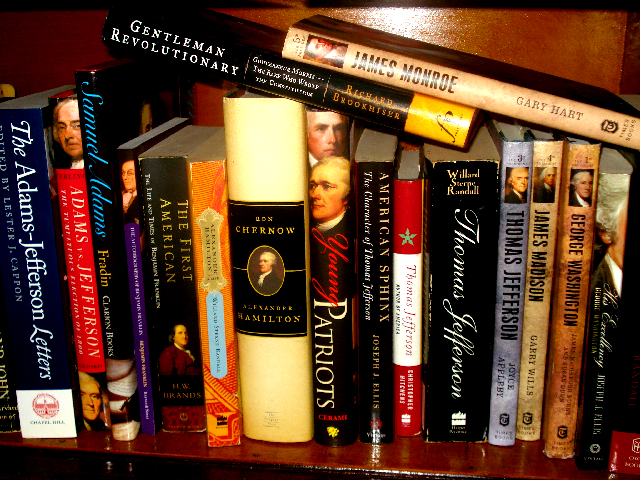

Only one more book will be added to this collection - when it is published in May. And then forevermore there will be silence. It makes me sad.
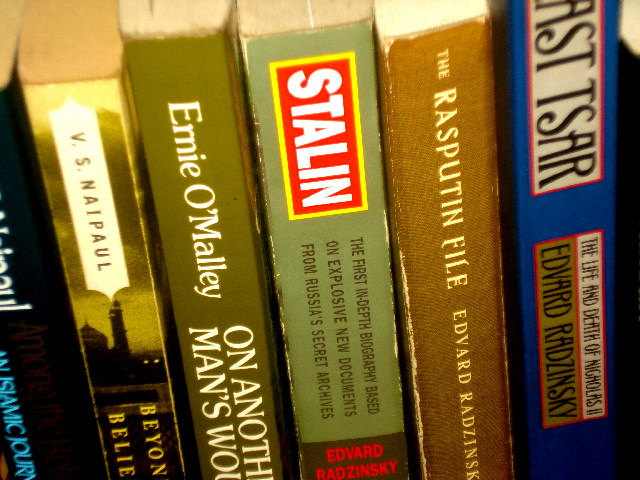

And of course I want to end with:
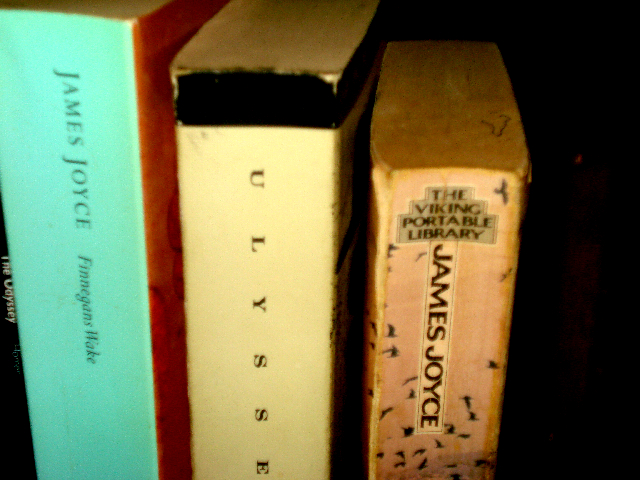
March 27, 2007
Ten Books I couldn't live without
Okay, so I got this dreadfully difficult question from Heather . But it originated here at Kaliana's - and the real fun is to click through and see what books show up on people's lists.
And just for ease's sake ... I am NOT going to include plays in this list.
This is HARD. But here goes.
1. Possession - by A.S. Byatt. Like Heather I have read this book probably 4 or 5 times - I just finished it yet again, and every time I come to it - I see different things, I relate to different aspects. As my life changes, as I grow older ... the book appears to take on deeper meanings - I fluctuate between sympathy for Roland, for Christabel, for Val, for poor Ellen Ash, for Maud ... depending on my mood, or where I am at in my life. Also, and this is a deeper comment: This is a book about intellectuals having love affairs. The cerebral mixed with the primal. This is something that strikes a very intense chord in me ... a problem that has come up in my life repeatedly, because of who I am, and because of my emotional makeup - a fiery mix of brains and passion. Tough for anybody to handle. How will it work? How will I find my way, find peace? My intellectual side is rigid, hard-working, and can be very inflexible. I will not "tone it down" to make others feel comfortable around me. I've been asked (outright, and also subliminally) to "tone it down" and the price (for me) is too great. It's too much of a betrayal. And yet I do not lack feelings, I am not cold ... Maud's struggle in the book with "letting her hair down", her resistance to love, her fear of having her boundaries melded with somebody else's, is my eternal struggle. I have never ever read a better prolonged study of the issues a woman like myself has when she falls in love. It's very specific. There isn't anything generic about a love affair - and yet most books do not tackle it from Byatt's angle. Not only did I love the story, but I felt validated and vindicated by it. It's something I go to again and again, sometimes searchingly, sometimes just with the knowledge that I will be able to lose myself in it ... and sometimes with trepidation. The truths revealed in this book are only live-able to me when I am in a good head-space, and dealing with myself openly. If I'm trying to "hide" (in the same way that Maud hides) - then the book rebukes me. I can't think of too many other books that maintain such a vibrant presence in my life. It cannot be replaced.
2. Ring of Endless Light - by Madeleine L'Engle I love all of her books but for some reason - if I had to choose? If I HAD to? This is the one I feel I would "need". That's the word that comes up. I need this book. I needed it from the first moment I read it - years ago. It has been there for me in really dark times. I have looked to it still, for inspiration, strength. I first read it when I was 19, 20 ... And it's funny ... but I still feel the same way about it. Extraordinary.
3. Lives of the Saints - by Nancy Lemann Who can say why some books get into our psyche and others do not? This is a slim novel, a first novel ... it is about nothing except an aimless post-college girl living in her home town of New Orleans, having wacky adventures, and loving a man who is gin-soaked and hilarious and tragic. I must get going with my 'daily book excerpt' thing again so that I can get into my adult fiction, which will be a lot of fun - damn that Lucy Maud for writing so much! Since I first read Lives of the Saints (and I remember picking it out, at random) - I have read her other books (and there aren't many) - and while I adore Sportsman's Paradise and Fiery Pantheon (not too wacky about Malaise) ... my heart belongs to Lives of the Saints. Why do I love it? God, let me see. First of all, it is laugh out loud funny. For a good summer after I read Lives of the Saints I found myself writing like her, imitating her. I love her style. It is eccentric, witty ... i remember reading it out loud to my boyfriend at the time and he would just GUFFAW. But then it turns around and stabs you in the heart, with sentimentality, sudden pain, loss so intense it takes your breath away. A true Southern novel - with that air of eccentricity and hilarity. GREAT characters, so so funny. Claude Collier - the main guy in the book - was the context through which I saw M., that first crazy summer I met him. M. was just as nuts as Claude, just as hard to pin down ... I could see a more conventionally minded girl being driven out of her cotton-pickin' mind by M. - and somehow ... Claude, and the spectacle of Claude, helped me deal with M. But all of this is just words. I love the books of Nancy Lemann and this one is one I go back to over and over and over. I love her sensibility. And more importantly: she is the type of writer who inspires me to keep writing. Here's an excerpt.

4. Moby Dick - by Herman Melville I wrote a little bit about what it was like to re-read Moby Dick on my own - as opposed to being forced to read it in high school - here. This book makes my heart pound faster. Every damn word is good. It's an overwhelming experience ... it's gluttonous ... because Melville is so spectacular, sentence after sentence after sentence ... You want him to take a break and be MEDIOCRE for just a page or two so that you, the reader, can not feel so inadequate. I read the book in high school but I didn't really READ it until 2001 - and my experience of reading that book was excitement. And also: growth. The chapter about "The Blanket" touched me on such a profound level that I can honestly say my mind-set slightly shifted after reading it. How would I approach life, how would I protect myself and yet also remain open and alive ... these were questions I was truly grappling with in the early months of 2001, a generally terrible time for me. And I read that chapter - and it landed within me so hard that I felt like I plummeted through the floor with the impact. A book that can do that is a book I want to have around.
5. The Dead - by James Joyce. Now this was a really tough choice. But if I look deep in my heart, I realize that the thought of never being able to read the short story "The Dead" again actually causes me pain.

6. Hopeful Monsters - by Nicholas Mosley Crap, I keep saying I'm going to write about this book but it feels too huge. This book, when I read it, explained me to myself. It felt like my own system of beliefs - which are erratic, and yet make perfect sense to me - had been written down. It's an intellectual feast, a 20th century romp through politics and science ... I honestly don't know how to write about this book coherently. If my soul could take the form of a book - it would be Hopeful Monsters - which is really funny because "soul" sounds like such a mushy rainbow-y girlie word - and this book is stringently intellectual, full of piercing questions with no answers - pondering contemplative intellectual hypotheses, cameos by Heisenberg and Einstein and others ... so it's a funny book to attach the word "soul" to. But that's part of Mosley's point. One of my favorite books ever written. Can't live without it.
7. Catch 22 - by Joseph Heller One of the greatest books ever. Talk about having every sentence be brilliant and funny ... seriously, how can one author sustain a ba-dum-ching energy through that long of a book? I came to it late, despite the insistence of pretty much my entire family - all of whom are Catch-22 FREAKS OF NATURE. And within the first 2 pages I was hooked. This book is like crack. Not that I do crack. But if I did, I bet it would feel a little bit like reading Catch 22. I mean, come on. Chief White Halfoat? Is there a funnier character? Major Major Major Major? I love them all. Crack.

8. The Pigman - by Paul Zindel. I'm not sure, and don't quote me on this - but this might be my favorite book ever written. It's certainly in the eternal top 5 ... in the same way that Empire Strikes Back is, on my movie list. It might not always be number 1 - but it NEVER falls far from it. I first read this book at age 13. I still read it about once a year today. It's strangely connected, in my mind, now, with Sept. 11 - in a way that moves me profoundly. Strange what one remembers, the connections one makes. It's in my life - always. I babble about this book here.

9. Mating - by Norman Rush. Like Possession, like Goldbug variations, like Hopeful Monsters - this is a book that takes as its topic the intellectual component of falling in love. This is something that resonates with me ... and also is something that is rarely discussed, or talked about in books. Mating is all about that. I can't really add to my feelings about the book. I love it fiercely. And the section about Victoria Falls is something I refer to, over and over and over again. I never EVER get tired of it. I remember when I first read that section, thinking: "Okay. I'm hooked. I love this book now." Put a fork in Sheila. She's done. I've actually started to re-read it again. Every time I read it, I see something new, I get something new out of it. This, to me, is the mark of a true classic. I can re-visit it and it seems like the BOOK has changed - only no, it's just me.

10. Emily Climbs - by L.M. Montgomery I know, strange ... it's the second book in the series - but there's just something about it. Every part of it - the journal entries, the different episodes that have become almost mythic to me: Emily being trapped in the church, Ruth Dutton, Emily and Ilse sleeping in the haystack, Emily's second sight, Emily walking home to New Moon in a rage ... I think Lucy Maud is truly at her best in this book. I just lose myself in it every time I pick it up. Like I said at the beginning of this post, it is HARD to choose ... How can I leave off Tangled Web? Or Anne of the Island?? But for now - right in this moment - I feel that I cannot bear to be parted from Emily Climbs.
March 18, 2007
The Dead Fathers Club
Emily sent me a copy of the novel The Dead Fathers Club. I started it yesterday and am already a quarter of the way through. I dare anyone to pick up this book, read the first chapter, and then put the book down without finding out what happens. NOT POSSIBLE. Or if you do put the book down, there is something seriously wrong with you.
It's so good!! I love so-called Young Adult novels anyway - it's my favorite genre (if they're well-written).
This book is written from the perspective of an 11 year old British boy named Philip. Philip's father just died in a car crash, and the book opens with Philip seeing his Dad's Ghost at the funeral. The Dad, unlike other book-ghosts, is not benevolent, loving, nostalgic. No. He is sad, tormented, and needs his son to know that the car accident was actually NOT an accident. And he needs his son to take revenge. His 11 year old boy. There's a Hamlet-ish feel to all of this ... and I have no idea what is going to happen - but I already can't put it down. Naturally, Philip's school starts to get worried about him - because he sometimes is seen talking to nobody (he's actually talking to his Dad's Ghost) - and he's put into counseling - and he's furious at his uncle who appears to already be making the moves on his mother ...
Here's an excerpt. I am just in love with the voice of this book. It's perfect. Philip and his class go on a field trip, a sleep-over field trip ... and Philip's Dad's Ghost follows along. The shit has already started to hit the fan. Philip threw his dinner across the room because he was in such a rage at the encroachment of his uncle. And now the whole school knows about it, and how he broke a window ... and all the kids start teasing him, etc.
I love when he chooses to use all-caps. It's awesome. Like "POT" below.
Excerpt from The Dead Fathers Club, by Matt Haig
Mr. Rosen is a nice Teacher with hairy hands and a good watch but he is strict. He sometimes shouts an dgets a big neck like the Incredible Hulk but his neck goes red and a bit blue but not green and when he shouts little bits of spit jump out of his mouth like they are scared of his voice.But he was being very nice to me and saying There is no shame in walking in your sleep Philip.
He told me about when he was my age and he walked in his sleep into his sisters bedroom and picked up a book and waited by her bed. He said I was dreaming I was in a library.
I laughed but I knew really it wasn't as bad as smashing a window and I think he knew as well.
And then Mr Rosen went quiet and I looked out of the window and there were drops of rain on the glass like little worlds and outside there was grass and rocks and sheep and it was all hills and I wondered if Dads Ghost was here he would be able to see all the ghosts of murdered Romans. And I wondered if Emperor Hadrian was murdered and if he ever comes back to see what is left of the wall and if he gets sad when he sees just lumps of stone in the ground with grass growing over them and a few people walking with maps and looking at them and wanting to go home.
We went to a place with other Roman buildings and they were built in 130 AD which was eight years after when they started building Hadrians Wall which was 122 AD.
We had plans of the buildings and there were kitchens and toilets and bedrooms but you couldnt tell that from the stones in the ground only from the plans. And Mrs Fell and Mr Rosen were talking all about it but I wasn't really listening I was feeling weird like my body was just air and nothing was real and my heart wasn't beating like normal. It wasn't going beatbeat beat-beat beatbeat it was going beat beatbeat beat beatbeatbeat for a little bit which made me think I was going to die but then it stopped doing it so I didn't tell anyone.
At the meal there was black beefburgers which were thin and chewy like shoes and more mashed potatoes from the big POT.
And then there was a disco which was really just Mrs Fells CD player she had brought from home. She played some music and it was Beyonce and all the girls danced but none of the boys danced except where there was rapping. And Mr Rosen danced like Dad used to which was like a bird which couldnt fly but Mrs Fell could dance well and she was wearing Make Up and green round her eyes which sounds weird but it was nice. I must have been looking a long time because she saw me looking and she waved her arms for me to come and dance and she was dancing with Charlotte Ward and a circle of girls and Mr Rosen so I didnt want to come. But Mrs Fell never stops so she came over and took my hand and pulled me up to dance and Jordan was giggling at me and the giggle spread out like fire to Dominic and even Siraj who used to be my friend before Dad died.
Mrs Fell said Come on Philip. Come and dance.
I said I I I
Mrs Fell said Come on.
And then all the boys were laughing but Mrs Fell couldn't hear and she took me to the circle of girls dancing and my heart started going funny again. I danced but I didnt want to because it was a girl song about boys and all the boys were staring and nudging and my face was burning HOT.
Mrs Fell was only being nice because she thought I was on my own but sometimes being nice is as bad as being horrible. And so I danced without moving very much just my arms a little bit and it was bad and I just kept seeing the faces of everyone and Mr Rosen was flapping his wings and smiling at me and I wished he was cross with me and didnt give me special treatment.
Mr Rosen said All right Philip?
I said Yes.
And after 100 minutes the song ended and I sat down near the boys but not with them. A song came on which I used to like before Dad died and it sounded horrible and stupid now like robots. And when it was on Dominic and Jamie Western and Jordan did a press up competition and Dominic won.
I looked at Mrs Fell and I think I had upset her because she was dancing the same but not smiling now and I felt bad for upsetting her.
March 12, 2007
"Word came today"
This post made me cry - it's a swept-away and yet articulate response to Richard Powers' Goldbug Variations It brought me back to my own experience reading that extraordinary book ... and how blown away I was (and still am) by it. I've never written about Goldbug Variations because ... I find the prospect daunting, I guess. Where to start?? The same with Hopeful Monsters - a book that means more to me almost than any other. I can't seem to bring myself to write about it. The last big book on my personal-fave list (and I always think of these three together) is Mating - and that one I DID manage to write about. In a frenzy. I find some books hard to talk about. Because not only are they a good story, a good book - but they are sometimes like angels, come into my life at the perfect reason, to help me struggle with a certain issue ... the books show up - These 3 books were like that. There was no reason for me to read them. I picked up Hopeful Monsters because I liked the cover art and the description of the plot on the back. I picked up Mating because the description of the plot on the back spoke to me. Nobody recommended it. I read it a couple years after it won the National Book Award. And I picked up Goldbug Variations for ... I have no idea why. But these three books - together - ended up being woven together into a rope, a strong rope - for me to hold onto - until the bad-ness passed. This was in the late 90s. Each book is dog-eared from re-readings. I love them as BOOKS, but I also love them as saviors. Goldbug Variations came at a time when I was ricocheting around in my own loss, and I had been for about a year. Everything was cold, I was always walking into the wind. Goldbug it was challenging, a real feat, it takes concentration - and it's an intellectual battle. But (as it so often is for me) - the intellect is PART of the passion. It's not either/or. I don't separate. And an intellectual love affair ... hmmmm ... what would that be like? I know exactly what it would be like, and it is the only kind of relationship possible for me. There is a hopelessness in that. A swoon of necessity, of self-knowledge. And in these 3 books I list here - I've seen such a relationship described, dissected, analyzed. (Possession is another one, actually).
But alongside of (or woven into) the intellectual rigor of Goldbug Variations is this keening note of mourning, longing, bittersweet love ... Oh, how I know that. I know it better than anything else.
He feels a strange euphoria, an overwhelming sense of inevitability. The thing about to make its grand entrance surprises him by its uncanny familiarity.-- Richard Powers, Goldbug Variations
"Are you waiting for someone?" he asked. It was the first time he had spoken to me, ever.
I didn't say what I wanted to say, which was, "Yeah. You." Instead, I smiled up at him, strange how familiar he seemed, uncanny familiarity, and said merely, "Yeah."
I still haven't written about Goldbug Variations. I still don't feel ready.
Here's the link again to the post that started off my brain a-spiralling. Thinking about that book makes my heart pound faster.
March 8, 2007
Overwhelming book deliveries
The Amazon logo smiling at me repeatedly. Something about unwrapping books makes my heartbeat quicken. I just don't even know where to begin.
I finished Blue Blood - the book by Edward Conlon, NYC detective and Harvard graduate. Dude can write. Thought the book was about 3 chapters too long. At the end, we have his experience at the landfill on Staten Island, post 9/11 - which was one of the more horrifying and disgusting things I have ever read - but riveting - so glad I read it - it's just that there were maybe 3 extraneous chapters floating around BEFORE that. But still. LOVE his writing and I will definitely keep an eye out for more of his work.
I also finally finished Imperial Grunts by Robert Kaplan - a book I had started about a year ago, put down - and now finished, in a frenzy, staying up late to polish it off. He's great. I look forward to the other books in the series he's planning and working on now.
But now books are arriving - either as gifts (thank you!!) or from stuff I bought in a fit of celebration last week - having come out of a brief rough spot - thankfully brief .... but harsh nonetheless. I needed books to get me through. Or - not even the books themselves - just the prospects of the books. And Rocky, of course. Rocky helped get me through. But that's a given at this point. I had forgotten, though, that I had had a book-buying binge, even though it was only a couple weeks ago. A lot of times I don't remember much of what goes on during the "rough spots" and this was no exception. Even 2 days later, the awfulness started to fade and mist into memory.
But now they are arriving.
Fun!!!
First of all - Tennessee Williams' notebooks. Holy freakin' crap - it's gotta be 1000 pages long - brand-new published - and ... I flipped through it last night, astonished first of all at how gorgeous the book itself is - but also how beautifully it is put together. On the right hand side of the page - we have the entries in Williams' notebooks - and on the left hadn side - we have corresponding notes. So that means you don't have to flip back and forth endlessly for the footnotes. It's amazing - we see his postcards, his photos ... I haven't even started reading it yet, and just looking at it is giving me a heart attack.
I got 3 more Library of America books ... I already have many (American Poetry, Willa Cather, Eudora Welty, William Faulkner - those are all from my dad) - and I also have Jefferson: Writings. But over the last 3 days more have arrived: Hamilton: Writings (there will, naturally, be some redundancy with the rest of my Hamilton collection, but that's okay) - the speeches of Abraham Lincoln (2nd volume - from 1859 - 1865 - and also the Library of America collection of writings during the Constitutional Congress of 1787. Letters written home, minutes kept, speeches ...
I feel actually a little nauseous thinking about how much I already love these books.
I have also been slowly but surely collecting each book in the American Presidents Series, edited by the late Arthur Schlesinger - and they're quite wonderful - written by all different people - I've very much enjoyed the ones I've already read. They're cheap, and usually about 150 pages long, maybe less - a quick read - and it focuses purely on the presidency of the individual. You get maybe 2 chapters of lead-in - but the rest is all about what went on during the presidency. So far I've read the one on James Madison and Thomas Jefferson - and over the past week I received 3 more to add to my collection: George Washington and John Adams and John Quincy Adams. But I will someday have them all - see if I won't!!
I also received the book Final Cut which I have always wanted to read - it's one of my favorite kinds of books: how certain films become notorious disasters. It's interesting to read books like "The Making of Casablanca" - to hear how things become hits - but sometimes it's more interesting to learn from the debacles. Like Devil's Candy - about the making of Bonfire of the Vanities which is one of the best books about Hollywood I've ever read. Anyway, I've wanted to read Final Cut for a while - it tells the story of Heaven's Gate - a movie directed by Michael Cimino which - like the words "Ishtar" or "Waterworld" has come to be shorthand for: 'HUGE FUCKING MESS'. Heaven's Gate is often seen as the granddaddy of all messes - and this book is written by one of the producers on the film. I can't wait to read it. Which, judging from my To be Read pile, will be sometime around 2015.
Oh, and also I got the "baseball anthology" in the Library of America - and I am almost more excited about that one than all the others. Classic American baseball writing since the beginning of the sport? Please count me in. Now.
I received a MASSIVE biography of Alexis de Toqueville - from an absent friend across the Atlantic (I miss you!!) - like seriously - it is HUGE - and gorgeous, beautiful typeface, very readable - and it's a guy I know almost nothing about, although I have read his book about America. So I'm very excited to read that, too. In 2023, which is when I will get to it.
Let's see. What else.
Oh yeah - a book about Theo Van Gogh - and also the novel Perfume: Story of a Murderer - which I've been dying to read, but just keep forgetting about. So now it has arrived.
I know there's more.
Some people go shoe-shopping when they get the blues. (Although what I had could not be called the blues. It was more like a crisis.) Shoes don't do it for me, although I love them as well. Books bring on the adrenaline, the pheromones, the energy, the pulse quickening. They bring life. Life to the spirit, yet again.
February 28, 2007
Childhood books!!
List 5 books that played an important role in your childhood and explain why
Dan tagged me! Eons ago and I'm just getting it now because my trackback functionality basically doesn't exist. And to everyone out there - consider yourself tagged, if you want to play along. I always LOVE to hear about people's favorite childhood books. I love to see how we (at least people in my generation) overlap ... but then it's cool also to see the ones that span generations ... and also to encounter titles I've never heard of, but which mean a lot to somebody else. I love it. I love Dan's memories about his books. Very cool.
My first response to the "meme" is - only 5??
List 5 books that played an important role in your childhood and explain why
Harriet the Spy - by Louise Fitzhugh. This is probably my most favorite book ever written. Period. I love it because of the long-lasting impact it had on me - but I also just love it because it's so damn good, and she's such a good writer - and all of those characters literally live on in my brain. I wrote a whole post about Harriet. (And also here's an excerpt from it)
Charlotte's Web - by EB White. I cannot discuss this book rationally or with any distance. I read it to tatters. I think it was read to our class in 3rd grade, and from the very first sentence (which I still can recite from memory - anyone else know it?? Come on. Give it up if you know it.) And then there's the last paragraph of the book which I cannot even think about without getting tears in my eyes. One of the best books ever written.
Ballet Shoes by Noel Streatfield - and part of a series of books with different heroines (Theatre Shoes, Dancing Shoes, etc.) They were all books about little girls who ended up being very good at something - ballet, tennis, etc. They were always English, and for the most part - the environment of the books was grim either pre-World War II or post-war England. (Ballet Shoes was published in 1937, a grim time indeed). And that atmosphere is in the books, although the focus is on the ballet school. It's a dark time, hard times, penny-pinching times. This sounds so pedantic and so stupid but these books are really quite wonderful - Ballet Shoes, in particular. It was made into a Masterpiece Theatre mini-series which (holy crap) I just found on Netflix and ordered! It won an Emmy at the time and I remember loving the series - I approved of their adaptation of my favorite book, basically. Haha, I was 9 years old, saying ponderously, "Yup. That's okay by me."
Ballet Shoes is about three orphan girls - unrelated - Pauline, Petrova, and Posy - who were adopted - not by a married couple but by an unmarried woman who takes them in. Times are so tough, and money is so short - that it is suggested that perhaps the girls should be enrolled in the school of dramatic arts in London - get their "licenses" and start working as child actors - to make a bit of money. Posy ends up being what they would call a genius ballerina at the age of 9 years old. A Margot Fonteyn in the making. This book was not just a book to me, though. It was a guide-book. It was instructions to me, at age whatever, of how I wanted to live my life. This was going to be my life. It was a serious business. It is a craft to be studied - and there are options. Meaning: if you want to do this, you can. I was going to devote my life to my art. Just like Pauline, Petrova and Posy. I still own this book. Streatfield's a very good writer, too. I have probably made the book sound rather silly - but it's really about these 3 girls, and their anxieties about making money, about not being a "burden" on their adopted parent, about how to scrimp and save for audition dresses ... Meanwhile, it was a whole different world being presented to me as a kid. Galoshes, "macks", the Cromwell Road, streetcars, and organdy dresses ... not to mention the entire business of Theatre. I read Maurice Maeterlinck's The Blue Bird at age 10 because of Ballet Shoes. The girls were in a production of it. Marvelous world created. This is the best of the series. (Excerpt here)
A Wrinkle in Time - by Madeleine L'Engle L'Engle is one of my personal idols, and this book started it all. What a vision of the universe. I still can't live that truth on a day to day basis ... although dammit, I do my best. It is the goal, it is what I struggle to do. What a healing vision of what makes the whole operation tick, and how it works. The power of love. The strength of love. Evil exists, and it throws a black cloud over all of us ... but never underestimate how much love really matters. It is never irrelevant or meaningless. I share many of her views on tough topics - not all of them - but many of them (when she gets overly pious, I roll my eyes - because her writing gets yawningly boring then. I kind of get into it here - with her whole "sodomy" thing - where I feel she was, frankly, WAY out of her depth, as an author - and I rarely feel that about her.) By tough topics I mean, essentially, that I can't not believe in the goodness of people. And I won't let anyone take that from me - and they try! You have to WORK to remain optimistic, and faith-full, and to maintain a belief in redemption. You have to hold onto that shit because it drives people lnuts and they want to take it from you. I am not cynical. I hear all the weary "oh what is the world coming to" drivel from people, or "Oh, people are so much worse now than they were back in the golden days of my youth" and I seriously find that crap spiritually grating to listen to. Or not just grating - but almost dangerous. Like I need to protect my hope, my belief in people's goodness (thank you, Anne Frank) and that sort of weary hopeless cynicism goes against my core beliefs, and how I want to live my life. L'Engle has helped show me the way. Read her book about going back to the time of Noah (Many Waters - wonderful book). And all of those Biblical-era people come to life in that book- with the same loves and hopes and fears and biases and stubbornness as people now. It's a beautiful vision of a continuum of humanity.
And so I always read what she has to say, because I can guarantee - even if I disagree with it - it will be better written than most anything else out there. Her religious books are actually awesome - her Genesis trilogy is something I go to time and time again - but then she wrote a book about Christian art and I found the whole thing not just tiresome but also disgusting. I was disgusted by her views. Madeleine! My idol! Yup. However I read every repulsive word. That's a rare author.
Wrinkle in Time - her big "break" - isn't, I don't think, my favorite of her books. I would probably choose Ring of Endless Light as my favorite of all of her books - but Wrinkle in Time was my introduction to this marvelous thought-provoking creative author. This woman who really thinks about things, ponders them, feels them, goes there. Nothing about her is facile or easy. She is tough, and I love love love her for that. God, she's good. I cling to her work, at times. The vision that she articulates ... the grief and hope living side by side - the possibility of redemption, even here on earth - how you must never ever ever think that your love doesn't matter ... I find her stuff very very healing. I was only 10 when I read that book, but it made a lasting impression on how I see the world. (Excerpt here)
From the Mixed-up Files of Mrs. Basil E. Frankweiler - by EL Konigsburg. MAGIC. This was another one of those great books that feature kids with very little adult supervision, like Harriet. I loved that. They run away, and they camp out in the Metropolitan Museum in Manhattan (those illustrations!), hiding in the bathrooms until the janitorial staff leaves, and then they have the run of the entire place. They take baths in the fountain, and gather up the pennies dropped at the bottom, so that they have funds. Another one of those books that really challenged me as a kid. Remember the narrative voice of that book? That older woman, slyly knowing, with occasional asides to Saxonburg? The voice of this book suggested a whole other world. It did not pander to me because I was 9 years old. It figured I could handle it. And you know what? I could. Not only could I handle it - but I re-read this book recently and remembered certain passages almost word for word. (Excerpt here)
Little Women by Louisa May Alcott. Okay - I was young enough when I first read this book that I remember reading it out loud to my mother - or maybe to somebody else, and my mother overheard me - and Meg, at one point, says this line: "But I am afraid I don't!" And this was my first experience of a contraction, believe it or not. Or maybe I had seen one - but had never put it together - and I pronounced it wrong. I didn't get it. I didn't know what "don't" was, at least not written down - so I said "don't" as though it were "dahnt". I didn't get that it was "do not" shortened. That that's what that looked like. So I had to be very young. I remember my mother saying, "That should be 'don't' - which is really two words shortened into one. It's really saying 'do not'." And I completely remember this almost exhilarating shiver going over me ... it seemed so cool, like a secret password to another level of language, a trick, a key to some sort of code. "Don't" really means "do not". Wow! And you say it "doh-nt" not "dah-nt". Revelation. So I am thinking I had to be 7 or 8 when I read this book.
I can't even say I read Little Women. I lived it. I read it and read it and read it ... and then when I read it as a teenager of course I understood so much more, all the romantic nuances, etc. I will NEVER be reconciled to the stupid stuttering German - I always wanted her to be with Laurie - I believe we have covered this - and I know the arguments, I know that Laurie isn't really right for Jo ... but it was only later when I learned that Alcott was pressured to marry Jo, that SHE wanted Jo to be a "bachelor" - like Alcott was - but oh no no, that would not do. Jo must be domesticated! Knowing what Alcott's true desire was, in terms of that character, makes a lot of sense to me. I can't even count how many times I have read this book. And what's amazing about it is that the same scenes get me ... every single time. Waiting for Marmee to return when Beth is sick - and Laurie gives Jo wine to calm her down. When Beth is given the piano. (See? I have goosebumps just writing this down). When Amy falls through the ice - but more than that: when Jo sits by her sick bed afterwards, and torments herself about her terrible temper. I had a terrible temper as a child, and I still struggle with it. It's like I get tunnel vision in those moments, the feeling of threat is so huge, the feeling of rage so enormous. Marmee's advice to Jo in that one scene is advice I took to heart, too. When Jo bursts out crying after selling her hair and Meg, of course, Meg is the sister who would "get it". Meg knows. Meg has her little vanities, her girlishness ... and she doesn't think Jo is silly for mourning her hair. I love love love Meg in that scene. I can't even say what the book gave me, or why it's important. It just LIVES, and continues to do so. (Great conversation here about Louisa May Alcott. I love talking about these shared beloved books with others who love them. It's such a huge pleasure.)
The Diamond in the Window - by Jane Langton. What a book. It's about a brother and sister - Eleanor and Eddy, who live in Concord Massachusetts, with their crazy uncle and weary aunt (who are also brother and sister - neither of them married). The uncle is an Emerson freak - who has kind of lost his mind, he can no longer live by himself, and he kind of believes he IS Emerson. The aunt is the responsible one, giving piano lessons, worrying about money, and not living her own life, even though she is a young woman. One day, when looking up at their house, Eleanor and Eddy notice a window shaped like a keyhole up in the roof. A window they have never seen before even though they have always lived in that house. They do a bit of exploring and discover a secret room in the attic, filled with old treasures and a toy chest and 2 small single beds - but no one will explain what it means. It is an unmentionable topic. Something unspeakable occurred in the past, apparently ... and Eleanor and Eddy need to be shielded from it. Both of them start having dreams - dreams which become increasingly real (for example - Eleanor falls out of a tree in one of the dreams, and wakes up to find that she has a big bloody scratch on her arm). All of the famous characters of Concord show up in these dreams - as guideposts, clues, messages .... Emerson is there. Thoreau is a character. Louisa May Alcott comes into a dream as well. It is an extraordinary book. I loved it so much it almost made me nervous. It doesn't talk DOWN to kids. I LEARNED stuff when reading this book. The whole transcendentalist movement is mentioned extensively in the book - because Uncle Freddy wants to bring it back - to honor his heroes of days gone by. Fantastic. (Excerpt here.)
Crap. That's already more than 5.
January 30, 2007
Gluttonous ...
I feel gluttonous just LOOKING at this list of lists. Eventually I must do them all. Of course.
I'll do a quick pass-thru - but I definitely need to go into more detail. Some of these list ideas are SO fun.
Worst Books Ever, or Five Hours of My Life I'll Never Get Back
Definitely The Notebook by Nicholas Sparks. I didn't even last 5 hours. What a piece of shit.
Books I Have Lied About Reading
I once told someone I had read Cannery Row when I hadn't.
Books I Have Lied About Liking
Women Who Run with the Wolves. It just seemed easier to agree, rather than not. Grease the wheels of life, baby. Be nice.
Book-to-Movie Adaptations Where, Frankly, the Movie Was Better
Ordinary People (although the book is great, too)
I'll think more about this ...
Books I Used to Love, of Which I Am Now Ashamed
Hm. I'll have to think about that. I'm not ashamed of much.
Best Book Titles of All Time
I think Wrinkle in Time is one of the greatest book titles ever.
I'll have to really go into this one.
Books That I Expected to Be Dirtier
All DH Lawrence.
My Real Guilty-Pleasure Reads, and Not the Decoys I Talk About Openly
The Story of O.
Also all of Anne Rice's Sleeping Beauty books.
See? I'm not ashamed of much.
Books You Must Read Before You Die, but Would Rather Die Than Read
Remembrance of Things Past
Books I Refused to Read for a Long Time Because too Many (or the Wrong) People Recommended Them
The Shipping News comes to mind. Once I read it, I realized: Oh. THAT'S why everyone told me I had to read it.
Books I Read Only After Seeing the Movie
will come back to this ...
Books I Most Often Try to Persuade Other People to Read
I don't really do that anymore. Probably Ryzsard Kapuscinski's stuff.
But a couple of other recommendations come to mind. I recommend specific books to specific people. Like recommending the Lindbergh biography to Allison. It's huge, it's exhaustive - I knew she would LOVE it. But I wouldn't recommend that to everyone. So it's not general
Authors I Wish Had Written More Books Already
Ryzsard Kapucinsky. sniff sniff
And, believe it or not, Madeleine L'Engle. She's written like 80 books but I still want more.
I'll come back to this one.
Overused Plot Points That Drive Me Nuts
needs more thought
Books in Which I Liked the Secondary Characters Better Than the Main Character, or Books in Which I Wanted to Beat the Main Character Senseless with a Tire Iron
hahahaha This is a great question. I'll come back to it
Books I Lied About Reading and Then Wrote an A+ Term Paper On
Genius. Well, the whole Country Wife nonsense in college comes to mind ... a story which I have yet to tell on this blog.
Books I Lied About Reading/Liking Solely to Look Smart/Pretentious
I don't really do that.
Books I Wish I Hadn't Finished, or Worst. Ending. Ever.
Hmm. Not sure I understand this one. I'll think more upon it.
Books I Read after Oprah Recommended Them
I don't really do that.
Books I Will Never Read Precisely Because Oprah Recommends Them
Ha. Nope, I don't do that either. She's chosen some great books.
Literary Characters I've Developed Crushes On
Mr. Darcy from Pride and Prejudice
Claude Collier (from Lives of the Saints - pitter PAT!
Cal from East of Eden
John from The Pigman
Books I Only Read to Impress Other People
I don't really do that.
Best Books Not to Read from Start to Finish, or Best Bathroom Books
David Thomson's Encyclopedia of Film. Best bathroom book ever.
Books I Shouldn't Admit Made Me Cry Like a Baby
I rarely cry reading books. The ones that have made me cry I freely admit. No shame.
Books I Only Read for the Title
good question. I will come back to it.
Books I Re-Read When I Have Nothing Else to Read
Possession. I'm re-reading that right now.
I also re-read Margaret Atwood's short stories.
I read Robert Kaplan when I've got nothing else to read.
And all Nancy Lemann books
Books People Keep Recommending That, Frankly, Sucked Ass
I read Nicholas Sparks' The Notebook on a recommendation (from a good friend) and I am serious when I say: I NEVER took a book recommendation from him again. I also didn't tell him how I felt about it - because why do that?
Books My Teacher Made Me Read That I Really, Really Liked
Tale of 2 Cities - in high school
Also The Pigman in 8th grade - and all of Robert Cormier's stuff. I still love those books.
Books My Teacher Made Me read That Made Me Question the Value of My Education
awesome one. I'll come back to that.
Books That Made Me Want to Have Sex with at Least One Character
I definitely would like to have sex with Mr. Darcy
Also Bud White in LA Confidential
What was the name of the young man in Atonement? Robbie? I should put him on the list too, probably.
Books I Actually Read but Got a Poorer Grade on the Paper I Wrote on the Subject Than My Best Friend Who Did Not Read the Book
Oh God, I have so many of these. It used to drive me INSANE. I'll come up with some examples.
Books I Read Because the Author Looked Hot
Huh?
Books I've Read Aloud
I read aloud a lot. Possession is a great read-out-loud book due to all of the different voices and poets and excerpts - I find that really fun. But I read out loud all the time ... it relaxes me.
Books I Love Even Though the Last Twenty Pages Made No Damn Sense
Books I Have Written a Prequel/Sequel to in My Own Head
Beautiful question ... i'll come back to it
Books I Keep Meaning to Read, but Then I See Something Shiny
well, that was the point of the whole From the Stacks challenge - which I completed in December! Stop getting distyracted! Read those books you already have on the stacks!
Books I Will Go to the Mattresses for, Even Though I Hate the Writer
I'll go to the mattress for a lot of things. I'll go to the mattress against censorship, against whiny anti-intellectual commentary (usually incorporating the word "latte" as though that is some kind of shorthand that we all can understand. Here's a hint: You look lazy when you use it too much. You look like an asshole. What the hell is wrong with "latte"? Unless you want to live in an echo chamber where everybody nods, and snickers about "latte" - and who knows, maybe you do - then you need to realize that that big huge CHIP you have on your shoulder about a certain kind of coffee drink makes me tune you out.) And maybe you don't care about having people listen to you. So be it. Just tellin' ya what it looks like over here. So writers who are attacked for THESE types of reasons ... as opposed to their books? I don't care WHAT they wrote. I'm sticking up for them.
Books You Must Read Because You Must Mock
I don't do that. Waste of time
Worst How-To Books Ever
I can't answer that on the grounds that I will incriminate myself
Books That Were on the 'To Be Read' List the Longest
War and Peace has been on my "to be read" list since the late 1980s.
Books I Hated Having to Read in School, But Love Now
Oh, I adore this question. Moby Dick is the first one. Tess of the D'urbevilles is another.
Books Whose References Have Worked Their Way into My Household Lexicon
Lives of the Saints by Nancy Lemann has definitely influenced how I talk. I should write more about that.
Books I've Never Read But Have Read the Cliffnotes Version
Oh. The Country Wife. That's a play. It's also a story I have never told on this blog. But I will someday.
Books I've Read Because I Liked Their Cover Design/Font
Hopeful Monsters by Nicholas Mosley - which is so scary because it is now one of my favorite books ever ... and I picked it up cause I liked the COVER DESIGN. Horrible to imagine not encountering that book.
Books Which, When It Comes Right Down to It, I Would Have No Problem Burning
Ha! Well - I have principles, you know. I stand by them. I despise Fred Phelps, but I wouldn't burn his books. If he wrote one. Which I highly doubt. I boycott publications, that's how I deal with it. I boycott magazines and online publications who publish the people I hate. And for me this is some sacrifice because ... well, a lot of them are good magazines. I don't BURN the magazines who publish these people. I just refuse to support them, with clicks, page views, or my hard-earned money.
Books Which I Read Only for the Sex Scenes
I think we covered this above.
Actually, too, there's a Ken Follett novel - and I'm not even sure what book it is - or why I read it ... but there's a sex scene in it which, I think, is one of the best ones I've ever read. Not for being sexy or anything - but for being REAL, and poignant ... It certainly sticks in my mind, whatever book it is. I'll check the title when I get home, I think I have it somewhere.
Books I Pretend to Like So People Won't Think I'm a Snob, or Books I Pretend to Like So I Won't Hurt Your Feelings
Now I never pretended to like The Notebook to make my friend feel better. I didn't say to him, "You LIKED that?" I would never do that. I was polite. I thanked him for the recommendation and left it at that. Actually, David and I were just laughing about this the other night. People (on the blog, not in my life) sometimes get defensive or kind of confrontational with me. I know it's out of insecurity, but whatever, it's tiresome. So someone will give a dig, like: "So do you not think Tom Clancy is a valid writer then?" They project a snobby attitude onto me ... for whatever reason that has nothing to do with me. Look. Here's the dealio. You don't make me read Nicholas Sparks and I won't force you to read Ulysses. But don't project your bullshit onto me. We got a deal? I read what I read because my tastes lead me that way.
Oh, and I think it's so hysterical that people think I'm a snob when two posts below this one I'm raving about how I can't wait to see Rhinestone.
Books with Covers So Embarrassing You Can't Read Them in Public
My friend Liz and I were laughing about this. She and I were talking about this book and dammit, now I can't remember the title ... it had something to do with "the domestic and the erotic" - it was a self-help book - but it sounded very VERY interesting - and Liz thought it was great, but she showed me the cover which had a fishnetted leg on it ... and it was very sexy looking ... and said she just could not read it on the train. She had to hide what she was reading. I actually want to read that book (whatever it was) but I would feel a bit embarrassed about just reading it openly on the subway.
Books You Are Sorry You Didn't Read Decades Ago
I'll think more on that.
See what I mean ... gluttonous. I can't even answer the questions properly.
January 23, 2007
Book questionnaire ...
Long hard FUN book meme - I got this from Carl V. (Oh, and I forgot to link to his wonderful Friday Favorites from last week. Magical!!)
I am WAY out of my league here but here we go!
Science Fiction, Fantasy or Horror?
Horror. Not a huge sci-fi fan. And fantasy? Does Madeleine L'Engle count? She's one of my favorite authors ever.
Hardback or Trade Paperback or Mass Market Paperback?
I'm a mass market paperback girl. Also - if I start a "collection" with one type of book then i want all the rest to be that same type. Like all my AS Byatts. The Vintage copies of her books are all beautiful - beautiful cover designs - and ... they just look so nice all together. So I wait, most often, for the paperback to come out ... instead of immediately buying the hardcover - because I just love the look of all the books together. I am also rather picky about typeface - I'm weird that way - I enjoy the Modern Library typeface, and the Vintage book typeface - but there's a copy of War and Peace that I hesitate to pick up because the typeface just ... it's too small and daunting. Weird. My copy of Ulysses is your basic Vintage edition - but I love the feel of the pages, the look of the type ... It was a very welcoming typeface. Barnes & Noble Classics is bad news, in general.
1. The typeface is ... muddy and ... blah. I don't like it.
2. I read their edition of Middlemarch and I stopped counting the typos there were so many.
ANNOYING. I will never buy another one of their books.
Heinlein or Asimov?
I'm not sure. I imagine Asimov but this ain't my genre. I got no street cred here so I won't fake it.
Amazon or Brick and Mortar?
I use Amazon.
Barnes & Noble or Borders?
Barnes & Noble is more convenient. I like Border's selection better. But in general I shop at Barnes & Noble. I have the membership card and stuff.
Hitchhiker or Discworld?
I am assuming that first one is Hitchhiker's Guide? I love that series. I don't know what Discworld is - so this is an easy choice. I first read the Hitchhiker books in high school - and I've read them repeatedly ever since. They're a blast.
Bookmark or Dogear?
Neither. Although I am VERY against turning the page down to show where you left off. DON'T do it if I lend you a book. It turns my stomach. (Anne Fadiman has a VERY funny essay in Ex Libris about people who leave the book turned down and open on the table, to save their spot. hahahahaha Same type of horror) I usually just close the book - and when I pick it up again I know exactly, to the sentence, where I've left off. If it's a good book, that is.
Magazine: Asimov?s Science Fiction or Fantasy & Science Fiction?
No idea.
Alphabetize by author Alphabetize by title or random?
I alphabetize by author, for the most part - but I keep my "genres" separate. And then if I have (for example) 500 Madeleine L'Engle books I will (as Ann Marie will attest) organize those books by publication date. So on my history bookshelf I go by author.
Who would alphabetize by title? How would you find anything that way?? Title-alphabetizers, please divulge the method behind your madness. I love hearing about how (and why) people organize their book collections.
Keep, Throw Away or Sell?
I keep a lot of books (obviously). I enjoy having a library. Where I can think: "Hm. What was that speech that so and so gave in 1776?" and I can go look up the speech in my "history of the US in speeches" book. I like having reference books around. And if I'm a fan of an author - then I need to have all their books - even if I dislike the books themselves. It haunts me. The fact that I am missing a couple of Margaret Atwoods haunts me ... they all need to be together.
But I do also sell my books. Not often - but there's a great second-hand bookstore in Hoboken where I sell them.
Year?s Best Science Fiction series (edited by Gardner Dozois) or Years Best SF series (edited by David G. Hartwell)?
No comprende. Any sci-fi fans want to answer??
Keep dustjacket or toss it?
Since I'm a paperback girl - the dustjacket is usually not an issue. However - I always keep the dustjacket of hardcovers. It only seems polite. And sometimes the covers are really cool.
Read with dustjacket or remove it?
Sometimes a dust jacket is annoying. So then I'll take it off. But for the most part, I'm cool with leaving the damn thing on.
Short story or novel?
I don't understand. Why choose? Silly.
Harry Potter or Lemony Snicket?
I love both. I cannot choose. Well, I suppose I should choose Harry Potter even though - in my opinion - the Lemony Snicket books, with their darkness and bleakness are way more in line with my actual temperament. But seriously - I am counting the days until the next Harry comes out. I can barely wait.
Stop reading when tired or at chapter breaks?
I'm with Carl. I read everywhere. I am accustomed to stopping whenever, wherever. When the bank teller is ready for me. When it's my bus stop. If I'm reading at home, though - I can't read lying down (I believe I wrote about that before) - because it's like my body immediately goes: SLEEP. when my body is horizontal.
?It was a dark and stormy night? or ?Once upon a time??
It was a dark and stormy night? because that's how Madeleine L'Engle opened Wrinkle in Time one of my favorite books ever.
Buy or Borrow?
Buy. No question.
Buying choice: Book Reviews, Recommendation or Browse?
Mostly book reviews and browsing. There are a couple of people I will take recommendations from - my sisters, my brother, Allison, Kate - a couple others ... but mostly it's from my own taste ("Ooh, a book is coming out called Who Killed Kirov??? Have to get THAT!" or "A new Jeanette Winterson is coming out ... have to get it.") - or browsing. I've found some awesome books by browsing. Hopeful Monsters by Nicholas Mosley is one of my favorite books EVER - and I picked that up because 1. I liked the description of the plotline but also 2. I loved the book cover (which is different than the one in the link there).
I shiver to think of not picking up that book. It was a total accident that I chose it. I think Mosley, with his fascination with accidents and coincidence, would be pleased.
Lewis or Tolkien?
CS Lewis. Love Tolkien, but not like Lewis.
Hard SF or Space Opera?
No idea!
Collection (short stories by the same author) or Anthology (short stories by different authors)?
Not really into anthologies. I do like to have short story collections of authors I love.
Hugo or Nebula?
To those of you out there who follow all of this - answer me: Will you read a book just because it won one of these awards? Is that enough to make you pick it up?
For example, I read every book that wins the Booker Prize. I've read some real stinkers that way - but man, I've read some really awesome books (The Bone People) that I never would have picked up otherwise.
Golden Age SF or New Wave SF?
Out of my depth. Buh-bye.
Tidy ending or Cliffhanger?
Well. Tidy. Atonement has a "tidy" ending - meaning it seems inevitable and right when you land upon it - but it is the most unhappy last paragraph of a book I have ever read. But it certainly is "tidy".
Possession (a book I love) has a perfectly "tidy" ending ... but, like Atonement, it leaves you with a gasp of pain ... of things not said ... things left undone ... and yet you know that there would be no other way to end that book. I love an ending like that, even if it's painful.
So I guess I'll go with "tidy".
Morning reading, Afternoon reading or Nighttime reading?
All of the above.
Standalone or Series?
I'm into stand alone books. I assume that this question is geared more towards sci-fi or fantasy fans - where series are much more of a common part of the genre itself - but from the books I like, I think that it is very hard to sustain a really meaningful series. The ones I love (L'Engle's "time series" - Harry Potter - the Narnia books) are the anomalies. I wish L'Engle would live forever so that she could keep writing about the Murry family. I have never once gotten sick of ANY of those people. Same with Harry Potter. That's rare - and it's a good writer who can keep that up. Let the characters grow ... but also have that recognition factor ... like you get to know these people. You are invested in them.
But in general - I must prefer "standalone" books. The Shipping News. Atonement. Michael Chabon's books. These are singular masterpieces. No need for sequels.
Urban fantasy or high fantasy?
I am not sure if Narnia counts here, or the Tolkien books. I guess I haven't read any "urban fantasy". So I can't write about it.
New or used?
I'm with Carl. I prefer new but I certainly buy used.
Favorite book of which nobody else has heard?
Hopeful Monsters by Nicholas Mosley.
Some day ... some day ... I will write a post about this book. And why I love it. And what I learn from it. And how many times I've read it. It's overwhelming to think about, though. This book really has brought me through a lot of tremendously rough moments. It's profound. It's fun. It's stimulating. I adore it.
I made my dad read it so HE'S heard of it.
The rest of the questions are all about "genre books" and I really have no way to answer any of them - but Carl is all OVER this stuff!
January 19, 2007
Gulliver's Travels
This was the third book I read in my "classics challenge". Here's the main page of the challenge - it's really fun to look through and see what everybody else is reading. Of course there is lots of overlap. The two books I have already read on my list of 5 were Frankenstein and Tale of 2 Cities.
I am pretty sure I read Gulliver's Travels in high school. I know I read A Modest Proposal. And over the last 5 years or so, I've gotten very into Swift's poetry (I put up some of it here in his birthday post - but there's a lot more out there, of course, if you're interested.) But I had never re-visited Gulliver's Travels until now. It's a lot of fun, ridiculous satire - (and like I said to Rob at one point - I wish the footnotes in my version of the book were more detailed about the political and social intricacies of the time - what Swift was satirizing and who. It was very topical. He does everything but name names. And you can tell he's speaking of somebody very specific - but my notes did not explain who/what/why. Kind of a disappointment). But besides the satire - it's just a great story, at times hysterically funny. I also think that Gulliver is a bit of a puff-puff. Meaning, he's kind of a snooty know it all. I love how he is constantly reminding us of his credentials. Paraphrasing: "I speak 10 languages so I was well equipped to converse with the natives." "I am highly skilled in all levels of surgery so the procedure was not difficult at all for one such as myself." It's kind of his version of the "I fancy myself" game I used to play with my boyfriend in days of yore. "I fancy myself something of a botanist and a linguist." "I fancy myself a bit of a tailor and a tinker." Like - Gulliver. You're a human being. It's okay if you don't know everything. Obviously this is all deliberate on Swift's part. It's TYPES that seem to enrage him. Officious hierarchical TYPES and institutions. The human race as a group? Sucks.
In 1725 Swift wrote in a letter to his friend (and fellow poet) Alexander Pope:
I have ever hated all nations, professions, and communities, and all my love is toward individuals: for instance, I hate the tribe of lawyers, but I love Counsellor Such-a-one and Judge Such-a-one: so with physicians - I will not speak of my own trade - soldiers, English, Scotch, French, and the rest. But principally I hate and detest that animal called man, although I heartily love John, Peter, Thomas, and so forth. This is the system upon which I have governed myself many years, but do not tell, and so I shall go on till I have done with them. I have got materials toward a treatise, proving the falsity of that definition animal rationale, and to show it would be only rationis capax. Upon this great foundation of misanthropy, though not in Timon's manner, the whole building of my Travels is erected; and I never will have peace of mind till all honest men are of my opinion. By consequence you are to embrace it immediately, and procure that all who deserve my esteem may do so too. The matter is so clear that it will admit of no dispute; nay, I will hold a hundred pounds that you and I agree in the point.
"Men are cruel, but man is kind" and all that.
Gulliver's Travels - in 4 parts - builds slowly to the last part -Gulliver's sojourns among the Yahoos and Houyhnhnms - where Swift really lets out all the hatred towards his own race. It's brutal - the most brutal of all of the parts of the book. Gulliver, after his time with the horse Houyhnhnms - and the human Yahoos (whom he finds abhorrent and disgusting) - comes home forever changed. The ending of the book suggests that Gulliver did not bounce back from this particular trip. He walks into his house - and instead of seeing his dear wife and kids - he instead sees disgusting Yahoos. He can't stand the sight or smell of them. He refuses to let them touch him, so gross does he find them. This is how the book ends. He throws in his lot with the horses, basically - seeing the rest of the human race as just another version of the nasty Yahoos (who he seems to describe as almost hyena-like - vultures - cackling horrible creatures who have never created anything, done anything of worth, who fight over trifles, who display their anuses - I'm tellin' ya - I have never read a book outside of erotic stories or books where the word "anus" appears so frequently!) Swift has been hiding his cards a bit up until that last part. He still seems to see the race as perhaps redeemable. The giants of the land of Brobdingnag are kind with him (although they do trot him out as a freak show attraction which bums him out, and the giant ladies make him lie down on their naked bosoms which completely grosses him out) - there are the people on the Flying Island - contemplative mathematicians - the least practical people in the world - and yet benign, not menacing, not selfish at ALL. But it is the last journey, when he is forced to explain to the master Houyhnhnm who puts him up - how the human race (at least England) comports itself - when he fully realizes how disgusting people are.
And from that one journey, Gulliver does not fully return. The change is irrevocable. He turns his back on his own kind, because he finally sees them for what they are. He loses his puff-puff "I am a learned great person" attitude - and cringes at the fact that he is, in essence, a Yahoo. And for that he must forever hang his head in shame.
Swift (in the voice of Gulliver) writes:
My reconcilement to the Yahoo-kind in general might not be so difficult, if they would be content with those vices and follies only which nature hath entitled them to. I am not in the least provoked at the sight of a lawyer, a pickpocket, a colonel, a fool, a lord, a gamester, a politician, a whore-master, a physician, an evidence, a suborner, an attorney, a traitor, or the like; this is all according to the due course of things; but when I behold a lump of deformity and diseases both in body and mind, smitten with pride, it immediately breaks all the measures of my patience; neither shall I be ever able to comprehend how such an animal and such a vice could tally together.
Compare this to one of his many descriptions of the Lilliputians (who win his admiration even though they keep him tied up for ages!):
The reader may please to observe, that in the last article for the recovery of my liberty the Emperor stipulates to allow me a quantity of meat and drink sufficient for the support of 1728 Lilliputians. Some time after, asking a friend at court how they came to fix on that determinate number, he told me that his Majesty's mathematicians, having taken the height of my body by the help of a quadrant, and finding it to exceed theirs in the proportion of twelve to one, they concluded from the similarity of their bodies, that mine must contain at least 1728 of theirs, and consequently would require as much food as was necessary to support that number of Lilliputians. By which the reader may conceive an idea of the ingenuity of that people, as well as the prudent and exact economy of so great a prince.
And here is the infamous urination scene - which ends up causing Gulliver so many problems later. He is banished from Lilliput - not JUST because of this, there are foreign policy issues as well with Blefescu (probably France, I would guess) - and they think Gulliver might be a spy or a traitor. When all he did was wade across the Channel and cut loose their boats! But anyway, later - when the Lilliputians have untied Gulliver (they still only allow him to take walks at certain times - mainly because the entire populace must be warned to stay indoors because an enormous giant will be walking about, and he might inadvertently crush them) - a fire breaks out in the Lilliputian Queen's apartments.
... I made a shift to get to the Palace without trampling on any of the people. I found they had already applied ladders to the walls of the apartment, and were well provided with buckets, but the water was at some distance. These buckets were about the size of a large thimble, and the poor people supplied me with them as fast as they could; but the flame was so violent that they did little good. I might easily have stifled it with my coat, which I unfortunately left behind me for haste, and came away only in my leathern jerkin. The case seemed wholly desperate and deplorable; and this magnificent palace would have infallibly been burnt to the ground, if, by a presence of mind, unusual to me, I had not suddenly thought of an expedient. I had the evening before drunk plentifully of a most delicious wine, called glimigrim (the Blefuscudians call it flunec, but ours is esteemed the better sort) which is very diuretic. By the luckiest chance in the world, I had not discharged myself of any part of it. The heat I had contracted by coming very near the flames, and by labouring to quench them, made the white wine begin to operate by urine; which I voided in such a quantity, and applied so well to the proper places, that in three minutes the fire was wholly extinguished, and the rest of that noble pile, which had cost so many ages in erecting, preserved from destruction.
Ew.
But more than "ew" - of all of the angry passages in the book (openly angry, I mean, more obviously angry) - this one, to me, seems the angriest. It's not even angry. It's raging.
For me, I like it when the book gets angry. I do like all of his adventures, and I love Swift's imagination - but I'm in it for the satire, I'm in it for the rage.
Of all of his travels, I most enjoyed Gulliver's sojourn on the Flying Island (Laputa) with all of the contemplative moony-eyed astronomers - who are so distracted by celestial thoughts and calculations that they cannot carry on their end of a conversation and so need to have servants bop them on the head on occasion, in order to signal, "Your turn to speak!" It is such a common problem - this total distraction of the residents - that there are actually gadgets designed just for this bopping-on-head purpose!
I observed here and there many in the habit of servants, with a blown bladder fastened like a flail to the end of a short stick, which they carried in their hands. In each bladder was a small quantity of dried pease, or little pebbles (as I was afterwards informed). With these bladders they now and then flapped the mouths and ears of those who stood near them, of which practice I could not then conceive the meaning; it seems the minds of these people are so taken up with intense speculations, that they neither can speak, nor attend to the discourses of others, without being roused by some external taction upon the organs of speech and hearing; for which reason those persons who are able to afford it always keep a flapper (the original term is climenole) in their family, as one of their domestics, nor ever walk abroad or make visits without him.
I love how eventually Gulliver becomes so used to this whole flapping thing that he mentions it quite casually. It's hysterical.
I also loved Swift's description of the huge magnet in the bottom of the flying island, and how it was used as a steering device. It was fantastical - and yet so well described that I knew exactly what he was talking about.
But when Swift takes the gloves off - that's when I get excited. I love anger. I love subversive literature. I love those who despise the status quo, those who are uppity trouble-makers. There's a lot of trouble to be made. There are a lot of things which are just assumed to be true by the majority of people ... and anyone who comes out and says, "I HATE this" is held in suspicion. Swift was one of those people (even though in many ways he was part of the establishment). But he couldn't help but see, with his laser eye, how horrible politics were, how stupid everybody was (for the most part), and really how awful people were - just look at how we treat each other. It is indefensible. Swift does not defend that which is indefensible. Love that about him.
One of the centerpieces of the book is when Gulliver sits down with the King of the giants - and tries to answer all of the King's questions about law/politics/society of the rest of the world. Swift is brilliant here. His pen is a sword. But it's swift, sure, and cunning. Sometimes you can't even tell that he IS cutting something. His enemy might never have known he has mortally wounded until his arm fell off - the slicing is that smooth and perfect. Swift often uses terms of praise and approbation - but in a way where you can tell he means the exact opposite. It's brutal.
For example:
When I had put an end to these long discourses, his Majesty in a sixth audience, consulting his notes, proposed many doubts, queries and objections, upon every article. He asked what methods were used to cultivate the minds and bodies of our young nobility, and in what kind of business they commonly spent the first and teachable part of their lives. What course was taken to supply that assembly when any noble family became extinct. What qualifications were necessary in those who were to be created new lords. Whether the humour of the prince, a sum of money to a court lady, or a prime minister, or a design of strengthening a party opposite to the public interest, ever happened to be motives in those advancements. What share of knowledge these lords had in the laws of their country, and how they came by it, so as to enable them to decide what properties of their fellow-subjects in the last resort. Whether they were always so free from avarice, partialities, or want, that a bribe, or some other sinister view, could have no place among them. Whether those holy lords I spoke of were always promoted to that rank upon account of their knowledge in religious matters, and the sanctity of their lives, had never been compliers with the time while they were common priests, or slavish prostitute chaplains to some nobleman, whose opinions they continued servilely to follow after they were admitted into that assembly.
Heh heh. Swift shows the absurdity of all of this by putting it all into the questions from the King. One can imagine contemporaries of Swift howling with laughter at the thought of trying to answer those questions in the affirmative ("Were those holy lords I spoke of were always promoted to that rank upon account of their knowledge in religious matters?" "HELL NO!" etc.) ... and through that now-you-see-it now-you-don't literary maneuver, Swift stabs his opponent in the heart. The thing is: you could hear some pompous blowhard (who had been pricked, naturally, by the implications of the satire) try to defend himself - and say, 'Well, but yes, it is always more complicated than you would think ..." and it is THAT kind of person that Swift finds most disgusting. The ones with pride. The ones who have something to lose, the ones who choose to defend the indefensible. The rot goes to the deepest levels of society. If you try to deny it, you are Swift's enemy.
More from the observant (and yet baffled - that's Swift's genius here - the bafflement) giant king:
He was perfectly astonished with the historical account I gave him of our affairs during the last century, protesting it was only a heap of conspiracies, rebellions, murders, massacres, revolutions, banishments, the very worst effects that avarice, faction, hypocrisy, perfidiousness, cruelty, rage, madness, hatred, envy, lust, malice or ambition could produce.
hahahaha He puts it all into the mouth of the king. Not Gulliver. Perfect.
And I loved this bit:
He said, he knew no reason, why those who entertain opinions prejudicial to the public, should be obliged to change, or should not be obliged to conceal them. And as it was tyranny in any government to require the first, so it was weakness not to enforce the second: for a man may be allowed to keep poisons in his closet, but not to vend them about for cordials.
Really fun book. A feast for the mind, you know? That's how it felt. Also, funny funny funny.
January 12, 2007
How to read when you're an itsy-bitsy midget
... and the books are huge:
From Gulliver's Travels:
They have had the art of printing, as well as the Chinese, time out of mind. But their libraries are not very large; for that of the King's, which is reckoned the biggest, doth not amount to above a thousand volumes, placed in a gallery of twelve hundred foot long, from whence I had the liberty to borrow what books I pleased. The Queen's joiner had contrived in one of Glumdalclitch's rooms a kind of wooden machine five and twenty foot high, formed like a standing ladder; the steps were each fifty foot long. It was indeed a moveable pair of stairs, the lowest end placed at ten foot distance from the wall of the chamber. The book I had a mind to read was put up leaning against the wall. I first mounted to the upper step of the ladder, and turning my face towards the book, began at the top of the page, and so walking to the right and left about eight or ten paces, according to the length of the lines, till I had gotten a little below the level of my eyes, and then descending gradually till I came to the bottom; after which I mounted again, and began the other page in the same manner, and so turned over the leaf, which I could easily do with both my hands, for it was as thick and stiff as a pasteboard, and in the largest folios not above eighteen or twenty foot long.
I can just so picture that.
I'm having so much fun reading this book right now. I'll post more excerpts when I'm done. The chapters where Gulliver describes the government of his own country to the giant King - and the King shows absolute horror at how barbaric they are - especially in regards to politics - and Gulliver has actually felt, in his life, that his own kingdom of England is the most enlightened on the planet ... well, you can see what Swift is getting at there. The chapters are vicious. Vicious satire.
Gulliver has almost escaped from Brobdingnag now. His floating box in the ocean has been rescued by a ship.
Then I'll be on to his third voyage, in Part III of the book.
January 5, 2007
Books!!
I got this from the wonderful Stefanie.
Books you’ve been planning to read for ages
a biography of Queen Elizabeth (you know, as in the Virgin Queen). I don't care which one but I need it to be good (Lisa?? Recommendations?). I have been meaning to read a biography on her since ... 1991? i don't know - forever - I just have never gotten around to it.
Books you’ve been hunting for years without success
I tracked down Summer Sleigh Ride and that is probably the most obscure book from my past that I wanted to find, and did. Yay!
Recently I just tracked down 2 other old favorites - I remembered nothing of one of them except the title: Sarah and Katie. 2 good friends. They're in 5th grade. Something bad happens that drives them apart. It's awful. They get back together. I do not know what it was that I so loved about this book - there's something about a school play ... but I have never ever forgotten how I adored that book - and I just tracked down a used copy for 20 cents on Amazon. I can't wait for it to arrive!!
The other perennial favorite of mine is a MARVELOUS book called Into the Dream - with which my brother and I were absolutely obsessed when we were kids. (Read some of those reader reviews. So many of them say: "This book got me started reading." Or "I was totally obsessed with this book." Or "20 years after reading the book, I still remember it vividly.") I HIGHLY recommend it to this day. Great book - for kids and adults. Anyway, I just bought my own copy. I thought I had one, but apparently I do not - Brendan has one, I know that.
Oh - and it was my mission for many years to track down all of Max Shulman's books. (This was before I really discovered or even freakin' knew how to use Amazon. I'm behind the times.) I write about my love for Max Shulman here. I now have them all (thanks, Dad!) But when I was bound to look for books only in bookstores - I just despaired of the lack of Max Shulman, I despaired that he had gone out of print.
Books dealing with something you’re working on at the moment
Hm. Working on? I'm not really working on the French revolution - but it seems to be where my interests are leading me now. Marie Antoinette, Thomas Carlyle, Tale of 2 Cities ... it appears to be a theme.
I'm not really working on Shakespeare currently either - however I have given myself a course of study for 2007, which I am hoping will serve me later this year. I just bought this - on the strength of the introduction - so fun, so ... NON scholarly - It's a fan's reading of Shakespeare - so anyway, I'm gonna read every play (I've already read them all - but now it's going to be all together) ... in "chronological" order (estimated, anyway) and - follow along with my new Shakespeare book (each play has its own chapter). Anyhoo, this is my plan for 2007. I have already begun! But that's the general syllabus.
Books you want to own so they’ll be handy just in case
Hmm. I'll copy Stefanie. The OED.
Books you could put aside maybe to read this summer
Hm. Should I read Les Miserables this summer? To go along with my French Revolution theme? I am overwhelmed by the thought - but maybe that's what I should read this summer.
I also need to read John Irving's latest. I've been putting that one off - too much else to do.
Books you need to go with other books on your shelves
I'm a collector. Not really of NICE books or first editions (at least not yet) - but if I'm into an author I need to have all of the books. I am haunted by my missing Virgin in the Garden in my Byatt collection. I've got them all but for some reason I lost my copy of that book (and I love that book). Every time I peruse all my Byatt titles, I think: Hm. Need to get Virgin in the Garden. They all need to be together.
Books that fill you with a sudden, inexplicable curiosity, not easily justified
Any book that has to do with:
-- Charles Manson
-- mass murderers
-- cults
-- Central Asia
Books read long ago that it’s now time to re-read
I'm kinda in the process of doing that right now. Just re-read Tale of 2 Cities. And now I've started Gulliver's Travels as well. I adore the first chapter of that book - where he finds himself tied up by the teeny people. You kinda just can't stop reading that book once you start.
Books that if you had more than one life you’d certainly read but unfortunately your days are numbered
I hate to contemplate this. There is so much I haven't read.
I somehow fear I may never get to Proust's major opus - which I certainly feel like I MUST read. Not just because I "should" but because I think I would love it.
Oh - and any multi-volume biography of anyone. Or any of the collected letters and papers of all of those guys I adore. I know that there are volumes of Jefferson's papers out there - volumes of John Adams' papers - and I just ... I can't read them all. I can read SOME and I already have ... but I can't commit to an 8 volume biography of anyone.
January 4, 2007
Re-reading Tale of 2 Cities
A gorgeous essay on The Great Gatsby - by Jonathan Yardley. I love every word.
Here's a post I wrote a couple years ago about revisiting Great Gatsby for the first time since high school and what that was like. (Elegant Variation is re-reading Gatsby right now as well )
I loved reading Yardley's piece because of his passion, the sense that he got swept away ... and also - there's something about Yardley's writing that makes me want to read whatever he's reading. I think: Oh yes, THAT'S why Gatsby is so ... I don't even know what to say. Singular?
I'm also interested right now in the whole re-reading thing - or, more, the re-VISITING thing - because I am about 20 pages away from finishing Tale of 2 Cities - a book I last read when I was 15 years old.
I can't even talk about it yet. I'll write more when I get my head together but right now - it's just a whirl of hot emotion, and a love for Sydney Carton that just pierces my heart. It's killing me. The book is killing me.
Unlike some other books I was forced to read in high school - and despised - (Moby Dick - although I have now completely changed my tune on that score, but the first time around I was PISSED that I was being forced to read such a long and boring book) Tale of 2 Cities really appealed to me in high school. It's a page-turner, first of all. There aren't endless chapters about whale blubber and spermaceti. Tale of 2 Cities has a serious PLOT and each chapter moves you forward. There's never a dull moment. So that helped. And I guess I remember from my initial reading it on a summer reading list is that there was just something about Madame Defarge that totally got under my surface. My friend J. and I would sit around and talk about Madame Defarge, and we would kind of laugh about her, she struck us both the same way - as a delightfully evil caricature - and do our imitations of what she must look like, knitting all the time, knitting names of enemies of the State into her woolen scarves ... we found her to be so funny. Also horrifying, of course ... but there was something in the characterization that really pleased us. She's so memorable. Somehow J. and I picked up on the great-ness of that character, even in the midst of high school, and HAVING to read the book. We "got it".
But I'm seeing so much more right now - in the same way that when I read Gatsby as an adult, I suddenly saw the whole thing through Gatsby's eyes - something that would have been impossible as a teenager.
Sydney Carton. Sydney Carton. Sharon will know what I'm talking about. As she so often does.
His journey, and his character, did not really make an impression on me as a teenager - although that last scene blew me away, and all that. Or - he made an impression, but not like Madame Defarge did. J. and I were big diary keepers, and we would make jokes about the two of us being Madame Defarges. Like, we were always writing in our notebooks, any free moment when we were alone, out would come the diaries and we'd start scribbling away. The joke became, though, that we were evilly scribbling down the names of our enemies, keeping them in mind, scowling over at the popular table in the cafeteria, and grimly making lists. We found this very funny. But what Sydney Carton DID and who Sydney Carton IS didn't really get in there into my consciousness at the time.
But now ... as a grown-up ... I suddenly feel like I have never loved a fictional character as much as I love Sydney Carton. It actually hurts. There's one scene with Mr. Lorry near the end of the book that ... Bah, I have to think more on it - I just got to that scene this morning and I suddenly found myself weeping.
Good lord. It's like a whole new book to me.
I have a lot more I want to say and I know that this is all just babbling right now ... but it's really been on my mind.
December 30, 2006
2006 Books
Books read this year. I actually may end up adding a couple more to the list - since I am bed-ridden at the moment and could finish 2 more books by the time the damn ball drops across the river. This list is in chronological order. Some I have discussed on the blog and when that is the case I'll provide a link. But many have gone un-commented-upon by moi. Oh, and many of these are re-reads. I will make note of that when applicable. It's funny - I look at some of these books (like the 2 Annie Proulx short story collections) and remember exactly where I was when I was reading them (on Alex's couch, during my vacation in LA).
Next year I'd like to read more fiction. That's one goal, anyway.
2006 Books
1. Now I Can Die in Peace: How ESPN's Sports Guy Found Salvation, with a Little Help from Nomar, Pedro, Shawshank, and the 2004 Red Sox by Bill Simmons
Sheer liquid joy. Every word. I think I read this book in 2 days. I had given a copy to every member of my immediate family for Christmas - and then had to buy one myself. At one point, day after Christmas, I looked around the living room - and nobody was speaking - everyone was reading the book - occasionally guffawing with laughter.
2. Marlon Brando by Patricia Bosworth
A short book, a quick read. Bosworth wrote what I consider to be one of the best entertainment biographies of its kind - her biography of Montgomery Clift - and she's a member of the Actors Studio - so her writing on actors is, in general, knowledgeable and precise. She understands the importance of certain elements of the craft, and knows how to write about them. Some entertainment biographies treat the art of acting as a mystery (the most recent Cary Grant bio is a good example) - but Bosworth knows what she's talking about. I've read other Brando biographies, so much of the anecdotal stuff here is not new to me - but still - it was a good read. She's a good writer.
3. Close Range: Wyoming Stories , by Annie Proulx
Annie Proulx is one of my favorite writers. I had never read this whole collection before - the only story I had read was "Brokeback Mountain" but I read that when it first came out in The New Yorker. This collection of short stories cannot be overpraised, in my opinion. They are magnificent.
4. Bad Dirt : Wyoming Stories 2 by Annie Proulx
I had brought both short story collections to LA with me. I was on an Annie Proulx kick. Close Range, the first of the collection, is much more bleak. There is almost a pre-apocalyptic feel to some of them. Bad Dirt is a much more lighthearted collection. It's humorous - absurd (the one story of people falling into the hole, etc.) - and I guess I wasn't in the mood for lighthearted absurdity. Especially not after just reading the transcendent bleak brilliance of Close Range. But Annie Proulx's a favorite. I'd read a grocery list if it were written by her.
5. The Innocents Abroad by Mark Twain
I can't believe I had never read this book before. It's terrific. Laugh out loud funny.
6. Play It As It Lays by Joan Didion
I'm a huge fan of Didion's non-fiction and had never read her novel. Finally picked it up, and boy am I glad I did. I read it in 2 days, I think, it's not very long. But it has that cold clear relentless quality that is so recognizably Didion. She scares me. I love her.
7. At Swim-two-birds, by Flann O'Brien
I had read this before (it is practically a requirement if you belong to the O'Malley clan) but I felt like reading it again. It is a nonsensical ridiculous at times hilarious book ... that somehow has something to do with Mad King Sweeney, and Finn MacCool, and also with a loser college student who lies around in his room all day planning his perfect novel. This book is a lot of fun. It's totally imitated now - Dave Eggers, David Foster Wallace, all of those experimental meta-esque writers now owe a huge debt to Flann O'Brien.For example - he writes characters who are aware that they are characters in a novel - etc. It's a literary experiment. Much fun.
8. His Excellency: George Washington by Joseph Ellis
I love Joseph Ellis. Wonderful writer. He doesn't really write typical biographies. They're more like musings on the character of the man in question. Contemplative, open-minded, thought-provoking. I was excited to read this one, after having read Ellis' books on Jefferson and Adams - and I was not disappointed.
9. Stalin: The First In-depth Biography Based on Explosive New Documents from Russia's Secret Archives by Edvard Radzinsky
An emotional book written by one of Russia's premiere playwrights. I posted about it here and here
10. The Da Vinci Code by Dan Brown
I had never read the book when it first came out - I'm just not a best seller kinda gal ... but I was in Philadelphia for a week for an acting job - and I had time to kill at night in my hotel room - and I bought the book in the train station. I needed something completely distracting and not taxing - because I would be working my ass off all day long. Da Vinci Code totally fit the bill. I finished it in 3 days. It is HORRIBLY written. I mean, you can feel that from the first page. What - was he paid extra for the number of exclamation points? Did he get extra money for italicized words? Yes, it is a piece of crap, but I could not put it down!!!!!!! (to imitate Dan Brown's writing style).
11. The Smartest Guys in the Room: The Amazing Rise and Scandalous Fall of Enron by Bethany McLean and Peter Elkind
VERY interesting. Made me feel like I wanted to take a shower after reading it. Highly recommended.
12. Why Orwell Matters by Christopher Hitchens
I consider this a must-read. I'm an Orwell fan anyway, so Hitchens is preaching to the choir as far as I'm concerned (not to mention the fact that I will read anything that Hitchens writes). But still. Must-read.
13. The Language of the Third Reich: LTI -- Lingua Tertii Imperii: A Philologist's Notebook by Victor Klemperer
Linguistic observations jotted down by a German Jew living in Dresden in the 30s and 40s. Anyone at all interested in totalitarian thinking, and thought control - will not want to miss this book. Klemperer wrote it in the midst of his own oppression - at times it was the only thing keeping him going, the thought of his LTI ... he jots down notes about newspaper articles, ads, the way words are twisted and stand in for something else - words like "father" and "land" and "work" - all end up having sinister meanings under the Third Reich. Klemperer looks at this language control systematically. Terrifying and fascinating book.
14. The Dragons of Expectation: Reality and Delusion in the Course of History by Robert Conquest
I love Conquest but to be honest I can't remember anything about this book.
15. Shopgirl by Steve Martin
I don't know why I picked this book up, but I am so glad I did. I hadn't even seen the movie - so I'm not sure what the draw was. It's a wonderful little book, and it actually struck a very deep chord within me. I felt named by this book. And the movie ended up slaughtering me in a completely unexpected way when I did get around to seeing it - but the book is just a lovely little piece of writing. It really is. I'll read it again.
16. The New Biographical Dictionary of Film: Expanded and Updated by David Thomson
This book is, what, 1500 pages long? I think I started reading it way last year - it's alphabetical - the entries are long and detailed (or, some of them are) and I decided to read through it alphabetically. This meant it took forever. It also meant that I became acquainted with some names I have never heard of before. I kept a running list of movies I haven't seen that I need to see because of this book. It's massive. A GREAT reference tool. Indispensable. (It has already shown itself to be indispensable to me.)
17. Rubicon: The Last Years of the Roman Republic by Tom Holland.
I made fun of this book here.
18. Lighthousekeeping by Jeanette Winterson
Winterson deserves her own post. I have a complicated ongoing relationship with her as an author - it's a funny thing. Her novel The Passion is one of my favorite novels ever written ... but I've felt that she has lost her way in the last decade. Or - no, not lost her way. But the way she has chosen to go does not interest me. Kinda like me and Tori Amos. I'll always love Tori ... I'll keep buying those albums, my dear, but ... I like the OLD Tori! It's a rare artist whom I will follow thru their experimental stages - but Winterson is one of them. FASCINATING. I find her writing captivating. Lighthousekeeping is, in a way, Winterson coming back to form ... but not really. It does have some of the old whimsy though - her arresting images (the vertical house where you have to anchor down the cups so they won't fall, etc.) - and her mixture of fairy tale logic witih reality. She's fantastic. LOVE her. Reading Lighthousekeeping made me go on a rampage of re-reading - as you will see.
19. The PowerBook by Jeanette Winterson
I had read this book when it first came out but quickly tired of it. I found it much better the second time around. The narrator (we do not know the gender, typical Winterson) touts him/herself as a deliverer of fantasies. The narrator, through the Internet, can make people's fantasies come true - identity becomes fluid, permeable - the narrator learns what your fantasy is and then, like a true storyteller, writes it out - and the reader can be transported into another time. So we go back in time to Turkey, to the Dutch tulip bulb frenzy, we travel to Capri ... I'm not sure what it all MEANS but I know it has something to do with the yearning of many of us to resist classification. To resist labeling, or pinning down. Even down to something as seemingly elemental as gender. The thing I like best about Winterson is probably the thing that annoys her critics: her joy in her own creative capabilities. I love that about her. And sometimes it does get the better of her (uhm Art & Lies, Jeanette? What the hell was that?) - but still: if you take risks, you're bound to fail sometimes. I appreciate the fact that she is willing to fail.
20. The Journalist and the Murderer by Janet Malcolm
I consider this a must-read. I remember the controversy that erupted when this piece first came out (in a shorter form, of course) in The New Yorker. In a way, that controversy still rages. This book is the reference point for many conversations about journalistic integrity. Malcolm is relentless in her critique.
21. In the Wake of the Plague: The Black Death and the World It Made by Norman Cantor
I believe I referred to this book as I was reading it as The Black Death for Dummies. I think I need to read something a little more advanced next time.
22. Like Life by Lorrie Moore
One of the best fiction writers out there. Period. This is her most recent collection of short stories. She is so so so good.
23. Weight: The Myth of Atlas and Heracles by Jeanette Winterson
This is part of a really cool series where modern-day authors take on re-telling certain myths. Winterson was asked to do Atlas - this is her most recent book - and I LOVED it. She is totally in her prime here.
24. The Rasputin File by Edvard Radzinsky
This book was criticized when it first came out for being out of control, incoherent ... and I guess I can see where the critics are coming from, but whatever, I had a great time reading it. Couldn't put it down, in fact.
25. Goldie: A Lotus Grows in the Mud by Goldie Hawn
I know, who else goes from Rasputin to Goldie Hawn. I had had this book for a while - and hadn't picked it up (I buy pretty much any new entertainment biography or autobiography that comes out - I will get to all of them eventually) - and then it was Annika's ongoing Goldie Hawn series (first part here) that made me finally pick it up. It's one of my favorite books I've read this year. Annika and I exchanged a couple emails about it, it was good to talk with someone who loves Goldie and loved the book. It's not greatly written or anything - but there was just something about it. First of all: you could tell it was all her. There was no ghost writing going on here. Second of all: it wasn't a strict linear biography. She was more interested in sharing what she felt she learned in her life, rather than just listing her resume. And there were times the book made me cry. I love her anyway, always have ... but I ADORED her book and I highly recommend it. It's not just a "ooh, here was my triumph HERE, and here was my triumph THERE" ... she talks about her struggles, her views on men and marriage, on being a working mother, on losing her privacy when she became famous, on how to keep herself from having a big head (she credits a lot of that to her father, but also to her rigorous dancing training) ... I loved every word of this book.
26. Blink: The Power of Thinking Without Thinking by Malcolm Gladwell
I'm a huge Gladwell fan. HUGE. I didn't like this book as much as The Tipping Point but still: worth a read.
27. Kiss Me Like a Stranger: My Search for Love and Art by Gene Wilder
A fun read by an all-time favorite of mine. Posted an excerpt here.
28. Kate Remembered by Scott Berg
This came out right after Hepburn died. Scott Berg had been sitting on the manuscript for a couple of years - Hepburn had asked that he not publish it until she died, and also that his be the first. Hepburn fans: you don't want to miss this. It's not a typical biography. Berg and Hepburn were friends, of a sort ... and this is a book of his remembrance of her, his impression of her. If you're fascinated by this hard-to-pin-down woman, Berg's biography will captivate you. Tons of fantastic anecdotes.
29. Slouching Towards Bethlehem: Essays by Joan Didion
This is a re-read. "Goodbye to All That", one of my favorite essays ever written, is in this collection.
30. The White Album by Joan Didion
More essays from Joan Didion. This one was a re-read too - but Slouching Towards Bethlehem made me want more. Didion can be like a drug for me. She spoils other writers.
31. Vintage Didion by Joan Didion
A compilation of Didion's stuff. Awesome essay about California and Patty Hearst. Truly, I think Joan Didion is one of my favorite writers. She takes my breath away.
32. A Collection of Essays by George Orwell
I had been working on this collection, off and on, for some time. Many of them I had already read (his political essays, certainly) but a lot of this was new to me. His massive essay on Charles Dickens was thrilling to read. Excerpt here and here. I love Orwell.
33. Cooper's Women, by Jane Ellen Wayne
Horrible. Wonderful. More here.
34. The Cleopatra Papers: A private correspondence by Jack Brodsky and Nathan Weiss
Probably only a real movie buff would like this book. I actually had been keeping my eye open for this book for years - it's referenced often in other books - and finally I found a used copy on Amazon, ordered it, and read it in an afternoon. It's a private correspondence between two publicists working on Cleopatra - being filmed in Rome and in England. Amazing to imagine working on a film without emails, or cell phones, or blackberries. It really is. These guys had to cram in all the information into a letter - and then sometimes they would telegram later with urgent stuff. Cleopatra is one of the most notorious movie shoots in cinematic history and I just ate this book UP. Because it's an unedited version of the correspondence between 2 guys who were trying to put out the fire, trying to calm down the PR nightmare that the film was becoming ... It was the death blow to the studio system, and these guys were ground-level witnesses to it. FASCINATING. Corporate politics, star power, paparazzi (already going strong), board meetings, creative control, art and commerce - this book has it all.
35. Dino: Living High in the Dirty Business of Dreams by Nick Tosches
Wow, is all I can say. There's a reason why this book is a reference point for other books in the same genre. It doesn't even really classify as a biography. It's a poetic contemplation, it's an act of ventriloquism, it's arrogant, it's deep, it's emotional ... I could not put this book down. I had heard people praise it. David Thomson, critic extraordinaire, used the word "magesterial" when describing it - and I remember thinking to myself, before I read it, "How good could it be? It's a biography of Dean Martin, how good could it be?" It's that good. Within the first paragraph I knew I was reading a different kind of biography altogether. It's controversial, yes, and some people hate it. I loved it.
36. The Men Who Made the Movies by Richard Schickel
Schickel was one of the guys on my list so when I saw this book I had to get it. Interviews from the 1970s with Howard Hawks, John Ford, Raoul Walsh, Vincente Minelli ... and I forget who else. 2 or 3 more. Great stuff. I love books like this. Great backstage anecdotes, funny stories, how they managed to film this or that ... Love it.
37. Because They Wanted to by Mary Gaitskill
Another one of my favorite writers. Short story collection. She's piercing. She's a hard writer for me to read. It's almost too raw at times. Here's an excerpt.
38. Life of Pi by Yann Martel
Posted about it here.
39. The Historian by Elizabeth Kostova
I went on a new fiction kick which I'm not normally into. Figured I'd see what the fuss was about with some of these. I think the fuss was a wee bit over-the-top in this case (especially the monumental advance she got) - but still I will say this: I could not put it down. It is a helluva book. I posted about it here and here.
40. Prep by Curtis Sittenfeld
Great read. Just a great great read. It's quite a debut. Posted about it here.
41. The Master and Margarita, by Mikhail Bulgakov
Holy shit, is basically all I have to say. I posted about it here.
42. The Sisters: The Saga of the Mitford Family by Mary S. Lovell
This was a re-read. Why on earth would I re-read this biography of the 6 Mitford sisters? You got me. No - it all came about because Decca Mitford's letters were just published - and I heard about that - and wrote this post about the Mitford family and that got me all worked up all over again. I re-read the book in a weekend. I recommend it.
43. Isaac Newton by James Gleick
I VERY much enjoyed this book. Learned a lot. Posted about it here.
44. Snapping: America's Epidemic of Sudden Personality Change by Flo Conway, Jim Siegelman
Before I even finished this book I had to send a copy of it to Emily. I knew that she, above all people, would get this book. Brainwashing. Cults. It's amazing. Terrifying. It's really about what goes on in the BRAIN during the cult's recruitment efforts ... and what happens when someone snaps. Very important book.
45. The Making of the Misfits by James Goode
Like The Cleopatra Papers - another first-hand in-the-present recounting of one of the most harrowing film shoots in film-making history. I had been wanting to read this book for a long time as well - tracked down a copy on Amazon for, like, 2 cents and read it. Posted about it here.
46. Stalin and the Kirov Murder by Robert Conquest.
Incredible book - even more incredible when you realize that Conquest wrote it when very little of any of this was in the public record. He had to rely on second-hand sources, samizdat literature, dissident memoirs, etc. Conquest amazes me. I posted about it here.
47. Young Patriots: The Remarkable Story of Two Men. Their Impossible Plan and The Revolution That Created The Constitution by Charles Cerami
I changed my tune by the end of the book. I liked it in the beginning (I'll read anything about that period, I don't care) ... but by the end, I thought; Hmm. What does this book offer that other books don't? Uhm ... not much. It's a bit shallow. I think I might have liked the IDEA of the book better than the actual book - it doesn't really do what it says it's gonna do - hone in on Madison and Hamilton. You can get that story just fine in the Chernow biography of Hamilton which covers that period in depth - I don't know, I was a bit disappointed. Posted on it here, here, and here.
48. James Madison: (The American Presidents Series) by Garry Wills.
I do love the American Presidents Series and hope to collect them all eventually. Madison's Presidency is not often focused on - mainly because it wasn't all that spectacular - but also because his work with the constitution tends to overshadow everything else. And probably rightly so. Madison- the serious little thinker, covertly moving behind the scenes ... qualities that made him a superb legislator and organizer but maybe not so good a president. Good book. Highly recommend it.
49. Frankenstein by Mary Shelley
What a read.
50. Marie Antoinette: The Journey by Antonia Fraser
Chuck sent this to me as a Christmas present which I received just as I was leaving town last week. I, of course, had other books on me - other books to read - but I had a disastrous commute back up to my parents (uhm - it took me 9 hours to get to Rhode Island. Normally it takes 3 and a half. It still wasn't as bad as this infamous trip, however.) So I was stuck on busses, sitting around in terminals waiting, blah blah ... so I took out my brand new book and started flipping through it. 4 days later, I had finished it. Once I started it I could not put it down. Wow. I learned a LOT.
51. Peter Bogdanovich's Movie of the Week by Peter Bogdanovich
Miker sent this to me for my birthday, I think - and I've been reading it here and there ever since and I just finished it. Bogdanovich started it as a column for the New York Observer, I think. The editor asked him if he would do a weekly column on classic movies that would be shown that week on television - and Bogdanovich said yes. The columns were a huge success - and eventually Bogdanovich came out with a book, only these were HIS favorite movies, not just ones that happened to be showing that week. Bogdanovich chooses a movie a week - so we get 52 reviews - and he writes with such an immediacy and an accessibility that it makes me excited to rush right out and see the ones I haven't seen. He knows a helluva lot about film - I mean, he's encyclopedic - and sometimes it's daunting when I realize how much I still have to learn - but he's a great guide. An excited happy guide, psyched to show you the treasures he has.
52. They Call Me Naughty Lola: Personal Ads from the London Review of Books by David Rose (Editor)
I love a book that I cannot read on the bus or the train because my wild guffaws would disturb other commuters. OH, how I love a book like that. I tried to read it on the bus once - and that was it. Never again. Snorting, guffawing, wild barks of laughter ... it was too much holding all that noise back. I'll post some of my favorites at some point, but seriously, this book is a HOWLER. I LOVE THOSE PEOPLE.
December 28, 2006
A gentleman's library
I have always loved this letter of Thomas Jefferson to Robert Skipwith - from 1777 - where Jefferson gives a list of his book recommendations for a personal library. Of course you couldn't buy all these books at once, Jefferson realizes that .. but this is the list of books that you eventually SHOULD have.
Monticello, Aug. 3, 1771
I sit down with a design of executing your request to form a catalogue of books to the amount of about 50 lib. sterl. But could by no means satisfy myself with any partial choice I could make. Thinking therefore it might be as agreeable to you I have framed such a general collection as i think you would wish and might in time find convenient to procure. Out of this you will chuse for yourself to the amount you mentioned for the present year and may hereafter as shall be convenient proceed in completing the whole. A view of the second column in this catalogue would I suppose extort a smile from the face of gravity. Peace to its wisdom Let me not awaken it. A little attention however to the nature of the human mind evinces that the entertainments of fiction are useful as well as pleasant. That they are pleasant when well written every person feels who reads. But wherein is its utility asks the reverend sage, big with the notion that nothing can be useful but the learned lumber of Greek and Roman reading with which his head is stored?
I answer, everything is useful which contributes to fix in the principles and practices of virtue. When any original act of charity or of gratitude, for instance, is presented either to our sight or imagination, we are deeply impressed with its beauty and feel a strong desire in ourselves of doing charitable and grateful acts also. On the contrary when we see or read of any atrocious deed, we are disgusted with it's deformity, and conceive an abhorrence of vice. Now every emotion of this kind is an exercise of our virtuous dispositions, and dispositions of the mind, like limbs of the body acquire strength by exercise. But exercise produces habit, and in the instance of which we speak the exercise being of the moral feelings produces a habit of thinking and acting virtuously. We never reflect whether the story we read be truth or fiction. If the painting be lilvely, and a tolerable picture of nature, we are thrown into a reverie, from which if we awaken it is the fault of the writer. I appeal to every reader of feeling and sentiment whether the fictitious murther of Duncan by Macbeth in Shakespeare does not excite in him as great a horror of villainy, as the real one of Henry IV, by Ravaillac as related by Davila? And whether the fidelity of Nelson and generosity of Blandford in Marmontel do not dilate his breast and elevate his sentiments as much as any similar incident which real history can furnish? Does he not in fact feel himself a better man while reading them, and privately covenant to copy the fair example? We neither know nor care whether Lawrence Sterne really went to France, whether he was there accosted by the Franciscan, at first rebuked him unkindly, and then gave him a peace offering: or whether the whole be not fiction. In either case we equally are sorrowful in the rebuke, and secretly resolve we will never do so: we are pleased with the subsequent atonement, and view with emulation a soul candidly acknowledging it's fault and making a just reparation. Considering history as a moral exercise, her lessons would be too infrequent if confined to real life. Of those recorded by historians few incidents have been attended with such circumstances as to excite in any high degree this sympathetic emotion of virtue. We are therefore wisely framed to be as warmly interested for a fictitious as for a real personage. The field of imagination is thus laid open to our use and lessons may be formed to illustrate and carry home to the heart every moral rule of life. Thus a lively and lasting sense of filial duty is more effectually impressed on the mind of a son or daughter by reading King Lear, than by all the dry volumes of ethics, and divinity that were ever written. This is my idea of well written Romance, of Tragedy, or Comedy and Epic poetry.
-- If you are fond of speculation the books under the head of Criticism will afford you much pleasure. Of Politics and Trade I ahve given you a few only of the best books, as you would probably chuse to be not unacquainted with those commercial principles which bring wealth into our country, and the constitutional security we have for the enjoiment of that wealth. In Law I mention a few systematical books, as a knowledge of the minutiae of that science is not necessary for a private gentleman. In Religion, History, Natural philosophy, I have followed the same plan in general, -- But whence the necessity of this collection? Come to the new Rowanty, from which you may reach your hand to a library formed on a more extensive plan. Separated from each other but a few paces the possessions of each would be open to the other. A spring centrically situated might be the scene of every evening's joy. There we should talk over the lessons of the day, or lose them in music, chess or the merriments of our family companions. The heart thus lightened our pillows would be soft, and health and long life would attend the happy scene. Come then and bring our dear Tibby with you, the first in your affections, and second in mine. Offer prayers for me too at that shrine to which tho' absent I pray continual devotions. In every scheme of happiness she is placed in the foreground of the picture, as the principal figure. Take that away, and it is no picture for me. Bear my affections to Wintipock clothed in the warmest expressions of sincerity; and to yourself be every human felicity. Adieu.
FINE ARTS
Observations on gardening. Payne
Webb's essay on painting.
Pope's Iliad.
------ Odyssey.
Dryden's Virgil.
Milton's works. 2 v. Donaldson. Edinburgh 1762.
Hoole's Tasso.
Ossian with Blair's critcisms.
Telemachus by Dodsley
Capell's Shakespeare.
Dryden's pl;ays. 6 v.
Addison's plays.
Orway's plays. 3 v.
Rowe's works. 2 v.
Thompson's works. 4 v.
Young's works. 4 v.
Home's plays.
Mallet's works. 3 v.
Mason's poetical works.
Terence. Eng.
Moliere. Eng.
Farquhar's plays. 2 v.
Varbrugh's plays. 2 v.
Steele's plays.
Congreve's works. 3 v.
Garric's dramatic works. 2 v.
Foote's dramatic works. 2 v.
Rousseau's Eloisa. Eng. 4 v.
------- Emilius and Sophia. Eng. 4 v.
Marmontel's moral tales. Eng. 2 v.
Gil Blas. by Smollett.
Don Quixot. by Smollett 4 v.
David Simple. 2 v.
Roderic Random. by Smollett. 2 v.
Peregrine Pickle. by Smollett. 4 v.
Launcelot Graves. by Smollett
Adventures of a guinea. by Smollett. 2 v.
Pamela. by Richardson. 4 v.
Clarissa. by Richardson. 8 v.
Grandison. by Richardson. 7 v.
Fool of quality. by Richardson. 3 v.
Feilding's works. 12 v.
Constantia. by Langhorne. 2 v.
Solyman and Almena. by Langhorne.
Belle assemblee. 4 v.
Vicar of Wakefield. 2 v. by Dr. Goldsmith.
Sidney Bidulph. 5 v.
Lady Julia Mandeville. 2 v.
Almoran and Hamet. 2 v.
Tristam Shandy. 9 v.
Sentimental journey. 2 v.
Fragments of antient poetry. Edinburgh.
Percy's Runic poems.
Percy's reliques of antient English poetry. 3 v.
Percy's Han Kiou Chouan. 4 v.
Percy's Miscellaneopus Chinese peices. 2 v.
Chaucer.
Spencer. 6 v.
Waller's poems.
Dodsley's collection of poems. 6 v.
Pearch's collection of poems. 4 v.
Gray's works.
Ogilvie's poems.
Prior's poems. 2 v. Foulis.
Gay's works. Foulis.
Shenstones works. 2 v.
Dryden's works. 4 v. Foulis.
Pope's works. by Warburton.
Churchill's poems. 4 v.
Hudibrass.
Swift's works. 21 v.
Swift's literary correspondence. 3 v.
Spectator. 9 v.
Tatler. 5 v.
Guardian. 2 v.
Freeholder.
Ld. Lyttleton's Persian letters.
CRITICISM OF THE FINE ARTS
Ld. Kaim's elements of criticism. 2 v.
Burke on the sublime and beautiful.
Hogarth's analysis of beatuy.
Reid on the human mind.
Smith's theory of moral sentiments.
Johnson's dictionary. 2 v.
Capell's proclusions.
POLITICKS, TRADE.
Montesquieu's spirit of the laws. 2 v.
Locke on government.
Sidney on gonvernment.
Marmontel's Belisarius. Eng.
Ld. Bolingbroke's political works. 5 v.
Montesquieu's rise & fall of the Roman government.
Steuart's Political oeconomy. 2 v.
Petty's Political arithmetic.
RELIGION.
Locke's conduct of the mind in search of truth.
Xenophon's memoirs of Socrates, by Feilding.
Epictetus. by Mrs. Carter. 2 v.
Antoninus by Collins.
Seneca. by L'Estrange.
Cicero's Offices. by Guthrie.
Cicero's Tusculan questions. Eng.
Ld. Bolingbroke's Philosophical works. 5 v.
Hume's essays. 4 v.
Ld. Kaim's Natural religion.
Philosophical survey of Nature.
Oeconomy of human life.
Sterne's sermons. 7 v.
Sherlock on death.
Sherlock on a future state.
LAW.
Ld. Kaim's Principles of equity. fol.
Blackstones Commentaries. 4 v.
Cuningham's Law Dictionary. 2 v.
HISTORY. ANTIENT.
Bible.
Rollin's Antient history. Eng. 13 v.
Stanyan's Graecian history. 2 v.
Livy (the late translation)
Sallust by Gordon.
Tacitus by Gordon.
Caesar by Bladen.
Josephus. Eng.
Vertot's Revolution of Rome. Eng.
Plutarch's Lives by Langhorne. 6 v.
Bayle's Dictionary. 5 v.
Jeffrey's Historical & Chronological Chart.
HISTORY. MODERN.
Robertson's History of Charles the Vth. 3 v.
Bossuet's history of France. 4 v.
Davila. by Fameworth. 2 v.
Hume's history of England. 8 v.
Clarendon's history of the rebellion. 6 v.
Robertson's history of Scotland. 2 v.
Keith's history of Virginia.
Stith's history of Virginia.
NATURAL PHILOSOPHY. NATURAL HISTORY ETC.
Nature displayed. Eng. 7 v.
Franklin on Electricity.
Macqueer's elements of Chemistry. 2 v.
Home's principles of agriculture.
Tull's horse-hoeing husbandry.
Duhamel's husbandry.
Millar's Gardener's diet.
Buffon's natural history. Eng.
A compendium of Physic & Surgery. Nourse.
Addison's travels. 2 v.
Anson's voiage.
Thompson's travels. 2 v.
Lady M. W. Montague's letters. 3 v.
MISCELLANEOUS
Ld. Lyttleton's dialogues of the dead.
Fenelon's dialogues of the dead. Eng.
Voltaire's works. Eng.
Locke on Education.
Owen's Dict. of arts & sciences. 4 v.
December 20, 2006
Heart-achey beauty of libraries
This is for my father, and for all library-lovers everywhere.
Theology Room at St. Deiniol's library, North Wales

Herzog August Bibliothek, Germany
Austrian National Library (the Prunksaal)

Strahov Monastery - the 1st library, Prague, Czechoslovakia

Another one of Strahov Monastery Library -Prague, Czechoslovakia

Strahov Monastery - Theological Library, Prague, Czechoslovakia

Bodleian Library, Oxford University, England

National Library of Russia, St. Petersburg, Russia

National Library of Russia - the manuscript department, St. Petersburg, Russia

The Cathedral Library, Freising, Germany

The New Library of the Royal College of Physicians of Edinburgh

The Abbey Library, St. Gallen, Switzerland - I had to post 2 images of this spectacular interior


El Escorial Library, San Lorenzo de El Escorial, Spain

Melk Monastery Library, Melk, Austria

Trinity College Library, Cambridge, UK

Trinity College - the Long Room, Dublin, Ireland

December 18, 2006
"this glorious presence-chamber of imperial nature"
From Frankenstein (which I read over this past week - being pretty much unable to put it down):
I spent the following day roaming through the valley. I stood beside the sources of the Arveiron, which take their rise in a glacier, that with slow pace is advancing down from the summit of the hills to barricade the valley. The abrupt sides of vast mountains were before me; the icy wall of the glaceir overhung me; a few shattered pines were scattered around; and the solemn silence of this glorious presence-chamber of imperial nature was broken only by the brawling waves or the fall of some vast fragment, the thunder sound of the avalanche or the cracking, reverberated along the mountains, of the accumulated ice, which, through the silence working of immutable laws, was ever and anon rent and torn, as if it had been but a plaything in their hands. these sublime and magnificent scenes afforded me the greatest consolation that I was capable of receiving. They elevated me from all littleness of feeling, and although they did not remove my grief, they subdued and tranquillized it. In some degree, also, they diverted my mind from the thoughts over which it had brooded for the last month. I retired to rest at night; my slumbers, as it were, waited on and ministered to by the assemblance of grand shapes which I had contemplated during the day. They congregated round me; the unstained snowy mountaintop, the glittering pinnacle, the pine woods, and ragged bare ravine, the eagle, soaring amidst the clouds - they all gathered round me and bade me be at peace.Where had they fled when the next morning I awoke? All of soul-inspiriting fled with sleep, and dark melancholy clouded every thought. the rain was pouring in torrents, and thick mists hid the summits of the mountains, so that I even saw not the faces of those mighty friends. Still I would penetrate their misty veil and seek in them their cloudy retreats. What were rain and storm to me? My mule was brought to the door, and I resolved to ascend to the summit of Montanvert. I remembered the effect that the view of the tremendous and ever-moving glacier had produced upon my mind when I first saw it. It had then filled me with a sublime ecstasy that gave wings to the soul and allowed it to soar from the obscure world to light and joy. The sight of the awful and the majestic in nature had indeed always the effect of solemnizing my mind and causing me to forget the passing cares of life. I determined to go without a guide, for I was well acquainted with the path, and the presence of another would destroy the solitary grandeur of the scene.
December 11, 2006
Young Patriots
I finished my 4th book in the From the Stacks challenge: Young Patriots: The Remarkable Story of Two Men. Their Impossible Plan and The Revolution That Created The Constitution .
I guess I would say that if you want to know about that convention, then you really can't do any better than Miracle at Philadelphia. I enjoyed Young Patriots - but the overall impression was that this was a rather shallow book. If you want to know about Hamilton's role in this convention, and also his role in ratification - then go for the Chernow biography, go for any biography of the dude. And James Madison as well.
Nothing new here. I did appreciate the entire chapter on Rhode Island's role (or lack thereof) in the 1787 convention - and what was going on there - this is all well-trodden ground for me, naturally, it's my home state - so it was kind of nice to read an in-depth explanation of the situation in RI at that time.
But still. I'd say: Best book about that convention is Miracle at Philadelphia. That's the one. Detailed descriptions of Hamilton's personal journey with all of it ... you can get in biographies, and it will be a much more satisfying read than Young Patriots.
I think, as a whole, what I got from this book is that the whole Revolutionary War topic is so hot right now - books are sellin' like hot cakes, I tell ya - the American President series, new books come out almost every week now! - and you need to have a "gimmick" if you want your book to stand out.
The History of Dental Surgery at the time of the American Revolution.
Dolley Madison: Muse or Metaphor? Gender Roles in Colonial America
John Adams: A Farmer's Perspective.
Luther Martin: Unsung Hero of 1787
May 14 - May 17, 1782: 4 Days That Changed Human History
Books focus on one battle. Or one year. They hone in on a specific aspect rather than do an overview.
A flat out history of the convention won't do now, because it's already been done. And better. So you have to say that by focusing on Madison and Hamilton you will be giving the reader something they can't get elsewhere.
Not so.
Still. I enjoyed it because I would enjoy reading anything about that convention - there's always a nugget or two that I have not yet encountered, and that's always fun.
Next up? Last book to be read in the "From the Stacks" challenge:
December 8, 2006
The classics challenge
Okay, I'm in. I shall participate in the 2007 Classics Challenge.
Here's the challenge: Read 5 classics in the month of January and February. I've been meaning to get on this anyway, so this'll be fun. It's great to look at the books everybody is choosing, too. I found about this challenge here, by the way.
I still have a couple other books going right now (still working on the From the Stacks challenge - almost done!!) - but the classics I will read will be (and some of these are re-reads - I haven't read Frankenstein since ... I have no idea when. I think I was 16 when I last read it - and I interpret classics my own way - if you look at everybody's list - there are some constants, but also some surprises - so "classics" is what it means to you, I guess):
1. Frankenstein, by Mary Shelley
2. Gulliver's Travels, by Jonathan Swift
3. Villette, by Charlotte Bronte (which I've never read - check out Roo's post about what this book means to her - I can't wait to read it!)
4. Tale of 2 Cities, by Charles Dickens (I started to re-read this book recently and then got sidetracked. Let's do it right this time, Sheila!! I love this book - but I haven't read it since high school)
5. Scoop, by Evelyn Waugh (I read Christopher Hitchens' essay on this book and it made me totally impatient to read it)
VERY excited.
November 19, 2006
The Master and Margarita

The Master and Margarita, by Mikhail Bulgakov.
This was my first book on the "From the Stacks" challenge. I have been meaning to read this book for over a year now. John gave it to me - bless him. He has always been encouraging towards my "Stalin's Terror" obsession. I, of course, had heard of Master and Margarita - and Mikhail Bulgakov - just in terms of his playwriting - but I had never read the novel, and actually knew almost ZERO about it. That was part of the fun of reading this book, for me. It came with almost no preconceptions. The only preconceptions I had had to do with my knowledge of what it was like for writers and artists and - uhm - THE INDIVIDUAL - in Soviet Russia at that time (early 1930s). John told me a little bit about Bulgakov's story (amazing - makes you want to cry, seriously) - and he also gave me another novel which I read promptly called Children of the Arbat - and it has to be experienced to be believed. My own words would pale in comparison to what it is like to read that magnificent book. It deserves a post in and of itself - or a week of excerpts - but I have to say this: To any history buffs I have out there (and I know I have many) - this novel is indispensable to understanding the early Soviet terror, and the thinking behind it. It takes place in the years before the murder of Kirov - which were horrifying years in and of themselves - but the murder of Kirov was the launching pad for something even worse.
As the great Robert Conquest writes:
This killing [the murder of Kirov] has every right to be called the crime of the century. Over the next four years, hundreds of Soviet citizens, including the most prominent political leaders of the Revolution, were shot for direct responsibility for the assassination, and literally millions of others went to their deaths for complicity in one or another part of the vast conspiracy which allegedly lay behind it. Kirov's death, in fact, was the keystone of the entire edifice of terror and suffering by which Stalin secured his grip on the Soviet peoples.
The more that period of history is studied, the more that Conquest's statement cannot be denied. Kirov. Kirov is the key. Children of the Arbat has Kirov as a character - as well as Stalin (John made me read it - ha! - because he said to me, the Stalin freak, that this was, all in all, the best portrayal of the man's thought processes that he knew of. This is no joke. The mystery of Stalin cannot be contained in or explained by factual documents - because he left almost no trace. But what made him tick? If you're as fascinated by this question as I am, then you will not want to miss Children of the Arbat.) The inexorable moving towards the killing of Kirov is the movement of the novel - yet it is also the story of a group of young people who live in the Arbat section of Moscow, a bohemian area, full of artists, students - and what happened to all of these different characters during this crucial time in Soviet history.)
Mikhail Bulgakov comes into the story of The Children of the Arbat peripherally because he had written a play which Stalin had actually approved of. But Bulgakov was no believer. He was an artist and quite disgusted by the Soviet system. (Read more about his extraordinary life here.) As the 1920s moved along, and life became more and more unbearable for him - he finally wrote what was to be a famous letter to Stalin - saying that if the new Russia could not use his talents as a writer, and if satire was no longer welcome in his country - then could he please emigrate? Would Stalin allow him to leave?? Unbelievable, right? Satire, as we all know (and as we certainly experience in our culture now, with its stifling political correctness - from the left AND the right) suffers under any kind of repression - and yet it also flourishes only when it has something to satirize. Times of great power struggles bring about the best satire - but if a culture becomes too entranced with the LITERAL - then satire is not welcome, and even feared. It seems like the satirist is chuckling at things that the majority find sacred. (Well, fuck the majority, is what I say.) Satire is a response to the absurdity of authority. Satire is a way of letting the air out a bit. Taking those in power down a peg. They deserve it. Don't get too big for your britches, mkay? Those who flatter themselves that they are truly important make it their business to try to repress a talented satirist. And when humor itself becomes suspect - when there is seen to be a correct way to not just speak, but THINK (and this is where we're getting to in this culture - Powers that be, anti-art powers from all sides, are trying to regulate how we are even allowed to THINK) - then the satirist becomes even MORE threatening (and yet - to those who give a crap about freedom of speech - and freedom of thought - even more necessary). Bulgakov, as a biting critic of the totalitarian structures being erected all around him, found it more and more difficult to get work. (There are some great sections in Master and Margarita where he satirizes how easy the unionized "correct" Soviet writers had it - but only by basically selling their souls to the regime. They were pampered, with weekend dachas, perks, all that ... Bulgakov is ruthless towards these "writers".)
Stalin, amazingly, did save Bulgakov's ass - but only because of that one play Stalin had seen that he liked. Or who knows what his motives were - but he wrote a letter to Bulgakov, telling him that no he could not leave - but he would make sure that Bulgakov worked at the Moscow Art Theatre. This period of Bulgakov's life did not really work out that well, despite Stalin's patronage. Bulgakov could not write anything that would get by the censors. His sensibility - romantic, biting, intelligent, funny - was far too much for the bastions of Soviet realism. So, essentially, he could get nothing published. His life was ruined. He only lived until 1940.
But he had begun a novel about the devil coming to Moscow. The premise should put a chill down your spine. If only because of its piercing genius. An entire culture - a very religious culture - declares that it is now an atheist culture. No more God. As we know, this was not as easy as it sounded - but that was the declaration. So Bulgakov, using that as his launching pad, decided to fantasize about how the Soviet Union would react if the devil showed up in their midst. How, if they were atheists, would they interpret him? How would they make sense of the devil without God? The thing that brings tears to my eyes is that Bulgakov knew that this novel could never ever be published. It was a direct criticism of the entire system. No way would it ever get by anybody. But he wrote it anyway. And - here's the most amazing part (besides the book itself, I mean): he wrote an early draft of the book in the early 1930s. It soon became clear, as 1932, 1933, 1934 - those dreadful years - crawled by - with millions dying - that it was dangerous to even have the manuscript around. So he burned it, page by page.
And then - when it became clear that he would never get any work anyway - that his career was over - and also that he was dying (he died in 1940) - he rewrote the entire thing from memory.
I can't even imagine.
I just can't even imagine.
The courage of this man. The saving power of his art. I mean, it didn't save him, and it didn't save the millions killed by Stalin ... but it was a voice. A voice. A voice that did survive the terror - and can speak to us now. It's redemptive. How, in dark moments, dark moments of the human soul, something can be expressed which may be uttered too soon - which may not see the light of day for 80 years more - but the fact that it exists at all is reason for hope. Anne Frank's diary is the most obvious example but there are countless other stories. Books hidden away. People persecuted for pursuing their art. And yet pursuing it anyway. Pursuiing it in secret. Hiding meanings wihtin meanings in their texts. It cannot be killed. That kind of expression cannot be killed. Even though those in power have a vested interest in killing it. In creating an environment where such things can't flourish. And yet - they do. They do ANYway.
There's a line in the book which has since become famous, a catch-phrase in Russia to this day: "Manuscripts don't burn." There are multiple levels of meaning to this statement. First of all: they obviously DO burn, since Bulgakov burned one himself. And the Master, the hero of the book, also burned a manuscript - the book he had been writing about Pontius Pilate - only the book had not burned up completely - because Margarita, his lover and greatest believer, saved the pages from the flames. And yet, on that deeper level, the human level - there is the meaning: that no, even if a manuscript is burned, it has NOT burned. It existed. The statements therein, with all their belief in humanity, in SANITY, existed. Bulgakov might not have written such a book in easier times. The price he paid, obviously, is way too high. Nobody should be completely deprived of their livelihood. But by reconstructing his manuscript - there is proof that no. Manuscripts do not burn. He died leaving the book nearly finished. Some of it is reconstructed from his notes, and there are certain errors which have not been corrected (a dude was thrown out the window, and yet later - he is seen running down the stairs - stuff like that, stuff that Bulgakov would obviously have corrected if he hadn't died).
In terms of the scope of this one particular book, let me quote from the Afterword of my copy (indispensable reading - this book is written in a kind of code. You probably could enjoy it without any background in Soviet history - but you wouldn't really get it. You wouldn't really get how important and just how subversive this book really is. The Afterword, and all of the notes in the back of the text - were my guide. They were HUGELY helpful.) But here is a bit from the Afterword, about Bulgakov in terms of a literary continuum - not just in Russia - but in the trend at that time:
Like the writers literary history has come to label modernists, Bulgakov is writing in the post-Einsteinean universe, and in many ways he fits the general profile of Anglo-American modernism. Because he is usually discussed as a Soviet writer, albeit an aberrant one, he is rarely placed in this context. Like the modernists, Bulgakov was inclined to parody the forms of the earlier masters, and in this novel he certainly uses myth to impose order of sort - only then to explode the myth itself. Like T.S. Eliot, Bulgakov had no desire to subvert traditional humanism - to the contrary, he longed to reestablish it in a country where it was held in contempt. But his art actually reveals the typical concerns of modernism, so it is not surprising that irony and ambiguity of motivation are central to The Master and Margarita. To some degree these approaches are present in earlier Russian writers, especially Dostoevsky and Gogol, but Bulgakov adds truly modern anxiety: the knowledge that there is no stable society against which to rebel, there is only entropy, visible everywhere.
And there is also a meta kind of thing going on here. Throughout the entire book, we get to read the chapters of the Master's book on Pontius Pilate. These are extraordinary pieces of ventriloquism here - truly amazing - and at first it seems like they come out of nowhere (the 2nd chapter launches us, suddenly, into Pontius Pilate's inner monologue) - and it feels like the story itself is being left behind, the story started in Chapter 1 - but once you keep reading, and you keep reading the Pontius Pilate stories interspersed with the main narrative - you realize how intertwined the stories are, how they mirror one another. It also becomes proof of the startling statement (startling in terms of the year this book was written): "Manuscripts don't burn." So Master may have tried to burn his book. And yet here we are reading it.
The book is a fantasy. People fly out of windows. There is a massive ball, headed by Satan, with a guest-list of famous murderers and poisoners throughout history. Cars fly.
I found a good reader-review on Amazon which I'll quote here in full - it says it quite well:
Bulgakov was one of the first generation of Soviet writers who flourished in the 20s, during the short lived Soviet Experimental movement, and then suffered horribly after the stregnthening of Stalin's regime. Bugakov was primarily a man of the Theater, and something of a theatrical quality hangs on to this book. The chapters have an almost tableaux style construction. When the Stalinist purges began, Bulgakov was began work on Master and Margarita, pretty much to please himself. He knew that he would never live to see it published.The novel itself is nearly impossible to describe. It consists of three separate plots. On the surface is the visit to Moscow, of the Devil in the guise of a professor named Woland, and his henchmen, two grotesque disfigured men, a naked woman and a cat who plays chess among other things. The group proceeds to essentially terrorize the city's intellectual community, mostly by exposing each character's inner hypocracy. The satire of communist society in this section is quite biting, and uproariously funny. Embedded in this story is a "novel within a novel" ...the story of Pontius Pilate and his encounter with the itinerant spiritual man, Yeshua. Finally, there is the story of the separated lovers, the Master and Margarita, who interweave between the other two stories. They live in the present day Moscow, but the Master ostensibly wrote the manuscript which told the story of Pontius Pilate.
This rich and complicated stew of a book works on so many different levels. At it's most obvious, it is a scathing attack on communism and the cultural elite's complicity with the evils of the system. It is also rather pitiless in it's exposure of the greed, corruption and mendacity of human nature. But Bulgakov is not a conventional moralist. The Devil as Woland is an evil figure...sometimes a terrifying figure, and yet he ends up as the instrument of the redemption of both the Master and Margarita. There is a deep spiritual viewpoint at work here...Early in the novel, Yeshua tells Pilate that, "all men are good", to Pilate's incredulity. In the context of the novel, Yeshua seems hopelessly naive, but by the end of the novel, you wonder if this may actually not be the author's central point. Even the devil is capable of some good here.
This book contains a whole world. Characters change in dizzying fasion and events go by with lightening speed. And yet, by the last pages there is a haunting beauty, an almost incandescent light that shines over the prose. Some of these final images stay etched in my brain even now, several weeks after finishing.
I highly recommend that anyone read this book. It may be one of the greatest novels of the 20th century. It certainly is the greatest Russian novel of the last 100 years!
Speaking of the devil (and it is true that he is not the conventional evil stereotype - he's a mischief-maker, kind of like a Poltergeist for the entire nation):
You can't even count how many times the word "devil" is used. "The devil knows why!" "The devil knows where he is going." And yet the word "Christ" is only used once. It is startlingly obvious. In the Pontius Pilate chapters - we do meet the prisoner who is going to be crucified that day - but he seems more like a baffled and kindly regular man (albeit with strange powers of perception - he intuits that Pontius Pilate suffers from migraines - and that he loves his dog - a dog that is not even present during the interrogation.) But Bulgakov never calls him "Christ". He is referred to as "Ha-Notsri", or "the prisoner" or "Yeshua". Pilate senses something about this prisoner. Not that he is a prophet. Not that he is the son of God. But ... that there is something wrong about executing him ... something dreadfully wrong. His migraine is described so vividly that I almost felt it banging in my own temples as I read it. Pontius interviews Ha-Notsri, and battles with the piercing sunlight, battles with these random thoughts of immortality that come from out of nowhere, seemingly ... his own thoughts confuse him. Pilate thinks he is going mad. He just has a feeling that he should not execute this man. He is tormented.
But then we come back to Moscow. And we follow around a cast of characters - who all have encounters with this odd gentleman who appears from literally out of nowhere in Moscow, during one day in an unspecified year. The footnotes are indispensable because you are clued into certain things that explain some of the satire. Certain buildings, what the puns would be in Russian, what the fire really means, what Bulgakov was getting at here or there. It reminded me a bit of reading Ulysses. The book has a very Joycean feel to me. First of all, it just emanates personal exorcism. It really does. I don't know who Bulgakov was - but I do know that he put his heart and soul into this book. It's just THAT kind of prose. Powerful. Personal. And fearless. It also has a meandering feel of reality - in the same way that Joyce said that if Dublin ever burned to the ground, he would like to believe that it could be built back up again, by using the road-maps in his books. Bulgakov creates Moscow to that degree of specificity. And apparently - just like on Bloomsday when people wander around Dublin, following the path of Leopold Bloom ... an entire Bulgakov tour-of-Moscow industry now exists. Bulgakov was not a literalist (obviously) - he could not afford to be - and much of Moscow he did not describe literally. He was more interested in the REAL truth of a landscape, which often does not sync up with what is really there. Literal truth did not interest him. People who are only interested in literal truth are despots in training. Either political despots, or social despots. I've had a couple of those who read this blog (although they usually don't last long) - and I'm sure you all can think of people like that in your own life. They're the ones who never get the joke, they're the ones who can't not nitpick, who can't go with the flow, they're the ones who think "playing devil's advocate" is the HEIGHT of intelligence... We all know people like this. Now, nothing against facts. Please, don't misunderstand. Facts are all well and good - but I have always maintained (because I live it) that there is another kind of truth. A deeper kind of truth that has nothing to do with being literal. Is the Moscow that Bulgakov describes LITERALLY Moscow? No. Even though some of the building numbers are the same - and any Russian who lived at that time would immediatley recognize most of this - it is Bulgakov's Moscow. It is the Moscow of a fantastical moment in time - when the devil suddenly shows up. We are not in reality. We are not in an A equals B world, and we rarely are when we're talking about great art. Is it effective as art? If it is - then I believe that it is BETTER than what is literally true.
Another quote from the afterword of my copy of the book:
In an early draft of The Master and Margarita Bulgakov planned to have a major scholarly character write a work about the "secularization of ethics". This was an essential concern of Bulgakov's generation, including those who were committed Marxists. Bulgakov's much-loved stepfather was an atheist, who demonstrated that such beliefs were not incompatible with the highest ethics. To Bulgakov's mind, however, the Soviet era seemed to abound in disturbing examples of what happens when ethics are divorced from the religious impulse and attached to the vagaries of political expediency. Pilate, as he struggles with his conscience and his fear, solidly based in what he knows awaits him if he allows a man who talked against the emperor to go free, in this way seemed quite contemporary. Bulgakov's entire novel is in a sense a polemic with the dominant force of his time, the belief in enlightened rationalism which in his country ended in a totalitarian structure.
What happens when an enlightened rationalist comes face to face with the devil?
This is Bulgakov's story.
It also helps to have some background in the Bible - and also it really helps to have some familiarity with Goethe's Faust - since the parallels are everywhere. The footnotes, again, help lead you through the coded language. It's incredible, an incredible read. Sometimes laugh-out-loud funny, other times truly terrifying, sometimes very very sad - the scenes in the mental hospital are very sad - because you realize that the only sane people in the entire book are locked up in the mental institution ... and slowly but surely, they have the sanity knocked out of them. It's like Catch 22. What does it mean to be sane in an utterly insane world? How can you even call yourself sane if you submit the INSANE rules of society? What is being sane? If everything is crazy?
Read the opening of the first chapter. Without ever saying what he is actually doing - Bulgakov creates such a sense of menace, and quiet, and trepidation. No, not just trepidation. Dread. Once you know what Bulgakov is criticizing, all you can see in these opening paragraphs, is an overpowering sense of dread.
One hot spring evening, just as the sun was going down, two men appeared at Patriarch's Ponds. One of them - fortyish, wearing a gray summer suit - was short, dark-haired, bald on top, paunchy, and held his proper fedora in his hand; black horn-rimmed glasses of supernatural proportions adorned his well-shaven face. The other one - a broad-shouldered, reddish-haired, shaggy young man with a checked cap cocked on the back of his head - was wearing a cowboy shirt, crumpled white trousers, and black sneakers.The first man was none other than Mikhail Alexandrovich Berlioz, editor of a literary magazine and chairman of the board of one of Moscow's largest literary associations, known by its acronym, MASSOLIT, and his young companion was the poet Ivan Nikolayevich Ponyryov, who wrote under the pen name Bezdomny.
After readhing the shade of the newly budding linden trees, the writers made a beeline for the colorfully painted refreshment stand bearing the sign: BEER AND COLD DRINKS.
And here it is wroth noting the first strange thing about that terrible May evening. Absolutely no one was to be seen, not only by the refreshment stand, but all along the tree-lined path that ran parallel to Malaya Bronnaya Street. At a time when no one, it seemed, had the strength to breathe, when the sun had left Moscow scorched to a crisp and was collapsing in a dry haze somewhere behind the Sadovoye Ring, no one came out to walk under the lindens, or to sit down on a bench, and the path was deserted.
"Give me some Narzan water," said Berlioz.
"There isn't any," replied the woman at the refreshment stand, taking umbrage for some reason.
"Got any beer?" inquired Bezdomny in a hoarse voice.
"The beer will be delivered later," the woman answered.
"So what have you got?" asked Berlioz.
"Apricot juice, only it's warm," said the woman.
"Wel, give us that then!..."
The apricot juice generated an abundance of yellow foam, and the air started smelling like a barbershop. The writers drank it down and immediately began iccuping, paid their money, and went over and sat down on a bench facing the pond, with their backs to Bronnaya Street.
Here the second strange thing happened, which affected Berlioz alone. He suddenly stopped hiccuping, his heart pounded and stopped beating for a second, then started up again, but with a blunt needle lodged inside it. Besides that, Berlioz was seized with a groundless fear so intense that he wanted to run away from Patriarch's Pond that very minute without looking back.
Berlioz looked around miserably, not knowing what had frightened him. He turned pale, wiped his forehead with a handkerchief, and thought, "What's wrong with me? This has never happened before ... my heart's playing tricks on me ... I'm overtired. Maybe it's time to throw everything to the devil and go off to Kislovdsk ..."
And then the hot air congealed in front of him, and out of it materialized a transparent man of most bizarre appearance. A small head with a jockey cap, a skimpy little checked jacket that was made out of air ... The man was seven feet tall, but very narrow in the shoulders, incredibly thin, and his face, please note, had a jarring look about it.
Berlioz's life was so arranged that he was unaccustomed to unusual happenings. He turned even paler, opened his eyes wide, and in a state of confusion thought, "This can't be! ..."
But, alas, it was, and the tall transparent man swayed from left to right in front of him, without touching the ground.
At this point Berlioz was so overcome with terror that he shut his eyes. And when he opened them, he saw that it was all over, the mirage had evaporated, the man in checks had vanished, and the blunt needle had dislodged itself from his heart.
"What the devil!" exclaimed the editor. "You know, Ivan, I think I almost had a sunstroke just then! Maybe even something like a hallucination." He tried to smile, but alarm still flickered in his eyes and his hands were shaking. Gradually, however, he calmed down, fanned himself with his handkerchief, managed a fairly cheerful "Well then ..." and returned to the conversation that had been interrupted by the apricot juice.
The devil has appeared in Moscow.
Read the book and see what happens next.
It takes my breath away on multiple levels.
The courage of the pen. The brilliance of the satire. The ruthlessness of Bulgakov's eye. The humor that he still was able to see in this insanity. And the hopelessness of the author himself, knowing this would never see the light of day during his lifetime ...
The Master and Margarita was not published until 1966 - almost 30 years after Bulgakov's death - and then, in highly censored form. It was still too hot to touch. And I would say, in many ways, it still is. It is a rebuke to authoritarian attitudes everywhere, anytime, wherever they crop up.
The book is now considered the greatest Russian novel of the 20th century, and it sure isn't hard to see why.
November 16, 2006
Bookie Bookie!
Book Meme!! I got it from Heather. I love her answers - it's always fun to see what other people were into, if they're big readers.
1. How old were you when you learned to read and who taught you?
My parents will have to confirm this. I was probably 3. I don't remember being taught - but my parents read to me all the time. So I guess I just picked it up - but I believe the story goes that I had learned to read without them even realizing it. The story is: I was in my car seat in the back seat of the car. They were driving to the Cape. Anyone who knows the Cape - knows about the big rotary that you have to go through to get onto the Cape. There is a huge A-frame liquor store on that rotary - where everybody stops to get booze before going out onto the Cape (I mean, I know that NOW - I didn't know it then.) The liquor store has a huge sign above the A-frame: LIQUOR. But anyway - my parents were circling the rotary, I was 3 years old in the back - maybe even younger - and I suddenly announced:
"LICK-WAR."
It took my parents some time to decipher this. What did she say? What is "lick-war"? Is she trying to tell us something? They finally realized that I had actually been READING. I read the sign on top of the A-frame.
2. Did you own any books as a child? If so, what’s the first one that you remember owning? If not, do you recall any of the first titles that you borrowed from the library?
We were very big on going to the library (naturally) - but I do remember that we owned some books. My sister Jean will probably remember better than I can. In terms of borrowing books - here were the favorites (and I'm sticking with books for much younger kids - once I get to about 7, 8 - we're into Anne of Green Gables land, and Narnia, and Beezus and Ramona ... but before that??)
I loved this book (with which I have now been reunited ). I could not get enough of it. The illustrations were addictive.
Other favorites which I remember we took out of the library:
Harold and the Purple Crayon Perfect book.
The Frog and Toad books (adored those)
The Frances books - oh man, I loved these!!! I especially liked Bedtime for Frances when she kept seeing monsteres in the corner, etc. I loved the badgers. Oh, and I loved the one about her little tea set.
Anything and everything by Ezra Jack Keats. I STILL love those books - and have since bought all of them - just because I need to have them. Snowy Day is sheer magic - but my favorite, my absolute favorite, was A Letter to Amy.
The Madeline books were huge favorites - and my favorite, in particular, (big surprise) was the one where Madeline and Pepito are kidnapped by circus folk. I just lost myself in that one.
If this is the book I think it is - then we loved loved loved this one. I still, when occasion warrants, say the words, " 'Soon,' said Mother'" - when asked WHEN something will begin. "Sheila, when does the movie start tonight?" "Soon, said Mother." That's from that old old book that we all loved - I can still see the illustrations in my head.
Oh, and despite his creepy photo on the back of all of his books: Shel Silverstein. Anything and everything Shel. My dad used to read us The Giving Tree. I have that book now and I can still hear those words in my dad's voice.
Rosemary Wells is a HUGE O'Malley favorite. Max? PLEASE. Who is funnier than Max? And his big sister Ruby (only we called her "Rubby"). We loooooved this one as well. And I can still recite long sections of Noisy Nora. "Nora," said her sister. "Why are you so dumb?" Also - at that point in my reading career - Noisy Nora was the book that had the word with the most syllables ("monumental") - well, that and Peter Rabbit with the even BETTER word "soporific") - and I remember feeling really proud when I read the word "monumental" out loud. It was a big word!!
3. What’s the first book that you bought with your own money?
I have no idea.
4. Were you a re-reader as a child? If so, which book did you re-read most often?
Oh my God - YES. Compulsively. Every single book above was totally pawed over and read a BAZILLION times.
As I got older - my reading list expanded - it's all here. Oh and here too!! And I read all of those books 100 times apiece.
5. What’s the first adult book that captured your interest and how old were you when you read it?
Well, I was always very advanced in terms of language comprehension (uhm - lick-war?). I guess Oliver Twist counts as an adult book and I read the entire thing when I was 10 years old. I remember carrying it around with me. That's probably the biggest leap - in terms of how young I was and how advanced the book was.
6. Are there children’s books that you passed by as a child that you have learned to love as an adult? Which ones?
Hmmm. Bridge to Terabitha ... That's the first one that comes to mind. For some reason - I did not read that book as a little girl - but then my friend Betsy basically made me read it when she found out I had never read it - I was in college when I finally tackled Bridge to Terabitha. It's phenomenal. Movie coming out soon!! Terrific book - I have no idea why I didn't read it originally.
Oh - and also - The Witch of Blackbird Pond - although that is a wee bit older than the other books I'm talking about here, in terms of reading comprehension- I think most people read that one in 5th grade, 6th grade - but for whatever reason, I just didn't read it as a kid. My dear friend Ann Marie leant me her copy - I read that book in my 20s. It's wonderful.
Bonus Question: Are there books you remember reading as a child that you either can’t find now or can’t remember the title?
Well - the bimulous night book was the biggest mystery - but as I mentioned earlier - I did end up finding it. I had been looking for it under the wrong title for, oh, 20 years? 25 years??? It's called When the sky is like lace - and I had been keeping my eye open for Bimulous Night.
I can't think of too many more lost books.
I even tracked down Summer Sleigh Ride, for God's sake. How much I loved that book I cannot even describe!! Good to own it again after - oh - 30 freakin' years.
November 13, 2006
14
I just found this ... a Friday Fourteen: "There are several books on my shelves that I adored so much that I have really been itching to read them again. So, here, without further ado, books I want to reread."
I re-read books I love all the time ... so for the fun of it - here goes.
Books I either WANT to re-read - or books I HAVE re-read (I'll stick to fiction):
1. The Amazing Adventures of Kavalier and Clay - by Michael Chabon - I have only read this one once - but it was one of the best novels I've read in, oh, the last 20 years. Every word of it. The topic, the era, the specificity, the characters ... it is SO good. I've been eyeing it longingly recently - wanting to pick it up again ... so I probably will cave soon.
2. Sportsman's Paradise - by Nancy Lemann. Oh, how I love this dear, funny, touching book. I've only read it once - but I often pick it up and leaf through the pages, reacquainting myself with it. I'll re-read it someday.
3. Portrait of the Artist as a Young Man - by Jimmy J. I've already read it probably 5 times completely? So I'll never be done with it, I don't think. I always pick up something new each time I read it, too. It's one of those books that changes with you, the reader, as you go through your life.
4. Lady Oracle - by Margaret Atwood - I have had a hankering to re-read this one again. I've only read it once - years and years ago - and I remember actually laughing out loud a couple of times - which, you know, is rare for Atwood. I remember laughing out loud during the whole section describing the pretentious ridiculous Weather UNderground type group she gets involved with ... but I can't remember why it's so funny. On the list for re-reading.
5. Two Girls Fat and Thin - by Mary Gaitskill - I talked about that a bit here. I wasn't too wacky about the book - I found it disturbing and upsetting ... but I think it might just have been me. Regardless, I need to go back and investigate. See what I think.
6. Winner of the National Book Award: A Novel of Fame, Honor, and Really Bad Weather - by Jincy Willett This is the kind of book that I HAVE to recommend to friends I know will love it. Mitchell?? You would LOVE this book. RTG already read it. I begged her to. But it's just SUCH a delightfully weird funny dark little book. Laugh out loud funny at times ... and man, do I value an author who can do that! Also, it takes place in Rhode Island, and she just GETS it. She gets the Rhode Island thing perfectly. I enjoyed it so much I need to read it again.
7. Crime and Punishment - by Fyodor Dostoevsky. One of the best books ever. I've only read it once. This is a definite must-read-again book.
8. Jane Eyre - by Charlotte Bronte. You know. I just keep reading that book, and I'll never stop prob'ly.
9. Breaking and Entering - by Joy Williams. I was obsessed with this book when I first read it. I even had to read some of it outloud to myself. I loved the characters. It's been years since I've read it.
10. A Prayer for Owen Meany - by John Irving You know I've only read this book once - and it was YEARS ago - I was just out of college, or maybe still in college ... and I remember certain scenes almost word for word. The Christmas pageant lives on in my mind as one of the funniest things I have ever read in my life. I remember my boyfriend and I were reading it at the same time - racing through the book at almost the same speed - and we were at the beach, and he had surged ahead of me in the book and started in reading the whole pageant scene - and he was seriously SNORTING with laughter. I was dying because I hadn't gotten to it yet ... but then 2 pages later ... I start to SNORT with laughter too - and we both just read, and guffawed ... at the same time. Great book - need to read it again.
11. Time Traveler's Wife - by Audrey Niffenegger I just really liked this book. I thought it was quite good, and I'd like to read it again.
12. Moby Dick - by Herman Melville. If I re-read it - that will make it the third time. And it's daunting - I need to gear up for it ... but I am certainly not DONE with that book. I will re-read it again someday.
13. Wrinkle in Time - by Madeleine L'Engle. Always. I've read it a bazillion times. I'll read it a bazillion more.
14. Possession - by AS Byatt ... I've already read it probably 3 times completely? I am sure I will be drawn to read it again. It's just one of those books for me. I never get sick of it.
November 10, 2006
Winter Book Challenge
Forgot to mention that I am going to join the "From the Stacks" challenge I've seen about the blog-world. Sounds fun - and I've actually already begun.
Here's what it is:
If you are anything like me your stack of purchased to-be-read books is teetering over. So for this challenge we would be reading 5 books that we have already purchased, have been meaning to get to, have been sitting on the nightstand and haven't read before. No going out and buying new books. No getting sidetracked by the lure of the holiday bookstore displays.
So. To read 5 books I already own between Nov. 1 and Jan. 30. Fun!!
Here is what I will read (and also write about):
1. The Master and Margarita - by Mikhail Bulgakov (I have already begun that one)
2. The Secret Life of Bees - by Sue Monk Kidd
3. Young Patriots: The Remarkable Story of Two Men. Their Impossible Plan and The Revolution That Created The Constitution - by Charles A. Cerami
4. Isaac Newton - by James Gleick
5. The Making of The Misfits - by James Goode
This will be good for me. Tackle that "to read" pile a mile high.
November 7, 2006
Prep
I am now reading Prep, by Curtis Sittenfeld, which is one of those books that has been hard to miss lately. Member what I said about "buzz" a couple posts below? Prep had BUZZ. It was everywhere. It was on display in every bookstore, every newspaper had articles about it, etc. Prep, Prep, Prep, that's all I ever hear. Sometimes I find buzz annoying because I feel like the people in charge (publishers, whoever) are trying to shove it down my throat. Like: let me decide, mkay? Is it a good book or not? Get off my back. I'll read it if I feel like it! But a couple people I admire recommended Prep - I've seen it mentioned on a couple of the book blogs I read - (Erin at Critical Mass is one, and I think Anne mentioned it as well??) - bloggers who have similar tastes as mine in terms of literature ... we speak the same language ... so I finally picked it up.
The fact that I am reading so much recently published fiction is way out of character ... but it's where I'm at right now ... and I had heard so much about Prep that I bought it a couple weeks ago and started reading it yesterday (now that I have The Historian and Life of Pi out of the way).
If I didn't have, you know, a LIFE ... I probably would finish it by tomorrow or the next day.
In it, there is such a specific ache of adolescence, particularly the adolescence of girls ... it's so specific - and yet I feel a breathless recognition from time to time reading it ...
I'm not even sure if it's really well-written or not. There are moments when I think it is. But what is really superb about it is its story. The story-telling aspects of it, the EVENTS - (like the whole game of Assassin - and what that brings about in our narrator ... the whole haircutting phenomenon ... ) the observations about human behavior - especially behavior of teenagers - and the events created - their specificity - their underlying sadness - I'm finding it kind of a sad book, nostalgic, melancholy ... We make mistakes during our teenage years (well, we keep making mistakes, we're human) ... but there's something REALLY poignant about the ones made during those years, because we don't really know better, we are struggling to form ourselves, we are trying to break away from our parents, yet we still desperately need them ... we look to our PEERS for validation ... and groups of teenage girls can be such a snakepit. It wasn't in my experience - I had great friends, who are still my friends - but I certainly saw that snakepit all around me. The viciousness, the TRICKINESS of girls. And to put our hearts in the hands of teenage boys? What?? You want to say: No! Don't!! But of course we do, because that's what you do when you're a teenager. I gave my heart to DW - a boy I had 2 classes with - never went on a date with - but extrapolated everything I needed to know about his personality from my brief interactions with him. I LOVED him. And when I asked him to go to my prom and his response was (in a very kind voice, not mean at all -and that was even WORSE): "I don't think I know you well enough." I mean ... it was unthinkable. It was so painful. Don't KNOW you well enough?? What? It's like that last scene in Summer and Smoke - although it's the teenage version. John says to Alma, "In the 2 or 3 times we've been together ..." and Alma says, "Only 2 or 3 times?" He says, gently, "Yes, it's only been 2 or 3 times that we have ever been alone together, Alma" ... and she says something like, "I felt that we even breathed together." Ouch.
Prep is all about that stuff. An unrequited crush. On a guy who seems hopelessly cool.
There are certain sections where Sittenfeld just NAILS a moment. She describes it with such simple perfection that I think: "God, I so know what she is talking about there. I've never put it into words ... but yes, I know just what she is talking about." It's quite remarkable. I've read a lot of books about teenagers ... i continue to enjoy the whole YA "genre" of books ... and I don't think this qualifies as YA, it's really a book for adults ... but I think this is a great evocation of adolescence. Especially female adolescence. It's kinda perfect. The narrator - Lee - is so consumed with how she is coming across, with how she is being perceived ... that it actually manifests itself as cruelty, from time to time. She hurts people's feelings because ... she is so awkward and insecure. Like her interactions with Dave Bardo - the guy on the kitchen staff. She has no sense of self. She is consumed with self-consciousness - which, eventually, just seems like - self-absorption. Can you look outside yourself for just ONE second? Can you perceive that the entire world does not revolve around you, Lee? Can you see that nobody gives a crap that you're from the Midwest - and if they do, then they're assholes, and who cares about them?? But of course, Lee is only 15, 16 ... she can't yet. She has to make her mistakes. She has to hurt Dave Bardo. She has to hurt others. She has to go through all of that herself.
When Lee is a freshman at Ault (the prep school of the title) - she is obsessed with the seniors. They seem so carefree, so THEMSELVES ... Lee pores over old yearbooks, looking thru the pictures, putting together the stories - Oh, so she dated him ... then they broke up ... but there they are as Homecoming king and queen, etc. ... It's such a specific sensation - but I so used to do that. As a freshman. The seniors seemed like ADULTS to me. They were not 17. They were ... nearly grown-ups. They had relationships. They drove around in their cars, and had open campus. They didn't even go to the dances anymore, because they were so beyond it. I was in awe of them. Curtis Sittenfeld remembers that moment with perfect clarity.
And then there's an excerpt like this ... which describes something kind of crazy, a sensation that doesn't make all that much sense, and yet which I so understand and actually share. It's a bizarre thing, I had never put it into words before:
I believed then that if you had a good encounter with a person, it was best not to see them again for as long as possible lest you taint the previous interaction. Say it was Wednesday and there was an after-dinner lecture and you and your roommate struck up some unexpectedly fun conversation with the boys sitting next to you. Say the lecture turned out to be boring and so throughout it you whispered and made faces at one another, and then it ended and you all left the schoolhouse. And then forty minutes later, you, alone now, without the buffer of a roommate, were by the card catalog in the library and passed one of these boys, also without his friend - then what were you to do? To simply acknowledge each other by n odding would be, probably, unfriendly, it would be confirmation of the anomaly of your having shared something during the lecture, and already you'd be receding into your usual roles. But it would probably be worse to stop and talk. You'd be compelled to try prolonging the earlier jollity, yet now there would be no lecturer to make fun of, it would just be the two of you, overly smiley, both wanting to provide the quip onw hich the conversation could satisfactorily conclude. And what if, in the stacks, you ran into each other again? It would be awful!This anxiety meant that I spent a lot of time hiding, usually in my room, after any pleasant exchange with another person. And there were rules to the anxiety, practically mathematical in their consistency: The less well you knew the person, the greater the pressure the second time around to be special or charming, if that's what you thought you'd been the first time; mostly it was about reinforcement. Also: The shorter the time that elapsed from your first encounter to your second, the greater the pressure; hence the lecture-to-library agony. And finally: The better the original interaction, the greater the pressure. Often, my anxiety would set in prior to the end of the interaction - I'd just want it to be over while we all still liked each other, before things turned.
And then this, about her friendship with Martha - this really struck a chord in me as well - I have great friends still from high school ... and something about this really resonates:
And as for Martha - I never understood when I was at Ault why she liked me as much as I liked her. Even now, I'm still not sure. I couldn't give back half of what she gave me, and that fact should have knocked off the balance between us, but it didn't, and I don't know why not. Later, after Ault, I reinvented myself - not overnight but little by little. Ault had taught me everything I needed to know about attracting and alienating people, what the exact measurements ought to be of confidence and self-deprecation, humor, disclosure, inquisitiveness; even, finally, of enthusiasm. Also, Ault had been the toughest audience I'd ever encounter, to the extent that sometimes afterward, I found winning people over disappointingly easy. If Martha and I had met when we were, say, twenty-two, it wouldn't have been hard for me to believe she'd like me. But she had liked me before I became likable; that was the confusing part.
"she had liked me before I became likable". Very astute.
And this might be my favorite passage in the book so far. I felt a chill reading it. I had a moment identical to this one. Identical.
"Where are you gonna go?" he said. "Harvard?""Yeah, right."
"I bet you're smart. Get all As."
"I'll probably go somewhere like --" I stopped. When Martha or I thought we'd done badly on a test, we'd say I might as well just apply right now to UMass, but invoking UMass as a last resort would, clearly, be a bad idea. "--to dog school," I said brightly.
"What?" Dave looked across the seat at me.
"Like obedience school," I said.
"You have a dog?"
"No, no, I'm the dog."
He looked at me again, and it was a look I always remembered, long after that night and after I'd left Ault. He was confused and was registering a new piece of information and this was what it was: that I was a girl who would, even in jest, utter the sentence, I'm the dog. It was a good lesson for me. It was a while before I stopped insulting myself so promiscuously, and I never stopped completely, but still -- it was a good lesson.
There's something in her writing I really like.
November 5, 2006
Life of Pi
Speaking of good books - I read that book this week as well. Started it on Wednesday and finished it yesterday. My sister Jean had given it to me for my birthday last year - and I'm just now getting to it. Or - no. I'm just now getting in a fiction mood again, after being out of that mood for, uhm, years?
Life of Pi. Holy crap.
I actually shed tears about that zebra. I sat reading the book and tears started rolling down my face. So dammit, the book works. It works without seeming like it's TRYING to work. It is the opposite of sentimental. It just tells its story. And yet ... there's a sense to it ... that ... maybe this is a fabrication? And does it matter? There's this whole thing about what is "the better story" - he introduces that thought early on ... and it comes back like gangbusters at the end.
I prefer to believe "the better story" - and I guess I always have. I create narratives out of my own life. I assign roles. I look at some disaster train-wreck that has occurred in my life and eventually ... it is turned into a story. You can read some of them on this here blog. This is how I get through life. Or one of the ways. This is how I try to survive, or manage, or ... make sense of the things that happen. I'm not a realist. I am very PRACTICAL - sometimes TOO practical - but I am not a realist. I am always looking for "the better story".
You can choose a story that will empower you. Or you can choose a story that will weaken you.
It's up to you.
I'm not sure if Yann Martel meant for me to have such thoughts as I read this tale - especially the end of it .. but that's what came up. The role of STORY in life. And NARRATIVE. And how we navigate events. How do we re-tell the stories of our lives to ourselves? What words do we use?
I have a lot more thoughts about it - and - notably, it really made me re-think my position on zoos - and I thought that was one of my rock-hard positions - I don't have too many, but I thought that was one of them - and Pi Patel talks about zoos in such a way that it made me think: Huh. Need to look at this opinion of mine again. A miracle! Jean and I were talking about that on the phone on Tuesday when I started to read the book and I said, "I may have to re-think zoos!" Jean said, "I know!! Me too!"
It's a quick read - another one that I could not put down. I read it on the treadmill, and on the bus. It's fast (unlike The Historian).
And I love the writing. I love the whole God aspect of it. It's presented with no sanctimony, no preaching. It is a description of this character's journey, and how he sees God, and how he came to be a practicing Christian, Hindu AND Muslim. His parents are like, 'Uhm ... it's great that you want to know God ... but you have to CHOOSE ONE." Meanwhile, his parents are totally secular. They don't get it at all. But Pi doesn't choose. To him, it's all about praising God, and about love. It's all about love.
Heart crack.
Those animals. Richard Parker.
I love that animal. I love his descriptions of its behavior. I love the whole psychology of it - wild animals and man ... alpha males ...
And then the whole survivor castaway aspect of the story ... It has a lot to say about sheer grit, and determination. I found myself utterly wrapped up in this tale ... horrified at certain parts of it - the storm, the zebra (couldn't believe I actually cried for the zebra, but I did) - horrified at just the THOUGHT of floating in a raft (with a Bengal tiger) for 227 days. Oh - and that freakin' algae island he comes upon near the end ... Now THAT was something out of a nightmare. Horrifying. Just horrifying.
I need to pick out some excerpts to post. Some of it was so deep and meaningful to me it seemed to speak directly into some of the experiences I am having right now in my life. It was one of those things when - reading along - with tears in my eyes - I thought, "This is exactly what I need to be reading at this moment." Hang on. Hang on. It is not the strongest who survive. It is those who are most attached to life. The sections where Pi realizes his own ferocity in terms of hanging on to life - even though he is barely alive - and huddled in the middle of the Pacific Ocean - terrified - but life. Life is all we have. Some people surrender it. Pi will not.
And Richard Parker.
Who knew. Who knew that a Bengal tiger could seem so ... know-able. I felt like I knew him. He was not anthropomorphized - that was one of the best parts of this book - Richard Parker was not a cuddly creature who happened to be a tiger - he was not described as though his emotions were like human emotions. No. He was a freakin' tiger, on a raft in the Pacific. But still ... animals experience things such as fear, or uncertainty, or relaxation. They know when things are wrong. They also fight for their lives. They fight to live. Richard Parker is one of the most in-depth characters I have met in a book in a long time.
I loved it. So so glad I read it.
The Historian
I stayed up until 3 am to finish it. I knew I would regret it today and I kinda do ... I just woke up, and I hate waking up when, you know, it's PM and not AM - but I just could not put the book down. I even fell asleep briefly at one point - with candles blazing all over my apartment - here, there, in the kitchen, the hallway, my room ... Lovely. I could have burned up in my sleep. But I woke up maybe 20 minutes later - and slogged myself back to the book. It was unthinkable that I would put the book down with only 50 pages to go. So I kept going. My back cramped, I hunched over it, sitting up in my bed ... and finally finished it. Naturally, when I went to sleep after that - I had a dream that I cut someone's throat. Lovely. I KNEW that too as I kept reading. It got very scary at the end and I thought, "I'm gonna regret this ..." But I finished it.
It's quite a book. It's terrifying, and actually - very sad. It ends up being about loss. Dealing with loss. Letting people go. If someone you loved was - you know - bit by a vampire - and you knew that they were now "undead" ... how would you let them go? How would you deal with this? The postcards from Helen to her daughter were, for me, some of the saddest parts of the book. Her feeling unclean, not clean enough to be near her daughter. She would contaminate her child and so she left. But what a sacrifice.
And believe it or not (Rob?? You're my buddy, the only person I know who's read it) ... I did NOT see the ending coming. The one in the Epilogue. I had a feeling this wouldn't be a "happily ever after" book - and I went back and looked at the prologue and saw that the very first sentence was something like, "After a shocking event, I have found myself wanting to tell this story ..." I had forgotten that. So ... in our narrator's present-day life - and we know that she is now in her 50s ... there has been a "shocking event"? What could that be?
When the librarian in Philadelphia came running out after her, saying, "You left these behind on the table ..." I STILL didn't see it coming.
And once I read what she had left on the table - once it was revealed ... I thought: Of course. Of course. This is how it MUST end. There is no other way for this book to end.
Sad. I found the book to be very sad. Not in a page-by-page way (not like Atonement is sad - where the entire book is suffused with absolute tragedy) ... in a page-by-page way, the book is a thriller. A horror story, a literary detective story, a romp through Eastern Europe chasing down leads ... It has no introspection, almost no subtext. But added up all together ... when I closed the book ... I felt sad. Sad about loss. Losing people. Having to let people change. Having to let people go. Not just when they die ... but when they have life events that change them, or alter them ... Things do not stay the same. We cannot get attached to things remaining unchanged. We have to just keep ... letting ... go ... It is one of the hardest things in the world.
Wonderful book - really excellent read - I highly recommend it.
November 4, 2006
The Legion of the Archangel Michael
Reading The Historian it is pleasing to me to discover that my own library is kind of a reference library for me. I have had that sensation before (tracked down a post I wrote about it) - but it doesn't happen often. Normally, they are just my books, background, sitting around my apartment like watching sentinels. I barely notice them. But then ... when I need something? There they are. I know where to go. I know WHAT I have, and I know in what book ... or sometimes I know only: Hmmm, I know I have read more information about this topic ... not sure in WHICH book, though. But I am my father's daughter and with a bit of searching (usually no more than a couple of minutes) - I can locate, to the exact passage, what I am looking for. I'm kind of autistic that way. All of my books on the Balkans, and the Ottoman Empire, and Byzantium has made much of the subject matter in The Historian old hat to me. I'm like, "Oh yeah, Carol II, sure, yeah, that guy ...Whatever ..." "Wallachia, awesome, yup, know all about THAT ..." etc. I feel like quite an expert, however ridiculous that may be, and it's a lot of fun. The Historian is not well written, I don't think, but it's the kind of thing where you can't put it down. I cannot. put. it. down. I am tearing through it - and the damn thing is 9,001 pages long. So it's taking me a while. You just have to turn the page. You just MUST! So ... to write a page turner that is 9,001 pages long is quite a feat. So hats off, Ms. Kostova, hats off.
I often have Robert Kaplan's Balkan Ghosts lying beside me as I read The Historian - so I can look up to see what HE said about this or that. More books as well. I love cross-referencing. It doesn't matter what the topic. Ann Marie and I, years ago, when we discovered our shared love for all things Lucy Maud, had a brief idea of creating a database for every single character that shows up in every single Lucy Maud book ... because many of them are interconnected ... many show up in different books ... Kind of a 6 degrees of separation database for the Lucy Maud world. Also, you could look up: "Okay, so in what other story does SHE show up??" Because some of the short stories contain character that show up in the novels ... etc. This kind of stuff is FUN for me. And from the insane GLEAM in Ann Marie's eyes, as we planned our database, I knew I had found, in the words of Anne Shirley, a kindred spirit.
From The Historian:
We had reached a clearing in the woods, and it was, astoundingly, full of men. They stood two rings deep around a bright bonfire, facing it and chanting. One, apparently their leader, stood near the fire, and whenever their chant rose to a crescendo each of them lifted a stiff arm in a salute, putting his other hand on the shoulder of the next man. Their faces, weirdly orange in the firelight, were stiff and unsmiling, and their eyes glittered. They wore a uniform of some sort, dark jackets over green shirts and black ties. "What is this?" I murmured to Georgescu. "What are they saying?""All for the Fatherland!" he hissed in my ear. "Stay very quiet or we are dead. I think this is the Legion of the Archangel Michael."
"What is that?"
Oh yes. Legion of the Archangel Michael. Oh yes, of course. THOSE guys. Hmmm, I have read about them before. Where is that passage ...
From Balkan Ghosts, by Robert Kaplan:
It was 10:30 a.m., November 30, 1940. Snow was beginning to fall in Bucharest. Inside the Church of Ilie Gorgani, built in the seventeenth century to honor a Romanian general who fought the Turks, hundreds of candles illumined the red-robed Christ in the dome. Coffins, draped in green flags with gold embroidery, lined the sides of the nave. Altar boys carried in trays of coliva (colored sugar bread) for the dead. Fourteen members of the Legion of the Archangel Michael - the fascist "Iron Guard" - including the organization's leader, Corneliu Zelea Codreaunu, were about to be buried and canonized as "national saints" by priests of the Romanian Orthodox Church, who had been chanting and swinging censers all night.Two years earlier, in 1938, King Carol II's police had strangled the fourteen men, stripped the bodies naked, and doused them with sulfuric acid in a common ditch to hasten their decomposition. But in late 1940, Carol fled and Romania fell under an Iron Guard regime. The victims' remains, little more than heaps of earth, were dug up and placed in fourteen coffins for reburial. At the end of the funeral service, the worshipers heard a voice recording of the dead Legionnaire leader, Codreanu. "You must await the day to avenge our martyrs," he shrieked.
A few weeks later, revenge was taken. On the night of January 22, 1941, the Legionnaires of the Archangel Michael - after singing Orthodox hymns, putting packets of Romanian soil around their necks, drinking each other's blood, and anointing themselves with holy water - abducted 200 men, women, and children from their homes. The Legionnaires packed the victims into trucks and drove them to the municipal slaughterhouse, a group of red brick buildings in the southern part of Bucharest near the Dimbovitsa River. They made the victims, all Jews, strip naked in the freezing dark and get down on all fours on the conveyor ramp. Whining in terror, the Jews were driven through all the automated stages of slaughter. Blood gushing from decapitated and limbless torsos, the Legionnaires thrust each on a hook and stamped it: "fit for human consumption." The trunk of a five-year-old girl they hung upside down, "smeared with blood ... like a calf," according to an eyewitness the next morning.
Good times, good times. Those Legionnaires sound like a barrel of laughs, huh?
Hmm, back to The Historian, although I am still pondering the Legion ... and I read:
"Who are they?"He tossed his match into the fire. "Criminals," he said shortly. "They are also called the Iron Guard. They are sweeping through the villages in this part of the country, picking up young men and coverting them to hatred. They hate the Jews, in particular, and want to rid the world of them." He drew fiercely on his pipe. "We Gypsies know that where Jews are killed, Gypsies are always murthered, too. And then a lot of other people, usually."
I described the strange figure I'd seen outside the circle.
"Oh, to be sure," Georgescu muttered. "They attract all kinds of strange admirers. It won't be long till every shepherd in the mountains is deciding to join them."
Huh. I need to know more.
I knew there was more in my book. I dug through Balkan Ghosts. Found what I was looking for.
In 1938, Carol had abolished all political parties and declared a royal dictatorship. After bankrolling the fascist Legion of the Archangel Michael for years, that anti-Semitic organization turned against him on account of his liaison with the Jewish Lupescu. So Carol had the Legionnaire leaders murdered. This angered Hitler, whom Carol for a time ignored. But after the Nazi conquest of France, Carol formed his own fascist party, which passed a series of anti-Semitic laws, forcing Romania's 800,000 Jews to live virtually an underground existence. When Stalin, in the summer of 1940, demanded that Carol cede him Bessarabia, Carol appealed to Hitler for help. Hitler answered Carol by forcing him to yield the northern part of Transylvania to the pro-Nazi regime in Hungary.The population felt these territorial losses like hammer blows. Roars of "abdica [abdicate]" rose from the crowds assembled in the square by the Athenee Palace. Carol "had been too clever," in his dealings with Hitler and Stalin, writes Manning in The Balkan Trilogy. "He had played a double game and lost."
Carol and Lupescu left Romania in the dead of night in late 1940, in a nine-car railway train filled with the country's gold and art treasures. The fascist Legion got wind of the couple's departure and tried stopping the train, but to no avail.
Again: good times, good times.
Carol II. What a guy.
But I knew there was more on the Legion itself. So I found it, with a distinct feeling of "A-ha ... here it is ..."
In 1927, the twenty-eight-year-old [Corneliu Zelea] Codreanu heard the voice of God calling him from an icon of the Archangel Michael, a fighting saint that Balkan peasants associated with the struggle against the Muslim Turks. Codreanu, an educated peasant influenced by the anti-Semitic teachings of his university professors in Jassy, heeded this voice and formed the Legion of the Archangel Michael, whose military wing would later by known as the Iron Guard. In Codreanu's view, the Legion was "a religious order" uniting all Romanians "dedicated to a heroic existence": those alive, those not yet born, and those already dead. He organized the Legion around cuibs ("nests") of thirteen members each. To join a cuib, an initiate had to suck the blood from self-imposed slashes in the arm of every other member of the nest, and then write an oath in his own blood, vowing to commit murder whenever ordered to do so. Before setting out to kill, each man had to let an ounch of his blood flow into a common goblet, out of which all would drink, thus uniting the entire nest in death. Members were also obliged to wear crosses and packets of Romanian soil around their necks. Romanian fascism, like Romanian Communism, was by no means standard-issue.Tall and handsome, Codreanu had riveting eyes and the chiseled features of a Roman statue. His followers called him Capitanul ("the Captain"). He liked to dress completely in white and ride a white horse through the Carpathian villages. There, he was worshiped as a peasant-god - the Archangel Michael's envoy on earth. When Codreaunu married, 90,000 people formed a bridal procession.
King Carol II saw Cordreanu as a dangerous rival, especially after Hitler told Carol to his face, during a 1938 meeting in Berchtesgarten, that he preferred Codreanu to the 'dictator of Romania". Carol, perhaps because of his overweaning arrogance, was no coward. He answered the Fuhrer by having Codreanu and thirteen other Legionnaires strangled to death in November, 1938, and then spread rumors that Codreaunu had "sold out to the Jews" (exactly what Codreanu had accused Carol of doing, on account of the King's liaison with Lupescu).
But the Romanians could never believe that their "Captain" had sold out to the Jews. To the peasant masses, Codreanu was still very much alive: "a tribune who stood in the imagination of the Rumanians as both martyr and prophet," writes Countess Waldeck. Many peasants claimed that they had seen "the Captain" riding his white horse through the forests at night, in the weeks and months following his supposed execution. Later, the Romanian Orthodox Church proclaimed Codreanu a "national saint".
Ah yes. God told you to chop up 5 year old Jewish girls, "Captain"? Rot in hell.
And of course, there is MUCH more on the Legion in my books ... horrible stories, all of 'em, I mean - they're all horrible - Carol is horrible, eveyrone is horrible - but that was the bit I had been looking for. To provide a little bit more depth, a little bit of the history, the context, if you will ... and then back to the novel.
More on Codreanu and his murderous Iron Guard here.
I have been reading the entire book in this back-and-forth manner. Which is why it is taking me forever, by the way.
October 27, 2006
Fiction ....
Which fictional character frightens you the most?
Cathy from East of Eden. She haunts me. I've written about her multiple times - usually in other contexts (here - in a post about Leslie van Houten. And here. That one started with a discussion about Scott Peck's People of the Lie) My fascination with Cathy is akin to my fascination with Stalin. It's hard to look away from people like those two.
Which fictional parents do you most wish you had?
Maybe Mr. and Mrs. Murry in Wrinkle in Time. Or - to go further down in that family: Meg and Calvin in the rest of the books. They seemed like pretty cool parents.
Which fictional character has the most balls?
I guess Captain Ahab is coming to mind.
To which fictional character?s house would you most like to be invited for dinner?
The Professor's house in The Lion, the Witch and the Wardrobe
If you could invite 3 fictional couples to your home for dinner, who would they be?
Leopold and Molly Bloom - now THAT would be interesting
Samuel Klayman and Josef Kavalier from The Adventures of Kavalier and Clay - I know they're not a couple - but they go together in my mind ... maybe they would bring along Rosa ... The three of them, actually, qualify as a "couple" - 3 of my favorite characters of all time
Nelson Denoon and ... nameless woman (uhm - more on them here)
Which fictional character could probably entice you into his/her bed?
Yossarian. Probably?
Which fictional character would most likely have broken your heart?
Nelson Denoon
Mr. Darcy too. Of course.
In which fictional character?s home would you most like to live?
Lake Mistawis - Barney Snaith's house on the island in The Blue Castle
Close second: Kerewin's tower on the beach in The Bone People
I got this fun meme here!
October 26, 2006
Thursday 13
13 classic books I would like read in 2007.
1. War and Peace, by Leo Tolstoy
2. Adam Bede, by George Eliot
3. David Copperfield, by Charles Dickens
4. The Idiot, by Dostoevsky
5. Mill on the Floss, by George Eliot
6. Persuasion, by Jane Austen
7. The Red and the Black, by Stendahl
8. Les Miserables, by Victor Hugo
9. Bleak House, by Charles Dickens
10. Frankenstein, by Mary Shelley
11. Complete plays of William Shakespeare
12. Hard Times, by Charles Dickens
13. The complete short stories of Anton Chekhov
(Some of these would be re-reads - but I'm counting them anyway. Obviously I have read all of Shakespeare's plays, in some cases multiple times - but I have been wanting to revisit them again - preferably in the order they were written - as close as can be guessed. Also it's been years since I read Frankenstein - and I love that book, want to read it again.)
(I got this idea here!)
October 20, 2006
beddy bye books
My post titles are so lame. I don't care.
Okay, so I keep wanting to get into this - just cause it's fun and I check in with the site every Thursday!! So here goes:
- Do you read in bed? For how long? Do you fall asleep reading? Will a good book keep you up all night?
I wish I could read in bed. I can only read in bed if I am sitting up. But I am unable, apparently, to put my head down on a pillow - even if it's 11 am - without falling into deep REM. It's actually kind of frustrating. I can't lie in bed and watch TV, and I have to sit upright to read. Bed is only for sleeping apparently.
And I hate hate HATE falling asleep reading. I am so against it. Reading is something I do when I am alert, wide-awake - and I hate having to re-read stuff because of sleep interrupting my consciousness and my ability to, you know, understand what I was reading.
Oh, and I have most definitely stayed up all night before with a good book. Darkness at Noon comes to mind. I could not leave that book unfinished. Other books I stayed up all night reading (just one more chapter, one more chapter): The Adventures of Kavalier and Clay - that was one I was just unable to put down. Stephen King's It - I was afraid to stop reading at certain points because those freakin' monsters in the sewers would come into my dreams. Keep going, keep going. Also Moby Dick. I stayed up all night reading that one. I was living in Hoboken - in this horrible apartment - the one I lived in right before Sept. 11 ... and I decided to re-read Moby Dick - which I had been FORCED to read in grade school - and frankly, re-reading that book was one of the most exciting literary experiences of my life. I don't even know how to talk about it, and I've rarely posted on it - it's too hard to talk about. Kate understands - she re-read it at around the same time - and we had many INSANE conversations on the phone, where we both were saying, "How about 'The Whiteness of the Whale'????" "HOLY SHIT, THE WHITENESS OF THE WHALE." We would read passages out loud to each other. We would sit in silence, contemplating Pip's fate, and what happened to him. What happened to him ... Dudes. Seriously. I've never had a reading experience like that, before or since.
- Where do you keep your nighttime reading? Do you have a special table next to the bed? Are there many books there? Do you keep books there that you aren't reading (finished or unread)?
Well, I'm not really a nighttime reader, really. (See comment above. I cannot crawl into bed with a book. I'll be out like a light even if I have just woken up. It's a huge bummer.) I'm more of a morning reader, or an early afternoon reader. No, scratch that: I read anywhere, anytime. Woody Allen said once something about always needing a book on him, because - what if the line at the bank is long - meaning he has to wait 2 minutes - or what if the elevator doesn't come in 3.7 seconds? He has a book. I am like that too. Right now I am reading the Dino book, in elevators, on busses, on subways, as I walk down the street, in line at the deli ... etc.
Back to the question. I do have a table next to my bed - but since I don't read in bed I don't keep my current books there. No. Those books are usually just sitting in my bookbag, from their day walking around with me - or they are strewn about the floor. I do, though, have books next to the bed. Just little books I like to have nearby. Book of Common Prayer. Bible. And a wonderful book of inspirational quotes that I really love - you get one a day. It's my morning ritual.
September 29, 2006
In praise of Laurie
From Little Women. Yeah. I had a crush on him too.
It just seemed like he and Jo were so ... so ... RIGHT for each other ... When I first read the book, I was 10 years old, 11* - and oh my GOD how I resented Jo falling for the stupid tender-eyed German professor with his dumb-ass poetry and his boring umbrella. And I just hated the thought of Laurie - wild, sensitive Laurie - being with Amy - who, even though she learned her lesson with the stolen apples and getting whipped at school - and even though I did cry a tear or two during the chapter when she fell through the ice --- still and all: Amy wasn't Jo!! It was Jo and Laurie who needed to hook up!!!!
I suppose that was quite an adolescent attitude. Maybe Jo and Laurie were too alike. Maybe Laurie needed a conventional woman, a housewife type - and he knew it. I also know the story of how Louisa May Alcott felt pressured by her publisher to "marry Jo off". She wanted Jo to remain a bachelor - like herself.
Which is why, I believe, stupid teary-eyed German dumb-bum annoyed me so much as a kid.
Get outta here, Kraut, you're an afterthought!! I also despised the illustrations of the German in the copy of the book I had. He had a full flowing beard - coming down over his chest. Words cannot express how much this disgusted me. I almost had to stop reading the book.
I love the scene when Jo and Laurie meet up at the ball - and Jo is so embarrassed about her burnt dress that she hides in the hall so no one will see the burn marks on the back of the skirt. And she and Laurie end up talking, and then dancing - by themselves - out in the big empty hallway.
Come on. Romantic.
I am not at ALL wacky about Laurie's name, and I never was. Not too keen on the androgyny of it. Maybe that was the point. Dont' know. But Laurie's personality was appealing enough to me to overcome these difficulties.
I will go to my grave wondering: But ... but ... what would it have been like if Jo and Laurie had just ... given it a shot???
But then again. I'm a romantic. A romantic who has lost much. A romantic who has been severely disciplined by the universe just for being a romantic. So I stand on the sidelines. And I wonder about the alternate paths of fictional characters.
Either Jo and Laurie should have hooked up - or Jo should have stayed single.
German crumb-bum doesn't work. For me. It didn't work for me when I was 10 and it doesn't work now. Put your umbrella away, dude. It's not wanted here.
* weird memory: However old I was when I first read this book - I remember it was the book where I first really understood the concept of contractions. Maybe I had learned them in school - no idea - but Meg has a line in the first chapter where she says, "But I'm afraid I don't!" And I was reading it out loud - maybe to my mom - and I said the word "don't" like "dahn" - almost as though it were in the word "orthoDONtist". I didn't understand what I was saying. And I was corrected by my mom - "No - that's 'don't' - which actually means 'do not'." And I totally remember that moment of LIGHT breaking thru. Ohhhhh! "Don't" means "do NOT' - wow - cool!!!!
September 21, 2006
In a hole in the ground there lived a hobbit.
Not a nasty, dirty wet hole, filled with the ends of worms and an oozy smell, nor yet a dry, bare, sandy hole with nothing in it to sit down on or to eat: it was a hobbit-hole, and that means comfort.
-- first paragraph of "The Hobbit", by JRR Tolkien

On this day in history, 1937, The Hobbit was published.
Just for fun, and to celebrate (if you have, er, 10 hours to read all that crap) - here are some of the long-ass book excerpts and posts I have written about Tolkien:
"Of course, The Lord of the Rings does not belong to me"
"I am not Gandalf..."
Happy birthday, Bilbo!!
August 24, 2006
Two book memes
1. First book to leave a lasting impression?
Charlotte's Web. That was the first book that made my heart HURT after finishing it. But that hurt also had some joy in it .... I mean, the last paragraph of that book:
Wilbur never forgot Charlotte. Although he loved her children and grandchildren dearly, none of the new spiders ever quite took her place in his heart. She was in a class by herself. It is not often that someone comes along who is a true friend and a good writer. Charlotte was both.
I ... I ... Here I am, many many years later, feeling that same mix of hurt and joy at those words. Tears. Extraordinary book. And that was the first one.
2. Which author would you most like to be?
I'm thinking maybe Madeleine L'Engle. She seemed like she has had a really nice life with a good balance between art and love and duty and pleasure. She also made a shitload of money. But most writers don't have it so good, and most of them have miserable poverty-struck lives. So let me not play it safe and let me then say: In terms of what she actually WROTE? I'd like to be Charlotte Bronte. Because, seriously. I would love to be inside her head for just an hour or so, see what was going on in there.
3. Name the book that has most made you want to visit a place?
Hmmm. Many thoughts are in my mind right now.
I have to say Lion the Witch and the Wardrobe made me ACHE to go Mr. and Mrs. Beaver's "house". Seriously. I wanted to be there so bad.
Robert Kaplan's Balkan Ghosts made me want to go to the Balkans - and Rebecca West's Black Lamb and Grey Falcon just solidified that. Next trip? Croatia, Montenegro, Serbia, blah blah blah. Must go there.
House like a Lotus by Madeleine L'Engle made me yearn to go to Greece.
Shipping News - made me want to flee to Newfoundland
I love this question - I'll have to think more upon it.
4. Which contemporary author will still be read in 100 years?
Oh boy. This is always a fun question - like: "what movies today will be considered classics in the future"?? (cough Groundhog Day cough)
I would say:
Madeleine L'Engle
John Irving
Probably AS Byatt
Stephen King
Edna O'Brien
Michael Chabon
Hmm. Just guessing. These people seem to have something timeless about their work.
5. Which book would you recommend to a teenager reluctant to try 'literature'?
Huck Finn, no question.
6. Name your best recent literary discovery.
Hmmm. Probably Jincy Willett. This novel of hers was one of the best pieces of fiction I had read in YEARS. Her first novel. David Sedaris writes about the feeling of unbelievable delight and happiness that came over him when he discovered her (after reading her collection of short stories) - and I had the same feeling. I couldn't believe how terrific she was.
7. Which author's fictional world would you most like to live in?
The Beavers house in Narnia. I know I've said it twice, but it certainly bears repeating.
8. Name your favorite poet?
Auden and Yeats. I refuse to choose. Thanks!
9. What's the best non-fiction title you've read this year?
I can't remember every book I've read this year - but the first book that comes to mind was the Stalin biography. You can look back in the archives to see the frenzy that that book engendered.
10. Which author do you think is much better than his/her reputation?
Awesome question.
The first thing that comes to mind is Elinor Lipman. She's got to be one of the most under-rated writers out there. I mean, she's successful, whatever - but she's so damn good. She doesn't get the props at ALL for how good she is. That's the damn shame with this chick lit bullshit. Really good authors get lumped in with mediocre authors because ... the genre fits?? But it doesn't really. Lipman is a real novelist - she's not a gimmick - she's been doing her thing for years, and I LOVE her. (I loved coming across her name in this post - and reading Fay Weldon's essay about Lipman. Couldn't agree more.)
Oh - and Stephen King. Yes, he over-writes. Yes, he needs an editor. Yes, sometimes he chooses an image that is just flat-out wrong. But this dude can write. And it makes me mad when people blow him off because he mainly writes in a genre.
And here is the second meme. And I'm sorry - but I truly cannot remember where I found each of these. I saved them a while back to "get to later" and now ... oh well.
• One book that changed your life.
Harriet the Spy. Helped make me who I am today.
• One book that you have read more than once.
Mating, by Norman Rush. (I wrote a huge essay about it here)
Hopeful Monsters, by Nicholas Mosley
Emily of New Moon, by LM Montgomery (actually the whole Emily series)
It, by Stephen King
All of Anne Lindbergh's journals
I read books "more than once" all the time, apparently. There are a ton more - but these are the first that leap to my mind
• One book that you would want on a desert island.
War and Peace. Or Remembrance of Things Past. I've read neither - and if I'm gonna be waiting to be rescued for a long time, might as well have something NEW (to me, anyway) and also LONG
• One book that made you laugh.
I Was A Teenage Dwarf - had to leave my high school library, due to being unable to hold back the laughter
Angela's Ashes - had to leave my graduate school library, due to being unable to hold back the laughter (it was Malachy with the dentures stuck in his face that did it)
Winner of the National Book Award - by Jincy Willett
Lives of the Saints - by Nancy Lemann
I'm not talking about chuckling - or smiling - or thinking to myself, "Wow, that's funny." I'm talking about guffawing and snorting and wiping away tears - making an embarrassing scene if you are in public (kind of like when I saw THIS yesterday)
Actually, At Swim-two-birds made me laugh outl oud as well.
• One book that made you cry.
Atonement by Ian McEwan. I actually don't think I ever need to read that book again. And again - I often have sort of intellectual responses to events in books: "Wow, that's sad" or "How awful" - but to burst into tears? To have to put the book down? Very few books have done that. Atonement was one of them.
The Adventures of Kavalier and Clay was another. The ending of that book ...
• One book you wish had been written.
Ulysses of course. Why not? Why not be a mad genius who causes everyone to chitter chatter? And they are all chitter chattering still ...
• One book you wish had never been written.
I'm not really digging this question. There are plenty of books I have hated - but do I wish they had never been written? No, cause someone else might love it. (cough Henry James cough)
• One book you are currently reading.
Re-reading The White Album - collectin of essays by Joan Didion
Reading Howard Hawks: The Grey Fox of Hollywood
Also reading the Ron Chernow biography of Hamilton
• One book you have been meaning to read.
The Chernow biography of Alexander Hamilton. Also Saturday by Ian McEwan. And the new John Irving.
June 14, 2006
On the stairmaster in the Roman Empire
So I'm reading this book on the fall of the Roman Empire. And the author uses words such as "big business", "working out", "blitzkrieg", "fiscal-military establishment" ... There are more. I should keep a list. So I get it. He's trying to make it relevant and ... you know ... he's trying to write in a way that I can relate to it. Because God forbid I learn about a world OTHER than my own. It has to SOMEHOW be relevant to mine in order to hold my attention. Right??? Because I'm so self-centered and unimaginative that if you DARE to write about a world other than my own my head will literally fly off my head and explode in a fiery mesh of confusion and dismay.
"Wait ... there were no cars back then? What strange country, friends, is this?????"
Etc.
This is a side issue.
But ... "working out" has been in the lexicon, how long? Cary Grant, by our modern standards, "worked out". He lifted weights, swam, whatever. But he said, "I try to keep fit by exercising." "Workout" is a modern term for "exercise". I mean, whatever, of course I have to bring up Cary Grant because I'm a geek - but ... to read about Pompeinius Maxiumus Glutitodinus III "working out" ... just doesn't seem right!! I highly doubt Cicero would be like, "Yo, man - I'm gonna go work out ... I'll orate with you later ..." Well, he was kind of a sickly dude, so maybe he wouldn't "work out" anyway - but ... I don't know. I'm not wacky about the language in this book. (Gibbon can be tough to get through - but I think his language is perfect for describing antiquity.)
And "big business" ... I mean, I realize there were businessmen in ancient times - but ... it's such a shorthand kind of word, meant to trigger a response in the reader - which in many cases I don't think is appropriate.
It's jarring. It's not just that they're modern words - because of course, you have to use modern language to write books about the ancient world - it's just ... using SUCH localized terms as "working out" and "big business" and "blitzkrieg" - which is TRULY modern ... seems kinda lazy.
But whatevs. I'll finish it. After my workout.
June 9, 2006
Mysteries of Pittsburgh
Talk about incredible first novels. Mysteries of Pittsburgh is up there on my top "best first novels" of all time. And Chabon, even with his insane "I have way more awesome sex than any other Mommy in the Play-Date Group" wife, has gone on to MORE than fulfill the promise he showed in that first book. The Adventures of Kavalier and Clay is a great American novel. Written recently.
But his gift was already clearly apparent in his wonderfully written first novel (he was 22 when he wrote it - but he already knew how to tap into bittersweet nostalgia ... It's not a put-on, or a pose. It seems truly generated.)
The book seems made to be turned into a film - (This is compared to Chabon's other book Wonder Boys - which - when I heard they were making a movie out of it, I thought - HOW? It mostly takes place inside people's heads ... and it's about a WRITER and movies about writers are notoriously difficult to make ... how do you make it interesting? And of course - that film is fantastic - I was so happy about that. Ridiculous I know, but I felt invested in that film's success because of my regard for Michael Chabon. His work is really important to me.) But anyway - Mysteries of Pittsburgh doesn't re-invent the wheel - it's a regular old story about a kid who lives in Pittsburgh - and he's bumming around the summer after he graduates college. It's a coming-of-age story. There's a love-triangle. There are parental issues. There's a lot of partying, and basic hanging around. But people are growing up, hurting each other, moving on, etc. Chabon wrote about what he knew. And damn, that boy can write. The characters made indelible marks in my mind. Phlox. Who could forget Phlox? I mean, with a name like Phlox, first of all ... I remember one section where he describes the left-over smudge of glittery makeup on her cheek, from a night out partying. But it's like the next afternoon. So that one detail - that she hasn't washed her face - means a lot. Tells you a lot.
My personal 2 favorite characters were the biker named Cleveland - I LOVE Cleveland - he's legendary. He's just one of those guys who is completely famous in the city. Awesome character. And I love Jane. Her breezy nonchalance. There's a raging party going on, with loud music, and many drugs, and people having sex in the bathtub, and wasted morons cavorting like satyrs on the roof, and drunken people falling into the flowerbeds ... and out on the quiet lawn, far off from the house, Jane stands ... practicing her golf swing. Over and over and over. All by herself. She is completely wrapped up in her swing, in what she is doing. It's been a while since I read the book - but those two characters - Cleveland and Jane really stick with me.
All of this is just to say that they're finally making this one into a film. It's really early yet, they haven't cast it yet - although Sienna Miller appears to be bandied about for Phlox - which is kind of perfect, just in terms of sensibility. Both are cute and stylish party girls - who also just give you the impression that they might be a little bit ... uhm ... dirty? I don't mean "dirty" in a sexual way, I mean dirty like - she doesn't wash her damn face every day. She goes to bed with her makeup on. She smokes a cigarette first thing when she wakes up and then doesn't brush her teeth. Etc. But she's so cute and she's only 21 so you don't really notice. Not yet anyway.
I wonder who will be Cleveland and Jane. A 21 year old Julianne Moore would have been perfect for Jane. Jane has to be a breed apart. Not a snob, not really. But kind of casually beautiful - but not even that: she's not like anybody else and she's not trying to be different - she just is. People give her a wide berth, throwing admiring and yet kind of confused glances in her direction. She's like a character out of Gatsby, plopped down in the middle of Pittsburgh. Great character.
It's also good to hear that they have permission to film in Pittsburgh. It's hard to do stuff like that nowadays - when Toronto can pretty much stand in for any American city (but you can tell the blandness - the place-lessness of some American movies now - because - duh - it's all filmed in Toronto!) - and Pittsburgh has its own feel, its own look ... So this, so far, is very good news. Chabon is pleased about that too. I liked his quote: "Look, it's in the title, right? I really hope and pray and wish that it can be worked out."
I'll be very interested to watch this whole project develop. Need to re-read the book as well.
June 2, 2006
Totalitarian reading
Over the weekend I finished two books:
Why Orwell Matters by Christopher Hitchens (READ IT) and The Language of the Third Reich by Viktor Klemperer (I could say READ IT - but you would seriously have to be as obsessed with totalitarian systems as I am - it is an exhaustive obsessive book about the language utilized by the Nazis - the calcification and distortion of the language - and it is AWESOME - but only true obsessives could make it through it.)
And now - appropriately - I am reading Robert Conquest's (one of my idols) new book The Dragons of Expectation. I am TEARING through it. He's so damn unbelievable - talk about breath of fresh air. He is just amazing. He and Hitchens are kindred spirits in many ways. Hitchens actually dedicated Why Orwell Matters to Robert Conquest ("with his permission"). Conquest is one of those big-picture guys. He always was. Big picture guys are usually hated. They are not listened to. Conquest's experience was not unique. It's those people not attached to any one ideology - it's those people who distrust fanaticism of ANY kind, be it left-wing or right-wing - Kaplan is in that group, Naipaul is in that group, Rebecca West is the QUEEN of such a group ... These people who can rise up and actually see things clearly - even with their own belief systems and prejudices - Orwell is in that camp as well, of course - and look at HIS reputation in certain circles. To this day he is despised by many - and also consistently misunderstood and misappropriated. Hitchens' book addresses why that is, and why conservatives don't understand Orwell when they think he is on their "side" and why liberals don't understand Orwell when they think of him as an enemy to their "side" - People want to simplify Orwell in order to make him more palatable and everyone is kind of missing the boat on that score. Hitchens goes into this in his typical awesome contemptuous way. Hitchens hates rigid ideologues just like I do! heh heh Hitchens also opens his book with a poem written by Conquest about Orwell - it's all just so ... incredible. If I want to have a guide through the totalitarian, fascist, and communist nightmares of the 20th century - I want it to be Hitchens. Or Orwell. Or Conquest. Or Rebecca West. These are the people I trust.
I HIGHLY recommend Hitchens' book, by the way. In case you didn't get that from my ranting and raving.
And I am DEVOURING Conquest's latest. One of the great things he says in the book is that so many current day problems come from people who have politics as a "mania". Like politics is EVERYTHING to these people. This echoes something Robert Kaplan has said on numerous occasions. That "apathy" is often a GOOD sign for a society. Kaplan doesn't find low voter turnout distressing - he finds it encouraging. It's the fanatics, the ones who politicize everything, the ones who insist that their "side" has to be right - and COMPLETELY RIGHT - who have the potential to run everything into the ground, and insist on the centralization of the fringe mentality. Conquest put it much better than I just did - he has a whole section on this whole political-mania crowd ... which really resonated for me.
Great book so far!
May 18, 2006
Some light reading
I'm tearing my way through Viktor Klemperer's Language of the Third Reich. Can't put it down. I've been waiting to read this a long long time. When I stayed with Carrie in Belfast - ("Take a right after you see the mural of the chicks with the guns....") I saw that her husband had it on his shelf. I didn't even know it was published! So exciting because Klemperer references his ongoing project all the time in his diaries. It, to me, is why his diaries are so invaluable. Of course any first-hand perspective is invaluable - but as a philologist, a linguistically oriented person - also a Jew - married to an Aryan - living in Dresden ... and he took to analyzing the language of fascism and totalism as well as he could - even without access to books and newspapers. (An example here and here but his diary is FULL of this stuff - and the Language of the Third Reich is his compiling all of that information into one book.) Anyway - it's out, and I'm reading it. So good. So interesting. I'm taking tons of notes.
And today 2 books arrived from Barnes & Noble that I just ordered (I get a discount cause of my membership card):
a biography of James Madison and also a book about Madison and Hamilton and the Constitution.
Hmmm. I'm thinkin' I'll go with the Madison/Hamilton one first. After I leave the Third Reich, that is.
April 26, 2006
Book meme ... hard work ... sheila tired ...
Feck. My brain just shorted out trying to keep all of this straight.
I got it from Mental Multivitamin - and let me echo her title choice. Yeah, me too.
[This was a very amusing exercise, actually - mainly because I own so many books - and yet I appear to have them all catalogued perfectly in my head. I know exactly which ones I have read and owned, and which ones I have read and yet do NOT own. I didn't even have to it for more than half a second.]
Here's the meme:
Review the following list of books. Boldface the books you've read, italicize those you might read, cross out the ones you won’t, put an asterisk beside the ones on your bookshelves, and place brackets around the ones you’ve never even heard of.
The Da Vinci Code (Dan Brown)
*The Catcher in the Rye (J.D. Salinger)
*The Hitchhiker's Guide to the Galaxy (Douglas Adams)
*The Great Gatsby (F. Scott Fitzgerald)
*To Kill a Mockingbird (Harper Lee)
*The Time Traveler’s Wife (Audrey Niffenegger)
His Dark Materials (Philip Pullman) - it feels weird to just say flat out I won't read something, but whatever. I won't read it.
*Harry Potter and the Half-Blood Prince (J. K. Rowling)
*The Life of Pi (Yann Martel) - haven't read it yet but I own it - Jean gave it to me for Christmas, and it's on "the list" - I'm almost ready to start it
*Animal Farm: A Fairy Story (George Orwell)
*Catch 22 (Joseph Heller)
*The Hobbit (J.R.R. Tolkien)
[The Curious Incident of the Dog in the Night-time (Mark Haddon)]
*Lord of the Flies (William Golding)
* Pride and Prejudice (Jane Austen)
*1984 (George Orwell)
*Harry Potter and the Prisoner of Azkaban (J. K. Rowling)
One Hundred Years of Solitude (Gabriel Garcia Marquez)
Memoirs of a Geisha (Arthur Golden)
The Kite Runner (Khaled Hosseini)
The Lovely Bones (Alice Sebold)
*Slaughterhouse Five (Kurt Vonnegut)
The Secret History (Donna Tartt) - I have picked it up 1000 times at the book store, and thought: Hmm, should I get it? I read the back cover, flip thru ... and I never ever choose it. This tells me that I will never read this book. I'm okay with that.
*Wuthering Heights (Emily Bronte)
* The Lion, the Witch and the Wardrobe (C.S. Lewis)
Middlesex (Jeffrey Eugenides)
Cloud Atlas (David Mitchell)
*Jane Eyre (Charlotte Bronte)
*Atonement (Ian McEwan)
[The Shadow of the Wind (Carlos Ruiz Zafon)]
*The Old Man and the Sea (Ernest Hemingway)
*The Handmaid’s Tale (Margaret Atwood)
*The Bell Jar (Sylvia Plath)
Dune (Frank Herbert)
Sula (Toni Morrison) Argh - I like Toni Morrison but I don't want to read this one
Cold Mountain (Charles Frazier)
The Alchemist (Paulo Coehlo)
White Teeth (Zadie Smith)
*The House of Mirth (Edith Wharton)
March 17, 2006
Kinda scattered
Okay, so I haven't finished a book in ... 4 weeks?? 5 weeks?? The last book I finished was, I think, At Swim-two-birds by Flann O'Brien. After that, I started a couple of different books (I have different needs ... commute books are different from LEISURE books - also, my Hamilton biography is hardcover and weighs 20 pounds - I won't lug that around) I haven't been able to finish anything - mainly because 90% of my brain space was taken up with getting ready for (or procrastinating getting ready for) my show. I just couldn't focus. Then along came the iPod and along came the daily exercise, and boom - I seem to not be reading anymore. I wonder if I could get my sleep-needs down to 3 hours a night?? Then I could have more reading time. Probably not. I'm pushing it as it is.
Here are the books I'm kinda sorta working on in a half-assed way - and the last one has definitely got a hold on me - I might finish that one first.
I just looked at this list of books and just have to laugh.
The Autobiography of Ben Franklin - this is taking me shamefully long to get thru. It's actually quite short, and very fun to read. It should be way done by now. But ... can't finish. Too scattered.
Ron Chernow's Hamilton - at the rate I'm going, I'll finish this book in the year 2016. It's fantastic. But I can only focus on it for 2 or 3 pages at a time.
Flannery O'Connor's Wise Blood (haunting. She's so feckin' good. Her writing scares me.) But again: I got 5 chapters in, and now have lost the thread. She was my commute book.
Judy Blume's Are You There God, It's Me, Margaret - whoo-hoo! It arrived. It's just as good as I remember. But in a normal Sheila time, I'd read this thing in a couple of hours. Just can't do that now.
Gene Wilder's autobiography Kiss Me Like a Stranger - I love him - have been wanting to read this for a long time ... but I am going at a SNAIL'S PACE.
And here's the last book I'm working on - and this one has actually taken a hold on me - I look forward to the free half hour or so when I get home where I can sit down and just read it. I'll be posting more on it"
Stalin by Edvard Radzinsky - I honestly don't know why I haven't read this before. It's kinda blowing me away. Radzinsky is a Russian playwright - and ... well, I need to post on it a bit. You know. When I'm not so scattered. But it's terrific. Gripping - out of the all the books i'm juggling, this is the one I can't put down. I stand in line at the bank, or at the deli, and read it. It's THAT kind of book.
But still. Kinda scattered.
Simone, the cross-dressing palm-reading astrologist who we met the other night said that I was focusing on domestic stuff, making my house into a home. She kept saying that. "You're making your house into a home ... all good things will follow, once you create that home space ..." Which is pretty spot on. She expressed what's been going on for a couple months now. So I got the bookcases. I got the framed pictures. I have bought more plants. I am having guests over this weekend. It's vulnerable for me to do that. I'm a hermet. My home is mine. A private space. No one ever comes over. I need to change that. I do believe that miracles will occur if I change my relationship to my house. My house, as of now, is CLOSED. No one comes over. It is a private dream space. Only I am allowed to go there. But ... well. Only an idiot would not see the metaphor at work here. This has been going on for some months now - my commitment to changing my relationship to my house ... and Simone, with her scarf on her head, and her red glittery lipstick, nailed it. Thanks, Simone!
So. It's okay that I'm not reading too much right now. At least I got another bookcase to add to my domestic delights!
And there's something about Stalin ... It doesn't surprise me that that is the only book I can focus on right now. It's like he emanates a dark light of fascination from beyond the grave. I'm serious. I don't need to WORK to be interested in Stalin. Honestly - I don't. I'm on the part right now where the Bolsheviks and SRs begin their fight - but there are all these other parties involved - Whites, and invading Germands, etc. etc. Trotsky still in the picutre - but Stalin has already narrowed his sights. Trotsky is now "Enemy". Soon Trotsky will be the Imaginary Friend everyone blames everything for. Oh, we can't feed our own country? It's saboteurs, organized by Stalin! No electricity? No railways? Trotsky did it! Trotsky did it! At this point in the book I'm reading - Stalin knows he will get rid of Trotsky sooner or later - but it can't look like he was the one who orchestrated it. Stalin just needs to sit back ... play chess with human lives ... stay in the shadows ... and wait ...
The mixture of patience and ruthless cruelty seems very rare. Most dictators are impatient. But the ability to just hang back ... hang back ... Stalin had that in spades. Some Soviet official who worked with Stalin said, when it was all over, that Stalin had the deadliest of combinations in his personality: Laziness and capriciousness. If you think about it - that really is rare - and with someone who lacks human compassion - or lacks a conscience, it can be very very dangerous. Also: Stalin to me seems notable because he appeared to lack greed. At least for material things. Many dictators are undone by their own greed. They yearn for BOOTY. They want to live like a king!! They want cars, money, palaces ... they will starve their own countries so that they can own a gazillion Mercedes Benzes. But Stalin didn't care about any of that. He was impervious to money. He had no greed for THINGS.
So ... to be patient ... to be cruel ... and to be impervious to monetary temptation ... At the moment I can't think of another dictator who had all of these qualities at the same time. Castro, maybe? Regardless, it seems to me that this is why Stalin was so terrifyingly effective, and why he lasted so FUCKING LONG.
Like I said.
I'm scattered.
February 21, 2006
Book Meme
1. Name five of your favorite books:
Kay folks, putting' my own spin on this. I need to split it up into fiction and non-fiction.
So: Fiction:
Harriet the Spy -by Louise Fitzhugh
Wrinkle in Time - by Madeleine L'Engle
Jane Eyre - by Charlotte Bronte
Portrait of the Artist as a Young Man by James Joyce
Mating - by Norman Rush.
Non-fiction:
Capote by Gerald Clarke
The Great Terror - by Robert Conquest
All of Anne Lindbergh's journals - I read them over and over and over ...
John Adams by David McCullough
Miracle at Philadelphia by Elizabeth Drinker Bowen
2. What was the last book you bought?
Are You There God, It's Me Margaret - I've just started re-reading it. Oh. My. God. It's all coming back. I haven't read it since I was 10. Wonderful book.
3. What was the last book you read:
Play It As It Lays by Joan Didion
4. Last five books that have been really meaningful to you (no particular order).
Well, I'm not going to do the "last five" - but just books I have found particularly meaningful.
The Passion by Jeanette Winterson. I can't describe why. Maybe I will someday. I just know that that book helped me.
Mating - again. I wrote this long post about Norman Rush ... and my response to the fact that he was coming out with a "sequel" to Mating.
Real Life Drama by Wendy Smith - the story of the Group Theatre in the 1930s. It was reading that book that made me make the decision to move to New York.
Franny and Zooey - by JD Salinger. Words ... cannot ... even ... express ...
Geek Love by Katherine Dunn. One of the most unforgettable reading experiences I have ever had. Barely pleasant. Wrenching. I read it at a time in my life when I was feeling particularly dead - a very very bad time - that book woke me up. It didn't feel GOOD, but it made me know I was ALIVE.
5. Name three books you've been dying to read but just haven't gotten around to it?
War and Peace - by Tolstoy (no, I'm not being a pretentious jagoff - it is on my list. Never got around to it yet.)
Les Miserables - by Victor Hugo (again - huge book - I've owned it for years ... haven't gotten around to it yet)
The Possessed by Dostoevsky - MUST. READ. THIS. BOOK.
February 14, 2006
4 for 3 - kids book special!!
So as a constant Amazon user I get offered special deals all the time. The latest special deal is 4 for 3. Buy 3 children's books - get one free. This was perfect timing - coming right after this post about kids' books!
I decided to buy some of the old classics - books I love, or whatever, that I just happen to not OWN. (I have a huge collection of children's books in my own personal library - which I will get to, in my Daily Book Excerpt feature, around the year 2009.)
I am so excited at what I just got. It was so so hard to choose (they had specific books you could choose from, that would be "included" in the special - But this was an awesome choice - 179 pages of choices!!) I scrolled through, seeing all these old titles come flying out at me ...
Should I get Tales of a Fourth Grade Nothing?? LOVE that book! Mmmm, From the mixed-up files ... oh no, wait, I already have that one. How about The Outsiders?? The feckin' Outsiders? I really should own a copy of that. And Tex, too. I actually liked Tex BETTER than The Outsiders. Blasphemous! How 'bout Deenie? Scoliosis girl? Nah - not wacky about Deenie. Never was. It made me feel ... ikky. I realize that people with bad spines probably felt validated by this book - Judy Blume was a master at stuff like that - Deenie is the kind of book that could literally save a lonely person's life ... because someone SEES, someone CARES ... etc. To not be invisible anymore. But when I was 11 I just felt grossed out by it, and didn't like the part when her boyfriend discovered her back-brace while trying to feel her up or something. I can't remember. I was young, and the whole thing seemed EXTREMELY disturbing. So I will skip that one. Anything else? Forever Uhm - no. Not that book either. Ahem.
I had a BLAST scrolling through. Heaven, actually.
And - well - I got my 4 for 3 and then couldn't help myself and bought three more. Grand total: 28 bucks. Not too shabby.
Here is what I got:
A Separate Peace by John Knowles Phineas. Sniff. Sniff. I love this book - or I did, anyway - and I am so thrilled to OWN it now
Otherwise Known as Sheila the Great by Judy Blume - SO EXCITED. Not just because the heroine has such a GORGEOUS first name. But I remember so much about this wonderful book - and the Tarrytown setting - the last time I read it I was, oh, 4 feet tall - I am so psyched to read it again.
Are You There God? It's Me, Margaret by Judy Blume The mere thought of it makes me get choked up. This book was so important to so many.
The Sword in the Stone by TH White - I already have Once and Future King in my collection, but Sword in the Stone was the first one I read as a kid, and I found it ... well ... just absolutely mind-boggling. That last scene never fails to make me cry. So now I will own it!!
After the First Death by Robert Cormier - one of the scariest books I ever read. We had to read it in 8th grade. A schoolbus is hijacked by two crazies with a gun. It is the story of the bus, sitting on a bridge, waiting for the hostage's demands to be met ... If you think there's a happy ending, you're wrong. You also haven't read Cormier's other amazing books. But this one is heeeeeavy. I remember reading it when I was 13 and being so upset and so hopeful that things would turn out that I felt almost sick to my stomach. However, I didn't take the clue from the TITLE that this was going to be rough ... Great book. He's an amazing writer. Chocolate War. I am the Cheese. Hea-VY! No redemption!
Starring Sally J. Freedman as Herself by Judy Blume - this actually might be favorite Judy Blume (although - hmmmm - Tiger Eyes might be her best book - I own that one, have had the same copy since I was 17 years old - LOVE Tiger Eyes - anyone else remember it??) - Sally J. Freedman is not as well known as her others, but I just love it. A young orphaned girl in the 1950s, shuffled around in foster homes, basically idolizes Marilyln Monroe and ... Esther Williams, I think ... and dreams of getting to Hollywood to be a star. Meanwhile - it is post WWII so if I recall correctly there is a lot of growing horror at what the Nazis wrought in Europe - Sally is 10 years old and she becomes obsessed that her next-door neighbor is an escaped Nazi. This is all very vague. I haven't read it since I was 11. Lovely book - very different from Blume's other books.
And now ... the creme de la creme - a book I have been looking for and keeping my eye open for for YEARS -
A Nice Girl Like You by Norma Johnston. No one has heard of this book. It is not in bookstores anymore. Johnston was the author of the very popular "Keeping Days" series - which I LOVED - and she ends up writing a couple of books in the next generation of that family - this is the first of those books. It takes place during WWI. A young girl of 16, Saranne - somehow befriends the "bad boy" of the town - who truly is just misunderstood (like Cal in East of Eden) - Nobody will give him a chance but she will - at the risk of her reputation. I LOVED this book when I was a young woman myself - it's marvelous - has anyone else read it??? Anyway - I have all of the "Keeping Days" series in my own personal library - except for Nice Girl Like YOu - and now - in a matter of 5 to 9 shipping days - I will own it!
SO EXCITING!!! There were others I wanted to get, but I forced myself to calm down and be frugal.
Others that called to me that I did NOT get:
Trumpet of the Swan by EB White
Flood Friday by Lois Lenski (a book which - I have to have read 50 times in one year when I was 9 years old I loved it so much)
Witch of Blackbird Pond - that BOOK!! Ann Marie leant it to me when we were adults - wonderful book!! Need to own it!
And the absolute CLASSIC:
How to eat fried worms - Uhm, never been a book like it. Before or since. It stands alone.
And many many more ...
But I stopped the frenzy before it got too nuts.
January 18, 2006
Cherished objects
One of my more constant activities in my life is weeding through the stacks of books I own, and getting rid of non-essentials. You may be surprised at how difficult this is. I have to get into a very cold-hearted mood. Turn a deaf ear to all of the instincts rising up in me, shrieking: "You might read this book someday! So-and-so LOVED this book!" Sometimes it feels like the book itself is screaming at me. "Nooooo! Don't throw me away! I'm really good!!"
But there are the tried-and-true favorites, books I will never discard. I'm talking about them as OBJECTS now ... not just books I love. I mean, if you lose your copy of Alice in Wonderland, just go buy a new one, right? Well - if any of you have had the same books around you for many many years - you know that some books have irreplaceable value. Buying a brand spanking new copy wouldn't be right at all.
I'm one of those people who loves to underline passages that catch my fancy, (not just philosophical passages, but descriptive passages, humorous passages - I take notes for myself, if necessary - I underline sentences I love and want to remember - or at least be able to locate quickly should the occasion arise) - so my copy of Catcher in the Rye is literally falling apart at the seams, held together with tape, with little underlines and asterisks in the margins throughout. It's like a code to decipher. I can't tell WHY I underlined certain things ... so it's fun to try to imagine myself back in time, to all of the different seasons in my life that I have read this book. Hmmm - why did I outline THAT passage? How funny .... A lot of times the outlines or underlines are just my way of communicating to Salinger: "I. LOve. This. Part." or "This part is just perfect." There is no other reason for most of those markings. So I can't get rid of that dog-eared copy! It means the world to me!
Other cherished books:
-- my hard-bound ancient copy of Alice in Wonderland. Red leather cover, with a gold stamp of the white rabbit checking his watch on the front. The pages are smooth, almost shiny, and thick - obviously a quality book, made a long time ago. Buying a new copy of it would feel sacrilegious. This particular edition was released in 1911. They just don't make books like that anymore. I'm talking about it as an object.
-- my dog-eared taped-together copy of Mating by Norman Rush - so written on and worked over that I could never lend it to someone. I have read that book 3 times through - and each time was a totally different experience. For a while, I felt that that book explained my own life to me. Not so much now - but then. The notes I have scribbled in the margins or in the blank pages in the back are like stepping-stones through time.
-- my falling-apart copy of Catch 22. Only read that awesome book once, and I think it's time I took it up again. One of the best books ever written, in my opinion. What an achievement. My copy is just a crappy paper-back ... with the cover fallen off ... but for some reason, having THIS edition - which obviously is from 30 years ago - as opposed to a shiny new copy - just seems good and right.
-- my taped-together copy of Hopeful Monsters by Nicholas Mosley, another all-time fave. I just don't want to go and get a spanking new copy ... That book, with coffee stains on some of the pages, underlines, notes to myself ... is precious. Also - the front cover actually caught fire by lying too close to one of my candles ... so the top corner is actually singed black. No WAY could I ever get rid of this book. It's a marvelous book, one of my all-time favorites - I poured my LIFE into that book ... so I think it's just so appropriate that the object itself is so BATTERED and BRUISED. I love that copy of that book.
-- my 5 Nancy Lemann books: Ritz on the Bayou, Lives of the Saints, Sportsmans Paradise, The Fiery Pantheon, and Malaise. She is a wonderful writer, a madcap quirtkyk Southern writer, so funny, so terrific - and her books are very hard to find, even though she's contemporary. I got half of those for half-price at The Strand, and I fear that if I lose them I will never track them down again. I guard those books with my life. They have given me such joy.
-- all my Lucy Maud Montgomery novels. I probably have 40 of them. From the entirety of the Anne of Green Gables series all the way down to her recently-unearthed TERRIBLE short stories. Cannot get rid of one of those little books. It would hurt too much. Also - some of them are now kind of hard to find. Like Rilla of Ingleside - which she always thought was her best book. Hard to find now. The Blue Castle - which is MY favorite of her books - hard to find. Jane of Lantern Hill - you can't just walk into a Barnes and Noble and find that book now. You could about 10 years ago, when Montgomery was having her heyday - but not so much now. I have every single paperback ... all lined up in a row ... Irreplaceable, again.
-- all my Madeleine L'Engle books. I have every single one the woman ever wrote. From her phenomenal fiction: Wrinkle in Time, plus the many many many others - to her non-fiction memoir-style books (total favorites of mine), down to her theological writing ... her Christian books are also kind of hard to find in mainstream stores. I ordered them online. Her Genesis trilogy is phenomenal ... sniff, sniff ... Those books, again, have gotten me through some rocky points. I have her poetry. I have her illustrated children's books. Etc. You get the point. If Madeleine L'Engle wrote it, I want it.
-- my massive Collected Works of Jane Austen - all her novels in one volume. A huge tome. It has a paper cover - which is ripping - and on it is an old-fashioned line drawing of a mansion with pillars. All her books in this one volume, so you can imagine - it's a big fat book. I've considered getting rid of it, and then buying new volumes of all of her individual books ... but I just can't. It's too beautiful an object.
-- my copy of Moby Dick, another one of my all-time favorite reading experiences. The book was almost TOO dense, TOO rich, TOO good. I could barely deal with it. Every sentence coming at me was so brilliant, so unbelievable ... I felt like I needed a break, a break to just deal with the brilliance. It's like how my cat Sammy used to eat sometimes: he would get so overwhelmed at all the goodies put before him, so discombobbled, that he would sink into a state of paralysis - staring at his bowl of food with intense anxiety. Reading Moby Dick was like that for me. The copy I have is no big deal - I think it's Vintage? I mean, they make good-looking books - and this is a good-looking book - but it's really about my first time reading that book - and all the notes I took in the margin. All the exclamation points - the feverish underlining ... Every time I flip through the pages I am transported back to when I first read it (well - I read it in high school but that doesn't count - I mean, first CHOSE to read it). I'm telling you. Most exciting reading experience ever. I love my copy of that book because of the memories it holds in its pages.
-- my exquisite copy of Riders of the Sea by John Millington Synge - given to me by an old family friend, a book collector and dealer - who knew that such a thing would mean the world to me. It is a precious object. You can tell when you pick it up. The dark green cover ... cloth ... the slightly embossed lettering of the title - subtle, elegant, not flashy ... and the beautiful spareness of the language on the pages. It is one of the nicest objects that I actually own.
-- my collected poems of Sylvia Plath. Had the volume (edited by Ted Hughes - very controversially) since I was in high school, when the Plath mania began. The Plath mania has calmed down, thank the good Lord, but I still love her poems, and love to read through them from time to time. I know a couple by heart. That book, again filled with my high-school-age jottings, is a piece of my own personal history. I have pages of looseleaf stuck in the book - with my own ramblings on it. I have also annotated some of the poems - as to how they correspond with real-life events in her journals, or in her letters to her mother. I don't care so much about real-life events now, and can love Plath's poems just as they are - poems - but it is amazing to me to flip through, and see how much STUFF I have crowded on the page. Getting a spanking new copy just wouldn't seem right.
These books are not just books to me. They have become part of my own biography.
January 16, 2006
Favorite fictional characters
A revised list, from a post I did a while back. My favorite characters from fiction. I am limiting my choices to just novels - and leaving out such amazing characters as Hamlet, or Stanley Kowalski.
Here is how I choose:
My criteria? Characters who seem to live. Characters who seem to be emissaries from the real world - and not made up by an author.
Like Madame Defarge in Tale of Two Cities. I read that book in high school and I remember some of the descriptions of her almost word for word. She is, to me, unforgettable. Great creation.
The same with Queequeg in Moby Dick. The opening chapters of the book when Ishmael meets Queequeg - and then there's the strangely homoerotic moment when they lie in bed together and Ishmael wakes up, and Queequeg is hugging him in his sleep ... fascinating. I love Queequeg. He, to me, is a character who lives, beyond the pages of that book. He is alive.
I chose other characters because, in a direct way, they had an impact on how I lived my life, and who I have become. That's how Harriet the Spy is for me. That's how Jo March from Little Women is for me, and that is definitely how Scout Finch and Charlotte the spider are for me. You can NEVER convince me that these characters only live between the covers of their respective books. They have been, at various times, like little guardian angels to me.
I guess that, above all, was my criteria: a character who transcends his or her own genre, who steps up off the flat page, and lives. Lives on, long after you finish the book. Like Cathy in East of Eden. Or The Grand Inquisitor in Brothers Karamazov.
Anyway. PLEASE add your own in the comments.
And just a small note: There should be NO SHAME attached to your favorite fictional characters, and you should assume NO JUDGMENT from me or from anyone else when you put them down. If your favorite fictional character is a feisty brunette damsel in distress in your favorite bodice-ripping romance novel, put it the hell down in the comments here, and BE PROUD.
Okay. So here's my list.
Sheila's Favorite Fictional Characters.
Harriet, from Harriet the Spy, by Louise Fitzhugh. Hands down, my favorite fictional character EVER written. I believe I have covered this.
Jane Eyre. from Jane Eyre, by Charlotte Bronte
Charlotte the spider. from Charlotte's Web, by EB White
Queequeg from Moby Dick, by Herman Melville
Hester the Molester, from Prayer for Owen Meany, by John Irving (I love Owen, too, but Hester's my favorite one in that book)
Anne Shirley, from the Anne series, by LM Montgomery
Emily Byrd Starr, from the Emily series, by LM Montgomery
Miss Havisham. from Great Expectations, by Charles Dickens
Ramona Quimby. from the Ramona series, by Beverly Cleary
Yossarian. From Catch-22, by Joseph Heller.
Milo. From Catch-22, by Joseph Heller.
The Grand Inquisitor. From Brothers Karamazov, by Dostoevsky. (my rambling thoughts upon completing that book)
Bud White. from LA Confidential, by James Ellroy (can't resist)
Mr. Darcy. From Pride and Prejudice, by Jane Austen. (there was a kind of annoying po-mo article about the character - which I rambled about here.)
Phoebe Caulfield, Holden's sister. From Catcher in the Rye, by Salinger
Porfiry Petrovitch, the detective in Crime and Punishment, by Dostoevsky.
Olympia, from Geek Love, by Katherine Dunn
Huck Finn. The Adventures of Huckleberry Finn, by Mark Twain
Leopold Bloom. Ulysses, by James Joyce.
Molly Bloom. Ulysses, by James Joyce (a really really fun Bloomsday celebration I attended ... where everyone knew the last "paragraph" of Molly's monologue by heart. Amazing fun)
Alice. from Alice in Wonderland, by Lewis Carroll. (a cool excerpt from a biography of Lewis Carroll)
Huck Finn, from Huckleberry Finn, by Mark Twain
Stephen Dedalus. from Portrait of the Artist as a Young Man, by James Joyce
Fagin. from Oliver Twist, by Charles Dickens
Jo March. from Little Women, by Louisa May Alcott
Madame Defarge. from Tale of Two Cities, by Charles Dickens
Atticus Finch. from To Kill a Mockingbird, by Harper Lee
Scout Finch. from To Kill a Mockingbird, by Harper Lee
Boo Radley. from To Kill a Mockingbird, by Harper Lee
Cathy. from East of Eden, by John Steinbeck (just the thought of her makes me shiver)
Quoyle, from The Shipping News, by Annie Proulx
Villanelle. from The Passion, by Jeanette Winterson (Villanelle is a web-footed cross-dressing redheaded daughter of a Venetian boatmen, during the time of the Napoleonic wars. Unbelievably great character)
Sam Clay and Joe Kavalier, from The Amazing Adventures of Kavalier and Clay, by Michael Chabon
Charles Wallace, from Madeleine L'Engle's Time trilogy
December 31, 2005
2005: Year in review
Here is the complete list of books I read in 2005.
Underworld, by Don DeLillo - which I had started in the fall of 2004- before I went to Ireland - and it took me FOREVER to finish it. The damn thing is so LONG though that I didn't feel like i could stop reading, even though I eventually found it so boring. I had put in so much time that I had to finish it. So no - the whole book wasn't worth it. But the opening 100 pages? Cannot be touched in terms of brilliance. The rest of the book doesn't live up to it ... but that opening. I still pick it up and read it on occasion.
Okay - I won't comment on every book but on that one I had to.
George Washington: A Life - by Willard Sterne Randall
The Adams-Jefferson Letters: The Complete Correspondence Between Thomas Jefferson and Abigail and John Adams - this is probably my 5th time reading it all the way through
East of Eden - John Steinbeck (a re-read. I love this book. I've read it about 4 times)
American Sphinx: The Character of Thomas Jefferson - Joseph Ellis (this is one of the best books I've ever read on Thomas Jefferson)
Darkness at Noon - Arthur Koestler - it far surpassed my expectations. Chilling - couldn't get the book out of my mind
The Prince - Machiavelli (this is a re-read. I have periodically gone back and re-read all the stuff I was forced to read in high school.)
The Great Terror: A Reassessment - by Robert Conquest (huge post about it here) One cannot fully understand the events of the 20th century without having read this book.
102 Minutes: The Untold Story of the Fight to Survive Inside the Twin Towers - by Jim Dwyer and Kevin Flynn
Crowds and Power - by Elias Canetti. (Woah. That's all I have to say)
To the Heart of a Conflict: Chechnya - by Andrew Meier (yawn. Not that the Chechnya situation is a yawn - but Meier somehow made it all about HIM. Blech. If a Robert Kaplan or a Rebecca West traveled through the region - I wouldn't have been so annoyed - because even though they are characters in their own travelogues - they do not come across as annoying or ... too pleased with themselves. Meier's book, to me, read like: "whoo-hoo! Look at me! Risking my life! I'm like Robert Kaplan now!" Uh, no. You're not.)
Bobby Fischer Goes to War: How the Soviets Lost the Most Extraordinary Chess Match of All Time - by David Edmonds and John Eidinow (some fun excerpts here, here , and here.)
The Aran Islands - by John Millington Synge. Ahhhh. Love this book. (Here's a huge post I wrote about Synge)
Charming Billy, by Alice McDermott. Wonderful novel.
The Secret History of the IRA, by Ed Moloney. The jury's still out on this one. Very glad I read it though.
Negotiating with the Dead: A Writer on Writing, by Margaret Atwood
Middlemarch, by George Eliot. Wow!!! I blithered about it here.
Aspects of the Novel, by EM Forster
On Writing, by Stephen King (phenomenal)
If You Want to Write: A Book about Art, Independence and Spirit , by Brenda Ueland (writers out there: do yourself a favor and pick up this book. Dumb title. Great great book.)
Tracy and Hepburn, by Garson Kanin. So good I never wanted it to end.
Great Expectations, by Charles Dickens.
The Crisis of Islam: Holy War and Unholy Terror , by Bernard Lewis
Miracle at Philadelphia: The Story of the Constitutional Convention May - September 1787, by Catherine Drinker Bowen. This book was literally like injesting crack. Even though I've never injested crack. I am a drug addict though. A Second Constitutional Congress drug addict.
Letters To a Young Contrarian, by Christopher Hitchens. hahahaha
Reflections on the Revolution in France, by Edmund Burke. Another re-read. Even better than the second time. Is it wrong to have a crush on him? Don't worry, Anne - I won't steal your dead boyfriend. I already have my own.
The Teammates, by David Halberstam - a wonderful book about Ted Williams, Johnny Pesky, Dom DiMaggio, and Bobby Doerr (here's one of my favorite stories from that book)
Cary Grant - Marc Elliot. Good and interesting on the development of Grant's extraordinary career.
Faithful: Two Diehard Boston Red Sox Fans Chronicle the Historic 2004 Season - Stewart O'Nan and Stephen King (a re-read. So much fun. Again. Like crack.)
Room With a View, by EM Forster
Harry Potter and the Sorecer's Stone - JK Rowling - I had read it before. But then lost track of the series. I am a latecomer to the mania. So this year I decided to read the entire series, get caught up. So glad I did.
9/11 Commission Report - hahahahaha I'm sorry, don't mean to laugh - it just cracks me up - to go from Harry Potter to that, but hey - that's what the list says. So it must be true!! Welcome to my world.
Harry Potter and the Chamber of Secrets - JK Rowling
Harry Potter and the Prisoner of Azkaban - JK Rowling
Harry Potter and the Goblet of Fire - JK Rowling
Harry Potter and the Order of the Phoenix - JK Rowling
The Third Terrorist: The Middle East Connection to the Oklahoma City Bombing - Jayna Davis (I guess I like my Harry Potter experience to be bookended by the war on terror. This book scared the shit out of me.)
Hard News: Twenty-one Brutal Months at The New York Times and How They Changed the American Media - by Seth Mnookin - really really enjoyed this book. Fascinating.
Rose Madder - by Stephen King. Not wacky about it. Had to force myself to finish it
The Pigman - Paul Zindel (one of my favorite books - this is a re-read)
The Pigman's Legacy - Paul Zindel (see above comment)
Pardon Me, You're Stepping On my Eyeball - Paul Zindel (LOVE this book - another re-read - I think it's one of his best.)
Children of the Arbat - by Anatoli Naumovich Rybakov
Harry Potter and the Half-Blood Prince - by JK Rowling
Combatting Cult Mind Control : The #1 Best-selling Guide to Protection, Rescue, and Recovery from Destructive Cults by Steven Hassan - written by an ex-Moonie who is now one of the world's leading "exit counselors". He prefers that term to "deprogramming". Terrifying book about brainwashing - very very good.
The Collected Works of W.B. Yeats Volume I: The Poems - by William Butler Yeats
The Selected Journals of L. M. Montgomery : Volume V: 1935-1942 - by L. M. Montgomery
The Year of Magical Thinking - Joan Didion - just finished it. A devastating book written in the aftermath of the death of her husband of 40 years. It's up there with CS Lewis' book on grief. It should become a classic in the genre.
I suppose I should also count all of the plays I re-read this year - especially the entire work of Tennessee Williams.
Looking back over this list makes me think that I really want to read more fiction in 2006. More than I did in 2005, anyway. And so I will!!
December 28, 2005
Music/Book/Location
A really cool thread on I Love Books: Memorable book / music / location combos - (uhm - the first one mentions a South Kingstown Town Beach?? Rhode Island friends? What say you about this??)
Anyway - some of the answers are great -
For example:
December 1989: Aqua-blue beanbag chair placed (awkwardly) between the kitchen and dining room. Watership Down + George M! Original Broadway Recording
hahaha There are a bunch of great ones in the thread. I never would have thought about this combo together, but turns out - once I put my mind to it, I came up with a couple of examples from my own life.
Okay, so here are some of my combos (and I can't help it - I've added some touches of my own)
Time: Summer 1992
Location: My scratchy two-seater couch in my one-room apartment on Melrose Street in Chicago.
Book: Lives of the Saints by Nancy Lemann (my favorite book I read that year)
Album: Tori Amos "Little Earthquakes". I listened to that album so much that summer that I am pretty much done listening to it for life. It's weird how that happens. I still love that album - but I will probably only listen to it once a decade from now on - because I listened to it SO MUCH in that first frenzy.
Other Sensory Memories from that Summer, listed at random, as I think of them:
-- my black derby
-- the plaintive meow of my new cat Samuel - his glowing green eyes staring at me in the dark
-- the slightly sweet smell of roach motels which was quite strong in the main corridors of my apartment buildings
-- meeting Window Boy. Window Boy calling me to ask if I wanted to go out. The first date. It went well, even though his MOTHER had to come pick him up from the pool hall where we were hanging out. He didn't have a car for some reason at that point. He was so mortified. "I guess I need to go call my mom now so she can come get me ..." Our second date. That went well too. But it was our third date when I thought: hmmmmm. That whole summer was about Window Boy and doing Golden Boy.
-- the B 52's "Love Shack" - blaring in my ears - as I took my daily run along Lake Michigan
-- the taste of Cracklin' Oat Bran - weird. I ate it that whole summer for some reason. And every time I have a bowl of it now - I get a whole flash of the summer of 1992 - Cracklin' Oat Bran makes me think of Tori Amos, B52s, Window Boy, and the smell of roach motels. WEIRD
-- the smell of the Oatmeal & Honey facial mask I bought. I gave myself a facial once a week. I still do, actually. But that summer was when I got really into it. I was BROKE - but I "splurged" and bought a facial mask kit from H20 - which probably cost 20 bucks - but that was a HUGE deal to me. And the mask was rough, and scratchy when you put it on - and it smelled deeply of oatmeal and honey. I can still smell it right now - just by writing about it!! I think I remember that particular mask so well because I had NO money and the fact that I had "splurged" meant a great deal to me - a sign of independence - I was on my own for the first time. I saved up and bought the Oatmeal Honey Mask for 20 bucks. It meant a lot.
Time: October 1991
Location: The Westfalia van my boyfriend and I traveled across America in. It had a small stove - with a blue cooking flame - a pop-up roof - the van was a dirty-brown color - and we camped all across the country, cooking on a grill, putting laundry out to dry, etc. I would wear my long johns, my big wool socks, a flannel shirt over myself, and I had a blue bandana tied around my head - perpetually - that bandana was pretty much on my head for 2 months straight.
Book: Curled up in my sleeping bag, reading The Passion - a novel by Jeanette Winterson
Album: Bonnie Raitt plqying - the "Nick of Time" album. Ouch. Very melancholy time for me.
Other Sensory Memories from that trip, listed at random, as I think of them:
-- The frost freezing our laundry into the shapes they took while on the line.
-- Scotch with ice cubes, sipped at twilight - from little blue tin camp cups
-- the smell of tuna on the grill
-- those damn long johns.
Time: August 1982.
Location: On the beach with my friends (but not South Kingstown Town Beach - because I'm actually not sure what that would be - is there an SK Town Beach?) We all lay there on beach blankets, cramming to finish our summer reading list before the start of school. Transistor radio on our beach blanket.
Book: Tale of 2 Cities
Album: listening to "Rock the Casbah" - on the radio. You could not get away from "Rock the Casbah" that summer, if I recall correctly. So - strangely - when I picked up Tale of 2 Cities to re-read it a couple years ago - out of nowhere, I got a 3-D flash of that summer - of The Clash - strange, how memory works. I read the first couple paragraphs and immediately went back in time to that hot summer, when I basically SPEED-READ Tale of 2 Cities to the accompaniment of "Rock the Casbah".
Time: December 1999
Location: B&B off O'Connell Street in Dublin
Book: Plays well with others, by Allan Gurganus
Album: Robbie Williams' Millennium - again, you could not escape Robbie Williams in Dublin at that time. And why would you want to?? Robbie Williams rocks!
Extenuating Circumstances I always think of when I look at Gurganus' book::
-- I was in Dublin with my dear friend Ann Marie. We were having a blast.
-- I got sicker than I have ever been in my life. There was some kind of influenza breakout and I caught it. Everyone was sick. But this wasn't a workable cold - I could do NOTHING ELSE while I had it - I was bedridden. In Dublin. During the millennium. There was also this huge "we have a shortage of nurses" crisis going on in Ireland at that time. I bought cold medicine which dried me out. I lay in bed. Moaning. Listening to Robbie Williams. Ann Marie would go out and sight-see - by herself - and come back to what she called "the disembodied head" that was once her friend. She told people: "Sheila is now a disembodied head back in the B & B."
-- I lay in bed and read the entirety of Plays Well with Others in one day. It's a kind of long and dense novel. I took no breaks - because basically I could not get out of bed. I read the whole thing. I ALWAYS think of having influenza in damn Ireland every time I look at that book.
-- I actually was well enough by New Year's Eve to go out and have fun. I mean, I probably WASN'T well enough - but I was DAMNED if I would stay home and be sick on that night. Thank God I did go out. If I had stayed home and remained a disembodied head I would have missed this.
December 27, 2005
Tooo many books - part 3
Over the past month - from my birthday and up to and including Christmas - I have received so many books that I am a bit overwhelmed and feel kind of ... well ... like I have ADD or something. I read two pages from one new book, two pages of another - I can't sit down and focus. TOOOOO MANY BOOKS!!!
I haven't actually FINISHED a book in a month. Which is rare for me. Well - no, that's not true: I just finished Vol. 5 of LM Montgomery's journals yesterday. So at least I finished something.
When I looked at all the new books stacked up yesterday - waiting for me to shelve them in the proper shelf (that may sound like a simple task but it actually can be rather complex. First of all, I have to decide the genre of the book - and often that is not so easy. I want to have books that are easy to retrieve - but I also want the organization of them to make some sort of sense, in a dramaturgical way. Also, with my small apartment and my glut of books - there is the almost constant re-shuffling that must occur. Finding room for new books is a huge challenge). Okay, so anyway - I looked at the stack of my new books - and first of all felt a bolt of pleasure and excitement. I literally can't wait to read each and every one. Second of all I felt despair and anxiety - because which one should I read first??? And third of all, I felt like laughing because the titles - stacked up together - doesn't seem like they should all belong to the same person. You know how Amazon sort of suggests titles that you might like, based on prior purchases? They kind of don't know what to do with me! Eclectic readers, in general, are not well served by that Amazon functionality.
Here are the books ... argh - SO EXCITED!!
LM Montgomery's Journals: Vol 5 - that one I just completed
The Code Book: The Science of Secrecy from Ancient Egypt to Quantum Cryptography - by Simon Singh - halfway through - I just keep reading a couple pages at a time. Awesome stuff. But cannot focus on it single-handedly at the moment.
Buster Keaton: Tempest in a Flat Hat - by Edward McPherson - Peteb from Slugger sent me this one. CAN'T WAIT to read it. Great photos, awesome quotes - and I love, too, how in the introduction McPherson basically says: "This is a biography written by a huge fan. This should be considered more like fan's notes than anything else." I love that. I actually would like to write a biography of Cary Grant in that mode. Uhm ... I think I already have??
Teacher Man - by Frank McCourt. Thanks, Pat!!! I read some interview with McCourt where he talked about his years as a teacher of English at a rough school on Staten Island. You can imagine. He walked into the situation only to find complete and utter chaos. Tough kids, barely enough school supplies, discipline problems, yadda yadda. So McCourt looks at the curriculum and looks at the copies of books that the school actually has to hand out to the students. You know, they're supposed to read Middlemarch and stuff like that. McCourt decided - George Eliot? Staten Island? This won't work. And he decided instead to read Shakespeare's plays with the class. You can imagine the pissed-off goombah response from the students: "We don't know shit about him, Mr. McCourt ... we can't read this shit!" But McCourt persisted - and instead of just reading the plays - he would make copies of the scenes and have the students act them out. Which, of course, changed the entire classroom dynamic. The students got SO into it. Some of them even memorized their lines. They understood Romeo and Juliet most of all (of course. Most teenagers do.) "Yeah, man, poor Romeo ... he just wants to be wid his girl, y'know?" The kid assigned to play Mercutio apparently was just amazing - he had been a total troublemaker - uncontrollable - but he clicked into Mercutio - the wild Mercutio. McCourt still remembered the death scene - with this kid spontaneously doing the death scene, throwing himself into it 110% - Tough kid from Staten Island. Incredible.
So anyway. Cut to 15 years later. The school is having a reunion. McCourt, who no longer teaches there, is invited. He goes. He enters the room where the reunion is taking place, and suddenly - all of his former students - now fully grown adults - all come racing over to him, shouting out all of their Shakespeare lines from the mini-plays they had done 15 years before - - running at him, saying the lines that they had memorized 10 years before, the words still imprinted in their minds.
And I remember what Frank said. He said, "Jesus! I thought to myself - this is the most important moment of my life!"
Life of Pi by Yann Martel - Jean gave this to me. She raves about it. I'm very excited.
The Secret Life of Bees - by Sue Monk Kidd - also from Jean. Another rave! I haven't been reading much fiction these days - so I'm very excited about these two books.
Imperial Grunts : The American Military on the Ground - by Robert Kaplan - Kaplan, one of my writing gods, one of my philosophical gods. I've been reading his books as they come out for years now - since Balkan Ghost. Just got his latest. This is the one I picked up this morning to read. I just read the Yemen prologue, and now I'm in the Colombian chapter. I don't know what it is about his stuff that I find so compelling - it's the writing, for sure, he's a wonderful writer, but it's also the people he introduces me to - but mostly: He helps me to get up a tiny bit higher on that ladder, so I can a bit more perspective on the world and how things work. Yes - he's biased. We all are. And he writes from his bias. But he at least is asking the big questions. He doesn't just assume he has the answer. He goes out to find things out. He also doesn't take a party line. He's too smart for that. He actually is interested in trying to figure out how things actually WORK (his book The Empire Wilderness is one of the best examples of this, I think.) I don't read his stuff and cringe at the right-wing tone, or cringe at the left-wing tone - both of which strike me as extremely unintelligent, not to mention excruciatingly boring. I feel like he's independent. Rebecca West is his idol. It's easy to see why. He attempts to follow in her footsteps, acknowledging upfront that nobody can. But that's the kind of writer he wants to be. Anyway - really excited for this one. I will also be able to add to my "country index card" project substantially!! There were a bunch of factoids about Yemen in ancient times that I did not know! Very important that I jot all that down on my "Yemen" index card. You never know when it might come in handy.
Rise to Rebellion : A Novel of the American Revolution by Jeffrey Shaara - from Jon F. Thank you!!! Anything that has to do with the American Revolution is okay by me.
The Soul of Iran: A Nation's Journey to Freedom - by Afshin Molavi. This one will obviously go on my "Iran Shelf". Very excited - it's a travelogue - and frankly, even though I must have 20 other books on Iran - in my opinion, one can never have enough.
The Selected Letters of Tennessee Williams, Vol. 2: 1945-1957 - This is the kind of book I can read comfortably a little bit at a time. It's okay to pick it up and put it down again. Some books need to be read straight through - this one can be dipped into.
Samuel Adams : The Father of American Independence - by Dennis Brindell Fradin - One of the big gaps in my American Revolutionary biography section is Sam Adams. I've got the whole Jefferson, Adams, Franklin, Washington thing covered. But Sam Adams is crucial - so I have to think reader "ricki" for sending me this BEAUTIFUL book. Sam Adams was such a rabble-rouser. He was THE rabble-rouser. It's wonderful to have this book in my collection now.
Combatting Cult Mind Control : The #1 Best-selling Guide to Protection, Rescue, and Recovery from Destructive Cults by Steven Hassan - Emily sent me this one. You know. We're partners in crime in our disdain for all things cult-ish. I tore through this one in 2 days. Fascinating. Written by an ex-Moonie who is now one of the country's top deprogrammer - he writes not only about his own experiences getting sucked in - but what exactly the proponents of mind control are. He researches brainwashing techniques through the centuries - people's experiences in POW camps - people who have defected from one-party-state countries - and also ex-cult members. It's a FASCINATING book about, really, how the mind works.
The book everyone is talking about right now: Joan Didion's The Year of Magical Thinking. I'm 3 chapters in now. I know at least 5 people who are also reading this book at this very moment in time. I had heard about it - of course - and she wrote one of my favorite essays ever written, a high-water-mark in essays as far as I'm concerned: it's called "Goodbye to All That" - so I've always been a Didion fan. And the second Year of Magical Thinking came out, you could start to feel the shock waves reverberating. Everyone was talking about it. I had friends call me up randomly and demand that I read it. So now I finally am. It's one of the most extraordinary books about grief I think I've ever read. And I've read a ton. Didion's a real idol. It is a painful book to read - almost too painful - but that's the whole point. She's unbelievable.
So. None of these books have anything in common except that they are all now owned by ME. I have got to do some serious re-arranging to make room for them all!
November 25, 2005
Announcement
I bought Harry Potter and the Half-Blood Prince on Wednesday. I am already halfway through. Cannot. Put. It. Down.
More thoughts later.
PLEASE NO SPOILERS. I know there's something HUGE coming - I have heard mention of this big thing that goes down in this book - but I have somehow managed to not hear a word of it - so BE CAREFUL WHAT YOU SAY.
Here's where I am now in the book:
Slughorn just hosted his Christmas party. Ron and Hermione are pretty much fighting (it's that whole Howard Hawks type battle of the sexes - when a man and a woman fight all the time, you know they're meant for each other) - Ron is now constantly making out with Lavendar, and Harry feels left out of this whole thing. Harry has yearnings towards Ginny - but Ginny is too busy making out in random corridors with Dean to notice. (hahahaha For me, the book has become all about the teenage romance - not the whole, you know, WIZARDS thing) Draco is up to no good, and Snape has pulled Draco out of the Slughorn party ... Harry eavesdropped on their conversation, and while it is apparent that the two are somehow in league with one another - Harry cannot figure out what is going on. He has become fixated on the fact that Draco must be a Death-Eater. Everyone is pretty much tired of hearing him talk about it. Dumbledore is giving Harry private lessons - where they go into the Pensieve, and take walks down random memory lanes. I have learned of Voldemort's Oliver Twist-esque beginnings.
And that's pretty much where I'm at right now.
I will probably finish it in the next couple of days.
Again: her ability to create an entire vibrant world is pretty much remarkable. I leap into the book - total suspension of disbelief - and I have come to know these people like old friends. Oh, there's old Neville! And there's Parvati! Etc. They are broadly drawn characters, but no less interesting because of that.
Oh, and I have no idea who the Half-Blood Prince is, but Harry Potter is kicking some serious butt in his Potions class because of the marginilia in the Half-Blood Prince's textbook that Harry inherited.
I love, too, how the book opens - and you can tell how the wizard world is at war. Diagon Alley has changed, everyone is frightened, rushing around, locking their doors ... the innocence of the earlier part of the series (even though a lot of bad stuff went down then as well) is gone. Everyone is scared. Nobody trusts anyone. Spies are everywhere.
Great stuff.
October 12, 2005
Tear-jerkers
Here's a question from the indispensable I Love Books:
Now I differentiate between two different kinds of crying. Plenty of books have made me mist up, have brought a lump to my throat ... but only a few have made me literally burst into sobs. Those burst-into-sobs books remain almost radio-active to me - those books are books I have only been able to read once. Once was enough. I didn't just find the books sad. No. I found myself REVEALED by those books. I felt called OUT by those books. I sat in my OWN life, in my OWN experience ... and felt a searing pain that was literally unbearable. Now THAT'S a good sad book. No distance between the story and my own revelations.
But that's why I probably won't read those 3 books again. The revelations that came, the searing truth revealed ... it was a once in a lifetime thing. And it hurt. I remember sitting on the floor in my room after finishing one of the books, and literally holding onto my heart, pressing down on my chest, because it HURT. I'm not talking about a metaphor. I am saying that my heart, the organ, actually HURT.
So.
Here is my 2-part answer to the 1-part question.
Books that have made me mist over, tear up, get a lump in my throat, yadda yadda - I will probably add to this
Brothers Karamazov - by Dostoevsky
The Adventures of Kavalier and Clay - Michael Chabon
Moby Dick - Herman Melville
Wrinkle in Time - Madeleine L'Engle
Grapes of Wrath - John Steinbeck
Angela's Ashes - Frank McCourt
It - Stephen King
Books that have literally made me burst into spontaneous stormy tears. Books that seared into my soul like a hot poker. There are only 3 on the list.
Prayer for Owen Meany - John Irving
Geek Love - Katherine Dunn
Atonement - Ian McEwan
I actually tried to re-read Atonement recently. I got through the first chapter and had to put it down again. Nope. I can't read it again.
October 1, 2005
Reading List
Just for the heck of it, here are the books I have read so far this year. I just finished Rose Madder
Underworld
Okay - I won't comment on every book but on that one I had to.
George Washington: A Life
The Adams-Jefferson Letters: The Complete Correspondence Between Thomas Jefferson and Abigail and John Adams
East of Eden
American Sphinx: The Character of Thomas Jefferson
Darkness at Noon
The Prince
The Great Terror: A Reassessment
102 Minutes : The Untold Story of the Fight to Survive Inside the Twin Towers
Crowds and Power
Chechnya: To the Heart of a Conflict
Bobby Fischer Goes to War: How A Lone American Star Defeated the Soviet Chess Machine
The Aran Islands
Charming Billy
A Secret History of the IRA
Negotiating with the Dead: A Writer on Writing
Middlemarch (Signet Classics)
Aspects of the Novel
On Writing
If You Want to Write: A Book about Art, Independence and Spirit
Tracy and Hepburn
Great Expectations
The Crisis of Islam: Holy War and Unholy Terror
Miracle At Philadelphia: The Story of the Constitutional Convention May - September 1787
Letters to a Young Contrarian
Reflections on the Revolution in France
The Teammates: A Portrait of a Friendship
Cary Grant: A Biography
Faithful: Two Diehard Boston Red Sox Fans Chronicle the Historic 2004 Season
A Room with a View
Harry Potter and the Sorcerer's Stone
The 9/11 Commission Report
Harry Potter and the Chamber of Secrets
Harry Potter and the Prisoner of Azkaban
Harry Potter and the Goblet of Fire
Harry Potter and the Order of the Phoenix (Book 5)
The Third Terrorist: The Middle East Connection to the Oklahoma City Bombing
Hard News: Twenty-one Brutal Months at The New York Times and How They Changed the American Media
Rose Madder
September 28, 2005
100 most challenged books
Some of these are my favorite books! What does that mean?? Some of these books changed me profoundly, when I first read them. Some of these books (I'm thinking of Forever . . .
Another book along those lines was Go Ask Alice
Some of these baffle me. Blubber


Some of these books were really really upsetting to me when I first read them. The Chocolate War
I don't understand what is the problem with Ordinary People
Fine. But - er - people do commit suicide.
I love that book. It's one of those cases where the book is equally as good as the movie - only in different ways.
I also am consistently baffled as to why Shel Silverstein ruffles so many feathers. A Light in the Attic
And A Wrinkle in Time

I'll bold the ones I've read.
Scary Stories (Series) by Alvin Schwartz
Daddy?s Roommate by Michael Willhoite
I Know Why the Caged Bird Sings by Maya Angelou
The Chocolate War by Robert Cormier
The Adventures of Huckleberry Finn by Mark Twain
Of Mice and Men by John Steinbeck
Harry Potter (Series) by J.K. Rowling
Forever by Judy Blume
Bridge to Terabithia by Katherine Paterson
Alice (Series) by Phyllis Reynolds Naylor
Heather Has Two Mommies by Leslea Newman
My Brother Sam is Dead by James Lincoln Collier and Christopher Collier
The Catcher in the Rye by J.D. Salinger
The Giver by Lois Lowry
It?s Perfectly Normal by Robie Harris
Goosebumps (Series) by R.L. Stine
A Day No Pigs Would Die by Robert Newton Peck
The Color Purple by Alice Walker
Sex by Madonna
Earth?s Children (Series) by Jean M. Auel
The Great Gilly Hopkins by Katherine Paterson
A Wrinkle in Time by Madeleine L?Engle
Go Ask Alice by Anonymous
Fallen Angels by Walter Dean Myers
In the Night Kitchen by Maurice Sendak
The Stupids (Series) by Harry Allard
The Witches by Roald Dahl
The New Joy of Gay Sex by Charles Silverstein
Anastasia Krupnik (Series) by Lois Lowry
The Goats by Brock Cole
Kaffir Boy by Mark Mathabane
Blubber by Judy Blume
Killing Mr. Griffin by Lois Duncan
Halloween ABC by Eve Merriam
We All Fall Down by Robert Cormier
Final Exit by Derek Humphry
The Handmaid?s Tale by Margaret Atwood
Julie of the Wolves by Jean Craighead George
The Bluest Eye by Toni Morrison
What?s Happening to my Body? Book for Girls: A Growing-Up Guide for Parents & Daughters by Lynda Madaras
To Kill a Mockingbird by Harper Lee
Beloved by Toni Morrison
The Outsiders by S.E. Hinton
The Pigman by Paul Zindel
Bumps in the Night by Harry Allard
Deenie by Judy Blume
Flowers for Algernon by Daniel Keyes
Annie on my Mind by Nancy Garden
The Boy Who Lost His Face by Louis Sachar
Cross Your Fingers, Spit in Your Hat by Alvin Schwartz
A Light in the Attic by Shel Silverstein
Brave New World by Aldous Huxley
Sleeping Beauty Trilogy by A.N. Roquelaure (Anne Rice)
Asking About Sex and Growing Up by Joanna Cole
Cujo by Stephen King
James and the Giant Peach by Roald Dahl
The Anarchist Cookbook by William Powell
Boys and Sex by Wardell Pomeroy
Ordinary People by Judith Guest
American Psycho by Bret Easton Ellis
What?s Happening to my Body? Book for Boys: A Growing-Up Guide for Parents & Sons by Lynda Madaras
Are You There, God? It?s Me, Margaret by Judy Blume
Crazy Lady by Jane Conly
Athletic Shorts by Chris Crutcher
Fade by Robert Cormier
Guess What? by Mem Fox
The House of Spirits by Isabel Allende
The Face on the Milk Carton by Caroline Cooney
Slaughterhouse-Five by Kurt Vonnegut Lord of the Flies by William Golding
Native Son by Richard Wright
Women on Top: How Real Life Has Changed Women?s Fantasies by Nancy Friday
Curses, Hexes and Spells by Daniel Cohen
Jack by A.M. Homes
Bless Me, Ultima by Rudolfo A. Anaya
Where Did I Come From? by Peter Mayle
Carrie by Stephen King
Tiger Eyes by Judy Blume
On My Honor by Marion Dane Bauer
Arizona Kid by Ron Koertge
Family Secrets by Norma Klein
Mommy Laid An Egg by Babette Cole
The Dead Zone by Stephen King
The Adventures of Tom Sawyer by Mark Twain
Song of Solomon by Toni Morrison
Always Running by Luis Rodriguez
Private Parts by Howard Stern
Where?s Waldo? by Martin Hanford
Summer of My German Soldier by Bette Greene
Little Black Sambo by Helen Bannerman
Pillars of the Earth by Ken Follett
Running Loose by Chris Crutcher
Sex Education by Jenny Davis
The Drowning of Stephen Jones by Bette Greene
Girls and Sex by Wardell Pomeroy
How to Eat Fried Worms by Thomas Rockwell
View from the Cherry Tree by Willo Davis Roberts
The Headless Cupid by Zilpha Keatley Snyder
The Terrorist by Caroline Cooney
Jump Ship to Freedom by James Lincoln Collier and Christopher Collier
September 26, 2005
More Stephen King
I decided to do a little King catch-up - I got excited about it after our big Stephen King conversation here the other day. Found a copy of Rose Madder at a cool second-hand bookstore in Hoboken, bought it for a dollar, and I am now a quarter of the way through.
That's the thing. When they're good, they're good. And it's like ... you literally cannot put it down.
I have not read Rose Madder, by the way - so please don't spoil it! I have NO idea what will happen.
Although now it is becoming apparent that there is something, shall we say, odd about the painting she bought in the pawn shop ... and it seems to be ... shifting within its frame ... either zooming out ... or moving back ... who knows ... It's damn creepy, whatever it is. Imagine looking up on the wall at a painting you love, and suddenly seeing something coming in from one side that was never there before. As though the "camera" had moved over 5 inches, to see what was beyond the frame.
Creepy!!!
Having fun reading it. I'm doing a lot of other really heavy reading at the moment ... so it's good to have an escape kinda book as well.
September 20, 2005
Re-reading
So next Tuesday night, if I don't have rehearsal, I will be at the New York Public Library for the following evening event which sounds faaaaabulous:
REREADINGS:
Like romantic love, early book-love is ecstatic. As a young reader curls up with a novel, its fictional characters seem real, while the real world pales into comparative insignificance. Can that ecstasy be recaptured? Is a book--or a reader--the same the second time around? In an evening of conversation for bibliophiles, Anne Fadiman will explore the emotionally charged topic of rerereading along with David Samuels and David Michaelis, two of the authors who contributed to REREADINGS: Seventeen Writers Revisit Books They Love, a witty and poignant collection of essays that Fadiman selected and edited. André �ciman will moderate.Moderator André �ciman muses: "The books I read once changed me more than the books I read today. I reread old books not only to rediscover what was so special about them, but to recover the kind of starstruck reader I was then."
A couple things: Anne Fadiman is a personal idol of mine. Her book Ex Libris: Confessions of a Common Reader
Look at her face! I just love her. She's young, witty, hilarious and just - damn. The woman can write. Her style is David Sedaris-esque - but really, it's a style all her own.
I admire her so much.
Anyway, it got me to thinking about re-reading. Over the past couple of years, I have gone back and "re-read" all the books I was FORCED to read in high school. Which has been great fun (and sometimes just as tortuous as the original experience).
But the "re-reading" that will be discussed at this panel thing next week is not that kind of re-reading - it's when the charm of a certain book does not pall with the years. What are the books that you can re-visit - again and again and again, without any of the magic or power or whatever it was that had that first impact on you - dimming?
Everyone will have a different list, of course.
For me, here are the books that I compulsively re-read. I'll be re-reading these specific books, periodically, until I croak. I can't say that re-reading them gives me the sensation of the first time I read them ... No, the delight is different. (Some of these books I read first when I was a child, others when I was an adult ... I think there is a big difference. The books that captured me as a child are literally like magic carpets. I mean, look - I'm tracking them down over the Internet as we speak. Even the books I discovered as an adult - like Mating, for example, can't TOUCH that kind of adoration.)
But for whatever reason, these books are books I will NEVER tire of. EVER. No matter how many times I have read them. I'm being honest here. You can't be all linear about what you do or do not find to be magical. These books sucked me in the very first time I read them, and I guess they have never really let me go:
A Wrinkle in Time
Crime and Punishment
The "Emily" series
Mating: A Novel
Helter Skelter: The True Story of the Manson Murders
Lives of the Saints
Sportsman's Paradise
Catch-22
Jane Eyre (Penguin Classics)
The Lion, the Witch and the Wardrobe
Dubliners
Hopeful Monsters
It (Signet Books)
September 15, 2005
Order of the Phoenix
I finished it last night. I truly tried to drag out those last 2 chapters, but you know ... I read fast, it's hard to pace yourself. But Lisa was right: it gets a wee bit confusing during those last 3 chapters. So much happens, so many things are explained ... and these books just keep getting longer and longer ... it's hard to catalog them all in their head.
Out of the blue, during the climactic last scene, there's some line that goes:
"Harry reocgnized the old wizard who had killed the Prewetts."
I swear to God - I have no feckin' clue who the Prewetts are. Is it important? I need an index of names. That would have been very helpful because I had no idea in which book the Prewetts showed up.
I got this weird little lump in my throat when I realized that Sirius was ... you know. I just felt awful about that. I was just getting to like Sirius, and rely on him ... when poof. He was gone. What a great character.
I don't want to get too deep about all of this, but I'll just make one observation, the main one that I have after completing the book:
Harry is 16 years old in this book. He is no longer the little boy from the other books, and he is also no longer the Golden Boy of the school. He has been isolated, he has a failed romance with Cho, there is no quidditch, and things just keep getting darker and darker. Harry is 16 years old. He is a moody temperamental teenager in this book, completely self-consumed. To me, the book ended up being all about identity. For example: when he goes back in the past and sees his father as a 16 year old boy, being kind of an arrogant and mean to Snape ... he has this whole identity crisis afterwards. He had counted on the fact that his father was someone to look up to ... he had based much of his identity on that "fact" ... And now he had to actually just accept that his father was a human being, and not perfect. In a way, that's Harry's journey of the book as well. Things always went very well for him in the other books. Sure, he had challenges ... but the general feeling in the magic world about him was that he was a star, he was special ... In this book, he no longer has that protection. So he actually has to ... you know ... develop his character. And it's hard, and he doesn't like it, and his growth spurt in this area is NOT graceful ... but by the end of the book it's happened.
You know the moment when I realized how much he had changed? At the end of the book, before he leaves Hogwarts, he runs into Luna Lovegood in the common room. She says she's looking for her things - and that everybody always "takes her stuff" and hides it around the tower.
I don't have the book with me, but then there's a moment that goes something like this:
"It took a minute for Harry to realize what he was feeling towards Luna. It was pity. He felt sorry for her."
Through the entire book he is so self-consumed that Hermione and Ron constantly have to scold him, saying, "Why are you yelling at US? We're on YOUR side?" He is incapable of feeling for other people, because it's such a full-time job feeling his own feelings.
But in that moment - when he suddenly feels pity for Luna - and then when he says in the next moment: "That's not right, Luna. They shouldn't hide your stuff" ... I realized how much he had grown up.
It still "took him a second" to figure out what he was feeling - it didn't come immediately - because it was a new muscle being used. It feels weird when, after a time of being consumed with your own problems, you come out into the world, and not only realize that other people have problems too - but that you actually FEEL for them. Not in a "let me be the one to swoop in and solve the problems and save the day" feeling (which Harry had through the other books) - because that would still have to do with satisfying his own ego. "Look at me! Helping people!!" No. That moment with Luna - he truly feels for her as a human being. Not only that, but in that moment he actually REALIZES that she is a human being.
This is such an important step for teenagers to take. Being all wrapped up in your own life is part of being adolescent, part of separating yourself from your parents, part of growing up ... But that's not the only part.
Harry has learned that (in a painful way) by the end of the book. It was strangely moving.
September 12, 2005
Order of the Phoenix snapshots
-- I am already 3/4 of the way through, thanks to my hour-long commute out and back to Michele's yesterday. I wish it wasn't going by so fast!!!
-- Harry's a moody bastard in this one, isn't he? I guess true adolescence has begun.
-- I want to punch Professor Umbridge in her fat toady face. She is, by far, the most hateable hateful character in this series.
-- I love how Hermione basically coaches Harry through his blossoming romance with Cho - explaining to him how girls think, and interpreting Cho's odd behavior for Harry. "Here's what that meant ... what she's REALLY saying is ..." We all should have a friend like that of the opposite sex.
-- Poor Sirius Black. Trapped in his horrible childhood home with that despicable house-elf and the shrieking portraits of his awful ancestors.
-- In general - this book is quite depressing. The vibe at Hogwarts is oppressive, frightening ... and Harry, for the first time, is on the outside. He was the golden boy in all the other books - sure, he had dangerous stuff happen to him - but he was pretty much always indulged and admired (Snape notwithstanding). I like that he really has to struggle in this book - even though it's not a pleasant experience for him. It's going to be a good character-building thing, I'm sure. But still - the mood of the book is very dark. Much darker than the other books.
-- Fred and George Weasley continue to just crack me up. Especially the joke candies they invented that make you projectile vomit one moment and then stop vomiting in the next moment. I laughed out loud on the train when they were demonstrating how the candies worked in the Gryffindor common room. Like - Harry's trying to study, but all he can hear is the sounds of vomiting over in the corner, and then wild cheers. Hahahahahaha
-- Poor Hagrid. Hagrid's really having a tough time in this particular book.
-- Here is where I am at in the book:
Harry is taking extra classes with Snape so that he can protect his brain from Lord Voldemort. He continues to have dreams about the long corridor - but he doesn't know what it means yet. It is not yet apparent what Voldemort is up to - although the Death Eaters have escaped from Azkaban. Harry's scar hurts him almost constantly now. He's having a really rough time making it through the day. He has a small romance with Cho going on - which he finds really exciting and scary and awkward. Professor Umbridge is sending out educational decrees every 2 seconds ... and Dumbledore continues to ignore Harry. Harry is really alone in this book. From the very beginning. He's really on his own.
-- Oh, and I absolutely love that a group of them have created a secret society to have Harry teach them Defense against the Dark Arts. I just love it.
September 9, 2005
Old childhood books
Member when I tracked down the book about the bimulous night? And how exciting it was to find it again?
Well suddenly yesterday I went on a rampage. Of book-searching. And I just bought about 10 books from my childhood - very rare, hard to find in some cases, but once I did find them - they were about 25 cents apiece. Probably crappy paperbacks, ex-library books - I don't care.
All I care is that I HAVE FOUND THEM. My old friends!!!
From the mists of childhood memories, here are the books that I have found - I CAN'T WAIT TO READ THEM AGAIN - argh!!!!!!!
-- A book long out of print called Summer Sleigh Ride. I can barely type that without screaming out loud in excitement. I know my sister Jean will remember this book - I know my mother will remember it too! I loved this book. I loved it so much that I was obsessed with it, and I would write my own stories - modeling them on Summer Sleigh Ride. All I remember about it now is this: There were 4 girls, all with different personalities (very Little Women-esque - there was the tomboy, the snooty girl, the smart girl, the peacemaker) ... and somehow ... somehow ... they end up coming across this magical sleigh and going for a ride in the summer - and this "summer sleigh ride" takes them into an alternate universe - a futuristic Aldous Huxley type universe. I can't remember much else - but it's very ominous ... and I loved it so much. I remember the illustrations. I couldn't remember the author, though - and it didn't come up on Amazon. (At least when I first checked. But yesterday I checked again - and there was a random copy - for 3 bucks or something - and my heart skipped a beat.) Summer Sleigh Ride!!!!!!
-- Another book by the same author who wrote Caddie Woodlawn (Brink, I think is her name??) Caddie Woodlawn is very easy to find. It's everywhere. But she wrote a lesser known book that I liked better - called Louly. The magic of this book is hard for me to describe. I read it over and over and over again. I think it takes place in the 'teens of the 20th century, before WWI. It's in a small town. And "Louly" is a girl who is about 13 years old ... very much looked up to by the other kids in the neighborhood (who are all younger) - because she has something special, something magic. She knows how to tell stories. She is a good mimic. She is good at oratory. She wins contests. But there's more than that. She's the kind of person who makes the world seem like an adventure. The story is told from the point of view of one of the younger kids in the neighborhood, so Louly remains somewhat mysterious - we don't know what it is like to BE her ... but through the narrator's eyes, we sure are glad to have met her. She has a long braid, and wears a middy blouse. I know I loved this book because, in a vague way, Louly is an actress. Louly is into transformation. Just like I was when I was a kid. I'm really eager to read it again. It's very hard to find - I think it's out of print. But I found it!!!!
-- I also, in a rush, bought all of the Betsy-Tacy books. I used to have them, but somewhere along the way I got rid of them. Uhm - talk about obsessions. I was obsessed with those books, especially the 4 that took Betsy and Tacy through high school. I remember them vividly. And now ... they will be mine again!!!
Over the next week or so, the packages will start coming in. 25 cent worn-out books from libraries across America. Dear dear old books ... books that totally transported me when I was a kid ... coming to transport me again.
September 7, 2005
Please. Please. No spoilers.
I beg of you all - who have read the Harry Potter books - to not give anything away. I beg you.
I am now 3/4 of the way through Goblet of Fire. Again: no word of the plot twists in the next 2 books have been leaked to my ears so I don't want to know what is in store, but I just have to give some romantic predictions (I love that suddenly - in this book - you can start to feel the possibility of romance blossoming - the kids are old enough, etc.)
-- Ron and Hermione are CLEARLY in love with each other. I love love that! Didn't see it coming at all. No wonder they are fighting like cats and dogs.
-- Something tells me that Harry and Cho are NOT going to end up together. Not sure why, just doesn't seem like it.
-- I love Hagrid as a courting half-giant, trying to grease his hair down
-- Oh, and the Weasley twins are very quickly becoming my favorite peripheral characters. I love them!!! This small section made me laugh out loud on the bus this morning:
"So ... you lot got dates for the ball yet?""Nope," said Ron.
"Well, you'd better hurry up, mate, or all the good ones will be gone," said Fred.
"Who're you going with, then?" said Ron.
"Angelina," said Fred promptly, without a trace of embarrassment.
"What?" said Ron, taken aback. "You've already asked her?"
"Good point," said Fred. He turned his head and called across the common room, "Oi! Angelina!"
Angelina, who had been chatting with Alicia Spinner near the fire, looked over at him.
"What?" she called back.
"Want to come to the ball with me?"
Angelina gave Fred an appraising sort of look.
"All right, then," she said, and she turned back to Alicia and carried on chatting with a bit of a grin on her face.
"There you go," said Fred to Harry and Ron, "piece of cake."
That just makes me laugh.
-- Oh, and I can't stand Fleur Delacour and her half-veela French-accented haughtiness. I don't like her for laughing at Ron.
-- I haven't figured out Viktor Krum yet, and what's up with him.
Loving every second of these books - this one in particular.
August 18, 2005
STOP COMPLAINING
Very funny thread over at "I Love Books".
It starts out with: "I am now more tired of people bitching about the Da Vinci Code than I am of people telling me to read it or of telly programmes and magazine articles devoted to it." and ends with the question: "what books or authors will you never read or have you already read that you are tired of people recommending to you or trashing and why?"
I have to say Henry James. If one more person tells me I HAVE to read Henry James, my head will explode. I have read him. Thanks. I don't like him. DEAL WITH IT. It's okay that YOU like him, but I don't. What is the problem?
As to being sick of the complainers? I'm sick of people complaining about the Harry Potter books, and angsting about them, and over-analyzing them. STOP COMPLAINING. God. Just shut UP. Why does it BOTHER you that these books are popular? Get a feckin' LIFE, please.
The thread then sort of becomes an argument about James Joyce - people who ge sick of people lionizing him and shouting: 'YOU HAVE TO READ JOYCE!!", and then someone makes a good point that a lot of people who bitch and moan about James Joyce actually haven't READ any Joyce. So STOP COMPLAINING. If you bitch about a book you haven't read, then I automatically discount your opinion. Like the fundie idiots who want to ban Catcher in the Rye from school libraries but haven't read it. Well: you are just an idiot, and so therefore, I do not take you seriously in any way whatsoever. Like the picketers outside of Last Temptation of Christ, or Passion - 90% of whom hadn't seen the film. You're idiots. I do not take you, or your opinion, seriously. At all. Why should I??
But also: to those who feel the need to SHOUT at others about their reading choices: what on earth is your deal?? It reminds me of one of my friends who doesn't like The Beatles, and her descriptions of being subjected to literal harangues by people who are truly ANGRY that she doesn't like the Beatles ... as though her not liking the Beatles is somehow a personal insult to those who DO like the Beatles ... The stories are hysterical, actually. She's pushed into a corner at a party by some Beatle freak, and she's thinking: please, stranger, stop yelling at me at a cocktail party. If I tell you I like the Beatles, will you GET OUT OF MY FACE then??
But still: funny thread. Go read it.
I'm sick of the people complaining about Da Vinci Code too. (And that means you, too, Sister Mary Michael!) I mean, I haven't read the book. Maybe I will, maybe I won't ... but the complainers are just out of control! God. Get some other interests. Get a life, basically.
July 22, 2005
Books
So thank you all for your recommendations. True to form, I ignored them all. (Don't be sad. I wrote them down for future reference - like I always do). But for now? Going with the unread books on the shelves.
Here are the books coming with me on my journey:
-- a Georgette Heyer - I can't even remember the name of it. That'll be the first book I read.
-- Time and Again
-- A Room with a View (Bantam Classics)
-- Passionate Sage: The Character and Legacy of John Adams
-- Cary Grant: A Biography
Quote in the beginning of the book (and I do not find it hyperbolic in the slightest - In my humble opinion, he is indeed the best there is.)
"He was the best and most important actor in the history of the cinema ... The essence of his quality can be put quite amply: he can be attractive and unattractive simultaneously; there is a light and dark side to him but, whichever is dominant, the other creeps into view ... He was rather cheap and too suspicious ... he was, very likely, a hopeless fusspot as man, husband, and even father. How could anyone be 'Cary Grant'? But how can anyone, ever after, not consider the attempt?" -- David Thomson
Really excited.
One can never have too much Cary Grant.
July 16, 2005
Happy birthday to ...
The Catcher in the Rye
This book, along with all its other associations, always makes me think of a couple of things.
It makes me think of my dad. He loves this book.
It makes me think of my mother, and when she was trying to get a teaching job in the mid-60s. One of the questions every interveiwer asked her was, "Do you plan on teaching Catcher in the Rye?" If she said Yes, she didn't get the job.
It makes me think of 10th grade English, taught by Mr. Crothers - one of the best teachers I've ever had. We loved Mr. Crothers so much that we all called him "Crud", or sometimes, when we were feeling more formal, "The Crud". "Did you get to talk to The Crud yet about next week's test?" Believe it or not, it was an endearment. We called him that to his face. Hand goes up in class: "Hey, Crud, can I have an extension on my paper?" He was a phenomenal teacher, and he taught me how to write. I mean, I already knew how to write - but I didn't know how to write a paper. He taught me. I got straight As on every paper I wrote in college because Crud was such a hard-ass. My first paper I wrote for him I got a D. What??? A D? I get Ds in Math, not in English!! My paper was covered in red markings. I stared at them and saw gobbledygook. I panicked. My next paper, I worked my ass off. I worked on what he said I should work on - I plotted out my paragraphs, my arguments, the thesis statement ... I got a C on my next paper. A C???? But ... but ... I had tried so hard ... Crud, what's with the C???? But Crud was firm. It was a C paper. (Crud, by the way, was also so positive. Great teacher. "It's not an A paper yet. Keep working. You'll get it.") After the C paper, my self-confidence plummeted. I could no longer write. I remember, randomly, throwing myself on my parents bed in despair (they weren't in the bed, by the way - hahaha - I must have been stalking through the house in teenage despair and ended up there) - and I remember actually crying. Crying because I could no longer write, I was AFRAID to put pen to paper. I was AFRAID. But eventually, I did. I hacked out a paper. I worked hard. I got a B. Okay. That's better. Still not what I like but at least I was improving. I'm telling you: when Crud finally gave me an A, it was one of the proudest moments of my life. I had really EARNED that A. And after that - it was all As on papers. I had got it. I had cracked the code (with his help). I had learned how to organize my thoughts, I had learned how to pick a position and then back it up properly. I was a kick-ass paper writer all through college, and I have The Crud to thank. His lectures on Catcher in the Rye were so interesting that I still remember some of his points, almost word for word. Thanks, Crud. You were awesome.
(Uhm ... can you tell I'm still in a nostalgic high school mood??? Still no sign of the nostalgia ending ...)
And lastly it makes me think of my Uncle Jimmy. My godfather who is, sadly, no longer with us. I would say not a day goes by when he doesn't cross my mind. Jimmy was special. Long crazy grey hair, a big loud raspy laugh ... and one of the most unforgettable people you would ever meet. He loved Catcher in the Rye so much, and his love for the book was so well-known that local high school teachers would have him come in as a guest lecturer, to teach the book. Man. I wish I could have been a student in THAT classroom. I would have loved, in retrospect, to sit down and talk with him about Catcher in the Rye.
Happy birthday, Holden. I hope that life has treated you well. Oh, and Phoebe too! I always wondered what kind of woman Phoebe would blossom into.
June 24, 2005
Harriet the spy
I've been tagged! Thanks, Candace, I love the question, which is:
What was your favorite book during those important early years? What impact has that story had on your life? How can you relate that story to current events?
I had a couple of different choices. The first thing that came to mind was Charlotte's Web
But then I had to throw those precious books aside - as marvelous and important as they were to me - and go with Harriet the Spy
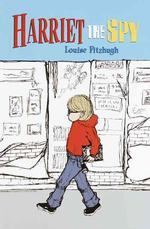
I honestly don't know if Harriet the Spy could even be published today. She is such an unconventional heroine. She's not always likable. She's bossy, secretive, contemptuous, and sometimes witheringly mean to her best friends. She sees people's weaknesses - that is Harriet's great gift and great curse. She finds weaknesses interesting. She spies on people. SHE BREAKS INTO PEOPLE'S HOMES TO SPY ON THEM. She hides in the dumbwaiter of one rich old broad's house, who never gets out of bed, and writes down everything the rich old broad says. Harriet sees things like: women buying 50 cans of cat food in the store, and she wonders about it. Why? Can someone have that many cats? And if so, why? What is that woman's life like? Then she will follow that woman home to find out. She peeks through windows, stares through air shafts ... she has certain pitstops she has to hit every day. She memorizes people's schedules so she knows where to be at what time. Harriet is a lunatic. A small criminal in training.
However, when I say Harriet is hugely responsible for who I am today - I am not talking about being a criminal. I'm talking about being observant. I'm talking about finding the human race interesting enough to make it your calling. Observing, imitating, delving into, writing about it. Whatever it may be. Harriet certainly judges. She feels bad for the man with the cats. She hates some of the kids at school. She thinks the Drama teacher is a moron. But above all else: she finds them all interesting. She is a difficult person. She is 11 years old and she is already an eccentric.
I was like that. I was not an easy child. I did not fit into any mold. I knew who I was very early. Harriet seared into me. She flames off the page. Still. Harriet still has the power to make me be brave in scary situations. To face the truth. To grow up. To let go of things that are stupid. To trudge through the tough times, gritting your teeth and bearing it. Etc. She is still my role model, in so many ways. Role models aren't perfect. Anyone who is a paragon of good-ness is highly suspect in my eyes. I don't trust them. In the same way that I do not trust fundamentalists, or those who know - without a shadow of a doubt - that they are right. Nope. That's a house of cards. I do not trust those people. I do not trust people who do not admit weakness in themselves, but who are so eager to see weakness in others. But someone who is flawed? Who struggles, and honestly? Who makes mistakes and maybe is awkward and bumbling at growth? I trust those people.
Through the course of the book, Harriet eventually learns to have compassion for people's weaknesses, as opposed to just ghoulish curiosity. However, there is no real "lesson", or moral here. That's one of the extraordinary things about this book, the difficult things. Kids are spoon-fed stupid morality lessons nowadays - every single piece of literature has to "teach" you something - hence the quality of books have gone down, and difficult complex truths are avoided.
At the very end of the book, after Harriet goes through HELL because the entire school reads her private (and very bitchy and very mean) journal ... Harriet eventually realizes, in a moment of clarity: "Sometimes you have to lie."
Let's hear it again: Sometimes you have to lie.
Those words just echoed through my head when I first read them, and they still echo today. "Sometimes you have to lie." I still think of that, at times. If you think your best friend is ugly and a little bit crazy, does it in any way help her to tell her point-blank, "I think you're ugly and a little bit crazy"? Harriet learns to hold her tongue, and she learns to lie. And in the context of the book, that is a good thing. It is part of growing up. I mean ... what?? (Come to think of it, I just wrote about this this past week.) It's a complex thought, and it's not spelled out for the kids reading the book. It's not wrapped up in a neat little bow to make it palatable and understandable to kids.
Harriet, at the end of the book, is not any less brilliant, or any less ambitious. She is going to be a writer. Or a spy. Or something GREAT. But she has learned to censor herself and her contempt for others. She has been beaten down by too much truth, and she chooses to keep her two best friends in her life (Sport and Janie) rather than lose them.
I love Harriet. It hurts how much I love her. There is NO WAY ON EARTH that you could EVER convince me that Harriet does not live off the page, that she does not go on, that Harriet is not "out there" somewhere. She is REAL.
Maybe the book is about learning to take the high road, even if it means sacrificing things you hold dear. Maybe the book is about not sweating the small stuff. Maybe the book is about loyalty. But loyalty to what? Harriet must not betray her inner voice. Harriet NEEDS to spy on people. Harriet might have a great future in the CIA, who knows. She could be working for the United States government right now. She has a gift. She is 10 years old, and she is damn good at what she does. She sets out every day on her "rounds". She has her notebook, and her special belt - where she has clipped a flashlight, a penknife, and other tricks of her trade. What feeds Harriet? What turns Harriet on? Humanity. PEOPLE. She NOTICES things.
Harriet, with all her faults and failings, is AWAKE.
God, I loved her for that, and I still do. She taught me how to look. How to really see.
Harriet taught me how to be awake. I started keeping a journal because of Harriet, and because Harriet always used one of those black and white composition books, so did I. I used those as a kid, and I still use them today. Diary Friday all comes out of piles and piles of black and white composition books.
Harriet's life looked nothing like mine. She grew up in New York City. She was a strictly urban kid. She had a nanny who was a highly mysterious and bossy woman, a hard-ass, but so lovable you think your heart might crack open, named Ole Golly. (I refused to see the movie because Rosie O'Donnell was Ole Golly. This so offended my interpretation of the character that I refused to subject myself to it. A cutesy eunuch Ole Golly? What are you - out of your mind?? Ole Golly has a secret life, a secret boyfriend ... this is a woman who has de-sexualized herself completely in one area of her life - as a nanny - and who lives it UP in another area of her life - with her secret long-term beau. Ole Golly is a grown-up, dammit, not a pug-faced self-regarding homunculit.) Harriet's parents were urbane busy atheists. Yup - atheists. AND they are not judged for it by the book. They are who they are. The parents leave Harriet HIGHLY unsupervised. I mean, their child goes out every day wearing a SPY OUTFIT, and breaks into people's homes ... and they have no idea. They are going to the opera, to benefits, the theatre ... They are not involved in the nitty-gritty of Harriet's life. But Ole Golly sure as hell is.
I grew up in a small university town, with acres of turf farms on one side, and the Atlantic ocean on the other side. I had parents who loved me and who were very involved. Catholics. I did not have a nanny.
But I related to Harriet's soul. I still do. I still learn from Harriet. I probably read that book once a year. She's one of the greatest female characters of all time. She's right up there with Jane Eyre and Anna Karenina, as far as I am concerned.
I still try to live up to Harriet's high standards. I can be unforgiving like Harriet. I can have contempt for other people's weaknesses. I can hold people to a standard which is impossibly high, so that it sets me up for crushing disappointment. But through writing - through the act of putting pen to paper - I am usually able to see deeper, to go beyond the surface of things.
And to never ... ever ... lose interest in people. Like Tracy Lord says in Philadelphia Story to "Mike" - "The time to make up your mind about people ... is never."
And if I had to say how Harriet relates to current events? I don't know. In terms of my own current events, I think I have already covered that. But in terms of the world? I'll riff a little bit, and see what I come up with:
-- Harriet learns that honesty is not always the best policy. Sometimes it is the better thing to soften the blow, to be more diplomatic. "Sometimes you have to lie." That seems to be relevant.
-- In terms of parenting, and the whole craze of over-protective parents everyone talks about all the time: Harriet is indicative that little kids can handle a lot of independence, and they may get into trouble- Harriet gets into major trouble - but by avoiding trouble, or by protecting your kids vigorously from every brand of trouble - you will be robbing them of great life experiences. Harriet is laid LOW through her troubles. She goes through the bleakest time imaginable when the entire school hates her. It's even hard to read about. But she needs to go through that. Even Ole Golly bails on her. Ole Golly realizes that Harriet no longer needs "a nanny" ... and the best thing for Harriet would be for her to be abandoned. I mean, this is a tough tough lesson, and Ole Golly is willing to do it. Harriet needs to grow the fuck up, and she will be unable to do so as long as Ole Golly is around as a crutch. So Ole Golly leaves. Harriet must fend for herself. This is not an easy book, and Harriet's loneliness and fear is palpable. You want to climb into the book and tell her it's going to be okay, this too shall pass, she's an amazing person, she will be an amazing woman ... but that wouldn't help Harriet. Harriet can't skip that step of growing up. Her parents can't protect her, Ole Golly can't protect her ... Harriet makes mistakes, and she has to learn how to clean up her OWN messes. And she does. This book is a perfect example of how sometimes letting kids just go is the best policy.
The other thing the book shows, in terms of parenting, is that parents can invest too much in their little progeny. They actually believe that they can mold the child's personality, that they can create a mini-them. I'm not talking about instilling values or morals - I'm talking about parents who believe that they can create little mirror images of themselves, and then are SHOCKED when the kid has a mind of her own. Well, that's the parent's fault. The kid is a person on their own. Why don't you just sit back and let the KID tell you who they are? Sure, help them with tough decisions, teach them right from wrong ... but other than that? Leave them alone and maybe YOU'LL learn something from THEM.

Look at her belt! Look at her sneakers! She didn't need the glasses, but she wore them because they made her look sharp and smart. Harriet is NUTS. I love her to death.
This is one of my favorite books of all time.
May 23, 2005
The book challenge
I got this from Dan - who tagged me "it".
1. Total Number of Books I've Owned:
Okay, so the "I've Owned" tells me they want to know all in all, as opposed to how many books I currently own. So - I have no idea. I have owned thousands and thousands of books in my lifetime. Thousands. Stacked high to the moon. I have no idea how many books I own now.
2. Last Book I Bought:
Break, Blow, Burn, by Camille Paglia
3. Last Book I Read:
Miracle at Philadelphia, by Catherine Drinker Bowen
4. Five Books That Mean A Lot To Me:
Charlotte's Web, by EB White. I can barely type the title of that book without getting verklempt.
Harriet the Spy, by Louise Fitzhugh. I've never done a post on what that book means to me ... but all I can say is: it had an enormous impact. Maybe the biggest impact ANY book ever had on me. Harriet is basically why I picked up a pen and started scribbling stuff down in a notebook when I was 10 years old.
Wrinkle in Time, by Madeleine L'Engle. The vision in this book - of the redeeming power of love (even in the face of great danger, and terror, and separation from those that you love) has gotten me through many a dark hour. I cherish this book.
Mating, by Norman Rush. I wrote about the book here. I haven't met another person who loved this book as much as I did, but that doesn't matter. This book shook me to my very core. Still does.
Hopeful Monsters, by Nicholas Mosley. I've read this novel so many times my copy is literally falling apart.
5. Tag five people and have them do this on their blog:
(Oh and by the way: FEEL NO PRESSURE to comply, people. Only answer the call if you feel like it. It made me feel like one of those emails that end with: "Forward this to 10 people or your hair will spontaneously combust in 10 minutes." I hate that.)
Bill.
Anne.
Jess.
Curly.
Emily
April 20, 2005
Great Expectations ...
My reading of Great Expectations moves along at breakneck speed. Things are getting much more serious now. Pip has discovered who his benefactor has been all of these years, and is having an extended panic-attack about it.
One of my favorite chapters so far is when Pip and Herbert go to see Mr. Wopsle in an amateur production of Hamlet (an awful amateur production of Hamlet - is there any other kind?). Pip's description of why the play is bad, the absurdity of the badness of the show, and also - how embarrassed they were to see Mr. Wopsle backstage afterwards, because how could they say "nice job" convincingly - hits very close to home. I laughed out loud from beginning to end of the chapter. We've got the ghost of Hamlet's father, walking around with his script in hand. We've got the heckling of the audience. We've got the general incompetence of the actor playing Hamlet. It's all there. I feel like I was in the audience for this awful show myself.
Here's an excerpt:
Several curious little circumstances transpired as the action proceeded. The late king of the country not only appeared to have been troubled with a cough at the time of his decease but to have taken it with him to the tomb, and to have brought it back. The royal phantom also carried a ghostly manuscript round its truncheon, to which it had the appearance of occasionally referring, and that, too, with an air of anxiety and a tendency to lose the place of reference which were suggestive of a state of mortality. It was this, I conceive, which led to the Shade's being advised by the gallery to "turn over!" -- a recommendation which it took extremely ill. It was likewise to be noted of this majestic spirit that whereas it always appeared with an air of having been out a long time and walked an immense distance, it perceptibly came from a closely-contiguous wall.The Queen of Denmark, a very buxom lady, though no doubt historically brazen, was considered by the public to have too much brass about her; her chin being attached to her diadem by a broad band of that metal (as if she had a gorgeous toothache), her waist being encircled by another, and each of her arms by another, so that she was openly mentioned as "the kettledrum".
The noble boy in the ancestral boots was inconsistent, representing himself, as it were in one breath, as an able seaman, a strolling actor, a grave digger, a clergyman, and a person of the utmost importance at a Court fencing match, on the authority of whose practised eye and nice discrimination the finest strokes were judged. This gradually led to a want of toleration for him, and even -- on his being detected in holy orders, and declining to perform the funeral service -- to the general indignation taking the form of nuts.
Lastly, Ophelia was a prey to such slow musical madness, that when, in course of time, she had taken off her white muslin scarf, folded it up, and bured it, a sulky man who had been long cooling his impatient nose agaginst an iron bar in the front row of the gallery growled, "Now the baby's put to bed, let's have supper!" Which, to say the least of it, was out of keeping.
This reminds me of the man shouting at the stage as I was performing in some god-awful play: "WHO THE HELL WROTE THIS SHIT???"
Good old-fashioned heckling is no longer in style in the theatre, although it used to be. I feel lucky that I got to participate, albeit unwillingly, in such an age-old tradition.
Mr. Wopsle, Pip's acquaintance, plays Hamlet, to awful results. Pip describes:
Whenever that unfortunate Prince had to ask a question or state a doubt, the public helped him out with it. As for example; on the question whether 'twas nobler in the mind to suffer, some roared yes, and some no, and some inclining to both opinions said "toss up for it"; and quite a Debating Society arose. When he asked what should such fellows as he do crawling between earth and heaven, he was encouraged with loud cries of "Hear, hear!" When he appeared with his stocking disordered (its disorder expressed, according to usage, by one very neat fold in the top, which I suppose to be always got up with a flat iron), a conversation took place in the gallery respecting the paleness of his leg, and whether it was occasioned by the turn the ghost had given him. On his taking the recorders -- very like a little black flute that had just been played in the orchestra and handed out at the door -- he was called upon unanimously for Rule Britannia. When he recommended the player not to saw the air thus, the sulky man said, "And don't you do it, neither; you're a deal worse than him!" And I grieve to add that peals of laughter greeted Mr. Wopsle on every one of these occasions.
Ah yes. Hamlet's advice to the actors: "Don't saw the air" "Don't tear a passion to rags" ... It's a mini treatise on acting. Forget about all the different schools and methods. Just do what Hamlet tells you to do, and you should be all right.
Here is Pip's description of the agony of embarrassment he felt, watching Mr. Wopsle fail so badly:
We had made some pale efforts in the beginning to applaud Mr. Wopsle, but they were too hopeless to be persisted in. Therefore we had sat, feeling keenly for him, but laughing, nevertheless, from ear to ear. I laughed in spite of myself all the time, the whole thing was so droll; and yet I had a latent impression that there was something decidedly fine in Mr. Wopsle's elocution -- not for old associations' sake, I am afraid, but because it was very slow, very dreary, very up-hill and down-hill, and very unlike any way in which any man in any natural circumstances of life or death ever expressed himself about anything.
This book is awesome, I'm loving every word.
April 14, 2005
Great expectations
I am re-reading Great Expectations at the moment and am having such a good time with it that I never want it to end. Not only is it mysterious, and interesting ... but some of his descriptions just ... I GUFFAW. I love the "voice" of Pip.
There's one long section when Mr. Pocket (the "pale young gentleman" Pip beat up for no reason at the Havisham's) and he are having dinner in London, and Mr. Pocket tells Pip the story of why M. Havisham is such a lunatic. But through the whole story, he ALSO is kindly correcting Pip's table manners. He doesn't do so in a judging or condescending way, he has no desire to make Pip feel bad. No. He is just trying to be helpful. BUT - it's all part of the same narrative. Like: "And so then, on the morning of her wedding day, just as the clock struck quarter past nine -- It is certainly not necessary to tip the glass all the way back so that you get every last drop down your throat." Pip then apologizes. Mr. Pocket says, "Not at all..." and goes on with his story. But it's just HOW Dickens does this ... it's feckin' hilarious. I was howling. And you get this mental image of Pip's awful table manners and fidgety posture ... it's hysterical. But it's not just the situation - it's how Dickens tells it. He doesn't ever have Pip tell us what he's doing. He never has Pip say: "And so then I ate my peas with my knife, not realizing it was a faux pas." All of this is going on without Pip telling us of it - because he's the narrator. That's why it's so funny. At one point, apparently, Pip is trying to stuff his entire dinner napkin into his empty tumbler. That's the one that really killed me. Like: Pip - what on earth is the purpose of that??? On and on goes Mr. Pocket's narrative about M. Havisham, and then, with no interruption, he says: "I honestly do not believe that dinner napkins were meant to be stuffed into tumblers." Pip apologizes, embarrassed. Mr. Pocket says, "Oh, not at all" and goes on with his story.
It's RIDICULOUS, and kind of slapstick, and I am loving every stinking minute of it.
April 6, 2005
Middlemarch in the middle of the night
Had a pretty much sleepless night last night. I normally have no problems with descending into oblivion, but last night was terrible. I lay awake, eyes wide open, staring into the darkness, pretty much worrying myself into a nervous attack. I couldn't stop the old brain. Took me a while to even admit that I was having a bout of insomnia, I lay there wide-awake and worrying for waaayyyy too long. Finally, I had had it.
I got up. Turned on the light. Poured a glass of water and started reading Middlemarch, curled up under a fleece blanket in my now diagonally-placed chair. I read until 5 o'clock this morning. And then finally, I felt like sleeping. Put the book down, slept a couple of hours.
I had to have read 250 pages of Middlemarch last night, although I didn't count. I finished the second-to-last part (called "Two Temptations"), and now I am in the final part of the book, entitled "Sunrise and Sunset".
In a weird way, it was the worst thing to read during a sleepless night, because as the book races towards its conclusion, things keep getting worse and worse. George Eliot describes things so exquisitely well that it is impossible to not find examples in your own life and reflect upon your own regrets, the mistakes you have made, the bleaker moments of existence that we all have in our past.
Mr. Balustrode has emerged as a very important character (which I should have foreseen), and he, in a very short time, has become a ruined man.
Lydgate, too. The description of his marriage, and what it had become, is beyond awful. You feel for the guy. Rosamond ... one of those people in the world who cannot believe that life is not set up to please her, to make her life easy. She has no sense of loyalty to her husband. None. She thinks nothing of going behind his back, she does not stand by him. As a matter of fact, as her contempt and disappointment grows, she begins to subvert him. IN the sneakiest ways. When she wrote to Lydgate's uncle and asked him for money, I wanted to reach through the pages and smack the complacency off her face. I felt like I was Lydgate, and that she had betrayed me. How DARE you shame your husband like that? How dare you, you ignorant little bitch? She's an enraging character. Circa 3 a.m., when I got to the part of her letter to Uncle Godwin, I had to put the book down for a second. I got too angry. It was making me nervous. And then comes Uncle Godwin's letter to Lydgate, saying: "Don't send your wife to do your business. It's disgusting." Meanwhile, Lydgate had no idea that Rosamond had gone behind his back ... so even though I was thrilled that Rosamond would feel at least SOME humiliation for her appalling behavior, I felt - on the flipside - true dismay for Lydgate, because her secrecy and ignorance of how the world works (God, I want to smack her face, I'm serious) has ruined his chances to have a happy life. What a character. Rosamond is so alive that I felt her presence in my room. I wanted to speak to her, I wanted to make her realize how mistaken she is, how much she has missed the point, and how she has NO business being a wife. NONE. Her mind is completely undeveloped, and she has no sense that she ever needs to work on herself. No. Everything is justified, in her mind. She has no self-reflection. And in this, she completely abandons Lydgate (her husband) to his fate.
Another thing which struck me: The description of Lydgate's mounting debt, and what it feels like to be in debt, how it creeps up on you, and how it suddenly takes over all of your thoughts after the debt reaches a certain point ... Lydgate's debt is described with such chilling accuracy that I found myself getting a little upset. Is there a better description of the emotional side of being in debt than in George Eliot's book? It's incredible. It is so accurate. Lydgate becomes more and more obsessed with this load of DEBT and how it poisons his entire life, and if he could just get RID of it - if he could just make it GO AWAY, then real life could begin. The desperation becomes so acute (and his wife is so supremely unsympathetic) that he does something so out of character that you ache for him. You ache for his loss of principles, you ache for the character you met at the beginning of the book. Because now, by the end, that character is no more. In his place, is a miserable desperate lonely man, pretty much under the control of the wife he once "loved" (ha - No, he didn't.) - He thought she would be the comfort he could come home to, he thought she would be the soft pillow he could rest on at the end of a hard day. He did not recognize the faults in her character. He couldn't see her essential selfishness and ignorance. She's an awful person. I can't stand her.
I am very sorry that Lydgate is being punished so completely, and his psyche so shattered - but he made a terrible choice in a wife, and that's his fault. He was blinded by her beauty. He couldn't imagine that that soft and pleasing exterior could hide such a sneaky hard disloyal person underneath. Her appearance fooled him. It is my hope that Rosamond gets hers in the end. And BADLY. (Please, don't reveal what happens if you've read it. I will probably finish it tonight or tomorrow.)
So I found the entire "Two Temptations" section of the book really nerve-wracking (I could feel that events were spiralling out of control, and that things were going from bad to worse) - but I still couldn't put it down. Also, and even more disturbing: I actually care about some of these characters now. I care about what happens to them.
One word: Caleb Garth is pretty much the only person in the book who acts according to his principles. I find that intensely moving. I love Caleb Garth.
March 27, 2005
Middlemarch: "Advancing womanhood had tempered her plainness"
An amazing description of "plain" Mary Garth:
Mary Garth, on the contrary, had the aspect of an ordinary sinner: she was brown; her curly dark hair was rough and stubborn; her stature was low; and it would not be true to declare, in satisfactory antithesis, that she had all the virtues. Plainness has its peculiar temptations and vices quite as much as beauty; it apt either to feign amiability, or, not feigning it, to show all the repulsiveness of discontent: at any rate, to be called an ugly thing in contrast with that lovely creature your companion, is apt to produce some effect beyond a sense of fine veracity and fitness in the phrase. At the age of two-and-twenty Mary had certainly not attined that perfect good sense and good principle which are usually recommended to the less fortunate girl, as if they were to be obtained in quantities ready mixed, with a flavor of resignation as required. Her shrewdness had a streak of satiric bitterness continually renewed and never carried utterly out of sight, except by a strong current of gratitude towards those who, instead of telling her that she ought to be contented, did something to make her so. Advancing womanhood had tempered her plainness, which was of a good human sort, such as the mothers of our race have very commonly worn in all latitudes under a more or less becoming headgear. Rembrandt would have painted her with pleasure, and would have made her broad features look out of the canvas with intelligent honesty. For honesty, truth-telling fairness, was Mary's reigning virtue: she neither tried to create illusions, nor indulged in them for her own behoof, and when she was in a good mood she had humor enough in her to laugh at herself.
Genius character development. It's out of style now to "describe" a character like that. I think it might have been James Joyce himself who destroyed, in one fell-swoop, that kind of omniscent character development. I have no idea, just a guess. T.S. Eliot was the one who said, after reading Ulysses that Joyce had "killed the 19th century".
I'm not saying this is either good or bad, or that I prefer one style over the other. Everyone here should know how I feel about James Joyce!!
But I am still finding such intense pleasure in George Eliot's precise layered character descriptions, like the one above. They're delicious.
Middlemarch: priggishness
More from Middlemarch:
"A prig is a fellow who is always making you a present of his opinions."
Middlemarch: "severe facts of life"
More from Middlemarch - this one made me laugh:
Plain women he regarded as he did the other severe facts of life, to be faced with philosophy and investigated by science.
Middlemarch: "severe facts of life"
More from Middlemarch - this one made me laugh:
Plain women he regarded as he did the other severe facts of life, to be faced with philosophy and investigated by science.
Middlemarch: "between breakfast and dinner-time"
More from Middlemarch:
We mortals, men and women, devour many a disappointment between breakfast and dinner-time; keep back the tears and look a little pale about the lips, and in answer to inquiries say, "Oh, nothing!" Pride helps; and pride is not a bad thing when it only urges us to hide our hurts -- not to hurt others.
Middlemarch: "between breakfast and dinner-time"
More from Middlemarch:
We mortals, men and women, devour many a disappointment between breakfast and dinner-time; keep back the tears and look a little pale about the lips, and in answer to inquiries say, "Oh, nothing!" Pride helps; and pride is not a bad thing when it only urges us to hide our hurts -- not to hurt others.
Middlemarch: "From such contentment poor Dorothea was shut out."
Dorothea Brooke, in Middlemarch, is a well-bred young woman, with a nice inheritance ... and yet she chooses to live plainly, and involve herself in community projects, and renounce the things which give her pleasure. Her dream of marriage is to yoke herself to a worthy male - someone whom she loves for his IDEAS, and also for what he can teach her, and how he can involve her in his work. She wants to live an important life, a life of the mind and spirit, she wants to have a wide impact on people, like a saint. And so it is very very important that she choose the right husband. I'm oversimplifying here, sorry ... but this appears to be the main jist so far. (I haven't finished the book yet - I'm not even a quarter of the way through.)
Dorothea is quite naive. The other females around her are much more practical. And you get the sense (at least so far) that Dorothea is going to learn some really rough lessons. I don't think she is going to choose well for a husband either. Something's not quite right with this girl. Her mind is "theoretical".
Another excerpt about Dorothea:
It had now entered Dorothea's mind that Mr. Casaubon might wish to make her his wife, and the idea that he would do so touched her with a sort of reverential gratitude. How good of him -- nay, it would be almost as if a winged messenger had suddenly stood beside her path and held out his hand towards her! For a long whilte she had been oppressed by the indefiniteness which hung in her mind, like a thick summer haze, over all her desire to make her life greatly effective. What could she do, what ought she to do? -- she, hardly more than a budding woman, but yet with an active conscience and a great mental need, not to be satisfied by a girlish instruction comparable to the nibblings and judgments of a discursive mouse. With some endowment of stupidity and conceit, she might have thought that a Christian young lady of fortune should find her ideal of life in village charities, patronage of the humbler clergy, the perusal of "Female Scripture Characters," unfolding the private experience of Sara, under the Old Dispensation, and Dorcas under the New, and the care of her soul over her embroidery in her own boudoir -- with a background of prospective marriage to a man who, if less strict than herself, as being involved in affairs religiously inexplicable, might be prayed for and seasonably exhorted. From such contentment poor Dorothea was shut out. The intensity of her religious disposition, the coercion it exercised over her life, was but one aspect of a nature altogether ardent, theoretic, and intellectually consequent: and with such a nature, struggling in the bands of a narrow teaching, hemmed in by a social life which seemed nothing but a labyrinth of petty courses, a walled-in maze of small paths that led no whither, the outcome was sure to strike others as at once exaggeration and inconsistency. The thing which seemed to her best, she wanted to justify by the completest knowlege; and not to live in a pretended admission of rules which were never acted on. Into this soul-hunger as yet all her youthful passion was poured; the union which attracted her was one that would deliver her from her girlish subjection to her own ignorance, and give her the freedom of voluntary submission to a guide who would take her along the grandest path.
I wincingly recognize myself in those lines.
Dorothea Brooke: "she was enamoured of intensity and greatness"
Dorothea Brooke. So far, she is the lead character in Middlemarch, although others are now being introduced (Lydgate, Fred Vincy, Mary Garth) who are coming to the foreground. But the first part of the book is entitled "Miss Brooke". So obviously she is of great importance. I have said below that I see a lot of myself in Dorothea, and it is perhaps because of that deep identification that I find her so annoying. It's tough sometimes, to truly see yourself. To have your motives explained to you in cold clear language ... It makes you shiver and want to hide. The mark of a great novelist, in my opinion.
To boil it all down shamefully, Dorothea is a rich girl, inflamed with the desire to be useful. She wants to live the life of an ascetic, she enjoys sacrifice, she is full of religious passion, she dresses in an ostentatiously plain way, denying her own beauty ... and her main goal in getting married is to find an ideal husband, one whom she can look up to. Love has nothing to do with it. I'm over-simplifying, but that so far is what I know of Dorothea.
The following excerpt pretty much tells you all you need to know about Dorothea:
Most men thought her bewitching when she was on horseback. She loved the fresh air and the various aspects of the country, and when her eyes and cheeks glowed with mingled pleasure she looked very little like a devotee. Riding was an indulgence which she allowed herself in spite of conscientious qualms; she felt that she enjoyed it in a pagan sensuous way, and always looked forward to renouncing it.
Here are some of Eliot's descriptions of the "earnest" Dorothea, descriptions which open the book:
Her mind was theoretic, and yearned by its nature after some lofty conception of the world which might frankly include the parish of Tipton and her own rule of conduct there; she was enamoured of intensity and greatness, and rash in embracing whatever seemed to her to have those aspects; likelyl to seek martyrdom to make retractations, and then to incur martyrdom, after all in a quarter where she had not sought it. Certainly such elements in the character of a marriageable girl tended to interfere with her lot, and hinder it from being decided according to custom, by good looks, vanity, and merely canine affection.
Middlemarch ...
... by George Eliot ...
After, uhm, 20 feckin' years of saying, "I've got to read that one day" - I finally am. As with most of the "classics" (at least this has been my experience) - I have found that once I just start the thing, I usually can't put it down. Middlemarch is, I am discovering, a page-turner. It happens to be 800 pages long, but that's no matter. It's still a page-turner. The character development, the social commentary, the feeling that you are immersed into an entire world ... I can't put it down.
First of all, there is no "plot" as of yet - I'm still in the beginning stages where characters are being introduced. However, their struggles and inner-journeys, the conflicts which could arise in the future, are all becoming rather clear at this point. Nothing has happened YET, but you can sense the potential.
And the writing itself ... She's got flashes of such laser-beam intensity, moments of such psychological clarity, that I feel like everything I have ever written has been shallow and unworthy. Heh. Well, it's good to have something to strive for. Good to get to know the geniuses!
For those of you have read the book, here are random thoughts:
-- I absolutely LOVE Fred Vincy, the kind of dissipated cheerful brother of the vain and pretty Rosamond. I LOVE Fred, and I hope that he finds happiness. He seems to deserve it more than anybody else at this point, even though he does sleep until noon, and is ... well, frankly ... pissing his life away. Still, I love his disposition. He's my favorite character so far.
-- Mrs. Cadwallader is CRACKING ME UP.
-- Dorothea is, as my father used to say, "cruisin' for a bruisin'." By that I mean, nobody can be that idealistic (and priggish) without having a really difficult time facing reality. So far reality has not intruded into her pleasant little world, but it will, I am sure. I relate to Dorothea in many many ways. I see myself in her. Maybe that's why I'm, at this point, so impatient with her.
-- I love the Vicar who plays cards and billiards for money, and who studies insects and flowers in his spare time. I can't remember his name at the moment.
-- Oh, and I also love the plain girl Mary Garth. Fascinating character so far. I see quite a bit of myself in her, as well.
I'll post a couple excerpts momentarily. I am finding the entire reading experience of this book to be completely DEE-LISH.
March 13, 2005
Books and shite like that
I got this from Tommy as well.
A Book Meme
You’re stuck inside Fahrenheit 451, which book do you want to be?
I believe that all of the books are burned in Farenheit 451 so I guess I don't want to be any of them.
Have you ever had a crush on a fictional character?
Oh God, yeah.
Mr. Darcy. I argued my case here. A controversial post. I maintain my position. I love Mr. Darcy. I also maintain my position - sort of on a side note - that alpha male does NOT equal "bad boy". This comes from the comments section of that post ... this is not to say that Mr. Darcy is not an arrogant son-of-a-bitch. He is. I still would love to spar with him any day.
John, from The Pigman. I think I STILL have a crush on him.
Mercutio. From Romeo and Juliet. Don't laugh. I really did have kind of a swooning crush on Mercutio in high school. I liked him much better than the love-lorn Romeo.
The last book you bought is:
Bobby Fischer Goes to War - discussed ad nauseum below.
The last book you read:
Elias Canetti's Crowds and Power. An awesome accomplishment, it's still seeping in. I finished it a couple of days ago and it has very much stayed with me.
What are you currently reading?
JM Synge: The Aran Islands
Lincoln, by David Herbert Donald
Five books you would take to a deserted island.
Well, I could be practical and say: A book about First Aid, and a book about How To Build Your Own Boat.
But I'm not practical. I like to look at memes like this more in a what-does-this-reveal-about-your-personality way, as opposed to anything literal.
So. Let's see.
Crime and Punishment., by Dostoevsky
Wrinkle in Time, by Madeleine L'Engle
Mating, by Norman Rush
Hopeful Monsters, by Nicholas Mosley
Jane Eyre, by Charlotte Bronte
Hm. The first thing that came to mind is all fiction - even though I am primarily a non-fiction type of girl. Interesting. These are books I have read countless times, and will never get tired of them. Ever. I have read them literally into dog-eared states, each and every one of them.
Who are you going to pass this stick to (3 persons) and why
EVERYONE DO IT!! :)
What I'm reading ... Part Deux
My reading plan (of just yesterday) got derailed already. By a book that caught my eye in a second-hand bookstore yesterday. It is called Bobby Fischer Goes to War, and it is the story of "the most extraordinary chess match of all time", that being of course Fischer vs. Spassky in Reykjavik, 1972. It's a bright red book, and whatever - I picked it up, flipped through it for two seconds, decided: "I must have this" and bought it for 50 cents. And ... ehm ... I finished it this morning. It's not a very well-written book, not really, but it moves quickly, it's a great story, so that helps - and the prose is clear, concise, with a good sense of how to get across the excitement of that time in the chess world.
Bobby Fischer, for many reasons, is one of those guys I'm always on the lookout for. Those mad weird genius guys. Those "aberrations" whom I find so infinitely fascinating. Geniuses. I could not care less about how sane he is, or how insane he is, how rude he was, how boorish, how out of control, how arrogant, also his most recent lunatic anti-American shenanigans ... All of these things just make me want to learn MORE about him. What is it like to be Bobby Fischer? What does he SEE when he looks at a chess board? The book doesn't try to answer that question, but it does attempt to analyze his game, why he was so distinctive, so feared, so dreaded, and also - (this is what I find really fascinating) the effect that he had on his opponents. Men were shattered, psychologically, after playing against Fischer. Something, some essential energy, drained out of them. World champions, grand masters, whatever ... Fischer crushed something in them when he won. And that appears to have been his goal. He played the game with HATE. Which is why he probably was the great player that he was. He didn't just win, he destroyed his opponents confidence in themselves, in their intelligence, their deductive abilities ... what was it about Fischer's game that could do that to otherwise calm cool customers??
Boris Spassky said, in regards to Fischer: "When you play Bobby, it is not a question of whether you win or lose. It is a question of whether you survive."
Arthur Bisguier, an American player, who was a chess aide to Fischer in his earlier teenage years, said, "If [Bobby] wasn't a chess player, he might have been a dangerous psychopath."
Fascinating.
It's really not my business to discuss the ins and outs of chess - because honestly? I don't know how to play. My friend Allison, who loves chess, tried to teach me one afternoon (one rather wine-soaked afternoon, I might say: we sat in the lobby of the palatial W Hotel, off Union Square Park - where you can get chess boards, and drink wine, and play. People sit there all day, playing chess. It's a very cool atmosphere - I highly recommend it for any New York area chess fans). Anyway, I didn't learn to play chess when I was little, and now I feel it's too late. The intricacies elude me.
But that doesn't stop me from being thrilled to learn more about those who love this game. My friend Beth's husband Tom is one of those people. It's a realm of STUDY. Games are analyzed, picked apart ... I find it completely intriguing. In the same way that I find mathematical genius intriguing.
The book I just read is really fun. Some excerpts coming up.
March 12, 2005
What I'm reading...
(generated by this post below):
In terms of what I just finished reading, in the last two days:
Elias Canetti's extraordinary work Crowds and Power. I'll post some more excerpts even though no one seems to give a shite. Ha. Incredible book -dissecting the dynamics of power structures and crowd structures, and how they work. I finished it yesterday and thought: "And that's how you win the Nobel Prize, folks. You write a book like THIS."
Finished Chechnya: To the heart of a conflict, by Andrew Meier this morning. It's a short book - 131 pages long. Hmm. Mr. Meier seems to think that getting "to the heart of" this conflict (which basically has gone on, in different forms, for centuries) will only take 131 pages and will consist mainly of telling about how HE PERSONALLY risked his life to go into Chechnya. Oh, so now we really know how dangerous it is there, because Mr. Meier feared for his life. Whatever. There are way better books about the Caucausus and the Russian/Chechen conflict and the Ossetians and the Ingush (I have many of them on the top 3 shelves of Bookshelf # 6) ... Meier's book was a piece of fluff - it's more travelogue than anything else, and there's nothing wrong with that - I guess my beef is with the title. Meier got to the heart of nothin'. Not wacky about the book, obviously.
Books I am now in the process of reading:
Lincoln - by David Herbert Donald. To those of you who recommended it to me, all I can say is: "thank you!!" I'm only in the second chapter of it, but I love it. I can see why it is so revered as a biography.
The Aran Islands, by JM Synge. This is one of my favorite books. I pick it up from time to time. I'm re-reading it now, and loving it. From the first sentence (which I know by heart): "I am in Aranmor, sitting over a turf fire, listening to a murmur of Gaelic rising from a little public-house under my room" you are transported into another world.
And that's it for now. I need to read a good sweeping novel next. Too much reality is not good. At least not for me. I'm nothing if I don't have escape-hatches available to me at all times.
March 8, 2005
Toooooo many books
This past weekend I acquired yet another small bookcase. This brings the grand total of bookshelves I have in my apartment up to eight. If you ever saw my apartment, you would laugh out loud at the thought. Slowly but surely, my apartment is starting to look like it is inhabited by a crazy monkish scholar-type lady (who occasionally branches off into bouts of wild Archie Leach madness). There's nothing I love better than to have my books in order. I can spend hours with them, rearranging them, trying to figure out a better system ... Should it be by author? By topic? By publication date? It can get quite Byzantine.
To me, peace of mind means having my books in order. Any time I move, I pretty much set up my books first. (Well ... maybe I put some pots and pans away, first). But in general: The books are the thing.
I spent a bit of time yesterday dealing with the book re-arrangement (made necessary by the new shelves) and for anyone who gives a shite, here's the system:
Bookcase # 1 near front door
This tall 5-shelved bookcase is for adult fiction. We've got all of Margaret Atwood. We've got all of Jane Austen. We've got all of AS Byatt, JD Salinger, EM Forster, and Michael Chabon. I am fans of their books - good or bad - and I must have them all. Oh yeah, and I have all of Jeanette Winterson too even though her books have been CRAP since she wrote The Passion. Other authors make brief appearances. George Orwell, Jack London, Hawthorne. Thomas Hardy. F Scott Fitzgerald. Stephen King. Oh and Nancy Lemann - my favorite whimsical Southern-esque writer. Love her stuff.
Bookcase# 2, also near front door
A 2-shelved bookcase. This is for children's literature. I could actually use another bookcase for these, since I've shoved them in every which way. I have books in here that I have owned since I was literally 4 years old. Peter Rabbit, for example. All the LM Montgomery books, all the Madeleine L'Engle books, all Paul Zindel's wonderful books, CS Lewis, and my favorite - Jane Langton. We've also got your Harriet the Spy here, your EL Konigsberg, and your Noel Streatfield series and your Enid Blyton series. Why just have Circus of Adventure when you can also have Mountain of Adventure, Valley of Adventure and Drag Queen Club of Adventure? I'm a collector at heart.
Bookcase # 3 in the kitchen
Yes. I have two book shelves in the kitchen. I can't help it. There is no other space for them.
Bookcase # 3 (with 5 shelves and all) is a hodgepodge - but some of my favorite and most-used books are here. Top shelf we've got all my science books. (Science for Dummies, obviously). I've got The Discoverers, I've got Fermat's Enigma, I've got Synchronicity, Longitude, Zero, Schrodinger's Cat - and others. Let's see. I've also got my religious books in bookcase # 3. I enjoy placing the religious books right next to the science books. I like to imagine that they fight it out in the night, while I sleep in peace. Then - on bookcase # 3, I've also got my rather extensive "true crime" collection. I'm a huge true crime fan, dating back from my first reading of Helter Skelter.
The true crime then segues into my "cultural commentary" section which basically means: "Any book that really doesn't fit in with any other of my categories". PJ O'Rourke is here. Camille Paglia's stuff is here. Also Malcolm Gladwell's books, and others. We then segue from "cultural commentary" into one of my most favorite sections: Philosophy/Political Science. Ahhhhh. Here we have The Prince, and John Locke, and Plato and Aristotle and John Stuart Mill. Very important things to have in any library. For reference. Right beside THIS section is the Holy Grail section: "Documents in US History". Here we've got The Federalist Papers, and the greatest speeches made by US Presidents, and the Constitution and the Declaration. We've got Thomas Paine, and Edmund Burke. Good stuff.
And then ... there are three shelves of scripts.
Like I said, Bookcase # 3 has a little bit of everything.
Bookcase # 4 in the kitchen
This bookcase continues the theme begun in Bookcase # 3 (with the scripts) - and carries it a step further. Here we have my vast collection of entertainment biographies. Please. We've got Lauren Bacall to Tennessee Williams here. We've got Bogart and Cary Grant ... I've got Charles Grodin's AWESOME autobiography It Would Be So Nice If you Weren't Here. You name it, I've got it. After the biographies of specific PEOPLE, we move into biographies of either certain theatrical MOVEMENTS or certain theatres. I've got the history of the Abbey theatre. I've got Real Life Drama (an awesome book, which is the history of the Group Theatre, in the 1930s). After the theatre section, we segue into the film section. Here are all my books on film-making. Michael Caine's book (probably the # 1 best book to own, if you want to act in films) - I've got the TERRIFIC book called The Devil's Candy (which describes the entire debacle of the Bonfire of the Vanities movie - from conception to box office flop). I've got Robert Evans' book, I've got Roger Ebert's movie reviews, and a ton of "Making Of" books. Making of Casablanca. Making of All About Eve. I LOVE this particular bookshelf, and obviously dip into it often.
Now we move into my bedroom/living room/study. And yes, it is all one room ... but I have it blocked out into different functions (with completely invisible lines).
This room has four bookcases in it. As well as a bed, a dresser, a chair, a desk, a couple plants, and my grandmother's chest at the foot of my bed. And strangely ... the room doesn't feel all that cluttered. Hm. Feng shui? Highly possible.
Bookcase # 5 in the bedroom
A teeny 2-shelver over by my desk. This holds all my poetry. And also 4 of my cherished self-help type books. heh. For some reason, this makes sense to me: Poetry also is a form of self-help. So it's not weird to put Yeats next to Road Less Traveled. I mean, it's a LITTLE weird, but not TOO weird.
Bookcase # 6 in the bedroom
An enormous beautiful bookcase, stained a deep dark green. It's got 6 shelves. Let me linger lovingly over all of these marvelous books.
Here, on display, for a total of 3 of the shelves - are all my books on totalitarian/fascist/communist/militant Islamic regimes. Some of them blend into plain old history - but in general, all of the history I am interested in basically has to do with totalitarianism. So we've got a little Pol Pot, we've got Nicholas and Alexandra, we've got a little Stalin, a little Castro, a little Saudi prince oily bastards, we've got some Nazis, we've got some Iranian mullahs. We've got Decline and Fall of the Roman Empire here as well. VS Naipaul's 2 books on the "lands of the converted" (countries who have converted to Islam - non Arab countries - Indonesia, Iran, Pakistan) are included. I love those two books. He's such a curmudgeon, I love it. Rebecca West, Robert Kaplan's stuff, Kapuscinski's stuff, Colin Thubron's stuff, Bernard Lewis, and yadda yadda yadda. I have them all.
After the totalitarian archive, we move into American history - which, as is probably obvious, takes up a huge amount of space. First we have the biographies. I primarily focus on "those guys", but I finally bought the Lincoln biography everyone recommended to me here - and am excited to start it. One of these days. After the biographies, I have a more vague shelf, which I call, in my head: "American Events". (I know. I'm insane. Please don't judge.) Here we have: Gilbraith's book on the stock market crash, we've got All the President's Men and The Final Days.
And then - we segue into the general Biography section, which takes us to the bottom of the bookcase. Truman Capote to JRR Tolkien. I put them all here (well - all of them EXCEPT for US Presidents and any person who is an actor - they have their OWN sections.) This is starting to sound as rigid as my aromatherapy rules. God FORBID that my biography of Benjamin Franklin ends up in this more "general biography" section. I think my entire worldview would collapse. But it's really broad - Lewis Carroll, Einstein, Katherine Graham, anything every written by Anne Morrow Lindbergh - Ernie O'Malley's books, all of Viktor Klemperer's journals - Primo Levi's harrowing memoir about surviving Auschwitz, and also his great memoir (which I think won the Pulitzer??) The Periodic Table ... I have every stupid trashy biography of Sylvia Plath ever written. I don't care how biased they are - I have to own them anyway. That collector's thing I am tormented by. I've got biographies of James and Nora Joyce. But I wouldn't stoop to buy the "she was REALLY his muse" biography of Lucia. Nope. My collector's instinct would not go that far. Don't try to convince me that that man wasn't a genius, and that all his inspiration came from his lunatic ballerina-wannabe daughter. DON'T DO IT. I warn you. Lucia was not the wellspring of his genius. Please.
Bookcase # 7 in the bedroom
A black 2-shelved bookcase, with quite a bit of space on each shelf, and so here I put my art and photography books which are, in general, kind of tall. Mapplethorpe, Kuniyoshi, my Book of Kells book, my Charles Dana Gibson book (see all the ladies floating around on my blog??) I love my art books. I don't have many, but I cherish them.
Bookcase # 8 in the bedroom
This is the one I just acquired. It has three shelves. At long last, I can have an entire bookcase devoted to WRITING. I have dreamt of it, I have held the fantasy up ... I have been unwavering in my goal ... and now I have it. So here - IN ONE PLACE (I'm very big on that. Being able to get things IN ONE PLACE) I have my Writer's Market 2005. I have all the literary journals I subscribe to. I have my compiled "Best Magazine Writing" books, that I buy every year. I've also got all of the New Yorker compilations (best profiles, best Talk of the Town, best humor writing, blah blah). I have books on writing TECHNIQUE - including Stephen King's wonderful book On Writing. Stephen King fans should definitely pick it up. EM Forster gave a series of lectures on what a novel is ... these were put into a book. I've got it. There are many others there - some really helpful (I think Stephen King's might be the best of the lot), some more artsy-fartsy than helpful - but I love them. Oh and of course: dictionary and Thesaurus.
And there you have it. I have already filled up the brand-new bookcase, with the spill-over from other shelves ... so far so good.
Peace of mind = orderly books. Even if there are tooooo many of them. And that's all there is to it.
March 6, 2005
Robert Conquest to Elias Canetti ...
Finished The Great Terror yesterday. Holy crap, what a book. Have they taken away Walter Duranty's Pulitzer yet? You know who struck me as even more ridiculous than Duranty? The "Webbs" - I forget their names. Beatrice Webb and somebody else - Stanley Webb? Can't remember. They sat at those trials, and saw justice being served, they saw legality. They saw what they wanted to see. Conquest talks again and again about how Stalin is beyond the imagination ... he consistently did the unthinkable, he consistently went beyond where normal people would say, "Okay, that would be ridiculous". And he COUNTED on the lack of imagination in others. He counted on "normal" people under-estimating him.
For me, you know what was one of the most disturbing stories told in that book? Some advisor to Stalin was protesting feebly about the trials, and what a charade they were, and how letting the foreign journalists observe was a huge mistake because they would be sure to see through the facade ... Stalin said, "Don't worry. They'll swallow it."
That just gives me the heebie-jeebies. On multiple levels.
And yes. They did "swallow it". As expected.
This morning, I started, again, Elias Canetti's book Crowds and Power. Robert Kaplan, in his book Balkan Ghosts references Canetti's work on crowd dynamics and crowd symbols again and again ... and I finally realized: Okay, gotta read Canetti.
It's dense stuff. Very dense. But every sentence is like a pearl of wisdom. It's no wonder Kaplan wandered through the Balkans carrying 2 books: Rebecca West's Black Lamb and Grey Falcon and Elias Canetti's Crowds and Power.
I'll post some excerpts tomorrow if I have a second.
March 3, 2005
Favorite fictional characters
What fun!! "The 100 favourite fictional characters... as chosen by 100 literary luminaries"
It was beautiful to see many of my old favorites on the list ... although I have to admit some I have never heard of.
So then I went to town, choosing my favorite fictional characters. I have no idea how many there are here on this list below ... I just kept going until the well ran dry.
My criteria? Characters who made an indelible impression on me, first of all. For whatever reason.
Like Madame Defarge in Tale of Two Cities. I read that book in high school and I remember some of the descriptions of her almost word for word. She is, to me, unforgettable.
The same with Queequeg in Moby Dick. The opening chapters of the book when Ishmael meets Queequeg - and then there's the strangely homoerotic moment when they lie in bed together and Ishmael wakes up, and Queequeg is hugging him in his sleep ... fascinating. I love Queequeg. He, to me, is a character who lives, between the lines of that book. He is alive.
I chose other characters because, in a direct way, they had an impact on how I lived my life, and who I have become. This is not an exaggeration. That's how Harriet the Spy is for me. That's how Jo March from Little Women is for me, and that is definitely how Scout Finch and Charlotte the spider are for me. You can NEVER convince me that these characters only live between the covers of their respective books.
I guess that, above all, was my criteria: a character who transcends his or her own genre, who steps up off the flat page, and lives. Lives on, long after you finish the book. Like Cathy in East of Eden. Or The Grand Inquisitor in Brothers Karamazov.
Anyway. PLEASE add your own in the comments.
And just a small note: There should be NO SHAME attached to your favorite fictional characters, and you should assume NO JUDGMENT from me or from anyone else when you put them down. If your favorite fictional character is a feisty brunette damsel in distress in your favorite bodice-ripping romance novel, put it the hell down in the comments here, and BE PROUD.
Okay. So here's my list.
Sheila's Favorite Fictional Characters.
Harriet, from Harriet the Spy, by Louise Fitzhugh. Hands down, my favorite fictional character EVER written.
Jane Eyre. from Jane Eyre, by Charlotte Bronte
Charlotte the spider. from Charlotte's Web, by EB White
Captain Ahab from Moby Dick, by Herman Melville
Queequeg from Moby Dick, by Herman Melville
Anne Shirley, from Anne of Green Gables, by LM Montgomery
Miss Havisham. from Great Expectations, by Charles Dickens
Ramona. from the Ramona series, by Beverly Cleary
Yossarian. From Catch-22, by Joseph Heller.
Milo. From Catch-22, by Joseph Heller.
The Grand Inquisitor. From Brothers Karamazov, by Dostoevsky.
Bud White. from LA Confidential, by James Ellroy
Blanche DuBois and Stanley Kowalski. From Streetcar Named Desire, by Tennessee Williams.
Elizabeth Bennett. From Pride and Prejudice, by Jane Austen.
Mr. Darcy. From Pride and Prejudice, by Jane Austen.
Phoebe Caulfield, Holden's sister. From Catcher in the Rye, by Salinger
Porfiry Petrovitch, the detective in Crime and Punishment, by Dostoevsky.
Olympia, from Geek Love, by Katherine Dunn
Huck Finn. The Adventures of Huckleberry Finn, by Mark Twain
Leopold Bloom. Ulysses, by James Joyce.
Alice. from Alice in Wonderland, by Lewis Carroll.
Frankenstein. from Frankenstein, by Mary Shelley
Stephen Dedalus. from Portrait of the Artist as a Young Man, by James Joyce
Hamlet. from Hamlet, by Shakespeare
Gandalf. from Lord of the Rings, by JRRRRRRR Tolkien
Fagin. from Oliver Twist, by Charles Dickens
Jo March. from Little Women, by Louisa May Alcott
Madame Defarge. from Tale of Two Cities, by Charles Dickens
Atticus Finch. from To Kill a Mockingbird, by Harper Lee
Scout Finch. from To Kill a Mockingbird, by Harper Lee
Boo Radley. from To Kill a Mockingbird, by Harper Lee
Rosalind. from As You Like It, by Shakespeare
Cathy. from East of Eden, by John Steinbeck (just the thought of her makes me shiver)
Villanelle. from The Passion, by Jeanette Winterson (she's a web-footed cross-dressing redheaded daughter of a Venetian boatmen, during the time of the Napoleonic wars. Unbelievably great character)
Chris, Cathy, and the twins, from Flowers in the Attic by VC Andrews .... JUST KIDDING
Update: The comments are AWESOME. Keep 'em coming!
Here are Dan's choices.
Here are Beth's. Beth gets extra points for choosing Oscar the Grouch and saying, in regards to that trashcan dweller:
Oscar taught me, as Ralph Waldo Emerson once put it, "to see the miraculous in the ordinary."
March 2, 2005
The Purge of the artists
This morning I read the chapter in Conquest's book The Great Terror about the purge of the artists in Stalinist Russia. For obvious reasons, this chapter affected me deeply. The writers, actors, theatre directors, poets ... and of course, the ballerinas. Ah yes, because it is well known that there is only ONE way to dance a ballet and that is the Stalinist way ... and it is OBVIOUS when a ballerina, in the middle of a pas de deux, is expressing, through her movements, traitorous sentiments and the desire to blow up traintracks across Siberia. The whole thing would be laughable if the consequences hadn't been so dire. The sentences had no basis in reality. I mean, NONE of it had any basis in reality, obviously. People were accused of things they hadn't done. There's one anecdote of an actor being imprisoned for 15 years for saying, "Let's not give them Soviet straw. Let's do the classics!" Gorky's role in all of this is really interesting to me. I don't know much about him, and I believe in the end he was a victim of the Purge too (haven't gotten to that part yet) - but he championed the rights of writers, was a big mouth, he had the attention of international writers ... but it is amazing to me that he was allowed to survive for so long.
I was very interested to read the account of the imprisonment of theatre director V.E. Meyerhold (one of my cultural idols). I've spent years studying this guy's work since I first encountered it in college. His name comes up again and again, in my world. He is still referenced all the time and his writings on theatre and the art of it are considered classics in the genre. A brilliant man. I wish, again, that I had a dern time machine so that I could go back and see some of his productions. His speech denouncing what was going on in the Purge at the time of his arrest moved me to tears.
What interests me (in an awful kind of way) was the complete decimation of the country's intellectual life. The purge of historians, the purge of scientists and engineers, the purge of librarians, the purge of writers and artists ... all of them - GONE. Leaving what in its wake? Unimaginative brutal kow-towers, with no talent, no gifts, willing to parrot the party line handed down ... A wasteland. An intellectual wasteland. The triumph of Newspeak. Conquest describes the scientific academies in Byelorussia and Kiev, etc., sitting literally empty for years.
All of this reminded me of one of the passages I found most moving in Ryszard Kapuscinski's book Imperium (his great great book about the Soviet Union). It is about censorship, and the suppression of writing, and how certain talented writers wiggled their way around this problem. Listen:
Rim Ahmedov. He gave me his book A Word About Rivers, Lakes, and Grasses, published in 1990 in Ufa. People in the former Soviet Union had resolved the problem in "the system and I" in various ways. Some supported the authorities, others were in the opposition, and many simply sought some kind of sanctuary for themselves -- the further away from politics, the better (like the couple of married zoologists in the former Leningrad who chose as their subject of specialization the mimicry of monkeys).Seemingly, but only seemingly, nature was such a subject/sanctuary. During Stalin's lifetime, the master descriptive naturalist was Mikhail Prishvin. During this time, when there was still no television or color photography, Prishvin's prose had no equal and glistened with all the colors of an autumnal forest, of pebbles at the bottom of a stream, of the crowns of mushrooms and the feathers of birds. I have always thought that these descriptions of dewdrops and of the flower of bird cherry were a kind of escape, a peaceful retreat. I said as much to the Russian poet Gala Kornilova. "But not at all!" she protested. "This was opposition writing! The Kremlin wanted to destroy our language, and Prishvin's language was rich, magnificent. They wanted everything to be without character, without distinction, gray, and in his writing Russia is so colorful, gorgeous, unique! We read Prishvin during those years so as not to forget our real language, for it was being replaced by newspeak."
And there is something similar in the prose of Rim Ahmedov. Rim does not write about the achievements of the Russian government -- about the chemical industry, about plastic conductors, about faucets and tannins. Rim doesn't notice this at all. On the contrary, in opposition to the destroyers of his Bashkiria, he describes the natural beauty that still survives -- the bream in the Sutoloka River, the trees on the Nurtau Mountain, the country road lined with flowers leading to the Janta-Turmush farm. He travels by boat or wanders around his country with a tent and a dog.
Grasses are his favorite plant. Ahmedov is a herbalist; he collects grasses, dries them, mixes them, adds something or other to them, and makes medicines. He tells me that any single medicine meant to treat everyone is bad and cannot be efficacious. Each medicine must be prepared individually, after a conversation with the sick person. Such a conversation is necessary so that one can select the right type of grass to awaken in that particular individual the strength to combat the disease. Without this, healing is impossible.
The creature that Ahmedov best remembers from his childhood is a small golden-green beatle -- Cryptocephalus sericeus. Rim found it on the leaf of dead nettle -- dead meaning the kind that does not sting.
And although he is now sixty years old, he has never been able to find such a beetle again.
Obviously it would take a very very good eye to see that nature writing could be oppositional ... you have to be in tune with the entirety of that society, you have to be able to pick up the hidden signals, understand the total context of the DEATH of imagination, the DEATH of creative liveliness ... but that anecdote about Prishvin strikes me as intensely moving.
February 26, 2005
"Darkness at Noon" announcement
Ahem. For, uhm, two years now?? Various people on this blog have told me I must read Darkness at Noon. These people do not know one another. They are not in a conspiracy (not that I know of, anyway). Emily, David Foster, CW ... to name just a few. There are many more. It's become a theme. "Have you read Darkness at Noon?" "You have to read Darkness at Noon!" I wasn't trying to disobey these people - all of whom I trust - they're all smart, and they seem to know what I like and what I'm interested in ... It's just that there's always another book to read on the list. Darkness at Noon was on "the list", I assure you - it was even on my Amazon Wish List. Finally, a kind reader sent it to me, off the list - as a thank you for my posts on Laurette Taylor. That was a while ago. And it has sat on my bookshelf ever since. Unread.
Until now.
I read the entire damn book in one sitting last night. (And no, it wasn't 3 a.m. when I read it. ha! I have learned my lesson.) I kept saying to myself, "Okay, just a couple more pages, then I'll go to bed ..." "I'll just finish this chapter, then I'll go to bed..."
But I couldn't put it down. It was impossible for me to put it down.
This post from yesterday (about Stalin, and the Kirov murder - brought on by my reading of Conquest's The Great Terror - at long last) is what finally got me into action in regards to Darkness at Noon. David Foster (or Photon Courier - great blog!!) mentioned it yet again.
Thank you SO MUCH everyone ... for continuously reminding me about that book, for keeping it on my radar.
I could. NOT. put it down.
It was a perfect counterpoint to the nightmare described in Conquest's The Great Terror.
The book drew me into its terrible web, and into the circular logic of the Communist Party, the maniacal lack of reality with everyone playing a part self-consciously. Rubashov has that one moment during interrogation when he realizes, fully, just how much everyone is acting a role, and he gets dizzy from the "grokking" of it.
The book delves into, for me, what has always been very confusing, scary: The ritual of the forced confessions, the demand that you publicly admit to how "wrong" your political ideas were, how even if you DIDN'T do what they said you did, by your very thoughts you encouraged the counter-revolutionary attitudes. And you accept that they need to make an example out of you, for "the masses". Now here I sit, in a free country, blogging away, writing what I want to write, moving about freely, etc. No punishment. I have no sense of fear, in saying what I think, even if it's opposite what the government is saying, or what my Congressman says. It's okay to disagree with them. Whatever. It's not orthodoxy. I fully accept this reality. To a large degree, I take it for granted. It is difficult for me to picture what would have to happen to me in order for me to confess to something I did not do - and accept that I would be SHOT for my confession. The forced confessions, for whatever reason (maybe because of the psychological nature of what had to have gone on in those interrogation rooms) haunt me, intrigue me. Over the course of a couple of weeks of pressure, a human being can crack. There is a natural limit to all of us.
And an interrogation is really the plot of the entire book. The way it unfolds in the book makes a terrifying kind of sense. Even Rubashov's odd nauseous RELIEF when he decides to stop fighting and to just say "yes, I did it." makes a kind of sense. Awful. It's not that simple, though - he doesn't just give up, throw his hands up in defeat. He has justified his reason for confessing - with intricate logic. He understands the game. He finally understands and accepts the role that he is supposed to play. He accepts it because then - maybe he will be sent into exile, where he can have a bit of peace and quiet, where he can read at a desk with a green-shaded lamp again, and contemplate political theory and write a book.
This transformation in attitude (from defiance (and truth): "I didn't do it" to acquiescence (and lies): "Okay, I did it. Give me the paper to sign.") has always hooked me in. (Probably why the whole Patty Hearst thing fascinated me so much. If you locked me in a closet for 2 weeks, would I suddenly have a change of personality and viewpoint? It's hard for me to imagine ... I wonder about it.) I wonder what happens to the human personality under pressure, I wonder what would have to happen to me - to make me sign a confession to something I did not do.
Arthur Koestler was inside the belly of that beast, which makes his perspective even more important. It's always interesting to listen to someone who once was a full believer - who then sees the lie beneath the illusion. He is able to speak about the illusion itself far more eloquently than people who are on the outside. Because (and this is what is awful) there is a sick logic to the whole thing. It's the logic of terror, granted - it's nightmare logic - but it IS logical. To hear someone just come out and say it, to describe the logic in blunt no-nonsense terms - as though they're telling you their favorite recipe, is really frightening. "We are doing an experiment on mankind. If millions die, don't you think that is a small price to pay?"
I was particularly struck by how Koestler describes the difference between the older generation (the theorists of the revolution) and the younger generation - who are blunter, more brutal, less educated. The younger generation are true followers. They live in the logical consequences of the theories propounded by the generation before. Their personalities are dulled, there are no sharp edges - Here is how Koestler puts it: "They need not deny their past, because they had none. They were born without umbilical cord, without frivolity, without melancholy." Jesus, dude, write much? "Without frivolity, without melancholy." The things that make us most human.
And also - since "No. 1" (Stalin - whose name never appears in the book. Neither does Lenin's - I think he is referred to as "the Old Man") took over, there can be no more debates about political theories. No. 1 IS the Party. What he says is Party Gospel. End of discussion.
Koestler writes:
No, one cannot build Paradise with concrete. The bastion would be preserved, but it no longer had a message.
Also - here is Rubashov, on "No. 1" -
He had often looked at the colour-print of No. 1 hanging over his bed and tried to hate it. They had, between themselves, given him many names, but in the end it was No. 1 that stuck. The horror which No. 1 emanated, above all consisted in the possibility that he was in the right, and that all those whom he killed had to admit, even with the bullet in the back of their necks, that he conceivably might be in the right. There was no certainty; only the appeal to that mocking oracle they called History, who gave her sentence only when the jaws of the appealer had long since fallen to dust.
This is at the beginning of the book - obviously a foreshadow of the last line (thanks, Emily, for sending it to me for my next Last Line game).
The last line is: "It came from afar and traveled sedately on, a shrug of eternity."
The more I think about it, the more awful that line seems.
Eternity shrugs . It shrugs at suffering, it shrugs at horror, history will not rehabilitate you, posterity will not absolve you ... You are forgotten, and eternity shrugs.
It's a phenomenal book, y'all. Thanks for keeping at me until I read it. In one sitting.
February 24, 2005
Owen.
I have taken up John Irving's Prayer for Owen Meany again. It has been years since I read it (I only read it once).
It packed a huge punch back then and I cried when it was over. Not little treacly girlie tears but a BURST of stormy sobs at the end... My response had to do with the book, yes, which is very moving, but it was also so tied up with what was going on in my life when I first read it. I couldn't re-read Owen Meany for years, because every time I even looked at the book all I saw was my porch in Germantown, Pennsylvania, and the greenery at the end of the street, and the waving tree branches out the window, and the black and white tile in the kitchen. That may sound like a nice image to you, but I assure you, it was bleak. And so it was in that context that I first read Irving's magical book. My surroundings somehow seeped into the book itself.
But now I'm reading it again. I remember a couple of the set-pieces of the book, and that's pretty much it. I remember the foul-ball, I remember Owen Meany's voice, I remember the Christmas pageant (probably one of the funniest things I have ever read in my life), I remember Hester the Molester ... and I KIND of remember the end. But not really. Anyway, I'm having a blast reading the book again. Laughing so hard I cry.
And whaddya know - time has done its work. As I read the book, I don't see that old quiet porch in Germantown anymore. I don't see the black and white tiles. The memory is gone, it can't haunt me anymore. It's over, in the past.
I can enjoy the book again. Pretty cool.
February 8, 2005
A strange omission - where's Scott Peck??
There's a big article in The New York Times right now about defining evil, in terms of human psychology. The opening paragraphs state:
Predatory killers often do far more than commit murder. Some have lured their victims into homemade chambers for prolonged torture. Others have exotic tastes - for vivisection, sexual humiliation, burning. Many perform their grisly rituals as much for pleasure as for any other reason.Among themselves, a few forensic scientists have taken to thinking of these people as not merely disturbed but evil. Evil in that their deliberate, habitual savagery defies any psychological explanation or attempt at treatment.
The article goes on to talk about particularly heinous crimes - John Wayne Gacy, for example. Are there some people, on this planet, who are not just deranged, or cunning criminals, or off-the-charts violent ... but actually EVIL? Dare we even ask this question? Religious people ask it all the time, but psychiatrists?
The article pisses me off on a ton of levels - it's condescending, some of the quotes drip with moral relativity (you know: abu Gharib compared with the beheadings by terrorists - only they're called "insurgents" in the article) - you know. All that CRAP.
But what REALLY bugged me is that Scott Peck's name is not mentioned ONCE in this article about investigating the nature of evil. He wrote the book on this! People of the Lie, his follow-up to Road Less Traveled, is an investigation into evil. Peck is a psychiatrist, and so he had much trepidation about even "going there" - because a psychiatrist isn't supposed to judge, isn't supposed to have that kind of thinking going on. But through his many years of working with people (especially with kids) he came to believe that there are people on this earth, he calls them "people of the lie", who are evil. They are not outwardly villainous, or BAD. As a matter of fact, they are the opposite. They are smiling, VERY concerned with appearances, outwardly impeccable, and inwardly impervious to their own imperfections. Not only impervious, but unWILLING to believe that they are not perfect.
Peck came to this unorthodox belief in working with troubled teens. The teen would come into his office, sullen, obviously depressed, whatever. Peck would try to draw the teen out. The teen would be very teenager-ish and incommunicative. So Peck would ask to meet with the parents. And time and time and time again, Peck would realize that it was the PARENTS who were "sick", the PARENTS who were "wrong" - that the teen's depression was NOT a sickness, but a rational response to the inherent un-healthiness of his parents. It's subtle, too - Peck is usually not talking about open physical abuse. He's talking about those people on the earth who ACTIVELY cut off their children's growth. It's chilling to think about, but I've met a couple people like that ... I'm sure you all have, too. (And in movie terms, I would say that Mary Tyler Moore in Ordinary People is a perfect example of a "person of the lie". She cannot grow. She cannot admit that she even NEEDS to grow. Deep in her heart, she wishes that her older son had survived and her younger son died. And she punishes her younger son for living. And yet when she is confronted about this, she REFUSES to even consider that it might be true. HER behavior is above reproach. She cannot bear criticism, or examination of any kind. She is cunning, intelligent, and puts on a good act. Everything she does is a LIE. Peck calls this evil.) Anytime Peck would mention to the parents that maybe it was THEY who might need to change, the resistance that would come up was usually so rock-hard and so ferocious that they would pull their kid out of therapy and disappear forever. "No, no, it's not US - there is NOTHING wrong with us ... NO, it's HIM, it's our SON, what is wrong with our son???"
A fanatical resistance to change, introspection, and examination.
If you haven't read People of the Lie - it's fantastic. If anything, it will really get you thinking.
I don't know why Scott Peck's name isn't mentioned in that article I linked to - it seems quite strange. One of the themes of his "lie" book is that psychiatrists are afraid to even TALK about this stuff ... because labeling someone as "evil" is a grave grave responsiblity, and obviously one that should not be taken lightly. You must know what "evil" is, and in terms of PSYCHIATRY - there is no definition yet. See what I mean? Priests could tell you what evil is. They don't have a shyness when it comes to admitting that there IS evil. The therapeutic community, though, is necessarily cautious about admitting this.
Scott Peck was calling for his fellow therapists and psychiatrists to at least open the door to the possibility that real evil exists.
Anyway. I don't know why his name isn't mentioned as THE guy who broke this ground. Anyone who takes up this field of study would HAVE to acknowledge their debt to him.
January 23, 2005
What I'm reading now ...
Maybe I have ADD or something. Is it possible to develop it in your 30s? I don't know. But I'm juggling many books at once.
-- Underworld by Don DeLillo. Still. See the post below. grrrrr
-- The Correspondence between John Adams, Abigail Adams and Thomas Jefferson ... I have now reached the point where the correspondence between the two revolutionaries opens up again, after years of absence. Abigail's letters to Jefferson at this time ... holy crap. She takes him TO TASK. (The whole "faithfull are the wounds of a friend" thing ... and then how she decides to 'close' the correspondence. She is DONE with him. And John Adams added a note at the bottom of her last letter to Jefferson: "This correspondence has occurred without my knowledge or suspicion. I have nothing to add at this time." What is THAT about? It would take a couple more years of silence, and the intervention of Benjamin Rush, to get these 2 guys talking again.) It's all so moving, so real to me. And I still have years to go, to get to 1826 when they both die. There's so much still to learn about these two gentlemen.
-- Inside the CIA by Ronald Kessler. This is my commute book. My short commute book. It's a fast read - each chapter is about 3 pages long - so I can get in a chapter a day on the bus. It's pre-September 11, this book ... so a lot of it strikes me as chillingly naive. But still, I do find it very interesting. Spies, and James Bond, and all that stuff.
-- George Washington, by Willard Sterne Randall. In terms of the Founding Fathers, good old George is the one I know the least about. So I have plunged into this biography with gusto. I like Randall's writing a lot, and read his books on Alexander Hamilton and on Thomas Jefferson. I believe he wrote another book on Benedict Arnold, which I'd like to read as well. George. Wow. What a FASCINATING individual. After hanging out in the lofty political philosophizing regions with Adams and Jefferson, this is quite a change. A man of few words, and of action. Right now, I'm reading of the battles in Philadelphia. I lived there for a couple of years, so it's so interesting, so funny, to imagine all of that stuff occurring pretty much right where I lived. I lived out in Mt. Airy, in Germantown ... and the place is SOAKED in American history. So that's good stuff. I'm tearing through that book. It's interesting: when I read the letters of John Adams or of Jefferson - their prose is so clear, so precise, so alive ... that it is as though their old personalities come right up off the page. I am not finding that to be the case with Washington. His writing is muddy. I have to read some of his letters a couple of times to figure out his meaning. Here's what I think: he used overly formal prose most of the time. He used byzantine grammatical structures, so it's hard to get at the truth. EXCEPT when he was angry, frustrated. THEN it's quite clear. And THEN his writing is even more clear than Adams or Jefferson, who pretty much kept a lid on their more volatile emotions. (You know ... even though they're pissed off, they still sign with "With esteem, your most humble servant, etc.) But George? When he's pissed? His letters read like: "This situation, as it stands, is unacceptable." Blunt, forthright, no bullshit. But most of his other letters, to me, are rather opaque. He is not writing in his own voice, but in a certain STYLE.
Just an interpretation there.
I love all the war stories though. I love the Polish guy (Tadeuz Kosalkdjsldkflkjsdflkj - i have no idea how to spell his name - Nobody did, apparently. So everyone just referred to him as "Kos".) who basically came over to fight in the war, and he was an expert on how to build barricades in the water. He was basically hired to build up defenses along the Delaware, and figure out how to trap the British boats as they came along. He sounds a bit like a genius. Fascinating man.
So there's THAT book.
And then I've been reading the Bible quite a bit. Just a little bit every day. I used to do that all the time, and got out of the habit. But I've been doing it again. I find it quite relaxing and enjoyable. My morning ritual. I read it chronologically, too. From Genesis on. I dig it.
I think those are all the book-balls I have in the air right now. The Howard Hughes biography will have to wait. I just can't fit him in right now.
Dear Don De Lillo:
First off, let me just say, I loved White Noise. Wonderful book, and you certainly are a fine fine writer.
This is not in dispute.
I am now 3/4 of the way through Underworld, and I have one message for you:
Dude, you need an editor. Sorry to tell ya, but it's true. Or ... you probably had an editor. Right? So then you need to LISTEN to your editor.
The opening of that book, the 1951 playoffs game, is one of the most stunning sequences of writing I have ever read. I could not believe my own eyes ... I was EXCITED by it. I felt PUMPED.
6,000 pages later, I am exhausted.
WHY AM I SUPPOSED TO CARE about Bronzini, the feckin' chess teacher? He disappeared from the book for about 800 pages, and now he's back ... and I can't even remember why he was important in the first place!!!
And what about all of those old planes out in the desert? Are you ever gonna write about THOSE again? Because that was pretty dern cool. But that was on page 70. It made me feel, then, like this book might be ... oh ... you know ... important. And judging from all the press you have received, this book IS important.
But I'm telling you one thing:
The "Delete" key is your friend. Your editor is your friend.
Your. Book. Is. Too. Long.
And I have now put three stupid months of my life into this thing ... and now I'm PISSED that the next chapter is one that stars Bronzini, the chess teacher, and I feel exhausted, and unwilling ... but I have put so much damn TIME into this book ... that now completing it feels like a duty and a chore.
I do not want to throw out the baby with the bathwater, my friend. You are a stunning writer. You know how to turn a phrase. There are startlingly beautiful passages. Sadly, the book is so long I can't remember what they are right now, where they are located, and why I thought they were startlingly beautiful.
There is no main character. Okay. So that's probably your point. Some random point about Americans during the Cold War ... a generational thing, a look at our country at a certain time ... a cross-section of people ... yadda yadda.
But ... Jaysus, I'm tired.
And so, even though that opening, Mr. DeLillo ... that OPENING ... the OPENING of your book ... is pretty much beyond compare ...
the rest of the book don't hold up, my friend.
It just don't hold up.
I am gonna finish the damn thing, because now I'm pissed. I can't leave the last 200 pages unread, after the commitment I made to the rest of it ...
but I just think you should know, Mr. DeLillo, that this one reader is annoyed and exhausted by your masterpiece.
I'm not a person who needs books to be short. I can read long books. Sure, man, no problem. But at this point? In your magnum opus? I look back longingly on the days of White Noise because THAT BOOK IS SHORT. BLESSEDLY SHORT.
Thanks for listening.
Best,
Red
January 13, 2005
In the blink of an eye
I'm a huge fan of the writer Malcolm Gladwell. He writes really cool really eclectic pieces for The New Yorker (here's an archive of his stuff). He doesn't seem to have one specific area of interest. I have NO idea where he "gets" his ideas. I'd love to know.
Just scroll through that archive and you'll see the breadth of stuff he talks about. Not only that, but ... stuff I never would even have THOUGHT of. Like - topics he seems to draw out of thin air. He makes me see things, makes me think about things, and also ... well ... introduces me to many concepts I'd never even feckin' heard of, frankly.
For example, this gem:
Physical Genius: What do Wayne Gretzky, Yo-Yo Ma, and a brain surgeon have in common?
(These are long pieces, by the way. If you're interested in them, it would really be worth your while to print them out, or read them when you have a bit of spare time. It's worth it.)
Here's another one:
Smaller: The disposable diaper and the meaning of progress.
Here's yet another:
Political Heat: The great Chicago heat wave, and other unnatural disasters.
(This last one was fascinating to me - because I lived through "the great Chicago heat wave" - but I had no idea the context or whatever behind that huge disaster. I will never forget that month - or that heat - in All. My. Life. Read the story here. If you want to.)
And then (drumroll, please) - my favorite Malcolm Gladwell piece ever written (and I really have no idea WHY):
The Art of Failure: Why some people choke and others panic
In that FASCINATING piece, Gladwell takes on what he sees to be the essential difference between 'choking' and 'panicking'. I can't tell you how interesting I find all of this. He talks to psychologists, people who study this kind of stuff ... but he basically breaks it down into this:
Choking he describes as, essentially, forgetting everything you know, under stress. (Psychologists talk about the difference between "explicit learning" and "implicit learning". Explicit learning is how we learn stuff when we are beginners. Rote memorization, trial and error, whatever. Implicit learning happens "outside of awareness". A prima ballerina isn't consciously working on pointing her toes in just the right way ... she has done so much EXPLICIT learning in that area that her knowledge has become IMPLICIT. There are many other examples.) Anyway, psychologists believe that when someone "chokes", suddenly EXPLICIT learning takes over. You see someone, inexplicably, become a beginner. Malcolm Gladwell finds the PERFECT example for this.
So there's that.
But he also posits that choking is different from panic. What is panic? Panic is the almost complete cessation of conscious thought. (Like a drowning man trying to pull the lifeguard under - there's no consciousness there - it is a panicked lack of thought.)
PANIC is more common to novices (Gladwell writes: "People with lots of experience tend not to panic, because when the stress suppresses their short- term memory they still have some residue of experience to draw on.") and CHOKING is more common to experts.
Very interesting.
Gladwell chooses 2 perfect examples of these different kinds of responses to stress - choking and panicking.
The choking example: Jana Novotna, at the 1993 Wimbledon final, against Steffi Graf. Novotna was winning- unbelievably - and then ... in front of the eyes of the world - all of her "implicit tennis learning" went out the window, and she became an embarrassing beginner and, of course, lost.
The panicking example: John F. Kennedy Jr.'s plane-crash.
The piece has so many interesting things to say, about the nature of fear, about experience, about how different people process stress differently, about how we learn things ... Great piece of writing.
Now that I've summed up the piece for you unnecessarily, I highly suggest you go read it. Great stuff.
Anyway, he has come out with a new book: Blink, which a lot of people are talking about right now. Again, he takes on a very interesting idea: how first impressions are, usually, spot-on. That there is, indeed, something called 'intuition' - something outside of the conscious thinking brain - and what, exactly, is it? It is "the blink effect" - we know within the blink of an eye whether someone is trustworthy, whether someone is kind, whether someone is lying.
I have a good friend who pretty much only dated homicide detectives (when she was out in the dating world, I mean). She knew a lot of cops, because of her job, etc., and those homicide guys were the ones she naturally gravitated towards. She LOVED homicide detectives, and ended up marrying one, actually. One of the things she loves about those guys, the good ones, is their 6th sense about people, situations, emotions, truth. They KNOW when someone is lying. They KNOW when something is "wrong". They can walk into a crime scene and in "the blink of an eye" know if something is "off", or "staged". They KNOW. And - because that's their line of work - they don't second-guess their own blink effect (like many of us do). They have a nose for lies. My friend, a brilliant and accomplished woman in her own right, always was drawn to men like this, because of their staunch integrity, their no-bull-shit sense of the truth, their willingness to stand up for what is right, and their spot-on snap judgments about people.
In Gladwell's new book, he studies this "blink effect".
Janet Maslin (unsurprisingly) gave a hostile review of it in The New York Times. Or - not hostile. But kind of condescending. I like Janet Maslin a lot. But ... I could feel the "dammit, I wish I had written that book" energy coming out of her prose. Again, I really like her stuff ... but anyway. I will discount her bad review. My dad called her review an expression of "professional jealousy" and I agree.
But besides that, Gladwell's book is getting generally really good reviews (like this one) and I can't wait to read it.
A couple excerpts from that there review:
Mr. Gladwell opens "Blink" (Little, Brown, 304 pages, $25.95) with the fascinating story of how the Getty Museum got taken by a forgery. Despite an intuitive hunch many of its experts had that there was something about the piece that was not quite right, there was no smoking gun of fakery any one could identify. So the artwork was purchased, and only later was it exposed as a fake. The best assessment of whether a work of art is a forgery, it turns out, is the first impression an art expert has on seeing it, not necessarily a battery of scientific tests.What is happening here is non-rational (not irrational) analysis at a level below conscious awareness. Students who view three 10-second video clips of a professor, for example, give roughly the same ratings of that professor's effectiveness as those students who actually took the course. The same effect can be seen in dating, where first impressions are everything, as is well known by those who have tried "speed dating" (a trendy way to meet people, in which each of multiple "dates" in one evening lasts only six minutes).
On a side note: I have learned to always trust my first impressions when reading a script. It's really only the first impression that matters. If you read a script, and you think it's boring, cliched, or flat-out crap - then reading it a second time is not going to change that first impression. A lot of actors are taught by charlatan teachers (who probably NEVER want their students to stop studying acting and NEVER want their students to trust themselves because then THEY would be rendered superfluous) to second-guess their first impressions, and to "dig deeper", "ask more questions". But ... as Elia Kazan said when he first read Streetcar: "That thing came to me a complete script. I added nothing. It was DONE when it arrived."
First impressions are also really important in interpersonal relationships. I look back on old boyfriends, and issues that were red flags ignored on first dates ended up being, indeed, one of the reasons for the eventual breakup. (Like: Huh. He doesn't get my sense of humor. Or: Hm. I don't get HIS sense of humor. Or: Huh. He just was rude to the waitress. I HATE people who are rude to waitresses - and not only that, but I think that someone who is commonly rude to waitstaff is, in general, an assholic type of personality. I am usually never wrong about this. So not only do I HATE people who treat waiters like shit, but I ACTIVELY keep an eagle eye out for that kind of behavior in first meetings with people. You know. First impressions.)
In terms of first-impression red flags: I'm sure my boyfriend/date was having his own set of red-flag warnings about me but of course, in the first flush of love, we ignore many of the red flags we receive. It's part of the game. (Hopefully, we're not ignoring such red flags as being hit upside the head or anything like that ... I'm talking about incompatabilities. That cannot really become clear until much later. But oh, how much time I could have wasted if I could have stood up, ON THAT FIRST DATE, and said, "You know what? You just treated that waitress like a stupid piece of shit. And that SAYS something about who you are. And I don't want to be with someone who does that. EVER."
Ahem. As is obvious: I'm a haranguing witch when it comes to being polite to waitresses and waiters - sure, if there's a problem with your order, let them know - but do you have to be rude and condescending? You treat a waitress like a stupid cunt? That's a total deal-breaker for me. I can even handle someone, for a while, who doesn't "get" my sense of humor. But not being an asshole to waitstaff. grrrrr It is one of my pet peeves.
There's a danger in all of this - snap judgments can be used to write people off, you can write someone off because of your own prejudices, or your own filter for them (what they look like, their sex, their race, their accent, whatever). So first impressions are not EVERYTHING, and I have certainly been wrong in my first evaluation of certain people - but they are not NOTHING.
The book, apparently, covers how often strangers will know you better than your own family, will pick up on more subtleties in your personality - because of this "blink effect".
Another excerpt from the review:
Evaluating whether someone is trustworthy or not, or whether someone is lying or telling the truth, is more accurately done by intuitive "feel" in a brief interaction than by subjecting them to a polygraph test. The best predictor of how well a psychotherapist or marriage counselor will work for you is the impression you have of that person in the first five minutes of the first session. University of Washington psychologist and marriage counselor John Gottman, who has reversed the process, can predict with 95% accuracy whether a marriage will last or not after observing the couple for only one hour.
Malcolm Gladwell's last book The Tipping Point was a fascinating study of trends/fads and the spread of information - and how epidemics "tip". How do fads catch on? What is the whole six-degrees-of-Kevin-Bacon thing? Who ARE these people? Gladwell calls such people "connectors", in one of my favorite sections of the book. My friend Mitchell is a connector. Gladwell talks about Paul Revere being a "connector". Fascinating stuff. Malcolm Gladwell talks about Revere's personality, and how such a "word-of-mouth epidemic" as his "The British are coming" could ONLY be performed successfully by one of these very rare "connector types". SO INTERESTING. Here's an excerpt from "The Tipping Point" about all of this.
I look forward to seeing where else Malcolm Gladwell takes me, in the whole blink of an eye phenomenon. Pretty cool.
January 12, 2005
A hugely incoherent post that goes all over the place ...
brought about by my excitement at receiving another gift ... off the old Wish List. Ehm ... peteb? Thank you???
My own spanking-new gehnormous copy of the correspondence between John and Abigail Adams and Thomas Jefferson. YEE-HAW.
It's a gorgeous book! It's HUGE! It's MASSIVE. It will weigh down my book bag, and I already can't wait to dive right in. Now, I used to have a copy of it, from a second-hand store, I think. And it got lost in all of the moving that I do. I lost track of it. I thought that perhaps it wasn't in print anymore, not sure ... the copy I originally had looked like it had been published shortly after the simultaneous death of Adams and Jefferson on July 4, 1826 (can never write that fact down without feeling a small chill/thrill) - My copy was old, and battered. But alas. I lost it. Between Los Angeles and San Fran and Chicago and New York ... I don't know. It's in a garage somewhere.
I have a couple of books on a list in my head. These books are all out-of-print or hard to find and I have them on a 'MUST TRACK DOWN SOMEDAY' list in my head. The correspondence, though, wasn't on that list. I guess I just forgot about it for a while or something.
Side note: The MAIN book on that "Must Track Down" list was I Was a Teenage Dwarf, the classic book written in the 1950s by Max Shulman, starring the unnaturally short teenage lady-killer Dobie Gillis. I was on a MISSION to find that book after being kicked out of my high school library while reading it, because my guffaws of laughter were disturbing the peace. That Dwarf book has been out of print for YEARS, but I never forgot how hard it made me laugh, and every time I went into a 2nd hand book store, ANYwhere, I would look for a copy. I searched at flea markets, libraries, periodically I'd go check The Strand ... This search went on for years. Literally. Remember, we're talking pre-eBay years. Finally, after YEARS of this, I told my dad about my never-ending search. He said, casually, "Oh, we have about 10 copies at the library. I'll send you one." Duh. Forgot to ask the one person who could actually help me out. A copy of that beloved book arrived in the mail 5 days later, and I read it in my apartment, and laughed JUST as hard as I had when I was 16. I HOWLED. I had to put the book down at times, and just guffaw, waves of hysteria breaking over me ... This time I disturbed the peace of my neighbors, not the high school library. To find the book STILL that funny?? Max Shulman, wherever you are, I. Love. You.)
Back to the correspondence.
I'm sorry. This post is incoherent. It's just cause the book just arrived and I am so excited to have it in my hands. Obviously, I have read multiple and lengthy excerpts from the famous correspondence, because of my general obsession about those guys (that's what I call them. "Those guys."), but to have it all in one place ...
I don't know what to do with myself.
I am still reading American Sphinx and LOVING it. I have re-entered the world of Underworld, after being out of it for a while. I have, for the moment, put down Great Terror because I have the feeling I can't read that one on the side.
But THE CORRESPONDENCE!
I have the whole thing now!
From Abigail to Thomas and back to Abigail ... from Jefferson to Adams and back and forth and back and forth ...
A 12-year correspondence. All in one place. The book is HUGE. I feel so manic about it that I fear I will read the entire thing in one evening.
Breathe, Sheila ... breathe ...
Peteb!! Thank you! I love that a person from another country would buy me this particular book. It seems kind of beautiful somehow.
Breathe ... breathe ...
January 1, 2005
I have commitment issues
I cannot settle down on reading JUST ONE BOOK. It is impossible. I cannot commit. I want to keep my options perpetually open.
And so I am juggling the following books now:
-- still working on Underworld (took a break on that one during the Ireland trip)
-- still working on Secret History of the IRA- usually read that one during my commute (which lasts, on a bad day, about 15 minutes - so it's kind of slow going)
-- tearing through Conquest's The Great Terror. It's dense, yeah, but the dude can feckin' WRITE, okay?? It's a page-turner.
-- and now - I couldn't help myself. I had to start my latest: Joseph Ellis' American Sphinx: The Character of Thomas Jefferson. The prologue alone brought mushy tears to my eyes. Why? Because I am a total fucking geek. That's why.
December 29, 2004
Despite my promise to myself
that I would not start The Great Terror right away, to give myself a break from the violence and torture in Rape of Nanking ... I read over 100 pages of it this morning, doped out on Thera Flu, drinking water, sitting next to the blasting radiator in my kitchen. I had a ton of candles lit around the apartment, it was 5 am, I had just slept 9 hours, unheard of for someone like me who only needs 5 hours at the most, and I felt energized, and "purged" (perhaps an unfortunate word choice, in light of the topic of The Great Terror) - and I felt like starting a new book.
Robert Conquest's book The Harvest of Sorrow was one of the most haunting upsetting books I had ever read. And his analysis of Stalin in Stalin: Breaker of Nations is RIVETING. Because at the heart of Stalin, at the darkness at the center, is a mystery. What creates a Stalin? Nobody really knows. Conquest discusses that part of Stalin's staying power had to do with the fact that he avoided clarity. He obscured, he hid his manipulations and maneuverings, he remained separate ... and one of the problems was that many people, even those closest to him, did not believe that his intentions (completely obvious, through his ACTIONS) were real. "He can't REALLY mean what he says ... can he? Moderation HAS to come soon ... doesn't it?" But Stalin's true ambitions and plans were obscured, purposefully. I suppose this is a very extreme example of plausible deniability. Stalin could not be pinned down. And yet his ACTIONS told the whole story. Tragically, many people (in the Soviet Union, and in the rest of the world) did not look at Stalin's actions and see the monster within. They missed the point - that the entire story was right before their very eyes, Stalin was letting the entire world know what he was about - through his ACTIONS. And yet, his thoughts/motivations/ambitions were hidden behind a smokescreen. That was one of the main things I took from Stalin: Breaker of Nations - but now, with The Great Terror, Conquest goes into that mystique, that mystery, on an even deeper level.
The book is terrifying.
I like it, too, because it is unforgiving. The prose is filled with outrage, Conquest is like a dog with a bone ... It's obvious why this book is looked at as so definitive, so IT. I also like it because of the sense of vindication, woven throughout the writing. Conquest had published this book in the 60s. Much of his conclusions were based on speculations. Conquest was crucified and shunned by academia (many of them who refused to believe that Communism could be so evil, could manifest itself in such butchery - many people STILL refuse to believe this to this day - a shocking example of the "la la la la I CAN'T HEAR YOU" mentality). With glasnost, and the opening up of the archives in the late 1980s, early 1990s, Conquest was able to go back and confirm all of his theories. He was right on every score.
Great book. I'm tearing through it.
December 27, 2004
The continuing horror story
I came home today from my holiday to find a Christmas present off my wish list a-waitin' for me.
The Great Terror: A Reassessment - by Robert Conquest.
I've been wanting this book for a long looooong time. My library has not felt complete without it, frankly. And yet - I'm gonna hold off on reading it for a while - too much pain, too much evil, and I need a break after Rape of Nanking. But - as always - I will let you all know when I read it, let you know my thoughts on Conquest's great work. I've read Conquest's biography of Stalin (Stalin: Breaker of Nations), and I also read the book he wrote on the 1930s famine in the Ukraine (called The Harvest of Sorrow) - but this, I believe, is considered to be his master-work. Well, it's a re-assessment of the information he brought forth in the original book (published in the 60s, I think).
From the back cover of this mammoth book:
When it first appeared, The Great Terror was universally acclaimed as the definitive work on Stalin's purges. Edmund Wilson hailed it as 'the only scrupulous, non-partisan, and adequate book on the subject ...' It later received equally high praise in the Soviet Union, where it is now considered the authority on the period. When Conquest wrote the original volume, he relied heavily on unofficial sources, but with the advent of glasnost an avalanche of new material became available. Conquest mined this enormous cache to write a substantially new edition of his classic work, with many of his most disturbing conclusions being verified under the light of fresh evidence.
The "re-assessment" was published in 1990. Incredible.
Very psyched to read it.
I made the mistake...
... of re-reading The Rape of Nanking on the train home today.
Isn't one time reading that book of horrors enough? I mean, I can't get the images out of my mind from the first time reading Iris Chang's book.
It's one of the most depressing brutal awful books I have ever read. Also one of the most important.
The descriptions of some of the rapes are ... I wince, personally, when I read that book. It all goes beyond words. You read, and you feel yourself going cold. You try not to identify, but you cannot help it. You cannot help trying to imagine yourself in that situation, what it would be like, what they went through. But the stories - you just can't believe it, even though you know they happened - the little girls hemorrhaging, and women tied to chairs, their genitals torn apart, the Japanese soldiers cutting open the vaginas of small girls so they could rape them - the horror that the family members went through.
And the men of Nanking went through their own horror as well. Not to mention being murdered, and tortured, and used for bayonet practice, and having to dig their own mass graves, and being buried alive ... they also were forced to watch Japanese soldiers rape their baby daughters, their grandmothers, their wives, whatever ... I mean, the mind just blanks out trying to contemplate it.
The whole thing is just ... beyond words. It leaves me speechless with horror. Man's inhumanity to man. Make that man's GLEEFUL inhumanity to man. The faces of laughing soldiers in the background, the pictures of naked raped women, with a leering soldier grinning at the camera ...
Iris Chang haunts me now. And I guess I felt like - ever since her suicide a month or so ago - that I owed it to her to read her book again. To not close my eyes, turn away. No. She didn't. She was courageous enough to LOOK. To try to LIVE with those images. To tell the story of the people of Nanking. To shine a spotlight on this "forgotten holocaust".
But the book leaves me with this blank awful SPACE in my brain.
The contemplation of evil. Trying to comprehend evil. The book is a catalog of monstrosity. Evil, violence, torture, brutality ...
I was on the train, reading it, reading about John Rabe (the Nazi who really is the hero of the story - they still call him "the Buddha of Nanking" in China for all that he did to stop the raping and killing). Rabe came back to Germany and basically was ostracized and fired and punished because of his role in protecting the Chinese (and going against Germany's ally at the time - Japan). Rabe's diary entries become a litany of poverty, feelings of betrayal, and illness. And apparently, word of Rabe's difficulties reached the people of Nanking, a couple of years after WWII ended - and these people, ravaged as they were by war and death, took up collections of money, and food - and sent them all to John Rabe in Germany. To help him in his time of need. Poverty-struck people from China, all the way across the world, remembering the man who strode through the corpse-strewn streets of Nanking, pulling Japanese soldiers off of crying Chinese girls and women, and dragging the women to safety. The people of Nanking remembered. Sent him bags of rice, as much money as they could send ...
I've read the book before, as I've said. But the horror of the photos and the descriptions of the rapes pretty much blotted out all else, in my time reading it before. This time, though, on the train - what struck me, like an arrow through my heart, was the people of Nanking sending John Rabe bags of rice 10 years after the war ended. I just ...
It's the blinding light of goodness, in the middle of such death ... it kills me. It is like an arrow through the heart. Such goodness, after experiencing what they experienced, is difficult to contemplate, difficult to understand. It cannot be explained. It just IS.
John Rabe died forgotten by the world at large. But not to the people of Nanking. Iris Chang said that people still talk of him in Nanking to this day. People remember. And now, because of Iris Chang's powerful powerful book, he will always be remembered.
But still.
The goodness ... sending him bags of rice ... which pretty much was all that these people had ... Thinking about that is just like an arrow through my heart.
I put my scarf over my eyes, as we sped past New Rochelle, and cried my eyes out until the train pulled into Penn Station.
I don't even know what part of the above tale I was crying about. Guess I was just crying about the whole damn thing, really. A catharsis. Necessary after reading, again, about such horror. I cried, silently, and REALLY HARD, for 35 minutes straight. I suppose I was shedding some tears for poor Iris Chang, too. Poor woman. She must have walked around in psychic agony ... too great to bear.
It's a brutal book. Brutal. I don't think I will subject myself to it again - but I certainly will never forget it.
November 13, 2004
New book
Today I started Underworld by Don DeLillo. I've read some of his earlier stuff - White Noise, etc. But this book seems to far surpass his others, in terms of its scope.
The opening scene is riveting. A Giants game. 1951. A little black kid leaps over the turnstiles. Frank Sinatra, Jackie Gleason, and J. Edgar Hoover are in the stands. They appear to be characters in the book. We go through the game, play by play. But there are other events afoot ... the little black kid hides in the stands, he really wanted to see the game, he is afraid of being busted ... Because of his "crime", and because the only other black person around appears to be a peanut-vendor, he feels that his blackness radiates out from him.
But it's really how Don DeLillo paints the scene that gives it its scope ... It's odd - he just tells about night baseball games or people getting off subways - and he makes it seem like he is describing some universal truth.
For example, this is the third paragraph of the book:
Longing on a large scale is what makes history. This is just a kid with a local yearning but he is part of an assembling crowd, anonymous thousands off the buses and trains, people in narrow columns tramping over the swing bridge above the river, and even if they are not a migration or a revolution, some vast shaking of the soul, they bring with them the body heat of a great city and their own small reveries and desperations, the unseen something that haunts the day -- men in fedoras and sailors on shore leave, the stray tumble of their thoughts, going to a game.
And here is his description of a night-game:
The arc lights come on, catching Cotter by surprise, causing a shift in the way he feels, in the freshness of his escapade, the airy flash of doing it and not getting caught. The day is different now, grave and threatened, rain-hurried, and he watches Mays standing in center field looking banty in all that space, completely kid-size, and he wonders how the guy can make those throws he makes, whirl and sling, with power. He likes looking at the field under lights even if he has to worry about rain and even if it's only afternoon and the full effect is not the same as in a night game when the field and the players seem completely separate from the night around them. He has been to one night game in his life, coming down from the bluff with his oldest brother and walking into a bowl of painted light. He thought there was an unknown energy flaring down out of the light towers, some intenser working of the earth, and it isolated the players and the grass and the chalk-rolled lines from anything he'd ever seen or imagined. They had the glow of first-time things.
Now, excuse me, but that is some damn fine writing.
"The glow of first-time things" ... to describe a baseball field under the lights.
I'm excited to delve in. I love books with SCOPE.
November 12, 2004
I don't know what the hell to do
I finished Brothers Karamazov last night.
I stretched it out as long as I could. Normally, I read apocalyptically fast. And so it was unnatural, to only read a couple pages a day, but I forced myself.
The book unfolds like a grand mystery.
When you get right down to it, it is a court-room drama. You've got the witnesses for the prosecution, you watch them build their case, you hear the conversations of the spectators ... then the defense puts up ITS case ...
You hear the speech of the prosecutor - the speech of the defense lawyer.
And because it's Dostoevsky - both of these speeches are panoramas of polar opposites. Dostoevsky was all about opposites. We hear about "parricide" - what on earth is Russia coming to when children murder their own fathers? Where is the soul of Russia? Where is their moral compass?? But then we hear the other side of the argument: Just because someone beget someone else in a moment of passion, doesn't mean that he deserves the name "father". The moment of having sex with someone is long past ... how about the "father" who shuns his responsibilities, who doesn't feed his kids, clothe them, give them guidance ... Does that person also deserve to be called "father"? And what kind of society is Russia that it keeps creating these monster-fathers?
Dostoevsky gives BOTH sides equal time. Brilliant man, that one.
I became convinced by both sides. I read the speech of the prosecutor and was completely on his side. It made me think, it made me reflect ... It was all so well-put, so argued. Then I read the speech of the defense lawyer and had to re-think my position. Because that, too, was so well-put, so passionately argued.
Dostoevsky does not let you be comfortable, in a nice neat little black and white world.
Obviously, he believes that there is something purifying in suffering. Without suffering, a man cannot really join the human race. You can only have compassion if you, too, have suffered. This is the fire Dmitri MUST go through. Come hell or high water - Dmitri MUST suffer - because it is only through suffering and sacrifice and pain will he be able to give up his former selfishness and violence - and join the ranks of good and honest men.
That's where Dostoevsky's genius lies, in my opinion. And why, too, he was so controversial (and probably still is).
The universe he creates in his books is indeed a moral universe. There is a God. There is a right and there is a wrong. Yes. HOWEVER - all of that is meaningless if you do not dip into your own wrong-ness, if you do not experience your own capacity for sin, if you do not indulge the dark side.
Ivan. The brother Ivan. The torment he experiences is because of this. He is the one, the only brother, who pretty much straddles both sides. Alyosha is a good person. He sees the darkness, he knows darkness exists, but he always chooses the lit path. Dmitri is the opposite. He is appetite run riot. He lives in a world where all the dark stuff and vices are given complete freedom. He sees the light, he knows that light exists, but he always chooses the darkened path.
But Ivan? The brother who represents the intellect, the thinking man?
He is the one who truly suffers.
He is the one who ends up being unable to tell what is real and what is not. He wants so badly to believe in God, he is terrified by the darkness, by night, by the devil ... It drives him mad. He almost dies from it.
This is the price you must pay for being a thinking man, a rational logical man.
It is a tremendous book. There are a couple of digressive chapters which I fully resented while I read them. Ie: Jesus, why do I care about Father Zossima's 30 page long death-bed advice? Also: What the heck do I care about the little consumptive boy?
But at the end ... it becomes clear. It becomes clear why those chapters were there in the first place.
And so there is a huge payoff.
The last chapter is so FULL of emotion, so JOYOUS, so ... redemptive.
That's what I mostly remember about the ending of Crime and Punishment, too. I was moved to tears by the fact that Dostoevsky, of course, had to have Raskolnikov punished ... Raskolnikov had to pay for what he did ... BUT ... at the end ... you get the sense that through paying for his crime, through suffering so deeply, through intense guilt, etc. ... Raskolnikov is going to get better. Raskolnikov will no longer live a life of cynical isolation and distance from his fellow human beings. He has joined their ranks.
For some people (like Alyosha Karamazov) - joining the ranks of humanity, and having compassion for others, is easy. It is the only logical thing to do.
But to others ... like Raskolnikov, like Dmitri Karamazov ... it is NOT so easy. It takes tremendous suffering to come out on the other side.
I'm very sad I finished the book. I knew as I was reading it that it was one of those "epochal" reading-experiences.
November 1, 2004
Book Notes: The Brothers K
I'm almost done. This book is blowing my mind. The final third of it is entirely made up of a criminal trial - it almost reads like a true crime novel. I cannot put it down. It's a total page-turner, I can't wait to get back to it.
His comments on tabloid journalism, and the spectacle of high-profile criminal cases, and the propensity of females to fall in love with murderers (I bet there are some chicks out there right now swooning over Scott Peterson) - It's all so familiar, it feels like he is critiquing Court TV, etc. Like one of the witnesses starts weeping about how some Russian magazine called "Gossip" printed untrue things about her ... and one of the other witnesses makes the observation that while, yes, as a moral society, people do abhor crime and punish it - blah blah - but on a deeper level, people LOVE crime. They LOVE disorder, and they LOVE to watch the spectacle.
Fascinating.
Poor Ivan. Poor Ivan. I knew there was a reason I liked him the best. Because, in a way, (with his night-time visitor - anyone remember?) he is the most tormented.
Great damn book. It's not ponderous at all. I am flying through it. Now we are into the witnesses for the prosecution and defense chapters ... Brilliant.
I still have no idea how it will all turn out.
I read the chapter about Ivan's night-time visitor 3 times. Terrifying.
October 25, 2004
The Brothers K
OH. MY. GOD.
It's kicked in now. It's finally kicked in. I am impatient to get back to the book when I am not reading it. For example, I am thinking about it right now. There are certain passages which are so ominous, or so insightful, so PERFECTLY put, that I have to put the book down, and just sit there for a while, thinking about it.
Yes, there is a long boring-ass chapter about the dying Father Zossima and his death-bed words ... (which went on for 35 pages) ... This was in the middle of the growing suspense, you could feel the forces gathering, you could feel some terrible event approaching ... and then suddenly, boom, we have to hear Father Zossima ramble on for hours on end.
I know Dostoevsky does nothing on a whim, though. So I knew that the chapter did indeed have a "point". I would say that the "point" of that chapter (I'm just guessing - and please don't reveal what ends up happening in the book - I haven't finished it yet ...) is to set up the opposing mindset that the world is a God-given place, something to be reveled in, that everything on the planet is given by God. The leaves, the sky ... So never be sad. Fill your heart with love. Be grateful, be hunble ... be glad. This is Zossima's message.
The Karamazovs are dark, brutal, earthy ... there is a big deal made of their "sensuality". They are all about the pleasures of the earth. Or the brutality of the earth. Zossima's death-bed soliloquy is there as a contrast - that there is something more to strive for. There is the possibility of love, of hope, of purity.
It also sets up the contrast to Ivan's viewpoint (which is just fanTAStic. Not that I agree with him, exactly, but I could read about Ivan forever - he's the most interesting brother to me, so far) Ivan is cynical - and more chilling because of it. But there's something very compelling there. He is obviously going to THINK about life. There is no such thing as received wisdom, as far as Ivan is concerned. Ivan's the one who tells the story of the Grand Inquisitor. Which blew my socks off, frankly. Can't get more of an opposite viewpoint from Father Zossima than the Grand Inquisitor!
But I'm not ready to really post my thoughts on all of this yet - what it all adds up to - because I haven't finished the book yet.
I am now at the part where Dmitri (the pleasure-seeking sensual brother - engaged to Katerina, and messing around with Grushenka) is kind of slipping off the rails ... He needs 3000 roubles. He has become absolutely convinced that if he can only get 3000 roubles, then Grushenka will run away with them, and they can start "fresh". But ... his schemes to get the money are ... frankly ... insane. Dostoevsky writes about his racing around in such a way that gives you the necessary distance. You can look at Dmitri's behavior and think: "Wow. This guy is completely losing it." We are not totally inside Dmitri's head, we have a tiny bit of distance, so we can be afraid ... and we can also have NO idea what he will do next. Also, the way the narrator describes to us Dmitri's schemes to get the roubles, we are able to get the sense that: This will not work out - he is flailing about - he is desperate - none of this will work. We, however, the readers, are a couple steps ahead of Dmitri ... so it's upsetting. It's upsetting to read about a man who is still back in the dark tunnel, when you've emerged a tiny bit into the light. You want to reach in and stop the catastrophe, whatever it is ... but you know you can't.
My favorite parts of the book - and this was true of Crime and Punishment as well - are his brief piercing psychological insights. So spot on that they are SCARY. This man could see all sides of humanity. This man could see the flaws, the fears, the hopes - and not only could he see them all - but he could describe in writing how the brain operated in those revealed moments. He can take us, the reader, step by step through a tiny epiphany (tiny, and yet earth-shaking). The tiny moments in life, tiny, not big, when we are faced with a fork in the path ... it could go this way or that way. Dostoevsky writes about big things, too, obviously - love and sex and murder and God and politics - and all of that is very interesting, too - but what is the stand-out for me are the very small moments when a human being looks into his own soul, sees something there, and then makes a choice. He chooses to go either this way or that way. And of course, this seemingly tiny choice usually has enormous consequences.
The insights into how the human mind works, and how it can unhinge itself, are literally beyond compare. Freud should hang his head in shame!! I wonder if Freud ever referenced the superior nature of Dostoevsky's psychological analysis.
I have moments when reading this book when I almost feel pissed off. Like Dostoevsky has been peeking into my journal or something. No, that's not it, either - because the moments Dostoevsky describes are things I wouldn't write about myself, I barely recognize these things in myself ... They are in my unconscious. Dostoevsky, in those teeny moments, shows the hidden side of my own heart to myself.
I think: Ohhh, so THAT'S what was going on with me in that moment!!
Or ... Wow. I remember feeling EXACTLY like that that one time but I had no idea WHY ... I think that here is why ...
It's quite astonishing.
My fingers itch to pick it up again. Tonight.
There's no game tonight, so I can get some reading in.
October 19, 2004
Oh, and one other thing...
I am finally reading The Brothers Karamazov which I started this week. I had a rough time with those first two chapters ... as usual. Those Russians with their similar names ... Alexey, and Alyosha, and the vitches added to last names ... I YEARNED for a family tree in the front of the book. Dostoevsky is like Gabriel Garcia Marquez in that respect. I remember when I first read 100 Years of Solitude, Mitchell gave me a tip. "The beginning is really confusing ... because people in different generations all have the same name ... but don't give up ... Stick it out, because then - you're 100 pages in, and you understand everything, and then it is AMAZING." I have found that to be the case with Brothers K. I stuck out the first two chapters, which were sheer drudgery ... but now? I cannot put the dern thing down. It's a page-turner. It's rich, it's dense, it's thought-provoking - but it's also funny, lively ... and it's mostly conversation. Not just narrative.
GREAT stuff. My dad has been telling me to read this book for years, and I'm finally doing it. Crime and Punishment is one of my all-time favorites, so I'm very pleased to be tackling this book as well.
Haven't gotten to the famous "Grand Inquisitor" chapter yet - although it's coming!!!
Here's a random tidbit:
When Marilyn Monroe fled Hollywood, basically on her own personal strike from the horrible material she was being offered, she disappeared for a while - and finally emerged, in New York - where she was taking classes at the Actors Studio. She wanted to develop her own projects, and so she formed a production company. (Hello. Nobody did that then. She was a rebel, a renegade). One of the projects she wanted to do was to put Brothers K on the screen - with herself as Grushenka. She held a press conference announcing her plans, and the hostility of the press is kind of amazing to contemplate in this day and age, when even no-talent whores like Paris Hilton have books published, etc ... It would be hard to imagine a star of Marilyn's magnitude being treated with such contempt and condescension now. One of the reporters asked her, "Do you even know how to spell Dostoevsky, Marilyn?" I would like to see that reporter now and punch him in the nose. And obviously, very few of the reporters there had even read the book ... and so scoffed her "hoity-toity" choice of project. Everyone thought she was illiterate. Marilyn said to them, sweetly (she was always sweet): "Actually, have you read the book? There's a wonderful character in it named Grushenka ... she's a real seductress ... I think it would be a good part for me."
Having read the descriptions of Grushenka, I have to say Marilyn was right on the money. Dostoevsky describes her "ample" hips, her soft hands ... but more than that- her noiseless way of walking. She didn't really walk - she glid, she slithered ... and she had a kind of girlish sweetness about her which hid a rock-hard steely broad underneath.
Marilyn would have been great as Grushenka. So there, condescending snobs.
October 5, 2004
My library
Occasionally, I have moments where I get this profound sense of well-being. Not often ... but occasionally. They take me unawares.
I've had a couple of these well-being moments over the last couple of extremely stressful days (when anxiety buzzes through my head like a swarm of bees - I'm not kidding ...) ... and both moments had to do with my enormous random library of books.
I finished off Will in the World early this morning (being unable to sleep because of the damn bees in my head) ... Now I have a lot more I want to say about the book, which I found perfectly wonderful. Loved every second of it. Anyway, at one point - Greenblatt was comparing Marlowe's Tamburlaine to one of Shakespeare's earlier plays ... Now, I love Marlowe, always have ... Anyway, there was a line by line analysis of some of the monologues. So. Up I get. I go to the bookcase. I scan. I find my copy of Marlowe's Tamburlaine and I begin to investigate the situation myself.
I LOVE that. I don't know why it fills me with peace ... but it DOES. It sure quieted down those dern bees.
I feel like my father in those moments. A reference library, geared towards my own individual interests, right in my own house.
The other moment, forgive me, was also this morning - only a bit later (we're talking at around 7 am). I had finished off Will in the World. I took about 10 minutes to revel in the book. Thinking about it, looking through the pages again.
I went to get some more coffee. I caught sight of the huge biography I have of Samuel Goldwyn, sitting in my bookcase in the kitchen ... I randomly picked it up. Started flipping through it. Now - because I just saw Ball of Fire, which I fell in love with, and because I knew that it had been produced by Goldwyn, I took the book back into my main room, sat down with the coffee, and started reading the Ball of Fire section.
And I got, again, this odd flush of well-being. Like: I was able to think to myself: "Wow, it would be fun to hear what Goldwyn thought of that movie ... and it would be interesting to know the backstory of it ..." and then - voila - I happen to have a biography of Goldwyn in my house. I LOVE that. I am able to generate my own instant gratification in those moments.
Most of these books I pick up second-hand ... a ton of them I have never read before - although most of them I have ... but I enjoy having them THERE. Even though they've always been a pain in my ass when I move. I like being able to look stuff up in the moment that the thought occurs to me.
I have the books at my fingertips ... if I'm ever in need.
"Quick ... what were Elia Kazan's thoughts on acting with James Cagney?" Boom. I can tell you.
"Quick ... what were Tennessee Williams' thoughts on DH Lawrence?" Boom. I've got it.
"Quick ... what was Montenegro's response to the attempts at Turkish conquest?" Got it. No worries.
Gives me a feeling of peace. Relaxation, I suppose. Which I need these days.
September 30, 2004
A quick note
I have begun to read Stephen Greenblatt's Will in the World - and am absolutely captivated. I'll be posting more on it as I go along.
For someone like me - I'm not a scholar, but I've performed in some of these plays before, and I'm a total language-FREAK... it's a perfect book. Greenblatt treats Shakespeare's plays like a code to be cracked, yes ... As in: what can we learn about the Bard from what he wrote about, how he wrote about it, and what he DIDN'T write about?? Let's invesitgate his language, his wide frames of reference, what we know about his life ...
But it doesn't make the mistake of treating the plays ONLY like a code to be cracked.
The plays stand alone, in all their greatness, as works of art, and I don't believe that they should be treated as Shakespeare's alternate means of writing his autobiography. The plays are not just puzzle pieces to be put together. That kind of analysis strikes me as very unimaginative.
There are some things in life, in history, that will remain mysterious, and un-knowable. How does a genius like Shakespeare's emerge? We can guess, we can speculate - and all of that can be great fun - but when all is said and done, what really matters is that it DID emerge. And we may never REALLY know where this guy was coming from, how he REALLY felt about his wife, his father ... and that's okay. That's okay, because we have the plays.
Stephen Greenblatt, to my taste, has found the perfect balance in all of this. He doesn't have anything to prove. He's not trying to defend a thesis. (Example: Shakespeare obviously worked at a law office at some point because of his knowledge of legalistic matters, and how frequently he uses legal tangles in his plays ... So now let me find 5,000 quotes to support my thesis.) So much of the scholarship surrounding Shakespeare is in that vein. And that's okay, too - it's all very interesting, and furthers the discussion. But I like Greenblatt's style. He never ever forgets that there is so little that we do know, there is little that is certain ... and yet ... we have those damn plays. Shining across the centuries. Let's look to the plays.
I am learning SO MUCH.
I'll post more later.
September 13, 2004
"this rough magic"
The New Yorker's Adam Gopnik is one of my favorite writers out there. His latest review, on display here, is a perfect example why. Granted, the topic (Shakespeare) is near and dear to my heart - but it's the WAY he writes, his style, what he reveals, and how he reveals it.
First off - I have GOT to read the book being reviewed: Stephen Greenblatt's Will in the World. It's now on my Wish List. Not that that's a hint or anything.
I needed to be convinced to want to read this book, basically because I dislike postmodern criticism so much it makes my teeth itch - so I usually stay away from more recent critics. Gopnik convinced me.
Gopnik does a great analysis of what is wrong with much criticism these days - I found myself nodding enthusastically as I read this:
The point, as Greenblatt emphatically argues, is “not to strip away the reimagining, as if the life sources were more important than the metamorphoses but, rather, to enhance a sense of wonder at Shakespeare’s creation . . . that took elements from the wasted life of Robert Greene and used them to fashion the greatest comic character in English literature.” One need not accept the identification to value the discovery. Biographical criticism may be a practice without certainties, but it is not a game without rules. Each time we come closer to Shakespeare’s life, we escape from the aridity of formal criticism or the cheap generalities of social history into a recognizable world of real experience. When A. L. Rowse insists that Emilia Bassano Lanier, the tempestuous, adulterous, musical, poetic wife of a court musician, was the original “Dark Lady” of the Sonnets, we can buy it or not, as we please. But the very existence of a woman like Emilia demonstrates that the clichéd images of Elizabethan women, as subservient wives or unruly whores, are too grossly tuned to capture the reality of Shakespeare’s world. Whether she is the Dark Lady or not, Emilia is a dark lady. Good biographical criticism dissolves determinisms, and replaces them not with gossipy puzzle-solution certainties but with glimpses of life as it is lived, and art as it is made. Criticism is always a map of possibilities, roads taken, neglected, and cut fresh, and the map of art is never more vivid than when the possibilities of a period are incarnated as the people in a life.
God. YES. "Good biographical criticism dissolves determinisms" ... Isn't that the truth?
Also: "as if the life sources were more important than the metamorphoses" - In a nutshell, that's most of my problem with current lit crit. I prefer the "rough magic" of the art - and theories on how the "metamorphoses" came about ... rather than the obsessing on the "life sources" of the artist.
Sylvia Plath's poems have suffered from that kind of too-literal biographical analysis.
Don't ONLY look at biographical details. Don't just look at the timeline of a person's life! You've got to try to get into their subconscious mind, too!
Gopnik discusses Greenblatt's conclusions, in regards to Shakespeare's influences, and where certain characters may have come from. Again: MAY have come from. Greenblatt's guess at the origin of Falstaff is positively thrilling.
One other part of the article which I thoroughly DUG is the section on the soliloquies in Hamlet - what sets them apart from all soliloquies written before, the evolutionary leap taken by the playwright. Thrilling stuff.
What makes “Hamlet” different from Shakespeare’s previous work is the way it brings out a complete inner life. Before Hamlet, soliloquy is mostly just exposition of motive. (“Why am I acting this way? Well you may ask. I’m doing it because . . .”—as in “Richard III.”) With Hamlet, as Greenblatt very neatly puts it, we get “an intense representation of inwardness called forth by a new technique of radical excision.” ... Shakespeare, by compressing the plot into a matter of days, making Hamlet full-grown, and having the murder a secret known only to Hamlet, through the Ghost, makes Hamlet’s show of madness not just superfluous but truly self-destructive—it does nothing but draw suspicious attention to him. In any case, Shakespeare’s Hamlet is half-crazy and suicidal before he even sees the Ghost, and most of his soliloquies, instead of furthering our understanding of the action, are at direct cross-purposes to it. (Hamlet knows very well that a traveller has returned from that bourne from which no traveller returns.) What Hamlet says replaces the clear exposition of motive with a kind of chattering, compulsive, image-chasing interior monologue of dreads and desires.
And the following observation too (which is why I love Gopnik so much):
The questions forced on every screenwriter—where is the character’s motive? what does he “want”?—are exactly the questions Shakespeare ignored. (When Hollywood melodrama does touch the edge of the tragic, it is nearly always through the removal of motive: Why does Michael ruin his own values and dearest hopes by shooting the policeman and Sollozzo? Why does Gittes pursue Noah? All that keeps “Citizen Kane” from tragedy is Rosebud.) With Shakespeare, the inner life is no longer a condition of narrative but one of existence. They are, therefore they think.
Now criticism like THIS exhilarates me. I hadn't ever thought of it in quite that way - the "removal of motive", and how effective that can be. It is why we continue to discuss certain films years after they were made. We know WHAT Rosebud is, but we still don't know WHY. Etc. etc.
September 10, 2004
A sad moment ...
... I finished Rebecca West's Black Lamb and Grey Falcon early this morning. I began it in May.
I tried to stretch out that damn epilogue - because even though the book is pretty much one long expose of pain and human misery - it is so well-written, so juicy, so challenging, so insightful ... that I hated to see it end.
The book was published in 1941. Horror had already descended again over the Balkans ... but the outcome at that point was still unclear. Hitler was still at large. Russia had taken a kind of hands-off attitude. The Communists hadn't yet rolled through the peninsula, blotting out the light of civilization yet again.
Rebecca West could not see the future, and although she knew that Hitler would, eventually, over-reach, it hadn't happened yet. It was only 1941. But she could see which way the wind was blowing.
Her "epilogue" is a masterpiece.
I cried a couple of times as I read it, because her grief over what was happening, her grief for the convulsion of violence and insanity the world was going through yet again, palpitates on those last pages.
So much has happened in the peninsula since then. Yugoslavia is history.
But still - the book is not out-of-date. It just stops where the story ended at that point. And it still tells you pretty much all you need to know. Every convulsion the Balkan peninsula has experienced since 1941 is predicted on her pages. Everything makes a kind of horrible sense. The hatreds, the losses, the antipathies, the wars ... You get to understand the underlying issues, complex and overlapping as they are.
It's one of the saddest books I have ever read.
Her 3 or 4 pages where she lets loose on what the symbols of the black lamb and the grey falcon mean, not just for Yugoslavia, but for the entire world, is some of the most brilliant analysis of human events and the psychology of the human race that I have ever read.
It has enormous implications for the world in which we NOW live, for the issues we face TODAY.
I'm gonna have to post some excerpts when I have time.
I will MISS reading that book. It will be one I go back to, again and again and again.
August 30, 2004
East of Eden re-visited
Erin talks about East of Eden here in this wonderful post . She's re-reading it "with immense satisfaction".
The first time I read this magnificent book was when I was in high school, I think I was 15. I read it because I had seen the movie, and loved it so much I wanted to crawl into my television screen. Of course. I tried so hard to peek through that willow tree, which obscures Cal and Abra's kiss ... I wanted to sneak in the bushes to see it ... I wanted to be in that ferris wheel with him ... etc. etc. (Some things never change.) The movie only portrays the last section of Steinbeck's book, that describes the latest generation, the WWI generation, and the tormented relationship of the "Cain and Abel" sons. I forgave Steinbeck for not writing the movie, exactly, (heh) and forgave him for making Cal (ahem Jimmy Dean ahem) a relatively minor character in the book. It didn't really matter, because the book sucked me into its vastness, its majesty ... There's SO MUCH in it.
To me, the real revelation was Cathy, the mother, with the terrifying past, who became the whore-mistress. I mentioned her in this post on the Manson murders. Cathy is the vehicle for Steinbeck's musing on evil, and the nature of sheer pure evil. She's a terrifying construction, supremely evil yes, but still completely believable, not at all a cipher. That is why she scared me so much. She's not just a symbol. You can tell that Steinbeck is actually getting at something here, he's looking at a type, a type of person who really does walk the planet. There are some people who are un-redeemable. At least that's how I remember the Cathy sections.
The second time I read East of Eden was years later. My boyfriend and I read it together. The first time around, I was really just aching for the Cal scenes - because, after all, Jimmy Dean played Cal, and I was in love with Jimmy Dean.
But the second time around, I really got the scope of the book.
It's nothing less than encyclopedic. Reading Erin's post has made me think I should read it again.
August 25, 2004
Reading Lists
Dan has posted his list of what he has read this summer. I'm such a snoop. I love to know what people are reading at all times.
My summer has gone this way and that, in terms of what I've read. I've been a big juggler this summer, keeping a bunch of books going at all times - which is rather unusual for me. But I've been moody these last couple of months - and not consistently in the headspace for the same book, day after day, or even hour after hour - Hence. I carry a huge backpack everywhere I go, filled with "toooo many books".
So let's see.
All along, I have been working on Black Lamb and Grey Falcon by Rebecca West. I read about a chapter or two every morning, although I did take a break from it for about a month. The book is not something I just want to barrel through, because it's so damn long! It's also the kind of read where it is okay to put it down, and then pick it up again. The story does not depend on momentum. I just picked it up again this morning. So that's been a constant for me, this summer.
Other books read:
Under the Banner of Heaven - by Jon Krakauer
In Cold Blood - Truman Capote
Carnage and Culture - by Victor Davis Hanson (not finished with that yet - It's another book which I don't feel the need to barrel through. I'm also DEFINITELY not always in the mood to read about war. So when I'm in the mood for some vigorous challenging reading - where I am in the headspace to learn about hoplite maneuvers and the invention of the stirrup and what it all means, then I'll pick that one up)
My Dark Places - by James Ellroy
Black Dahlia Avenger - by Steve Hodel
Notes from the Underground - Dostoevsky
Reflections on the Revolution in France 1790 - Edmund Burke
Winner of the National Book Award - Jincy Willett
Moneyball - Michael Lewis
Farenheit 451 - Ray Bradbury
The Book of Abigail and John - John & Abigail Adams
Founding Brothers - by Joseph Ellis
Evenings with Cary Grant - by Nancy Nelson
Cary Grant - by Graham McCann
Cary Grant - by Richard Schickel
(I tore through those last three books in a feverish 48-hour period.) I don't think I'm missing anything else there.
Books I began this summer but eventually put down because of sheer lethargy and crushing boredom:
Madame Bovary - uhm, yeah, I read it before, but ... well. WhatEVER!!
The Whistling Woman - AS Byatt (what a huge bore.)
Er - Edmund Burke and Evenings with Cary Grant?? Okay, Sheila, you're a freak.
July 26, 2004
"Tooooo many books"
First, a quick story. It is a brief moment between my sister Jean and I ... which has gone on to become O'Malley folklore. She and I were flying to Ireland to visit my sister Siobhan. Now - for whatever reason - I really can't remember - I hadn't packed any books (this is shocking) - or maybe I had forgotten the books I wanted to bring. Whatever the case was - I ended up buying 3 or 4 "airport books" at JFK Airport. Being "airport books" they were crap. One was The Notebook which was so bad that I ended up leaving it in a drawer in a Galway hostel with a note: "This book is really bad."
I had them in a plastic bag. Which I put under my seat on the plane. Or maybe I stuffed them in my backpack.
As we were preparing to land in Dublin, I reached down to re-arrange my bag - and suddenly was confronted with the lunacy of my own behavior. Buying 4 books in the airport BEFORE I LEFT? Also ... do other people bring bags of books when they go on a giddy trip with their sisters?
I murmured, into my knapsack, in a flat tired voice, "Toooo many books."
Well. That's it. That's the big story. But Jean lost it. We both did. It struck as insanely funny. We could not stop laughing about it. I was BURDENED by my own books. Also, my idiocy struck us as insanely funny. And now we ALL say it. All the time.
"What'cha reading now?"
"Oh, the usual. Toooo many books."
When we go on our yearly family trip: "I have to pack my toooooo many books."
Speaking of tooooo many books, here is what I am reading now.
I am almost done with Farenheit 451, by Ray Bradbury. A lightning-quick read. Very good. I love stories likethis one: Semi-futuristic, where humanity's human-ness is crushed by some overly mechanical society ... and one anti-hero bucks against the system. Sometimes to disastrous results, sometimes to happy results. 1984, The Handmaid's Tale, Brave New World. The writing is very good in this book too. I'll finish it today.
I continue to plow through Rebecca West's Black Lamb and Grey Falcon. It is one of the best books I have ever read. I read a chapter every morning. The prose is so rich, so layered, you want to savor every moment. I don't want it to end.
I am also reading Madame Bovary. I seem to recall I read it in high school, but I am giving it another go. So far .... zzzzzzzzz.
Oh, and Bill, I meant to blog about this: On my vacation, one of the "tooooo many books" I brought was the book you gave me for my birthday: a novel called Winner of the National Book Award by a Jincy Willett. I started it on the train-ride home. I had no idea what to expect. I had read a very good review of it in The New York Times. I knew it was a first novel, it took place in Rhode Island - and it had a funny premise. Twin sisters whose ancestor was the only person who went back to England with the Mayflower. He took one look around and said, "Nope. Not for me."
Anyway. I almost had to stop reading it on the train because I was laughing so loud. I COULD NOT STOP. There were certain images she put in my brain that I could not get out. One of the characters is this "local poet" - and if that conjures up any images for you - great - but they can't be as hilarious as this character study. He is a vile and despicable character, and I was laughing until the tears rolled down my face.
I love a funny book. A wonderful read!
What are you all into at this moment, in terms of tooooo many books?
July 21, 2004
I would add ...
to the list below the following titles:
Sheila's List of Contemporary Must-Read Fiction - with the understanding that I am a bit confused as to what they mean by 'contemporary' - when is the cut-off date? Slaughter-House Five was published in the 60s ...
1. Mating, by Norman Rush
This is # 1 on the list, forever.
2. Hopeful Monsters, by Nicholas Mosley
If anyone ever really wants to understand, on a cellular level, how I see the world, and humanity's place in it ... I wouldn't be able to describe it myself probably. This book is the closest expression of it yet.
3. The Goldbug Variations, by Richard Powers
I do not know how to describe this book without making it sound boring. It's NOT! Its theme is life itself - the search for DNA, mixed in with the Goldberg Variations ... the connections found between these two ... and the meeting-up of 3 very different people: a librarian, a crazy-boy nighttime computer programmer, and an ex-scientist - one of the guys who had been on the forefront of the search for the "code" of DNA in the 50s ... their paths meet in the 1980s. And how the Goldberg Variations fit into all of this is anybody's guess ... this book is HUGE. All about math, and music, and humanity. A great achievement.
4. Birds of America, by Lorrie Moore -
this woman is tremendous. One of my writing idols.
5. A Wrinkle in Time, by Madeleine L'Engle.
Enough said. One of the greatest books ever.
6. Cat's Eye, by Margaret Atwood.
An unbelievable achievement. This book haunts me. Here's a wee story I told about it.
I'll probably think of more - but these are the ones that came immediately to mind.
Here are a couple more:
The Bone People, by Keri Hulme.
Thanks, Fee. I don't know how I could have forgotten that one. The only novel this woman wrote. The story of a Maori woman who is a hermit and lives in a stone tower. Isolated. And then into her life comes the battering-ram of a man Joe and his little beaten-down son. The book is a 3-way dance. It's tragic - and Fee's right: it was a painful read, although completely unforgettable.
Geek Love, by Katherine Dunn
I finished this book, sitting on my porch when I lived in Philadelphia (Germantown, to be exact) - My boyfriend was going for a run, and when he returned home I was curled up on the wicker couch bawling my eyes out for poor "Olympia". Great book, people - about a family of circus freaks. Indescribable. Unforgettable.
Atonement, by Ian McEwan
Going After Cacciato, by Tim O'Brien
The great novel about Vietnam. National Book Award winner - writing beyond compare. The Things They Carried, a collection of short pieces by O'Brien, is also unbelievable - all stories about Vietnam.
July 6, 2004
Atonement - bah, humbug!!
Last night, I finished watching Arsenic and Old Lace (YUM) - (I especially enjoyed Cary Grant's pratfall over the chair) - but anyway, idly, randomly, I picked a book off the shelf - Ian McEwan's Atonement - which I had already read (and was greatly affected by) last year - and I started flipping through it.
My first reading of the book was one of those addictive page-turning experiences. But as the book went on, I felt a growing sense of unease. Something bad was coming. Something very bad. I tried to comfort myself that the title actually might mean something GOOD - but this was basically whistling in the dark. The word "Atonement" takes on all kinds of implications, through the reading of the book. It's a complex word. Seen in different lights, it could mean different things.
Ian McEwan is an extraordinary writer - and I had read some of his other novels - but they seemed a bit cold and shallow to me, although filled with startling sentences. It is with Atonement that he really found his voice.
I read a lot of books, as is apparent. I also love a lot of books. But I can count on one hand (okay, maybe two) the books which moved me, surprisingly, to tears. And I'm not talking about desultory tears, streaking down my cheeks gently - I'm talking about bursting into SOBS.
It's a rare book, indeed, that can bring on THAT.
Atonement was one of them. The ending is such a ... well, it's not a shock ... there is something inevitable about it. But - it had this impact like a dull enormous thud in my stomach. It's one of those books where, until the very last page, literally, you can't see the whole picture. And then in one devastatingly simple sentence, you can see everything. So I sat with it for a second, stunned - and the implications just kept getting bigger and bigger and bigger ... and then I burst into STORMY tears. I cried myself to sleep. Like a little girl. I cried about all the lonely people in the world, I cried for my own loneliness, but I cried most of all - for those characters. The people I had come to love. And also despise, actually. But even the despised characters had their frailties - even they were doing their best - despite the fact that so much of their behavior was hateful and blind.
After my stormy-tear-fest - Atonement has seemed a bit radioactive to me. Although it's one of the best reading experiences I've ever had, I have shied away from picking it up again. Just because. Have you ever read a book like that? That had such a deep impact that either you don't feel the need to pick it up again, because you SO got the message - or you are AFRAID to pick it up again, because the implications are too huge and painful to live with in normal every day life ...
Atonement had the second kind of impact on me. The truths revealed are too painful to be dealt with in normal life. You would have to deny it all, push it back - in order to get through the day.
I forgot all of that last night, and picked it up again. I flipped through it, randomly, looking for scenes where I had liked the writing.
The making-love scene in the library ... an absolutely masterful piece of writing. One of the best descriptions of love-making (not sex) I have ever read in my life. I read that again.
I kept flipping. I had underlined certain sentences I liked. I re-visited them.
The descriptions of London in the days just before World War II - as the menace was growing - is so real, you feel like you can smell the fear and uneasiness in the streets.
Then I read the end. Felt the same dull thud inside of me - but it was more like an echo.
You can't ever re-create the first time.
I didn't cry or anything like that. Just re-read some of the sections of the book.
Then went to bed and had TORMENTED dreams all night long. I kept waking up, trying to stop the dreams, and then the same dream would start up again when I went back to sleep. It was an onslaught. Floods rising up 10 stories high - people snorkeling through the choppy grey flood - I was trying to swim fully clothed - I knew I was going to die - the waters rising, rising - above the roofs of the buildings - the current sweepingly strong - the entire world being destroyed ...
That was pretty much the dream I had all night. I woke up and I had kicked off all of my covers - including my contour sheets - which - must have taken some doing. I was probably thrashing about like a lunatic. I mean ... the contour sheets were in a crumpled heap on the floor.
I COMPLETELY blame Ian McEwan for this. I don't think Arsenic and Old Lace was to blame. I randomly flipped through McEwan's book, that was all I did, and then proceeded to have apocalyptic dreams for 6 hours straight. Thanks, dude.
That book is radioactive.
And, of course, because of that - I highly recommend it.
June 28, 2004
Tooo many books
Fun!! What kind of book reader are you? Kevin wants to know.
Here are my answers. (It's a multiple-choice thing.)
1) What is your favorite type of bookstore?
A. A large chain that is well lit, stuffed full of books, and has a café.
B. A dark, rather dusty, used bookstore full of mysterious and vaguely organized books.
C. A local independent bookstore that has books by local authors and coffee.
Well, I'm gonna have to go with A, as much as I don't want to. I like the atmosphere of the dark dusty places, but I like knowing that I can get what I need in the big chain.
2) What would excite you more?
A. A brand new book by your favorite author.
B. Finding a classic you've been wanting to read.
C. Receiving a free book from a friend in the mail.
A, most definitely. Jeanette Winterson hasn't written a good book in years, but I still buy them all because of how I felt about The Passion. I keep hoping! Any new book by A.S. Byatt is greeted by me with a shiver of excitement as well.
3) What's your favorite format?
A. Novel
B. Short story
C. Poetry
A. Strangely enough, I think a good short story is far more rare than a good novel. It's an incredibly challenging form - very few people are good at it. So I'm going with A.
4) Favorite format, part II.
A. Contemporary fiction.
B. Classic novels.
C. Genre (mystery, espionage, etc.)
I'm going with B.
5) Favorite format, part III (none of the above) Fiction or non?
A. Almost entirely fiction.
B. Almost entirely non-fiction.
C. A mix of both.
C.
6) Does the design and condition of the book matter?
A. Yes, I love a well designed book and keep mine in mint condition.
B. No, the words are what matter.
C. Yes and no, I appreciate good design and treat my books with respect but I am not obsessive about it.
I'm gonna go with C on this one.
I have had to buy different versions of the same damn book because I found the typeface grating, or too small, or whatever. Some books just feel good in your hands.
And, fortuitously, I bought what has ended up being one of my favorite books OF ALL TIME (Hopeful Monsters, by Nicholas Mosley) - without knowing a THING about it - because I liked the design of the book. Shallow? Perhaps. But in that particular case, SUCH good fortune. I should send the book designer a card.
7) On average how many books do you read a month?
A. I am lucky to read one.
B. I am dedicated. I read 4 or 5.
C. I am a fiend. I read 10 or more!
In between B and C.
8) Do you prefer to own or borrow?
A. There is a particular joy in owning a book. I have a large library.
B. Why spend money when you can read it for free? I use the public library.
C. Different tools for different job. I do both.
A. Sadly.
9) Where do you get (the majority) your book news?
A. Newspapers.
B. Magazines.
C. TV
D. Blogs.
A. I read the Sunday Book Review and the NY Times Review of Books religiously.
10) Are books a professional obsession?
A. Yes, I work in the field (writer, reviewer, publisher, teacher, etc.).
B. No, I do it for fun.
C. Kinda, I write the occasional review but have a regular job outside of books.
I guess I would say A. Not paid for writing as of yet, but I will be.
(via Dean)
June 15, 2004
Bloomsday background
What is Bloomsday?
On June 16, 1904, James Joyce first went walking, in Dublin, with his future wife, Nora Barnacle.
Years later, Ulysses was published. Ulysses, of course, an 800 page book, takes place all in one day. And what day does it take place on? June 16. Clearly, Joyce saw meeting Nora as a seminal event and he said that on that day "she made a man of me". I'm not sure if it has been nailed down, without a shadow of a doubt, what happened on that day. But everyone (all biographers, I mean) agrees that something sexual happened on June 16, 1904. You can tell from how Joyce talked about that day later.
At that time, of course, there was nowhere to go in Dublin, for a "date". You didn't "date". It was a rigid Catholic country, with rigid separations of the sexes. James Joyce wanted freedom, yearned for a free and open life - where men and women could live together and actually "touch one another" - He meant more than sex.
He considered it one of the greatest blessings in his life that he ran into Nora one day on the streets of Dublin.
Nora was basically running away from her Galway past (and the boy she had loved who had died - Joyce used that as his plot for the exquisite The Dead). Nora was working as a waitress in Finn's Hotel.
Joyce met Nora on the street, on June 10, and asked if he could meet her.
Eventually, after a blow-off or two, Nora agreed. The two of them walked through the streets of Dublin, on June 16, 1904.
And 3 months later, in September of 1904, James Joyce and Nora Barnacle fled Ireland - He got a job teaching in a Berlitz school on the continent somewhere - and she decided to come with. They fled Ireland without getting married, leaving a wake of scandal (and debt) behind them.
And except for one or two visits, they never returned to Ireland.
They lived in Trieste, and had two children - Giorgio and Lucia.
They got hitched, officially, in 1931.
They remained steadfastly devoted (albeit in a stormy Irish-passion kind of way) to one another for the rest of their lives.
Ulysses - considered by many to be the greatest novel of the 20th century - is James Joyce's tribute to Nora Barnacle, the wild Galway girl who took a risk on this nearly-blind always-poor writer, the Galway girl who threw away respectability to take on a life with him.
In a way, she saved him. It is hard to imagine him writing Ulysses without Nora.
She was the catalyst, the inspiration. He said often that he only knew one woman, he could only write about one woman. Nora, to him, represented the mystery of ALL women - and through studying her character, and stealing the experiences from her own life, and how she would express them - he was able to delve into the relationship between the sexes in this grandly universal way.
I don't want to say that Nora is the REASON for Joyce's genius, because I don't believe that at all. Joyce was a genius, regardless.
But she ended up being the galvanizing force, the illuminating candle in the darkness - from which he would begin to write his best and his most personal work.
Without Nora confessing to him her old and painful love affair with the boy who had died (after standing beneath her window in the rain) - James Joyce never would have written The Dead - which I believe (and obviously I'm not alone) is the greatest short story ever written.
The Dubliners is a very interesting book - because in it, you can see Joyce's development as a writer. The Dubliners is a series of short stories, all taking place (duh) in Dublin. It was considered very scandalous at the time. The book told the truth about Ireland, about Dublin - about the kind of life it offered its people (its young men, in particular). I've read it tons of times, but the most interesting way to read the book is to read it from start to finish - first story to last story. Don't skip around.
The Dead is the last story.
And that's where Joyce's genius, in my opinion, suddenly floods out of him.
The rest of the book is filled with great snippets of writing, interesting images, Irish humor - but it's kind of bitchy, it's a book of gossip - it is a book meant to HURT. Joyce wanted to hurt Ireland - he wanted to force them to look in the mirror, and see themselves. This is his motivation with 95% of the stories in Dubliners. And that's cool, a lot of the best books in the world have been written out of rage, out of a desire for revenge, as an "I'll show them"...
Most of the book has that tone.
And then in The Dead ... suddenly ... like a magician ... in one motion - Joyce draws back the curtain, and there you see what is behind all the bitchiness. You see tenderness, ineffable tenderness, unbearable loss, and a sweet sweet (bittersweet) love. Oh, how he loves Dublin, oh how he loves Ireland, and Dubliners ... how he loves it all ... and yet ... he cannot live there, he cannot live in Ireland. He could not have lived there without experiencing a kind of soul-death.
However - he never could write about anything else. All of his books are about Ireland, and he wrote not one of them on his native soil.
So.
There's a bit of background for you.
Ulysses - an encyclopedic book which takes place on one day - June 16, 1904 - and takes place on the streets of Dublin (to a microscopic level ... you actually could construct a map, just from how Joyce writes about the city) - It's a book of redemption (it begins with a character shaving at his mirror, and intoning something in Latin - which is the beginning of the mass) - and it ends with the 60-page-long unpunctuated interior monologue of Molly Bloom, adulterous lonely wife of the lead character ...
Reading Ulysses - under my father's tutelage - was, hands down, the most exciting reading experience I have ever had in my life.
Truly life-changing.
And so ... Bloomsday approaches ...
James Joyce: this is my thanks to you.
Rejoyce, rejoyce
For the next 24 hours, it's gonna be all Joyce all the time around here.
Take note of the quote below my blog-title:
""This race and this country and this life produced me, he said. I shall express myself as I am." -- from Portrait of the Artist as a Young Man.
Getting my act together now for the bombardment. Whoo-hoo!
June 11, 2004
History List
Taking my cue from Critical Mass, here is my compilation of favorite history, biography, and historical fiction. Criteria for books chosen is thus:
The books chosen must be well written, and one does not need to have a lot of prior background in order to enjoy them --
History
The Soccer War by Ryszard Kapuscinski
This book is a journalism classic. Kapuscinski was a foreign correspondent from Poland during the 60s and 70s, their only foreign correspondent at the time, and he reported on 3rd world revolutions, which are all compiled in this book: Africa in the 60s, Latin America in the 70s. Ethiopia. Angola. Liberia. He used his stories about other totalitarian systems as indirect criticism of the Soviet Union, under which Poland suffered. A great book.
Real Life Drama: The Group Theatre and America, 1931-1940, by Wendy Smith
This is a well-researched, highly readable, and also pretty damn accurate (according to the various characters involved) story of the formation of the extremely influential (short-lived) Group Theatre, in New York City, during the Great Depression. It's a sweeping look at the history of New York theatre in the early years of the 20th century. One of my favorites.
Black Lamb and Grey Falcon, by Rebecca West.
Haven't even finished it yet - but I don't need to to put it on the list.
Rise And Fall Of The Third Reich, by William Shirer
I mean. Come on.
All the President's Men, by Woodward, Bernstein
I have no idea how many times I have read this book, but it's a lot.
Biography
James Joyce, by Richard Ellmann
I agree with Erin. Biographies don't get much better than this one.
John Adams, by David McCullough
Basically: believe the hype. The book really is that good.
Tom: The Unknown Tennessee Williams
by Lyle Leverich
Fantastic biography of HALF of Tennessee Williams' life. Sadly, Leverich (the author) died before he could complete the other volumes. This one ends with the opening of Glass Menagerie in New York - the beginning of Williams' fame. Beautifully written and researched book.
Lindbergh, by A. Scott Berg
My obsession with Charles Lindbergh came through my love of his wife's writing. I had read all of her journals, and I still read them. Berg's biography of Charles Lindbergh, which set a new high-water-mark for biographers everywhere, is a stunning accomplishment.
Historical Fiction
The Passion by Jeanette Winterson
A crazy story set in the time of Napoleon. The 2 main characters are a young innocent French peasant boy, who finds himself, out of nowhere, in the position of personal waiter to Napoleon - and Villanelle - a flaming red-headed Venetian woman, who cross-dresses as a man so that she can work in the casinos. French-boy and Villanell's paths cross. I love this book - it's poetic, it's funny, it's frightening - it is filled with arresting prose. Winterson has been imitating herself every since and her books are the worse for it.
Going after Cacciato, by Tim O'Brien
I know it's Vietnam ... but that counts as history now, doesn't it? How far back do you have to go to have it be considered "historical fiction"? Regardless. One of the best novels I have ever read.
Possession, by AS Byatt
I know, I know, half of the book takes place in modern times ... but the Victorian era sections are heart-rendingly well done. You are not looking in from the outside. It feels like you get into that world. LOVE. THIS. BOOK.
I'm sure I can think of more.
June 8, 2004
Rebecca West
A longer excerpt from her great book:
Proust has pointed out that if one goes on performing any action, however banal, long enough, it automatically becomes 'wonderful': a simple walk down a hundred yards of village street is 'wonderful' if it is made every Sunday by an old lady of ninety. Franz Josef had for so long risen from his camp bed at four o'clock in the morning and worked twelve or fourteen hours on his official papers that he was recognized as one of the most 'wonderful' of sovereigns, almost as 'wonderful' as Queen Victoria, though he had shown no signs of losing in age the obstinacy and lack of imagination that made him see it as his duty to preserve his court as a morgue of etiquette and his Empire as a top-heavy anachronism. He was certain of universal acclamation not only during his life but after his death, for it is the habit of the people, whenever an old man mismanages his business so that it falls to pieces as soon as he dies, to say, 'Ah, So-and-so was wonderful! He kept things together so long as he was alive, and look what happens now he has gone!'It was true that there was already shaping in his court a disaster that was to consume us all; but this did not appear to English eyes, largely because Austria was visited before the war only by our upper classes, who in no country noticed anything but horses, and Austrian horses were good.
June 4, 2004
Question for fun Part 1
There are many authors out there who just wrote one book. And sometimes that one book is an absolute knock-out. Like: a knock-out beyond belief.
And either that author did not follow up on the promise of the first book, and their other books are not as good - OR - they never wrote another book again.
Anyone have anything to say about that?
Harper Lee's To Kill a Mockingbird comes to mind. I mean, if you're only gonna write one damn book, then you might as well write To Kill a Mockingbird!!!
One of those questions:
-- this time suggested by a reader.
You are on a desert island. You can only have 5 books. What books would they be?
Mine would be - and these are not necessarily my favorite books - but more like the books I never get tired of:
-- Hopeful Monsters, by Nicholas Mosley
-- Jane Eyre, by Charlotte Bronte
-- Hamlet, by William Shakespeare
-- Helter Skelter, by Vincent Bugliosi
-- House of Leaves, by Mark Danielwski (or something like that - fascinating book.)
May 27, 2004
Great Expectations
Thought-provoking post on Critical Mass about the evolution (or de-volution) of the high-school literature curriculum.
I always enjoyed the challenge of reading, and the challenge of meeting up with characters who had next to nothing to do with my life. Hester Prynne, and Madame Defarge and Huck Finn and Atticus Finch, etc. I read all of those books in between the age of 14 and 18. What does my life have in common with Madame Defarge? Nothing. We're both chicks. Big deal.
It was not assumed that I, a teenager in Rhode Island going to public school, needed to "identify" with the characters in order to be interested. It was just that these were the great books, and so we read them.
Plain and simple.
It is quite quite true, however, that my reading experience was significantly different when I read Billy Budd (which I hated and dreaded) and Catcher in the Rye - which I felt like came from out of the depths of my own psyche. (Join the club, Sheila. But whatever - everyone needs to experience that book for the first time, and discover it for themselves.) So yes: the power of IDENTIFICATION is immense, and very important. I devoured Catcher in the Rye. I devoured Wuthering Heights - it appealed to some wild tragic strain in my adolescent nature. I felt like: I could love a man like Heathcliff ... and I identify with Cathy ... I do! She's a wild woman, like Kipling's cat, walking in the "wild lone" and "waving her wild tail". Tragic! Love it! That book captivated me.
But that was just a byproduct of me being forced to read those books in the first place.
"Identification" was not the primary reason to read.
I was lucky, though. I grew up with literate parents in a house full of books. I was reading before I could walk, basically. I would rather read than do most anything else. I am very fortunate.
Others - who did not grow up with such support, such reinforcement - perhaps need to "identify" first, and then discover: Wow! Reading is so cool!!! (This story of my friend Mitchell, is, perhaps, a case in point. Not sure ... he can speak to that himself.)
I feel extremely fortunate that intellectual rigor was encouraged in my household. I read stuff before I was ready to really digest them. I could feel when I read "Oliver Twist" at the age of 11: "Hmmm. I ... am going to have to come back to this one ..."
I could tell that it was great, I could tell that it was a classic ... but I couldn't get it. It was too soon. But still - I read every word.
I am not sure what I think about the theory that reading lesser works (yes. Lesser. Do not freakin' put Tuesdays with Morrie on the same level as Scarlet Letter. Do. Not. Do. It.) makes you want to read the great stuff, the challenging stuff.
And maybe the point is - no matter what it is, no matter what book it is ... if you are a discerning individual, and there is a message to be had, or some joy to be had from the printed word ... then it is a worthwhile endeavor. But all of this assumes that you have already learned how to read. (And I don't mean knowing your ABCs, I mean - having some critical facility - having some way to interpret what you read, having some sense of context - in terms of literature ... People who can barely make it through magazine articles do not know how to read, in the way that I mean)
Reading challenging books which had nothing to do with my own life, and before I was ready to digest the messages (Tale of Two Cities comes to mind) - taught me how to read.
Charles Dickens (and my English teacher, I suppose) expected me, a 14 year old, to rise to the level of the material.
And so - with much hemming and hawing - and support from the 'rents - I did.
Sometimes under great protest, I might add. And I still hate Billy Budd, but I'm not sorry I read it.
I have no idea what I just wrote, by the way. My high school composition teacher would be horrified. Where's that thesis statement, Sheil-babe?
Ah well. Food for thought. Still thinking about it myself.
Just thought of something else:
I also enjoy a good trashy novel. I don't think that gorging on Victorian erotica, or an Oprah book turns your mind to mush. I think that's a stupid attitude.
I read VC Andrews' trash, and I also read Charles Dickens.
Sometimes you just need a little filth to clear the air!!
April 27, 2004
That Book List going about
I've seen it on a couple different blogs. I got it here. If you want to play, just post the list on your own site, putting the titles you have read in bold.
Beowulf
Achebe, Chinua - Things Fall Apart
Agee, James - A Death in the Family
Austen, Jane - Pride and Prejudice
Baldwin, James - Go Tell It on the Mountain
Beckett, Samuel - Waiting for Godot
Bellow, Saul - The Adventures of Augie March
Brontë, Charlotte - Jane Eyre
Brontë, Emily - Wuthering Heights
Camus, Albert - The Stranger
Cather, Willa - Death Comes for the Archbishop
Chaucer, Geoffrey - The Canterbury Tales
Chekhov, Anton - The Cherry Orchard
Chopin, Kate - The Awakening
Conrad, Joseph - Heart of Darkness
Cooper, James Fenimore - The Last of the Mohicans
Crane, Stephen - The Red Badge of Courage
Dante - Inferno
de Cervantes, Miguel - Don Quixote
Defoe, Daniel - Robinson Crusoe
Dickens, Charles - A Tale of Two Cities
Dostoyevsky, Fyodor - Crime and Punishment
Douglass, Frederick - Narrative of the Life of Frederick Douglass
Dreiser, Theodore - An American Tragedy
Dumas, Alexandre - The Three Musketeers
Eliot, George - The Mill on the Floss
Ellison, Ralph - Invisible Man
Emerson, Ralph Waldo - Selected Essays
Faulkner, William - As I Lay Dying
Faulkner, William - The Sound and the Fury
Fielding, Henry - Tom Jones
Fitzgerald, F. Scott - The Great Gatsby
Flaubert, Gustave - Madame Bovary
Ford, Ford Madox - The Good Soldier
Goethe, Johann Wolfgang von - Faust
Golding, William - Lord of the Flies
Hardy, Thomas - Tess of the d'Urbervilles
Hawthorne, Nathaniel - The Scarlet Letter
Heller, Joseph - Catch 22
Hemingway, Ernest - A Farewell to Arms
Homer - The Iliad
Homer - The Odyssey
Hugo, Victor - The Hunchback of Notre Dame
Hurston, Zora Neale - Their Eyes Were Watching God
Huxley, Aldous - Brave New World
Ibsen, Henrik - A Doll's House
James, Henry - The Portrait of a Lady
James, Henry - The Turn of the Screw
Joyce, James - A Portrait of the Artist as a Young Man
Kafka, Franz - The Metamorphosis
Kingston, Maxine Hong - The Woman Warrior
Lee, Harper - To Kill a Mockingbird
Lewis, Sinclair - Babbitt
London, Jack - The Call of the Wild
Mann, Thomas - The Magic Mountain
Marquez, Gabriel García - One Hundred Years of Solitude
Melville, Herman - Bartleby the Scrivener
Melville, Herman - Moby Dick
Miller, Arthur - The Crucible
Morrison, Toni - Beloved
O'Connor, Flannery - A Good Man is Hard to Find
O'Neill, Eugene - Long Day's Journey into Night
Orwell, George - Animal Farm
Pasternak, Boris - Doctor Zhivago
Plath, Sylvia - The Bell Jar
Poe, Edgar Allan - Selected Tales
Proust, Marcel - Swann's Way
Pynchon, Thomas - The Crying of Lot 49
Remarque, Erich Maria - All Quiet on the Western Front
Rostand, Edmond - Cyrano de Bergerac
Roth, Henry - Call It Sleep
Salinger, J.D. - The Catcher in the Rye
Shakespeare, William - Hamlet
Shakespeare, William - Macbeth
Shakespeare, William - A Midsummer Night's Dream
Shakespeare, William - Romeo and Juliet
Shaw, George Bernard - Pygmalion
Shelley, Mary - Frankenstein
Silko, Leslie Marmon - Ceremony
Solzhenitsyn, Alexander - One Day in the Life of Ivan Denisovich
Sophocles - Antigone
Sophocles - Oedipus Rex
Steinbeck, John - The Grapes of Wrath
Stevenson, Robert Louis - Treasure Island
Stowe, Harriet Beecher - Uncle Tom's Cabin
Swift, Jonathan - Gulliver's Travels
Thackeray, William - Vanity Fair
Thoreau, Henry David - Walden
Tolstoy, Leo - War and Peace
Turgenev, Ivan - Fathers and Sons
Twain, Mark - The Adventures of Huckleberry Finn
Voltaire - Candide
Vonnegut, Kurt Jr. - Slaughterhouse-Five
Walker, Alice - The Color Purple
Wharton, Edith - The House of Mirth
Welty, Eudora - Collected Stories
Whitman, Walt - Leaves of Grass
Wilde, Oscar - The Picture of Dorian Gray
Williams, Tennessee - The Glass Menagerie
Woolf, Virginia - To the Lighthouse
Wright, Richard - Native Son
I thought I would be embarrassed, but it turns out I've read many. A couple of blanks in my reading list I need to rectify:
Eudora Welty. My dad gave me her collected stories for Christmas one year, and she was highly influential on many of my favorite writers (Nancy Lemann being one of them) - so I need to check it out.
I need to read War and Peace, but quite frankly, the time-commitment is daunting.
I've never read Faulkner. Go ahead. Heap scorn upon my brow.
I've also never read any George Eliot, although I am sure I would absolutely fall in LOVE with that woman. How could I not?
Questions to those of you who have read some of my un-bolded books:
-- What is the big deal with "Tom Jones"? I mean, honestly: tell me. What is the big deal. Should I read it? Can you recommend it?
-- Who the hell is Chinua Achebe?
-- I can tell you right now that I will probably never read The Last of the Mohicans and Don Quixote. Is this really bad?
-- Please talk to me about Ford Madox Ford. His name comes up all the time. Never read a word. Any good?
Update: And here is Dan's list. He adds his own spin to it: Which of these books do you Never plan to read?
April 26, 2004
Crowds and Power
I am continuing to read Elias Canetti's Crowds and Power. I find that I can only read 3 or 4 pages at a time. (Dave J: For me, that was true with the Silmarillion too). The prose is so specific, every sentence has such weight, and what he calls up in my mind is so powerful - that if I read too much in one sitting, it all starts to blend together. I lose the sharpness of what is going on, what he describes.
He writes about crowd behavior - in every single permutation you can imagine. He leaves no stone unturned. I pretty much think about crowds in terms of either urban areas, or in terms of revolutions, and historical upheavals. Storming the Bastille, the Nazis, the genocide in Rwanda, countless other examples. The crowd mentality obviously plays a huge part in such events.
But Canetti uses a wide wide lens. He doesn't just focus on the "mobs" storming the palace gates. He talks about religion. He talks about the "crowd of the dead", which pretty much every society and every civilization has. The relationship that the living have with their ancestors. He talks about women and men. The symbiotic nature of these two crowds, and how - even in groups widely divergent and separated by continents - similar rituals evolve. He talks about religion a lot. He talks about war. The crowd mentality in wars.
I am now getting into what he calls "crowd symbols", a term made up by Canetti - He describes "crowd symbols" thus:
Crowd symbols is the name I give to collective units which do not consist of men, but which are still felt to be crowds.
He has come up with 11 such symbols: Corn, rivers, forest, rain, wind, sand, fire, the sea, the heap, stone heaps, treasure. I'm just at the beginning of this section, but I can imagine that these crowd symbols become crucial later in the book. For example, Canetti briefly posits that we can fully understand the nation of Great Britain if we fully understand that their "crowd symbol" is the "sea". It is a certain kind of nation that would have the "sea" as its symbol, an island nation perhaps, an adventuring nation. Canetti goes deeper into the collective metaphors for all of these concrete objects, metaphors which are common to all humanity.
Canetti talks about such "symbols" as indicative of the different aspects of crowd behavior. Like: Rivers are like crowds as the crowds are gathering, as the crowd is converging, from many streams into one current. Rivers are relatively static, they rarely jump their banks and flood over, the way is clear, everyone is one, and the crowd is moving together as one.
Canetti makes an enormous distinction, by the way, between "crowds" and "packs". Packs have their own section. "Crowds" are a completely different phenomenon.
(See why I can only read a couple pages at a time?)
For those of you who are interested (and maybe I'm nuts, but this kind of shit is unbelievably fascinating to me), here is a brief excerpt, where Canetti describes the attributes of every crowd.
Every crowd has these attributes, only some in a more obvious way than others.
The Attributes of the Crowd
Before I try to undertake a classification of crowds it may be useful to summarize briefly their main attributes. The following four traits are important.1. The crowd always wants to grow. There are no natural boundaries to its growth. Where such boundaries have been artificially created - e.g. in all institutions which are used for the preservation of closed crowds - an eruption of the crowd is always possible and will, in fact, happen from time to time. There are no institutions which can be absolutely relied on to prevent the growth of the crowd once and for all.
2. Within the crowd there is equality. This is absolute and indisputable and never questioned by the crowd itself. It is of fundamental importance and one might even define a crowd as a state of absolute equality. A head is a head, an arm is an arm, and differences between individual heads and arms are irrelevant. It is for the sake of this equality that people become a crowd and they tend to overlook anything which might detract from it. All demands for justice and all theories of equality ultimately derive their energy from the actual experience of equality familiar to anyone who has been part of a crowd.
3. The crowd loves density. It can never feel too dense. Nothing must stand between its parts or divide them; everything must be the crowd itself. The feeling of density is strongest in the moment of discharge [Ed: This is the moment when, in Canetti's theory, a crowd actually coheres into a crowd. Once there was nothing, now there is a crowd. "Discharge" is the moment when that happens.] One day it may be possible to determine this density more accurately and even to measure it.
4. The crowd needs a direction It is in movement and it moves towards a goal. The direction, which is common to all its members, strengthens the feeling of equality. A goal outside the individual members and common to all of them drives underground all the private differing goals which are fatal to the crowd as such. Direction is essential for the continuing existence of the crowd. It's constant fear of disintegration means that it will accept any goal. A crowd exists so long as it has an unattained goal.
There is, however, another tendency hidden in the crowd, which appears to lead to new and superior kinds of formation. The nature of these is often not predictable.
April 16, 2004
Crowds
Here is the first little section of Elias Canetti's book Crowds and Power. It may not be everybody's taste - but within a paragraph or so, I felt this weird bottoming out inside of me, and I thought: "Okay. This is why people revere this book. This is why he won the Nobel Prize."
The first section is when he sets up his theme: the crowd. He starts with universals, generalities - and then, as the book goes on, gets more and more specific, giving examples from life. But here is how the book starts:
The Fear of Being Touched
There is nothing that man fears more than the touch of the unknown. He wants to see what is reaching towards him, and to be able to recognize or at least classify it. Man always tends to avoid physical contact with anything strange. In the dark, the fear of an unexpected touch can mount to panic. Even clothes give insufficient security: it is easy to tear them and pierce through to the naked, smooth, defenceless flesh of the victim.
All the distances which men create round themselves are dictated by this fear. They shut themselves in houses which noone may enter, and only there feel some measure of security. The fear of burglars is not only the fear of being robbed, but also the fear of a sudden and unexpected clutch out of the darkness.
The repugnance to being touched remains wiht us when we go out among people; the way we move in a busy street, in restaurants, trains or buses, is governed by it. Even when we are standing next to them and are able to watch and examine them closely, we avoid actual contact if we can. If we do not avoid it, it is because we feel attracted to someone; and then it is we who make the approach.
The promptness wiht which apology is offered for an unintentional contact, the tension with which it is awaited, our violent and sometimes even physical reaction when it is not forthcoming, the antipathy and hatred we feel for the offender [Ed: He is perfectly describing a rush-hour subway ride], even when we cannot be certain who it is - the whole knot of shifting and intensely sensitive reactions to an alien touch - proves that we are dealing here with a human propensity as deep-seated as it is alert and insidious; something which never leaves a man when he has once established the boundaries of his personality. Even in sleep, when he is far more unguarded, he can all too easily be disturbed by a touch.
It is only in a crowd that man can become free of this fear of being touched. That is the only situation in which the fear changes into its opposite. The crowd he needs is the dense crowd, in which body is pressed to body; a crowd, too, whose physical constitution is also dense, or compact, so that he no longer notices who it is that presses against him. As soon as a man has surrendered himself to the crowd, he ceases to fear its touch. Ideally, all are equal there; no distinctions count, not even that of sex. The man pressed against him is the same as himself. He feels him as he feels himself. Suddenly it is as though everything were happening in one and the same body. This is perhaps one of the reasons why a crowd seeks to close in on itself: it wants to rid each individual as completely as possible of the fear of being touched. The more fiercely people press together, the more certain they feel that they do not fear each other. The reversal of the fear of being touched belongs to the nature of crowds. The feeling of relief is most striking where the density of the crowd is greatest.
The study of crowds
I have already begun to read Elias Canetti's book Crowds and Power - it is dense, and rather slow-going, and yet - I can see why he is so influential, I can see why people who are interested in culture, civilization, war, humanity (Robert Kaplan cites Elias Canetti on almost every other page of Balkan Ghosts) - find him to be so useful.
This is a man who, like other great philosophers and scientists and thinkers, has raised himself above the horde. He has raised himself above enough to describe the way the horde behaves.
It's a book of philosophy, I would say.
The purpose of the book is to investigate the nature of crowds - how they form, how they behave, how they respond to panic, how they respond to a threat ...
I don't know much about Canetti's background. I know he was German, and I know he won the Nobel Prize for literature in 1981. He was also a novelist, quite a successful novelist - but Crowds and Power is his main accomplishment.
I'll post some excerpts so you can see how he writes, what he is about. The book, obviously, has a lot to say about the times we are living in, with crowd mentalities cropping up like brush-fires across the planet. A couple of passages resonated with: "Wow. He is describing NOW".
He takes crowds of all kinds, and dissects how they behave. The crowds who gather in churches, how those crowds are different from the audience at a play, how the audience at a play differs from the audience at a cello concerto - and then he goes further, into a geo-political mode - describing revolutions, crowd mentalities ...
I cannot tell you how gripping this book already is. By the second paragraph I was hooked.
So again: I want to thank the reader who sent it to me. It is a wonderful gift.
Oh, by the way: do I have any readers who speak German? Or who can read German enough to translate it into English?
April 13, 2004
Book-shelf spying
The first thing I do when I go into someone else's house for the first time is peek at their book shelves. If they HAVE no book shelves or books, this is immediately obvious to me. It's on the same level of obvious-ness that, say, black-painted window panes or Christmas decorations in August would be.
But it is true that books can tell you more about a person than a rambling "this is my life-story" monologue from that very same person.
I went on 3 dates with a guy last summer who had only one book in his sprawling ridiculous bachelor pad: The Art of War. (He's the one I considered using for his air-conditioning during the heat wave.) There is nothing wrong with having The Art of War. I have read excerpts of it myself. It is fascinating. But it was the only book he had EVER OWNED. Call me a snob. I admit it freely.
To me, it SAID something about this person that that would be his only book, the only book he ever needed to own. He said he liked to use the precepts in business (again: there's nothing wrong with that - but titles like Catch 22 and Confederacy of Dunces floated through my head, helplessly. I didn't know how to talk to this person about one of my greatest passions - reading. He didn't get it.)
Obviously, I called the thing off with him for reasons other than The Art of War, but that was a definite contributing factor.
If you think I'm an elitist snob, I have nothing to say to defend myself, and I basically freely admit it.
I like people who read. There. I've said it.
All of this was brought on by this post - compiling reading lists, listing the last 20 books you have read.
It reminds me of John Cusack's monologue in High Fidelity about - the NON-trivial nature of knowing what someone likes, in terms of books and music.
Cusack says something like, "It is more important to know WHAT they like than what they ARE like."
I very much agree. How many friendships have begun because of a shared love of certain bands, or certain authors? I became friends with Meredith, one of my best high school buddies, because of a shared love of this kind of stuff: Star Wars, What's Up, Doc, Steve Martin, etc.
Erin lists the last 20 books she read in reverse chronological order. Much Dickens!
Here is my list of the last 20 books I have read (I think - this is off the top of my head):
-- Willard Sterne Randall, George Washington
-- H.W. Brands, Ben Franklin: The First American
-- Nancy Lemann, Malaise
-- Willard Sterne Randall, Thomas Jefferson: A Life
-- Willard Sterne Randall, Alexander Hamilton: A Life
-- John and Abigail Adams, The Book of Abigail and John
-- Bruce Feiler, Abraham: A Journey to the Heart of Three Faiths
-- CS Lewis, The Screwtape Letters
-- Paul Theroux, Dark Star Safari
-- Henrik Ibsen, Doll's House, Hedda Gabler, An Enemy of the People (I'll count those together.)
-- Stella Adler, Stella Adler on Ibsen, Strindberg and Chekhov
-- JRR Tolkien, The Letters of JRR Tolkien
-- Humphrey Carpenter, JRR Tolkien: Biography
-- JRR Tolkien, The Lord of the Rings trilogy
-- JRR Tolkien, The Hobbit
-- Stephen Lowenstein, My First Movie: Twenty Celebrated Directors Talk About Their First Film
-- Tennessee Williams, Collected Letters, Volume I
-- Joseph Heller, Catch-22 (re-read)
-- Can't remember author - he writes for "The New Yorker", Dot Con - the story of the dotcom internet speculative bubble
-- Robert Evans, The Kid Stays in the Picture
Damn. I have certainly moved away from fiction. Gotta get that going again.
What are the latest books you all have read?
January 16, 2004
Put away childhood things? Never
As discussed today - I have come up with my favorite childhood reads. I can't wait to read Dan's and Emily's. I look forward to hearing everyone's comments on this, additions, etc. Hopefully, you will look at some of my titles and remember books you once read, authors you once loved.
Update:
This is great. Here is Dan's list. I love his description of Harriet the Spy as a "proto-blogger". I loved Rikki Tikki Tavi, too. That book haunted me.
Also - kudos to your dad for not getting you the early "horrible Bakshi film" of Lord of the Rings, but telling you he wanted to "get you the real thing" instead. Meaning: THE BOOK. Yeah, man, good stuff.
And here is the list of Miss Emily. As she pointed out, conversations about deadly heat waves usually turn to conversations about favorite childhood books - so it all makes sense.
I read her list and thought: HOW could I have left Charlotte's Web off?? I also loved EB White's Trumpet of the Swan - a wonderful book about a swan who is deaf and learns how to play the trumpet in order to communicate. But Charlotte is the best of all. I still remember how the last sentence went - and again, this is a paraphrase: "It is not often that one comes into contact with someone who is a good friend and also a good writer. Charlotte was both." Tears! I'm in tears!
Here's my list...
Favorite Childhood Books
Harriet the Spy by Louise Fitzhugh - This has got to be number one on my list. It had such a huge impact I can't even start to talk about it. I would say that Harriet, with her obsessive journals and people-watching notes, is why I'm a writer. Or one of the reasons. This book didn't just draw me in - this book scared me. People were REAL in this book. They were HUMAN. Harriet's parents - upper class Manhattanites - were REAL - and there was Harriet - 10 years old, roaming the streets, breaking into other people's houses basically so that she could then write about them - and who was looking after her? Ole Golly, of course ... but Ole Golly was a wack-job as well (and looks NOTHING LIKE ROSIE O'DONNELL, WHAT AN OUTRAGE.) This book is up there with Catcher in the Rye for me, in terms of its importance. It's also laugh-out-loud funny.
The Lion, the Witch, and the Wardrobe by CS Lewis - Sheer magic. I lived this book. I wanted them to make it into a movie, and I wanted to star as Lucy. I wanted to live it, I wanted to find that world beyond the wardrobe. CS Lewis made it REAL. I still can remember some of his descriptions. The taste of the Turkish taffy - the "thick green ice" around the home of the Beaver couple - I so wanted to be there.
Little Women - Come to think of it, I need to read this book again. Of course I related to Jo March the most - the rebellious independent tomboy of the family - Jo March is a FANTASTIC character. Absolutely flesh and blood. But all of them definitely have their moments. When Mr. Laurence gives Beth the piano - what a scene! And then when Beth almost dies, and they are waiting for Marmee to return, and Jo and Laurie watch over Beth in the night, and Laurie (who is a man, God bless him, an amazing character) gives Jo a sip of wine to calm herself down ... and then Marmee arrives at dawn, just in time ... It is a great story, and I lived it. I read this book constantly. I wanted to slip between the lines and enter that family.
The entire Beezus and Ramona series by Beverly Cleary - These books were staples of the O'Malley household. Beezus (Beatrice) was the older sister, Ramona the younger. These books are the kind of books not safe to be read in the library because you will start to guffaw with laughter and then be asked to leave. I should read them again.
Alice in Wonderland - I don't even know what to say. This book wasn't even a READING experience. I LIVED those books (Looking Glass too). It was a window into some other realm - a glimpse of something else - something completely undefinable - but also totally real, compelling, frightening, interesting. I STILL do not understand Alice in Wonderland. I hope I never will.
Ballet Shoes This was a book by Noel Streatfield - and part of a series of books (Circus Shoes, Tennis Shoes, etc.) They were all books about little girls who ended up being very good at something - ballet, tennis, whatever. This sounds so pedantic and so stupid but they are really quite wonderful - Ballet Shoes, in particular. It was made into a Masterpiece Theatre mini-series. 3 orphan girls - unrelated - are adopted. And somehow - I forget how - they get accepted to this school of dramatic arts in London. It's really a fluke ... they don't know yet what they are good at. And one ... one of them ends up being what they would call a genius ballerina. At the age of 9 years old. This book was not just a book to me - It was a guide-book - It was instructions to me, at age 8, of how I wanted to live my life. I was going to devote my life to my art. Just like Pauline, Petrova and Posy. I still own this book.
A Wrinkle in Time by Madeleine L'Engle, a personal idol. GREAT BOOK. Can't describe it. But GREAT BOOK. A new way to look at the universe. And at love. A ground-breaking book. Also, it's always on the Top 100 Banned Books, along with Catcher in the Rye and Huck Finn - so that must mean it's REALLY good.
Anne of Green Gables, and all the sequels - by Lucy Maud Montgomery. When it first came out, in 1906, Mark Twain wrote a review and called Anne "one of the immortal girls of literature". And he was right. This is an indelible character, a character who will NEVER leave you once you have met her. Lucy Maud Montgomery herself wrote in her journals, years later, and I paraphrase, "Sometimes I walk through the woods and I wish that I could come upon Anne Shirley - I wonder what she would say to me, and I to her." These books cannot be overpraised.
The Diamond in the Window - by Jane Langton. I don't even know if this is in print anymore, but DAMMIT what a book. It's about a brother and sister, who live in Concord Massachusetts, with their crazy uncle and weary aunt - The uncle is an Emerson freak. One day, when looking up at their house, the brother and sister notice a window shaped like a keyhole. A window they have never seen before even though they have always lived there. They do a bit of exploring and discover a secret room in the attic, filled with old treasures - but no one will explain what it means to them. Both of them start having dreams - dreams which become increasingly real. Emerson shows up in the dreams. Louisa May Alcott does too. All the Concord stars of old. It is an extraordinary book - It doesn't talk DOWN to kids. I LEARNED stuff when reading this book. I read Emerson because of this book. But it is, indeed, a kid's book. Magical. Completely magical.
From the Mixed-up Files of Mrs. Basil E. Frankweiler - by EL Konigsburg. Another brother and sister having adventures on their own kind of story. I could not even tell you the plot now. Does anyone else remember? All I can recall is that they run away, and they camp out in the Metropolitan Museum in Manhattan, hiding in the bathrooms until the janitorial staff leaves, and then they have the run of the entire place. They take baths in the fountain, and gather up the pennies dropped at the bottom, so that they have funds. I guess I loved books about orphan kids - kids who are orphaned even though they have parents (like Harriet) - kids who have to survive by their wits.
The All-of-a-Kind Family series - I don't even know who wrote it. It was a story about a Jewish family who lived on the lower east side of Manhattan at the turn of the century. The all-of-a-kind part of it referred to the fact that there were 5 GIRLS in the family. No boys. I think in one of the later books in the series they finally had a boy. All of the sisters are fully fleshed-out characters (and I, of course, related to Henny the most - the wild rebellious one who was always getting into trouble). The book is filled with the rhythm of Jewish religous rituals, which I found fascinating, magical. Every holiday celebrated had a story to it - stories foreign to me - and yet I could relate. After all, how different was the ritual of the Advent calendar in the O'Malley family from the rituals I read about in the book? They didn't seem so far apart. I LOVED these books. And it was a series - so I read them as I grew up. When I hit puberty, so did the 5 Jewish girls. When I started being interested in boys, so did the 5 Jewish girls.
-- Other favorites:
I LOVED Carolyn Heywood. But I can't remember any of her titles. She's a wonderful story writer for children.
I LOVED this one story called The Lonesome Manor, which took place in Quebec. A little Quebec-ian girl, with 8 brothers and sisters, befriends a lonely mysterious woman in a "lonesome manor" down the street. What I loved about it primarily was its glimpse of a different world - little girls who filled up wash basins to clean their faces and then put on snow shoes to get to school.
I LOVED Oliver Twist. I read it in 6th grade. It tormented me. It was challenging. I didn't understand half of it. But I loved those people. I loved Fagan. I loved Nancy. I loved the Artful Dodger. This is an example of reading something beyond your abilities and what GOOD it can do you. I read that book - and I think that somewhere I thought, "Hm. Gonna have to come back to this one."
January 7, 2004
The Ring Trilogy...
One brief comment:
The character of Eowyn in the film is completely unrecognizable from the character that Tolkien wrote.
So far as I can tell, this is the most extreme example, when comparing the movie and the book.
I'm not talking about what was left out, the scenes in the Houses of Healing, etc. I'm really talking about the actual spirit of the character, the INTENT of the character. Characters do have souls, you know. And Eowyn's soul in the film appears to be warm, lusty, restless, emotional. Am I wrong on this? She wants to go to war because she is restless. That is basically the message I got from the film. She doesn't want to live in a "cage". Modern-day female audiences are suppoed to relate to that, I guess.
In the book, Eowyn is cold. The word "frost" is used repeatedly. There is actually something wrong with her - and I mean, inside. Something has hardened within her. She cannot accept softness. She cannot accept a hand outstretched. And when Aragorn does not return her love - she decides that death would be her only attractive choice. It's not a feministic struggle against the ties that bind women to the home - or, at least it's not just that. She has a wounded soul, and yet she does not allow herself any weakness - She is cold, as Tolkien tells us again and again.
Not by any stretch of the imagination could the character as depicted in the film be portrayed as COLD. As a matter of fact, it is just the opposite. She comes off as impulsive, loving, emotional - Her soul shines through her face.
Eowyn in the book would never be so open. At the end of the book, in the Houses of Healing, is when Faramir finally cracks through the ice. She is not well, she is not healing - I suppose Tolkien suggests that this is so because there is something wrong in her psyche. A coldness, a hardness - She cannot accept Faramir's love, she wants no pity - she only wants death. She yearns for death.
What - a movie audience couldn't accept a young woman who is cold, frosty, unemotional - and yet who also deeply loves Aragorn and is devastated when he doesn't return her feelings - and yet who also has a deep death wish ...?
I think they could.
I actually related more to the Eowyn in the book. She's tragic. Her soul has turned to ice. She hates her life - she hates having been born "in the body of a maid" as Faramir says - and if she can't have the love of one man, then she chooses death. She wants glory, she wants to have something BIG happen to her. But the quest does not enliven her, the quest for having something BIG happen to her does not envigorate her, or make her excited - It turns her to ice. That's a very human thing. I loved her.
December 22, 2003
Lifetime reading plan
How many of these have you read? I am pleased to say that I have read most ... although there are definitely some gaps. Would you add any to the list? I'll add my own thoughts in the comments.
The Lifetime Reading Plan, 3rd ed. New York: Harper & Row, 1988. (c) 1960, 1978, 1988 by Clifton Fadiman.
See also the 1997 4th Edition .
The Beginning
Homer. The Iliad.
Homer. The Odyssey.
Herodotus. The Histories.
Thucydides. The History of the Peloponnesian War.
Plato. Selected Works.
Aristotle. Ethics; Politics.
Aeschylus. The Oresteia.
Sophocles. Oedipus Rex; Oedipus at Colonus; Antigone.
Euripides. Alcestis; Medea; Hipploytus; Trojan Women; Electra; Bacchae.
Lucretius. Of the Nature of Things.
Virgil. The Aeneid.
Aurelius, Marcus. Meditations.
The Middle Ages
Augustine, Saint. Confessions.
Alighieri, Dante. The Divine Comedy.
Chaucer, Geoffrey. The Canterbury Tales.
Plays
Shakespeare, William. Complete Works.
Molière. Selected Plays.
Goethe, Johann Wolfgang von. Faust.
Ibsen, Henrik. Selected Plays.
Shaw, George Bernard. Selcted Plays and Prefaces.
Chekhov, Anton. Uncle Vanya; Three Sisters; The Cherry Orchard.
O'Neill, Eugene. Mourning Becomes Electra; The Iceman Cometh; Long Day's Journey into Night.
Beckett, Samuel. Waiting for Godot; Endgame; Krapp's Last Tape.
Watson, E. Bradlee and Benfield Pressey. Contemporary Drama
Narratives
Bunyan, John. Pilgrim's Progress.
Defoe, Daniel. Robinson Crusoe.
Swift, Jonathan. Gulliver's Travels; A Modest Proposal; Meditations upon a Broomstick; Resolutions when I Come to be Old.
Sterne, Laurence. Tristram Shandy.
Fielding, Henry. Tom Jones.
Austen, Jane. Pride and Prejudice; Emma.
Brontë, Emily. Wuthering Heights.
Thackeray, William Makepeace. Vanity Fair.
Dickens, Charles. Pickwick Papers; David Copperfield; Bleak House; Great Expectations; Hard Times; Our Mutual Friend; Little Dorrit.
Eliot, George. The Mill on the Floss; Middlemarch.
Carroll, Lewis. Alice's Adventures in Wonderland; Through the Looking-Glass.
Hardy, Thomas. The Mayor of Casterbridge.
Conrad, Joseph. Nostromo.
Forster, E, M,. A Passage to India.
Joyce, James. Ulysses.
Woolf, Virginia. Mrs. Dalloway; To the Lighthouse; Orlando; The Waves.
Lawrence, D. H.. Sons and Lovers; Women in Love.
Huxley, Aldous. Brave New World; Collected Essays.
Orwell, George. Animal Farm; Nineteen Eighty-Four.
Mann, Thomas. The Magic Mountain.
Kafka, Franz. The Trial; The Castle; Selected Short Stories.
Rabelais, François. Gargantua and Pantagruel.
Voltaire. Candide and Other Works.
Stendhal. The Red and the Black.
Balzac, Honoré de. Père Goriot; Eugénie Grandet.
Flaubert, Gustave. Madame Bovary.
Proust, Marcel. Remembrance of Things Past.
Malraux, André. Man's Fate.
Camus, Albert. The Plague; The Stranger.
Poe, Edgar Allan. Short Stories and Other Works.
Hawthorne, Nathaniel. The Scarlet Letter; Selcted Tales.
Melville, Herman. Moby Dick; Bartleby the Scrivener.
Twain, Mark. Huckleberry Finn.
James, Henry. The Ambassadors.
Faulkner, William. The Sound and the Fury; As I Lay Dying.
Hemingway, Ernest. Short Stories.
Bellow, Saul. The Adventures of Augie March; Herzog; Humboldt's Gift.
Saavedra, Miguel de Cervantes de. Don Quixote.
Borges, Jorge Luis. Labyrinths Dreamtigers.
Márquez, Gabriel Garcia. One Hundred Years of Solitude.
Gogol, Nikolai Vasilievich. Dead Souls.
Turgenev, Ivan Sergeyevich. Fathers and Sons.
Dostoevsky, Feodor Mikhailovich. Crime and Punishment; The Brothers Karamazov.
Tolstoy, Leo Nikolayevich. War and Peace.
Nabokov, Vladimir. Lolita; Pale Fire; Speak, Memory.
Solzhenitsyn, Aleksandr Isayevich. The First Circle; Cancer Ward.
Philosophy, Psychology, Politics, Essays
Hobbes, Thomas. Leviathan.
Locke, John. Second Treatise of Government.
Hume, David. An Enquiry Concerning Human Understanding.
Mill, John Stuart. On Liberty.
Engels, Karl Marx and Friedrich. The Communist Manifesto.
Nietzsche, Friedrich Wilhelm. Thus Spake Zarathustra; Selected Other Works.
Freud, Sigmund. Selected Works.
Macchiavelli, Niccolò. The Prince.
Montaigne, Michel Eyquem de. Selected Essays.
Descartes, René. Discourse on Method.
Pascal, Blaise. Thoughts (Pensées).
Tocqueville, Alexis de. Democracy in America.
Emerson, Ralph Waldo. Selected Works.
Thoreau, Henry David. Walden; Civil Disobedience.
James, William. The Principles of Psychology; Pragmatism and Four Essays from The Meaning of Truth; The Varieties of Religious Experience.
Dewey, John. Human Nature and Conduct.
Santayana, George. Skepticism and Animal Faith; Selected Other Works.
Poetry
Donne, John. Selected Works.
Milton, John. Paradise Lost; Lycidas; On the Morning of Christ's Nativity; Sonnets; Areopagitica.
Blake, William. Selected Works.
Wordsworth, William. The Prelude; Selected Shorter Poems; Preface to the Lyrical Ballads, 1800.
Coleridge, Samuel Taylor. The Ancient Mariner; Christabel; Kubla Khan; Biographia Literaria; Writings on Shakespeare.
Yeats, William Butler. Collected Poems; Collected Plays; The Autobiography.
Eliot, T. S.. Collected Poems, Collected Plays.
Whitman, Walt. Selected Poems; Democratic Vistas; Preface to the first issue of Leaves of Grass (1855); A Backward Glance O'er Travel'd Roads.
Frost, Robert. Collected Poems.
Poets of the English Language, edited by W.H. Auden and Norman Holmes Pearson.
The Norton Anthology of Modern Poetry, edited by Richard Ellmann and Robert O'Clair.
History, Biography, Autobiography
Basic Documents in American History, edited by Richard B. Morris
The Federalist Papers, edited by Clinton Rossiter. Rousseau, Jean Jacques. Confessions.
Boswell, James. The Life of Samuel Johnson.
Adams, Henry. The Education of Henry Adams.
Braudel, Fernand. The Mediterranean and the Mediterranean World in the Age of Philip II; Civilization and Capitalism, 15th-18th Century.
Annex
McNeill, William H.. The Rise of the West
Durant, Will and Ariel. The Story of Civilization.
Morison, Samuel Eliot. The Oxford History of the American People
Smith, Page. A People's History of the United States.
Whitehead, Alfred North. Science and the Modern World.
Whitehead, Alfred North. An Introduction to Mathematics.
Gombrich. The Story of Art.
Adler, Mortimer J.. How to Read a Book (co-authored with Charles Van Doren)
(Here's an excerpt from one of Charlotte Bronte's letters - I love it. In it, she answers a friend's request for a reading list.)
December 9, 2003
Norman Rush
I was thinking the other day about Norman Rush - a man who wrote one of my favorite books of all time - Mating - a highly celebrated and award-winning first novel published in the 1980s. Rush's story is one of those dream-come-true stories for would-be writers. He publishes a couple short stories here and there - nothing major, no attention given them - and then - with his first novel hits a major jackpot.
I have read Mating probably 5 or 6 complete times over the years.
And earlier this year - suddenly - after never publishing ANYTHING after Mating - suddenly Rush came out with a second novel.
I have written quite a bit about Norman Rush in the past. Mating is a book which has engaged my imagination and intellect to a degree that few other books have ever reached. I cannot give you an easy explanation why - and I believe that that is one of the major strengths of the book.
It is a book I can keep re-visiting. It never appears to be the same book twice. I see different things in it each time I read it. Only great books can follow you through your life like that.
Here are some of my experiences with Rush and his writing. The first piece below tries to describe what it is about Mating that means so much to me - and how I felt when I realized Rush had published something else. The second piece describes my response to that long-awaited second novel called Mortals.
Norman Rush's MATING
Me being me, I have to back up a couple of days to tell the story fully. Actually, this is already inaccurate. I have to back up many years. The journey begins in 1992 when I first read the novel Mating, by Norman Rush. It is one of the most pivotal books I have ever read. It's become a part of my mental landscape, a part of how I interpret events.Today, that book is dog-eared from use. The cover is taped on. The pages are filled with underlinings. And in the back, on the couple of blank pages, I have crammed up that blank space with as many dictionary definitions of words found in this book as I could. The vocabulary in the book is, as my friend Allison called it, "daunting". I agree, and I have a pretty good vocabulary.
ressentiment: rancor expressed covertly against benefactors
proleptic: the anticipating/answering of objective/argument before it's put forward
omphalog: the naval/a center
copula: a verb that identifies the predicate of sentence with subject -- usually a form of 'to be'. "The girls are beautiful"
syncretist: attempt/tendency to combine or reconcile differing beliefs (philosophy or religion)
bolus: a small round mass. Greek: lump/clod
WHAT? Expanding my vocabulary was part of the fascination of the book.
But the hold Mating had, and still has on me, goes way deeper than that.
The characters in the book (mainly the two leads: Nelson Denoon and the unnamed female narrator) live on in my mind, the way characters like Holden Caulfield do. Or Captain Ahab. Or Anna Karenina. Their life, their potential life, does not stop with the words "The End". You cannot tell me that Holden does not live. It seems an insult to Salinger's creation.
There must be an alternate plane out in the ether, with fictional characters wandering about. Not every fictional character, because not every author manages to create a living, breathing, human personality. Actually, "human" is too limiting as well. Because, to my mind, Charlotte the spider (from EB White's Charlotte's Web) lives on. She exists on that alternate plane. As does Wilbur the pig. It's sort of like the plot of The Velveteen Rabbit. Once the rabbit is loved, and loved deeply, it becomes real.
I love all of these fictional characters in that way.
Mating is, on the surface, the story of a love affair. Other themes are: what to do about Africa, the problems with "development projects" and do-gooders in Africa, socialism in Africa, differences between men and women, competition between females for males (hence, the title) - and then, more specifically, an in-depth description of the world of Botswana: the diplomatic community in Gaborone, the issues with "villagization", the issues with development, how the development community lives high on the hog in Africa - etc. It's a BIG book, with BIG themes.
The main theme is something the author/narrator calls "intellectual love". Rush describes a very specific kind of love, and because he did so, and took such care with it, the concept became real to me. He articulated one of my deepest longings in a way I had never before encountered. It was like his words illuminated my own needs. Very interesting. Some quotes from the book in this vein:
My utopia is equal love, equal love between people of equal value, although value is an approximation for the word I want. Why is it so difficult? Assortative mating shows there has to be some drive in nature to bring equals together in the toils of love, so why even in the most enlightened and beautifully launched unions are we afraid we hear the master-slave relationship moving its slow thighs somewhere in the vicinity? It has to be cultural. In fact the closest thing to a religion I have is that this has to be cultural. I could do practically anything while he was asleep and not bother him. I wrote in my journal, washed dishes in slow motion if we hadn't gotten around to them. I was emotional a lot, privately. I wanted to incorporate everything, understand everything, because time is cruel and nothing stays the same.
More:
He was appropriate for me and the reverse. I felt it and hated it because it was true despite his being around fifteen years older than me. What did that mean about me? I also hated it because I hate assortative mating, the idea of it. One of my most imperishable objections to the world is the existence of assortative mating, how everyone at some level ends up physically with just who they deserve, at least to the eye of some ideal observer, unless money or power deforms the process. This is equivalent to being irritated at photosynthesis or at inhabiting a body that has to defecate periodically, I am well aware. Mostly it comes down to the matching of faces. When I first encountered the literature, I even referred to it privately as faceism. I will never adapt to it, probably. Why can't every mating in the world be on the basis of souls instead of inevitably and fundamentally on the match between physical envelopes? Of course we all know the answer, which is that otherwise we would be throwing evolution into disarray. Still it distresses me. We know what we are.
A couple of people I recommended this book to were extremely annoyed by the writing-voice, as evidenced in the passage above. I, however, LOVE the voice: cerebral, obsessively psychological, yearning, illogical -- It comes from right out of me. I relate. Here's more. The book is encyclopedic on love.
If I overdwell on this it can't be helped: love is important and the reasons you get it or fail are important. The number of women in my generation who in retrospect anyone will apply the term "great love" to, in any connection, is going to be minute. I needed to know if I had a chance here. Love is strenuous. Pursuing someone is strenuous. What I say is if you find yourself condemned to wanting love, you have to play while you can play. Of course it would be so much easier to play from the male side. They never go after love qua love, ever. They go after women. And for men love is the distillate or description of whatever happened with each woman that as not actually painful in feeling-tone. there is some contradiction here which I can't expel. What was moving me was the feeling of being worth someone's absolute love, great love, even. And to me this means male love whether I like it or not. C'est ca. Here I am, there I was. I don't know if getting love out of a man is more of a feat of strength now than it used to be or not, except that I do: it is. It's hideous. It's an ordeal beyond speech. When I'm depressed I feel like what was meant by one of his favorite quotations: A bitter feast was steaming hot and a mouth must be found to eat it. Men are like armored things, mountainous assemblages of armor and leather, masonry even, which you are told will self-dismantle if you touch the right spot, and out will flow passionate attention. And we know that this sometimes does happen for one of our sisters, or has happened. This comes full circle back to my attitude about kissing, which he never adjusted to. You want kisses, obviously. But you want kisses from a source, a person, who is in a state. This is why the plague of little moth kisses from men just planting their seniority on you is so intolerable. Of course even as I was machinating I was well aware I was in the outskirts of the suburb of the thing you want or suspect is there. But at this moment in my life I was at the point where even the briefest experience of unmistakable love would be something I could clutch to myself as proof that my theory of myself was not incorrect. Theories can be reactionary and still applicable.
And now, here is Rush's (or his nameless female narrator's) treatise on intellectual love. Obviously, this page in my book is covered in notes, and underlines. Oh, and I don't agree with every sentiment here, but that doesn't matter. I don't read books to meet people just like me. But it is the concept articulated here, the concept of 'intellectual love' which, for me, when I first read it, was like a lightbulb going on, or a door opening. I saw something new. I recognized the longings of my own heart when I read the following passage:
Intellectual love is not the same animal as landing a mentor, although women I've raised the construct with want to reduce it to that. I distrust and shun the whole mentor concept, which is just as well since I seem not to attract them. Nelson was not my mentor, ever. I gave as well as I got, with him. But there was intellectual love on my part, commencing circa that night.Intellectual love is a particular hazard for educated women, I think. Certain conditions have to obtain. You meet someone -- I would specify of the opposite sex, but this is obviously me being hyperparochial -- who strikes you as having persuasive and wellfounded answers to questions on the order of Where is the world going? These are distinctly not meaning-of-life questions. One thing Denoon did convince me of is that all answers so far to the question What is the meaning of life? dissolve into ascertaining what some hypostatized superior entity wants you to be doing, id est ascertaining how, and to whom or what, you should be in an obedience relationship. The proof of this is that no one would ever say, if he or she had been convinced that life was totally random and accidental in origin and evolution, that he or she had found the meaning of life. So, fundamentally, intellectual love is for a secular mind, because if you discover someone, however smart, is -- he has neglected to mention -- a Thomist or in Baha'i, you think of him as a slave to something uninteresting.
What beguiles you toward intellectual love is the feeling of observing a mental searchlight lazily turning here and there and lighting up certain parts of the landscape you thought might be dubious or fraudulent but lacked the time or energy to investigate or the inner authority to dismiss tout court. The searchlight confirms you.
Mating was the context in which I went through the major "love affair" in my past, with a man who shall remain nameless. My friend Mitchell, who also read and loved the book Mating , referred to this man as "your Nelson Denoon". The similarities were arresting. And when everything fell apart with "my Nelson Denoon", leaving a nightmare in its wake, that book became even more of an anchor.
In the past couple of weeks, I took Mating out to read again.
It is a first novel, and what a first novel. He has not published anything since. There was a book of short stories called Whites which came out years ago, but besides his magnum opus, Norman Rush has been silent.
Mating was a huge hit, financially and critically, it won the National Book Award in 1991. Rush clearly put everything he knows about everything into that book. It's about love, obviously, but it's also about Africa, and politics, and socialism, and the position of women in Africa, and religion. It's a book dedicated to taking a large view of the issues in Africa - and yet it is still an extremely personal story.
And the ending. The last section, a kind of epilogue, is called "About the Foregoing". It is very mysterious. It ends on a very ambiguous note.
She has left Africa, and has left Denoon, her great love. Things have fallen apart. She is now trying to get her life together when suddenly she gets a mysterious message, telling her to come back to Africa. It is not Denoon who calls her. It is a woman. She does not know who this woman could be. Or why she has been summoned. She obsesses about it, wondering what to do. Should she return? What would be waiting for her in Africa? If Denoon did not summon her, then perhaps she would not be welcome anymore? The book ends with these two lines:
Je viens. Why not?
So, the book leaves you knowing she is going to return, but you do not know the outcome.
I have been haunted by this. Then what? Then what? It has been so long since Mating came out. I have tried to reconcile myself to the fact that I need to, a la Rilke, "live the questions".
The fact that the book ends mysteriously, that it could go either way, confirms for me one of the essential tenets of my life:
You just never know what will happen. Things can always go either way. Also: Things never really end. Not really. They transform, they morph. Love never dies. Ever. I'm not an "I love you I love you - oh you don't love me back anymore? Then I hate you I hate you" kind of girl. Sometimes I wish I were. It might be easier if love turned readily to hate, but for me, it does not.
So alongside my relatively quiet life now are the vibrant exciting love affairs of my past. They make me who I am today. They do not go away, or submerge into the past for good. They are still very much with me, late and soon.
Literally last week, I became obsessed again by the up-in-the-air ending of Mating. What does it signify? What is the message?
And more than that, on a more literal level, on a more literary level: What happened when she returned to Africa? Are they together now? Out on that alternate plane for fictional characters? I always liked to imagine that they were. It made me happy to imagine so. It made me happy to fantasize that on that alternate plane, all turned out well. Eventually.
It's a sort of "Somewhere over the rainbow" sentiment. Things may be lonely here on this plane, but somewhere -- even if it's just for characters in a book -- things might work out. And this alone gives me reason to hope. Things just might work out -- because the ending of Mating doesn't make it clear whether they do or no. This is the degree to which this book affected me, and the degree to which these characters LIVE on in my imagination.
On a personal note: I used to have these old crazy fantasies about "my Nelson Denoon", fantasies which felt more like getting a glimpse of a never-before-seen alternate path. I comforted myself, after it was all over, by imagining that on that other plane, down that other path, things might have worked out. Or in another lifetime, although reincarnation and alternate lifetimes are not quite in my belief system.
However, I became convinced that this was not the first time around for me and "my Nelson Denoon". I would obsess about it. "Were we married in another life? Or ... with each successive lifetime, are we coming closer to one another? It just so happens that I am stuck in the lifetime where it doesn't work out..." I was blithering like that to my patient friend Kate. She listened. And then she said, "Actually, I bet that your Celtic tribe probably slaughtered his Celtic tribe." We roared.
So I digress. All of these crazy thoughts are very tied up, for me, in Norman Rush's book.
All of this came up to the foreground again, in the last week, (it all began dovetailing), and I thought, impulsively: "I should just write to Norman Rush and ask him what he's up to ... if he's working on anything ..." He hasn't published anything else since Mating, so -- I wondered --- is he chugging away at a sequel? Is he dead? I needed to know desperately.
"Mr. Rush -- are you just going to leave me hanging with the end of Mating? Do you know how important it is, how essential it is in terms of my understanding of how the world works, that I know what happened with the two of them? Will I ever know the outcome?"
Wanting to write to Norman Rush was a random fleeting thought. I have written to authors before, so it wasn't too far-fetched.
Then, a couple of days ago, I stopped off at a computer place to check my email. While there, I visited my SiteMeter for this blog, to check in on my traffic. I saw that someone had gotten to me by typing "Norman Rush" into Google. It led this person to that excerpt. And this piqued my interest. Somebody else is looking for Norman Rush right now? Why? Is something going on?
So I blatantly Googled the man.
The first thing that came up was a Village Voice article dated May, 2003. I opened it, and lo and freakin' behold, it was a review of his new book. The man has a new book out. Mortals.
I hope I have conveyed how important this is to me. But I am having a hard time finding the words.
It would be like hearing that JD Salinger had suddenly come out of hiding and published a new novel. While Salinger is still alive, there is still hope that he may write again. He just might. And the book might be crap, but that wouldn't matter. At least not at first. It would be a miracle. To hear from that writer again.
So Rush has a new huge novel out. And again, it takes place in Botswana, Africa. Botswana! The country that Rush made live for me.
Mortals (and I just skimmed the article feverishly ... I didn't want to read any spoilers, no give-aways, nothing that would ruin the experience) is NOT about Nelson Denoon and our beloved unnamed narrator. It is another couple altogether, although Rush again tackles man/woman relationships, only time in the context of marriage. It doesn't seem to be so much about finding the right mate, and how arduous that process is, how it can break your heart. Rush now goes into the realm of established intimacy, and ... what happens then?
And here's the thing: (WARNING: SPOILER ALERT)
I raced through the book review excitedly and could not believe my eyes: Nelson and "she" DO show up in this new book, peripherally. They ARE characters on the outskirts. And, oh so casually, Village Voice reviewer states: "We learn that they have married."
What? They married?? I almost shouted out loud for joy.
I didn't read the rest of the review, I signed out immediately, paid my bill, and hustled my ass down to Barnes & Noble to find the book, which had been published THAT WEEK.
(Okay, let's just take a moment to reflect on how weird that is. I contemplate writing to Norman Rush, pestering him to write a sequel, and dammitall if he doesn't have a new book published on almost that same exact day.)
And there it was. A huge book. Hardcover. With a map of Botswana inside. I got a chill of excitement. I felt voracious. Almost sick to my stomach, actually. I wanted to download the entire book into my brain immediately. I glanced through and saw that there was a chapter called "The Denoons", and I had to restrain myself. Prolong the anticipation, more pleasure that way.
And as I was walking down the street, with my booty in my bag, I suddenly got weirdly emotional.
It was as though I had heard that real friends of mine had finally gotten married after much strife.
It would be like if me and "my Nelson Denoon" ever got hitched (not a possibility anymore). But let's just say he and I got hitched - my friends, who went through the whole thing with me, would probably jump up and down for joy, yelling, "At last!" Okay? This is the power this book has for me. I felt -- well, it's a bit embarrassing to admit, but I was almost in tears, truth be told.
There have been times in the past couple of years when life has been the cliched howling wilderness. "My Nelson Denoon" remains a kind of monument, a sort of goal. I have tried to knock him off that pedestal, but I have finally accepted the fact that he actually deserves to be up there. Whether I am with him or not. This is a bit more personal than I normally write, but this is my blog, and this is what is going on with me right now.
When things did not come to fruition between us, my baffled thought was: If that didn't work out, that which seemed so damn right, then what the hell will work out? For quite a long time, my answer to that question was: Nothing. Nothing.
But then ... here ... years later ... walking down the street, knowing that she and Nelson got married -- after all that --
I suddenly felt an upsurge of hope. Not for me and "my Nelson Denoon", because like I said earlier: that is no longer possible. But what I mean is: hope in general.
A word on hope:
Hope for me, now, always goes hand in hand with a bittersweet and rather vague pain. Hope never ever comes by itself anymore. The way it used to when I was a little kid, or a teenager. I suppose that's indicative of age and experience. It seems so to me anyway. That's life. I am not saying this exactly as I wanted to. Basically: Hope no longer comes alone.
The sadness and hope I felt, walking down the street, wasn't about Nelson and the narrator of Mating being married... at least, not only about them. The sadness and hope was also from how I see life now. In terms of mating. I feel like I had my run. It was a good run. I had a lot of fun, a lot of laughs. But that all has stopped now. And that's why hope never comes alone anymore.
I still feel hope, occasionally, but never ever by itself.
So I got overwhelmed by this weird sense of sad hope --- a feeling that STILL, after all THAT, "things" might "work out". For me, in my life. It's awful when one becomes afraid to feel hope anymore, protecting oneself against the inevitable disappointment. This is a constant balancing act.
I am not a young girl of 22, with a couple of disappointments in my past (like David W. saying no to being my date at the junior prom, etc.) ... I am in my 30s, and I've been through a lot. Not all bad. Of course not all bad. Like I said: a lot of laughs. Much fun. But now, I just find it easier not to hope ... at least in that arena ... and focus on other things. My work. My ambition, my plans.
But ... but ....
They got married. They got married. What does that mean? For me?
(This is the level to which literature can affect me - if I let it! The Shipping News had a similar impact.)
I am so used to the state of affairs I live in now, since I have lived there now for about a decade. I mean, I have changed and grown, of course, I have moved from city to city, I got my Master's, I've made new friends, it has been a very full existence. But I have been alone the entire time. THAT has not changed. Not even close.
Perhaps a breakthrough is approaching. A breakthrough in how I see all of this. And the appearance of Norman Rush's Mortals is the harbinger of something good. Or, something different. Something exciting, unforeseen, challenging. That's what I was feeling as I walked down the street, too. I'm scared of it ... and yet. Perhaps it is time. I don't know. Even as I write that, the logical side of my brain, the side that has all the experience, that knows the let-downs, etc., says: "Yes, but you have felt this before. You have felt this so strongly before. And you were never right."
But maybe ... maybe ... Maybe this is it.
There is SOMETHING weird about how all of this has come about:
Mating
The book being wrapped up with "my Nelson Denoon"
Wishing the main characters well -- hoping they are happy in another reality
Holding onto a weird strange hope that things worked out well, at least for them
Wondering if a sequel was coming
Studying the book over the last couple of weeks
That book, for me, is the monument, the goal
Wanting to write to Norman Rush
Someone coming to MY blog, through Googling Norman Rush ...during the very week I was obsessing about Rush, and where he was, and whether or not he was writing
Finding out that Rush has written a new book ... published last week ... in which we discover the Denoons have married
And so:
Things are not what they seem.
Back to the old painful belief: You never ever know what will happen. You can never tell what the future will hold. Your predictions will all be wrong.
I have tentatively and slowly begun Mortals, forcing myself not to browse ahead, looking for references to the Denoons. I want to savor every word.
I have waited for this day for so long.
Norman Rush's MORTALS - a sequel to the above
I'm now reading Mortals, the long-awaited second book by Norman Rush, author of one of my favorite books, Mating.I am having a very hard time getting through it. As a matter of fact, I have stopped reading it completely.
Mating is a special book. Mortals is not. By page 100 I was sick of the two main characters. Norman Rush obviously finds them both very fascinating, and endearing. So every single tangent in the minds of the characters needs to be drawn out for sometimes THIRTY PAGES ...
If I had a marriage like those two do, I might have to slit my wrists. Just to escape and get some peace and quiet, for God's sake.
It is so self-conscious. So pleased with itself. So obsessively analytical. Do these two people ever just sit on the damn couch and NOT talk to each other?? That is my ideal relationship. One that is filled with an inordinate amount of comfortable shared silence.
Another thing Rush does is continuously assure us of how funny Iris (one of the boring main characters) is. He fetishizes her humor. He gives us glimpses of it (or tries to). But mostly he just repeatedly states it, as though it is an indisputable fact. "She was such a funny woman." "He loved her humor." "He was going to be losing a funny woman."
The problem with this goes back to one of the first rules of writing: SHOW. Don't TELL.
I don't think Iris is funny. She never made me laugh. And you can't keep just re-assuring me: "No no no, wait, she is a DAMN funny woman! You have to see her when she's had a couple of glasses of wine! She is a riot!" That doesn't work in a book. It doesn't work in life either. Either something IS, and you know that it IS because it can be SEEN and ACKNOWLEDGED by more than one person, or it ISN'T. Iris ISN'T funny, in my book.
Just saying it is so, Mr. Rush, does not make it so.
He gives us examples of her humor, but ... to my mind, it's all coy stupid little puns. Now I know some truly funny people, people who you describe as "Oh my God, he is so funny" if you are asked "What is that person like?" Humor is undeniable. It's not like being sensitive, or being kind, or intelligent. You cannot fake humor. Some people THINK they are hilarious, but no one is laughing.
I think I have made my point here.
The good parts of the book are when it goes into the life of a CIA agent ... how they live, their relationship to "the agency" -- what it meant for the CIA when communism fell apart. What that event did to the psychology of the agency, etc. What it is like to have a job which is, for the most part, invisible. You will never be acknowledged publicly for your work. You cannot talk about it with your wife. All of that, so far, has been very interesting.
There's also a long sequence where Ray, the main character, is being held prisoner in this warehouse in northwest Botswana. The Boers are involved. He is being held hostage with this other man, an African, who is a psychiatrist, and very anti-Christian. His name is Morel. Morel has lived in England for years and has returned to Botswana on a mission to rescue Africa from the yoke of Christianity. He thinks organized religion is designed to keep people passive, to keep people in a state of waiting, etc. Morel is an African. Morel believes that what Africa needs is common sense, industry, and people willing to invest in THIS life. It's an interesting question - which is also brought out to interminable degrees in Mortals, but I actually have learned a lot, and it made me think.
Ray is obsessed with the poet Milton. Which is understandable - fine. I am relatively obsessed with Milton myself.
But what I am picking up on, somehow, in the writing of this book, is that it is RUSH who is obsessed with Milton, and has tried to wrestle Milton into this story, in order to express how he, Rush, feels about Milton. And because of that, it doesn't really work. It reads as very self-indulgent.
An interesting contrast: June 16 is Bloomsday (the day to celebrate James Joyce and Ulysses - which all takes place on June 16).
The entire summer of 2002, for me, was taken up by James Joyce. Joyce Joyce Joyce.
Now you kind of cannot find a more subjective writer, a person more fascinated with his own obsessions, a person who can go off on a tangent for thirty pages just because the subject matter interests him.
June 16 came smack in the middle of my struggling with Mortals, and there are some vague similarities between the books. And yet Ulysses captivated me, challenged me. One author (Joyce) goes off on tangents, and I suddenly find myself looking stuff up on the Internet, calling my dad for information, trying to understand what exactly he is getting at ... what is REALLY going on in the book. The other author (Rush) goes off on tangents, obsessed with his own obsessions, and I get increasingly annoyed, thinking to myself: "Shut UP! You're not the first freakin' person to discover Milton ... Get OVER it...Shut UP! Get to the friggin' point, man."
So here's the difference, the undeniable difference:
James Joyce is a genius.
You should not attempt such a book unless you are CERTAIN that you yourself are a genius.
Here's where I stopped reading Mortals, and I will eventually finish it, because I still feel a certain amount of obligation toward the writer who brought Mating into my life.
Okay: So Ray (the CIA agent) and Morel (the African crusader) are being held in this warehouse, and are pulled out separately by these Boer thugs to be tortured, on occasion. It is a bad situation. The two of them are enemies, for a very boring reason. It is a plot device, rather than a reality. So they are forced to deal with each other. There is a bucket in the room for them to use as a toilet, and there are two pages, two pages which took two years off my life, years I can never get back, where Morel goes to the bathroom, and he is constipated, so it is difficult for him, and Ray, to relax Morel and also to distract himself from the shitting going on across the room, recites Milton outloud.
I read those two pages. And then I put the damn book down and have not picked it up since.
When I pick the book up again, I am going to have to skip the Milton-recital-during-Morel's-"evacuation" (a word Rush actually used, and which, quite frankly, grossed me OUT.) and pick up from after that episode. Evacuation? I'm sorry, but that is NASTY.
Now, when we first meet Leopold Bloom in Ulysses, he is eating breakfast with his wife Molly before leaving for the day. He is inwardly anxiously, thinking she has cuckolded him. But before he leaves, he goes into the bathroom and shits. It was hugely shocking at the time ... you don't usually follow characters into the bathroom like that, but Joyce did.
I read the whole sequence, and laughed out loud at the audacity of it ... the reality of it ... and the thing is about it: there was a POINT. He is bringing us all down to the human level. It may be pedantic to say to ourselves, as a way of reassurance, "Everybody has a crack in their ass." Or: "Yes, he may be Secretary of State, but he goes to the bathroom like everybody else." But it is the human condition. It's the truth.
That's what I got when Joyce followed Bloom into the bathroom like that. I became overwhelmed by humanity. The tragi-comic nature of our existence.
There was a higher point to the scene. Not to mention Joyce's desire to really stick it to the priggish censors, and to really tell the truth about Ireland. There is a POINT.
In Mortals, there is no point. And the scene goes on FOREVER.
In Mortals I just got grossed out and now I cannot get the image of Morel squatting over the bucket out of my mind. I wish I could. I need that brain space for other things.
I need to take a break from boring old Ray the CIA agent and his un-funny wife Iris, and the African Morel going to the bathroom in the corner, while Areopagitica is being recited. Jesus. Spare me.
What a disappointment.
My love for the book Mating is untouched, however. Perhaps that was Norman Rush's one story. Some writers only have one tale in them. They may try to do more, tell other stories - but they fail.
Perhaps Rush is one of those writers.
November 19, 2003
Biographies
I am now reading Savage Beauty, the most recent biography of Edna St. Vincent Millay, by Nancy Milford, the same author who wrote the biography of Zelda Fitzgerald I referenced a couple weeks ago.
I enjoy Milford's biographical writing style very much. The style is not completely objective, which I found a wee bit difficult to get used to. Her style assumes some things. Which, perhaps, is not the style for everybody - and I have read biographies (eg: the massive one on the Bronte sisters, which kind of raised the bar for biographers everywhere, published about 10 years ago) which assume NOTHING.
There is definitely something to be said for only letting the facts, whatever facts may remain once a person has passed on, tell the story.
Juliet Barker's biography of the Bronte sisters is a towering achievement in this regard. It weighs 20 pounds. The footnotes take up 1/4 of the text. It is breathtaking in its insistence on only relying on the facts. To not contribute to the Bronte myth, in any way, shape, form.
Milford takes a different tack. Her writing is very emotional - she obviously feels passionately about her subjects - She gets into Millay's writing style, her writing breakthroughs - which, so far, have been my favorite parts of the book. A literary biography that does not analyze the writing style of the subject is crap, in my opinion.
That's why I ate up the Ellmann biography of James Joyce. Not just because it was such an interesting life, and I loved hearing about it ... but also because Ellmann made sure to get into Joyce's prose, Joyce's archive of symbols, Joyce's driving force, Joyce's metaphors ... Reading that biography helped me to get through Ulysses.
However, I must mention my father. My father was my true "coach" through that book. He gave me the context, he would point out what Joyce was "doing" in passages which confused me ... and with a couple of simple words from my father, Joyce's prose cracked open, revealing vistas beyond. That was half the fun and exhilaration of that book. It is a club, a secret club ... you have to figure out the "open sesames" along the way.
Here's a perfect example of an "open sesame", provided to me by my father.
I was reading the "Cyclops" chapter.
One potentially infuriating thing about the book is: Joyce does not label them as chapters, there is not even a delineation to guide you along, ie: Chapter 1, Chapter 2. And he certainly doesn't toss you the bread-crumb of letting you know which episode of Homer's Ulysses each chapter parallels - You have to figure that out yourself. Or buy one of the myriad guide-books available. So I had no idea I was reading the "Cyclops" chapter, at first.
All I knew was this: Leopold Bloom finds himself in a pub, where there is a character named only "The Citizen", who pontificates his views loudly, and obnoxiously. "The Citizen" is an Irish nationalist ... The energy in the pub is unfriendly, tense. Leopold Bloom seems to just look on, as an outsider.
I understood, sort of, what the hell was going on ... but like with the rest of the book, I needed to know WHY. I needed the underbelly. I needed to figure out what Joyce was up to, because without Joyce's intentions ... you cannot understand Ulysses. It is a mystery, it seems like an exercise in style ... It can be annoying, purposefully vague.
Why is this episode in the book? Why is it told in the way it is told? It is told in retrospect, by some other bystander, not Bloom, describing the encounter with "The Citizen" to members of ANOTHER pub, hours later.
Like: what the HELL IS GOING ON HERE?
I blundered my way through the prose, reading on, not getting it ... I was sitting on the porch of our rented summer house in New Hampshire.
I finally just had to call my Dad, because moving on with the "chapter", or "episode" or whatever, was pointless.
"Dad: could you come here a second?"
Here comes the dad.
"Okay - I'm reading the part where Bloom sits in this pub, and it's all tense and weird - and I just don't get it."
Dad took the book. Looked at the page and said immediately, "This is the Cyclops episode."
"How did you know that?"
"Look at the page. It's filled with the letter I."
Amazed, awe-struck, I looked at the page, and yes, indeed, all you could see was the letter "I". That is the only clue he gives, in the language, that we are now in the Cyclops episode.
See, that's the kind of stuff that makes the hairs rise up on my arm.
Here is how the chapter begins:
I was just passing the time of day with old Troy of the D.M.P. at the corner of Arbour hill there and be damned but a bloody sweep came along and he near drove his gear into my eye. I turned around to let him have the weight of my tongue when who should I see dodging along Stony Batter only Joe Hynes. -- Lo, Joe, says I. How are you blowing? Did you see that bloody chimneysweep near shove my eye out with his brush?-- Soot's luck, says Joe. Who's the old ballocks you were talking to?
-- Old Troy, says I, was in the force. I'm on two minds not to give that fellow in charge for obstructing the thoroughfare with his brooms and ladders.
-- What are you doing round those parts? says Joe.
-- Devil a much, says I. There is a bloody big foxy thief beyond by the garrison church at the corner of Chicken Lane-- old Troy was just giving me a wrinkle about him-- lifted any God's quantity of tea and sugar to pay three bob a week said he had a farm in the county Down off a hop of my thumb by the name of Moses Herzog over there near Heytesbury street.
-- Circumcised? says Joe.
-- Ay, says I. A bit off the top. An old plumber named Geraghty. I'm hanging on to his taw now for the past fortnight and I can't get a penny out of him.
-- That the lay you're on now? says Joe.
-- Ay, says I .
Now: what I LOVE about this ...
Well, I love a lot about this.
I love James Joyce for being such a genius. For making reading such a game, such an exhilarating ride. Where you can feel like you are not just an observer, but a participator. You must participate actively - you MUST accept him as your leader - and then try to figure it all out.
I love that he never spells things out.
But what I love most of all - what I find so awe-inspiring - is that you can tell what episode you are in, merely by LOOKING at what the text looks like on the page. My dad didn't even read a WORD of it. He just saw "I I I I I I I" when he glanced at the page, and knew. So many "I"s must mean Cyclops.
Isn't that brilliant?
The Ellmann biography spends as much time on the origins of Ulysses, and analyzing each episode, as it does on James Joyce's childhood.
That is really what I am talking about here.
A biography which gets to know its subject through his or her art, rather than just snooping through letters and diaries - now that is a beautiful thing.
Nancy Milford, author of Zelda and now Savage Beauty is all about that.
I grew to trust Milford's gift as an author during the sections in Zelda, where Milford discusses Zelda's attempts to write.
Milford did not fall into the trap of many people (mostly women) who write biographies about "the woman behind the man". She did not try to raise Zelda up to Scott's level. She did not try to unearth a hidden genius. She looked at what Zelda wrote, her stories, her failed novel, and came to the conclusion: "Obviously, whatever was inside of her, whatever was expressed so brilliantly in her letters, was not accessible to her when she sat down to write fiction." Milford would look at an unedited passage from one of Zelda's stories, and then compare it to the version after Scott took his editing pen to it ... and, hands down, Scott made it better.
I am not interested in someone trying to convince me that the world is a less vibrant place because nobody appreciated Zelda Fitzgerald's art, and because her husband got all the glory.
Please don't make me read "The Yellow Wallpaper" and try to convince me that it is AS good as Moby Dick or Madame Bovary.
F. Scott Fitzgerald deserved all the glory, because he was a writer, a glorious writer, and she was not ... at least not outside of her letters to him, which are, actually, breathtaking. In the letters, the personality of Zelda leaps off the page, she pulses, she is vibrant, real, funny, tragic, heartfelt ... all those things. But letters are different from being a craftsman. Sitting down, and choosing how to tell your tale, and finding the right way to do it ... is quite a different matter. Zelda could not marshal her forces in that direction, which was a tragedy for her. She went mad because of it.
Zelda had quite enough an interesting life as it is - without some author trying to re-dress a grievance - ie: ZELDA was the true hero, SCOTT just sapped her dry ... Zelda could not write fiction to save her life. The excerpts in the book are hideous. Stilted. Ridiculous. Un-readable, actually.
Milford, by recognizing that, even though the book was ABOUT Zelda, a woman who, obviously, she had enormous sympathy for ... made Milford into a "reliable" narrator, in my eyes.
So back to Edna St. Vincent Millay.
I did not know much about her. At least not about her life. I know she wrote sonnets. I know her face, I know she was very beautiful, and very celebrated, as a poet, DURING her lifetime. A very rare thing, especially for women, at that time.
One of her sonnets has always been a favorite of mine, although sometimes I forget about it.
It usually unearths itself in my consciousness (I know it practically by heart) when I am very very sad, and finding myself trying to get over someone with whom I was once in love.
It takes me forever to get over someone, if I once was in love with them.
And this sonnet, more than any other poem I've read, expresses that sentiment so perfectly, so well, that it seems to come FROM me:
Time does not bring relief; you all have lied
Who told me time would ease me of my pain!
I miss him in the weeping of the rain;
I want him at the shrinking of the tide;
The old snows melt from every mountain-side,
And last year's leaves are smoke in every lane;
But last year's bitter loving must remain
Heaped on my heart, and my old thoughts abide!
There are a hundred places where I fear
To go, -- so with his memory they brim!
And entering with relief some quiet place
Where never fell his foot or shone his face
I say, "There is no memory of him here!"
And so stand stricken, so remembering him!
For some reason, that poem just gets to me. Like a lance through my heart.
I know that feeling. I know that feeling. Being dogged at every step by the memory of the loved one ...
Her language - so formal and yet so passionate, too - appeals to me on a very deep level.
It is clear, from what I have read so far, she led an extraordinary life. An unexpected life. Men fell in love with her and never got over her. Women fell in love with her and never got over her.
I am just at the part where she gets into Vassar - being ushered into that world by powerful friends who decided to give this little red-headed self-educated poetess from Camden, Maine a shot at greatness.
November 11, 2003
100 Greatest Novels of All Time
... as chosen by The Observer.
I have read 37 of them.
But, of course, being obnoxious, I have a couple of comments about some of the books:
The Executioner's Song??? What? To have THAT book be on there and not In Cold Blood (Truman Capote invented the genre, and Norman Mailer stole it) is very bizarre. I didn't think The Executioner's Song was THAT great a book - definitely not one of the greatest novels of all time. That seems baffling to me.
Second of all: neither of those are novels. They are true-crime books. They are dressed up as novels, which was the whole "gimmick" of them - but Truman Capote got there first, and In Cold Blood is a much better book. Please don't even argue.
I was completely gratified to see Charlotte's Web on there.
I have huge gaps in my reading - stuff which must be rectified.
I haven't read any Paul Auster. I haven't read any George Eliot (which I know is completely shameful - she is DEFINITELY on my list).
I have read Pilgrim's Progress of all things, but I haven't read any Philip Roth. Please don't kill me.
I have not read David Copperfield, strangely, although I have read Oliver Twist, Great Expectations, Christmas Carol and Bleak House. How did I read all of those and miss David Copperfield, which everybody talks about as his best?
I have never heard of the book Sybil, by Disraeli. Sue me.
I haven't read any Trollope, and I haven't read any Wilkie Collins.
I have read all of the Bronte books numerous times. I have read all of James Joyce.
I, somehow, embarrassingly, have not read any Faulkner. This is horrifying, I know. Faulkner is on my eternal list - I own all his books, but I haven't read them.
I have read Crime and Punishment, but I have NOT read The Brothers Karamazov - which, I believe, is one of my dad's all-time favorite novels.
Glad to see Catch-22 on there. In my opinion, it should be #1.
I have read Portrait of a Lady but it left me cold. I mean ... I liked some of it ... I liked how much of it was conversation - not a lot of description, but just long long passages of people talking to each other - fighting, jostling for position ... But it certainly didn't strike me as one of the "greats".
I like the passionate wild books better. The Wuthering Heights. The Anna Kareninas.
I have never read Dr. Jekyll and Mr. Hyde, and yet I HAVE read Three Men in a Boat, which I thought was abysmal, but that is probably only because I was in a dreadful musical adaptation of the book, described in this post here. The production was so awful that one critic started off his review with the following words: "Not since the Titanic has there been such a nautical disaster..." So I despise Three Men in a Boat. I think it's a stupid book.
I have only read Joseph Conrad's Heart of Darkness - have not read Nostromo, which appears on the list, and is called Conrad's "masterpiece".
Never read any Ford Madox Ford.
I've read all of DH Lawrence and I know this is sacreligious - but ... I guess I didn't get it. Perhaps I was too young when I read them. Maybe I should go back and try them again.
I think Howard's End is a far superior book to Passage to India, but I could be persuaded otherwise.
I have had Gunter Grass' The Tin Drum sitting un-read on my bookshelf for nigh on 15 years now. My best friend Mitchell read it and it blew his mind - He could not stop talking about it. But it's one of those books I haven't gotten around to yet.
And puh-leez: Housekeeping??? Gimme a break.
I need someone out there to enlighten me on the slant of this list. Am I missing something?
Oh, and one other subjective comment: Oscar and Lucinda by Peter Carey has no business being on that list, in my opinion. I had to force myself to finish that book. I know everybody fawned over it, and loved it, and praised it, but I thought it was over-praised. Some of the writing was okay - and the plot itself was fascinating (carrying a glass church over hundreds of miles) but ... whatEVER. The book didn't work for me.
Oh, if you haven't read Primo Levi's The Periodic Table - you really must. However: it's a memoir. It's not a novel. So ... why is it on this list?
Please comment on the list freely ... want to hear everything from everybody.
(got the list via Red Ted)
October 26, 2003
Zelda
My latest read has been Zelda, the biography of Zelda Fitzgerald, written by Nancy Milford.
Allison recommended it to me - Well, that is an understatement. Basically, Allison said to me, "Until you read this book, we don't have anything to talk about." So I picked it up - and had to call Allison this morning to tell her how I could not put the damn thing DOWN.
I have so many thoughts about Zelda - so much to ponder - I am early on in the book. Fitzgerald is already famous, but has not written Gatsby yet. They just had a little girl, and they have just moved to Paris. Basically to escape the financial wreck they had made of their lives in New York.
There is, as of yet, no real intimations of Zelda's madness - although she was certainly a wild woman, and completely devoted to the cultivation of her own personality. She invented the personality cult! So I suppose in her intense narcissism there are some warning signs of how she would end up. Which already makes me very sad. That vibrant life - that child of the jazz age - a woman of uncommon gifts, with nowhere to focus them - The only place she could focus all of her talent was on the "spectacle" of her own life, which she consciously created.
All of this is endlessly fascinating.
I like the book because it is not too Freudian, like so many biographies are. It does not attempt to "explain" Zelda, which I find a highly condescending way to treat a human personality, it does not attempt to find root causes -
Milford describes events - Milford, whenever she can, lets the Fitzgeralds speak for themselves - excerpting from their journals and letters. This is the best part of the book.
Yeah, F. Scott Fitzgerald can write - but you know what? So could Zelda. He would put her letters word for word into his own stories and novels, and would not let her pursue publishing her journals (people offered her money to publish them) - because then it would have been revealed that This Side of Paradise and The Beautiful and the Damned (and others) owed enormous debts to the scribbling talent of his wife.
In the book, at this moment, this kind of sucking-the-muse-dry aspect of their relationship has not yet caused any problems. But you can feel the battle that is to come.
Here is an amazing letter Zelda wrote to Scott, during their whirlwind courtship. In it, she presciently describes exactly what their relationship would become, and who the two of them, as a couple, would come to respresent to all the "children of the jazz age":
Scott - there's nothing in all the world I want but you - and your precious love - All the material things are nothing. I'd just hate to live a sordid, colorless existence - because you'd soon love me less - and less - and I'd do anything - anything - to keep your heart for my own - I don't want to live - I want to love first, and live incidentally - Why don't you feel that I'm waiting - I'll come to you, Lover, when you're ready - Don't - don't ever think of the things you can't give me - You've trusted me wiht the dearest heart of all - and it's so damn much more than anybody else in all the world has ever had -How can you think deliberately of life without me - If you should die - O Darling - darling Scot - It'd be like going blind. I know I would, too - I'd have no purpose in life - just a pretty - decoration. Don't you think I was made for you? I feel like you had me ordered - and I was delivered to you - to be worn - I want you to wear me, like a watch-charm or a button hole bouquet - to the world. And then, when we're alone, I want to help - to know that you can't do anything without me.
Zelda also wrote him letters such as this one - which obviously pushed Scott over the edge, already jealous of her wild ways:
Scott, you're really awfully silly - In the first place, I haven't kissed anybody good-bye, and in the second place, nobody's left in the first place - You know, darling, that I love you too much to want to. If I did have an honest - or dishonest - desire to kiss just one or two people, I might - but I couldn't ever want to - my mouth is yours.But s'pose I did - Don't you know it'd be just absolutely nothing - Why can't you understand that nothing means anything except your darling self and your love -
Not quite a letter to soothe the savage beast, eh?
I don't know - there are times when I really can understand Zelda. I told Allison this morning that there are moments, reading letters such as that, that I feel as if Zelda is my most-secret ID self. She IS an Id. She lives to please herself. We all have that desire to be happy, to only please ourselves, within us. Or maybe I shouldn't presume to speak for those of you out there who will deny this, and who will only admit to the highest core values of self-sacrifice and doing the right thing? Well, for me, a lowly sinner down here, I have an enormous desire to only please myself, to live only for me, to never give a damn about what anybody thinks, to never ever ever be cooped up, fenced in, pinned down - to never ever accept any obligations that will infringe upon my ability to do what I want to do and go where I want to go -
This is the raging Id. This, I believe, is also the side of me that is the artist, the dreamer.
I put a tight lid on this Id. I rarely let her out. I am afraid of her. I am afraid of the damage she would wrought.
But in reading Zelda's words, I think: Woah. I know that girl. I know that desire. I just do not act upon those desires. She does.
And you know what? I know the end of the story. I know what happens to Zelda. I know her breakdown, her descent into madness, a descent from which she never recovered, and her horrible horrible end. It makes me shiver with the cruelty of it, the - awful-ness of it - That such a bright and hopeful spirit, that a woman with such potential - would die like that - (she died locked up in her room in a mental institution, when the institution caught on fire) ... is tragic. Just ... fucking tragic.
If she had been born at another time ... who knows what she might have become?
Listen to this excerpt of her writing, describing a summer dusk in Montgomery Alabama, where she grew up:
There exists in Montgomery a time and quality that appertains to nowhere else. It began about half past six on an early summer night, with the flicker and sputter of the corner street lights going on, and it lasted until the great incandescent globes were black inside with moths and beetles and the children were called into bed from the dusty streets ... The drug stores are bright at night with the organdie baalloons of girls' dresses under the big electric fans. Automobiles stand along the curbs in front of open frame houses at dusk, and sounds of supper being prepared drift through the soft splotches of darkness to the young world that moves every evening out of doors. Telephones ring, and the lacy blackness under the trees disgorges young girls in white and pink, leaping over the squares of warm light toward the tinkling sound with an expectancy that people have only in places where any event is a pleasant one. Nothing seems ever to happen.
And here is an excerpt from a review Zelda wrote of Scott's book The Beautiful and the Damned. Gloria, in that book, is based entirely on Zelda - on Scott's understanding of her, as well as taking the words right out of Zelda's mouth and putting them into the character. Kind of like what Joyce did with Molly Bloom at the end of Ulysses.
To Scott, there was only one woman on the planet who could hold his interest - and that was Zelda.
To Joyce, Nora was the woman who taught him about women. After their first "date", walking through Dublin, June 16, 1904 (the day he later chose to make the entirety of Ulysses take place on, in honor of Nora) - Joyce wrote, "She has made a man of me."
Amazing. These symbiotic relationships - between artists and their partners - artists and their muses -
Anyway, here is Zelda's insouciant review of her husband's book:
It seems to me that on one page I recognized a portion of an old diary of mine which mysteriously disappeared shortly after my marriage, and also scraps of letters, which, though considerably edited, sound to me vaguely familiar. In fact, Mr. Fitzgerald - I believe that is how he spells his name - seems to believe that plagiarism begins at home.
And here, finally, is an excerpt from Zelda's essay "Eulogy on the Flapper". As the "original" flapper, the woman who invented the role, it's great to see what she has to say about it - (and again, when I read this, I felt an odd jolt of recognition - I feel that way! I know what she is talking about! - and it's not a part of me that I am overwhelmingly PROUD of - not a part of me that ever has been given free reign, except for a couple of months in the fall of 1993 - but damn, she is there, inside of me):
How can a girl say again, "I do not want to be respectable because respectable girls are not attractive," and how can she again so wisely arrive at the knowledge that "boys do dance most with the girls they kiss most," and that "men will marry the girls they could kiss before they had asked papa?" Perceiving these things, the Flapper awoke from her lethargy of sub-deb-ism, bobbed her hair, put on her choicest pair of earrings and a great deal of audacity and rouge and went into the battle. She flirted because it was fun to flirt and wore a one-piece bathing suit because she had a good figure, she covered her face with powder and paint because she didn't need it and she refused to be bored chiefly because she wasn't boring. She was conscious that the things she did were the things she had always wanted to do. Mothers disapproved of their sons taking the Flapper to dances, to teas, to swim and most of all to heart. She had mostly masculine friends, but youth does not need friends - it needs only crowds ...
A couple years ago, I had an obsessive Fitzgerald phase. I had read Gatsby in high school, obviously, and not much else. I don't think any of his other stuff can really compare, but still - the books, even the earliest stories, are filled with arrestingly good prose - sentences which one MUST stop and relish - He was something else.
And so was Zelda.
October 24, 2003
Top 50 Irish Novels
The James Joyce Center co-sponsored a contest with The Irish Times voting on the best Irish novels. They had a predetermined list of books which the voters could choose from.
So while the outcome may be a bit predictable - it's also a cream-rising-to-the-top list, which pleases a literary elitist such as myself.
I haven't read a lot of these books. I have read most of the Top 10 -
The only exceptions are:
John McGahern's "Amongst Women" (great title, huh?) which my father assures me is tremendous.
I also haven't read Flann O'Brien's "The Third Policeman", although I adored "At Swim-Two-Birds", which was the URL of my old blog. That signifies nothing, just thought I would mention it. "At Swim-Two-Birds" is a classic.
I also haven't read any John Banville - which will probably shock my father - who is a huge fan. Am I right about that, dad?
Patrick McCabe's "Butcher Boy" seems misplaced on the Top 10.
I read it. Whatever. It was interesting and all - but to beat out other Irish books, such as "Lion, Witch and Wardrobe" or Francis Stewart's "Black List Section H"??
WhatEVER.
William Trevor is another author I've never read.
Here's the list of the Top 50:
James Joyce Ulysses (1922)
James Joyce A Portrait of the Artist as a Young Man (1916)
John McGahern Amongst Women (1990)
Flann O’Brien At Swim Two Birds (1939)
Oscar Wilde The Picture of Dorian Grey (1891)
Jonathan Swift Gulliver’s Travels (1726)
Flann O’Brien The Third Policeman (1967)
Bram Stoker Dracula (1897)
John Banville The Book of Evidence 1988
Patrick McCabe The Butcher Boy (1992)
James Plunkett Strumpet City (1969)
C. S. Lewis The Lion, the Witch, and the Wardrobe (1950)
Edna O’Brien The Country Girls (1960)
Samuel Beckett Molloy (1951)
Patrick Kavanagh Tarry Flynn (1948)
Brian Moore Judith Hearne (1955)
Elizabeth Bowen The Last September (1929)
Lawrence Sterne Tristram Shandy (1760)
Jennifer Johnston How Many Miles to Babylon? (1974)
Kate O’Brien The Land of Spices (1941)
Samuel Beckett Murphy (1938)
John McGahern The Barracks (1963)
Maria Edgeworth Castle Rackrent (1800)
Roddy Doyle The Woman Who Walked Into Doors (1996)
Seamus Deane Reading in the Dark (1996)
William Trevor Felicia’s Journey (1994)
Jennifer Johnston The Captains and the Kings (1972)
William Trevor Fools of Fortune (1983)
Molly Keane Good Behaviour (1981)
Colm Toibin The South (1990)
Sam Hanna Bell December Bride (1950)
Somerville and Ross The Real Charlotte (1894)
Brian Moore The Emperor of Ice Cream (1965)
Eugene McCabe Death and Nightingales (1992)
James Stephens The Charwomen’s Daughter (1912)
Keith Ridgway The Parts (2003)
J G Farrell The Siege of Krishnapur (1973)
Aidan Higgins Langrishe Go Down (1966)
Francis Stuart Black List, Section H (1971)
Charles Maturin Melmoth the Wanderer (1820)
Christopher Nolan The Banyan Tree (1999)
John Banville Birchwood 1973
Joseph Sheridan Le Fanu Uncle Silas (1864)
George Moore A Drama in Muslin (1886)
George Moore Esther Waters (1894)
Thomas Kilroy The Big Chapel (1971)
William Carleton The Black Prophet (1847)
Deirdre Madden The Birds of the Innocent Wood (1988)
Hugo Hamilton Surrogate City (1990)
Sean O’Reilly Love and Sleep (2002)
September 18, 2003
Recommended Reading: Fiction
And now for the Fiction recommendations. (See the Non-Fiction ones below)
Choosing books out of all the books I love is rather torturous for me. So this is an impulsive, scanning-the-bookshelves-with-mine-eyes and writing titles down spur-of-the-moment kind of list.
Here we go.
FICTION
1. Jane Eyre
One of the creepiest weirdest most subversive books ever written. It stands alone. A century ahead of its time. This is one of my favorite books. The characters live on in my mind.
2. The Amazing Adventures of Kavalier & Clay
Winner of the Pulitzer Prize for fiction in 2001. I loved Chabon's first novel, Mysteries of Pittsburgh
3. Possession
I have recommended this book to friends before, and none of them could get into it. But that does not dim my recommendation! I have read it 10 times, maybe more. And I will read it again. Literature and poetry buffs will love it. But it's also a mystery. And not until the very last sentence of the book (which is a KILLER - if you pick up this book, do not peek ahead at the last page -- DO NOT) do you understand the full story. Byatt's a great writer, in an old-school kind of way. I read one great review of her stuff, "Byatt writes as though James Joyce never existed." I laughed out loud when I read that. It's true. Additionally, and on a personal note, this book makes me believe in the kinship of Intellect and Love. For those of us who live primarily in the mind, love - passionate love, being "possessed" by another human being -- can be daunting and difficult. I mean, love is difficult, anyway! This book gives me hope.
4. Crime and Punishment
I came to this book late, reading it for the first time a couple years ago. I literally could not believe how good it was. The writing brought me to tears at times. The insights into psychology, crime, the MIND (all before Freud, before self-help, before feng shui) are breathtaking. Dostoevsky is a genius. If you have a question about crime that is not answered by this book, then my guess is that it is a stupid question and not worth asking. Just my opinion. Great book.
5. The Dead
As a Joyce FREAK, I would add "anything by James Joyce" - but The Dead is the place to start. The Dead is the greatest short story ever written. End of conversation.
6. Atonement
I read this one recently. I can't really speak about it articulately because it is one of the most tragic books I ever read. It affected me almost physically. I finished it, and sat still, stunned. I could feel myself trying to block it out IMMEDIATELY, I could feel myself trying to talk myself out of the implications of the book. So all I can say is: this book had an enormous impact on me. Also: The man can write. He is one of the best there is. I consider this one a Must-Read.
7. The Things They Carried
Oh, what an incredible book! Tim O'Brien also wrote the famous Going After Cacciato
8. The Catcher in the Rye
A life-changing book. The "Smells like Teen Spirit" of literature. I try not to think about this book too much.
9. Moby Dick
Yes, I know, I know, the book, on some level, is a big mess. The narration starts out first person: "Call me Ishmael." But somewhere in the middle of the book, Melville switches to omniscent narrator. We are privy to Captain Ahab's private moments, his private thoughts, which Ishmael could not know. We get 30 separate chapters on every different part of the whale. You start off the book with a normal plot, and somewhere along the way, you find yourself in a marine biology class. YES, I KNOW ALL THAT. But still: this BOOK! Oh my GOD! This BOOK!! You just have to GO with it, you have to give up your expectation of a linear plot, and just let Melville take the wheel. I read it in high school and grumbled my way through it, and read it again, a couple of years ago - and found it to be, second only to Ulysses
10. Harriet the Spy
Harriet was my idol when I was 10 years old, and Harriet remains an idol today. She is why I first took up a pen and paper. She's as immortal a literary character as Anna Karenina. This book is one of my all-time favorites, ever, always.
Recommended Reading: Non-fiction
NONFICTION
1. The Ends of the Earth: From Togo to Turkmenistan, from Iran to Cambodia, a Journey to the Frontiers of Anarchy , by Robert Kaplan
I've read all of Kaplan's stuff, but this one is my favorite. He starts his journey in West Africa, then leaps over to Iran, then travels thru India, and then leaps over to Cambodia. His interest in this book is exploring "the frontiers of anarchy". He's a great writer, a great thinker, and he lets the anecdotes speak for themselves. He meets people along the way, he talks to cab drivers, teachers, students, people on the street. He also talks to diplomats, politicians. But the real strength of this book is in the stories, the people you meet in its pages. It's a travel journal, yes, but it's also a socio-political manifesto. Robert Kaplan is a seer. He really is. In this book, he has predicted the world that we now live in. Read it. Read all his stuff.
, by Robert Kaplan
I've read all of Kaplan's stuff, but this one is my favorite. He starts his journey in West Africa, then leaps over to Iran, then travels thru India, and then leaps over to Cambodia. His interest in this book is exploring "the frontiers of anarchy". He's a great writer, a great thinker, and he lets the anecdotes speak for themselves. He meets people along the way, he talks to cab drivers, teachers, students, people on the street. He also talks to diplomats, politicians. But the real strength of this book is in the stories, the people you meet in its pages. It's a travel journal, yes, but it's also a socio-political manifesto. Robert Kaplan is a seer. He really is. In this book, he has predicted the world that we now live in. Read it. Read all his stuff.
2. The Soccer War
Any time great "war journalism" is discussed, or compiled, this book is on the list, and usually it's in the top 5. For good reason. Kapuscinski was a foreign correspondent from Poland during the 60s and 70s, one of their only foreign correspondents at the time. (Or maybe he was their ONLY foreign correspondent ... not sure). He reported on 3rd world revolutions, and they are all compiled in this book: Africa in the 60s, Latin America in the 70s ... He wrote about Iran. Ethiopia. Angola. Liberia. He used his stories about OTHER totalitarian systems as an indirect way to criticize the Soviet Union, under which Poland suffered, obviously. Once the Soviet Union collapsed, Kapuscinski was finally able to write about that, as well. He's a great writer. Soccer War is his best.
3. The Rise and Fall of the Third Reich: A History of Nazi Germany
A towering achievement. Still unmatched. Masterful. And to have written such a book without decades of perspective is even more astonishing. I also recommend (I know I'm cheating by listing two books here) Shirer's diary of his time in Berlin called Berlin Diary: The Journal of a Foreign Correspondent, 1934-1941
4. Colin Thubron's "Russia" trilogy.
Now I'm really cheating, listing 3 books under one heading, but they go together and are all quick reads, too. They are travel journals, covering 3 separate journeys through the Soviet Union and its conquered territories. But, as with all good travelogues, they touch on the character of the countries traveled thru, by using personal anecdotes, man-on-the-street comments about what is going on. If you hate this kind of writing, then these books are not for you. The titles of the books, in order, are: <Among the Russians


5. Into Thin Air: A Personal Account of the Mt. Everest Disaster
I know everyone probably read this book already, but that will not stop me from putting it on this list. A terrifying read, heart-wrenching.
6. I Will Bear Witness: A Diary of the Nazi Years, 1933-1941 (Modern Library Paperbacks)

This is a 2-volume journal, written by a German Jew during the 1930s and 40s, who lived in Dresden. To be honest, I have only read the first volume more than once. These journals are so valuable, priceless accounts of the day-to-day tightening of the noose for the Jews. At what point do you realize that the water is boiling and you will be scalded? When do you decide: Okay, NOW things are really bad, and now I must leave? Klemperer was tormented by these questions. My favorite part of these books is his analysis of the Language of the Third Reich. He analyzes what fascism does to language. He analyzes it AS it is happening, as he fears for his life every day, as he watches all of his Jewish friends, one by one, disappear in the night for ... nobody knows where. One caveat about the book: In the paperback version, the typeface is so small that it is a bit difficult to read.
7. My Dearest Friend: Letters of Abigail and John Adams
The compiled letters of Abigail and John Adams, who, as a married couple, spent more time apart than together. Such was the price Abigail paid for marrying a Founding Father. Oh my God. These letters, these letters. They give me goosebumps. First of all: it's a great love story. They are passionate letters, lonely letters ... John says stuff like, "Your letters are like laudanum". She moans, "I am living like a nun." But alongside of that, is John's firsthand accounts of the Second Continental Congress, the signing of the Declaration of Independence ... Abigail chiding him, "Do not forget about the ladies!" An absolutely exhilarating read. And MAN, could people write back then!

8. An Unexpected Light: Travels in Afghanistan
This is Jason Elliot's first book. It came out in 1999. It is his chronicle of his decades-long love affair with Afghanistan. The book is one of those right-time-right-place stories. He had never written a book before, and suddenly, after September 11, you COULD NOT get this book. Bookstores could not keep the book on the shelves, you had to order it. He was in Kabul when the Taliban took over. He traveled with the Mujahidin during their war against the Soviet occupation. He obviously romanticizes Afghanistan, he writes so lyrically of the place, the landscape, the people, the famous hospitality of Afghans, and the "unexpected light" in the air. This is the book which taught me the long long history of that country (besides what I already knew) - going back to Alexander the Great. Again, though, the real strength of the book is not its topic, but the WRITING. I have read this book again and again, savoring Elliot's prose.
9. All the President's Men
No lie, I probably have read this book every other year since my first time reading it, which was in junior high. I read it because I had seen the movie, which I find quite amusing, in retrospect. One of my first memories as a child is seeing Nixon on TV, sweaty and grumpy and obviously very important. I remember saying to my mother, "He always looks so mad." Anyway, tangent aside: This is one of my favorite books. I love every page. I love every word. I will read it over and over again. It is a great who-dun-it, a real page-turner. I can't get enough.
10. Lindbergh
My obsession with Charles Lindbergh came through my love of his wife's writing. I had read all of her journals, and I still read them. I got to know him through her eyes. Berg's biography, which set a new high-water-mark for biographers everywhere, is a stunning accomplishment. Scott Berg won the trust of Anne Lindbergh, a famously reticent woman (except for those journals!) - and she opened up her life to him. She gave Berg boxes of unpublished letters, her unpublished journals, Charles' unpublished notes for his speeches, his own books. It is a dense book, a wealth of information. It is tremendously well-written. The Prologue, a description of Lindbergh's landing in Paris, and what it was like that day, and what it meant, gives me chills every time I read it. It's an unflinching look at Lindbergh's anti-Semitism, but it does not throw out the baby with the bathwater. It is a full look at the life of this extraordinary man. I can't recommend it highly enough.
AND LASTLY:
The following book is usually placed under "Fiction", but it's a true story and therefore deserves to be counted here as well.
In Cold Blood
You know how there are entire sections in book stores devoted to "True Crime"? Capote invented the genre. This is a phenomenal book. If you have not read it, then all I can say is: RUN, do not WALK, and pick it up. It's one of my all-time faves.
And here is the link to my Recommended Fiction
August 28, 2003
Cherished Books
Oh, I LOVE this post from Acidman.
I just moved myself, hired a company to do it for me because ... well, because I just have too many damn books to move, and there is nothing heavier than a box of books.
My former apartment was a 5th floor walkup, as well. I had 22 boxes of books to be moved!
The moving guys were great. Filled with good-humor. But they also worked their asses off. When they saw the stack of boxes with "BOOKS" written on the side of each box, they knew it would be a long tough day. One guy, Victor, (who was very amusing, we pulled up in front of my new apartment, and he informed me, rather cheerfully, "I lost my virginity in an apartment right across the street!") - but anyway, Victor kept teasing me, saying, "Go to the LIBRARY. Read a book and then GIVE IT AWAY!"
The other mover, Bill, a big burly redheaded cutie (had a bit of a crush on him, I must admit) - heaved two of the boxes up onto his meaty shoulders, with this beleaguered look on his face, then he turned to me and said flatly, "Just tell me that at least SOME of these books are Stephen King."
Thank goodness I was able to answer in the affirmative. Then followed a very interesting conversation (he standing there, with two huge boxes on his shoulders) about It
Anyway. One of my more constant activities in my life is weeding through the stacks of books I own, and getting rid of non-essentials. You may be surprised at how difficult this is. I have to get into a very cold-hearted mood. Turn a deaf ear to all of the instincts rising up in me, shrieking: "You might read this book someday! So-and-so LOVED this book!"
But there are the tried-and-true favorites, books I will never discard.
I'm one of those people who loves to underline passages that catch my fancy, (not just philosophical passages, but descriptive passages, humorous passages) - so my copy of Catcher in the Rye is literally falling apart at the seams, held together with tape, with little underlines and asterisks in the margins throughout. It's like a code to decipher. These are markings from various times in my life, since I've probably read the book 5 or 6 times, and each time I do, I find something new, another door opens, my understanding is a bit deeper. So I can't get rid of that dog-eared copy! It means the world to me!
Other cherished books:
-- my hard-bound ancient copy of Alice's Adventures in Wonderland and Through the Looking Glass
-- my dog-eared taped-together copy of Mating: A Novel
-- my falling-apart copy of Catch-22
-- my taped-together copy of Hopeful Monsters
-- my 4 Nancy Lemann books: The Ritz Of The Bayou - The New Orleans Adventures Of A Young Novelist Covering The Trials Of The Governor Of Louisiana...


-- all my Lucy Maud Montgomery books. I probably have 40 of them. From the entirety of the Anne of Green Gables
-- all my Madeleine L'Engle books. I have every single one the woman ever wrote. From her phenomenal fiction: A Wrinkle in Time
-- my massive Collected Works of Jane Austen - all her novels in one volume. A huge tome. Also kind of falling apart, but beautiful, old-fashioned-looking.
-- my copy of Moby Dick
-- my collected poems of Sylvia Plath
I guess that's what I'm trying to describe here. These books are not just books to me. They have become part of my own biography.
A book that can do that is a great book indeed.
Acidman: I sure hope you get a Norton's Anthology of Poetry again sometime in your life! And a library of your own.
August 26, 2003
Cheaper by the Dozen re-visited
This book-review in the Washington Post has brought joy and nostalgia to my heart. Jonathan Yardley reviews Cheaper by the Dozen
It was also one of my favorite books as a child.
Actually, now that I think about the impact of the book, it wasn't just a favorite. I didn't just "love" the book.
"Rabid obsession" is probably more along the lines of my sentiments towards it.
The book is a memoir, co-written by a brother and sister of the famous Gilbreth family.
One would look long and hard to find two more remarkable people than Frank and Lillian Gilbreth. Married in 1904, when he was 36 and she 26, they soon became partners in the management consulting firm Gilbreth Inc. Frank was the pioneer in motion study -- if you work in an office or on an assembly line you almost certainly are the beneficiary of, or slave to, his discoveries -- but his career was cut short by his sudden death in 1924, a month before his 56th birthday. Lillian, undaunted, picked up where he left off. In a man's world, she eventually became even more widely respected and known than her husband had been -- herself a pioneer, in motion study and workplace psychology but also in feminism.To readers all over the world -- readers in English plus 53 other languages, to be precise -- the Gilbreths are known not for their prodigious professional accomplishments but for their even more prodigious parental ones. Between 1905 and 1922 the Gilbreths produced 12 children, a phenomenon that was immortalized by two of them, Frank B. Gilbreth Jr. and Ernestine Gilbreth Carey, in "Cheaper by the Dozen."
Fantasies of being part of the Gilbreth family filled my mind when I was young. The oldest Gilbreth children were teenagers during the roaring 20s, and I remember, specifically, the crazy chapters when the oldest girls were trying to go out on dates with slick jazz-era guys ... and Frank Gilbreth was trying to keep everybody from screaming out of control. Guys hiding in the bushes, waiting for the Gilbreth girls to climb out the windows, etc. It all seemed very romantic and hilarious.
The intense humor of the book comes from many sources, but the main thing is how Gilbreth uses his family as a built-in assembly-line for his motion-study experiments.
I remember being 10 years old and laughing hysterically at the image of these children (all redheads, by the way) racing about, washing dishes, throwing linen on the line, cleaning the living room, all as their father stood by with a stopwatch, monitoring the seconds flying by. Then he would make suggestions as to how they could do the same tasks, only in 13 less seconds, if they would cut this extraneous movement out, if they would break up the tasks a bit better ... Meanwhile, though, he is talking to CHILDREN. Little redheaded four year olds, racing around in the experiments.
I must read it again. The book gave me so much joy. Every page a gem. Every story memorable.
The reason it is called "Cheaper by the Dozen" is that Frank Gilbreth soon learned that having 12 children (as opposed to 2 or 3) was the surest way to get free stuff. He would drive up to the movie theatre, in his big honking car, filled with twelve children, and make a big display of taking out his wallet to pay for 13 tickets, when the ticket-taker would say, "Oh, don't worry about it ... just go on in." This happened on ferry rides, amusement park entries, etc. He never had to pay for the 12 redheads tagging along behind him. If you have a family, it is better to go large, because everything is cheaper by the dozen.
The other thing I remember from the book is that dinner time in the Gilbreth family was never a free-for-all. Actually, nothing was a free-for-all! But conversation was managed, everyone had to eat the same way, nobody could interject their own thoughts ... because Mr. Gilbreth would listen for a few seconds and then state, "Not of general interest."
"Not of general interest" was taken on by own family, at dinner times, and is still used in jest.
Like one of us will be ranting about something that means the WORLD to us: co-workers we hate, dramas we are involved in, or one of us will make a blanket meta-statement like: "I hate my life right now." and somebody, invariably will say, "Not of general interest."
It makes me laugh. It's so obnoxious, but still, it makes me laugh.
Great book. A sheer joy. If you haven't read it, I highly recommend it.
August 5, 2003
And now for something comPLETEly different
I just began Ian McEwan's Atonement
I am eight chapters in, and ... I've never read any McEwan before. The man is masterful. Masterful. Although I can't say why yet. All I know is ... he creates a world. An outer world, yes, England in the mid 1930s, a family house ... but he also creates all these inner worlds, of all the different characters. HOW exactly he does this remains mysterious. The writing is gripping. Gripping.
Over and under everything is this deep sense of unease, or dis-ease, perhaps is the better word. Something terrible is going to happen. I have no idea what.
And if you have read the book, DON'T tell me.
Here is an example. I read the following excerpt and had to put the book down for a minute, just to absorb it. Not just to absorb the extraordinary writing, but also: I sat there in awe at ... HOW he actually attempted (and succeeded) to describe such a moment. Perfect. A perfect moment of writing. I have had such moments, as he describes, in my life (moments of becoming conscious of being conscious) ... and ... when they occur, they always seem WAY beyond words. McEwan proves me wrong.
Each chapter, so far, is from a different point of view. The writing style undergoes a subtle shift with each character-change. The following excerpt is from the eyes of Briony (a scarily vulnerable 13 year old girl, who is obsessed with becoming a writer, and ... well. Something is UP with that girl. There's something not right about her, but McEwan, so far, isn't revealing whatever it is that might be missing in Briony).
Read:
She should have changed her dress this morning. She thought how she should take more care of her appearance, like Lola. It was childish not to. But what an effort it was. The silence hissed in her ears and her vision was faintly distorted -- her hands in her lap appeared unusually large and at the same time remote, as though viewed across an immense distance. She raised one hand and flexed its fingers and wondered, as she had sometimes before, how this thing, this machine for gripping, this fleshy spider on the end of her arm, came to be hers, entirely at her command. Or did it have some little life of its own? She bent her finger and straightened it. The mystery was in the instant before it moved, the dividing moment between not moving and moving, when her intention took effect. It was like a wave breaking. If she could only find herself at the crest, she thought, she might find the secret of herself, that part of her that was really in charge. She brought her forefinger closer to her face and stared at it, urging it to move. It remained still because she was pretending, she was not entirely serious, and because willing it to move, or being about to move it, was not the same as actually moving it. And when she did crook it finally, the action seemed to start in the finger itself, not in some part of her mind. When did it know to move, when did she know to move it? There was no catching herself out. It was either-or. There was no stitching, no seam, and yet she knew that behind the smooth continuous fabric was the real self -- was it her soul? -- which took the decision to cease pretending, and gave the final command.
July 16, 2003
Revisiting Gatsby
The last time I read The Great Gatsby

I was always a huge reader. So being introduced to great books was not a daunting prospect. I was also an advanced reader. I read Oliver Twist

Anyway: other books I was forced to read in high school, books which ended up changing my life, books I still own to this day:
The Catcher in the Rye
Moby Dick
The Adventures of Huckleberry Finn
The Scarlet Letter
The Great Gatsby


So. Prelude over.
I just picked up The Great Gatsby again and read it in three days. (It felt much much longer in high school. But it's a tiny book in actuality!) I was shocked and moved by how much I had remembered. The huge eyes of Doctor T.J. Eckleberg ... I remember the intense class discussion about what those eyes symbolize. The green light at the end of the dock, obviously. And there were parts that I actually remembered word for word, because of how, exactly, Mr. Crothers (my teacher) taught the book.
I remember the huge discussion about the following part of the book:
Suddenly she threw the cigarette and the burning match on the carpet."Oh, you want too much!" she cried to Gatsby. "I love you now -- isn't that enough? I can't help what's past." She began to sob helplessly. "I did love him once -- but I loved you too."
Gatsby's eyes opened and closed.
"You loved me too?" he repeated.
I remember Mr. Crothers pointing out that section to us, and talking about how that was the snap in Gatsby, that was the dream dying in Gatsby, that was the inner conflict of the entire book encapsulated in two sentences:
Gatsby's eyes opened and closed. "You loved me too?" he repeated.
Fitzgerald does not describe the snap. He does not have to. Fitzgerald does not talk about Gatsby's dream of Daisy, his fantasy of Daisy, at least not in that pivotal moment. All he does, all he does, is tell us that Gatsby's eyes opened and closed. And in that moment, a man's dream dies.
Phenomenal.
I would have missed that, in high school, if Mr. Crothers hadn't dwelt on it so specifically, and it all came back rushing back when I re-read it.
In re-visiting Gatsby, Mr. Crothers - my 10th grade English teacher - has been so much on my mind. I might say that Mr. Crothers was the best teacher I have ever had. Period. He taught me how to write. Or at least: I could write, but he taught me how to write a paper. A good clean proper paper. Plain and simple. And you know how he taught me? I wrote a paper in his class. I got a D. My first D in my whole life. Panic ensued. Deep depression. Writer's block. I wrote another paper. I got a D+. A D+??? I had always SHONE in writing. I had always been used as an example for the rest of the class. A D+? I totally lost my bearings. I forgot how to write. It was terrible. I realized how much I had to learn. I could write creatively. I could write short stories. But a paper on a book? Setting up my thoughts? Backing up my points? No idea what I was doing. I kept plugging away. Horrified the entire time. Next paper: C-. Holy shit. A C-?? Next paper: I got a straight C. It was a very proud moment. And with every paper, agonizingly, I got better and better and better. Until finally, light broke through, and I was able to construct a damn paper. It's a skill. I wrote consistently A-level papers in college directly because of what Mr. Crothers taught me. I totally credit him.
Mr. Crothers, if he read this post [Update: Oh my God! He did! He commented below!!], he would say: "Sheila, where's the thesis statement??"
Let me get back to Gatsby and my thoughts on reading that book again.
I had forgotten its stature, I guess. I had forgotten how superb it was. Or: if I remembered it, it was in a taken-for-granted kind of way. Like: "Oh yeah, that's a great book. One of the best books of the 20th century. Whatever." I had forgotten the level of the accomplishment. I read it when I was 15. I grew up in a book-heavy house. I knew that Gatsby was important, but you know, I had no perspective. Now I do. In reading it again, I truly get it.
Also, it was funny: I remembered my teenage self reading it, and I remembered having emotional responses to it. As I read it again this past time, I had emotional responses as well ... but it was interesting to see how they had changed, shifted.
When I read it at age 15, I was completely on the side of Nick, the narrator: the relatively innocent and honest bystander, looking on at the decadence of Daisy and Jordan and Gatsby, trying not to judge (like he says on the first page of the book), and trying to come out of the situation unscathed. But by the end of the book, Nick is changed. And so are we, whether we like it or not.
I read it through Nick's eyes as a kid. I felt the same way he did.
But now, reading it as a grown woman, with a couple of failed love affairs in my rear view mirror, I found myself entering the story through the eyes of Gatsby. I could see myself in parts of him. I understood him. I understand carrying a torch, infusing everything with significance, poetry, import, choosing the dream-world over reality.
It is only NOW, after reading it from an adult perspective, that I can truly understand why the book is seen as such an epic human tragedy. An American tragedy.
Now I understand. Now I understand.
Those first pages are so extraordinary, so exquisitely written, they cannot be improved upon.
In my younger and more vulnerable years my father gave me some advice that I've been turning over in my mind ever since."Whenever you feel like criticizing any one," he told me, "just remember that all the people in this world haven't had the advantages that you've had."
He didn't say any more, but we've always been unusually communicative in a reserved way, and I understood that he meant a great deal more than that. In consequence, I'm inclined to reserve all judgments, a habit that has opened up many curious natures to me and also made me the victim of not a few veteran bores. The abnormal mind is quick to detect and attach itself to this quality when it appears in a normal person, and so it came about that in college I was unjustly accused of being a politician, because I was privy to the secret griefs of wild, unknown men. Most of the confidences were unsought -- frequently I have feigned sleep, preoccupation, or a hostile levity when I realized by some unmistakable sign that any intimate revelation was quivering on the horizon; for the intimate revelations of young men, or at least the terms in which they express them, are usually plagiaristic and marred by obvious suppressions. Reserving judgments is a matter of infinite hope. I am still a little afraid of missing something if I forget that, as my father snobbishly suggested, and I snobbishly repeat, a sense of the fundamental decencies is parcelled out unequally at birth.
And after boasting this way of my tolerance, I come to the admission that it has a limit. Conduct may be founded on the hard rock or the wet marshes, but after a certain point I don't care what it's founded on. When I came back from the East last autumn I felt that I wanted the world to be in uniform and at a sort of moral attention forever; I wanted no more riotous excursions with privileged glimpses into the human heart. Only Gatsby, the man who gives his name to this book, was exempt from my reaction -- Gatsby, who represented everything for which I have an unaffected scorn. If personality is an unbroken series of successful gestures, then there was something gorgeous about him, some heightened sensitivity to the promises of life, as if he were related to one of those intricate machines that register earthquakes ten thousand miles away. This responsiveness had nothing to do with that flabby impressionability which is dignified under the name of the "creative temperament" -- it was an extraordinary gift for hope, a romantic readiness such as I have never found in any other person and which it is not likely I shall ever find again. No -- Gatsby turned out all right at the end; it is what preyed on Gatsby, what foul dust floated in the wake of his dreams that temporarily closed out my interest in the abortive sorrows and short-winded elations of men.
HOLY GOD.
Reading that makes me want to put down my pen forever.
Finished it on the bus this morning, and spent the rest of my commute acknowledging the ghost of Fitzgerald in my mind, over and over and over:
You're amazing, what a book, man you can write, just beautiful, unbelievable, your words live, your characters live, you're amazing you're amazing you're amazing ...
until the bus pulled into the fumey garage of the Port Authority and I got off and began my prosaic day.