March 30, 2007
Orson Welles
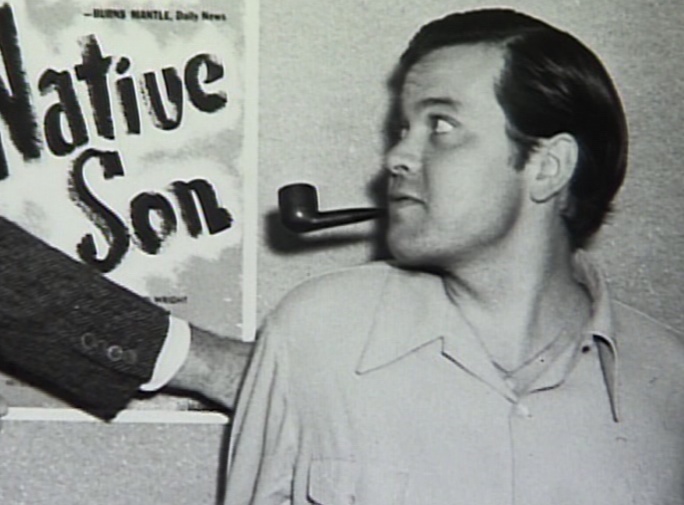
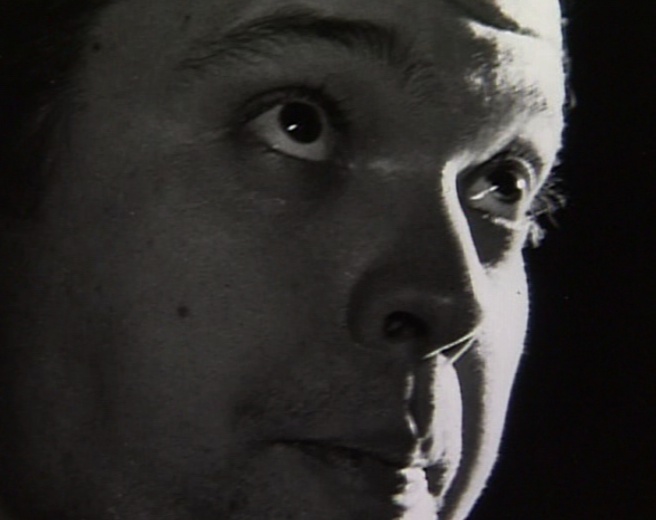
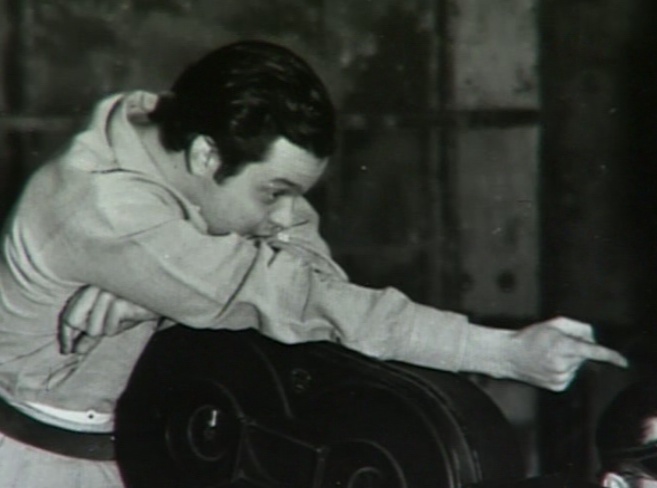
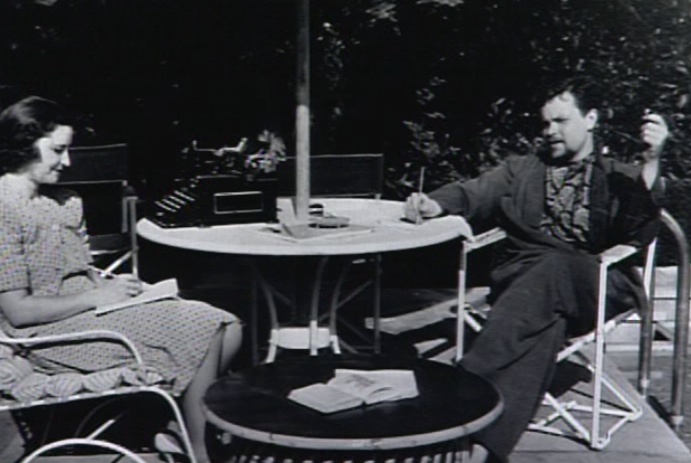
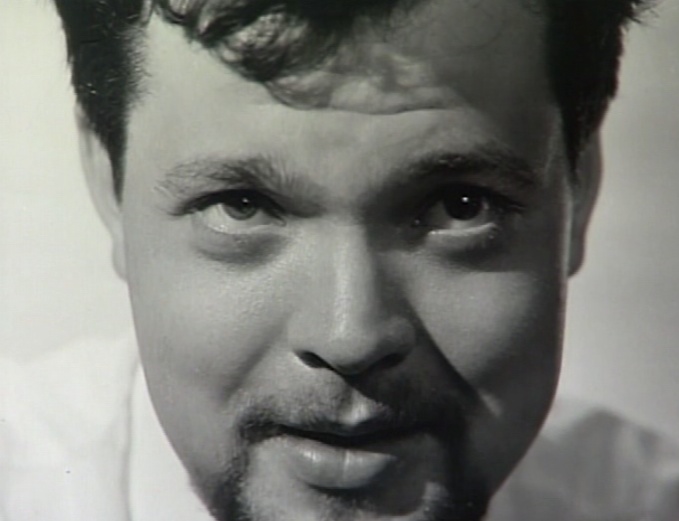
A montage of enormous photos. Awesome photos. I left them as huge as I found them because they just look so damn cool.
Orson montage 21
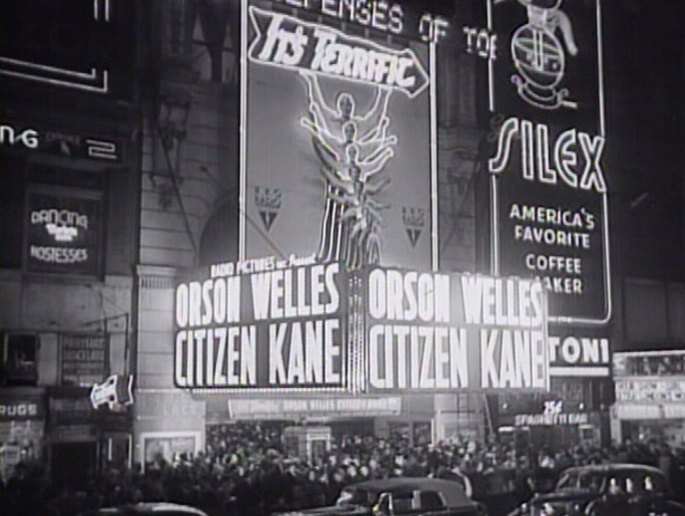
The opening of Citizen Kane (the delayed opening) at the Palace in NYC, owned by RKO - the studio who had produced the picture. It opened in the middle of the shitstorming blacklist from all sides - Hearst, the FBI, Louis Mayer, the theatre chains who feared being punished by Hearst, etc. The only reason it could play here was because RKO had bought it. It was theirs. But it never got wide distribution. Ever.
Orson montage 18
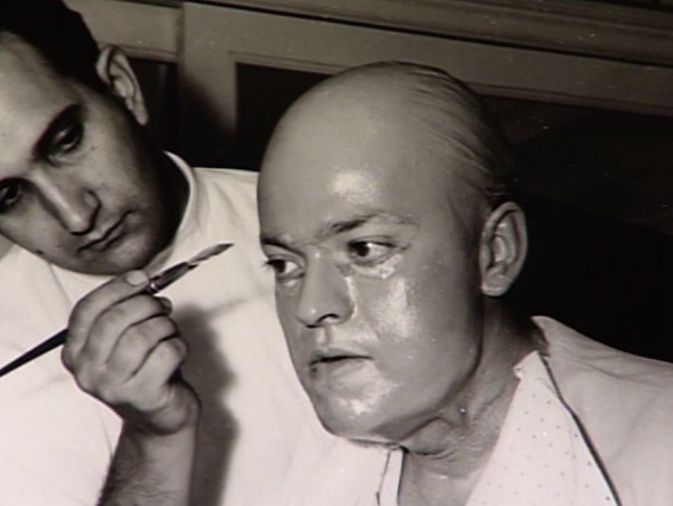
He's 24 years old here, getting into makeup for Citizen Kane. Extraordinary.
Orson montage 17
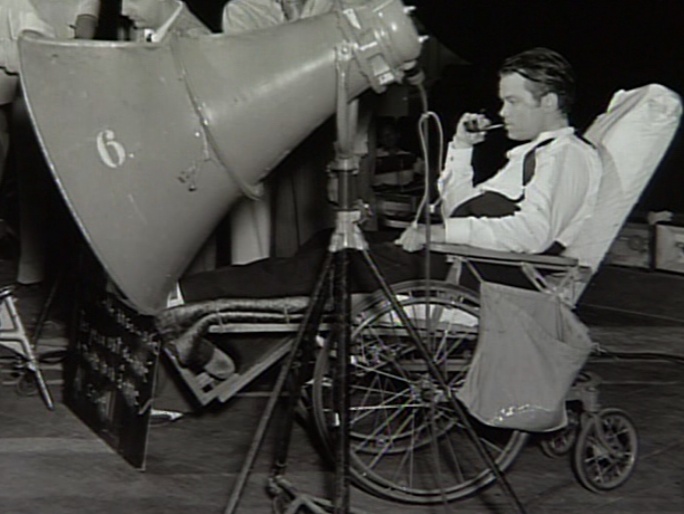
Orson broke his ankle while filming a scene in Citizen Kane - the one where he runs down the stairs after "Boss" Jim Gettys.
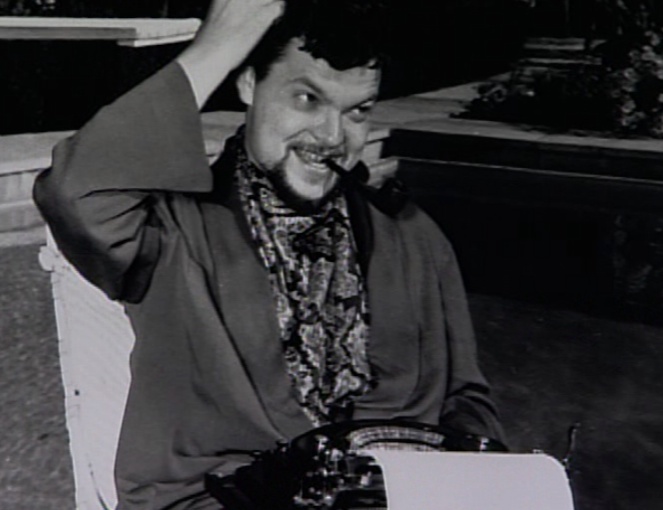
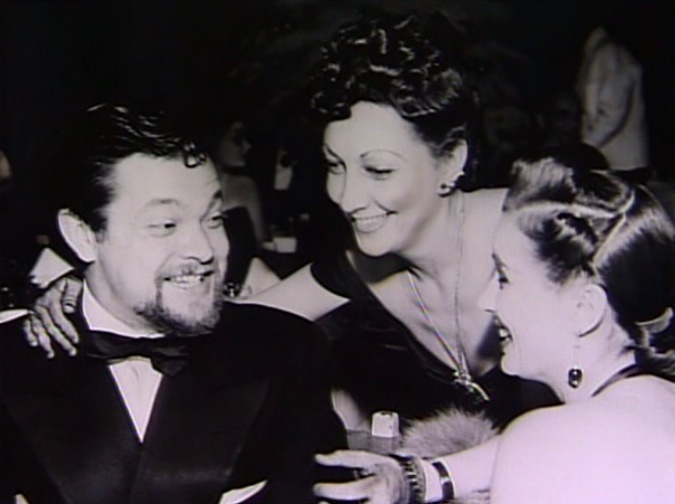

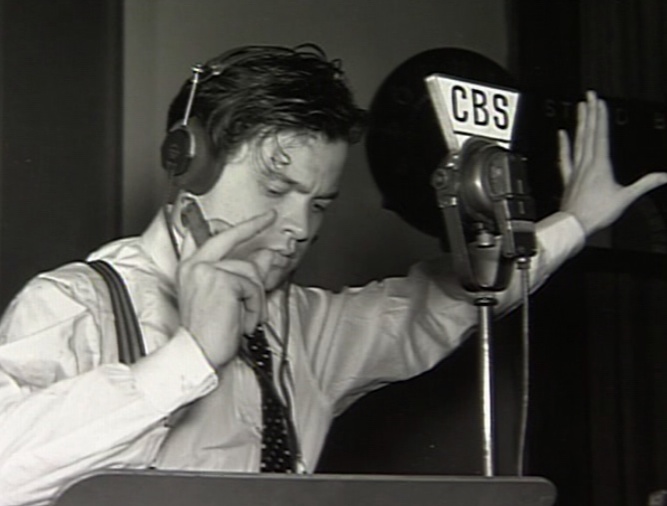
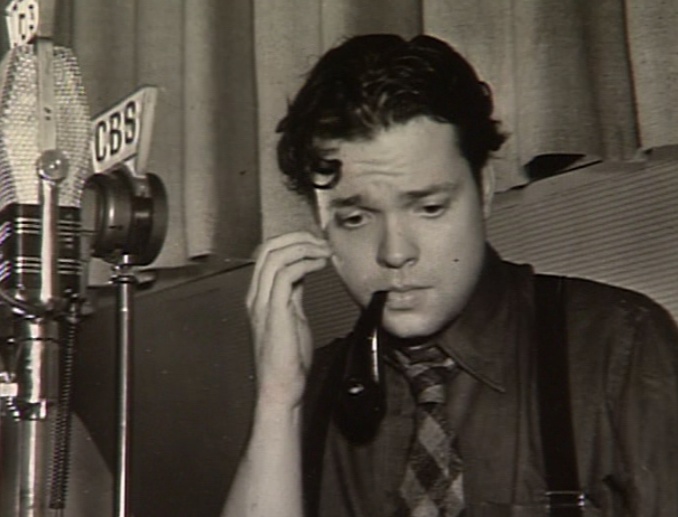
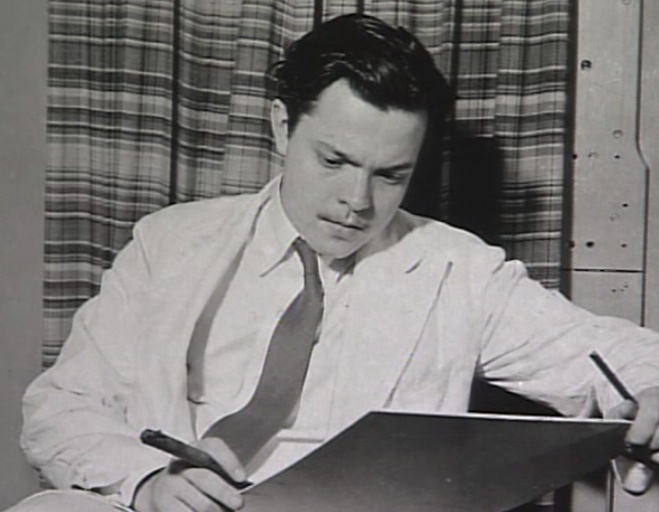
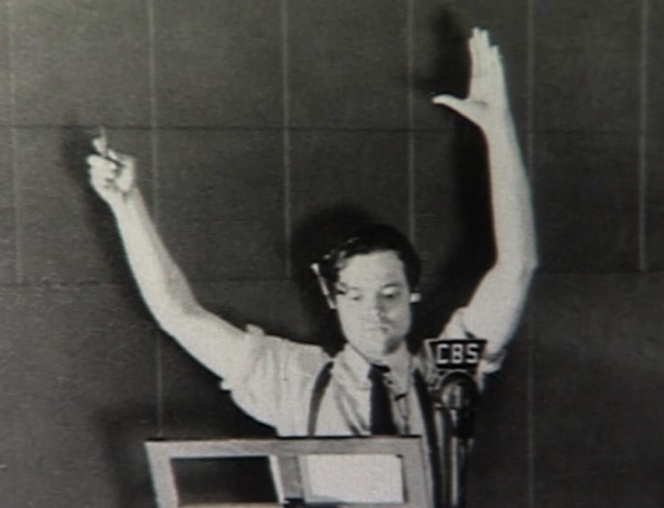
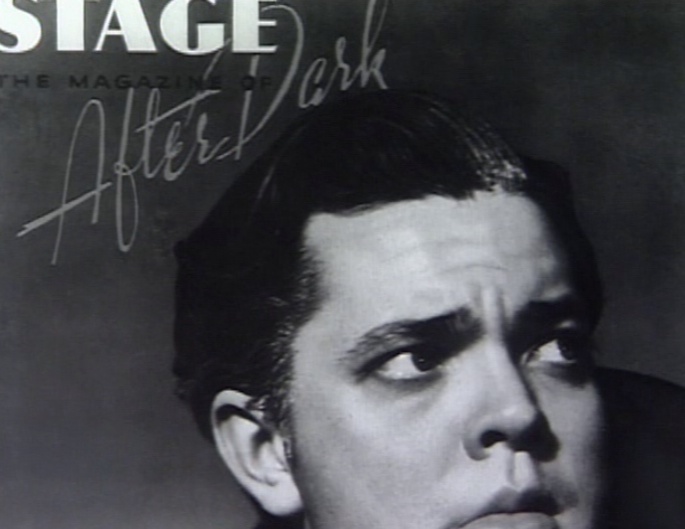
Orson montage 5
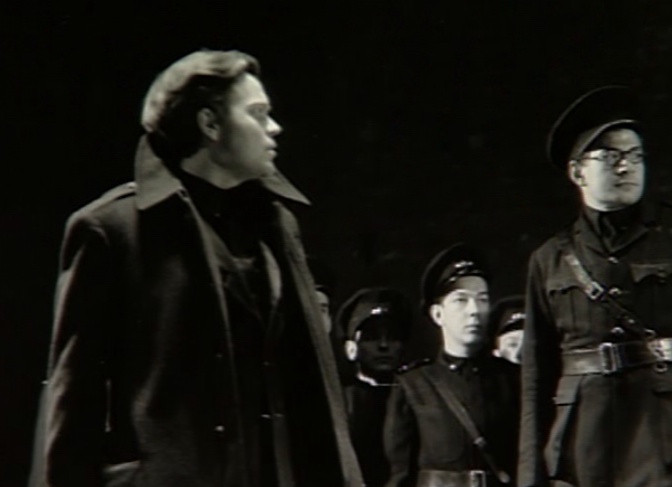
This is from his Mercury Theatre production of Julius Caesar - which is still generally considered to be the greatest Shakespeare production ever on an American stage. Where the FUCK is my time machine.
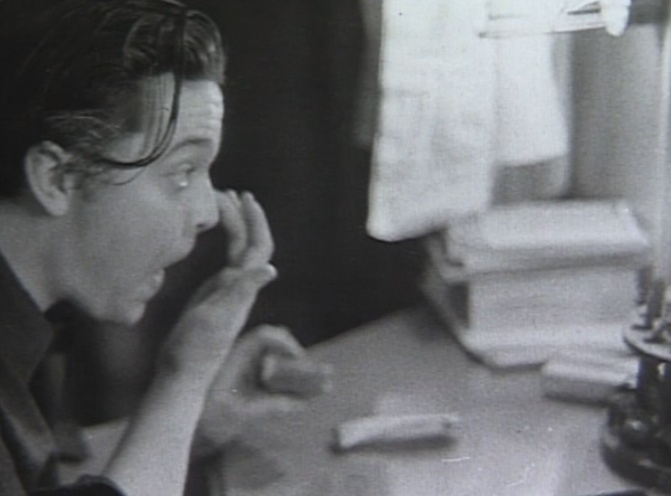
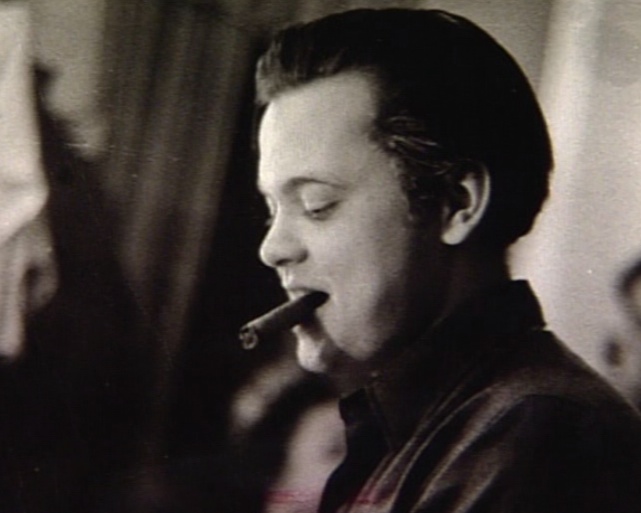
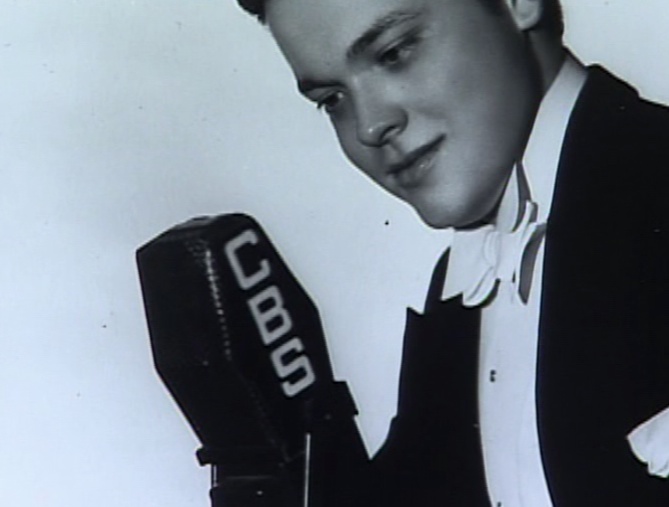
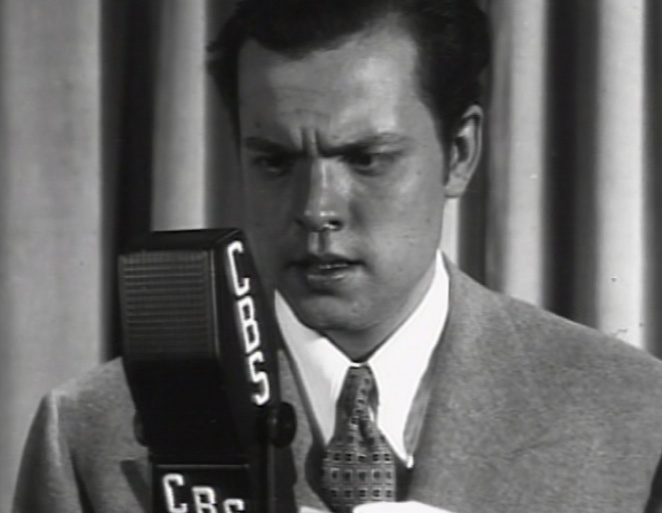
Couldn't resist
Walked by the Booth on my way to meet the Trinidadian, and took a picture of one of the photos in the marquee.

The Year of Magical Thinking

Joan Didion
The New York Times review by Ben Brantley. Of course I'm going but I just wanted to point out a couple of things in this review that reiterates my love for Ben Brantley - despite his flaws, etc. I've written about him before. He's very perceptive - and not too snobby - although I want my theatre critic to be a little bit snobby, thankyouverymuch. But one of the main reasons why I love him is that he has not forgotten how to be an audience member - if something works for him, he doesn't over-think it (for example - his glowing review of Mamma Mia - which opened in the wake of September 11 - still has the power to bring me to tears today. You can read my thoughts about that here) What I have always liked about Ben Brantley is his ability to hone in on why something works - and to pull out specific moments to illustrate his point. That's harder to do than you might think.
For example - I reference his review of Christine Ebersole in Grey Gardens here - and the excerpts I post show what I'm talking about. When I eventually saw Grey Gardens - it's not that I wouldn't have noticed Ebersole's genius without Brantley pointing it out - but it's that he did what a critic should do. He provided context. He enlarged the conversation. By that I mean, his message was: Make no mistake. Generations to come will be referencing this performance - so just know that - and see it while you still can. I appreciate that. Especially when I agree with it. He wasn't 100% rah-rah - he didn't like the first act (I didn't either), he wasn't wacky about the younger lead (neither was I) ... but to throw out the baby with the bathwater and not give Ebersole the props she deserves - would be ignorant. Too many critics do that.
So here is Brantley's review of Year of Magical Thinking - the adaptation of Joan Didion's stunning book of the same name. It's starring Vanessa Redgrave. As most everybody knows, Didion's husband John Gregory Dunne (brother to Dominick Dunne) died suddenly in 2003. Didion's book is about her immediate response to grief - the unreality of it, the inability to throw away his clothes ... the 'magical thinking' that death is not really real. Now no matter what I say here cannot convey the power of that tiny little book. I had to endure it and force myself to finish it it was so painful, and searing. She's one of my favorite writers anyway - and there's always been something spare and chill about her prose - it's what appeals to me. It's stripped down. It's like you can feel the hot desert sun of her home state beating down on her head, burning away all that is unnecessary. She has been known to spend weeks editing one of her own paragraphs - she's that specific with what she wants. Omit needless words, omit needless words, omit needless words ....
And Year of Magical Thinking is the opposite of what one would expect in our Quick-Fix culture. It's not self-help. It's not a "how to" book, eg: how to deal with your husband's sudden death. No. Anyone who fears being widowed, anyone who fears losing a loved one will find no comfort in this book. It's a woman's impressions from within the maelstrom of her grief. Things are not logical in immediate aftermaths like that. Your thoughts don't go to healing the wound. Your thoughts go (sometimes) to searing regret (thank you for the phrase, Richard Ford), or turning back the clock, or obsessively going over the last moment you spoke to the now-dead person ... trying to reverse time ... It's a horror. Didion does not write with retrospect - that is the main key to the book's power. She writes from the middle of it. It's relentless, comfortless. Open-eyed horror at what has been lost.
Didion's daughter Quintana - who is around my age - got mysteriously ill right before her father passed and was lying in the hospital in a coma when the death occurred. Imagine waking up from a coma to find you have lost your father. And then - even more horrifying - Quintana - who had this mysterious fever and heart condition which came over her quite suddenly - passed away as the book was going to print. Apparently And Didion decided not to include it. But my God. Quintana - not even 40 years old yet - engaged to be married - passed away. Joan and John had no other children.
So Didion's old age now ... will be alone. No daughter to keep her company, no grandchildren. That's it.
Didion's sentences are cold and clear, horrifying in their brutal spareness. Tough book to read.
And now she has adapted it as a one-woman show for Broadway. Here is a photo of Joan and Vanessa Redgrave - who is playing Joan in the production.
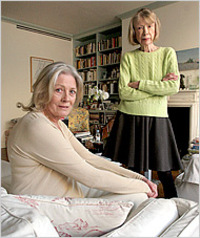
Anyway, Brantley's analysis of what works in book-form and what doesn't quite work in theatre-form is quite perceptive - but my main interest here is his discussion of Vanessa Redgrave's acting, which makes the hair on the back of my neck stand up.
Listen. Listen to the details of his observation:
As Ms. Redgrave continues to slide through the narrator’s past and present — from the gray world of hospitals and funeral arrangements to a sunny shared familial past — she gives sharp life to a variety of moods: fury at medical incompetence and evasiveness, passionate maternal solicitude, conspiratorial feyness as she speaks of her belief that her dead husband will come back to her if only she performs the right actions.Some moments — yes, silent ones — are remarkable. I have not, for example, been able to erase from my mind Ms. Redgrave’s face from an early scene. It’s after she, as Ms. Didion, has spoken of seeing her husband silent and slumped in a chair in their apartment at the end of a trying day. “I thought he was making a joke,” she says. “Slumping over. Pretending to be dead.”
Ms. Redgrave’s expression conveys two levels of consciousness: She is in the moment she has just described, irritated with what she perceives to be an ill-timed joke. And she is in the present tense — still angry with herself and the grotesque cosmic prank she has participated in — because her husband wasn’t joking at all.
In that small second or two Ms. Redgrave’s magnificent face, wry and wounded, is the reproachful emblem of the guilt and exasperation that the living so often feel toward the dying and the dead. There is also reflected that disorientation that comes from a death’s abrupt way of changing the rules by which you have always lived your life.
And then an observation like this:
Watch, for example, the attention she gives to a bracelet on her arm, and how she develops it. It will break your heart.
Will do, Ben. I'm seeing it in April.

Vanessa Redgrave as Joan Didion
The Books: "A Tangled Web" (L.M. Montgomery)
Next book in my Daily Book Excerpt series ...
Almost done with Lucy Maud! I'm skipping the rest of the short stories ... well, for now, anyway. Thank you, Melissa, for encouraging me in this direction. Ha!
 But I couldn't skip A Tangled Web. Like Blue Castle [excerpt here] - this book kind of stands alone, in the canon of Lucy Maud. It's an adult comedy - rather soap opera-ish - and in my opinion Lucy Maud is in full command of all of her powers in this book. It's chock-full of characters - this book doesn't have a "lead" - which is one of the reasons why it stands alone. The "leads" of the book are two sprawling intermarried families - with a cast of a hundred characters - all of whom we get to know. Some better than others - but still, there isn't one journey that dominates. The story of this book is: ancient Aunt Becky Dark (nee Penhallow) is dying. She's a bazillion years old and she knows she's dying. Everyone is terrified of Aunt Becky - not because she's cruel (although her comments sometimes are) - but because she always says exactly what is on her mind. She is the terrifying "matriarch" of a tangled clan - and every single person is afraid of her, because she will not hesitate to tell the truth, right to their face. Big truths - like "I know you are not in love with your husband" or little truths, like "You wear too much makeup". Anyway, Becky has, in her possession, a family heirloom: this old heinous JUG - and this is the catalyst for the entire book. The jug has been in the family for generations. Stories are told about it. It has crossed the Atlantic. It has been in glass display cases. It has also been in pantries filled with blackberry jame. It is a jug. Becky knows she is going to die and so she gathers the entire clan in her sick-room ... they are all there, crowded inside, and spilling out onto the porch ... all of them with their private griefs and hopes and hatreds ... Lucy Maud is at her best in this kind of situation - You can't believe how many balls she keeps in the air here. There are so many characters! And Becky reads out her will to the group, knowing it is going to cause ruptions and fractures and feuds ... and she cackles with glee at the thought of it, the old trouble-maker. But the big thing is the jug. Everybody wants to know: who is going to get the jug? It's basically like - the LEADERship of the family will be passed on through this jug ... and so they all sit there, in that crowded room, and we get to know each one, as they sit there ... and everybody wants it for different reasons, and everybody feels that they, personally, are the ONLY true heir of the jug ...
What ends up happening is fantastic. It's a great premise for a book. Basically, Becky announces at this meeting that the recipient of the jug will not be announced until exactly a year from that date. And she has a list of stipulations of the type of person it will NOT be given to. No drinking, no swearing, no whatever ... the list goes on and on. Naturally the vices cover pretty much everybody in the room. So over the next year, desperate to be good enough to get the jug, everyone begins to change their behavior, subtly, in order to be worthy to get the jug. Drunkards stop drinking. Etc. etc. And of course, with a clan like this one - a "tangled web" - any tiny change will have resounding implications. So shit starts to hit the fan, left and right.
It's a wonderful book - I love it.
Here's the section at the beginning of the book where Becky reads out her will. I am just amazed at how many characters she can keep going, and how - with one or 2 lines apiece, we know everything we need to know about everybody. I love, too, Lucy Maud's sense of humor. I just respond to it.
Excerpt from A Tangled Web. by Lucy Maud Montgomery
Aunt Becky unfolded her will, and settled her owlish, shell-ringed glasses on her beaky nose.
"I've left my little bit of money to Camilla for her life," she said. "After her death its to go to the hospital in Charlottetown."
Aunt Becky looked sharply over the throng. But she did not see any particular disappointment. To do the Darks and Penhallows justice, they were not money-grubbers. No one grudged Camilla Jackson her legacy. Money was a thing one could and should earn for oneself; but old family heirlooms, crusted with the sentiment of dead and gone hopes and fears for generations, were different matters. Suppose Aunt Becky left the jug to some rank outsider? Or a museum? She was quite capable of it. If she did, William Y. Penhallow mentally registered a vow that he would see his lawyer about it.
"Any debts are to be paid," continued Aunt Becky, "and my grave is to be heaped up - not left flat. I insist on that. Make a note of it, Artemas."
Artemas Dark nodded uncomfortable. He was caretaker of the Rose River graveyard, and he knew he would have trouble with the cemetery committee about that. Besides, it made it so confoundedly difficult to mow. Aunt Becky probaby read his thoughts, for she said,
"I won't have a lawn-mower running over me. You can clip my grave nicely with the shears. I've left directions for my tombstone, too. I want one as big as anybody else's. And I want my lace shawl draped around me in my coffin. It's the only thing I mean to take with me. Theodore gave it to me when Ronald was born. There were times when Theodore could do as graceful a thing as anybody. It's as good as new. I've always kept it wrapped in silver paper at the bottom of my thrid bureau drawer. Remember, Camilla."
Camilla nodded. The first sign of disappointment appeared on Mrs. Clifford Penhallow's face. She had set her heart on getting the lace shawl, for she feared she had very little chance of getting the jug. The shawl was siad to have cost Theodore Dark two hundred dollars. To think of burying two hundred dollars!
Mrs. Toynbee Dark, who had been waiting all the afternoon for an opportunity to cry, thought she saw it at the mention of Aunt Becky's baby son who had been dead for sixty years, and got out her handkerchief. But Aunt Becky headed her off.
"Don't start crying yet, Alicia. By the way, while I think of it, will you tell me something? I've always wanted to know and I'll never have another chance. Which of your three husbands did you like best - Morton Dark, Edgar Penhallow, or Toynbee Dark? Come now, make a clean breast of it."
Mrs. Toynbee put her handkerchief back in her bag and shut the latter with a vicious snap.
"I had a deep affection for all my partners," she said.
Aunt Becky wagged her head.
"Why didn't you say 'deceased' parters? You were thinking it, you know. You have that type of mind. Also, tell me honestly, don't you think you ought to have been more economical with husbands? Three! And poor Mercy and Margaret there haven't been able even to get one."
Mercy reflected bitterly that if she had employed the methods Alicia Dark had, she might have had husbands and to spare, too. Margaret coloured softly and looked piteous. Why, oh why, must cruel old Aunt Becky hold her up to public ridicule like this?
"I've divided all my belongings among you," said Aunt Becky. "I hate the thought of dying and leaving all my nice things. But since it must be, I'm not going to have any quarreling over them before I'm cold in my grave. Everything's down here in black and white. I've just left the things according to my own whims. I'll read the list. And let me say that the fact that any one of you gets something doesn't mean that you've no chance for the jug as well. I'm coming to that later."
Aunt Becky took off her spectacles, polished them, put them back on again, and took a drink of water. Drowned John nearly groaned with impatience. Heaven only knew how long it would be before she would get to the jug. He had no interest in her other paltry knick-knacks.
"Mrs. Denzil Penhallow is to have my pink china candlesticks," announced Aunt Becky. "I know you'll be delighted at this, Martha dear. You've given me so many hints about candlesticks."
Mrs. Denzil had wanted Aunt Becky's beautiful silver Georgian candlesticks. And now she was saddled with a pair of unspeakable china horrors, in colour a deep magenta pink with what looked like black worms wriggling all over them. But she tried to look pleased, because if she didn't it might spoil her chances for the jug. Denzil scowled, jug or no jug, and Aunt Becky saw it. Pompous old Denzil. She would get even with him.
"I remember when Denzil was about five years old he came down to my place with his mother, one day, and our old turkey gobbler took after him. I suppose the poor bird thought no one else had a right to be strutting around there. 'Member, Denzil? Lord, how you ran and blubbered! You certainly thought Old Nick was after you. Do you know, Denzil, I've never seen you parading up the church aisle since but I've thought of that."
Well, it had to be endured. Denzil cleared his throat and endured it.
"I haven't much jewellry," Aunt Becky was saying. "Two rings. One is an opal. I'm giving that to Virginia Powell. They say it brings bad luck, but you're too modern to believe that old superstition, Virginia. Though I never had any luck after I got it."
Virginia tried to look happy, though she had wanted the Chinese screen. As for luck or no luck, how could that matter? Life was over for her. Nobody grudged her the opal, but when Aunt Becky mentioned rings many ears were pricked up. Who would get her diamond ring? It was a fine one and worth several hundreds of dollars.
"Ambrosine Wentworth is to have my diamond ring," said Aunt becky.
Half those present could not repress a gasp of disapproval and the collective effect was quite pronounced. This, thought the gaspers, was absurd. Ambrosine Wentworth had no right whatever to that ring. And what good would it do her - an old broken-down servant? Really, Aunt Becky's brain must be softening.
"Here it is, Ambrosine," said Aunt Becky, taking it from her bony finger and handing it to the trembling Ambrosine. "I'll give it to you now, so there'll be no mistake. Put it on."
Ambrosine obeyed. Her old wrinkled face was aglow with the joy of a long-cherished dream suddenly and unexpectedly realized. Ambrosine Winkworth, through a drab life spent in other people's kitchens, had hankered all through that life for a diamond ring. She had never hoped to have it, and now here it was on her hand, a great starry wonderful thing, glittering in the June sunshine that fell through the window. Everything came true for Ambrosine in that moment. She asked no more of fate.
Perhaps Aunt Becky had divined that wistful dream of the old woman. Or perhaps she had just given Ambrosine the ring to annoy the clan. If the latter, she had certainly succeeded. Nan Penhallow was especially furious. She should have the diamond ring. Thekla Penhallow felt the same way. Joscelyn, who once had had a diamond ring, Donna, who still had one, and Gay, who expected she soon would have one, looked amused and indifferent. Chuckling to herself Aunt Becky picked up her will and gave Mrs. Clifford Penhallow her Chinese screen.
"As if I wanted her old Chinese screen," thought Mrs. Clifford, almost on the point of tears.
Margaret Penhallow was the only one whom nobody envied. She got Aunt Becky's Pilgrim's Progress, a very old, battered book. The covers had been sewed on, the leaves were yellow with age. One was afraid to touch it lest it might fall to pieces. It was a most disreputable old volume which Theodore Dark, for some unknown reason, had prized when alive. Since his death, Aunt Becky had kept it in an old box in the garret, where it had got musty and dusty. But Margaret was not disappointed. She had expected nothing.
"My green pickle leaf is to go to Rachel Penhallow," said Aunt Becky.
Rachel's long face grew longer. She had wanted the Apostle spoons. But Gay Penhallow got the Apostle spoons to her surprise and delight. They were quaint and lovely and would accord charmingly with a certain little house of dreams that was faintly taking place in her imagination. Aunt Becky looked at Gay's sparkling face with less grimness than she usually showed and proceeded to give her dinner set to Mrs. Howard Penhallow, who wanted the Chippendale sideboard.
"It was my wedding-set," said Aunt Becky. "There's only one piece broken. Theodore brought his fist down on the cover of one of the tureens one day when he got excited in an argument at dinner. I won out in the argument, though - at leats I got my own way, tureen or no tureen. Emily, you're to have the bed."
Mrs. Emily Frost, nee Dark, a gentle, faded little person, who also had yearned for the Apostle spoons, tried to look grateful for a bed that was too big for any of her tiny rooms. And Mrs. Alpheus Penhallow, who wanted the bed, had to put up with the Chippendale sideboard. Donna Dark got an old egg dish in the guise of a gaily coloure china hen sitting on a yellow china nest, and was glad because she had liked the old thing when she was a child. Joscelyn Dark got the claw-footed mahogany talbe Mrs. Palmer Dark had hope for, and Roger Dark got the Georgian candlesticks and Mrs. Denzil's eternal hatred. The beautiful old Queen Anne bookcase went to Murray Dark, who never read books, and Hugh Dark got the old hour-glass - early eighteenth century - and wondered bitterly what use it would be to a man for whom time had stopped ten years ago. He knew, none better, how long an hour can be and what devastating things can happen in it.
"Crosby, you're to have my old cut-glass whiskey decanter," Aunt Becky was saying. "There hasn't been any whiskey in it for many a year, more's the pity. It'll hold the water you're always drinking in the night. I heard you admire it once."
Old Crosby Penhallow, who had been nodding, wakened up and looked pleased. He really hadn't expected anything. It was kind of Becky to remember him. They had been young togehter.
Aunt Becky looked at him - at his smooth, shining bald head, his sunken blue eyes, his toothless mouth. Old Crosby would never have false teeth. Yet in spite of the bald head and faded eyes and shrunken mouth, Crosby Dark was not an ill-looking old man - quite the reverse.
"I have a mind to tell you something, Crosby," said Aunt Becky. "You never knew it - nobody ever knew it - but you were the only man I ever loved."
The announcement made a sensation. Everybody - so ridiculous is outworn passion - wanted to laugh but dared not. Crosby blushed painfully all over his wrinkled face. Hang it all, was old Becky making fun of him? And whether or no, how dared she make a show of him like this before everybody?
"I was quite mad about you," said Aunt Becky musingly. "Why? I don't know. You were handsomer sixty years ago than any man has a right to be, but you had no brains. Yet you were the man for me. And you never looked at me. You married Annette Dark - and I married Theodore. Nobody knows how much I hated him when I married him. But I got quite fond of him after a while. That's life, you know - though those three romantic young geese there - Gay and Donna and Virginia, think I'm telling rank heresy. I got over caring for you in time, even though for years after I did, my heart used to beat like mad everey time I saw you walk up the church aisle with your meek little Annette trotting behind you. I got a lot of thrills out of loving you, Crosby - many more I don't doubt than if I'd married you. And Theodore was really a much better husband for me than you'd have been - he had a sense of humour. And it doesnt' matter now whether he was or wasn't. I don't even wish now that you had loved me, though I wished it for so many years. Lord, the nights I couldn't sleep for thinking of you - and Theordore snoring beside me. But there it is. Somehow, I've always wanted you to know it and at last I've had the courage to tell you."
Old Crosby wiped his brow with his handkerchief. Erasmus would never let him hear the last of this - never. And suppose it got into the papers! If he had dreamed anything like this was going to happen, he would never have come to the levee. He glowered at the jug. It was to blame, durn it.
"I wonder how many of us will get out of this alive," whispered Stanton Grundy to Uncle Pippin.
But Aunt Becky had switched over to Penny Dark and was giving him her bottle of Jordan water.
"What the deuce do I care for Jordan water," thought Penny. Perhaps his face was too expressive, for Aunt Becky suddenly grinned dangerously.
"Mind the time, Penny, you moved a vote of thanks to Rob Dufferin on the death of his wife?"
There was a chorus of laughter of varying timbre, among which Drowned John's boomed like an earthquake. Penny's thoughts were as profane as the others' had been. That a little mistake betweent hanks and condolence, made in the nervousness of public speaking, should be everlastingly coming up against a man like this. From old Aunt Becky, too, who had just confessed that most of her life she had loved a man who wasn't her husband, the scandalous old body.
Mercy Penhallow sighed. She would have liked the Jordan water. Rachel Penhallow had one and Mercy had always envied her for it. There must be a blessing in any household that had a bottle of Jordan water. ASunt Becky heard the sigh and looked at Mercy.
"Mercy," she said apropos of nothing, "do you remember that forgotten pie you brought out after everybody had finished eating at the Stanley Penhallow's silver-wedding dinner?"
But Mercy was not afraid of Aunt Becky. She had a spirit of her own.
"Yes, I do. And do you remember, Aunt Becky, that the first time you killed and roasted a chicken after you were married, you brought it to the table with the insides still in it?"
Nobody dared to laugh but everybody was glad Mercy had the spunk. Aunt Becky nodded unperturbed.
"Yes, and I remember how it smelled! We had company, too. I don't think Theodore ever fully forgave me. I thoguht that had forgotten years ago. Is anything ever forgotten? Can people ever live anything down? The honours are to you, Mercy, but I must get square with somebody. Junius Penhallow, do you remember - since Mercy has started digging up the past - how drunk you were at your wedding?"
Junius Penhallow turned a violent crimson but couldn't deny it. Of what use was it, with Mrs. Junius at his elbow, to plead that he had been in such a blue funk on his wedding-morning that he'd never had had the courage to go throughwith it if he hadn't got drunk? He had never been drunk since, and it was hard to have it raked up now, when he was an elder in the church and noted for his avowed temperance principles.
"I'm not the only one who ever got drunk in this clan," he dared to mutter, despite the jug.
"No, to be sure. There's Artemas over there. Do you remember, Artemas, the evening you waled up the church aisle in your nightshirt?"
Artemas, a tall, raw-boned, red-haired fellow, had been too drunk on that occasion to remember it, but he always roared when reminded of it. He thought it the best joke ever.
"You should have all been thankful I had that much on myeslf," he said with a chuckle.
Mrs. Artemas wished she were dead. What was a joke to Artemas was a tragedy to her. She had never forgotten - could never forget - the humiliation of that unspeakable evening. She had forgiven Artemas certain violations of her marriage vow of which every one was aware. But she had never forgiven - could never forgive - the episode of the nightshirt. If it had been pajamas, it would not have been quite so terrible. But in those days pajamas were unknown.
Aunt Becky was at Mrs. Conrad Dark.
"I'm giving you my silver saltcellars. Alec Dark's mother gave them to me for a wedding-present. Do you remember the time your and Mrs. Clifford there quarreled over Alec Dark and she slapped your face? And neither of you got Alec after all. There, there, don't crack the spectrum. It's all dead and vanished, just like my affair with Crosby."
("As if there was ever any affair," thought Crosby piteously.)
"Pippin's to have my grandfather clock. Mrs. Digby Dark thinks she should have that because her father gave it to me. But no. Do you remember, Fanny, that you once put a tract in a book you leant me? Do you know what I did with it? I used it for curl papers. I've never forgive you for the insult. Tracts, indeed. Did I need tracts?"
"You -- weren't a member of the church," said Mrs. Digby, on the point of tears.
"No - nor am yet. Theodore and I could never agree which church to join. I wanted Rose River and he wanted Bay Silver. And after he died it seemed sort of disrespectful to his memory to join Rose River. Besides, I was so old than it would have seemed funny. Marrying and church-joining should be done in youth. But I was as good a Christian as any one. Naomi Dark."
Naomi, who had been fanning Lawson, looked up with a start as Aunt Becky hurled her name at her.
"You're to get my Wedgwood teapot. It's a pretty thing. Cauliflower pattern, as it's called, picked out with gold lustre. It's the only thing it really hurts me to give up. Letty gave it to me - she bought it at a sale in town with some of her first quarter's salary. Have you all forgotten Letty? It's forty years since she died. She would have been sixty if she were living now - as old as you, Fanny. Oh, I know you don't own to more than fifty, but you and Letty were born within three weeks of each other. IT seems funny to think of Letty being sixty - she was always so young - she was the youngest thing I ever knew. I used to wonder how Theodore and I ever produced her. She couldn't have been sixty ever - that's why she had to die. After all, it was better. It hurt me to have her die - but I think it would have hurt me more to see her sixty - wrinkled - faded - grey-haired - my pretty Letty, like a rose tossing in a breeze. Have you all forgotten that golden hair of hers - such living hair. Be good to her teapot, Naomi."
March 29, 2007
"The Terrorist"
Powerful film. Surprisingly so. I say surprising because I went into it with preconceived notions - many of which were incorrect. Until the last second I didn't know how this movie would end. I won't spoil it here. The acting is uniformly good, and to my taste each and every frame of this movie is a mini work of art. I highly recommend this movie - it's very important. The conflict is unnamed, although you can guess which war it is, due to the ethnicity of the characters. Malli, a 19 year old guerrilla soldier, is chosen to be a suicide bomber for a very important mission. It will "inspire generations to come". Again, the mission itself is not spelled out specifically but we get the idea: She is going to be blowing up some head of state. This is a targeted attack on a high-level politician. Malli has grown up in war, her father was a revolutionary, and her brother was also a "martyr" - so inflexibility and focused mania for the cause run in her blood. The film is very interesting because (and Ebert pointed this out in his review, and I agree with him) - unlike other films where, even though the main character is a murderer - or has done heinous things - you start to root for him (uhm, see every James Cagney movie ever made!) ... this is not the case here. Throughout the entire movie, you sit there and you keep hoping that somehow it will be called off, that she will NOT succeed. Her mission is futile, you just know this ... she is filmed like a lamb going for the slaughter. She is right in her mind, though - that's the thing. She has chosen this. She wants this. But, as with all good movies, the reality is a little bit more complex, once you start going into it, once you start getting to know her. Ebert writes too that you identify with her without identifying with her goal. Now that is a tricky thing, a very difficult thing - but this movie completely succeeds. And like I said, up until the very last frame of the film I did not know which way it would go. The last 20 minutes are terrible. Terribly stressful, I mean. There is this blazing-eyed martyrdom that is being yearned for ... and surrounding all of that is a sense of complete inevitability. There is no free will. You cannot stop the suicide bomber train once you get on it. That's a one-way ticket. Ayesha Dharkur who plays Malli is riveting, in every single second. She's got a face that the camera LOVES. Feelings ripple across it, breaking to the surface only occasionally. She's gorgeous, but in a way that seems totally non-actress-y.
A chilling film. The absolutes of Malli's world are chilling. There's something I get there, something I do understand ... but it is a world where one cannot really afford to have personal relationships. There is only room for the cause. Of course, this becomes the main conflict in the film.
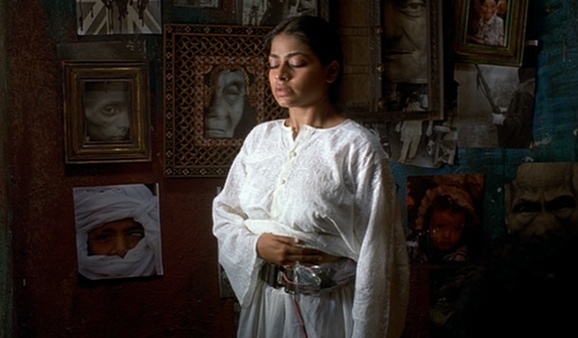
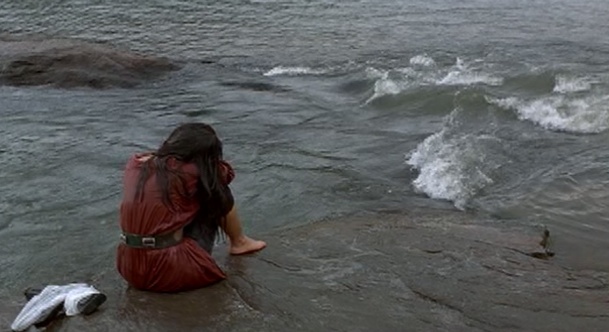
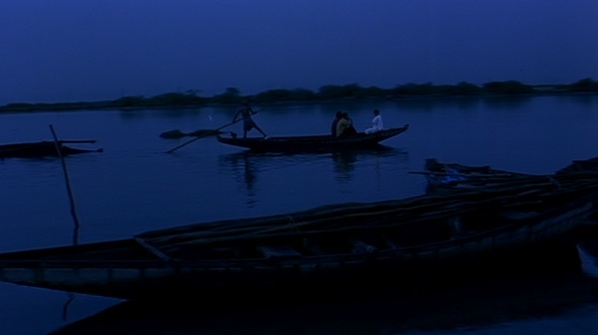
I've posted some screenshots below. You'll see what I mean about their beauty. The fact that this is such a gorgeously shot film is interesting, and I've been thinking a lot about it. The surroundings are lush, almost cartoon jungle, huge green leaves dripping with rain water, rushing rivers, gentle rainfall ... The countryside looks so lush, so fecund and welcoming ... Yet the reality is carnage. I'm sure that that dichotomy is deliberate.
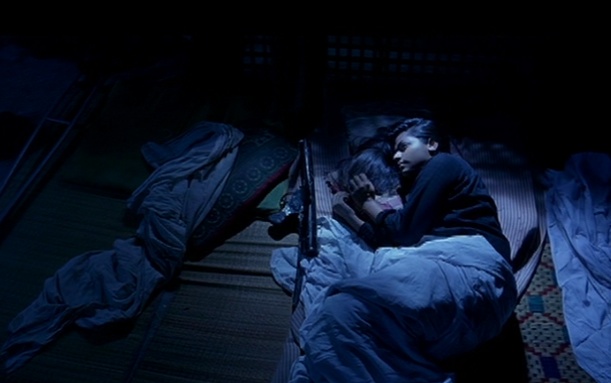
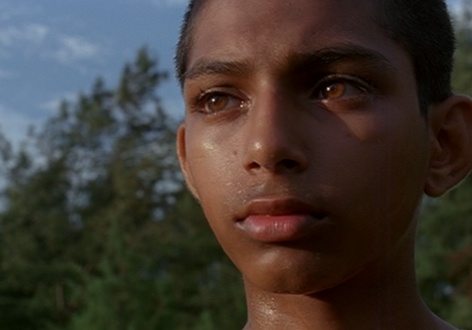
This is the little boy named Lotus. He is an orphan of the war, and he leads people through the jungle from spot to spot because he is an expert on land mines, and how to avoid them. God, you love this little boy. He is wonderful - he has some very difficult things to do in this movie, and your heart just shatters in a million pieces. Somehow, even with the horrors, his innocence has remain untouched. Except at night, when he has nightmares. Wonderful character, I will not forget him.
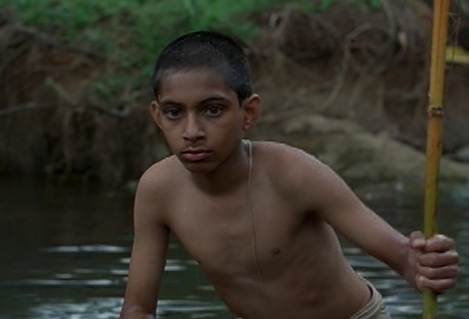
Lotus leads Malli through the jungle for her to catch the ferry to go off to her appointment with martyrdom. They sleep in Lotus' burned down village - he is the only one left alive.
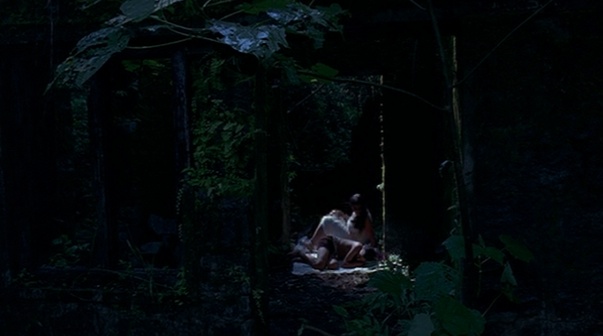
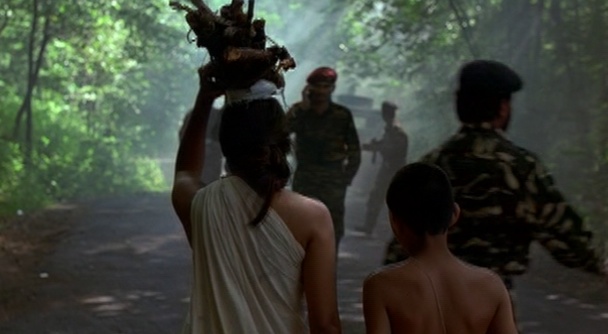
Crossing into enemy territory.
Lotus again. Look at that precious face.
Uhm. I grabbed the following screen shot basically because that guerrilla dude is a BABE. Total eye candy.
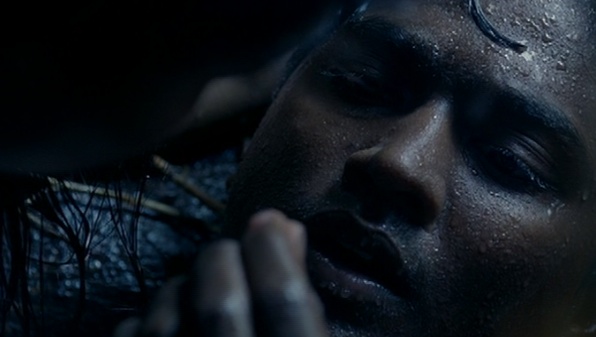
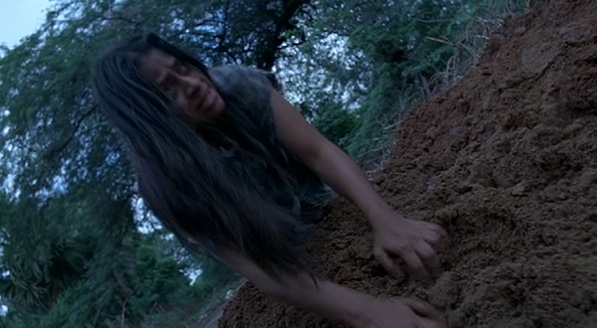

And here Malli is ... the one in white ... being rowed to her date with destiny.
Shackleton ...
One more yummy book image ....
SHACKLETON, E. H. The Heart Of The Antarctic. Being The Story Of The British Antarctic Expedition 1907-1909. London , William Heinemann, 1909. With An Introduction By Hugh Robert Mill, D. Sc. An Account Of The First Journey To The South Magnetic Pole By Professor T.W. Edgeworth David F.R.S. Octavo, original blue cloth, titles to spines in silver, titles and pictorial silver design to front covers, top edges gilt. Two volumes. Illustrated throughout. $1700.First trade edition. 2 volumes, 8vo. Original blue cloth, titles to spines in silver, titles and pictorial decoration to front covers in silver, top edges gilt. Illustrated throughout. Volume I spine faded, volume II entirely unfaded. (These volumes are usually rebound or seen with significant fading and wear due to their large size.) Overall a very good set that has endured admirably.

Isn't that gorgeous??
Shackleton reminds me of the early-morning conversation I had with Cashel 3 years ago.
Manhattan Rare Book Company
I'm having a field day clicking through here. Looking at the pictures of rare books make my fingers itch. Click around - some amazing things in there! I am particularly entranced by this one. Like this beautiful close-up of one of the images. Oh, and the books in the whole "Americana/Civil War" section are gorgeous ... I feel like a caveman. ME WANT. ME WANT.
But naturally, the following one makes me DROOL:
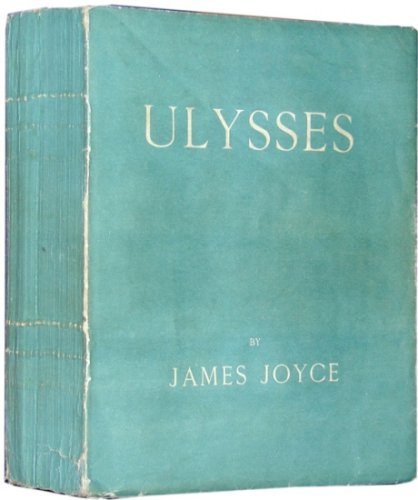
Joyce, James. Ulysses. Paris: Shakespeare and Co., 1922. Quarto, original blue-green wrappers. Custom half-leather box. $60,000.
First edition, one of 750 printed on handmade paper (out of a total edition of 1000). A superb, unrestored copy in original wrappers. Very light soiling to wrappers, slight wear to spine, faint crease on front cover. A spectacular copy, most rare in this condition.

And I missed a birthday: Bad friend, bad friend!!
Betsy and I have been friends since 5th grade. I do not remember how the friendship blossomed (Bets - do you?) - but it must have been a pretty instantaneous connection.
The main thrust of the start of our friendship was our shared love (should we say OBSESSION) for the musical of "Oliver". We went into a world of our own with this obsession. We would sit on top of the jungle gym at recess and sing through the entire score, song by song, with a crowd of children listening to us. We were a Rhode Island version of Maria Von Trapp, apparently.
Betsy and I wrote a book together. It was called "What Lies Below the Well". I wish I still had that manuscript. It was a mixture of Lion, Witch and Wardrobe, and Oliver Twist.
At one point, one character peers down the well and says, "I see something down there!"
Another character says, "What do you see?"
First character replies, "A long thin winding staircase without any bannister!"
See, I STILL think that's funny.
Imagine how thrilled we were when, in 6th grade, the school musical was announced, and it was going to be "Oliver".
Betsy (11 years old) was cast as Nancy, the whore with a heart of gold.
I was cast as the Artful Dodger, the mischievous pickpocket who acts as Oliver's guide. "Consider yourself - AT home - Consider yourself - one of the family..." I even did a Cockney accent. And our other friend J. was cast as Fagan. She was the wild card. She hadn't expected to get a big part - I still remember her huge glimmering eyes when the cast list was read out.
Betsy and J. and I leapt up and down in the hallways at school, when we heard the news, and cried, and hugged. We were out of our minds!
Other jokes through the years:
-- We always spoke in English accents. We thought people would be impressed. Why I have no idea.
-- We would walk from her house to the gym on the University campus after school and go swimming for an hour. Chattering the entire time to one another in English accents. For some reason, we liked to pretend that we had to walk 20 miles to get to the gym. That was part of our game. One or the other of us would sigh, in a British accent, "10 more miles!"
-- We used to sit in her room after school and tape ourselves doing skits which we thought were supremely hilarious. Betsy would play her autoharp and I would sing. Now THAT is a funny image. The autoharp!!
-- Betsy's father, an Episcopal priest, ran a camp in the north of Rhode Island - a work camp. It was a tree farm, and kids would flock to the camp every summer to work the tree farm. A work camp where you would have Bible study classes, and go out and cut trees down all day. I know, it sounds so fun, right? I went every summer. Even though I am Catholic. It was so freakin' FUN. There was one week called "Music Camp", which was hilariously fun. The whole camp took music workshops, acting workshops, put on a musical ... All while living in little cabins in the woods, and working on the tree farm as well. We would wake up at 7 in the morning and all run to go to church, which was held in a huge drafty barn. I guess you could say I had some of my first intense spiritual experiences at camp. God seemed realler there. And now - in a beautiful "all is right with the world" kind of way: Betsy runs Music Camp.
-- There have been times when I laughed so hard with Betsy I thought I might perish off the face of the earth.
-- One day, in high school, during "spirit week" (did you all ever have spirit week? School spirit week - where one day would be Hawaiian Day, one day would be Pajama Day - and you would come to school in costumes?) Anyway, Betsy and Mere, another great friend, were hanging out in the school library in their pajamas, during study hall. They were in a slapstick mood. Wearing your pajamas as you ride a school bus will do that to you. They had waterguns, and they began to chase each other through the stacks, ambushing each other in true Charlie's Angels style. Mrs. Wood, the rather imperious librarian, came around the corner and said, sternly, "Girls. Do I need to send you down to the principal's office, or do you need a babysitter?" Bad move - to give the girls a choice. Betsy and Mere glanced at each other, then looked back at Mrs. Wood and said, in unison: "I think we need a babysitter."
-- Betsy made her own dress for the senior prom. A lace extravaganza the exact style of which, unfortunately, ended up on a Leeza Gibbons show many years later, entitled: "Embarrassing Fashions from the 80s." It's okay, Bets. You looked great.
-- Betsy is one of the most loving supportive and friendly women I know. She is "good people", you know what I mean? She understands struggle - she is one of those people that you can go to with your problems, or when you're panicking about something stupid - because she will understand.
-- She never really says what you might expect her to say. Her wisdom is her own.
You're the best, dear Betsy. Happy birthday.
Happy birthday, Ann Marie!!
I wrote this huge post last year about how she and I "met before we met" - It was a mythic night, especially in retrospect - because I met her - before I really met her. I met M. - before I really met him. And I met Phil ... who took me on a date to see Pat McCurdy and this had long-term repercussions which still have reverb today. I went on one date with Phil and he took me to see Pat?? I mean, what? THANK you, Phil ... you have NO idea! And then months later I meet Ann Marie again ... at Pat? What are the odds?? Anyway, you can read the whole thing up there - it still makes me shiver a bit to think of what my life would be like if I HADN'T gone out on that shivery February night.
And so in honor of my dear friend's birthday, I am going to post an old Diary Friday which describes my best birthday party ever - a party that was engineered entirely by Ann Marie.
Thank you, dear friend ... and happy birthday!
November
I remember events by my outfits. That night, at Pat, was a blue denim and black mini-skirt kind of night. I had a feeling re: M.; by this point I totally believed he would be there. I sat for the first set with Ann and she came back after going to the bathroom ("doing a sweep" for M.) and said, "Let your heart SING!"I went back to sit with him. I felt like I was shooting out light from beneath my skin. I was so happy!
Pat had me sing with him. The intro to that song pulls my heart up and out of my body. He makes me feel like I could fly. If only I could run fast enough.
After the show, everyone was heading to the Emerald Queen, all of us exiting together. Pat was leaving too. I made M do the velociraptor for Pat.
(Ed: A quick note: M did "imitations" of dinosaurs. So funny that I would nearly asphyxiate from laughter when he would suddenly become a brontosaurus or whatever. He had been developing his velociraptor imitation for some time. I would be sitting at the bar, doing my thing, and glance over and see a velociraptor at the jukebox, picking out songs. Or he would suddenly become a pterodactyl as he took a sip of beer. He would chase me through his apartment AS a velociraptor - much to the chagrin of his poor roommate who was trying to get an early night. He became known, in my group of Lounge Ax friends who had a habit of giving everybody nicknames: "Dinosaur Boy.")
M. did NOT want to do his velociraptor for Pat, and I made him. Afterwards, M. was just wincing about it. "Pat McCurdy was having none of my velociraptor."
We all had this HYSTERICAL walk over to the Emerald Queen. M and I, our arms around each other, were lurching across Lincoln Avenue. It was 1:30 in the morning, and a huge crowd of us had been set loose. Gus Kapinsky was leapfrogging over parking meters, one after the other after the other. We made M. watch him do this.
Still stuck on Pat's clear animosity towards him, and Pat's indifference to his velociraptor, M. stood on the curb and pretended he was about to leap off and commit suicide. "I'm gonna jump!" he screamed.
No cars in sight. Long empty black street. Street lights changing from green to yellow to red with no cars there.
Suddenly M. announced bluntly, "A velociraptor can go 75-80 miles an hour" and he took off. Other Lounge Ax people heading to the Emerald Queen, some in 2s, others in larger groups, saw him gallop by, and started laughing, pointing. "Look! It's Dinosaur Boy!"
Voices echoing. Cold.
M. was a velociraptor. He peered hungrily into the windows of a car pulling out of a lot.
I was laughing so hard I thought I might need medical attention.
M. said to me after, "When I move my body … people laugh."
Thinking of the velociraptor, the spontaneous jazz dances, the circus horses, the ostrich running through my apartment, I had to agree.
At one point, at the Emerald Queen, some Sinatra song came on and M. suddenly leapt up and made a spectacle of himself with an impromptu jazz dance. A crowd surrounded him, roaring with laughter. Ann and I were mopping off tears. There were actual people watching, but M. was performing for an imaginary crowd, which was my favorite part. Also, he and I had literally been in the middle of a conversation, there hadn't even been a lull, and he responded, mid-sentence, to the call of the music.
M. turned to me suddenly, later, and said, "You wanna see my circus horse?"
You really have to ask?
The place was packed with people and suddenly M. pranced through the crowd, and all I can say is he WAS a circus horse down to the expression in his damn eyeballs.
I heard people murmuring, "What's going on" as M. high-stepped around me. He became himself for a second to explain to me what he did physically to become a horse (he had a theory about it) and then he became a horse again.
Ann turned around in the middle of all this and saw him high-stepping by. She watched him for a moment and then slowly looked to me for an explanation. Her expression was priceless.
I said quietly, "He's a circus horse."
She nodded, accepting this. "Oh."
M. said to me, word for word, "You and me … we laugh. We hang out with each other and we laugh. Know what I mean? It makes me happy. I like laughing with you. For too long I've lived my life like that Pat song about being artistic. I don't want to do that anymore. I like being happy."
And then – 2 weeks later – came my birthday extravaganza, held during a Pat show at Lounge Ax.
Ann Marie basically decorated the bar. She is so incredible. There was a huge bunch of balloons ("Here. Arrange these in a festive manner," she ordered Lady Elaine).
(Ed: This is so hostile but there was another Pat fan who she and I did not like, who was a bit crazy, and obsessed with McCurdy in a kind of stalkerish way - not in the ultra COOL and sophisticated way that ANN and I were obsessed with Pat McCurdy (sarcasm) – and basically this stalker-fan's nose and his chin almost touched – so Ann Marie and I called him "Lady Elaine" after the puppet on Mr. Rogers, because we felt there was a resemblance. We did not call him "Lady Elaine" to his face, but we would blatantly refer to him as such, "Wow, look at how Lady Elaine is hovering around Pat…" "Loved Lady Elaine's crazy air guitar during 'Knock Things Over'"…So the image of Ann Marie ordering "Lady Elaine" to arrange balloons in a "festive manner" … I just … It's just freakin' funny, that's all.)
Ann Marie baked cupcakes, brought candy. It was a total extravaganza. Everyone knew it was my birthday. I wore my mermaid dress and a black choker. (Ed: How embarrassing – but I warned you up front! Every diary entry during the "magic time" is accompanied by a description of my clothes…)
I went to find M. and he was sitting at the bar, so cute, waiting for me. I was so happy to see him I was high on him. We were a happy couple. We are a happy couple.
I pointed to all the balloons, arranged by Lady Elaine. "Those are for me."
He asked me how my actual birthday was and I told him pretty bad and that I had cried on the train. He was hurt by this news. "You cried on your birthday?"
Then he said, "I thought about you on your birthday. I thought about calling you, but …" and he stopped himself with this very inward-look on his face. He had no word of excuse, he looked confused at his own behavior. "I don't know why I didn't."
I said, "You should have! Of course, at the first sound of your voice I would have dissolved into tears."
We laughed at that.
I asked him how his Thanksgiving was and he said, "It was all right," but with such an evident edgy look of misery and anxiety in his eyes. He cannot mask his emotions. I responded to the look on his face, not his words. "Not good, huh."
He shrugged and then said, "Well … clearly I have issues."
I couldn't help myself. I burst into laughter right in his face. He has assimilated me! Me, always talking about "issues". He looked truly confused, like, "What did I just say?" – and I kept laughing, and then he began YELLING at me, "No! No! I don't have issues. I have PROBLEMS. I don't have issues. I have PROBLEMS."
Ann Marie wrote me a fairy story for my birthday. I was living in such a euphoric state. Everything was perfect. Ann also gave me flannel sheets! Bless you, Ann!! I love them. She went totally nuts for my birthday. She is an incredible party planner.
I had raved to M. about how I wanted flannel sheets, and he told me I had to get some. So I showed them to him, all excited. "Look, M.! Flannel sheets!" He was cute – kind of withdrawn, but smiling, shy, kind. "Hey! You just told me you wanted some!"
Half of our conversations are about objects and their faults or virtues: bureaus, incense, coffee makers, coffee tables, banana pickers jackets, new blue jeans, veal parmesan sandwiches, his special mattress he had as a teenager, etc.
I loved it that M. would get all puffed up like a peacock because he was "the guy with Sheila". He would pretend there was an imaginary crowd around him and he'd say in a very over-it casual tone, "Yeah … I'm with her. It's no big deal. I'm just with her."
M. told me his mother said his haircut made him look like a "jackass".
We left the bar with a huge fanfare because of all my gifts and balloons.
Pat had had me sing, and had also led the entire place in singing happy birthday to me.
M. helped me carry some of my stuff out. Ann said he was behaving "very husbandly" which is so true. He was loaded down with all my gifts, and I was keeping him waiting as I said good-bye to everyone five times. He was grumbling about it, and impatient.
"I have to say good-bye to Ann Marie!"
"Didn't you already do that?"
"Yeah, but not for the last time!"
He sat in the car, exhaling frustration as I flew around hugging everyone and saying goodbye to Ann Marie 10 times.
We released all of my balloons into the air outside of Lounge Ax. They floated up over the Biograph and disappeared into the black.
I climbed into the car with M., this person I have known for almost 2 years now, and we peeled away from the curb.
March 28, 2007
Let's do the time warp again
It's just a jump to the left ...
It is so interesting to have a great conversation with the child of a high school friend ... who is now the age when I first met my high school friend ... and to chat on the phone with her - oh, how's it going, what are you up to in high school right now, what are you working on right now ... oh you're working on a project about the Middle Ages? Oh, that's cool ... "Actually no, it's kind of stupid" she said ... "Oh, is it stupid? Yeah, I remember stupid projects I had to do, too" ... and to have, alongside of that, the image of myself at 14... and my high school friend, now this young woman's mother .... pressing our hot red Irish faces up against the gym wall during a dance, because we had just danced so hard to Rock Lobster that our heads had become raging hot tomatoes. That hot-red tomato-head now has a daughter. The age that we were back then. And the daughter and I chatted, and laughed, and connected ... and I guess it just never ceases to amaze and delight me. You're my friend's daughter!!!
Harses, harses, harses ...
(First of all: please name the movie that quote comes from! My sister Jean will know since we quote it all the time: "Harses, harses, harses, harses ...")
Anyway. Speaking of harses: Breathtaking!! Look at those wild things! Beauty!
Cards for any situation
I accidently drank all your liquor when I house-sat for you and then I filled the empty bottles with Fresca and Mountain Dew. Sorry.
Haha - City Wendy has more.
This reminds me of something my friend Brooke did a couple years ago and I thought it was an awesome idea. Basically, she took photographs of her yelling at her two children by the Christmas tree - and sent those out as the family Christmas card. I can't remember what she called the campaign - something like Honest Moments. And she had her family pose in all kinds of circumstances, fighting, scuffling children, scowling silent dinner tables - and sent THOSE out to her mailing list on special occasions. I remember opening her Christmas card and instead of seeing the normal family-posed-smiling-on-the-stairwell-like-the-Von-Trapps ... there was a kind of blurry black and white photograph, a family in pajamas, sleepy-head hair, Christmas morning, tree lights lit up, presents everywhere, the two kids fighting over something, and Brooke looking on and yelling at them to stop. An action shot, if you will. Best Christmas Card ever - I'm still laughing about it.
Today in History: March 28, 1941
TO: LEONARD WOOLF
Rodmell,
Sussex
Tuesday (18? March 1941)
Dearest, I feel certain I am going mad again. I feel we can't go through another of those terrible times. And I shan't recover this time. I begin to hear voices, and I can't concentrate. So I am doing what seems the best thing to do. You have given me the greatest possible happiness. You have been in every way all that anyone could be. I don't think two people could have been happier till this terrible disease came. I can't fight any longer. I know that I am spoiling your life, that without me you could work. And you will I know. You see I can't even write this properly. I can't read. What I want to say is I owe all the happiness of my life to you. You have been entirely patient with me and incredibly good. I want to say that - everybody knows it. If anybody could have saved me it would have been you. Everything has gone from me but the certainty of your goodness. I can't go on spoiling your life any longer.
I don't think two people could have been happier than we have been.
V.

March 28, 1941. After writing that note to her husband, Virginia Woolf put rocks in her pockets and drowned herself in the River Ouse.
Netflix ....
Netflix has changed how I look for movies. The majority of the movies on my queue are ones I have never seen before - or are movies I saw when I was 12 and never saw again for this or that reason. Like Butch Cassidy and the Sundance Kid. You know how when you rent movies at a local video store - you are limited by their selection - and most of the movies at, say, a Blockbuster are either movies I have no interest in seeing - or they have a bazillion copies of Spiderman 2 and no Charlie Chaplin. Not that there's anything wrong with Spiderman 2 - it's just that variety is the spice of life, and it's so awesome now to be able to expand my viewing into movies you can't find at Blockbuster. Some of them are famous movies, with great performances - like The Bad and the Beautiful ... others are more obscure, but with great international reputations. And I lose track of what is on my queue and I purposefully don't look at it too much so that when movies arrive they are a bit of a surprise. It's so much fun!! I went to certain sites like AFI and the great Film Site and looked at lists of "100 Greatest Movies Ever Made" - and put on the queue ones I hadn't seen. Some of my choices are just old favorites that for whatever reason Blockbuster and Hollywood Video don't carry. Like War Games. Oh, and Marisa inspired me recently to put Some Kind of Wonderful on the queue - a movie I've seen, but not since I was a teenager.
The two movies coming my way as we speak are 2 I have not seen yet: The Terrorist - a movie about a female Sri Lankan suicide bomber - which I really feel I need to see. It sounds fantastic, and terrifying. And also The Fall of the House of Usher - I am extremely excited to see that one. Never seen it!! Ebert has it on his "Great Movies" list - and I love how he opens his review:
The great hall in Jean Epstein's "The Fall of the House of Usher" is one of the most haunting spaces in the movies. Its floor is a vast marble expanse, interrupted here and there by an item of furniture that seems dwarfed by the surrounding emptiness. An odd staircase rises from one distant corner. It is not impossible that this vision, in one of the best-known French surrealist films, inspired the designers of the great hall of Xanadu in "Citizen Kane." In both films, shadows are made to substitute for details that are not really there, and a man and a woman, their lives ruled by his obsession with her, move like wraiths through the haunted space.The hall is not simply cold, enormous and forbidding, but has surrealistic details. "Leaves blow ominously across the floor," writes the critic Gary Morris, and the long white curtains "flutter menacingly, as if the house is under constant, quiet, insidious siege by a vengeful nature." This is not a room for human habitation, but a set for a surrealist opera.
Can't wait!
March 27, 2007
Ten Books I couldn't live without
Okay, so I got this dreadfully difficult question from Heather . But it originated here at Kaliana's - and the real fun is to click through and see what books show up on people's lists.
And just for ease's sake ... I am NOT going to include plays in this list.
This is HARD. But here goes.
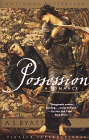
1. Possession - by A.S. Byatt. Like Heather I have read this book probably 4 or 5 times - I just finished it yet again, and every time I come to it - I see different things, I relate to different aspects. As my life changes, as I grow older ... the book appears to take on deeper meanings - I fluctuate between sympathy for Roland, for Christabel, for Val, for poor Ellen Ash, for Maud ... depending on my mood, or where I am at in my life. Also, and this is a deeper comment: This is a book about intellectuals having love affairs. The cerebral mixed with the primal. This is something that strikes a very intense chord in me ... a problem that has come up in my life repeatedly, because of who I am, and because of my emotional makeup - a fiery mix of brains and passion. Tough for anybody to handle. How will it work? How will I find my way, find peace? My intellectual side is rigid, hard-working, and can be very inflexible. I will not "tone it down" to make others feel comfortable around me. I've been asked (outright, and also subliminally) to "tone it down" and the price (for me) is too great. It's too much of a betrayal. And yet I do not lack feelings, I am not cold ... Maud's struggle in the book with "letting her hair down", her resistance to love, her fear of having her boundaries melded with somebody else's, is my eternal struggle. I have never ever read a better prolonged study of the issues a woman like myself has when she falls in love. It's very specific. There isn't anything generic about a love affair - and yet most books do not tackle it from Byatt's angle. Not only did I love the story, but I felt validated and vindicated by it. It's something I go to again and again, sometimes searchingly, sometimes just with the knowledge that I will be able to lose myself in it ... and sometimes with trepidation. The truths revealed in this book are only live-able to me when I am in a good head-space, and dealing with myself openly. If I'm trying to "hide" (in the same way that Maud hides) - then the book rebukes me. I can't think of too many other books that maintain such a vibrant presence in my life. It cannot be replaced.
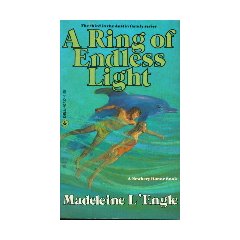
2. Ring of Endless Light - by Madeleine L'Engle I love all of her books but for some reason - if I had to choose? If I HAD to? This is the one I feel I would "need". That's the word that comes up. I need this book. I needed it from the first moment I read it - years ago. It has been there for me in really dark times. I have looked to it still, for inspiration, strength. I first read it when I was 19, 20 ... And it's funny ... but I still feel the same way about it. Extraordinary.

3. Lives of the Saints - by Nancy Lemann Who can say why some books get into our psyche and others do not? This is a slim novel, a first novel ... it is about nothing except an aimless post-college girl living in her home town of New Orleans, having wacky adventures, and loving a man who is gin-soaked and hilarious and tragic. I must get going with my 'daily book excerpt' thing again so that I can get into my adult fiction, which will be a lot of fun - damn that Lucy Maud for writing so much! Since I first read Lives of the Saints (and I remember picking it out, at random) - I have read her other books (and there aren't many) - and while I adore Sportsman's Paradise and Fiery Pantheon (not too wacky about Malaise) ... my heart belongs to Lives of the Saints. Why do I love it? God, let me see. First of all, it is laugh out loud funny. For a good summer after I read Lives of the Saints I found myself writing like her, imitating her. I love her style. It is eccentric, witty ... i remember reading it out loud to my boyfriend at the time and he would just GUFFAW. But then it turns around and stabs you in the heart, with sentimentality, sudden pain, loss so intense it takes your breath away. A true Southern novel - with that air of eccentricity and hilarity. GREAT characters, so so funny. Claude Collier - the main guy in the book - was the context through which I saw M., that first crazy summer I met him. M. was just as nuts as Claude, just as hard to pin down ... I could see a more conventionally minded girl being driven out of her cotton-pickin' mind by M. - and somehow ... Claude, and the spectacle of Claude, helped me deal with M. But all of this is just words. I love the books of Nancy Lemann and this one is one I go back to over and over and over. I love her sensibility. And more importantly: she is the type of writer who inspires me to keep writing. Here's an excerpt.

4. Moby Dick - by Herman Melville I wrote a little bit about what it was like to re-read Moby Dick on my own - as opposed to being forced to read it in high school - here. This book makes my heart pound faster. Every damn word is good. It's an overwhelming experience ... it's gluttonous ... because Melville is so spectacular, sentence after sentence after sentence ... You want him to take a break and be MEDIOCRE for just a page or two so that you, the reader, can not feel so inadequate. I read the book in high school but I didn't really READ it until 2001 - and my experience of reading that book was excitement. And also: growth. The chapter about "The Blanket" touched me on such a profound level that I can honestly say my mind-set slightly shifted after reading it. How would I approach life, how would I protect myself and yet also remain open and alive ... these were questions I was truly grappling with in the early months of 2001, a generally terrible time for me. And I read that chapter - and it landed within me so hard that I felt like I plummeted through the floor with the impact. A book that can do that is a book I want to have around.
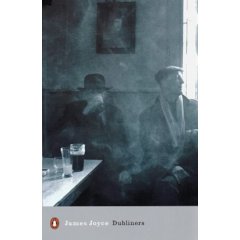
5. The Dead - by James Joyce. Now this was a really tough choice. But if I look deep in my heart, I realize that the thought of never being able to read the short story "The Dead" again actually causes me pain.

6. Hopeful Monsters - by Nicholas Mosley Crap, I keep saying I'm going to write about this book but it feels too huge. This book, when I read it, explained me to myself. It felt like my own system of beliefs - which are erratic, and yet make perfect sense to me - had been written down. It's an intellectual feast, a 20th century romp through politics and science ... I honestly don't know how to write about this book coherently. If my soul could take the form of a book - it would be Hopeful Monsters - which is really funny because "soul" sounds like such a mushy rainbow-y girlie word - and this book is stringently intellectual, full of piercing questions with no answers - pondering contemplative intellectual hypotheses, cameos by Heisenberg and Einstein and others ... so it's a funny book to attach the word "soul" to. But that's part of Mosley's point. One of my favorite books ever written. Can't live without it.
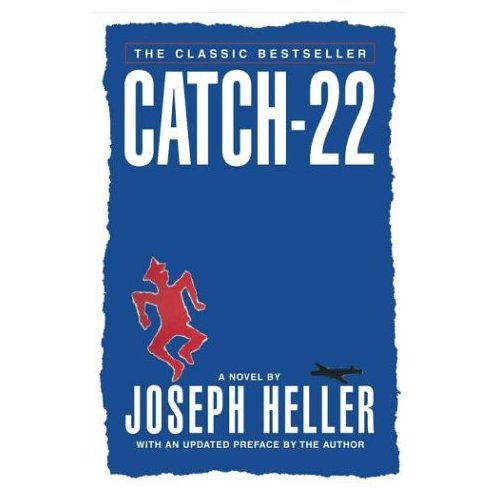
7. Catch 22 - by Joseph Heller One of the greatest books ever. Talk about having every sentence be brilliant and funny ... seriously, how can one author sustain a ba-dum-ching energy through that long of a book? I came to it late, despite the insistence of pretty much my entire family - all of whom are Catch-22 FREAKS OF NATURE. And within the first 2 pages I was hooked. This book is like crack. Not that I do crack. But if I did, I bet it would feel a little bit like reading Catch 22. I mean, come on. Chief White Halfoat? Is there a funnier character? Major Major Major Major? I love them all. Crack.

8. The Pigman - by Paul Zindel. I'm not sure, and don't quote me on this - but this might be my favorite book ever written. It's certainly in the eternal top 5 ... in the same way that Empire Strikes Back is, on my movie list. It might not always be number 1 - but it NEVER falls far from it. I first read this book at age 13. I still read it about once a year today. It's strangely connected, in my mind, now, with Sept. 11 - in a way that moves me profoundly. Strange what one remembers, the connections one makes. It's in my life - always. I babble about this book here.

9. Mating - by Norman Rush. Like Possession, like Goldbug variations, like Hopeful Monsters - this is a book that takes as its topic the intellectual component of falling in love. This is something that resonates with me ... and also is something that is rarely discussed, or talked about in books. Mating is all about that. I can't really add to my feelings about the book. I love it fiercely. And the section about Victoria Falls is something I refer to, over and over and over again. I never EVER get tired of it. I remember when I first read that section, thinking: "Okay. I'm hooked. I love this book now." Put a fork in Sheila. She's done. I've actually started to re-read it again. Every time I read it, I see something new, I get something new out of it. This, to me, is the mark of a true classic. I can re-visit it and it seems like the BOOK has changed - only no, it's just me.

10. Emily Climbs - by L.M. Montgomery I know, strange ... it's the second book in the series - but there's just something about it. Every part of it - the journal entries, the different episodes that have become almost mythic to me: Emily being trapped in the church, Ruth Dutton, Emily and Ilse sleeping in the haystack, Emily's second sight, Emily walking home to New Moon in a rage ... I think Lucy Maud is truly at her best in this book. I just lose myself in it every time I pick it up. Like I said at the beginning of this post, it is HARD to choose ... How can I leave off Tangled Web? Or Anne of the Island?? But for now - right in this moment - I feel that I cannot bear to be parted from Emily Climbs.
March 26, 2007
A New York shocker
I know it will be hard to believe, but a certain venue in Times Square has closed its doors. I had gone out searching for it again only to find ... it was gone.
I took 2 pretty damn funny pictures of what is there now. I've listed them below.
So here is the monolith that now confronts you ... if you go seeking out that old venue.

Wow. Okay. I GOT it. You guys CLOSED and there is now a RETAIL OPPORTUNITY.
Blue curtains line the glass front doors, obscuring what is within ... I wondered what remained of the mania I had once experienced. I went to peek between a gap in the blue curtains to see if there were any remnants of the former tenant .... And I took a photo thru the glass door of what I saw on the wall behind that curtain. This may be the funniest photo I have ever taken.

Must-read of the day:
The John Hughes School of Life.
Great work, Marisa. Loved it. We've covered a bit of this here before ... the whole Jake Ryan problem ... but I really liked how you organized this, how well-thought out your post was. I really agree with you.
Happy birthday- to Tennessee Williams
"You're always having to compete with yourself. They always say, 'It's not as good as Streetcar or Cat'. Of course it's not. At 69, you don't write the kind of play you write at 30. You haven't got the kind of energy you used to have."-- Tennessee Williams

Tennessee Williams said the following about Streetcar, and his main point of that entire play:
There are no 'good' or 'bad' people. Some are a little better or a little worse but all are activated more by misunderstanding than malice. A blindness to what is going on in each other's hearts. Stanley sees Blanche not as a desperate, driven creature backed into a last corner to make a last desperate stand - but as a calculating bitch with 'round heels'.... Nobody sees anybody truly but all through the flaws of their own egos. That is the way we all see each other in life.
Tennessee Williams wrote the following elegiac essay about Laurette Taylor (who created the role of Amanda so memorably in Glass Menagerie and made him star) for The New York Times after news of her death in 1949:
I do not altogether trust the emotionalism that is commonly indulged in over the death of an artist, not because it is necessarily lacking in sincerity but because it may come too easily. In what I say now about Laurette Taylor I restrict myself to those things which I have felt continually about her as apart from any which this unhappy occasion produces.Of course the first is that I consider her the greatest artist of her profession that I have known. The second is that I loved her as a person. In a way the second is more remarkable. I have seldom encountered any argument about her preeminent stature as an actress. But for me to love her was remarkable because I have always been so awkward and diffident around actors that it has made a barrier between us almost all but insuperable.
In the case of Laurette Taylor, I cannot say that I ever got over the awkwardness and the awe which originally were present, but she would not allow it to stand between us. The great warmth of her heart burned through and we became close friends.
I am afraid it is the only close friendship I have ever had with a player...
It is our immeasurable loss that Laurette Taylor's performances were not preserved on the modern screen. The same is true of Duse and Bernhardt, with whom her name belongs. Their glory survives in the testimony and inspiration of those who saw them. Too many people have been too deeply moved by the gift of Laurette Taylor for that to disappear from us.
In this unfathomable experience of ours there are sometimes hints of something that lies outside the flesh and its mortality. I suppose these intuitions come to many people in their religious vocations, but I have sensed them more clearly in the work of artists and most clearly of all in the art of Laurette Taylor. There was a radiance about her art which I can compare only to the greatest lines of poetry, and which gave me the same shock of revelation as if the air about us had been momentarily broken through by light from some clear space beyond us.
The last word that I received from her was a telegram which reached me early this fall. It was immediately after the road company of our play had opened in Pittsburgh. The notices spoke warmly of Pauline Lord's performance in the part of Amanda. "I have just read the Pittsburgh notices," Laurette wired me. "What did I tell you, my boy? You don't need me."
I feel now - as I have always felt - that a whole career of writing for the theatre is rewarded enough by having created one good part for a great actress.
Having created a part for Laurette Taylor is a reward I find sufficient for all the effort that went before and any that may come after.
It was a two-sided deal there. Her performance launched him into stardom. And his creation of Amanda revitalized her career just in time for her to capitalize on it. She would be dead in a couple of years. She had had a great career early in her life, and went on a 10 year binge following the death of her husband. Laurette Taylor was "washed up". Until ...
And now, she's a legend, her performance in Glass Menagerie is legendary. "What did I tell you, my boy, you don't need me..." Ha. That's what you think, Laurette! But in a way, she was completely right. The play is better than any one performance. The play didn't depend on Laurette Taylor's genius, although thank God she found the vehicle. The star of the play is actually the play itself, and Laurette Taylor knew that. The star of the play was this new voice of Tennessee Williams. And so no, Tennessee didn't "need" her. And about Tennessee saying: "I consider her the greatest artist of her profession that I have known." Anyone who knows anything about theatre would be hard-pressed to disagree. I haven't even SEEN the woman act, obviously, but I don't need to. I will take the hundreds and hundreds of eyewitness' word for it. In the same way that I know, in my heart, that Eleanora Duse was one of the "greatest artists of her profession" as well. I don't need to have seen her live.
Here's a treat for all you Tennessee and Laurette fans. Here is one of the original reviews of Glass Menagerie, after its premiere on an icy winter night in Chicago. This review focuses on the miracle that was Laurette Taylor's performance.
January 14, 1945MEMO FROM CHICAGO By Lloyd Lewis
CHICAGO - As this is written there exists doubt as to whether Eddie Dowling has anything more satisfying than an artistic success in his new production, "The Glass Menagerie", at the Civic Theatre, but there is no doubt whatsoever that he has brought back Laurette Taylor as a great character actress.
Not since she did "Peg o'My Heart," exactly thirty years ago, has she been so talked and written about.
In "The Glass Menagerie," which is a tenuous and moody tragedy from the pen of Tennessee Williams, she plays a decaying Delta belle overfond of haranguing her two children, one a warehouse worker (Mr. Dowling) and the other a morbidly bashful maiden (Julie Haydon), upon their duty to rise above the drabness of life in a St. Louis alley flat. Fumbling around the dolorous precincts of her home in a slipshod Mother Hubbard, she is forever reciting the plantation glories of her youth, how seventeen young gentlemen callers were forever complimenting her among the magnolias, and how she could have had this or that grandson instead of the captivating plebeian drunk who took her only to desert her and leave her to current St. Louis blues.
When Miss Taylor mumbles in magnificent realism she is still enough of a vocal wizard to be intelligible to her audiences, and when she pouts, nags or struts in pathetic bursts of romantic memory she is superb as a pantomime. Her descents into hysteria are masterpieces of understatement, dramatic in that they force her audience to do the acting for her.
She accomplishes her tour de force of acting without a single gesture which could be charged with showmanship. Some of her most telling lines are fumbling mutterings delivered over her shoulder. And in a scene wherein she prods her son into bringing home somebody, anybody, who might possibly marry his psychopathic sister before he himself wanders off, as his mother knows he will, into the big, blue and tipsy yonder, she gives a performance that could fit into the best of the Abbey Theatre's Irish plays.
One moment she is a ridiculous pretender and the next only a poor old woman dreading so soon to be dead because her helpless daughter will then be alone. When a 'caller' is eventually dragooned and brought to the house for dinner, Miss Taylor's appearance in an ancient taffety and high-toned manners is a delicate feat in the creation of that narrow line between the absurd and the sad.
Oh. Oh. For a time machine.
Here's a picture of Tennessee Williams out on his beloved Key West in 1980:

Make voyages. Attempt them. That's all there is.-- Tennessee Williams, "Camino Real"
I realized things about myself - and my life - through working on Miss Alma in Summer and Smoke - that pretty much forever changed me. My journal entries from that time are fascinating for me to look back on. I actually grew as a human being, while working on that play. I went into it a little bit here. Sheila and Alma had merged. It's one of the only times that's ever happened. Funny: I love to post my Diary Friday excerpts from high school days, because haw haw haw we can all sort of chuckle at the exuberance and silliness of youth. But I would very much hesitate to post those Sheila/Alma entries - which were, first of all, much more recent - but also - I don't know if I would ever want to expose that side of myself here. That is the real Artist Sheila. I couldn't bear to have anyone roll their eyes or chuckle at HER. NOBODY can tell me that Alma is "just" a character in a play. She LIVES, she breathes. I certainly felt possessed by her.
When people who knew him talk about Tennessee Williams, they always mention his laugh. Apparently, he had this wild high-pitched out-of-control Mozartian giggle, completely infectious to anyone near him. His plays may have had tragic elements, but that was how he worked out his own tragic upbringing, his sister's lobotomy, etc. He himself was not an openly tragic or introverted figure. He put all of his grief and sadness into his plays. The man was deeply sensitive - like all of his female characters. But if this seems like he was a bleak or depressive personality, that's incorrect. He always balked, too, when reviewers would characterize all of his female characters as "desperate". He didn't agree with that assessment at all. He saw each and every one of them as survivors - women trying to break through and live a happy and meaningful life. Other people assigned the meaning "desperate" to them, but Tennessee always hated that. Here's part of an essay he wrote for The New York Times in 1948 where he addresses this whole "desperate character" thing - In this essay he uses Miss Alma in "Summer and Smoke" as the jumping-off point:
All at once, I found myself hammed in by three women in basic black who had been to the Saturday matinee and had apparently thought of nothing since except the problems of Alma Winemiller, the heroine of "Summer and Smoke". When you are eating, a great deal can be accomplished by having a mouth full of food and by making gutteral noises instead of speech when confronted with questions such as, What is the theme of your play? What happens to the characters after the play is over? What is your next play about and how do you happen to know so much about women? On that last one you can spit the food out if it really begins to choke you.For a writer who is not intentionally obscure, and never, in his opinion, obscure at all, I do get asked a hell of a lot of questions which I can't answer. I have never been able to say what was the theme of my play and I don't think I have ever been conscious of writing with a theme in mind. I am always surprised when, after a play has opened, I read in the papers what the play is about, that it was about a decayed Southern belle trying to get a man for her crippled daughter, or that it was about a boozie floozie on the skids, or that a backwoods sheik in a losing battle with three village vamps.
Don't misunderstand me. I am thankful for these highly condensed and stimulating analyses, but it would never have occurred to me that that was the story I was trying to tell. Usually when asked about a theme I look vague and say, "It is a play about life." What could be simpler, and yet more pretentious? You can easily extend that a little and say it is a tragedy of incomprehension. That also means life. Or you can say it is a tragedy of Puritanism. That is life in America. Or you can say that it is a play that considers the "problem of evil". But why not just say "life"?
To return to the women in the alcove. On this particular occasion the question that floored me was, "Why do you always write about frustrated women?"
To say that floored me is to put it mildly, because I would say that frustrated is almost exactly what the women I write about are not. What was frustrated about Amanda Wingfield? Circumstances, yes! But spirit? See Helen Hayes in London's "Glass Menagerie" if you still think Amanda was a frustrated spirit! No, there is nothing interesting about frustration, per se. I could not write a line about it for the simple reason that I can't write a line about anything that bores me.
Was Blance of "A Streetcar Named Desire" frustrated? About as frustrated as a beast of the jungle! And Alma Winemiller? What is frustrated about loving with such white hot intensity that it alters the whole direction of your life, and removes you from the parlor of the Episcopal rectory to a secret room above Moon Lake Casino?
I came across this essay when I was working on Alma Winemiller - and I can't tell you how much of an "A-ha!" moment it gave me. If I felt drawn towards portraying her as sexually FRUSTRATED, or emotionally FRUSTRATED ... I remembered Tennessee's words. I remembered the truth of them. Do not play the frustration. How boring. Play the OBJECTIVE, play the DESIRE, play what you WANT with all your heart ... Let the CIRCUMSTANCES of the play frustrate you ... but never ever take your eye off your objective. And THAT is where the tragedy lies.
Brilliant. So so helpful to any actress who works on ANY of his great parts to keep in mind.
I love that drive in him - the drive to pour all of the darkness and fear from his background into his work - he was a man driven to do so - it was therapeutic for him, yes, but never just therapy. Art that is just therapy is usually bad art. Or - perhaps not bad - but it will not stand the test of time. Tennessee worked on his craft, and always cared more about the PLAY than about the personal demons exorcised by said play. Read his letters, his journals, his instructions to directors ... the level of detail there is astonishing. Really inspiring to me. To be such a great artist, but to also have such an understanding of craft, and structure.
"Nothing's more determined than a cat on a tin roof - is there? Is there, baby?"-- from Cat on a Hot Tin Roof
The lead of a play I did a year or so ago was the lead in Tennessee Williams' last play - Something Cloudy Something Clear - done here in NYC at Cocteau Rep. Williams died soon after the play went up. The play is a highly personal kind of dream-space, and reading it it is as though you can feel Williams getting ready to go into the dying of the light. It is the play of an old old man. A man getting ready. Craig shared with me his memories of working with Tennessee.
Everyone talks about his "laugh". Actors and actresses who were in his plays talk about hearing his laugh from out in the audience. It was a generous laugh, a laugh full of joy. If an actor or actress was doing well, he had no problem with letting them know, with enjoying their performances openly. (Other playwrights are not so kind. It seems as though other playwrights have this thought process: "No actor could EVER live up to the perfection that resides in my mind. My play is perfect as is ... it's the ACTORS who are messing it up!!" Playwrights like that, usually, are big bores, and don't have a lot of talent. Like: okay, you want perfection? Build a feckin' statue, and don't hire live actors. Mkay? That way your precious words will be safe from contamination. Ahem. I have a ton of stories.) But Tennessee, while kind of intimidated by actors, he never knew what to say to them ... LOVED them when they were wonderful. He did not consciously withhold approval - like so many do. If someone sucked, he had no problem with sending a note to the director saying: "Please have her realize that she needs to be light and funny on that one line - she is dragging down the entire scene with her dismal line readings..." hahaha He would never say such a thing to the actor's face - he let the director do his job - but if he was pleased? He would sit out in the audience, and just HOWL with laughter. He loved being an audience member. So many people in the theatre, because the theatre is their job and livelihood - forget how to just be an audience member.
Here, to me, is a quintessential Tennessee Williams statement.
An interviewer asked him: "What is your definition of happiness?"
He replied, "Insensitivity, I guess."
His experience of "happiness" as being, in its essence, "insensitive" came from his background. Those who were "sensitive" were crushed and shattered by cruelty, by life itself. His sister Rose was institutionalized and lobotomized. This was something Tennessee never really recovered from. (But he didn't really HAVE to recover from it, I guess. All of his feelings about it went into his work. If he had "recovered", or "worked it out" in his mind, then he might not have written Glass Menagerie, Summer and Smoke, et al.) He was a perpetual outsider. He was on the run from his past. He was able to "get out" of the past ... his sister Rose was not. The guilt of that never left him. The guilt of being "the one" who was able to live in the real world dogged him at every turn. If one was "happy", if one was able to manuever thru a world that lobotomized some of its most sensitive members, then "happiness" required some kind of a hard outer shell - a shell that Tennessee himself lacked, that other "sensitives" (his word) lacked. He did not begrudge people their happiness ... he just didn't understand it. He couldn't get "in there", ever. Again, this is kind of a blessing, at least as far as we are concerned - merely because that sort of baffled response to how on earth to LIVE in this world ... is the emotional place from which he wrote all of his plays.
He WAS Blanche. He WAS Tom in Glass Menagerie. He WAS Alma. He WAS Maggie. All of these people, these "sensitives", trying to make their way through, trying to bear up under disappointments and cruelty ... trying to SURVIVE.
Again and again, Williams reiterated that he never wrote about victims. He didn't see any of these people as victims. He saw them as survivors. Beautiful triumphant survivors.
Oh, you weak, beautiful people who give up with such grace. What you need is someone to take hold of you - gently, with love, and hand your life back to you.-- Tennessee Williams
The Blache DuBois', the Laura Wingfields, the Miss Almas ... these are sensitive people, deeply wounded people, on the edge of shattering - just like his sister Rose did. Of course blatant casual "happiness" would be seen as insensitive through their eyes.
All cruel people describe themselves as paragons of frankness.-- Tennessee Williams
Tennessee Williams is one of my own personal heroes, for more reasons than one, and I am aware (on a pretty much daily basis) of how grateful I am to him for his plays. In the same way that I am pretty much always conscious of being grateful that there was a Shakespeare, and that we have his works with us today. I still read Tennessee Williams plays now, over and over, reading them countless times, never ever getting tired of them, never ever feeling like all my questions are answered.
Some mystery should be left in the revelation of character in a play, just as a great deal of mystery is always left in the revelation of character in life, even in one's own character to himself.-- Tennessee Williams
And I'll leave you with another really telling and beautiful anecdote, this one from Elia Kazan. I LOVE this, because it says to me, in no uncertain terms, why Tennessee Williams is a god among playwrights - and why he is so unusual. Nobody else can touch him, really. I love Arthur Miller's plays, but there's always a social conscience in them which can get preachy and tiresome if it's not controlled. Death of a Salesman has a perfect balance, but his later plays have the feeling of pamphlets.
Tennessee Williams has none of that. There is no "social conscience" in his plays. There is no deeper social criticism going on. Perhaps the only "criticism" that Tennessee consistently levels at "society" is the way it treats the "sensitives".
I have found it easier to identify with the characters who verge upon hysteria, who were frightened of life, who were desperate to reach out to another person. But these seemingly fragile people are the strong people really.-- Tennessee Williams
Here's the setup for the excerpt I want to post (which has to do with the rehearsals and also the opening of Streetcar Named Desire):
Jessica Tandy, who originated Blanche on Broadway, was already a celebrated actress. Marlon Brando was practically unknown. Kazan noticed which way the wind was blowing during rehearsals, and it concerned him on many levels.
Basically what was happening was that Marlon Brando was acting Jessica Tandy off the stage. Without breaking a sweat, Brando stole the show right out from under her. Jessica Tandy fought to keep her ground (which, actually, is perfect for the theme of the show and for the character of Blanche Dubois), but Kazan's main concern was that Blanche would turn into a laughable character and lose the sympathy of the audience. Kazan was worried that the audience, because of Brando's undeniable stage presence, and the electricity of his acting, would completely side with Stanley, and not have any sympathy for Blanche at all. This, Kazan felt, would be a disaster. Stanley rapes Blanche. This event must be seen as horrifyingly wrong, not as Blanche getting what she deserves. But Brando's power took over the play, it was a runaway train, it wasn't a matter of him playing Stanley as sympathetic - he wasn't. It was just that he was a force to be reckoned with, a powerhouse - you couldn't take your eyes off him. Jessica Tandy barely registered, when she was beside him.
Here's a photo from that production: Brando, Kim Hunter, and Tandy:

And so Kazan feared, as rehearsals went on, that the balance of the play was off.
Here's what Kazan wrote about all of this in his marvelous autobiography.
It is Tennessee Williams' "advice" to Kazan at the end that really packs a punch:
But what had been intimated in our final rehearsals in New York was happening. The audiences adored Brando. When he derided Blanche, they responded with approving laughter. Was the play becoming the Marlon Brando Show? I didn't bring up the problem, because I didn't know the solution. I especially didn't want the actors to know that I was concerned. What could I say to Brando? Be less good? Or to Jessie? Get better? ...Louis B. Mayer sought me out to congratulate me and assure me that we'd all make a fortune ... He urged me to make the author do one critically important bit of rewriting to make sure that once that "awful woman" who'd come to break up that "fine young couple's happy home" was packed off to an institution, the audience would believe that the young couple would live happily ever after. It never occurred to him that Tennessee's primary sympathy was with Blanche, nor did I enlighten him ... His misguided reaction added to my concern. I had to ask myself: Was I satisfied to have the performance belong to Marlon Brando? Was that what I'd intended? What did I intend? I looked to the author. He seemed satisfied. Only I -- and perhaps Hume [Cronyn, Tandy's husband] -- knew that something was going wrong ...
What astonished me was that the author wasn't concerned about the audience's favoring Marlon. That puzzled me because Tennessee was my final authority, the person I had to please. I still hadn't brought up the problem, I was waiting for him to do it. I got my answer ... because of something that happened in the Ritz-Carlton Hotel, across the hall from my suite, where Tennessee and Pancho were staying. [Pancho was Tennessee's boyfriend - or maybe it was more of a f*** buddy situation. Pancho was a huge presence in Tennessee's life. They had a really volatile relationship.] One night I heard a fearsome commotion from across the hall, curses in Spanish, threats to kill, the sound of breaking china ... and a crash ... As I rushed out into the corridor, Tennessee burst through his door, looking terrified, and dashed into my room. Pancho followed, but when I blocked my door, he turned to the elevator still cursing, and was gone. Tennessee slept on the twin bed in my room that night. The next morning, Pancho had not returned.
I noticed that Wiilliams wasn't angry at Pancho, not even disapproving -- in fact, when he spoke about the incident, he admired Pancho for his outburst. At breakfast, I brought up my worry about Jessie and Marlon. "She'll get better," Tennessee said, and then we had our only discussion about the direction of his play. "Blanche is not an angel without a flaw," he said, "and Stanley's not evil. I know you're used to clearly stated themes, but this play should not be loaded one way or the other. Don't try to simplify things." Then he added, "I was making fun of Pancho, and he blew up." He laughed. I remembered the letter he'd written me before we started rehearsals, remembered how, in that letter, he'd cautioned me against tipping the moral scales against Stanley, that in the interests of fidelity I must not present Stanley as a "black-dyed villain". "What should I do?" I asked. "Nothing," he said. "Don't take sides or try to present a moral. When you begin to arrange the action to make a thematic point, the fidelity to life will suffer. Go on working as you are. Marlon is a genius, but she's a worker and she will get better. And better."
So extraordinary. It brings tears to my eyes, and it's wonderful advice, advice that any artist would do well to follow. "Don't take sides ..." "fidelity to life ..."
Here is the review of the premiere of Streetcar Named Desire, in New York City, December 3, 1947.
December 4, 1947FIRST NIGHT AT THE THEATRE by Brooks Atkinson
Tennessee Williams has brought us a superb drama, "A Streetcar Named Desire," which was acted at the Ethel Barrymore last evening. And Jessica Tandy gives a superb performance as a rueful heroine whose misery Mr. Williams is tenderly recording. This must be one of the most perfect marriages of acting and playwriting. For the acting and playwriting are perfectly blended in a limpid performance, and it is impossible to tell where Miss Tandy begins to give form and warmth to the mood Mr. Williams has created.
Like "The Glass Menagerie," the new play is a quietly woven study of intangibles. But to this observer it shows deeper insight and represents a great step forward toward clarity. And it reveals Mr. Williams as a genuinely poetic playwright whose knowledge of people is honest and thorough and whose sympathy is profoundly human.
"A Streetcar Named Desire" is history of a gently reared Mississippi young woman who invents an artificial world to mask the hideousness of the world she has to inhabit. She comes to live with her sister, who is married to a rough-and-ready mechanic and inhabits two dreary rooms in a squalid neighborhood. Blanche - for that is her name - has delusions of grandeur, talks like an intellectual snob, buoys herself up with gaudy dreams, spends most of her time primping, covers things that are dingy with things that are bright and flees reality.
To her brother-in-law she is an unforgiveable liar. But it is soon apparent to the theatregoer that in Mr. Williams' eyes she is one of the dispossessed whose experience has unfitted her for reality; and although his attitude toward her is merciful, he does not spare her or the playgoer. For the events of "Streetcar" lead to a painful conclusion which he does not try to avoid. Although Blanche cannot face the truth, Mr. Williams does in the most imaginative and perceptive play he has written.
Since he is no literal dramatist and writes in none of the conventional forms, he presents theatre with many problems. Under Elia Kazan's sensitive but concrete direction, the theatre solved them admirably. Jo Mielziner has provided a beautifully lighted single setting that lightly sketches the house and the neighborhood. In this shadowy environment the performance is a work of great beauty.
Miss Tandy has a remarkably long part to play. She is hardly ever off the stage, and when she is on stage she is almost constantly talking -- chattering, dreaming aloud, wondering, building enchantments out of words. Miss Tandy is a trim, agile actress with a lovely voice and quick intelligence. Her performance is almost incredibly true. For it does seem almost incredible that she can convey it with so many shades and impulses that are accurate, revealing and true.
The rest of the acting is also of very high quality indeed. Marlon Brando as the quick-tempered, scornful, violent mechanic; Karl Malden as a stupid but wondering suitor; Kim Hunter as the patient though troubled sister -- all act not only with color and style but with insight.
By the usual Broadway standards, "Streetcar Named Desire" is too long; not all those words are essential. But Mr. Williams is entitled to his own independence. For he has not forgotten that human beings are the basic subject of art. Out of poetic imagination and ordinary compassion he has spun a poignant and luminous story.
I have tears in my eyes.
We are lucky in this country that we have produced such a playwright. We are lucky to have all of his plays in the canon. I can't imagine my life without them.
Happy birthday, Tom.

Tennessee Williams said the following, in a 1981 interview - only a couple of years before he passed away:
"I'm very conscious of my decline in popularity, but I don't permit it to stop me because I have the example of so many playwrights before me. I know the dreadful notices Ibsen got. And O'Neill -- he had to die to make 'Moon' successful. And to me it has been providential to be an artist, a great act of providence that I was able to turn my borderline psychosis into creativity -- my sister Rose did not manage this. So I keep writing. I am sometimes pleased with what I do -- for me, that's enough."
March 25, 2007
Today in history: March 25, 1911
Shirt - by Robert Pinsky The back, the yoke, the yardage. Lapped seams, The nearly invisible stitches along the collar Turned in a sweatshop by Koreans or Malaysians
Gossiping over tea and noodles on their break
Or talking money or politics while one fitted
This armpiece with its overseam to the band
Of cuff I button at my wrist. The presser, the cutter,
The wringer, the mangle. The needle, the union,
The treadle, the bobbin. The code. The infamous blaze
At the Triangle Factory in nineteen-eleven.
One hundred and forty-six died in the flames
On the ninth floor, no hydrants, no fire escapes--
The witness in a building across the street
Who watched how a young man helped a girl to step
Up to the windowsill, then held her out
Away from the masonry wall and let her drop.
And then another. As if he were helping them up
To enter a streetcar, and not eternity.
A third before he dropped her put her arms
Around his neck and kissed him. Then he held
Her into space, and dropped her. Almost at once
He stepped up to the sill himself, his jacket flared
And fluttered up from his shirt as he came down,
Air filling up the legs of his gray trousers--
Like Hart Crane's Bedlamite, "shrill shirt ballooning."
Wonderful how the patern matches perfectly
Across the placket and over the twin bar-tacked
Corners of both pockets, like a strict rhyme
Or a major chord. Prints, plaids, checks,
Houndstooth, Tattersall, Madras. The clan tartans
Invented by mill-owners inspired by the hoax of Ossian,
To control their savage Scottish workers, tamed
By a fabricated heraldry: MacGregor,
Bailey, MacMartin. The kilt, devised for workers
to wear among the dusty clattering looms.
Weavers, carders, spinners. The loader,
The docker, the navvy. The planter, the picker, the sorter
Sweating at her machine in a litter of cotton
As slaves in calico headrags sweated in fields:
George Herbert, your descendant is a Black
Lady in South Carolina, her name is Irma
And she inspected my shirt. Its color and fit
And feel and its clean smell have satisfied
both her and me. We have culled its cost and quality
Down to the buttons of simulated bone,
The buttonholes, the sizing, the facing, the characters
Printed in black on neckband and tail. The shape,
The label, the labor, the color, the shade. The shirt.
More links about the Triangle Shirtwaist Fire at Pandagon.
New York Signage
Old and new ....
I'm going to be getting a nice camera in the next month or so ... no more of this cell-phone-photo crap although sometimes the snaps come out looking okay. Like the neon one below. I kinda like it - the blurriness gives the correct feel to it, because it was raining last night when I took that pic at about 11:45 pm.
And the second photo below ... it's just an old water-stained utilitarian sign, but I find such beauty in it.
Every time I see an example of old-timey signage in New York, I feel compelled to capture it. It's a ghost of days gone by. You can still see it everywhere, though ... you just need to train your eyes to look for it.

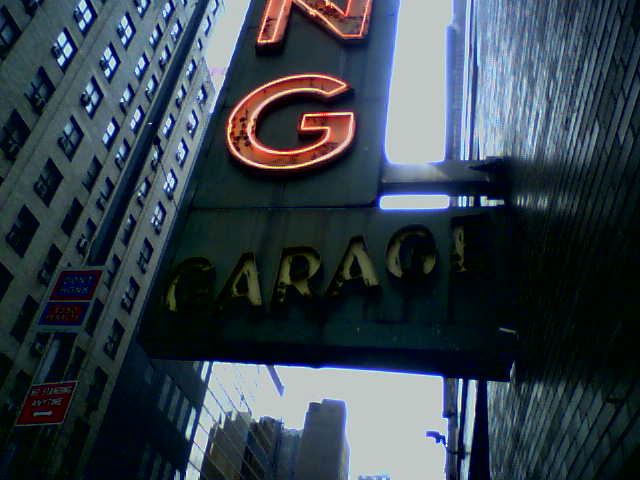
Hemlock is poisonous???
I'm going through a major cleaning purge this weekend - it's almost scary - and I came across this teeny notebook my aunt Regina gave me when I was in high school - a blank book. It apepars that I used it mostly for writing down my dreams but in the middle of it, I came across this transcription of an old Steve Martin skit that Mere and I loved so much that apparently we had memorized it. I can hear Steve Martin's voice here - he plays Socrates.
JUNE 13
Mere and I can recite this entire thing word for word. It's Steve Martin.
Plato runs in.
"Okay, Socrates! Here's your hemlock!"
"Ah, thank you." (gulps it down) "So! What's the verdict? When do I get out of here?"
"But Socrates, the verdict was death!"
"Death? You've got to be kidding me! For what?"
"For teaching the youth wisdom."
"Well, I'll take it all back! Call them in here! I'll renounce everything! Let's get out of here. Let's go get some Chinese food."
"But Socrates! You drank the hemlock!"
"So what?"
"It's poisonous."
................. "It is? Since when?"
"Didn't you know that hemlock is poisonous?"
"I do now. Look, I only know general things. What is truth, what is justice. I never learned details like what is poisonous and what is not poisonous ... That's the kind of thing that irritates me about you guys." (shoves Plato. Sighs.) "All right. I'm going to die. So what? When's this stuff take effect? 2, 3 years?"
"2, 3 minutes."
...............................
Socrates: "What a busy day this was. All right. I'm gonna lay here and I'm going to die - and you know what's going to happen? You guys are gonna go out and you're gonna have lunch and you're gonna sit and stare at each other. I was the only one in this whole group who ever said anything. It was always, 'Socrates, what is truth?' 'Socrates, what is the nature of the good?' 'Socrates, what should I order?' 'Socrates, what are you having?' And not ONCE did anyone ever say, 'Socrates, hemlock is poisonous.'"
March 24, 2007
The Idi Amin theme continues
I recently Barbet Schroeder's terrifying and wonderful documentary about Idi Amin. Some of the footage has to be seen to be believed. Schroeder said in the "making of" documentary which was also fantastic that he couldn't believe the "good stuff" he got - and that everything they got was good - it made the film very difficult to edit. Idi Amin was involved in the making of this documentary and it was his own naivete and innocence (can a mass murderer be innocent? I would submit that they are the most dangerous kind ...) that let him believe that this would be a flattering documentary. You can see Idi Amin saying to the camera, "Shoot that!" pointing up at a helicopter ... like he was thinking of himself as a film-maker. Schroeder said it was very disarming to be in his presence, because he could be so charming ... but you always knew you were in the presence of "pure evil". The footage of Idi Amin making speeches were cringe-worthy. You knew (because you know this about Idi Amin) that he could go on for hours and hours with a speech and no one would ever dare stop him. The film ends with him addressing a group of Ugandan doctors, who have all gathered to talk about medical issues in the country. Idi Amin - the dictator - is so out of his league there, in that atmosphere of educated professionals. He sits in front of them in his army digs with the wall of medals on his chest ... and you can just FEEL how ... intimidated he feels ... He doesn't like being LESS than anybody. He can barely stand being there because he, in his ignorance, feels implicated by the intellectual elite, who just by their very existence - make him feel stupid. I'm not really describing this well - but the close-ups of Idi Amin's face, as he listens to the doctors talk about this or that medical challenge, are FASCINATING. Psychologically. It's amazing how open Idi Amin was. And by that I mean: he was not media savvy. He wasn't aware that his flickering nervous eyes, and the beads of sweat gathering on his forehead - told us everything about him. He didn't have a good game-face, as far as I'm concerned. He truly thought that the cameras would only show what was flattering. He truly believed that the cameras would only show how good he was, how powerful, how truly revolutionary. Of course the opposite is what you see. You see him having a "cabinet meeting" and he's going on and on about what it means to be a minister in the government - and all of the ministers sit there, and write down notes - like: what are you guys writing? "Be a good minister"?? Like - this was a country of political amateurs. With this grinning jolly monster at the head, talking to everybody as though they were mental midgets. Even the doctors. Like - the doctors are talking about specifics - and they ask Idi Amin for his input. Amin - visibly uncomfortable in a non-military environment - you can just SMELL it - begins to pontificate on what it means to be a doctor. He goes on and on and on ... and it's all rudimentary, barely coherent ... He sounds like a 5 year old saying, "Doctors are good. I like them. When I have a boo boo the doctor is there to make it better." This is his philosophy of how Ugandan doctors should behave. I mean ... it's extraordinary. And the doctors, knowing the threat, living under tyranny - sit and take it, sit and listen, don't say anything, don't get too specific - Idi Amin won't like that ... Only when Idi Amin is in his own element does that weird look of nervous flitting energy leave his eyes. But still. He doesn't realize that the camera is not a tool of flattery. Even when utilized by propaganda masters like Leni Reifenstahl. The camera tells the truth. Now of course the film-maker chooses what to film ... so there is editorial decision-making in that realm ... but the camera ITSELF does not let a person hide. It shows EVERYTHING. Idi Amin revealed. He believes he is revealing himself as the savior of Africa, as a great thinker, a great leader, a messiah. You can see that - because he is so free with the camera, so forthcoming.
It's fascinating - I highly recommend the documentary.
March 23, 2007
"Memories. You're talkin' about memories."
Screenshots from the movie I saw 2 nights ago. Stunned, yet again, by its noir power and darkness. It - with all its technology and futuristic alienation - is actually an art film. I mean, look at how this thing was shot. FanTAStic.
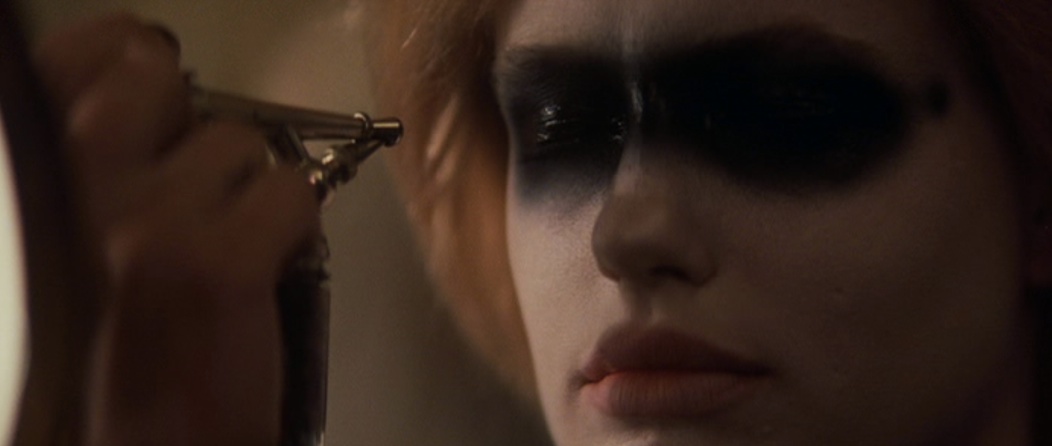
Commonplace Book - Acting quotes
Ellen Terry - from Ellen Terry's Memoirs
Henry Irving is the monument, the great mark set up to show the genius of will. For years he worked to overcome the dragging leg ... he toiled, and he overcame this defect, just as he overcame his difficulty with vowels, and the self-consciousness which in the early stages o fhis career used to hamper and incommode him.Only a great actor finds the difficulties of the actor's art infinite. Even up to the last five years of his life, Henry Irving was striving, striving. He never rested on old triumphs, never found a part in which there was no more to do. Once when I was touring with him in America, at the time when he was at the highest point of his fame, I watched him one day in the train - always a delightful occupation, for his face provided many pictures a minute - and being struck by a curious look, half puzzled, half despairing, asked him what he was thinking about.
"I was thinking," he answered slowly, "how strange it is that I should have made the reputation I have as an actor, with nothing to help me - with no equipment. My legs, my voice, everything has been against me. For an actor who can't walk, can't talk, and has no face to speak of, I've done pretty well."
And I, looking at that splendid head, those wonderful hands, the whole strange beauty of him, thought, "Ah, you little know!"

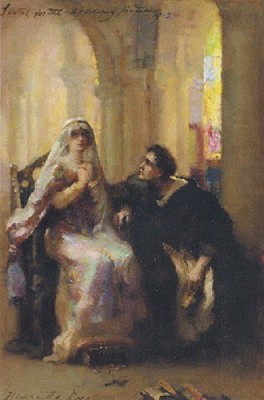
Ellen Terry and Henry Irving in Abelard and Heloise - by Henrietta Rae
 Henry Irving and Ellen Terry

The great Ellen Terry
Commonplace Book - Acting quotes
Eleanora Duse:
I feel that I have never known nor shall I ever know how to act! Those poor women in my plays have entered so totally into my heart and head, that while I am striving as best I can to make the audience understand them, I almost feel like comforting them ... but it is they who, little by little, end up by comforting me! How - and why, and at what point - this affectionate, inexplicable, and undeniable "exchange" takes place between those women and me ... it would take too long and be too difficult to relate precisely. The fact remains that, while everybody else is suspicious of the women, I get along beautifully with them! I pay no attention if they have lied, if they have betrayed, if they have sinned, if they were born crooked, as long as I feel that they have wept, that they have suffered as a result of lying or betraying or loving.

Commonplace Book - Acting quotes
Chekhov, letter to Olga Knipper, Jan. 2 1901:
Describe at least one rehearsal of Three Sisters for me. Isn't there anything which needs adding or subtracting? Are you acting well, my darling? But watch out now! Don't pull a sad face in the first act. Serious, yes, but not sad. People who had long carried a grief within themselves and have been accustomed to it only whistle and frequently withdraw into themselves. So you can often be thoughtfully withdrawn on stage during conversations. Do you see?

Anton Chekhov and Olga Knipper
Diary Friday
This entry is from the summer between my junior and senior year of high school. I appear to be quite a little horndog. Yet I also have a good head on my shoulders.
Nothing has changed.
JULY 4
It's only 11:00 on this patriotic day so nothing happened so I shall describe yesterday. [Not sure how A follows B there, but I suppose it's irrelevant. Moving on!]
J. was working and she called me to come up and have lunch with her. So I walked up and we walked down to Ricky's Pizza. We picked up right where we left off. I swear - that's all we talk about when we're together. I've said it before - we're kindred souls. I mean, she'll say something about how she feels or what she thinks, and it could have been me talking. It's really weird but so nice to not have to explain myself or have to try to convince her. I mean, it's stupid but even in here I feel like I'm - I feel like I have to continually stick up for myself as though "someone" is thinking, "Right, Sheila. We believe you." (sarcastically) J. and me - we just talk - I know she doesn't lie about her feelings and she knows I don't lie.
I guess the thing is - It's just unfair.
And - already I'm hearing that stupid "someone" saying, "Oh yeah? Well everything's unfair, Cookie." I seem to have a great scorn for myself but - what I feel is what I feel, and it's just too bad.
EVERY single cute guy I see - I look at, and I wonder about him. And I never get any looks like that. I mean, I know that glances across a pizza parlor mean nothing - but still. It'd be nice to get some recognition, have someone notice me, whisper about me. I don't ever get second glances from guys. Shit, I look EVERYONE over. So does J.
We walked into Ricky's and both silently inspected everyone. J. said, "Nope. Nobody." Then we were both laughing, "Oh God! We're awful!" We got our pizza and talked and talked about everything. I was sitting with my back to the window, she was facing the window. As we were talking, suddenly I saw her eyes get all buggy and I knew immediately that GUYS were out the window. [Like some rare species of animal!] I turned around and just glanced, because it was so obvious anyway. I saw very briefly 2 guys getting out of this old white car. I turned around and we gaped at each other. They came in and they were so cute! In shorts, battered white sneaks - and their shorts were khaki and oversized. They had on sweatshirts and were sort of bronzed by the sun and they were adorable. They sat up at the counter and were laughing HYSTERICALLY about something. They were about 18 or 19. There are advantages to living in a college town. Wherever I go, I am on the lookout for gorgeous men. [Sheila, you're 15 years old.]
Then the guys left and we sighed.
We talked about sex. I suppose you --- Wait a minute. There I go again. You are a book. What do I care what "you think"? You're a fucking book. I think about sex and it's like this big mystery. I wonder about it. Is it fun? I mean, sometimes I think about sex and I know I'm not ready now. And I don't think I'll be ready for a while. I think I'll know when I'm ready. I'll know when it's right. But it seems like - EVERYONE'S having sex now. I mean, some people you just know are not virgins anymore. I mean, A. has been going out with the same girl for about 3 years. She goes to the University of Colorado - she graduated a year ago. Guess where A. is going to college? I'm SURE they're having sex. I can't help but look at some people and wonder: "Have they?"
I don't plan to get married for centuries. Maybe in my late 20s or early 30s. Or whenever it is that I find HIM. I'm not gonna get married until I make something of myself, make something of my life. I'm not gonna get married the day after college graduation. I really want to be on my own.
I do want to have kids though.
But still, Catholics say that sex before marriage is wrong. And I can see that point. But I also think that sex before you're ready is wrong too. There's an emotional side to all of this.
And DIARY. What if I fall in love with someone - I mean really fall in love with someone - and he falls really in love with me (oh yeah?) and we're only 24 or 20 or something? I mean, what happens then? I won't get married just so I can have sex legally. Now I have no trouble saying no. I mean if someone started coming on to me now (fat chance) I'd be like, "Please get out of my face, you gross low-life." [hahahaha How about just saying, "No thanks"??]
It seems like everything in college moves so fast. I know that I will not sleep with someone unless I want to. Peer pressure doesn't work with me. [ha. I love that I knew that about myself. It's always been true.] I mean, I want to have sex now - I think about it all the time - but I can't, and I wouldn't anyway. There's a difference wanting to and being ready to. I mean, I wasn't even going out with DW but (THE TRUTH) I wanted to sleep with him SO MUCH. I'd get really embarrassed and awkward when he'd be beside me, because I'd be thinking about sex. But I know I'm not ready. Are you kidding me? I think it's a very indiscernable difference sometimes - but a very important one. I hope that when the time comes, I will know when I'm ready.
It seems like such a huge scary thing, like grown-ups are shouting at us all the time, 'OH MY GOD! DON'T HAVE SEX WITH EACH OTHER! IT WOULD BE A TRAGEDY! OH MY GOD!" Meanwhile, kids are sleeping with each other, and it doesn't seem to be all that much of a tragedy. You just have to know who you are. Everything's so confusing now because I feel like I have to make up my mind how to proceed - like, what philosophy I am going to have about sex - but I don't know yet. I hope I don't make any fatal mistakes.
So this is what we talked about. We started back to the library, and she said, "When people drive by, don't you check out who the driver is?" And I said, "I don't believe this." Constantly, I peer into cars. [Please stop doing that, Creepy Girl] Especially when I'm walking around campus. There are all the fraternities on sunny days - all the guys stretched out on the slanted roofs in shorts - they bring out mattresses and radios. As I walk by I feel my heart quicken.
SO as we walked back to the library, this truck drove by with 2 people in the front seat. One who was driving and one - we both saw him at the same time - and he was a GOD! I mean, an incredibly gorgeous human being. Mirrored glasses, sort of deep golden hair that stuck up really punky [please don't say "punky". Thanks] - and his FACE! He was exquisite.
J. and I saw him at exactly the same moment [I am just laughing at the thought of us - two 16 year old girls, strolling around, literally GAWKING at all the male flora and fauna]. As the truck zoomed by we whirled to face each other screaming. [hahaha!!] We stumbled back to the library in awe of this god we have never met and never will again. It's like we're both on this man hunt. Summer would be so boring without our manhunt.
I haven't seen DW for a month. That is strange. I expect to see him wherever I go. His face is still always in my mind. Wherever I am, I sort of unconsciously look for an old brown station wagon. I'm stupid. I am a stupid person.
Last night my family MADE me come to the beach with them ["Family time" cannot compete with "roving manhunt"] even though I don't have a suit. My legs were so hairy I looked male. But my family practically shoved me into the car. I was embarrassed about my legs and was mad. I was even more mad when we got to the beach because the beach was FULL of gorgeous college guys. I looked so ugly and white. I just want to be hip. I try so hard to be cool, to not be so awkward. I don't mean by doing dumb things, I don't mean altering my entire personality like I see some other girls do - What I mean by cool is - A.N. cool. Cool to me is - [okay, get ready for my definition of cool, and please envision the Duran Duran video I had just watched] punky hair, mirrored glasses, fingerless gloves, confidence, secure - secure almost bordering on arrogance. [Fingerless gloves and arrogance ... I am shaking wtih laughter] I just felt so self-conscious last night. I felt so ugly. And the GUYS on the beach - stretched out, in cut offs, mirrored glasses, blonde hair - [I'm in love with these men still] and the LIFE GUARD. He was a BABE. Immediately I sat on my towel to hide my gross legs. I like having smooth legs. I felt really really embarrassed.
Oh, and guess who walked by right in front of me. JW! [He was this guy I had had a crush on a year or so before - I think we exchanged 2 or 3 words - but my crush lasted the entire school year.] Just seeing him was like, "Oh God. Get away from me." He didn't see me. I doubt he even knows me. He's such an egoist. I look at him and laugh! It looks like he's always holding his breath - because he wants to stick his chest out like a big tough guy - But seeing him was a reminder of my lack of social life. This is J.'s picture of our social life.
[Then comes a drawing of us - 2 girls - with tears down our faces and sad mouths - a big barrier beside us - that is labeled 'BERLIN WALL' - and on the other side is a group of people - and an arrow is pointing to the group saying 'OUR SOCIAL LIVES'
10:30 July 4
I am in such a great mood! I just went to the fireworks display. It's a huge deal - I mean, throngs of people go to Old Mountain Field - our town turns into a throbbing mecca. I've only been once before because all the other July 4ths I was at camp.
Well. Unlike last night at the beach, I did feel cool. We went to a cookout at the Quinn's - it was nice talking to Jen - she's a good kid. Me, her, and Katy - you want to talk best friends? We were IT! Three Muskateers. We were ALWAYS together. ALWAYS. We were friends forever. Then Katy and I moved and I went into junior high, Katy went to another elementary school - so we just never saw each other. I mean, it's not like we ever had a fallout - we just saw each other very rarely. So it was really nice to talk to Jen again.
Then we went to Old Mountain Field. Traffic was stopped up all along the highways. There were SO MANY people. The field looked like the beach on a hot day. I had just done my hair so it looked cool. [Yes, but was it "punky"?] I was carrying a blanket - and we (my family) were looking for a place to sit down. And suddenly I heard, "Hey! Sheila!" I looked around and saw TS hailing me. [TS was a good friend of me and also the rest of my core group of friends - he had graduated a couple of years before I did - and at some point during my senior year he and I started dating. He was, I guess, my first boyfriend. We went to my senior prom together.]
Oh yeah - I forgot - this was weird. Mum and I went to this bagels store and as we went in TS and K.O. came out. It was strange. We were talking. I admit that I have a little crush on TS - and I have ever since I met him. I like having him for a friend. I really do. [And we're friends now - after over 20 years of not seeing each other. What are the odds] AND if I don't have a boyfriend next year, I'll ask him to the Senior Prom. I know he'd go unless he was totally broke. I considered asking him this year. Beth wanted me to - kept encouraging me to call him and ask. But when DW said no [DW - my crush of the entire year prior. I asked him to my prom and he freakin' said NO! Now THAT is a tragedy.] I couldn't think of anybody else. NO WAY.
TS was sitting on a blanket holding a guitar. M.M. was sprawled out next to him in that languorous manner he always assumes - and Beth was sitting on a bigger blanket nearby. Turns out that TS was there with his 2 older brothers and their wives and kids. Well, TS motioned to me to come over so I went over and sat on my blanket. You can't believe how cute his family is. All in all - there were about 5 little kids - including a one-month-old baby. And a 2 year old - so cute - and TS' BROTHERS - they are just as hysterical as he is. What a blast it must be in that family. When TS (who was sitting crosslegged on the ground) laughed - he would sort of fall back on his back - and all of his brothers did that - so basically they were all rolling around with laughter. They're all so nice, so close. Oh, and the 2 year old got lost about 3 times while I was there and TS would go off looking for him - he loves playing with the kids - he was playing peek a boo with the 2 year old and a paper plate. There was something so adorable about it. Big men going "kootchy kootchy koo" in a baby voice and all that. TS was tickling the kids and wrestling with them. M.M. was (of course) very blase, didn't even say hello to me. But he was halfway nice. [How is "not saying hello" "halfway nice"??] If ONLY he weren't the best looking guy I have ever seen in my life. He looks like Paul Newman. And with every passing year he gets better. He is flawless. He's even more gorgeous than when he was in high school. [No!] He's also very funny. He makes me laugh. TS is more like a friend - when I laugh with him, it's like laughing with Beth or Mere or Betsy. M.M. makes me nervous a little bit. Of course I don't show it.
One of TS's nieces was cold and she asked if she could wear M.M.'s sweatshirt. he said sure - it was a gown on her. Floor length. The arms dangled on the ground. She looked like a jawa. TS was laughing at her, and he was holding the baby - sort of awkwardly - but tenderly - letting the baby suck on his pinky finger.
The fireowkrs were nice. Beth and I talked with TS the whole way through it, of course. Not M.M. though. He was sprawled on his back on the ground and he got mad at us whenever we spoke. "You just missed the best one!" We were all telling jokes, and he wasn't laughing. TS said to him, "Oh. You don't laugh at our jokes, right?" M.M. said, deadly serious, "Not while I'm watching fireworks." So funny.
Slowly it got dark and the fireworks started. It's amazing how excited everyone got - and it was contageous. Everyone was cheering 'OOH"-ing - TS too. I think I could maybe have a serious crush here. He's such a nice person.
Anyway, TS said, as we all clapped for one of the fireworks, "This is ridiculous how people explode for inanimate explosions." That started us off laughing because after that I found it impossible to cheer for them without laughing and remembering what he said. After every single huge blast, Beth and I would listen for the babies. It was hilarious. There would be a huge BOOM and following right after - babies all over the field would start screaming, in unison.
Beth and I can have so much fun together. She kept hitting TS when he would tease her and tell him that he sucked. "You suck. I hate you."
We laugh, and have fun - it's great. I like TS. I like everyone. And I love America too. (Had to throw that in there, it being the 4th and all) So we all had a lot of fun, and it makes me feel warm inside. M.M. and TS (Oh Lord, they crack me up) were SO funny. They planned this. There was a grand finale - with bursting fireworks all at the same time, and the whole crowd started screaming and cheering. We were all sitting in a little clearing and everyone started clapping, screaming, for the fireworks - and MM and TS stood up and started bowing in the direction of the crowd, nodding their heads modestly, waving. Beth and I were in convulsions on the ground looking up at them. They were these 2 big tall figures silhouetted against the fireworks.
It was FUN and it was also like a miracle, suddenly running into them out of the whole field - so many people there - and I found them. I was dreading running into DW. Maybe it wouldn't have been traumatic for him, but for ME.
TS is coming over in a couple of weeks to come see the movie. [In my group of friends there is only ONE movie ... and that's the one we made together - called "The Troubled Days and Nights of Lovers, Husbands, Wives, Children, in Hope and Despair"] He's looking forward to it. I can't WAIT to show it to him. He'll love it.
Afterwards, we all went to Newport Creamery for ice cream. He said, "I can't wait to see Dolores in the movie." I started LAUGHING, just thinking about her performance. "Just you wait!" I said to him.
Dolores shocked us all.
Orson in action
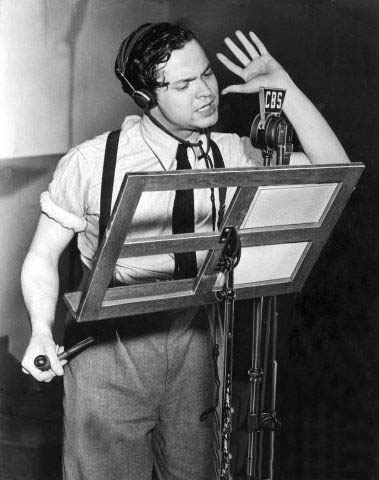
(I love the memory from when I was in high school - and Brett and I listened to War of the Worlds at a party at his house and pretending to be a couple in the 1920s who didn't know it was fake. It's QUITE a fun game, if you haven't played it already. Just pop that sucker in, and give over to it.)
Destiny
"I feel like I'm falling in love with you," he said bluntly.
"You have a distinctly Balkan charm," she replied.
"I'm from Indiana."
"I know. It's such a shame."
Rebecca West had ruined her life.
March 22, 2007
John Banville in LA
A great post re-capping Banville's reading last night. I love Banville's answers to what was obviously a Q and A session - very thought-provoking, in terms of literature and art. Wonderful! He said "If you write honestly, you will not be sentimental." .... God, John, I hope so.
Banville's a favorite of my dad's.
Steinbeck
Wow - what a photo. My immediate thought was of the great scene in East of Eden when Abra and Cal go on the ferris wheel.
Awesome
Faustus went to Egypt. (Even the simplest posts from him are funny and well-written). I love his obsessions and his impeccable grammar.
Okay - so now he's back from Egypt.
And so there comes this simple list of What He Learned.
Next comes the following dramatic revelation. I read his site all the time, so I got a shiver of excitement at his announcement. God, I love it when people go nuts for some obsession.
And now - this post. I'm in heaven.
That movie meme ...
A couple more folks have done it.
I'm reading this one and I am laughing out loud. (the blog is not familiar to me - but I already have a big crush on the writer - she's so funny!!)
First of all:
1. YES for praise of While You Were Sleeping. HIGHLY under-rated movie. Ahem.
And second of all, this quote of hers made me laugh out loud:
2. I still view robins with deep suspicion.
And then here is Alex's. I love how HARD it was for her to complete it ... because it's so wrenching to have to make CHOICES. I totally relate to that. And she says, in response to the question: What is your preferred genre of movie:
"I love anything that has a great story, good, solid characters, or in some cases, just catchy songs. Or a knife wielding, brain splattering psychotic maniac with a penchant for virgins. Either way, I’m good."
And I forgot - here's Beth's!
March 21, 2007
In honor of the first day of spring:
a poem about green by one of my favorites - William Blake. I love the line "Such, such were the joys". sniff.
The Echoing Green by William Blake
The Sun does arise,
And make happy the skies;
The merry bells ring
To welcome the Spring;
The skylark and thrush,
The birds of the bush,
Sing lounder around
To the bells' chearful sound,
While our sports shall be seen
On the Echoing Green.
Old John, with white hair,
Does laugh away care,
Sitting under the oak,
Among the old folk.
They laugh at our play,
And soon they all say:
"Such, such were the joys
When we all, girls & boys,
In our youth time were seen
On the Echoing Green.''
Till the little ones, weary,
No more can be merry;
The sun does descend,
And our sports have on end.
Round the laps of their mothers
Many sisters and brothers,
Like birds in their nest,
Are ready for rest,
And sports no more seen
On the darkening Green.
"For I am UNICEF, evil king of Halloween!"
The wisdom of children, by Simon Rich I was laughing out loud reading it.
UNCLE: I’m having sex right now.DAD: We all are.
That first "sketch" is just KILLING me.
And
—Apparently, young people hate the war so much they’re willing to participate in a musical sex festival as a protest against it.—Oh, my God. They must really be serious about this whole thing.
Funny funny!! Love it. The whole "kids table" thing killed me. Here's the whole thing.
Ray and Lucy
Alex - you're gonna want to take note of this great photo.
March 20, 2007
Snapshots
-- There's something wonderfully incongrous about the melty spring weather and the sight of ice skaters at Rockefeller Center.
-- I was reading Scoop (by Evelyn Waugh) on the train today and started GUFFAWING at the whole scene where there's a one-night-only Communist Revolution in Ishmaelia. I think this is one of the funniest books I've ever read. I put it down for a while because I started reading two other books - one about the carpet-makers in ancient Persia and one about the tribal divisions in Darfur. Awesome light reading, as you can see. A laugh riot those Tunjur and Masalit! They're all such cards. I had started Scoop a while back and immediately fell in love with it. Absolutely hilarious send-up of journalism. Genius. I'll post some excerpts later.
-- Congratulations, Jackie! WHOO-HOO!!!
-- Meeting David tonight for drinks. I rarely say this - but I sure could use a drink today.
-- On the treadmill today at the gym. My iPod was blaring but I was also watching the Maury Povich show - which was on one of the TV screens in my view. I wasn't really watching it at first, but eventually I found myself sucked into the melodrama. It was some paternity test show, which at first horrified and disgusted me. I found myself thinking, as I pounded away up my incline, "Girls, there's this little thing called birth control. It is an AWESOME invention. It is not infallible, no, and there can be mistakes - but you really should use it ANYway. Just a tip." I was scowling at the TV, disturbed by the histrionics, the self-righteous shouting of the teen moms, the slouching baby-daddys who want NO part of the baby had by the ho he can't even remember. I JUDGED Maury Povich for hosting such a disgraceful show. And then by the end, whaddyaknow, I was in tears because that one couple really seemed to love each other, and they had broken up and gotten back together ... and she had a baby ... and they weren't sure whose it was ... and he was crying about how he loved her, and he would love the baby anyway, and she was crying with mascara streaks coming down, and she looked kind of pretty even with the unfortunate gap-tooth, and I felt that they loved each other, and I wanted it to work for them, HE was no baby daddy, he was a stand-up guy!, and when they found out the baby WAS his - the two of them jumped up and down, hugging and kissing and carrying on, and I - who had been a TOWERING scowl of judgment 2 seconds earlier, succumbed, and wiped tears of happiness off my face, careening along into my 20th minute on the treadmill, as the Maury credits began to roll. Shameless television manipulation and I participated in it fully. At first against my will, and then wholeheartedly. My stern judgment of the whole thing was no match for the likes of Maury Povich. I caved! Because they loved each other and yay, he was the baby's daddy! Yay!
-- Then I went and had a sauna so I could calm the fuck down.
-- I was in an elevator with Mike Tyson today. Just me and him. His head is huge and it morphs into a massive neck without any indentation whatsoever. The head/neck is wider than my entire body. It's HUGE. I mean, I knew he was huge but to see it in person really brought it all home. He had on a dark suit, dark glasses, and he smelled fantastic.
Paper!
Tracey - you're gonna love this.
Susan Stockwell makes (among other things) dresses out of maps. I am in heaven. I love maps with a burning passion.
LOOK at these dresses (2 examples below the fold).
But she also makes amazing maps. I can't stop looking at them.
Here's the main page of her site, with lists of her work and current exhibitions.
(Found this artist through Dress A Day, naturally)
March 19, 2007
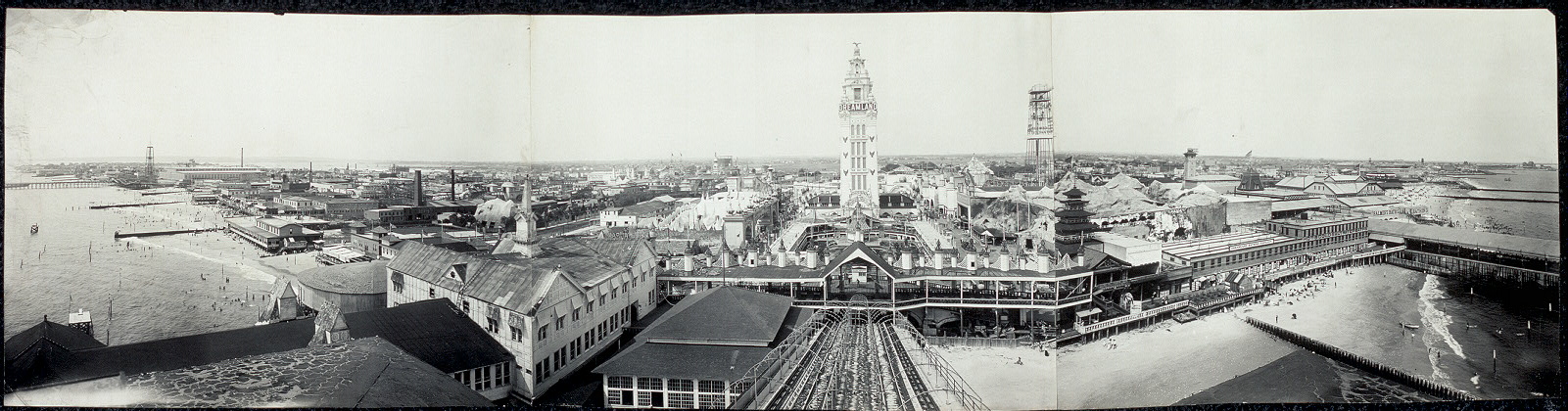
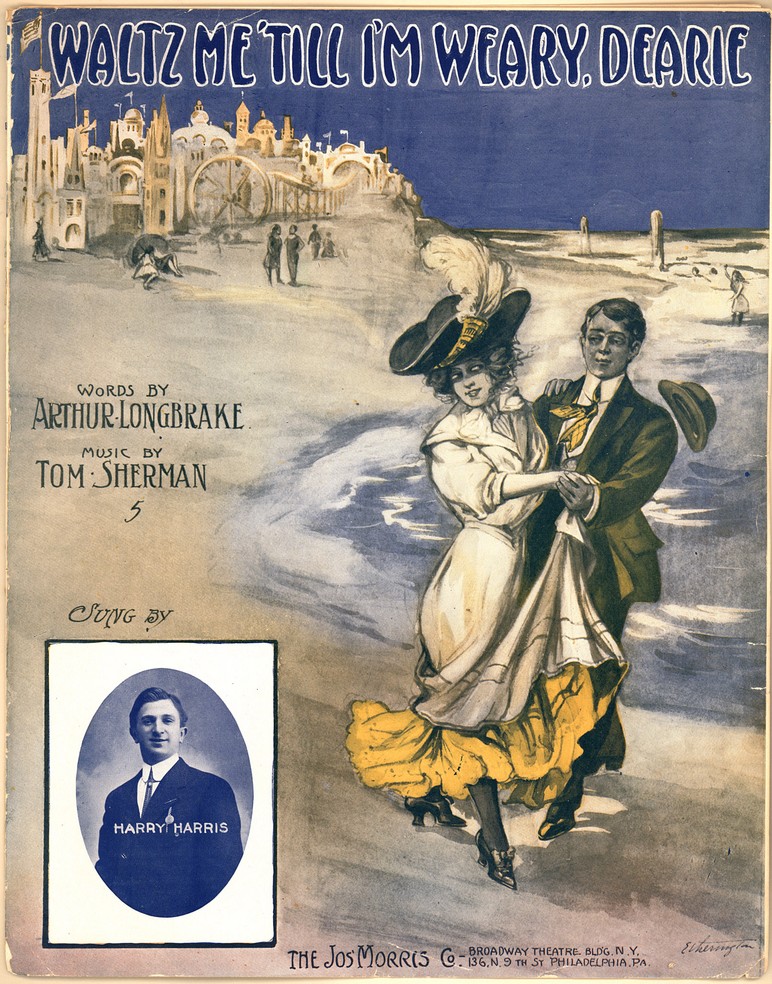
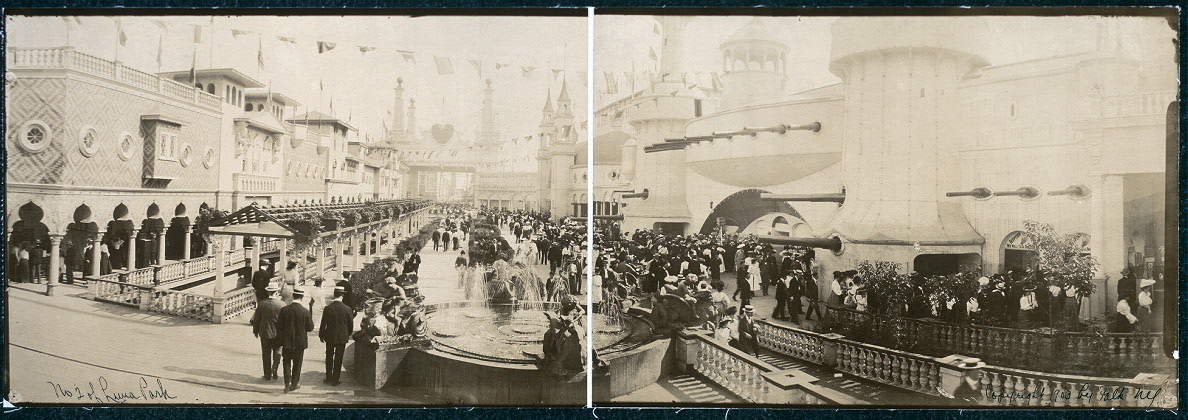
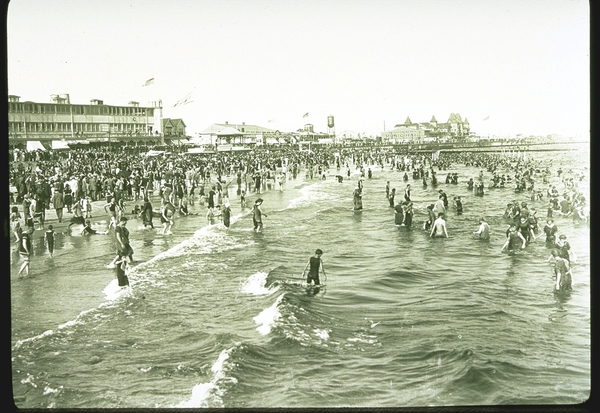
Hysterical
"Don't be humble, son. You're not that good."
-- David Lee Roth's father to his son
I never get tired of that quote. Genius.
Alexandria, Karachi, and Joisey
This weekend alone I had in-depth touching conversations with 3 cab drivers (engaging cabbies is one of my favorite things to do - and it nearly always yields something interesting - and sometimes, even, a big Armenian bear-hug under waving palm trees)
So. This weekend:
One cabbie was from Egypt (Alexandria, to be exact) - and he was awesome. Very handsome too. He loves Alexandria and still has an apartment there - that looks right out on the beach. I asked him if he would rent it to me for a month. He gave me his card. We sat in the car with the motor running talking about the culture along the Nile and the different dialects of his country for about 5 minutes. He is my new best friend.
One was from Jersey City and he treated me to a fascinating monologue about local politics, and the graft, and the mayors, and the old-school locals, and the zoning laws being ignored, and who paid off whom ... and his monologue was not bitter. Or off-puttingly angry. It was humorous, detailed, and also pragmatic. I told him he should write a book.
One was from Pakistan. He moved here 10 years ago and lives in Queens. He goes back to Pakistan to see his aged father about once a year, whenever he can. He misses Pakistan, but he loves America. He especially loves the beer. (I did not grill him for information. All I said was, "Do you like it here?" And out flowed his entire life story.) He is addicted to karaoke and we compared song lists. I asked, "Have you ever sung 'Enter Sandman'? It seriously kicks ass as a karaoke song." He said, "I will try it this Thursday!" We then began to sing together: "EN-TER NIIIIGHT TAKE MY-Y HAAAND OFFTONEVAHNEVAHLAND ..." We were still singing when he pulled up to my destination.
I wonder if it's something about my face ... this kind of exchange happens to me all the time.
Gloria Grahame ...
I swear, she's suddenly everywhere. Or maybe she always has been and I'm just noticing now. Kinda like Idi Amin.
Gloria Grahame and Idi Amin. In the same post. I'm rather proud of myself for that.
March 18, 2007
The Dead Fathers Club
Emily sent me a copy of the novel The Dead Fathers Club. I started it yesterday and am already a quarter of the way through. I dare anyone to pick up this book, read the first chapter, and then put the book down without finding out what happens. NOT POSSIBLE. Or if you do put the book down, there is something seriously wrong with you.
It's so good!! I love so-called Young Adult novels anyway - it's my favorite genre (if they're well-written).
This book is written from the perspective of an 11 year old British boy named Philip. Philip's father just died in a car crash, and the book opens with Philip seeing his Dad's Ghost at the funeral. The Dad, unlike other book-ghosts, is not benevolent, loving, nostalgic. No. He is sad, tormented, and needs his son to know that the car accident was actually NOT an accident. And he needs his son to take revenge. His 11 year old boy. There's a Hamlet-ish feel to all of this ... and I have no idea what is going to happen - but I already can't put it down. Naturally, Philip's school starts to get worried about him - because he sometimes is seen talking to nobody (he's actually talking to his Dad's Ghost) - and he's put into counseling - and he's furious at his uncle who appears to already be making the moves on his mother ...
Here's an excerpt. I am just in love with the voice of this book. It's perfect. Philip and his class go on a field trip, a sleep-over field trip ... and Philip's Dad's Ghost follows along. The shit has already started to hit the fan. Philip threw his dinner across the room because he was in such a rage at the encroachment of his uncle. And now the whole school knows about it, and how he broke a window ... and all the kids start teasing him, etc.
I love when he chooses to use all-caps. It's awesome. Like "POT" below.
Excerpt from The Dead Fathers Club, by Matt Haig
Mr. Rosen is a nice Teacher with hairy hands and a good watch but he is strict. He sometimes shouts an dgets a big neck like the Incredible Hulk but his neck goes red and a bit blue but not green and when he shouts little bits of spit jump out of his mouth like they are scared of his voice.But he was being very nice to me and saying There is no shame in walking in your sleep Philip.
He told me about when he was my age and he walked in his sleep into his sisters bedroom and picked up a book and waited by her bed. He said I was dreaming I was in a library.
I laughed but I knew really it wasn't as bad as smashing a window and I think he knew as well.
And then Mr Rosen went quiet and I looked out of the window and there were drops of rain on the glass like little worlds and outside there was grass and rocks and sheep and it was all hills and I wondered if Dads Ghost was here he would be able to see all the ghosts of murdered Romans. And I wondered if Emperor Hadrian was murdered and if he ever comes back to see what is left of the wall and if he gets sad when he sees just lumps of stone in the ground with grass growing over them and a few people walking with maps and looking at them and wanting to go home.
We went to a place with other Roman buildings and they were built in 130 AD which was eight years after when they started building Hadrians Wall which was 122 AD.
We had plans of the buildings and there were kitchens and toilets and bedrooms but you couldnt tell that from the stones in the ground only from the plans. And Mrs Fell and Mr Rosen were talking all about it but I wasn't really listening I was feeling weird like my body was just air and nothing was real and my heart wasn't beating like normal. It wasn't going beatbeat beat-beat beatbeat it was going beat beatbeat beat beatbeatbeat for a little bit which made me think I was going to die but then it stopped doing it so I didn't tell anyone.
At the meal there was black beefburgers which were thin and chewy like shoes and more mashed potatoes from the big POT.
And then there was a disco which was really just Mrs Fells CD player she had brought from home. She played some music and it was Beyonce and all the girls danced but none of the boys danced except where there was rapping. And Mr Rosen danced like Dad used to which was like a bird which couldnt fly but Mrs Fell could dance well and she was wearing Make Up and green round her eyes which sounds weird but it was nice. I must have been looking a long time because she saw me looking and she waved her arms for me to come and dance and she was dancing with Charlotte Ward and a circle of girls and Mr Rosen so I didnt want to come. But Mrs Fell never stops so she came over and took my hand and pulled me up to dance and Jordan was giggling at me and the giggle spread out like fire to Dominic and even Siraj who used to be my friend before Dad died.
Mrs Fell said Come on Philip. Come and dance.
I said I I I
Mrs Fell said Come on.
And then all the boys were laughing but Mrs Fell couldn't hear and she took me to the circle of girls dancing and my heart started going funny again. I danced but I didnt want to because it was a girl song about boys and all the boys were staring and nudging and my face was burning HOT.
Mrs Fell was only being nice because she thought I was on my own but sometimes being nice is as bad as being horrible. And so I danced without moving very much just my arms a little bit and it was bad and I just kept seeing the faces of everyone and Mr Rosen was flapping his wings and smiling at me and I wished he was cross with me and didnt give me special treatment.
Mr Rosen said All right Philip?
I said Yes.
And after 100 minutes the song ended and I sat down near the boys but not with them. A song came on which I used to like before Dad died and it sounded horrible and stupid now like robots. And when it was on Dominic and Jamie Western and Jordan did a press up competition and Dominic won.
I looked at Mrs Fell and I think I had upset her because she was dancing the same but not smiling now and I felt bad for upsetting her.
"Don't Look Now"

Don't Look Now starring Donald Sutherland and Julie Christie
You hear references to it all the time.
Usually, you will hear about:
1. that sex scene
Or
2. How freakin' terrifying that little creature in the red hood is Ahem.
Or
3. how radical the film was for the time, and what an important moment for British cinema it was
It was made in 1973, and you can FEEL how much it has been copied in the years since. Very influential film, in its own quiet intense way. That's the thing about context - and how important it is. It's important to know where things fit in in the grand scheme of things, how British cinema was developing during the 60s, what was going on at the time ... and how Don't Look Now fits in to all of that. I had the context - only I had never seen the film itself.
First of all - there were times when I got so freaked out that I had to watch the film in "diamond vision". (This stolen from Ann Marie - as so many genius phrases are) "Diamond vision", obviously, is when a movie is so scary that you put your hands over your eyes - and yet you feel compelled to peek out between the diamond-shaped spaces left by your overlaced fingers. So yes. That little red-coated creature glimpsed through the murky dank streets of Venice caused much diamond vision.
And also - here's another amazing thing: If you haven't seen the film, I wouldn't dare give the ending away - because I had no idea how it ended, although I knew the general plot (husband and wife lose their young daughter, and then are haunted by sights of her - a small red-coated creature who scares the living shit out of you ... and somewhere along in here they have a notoriously hot sex scene). That's what I knew. Other than that, nothing. I just had to sit back and watch it unfold.
What beautiful and deep performances by Sutherland and Christie. It really feels like a marriage. It has a real sense of reality to it - that kind of casual intimacy that comes from a day in day out knowledge of one another, brushing teeth naked and stuff - NON-sexualized nudity, which is so hard to do on film - and I'm always delighted when a film gets the right tone and can get away with something like that. Because it's part of life. Our bodies, whatever ... a naked body isn't necessarily sexual - and so there's a really nice feeling between these two people. In a way, you can tell they're "over it" - meaning past the first flush of a relationship where nudity ALWAYS is sexual. They have (or had) two kids. They've been together a long time. They've been through a lot. They're married. So the way it's filmed - Sutherland brushing his teeth, nude, while she sits in the tub - and the two of them are talking about something - casually, the way couples do - I loved that.
So when that sex scene comes ... it's not like a gymnastics soft-lit scene , the way you so often see in Hollywood movies. Where when people take off their clothes, they cease being human beings - or characters - and just become People Having Sex. As though everyone has sex the same way - married couples, one-night stands, whatever, and everyone is good and graceful at it, and nobody has body issues, and there's always a soundtrack ... We all know scenes like that. This scene, which comes in the first half of the movie - is, indeed, striking - and there's a reason why it is referred to all the time. They're both buck naked - the scene goes on forever - but watching it, I felt ... Let's see. First of all - as the scene goes on and on, there are intercut scenes, glimpses of them getting dressed afterwards because they're going out to dinner. So we get a close-up of her buttoning her blouse, him zipping his trousers ... interspersed with the love-making. Fascinating. This is a real relationship. Couples behave this way all the time. You are naked, then an hour later you're clothed and you're at a dinner party. The world doesn't STOP for sex. Sex is just ONE part of a relationship, and the way the scene was edited really hit that home. I thought it was a great choice.
And so I felt like I was watching their relationship, rather than two naked bodies having sex. It takes a lot of guts and trust to do a scene like that - and Sutherland and Christie appear to be in a totally private love-making space, they are all about each other, completely engrossed. It's actually quite beautiful. I didn't find it all that sexy - because it felt more private than that. It felt as though the camera wasn't even there. And instead of it having just a titillating purpose - it had a real purpose in the plot-line. Laura (Julie Christie) has been in mourning, ever since their little girl died. Their relationship has become rote. They are hiding their grief from one another, and from their remaining son. Their marriage is on auto-pilot. They are wounded. That is - until Laura meets the blind psychic woman - who gives her hope by telling her that the dead daughter is laughing, and happy, and okay. The sex scene becomes indicative of Laura's reawakening to life, her re-vitalization, her memory of her love for her husband. John (Sutherland) feels like he has his wife back, it's marvelous, wonderful for him ... a life-affirming moment. But of course, there's a sinister side to this ... or an unhealthy side. Laura's re-blossoming is based on the knowledge that her dead daughter is actually still with them, trying to communicate. And John - who despite his work on the church - is definitvely anti-religious - thinks she might be going mad. He refuses to believe in this "second sight" of the blind psychic, thinks it is all silly, and is frustrated at Laura's insistence on belief.
Something is not right.
Who is better than Donald Sutherland?? God, I love that guy.
The opening scene - with John and Laura sitting in their house in England - as their children play outside ... is completely arresting. Watch the jump-cuts. Watch how it is edited. It immediately sets you up in an uneasy position as the audience. It's not that anything scary is happening ... not yet ... but the way the edits come, unexpected - the red-hooded figure in the photo John is looking at ... and how Laura looks up and off, as though she hears something "not quite right" ... and then cut back to the outdoors, with the rain falling on the pond, and the little girl in the red plastic jumper walking along in the grass ... cut back to Sutherland at his desk - It's terrifying. And VERY well done.
Ebert writes about this style in his Great Movies series piece on Don't Look Now:
Nicolas Roeg's 1973 film remains one of the great horror masterpieces, working not with fright, which is easy, but with dread, grief and apprehension. Few films so successfully put us inside the mind of a man who is trying to reason his way free from mounting terror. Roeg and his editor, Graeme Clifford, cut from one unsettling image to another. The movie is fragmented in its visual style, accumulating images that add up to a final bloody moment of truth.
You, the audience member, are put in the position of being a collaborator in film-making like this. The story unfolds mysteriously, with missing links. We don't hear WHY they are suddenly in Venice ... we are left to figure that out on our own. Pieces of information do come, but they fit together a bit jaggedly, the same way they do in life. All we know is is that this couple has been through a wrenching ordeal, and they are just trying to survive. Trying to either numb themselves to the loss, or find escape in work or sleeping pills.
Sutherland feels that he is losing his wife to her new ecstatic knowledge that their daughter is still with them. He doesn't want to puncture her bubble, but he is worried about her.
And then there is his work at the church and the creepy archibishop - all of which is filmed with an uneasy point of view, and you are not sure (until the very end of the movie) WHY you are uneasy. A sudden close-up of the archbishop's onyx ring. Back to a master shot. Sudden cut to the archibishop's hand taking a handkerchief out of his cloak pocket. Back to a long shot of Sutherland and the archbishop walking along a canal. It makes no sense, in a literal way - but emotionally, it makes perfect sense. Christie says to her husband later, "There's something about that archbishop ... he makes me feel uneasy." And yes, we as the audience feel that too ... not because of anything he has said, or anything he has done ... but because he has been filmed in an uneasy manner. The camera angles and the edits put us on edge.
I love movie-making like that.
And be warned. The last 15 minutes of the movie are best watched through Diamond Vision.
Here is Roger Ebert's review of this movie. Great flick - not one dull moment.

March 17, 2007
Professor Irwin Corey's latest quiz!
Presenting: his FOREMOSTLY AUTHORITATIVE SPRING BREAK MOVIE QUIZ .
I eagerly await these quizzes - they're always so terrific (and occasionally hard, too!) (Go check out Dennis' site to see the answers from his commenters - a smart group of people, really fun to hang out there.) I answered in his comments section - but elaborated over here, so I won't just be blabbing away on somebody else's bandwidth.
1) What movie did you have to see multiple times before deciding whether you liked or disliked it?
Breaking the Waves. I loved it the first time. Or thought I did. Imagine my surprise when I saw it a second time and realized that it was a piece of SHIT.
2) Inaugural entry into the Academy of the Overrated
Even just looking at that makes me angry.
3) Favorite sly or not-so-sly reference to another film or bit of pop culture within another film.
I love Cary Grant's ad-libs which refer to his other parts in other movies, or just to himself. Like in His Girl Friday when he is trying to describe the character played by Ralph Bellamy and he says, "He looks like that actor - you know - Ralph Bellamy". Or the whole "Jerry the Nipper" joke that starts in The Awful Truth and then is continued in the jail-cell scene in Bringing Up Baby. Katharine Hepburn tells the sheriff that poor David Huxley is ACTUALLY "Jerry the Nipper" - a criminal on the run - and David shouts at the sheriff, "Don't listen to her, officer. She's just making that up out of motion pictures she's seen!" [Yes. And that motion picture would be The Awful Truth - starring you.] I love his self-referential humor. It's an in-joke, I love it.
4) Favorite Michael Powell/Emeric Pressburger movie
I have only seen The Red Shoes and Black Narcissus and I have to go with Black Narcissus because I adore nuns, and I adore Deborah Kerr - and nuns having nervous breakdowns due to sexual tension - with the Himalayas in the background? And Deborah Kerr in a habit? Please count me in.

5) Your favorite Oscar moment
The clip of the streaker running behind David Niven in 1974 is one of my favorite live-television moments of all time. Also - Niven's brilliantly dry response to it:
Isn't it fascinating to think that probably the only laugh that man will ever get in his life is by stripping off and showing his shortcomings.
To come up with that off the cuff? Live? Genius.
I also think Russell Crowe's acceptance speech was one my favorite speeches ever. He was very quiet and serious - and I remember this mainly: he spoke directly to unknown actors, people who want to do this crazy career - to keep going, not give up, don't give up hope ... he was humble and sweet, and I found it personally very inspirational.
6) Hugo Weaving or Guy Pearce?
Guy Pearce. I love Hugo Weaving too (especially in Proof which is when I first became aware of him) - but Pearce is more versatile, I think. Or at least he's gotten roles that get to show more versatility.
7) Movie that you feel gave you the greatest insight into a world/culture/person/place/event that you had no understanding of before seeing it
The first thing that comes to mind is Maria Full of Grace. I knew OF those girls ... but that movie delved into that whole world in a way that was truly eye-opening and horrible.

Another one that comes to mind is Children of Heaven - which was the first Iranian movie I saw, actually (Kate - member how much fun we had going to see that?) - and now I'm a huge fan of Iran's films, and see as many of them as I can - but that one was the first. I ADORE that film.

Oh, and also Eiga Joyu. I saw this with my friend Ted in Chicago - and I've never forgotten it. A "biopic" if you will - about Kinuyo Tanaka, Japan's first big movie star - a silent film star. She was kind of the Lillian Gish of Japan. Like if you see Lillian Gish's work now - there is still a kind of naturalism to her, she doesn't have that Theda Bara ghoulish over-acting thing. Gish was a natural, and beloved because of that. Tanaka (and there is some footage of her films incorporated into Eiga Joyu) - was not mannered, or melodramatic. She was a true actress. Anyway, I knew nothing about Tanaka the woman until seeing Eiga Joyu, and now I'm SO glad I know about her.
Kinuyo Tanaka in "Dragnet Girl"
8) Favorite Samuel Fuller movie
I've only seen The Big Red One - which was fantastic. It's actually on the ol' Netflix queue as we speak, cause I want to see it again.
9) Monica Bellucci or Maria Grazia Cucinotta?
Monica Bellucci
10) What movie can take a nothing day and suddenly make it all seem worthwhile?
Strangely, Murder by Numbers is always a treat for me. There was a time when that was in constant rotation on some movie channel - and every time I surfed and tripped over it, I would stop and watch it. And every time I just lost myself in that story.
Also, if I'm having a blue day, and I'm channel surfing and I trip over The Cutting Edge - I then turn into the happiest girl in the world.
11) Conversely, what movie can destroy a day’s worth of good humor just by catching a glimpse of it while channel surfing?
Forrest Gump. Sorry, I'll stop bitching about my hatred for this movie someday.
12) Favorite John Boorman movie
I have a soft spot for Excalibur - which I saw at the age of 13 or 14 at Edwards (my RI friends will know what that means). But Deliverance is a great film.
13) Warren Oates or Bruce Dern?
I actually have never been a big Bruce Dern fan. I think he pushes too much (like in some of the final scenes in Coming Home where all I saw was a histrionic actor - rather than an angry husband). So I'll go with Warren Oates.
14) Your favorite aspect ratio
I have never thought of this before, not really - but I suppose I need to go with the 4x3 Academy Standard one - and that's only because most of my favorite movies (and, in my opinion, the best movies ever made) came from before 1950. I love the wide-screen too - and I get why it is superior, in many many ways - imagine some movies without it that wide-screen? Hard to do. But I'll go with 4x3, just out of allegiance with my favorite oldies.
15) Before he died in 1984, Francois Truffaut once said: “The film of tomorrow will resemble the person who made it.” Is there any evidence that Truffaut was right? Is it Truffaut’s tomorrow yet?
First of all, I love Truffaut. Let's just get that out of the way. I think that to some degree what Truffaut says has always been true (if I'm understanding him correctly). Like - a good Howard Hawks movie has the stamp of Howard Hawks on it. You can TELL he directed it. The independent directors in the 1970s didn't invent personal directorial stamp (although some of them THOUGHT they did). And I guess I think that nowadays - it's NOT as true that movies resemble the maker. Not enough personal films being made - too diluted.
16) Favorite Werner Herzog movie
I am gonna have to go with Grizzly Man as my favorite. It's been almost a year now and I still cannot get that film out of my head.
17) Favorite movie featuring a rampaging, oversized or otherwise mutated beast, or beasts
For me, there can only be one:
18) Sandra Bernhard or Sarah Silverman?
Sandra Bernhard for this movie alone.
19) Your favorite, or most despised, movie cliché
My favorite AND my most despised is the Slow Clap. Sometimes it is used to good effect and sometimes it is mortifying and you are embarrassed for everyone involved. The Slow Clap should be used very sparingly. For example, to my taste - it works very well in that last scene Lucas.
It's a cliche, yes, but when it is done sincerely - and when the movie earns it - it can be great.
However: if you haven't earned the Slow Clap? PLEASE don't use it.
20) Indiana Jones and the Temple of Doom-- yes or no?
No. For one reason only.
I am a huge fan of this franchise - to this day - but I had a hard time getting past her - the character and the actress - and how she obviously was NOT the right "foil" for Indiana Jones. I wanted to smack her and tell her to shut the fuck up. Stop whining! Indiana Jones needed a Howard Hawks woman - which is what he got in Raiders of the Lost Ark. Classic old-school 1930s movie romance. I sat there, watching Temple of Doom, listening to that shrieking wench go on and on and on ... and all I could see, like a desperate mirage, was .....
21) Favorite Nicholas Ray movie
In a Lonely Place. Best Bogart performance ever. See it, if you haven't. I wrote about it here.
22) Inaugural entry into the Academy of the Underrated
I know Jeff Bridges is a big star and everything - it's not like he's suffering in obscurity - but I truly think he does not get the props he deserves. What props should he get? How about: Best American Actor Alive. THAT'S the prop I think he deserves.
23) Your favorite movie dealing with the subject of television
Network - but I also love Broadcast News
24) Bruno Ganz or Patrick Bauchau?
Patrick Bauchau.
25) Your favorite documentary, or non-fiction, film
I think Grizzly Man is one of the best I've ever seen.
26) According to Orson Welles, the director’s job is to “preside over accidents.” Name a favorite moment from a movie that seems like an accident, or a unintended, privileged moment. How did it enhance or distract from the total experience of the movie?
This is one of my favorite questions of all time, and deserves a whole post. Arthur Penn speaks about the "happy accidents" that occur during making a film and that often those "accidents" are the moments people end up remembering the most. The medium of film is perfect for those accidental moments ... if the director allows for it (and many of them do not).
The first thing that comes to mind is the moment when the guy at the table in Woman Under the Influence spills his entire plate of spaghetti into his lap. It looks like it HAD to have been an accident - I've seen it a bazillion times ... and every single time I MARVEL at how ... real it looks. His embarrassment is so silent and yet so palpable. It feels like it couldn't have been planned. And if it was planned? Then it's even more of a genius moment.
I have to think more about this - there are so many examples!!
27) Favorite Wim Wenders movie
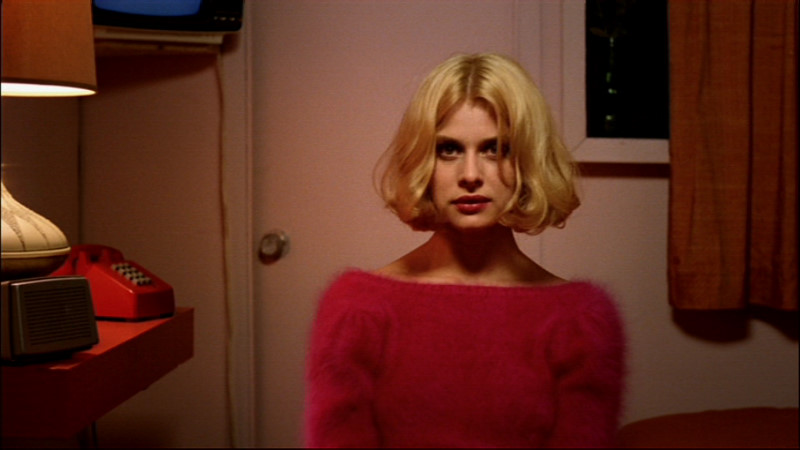
28) Elizabeth Pena or Penelope Cruz?
Elizabeth Pena
29) Your favorite movie tag line (Thanks, Jim!)
I liked Godzilla's tag line:
SIZE DOES MATTER
30) As a reader, filmgoer, or film critic, what do you want from a film critic, or from film criticism? And where do you see film criticism in general headed?
1. Know your field, please. If I sense a critic doesn't have context, then it's very hard to take him/her seriously. Their knowledge is shallow, they are dilettantes rather than experts.
2. The critics who know how to talk about acting - and what specifically an actor does that makes something good or not - are like GOLD to me. They're rare, and I cherish those critics.
I spoke about my tastes in film critics here .
EXTRA CREDIT: Do movies still matter?
Nothing like a good movie. Be it Persona or Bring It On. If it's good, it's good. And that matters. To me, anyway.
Here's a link to the quiz on Dennis' awesome site.
8 a.m. 39th Street

Oh - and I slipped and fell in the middle of the street - I was holding a Dunkin Donuts coffee and a big bulky overnight bag - and down I went - I totally wiped out, but the funny thing is: I doggedly held my coffee up in the air, so it wouldn't spill. I was lying in the street - face down - with my arm up, triumphantly. The rest of me was covered in slush, but dammit, not one drop of coffee spilled. I must have looked ludicrous. A little old man helped me up. Thank you, sir.
March 16, 2007
Secret lives of dresses
The latest installment. The "secret lives of dresses" is one of my favorite series on any blog - I look forward to them so much. They're perfect. Beautiful crystallized nuggets of imagination.
I always wondered what the other suits thought about that, but of course we hardly ever talk to them, even when we share a closet. They're so uncommunicative.
Marvelous. Moving, too. They always are. Glimpses into a world, a life ... from an outsider (being: the dress).
More movie memes ...
I'm having so much fun reading everybody's.
Tommy's made me laugh out loud multiple times. (His answers to #6 and #12 are especially funny to me.)
Gypsy's answers (and gosh, thank you so much for the compliment. It seriously means a lot). Lisa, she is your kindred spirit. Notice her Love, Actually fanaticism!!
Diary Friday
A cornucopia of high school mortification. Not only will I mortify myself but I will mortify Mere, Jayne, and Betsy. Yay! I'm takin' you all down with me. (Beth, you're getting off scot free this time.)
This is from the beginning of my junior year of high school (before DW came into my life, and completely took over EVERY SINGLE ENTRY)
SEPTEMBER 1
cadillac
cardiac
[Note: those two words are written in the top left corner of the page. I have no idea why.]
I am now braceless. [I think you mean braceS-less] At least on the top. When I first saw myself I was like, "Ohhh! Put them back on!" [Similar to my crying fit when the brace was taken off my legs as a baby. I missed my brace! WAAHHHHH!] But now - this is a momentous day. I really do look good. I am on my way to beauty. [If you could see pictures of me at this time, you would laugh. But that's neither here nor there. I had felt so damn ugly with those braces - and I had had them for 3 years - so it's nice to see my happiness with my own looks here. Not the normal self-loathing that percolates in the journal] I don't have to smile and hide my teeth anymore! I can look glamorous and grown-up. My teeth are SO straight and I love them!!! I've spent the entire afternoon flirting with my reflection in the mirror. I am on top of the world!
Getting them off really hurt (in fact I yealled once) but after that - it was fine!
Then Mum dropped me off at Mere's and Mr. W. let me in (I gave him an enormous toothy smile) and as i came down through the front hall I heard two pairs of feet pounding down the stairs. When Mere saw me she screamed and leaped around me [I seriously have the best friends in the entire world, and always have] and Jayne came zooming down crying, "Oh, let me see! Let me see!" For a while we just stood in the hall talking about getting braces off and I smled a lot. They (my teeth) feel so loose - like they would fall out if I touched them. I showed them my beautiful swollen bloody gums. [hahahaha]
Mere is such a wonderful friend. So is Jayne. They were both as excited as I was!
We went up to Mere's room. Jayne is leaving for college in Maine TOMORROW! [There isn't a font big enough to reflect how large the word "tomorrow" appears in the journal] Can you believe it? Jayne in college! Her room is a disaster area with all her packing. I can't believe she won't be in school this year! I am really gonna miss her. But she says she's a good letter writer, so I can't wait to have our letters flying back and forth from Maine and RI. It just won't be the same, though. I'm gonna miss her. Classes start on Tuesday and everything. Jayne in college! With a roommate! [Will wonders never cease??] She'll be home at Thanksgiving. THANKSGIVING! [again, see comment above about largeness of fonts, etc.] I won't see her until then! Do you know how weird that's gonna be?
Wow. Everyone is leaving and parting and saying goodbye. [Everyone?] I hate it. [Yup. And I still do.]
We hung out in Mere's room and listened to records and talked. Mere polished her silver necklace, Jayne showed me her fifth grade composition book (hysterical) and then at 20 of five I caught the bus and rode home. (I bought a People magazine with an article about Sting, and I bought their first album).
Also - Brian was in the car when Mum came to pick me up - and he called me over to see my teeth. He is SO nice. I think I have a little crush. (Oh, how philosophical).
I hate myself sometimes. [Woah, nelly, where's the segue??] I am vain, sullen, clutzy, aloof, dumb. I am a dork who thinks she is beautiful. I am an ugly girl who pretends she is a beautiful glamorous star, who pretends she could sleep with Sting and Al Pacino. I can't tell reality. I believe all what I imagine - and I do not like who I am. I wish I were urbane, and smart, and out of high school - so I can start over and not be such a doof.
[I have nothing to say. The self-hatred was real. I'll let it stand.]
I think Mere is bummed because of Jayne leaving. I know those two are really close. Mere was acting sort of quiet - and then Mr. W. yelled up the stairs to tell Jayne to hurry up and do some chore and Jayne said, "What?" and Mere cried, "Oh! Jayne, I forgot. Dad told me to tell you to do it." Jayne said, "Oh - see, Dad? Don't yell at me - yell at her!" Jayne ran downstairs and we sat in Mere's room, and Mere was quietly shoving down cards for solitaire, pushing down the cards sort of violently. Then out of the blue she said, "I hate myself." [It's an epidemic, apparently] Mere is so amazing. Always herself. [Breezy?] Not like me. I'm floundering right now. I'm trying to make myself into somebody I'm proud of - eccentric, weird, like James Dean - but Mere never puts on an act. She's funny and lively - but I know she has a serious side, she thinks about things, serious things. [Mere, Mere, Mere, you're glib.] So when she said "I hate myself" I just stared at her. "Why?" "I just - I always forget things and then other people get yelled at because of me." "Mere, I do that too! You know - 'Oh Mum, I forgot - Dad called 3 hours ago and needs a ride home.'" We started laughing. For a while, we talked about our faults, faults we wish we didn't have.
In NYC last December was the first time I ever saw her down - it was because of B.B. Me, Mere, and J. were sharing a room - and we all came in to settle down and Mere immediately slammed into the bathroom and locked herself in. J. and I got into our pajamas and had an absolutely hysterical time - laughing until we thought we were gonna barf - [That's so sensitive, girls. Mere is locked in the bathroom and you're rolling around in hysterics?] - we were laughing about Playgirl and dildos - we were throwing ourselves around on the beds with mirth. [I actually have a picture of that. We're holding a Playgirl, and we are seriously crying with laughter] Later, Mere still hadn't come out - and J. and I stood meekly at the door, looking at each other, wondering what to do. Finally - we softly knocked. I said, "Mere, all you all right?" The door flew open and Mere threw her potato chips all over the room and stalked to her bed. [Meredith - I have no memory of this. You threw potato chips around?]
I want to be there for Meredith. [Then how 'bout you put the dildo down, Sheila, stop laughing like a hyena, and go and talk to her???]
SEPTEMBER 2
GREAT DAY.
9:00 pm - East of Eden was on. [Member when you would have to wait for movies you loved to actually come on television - and what a big deal it was?] Right as it started, the phone rang and Siobhan called me to the phone. I ran to get it - "Hello?"
"Are you watching what I think you're watching?" It was Betsy.
"BETSY! You're home?" [Where else would you be? Camp, maybe?]
"Yeah! How are ya?"
"Good! How are - Oh! I got my braces off!"
"Really? Do they look good?"
"They look wicked!" [Not wicked good, wicked cool, wicked beautiful, or wicked ugly. Just plain old "wicked"]
"Oh my God, there he is." [meaning James Dean, I am imagining]
"Gotta go."
"Bye."
"Bye."
We both slammed down our phones and I am sure we both raced back to the television. I had never seen the beginning of the movie.
Diary - 3 movies. That man did 3 movies and LOOK at the impact! His movements, his face, the moving expressions, the hurt little boy face, the way he swings his whole body to turn around, hands shoved in his pockets, the posture - he is so great.
After, we went downtown to get my retainer [after? Oh. I get it. It was on at 9 AM. It was still summer vacation, I guess.]. If you do not know what a retainer is, it defies description. Then I invited Betsy to go to the beach with us. We had so much fun! I hadn't seen her in so long. At the beach, we lay out on towels for a long time, talking about Jimmy [you know, first name as well as nickname basis ...] and school and camp and Texas (Betsy went to a Happening conferernce in Houston). And we walked up to the pavilion for a soda - we talked about the Sadies [as in Sadie Hawkins] - and we tried to think of someone for me to ask. Someone from camp maybe. No more stupid macho dorks from our school. NO WAY. I AM DONE. [I had just come off of a thwarted doomed crush with one of those "macho dorks" and was extremely bitter. Hence my eventual crush on DW - the hot band geek.]
The ocean was massively grossly seaweedy that day but we braved it. We had a blast. Slowly we made our way through the seaweed, occasionally saying to each other, in calm voices, "This is really nauseating." "This is so gross." "I am totally disgusted right now." [hahahahaha] We survived though and went out really far where there was no seaweed. We would be bobbing there, having this deep conversation about boys, or God, or camp, and a wave would crash over us, our heads would go under - then we'd come up and continue talking as though there had been no interruption at all.
March 15, 2007
Visual DNA
Wow, that was totally fun. I got it from Tracey. Oh - and Lisa did it too! I love the choices. Funny how ... many times my choice was so obvious. Didn't even look at the other choices, just thought: THAT ONE. I also got to enter text with every image ... I got a bit bogged down, not sure if I did it right. You scroll over each image - and then you see this "text" that you can enter.
Oh, and the character description that came up for me was totally accurate. It made me laugh how accurate it was.
snippets:
You're drawn to the drama of a big spectacle and appreciate the unpredictability of nature.
You are passionate about history and skills that have been around for centuries, you believe truly great art stands the test of time.
For kicks you like to indulge in your great passions. (No. Really??)
You are happy to live life's highs and lows. You are fiercely loyal and passionate.
Tee hee.
How do I love the following photo?
Let me count the eternal ways.
"Et tu, Brute! Then fall, Caesar."
Yo. It's the Ides of March, yo.
Here's the moment in the play where Caesar gets the warning from the soothsayer. And ignores it.
SCENE II. A public place
Flourish. Enter CAESAR; ANTONY, CALPURNIA, PORTIA, DECIUS BRUTUS, CICERO, BRUTUS, CASSIUS, and CASCA; a great crowd following, among them a SOOTHSAYER
CAESAR
Calpurnia!
CASCA
Peace, ho! Caesar speaks.
CAESAR
Calpurnia!
CALPURNIA
Here, my lord.
CAESAR
Stand you directly in Antonius' way,
When he doth run his course. Antonius!
ANTONY
Caesar, my lord?
CAESAR
Forget not, in your speed, Antonius,
To touch Calpurnia; for our elders say,
The barren, touched in this holy chase,
Shake off their sterile curse.
ANTONY
I shall remember:
When Caesar says 'do this,' it is perform'd.
CAESAR
Set on; and leave no ceremony out.
Flourish
SOOTHSAYER
Caesar!
CAESAR
Ha! who calls?
CASCA
Bid every noise be still: peace yet again!
CAESAR
Who is it in the press that calls on me?
I hear a tongue, shriller than all the music,
Cry 'Caesar!' Speak; Caesar is turn'd to hear.
SOOTHSAYER
Beware the ides of March.
CAESAR
What man is that?
BRUTUS
A soothsayer bids you beware the ides of March.
CAESAR
Set him before me; let me see his face.
CASSIUS
Fellow, come from the throng; look upon Caesar.
CAESAR
What say'st thou to me now? speak once again.
SOOTHSAYER
Beware the ides of March.
CAESAR
He is a dreamer; let us leave him: pass.
So of course Julius Caesar was a real guy and all (I heard he really liked to "work out") ... but naturally I'm all about the play. Love that play.
The conspiracy scene, I think, is my favorite in the play. Here's a fun exercise - read it out loud and notice how often Shakespeare uses "s". Or an "s" sound. There's an "s" sound in almost every sentence. So when you hear the language - just the sound of it, never mind what it is that they're actually saying: it has a sound of "ssssss" - it gives an impression of a crowd of men whispering "psst" or - hissing - the hissing 'psst" whisper of conspiracy. Brilliant.
Here's a quiz on Shakespeare's Julius Caesar. Fun!! Amazing how much one remembers. It all came back to me - however, the quiz also reminds me I really MUST get back to my Shakespeare project. I mean - my reading has gone on quite well, I'm moving through each play chronologically - I've always wanted to do that. I've read all the plays, of course - but never in so-called chronological order. My original plan was: I wanted to write about each play as I read it - a la 2 Gents. I'll keep going on and get back to the series eventually)
And so, in honor of the Ides of March, here's the "moment before" - the poor ignored SOOTHSAYER comes back into the picture:
Act II, scene iv. The sense of foreboding grows. Portia can feel the wrongness in the air. This is "the moment before".
PORTIA
Come hither, fellow: which way hast thou been?
SOOTHSAYER
At mine own house, good lady.
PORTIA
What is't o'clock?
SOOTHSAYER
About the ninth hour, lady.
PORTIA
Is Caesar yet gone to the Capitol?
SOOTHSAYER
Madam, not yet: I go to take my stand,
To see him pass on to the Capitol.
PORTIA
Thou hast some suit to Caesar, hast thou not?
SOOTHSAYER
That I have, lady: if it will please Caesar
To be so good to Caesar as to hear me,
I shall beseech him to befriend himself.
PORTIA
Why, know'st thou any harm's intended towards him?
SOOTHSAYER
None that I know will be, much that I fear may chance.
Good morrow to you. Here the street is narrow:
The throng that follows Caesar at the heels,
Of senators, of praetors, common suitors,
Will crowd a feeble man almost to death:
I'll get me to a place more void, and there
Speak to great Caesar as he comes along.
Exit
PORTIA
I must go in. Ay me, how weak a thing
The heart of woman is! O Brutus,
The heavens speed thee in thine enterprise!
Sure, the boy heard me: Brutus hath a suit
That Caesar will not grant. O, I grow faint.
Run, Lucius, and commend me to my lord;
Say I am merry: come to me again,
And bring me word what he doth say to thee.
Dear Staring Lady on the Bus:
Got a couple questions. I'm not mad that you were staring. I just have some questions.
I cannot figure out why you were staring at me the entire ride. And so I began to obsess about possible boogers, bird shit in my hair, or ... what the fuck? What is wrong? I wasn't wearing a cleavage-busting lace corset, striped tights, and hi-tops at 8 in the morning, I wasn't wearing a crimson cloak and waxen fangs. I realize I wouldn't fit in with the zombie-clone-girls on The Bachelor - but I'm not THAT off the mark. You didn't seem like a crazy staring homeless lady. You were well-dressed, normal-looking ... and yet you found me unbelievably fascinating, and could not keep your eyes off me - until I got so paranoid that I had to say to you directly, "What?" I didn't really want an answer, by the way, I just wanted to remind you that I am actually alive and right here and not a movie - and that I can see that you are staring at me. It worked. It was only then that you looked away.
Now, to the questions:
Were you staring because:
-- I was wearing a puffy down coat even though it's about 90 degrees today? That's a possibility. Yes. I'm way over-dressed today. It FELT like it was chilly ... but I was basically totally wrong. But still: is that any call to stare at me for 20 minutes straight? Get over it. I'm wearing a down coat and it's warm out. Get over it.
-- I am wearing "crocs" today. Hideous, yes, I know, well-dressed lady, but so comfortable. They're like my Birkenstocks. Hideous, true. Most comfortable shoes ever. To quote my first boyfriend's fashion credo: "Comfort is key." Comfort is key. I know I wouldn't make the cut on The Bachelor wearing these ugly things, but I don't want to fit in with zombie clone girls in their pastel blue, and their black pants, and their long straight hair, and their pointy-toed heels. I don't LIKE that look and I resist it openly. But here's the real deal: I'll wear freakin' flip flops with a goddamn ballgown if I want to, and you're just gonna have to cope.
-- I have my hair in a ponytail. I'm obviously grasping at straws here. What is so weird about a ponytail? Are you that rigid? I hope not. It makes me sad for you.
-- My empty gym bag sitting on the seat next to me I don't know why this would cause someone to stare so doggedly - but just in case you were so baffled by the fact that I don't carry a purse like you, but carry a gym bag - here's the deal: I go to the gym on occasion. So there's THAT. I carry my sneakers around with me, as well as a sports bra, T-shirt, deodorant and also a towel - because the towels at the gym are the size of a Kleenex and won't fit around my hips, and I don't go to the gym to be reminded of my fat thankyouverymuch. So all of this requires a gym bag. Just in case you're wicked confused by that. Also, it's empty because I have to cart a bunch of crap around today - from one location to another - including a huge bamboo plant - and I honestly don't know how I am going to manage it, but hopefully the gym bag will come in handy. Second of all, if you were staring because it took up a whole seat: the bus was nearly empty. Nobody needed the seat.
-- When I laughed out loud while reading 1776 Now this, I grant you, might warrant staring. If that's the reason, I completely understand. Because I'm used to people thinking I'm crazy. Like the time when I wept on the PATH train because I was reading a speech Vaclav Havel made in 1990. Weeping. Openly. If anyone had asked me, "Are you okay?" and I had said, "No, it's fine, just crying about a speech Vaclav Havel made almost 20 years ago ..." I mean, come on, that's nuts. I don't expect people to cut me slack in that regard. So yes. I am reading 1776, and I guffawed briefly - when reading about Joseph Reed rebuffing the British from seeing "Mr. Washington" - Reed said, "Sir, there is nobody here by that name". An aggressive-aggressive way of saying "Give Washington the respect he deserves. He's not Mr." Anyway, I was delighted by the scene - although I know it well - and so I laughed out loud. Perhaps this caught your attention - and then you saw me laughing, and looked at the book cover to see what was so funny ... perhaps a joke book? Or Devil wears Prada? Or something, you know, funny?? Nope. 1776 brought on the guffaws. I can see how that might make you stare.
For 20 minutes straight, though?
This reminds me - that Patrick dared me once to walk around an entire day dressed like Louisa May Alcott - huge dress, big bonnet - and not act like it was a costume, or weird at all. To just go about my day ... yet dressed like that. I seriously might have to do that. It could be hysterical. I'd have to have someone come along with me though to surreptitiously take pictures of me as I - dressed like a woman in 1865 - walk through Times Square.
It could be a great lazzi.
So thanks for the idea, Staring Lady on the Bus!! Look for me in the next couple of months! I'll be the chick in the hoop skirt and the bonnet. Howling with laughter on the bus as I read Decline and Fall of the Roman Empire.
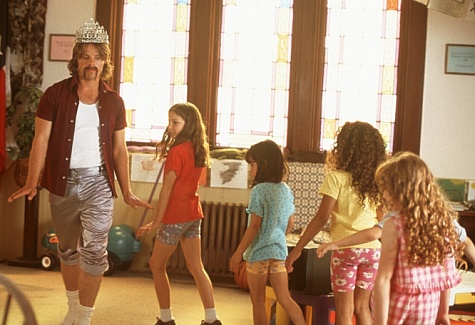
“Why Zach, Why?”
Marisa has added her funny and interesting answers to the movie questionnaire. Like John Cusack says in High Fidelity - often you can find out all you need to know about a person based on their taste in movies, books, and music.
Also - anybody who references Happy Texas as one of the funniest movies ever made is okay by me. I can't believe I forgot to put that one on my list! LOVE that movie and the first time I saw it I laughed so hard I had to stop the tape and get myself together.
March 14, 2007
Grammar girl!!
I love everything about Grammar Girl. Her podcasts are great too. I could spend hours reading about "further" and "farther" and when to use "whom", etc. My grammar is fairly competent (although I stumble on the I/me rule - I have made a concerted effort to improve that one,and I actually catch myself while making the mistake now - which is true progress! I'm an old dog, yes, but I have learned a new trick). Certain things hurt me when they are incorrect (mainly flailing use of apostrophes, and the it's its debacle, the their and they're and there) ... and there are certain things I never get wrong. It's in me. I love Grammar Girl's essays ... because she explains why certain things are rules ... (the subject/object rule of who and whom, for example ... I had forgotten that) - and it's all quite interesting. She does a good job with the "why" of it, I think.
That movie meme ...
Annie Frisbie fills out the movie meme at her Film Review site. (Annie is awesome, by the way - a kindred spirit - she's also "super fast reader" - and contributes reviews at House Next Door - her latest is here)
But it's great to read other people's answers to this meme. I love that she loves watching Mildred Pierce with someone who hasn't seen it before. I love that she agrees with me on Robert Wuhl. hahaha It is good to have it validated. And I too love 8 Mile with a passion.
Here are my answers by the way.
And here are Lisa's answers. I had forgotten about Mos Def - and I totally agree.
And here are SarahK's answers. Lovers of Walk to Remember - UNITE!! (I rant and rave about my love for that movie here - despite how much I DESPISE Nicholas Sparks' books, which I believe we have covered on the ol' blog before.)
Happy Birthday to: the creator of Loadstone O'Toole, of all people
It's Max Shulman's birthday. Who the hell is Max Shulman, you may ask? Or some of you may ask? He was one of the most popular humorists of his day - who reached his peak of popularity in the 1950s. He's the dude who created the Dobie Gillis character in a series of short stories and a couple novels - which was then turned into a popular TV series. Shulman was VERY successful in his day - and is now almost forgotten. Strange. He also was a screenwriter.
I somehow tripped over his book I Was a Teenage Dwarf when I was a teenager myself. This is the chronicle of Dobie Gillis' crazy "woman"izing when he was in high school (the shortest boy in town. Hence - the title.) Dobie Gillis was quite the lady killer, despite his height problems.

It was in the library where I worked as a page (my first job). I have no idea why I would have picked it up - it's kind of an old-fashioned looking book (the book I picked up had the cover I posted above - with Gillis on stilts). This was at the height of the whole Happy Days craze - so maybe something in the 1950s-ish cover appealed to me.
Also, I DO know that once I brought the book home I learned that my parents both LOVED Max Shulman. They recognized his name immediately, both started laughing, and told me: "You HAVE to read Rally Round the Flag, Boys!"

I remember vividly my mother TRYING to tell me what the name of one of the lead characters in Rally round the flag was - and completely not being able to get the name out because she started guffawing with laughter. The character's name was: Loadstone O'Toole. Even now - just typing that - I started laughing.
"Hi there, my name is Sue. What's your name?"
"Loadstone O'Toole."
"Uhm ... oh ... "
I was asked to leave my high school library because it was study period, and I was reading Teenage Dwarf, and I started laughing so loudly that I could not control myself. Basically, I GUFFAWED into the studious silence. Tears streamed down my face, despite the fact that I was being "Sh"ed left and right. I finally had to just gather up my book bag and stagger out into the hall, where I stood, and literally HOWLED with laughter, by myself, for a good 5 minutes.
I can count the writers on one hand who are that feckin' funny.
Over the last couple years, it became my mission in life to find all of his old books again - so I could own them. Many of them are long out of print, and hard to find (at least were hard to find. Amazon has now made it really easy). And I find it strange - It's not that long ago - the 1950s and 60s - but his reputation has not survived. It's a shame.
Member the famous Christmas pageant scene in Owen Meany? Max Shulman's books are that funny all the way through. The Strand sometimes had copies of his books - I always checked whenever I was there. I got some of his lesser known titles - but the holy grail (I Was a Teenage Dwarf) eluded me. I was dying to know if the book would be as funny to me as an adult as it was when I was a kid. I let my dad know, librarian that he is, what I was looking for - so he could keep his eyes open if he came across copies.
Eventually - a box arrived on my doorstep, with my dad's handwriting on the label. I opened it. And took out two books: Rally Round the Flag, Boys starring the marvelously named Loadstone O'Toole (LOADSTONE O'TOOLE???? I still can't get over it) - and oh. my. God: I Was a Teenage Dwarf.
I immediately took Teenage Dwarf up to my roof, with a thermos of coffee, and sat there in the autumn sun - tearing through my old childhood favorite. I finished it in a couple of hours.
And for the record? It was even funnier than I remembered. It's MEANER than I remembered. It's more biting, bitchy, merciless ... But I sat up there on my roof, the memories just flooded back, and I was howling.
Dobie Gillis at one point has a girlfriend who is a tomboy - and she is constantly playing stickball and climbing trees - falling down - so she always has cuts on her knees - and so her nickname is Red Knees. Her parents call her "Red Knees". Dobie Gillis, kissing her on the couch, whispers lovingly into her ear, "Ohhh, Red Knees ..."
A mind who thinks something like that up is sick and perverse, and basically my kind of person.
RED KNEES???
Writers who make me cry are great. I love them. But writers who make me laugh have my heart forever.
Max Shulman: a witty madcap man with a ridiculous and yet somehow very HUMAN sense of humor ... hugely successful in his day ... now mostly forgotten. If you ever come across his books in a used bookstore, I highly recommend you give them a read. They are laugh-out-loud funny.
Happy birthday, Mr. Shulman!!
Happy Birthday to Sylvia Beach
... who is responsible for publishing James Joyce's Ulysses when no one else would touch it. Here is a photo of Sylvia and Jimmy:
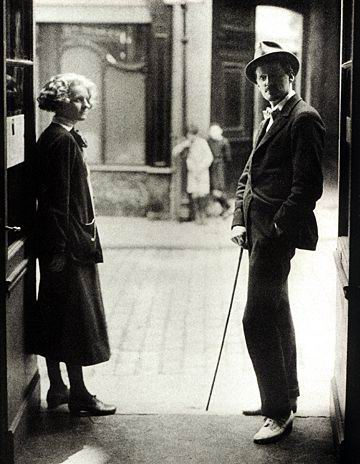
Sylvia said of Joyce: "As for Joyce, he treated people invariably as his equals, whether they were writers, children, waiters, princesses, or charladies. What anybody had to say interested him; he told me that he had never met a bore."
(As far as I'm concerned - anyone who can say that he has "never met a bore" is a genius of the human spirit.)
A fascinating woman: born in Maryland, and as an adult a major force in the literary ex-pat community in Paris. She served in World War I with the Red Cross in Serbia, and after the war settled in Paris, where she opened up a bookshop - the enormously influential Shakespeare & Co.. Let's see - here are a couple of the names in Paris at that time: Hemingway, Fitzgerald, Stein, Joyce ... (GOD for a time machine!) And so Shakespeare & Co. became the hub-bub, the vortex of them all.
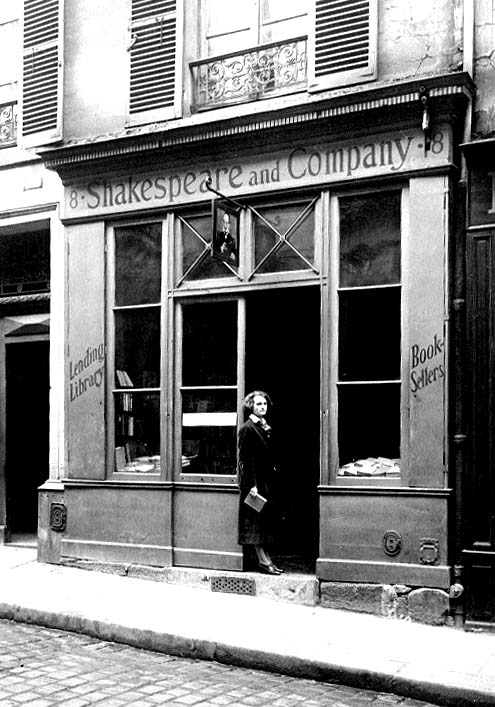
When she met James Joyce, he had already written Ulysses, and it was a finished manuscript by that point (or as finished as any Joycean manuscript ever would be) - but essentially unpublishable, due to its being deemed "obscene". The funny thing about all of this is that Joyce said later, "The pity is that the public will demand and find a moral in my book, or worse they may take it in some serious way, and on the honour of a gentleman, there is not one single serious word in it."
But Sylvia Beach - who had never published a book before - took a risk and said that Shakespeare & Co. would put out the book, which was already highly controversial. It was an act of courage. Perhaps she went into it recklessly, thinking that giving a space for genius would be its own reward - perhaps she went into it knowing the eventual fallout that would crash down upon her head - But whatever her interior process, she published it.

And the shit hit the fan.
Once it was published, the obscenity controversies heated up, the book was banned (Joyce said later, "I have come to the conclusion that I cannot write without offending people.") everybody was talking about it, who had actually read it? - you could be arrested for trying to smuggle it into certain countries - and there were a couple of years where the only place on the planet you could get a copy of Ulysses was through Beach's bookshop in Paris. And so the orders flew in from folks around the world. People who were book readers, people who were collectors, people who sensed the historic moment and just wanted a copy.
I've seen a photograph of Peggy Guggenheim's letter to Sylvia Beach: "Please send me a copy of Ulysses!!!" Urgent exclamation marks.
The comments of other great writers on this book are, of course, great interest to me. They run the gamut of disgust, elation, despair, awe, humility ... and I love it, too, that Yeats (an early supporter of Joyce) changed his mind. His first response on reading it? "A mad book!"
Then later, as it percolated, Yeats said: "I have made a terrible mistake. It is a work perhaps of genius. I now perceive its coherence ... It is an entirely new thing -- neither what the eye sees nor the ear hears, but what the rambling mind thinks and imagines from moment to moment. He has certainly surpassed in intensity any novelist of our time."
Hart Crane had this to say (or shout): "I feel like shouting EUREKA! Easily the epic of the age."
George Bernard Shaw was disturbed by Ulysses, and its view of Ireland - so much so that it tormented him a bit. He saw it as an indictment (and, in a way, it was). He said, however: "If a man holds up a mirror to your nature and shows you that it needs washing -- not whitewashing -- it is no use breaking the mirror. Go for soap and water."
T.S. Eliot was especially devastated by the book, and his comments on it are numerous. Examples: "How could anyone write again after achieving the immense prodigy of the last chapter?" And also - this quote really touches me, because as a writer, Eliot wasn't half-bad himself: "I wish, for my own sake, that I had not read it." And lastly (and I think this pretty much gets at the root of what was so disturbing to Eliot): "I hold Ulysses to be the most important expression which the present age has found; it is a book to which we are all indebted, and from which none of us can escape."
Goose bumps.
Edmund Wilson wrote of it:
The more we read Ulysses, the more we are convinced of its psychological truth, and the more we are amazed at Joyce's genius in mastering and in presenting, not through analysis or generalization, but by the complete recreation of life in the process of being lived, the relations of human beings to their environment and to each other; the nature of their perception of what goes on about them and of what goes on within themselves; and the interdependence of their intellectual, their physical, their professional and their emotional lives. To have traced all these interdependences, to have given each of these elements its value, yet never to have lost sight of the moral through preoccuptation with the physical, nor to have forgotten the general in the particular; to have exhibited ordinary humanity without either satirizing it or sentimentalizing it - this would already have been sufficiently remarkable; but to have subdued all this material to the uses of a supremely finished and disciplined work of art is a feat which has hardly been equalled in the literature of our time.
Wilson also wrote:
"Yet for all its appalling longeurs, "Ulysses" is a work of high genius. Its importance seems to me to lie, not so much in its opening new doors to knowledge -- unless in setting an example to Anglo-Saxon writers of putting down everything without compunction -- or in inventing new literary forms -- Joyce's formula is really, as I have indicated, nearly seventy-five years old -- as in its once more setting the standard of the novel so high that it need not be ashamed to take its place beside poetry and drama. "Ulysses" has the effect at once of making everything else look brassy."
And here is the lady who first made this "epic of the age" available to the world, at great financial and personal risk:

Joyce eventually moved to another publisher - for later editions - which left Beach financially stranded (along with the Great Depression which really hit Shakespeare & Co. hard.) But Beach had rich influential literary friends - many of whom came to her rescue during this difficult time. Famous writers did readings at Shakespeare & Co., admission was charged, people paid subscription fees - and in this way the bookstore made it through. Beach died in 1962. She wrote a memoir (which I haven't read - my dad said it's okay, not great, but okay) - and is widely revered for her courageous independent move to publish Ulysses - the book that T.S. Eliot said "destroyed the 19th century".
She said:
I was on the platform, my heart going like the locomotive, as the train from Dijon came slowly to a standstill and I saw the conductor getting off, holding a parcel and looking around for someone -- me. In a few minutes, I was ringing the doorbell at the Joyces' and handing them Copy No. 1 of Ulysses. It was February 2, 1922.
March 13, 2007
Movies!!!
I got this from Dan!! Love these things.
1. Name a movie that you have seen more than 10 times.
Obviously this meme is already unacquainted with my level of obsession.
Movies I have seen more than 10 times (in no particular order and with a couple photos - again, in no particular order - just scattered thruout):
-- Bring It On
-- Center Stage

-- Murder by Numbers (a movie I've never written about ... but one that I love)
-- probably The Breakfast Club

-- Notorious
-- Apollo 13
-- probably Blue Crush (including 3 times in the movie theatre.)
-- Music of the Heart (another favorite - makes me cry every. single. time)
-- GI Jane
-- Moulin Rouge
-- Notting Hill
-- Love and Basketball (which will DEFINITELY be on my "under-rated movies" list - once I get back to it. I LOVE this movie.)

Oh, there are a bazillion more. If I love a movie, I watch it repeatedly. Sometimes I just keep a favorite movie on for background noise as I clean my house or whatever.)
2. Name a movie that you’ve seen multiple times in the theater.
I must copy Dan. Dirty Dancing. I think I saw that 5 times in the movie theatre that summer it came out. Could not get enough.
Also: Star Wars
Also: Ferris Beuller's Day Off - it almost became a joke I went to go see that movie so much
3. Name an actor that would make you more inclined to see a movie.
A live actor? Also - "actor" meaning: actor and actress? Fine.
Jeff Bridges. Russell Crowe. Ewan McGregor. Tommy Lee Jones. Gene Hackman. David O'Hara. Robert Duvall. Meryl Streep. Emma Thompson. Kate Winslet. Diane Keaton.
4. Name an actor that would make you less likely to see a movie.
Robert Wuhl. hahaha Random, I know. But it's true.
5. Name a movie that you can and do quote from.
Waiting for Guffman "I hate you and your ass-face!"
What's Up Doc "I don't have a badge for a Eunice Burns."
Bringing Up Baby "Alice! I think this one belongs in the tail."
6. Name a movie musical that you know all of the lyrics to all of the songs
All of them. Seriously. Don't make me list them.
7. Name a movie that you have been known to sing along with
The first one that comes to mind is my roommate Jen and I watching Stand and Deliver and singing along like banshees with the final-credits song - which is called (ironically) "Stand and Deliver". We riffed with it, we did bad jazz, we amused ourselves endlessly and annoyed our neighbors relentlessly.
"Sta-and and delivahhhhhhh-ah-ah-ah ..."
8. Name a movie that you would recommend everyone see.
Only Angels Have Wings - I can't think of a person this movie wouldn't appeal to. It's got macho adventure, sizzling romance, and also a great script - Rita Hayworth - Cary Grant ... atmosphere, humor, great great scenes ... See it. If you haven't already.
9. Name a movie that you own.
Let's see. I own many but I will choose one randomly.
10. Name an actor that launched his/her entertainment career in another medium but who has surprised you with his/her acting chops.
I thought Eminem was great in 8 Mile - not one false moment where he seemed out of his league. Completely at home in front of the camera, vulnerable, intelligent, committed to difficult moments - he wasn't trying to protect himself and be a "tough guy" - very good performance.

I also LOVE Eve. Loved her in Barbershop - thought she was a total natural.
11. Have you ever seen a movie in a drive-in? If so, what?
My first time seeing Empire Strikes Back was in a drive-in. Great night. I was in my pajamas, too - it was an outing with all of my cousins - when it first came out.
12. Ever made out in a movie?
Yes - only once, believe it or not. This is horrifying (if you don't know the context). [Oh, and I should mention that it pre-dates the Seinfeld episode - just so we're all clear on that] Michael and I made out during Schindler's List. But in our defense: it was the only movie playing in a town where we were living for 6 weeks - and we had already seen it 6, 7, 8 times - maybe more - we went to go see it 3 times a week on occasion, just to have something to do. The movie theatre was empty (literally), it was a matinee, we had already seen it 10 times, we were nuts about each other - I feel like all we did was read books, eat ice cream and kiss, and so we made out like hungry werewolves as the Jews of Poland were being rounded up. I am so sorry.
13. Name a movie that you keep meaning to see but just haven’t yet gotten around to it.
Way Down East - it's on the queue!!
14. Ever walked out of a movie?
36 Fillette - boyfriend and I stood up and walked out. I've liked Catherine Breillat's other movies since then, particularly Romance - it's got an Italian p0rn star in it - a guy I'm a wee bit obsessed with - and he's cast in a straight part, as an actor but ... well. It's a VERY weird movie. Italian P0rn man was why I saw it, originally - I was like: He's acting? He has lines? I must see this!! (He's not bad, either). So I do like Romance and own it - even though you really have to be in the mood for the French-y mood of it ... but 36 Fillette really turned us off at the time, can't remember why.
15. Name a movie that made you cry in the theater.
Titanic. I say it without shame. It was actually the priest saying mass - grabbing hold of a railing as he spoke the words - that started the tears - and I pretty much was a mess until the very end.
Apollo 13 - Jim and I saw it together when it first came out and we both got misty-eyed during the first scene - when they all were watching the moon landing on television - and Jim glanced at me when the scene finished and said, "This is going to be a long movie."
And I went home and took to my bed after Bridges of Madison County. I think I even called in sick the next day.
I also remember crying at the end of that gloriously campy movie with Demi Moore called The Seventh Sign
16. Popcorn?
Sometimes. No butter though.
17. How often do you go to the movies (as opposed to renting them or watching them at home)?
A couple times a month
18. What’s the last movie you saw in the theater?
What is my problem - I totally can't remember. Once Upon a Time in America maybe. I thought there was something more recent, though.
19. What’s your favorite/preferred genre of movie?
Probably smart romantic comedies.
20. What’s the first movie you remember seeing in the theater?
Candleshoewas definitely the first movie I ever saw (or - it's such a vivid memory that if I saw a movie in the theatre before this one, I have no idea what it is). I even remember some of the scenes in the movie from that first viewing alone.
21. What movie do you wish you had never seen?
Please note the "II". VERY important distinction, thank you very much. I liked the first Wild Orchid, in all its skeezy soft-core self-important absurdity. Wild Orchid II let me DOWN, man!
22. What is the weirdest movie you enjoyed?
Weird? Weird to who? Define weird.

I loved Magnolia. Lots of people think that movie's weird. I thought it was one of the best movies of that decade.
23. What is the scariest movie you’ve seen?
Toss up between Rosemary's Baby, The Exorcist or The Ring (Dan - member our whole joke about the "well chick"? Like - "Hey - if well-chick calls, take a message, okay? I don't want to talk to her. That bitch CRAZY.")
(Dan - I'm crazy - I found it. It's even funnier than I remembered it. We riff about reversing the charges on the "well to house" calls" - "Is it Well Chick?" "Yeah, we have a call coming from the well - want to let the machine pick up?")
24. What is the funniest movie you’ve seen?
What's Up Doc has to be at the top of the list.
"How much is it without the Bufferin?"
"YOU CALL THIS A HONEYMOON?"
"Charm .... use your charm ..."
"Thieeeeeeeves ... robbers .... thieeeeeeves ..."
"Snakes, as you know, have a mortal fear of ... tile."
I could keep going. Mere? Jean? Any other fans want to join in?
"I WANT MY BIKE BACK!"
"I'll give you your bike back. I'll give you a broken back if you don't be quiet."
"Rooms begin to burn ..."
"I MYSELF HAVE A LITTLE ANNOUNCEMENT TO MAKE WHICH MAY BE OF SOME INTEREST!"
"Because ya look cute in your pajamas, Steve."
"Is it possible to break a lung?"
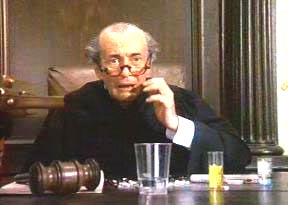
"Ya made me smash my lifesavers."
Streep in "that scene" in Ironweed
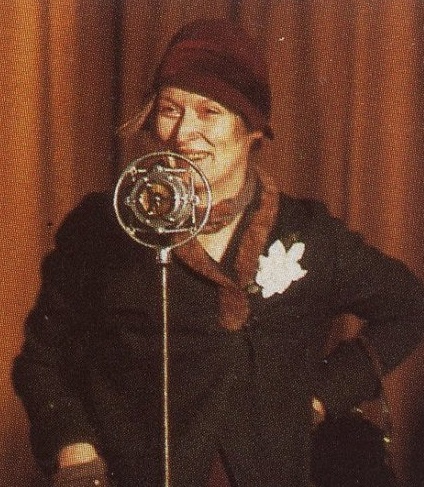
I remember when that movie first came out - I hadn't seen it yet, but Mitchell had - and he said to me, "There is a reason why everybody is talking about that scene ... It was annoying to me, how much people were talking about how great it was ... until I saw it."
He's talking about the singing scene, of course.
And so - wow - I loved reading this post over on Lance's excellent blog that tells the story of that scene, told by William Kennedy himself.
Mere and Jayne and Beth ...
I know you'll laugh at this bad Trixie Belden book cover. II love the comment too). So my X-rated chapter additions weren't quite off the mark, huh? Judgmental Christian families booting me out of their house notwithstanding?
That's not the cover of the copy I had, though.
Here's an entire archive of bad book covers. I am CRYING about some of them (and the commentary is hysterical - example - for the book entitled The Good Old Days, the comment says: Ah, the good old days, when deformed freaks would wander around the prairie on really short stilts.) Etc. Pages and pages of horrible book covers. Heaven.
Thanks for linking, Ernie.
sitting with your boss's boss's boss's (boss's?) boss
Excerpt from Johnny Virgil's laugh-out-loud funny post about his annual work party:
It was far enough away from the DJ's speakers so you could still talk, yet close enough to the dance floor to watch your co-workers do the robot to a country song.
Also I love that his wife was basically carrying around a mini-bar in her purse.
The Books: The Doctor's Sweetheart: The Girl and the Wild Race' (L.M. Montgomery)
 The Doctor's Sweetheart and Other Stories - by L.M. Montgomery. This is another collection of short stories - all selected by Catherine McLay - in general these have higher quality than some of the other collections, which are made up of juvenilia, or things that Montgomery obviously wrote for money. The stories in this collection (with a couple exceptions) are juicy - the characters memorable, and her writing superb.
The story I'm excerpting today is one of Lucy Maud's amusing romantic comedies. Judith is 27 years old and lives with her aunt. Judith has never been married - which basically causes her aunt conniption fits every time she thinks about. 27! And never married! It's not that Judith isn't pretty, or wifely, or a good match ... it's that the guy she has been secretly in love with since she was a kid - is not approved of by her aunt - who has chosen somebody else for her. Judith will not settle - and it's not like the guy she loves has ever declared himself. So it's a stalemate. Judith - a lovely laughing pretty girl - sits at home with her aunt, listening to her aunt bemoan the shame of being 27 and unmarried. Judith takes it all rather philosophically - she's not a gloom and doom type.
But then one day - Judith snaps. She declares to her complaining aunt that she will "marry the first man who asks". Word gets out in the little town - and word eventually reaches the guy Judith secretly loves - as well as the suitor her aunt approves of (as a matter of fact, her aunt sends the man an urgent message telling him to COME OVER HERE QUICK). And the two men end up having a race to get to Judith first - involving buggies racing across fields and fording streams, etc. The entire town gets involved - people rooting for one or the other - and Judith, who made a big show of saying she didn't care WHO she married - of course waits, with baited breath, to see if HER chosen one will reach her first.
It's a fun story - and I really like Judith's spunky personality.
Anyway - here's the moment where Judith finally snaps!
Excerpt from The Doctor's Sweetheart and Other Stories - 'The Girl and the Wild Race' - by L.M. Montgomery.
The afternoon that Mrs. Tony Mack came in Mrs. Theodora felt more aggrieved than ever. Ellie McGregor had been married the previous week - Ellie, who was the same age as Judith and not half so good looking. Mrs. Theodora had been nagging Judith ever since.
"But I might as well talk to the trees down there in that hollow," she complained to Mrs. Tony. "That girl is so set and contrary minded. She doesn't care a bit for my feelings."
This was not said behind Judith's back. The girl herself was standing at the open door, drinking in all the delicate, evasive beauty of the spring afternoon. The Whitney house crested a bare hill that looked down on misty intervals, feathered with young firs that were golden green in the pale sunlight. The fields were bare and smoking, although the lanes and shadowy places were full of moist snow. Judith's face was aglow with the delight of mere life and she bent out to front the brisk, dancing wind that blew up from the valley, resinous with the odors of firs and damp mosses.
At her aunt's words the glow went out of her face. She listened with her eyes brooding on the hollow and a glowing flame of temper smouldering in them./ Judith's long patience was giving way. She had been flicked on the raw too often of late. And now her aunt was confiding her grievances to Mrs. Tony Mack - the most notorious gossip in Ramble Valley or out of it!
"I can't sleep at nights for worrying over what will become of her when I'm gone," went on Mrs. Theodora dismally. "She'll just have to live on alone here - a lonesome withered-up old maid. And her that might have had her pick, MRs. Tony, though I do say it as shouldn't. You must feel real thankful to have all your girls married off - especially when none of them was extry good-looking. Some people have all the luck. I'm tired of talking to Judith. Folks'll be saying soon that nobody ever really wanted her, for all her flirting. But she just won't marry."
"I will!"
Judith whirled about on the sun warm door step and came in. Her black eyes were flushing and her round cheeks were crimson.
"Such a temper you never saw!" reported Mrs. Tony afterwards. "Though 'tweren't to be wondered at. Theodora was most awful aggravating."
"I will," repeated Judith stormily. "I'm tired of being nagged day in and day out. I'll marry - and what is more I'll marry the first man that asks me - that I will, if it is old Widower Delane himself! How does that suit you, Aunt Theodora?"
Mrs. Theodora's mental processes were never slow. She dropped her knitting ball and stooped for it. In that time she had decided what to do. She knew that Judith would stick to her word, Stewart-like, and she must trim her sails to catch this new wind.
"It suits me real well, Judith," she said calmly, "you can marry the first man that asks you and I'll say no word to hinder."
The color went out of Judith's face, leaving it pale as ashes. Her hasty assertion had no sooner been uttered than it was repented of, but she must stand by it now. She went out of the kitchen without another glance at her aunt or the delighted Mrs. Tony and dashed up the stairs to her own little room which looked out over the whole of Ramble Valley. It was warm with the March sunshine and the leafless boughs of the creeper that covered the end of the house were tapping a gay tattoo on the window panes to the music of the wind.
Judith sat in her little rocker and dropped her pointed chin in her hands.
when legends gather ...
Some of my favorite people ... all in one place.
Congrats, Pioneer Woman!
You're not a best-kept "secret" anymore. You so deserve that win. What a find your site has been for me. Congratulations!!
March 12, 2007
"Word came today"
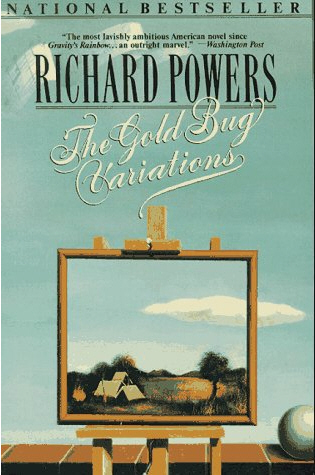
This post made me cry - it's a swept-away and yet articulate response to Richard Powers' Goldbug Variations It brought me back to my own experience reading that extraordinary book ... and how blown away I was (and still am) by it. I've never written about Goldbug Variations because ... I find the prospect daunting, I guess. Where to start?? The same with Hopeful Monsters - a book that means more to me almost than any other. I can't seem to bring myself to write about it. The last big book on my personal-fave list (and I always think of these three together) is Mating - and that one I DID manage to write about. In a frenzy. I find some books hard to talk about. Because not only are they a good story, a good book - but they are sometimes like angels, come into my life at the perfect reason, to help me struggle with a certain issue ... the books show up - These 3 books were like that. There was no reason for me to read them. I picked up Hopeful Monsters because I liked the cover art and the description of the plot on the back. I picked up Mating because the description of the plot on the back spoke to me. Nobody recommended it. I read it a couple years after it won the National Book Award. And I picked up Goldbug Variations for ... I have no idea why. But these three books - together - ended up being woven together into a rope, a strong rope - for me to hold onto - until the bad-ness passed. This was in the late 90s. Each book is dog-eared from re-readings. I love them as BOOKS, but I also love them as saviors. Goldbug Variations came at a time when I was ricocheting around in my own loss, and I had been for about a year. Everything was cold, I was always walking into the wind. Goldbug it was challenging, a real feat, it takes concentration - and it's an intellectual battle. But (as it so often is for me) - the intellect is PART of the passion. It's not either/or. I don't separate. And an intellectual love affair ... hmmmm ... what would that be like? I know exactly what it would be like, and it is the only kind of relationship possible for me. There is a hopelessness in that. A swoon of necessity, of self-knowledge. And in these 3 books I list here - I've seen such a relationship described, dissected, analyzed. (Possession is another one, actually).
But alongside of (or woven into) the intellectual rigor of Goldbug Variations is this keening note of mourning, longing, bittersweet love ... Oh, how I know that. I know it better than anything else.
He feels a strange euphoria, an overwhelming sense of inevitability. The thing about to make its grand entrance surprises him by its uncanny familiarity.-- Richard Powers, Goldbug Variations
"Are you waiting for someone?" he asked. It was the first time he had spoken to me, ever.
I didn't say what I wanted to say, which was, "Yeah. You." Instead, I smiled up at him, strange how familiar he seemed, uncanny familiarity, and said merely, "Yeah."
I still haven't written about Goldbug Variations. I still don't feel ready.
Here's the link again to the post that started off my brain a-spiralling. Thinking about that book makes my heart pound faster.
Weekend snapshots
-- I washed my walls. They are a lovely pale yellow color and I was horrified at how black my damn Melaleuca cloth was when I was done. City air. Filthy. Invisible and filthy. Horrors. I cleaned like a whirling dervish. I scrubbed, I mopped, I scoured, I went insane.
-- The weather was spring-like, heart-crackingly so. I could open the windows to air out my main room - and sunshine streamed in, birds hopped about, and I could hear the screams of kids from a nearby playground.
-- I watched 20th Century at one point - taking a break - and laughed my ass off. The first scene alone is nonstop hilarity. I LOVE that first scene. John Barrymore is so. freakin' funny ... and Carole Lombard's not so bad either. But it's Barrymore for me that is really the funny one, which is hysterical since he was known as a great tragedian. But Howard Hawks asked him to take that tragic-actor sensibility - and use it in service of a screwball comedy - and it just WORKS. My favorite part of his performance is how he reacts to things. He listens to people talk, and as he responds - his body will jolt, he'll gasp, he'll gesture - it's like every single word from the other person's mouth is hurting or thrilling him personally ... It's like electric jolts of surprise are always jabbing at him. I was seriously crying during that first scene, when he's losing it, and being so melo-dramatic (and yet, for this guy - it's just real life - he's not being melodramatic - That is his personality) - and Lombard becoming more and more frayed at the edges, trying to please him ... Barrymore is hilarious. I love that movie.
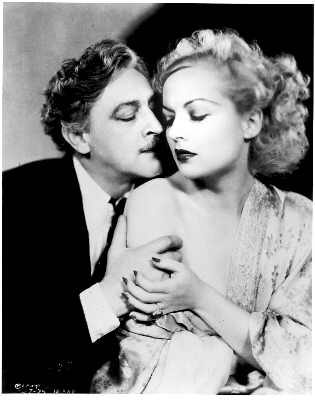
-- I went to the new gym that opened up down the hill from me. It is deluxe! Much better than the raggedy-ann third-world-era one I normally go to. There are skylights - it's on the 2nd floor of a 2 story building - and the gym itself is lined with transom windows - and they all were open - and the place just had this airy breezy feel to it that I really liked. Not too many people know it's opened yet - so it wasn't too packed - and I had the steam room all to myself.
-- I bought 20 bucks worth of incense. I am not well.
-- I bought the microdermabrasion kit that Oil of Olay just came out with it - and did it on Saturday night. I see no difference, actually. But then again, my skin is the only flawless thing about me. Wouldn't change a thing. (Just thought maybe it could look better about the microdermabrasion.)
-- I learned on Saturday that I am, at this very moment, one degree of separation from George Clooney. Not 2, 3, 4 ... but ONE. He might as well be standing right next to me. I revel in this fact. It won't last long, but while it does, I am going to keep it at the forefront of my consciousness.
-- I remembered, like a bolt from the blue, as I Windexed like a maniac - an author that I absolutely ADORED when I was, say, 11, 12. Her name is Ellen Conford. I have not thought about her for nigh on 20 years - and somehow (the brain is so weird) - her entire oeuvre popped into my head - complete with plots and titles. I felt heart palpitations ... like: I MUST TRACK DOWN those books immediately. I LOVED them. There was a "short story collection" that had spaghetti in the title - and I remember so well that there was one short story in it that was all conversation - a boy and a girl who meet on the beach ... and over the course of a couple of different encounters start to date. I can't remember WHAT I found so entrancing about that story - or why it moved me so much - but I do remember that I was reading it at the same time in my life when I was hanging on to Ralph Macchio for dear life - that junior high horror-time ... and that one particular story just gave me so much hope - that maybe things would work out for me, maybe things would be okay. Anyway - all of Conford's books I loved flipped past my mind - Seven Days to a Brand New Me, the one about the camp, also the one called something like To my Fans, Love Sylvia - which I had adored in particular, because it took place in the 1940s and it was about a girl who wanted to go to Hollywood and be a starlet. The first one of hers I read was actually a book called 7 Days to a Brand New Me - and it really resonated with me when I was 11, 12 ... and starting to deal with adolescent issues, and being made fun of, and learning that who I was was actually NOT going to fly. I also remember that there are some laugh-out-loud funny moments in all of these books. Anyway, I am so psyched to have had a sudden opening in my memory, an opening labeled: ELLEN CONFORD (the brain is truly incredible) - because now I've bought all of those books on Amazon - and I didn't pay more than one cent for any of them - and they're all shrieking my way as we speak. I can't wait to read them again.
-- I rearranged some books. Heaven. My US history section and my Founding Fathers biography section have been rearranged so that they are now together - and it's turning out to be a really stunning collection. I like standing back and looking at it, it looks impressive. I'm so pleased with my library.
-- There are times when I love my Swiffer so much I want to make out with it.
-- Oh, and last night, after watching Persona - whaddya know - I couldn't sleep. So I popped in Oscar - which should please Mejack. I love that movie and I thought it might shake off the eerie blues-ridden feeling that Persona had given me. I love how he doesn't even look at Chazz Palmienteri when he says, "Shaddup" at the end. With a dead annoyed look in his eyes. I love Harry Shearer as one of the Italian tailors. I don't like Marisa Tomei and I never have. She's fake. But I love Stallone in this movie. Oh, and also - I love it when Ken Howard (aka the "white shadow", also aka "Father Damian, Leper Priest" - a childhood favorite for some unknowable reason) - who plays one of the snooty bankers - says to one of his colleagues about somebody else, not Stallone: "Well ... at least he doesn't have a middle name ....... in quotation marks." That line always makes me laugh out loud. Maybe it's the way he says it, who knows ... it just works. And how about Linda Grey randomly showing up at the end? So bizarre. I will stick up for Stallone as Angelo "Snaps" Provolone. I know others don't want to see him be funny and would rather see him kick ass in jungle or futuristic terrain. But I've always liked him in these funnier moments, and also - any movie that puts Stallone in those ridiculous dandy-ish spats is okay by me.
-- Did laundry too. As I watched Oscar at 1 o'clock in the morning. Good times, good times.
-- Hm. I sense a presence over my shoulder right now. Who could it be?
Oh. It's you again. One degree dude, one degree.
Rock and Roll hall of fame
A great post from TLRHB: his list of who should be inducted into Rock & Roll Hall of Fame I love posts like that. One man's opinion, sure - but that's the whole point. I love his comments on some of the people/bands he wants to be inducted:
On Alice Cooper:
But even more than the songs, he made glam rock and cross-dressing and snake chic acceptable for a whole generation of white-bread, '70s suburban teens.
On Billy Preston:
Now, we're getting into the Twilight Zone of Rock Hall inscrutability. What more do you need on a resume — working in the '50s with Little Richard and Ray Charles, being the only artist to share billing on a single with the frickin' Beatles!, and a great solo career in the '70s — That's The Way God Planned It (the highlight of the Bangladesh concert), Nothing From Nothing, Will It Go Round In Circles, Outta Space. Right up to his death last year, he was recording deeply soulful, spiritual music. As Gnarls Barkley says: Crazy.
And I loved this:
Peter Cetera should not be allowed to speak if they were inducted.
And Amen to his comments on The Replacements.
Great post - a lot of fun - a plea to the Rock and Roll Hall of Fame
Film Noir
Rob has a terrific post up about the newer film noir movies (I seriously could sit around and talk about Mulholland Drive and what the hell was going on in that movie for hours) .
Persona (1966); Dir. Ingmar Bergman
What makes Nurse Alma (Bibi Andersson) begin to unravel is the silence. Hearing her own voice and having nothing come back to her. At first, when she talks to Elizabet, she is uninhibited, unashamed, the chatter goes on without stopping for about half an hour. You wonder, watching this, how it can be sustained, you wonder what is driving Alma to divulge so much - what is it in the silence of the other character that propels her so?
It is the silence, in the end, that breaks Alma down.
I know that fear. I live with that fear. My solitude, as much as a I cherish it, can also - with one or 2 bad days - turn into a macabre echo chamber. I stand at the foot of the steps leading up to my apartment - and I think: I can't go back in there. In that moment, "in there" is actually "my life". The realization that I can't go back in there because I know the solitude that awaits me cuts me like a knife in those moments, and I do not want to confront the silence anymore. The silence is not kind in those moments, it does not envelop me, or give me peace. It stares me right in the face, threatening to submerge me entirely. It echoes me back to myself, only distorted, my worst fears realized. Or - when I yearn for distortion, when I yearn for a little soft-focus - it refuses. The silence gives me back reality as it is. Unblinking. I had a weekend like that recently and I had to grit my teeth, knowing it would pass, and that I would soon be myself again. But for that weekend, I felt insubstantial, as though I had no solidity, I couldn't locate my self, the self that is NOT fluid, the self that says: I am Sheila and I know who that is. I walked through the streets of Hoboken on Saturday, Feb. 17 and felt as though I could not be seen. I had lost that much substance. A phone call with David made me realize that that was just the bad-ness in my brain, no no no I am here, I am still Sheila ... don't go there, you don't need to go back into your apartment, you don't need to go back in there, until you feel it is yours again. I spent the night at Flynn's and when I returned on Sunday night - the translucence had passed. And my apartment no longer yawned with unforgiving silence. It was mine again. This happens to me often, by the way. Not as often as it used to - but when the ominous feelings start to come over me - they are as familiar as oxygen. Oh. Yes. You again.
That was what Persona made me think of.
In Persona the stunning sensuous-mouthed Liv Ullmann plays Elizabet Volger, an actress who suddenly, during a performance, gets an overwhelming desire to laugh. (She's acting in a tragedy, so the laughter seems inappropriate to her) And after she gets the desire to laugh - she opens her mouth to speak - and nothing comes out.
For months.
She ends up being put in a hospital, where she lies in bed, mute - not speaking. Her silence reminded me of Holly Hunter's in Piano, where the not speaking is an act of will and ego, a giant ego withholding from the world. A kindly doctor says to Elizabet, "I think being in the hospital is actually harming you. There is nothing wrong with you mentally. I think you and Nurse Alma should go stay at my summer house - she can take care of you and you can rest."
And so begins this descent into hell. A two-person hell.
Liv Ullmann doesn't speak. And yet she is reactive. She doesn't lie around, staring into her interior space. She listens to Nurse Alma, her glimmering eyes focused on Bibi Andersson - as they do various activities together - picking mushrooms, reading, drinking wine. It is not that she lies mute and unthinking. It is just that she has decided not to speak. And at first Nurse Alma does not question this. She knows that Elizabet will speak when she is good and ready. It is her job to take care of her, should a crisis arise. It is not her job to turn her into Helen-Keller-At-the-Well.
At first Nurse Alma finds the non-responsive silence of her companion liberating. Alma finds herself chattering away to her charge, talking nonstop, an avalanche of confession and anecdotes. She can't seem to stop herself. She doesn't want to stop herself, she is having so much fun, it is so freeing to just talk and talk, with such a sympathetic listener. It does seem that Elizabet is listening. Elizabet sometimes smiles understandingly, sometimes just listens impassively - it is hard to tell what is going on sometimes - but it is obvious that her silence has an extreme effect on Nurse Alma. From little hints Alma drops here and there, we do get the sense that she might not be too thrilled with her life. She's marrying a man she doesn't really love, although he's okay, and stable ... they will have kids ... and, at the moment we first meet her in the film, none of this is questioned.
At first, we get the sense that Nurse Alma is a bit in awe of Elizabet. Elizabet is older, more experienced, and also a famous actress. Then, as the months stretch on, and their time at the summer house continues - and their isolation from the outside world intensifies and lengthens - Nurse Alma's awe of Elizabet starts to dissolve. And her confessions become more deep, personal.
There is one absolutely extraordinary scene when Alma, in a billowy white nightgown, starts telling a story from her life to Elizabet, who lies in bed, smoking. Elizabet is sitting up, she's wearing black, which makes her look stark and strange against the white sheets. Alma sits across the room in an armchair (at least at first) - and starts to talk about this time she was lying on a beach, and she came across a girl who was nude, sunbathing ... and Alma lay down and joined her, and eventually 2 boys join them, and an orgy commences. Alma is confessing. But she's not confessing in a "Oh boo hoo I have sinned" way - but in a "This was the most incredible experience of my life ... and how on earth could I ever explain it to anyone?" She has told no one.
The monologue - and its length - makes me realize, yet again, how choppy movies are today, how directors today (for the most part) have no idea what to do with actors, and seem hellbent on cutting away from them as much as possible. They distrust long cuts. Or, not distrust: they don't know how to tell a story, so the use quick cuts to disguise their own inadequacies, hoping we will not notice. It is trickery, based on flimsy technique. They are more interested in the toys of their profession, cameras, lenses - and to just plop a camera on an actress' face - and let her talk - without interruption - with very few takes - would be unthinkable. You realize how rare it is when you see Bergman's films, in general. It is a very challenging kind of film-making. It is confrontational.
I watched Alma tell the story of her orgy - and at some point I thought:
I have never seen acting like this.
I stand by that statement. I have never seen acting like that.
And Bergman - with his melancholy pessimistic genius - doesn't meddle too much in the scene. There aren't too many takes, we don't get too many close-up reaction shots from Ullmann that will tell us what to think. We are implicated. We are also listening to Alma speak, and we also have to decide how to respond to what she says. Do we feel any condemnation? Do we feel judgment? Do we feel sorry for the emptiness of her life now? What is our response? Bergman does not tell us what we should be feeling. He leaves it up to us. And that is an incredibly confronting kind of cinema - one that barely exists anymore (especially in the United States).
Ullmann - who says nothing throughout the film - is riveting. After a time, you become used to her silence, and the film becomes a meditation on her face. It's a very movie-ish movie. Obviously. Lots of talk about acting and art and playing make-beliieve, and what is a role ... and in the end, Elizabet Volger remains a mystery. She is opaque. Her eyes shine, Bergman gets so close to her at times that you can see the light peach-fuzz on her cheeks ... you can see her messy eyebrows - her freckles. We are not inside her - the way eventually we are inside Alma. We are outside. She is objectified. She is an object - to be studied, which I suppose makes some sense, seeing as the character is an actress. Her face becomes an artifact, like the crumbly face of the statue outside the house. It is something to be contemplated, but not understood.
Here is a quote from David Thomson's The New Biographical Dictionary of Film : Expanded and Updated about Bibi Andersson's career:
"She needed such a holiday to prepare for one of the most harrowing female roles the screen has presented: Nurse Alma in Persona (66, Bergman). That this masterpiece owed so much to Bibi Andersson was acknowledgement of her greater emotional experience. She was thirty now, and in that astonishing scene where Liv Ullmann and she look into the camera as if it were a mirror, and Ullmann arranges Andersson's hair, it is as if Bergman were saying, 'Look what time has done. Look what a creature this is.' Alma talks throughout Persona but is never answered, so that her own insecurity and instability grow. Technically the part calls for domination of timing, speech, and movement that exposes the chasms in the soul. And it was in showing that breakdown, in reliving Alma's experience of the orgy on the beach years before, in deliberately leaving glass on the gravel, and in realizing with awe and panic that she is only another character for the supposedly sick actress, that Andersson herself seemed one of the most tormented women in cinema."
Essay on Bibi Andersson
Photos from the film below.
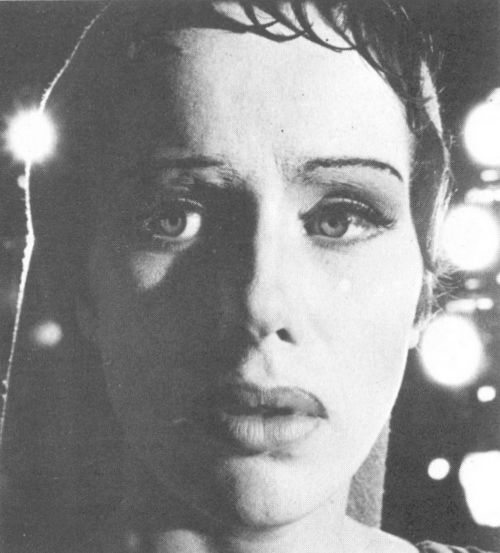
Liv Ullmann as Elizabet Vogler

Bibi Andersson as Nurse Alma

Ullmann
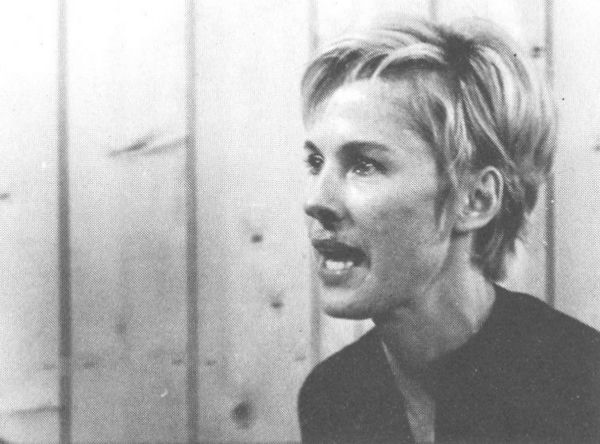
Andersson
"Rock Around the Clock"
Great post (and it's only Part 1) with awesome pictures. I like the ones of the kids dancing in the lobby. Fascinating stuff. Funny quote:
How many of us brought along guitars and accordions to movie shows?
hahaha Yeah, really.
Read the whole thing. That guy is a terrific writer, thinker, observer. He's encyclopedic, really.
March 9, 2007
Thinking!!!

I'm so flattered!! I was nominated by this blogger for a Thinking Blogger Award... That is so nice! Totally nice compliment. Thank you!!
So now apparently (according to this page) what I need to do next is pass on the torch to 5 blogs that make me think!
In no particular order - blogs that, no matter what, give my brain a workout, and for that - I love love love them all:
Seven Inches of Sense (speaking of Joan Crawford!)
(Also - I love to see that Tracey and I were nominated in the same list. heh heh. Obsessive minds think alike and all that ...)
"Sudden Fear"

I love people who say "I declare this week to be Gloria Grahame Week!" Really interesting blog there, by the way. Also the fact that he (she?) chose to illustrate the post with a photo from In a Lonely Place - a movie which contains, I believe, Bogart's best performance (I wrote about it here - in a series I need to revive again - my under-rated movies series)
It's just interesting that Gloria Grahame - with her wonderfully human and squishy face - seems to be everywhere these days - because 2 nights ago I saw (for the first time) Sudden Fear - one of Joan Crawford's comebacks (she was nominated for her 3rd Oscar, I believe) - and an example of Jack Palance's brilliant and very MODERN kind of acting. He smoulders. He doesn't look like a typical romantic lead. And yet ... you're drawn to him. He pre-figures the anti-hero of the late 50s and 60s. There he is, in 1952. He's wonderful. And Gloria Grahame is fantastic in this movie - really a nasty slutty little manipulator - watch how she smokes cigarettes as opposed to how Joan smokes. Joan makes it a bit - like all great movie stars did then. Smoking was behavior, rather than addiction. But Grahame? Sitting in bed in her pajamas, talking to Palance on the phone, smoking? She looks completely modern, sucking the smoke into her lungs in the least glamorous and most naturalistic way possible. She, too, is a precursor to acting styles that would come a decade later.
But stalking through the middle of that movie - with the "old" style of acting - is Joan Crawford - and when I say she gives a spectacular performance, what I mean by that is: the morning after I saw it I fired off a feverishly excited email to Alex to tell her I FINALLY had seen it and that I had to talk about it with her!!! I knew Joan from the later camp classics - and also as a kind of mythological image of an early glamourous movie star. Alex (to put it mildly) has given me QUITE a Joan Crawford education ... and so to see Sudden Fear - and to see Crawford at the top of her game ...
It was something else. It's a great movie all around - and everybody (Palance, Grahame, et al) is a revelation in it - but it's Joan, Joan who kinda makes everybody else before or since look like pallid amateurs. She doesn't chew the scenery. She's not Gloria Swanson. She definitely has the old-school style of acting - but every single moment ... literally: every single moment ... is immaculately acted. And she has some tough freakin' scenes to pull off.
She has an entire silent scene (Alex brought this up in her fevered reply to my email) when she is stalking around her study, listening to a tape play - and on the tape is very upsetting news. Upsetting? How about shattering. That's more appropriate. It would be like overhearing a conversation where you realize that one of the things you totally rely on ... has turned out to be an utter lie. It's like realizing that your lovely next door neighbor who has always been so sweet to you actually is an axe murderer. Only this has a level of personal devastation and betrayal and Crawford has no lines ... she just has to listen to this tape ... and react. Not ONE moment is "over"-acted. Not ONE moment is ... chewed up ... as one might expect. I actually got tears in my eyes watching her disintegrate. She modulated her performance so perfectly. Something changes in her posture - when she gets the first intimation of betrayal - it's just a slight collapse ... and the scene ends with her pacing around like a caged animal, wringing her hands, with tears streaming down her face. She's phenomenal. And the tears (and all the tears she sheds in the film) don't have that "Movie Actress Crying" feel to them. They aren't glycerine tears. There aren't closeups, lingering over: Look at Crawford Crying. They feel modern. Crawford herself seems unconcerned with "tears" - she is more concerned with trying to think her way, desperately, out of the mess she is in.
There are scenes with no dialogue - where Crawford sits at a desk - writing, and hiding keys, and wrapping things up in handkerchiefs, and burning evidence ... and much of it is done in one take - and you are so not aware of Crawford the Big Star Acting ... What you are aware of is: Holy shit, how will this woman get out of this??
Marvelous. I was truly amazed and moved by her work.
There's one scene (a famous one) where she hides in a closet. Classic film noir scene - she has a white scarf on her head, a black fur coat, a silver gun in the pocket ... and she is hiding in a shadowy apartment, terrified. The shadows from the Venetian blinds fall on the wall - and Crawford huddles in the closet. The way it is filmed is that a shaft of thin light falls across only part of Crawford's face - and she acts her entire scene from one spot. No language. Someone is walking around in the apartment, and needless to say - it will be BAD if Crawford is discovered. Sweat is beading up on Crawford's forehead - and she is so freaked out that she clamps her white-gloved hand over her mouth - so nothing, no breathing, or sighs will be heard. And all we have left to read her thoughts are her eyes - enormous, glimmering in the dark, filled with the fear of a trapped animal, flitting up, down, widening, tears glimmering, sometimes falling, sometimes not ... and every single second of this scene is a Joan Crawford tour de force.
Frankly, I was blown away by her. This wasn't just a good performance in a certain kind of style, or a good performance by an actress making a comeback. I wouldn't put any qualifications on it. I would call it a good performance period - and also one of the most effective performances I've ever seen. I forgot what I was doing, who I was watching, I forgot everything except the story.
Think of how many movies you see with stars as huge as Joan Crawford and how difficult and rare it is to forget you are watching a movie star. It is no small feat. This is why people like Johnny Depp or others sometimes might seem prickly to the press or the celeb-hungry (and yet industry-and-art ignorant) public ... they don't want to dilute their persona too much. They want to be able to slip into a role without TOO much paparazzi baggage. So it's very very hard to forget sometimes ... and especially with someone like Joan Crawford, whose legend has moved on into posterity, and yet whose image has been tainted by Faye Dunaway's (albeit brilliant) performance. THAT is who we see when we think of Crawford now - and it does her a great disservice because she is truly extraordinary and I'd put her up against any modern-era actress any day of the week. Show me an actress who could do that scene in the closet as well as Crawford did. I'd say that there are probably only a handful who could pull it off. She's that damn good.
Watch the transition she goes through in this film - her kind of cold and self-satisfied persona at the beginning - to the heartwarming loved woman in the middle - to the feverish woman trying to survive and outwit those who want to kill her - at the end.
I found a really nice review of this movie on the Joan Crawford Encyclopedia site. (SPOIILER ALERT. I actually had no idea what was going to happen in this movie - which really enhanced the suspense - so if you want to see it - don't read that review.)
A couple of excerpts which really resonated with me follow - they resonate with me because I love it when a reviewer can pull out a specific small moment, discuss it, and talk about why it is so effective. I very much agree with the assessments expressed here (some of which I already covered above):
The scene where Myra first listens to the recording and discovers Lester's perfidy is both fascinating and painful to watch because we're given no respite from the emotions that Myra's experiencing. Whole minutes go by in silence as we see Myra, often in close-up, reacting first in disbelief, then confusion, then sadness, then literal nausea, as she finally runs to the bathroom to throw up. The pure acting ability, and acting bravery, required to pull off such an uncomfortable scene is enormous, and I've never seen anything quite like it. Ever. Even in silent films, where similarly claustrophobic camera attention was necessarily paid to the actors' every expression.
Absolutely. Brave indeed.
Joan's acting skills are also evident in an earlier scene, when Lester hasn't shown up for a party in his honor and Myra goes to his apartment to find him---her awkwardly smiling look of utter love and submission and fear of rejection as she climbs the stairs and says to him "Without you I have nothing" is intimately and painfully nuanced.
Yes. There is a desperation and a submission in her that puts that gleam of NEED in Crawford's eyes. You ache for her, because you sense she is headed for a fall.
And the following moment gave me goose bumps - and I'm so glad to read this description of it, because it kind of broke it down - broke the moment down into its elements, showing why it is such a great moment:
Watching the two skilled actors maneuver through the duplicitous, lovingly inane "good morning" conversation is fascinating, culminating with Lester's "Aren't you going to kiss me?" Myra complies, her still-existing feelings for her husband battling with her repulsion for what she now knows about him. "I was just wondering what I'd done to deserve you, " she smiles and purrs. Then, as she turns and walks toward the camera, away from Lester's view, her smile fades oh-so-briefly into regret for what she's lost, then slowly transforms into grim disgust and equally grim determination to exact her revenge. It's a classic moment in the Crawford Canon, as well as a classic moment in film.
Absolutely. A truly GREAT movie-watching experience.
She was such a stunner.

Diary Friday
This entry is from my first semester of college. I think I was about 3 weeks in at this point - living in an all girl's dorm - referred to by the rest of the college lovingly as "The Dyke Dorm" - thanks, guys! - and trying to adjust to the new schedule, the new life. In the middle of all of this came Hurricane Gloria - and one of the coolest most memorable nights of, I think, my entire life - when Betsy and Kate and I went down to the beach in the immediately aftermath of the hurricane. Anne Shirley would call it an "epoch" - it has echoes in the night when Emily Byrd Starr gets trapped in the church and Teddy saves her. Not the horror part of it - but the sweet soulful part in the cemetery afterwards. Anyway, that's the entry below.
SEPT. 26
Too much is happening. Too much is going on for me to describe. I've already skipped about a million things.
But ....
I don't know.
I can't find the time or the words. [Then please stop writing sentence fragments. Thanks.]
I've been working very hard.
Last weekend Mere and Jayne came home! [Both away at college, too] You don't know how excited I was when Mum called to tell me. I miss her. I miss everyone.
And I never really faced how I really feel here until Mere and I talked. (I slept over on Friday). It was so so wonderful to see her. I can't even tell you. I can't even describe how damned happy we were to see each other. It feels like 10 years since the summer ended.
SEPT. 27
As I write, Hurricane Gloria is whirling outside my window. (I'm home now.) Practically the entire coast has been evacuated. Most of the college has gone home. No classes today - cancelled. If anyone stays - they have to go stay in the gym. So all the dorms are empty. Before Krista and I evacuated - we put huge Xs on our window in tape - everyone was doing that. The wind is roaring. The sky is the oddest white color - almost blinding. Sometimes the wind actually screams and I can hear all the branches slapping against the house. I'm home now. No electricity. The entire neighborhood looks like a disaster area. Leaves everywhere, fallen branches, split trees, chaos. It's almost too dark to write.
A lot has been happening to me. I've only had a few good times so far here at college. I could count them now.
The first time I talked to Debbie - the time we talked for 2 hours and told our life stories - [God, Beth - member Debbie? Not your Debbie - but my Debbie, in the dorm with me??] the first time I saw all the Picnic people again - when Antonio and Brett came to get me and take me out for ice cream - [So weird. 4 years later, Antonio would become my first serious boyfriend.] Yesterday was a good time too. Other than that I must admit it's been grossly disappointing. [It's been 3 weeks, Sheila. Calm down.]
Especially in the male department. [hahahaha As opposed to the English department, you mean?]
I thought that half the things I'd been encountering I'd left behind. I thought it would be so much more open, and not as judgmental. I mean, I don't blame myself. So many damn people told me, "Oh Sheila - just wait for college!! It's so much better!!"
Lie.
This is supposed to be an institution of fucking higher education and the guys are more immature than the idiots in seventh grade. Crueller too. They don't care who they hurt. And it does hurt.
That night Antonio and Brett took me out - I told them all about it.
After the hugging between us, Antonio announced, "We brought you presents!"
This was even more unexpected. I stared at them. I still try to imagine it. The two of them deciding, probably spur of the moment, to come visit me in the Dyke Dorm, and gathering up those bizarre gifts for me - probably with much hilarity. I can see them doing it but I can't believe it. They found the dorm - Brett and Antonio coming to get me, rescue me. I still can't believe it.
I hadn't noticed in my frenzy of hurtling down the stairs to meet them that Antonio had a battered Providence Journal newspaper-bag around his neck. He then took it off and proudly began pulling out my gifts:
-- Two huge red plastic lobsters
-- an old musty-smelling copy of Cass Timberlane
[Okay, I had forgotten about the gifts, and they STILL make me laugh.]
We were all on the floor laughing. Those were my gifts. I stared at the gifts in numb silence as they tensely waited for my reaction - and then we all exploded. It was fantastic.
(I have no idea what time it is. I'm writing my candlelight. I can actually hear the trees falling around the neighborhood.)
My fingers were trembling with excitement. There is just something about Antonio's face. [Foreshadowing!] Brett is so damn familiar to me now - it's a beautiful familiarity - I love him so much - but Antonio excites me. His laughter and smile thrills me.
They were bubbling over, laughing hysterically at the thought of me - the 16 year old girl from the year before - in college. "How are you? How's it going?"
At that point, everything was so shitty. I can't remember exactly what I said. I mentioned something about how apparently I was now living in the "Dyke Dorm" and some guy had seen me sitting at my desk - as he walked by in the street below - and shouted up something rude at me, about "dykes" or whatever - and Antonio's and Brett's reactions were so cute - these indignant "Oh"s - protective hands on me.
Brett gave me a push. "Come on - go get your stuff. We're taking you out on the town."
I was so glad to see them that I impulsively hugged both of them and said, "I'll be back in one second" and tore madly back up the stairs. Poor Kate was sitting calmly back in my room and then I come barreling back in with a dirty newspaper-route bag around my neck brandishing 2 plastic lobsters. I grabbed my key, my jeans jacket and ran back down - I looked so grungy - my sweatshirt, loafters, no makeup, plain hair ... [Sheila ... wanna throw on some lipstick? What is your problem?] I ran back down the stairs and saw Antonio standing at the controls of the Ms. Pacman game in the lobby with Brett hovering over his shoulder. I skipped over and peeked between them to watch.
Brett informed me, "Antonio's doing real good in spite of the fact that it says 'Game Over'."
The fact that Antonio was only pretending to play struck me as hysterically funny - we all were giddy - and then we left. Do you know how odd I felt? A gorgeous guy on either arm? The other cruel douchebags in college can go fuck themselves.
We decided to take a walk on the Quad. The street was shining from the dampness. The sky was all murky and everything was wet and very very quiet. Well - we were making noise. We were talking a mile a minute. I said something about how so far I hated the men in college. I told them about how I had to listen to my roommate and her boyfriend have sex in the lower bunk and how awkward I felt. Antonio and Brett just stared at me. It was so hysterical. Then I told them about the guys who were mean to me and who stood around in my room making mean comments about "You gonna write about this in your diary?" Antonio started looking very ominous, like he wanted to beat someone up. [Foreshadowing!] Somewhere inside of me I was loving this male attention - it was accepting, protective, humorous. Oh, and I told Brett and Antonio about the one drunk guy who made fun of me for not drinking, and then told his friends he bet I was a virgin. The dude said something like, "Yeah, I'm bettin' that Sheila is NOT a partying woman" - in this really mean way. [Oh, I would so kick that douche's ass now. Yes I am a virgin, and no I don't party - and I'm PROUD of it, mo-fo!] Oh, and I told Brett and Antonio too about the conversation about AIDS that started on my floor once - and some guy said this really prejudiced thing about how it started - about how gays all just fuck too much - and I was just being quiet, because I was so enraged - and one guy said something like, "And now AIDS keeps spreading because everyone is just fucking each other ..." Then he looked straight at me and said, "Well. Maybe not everyone." [I have no memory of any of this. Thank God.]
Brett and Antonio were kind of stunned into silence - and Antonio finally said, "Oh, I get it. He wasn't getting anything from you - not getting a rise out of you - nothing - so he decided to just attack. What an asshole."
We went to the center of the Quad and lay on our backs. We talked about classes, requirements, theatre (Brett has one of the leads in Woolgatherer - Liz is the other lead) - Kimber's class - the Meisner technique (which I will try to explain later). It was great. Brett had pulled me to him, so I lay there with my head on his chest, as we talked. I felt like a contented kitten or something, the three of us talking softly.
Antonio picked his head up to look at me and said, "You need someone older, Sheila. You're not gonna find many guys on this campus with your maturity level." It was a fight to hold back fluttering my eyelashes at him. [Foreshadowing! Antonio was 7 years older than me. But his comment here was innocent. Our romance didn't blossom until I was a senior. So he was just being supportive here. Just turns out he was right - and turns out that he, unbeknownst to himself, was talking about himself.]
I said, "I've always felt older than my age. When will I catch up?"
"No, no. The question is - when will you find your match. Don't worry about it, Sheila. I'm sure you have felt older - but it'll be to your advantage eventually. It will."
Antonio? Who is he???
They both just blow me away. There is so much still to find out about Antonio [he was a relatively new friend to me - obviously I had kind of a crush on him] Even though there is nothing romantic with either of these guys - they still just make me feel attractive and good - as a girl.
We decided to go out for ice cream so we stood up, damp with dew. The Quad is always softly lit with orange - only it was very dim cause of the fog. I said to them as we walked, "Thank you very much for saving me from a night of drudgery." We headed back towards the parking lot where Brett's car was. Brett suddenly became like a gangster mafia guy, saying, "Listen, Sheila. If any guy even looks at you the wrong way - just tell us. We'll take care of him." He said the word 'him' so contemptuously, so full of hate. I started giggling. "No, I've got a better plan--" Brett went on. "Tell us if a guy talks to you - asks for your number. If he asks for your phone number - just give him my phone number." We were all just laughing so hard. Antonio throws back his head when he laughs - he laughs with so much joy, it is totally contagious. [This is still true - he has one of the best laughs I know]
Antonio burst, "Can't you see it? 'Hello, is Sheila there?' 'LEAVE HER ALONE YOU DOUCHEBAG.'"
We passed Fiji - the frat that everyone tells you: "Don't go there". They are assholes. They are juvenile. They are despicable. As we walked by, I pointed at it and said, "I have been warned against going there ..." Brett then vaulted over onto Fiji's empty lawn and started wildly flailing his fists at the frat house, muttering, "Come on out, motherfuckers - I dare ya - I'll take you all on - come on out ..." Jumping up and down, sparring like a boxer, flinging his arms in wide arcs. Antonio and I were staggering around laughing, watching him, his black silhouette against the orange street-lamp light. He looked nuts.
If Picnic had never happened - I'd probably still be mooning around waiting for some miraculous change. Now it's like - a little bit of that agonizing waiting has been alleviated. I have actually witnessed and felt the goodness in men and it gives me hope - I don't need to be convinced that Brett cares for me, or Antonio - I can feel it. They are for REAL. They are not figments of my imagination.
Thank God.
Thank God.
I thank GOD for the both of them.
SEPT. 29
I'm back at school. Came back last night because this is the only place in the world with power. I probably ruined my eyes writing reams and reams by candlelight.
On Friday night after Gloria had blown through - totally wreaking havoc along the coast - Betsy called. Our entire house was pitch black and my family was playing Trivial Pursuit around a candle. Betsy was home for the weekend. All she said was, "Want a visitor?" I cried, "Yes! Come over!"
Although the governor made an announcement that no one should drive except emergency vehicles - Betsy drove over. There are trees on the street, felled wires, telephone poles cracked, fallen branches, no street lights - and nevertheless, Betsy eventually did pull into the driveway.
We went and picked up Kate [I am amazed that my parents let me go!! Thanks Mum and Dad!] - the roads were disasters. They were hazordous - but also exciting. No stop lights or street lights - every single house was in shadow - with little flickering candles in the windows. You could also see flashlight beams moving ... or sometimes a candle flame - moving from window to window - you could see that people were moving around.
We picked up Kate and decided to "live on the edge" - so we drove down to the beach.
I will never ever forget the beauty of that night.
I have never seen anything like it. Ever. And probably never will again.
There was a gorgeous night sky. The moon was totally full to bursting and bright bright white. The rest of the sky was totally clear - and not a black color - it was a magical color - almost silvery - moonlit - with stars and stars and stars and stars - dizzying circles of stars. No clouds. It was wild too. Breathless.
The minute we got out of the car at the beach we all quickly drew in our breaths - at the sight of the ocean.
First of all, the moon was right over the water so the whole expanse just danced and shimmered with moonlight. Looking at it, entranced, I practically tricked myself into believing it was alive. It appeared to be a living entity, heaving and sparkling.
Then there were the waves. They were scary. But exhilarating too. Exhilarating. Huge. 20 foot tall waves. The hugest damn waves I have ever seen - and they never stopped. Ranks of them kept advancing in, one mountain after another. They kept crashing on the sand - huge high foam - over and over.
I held my breath. We all just kept gasping and clutching each other. We sat on the sea wall and watched. I swear to God - that ocean was alive. And it was the most beautiful thing in nature I have ever witnessed.
The moon and the water - silverness and thrashing foam and the sound of the crash - the feeling of the boom when the waves hit - I cleansed myself - my soul - watching all of this.
The waves were the closest things to tidal waves I have ever seen. I was looking at something that was dangerous, powerful - something that could rip me to shreds if I jumped in. The almost brutal feeling of the whole scene was part of its beauty. The scariness, the sounds, the chaos, the closeness of it -
Hurricane Gloria was right there.
And we were at one with it. With that damn moon turning the whole scene into something totally magical, beyond belief.
Klimt
I've always loved Gustav Klimt - there's something sweepingly romantic and yet also somehow (I don't know how - I just know my response to it) melancholy to his work. It's almost like looking BACK on someone you loved ... someone you once loved and now lost. His work shimmers with that kind of bittersweet pain. I love it.
And I love Mental Multivitiman too - for posting this fascinating excerpt of Klimt writing about his work and his process. Amazing.
By the way, Mental Multivitamin is always my first pit-stop in the morning when I get online. I've said it before ... her site helps clear out the cobwebs (if I have cobwebs, I mean). Her writing is a wonderful reminder ... always ... of the kind of person I strive to be, and the kind of life I want to live. Not that I always need reminders ... it's just nice that it's there, should I require a pick-me-up. Recently, she re-linked to one of her old posts - one of my favorites of hers. I'm sure it would rub some people the wrong way - I can almost feel the backs getting up - self-righteous and defensive - but (again) those people are not my kind of people. And that's cool - it takes all kinds, right? - but it is best (for me) to hang out with people where I don't have to explain or defend my passions. I don't enjoy that fight in the slightest. It is best for me to hang out with people who understand having passions, and share the same values. This is the type of site I want to have. I got that from Mental Multivitamin one day in one of her numerous posts on Shakespeare. She writes:
I honestly don't know what to say to folks who could, in seriousness, maintain that Shakespeare -- the inventor of the human -- is unimportant. Nothing I said, however well articulated or carefully stated, would deter them from that (misinformed) position. And, as I grow older, I find that I'm less and less inclined to fight against such ignorance. A bemused sigh and furrowed brow might be all you can offer when confronted with -- well, I typed such fools but realized that some of you might find that too harsh and dismissive, so I'll go with people who hold that view.Heh, heh, heh.
I also suggested that L. take a peek at this entry. There is, I am certain, something about the pursuit of excellence that some people simply. don't. get. But life is short, and the struggle to win over the ignorant is, in my experience, futile. I'd rather discuss Hamlet than attempt to persuade someone of Shakespeare's value.
Amen. And so I agree with everything she says here about making time to read. It all comes down to choice. And choosing the way you want to live your life, as opposed to being victimized by trying to fit into a lifestyle that does not suit you. This has always been important to me - because certain things just don't matter to me ... and I used to pretend they mattered - because people look at you funny if you say, "You know what? I totally don't care about that stuff. I'd rather read." But that post on Mental Multivitamin says it way better than I could. If you want time to read, then you make time. Reading to me is not something I do in my spare time. It is something I must do. Every day. This requires sacrifice in other areas. I'm prepared to do that. If you don't want to make those sacrifices, then fine, don't make them, and live the life that you choose. But don't talk about not "having time". Those of us who need solitude - and a LOT of it - in order to maintain emotional equilibrium - know the necessity of making that time.
Every Friday, Mental Multivitamin does a "Fine Art Friday" post - and they're always delightful, surprising ... and I always learn something. Here's the full archive.
One of my favorite sites ever. It pulses with learning, thinking, curiosity, joy.
On the waterfront
Last night, I was waiting for a cab in Hoboken. Freezing my BUTT off. Frigid wind whipping down 13th Street. I happened to be near the Hoboken Historical Museum - which has its entrance in a covered-over walkway between two buildings. There are arched entranceways - and when you stand on 13th Street and look through, you can see the glitter of the Empire State Building - hovering on the other side of the Hudson. The walkway provided a good break from the wind as I waited for my cab. Shivering. There are glassed-in cases in the walkway - with pictures of Hoboken in earlier days, the brownstones, the development, etc. I took some photos of ONE of the displays, as I shivered and stamped and blew on my quickly numbing digits. Not hard to imagine why I was drawn to THAT glass case as opposed to the others.
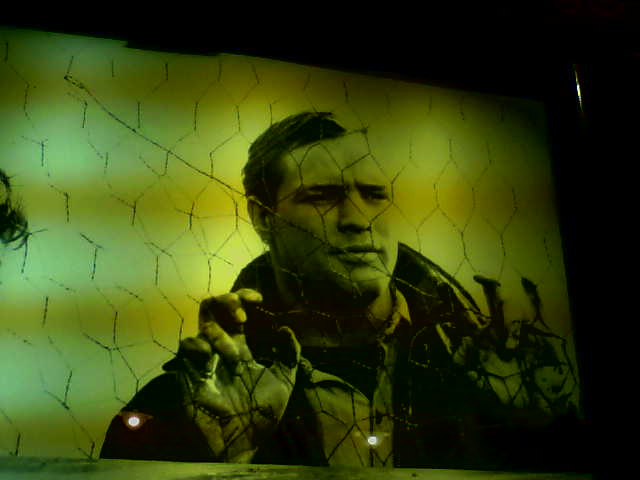
March 8, 2007
Overwhelming book deliveries
The Amazon logo smiling at me repeatedly. Something about unwrapping books makes my heartbeat quicken. I just don't even know where to begin.
I finished Blue Blood - the book by Edward Conlon, NYC detective and Harvard graduate. Dude can write. Thought the book was about 3 chapters too long. At the end, we have his experience at the landfill on Staten Island, post 9/11 - which was one of the more horrifying and disgusting things I have ever read - but riveting - so glad I read it - it's just that there were maybe 3 extraneous chapters floating around BEFORE that. But still. LOVE his writing and I will definitely keep an eye out for more of his work.
I also finally finished Imperial Grunts by Robert Kaplan - a book I had started about a year ago, put down - and now finished, in a frenzy, staying up late to polish it off. He's great. I look forward to the other books in the series he's planning and working on now.
But now books are arriving - either as gifts (thank you!!) or from stuff I bought in a fit of celebration last week - having come out of a brief rough spot - thankfully brief .... but harsh nonetheless. I needed books to get me through. Or - not even the books themselves - just the prospects of the books. And Rocky, of course. Rocky helped get me through. But that's a given at this point. I had forgotten, though, that I had had a book-buying binge, even though it was only a couple weeks ago. A lot of times I don't remember much of what goes on during the "rough spots" and this was no exception. Even 2 days later, the awfulness started to fade and mist into memory.
But now they are arriving.
Fun!!!
First of all - Tennessee Williams' notebooks. Holy freakin' crap - it's gotta be 1000 pages long - brand-new published - and ... I flipped through it last night, astonished first of all at how gorgeous the book itself is - but also how beautifully it is put together. On the right hand side of the page - we have the entries in Williams' notebooks - and on the left hadn side - we have corresponding notes. So that means you don't have to flip back and forth endlessly for the footnotes. It's amazing - we see his postcards, his photos ... I haven't even started reading it yet, and just looking at it is giving me a heart attack.
I got 3 more Library of America books ... I already have many (American Poetry, Willa Cather, Eudora Welty, William Faulkner - those are all from my dad) - and I also have Jefferson: Writings. But over the last 3 days more have arrived: Hamilton: Writings (there will, naturally, be some redundancy with the rest of my Hamilton collection, but that's okay) - the speeches of Abraham Lincoln (2nd volume - from 1859 - 1865 - and also the Library of America collection of writings during the Constitutional Congress of 1787. Letters written home, minutes kept, speeches ...
I feel actually a little nauseous thinking about how much I already love these books.
I have also been slowly but surely collecting each book in the American Presidents Series, edited by the late Arthur Schlesinger - and they're quite wonderful - written by all different people - I've very much enjoyed the ones I've already read. They're cheap, and usually about 150 pages long, maybe less - a quick read - and it focuses purely on the presidency of the individual. You get maybe 2 chapters of lead-in - but the rest is all about what went on during the presidency. So far I've read the one on James Madison and Thomas Jefferson - and over the past week I received 3 more to add to my collection: George Washington and John Adams and John Quincy Adams. But I will someday have them all - see if I won't!!
I also received the book Final Cut which I have always wanted to read - it's one of my favorite kinds of books: how certain films become notorious disasters. It's interesting to read books like "The Making of Casablanca" - to hear how things become hits - but sometimes it's more interesting to learn from the debacles. Like Devil's Candy - about the making of Bonfire of the Vanities which is one of the best books about Hollywood I've ever read. Anyway, I've wanted to read Final Cut for a while - it tells the story of Heaven's Gate - a movie directed by Michael Cimino which - like the words "Ishtar" or "Waterworld" has come to be shorthand for: 'HUGE FUCKING MESS'. Heaven's Gate is often seen as the granddaddy of all messes - and this book is written by one of the producers on the film. I can't wait to read it. Which, judging from my To be Read pile, will be sometime around 2015.
Oh, and also I got the "baseball anthology" in the Library of America - and I am almost more excited about that one than all the others. Classic American baseball writing since the beginning of the sport? Please count me in. Now.
I received a MASSIVE biography of Alexis de Toqueville - from an absent friend across the Atlantic (I miss you!!) - like seriously - it is HUGE - and gorgeous, beautiful typeface, very readable - and it's a guy I know almost nothing about, although I have read his book about America. So I'm very excited to read that, too. In 2023, which is when I will get to it.
Let's see. What else.
Oh yeah - a book about Theo Van Gogh - and also the novel Perfume: Story of a Murderer - which I've been dying to read, but just keep forgetting about. So now it has arrived.
I know there's more.
Some people go shoe-shopping when they get the blues. (Although what I had could not be called the blues. It was more like a crisis.) Shoes don't do it for me, although I love them as well. Books bring on the adrenaline, the pheromones, the energy, the pulse quickening. They bring life. Life to the spirit, yet again.
Being an extra
I enjoyed EVERY WORD of this post. She was an extra on the Hugh Grant/Drew Barrymore movie Music and Lyrics - and she's basically in love with Hugh Grant, and her descriptions are absolutely hysterical. I love, too, how she's sneaking photos the whole time.
Here are some of my favorite lines from the post - she's a very funny writer (but seriously - go read the whole thing - it's a delight):
-- I was more than pleased to learn that the people operating the various rides (last inspected in what seemed like 1974) were not drug-addled carnies but, in fact, 14 year olds with no prospects.
-- I had a brief but thrilling flirtation with an adorable camera guy.
-- Seeing Hugh made me giddy. But I'm no asshole, I know how to behave. I wasn't about to go up to these actors and tell them that I'm a "fan" because, really, it's the douchiest, and my name ain't Massengil Collins.
-- And I swear to God, if my face ends up on the big screen, even for a brief moment, I will absolutely slit my throat in joy.
[I think that might be my favorite one. She will slit her throat IN JOY. I love her.]
Go read the whole thing. The captions to the photos are hysterical.
Ramblings on Billy Friedkin
Great picture of him here - kind of noir-ish. And that photo has set my mind a-rambling.
I have been watching Billy Friedkin movies before I even knew who the guy was.
The Exorcist basically ruined my childhood.
It wasn't until I read Easy Riders, Raging Bulls that I learned about this guy's journey - which is fascinating - it kind of incorporates the entire 70s-autuer-director journey - all in one man's life.
I recently saw again The French Connection (it was my first Netflix movie - I will always look on it fondly for that reason, no just kidding) - and you know, you hear so much about these movies, they're referenced so often - that sometimes you forget. You forget how good they are, or how influential ... we've now seen so many spectacular car chases that perhaps the one in French Connection seems (in memory) not so cool, or memorable ... You take it for granted. "Oh yeah, whatever. Gene Hackman. Famous car chase with elevated train. Yeah." That is - you take it for granted until you see it again. (here is the famous car chase scene on YouTube - it starts with Popeye Doyle basically commandeering some dude's car and taking off with it ... although, if you haven't seen the movie - I beg you not to just watch the chase on You Tube. Rent the damn movie - it's so good!!) There is a reason why this chase is remembered, revered, imitated. You can't beat it - for its reality, rawness, and sheer gripping excitement. This isn't a car chase where you have to adjust your expectations, and by that I mean: if you see a movie from the 50s, 40s, 30s, whatever - and you see a fist fight, or you see a love scene ... if you are passively expecting a bloody realistic gory Raging Bull type fight, you'll be disappointed. If you're expecting to see naked writhing bodies, you'll be disappointed. So in order to not only accept these old movies, but LOVE them - you have to get into the world of that time. Accept their conventions. Don't be all baffled because movie styles or acting styles are different. Adjust, for God's sake.
But that car chase in French Connection still - to mind - stands as one of the greatest car chases of all time. Nothing looks orchestrated. There are certainly no special effects involved. The lighting is grim, that kind of blinding wintry sun that New York gets sometimes - the kind of sunlight that points out the urban decay, the grime. Popeye Doyle is driving like a bat out of hell - and it seems completely real. There is nothign "cartoonish" about this chase. You fear for his life, you fear for the passersby who stop and stare. Sometimes you are looking at the street from Hackman's perspective behind the wheel - and that is truly nervewracking - and sometime (like in that great and now classic shot) you get far enough back to see the train racing along the elevated tracks, with the car barreling along beneath. UnbeLIEVable. Audacious, really. That's one of the words that always comes up for me when I think of Billy Friedkin. Audacious. To say: I want to do a car chase - where a car chases an elevated train - trying to stay beneath the train above him on the tracks - with passersby - and oncoming traffic - and busy daylight New York streets ... that is some audacious shit. I love it.
Audacious can be good. Audacious can also be self-destructive. This ended up being the case for Friedkin - but there's something really attractive to me about his audaciousness ... I root for him. The dude was nominated for, what, 10 Oscars? Even Sorcerer - which was pretty much a financial disaster - and the end of Billy Friedkin's Golden Boy period - was nominated for an Oscar. I find Friedkin fascinating and always have. If you look at pictures of him in the 70s, he wears a long white scarf, a leather jacket, and big Jim Jones-ish Ray Banz ... stalking around like he owns the world. And for a brief period there, he did. He could name his price. I love that he's still around, though. And his career has been no slouch since his heyday. I mean - To Live and Die in LA was one of the best films of the 80s - I loved that movie. Friedkin survives!

Here is one of my favorite anecdotes about Friedkin.
He had been struggling to make Sorcerer (a movie that was so expensive that it required mergings of conglomerations and corporate backings and complicated financing to just finish it ... and then of course - it opened and barely made back any of that money - this was the death knell for Friedkin - it was too big a bomb to let him off the hook) - but Friedkin, to this day, says that Sorcerer is the favorite movie of his career. He can "bear" to watch it. It was one of those massive projects that got away from its director - a typical thing that happened in the 70s - and sometimes it worked out well (Apocalypse Now) and sometimes it was a debacle (Heaven's Gate is first on that list, naturally - it's rare that one movie brings down an entire studio around its own disaster ... but also Sorecerer). The auteurs gone nuts!!
Anyhoo. Sorcerer finally opens in 1977. Friedkin was nervous about it. Nervous about how it would do. The first time the preview for The Sorcerer played in a movie theatre - Bud Smith (the editor who had cut the preview, put it together) went to go see it. It was playing before the headline movie ... another little movie that opened in 1977 ... one that nobody thought would do all that much, because it was so "out of sync" with the style of the rest of the movies at that time ... you know, it was a little independent movie called Star Wars.
Here's the response from the Friedkin team (this is an excerpt from the marvelous Easy Riders, Raging Bulls, linked to above):
The Sorcerer trailer Bud Smith cut played in front of Star Wars at the Chinese Theatre. Says Smith, "When our trailer faded to black, the curtains closed and opened again, and they kept opening and opening, and you started feeling this huge thing coming over your shoulder overwhelming you, and heard this noise, and you went right off into space. It made our film look like this little, amateurish piece of shit. I told Billy, 'We're fucking being blown off the screen. You've got to see this.'"Friedkin went with his new wife, French actress Jeanne Moreau. Afterward, he fell into conversation with the manager of the theatre. Nodding his head toward the river of humanity cascading through the theater's doors, the man said, "This film's doing amazing business."
"Yeah, and my film's going in in a week," replied Billy nervously.
"Well, if it doesn't work, this one'll go back in again."
"Jesus!" Friedkin looked like he had been punched in the stomach. He turned to Moreau, said, "I dunno, little sweet robots and stuff, maybe we're on the wrong horse." A week later, Sorcerer did follow Star Wars into the Chinese. Dark and relentless, especially compared to Lucas's upbeat space opera, it played to an empty house, and was unceremoniously pulled to make room for the return of C3P0 et al.
A new era had begun.
But Friedkin is still here.
High-stepper
I am in love with that. It's from 1922 - and it's done by Frank Xavier Leyendecker (brother of the dude in the post below this one). Quite a talented family. I love Frank Xavier's stuff a bit more because of his bohemian subjects - the almost circus-y quality - Harlequins, ballerinas - like Madeleine and Pepito being kidnapped by gypsies and joining the circus (which, surprise, surprise, was my favorite of the Madeleine books). Instead of portraying just mainstream folks ... he portrays the fringe-dwellers, the artists, the freaks, the contortionists, the burlesques. My peeps.
Like this, too, from 1921:
(Tracey and I are all over this!!)
March 7, 2007
Joseph Christian Leyendecker: Illustrator

I have fallen in love with this guy's stuff. Apparently, he was a real inspiration to Norman Rockwell - and you can totally tell when you look at more of his work.
I discovered him through this post on 100 Years of Illustration - with gorgeous images of commemorative stamps. The fourth one down really struck me, for some reason - so I followed his links and found a goldmine of beauty.
Square dancing
I am SO crashing this party next year. It sounds like a total blast. Ann Marie? Kate? Mitchell? You in?
Happy Birthday: "Stopping By The Woods on a Snowy Evening"

Today in 1923 - Robert Frost's "Stopping By The Woods on a Snowy Evening" was published in the New Republic.
The story of the composition of that poem is very cool. One of my favorite kinds of inspirational stories. It is when you struggle for inspiration that the muse often eludes you. And it is when you suddenly relax - let go - that inspiration sometimes comes. Mike Nichols says that the most productive day of a rehearsal period is often the day off. Meaning: you rehearse, you work on issues, you struggle to find solutions ... and then you get a day off, when you go play frisbee with your kids, or sleep in, or whatever ... and then when you come back to rehearsal, refreshed, the solution to your problem is so obvious that it might as well conk you over the head.
Frost wrote the poem in June, when the weather was, to put it mildly, not wintry. So first of all - I love that. His imagination, his ability to project his eye into other seasons, other times ... It was not an immediate response to the immediate environment. And, of course, the poem - while it takes as its atmosphere - winter - it is actually about much much more.
He had had a sleepless night the night before - and had been working on a longer piece, something which was giving him a lot of trouble - the poem that would eventually be "New Hampshire". (The poems he worked on in this period would be part of the collection New Hampshire which would win him the Pulitzer.) So he stayed up all night, struggling on the poem, and he did finish it - sometime around dawn. He got it to a point where he was pleased. And when he looked up, back aching, coming back to the real world - he realized that the sun had come up. He had never stayed up all night with a poem before - so there was a sense of novelty in it to him. He was happy, pleased with his accomplishment - so he walked outside and watched the sun come up. As the sun rose, he suddenly felt an idea come - a new idea - for a new poem - and the sensation was so strong and so urgent that he rushed back inside, sat down, and wrote "Stopping by the woods on a snowy evening" in about 3 minutes. He said later that he wrote the poem almost without lifting the pen off the page. Meaning: that poem came out whole. Extraordinary. He compared the feeling later to a "hallucination".
Gives me goose bumps to think of that whole story. Struggling over one poem - which is one part of the artist's craft - the intellectual side - the picking and choosing of words, crossing things out, hovering over the page, contemplating, re-working, re-vising ... and then the other part of the artist's craft - which is to leave yourself completely wide open to inspiration, and when the muse calls your name - you freakin' ANSWER. Without question.
Very inspirational to me.
And when you think about the actual poem that had its birth in such a manner ... it's even more amazing.
Stopping By Woods On A Snowy Evening
Whose woods these are I think I know.
His house is in the village, though;
He will not see me stopping here
To watch his woods fill up with snow.
My little horse must think it queer
To stop without a farmhouse near
Between the woods and frozen lake
The darkest evening of the year.
He gives his harness bells a shake
To ask if there is some mistake.
The only other sound's the sweep
Of easy wind and downy flake.
The woods are lovely, dark, and deep,
But I have promises to keep,
And miles to go before I sleep,
And miles to go before I sleep.
It is that last stanza that makes this a truly great poem. And by great - I mean classic. Eternal. It is why it is in the canon. Before the last stanza, although the imagery is beautiful and evocative - we are in a prosaic world, the world of the everyday, albeit poetically expressed - with neighbors and villages and harness bells - objects that cement us to the physical world.
But in the last stanza, Frost pulls his lens abruptly back ... going into the universal and timeless. (Shades of what James Joyce does at the end of "The Dead". Microscopic vision becomes telescopic in a few sweeping paragraphs.)
More on Robert Frost here. He wanted his epitaph to be "I had a lover's quarrel with the world."
Another Robert Frost page - with links to many of his poems.
His "notebooks" have just been published - review here.
March 6, 2007
Feng shui and .... Nuremberg?
A strange confluence of thoughts and actions:
1. Thought: "Yay! I love Netflix! How did I survive without it???"
2. Next thought: "Tonight Triumph of the Will arrives. Hooray!" [Uhm - hooray?] Yes. Hooray!
3. Going to watch it this evening in a feng shui-ed environment with a Roman foot bath and a peaceful rock fountain and a sauna - a laser sauna - and tea and some kind of home-cooked meal from an island country.
As we watch Triumph of the Will.
I cannot speak in defense of this. It's just flat out what is going on right now.
The Books: The Doctor's Sweetheart: 'Emily's Husband' (L.M. Montgomery)
The Doctor's Sweetheart and Other Stories - by L.M. Montgomery. This is another collection of short stories - all selected by Catherine McLay - in general these have higher quality than some of the other collections, which are made up of juvenilia, or things that Montgomery obviously wrote for money. The stories in this collection (with a couple exceptions) are juicy - the characters memorable, and her writing superb. I like this collection a lot.
First story I'll excerpt from is the one called "Emily's Husband". I like this one because of the characters. Emily is one of those classic Lucy Maud leads: she's a woman for whom pride is everything. This (of course) takes her into pretty much sinful territory. She's not just proud. She is hard. Who knows why. But that's the way she is. Lucy Maud writes such people so well - they're a common type in her work. She GETS the damage that such pride can wreak. She paid a price herself for her own pride - a price that she never stopped paying. Pride in these Lucy Maud archetypes often manifests itself in an imperious manner - a cold and haughty indifference ... even when beneath, the person is experiencing turmoil, rage, lust, whatever. The self-control that it takes - for these characters to save face - is often wrenching. You ache for them to just let go!
Emily's price that she paid is this: She married a man she loved - Stephen Fair. Stephen's mother lived with them - and this ended up being the thing that drove Emily away. Mrs. Fair was supposedly sweet and nice - but she was one of those types that Lucy Maud despises: sweet and kitteny on the outside, but vicious on the inside. Mrs. Fair set out to make Emily's life miserable - and she did. I don't remember what the issue was - maybe she thought Emily wasn't good enough for her son - but every word to Emily contained a barb, a dig, a hidden claw. Emily, with all her pride, and her sensitivity to insult - suffered in silence. Stephen felt the tension but didn't take sides. Of course Emily felt that in not taking sides - he was choosing his mother. So finally Emily burst - and told him to choose. Choose your mother or me. I refuse to live with that bitch one more second. (Of course she didn't say that, but it was implied!) Stephen, who was no slouch in the pride department, said - "Fine. Go home. If you leave though - don't come back!" Emily - in a rage - stalked across the fields to her family home, where she had grown up, and where her older sister now lived. And Emily never returned to her husband's home. 5 years went by. And over those years, Emily's rage did not soften - but hardened. It hardened her character. She became unyielding, unforgiving, and rather terrifying. It was her way of protection. Lucy Maud writes that Emily KNEW she had been in the wrong - but there was something in her that just could not give in. Lucy Maud, instead of judging such people, always has compassion for them. She aches for those who cannot express themselves, who let themselves harden up. She knows that pain. So it's a classic Lucy Maud situation. A fight leads to a long freeze. Even though the main parties live just across the way from each other - they never see each other, reference each other ... until ...
One day Emily comes home and gets some news ... I am excerpting the beginning of the story. I just like how Lucy Maud sets Emily up here - the voice, the haughtiness, the pale skin, the superior attitude ... It makes the end (which has Emily running over to her long-estranged husband's house - in a frenzy - through a rain storm - with branches slicing across her face - her hair tangled in the wind - and bursting in the door, begging him for forgiveness ...) SO much more satisfying. Because we know that she has never EVER let herself go like that.
Excerpt from The Doctor's Sweetheart and Other Stories - "Emily's Husband" - by L.M. Montgomery.
Emily Fair got out of Hiram Jameson's wagon at the gate. She took out her satchel and parasol and, in her clear, musical tones, thanked him for bringing her home. Emily had a very distinctive voice. It was very sweet always and very cold generally; sometimes it softened to tenderness with those she loved, but in it there was always an undertone of inflexibility and reserve. Nobody had ever heard Emily Fair's voice tremble.
"You are more than welcome, Mrs. Fair," said Hiram Jameson, with a glance of bold admiration. Emily met it with an unflinching indifference. She disliked Hiram Jameson. She had been furious under all her external composure because he had been at the station when she left the train.
Jameson perceived her scorn, but chose to disregard it.
"Proud as Lucifer," he thought as he drove away. "Well, she's none the worse of that. I don't like your weak women -- they're always sly. If Stephen Fair doesn't get better she'll be free and then --"
He did not round out the thought, but he gloated over the memory of Emily, standing by the gate in the harsh, crude light of the autumn sunset, with her tawny, brown hair curling about her pale, oval face and the scornful glint in her large, dark-grey eyes.
Emily stood at the gate for some time after Jameson's waggon had disappeared. When the brief burst of sunset splendour had faded out she turned and went into the garden where late asters and chrysanthemums still bloomed. She gathered some of the more perfect ones here and there. She loved flowers, but to-night the asters seemed to hurt her, for she presently dropped those she had gathered and deliberately set her foot on them.
A sudden gust of wind came over the brown, sodden fields and the ragged maples around the garden writhed and wailed. The air was raw and chill. The rain that had threatened all day was very near. Emily shivered and went into the house.
Amelia Phillips was bending over the fire. She came forward and took Emily's parcels and wraps with a certain gentleness that sat oddly on her grim personality.
"Are you tired? I'm glad you're back. Did you walk from the station?"
"No. Hiram Jameson was there and offered to drive me home. I'd rather have walked. It's going to be a storm, I think. Where is John?"
"He went to the village after supper," answered Amelia, lighting a lamp. "We needed some things from the store."
The light flared up as she spoke and brought out her strong, almost harsh features and deep-set black eyes. Amelia Phillips looked like an overdone sketch in charcoal.
"Has anything happened in Woodford while I've been away?" asked Emily indifferently. Plainly she did not expect an affirmative answer. Woodford life was not eventful.
Amelia glanced at her sharply. So she had not heard! Amelia had expected that Hiram Jameson would have told her. She wished that he had, for she never felt sure of Emily. The older sister knew that beneath that surface reserve was a passionate nature, brooking no restraint when once it overleaped the bounds of her Puritan self-control. Amelia Phillips, with all her naturally keen insight and her acquired knowledge of Emily's character, had never been able to fathom the latter's attitude of mind towards her husband. From the time that Emily had come back to her girlhood home, five years before, Stephen Fair's name had never crossed her lips.
"I suppose you haven't heard that Stephen is very ill," said Amelia shortly.
Not a feature of Emily's face changed. Only in her voice when she spoke was a curious jarring, as if a false note had been struck in a silver melody.
"What is the matter with him?"
"Typhoid," answered Amelia briefly. She felt relieved that Emily had taken it so calmly. Amelia hated Stephen Fair with all the intensity of her nature because she believed that he had treated Emily ill, but she had always been distrustful that Emily in her heart of hearts loved her husband still. That, in Amelia Phillips' opinion, would have betrayed a weakness not to be tolerated.
Emily looked at the lamp unwinkingly.
"That wick needs trimming," she said. Then, with a sudden recurrence of the untuneful note:
"Is he dangerously ill?"
"We haven't heard for three days. The doctors were not anxious about him Monday, though they said it was a pretty severe case."
A faint, wraith-like change of expression drifted over Emily's beautiful face and was gone in a moment. What was it - relief? Regret? It would have been impossible to say. When she next spoke her vibrant voice was as perfectly melodious as usual.
"I think I will go to bed, Amelia. John will not be back until late I suppose, and I am very tired. There comes the rain. I suppose it will spoil all the flowers. They will be beaten to pieces."
In the dark hall Emily paused for a moment and opened the front door to be cut in the face with a whip-like dash of rain. She peered out into the thickly gathering gloom. Beyond, in the garden, she saw the asters tossed about, phantom-like. The wind around the many-cornered old farmhouse was full of wails and sobs.
The clock in the sitting-room struck eight. Emily shivered and shut the door. She remembered that she had been married at eight o'clock that very morning seven years ago. She thought she could see herself coming down the stairs in her white dress with her bouquet of asters. For a moment she was glad that those mocking flowers in the garden would be all beaten to death before morning by the lash of wind and rain.
Then she recovered her mental poise and put the hateful memories away from her as she went steadily up the narrow stairs and along the hall with its curious slant as the house had settled, to her own room under the north-western eaves.
When she had put out the light and gone to bed she found that she could not sleep. She pretended to believe that it was the noise of the storm that kept her awake. Not even to herself would Emily confess that she was waiting and listening nervously for John's return home. That would have been to admit a weakness, and Emily Fair, like Amelia, despised weakness.
Every few minutes a gust of wind smote the house, with a roar as of a wild beast, and bombarded Emily's window with a volley of rattling drops. In the silences that came between the gusts she heard the soft, steady pouring of the rain on the garden paths below, mingled with a faint murmur that came up from the creek beyond the barns where the pine boughs were thrashing in the storm. Emily suddenly thought of a weird story she had once read years before and long forgotten - a story of a soul that went out in a night of storm and blackness and lost its way between earth and heaven. She shuddered and drew the counterpane over her face.
"Of all things I hate a fall storm most," she muttered. "It frightens me."
“You know what I love about professional wrestling? Despite the kid-friendly Hulk Hogan boom of the '80s, it’ll never be absorbed by the mainstream"
I almost couldn't get past the .4 Ringwalds in the first paragraph of this post. I had to stop a moment just to absorb that damn image and what it all signified before moving on. The video at the end of the post is so freakin' genius.
Frances Farmer
An absolutely brilliant 2-part post about Frances Farmer, one of Hollywood's sadder tales.
Part 1 is here. In this post the Siren addresses the myths about Frances Farmer - set in stone by the 1982 film Frances - while still applauding Jessica Lange's genius (in my opinion - her only genius) performance. I'm in general not crazy about Jessica Lange - I think she's rather self-conscious, self-pleased - and pretty much over-praised as an actress. But in Frances? Forgetaboutit. She blows the lid off. Lange was channeling something in that part, rather than acting. It's wrenching to watch. You yearn for her to die to end the pain. Much of it never happened, however - and the Siren goes into all of that.
Then she takes on the assignment to take a look at Frances Farmer's actual acting, which leads us to part 2.
Part 2 is a fantastic analysis of Come and Get It - really the only film that Frances Farmer is known for. The story behind the filming of this movie is quite well known (at least to any fans of Howard Hawks, William Wyler, or Samuel Goldwyn. It's a terrific story). I won't re-cap it - because Siren does an awesome job of it. What is also REALLY interesting (and yes, I've seen Come and Get it - is the Siren's analysis of the first part of the film (directed by Hawks before he was booted) as compared to the second half (directed by William Wyler). And also: her comments about the whole logging section are spot on. Fantastic footage - and yes, terrifying to this day, even in our era of CGI terrors. This is even more terrifying because there's no trick to it. It is REAL.
I also love her analysis of Farmer's acting, and her ease with the "Hawks woman" type part.
Anyway - AWESOME posts.
MS Awareness Week
March 5 to 11 is MS Awareness Week. I thank Stefanie for the reminder.
Last year one of my best friends was diagnosed with MS - and naturally the diangnosis came at the same moment that her husband lost his job, and she also was searching desperately for work herself. They have two kids. Since the diagnosis - some unbelievable transformations have occurred. She got a job that she had basically been campaigning for for YEARS. A job that is perfect for her. One she waited for, one she paid her dues for. Her husband found a new job which suited him much better. He's much happier. And the whole family (not to mention us - her group of friends) adjusted to this new reality - of Multiple Sclerosis. When the news broke - I remember having tearful conversations with some of my other friends about it - what did it mean??? It was terrifying. Just the name of it, too: Multiple Sclerosis - has such scary implications. But our friend with the diagnosis led the way. She handled herself with such calmness and acceptance (not always - she's human, after all!) - but in general - that she prepared the ground for us to be okay with it. We watch her give herself injections - the first time I saw it I felt nervous ... but now it's like, "Oh, whatever. Injection. There's her ass. Okay, whatever ... pass the wine." I still have my moments of fear, fear of the future, being pissed (I recently sent her an email damning her "new lesion" to hell and back.) - but seriously: she has led the way, for all of us, in how to accept this new reality, and to be able to talk about it, ask questions, be aware. I am so in admiration of how she has been through this whole process.
And recently I got the news that an old friend of mine was also diagnosed with MS. I haven't spoken with him - so I don't know how badly he got it, or how he is doing ...
I spoke about it with my other friend (sorry to be cryptic - my friend can identify herself if she feels like it - I just don't feel it's my place) ... and she said, "You know ... it's not a death sentence." It's so good to talk with her about this stuff. It was like the lead-up to the diagnosis was almost scarier (as Stephanie so eloquently describes). The symptoms can be quite freaky, and intermittent ... and also, they could be harbingers of so many other diseases, or tumors, or what have you. Not knowing what the hell is wrong with you is, of course, a tremendously upsetting experience.
Please go check out Stefanie's blog for more information, as well as a video put together by the MS Society.
Also: Stories of MS Very inspirational.
More information here.
Truman
It always makes me sad to see that transformation. I mean, we all get old. Gravity gets us all. But there was more going on there with him. The devastation of writer's block, of ruining his life by alienating all of his friends ... it's brutal.
March 5, 2007
Tag-team Amin
A riveting description of Idi Amin's coup - from someone who was there.
Today in history: March 5, 1770
The Boston Massacre. Probably should say "massacre" - with quotation marks - since "massacre" was a bit of a stretch - and used more for propaganda purposes. Same as Paul Revere's famous engraving - which is pretty much how we, modern-day folks, see the Boston Massacre. It's his image - kind of brilliant (below the fold) that sticks in our mind ... the smoke from the guns, advancing redcoats, and the poor victimized colonists ... who did NOTHING to provoke such a massacre. Naturally, the truth was a little bit more complex. The rebellious crowd had gathered after an altercation between one of them and a British soldier. The British soldiers brandished their weapons, but did not shoot. The crowd were throwing things at the British soldiers - mainly snowballs, and ice. Taunting them, etc. When the whole thing ended - 5 colonists lay dead.
The tale of this massacre spread throughout the land - naturally, it was in the colonists interests to keep the outrage alive, to pump it up, to fan the flames of resentment towards the British standing army in their midst.
One of the most important things about the Boston massacre is John Adams' part in the aftermath of it. He, a lawyer in the area, defended the British soldiers. Nobody could accuse him of harboring sympathies for the British crown - although, of course, that was what he was accused of. And whatever he may have thought about the soldiers, he did think they deserved a defense. And whatever this new entity would be ... whatever this new nation would be, if they ever freed themselves from the British yoke - Adams was committed to the idea that it would be a nation "of laws, not men".
Laws above men. Everyone deserves a defense. It is the principle of the thing. (It reminds me of the great story of Alexander Hamilton lambasting the unruly crowds clamoring to attack the pro-British president of King's College. He was just a student at that time, and although he was on his way to being a full-time revolutionary - any mob like that terrified and angered him. He stood on the steps of the college and made a fiery speech about liberty that people talked about later - it was remembered. Pretty amazing.) The detachment of these gentlemen. Principled detachment.
A mob will not be allowed to decide the fate of this nation.
Anyway ... below the fold find Paul Revere's stirring engraving. Love it.

New yorkers ...
I can't find any record of what might have happened - but here's my experience of it:
I was walking on Houston Street this past Saturday, March 3, 2007 - at almost exactly 8 p.m. I was approaching the corner of Houston and Lafayette - a block before the Angelica Film Center - I was walking from east to west - and I heard (felt) SOME kind of explosion. Like - I felt it, whatever it was, in the sidewalk - and also my eardrums. It was unmistakable - it wasn't a car backfiring - it had a much larger feel to it. As I got near Lafayette - I could see that there were about 6 firetrucks all parked there - with firemen milling about - streets blocked off - and cop cars on the periphery - with cops holding down the fort, directing people this way and that. There appeared to be smoke in the air - but there was also the telltale steam coming out of the grates. I couldn't see any evidence of an explosion anywhere - but the firemen appeared to be massed on the north side of the street. However - when I took a left, and walked down not Lafayette - but the next street to the west - I glanced across the street and saw 3 firemen, in full firemen gear, walking into an upscale clothing boutique. ?? They were a bit outside of the fray half a block north ... so i wasn't sure if they were investigating an underground gas leak perhaps?
Oh - and there were a couple of people with press passes hanging around on the outskirts too - but I didn't see what organization any of them were from ... so I can't find any mention of this anywhere.
The explosion felt like the one that woke me up a couple years ago - when a car drove directly into a house a block away from me (the driver was in a fit of rage against one of the inhabitants in said house), - and either the car promptly exploded - or a propane tank exploded - no idea - but the house burned to the ground, and my entire town was pretty much traumatized and shut down for about a week. That happened at about 6 a.m. one morning, and I was fast asleep - but the explosion literally rocked my house - and it had that almost contracted feeling to it - as though the air cringed at the sound wave bursting through it, if that makes sense.
Does anyone in this area know what might have happened?
Humorous moment in which I was, simultaneously, completely surprised and also totally busted
Sitting in the hothouse-flower atmosphere that is Cafe Noir (one of my favorite places in the city) on Saturday night. We've been there for hours. Since 8 pm, and it's now 1 in the morning. Cafe Noir is the gathering-place for a certain group of friends of mine - we've been congregating there since I first moved to this city years ago. It's a French-style place, serving Moroccan food, tapas, great wine -- and in the summer they open all the windows, and your tables sit on little platforms above the sidewalk, so you're outside. I love it there. Rebecca was in town - sadly Allison is now out of town - but we got together anyway, me, Rebecca, Fee, and then Rebecca's brother joined us.
We drank wine. In gesturing wildly across the table about something, I knocked over my glass of water. We ate spicy olives. And bread. Oh, and we also got our favorite little side dish of calamari - grilled, not fried ... and they basically look like small octopi lying in the little bowl. Spicy, pungent, drenched in oil. The waitstaff is friendly and all uniformly gorgeous - not in a threatening robotic way - but a kind of multicultural melange of beauty. It's always been that way. It was hot, man. The crush of bodies was intense, and we luckily got a table up front, squeezing in around it. I had met Rebecca's brother at her wedding years ago - but I think this was the first time I talked to him one on one. I had brought copies of my piece in The Sewanee Review to give to Fee and Rebecca - and he read it, sitting there in the hot loud Moroccan frenzy, asking me questions about why I chose this word, making an observation (very good one, too) about how I use commas ... I loved it. And then came the moment where we were talking about our respective love lives - it was too funny - he had said to me earlier, "Do you see any resemblance between me and Rebecca?" and I didn't, not really, at least not physically. But once we started really talking ... He has that same intensely focused way of asking questions. He asked me a question about my romantic life, something that could be seen as very "personal" - but he asked it in a way which made me feel like telling him everything - and I burst out laughing and said, "Now I can see the resemblance between you guys." He started laughing, too, and said, "Rebecca and I did not get the small-talk gene." That's why Rebecca and I are friends, I would say. So there we sat - Fee and Rebecca across our tiny table - talking, looking at pictures of Fee's recent trip to Brazil - and he and I talked on our side of the table - and I said something like, "You know, I often feel completely invisible to men in New York." He said, "Really?" I said, "Yeah. I just get the feeling that I am not what they're looking for. I don't feel that way in other cities. By that I mean - I don't feel completely off the radar the way I do here. Like I go to Ireland for vacation, and within 2 days I have a boyfriend - with whom I have a tearful goodbye when I go back to the States 10 days later." We started laughing. I wasn't saying any of this in a whingy way - I was just describing my reality. It's okay if I'm invisible here - as long as I am not invisible in OTHER cities. Which I am not. We talked about the romantic demographic of New York City, as opposed to other places ... and I said, in my melodramatic way, "NOBODY ever approaches me." Rebecca's brother said, "Really? Never?" I reiterated, "NEVER."
Literally, right at that moment, an older gentlemen with dark hair, silvered at his temples, came right up to our table and said to me, jovially, friendly, "You have the most beautiful smile. I love to see that." My jaw dropped. I swear - he approached us as though on cue. I said, "Thank you!" and he re-joined his own group.
hahahahaha
My entire theory was completely busted - at least in the eyes of Rebecca's brother. The second the gentleman walked away, we both started laughing.
"Wow. So now I look like a big fat liar to you, don't I?" I said.
Rebecca's brother said, "Yeah, I think we can both agree that you are full of shit."
I'm still laughing about it.
"Nobody EVER approaches me. EVER. I am INVISIBLE here. INVISIBLE."
"Really? I find that hard to beli---"
"TRUST ME. I AM INVISIBLE."
Man approaches, out of the blue. "You have a beautiful smile." Retreats. Leaving me with egg on my face.
Idi Amin, continued
At some point, Barbet Schroeder's documentary will arrive in the telltale little red Netflix envelope ... I think I need to get through Triumph of the Will and Sudden Fear first. Regardless - the Idi Amin theme continues. AC took it up here. And here. And I went back to look through my main man Ryszard's book Shadow of the Sun for his chapter on Uganda. Here's a bit of it:
Excerpt from Shadow of the Sun by Ryzsard Kapuscinski:
I once considered writing a book about Amin, because he is such a glaring example of the relation between crime and low culture. I was in Uganda many times, saw Amin more than once; I have a small library of books about him, and stacks of my own notes. He is the most well known dictator in the history of contemporary Africa and one of the most famous in the twentieth century the world over.Amin belongs to a small ethnic group called the Kakwa, whose territory encroaches on three countries: Sudan, Uganda, and Zaire. The Kakwa do not know to which country they belong, although they view this question with indifference, preoccupied as they are with something else: how to survive despite the poverty and hunger that prevail in this remote region without roads, cities, electricity, and cultivatable land. Anyone with some initiative, wits, and luck runs as far away from here as possible. But not every direction is a propitious one. Whoever goes west will only worsen his circumstances, because he will stumble upon the thickest jungles of Zaire. Those setting off northward also err, because they will arrive at the sandy, rock-strewn threshold of the Sahara. Only the southerly direction holds promise: there the Kakwa will find the fertile lands of central Ugagnda, the lush and splendid garden of Africa.
It is there, after giving birth to her son, that Amin's mother makes her way, the infant on her back. She comes to the second-largest city (or, rather, town) in Uganda after Kampala -- Jinja. Like thousands of others at that time, and millions upon millions today, she arrives in the hope of surviving, in the hope that life here will be better. She has no skills, no contacts, and no money. But one can make a living in a variety of ways: through petty trade, brewing and selling beer, or operating a portable sidewalk eatery. Amin's mother has a pot and cooks millet in it. She sells portions on banana leaves. Her daily earnings? A serving of millet for herself and her son.
This woman, who made her way with her child from a poor village in the north to a town in the wealthier south, became part of the population that today constitutes Africa's biggest problem. It is composed of tens of millions who have abandoned the countryside and migrated to the monstrously swollen cities without securing adequate housing or employment. In Uganda they are called bayaye. You will notice them at once, because it is they who form the street crowds, so different from ones in Europe. In Europe, the man on the street is usually heading toward a definite goal. The crowd has a direction and a rhythm, which is frequently characterized by haste. In an African city, only some of the people behave this way. The others are not going anywhere: they have nowhere to go, and no reason to go there. They drift this way and that, sit in the shade, stare, nap. They have nothing to do. No one is expecting them. Most often, they are hungry. The slightest street spectacle -- a quarrel, a fight, the apprehension of a theif -- will instantly draw large numbers of them. For they are everwhere around here, idle, awaiting who knows what, living who knows how -- the gapers of the world.
The principal characteristic of their stance is rootlessness. They will not return to the countryside, and there is no place for them in the city. They endure. Somehow, they exist. Somehow: that is how best to describe their situation, its fragility, its uncertainty. Somehow one lives, somehow one sleeps, somehow, from time to time, one eats. This unreality and impermanence of existence cause the bayaye to feel himself in continuous danger, and so he is increasingly tormented by fear. His fear is amplified by his condition as a stranger, an unwanted immigrant from another culture, religion, language. A foreign, extraneous competitor for the contents of the cooking pot, which is empty anyway, and for work, of which there isn't any.
Amin is a typical bayaye.
He grows up in the streets of Jinja. The town housed a battalion of the British colonial army, the King's African Rifles. The model for this army was devised toward the end of the nineteenth century by General Lugard, one of the architects of the British Empire. It called for divisions composed of mercenaries recruited from tribes hostile toward the population on whose territory they were to be garrisoned: an occupying force, holding the locals on a tight rein. Lugard's ideal soldiers were young, well-built men from the Nilotic (Sudanese) populations, which distinguished themselves by their enthusiasm for warfare, their stamina, and their cruelty. They were called Nubians, a designation that in Uganda evoked a combination of distaste and fear. The officers and non-commissioned officers of this army, however, were for many years exclusively Englishmen. One day, one of them noticed a young African with a Herculean physique hanging around the barracks. It was Amin. He was quickly enlisted. For people like him -- without a job, without possibilities -- military service was like winning the lottery. He had barely four years of elementary schooling, but because he was deemed obedient and eager to anticipate the wishes of his commanders, he began advancing rapidly through the ranks. He also gained renown as a boxer, becoming the Ugandan heavyweight champion. During colonial times, the army was dispatched on countless expeditions of oppression: against the Mau Mau insurgents, against the warriors of the Turkana tribe, or against the independent people of the Karimojong. Amin distinguished himself in these campaigns: he organized ambushes and attacks, and was merciless toward his adversaries.
It is the fifties, and the era of independence is fast approaching. Africanization has arrived, even in the military. But the British and French officers want to remain in control for as long as possible. To prove that they are irreplaceable, they promote the third-rate from among their African subordinates, those not too quick, but obedient, transforming them in a single day from corporals and sergeants into colonels and generals. Bokassa in the Central African Republic, for exmaple, Soglo in Dahomey, Amin in Uganda.
When in the fall of 1962 Uganda becomes an independent state, Amin is already, because of promotions by the British, a general, and deputy commander of the army. He takes a look around him. Although he has high rank and position, he comes from the Kakwa, a small community and one, moreover, that is not regarded as native Ugandan. Meantime, the preponderance of the army comes from the Langi tribe, to which Prime Minister Milton Obote belongs, and from the related Acholi. The Langi and the Acholi treat the Kakwa superciliously, seeing them as benighted and backward. We are navigating here in the paranoid, obsessive realm of ethnic prejudice, hatred, and antipathy -- albeit an intra-Africa one: racism and chauvinism emerge not only along the most obvious divides, e.g., white versus black, but are equally stark, stubborn and implacable, perhaps even more so, among peoples of the same skin color. Indeed, most white who have died in the world have died at the hands not of blacks, but of other whites, and likewise the majority of black lives taken in the past century were taken by other blacks, not by white. And so it follows, for example, that on account of ethnic bigotry, no one in Uganda will care whether Mr. XY is wise, kind, and friendly, or the reverse, evil and loathsome; they will care only whether he is of the tribe of Bari, Toro, Busoga, or Nandi. This is the sole criterion by which he will be classified and evaluated.
For its first eight years of independence, Uglanda is ruled by Milton Obote, an extraordinarily conceited man, boastful and sure of himself. When it is exposed in the press that Amin has misappropriated the cash, gold, and ivory given him for safekeeping by anti-Mobutu guerrillas from Zaire, Obote summons Amin, orders him to pen an explanation, and, confident that he himself is in no danger, flies off to Singapore for a conference of prime ministers of the British Commonwealth. Amin, realizing that the prime minister will arrest him as soon as he returns, decides on a preemptive strike: he stages an army coup and seizes power. Theoretically at least, Obote in fact had little to worry about: Amin did not represent an obvious threat, and his influence in the army was ultimately limited. But beginning on the night of January 25, 1971, when they took over the barracks in Kampala, Amin and his supporters employed a brutally efficient surprise tactic: they fired without warning. And at a precisely defined target: soldiers from the Langi and Achole tribes. The surprise had a paralyizing effect: no one had time to mount a resistance. On the very first day, hundreds died in the barracks. And the carnage continued. Henceforth, Amin always used this method: he would shoot first. And not just at his enemies; that was self-evident, obvious. He went further: he liquidated without hesitation those he judged might one day develop into enemies. Over time, terror in Amin's state also came to depend on universal torture. Before they died, people were routinely tormented.
All this took place in a provincial country, in a small town. The torture chambers were located in downtown buildings. The windows were open -- we are in the tropics. Whoever was walking along the street could hear cries, moans, shots. Whoever fell into the hands of the executioners vanished. A category soon emerged, then grew and grew, of those who in Latin America are called desaparecidos: those who have perished, disappeared. He left his house and never returned. "Nani?" the policeman routinely replied, if a family member demanded an explanation. "Nani?" (In Swahili the word means 'who"; the individiual is reduced to a question mark.)
Uganda started to metamorphose into a tragic, bloody stage upon which a single actor strutted -- Amin. A month after the coup Amin named himself president, then marshal, then field marshal, and finally field marshal for life. He pinned upon himself ever more orders, medals, decorations. But he also liked to walk about in ordinary battle fatigues, so that soldiers would say of him, "You see, he's one of us." He chose his cars in accordance with his outfits. Wearing a suit to a reception, he drove a dark Mercedes. Out for a spin in a sweat suit? A red Maserati. Battle fatigues? A military Range Rover. The last resembled a vehicle from a science-fiction movie. A forest of antennas protruded from it, all kinds of wires, cables, spotlights. Inside were grenades, pistols, knives. He went about this way because he constantly feared attempts on his life. He survived several. Everyone else died in them -- his aides-de-camp, his bodyguards. Amin alone would brush off the dust, straighten his uniform. To cover his tracks, he also rode in unmarked cars. People walking down a street would suddenly realize that the man sitting behind the wheel of that truck was Amin.
He trusted no one, therefore even those in his innermost circle did not know where he would be sleeping tonight, where he would be living tomorrow. He had several residences in the city; several more on the shores of Lake Victoria, still others in the countryside. Determining his whereabouts was both difficult and dangerous. He communicated with every subordinate directly, decided whom he would speak with, whom he wished to see. And for many, such a meeting would prove the last. If Amin became suspicious of someone, he would invite him over. He would be pleasant, friendly, treat his guest to a Coca-Cola. Executioners awaited the visitor as he left. Later, no one could determine what had happened to the man.
Amin usually telephoned his subordinates, but he also used the radio. Whenever he announced changes in the government or in the ranks of the military -- and he was constantly instituting changes -- he would do so over the airwaves.
Uganda had one radio station, one small newspaper (Uganda Argus), one camera, which filmed Amin, and one photojournalist, who would appear for ceremonial occasions. Everything was directed exclusively at the figure of the marshal. Moving from place to place, Amin in a sense moved the state with him; outside of him, nothing happened, nothing existed. Parliament did not exist, there no political parties, trade unions, or other organizations. And, of course, no opposition -- those suspected of dissent died painful deaths.
Sunset moods
I love her. And I don't want to choose either.
March 4, 2007
La Passion de Jeanne d'Arc
Pauline Kael called Maria Falconetti's performance of Joan of Arc in Carl Dreyer's La Passion de Jeanne d'Arc (1928) "the greatest screen performance of all time".
Not "one of the greatest", but "the greatest".
It was her only film.
I just saw it for the first time, and I'll be posting more on it later - but all I can say is - I had heard about this movie for years - you know (it's a classic, it's on everyone's list of great movies) and ... although I had not seen it - there is a way you can take such stuff for granted. Like - being bored by everyone talking about the genius of Macbeth or Jane Eyre - but then actually sitting down and reading the damn things for the first time and realizing ... Ohhhhhh. I get it. Hoooleeeeee fucking SHIT ... basically.
That was my response when I just saw La Passion de Jeanne d'Arc. An intense and silent Hooooleeeeeee fucking SHIT ...
There are none of those emotional or acting-technique barriers to this film that you get sometimes with other silent films, the melodramas mostly - where what you are seeing is a different style of acting than what we are accustomed to - broad, bombastic, telegraphing - and mainly done by vaudeville actors used to the stage. They have "masks" (not literal - but emotional) - for fear, rage, love, scheming ... this was the technique of the time. It takes some getting used to for modern audiences. But Passion de Jeanne d'Arc is not just modern - but truly timeless. It is not only ahead of its own time, but it is ahead of our time. I found it to be wrenching. Riveting. I read some reviewer say that he felt like he was actually watching something that was filmed before the advent of cinema. You don't at all get the sense of 1928 going on off the 'set'.
It exists on some other fucking plane. I've never seen anything like it.
And Falconetti? And Pauline Kael's comment? Yes.
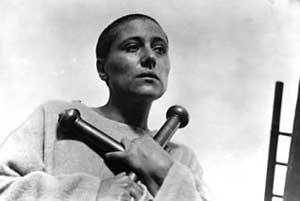
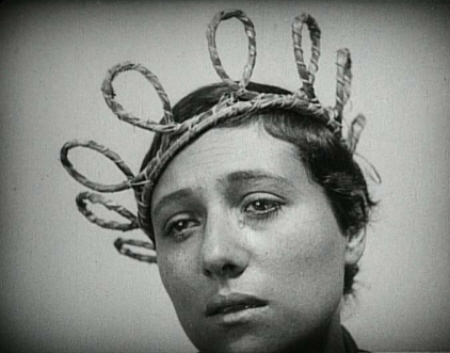
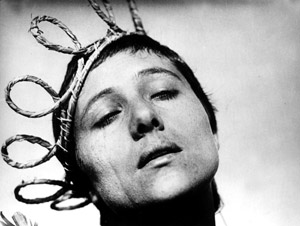

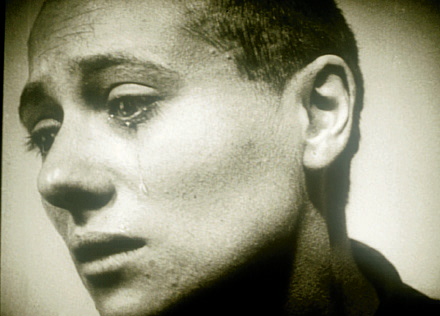
March 17, 2001 showing of Joan with full orchestra accompanying (in the actual film there are very few subtitles - and no music - so watching it is this stark and very raw experience):
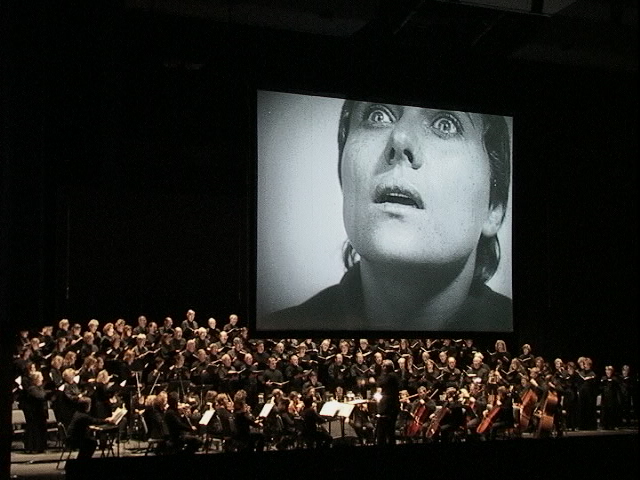
Today in history: March 4, 1789
The US Constitution went into effect - and it was also chosen as the Inauguration Day for incoming presidents, which it was until the 20th century. George Washington's first inaugural was actually on April 30, for various reasons - but his second inaugural was on March 4, 1793. His second inaugural address was the shortest address ever given:
Fellow Citizens:I am again called upon by the voice of my country to execute the functions of its Chief Magistrate. When the occasion proper for it shall arrive, I shall endeavor to express the high sense I entertain of this distinguished honor, and of the confidence which has been reposed in me by the people of united America.
Previous to the execution of any official act of the President the Constitution requires an oath of office. This oath I am now about to take, and in your presence: That if it shall be found during my administration of the Government I have in any instance violated willingly or knowingly the injunctions thereof, I may (besides incurring constitutional punishment) be subject to the upbraidings of all who are now witnesses of the present solemn ceremony.
On March 4, 1797 was the inauguration of John Adams. I love Adams' memory (of course, subjective and emotional) about what he imagined George Washington was thinking as he handed over the reins. Here's the transcription of Adam's inaugural address - which, in typical Adams fashion (love that man) is kind of chatty - - always highly intelligent - and to me, I can almost hear his voice saying it. It is at times self-serving and self-important (he basically lists his resume - which - can you blame him? Following George Washington was a thankless task - and Adams pretty much knew it going in. So he kind of lists what he has done in service for his country - whereas Washington would never have had to state his case like that.)
Employed in the service of my country abroad during the whole course of these transactions, I first saw the Constitution of the United States in a foreign country. Irritated by no literary altercation, animated by no public debate, heated by no party animosity, I read it with great satisfaction, as the result of good heads prompted by good hearts, as an experiment better adapted to the genius, character, situation, and relations of this nation and country than any which had ever been proposed or suggested.
His prose has a living quality for me in a way Washington's prose, with all its formality and brevity, never does. I always feel Adams, the real man, behind the words.
Thomas Jefferson was inaugurated on March 4, 1801 - after the first really nasty presidential campaign in our nation's history. (David McCullough describes that day in his biography of John Adams.) And to the folks who bemoan how politics nowadays are so nasty, and so personal - I suggest you learn your history. People said crap about each other back then that makes our modern blowhards look like grade school tantrum-throwers. Seriously. Jefferson meant business. Fascinating - it's one of my favorite parts of the story of our nation's birth - the story of that presidential election. I can't get enough of it. As ugly as it all was. But that's one of the reasons I love it. We are not a utopia. This American experiment was not meant, unlike other ideological constructs, to be perfect. Anyone who yearns for perfection, anyway, is either a candidate for cult membership or a dictator-in-training. It was always going to be messy, it was always going to involve compromise - but then, in the end - it was also going to involve peaceful handovers of power (ideally). Which if you look at historical precedent - almost never happened. Ever, in any civilization. In the entire story of the human race. So the fact of the election of 1801 ... and the fact that although the enemies were destroyed, pretty much ... they were not lined up against the wall and shot for being traitors, and the fight went on. The fight for power went on, and it's been going on ever since. So Utopian folks, the "wah wah, everyone was so much nicer in the past, they had better manners" - seriously need to read some books. Read the broadsides. We are mild now compared to the character assassination and vitriol that went on back then. Maybe their manners were more formal, but you think power politics have changed since then? If anything, we are nicer now. And also - to the folks who have pinwheeling-eyeballs fantasizing about some ideologically pure Utopia in the future - with no political disagreement, and permanent destruction of your opponents - you can count me already as one of your fiercest enemies. If your greatest idea of heaven on earth is 100% agreement then yo, count me out, fascists. You can strive for a perfect neat little world all by yourself, and guaranteed: you will fail. You might succeed for a little while - but rigidity like that never lasts. Again: read your history. And so - having said all that - to me, 1801 is the key to so much of who we are. The mess, the hatred, the defeat, the sucking up, the compromise, the fallout, the struggle for power - and, in the end, acceptance. 4 more years. Re-group, go in again. And Jefferson's inaugural address - with its measured phrases of unity and union ("We are all Republicans, we are all Federalists." Oh really? Tell that to my dead boyfriend.) is a masterpiece of diplomacy, and hidden agendas. He had just destroyed his political enemies - he said he abhorred "factionalism" and yet when it came down to it - he played it dirtier than anybody. He writes "every difference of opinion is not a difference of principle" ... and yet he referred to some of Adam's views (in a letter not meant to be read publicly) "political heresies" - a phrase which caused the years-long riff between these two old friends and colleagues. Political "heresies". Jefferson's writing is untouchable. Seriously. He's the best. It's so smooth, so elegant.
On March 4, 1829 Andrew Jackson was inaugurated - and, notoriously, invited the entire public to join the festivities at the White House. Apparently things got way out of hand - people were wasted - tramping through the house - furniture was ruined - things were stolen - and Jackson had to flee from the building through a window to escape the masses. haha
Here's his address and also a painting of the "public" on that day in 1829.

Oh - and then of course - there is the sad (and yet I can't help it, I laugh) story of William Henry Harrison's inaugural - on March 4, 1841. (William Henry Harrison and his oh-so-brief tenure as President will always remind me of Jackie's son - explanation here.) What happened that day is notorious. His speech was five billion years long - there was a freezing icy storm that day - he stood outside, said his speech -which took him 2 hours - maybe more - and then caught pneumonia and died a month later. Not to disrespect the dead and I know that Elements of Style wasn't even written then - but I think Harrison could definitely have benefited from Strunk and White's most important rule for writers: "Omit needless words."
Abraham Lincoln was inaugurated (for the first time) on March 4, 1861. His first inaugural is (in my humble opinion) a masterpiece. Within the first two sentences, you MUST read to the end - his prose is that simple and that heartfelt and compelling. And look at how he gets right to the point. I find it hard to imagine how the ending of this speech could be improved upon. It brings tears to my eyes:
My countrymen, one and all, think calmly and well upon this whole subject. Nothing valuable can be lost by taking time. If there be an object to hurry any of you in hot haste to a step which you would never take deliberately, that object will be frustrated by taking time; but no good object can be frustrated by it. Such of you as are now dissatisfied still have the old Constitution unimpaired, and, on the sensitive point, the laws of your own framing under it; while the new Administration will have no immediate power, if it would, to change either. If it were admitted that you who are dissatisfied hold the right side in the dispute, there still is no single good reason for precipitate action. Intelligence, patriotism, Christianity, and a firm reliance on Him who has never yet forsaken this favored land are still competent to adjust in the best way all our present difficulty.In your hands, my dissatisfied fellow-countrymen, and not in mine, is the momentous issue of civil war. The Government will not assail you. You can have no conflict without being yourselves the aggressors. You have no oath registered in heaven to destroy the Government, while I shall have the most solemn one to "preserve, protect, and defend it."
I am loath to close. We are not enemies, but friends. We must not be enemies. Though passion may have strained it must not break our bonds of affection. The mystic chords of memory, stretching from every battlefield and patriot grave to every living heart and hearthstone all over this broad land, will yet swell the chorus of the Union, when again touched, as surely they will be, by the better angels of our nature.
"I am loath to close." "The mystic chords of memory." Now that is rhetorical style. Goose bumps.
Here's a photo of his first inauguration:

March 4, 1865 was Lincoln's second inauguration as President.
The text of Lincoln's second inaugural:
Fellow-Countrymen:At this second appearing to take the oath of the Presidential office there is less occasion for an extended address than there was at the first. Then a statement somewhat in detail of a course to be pursued seemed fitting and proper. Now, at the expiration of four years, during which public declarations have been constantly called forth on every point and phase of the great contest which still absorbs the attention and engrosses the energies of the nation, little that is new could be presented. The progress of our arms, upon which all else chiefly depends, is as well known to the public as to myself, and it is, I trust, reasonably satisfactory and encouraging to all. With high hope for the future, no prediction in regard to it is ventured.
On the occasion corresponding to this four years ago all thoughts were anxiously directed to an impending civil war. All dreaded it, all sought to avert it. While the inaugural address was being delivered from this place, devoted altogether to saving the Union without war, urgent agents were in the city seeking to destroy it without war—seeking to dissolve the Union and divide effects by negotiation. Both parties deprecated war, but one of them would make war rather than let the nation survive, and the other would accept war rather than let it perish, and the war came.
One-eighth of the whole population were colored slaves, not distributed generally over the Union, but localized in the southern part of it. These slaves constituted a peculiar and powerful interest. All knew that this interest was somehow the cause of the war. To strengthen, perpetuate, and extend this interest was the object for which the insurgents would rend the Union even by war, while the Government claimed no right to do more than to restrict the territorial enlargement of it. Neither party expected for the war the magnitude or the duration which it has already attained. Neither anticipated that the cause of the conflict might cease with or even before the conflict itself should cease. Each looked for an easier triumph, and a result less fundamental and astounding. Both read the same Bible and pray to the same God, and each invokes His aid against the other. It may seem strange that any men should dare to ask a just God's assistance in wringing their bread from the sweat of other men's faces, but let us judge not, that we be not judged. The prayers of both could not be answered. That of neither has been answered fully. The Almighty has His own purposes. "Woe unto the world because of offenses; for it must needs be that offenses come, but woe to that man by whom the offense cometh." If we shall suppose that American slavery is one of those offenses which, in the providence of God, must needs come, but which, having continued through His appointed time, He now wills to remove, and that He gives to both North and South this terrible war as the woe due to those by whom the offense came, shall we discern therein any departure from those divine attributes which the believers in a living God always ascribe to Him? Fondly do we hope, fervently do we pray, that this mighty scourge of war may speedily pass away. Yet, if God wills that it continue until all the wealth piled by the bondsman's two hundred and fifty years of unrequited toil shall be sunk, and until every drop of blood drawn with the lash shall be paid by another drawn with the sword, as was said three thousand years ago, so still it must be said "the judgments of the Lord are true and righteous altogether."
With malice toward none, with charity for all, with firmness in the right as God gives us to see the right, let us strive on to finish the work we are in, to bind up the nation's wounds, to care for him who shall have borne the battle and for his widow and his orphan, to do all which may achieve and cherish a just and lasting peace among ourselves and with all nations.
Many people who were there that day describe a sense of impending doom over the event.

Lincoln was assassinated on April 14, 1865, 42 days later. Andrew Johnson would be sworn into office on April 15, 1865.
The last president to be inaugurated on March 4 was Franklin Delano Roosevelt on March 4, 1933. Here is his first inaugural address. Despite his polio legs and disability - he walked up the staircase to the podium, and stood - to give his address, and kept standing, for the swearing-in.

March 3, 2007
Happy place
Jen and I got together last night - and we had a sushi feast, and red wine - and Jen sat with her poor bum foot elevated on my lap - and we laughed until we freakin' cried about various things in our lives, and memories, and we had a huge Rocky fest (after all - she and I going to see Rocky Balboa is what started this whole thing) and the entire evening ended with the two of us feverishly looking on line to see if we could buy the uncut (pun intended apparently) version of Party at Kitty and Stud's - which led us into a web of insane links all over the web, as I am sure you can imagine - and we were laughing so hard at ourselves, and our ridiculous behavior ... tears were streaming down our faces - it was like this shared manic episode, the two of us searching for cheesy p0rn in this frenzied manner, as though it was of DIRE importance - and also any time either of us said the words, "Party at Kitty and Stud's" - which was quite often by that late point - we would both just LOSE it. It sounded funnier and funnier every time either of us said it. "Oh, here's a reference to 'Party at Kitty and Stud's'" Jen would say, excited, huddled over her laptop and the absurdity of it would just KILL me. It was as though we were BORN saying the words "Party at Kitty and Stud's". As I walked down the hallway to the elevator, at midnight, ready to meander home - I could still hear Jen laughing down the hall. "Kitty and Stud's???? What?" Once we find the uncut (ahem) version of this movie - we will have to watch it together. I am already laughing out loud just thinking about it.
On to the happy place.


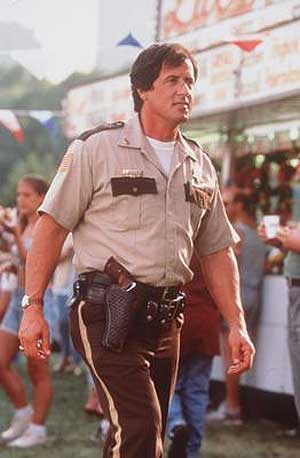
Spectacular
Check out Carl V.'s Friday Favorites. I just fall into a total fantasy world - merely by looking at them. Truly stunning works of art. I think my favorite is the one called "Cadmian’s Choice".
March 2, 2007
Notes on "Once Upon a Time in America"
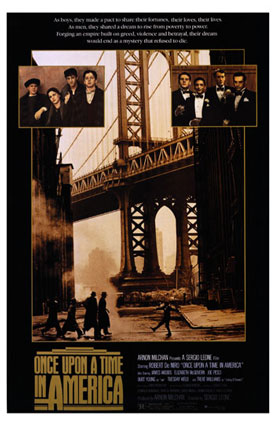
I have a lot going on right now off-line - you know, that little thing called "life" - but I still have all of these things percolating in my head that I want to write about. I haven't forgotten about Man in Mirror - I actually have been still researching that one - it's coming!!
But onto another thing I've wanted to write about: Sergio Leone's Once Upon a Time in America.
The story behind the story of this movie is almost more famous than the movie itself. This was like Sergio Leone's "dream of passion" - we all have one - and most good directors worth their salt (grammar police, sorry) have one film that drives them a little bit insane. That's what that "dream of passion" will do to you. He tried for years to get the rights to the book that the movie would eventually be based on. It spoke to him. The immigrant experience, crime, the wild west of prohibition ... and the glories and underbelly of America. The casting for this film was almost like a gladiator combat zone in the damn Coliseum. Everyone wanted to be in this picture. People campaigned to be in this picture. It was like The Godfather. I remember when DeNiro came to my school to speak - and somebody asked him if he had auditioned for the first Godfather - and he said, "Yeah, I read for Michael. I think every actor in town read for Michael." Just to give you the scope of the casting call. And the coup that was Al Pacino's landing of the most coveted role of that decade. Once Upon a Time in America offered the same thing to actors of a certain type (who happened to be very hot at that point - and still are - the tough-guy, the Italian gangster guy, the Scorsese street-thug guy). Richard Dreyfuss campaigned to be in it. Joe Pesci wanted to be in it. (He did end up being in it - but not in the part he originally wanted). As it stands, I would say the casting is perfect - on multiple levels.
We have the whole section when the boys are young - and how on earth they found these young actors who so seemed to be a young Robert DeNiro type - a young James Woods type - when we encounter them later as adults (and of course it's not a linear movie, I'm just saying - in looking back on it) - it is so obvious who is who. The "cock-eye" character is so obviously William Forsythe - the second you see him as a grown man (although, uhm, is that guy really an adult? With his pipes o' Pan and his amoral gap-toothed grin? Doesn't seem so) - but anyway, the second you see him as an adult, you know: Oh. Of course. That's Cock-eye. Amazing casting.
And the kids are all terrific. They have to do some very tough scenes - violent scenes, and sexy scenes, too - they're precocious teenagers after all, growing up in a hurry. And they really seem like kids. They look 14. It's not the Hollywood of today where for the most part the "tweens" are played by 19 year old starlets. These kids seem adolescent.
And that one little tiny boy has to do a slow-mo death scene, being shot in the back by a bullet on the cobblestone streets (I wish I had a screenshot of it - I found a screenshot of his death scene - but not his toppling over) - and I have to admit, I teared up watching it. Not just because I had fallen in love with that little guy, and he was so young to be gunned down in the street ... but also because I was just proud of that little-boy actor for doing his job so well. Look at him, goin' down, in slow-mo - and then lying there, with his legs crooked beneath him - all in one shot. That's the most pure type of acting - the "make believe, bang bang you're dead" type of acting, and I love it when a kid can pull it off - because a kid is still so close to the land of Make Believe. They know how to pretend. It is in their blood. Adult actors have to REMEMBER how to pretend. So to see him go down like that ... It was devastating. But I was also proud of the little boy's courage and acting skills. Welcome to how I watch movies.
Also, Jennifer Connelly plays Elizabeth McGovern as a young girl (say, 12 years old) - and the resemblance is uncanny. Seriously. Elizabeth McGovern has quite a specific face - the thick eyebrows, the sort of plumpness around the mouth, the eyes - it's not generic.
It is completely believable that Connelly, the serious-faced, serious-eyed young girl would grow up to be Elizabeth McGovern.
I loved the scenes when Noodles is peeking through the hole in the bathroom wall - watching her practice ballet - in that airy dusty storage space. A poetic movie space - probably not like any storage space in the back of any bar on the lower East Side that ever existed - but this is the movies. Especially this movie - which is shot out of chronological order. You see the older Robert DeNiro (say, the 50 year old man) looking back on his child-self and then the child-self becomes the slicked-hair 25 year old DeNiro ... so these childhood scenes, to me, were not mean to be completely realistic. But more ... nostalgic. The way we remember things from afar. Deborah (the Jennifer Connelly/Elizabeth McGovern character) is an image of ... goodness, and hope - that carries him through some of his darkest hours. And of course, he ends up sullying that goodness in one of the nastiest scenes in the film that I could barely watch. So when we see her - as a young girl - dancing around the storage area - with barrels of apples, and pickles, and bins of parsley - and we see her as almost an angel, in a lofty airy space filled with streaming light ... we see her through the gauze of memory. We see her across the abyss of years. It's sad. The shots are lovely - poetic - and yet we feel sad. Because we know they represent days long gone.

The opening scenes - the apartment, the opium den, the Chinese theatre, the black and white tiles of Moe's bar (which is, actually, McSorley's on East 7th - a landmark bar if ever there was one), the chairs flipped over up on the tables, the burnished mahogany of the clock - and the phone ringing ... and ringing ... and ringing ... and ringing ...
Seriously. The sound of that phone ringing is a leitmotif.
American distributors had a helluva time with the four hour movie that Sergio Leone eventually handed in. His cut had actually been over 10 hours long. And this movie is so good that I would love to see 8 more hours of it. But four hours? And no chronological set up? How do we know that we're looking at the four young boys - only now they're grown-up? [Uhm, because we're not morons, and we can figure it out??] So the distributors basically booted Leone off of his own "dream of passion" - and hired someone to cut the film to an acceptable length. Two hours. This was the version that was released in the United States to a definitively lukewarm response. By ironing out the chronology - by taking out all of the symbolic poetic images - not meant to be literal truth, but a deeper kind of truth - they ruined the movie. The phone rings for no reason ... Leone had put the film together very carefully. We see various phones - and we aren't sure as we see them - if they're in the 1910s, or the 1920s, or the 1960s ... it could be any of them. We don't know sometimes who is calling who. We are not told whose phone we are seeing. And the phone just keeps ringing.
All of this, naturally, does make sense. If this kind of non-literal film-making drives you crazy - and you would rather have a clear-cut storyline told in a traditional way - then obviously this movie would make you nuts. But the 4 hour version - which eventually was put back together and released on video and DVD - is closer to Leone's actual intent. It's Proustian almost: how certain senses can ignite memories. Not just intellectual memories, as in: Oh man, member when we did such and such? No - there are certain moments - where maybe you get a whiff of a pastry you haven't had since you were 8, or you suddenly hear a Christmas song over the radio that was your great-grandmother's favorite ... and you don't sit there and think: "Wow. Member all of that?" It's more like you actually go back in time. You shudder with closeness to your old self, those old dead selves, your ghosts. This is what Leone is getting at in this movie. Robert DeNiro, Noodles, has returned to his old hood - and wherever he looks - he doesnt' just see the present-day streets and sidewalks. It's like he can also see, as an afterimage, the cast-iron streetlamps of his childhood, the rattling wheels of the junk wagon clattering along, the smells and sounds of his childhood - when the "old world" was much closer. So phones ring. Is it the phone in the speakeasy? Or the opium den? Or in Moe's back room? Who knows? Memories come, unfold, unfurl ... and not always in the "right" order.
I love that about this film.
DeNiro is terrific - in a kind of silent worried way ... I thought that James Woods was phenomenal. To me, it is his character (and his performance) that is the real key to the movie. We never know what makes Max tick. We think we do, but then he always surprises us. There are depths in that guy, and you better look out. He's volatile. He's frightening. He's ruthless. He's scared. He's smart. Smarter than Noodles. We see Max through Noodles' eyes - and even by the end of the movie, as close as those two were ... we still don't feel that we can get inside Max. And isn't that the way with some people we meet in life? Isn't that sometimes the way it goes? James Woods is absolutely terrific. He can look almost boyish sometimes - there's a vulnerability in his eyes, a need there -that can be so seductive. And then he can turn around and be quite cold. Ruthless. And cruel. He's volatile. But not in the what I see as predictable (or at least it's predictable now) Al Pacino way. Al Pacino is so predictably "explosive" now that it is basically schtick. Some people have funny schtick. Pacino's is: i talk very low and calm in an ominous quiet voice AND THEN I ... SUDDENLY ... EXPLODE ... MAKING EVERYBODY AROUND ME .... JUMP! Again: it can be quite effective, I'm not dissing it. I'm just saying it's schtick. Woods seems, at times, truly unstable. Like when Noodles says, casually, as a joke, "You're crazy" - and Woods literally goes nuts. As though some switch has been flipped ... it's a trigger. Woods goes insane. You think he's kidding at first - you hope he's kidding - because ... he seems so out of control, so damaged. He's fantastic.
I loved the atmosphere of this film. I want to LIVE in the apartment in the first scene. If I ever have any money, I will pay one of my gay decorator friends to make my apartment look like that. The scenes at the Chinese theatre were amazing. You didn't feel like you were watching a movie that was filmed on a set. I truly felt like I was looking at a place that existed at the turn of the century. It seemed ... haunting. Like - it so doesn't exist now. We are looking at a world gone by. Things were not dwelled over ... i didn't sit there and think about the art direction (which I often do with other films) - because it didn't seem to have any art direction - and by that I mean: these all seemed to be real places. Of course they weren't ... there was art direction ... but the way it was filmed, and the way the characters inhabited these spaces ... seemed completely real.
Amazingly, too, Leone shot these scenes all over the world. He makes you totally think that you are looking at the lower East side in 1915, 1916 ... and he might have filmed those scenes in Jersey, or in Rome, or in Canada. He shot the movie all over the world. The location scouts must have had a helluva time. Unbelievable.
I have to think more about the movie - but now I can see why Michael said to me that it is one of the greatest gangster movies ever made. It's kind of the gangster movie. And it's also an homage to the chaotic birth of America - the immigrants, the crime, the new-ness of the country compared to the worlds that all of these characters have emigrated from ... the sense of possibility ... but because they choose at a very young age that crime is the way to go, there's a dark side to all of it.
Connecting links abound ... the clock, the phone, the locker, the briefcase, the key ... and then, before I sign off here - I have to just mention the last shot - which is a closeup of Robert DeNiro's face, and he's smiling. The shot goes on forever ... It's frozen on him, and it's disturbing - because ... why is he smiling? It's not clear. And if he's smiling for the reason why we think he's smiling - then it's actually tragic. It's a death mask grin. But that shot was so arresting, so ... I'm trying to think of the word. Naked? I kept expecting the shot to end. I kept almost hoping for the scene to end. It was one of those things, where I felt strangely confronted by it. It was too naked. I kept expecting the screen to fade to black. But as the shot went on ... and as my wish that it would all stop was not granted, I relaxed into it ... and once I relaxed, all kinds of fascinating things started spiralling through my brain. I was looking at him, and thinking about Noodles, and contemplating him, and contemplating his smile. Wondering about him. I had that much time. And also just the fact that he's smiling. I don't think he smiles a real smile throughout the movie. Noodles is kind of a dour guy. And his teeth are stained brown, and he has the crinkly smile lines around his eyes, and the camera is right in his face so his mole looks enormous ... and the shot never ends. It's like getting into a staring contest, and you so want to break your gaze away, because it's too ... revealing. Naked. You have to tolerate the shot, is what I am trying to say - and the meaning is not immediately clear. I'm still not quite sure about it - but I do know - that I have been thinking about it and pondering it ever since.
"Only Angels Have Wings"
A delightfully astute and specific essay about Only Angels Have Wings - one of my favorite movies ever made. I love this bit, it is just so right on the money, so so true:
There's a great scene where Grant has to ground his buddy Thomas Mitchell, because his eyesight's gone bad. As Mitchell walks out of the room, Grant kicks a chair in frustration. Let me tell you: It is the greatest chair-kicking scene in the history of movies. In that one moment, all of Grant's boulevardier-Walter Burns mannerisms are gone and you feel his deep, deep pain, the love he has for this man and the crushing disappointment of hurting him. It's masterful.
I got goose bumps when I read that. It's so true. When you see the movie, watch for that moment. A modern actor might tear up the room, roaring like an injured chimp ... kicking chairs left and right ... and that might be appropriate for the scene, whatever. I just know that all that macho bluster, all that easily expressed rage, all that sturm und drang - all of that isn't half as effective as what Grant does in that moment.
Definitely go read the whole thing.
It never ceases to amaze me ...
... that in a city of millions of people - you can randomly run into people you know in the weirdest places. It makes this metropolis feel like a small town.
Today was a particularly awesome one - because I had not seen this person in - uhm - 10 years? Maybe longer. His was the theatre company in Chicago who produced the production of Virginia - where I understudied the lead. This was a bazillion years ago - but we became friends, and we have a lot of friends in common. He was always just really cool to work with, so supportive - you always just felt psyched to work with him. Then he moved to New York - it must have been over a decade ago - and I lost track of him - although I would hear OF him, because he wrote a show which is now going into its 500th year or something like that, hahaha - like a GINORMOUS hit - so I'd see his name around.
Anyway, this is so random - but I was at 30 Rockefeller Center today ("30 Rock" - as it is coolly referred to - "Yeah, I have an appointment at 30 Rock, year whatever, 30 Rock, uh huh, SNL, Radio City, whatever ... 30 Rock ...") - and it's a madhouse there. If you've come here as a tourist I am sure you have gone there - with the ice skating and the Christmas tree - and the throngs outside to meet Al Roker and etc. etc. It's a hub. Foot-traffic is INTENSE. There are also many layers of security you have to go through in order to just get onto a damn elevator. Which is not surprising. Member the anthrax craziness? But anyway - I jump through hoops to get onto the elevator - get my picture taken, flash my identification, give them my Pap smear results, my grade school report card, and the speeding ticket I got in 1994 ... and finally, I'm given a guest badge and off I go.
Elevator banks. Choose one. There are 300 elevators. I get on one, after flashing my badge at the security guard.
It's a huge plushy elevator - and a girl is already in it when I step on, and a man steps on with me - and the doors close.
The man steps forward, and says, "Sheila?"
I look. And holy shit, it is Patrick. That poor woman who was trapped in the elevator with us, as we hugged like manic koala bears, clutching each other, and saying, over and over, "Oh my God!" "Patrick!" "What the ..." "Holy crap!" etc. It was SO good to see him. I still can't get over it. Huge smile on my face. I describe my journey to the elevators only to describe the unbelievable coincidence ... of him getting on the same one with me ... Just so weird. And so perfect.
He got off on "my" floor with me - even though it wasn't "his" floor - and we stood there for a while, catching up, just laughing and reveling in each other - it was so awesome. I am going to organize a "reunion" with him and our other mutual friends over the next couple of weeks - because it was just too awesome to see him, and too perfect. An old friend and supporter from Chicago (he always was just eager to give me a chance - casting me in stuff, pushing me forward - he was one of THOSE people in my life - a real "fan" - which God, you just need) ... and there he was in my elevator.
It was a rainy manic day but God, it was just so cool to run into him. In that elevator out of many elevators. Catching up with each other, surrounded by photographs of Chevy Chase and Johnny Carson and crap like that. Reveling in the unbelievable oddness and perfection ... of how this reunion came about.
Couldn't keep the smile off my face for the whole morning.
March 1, 2007
"Today he'd probably be arrested."
Groucho Marx to Roger Ebert, in 1972:
"I knew [W.C.] Fields well. He used to sit in the bushes in front of his house with a BB gun and shoot at people. Today he'd probably be arrested. He invited me over to his house. He had a girlfriend there. I think her name was Carlotta Monti. Car-lot-ta MON-ti! That's the kind of a name a girl of Fields would have. He had a ladder leading up to his attic. Without exaggeration, there was $50,000 in liquor up there. Crated up like a wharf. I'm standing there and Fields is standing there, and nobody says anything. The silence is oppressive. Finally he speaks: This will carry me 25 years."
I am strangely charmed by every single detail in that story.
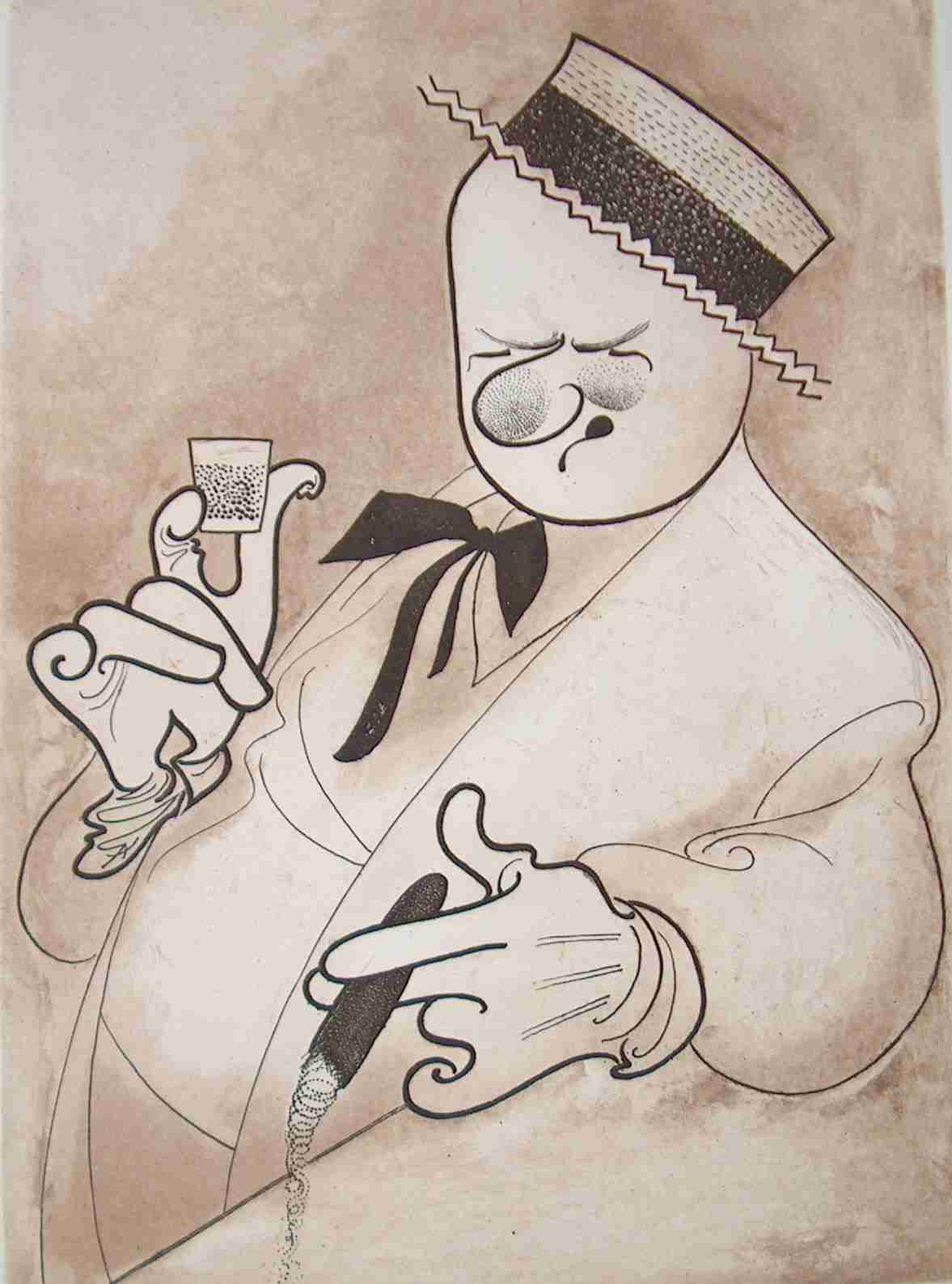
5 childhood books
A gorgeous and heartfelt addition to the meme from Marisa. I love how she describes her responses to each of those books.
And here's Lisa's contribution!
Alli has added her 5 books! This is fun. Velveteen Rabbit. sniff, sniff.