April 30, 2007
Tribeca Film Festival

The madness has begun over at House Next Door.
Reviews to check out so far:
Black Sheep - By Keith Uhlich
Vivere - By Steven Boone
Fireworks Wednesday - by me
Much more to come from all of us!
It's in poor taste ...
... but I cannot stop laughing at all of these suggestions for alternative titles for The Bell Jar - You know, the romantic comedy version of The Bell Jar. The "light" version of The Bell Jar. (go to the comments section, you'll see everyone weighing in).
Everyone is so clever!
Drop Dead, Ted is one of my favorites.
The Bourne Depression is also particularly funny to me.
Raiders of the Lost Mind.
"Honey, I (Almost) Gassed The Kids"
"Syl and Ted's Excellent Adventure"
"Things To Do In Your Oven When You're Dead"
I also loved:
10 Things I hate about (Ted) Hughes.
Like I said. Poor taste.
I adore it.
National Poetry Month: Mary Oliver
I figured I'd end my National Poetry Month extravaganza (although I might keep going with it, I've had a lot of fun, and a lot of cool new readers have found their way to me because of the poetry posts) with one of my favorite poems of all time.
In Blackwater Woods
by Mary Oliver
Look, the trees
are turning
their own bodies
into pillars
of light,
are giving off the rich
fragrance of cinnamon
and fulfillment,
the long tapers
of cattails
are bursting and floating away over
the blue shoulders
of the ponds,
and every pond,
no matter what its
name is, is
nameless now.
Every year
everything
I have ever learned
in my lifetime
leads back to this: the fires
and the black river of loss
whose other side
is salvation,
whose meaning
none of us will ever know.
To live in this world
you must be able
to do three things:
to love what is mortal;
to hold it
against your bones knowing
your own life depends on it;
and, when the time comes to let it go,
to let it go.
Other National Poetry month posts
Dear Alex:
I need to paraphrase the last paragraph of Charlotte's Web - it's one of the first things that came to mind when I read your unbelievable post this morning:
"She was in a class by herself. It is not often that someone comes along who is a true friend and a good writer. Alex was both."
I am proud to call you my friend.
April 29, 2007
Tribute to Ryszard Kapuscinski
My heart is so full. The place was standing room only. The line was (literally) around the block. It went from the door on 42nd Street all the way to 6th Avenue. I heard Polish being spoken in line, we all had dog-eared copies of Kapuscinski's books - I heard one young woman, she was probably 23 years old if she was a day, say to her friend, "I think The Emperor might be favorite of his. What's yours?" It is always a great comfort to me to find "my own kind". To show up for a matinee on a Sunday, a tribute to this great writer - and to find hundreds and hundreds of people who had the same idea. It was a bright sunny day, and we queued up - making quite a spectacle, the line snaking around Bryant Park. "What is this for?" people asked, drawn to us. Someone would answer, "Tribute to Ryszard Kapuscinski." "Who?" someone asked. But then someone else thought a bit, nodded seriously and said, "Oh!"
I think one of my favorite parts of the entire day was when the Polish writer and newspaper editor Adam Michnik got up to speak, a longtime friend of Mr. Kapuscinski. His English was halting, so he spoke with a translator - a tall laconic gentlemen over to the side, holding a microphone - who was the striking resemblance of George Plimpton (his name was Jan Gross). Anyway, the Mr. Michnik was red-faced, jovial - (oh, and the entire panel was drinking vodka the entire time ... in tribute to Kapuscinski and his love of life, good alcohol, companionship, and recklessness. It was great - there was Salman Rushdie, raising his glass of vodka to the memory of his dead friend ...) But anyway, the Michnik spoke, and it was obvious the vodka was having some effect - he was humorous, and anecdotal - he didn't stand on ceremony, he told very funny stories about Kapuscinski- and I loved him. But it was great because there were, of course, huge numbers of Polish speaking people in the audience (most of them sitting in the first 10 or so rows) - so he would come to the punchline of some joke, in Polish - and there would be a huge spontaneous thunderclap of laughter from the front, from the Poles ... then our Plimpton-esque translator would tell us the punchline in English 2 seconds later - and all of the English speakers in the audience would burst into a huge thunderclap of laughter. It came in waves. Like a time-released punchline, reverberating backwards in concentric circles. Laugh from front ... pause ... laugh from back ... and so it went, on and on, throughout the Michnik's entire speech. It was gorgeous. The interconnectedness of it, but also the separation - by language ... and yet humor is universal. We just might not "get it" at the same moment. It (to me) was the biggest tribute to Kapuscinski's overwhelming humanistic appeal: those time-lapsed waves of laughter. The jokes making it through the translation. The message received.
I took some grainy pictures below. Salman Rushdie was marvelous. The dry wit ... obviously very comfortable with public speaking - he appeared to speak off the cuff. Maybe he had some notes - but he didn't refer to them often. He just sipped his vodka and told funny stories. He related a tale about a time he and Kapuscinski had in London - a stage production of Kapuscinski's book The Emperor was going on - and protests were being staged outside the theatre.
Rushdie said to us (and his timing was impeccable - it was all in the pauses):
"Speaking as someone whose writing has ...... occasionally ... generated .... protests ......"
HUGE laugh.
It was the "occasionally" that made the joke.
And what an unbelievable pleasure it was to see my husband, Philip Gourevitch, in the flesh, for the first time. To hear him speak. My God. I admire him so much. I love his writing so much. Man, what a day.
Crowded. Photos of and by Kapuscinski were projected up onto huge screens around the room.

The ceiling in that room never ceases to amaze me.

The man of the day.

Another funny anecdote from Rushdie. Back in the early 80s - when Kapuscinski's books were starting to come out - he and Rushdie were part of the same publishing house in London. Rushdie, young, ambitious ... had never heard of Kapuscinski. He walks into the editor's office and the editor says to him in a portentous dramatic tone, "I have just read what I believe might be the best book ever written." (A lot of Rushdie's charm and humor was in how he told the story ... just the WAY he related the editor's words told us the whole thing - Rushdie felt jealous. He wanted the editor to be saying that about HIS book.) Rushdie, feeling jealous, said, "What's the book?" Editor said, "It's a book about Haile Selassie by a Polish writer." Long pause. Rushdie then said, "Well, that certainly sounds like the best book ever written."
So dry, so funny!!!
(Excerpt from "the best book ever written" here)

Another quote from Rushdie, on Kapuscinski's time in Africa: "He was sentenced to death every Tuesday."
Here's a grainy shot of the panel. Rushdie clearly seen over on the right ... and Gourevitch clearly seen over on the left.

The organizer of the event asked Kapuscinski once about the many times he had been thrown in prison in Africa during the 60s and 70s. I think it was over 40 times, and he had gotten a "death sentence" 4 times. Crazy decades in Africa, anarchy, etc. Kapuscinski, with his gentle self-effacing way, told a story about how he was in a dark cell, and the guards kept throwing in poisonous snakes with him. Kapuscinski's verdict on the whole thing, as he re-told the story? "It was ..... not so good." Never one for dramatizing the alreaady dramatic. Although he put himself in all of his books, it was never in a self-aggrandizing way. But it is true that after his time in the prison cell with the poisonous snakes - this particular imprisonment went on for 2 weeks, I think, and by the time they let him out - freed him from the pitch-black room with the poisonous snakes - his hair had gone completely white.
God, I love his face:

Rushdie asked him once about all of the times he had faced death while trying to get the story out to the wire service. Rushdie asked him, "How do you do it?" Kapuscinski had to answer that question a lot - he was asked often, "Are you attracted to danger?" He was always so incredulous at the stupidity of that question. He saw nothing attractive about danger - that's the whole point of his books. But in order to write them, he needed to be there, not behind some desk. - His whole essay about what happens to a man when he sits behind a desk is vintage Kapuscinski. So anyway, Rushdie was hearing the 100th story about Kapuscinski somehow conniving his way through some flaming checkpoint in Uganda, with rifles pointed at his head, and drunken soldiers rifling through his papers ... and Rushdie asked, "How do you do it? How do you escape death so many times?" Kapuscinski thought a bit and then said, "I make myself unimportant. I make myself seem unworthy of the assassins bullet."
Here's Rushdie at the podium - you can't see it, but he has a huge glass of vodka next to him.

Gourevitch spoke eloquently about Kapuscinski's thing as a writer. I loved one thing he said - he said that Kapuscinski is a 'great artist of the pixel'. And you know - thinking of his various books - it is the minutia that sticks with you: the cushion-bearer in Selassie's court, the long treatise on making cognac in the Imperium, the image of the pool hall built by the Soviets in what was once a mosque in Samarqand ... the old Muslims sitting outside under a tree, with the sound of pool balls clacking around the green baize table in what was once their holy place ... Oh, and so much more. The little puddle-jumping girl in Irkutsk. The wooden city in Angola floating away into the ocean (excerpt here). The gin-soaked nights in Ghana. The entire essay on the soccer war (excerpt here). His long essay on the Armenians. Their books. (excerpt here) Gourevitch told a very funny story too about how Kapuscinski was once asked to be on a panel discussing foreign policy issues - I can't remember which country, maybe it was the EU, I don't know. But it was to be a highly detailed conversation regarding this or that policy, this or that bill. He sat there, and was asked what he thought of such and such policy. He had never heard of any of them. He was not a wonk. He did not go in for the tiny details of government. He abhorred them - they were dehumanizing.
But his books! Look to his books.
Here's Gourevitch speaking.

April 27, 2007
Tribeca Film Festival
I'm going to be part of a team of critics covering the Tribeca Film Festival for House Next Door - one of the best culture blogs out there. Be sure to check in over there over the next week to see all the reviews as they come pouring in as quickly as we can write the damn things. I saw two movies today, and will see 7 movies in the next 3 days. Because I'm going to the press screenings, and not the regular public screenings - the movies are not shown at prime time. I'm seeing a movie tomorrow morning at 9 a.m., for example. And then racing downtown to see another one. Sunday will be truly insane. Movie in morning. Race to New York Public Library for the tribute to Ryzsard Kapuscinski. Hopefully meet Salman Rushdie and Philip Gourevitch. Race back downtown for second movie. And I will write my reviews ... when?
Here are some photos I took today as I tramped through the fog from movie to movie.
Ye Olde Media Kit and press pass.

I felt like Rosalind Russell in this moment.

Mural I fell in love with, as will soon become obvious.
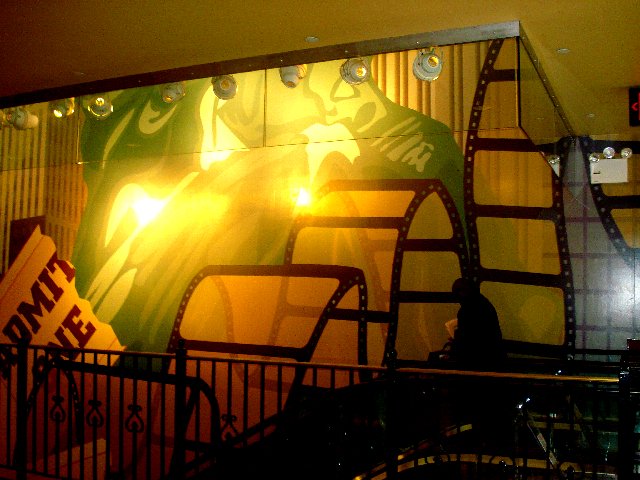
Mural love.

Staff setting up the memorabilia and information table.
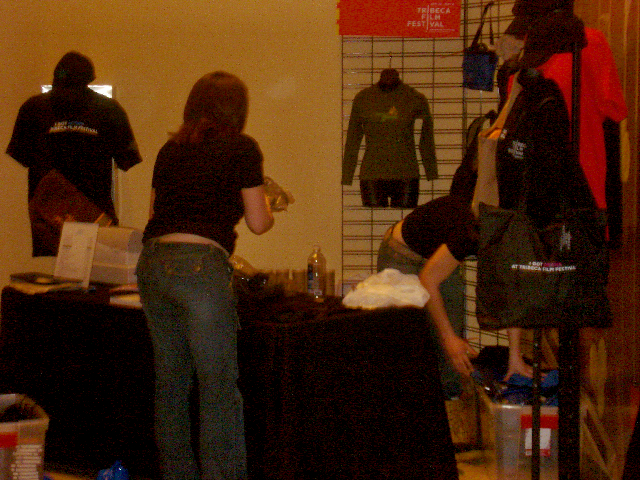
Poster on the wall in the lobby. I couldn't resist.
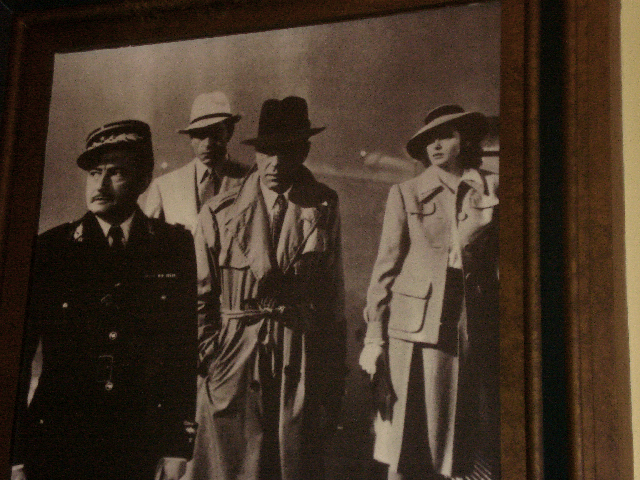
In between movies. A breather.

Madison Square Garden.

Back to work.

Mural love, yet again.

A black flat behind an information booth.

Hypnotized by the mural. Who wouldn't be?
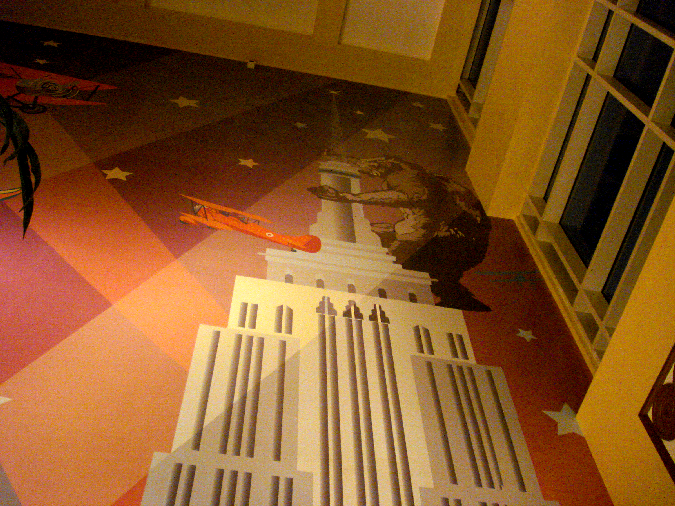
Preparing ...

What can I say. The mural called .... and I answered.

Descending down to the lobby after the second movie - where audience members were gathering for the public screenings. You could feel the buzz in the air.
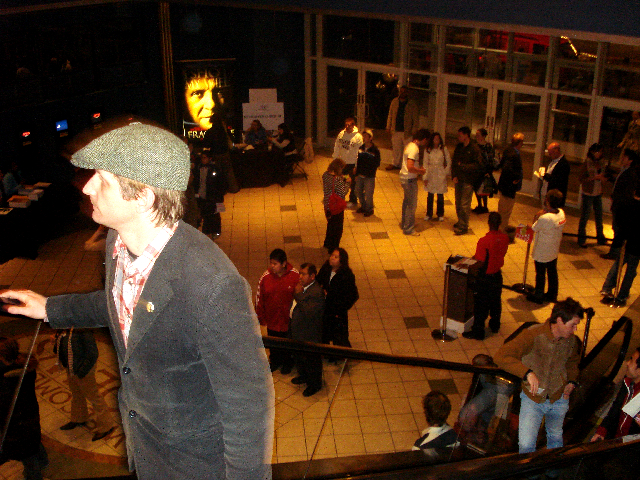
People holding tickets, yearning for tickets ... corralled up into queues outside.
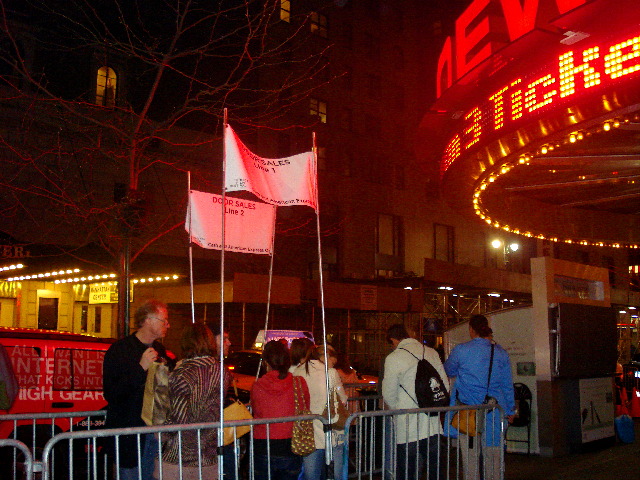
The marquee.

"In an old house in Paris that was covered with vines ..."

Today is the birthday of Ludwig Bemelmans, author of the beloved Madeline books. Here is a really interesting biographical sketch of him. I didn't know any of it. Listen to this:
When he was a teenager, his parents apprenticed him to his Uncle Hans, who owned a string of resort hotels in the Tyrol. After the 16-year-old Bemelmans shot a head-waiter during a dispute, his family gave him the option of going to reform school or emigrating to America.Bemelmans chose the latter and arrived in New York in 1914, carrying two pistols with which to fend off hostile Indians. Once again, his career as a waiter was disastrous. After losing a job because he arrived wearing one yellow and one white shoe, Bemelmans enlisted in the Army.
"Once again, his career as a waiter was disastrous."
heh heh heh
He served in the Army in World War I, and he is buried at Arlington National Cemetery.
I always loved the Madeline books, and still do. Madeline: the red-haired feisty rebellious girl in the convent school, the one who always gets in trouble (even if it's just getting her appendix taken out) - but the one who is also most loved.
I loved how Miss Clavel woke up in the middle of the night, in her cavernous bedroom, sitting up in her cavernous bed with the draperies hanging above it ... and she said to herself: "Something is not right!"
She got a candle, and ran down the hallway (the illustrations are so dramatic, so wonderful) and burst into the dormitory, to see Madeline moaning in her bed, all the other little girls sitting up, awake, worried ... Madeline is rushed to the hospital to have her appendix taken out. Things might have gone very wrong that night if it weren't for Miss Clavel's powers of prophetic thinking. How many problems could be solved if we woke up in the middle of the night, alarmed, and said to ourselves: "Something is not right!"
I loved the watercolors. I loved the urban setting, the beautiful images of Paris, with the "12 little girls in 2 straight lines" going on their daily walk with Miss Clavel.
I'm sure it will not be a surprise to any of you to know that my favorite of the Madeline books is when she and Pepito, the little boy next door, join the circus. Of course they are forced to join the circus, since they are kidnapped by gypsies at a local carnival ... but still. They end up getting into their new circus life. As a little girl, I found that book to be so exciting, so ... magical. It opened up little doors into other worlds, worlds I could only get a glimpse of ... but oh, I wanted to see more! I remember in particular one illustration of the small company of circus performers sitting around a campfire in the middle of nowhere, their caravan parked nearby. The night around them is dark, a midnight-blue wash of watercolors ... but the bright jester costumes and the Pierrot get-ups of the gypsies gleam out from the dark, like magic little gems. I wanted to sit around that campfire.
Of course, since Madeline and Pepito had been KIDNAPPED by the gypsies - poor Miss Clavel was losing her MIND back in Paris, wondering where they had gome to, if they were all right. This time, Miss Clavel's precognitive powers failed her. At no point when she took the 12 little girls to the carnival did she think to herself: "Something is not right!"
Oh well. Even French nuns with powers of prophecy have their off days.
Happy birthday, Mr. Bemelmans ... glad you didn't end up being a waiter. Seems like we all are much better off because of your original failure in the service industry.

Characters
I got this from Super Fast Reader:
Name up to three characters . . .
1. You wish were real so you could meet them:
Nelson Denoon, from Mating
Harriet, from Harriet the Spy
Ilse, from the Emily series, by LM Montgomery - I'd love to meet Emily, too - but Ilse is really the one I'd love to check out in person
Claude Collier, from Lives of the Saints
Owen Meany, and also Hester the Molester, from Prayer for Owen Meany
Mr. Rochester, from Jane Eyre
Molly Bloom, from Ulysses
Sydney Carton, from Tale of Two Cities
Charles Wallace, from Wrinkle in Time
2. You would like to be:
Polly - from the "time" series of Madeleine L'Engle - I especially would like to be her in House Like a Lotus (excerpt here)
Petrova from Ballet Shoes
I'd like to be one of the kids who attends Hogwarts - I don't care which one
I'd like to be Jo March (but then again - who doesn't)
I'd also like to be Queequeg
3. Who scare you:
First and foremost: Cathy from East of Eden (wrote about that monster here)
And I'm gonna go along with what Annie said: Cordelia from Cat's Eye (shivers)
Miss Havisham scares the shit out of me. I never want to go into that room.
Mr. Charrington, from 1984 - I've had nightmares about that guy
The Book: "Wilderness Tips" - 'Hairball' (Margaret Atwood)
Next up in my Daily Book Excerpt ... Adult fiction:
 Next book on the shelf is Wilderness Tips -a pretty much universally spectacular short story collection. One of my favorites of her stories is in this collection - it's called "Hairball" ... and that's what I'll excerpt today. This story is a major freakout. It might be her angriest story - and yet it's also one of her funniest. Atwood never goes the expected way ... This story is a RAGE (and it makes sense that our narrator is a managing editor of a magazine that she originally wanted to call "all the rage" - but that name was nixed - it's now called "The Razor's Edge") - "The Razor's Edge" is a hip edgy Toronto magazine (which is a joke in and of itself, at least in Atwood's caustic view) - and in its pages are columns about S&M clothing, photo layouts of sex toys, reviews of avant garde performance art pieces, edible condoms, you know - the point is to be as confrontational as possible. Kat loves that. She prides herself on her hard-ness, her cynicism - and the fact that people are "shocked". By what she writes and by who she is. She has no earnestness. She scorns sincerity. She is on the cutting edge. The story opens, though, with something completely "sincere" - meaning, there is no way to put a cynical spin on it. She has an ovarian cyst removed. The cyst is the size of a coconut. She asks the doctor if she can see it. It is huge. A huge hairball. With fully formed teeth stuck in it. She is mesmerized by it. She puts it in a jar of formaldehyde, takes it home, and puts it on her mantel. She likes the thought that it will shock people. She refuses to believe that she herself is shocked. That her body produced such a monstrosity. The "hairball" takes on a kind of personality - it sits on the mantel, and she talks to it, confides in it ... she stares at it, hypnotized. Meanwhile, she continues on as though nothing has changed. As though she has not been altered in some way by this surgery ... as though she is not now missing something. Her boyfriend is a dude named Ger - (she re-named him - Kat didn't like his real name) ... and Ger is freaked by the hairball, and ... well, the story comes to an inevitable conclusion. Or - it seems inevitable once you reach the end. I never saw it coming but as it unfolded, I started laughing ... Of course. Of course that is what she would do. Kat's "rage" up to the point of the story was a pose, a cynical "world-weary" pose - in a rage at propriety, bourgeois values, her own country and its pretensions. But once that hairball comes out - Kat starts to discover what real rage is.
Great freakin' story. Here's an excerpt.
Excerpt from Wilderness Tips - by Margaret Atwood, "Hairball"
During her childhood she was a romanticized Katherine, dressed by her misty-eyed fussy mother in dresses that looked like ruffled pillow-cases. By high school she'd shed the frills and emerged as a bouncy, round-faced Kathy, with gleaming freshly washed hair and enviable teeth, eager to please and no more interesting than a health-food ad. At university she was Kath, blunt and no-bullshit in her Take-Back-the-Night jeans and checked shirt and her bricklayer-style striped-denim peaked hat. When she ran away to England, she sliced herself down to Kat. It was economical, street-feline, and pointed as a nail. It was also unusual. In England you had to do something to get their attention, especially if you weren't English. Safe in this incarnation, she Ramboed through the eighties.
It was the name, she still thinks, that got her the interview and then the job. The job with an avant-garde magazine, the kind that was printed on matte stock in black and white, with overexposed close-ups of women with hair blowing over their eyes, one nostril prominent: the razor's edge, it was called. Haircuts as art, some real art, film reviews, a little stardust, wardrobes of ideas that were clothes and of clothes that were ideas - the metaphysical shoulder pad. She learned her trade well, hands-on. She learned what worked.
She made her way up the ladder, from layout to design, then to the supervision of whole spreads, and then whole issues. It wasn't easy, but it was worth it. She had become a creator; she created total looks. After a while she could walk down the street in Soho or stand in the lobby at openings and witness her handiwork incarnate, strolling around in outfits she'd put together, spouting her warmed-over pronouncements. It was like being God, only God had never got around to off-the-rack lines.
By that time her face had lost its roundness, though the teeth of course remained: there was something to be said for North American dentistry. She'd shaved off most of her hair, worked on the drop-dead stare, perfected a certain turn of the neck that conveyed an aloof inner authority. What you had to make them believe was that you knew something they didn't know yet. What you also had to make them believe was that they too could know this thing, this thing that would give them eminence and power and sexual allure, that would attract envy to them - but for a price. The price of the magazine. What they could never get through their heads was that it was done entirely with cameras. Frozen light, frozen time. Given the angle, she could make any woman look ugly. Any man as well. She could make anyone look beautiful, or at least interesting. It was all photography, it was all iconography. It was all in the choosing eye. This was the thing that could never be bought, no matter how much of your pitiful monthly wage you blew on snakeskin.
Despite the status, the razor's edge was fairly low-paying. Kat herself could not afford many of the things she contextualized so well. The grottiness and expense of London began to get to her; she got tired of gorging on the canapes at literary launches in order to scrimp on groceries, tired of the fuggy smell of cigarettes ground into the red-and-maroon carpeting of pubs, tired of the pipes bursting every time it froze in winter, and of the Clarissa and Melissas and Penelopes at the magazine rabbiting on about how they had been literally, absolutely, totally freezing all night, and how it literally, absolutely, totally, usually never got that cold. It always got that cold. The pipes always burst. Nobody thought of putting in real pipes, ones that would not burst next time. Burst pipes were an English tradition, like so many others.
Like, for instance, English men. Charm the knickers off you with their mellow vowels and frivolous verbiage, and then, once they'd got them off, panic and run. Or else stay and whinge. The English called it whinging instead of whining. It was better, really. Like a creaking hinge. It was a traditional compliment to be whinged at by an Englishman. It was his way of saying he trusted you, he was conferring upon you the privilege of getting to know the real him. The inner, whining him. That was how they thought of women, secretly: whinge receptacles. Kat could play it, but that didn't mean she liked it.
She had an advantage over the English women, though: she was of no class. She had no class. She was in a class of her own. She could roll around among the English men, all different kinds of them, secure in the knowledge that she was not being measured against the class yardsticks and accent-detectors they carried around in their back pockets, was not subject to the petty snobberies and resentments that lent such richness to their inner lives. The flip side of this freedom was that she was beyond the pale. She was a colonial - how fresh, hoiw vital, how anonymous, how finally of no consequence. Like a hole in the wall, she could be told all secrets and then be abandoned with no guilt.
She was too smart, of course. The English men were very competitive; they liked to win. Several times it hurt. Twice she had abortions, because the men in question were not up for the alternative. She learned to say that she didn't want children anyway, that if she longed for a rug-rat she would buy a gerbil. Her life began to seem long. Her adrenaline was running out. Soon she would be thirty, and all she could see ahead was more of the same.
National Poetry Month: Alfred, Lord Tennyson
Ulysses by Alfred, Lord Tennyson
It little profits that an idle king,
By this still hearth, among these barren crags,
Match'd with an aged wife, I mete and dole
Unequal laws unto a savage race,
That hoard, and sleep, and feed, and know not me.
I cannot rest from travel: I will drink
Life to the lees: all times I have enjoyed
Greatly, have suffered greatly, both with those
That loved me, and alone; on shore, and when
Through scudding drifts the rainy Hyades
Vexed the dim sea: I am become a name;
For always roaming with a hungry heart
Much have I seen and known; cities of men
And manners, climates, councils, governments,
Myself not least, but honoured of them all;
And drunk delight of battle with my peers;
Far on the ringing plains of windy Troy.
I am part of all that I have met;
Yet all experience is an arch wherethrough
Gleams that untravelled world, whose margin fades
For ever and for ever when I move.
How dull it is to pause, to make an end,
To rust unburnished, not to shine in use!
As though to breath were life. Life piled on life
Were all too little, and of one to me
Little remains: but every hour is saved
From that eternal silence, something more,
A bringer of new things; and vile it were
For some three suns to store and hoard myself,
And this grey spirit yearning in desire
To follow knowledge like a sinking star,
Beyond the utmost bound of human thought.
This is my son, mine own Telemachus,
To whom I leave the sceptre and the isle —
Well-loved of me, discerning to fulfil
This labour, by slow prudence to make mild
A rugged people, and through soft degrees
Subdue them to the useful and the good.
Most blameless is he, centred in the sphere
Of common duties, decent not to fail
In offices of tenderness, and pay
Meet adoration to my household gods,
When I am gone. He works his work, I mine.
There lies the port; the vessel puffs her sail:
There gloom the dark broad seas. My mariners,
Souls that have toil'd, and wrought, and thought with me —
That ever with a frolic welcome took
The thunder and the sunshine, and opposed
Free hearts, free foreheads — you and I are old;
Old age hath yet his honour and his toil;
Death closes all: but something ere the end,
Some work of noble note, may yet be done,
Not unbecoming men that strove with Gods.
The lights begin to twinkle from the rocks:
The long day wanes: the slow moon climbs: the deep
Moans round with many voices. Come, my friends,
'Tis not too late to seek a newer world.
Push off, and sitting well in order smite
The sounding furrows; for my purpose holds
To sail beyond the sunset, and the baths
Of all the western stars, until I die.
It may be that the gulfs will wash us down:
It may be we shall touch the Happy Isles,
And see the great Achilles, whom we knew
Tho' much is taken, much abides; and though
We are not now that strength which in old days
Moved earth and heaven; that which we are, we are;
One equal temper of heroic hearts,
Made weak by time and fate, but strong in will
To strive, to seek, to find, and not to yield.

The bower we shrined to Tennyson
Gentlemen,
Is roof-wrecked; damps there drip upon
Sagged seats, the creeper-nails are rust,
The spider is sole denizen;
Even she who voiced those rhymes is dust,
Gentlemen!
-- Thomas Hardy, "An Ancient to Ancients"
""I cannot think he is a supremely great poet. There is something lacking in him. He is very beautiful -- very graceful. In short, the Perfect Artist. But he seldom lets us forget the artist -- we are never swept away -- Not he -- he flows on serenely. And that is good. But an occasional bit of wild nature would make it better still." -- LM Montgomery
"I detest Tennyson's 'Arthur'! If I'd been Guinevere, I'd have been unfaithful to him too. But not for Lancelot -- he is just as unbearable in another way. As for Geraint, if I'd been Enid, I'd have bitten him. These 'patient Griseldes' of women deserve all they get! I like Tennyson because he gives me nothing but pleasure. I cannot love him because he gives me nothing but pleasure ... I love best the poets who hurt me. But I think I shall have some love for Tennyson after this -- for today I read a verse in 'In Memoriam' which I do not think I can ever have read carefully before -- which scorched me with a sudden flame of self-revelation and brought to me one of those awful moments when we look into the abysses of our own natures and recoil in horror. The verse was:
Do we indeed desire the dead
Should still be near us at our side?
Is there no baseness we would hide,
No inner vileness that we dread?"
-- LM Montgomery
"On the bald street breaks the blank day." -- Tennyson
"Do you know, a horrible thing has happened to me. I have begun to doubt Tennyson." -- Gerard Manley Hopkins
"Even excluding the plays, it is a vast body of work: poems of feeling and of sentiment, poems of thought and of received opinion. When Browning acquired an audience, he turned garrulous. Tennyson turned sententious. But the Representative Voice does not merely entertain doubts, he actually feels them; his politics, like his religion, are rooted in memory of the past and fear of the future. A liberal, he distrusts progressivism even as he acknowledges the injustices and evils that make it necessary. Tennyson is an intellectual enigma, which is why many take him to be a philosopher speaking for their own indecision and doubt." -- Michael Schmidt
"I wrote as much as seventy lines at one time, and used to go shouting them about the fields after dark." -- Tennyson
"The real truth is that Tennyson, with all his temperament and artistic skill, is deficient in intellectual power; and no modern poet can make very much of his business unless he is pre-eminently strong in this." -- Matthew Arnold in a letter to his mother, 1860
"It is not religious because of the quality of its faith, but because of the quality of its doubt." -- TS Eliot on Tennyson's religion
"In 1850 Tennyson received public laurels and fulfilled a private desire. He was married after a courship whose length reflected not reluctance but lack of money. He published In Memoriam. And he became poet laureate, succeeding Wordsworth. The "Ode on Wellington" and "The Charge of the Light Brigade" are masterpieces of laureate art. Few laureates are so transparently sincere, prompt and prosodically competent in the execution of their duties. 'The Charge of the Light Brigade' entered the common memory." -- Michael Schmidt, "Lives of the Poets"
"Tennyson spoke to and for his age in In Memoriam. Its success as a long poem depends on its fragmentariness. The sections are elegiac idylls, assembled into a sequence. Like Maud, the sequence hangs together thanks to what Eliot called 'the greatest lyrical resourcefulness that a poet has ever shown.' Elegies and poems of aftermath were Tennyson's forte. He was a gray beard from the beginning." - Michael Schmidt
More on Tennyson here
Other National Poetry month posts
April 26, 2007
Chess
I love this photo.

Vladimir Nabokov and his wife, Véra, 1966. Switzerland
Photograph by Philippe Halsman
(More cool chess photos on Slate)
Life Before the Segway
My friend Nate has been filming various "talking head spots" for The Onion - and they're hilarious. The dead seriousness, the parody of it ... I love them!
Here's the latest. Nate's the first one who speaks when it's opened up for comments.
It's so stupid and so funny.
"he had some shit to take care of ..."
"I was on a horse!" (and the fact that that is the only comment that that guy makes.) HA!
National Poetry Month: Rumi
The Reed Flute's Song - by Rumi
Listen to the story told by the reed,
of being separated,
"Since I was cut from the reedbed,
I have made this crying sound.
Anyone apart from someone he loves
understands what I say.
Anyone pulled from a source
longs to go back.
At any gathering I am there,
mingling in the laughing and grieving,
a friend to each, but few
will hear the secrets hidden
within the notes. No ears for that.
Body flowing out of spirit,
spirit up from body: no concealing
that mixing. But it's not given us
to see the soul. The reed flute
is fire, not wind. Be that empty."
Hear the love fire tangled
in the reed notes, as bewilderment
melts into wine. The reed is a friend
to all who want the fabric torn
and drawn away. The reed is hurt
and salve combining. Intimacy
and longing for intimacy, one
song. A disastrous surrender
and a fine love, together. The one
who secretly hears this is senseless.
A tongue has one customer, the ear.
A sugarcane flute has such effect
because it was able to make sugar
in the reedbed. The sound it makes
is for everyone. Days full of wanting,
let them go by without worrying
that they do. Stay where you are
inside such a pure, hollow note.
Every thirst gets satisfied except
that of these fish, the mystics,
who swim a vast ocean of grace
still somehow longing for it!
No one lives in that without
being nourished every day.
But if someone doesn't want to hear
the song of the reed flute,
it's best to cut conversation
short, say good-bye, and leave.

(I found a quote below that references Rumi being heard in the downtown New York performance art scene - which makes me think of an Iranian poetry festival I went to - at the Bowery Poetry Club - where Rumi, Hafez, Ferdowsi and others were celebrated - it was mainly a Persian crowd, and it reminded me of the Bloosmday celebrations I've gone to, where it's been mainly an Irish crowd - meaning IRISH Irish - and people know large sections of Joyce's book by heart, and shout it out during the celebrations in unison. Sitting in that dark club, surrounded by rowdy wine-drinking Iranians - all of them with their dog-eared books of Hafez and Rumi, shouting out poems in unison - in Farsi no less!, a collective cultural memory ... it was one of my favorite New York experiences ever. Don't come between a Persian and his poetry!!)
"He turned into a poet, began to listen to music, and sang, whirling around, hour after hour." -- Annemarie Schimmel
"Praise to Early-Waking Grievers
In the name of God the Most Merciful, and the Most Compassionate.
This is the fourth journey toward home, toward where the great advantages are waiting for us. Reading it, mystics will feel very happy, as a meadow feels when it hears thunder, the good news of rain coming, as tired eyes look forward to sleeping. Joy for the spirit, health for the body. In here is what genuine devotion wants, refreshment, sweet fruit ripe enough for the pickiest picker, medicine, detailed directions on how to get to the Friend. All praise to God. Here is the way to renew connection with your soul, and rest from difficulties. The study of this book will be painful to those who feel separate from God. It will make the others grateful. In the hold of this ship is a cargo not found in the attractiveness of young women. Here is a reward for lovers of God. A full moon and an inheritance you thought you had lost are now returned to you. More hope for the hopeful, lucky finds for foragers, wonderful things thought of to do. Anticipation after depression, expanding after contraction. The sun comes out, and that light is what we give, in this book, to our spiritual descendants. Our gratitude to God holds them to us, and brings more besides. As the Andalusian poet, Adi al-Riga says,
I was sleeping, and being comforted
by a cool breeze, when suddenly a gray dove
from a thicket sang and sobbed with longing,
and reminded me of my own passion.
I had been away from my own soul so long,
so late-sleeping, but that dove's crying
woke me and made me cry. Praise
to all early-waking grievers!
Some go first, and others come long afterward. God blesses both and all in the line, and replaces what has been consumed, and provides for those who work the soil of helpfulness, and blesses Muhammad and Jesus and every other messenger and prophet. Amen, and may the Lord of all created beings bless you."
-- prose prayer at the beginning of Book IV of the "Mathnawi", by Rumi
"Around the first century AD, Balkh became an important staging post on the Silk Road, selling and trans-shipping raw silk from China to Persia and eventually Europe. The city spawned many imitators, among them Samarkand, Marakanda, Bukhara, Khiva, Merv, Tus, Ravy and Qom. After Muslim Arab armies arrived in 663 AD an Islamic renaissance flowered in its thriving bazaars, bathhouses and barrel-vauled palacees. By the eighth century the military prowess, artistic refinement and scientific achievements of the Islamic world had far surpassed the Christian West. Thinkers, poets and mathematicians thrived in Balkh, among them the Persian free-thinker Omar Khayyam, who spent his formative years there. In 1207, the city gave birth to another wild man, the poet Jalal-ud-Din Balkhi, also known as Rumi, who held that music and poetry could facilitate direct and ecstatic experience of God, and founded the Sufi Muslim order of whirling dervishes." -- Christopher Kremmer, "The Carpet Wars"
"Much of subsequent Sufism rests on the notion that when the lesser, egotistically oriented self of a person is displaced, the greater or Universal self is found, enabling the experience of contact with the Divine. The ordinary, sensible world is simply the reflection, at its more attenuated end, of the Divine emanantion, and Man its most exquisite mirror. As the dust of egotism is blown from the mirror ... The foundation of Sufi practice is neither ascetism nor retirement from the world, although there may be periods of both. The austerities of monasticism were disapproved of by the Prophet himself, and Islam never fully lost the company (or the genes) of its most spiritually inclined. It is perhaps the Sufi's willingness to undertake his spiritual training in the rough and tumble of life that accounts for the breadth of Sufism's appeal. In Sufism there is the renunciation of ties, but the most obvious among these - the visible ties of the material world - are the least essential. 'Is there anything more astonishing,' writes a nineteenth-century Sufi master, 'than that a man should put the blame on his professional activity for not being able to perfect himself?' " -- Jason Elliott, "An Unexpected Light"
"Along with a throng of pilgrims, I removed my shoes and entered Rumi's blue-domed mausoleum. A sign in English greets visitors with Rumi's words: 'Come, come whoever you are, whether you be fire-worshipers, idolaters, or pagans. Ours is not the dwelling place of despair. All who enter will receive a welcome here.' Turkish women wrapped in red head shawls and men with beards and woollen hats mingled easily with Western tourists amid the overlapping Oriental carpets and gold-leafed Koranic calligraphy framed by colorful tiles. Not just the tourists, but the pilgrims too, were happily snapping photos. Rarely had I been in a holy place with such a welcoming climate." -- Robert Kaplan, "The Ends of the Earth"
"The political upheaval [in Iran] particularly opened the way for a revolution in Persian literature. For over a millennium, poetry had had priority in a land that revered the lyrics of mystics such as Hafez, Ferdowsi, Rumi and Attar, who wrote at the height of Persian and Islamic glory in the thirteenth and fourteenth centuries." -- Robin Wright, "The Last Great Revolution"
�Jalaluddin Rumi was, among many other things, a lover of irony, of the odd and absurd juxtapositions that life creates. So it may be that he would have savored the fact that Madonna set translations of his 13th century verses praising Allah to music on Deepak Chopra�s 1998 CD, A Gift of Love; that Donna Karan has used recitations of his poetry as a background to her fashion shows; that Oliver Stone wants to make a film of his life; and that even though he hailed from Balkh, a town near Mazar-i-Sharif situated in what is today Afghanistan, his verse has only become more popular with American readers since September [2001], when HarperCollins published The Soul of Rumi, 400 pages of poetry translated by Coleman Barks. September 2001 would seem like an unpropitious time for an American publisher to have brought out a large, pricey hardback of Muslim mystical verse, but the book took off immediately. It has a long road ahead, however, if it is to catch up with a previous Rumi best seller, The Essential Rumi, published by HarperCollins in 1995. With more than 250,000 copies in print, it is easily the most successful poetry book published in the West in the past decade� -- Ptolemy Tompkins, Time Asia Edition, September 30, 2002
"Persian literature and architecture had a great influence on the Seljuks. It may be telling that Rumi was a cult figure among hippies in the 1960s and 1970s. He was born in 1207 in Balkh, in the northern, Turkic, part of Afghanistan. As a boy, he traveled with his father for several years across Persia and eastern Anatolia to Konya (the hippie route to India, in reverse). Travel, evidently, leavened Rumi's spirit, and his tolerance. A flower child of his time, he believed that men, regardless of race or religion, were united, and linked to all of nature by love. This view, which may have had roots in the pre-Islamic past, was expressed in Rumi's characteristically sensuous poetry:
And I am a flame dancing in love's fire,
That flickering light in the depths of desire.
Wouldst thou know the pain that severance breeds,
Listen then to the strain of the reed.
Rumi believed that love of God transcends particular religions and nationalisties and that Moslems are by no means the only people to whom God has revealed himself. Rumi said that we should simply say 'farewell' to the 'immature fanatics' who scorn music and poetry. He cautioned that a beard or a mustache is no sign of wisdom - if anything, travel (the nomadic life) will bring wisdom.. Rumi was an ascetic, the opposite of a religious activist like Mohammed: He thought that men and women should shun politics and concentrate on discoveries of their inner selves. He favored the individual over the crowd and spoke often against tyranny, whether of the majority or the minority, When Rumi died in Konya on December 17, 1273, Christians, Jews, Arabs, and Turks poured forth from the surrounding countryside to mourn. They cried en masse and tore their clothes as a sign of grief. His tomb became a site of pilgrimage. In a part of the world associated with fanatics, he is one of history's truly ecumenical figures." -- Robert Kaplan, "The Ends of the Earth"
"Rumi�s spirituality is suffused by a sense of cosmic homelessness and separation from God, the divine source.� -- Karen Armstrong
"Rumi is able to verbalize the highly personal and often confusing world of personal/spiritual growth and mysticism in a very forward and direct fashion. He does not offend anyone, and he includes everyone. The world of Rumi is neither exclusively the world of a Sufi, nor the world of a Hindu, nor a Jew, nor a Christian; it is the highest state of a human being--a fully evolved human. A complete human is not bound by cultural limitations; he touches every one of us. Today Rumi's poems can be heard in churches, synagogues, Zen monasteries, as well as in the downtown New York art/performance/music scene." -- Shahram Shiva
More on Rumi here. Fascinating stuff there. Did you know that 2007 would be the year Rumi turned 800? Turkey has declared 2007 to be "International Rumi Year".
Other National Poetry month posts
The Books: "Cat's Eye" (Margaret Atwood)
Next up in my Daily Book Excerpt ... Adult fiction:
 Here is my last excerpt from Cat's Eye - by Margaret Atwood. So much of this book has come back to me in the past week doing these excerpts - the detail, the sweep and scope of it - it is truly a "grand" book, in terms of its intention - and also - the perfection of some of the writing. For example, the following excerpt.
Elaine is now a young mother. She has married a fellow artist, Jon. They struggle. Cordelia is no longer at all in the picture. The two have lost touch completely. Atwood seems to suggest, though, that all roads still lead back to Cordelia (the last line of this excerpt shows that). But it also is interesting because .... whose voice is it? Is it Elaine's voice? I assume it is Cordelia's ... but the internalization of shame and self-loathing that came from her friendship with Cordelia is so all-encompassiong - that those emotions are no longer just a byproduct of a specific experience. They have become her identity. Isn't this so the way - with childhood experiences? We are not separated from what happens to us. We can rise above, get some therapy, try to forgive, forget ... but still: what happens to us IS who we are.
I was always quite struck by the writing here. There's a cliche here: despairing woman, artist, trying to commit suicide.
But it has the Atwood touch.
Excerpt from excerpt from Cat's Eye - by Margaret Atwood.
It is winter. The heat goes off, comes on again, goes off, at random. Sarah has a cold. She coughs at night and I get up for her, feeding her spponfuls of cough syrup, bringing her drinks of water. In the daytime we are both exhausted.
I am sick a lot myself this winter. I get her colds. I lie in bed on weekend mornings, looking up at the ceiling, my head clogged and cottony. I want glasses of ginger ale, squeezed orange juice, the sound of distant radios. But these things are gone forever, nothing arrives on a tray. If I want ginger ale I'll have to go to the store or the kitchen, buy it or pour it myself. In the main room Sarah watches cartoons.
I don't paint at all any more. I can't think about painting. Although I've received a junior grant from a government arts program, I can't organize myself enough to lift a brush. I push myself through time, to work, to the bank to get money, to the supermarket to buy food. Sometimes I watch daytime soaps on television, where there are more crises and better clothes than in real life. I tend to Sarah.
I don't do anything else. I no longer go to the meetings of women, because they make me feel worse. Jody phones and says we should get together, but I put her off. She would jolly me along, make bracing and positive suggestions I know I can't live up to. Then I would only feel more like a failure.
I don't want to see anyone. I lie in the bedroom with the curtains drawn and nothingness washing over me like a sluggish wave. Whatever is happening to me is my own fault. I have done something wrong, something so huge I can't even see it, something that's drowning me. I am inadequate and stupid, without worth. I might as well be dead.
One night Jon does not come back. This is not usual, it isn't our silent agreement: even when he stays out late he is always in by midnight. We haven't had a fight this day; we've hardly spoken. He hasn't phoned to say where he is. His intention is clear: he has left me behind, in the cold.
I crouch in the bedroom, in the dark, wrapped in Jon's old sleeping bag, listening to the wheezing sound of Sarah breathing and the whisper of sleet against the window. Love blurs your vision; but after it recedes, you can see more clearly than ever. It's like the tide going out, revealing whatever's been thrown away and sunk: broken bottles, old gloves, rusting pop cans, nibbled fishbodies, bones. This is the kind of thing you see if you sit in the darkness with open eyes, not knowing the future. The ruin you've made.
My body is inert, without will. I think I sholud keep moving, to circulate my blood, as you are supposed to do in a snowstorm so you won't feeze to death. I force myself to stand up. I will go to the kitchen and make tea.
Outside the house a car slides by, through the mushy snow, a muffled rushing. The main room is dark, except for the light coming in from the lampposts on the street, through the window. The things on Jon's work table glint in this half-light: the flat blade of a chisel, the head of a hammer. I can feel the pull of the earth on me, the dragging of its dark curve of gravity, the spaces between the atoms you could fall so easily through.
This is when I hear the voice, not inside my head at all but in the room, clearly: Do it. Come on. Do it. This voice doesn't offer a choice; it has the force of an order. It's the difference between jumping and being pushed.
The Exacto knife is what I use, to make a slash. It doesn't even hurt, because right after that there's a whispering sound and space closes in and I'm on the floor. This is how Jon finds me. Blood is black in the darkness, it does not reflect, so he doesn't see until he turns on the light.
I tell the people at Emergency that it was an accident. I am a painter, I say. I was cutting canvas and my hand slipped. It's my left wrist, so this is plausible. I'm frightened, I want to hide the truth: I have no intention of being stuffed into 999 Queen Street, now or ever.
"In the middle of the night?" the doctor says.
"I often work at night," I say.
Jon backs me up. He's just as scared as I am. He tied my wrist up in a tea towel and drove me to the hospital. I leaked through the towel, onto the front seat.
"Sarah," I said, remembering her.
"She's downstairs," Jon said. Downstairs is the landlady, a middle-aged Italian widow.
"What did you tell her?" I asked.
"I said it was your appendix," Jon said. I laughed, a little. "What the hell got into you?"
"I don't know," I said. "You'll have to get this car clearned." I felt white, drained of blood, cared for, purified. Peaceful.
"Are you sure you don't want to talk to someone?" the doctor in Emergency says.
"I'm fine now," I say. The last thing I want to do is talking. I know what he means by someone: a shrink. Someone who will tell me I'm nuts. I know what kind of people hear voices: people who drink too much, who fry their brains with drugs, who slip off the rails. I feel entirely steady, I'm not even anxious anymore. I've already decided what I will do, afterward, tomorrow. I'll wear my arm in a sling and say I broke my wrist. So I don't have to tell him, or Jon, or anyone else, about the voice.
I know it wasn't really there. Also I know I heard it.
It wasn't a frightening voice, in itself. Not menacing but excited, as if proposing an escapade, a prank, a treat. Something treasured, and secret. The voice of a nine-year-old child.
April 25, 2007
Things Bren said on the phone to me last night
"Zen samurais do not become dissolute."
"There is a Sleestak on the phone with us right now."
"It's the most fun you'll have being contemptuous." - on The Village
"You're half impatient and you're half totally ambivalent. Which is totally fun. And then there's Adrien Brody in the middle of it doing Retard 101." - more on The Village
"Look. I dont like nappy-headed hos in my British comedies."

This is how I used to write in my journal
It was August 21.
A Death in the Family had just closed. My going-away party was the next week. I had gotten so sick, and I was still sick on August 21. I had 102 degree fever. I remember actually having some tnesion with Jackie about this because yes, I was totally sick - but I could not/would not take a day of rest. I only had a week left. I won't DIE. I must plow through. Somehow I made it through the last weekend of the show; I remember sitting in my big scene with Kate, alternately chilled and hot with fever - and I cannot describe it any other way than to say that I was totally and unselfconsciously in the moment. I had no awareness that I was onstage, that there was anything in this world besides me and Kate.
I would walk home after the show - hot hot summer nights, crowded summer streets - I felt like I was floating through space and time. My feet weren't touching the sidewalk. My legs ached. Finally home, take medicine, and lie in bed, tossing, turning, hot, feverish ...
I called M. in a panic on the most feverish day. [Ahem.] He was gentle and sweet. I told him I only had a week left in Chicago and I needed to see him. I was afraid that it wouldn't happen. I needed him so much that summer. He reassured me. "Don't worry. We'll see each other. You just get better, okay?"
I lay on my green velvet coach moaning. It was 110 degrees out anyway.
George was going to Ireland with his family that week, so he wouldn't come to my going-away party. We both were pretty sad about it. We had become quite good friends that summer. Death in the Family was a magical experience. He wanted to take me out to dinner that Monday night, so the two of us could have some closure, have a proper good-bye night. I thought that was really nice.
Now.
As far as I was concerned, as far as I knew - August 21st was the second to last of his shows I'd go to that summer, if ever. August 28th was the last show, and I was leaving town the 29th. So the 28th was going to be a big extravaganza. Everyone would be there. Ann, Mitchell, Jim ... I wanted to buy a new dress, by the 28th I wouldn't be sick anymore. I had all kinds of ideas. I wanted to sing "Will You Still Love Me Tomorrow" with him. I had a huge event in my head.
Now.
The way it actually ended up turning out ... despite the tearing in my heart (which I wouldn't have been able to avoid anyway) was "perfect". Meant to be.
I was trying to control our goodbye scene. With the dress and the star-studded night. I was playing puppeteer. I thought it was best that way. To make our private goodbye a public event.
This ended up being an incredible lesson for me.
Because I had to deal with a huge loss in the way it actually turned out. I ended up having to say goodbye to him, and that whole experience, alone. There was no event. All of this symbolic stuff - all of this "last time" stuff - really meant something to me - and it never happened, except in my head. I thought it would help: To sit beside Ann, to sit beside Mitchell, and know that it was over. To be aware of the ending as it was ending. To honor that.
As it turned out, the last time we all went to his show ... we didn't know it was the last time.
We always thought we had more time.
And so I had to grieve that. And so did Ann. So did Mitchell. So did Jim.
No one was there on August 21. I was there. With my fever. Ken happened to be there. And a full audience was there, too. But none of my posse. Me and Ken. And that was it.
On the other side of things, it was, for once in our lives together, not a crowd scene. I had him TOTALLY to myself. I only had to deal with me, and my emotions. I was so sick, too. I had no veneer. I was weak from sickness, I was open, I wasn't dressed to the nines, I had no armor on (sartorial or emotional). I resented that, at first. I wasn't ready. I wasn't ready to say goodbye. And yet when are we ever ready? I wouldn't have been ready on the 28th either. I just would have had a nicer outfit on.
So I was sad that Ann wasn't there - but (and Ann got this) the way it ended made sense. Eventually. In the Big Picture. Of me. And him. It was right. Because the first time we met was not a public event. Not when I went up onstage to sing. It was when he saw me through the window and came out and joined me on the sidewalk. To talk. Just me and him.
The universe takes care of you.
It provides sense.
You just have to pay attention.
And accept the sense in the answers that are given, not in the answers you want.
None of this took away from the blow I felt in the original moment. On August 21. I don't know if I could sensorally re-create it. It was so visceral, so enormous - a once-in-a-lifetime moment. Here's another "miracle". I had made a tape for him. I took my time with it. I kept a copy for myself, knowing I would want to revisit it some day.) I cried the entire time I made the tape. It took me hours. I was like a crazy woman, up at 3 a.m., drinking wine, all of the lights on in the living room, surrounded by tapes. Mitchell got afraid for me, but I kept assuring him I was okay. I needed to do this.
I called the tape: "Only Connect." Because of Howard's End. Life changes, life moves on, progress happens, landscapes change. All of this is inevitable. Yet if your mission during your brief stay on this planet is "only connect", you will not have missed your life. Making that tape was life or fucking death to me. It was life or fucking death that he hear it.
And so on the 21st, sick as a dog, having dinner with George, I happened to have my book bag with me - with the tape in it - already in a manila envelope, no less, even though I was planning on giving it to him on the 28th - our last night.
Here.
Here are the words that I need: the chilling words: to think that he could have left our final meeting to chance like that. He knew he didn't have a show on the 28th. How could he have been sure I would show on the 21st? What if I hadn't shown? What would have been his thought process then? Would he have called me to say goodbye? To let me know he didn't have a show on the 28th? I almost didn't go on the 21st. I was so fucking sick. I went on a whim. If I hadn't gone, I would have thought, "Well, whatever. I'll see him next week." And what a tragedy that would have been. A crushing blow, something I wouldn't ever not regret. To not see him that one last time. On our native soil. To have our paths miss each other so closely. Also: to know he didn't call me to let me know ... How could he be so cavalier? Clearly, it wasn't as important to him. Or he couldn't admit how important it was. Of course all of this is hypothetical. It didn't happen this way, but it very well may have. The whole thing was left up to luck, and that is what I find so haunting, so terrible.
Thinking about what really happened - by accident - on August 21 - and how it makes a terrible kind of sense to me, and comparing it to the hypothetical: me blithely heading out on the 28th, in my new dress, ready to leave town the next morning ... only to find that there is no show ... and that I will not be able to say goodbye ...
It gives me a cold flash. And he almost let that happen.
All of this did not occur to me until way later.
George walked me to the door of the club. As though it was my house. We had a big long tearful hug. I remember distinctly that I had that translucent shimmery feeling that goes along with really high fevers. I was transparent. My emotions were not just on the surface. They were the surface. But at the same time, I occasionally had that faraway roar in my ears. I felt very otherworldly, and removed. Like I was some invisible spirit hovering in the back. I have felt that way there before - especially after the whole thing between us ended - as though I were dead and re-visiting the earth.
I wasn't even positive that I could be seen.
I had on a big white man's shirt. I had on paint-stained faded jeans. I had on hightops. My hiar was long and loose. I had on no makeup and I still looked like death warmed over. I will never forget the glassy marbles my eyes had become at the height of my fever. The scary time, the time of the advancing icebergs. So I still looked sick on the 21st. Especially in my eyes.
Nobody knew I was there. I couldn't face going backstage to say hi. I set myself up way in the back. I don't think the show had started yet. The crowd was pretty sparse. I found a stool back by the sound board and perched there, sipping water, listening to the roar of the wintry sea in my ears, riding the waves of my fever. I had no connection to my flesh, not really, but then suddenly I'd be shivering, or burning up, or achey. I should have been home and in bed. No doubt about it. This was Jackie's worry.
But the universe knew I had to be there, and so the universe made sure I was there.
Somewhere, halfway through the first set it happened. He said something about the following week, then he stopped himself and said, "Oh, I won't be here next week ... so, the week after then ..." Totally casual, no big deal to him.
But sitting in the back, on my stool, I felt the bottom fall out. And then I was falling. I could not comprehend it. It was too immediate. Too big. I was holding on to something during this freefall - but everything else froze. I mean, the show went on. I could perceive that sounds were still being made, but I could not hear them. It was only the roaring beat of my heart that I could hear.
And I could not understand. Immediately.
It was beyond the pale.
I had to realize it. I fought it - but I had to realize it. It seemed essential that I realize what was happening. Tonight's it. Tonight's the last night. There will be no extravaganza on the 28th. Where I can be fabulous and a star and appreciated.
This is it.
Ready or not.
This is it.
That's another thing that turned out to be a blessing. I was not "ready" to say goodbye to him. I can overthink and overintellectualize something to death. But on August 21, I couldn't plan or orchestrate anything.
So I was thrown off guard, not to mention having a high fever. I had to deal with everything at once. I had to let go - there and then - of the thought of me and Ann at our last show on the 28th - I had to say goodbye to the fantasy - there and then.
And it changed everything. It was like an acting exercise where suddenly the stakes are raised 100% higher. And everything suddenly becomes more interesting. Immediate.
The whole atmosphere changed when I learned that this - right now - would be the last time. Whereas before, I was floating in my haze of sickness, watching him up on stage, aware of the dull ache I always felt when I would go to his shows, a low level drone of pain under the smiles ... and after the realization, it was like I was WHIZZING through space at full speed, heading directly for him, the air full of pure oxygen and knifes, high-pitched music, silver particles. Hang on ... this is IT. I'm not ready. We don't care! This is IT!
Hazard.
I cannot express the ineffable.
And somewhere admist all of this white-hot noise and internal chaos, I felt this hot bath of relief, immense, that I happened to have "Only Connect" in my bag. How fortuituous. Why was I carrying it that night? No reason. I didn't plan on giving it to him until the 28th. And so the gods smiled.
For once.
After the first assault of pain, a painful painful sweetness came. A love so sweet and big and yearning that I thought I might die. My love for this man physically hurt me. So I would wait it out, pressing in on my heart with my hand, riding the waves of it, like an earache, a stomach flu.
I sat in the back, in my dark feverish corner, no one knew I was there, with tears pouring down my ravaged face. The music blared, music made by him, and I sobbed into my hands, watching him through my fingers, aching, aching, aching.
I wasn't, of course, just crying about the letting go of August 28. I was crying about the letting go of him. That old hurt. And once the tears started to come, basically I cried off and on for the rest of the night. They woud not stop. It became a casual thing, my tears. I said, in the van ride home, "Do not be alarmed. I just can't stop crying. You can keep talking. Seriously, don't mind me. Ignore the tears."
My resistance was already shot, burned off by the fever. I could fight nothing, and it didn't even occur to me to fight. If our last night had been the 28th, I would have fought it the entire way.
Heart breaking, my heart singing out over and again.
Goodbye goodbye goodbye
Hidden in the back, shadowed, protected, disguised, laughing with love at his stupid jokes, clapping and clapping and clapping.
I was all alone. And it was right that it turned out the way it did. That I could sit in the dark, alone, watching the show, weeping, laughing, having a totally private experience. It was a gift, actually. It had its sad side, but it was a gift.
It had a symmetry to it. As the whole thing with him did. The first night - I went to go see him by himself. And it was in August. I wore my tight black button down shirt, my tight olive-green mermaid skirt. I sat, come to think of it, exactly where I sat on August 21st, on a stool by the sound board, in the back, in the dark. And I was alone that first night. Heady with freedom and independence.
But then - years later - sitting there, a week before leaving town - alone still, and independent, but "heady with freedom"? Not quite. Oh yes, I was free. But heady? Far from it.
It is a terrible thing to be free.
I did not let him know I was there. Not yet. Then he took a break. I tried to get myself together before I saw him, but it was impossible.
I moved up to the side of the stage during the break. I would watch the second set from there. I did not go backstage. I sat quietly behind the speakers, still invisible - quiet, pale, in tears - quiet constant tears.
Eventually Ken emerged from backstage - as did Jim - to find teary-eyed Sheila hiding behind the speakers. Jim, of course, gave me a big hug. He was always so sweet and so good to me. And Ken totally took care of me, in his own way, for the rest of the night. Ken had come to see Death in the Family, on his own initiative, had heard me talk about it, got tickets, and came to see it. I had no idea he was there.
Ken had never seen me in such a state as I was in on the 21st. But he handled it beautifully. He let me alone, and yet he stuck by me. We stood up against the wall together and watched the second set. I was totally split open, I couldn't hold anything back. Every song played, I felt it again. The associations, the memories, my love for him. I had no Kleenex. The cuffs of my big white shirt were drenched.
Before the show started, Ken and I were talking. I said, broken, "So this is my last show, Ken. This is it. I thought he would be playing next week."
Ken didn't say anything for a while. Then he told me that he was a huge Ramones fan - and he saw them 40 times or something. And he told me that when they broke up, they went on tour one last time, and Ken saw them play, knowing that this was it. This was it. The end of an era. Then he said, with his ducktail, and his thick-rimmed glasses, "Tonight is a close second to that."
It killed me.
I am loved. I am loved. And it has changed me forever.
During the second set - He had Ken sing - "Summertime Blues" - I was so glad he had Ken sing on my last night there. It meant a lot to me. I knew he did it for me. It was like my own private show. And at some point, during the second set - he started doing shots. He and I hadn't spoken yet and I had no idea what he was going through. I had no idea if he was conscious that we would not see each other again, that this was it - did he get it? Is he aware of the moment?
And once the shots started being tossed back - that's how I realized: he knows.
Now. Here is what happened next. Some girl, a regular in his audience, was moving to Thailand. For her, it was a very meaningful experience: her last show!! He had no fucking clue who she was. She was sitting in the back - and she must have sent a note up to the stage, requesting a song for her last night. He was in the middle of doing his third shot and he said, "That one went out to so and so ... this is her last night here because she's moving to Thailand ..."
Let me preface all of this by saying I was not expecting what happened next to happen. I was so discombobulated by the change in schedule, I knew it was my last show, but I was so sick - I was so plain - I didn't feel festive or dressed up or ready to sing with him for the last time. I was not ready. It became an intensely private night for me, even though I was surrounded by a crowd. It was just me, in the dark, focusing on him. As though he were the Planet Earth and I was standing on the moon looking back at him. Being able to see him whole. Surrounded by eons of empty cold space, unfamiliar lunar landscape - but there he was, thousands of miles away - a mindblowing sight, something to revel in. Look at him! My home! How I love my home. Why am I so far away.
After the farewell speech for Thailand Girl, he pulled the rug out from under me by saying, "It's somebody else's last night here --" It took me a second to realize what was about to happen, and when I did I just wasn't ready. I wasn't prepared. I couldn't be cool. And in retrospect, for that, I am thankful. Because what followed was one of the most intense love-bombing 5 minutes of my whole life - and I was not removed from the experience in any way, I had no time to sidestep the intensity of it (which would have happened if I had had time to gear up for it and to orchestrate the whole thing.) So when I realized what was next, I felt this plummeting, a stunned stasis, and my mind panicked - Oh God - not ready - no no no - not ready - no!!
I'm avoiding writing it down. By writing it down I finalize it. It becomes a thing. The writing becomes the experience, rather than the experience itself.
"It's somebody else's last night here ... this someone has been -- an important -- part of ... my shows ..." (I was Alice in Wonderland, drowning in my own tears) He joked, "Lord knows, she's bailed my ass out of trouble - times without number - " (Jim and Ken burst into laughter) "But it's time for her to move on. She's moving to New York City. This is right for her. It's where she needs to go." Everything was silent, and full, and horrible, and wonderful. It was like we were the only two people in the world, and everything of importance was being left unsaid. But we knew. We knew. He said, "But of course she'll come back and visit us, won't she?" And he looked over at me.
I must be honest. At that point, the thought of ever coming back to "visit" was so awful that it could not be contemplated. No.
This is the kind of love you never recover from.
I knew what he needed from me to make the moment complete, in terms of entertainment value. He needed me to call out cheerily, "Of course I'll come back!" But I could not do it. I was not being manipulative. I was being truthful. I could not speak. I just stared up at him, mute. ".....come back and visit us? ..." Visit? What a pale flimsy excuse for life.
It was only a brief pause, he was looking down at me, and I up at him - and I could see him die in that pause. Then he said, panicked - "Please say yes."
He needed my voice. My promise. This whole exchange was edged with humor on his side, he was in front of the crowd - but the core of it was deadly serious.
Please do not say to me that I will never see you again.
Please come back and visit.
Say you will.
Say you will.
I could not get any voice out, so I just nodded. Sort of cursory, I admit. Okay, okay, I say yes ... It was only to stop that look in his eyes.
I sometimes wonder if my pain is just a pale reflection of his pain.
The thought has crossed my mind. He has never told me so I don't know. But then, waking up at 3 a.m., that one time, feeling what I felt then, that Bob Dylan song: "You're gonna have to leave me now, I know. But I'll see you in the stars above, in the tall grass,in the ones I love, You're gonna make me lonesome when you go."
That was all there in his "Please say yes!"
And then he said, "So." and he raised his shot glass. I looked out at the entire club - and the whole club raised their glasses into the air, all of them looking at me.
"To Sheila!" he said.
Then the whole crowd screamed, "To Sheila!"
This really happened.
Then the cheering began. Endless. I wilted against the wall - bombarded with images - every single face burned into my memory - all of those raised glasses at me - the roar of the voices - the smiles - the love. They were all screaming as loud as they could, and it kept coming at me and coming at me. I held my hand over my bursting my heart. I managed to blow a very meaningful kiss at everyone - and I was in the perfect emotional place for such a gesture. I meant it.
I looked up at him once during this part and he was looking over and down at me - nodding - nodding, like, "You see that? You see what you have done? You see that?" We looked at each other, and I bombarded him with what was in my heart, and he took it. He saw it. He nodded. It was just us. Then he said into the mike, softly, over the cheers, but looking down at me, "You are loved, Sheila O'Malley. You are loved."
Caritas.
That moment has seemed to me either tragic or beautiful. It depends on where I'm standing.
The end was so near.
I forced myself to not cower behind the speaker. I knew, instinctively, that I had to let myself be blown to pieces like this. That it would not come again. I would be cheating myself. So I faced the crowd - all of those faces - with mouths wide open and cheering - beer glasses shoved in the air at me - and I held my hand over my heart, I had this huge smile on my face - and I bowed. The cheering intensified. I bowed again. It was - it IS - one of the most beautiful things that has ever happened to me.
I think for him too. I saw his face. The depths of that quiet Irish soul were stirred. Shaken.
Everyone wanted me to sing. I knew I couldn't. I was wrecked. I couldn't clamp down against it, I hadn't had time to get ready. I was sick, and I could not sing in that state. He came away from the mike and walked over to where I was - and the club had begun to chant my name, over and over, like some strange Chicago Sheila cult - and he leaned down towars me, my big gentle giant, I was still pressing my hand down over my heart, with tears streaming down my face - he was leaning down, I was leaning up, we were reaching towards each other - tension - magnetism - repelling forces - he said (and he was all about me, he would have done anything for me that night), "Do you want to sing?" I shook my head. He nodded. Of course. Moved back to the mike to explain to the chanting crowd that I was sick, I couldn't sing.
Once the cheering finally died down, I saw him have to take a moment. Just a little one, of re-grouping. My heart went out to him. He took this big shaky sigh, and then shook his head, as if to clear it out. And plunged back into his music. His world.
Then it was over. The show was done. The lights went up. He disappeared. I sat on the edge of the stage, tears kept bubbling over, but I was so happy too. Ken came up to me and said, "I'm not really hip on goodbyes, so I'm gonna bag out now - I just want you to know ---" and then he got all choked up, in his manly 1950s way. He couldn't finish.
I nodded. "I know."
We hugged for a really long time.
Then he was gone.
So many people came up to me to say goodbye and wish me luck. People I didn't know. People I had never seen before in my life. I was sitting there, blowing my nose, waterworks, they would say their peace, and I would thank them from the bottom of my heart, tell them how much it meant to me.
I was sort of putting off seeing him. He was back there, I knew that, and I was 10 feet away. Finally I was ready. He was on the other side of the backdrop, and he was ready too. We could not see each other, mind you. But we moved towards each other at the same moment and we met up by the black curtain. We stood looking at each other for a moment, it was this private silent "hello" moment - no longer than that - because then I went right at him, or he went right at me - I put my arms up - he stepped into my arms - and he held me - I held him back - the hug expanded, deepened, tightened - neither of us let go. At some point, the desultory tears became sobs. He's not good with that stuff, but he did okay here. The sounds that were coming out of me, howling into his chest, alarmed even me - once I heard the first sob wrench out of me, I was gone. I was choking, racked with it. And he was never a stoic stalwart granite guy. Tears made him anxious, restless, and sometimes cruel. He kept holding me, as strong as could be, but at that first sound that came out, he caught his breath. I heard it. I felt it all through him.
He couldn't reconcile the two things - his dream-girl, his love girl, and the tear-stained girl in his arms.
"I didn't only want Louise's flesh, I wanted her bones, her blood, her tissues, the sinews that bound her together. I would have held her to me though time had stripped away the tones and textures of her skin. I could have held her for a thousand years until the skeleton itself rubbed to dust. What are you that makes me feel thus? Who are you for whom time has no meaning? In the heat of her hands I thought, This is the campfire that mocks the sun. This place will warm me, feed me and care for me. I will hold on to this pulse against other rhythms. The world will come and go in the tide of a day but here is her hand with my future in its palm."
Finally, we both pulled back. He was holding my face, wiping away the tears, looking at me, lasering into me - the first thing I could say was, "I'm disappointed - I thought you would be here next week ..." He made this sound in his throat, like he was looking at a mortally wounded animal in the street. It was a compassionate sound, am empathetic sound, a sound of acute identification.
"I know," he said. (His rhythm was different. He wasn't racing all over me, hasty, clumsy, pawing me, trying to jostle me out of emotions he found confronting. He had an infinite gentleness and stillness and sadness about him.) He did not feign indifference - like he would do sometimes, just to hurt me, shrugging right in my face, like, "Oh well, whatever." He knew what it meant to me. He was kind. He allowed me to be sad. He allowed me to fucking love him.
I held out the manila envelope - "This is a gift for you. I can't believe I happened to have it on me tonight. I was gonna give it to you next week."
He took it. Made no move to open it.
I said, "Don't open it now."
He put it in his duffel bag.
Then he turned on me and yelled at me for being sick. He was dead serious. "Why are you sick?" He raised his voice. He found my sickness intolerable. I raised my voice back. "I'm just sick. There is no reason. Back off." This made him smile.
He calmed down and asked me seriously about my illness, how I really was. I told him about Maureen making a house call. The way he was listening to me - in that way he was - those eyes, boring into me. Searching for my essence. I told him about calling M., and begging to see him, how M. was taking care of me. He doesn't like the thought of M., I can see his eyes go dead when I mention him, but I figure the whole truth can be told now. You set me free, remember.
He asked me 100 questions about my life, where would I live, would I get a job, when was I leaving - exactly - like: what time in the morning (what are you gonna do about it? Show up at the 11th hour? Because I'm crazy enough to hope for that). I suddenly remembered that I happened to have a Death in the Family program in my bag - and I reference him, and singing with him, in my bio. I said, "Oh! I want to show you this!" I rummaged thru the bag, took it out and handed it to him, finger showing him the spot. He read it, hungrily. Of course. He is basically a hungry guy.
And something happened to him when he read it. I hesitate to say everything, describe everything, but I watched his energy change - right in front of me. He has told me he loves me. Of course. But words are nothing compared to what I saw on his face in that moment. It was like I saw his heart get bigger. It got so big that I felt it pressing in on me. He couldn't even say anything. He read the bio, and then just looked at me, with this kindness in his face, tenderness, and he said, "Can I keep this?"
I nodded.
Up until that point, I had been all about my own pain. It took up so much room. But then I could sense the pain he was in, the pain he would continue to be in, how much I mean to him.
Then we were getting ready to leave. He had to go get paid, so he had to leave me for a second - he was pretty freaked out, and all about me - "Stay here, okay? I'll be right back. Don't move." He knows me too well. He knew the odds of me suddenly disappearing into the night in a poof of smoke were pretty high. So he left, and I sat backstage, alone. The tears, like I said, wouldn't stop, but at the same time I felt ultra-calm. And then we left, through the crowded bar, with him escorting me protectively. Holding onto my arm, moving me through the throngs. As we left, so many people called out to me as we passed, "Goodbye Sheila!" "Good luck!" "We'll miss you!" Shadowed by him, pale and sick, feeling very small nextto him, walking out of that place for what would be the last time.
I didn't look back. I didn't take a last-glance-around moment. I just walked out.
Oh, the van. Oh, deserted Lincoln Ave. Oh, the traffic light. Oh, the New Seminary. Oh, the Emerald Queen. Floods of memories. As I climbed up into the front seat of the van, I sighed all that out. A big loud shaky sigh. As we drove away, I craned my neck to watch the club disappear. Nobody spoke.
He leaned over and touched my leg. "I meant what I said back there. About you bailing me out." Jim and I both started laughing, and he was laughing too. "Remember, Jim? My God, I'd be playing a show and people would be hating on me, or not into it and I'd have you sing and you'd turn it all around. So many times that happened. Right, Jim?" Jim was still laughing. "Totally."
"You were my savior," he said, and I just let that comment lie there.
He turned onto Halsted. Northward.
There were stretches of silence during the drive. And at some point, he started reminiscing. About our countless drives up Southport on those sweltering summer nights.
"What was the name of that store that you always used to scream out whenever we would pass by it?"
"WHIMSY!" I shouted.
"Yes! Whimsy! Oh my God - and remember that big weird Deutschland place that looked like it was made for Nazi meetings?"
"Oh yeah! You were obsessed with that place. You'd slow down as we passed it to stare at it."
It was during the drive that he told me he had done "a little reading" on the Actors Studio. He said, "From what I know about the Actors Studio - it's a place where famous actors can go, and work privately - is that right?"
"Yes. You're right."
He nodded, intent on me, intent on the road. I loved how he drove, leaning forward, involved. I remember he was trying to ask me about the makeup of the program, and he wasn't really expressing it but I knew what he was saying, so I said breezily, as we hit Belmont, "Oh, I'm sure it'll be a mecca of multiculturalism."
He laughed as only he could. He never missed a signal from me. He always got me - got my tone, the jokes, the snark, the points I made. Never had to explain myself twice to him. So he ROARED - roared at my word choice, but also roared at the fact that I had understood what he was getting at.
He looked over at me. I smiled. I felt very soft, very loving. He smiled, too - but there was so much else in it. A painful wince. What could he do to bridge the gap? How could he get more involved? It was never enough, with him. He always wanted more, more, more. But he cannot have it anymore. The gap will just keep getting wider. This is the nature of life. But it's hard for him to deal with that. There's a gap between his impulse and what he is allowed to do. It makes him wordless sometimes, caught. He can't reach out and kiss me. And in lieu of that ... what gesture would be appropriate? We never found the right gestures.
He finally said, "Well .... I think it's all wonderful."
Jim's voice, quiet, came from the back seat, "We're really excited for you."
They started asking me about neighborhoods in New York, where I would be living. I mentioned my classes down in the West Village, and he got so worked up he started riffing on his imagination:
"Oh, I can just see it. You'll be walking down the street in the Village, holding books in your arms, and it'll be chilly and crisp enough that it's time to wear sweaters again - and you'll be with a guy who looks vaguely like Bob Dylan ..."
He would do this to me all the time. Flesh out hypotheticals, imagining me in different circumstances - evidence of his visceral involvement with me. It always killed me when he would do that. I loved it, but it killed me. I need to be loved like that. Anything less will not satisfy, from here on out, and that is awful, and beautiful. Awful because I had to say goodbye to it, and never really could say hello to it - beautiful because I almost had it. I got a taste. Just a taste. It changed me for good.
When he went off on his fantasy of me in the Village, I turned away from him, hand clamped over my mouth, pressing my head against the glass. Here it comes again.
"Please stop ..." I managed to say. He looked over at me, stopped, turned back to the road. Jim reached up from the back of the van, and rubbed my shoulders, so nice. Then we reached Addison, and I had Breakdown # 89. I said, "What is wrong with me? I don't want to leave. This is my home. This is my home. What am I doing?? Am I insane?"
They bombarded me with positiveness. With love.
Sheila, it's gonna be so great.
This is a great thing.
It's right.
You're gonna do so well.
Everything is going to be okay.
Finally, he turned onto Wayne. There was my homelight gleaming. Silence fell over us. The end was here.
"Wind chimes," he said, as he pulled the van to a stop.
No one said anything. He got out of the van - ready to walk up the porch steps with me. Once he was out, I turned around in my seat to face Jim.
"Well, Jim."
"Well, baby."
I leaned back and we hugged for a really long time.
"Thanks for the fond care, Jim." A joke from way back when. A raunchy conversation had taken place - and Jim had apparently (behind my back) said something raunchy about me, and it had gotten back to me. I of course then had to go and bust on him about it, "Oh, so I heard that you said such and such about me ...", and he was mortified. His defensive response was, "I meant it with fond care." Now that is a joke that just keeps on giving.
As we pulled back, his eyes were all shiny. I said, "I really hope our paths cross again."
"I'm sure they will, sweetie."
I climbed out of the van, where he was waiting on the curb for me. He took my hand, the street was so quiet, in such a Wayne Street way. It wasn't a main street, so there were the big trees, and the crickets, and the silent darkened houses - but Addison was half a block away, so there was also the urban hum of a busy street, underneath the quiet. And the haunting occasional "ping" of my wind chimes, weaving through it all.
We walked up my steps. Neither of us leading or following. Then his arms were around me, and I went off into Waterworks again - the wind chimes like mistletoe - there was a wet patch on his T-shirt from my tears when I finally pulled back. But I was holding onto his big body so tight - and we said what we had to say. It's all kind of blurry now, that part.
You mean everything to me
I will miss you
Thank you for everything
No. No. Thank you.
Then he pulled back - gripping my arms - he made me look at him, forced me to - and said, with a fierceness and seriousness I had never seen, "And remember, Sheila. Always remember. If you ever have a day where you feel like you are not loved, where you feel like you are alone - just know that I am here. I am out here - even if we don't talk or communicate - I want you to stop, and just know that I'm here and I love you." He was shaking me. My arms were bruised from his fingers the next day.
"Okay, okay ... " I said. That was all I could say.
Then he left me. It was hard for him to do so.
The night started with him being far away from me, onstage, me on stool in the back, then closer - he got bigger - I was standing beside the stage - he was above me - then we were one on one, eye to eye, and then - he walked down my porch steps, getting smaller again, and then he was in the van ...
As he broke away from me and went back to the van, I heard an insistent "MEOW" coming at me. These were in the days when Sammy had discovered a way to escape by squeezing his body between the screen and the window. So I would leave for work, for the show, Sammy would be inside, it was heat wave days - so the windows were open - I'd come home and Sammy would come bounding over from a neighbor's yard. Like a dog. He tasted the fruits of freedom that summer. Unfettered.
So - as he got into the van, as Jim moved up into the front seat, window rolled down - there was Sammy, coming down the dark sidewalk towards me, meowing like crazy. Hello, hello, hello ... glad to see you? Am I in trouble? Is it okay that I escaped? Is it okay?
My face was wet from the tears, the collar of my shirt wet, my sleeves, the cuffs ... I came down the steps, "Hi, my baby boy! How'd you get out?" I scooped up my purring beautiful cat who has been such a comfort to me, curling up by my head as I cried myself to sleep.
Jim laughed from the van, a soft sound, and I laughed too. Everything felt soft and gentle and kind and summery, bittersweet. "He escaped!" I informed Jim.
The van started up - I could only see his hands on the wheel. Jim was on the passenger side. I stood there, watching - Jim called out softly to me, "We love you." I waved my fingers at them. "I love you too." The van started to move, I watched it go. Both men had their arms out the windows, waving goodbye, as they drove up Wayne and out of sight. I could see his arm coming up over the van, so he was steering with his right hand, and Jim's arm coming out of the passenger side - pale arms - waving - coming out to me through the darkness, getting smaller and smaller and smaller ....
The last time I saw them.
I must add something to all of this, having just read over what I wrote. I needed to write it. And I just have. I cried as I wrote it. But after all of this - I know that this is not the way it happened at all. It eludes language. Life, love, goodbyes. This is a reconstruction. A facade. It didn't happen that way at all. The real event is between all the words.
National Poetry Month: Anne Sexton
LIVE
Live or die, but don't poison everything...
Well, death's been here
for a long time --
it has a hell of a lot
to do with hell
and suspicion of the eye
and the religious objects
and how I mourned them
when they were made obscene
by my dwarf-heart's doodle.
The chief ingredient
is mutilation.
And mud, day after day,
mud like a ritual,
and the baby on the platter,
cooked but still human,
cooked also with little maggots,
sewn onto it maybe by somebody's mother,
the damn bitch!
Even so,
I kept right on going on,
a sort of human statement,
lugging myself as if
I were a sawed-off body
in the trunk, the steamer trunk.
This became perjury of the soul.
It became an outright lie
and even though I dressed the body
it was still naked, still killed.
It was caught
in the first place at birth,
like a fish.
But I play it, dressed it up,
dressed it up like somebody's doll.
Is life something you play?
And all the time wanting to get rid of it?
And further, everyone yelling at you
to shut up. And no wonder!
People don't like to be told
that you're sick
and then be forced
to watch
you
come
down with the hammer.
Today life opened inside me like an egg
and there inside
after considerable digging
I found the answer.
What a bargain!
There was the sun,
her yolk moving feverishly,
tumbling her prize --
and you realize she does this daily!
I'd known she was a purifier
but I hadn't thought
she was solid,
hadn't known she was an answer.
God! It's a dream,
lovers sprouting in the yard
like celery stalks
and better,
a husband straight as a redwood,
two daughters, two sea urchings,
picking roses off my hackles.
If I'm on fire they dance around it
and cook marshmallows.
And if I'm ice
they simply skate on me
in little ballet costumes.
Here,
all along,
thinking I was a killer,
anointing myself daily
with my little poisons.
But no.
I'm an empress.
I wear an apron.
My typewriter writes.
It didn't break the way it warned.
Even crazy, I'm as nice
as a chocolate bar.
Even with the witches' gymnastics
they trust my incalculable city,
my corruptible bed.
O dearest three,
I make a soft reply.
The witch comes on
and you paint her pink.
I come with kisses in my hood
and the sun, the smart one,
rolling in my arms.
So I say Live
and turn my shadow three times round
to feed our puppies as they come,
the eight Dalmatians we didn't drown,
despite the warnings: The abort! The destroy!
Despite the pails of water that waited,
to drown them, to pull them down like stones,
they came, each one headfirst, blowing bubbles the color of cataract-blue
and fumbling for the tiny tits.
Just last week, eight Dalmatians,
3/4 of a lb., lined up like cord wood
each
like a
birch tree.
I promise to love more if they come,
because in spite of cruelty
and the stuffed railroad cars for the ovens,
I am not what I expected. Not an Eichmann.
The poison just didn't take.
So I won't hang around in my hospital shift,
repeating The Black Mass and all of it.
I say Live, Live because of the sun,
the dream, the excitable gift.
"What Sexton suggested to Plath was the force of simple rhyme and simple rhythm, the magic of nursery rhyme darkened by time, of fairy tale where the happy ending somehow doesn't happen. Sexton showed Plath the way, and then Plath died first, stealing a march on her friend, which Sexton resented and envied. Four years Plath's senior, Anne Sexton survived her by twelve years, committing suicide in 1974. But Plath keeps hold of the laurels. There are wonderful things in the Complete Poems of Sexton, published in 1981, but many of them are things we associate, whatever their original source, with Plath, and Sexton's work seems but a footnote to hers." -_ Michael Schmidt, "Lives of the Poets"
"Have rejected the Electra poem from my book. Too forced and rhetorical. A leaf from Anne Sexton's book would do here. She has none of my clenches and an ease of phrase, and an honesty. I have my 40 unattackable poems." -- Sylvia Plath, journal, April 23, 1959
" I hold back nothing." -- Anne Sexton, 1969
"Once, when I wrote to her about my terror of publishing a second book of poems, she answered: 'Don't dwell on the book's reception. The point is to get on with it--you have a life's work ahead of you--no point in dallying around waiting for approval. We all want it, I know, but the point is to reach out honestly--that's the whole point. I keep feeling that there isn't one poem being written by any of us--or a book or anything like that. The whole life of us writers, the whole product I guess I mean, is the one long poem--a community effort if you will. It's all the same poem. It doesn't belong to any one writer--it's God's poem perhaps. Or God's people's poem. You have the gift-- and with it comes responsibility--you mustn't neglect or be mean to that gift--you must let it do its work. It has more rights than the ego that wants approval.'" -- Erica Jong
"My own struggle with Anne Sexton, for twenty years now, has not been about her subject matter (she is the one who taught me that you can write a poem about anything), but about the blatant deterioration of her talent. Sexton's Complete Poems appeared in 1981, edited by her daughter/literary executor Linda Gray Sexton. This volume includes the eight books Anne Sexton sent to press during her lifetime, as well as one hundred and thirty pages of posthumously published poems. Though fascinating as Sexton documents, the latter are shockingly sloppy and full of over-the-top, bad-trip imagery. This, coupled with the fact that the last three books she did publish (The Book of Folly, The Death Notebooks, and That Awful Rowing Toward God) saw an obvious decline in quality, has made it difficult to come to grips with her complete body of work. It also didn't help that, after her death, her former mentor Robert Lowell wrote that her writing had become "meager and exaggerated." I jokingly refer to Sexton's late period as "Bad Anne." How else to reconcile such slipshod lines as "I flee. I flee. / I block my ears and eat salami" with her amazing early metaphors ("leaves . . . born in their own green blood / like the hands of mermaids") and admissions ("Once I was beautiful. Now I am myself")? It's too painful to think of her simply as a brilliant poet who got bad. And too easy, somehow, to blame it on pills, alcohol, insanity, fame. Better, I recently decided, to think of her as a genius with demons, writing to beat the clock. " -- David Trinidad
"One feels tempted to drop [Sexton's poems] furtively in the nearest ashcan, rather than to be caught with them in the presence of so much naked suffering." -- James Dickey
Sylvia's Death - by Anne Sexton
for Sylvia Plath
O Sylvia, Sylvia,
with a dead box of stones and spoons,
with two children, two meteors
wandering loose in a tiny playroom,
with your mouth into the sheet,
into the roofbeam, into the dumb prayer,
(Sylvia, Sylvia
where did you go
after you wrote me
from Devonshire
about rasing potatoes
and keeping bees?)
what did you stand by,
just how did you lie down into?
Thief --
how did you crawl into,
crawl down alone
into the death I wanted so badly and for so long,
the death we said we both outgrew,
the one we wore on our skinny breasts,
the one we talked of so often each time
we downed three extra dry martinis in Boston,
the death that talked of analysts and cures,
the death that talked like brides with plots,
the death we drank to,
the motives and the quiet deed?
(In Boston
the dying
ride in cabs,
yes death again,
that ride home
with our boy.)
O Sylvia, I remember the sleepy drummer
who beat on our eyes with an old story,
how we wanted to let him come
like a sadist or a New York fairy
to do his job,
a necessity, a window in a wall or a crib,
and since that time he waited
under our heart, our cupboard,
and I see now that we store him up
year after year, old suicides
and I know at the news of your death
a terrible taste for it, like salt,
(And me,
me too.
And now, Sylvia,
you again
with death again,
that ride home
with our boy.)
And I say only
with my arms stretched out into that stone place,
what is your death
but an old belonging,
a mole that fell out
of one of your poems?
(O friend,
while the moon's bad,
and the king's gone,
and the queen's at her wit's end
the bar fly ought to sing!)
O tiny mother,
you too!
O funny duchess!
O blonde thing!
"I'm hunting for the truth. It might be a kind of poetic truth, and not just a factual one, because behind everything that happens to you, there is another truth, a secret life." -- Anne Sexton
More on Anne Sexton here
Other National Poetry month posts
April 24, 2007
Unconnected images. Spring. New York. Skylines and flowers and my bulletin board - which apparently I find endlessly fascinating. Too much happening. Can't really read right now. A weird feeling. I finished Do Androids Dream of Electric Sheep finally - I'm only able to read about 3 pages a day - but I finished it this morning. Loved it. And for the most part, I've been reading poetry. That suits my attention span and my non-literal emotional mood these days. Oh, and I've been reading compilations of movie reviews. Tired. Tired. Happy though.
Harses, harses, harses.
Overblown pink tree near my house. Just intoxicatingly beautiful.


Oh. Happy belated earth day! Or - to quote Cashel when he was three years old: "Eeth." (Eg: "8 billion years ago an asteeyoid ceeyashed into the eeth ..." etc.)

The most fascinating billboard in the world apparently. Up to the right is a postcard of a Joseph Cornell box. And then the plane postcard in the middle was given to me by CW when I first met him. The blurry black and white image over to the left is one of the "photo-paintings" by Gerhard Richter.

This is my favorite building in my neighborhood. It seems to be from out of the Mediterranean or Latin America ... it looks best at dusk - the colors most striking. This, sadly, was taken at mid-day - but you can still see the coolness of the colors, lime and melon ...

Dusk, West Houston Street. I love the floating neon yellow hand in the bottom left corner.


Love you, too.

The Books: "Cat's Eye" (Margaret Atwood)
Next up in my Daily Book Excerpt ... Adult fiction:
Here is a fourth excerpt from Cat's Eye - by Margaret Atwood. Even just flipping through this book right now makes me feel creepy - I haven't read it in years. It's all coming back to me though. How time passes ... how Carol and Grace fade out of the picture ... and how Elaine turns her back on Cordelia ... but then how later, a couple years later, Cordelia comes back into her life, and they are now 13 years old, as opposed to 9 or 10 ... and they start hanging out again, and of course everything is different. Elaine has become a smartass, a wiseass - there's a mean streak in Elaine ... somehow she and Cordelia have switched places. Elaine knows she is smarter than Cordelia, and she uses that knowledge. Yet - these two are connected ... It's something neither of them can walk away from. Cat's Eye, man. It's freakin' haunting.
Atwood has such a good eye. So good.
Excerpt from Cat's Eye - by Margaret Atwood.
A girl is found murdered, down in the ravine. Not the ravine near our house, but a larger branch of it, farther south, past the brickworks, where the Don River, willow-bordered, junk-strewn and dingy, winds sluggishly toward the lake. Such things are not supposed to happen in Toronto, where people leave their back doors unlocked, their windows unlatched at night; but they do happen, it seems. It's on the front pages of all the papers.
This girl is our age. Her bicycle has been found near her. She has been strangled, and also molested. We know what molested means. There are photos of her when alive, which already have that haunted look such photos usually take years to acquire, the look of vanished time, unrecoverable, unredeemed. There are extensive descriptions of her clothing. She was wearing an angora sweater, and a little fur collar with pom-poms, of the sort that is currently fashionable. I don't have a collar like this, but would like one. Hers was white but you can get them in mink. She was wearing a pin on the sweater, in the shape of two birds with red glass jewels for eyes. It's what anyone would wear to school. All those details about her clothing strike me as unfair, although I devour them. It doesn't seem right that you can just walk out one day, wearing ordinary clothes, and be murdered without warning, and then have all those people looking at you, examining you. Murder ought to be a more ceremonial occasion.
I have long since dismissed the idea of bad men in the ravine. I've considered them a scarecrow story, put up by mothers. But it appears they exist, despite me.
The murdered girl troubles me. After the first shock, nobody at school says much about her. Even Cordelia does not want to talk about her. It's as if this girl has done something shameful, herself, by being murdered. So she goes to that place where all things go that are not mentionable, taking her blond hair, her angora sweater, her ordinariness with her. She stirs up something, like dead leaves. I think of a doll I had once, with white fur on the border of her skirt. I remember being afraid of this doll. I haven't thought about that in years.
Cordelia and I sit at the dining table doing our homework. I am helping Cordelia, I'm trying to explain the atom to her, but she's refusing to take it seriously. The diagram of the atom has a nucleus, with electrons circling it. The nucleus looks like a raspberry, the electrons and their rings look like the planet Saturn. Cordelia sticks her tongue in the side of her mouth and frowns at the nucleus. "This looks like a raspberry," she says.
"Cordelia," I say. "The exam is tomorrow." Molecules do not interest her, she doesn't seem able to grasp the Periodic Table. She refuses to understand mass, she refuses to understand why atom bombs blow up. There's a picture of one blowing up in the Physics book, mushroom cloud and all. To her it's just another bomb. "Mass and energy are different aspects," I tell her. "That's why E=mc2."
"It would be easier if Percy the Prude weren't such a creep," she says. Percy the Prude is the Physics teacher. He has red hair that stands up at the top like Woody Woodpecker's, and he lisps.
Stephen walks through the room, looks over our shoulders. "So they're still teaching you kiddie Physics," he says indulgently. "They've still got the atom looking like a raspberry."
"See?" says Cordelia.
I feel subverted. "This is the atom that's going to be on the exam, so you'd better learn it," I say to Cordelia. To Stephen I say, "So what does it really look like?"
"A lot of empty space," Stephen says. "It's hardly there at all. It's just a few specks held in place by forces. At the subatomic level, you can't even say that matter exists. You can only say that it has a tendency to exist."
"You're confusing Cordelia," I say. Cordelia has lit a cigarette and is looking out the window, where several squirrels are chasing one another around the lawn. She is paying no attention to any of this.
Stephen considers Cordelia. "Cordelia has a tendency to exist."
Cordelia doesn't go out with boys the way I do, although she does go out with them. Once in a while I arrange double dates, through whatever boy I'm going out with. Cordelia's date is always a boy of lesser value, and she knows this and refuses to approve of him.
Cordelia can't seem to decide what kind of boy she really does approve of. The ones with haircuts like my brother's are drips and pills, but the ones with ducktails are sleazy greaseballs, although sexy. She thinks the boys I go out wiht, who go no further than crewcuts, are too juvenile for her. She's abandoned her ultrared lipstick and nail polish and her turned-up collars and has taken up moderate pinks and going on diets, and grooming. This is what magazines call it: Good Grooming, as in horses. Her hair is shorter, her wardrobe more subdued.
But something about her makes boys uneasy. It's as if she's too attentive to them, too polite, studied and overdone. She laughs when she thinks they've made a joke and says, "That's very witty, Stan." She will say this even when they haven't intended to be funny, and then they aren't sure whether or not she's making fun of them. Sometimes she is, sometimes she isn't. Inappropriate words slip out of her. After we've finished our hamburgers and fries she turns to the boys and says brightly, "Are you sufficiently sophonsified?" and they gape at her. They are not the kind of boys who would have napkin rings.
She asks them leading questions, tries to draw them into conversation, as a grown-up would do, not appearing to know that the best thing, with them, is to let them exist in their own silences, to look at them only out of the corners of the eyes. Cordelia tries to look at them sincerely, head-on; they are blinded by the glare, and freeze like rabbits in a headlight. When she's in the back seat with them I can tell, from the breathing and gasps, that she's going too far in that direction as well. "She's kind of strange, your friend," the boys say to me, but they can't say why. I decide it's because she has no brother, only sisters. She thinks that what matters with boys is what you say; she's never learned the intricacies, the nuances of male silence.
But I know Cordelia isn't really interested in anything the boys themselves have to say, because she tells me so. Mostly she thinks they're dim. Her attempts at conversation with them are a performance, an imitation. Her laugh, when she's with them, is refined and low, like a woman's laugh on the radio, except when she forgets herself. Then it's too loud. She's mimicking something, something in her head, some role or image that only she can see.
National Poetry Month: Edna St. Vincent Millay
I've always loved Edna St. Vincent Millay's stuff - she is one of those rarest of creatures: a poet who is a celebrity in her day. There was obviously something about her that packed audiences into halls to hear her read. People describe how she read her own poems - and it sounds like theatre. Like the stories of hearing Anne Sexton read her own stuff. I read a biography of Edna St. Vincent Millay and found her to be self-absorbed, narcissistic, coy - and ruthless. An interesting combination. I didn't like her very much. And I also felt kind of in awe - at someone who so clearly only lived by her own rules. She was a woman, of a certain time. That didn't come into her thinking at ALL. She was a siren. I found her fascinating. She was a phenom - from very early on, her gift of verse was recognized. This was not a woman who suffered in obscurity. No. People read her stuff, powerful people, and immediately set out to help her, introduce her to the right people, set her up so that she could be a success. It's quite an extraordinary life story.
This is my favorite of her sonnets.
Time does not bring relief; you all have lied
Who told me time would ease me of my pain!
I miss him in the weeping of the rain;
I want him at the shrinking of the tide;
The old snows melt from every mountain-side,
And last year's leaves are smoke in every lane;
But last year's bitter loving must remain
Heaped on my heart, and my old thoughts abide.
There are a hundred places where I fear
To go, -- so with his memory they brim.
And entering with relief some quiet place
Where never fell his foot or shone his face
I say, "There is no memory of him here!"
And so stand stricken, so remembering him.
"In October 1934, Edna Millay read at Yale. A young graduate student, Richard Sewell, who forty years later would become the biographer of Emily Dickinson, never forgot the impression she made that night. Walking to the center of Woolsey Hall, wrapped in a long black velvet cloak, her bright hair shining, she "stood before us," he remembered, "like a daffodil." Looking at her wrist, she told the audience that the poems she was about to read were from her new book, Wine From These Grapes, "which is coming off the press just about now." That night she read with the zeal of a young Jeremiah, her words burning the air as she closed her reading with a sonnet from 'The Epitaph for the Race of Man'. Tickets for her readings were wildly sought whether she was in Oklahoma City or Chicago, where the hall seating 1,600 was sold out and even with standees an extra hall had to be taken for the overflow of another 800 who listened to her over amplifiers." -- Nancy Milford, "Savage Beauty"
"For instance, they had shades at their window and nothing else. I don't think they cared much. Well, once they stenciled apple blossoms, painted that pattern down the sides of the window. Or, for instance, they had a couple of plum trees in their backyard, and they never waited for the plums to ripen, but would pick them green, put them in vinegar, and call them 'mock olives.' Well, no one else did that sort of thing in Camden, don't you see?" -- Lena Dunbar, neighbor of the Millay family
"The poem seems to us to be phenomenal." -- Edward J. Wheeler, editor of "Current Literature", on Edna's poem 'The Land of Romance' - written when she was 14
"We have named the little one Edna Vincent Millay. Don't you think that is pretty? ... the Vincent is for the 'St. Vincent' Hospital, the one that cared so well for our darling brother. Nell woudl have called it 'Vincent' if it had been a boy." -- Cora Millay on the birth of her first daughter, on George Washington's birthday
"-- oh, this was life! It was more than life, -- it was art. I might pretend to myself [at home] as much and as long as I liked, -- until the deep-vibrant note I had discovered in my voice ... out-Hedda-ed Nazimova -- yet was my native village unthrilled and unconvinced; I was asked to serve ice-cream at church socials, and the grocer-boy called me by name ..." -- Edna St. Vincent Millay on her first job as an actress in a traveling stock company
"Boys don't like me anyway because I won't let them kiss me. It's just like this: let boys kiss you and they'll like you but you won't ... But I'd be almost willing to be engaged if I thought it would keep me from being lonesome ... if I was engaged I would be going to the play tonight instead of sitting humped up on the steps in a drizzle that keeps my pencil point sticky. I'd be going out paddling tomorrow instead of practicing the Beethoven Funeral March Sonata. And I'd like to have something to do besides write in an old book. I'd like to have something happen to give me a jolt, something that would rattle my teeth and shake my hairpins out." -- Edna St. Vincent Millay, in her journal, 1911
"The most astonishingly beautiful and original poem in The Lyric Year, the poem most arresting in its vision, the poem most like a wonderful Pre-Raphael painting, is surely Renascence by Miss Edna St. Vincent Millay. To me it almost unthinkable that a girl of twenty could conceive such a work and execute it with such vigor and tenderness ... And it is with no small pride that I give it my first vote for the prizes." -- Ferdinand Earle, 1912
More on Edna St. Vincent Millay here
Other National Poetry month posts
April 23, 2007
The rejecter!
I think this might be my new favorite blog. Blogger describes self as: "I am an assistant at a literary agency. I am the first line of defense for my boss. On average, I reject 95% of the letters immediately and put the other 5% in the "maybe" pile. Here, I'll tell you how to get past me."
But I haven't even scratched the surface over there. I am in love with it.
via
Dr. Faustus
The Books: "Cat's Eye" (Margaret Atwood)
Next up in my Daily Book Excerpt ... Adult fiction:
Here is a third excerpt from Cat's Eye - by Margaret Atwood. Shivers. This section gives me shivers. I honestly don't know if I need to read this book again, even though I keep thinking it would be good to re-visit it. Maybe not. Whatever my response was to the book - it was primal.
Elaine's main friends are Carol and Grace. Then a new girl named Cordelia moves to town. She is smarter, meaner, she knows things (like about menstruation and stuff), and she very quickly becomes Top Dog. Carol and Grace cave to her power - it is just so obvious that they need to succumb or get out of her way. With Elaine it is more complicated.
This section - and the way it is written - really frightened me when I first read it. "The point at which I lost power." Shivers .....
Excerpt from Cat's Eye - by Margaret Atwood.
Black cats and paper pumpkins gather on the school windows. On Halloween Grace wears an ordinary lady's dress, Carol a fairy outfit, Cordelia a clown suit. I wear a sheet, because that's what there is. We walk from door to door, our brown paper grocery bags filling with candy apples, popcorn balls, peanut brittle, chanting at each door: Shell out! Shell out! The witches are out! In the front windows, on the porches, the large orange heads of the pumpkins float, glowing, unbodied. The next day we take our pumpkins to the wooden bridge and throw them over the edge, watching them smash open on the ground below. Now it's November.
Cordelia is digging a hole, in her back garden where there's no sod. She has started several holes before, but they have been unsuccessful, they have struck rock. This one is more promising. She digs with a pointed shovel; sometimes we help her. It isn't a small hole but a large, square hole; it gets deeper and deeper as the dirt piles up around it. She says we can use it for a clubhouse, we can put chairs down in the hole and sit on them. When it's deep enough she wants to cover it over with boards, for a roof. She's already collected the boards, scrap boards from the two new houses they're building near her house. She's very wrapped up in this hole, it's hard to get her to play anything else.
On the darkneing streets the poppies blossom, for Remembrance Day. They're made of fuzzy cloth, red like valentine hearts, with a black spot and a pin through the center. We wear them on our coats. We memorize a poem about them:
In Flanders fields the poppies blow,
Between the crosses row on row
That mark our place.
At eleven o'clock we stand beside our desks in the dust motes of the weak November sunshine for the three minutes of silence. Miss Lumley grim at the front of the room, heads bowed, eyes closed, listening to the hush and rustle of our own bodies and the booming of the guns in the distance. We are the dead. I keep my eyes closed, trying to feel pious and sorry for the dead soldiers, who died for us, whose faces I can't imagine. I have never known any dead people.
Cordelia and Grace and Carol take me to the deep hole in Cordelia's backyard. I'm wearing a black dress and a cloak, from the dress-up cupboard. I'm supposed to be Mary, Queen of Scots, headless already. They pick me up by the underarms and the feet and lower me into the hole. Then they arrange the boards over the top. The daylight air disappears, and there's the sound of dirt hitting the boards, shovelful after shovelful. Inside the hole it's dim and cold and damp and smells like toad burrows.
Up above, outside, I can hear their voices, and then I can't hear them. I lie there wondering when it will be time to come out. Nothing happens. When I was put in the hole I knew it was a game; now I know it is not one. I feel sadness, a sense of betrayal. Then I feel the darkness pressing down on me; then terror.
When I remember back to this time in the hole, I can't really remember what happened to me while I was in it. I can't remember what I really felt. Maybe nothing happened, maybe these emotions I remember are not the right emotions. I know the others came and got me out after a while, and the game or some other game continued. I have no image of myself in the hole; only a black square filled with nothing, a square like a door. Perhaps the square is empty, perhaps it's only a marker, a time marker that separates the time before it from the time after. The point at which I lost power. Was I crying when they took me out of the hole? It seems likely. On the other hand I doubt it. But I can't remember.
Shortly after this I became nine. I can remember my other birthdays, later and earlier ones, but not this one. There must have been a party, my first real one, because who would have come to the others? There must have been a cake, with candles and wishes and a quarter and a dime wrapped in wax paper hidden between the layers for someone to chip a tooth on, and presents. Cordelia would have been there, and Grace and Carol. These things must have occurred, but the only trace they've left on me has been a vague horror of birthday parties, not other people's, my own. I think of pastel icing, pink candles burning in the pale November afternoon light, and there is a sense of shame and failure.
I close my eyes, wait for pictures. I need to fill in the black square of time, go back to see what's in it. It's as if I vanish at that moment and reappear later, but different, not knowing why I have changed. If I could even see the undersides of the boards above my head it might help. I close my eyes, wait for pictures.
At first there's nothing; just a receding darkness, like a tunnel. But after a while something begins to form: a thicket of dark-green leaves with purple blossoms, dark purple, a sad rich color, and clusters of red berries, translucent as water. The vines are intergrown, so tangled over the other plants they're like a hedge. A smell of loam and another, pungent scent rises from among the leaves, a smell of old things, dense and heavy, forgotten. There's no wind but the leaves are in motion, there's a ripple, as of unseen cats, or as if the leaves are moving by themselves.
Nightshade, I think. It's a dark word. There is no nightshade in November. The nightshade is a common weed. You pull it out of the garden and throw it away. The nightshade plant is related to the potato, which accounts for the similar shape of the flowers. Potatoes too can be poisonous, if left in the sun to turn green. This is the sort of thing it's my habit to know.
I can tell it's the wrong memory. But the flowers, the smell, the movement of the leaves persist, rich, mesmerizing, desolating, infused with grief.
National Poetry Month: Robert Browning
We had to read this poem in 11th grade Humanities, and I remember that this was the time I started getting into poetry - I mean, stuff I was discovering on my own, not just the Irish stuff I always heard at home, my inheritance basically. This was the year I discovered Sylvia Plath, and Robinson Jeffers, and Edna St. Vincent Millay - and I started "getting it" - meaning: I was figuring out how to read a poem, how to focus my attention on it, hone in ... which is not always an easy thing to do. And Robert Browning's "Meeting at Night" transported me - something about the adjectives in the first four lines ... they're just perfect - but also kind of unexpected. The startled waves, and "fiery ringlets", the yellow moon, the grey sea ... I grew up in the Ocean State and knew all about the moodiness of the sea, the beauty of it ... Browning's language here fed my soul. It pleased me. Maybe that's a weird word to use ... but it's true.
Meeting at Night
I.
The grey sea and the long black land;
And the yellow half-moon large and low;
And the startled little waves that leap
In fiery ringlets from their sleep,
As I gain the cove with pushing prow,
And quench its speed i' the slushy sand.
II.
Then a mile of warm sea-scented beach;
Three fields to cross till a farm appears;
A tap at the pane, the quick sharp scratch
And blue spurt of a lighted match,
And a voice less loud, thro' its joys and fears,
Than the two hearts beating each to each!
"Tennyson and Browning did not immediately hit it off, though a few years later at the publisher Edward Morton's dinner table (three months before Browning's elopement with Elizabeth Barrett( they became friends, and though not intimate they remained friends - meeting in France, Italy and England - for the rest of their lives. Tennyson had not relished Browning's consonantal cacophony since he read Sordello in 1840. But both men swallowed hard and spoke well of one another's verse, dedicating poems to each other. Browning liked Tennyson's verse better than Tennyson liked Browning's." -- Michael Schmidt, "Lives of the Poets"
"The obscurity, to which he must in large degree plead guilty, was, curiously enough, the result rather of the gay artist in him than the deep thinker. It is patience in the Browning students; in Browning it was only impatience." -- G.K. Chesterton, "The Victorian Age"
"There are as many versions of him as there are solutions to his murder story. Was he a sublimated anal-erotic, an ordinary entertaining chap, a deep thinker, a charlatan? Such variety illustrates his view that individual imaginations deal individually with a given reality. This individuality and human diversity he explored, so some contend. Or were his dramatic monologues simply a trying on of a succession of insubstantial masks? In either case, Browning declares: 'Art remains the one way possible / Of speaking truth, to mouths like mine at least.' It is a point of departure: What was that mouth like? What truths does it tell?" -- Michael Schmidt
"Browning is a man with a moderate gift passionately desiring movement and fullness, and obtaining but a confused multitudinousness." -- Matthew Arnold
To Robert Browning - by Walter Savage Landor
There is delight in singing, though none hear
Beside the singer; and there is delight
In praising, though the praiser sit alone
And see the praised far off him, far above.
Shakespeare is not our poet, but the world's,
Therefore on him no speech! and brief for thee,
Browning! Since Chaucer was alive and hale,
No man hath walked along our roads with step
So active, so inquiring eye, or tongue
So varied in discourse. But warmer climes
Give brighter plumage, stronger wing; the breeze
Of Alpine heights thou playest with, borne on
Beyond Sorrento and Amalfi, where
The Siren waits thee, singing song for song.
"Like Donne, whom he admired, Browning plucks at our sleeve with a startling phrase, plunges us in medias res, ignites our curiosity time and again. He satisfies our curiosity. His syntax can be effectively mimetic, scurrying in breathless clauses to a climax, or pacing with dignity, or deliberating ponderously, as the action, rather than the character, requires." -- Michael Schmidt
"I swear it is a tragedy that MUST be played; and must be played, moreover, by Macready. There are some things I would have changed if I could (they are very slight, mostly broken lines); and I assuredly would have the old servant [Gerard] begin his tale upon the scene [II, i]; and be taken by the throat, or drawn upon, by his master, in its commencement. But the tragedy I never shall forget, or less vividly remember than I do now. And if you tell Browning that I have seen it [ms.], tell him that I believe from my soul there is no man living (and not many dead) who could produce such a work." -- Charles Dickens, after reading the manuscript of Browning's "A Blot in the 'Scutcheon", 1842
And here is Robert Browning's first letter to Elizabeth Barreett, 1845:
January 10th, 1845
New Cross, Hatcham, Surrey
I love your verses with all my heart, dear Miss Barrett, -- and this is no off-hand complimentary letter that I shall write, --whatever else, no prompt matter-of-course recognition of your genius and there a graceful and natural end of the thing: since the day last week when I first read your poems, I quite laugh to remember how I have been turning again in my mind what I should be able to tell you of their effect upon me -- for in the first flush of delight I though I would this once get out of my habit of purely passive enjoyment, when I do really enjoy, and thoroughly justify my admiration -- perhaps even, as a loyal fellow-craftsman should, try and find fault and do you some little good to be proud of herafter! -- but nothing comes of it
all -- so into me has it gone, and part of me has it become, this great living poetry of yours, not a flower of which but took root and grew ... oh, how different that is from lying to be dried and pressed flat and prized highly and put in a book with a proper account at bottom, and shut up and put away ... and the book called a 'Flora', besides! After all, I need not give up the thought of doing that, too, in time; because even now, talking with whoever is worthy, I can give reason for my faith in one and another excellence, the fresh strange music, the affluent language, the exquisite pathos and true new brave thought -- but in this addressing myself to you, your
own self, and for the first time, my feeling rises altogher. I do, as I say, love these Books with all my heart -- and I love you too: do you know I was once seeing you? Mr. Kenyon said to me one morning "would you like to see Miss Barrett?" -- then he went to announce me, -- then he returned ... you were too unwell -- and now it is years ago -- and I feel as at some untorward passage in my travels -- as if I had been close, so close, to some world's-wonder in chapel
on crypt, ... only a screen to push and I might have entered -- but there was some slight ... so it now seems ... slight and just-sufficient bar to admission, and the half-opened door shut, and I went home my thousands of miles, and the sight was never to be!
Well, these Poems were to be -- and this true thankful joy and pride with which I feel myself.
Yours ever faithfully
Robert Browning
More on Robert Browning here.
Other National Poetry month posts
April 22, 2007
Montage ...
... of books. Throughout my tiny apartment.
I like this one because it is so random. EM Forster and Fisher Price. And a wolf-carved stone that I bought at some new agey shop. Why these objects all together? No reason. No reason whatsoever.
Where we are at now ... in the daily book excerpt:

Just looking at this makes me feel like all is right with the world.
The Geek Shelf.


Only one more book will be added to this collection - when it is published in May. And then forevermore there will be silence. It makes me sad.


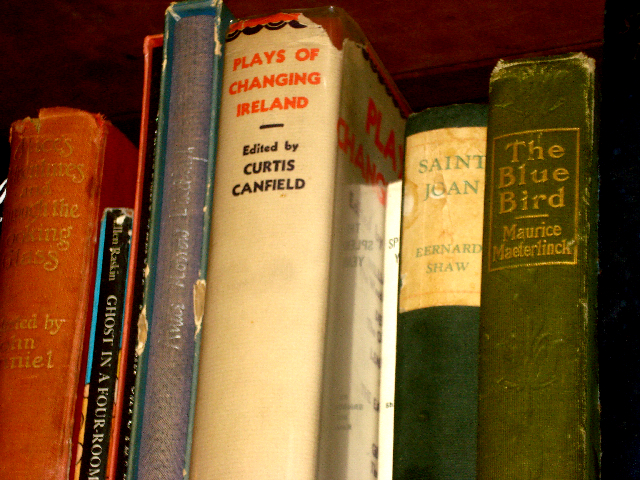
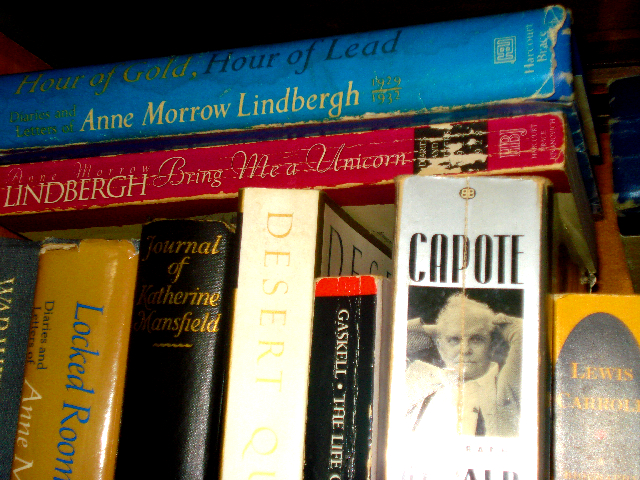
And of course I want to end with:
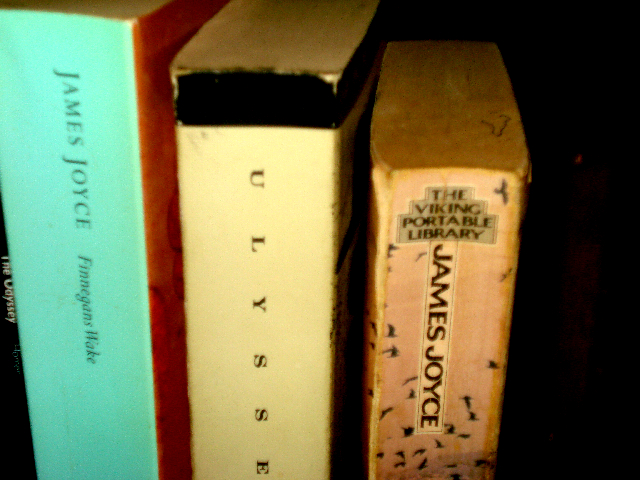
Montage ...
... from my fridge. Why oh why am I taking pictures of my fridge? Because it makes me happy. That's why.


And now ... randomly ... my Hail Mary plate.

Don't ask.
Montage
... from my apartment ...
I have taken down a bunch of my stuff from the wall - for various reasons - and it is stacked up in a corner. Additionally, I've been working on this big writing project - therefore all of my writing stuff and little filing boxes are out and about (I have no desk, by choice - I like to loll about on the floor like a Bedouin.) - but anyway - I happened to glance at the scene before me - and it cracked me up. Rocky rising up above my piles of work.

Woah
Check out the title of this blog post. I'm kind of proud of that, whether or not it is true in a universal way. It means my point was made - and I thank them for reading. It means what I wrote touched somebody, got to them, got inside them. And so my thought is: "Mission accomplished."
Dare I hope???
I'm quoting Cashel there. That's how he prays. "God, dare I hope????"
I've heard two tracks now from Tori Amos' new album. And I LOVE both of them. Could it be ... could it be ... that she's back?
I'm almost scared ... because I've been disappointed in her for years - after being so into her that the hairs on my neck would literally rise up when I would listen to "Everybody Else's Girl". I saw Tori play in a small club in Chicago before Little Earthquakes came out - before she was famous. It was one of the most riveting awesome concerts I have ever gone to - she is spectacular live. And then Little Earthquakes came out and I was like: WHAT? THIS CHICK IS OUT OF THIS WORLD. Years have passed ... and at some point, she just lost me. I am glad she continues to experiment, I am glad she is not just repeating herself - she's an artist, she doesn't give a shit. I appreciate that. But I lost interest. Boys for Pele was the beginning of it ... even though I love some of the tracks there ... and From the Choirgirl Hotel also has some of that sound that I love ... it's when she gets intense that I get interested. By that I mean: when she rocks. Tori hasn't rocked in a while. Her stuff is too anti-melodic, and ... soft. (Recently, I mean.) I like her anger. I keep buying her stuff because ... I live in hope. (I wrote about it here: What it means to REALLY be a fan. Interesting side note - I also talk about Atwood in that post. Hm. Weird.)
But so far so good.
I'm thrilled. I can't WAIT to hear the rest of it.
Tori, dare I hope????
Thoughts on "The Long Goodbye"
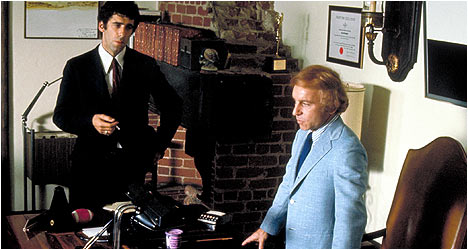
Allison and I had a wonderful time yesterday, our first real summery day - with cherry blossoms waving over 11th Street - a gorgeous canopy - and everybody busting out the tank tops and flip flips in celebration of the weather. We headed down to the Film Forum (I inhaled a slice of pizza as we walked) to see Robert Altman's The Long Goodbye - a movie neither of us had seen.
I found Roger Ebert's in-depth analysis of the film - and posted it below the fold.
Thoughts:
-- we LOVED the naked yoga girls across the way. We loved how certain scenes in his apartment would be going on - and you could get glimpses of their goings-on out the window. Every time we caught a glimpse of their contortions, we would just lose it.
-- awesome opening scene with that cat.
-- Mark Rydell is fantastic. Director of On Golden Pond, among other things ... also he runs Actors Studio West out in LA ... in addition to all of that, he is a terrific actor. With the benign baby face ... it's very interesting, because he plays such a terrifying guy here. Unpredictable. Horrible moment of violence that comes from out of nowhere ... and yet is completley logical - makes you realize the danger of this guy.
-- Allison and I totally loved Harry - the inexperienced guy hired to follow Philip Marlowe. At one point, Gould is walking - and Harry is right there behind him - and Gould turns and says, "Harry ... when you follow me, I'm not supposed to see you." Like - giving him helpful tips. Also, Harry is on a stake-out outside Marlowe's place - but he gets completely distracted by the flower-power hippie girls, meditating nude on the balcony ... Marlowe comes out to go to his car and he and Harry chat for a while (which is hysterical, because Harry is supposed to be stalking Marlowe). Harry is agog about the naked girls. "So ... who are they? What are they doing?" Marlowe, cigarette in his mouth, says, "They're doing yoga." Harry, stunned, "What's that?" Marlowe, "I don't know ... Yoga. They do yoga." Harry can't believe it - he glances back up at the balcony and says, "I remember when people just had jobs." Hysterical line.
-- Gould is great. Kind of oddly sexy. I can't imagine anyone else playing this part. I mean, many great actors have played Philip Marlowe, obviously - but I can only imagine Gould playing this particular Marlowe.
-- Hilarious time-travel moment. Marlowe is defending himself in one scene - as the threats become larger - as he walks off, he is saying, "I'm gonna call Ronald Reagan ..." Meaning: the governor. People in the audience laughed ... it's just one of those funny moments ... but then in a later scene, when Mark Rydell is threatening Marlowe, he has a bunch of goons with him, big scary-looking guys ... and one of them is a young and silent and ENORMOUS Arnold Schwarzenegger. You couldn't keep your eyes off him because he is now so famous ... and he stands there, without his shirt on, flexing the muscles in his chest-plates - from side to side. Left, right, left, right ...
-- Obviously Altman has a point of view. By just choosing where to put the camera, he has a point of view. He chooses to make his shots long and meandering - a slow zoom in, or a slow pan across, etc. But it's not like other film directors - who use close-ups for expediency - where they tell you explicitly where to look. Altman doesn't do that. It's always been an interesting experience watching his movies because of that. In my opinion, he makes most other movie directors look shallow. He is willing to have us, in the audience, have moments of, "Hmmmm ... now what is going on here .... why is he shooting through a window with a reflection of the ocean in it ... and why is he using a two-shot here ... where's the closeup?" Close-ups are no longer used so sparingly - if you see Bringing Up Baby there are maybe, MAYBE, 15 close-ups in the whole movie. So every time there's a close-up it truly MEANS something. Now directors just use them because it's easier, it's easier to tell your story. Altman is not a close-up director. His camera appears to have no opinion (although, again, that is an illusion). Like - we have violent dark scenes in Marlowe's apartment - and out the window - we see naked girls dancing wtih each other ... but it doesn't make a fetish of their naked bodies, it doesnt' cut away to a shot of them to make sure we "get it" ... Both scenes go on at the same time. I love it. It's three-dimensional film-making.
-- Roger Ebert's thoughts below are really interesting. Philip Marlowe IS a 1950s guy in a 1970s world.
-- An interesting thing about this particular Marlowe: he does not appear to have a sex drive. He is uninterested in women. He's not indifferent - the way he treats the naked girls is kind, humorous, and casual. He picks up brownie mix for them, because all they do is practice yoga and make pot brownies. He doesn't appear to sexualize them, even though they stand there, talking to him, naked breasts pointing at him. He barely notices. He is distracted, he is self-involved - he talks to himself (Ebert's thoughts about that are very interesting below). It's interesting, though - to see a handsome virile guy like Gould abdicate that part of his personality for the role. It's strange. You keep waiting for a romance to be part of the story (again, because we, as audience members, are trained for that) ... and when it doesn't happen, it's disorienting.
I love the disorientation of watching Altman movies. Even when they are not totally successful - I prefer his stuff to almost anybody else's.
ROGER EBERT, "THE LONG GOODBYE"
Robert Altman's "The Long Goodbye" (1973) attacks film noir with three of his most cherished tools: Whimsy, spontaneity and narrative perversity. He is always the most youthful of directors, and here he gives us the youngest of Philip Marlowes, the private eye as a Hardy boy. Marlowe hides in the bushes, pokes his nose up against a window, complains like a spoiled child, and runs after a car driven by the sexy heroine, crying out "Mrs. Wade! Mrs. Wade!" As a counterweight, the movie contains two startling acts of violence; both blindside us, and neither is in the original Raymond Chandler novel.
Altman began with a screenplay by Leigh Brackett, the legendary writer of "The Big Sleep" (1946), the greatest of the many films inspired by Marlowe. On that one her co-writer was William Faulkner. There is a famous story that they asked Chandler who killed one of the characters (or was it suicide?). Chandler's reply: "I don't know." There is a nod to that in "The Long Goodbye" when a character who was murdered in the book commits suicide in the movie.
Certainly the plot of "The Long Goodbye" is a labyrinth not easily negotiated. Chandler's 1953 novel leads Marlowe into a web of deception so complex you could call it arbitrary. The book is not about a story but about the code of a private eye in a corrupt world. It is all about mood, personal style, and language. In her adaptation, Brackett dumps sequences from Chandler, adds some of her own (she sends Marlowe to Mexico twice), reassigns killings, and makes it almost impossible to track a suitcase filled with a mobster's money.
I went through the film a shot at a time two weeks ago at the Conference on World Affairs at the University of Colorado, sitting in the dark with several hundred others as we asked ourselves, What do we know, how do we know it, and is it true? Many of our questions center on the rich, sex-drenched Eileen (Nina Van Pallandt). Does she desire the death of her husband, Roger Wade, an alcoholic writer played by the gruff old bear Sterling Hayden? Or does she only want free of him? What about that seductive dinner she serves Marlowe (Elliott Gould) on the night Wade walks into the ocean? Does she intend to sleep with Marlowe? She does in the novel, and he is later part of her alibi when she kills Wade and makes it look like suicide. But here she doesn't kill Wade. What is the link connecting Terry Lennox (the baseball star Jim Bouton), Eileen and the gangster Marty Augustine (Mark Rydell)? Does Augustine owe Wade money, as he claims to Marlowe, or does Wade owe Augustine money, as Wade implies in a Freudian slip? What is the exact connection between any money owed to anyone and the money in the suitcase? Only a final, blunt speech by Lennox, Marlowe's unworthy friend, answers some of our questions.
Elliott Gould says on the DVD that Altman made many changes to Brackett's screenplay, but that when she saw the movie not long before she died, she said she was "more than satisfied." One change is to make Philip Marlowe, that laconic loner with a code of honor, into what Altman and Gould privately called "Rip Van Marlowe." When he awakens at the beginning of the movie, he's a 1953 character in a 1973 world. He wears a dark suit, white shirt and narrow tie in a world of flower power and nude yoga. He chain-smokes; no one else smokes. He is loyal to Terry Lennox and considers him his friend, but the movie establishes their friendship only by showing them playing liar's poker, and Lennox is no friend. Marlowe carries a $5,000 bill for most of the movie, but never charges for any of his services. He is a knight errant, and like Don Quixote imperfectly understands the world he inhabits.
The earlier movie Marlowes (Humphrey Bogart, James Caan, James Garner, Robert Mitchum, Robert Montgomery, Dick Powell) are terse and guarded. They talk, as Chandler wrote, "with rude wit, a lively sense of the grotesque, a disgust for sham, and a contempt for pettiness." And they talk a lot, because they narrate the novels. Gould's Marlowe has these qualities, but they emerge in meandering dialogue that plays as a bemused commentary to himself. In the novel, Marlowe has no pets, but here he has a cat, and in the famous pre-credit opening sequence he attempts to convince the cat he is supplying its favorite cat food, but the cat is not fooled. In a movie that throws large chunks of plot overboard, there is no reason for this sequence, except that it establishes Marlowe as a man who is more loyal to his cat than anyone is to him.
The plot can be summarized in a few words, or endlessly. The rich playboy Lennox asks Marlowe to drive him to Tijuana. Marlowe does, and is questioned by the cops and jailed after Lennox's wife is found beaten to death. Released by the cops after Lennox's suicide in Mexico, Marlowe is visited by the gangster Marty Augustine and his goons. Augustine thinks Marlowe has money Lennox was carrying. In one of the most shocking moments in movie history, he commits an act of cruelty and says, "Now that's someone I love. Think what could happen to you."
Marlowe follows him to the Malibu beach house of the writer Roger Wade and his wife Eileen, and is later hired by Eileen to track down Roger after he runs away to a shady drying-out sanitarium. How are Lennox, the Wades and Augustine connected?
I don't think the answer to that question concerns Altman nearly as much as the look and feel of the film. He wants to show a private eye from the noir era blundering through a plot he is perhaps too naive to understand. The movie's visual strategy underlines his confusion. Altman and his cinematographer, Vilmos Zsigmond, "flashed" the color film with carefully calculated extra light, to give it a faded, pastel quality, as if Marlowe's world refuses to reveal vivid colors and sharp definition. Most of the shots are filmed through foregrounds that obscure: Panes of glass, trees and shrubbery, architectural details, all clouding Marlowe's view (and ours). The famous Altman overlapping dialogue gives the impression that Marlowe doesn't pick up on everything around him. Far from resenting the murkiness in his world, Marlowe repeats the catch-phrase, "It's all right with me." The line was improvised by Gould, and he and Altman decided to use it throughout the story as an ironic refrain.
There is another refrain: The title theme, which is essentially the only music heard in the film. Altman uses it again and again, with many different performers (even a Mexican marching band, with the sheet music pinned to the shirt of the man in front of them). At Boulder, the musician Dave Grusin, who worked on the film, and told us Altman gathered a group of musicians on a sound stage and had them spend an evening playing around with different arrangements of the song. Why did Altman only use the one song? I�ve heard a lot of theories, of which the most convincing is, it amused him.
The visuals and sound undergo a shift after the suicide of Roger Wade. There is a scene on the beach where Marlowe pesters people with questions and accuses them of dishonesty; he sounds like a child, a drunk, or both. But then color begins to saturate the pale visuals, the foregrounds no longer obscure, characters start talking one at a time, and finally in the vivid sunlight of Mexico, Marlowe is able to see and hear clearly, and act decisively.
Casting is crucial in film noir, because the actors have to arrive already bearing their fates. Altman's actors are as unexpected as they are inevitable. Sterling Hayden, a ravaged giant, roars and blusters on his way to his grave. As his wife, Altman cast Nina Van Pallandt, then famous as the mistress of Clifford Irving, author of the celebrated fake autobiography of Howard Hughes. She could act, but she did more than act, she embodied a Malibu beach temptress. Mark Rydell, the director, seems to be channeling Martin Scorsese's verbal style in a performance that uses elaborate politeness as a mask for savagery. And Elliott Gould is a Marlowe thrust into a story were everybody else knows their roles. He wanders clueless and complaining, and then suddenly understands exactly what he must do.
"The Long Goodbye" should not be anybody's first film noir, nor their first Altman movie. Most of its effect comes from the way it pushes against the genre, and the way Altman undermines the premise of all private eye movies, which is that the hero can walk down mean streets, see clearly, and tell right from wrong. The man of honor from 1953 is lost in the hazy narcissism of 1973, and it's not all right with him.
The Books: "Cat's Eye" (Margaret Atwood)
Next up in my Daily Book Excerpt ... Adult fiction:
Here is a second excerpt from Cat's Eye - by Margaret Atwood.
Grace Smeath's mother (the one with the bad heart) is one of Atwood's most haunting characterizations. I remember my response to her when I first read the book (my only time reading the book) ... I was scared of her. She was so glum, so grotesque - Atwood really points up the disgusting nature of her appearance ... she was just a BLANK. Now what is interesting about the book (and someday I really have to go back and read it) is that ... Atwood describes this person from a child's point of view. Elaine is our "way in" - so we see the world through her eyes. We are afraid of Grace Smeath's dumpy unsmiling mother. She seems like every humorless grownup we have ever known. But then, at some point ... as Elaine gets older, as Elaine becomes an adult - and there's that whole section of the book where everything washes away, and she becomes suicidal - a terrifying section ... anyway, Elaine grows older, has disappointments, setbacks - she loses things, and loses BIG ... and at some point, as an adult woman, she asks the question that she could never have asked as a child: What had happened to Grace Smeath's mother to make her so unhappy? This is the empathic response. This is when you truly become human. When you can look at someone who seems incomprehensible, vehemently unpleasant ... and wonder: Why? But Elaine still has this hatred towards her ... perhaps that is the "no no no that has nothing to do with me" kneejerk response of true identification. She sees herself in Grace Smeath's mother, and it represents everything she despises.
Grace Smeath's mother was a woman. Elaine is a woman, too. There is a similarity of experience with all of us ... that's what the sisterhood is all about. Elaine can no longer put Grace Smeath's mother in a box, labeled: Mean Lady. She feels compassion ... she feels indentification ... she looks back on the image of Grace Smeath's mother lying all day on a couch ... and thinks: Things must have been really awful for that woman.
And I guess as I read the book - I moved from disgust and fear to identification. I could be Grace Smeath's mother. I could be that prone woman, laid low by ... a crushing depression ... unable to cope with life, using the excuse of a bad heart to get me out of living.
It's very moving. But our first meeting with this woman has none of that empathy. Because Elaine is just a little girl.
Excerpt # 2 from Cat's Eye - by Margaret Atwood.
It's the darkest time of the year. Even in the daytime it seems dark; and at night, when the lights are on, this darkness pervades everything, like a fog. Outside there are only a few streetlights, and they're far apart and not very bright. The lamps in people's houses cast a yellowish light, not cold and greenish but a buttery dim yellow with a tinge of brown. The colors of things in houses have a darkness mixed into them: maroon, mushroom beige, a muted green, a dusty rose. These colors look a little dirty, like the squares on a paint box when you forget to rinse the brush.
We have a maroon chesterfield which has come out of storage, with an oriental-style maroon and purple rug in front of it. We have a tri-light floor lamp. The air in the evening lamplight is coagulated, like a custard thickening; heavier sediments of light collect in the corners of the living room. The drapes are kept closed at night, folds and folds of cloth drawn against the winter, hoarding the dim heavy light, keeping it in.
In the light I spread the evening paper out on the polished hardwood floor and rest on my knees and elbows, reading the comics. In the comics there are people with round holes for eyes, others who can hypnotize you instantly, others with secret identities, others who can stretch their faces into any shape at all. Around me is the scet of newsprint and floor wax, the bureau drawer smell of my itchy stockings mingled with that of grimy knees, the scratchy hot smell of wool plaid and the cat box aroma of cotton underpants. Behind me the radio plays square dance music from the Maritimes, Don Messer and His Islanders, in preparation for the six o'clock news. The radio is of dark varnished wood with a single green eye that moes along the dial as you turn the knob. Between the stations this eye makes eerie noises from outer space. Radio waves, says Stephen.
***
Often, now, Grace Smeath asks me over to her house after school without asking Carol. She tells Carol there's a reason why she isn't invited: it's because of her mother. Her mother is tired, so Grace can only have one best friend over that day.
Grace's mother has a bad heart. Grace doesn't treat this as a secret, as Carol would. She says it unemotionally, politely, as if requesting you to wipe your feet on the mat; but also smugly, as if she has something, some privilege or moral superiority that the two of us don't share. It's the attitude she takes toward the rubber plant that stands on the landing halfway up her stairs. This is the only plant in Grace's house, and we aren't allowed to touch it. It's very old and has to be wiped off leaf by leaf with milk. Mrs. Smeath's bad heart is like that. It's because of this heart that we have to tiptoe, walk quietly, stifle our laughter, do what Grace says. Bad hearts have their uses; even I can see that.
Every afternoon Mrs. Smeath has to take a rest. She does this, not in her bedroom, but on the chesterfield in the living room, stretched out with her shoes off and a knitted afghan covering her. That is how she is always to be found when we go there to play after school. We come in through the side door, up the steps to the kitchen, trying to be as quiet as possible, and into the dining room as far as the double French doors, where we peer in through the glass panes, trying to see whether her eyes are open or closed. She's never asleep. But there's always the possibility - put into our heads by Grace, in the same factual way - that on any given day she may be dead.
Mrs. Smeath is not like Mrs. Campbell. For instance, she has no twin sets, and views them with contempt. I know this because once, when Carol was bragging about her mother's twin sets, Mrs. Smeath said, "Is that so," not as a question but as a way of making Carol shut up. She doesn't wear lipstick or face powder, even when she goes out. She has big bones, square teeth witih little gaps between them so that you can see each tooth distinctly, skin that looks rubbed raw as if scrubbed with a potato brush. Her face is rounded and bland, with that white skin of Grace's, though without the freckles. She wears glasses like Grace's too, but hers have steel rims instead of brown ones. Her hair is parted down the middle and graying at the temples, braided and wound over her head into a flat hair crown crisscrossed with hairpins.
She wears print housedresses, not only in the mornings but most of the time. Over the dresses she wears bibbed aprons that sag at the bosom and make it look as if she doesnt' have two breasts but only one, a single breast that goes all the way across her front and continues down until it joins her waist. She wears lisle stockings with seams, which make her legs look stuffed and sewn up the backs. She wears brown Oxfords. Sometimes, instead of the stockings, she has thin cotton socks, above which her legs rise white and sparsely haired, like a woman's mustache. She has a mustache too, though not very much of one, just a sprinkling of hairs around the corners of the mouth. She smiles a lot, with her lips closed over her large teeth; but, like Grace, she does not laugh.
She has big hands, knuckly and red from the wash. There's a lot of wash, because Grace has two younger sisters who get her skirts and blouses and also her underpants passed down to them. I'm used to getting my brother's jerseys, but not his underpants. It's these underpants, thin and gray with use, that hang dripping on the line over our heads as we sit in Grace's cellar pretending to be schoolchildren.
Before Valentine's Day we have to cut out hearts of red construction paper at school and decorate them with pieces of paper doily to stick on the tall thin windows. While I am cutting mine I think about Mrs. Smeath's bad heart. What exactly is wrong with it? I picture it hidden, underneath her woolen afghan and the billow of her apron bib, pumping in the thick fleshy darkness of the inside of her body: something taboo, intimate. It would be red, but with a reddish-black patch on it, like rot in an apple or a bruise. It hurts when I think about it. A little sharp wince of pain goes through me, as it did when I watched my brother cut his finger once on a pane of glass. But the bad heart is also compelling. It's a curiosity, a deformity. A horrible treasure.
Day after day I press my nose against the glass of the French doors, trying to see if Mrs. Smeath is still alive. This is how I will see her forever: lying unmoving, like something in a museum, with her head on the antimacassar pinned to the arm of the chesterfield, a bed pillow under her neck, the rubber plant on the landing visible behind her, turning her head to look at us, her scrubbed face, without her glasses, white and strangely luminouse in the dim space, like a phosphorescent mushroom. She is ten years younger than I am now. Why do I hate her so much? Why do I care, in any way, what went on in her head?
National Poetry Month: Wallace Stevens
A fascinating man - the fact that he was a Pulitzer-Prize winning poet, along with a vice president of the Hartford Accident and Indemnity Company. He had a 9 to 5 job the entire time he was writing these amazing poems. He felt dead when he was at his job ... and yet once his fame had reached him, and he was offered professorships at Harvard - he turned it down. An interesting choice, not very common among poets. I love his stuff - I can't say I "get" it all the time, but I comfort myself that that was Stevens's point. He didn't write to be understood, not necessarily. He wrote to express, describe, contemplate ... There's a perfection in his descriptions (the following poem - his first big break as a poet - is a great example). It's not like you are looking at a picture - that he is presenting you. It's like somehow his language has brought you inside. It's unexpected - as most sensoral experiences are. Things aren't literal, when you get into the realm of experience. A scent of somethign may spark off a completely unrelated memory ... or a snatch of music heard makes you remember a golden slant of light from when you were four years old. The senses merge, blend, come apart, merge again. I love his stuff.
Sunday Morning
1
Complacencies of the peignoir, and late
Coffee and oranges in a sunny chair,
And the green freedom of a cockatoo
Upon a rug mingle to dissipate
The holy hush of ancient sacrifice.
She dreams a little, and she feels the dark
Encroachment of that old catastrophe,
As a calm darkens among water-lights.
The pungent oranges and bright, green wings
Seem things in some procession of the dead,
Winding across wide water, without sound.
The day is like wide water, without sound.
Stilled for the passing of her dreaming feet
Over the seas, to silent Palestine,
Dominion of the blood and sepulchre.
2
Why should she give her bounty to the dead?
What is divinity if it can come
Only in silent shadows and in dreams?
Shall she not find in comforts of the sun,
In pungent fruit and bright green wings, or else
In any balm or beauty of the earth,
Things to be cherished like the thought of heaven?
Divinity must live within herself:
Passions of rain, or moods in falling snow;
Grievings in loneliness, or unsubdued
Elations when the forest blooms; gusty
Emotions on wet roads on autumn nights;
All pleasures and all pains, remembering
The bough of summer and the winter branch.
These are the measure destined for her soul.
3
Jove in the clouds had his inhuman birth.
No mother suckled him, no sweet land gave
Large-mannered motions to his mythy mind.
He moved among us, as a muttering king,
Magnificent, would move among his hinds,
Until our blood, commingling, virginal,
With heaven, brought such requital to desire
The very hinds discerned it, in a star.
Shall our blood fail? Or shall it come to be
The blood of paradise? And shall the earth
Seem all of paradise that we shall know?
The sky will be much friendlier then than now,
A part of labor and a part of pain,
And next in glory to enduring love,
Not this dividing and indifferent blue.
4
She says, "I am content when wakened birds,
Before they fly, test the reality
Of misty fields, by their sweet questionings;
But when the birds are gone, and their warm fields
Return no more, where, then, is paradise?"
There is not any haunt of prophecy,
Nor any old chimera of the grave,
Neither the golden underground, nor isle
Melodious, where spirits gat them home,
Nor visionary south, nor cloudy palm
Remote on heaven's hill, that has endured
As April's green endures; or will endure
Like her remembrance of awakened birds,
Or her desire for June and evening, tipped
By the consummation of the swallow's wings.
5
She says, "But in contentment I still feel
The need of some imperishable bliss."
Death is the mother of beauty; hence from her,
Alone, shall come fulfillment to our dreams
And our desires. Although she strews the leaves
Of sure obliteration on our paths,
The path sick sorrow took, the many paths
Where triumph rang its brassy phrase, or love
Whispered a little out of tenderness,
She makes the willow shiver in the sun
For maidens who were wont to sit and gaze
Upon the grass, relinquished to their feet.
She causes boys to pile new plums and pears
On disregarded plate. The maidens taste
And stray impassioned in the littering leaves.
6
Is there no change of death in paradise?
Does ripe fruit never fall? Or do the boughs
Hang always heavy in that perfect sky,
Unchanging, yet so like our perishing earth,
With rivers like our own that seek for seas
They never find, the same receding shores
That never touch with inarticulate pang?
Why set pear upon those river-banks
Or spice the shores with odors of the plum?
Alas, that they should wear our colors there,
The silken weavings of our afternoons,
And pick the strings of our insipid lutes!
Death is the mother of beauty, mystical,
Within whose burning bosom we devise
Our earthly mothers waiting, sleeplessly.
7
Supple and turbulent, a ring of men
Shall chant in orgy on a summer morn
Their boisterous devotion to the sun,
Not as a god, but as a god might be,
Naked among them, like a savage source.
Their chant shall be a chant of paradise,
Out of their blood, returning to the sky;
And in their chant shall enter, voice by voice,
The windy lake wherein their lord delights,
The trees, like serafin, and echoing hills,
That choir among themselves long afterward.
They shall know well the heavenly fellowship
Of men that perish and of summer morn.
And whence they came and whither they shall go
The dew upon their feel shall manifest.
8
She hears, upon that water without sound,
A voice that cries, "The tomb in Palestine
Is not the porch of spirits lingering.
It is the grave of Jesus, where he lay."
We live in an old chaos of the sun,
Or old dependency of day and night,
Or island solitude, unsponsored, free,
Of that wide water, inescapable.
Deer walk upon our mountains, and the quail
Whistle about us their spontaneous cries;
Sweet berries ripen in the wilderness;
And, in the isolation of the sky,
At evening, casual flocks of pigeons make
Ambiguous undulations as they sink,
Downward to darkness, on extended wings.

"No. 7 of Sunday Morning is, as you suggest, of a different tone, but it does not seem to be too detached to conclude with. The words "On disregarded plate" in No. 5 are, apparently, obscure. Plate is used in the sense of so-called family plate. Disregarded refers to the disuse into which things fall that have been possessed for a long time. I mean, therefore, that death releases and renews. What the old have come to disregard, the young inherit and make use of." -- Wallace Stevens, letter to Harriet Monroe, 1915
"I didn�t know him as anything but a lawyer and a business executive [in 1931, when Taylor, an experienced surety lawyer, began working in the Hartford Accident and Indemnity�s Insurance Department in New York] � To him [gallery going] was just part of life. And Stevens enjoyed life. I don�t care what aspect of it, he enjoyed it. A few times we�d go over to some concert in the Times Square area: he used to like Stravinsky, and we�d go to some Stravinsky concerts over there. I don�t think we ever went to a musical. I don�t think we ever went to a play. He enjoyed things from Forty-second Street north to the Carlyle Hotel, and in between there were bistros and there were galleries; this, that and the other. This is mostly on the East Side, up and down Madison Avenue. Sometimes he�d come down and he�d just walk around by himself. He loved to walk. [Once] he was walking down Madison Avenue, looking at the antique stores. This particular one was closed. He called me Monday morning , said he�d been [to New York from Hartford] Saturday, and he saw this lamp. He recognized it as a choice piece of pottery, porcelain I guess it was, and some kind of fancy shade on it. He wanted to know if I could go up there that day and see if I could buy it for him. So I went up and the price on this little old table lamp was two hundred dollars. That was a lot of money in the thirties. 'Oh, good God!' he said, but he sent the two hundred dollars down. He said, 'Make them pack it well, and they�ll have to pay the cost of the shipping.' And they did; they were probably darn glad to get two hundred dollars. �" -- Wilson Taylor
"It is easy to suppose that few people realize on that occasion, which comes to all of us, when we look at the blue sky for the first time, that is to say: not merely see it, but look at it and experience it and for the first time have a sense that we live in the center of a physical poetry, a geography that would be intolerable except for the non-geography that exists there - few people realize that they are looking at the world of their own thoughts and the world of their own feelings." -- Wallace Stevens, "The Figure of the Youth as Virile Poet"
"The imagination is the liberty of the mind ... It is intrpeid and eager and the extreme of its achievement lies in abstraction." -- Wallace Stevens
"� He said he enjoyed Havana very much, but the thing he enjoyed most was the climate, nature, the sky, the natural aspect. Not the city, the tropics. And the air. He said he thought the air in Cuba had something very special about it. And I said, "Are you saying about the air something similar to what is said in The Tempest? It�s a wonderful description of the air in the Bahamas. There�s something soft and sweet about the air." He said, "Yes, and how funny that you should talk about The Tempest," because obviously he was remembering that, too. He always talked with nostalgia about the South and south Florida. And the climate, too. Of course, this is typical of the people who live in the cold country, but to him it was not going to Florida or going to Havana to get away from the cold. It was something sensuous in his appreciation of being in Florida: what he felt in the skin. He said that [there] you live with your senses more than when you live in a cold place. This has to do with his poetry; it was part of his personality." -- Jos� Rodr�guez Feo
"I certainly do not exist from nine to six, when I am at the office." -- Wallace Stevens, in a letter to Elsie Moll before their marriage, Jan. 13, 1909
"Reading one's friends' books is a good deal like kissing their wives, I suppose. The less said about it, the better." -- Wallace Stevens
"I've read them of course, but I have to keep away from Eliot or I wouldn't have any individuality of my own." -- Wallace Stevens, when asked what he thought of Eliot's "4 Quartets"
"It is hard to imagine a more astonishing debut in "Poetry". Each line and each sentence is transparently clear, each image alive, the voices that speak are heard to speak. The difficulty only arises if we seek to paraphrase, because the poem as a whole is a process that cannot be reduced to a single meaning or set of meanings. It has taken us from a lawn, a late breakfast, a woman beginning a languid Sunday out of doors, through meditations on meaning, to a known wilderness." -- Michael Schmidt on Wallace Stevens' "Sunday Morning" - his first professionally published poem, 1915
"It is possible to read Stevens for years with intense pleasure and never to care what the poems mean because the sense of sense is so strong and the movement of emotion so assured." -- Michael Schmidt
"...a Keatsian allegiance is the clue ..." -- Donald Davie
"... an Edward Lear poetic, pushed toward all limits." -- Hugh Kenner
"From one end of the book to the other there is not an idea that can vitally affect the mind, there is not a word that can arouse emotion. The volume is a glittering edifice of icicles. Brilliant as the moon, the book is equally dead," -- Percy Hutchison in The New York Times (August 9, 1931) reviewing Stevens' first collection - now considered one of the greatest works of American poetry.
"I can well believe that [Whitman] remains highly vital for many people. The poems in which he collects large numbers of concrete things, particularly things each of which is poetic in itself or as part of the collection, have a validity which, for many people, must be enough and must seem to them all opulence and elan. For others, I imagine that what was once opulent begins to look a little threadbare and the collections seem substitutes for opulence even though they remain gatherings-together of precious Americana, certain to remain precious but not certain to remain poetry. The typical elan survives in many things. It seems to me, then, that Whitman is disintegrating as the world, of which he made himself a part, disintegrates. Crossing Brooklyn Ferry exhibits this disintegration. It is useless to treat everything in Whitman as of equal merit. A great deal of it exhibits little or none of his specific power. He seems often to have himself to write like himself. The good things, the superbly beautiful and moving things, are those that he wrote naturally, with an extemporaneous and irrepressible vehemence of emotion." -- Wallace Stevens, letter to Joseph Bennett, 1955
"I think I should select from my poems as my favorite the Emperor of Ice Cream. This wears a deliberately commonplace costume, and yet seems to me to contain something of the essential gaudiness of poetry; that is the reason why I like it." -- Wallace Stevens, letter to William Rose Benet, 1933
"Dear Janet:
I-The First time he came to the hospital, he expressed
a certain emptiness in his life.
His stay then was two weeks.
Two weeks later, he was in, and he asked the sister to send for me.
We sat and talked a long time.
During his visit this time, I saw him 9 or 10 times.
He was fascinated by the life of Pope Pius X,.
He spoke about a poem for this pope whose family name
was Sartori--- ( Meaning tailor)
At least 3 times, he talked about getting into the fold--
meaning the Catholic Church.
The doctrine of hell was an objection which we later
got thru that alright.
He often remarked about the peace and tranquility that
he experienced in going into a Catholic Church and
spending some time. He spoke about St. Patrick's Cathedral
in N.Y..
I can't give you the date of his baptism.
I think it might be recorded at the hospital.
He said he had never been baptized.
He was baptized absolutely.
Wallace and his wife had not been on speaking terms for
several years.
So we thought it better not to tell her.
She might cause a scene in the hospital.
Archbishop at the time told me not to make his (Wallace's)
conversion public, but the sister and the nurses on the
floor were all aware of it and were praying for him.
At the time--I did get a copy of his poems and also
a record that he did of some of his poems.
We talked about some of the poems.
I quoted some of the lines of one of them and he was
pleased.
He said if he got well, we would talk a lot more and
if not--he would see me in heaven.
That's about all I can give you now.
God's Blessing
Father Hanley
-- A letter from Father Arthur Hanley to Professor Janet McCann, dated July 24, 1977 - about Stevens' alleged deathbed coversion to Catholicism
More information on the wonderful Wallace Stevens here.
Other National Poetry month posts
April 21, 2007
Scanning Saturday
To anyone who remembers the story of the worst show I was ever in ... (or one of them anyway) ...
This is a photo of the cast (plus Jackie) backstage. This was the show where an audience member stood up during a production and shouted at us, as we were acting, "WHO WROTE THIS SHIT?" Good question, sir.
Our continuous game of Uno backstage was the only way we could manage to get through that horrific experience.
We are being brave here. We are merely enduring the production. It's allllll about Uno.

Scanning Saturday
Now, Sheila, do your own work. Build your own bird-feeder, don't copy your (bossy BOSSY) friend.
This is 4th grade, I believe. (The Year of Keith.) Yes, definitely it is - because Betsy isn't in the picture. Betsy came to our school in 5th grade, and after that - every picture I'm in, she's in too. Inseparable.
Scanning Saturday
Uhm ... there is really nothing I can say in defense of this photo.
I have nothing to say.
Warning: What you are about to see may be shocking ....

Scanning Saturday
Ah, makin' a movie. The glamour. The non-stop glamour.
I think I've said before that the best people to hang out with on a shoot are the sound dudes. They're always awesome, laid-back, humorous, and PATIENT. Never met a sound dude I didn't like. So this is the sound truck, during one of the hurry-up-and-wait days of shooting.
But still. The parade of glamour in this business never ceases to amaze me.
Scanning Saturday
Holy crap - I knew a photo existed of the moment my childhood died ... but didn't realize that I had it in my possession.
Here it is! The very moment my illusions shattered ... captured on film. How many of us can say that??
Although you'd never know how devastated I was. Already I was an actress, artful at lying, hiding.

Backstory to this pivotal moment here.
Scanning Saturday
I was in 5th grade - or maybe 6th - and Betsy and I took some after-school photography program. I think Betsy and I must have had some assignment about getting the same shot from multiple angles. We got very creative. Here is one - where I am obviously attacking Betsy.
I have a ton more - where we zoom in on her face, or mine, a far off shot, a close-up ... it's hysterical.
The photos are disintegrating.
Oh, and by the way - we're at school here.
Scanning Saturday
Mitchell and I became FAST friends at age 19. Then we had a "bad time" which lasted 3 months, and where I was a totally cold bitch. Then came the thaw, and after that - we became obnoxiously close. Inseparable. Later, we laughed about it - how people in the theatre department must have been like, "Guys ... you're not the first two people to discover friendship ... please get over yourselves."
But we couldn't!!
We jitterbugged constantly. We knew one routine - and we did it over, and over and over ... complete with the choreographed bow. Like whether or not the music had come to an end - we HAD to do our bow, because that was the only way we knew how to end it.
Here we are in the act. This was after the thaw. As you can tell by my big red cheeks - which are also indicative of the summer, and also clearly show the effects of my jolly shame-free underage drinking. I love love love this photo. I miss those earrings.
Scanning Saturday
A very belated happy Easter. From another generation to this one.
I am rockin' such a cool purse and such a stylin' hat.
Clothes by Mother.

Scanning Saturday
Waiting for my laundry to be done. Thought I'd do some scanning. The next 2 weeks are going to be so busy that I feel nervous just contemplating how I will manage it - the work, the sleep, the eating, the schedule .... I will be occupied from 6 a.m. until at times 2 a.m. - not to mention all the writing I'll have to get done ... I'm kinda jazzed about it. I'll share more once it gets going ... For now, let's just say ... I am enjoying the last leisure time I will have until May is well underway.
So here's a scan.
I call it Urban Crisis. It should be clear why. In the photo, I don't seem too concerned about the urban crisis around me.

The Books: "Cat's Eye" (Margaret Atwood)
Next up in my Daily Book Excerpt ... Adult fiction:
Here is an excerpt from Cat's Eye - by Margaret Atwood. I've actually been dreading this moment, because I love this book so much. I don't know how to talk about it. I'm also going to post multiple excerpts because there is no way I can pick just one. This book is a tour de force. I have a feeling that when Atwood passes on, she will be known mainly as "the author of The Handmaid's Tale and other books ..." Maybe I'm wrong about that, I don't know - but to my taste, this is her greatest book. Handmaid's Tale was a scary book, an important book, a "zeitgeist moment" book - it tapped into fears that still exist today and will continue to exist tomorrow, as long as there are fundamentalists who want to curb the lives of women. But I wouldn't call it a "great" book. Cat's Eye is. God, is it great. But how do I talk about it?? I had (and still have) an intensely personal response to this book - because although Atwood is writing about a time that pretty much pre-dates me - she is writing about stuff that is universal. Before Mean Girls, there was Margaret Atwood. But that's minimizing this book. To say what it's about - is to do it a disservice. It's about so many things. And on another level: the writing!! Atwood warms up a bit here - and also parts of this book are truly funny. She has such a good eye for detail, for social mores - ridiculous and not ... her comments on the Toronto "art" scene (sorry - those quotations are necessary - and I'm just picking up on Atwood's gentle mockery) - the feeling of Toronto not being important or cosmopolitan enough ... and "trying too hard" - Atwood describes that exquisitely.
Like many of her books - this is not a strictly linear narrative. We go back and forth in time Elaine Risley is a middle-aged painter, who has come back to Toronto to attend a retrospective of her work at a prominent gallery. It's a big deal for her, a big moment in her career - the acknowledgement of her country for her art. So there's THAT part of the story - the present-day. Elaine preparing for her event. And then we go back in time. And the entire book is a sweeping saga of Elaine's life - and this is Atwood's most autobiographical novel. Her father was an entomologist - and Atwood spent the majority of her childhood traveling through the wildest reaches of Canada with her parents, living in log cabins in the middle of the woods - as her father did his work. It was not a "civilized" world ... she grew up wild, a nature girl ... so her confrontation with civilization was that much more vivid. She didn't "fit". She wasn't "domesticated", like other little girls. She loved bugs, and moss, and creepy crawly things under rocks, she loved mud, and freezing cold baths in remote lakes ... Her confrontation with the world of girls, which came later, was jarring. Cat's Eye is about that. Elaine's family moves to Toronto when she's about 8 or 9 ... and she says in the book "Until then I was happy." She befriends a couple of other little girls ... and they pal around ... and the main one, the main girl, is Cordelia.
In the present-day sections of the book - we hear about Cordelia. There is unfinished business with this old childhood friend. We get the sense that Elaine and Cordelia have lost touch. But why?
Back and forth, back and forth ... the Cordelia story comes out in patches, spots ... By the end of the book, we are drained. Devastated. Hopeful? Maybe. Atwood leaves it up to us.
Sorry to be vague - this book is so important to me. I'll think more about it, and try to be clearer about it.
Here's an excerpt in the beginning of the book. Elaine is in Toronto, it's one of the present-day sections ... everywhere she goes, she is haunted by ghosts. Herself as a youngster, her friends, and also: the old Toronto, the prim vicious small town she once knew ... Now it's gleaming and cosmopolitan ... but underneath that surface, Elaine knows nothing has changed. At this point in the book - we do not know who Cordelia is. We have not "met" her in the past sections of the narrative ... she is a mystery. We are not set up for her. But she is here, nonetheless.
Excerpt from Cat's Eye - by Margaret Atwood.
I get up off the duvet, feeling as if I haven't slept. I riffle through the herbal tea bags in the kitchenette, Lemon Mist, Morning Thunder, and bypass them in favor of some thick, jolting, poisonous coffee. I find myself standing in the middle of the main room, not knowing exactly how I got in here from the kitchenette. A little time jump, a little static on the screen, probably jet lag: up too late at night, drugged in the morning. Early Alzheimer's.
I sit at the window, drinking my coffee, biting my fingers, looking down the five stories. From this angle the pedestrians appear squashed from above, like deformed children. All around are flat-roofed, boxy warehouse buildings, and beyond them the flat railroad lands where the trains used to shunt back and forth, once the only entertainment available here on Sundays. Beyond that is flat Lake Ontario, a zero at the beginning and a zero at the end, slate-gray and brimming with venoms. Even the rain from it is carcinogenic.
I wash in Jon's tiny, greasy bathroom, resisting the medicine cabinet. The bathroom is smeared with fingerprints and painted dingy white, not the most flattering light. Jon wouldn't feel like an artist without a certain amount of dinge around. I squint into the mirror, preparing my face: with my contact lenses in I'm too close to the mirror, without them I'm too far away. I've taken to doing these mirror things with one lens in my mouth, glassy and thin like the tag end of a lemon drop. I could choke on it by mistake, an undignified way to die. I should get bifocals. But then I'd look like an old biddy.
I pull on my powder-blue sweatsuit, my disguise as a non-artist, and go down the four flights of stairs, tryiing to look brisk and purposeful. I could be a businesswoman out jogging. I could be a bank manager, on her day off. I head north, then east along Queen Street, which is another place we never used to go. It was rumored to be the haunt of grubby drunks, rubby-dubs we called them; they were said to drink rubbing alcohol and sleep in telephone booths and vomit on your shoes in the streetcar. But now it's art galleries and bookshops, boutiques filled with black clothing and weird footgear, the saw-toothed edge of trend.
I decide I'll go and have a look at the gallery, which I have never seen because all of this has been arranged by phone and mail. I don't intend to go in, make myself known, not yet. I just want to look at it from the outside. I'll walk past, glance casually, pretending to be a housewife, a tourist, someone window-shopping. Galleries are frightening places, places of evaluation, of judgment. I have to work up to them.
But before I reach the gallery I come to a wall of plywood, concealing a demolition. On it is spray-painted, in defiance of squeaky-clean Toronto: It's Bacon or Me, Babe. And underneath: What Is This Bacon and Where Can I Get Some? Beside this there's a poster. Or not a poster, more like a flier: a violent shade of purple, with green accents and black lettering: RISLEY IN RETROSPECT, it says; just the last name, like a boy. The name is mine and so is the face, more or less. It's the photo I sent the gallery. Except that now I have a mustache.
Whoever drew this mustache knew what he was doing. Or she: nothing precludes that. It's a curled, flowing mustache, like a cavalier's, with a graceful goatee to match. It goes with my hair.
I suppose I should be worried about this mustache. Is it just doodling, or is it political commentary, an act of aggression? Is it more like Kilroy Was Here or more like Fuck Off? I can remember drawing such mustaches myself, and the spite that went into them, the desire to ridicule, to deflate, and the feeling of power. It was defacing, it was taking away somebody's face. If I were younger I'd resent it.
As it is, I study the mustache and think: That looks sort of good. The mustache is like a costume. I examine it from several angles, as if I'm considering buying one for myself. It casts a different light. I think about men and their facial hair, and the opportunities for disguise and concealment they have always at their disposal. I think about mustache-covered men, and about how naked they must feel with the thing shaved off. How diminished. A lot of people would look better in a mustache.
Then, suddenly, I feel wonder. I have achieved, finally, a face that a mustache can be drawn on, a face that attracts mustaches. A public face, a face worth defacing. This is an accomplishment. I have made something of myself, something or other, after all.
I wonder if Cordelia will see this poster. I wonder if she'll recognize me, despite the mustache. Maybe she'll come to the opening. She'll walk through the door and I will turn, wearing black as a painter should, looking successful, holding a glass of only moderately bad wine. I won't spill a drop.
National Poetry Month: Emily Dickinson
We could read whatever we want into this poem, it's not "clear" - who is "You" - it would depend on where you are at in your life, the answer. I read this poem and I think of him. It's not really a pleasant thing to think about it, so long after the thing is done. But it happened. I have moved on. It was years ago. But the experience has marked me. And something about the line here: "Because you saturated Sight / And I had no more Eyes / For sordid excellence / As paradise" reminds me of how I felt about him. He saturated Sight.
640
I cannot live with You --
It would be Life --
And Life is over there --
Behind the Shelf
The Sexton keeps the Key to --
Putting up
Our Life -- His Porcelain --
Like a Cup --
Discarded of the Housewife --
Quaint -- or Broke --
A newer Sevres pleases --
Old Ones crack --
I could not die -- with You --
For One must wait
To shut the Other's Gaze down --
You -- could not --
And I -- Could I stand by
And see You -- freeze --
Without my Right of Frost --
Death's privilege?
Nor could I rise -- with You --
Because Your Face
Would put out Jesus' --
That New Grace
Glow plain -- and foreign
On my homesick Eye --
Except that You than He
Shone close by --
They'd judge Us -- How --
For You -- served Heaven -- You know,
Or sought to--
I could not --
Because You saturated Sight --
And I had no more Eyes
For sordid excellence
As Paradise
And were You lost, I would be --
Though My Name
Rang loudest
On the Heavenly fame --
And were You -- saved --
And I -- condemned to be
Where You were not --
That self -- were Hell to Me --
So We must meet apart --
You there -- I -- here --
With just the Door ajar
That Oceans are -- and Prayer --
And that White Sustenance --
Despair --

"She is the spider, not the fly." -- Alison Brackenbury
"Her relationship to books , to literary preedent and example, was similar. She was no ransacker and devourer of libraries. Like Lincoln, she knew relatively few volumes but knew them deeply. As a girl she attended Amherst Academy and also Mount Holyoke Female Seminary, a few miles distant, during her seventeenth year, but school gave her neither intellectual nor social satisfactions to compensate for the reassuring intimacy of home and family she keenly missed. The standard works she knew best and drew on most commonly for allusions and references in her poetry and vivid letters were the classic myths, the Bible, and Shakespeare. Among the English Romantics, she valued John Keats especially; among her Englishc ontemporaries she was particularly attracted by the Brontes, the Brownings, Alfred, Lord Tennyson, and George Eliot. None of these, however, can be said to have influenced her literary practice significantly. Indeed, not the least notable quality of her poetry is its dazzling originality. Thoreau and Emerson, especially the latter, as we know from her letters, were perhaps her most important contemporary American intellectual resources, though their liberal influence seems always to have been tempered by the legacy of a conservative Puritanism best expressed in the writings of Jonathan Edwards. Her chief prosodic and formal model was the commonly used hymnals of the times with their simple patterns of meter and rhyme." -- Norton Anthology of American Literature
"No great poet has written so much bad verse as Emily Dickinson ..." -- Richard Chase
"When I state myself, as the Representative of the Verse -- it does not mean -- me -- but a supposed person." -- Emily Dickinson to Thomas Wentworth Higginson
"Dear friend,
I congratulate you.
Disaster endears beyond Fortune --
E. Dickinson"
-- letter written to a friend after the friend's house had burned down
"Throughout her life ED was especially sensitive to such occasions." -- Emily Dickinson's editor, commenting on a poem Dickinson wrote on the 4th anniversary of Charlotte Bronte's death
"Whitman, Dickinson and Melville seem to me the best poets of the nineteenth century here in America." -- Randall Jarrell
"The language is not literary. It enacts heard experience. Kinsmen, unexpectedly met, chatting late into the night from their different places: it brings beauty and truth into intimate focus. Strange: These are the same great terms of Keats's 'cold pastoral'." -- Michael Schmidt
"Her coy and oddly childish poems of nature and female friendship are products of a time when one of the careers open to women was perpetual childhood." -- Richard Chase
"I never read his book - but was told that he was disgraceful." -- Emily Dickinson on Walt Whitman
"My Mother does not care for thought." -- Emily Dickinson to Thomas Wentworth Higginson
"I am growing very handsome indeed!" -- Emily Dickinson, age 14
"More than any other poet, Emily Dickinson seemed to tell me that the intense inner event, the personal and psychological, was inseparable from the universal; that there was a range for psychological poetry beyond mere self-expression." -- Adrienne Rich
"We have the legend, but the crucial facts in the recorded life are absent. Dickinson's reticence seems part of her poetical strategy: if we could assign the poems to specific emotional events, we would ground them. As it is, they are a miracle and a mystery of language." -- Michael Schmidt, "Lives of the Poets"
"Her wit is accuracy." -- Alison Brackenbury
"Immense in scale and oratorical in tone, this amazing short poem [Safe In Their Alabaster Chambers] departs from Dickinson's usual four-line stanza format, based on sturdy Protestant hymn measure. The first five-line stanza rolls out in a single, thrilling sentence, delivered in the magesterial public voice of a sermon or eulogy. Its as if the poem's disturbing theme - the dead and their defeated hopes - can barely be contained by traditional structure." -- Camille Paglia, "Break, Blow, Burn"
"Are you too deeply occupied to say if my verse is alive? The mind is so near itself it cannot see distinctly, and I have none to ask." -- Emily Dickinson to Thomas Higginson, 1862
"She sewed her poems into little books and put them away, one after another, in a box, where after her death her sister found them, nine hundred poems "tied together with twine" in "sixty volumes." And it's not an untenable theory that the beloved whom she mourns, departed, may be Christ, the soul's lover, rather than a particular man -- or a particular woman." -- Michael Schmidt
"Emily, you wretch! No more of this nonsense! I've traveled all the way from Springfield to see you. Come down at once." -- Samuel Bowles, shouting up the stairs at Emily. Emily finally did come down.
"A step like a pattering child's in entry & in glided a little plain woman with two smooth bands of reddish hair & a face a little like Belle Dove's; not plainer - with no good feature - in a very plain & exquisitely clean white pique & blue net worsted shawl. She came to me with two day lilies which she put in a sort of childlike way into my hand & said 'These are my introduction' in a soft frightened breathless childlike voice -- & added under her breathe Forgive me if I am frightened; I never see strangers & hardly know what I say -- but she talked soon & thenceforward continuously -- & deferentially -- sometimes stopping to ask me to talk instead of her -- but readily recommencing...I never was with any one who drained my nerve power so much. Without touching her, she drew from me. I am glad not to live near her." -- Thomas Wentworth Higginson
Other National Poetry month posts
April 20, 2007
Tribute night
To one of my favorite people in the world.
And some of my OTHER favorite people in the world are on the panel.
And I'm gonna be there, and I'm having a heart attack.
A photo I love
Posted for Allison (we're going to see The Long Goodbye this weekend at the Film Forum.) So this is for her. (And also for Mitchell. and Alex. And Babs lovers everywhere.) I particularly ADORE her beehive. The beehive and the bikini.
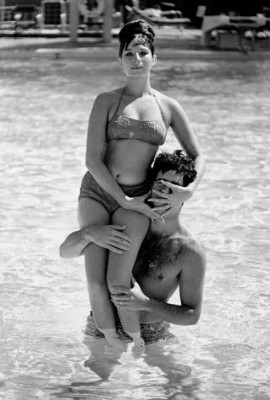
Barbra Streisand and Elliot Gould
Shouted at pointblank range:
"Don't even TRY, CHiPs! DON'T EVEN TRY!!!!!" [and then muttered, with sneering contempt]: "CHiPs..." ... as my boyfriend and Mitchell cower in fear ...
Oh fuckit. Congrats, Ponch.
The Books: "Bluebeard's Egg" - 'Two Stories About Emma' (Margaret Atwood)
Next up in my Daily Book Excerpt ... Adult fiction:
 Here is an excerpt from another story from Bluebeard's Egg - by Margaret Atwood. This one is called "Two Stories About Emma". I won't preface this one. I'll just say that this is the kind of writing I love. It just satisfies me.
Excerpt from another story from Bluebeard's Egg - by Margaret Atwood. "Two Stories About Emma".
You may think from what I've said that Emma is a sort of tomboy, willing to exchange cigarettes and backslaps with men, but otherwise impervious to them. On the contrary, Emma, although tall, is always falling in love, a venture that for her seems to be a lot like skydiving: you leap impulsively into thin air, and trust that your parachute will open.
The men she falls in love with are usually married, and awful as well, or this is what Emma's friends think. We try to produce nice men for her, men with whom she could settle down, as she keeps saying with what may be fake wistfulness that she would like to do. But these kindly or courteous or even solvent men don't interest Emma. She wants exceptional men, she says, men she can look up to, and so she adores, one after another, men who have excelled in their fields, frequently through ruthless egoism, back-stabbing and what Emma calls dedication, which often means that when the chips are down they have no real time for anyone else, including Emma. Why she can't spot this kind of man a mile off, especially after all that practice, I don't know. But as I've said, she's fearless. The rest of us have more self-protection.
At this time of her life - the world-travel time - Emma was in love with Robbie, who had been her professor at college. Robbie was twenty years older than Emma, a stocky red-bearded Scot whose grumpiness was legendary. Emma mistook it for shyness. She thought he was more spiritually mature than she was, and therefore difficult to understand. She also thought that Robbie, sooner or later, would realize that Emma, and not his wife of fifteen years, mother of his two sons, was his true soul mate. This was towards the beginning of Emma's career. Later she dropped the marriage motif, or at least did not say so much about it. But the men did not become any less awful.
Robbie was a leading man in his field, which was not large. He was an archaeologist, specializing in burials. In fact he was writing a book on comparative tombs, which took him here and there about the world. This was convenient for Emma. Robbie was never averse to having her join him, as long as she paid her own way. Among Robbie's other sins, the rest of us felt, was his exploitation of the liberated woman theme. He was always lecturing Emma about how she could be more liberated. But Emma loved him despite this.
Welcome to the Tribeca dungeon
I come down the stairs into the basement area - and at first glimpse think: Okay. I am about to be killed by an angry penis-hating butterfly-loving lunatic who orders me to put the lotion in the basket.
One look at this view and I am sure I have only moments to live.

I move further into the basement. Here's the corner. God, doesn't it look cozy and inviting??
I turn ... and find what I am looking for. Although it sort of has a "GATEWAY TO HELL" feel to it. Dare I continue on?

Closer ... through the mirror, the "ladies room" glows with the fires of hell.

The ceiling of the dark blue hallway. I'm being buried under bricks ... or I'm waiting for a small lonely FBI agent wearing night-goggles to come and save me.
I look down the blue hall to where I want to go ... and see a floating roll of toilet paper ... beckoning to me through the gloom.

This is what I see, looking up, as I am perched on the ol' can (actually, I should say as I am hovering over the toilet bowl ...). It's so cramped that my knees touch the door. This is far cry from the Charmin Brou-Haha. It almost looks like a torture device. Bricked in, so no one will hear you scream.

I am now fully ensconced in the red glow of the fires of hell ... yet I glance back out ... and can still see the blue cool hallway to freedom ...

It puts the lotion in the basket.

On my way out, I decide to check out the men's room. To see what kind of ambience they've got going on in there. This is my first glimpse.

I hightail it out of there.
Dusk in lower Manhattan
The streets seemed semi-deserted, and there were times when I could almost believe I was strolling around in 1910. It was a cloudy dusk, turning cloudy night, with smattering of rain ...I later found myself in what amounts to a dungeon -and I took pictures there too - but that'll be in the next post.
For now ... the beauty of a cloudy night in lower Manhattan. I was alone (during my walk anyway) but not lonely.
This is the AT & T building and I just thought it looked spectacular. Like something out of Brazil or Metropolis.

Street scene. Maybe it's just my sensibility but I look at that and feel a deep ache of aesthetic satisfaction. It just has so much in it ... it's night, you can feel the history of that street - and then just as an image ... the huge windows, the dusk, the fire escapes crawling diagonally, the beam of the street lamp ... Get ready, there are gonna be a million more like this one. It's a photo where you could conceivably be in another century.

It was getting a bit too dark to be shooting without a flash - hence the blurriness of this photo. A lot of these came out too blurry and I deleted most of them but this one for some reason appealed to me. Again, with the feeling of an early industrial city ... it seems to be from another time.

And then. A near-death experience caught on camera.

Ahhhh. I love to see mountain ranges, and forests, and crashing waves. But this is just as beautiful to me.

This struck me as kind of eerie and poetic. It's light - which means life - which means: "there are people behind this door" - but somehow this seems uninhabited ... like maybe it's an ALIEN behind the door, or something like that. Somethng alive but not quite human.

More urban poetry. The glowing of lamps through windows. This is not a residential area - it's a mix of industrial (old dusty fabric shops, garment stores) and cavernous art galleries, with 2 or 3 paintings hanging on otherwise empty walls. One side of the street is grimy, gritty (the ones I took above) and the other side gleams with stark whitness. Here's a glimpse from the gritty side.

The glare of this pirate totally stopped me in my tracks.

This image was glued onto a battered service entrance-door. I have no idea what it is but I love it.

Basquiat? Is that you?

The "clean" side of the street. Spectacular in its own way ... staring calmly across the narrow road at the early 20th century garment district shops.

As night fell, random lit windows gleamed. Like I said, this is not a residential area - so most of the windows were dark. The contrast struck me as so beautiful.

This might be my favorite photo of the batch. It's a lamp store - but with no signage, no Home Depot stamp, no corporate environment. This is a rough area. Completely functional. But poetic because of that.

Yet another "ahhhh" view of the street.
And let's end it with this guy. He called to me from his remote corner of the wall, in a gruff burbly voice, saying, "Hey. You wid da camera. Yo. Check me out, bitch!"

Next up? MY time in the dungeon ... a space right out of "Silence of the Lambs".
National Poetry Month: William Blake
I'm a huge Blake fan, I wrote about him here. What was really fun about compiling all of the quotes for today was I realized how polarizing a poet he really is. Was, and still is. Undeniably important, undeniably in the canon - but after that, everybody disagrees.
So here are two poems of the same topic - one from Songs of Innocence, one from Songs of Experience.
The Chimney Sweeper - from Songs of Innocence
When my mother died I was very young,
And my father sold me while yet my tongue
Could scarcely cry " 'weep! 'weep! 'weep! 'weep!"
So your chimneys I sweep & in soot I sleep.
There's little Tom Dacre, who cried when his head,
That curl'd llke a lamb's back. was shav'd: so I said
"Hush. Tom! never mind it, for when your head's bare
You know that the soot cannot spoil your white hair."
And so he was quiet & that very night,
As Tom was a-sleeping, he had such a sight!
That thousands of sweepers, Dick, Joe, Ned or Jack.
Were all of them lock'd up in coffins of black.
And by came an Angel who had a bright key,
And he open'd the coffins & set them all free;
Then down a green plain leaping, laughing, they run,
And wash in a river. and shine in the Sun.
Then naked & white, all their bags left behind,
They rise upon clouds and sport in the wind;
And the Angel told Tom, if he'd be a good boy,
He'd have God for his father & never want joy.
And so Tom awoke; and we rose in the dark.
And got with our bags & our brushes to work.
Tho' the morning was cold, Tom was happy & warm;
So if all do their duty they need not fear harm.
The Chimney Sweeper - Songs of Experience
A little black thing among the snow:
Crying weep, weep, in notes of woe!
Where are thy father & mother! say!
They are both gone up to the church to pray.
Because I was happy upon the heath,
And smil'd among the winters snow:
They clothed me in the clothes of death,
And taught me to sing the notes of woe.
And because I am happy, & dance & sing,
They think they have done me no injury:
And are gone to praise God & his Priest & King
Who make up a heaven of our misery.
The eagle never lost so much time as when he submitted to learn of the crow. -- William Blake
"He had no public: he very early gave up publishing in any serious sense. one obvious consequence, or aspect, of this knowledge is the carelessness that is so apparent in the later prophetic books. Blake had ceased to be capable of taking enough trouble." -- F.R. Leavis
Improvement makes strait roads, but the crooked roads without Improvement, are roads of Genius. -- Blake
"I mean, don't you think it's a little bit excessive?"
"The road of excess leads to the palace of wisdom. William Blake."
Pause.
"William Blake?"
"William Blake!"
"William Blake???"
"William Blake!!!"
-- Bull Durham
"I do not condemn Pope or Dryden because they did not understand imagination, but because they did not understand verse." -- William Blake
"The prophetic robe with its woof of meekness and its warp of wrath was forced on [Blake] by loneliness and his modest station in life." -- Robert Graves
"In his youth, [Blake] had a gift of simple and fair speech; but he lost it. Although he could always catch the heavenly harmony of thoughts he could seldom mount them on a fitting chariot of rhythm and rhyme. His fine passages were the direct gift of the Muse, and are followed by lines of other origin." -- Edward Thomas
"It is an honest against which the whole world conspires, because it is unpleasant." -- T.S. Eliot
"Think of a white cloud as being holy, you cannot love it, but think of a holy man within the cloud, love springs up in your thoughts, for to think of holiness distinct from man is impossible to the affections. Thought alone can make monsters, but the affections cannot." -- Blake
"He is very eighteenth century." -- T.S. Eliot
"The emotions are presented in an extremely simplified, abstract form. This form is one illustration of the eternal struggle of art against education, of the literary artist against the continuous deterioration of language." -- T.S. Eliot on "Songs of Innocence" and "Songs of Experience"
"In America in the late 1940s Allen Ginsberg, interested in Supreme Reality, alone and suffering a 'dark night of the soul sort of,' his lover Neal Cassady having sloped off, and having himself just masturbated, with a volume of Blake before him - 'I wasn't even reading, my eye was idling over the page of "Ah, Sun-flower," and it suddenly appeared - the poem I'd read a lot of times before.' He began to understand the poem, and 'suddenly, simultaneously with understanding it,' he 'heard a very deep earthen grave voice in the room, which I immediately assumed, I didn't think twice, was Blake's voice.' This 'apparitional voice' became his guiding spirit: 'It was like God had a human voice, with all the infinite tenderness and anciency and mortal gravity of a living Creator speaking to his son.' On Ginsberg this 'anciency fathered Howl, though the Blake simulacrum was aided by the hallucinogens popular at the time, the recipe for Part II of the poem including peyote, just as for Kaddish he was assisted by amphetamine injections. 'The amphetamine gives a peculiar metaphysical tinge to things, also. Space-outs.' Blake managed his visions without substance abuse. Ginsberg's appropriation of the poet of innocence and experience did much to promote Blake to the alternative culture of the 1950s and 1960s." -- Michael Schmidt, "Lives of the Poets"
"a completely and uncompromisingly individual idiom and technique ... individual, original, and isolated enough to be without influence." -- FR Leavis
"You cannot create a very large poem without introducing a more impersonal point of view, or splitting it up into various personalities. But the weakness of the long poems is certainly not that they are too visionary, too remote from the world. It is that Blake did not see enough, became too much occupied with ideas." -- TS Eliot
"Romantic writers glorified childhood as a state of innocence. Blake's 'The Chimey Sweeper', written in the same year as the French Revolution, combines the Romantic cult of the child with the new radical politics, whichcan both be traced to social thinker Jean-Jacques Rousseau. It is the boy sweep, rather than Blake, who speaks: he acts as the poet's dramatic persona or mask. There is no anger in his tale. On the contrary, the sweep's gentle acceptance of his miserable life makes his exploitation seem all the more atrocious. Blake shifts responsibility for protest onto us." -- Camille Paglia, "Break, Blow, Burn"
Some examples of Blake's art:

-- "Isaac Newton", 1795
-- Christ in the sepulcher guarded by angels - 1805
-- Whirlwind of Lovers (Illustration to Dante's Inferno)

-- The Ancient of Days - 1794

-- page from "Songs of Innocence" - The Chimney Sweeper is shown here
More information on William Blake here.
Other National Poetry month posts
April 19, 2007
The Books: "Bluebeard's Egg" - 'Significant Moments in the Life of my Mother' (Margaret Atwood)
Next up in my Daily Book Excerpt ... Adult fiction:
Here is an excerpt from Bluebeard's Egg - by Margaret Atwood. Another story collection - this came out in 1983. I'm trying to do this chronologically but I messed up. This one came out before Handmaid's Tale. I LOVE this short story collection. Every story is a little Atwood-ian world, perfectly expressed ... each one different - all of them (of course) kind of chilling. Atwood has that effect. She's a "chilly mortal". She doesn't seem to be using chilliness as a device (at least not until recently - when her books seem to be imitating herself - my opinion) ... it seems to be the truest expression of her artistic sensibility. That's why it's good. I can think of other writers who either imitate Atwood - or who try to get that cold clear ruthlessness into their writing ... but it doesn't come naturally. It's a facsimile, it's pretentious. Atwood never comes off that way.
The first story in the collection is called "Significant Moments in the Life of my Mother". The narrator's mother loves to tell stories - and so, from a perspective of distance (is the mother now dead? It seems like she is) - the narrator relates her mother's tales. But there's something upsetting here - something between the lines ... The narrator doesn't know what it is exactly, because her mother wouldn't divulge it. The mother likes to tell stories about fun she had, funny moments - she casts herself as a clown, a clutz, someone who makes inappropriate scenes ... But the narrator wonders what else is there, what did she NOT tell? What did her mother's smile hide?
Here's an excerpt. This passage haunts me - I haven't read this collection in years but I remember vividly the story of the cat. Maybe because I know I've had an experience like this in my own life - not exactly, of course - but the feeling is what I'm talking about. Shivers. One of the things Atwood is driving at here in this story (and she gets into it in this excerpt) - is that the generation gap between these two women, mother and daughter, is so huge (as it is quite often) - but here in particular, because the narrator came of age in the 70s - when suddenly women could talk to each other with more openness and honesty. What was it like for you? How did you feel? The ugly stories were just as welcome as the happy ones. It was part of feminist movement - one of the most important parts, I'd say. (Atwood goes way more into this in Cat's Eye.) Reducing the isolation between women. So although the daughter senses ugliness in her mother's stories - (an ugliness that she sees as the truth) - it's left unsaid. This leaves the daughter feeling lonely, isolated ... she cannot really know her mother. Anyway - here's the story with the cat. You'll see what I mean.
excerpt from Bluebeard's Egg - "Significant Moments in the Life of my Mother" - by Margaret Atwood.
At the age of seventeen my mother went to the Normal School in Truro. This name - "Normal School" - once held a certain magic for me. I thought it had something to do with learning to be normal, which possibly it did, because really it was where you used to go to learn how to be a schoolteacher. Subsequently my mother taught in a one-room school house not far from her home. She rode her horse to and from the school house every day, and saved up the money she earned and sent herrself to university with it. My grandfather wouldn't send her: he said she was too frivolous-minded. She liked ice-skating and dancing too much for his taste.
At Normal School my mother boarded with a family that contained several sons in more or less the same age group as the girl boarders. They all are around a huge dining-room table (which I pictured as being of dark wood, with heavy carved legs, but covered always with a white linen tablecloth), with the mother and father presiding, one at each end. I saw them both as large and pink and beaming.
"The boys were great jokers," says my mother. "They were always up to something." This was desirable in boys: to be great jokers, to be always up to something. My mother adds a key sentence: "We had a lot of fun."
Having fun has always been high on my mother's agenda. She has as much fun as possible, but what she means by this phrase cannot be understood without making an adjustment, an allowance for the great gulf across which this phrase must travel before it reaches us. It comes from another world, which, like the stars that originally sent out the light we see hesitating in the sky above us these nights, may be or is already gone. It is possible to reconstruct the facts of this world - the furniture, the clothing, the ornaments on the mantelpiece, the jugs and basins and even the chamber pots in the bedrooms, but not the emotions, not with the same exactness. So much that is now known and felt must be excluded.
This was a world in which guileless flirtation was possible, because there were many things that were simply not done by nice girls, and more girls were nice then. To fall from niceness was to fall not only from grace: sexual acts, by girls at any rate, had financial consequences. Life was more joyful and innocent thn, and at the same time permeated with guilt and terror, or at least the occasions for them, on the most daily level. It was like the Japanese haiku: a limited form, rigid in its parameters, within which an astonishing freedom was possible.
There are photographs of my mother at this time, taken with three or four other girls, linked arm in arm or with their arms thrown jestingly around each other's necks. Behind them, beyond the sea or the hills or whatever is in the background, is a world already hurtling towards ruin, unknown to them: the theory of relativity has been discovered, acid is accumulating at the roots of trees, the bull-frogs are doomed. But they smile with something that from this distance you could almost call gallantry, their right legs thrust forward in parody of a chorus line.
One of the great amusements for the girl boarders and the sons of the family was amateur theatre. Young people - they were called "young people" - frequently performed in plays which were put on in the church basement. My mother was a regular actor. (I have a stack of the scripts somewhere about the house, yellowing little booklets with my mother's parts checked in pencil. They are all comedies, and all impenetrable.) "There was no television then," says my mother. "You made your own fun."
For one of these plays a cat was required, and my mother and one of the sons borrowed the family cat. They put it into a canvas bag and drove to the rehearsal (there were cars by then), with my mother holding the cat on her lap. The cat, which must have been frightened, wet itself copiously, through the canvas bag and all over my mother's skirt. At the same time it made the most astonishingly bad smell.
"I was ready to sink through the floorboards," says my mother. "But what could I do? All I could do was sit there. In those days things like that" -- she means cat pee, or pee of any sort -- "were not mentioned." She means in mixed company.
I think of my mother driven through the night, skirts dripping, overcome with shame, the young man beside her staring straight ahead, pretending not to notice anything. They both feel that this act of unmentionable urination has been done, not by the cat, but by my mother. And so they continue, in a straight line that takes them over the Atlantic and past the curvature of the earth, out through the moon's orbit and into the dark reaches beyond.
Meanwhile, back on earth, my mother says: "I had to throw the skirt out. It was a good skirt, too, but nothing could get rid of the smell."
National Poetry Month: John Keats
I found it hard to decide which poem to post - since I have many favorites ("Ode to Autumn" being the main one) - but I decided to go with "Ode on Melancholy".
Ode on Melancholy
1.
No, no, go not to Lethe, neither twist
Wolfs-bane, tight-rooted, for its poisonous wine;
Nor suffer thy pale forehead to be kiss’d
By nightshade, ruby grape of Proserpine;
Make not your rosary of yew-berries,
Nor let the beetle, nor the death-moth be
Your mournful Psyche, nor the downy owl
A partner in your sorrow’s mysteries;
For shade to shade will come too drowsily,
And drown the wakeful anguish of the soul.
2.
But when the melancholy fit shall fall
Sudden from heaven like a weeping cloud,
That fosters the droop-headed flowers all,
And hides the green hill in an April shroud;
Then glut thy sorrow on a morning rose,
Or on the rainbow of the salt sand-wave,
Or on the wealth of globed peonies;
Or if thy mistress some rich anger shows,
Emprison her soft hand, and let her rave,
And feed deep, deep upon her peerless eyes.
3.
She dwells with Beauty—Beauty that must die;
And Joy, whose hand is ever at his lips
Bidding adieu; and aching Pleasure nigh,
Turning to poison while the bee-mouth sips:
Ay, in the very temple of Delight
Veil’d Melancholy has her sovran shrine,
Though seen of none save him whose strenuous tongue
Can burst Joy’s grape against his palate fine;
His soul shall taste the sadness of her might,
And be among her cloudy trophies hung.

"One song of Burns is of more worth to you than all I could think of for a whole year in his native country. His Misery is a dead weight on the nimbleness of one's quill ... he talked with Bitches, he drank with blackguards, he was miserable. We can see horribly clear in the works of such a Man his whole life, as if we were God's spies." -- John Keats on Robert Burns
"Shelley was a volatile creature of air and fire: he seems never to have noticed what he ate or drank, except sometimes as a matter of vegetarian principle. Keats was earthy, with a sweet tooth and a relish for spices, cream and snuff, and in a letter mentions peppering his own tongue to bring out the delicious coolness of claret. When Shelley in Prometheus Unbound mentions: "The yellow bees in the ivy-bloom", he does not conjure up, as Keats would have done, the taste of the last hot days of the dying English year, with over-ripe blackberries, ditches full of water, and the hedges grey with old man's beard. He is not aware of the veteran bees whirring their frayed wings or sucking rank honey from the dusty yellow blossoms of the ivy." -- Robert Graves
"On the whole, I do not like Keats. His poems are, in reality, too full of beauty. One feels stifled in roses ... There is little in Keats' poems except luscious beauty -- so much of it that the reader is surfeited." -- L.M. Montgomery
"These are the pure Magic. These are the clear vision. The rest is only poetry." -- Rudyard Kipling on John Keats and Samuel Coleridge
"He'd planned to become a surgeon, but he realized his real vocation was poetry, and in the spring of 1818, he published his first major long poem Endymion. And then he set out on a hike through the countryside with his friend Charles Brown. Wordsworth was one of Keats's favorite poets, and he knew that Wordsworth had been inspired by walking around England, so Keats decided to do the same that summer.
Keats was a London boy. He had never seen the mountains. He had never seen a waterfall. He wrote letters back to his brother about the wonderful things that he saw, but gradually on his hike he realized he was no Wordsworth, that he did not want to write about scenery. He hated descriptions. He was more interested in the people whom he saw along the way. He was fascinated by the peasants who walked barefoot on the roads, carrying their shoes and stockings so they would look nice when they got to town. He saw an old woman being carried along the road in a kind of a cage like a dog kennel, smoking a pipe.
He came back to London and learned that the reviews of his last book of poetry, Endymion, were coming in and critics had written ferocious attacks on him. He was crushed. And his brother had come down with a serious case of tuberculosis. His brother died in December, and by the end of that year, John Keats had contracted tuberculosis himself. He would die three years later, in 1821. It was in those last three years of his life that he wrote most of his greatest poems." -- Garrison Keillor
"He ramped through [Spenser's[ Fairie Queen ... like a young horse turned into a Spring meadow." -- Cowden Clarke, a friend of Keats
"The imagery he chose was predominantly sexual. Poetry for him was not a philosophical theory, as it was for Shelley, but a moment of physical delirium." -- Robert Graves
"... miserable self-polluter of the human mind."-- Shelley
"I look upon fine phrases as a lover." -- John Keats
"Keats as a poet is abundantly and enchantingly sensuous, but the question with some people will be, whether he is anything else." -- Matthew Arnold
"The three great narratives, rich in detail, idealized characterization, and gothic elements, inspired poets, painters and musicians later in the century. The Pre-Raphaelites in particular drew sustenance from them. 'The Eve of St. Agnes' radically reconfigures resources of tone and characterization that Keats adapted from Chaucer to Shakespeare. Romeo and Juliet was not far from his hand when he wrote the poem. And his phrasing owes Shakespeare a debt. Cymbeline suggests the way Madeline's bedchamber is made solid before our eyes. Keats does not imitate his masters: he has assimilated them. The odes - 'To a Nightingale,' 'On a Grecian Urn', 'To Autumn', and the lesser 'To Psyche' and 'On Melancholy' -- are incomparable. The charge that he 'lacked experience' is fatuous; nor are they 'merely sensuous'. They are the step beyond moral romance to the romance of feeling itself, feeling as subject, the 'true voice'." -- Michael Schmidt, "Lives of the Poets"
"I have loved the principle of beauty in all things." -- John Keats
" ... a sensuous mystic." -- Louis MacNeice
"Keats was short-sighted. He did not see landscapes as such, so he treated them as painted cabinets filled with interesting objects ... His habit was to allow his eye to be seduced from entire vision by particular objects ... He saw little but what moved: the curving, the wreathing, the slanting, the waving - and even then, it seems, not the whole object is in motion but only its edge, or highlight." -- Robert Graves
"Keats's yearning passion for the Beautiful is not a passion of the sensuous or sentimental poet. It is an intellectual and spiritual passion." -- Matthew Arnold
"Milton had an exquisite passion for what is properly, in the sense of ease and pleasure, poetical luxury, and with that, it appears to me, he would fair have been content, if he could, so doing, preserve his self-respect and feeling of duty performed." -- John Keats
This Grave
contains all that was Mortal
of a
Young English Poet
Who
on his Death Bed
in the Bitterness of his Heart
at the Malicious Power of his Enemies
Desired
these words to be engraved on his Tomb Stone
"Here lies One Whose Name was writ in Water."
-- Keats' epitaph
More on John Keats' short life here
Other National Poetry month posts
April 18, 2007
Where Sheila takes her navel-gazing to even greater heights
... or depths.... depending on your opinion of such things.
I enjoy gazing at my own bellybutton. You know, I've kept a nearly-daily journal for almost 30 years. Obviously, I am pretty much obsessed with myself.
And my camera.
Corner of my bulletin board.
Corner of my bulletin board.
Bathing beauties overlooking the tub.

Please don't judge me. I lost power on Monday - with a full load of laundry in medias res. So I hung crap up EVERYWHERE. This particular view made me laugh when I saw it, because I suddenly was like: "uhm ... maybe you want to branch out into some other colors there, Sheil-babe."
Close-up from my Wall O' Quotes
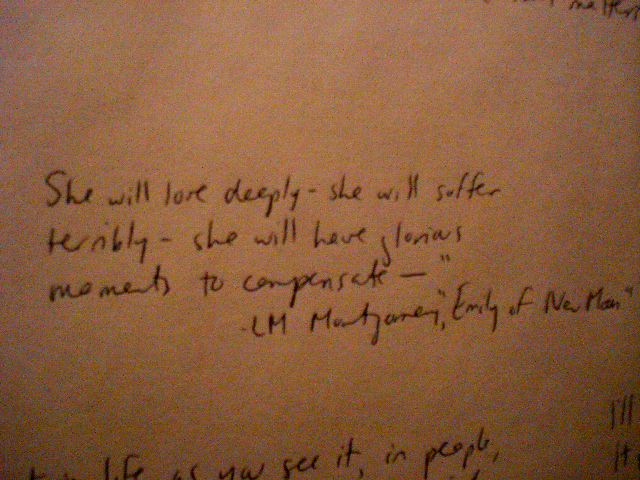
Another close-up from my Mosaic o' Quotes
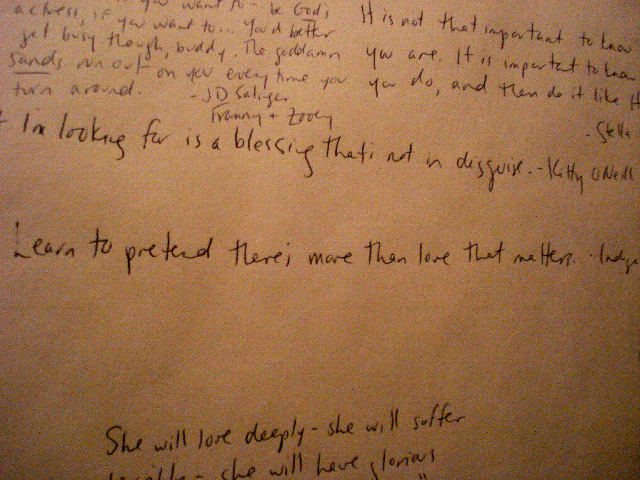
Quote. A reminder for those white nights that come over me, on occasion.
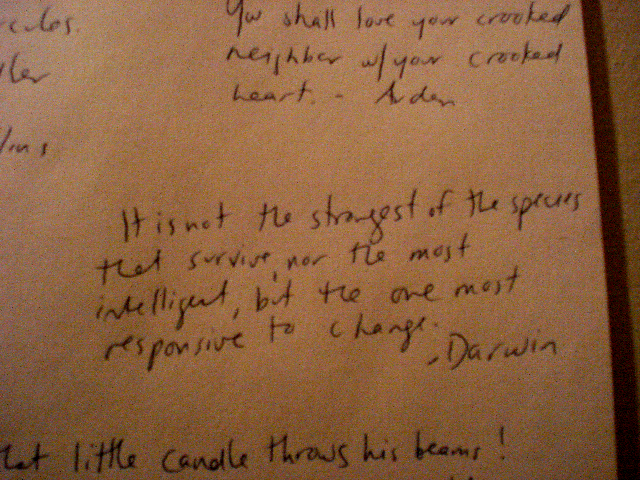
Let us ignore the mis-spelling of my name and just revel in the FACT of this MIRACULOUS object. Seriously. My blog brought Jim Craig to me. Kinda can't even deal with the cool-ness of that.
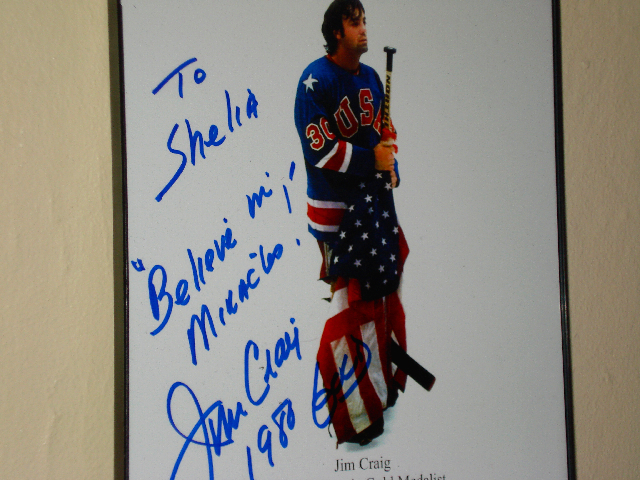
Greenery. And my piece of stained glass that Mitchell gave to me in the Jurassic Era. The fact that it has not broken - not even with all my moving - is nothing short of a miracle. (Speaking of Jim Craig).

It is my goal in life to find an outfit I can wear these with. I have a couple ideas ... but nothing has come to fruition yet. Suggestions are welcome. I want to EAT these shoes I love them so much.
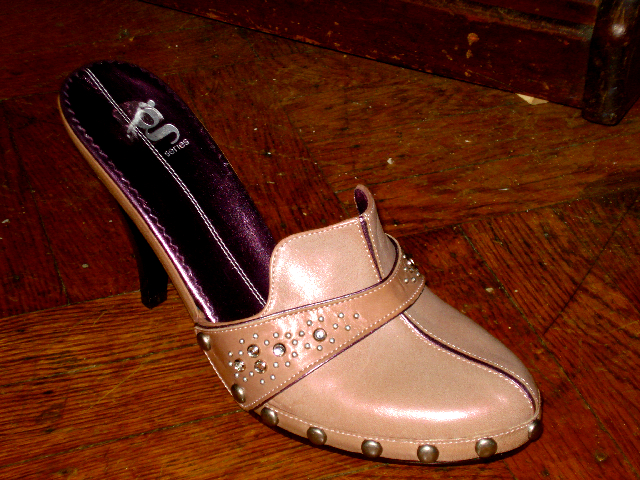
My awesome barrister bookcase. Given to me by my dear parents, and driven down to me by my dear friend Beth. Who am I that I should be so lucky???
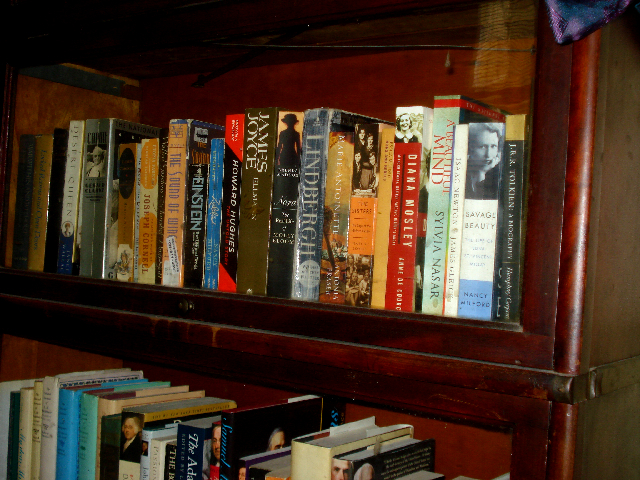
Let the Controlled Chaos begin.
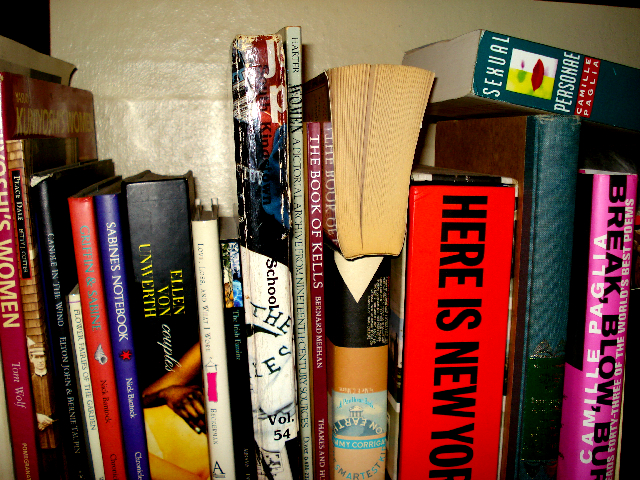
Controlled Chaos towering above me.
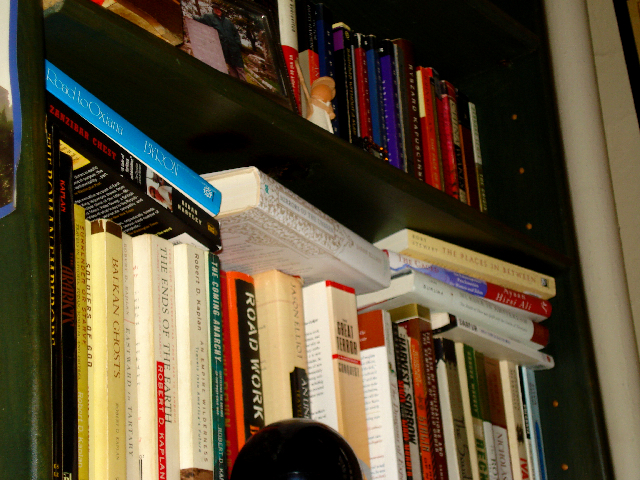
Controlled Poetic Chaos. Yo, Sheila, you like Sylvia Plath, ya think?
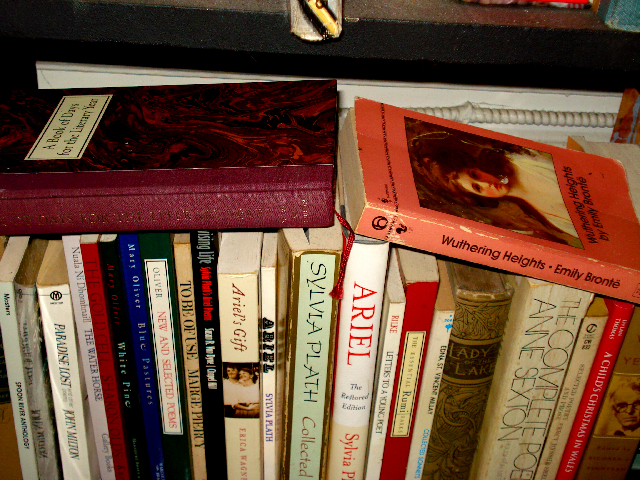
In praise of Kurt Russell
Absolutely gorgeous post of acknowledgement of one of my favorite actors, Kurt Russell.
Jeremiah really "gets it", as far as I'm concerned ... Kurt Russell is, indeed, "dependable" - a word that has positive connotations, but can often mean you are truly under-rated as an actor.
Jeremiah writes about his performance in Escape from New York:
The reason Kurt Russell is so good at playing this kind of comic book hero is that he makes you recognize that he’s a real human being, with feelings and thoughts. That rouses one to cheer for him as he dives into the action; that’s what defines a true movie star
Yes, yes, yes.
And I LOVED his comments on Miracle - I wrote about Kurt Russell in Miracle here. You want to see a true movie star - an old-school movie star - at the top of his freakin' game? Being so dependable and making it look so easy that people barely notice ... people take him for granted? Watch Kurt Russell in Miracle. I would say watch Kurt Russell in anything.
Read the whole thing. That post made my morning (great comments to the post, too - for example one person writes: "I don't know if it marks me as some kind of lamentable douchebag, but I absolutely love Big Trouble in Little China." hahahahaha I'm a lamentable douchebag too, then.). I could talk about Kurt Russell all day.
The Books: "Dancing Girls" - 'When It Happens' (Margaret Atwood)
Next up in my Daily Book Excerpt ... Adult fiction:
 Here is an excerpt from Dancing Girls - by Margaret Atwood. This is her earliest short story collection - I think it was published in 1979 ... and then re-issued after the huge international success of Handmaid's Tale. I read all of the stories (she's wonderful in the shorter format) - but it was years ago. I'll just quote from the one that really burned itself into my memory - it's called "When It Happens". I highly recommend this short story collection, if you haven't read it already. They're raw, many of them - the young writer - the young angry writer - she's in great form here. Where Edible Woman and Surfacing fail - these short stories blaze with success. "When It Happens" is fascinating - just in terms of her use of verb tenses ... because it is disorienting ... (and it's meant to be disorienting.) Is this GOING to happen? Has it already happened? Or is it just a fantasy of a bored housewife? Where are we in time?? Atwood does not mean to answer those questions definitively. Because when we go off into fantasies ... they are real. I have fantasized many things in my life - I have lived the life of an international spy, I've lived the life of an aviatrix in the early days of flying, I have lived the life of a harem-member in medieval Arabia, I have lived the life of a martini-drinking bored 1950s housewife, I have lived the life of a serial killer. When I'm in my fantasies, I don't have the rational part of my mind going, "Now ... please remember that none of this is real ..." No. Because what good is a fantasy if you can't lose yourself in it? "When It Happens" occurs on multiple levels of consciousness: Mrs. Burridge (we never know her first name, so there's already a formality here in the writing) is pickling her tomatoes for the winter. She is taken up wtih her task. The story opens with the details of this activity. But soon ... we become aware that something else is going on ... but is it real? There has been an apocalyptic event. A military coup. A nuclear blast. A war. Something unforeseen and terrifying. Soon everything will change. Mrs. Burridge, as she pickles her tomatoes, wishes that her husband had taught her how to shoot their gun. She feels she might need to go underground for a while. She seems an unlikely revolutionary. She's domestic, calm, a busy hausfrau ... but ... again, we don't know: is it a fantasy? Is she imagining an alternative life for herself? One where she wears a black bandana around her head, and camo-pants, and lives in the woods, on the run from the authorities? Or ... is this actually occurring?
I love this story. It's my favorite of the collection. Here's an excerpt. You'll see what I mean about the tenses.
Excerpt from Dancing Girls - 'When It Happens' - by Margaret Atwood.
Nothing has changed outside the window, so she turns away and sits down at the kitchen table to make out her shopping list. Tomorrow is their day for going into town. She tries to plan the day so she can sit down at intervals; otherwise her feet start swelling up. That began with Sarah and got worse with the other two children and it's never really gone away. All her life, ever since she got married, she has made lists of things that have to be bought, sewed, planted, cooked, stored; she already has her list made for next Christmas, all the names and the gift she will buy for each, and the list of what she needs for Christmas dinner. But she can't seem to get interested in it, it's too far away. She can't believe in a distant future that is orderly like the past, she no longer seems to have the energy; it's as if she is saving it up for when she will have to use it.
She is even having trouble with the shopping list. Instead of concentrating on the paper - she writes on the backs of the used-up days off the page-a-day calendar Frank gives her every New Year's - she is gazing around the kitchen, looking at all the things she will have to leave behind when she goes. That will be the hardest part. Her mother's china, her silver, even though it is an old-fashioned pattern and the silver is wearing off, the egg timer in the shape of a chicken Sarah gave her when she was twelve, the ceramic salt and pepper shakers, green horses with perforated heads, that one of the other children brought back from the Ex. She thinks of walking up the stairs, the sheets folded in the chest, the towels stacked neatly on the shelves, the beds made, the quilt that was her grandmother's, it makes her want to cry. On her bureau, the wedding picture, herself in a shiny satin gown (the satin was a mistake, it emphasized her hips), Frank in the suit he has not worn since except to funerals, his hair cut too short on the sides and a surprising tuft at the top, like a woodpecker's. The children when they were babies. She thinks of her girls now and hopes they will not have babies; it is no longer the right time for it.
Mrs. Burridge wishes someone would be more precise, so she could make better plans. Everyone knows something is going to happen, you can tell by reading the newspapers and watching the television, but nobody is sure what it will be, nobody can be exact. She has her own ideas about it though. At first it will simply become quieter. She will have an odd feeling that something is wrong but it will be a few days before she is able to pin it down. Then she will notice that the planes are no longer flying over on their way to the Malton Airport, and that the noise from the highway two miles away, which is quite distinct when the leaves are off the trees, has almost disappeared. The television will be non-committal about it; in fact, the television, which right now is filled with bad news, of strikes, shortages, famines, layoffs and price increases, will become sweet-tempered and placating, and long intervals of classical music will appear on the radio. About this time Mrs. Burridge will realize that the news is being censored as it was during the war.
Mrs. Burridge is not positive about what will happen next; that is, she knows what will happen but she is not positive about the order. She expects it will be the gas and oil: the oil delivery man will simply not turn up at his usual time,a nd one morning the corner filling station wil be closed. Just that, no explanations, because of course they - she does not know who "they" are, but she has always believed in their existence - they do not want people to panic. They are trying to keep things looking normal, possibly they have already started on this program and that is in fact why things still do look normal. Luckily she and Frank have the diesel fuel tank in the shed, it is three-quarters full, and they don't use the filling station anyway, they have their own gas pump. She has Frank bring in the old wood stove, the one they stored under the barn when they had the furnace and the electricity put in, and for once she blesses Frank's habit of putting things off. She was after him for years to take that stove to the dump. He cuts down the dead elms, finally, and they burn them in the stove.
The telephone wires are blown down in a storm and no one comes to fix them; or this is what Mrs. Burridge deduces. At any rate, the phone goes dead. Mrs. Burridge doesn't particularly mind, she never liked using the phone much anyway, but it does make her feel cut off.
About now men begin to appear on the back road, the gravel road that goes past the gate, walking usually by themselves, sometimes in pairs. They seem to be heading north. Most of them are young, in their twenties, Mrs. Burridge would guess. They are not dressed like the men around here. It's been so long since she has seen anyone walking along this road that she becomes alarmed. She begins leaving the dogs off their chains, she has kept them chained at night ever since one of them bit a Jehovah's Witness early one Sunday morning. Mrs. Burridge doesn't hold with the Witnesses - she is United - but she respects their persevernce, at least they have the courage of their convictions which is more than you can say for some members of her own church, and she always buys a Watchtower. Maybe they have been right all along.
National Poetry Month: Seamus Heaney
This is for my dad.
Seeing Things
I
Inishbofin on a Sunday morning.
Sunlight, turfsmoke, seagulls, boatslip, diesel.
One by one we were being handed down
Into a boat that dipped and shilly-shallied
Scaresomely every time. We sat tight
On short cross-benches, in nervous twos and threes,
Obedient, newly close, nobody speaking
Except the boatmen, as the gunwales sank
And seemed they might ship water any minute.
The sea was very calm but even so,
When the engine kicked and our ferryman
Swayed for balance, reaching for the tiller,
I panicked at the shiftiness and heft
Of the craft itself. What guaranteed us --
That quick response and buoyancy and swim --
Kept me in agony. All the time
As we went sailing evenly across
The deep, still, seeable-down-into water,
It was as if I looked from another boat
Sailing through the air, far up, and could see
How riskily we fared into the morning,
And loved in vain our bare, bowed, numbered heads.
II
Claritas. The dry-eyed Latin word
Is perfect for the carved stone of the water
Where Jesus stands up to his unwet knees
And John the Baptist pours out more water
Over his head: all this in bright sunlight
On the facade of a cathedral. Lines
Hard and thin and sinuous represent
The flowing river. Down between the lines
Little antic fish are all go. Nothing else.
And yet in that utter visibility
The stone's alive with what's invisible:
Waterweed, stirred sand-grains hurrying off,
The shadowy, unshadowed stream itself.
All afternoon, heat wavered on the steps
And the air we stood up to our eyes in wavered
Like the zig-zag hieroglyph for life itself.
III
Once upon a time my undrowned father
Walked into our yard. He had gone to spray
Potatoes in a field on the riverbank
And wouldn't bring me with him. The horse-sprayer
Was too big and new-fangled, bluestone might
Burn me in the eyes, the horse was fresh, I
Might scare the horse, and so on. I threw stones
At a bird on the shed roof, as much for
The clatter of the stones as anything,
But when he came back, I was inside the house
And saw him out the window, scatter-eyed
And daunted, strange without his hat,
His step unguided, his ghosthood immanent.
When he was turning on the riverbank,
The horse had rusted and reared up and pitched
Cart and sprayer and everything off balance
Si the whole rig went over into a deep
Whirlpool, hoofs, chains, shafts, cartwheels, barrel
And tackle, all tumbling off the world,
And the hat already merrily swept along
The quieter reaches. That afternoon
I saw him face to face, he came to me
With his damp footprints out of the river,
And there was nothing between us there
That might not still be happily ever after.
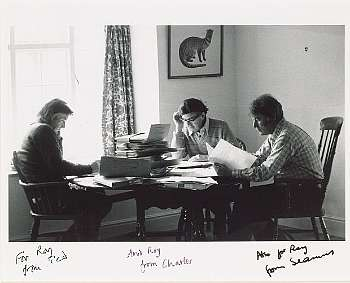 Ted Hughes, Charles Causley, and Seamus Heaney - reading submissions for the Arvon Poetry Competition in 1982 which are piled on the table
"Heaney's model is not Joyce and not the great Irish Tain. It is Auden, who teaches that the poet's tasks are making, judging and knowing. The making starts for Heaney in inadvertent politics. In 1974 he spoke of the Republican street rhymes he learned at Anahorish school, full of resistance and Irish patriotism. He was forced to memorize Byron and Keats. He loved to hear Wordsworth's characters but he could not speak their accents aloud. He got over his schooling. He was touched deeply by Hopkins, by Frost and Roethke, by Patrick Kavanagh. Later he was knocked rather off course by the power of Lowell's poems and by Lowell's presence in Ireland. His approach to the present and its recurrences is generally through analogues - ghosts, bog people, childhood - the past lighting and alighting on the prsent. It is a deeply conservative aesthetic. 'Beware of "literary emotion," ', he saus, and it is of Wordsworth, the poet of The Prelude that he reminds us. The particularity of the early poems with their dependence on mimetic sound, their attempt to get close to the rural world, ensured his popularity." -- Michael Schmidt, "Lives of the Poets"
"A great writer within any culture changes everythign. Because the thing is different afterwards and people comprehend themselves differently. If you take Ireland before James Joyce and Ireland fifty years afterwards, the reality of being part of the collective life is enhanced and charged." -- Seamus Heaney
"My sensibility was formed by the dolorous murmurings of the rosary, and the generally Marian quality of devotion. The reality that was addressed was maternal, and the posture was one of supplication." -- Seamus Heaney to John Haffenden
"English, the argument runs, is a language imposed on Ireland; it is historically and semantically inimical to Heaney's Irish Catholic experience. It is colored by Protestantism, it excludes whole registers of feeling, it ironizes attitudes that are close to Heaney's heart. What are the 'exclusive civilities'? What hegemony can a language exercise through literature? To what extent is a language we are born to, which our parents and grandparents and great-grandparents were born to, imposed, to what extent is it given? Imposition is on the first and sometimes the second generation: then the people get hold of their language; they alter it, infiltrate it, make spaces in it, possess it. Stephen Dedalus in the famous 'tundish' scene in Joyce's Portrait of the Artist as a Young Man is a witness to the difference of dialect between the English mentor and the Irish youth. He doesn't wish he spoke Irish instead of English. He is stating a fact: that languages in different usage develop different valencies. He resents hearing his form of the language patronized by one who imagines his version is superior. Heaney's and Brathwaite's stance is now a commonplace, a form of rhetoric that can be adapted to various causes. Language is subvertible, however, and poetry has been and remains a means of subversion. But only if, as in Hill, it is reified, only if the poem is in and against its language. The subtle redress of such poetry is for the reader rather than the audience." -- Michael Schmidt, "Lives of the Poets"
"I was never caught up by [TS] Eliot, never taken over and shown to myself by his work, my ear never pulled outside in by what it heard in him. Numerous readers have testified to this sudden kind of conversion, when the whole being is flushed by a great stroke of poetry, and this did indeed happen to me when I read Gerard Manley Hopkins." -- Seamus Heaney
"For some novelists - Hardy and Lawrence, for example - verse offers itself as a medium for extending and refining apprehensions that their prose fiction has failed to render altogether satisfactorily. There are poems by Hardy and Lawrence which we would be inclined to keep in preference to certain parts of their novels. The same, however, cannot be said of Joyce. Sure, the poems are well tuned and well turned; there is a technical fastidiousness about them, a tough of elegy and pathos. But their chief interest is that they were written by Joyce, their chief surprise the surprise of contrast with other parts of the oeuvre. This stanza from 'Ecce Puer' could be by Francis Ludwidge:
Of the dark past A child is born, With joy and grief My heart is torn
There is a conventional touch to this, a kind of rehearsed tenderness that recalls a Celtic Twilight poem ilke Padraic Colum's 'O men from the fields'. The heavy end-stopping of the lines, the regular metre, the candid rhymes - it is an unexpectedly unsophisticated performance from an artist who at the same time was splitting the linguistic atom in Finnegans Wake.
If I seem to be doing Joyce down, he can stand it, because he himself set the standard by which he must be judged. The great poetry of the opening chapter of Ulysses, for example, amplifies and rhapsodizes the world with an unlooked-for accuracy and transport. It gives the spirit freedom to range in an element that is as linguistic as it is airy and watery, and when the poems are compared with writing that feels so natural, spacious, and unstoppably alive, they are seen to be what Yeats said the earliest of them were - the work of a man 'who is practising his instrument, taking pleasure at the mere handling of the stops'.
Perhaps that is the way for us to take pleasure in them - at a slight aesthetic distance, with a connoisseur's awareness. And that, in fact, seems to be the way Joyce himself appreciated poetry. Stephen in A Portrait of the Artist as a Young Man, like Joyce in real life, loves the songs of the Elizabethans, the mournful and melodious rhythms of Nashe and Dowland and Shakespeare's songs. It is poetry as the handmaiden of music, as evocation, invitation to dream."
-- Seamus Heaney
“Let me quote my hero, Milosz: ‘Poetry below a certain level of awareness does not interest me.’ I think there’s a problem with political poetry that is howling that it’s aware.” -- Seamus Heaney
Other National Poetry month posts
April 17, 2007
Traveling
The little train station near my parents' house. I am there all the time ... but I never get over its quaintness. It was just re-done - and they kept the feeling of it intact, which I - with my resistance to change - appreciate. They did cut down the massive beech tree in the middle of the roundabout - and that was something I needed to grieve. But other than that ... it is all the same.





Happy birthday, Thornton Wilder!
Today is the birthday of Thornton Wilder, American playwright, author of what might be one of the most beloved American plays ever written: Our Town.
Here is one of my favorite anecdotes about Thornton Wilder. If you want to understand the basics of theatre and the art of acting, it is ALL in this anecdote. (If you remember the plot of Our Town, so much the better.)
Peter Hunt (once Executive and Artistic Director of the Williamstown Theatre Festival) relates a story about Thornton Wilder and Nikos Psacharopoulos (founder of Williamstown). Nikos, by all accounts (except for maybe Colleen Dewhurst's - she couldn't stand him) was a genius of the theatre. His productions of Chekhov plays are still talked about. He is considered one of the best interpreters of Chekhov we've ever had in this country. Anyway, Nikos created the Williamstown Theatre Festival in 1955, and ran it until his death in 1988. Thornton Wilder was very involved in Williamstown, and Peter Hunt (who took over after Nikos' death) tells the following story about a rehearsal of a Nikos-directed production of Our Town at WTF:
Peter Hunt: Directing is sometimes doing nothing, sometimes dowin more than you ever thought you could do, every case is different. But what you just said about there being a way of doing Chekhov at Williamstown -- that struck me, because I am Nikos' offspring. I mean he was my teacher at Yale, my mentor at Williamstown, it all rubbed off. Now obviously I do certain things my own way, but still I'm an extension of that. So, what is that? Part of it is caring and having a commitment to all the elements of the theatre -- a lot of directors don't know how to incorporate a set, how to run a tech rehearsal, don't have a visual sense. At the same time caring about the rehearsal environment so that there is an emotional sense in the room that's correct for the play you're doing. I mean, are you having fun doing a comedy? When do you break tension with a joke, when do you allow it to become very serious? He knew how to play all that. Those are lessons I learned just watching him work. Also honesty. When you hit your head on a wall, back up and go another direction. Don't be afraid to say you're wrong.My favorite example of that is the Our Town story. Thornton Wilder, as I said, was playing the Stage Manager. For some reason he and I struck up a friendship, and one day we were standing and talking ... and Nikos burst out of the rehearsal room and came up to Thornton and said, "The scene isn't working." And Thornton said: "What? The scene isn't working?" Nikos said, "Yeah, George and Emily, they're on the ladder, doing the homework scene." And Thornton said, "What's wrong with it?" And Nikos said, "It doesn't work." And Thornton said, "What are you talking about, it's a Pulitzer-Prize winning play, it works!" And Nikos said, "It's not working. They're up there, I'm playing all the values, they're in love, he's in love with her, they want to get married -- but it's not working." Thornton's jaw drops to the floor and he says, "My lord, what are you doing? It's very simple! He's stupid and she's smart, and if he doesn't get the algebra questions for tomorrow's homework, he's going to flunk. THAT'S IT!" And Nikos said, "But Thornton, it's a love scene!" And Thornton said, "That's for the audience to decide." And Nikos said, "Got it!" And he rips open the door to the rehearsal room and yells, "Everything we worked on is off! You're dumb, you're smart! Play it!" And people were grabbing their handkerchiefs and sobbing during the scene. But the beauty of this story was just -- Nikos' willingness to completely drop it. There was no ego. I mean, this was a man who had a considerable ego, but an ego strong enough to put the work and not himself first.
"Everything we worked on is off! You're dumb, you're smart - GO!" What a beautiful thing for a director to be so flexible.
First of all: There's Thornton Wilder saying: "It's very simple." That's the thing, that's the thing about great playwriting: at its heart, it's very simple. Streetcar Named Desire is a very very simple play. Usually it's the director and actors who over-complicate things. The "keep it simple stupid" mantra is one of the most important things to remember if you're ever blocked, artistically.
The other GENIUS thing about this anecdote is the following exchange:
"But Thornton, it's a love scene!"
"That's for the audience to decide."
And I'll tell ya: that attitude of the playwright is why Our Town will be around long after all of us are gone, it will be performed for generations to come. It's not just a play anymore, it's become part of our cultural tradition. It's not just a respected play, or a well-known play - it is beloved.
Audiences LOVE to be allowed "to decide" things, to not have things handed to them or spelled out. It IS a love scene, but the two characters are talking about algebra. Let the audience decide. Let the audience decide.
And lastly ... I just happen to have this image in my archives. An annotated page in Thornton Wilder's copy of James Joyce's Finnegans Wake [edited!].

The Books: "The Handmaid's Tale" (Margaret Atwood)
Next up in my Daily Book Excerpt ... Adult fiction:
 Here is an excerpt from The Handmaid's Tale - by Margaret Atwood. This is the book that put Margaret Atwood on the map. It was also my introduction to her. It was published in 1985 but I didn't read it until a couple of years later. I remember I read it on my brother's recommendation. He had read it in an English class in college - and was raving about it to me. I also remember that he and I stood in the dining room of Mitchell's house in Cranston during some late-night party, and he was talking about the book to me and how I HAD to read it. I did and for a while there it changed my life. I bounced back to my old self eventually - but it rocked my world view. It made me angry in such a universal way - that anger threatened to take over my entire personality. I trembled with anger. That's how I feel reading Anne Frank's diary, too - it's a rage that shimmers. It's an annhilating sensation, it's so big that you want to tear everything down ... just as a gesture. Even the good things. Because if there is a world that can lock up a little girl ike Anne Frank ... and then murder her ... then who the fuck cares about the good things? Good things can GO TO HELL. Like I mentioned in another Atwood post - Atwood is not a warm writer. She's not affirming, or positive. She's clear, cold, and unemotional. The Handmaid's Tale is where she takes that rather odd voice of hers - unique - the voice that had been finding its outlet in books not quite equal to the rage underneath - and busts out of the prison. Not that her earlier books are unworthy - but when you read The Handmaid's Tale you can feel the break with the past that it is. No more Mr. Nice Girl. This is what I am REALLY thinking.
I've read it since - many times - and I have to say it doesn't really hold up, although there is much of it that does. But the book's main impact is the one of first impression. I'll never forget what it was like to read that book for the first time.
I am baffled by the "coda" at the end. Entire scholarly papers have been written about that coda - and I get the point, intellectually - It just so does not work for me. Like - not at ALL. In my opinion (and I remember talking about this with my brother way back when) - it completely weakens the entire book. Brendan had another view of it - he said, "Go back and read it again - and watch how they treat the chairwoman. It's subtle - but it's there. They treat her like an idiot." And this is true. It's very depressing, especially after the book you've just read - of a Saudi Arabian type world, only they're Christians instead of Muslims, and women are either useless, or only valued for their wombs. The coda gives historical context ... like: "let us study this world that is now gone away ... " But that, to me, was the problem. The book is so pessimistic, it's one of the bleakest books I've ever read ... and to have this coda tacked on, letting us know that the regime did fall and women were freed ... It just didn't work for me. The last line of the narrator's part of the book - "And so I step up, into the darkness within; or else the light" ... leaves you in a state of suspended animation, and hope - but hope that is so strong it is akin to despair. Does she get away?? What happens??? I think the book is far more powerful when it does NOT answer those questions. I just do not like the coda.
Atwood fans - I would LOVE to hear your responses to this. Did it work for you? And why?
The story is well-known. An extreme Christian fundamentalist group - very well-organized - has taken over America in what amounts to a military coup. Congress killed, the President killed - and a new regime installed. Women categorized as either useless (menopausal) - and those women are shuffled off to concentration camps to do manual labor - or useful (child-bearing age) - and the women who are useful are assigned to couples high up in the regime who are childless for whatever reason. The handmaid's job is to sleep with the husband - and have a child. Many children. If it turns out that you are infertile - you will be sent off to a camp to die. It's never the fault of the male ... there is no such thing as sterile men. Only useless women.
The whole book is narrated by a nameless woman - women take the names of the man they are assigned to: Offred (of Fred), Ofjohn (of John) - and we never learn her name from before. She is in the transitional generation - she remembers the time before. She had a daughter - and a husband - but because it was his second marriage, their union is invalidated by the new regime. The daughter is taken away from them. He is hunted down and eventually disappears. They had tried to escape into Canada but they were trapped at the border. So now this woman - who has no idea what happened to her little girl, her husband - now lives with The Commander and his wife Serena Joy (who, in the time before, was a Tammy Faye type - an evangelical television personality) - and just tries to survive. She tries to keep her mind intact. She tries to remember who she is ... even though the entire world has wiped her out. There are other plot-lines ... her best friend from "before" was a hot-shit funny wise-cracking lesbian named Moira ... what happened to Moira? Where is Moira? She eventually finds out ... but it is a tragic story. To me, the story of Moira is the saddest in the book.
Women are separated from one another by design ... you can be hauled off as a spy if you try to reach out, and complain to someone, or even if you just try to talk like a human being, and not a Christian automaton. There are accepted modes of behavior now - rigid - it's a totalitarian world. The secret police are everywhere ... and the ironic thing is that those who are "handmaid's" are supposed to be grateful. Because they have been "allowed" to live. They are supposed to praise God every day for the chance to be of use.
Anyhoo, that's Handmaid's Tale. It's what brought me to Atwood.
In terms of writing mastery - nothing can touch Cat's Eye - which comes later - not only is it a great Atwood book, it's a great book period. Handmaid's Tale doesn't have that complexity - but then again, it's not meant to. This is a stripped-down world, a black and white world ... where people, with all their grey areas, all their foibles, struggle to maintain their humanity.
One of the things that is interesting here is that "the Commander" - the military dude she is assigned to - is a cold and frightening presence. She sleeps with him repeatedly - and it's awful ... and you never get to know him. Until ..... Late one night he summons her to his study. She goes. This is strictly forbidden. "Fraternizig" is forbidden. Her job is not to be a mistress, or to have a love affair, or to join the family she is assigned to. Her job is to sit in her room and wait until the ovulation period ... not moving, not speaking, not reading, nothing ... and then try to get pregnant. So anyway - The Commander summons her. It is about 2 in the morning. She is terrified. She goes into his study ... and there he sits ... and he asks if she would like to play Scrabble. This is such a shock, such an odd odd moment ... The world she lives in is not a world that values leisure time. Also, all language has been wiped out. Signs are now in pictures. So to see a Scrabble board ... it's against the law ... He asks her to play. Terrified, she obeys. But eventually ... it becomes this nightly secret "date" they have. They barely talk - they just play Scrabble. Atwood describes the love of words ... how voracious our narrator feels just seeing LETTERS again ... the thrill of putting letters together ... It's almost sexual. Very moving. What's interesting here is that even though the two of them barely speak ... you get the sense that this world, this new world, where he is at the top of the heap, is no great shakes for him either. Male privilege is isolating - for both genders. He never says that ... and she never comments on it ... but just the fact that in the middle of the night this cold man, who holds her entire life in his hands - yearns to play a nice game of Scrabble ... says it all.
Here's an excerpt.
Excerpt from The Handmaid's Tale - by Margaret Atwood.
Now there's a space to be filled, in the too-warm air of my room, and a time also; a space-time, between here and now and there and then, punctuated by dinner. The arrival of the tray, carried up the stairs as if for an invalid. An invalid, one who has been invalidated. No valid passport. No exit.
That was what happened, the day we tried to cross at the border, with our fresh passports that said we were not who we were: that Luke, for instance, had never been divorced, that we were therefore lawful, under the law.
The man went inside with our passports, after we'd explained about the picnic and he'd glanced into the car and seen our daughter asleep, in her zoo of mangy animals. Luke patted my arm and got out of the car as if to stretch his legs and watched the man through the window of the immigration building. I stayed in the car. I lit a cigarette, to steady myself, and drew the smoke in, a long breath of counterfeit relaxation. I was watching two soldiers in the unfamiliar uniforms that were beginning, by then, to be familiar; they were standing idly beside the yellow-and-black-striped lift-up barrier. They weren't doing much. One of them was watching a flock of birds, gulls, lifting and eddying and landing on the bridge railing beyond. Watching him, I watched them too. Everything was the color it usually is, only brighter.
It's going to be all right, I said, prayed in my head. Oh let it. Let us cross, let us across. Just this once and I'll do anything. What I thought I could do for whoever was listening that would be of the least use or even interest I'll never know.
Then Luke got back into the car, too fast, and turned the key and reversed. He was picking up the phone, he said. And then he began to drive very quickly, and after that there was the dirt road and the woods and we jumped out of the car and began to run. A cottage, to hide in, a boat, I don't know what we thought. He said the passports were foolproof, and we had so little time to plan. Maybe he had a plan, a map of some kind in his head. As for me, I was only running: away, away.
I don't want to be telling this story.
I don't have to tell it. I don't have to tell anything, to myself or to anyone else. I could just sit here, peacefully. I could withdraw. It's possible to go so far in, so far down and back, they could never get you out.
Nolite te bastardes carborundorum. Fat lot of good it did her.
Why fight?
That will never do.
* * *
Love? said the Commander.
That's better. That's something I know about. We can talk about that.
Falling in love, I said. Falling into it, we all did then, one way or another. How could he have made such light of it? Sneered even. As if it was trivial for us, a frill, a whim. It was, on the contrary, heavy going. It was the central thing; it was the way you understood yourself; if it never happened to you, not ever, you would be like a mutant, a creature from outer space. Everyone knew that.
Falling in love, we said; I fell for him. We were falling women. We believed in it, this downward motion: so lovely, like flying, and yet at the same time so dire, so extreme, so unlikely. God is love, they once said, but we reversed that, and love, like heaven, was always just around the corner. The more difficult it was to love the particular man beside us, the more we believed in Love, abstract and total. We were waiting, always, for the incarnation. That word, made flesh.
And sometimes it happened, for a time. That kind of love comes and goes and is hard to remember afterwards, like pain. You would look at the man one day and you would think, I loved you, and the tense would be past, and you would be filled with a sense of wonder, because it was such an amazing and precarious and dumb thing to have done; and you would know too why your friends had been evasive about it, at the time.
There is a good deal of comfort, now, in remembering this.
Or sometimes, even when you were still loving, still falling, you'd wake up in the middle of the night, when the moonlight was coming through the window onto his sleeping face, making the shadows in the sockets of his eyes darker and more cavernous than in daytime, and you'd think, Who knows what they do, on their own or with other men? Who knows what they say or where they are likely to go? Who can tell what they really are? Under their daily-ness.
Likely you would think at those times: What if he doesn't love me?
Or you'd remember stories you'd read, in the newspapers, about women who had been found - often women but sometimes they would be men, or children, that was the worst - in ditches or forests or refrigerators in abandoned rented rooms, with their clothes on or off, sexually abused or not; at any rate killed. There were places you didn't want to walk, precautions you took that you had to do with locks on windows and doors, drawing the curtains, leaving on lights. These things you did were like prayers; you did them and you hoped they would save you. And for the most part they did. Or something did; you could tell by the fact that you were still alive.
But all of that was pertinent only in the night, and had nothing to do with the man you loved, at least in daylight. With that man you wanted it to work, to work out. Working out was also something you did to keep your body in shape, for th eman. If you worked out enough, maybe the man woudl too. Maybe you would be able to work it out together, as if the two of you were a puzzle that could be solved; otherwise one of you, most likely the man, would go wandering off on a trajectory of his own, taking his addictive body with him and leaving you with bad withdrawal, which you could counteract by exercise. If you didn't work it out it was because one of you had the wrong attitude. Everything that went on in your life was thought to be due to some positive or negative power emanating from inside your head.
If you don't like it, change it, we said, to each other and to ourselves. And so we would change the man, for another one. Change, we were sure, was for the better always. We were revisionists; what we revised was ourselves.
It's strange to remember how we used to think, as if everything was available to us, as if there were no contingencies, no boundaries; as if we were free to shape and reshape forever the ever-expanding perimeter of our lives. I was like that too, I did that too. Luke was not the first man for me, and he might not have been the last. If he hadn't been frozen that way. Stopped dead in time, in midair, among the trees back there, in the act of falling.
In former times they would send you a little package, of the belongings: what he had with him when he died. That's what they would do, in wartime, my mother said. How long were you supposed to mourn, and what did they say? Make your life a tribute ot the loved one. And he was, the loved. One.
Is, I say. Is, is, only two letters, you stupid shit, can't you manage to remember it, even a short word like that?
I wipe my sleeve across my face. Once I wouldn't have done that, for fear of smearing, but now nothing comes off. Whatever expression is there, unseen by me, is real.
You'll have to forgive me. I'm a refugee from the past, and like other refugees I go over the customs and habits of being I've left or been forced to leave behind me, and it all seems just as quaint, from here, and I am just as obsessive about it. Like a White Russian drinking tea in Paris, marooned in the twentieth century, I wander back, try to regain those distant pathways; I become too maudlin, lose myself. Weep. Weeping is what it is, not crying. I sit in this chair and ooze like a sponge.
So. More waiting. Lady in waiting: that's what they used to call those stores where you could buy maternity clothes. Woman in waiting sounds more like someone in a train station. Waiting is also a place: it is wherever you wait. For me it's this room. I am a blank, here, between parentheses. Between other people.
The knock comes at my door. Cora, with the tray.
But it isn't Cora. "I've brought this for you," sayus Serena Joy.
And then I look up and around, and get out of my chair and come towards her. She's holding it, a Polaroid print, square and glossy. So they still make them, cameras like that. And there will be family albums, too, with all the children in them; no Handmaids though. From the point of view of future history, this kind, we'll be invisible. But the children will be in them all right, something for the Wives to look at, downstairs, nibbling at the buffet and waiting for the Birth.
"You can only have it for a minute," Serena Joy says, her voice low and conspiratorial. "I have to return it, before they know it's missing."
It must have been a Martha who got it for her. There's a network of the Marthas, then, with something in it for them. That's nice to know.
I take it from her, turn it around so I can see it right-side-up. Is this her, is this what she's like? My treasure.
So tall and changed. Smiling a little now, so soon, and in her white dress as if for an olden-days First Communion.
Time has not stood still. It has washed over me, washed me away, as if I'm nothing more than a woman of sand, left by a careless child too near the water. I have been obliterated for her. I am only a shadow now, far back behind the glib shiny surface of this photograph. A shadow of a shadow, as dead mothers become. You can see it in her eyes: I am not there.
But she exists, in her white dress. She grows and lives. Isn't that a good thing? A blessing?
Still, I can't bear it, to have been erased like that. Better she'd brought me nothing.
I sit at the little table, eating creamed corn with a fork. I have a fork and a spoon, but never a knife. When there's meat they cut it up for me ahead of time, as if I'm lacking manual skills or teeth. I have both, however. That's why I'm not allowed a knife.
National Poetry Month: Geoffrey Chaucer
Merciless Beauté
I. CAPTIVITY
Your yën two wol slee me sodenly.
I may the beauté of hem not sustene,
So woundeth hit through-out my herte kene.
And but your word wol helen hastily
Mt hertes wounde, whyl that hit is grene,
Your yën two wol slee me sodenly.
I may the beauté of hem not sustene.
Upon my trouthe I sey yow feithfully,
That ye ben of my lyf and deeth the quene;
For with my deeth the trouthe shal be sene.
Your yën two wol slee me sodenly.
I may the beauté of hem not sustene.
So woundeth hit through-out my herte kene.
II. REJECTION
So hath your beauté fro your herte chaced
Pitee, that me ne availeth not to pleyne;
For Daunger halt your mercy in his cheyne.
Giltles my deeth thus han ye me purchaced;
I sey yow sooth, me nedeth not to feyne;
So hath your beauté fro your herte chaced
Pitee, that me ne availeth not to pleyne
Allas! that nature hath in yow compassed
So greet beauté; that no man may atteyne
To mercy, though he sterve for the peyne.
So hath your beauté fro your herte chaced
Pitee, that me ne availeth not to pleyne;
For Daunger halt your mercy in his cheyne.
III. ESCAPE
Sin I fro Love escaped am so fat,
I never thenk to ben in his prison lene;
Sin I am free, I counte him not a bene.
He may answere, and seye this or that;
I do no fors, I speke right as I mene.
Sin I fro Love escaped am so fat,
I never thenk to ben in his prison lene.
Love hath my name y-strike out of his sclat,
And he is strike out of my bokes clene
For ever-mo; ther is non other mene.
Sin I fro Love escaped am so fat,
I never thenk to ben in his prison lene.
Sin I am free, I counte him not a bene.
[There are modernized versions ... some rather famous - Wordsworth did an edition, many other poets have too - with "yow" changed to "you", etc. But you lose so much in the translation. It's a bit rough going ... but once you get into it it is perfectly obvious what he is saying. I took a Chaucer class in college - and we read it out loud - in HIS spelling - and there was much hilarity, and also much revelation]

"Chaucer must have been a man of a most wonderful comprehensive nature ... because he has taken into the compass of his Canterbury Tales, the various manners and humours of the whole English nation, in his age." -- John Dryden
"In 1372 he spent a year away, part of it in Genoa arranging the selection of an English port for Genoese trade. He went to Florence and perhaps to Padua. Petrarch died in 1374. It is suggested that in Italy Chaucer was introduced to Petrarch at the wedding of Violante, daughter of the Duke of Milan, by the Duke of Clance: and it is not impossible that Boccaccio was of the party. It's a tempting but unlikely scenario. Certainly he took their poetry, like Dante's, to heart. Indeed it may have helped purge him of French enthusiasms." -- Michael Schmidt, "Lives of the Poets"
"Spenser more than once insinuates that the soul of Chaucer was transfused into his body; and that he was begotten of him two hundred eyars after his decease. Milton has acknowledged to me, that Spenser was his original." -- John Dryden
"... his large, free, simple, clear yet kindly view of human life." -- Matthew Arnold
"Few English poets before the First World War were entirely free of a debt to him." -- Michael Schmidt, "Lives of the Poets"
"The Book of the Duchess shows him almost fully fledged. It's a consolatory romance for John of Gaunt on the death of his first wife, Blanche, and draws on the Romance. The octosyllabic couplets foreshadow Gower's fifteen years later; but Chaucer's poem keeps close to a single subject and illustrates a crucial difference between Chaucer and Gower. Gower is encyclopedic by design; Chaucer is inclusive by nature. His verse is integrated because the human and poetic contexts admit more. Allusion and illustration are means, not end. His morality is implicit in the poem, not appended to it. The Book of the Duchess hints at what's to come: a dream frame, a garden, personification, confession, allegory, May morning, and the hunt. There is also a debt to Ovid's Metamorphoses. What makes it Chaucerian is the actual-seeming grief and sympathy, acknowledging the impotence of consolation." -- Michael Schmidt
"The figures are all British, and bear no suspicious signatures of Classical, Italian, or French imitation." -- Ford Madox Ford on "The Canterbury Tales
"He made England what she was, and, having made her, remains forever a part of his own creation." -- Thomas Warton
"Chaucer, undoubtedly, did excellently in his Troilus and Cryseyde; of whom, truly, I know not whether to marvel more, either that he in that misty time could see so clearly, or that we in this clear age go so stumblingly after him. Yet had he great wants, fit to be forgiven in so reverent an antiquity." -- Sir Philip Sidney
"Here is God's plenty!" -- in John Dryden's preface to "Fables Ancient and Modern"
"He is a perpetual fountain of good sense; learned in all sciences; and therefore speaks properly on all subjects. As he knew what to say, so he knows also when to leave off; a continence which is practised by few writers." -- John Dryden
"Chaucer is the father of English poetry for two reasons. The first is technical: adapting continental forms he evolves a relaxed and distinctly English style; he enriches the poetic vocabulary; and he introduces through translation and adaptation the great Latin, French and Italian poets into English poetry. The second reason relates to the first. In his powerful and original style Chaucer provides a formal and a thematic model. He brings England into the new English poetry. Langland portrays London, but his is a moralized, allegorized metropolis, in the spirit of didactic documentary. Chaucer introduces the diversity of English character and language, of English society at large. He has themes, not polemics or moral programs. His eyes are mild and unclouded. Gower writes from books. Chaucer starts writing from books, but the world takes over his verse." -- Michael Schmidt
"Chaucer followed nature everywhere; but was never so bold to go beyond her." -- John Dryden
More information on Chaucer here
Other National Poetry month posts
April 16, 2007
Sheila's Alphabet
A- Available or Single? Ha - I like this one. My answer is Yes.
B- Best Friend. I do not have only one. I'm lucky that way. There's also a certain Hitachi product that I consider a soulmate.
C- Cake or Pie. Neither. Sorry to be contrary.
D- Drink of Choice. ginger ale
E- Essential Item. these days it's my camera
F- Favorite Color. purple
G- Gummi Bears or Worms. Neither. Again, sorry to be contrary. If you said "sour patch kids" I'd be all over that shit.
H- Hometown. It's in Rhode Island. I was born in Boston - I've lived all over the country - but my heart, as they say, is in Rhode Island.
I- Indulgence. My massage guy. Bless him.
J- January or February. January. This makes me think of a quote from Mitchell during college. We were having a bad month. It was February. We sat in the Bess Eaton coffee place on campus, bitching and moaning, and Mitchell said, in a tone of venom, "February is the shortest month. But it never fucking ends."
K- Kids. What about them? Cashel's my favorite kid.
L- Life is incomplete without… friends and family
M- Marriage Date. Oh no, no. I ain't playing that game. My marriage date should have been 8 years ago, so no. I am not playing that game.
N- Number of Siblings? 3
O- Oranges or Apples? apples - but only Granny Smith. I won't eat red apples. I am so picky. It's ridiculous.
P- Phobias/Fears. "s"es
Q- Favorite Quote. "Make voyages. Attempt them. That's all there is." -- Tennesse Williams, Camino Real
R- Reasons to smile. health, sunshine, phone calls with friends, music I like, my Swiffer ... you know. So much. I'm trying to look on the bright side these days.
S- Season. Late fall. Give me grey dreary weather and I come alive.
T- Tag Three. I do not tag. Play if you want.
U- Unknown Fact About Me. Even if it's 120 degrees out, I will not go to sleep without socks on. Even if I'm sleeping in my underwear, or less, I will wear socks. Sleeping without socks is flat out wrong and should be illegal.
V – Vegetarian or Oppressor of Animals. Oppressor of Animals.
W- Worst Habit. I don't believe in myself.
X – X-rays or Ultrasounds. I'd rather not choose, if my health is involved.
Y- Your Favorite Foods. If I could eat Mexican food every day and not blow up like a balloon, I would. I love burritos, enchiladas, fajitas, margaritas, chips, salsa, guacamole ... love it all. (In related news ...)
Z- Zodiac. Sagittarius. A textbook case.
I got this from Belledame.
The Books: "Bodily Harm" (Margaret Atwood)
Next up in my Daily Book Excerpt ... Adult fiction:
 Here is an excerpt from Bodily Harm - by Margaret Atwood. This is her fifth novel and seriously - this book FREAKED. ME. OUT. The only other person I knew who had read it was my friend Kate and we have had MANY conversations about it ... it had the same effect on her as it did on me. Handmaid's Tale is scary - but in a way this book is even scarier. I read this book years ago - and certain sections of it come back to me, nearly word for word. The opening of the book is spectacular. Unforgettable. It's amazing I even kept reading after that.
She flips back and forth between points of view - as well as narrative voice. Sometimes Rennie speaks in an "I" voice ... intermittently we will get long first-person monologues from her - and it's not clear who she is speaking to ... and when you realize, at the end of the book, what those monologues are about ... and where she is when she says them ... it's like your mind just goes blank with horror. But the reveal doesn't come until the end. Then there are far past sections - where we hear about Rennie's childhood in a town called Griswold - and this is the first real indication of Atwood's unbelievable BITCHINESS when it comes to certain aspects of Canadian culture. She is ruthless. This really comes to a head in Cat's Eye - but Cat's Eye is more humorous about it. Toronto's pretensions, the self-righteous prudish populace beneath the "Oh, look at us being cosmopolitan now" ...Atwood is Canadian, so she can get away with it. But in Bodily Harm, Atwood takes the gloves off. Griswold - Rennie's hometown - is almost like another character in this book. A malignant evil small-minded character.
The book is not chronological. There are many different threads: Rennie is a "lifestyles" writer for a Toronto newspaper. Her life is spent writing stupid fluff pieces. She lives with a wolfish guy named Jake - who comes off as a total asshole - and Rennie somehow puts up with it. The book opens, though, after Jake has moved out. He moved out because Rennie had a breast removed, and he couldn't deal with it. Rennie comes home one day, in the opening scene, her scar still pulling at her - and finds her door broken open - and there are two cops in her kitchen. And also - on her bed - is a coil of rope. This is a mystery that is never solved. The cops had heard of a break-in so they came over. Rennie stares at the coil of rope, mesmerized. The intruder had obviously been interrupted in whatever he had planned for her. But that sense of ominous doom hovers over the whole book. The intruder is out there. Somewhere. Always.
Rennie decides she needs to get away. She had fallen madly in love with the kindly doctor who did her surgery. But he was married ... and she made a fool of herself. So she asks her editor if she can go away for a while - maybe do a fluff travel piece in the Caribbean or something. So off she goes to a little island in the Caribbean - not one of the touristy ones - this is more of a third world country. Her sense of dissociation continues - and basically, while she is there, a military coup occurs. She is slow to figure out what is going on - and slow to understand the danger she is in - as a Canadian (the Canadian government had supported the overthrown government, if I'm remembering correctly) ... and she meets a couple of other people there - and it's like she has been completely disconnected from her life before. Who is she now? Will she be able to return to normal? And not even to normal ... will she be able to get off the island and get back to Canada?
Interspersed with all of this narrative (and the whole book goes back and forth between the different story lines - Rennie's breast, her unrequited love of the doctor, her relationship with Jake, her career, her time on the island) are the long monologues - the long first-person monologues, where Rennie is talking (to whom??) about her upbringing, sharing memories, telling stories.
It's a terrifying book - I'm making it sound very prosaic and normal - but there is horror here. On every level. I need to read it again.
I'm going to excerpt from one of the monologues. The last section - the last image of the grandmother - haunts me to this day.
Excerpt from Bodily Harm - by Margaret Atwood.
I grew up surrounded by old people: my grandfather and my grandmother, and my great-aunts and great-uncles, who came to visit after church. I thought of my mother as old too. She wasn't, but being around them all the time made her seem old. On the street she walked slowly so they could keep up with her, she raised her voice the way they did, she was anxious about details. She wore clothes like theirs too, dark dresses with high collars and small innocuous patterns, dots or sprigs of flowers.
As a child I learned three things well: how to be quiet, what not to say, and how to look at things without touching them. When I think of that house I think of objects and silences. The silences are almost visible; I pictured them as grey, hanging in the air like smoke. I learned to listen for what wasn't being said, because it was usually more important than what was. My grandmother was the best at silences. According to her, it was bad manners to ask direct questions.
The objects in the house were another form of silence. Clocks, vases, end-tables, cabinets, figurines, cruet sets, cranberry glasses, china plates. They were considered important because they had once belonged to someone else. They were both overpowering and frail: overpowering because threatening. What they threatened you with was their frailty; they were always on the verge of breaking. These objects had to be cleaned and polished once a week, by my grandmother when she was still well enough and afterwards by my mother. It was understood that you could never sell these objects or give them away. The only way you could ever get rid of them was to will them to someone else and then die.
The objects weren't beautiful, most of them. They weren't supposed to be. They were only supposed to be of the right kind: the standard aimed at was not beauty but decency. That was the word, too, among my mother and my aunts, when they came to visit. "Are you decent?" they would call gaily to one another before opening bedroom or bathroom doors. Decency was having your clothes on, in every way possible.
If you were a girl it was a lot safer to be decent than to be beautiful. If you were a boy, the question didn't arise; the choice was whether or not you were a fool. Clothes could be decent or indecent. Mine were always decent, and they smelled decent too, a wool smell, mothballs and a hint of furniture polish. Other girls, from families considered shoddy and loose, wore questionable clothes and smelled like violets. The opposite of decent wasn't beautiful, but flashy or cheap. Flashy, cheap people drank and smoked, and who knew what else? Everyone knew. In Griswold, everyone knew everything, sooner or later.
So you had your choice, you could decide whether people would respect you or not. It was harder if your family wasn't respectable but it could be done. If your family was respectable, though, you could choose not to disgrace it. The best way to keep from disgracing it was to do nothing unusual.
The respectability of my family came from my grandfather, who had once been the doctor. Not a doctor, the doctor: they had territories then, like tomcats. In the stories my grandmother told me about him, he drove a cutter and team through blizzards to tear babies out through holes he cut in women's stomachs and then sewed up again, he amputated a man's leg with an ordinary saw, knocking the man out with his fist because no one could hold him down and there wasn't enough whiskey, he risked his life by walking into a farmhouse where a man had gone crazy and was holding a shotgun on him the whole time, he'd blown the head off one of his children and was threatening to blow the heads off the other ones too. My grandmother blamed the wife, who had run away months before. My grandfather saved the lives of the remaining children, who were then put in an orphanage. No one wanted to adopt children who had such a crazy father and mother everyone knew such things ran in the blood. The man was sent to what they called the loony bin. When they were being formal they called it an institution.
My grandmother worshiped my grandfather, or so everyone said. When I was little I thought of him as a hero, and I guess he was, he was about the closest thing you could get in Griswold unless you'd been in the war. I wanted to be like him, but after a few years at school I forgot about that. Men were doctors, women were nurses; men were heroes, and what were women? Women rolled the bandages and that was about all anyone ever said about that.
The stories my mother and aunts told about my grandfather were different, though they never told these stories when my grandmother was there. They were mostly about his violent temper. When they were girls, whenever they skirted what he felt to be the edges of decency, he would threaten to horsewhip them, though he never did. He thought he was lenient because he didn't make his children sit on a bench all Sunday as his own father had. I found it very difficult to connect these stories, or my grandmother's either, with the frail old man who could not be disturbed during his afternoon nap and who had to be protected like the clocks and figurines. My mother and my grandmother tended him the same way they tended me, efficiently and with a lot of attention to dirt; only more cheerfully. Perhaps they really were cheerful. Perhaps it made them cheerful to have him under their control at last. They cried a lot at his funeral.
My grandmother had been amazing for a woman of her age; everyone told me that. But after my grandfather's death she began to deteriorate. That's how my mother would put it when her sisters would come to visit. They were both married, which was hot they'd got away from Griswold. I was in high school by then so I didn't spend as much time hanging around the kitchen as I used to, but one day I walked in on them and all three of them were laughing, stifled breathless laughs, as if they were in a church or at a funeral: they knew they were being sacrilegious and they didn't want my grandmother to hear them. They hardly saw me, they were so intent on their laughter.
She wouldn't give me a key to the house, my mother said. Thought I'd lose it. This started them off again. Last week she finally let me have one, and I dropped it down the hot air register. They patted their eyes, exhausted as if they'd been running.
Foolishness, said my aunt from Winnipeg. This was my grandmother's word for anything she didn't approve of. I'd never seen my mother laugh like that before.
Don't mind us, my aunt said to me.
You laugh or you cry, said my other aunt.
You laugh or you go bats, said my mother, injecting a little guilt, as she always did. This sobered them up. They knew that her life, her absence of a life, was permitting them their own.
After that my grandmother began to lose her sense of balance. She would climb up on chairs and stools to get things down, things that were too heavy for her, and then she would fall. She usually did this when my mother was out, and my mother would return to find her sprawled on the floor, surrounded by broken china.
Then her memory began to go. She would wander around the house at night, opening and shutting doors, trying tof ind her way back to her room. Sometimes she wouldn't remember who she was or who we were. Once she frightened me badly by coming into the kitchen, in broad daylight, as I was making myself a peanut-butter sandwich after school.
My hands, she said. I've left them somewhere and now I can't find them. She was holding her hands in the air, helplessly, as if she couldn't move them.
They're right there, I said. On the ends of your arms.
No, no, she said impatiently. Not those, those are no good any more. My other hands, the ones I had before, the ones I touch things with.
National Poetry Month: Ben Jonson
On My First Son
Farewell, thou child of my right hand, and joy;
My sin was too much hope of thee, loved boy.
Seven years wert thou leant to me, and I thee pay,
Exacted by thy fate, on the just day.
O. I could lose all father now. For why
Will man lament the state he should envy?
To have so soon 'scaped world's, and flesh's, rage,
And if no other misery, yet age?
Rest in soft peace, and, asked, say here doth lie
Ben Jonson, his best piece of poetry.
For whose sake, henceforth, all his vows be such,
As what he loves may never like too much.

"Ben Jonson - another man described as 'the first poet laureate' - compares with any poet of his age and the next. He's the most versatile writer in the history of English poetry." -- Michael Schmidt, "Lives of the Poets"
"Ben Jonson had one eie lower than t'other, and bigger, like Clun the Player; perhaps he begott Clun." -- John Aubrey
"It is ever the nature of parties to be in extremes; and nothing is so probable, as that because Ben Jonson had much the more learning, it was said on the other hand that Shakespeare had none at all; and because Shakespeare had much the most wit and fancy, it was retorted on the other, that Jonson wanted both. Because Shakespeare borrowed nothing, it was said that Ben Jonson borrowed everything." -- Alexander Pope, "Preface to the Works of Shakespeare" (1725)
"one of the singers who could not sing." -- Swinburne
"I admire him, but I love Shakespeare." -- John Dryden
"Language must show a man. Speak that I may see thee." -- Ben Jonson
"I never tasted English more to my liking, nor more smart, and put to the height of use in poetry, than in the vital, judicious, and most practicable language of Benjamin Jonson's poems." -- Edmund Bolton
"I have seen his studyeing chaire, which was of strawe, such as olde woemen used." -- John Aubrey
"[Jonson] is a poet not quite in the court and thus not secure in patronage, though not yet wedded to Grub Street, its disciplines and treacheries. The world of such a man is unstable, and part of Jonson's greatness is to have survived in it and to have made it survive in his verse. Jonson makes us guests at great houses and lets us hear the age's mannerly speech and savor its hospitality. We hear his songs, too; and we meet, through his eyes, friends and foes as real as any in poetry. He was among the first great poets to take an active interest in publishing, to seek fortune and solace from the printing of his own work in book form. He is the grandfather, or godfather, of Grub Street. -- Michael Schmidt, "Lives of the Poets"
" 'Twas an ingeniose remarque of my Lady Hoskins, that B.J. never writes of Love, or if he does, does it not naturally." -- John Aubrey
"In the plays the proximity of Shakespeare does Jonson most harm, though he writes plays so different from his frien's that they seem distinct in kind and period. Part of that difference is Jonson's poetic balance, deliberate artistry: he knows what he wants to say and has the means of saying it, no more or less. He reaches a conclusion and stops; no discovery leads him beyond his destination. He speaks for his age, while Shakespeare speaks for himself. Jonson's art is normative, Shakespeare's radical and exploratory. In Jonson there's structure and gauged variegation, in Shakespeare movement and wamrth. Coleridge disliked the "rankness" of Jonson's realism and found no "goodness of heart". He condemned the "absurd rant and ventriloquism" in the tragedy Sejanus, staged by Shakespeare's company at the Globe. At times Jonson's words, unlike Shakespeare's tend to separate out and stand single, rather than coalesce, as though he had attended to each individual word. His mind is busy near the surface." -- Michael Schmidt, "Lives of the Poets"
To the memory of my beloved,
The Author
MR. W I L L I A M S H A K E S P E A R E :
A N D
what he hath left us.
To draw no envy (Shakespeare) on thy name,
Am I thus ample to thy Booke, and Fame;
While I confesse thy writings to be such,
As neither Man, nor Muse, can praise too much.
'Tis true, and all men's suffrage. But these wayes
Were not the paths I meant unto thy praise;
For seeliest Ignorance on these may light,
Which, when it sounds at best, but eccho's right;
Or blinde Affection, which doth ne're advance
The truth, but gropes, and urgeth all by chance;
Or crafty Malice, might pretend this praise,
And thine to ruine, where it seem'd to raise.
These are, as some infamous Baud, or Whore,
Should praise a Matron. What could hurt her more?
But thou art proofe against them, and indeed
Above th' ill fortune of them, or the need.
I, therefore will begin. Soule of the Age !
The applause ! delight ! the wonder of our Stage !
My Shakespeare, rise; I will not lodge thee by
Chaucer, or Spenser, or bid Beaumont lye
A little further, to make thee a roome :
Thou art a Moniment, without a tombe,
And art alive still, while thy Booke doth live,
And we have wits to read, and praise to give.
That I not mixe thee so, my braine excuses ;
I meane with great, but disproportion'd Muses :
For, if I thought my judgement were of yeeres,
I should commit thee surely with thy peeres,
And tell, how farre thou dist our Lily out-shine,
Or sporting Kid or Marlowes mighty line.
And though thou hadst small Latine, and lesse Greeke,
From thence to honour thee, I would not seeke
For names; but call forth thund'ring Æschilus,
Euripides, and Sophocles to us,
Paccuvius, Accius, him of Cordova dead,
To life againe, to heare thy Buskin tread,
And shake a stage : Or, when thy sockes were on,
Leave thee alone, for the comparison
Of all, that insolent Greece, or haughtie Rome
Sent forth, or since did from their ashes come.
Triumph, my Britaine, thou hast one to showe,
To whom all scenes of Europe homage owe.
He was not of an age, but for all time !
And all the Muses still were in their prime,
When like Apollo he came forth to warme
Our eares, or like a Mercury to charme !
Nature her selfe was proud of his designes,
And joy'd to weare the dressing of his lines !
Which were so richly spun, and woven so fit,
As, since, she will vouchsafe no other Wit.
The merry Greeke, tart Aristophanes,
Neat Terence, witty Plautus, now not please;
But antiquated, and deserted lye
As they were not of Natures family.
Yet must I not give Nature all: Thy Art,
My gentle Shakespeare, must enjoy a part;
For though the Poets matter, Nature be,
His Art doth give the fashion. And, that he,
Who casts to write a living line, must sweat,
(Such as thine are) and strike the second heat
Upon the Muses anvile : turne the same,
(And himselfe with it) that he thinkes to frame;
Or for the lawrell, he may gaine a scorne,
For a good Poet's made, as well as borne.
And such wert thou. Looke how the fathers face
Lives in his issue, even so, the race
Of Shakespeares minde, and manners brightly shines
In his well toned, and true-filed lines :
In each of which, he seemes to shake a Lance,
As brandish't at the eyes of Ignorance.
Sweet swan of Avon! what a fight it were
To see thee in our waters yet appeare,
And make those flights upon the bankes of Thames,
That so did take Eliza, and our James !
But stay, I see thee in the Hemisphere
Advanc'd, and made a Constellation there !
Shine forth, thou Starre of Poets, and with rage,
Or influence, chide, or cheere the drooping Stage;
Which, since thy flight fro' hence, hath mourn'd like night,
And despaires day, but for thy Volumes light.
-- Ben Jonson, preface in First Folio of Shakespeare's works, 1623
"I remember, the players have often mentioned it as an honour to Shakespeare that in his writing (whatsoever he penned) he never blotted out line. My answer hath been, would he had blotted a thousand. " -- Ben Jonson
"Many times [Shakespeare] fell into those things could not escape laughter: as when he said in the person of Caesar, one speaking to him, "Caesar, thou dost me wrong," he replied "Caesar did never wrong, but with just cause," and such like, which were ridiculous. But he redeemed his vices with his virtues. There was ever more in him to be praised than to be pardoned." -- Ben Jonson
"He is a great lover and praiser of himself ; a contemner and scorner of others ; given rather to lose a friend than a jest ; . . . he is passionately kind and angry ; careless either to gain or keep ; vindictive, but, if he be well answered, at himself . . . ; oppressed with fantasy, which hath ever mastered his reason." -- William Drummond of Hawthornden
"What Jonson has done here is not merely a fine speech. It is the careful, precise filling in of a strong and simple outline, and at no point does it overflow the outline; it is far more careful and precise in its obedience to this outline than are many of the speeches in Tamburlaine. The outline is not Sulla, for Sulla has nothing to do with it, but "Sylla's ghost." The words may not be suitable to an historical Sulla, or to anybody in history, but they are a perfect expression for "Sylla's ghost." You cannot say they are rhetorical "because people do not talk like that," you cannot call them "verbiage"; they do not exhibit prolixity or redundancy or the other vices in the rhetoric books; there is a definite artistic emotion which demands expression at that length. The words themselves are mostly simple words, the syntax is natural, the language austere rather than adorned. Turning then to the induction of The Poetaster, we find another success of the same kind—
Light, I salute thee, but with wounded nerves...
Men may not talk in that way, but the spirit of envy does, and in the words of Jonson envy is a real and living person. It is not human life that informs envy and Sylla's ghost, but it is energy of which human life is only another variety." -- T.S. Eliot
"He was a very accurately observing man; but he cared only to observe what was open to, and likely to impress, the senses.” -- Coleridge
"O rare Ben Johnson." -- Jonson's epitaph in Westminster Abbey
More on Ben Jonson here.
Other National Poetry month posts
April 15, 2007
New York montage
It's a pouring rainy morning and I've been up since 5:45. I was BLASTED into consciousness by Justin Timberlake's "Sexy Back" ... and I feel that that is a good omen for the day. I am doing laundry, and Swiffering everything in the apartment, including my soul. I also read a chapter in my book about the Maronite Christians. And I also wrote a girlie-gushy entry in my diary about Keith, and what it was like to be with him last week. Hi, Keith! Yes, it is a modern-day version of Diary Friday. My own life - with its interwoven continuity, its re-visitations, its feel of a literary conceit - kinda blows me away, if I really think about it. Talked on the phone with David yesterday and he said, "Sheila, it's like in a matter of a month you have been plucked out of your old life completely ... and plopped down into the middle of somebody else's life. Like what the fuck???" Oh, and I also made some Nutrisystem pancakes (which rock the house, by the way). I'm meeting with my tax lady later this afternoon, no time like the present, I love her, with her vaguely Serbo-Croatian accent and her acute intelligence with a semi-Balkan edge. And hopefully later I can see my massage guru, because it's been one helluva week - all good stuff - but I am wiped out and I need a bit of attention, frankly. I've also been messing around in my little photo studio, trying to figure this whole thing out.
Here's another New York montage. Things seen while out and about and up and down and around and thru.
9th Avenue

Anthropologie window display. Little hanging baggies of dirt, with sprouts coming out of it ... such a whimsical beautiful window ... I loved it.

The United States Marine Band - going back onto their bus. I got to watch them perform, too. It was gorgeous. On multiple levels. Ahem.

Kurt Vonnegut. Rest in peace.

The Hershey Factory - one view - Beth, member our insane time there when you were a chaperone (who had no voice, I might add??) And Bets - remember crowding in there the day you came down with the kids to see Wicked? That place is nuts!!

The Hershey Store - another view. It was great - because it was a grey dreary day and the colors bombarded you thru the bleak.

Stage Door
NBC Studio 1 - mural on lobby wall

NBC Studio 1 - another view of the mural

This one's my favorite shot I got of the mural.

Doesn't this dude look like such a wiseass? That's probably because he's 8 stories tall.

The Books: "Life Before Man" (Margaret Atwood)
Next up in my Daily Book Excerpt ... Adult fiction:
 Here is an excerpt from Life Before Man - by Margaret Atwood. This is her fourth novel. I should read it again - I remember just loving it the first time around, and I was a young woman then - 20, 21 ... and I'm sure much of it was either lost to me, or just ahead of my time. But I adored the writing. The plot escapes me, though. Here is what I remember: there are 4 main characters - and the chapters alternate between points of view. We don't get first-person narrative, but the third-person voice definitely takes sides, depending on the chapter. Atwood is awesome here - because these are all very different people - and she just goes into their psychologies, and their issues - with such accuracy ... It's almost like she's doing surgery. Atwood is not what I would call a warm writer. She's human - but not warm. This really comes to fruition in Handmaid's Tale - which is stark, bald, unblinking. We have some of that kind of writing here, although the setting is more prosaic. Elizabeth is one of the main characters here. She is such an Atwood creation: a self-absorbed cold woman - rather dark, humorless - someone who calmly strolls thru life, leaving wreckage in her wake. Then there is Lesje - an archaeologist who works at a museum - and she is more openly a mess. She's in a relationship that isn't really working, she's easily distracted, and there are needs there - needs which could also ruin other people's lives if she acted on them. Nate is married to Elizabeth. Their marriage is in the toilet. You really feel for Nate. He has been emasculated by his wife - who has had an affair - and if I'm remembering right - the guy committed suicide. So Elizabeth is in mourning for her lover - while married to somebody. Nobody can reach each other. Connection is not possible. Or - you can connect, but it will be inherently temporary. It's a cold cold world. Somehow these lives all intersect ... I really need to read it again.
Here is Lesje's first chapter.
Excerpt from Life Before Man - by Margaret Atwood.
Lesje is wandering in prehistory. Under a sun more orange than her own has ever been, in the middle of a swampy plain lush with thick-stalked plants and oversized frens, a group of bony-plated stegosaurs is grazing. Around the edges of this group, protected by its presence but unrelated to it, are a few taller, more delicate camptosaurs. Cautious, nervous, they lift their small heads from time to time, raising themselves on their hind legs to sniff at the air. If there is danger they will give the alarm first. Closer to her, a flock of medium-sized pterosaurs glides from one giant tree-fern to another. Lesje crouches in the topmost frond-cluster of one of these trees, watching through binoculars, blissful, uninvolved. None of the dinosaurs takes the slightest interest in her. If they do happen to see or smell her, they will not notice her. She is something so totally alien to them that they will not be able to focus on her. When the aborigines sighted Captain Cook's ships, they ignored them because they knew such things could not exist. It's the next best thing to being invisible.
Lesje knows, when she thinks about it, that this is probably not everyone's idea of a restful fantasy. Nevertheless it's hers; especially since in it she allows herself to violate shamelessly whatever official version of paleontological reality she chooses. In general she is clear-eyed, objective, and doctrinaire enough during business hours, which is all the more reason, she feels, for her extravagance here in the Jurassic swamps. She mixes eras, adds colors: why not a metallic blue stegosaurus with red and yellow dots instead of the dull greys and browns postulated by the experts? Of which she, in a minor way, is one. Across the flanks of the camptosaurs pastel flushes of color come and go, reddish pink, purple, light pink, reflecting emotions like the contracting and expanding chromatophores in the skins of octopuses. Only when the camptosaurs are dead do they turn grey.
After all it's not so fanciful; she's familiar with the coloration of some of the more exotic modern lizards, not to mention mammalian variations such as the rumps of mandrills. These bizarre tendencies must have developed from somewhere.
Lesje knows she's regressing. She's been doing that a lot lately. This is a daydream left over from her childhood and early adolesence, shelved some time ago in favor of other speculations. Men replaced dinosaurs, true, in her head as in geologic time; but thinking about men has become too unrewarding. Anyway, that part of her life is settled for the time being. Settled, as in: the fault settled. Right now men means William. William regards them both as settled. He sees no reason why anything should ever change. Neither does Lesje, when she considers it. Except that she can no longer daydream about William, even when she tries; nor can she remember what the daydreams were like when she did have them. A daydream about William is somehow a contradiction in terms. She doesn't attach much importance to this fact.
In prehistory there are no men, no other human beings, unless it's the occasional lone watcher like herself; tourist or refugee, hunched in his private fern with his binoculars, minding his own business.
The phone rings and Lesje jumps. Her eyes spring open, the hand holding her coffee mug flies into the air, fending off. She's one of those people unduly startled by sudden noises, she tells her friends. She sees herself as a timorous person, a herbivore. She jumps when people come up behind her and when the subway guard blows his whistle, even when she knows the people are there or the whistle will be blown. Some of her friends find this endearing but she's aware that others find it merely irritating.
But she doesn't like being irritating, so she tries to control herself even when nobody else is with her. She puts her coffee mug down on the table - she'll wipe up the spill later - and goes to answer the phone. She doesn't know who she expects it to be, who she wants it to be. She realizes that these are two different things.
By the time she picks up the phone the line is already open. The hum on the phone is the city's hum, reverberating outside the plate glass, amplified by the cement cliffs that face her and in which she herself lives. A cliff dweller, cliff hanger. The fourteenth level.
Lesje holds the phone for a minute, listening to the hum as if to a voice. Then she puts it down. Not William in any case. He's never phoned her without having something to say, some pragmatic message. I'm coming over. Mett me at. I can't make it at. Let's go to. And lately, I won't be back until. Lesje considers it a sign of the maturity of the relationship that his absences do not disturb her. She knows he's working on an important project. Sewage disposal. She respects his work. They've always promised to give each other a lot of room.
This is the third time. Twice last week and now. This morning she mentioned it, just as a piece of conversation to the girls at work, women at work, flashing her teeth in a quick smile to show she wasn't worried about it, then covering her mouth immediately with her hand. She thinks of her teeth as too large for her face: they make her look skeletal, hungry.
Elizabeth Schoenhof was there, in the cafeteria where they always went at ten-thirty if they weren't working too hard. She's from Special Projects. Lesje sees a fair amount of her because fossils are one of the more popular museum features and Elizabeth likes to work them in. This time she'd come over to their table to say she needed a little of Lesje's material for a display-case series. She wanted to juxtapose some of the small items from Canadiana with natural objects from the same geographical regions. Artifact and Environment, she was calling it. She could use some stuffed animals to go with the pioneer axes and traps, and a few fossil bones for atmosphere.
"This is an old country," she said. "We want people to see that."
Lesje is against this eclectic sort of promotion, though she sees the need for it. The general public. Still, it trivializesm, and Lesje registered an inner objection when Elizabeth asked, in that competent maternal manner of hers, whether Lesje couldn't find her some really interesting fossils. Weren't all fossils interesting? Lesje said politely that she would see what she could do.
Elizabeth, adept at cataloguing the reactions of others, which Lesje holds her in some awe - she herself, she feels, cannot do this - explained carefully that she meant visually interesting. She really would appreciate it,s he said.
Lesje, always responsive to appreciation, warmed. IF Elizabeth wanted some outsize phalanges and a cranium or two she was welcome to them. Besides, Elizabeth looked terrible, white as a sheet, though everyone said she was coping marvelously. Lesje can't imagine herself in that situation, so she can't predict how she herself would cope. Of course everyone knew, it had been in the papers, and Elizabeth had not made much of an effort to hide the facts while it was going on.
They all scrupullously avoided mentioning Chris or anything relating to him in front of Elizabeth. Lesje caught herself blinking when Elizabeth said she wanted to use a flintlock in the display. She herself wouldn't have chosen guns. But perhaps these blind spots were necessary, were part of coping marvelously. Without them, how could you do it?
To change the subject she said brightly, "Guess what? I've been getting anonymous phone calls."
"Obscene?" Marianne asked.
Lesje said no. "Whoever it is just lets the phone ring and then when I answer he hangs up."
"Wrong number, probably," Marianne said, her interest flagging.
"How do you know it's a he?" Trish asked.
Elizabeth said, "Excuse me." She stood up, paused for a moment, then turned and walked steadily as a somnambulist across the floor towards the door.
"It's awful," Trish said. "She must feel terrible."
"Did I say something wrong?" Lesje asked. She hadn't meant to.
"Didn't you know?" Marianne said. "He used to phone her like that. At least once a night, for the last month. After he quit here. She told Philip Burroughs, oh, quite a while before it happened. You'd think she would've known it was building up to something."
Lesje blushed and brought her hand up to the side of her face. There were always things she didn't know. Now Elizabeth would think she'd done that on purpose and would dislike her. She couldn't figure out how that particular piece of gossip had slipped by her. They'd probably talked about it right here at this table and she hadn't been paying attention.
Lesje goes back to the living room, sits down in the chair beside her spilled coffee, and lights a cigarette. When she smokes she doesn't inhale. Instead she holds her right hand in front of her mouth with the cigarette between the first two fingers, thumb along the jawbone. That way she can talk and laugh in safety, blinking through the smoke that rises into her eyes. Her eyes are her good point. She can see why they wore veils, half-veils, in those Middle Eastern countries. It had nothing to do with modesty. Sometimes when she's alone she holds one of her flowered pillowcases across the lower half of her face, over the bridge of her nose, that nose just a little too long, a little too curved for this country. Her eyes, dark, almost black, look back at her in the bathroom mirror, enigmatic above the blue and purple flowers.
National Poetry Month: Herman Melville
All his life, Melville "wrestled with the angel - Art". Many of his novels did not go over well during his lifetime. He had what we would call, in the modern age, a "nervous breakdown" after a number of failures. He traveled to the Holy Land, a la Mark Twain, hoping his faith would be renewed, his spirit refreshed. But he just came back sadder. His life story is not a happy one. I love his poetry. I couldn't choose between the two poems below - so I'm posting both.
The Maldive Shark
About the Shark, phlegmatical one,
Pale sot of the Maldive sea,
The sleek little pilot-fish, azure and slim,
How alert in attendance be.
From his saw-pit of mouth, from his charnel of maw,
They have nothing of harm to dread,
But liquidly glide on his ghastly flank
Or before his Gorgonian head;
Or lurk in the port of serrated teeth
In white triple tiers of glittering gates,
And there find a haven when peril's abroad,
An asylum in jaws of the Fates!
They are friends; and friendly they guide him to prey,
Yet never partake of the treat--
Eyes and brains to the dotard lethargic and dull,
Pale ravener of horrible meat.
Art
In placid hours well-pleased we dream
Of many a brave unbodied scheme.
But form to lend, pulsed life create,
What unlike things must meet and mate:
A flame to melt--a wind to freeze;
Sad patience--joyous energies;
Humility--yet pride and scorn;
Instinct and study; love and hate;
Audacity--reverence. These must mate,
And fuse with Jacob's mystic heart,
To wrestle with the angel--Art.

"Moby Dick proved hard and exhausting to write. But he knew it was original and he understood that it was good. Published in 1851, it was not a success; until the first quarter of the twentieth century it was neglected. Ambitious later books were rejected. The failure of Moby Dick helped turn his primary attention to verse. Battle-Pieces (1866) was welcomed as peripheral work by a man who had once been famous for his prose. Seriously disturbed in his mind, he made a trip to the Holy Land (meeting with [Nathaniel] Hawthorne in Southport en route), and out of this visit emerged his most ambitious if not his most accomplished poem, the 18,000-line Clarel, twice as long as Paradise Lost, and in the octo-syllabic couplets of Gower's Confessio Amantis. Eventually, Melville - after working as a minor customs officer in New York - was reduced to dependence on his wife's money: she gave him an allowance to buy books and to print his later works in small editions for the tiny readership he retained. He died in 1891, quite forgotten, with the manuscript of the prose work Billy Budd completed but unpublished. His reputation was at such a low ebb that even this masterpiece went unpublished until 1924." -- Michael Schmidt, "Lives of the Poets"
At Melville's Tomb
by Hart Crane
Often beneath the wave, wide from this ledge
The dice of drowned men's bones he saw bequeath
An embassy. Their numbers as he watched,
Beat on the dusty shore and were obscured.
And wrecks passed without sound of bells,
The calyx of death's bounty giving back
A scattered chapter, livid hieroglyph,
The portent wound in corridors of shells.
Then in the circuit calm of one vast coil,
Its lashings charmed and malice reconciled,
Frosted eyes there were that lifted altars;
And silent answers crept across the stars.
Compass, quadrant and sextant contrive
No farther tides . . . High in the azure steeps
Monody shall not wake the mariner.
This fabulous shadow only the sea keeps.
"In Melville's lifetime few recognized or even suspected the writer's exceptional genius -- but Nathaniel Hawthorne came close, and the two men established a long-lasting friendship. After their first encounters, the writer of Polynesian adventures went back to his romantic tale about "Whale Fishery" and, in Delbanco's words, "tore it up from within." Melville deepened and amplified his novel, enlarged it in every sense, with the obvious hope of joining what he called, in an essay on Hawthorne, that fraternity where "genius, all over the world, stands hand in hand, and one shock of recognition runs the whole circle round." With wonderful appropriateness, then, the author of The Scarlet Letter -- which appeared in 1850 -- became the dedicatee of the following year's Moby-Dick" -- Michael Dirda, 2005
"Give me Vesuvius' crater for an inkstand!" -- Melville apparently shouted this, as he sat at his desk writing "Moby Dick"
"...a cosmos (a chaos) not only perceptibly malignant as the Gnostics had intuited, but also irrational, like the cosmos in the hexameters of Lucretius." -- Jorge Luis Borges on the "cosmos" of "Moby Dick"
"In general, it is the non-psychological novel that offers the richest opportunities for psychological elucidation. Here the author, having no intentions of this sort, does not show his characters in a psychological light and thus leaves room for analysis and interpretation, or even invites it by his unprejudiced mode of presentation... I would also include Melville's Moby Dick, which I consider the be the greatest American novel, in this broad class of writings." -- Carl Jung in "The Spirit in Man, Art, and Literature"
"Moby Dick was the most difficult picture I ever made. I lost so many battles during it that I even began to suspect that my assistant director was plotting against me. Then I realized that it was only God. God had a perfectly good reason. Ahab saw the White Whale as a mask worn by the Deity, and he saw the Deity as a malignant force. It was God's pleasure to torment and torture man. Ahab didn't deny God, he simply looked on him as a murderer - a thought that is utterly blasphemous: "Is Ahab Ahab? Is it I, God, or who, that lifts this arm?...Where do murderers go?... Who's to doom, when the judge himself is dragged to the bar?"' -- John Huston, "An Open Book", 1980
"We have little more to say in reprobation or in recommendation of this absurd book.... Mr. Melville has to thank himself only if his horrors and his heroics are flung aside by the general reader, as so much trash belonging to the worst school of Bedlam literature -- since he seems not so much unable to learn as disdainful of learning the craft of an artist. --Henry F. Chorley, in London Athenaeum, October 25 1851, review of "Moby Dick"
"Moby Dick is an easy book, as long as we read it as a yarn or an account of whaling interspersed with snatches of poetry. But as soon as we catch the song in it, it grows difficult and immensely important. Narrowed and hardened into words the spiritual theme of Moby Dick is as follows: a battle against evil conducted too long or in the wrong way. The White Whale is evil, and Captain Ahab is warped by constant pursuit until his knight-errantry turns into revenge. These are words -- a symbol for the book if we want one -- but they do not carry us much further than the acceptance of the book as a yarn -- perhaps they carry us backwards, for they may mislead us into harmonizing the incidents, and so losing their roughness and richness. The idea of a contest we may retain: all action is a battle, the only happiness is peace. But contest between what? We get false if we say that it is between good and evil or between two unreconciled evils. The essential in Moby Dick, its prophetic song, flows athwart the action and the surface morality like an undercurrent. It lies outside words...we cannot catch the words of the song. There has been stress, with intervals: but no explicable solution, certainly no reaching back into universal pity and love; no 'Gentlemen, I've had a good dream.'
The extraordinary nature of the book appears in two of its early incidents -- the sermon about Jonah and the friendship with Queequeg.
The sermon has nothing to do with Christianity. It asks for endurance or loyalty without hope of reward. The preacher "kneeling in the pulpit's bows, folded his large brown hands across his chest, uplifted his closed eyes, and offered a prayer so deeply devout that he seemed kneeling and praying at the bottom of the sea." Then he works up and up and concludes on a note of joy that is far more terrifying than a menace...
Immediately after the sermon, Ishmael makes a passionate alliance with the cannibal Queequeg, and it looks for a moment that the book is to be a saga of blood-brotherhood. But human relationships mean little to Melville, and after a grotesque and violent entry, Queequeg is almost forgotten. Almost -- not quite...
Moby Dick is full of meanings: its meaning is a different problem. It is wrong to turn the Delight or the coffin into symbols, because even if the symbolism is correct, it silences the book. Nothing can be stated about Moby Dick except that it is a contest. The rest is song." -- EM Forster, "Aspects of the Novel"
"I am like one of those seeds taken out of the Egyptian pyramids, which, after being three thousand years a seed, and nothing but a seed, being planted in English soil it developed itself, grew to greenness, and then fell to mould." -- Herman Melville
"Some critics woud place his name among the most important American poets of the nineteenth century, or even today." -- Robert Penn Warren
"Melville's poems, less sumptuous in semantic nuance than the prose, less second nature to him than his fiction, are worked at and worked up, yet the difficulty of the restraining forms remains central. So does the rumor of an 'unspeakable' theme, unacknowledged at times, at times veiled from himself, which has to do with a radiant sexual irresolution. More insistently even than Conrad, Melville depicts a male world in prose and verse, a world in which intimate relationships and erotic experiences are between men and types of men: at sea, in the army and elsewhere. He celebrates, laments, touches - and he occasionally foresees, not the huge and benign vision of Walt Whitman, but with narrowed eyes, looking further than the future. His is not the optimism of Emerson but something more serious: he sees beyond a bad age, he sees to the other side of evil; nature consoles, but it also remembers and comments." -- Michael Schmidt, "Lives of the Poets"
"Mr. Herman Melville has earned a deservedly high reputation for his performances in descriptive fiction. He has gathered his own materials, and travelled along fresh and untrodden literary paths, exhibiting powers of no common order, and great originality. The more careful, therefore, should he be to maintain the fame he so rapidly acquired, and not waste his strength on such purposeless and unequal doings as these rambling volumes about spermaceti whales." -- London Literary Gazette, December 6 1851
"Melville, as he always does, began to reason of Providence and futurity, and everything that lies beyond human ken, and informed me that he had 'pretty much made up his mind to be annihilated'; but still he does not seem to rest in that anticipation.... He can neither believe, nor be comfortable in his unbelief; and he is too honest and courageous not to try to do one or the other." -- Nathaniel Hawthorne, on a walk on the beach with Melville, 1857
"Mardi is a rich book, with depths here and there that compel a man to swim for his life. It is so good that one scarcely pardons the writer for not having brooded over it, so as to make it a great deal better." -- Nathaniel Hawthorne, in a letter to Evert Duyckinck
"It will be a strange sort of book, tho,' I fear; blubber is blubber you know ... and to cook the thing up, one must needs throw in a little fancy, which from the nature of the things, must be ungainly as the gambols of the whales themselves." -- Melville on "Moby Dick" - in a letter to Richard Henry, Jr.
"A sense of unspeakable security is in me at this moment, on account of your having understood the book. I have written a wicked book, and feel spotless as the lamb." -- Melville to Nathaniel Hawthorne - after Hawthorne read Moby Dick
"...fresh from his mountain charged to the muzzle with sailor metaphysics and jargon of things unknowable," -- Evert Duyckinck in his journal, describing a meeting with Melville, 1856
-- "[He is] a little paler, and perhaps a little sadder.... and no doubt has suffered from too constant literary occupation, pursued without much success, latterly; and his writings, for a long while past, have indicated a morbid state of mind." --Nathaniel Hawthorne, on seeing Melville in 1857
"It is--or seems to be--a wise sort of thing, to realise that all that happens to a man in this life is only by way of a joke.... And it is also worth bearing in mind, that the joke is passed around pretty liberally and impartially, so that not very many are entitled to fancy that they in particular are getting the worst of it." -- Melville to Henry Savage
April 14, 2007
National Poetry Month: William Butler Yeats
I wrote about my affection for this poem here - it was just a part of my childhood because of that Clancy Brothers album ... I didn't even know it was Yeats at the time! Of course his later poems are among the greatest poems ever written - reading his stuff in chronological order last fall was one of the coolest reading experiences of my life. There is so much crap (forgive me) to get thru ... but wait for it ... watch him emerge ... Unbelievable.
This is a poem I can recite by heart. Adore it. Gives me a lump in the ol' throat.
The Host of the Air
O'Driscoll drove with a song
The wild duck and the drake
From the tall and the tufted reeds
Of the drear Heart Lake.
And he saw how the reeds grew dark
At the coming of night-tide,
And dreamed of the long dim hair
Of Bridget his bride.
He heard while he sang and dreamed
A piper piping away,
And never was piping so sad,
And never was piping so gay.
And he saw young men and young girls
Who danced on a level place,
And Bridget his bride among them,
With a sad and a gay face.
The dancers crowded about him
And many a sweet thing said,
And a young man brought him red wine
And a young girl white bread.
But Bridget drew him by the sleeve
Away from the merry bands,
To old men playing at cards
With a twinkling of ancient hands.
The bread and the wine had a doom,
For these were the host of the air;
He sat and played in a dream
Of her long dim hair.
He played with the merry old men
And thought not of evil chance,
Until one bore Bridget his bride
Away from the merry dance.
He bore her away in his arms,
The handsomest young man there,
And his neck and his breast and his arms
Were drowned in her long dim hair.
O'Driscoll scattered the cards
And out of his dream awoke:
Old men and young men and young girls
Were gone like a drifting smoke;
But he heard high up in the air
A piper piping away,
And never was piping so sad,
And never was piping so gay.
"My poetry is generally written out of despair. Like Balzac, I see increasing commonness everywhere, and like Balzac I know no one who shares the premises from which I work." -- Yeats
"On the third night Yeats addressed the audience before the curtain rose. If anyone had anything to say against the piece they would be welcomed at a debate which he would be glad to arrange in the theatre at some other time. He was interrupted several times. He asked the interrupters to at least listen to the play so that they would know what it was they were objecting to." -- Maire Nic Shiubhlaigh's description of Yeats trying to handle the riots that were happening in response to Synge's "Playboy of the Western World" - a play being put on at the Abbey Theatre
"In 1875 Yeats entered the Godolphin School in Hammersmith and visited Ireland during the longer school vacations, when he stayed with the Pollexfens in County Sligo. An early poetic impulse was to change the name of his toy yacht from Sunbeam to Moonbeam. It was a decisive act." -- Michael Schmidt, "Lives of the Poets
"I thought we might bring the halves together if we had a national literature that made Ireland beautiful in the memory, and yet had been freed of provincialism by an exacting criticism, a European pose." -- Yeats
"This is not the huge competence of Auden, at play in the toy shop of poetic form, but mastery, the possession of a unique rhetoric for use on a real but limited range of themes. It is a mastery so complete that it can occlude the genuinely problematic, ride over the potholes of nonsense without even sensing them. Late in life he recognizes the evasiveness of his symbols, the tendency of his verse to turn away or inward, and in the concentrated intensity of the late poems he tries to remedy this. But he has an imperfect sense of generality; he is willing to plump out a truism as truth. As his mastery increases, his art becomes less truthful. But his main concern is not - until the later poems, and even there in an attenuated spirit - truth, but the house of myth and legend, where he can become a principal tenant, where it is his voice we hear casting the spell, and where real men are reduced - or, in his mind, enlarged - to masks, figures and types useful to myth, regardless of the human reality they had." -- Michael Schmidt, "Lives of the Poets"
"All literature created out of a conscious political aim in the long run crates weakness by creating a habit of unthinking obedience. Literature created for its own sake, for some eternal spiritual need, can be used for politics. Dante is said to have unified Italy. The more unconscious the creation, the more powerful." -- Yeats
"Sex and death are the only things that can interest a serious mind." -- Yeats
"His mastery seems almost excessive." -- Richard Ellmann
"... a strained and unworkable allegory about a young man and a sphinx on a rock in the sea (how did they get there? what did they eat? and so on; people think such criticisms very prosaic, but common-sense is never out of place anywhere ...) but still containing fine lines and vivid imagery." - Gerard Manley Hopkins, after reading some of Yeats' first published verses
"Irish poets, learn your trade, sing whatever is well made, scorn the sort now growing up all out of shape from toe to top." -- Yeats
"Yeats's 'The Second Coming' has gained in prophetic power with each decade of the twentieth and now twenty-first century, from the rise of fascism and nuclear warfare to the proliferation of international terrorism. It expresses the melancholy realizatino that man, yearningly drawn to the divine, will never fully escape his bestial ancestry. The poem is modernistically unrhymed, though the first stanza plays with shadowy off-rhymes: 'gyre' / 'falconer' / 'everywhere'; 'hold' / 'world' / 'drowned'. It is structured instead by dramatic visuals and emblematic choreography. There are two main movements: a huge, expanding circle (the ascending falcon) and an arrowlike, linear track (the beast bound for Bethlehem). Then two smaller ones: a pendulum arc (the rocking cradle) and an exploding pinwheel (the reeling desert birds). Ideas have become design, starkly juxtaposed with the murky turbulence of elemental forces - storm, flood, drought. Hence the poem, with its horror movie finale, is as hybrid as the sphinx, who represents our buried impulses, vestiges of a past that keeps turning into the future." -- Camille Paglia, "Break, Blow, Burn"
"The heavy voluptuous splendour of much of his work has yet a ghostliness as of the palace made magically of leaves. Even his heroes and beautiful women are aware of this ... He never leaves us, any more than Crashaw, content with the glory alone. It calls our attention to a spirit behind and beyond, heaping high lovely, invisible things that it may show the greater beauty that can survive their crumbling into dust." -- Edward Thomas, 1909
"The worst thing about some men is that when they are not drunk they are sober." -- Yeats
"In London he was active in literature and politics. One particular event in 1889 proved crucial: he met and fell in love with the fiery Republican who haunted him for the rest of his days, Maud Gonne. His biography, from 1889 until Maud Gonne's marriage, is punctuated by the statement, 'Yeats proposed to Maud Gonne.'" -- Michael Schmidt, "Lives of the Poets"
"Words are always getting conventionalized to some secondary meaning. It is one of the works of poetry to take the truants in custody and bring them back to their right senses." -- Yeats
" 'The best lack all conviction, while the worst / Are full of passionate intensity': these famous lines are Yeats's anguished formulation of what seems to be an eternal principle of politics (7-8). When 'the center cannot hold,' neither consensus nor compromise is possible. Public debate shifts to the extremes or is overtaken by violence, which blocks incremental movement toward reciprocity and conciliation. Moderate views are 'drowned' out (as by the bloody tide) in strident partisanship or fanaticism. The phrase 'passionate intensity' suggests that, for the late Romantic Yeats, eros diverted from the personal to the political turns into a distorted lust for power. The second stanza opens in doubt and confusion: 'Surely some revelation is at hand; / Surely the Second Coming is at hand. / The Second Coming!'' (9-11). We are hearing either one voice echoing its own shocked phrases or many voices in public tumult. The book of Revelation lists the dreadful omens heralding doomsday, when Jesus will return and unlock the secrets of history. But in Yeats's poem, Christ's promised glory is overshadowed by a monstrous apparition from antiquity. The poet is seized by an electrifying vision: 'a vast image out of Spiritus Mundi / Troubles my sight'. It's a collective memory, crystallizing from the repository of world myths (12-13). ("Spiritus Mundi" is Yeats's mystical term for "soul of the universe".) We witness the resurrection of the pagan era, whose barbarism mirrors that of the war-torn twentieth century. Yeats sees no evidence of moral evolution over two millennia of Christianity." -- Camille Paglia, "Break, Blow, Burn"
"I once got Yeats down to bed-rock on these subjects and we talked for hours. He had been talking rather wildly about the after life. Finally I asked him: 'What do you believe happens to us immediately after death?' He replied, 'After a person dies, he does not realize that he is dead.' I: 'In what state is he?' W.B.Y.: 'In some half-conscious state.' I said: 'Like the period between waking and sleeping?' W.B.Y.: 'Yes.' I: 'How long does this state last?' W.B.Y.: 'Perhaps some twenty years.' 'And after that,' I asked, 'what happens next?' He replied, 'Again a period which is Purgaotry. The length of that period depends upon the sins of the man when he was upon this earth.' And then again I asked: 'And after that?' I do not remember his actual words, but he spoke of the return of the soul to God. I said, 'Well, it seems to me that you are hurrying us back into the great arms of the Roman Catholic Church.' He was of course an Irish Protestant. I was bold to ask him, but his only retort was his splendid laugh." -- Lady Dorothy Wellesley
"It is an entirely new thing -- neither what they eye sees nor the ear hears, but what the rambling mind thinks and imagines from moment to moment. He has certainly surpassed in intensity any novelist of our time." -- Yeats on James Joyce's "Ulysses"
"For Yeats, there was something both enviable and exemplary about the enlargement of vision and the consequent histrionic equanimity which Shakespeare's heroes and heroines attain at the moment of their death, 'carried beyond feeling into the aboriginal ice.' He wanted people in real life to emulate or at least to internalize the fortitude and defiance thus manifested in tragic art." -- Seamus Heaney, 1990
"Give up Paris, you will never create anything by reading Racine, and Arthur Symons will always be a better critic of French literature. Go to the Arran Islands. Live there as if you were one of the people themselves; express a life that has never found expression." -- Yeats's advice to John Synge
In Memory of W.B. Yeats
by Auden
I
He disappeared in the dead of winter:
The brooks were frozen, the airports almost deserted,
And snow disfigured the public statues;
The mercury sank in the mouth of the dying day.
What instruments we have agree
The day of his death was a dark cold day.
Far from his illness
The wolves ran on through the evergreen forests,
The peasant river was untempted by the fashionable quays;
By mourning tongues
The death of the poet was kept from his poems.
But for him it was his last afternoon as himself,
An afternoon of nurses and rumours;
The provinces of his body revolted,
The squares of his mind were empty,
Silence invaded the suburbs,
The current of his feeling failed; he became his admirers.
Now he is scattered among a hundred cities
And wholly given over to unfamiliar affections,
To find his happiness in another kind of wood
And be punished under a foreign code of conscience.
The words of a dead man
Are modified in the guts of the living.
But in the importance and noise of to-morrow
When the brokers are roaring like beasts on the floor of the Bourse,
And the poor have the sufferings to which they are fairly accustomed,
And each in the cell of himself is almost convinced of his freedom,
A few thousand will think of this day
As one thinks of a day when one did something slightly unusual.
What instruments we have agree
The day of his death was a dark cold day.
II
You were silly like us; your gift survived it all:
The parish of rich women, physical decay,
Yourself. Mad Ireland hurt you into poetry.
Now Ireland has her madness and her weather still,
For poetry makes nothing happen: it survives
In the valley of its making where executives
Would never want to tamper, flows on south
From ranches of isolation and the busy griefs,
Raw towns that we believe and die in; it survives,
A way of happening, a mouth.
III
Earth, receive an honoured guest:
William Yeats is laid to rest.
Let the Irish vessel lie
Emptied of its poetry.
In the nightmare of the dark
All the dogs of Europe bark,
And the living nations wait,
Each sequestered in its hate;
Intellectual disgrace
Stares from every human face,
And the seas of pity lie
Locked and frozen in each eye.
Follow, poet, follow right
To the bottom of the night,
With your unconstraining voice
Still persuade us to rejoice;
With the farming of a verse
Make a vineyard of the curse,
Sing of human unsuccess
In a rapture of distress;
In the deserts of the heart
Let the healing fountain start,
In the prison of his days
Teach the free man how to praise.
"Conquest, difficulty, labour: these terms indicate the nature of Yeats's creative disposition. From the start, he was enamoured of Blake's conviction that energy is eternal delight, yet the development of his own thought brought him more and more to the conclusion that conflict was the inescapable condition of being human. So, as his art matured and the articulation of his beliefs became more clarified and forceful, Yeats's poems typically conveyed a sensation of certitude achieved by great effort and of contradictions quelled. Poems in which the defiant self is pitted against hostile or disabling conditions - 'An Irish Airman Foresees his Death', 'September 1913', 'Meditations in Time of Civil War'- are complemented by poems that read like discharges of pure, self-possessed energy, poems from which the accidental circumstances have been excluded so that all that remains is the melody and stamina of resurgent spirit - The Cold Heaven', 'Byzantium', 'Long-legged Fly'." -- Seamus Heaney, 2006
Anne's post on Maud Gonne.
"The first spectre of the new generation has appeared. His name is Joyce. I have suffered from him and I would like you to suffer." -- George Russell in a letter to Yeats, 1902
Cast a cold eye
On life on death
Horseman pass by
-- Yeats's epitaph
Before 7 a.m. ...
... an entire life can be lived. Yesterday I was up at 4 a.m. ... and all of the photos taken below come from before 7 a.m.
Dawn in Manhattan. It's otherworldly, man.
5:30 a.m. This is the view from the end of my street.

Another view of Manhattan - a bit north of midtown.

Even farther north. God ... spectacular.

Walking to catch the bus. Glancing to my right, repeatedly ... for the views. The city can be seen at the end of every street or alley.

In the city now. It's 6 a.m. Port Authority ... already awake and handling its everyday duties.

6 a.m. Some human needs never slumber. A little peeping, a little palm reading, a little pawn-shopping ...

Walking cross-town. Saw a dusty truck. Everywhere you look (seriously, everywhere) you can see remnants, memories, memorials ... you just need to know HOW to look. You can't walk 3 steps without seeing something like this.

I turn north. I head towards Times Square. Amazons towering above me in the dawn light.

Times Square at dawn. Seriously - it is surreal. It's surreal in mid-day as well ... but at dawn? FanTAStic.

Dawn patrol.

The Nasdaq never sleeps. We do ... but it does not.

This way, please.

Now here - you can see the glow of sunrise on that one patch of building. Shivers! I saw that and felt what Emily Byrd Starr would call "the flash".

Somehow incongrous ... this little old-fashioned looking building surrounded by corporate gleam.

That last photo was taken at 6:49 a.m.
A whole life lived before 7 a.m.
The Books: "Lady Oracle" (Margaret Atwood)
Next up in my Daily Book Excerpt ... Adult fiction:
 Here is an excerpt from Lady Oracle - by Margaret Atwood.
This is her third novel - and in my opinion this is when Atwood really starts to become herself. She has written about the breakthru that was this book ... she said (and I'm paraphrasing) that her first 2 books had been very clear and linear - with that pared-down language she is so good at. But she decided to make this book one long tangent ... and the writing reflects that. The narrator (I love this character) is a romance-writer - she's obese - she is funny - and even from the first paragraph, you can feel how easily distracted she gets. She's all over the place. There are parts of this book that are laugh out loud funny - and that's another breakthru. There isn't a funny moment in Edible Woman or Surfacing - so Atwood here is letting the three-dimensionality of her artistry come out. Like the narrator in Lady Oracle eventually gets involved with a bunch of Toronto anarchists - they all live in the same apartment - they're trying to build bombs - and they wear black turtlenecks, and are all earnest and humorless -- and Atwood's descriptions of these people are freakin' HILARIOUS. I love it when she gets into social commentary - it really takes off in Cat's Eye - but Lady Oracle is the start of that. Or ... when she really starts to cement her position as a great writer. Her observations, the details ...
It's been years since I read this book so I can't remember all of the intricacies - but I know that the narrator eventually ends up faking her own death. The book starts at the end of the story ... and then she backtracks. She's a lonely woman, a fat woman, writing bodice-rippers - and not dealing with her misery. She has unhappy marriages ... and eventually, in a huge break with her own writing style - she writes this intensely feminist book called Lady Oracle - she writes it under an assumed name - because she's already successful writing bodice-rippers ... and nobody wants to read a bodice-ripper by an angry feminist. Atwood's book ends up being about identity, and the fracturing thereof. Can people be two things at one time?? Of course they can, but society often treats such people as freaks, or as somehow suspicious. Labels abound, classification is required ... and so to escape all of that - (and there's more to it, I just can't remember) - the narrator of this novel fakes her own death and moves to a small Greek island, to completely reinvent herself.
I love this book - or I remember loving it. I should read it again.
Here is an excerpt where she describes her childhood experiences in the Brownies. Anyone who has read and loved Cat's Eye will recognize the themes here ... even some of the images ... Atwood is putting her own interior landscape into words ... These are things she will return to again and again ... The meanness of girls, the sneakiness of girls, the isolation of girls ... the pack mentality ... the loneliness ... and the long-lasting effects of childhood social experiences on all of us. This is Atwood's milieu.
Excerpt from Lady Oracle - by Margaret Atwood.
I worshiped Brownies, even more than I had worshiped dancing classes. At Miss Flegg's you were supposed to try to be better than everyone else, but at Brownies you were supposed to try to be the same, and I was beginning to find this idea quite attractive. So I liked wearing the same bagy uniform with its odd military beret and tie, learning the same ritual rhymes, handshakes and salutes, and chanting in unison with the others,
A Brownie gives in to the older folkd;
A Brownie does NOT give in to herself!
There was even some dancing involved. At the beginning of every session, when the slightly dilapidated papier-mache toadstool which was the group fetish had been set in place on its grassy-green felt mat, and the gray-haired woman in the blue Guide uniform had said, with a twinkle in her eye, "Hoot! Hoot!" the Brownies would hurtle from the four corners of the room, six at a time, and perform a whirling, frenzied dance, screeching out the words to their group songs as loud as they could. Mine was:
Here you see the laughing Gnomes,
Helping mothers in our homes.
This was not strictly true; I didn't help my mother. I wasn't allowed to. On the few occasions I'd attempted it, the results had not pleased her. The only way I could have helped her to her satisfaction would have been to change into someone else, but I didn't know this yet. My mother didn't approve of my freeform style of making beds, nor of the crashes and fragments when I dried the dishes. She didn't like scraping charcoal off the bottoms of pots when I tried to cook ("a cooked dessert" was one Brownie test requirement), or having to reset the table after I'd done it backwards. At first I tried to surprise her with sudden Good Turns, as suggested in the Brownie handbook. One Sunday I brought her breakfast in bed on a tray, tripped, and covered her with wet cornflakes. I polished her good navy-blue suede shoes with black boot polish. And once I carried out the garbage can, which was too heavy for me, and tipped it down the back steps. She wasn't a very patient woman; she told me quite soon that she would rather do things right herself the first time than have to do them over again for me. She used the word "clumsy," which made me cry; but I was excused from household chores, which I saw as an advantage only much later. I sang out the words unflinchingly though, as I stomped around the toadstool in clouds of church-basement dust,with a damp Gnome hand clutched in each of mine.
The lady who ran the pack was known as Brown Owl; owls, we were told, meant wisdom. I always remembered what she looked like: the dried-apple face, the silvery gray hair, the snapping blue eyes, quick to stop a patch of tarnish on the brass fairy pin or a dirty fingernail or a poorly tied shoelace. Unlike my mother, she was impartial and kind, and she gave points for good intentions. I was entranced by her. It was hard to believe that an adult, older than my mother even, would actually squat on the floor and say things like, "Tu-whit, Tu-whoo" and "When Brownies make their fairy ring, They can magic everything!" Brown Owl acted as though she believed all this, and thought that we did too. This was the novelty: someone even more gullible than I was. Occasionally I felt sorry for her, because I knew how much pinching, shoving and mudging went on during Thinking Time and who made faces behind Brown Owl's back when we were saying, "I promise to do my duty to God and the King and to help others every day, especially those at home." Brown Owl had a younger sidekick known as Tawny Owl. Like vice-principals everywhere, she was less deceivable and less beloved.
The three girls with whom I crossed the ravine each Brownie day were called Elizabeth, Marlene and Lynne. They were ten, and almost ready to join the Girl Guides; "flying up" it was called if you had obtained your Golden Wings. Otherwise you had to walk up. Elizabeth was going to fly, no doubt about it: she was plastered with badges like a diplomat's suitcase. Marlene probably would, and Lynne probably wouldn't. Elizabeth was a Sixer and had two stripes on her arm to prove it. Marlene was a Pixie and I can't remember what Lynne was. I admired Elizabeth and feared the other two, who competed for her attention in more or less sinister ways.
At first they tolerated me, on those long perilous walks to the streetcar stop. I had to walk a little behind, but that was a small enough price to pay for protection from the invisible bad men. That went on through September and October, while the leaves turned yellow and fell and were burned in the sidewalk fires that were not yet illegal, during roller skating and skipping, past knee socks and into long stockings and winter coats. The days became shorter, we walked home in the dark across the bridge, which was lit only by one feeble bulb at either end. When it began to snow we had to go into leggings, heavy lined pants that were pulled on over our skirts, causing them to bunch into the crotch, and held up by elastic shoulder straps. In those days girls were not allowed to wear slacks to school.
The memory of this darkness, this winter, the leggins, and the soft snow weighing down the branches of the willow trees in the ravine so that they made a bluish arch over the bridge, the white vista from its edge that should have been so beautiful, I associate with misery. Because by that time Elizabeth and her troop had discovered my secret: they had discovered how easy it was to make me cry. At our school young girls weren't supposed to hit each other or fight or rub snow in each other's faces, and they didn't. During recess they stayed in the Girls' Yard, where everything was whispering and conspiracy. Words were not a prelude to war but the war itself, a devious, subterranean war that was unending because there were no decisive acts, no knockdown blows that could be delivered, no point at which you could say I give in. She who cried first was lost.
Elizabeth, Marlene and Lynne were in other grades or they would have found out about me sooner. I was a public sniveller still, at the age of eight; my feelings were easily hurt, despite my mother, who by this time was telling me sharply to act my age. She herself was flint-eyed, distinct, never wavery or moist; it was not until later that I was able to reduce her to tears, a triumph when I finally managed it.
April 13, 2007
National Poetry Month: P.G. Wodehouse
Not all song lyrics work as straight poems - many song lyrics need the music to get the message across, to tap into the emotion, whatever it is the purpose of the song is. I love Green Day's "Holiday" but without that music it just doesn't have the PUNCH that the song does. But some songs do work as poems. "Mr. Harris" by Aimee Mann (do NOT even get me started on that song.) Pretty much every Indigo Girls song works as poetry. "Galileo"? Totally. "Watershed." Yes~!
The following song is one of my favorites. It really resonates for me at this moment in my life. sniff sniff. Also I love all of the internal rhymes. ("that you", "statue", etc.) It's a perfect song. Kills me.
It's "Bill" - from Showboat
Words by P.G. Wodehouse & Music by Jerome Kern
I used to dream that I would discover
The perfect lover
someday,
I knew I'd recognize him if ever
He came 'round my way.
I always used to fancy then
He'd be one of the God-like kind of men
With a giant brain and a noble head
Like the heroes bold
In the books I've read.
But along came Bill,
who's not the type at all
You'd meet him on the street and never notice him;
His form and face, his manly grace
Are not the kind that you would find in a statue.
And I can't explain,
It's surely not his brain
That makes me thrill --
I love him because he's wonderful,
Because he's just my Bill.
He can't play golf or tennis or polo,
Or sing a solo, or row.
He isn't half as handsome
As dozens of men that I know.
He isn't tall or straight or slim
And he dresses far worse than Ted or Jim.
And I can't explain why he should be
Just the one, one man in the world for me.
He's just my Bill, an ordinary man,
He hasn't got a thing that I can brag about.
And yet to be
Upon his knee
So comfy and roomy
Seems natural to me.
Oh, I can't explain,
It's surely not his brain
That makes me thrill --
I love him because he's -- I don't know...
Because he's just my Bill.

The Books: "Surfacing" (Margaret Atwood)
Next up in my Daily Book Excerpt ... Adult fiction:
 Surfacing - by Margaret Atwood. This is her second novel. I don't remember much of it. She starts to get clearer to me, as a writer, in her third novel. This one basically is about this neurotic mildly passive woman - whose father has disappeared - and she goes on a camping trip with her boyfriend and another couple - they go to an old cabin in the woods, where she used to camp with her family as a young girl - maybe it's even owned by her family - and all hell breaks loose - and she ends up staying behind when they go back to civilization and she takes off her clothes and lives in the woods like an animal. Why she does this I do not know. I remember my friend Jackie read it, and her summing up of the whole thing was: "Your father's dead. Put your clothes on." hahahaha
It has something to do with the woman's need to resist the structures that have been put into place for her in society without her permission. This woman not only resists the structures - well, at the beginning of the book - she accepts them. At the end of the book, she huddles in the woods, lying in a bed of leaves, and she has totally rejected society. She's communing with ancestors, ghosts ...they begin to "tell" her what to accept, what to reject, what is "forbidden" (that's a big word in this last section) - it's like she wants to become one of them ... no more rules, no more passive acceptance ...
This is all I remember. Weird.
I'll post an excerpt from the "naked in the woods" section. Even though I can't remember the details of this book - just looking at this excerpt, I can feel the Margaret Atwood of Cat's Eye, Bodily Harm ... she's in there. The entelechy of Cat's Eye is present, in these earlier books. Like the little section here about the frog.
Excerpt from Surfacing - by Margaret Atwood.
The light wakes me, speckled through the roof branches. My bones ache, hunger is loose in me, belly a balloon, floating shark stomach. It's hot, the sun is almost at noon, I've slept most of the morning. I crawl outside and run towards the garden where the food is.
The gate stops me. Yesterday I could go in but not today: they are doing it gradually. I lean against the fence, my feet pawprinting th emud damp from the rain, the dew, the lake oozing up through the ground. Then my belly cramps and I step to one side and lie down in the long grass. A frog is there, leopard frog with green spots and gold-rimmed eyes, ancestor. It includes me, it shines, nothing moves but its throat breathing.
I rest on the ground, head propped on hands, trying to forget the hunger, looking through the wire hexagons at the garden: rows, squares, stakes, markers. The plants are flourishing, they grow almost visibly, sucking moisture up through the roots and succulent stems, their leaves sweating, flushed in the sunrays to a violent green, weeds and legitimate plants alike, there is no difference. Under the ground the worms twine, pink veins.
The fence is impregnable; it can keep out everything but weed seeds, birds, insects and the weather. Beneath is a two-foot-deep moat, paved with broken glass, smashed jars and bottles, and covered with gravel and earth, the woodchucks and skunks can't burrow under. Frogs and snakes get through but they are permitted.
The garden is a stunt, a trick. It could not exist without the fence.
Now I understand the rule. They can't be anywhere that's marked out, enclosed: even if I opened the doors and fences they could not pass in, to houses and cages, they can move only in the spaces between them, they are against borders. To talk with them I must approach the condition they themselves have entered; in spite of my hunger I must resist the fence, I'm too close now to turn back.
But there must be something else I can eat, something that is not forbidden. I think of what I might catch, crayfish, leeches, no not yet. Along the trail the edible plants, the mushrooms, I know the poisonous kinds and the ones we used to collect, some of them can be eaten raw.
There are raspberries on the canes, shriveled and not many but they are red. I suck those, their sweetness, sourness, piercing in my mouth, teeth crackling on the seeds. Into the trail, tunnel, cool of the trees, as I walk I search the ground for shapes I can eat, anything. Provisions, they will provide, they have always favored survival.
I find the six-leaved plants again, two of them, and dig up the crisp white roots and chew them, not waiting to take them back to the lake to wash them. Earth caked beneath my jagged nails.
The mushrooms are still there, the deadly white one, I'll save that till I'm immune, ready, and the yellow food, yellow fingers. By now many of them are too old, wrinkled, but I break off the softer ones. I hold them in my mouth a long time before swallowing, they taste musty, mildewed canvas, I'm not sure of them.
What else, what else? Enough for a while. I sit down, wrapping myself in the blanket which is damp from the grass, my feet have gone cold. I will need other things, perhaps I can catch a bird or a fish, with my hands, that will be fair. Inside me it is growing, they take what they require, if I don't feed it it will absorb my teeth, bones, my hair will thin, come out in handfuls. But I put it there, I invoked it, the fur god with tail and horns, already forming. The mothers of gods, how do they feel, voices and light glaring from the belly, do they feel sick, dizzy? Pain squeezes my stomach, I bend, head pressed against knees.
Slowly I retrace the trail. Something has happened to my eyes, my feet are released, they alternate, several inches from the ground. I'm ice-clear, transparent, my bones and the child inside me showing through the green webs of my flesh, the ribs are shadows, the muscles jelly, the trees are like this too, they shimmer, their cores glow through the wood and bark.
The forest leaps upward, enormous, the way it was before they cut it, columns of sunlight frozen; the boulders float, melt, everything is made of water, even the rocks. In one of the languages there are no nouns, only verbs held for a longer moment.
The animals have no need for speech, why talk when you are a word.
I lean against a tree, I am a tree leaning.
I break out again into the bright sun and crumple, head against the ground.
I am not an animal or a tree, I am the thing in which the trees and animals move and grow, I am a place
I have to get up, I get up. Through the ground, break surface, I'm standing now; separate again. I pull the blanket over my shoulders, head forward.
I can hear the jays, crying and crying as if they've found an enemy or food. They are near the cabin, I walk toward them up the hill. I see them in the trees and swooping between the trees, the air forming itself into birds, they continue to call.
Then I see her. She is standing in front of the cabin, her hand stretched out, she is wearing her gray leather jacket; her hair is long, down to her shoulders in the style of thirty years ago, before I was born; she is turned half away from me, I can see only the side of her face. She doesn't move, she is feeding them: one perches on her wrist, another on her shoulder.
I've stopped walking. At first I feel nothing except a lack of surprise: that is where she would be, she has been standing there all along. Then as I watch and it doesn't change I'm afraid, I'm cold with fear, I'm afraid it isn't real, paper doll cut by my eyes, burnt picture, if I blink she will vanish.
She must have sensed it, my fear. She turns her head quietly and looks at me, past me, as though she knows something is there but she can't quite see it. The jays cry again, they fly up from her, the shadows of their wings ripple over the ground and she's gone.
I go up to where she was. The jays are there in the trees, cawing at me; there are a few scraps on the feeding tray still, they've knocked some to the ground. I squint up at them, trying to see her, trying to see which one she is; they hop, twitch their feathers, turn their heads, fixing me first with one eye, then the other.
April 12, 2007
Wild horses
I just can't get enough of these photos. Look at these animals!!
A solitary walk
... in the woods near my parents house. There's a pond, and a shed with a fireplace ... and sometimes the pond freezes (I remember Mere and I skating there on a snow day) ... and it's all marshy and quiet and you can see deer and all that crap. It was getting on towards twilight so the sky was dappled ... I kept trying to capture the exact quality of the sky with my new camera and I didn't QUITE succeed but I will keep experimenting.
Photos below.

Here's that dappled sky I mentioned:

Da shed in da wood.

I guess this person had run out of Post-It notes:

The way thru.

I love this.

Mirror.

Wintry bark.

From inside da shed. Big stone fireplace. Teenage grafitti on the walls. The ghosts of a million lost virginities.

Thru the swamp.

Howling
I laughed so hard on the phone with Alex last night that at one point I wanted to beg (to whomever) for mercy - but I couldn't even get any sound out. I sat on my floor, phone attached to my ear, tears streaming down my face - SILENTLY laughing. A silent scream - with occasionaly war-whoops of hysteria. And every time I heard Alex gasping on the other end - it put me to a new level ... and I seriously could not stop.
After it died down, Alex announced, in a tone of exhaustion, a little bit of fear, and also flat-out diagnostic analysis: "I laughed so hard that I felt my eye move."
Alex has more details ... although I still cannot say how we got from Sanjaya to breast milk. I was the one who took us there, I know that. And all hell broke loose when I said these fatal words, "Take your nursing bra off ...."
After that, there was laughter. For about 10 minutes. And we both nearly died, and Alex almost lost her eye.
The Books: "The Edible Woman" (Margaret Atwood)
Next up in my Daily Book Excerpt ... Adult fiction:
 The Edible Woman - by Margaret Atwood (her first novel). I got into Atwood in college when I read The Handmaid's Tale, which blew me away. So I quickly went out and read her other published books. Cat's Eye was still in the future at that point- that is, hands down, her best book - and one of my favorite novels of all time. But still - there are some other GEMS in her repertoire. The Edible Woman, however, is not one of them. I don't remember a thing about it - except that the narrator works at some kind of cake company - and the references to food sprinkled throughout are really disgusting - almost like The Thief, The Cook, The Wife and Her Lover. After I saw that movie, I never wanted to eat again. Consumption looked disgusting. Atwood's point in this book - the overriding theme - is the objectification of women, and how women are seen as things to be consumed. By whatever - your work, your husband, children ... there is no autonomous self. Or - it is very difficult to maintain an autonomous self when you are seen as just another version of a birthday cake. But honestly, I don't remember any of it. It's a first novel - so it has the flaws of a beginner - but still: you can feel Atwood in there. You can feel the embryo of Atwood's brilliance - her coldness, her ruthlessness, her unblinking stare at reality as she sees it. There's no soft pedal in her books. I flipped through The Edible Woman just now and I seriously remember none of it - it's been decades since I read it ... but I did find one excerpt near the beginning that rang a bell, so I'll post that here today. The narrator - who seems kind of a lost and passive person (a typical Atwood narrator) - has gone to visit her old friend Clara - who is married with a bunch of kids. Atwood is so good when she is describing a certain TYPE of woman - the type of woman who doesn't fit into an easily classified box. Like - it is assumed that motherhood comes naturally to women. Atwood has never felt that way - at least not across the board. It might come naturally to SOME women, but Atwood isn't interested in those women. She's interested in the ones who struggle with it, who maybe do not have the soft-focus glow of maternal glory running in their veins - who LOVE their kids - but who really have a hard time settling in to new roles, and giving up their old ones. This is Atwood's milieu. This book was published in 1969. And Atwood's still here, still writing, still challenging herself - she's not always successful - but that's her job as a writer. She's on the edge. I love that about her. And she was on the edge here, with Edible Woman.
Also - Atwood talks a lot in Cat's Eye about the isolation of women. Being holed up in our own glass boxes - soundproof - bulletproof - unable to touch each other, hear each other. Men can get in there with us, but women can't get to each other. She writes about that a lot. You can feel her working on that theme in the following excerpt. Clara has gone off into motherhood - and our narrator is trapped in her soundproof box of singledom - and Clara is trapped in her own box - and their friendship has suffered. And notice that it's Joe - Clara's husband - who sees this, and speaks it out (his last line). Which is interesting - and also very Atwood-esque. Men - baffled by their depressed womenfolk - trying to make things better.
Oh - and notice the description of who Clara used to be. It SEEMS like she would be the kind of person who would "take" to motherhood ... yet it seems to overwhelm and confuse her. Atwood always does stuff like that - which makes her a good writer, sometimes a great writer. She doesn't truck in stereotypes - although she deals with them all the time - because don't we all?
Another example of her complexity (and I keep bringing it up - because I think sometimes Atwood is tarred with WAY too wide a brush - she writes about that generation of women - who were children in the 50s, and young women in the 60s - and what a transition it was ... and because of that she sometimes is seen as "anti-male" or "femi-nazi" or any of those other stupid terms that don't really mean anything - at least not where she is concerned.) But anyway - another example is that after the excerpt below - the narrator and her kind of worldly sexy friend Aisley, who was with her, walk away - and Ainsley keeps saying, "How can Clara let her husband just wait on her like that? She's flourishing - he's all wiped out ... why doesn't she get off her ass and DO something??"
Her people end up feeling human - rather than ciphers - because she always knows that the surface isn't the whole story.
Excerpt from The Edible Woman - by Margaret Atwood
Arthur had reached us and stood beside his mother's chair, still frowning, and Clara said to him, "Why have you got that funny look, you little deon?" She reached down behind him and felt his diaper. "I should have known," she sighed, "he was so quiet. Husband, your son has shat again. I don't know where, it isn't in his diaper."
Joe handed round the drinks, then knelt and said to Arthur firmly but kindly, "Show Daddy where you put it." Arthur gazed up at him, not sure whether to whimper or smile. Finally he stalked portentously to the side of the garden, where he squatted down near a clump of dusty red chrysanthemums and stared with concentration at a patch of ground.
"That's a good boy," Joe said, and went back into the house.
"He's a real nature-child, he just loves to shit in the garden," Clara said to us. "He thinks he's a fertility-god. If we didn't clean it up this place would be one big manure field. I don't know what he's going to do when it snows." She closed her eyes. "We've been trying to toilet-train him, though according to some of the books it's too early, and we got him one of those plastic potties. He hasn't the least idea what it's for: he goes around wearing it on his head. I guess he thinks it's a crash-helmet."
We watched, sipping our beer, as Joe crossed the garden and returned with a folded piece of newspaper. "After this one I'm going on the pill," said Clara.
When Joe had finally finished cooking the dinner we went into the house and ate it, seated around the heavy table in the dining-room. The baby had been fed and exiled to the carriage on the front porch, but Arthur sat in a high-chair, where he evaded with spastic contortions of his body the spoonfuls of food Clara poked in the direction of his mouth. Dinner was wizened meat balls and noodles from a noodle mix, with lettuce. For dessert we had something I recognized.
"This is that new canned rice pudding; it saves a lot of time," Clara said defensively. "It's not too bad with cream, and Arthur loves it."
"Yes," I said. "Pretty soon they'll be having Orange and Caramel too."
"Oh?" Clara deftly intercepted a long drool of pudding and returned it to Arthur's mouth.
Ainsley got out a cigarette and held it for Joe to light. "Tell me," she said to him, "do you know this friend of theirs - Leonard Slank? They're being so mysterious about him."
Joe had been up and down all during the meal, taking off the plates and tending things in the kitchen. He looked dizzy. "Oh, yes. I remember him," he said, "though he's really a friend of Clara's." He finished his pudding quickly and asked Clara whether she needed any help, but she didn't hear him. Arthur had just thrown his bowl on the floor.
"But what do you think of him?" Ainsley asked, as though appealing to his superior intelligence.
Joe stared at the wall, thinking. He didn't like giving negative judgments, I knew, but I also knew he wasn't fond of Len. "He's not ethical," he said at last. Joe is an Instructor in Philosophy.
"Oh, that's not quite fair," I said. Len had never been unethical toward me.
Joe frowned at me. He doesn't know Ainsley very well, and tends anyway to think of all unmarried girls as easily victimized and needing protection. He had several times volunteered fatherly advice to me, and now he emphasized his point, "He's not someone to get ... mixed up with," he said sternly. Ainsley gave a short laugh and blew out smoke, unperturbed.
"That reminds me," I said, "you'd better give me his phone number."
After dinner we went to sit in the littered living-room while Joe cleared the table. I offered to help, but Joe said that was all right, he would rather I talked to Clara. Clara had settled herself on the chesterfield in a nest of crumpled newspapers with her eyes closed; again I could think of little to say. I sat staring up at the centre of the ceiling where there was an elaborately-scrolled plaster decoration, once perhaps the setting for a chandelier, remembering Clara at highschool: a tall fragile girl who was always getting exempted from Physical Educaton. She'd sit on the sidelines watching the rest of us in our blue-bloomered gymsuits as though anything so sweaty and ungainly was foreign enough to her to be a mildly-amusing entertainment. In that classroom full of oily potato-chip-fattened adolescents she was everyone's ideal of translucent perfume-advertisement femininity. At university she had been a little healthier, but had grown her blonde hair long, which made her look more medieval than ever: I had thought of her in connection with the ladies sitting in rose-gardens on tapestries. Of course her mind wasn't like that, but I've always been influenced by appearances.
She married Joe Bates at the end of our second year, and at first I thought it was an ideal match. Joe was then a graduate student, almost seven years older than she was, a tall shaggy man with a slight stoop and a protective attitude towards Clara. Their worship of each other before the wedding was sometimes ridiculously idealistic; one kept expecting Joe to spread his overcoat on mud puddles or drop to his knees to kiss Clara's rubber boots. The babies had been unplanned: Clara greeted her first pregnancy with astonishment that such a thing could happen to her, and her second with dismay; now, during her third, she had subsided into a grim but inert fatalism. Her metaphors for ehr children included barnacles encrusting a ship and limpets clinging to a rock.
I looked at her, feeling a wave of embarrassed pity sweep over me; what could I do? Perhaps I could offer to come over some day and clean up the house. Clara simply had no practicality, she wasn't able to control the more mundane aspects of life, like money or getting to lectures on time. When we lived in residence together she used to become hopelessly entangled in her room at intervals, unable to find matching shoes or enough clean clothes to wear, and I would have to dig her out of the junk pile she had allowed to accumulate around her. Her messiness wasn't actively creative like Ainsley's, who could devastate a room in five minutes if she was feeling chaotic; it was passive. She simply stood helpless while the tide of dirt rose round her, unable to stop it or evade it. The babies were like that too; her own body seemed somehow beyond her, going its own way without reference to any direction of hers. I studied the pattern of bright flowers on the maternity smock she was wearing; the stylized petals and tendrils moved with her breathing, as though they were coming alive.
We left early, after Arthur had been carried off to bed screaming after what Joe called "an accident" behind the living-room door.
"It was no accident," Clara remarked, opening her eyes. "He just loves peeing behind doors. I wonder what it is. He's going to be secretive when he grows up, an undercover agent or a diplomat or something. The furtive little bastard."
Joe saw us to the door, a pile of dirty laundry in his arms. "You must come and see us again soon," he said, "Clara has so few people she can really talk to."
National Poetry Month: Christopher Smart
Christopher Smart - a poet born in the early 1700s who spent over 10 years of his life in mental institutions (which at that time in history were even more horrific than they are today). He suffered from a form of religious hysteria - he would drop to his knees in public and pray to God. Seems a rather harmless form of madness to me. He was a highly educated man - and his poems have a Blakean ecstasy to them - and are very difficult to pin down or even talk about. While "inside" - he wrote this poem to his cat Jeoffry. It is one of my favorite poems - I love to read it over and over again. Can't you just see Jeoffry? Isn't his cat-ness just perfectly captured?
The guy wasn't just ahead of his time. He was timeless.
For I Will Consider My Cat Jeoffry
For I will consider my Cat Jeoffry.
For he is the servant of the Living God duly and daily serving him.
For at the first glance of the glory of God in the East he worships in his way.
For this is done by wreathing his body seven times round with elegant quickness.
For then he leaps up to catch the musk, which is the blessing of God upon his prayer.
For he rolls upon prank to work it in.
For having done duty and received blessing he begins to consider himself.
For this he performs in ten degrees.
For first he looks upon his forepaws to see if they are clean.
For secondly he kicks up behind to clear away there.
For thirdly he works it upon stretch with the forepaws extended.
For fourthly he sharpens his paws by wood.
For fifthly he washes himself.
For sixthly he rolls upon wash.
For seventhly he fleas himself, that he may not be interrupted upon the beat.
For eighthly he rubs himself against a post.
For ninthly he looks up for his instructions.
For tenthly he goes in quest of food.
For having consider'd God and himself he will consider his neighbour.
For if he meets another cat he will kiss her in kindness.
For when he takes his prey he plays with it to give it a chance.
For one mouse in seven escapes by his dallying.
For when his day's work is done his business more properly begins.
For he keeps the Lord's watch in the night against the adversary.
For he counteracts the powers of darkness by his electrical skin and glaring eyes.
For he counteracts the Devil, who is death, by brisking about the life.
For in his morning orisons he loves the sun and the sun loves him.
For he is of the tribe of Tiger.
For the Cherub Cat is a term of the Angel Tiger.
For he has the subtlety and hissing of a serpent, which in goodness he suppresses.
For he will not do destruction, if he is well-fed, neither will he spit without provocation.
For he purrs in thankfulness, when God tells him he's a good Cat.
For he is an instrument for the children to learn benevolence upon.
For every house is incomplete without him and a blessing is lacking in the spirit.
For the Lord commanded Moses concerning the cats at the departure of the Children of Israel from Egypt.
For every family had one cat at least in the bag.
For the English Cats are the best in Europe.
For he is the cleanest in the use of his forepaws of any quadruped.
For the dexterity of his defence is an instance of the love of God to him exceedingly.
For he is the quickest to his mark of any creature.
For he is tenacious of his point.
For he is a mixture of gravity and waggery.
For he knows that God is his Saviour.
For there is nothing sweeter than his peace when at rest.
For there is nothing brisker than his life when in motion.
For he is of the Lord's poor and so indeed is he called by benevolence perpetually--Poor Jeoffry! poor Jeoffry! the rat has bit thy throat.
For I bless the name of the Lord Jesus that Jeoffry is better.
For the divine spirit comes about his body to sustain it in complete cat.
For his tongue is exceeding pure so that it has in purity what it wants in music.
For he is docile and can learn certain things.
For he can set up with gravity which is patience upon approbation.
For he can fetch and carry, which is patience in employment.
For he can jump over a stick which is patience upon proof positive.
For he can spraggle upon waggle at the word of command.
For he can jump from an eminence into his master's bosom.
For he can catch the cork and toss it again.
For he is hated by the hypocrite and miser.
For the former is afraid of detection.
For the latter refuses the charge.
For he camels his back to bear the first notion of business.
For he is good to think on, if a man would express himself neatly.
For he made a great figure in Egypt for his signal services.
For he killed the Ichneumon-rat very pernicious by land.
For his ears are so acute that they sting again.
For from this proceeds the passing quickness of his attention.
For by stroking of him I have found out electricity.
For I perceived God's light about him both wax and fire.
For the Electrical fire is the spiritual substance, which God sends from heaven to sustain the bodies both of man and beast.
For God has blessed him in the variety of his movements.
For, tho he cannot fly, he is an excellent clamberer.
For his motions upon the face of the earth are more than any other quadruped.
For he can tread to all the measures upon the music.
For he can swim for life.
For he can creep.

"Christopher Smart wrote A Song to David in a lunatic asylum, and when his collected poems were published in 1791, it was omitted as 'not acceptable to the reader'. This poem is formally addressed to David - Smart knew that he was no madder than King David had been, and a tradition survives that he scrabbled the verses with a key on the wall of his cell." -- Robert Graves
"I do not think he ought to be shut up. His infirmities were not noxious to society. He insisted on people praying with him; and I'd as lief pray with Kit Smart as anyone else. Another charge was that he did not love clean linen, and I have no passion for it." -- Dr. Johnson
"It is not impossible that when Smart is judged over the whole range of his various productions - conventional in form as well as unconventional, light and even ribald as well as devotional, urbane or tender as well as sublime - he will be thought of as the greatest English poet between Pope and Wordsworth." -- Donald Davie
"Pope's 'Messiah' is not musical, but Smart's 'Song to David', with its pounding thematic words and the fortissimo explosion of its coda, is a musical tour de force." -- Northrop Frye
"Smart goes where Gray could not: enthusiasm and vaticism overflow from a full if troubled spirit. He is not an imitator even in his translations, which hold the original in a form and language that make no concessions. He feels and conveys the force of the poetry he admires. His intuition is attuned to a broad tradition, not caught in the rut of convention. Marcus Walsh calls Smart's mature style 'mannered, religiose, and self-conscious' - and each becomes a positive critical term, for together they produce a 'homogenous' style that 'unifies' - the crucial word - 'a number of divergent influences.' It is the paradoxical combination of influences, biblical and classical, and the disruptions his imagination registers, that make him outstanding and eccentric. Learning and accidents of biography deliver him from the bondage of Augustan convention into the sometimes anarchic, vertiginous freedom of Jubilate Agno and the originality of the Song to David. He has few heirs". -- Michael Schmidt
More on this fascinating poet here.
Other National Poetry month posts:
April 11, 2007
Beautiful Joan
She writes like nobody's business - and I really relate to this latest post of hers, especially now.
Junior high love ...
Reading Johnny Virgil's two-part essay about his first real date made me laugh out loud - like, tears streaming down face laughter - but also wince, cringe, and at one point - I seriously gasped out loud at some horrifyingly embarrassing moment.
Awesome essay. Still crying with laughter. It starts out with:
Let's talk about my first real date with a real girl. Before that magical moment, I pretty much exclusively dated my best friend's older sister without her knowledge. I also dated this poster of Linda Ronstadt that I hung on the wall near my bed.

I am so so happy reading writing like that.
Dazzling

Yo.
Camera fun.
I have a Flickr account now. Let the games begin.
Opening day
Living vicariously. Incredible photographs, Beth.
Here is my contribution.
It was Easter Sunday. We had family over. A wee apple-cheeked baby was there. Chaos reigned in the living room. Toys were brought out from the attic. Beauty of being with family. I looked around at one point ... and saw THIS on the table.

National Poetry Month: John Milton
John Milton. Paradise Lost is one of those things we had to read in high school - which ... could we even understand a word of it?? I re-read it in, I think, 2000 - and found it to be one of the most extraordinary pieces of literature ever ... and I remember thinking, laughing, "Uhm ... did I actually read this when I was 16? I must have HATED it." Maturity brings its own rewards. His poem to his own blindness is the one that really pierces through me. It scares me. I am scared of going blind. And that last line. Profound. The truth of the human race is in it.
On His Blindness
by John Milton
When I consider how my light is spent,
Ere half my days, in this dark world and wide,
And that one Talent which is death to hide,
Lodg'd with me useless, though my Soul more bent
To serve therewith my Maker, and present
My true account, least he returning chide,
Doth God exact day-labour, light deny'd,
I fondly ask; But patience to prevent
That murmur, soon replies, God doth not need
Either man's work or his own gifts, who best
Bar his milde yoak, they serve him best, his State
Is Kingly. Thousands at his bidding speed
And post o're Land and Ocean without rest:
They also serve who only stand and waite.
"Milton, with the possible exception of Spenser, is the first eccentric English poet, the first to make a myth out of his personal experience, and to invent a language of his own remote from the spoken word." -- W.H. Auden
Milton, even Milton, rankt with living men!
Over the highest Alps of mind he marches,
And far below him spring the baseless arches
Of Iris, colouring dimly lake and fen.
-- Walter Savage Landor
"His harmonicall and ingeniose Soul did lodge in a beautifull and well-proportioned body. He was a spare man ... He had abroun hayre. His complexion exceeding faire - he was so faire they called him the Lady of Christ's College. Ovall face. His eie a darke gray." -- John Aubrey
"Yet for two and a half centuries - even for a 'speaker' like Wordsworth - Milton's virtue was this language, which engaged and developed subjects difficult to combine, moral verities and the created world. The language of speech is not the only, or first, language of poetry. To criticize work in terms strictly irrelevant to it is of little value: a critical act of "brute assertive will", or a prejudice so ingrained as to be indistinguishable, for uncritical readers, from truth itself. With the decline of literacy, Milton, like Spenser, becomes a more difficult mountain to scale, more remote from the 'common reader'. Yet Chaucer and Shakespeare, the only poets in the tradition who are Milton's superiors, both grow and recede in the same way and are not dismissed. They seem more accessible. In the end Leavis's hostility, like Empson's and Richards's in other areas, is to the Christian content of the poems, and in Milton it is obtrusive and central. We read Herbert's and Donne's divine poems even if we are unbelievers: there is their doubt to engage, and the framed drama of specific situations. But Milton will not allow disbelief to go unchallenged: his structures and narratives are not rooted in individual faith but in universal belief. The question of revealed truth raises its head as in no other poet in the language." -- Michael Schmidt, "Lives of the Poets"
Milton! thou should'st be living at this hour:
England hath need of thee: she is a fen
Of stagnant waters: altar, sword and pen,
Fireside, the heroic wealth of hall and bower,
Have forfeited their ancieng English dower
Of inward happiness. We are selfish men;
Oh! raise us up, return to us again;
And give us manners, virtue, freedom, power.
Thy soul was like a Star and dwelt apart;
Thou hadst a voice whose sound was like the sea;
Pure as the naked heavens, majestic, free,
So didst thou travel on life's common way,
In cheerful godliness; and yet thy heart
The lowliest duties on itself lay.
-- Wordsworth
"In Milton the world of Spenser was reconfigured and almost unrecognisable ... What had been reasonable and courteous, a belief in the fact that men of culture and intellect will be able to engage in rational discussion and agree to disagree, had been displaced by faction and sometimes violent intolerance. The moderate had stood down and the fanatic had taken his place, in the pulpit, in Parliament, and on the very peaks of Parnassus." -- TS Eliot
"I take it to be my portion in this life, joined with a strong propensity of nature, to leave something so written to aftertimes, as they should not willingly let it die." -- John Milton
"I have bought a pocket Milton, which I carry perpetually about with me, in order to study the sentiments - the dauntless magnanimity, the intrepid, unyielding independence, the desperate daring, the noble defiance of hardship, in that great personage, SATAN." -- Robert Burns
"He was much more admired abrode than at home." -- John Aubrey
"My mind is not capable of forming a more august conception than arises from the contemplation of this greatest man in his latter days: poor, sick, old, blind, slandered, persecuted: 'Darkness before and danger's voice behind,' in an age in which he was as little understood by the party for whom, as by that against whom, he had contended, and among men before whom he strode so far as to dwarf himself by the distance; yet still listening to the music of his own thoughts, or, if additionally cheered, yet cheered only by the prophetic faith of two or three solitary individuals, he did nevertheless
... argue not
Against Heaven's hand or will, nor bate a jot
Of heart or hope; but still bore up and steer'd
Right onward."
-- Samuel Taylor Coleridge
"True musical delight consists only in apt numbers, fit quantity of syllables, and the sense variously drawn out from one verse to another." -- John Milton
More on John Milton here.
The Books: "Little Women" (Louisa May Alcott)
Next up in my daily book excerpt: ... Adult fiction:
 Louisa May Alcott's Little Women is next on the shelf. The book doesn't even need an introduction. My only issue here is: what excerpt to pick??? I flipped thru it just now and each and every chapter (well, not the ones with the German dude, bah) called out to me with its greatness, and vividness. Beth and the piano! Jo cutting off her hair! The ball where Jo and Laurie dance in the hallway! The newspaper they put out! Sigh. But I'm going to go with what has to be my personal favorite section of the book. I re-read it just now and, for the gazillionth time, felt my throat clog up with emotion. I CAN'T EVEN TAKE IT.
Mrs. March has been called off to Washington with a terrifying telegram that her husband is very ill. This is when Jo sells her hair for 25 dollars. Mrs. March leaves - and the girls are left alone. Dark days. And then - Beth falls ill. The girls are afraid to telegram their mother - who already has her hands full with her ill husband - so they bear the illness themselves, praying and watching and waiting ... Beth is not getting better, though. She is sinking.
I just read this next part and ... don't these people just LIVE? They are not on the page. They are up off the page, they breathe, live .... This is one of Laurie's finest moments. I love him.
Excerpt from Louisa May Alcott's Little Women
The first of December was a wintry day indeed to them, for a bitter wind blew, snow fell fast, and the year seemed getting ready for its death. When Dr. Bangs came that morning, he looked long at Beth, held the hot hand in both his own a minute, and laid it gently down, saying, in a low tone, to Hannah, --
"If Mrs. March can leave her husband, she'd better be sent for."
Hannah nodded without speaking, for her lips twitched nervously; Meg dropped down into a chair as the strength seemed to go out of her limbs at the sound of those words, and Jo, after standing with a pale face for a minute, ran to the parlor, snatched up the telegram, and, throwing on her things, rushed out into the storm. She was soon back, and, while noiselessly taking off her cloak, Laurie came in with a letter, saying that Mr. March was mending again. Jo read it thankfully, but the heavy weight did not seem lifted off her heart, and her face was so full of misery that Laurie asked, quickly, --
"What is it? is Beth worse?"
"I've sent for mother," said Jo, tugging at her rubber boots with a tragical expression.
"Good for you, Jo! Did you do it on your own responsibility?" asked Laurie, as he seated her in the hall chair and took off the rebellious boots, seeing how her hands shook.
"No, the doctor told us to."
"Oh, Jo, it's not so bad as that?" cried Laurie, with a startled face.
"Yes, it is; she don't know us, she don't even talk about the flocks of green doves, as she calls the vine leaves on the wall; she don't look like my Beth, and there's nobody to help us bear it; mother and father both gone, and God seems so far away I can't find Him."
As the tears streamed fast down poor Jo's cheeks, she stretched out her hand in a helpless sort of way, as if groping in the dark, and Laurie took it in his, whispering, as well as he could, with a lump in his throat, --
"I'm here, hold on to me, Jo, dear!"
She could not speak, but she did "hold on", and the warm grasp of the friendly human hand comforted her sore heart, and seemed to lead her nearer to the Divine arm which alone could uphold her in her trouble. Laurie longed to say something tender and comfortable, but no fitting words came to him, so he stood silent, gently stroking her bent head as her mother used to do. It was the best thing he could have done; far more soothing than the most eloquent words, for Jo felt the unspoken sympathy, and, in the silence, learned the sweet solace which affection administers to sorrow. Soon she dried the tears which had relieved her, and looked up with a grateful face.
"Thank you, Teddy, I'm better now; I don't feel so forlorn, and will try to bear it if it comes."
"Keep hoping for the best; that will help you lots, Jo. Soon your mother will be here, and everything will be right."
"I'm so glad father is better; now she won't feel so bad about leaving him. Oh, me! it does seem as if all the troubles came in a heap, and I got the heaviest part on my shoulders," sighed Jo, spreading her wet handkerchief over her knees to dry.
"Don't Meg pull fair?" asked Laurie, looking indignant.
"Oh, yes; she tries to, but she don't love Bethy as I do; and she won't miss her as I shall. Beth is my conscience, and I can't give her up; I can't! I can't!"
Down went Jo's face into the wet handkerchief, and she cried despairingly; for she had kept up bravely till now, and never shed a tear. Laurie drew his hand across his eyes, but could not speak till he had subdued the choky feeling in his throat, and steadied his lips. It might be unmanly, but he couldn't help it, and I am glad of it. Presently, as Jo's sobs quieted, he said, hopefully, "I don't think she will die; she's so good, and we all love her so much, I don't believe God will take her away yet."
"The good and dear people always do die," groaned Jo, but she stopped crying, for her friend's words cheered her up, in spite of her own doubts and fears.
"Poor girl! you're worn out. It isn't like you to be forlorn. Stop a bit; I'll hearten you up in a jiffy."
Laurie went off two stairs at a time, and Jo laid her wearied head down on Beth's little brown hood, which no one had thought of moving from the table where she left it. It must have possessed some magic, for the submissive spirit of its gentle owner seemed to enter into Jo; and, when Laurie came running down with a glass of wine, she took it with a smile, and said, bravely, "I drink -- Health to my Beth! You are a good doctor, Teddy, and such a comfortable friend; how can I ever pay you?" she added, as the wine refreshed her body, as the kind words had done her troubled mine.
"I'll send in my bill, by and by; and to-night I'll give you something that will warm the cockles of your heart better than quarts of wine," said Laurie, beaming at her with a face of suppressed satisfaction at something.
"What is it?" cried Jo, forgetting her woes for a minute, in her wonder.
"I telegraphed to your mother yesterday, and Brooke answered she'd come at once, and she'll be here to-night, and everything will be all right. Aren't you glad I did it?"
Laurie spoke very fast, and turned red and excited all in a minute, for he had kept his plot a secret, for fear of disappointing the girls or harming Beth. Jo grew quite white, flew out of her chair, and the moment he stopped speaking she electrified him by throwing her arms round his neck, and crying out, with a joyful cry, "Oh, Laurie! oh, mother! I am so glad!" She did not weep again, but laughed hysterically, and trembled, and clung to her friend as if she was a little bewildered by the sudden news. Laurie, though decidedly amazed, behaved with great presence of mind; he patted her back soothingly, and, finding that she was recovering, followed it up by a bashful kiss or two, which brought Jo round at once. Holding on to the banisters, she put him gently away, saying, breathless, "Oh, don't! I didn't mean to; it was dreadful of me; but you were such a dear to go and do it in spite of Hannah, that I couldn't help flying at you. Tell me all about it, and don't give me wine again; it makes me act so."
"I don't mind!" laughed Laurie, as he settled his tie. "Why, you see I got fidgety, and so did grandpa. We thought Hannah was overdoing the authority business, and your mother ought to know. She'd never forgive us if Beth, -- well, if anything happened, you know. So I got grandpa to say it was high time we did something, and off I pelted to the office yesterday, for the doctor looked sober, and Hannah took my head off when I proposed a telegram. I never can bear to be 'marmed over;' so that settled my mind, and I did it. Your mother will come, I know, and the late train is in at two a.m. I shall go for her; and you've only got to bottle up your rapture, and keep Beth quiet, till that blessed lady gets here."
"Laurie, you're an angel! How shall I ever thank you?"
"Fly at me again; I rather like it," said Laurie, looking mischievous - a thing he had not done for a fortnight.
"No, thank you. I'll do it by proxy, when your grandpa comes. Don't tease, but go home and rest, for you'll be up half the night. Bless you, Teddy, bless you!"
Jo had backed into a corner; and, as she finished her speech, she vanished precipitately into the kitchen, where she sat down upon a dresser, and told the assembled cats that she was "happy, oh, so happy!" while Laurie departed, feeling that he had made a rather neat thing of it.
"That's the interferingest chap I ever see; but I forgive him, and do hope Mrs. March is coming on right away," said Hannah, with an air of relief, when Jo told the good news.
Meg had a quiet rapture, and then brooded over the letter, while Jo set the sick room in order, and Hannah "knocked up a couple of pies in case of company unexpected." A breath of fresh air seemed to blow through the house, and something better than sunshine brightened the quiet rooms; everything appeared to feel the hopeful change; Beth's bird began to chirp again, and a half-blown rose was discovered on Amy's bush in the window; the fires seemed to burn with unusual cheeriness, and every time the girls met their pale faces broke into smiles as they hugged one another, whispering, encouragingly, "Mother's coming, dear! mother's coming!" Every one rejoiced but Beth; she lay in that heavy stupor, alike unconscious of hope and joy, doubt and danber. It was a piteous sight, -- the once rosy face so changed and vacant, -- the once busy hands so weak and wasted, -- the once smiling lips quite dumb, -- and the once pretty, well-kept hair scattered rough and tangled on the pillow. All day she lay so, only rousing now and then to mutter, "Water!" with lips so parched they could hardly shape the word; all day Jo and Meg hovered over her, watching, waiting, hoping, and trusting in God and mother; and all day the snow fell, the bitter wind raged, and the hours dragged slowly by. But night came at last; and every time the clock struck the sisters, still sitting on either side of the bed, looking at each other with brightening eyes, for each hour brought help nearer. The doctor had been in to say that some change for better or worse would probably take place about midnight, at which time he would return.
Hannah, quite worn out, lay down on the sofa at the bed's floor, and fell fast asleep. Mr. Laurence marched to and fro in the parlor, feeling that he would rather face a rebel battery than Mrs. March's anxious countenance as she entered; Laurie lay on the rug, pretending to rest, but staring into the fire with the thoughtful look which made his black eyes beautifully soft and clear.
The girls never forgot that night, for no sleep came to them as they kept their watch, with that dreadful sense of powerlessness which comes to us in hours like those.
"If God spares Beth I will never complain again," whispered Meg earnestly.
"If God spares Beth I'll try to love and serve Him all my life," answered Jo, with equal fervor.
"I wish I had no heart, it aches so," sighed Meg, after a pause.
"If life is often as hard as this, I don't see how we shall ever get through it," added her sister, despondently.
Here the clock struck twelve, and both forgot themselves in watching Beth, for they fancied a change passed over her wan face. The house was still as death, and nothing but the wailing of the wind broke the deep hush. Weary Hannah slept on, and no one but the sisters saw the pale shadow which seemed to fall upon the little bed. An hour went by, and nothing happened except Laurie's quiet departure for the station. Another hour, -- still no one came; and anxious fears of delay in the storm, or accidents by the way, or, worst of all, a great grief at Washington, haunted the poor girls.
It was past two, when Jo, who stood at the window thinking how dreary the world looked in its winding-sheet of snow, heard a movement by the bed, and, turning quickly, saw Meg kneeling before their mother's easy-chair, with her face hidden. A dreadful fear passed coldly over Jo, as she thought, "Beth is dead, and Meg is afraid to tell me."
She was back at her post in an instant, and to her excited eyes a great change seemed to have taken place. The fever flush, and the look of pain, were gone, and the beloved little face looked so pale and peaceful in its utter repose, that Jo felt no desire to weep or lament. Leaning low over this dearest of her sisters, she kissed the damp forehead with her heart on her lips, and softly whispered, "Good-by, my Beth; good-by!"
As if waked by the stir, Hannah started out of her sleep, hurried to the bed, looked at Beth, felt her hands, listened at her lips, and then, throwing her apron over her head, sat down to rock to and fro, exclaiming under her breath, "The fever's turned; she's sleepin' nat'ral; her skin's damp, and she breathes easy. Praise be given! Oh, my goodness me!"
Before the girls could believe the happy truth, the doctor came to confirm it. He was a homely man, but they thought his face quite heavenly when he smiled, and said, with a fatherly look at them, "Yes, my dears; I think the little girl will pull through this time. Keep the house quiet; let her sleep, and when she wakes, give her --"
What they were to give, neither heard; for both crept into the dark hall, and, sitting on the stairs, held each other close, rejoicing with hearts too full for words. When they went back to be kissed and cuddled by faithful Hannah, they found Beth lying, as she used to do, with her cheek pillowed on her hand, the dreadful pallor gone, and breathing quietly, as if just fallen asleep.
"If mother would only come now!" said Jo, as the winter night began to wane.
"See," said Meg, coming up wiht a white, half-opened rose, "I thought this would hardly be ready to lay in Beth's hand tomorrow if she -- went away from us. But it has blossomed in the night, and now I mean to put it in my vase here, so that when the darling wakes, the first thing she sees will be the little rose, and mother's face."
Never had the sun risen so beautifully, and never had the world seemed so lovely, as it did to the heavy eyes of Meg and Jo, as they looked out in the early morning, when their long, sad vigil was done.
"It looks like a fairy world," said Meg, smiling to herself, as she stood behind the curtain watching the dazzling sight.
"Hark!" cried Jo, starting to her feet.
Yes, there was a sound of bells at the door below, a cry from Hannah, and then Laurie's voice, saying, in a joyful whisper, "Girls! she's come! she's come!"
April 10, 2007
National Poetry Month: Shel Silverstein
Shel Silverstein doesn't just remind me of my childhood. It's like he is my childhood. As a kid, I was always a little creeped out by his photos on the back of his books - Giving Tree, Where the Sidewalk Ends, et al - I'm not sure why he freaked me out - maybe his eyes were too intense, the bald head maybe gleamed in a demonic way ... and if you remember what those author photos were like, then you know that they were not your basic glossy smiley head shot. He leaned in towards the camera, he wasn't smiling ... etc. but now I look at those intense hippie-ish photos and see my entire past history. I love him. I guess I decided to post Shel Silverstein today because of my tramp through my old grade school this weekend and seeing Keith and all that stuff ... the past has been on my mind. And it hasn't felt all that far away.
Some families were Dr. Seuss-focused families. And while the O'Malleys adored Horton, it is true - we were all about Shel. My dad read The Giving Tree to us when we were little - it was a routine, man - I kept trying to rationalize away the end of the book ... but couldn't he go to another tree? So he doesn't kill his friend? Why does he need a BOAT? Can't he go another way? Etc. All avoiding that inevitable last moment. Which is a pretty heavy message for kids, if you think about it. A tiny boy is now a toothless old man? What? Will I be a toothless old lady? Heavy stuff - we loved it. I still get this searing pain through my heart when I read that book! But it's quite amazing: I read that book now, and it is in my father's voice.
Here are two of his poems - maybe not the famous nonsensical ones - but ones that clutch at my throat with emotion.
I also found a NY Times article written by David Mamet about Shel Silverstein in 2001 - apparently they were very good friends. It brought tears to my eyes. I've quoted it here in full.
Poems below, and a ton of cool quotes from Shel - what a great interview he was. Blunt, honest, no bullshit ... amazing.
The Little Boy and the Old Man
Said the little boy, "Sometimes I drop my spoon."
Said the old man, "I do that too."
The little boy whispered, "I wet my pants."
"I do that too," laughed the little old man.
Said the little boy, "I often cry."
The old man nodded, "So do I."
"But worst of all," said the boy, "it seems
Grown-ups don't pay attention to me."
And he felt the warmth of a wrinkled old hand.
"I know what you mean," said the little old man.
God's Wheel
God says to me with a kind of smile,
"Hey how would you like to be God awhile
And steer the world?"
"Okay," says I, "I'll give it a try.
Where do I set?
How much do I get?
What time is lunch?
When can I quit?"
"Gimme back that wheel," says God.
"I don't think you're quite ready yet."
"When I was a kid—12, 14, around there—I would much rather have been a good baseball player or a hit with the girls. But I couldn't play ball, I couldn't dance. Luckily, the girls didn't want me; not much I could do about that. So, I started to draw and to write. I was also lucky that I didn't have anybody to copy, be impressed by. I had developed my own style, I was creating before I knew there was a Thurber, a Benchley, a Price and a Steinberg. I never saw their work till I was around 30. By the time I got to where I was attracting girls, I was already into work, and it was more important to me. Not that I wouldn't rather make love, but the work has become a habit.-- Shel Silverstein
Question: "Do you shave your head for effect or to be different, or to strike back at the long-haired styles of today?" Shel Silverstein: "I don't explain my head."
"You should never explain the philosophy behind anything either. The philosophy behind it isn’t important. The question is, if your work is weak and lacking so that it needs explanation, it isn’t enough, it isn’t clear enough. Make it so good and so clear that it doesn’t need any further explanation." -- Shel Silverstein
NY Times, October 14, 2001
Shel Silverstein: A Friend Who Lived Life The Chicago Way
By DAVID MAMET
Shel Silverstein, who died in 1999 at the age of 67, was a man of many talents - cartoonist, singer, songwriter, poet and children's verse writer (``A Light in the Attic'' and ``Where the Sidewalk Ends'' made long appearances on the best-seller lists). He also wrote plays, and on Wednesday,
10 of his one-acts will open the season at the Atlantic Theater Company in Chelsea in the program ``An Adult Evening of Shel Silverstein,'' directed by Karen Kohlhaas. The playwright David Mamet, who helped found the theater, knew Mr. Silverstein, as he describes in this reminiscence.
WHERE I come from, Shel Silverstein was a demigod. I come from Chicago.
We high school kids would see him on State Parkway and say, ``Do you know who that is ...'' And we all knew who it was.
He was Hugh Hefner's sidekick, he was the great cartoonist, he lived with Hef at the Playboy Mansion, in a riot of delight. He wrote songs for Johnny Cash, he wrote the world's most popular children's books, he did the liner notes for ``Gibson and Camp at the Gate of Horn,'' the world's best folk album.
I met him when he took up writing plays.
We were in Chicago, at the Goodman Theater, and Greg Mosher was staging an evening of one-acts: one by me, one by Elaine May and one by Shel - three expat Chicagoans, back in Chicago.
We went out to some fish joint, and closed the joint. In the dawn, Shel and I walked up and down North Michigan, walking, now one, now the other, back to his hotel, and quoting Kipling to each other.
He came on my honeymoon. My wife, Rebecca, and I retired to Martha's Vineyard, late September. Shel had a home there, and he met us one morning for breakfast. Breakfast became lunch, and then dinner, and we saw him most of all day every day.
We went back, summers, to the Vineyard, and spent most of the days with Shel. He had a quarter-sized fantasy house in the Tabernacle, a 19th-century enclave of gingerbread houses around a Methodist prayer pavilion. We would sit out on the porch and pass the guitar back and forth, and he'd get hysterical, relating the amorous intricacies of the natives' lives on the island.
While we sat, every day, fans would find him out. Every day, women would come with their children, and their arms full of books. Not one book, but 10. And they would, sheepishly, ask him to inscribe the books. And Shel would say, of each one, ``Who is this for?'' The woman would tell him a name, and Shel would fashion the name into an animal and inscribe the book to the kid.
I'd sit by, watching him. And I never saw him hesitant, or put-upon, or at all reluctant. I asked him, ``Shel, don't you ever find it an imposition?'' And he smiled and said, ``Are you kidding ... ?''
Rebecca and I would walk our daughter, Clara, aged 2, 3, 4, through the labyrinth of the Tabernacle paths, until we'd find, always by accident, Shel's house. We'd encourage Clara forward, and she'd, tentatively, get up on the porch and go to the door, and she would scratch the screen.
``Who is that?'' would come this voice, impossibly high and gruff at the same time, ``Who is that, out there, scratching at my door ... ?'' And Clara would recoil in delight, as her pet Ogre and Godfather improvised a fairy-tale encounter for her.
He loved good food. We'd go to Jimmy Seas' joint on the Vineyard, and they'd usher us in to his special table, or upstairs, and the waitresses, some, or indeed all, of whom must have known him quite well, would fuss about, and beam at his attention, and duly note his commands: `` ... like Jimmy makes it, but not quite that much oil, and more tuna than pasta ... '' et cetera.
I was at restaurants with him where he sent back everything but the booth, and would have done that, too.
He adored Da Silvano's (who does not?) on Sixth Avenue, and would, at the drop of a hat, take off Silvano, and his recitations of life in the Italian Army's Armored Corps, and he'd giggle that high laugh. There was nothing better.
I'd call him up, just about every day, and we'd trade jokes, or fix jokes - a favored activity. ``I heard a joke today (insert joke).''
`` ... Yeah ...,'' he'd say, thoughtful ... long pause. ``What about if instead of Irishmen, it was dogs, or something, or buffalo ... ?'' ``No,'' he'd say. ``That's not it. Tell me the joke again, no: wait wait wait ... !,'' and he'd come upon the solution.
As he would when I'd call - as I did regularly - with a personal or professional problem. I'd lay the mess before him. ``O.K.,'' he'd say, ``here's what you got to do ...,'' and, inevitably, it was.
Or, to sum up, I loved him. My family loved him. We all felt that being with him was an unexampled privilege. And when he died, we, and his other friends, said to each other, ``Well, at least we can't say we didn't appreciate him when he was here.''
He had no tolerance for society. He wouldn't go to a party, didn't want to meet new people. He came to my wedding in the same oufit he wore everywhere: impossibly baggy, vaguely military trousers, a sort of Indian shirt, unbuttoned to the navel, a 1970's down-market leather jacket.
He once told me he'd been invited to receive some rather impressive honor. I thought he would relent and accept, but he said no.
``How can you refuse?'' I said.
``If they want me to show up and do my Shel act, let them pay me,'' he said.
And I was chastened. He was right. He had elected that the writer must live in retirement; that we are weak, and susceptible to blandishment, flattery, and the way to resist temptation was to avoid it.
He was scrupulous. There were those things he would always do, and those things he would never do.
He would always help. I would call in a tight spot: I needed a joke, a plot, a song, a favor, and he always said, ``Sure.''
Rik Elswit, a member of Shel's band, Dr. Hook, relates a dispute about a song. The group had a big hit, Shel was the writer. One of the band members said, ``You know, Shel, I hate to say it, but I contributed (whatever it may have been) to the song, too.'' Shel, Mr. Elswit relates, took out a piece of paper and assigned his bandmate half of the royalties, with which, we are told, the band member bought a lot of real estate in California.
In short, I suppose he was my hero.
I remember, just before he died, he came to Boston, and we were going to go book shopping along Newbury Street. I got out of the car, at the Ritz-Carlton, and palmed a $20 bill with which to bribe the doorman.
Here came the doorman, and I walked toward him, ``Hey, can I talk to you a minute?,'' I said, and looked over at the sidewalk to see Shel doubled over and howling.
When I got to him, he was literally wiping the tears from his eyes.
``Oh, Dave,'' he said. ``That was the Old Style. That was beautiful, that was the Old Chicago Way.'' What a compliment.
Excerpt from 1963 interview with Shel Silverstein - Aardvark Magazine:
AARDVARK: Have you read the Realist’s article on the arrest of Lenny Bruce?
SILVERSTEIN: No. I was there.
AARDVARK: Krassner came to the conclusion that Bruce was not arrested for obscenity, but for blasphemy.
SILVERSTEIN: I don’t think that much about what Paul Krassner has to say about it. He spends his whole life looking up Lenny’s asshole, anyway. I can’t really be as concerned with the whole thing as he is. If you want to know the whole story, you should really talk to Lenny.
AARDVARK: He won’t talk to us. We’ve tried. He only talks to God.
SILVERSTEIN: He talks to me. He’s as direct and honest about the whole situation as a man could possibly be. It’s his followers that get a little fanatical and start jumping all around, but Lenny’s very straight about the whole thing. The day after he was arrested, he said, “They had a right to bust me. They had a warrant.” So the guy comes onstage with a warrant for Lenny and Lenny realizes the man has a warrant and he’s legally arrested, so he said, “Fine,” and everybody else starts jumping up and down and protesting.
AARDVARK: Did he think he was guilty of obscenity?
SILVERSTEIN: I think he thinks he is guilty of obscenity as far as our laws go, but he does it anyway because he believes he’s doing right. I don’t think he’s against any law; he’s just for what he’s doing. I think about what he does onstage rather than the overall thing. I don’t find much of it objectionable.
"[Silverstein] resists reading a moral into The Missing Piece, in which a sort of wheel with a slice taken out of it rolls along, singing a song, looking for the missing piece. After rejecting several bad fits, it finds a compatible wedge, only to realize it can no longer sing its happy-go-lucky song. 'I could have ended the book there,' he says, meaning where the piece seems to have found its mate. 'But instead it goes off singing: it's still looking for the missing pice. That's the madness of the book, the disturbing part of it.' " -- New York Times Book Review, April 30, 1978
"In all the art forms, I've had trouble finding acceptance in new areas. I've done a lot for Playboy magazine, so people say, 'Oh, you're the Playboy cartoonist.' But I write music, too, and children's books. . . I had a place in cartooning for a while, I guess. I created a certain style and it was well received. Now I'm interested in finding out about the music industry. I used to think I was above it all, that I'd just write the songs and that was it. Now I want to find out more about the business. . .I don't think I have a real "place" in it. For that, you have to have a great acceptance for what you do. As long as you're underground, you don't really fit into any slot." -- Shel Silverstein, 1973
"It's just a relationship between two people; one gives and the other takes." -- Shel Silverstein on "The Giving Tree", 1978
"I'm sure Hefner gets more tail per square inch than other guys do." -- Shel Silverstein
More on Shel Silverstein here.
Memory Lane
I took these photos on Easter morning. It was chilly, windy, bright. I went to my old grade school - which is no longer an active school (sniff) - but the ghosts remain. You can see how Mother Nature is taking over ... the weeds in the sandbox, the empty basketball hoops, the rust ... but this place is alive. I went to school here. I am everywhere I look. So is Betsy. And Michele. And Andrew. And Keith. And J. And Greta and Leo and Dee Dee and Kevin and ... my siblings ... This was where we grew up.
The door. This isn't really the front door - that's over to the right, off-camera. This is a side entrance - the boiler room to the left.

This is where the fabled FORT used to be - a huge two-leveled wooden structure - which could be a pirate ship, a fortress, a castle, whatever. Now of course ... it's just bushes and trees. The fort is where I attacked poor Keith, age 9, after chasing him at recess, and kissed him on the cheek. A terrifying moment for both of us. We laughed about it last week. He could not get away from me. And then of course I had to run away, shrieking. I had gotten what I wanted, but what was I supposed to do with it??? No idea. Must run away.

Here's one of the sandboxes. This one was right next to the fort. We would sit on those triangular wooden sides, our feet in the sand. When we were older, say, 10 or 11 ... we didn't play in the sandbox. But the girls would all convene there - to gossip, plan our attacks on the boys, chatter away. I also remember that Betsy used to know how to make herself faint - she would hyperventilate, then hold her breath, and keel over. This was a huge draw - kids would run from all sides of the playground to "watch Betsy faint". And she would do it in this sandbox - so that she wouldn't crack her head open on the cement. Good times, good times.

This just struck me as very desolate and poetic.

I love this.

Alaska. Off to the side and up around the corner.

The Great Rift Valley of ... er ... Oklahoma?

A bubblah. This is out the back door and to the right - we used to play ferocious dodgeball in this small brick alcove. The bubblah is kid-height - everything makes one feel like a huge giant.

Target practice!

This picture is full of ghosts. Ghosts of a bazillion 4-square games, many many years ago.

Through the glass darkly. Over to the left was my 6th grade class - where Andrew gave me the Valentine - way down at the end of the hall is the "multipurpose room" - where we would have gym on rainy days, lunch every day - and where plays would be put on on occasion. I also remember seeing The Computer who wore tennis sneakers there - on some rainy day. Huge screen pulled down ... all of us in the darkness ... who knows why some things stick in the brain.

Old messages. Hieroglyphics of a bygone age.

Florida. Georgia. Alabama.

Gather ye rosebuds.

The Books: "A Death in the Family" (James Agee)
Next up in my Daily Book Excerpt ... Adult fiction:
 James Agee's haunting evocative posthumously published novel A Death in the Family is next on the shelf.
I have a long history with this book. I remember when I was in high school seeing some program on PBS - a filming of a play production, at Lincoln Center, maybe? I can't remember - but it was starring Sally Field and William Hurt - and I was young enough that this was my first encounter with these amazing actors. And to see them on stage? They were brilliant. It's the story of a young boy whose father dies. Unexpectedly. It's 1915 in Knoxville, Tennessee. Agee is a genius - if you've read the book you will know what I mean. The little boy can barely understand what has happened ... but then again: the entire family can barely understand the tragedy that has befallen them. There is an ancient grandmother, lost to the world - there's an ancient uncle, who has to have people shout into an enormous ear-horn in order for him to hear them. And suddenly - BOOM - their entire lives have changed. Agee, in such emotional detail, describes, moment to moment to moment ... the reactions - some are logical, some are not ... there's a great section where the family sits up all night, waiting for news (they don't know yet whether he is alive or not). Even though they are upstanding Christians of a certain era, someone has a bottle of whiskey - and it is thought that Mary could use some, to calm herself. There's an incredible section (and I so remember this from the PBS production) where something random happens during this long night of waiting - and it strikes Mary funny (Agee, in the book, describes it perfectly - one of those tiny convergences of moments that end up being outrageously funny, even in the middle of a somber event - the devil is in charge of comedy, remember?) ... and Mary starts to laugh, and once she starts to laugh - she cannot stop. She literally stalks around the room, slapping the walls, snorting, heaving, HOWLING - and you get the sense that this is so out of character - everyone is kind of afraid - is she losing it?
My second experience with this book is a production of this play that I did in Chicago - a play I will always look on fondly, for so many reasons. It's the reason I met my now dear friend Kate. Kate played Mary, the soon-to-be widow. I played "Aunt Hannah" - the beloved aunt who sits up with Mary all night, waiting. It was the last show I did in Chicago before moving here. Theres a poignancy to Agee's language that hurts ... it's like he dips into some collective memory pot - where all childhoods reside - and pulls it out, and turns it into poetry. It is nostalgic, but not sappy. It is full of the heart, but it is not sentimental.
James Agee had died suddenly in 1955 - he had been working on Death in the Family for a couple of years - and so the version of it that is published is exactly as it was found. This could probably be considered a pretty well-finished third draft. Nothing was re-written, or taken out. So there is a kind of non-linear structure to the book: we have the narrative, the story of the family waiting to hear whether or not Jay (the husband) is alive. And then - interjected - are poetic flights of memory - first-person narrative - you aren't sure who is speaking but you're pretty sure it is Agee himself - long passages describing summer, twilight, childhood, Tennessee - that very specific ambience of being a kid, in the country, during summer ... these are separated from the actual narrative ... but they add to the book immeasurably.
This excerpt is, to my mind, one of the most extraordinary sections of the book. Hannah - a pious good woman is trying to comfort Mary ... and suddenly, out of nowhere, Hannah makes an internal realization. (The book is told from all different points of view - this chapter is Hannah's.) I think the writing here can't be beat. Check out how Agee just excavates emotions. Unbelievable. So specific. He makes me want to work harder.
But there's something very scary here. Very personal, deep, and horrifying. Agee, a man of many demons, gets that - and not only does he get that, he can describe it.
Excerpt from Death in the Family by James Agee
"Certainly be very soon now, he should phone," Mary said. "Unless he's had an accident!" she laughed sharply.
"Oh, soon, I'm sure," Hannah said. Long before now, she said to herself, if it were anything but the worst. She squeezed Mary's clasped hands, patted them, and withdrew her own hand, feeling, there's no little comfort anyone can give, it'd better be saved for when it's needed most.
Mary did not speak, and Hannah could not think of a word to say. It was absurd, she realized, but along with everything else, she felt almost a kind of social embarrassment under her speechlessness.
But after all, she thought, what is there to say? What earthly help am I, or anyone else?
She felt so heavy, all of a sudden, and so deeply tired, that she wished she might lean her forehead against the edge of the table.
"We've simply got to wait," Mary said.
"Yes," Hannah sighed.
I'd better drink some tea, she thought, and did so. Lukewarm and rather bitter, somehow it made her feel even more tired.
They sat without speaking for fully two minutes.
"At least we're given the mercy of a little time," Mary said slowly, "awful as it is to have to wait. To try to prepare ourselves for whatever it may be." She was gazing studiously into her empty cup.
Hannah felt unable to say anything.
"Whatever is," Mary went on, "it's already over and done with." She was speaking virtually without emotion; she was absorbed beyond feeling, Hannah became sure, it what she was beginning to find out and to face. Now she looked up at Hannah and they looked steadily into each other's eyes.
"One of three things," Mary said slowly. "Either he's badly hurt but he'll live, and at best even get thoroughly well, and at worst be a helpless cripple or an invalid or his mind impaired." Hannah wished that she might look away, but she knew that she must not. "Or he is so terribly hurt that he will die of it, maybe quite soon, maybe after a long terrible struggle, maybe breathing his last at this very minute and wondering where I am, why I am not beside him." She set her teeth for a moment and tightened her lips, and spoke again, evently: "Or he was gone already when the man called and he couldn't bear to be the one to tell me, poor thing.
"One, or the other, or the other. And no matter what, there's not one thing in this world or the next that we can do or hope or guess at or wish or pray that can change it or help it one iota. Because whatever is, is. That's all. And all there is now is to be ready for it, strong enough for it, whatever it may be. That's all. That's all that matters. It's all that matters because it's all that's possible. Isn't that so?"
While she was speaking, she was with her voice, her eyes and with each word opening in Hannah those all but forgotten hours, almost thirty years past, during which the cross of living had first nakedly borne in upon her being, and she had made the first beginnings of learning how to endure and accept it. Your turn now, poor child, she thought; she felt as if a prodigious page were being silently turned, and the breath of its turning touched her heart with cold and tender awe. Her soul is beginning to come of age, she thought; and within those moments she herself became much older, much nearer her own death, and was content to be. Her heart lifted up in a kind of pride in Mary, in every sorrow she could remember, her own or that of others (and the remembrancs rushed upon her); in all existence and endurance. She wanted to cry out Yes! Exactly! Yes. Yes. Begin to see. Your turn now. She wanted to hold her niece at arms' length and to turn and admire this blossoming. She wanted to take her in her arms and groan unto God for what it meant to be alive. But chiefly she wanted to keep stillness and to hear the young woman's voice and to watch her eyes and her round forehead while she spoke, and to accept and experience this repetition of her younger experience, which bore her high and pierced like music.
"Isn't that so?" Mary repeated.
"That and much more," she said.
"You mean God's mercy?" Mary asked softly.
"Nothing of the kind," Hannah replied sharply. "What I mean, I'd best not try to say." (I've begun, though, she reflected; and I startled her, I hurt her, almost as if I'd spoken against God.) "Only because it's better if you learn it for yourself. By yourself."
"What do you mean?"
"Whatever we hear, learn, Mary, it's almost certain to be hard. Tragically hard. You're beginning to know that and to face it: very bravely. What I mean is that this is only the beginning. You'll learn much more. Beginning very soon now."
"Whatever it is, I want so much to be worthy of it," Mary said, her eyes shining.
"Don't try too hard to be worthy of it, Mary. Don't think of it that way. Just do your best to endure it and let any question of worthiness take care of itself. That's more than enough."
"I feel so utterly unprepared. So little time to prepare in."
"I don't think it's a kind of thing that can be prepared for; it just has to be lived through."
There was a kind of ambition there, Hannah felt, a kind of pride or poetry, which was very mistaken and very dangerous. But she was not yet quite sure what she meant; and of all the times to become beguiled by such a matter, to try to argue it, or warm about it! She's so young, she told herself. She'll learn, poor soul, she'll learn.
Even while Hannah watched her, Mary's face became diffuse and humble. Oh, not yet, Hannah whispered desperately to herself. Not yet. But Mary said, shyly, "Aunt Hannah, can we kneel down for a minute?"
Not yet, she wanted to say. For the first time in her life she suspected how mistakenly prayer can be used, but she was unsure why. What can I say, she thought, almost in panic. How can I judge? She was waiting too long; Mary smiled at her, timidly, and in a beginning of bewilderment; and in compassion and self-doubt Hannah came around the table and they knelt side by side. We can be seen, Hannah realized; for the shades were up. Let us, she told herself angrily.
"In the name of the Father and of the Son and of the Holy Ghost, Amen," Mary said in a low voice.
"Amen," Hannah trailed.
They were silent and they could hear the ticking of the clock, the shuffling of fire, and the yammering of the big kettle.
God is not here, Hannah said to herself; and made a small cross upon her breastbone, against her blasphemy.
"O God," Mary whispered, "strengthen me to accept Thy will, whatever it may be." Then she stayed silent.
God hear her, Hannah said to herself. God forgive me. God forgive me.
What can I know of the prpoer time for her, she said to herself. God forgive me.
Yet she could not rid herself: something mistaken, unbearably piteous, infinitely malign was at large within that faithfulness; she was helpless to forfend it or even to know its nature.
Suddenly there opened within her a chasm of infinite depth and from it flowed the paralyzing breath of eternal darkness.
I believe nothing. Nothing whatsoever.
"Our Father," she heard herself say, in a strange voice; and Mary, innocent of her terror, joined in the prayer. And as they continued, and Hannah heard more and more clearly than her own the young, warm, earnest, faithful, heartsick voice, her moment of terrifying unbelief became a remembrance, a temptation successfully resisted through God's grace
Deliver us from evil, she repeated silently, several times after their prayer was finished. But the malign was still there, as well as the mercifulness.
They got to their feet.
April 9, 2007
Camera glory
I am having so much fun with my camera. It's a little bit scary how much fun I am having. And the whole hooking-camera-up-to-computer thing is so easy that it frightens me. Although I do get a weird message about the "device not being unhooked properly" when I take the USB cable out. I can't figure that part out. But the photos have been imported. And here we go. This is the first round. The first batch of photos I took.
HOBOKEN DUSK
BLOCKBUSTER: ALL OUT

FRAGMENT

MY FRONT DOOR

AVENUE OF THE AMERICAS

ELEVATOR FLOOR, 30 ROCK

GRACE ON 46TH STREET

HOBOKEN DUSK II

TIMES SQUARE PIRATE 20 STORIES HIGH

"I hear yah, troopah!"
In honor of Jackie's birthday - which is today: Random quotes, each with a whole story behind it:
-- "Where is the delivery boy with that fabric morgue??"
-- "I had to wear 40 fuckin' corsets on that shoot. 40 fuckin' corsets."
-- "I was married to that Nazi bastid for 30 years and I got NOTHIN'."
-- M. calls my house - Jackie picks up.
Jackie: "Hello. Tony's Pizza Palace."
M.: "I'd like a Sheila to go."
Jackie: "And what would you like on that?"
M.: "Nothing."
-- "Beneath the bad haircut and the 2 dollar jeans beats a heart of gold."
-- "Are those .... your tents? Tell 'em Mrs. Baaaaarney sent ya...... They'll know."
-- We did a production of My Cup Ranneth Over - one of my favorite college productions I ever did. And, like, 40 people saw it. Major great memories working with Jackie.
-- At an open mike with her in Chicago. We sang as a duo. A fuse blew - and the entire bar was plunged into darkness. We were there with M., my guy - my grumpy curmudgeonly guy. There were all these musicians there, with guitars that needed to be plugged in, the microphones didn't work - no electricity - so the open mike came to a stop - Mayhem ensued. M. yelled thru the dark at the organizer, "Hey, there's an a capella group over here!!!" Being helpful. I had a MAJOR heart-crack. So Jackie and I made our way to the stage - PITCH BLACK - the place was packed - people were still drinking - the cash register happened to be an old-fashionied manual one - so you could hear the pounding of the keys - and Jackie and I sang our entire repertoire, a capella, until the lights came back on. One of the most magical nights of my entire time in Chicago. You could have heard a pin drop in that place while we were singing.
-- Jackie and I worked in a factory after college. We had to be "on the line" at 6 am. Which meant Jackie had to come and pick me up every morning at 5:15. The headlights of her car pulling into the drive. Coffee in the darkness. Grim silence between us. We sat on the assembly line all day. We met up by the lunch truck on our breaks, to commiserate, share our misery.
-- Our Sunday night dates when I first moved to Chicago: We would walk down the street to My Pie (only the "pie" was spelled with the sign for Pi) - and we would have a mug of beer each, and share a pizza. My favorite pizza joint in Chicago. Then we would walk back to her place and pull the TV out of the closet (she kept it in there for the majority of the time) - to watch Life Goes On - a show we were completely addicted to.
-- "He ripped my brown wool leg-wraps."
-- Oh. The carnage we caused.
-- All the men we dated. The HOURS of conversation about them. Meeting up for coffee, or drinks .. to talk about this or that man. Supporting each other. Laughing. Crying. Whatever. Just there for each other. I was there on the day she kind of "discovered" that she loved the man who is now her husband. A magical freezing day. They weren't even dating yet ... but something shifted that day. Something shifted.
-- I sang at their wedding.
-- Jackie and Mitchell came to a Halloween party dressed as Jackie's grandparents, Chester and Millie. (Click below the fold to see the image.) Chester and Millie were FAMOUS to all of us - as well as beloved. That is one of my favorite photos of my friends EVER. TAKEN. There is so much that is delicious about it. Look at the anxiety in Mitchell's eyes. Like ... Chester doesn't know WHAT is going on, and he feels a little bit out of his comfort zone. He is frightened. And look at Jackie's face. Her mouth is open. Her hand pats Chester's arm comfortingly. WHAT IS SHE SAYING TO HIM? It's hilarious. She is so obviously soothing Chester. "It's all right, dear, it's all right ..."
-- There was one infamous day in Chicago when I had double-booked myself. I had a date in the afternoon with one guy, a date in the evening with another guy, and I was stressing out. I was talking with Jackie about it on the phone, and in the middle of the conversation, I got another call and it was a THIRD man calling me up to ask me out for the NEXT day. I am not bragging - seriously, it was actually not even a pleasant experience. I felt like: ARGH, all on one weekend? I don't even LIKE dates!! I hung up with Third Guy and clicked back over to Jackie, and filled her in. "That was Third-Guy. He wants to go out tomorrow." There was a short pause and Jackie said in a flat emotionless voice, "You are a burning icon in the Chicago sky."
-- One night Jackie and I decided to walk to the beach, in Rhode Island, to see the sunrise. It was a 7 mile walk. This is a story I NEED to write down. It's an entire novel, what happened on that damn walk.
-- We were the first to come upon a drunk driving accident once, on a lonely country road, at midnight. We saw a car on its side. It had obviously been coming from the opposite direction, came into our lane, went up on the field embankment, and flipped. It was freaky to be the first ones there. We clearly heard someone moaning in the car. Jackie went running up to one of the dark houses ... and banged on the door, shouting for them to call for an ambulance. Within minutes, the entire fire department, police department, and EMT staff came screaming out of the country dark.
Jackie and I ended up standing up on a nearby grassy knoll, watching the entire thing. There was a wasted fat gentleman standing up in the car - which was on its side. So he was standing, with his feet on the passenger window, banging against the driver-window which was now above his head. His belly was protruding and hard - a serious beer gut. He looked like he was trapped in a fish tank. He could have not only fucking killed someone, but he could have killed US. If we had come around that corner 15 seconds earlier, he would have smashed right into us. So I have no sympathy for him. He's lucky he's alive. Another car came along, and decided to stop and watch - because the whole road was blocked off. Two really cute and friendly college guys stood and watched, and ended up joining Jackie and I on the grassy knoll. MUCH flirting then occurred. We were shamelessly flirting at the scene of a drunken car accident. Jackie and I roared about this later. The EMTs finally got the guy out of the car - and he put up a struggle - A policeman scolded him, saying, "You need to do what we say, sir." And fat-drunk man uttered these now-mythic words - "I hear ya, trooper!" He said it in a jolly tone, a cooperative tone, a buddy-buddy tone. Also, let's add on the Rhode Island accent. "I heah yah, troopah!" To this day, Jackie and I still use "I heah ya, troopah" in normal everyday conversation. "I mean, I'm just really upset right now ... do you hear what I'm saying?" "I heah yah, troopah."
-- We got to have an enormous stage fight that opened the show of Edwin Drood. I actually got to flip Jackie over a ledge, and she plummeted down through the air. (A mattress was placed at the bottom - out of sight of the audience - for her to land). Can I tell you how fun it was to have a raging FIGHT with Jackie? We rolled down stairs together. We stamped on each other's feet. We shouted obscenities - in thick Cockney accents. We chased each other up and down the aisles. It has to be the most fun I've ever had on stage. So RIDIDCULOUS. And the ending was always the best. When I just grabbed onto her (in a highly rehearsed way, of course) and flipped her over the ledge. hahahaha Also, we were dressed up in mid-19th century Music Hall get-ups - with huge feathers coming out of our heads, and flashy petticoats, and heaving bosoms, and sillks and taffetas - slutty-looking (those Music Hall girls were often prostitutes) and yet - with some of the charm of the era. Not showing EVERYthing. So the two of us - in our Music Hall outfits, and outlandish makeup - beating the crap up out of each other. GLORIOUS!!!
-- "Jeremy, wipe your wicked ass." No way can I ever explain that quote - give context - how it came about. It is unexplainable. But I am STILL laughing about it. It needs to be said in a nasal priggish voice, vaguely British: "Jeremy, wipe your wicked ass." The words "wicked ass" must be RELISHED, too - give them more emphasis than the other words. You judge the ass as being "wicked" - yet you also find the "wicked"-ness of the ass strangely titillating.
-- Morning after a wine-drenched debauched night in college. Jackie, Brooke and I lay in my bed. Aching with our hangovers, not talking, We were HURTING. Jackie slowly opened her eyes, perceived her condition for a silent moment, and then stated, flatly, "You could tap my liver and feed communion to a small Catholic church."
I love you, Jackie!!! Happy birthday!
Chester and Millie
Saturday night snapshots
-- Jean: "So you take a left on Hemlock .... as in .............Socrates ..."
-- Brian, the birthday boy, got yet another tattoo, in honor of his big day. His favorite beer is Miller Lite - so he got the freakin' bar code for Miller Lite tattooed on his side. He kept saying, "I can't wait to see if it scans ..." You can't wait to see if it scans? I can't wait to see if it scans. Can you imagine some checkout person at Stop & Shop trying to scan his side? The tattoo still had the big gauze patch over it - but I got to peek. And there it was. Genius.
-- There was a larger than life size papier-mache R2-D2 in the corner. Made by Brian on his 2 days off. He said to Jean, kind of matter of factly, "Yeah, the feet are made of pizza boxes ..."
-- Red Sox. A bunch of us standing around in the garage, looking up at the television. Or a bunch of us sitting around in the dark living room, looking at the television there. Wherever you were in the house, the Red Sox game could be seen.
-- Booming voice from behind us: "What is so weird about my socks?" Turned around to see Ryan - with rolled-up pants - showing us his sock garters. It was just so funny because nobody had noticed his big entrance into the room - because we were all staring at the television. But he had obviously gone into his room, put on his funny socks to show to us, and stalked out into the main room ... and so had to just shout at us to get our attention, as though we had seen him come in and said to him, "Wow, your socks are weird."
-- This was on top of the fridge.

-- Ryan had made a bunny cake for Brian's birthday (and for Easter too, I suppose). Pink coconut - with chocolate ears - and little candies as eyes - seriously, the thought of Ryan making that cake - the detail that went into it - and also, if you could see what Ryan looks like ... to picture him making this sweet little bunny birthday cake for Brian's birthday ... and also Brian, too - who is so not a fluffy pink-coconut bunny type of guy - it's one of the funniest most incongrous images ever. We couldn't stop staring at the cake. It was almost as though it were alive. A quiet watching pink-coconut-ed presence on the counter.
-- Candles lit ... the cake was brought out to the garage, where a secondary party had convened ... Brian (tattoo notwithstanding) didn't like to make a big deal about his birthday (way too late. There's a pink fluffy bunny cake with your name on it comin' towards ya ...) - so as everyone crowded into the garage, singing "Happy birthday" - he protested, "Come on, you guys ... it's Jesus's day!" So then someone began to sing "O Come All Ye Faithful" immediately - and it caught on - and the entire crowd of people, all holding cigarettes, or beer bottles, joined in. "JOYFUL AND TRIUMPHANT, O COME YE O CO-OME YE TO BETHLEHEM ..." I love crazy people. I am one of them, so I feel so happy when I am around my own insane kind.
-- Someone had brought a capgun to the party. Hijinx ensued. One guy (who seriously is one of the funniest people I've ever met ... Like - the funny NEVER stops with him.) - anyway, he did not want to let the cap gun go. He was shooting everything. He shot the television during the 9th inning. He shot people in the balls, with a blase air, a la Indiana Jones with the knife-wielding Bedouin in Raiders. Like - he wouldn't even look at his target, just hold out his arm and "BAM". At first I would jump when I heard the cap gun - but by the end of the party, I was totally over it - since the sound became so constant. Oh whatever, there's a gun going off. Yawn. Best Moment: He kind of went a little bit nuts in the crowded kitchen - shooting up at the ceiling - over and over and over, with this truly insane googly-eyed look of bliss on his face .... and the air filled with the burnt smell of the cap-gun - He held the plastic gun up to his nose, took a long rapturous sniff, and sighed happily, "Ahhhhhhhhhhh .... smells like middle school."
-- Huge backyard. Darkness, salty air - the ocean is right down the street. Fire pit over in the corner, people sitting around it in lawn chairs. It was chilly - early spring weather. Sparks from the fire flew up into the black.
-- Jean called out to Ryan as he walked by, "Ryan - sing Danny Boy for my sister!" Without missing a beat, Ryan - he of the sock-garters - stopped, turned and began to bellow in a beautiful baritone (complete with Irish accent) the lyrics (all incorrect) to Danny Boy. I just loved how he was on his way somewhere else - the request from Jean came shouting in - and boom, he stopped, opened his mouth and began, "Oh Danny Boy - my mother's grass is dying - up to the trees - and down to glen and dale ..." It was like: NONE of the lyrics were right. Hilarious!!
-- Everyone talking about Dice K.
The Books: "The Hitchhiker's Guide to the Galaxy" (Douglas Adams)
Buh-bye Lucy Maud! And buh-bye (for now) my children's bookshelves! Hello, adult fiction! I'm excited for this! I love to see people's comments on books - it's so cool.
 So. First book on my "adult fiction" shelf is Douglas Adams' Hitchhiker's Guide to the Galaxy. I first read this in high school - and I think I read it because my brother was SO into it. He was really the impetus for me to pick it up and I'm so glad. These books are so fun, so rollickingly fun - with a kind of Catch 22-esque commitment to utter chaos and bedlam. I love the sensibility of the books. If you haven't read them, all I can say is: Do yourself a favor. They are a blast.
Here's an excerpt. This one is for my good friend Emily - who flew to New York City to see the premiere of Hitchhiker's Guide - and a huge group of us all convened ... all bloggers from the tri-state area (and Emily) ... and it was SUCH a fun night. I am posting this, too, because dear Emily brought a towel to the movie theatre, and laid it on her lap. She's die-hard, man.
Excerpt from Hitchhiker's Guide to the Galaxy. by Douglas Adams
On this particular Thursday, something was moving quietly through the ionosphere many miles above the surface of the planet; several somethings in fact, several dozen huge yellow chunky slablike somethings, huge as office blocks, silent as birds. They soared with ease, basking in electromagnetic rays from the star Sol, biding their time, grouping, preparing,
The planet beneath them was almost perfectly oblivious of their presence, which was just how they wanted it for th emoment. The huge yellow something went unnoticed at Goonhilly, they passed over Cape Canaveral without a blip, Woomera and Jodrell Bank looked straight through them, which was a pity because it was exactly the sort of thing they'd been looking for all these years,
The only place they registered at all was on a small black device called a Sub-Etha Sens-O-Matic which winked away quietly to itself. It nestled in the darkness inside a leather satchel which Ford Prefect habitually wore slung around his neck. The contents of Ford Prefect's satchel were quiet interesting in fact and would have made any Earth physicist's eyes pop out of his head, which is why he always concealed them by keeping a couple of dogeared scripts for plays he pretended he was auditioning for stuffed in the top. Besides the Sub-Etha Sens-O-Matic and the scripts he had an Electronic Thumb - a short squat black rod, smooth and matt with a couple of flat switches and dials at one end; he also had a device that looked rather like a largish electronic calculator. This had about a hundred tiny flat press buttons and a screen about four inches square on which any one of a million "pages" could be summoned at a moment's notice. It looked insanely complicated, and this was one of the reasons why the snug plastic cover it fitted into had the words DON'T PANIC printed on it in large friendly letters. The other reason was that this device was in fact that most remarkable of all books ever to come out of the great publishing corporations of Ursa Minor - The Hitchhiker's Guide to the Galaxy. The reason why it was published in the form of a micro sub meson electronic component is that if it were printed in normal book form, an interstellar hitchhiker would require several inconveniently large buildings to carry it around in,
Beneath that in Ford Prefect's satchel were a few ballpoints, a notepad and a largish bath towel from Marks and Spencer.
The Hitchhiker's Guide to the Galaxy has a few things to say on the subject of towels.
A towel, it says, is about the massively useful thing an interstellar hitchhiker can have. Partly it has great practical value. You can wrap it around you for warmth as you bound across the cold moons of Jaglan Beta; you can lie on it on the brilliant marble-sanded beaches of Santraginus V, inhaling the heady sea vapors; you can sleep under it beneath the stars which shine so redly on the desert world of Kakrafoon; use it to sail a miniraft down the slow heavy River Moth; wet it for use in hand-to-hand combat; wrap it round your head to ward off noxious fumes or avoid the gaze of the Ravenous Bugblatter Beast of Traal (a mind-bogglingly stupid animal, it assumes that if you can't see it, it can't see you - daft as a brush, but very very ravenous); you can wave your towel in emergencies as a distress signal, and of course dry yourself off with it if it still seems to be clean enough.
More importantly, a towel has immense psychological value. For some reason, if a strag (strag: nonhitchhiker) discovers that a hitchhiker has his towel with him, he will automatically assume that he is also in possession of a toothbrush, washcloth, soap, tin of biscuits, flask, compass, map, ball of string, gnat spray, wet-weather gear, space suit, etc. Furthermore, the strag will then happiily lend the hitchhiker any of these or a dozen other items that the hitchhiker might accidentally have "lost". What the strag will think is that any man who can hitch the length and breadth of the Galaxy, rough it, slum it, struggle against terrible odds, win through and still know where his towel is, is clearly a man to be reckoned with.
Hence a phrase that has passed into hitchhiking slang, as in "Hey, you sass that hoopy Ford Prefect? There's a frood who really knows where his towel is." (Sass: know, be aware of, meet, have sex with; hoopy: really together guy; frood: really amazingly together guy.)
Nestling quietly on top of the towel in Ford Prefect's satchel, the Sub-Etha Sens-O-Matic began to wink more quickly. Miles above the surface of the planet the huge yellow somethings began to fan out. At Jodrell Bank, someone decided it was time for a nice relaxing cup of tea.
April 8, 2007
National Poetry Month: Gerard Manley Hopkins
I suggest reading this poem out loud (that exquisite "ah" at the end ... it just makes a difference if it is spoken, rather than read silently). It feels good to say. The language itself. I have the doppelganger to thank for introducing me to it. The night I met him, that endless night, he recited it for me in a booming drunken voice as we stagger-walked down the Soho sidewalks in search of more beer. I remember, too, that I started across the street without looking both ways - and nearly got wiped out by an oncoming cab. Doppelganger was in the middle of his recitation - but he leapt forward, held out an imperious hand at the cab - which begrudgingly slowed down so that we could pass. Once we were safely up on the sidewalk again, he continued his oratory. As though nothing had interrupted it. Brilliant. Mind like a steel trap, that one. We had been talking about religion, and his Anglican upbringing - his father being the choirmaster in his church, and how he would huddle in the back of the church, listening to the music of the choir rehearsal. Hopkins came up in our conversation - his religious poems, the sensuous ecstasy of them - and so doppelganger obliged me by reciting me the entire thing. One of the most beautiful memorable moments of my life. 3 a.m. Empty New York streets. And - in a stentorian voice, with a cigarette dangling from his mouth, this:
God's Grandeur
The world is charged with the grandeur of God.
It will flame out, like shining from shook foil;
It gathers to a greatness, like the ooze of oil
Crushed. Why do men then now not reck his rod?
Generations have trod, have trod, have trod;
And all is seared with trade; bleared, smeared with toil;
And wears man’s smudge and shares man’s smell: the soil
Is bare now, nor can foot feel, being shod.
And for all this, nature is never spent;
There lives the dearest freshness deep down things;
And though the last lights off the black West went
Oh, morning, at the brown brink eastward, springs—
Because the Holy Ghost over the bent
World broods with warm breast and with ah! bright wings.
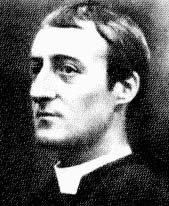
"He belonged to that culture of sentimental and erotic male friendships shaped by both Greece and (Catholic) Rome to which Newman and Faber belonged before him." -- Gregory Woods
"At university Hopkins's discipline began: self-denial in the interest of the self. He evokes the effect of religious faith on the imagination. Imagine, he says, the world reflected in a water drop: a small, precise reflection. Then imagine the world reflected in a drop of Christ's blood: the same reflection, but suffused with the hue of love, sacrifice, God made man, and redemption. Religious faith discovers for a troubled imagination an underlying coherence which knows that it cannot be fully or adequately explained. In its liberating, suffusing light, Hopkins could relish out loud the uniqueness of things, which made them "individually distinctive." This he called "inscape" - an artist's term. "Instress", another bit of individual jargon, refers to the force maintaining inscape. Inscape is manifest, instress divine, the immanent presence of the divine in the object." -- Michael Schmidt, "Lives of the Poets"
"I might as well say what I should not otherwise have said, that I always knew in my heart Walt Whitman's mind to be more like my own than any other man's living. As he is a very great scoundrel this is not a pleasant confession. And this also makes me the more desirous to read him and the more determined that I will not." -- Gerard Manley Hopkins, in 1882
"The onomatopoeic theory has not had a fair chance. Cf. Crack, creak, croak, crake, graculus, crackle." -- Gerard Manley Hopkins
"It seems to me that the poetical language of an age shd. be the current language heightened, to any degree heightened and unlike itself, but not (I mean normally; freaks and graces are another thing) an obsolete one. This is Shakespeare's and Milton's practice and the want of it will be fatal to Tennyson's Idylls and plays, to Swinburne, and perhaps to Morris." -- Gerard Manley Hopkins, in letter to his friend and encourager Robert Bridges, poet laureate
"The dark sonnets are his most astonishing work, for here ruptured syntax, inversions, and sound patterning answer a violence of negative spiritual experience. In the work of George Herbert, which Hopkins loved, Christ is the wooer, the soul that wooed. In Hopkins, the soul, painfully aware of its own fallen nature, deliberately woos Christ. There is almost despair, for a beautiful and vigorous Christ has withdrawn, grace is withheld. The earlier ease of loving faith -- "I say that we are wound / With mercy round and round / As if with air" -- is gone. After the dark sonnets there is silence." -- Michael Schmidt
"No doubt my poetry errs on the side of oddness ... I hope in time to have a more balanced and Miltonic style." -- Gerard Manley Hopkins
"I am so happy, I am so happy." -- Gerard Manley Hopkins's last words
More on this fascinating poet here.
April 6, 2007
National Poetry Month: Michael Blumenthal
I love this poem. Follow the light. I'm a wreck (in a good way) and have been all day. This poem is perfect for Good Friday. Waterworks.
Light, at Thirty-Two
It is the first thing God speaks of
when we meet Him, in the good book
of Genesis. And now, I think
I see it all in terms of light:
How, the other day at dusk
on Ossabaw Island, the marsh grass
was the color of the most beautiful hair
I had ever seen, or how?years ago
in the early-dawn light of Montrose Park?
I saw the most ravishing woman
in the world, only to find, hours later
over drinks in a dark bar, that it
wasn't she who was ravishing,
but the light: how it filtered
through the leaves of the magnolia
onto her cheeks, how it turned
her cotton dress to silk, her walk
to a tour-jete
And I understood, finally,
what my friend John meant,
twenty years ago, when he said: Love
is keeping the lights on. And I understood
why Matisse and Bonnard and Gauguin
and C麡nne all followed the light:
Because they knew all lovers are equal
in the dark, that light defines beauty
the way longing defines desire, that
everything depends on how light falls
on a seashell, a mouth ... a broken bottle.
And now, I'd like to learn
to follow light wherever it leads me,
never again to say to a woman, YOU
are beautiful, but rather to whisper:
Darling, the way light fell on your hair
This morning when we woke?God,
It was beautiful. Because, if the light is right,
Then the day and the body and the faint pleasures
Waiting at the window ... they too are right.
All things lovely there. As the first poet wrote,
in his first book of poems: Let there be light.
And there is.

That poem just gives me such a pang in my heart. Of course I'm all wacked out today so a teeny drifting snowflake makes me want to weep with the beauty of it all ... but still. I remember reading that poem on a more normal day (emotionally, I mean) and being very moved by it.
A bit more on Michael Blumenthal here.
Michael Blumenthal: A Letter to my Students
He's a poet, but also an essayist. This book sounds right up my alley.
Other National Poetry Month posts:
Diary Friday
I'm all emotional today because I hung out with Keith M. for a marathon 10 hours ... he was in town this week, and we met up, and had this awesome time together, and ... he's my childhood friend. It's a strange thing. I'll write about it more when I'm not so under-slept, over-whelmed, hung-over ... and any other unders and overs you can think of.
I wrote about Keith M. and who he was to me here (and, I guess, who he still is to me).
See, I'm all teary-eyed right now. How often in life do we get such a chance? To reunite with an old old friend ... someone who "knew you when" ... and not just in a superficial way - or not just a catch-up talk at a high school reunion (although our last reunion was really intense - for both of us - we talked about that too) - but a serious re-connecting? Like in a real life kind of way? I just feel so lucky, so happy right now, and I'm crying. I obviously have a lot of great friends from childhood, who are still my friends today. Thank you, God. These people are my rocks, my anchors, my dearest friends. Betsy and Michele - from grade school, and then Beth and Mere from junior high. Keith and I talked a lot about that, and why such friendships are so poignant - and important - like what exactly is it ... it's not just nostalgia. It is something else.
We hashed that one out yesterday (in about hour 2 of our marathon day) - sitting on a bench in Central Park, watching little kids play - just like he and I used to play. There were kids on the swings, kids chasing each other, sliding down slides ... and I was listening intently to Keith, commenting, talking, listening, nodding, all that stuff - but I was also sitting there, and seeing in my minds eye the ghosts of us - when we were little ... at recess ... doing the very things the kids around us were doing at that very moment. Chasing each other, screaming, dangling precariously from jungle gyms, running as fast as we could, etc. Keith is a man now. I'm a woman. But we were children together and ... those kids we once were ... are still there, they are still us, they are part of us. Maybe that's why I'm writing this with tears streaming down my face. I talked with Keith, and I knew him, even with the "20 year gap" in our friendship. Amazing. I just feel so freakin' lucky. We have grown and matured ... but he is that person I remember from 2nd grade, 3rd grade, high school. There is a continuum here - a piece of myself that is somehow contained in Keith.
We are not islands. Memory is a collective thing. Little pieces of who we are, memories ... are contained in other people, not just in our own minds. Like we were just batting back and forth the memories yesterday, throwing out names, telling stories, having the past wash over us, bolts from the blue - "remember that??" Talking with Keith for 10 straight hours yesterday was not hard at all. There wasn't one awkward silence. We got into it, man. hahaha Like - no small talk. We went right to it. Politics, God, relationships, our childhood, issues we struggle with - who we are - our flaws - what we want - our dreams - sex, life ... It was a marathon. Lots of laughter, too. He said to me within the first 5 minutes of seeing each other, "It is my goal that by the end of the night you will either be crying - or laughing so hard you piss your pants." hahahaha It was that kind of reconnection. And we could have kept going. It's just that it finally was 1 a.m. and we were wiped out. I need to just let this percolate for a while. It was so so good to see him, sweet, strong, intense, poignant, and also just plain old fun. How much fun it was to sit in a bar with Keith - KEITH! - my childhood friend! - and drink beer, and talk like maniacs about our lives?
So in honor of him, and to embarrass him - here are a couple of Diary Friday entries - I've posted them before ... apparently I wrote about Keith in my diary a lot as a high schooler ... this was something I did not remember. I always had a fondness for Keith, I always liked him - but after grade school, our cliques diverged ... but I was always aware of him. Not in a stalker kind of way - just a kind of familiarity that I found comforting. And also (judging from these diary entries) exhilarating.
But first: a picture of us then. And I'm bummed - we kept saying we needed to take a picture of us together now - but we were just so wrapped up in our conversation for 10 hours that we never took the picture. I did take a picture of his back as he walked away from me in one of the bars we hung out in. Yes, there was more than one bar. hahaha But it's a blurry cell phone photo ...
Guess the ghosts of us then will have to do:

Keith and me - we're 11 years old here. sniff, sniff. I'm a mess.
These two entries are from my junior year in high school:
NOVEMBER
WHAT A DAY!! I've got to tell you! Have I told you about Keith M? It feels like I have. He is -- the -- (I swear to God) nicest guy at our school. Wow. My heart almost hurts. He is gonna grow up to be one fantastic guy. He already is. It's unusual. I mean, the popular guys in our class - they're nice and everything - but not very sensitive. It seems like they make fun of everyone. They can be mean. But Keith! KEITH! What a name. [Uhm, okay - not only am I probably embarrassing Keith reading this, but now I'M embarrassed. It's the "What a name" moment that got me. Okay, onward.] He never makes fun of freshmen or unpopular kids. He's nice to everyone. But he's not overly sweet. He's sort of a tough guy, you know? [I ADORE my complex character analysis here.]
He's in my Chemistry and Math. He is a good student. He wants to understand and do well. It gives me a thrill whenever he says my name. [AHHHHH! How embarrassing!!] It's like: "He knows who I am!" But of course he does! I've been in his class since first grade. We were a "couple" in 4th grade. (Really heavy stuff. You know. I stole his comb and giggled when he came near me.) But in junior high, I drifted apart from all my old friends. They all became popular - Keith, Andrew - but now - this year, I just love being in classes with him. My old childhood friend.
I keep thinking I've told you this! [Er - I believe the "you" is referencing my journal] There's that moment in gym class - where a retarded kid showed up and he'd be doing his best, and everyone would be snickering- but Keith M. sat there, staunchly, firmly, calling out, "Great cut! Okay! Keep your eye on the ball! That's it!" You know -- pep talk. Whatever. GOD.
Keith M. has such a great start on being human. I told my mom that story about Keith in gym class and she went, "Now him. He will grow up to be an even nicer man." She's right. He's so friendly. We can talk to each other. I don't know. I feel comfortable with him.
[I have to just interject here. The fact that I wrote about Keith M so much and so rapturously in my journals is kind of surprising to me - not that he isn't a worthy object - but that I don't remember doing so. I don't remember having RAVED about him so consistently - his name comes up constantly in these old journals - and it's really amazing to look back and go: "Wow. He really meant a lot to me. Who knew??"]
I had gone on a field trip today with Drama to see Glass Menagerie and I came home and wondered who to call from Math to find out what I missed. I really don't know anyone in my class, not well enough to call anyway - so I thought of Keith - not that I know Keith like a brother - but God, the opportunity was there - I grabbed it. I was nervous though. I practiced what I would say. O God! [I am striking myself as unbelievably sweet here. Also, I love that I didn't write "Oh God" but I wrote "O God" ... it's a much more dramatic and poetic spelling, which was completely appropriate - seeing as I WAS ABOUT TO CALL KEITH M! I was so dramatic. Sheesh] I looked up his number.
I remember every second of this phone call. Keith has a distinct way of talking. His voice ... it sounds - not sharp - but clear. He is the best looking boy in our class, I swear. Heart pounding, I said to myself, "Cut it out, Sheila!" and dialed.
It rang twice.
"Hello?" It was his father, I guess. I could hear the news on in the background. Just saying, "May I please speak to Keith" gave me a heart attack. What was he thinking as he came to get the phone? Would he be bummed out that it was me? But really what I was thinking was just his name ... Keith. [Sheila, his name is Keith. Please get over it.]
"Just a minute," and he went off to get Keith and I thought, "Oh my God, he's home!" I wasn't nervous - just - I don't know. I really like him. But 4th grade is so far away now.
There was a pause - then I heard this sort of close voice, "Yeah! I got it!" His sharp clear voice. He picked up the phone. [Listen to how I am writing about this - I am writing as though calling Keith to get the math homework is literally the biggest cliffhanger ever. O God!] He said "Hello?"
I pushed on - "Hi Keith? This is Sheila from Math class." Dumb thing to say. We have been friends since six-year-old-dom. But he said, "Oh! Hi!" Really friendly. Not sort of suspicious, like: "Oh no - what does she want?" I once called Andrew in the 6th grade - Mary Lou answered and went running off screaming, "ANDREW! IT'S A GIRL!" [hahahahahahaha]
I said, "Uh ... I was wondering, since I wasn't there today if we had a quiz or what the homework is ..."
"Oh - okay. Uh ..."
I love how -- I just -- He just was so nice - very amiable. I have such an inferiority complex, especially with boys. I think everyone's suspicious of me. And I think that if they guess that I like them - they will be bummed out about it. It's weird.
He said, "We didn't have a quiz today but I believe we're having a test on Friday and - okay, the homework is the - uh - Chapter Review - Chapter Summary - whatever, and that's on page ... Do you have your book with you?"
[Look at that. I have almost no memory of this enormous cliffhanger of a moment in my life - but I would bet that that's almost word for word what Keith said. I had a knack - and still have it - for remembering conversations, no matter how benign or trivial - with word to word detail.]
"Uh - no -" I whipped out a pencil to mark it down. He said, "Well, it's either on 109 or 129 - I'm not sure - but one of those." I wrote that down quickly on my Glass Menagereie program and said, "Okay. Got it. Thanks a lot, Keith." "Yeah, sure." "Okay. Bye." "Bye."
AND THEN WE HUNG UP!
[If you could only see how huge those letters are in my journal. Hahahaha They're enormous. I am shouting "AND THEN WE HUNG UP". As though hanging up the phone is the most AMAZING development in this whole cliffhanger.]
Keith seems so natural - not inhibited - I can't explain this. I don't idolize him - even though I sit here going, "HE KNOWS WHO I AM!" It's not like that. I don't idolize him. I just care for him. He is special. That’s all. His whole personality. I know that conversation doesn’t sound thrilling – but Diary – all the other guys – I mean, I don’t know if they even know who I am – but you had to have been on that phone. He was not – Okay. I know. I remember. I know why he's different, and special. That’s what matters. I mean, I don’t think he likes me or anything, but it is the fact that he treats me so kindly, like a pal, like a friend – It comes so easily to me when I am with him. With all other boys – even the ones I grew up with – it’s always so weird and awkward. They act like I want something from them – just by talking to them. Keith never does that. Conversation comes naturally with us. Me, Keith, and Bill always end up sitting near each other because of our last names. That last sentence had awful grammar, and sorry about that. Anyway, in Chemistry, I sit in back of Bill who sits in back of Keith. One day, Mr. Amoeba started handing out papers for a “pop quiz” – ooh, isn’t he cool and scary – [Uhm, can you tell I despised that teacher?] Keith groaned, "Oh, great. Here goes another grade down the tubes." I said - not really to him - just to myself, and anyone who felt like listening: "Think positive!" Bill heard me. He leaned forward, tapped Keith on the shoulder, and said, "Excuse me, Keith. Sheila O'Malley wants you to think positive." [hahahahahaha] Keith turned around and grinned at me, giving the thumbs-up sign.
I can't believe how much I care for this kid. How has this happened? Just a friendship is more than enough.
Aren't human beings and human nature the most wonderful things in the world??????
DECEMBER
Oh, the weirdest thing just happened to me! [Sheila, please don't share it. Oh God ... you're gonna share it, aren't you?] Isn't it wonderful when life looks so humdrum and a tiny little thing pops up to take away the humdrum-ness?
Just now - I was in my room alone working on a new story I just started, listening to the radio. Today was a good day. I wasn't depressed or anything, and Freeze Frame came on the radio. [HAHAHAHA] Music is my savior. No matter what kind. It uplifts me. [But I thought you just said you weren't depressed??] I love music. It does something to me. It revitalizes me. (Ooh!) [Uhm - okay, I don't know what that "ooh" is about.] Anyway, an old wave of happiness flooded over me, remembering when I loved that song and Mere and I made up a dance to it. [Mere, I am sure you can see those dance steps right now. It SWEPT THE SCHOOL!] So I leaped to my feet, turned up the volume, and started bounding around dancing. I love dancing - I feel so happy and uninhibited when I dance. I went wild, like I usually do at dances. [Yes, but Sheila, did you press your sweaty Irish head up against the tiles?] I'm glad no one was watching me though because I went berserk. I did the little dance, I really got into it. I'm cool! [Uhm ... ya are?]
Suddenly I looked at myself in the full-length mirror. My cheeks were all flushed. I was smiling. I looked okay in a very athletic out-of-breath way, that fun song was in my ears - I felt energy fizzing on all my nerve endings. I had nothing to do with the grin spread across my face. I was just lit up inside and it came out in a smile.
Then - [Oh God, there's not more is there?] I felt this surge inside - really - that's the word. It felt like a little cherry tomato exploded inside me. I felt no more doubts. I saw myself (well, not really saw - it wasn't like these visions slowly drifted past me - they all assaulted me at once, making it all the better) - I saw myself going with Dave to the movies, sitting at Ricky's with him, [RICKYS! HAHAHAHAHA] - kissing him - dancing with him - talking with him - It was wonderful. Just suddenly - for one brief flash - I felt: Of course something's going to happen. Of course! Ecstasy flew through my brain and I felt like leaping and screaming and laughing!!! [Wow. This is really sad. Nothing did end up happening and I spent the entire next summer staggering around in tears because he turned me down to go to the Junior Prom. God. It sucked, really.] But it paralyzed me in a way. I just stared at my reflection. The next minute, that feeling - if that's a word for it - was gone - but I still feel all wiggly inside. I wish I could say in here: Of course it'll work out! I want it more than I have ever wanted anything!!!! [Oh, sweet girl. Sorry. Heartbreak's comin' at ya. Hunker down.]
Yesterday in Chemistry, we saw a filmstrip, and Keith ran the projector. So he pulled a desk up right next to mine. I'm not in love with him, but I do find him very attractive, and he is such a nice and real person. I wish I could get to know him better, like we used to know each other when we were kids. Anyway, the room was dark and the narrator was droning on and whenever the beep beeped [uhm you might want to re-word that], Keith would turn the knob. I was just sitting there, taking notes like a good doobie, and I happened to glance at Keith, and I happened to look at his hands. Very nice hands. Big, with long rough-looking fingers - looking as though they were sculpted out of wood, just casually curled around the projector. Sometimes just slightly moving, not for any good reason - or reaching up to scratch his chest. Then - to my shock - I suddenly felt like reaching over and taking his hand in mine - feel his fingers gently squeeze mine. I had to quickly look back up at the screen to keep myself from doing just that. I didn't concentrate on the film AT ALL after that, but you know what I think? I think holding hands is about the most romantic thing of all. Of course, I've never done it. I HAVEN'T DONE ANYTHING. But I think that holding hands might even be nicer than a kiss. Of course, if I am ever kissed, I will probably think differently, but holding hands ... Oh God, its too romantic to talk about.
Of course, next in French, I glanced back at Dave's hands. Talk about big hands! They were beautiful - with ragged bitten nails. [hahahahaha Yeah, Sheila, they sound really "beautiful". Love is blind.] He bites his nails too. A cut on one of his knuckles. Rounded blunt fingertips. I couldn't get the vision of us strolling along, with our hands clasped, out of my mind. I want to hold hands with him.
You know what? It's just occurred to me that it must look to you as if this whole relationship is in my brain. [Er ... yeah. That is what it looks like] But it's not. It's not like the thing with JW. I admired JW from afar and tricked myself into believing that he cared for me just as much as I loved him. HOW could I have been so STUPID??? Why didn't I see? We must have had 6 conversations in all - I had fantasies of our romance, but it was all so illogical. He was so far from me. But David - suddenly this year - there is a friendship growing that wasn't there before. [This is not a lie. We were friends.] And this time - I don't lie on my bed dreaming of a sudden dalliance. [Dalliance? What is this - Les Liaisons Dangereuses?] I think about our real-life happenings which is so much more satisfactory. Me asking him to dance, us in Project Adventure - him talking to me - and just thinking about him -- DAVE - who he is, what he's like - what he thinks about - if he ever thinks of me.
It's impossible not to imagine us going out and what it would be like and how wonderful and fascinating it would be, but Diary - oh forgive my awful forwardness - I think it could work! [I love that I am apologizing TO MY JOURNAL for my "awful forwardness". It's so Victorian of me. I was a Gibson Girl, even then.] I think it honestly is in my grasp.
Isn't that wonderful?
I don't know how to go about "going for it" - but if nothing happens naturally - I'm gonna find a way. [Bummer, man. Headin' for a fall ... a big fall ...]
Here's the entire Diary Friday archive if you're interested.
DECEMBER
Oh, the weirdest thing just happened to me! [Sheila, please don't share it. Oh God ... you're gonna share it, aren't you?] Isn't it wonderful when life looks so humdrum and a tiny little thing pops up to take away the humdrum-ness?
Just now - I was in my room alone working on a new story I just started, listening to the radio. Today was a good day. I wasn't depressed or anything, and Freeze Frame came on the radio. [HAHAHAHA] Music is my savior. No matter what kind. It uplifts me. [But I thought you just said you weren't depressed??] I love music. It does something to me. It revitalizes me. (Ooh!) [Uhm - okay, I don't know what that "ooh" is about.] Anyway, an old wave of happiness flooded over me, remembering when I loved that song and Mere and I made up a dance to it. [Mere, I am sure you can see those dance steps right now. It SWEPT THE SCHOOL!] So I leaped to my feet, turned up the volume, and started bounding around dancing. I love dancing - I feel so happy and uninhibited when I dance. I went wild, like I usually do at dances. [Yes, but Sheila, did you press your sweaty Irish head up against the tiles?] I'm glad no one was watching me though because I went berserk. I did the little dance, I really got into it. I'm cool! [Uhm ... ya are?]
Suddenly I looked at myself in the full-length mirror. My cheeks were all flushed. I was smiling. I looked okay in a very athletic out-of-breath way, that fun song was in my ears - I felt energy fizzing on all my nerve endings. I had nothing to do with the grin spread across my face. I was just lit up inside and it came out in a smile.
Then - [Oh God, there's not more is there?] I felt this surge inside - really - that's the word. It felt like a little cherry tomato exploded inside me. I felt no more doubts. I saw myself (well, not really saw - it wasn't like these visions slowly drifted past me - they all assaulted me at once, making it all the better) - I saw myself going with Dave to the movies, sitting at Ricky's with him, [RICKYS! HAHAHAHAHA] - kissing him - dancing with him - talking with him - It was wonderful. Just suddenly - for one brief flash - I felt: Of course something's going to happen. Of course! Ecstasy flew through my brain and I felt like leaping and screaming and laughing!!! [Wow. This is really sad. Nothing did end up happening and I spent the entire next summer staggering around in tears because he turned me down to go to the Junior Prom. God. It sucked, really.] But it paralyzed me in a way. I just stared at my reflection. The next minute, that feeling - if that's a word for it - was gone - but I still feel all wiggly inside. I wish I could say in here: Of course it'll work out! I want it more than I have ever wanted anything!!!! [Oh, sweet girl. Sorry. Heartbreak's comin' at ya. Hunker down.]
Yesterday in Chemistry, we saw a filmstrip, and Keith ran the projector. So he pulled a desk up right next to mine. I'm not in love with him, but I do find him very attractive, and he is such a nice and real person. I wish I could get to know him better, like we used to know each other when we were kids. Anyway, the room was dark and the narrator was droning on and whenever the beep beeped [uhm you might want to re-word that], Keith would turn the knob. I was just sitting there, taking notes like a good doobie, and I happened to glance at Keith, and I happened to look at his hands. Very nice hands. Big, with long rough-looking fingers - looking as though they were sculpted out of wood, just casually curled around the projector. Sometimes just slightly moving, not for any good reason - or reaching up to scratch his chest. Then - to my shock - I suddenly felt like reaching over and taking his hand in mine - feel his fingers gently squeeze mine. I had to quickly look back up at the screen to keep myself from doing just that. I didn't concentrate on the film AT ALL after that, but you know what I think? I think holding hands is about the most romantic thing of all. Of course, I've never done it. I HAVEN'T DONE ANYTHING. But I think that holding hands might even be nicer than a kiss. Of course, if I am ever kissed, I will probably think differently, but holding hands ... Oh God, its too romantic to talk about.
Of course, next in French, I glanced back at Dave's hands. Talk about big hands! They were beautiful - with ragged bitten nails. [hahahahaha Yeah, Sheila, they sound really "beautiful". Love is blind.] He bites his nails too. A cut on one of his knuckles. Rounded blunt fingertips. I couldn't get the vision of us strolling along, with our hands clasped, out of my mind. I want to hold hands with him.
You know what? It's just occurred to me that it must look to you as if this whole relationship is in my brain. [Er ... yeah. That is what it looks like] But it's not. It's not like the thing with JW. I admired JW from afar and tricked myself into believing that he cared for me just as much as I loved him. HOW could I have been so STUPID??? Why didn't I see? We must have had 6 conversations in all - I had fantasies of our romance, but it was all so illogical. He was so far from me. But David - suddenly this year - there is a friendship growing that wasn't there before. [This is not a lie. We were friends.] And this time - I don't lie on my bed dreaming of a sudden dalliance. [Dalliance? What is this - Les Liaisons Dangereuses?] I think about our real-life happenings which is so much more satisfactory. Me asking him to dance, us in Project Adventure - him talking to me - and just thinking about him -- DAVE - who he is, what he's like - what he thinks about - if he ever thinks of me.
It's impossible not to imagine us going out and what it would be like and how wonderful and fascinating it would be, but Diary - oh forgive my awful forwardness - I think it could work! [I love that I am apologizing TO MY JOURNAL for my "awful forwardness". It's so Victorian of me. I was a Gibson Girl, even then.] I think it honestly is in my grasp.
Isn't that wonderful?
I don't know how to go about "going for it" - but if nothing happens naturally - I'm gonna find a way. [Bummer, man. Headin' for a fall ... a big fall ...]
April 5, 2007
The Sopranos ...
House Next Door has been running a series of essays about The Sopranos - and they are SO much fun to read. The details!!
National Poetry Month: Christopher Marlowe
I loves me some Christopher Marlowe. This is from Doctor Faustus.
The Face that Launched a Thousand Ships
Was this the face that launched a thousand ships?
And burnt the topless towers of Ilium?
Sweet Helen, make me immortal with a kiss:
Her lips suck forth my soul, see where it flies:
And all is dross that is not Helena:
I will be Paris, and for love of thee,
Instead of Troy shall Wertenberg be sack'd,
And I will combat with weak Menelaus,
And wear thy colours on my plumed crest:
Yea I will wound Achillis in the heel,
And then return to Helen for a kiss.
O thou art fairer than the evening air,
Clad in the beauty of a thousand stars,
Brighter art thou than flaming Jupiter,
When he appear'd to hapless Semele,
More lovely than the monarch of the sky
In wanton Arethusa's azur'd arms,
And none but thou shalt be my paramour.

(this 1585 portrait is widely thought to be of Marlowe)
"No leaf he wrote on but was like a burning glass to set on fire all his readers." -- Thomas Nashe, a friend of Marlowe's
"The place and the value of Christopher Marlowe as a leader among English poets it would be almost impossible for historical criticism to over-estimate. To none of them all, perhaps, have so many of the greatest among them been so deeply and so directly indebted. Nor was ever any great writer's influence upon his fellows more utterly and unmixedly an influence for good. He first, and he alone, guided Shakespeare into the right way of work; his music, in which there is no echo of any man's before him, found its own echo in the more prolonged but hardly more exalted harmony of Milton's. He is the greatest discoverer, the most daring and inspired pioneer, in all our poetic literature. Before him there was neither genuine blank verse nor a genuine tragedy in our language. After his arrival the way was prepared, the paths were made straight, for Shakespeare. " -- Algernon Charles Swinburne
"Everyone imitated Marlowe. His first play, Tamburlaine, was staged when he was 23, and its success can most readily be gauged by its imitators. As David Riggs notes in his new biography, The World of Christopher Marlowe, within the next couple of years three new plays were staged that were more or less direct copies of Marlowe's original, while Shakespeare wrote his early Henry VI plays under the influence of Marlowe's style. A decade later, as the church authorities burned copies of Marlowe's semipornographic love poems in the streets, Shakespeare again returned to imitating his predecessor in As You Like It. Marlowe's contemporaries regarded him with a mixture of awe and fear." -- David Riggs
"In common with the greatest - Marlowe, Webster, Tourner, and Shakespeare - they had a quality of sensuous thought, or of thinking through the senses, or of the senses thinking, of which the exact formular remains to be defined." -- T.S. Eliot on the Elizabethan-Jacobean poets
"What an example for our distracted poetry, which so often now strikes at the absolute and achieves the commonplace! These poets [George Chapman and Christopher Marlowe] lived life from the ground upwards." -- Edgell Rickword, 1924
"The unity of tone and purpose in Doctor Faustus is not unrelieved by change of manner and variety of incident. The comic scenes, written evidently with as little of labour as of relish, are for the most part scarcely more than transcripts, thrown into the form of dialogue, from a popular prose History of Dr Faustus, and therefore should be set down as little to the discredit as to the credit of the poet. Few masterpieces of any age in any language can stand beside this tragic poem — it has hardly the structure of a play — for the qualities of terror and splendour, for intensity of purpose and sublimity of note. In the vision of Helen, for example, the intense perception of loveliness gives actual sublimity to the sweetness and radiance of mere beauty in the passionate and spontaneous selection of words the most choice and perfect; and in like manner the sublimity of simplicity in Marlowe's conception and expression of the agonies endured by Faustus under the immediate imminence of his doom gives the highest note of beauty, the quality of absolute fitness and propriety, to the sheer straightforwardness of speech in which his agonizing horror finds vent ever more and more terrible from the first to the last equally beautiful and fearful verse of that tremendous monologue which has no parallel in all the range of tragedy." -- Algernon Charles Swinburne
"He took his BA in 1584, his MA three years later, by which time he had probably completed Tamburlaine. He was the first of the university wits to employ blank verse. It's generally thought that most if not all of his small surviving body of nondramatic verse - Hero and Leander, "The Passionate Shepherd:, and the Ovid and Lucan translations - were written in his university years, the fruit of youth and relative leisure. The six years that elapsed between his taking his MA and his shadowy death - possibly as a result of drink, or low political intrigue, or a romantic entanglement with a rough character "fitter to be a pimp, than an ingenious amoretto", or perhaps a tussle over the bill ("le recknynge") - at the hand of Ingram Frisar in a Deptford tavern on 30 May 1593 were busy ones. He wrote plays, was attacked for atheism, was associated (if it existed) with Ralegh's "School of Night," and lodged with Thomas Kyd (author of The Spanish Tragedy), who later brought charges of blasphemy against him. These he had to answer before the Privy Council in 1593, the very council that secretly employed him to spy on English Catholics on the Continent. He achieved much in a short life." -- Michael Schmidt, "Lives of the Poets"
I'm armed with more than complete steel,—
The justice of my quarrel.
Christopher Marlowe, Lust’s Dominion. Act iii. Sc. 4.
"If one takes The Jew of Malta not as a tragedy, or as a "tragedy of blood," but as a farce, the concluding act becomes intelligible; and if we attend with a careful ear to the versification, we find that Marlowe develops a tone to suit this farce, and even perhaps that this tone is his most powerful and mature tone." -- T.S. Eliot
"Marlowe's Doctor Faustus, like Goethe's Faust, finds himself before the specter of Helen (the idea that Helen of Troy was a ghost or apparition is already present in the ancients) and says to her, "Sweet Helen, make me immortal with a kiss." And then, "O thou art fairer than the evening air clad in the beauty of a thousand stars." He does not say "evening sky," but "evening air." All of Copernican space is present in that word air, the infinite space that was one of the revelations of the Renaissance, the space in which we still believe, despite Einstein, that space that came to supplant the Ptolomaic system which presides over Dante's triple comedy." -- Jorge Luis Borges
"And so it befell, in that affray, that the said Ingram, in the defence of his life, with the dagger aforesaid of the value of twelve pence, gave the said Christopher a mortal wound above his right eye." -- Coroner's inquest, 1593
"In Marlowe's superb verse there is very little to indicate that the writer had ever encountered any human beings." -- James Branch Cabell
"Marlowe painted gigantic ambitions, desires for impossible things, longings for a beauty beyond earthly conception, and sovereigns destroyed by the very powers which had raised them to their thrones. Tamburlaine, Faust, Barabbas are the personifications of arrogance, ambition and greed. There is sometimes a touch of the extravagant or bombastic, or even of the puerile in his plays, for he had no sense of humor; nor had he the ability to portray a woman. He wrote no drama on the subject of love. Furthermore, his world is not altogether our world, but a remote field of the imagination." -- Martha Fletcher Bellinger, 1927
"He came to London to seek his fortune . . . a boy in years, a man in genius, a god in ambition. Who knows to what heights he might have risen but for his untimely end?" -- Swinburne
More on Christopher Marlowe here.
CW has a cool post about Marlowe.
Excerpt from Tamburlaine here.
April 4, 2007
The Books: "Jane of Lantern Hill" (L.M. Montgomery)
Next book in my Daily Book Excerpt series ...
 And here is my last Lucy Maud book - and it's the second to last book she wrote: Jane of Lantern Hill. Published in 1937 ... only a couple of years after the Mistress Pat debacle - and interestingly enough, it has a lot of the same themes (the love of home, the need for a home - but this is always one of Lucy Maud's themes) - but Jane, in this book, spends the majority of her time separated from her father - who lives on Prince Edward Island - and she lives in Toronto - and seriously ACHES to get back to the island. The red roads, the ocean, the freedom of life there ... One of the reasons why this overwhelming love of home doesn't quite work with the "Pat" books is: Pat LIVES at home. She is not (like Anne, or Emily) an orphan, she barely spends a freakin' night away from her house - let alone her entire LIFE. She is not "in exile". She grows up in the same house, with two parents ... and so why this unbelievable attachment to the damn house? It makes no sense. That kind of displacement was very familiar to Lucy Maud - who did not grow up with her biological parents - who was basically abandoned by her father, who went out West, and created a new family from scratch - leaving Lucy Maud at home to be raised by grandparents. And then - once Lucy Maud married The Lunatic Husband - he whisked her off to various cities and towns far far away from Prince Edward Island, and - I don't know, this is just my impression - but I feel like she never ever reconciled herself to that geographical distance. She never got used to it. She never accepted it. Her entire soul and spirit yearned towards PEI and yet - til the end of her life - she never spent more than a month there at one time. People who experience their native land from exile often have a way deeper attachment to the soil than those who actually live there (see Joyce, see a bazillion others) ... Lucy Maud Montgomery was no exception. She lived far away from PEI for 30 years. And yet where did the majority of her books take place? Prince Edward Island. No one who has read her books can be indifferent to PEI. She writes about it with such love, such specificity - it's not a romanticized view, not exactly. To her, it felt like reality. There was no place on earth as beautiful or as desirable as PEI. So you wonder if she would have written about it so well if she had lived on PEI all that time. Perhaps exile sharpened her senses, her memory.
The story of Jane of Lantern Hill is actually kind of "modern", (for Lucy Maud anyway) - and touches on issues that were very personal for her, things she never spoke about or wrote about. Anne and Emily in her other books were both orphaned - which was not their fault (the very funny Oscar Wilde quote notwithstanding). Lucy Maud wrote about her sense of being alone in the world, thrown on the kindness of others - through these orphaned characters. But she never wrote a story from her own experience: her mother died, and her father felt he couldn't raise his daughter by himself - so he moved away, married someone else, started a family - and never sent for Lucy Maud. Even though he promised to. It's like he wiped her out of existence (I'm exaggerating - she did visit a couple of times, etc.) - but he had NO intention of "sending for" his young daughter. Which - if you really think about it - is pretty damn cold. But Lucy Maud coped - she accepted her life with very little bitterness, etc. - she didn't blame her father for this ... and yet in book after book after book she writes about orphaned girls. Girls with no parents. Parents do NOT exist in Lucy Maud's world. It's an indirect indictment of the lonely childhood her father left her to.
In Jane, the situation is: Jane's parents split up acrimoniously when she was still a baby. I don't think they got divorced - just separated. Her father, in a rage, moved back home to Prince Edward Island, where he grew up - and Jane's mother moved back in with HER mother, an imperious WITCH. The three of them live in a huge mansion in Toronto and Jane grows up in a rigid atmosphere of silence - her grandmother despises her, because of the resemblance to this hated and scorned ex-husband. Jane's mother is beautiful, and "modern" - much more modern than other mothers in Lucy Maud's books - and by that I mean, she wears makeup, perfume - she's an urban woman, going out to dinner parties, etc. But there's a sadness there. Jane is forbidden to ask questions about her father, whom she has never met.
Jane is a winning little child. You like her. She has spunk. She's not fanciful like Anne, or really really good at something like Emily - but she's the kind of person well liked by everyone. A person with the gift of human connection and friendship. Lucy Maud writes her well - you really GET her character. She's not a re-tread of Anne or Emily. She is her own person. For example: - Anne is a bumbling idiot at first when it comes to domestic issues - and puts salt into pancakes, and forgets the flour ... and Marilla has a hell of a time teaching her to cook. But Jane doesn't have that problem - she's kind of a brilliant cook, improvisational, enthusiastic, good at it - but - she doesn't even know this about herself - because her environment is so rigid, so "children should be seen and not heard" - that she isn't given a chance to discover who she is at ALL. She just tries to make herself as good and unobtrusive and unoffensive as possible - to avoid the wrath of her icy-eyed grandmother.
But then one day - out of the blue - her father writes to her mother demanding that Jane come stay with him for the summer. Jane is 10 or 11 years old. It is his "right" to see Jane, to meet her, he says. A huge family upset occurs. Jane doesn't want to go. She doesn't even KNOW her father! Her mother is a weakling, unable to stand up to her icy mother - and the grandmother is just a flat out witch. But eventually - fearful that he will turn it into a legal issue - they allow Jane to go. Jane goes reluctantly. Even though she is unhappy living in the big echoing marble mansion, with her grandmother - who hates her - she doesn't want to leave. She is afraid of the unknown. She doesn't know who she is yet.
So off she goes to Prince Edward Island. Fearful, hateful, cautious, resentful. Naturally - it turns out that her father is wonderful. You can see why he might not be a good husband - at least not to a woman like Jane's mother - he's a bit irresponsible with his money - you get that right away, he's unconventional - he's a writer - he doesn't care about material things - but you LOVE him. In my opinion, he is the only convincing father-figure Lucy Maud ever wrote. He accepts Jane as she stands. There are no preconceived notions about who she should be - she also is not expected to be a 'good little girl' - and follow the rules. She can swim all day if she wants to, she doesn't have to go to church if she doesn't want to - she can make the friends she wants to make - not have stupid "approved" friends. And he already loves her, because she is his daughter. So in that environment of acceptance - Jane just starts to blossom. She lives with her father in his little seaside cottage (called Lantern Hill, of course) - and she cooks - she's never had a chance to cook before - because the house in Toronto has servants doing everything for her. So after a couple of false starts - Jane becomes an awesome cook. It is the happiest summer of her life. She makes friends her own age for the first time - she has adventures - and she basically just falls in love with her dad. She comes alive. Even though she had never been to PEI before - by the end of the summer she knows: It is HOME.
Of course when it is time for her to return back to Toronto- and her mother - and her horrible grandmother - it ACHES. She doesn't know how to bear it. Jane has discovered her home soil. She must endure the back and forth - she misses her mother desperately - but her heart will always be in Prince Edward Island. It's kind of a complex little book - witih modern-era issues. And I personally think that some of her nature-writing in this book is her best ever - and that is quite a statement, because when she's writing about the natural world - she is always good.
In this excerpt - Jane is staying with her father - her relationship with him is new and fresh ... and she has announced to him that she finds the Bible boring. He feigns shock (but always in a humorous way) and tells her that the best place to read the Bible is in the great outdoors. God isn't meant to be contained in a man-made building. (Is this Lucy Maud digging at her stick-in-the-mud religious fanatic minister husband? Her books are FULL of hints that religion ruins God. Member Anne Shirley talking about how prayers shouldn't be in actual words - that she wanted to walk into the woods and feel a prayer? This would have been heretical to her husband, who feared the flames of hell to such an extent that he went mad. Anyway, I just wonder about that.) Jane's father feels that the Bible should only be read with the sound of the crashing waves in the air, etc. Jane is skeptical.
(Notice here how her father talks to Jane as though she is an intelligent person, not a little girl. He treats her like she is good company. Think back on being a little kid - and how much you cherished grown-ups who treated you like that - with respect. Lucy Maud really gets that.)
Also: notice the creativity and fluidity with which Jane's dad reads the Bible. It's unconventional. Can't you hear snippety know-it-all Christians arguing in a kneejerk way about where he gets it wrong? Which, of course, misses the entire point. Or - that IS the point. Jane has been turned off of religion through overly literal practice. Or, to be more blunt: Christians have turned her off God. Jane's dad couldn't give a shit about any of that. To him - God comes alive in nature. This was always true for Lucy Maud as well, who went to the ocean, the woods, to commune - (which is hugely ironic - seeing as she married an unimaginative unspiritually-minded minister.) Jane's father would probably be seen as a heathen by many. But Jane knows better. So does Lucy Maud. I love this whole passage. It's full of heart, it's smart ... and I can hear the two voices. (She re-uses a couple phrases here from other books. Any serious Lucy Maud fans will immediately recognize them.)
Excerpt from Jane of Lantern Hill by Lucy Maud Montgomery
After all Jane found it did not require a miracle to make her like the Bible. She and dad went to the shore every Sunday afternoon and he read to her from it. Jane loved those Sunday afternoons. They took their suppers with them and ate them squatted on the sand. She had an inborn love of the sea and all pertaining to it. She loved the dunes ... she loved the music of the winds that whistled along the silvery solitude of the sand-shore ... she loved the far dim shores that would be jewelled with home-lights on fine blue evenings. And she loved dad's voice reading the Bible to her. He had a voice that would make anything sound beautiful. Jane thought if dad had had no other good quality at all, she must have loved him for his voice. And she loved the little comments he made as he read ... things that made the verses come alive for her. She had never thought that there was anything like that in the Bible. But then, dad did not read about knops and taches.
"'When all the morning stars sang together' ... the essence of creation's joy is in that, Jane. Can't you hear that immortal music of the spheres? 'Sun, stand thou still upon Gibeon and thou, moon, in the vale of Ajalon.' Such sublime arrogance, Jane ... Mussolini himself couldn't rival that. 'Here shall thy proud waves be stayed' ... look at them rolling in there, Jane ... 'so far and no further' ... the majestic law to which they yield obedience never falters or fails. 'Give me neither poverty nor riches' ... the prayer of Agar, son of Jakeh. A sensible man was Agar, my Jane. Didn't I tell you the Bible was full of common sense? 'A fool uttereth all his mind.' Proverbs is harder on the fool than on anybody else, Jane ... and rightly. It's the fools that make all the trouble in the world, not the wicked. 'Whither thou goest I will gol and where thou lodgest I will lodge; thy people shall be my people and thy God my God; where thou diest will I die and there will I be buried; the Lord do so to me and more also if aught but death part thee and me.' The high-water mark of the expression of emotion in any language that I'm acquainted with, Jane ... Ruth to Naomi ... and all such simple words. Hardly any of more than one syllable ... the writer of that verse knew how to marry words as no one else has ever done. And he knew enough not to use too many of them. Jane, the most awful as well as the most beautiful things in the world can be said in three words or less ... I love you ... he is gone ... he is come ... she is dead ... too late ... and life is illumined or ruined. 'All the daughters of music shall be brought low' ... aren't you a little sorry for them, Jane ... those foolish, light-footed daughters of music? Do you think they quite deserved such a humiliation? 'They have taken away my lord and I know not where they have laid him' ... that supreme cry of desolation! 'Ask for the old paths and walk therein and ye shall find rest.' Ah, Jane, the feet of some of us have strayed far from the old paths ... we can't find our way back to them, much as we may long to. 'As cold water to a thirsty soul so is good news from a far country.' Were you ever thirsty, Jane ... really thirsty ... burning with fever ... thinking of heaven in terms of cold water? I was, more than once. 'A thousand years in thy sight is but as yesterday when it is past and as a watch in the night.' Think of a Being like that, Jane, when the little moments torture you. 'Ye shall know the truth and the truth shall make you free.' The most terrible and tremendous saying in the world, Jane ... because we are all afraid of truth and afraid of freedom ... that's why we murdered Jesus."
Jane did not understand all dad said, but she put it all away in her mind to grow up to. All her life she was to have recurring flashes of insight when she recalled something dad had said. Not only of the Bible but of all the poetry he read to her that summer. He taught her the loveliness of words ... dad read words as if he tasted them.
" 'Glimpses of the moon ...' one of the immortal phrases of literature, Jane. There are phrases with sheer magic in them ..."
"I know," said Jane. " 'On the road to Mandalay' ... I read that in one of Miss Colwin's books ... and 'horns of elfland faintly blowing.' That gives me a beautiful ache."
"You have the root of the matter in you, Jane. But, oh, my Jane, why ... why ... did Shakespeare leave his wife his second best bed?"
"Perhaps she liked it best," said Jane practically.
" 'Out of the mouths of babes and sucklings' ... to be sure. I wonder if that eminently sane suggestion has ever occurred to the commentators who have agonised over it. Can you guess who the dark lady was, Jane? You know when a poet praises a woman she is immortal ... witness Beatrice ... Laura ... Lucasta ... Highland Mary. All talked about hundreds of years after they are dead because great poets loved them. The weeds are growing over Troy but we remember Helen."
"I suppose she didn't have a big mouth," said Jane wistfully.
Dad kept a straight face.
"Not too small a one, Jane. You couldn't imagine goddess Helen with a rosebud mouth, could you?"
"Is my mouth too big, dad?" implored Jane. "The girls at St. Agatha's said it was."
"Not too big, Jane. A generous mouth ... the mouth of a giver, not a taker ... a frank, friendly mouth ... with very well cut corners, Jane. Nno weakness about them ... you wouldn't have eloped with Paris, Jane, and made all that unholy mess. You would have been true to your vows, Jane ... in spirit as well as in letter; even in this upside-down world."
Jane had the oddest feeling that dad was thinking of mother, not of Argive Helen. But she was comforted by what he said about her mouth.
Dad did not always read from the masters. One day he took to the shore a thin little volume of poems by Bernard Freeman Trotter.
"I knew him overseas ... he was killed ... listen to his song about the poplars, Jane.
"'And so I sing the poplars and when I come to die
I will not look for jasper walls but cast about my eye
For a row of wind-blown poplars against an English sky.'
"What will you want to see when you get to heaven, Jane?"
"Lantern Hill," said Jane.
Dad laughed. It was so delightful to make dad laugh ... and so easy. Though a good many times Jane didn't know exactly what he was laughing at, Jane didn't mind that a bit ... but sometimes she wondered if mother had minded it.
One evening after dad had been spouting poetry until he was tired, Jane said timidly, "Would you like to hear me recite, dad?"
She recited The Little Baby of Mathieu. It was easy ... dad made such a good audience.
"You can do it, Jane. That was good. I must give you a bit of training along that line too. I used to be rather good at interpreting the habitant myself."
"Someone she did not like used to be rather good at reading habitant poetry" ... Jane remembered who had said that. She understood another thing now.
Dad had rolled over to where he could see their house in a gap in the twilit dunes.
"I see the Jimmy Johns' light ... and the Snowbeam light at Hungry Cove ... but our house is dark. Let's go home and light it up, Jane. And is there any of that applesauce you made for supper left?"
So they went home together and dad lighted his gasoline lamp and sat down at his desk to work on his epic of Methuselah ... or something else ... and Jane got a candle to light her to bed. She liked a candle better than a lamp. It went out so graciously ... the thin trail of smoke ... the smouldering wick, giving one wild little wink at you before it left you in the dark.
The loneliness of ice skaters ...
... on a rainy windy New York day.

That's with my cell phone. Hence the darkness surrounding the ice skating rink.
National Poetry Month: Emily Bronte
This is one of my favorite poems. I guess I take it personally. Almost like an anthem, or ... as a reminder, when I need it, of how I want to live my life, of who I really am.
Often Rebuked
Often rebuked, yet always back returning
To those first feelings that were born with me,
And leaving busy chase of wealth and learning
For idle dreams of things which cannot be:
Today, I will not seek the shadowy region:
Its unsustaining vastness waxes drear;
And visions rising, legion after legion,
Bring the unreal world too strangely near.
I'll walk, but not in old heroic traces,
And not in paths of high morality,
And not among the half-distinguished faces,
The clouded forms of long-past history.
I'll walk where my own nature would be leading:
It vexes me to choose another guide;
Where the gray flocks in ferny glens are feeding;
Where the wild wind blows on the mountain-side.
What have those lonely mountains worth revealing?
More glory and more grief than I can tell:
The earth that wakes one human heart to feeling
Can centre both the worlds of Heaven and Hell.

"My sister Emily loved the moors. Flowers brighter than the rose bloomed in the blackest of the heath for her; -- out of a sullen hollow in a livid hill-side, her mind could make an Eden. She found in the bleak solitude many and dear delights; and not the least and best-loved was - liberty. Liberty was the breath of Emily's nostrils; without it she perished. The change from her own home to a school, and from her own very noiseless, very secluded, but unrestricted and unartificial mode of life, to one of disciplined routine (though under the kindest auspices), was what she failed in enduring. Her nature proved here too strong for her fortitude. Every morning, when she woke, the vision of home and the moors rushed on her, and darkened and saddened the day that lay before her. Nobody knew what ailed her but me. I knew only too well. In this struggle her health was quickly broken: her white face, attenuated form,a nd failing strength, threatened rapid decline. I felt in my heart she would die, if she did not go home, and with this conviction obtained her recall. --Charlotte Bronte, on Emily's stint away from home as a teacher in 1835
"Emily, like her characters, loved liberty and the open spaces of the moors. She insisted on her own patterns of life. Having nursed Branwell through his last illness, she caught cold at the funeral service and began her own two-month decline to death. Yet even on the day she died she insisted on rising in the morning, getting dressed and beginning her daily duties, as if the will could force its dying vehicle to live on. The will is the force her poems celebrate." -- Michael Schmidt
"The girls' real education, however, was at the Haworth parsonage, where they had the run of their father's books, and were thus nurtured on the Bible, Homer, Virgil, Shakespeare, Milton, Byron, Sir Walter Scott and many others. They enthusiastically read articles on current affairs, lengthy reviews and intellectual disputes in Blackwood's Edinburgh Magazine and The Edinburgh Review. They also ranged freely in Aesop and in the colourfully bizarre world of The Arabian Nights' Entertainments." -- Ian Ousby, The Cambridge Guide to Literature in English
"stronger than a man, simpler than a child" -- Charlotte Bronte on her sister Emily
"She never showed regard to any human creature; all her love was reserved for animals." -- Bronte family friend on Emily, reporting to Mrs. Gaskell
"Another poet could learn only one valuable lesson from what she does, and that is the ways in which form lives when it is driven urgently by powerful impulses, and how when that urgency ends a poem should stop." -- Michael Schmidt
"Nov. 23rd, 1848
I told you Emily was ill in my last letter. She has not rallied yet. She is very ill. I believe, if you were to see her, your impression would be that there is no hope. A more hollow, wasted, pallid aspect I have not beheld. The deep tight cough continues; the breathing after the least exertion is a rapid pant; nd these symptoms are accompanied by pains in the chest and side. Her pulse, the only time she allowed it to be felt, was found to beat 115 per minute. In this state she resolutely refuses to see a doctor; she will give no explanation of her feelings, she will scarcely allow her feelings to be alluded to. Our position is, and has been for some weeks, exquisitely painful. God only know how all this is to terminate. More than once, I have been forced boldly to regard the terrible event of her loss as possible, and even probable. But nature shrinks from such thoughts. I think Emily seems the nearest thing to my heart in this world." -- Charlotte Bronte
"How much better they would have made Wuthering Heights in France. They know there how to shoot sexual passion, but in this Californian-constructed Yorkshire, among the sensitive neurotic English voices, sex is cellophaned; there is no egotism, no obsession.... So a lot of reverence has gone into a picture which should have been as coarse as a sewer." -- Graham Greene, Spectator, May 5, 1939 - review of the Olivier/Oberon "Wuthering Heights"
"My sister Emily was not a person of demonstrative character, nor one, on the recesses of whose mind and feelings, even those nearest and dearest to her could, with impunity, intrude unlicensed: it took hours to reconcile her to the discovery I had made, and days to persuade her that such poems merited publication." -- Charlotte Bronte, on finding Emily's poems
"Sealed in her art-world, the moor strategically placed for escape above the house, no domesticating and limiting mother to weaken her capacity for identification with whatever sex she chose to impersonate at a particular moment, polite society at a safe distance, and a father who seems to have selected her as an honorary boy to be trusted with fire-arms in defence of the weak, Emily Brontë's life exemplifies a rough joy in itself, its war-games, its word games and its power to extend its own structuring vision out upon the given world." -- Stevie Davies
"In her poetry, Emily Brontë achieves a remarkable effect by the energy and sincerity, and often by the music, with which she portrays her stoicism, independence, and compassion in stanzas which in many instances are the commonplace vehicles used by mere rimers. It is as though she were brought up to feel that certain forms of verse were the patterns, and had, with dogged acceptance, poured into them her emotions with an honesty that made the outward form seem negligible." -- Paul Lieder
"They were grave and silent beyond their years; subdued, probably, by the presence of serious illness in the house; for, at the time which my informant speaks of, Mrs. Bronte was confined to the bedroom from which she never came forth alive. 'You would not have known there was a child in the house, they were such still, noiseless, good little creatures. Maria would shut herself up' (Maria, but seven!) 'in the children's study with a newspaper, and be able to tell one everything when she came out; debates in parliament, and I don't know what all. She was as good as a mother to her sisters and brother. But there never were such good children. I used to think sem spiritless, they were so different to any children I had ever seen. In part, I set it down to a fancy Mr. Bronte had of not letting them have flesh-meat to eat. It was from no wish for saving, for there was plenty and even waste in the house, with young servants and no mistress to see after them; but he thought that children should be brought up simply and hardily: so they had nothing but potatoes for their dinner; but they never seemed to wish for anything else; they were good little creatures. Emily was the prettiest.' " -- Elizabeth Gaskell, "The Life of Charlotte Bronte"
Excerpt from 'Little Magazine' - a magazine created by the Bronte children, to describe their doings, and plays, and poems. This one was written by Charlotte.
June the 31st, 1829
The play of 'The Islanders' was formed in December, 1827, in the following manner. One night, about the time when the cold sleet and stormy fogs of November are succeeded by the snow-storms, and high piercing night-winds of confirmed winter, we were all sitting round the warm blazing kitchen fire, having just concluded a quarrel with Tabby concerning the propriety of lighting a candle, from which she came off victorious, no candle having been produced. A long pause succeeded, which was at last broken by Branwell saying in a lazy manner, "I don't know what to do." This was echoed by Emily and Anne.
Tabby. "Wha ya may go t'bed."
Branwell. "I'd rather do anything than that."
Charlotte. "Why are you so glum to-night, Tabby? Oh! suppose we had each an island of our own."
Branwell. "If we had I would choose the Island of Man."
Charlotte. "And I would choose the Isle of Wight."
Emily. "The Isle of Arran for me."
Anne. "And mine should be Guernsey."
We then chose who should be chief men in our islands. Branwell chose John Bull, Ashley Cooper, and Leigh Hunt; Emily, Walter Scott, Mr. Lockhart, Johnny Lockhart; Anne, Michael Sadler, Lord Bentinck, Sir Henry Halford; I chose the Duke of Wellington and two sons, Christopher North and Co., and Mr. Abernethy. Here our conversation was interrupted by the, to us, dismal sound of the clock striking seven, and we were summoned off to bed. The next day we added many others to our list of men, till we got almost all the chief men of the kingdom. After this, for a long time, nothing worth noticing occurred. In June, 1828, we erected a school on a fictitious island, which was to contain 1,000 children. The manner of the building was as follows. The Island was fifty miles in circumference, and certainly appeared more like the work of enchantment than anything real.
"When at home, she took the principal part of the cooking upon herself, and did all the household ironing; and after Tabby grew old and infirm, it was Emily who made all the bread for the family; and any one passing by the kitchen-door, might have seen her studying German out of an open book, propped up before her, as she kneaded the dough; but no study, however interesting, interfered with the goodness of the bread, which was always light and excellent. Books were, indeed, a very common sight in that kitchen; the girls were taught by their father theoretically, and by their aunt practically, that to take an acctive part in all household work was, in their position, woman's simple duty; but, in their careful employment of time, they found many an odd five minutes for reading while watching the cakes, and managed the union of two kinds of employment better than King Alfred. -- Elizabeth Gaskell
"After the age of twenty, having meantime studied alone with diligence and perseverance, she went with me to an establishment on the continent. The same suffering and conflict ensued, heightened by the strong recoil of her upright heretic and English spirit from the gentle Jesuitry of the foreign and Romish system. Once mopre she seemed sinking, but this time she rallied through the mere force of resoluttion: with inward remorse and shame she looked back on her former failure, and resolved to conquer, but the victory cost her dear. She was never happy till she carried her hard-won knowledge back to the remote English village, the old parsonage-house, and desolate Yorkshire hills." -- Charlotte Bronte
"Her imagination, which was a spirit more sombre than sunny - more powerful than sportive - found in such traits material whence it wrought creations like Heathcliff, like Earnshaw, like Catharine. Having formed these beings, she did not know what she had done. If the auditor of her work, when read in manuscript, shuddered under the grinding influence of natures so relentless and implacable - of spirits so lost and fallen; if it was complained that the mere hearing of certain vivid and fearful scenes banished sleep by night, and disturbed mental peace by day, Ellis Bell [Emily's pseudonym] would wonder what was meant, and suspect the complainant of affectation. Had she but lived, her mind would of itself have grown like a strong tree - loftier, straighter, wider-spreading - and its matured fruits would have attained a mellower ripeness and sunnier bloom; but on that mind time and experience alone could work; to the influence of other intellects she was not amenable." -- Charlotte Bronte
"Of course, I was not surprised, knowing that she could and did write verse: I looked it over, and something more than surprise seized me, -- a deep conviction that these were not common effusions, not at all like the poetry women generally write. I thought them condensed and terse, vigorous and genuine. To my ear, they had also a peculiar music -- wild, melancholy, and elevating. " -- Charlotte Bronte, describing the moment in 1845 when she first read all of Emily's poems
More on Emily Bronte here.
Selected Emily Bronte poems here.
More National Poetry Month posts:
April 3, 2007
That missing plane
CW has more. (If you're interested in such things - look over in his right nav and he has a whole series of posts on the missing 727.) CW's one of my best old blog-buddies. His site, in general, is packed with interesting things (Pan Am!). But his ongoing Missing 727 investigation is really something to follow.
New Gadgetry and Rug Beating
My weekend involved new gadgetry as well as much physical activity, including dragging furniture out onto the sidewalk - while wearing a bandana wrapped around my head -(I felt kinda like her) - hauling out bookcases, and small tables - and also my old old (and now busted) television - all by myself - leaving them on the sidewalk for the garbage dudes (or my neighbors who found any of the pieces interesting) - I also beat on my various rugs - hanging them out of my window. There's nothing more satisfying than beating the shit out of a rug. Watching the dust fly off into the air. And then also - I sat in the grass in my back "yard" and re-potted my poor plants. Blasting Dean Martin through my open window. I still haven't really put my apartment back together after that BURST of activity - but the major re-hauling is done.

Sunday was cold and rainy - just how I like it - but I did most of all of this in the morning mist, before it got a bit too bitter.
Now. Onto the gadgetry.
I bought a digital camera on Saturday. I had Allison meet up with me at the Best Buy so she could help me. It was so crucial to have her there - she asked the right questions, knew what I wanted, and bolstered up my confidence. (As you can tell, I'm not a big purchaser. At least not of GADGETS. Now books? I have no problem with that ... but ... gadgets intimidate me. I mean, let's remember the debacle of the DVD player which I JUST got and which had to be sent to me by a concerned and impatient friend because I just wasn't buying one for myself. Now of course I have gotten rid of my television - which makes the DVD player useless which means I will have to buy yet another gadget sooner or later ... but I don't think I've ever BOUGHT a television before ... this is going to be a terrifyingly fun purchase.) But back to the camera:
I seriously think it is the most beautiful thing I have ever seen. The shiny sleek silver reminds me of a James Bond-era gun, sleek and glimmery. It's thin - and it has all of these .... features ... NONE of which I understand yet. But I was out walking at dusk on Sunday - a dark midnight-blue cloudy dusk - and took a couple pictures using one of the ... features ... the "twilight" portrait feature ... and for the first time in my life I took a picture at dusk - without a flash - that really captured what it was I actually saw. So I am SO thrilled. I hover over my camera protectively, and I feel .... well, kinda like the coolest person on the planet.
I love how BEHIND I am. I get everything LAST. iPods, DVD players, Netflix ... and a couple of other things which I will not mention, since this is a family blog (meaning: my family reads it. Hi, Mum and Dad!) - but the funny thing is is that I always go LAST, things come to me LATE ... but because of that - it's almost like I appreciate these things on a whole deeper level - because I came to it late.
I'm not "over" these things. Even still with my iPod, I have moments of ... Uhm. I love you so much. How on earth did I live without you, iPod. Bless you, iPod.
And the next gadget I got is a blackberry. I am a little bit scared of the blackberry right now ... and I was on the train last night, after dinner with Ted, and I tentatively began opening up emails I had received, clicking around ... figuring out how to Delete, Save, whatever. I mean, SO elementary. And everything felt so precarious. Like: Okay. Hm. What will happen if I do this ... Oh ... it saves the email ... hm. Okay. So what will happen if I click on this .....??
I am still scared of it. Hopefully we will build a lovely relationship together.
Two gadgets in one weekend?
How can I even LIVE at such a breakneck speed?
The Books: "Mistress Pat" (L.M. Montgomery)
Next book in my Daily Book Excerpt series ...
 Yawn. The second (and thankfully last) book in the Pat series. It's endless. Mistress Pat. Pat's fear of change begins to seem pathological here as she grows older. Like - her sister goes to college and Pat grieves for months the "loss". Every single thing that says "change" is resisted. Judy Plum wants to go home to visit Ireland - and Pat so dreads this that she can barely show an enthusiasm for her friend. Pat - you can't do without Judy Plum for 3 months? What the hell is your problem? Get a LIFE. Trees are cut down. Pat mourns. Her brother marries someone she despises. Yes, that sucks, it does ... but get over it. Your brother is not YOU, Pat. She has stupid love affairs which I, the reader, cannot get into because I know Pat's heart isn't in it. Naturally, on the very last page of the book - she "falls in love" with Jingle (yes, that is his name) - her childhood friend - a kind of Gilbert-ish character - and Pat insists, over YEARS, that she does not love him - even though Jingle loves her. Then - in one moment - she realizes she DOES love him. Pat - grownups learn how to deal with their emotions, learn how to know their own mind. It's boring to read. And again, you can feel Lucy Maud losing steam. For example, the book is broken up into "years" - which doesn't really make sense in the context. If it were the story of Pat going to college, then having chapters be titled "First Year", "Second Year", etc. would make sense. But in this context - it just seems like everyone is marking time. Another thing is the length of the chapters. The "First Year" chapter is 100 pages long. It goes on forEVER. And every chapter after that gets shorter and shorter and shorter ... there's one montage that starts one of the "years" that literally goes like this: "It was summer ... it was autumn ... it was winter ..." Lucy Maud must have been very tired. But she was obligated to finish the book. So she basically just sketched it in. And you can FEEL that, when you're reading it.
Bets, her childhood friend dies. A brother and sister move into Bets' old house. Pat, because she has mental problems, decides not to like them - because they have moved into Bets' old house. Yeah, that's a good reason not to like somebody. But eventually they become friends. David and Suzanne are her friends - and I guess she starts to "date" David - even though the way it's written you know it's never going to go anywhere. It's not like with Emily's other lovers - Jarback Priest, et al ... these are characters who are alive, and her relationship with these people could go somewhere. It's not a literary device to track time passing. It's a real relationship. But Pat "goes out" with David for EVER and then ... I guess she breaks it off with him, I don't know ... the whole thing seems so tired.
Here's an excerpt. There are a couple of lines here that I think are quite good. The whole description in the paragraph starting "Pat went up to the Long House ..." I do like the "silence kneeling like a grey nun" line. But other than that - what we are seeing here - is a woman full of pathologies who cannot accept reality.
Excerpt from Mistress Pat.
They heard about the Long House at Winnie's. It was to have new tenants. They had rented the house for the summer ... not the farm, which was still to be farmed by John Hammond, the owner, who had bought it from the successor of the Wilcoxes.
Pat heard the news with a feeling of distaste. The Long House had been vacant almost ever since Bets had died. A couple had bought the farm, lived there for a few months, then sold out to John Hammond. Pat had been glad of this. It was easier to fancy that Bets was still there when it was empty. In childhood she had resented it being empty and lonely, and had wanted to see it occupied and warmed and lighted. But it was different now. She preferred to think of it as tenanted only by the fragrance of old years and the little spectral joys of the past. Somehow, it seemed to belong to her as long as it was
"Abandoned to the lonely peace
Of bygone ghostly things."
Judy had more news the next morning. The newcomers were a man and his sister. Kirk was their name. He was a widower and had been until recently the editor of a paper in Halifax. And they had bought the house, not rented it.
"Wid the garden and the spruce bush thrown in," said Judy. "John Hammond do be still houlding to the farm. He was here last night, after ye wint away, complaining tarrible about the cost av his wife's operation. 'Oh, oh, what a pity,' sez I, sympathetic-like. 'Sure and a funeral wud have come chaper,' sez I. Patsy dear, did ye be hearing Lester Conway was married?"
"Somebody sent me a paper with the notice marked," laughed Pat. "I'm sure it was May Binnie. Fancy any one supposing it mattered to me."
It seemed a lifetime since she had been so wildly in love with Lester Conway. Why was it she never fell in love like that nowadays? Not that she wanted to ... but why? Was she getting too old? Nonsense!
She knew her clan was beginning to say she didn't know what she wanted but she knew quite well and couldn't find it in any of the men who wooed her. As far as they were concerned, she seemed possessed by a spirit of contrariness. No matter how nice they seemed while they were merely friends or acquaintances she could not bear them when they showed signs of developing into lovers. Silver Bush had no rival in her heart.
In the evening she stood in the garden and looked up at the Long House ... it was suddenly a delicate, aerial pink in the sunset light. Pat had never been enar it since the day of Bets' funeral. Now she had a strange whim to visit it once more before the strangers came and took it from her forever ... to go and keep a tryst with old, sacred memories.
Pat slipped into the house and flung a bright-hued scarf over her brown dress with its neck-frill of pleated pink chiffon. She always thought she looked nicer in that dress than any other. Somehow people seldom wondered whether Pat Gardiner was pretty or not ... she was so vital, so wholesome, so joyous, that nothing else mattered. Yet her dark-brown hair was wavy and lustrous, her golden-brown eyes held challenging lights and the corners of her mouth had such a jolly quirk. She was looking her best to-night with a little flush of excitement staining her round, creamy cheeks. She felt as if she were slipping back into the past.
Judy was in the kitchen, telling stories to a couple of Aunt Hazel's small fry who were visiting at Silver Bush. Pat caught a sentence or two as she went out. "Oh, oh, the ears av him, children dear! He cud hear the softest wind walking over the hills and what the grasses used to say to aich other at the sunrising." Dear old Judy! What a matchless storyteller she was!
"I remember how Joe and Win and Sid and I used to sit on the backdoor steps and listen to her telling fairy tales by moonlight," thought Pat, "and whatever she told you you felt had happened ... must have happened. That is the difference between her yarns and Tillytuck's. Oh, it is really awful to think of her going away in the fall for a whole winter."
Pat went up to the Long House by the old delightful short cut past Swallowfield and over the brook and up the hill fields. It was a long time since she had trodden that fairy path but it had not changed. The fields on the hill still looked as if they loved each other. The big silver birch still hung over the log bridge across the brook. The damp mint, crushed under her feet, still gave out its old haunting aroma, and all kinds of wild blossom filled the crevices of the stone dyke where she and Bets had picked wild strawberries. Its base was still lost in a wave of fern and bayberry. And on the hill the Watching Pine still watched and seemed to shake a hand meaningly at her. At the top was the old gate, fallen into ruin, and beyond it the path through the spruce bush where silence seemed to kneel like a grey nun and she felt that Bets had come to meet her, walking through the dusk with dreams in her eyes.
Past the bush she came out on the garden with the house in the midst. Pat stopped and gazed around her. Everything she looked on had some memory of pleasure or pain. The old garden was very eloquent ... that old garden that had once been so beloved by Bets. She seemed to come back again in the flowers she had tended and loved. The whole place was full of her. She had planted that row of lilies ... she had trained that vine over the trellis ... she had set out that rose-bush by the porch step. But most of it was now a festering mass of weeds and in its midst was the sad, empty house, with the little dormer window in its spruce-shadowed roof ... the window of the room where she had seen the sunrise light falling over Bets' dead face. A dreadful pang of loneliness tore her soul.
"I hate those people who are going to live in you," she told the house. "I daresay they'll tear you up and turn you inside out. That will break my heart. You won't be you then."
National Poetry Month: Thomas Hardy
I know I have posted this poem before, but here it is again. I love it. It scares me. It's so omniscent. Thomas Hardy's scary poem about the Titanic.
The Convergence of the Twain
I
In a solitude of the sea
Deep from human vanity,
And the Pride of Life that planned her, stilly couches she.
II
Steel chambers, late the pyres
Of her salamandrine fires,
Cold currents thrid, and turn to rhythmic tidal lyres.
III
Over the mirrors meant
To glass the opulent
The sea-worm crawls -- grotesque, slimed, dumb, indifferent.
IV
Jewels in joy designed
To ravish the sensuous mind
Lie lightless, all their sparkles bleared and black and blind.
V
Dim moon-eyed fishes near
Gaze at the gilded gear
And query: "What does this vaingloriousness down here?". . .
VI
Well: while was fashioning
This creature of cleaving wing,
The Immanent Will that stirs and urges everything
VII
Prepared a sinister mate
For her -- so gaily great --
A Shape of Ice, for the time fat and dissociate.
VIII
And as the smart ship grew
In stature, grace, and hue
In shadowy silent distance grew the Iceberg too.
IX
Alien they seemed to be:
No mortal eye could see
The intimate welding of their later history.
X
Or sign that they were bent
By paths coincident
On being anon twin halves of one August event,
XI
Till the Spinner of the Years
Said "Now!" And each one hears,
And consummation comes, and jars two hemispheres.
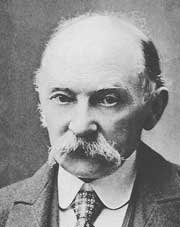
"For more than a year I read no one else." -- WH Auden - on Thomas Hardy
"[He was] a pale, gentle, frightened little man, that one felt an instinctive tenderness for, with a wife - ugly is no word for it! - who said 'Whatever shall we do?' I had never heard a human being say it before." -- Robert Louis Stevenson, after visiting Hardy in 1885
No matter what the subject, Hardy devoted his poetry to laying out his magnificently sombre, completely disillusioned view of the world. The central fact of that world was the disappearance of God, and with it any reason for believing in providence or justice. -- Adam Hirsch
He was always musing about poetry, defining and redefining, thinking in terms of poems, developing his craft in the spirit of a joiner or stonemason perfecting skills in preparation for the big work - a rood screen, a spire, The Dynasts. Some of the early poems Hardy turned into prose and used in descriptive passages in his fiction. Later he translated them back into verse. It is possible to see the impact of his poetic concerns throughout the fiction, in the shaping of scenes, the obliquity and economy of satirical and tragic payoffs, and most of all in the highly organized rhythms of the prose at points of lyrical or dramatic heightening. The imact of the fiction on the verse is also clear: he is a storyteller. -- Michael Schmidt, "Lives of the Poets"
"A certain provincialism of feeling is invaluable. It is the essence of individuality, and is largely made up of that crude enthusiasm without which no great thoughts are thought, no great deeds done." -- Thomas Hardy
For the rest of his life, then, Hardy set to writing poetry with the grateful fervor of an escaped prisoner; his “Collected Poems” fill more than eight hundred pages. -- Adam Kirsch
The poems were written by a novelist, but they are different in kind from fiction, whatever they learn from its forms; the impulse, structure and effect are insistently lyric, the style original without being particularly idiosyncratic. He uses (and discovers) a wider range of rhymed and metrical forms than any other modern English poet, including Auden. His oeuvre amounts to almost a thousand poems. Whereas the novels bring background into focus - landscape, community, the intrusions of history - the poems generally take setting for granted. Unlike Kipling, who has to establish a setting before the poem can get going, Hardy takes location as implicit and plunges in medias res, thriftily giving only necessary information in a phrase, a tone of voice suggested by metrical pause or variation. We're seldom engaged by the character of the speaker; it's a situation that arrests us, its moral or psychological typicality. His "voice", unlike the individuating and unique "voice" of the modern poet, is Wordsworth's common voice, "a man speaking to men" in a common language of experience. -- Michael Schmidt
"Write a history of human automatism, or impulsion - viz., an account of human action in spite of human knowledge, showing how very far conduct lags behind the knowledge that should really guide it." -- Thomas Hardy jotting down notes for "The Dynasts"
"Hardy has the effect of locking any poet whom he influences into a world of historical contingency, a world of specific places at specific times." -- Donald Davie
"Now there is clarity. There is the harvest of having written twenty novels first." -- Ezra Pound, on reading Hardy's poetry
"[I admire his] hawk's vision. his way of looking at life from a very great height ... To see the individual life related not only to the local social life of its time, but to the whole of human history ... gives one both humility and self-confidence." -- W.H. Auden
"All we can do is write on the old themes in the old styles, but try to do it a little better than those who came before us." -- Thomas Hardy to Robert Graves
More information on Thomas Hardy here.
April 2, 2007
National Poetry Month: Edward Lear
In honor of National Poetry Month, there's gonna be a lot of poetry around here for April. Yesterday was Auden. Today I picked a childhood favorite - one I could recite from memory when I was pretty close to this age here. haha It was part of the Golden Book of Poetry - which was so read in our family that the cover faded to almost nothing, the binding fell apart ... and I can still, in my mind's eye, see all of the illustrations - and where they were placed on the page. (The photo over there to the right is of me, "candidly" posing with the Golden Book of Poetry.) "The Owl and the Pussy-cat" is still a favorite. Look how the verse just rocks and sings. It's perfect.
The Owl and the Pussy-cat - by Edward Lear
I
The Owl and the Pussy-cat went to sea
In a beautiful pea green boat,
They took some honey, and plenty of money,
Wrapped up in a five pound note.
The Owl looked up to the stars above,
And sang to a small guitar,
'O lovely Pussy! O Pussy my love,
What a beautiful Pussy you are,
You are,
You are!
What a beautiful Pussy you are!'
II
Pussy said to the Owl, 'You elegant fowl!
How charmingly sweet you sing!
O let us be married! too long we have tarried:
But what shall we do for a ring?'
They sailed away, for a year and a day,
To the land where the Bong-tree grows
And there in a wood a Piggy-wig stood
With a ring at the end of his nose,
His nose,
His nose,
With a ring at the end of his nose.
III
'Dear pig, are you willing to sell for one shilling
Your ring?' Said the Piggy, 'I will.'
So they took it away, and were married next day
By the Turkey who lives on the hill.
They dined on mince, and slices of quince,
Which they ate with a runcible spoon;
And hand in hand, on the edge of the sand,
They danced by the light of the moon,
The moon,
The moon,
They danced by the light of the moon.

Michael Schmidt, in his book "Lives of the Poets" writes that Lear, and Lewis Carroll (Lear's younger peer) wrote "nonsense verse" which "strays into the musical zones that Longfellow mapped with his self-propelling meters."

-- the inventor of the term "snail mail" in this whimsical letter to Evelyn Baring? The letter itself reads, along the twists of the snail shell:
Feb. 19. 1864 Dear Baring Please give the enclosed noat to Sir Henry - (which I had just written:-& say that I shall have great pleasure in coming on Sunday. I have sent your 2 vols of Hood to Wade Brown. Many thanks for lending them to me - which they have delighted me eggstreamly Yours sincerely
"Don't tell me of a man's being able to talk sense; every one can talk sense. Can he talk nonsense?" -- William Pitt
In regard to his verses, Lear asserted that "nonsense, pure and absolute," was his aim throughout; and remarked, further, that to have been the means of administering innocent mirth to thousands was surely a just excuse for satisfaction. He pursued his aim with scrupulous consistency, and his absurd conceits are fantastic and ridiculous, but never cheaply or vulgarly funny. -- Carolyn Wells
However, there are subtler methods of debunking than throwing custard pies. There is also the humour of pure fantasy, which assaults man's notion of himself as not only a dignified but a rational being. Lewis Carroll's humour consists essentially in making fun of logic, and Edward Lear's in a sort of poltergeist interference with common sense. When the Red Queen remarks, "I've seen hills compared with which you'd call that one a valley", she is in her way attacking the bases of society as violently as Swift or Voltaire. Comic verse, as in Lear's poem "The Courtship of the Yonghy-Bonghy-Bò", often depends on building up a fantastic universe which is just similar enough to the real universe to rob it of its dignity. But more often it depends on anticlimax -- that is, on starting out with a high-flown language and then suddenly coming down with a bump. -- George Orwell, "Funny But Not Vulgar"
From Michael Sala, "Lear's Nonsense":
Edward Lear, a skillful illustrator of science books (botany, zoology), started his literary career by chance. As a matter of fact, "most of Lear's limericks were not written with publication in mind, but rather as gifts for specific children" (Rieder 1998: 50). He was persuaded toward their publication by the enthusiastic reaction of his young audience.
There was an old person of Rimini
Who said, "Gracious! Goodness! O Gimini!
When they said, "Please be still!" she ran down a hill
And was never once heard of at Rimini.
There was an old person of Sestri
Who sat himself down in the vestry,
When they said "You are wrong!" - he merely said "Bong!"
That repulsive old person of Sestri.
This is a typical example of Lear's limericks, and a perfect example of what is intended by nonsense, that is to say, "language lifted out of context, language turning on itself […] language made hermetic, opaque" (Stewars 1979: 3), language that "resists contextualization, so that it refers to 'nothing' instead of to the word's commonsense designation […] refusing to work as conventional communication " (Rieder 1998: 49). In other words, what happened to the old person of Rimini? What is wrong with the person of Sestri? It is impossible to answer, because, despite the perfectly grammatical use of the words, they don't tell much. They are just bizarrely arranged so as to sound appealing. If there is a shadow of a story, usually it is nothing more than that: only a shadow of a story (without causes or consequences). In Lear's limericks, words introduce "a number of possibilities, including dangerous and violent ones, and at the same time disconnect those possibilities from the real world, that is, from what goes on after the game is over" (Rieder 1996: 49).
'My dear child, I'm sure we shall be allowed to laugh in Heaven!'" --from a letter to a little girl he knew
In the limericks [. . .] to an extent difficult for us now to imagine, Lear offered children the liberation of unaffected high spirits [. . .]. Here are grown-ups doing silly things, the kind of things grown-ups never do [. . .]. for all their incongruity, there is in the limericks a truth which is lacking in the improving literature of the time. In an age when children were loaded with shame, Lear attempted to free them from it. -- Vivien Noakes
Like the limericks, they celebrate the outsider. Their principal characters are socially unacceptable" --Susan Chitty on Lear's ballads.
Mr. Lear was delighted when I showed to him that this couple [the Owl and the Pussy-cat] were reviving the old law of Solon, that the Athenian bride and bridegroom eat a quince together at their wedding -- Sir Edward Strachey
More information on Edward Lear here.
The Books: "Pat of Silver Bush" (L.M. Montgomery)
Next book in my Daily Book Excerpt series ...
 Three more Lucy Maud novels to go and then we will be done!! I have been saving the dad-blasted "Pat" books - mainly because the two "Pat" books stink up the field (to quote my sister's soccer coach from when she was little. "You stink up the field!") Pat of Silver Bush. It's truly bizarre to read them because they are both so bad. Lucy Maud didn't write bad books. I mean, she wrote so many of them - and with the exception of Kilmeny - they're all just GREAT. Kilmeny was one of her earlier books - it came out right after Anne of Green Gables [excerpt here] - but what's interesting about the two Pat books [this one and Mistress Pat] is that they were written so late in her career. Like - how did this amazing author who had written so much that was awesome - come up with 2 such stinkers?
Having read her journals, I know that that last decade of her life was hell on earth for her. The fact that she was able to write anything at all is quite something. And she did write other books during that decade - not just the Pat books. But she really lost her way with these two - and I have speculated as to why. Lucy Maud - living as she did far from Prince Edward Island - with her high-maintenance insane husband ... yearned, day and night, to go "home". She never really got used to living away from the sea, and whenever she would go back to PEI for a visit, her writing in her journals about the island, and the sea, and the fields of her home, and all that .... are so lush and so nostalgic and so full of yearning that they are almost painful to read. It's like - her real life, with her husband and her two kids, wasn't really the right life. She never should have moved from PEI. (But then again, if she had lived on PEI, she might not have written so eloquently and memorably about that island. Being in "exile" does wonders to someone's art. See Joyce.) But anyway, what I'm getting at here is that Lucy Maud Montgomery, a grown woman, a famous woman, lived in an almost constant state of agonizing homesickness. Like, it wasn't pleasant nostalgia - it hurt her - almost physically to be separated from PEI.
Now - anyone who has suffered through the Pat books knows - that's the whole theme of those books. Pat's love of her stupid home, Silver Bush. But the thing that doesn't work in the books is that: Pat LIVES at Silver Bush. She is not living out in, say, Manitoba, far from the red red roads of PEI. No. Pat is a little girl, LIVING at Silver Bush ... and she is so attached to her home that she literally gets sick - yes, sick - if she has to spend a night away from it. Or ... if a tree falls in a storm ... she grieves so much that she has to take to her bed. And this isn't just a childish attachment - the books start when Pat is 6 and ends when she's in her 20s - and this bullshit "Oh, how I love Silver Bush" thing never stops. And they're long books, too. Like - how many times do we, the reader, have to be told how intensely Pat loves her home? By the third chapter, I'm like, "Jesus. I get it. Okay? I get it. She loves her home." But it doesn't work for some reason.
I'd be eager to hear from other Lucy Maud fans what they think of this book. Does it work for you? Why? And if it doesn't work for you - why do you think?? Like - what is missing here, in your opinion? Where did Lucy Maud go wrong?
I believe that Lucy Maud was creating an outlet for her own homesickness ... which, of course, is a completely valid thing ... but she didn't do it in a way that makes a compelling book. She is somehow trying to make ME, the reader, love Silver Bush as much as Pat does. But the opposite occurs. Her narration keeps going back to the "how much Pat loves Silver Bush" thing that it actually starts seeming like a neuroses than anything else. I start to think that Pat could benefit from psychotropic drugs. Something is wrong with Pat. Like - why is she so homesick for her house when she lives there??? GET OVER IT, PAT. Get a LIFE, Pat. Lucy Maud also - unlike her other heroines - doesn't give us anything else about Pat to latch onto. It's not like Emily, or Anne, or Valancy ... characters who are three-dimensional, who have all KINDS of responses to things, who are complex people, and yet logical - by that I mean, Lucy Maud has made these people seem so real that their responses to things - in all different kinds of situations - seem life-like. These are not cardboard cutouts. These are not people with One Theme Only, One Theme Only, come on, sweet baby, come on ... Pat has ONE THEME. "I love my home." And you expect me to give a crap about that for 600 pages? No. I'm glad you love your home, Pat, I hope you're happy, but honestly - I think your attachment to your house (and, by extension, to things never changing) is actually neurotic - and I think you should, oh, go away to college. Go travel in Europe for a couple of months. Do SOMEthing that doesn't have to do with your stupid house. Lucy Maud makes a fetish of the house. It is described in such detail that I could probably draw a floor plan, and list every single pillow in every window seat, every dish in the cupboards .... Now, details are fine ... I mean, Lucy Maud described Green Gables in detail. Who of us can't remember that spare room? Or at New Moon, too? Each room has its own vibe, its own character ... but for some reason in those books it works, because - although the house is very important - it is, in the end, just background. In Pat of Silver Bush and Mistress Pat - the house is the thing. The house comes to life more than PAT does. And why should I care about a house? I don't. Or I might - but not just because Lucy Maud TELLS me to. I love Green Gables because it feels like a vibrant other character in those books - and I love it because Anne loves it. It is background to other things.
But it's just interesting to me because Lucy Maud wrote so much and as far as I'm concerned she rarely faltered. Here she does. Her own powers of creativity failed her (the journals mention it briefly - how hard she found it to write these two books) - you can really feel it in Mistress Pat - where she completely runs out of steam maybe 150 pages before the book finally ends. The chapters get shorter and shorter and shorter as the book goes on ... Lucy Maud just has nothing else to give by the end of that book.
And because I know the background - the horror of grief and anxiety that she lived in, day after day after day ... the books end do end up seeming like a small triumph. Perhaps not of art - but of the WILL. (heh heh triumph of the will) No but I mean: she didn't WANT to write a book at that point. She wanted to crawl into bed and sleep for 5 months. Oblivion. But since she couldn't do that ... she forced herself to sit at her desk every day, with her madman husband down the hall, causing all kinds of problems, and black clouds of war gathering over Europe again - much to her horror - her ongoing horror ... and she ploddingly, determinedly, kept at it - and kept writing - until these two books were done. These were the books she had in her in those moments. And so she wrote them. And worked on them, and sweated over them ... she knew something was off. She knew that it wasn't a good sign that the books were so hard for her to write. But she just kept going.
I find that so admirable.
But still. The books stink up the field. It's okay. Lucy Maud wrote so many books that will be read by generations to come .... it's okay that a couple of them, only a couple, are stinkers.
So. The excerpt. Pat has made a friend - Bets Wilcox. Oh, and here's another thing that is bad about these books. Everything is foreshadowed WAY too clearly. In her other books, when you get those moments of the future - it can be either chilling, or exciting ... but here? You know from the first what will happen ... Like stupid Jingle, Pat's "boy"friend. You know that the childhood friends will grow up and Jingle will be a Gilbert-esque suitor, and Pat - with her neurotic horror of change - will not see Jingle "in that way". It's all basically set up from their first meeting - and Judy Plum, the gabby Irish servant, with her keen eyes - sees everything. But I think she sees too much because it leaves nothing to the reader. So Bets. Pat's dear friend. Who is barely developed as a character - we just hear what she looks like, and we know - basically because Judy Plum makes a cryptic comment - that Bets is not long for this world. And oh no, boo hoo, Pat will lose her best friend. The book is full of "foreshadowing" like this - but it's too obvious - so Lucy Maud doesn't develop things - it feels more like events march to some inevitable conclusion. VERY un-Lucy-Maud-like. She really lost her way here.
Okay - so Pat - who is 11 or 12 here - has a sleepover at Bets' house right across the way. But oh no! How on earth will neurotic dipshit Pat handle sleeping away from her beloved house for one night?? Because, as we have been told on every damn page, Pat loves her house with a passion. We, the reader, are supposed to sympathize with Pat. But no. THIS reader thinks, "It's about time to start to cut the ol' apron strings, Pat - because you're starting to sound like One-Note Johnny and that is very neurotic. Get a life, hon. Things DO change in the world. And you better start to get used to it." So Pat and Bets have their sleepover and the world, unbelievably, DOESN'T end ... so Pat starts to go spend the night there even more, now that she knows that her house will not cease to exist just because she is not there.
See? Neurotic.
Oh, and one other bad thing about these books: Lucy Maud relies too much on montage to get us from event to event. It's the Lucy Maud equivalent of Rocky IV. Way too many chapters have sections that read like: "So summer turned to fall. The leaves began to turn, the air began to get chilly, the maple leaves fell ..." etc etc etc etc. Long chapters with two-page montage sequences at the beginning - basically skipping over huge chunks of time. Lucy Maud couldn't get us from A to B without a montage in these books - and again, that is so unlike her. I mean, she would use such a device in other books too - but it never felt so ... imposed in the other books. Here you can tell she's running out of steam.
Lastly - in the excerpt below - when we hear about Pat's milestone - her "soul's awakening" - I just don't feel like Lucy Maud's heart is in it. Compare it to the moment when Emily lies awake all night in the haystack - staring up at the stars - and has a truly spiritual experience, a soul's expansion that will last her the rest of her life. THAT is what Lucy Maud is trying to do here - only in Pat of Silver Bush's world - not Emily's ... and it just doesn't ... quite ... work ...
Excerpt from Pat of Silver Bush by Lucy Maud Montgomery
Pat went up to the Long House over a silver road of new-fallen snow. Every time she turned to look down on home the world was a little whiter. Bets, who had not been in school that day, was waiting for her under the pine. Just above them the Long House, amid its fir trees, was like a little dark island in a sea of snow.
There was something about the long, low-eaved house with the dormer windows in its roof, that pleased Pat. And Bets' room was a delightful one with two dormers along the side and one at each end. It was very grand, Pat told Judy, with a real "set of furniture" and a long mirror in which the delighted girls could see themselves from top to toe. The west window was covered with vines, leafless now but a green dappled curtain in summer, and the east looked right out into a big apple tree. Pat and Bets sat by the little stove and ate apples until any one might have expected them to burst. Then they crept into bed and cuddled down for one of those talks dear to the hearts of small school-girls from time immemorial.
"It's so much easier to be confidential in the dark," Pat had told Judy. "I can tell Bets everything then."
"Oh, oh, I wudn't tell iverything to innybody," warned Judy. "Not iverything, me jewel."
"Not to anybody but Bets," agreed Pat. "Bets is different."
"Too different," Judy sighed. But she did not let Pat hear it.
To lie there, with the soft swish of the fir trees sounding just outside, and talk "secrets" with Bets ... lovely secrets, not like May Binnie's ... was delightful. Bets had recently been to some wedding in the Wilcox clan and Pat had to hear all about it ... the mysterious pearl-white bride, the bridesmaids' lovely dresses, the flowers, the feast.
"Do you suppose we will ever get married?" whispered Bets.
"I won't," said Pat. "I couldn't ever go away from Silver Bush."
"But you wouldn't like to be an old maid, would you?" said Bets. "Besides, you could get him to come and live with you at Silver Bush, couldn't you?"
This was a new idea for Pat. It seemed quite attractive. Somehow, when you were with Bets, everything seemed possible. Perhaps that was another part of her charm.
"We were born on the same day," went on Bets, "so if we're ever married we must try to be married the same day."
"And die the same day. Oh, wouldn't it be romantic?" breathed Pat in ecstasy.
Pat woke in the night with just a little pang of homesickness. Was Silver Bush all right? She slipped out of her bed and stole across to the nearest dormer window. She breathed on its frosty stars until she had made clear a space to peer t hrough ... then caught her breath with delight. The snow had ceased and a big moon was shining down on the cold, snowy hills. The powdered fir trees seemed to be covered with flowers spun from moonshine, the apple trees seemed picked out in silver filigree. The open space of the lawn was sparkling with enormous diamonds. How beautiful Silver Bush looked when you gazed down on it on a moonlit winter night! Was darling Cuddles covered up warm? She did kick the clothes off so. Was mother's headache better? Away over beyond Silver Bush was the poor, lean, ugly Gordon house which nobody had ever loved. Jingle would be sleeping in his kitchen loft now. All summer he had slept in the haw-mow with McGinty. Poor Jingle, whose mother never wrote to him! How could a mother be like that? Pat almost hated to go back to sleep again and lose so much beauty. It had always seemed a shame to sleep through a moonlit night. Somehow those far hills looked so different in moonlight. A verse she and Bets had learned "off by heart", in school that day came to her mind:
Come, for the night is cold,
And the frosty moonlight fills
Hollow and rift and fold
Of the eerie Ardise hills.
She repeated it to herself with a strange, deep exquisite thrill of delight, such as she had never felt before ... something that went deeper than body or brain and touched some inner sanctum of being of which the child had never been conscious. Perhaps that moment was for Patricia Gardiner the "soul's awakening" of the old picture. All her life she was to look back to it as a sort of milestone ... that brief, silvery vigil at the dormer window of the Long House.
April 1, 2007
Sniffle, sob
I lost my favorite pencil.
The only rational response to such a grievous loss is:

... outright sobbing in a carefully placed pool of light.
Phew. I believe the grief has passed.
Oh ... nope ... false alarm ...
not done yet ...

wahhhhhhhhhhhh
Yo. WHASSUP?
You had better be interrupting me for a good reason, because as you can see:
... I am EXTREMELY busy here.
Babs fans, Noel Coward fans:
Awesome photo. I can't stop looking at it. From her face to his, back to hers ... fascinating for some reason.
National Poetry Month: W.H. Auden
April is National Poetry Month. I'll lead off here with my favorite poem, one I come back to again and again and again ...It's even been a bit of a life raft at times. A bit? How about completely? Below the poem I've posted a compilation of quotes about and by Auden. This is why one keeps a "commonplace book" - so you can grab quotes easily when you need them.
But first, the most important thing.
The poem. And happy April. And happy Poetry Month.
The More Loving One by WH Auden
Looking up at the stars, I know quite well
That, for all they care, I can go to hell,
But on earth indifference is the least
We have to dread from man or beast.
How should we like it were stars to burn
With a passion for us we could not return?
If equal affection cannot be,
Let the more loving one be me.
Admirer as I am
Of stars that do not give a damn,
I cannot, now I see them, say
I missed one terribly all day.
Were all stars to disappear or die,
I should learn to look at an empty sky
And feel its total dark sublime,
Though this might take me a little time.
W.H. Auden
"The subject of his poetry is the struggle, but the struggle seen, as it were, by someone who whilst living in one camp, sympathises with the other; a struggle in fact which while existing externally is also taking place within the mind of the poet himself, who remains a bourgeois." - Edgell Rickword, "Auden and Politics"
"I think of Mr. Auden's poetry as a hygiene, a knowledge and practice, based on a brilliantly prejudiced analysis of contemporary disorders, relating to the preservation and promotion of health, a sanitary science and a flusher of melancholia. I sometimes think of his poetry as a great war, admire intensely the mature, religious, and logical fighter, and deprecate the boy bushranger." -- Dylan Thomas
"One Sunday afternoon in March 1922, a friend suggested that I should [write poetry]: the thought had never occurred to me." -- WH Auden
"For more than a year I read no one else." -- WH Auden - on Thomas Hardy
"Never write from your head, write from your cock." -- WH Auden, in a letter to a friend
"The need to find an expression for his homosexuality was the first technical obstacle to check the torrential course of Auden's unprecedented facility. A born master of directness was obliged straightaway to find a language for indirection, thus becoming immediately involved with the drama that was to continue for the rest of his life - a drama in which the living presence of technique is the antagonist." -- Clive James
"Auden: great poet or great representative poet? A poet or a 'classic of our prose'? He overhsadows the poets of his generation. He is Chaucer to the Gower of Betjeman and the Langland of MacNeice." -- Michael Schmidt
"Then, in June 1933, Auden experienced what he later called a 'Vision of Agape'. He was sitting on a lawn with three colleagues from the school where he was teaching, when, he wrote, 'quite suddenly and unexpectedly, something happened. I felt myself invaded by a power which, though I consented to it, was irresistible and certainly not mine. For the first time in my life I knew exactly - because, thanks to the power, I was doing it - what it meant to love one's neighbor as oneself." Before this, his poems had only been able to celebrate moments of impersonal erotic intensity, which he called 'love'. Now, in the poem 'Out on the lawn I lie in bed,' prompted by his vision, he had praise for everything around him." -- Edward Mendelson
More information on Auden here.